Another essential member of the Li band’s foreign tours is Erqing (formal name Huang Shuangping, b.1978), a son of Li Qing’s oldest daughter, also based in Upper Liangyuan. He dropped out of school at the age of fifteen sui after only one year of junior secondary, and started learning with Li Qing the following year, along with Li Bin.
Physically he reminds me of Li Qing, with his rounded face and occasional wispy whiskers. Apart from singing, he is a fine sheng player, and he’s great on the large bo cymbals in Yellow Dragon. He can play the guanzi well too—he and Wu Mei make a fine team on large and small guanzi on the rare occasions when they use a group of seven Daoists.
Wu Mei and Erqing in ritual performance, 2009.
Performing with great dignity, Erqing would be a core member of the ritual band, but since 2004 he has mainly been doing temporary labor outside; his long-term absence is unfortunate.
If Wu Mei has been persuaded to remain, they couldn’t hang on to Erqing. Alone among the group, Erqing is widely travelled within China. He moved to the county-town in 2004, working as a driver. In 2005 he began finding temporary work outside—as labourer, electrician, driver, and so on, usually working in a team of around twenty Yanggao men. He has worked as far afield as Jiangsu and distant Fujian. He bought a flat in Yanggao town in 2010. He did a little time as a Daoist on visits home in 2012–13, but was mostly working outside, with stints in Inner Mongolia, Shaanbei, Ningxia, and Shandong. Thus he can speak passable standard Chinese when necessary.
Such labouring trips each last about a month. All the places are the same to him: they go to work on the building site, sleeping in grotty communal dormitories with around twenty men; at least they eat OK in restaurants. They just go there and do the gig and take the money. That’s life. From 2009 the Daoists’ fees were increasing modestly, but Erqing was already making at least 6,000 kuai a month, well over twice as much as he could make as a Daoist at home. Perhaps as he gets older he will return to the more modest earnings to be made from doing rituals back home.
He’s cool about taking time out, and says his fee for this tour will be a little more than he usually earns, so I don’t feel bad about insisting that he comes on tour.
When I ask Golden Noble and Wang Ding why they don’t go off to do laboring work, they say they lack the appropriate skills.
Now Erqing only keeps his hand in on his brief returns to Yanggao. But he’s still brilliant. I’m glad he’s making a good living, and maybe he will come back to ritual when he’s older. In Paris he was useful on the metro too. Along with Li Bin, he’s a bit of a foodie.
Wu Mei improvises rainwear with a bin bag, Nanterre.
Wu Mei has become a local star, a true musician renowned for his amazing guanzi playing, just as outstanding as that of his seniors. He plays sheng (if he gets a chance) and percussion too, and sings the vocal liturgy.
Wu Mei on sheng, 2013.
Around 2009 he was often working as a welder in town, having learned the trade from his older brother. For this he received the princely sum of 120 kuai a day, as opposed to 80 kuai for two days working as a Daoist; his monthly earnings as a welder were more than twice what he could make as a Daoist. But during the busy winter season he was still working fifteen to twenty days a month as a Daoist, and seven or eight days a month in the summer. By 2011 he was happy to be working full-time as a Daoist again—not least because as a star attraction he was now able to command an extra half share more than the others.
I’ve described Wu Mei’s constant explorations on the guanzi. I love his new refinements in the exquisite Zouma suite (cf. audio playlist, track 4, from 2013), adding little bits of vibrato on some sultry low passages, like Billie Holiday.
He gets a standing ovation for his trick sequence, and so he should. This year I note a sweet new gesture—yes, it’s an ear trumpet:
Tricks, Clermont-Ferrand.
Nanterre. Photo: Nathalie Béchet.
I’m pleased with myself for thinking of following the exuberance of the tricks with the total contrast of the solemn Invitation ritual, which we first added on our German tour in 2013.
Golden Noble at the soul hall, with conch and flag.
Another indispensable member of Li Manshan’s band is Golden Noble (Jingui, formal name Zhang Shiyu, b.1968).
He is son of Li Qing’s younger sister—so though he is twenty-two years Li Manshan’s junior, they are considered the same generation. Born and raised in Houying village just southwest, he began to learn ritual with Li Qing at the age of twenty-one sui in 1988 after graduating from senior secondary, biking over daily to Upper Liangyuan to study with Li Qing. He has become an outstanding ritual specialist, with a fine voice—his intimate solo recitation of the Invitation verses is so beautiful that Li Manshan always lets him do it. What concert audiences might not realize is that when not required for the vocals, he’s also a fine sheng player. I have come to value him very much.
Li Qing taught both Golden Noble and Li Bin to determine the date, and they decorate coffins too. Wu Mei, being unrelated, wasn’t taught all that solo business.
With his lively interest in ritual, Golden Noble recorded rare vocal items sung by senior Daoist Kang Ren not long before his death in 2010, and he has kept some precious additional notations of Li Qing that he copied (see under Thanking the Earth).
With Li Manshan on the train from Paris to Clermont-Ferrand, 2017.
In France he was good-natured as ever. On tour our concert version of the Invitation ritual is highly condensed; for village rituals, of the twenty verses of “Vowing with hearts at one we Invite” he generally chooses around five, and in concert only three. After the rather long first concert I joked with him that he had sung all twenty! I also noted that he sometimes only went up to top do, whereas usually he descends from a high mi—he’s not even aware of this, which shows how focused he is on delivering the text.
Golden Noble leads the Invitation, Clermont-Ferrand.
Li Manshan’s son Li Bin (b.1977) seems like a typical entrepreneur in the religious market, but he’s a master of all five skills of the Daoist. Ian Johnson writes eloquently about him in his The souls of China.
Li Bin is gradually taking over the reins from his father. For our foreign tours he is our main link to get all the complex paperwork done, and I’m in constant contact with him online. He always answers my queries promptly, in between ritual segments.
Li Bin began learning with his grandfather Li Qing in 1993 after graduating from junior secondary. In awe of the wisdom of his elders, I tended to underestimate him; though seemingly rather concerned with the more mundane aspects of the business, he knows a lot, and his keen sense of humour hints at his acumen. He is not only an anchor on the sheng mouth-organ, but sometimes takes a turn on guanzi or drum, apart from the cymbals and vocal liturgy; he determines the date, decorates coffins and altars, and makes paper artefacts.
Since the 1990s the lineage has spread into the county-town as never before. Li Manshan’s younger brother Third Tiger was first to move to town, to take up a state job around 1990. Since 2006 he has been employed in the county anti-corruption unit, where, with his sincere intelligence, he has risen to high rank. He makes a good living, with several sidelines. But he loves the Daoist rituals, and can offer a lot of detail about the old masters. He even tells me he is keen to get back to ritual practice when he retires!
Since the 1990s it has become common among Daoists for the son to run a funeral shop in town while the seniors remain in the old village home. Of Li Peisen’s sons, Li Huan moved to town in the 1980s to determine the date from a base there; more recently his younger brother Li Hua, and his sons, have opened funeral shops in town as a base for their ritual band; in 2016 Li Hou followed suit. Li Bin moved with his family to the county-town in 2007, initially as a stepping-stone for his son to get a better education—seeing it as a route towards betterment, just as his forebears had done under successive regimes. He went on to buy a first-floor flat there, running a funeral shop with his wife on the ground floor. This is where I stay on my rare forays into town to take a shower and see old friends (in that order)—we call it “the five-star hotel,” as it is handsomely furnished. Li Bin has managed to buy urban registration for his son—that’s always the priority.
In 2010 Li Bin bought a little car for the princely sum of 48,000 kuai. On the bumpy village roads, any car will have a tough time. In 2013 he upgraded to a fine Nissan hatchback, and in nine months had already done 13,000 kilometres, almost all on local business. His car has a posh sound system and, for his rare excursions outside the vicinity, satnav. He did a hundred funerals in 2010, not including countless determining the date sessions, decorating about forty coffins, and all his work in the shop making funerary artefacts. In 2012–13 he did 118 funerals, including eight three-day ones; in the winter he had fifty days’ solid ritual work without a single day off. He knows that Li Manshan’s health is fragile and that he should help him work less as he gets older, but they often have to split into two bands, and don’t like to turn work down. For a diary of Li Bin’s ritual activities after returning from our French tour, see here; for his busy schedule even during the Coronavirus scare, here.
Li Bin has a firm grasp of all aspects of the Daoist arts, but developing his business seems uppermost in his mind, all the more so now that he is based in town. In Adam Chau’s phrase, he is a real “household entrepreneur in the religious market”. Though his earnings can’t compete with those for temporary manual labour, he does quite well (or he would do, if he didn’t spend it all). He has become used to a more comfortable life than those still left behind in the villages. Well connected, he enjoys eating out with a wide network of friends, not only gujiang, singers and members of the county opera troupe, but also cadres, teachers, and so on—a far cry from his father’s tranquil home life.
The diplomat of the group, he is the first port of call for visitors like Chinese and foreign journalists seeking soundbites. He can speak standard Chinese when required, and his “bilinguality” is even evident from the two different kinds of name-cards he distributes—one for his local clientele, one for his diplomatic contacts with visiting dignitaries.
The card he uses locally is headed “Ninth generation of yinyang in Upper Liangyuan,” whereas his diplomatic card reads “Hengshan Daoist music band, Shanxi.” He even uses his elegant given name Bin (“civil and martial”) on his local card, but the more colloquial Bing (“soldier”) on his diplomatic one. The local card reads “the whole chain of supplies for funerals,” with a list of services on the back; instead, the back of his diplomatic card lists their Intangible Cultural Heritage status and foreign tours.
Li Manshan and the others haven’t got a name-card. Neither have I. In a typical exchange one day, I ask him:
“You got a name-card, then?”
“Oh yeah!”
“Um… can you give me one?”
“Sure—whose do you want? I’ve got loads of ’em!”
Li Manshan does have to be a shrewd band boss, maintaining the livelihood of his group. He now goes off to work (rituals, determining the date, decorating coffins, and so on) with a smart shoulder bag bought for him by Li Bin, but he makes a less convincing businessman than his son. Whereas Li Manshan tots up the fees on the paper lining of a cigarette pack, Li Bin works them out on a calculator. Of course all this is a common generational contrast. Li Manshan’s demands on the material world are modest, and he remains firmly rooted in old village culture. He wouldn’t contemplate leaving the village or the land—it keeps him healthy and active, and he doesn’t like the bustle of town life. There’s not exactly a connection with being a Daoist (indeed, urban Daoists are more likely to excel, even without land), but it’s part of his personal discipline.
Remarkably, almost alone among all the rural Daoists whom I know, Li Bin has been devout since his youth. Among various Daoist artifacts that he has ordered from Longhushan (distant headquarters in south China of the Orthodox Unity branch of Daoism) for sale in his shop, he keeps a statuette there of Zhang Daoling, ancient founder of the Orthodox Unity branch. Every morning when getting up at home, and every night on his return, he lights incense before the statuette.
He is simply adapting to circumstances, as Daoists have always done throughout history—competition and syncretism with Buddhism, urbanization and the shift of economic power to the south in the medieval era, and so on.
On our foreign tours, whereas the village-based Daoists carefully hoard their fees, Li Bin spends with abandon on gifts for his guanxi network. In Paris, now dangerously armed with a credit card, he spent with abandon on gifts like vin rouge, olive oil, perfume, watches, and leather bags. To me it seems profligate, when he has a family to support—but I dare say such gifts are a calculated investment for him, consolidating his guanxi. By now he has built up a substantial power-base, and people trust him.
But now Li Bin could well be the last generation of Daoists in this fine lineage. And this is perfectly understandable. Would any of us want our sons to do this job? Many elements mitigate against youngsters taking it up—state education, migration, upward mobility, pop culture… Parents (including Daoists) naturally want their children to do well in school, find a secure well-paid job in town, and get urban registration—whereas working as a Daoist is a tough life, with long days in poor demoralized villages for a rather small fee. I’m not going to pontificate about perpetuating the illustrious ancient Chinese heritage, and nor should anyone else. [1]
I was determined to get to CDG to meet the band off their Air France flight from Beijing, but it arrived early at 5.30am, so in the end I just had to wait for them at our hotel right by Gare Saint Lazare. We met up there at 7.30, Li Manshan giving me a big grin and a hug.
Now 72 sui, he is gradually giving way to his son Li Bin, only doing nearby rituals. But he still can’t turn down requests to go and determine the date, and he still decorates coffins. This process of handing over must always happen, but no-one ever describes it. Personalities within a ritual group, the transmission from father to son as the latter gradually takes over—all such detail is absent from both historical records and most fieldwork reports. If only we could document it in detail for ancient Daoist masters like Du Guangting.
Li Manshan has new headgear, now a more trendy baseball cap, not as sweet as his old one, but hey. He only takes it off, reluctantly, when we enter Notre Dame. He also has a new mobile, the same old make, but with a new ringtone that sounds like The magic roundabout, so another of my names for him is Zebedee—who would have liked the Daoist Pacing the Void. I miss Li Manshan’s old kitsch ringtone of The little wicker basket.
After his lovely gift to me of the old folding stool he made, I gave him a digested translation of The good soldier Švejk, a copy I must have bought in Beijing in the early 1990s. I inscribed it to him:
踏罡步斗的明星李老君
Old Lord Li, superstar Stepping the Cosmos and Pacing the Dipper
“Old Lord Li” references one of our favourite ritual couplets pasted up at the gateway of the scripture hall, hard to translate elegantly:
穩如泰山盤腿座
貫定乾坤李老君
Seated in lotus posture firm as Mount Tai,
Old Lord Li thoroughly resolves the male and female elements.
And Stepping the Cosmos and Pacing the Dipper are rituals in the family’s manual collection.
Old Lord Li is immediately hooked on Švejk. I knew it would be just his cuppa tea—the innocent common man muddling his way jovially through an irrational state machinery. He can’t put it down. Later, suitably, I also give him my old spare toothbrush to use, as he hasn’t brought one.
After catching up together and working out our day, I go off with Li Manshan for the first of many meetings with Teacher Wang, now abbreviated to “hold meeting” (kaihui).
How amazing to be on tour again with this brilliant sextet who have been doing rituals together for thirty years, and who are now in the rhythm of touring abroad too. We use our secret language, always laughing.
In the concerts, the others (like Wu Mei for his amazing tricks on the wind instruments, or Golden Noble with his solo recitation) may attract more attention, but Li Manshan is right at the heart of everything, drumming unerringly, singing intensely, subtly directing. Even the twisting route he improvises on the tiny stage as he leads the final Chase round the Five Quarters, unsheathing the “precious sword” to sketch talismans on the ground, is magisterial.
On the train to Nanterre.
Late at night we have our usual sweet chat outside the hotel. It’s been a long day, but they’re troopers.
Li Manshan is always tapping away on his fingers (even while sleeping on the train) or on his chopsticks as we wait for our meal to arrive.
Clermont-Ferrand: two of my favourite masters.
Following a quick weekend flit to Clermont-Ferrand, after our last gig back in Paris he had a (rare) bath—the concerts are hot work, and they’re all bathed in sweat. He then slept till 1am, watched some TV, slept again, got a call from Pansi village to determine the date after a death, and was up by 4am.
We meet up in the foyer at 5am for fags outside, lovely. I take him to the bar down the road, full of workmen on the early shift, so I can have a café and orange juice as we chat with the Wenzhou people behind the bar. Trump comes on TV—Old Lord Li hasn’t even heard of him, how enviable. Back to my room together to read through a draft article by our wonderful Confucius Institute host Yan Lu that she has just sent me.
Li Manshan calls Pansi again at 6am with more guidance. It’s a village that he likes best, and they most trust him.
After our hectic schedule, we’re all glad to have a final day free for sightseeing and buying gifts. While his son spends a fortune, Li Manshan just wants to find a couple of toys for his young grandson.
With his pupil Wang Ding.
A quick farewell hug, and they embark on their long journey back to Yanggao to resume their busy ritual routine. Hardly had they got back home when both Li Manshan and Li Bin had to rush off to separate villages to determine the date for more funerals, which is the start of another sequence of tasks for them over the next couple of weeks (for Li Bin’s diary after their return, see here).
Just home from Paris after an unforgettable time with the Li family Daoists. It already seems like a dream.
Our encore, Centre Mandapa. Photo: Nicolas Prevot.
As an encore [English term—Ed. When in France say bis!] I joined in with the Li band, singing the Mantra to the Three Generationsa cappella (audio playlist track 3, cf. 2001 version, track 2: commentary here).
For anyone fortunate enough to do fieldwork on Daoist ritual, I thought this might remind us of the benefits (indeed the very possibility) of participant observation; but it was also an opportunity for me to keep my hand in after a year apart from the Daoists. Having remoulded the proverb “Mr Li wearing Mr Zhang’s hat”, I enjoy refuting another popular one, “The monk from outside knows how to recite the scriptures” (wailaide heshang hui nianjing 外来的和尚会念经).
Long schooled by accompanying Mark Padmore and the Monteverdi Choir on my violin, I now have to set aside my instinct to invest words with meaning, instead trying to latch onto the lugubrious timbre of the voices of Li Manshan and Golden Noble, and Wu Mei’s guanzi. Li Manshan’s bushy eyebrows are a useful image here.
During rituals, when we sing a cappella hymns we stand in two rows of three, facing each other across the altar table. So usually I’m either playing small cymbals over the other side from Wu Mei, or playing gong at the other end. But this time I found myself standing right next to him and Golden Noble for the encore, with Li Bin (also brilliant) on my right, all of them subtly supporting me. I realised Wu Mei is not only one of the greatest wind players in the world and a brilliant player of the bo cymbals, but (like Li Manshan and Golden Noble) a fantastic singer too. Not just his nasal timbre and the projection of his voice, but the taste of his choices—where to inject extra volume and fervour, rise up high, or put in a tiny variation. Listening carefully to each other as always, dovetailing, with subtle “rules” about where to take a breath and where to sustain. There’s much more to their singing than meets the ear—the texts of the a cappella hymns are rendered with great intensity and concentration.
Over fags outside the hotel we had worked out an edited version of the Mantra, segueing smoothly from the end of the 1st verse directly into the coda of the 3rd verse. With a very subtle accelerando, its exuberant repeated final couplet begins from a high do the first time, soaring to an exuberant high mi on the repeat:
Vowing this evening to attend the ritual assembly, Leading the deceased spirits to ascend upwards towards the Southern Palace!
We noted a nice pun, glossing “ritual assembly” (fahui) as “French concert” (Faguo yinyuehui)—the extra characters to be recited silently (monian), like a secret formula. Li Manshan congratulates me again on my silent recitation—”The only thing you’ve learned properly, Steve!”
In rituals back home they don’t always give their all, but on tour, wanting to put on a good show, they are magnificent. Standing in with the Li band—whether at a Paris concert or at a Yanggao funeral—is one of the great musical experiences of my life, “and I’ve had a few in my time I can tell you” (take your pick—Christmas Oratorio in Weimar, B Minor Mass in the Barbican after a tour of Japan, and so on…).
After all my tedious academic questions, being right in the middle of the action with these master Daoists (not “musicians”!) is overwhelming for me. Li Manshan, Golden Noble, and Wu Mei are right on my case. There are no passengers—Erqing and Wang Ding (Li Manshan’s pupil, a welcome new recruit to our touring band) are great too. Focusing on the vocal ensemble, surrounded by Li Manshan’s sparse and subtle drum patterns, the regular crotchet beat of the gong, and quavers on the bell, I also have to remember where to beat out the occasional syncopated cadences on the small cymbals with Li Manshan’s drum accents.
It reminds me of my occasional depping with them in Yanggao for funeral segments (my book, pp.325–6) when they’re one short—waiting on the substitutes’ bench. It also has a disturbing echo of my orchestral experience—that’s another depressingly familiar phone-call from orchestral fixers,
“Can you come and do a Messiah next Tuesday in Barnsley? I’ve tried everyone, we’re absolutely desperate!”
Thanks a lot…
Our chats turned to the singing of the revered older generation of Li Qing and his colleagues. Li Zengguang was admired as a vocal liturgist; Li Qing’s own voice declined somewhat with age. Some had fine voices but less mastery of the texts; other masters who knew all the texts perfectly were somewhat variable in intonation and vocal ability. Apart from their astounding instrumental ensemble, I doubt if there’s ever been a more brilliant vocal group than the present band under Li Manshan, working together almost daily for thirty years.
First concert yesterday on our mini-tour of France, our fifth foreign trip since 2005. Not least, we haven’t seen each other for a year, so it’s great for us to catch up.
After a procession leading the audience through the circus ground on campus at Nanterre, the gig was unforgettable—profound and exhilarating. The audience went wild, and I’m proud for them. They’re right up there with Bird and Dizzy’s band; or with a senior string quartet who have been working together for decades, playing the Heilige Dankgesang on long tours, constantly delving deeper into the inner meaning.
Living the reclusive life that I do, this sudden lurch into serving as their minder, roadie, and stage manager is an invigorating shock to the system. They appreciate all my work—but since I always depend on them when I’m in Yanggao, it’s great for me to able to repay them a bit by looking after them for a change.
In my book (p.335) I wrote about our foreign tours:
Once we’re on the road, looking after the Daoists is an infinitely rewarding full-time job for me. Between sorting out daily logistics with our hosts, shepherding the Daoists round airports, stations, hotels, and restaurants, explaining how things work (showers, coffee machines, and so on), interpreting, helping them buy souvenirs, and keeping everyone in good spirits, I manage to find time to ask further questions about their life stories and rituals. Apart from working as their roadie, I enjoy being stage manager too. Li Manshan observes that they all want to do good concerts for my sake, so I won’t “lose face”; but they take pride in the gigs for themselves, irrespective of my pedantic concert professionalism. Elsewhere I note their high standards back home despite the careless attitudes of their village patrons, and here too they really care about adapting to the demands of a concert. We constantly discuss how to refine their stage presentation, and they get more polished at taking their final bows.
If course one of the insights in spending time in the ”natural habitat” of their home environment is to reveal their humanity. But touring, outside the narrow field laboratory, further helps me relate them to the hubbub of the global bazaar.
They’ve brought me a couple of bottles of Fenjiu “white spirit” from Shanxi, so after our gig we all polished them off over a convivial meal. At midnight Li Manshan knocked on my door and we ended up sharing loads more stories, “having a meeting with Teacher Wang”, and fondly recalling Li Qing, reflecting on this whole amazing story since my first visit in 1991.
Back in Paris tomorrow for our last gig at the Centre Mandapa—for anyone at all nearby, not to be missed!!!
Apart from addressing a vast area of ritual practice that has hitherto been neglected, I haven’t yet noticed scholars taking on board a basic point, that besides our usual image of household Orthodox Unity Daoists, household (not just temple-dwelling) Complete Perfection Daoists are also common.
Just home from Lisbon, where I screened my film for a select and rather posh CHIME conference. How good to have a few days to enjoy cobbled streets, tiles, and little wood-lined trams—authentically scattered, as everywhere, among decrepit building sites.
Back in the 1990s, annual working holidays in Lisbon (as well as Parma, Ludwigsburg, Amsterdam, Paris, and London—happy days) were a regular gig while we were doing Mozart operas with John Eliot Gardiner.
On the same principle as seeking out flamenco in Seville after the Matthew Passion, it was always good to go in search of fado in Lisbon after our concerts there. Fado can be great, as long as we don’t expect it to be flamenco—this is a bit like relationships altogether (tutti, bemused: “This is a bit like relationships”.)
The old-style fado bars, holes in the wall, have become ever more elusive, long outnumbered by glossy tourist restaurants. As ever, a good sign is the lack of a sign.
Fado singing, 1993. My photo.
We found a good little fado dive this time too, rather by chance. And then on our last night our fine hosts kindly took us to the Boteco da Fa in the Alfama, a classy joint that nonetheless has a great atmosphere—it’s just a little room that can pack in around fifty aficionados. We heard Sandra Correia (for a 2022 feature, click here)
and Augusto Ramos:
The quintessential saudade (“missingness”!), a first cousin of the duendeof cante jondoin flamenco (and see several other nice intercultural equivalents under that saudade link), was much in evidence.
Both singers are well-known performers in “concert”, and in a club like this the atmosphere is quite formal (the rather good food can only be a brief diversion between—not even during!—sets), but Augusto also doubles as a waiter there, and they’re pouring their hearts out just a few feet away from you.
Focusing as I was on the intensity of the singing, it took me a while to realise how great the two pluckers were too— Luis Guerreiro, the leading guitarra player, totally at ease, always exploring patterns and harmonies, his riffs even featuring the occasional soupçon of Django.
Brilliant fado pluckers. Photo: Xiao Mei.
Being in Lisbon, we were able to express our appreciation with warm applause—I read that
According to tradition, to applaud fado in Lisbon you clap your hands, while in Coimbra one coughs as if clearing one’s throat.
Could Coimbra have been a British colony?!
Our group from the conference included the brilliant Xiao Mei and two young Chinese conservatoire performers. I relish this recent rapport, this new sense of equality. Xiao Mei, most enlightened among Chinese musicologists, is always in fieldwork mode, lapping it all up, as were the younger musos, recording on their posh smartphones and chatting in breaks with the musos. A wonderful evening— Chinese Twitter will be abuzz with it, and that’s just so inspiring…
Sandra Correia, Xiao Mei, and Enio Souza, dynamic conference organizer.
In a small way, all this reminds us all why it’s worth replacing the vague term Western music with Western Art Music, if that’s what we mean; and observing how European folk traditions are an equally precious part of our heritage. “Music” can be such a misleading little word: just as there’s more to music in Shanghai than its opera house—such as amateur silk-and-bamboo clubs or temple fairs in Pudong—so music in Lisbon is more than the Teatro Nacional de São Carlos. Symphony orchestras and erhu solos are but the tiny shiny tip of the iceberg (cf. here, and my post on folk musicking in Italy).
Whereas the English custard pie is only good for slapstick. Typical…
* * *
Meanwhile at our conference on Chinese music, it’s always good to hear Xiao Mei introducing her work on spirit mediums and trance, with her amazing videos of rituals among the ethnic minorities within the PRC.
Since the conference was held at the Centro Científico e Cultural de Macau, the music of Macau was one theme. With typical impertinence I suggested that studies of music-making in Macau might be inspired by Ruth Finnegan’s seminal book The hidden musicians,exploring all the diverse kinds of musical activity in Milton Keynes, whose population is less than half of that of the Chinese metropolis. Macau’s cultural life outside official institutions remains to be explored—for instance, no-one has yet made the connection with the household and temple Daoists there. [1]
* * *
Back in May 1993, Lisbon was among several wonderful venues for our series of performances of Le nozze di Figaro:
That’s a live concert recording at the Queen Elizabeth Hall after we returned to London. Soon after that I returned to Hebei for my second visit to Gaoluo and further survey of village ritual associations.
On a free day between Figaro shows, I visited the resort of Cascais, a pleasant excursion just west along the coast. On the street I came across a blind busker called Rosa, then 36, from Almada just across the river. She accompanied her songs on the triangle, occasionally checking the lyrics in Braille.
Rosa, 1993. My photo.
I assumed she was just another blind beggar who never comes much to anyone’s attention, unless you count me. So imagine my surprise, today, when none other than Xiao Mei saw my photo and told me that Rosa (now “Dona Rosa“, with a backing band) had come to give concerts in China! And sure enough, she’s now become a star on the world music circuit, having been “discovered” (not by me—I kept her to myself) but since 1999 and more widely since 2004.
How was I to know?! Can I indeed claim to have discovered her, like Yang Yinliu discovered Abing?! Hardly, since I’ve sat on the fruits of my casual fieldwork for 24 years. I am reminded of the occasional blind bard from Shaanbei who materialises, bemused, on glossy Chinese TV extravaganzas.
Here’s one of several YouTube clips of Dona Rosa:
As usual, the exigencies of the world music big band distract from the atmosphere of her solo singing. Try this instead—from a concert at New Year 2008 in the Concertgebouw, no less:
Still, from a BTL comment by fjcnunes I also learn:
It’s sad and lamentable that this great lady is still begging on the street of Rua Augusta, Lisbon. This was the case in June 2014, when I saw her there and took a picture with her. In her words, she gets paid “next to nothing” to play in Portugal and is forced to play on the streets to make a living. Probably the promoters and organizers get the lion’s share of the revenues from her concerts. I wonder if the same would have been allowed to happen to Cesária Évora? If you happen to travel to Lisbon, Portugal, please pass by Rua Augusta and purchase one of her CDs, directly from her. At least you’ll know where the money’s going.
* * *
Anyway, that chance find in Cascais was typical of the kind of superficial yet rewarding little jaunts one can fit in as a touring muso—like flamenco in Seville, dance houses in Budapest, tralallero choirs in Genova, and so on.
The Alentejo region is famed for its folk choral singing. I haven’t caught it live yet, but it’s evidently a rich tradition.
In Cascais I also enjoyed the parade for voluntary fireman’s day.
Parade for voluntary fireman’s day, May 1993. My photo.
All this belongs to my recurring theme of delighting in all manifestations of the Terpsichorean muse. In the present climate, we must relish our cultural diversity all the more. And yes, that does include Mexican migrants and Syrian refugees. All those Brits who find themselves (not) with an extra 350 million squid a year to spend might lavish a bit of it on educating themselves about the traditions of their newly-alien neighbours.
I’m delighted that the visit to France of the Li family Daoist band is now confirmed, so do please consult the Upcoming events in the sidebar, come along, and do tell all your friends!
Just in case you haven’t noticed this under my selection of photos of the Li family Daoists (Photos—Duh), I like it:
The earliest instruments in the Li family collection, from the Hongwu era of the Ming dynasty..
Seriously though folks, I found these in the county-town as gifts for the young son of Li Manshan’s daughter Li Min. The perfect gift for the scion of a household Daoist: yunluo gong-frame, guanzi oboe, and drum—all the ensemble lacks is a harmonica to represent the sheng mouth-organ.
Talking of acronyms, one that slips less lightly off the tongue is ENSRC, a useful network for Chinese religion led by the indefatigable Philip Clart and Vincent Goossaert.
I welcome spoof suggestions for what ENSRC might stand for, à la LUFTHANSA…
There’s been a recent flurry of discussion there about Daoist lu registers (not the lu emoluments that I miss), discussing their varied formats and functions (have we no homes to go to?!).
I don’t think anyone has yet suggested that such registers were ever rolled up in the form of a scroll, but if they were (by analogy with baojuan “precious scriptures”, sometimes rendered as “divine rolls“), they might be known as
Sometimes when I’m with the Li family Daoists I wear my SOAS T-shirt, which bears the name “SOAS, London University” in most of the Oriental and African languages taught there. The Chinese version, on the back, reads
伦大亚非学院 Lunda YaFei xueyuan,
Lunda being short for Lundun daxue (London University),* Yafei short for Yazhou (Asia) and Feizhou (African), and xueyuan meaning academy. One day in Italy the ever-lively Third Tiger, Li Manshan’s younger brother, frowning as he tried to interpret these six arcane characters, asked me,
What’s Lundaya feixueyuan supposed to mean?
We all burst out laughing, as usual. He was reading it not as three binomes (Lunda—YaFei—xueyuan), but as Lundaya—some weird transliteration of a foreign name, perhaps?—and feixueyuan, “anti-academy”. But his interpretation has stuck; it has a further resonance when adorning my own back, since with my championing of more earthy folk sounds I’m (ever-so-slightly simplistically) notorious for my anti-conservatoire stance… On my next visit to Yanggao I just had to bring a SOAS T-shirt to give him.
In similar vein (my book, pp.331—2), Li Manshan and I have a lot of fun with the name Intangible Cultural Heritage. The Chinese translation Feiwuzhi wenhua yichan is itself flagrantly at odds with, um, the Chinese heritage. I set the ball rolling by wilfully getting the name wrong, calling it Feiwenhua wuzhi yichan, “Anti-cultural materialistic heritage.” Li Manshan, now designated as a Transmitter of the ICH, takes up the riff: when I joke with him, “You’re an Intangible (feiwuzhi)!”, he comes back with: “Ha, I’m a Waste of Space (feiwu 废物), more like!” This becomes our regular name for the project.
For more T-shirts, see here—oh, and here. And for more wordplay with Daoists, here.
*Another regular sources of giggles on visits to rural latrines is the common re-formation of Lundun with the characters 轮蹲, “taking turns to squat”, further elaborated in our revision of Lundun dashiguan 伦敦大使馆 “London embassy” to 轮蹲大屎馆 or “Taking turns to squat in the big London shithouse”…
Yangyuan village, central Hunan: above, ritual in action; below, god images.
From Shidaoheyi (see below).
Along with regions like Fujian, Jiangxi, and south Jiangsu, Hunan province is among the hotspots for research on Daoist ritual—which, as elsewhere, is part of a whole range of mutually related ritual and paraliturgical activity, including Buddhist ritual specialists, spirit mediums, and so on.
Any such province represents a vast area, for which it is hard to encapsulate all the individual reports on particular villages or Daoist “altars”. As ever, most such studies, setting forth from sinological historiography, focus on documenting ancient ritual texts and artefacts; less common is detailed ethnography on how ritual life adapts in a constantly changing society—so we learn a lot more about ritual manuals and titles than about migration and motor-bikes. So this vast body of research, that should be of such significance for the anthropology of religion, still seems an autonomous zone fated to remain adrift from wider fields of enquiry,
Much of the scholarship on Hunan has received generous long-term funding from the Chiang Ching-kuo Foundation in Taiwan, with early results published in Minsu quyi.
Outsiders like me may feel in need of an overview. Alain Arrault has edited a useful volume of articles:
Interdisciplinary studies on the central region of Hunan, Cahiers d’Extrême-Asie 19 (2010)
including thoughtful overviews from him and Georges Favraud, including discussions of the thorny issue of “Meishan culture”. Another major topic is statuary, on which there is detailed research by Alain and others (see e.g. here and here).
With Chen Zi’ai 陈子艾, Alain Arrault is co-editor of a substantial related collection derived from a 2006 conference,
Xiangzhong zongjiao yu xiangtu shehui 湘中宗教与乡土社会, still awaiting publication.
One of the most fruitful sites has been Yangyuan village in Lengshuijiang municipality. Apart from the fine work of Mark Meulenbeld, Lü Yongsheng 呂永昇 and Li Xinwu 李新吾 have published major works:
Further volumes are planned in the Daojiao yishi congshu series on the Daoism of the Yao people in Lanshan (on which note also the work of Zhao Shufeng 赵书峰)—the ethnic minorities in the western areas of Hunan also having rich ritual traditions. See e.g. the work of Paul Katz:
Under the rubric of ethnomusicology—which should no longer be considered as a separate topic!—are more ethnographic articles by scholars like Qi Kun 齊琨, such as
A distinct topic is Hengshan in eastern Hunan (the southern Hengshan, not the northern one that has caused such confusion for the Li family Daoists!). Georges Favraud does detailed work on monastic Daoists there. But while the image of Hengshan and its deity is widespread throughout Hunan, its priests have little or no contact with the rituals of the household Daoists elsewhere in the province.
What I’d still like to see is a summary of all this fine work for the non-specialist, addressing groupings of ritual styles among all these bands—and incorporating them within the complex social context of all the periods in which they and their patrons have lived since 1900. For a wide-ranging 1956 survey of expressive culture in Hunan, see here; and for material on the ritual revival of the early 1960s, here; see also Social issues in rural Hunan.
* * *
Meanwhile, as I often observe, studies of Daoist ritual in north China still lag far behind. If only we had such detail for provinces like Gansu, surely one of the most rewarding areas for such research (for preliminary clues, see my In search of the folk Daoists of north China, ch.6, and here).
Arriving in a county-town in China in search of leads to ritual activity in the area, far more promising than becoming ensnared at the Bureau of Culture is to visit the funeral shops (shouyidian, zhizhapu, and so on).
Some are actually run by yinyang household Daoists. In Yanggao town, Li Bin’s shop is just one of around half a dozen funeral shops, of which several others are also run by yinyang. Daoists also have many such shops in Tianzhen and Shuozhou county-towns.
Funeral shop in Tianzhen county-town.
Those run by shawm bands tend rather to provide a complete service for weddings—still in Yanggao, Yang Ying and his relatives have a thriving business in Gucheng south of the county-town.
The most remarkable concentration of funeral shops I have seen in the region is in Yingxian county-town. All along East Street, just east of the famous Liao-dynasty pagoda and all the tourist tat, over fifty such shops line both sides of the long road.
For more photos from north Shanxi, see Chen Yu, Jinbei minjian daojiao keyi yinyue yanjiu, pp.93–4.
Whoever runs such shops, they all have close contacts with both ritual specialists and shawm bands, as well as geomancers, cooks, grave-diggers, and so on. They can soon tell you the best bands, and when funerals are coming up.
All this makes platitudinous banquets with local cultural officials pleasantly superfluous.
A Daoist ritual in Guangzong county. Source no longer active, but others available such as this.
Separately from his new book, Ian Johnson has written a vivid article about Chasing the Yellow Demon, a community New Year’s ritual in Guyi village in the Handan region of south Hebei.
He updates work by David Johnson [no relation!]—whose own study was based on the work of local scholar Du Xuede 杜学德.
Ian Johnson, “Chasing the Yellow Demon”, in Journal of Asian Studies 2017, after
David Johnson, Spectacle and sacrifice: the ritual foundations of village life in north China (Harvard University Press, 2009), pp.92–143.
For the latter, see reviews by Vincent Goossaert and Adam Chau, Journal of Asian Studies 70.3 (2011). See also
Daniel L. Overmyer [Ou Danian] and Fan Lizhu (eds), Huabei nongcun minjian wenhua yanjiu congshu: Handan diqu minsu jilu [Studies of the popular culture of north China villages: folklore records of the Handan region] (Tianjin guji chubanshe, 2006), including articles by Du Xuede.
Most impressive is Yue Yongyi’s work on the Cangyanshan temple fair.
* * *
Yet the whole area of south Hebei also remains a major site for occupational household Daoists, not part of David Johnson’s purview—indeed, in finding village ritual largely independent of the practice of Buddhist and Daoist ritual specialists (whom he describes simply as clerical “elites”), he sets himself at odds with scholars of religious life in both north and south China.
In counties throughout the Xingtai and Handan regions, household Complete Perfection Daoists continue to perform impressive jiao Offering rituals for their communities. While we await a new volume in the Daojiao yishi congshu series from Luo Dan and Xu Tianji, see my In search of the folk Daoists of north China, pp.88–94, citing work by local scholars such as Pan Zhonglu 潘忠禄, and major works by Yuan Jingfang 袁静芳.
In one of few ways that peasants could ridicule the rigid political system, some satirised the deprivation of their conditions. A couplet commonly pasted up at the time ran succinctly:
Two three four five, six seven eight nine.
This may not seem like the most inspired piece of poetry, but Chinese is so ingenious—everyone knew that the lack of the numbers one and ten meant that people had no yi (“one,” also clothing) or shi (“ten,” also food)—queyi shaoshi缺衣少食, a proverb that goes back to the Ming dynasty.
One of the Daoists pasted the couplet up and was ticked off by the village cadres. Like naughty schoolboys, villagers joked that so-and-so may have written it but someone else had thought it up. But it was engraved in the sullen sardonic hearts of many peasants.
Still, their impotence reminds me of Peter Cook’s comment:
those wonderful Berlin cabarets which did so much to stop the rise of Hitler and prevent the outbreak of the Second World War.
For an introduction to Catholicism in north China, see
Richard Madsen, China’s Catholics: tragedy and hope in an emerging civil society (Berkeley: University of California Press, 1998).
For Shanxi, I already mentioned a Catholic village in Xinzhou. Villages just south in central Shanxi are the subject of
Henrietta Harrison, The missionary’s curse and other tales from a Chinese Catholic village (Berkeley: University of California Press, 2013).
See also her article
“Global modernity, local community, and spiritual power in the Shanxi Catholic church”, in Adam Yuet Chau (ed.), Religion in contemporary China: revitalization and innovation (2011).
Talking of Catholicism in Shanxi, after William Hinton’s remarkable Fanshen, on the land reform in Longbow village in Changzhi municipality, southeast Shanxi, it comes as a surprise to learn in his sequel Shenfan that around 20% of the village’s 2,000 population is Catholic; in nearby Machang the figure is over 80%.
Hinton’s daughter Carma continued his work with some fine films.
As ever, we should bear the whole religious context in mind. South Shanxi is also a focus for studies of the “music households” (yuehu), mainly shawm bands with strong ritual connections. [1] And again, household Daoists are common.
Hebei province is also a hotbed for Catholicism. I discuss the Gaoluo Catholics in a separate page. And for missionaries at the Qing court, see here.
[1] Xiang Yang (2001) Shanxi yuehu yanjiu, Beijing: Wenwu chubanshe, 2001; Qiao Jian, Liu Guanwen, and Li Tiansheng, Yuehu: tianye diaocha yu lishi zhuizong, Nanchang: Jiangxi renmin chubanshe, 2002.
Further to my remarks on temple fairs and Houshan, one of Ian Johnson’s main topics in The souls of Chinais the pilgrimage to Miaofengshan just northwest of Beijing.
It’s been a popular subject ever since the early study of Gu Jiegang (a stammerer, I now learn!), published in 1928. The fine film-maker Patrice Fava has just made a handsome film about it too, for the Chinese Ministry of Culture—making an intriguing comparison with Ian’s own recent footage. Rather than idealizing the temple fair, Ian takes a more personal ethnographic approach, documenting the changing nuances of people’s lives.
How wonderful to see Sidney Gamble’s footage from 1927! Visitors to Miaofengshan in 1925 included not only Gamble with Li Jinghan but also Gu Jiegang’s team. Even then, despite the wealth of devotional performing associations (huahui, xianghui etc.), they found hardly any performance of complex liturgical sequences. Gu Jiegang’s list of 99 associations making the pilgrimage in 1925 contains only one yinyuehui ritual association—which he, like most educated urbanites, would have assumed to be an entertainment group; his list mainly consists of huahui and “incense associations” (xianghui), mostly voluntary pilgrim groups from Beijing.
Note the outstanding work of Yue Yongyi on Miaofengshan, Cangyanshan, and Fanzhuang.
* * *
A misleading image may arise of north Chinese religious life, whereby liturgical sequences performed by occupational ritual specialists and amateur sectarian associations are downplayed. By contrast, on the Hebei plain, the Houshan temple fair has many more ritual associations alongside the huahui. [1]
From my experience of ritual life around Beijing and on the plain to the south, the dominance of semi-secular “entertainment associations” at sites like Miaofengshan seems curious. I think, for instance, of the temple fairs on Houshan in Yixian county southwest of Beijing, so much less publicised in the media. Unlike on Miaofengshan and the other sacred mountain sites just north of Beijing, Bixia yuanjun is a minor deity in this region, which instead is dominated by the cult of Empress Houtu.
But the differences aren’t only their respective deities. The two major annual fairs of Houshan are also attended by vast throngs. Apart from the diverse huahui performing groups (martial arts, stilts, and so on) that one finds on Miaofengshan, amateur ritual associations from many villages throughout the area (our project through the 1990s) also make the pilgrimage. They perform devotional hymns to the patron goddess Houtu, as well as their solemn style of shengguan instrumental suites. The elders recall performing in full the “precious scroll” (baojuan) to Houtu—a lengthy process, though this may have lapsed on the mountain itself. But as I noted in Plucking the winds (p.363),
Despite considerable interest in village sects in imperial times and even until 1949, we find rather little on the observed performance of ritual. One scholar wrote laconically in 1948:
During the recitation of canons and divine rolls [viz. precious scrolls] musical instruments were probably used. In the country districts in North China there are still some similar organizations. They perform on musical instruments when they recite their canons.
Why write “were probably used” when he could have gone and observed them performing the scrolls?!
Houshan is also heavily patronised by spirit mediums, many of whom also have “precious scrolls” from which they perform devotional songs.
I note en passant that whereas the “tea-tents” on the route to Miaofengshan are precisely that, in the Xushui–Dingxing–Xiongxian area south of Beijing the Tea tent association is often an alternative name for sectarian groups like Hunyuan and Hongyang associations; and they perform complex rituals with vocal liturgy and shengguan instrumental music.
The more popular, quasi-secular entertainment groups tend to influence our image of north Chinese religious activity; the cliché is that ritual life is far more complex in the south than in the north. I don’t dispute this (my Daoist priests of the Li family, pp.367–8)—some scholars of southern Chinese religion will ask “Where are all the grand jiao Offering rituals?” But we should bear in mind that in the north too, complex vocal liturgy, such as one finds further south in China, is widely performed by groups of occupational Daoist and Buddhist household ritual specialists and amateur ritual associations (see my In search of the folk Daoists of north China).
In other words, it’s another case of “customs differ every ten li” (shilidi butong su). Of course, whether or not we find complex ritual sequences, we still need to document all kinds of activity.
As I noted for Houshan and Baiyunshan, state departments compete with local interests for economic control of the substantial profits from such temple fairs.
* * *
There’s also a puzzle that I mentioned in In search of the folk Daoists. We know there were constant transmissions, in both directions, between Buddhist and Daoist temples in metropolitan Beijing and Tianjin (on the one hand), and (on the other) the myriad local temples and amateur sectarian ritual associations in the surrounding areas. But from our material so far it looks as if these exchanges were largely limited to the plain south, hardly in other directions—like northwest, in the case of Miaofengshan. I surmise that this is related to topography, trade links and transport. Northwest of Beijing the land is hilly and poor. The plain to the south, while also poor, was at least more accessible, and on trade hubs.
But there’s always more fieldwork to be done!
[1] For further sources, see my In search of the folk Daoists of north China, p.118 n.3. [2] See ibid., p.8 n.14.
Further to my thoughts on festivals, today is the focus of the round of Bach Passion performances, now a kind of secular pilgrimage very different from the original liturgical context—not just of Good Friday but of the whole calendar (note John Eliot Gardiner, Music in the castle of heaven, ch.9, “Cycles and seasons“). Different too are our ears, bodies, world-views, experiences, sanitation…
Mark Padmore, incomparable Evangelist in the Passions, makes some thoughtful points here (cf. this article). Do watch his Matthew Passion as staged by Peter Sellars. And here he is in the John Passion (cf. Passion at the Proms)—how he sings und ging heraus und weinete bitterlich (from 33.48), and how Bach composed it, is miraculous:
Also in the John Passion is one of Bach’s most moving arias is Zerfließe, mein Herze:
Zerfließe, mein Herze, in Fluten der Zähren Dissolve, my heart, in floods of tears Dem Höchsten zu Ehren! to honour the Almighty! Erzähle der Welt und dem Himmel die Not: Tell the world and heaven your distress: Dein Jesus ist tot! your Jesus is dead!
While Protestants do their thing, let’s not forget Holy Week in Spain, with solemn hooded processions, soaring trumpets, and saeta devotional songs for the images of Christ and the Virgin (for more saeta, along with other moving cante jondo songs, see here):
Indeed, for me one of the benefits of being a touring muso was being able to combine both Bach Passions and flamenco. In southern Spain flamenco only tends to get going in the small hours, but concerts also begin at 10pm or later. So by the time we had played the final chorus of the Matthew Passion in Seville, there was plenty of time to stroll over the bridge to the wonderful Anselmas bar in Triana, downing a few G&Ts before the flamenco began to get in the groove.
Meanwhile it’s a busy period in the Chinese ritual year calendar too. [1] On the Hebei plain, apart from everyone taking part in the lineage observances for the Qingming festival, Catholics are busy holding Masses and making pilgrimages—not least evading police road-blocks (see here, and for the Gaoluo Catholics, here). It is also the time of the 3rd-moon festival for the goddess Empress Houtu, when many villagers go on pilgrimage to the Houshan mountain temples to revere her.
The Houshan pilgrimage, which under the commune system had been observed only by a tenacious minority through the 1960s and 70s, began reviving in the 1980s; by the 1990s it was attracting around 100,000 pilgrims for its 3rd-moon temple fair. We met several village ritual associations on the mountain for the festival in 1995, though Gaoluo village no longer organizes a group; in recent years “people’s hearts are in discord”, as association leader He Qing lamented. In some places the Houtu festival has been revived within the village: for the 3rd-moon festival in 1996, for instance, we visited Shenshizhuang, south of Yixian county-town, whose four ritual associations all celebrate the Houtu festival in their separate ritual buildings in the village.
Altar to Houtu, Shenshizhuang West association 1996.
Many villagers make the pilgrimage in small groups on their own initiative. Their vows are pledged to Houtu. One can climb to the Houshan temples to offer incense and pledge a vow, or just make it at home; the vow often used to include a promise to “look after a banquet” for the ritual association.
So the red flag which one often sees adorning truckloads of villagers in the 3rd moon now heralds a group of pilgrims rather than any political campaign—another sign of the changing times. But despite the lengthy impoverishment of ritual and faith, the power of Houtu is still strong: even in 1997 Gaoluo friends reminded me “Here we believe in the Empress Houtu, so a lot of people offer incense”.
* * *
For the dispassionate (sic) observer, some photos may distinctly suggest a stress on masochism in Easter observances around the world. Meanwhile on a visit to the Saudis, celebrated defenders of religious values, our Prime Minister gets herself embroiled in a futile dispute about Easter eggs with the notoriously subversive National Trust. Indeed, this “We’re not even allowed to celebrate our own culture any more” fatuity is itself becoming an annual ritual. Hey-ho.
As a stammerer, I’m all for a good stammering joke. Now as a limerick this is no big deal:
But sung as a round, in the fine melody to which it was set, it can be brilliant, with its syncops and manic pile-ups of unconnected final words.
I say “can be”… It sounds great sung in the gentle polished affectionate tones of my Oxbridge chums, one to a part. But for us stammerers, the regimented impersonal nature of such a rendition by a large school choir may seem mesmerizingly traumatic. One imagines poor stammering schoolkids cowering red-eyed with fear in the corner, their anxious parents in the audience. Anyway, let’s just imagine it sung kindly with humour… As usual, it’s all about context, and the intentions of performers and audiences.
It’s easy for you to say that, Steve…
It’s well known that stammerers can sing fluently—indeed, most can do silly voices too, although that’s hardly a long-term solution. I note too that stammering is predominantly male; and that it is also common in Japan, another highly pressurized island culture.
And further to the collation of Daoist texts, a note on textual variation: some versions open “There was an old man from Calcutta”. Stammering tends to decline with age—though for sufferers like me it takes variant forms. One wonders whether the old man was an expat, or native to Calcutta; if the latter, his fondness for dairy products may be merely an Raj-esque affectation, or else it may indicate a predilection for paneer and ghee—but that would scupper the p-p-poem.
For a more avant-garde take on stammering, see here; and for the brilliant fugal pastiche Donald Trump is a wanker, here.
You’ll be glad to know that our encyclopaedic resident publication TheChina Dailycovers stammering too:
Feng Kezhi, a 24-year-old garage worker, suffered stammering so much that he once stood in the pouring rain and kept slapping his face but this didn’t cure him. It was Wang’s clinic that brought back his confidence. “There are many people like Feng who need a helping hand and I must try my best to help them”, Wang said.
China presents a fine challenge for stammerers like me. When the English are confronted by a ferocious bout of stammering, polite embarrassed sympathetic reactions are de rigueur—immortalized by the finely-observed scene in A Fish called Wanda:
Conversely, the Chinese just tend to burst out laughing, a nice honest response.
What’s more, whereas in England we fiendishly covert stammerers can usually get away with limiting our conversations to one or two people, in China one is rarely in a group of less than a dozen; so short of feigning dumbness or unconsciousness, it’s not really possible to avoid public talking. It’s rather good shock therapy: “We have ways of making you talk”—which was of course the motto of the S-S-Stammering Association (hence also the name SS). Progress is only possible once one begins to stammer openly.
It’s good to hear Ed Balls talking (openly, and fluently) about his stammer (see also here):
The excellent British Stammering Association used to run a cartoon series called Stammering Stan, which was somewhat controversial. But this will be evocative for stammerers:
Li Manshan has a brilliant stammering joke, which he loves telling me—but it’s best if you hear him tell it himself…
For more stammering songs, click here and here. See also the stammering tag, including this post on chipping away at the iceberg of fear.
* Update: 13-year-old stammerer Brayden Harrington just made a powerful speech for the 2020 Democratic National Convention:
* Anotherupdate: in The speaking voice, do listen to the brilliant Amanda Gorman, erstwhile stammerer, at the 2021 Inauguration!
Ian Johnson’s fine new book The souls of Chinacontains many evocative descriptions, not least of our very own Li family Daoists in Yanggao county. His accounts make a valuable supplement to my book and film.
I like his focus on the young Li Bin, forging an innovative path in the county-town while his father Li Manshan remains in the village. He gives further vignettes on “determining the date” (cf. my book pp.186–9). He describes the chain of events that led the Li family Daoists to wider fame—from Chen Kexiu and me to the inconsequential initiatives of the Intangible Cultural Heritage (cf. my book pp.174–9, 331–3, 341–2).
Left: Yuan Xiwen, 2013. My photo.
Right: Shi Shengbao with Li Manshan, 2018. Photo: Li Bin.
Ian gives a sympathetic account of a fine local ritual leader, Shi Shengbao in Yangguantun. But he got an unfortunate impression of the great Yuan Xiwen, distinguished temple leader in Lower Liangyuan (my book p.50, 240; film from 57.49). The guanxi involved in booking Daoists for the temple fair there may be complex, but both local people and Li Manshan himself respect him deeply.
Also most germane is Ian’s focus on the patrons, as well as on other performers, such as spirit mediums. I find myself having to speak up for the shawm bands again. His belittling of them is understandable, given the simple repertoire that they were performing by the time he found them. But a glance at my 2007 book and film reveals that their traditional repertoire was magnificent and complex right until the 21st century; even groups like that of Yang Ying (erstwhile Daoist with the Li band) still perform the old style with searing intensity.
Along with my own work and that of Wu Fan, this all adds to our picture of changing religious life in Yanggao.
Tomorrow Ian Johnson begins an impressive tour into the new Heart of Darkness, as well as China, to Spread the Glad Tidings about his new book The souls of China. Do check out his website, including links to some great video clips.
The author astutely discusses a range of religious and spiritual practices in modern China, linking the present to the past, and the personal to the political. Our very own Li family Daoists play a considerable role (see here), besides pilgrimage groups and qigong cults around Beijing, and Christians in Chengdu—alternate chapters on each building up a fascinating picture of modern Chinese society. We meet a diverse supporting cast of mystics, outlaws, reformers, hustlers, peasants, and bigwigs.
While academic studies of religion in modern China have flourished recently (in both Chinese and Western languages), this book is well researched but reader-friendly, at once more humane and critical than some pious or detached treatments. Benefitting from the author’s long-term residency in China, it will make a valuable resource.
Constantly expanding my frontiers like a caveman playing with a motor-bike, I’ve just added an audio playlist in the sidebar, with some amazing tracks. Detailed notes on this page in the top menu.
For Daoist ritual in north Shanxi, in addition to my works, and those of Wu Fan, the recent book of Chen Yu 陈瑜 is useful:
Jinbei Daojiao keyi yinyue yanjiu 晋北道教科仪音乐研究 [Daoist ritual music of north Shanxi] (Beijing: Shehui kexue wenxian chubanshe, 2015).
It provides details of groups in the counties of Yanggao, Datong xian, Guangling, Hunyuan, Tianzhen, Shuozhou, Yingxian, Shanyin, and Xinzhou, going beyond Part One of my In search of the folk Daoists of north China. I’ve introduced many of these groups in articles listed under Local ritual.
While written in the dry format of Yuan Jingfang’s “music-genre” system (see my book, p. 365), it gives details of ritual sequences, beyond the narrow pigeonhole of “music”.
Notably, for scholars of ritual texts, Appendix 5 (pp.282–377) contains a useful collection of manuals from various groups.
One little caveat: the title of the opening manual in the Li family collection is a fiction. Lacking a title on the cover (or any memory of one), they call it “hymn volume” (zantan ben), as I explain in my book (pp.208–9, 375); while it does indeed contain many texts related to the yankou, Chen’s title is made up.
There is still plenty more to explore in the region—even the Shuozhou Daoists deserve a multi-volume study of their own.
Two novels over half a century apart give a flavour of changing Chinese experiences in Britain.
Mr Ma and son Lao She (1899–1966) wrote Mr Ma & Son: a sojourn in London in the 1920s—while he was a young lecturer at SOAS, indeed. At a time when Chinese in the West were represented by “yellow devil” stereotypes like Fu Manchu and Anna May Wong, he evokes the difficulties of mutual comprehension, and the gulf between Chinese workers in the East End and patriotic students trying to negotiate their place in the world—all still ongoing issues.
Back in China, after leading the All-China Resistance Association of writers and artists during the Japanese occupation, Lao She enjoyed another sojourn in the USA until returning to Beijing in 1949. He perhaps made a more inevitable recruit to the political cause after Liberation than the great musicologist Yang Yinliu, but all such intellectuals had to negotiate a tortuous path. In the 1950s he got to know the Hrdličkas in Beijing.
Lao She’s Afterword (“How I wrote Mr Ma & Son”) is full of sophisticated and modest reflections on the encounter between of classical and vernacular style—all the more impressive in view of the later indignities inflicted by the simplistic prose style of Maoist ideology, not to mention his own brutal fate at the outset of the Cultural Revolution.
Sour sweet Timothy Mo’s 1982 novel Sour sweet is a brilliant evocation of the insecurity of newly-arrived Cantonese immigrants to the UK in the 1960s. Concerned with a different set of questions to intellectuals like Lao She, they seek to survive with their little takeaway business. Little by little, ineluctably, the seemingly separate family worlds of innocent domesticity and Triad brutality clash in shockingly graphic violence.
It’s also very funny. Mo captures the language of new arrivals brilliantly. They put up notices in the restaurant:
MANAGEMENT NOT RESPONSIBLE FOR COOK’S COOKING
TRESPASSER WOULD BE PROSECUTED
Once,
Seeing that Mui and the lorry driver have brought a crate of Coca Cola: “Ah,” said Lily, “Whore Lock!” (or a close phonetic representation to that effect), identifying one of the products in question by its Cantonese name.
‘Eh?’ said the driver, considerably startled.
Lily smiled her charming (for westerners) smile. “You like Whore Lock all the time, too, hah! It’s the real thing!” she quoted enthusiastically. Mui averted what might have turned into major embarrassment all around. “My sister not understand English too much,” she explained. “you please excuse.”
Reminiscent of my mentor Paul Kratochvil’s story is an exclamation that Mui hears from one of the truck drivers:
Far kin aid her!
for which she supplies a suitably Confucian interpretation:
May distant relatives come to her assistance.
(Despite a thorough trawl, I haven’t retrieved the original quote, so this is my memory of it. Anyone?)
And Lily’s alarm when she learns of the Terror Pin at her young son Man Kee’s school:
Lily was horrified but not basically surprised. Typical of the English: their discipline was either lax to the point of non-existence or ferocious—like beating Hong Kong factory workers senseless with truncheons and then giving them free medical treatment. The Terror Pin was kept in a glass box of its own. (Display of force often eliminated need for its exercise.) Occasionally, it was brought out when as an additional refinement of torture the children was actually allowed to handle it! She discovered it when she saw Man Kee taking some winter greens in his satchel, obviously as some kind of propitiatory offering, similar to the symbolic offering of lettuce (money) to the New Year dragon. Concerned, as what mother wouldn’t have been, Lily examined Son’s adorable arms for tell-tale puncture marks but hadn’t found any. Good boy.
For some discussion, see here, and this weighty analysis of the book’s Confucian—and Daoist—themes is intriguing. The Daoist link also features here. For Chinese music in Soho, click here, and for immigration, here.
The male counter-tenor voice is well suited to the ethereal. In early music, apart from Michael Chance, you can find many brilliant singers—Andreas Scholl, Iestyn Davies, and so on.
Veering somewhat off the beaten track, here’s Klaus Nomi(1944–83) singing Purcell’s Cold song:
Nomi was singing the song shortly before becoming an early victim of AIDS. But it still recalls the vibrant experimentalism of the New York scene, with punk and so on—like Diaghilev’s Paris, or indeed New York after the war. For more on the American minimalist scene, try Alex Ross, “Beethoven was wrong” (The rest is noise, ch.14); and on BBC Radio 3, Tom Service.
Meanwhile England was buzzing too. Apart from punk, we had the films of Peter Greenaway, like The draughtsman’s contract (1982—just before Lost Jockey’s Buzz Buzz Buzz, and Madonna’s stunning debut album!) with Michael Nyman’s exhilarating minimalist take on Purcell:
Meanwhile, over on the other side of the world in a poor village in north China, Li Qing was leading the revival of his hereditary tradition of Daoist ritual, copying a full set of their manuals, preserved by his uncle Li Peisen. Indeed, having noted the importance of percussion for the minimalists, they might enjoy the cymbal patterns of the Daoists, with their complex hocketing.
Later (we’re back in England with the counter-tenor now), Martin Jacques, in The Tiger Lilies, was spellbinding too:
After an interlude when my three Ashgate volumes (the first two being part of the fine SOAS Musicology series) suffered a prohibitive price-hike, in April they are being reissued by Taylor & Francis in affordable paperback editions. You can pre-order them here (under “Books”!)
The two Ritual and music books are all the more worth snapping up for their accompanying DVDs—the first makes useful background for my film on Li Manshan.
While I’m about it, details of my 2016 book Daoist priests of the Li family are here.
Sometimes on early morning swims I have the pool to myself for a while. It doesn’t get much better than that (“or does it?“).
As I swim, I think of Bach, and Daoist ritual [unbeatable Pseuds’ Corner entry—Ed.] Some aspects of swimming may intermittently involve the brain—like in crawl, concentrating on getting the hand shape right as it enters the water, pushes forwards, and starts to pull back; aligning the pull-back of the arm with the body, and so on.
In Daoist ritual, far from the cerebral, conceptual, philosophical, or spiritual learning of texts, physical memory plays a major role—motor movement, muscle- and (for sheng,guanzi, cymbals) finger-memory, the body; internalizing through ritual practice, experience, starting from young, like boys in any hereditary folk tradition such as the Li family Daoists.
Learning violin pieces is more of a private affair. Apart from physical practice, I’ve always internalized them silently too—while walking, dozing, swimming, and so on. Even away from the instrument, it’s a physical exercise: my fingers are always moving—like those of guanzi oboe players in north China. This has always accounted for quite a lot of “practice”—for me, anyway. I didn’t get where I am today.
But so much learning consists of simple repetition. I note that in French and Italian the word for rehearsal is répétition/repetizione (for more, see note here). So while swimming I engage the mind for a while and then empty it to let my body take over.
Here I further explore my first post on Chinese shawm bands. This is going to be not so much a review of a review, but rather continuing reflections on taxonomy and the sacred—secular continuum.
In his 2012 review of my 2007 (!) book Ritual and Music in North China: Shawm Bands in Shanxi (BSOAS 75, pp.208–9), David Johnson (author of several fine works on north Chinese ritual) gives a good description of the book, but seems to think I shouldn’t have bothered writing it. I’ve done this kind of thing myself—wishing a book had been on another topic appealing to my own personal taste. But revealing his sinological agenda, he seems to suggest that only religious texts are important in social life—not even religious or ceremonial activity.
Some ethnographic projects attempt a rather broad overview of cultural life for their chosen fieldsite, as I went on to do in my 2009 book on Shaanbei. More common is to case the joint roughly in an introduction before focusing on one particular genre, like folk-song, or Daoists—or (as I said in my most recent book, p.363) hairdressing in Barnsley, street gangs in Chicago, shamans in Brazil, and so on.
Johnson observes that I am “deeply attached” to such rural music. Fair enough, but it’s not quite the point; “delighting in all manifestations of the Terpsichorean muse”, ethnographers are likely to find value in their chosen research topics, while seeking to be descriptive rather than prescriptive.
Johnson makes some interesting points about the role of shawm music in local cultures, but his deduction,
that Jones devotes an entire book to music that the villagers regard as little more than noise shows that it is really the music he is interested in, not its ritual or communal meaning,
is amply disproved throughout the book, and all my publications! Indeed, a closer reading of my pp.59 and 114 (that he cites) would show the necessity of understanding the shawm music in both its social context and musical detail. In general my work is far more focused on social change than on musical analysis, although I did go on to write a detailed analysis of the repertoire of the Hua family shawm band:
“Living early composition: an appreciation of Chinese shawm melody”, in Simon Mills (ed.), Analysing East Asian Music: patterns of rhythm and melody, Musiké vol.4 (Semar, 2010), 25–112 (with a sequel here),
My book that he reviewed did precisely what it said on the tin: I was describing ritual and music in Yanggao (funerals and temple fairs), with a focus on the shawm bands. Wu Fan later did this more thoroughly in Chinese. We were both aware that Yanggao people associate their ritual/ceremonial life with yinyang gujiang, Daoists and shawm bands: patrons require both.
So whilst I quite agree that “the Daoists are clearly the central actors in the rituals of Yanggao county”, it’s unfair to comment that I have “little to say about them”. Given that the focus of my book was the shawm bands, it already contained considerable material on the Daoists, on the basis of what I knew then, before I was able to devote a detailed study to them in turn—perhaps, again, not to Johnson’s sinological satisfaction.
It’s also a bit rich to accuse me of neglecting the Daoists when he never mentions them at all in his field sites of south Shanxi or south Hebei, which happen to be some of the richest for Daoist ritual life. But I won’t (quite) take him to task for ignoring it, since the focus of his research there was on other genres. And he reveals the paleographical blinkers of the sinologist by complaining that I hadn’t read any ritual manuals. Indeed, it’s true that, in Yanggao at least, I hadn’t—then. But nor have most of the practising Daoists there; like them, I focused on actual ritual practice. But all that’s neither here nor there; to repeat, my book wasn’t primarily about the Daoists: it was about the shawm bands!
You might as well criticise an ethnography of the Manchester Hacienda for not discussing Beethoven manuscripts and the history of the Hallé.
Otherwise, he almost had a point. Like all the Daoists in his fieldsites about whom he is silent, the Yanggao Daoists did indeed richly deserve a detailed study, and Johnson wasn’t to know that by the time his review came out (belatedly, in 2012) I was deeply engaged in precisely that work.
My two books on Shanxi (2007) and Shaanbei (2009), focusing on the shawm bands but also adducing other major genres, were indeed quite a lengthy interlude between my detailed studies of one village (2004) and then one household (2016).
And once I was able to devote my attentions to the Li family Daoists again, I made a point of first unearthing their ritual manuals (since they had no practical use for them, this meant cajoling Li Manshan into finding them, a long process over several visits); and then reading and exploring with him their relation with changing practice— their mismatch with rituals as performed. You (and Johnson) can read all about it in my recent book, and still more vividly, film.
For mature and generous pensées on recent works about religion in north China, including Johnson’s and mine, see the review essay by Vincent Goossaert,
As field reports on Daoist ritual in southeast China continue to amass, I’m all agog (a complete gog) to read studies of the innumerable local Daoist traditions of north China. These are the theme of my 2010 book In search of the folk Daoists of north China and many posts on this blog (notably those collected under Local ritual), but there is still much to explore.
One of the few terms in yoofspeak not susceptible to HRT is LOL, never ascending.
OMG is curious: often intoned at a rather high constant pitch, like the first tone in Chinese—and (perhaps through the pervasive influence of Friends) drawn out dramatically: O——M——G…
Another recent entry in the lexicon of tonal variety is that weird announcing thing the female presenters of Strictly do, in mantric unison:
THE JUDGES…
Chanted hypnotically, this time at a rather constant mid-range pitch, it might sound merely jaded, but has been magically rescued from its previous function of expressing sullen apathy to suggest instead some awesome process, divinely decreed. Again, this may be related to gender.
Of course, there’s a wealth of academic discussion about the importance of the semantics of stress and pitch in English. Here’s just one stimulating example, with some inter-cultural comparisons.
Meanwhile, back at Chinese ritual, unlike choral hymns (easily notated, with fixed pitches and tempo), the performance of shuowen solo chanted introits in Chinese ritual doesn’t necessarily attract much musical analysis (or transcription). But again, if we seek to learn how to be a Daoist, we need to pay attention to their rendition—not spoken but parlando, rather fast and high, each phrase descending. Listen again to the way Golden Noble sings this introit at the soul hall before the Invitation procession (my film, from 58.14):
May the deceased souls come to the Bathing Hall, Transforming their shape and countenance to return to the immortal realm. Now dipping into the bowl to bathe their bodies, For an audience with the Three Treasures on the way to the Western Quarter.
Of course it applies widely to world cultures (cf. Italy). Even under the umbrella of WAM, there’s a fluid canon changing over time, with many outer rings; socially too, it’s not just the professional symphony orchestras. And Indian music is far more than sitar solos.
As to Daoism, it’s far more than the Daoist Canon and the White Cloud Temple; and far more than wise southeastern Daoists doing their mystical sublimation in the course of a jiao Offering. And Daoist ritual—over China, north China, Shanxi, north Shanxi, and even in the north-eastern central area of Yanggao county, is far more than the Li band!
The Qujiaying recruits, and me, learning from former monk Benxing, summer 1993.
Ritual transmission is supposed to have gone from the Zhihua temple to Qujiayingvillage; or rather, from the many temples of old Beijing and Tianjin to the many villages on the plain south. But the Zhihua temple tradition has only been maintained since the 1990s through the initiative of Lin Zhongshu in sending a group of teenage boys from Qujiaying to the temple to learn from the elderly former monks.
And actually this kind of thing was also common before 1949—villagers might spend extended periods based in Beijing or Tianjin temples, performing ritual business with the monks among the folk; later they would return home, now able to use this experience in their own village association. Locally, Buddhist monks like Haibo and Daoist priests like Yang Yuanheng also taught many associations.
And just as Qujiaying needs to be seen in the context of ritual associations throughout the plain, the musicological furore surrounding the instrumental music of the Zhihua temple should be expanded to the ritual practice of its monks—which in turn should be considered within the changing social context of Beijing and Tianjin before 1949 (and indeed since). I outlined the highly complex scene of a variety of ritual service providers in Appendix 1 of my In Search of the folk Daoists of north China.
One Beijing researcher who does this well is Ju Xi 鞠熙. Along with brilliant Daoist scholars Vincent Goossaert and Tao Jin 陶金, we are all inspired in part by the detailed recollections of former Beijing ritual specialist Chang Renchun 常人春, such as
Hongbai xishi: jiujing hunsang lisu 红白喜事——旧京婚丧礼俗[Weddings and funerals: wedding and funeral customs of old Beijing] (Beijing: Yanshan chubanshe, 1993).
Jinshi mingren da chubin 今世名人大出殡[Grand funerals of famous people in modern times] (Beijing: Yanshan chubanshe, 1997).
Chang Renchun.
For a roundup of posts on the Zhihua temple and related ritual activity, click here.
Qiao Jianzhong (left) and Lin Zhongshu (2nd left) documenting nearly three decades of tireless work in 2013.
Still thinking about Lin Zhongshu—further stimulated by chats this week with Chinese friends. Again, my overview of the Hebei ritual associations may come in handy.
However impressive, and amusing, his tenacity in buttonholing the leadership, the outpouring of grief at his loss among the Chinese musical community is remarkable. The Chinese have long surpassed us laowai in their filial piety.
Lin Zhongshu was just an ordinary poor peasant, and we met many other village ritual specialists and local leaders who were also determined to transmit their local ritual culture. By contrast with the actors in the better-known (and apparently better-preserved) ritual cultures of south China, we came to regard such “obstinacy” as a characteristic of the northern peasant, so little esteemed.
Similar tenacity is also etched on the face of Shanxi household Daoist Li Manshan. Small groups of occupational household Daoists are a rather different case from large amateur ritual groups like the Hebei associations. Whereas the latter perform as a duty mainly for their home village (only occasionally, and without reward), household Daoists like the Li band are in constant demand, eking a living for their families. But again, such unsung local heroes embody the “obstinacy” of peasants maintaining their ritual cultures all over north China.
Perhaps it represents, in part, an attempt to rebalance our whole view of China, dominated for so many centuries by the shift to the south. But aside from all the grandiloquent speeches and official meetings, all who met Lin Zhongshu (even otherwise-dispassionate academics) were moved by his determination.
His efforts in those early days were beset by residual anxiety that such activity might still be considered “feudal superstition”—as we saw in the comments of Liu Fu. Doggedly pursuing “the whole dragon” of official connections, Lin was now seeking to establish a role, a “value”, for folk culture, legitimizing his association within the official discourse—but the price was to marginalize its ritual functions.
My mentor Qiao Jianzhong, the very first to take Lin Zhongshu’s own passion to heart, maintained constant contact with him ever since that historic first visit to Qujiaying in 1986. This culminated in his 2014 book
a beautiful piece of meticulously documented oral history of three decades of striving, with Qiao’s own perceptive comments, all completed in a labour of love. [1]Even his catalogue of Lin’s huge archive is astounding. Apart from the details on the village association, I am impressed by Lin’s reminiscences of his experiences before the Cultural Revolution, and Qiao’s analysis. The training of a group of Qujiaying youngsters at the Zhihua temple in the 1990s, who went on to become the heirs to its shengguan tradition, is also described in detail with help from Hu Qingxue, leader of the temple group.
It’s not exactly narcissistic of me to quote one tiny exchange between Lin and Qiao; rather, it hints succinctly that their chats were not only detailed but also pleasingly informal.
[They’re recalling a 1995 conference for which I submitted an article. Knowing that I had also written for the New Grove Dictionary of Music and Musicians, Lin reflected,]
“Old Jonesy’s a stutterer!”
Qiao: “Old Jonesy’s a great bloke.”
Over the years our colleagues Xue Yibing and Zhang Zhentao also took part gladly in the developing topic. More recently Qi Yi, based at Hebei University in the provincial capital Shijiazhuang, has been no less energetic—I’ve posted on his new project on the Hebei associations, which is an expanded restudy of our own in the 1990s.
Many other eminent musicologists, such as Xiang Yang and Zhang Boyu, were also impressed by Lin Zhongshu’s efforts on behalf of his village culture. You couldn’t not be. He was an unstoppable juggernaut.
Perhaps the Hebei associations needed a figurehead. Qujiaying immediately dominated, and despite all the fieldwork we would soon do in other villages, it has maintained this position in the media throughout. Over the following years all the Great and the Good in Chinese culture were cajoled into making the trek to Qujiaying.
It may be seen as a model for the Intangible Cultural Heritage, but a more detached observer might regard it as a negative example. Just as the Zhihua temple monks came singly to represent a far more complex ritual scene in the Beijing temples of yore, this was unfortunate. While there was already less to explore in the traditional social contexts of Qujiaying than in almost any of the other villages, vestiges of such contexts were inevitable casualties of the new reified brand-marketing.
So virtually the only ethnographic study now possible there was the ethnography of official commodification. Even that would have been difficult at the time, since scholars weren’t invited there to stand back and make detached analyses—all were expected to play their own active role in the propaganda drama. Such events may seem like more glamorous recreations of the secular official festivals of the 1950s.
Only recently have the thoughtful reflections of Qiao Jianzhong and Zhang Zhentao provided this kind of picture. Zhang points out the “presence of the state” (guojia zaichang 国家在场), which has been a fine topic of Chinese anthropologists of religion at least since the volume edited by Guo Yuhua 郭于华, Yishi yu shehui bianqian 仪式与社会变迁. In This Day and Age, such analysis must replace the old “living fossil” clichés.
One thoughtful early article on Lin Zhongshu came from Xiao Mei萧梅, most distinguished of musical anthropologists in China:
“Shouwang qingshazhang” 守望青纱帐, Renmin yinyue 1997/7, reproduced in her book Tianye pingzong 田野萍踪 (Shanghai yinyuexueyuan chubanshe, 2004), pp.80–85. The book makes an instructive read altogether.
So for lionized groups like Qujiaying, and indeed later South Gaoluo, fame has come at a cost—both to them and us. With only finite energy available, research was distracted by all the ritualised visits, homages, and posed group photos. Not only did all this flummery take time, but it also tended to ossify concepts. And as Zhang Zhentao observes, one may react to the host of laudatory inscriptions on display there (at the forlorn “concert hall” that Lin somehow got built) rather as people do to the Wailing Wall—Wang Qinghe’s film also hints at this mood.
Lin Zhongshu’s only goal was the success of the association. He achieved widespread personal recognition belatedly in 2012 when—along with Ravi Shankar and Bruno Nettl, no less—he received the inaugural Taichi [sic] Traditional Music Award in Beijing. Perhaps he set no great store by it—he never had selfish motives in mind—but it can’t have been unwelcome; anyway, his peasant world-view never changed.
In recent years, younger recruits to the amateur associations are both drawn away from the tradition by migration, pop music, and so on, and are also eagerly availing themselves of new technology. There are several Weixin online groups on which they enthusiastically discuss their village traditions, doing all the things that the internet can do. Such connections were unimaginable to all of us until recently, but in the case of poor isolated north Chinese villages, where few even travelled further than a day’s walk away until the late 1980s, it is mind-blowing.
My own hippy resistance to grand formal occasions has long been an amusement and a headache for my dear colleagues, to whom I hereby kowtow in belated apology. Over the years I have managed (mostly) not to bite too fiercely the hand that feeds me, but really all I want to do is hang out with ritual specialists informally, and at funerals and temple fairs—and we’ve actually had great success in bypassing the vacuous platitudes of official encounters. It is to my own cost that I would have been more able to enjoy the company of Lin Zhongshu and others at Qujiaying if the village hadn’t become caught up so soon in the media circus.
One further hope of mine is that the study of the Hebei associations should be incorporated far more fully into that of ritual and religion. To be sure, even apart from the reified commodification of the media and Intangible Cultural Heritage, many such groups have indeed been moving further towards the secular end of the spectrum, but I still see them as part of a network of sectarian associations, so they deserve study way beyond the narrow confines of musicology. The topic should encompass the diachronic study of diverse kinds of religious activity, including recent change. [2]
[1] The brief notice in CHIME 20 (2015, p.208), though suitably enthusiastic, lacks any wider background—thus portraying Qujiaying, not untypically, as some unique miraculous phenomenon. [2] E.g. for a broader coverage for Gu’an county (where Qujiaying is situated), we have a volume of articles by local scholar Zhao Fuxing, in Daniel L. Overmyer [Ou Danian] and Fan Lizhu (eds), Huabei nongcun minjian wenhua yanjiu congshu: Gu’an diqu minsu jilu [Studies of the popular culture of north China villages: folklore records of the Gu’an region] (Tianjin: Tianjin guji chubanshe, 2006).
I’m sure many authors have seen their finely-crafted prose befall a similar fate, but a crazy garbled version of the vimeo blurb for my film that I found online, if not entirely accurate, is very funny.
Apart from dubbing my fine editor “Michele trivial”, gems include
This movie intimate portrait explores the lifetime of the eighth technology Taoist Li Manshan (b.1946) household, chief of a gaggle of formality specialists within the poor countryside of Yanggao County.
Ian Johnson, in preparation for the release of his major new book The souls of China, is uploading some of his great video library of vignettes on Chinese religious practice, including some further clips of the Li family Daoists. I’ll discuss a couple of other themes here soon.
As I browse the back catalogue of Rusty Debris, I find Rich Hall makes an engaging guide for my latent dilettante interest in Country. He’s also a fine Tweety-baiter, of course, such as this. And his BBC4 film is both instructive and hilarious:
Country may often seem banal to us poncey liberal elite—although we’re on thin ice if we’re going to laugh at the outfits. But like flamenco, or tango (or, come to think of it, almost any genre worth its salt), beyond the cosy domestic image it’s about pain, and poor suffering Hugh Manity.
In time the industry managed to cash in on the outlaw image (at first latent, later a badge of honour) that came to supplement the homely veneer—embodied in The Highwaymen and the great Johnny Cash. And so on to Willie Nelson (“Then one day, thankfully, his house caught fire”).
Rich’s comments on Tom Hiddleston’s ill-advised Hank Williams biopic I saw the light are priceless. He also manages to give short shrift to John Travolta, Taylor Swift, and even Bono.
Like a gen-u-ine ethnomusicologist, he notes the diverse ethnic origins of Country, its local distinctiveness, migration, and patronage. Again, there are some fine taxonomies here. He notes the shift from Nashville to Austin, and the Cosmic Cowboy collision of redneck and hippy. And wow, there’s some hot fiddling.
There are also some nice details on changing instrumental technique—a trademark of the best discussions of music—like “He [Chuck Berry Junior, not the Chuck Berry, R.I.P.!] told him [Waylon ] to replace the top E string with a banjo string to bend it easier, and to shave down the frets on his guitar to get a lower action.”
The secret is to replicate, not to regurgitate.
This quote from the online blurb could be an encapsulation of ethnomusicology:
As he unearths the roots and inner workings of country music, Rich finds it’s more than just music—it’s a lifestyle.
There are loads of wonderful documentaries on such topics, avoiding hagiography while evincing proper respect—but where are all the programmes about shawm bands or Daoists, eh?
Update: Ken Burns now has a major series Country music (cf. his Jazz series), its eight parts now being shown in abbreviated form on BBC4. Just the opening programme, on the early history of Country to 1933, is an aural and visual feast. For more, see here.
Perhaps it’s time for a pensée, or apercu, about some of the seemingly incongruous juxtapositions on this blog.
I realize some of these jokes may try the patience of disgruntled readers who have come here, in all innocence, seeking insights into the Wisdom of the Ancient Sages or the Mastery (sic) of the Great Composers. And indeed vice versa: anyone here for laughs will be pretty cheesed off to have to plough through blow-by-blow accounts of Daoist ritual and Messiaen.
Humour has always played a major role in my rapport both with my colleagues and local subjects—but that’s not the card I’m going to play.
Rather, humour can serve to console, to resist, to create ludic connections. It’s no more universal than music—but just as in Daoist ritual (which not only uses language creatively but incorporates segments to entertain mere mortals), and just as in WAM (thinking, for instance, of Haydn and Mozart), humour reminds us of our humanity.
Anyway, I like it.
Jokes (again, like Daoist ritual) are created by people, they take on a life of their own, transmitted in different versions over time for changing audiences. And despite silent, empty, versions in print, they thrive on and evolve through live interaction in performance.
However (and once again, like ritual or music), I’m sure this can become less satisfying for the professional, churning out the same routine night after night for an unfamiliar audience. That’s why Stewart Lee is so great, and it’s what makes his book How I escaped my certain fate so thoughtful. But that’s not important right now.
À proposorchestral humour, Stewart Lee does a typically labyrinthine riff giving the old sardine joke his signature going-over:
Loath as I am to spoil the fun, in the WAM biz where people used to employ me, this story is famously attributed to the master-percussionist and all-round piss-artist Gary Kettel.
A hooliganesque Cockney, Gary was What They Call “a breath of fresh air” in the staid orchestral scene. During Boulez’s années dorées at the helm of the BBC Symphony Orchestra, conducting many challenging works, he much admired Gary’s musicianship, and they formed a charming and unlikely bond (see this story).
The version of the sardine joke handed down to posterity in the orchestral biz (which beyond Gary’s own recollections has some further effective, if fanciful, detail) goes like this:
Once (this must have been in the mid-70s) he was on tour in South America with the London Sinfonietta, doing the, um, challenging Eight Songs for a Mad King.
So Gary’s at this fancy British Council reception after the gig in Buenos Aires or somewhere, getting quietly pissed in a corner on his own, and this posh bird comes up to him and goes,
“I say, I don’t believe we’ve been introduced—weren’t you playing in the concert? I did so enjoy your delightful rendition of that charming work!” [that’s a nice touch, by the way, if you know the piece, “but that’s not important right now”].
“Do please remind me,” she goes on, “what was it you were playing?”
“Oh, I fool around a bit on the drums, luv,” goes Gary—”So wot you doin’ ‘ere then?”
“I’m here with my husband.” she replies loftily.
Gary goes on, chummily, “An’ wot does your old man do then, darlin’?”
“My husband’s in oil!” she exclaims, proudly.
Gary goes, “What is he, a fuckin’ sardine?”
I like the details here. And the punchline is a good instance of the importance of the word “fuckin’ ”—not least for rhythm and euphony. The story also reflects musos’ own delight in “deviating from behavioural norms”.
Keen as I am on the ancestry of texts (my book ch.11), just as one does in exploring the relation and transmission of Daoist texts (well, I say “one”…), I wonder: Gary’s not sure, but could he have heard it from Tom O’Connor, or did they both get it from someone else, and so on (zzz)?
The Tom O’Connor version is less personal and less funny—which is precisely what makes it a suitable victim for Stew to mangle, a banal ground-bass lying prone for his endless florid divisions, a Goldberg variations from hell…
For further detail, see How I escaped my certain fate, pp.257–69—by now tuned into the De Selby footnotes in The third policeman, (and here), you will find further verbose and erudite annotations there too.
For another reception story, see here, on George Brown, pissed at a reception in Peru.
Following the Li family Daoists‘ 2012 tour of Italy, praise within China came in a report published online in the regional capital Datong. Written in bold red characters in the style of a report on a bumper harvest in the Great Leap Forward, here’s an excerpt:
What kind of response did they evince in their audience? Would it have been sullen and apathetic, by any chance? No. It was warm and enthusiastic, Begob.
What did the performances achieve? They consolidated the friendship between the Chinese and Italian Peoples.
Surely they did more than consolidate it? OK, they developed it too.
And what was the art of Chinese Daoist culture able to do where? Be magnified 弘扬 and promoted 宣传 in a foreign country.
Just in a foreign country? Oh all right then, you win—on the soil of a foreign country.
So what did the performances receive from the Italian people? A good assessment and high praise.
And what did the tour do for the entire group? Um, it encouraged and stimulated their trust and determination to revive our Chinese Daoism.
So since their return, what are they now doing? They are gradually perfecting and elevating their art.
Is that all?
[grits teeth] They are developing and strengthening it too. Do give it a rest.
The report also contains a resounding clarion call:
This is the pride of us Chinese People! The pride of the Chinese Nationality! It is the pride of us Shanxi people! The pride of Datong people! More precisely, it is the pride of our 300,000 People of Yanggao!
I’m not entirely taking the piss. A report like that, however comical and cliché-ridden it may seem, evinces genuine feelings. Even if such terms are alien to peasants like Li Manshan, some people do use them, and most can; and it’s a useful skill for us outsiders to deploy them in suitable contexts.
Also, such coverage subtly, um, Consolidates the reputation of the Li family and Daoist ritual in north Shanxi. What it doesn’t do is make local patrons and audiences value their rituals as much as pop music.
BTW, the article is quite right to observe that “More precisely, it is the pride of our 300,000 People of Yanggao”. Still, it uses the duplicitous Chinese media title for the Li band, “Hengshan Daoist Music Troupe”—which I take to the cleaners here.
Zhang Zhentao with members of the Xiaoniu village ritual association, Houshan temple fair, Yixian 1995.
One aspect of respecting our local hosts, and “abiding by local customs” (ruxiang suisu 入乡随俗), is that fieldworkers should be careful not to inflict their educated vocabulary on locals. Just as you wouldn’t use poncey language in talking to Newcastle rappers, or to old-time musicians in Kentucky (so “harp” rather than “harmonica”)—even if they may understand it, or even adopt it temporarily for our benefit. Vocabulary reflects world-view (yijing 意境, as educated Chinese would say), so we should try and latch onto it.
Some terms are just a matter of basic fluency: one never “plays” (yanzou 演奏) instruments, for example, but (according to their means of sound production) one blows (chui 吹), beats (da 打), bows (la 拉), or plucks (tan 弹) them. In Yanggao, the often-used term kabulei (“fantastic”) would be kebulai in standard Chinese, but bucuo is the standard urban version. I like duohuir (“When?”, actually more like duohuor), more classically economical than the cumbersome standard shenme shihou.
Of course it’d be silly to try and go native; we can only retain our personality. But little efforts to adapt to their world-view pay dividends. Often we will seek a more idiomatic way of expressing our own scholarly vocabulary.
In the table below I give some random examples from my fieldwork experience in ritual and musical life, mainly in north China. Maybe I’ll add to it as I go along—these are just some of the terms I’ve picked up. [1] Of course, it relates to taxonomy. Some terms (such as those for spirit mediums) are gender-based.
But few of these terms can be applied casually across the board: precisely because they are local, one can’t even expect (for instance) to use a Shaanbei term for spirit medium in north Shanxi—still less in Guangxi or Fujian.
Guo Yuhua, in her book on Shaanbei, transcribes villagers’ accounts in their own language with rare precision. But few fieldworkers will be able to master the remarkable secret language (“black talk”) of shawm bands and ritual specialists in Yanggao.
Educated term
English
local term
tuan 团
ensemble, group etc.
ban 班 (ritual:) she 社 tang 堂 hui 会 huitong 会统 foshihui 佛事会 tan 壇 peng 棚 etc. etc.
yanchu 演出 biaoyan 表演
perform
banshi 办事 yingmenshi 应门事 songjing 送经 chuhui 出会 etc.
John Cage, Cuernavaca, 1973. Photographer: Dorothy Norman. Courtesy of the John Cage Trust.
Here’s a treasured letter I received from none other than John Cage (eminent mycologist to boot—Harmony of the Spores, that’s a good one) in 1972, when I was 18—replying to my bold schoolboy enquiry about the Yijing(as we later learned to call it) and impertinently asking if I could become his pupil:
Isn’t that lovely? Writing by hand, charming and to the point. Those were the days… This was long before I got hijacked by Daoist ritual, but it reminds me of my then absorption in Zen and Chinese mysticism. The energy of those times—by contrast with China, just after Li Manshan got married, amidst the stagnation following the worst excesses of the Cultural Revolution…
Apart from all Cage’s aleatoric explorations, and my personal preference for 5’20” over 4’33”, the Sonatas and Interludes for prepared piano (1946–8—the heyday of Bird, Dizzie, Miles, and Billie (You’re my thrill, 1949), while Messiaen was composing Turangalîla; and the eve of the Communist takeover in China) seem to echo gamelan, cimbalom, or santur:
Sorry to sound my age, but I may as well weigh in on the plague of HRT (High Rising Terminal), AQI (as we Brits call it in tribute to our Ozzie friends), or even uptalk.
I’m not recommending the confident tones of Military Man, but it sounds so needy??? Like I’m really insecure??? I’m like, maybe you’re an extra-terrestrial alien who doesn’t understand plain English??? Or like I’m just talking bollocks???
It may literally [there’s another one] enter the written language, as in this comment on an article about Barbara Pravi at Roland Garros:
I’m a tennis and Eurovision fan? I was so happy today?
The gender element is important too. Robin Lakoff, in her important book Language and women’s place (1975??? Sorry, that’s not HRT, it’s just surprise that she logged it so early??? Anyway, the 2004 edition has new annotations. Falling tone. So there.) argued that women were socialized to talk in ways that lacked power, authority, and confidence. Her account of “women’s language” interprets HRT as a gendered speech style which both reflects and reproduces its users’ subordinate social status—uncertainty, hesitancy, and indecisiveness.
According to Sharyn Collins, uptalk has also become more popular because of our dwindling attention span. She believes that the rising tones we so often hear in snatches of conversation are in fact people striving to divert their companion’s attention away from their mobile phone. “People are checking as they speak to make sure you’re paying attention,” she says.
* * *
Meanwhile, in standard Chinese, the second ascending tone is one of four that help distinguish one character from another. But in Yanggao, home of the Li family Daoists, it’s not easily heard—siding with us old fogeys??? (Oops, there I go again). Adapted from my book, p.23:
One feature of Yanggao dialect that does strike my cloth ears is how the descending fourth tone is used with abandon, notably in place of the low dipping third tone, as in hashui (drink water: ha not he, note), pijiu (beer), fanguanr (restaurant), or ritual terms like dagu (playing drum) and xietu (Thanking the Earth)—all with a heavy accent on the final falling syllable, not the standard low dipping tone. With my notoriously poor grasp of the tones, this becomes something of a relief to me: if in doubt, use the fourth tone!
Yanggao peasants call a spade a spade. Not “a spade???”
Among the Daoists, apart from Li Manshan, most obstinate in clinging onto his dialect is Wu Mei; his voice is as characterful as his guanzi-playing. The Daoists loved it when I mimicked his question in Milan in 2012, when we were taking the train to Rome. In his version of “Does Milan have an airport?”, the feijichang of “airport” comes out with the final chang descending conclusively. On my trip to Beijing with the Daoists, they do their best to adapt, but I’m reluctant to abandon the dialectal terms I’ve picked up, to the consternation of my urban friends.
Conversely, around Laishui and Yixian counties on the Hebei plain, the descending fourth tone of standard Chinese sounds like an exaggerated third tone, falling and then rising, as in the words si temple and hui association, both often quaintly melodic rather than conclusive—an echo of HRT???
We must resist HRT??? It’s like really irritating???
Shawm-and-percussion bands play a major role in folk ceremonial around the world, notably in the Islamic world and Europe (see this roundup, as well as this sample playlist). In China, male shawm bands are byfar the most common form of instrumental music, performing mainly for life-cycle and calendrical rituals—in extreme contrast to the media image of glamorous female soloists on the concert platform.
Bands are widely known as “drum music bands” (guyueban 鼓乐班), the players as “blowers-and-drummers” (chuigushou 吹鼓手) or just “blowers”. In north Shanxi they are called “drum artisans” (gujiang 鼓匠). There they alternate with household Daoists, and often go on procession together. But overall they are more ubiquitous and indispensable at funerals and temple fairs than groups of ritual specialists.
To give you an idea of just how common these bands are in China, take the Anthology volumes on instrumental music for Liaoning province. No solo pieces are documented, nor any pieces for strings; instead the coverage comprises four wind ensemble genres:
the music of the shawm bands (guyue 鼓乐);
shengguan 笙管 pieces (here a subsidiary repertoire of the shawm bands)
yangge 秧歌 pieces (again played mainly by the shawm bands); and
“religious music” (sic), with subheads for Buddhist and Daoist music, including vocal liturgy, percussion, and shengguan pieces.
This overview for one single province contains 1,491 pages, of which 1,113 pages are devoted to the shawm bands—and as ever, the material published on them was only a tiny proportion of that collected.
That’s an outline for one whole province. In 2001, within the single county of Mizhi in Shaanbei, a local band boss estimated that there were 138 bands working at least part-time there. Again, contrast the qin, with its tiny elite coterie of players, and its vast media presence.
It’s the majestic timbre, heterophony, and complex repertoire of long suites of northern bands, played on XXL shawms, that appeals to me particularly. While my main focus has always been Daoist and Buddhist ritual, its vocal liturgy accompanied by shengguan ensemble, I realised I had to give serious attention to the shawm bands too. So from 1999 to 2005 I took some lengthy time out to document them. My two books Ritual and music of north Chinaare largely about such bands, in north Shanxi and Shaanbei respectively; both include DVDs. [1]
Status and disability Shawm bands were always at the bottom of the social pile. Virtual outcasts, they were often illiterate, bachelors, opium smokers, begging in the slack season, associated with theft and violence. Freelance like household Daoists and carpenters, they had difficulty adapting to the straightjacket of the commune system, but revived by the 1980s.
At least until recently, shawm players often had some disability, notably visual. In north Shanxi, in Yanggao town alone, blindmen Liuru (c1931–2007), Erhur (b.1946), and Yin San (b.c1947), were all fine players and delightful people (for more on blind shawm players in Yanggao, see here; for posts on blind musicians, here).
Liuru (left) and Yin San, 2003.
In China and much of the world, blind musicians are thought to have special musical gifts. Erhur learned, and loves to sing, the gongche solfeggio, but pointed out playfully, “Only a stupid musician needs notation”! Take that, qin players (see also here)!
Erhur, 2003.
Elderly Liuru, living in pitiful conditions, was also devoted to the gongche of the suites.
Liuru’s shack in Yanggao county-town, 2003.
I also met several stammering shawm players. Like the fraternity of one-legged men in The third policeman, as a stammerer myself I naturally identified with fellow sufferers like Yuanr, the young shawm band boss in Zhenquan township, Shaanbei—bluntly known as “The Stammerer” (Jiekazi). When I introduced myself he thought I was taking the piss. Both his colleagues and mine had a terrible time trying to conceal their mirth once we got ch-ch-chatting. Imagine the number of tapes you’d need to record the interviews.
Blind boys also often become itinerant bards. For Shaanbei, see here; for a harrowing tale of blind bards in Zuoquan, Shanxi, here; and for blind bards in Gansu, and great songs on the Coronavirus by stammering folk-singer Zhang Gasong, here.
North Shanxi I studied the Hua family shawm band in Yanggao county (also home of the Li family Daoists) on and off from 1991 to 2005. Over the years I got to know many other bands in Yanggao too; since 2011 it’s been a pleasure to continue meeting them at funerals. Yang Ying, a regular dep for Li Manshan’s Daoist band, is also the leader of his own family shawm band, one of the finest in the area. Shi Ming, Li Qing’s friend from their days in the regional troupe, led a great band in Wangguantun just west.
Shi Ming’s band, Wangguantun 2001.
The Hua band played magnificently, despite being totally dysfunctional as a family. Led by two senior brothers on shawm and drum who were barely on speaking terms, they played in perfect ensemble, with complex heterophonic melody, and meticulously graded tempi. I still admire their artistry as much as I admire the Li family Daoists.
We did some great tours together (Washington DC, Holland, England), and made the most spectacular CD, Walking shrill, that should be part of everyone’s collection—go on, order it, it’ll blow your head off! Otherwise, there’s this playlist:
While we’re about it, I wrote a long detailed analysis:
“Living early composition: an appreciation of Chinese shawm melody”, in Simon Mills ed., Analysing East Asian music: patterns of rhythm and melody, Musiké vol.4 (Semar, 2010), pp.25–112.
Only slightly less complex is this intriguing excursion—and there are two tracks (#5 and 11) on the audio playlist in the sidebar, with commentary here. See also these notes on our first visit.
Here the classic style consists of long suites for large shawms. But since soon after I began visiting (“Typical!”), as my books show, such majestic music has largely become a casualty of the “big band” pop style adding trumpet, sax, electronic keyboard, and drum-kit. Hey ho.
Shaanbei
Chang Wenzhou’s big band at village funeral, Mizhi 2001.
Further west, the barren loess hills of Shaanbei (see under “Elsewhere” in main Menu), heartland of the revolution, are renowned inter alia for their shawm bands (chuishou). We met many bands there.
Shawm players from Mizhi county, assembled for a regional festival in 1981.
Scholar Huo Xianggui, who began collecting Shaanbei shawm music as early as 1971 (!), had regular contacts with some of the great players, including Jin Wenhua, Hao Yongfa, and Chang Wenzhou. In another a revealing story about status, revealing the chuishous’ own sense of inferiority, he tells of an incident with the great shawm player Li Daniu—a poor illiterate opium-addicted bachelor. The Party hoped to cultivate Li’s talent by recruiting him for a state troupe, but he found it hard to adapt. One morning Huo invited Li Daniu to his room, and wanted to take him out for breakfast, but Li wouldn’t go. As Huo was about to go off to get food to bring back, Li insisted on squatting outside to wait for him, with the room locked; only half-joking, he said, “How am I supposed to explain if something in your room goes missing?”
By the 1990s, most distinguished of shawm players in the area was Chang Wenzhou, also a fine luthier, though he could be almost as difficult as the Hua brothers. Li Qishan’s rival band was also very fine.
By contrast to the mercenary atmosphere in Mizhi county-town, I enjoyed my time in the hill village of Yangjiagou with the lowly and unsung village band there. Of no great technical distinction, they merely supplemented their livelihood by doing occasional funerals. The two leading shawm players there, Chouxiao and “Older Brother” (on the left of the photo), semi-blind, were delightful unassuming people.
The Yangjiagou band playing for a village funeral there, 1999.
The 1999 funeral sequence from Yangjiagou is one of the highlights (§B) of my DVD Notes from the yellow earth, that comes with my 2009 book.
The northeast As a kind of footnote, both to this post and to my account of our 1992 fieldwork, in summer 1992, just after our trip to Shanxi, we visited southern Liaoning province to seek shawm bands there.
Northeast China is also renowned for its majestic bands with large shawms. [2] The editor of the Anthologyfor Liaoning (see above), Yang Jiusheng 杨久盛, had a rare grasp of the material—like his fine colleague in Jilin province, Li Laizhang 李来璋.
Through Yang Jiusheng we found a wonderful young scholar in Panjin county called Li Runzhong 李润中. He was himself son of a fine shawm player—so he had already done rather well for himself. Besides making the usual transcriptions from his recordings, he had diligently collected rich material on social contexts (including photos, maps, and diagrams), and written brief biographies of some of the leading shawm band players and ritual specialists in the county. Locally published in several thick volumes, his work, like the music of his county, is likely to remain unknown.
This was a period when the Anthology was in full swing, but it was also an insecure time after the chipped “iron rice-bowl” of the commune era. Under Maoism people, in their villages and secure work-units, knew they were screwed; now they had to go out and fend for themselves, and would probably still get screwed. But Li Runzhong, like our friends in Hebei, was passionate about doing the fieldwork.
A vast archive of precious recordings for the Anthology languishes unpublished. Perhaps it was then that I realised someone would have to document this major aspect of Chinese musical life for outsiders.
Liu Yongqing (b.1922) at funeral, Liaoyang city, 1992: #6 in Audio gallery, with commentary here.
Here are two pages of images from the Anthology volume on Jilin province:
Further south many bands play a rather light repertoire, though there are some fine genres. Fujian province, not commonly associated with shawm bands, is full of them, as shown in the Anthology coverage—such as the longchui 笼吹 of south Fujian (#15 on playlist in sidebar, with commentary here); the Shiyin bayue 十音八乐 of Putian, better known for its “civil” ensemble with strings, also has a ceremonial repertoire for shawms:
Technique Using circular breathing, the two shawms play continuously in heterophony, often an octave or two apart. Home base (cf. the sheng) is the lowest note, do in the basic scale; the upper player often “walks shrill” with soaring and searing high notes. With drum, cymbals, and gong thwacking away too, the sound is deafening even from a hundred metres away, but sitting in the band is a serious yet intoxicating challenge to the ears.
Our SOAS shawm band Now from the sublime to the ridiculous.
Having taken part occasionally, and sketchily, in the ritual associations of Hebei on yunluo gong-frame and even sheng, I eventually took the plunge with the shawm too. Shawm music is much harder to learn than either the ritual shengguan ensemble of the Daoists or their vocal liturgy; the instrument itself is a challenge (certainly for a baroque violinist…), and the wild improvised decorations can only be learned through prolonged exposure from young. But hey—I knew it would help me get a handle, however rubbish I was.
I accompany Hua band for funeral, Wangzhuang village 2001. Photo: Chen Kexiu.
At first I didn’t try taking part with the Hua band, but when I got to Shaanbei in 1999 I thought I might have a go on the shawm. Chang Wenzhou showed me the ropes, and I tried a few pieces out with Dage and Chouxiao in Yangjiagou.
With Feng Xiaoping’s band, Yulin 2001.
In 2001, after more fieldwork in Shaanbei with my Beijing colleagues, I spent some time alone in Yulin, the regional capital. Putting aside my scruples about such a culturally inappropriate context, I went for daily “lessons” several times a week, one-to-one with a younger folk player, Feng Xiaoping. He got his band together for an informal “graduation concert” in his courtyard for bemused neighbours (well, they didn’t have much choice). After getting through a little suite I was completely knackered. The place names used at the dentist sprung to mind. As in Teach yourself Japanese, I drank a little beer.
In Yanggao with the Hua band in 2003, I mainly stuck to cymbals or gong—like their sons do from aged six!
In 1999 I had come down from the mountain, like Moses (also a stammerer, I note), with a whole set of instruments made by Chang Wenzhou. At SOAS I now had a little coterie of like-minded ethnos: Rachel Harris, Simon Mills, Manuel Jimenez, and Morgan Davies, all fine musicians, experts in their own various genres (Uyghur, Korean, Indonesian, Indian), and great mates. So, just for fun and our own instruction, we boldly decided to have a go at learning a few pieces. This is not like learning the erhu in a conservatoire—they are wild complex long semi-improvised pieces.
We made enough progress to give the occasional gig for suitably uncritical audiences—at CHIME conferences in Venice and Sheffield (not Scunthorpe), at SOAS, and even on procession (aha!) at the Lord Mayor’s Parade. We strung a few pieces together in little suites, and had a lot of fun.
Later I also bought a set of instruments in Yanggao (like “the music itself”, they vary from region to region—it’s no good playing Shanxi repertoire on Shaanbei shawms, or vice versa!). We all loved the Hua band’s wild repertoire, but it was considerably more daunting than that of Shaanbei. Still, I had all my recordings and videos, and I was making transcriptions anyway, which served as a useful crutch—another compromise, since picking it up entirely by ear would have been a challenge too far for us. Rachel, Simon, and I took turns on the two shawms, and since the drum is always an anchor, we relied heavily on the intuitive brilliance of Manuel Jimenez.
Then in 2005 I managed to get the Hua band invited for a tour of England. My old friend Bureau Chief Li, from the Datong regional Bureau of Culture, who had acted as “group leader” on the band’s 2002 DC trip, came along for the ride again.
Bureau Chief Li has always been most tolerant, nay supportive, of my fascination for folk culture—like a bemused dad baffled by his son’s obsession with Aston Villa. On the National Mall in DC, taking one look at all the performance tents set up for a mind-blowing array of groups from all over the Silk Road, he exclaimed, “Hey Steve, you bring us all this way and they’re supposed to play for another bloody temple fair?!” In England our most delightful gig was in Portesham Village Hall in Devon, home to a great jazz series. This time Bureau Chief Li chuckled, “WTF?! You’ve gone and done it again, Steve—this time you’ve got us a gig in the sodding village brigade headquarters!”
Anyway, during this visit, SOAS impressively invited the Hua band for a brief residency. We solemnly assembled daily in a little recording studio in SOAS and took turns joining in with the band on all the various instruments. One evening Morgan and I took a couple of the youngsters to a blues bar—though no strangers to the considerable vices of Yanggao town, they seemed a little nonplussed.
Now that we’re dispersed to the far corners of the globe, or at least of England, we’re all deeply nostalgic about those years. It’s not that we did it at all well—it could sound excruciating—but we learnt a lot, and it was the perfect way to work up a thirst for a good session in the nearby art-deco bar of the Tavistock Hotel, not least in memory of hosting the Hua band there in 2005.
Alas, the Hua band has since gone the way of many “blower-and-drummer” families. Drummer Hua Jinshan survived a stroke onstage in Amsterdam later in 2005. Falling ill there doubtless saved his life: if it had happened back home in Yanggao, it would have been curtains. As he recovered in hospital, I could only obey his pleas to wheel him daily to the courtyard for sneaky fag along with a motley crew of inmates. But his younger brother Hua Yinshan died of cancer, and Wuge, Yinshan’s son, was stabbed to death in an unsavoury brawl.
My usual rant (For a similar one, see here; see also this). If you’ve heard me go on about this before, then go and pour yourself a large G&T.
None of what we tried at SOAS could possibly happen in a Chinese conservatoire. Sure, plenty of folk musicians have become professors there, but once enshrined in the big city they have to develop a more, um, “scientific”, more breezy repertoire. No-one there would dream of learning long suites of up to an hour, in the style of local folk genres, or emulating a bunch of peasants.
The brief of anthropologists/ethnomusicologists is to study people in all levels of society, and to show that all kinds of music-making are valid aspects of social activity, local cultures, in constant flux. Different genres have different aesthetics, all based on social practice.
So we mustn’t assume that state education is the norm. Among all the kinds of music in the world, WAM is rather exceptional, in its notation-based classroom training system and its domination by “concerts”. But that’s the ethos of the conservatoire. All kinds of musicians learn in different ways.
Vocal music too is rarely dependent on the state educational system. In England, aspiring bluespeople, like Mick and Keef, learned their art in art schools. Jazz was only seriously institutionalized from the 1980s, though school bands were always an influence. Elsewhere traditional music may be adopted in similar fashion: there are schools for flamenco, Irish music, muqam, and so on, but often they change the flavour of folk style—and anyway they only represent a miniscule tip of the iceberg.
My old friend Matt Forney, long-term Beijing resident whose towels I have often darkened in between my trips to the countryside, is a fine old-time banjo player. How do spirit mediums in Guangxi, or indeed punks in Beijing, learn? Such folk performers have no need of notation, training classes, WAM theory, and so on. It may be a continuum, but we shouldn’t confuse one for the other.
As to instrumental music: solos are rare in China, as you can see from the Anthology. Solos for erhu, pipa, and zheng are neither a norm nor an ideal. Notable aspects of traditional music-making include oral transmission, versatility, flexibility, and not performed for “concerts”. Folk instrumental music remains male-dominated, whereas since the 1980s the conservatoires have become dominated by women.
So look at these differences between local shawm bands and conservatoire suona soloists: different society, different values, different aims, different music. Even the names of the instruments are different: the urban term suona (found in historical sources) is rarely heard in rural China: instead they use a variety of local names, like weirwa, wazi, or laba. That’s why I fall back on the English word shawm.
Shawm bands (chuigushou 吹鼓手, guyueban 鼓乐班)
suona soloists
By far the most common form of instrumental music in China.
Not so numerous, even in conservatoires.
Weddings and funerals.
Concerts on stage; film sessions.
(formerly) Family training, from young; largely oral training, in course of rituals. Some blind or disabled; they may beg in the off season. Partial to liquor and drugs.
Even if from a rural background, they now learn with a “teacher” in the conservatoire. Notation plays a role. Upwardly mobile!
(formerly) Long complex suites derived from imperial tradition.
Short simple pieces derived from 20th-century modern urban values.
The upwardly-mobile conservatoire suona soloist will never aspire to the social context of the blowers-and-drummers. The most one can hope is precisely what does happen: maybe the former will pick up a few techniques from the latter.
Learning in a classroom, whether in China or elsewhere, is very different from the participant observation of the ethnographer. This difference is clear in China, where the former is done in conservatoires, the latter not at all.
If we learn shawm pieces, we’re unlikely to do it for the same reasons that a young boy in a shawm band family does; his reasons are not the ideal for us—we don’t want their lives. The rural bands may be occupational, but it’s not the kind of professionalism to which conservatoire musicians aspire. Suona soloists in conservatoires learn with a view to doing concerts on stage, or making money in pop/film studio sessions, not doing weddings and funerals.
I should stress again that notation may be a badge of elites, but is not so common either in China or elsewhere, nor is it a criterion for superiority! Notation is not at all important as a learning tool in China or elsewhere, though it may be a totem/fetish for those seeking to establish a “canon”. Of course it may be a useful tool for our analyses…
Yang Der-ruey’s study of a Daoist training school in Shanghai (anyway an exceptional case: most Daoists learn through hereditary family training in the course of rituals) shows the school’s break with tradition, and its irrelevance once they begin working in the real world, collaborating with temple patrons and spirit mediums. Even for amateur genres like Shanghai silk-and-bamboo, the point of learning isn’t to win prizes or even to “perform” in stage “concerts”; it’s a social activity, not to be judged by conservatoire standards.
The kinds of music promoted in conservatoires are very selective: mainly solos that can be taught, with precise scores, one-to-one, like a Brahms concerto or a Chopin étude. The flexibility of traditional ensembles, folk-singers, or a spirit medium, is not required here. But this gives people a very narrow picture of what Chinese music is about, both musically, socially, and historically. One may attempt to create a “canon”, but within the whole field of Chinese or world music it will be no more significant than that of WAM. Such a discourse may even play into a dangerous nationalistic, patriotic, narrative.
In China some examples of the chasm between folk and conservatoire aesthetics are the rare attempts by conservatoire musicians to render traditional music; in failing to subscribe to its aesthetic, they entirely lack the “flavour” that makes it effective, as with their polished stage renditions of the shengguan music of the Zhihua temple, or silk-and-bamboo: meticulously rehearsed from fixed parts, with graded dynamics, and so on.
In general, though, conservatoire musicians neither want to nor could learn local folk traditions. They learn a fixed version of “the dots”, overlooking style, and entirely removed from the social context that nurtures it. They may consider this superior, “improved”, more “scientific”. The musical style of rural shawm bands is also ridiculously difficult—but the point is that there’s no reason at all why conservatoire students would want to learn long shawm suites like this.
In sum, the conservatoires do what they do, and that’s fine. It’s just that as ethnomusicologists we seek to offer a broader soundscape and a broader social range. And anyway, for a sensitive musician, the intensity and grandeur of the folk style will be far more rewarding than those cute little conservatoire pieces.
So after all this discussion of urban (and urbane) concert performance, we should return to the rural ceremonial setting by watching the Hua band playing their hearts out at a funeral—see my lengthy analysis here.
[1]See also my Folk music of China, ch.10, and the CD with the 1998 papreback edition, as well as the 2-CD set China: folk instrumental traditions. In Chinese, my colleague Zhang Zhentao has also written well on them. Cf. my “Men behaving badly: shawm bands of north China”, in Gender in Chinese Music, pp.112–26. [2] See my Folk music of China, ch.10, and §4 of the CD. Note also two CDs from François Picard: Chine, Hautbois du Nord-Est, musiques de la première lune, and Chine, Hautbois du Nord-Est, la bande de la famille Li (Buda, Musique du Monde, 1995).
There I observe that nationally, Daoist ritual is far from standardised. Our picture (still misleadingly reinforced in encyclopaedias and media coverage) has previously been based on southeastern Orthodox Unity Daoists performing jiao Offering rituals, using manuals from the Daoist Canon; to be sure, scholars note a wide variety of practice even in south China, both within a region like Fujian and between regions like Jiangxi, Sichuan, or Jiangsu.
But to include in our picture the vast area of north China—always wrongly assumed to have no household Daoists at all, merely celibate temple-dwelling Complete Perfection priests—suggests a still more complex taxonomy. Household ritual specialists may be either Orthodox Unity or Complete Perfection; and at least until the 1940s, temple-dwelling priests too might belong to either branch. Moreover, the very distinction doesn’t explain nearly as much as has been assumed: rituals, and ritual texts, of the two branches overlap to a great extent.
“Singing from a different hymn-sheet” also seems a suitable metaphor to challenge the reified conformity of many reports by both scholars of Daoist ritual and Chinese musicologists—their dry, silent, timeless lists often relegating thick ethnographic description and accounts of society and lives in change (my book, pp.364–6).
So just as ritual is itself diverse, I’m seeking a more varied spectrum of our areas of enquiry.
En passant, I note that Daoists rarely sing from hymn-sheets at all! They may possess ritual manuals, but in performance they are seldom needed (my book, pp.203–14). Oral transmission is a major element in both training and ritual practice. Often the only manuals they place before them on the table are the jing scriptures—lengthy discursive texts, chanted very fast, isorhythmically. Anyway, the efficacy of a ritual lies more in its performance than in its written text: ritual is conveyed by means of sound.
While I was writing with affection and awe on the shengmouth-organ, I recalled that Ciaran Carson has a similar passion for the tactile minutiae of Irish flutes and their human custodians (Last night’s fun, “Hard to fill”, pp.49–57). Each chapter takes the title of a tune, and (like life, and like jokes!) each tune leads into another.
A few excerpts to give a flavour:
He picks up the foot-joint and prises out the little brass pins which hold the C♯ key in place; he turns it over, and there, under the touch of the key, are the initials “A.L.”, the hidden mark of Alexander Little who spent some time with D’Almaine and later set up shop on his own at 24 Chenies Street (1847–54) and then at 35 Devonshire Street (1854–73). This is a six-keyed flute of Jamaican cocus-wood, weathered to a rich dark chocolate brown with oxblood striations glinting under the immediate surface. […] We are in Sam’s workshop at 1 Exchange Place, Belfast. Exchange Place is, in Belfast parlance, an “entry”: a narrow lane between two streets, a backwater or a short-cut, a deviation from the beaten path. Exchange Place is an entry: we talk and breathe in an exhalation, a many-layered scent of shellac, beeswax, raw and boiled linseed oil, tallow, almond oil, aromatic blackwood shavings, nitric acid and ammonia. I believe you can smell the blue steel blades and boxwood handles of the antique tools: gravers, gouges, chisels, pliers, diamond files and flat files, pincers, chasers. You pick one up and feel its oily-sharp edge with grainy specks of sawdust on it. […] And this is not to speak of the unspeakable archaeological layers of things strewn and assembled on every available surface in the workshop: pins, papers, screws, tobacco tins and and coffee jars, thread, waxed paper, empty bobbins, walrus, tusks, billiard balls, sealing-wax and string, envelopes, cigar-boxes, empty glasses, tannin-encrusted teacups, bus tickets, knives, a bottle of Angostura bitters, a drawing-plate, a bicycle repair-kit, two old trade tin trays (Ross’s Mineral Waters and Buckfast Tonic Wine) with rusted pocks in them, bills, invoices, a blue tin of Vaseline, Christmas cards and postcards, a blowtorch, fluxes, solders, coils of silver wire, brass tubing, wine corks, an old cardboard advertisement for Bassett’s Liquorice Allsorts, brass plate, a Swiss Army knife, dust, unaccountable detritus and filings of long-gone operations, a Bo-Peep matchbox which rattles with brass thumb-tacks when you pick it up, washers, drill-bits, oil-cans, tea-pots, files, gimlets, scissors, a copy of the Irish News from last year, a shrivelled chip, Kirby grips, bulldog clips, Jubilee clips and paper-clips, a square damp packet of Saxa salt, Blu-Tack, bits of putty, sealing-wax, a little paper packet of cigarette-lighter flints, a candle stub, a Zippo lighter, cotton-wool, a sticky tin of Tate & Lyle’s Golden Syrup, wisps of steel wool, and the blue glint of methylated spirits shivering in a glass square-shouldered glass-stoppered bottle against a stained, scarred patch of the workbench; on a window-sill, three little tinker-made tin inkwell-shaped receptacles with milled brass screwtops, containing pumice, tripoli and rouge, each bearing the original early Victorian price of three shillings (3/-).
Click here for Pakie Duignan in duet with fiddler Peter Fitzpatrick.
And Last night’s fun is just as wonderful on performance practice. I’ve linked Chinese and Irish musics before; for a change from the usual comparison with silk-and-bamboo (for both social context and heterophonic sound-world), Carson’s recollection of Pakie Duignan reminds me of Daoist guanzi-player Wu Mei:
His way of breathing was a joy: it had economy and grace and power; his management of time was perfect. He had the time to hit whatever note it was that came next, then to extend the breath into the next phrase like a sudden almost-visible extension of the room, as if this phrase had yearned to be united with its predecessor, and now they were together. Then he’d cut the end of that phrase and wander off into the split chink of a twilight zone, momentarily. Normal business would resume some time, but in this instant he had gone down steps he’d never seen till then, that led down to a dark harbour where water clucked against the boats and rocks and a constellation could be seen reflected.
Astounding—go on, read the chapter, and the whole book!
Like Carson’s fantasy on the role of the Irish breakfast in musical life (“Boil the Breakfast early”, pp.15–21), that’s just the kind of loving detail, mutatis mutandis, that we need for China, and Chinese ritual.
As with the syncopated cadential pattern in the hymns of the Li family Daoists, we need to evoke all the practical insider’s detail and the embedding of ritual with daily lives—not just grandiose theory and ancient mysticism. If we’re going to write about music—and ritual—at all, then along with Berliner’s Thinking in jazz, Carson’s book is a paragon. For more, see my series on Irish music!
This is a tribute not just to the sheng mouth-organ, but to the late great Daoist master Li Qing, and to the whole tradition of wind-playing and liturgy among Daoist bands in north Shanxi.
I have already compared the role of the sheng, accompanying the guanzi oboe in north Chinese ritual bands, to that of the keyboard for 18th-century kapellmeisters. And we’ve met sheng tuners and players in other posts. Meanwhile, for historical studies on the instrument, from ancient times right down to today, you can’t beat the works of Zhang Zhentao 张振涛, my old fieldwork companion. Here I approach the sheng not as a historian but as musician and ethnographer.
Apart from its exquisite noble tone, one of the beauties of the sheng is the way the monophonic notes of the melody are harmonized with fifths and octaves in a kind of organum (unlike the cluster chords of Japanese gagaku—surely “going too far“!).
Only now does it occur to me that the position of the pipes around the bowl, seemingly confusing yet brilliantly designed for practical convenience by some ancient genius, is a prototype (“Typical!“) for the layout of the alphabet on a typewriter or computer.
Sheng invariably have seventeen pipes, but the Zhihua temple in Beijing is one of few traditions where they all have sounding reeds; in most groups they have fourteen, or even eleven. The full complement was useful when they needed to play all four scales of the earlier repertoire, but today, now that they play in only two or three scales, fourteen suffice for most genres.
So the sheng of the Daoist bands in Yanggao, including the Li family, have fourteen sounding reeds. With their distinctive curved mouthpiece, evoking the sheng depicted in temple murals of the Ming dynasty, the instruments are made by the hereditary luthiers of the Gao family in nearby Gaoshantun village, friends of the Li family for many generations. Their sheng have the most exquisite sonorous tone—on our 2013 tour of Germany they filled churches like a huge organ. Source: Chen Yu, Jinbei minjian Daojiao keyi yinyue yanjiu ch.4.1.
Fingering
Home base is the various do–so (he-che, in gongchesolfeggio) pipes at the back, played with the third and fourth fingers of both hands (pipes 15, 14, 13, and 11 in the diagram), giving a nice full chord. The middle fingers of the right hand are hooked inside to give access to the inner holes of pipes 3 and 4 (re and mi). The Li band (and many others in north Shanxi) vary the usual position of the ti and its harmonising fa ♯ (dafan 大凡 and gou 勾, pipes 5 and 6)—playing this distinctive chord (featured sparingly in melodies, as it’s not part of the pentatonic scale) with the two thumbs stopping adjacent holes right in front of the player’s face. It’s a great feeling.
As the fingers glide effortlessly from pipe to pipe, it’s really tactile to play, and utterly comfortable to listen to and watch. Sheng players are at ease with their instrument—none so much as the late great Li Qing. You can admire the fluent mastery of his disciples in my film too. With frequent use the pipes are soon gilded with a patina where the fingers have worn them down.
Tuning
The sheng is a bugger to maintain, though. Like a harpsichord, it needs tuning regularly. Most players can do a rough tune whenever necessary. Whenever we return to the scripture hall between ritual visits to the soul hall, while Li Manshan busies himself writing the next set of documents for the upcoming ritual, Li Bin or Golden Noble try out the tuning of the various sheng at their disposal.
After going through the cycle of fifths and octaves, depending on his aural diagnosis Li Bin pulls any errant pipes individually out of the metal wind-chamber (“bowl”) in which they are held. Sounding the pipe by stopping its hole while blowing through the bottom, he then takes a droplet of hot red wax with his soldering iron and applies it carefully to the tiny metal tongue (the “free reed”) to “dot” (dian 點) it, or scrapes off a tiny sliver of wax. He replaces the pipe in the bowl and tries out the fifths and octaves again; then he makes sure the two sheng needed for the next ritual segment are in tune with each other too. It’s a long patient process. Still, at least once a year Li Bin takes all the group’s sheng to Gao Yong in Gaoshantun for a thorough overhaul.
The wind instruments, 2003.
The dizi flute has fallen out of use since then. The curved trumpet can be admired in “catching the tiger” in my film.
This kind of insider detail that I aspire to here is surpassed by Ciaran Carson in Last night’s fun.
Stamina, mastery, and virtue
For some rituals they may be playing continuously for nearly an hour. Since the sheng sounds while both blowing out and sucking in, the two players can, and must, maintain an uninterrupted wall of sound for the guanzioboe to bounce off. Even while accompanying the shorter hymns of around 15 minutes, they use the brief percussion interludes between verses to empty the bowl of all their accumulated saliva onto the ground—and to empty their own noses and throats too. Playing the sheng, apparently so effortless, is a feat of stamina—the guanzi still more so. They have to play all day long, often till after midnight—both seated, standing, and on lengthy processions, outdoors through winter cold and sweltering summers; and they’re busy most days. It’s rather like doing seven cantatas and a few motets over a day, interspersed with three or four Mahler symphonies. Every day. All for little pay. No wonder they no longer want their sons to take up the trade.
Among all Li Qing’s disciples the standard of sheng playing is amazing. Li Bin is the anchor; Golden Noble, when he’s not on vocal duties, is dependable; Wu Mei, when he’s not enchanting everyone on the guanzi oboe, is also a fine sheng player; and Erqing, though often busy doing migrant labour outside the area, is fantastic too. Of the deps, Yang Ying (also a fine guanzi player) is great, as is Li Sheng, in his more folksy, restless way; and Daoists from other lineages who regularly dep with the Li band, like Yan Xuewen and Yuan Xuedong, are also accomplished.
But when they recall Li Qing’s style on the sheng, everyone—pupil or not—is in awe of him. Even urban professional musicians concurred: that was why he was selected for the state troupe in the regional city of Datong in 1958. An old colleague of his from their brief years there together recalled, “He was the greatest musician I ever met”. Li Qing played guanzi too, but spent most of his time leading from the drum, singing the vocal liturgy.
You don’t necessarily get to hear Daoists playing for their own satisfaction outside the context of performing ritual, but sitting in Li Qing’s house while he accompanied Liu Zhong’s guanzi on his sheng, I was in the company of true amateurs, master musicians.
Informal session at Li Qing’s house, 1991. Left to right: Li Qing (sheng), his second son Yushan (yunluo), Liu Zhong (guanzi), Li Zengguang (drum), Kang Ren (sheng), Wu Mei.
And there was another reason why everyone revered him—his gentle benevolent nature. Not all folk artists live up to their obligatory Communist image of selflessly “serving the people”—but Li Qing did. His local reputation was immense. His mastery of ritual complemented his musicianship and his kindly heart.
The Li band may be outstanding instrumentalists, but they’re not “Daoist musicians”! They’re yinyang—household Daoist ritual specialists.
However important the melodic instrumental music may be for the efficacy of their rituals, it’s always subsidiary to vocal liturgy and percussion. And the shengguan players perform those fluently as well: they’re all versatile. Not just the chief vocal liturgists Li Manshan and Golden Noble, but the others sing too. And they all regularly take turns on the various percussion instruments. That’s what it means to be a yinyang; that’s the main thing they know about doing ritual.
The upcoming CHIME conference in LA (29 March to 2 April), presided over by the excellent Helen Rees, looks like a fine event, though I can’t make it. The theme this time is festivals.
Of course, festivals and pilgrimages all over the world are a major theme of ethnography: not just Uyghur meshreps and mazar, and Tibetan monastery festivals, but Indian melas, Sufi festivals, the Mediterranean (Andalucian fiestas, south Italy…), Moroccan ahouach, you name it. Bernard Lortat-Jacob’s 1994 book Musiques en fête is charmant, with wise and vivid words about Morocco, Sardinia, and Romania (¡¿BTW, why do French books put the list of contents at the back?! ¡¿Typical Gallic contrariness?!)
To adopt the metaphor of “the whole dragon” again, there is a long continuum between folk festivals, based on ritual (often calendrical) observances, and secular events for a largely urban audience.
So I too am going to link up diverse themes like temple fairs, ritual, famine, village names, Eurovision, and propaganda. It does make sense, though—trust me, I’m a doctor.
Traditional events in China` Funeral rituals have been my main topic in China for thirty years, but of course it’s not easy to plan visits much in advance. The calendrical dates of temple fairs (often known as miaohui) may seem easier to anticipate. Again, scholars of religion tend to home in on their specifically religious elements, as in the great jiao Offering—though note Ken Dean’s fine film Bored in heaven. But like funerals they are multivalent, embracing all kinds of activity: ritual, opera, folk-song, pop, commerce, “hosting” and “red-hot sociality” (Chau!)…
But the dates of calendrical rituals, like temple fairs, may not be easily vouchsafed to the outsider either. The temple fairs on the Houshan mountains in Yixian county southwest of Beijing, mainly in the 3rd and 7th moons, are much less well known than those of Miaofengshan, but they also draw huge crowds, both local and from further afield.
To work all this out you have to spend time around the villages of Liujing and Matou in the foothills around Houshan, and then observe who goes where when and does what. Although Chinese villagers are a rich source of ritual and musical information (far more than any silent library), they often speak prescriptively rather than descriptively, telling us on what occasions a jiao Offering ritual should be performed, whether or not is has been performed since the 1940s. They don’t necessarily volunteer information on change, preferring (like some officials and scholars) to present their traditions as constant, eternal—even if contexts and repertoires have evidently changed in their lifetime. On our first visit to Liujing we rather assumed that villagers’ descriptions of ritual pilgrimages related to “the past”— but we soon found that they were very much alive.
The Songs-for-winds associations: propaganda and catastrophe What got me “thinking” (I use the word loosely) about all this was that 1950 visit to Tianjin of the “Songs-for-winds” band from Ziwei village, in what later became Dingxian county.
The Central Conservatoire (as it was then) was then still based at Tianjin, of course. The work of Yang Yinliu and Cao Anhe on the Songs-for-winds may be considered a prelude to that on the more solemn ritual style of the Beijing temples that Yang undertook from 1952, a topic that was to expand vastly after 1986. But the Songs-for-winds groups, more popular than the ritual style that is my main focus, are worth a little detour here.
We should bear in mind that such wind ensembles were quite unfamiliar to southerners like Yang and Cao. Having invited the Ziwei band to the conservatoire, they recorded their repertoire on a Webster wire recorder. The band went back some six generations, and under the leadership of the celebrated Wang Chengkui, they had invited the great wind player Yang Yuanheng to teach them in the winters of 1945 and 1946. Yang Yuanheng, a former Daoist priest in a little temple in Anping county, was himself appointed professor of guanzi oboe at the conservatoire in 1950. [2] Yang Yuanheng, like the Buddhist monk Haibo, was a major influence on many shengguan ritual associations in the area: we would hear their names from many village associations.
Yang and Cao’s monograph on the Ziwei band, published in 1952, consists mainly of transcriptions, with little of the social detail that they covered for the Wuxi Daoists or Yang’s 1956 Hunan fieldtrip. Ziwei would go on to supply wind players to many state troupes for decades to come.
Secular New Year’s huahui parade, Langfang city, 1991.
During the 1958 Great Leap Forward (or Backward, as it’s known), Dingxian and particularly Xushui counties became model counties for the relentless drive to full communization. [3] At the height of the Leap back in August 1958, Chairman Mao visited communes there. In Dasigexiang district just southeast of Xushui county-town, Dasigezhuang village was now renamed the 4th August brigade. Notable for its revolutionary fervour at this time was the “Great Leap Forward Songs-for winds association” of Qianminzhuang brigade in Xushui, which performed for this visit.
The propaganda of the Leap makes a stark contrast with the grim realities of the period, with villages throughout the area suffering from crop failure, famine, and social disruption.
Our visit to Qianminzhuang in 1993 was the only time I’ve ever had a police escort—to take me there for a change, not to drag me away! Predictably, such an effusive welcome for me as a “foreign guest” indicated close supervision and censorship of our fieldwork.
Striking a pose with the leaders, Qianminzhuang 1993
In 1995 we visited some of the senior musicians independently, with much more useful results.
Xushui’s favoured status did nothing to prevent many starving to death there in 1960—but just near Qianminzhuang, the Gaozhuang ritual association still managed to restart in 1961. Religion revived in China precisely at moments of political crisis such as the famines of 1960 and the Cultural Revolution, albeit with great difficulty. It may provide solace, or a focus for resistance—both against Maoism and later against the insecurities ensuing its demise.
The Gaozhuang ritual association was one of many in Xushui villages that used, and use, the older more solemn shengguan style. Ritual associations throughout the area commonly claim transmission from either Buddhist monks (heshangjing 和尚經) or Daoist priests (laodaojing 老道經)—the Gaozhuang association is Buddhist-transmitted. In another common taxonomy, the association divides into “front altar” (qiantan, the shengguan instrumental ensemble, and “rear altar” (houtan, vocal liturgy).
Despite its revolutionary image, Xushui county has remained a hotbed for religion, notably the cult of the sectarian creator goddess Wusheng laomu. Associations there commonly hang out ritual paintings, like the Ten Kings (Shiwang) or Water and Land (Shuilu) series, and they use “precious scrolls” and other ritual manuals. They too are within the catchment area of Houtu worship—they used to make the pilgrimage to Houshan. Even the revolutionary Qianminzhuang band told us that their former tradition was to recite the scriptures, performing only as a social duty for funerals, not for weddings. And certainly not to accompany mendacious parades to report a bumper harvest…
In 1994 the Gaozhuang association built an Ancestral Hall to Venerable Mother (Laomu citang), occupying about one mu, stylish and grand. It cost around 60,000 kuai to build; the stele lists 132 donors, who gave from 50 up to 3,000 kuai. The altar has Wusheng laomu in the centre, Wangmu niangniang and Songzi niangniang to the right, Cangu niangniang and Houtu niangniang to the left.
The village Party Secretary told us that sources of support included incense money from the Great Tent Association (Dapeng hui, a common term in the area for a ritual association) and from the temple, and money from fortune-telling and curing illness. He reflected, “A dozen or so women kept on coming to see me about building a temple. I had no choice—the brigade couldn’t refuse, so I gave them a plot of land. Believing in the gods and having a temple is no bad thing, it’s not as if you stop production if you believe in it!”
In all, the flamboyant (and readily secularized) Songs-for-winds style remains a common image of wind bands on the Hebei plain, but since all our fieldwork through the 1990s it is clear that ritual practice, with its more solemn shengguan instrumental style, is both older and more common. It is resilient too. This persistence of tradition, both in religious and musical practice, is all the more striking in such a once-revolutionary county as Xushui.
Mao was impressively modest about his limited success when he admitted to Nixon in 1972:
“I haven’t been able to change [China]—I’ve only been able to change a few places in the vicinity of Peking.” [4]
But he wasn’t modest enough: in some ways even a county so near Beijing, such a focus of the revolution, has remained resistant to Maoist ideology, predating and outliving it. Still, disruption was severe. For more on Xushui, see here.
Official festivals in the 1950s Meanwhile, the new government, in its own way, was promoting local culture through the medium of regional folk festivals (diaoyan, huiyan). First, local festivals were held to select representatives for major performances in the regional capitals. Some laicized priests were even assembled to perform as “troupes“, sometimes for the first time in many years—such as Baiyunshan Daoists (1955), Wudangshan Daoists (1956 and 1957), Wutaishan Buddhists (1958). For such performances, inevitably, their shengguan instrumental music was plucked out of its ritual context. I haven’t heard stories as distressing as the fate that befell kobzari blind minstrels in Ukraine when summoned for an official festival in the early 1930s; but folk ritual specialists were still anxious about performing for officials around 1980.
These festivals served partly as auditions for the state song-and-dance troupes then expanding all over China. Daoist and Buddhist ritual specialists had a deserved reputation as outstanding instrumentalists. Many, like our very own Li Qing (my book pp.113–25), were recruited as musicians to state troupes around 1958—and then sent home again as the state apparatus collapsed in 1962.
While such festivals stimulated the collection and documentation of folk music, we must balance this with the ongoing assaults on its traditional context. The background ( beginning from the 1940s) was campaigns against “feudal superstition”, terrifying public executions of sectarians, and the destruction of temple life.
The reform era Urban festivals featuring rural groups—perhaps related to a conference—make a convenient recourse for busy academics into whose holidays they fit nicely. From the 1980s, the secular arts festivals of the Maoist era were remoulded into more glossy events. In 1990 the Li family Daoists took part in a festival of religious music in Beijing.
By the 21st century the new ideology was confirmed in the regular staged “living fossil” presentations of the Intangible Cultural Heritage. The latter project, with its whole bureaucratic workings, has now become a major research topic on its own, at the expense of studies of the local traditions that it is supposed to assist (my book pp.331–3). Note also the Qujiaying bandwagon.
I tend to steer clear of conferences, but in May 2016, as a pretext for going to hang out yet again with Li Manshan in Shanxi for a couple of weeks, I accepted an invitation to take part in a conference celebrating the 80th birthday of my esteemed teacher Yuan Jingfang in Beijing (for the resulting volume, see here).
It was a déjà-vu experience. Apart from a sequence of eulogies, the event also featured staged performances from three representatives of Yuan Jingfang’s long-term research areas: the Hanzhuang ritual association from Xiongxian in Hebei (near Xushui), the Zhihua temple group, and a ritual band from near Xi’an.
Filming the Hanzhuang association in their ritual tent, 1993 (photo: Xue Yibing). Rear centre: two frames of ten-gong yunluo.
It made me feel my age, reminding me of all our visits to these very groups between 1986 and 2001. Taking time out of the conference to chat with the Hanzhuang group outside by the lake, we recalled their kindly association leader Xie Yongxiang 解永祥, father of the present leader, and another of those wise sheng masters. We had learned a lot from him in 1993 and 1995.
Xie Yongxiang, 1995
But returning to the conference—the object of admiration, inevitably, was their “music”, detached from its enduring social context. I already missed hanging out with Li Manshan in the scripture hall.
All the glossy stage presentation has many Western parallels—flamenco on the Terry Wogan show, WOMAD, Songlines, prizes, urbane discourse explaining its “cultural value” to outsiders… The fancy costumes and dry ice of many Chinese events are reminiscent of Eurovision; they may seem like a Disneyland version of the Chinese heritage.
That photo comes from a recent ICH “performance” of the Baiyunshan Daoists, no less.
Now, I adore opportunities to present the Li family Daoist band on the concert platform (see e.g. this post and a whole related series of vignettes from May 2017), but while it is of course a compromise, we take care not to tart them up—we can hardly do otherwise, so solemn is their demeanour. The ambience and acoustic of churches makes a fine setting, the Daoists’ sheng mouth-organs filling the Peterskirche in Heidelberg on our 2013 tour (cf. Buildings and music):
The Li family Daoist band in concert, Heidelberg April 2013.
Still, their regular “rice-bowl”—day in, day out—is always performing funerals for their local, not global, clientele.
What is dodgy is when people begin mistaking the staged events for the Real Thing, or some kind of ideal. Urbanites may do so, but villagers know better. Of course those staged events are themselves a legitimate, and popular, object of scholarly analysis. But I worry that it creates a fait accompli, like the way that in old-school WAM musicology the Great Composers were the main story (as deconstructed by McClary, Small, Nettl)—“this is what we find, so it must reflect the real picture, and so this is the object of study”. As always, “modern” secular performance doesn’t replace traditional activity: they co-exist.
The CHIME conference in LA will doubtless turn up many instances of what I’m struggling not to call “contested negotiation”. Anyway, staged events can give us a lead, rather like using the photos in the Anthology, otherwise flawed, to draw us towards folk activity.
For thoughts on the theme of the 2021 CHIME conference, see here.
[1] For more, see Frank Kouwenhoven, “Love songs and temple festivals in northwest China: musical laughter in the face of adversity”, in Frank Kouwenhoven and James Kippen eds., Music, dance and the art of seduction. [2] For this whole section, see my Folk music of China, pp.48–52, 195–203; “Chinese ritual music under Mao and Deng”, British Journal of Ethnomusicology 8 (1999): 27–66; “Reading between the lines: reflections on the massive Anthology of folk music of the Chinese peoples”, Ethnomusicology 47.3 (2003): 287–337. See also my In search of the folk Daoists of north China, pp.166–7, 183–4, 188–90. [3] As correctives to all the Xushui propaganda, see e.g. the brilliant works of Friedman, Pickowicz, and Selden, Chinese village, socialist state and Revolution, resistance, and reform in village China—describing a commune not far from Xushui. Note Chinese village, socialist state, pp.215–20; Dikötter, Mao’s great famine, pp.40, 47–9, 68–70; and estimable analysis online in Chinese, e.g. http://mjlsh.usc.cuhk.edu.hk/book.aspx?cid=6&tid=184&pid=2269. For the model commune of Greater Quanshan in Shanxi, precursor of Dazhai, and temporary “home” to the Li family Daoists, see my Daoist priests of the Li family, pp.122–3, and here, under “Famine in China”. [4] Also reported by Henry Kissinger in Newsweek, 3rd March 1997, p.31.

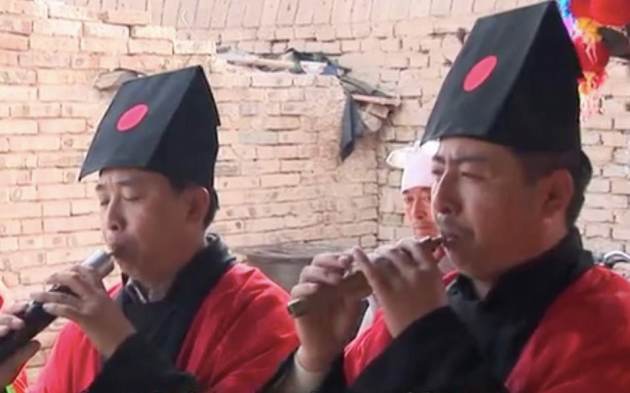

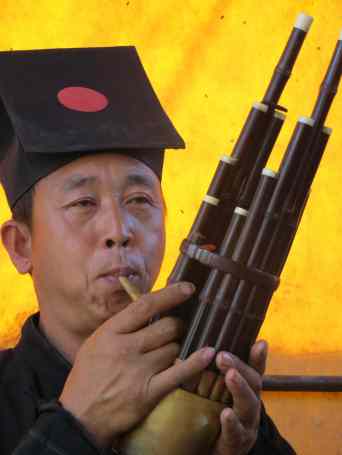

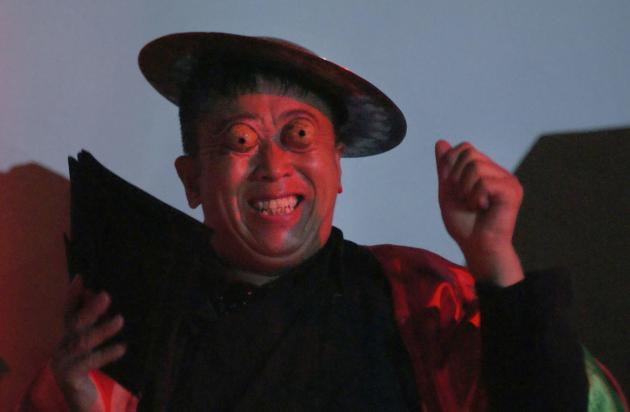


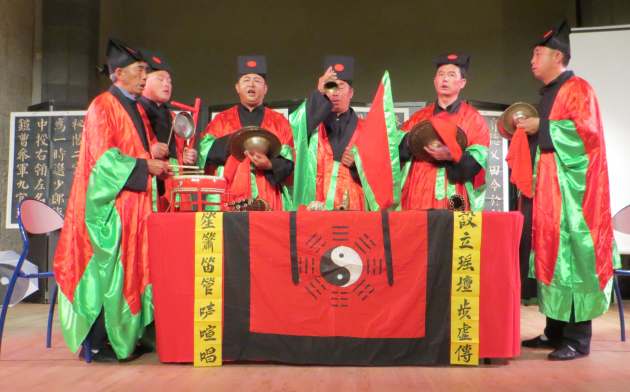

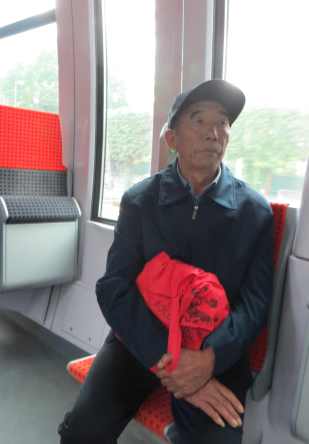

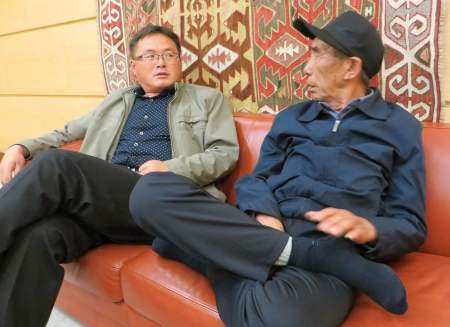


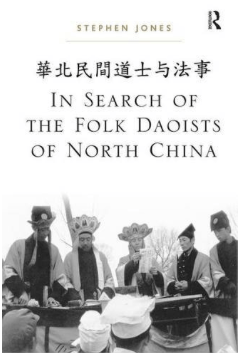


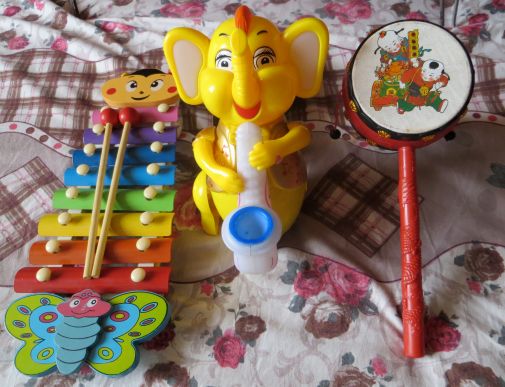
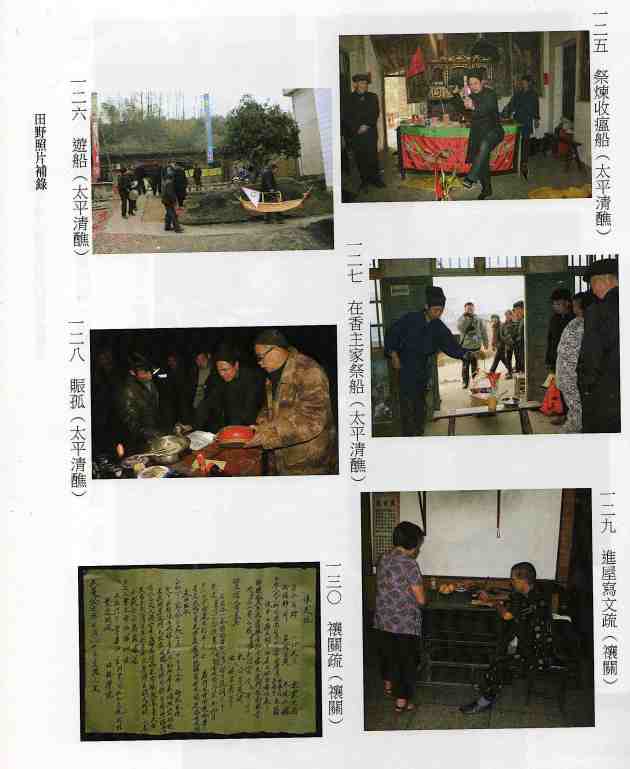
 Along with regions like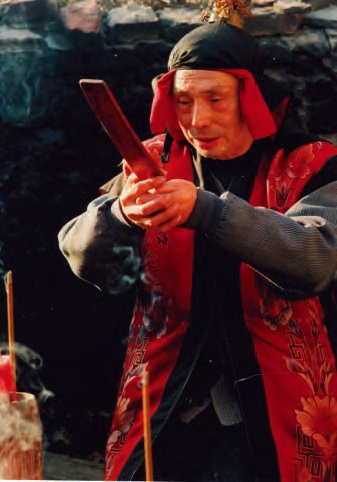


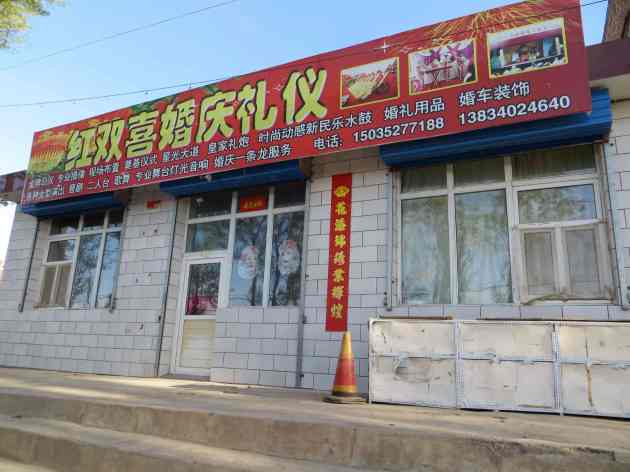

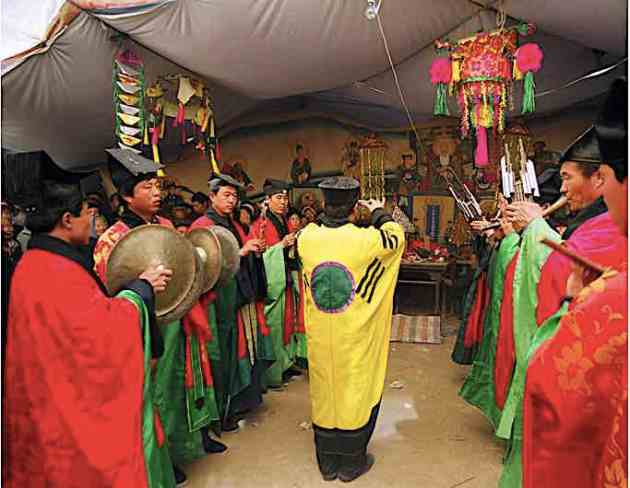

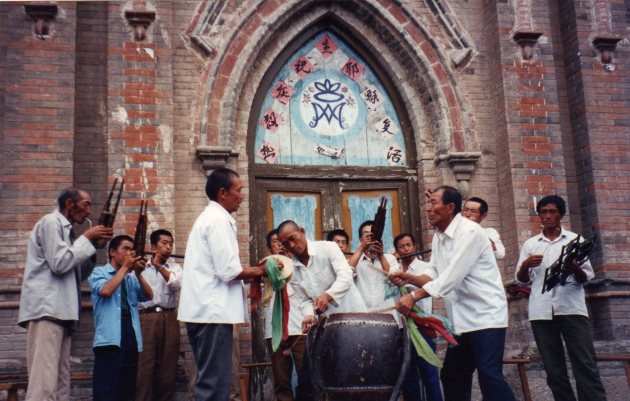


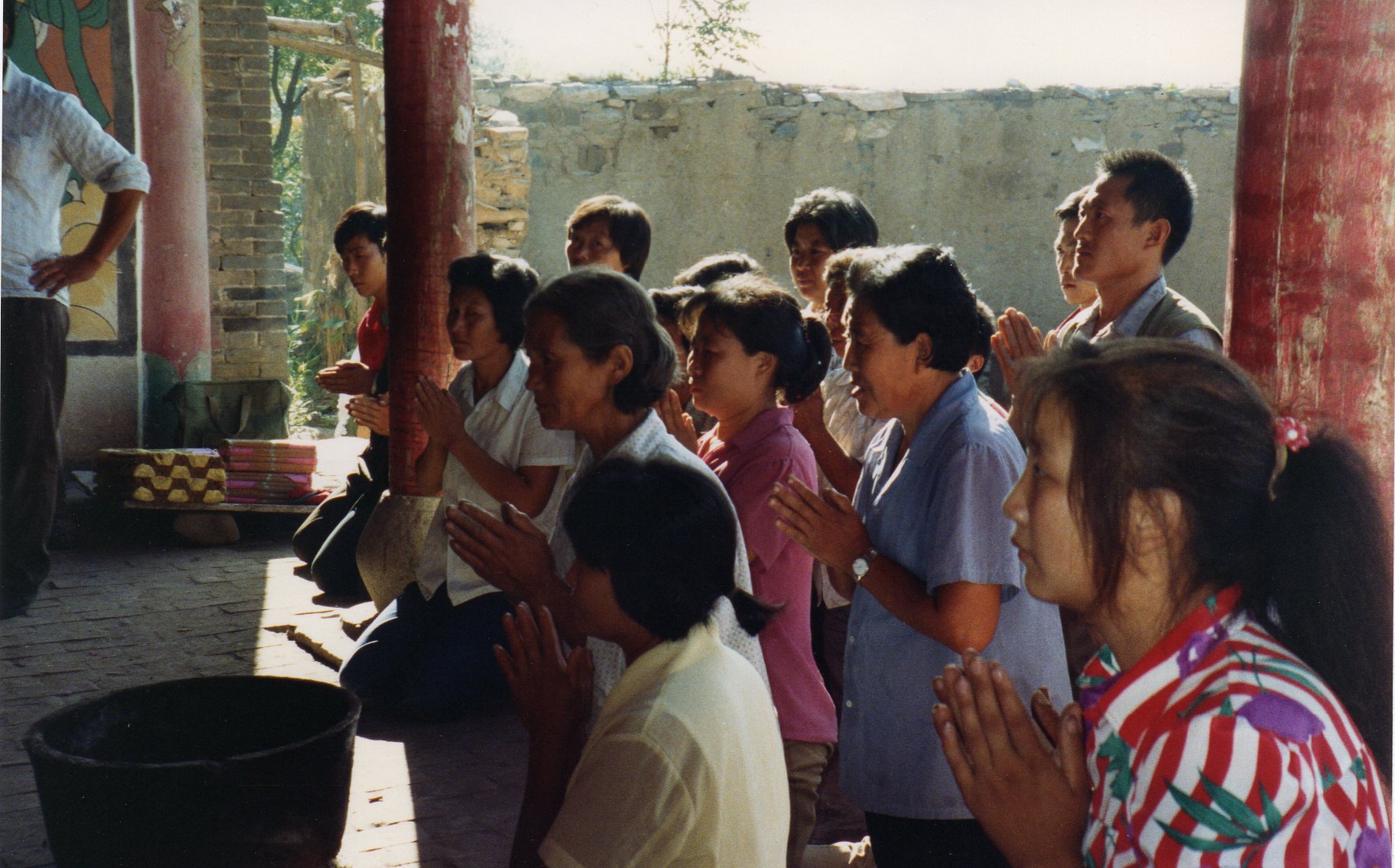


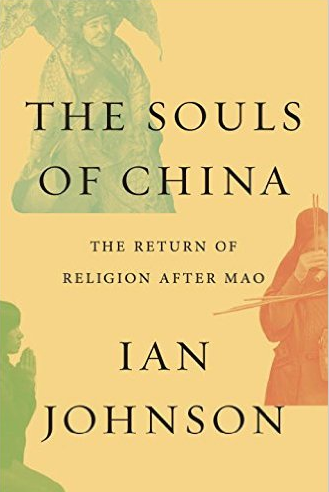

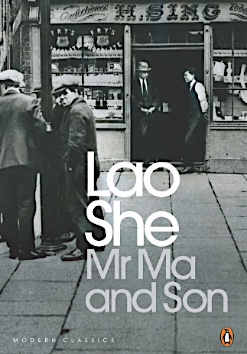




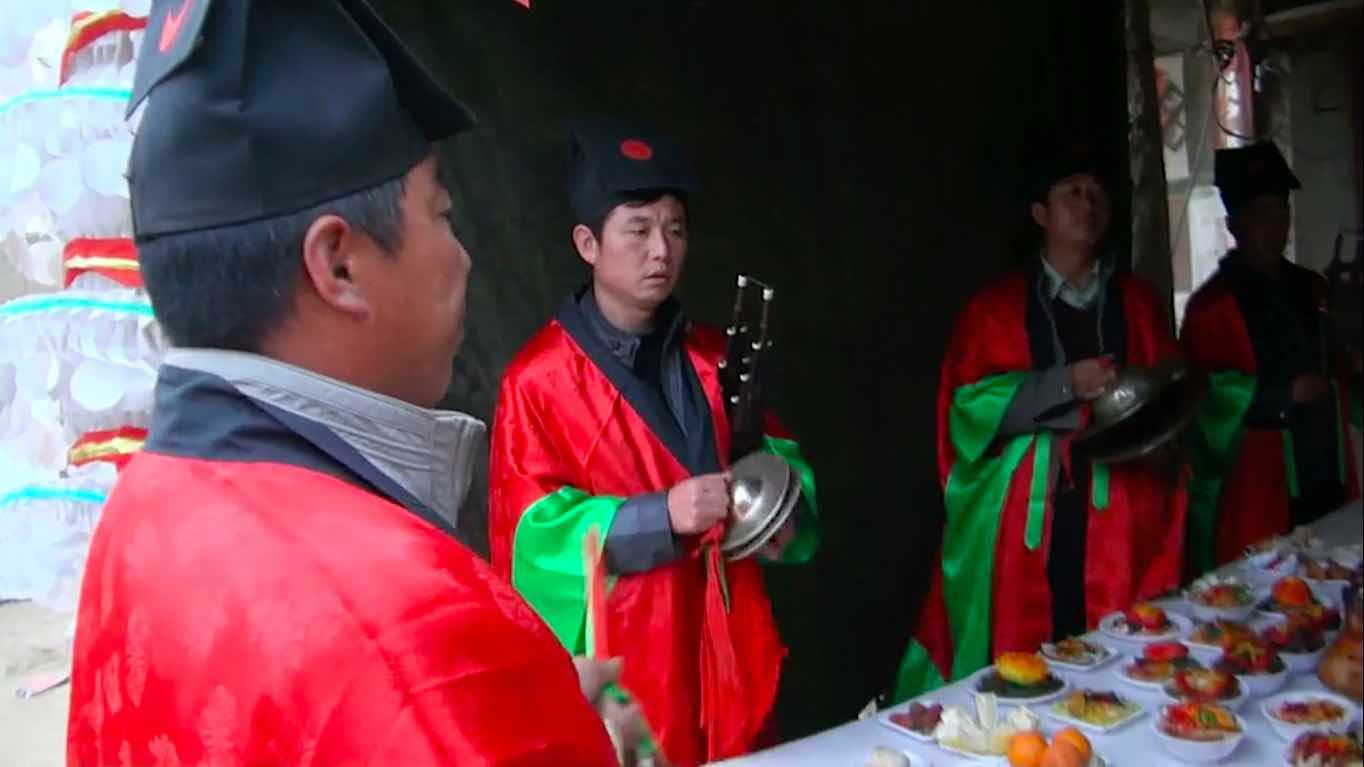
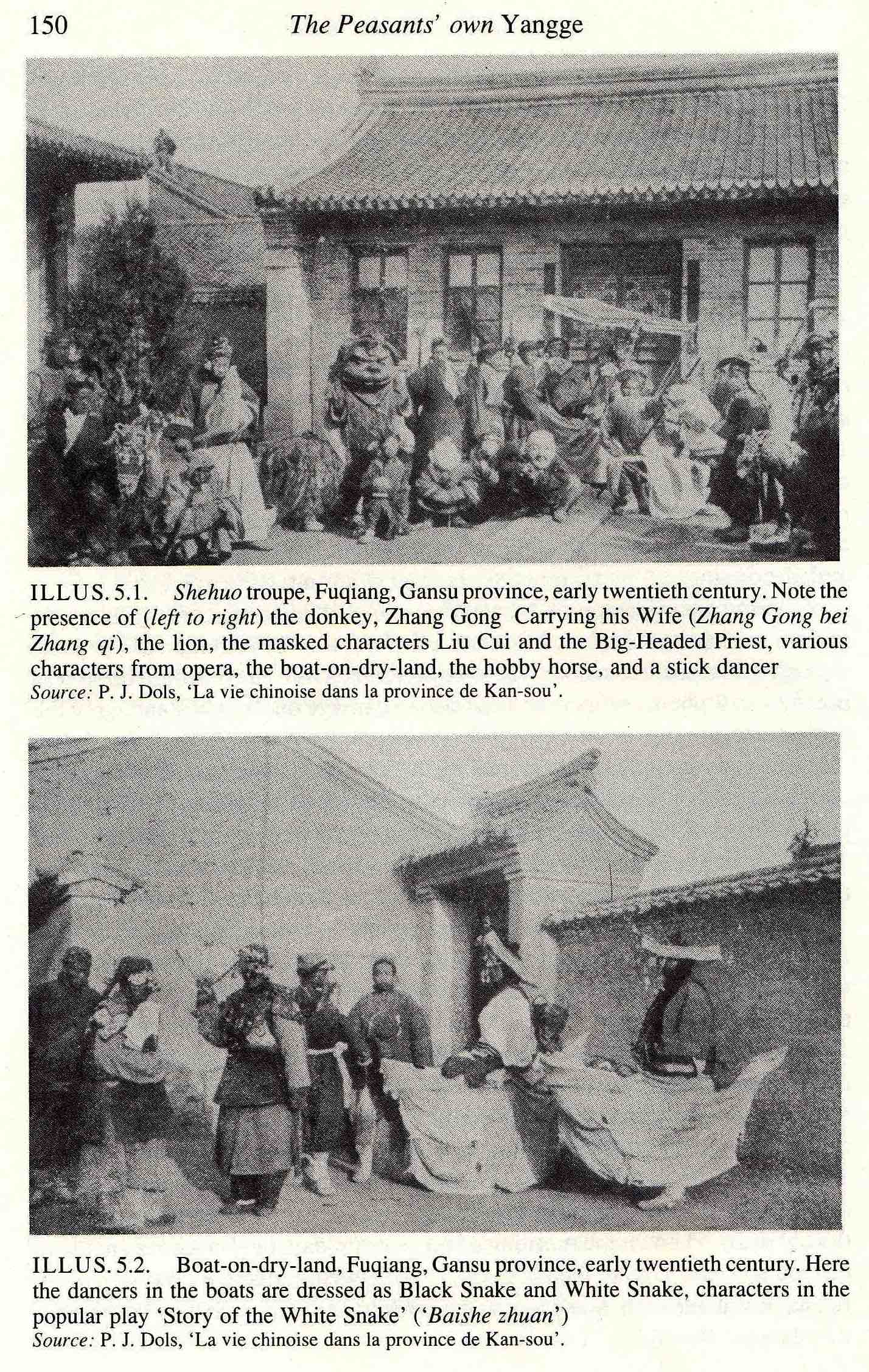
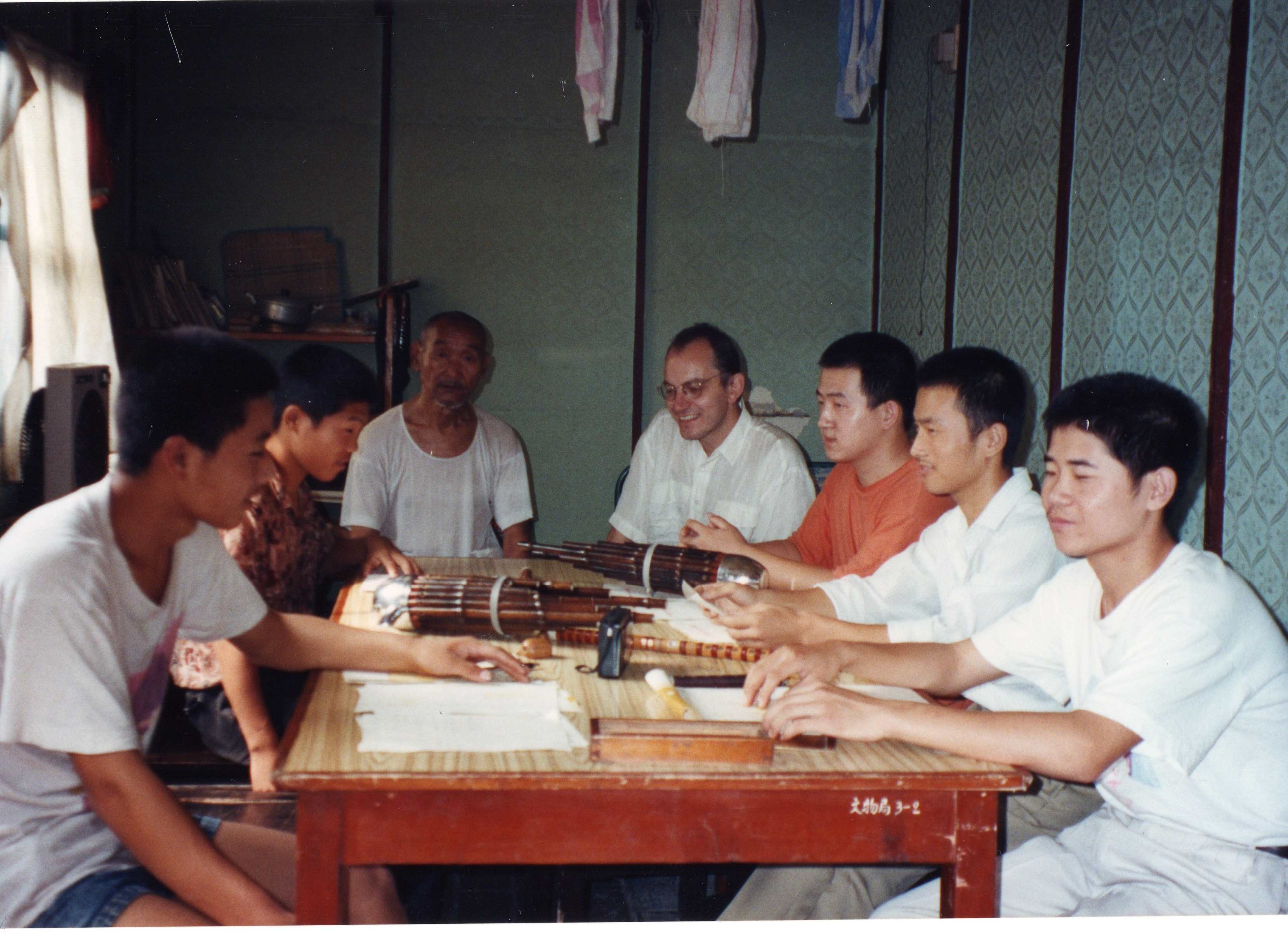
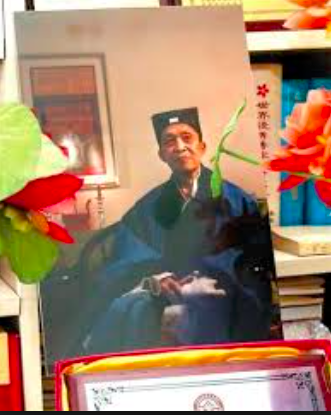
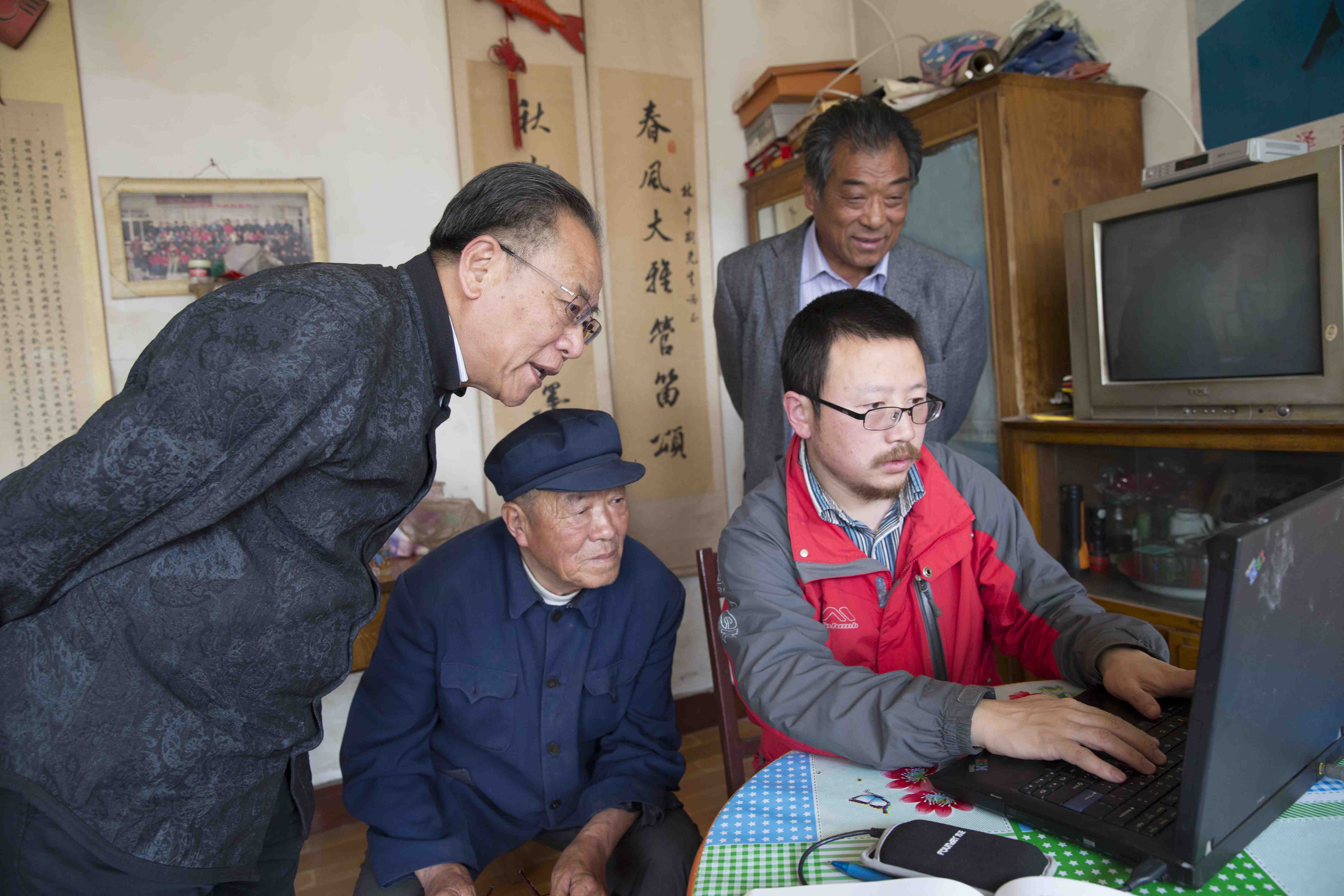
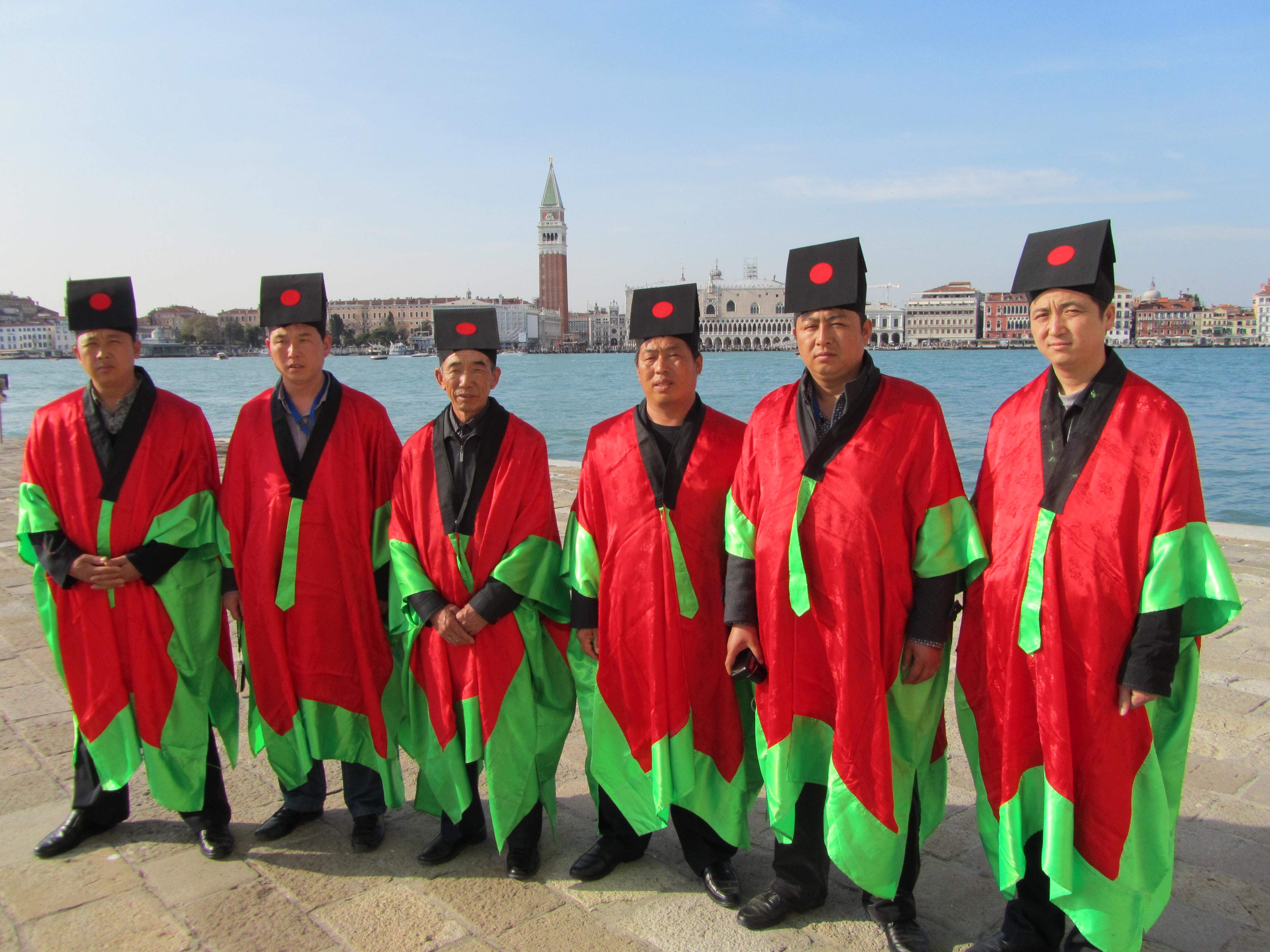


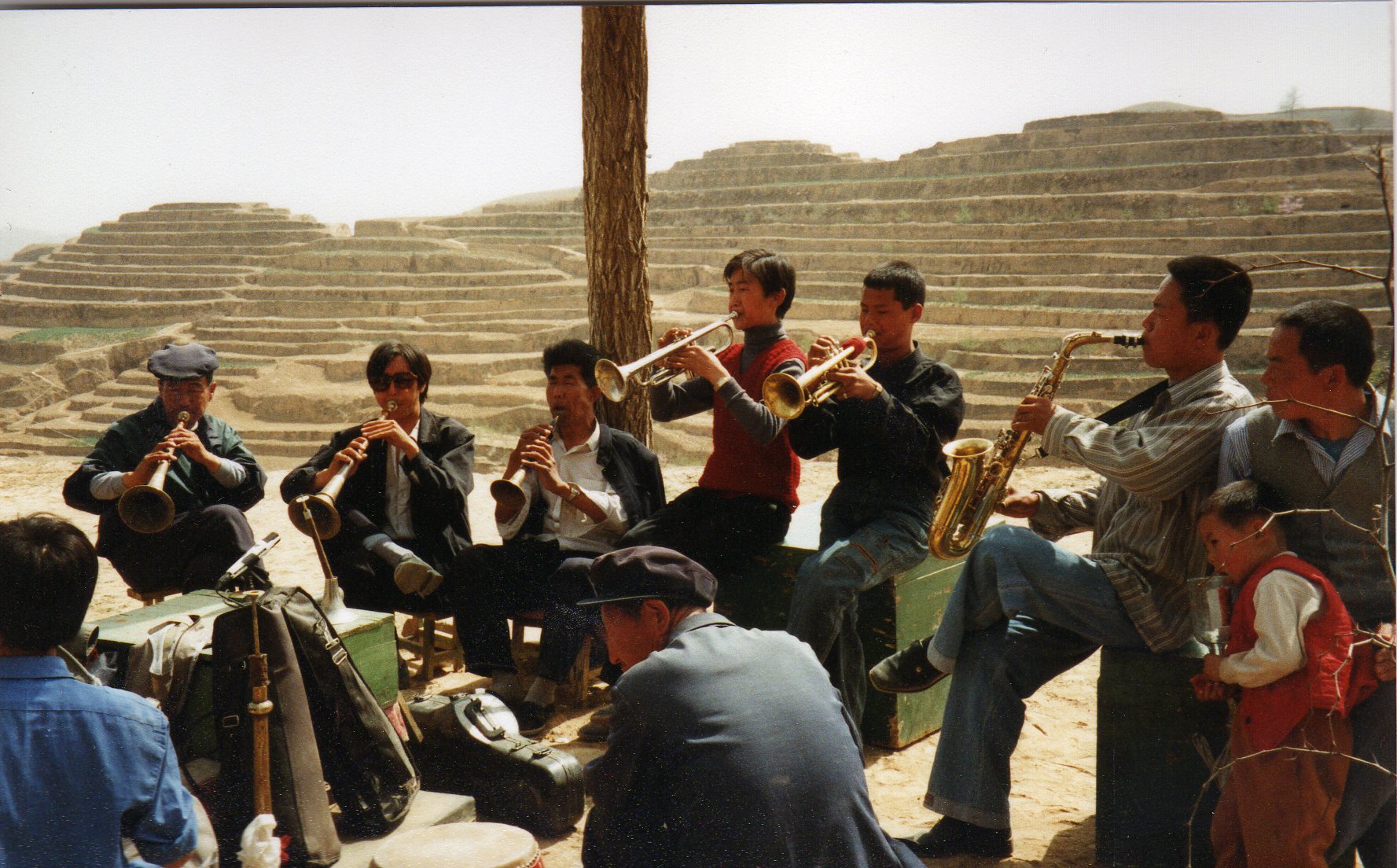
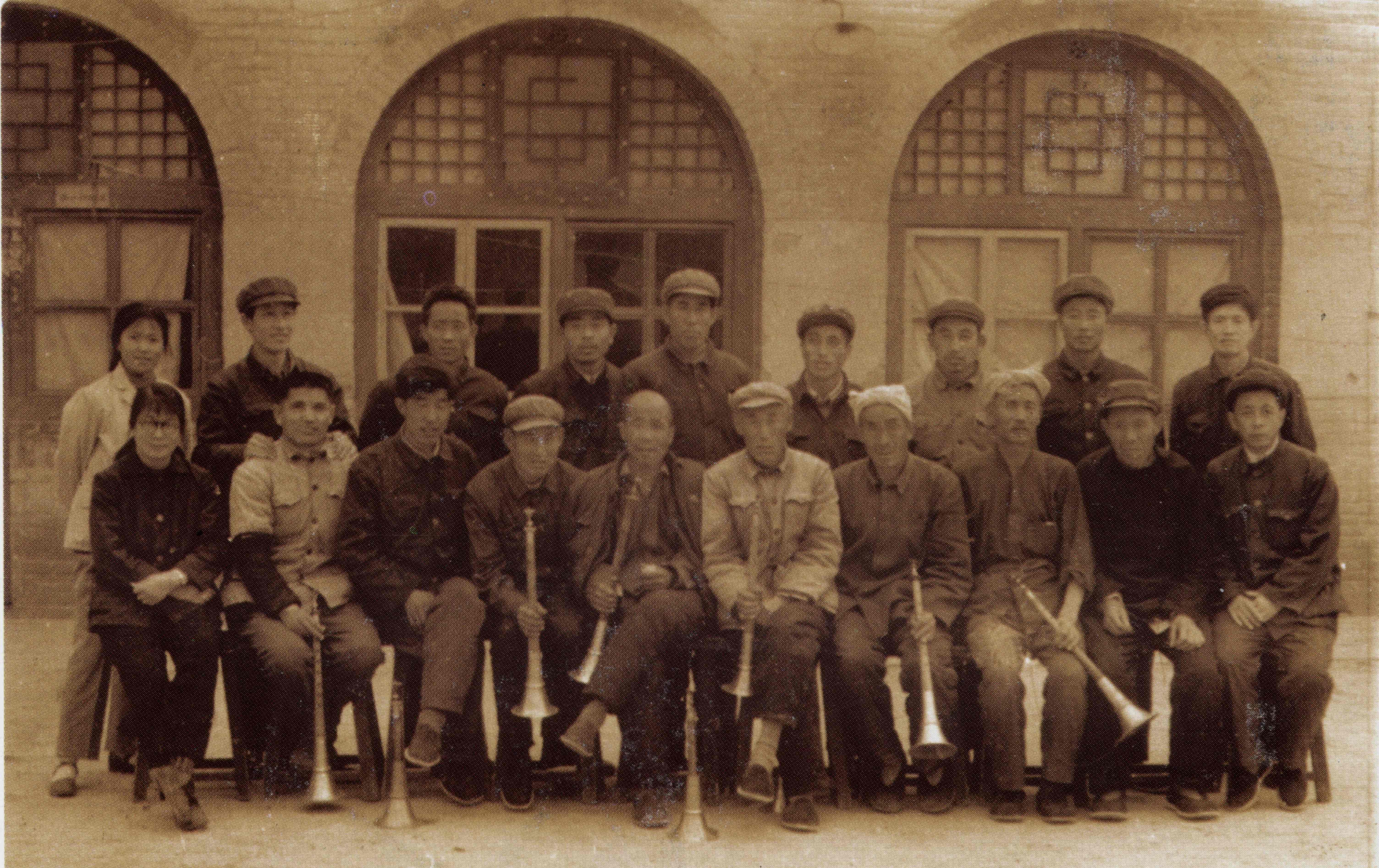 Shawm players from Mizhi county, assembled for a regional festival in 1981.
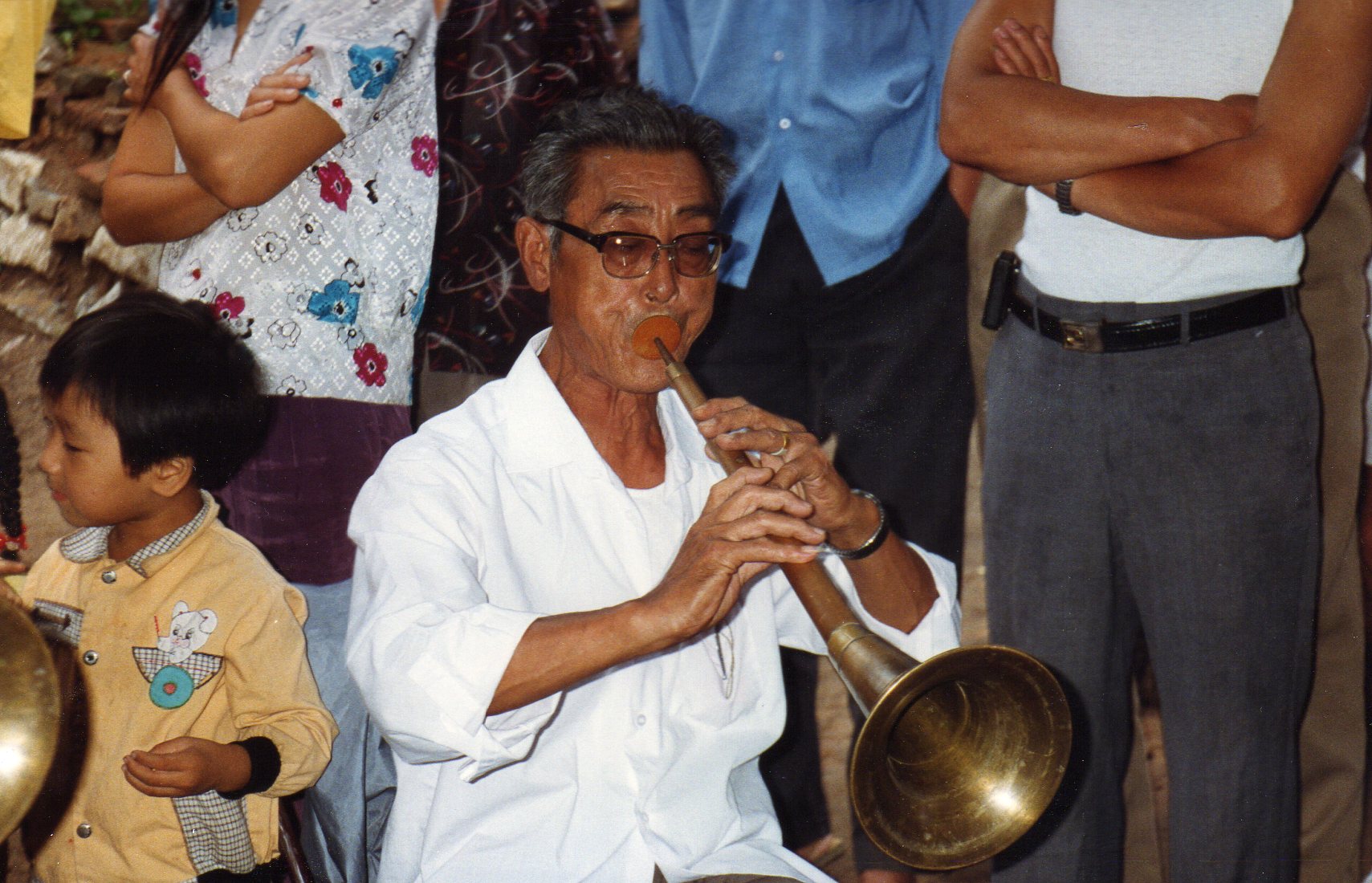


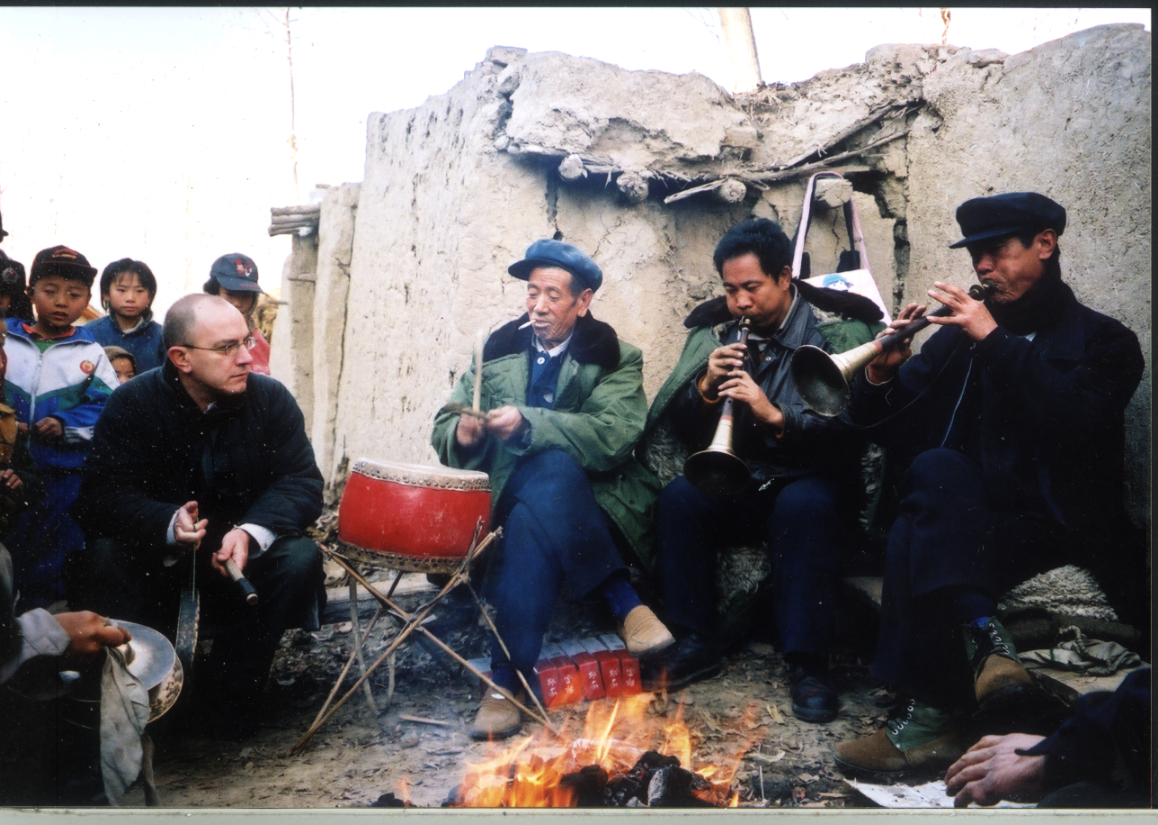


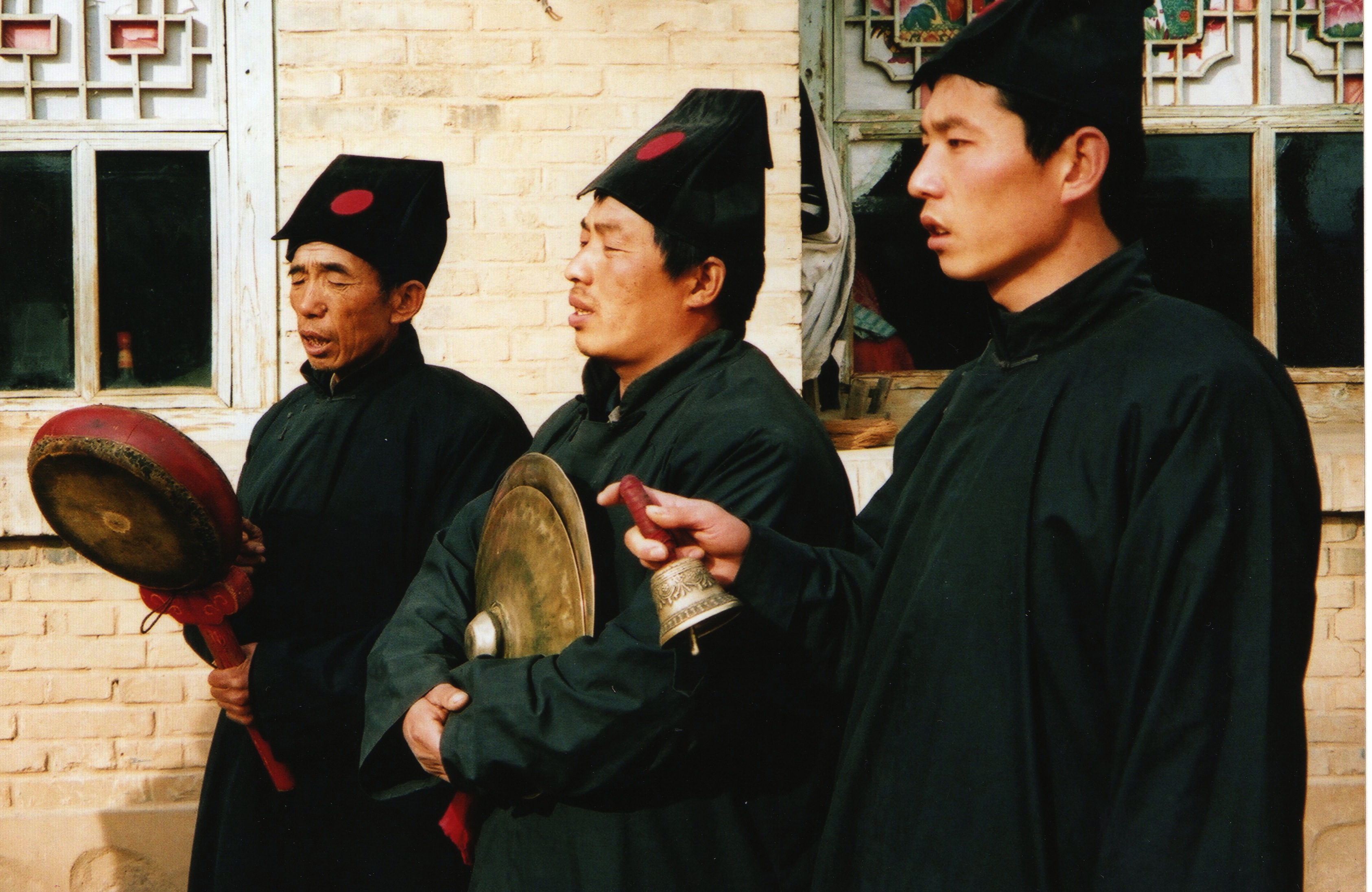

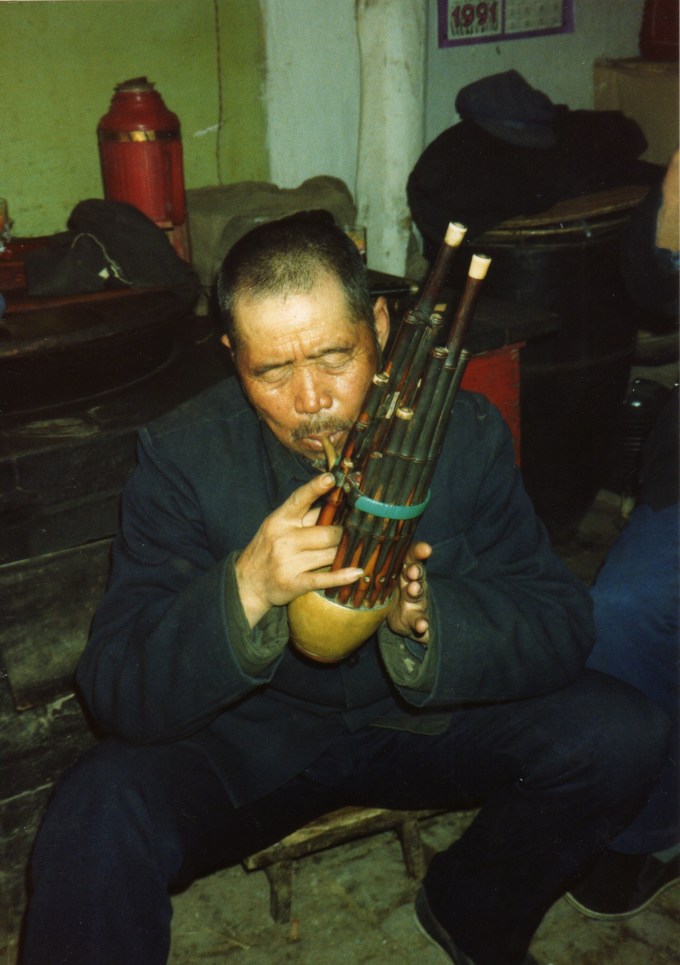
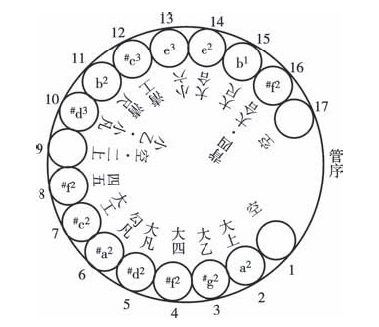

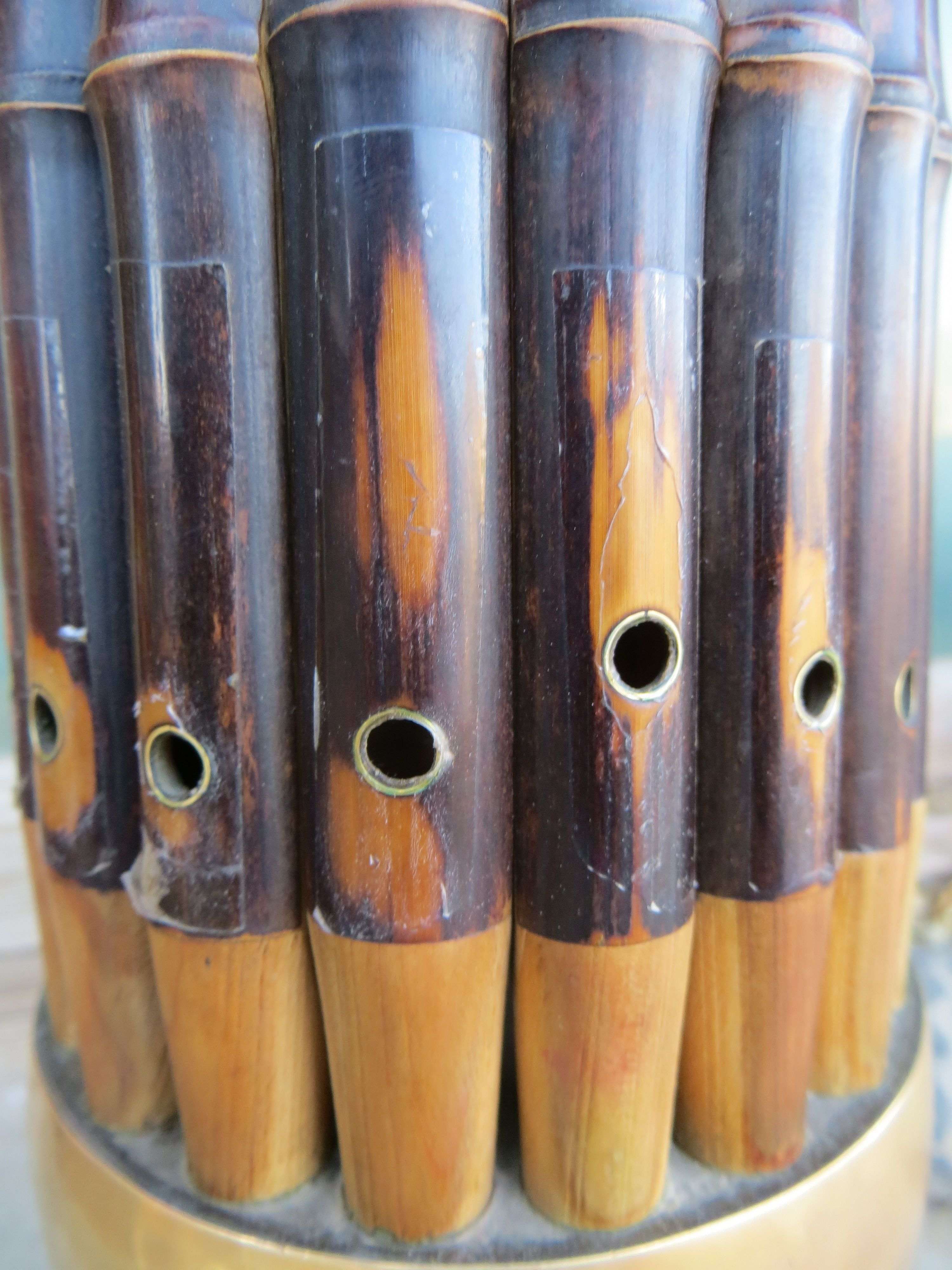


 Temple procession, Xincheng, south Gansu, June 1997.


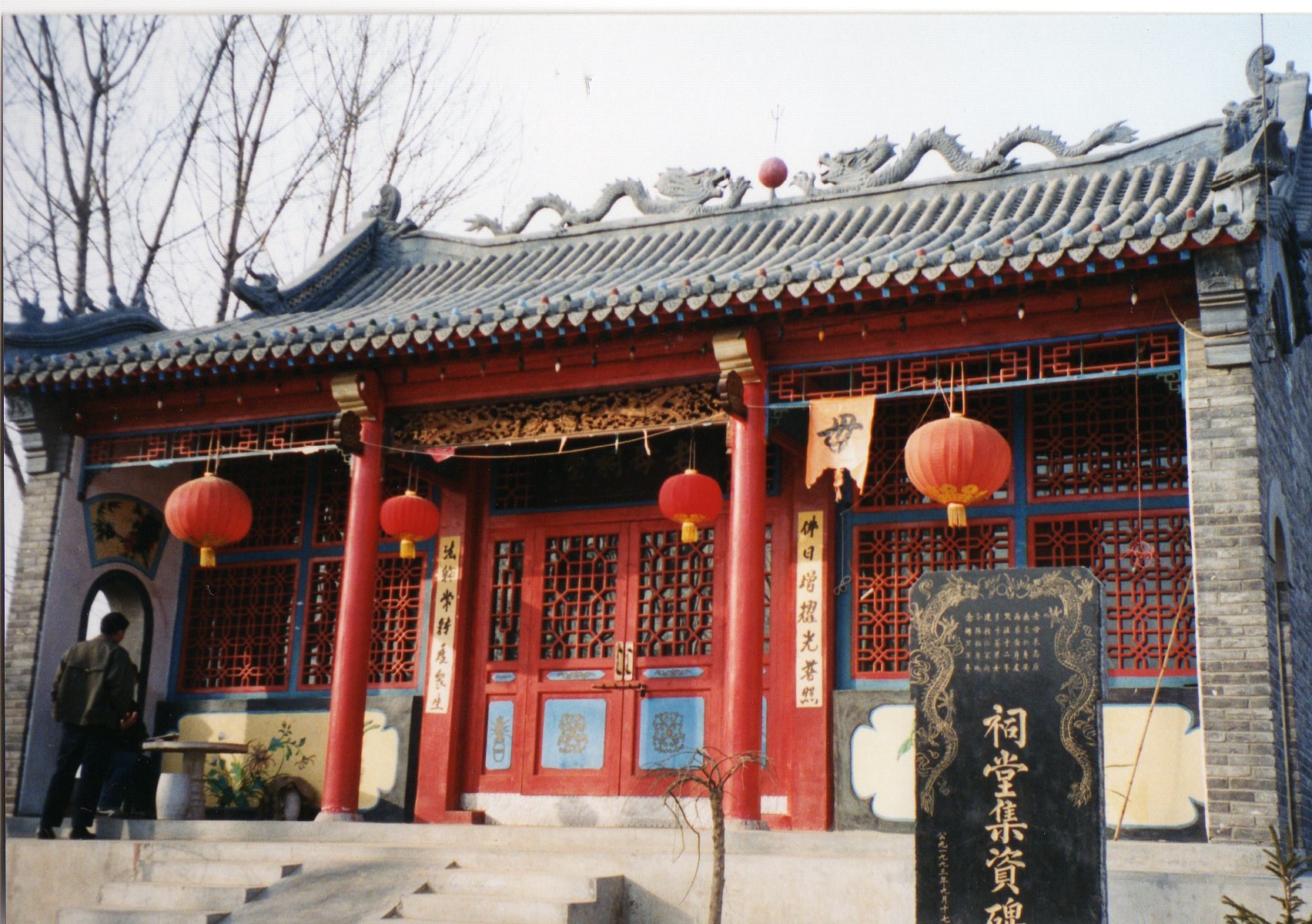

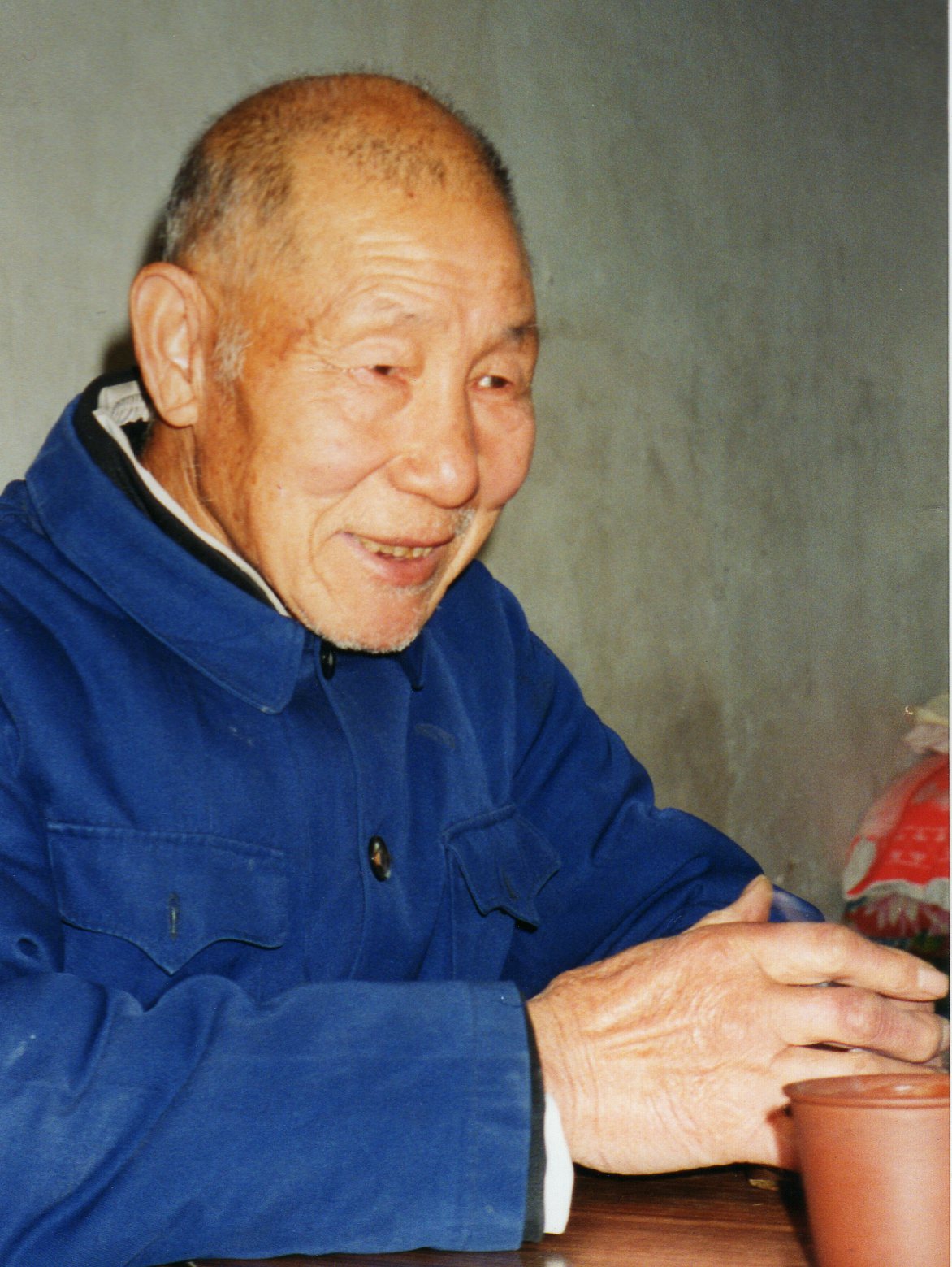
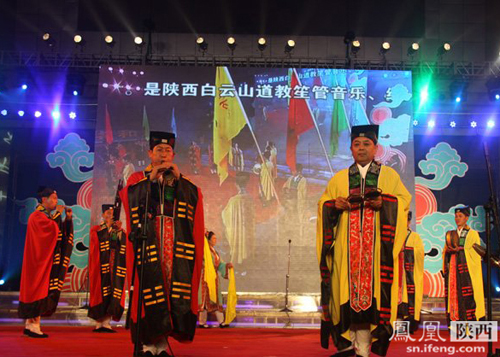
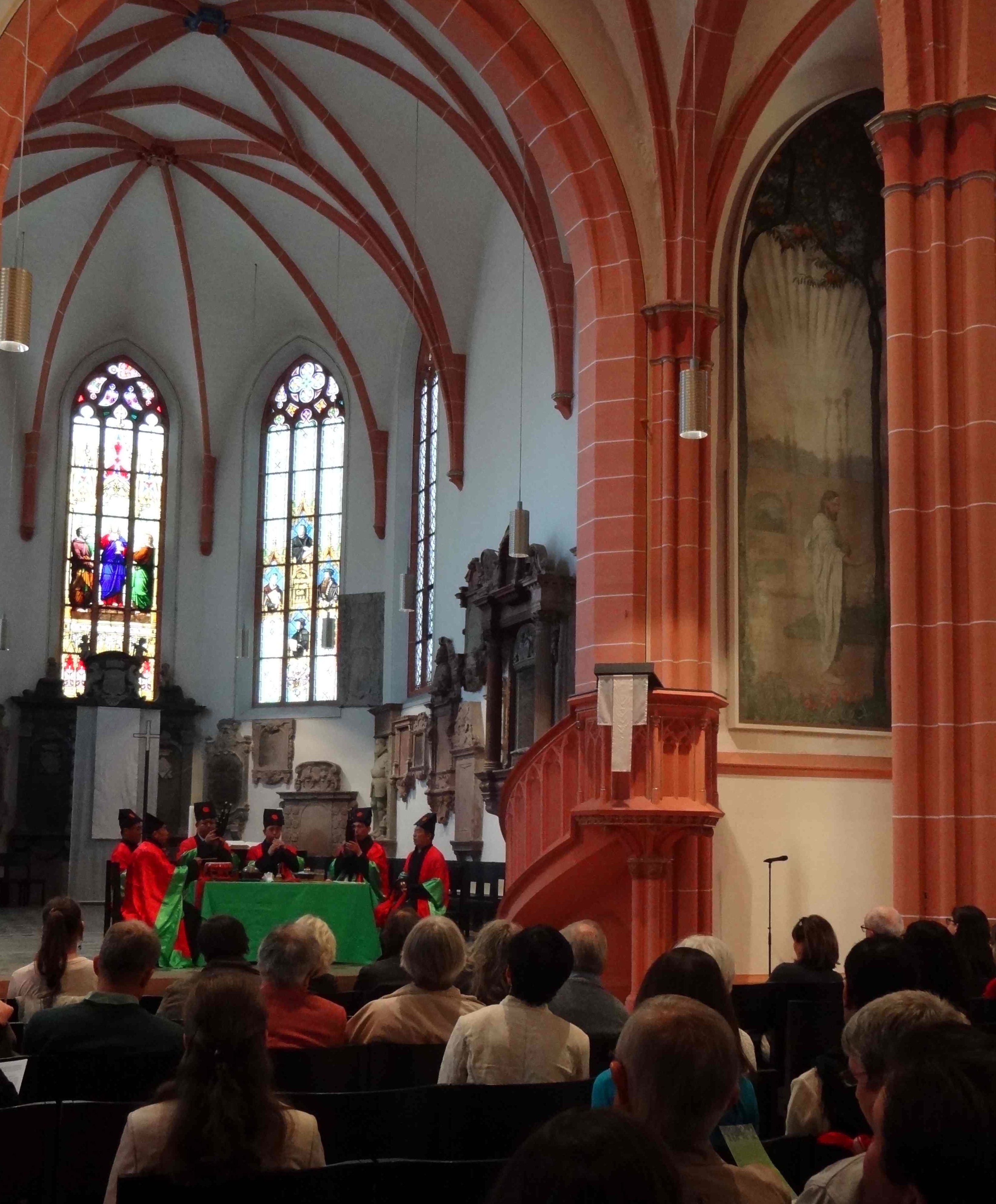
 Stephen Jones: a blog