Two novels over half a century apart give a flavour of changing Chinese experiences in Britain.
Mr Ma and son Lao She (1899–1966) wrote Mr Ma & Son: a sojourn in London in the 1920s—while he was a young lecturer at SOAS, indeed. At a time when Chinese in the West were represented by “yellow devil” stereotypes like Fu Manchu and Anna May Wong, he evokes the difficulties of mutual comprehension, and the gulf between Chinese workers in the East End and patriotic students trying to negotiate their place in the world—all still ongoing issues.
Back in China, after leading the All-China Resistance Association of writers and artists during the Japanese occupation, Lao She enjoyed another sojourn in the USA until returning to Beijing in 1949. He perhaps made a more inevitable recruit to the political cause after Liberation than the great musicologist Yang Yinliu, but all such intellectuals had to negotiate a tortuous path. In the 1950s he got to know the Hrdličkas in Beijing.
Lao She’s Afterword (“How I wrote Mr Ma & Son”) is full of sophisticated and modest reflections on the encounter between of classical and vernacular style—all the more impressive in view of the later indignities inflicted by the simplistic prose style of Maoist ideology, not to mention his own brutal fate at the outset of the Cultural Revolution.
Sour sweet Timothy Mo’s 1982 novel Sour sweet is a brilliant evocation of the insecurity of newly-arrived Cantonese immigrants to the UK in the 1960s. Concerned with a different set of questions to intellectuals like Lao She, they seek to survive with their little takeaway business. Little by little, ineluctably, the seemingly separate family worlds of innocent domesticity and Triad brutality clash in shockingly graphic violence.
It’s also very funny. Mo captures the language of new arrivals brilliantly. They put up notices in the restaurant:
MANAGEMENT NOT RESPONSIBLE FOR COOK’S COOKING
TRESPASSER WOULD BE PROSECUTED
Once,
Seeing that Mui and the lorry driver have brought a crate of Coca Cola: “Ah,” said Lily, “Whore Lock!” (or a close phonetic representation to that effect), identifying one of the products in question by its Cantonese name.
‘Eh?’ said the driver, considerably startled.
Lily smiled her charming (for westerners) smile. “You like Whore Lock all the time, too, hah! It’s the real thing!” she quoted enthusiastically. Mui averted what might have turned into major embarrassment all around. “My sister not understand English too much,” she explained. “you please excuse.”
Reminiscent of my mentor Paul Kratochvil’s story is an exclamation that Mui hears from one of the truck drivers:
Far kin aid her!
for which she supplies a suitably Confucian interpretation:
May distant relatives come to her assistance.
(Despite a thorough trawl, I haven’t retrieved the original quote, so this is my memory of it. Anyone?)
And Lily’s alarm when she learns of the Terror Pin at her young son Man Kee’s school:
Lily was horrified but not basically surprised. Typical of the English: their discipline was either lax to the point of non-existence or ferocious—like beating Hong Kong factory workers senseless with truncheons and then giving them free medical treatment. The Terror Pin was kept in a glass box of its own. (Display of force often eliminated need for its exercise.) Occasionally, it was brought out when as an additional refinement of torture the children was actually allowed to handle it! She discovered it when she saw Man Kee taking some winter greens in his satchel, obviously as some kind of propitiatory offering, similar to the symbolic offering of lettuce (money) to the New Year dragon. Concerned, as what mother wouldn’t have been, Lily examined Son’s adorable arms for tell-tale puncture marks but hadn’t found any. Good boy.
For some discussion, see here, and this weighty analysis of the book’s Confucian—and Daoist—themes is intriguing. The Daoist link also features here. For Chinese music in Soho, click here, and for immigration, here.
Imagine: you’re better than James Joyce; you end up like Miles Kington.
I take the point, but for many fellow-Flanneurs it may not seem germane. Myles’s oeuvre is Sue E. Generis (if he didn’t say that, then it must have been me), self-standing—which, allegedly, is more than he was.
How can I have been so remiss as to neglect Timothy O’Keefe’s edited volume Myles: Portraits of Brian O’Nolan (1973)? Fortunately, my old friend Rod (himself an honorable, nay upstanding, member of the Royal Society of Flannologists) has stepped into the unsavoury breach of my Stygian ignorance [Hope he wiped his feet afterwards—Ed.], drawing my attention to a fine reminiscence therein by Niall Sheridan:
His interest soon shifted to a suggestion of mine—the All-Purpose Opening Speech. This was to be one endless sentence, grammatically correct, and so devoid of meaning that it could be used on any conceivable occasion: inaugurating a President, consecrating a Cathedral, laying a foundation-stone, presenting an inscribed watch to a long-standing employee. This notion delighted him, and he decided it must be given to the world, translated into every known language. If nation could speak fluently to nation, without any risk of communicating anything, international tension would decline. The Speech would be a major contribution to civilisation, enabling any inarticulate lout who might lever himself into power to emerge (after a brief rehearsal) as a new Demosthenes.
I was to make the original draft in English. Denis Devlin was to undertake the translation in French and Brian himself would do the Irish and German versions.
I can remember only the opening portions of the Speech, which ran (still incomplete) to some 850 words:
“Unaccustomed as I am to public speaking, and reluctant as I am to parade my inability before such a critical and distinguished gathering, comprising—need I say—all that is best in the social, political, and intellectual life of our country, a country, I may add, which has played no inconsiderable part in the furthering of learning and culture, not to speak of religion, throughout all the lands of the known globe, where, although the principles inculcated in that learning and that culture have now become temporarily obfuscated in the pursuit of values as meretricious in seeming as they must prove inadequate in realisation, nevertheless, having regard to the ethnical and moral implications of the contemporary situation, etc, etc, etc.”
When the translations had been completed we had a reading in Devlin’s home. Any rubbish can be made to sound impressive in French, and Denis had produced a superb version, rhythmic, mellifluous and authoritative. It conveyed (to our delight and amazement) even less meaning than the original.
Brian (who delighted in the simplest sleight-of-hand) whipped a walrus moustache from his pocket, fixed it under his nose and read his Irish version, in a wickedly accurate impersonation of our Professor of Irish, Dr Douglas Hyde, later the first President of Ireland.
“What do you think of that?” he asked, looking from one to the other.
Denis told him that he admired his brio but deplored his occasional slurring of consonants. I told him that listening to his delivery was like wading through warm stirabout at one’s feet.
Undeterred by this mixed reception, Brian quickly replaced the walrus moustache with a toothbrush affair and poured out his German translation in imitation of Hitler at a Nuremberg rally. As he ground out the Teutonic gutturals, spitting and snarling in comic menace, he knew that he had made the hit of the evening.
Actually, if the speech wasn’t already in use then, it has since become entirely standard.
In China my vocabulary—acquired at a time when the commune system was still a recent memory—is absurdly peppered with classic expressions from the Maoist era, like “not taking a single needle or thread from the masses”. My Chinese colleagues have been known to exclaim, “Steve, you sound like a bloody village Party Secretary from the 1950s!”
Of course my usage (like much convoluted Oxbridge-speak) is partly satirical—but only partly.
One handy phrase is actually ancient, going right back to Mencius:
Used in imperial times to describe the abysmal sufferings of the common people, it was applied under Maoism [by Mao? source?] to the plight of populations under capitalism, in need of rescue. Elaborating on the motto, here’s an instance of the lively critiques going on these days (this is from a US-based site, but it’s no longer unimaginable within China):
During the Cultural Revolution there was a famous slogan, “The happy Chinese people are deeply solicitous for the American people, who live in desperate plight”. Experience tells us that the standard of living of the American people living in desperate plight far exceeded that of the happy Chinese people, and that the American people living in desperate plight didn’t seem to need the concern of the happy Chinese people. Under the theory of the great class struggle, tens of millions of happy Chinese people starved to death.
Again, when I use the phrase “waters deep, fires raging” about life in the UK or the West, I’m not being entirely satirical. It partly ties in with that “typical” English self-deprecation, and as the above quote shows, the irony of applying it to the USA can have been lost on few Chinese, even under Maoism. But the expression can be genuinely useful—it is worth reminding some Chinese people (who may still have a rose-tinted view of life in the “Western paradise”) about homelessness, alienation, strains on social care, and so on. If we can be honest about our problems, perhaps China can be too—let’s dispense with the platitudes.
Anyway, “waters deep, fires raging” never came in so handy as now—to describe the current turmoil amidst environmental degradation and moral turpitude, with civilized values widely threatened. Finally its time has come.
I’ve finally got round to reading her little-trumpeted* sequel to Cold comfort farm, Conference at Cold comfort farm (1949).
(*Little Trumpeted could be one of her local rural names, like Howling and Mockuncle Hill. Bill Bryson is a clear heir to this niche fetish, with his predilection for [real] names like Seething, Wrangle, Nether Wallop, Thornton-le-Beans, Shellow Bowells, and so on.)
In Conference, written at a time when Britain was going through a revolution in the aftermath of devastating war, with social justice briefly in the air, and in certain circles also cultural innovation, Florarevisits the farm some sixteen years after her earth-shattering initial stay, once again putting things to rights.
The book satirizes both the avant-garde and (some five decades in advance) all the Intangible Cultural Heritage flapdoodle—at a time, remember, when it was neither profitable nor popular (indeed, Stella’s mockery of pretence was akin to that of Myles). A few gems:
Hacke, with his sculptures Woman with Child and Woman with Wind.
And Messe: “Of course, I don’t put him within miles of Peccavi. I should put him somewhere between Pushe and Dashitoffski.”
There’s even a dodgy Oriental Sage.
Meanwhile, Reuben reports to the ever-sane Flora on the visit of a Mr Parker-Poke from Th’ Ministry :
“He—he did say as I were niver agricultoorally eddicated.”
“I am very sorry, Reuben.” Flora laid her hand upon her cousin’s for a moment. “No, you are not agriculturally educated; you only know how to make things grow.”
Who ever supposed Stella was a one-trick pony (and I didn’t say “filly”)? Never seduced by the blathering blandishments of Bloomsbury, Not For Nothing has she been Dubbed [sorry—there’s another one for the Catechism of Cliché, or Molvania] the Jane Austen of the 20th century.
And now there are all her other novels, long neglected, for us to read too.
One of the few terms in yoofspeak not susceptible to HRT is LOL, never ascending.
OMG is curious: often intoned at a rather high constant pitch, like the first tone in Chinese—and (perhaps through the pervasive influence of Friends) drawn out dramatically: O——M——G…
Another recent entry in the lexicon of tonal variety is that weird announcing thing the female presenters of Strictly do, in mantric unison:
THE JUDGES…
Chanted hypnotically, this time at a rather constant mid-range pitch, it might sound merely jaded, but has been magically rescued from its previous function of expressing sullen apathy to suggest instead some awesome process, divinely decreed. Again, this may be related to gender.
Of course, there’s a wealth of academic discussion about the importance of the semantics of stress and pitch in English. Here’s just one stimulating example, with some inter-cultural comparisons.
Meanwhile, back at Chinese ritual, unlike choral hymns (easily notated, with fixed pitches and tempo), the performance of shuowen solo chanted introits in Chinese ritual doesn’t necessarily attract much musical analysis (or transcription). But again, if we seek to learn how to be a Daoist, we need to pay attention to their rendition—not spoken but parlando, rather fast and high, each phrase descending. Listen again to the way Golden Noble sings this introit at the soul hall before the Invitation procession (my film, from 58.14):
May the deceased souls come to the Bathing Hall, Transforming their shape and countenance to return to the immortal realm. Now dipping into the bowl to bathe their bodies, For an audience with the Three Treasures on the way to the Western Quarter.
Further to my remarks on the illusion of “becoming at one with the masses”, I’m always struck by the irony of hanging out with Chinese peasants whose whole life-experience and world-view are totally different from my own. That’s commonly the kind of thing that ethnographers do, of course.
“Stranger value” would be most unlikely to butter any parsnips if a middle-aged English academic were to descend on a bunch of Newcastle punks (cf. my post on vocabulary). They would quite rightly tell me to get lost—although possibly not in those precise words. Chinese peasants are more hospitable.
I’m sure many authors have seen their finely-crafted prose befall a similar fate, but a crazy garbled version of the vimeo blurb for my film that I found online, if not entirely accurate, is very funny.
Apart from dubbing my fine editor “Michele trivial”, gems include
This movie intimate portrait explores the lifetime of the eighth technology Taoist Li Manshan (b.1946) household, chief of a gaggle of formality specialists within the poor countryside of Yanggao County.
On syntax, in cases like these it can be tricky to surmise whether the opening adjective should apply to the first noun or to the following adjectival noun–noun pair. Some may be clarified by means of a judiciously-placed hyphen, but that would spoil the fun:
Welcome to our theme café, Sir and Madam, I’m Fido, your racist dog waiter for this evening, and I’ll be whistling your favourite racist ditties for you to sing along to—specials on the board, and a fine selection of craft rightwing beers. (Did you just see that Pekinese? I dunno, they come over ‘ere… Woof! LOL—What am I like?) Perhaps I can warm you up by warbling The Stammering Coon.
This almost leads us towards silly headlines (rounded up here):
Squad Helps Dog Bite Victim
Prostitutes Appeal To Pope
British Left Waffles On Falklands
And this, from Terry Jones and Michael Palin, no less:
Some punctuation might help here:
And a related case, under “Document design matters” on Twitter:
As I browse the back catalogue of Rusty Debris, I find Rich Hall makes an engaging guide for my latent dilettante interest in Country. He’s also a fine Tweety-baiter, of course, such as this. And his BBC4 film is both instructive and hilarious:
Country may often seem banal to us poncey liberal elite—although we’re on thin ice if we’re going to laugh at the outfits. But like flamenco, or tango (or, come to think of it, almost any genre worth its salt), beyond the cosy domestic image it’s about pain, and poor suffering Hugh Manity.
In time the industry managed to cash in on the outlaw image (at first latent, later a badge of honour) that came to supplement the homely veneer—embodied in The Highwaymen and the great Johnny Cash. And so on to Willie Nelson (“Then one day, thankfully, his house caught fire”).
Rich’s comments on Tom Hiddleston’s ill-advised Hank Williams biopic I saw the light are priceless. He also manages to give short shrift to John Travolta, Taylor Swift, and even Bono.
Like a gen-u-ine ethnomusicologist, he notes the diverse ethnic origins of Country, its local distinctiveness, migration, and patronage. Again, there are some fine taxonomies here. He notes the shift from Nashville to Austin, and the Cosmic Cowboy collision of redneck and hippy. And wow, there’s some hot fiddling.
There are also some nice details on changing instrumental technique—a trademark of the best discussions of music—like “He [Chuck Berry Junior, not the Chuck Berry, R.I.P.!] told him [Waylon ] to replace the top E string with a banjo string to bend it easier, and to shave down the frets on his guitar to get a lower action.”
The secret is to replicate, not to regurgitate.
This quote from the online blurb could be an encapsulation of ethnomusicology:
As he unearths the roots and inner workings of country music, Rich finds it’s more than just music—it’s a lifestyle.
There are loads of wonderful documentaries on such topics, avoiding hagiography while evincing proper respect—but where are all the programmes about shawm bands or Daoists, eh?
Update: Ken Burns now has a major series Country music (cf. his Jazz series), its eight parts now being shown in abbreviated form on BBC4. Just the opening programme, on the early history of Country to 1933, is an aural and visual feast. For more, see here.
As a reminder that Chinese fieldworkers are by now quite familiar with the Western unpacking of dubious illusions about “the three togethers” and “becoming at one with the masses”, a 2016 conference on fieldwork theory explored the theme. The paper by Chen Yongchao 陈泳超 has perceptive comments on the relation between “insider and “outsider”:
“ ‘Wuhai’ ji daode” ‘无害’ 即道德, Minzuwenxue yanjiu 民族文学研究 2016.4.
Perhaps it’s time for a pensée, or apercu, about some of the seemingly incongruous juxtapositions on this blog.
I realize some of these jokes may try the patience of disgruntled readers who have come here, in all innocence, seeking insights into the Wisdom of the Ancient Sages or the Mastery (sic) of the Great Composers. And indeed vice versa: anyone here for laughs will be pretty cheesed off to have to plough through blow-by-blow accounts of Daoist ritual and Messiaen.
Humour has always played a major role in my rapport both with my colleagues and local subjects—but that’s not the card I’m going to play.
Rather, humour can serve to console, to resist, to create ludic connections. It’s no more universal than music—but just as in Daoist ritual (which not only uses language creatively but incorporates segments to entertain mere mortals), and just as in WAM (thinking, for instance, of Haydn and Mozart), humour reminds us of our humanity.
Anyway, I like it.
Jokes (again, like Daoist ritual) are created by people, they take on a life of their own, transmitted in different versions over time for changing audiences. And despite silent, empty, versions in print, they thrive on and evolve through live interaction in performance.
However (and once again, like ritual or music), I’m sure this can become less satisfying for the professional, churning out the same routine night after night for an unfamiliar audience. That’s why Stewart Lee is so great, and it’s what makes his book How I escaped my certain fate so thoughtful. But that’s not important right now.
Following the Li family Daoists‘ 2012 tour of Italy, praise within China came in a report published online in the regional capital Datong. Written in bold red characters in the style of a report on a bumper harvest in the Great Leap Forward, here’s an excerpt:
What kind of response did they evince in their audience? Would it have been sullen and apathetic, by any chance? No. It was warm and enthusiastic, Begob.
What did the performances achieve? They consolidated the friendship between the Chinese and Italian Peoples.
Surely they did more than consolidate it? OK, they developed it too.
And what was the art of Chinese Daoist culture able to do where? Be magnified 弘扬 and promoted 宣传 in a foreign country.
Just in a foreign country? Oh all right then, you win—on the soil of a foreign country.
So what did the performances receive from the Italian people? A good assessment and high praise.
And what did the tour do for the entire group? Um, it encouraged and stimulated their trust and determination to revive our Chinese Daoism.
So since their return, what are they now doing? They are gradually perfecting and elevating their art.
Is that all?
[grits teeth] They are developing and strengthening it too. Do give it a rest.
The report also contains a resounding clarion call:
This is the pride of us Chinese People! The pride of the Chinese Nationality! It is the pride of us Shanxi people! The pride of Datong people! More precisely, it is the pride of our 300,000 People of Yanggao!
I’m not entirely taking the piss. A report like that, however comical and cliché-ridden it may seem, evinces genuine feelings. Even if such terms are alien to peasants like Li Manshan, some people do use them, and most can; and it’s a useful skill for us outsiders to deploy them in suitable contexts.
Also, such coverage subtly, um, Consolidates the reputation of the Li family and Daoist ritual in north Shanxi. What it doesn’t do is make local patrons and audiences value their rituals as much as pop music.
BTW, the article is quite right to observe that “More precisely, it is the pride of our 300,000 People of Yanggao”. Still, it uses the duplicitous Chinese media title for the Li band, “Hengshan Daoist Music Troupe”—which I take to the cleaners here.
A complex and costly new legal ruling (or here) vindicates us nerdy language pedants. It’s brought devotees of the numinous Oxford comma out of the woodwork again.
To show the risks of eschewing the Oxford comma, here’s another party game—you can make up your own lists from the template:
I’d like to thank my parents, Mother Teresa and the Pope
I love my parents, Lady Gaga and Humpty Dumpty
I dedicate this book to my parents, Martin Amis and JK Rowling
I have been inspired by my parents, Donald Trump and Barbara Cartland
I owe a profound debt to my parents, Beyoncé and Stephen Fry
Planet Ustinov—Monday, C4, 8pm. By train, plane and sedan chair, Peter Ustinov retraces a journey made by Mark Twain a century ago. The highlights of his global tour include encounters with Nelson Mandela, an 800-year-old demigod and a dildo collector.
See? Punctuation rules OK. Or is that Punctuation rules, OK?
Zhang Zhentao with members of the Xiaoniu village ritual association, Houshan temple fair, Yixian 1995.
One aspect of respecting our local hosts, and “abiding by local customs” (ruxiang suisu 入乡随俗), is that fieldworkers should be careful not to inflict their educated vocabulary on locals. Just as you wouldn’t use poncey language in talking to Newcastle rappers, or to old-time musicians in Kentucky (so “harp” rather than “harmonica”)—even if they may understand it, or even adopt it temporarily for our benefit. Vocabulary reflects world-view (yijing 意境, as educated Chinese would say), so we should try and latch onto it.
Some terms are just a matter of basic fluency: one never “plays” (yanzou 演奏) instruments, for example, but (according to their means of sound production) one blows (chui 吹), beats (da 打), bows (la 拉), or plucks (tan 弹) them. In Yanggao, the often-used term kabulei (“fantastic”) would be kebulai in standard Chinese, but bucuo is the standard urban version. I like duohuir (“When?”, actually more like duohuor), more classically economical than the cumbersome standard shenme shihou.
Of course it’d be silly to try and go native; we can only retain our personality. But little efforts to adapt to their world-view pay dividends. Often we will seek a more idiomatic way of expressing our own scholarly vocabulary.
In the table below I give some random examples from my fieldwork experience in ritual and musical life, mainly in north China. Maybe I’ll add to it as I go along—these are just some of the terms I’ve picked up. [1] Of course, it relates to taxonomy. Some terms (such as those for spirit mediums) are gender-based.
But few of these terms can be applied casually across the board: precisely because they are local, one can’t even expect (for instance) to use a Shaanbei term for spirit medium in north Shanxi—still less in Guangxi or Fujian.
Guo Yuhua, in her book on Shaanbei, transcribes villagers’ accounts in their own language with rare precision. But few fieldworkers will be able to master the remarkable secret language (“black talk”) of shawm bands and ritual specialists in Yanggao.
Educated term
English
local term
tuan 团
ensemble, group etc.
ban 班 (ritual:) she 社 tang 堂 hui 会 huitong 会统 foshihui 佛事会 tan 壇 peng 棚 etc. etc.
yanchu 演出 biaoyan 表演
perform
banshi 办事 yingmenshi 应门事 songjing 送经 chuhui 出会 etc.
Always on the case with calendrical rituals (and as a change from Myles), I now offer a couple of apposite Irish jokes to celebrate St Patrick’s Day—one about animal husbandry, the other on religion:
Two farmers chatting: “My cow fell down a hole—I had to shoot it.” “Did you shoot it in the hole?” “No, in the head.”
O’Malley is leaving his favourite bar when he gets run over by a bus. He gets to the gates of heaven and St. Peter tells him he can’t enter unless he passes a test. But he decides to go easy on him. “What’s got five fingers and is made of black leather?” he asks. O’Malley scratches his head, thinks hard and finally gives up. “It’s a glove,” says St. Peter. “Let’s try again—What’s got ten fingers and is made of black leather?” O’Malley is stumped again. After pacing round in a circle and scratching his head, he gives up. “Why it’s two gloves.” says St. Peter, amazed. “Don’t you see—ten fingers, black leather…” But being in a generous mood, he decides to give O’Malley one more chance, so he lobs him an easier one: “Who is the patron saint of Ireland?’ he asks. “Now let me see now,” says O’Malley. “Would that be three gloves?”
As I swapped stories and cigarettes at home with Li Manshan, I did a a Chinese version of that one, substituting “Who is in charge of (dangjia 当家) the Chinese Communist Party?” for the last question.
Sorry to sound my age, but I may as well weigh in on the plague of HRT (High Rising Terminal), AQI (as we Brits call it in tribute to our Ozzie friends), or even uptalk.
I’m not recommending the confident tones of Military Man, but it sounds so needy??? Like I’m really insecure??? I’m like, maybe you’re an extra-terrestrial alien who doesn’t understand plain English??? Or like I’m just talking bollocks???
It may literally [there’s another one] enter the written language, as in this comment on an article about Barbara Pravi at Roland Garros:
I’m a tennis and Eurovision fan? I was so happy today?
The gender element is important too. Robin Lakoff, in her important book Language and women’s place (1975??? Sorry, that’s not HRT, it’s just surprise that she logged it so early??? Anyway, the 2004 edition has new annotations. Falling tone. So there.) argued that women were socialized to talk in ways that lacked power, authority, and confidence. Her account of “women’s language” interprets HRT as a gendered speech style which both reflects and reproduces its users’ subordinate social status—uncertainty, hesitancy, and indecisiveness.
According to Sharyn Collins, uptalk has also become more popular because of our dwindling attention span. She believes that the rising tones we so often hear in snatches of conversation are in fact people striving to divert their companion’s attention away from their mobile phone. “People are checking as they speak to make sure you’re paying attention,” she says.
* * *
Meanwhile, in standard Chinese, the second ascending tone is one of four that help distinguish one character from another. But in Yanggao, home of the Li family Daoists, it’s not easily heard—siding with us old fogeys??? (Oops, there I go again). Adapted from my book, p.23:
One feature of Yanggao dialect that does strike my cloth ears is how the descending fourth tone is used with abandon, notably in place of the low dipping third tone, as in hashui (drink water: ha not he, note), pijiu (beer), fanguanr (restaurant), or ritual terms like dagu (playing drum) and xietu (Thanking the Earth)—all with a heavy accent on the final falling syllable, not the standard low dipping tone. With my notoriously poor grasp of the tones, this becomes something of a relief to me: if in doubt, use the fourth tone!
Yanggao peasants call a spade a spade. Not “a spade???”
Among the Daoists, apart from Li Manshan, most obstinate in clinging onto his dialect is Wu Mei; his voice is as characterful as his guanzi-playing. The Daoists loved it when I mimicked his question in Milan in 2012, when we were taking the train to Rome. In his version of “Does Milan have an airport?”, the feijichang of “airport” comes out with the final chang descending conclusively. On my trip to Beijing with the Daoists, they do their best to adapt, but I’m reluctant to abandon the dialectal terms I’ve picked up, to the consternation of my urban friends.
Conversely, around Laishui and Yixian counties on the Hebei plain, the descending fourth tone of standard Chinese sounds like an exaggerated third tone, falling and then rising, as in the words si temple and hui association, both often quaintly melodic rather than conclusive—an echo of HRT???
We must resist HRT??? It’s like really irritating???
Stewart Lee always hits the nail (here, the xenophobes) on the head. Discussing the perils of moving to the countryside, he observes:
In London, if your pub becomes a BNP pub you can easily go to another one. But in a village where there is only one pub you have to make the best of it and try and join in the conversation.
“Evening.”
“Oh, hello. Er… Hated any new races lately?”
“Yes, Polynesians, actually. And blacks as usual, obviously. Yourself?”
“Oh, you know, just the Jews mainly. You know me.”
Creative writing footnote: the “Yourself?” is finely observed, astutely capturing the chummy Faragesque language.
Shawm-and-percussion bands play a major role in folk ceremonial around the world, notably in the Islamic world and Europe (see this roundup, as well as this sample playlist). In China, male shawm bands are byfar the most common form of instrumental music, performing mainly for life-cycle and calendrical rituals—in extreme contrast to the media image of glamorous female soloists on the concert platform.
Bands are widely known as “drum music bands” (guyueban 鼓乐班), the players as “blowers-and-drummers” (chuigushou 吹鼓手) or just “blowers”. In north Shanxi they are called “drum artisans” (gujiang 鼓匠). There they alternate with household Daoists, and often go on procession together. But overall they are more ubiquitous and indispensable at funerals and temple fairs than groups of ritual specialists.
To give you an idea of just how common these bands are in China, take the Anthology volumes on instrumental music for Liaoning province. No solo pieces are documented, nor any pieces for strings; instead the coverage comprises four wind ensemble genres:
the music of the shawm bands (guyue 鼓乐);
shengguan 笙管 pieces (here a subsidiary repertoire of the shawm bands)
yangge 秧歌 pieces (again played mainly by the shawm bands); and
“religious music” (sic), with subheads for Buddhist and Daoist music, including vocal liturgy, percussion, and shengguan pieces.
This overview for one single province contains 1,491 pages, of which 1,113 pages are devoted to the shawm bands—and as ever, the material published on them was only a tiny proportion of that collected.
That’s an outline for one whole province. In 2001, within the single county of Mizhi in Shaanbei, a local band boss estimated that there were 138 bands working at least part-time there. Again, contrast the qin, with its tiny elite coterie of players, and its vast media presence.
It’s the majestic timbre, heterophony, and complex repertoire of long suites of northern bands, played on XXL shawms, that appeals to me particularly. While my main focus has always been Daoist and Buddhist ritual, its vocal liturgy accompanied by shengguan ensemble, I realised I had to give serious attention to the shawm bands too. So from 1999 to 2005 I took some lengthy time out to document them. My two books Ritual and music of north Chinaare largely about such bands, in north Shanxi and Shaanbei respectively; both include DVDs. [1]
Status and disability Shawm bands were always at the bottom of the social pile. Virtual outcasts, they were often illiterate, bachelors, opium smokers, begging in the slack season, associated with theft and violence. Freelance like household Daoists and carpenters, they had difficulty adapting to the straightjacket of the commune system, but revived by the 1980s.
At least until recently, shawm players often had some disability, notably visual. In north Shanxi, in Yanggao town alone, blindmen Liuru (c1931–2007), Erhur (b.1946), and Yin San (b.c1947), were all fine players and delightful people (for more on blind shawm players in Yanggao, see here; for posts on blind musicians, here).
Liuru (left) and Yin San, 2003.
In China and much of the world, blind musicians are thought to have special musical gifts. Erhur learned, and loves to sing, the gongche solfeggio, but pointed out playfully, “Only a stupid musician needs notation”! Take that, qin players (see also here)!
Erhur, 2003.
Elderly Liuru, living in pitiful conditions, was also devoted to the gongche of the suites.
Liuru’s shack in Yanggao county-town, 2003.
I also met several stammering shawm players. Like the fraternity of one-legged men in The third policeman, as a stammerer myself I naturally identified with fellow sufferers like Yuanr, the young shawm band boss in Zhenquan township, Shaanbei—bluntly known as “The Stammerer” (Jiekazi). When I introduced myself he thought I was taking the piss. Both his colleagues and mine had a terrible time trying to conceal their mirth once we got ch-ch-chatting. Imagine the number of tapes you’d need to record the interviews.
Blind boys also often become itinerant bards. For Shaanbei, see here; for a harrowing tale of blind bards in Zuoquan, Shanxi, here; and for blind bards in Gansu, and great songs on the Coronavirus by stammering folk-singer Zhang Gasong, here.
North Shanxi I studied the Hua family shawm band in Yanggao county (also home of the Li family Daoists) on and off from 1991 to 2005. Over the years I got to know many other bands in Yanggao too; since 2011 it’s been a pleasure to continue meeting them at funerals. Yang Ying, a regular dep for Li Manshan’s Daoist band, is also the leader of his own family shawm band, one of the finest in the area. Shi Ming, Li Qing’s friend from their days in the regional troupe, led a great band in Wangguantun just west.
Shi Ming’s band, Wangguantun 2001.
The Hua band played magnificently, despite being totally dysfunctional as a family. Led by two senior brothers on shawm and drum who were barely on speaking terms, they played in perfect ensemble, with complex heterophonic melody, and meticulously graded tempi. I still admire their artistry as much as I admire the Li family Daoists.
We did some great tours together (Washington DC, Holland, England), and made the most spectacular CD, Walking shrill, that should be part of everyone’s collection—go on, order it, it’ll blow your head off! Otherwise, there’s this playlist:
While we’re about it, I wrote a long detailed analysis:
“Living early composition: an appreciation of Chinese shawm melody”, in Simon Mills ed., Analysing East Asian music: patterns of rhythm and melody, Musiké vol.4 (Semar, 2010), pp.25–112.
Only slightly less complex is this intriguing excursion—and there are two tracks (#5 and 11) on the audio playlist in the sidebar, with commentary here. See also these notes on our first visit.
Here the classic style consists of long suites for large shawms. But since soon after I began visiting (“Typical!”), as my books show, such majestic music has largely become a casualty of the “big band” pop style adding trumpet, sax, electronic keyboard, and drum-kit. Hey ho.
Shaanbei
Chang Wenzhou’s big band at village funeral, Mizhi 2001.
Further west, the barren loess hills of Shaanbei (see under “Elsewhere” in main Menu), heartland of the revolution, are renowned inter alia for their shawm bands (chuishou). We met many bands there.
Shawm players from Mizhi county, assembled for a regional festival in 1981.
Scholar Huo Xianggui, who began collecting Shaanbei shawm music as early as 1971 (!), had regular contacts with some of the great players, including Jin Wenhua, Hao Yongfa, and Chang Wenzhou. In another a revealing story about status, revealing the chuishous’ own sense of inferiority, he tells of an incident with the great shawm player Li Daniu—a poor illiterate opium-addicted bachelor. The Party hoped to cultivate Li’s talent by recruiting him for a state troupe, but he found it hard to adapt. One morning Huo invited Li Daniu to his room, and wanted to take him out for breakfast, but Li wouldn’t go. As Huo was about to go off to get food to bring back, Li insisted on squatting outside to wait for him, with the room locked; only half-joking, he said, “How am I supposed to explain if something in your room goes missing?”
By the 1990s, most distinguished of shawm players in the area was Chang Wenzhou, also a fine luthier, though he could be almost as difficult as the Hua brothers. Li Qishan’s rival band was also very fine.
By contrast to the mercenary atmosphere in Mizhi county-town, I enjoyed my time in the hill village of Yangjiagou with the lowly and unsung village band there. Of no great technical distinction, they merely supplemented their livelihood by doing occasional funerals. The two leading shawm players there, Chouxiao and “Older Brother” (on the left of the photo), semi-blind, were delightful unassuming people.
The Yangjiagou band playing for a village funeral there, 1999.
The 1999 funeral sequence from Yangjiagou is one of the highlights (§B) of my DVD Notes from the yellow earth, that comes with my 2009 book.
The northeast As a kind of footnote, both to this post and to my account of our 1992 fieldwork, in summer 1992, just after our trip to Shanxi, we visited southern Liaoning province to seek shawm bands there.
Northeast China is also renowned for its majestic bands with large shawms. [2] The editor of the Anthologyfor Liaoning (see above), Yang Jiusheng 杨久盛, had a rare grasp of the material—like his fine colleague in Jilin province, Li Laizhang 李来璋.
Through Yang Jiusheng we found a wonderful young scholar in Panjin county called Li Runzhong 李润中. He was himself son of a fine shawm player—so he had already done rather well for himself. Besides making the usual transcriptions from his recordings, he had diligently collected rich material on social contexts (including photos, maps, and diagrams), and written brief biographies of some of the leading shawm band players and ritual specialists in the county. Locally published in several thick volumes, his work, like the music of his county, is likely to remain unknown.
This was a period when the Anthology was in full swing, but it was also an insecure time after the chipped “iron rice-bowl” of the commune era. Under Maoism people, in their villages and secure work-units, knew they were screwed; now they had to go out and fend for themselves, and would probably still get screwed. But Li Runzhong, like our friends in Hebei, was passionate about doing the fieldwork.
A vast archive of precious recordings for the Anthology languishes unpublished. Perhaps it was then that I realised someone would have to document this major aspect of Chinese musical life for outsiders.
Liu Yongqing (b.1922) at funeral, Liaoyang city, 1992: #6 in Audio gallery, with commentary here.
Here are two pages of images from the Anthology volume on Jilin province:
Further south many bands play a rather light repertoire, though there are some fine genres. Fujian province, not commonly associated with shawm bands, is full of them, as shown in the Anthology coverage—such as the longchui 笼吹 of south Fujian (#15 on playlist in sidebar, with commentary here); the Shiyin bayue 十音八乐 of Putian, better known for its “civil” ensemble with strings, also has a ceremonial repertoire for shawms:
Technique Using circular breathing, the two shawms play continuously in heterophony, often an octave or two apart. Home base (cf. the sheng) is the lowest note, do in the basic scale; the upper player often “walks shrill” with soaring and searing high notes. With drum, cymbals, and gong thwacking away too, the sound is deafening even from a hundred metres away, but sitting in the band is a serious yet intoxicating challenge to the ears.
Our SOAS shawm band Now from the sublime to the ridiculous.
Having taken part occasionally, and sketchily, in the ritual associations of Hebei on yunluo gong-frame and even sheng, I eventually took the plunge with the shawm too. Shawm music is much harder to learn than either the ritual shengguan ensemble of the Daoists or their vocal liturgy; the instrument itself is a challenge (certainly for a baroque violinist…), and the wild improvised decorations can only be learned through prolonged exposure from young. But hey—I knew it would help me get a handle, however rubbish I was.
I accompany Hua band for funeral, Wangzhuang village 2001. Photo: Chen Kexiu.
At first I didn’t try taking part with the Hua band, but when I got to Shaanbei in 1999 I thought I might have a go on the shawm. Chang Wenzhou showed me the ropes, and I tried a few pieces out with Dage and Chouxiao in Yangjiagou.
With Feng Xiaoping’s band, Yulin 2001.
In 2001, after more fieldwork in Shaanbei with my Beijing colleagues, I spent some time alone in Yulin, the regional capital. Putting aside my scruples about such a culturally inappropriate context, I went for daily “lessons” several times a week, one-to-one with a younger folk player, Feng Xiaoping. He got his band together for an informal “graduation concert” in his courtyard for bemused neighbours (well, they didn’t have much choice). After getting through a little suite I was completely knackered. The place names used at the dentist sprung to mind. As in Teach yourself Japanese, I drank a little beer.
In Yanggao with the Hua band in 2003, I mainly stuck to cymbals or gong—like their sons do from aged six!
In 1999 I had come down from the mountain, like Moses (also a stammerer, I note), with a whole set of instruments made by Chang Wenzhou. At SOAS I now had a little coterie of like-minded ethnos: Rachel Harris, Simon Mills, Manuel Jimenez, and Morgan Davies, all fine musicians, experts in their own various genres (Uyghur, Korean, Indonesian, Indian), and great mates. So, just for fun and our own instruction, we boldly decided to have a go at learning a few pieces. This is not like learning the erhu in a conservatoire—they are wild complex long semi-improvised pieces.
We made enough progress to give the occasional gig for suitably uncritical audiences—at CHIME conferences in Venice and Sheffield (not Scunthorpe), at SOAS, and even on procession (aha!) at the Lord Mayor’s Parade. We strung a few pieces together in little suites, and had a lot of fun.
Later I also bought a set of instruments in Yanggao (like “the music itself”, they vary from region to region—it’s no good playing Shanxi repertoire on Shaanbei shawms, or vice versa!). We all loved the Hua band’s wild repertoire, but it was considerably more daunting than that of Shaanbei. Still, I had all my recordings and videos, and I was making transcriptions anyway, which served as a useful crutch—another compromise, since picking it up entirely by ear would have been a challenge too far for us. Rachel, Simon, and I took turns on the two shawms, and since the drum is always an anchor, we relied heavily on the intuitive brilliance of Manuel Jimenez.
Then in 2005 I managed to get the Hua band invited for a tour of England. My old friend Bureau Chief Li, from the Datong regional Bureau of Culture, who had acted as “group leader” on the band’s 2002 DC trip, came along for the ride again.
Bureau Chief Li has always been most tolerant, nay supportive, of my fascination for folk culture—like a bemused dad baffled by his son’s obsession with Aston Villa. On the National Mall in DC, taking one look at all the performance tents set up for a mind-blowing array of groups from all over the Silk Road, he exclaimed, “Hey Steve, you bring us all this way and they’re supposed to play for another bloody temple fair?!” In England our most delightful gig was in Portesham Village Hall in Devon, home to a great jazz series. This time Bureau Chief Li chuckled, “WTF?! You’ve gone and done it again, Steve—this time you’ve got us a gig in the sodding village brigade headquarters!”
Anyway, during this visit, SOAS impressively invited the Hua band for a brief residency. We solemnly assembled daily in a little recording studio in SOAS and took turns joining in with the band on all the various instruments. One evening Morgan and I took a couple of the youngsters to a blues bar—though no strangers to the considerable vices of Yanggao town, they seemed a little nonplussed.
Now that we’re dispersed to the far corners of the globe, or at least of England, we’re all deeply nostalgic about those years. It’s not that we did it at all well—it could sound excruciating—but we learnt a lot, and it was the perfect way to work up a thirst for a good session in the nearby art-deco bar of the Tavistock Hotel, not least in memory of hosting the Hua band there in 2005.
Alas, the Hua band has since gone the way of many “blower-and-drummer” families. Drummer Hua Jinshan survived a stroke onstage in Amsterdam later in 2005. Falling ill there doubtless saved his life: if it had happened back home in Yanggao, it would have been curtains. As he recovered in hospital, I could only obey his pleas to wheel him daily to the courtyard for sneaky fag along with a motley crew of inmates. But his younger brother Hua Yinshan died of cancer, and Wuge, Yinshan’s son, was stabbed to death in an unsavoury brawl.
My usual rant (For a similar one, see here; see also this). If you’ve heard me go on about this before, then go and pour yourself a large G&T.
None of what we tried at SOAS could possibly happen in a Chinese conservatoire. Sure, plenty of folk musicians have become professors there, but once enshrined in the big city they have to develop a more, um, “scientific”, more breezy repertoire. No-one there would dream of learning long suites of up to an hour, in the style of local folk genres, or emulating a bunch of peasants.
The brief of anthropologists/ethnomusicologists is to study people in all levels of society, and to show that all kinds of music-making are valid aspects of social activity, local cultures, in constant flux. Different genres have different aesthetics, all based on social practice.
So we mustn’t assume that state education is the norm. Among all the kinds of music in the world, WAM is rather exceptional, in its notation-based classroom training system and its domination by “concerts”. But that’s the ethos of the conservatoire. All kinds of musicians learn in different ways.
Vocal music too is rarely dependent on the state educational system. In England, aspiring bluespeople, like Mick and Keef, learned their art in art schools. Jazz was only seriously institutionalized from the 1980s, though school bands were always an influence. Elsewhere traditional music may be adopted in similar fashion: there are schools for flamenco, Irish music, muqam, and so on, but often they change the flavour of folk style—and anyway they only represent a miniscule tip of the iceberg.
My old friend Matt Forney, long-term Beijing resident whose towels I have often darkened in between my trips to the countryside, is a fine old-time banjo player. How do spirit mediums in Guangxi, or indeed punks in Beijing, learn? Such folk performers have no need of notation, training classes, WAM theory, and so on. It may be a continuum, but we shouldn’t confuse one for the other.
As to instrumental music: solos are rare in China, as you can see from the Anthology. Solos for erhu, pipa, and zheng are neither a norm nor an ideal. Notable aspects of traditional music-making include oral transmission, versatility, flexibility, and not performed for “concerts”. Folk instrumental music remains male-dominated, whereas since the 1980s the conservatoires have become dominated by women.
So look at these differences between local shawm bands and conservatoire suona soloists: different society, different values, different aims, different music. Even the names of the instruments are different: the urban term suona (found in historical sources) is rarely heard in rural China: instead they use a variety of local names, like weirwa, wazi, or laba. That’s why I fall back on the English word shawm.
Shawm bands (chuigushou 吹鼓手, guyueban 鼓乐班)
suona soloists
By far the most common form of instrumental music in China.
Not so numerous, even in conservatoires.
Weddings and funerals.
Concerts on stage; film sessions.
(formerly) Family training, from young; largely oral training, in course of rituals. Some blind or disabled; they may beg in the off season. Partial to liquor and drugs.
Even if from a rural background, they now learn with a “teacher” in the conservatoire. Notation plays a role. Upwardly mobile!
(formerly) Long complex suites derived from imperial tradition.
Short simple pieces derived from 20th-century modern urban values.
The upwardly-mobile conservatoire suona soloist will never aspire to the social context of the blowers-and-drummers. The most one can hope is precisely what does happen: maybe the former will pick up a few techniques from the latter.
Learning in a classroom, whether in China or elsewhere, is very different from the participant observation of the ethnographer. This difference is clear in China, where the former is done in conservatoires, the latter not at all.
If we learn shawm pieces, we’re unlikely to do it for the same reasons that a young boy in a shawm band family does; his reasons are not the ideal for us—we don’t want their lives. The rural bands may be occupational, but it’s not the kind of professionalism to which conservatoire musicians aspire. Suona soloists in conservatoires learn with a view to doing concerts on stage, or making money in pop/film studio sessions, not doing weddings and funerals.
I should stress again that notation may be a badge of elites, but is not so common either in China or elsewhere, nor is it a criterion for superiority! Notation is not at all important as a learning tool in China or elsewhere, though it may be a totem/fetish for those seeking to establish a “canon”. Of course it may be a useful tool for our analyses…
Yang Der-ruey’s study of a Daoist training school in Shanghai (anyway an exceptional case: most Daoists learn through hereditary family training in the course of rituals) shows the school’s break with tradition, and its irrelevance once they begin working in the real world, collaborating with temple patrons and spirit mediums. Even for amateur genres like Shanghai silk-and-bamboo, the point of learning isn’t to win prizes or even to “perform” in stage “concerts”; it’s a social activity, not to be judged by conservatoire standards.
The kinds of music promoted in conservatoires are very selective: mainly solos that can be taught, with precise scores, one-to-one, like a Brahms concerto or a Chopin étude. The flexibility of traditional ensembles, folk-singers, or a spirit medium, is not required here. But this gives people a very narrow picture of what Chinese music is about, both musically, socially, and historically. One may attempt to create a “canon”, but within the whole field of Chinese or world music it will be no more significant than that of WAM. Such a discourse may even play into a dangerous nationalistic, patriotic, narrative.
In China some examples of the chasm between folk and conservatoire aesthetics are the rare attempts by conservatoire musicians to render traditional music; in failing to subscribe to its aesthetic, they entirely lack the “flavour” that makes it effective, as with their polished stage renditions of the shengguan music of the Zhihua temple, or silk-and-bamboo: meticulously rehearsed from fixed parts, with graded dynamics, and so on.
In general, though, conservatoire musicians neither want to nor could learn local folk traditions. They learn a fixed version of “the dots”, overlooking style, and entirely removed from the social context that nurtures it. They may consider this superior, “improved”, more “scientific”. The musical style of rural shawm bands is also ridiculously difficult—but the point is that there’s no reason at all why conservatoire students would want to learn long shawm suites like this.
In sum, the conservatoires do what they do, and that’s fine. It’s just that as ethnomusicologists we seek to offer a broader soundscape and a broader social range. And anyway, for a sensitive musician, the intensity and grandeur of the folk style will be far more rewarding than those cute little conservatoire pieces.
So after all this discussion of urban (and urbane) concert performance, we should return to the rural ceremonial setting by watching the Hua band playing their hearts out at a funeral—see my lengthy analysis here.
[1]See also my Folk music of China, ch.10, and the CD with the 1998 papreback edition, as well as the 2-CD set China: folk instrumental traditions. In Chinese, my colleague Zhang Zhentao has also written well on them. Cf. my “Men behaving badly: shawm bands of north China”, in Gender in Chinese Music, pp.112–26. [2] See my Folk music of China, ch.10, and §4 of the CD. Note also two CDs from François Picard: Chine, Hautbois du Nord-Est, musiques de la première lune, and Chine, Hautbois du Nord-Est, la bande de la famille Li (Buda, Musique du Monde, 1995).
Hot on the heels of The check-up, maybe this is a reverse variation on the “pull back and reveal”, only with the joke on the subject, not the object (or something—how would I know, I just do fieldwork on Daoist ritual):
A medium is holding a séance. With a group of genteel clients assembled around her table, lights dimmed, she begins, softly,
“Now everyone—before we begin, I just want to ask you, has anyone here ever seen a ghost?”
They all bow their heads in silence, but one geeky chap sticks his hand up and goes perkily,
“I have!”
They look curiously at him. He goes on,
“And—what’s more—I’ve fucked one!”
Incredulous, the medium asks him,
“What? You mean… you’ve… fucked a ghost?”
Disconcerted, he pauses. Then, nonchalantly:
“Sorry—I thought you said goat…”
Having suggested suitable T-shirts to go with the book and the film, I just have to cite the wonderful Bridget Christieagain.
In summer 2016 Theresa May came in for what footballers call “a bit of stick”—never so trenchantly as here (from Christie’s A book for her, also excerpted here):
I’m not entirely sure about women wearing a “This is what a feminist looks like” T-shirt. Or men, for that matter. It’s overstating the case a bit, isn’t it? It’s like wearing a T-shirt with “I am not a racist” on it. It makes me suspicious. I assume that most people’s default setting is feminist, until they do or say something that makes me think otherwise. If I went bowling with a friend, for example, and they took their coat off to reveal an “I am not a racist” T-shirt underneath, I don’t think I’d feel relieved at all. On the contrary, it would make me very on edge. I’d spend the whole night worried I was bowling with an ironic racist.
A few years ago, because Tory feminists were in the papers all the time, talking about Tory feminism, it made me think about what Tory feminism was, which fed into the standup in my show War Donkey in Edinburgh in the summer of 2012. This is how it went:
I’ve been trying to work out what a Tory feminist is, because I keep seeing photographs of female Tory MPs in the newspapers, wearing T-shirts with “This is what a feminist looks like” on them. What, like a T-shirt? How can a T-shirt look like a feminist? A T-shirt looks like a T-shirt, doesn’t it? It should say, “This is what a T-shirt with ‘This is what a feminist looks like’ written on it looks like”.
That’s what it says on the front, anyway, of the Tory feminists’ T-shirts that they’re all wearing now. And on the back it says, “Not really, I’m a Tory, you gullible dick”.
Then underneath that it says, “I axed the health in pregnancy grant. I closed Sure Start centres.’”That one’s got a smiley face next to it. “I cut child benefit and slashed tax credits. I shut down shelters for battered wives and children. I cut rape counselling and legal aid.” Winking face.
“I cut funding for CCTV cameras and street lighting, making women much more vulnerable. I closed down all 23 specialist domestic violence courts. I cut benefits for disabled children.” Sad face with sunglasses on. “I tried to amend the abortion act so that women receive one-to-one abortion counselling from the pope before they go ahead with it.” Winking face with tongue out. The back is much longer than the front, by the way. It’s a tailcoat, basically. They’re wearing tailcoats.
While I was writing with affection and awe on the shengmouth-organ, I recalled that Ciaran Carson has a similar passion for the tactile minutiae of Irish flutes and their human custodians (Last night’s fun, “Hard to fill”, pp.49–57). Each chapter takes the title of a tune, and (like life, and like jokes!) each tune leads into another.
A few excerpts to give a flavour:
He picks up the foot-joint and prises out the little brass pins which hold the C♯ key in place; he turns it over, and there, under the touch of the key, are the initials “A.L.”, the hidden mark of Alexander Little who spent some time with D’Almaine and later set up shop on his own at 24 Chenies Street (1847–54) and then at 35 Devonshire Street (1854–73). This is a six-keyed flute of Jamaican cocus-wood, weathered to a rich dark chocolate brown with oxblood striations glinting under the immediate surface. […] We are in Sam’s workshop at 1 Exchange Place, Belfast. Exchange Place is, in Belfast parlance, an “entry”: a narrow lane between two streets, a backwater or a short-cut, a deviation from the beaten path. Exchange Place is an entry: we talk and breathe in an exhalation, a many-layered scent of shellac, beeswax, raw and boiled linseed oil, tallow, almond oil, aromatic blackwood shavings, nitric acid and ammonia. I believe you can smell the blue steel blades and boxwood handles of the antique tools: gravers, gouges, chisels, pliers, diamond files and flat files, pincers, chasers. You pick one up and feel its oily-sharp edge with grainy specks of sawdust on it. […] And this is not to speak of the unspeakable archaeological layers of things strewn and assembled on every available surface in the workshop: pins, papers, screws, tobacco tins and and coffee jars, thread, waxed paper, empty bobbins, walrus, tusks, billiard balls, sealing-wax and string, envelopes, cigar-boxes, empty glasses, tannin-encrusted teacups, bus tickets, knives, a bottle of Angostura bitters, a drawing-plate, a bicycle repair-kit, two old trade tin trays (Ross’s Mineral Waters and Buckfast Tonic Wine) with rusted pocks in them, bills, invoices, a blue tin of Vaseline, Christmas cards and postcards, a blowtorch, fluxes, solders, coils of silver wire, brass tubing, wine corks, an old cardboard advertisement for Bassett’s Liquorice Allsorts, brass plate, a Swiss Army knife, dust, unaccountable detritus and filings of long-gone operations, a Bo-Peep matchbox which rattles with brass thumb-tacks when you pick it up, washers, drill-bits, oil-cans, tea-pots, files, gimlets, scissors, a copy of the Irish News from last year, a shrivelled chip, Kirby grips, bulldog clips, Jubilee clips and paper-clips, a square damp packet of Saxa salt, Blu-Tack, bits of putty, sealing-wax, a little paper packet of cigarette-lighter flints, a candle stub, a Zippo lighter, cotton-wool, a sticky tin of Tate & Lyle’s Golden Syrup, wisps of steel wool, and the blue glint of methylated spirits shivering in a glass square-shouldered glass-stoppered bottle against a stained, scarred patch of the workbench; on a window-sill, three little tinker-made tin inkwell-shaped receptacles with milled brass screwtops, containing pumice, tripoli and rouge, each bearing the original early Victorian price of three shillings (3/-).
Click here for Pakie Duignan in duet with fiddler Peter Fitzpatrick.
And Last night’s fun is just as wonderful on performance practice. I’ve linked Chinese and Irish musics before; for a change from the usual comparison with silk-and-bamboo (for both social context and heterophonic sound-world), Carson’s recollection of Pakie Duignan reminds me of Daoist guanzi-player Wu Mei:
His way of breathing was a joy: it had economy and grace and power; his management of time was perfect. He had the time to hit whatever note it was that came next, then to extend the breath into the next phrase like a sudden almost-visible extension of the room, as if this phrase had yearned to be united with its predecessor, and now they were together. Then he’d cut the end of that phrase and wander off into the split chink of a twilight zone, momentarily. Normal business would resume some time, but in this instant he had gone down steps he’d never seen till then, that led down to a dark harbour where water clucked against the boats and rocks and a constellation could be seen reflected.
Astounding—go on, read the chapter, and the whole book!
Like Carson’s fantasy on the role of the Irish breakfast in musical life (“Boil the Breakfast early”, pp.15–21), that’s just the kind of loving detail, mutatis mutandis, that we need for China, and Chinese ritual.
As with the syncopated cadential pattern in the hymns of the Li family Daoists, we need to evoke all the practical insider’s detail and the embedding of ritual with daily lives—not just grandiose theory and ancient mysticism. If we’re going to write about music—and ritual—at all, then along with Berliner’s Thinking in jazz, Carson’s book is a paragon. For more, see my series on Irish music!
1 October, London. I mend a puncture on my bike. I get pleasure out of being able to do simple, practical jobs—mending a fuse, changing a wheel, jump-starting the car—because these are not accomplishments generally associated with a temperament like mine. I tend to put sexual intercourse in this category too.
A couple of years ago my washing machine broke down. I called out an engineer, a friendly Caribbean bloke who busied himself taking it to pieces, hooking it up to his fancy gauges, machine parts and tools all over my kitchen.
I left him to it for a while, and on coming back I asked him, in typical poncey Oxbridge language,
“So, um, have you reached a preliminary diagnosis of the problem that seems to confront us here?!”
“I ‘ave indeed, sir,” he replied affably, “It’s completely fucked!”
At school, among many inspirational teachers with whom I was blessed, one of my music teachers explained the ABA form of da capo arias in the baroque like this:
It’s like someone going,
I went into the garden today and picked an apple. God it was delicious. I went into the garden today and picked an apple.
Even much later, when I learned that in HIP renditions the da capo A section might be boldly varied on the repeat—like
I went into the garden today, falala, and picked an apple, falala,
Discussing ritual activity around Houshan in Yixian county, I mentioned the fine ritual specialist Li Yongshu in Baoquan village. After my little detour in Festivals, here the word for “village” is cun.
And Baoquan means Panther Spring—“spring” as in wellspring, not as in
with all the coiled sexual energy of a panther about to spring,
applied satirically to John Major.
Another nice John Major quote comes from a BBC correspondent reporting on the Prime Minister’s visit to an Indian mela:
He brought a splash of grey to an otherwise colourful scene.
The upcoming CHIME conference in LA (29 March to 2 April), presided over by the excellent Helen Rees, looks like a fine event, though I can’t make it. The theme this time is festivals.
Of course, festivals and pilgrimages all over the world are a major theme of ethnography: not just Uyghur meshreps and mazar, and Tibetan monastery festivals, but Indian melas, Sufi festivals, the Mediterranean (Andalucian fiestas, south Italy…), Moroccan ahouach, you name it. Bernard Lortat-Jacob’s 1994 book Musiques en fête is charmant, with wise and vivid words about Morocco, Sardinia, and Romania (¡¿BTW, why do French books put the list of contents at the back?! ¡¿Typical Gallic contrariness?!)
To adopt the metaphor of “the whole dragon” again, there is a long continuum between folk festivals, based on ritual (often calendrical) observances, and secular events for a largely urban audience.
So I too am going to link up diverse themes like temple fairs, ritual, famine, village names, Eurovision, and propaganda. It does make sense, though—trust me, I’m a doctor.
Traditional events in China` Funeral rituals have been my main topic in China for thirty years, but of course it’s not easy to plan visits much in advance. The calendrical dates of temple fairs (often known as miaohui) may seem easier to anticipate. Again, scholars of religion tend to home in on their specifically religious elements, as in the great jiao Offering—though note Ken Dean’s fine film Bored in heaven. But like funerals they are multivalent, embracing all kinds of activity: ritual, opera, folk-song, pop, commerce, “hosting” and “red-hot sociality” (Chau!)…
But the dates of calendrical rituals, like temple fairs, may not be easily vouchsafed to the outsider either. The temple fairs on the Houshan mountains in Yixian county southwest of Beijing, mainly in the 3rd and 7th moons, are much less well known than those of Miaofengshan, but they also draw huge crowds, both local and from further afield.
To work all this out you have to spend time around the villages of Liujing and Matou in the foothills around Houshan, and then observe who goes where when and does what. Although Chinese villagers are a rich source of ritual and musical information (far more than any silent library), they often speak prescriptively rather than descriptively, telling us on what occasions a jiao Offering ritual should be performed, whether or not is has been performed since the 1940s. They don’t necessarily volunteer information on change, preferring (like some officials and scholars) to present their traditions as constant, eternal—even if contexts and repertoires have evidently changed in their lifetime. On our first visit to Liujing we rather assumed that villagers’ descriptions of ritual pilgrimages related to “the past”— but we soon found that they were very much alive.
The Songs-for-winds associations: propaganda and catastrophe What got me “thinking” (I use the word loosely) about all this was that 1950 visit to Tianjin of the “Songs-for-winds” band from Ziwei village, in what later became Dingxian county.
The Central Conservatoire (as it was then) was then still based at Tianjin, of course. The work of Yang Yinliu and Cao Anhe on the Songs-for-winds may be considered a prelude to that on the more solemn ritual style of the Beijing temples that Yang undertook from 1952, a topic that was to expand vastly after 1986. But the Songs-for-winds groups, more popular than the ritual style that is my main focus, are worth a little detour here.
We should bear in mind that such wind ensembles were quite unfamiliar to southerners like Yang and Cao. Having invited the Ziwei band to the conservatoire, they recorded their repertoire on a Webster wire recorder. The band went back some six generations, and under the leadership of the celebrated Wang Chengkui, they had invited the great wind player Yang Yuanheng to teach them in the winters of 1945 and 1946. Yang Yuanheng, a former Daoist priest in a little temple in Anping county, was himself appointed professor of guanzi oboe at the conservatoire in 1950. [2] Yang Yuanheng, like the Buddhist monk Haibo, was a major influence on many shengguan ritual associations in the area: we would hear their names from many village associations.
Yang and Cao’s monograph on the Ziwei band, published in 1952, consists mainly of transcriptions, with little of the social detail that they covered for the Wuxi Daoists or Yang’s 1956 Hunan fieldtrip. Ziwei would go on to supply wind players to many state troupes for decades to come.
Secular New Year’s huahui parade, Langfang city, 1991.
During the 1958 Great Leap Forward (or Backward, as it’s known), Dingxian and particularly Xushui counties became model counties for the relentless drive to full communization. [3] At the height of the Leap back in August 1958, Chairman Mao visited communes there. In Dasigexiang district just southeast of Xushui county-town, Dasigezhuang village was now renamed the 4th August brigade. Notable for its revolutionary fervour at this time was the “Great Leap Forward Songs-for winds association” of Qianminzhuang brigade in Xushui, which performed for this visit.
The propaganda of the Leap makes a stark contrast with the grim realities of the period, with villages throughout the area suffering from crop failure, famine, and social disruption.
Our visit to Qianminzhuang in 1993 was the only time I’ve ever had a police escort—to take me there for a change, not to drag me away! Predictably, such an effusive welcome for me as a “foreign guest” indicated close supervision and censorship of our fieldwork.
Striking a pose with the leaders, Qianminzhuang 1993
In 1995 we visited some of the senior musicians independently, with much more useful results.
Xushui’s favoured status did nothing to prevent many starving to death there in 1960—but just near Qianminzhuang, the Gaozhuang ritual association still managed to restart in 1961. Religion revived in China precisely at moments of political crisis such as the famines of 1960 and the Cultural Revolution, albeit with great difficulty. It may provide solace, or a focus for resistance—both against Maoism and later against the insecurities ensuing its demise.
The Gaozhuang ritual association was one of many in Xushui villages that used, and use, the older more solemn shengguan style. Ritual associations throughout the area commonly claim transmission from either Buddhist monks (heshangjing 和尚經) or Daoist priests (laodaojing 老道經)—the Gaozhuang association is Buddhist-transmitted. In another common taxonomy, the association divides into “front altar” (qiantan, the shengguan instrumental ensemble, and “rear altar” (houtan, vocal liturgy).
Despite its revolutionary image, Xushui county has remained a hotbed for religion, notably the cult of the sectarian creator goddess Wusheng laomu. Associations there commonly hang out ritual paintings, like the Ten Kings (Shiwang) or Water and Land (Shuilu) series, and they use “precious scrolls” and other ritual manuals. They too are within the catchment area of Houtu worship—they used to make the pilgrimage to Houshan. Even the revolutionary Qianminzhuang band told us that their former tradition was to recite the scriptures, performing only as a social duty for funerals, not for weddings. And certainly not to accompany mendacious parades to report a bumper harvest…
In 1994 the Gaozhuang association built an Ancestral Hall to Venerable Mother (Laomu citang), occupying about one mu, stylish and grand. It cost around 60,000 kuai to build; the stele lists 132 donors, who gave from 50 up to 3,000 kuai. The altar has Wusheng laomu in the centre, Wangmu niangniang and Songzi niangniang to the right, Cangu niangniang and Houtu niangniang to the left.
The village Party Secretary told us that sources of support included incense money from the Great Tent Association (Dapeng hui, a common term in the area for a ritual association) and from the temple, and money from fortune-telling and curing illness. He reflected, “A dozen or so women kept on coming to see me about building a temple. I had no choice—the brigade couldn’t refuse, so I gave them a plot of land. Believing in the gods and having a temple is no bad thing, it’s not as if you stop production if you believe in it!”
In all, the flamboyant (and readily secularized) Songs-for-winds style remains a common image of wind bands on the Hebei plain, but since all our fieldwork through the 1990s it is clear that ritual practice, with its more solemn shengguan instrumental style, is both older and more common. It is resilient too. This persistence of tradition, both in religious and musical practice, is all the more striking in such a once-revolutionary county as Xushui.
Mao was impressively modest about his limited success when he admitted to Nixon in 1972:
“I haven’t been able to change [China]—I’ve only been able to change a few places in the vicinity of Peking.” [4]
But he wasn’t modest enough: in some ways even a county so near Beijing, such a focus of the revolution, has remained resistant to Maoist ideology, predating and outliving it. Still, disruption was severe. For more on Xushui, see here.
Official festivals in the 1950s Meanwhile, the new government, in its own way, was promoting local culture through the medium of regional folk festivals (diaoyan, huiyan). First, local festivals were held to select representatives for major performances in the regional capitals. Some laicized priests were even assembled to perform as “troupes“, sometimes for the first time in many years—such as Baiyunshan Daoists (1955), Wudangshan Daoists (1956 and 1957), Wutaishan Buddhists (1958). For such performances, inevitably, their shengguan instrumental music was plucked out of its ritual context. I haven’t heard stories as distressing as the fate that befell kobzari blind minstrels in Ukraine when summoned for an official festival in the early 1930s; but folk ritual specialists were still anxious about performing for officials around 1980.
These festivals served partly as auditions for the state song-and-dance troupes then expanding all over China. Daoist and Buddhist ritual specialists had a deserved reputation as outstanding instrumentalists. Many, like our very own Li Qing (my book pp.113–25), were recruited as musicians to state troupes around 1958—and then sent home again as the state apparatus collapsed in 1962.
While such festivals stimulated the collection and documentation of folk music, we must balance this with the ongoing assaults on its traditional context. The background ( beginning from the 1940s) was campaigns against “feudal superstition”, terrifying public executions of sectarians, and the destruction of temple life.
The reform era Urban festivals featuring rural groups—perhaps related to a conference—make a convenient recourse for busy academics into whose holidays they fit nicely. From the 1980s, the secular arts festivals of the Maoist era were remoulded into more glossy events. In 1990 the Li family Daoists took part in a festival of religious music in Beijing.
By the 21st century the new ideology was confirmed in the regular staged “living fossil” presentations of the Intangible Cultural Heritage. The latter project, with its whole bureaucratic workings, has now become a major research topic on its own, at the expense of studies of the local traditions that it is supposed to assist (my book pp.331–3). Note also the Qujiaying bandwagon.
I tend to steer clear of conferences, but in May 2016, as a pretext for going to hang out yet again with Li Manshan in Shanxi for a couple of weeks, I accepted an invitation to take part in a conference celebrating the 80th birthday of my esteemed teacher Yuan Jingfang in Beijing (for the resulting volume, see here).
It was a déjà-vu experience. Apart from a sequence of eulogies, the event also featured staged performances from three representatives of Yuan Jingfang’s long-term research areas: the Hanzhuang ritual association from Xiongxian in Hebei (near Xushui), the Zhihua temple group, and a ritual band from near Xi’an.
Filming the Hanzhuang association in their ritual tent, 1993 (photo: Xue Yibing). Rear centre: two frames of ten-gong yunluo.
It made me feel my age, reminding me of all our visits to these very groups between 1986 and 2001. Taking time out of the conference to chat with the Hanzhuang group outside by the lake, we recalled their kindly association leader Xie Yongxiang 解永祥, father of the present leader, and another of those wise sheng masters. We had learned a lot from him in 1993 and 1995.
Xie Yongxiang, 1995
But returning to the conference—the object of admiration, inevitably, was their “music”, detached from its enduring social context. I already missed hanging out with Li Manshan in the scripture hall.
All the glossy stage presentation has many Western parallels—flamenco on the Terry Wogan show, WOMAD, Songlines, prizes, urbane discourse explaining its “cultural value” to outsiders… The fancy costumes and dry ice of many Chinese events are reminiscent of Eurovision; they may seem like a Disneyland version of the Chinese heritage.
That photo comes from a recent ICH “performance” of the Baiyunshan Daoists, no less.
Now, I adore opportunities to present the Li family Daoist band on the concert platform (see e.g. this post and a whole related series of vignettes from May 2017), but while it is of course a compromise, we take care not to tart them up—we can hardly do otherwise, so solemn is their demeanour. The ambience and acoustic of churches makes a fine setting, the Daoists’ sheng mouth-organs filling the Peterskirche in Heidelberg on our 2013 tour (cf. Buildings and music):
The Li family Daoist band in concert, Heidelberg April 2013.
Still, their regular “rice-bowl”—day in, day out—is always performing funerals for their local, not global, clientele.
What is dodgy is when people begin mistaking the staged events for the Real Thing, or some kind of ideal. Urbanites may do so, but villagers know better. Of course those staged events are themselves a legitimate, and popular, object of scholarly analysis. But I worry that it creates a fait accompli, like the way that in old-school WAM musicology the Great Composers were the main story (as deconstructed by McClary, Small, Nettl)—“this is what we find, so it must reflect the real picture, and so this is the object of study”. As always, “modern” secular performance doesn’t replace traditional activity: they co-exist.
The CHIME conference in LA will doubtless turn up many instances of what I’m struggling not to call “contested negotiation”. Anyway, staged events can give us a lead, rather like using the photos in the Anthology, otherwise flawed, to draw us towards folk activity.
For thoughts on the theme of the 2021 CHIME conference, see here.
[1] For more, see Frank Kouwenhoven, “Love songs and temple festivals in northwest China: musical laughter in the face of adversity”, in Frank Kouwenhoven and James Kippen eds., Music, dance and the art of seduction. [2] For this whole section, see my Folk music of China, pp.48–52, 195–203; “Chinese ritual music under Mao and Deng”, British Journal of Ethnomusicology 8 (1999): 27–66; “Reading between the lines: reflections on the massive Anthology of folk music of the Chinese peoples”, Ethnomusicology 47.3 (2003): 287–337. See also my In search of the folk Daoists of north China, pp.166–7, 183–4, 188–90. [3] As correctives to all the Xushui propaganda, see e.g. the brilliant works of Friedman, Pickowicz, and Selden, Chinese village, socialist state and Revolution, resistance, and reform in village China—describing a commune not far from Xushui. Note Chinese village, socialist state, pp.215–20; Dikötter, Mao’s great famine, pp.40, 47–9, 68–70; and estimable analysis online in Chinese, e.g. http://mjlsh.usc.cuhk.edu.hk/book.aspx?cid=6&tid=184&pid=2269. For the model commune of Greater Quanshan in Shanxi, precursor of Dazhai, and temporary “home” to the Li family Daoists, see my Daoist priests of the Li family, pp.122–3, and here, under “Famine in China”. [4] Also reported by Henry Kissinger in Newsweek, 3rd March 1997, p.31.
Another feast of wonderful programmes to explore on BBC Radio 3 for International Women’s Day—women composers deserving wider attention, like those of Renaissance Ferrara; Fanny Mendelssohn, Ethel Smyth; and young composers right now. Loads more on the website—like this playlist including Amy Beach, Sofia Gubaidulina, Carole King, Sally Beamish, Joan Baez, Judith Weir, Chen Yi, Elisabeth Maconchy, Tineke Postma, Louise Farrenc… or this one, with 34 composers from Hildegard von Bingen right down to today.
Hmm, one hour a day for Woman’s Hour, one day a year for Women’s Day. I do realise that they’re not entirely bound within these little cages, but still…Hey-ho. Somehow this day seems more significant this year, given the need to fight the misogyny of the current White House.
The “PC gone mad” brigade, with bees in their dainty little bonnets, may throw their toys out of the pram yet again. The often-cited riposte to the Neanderthals who bleat “Why can’t we have a Men’s Hour, eh?” is that that’s basically what all the other hours are.
While I’m about it, there’s nothing you can possibly play after Turangalîla, or even after its infinitely growing long final chord—but at the National Youth Orchestra’s Prom in 2012, they did manage to find a wonderful encore that somehow matches the spirit of Turangalîla, channelling its mood, both hieratic and exhilarating:
It’s even moving when the band gets back to clapping the composer as she comes on stage to acknowledge the audience’s clapping…
Confirming Kate Fox’s anthropological observation that the creative love of wordplay evinced by our tabloid headlines is one of rather few things of which the British can be proud, here’s one spotted today (about a table-tennis player involved in an altercation, you understand):
Ping-Pong Ding-Dong
Actually, a quick search online shows that this has quite a history. Once freed of the petty constraint of describing an actual event (which has seldom held the tabloids back), it can even expand into the headline reporting a fight with a giant ape at a table-tennis club karaoke night:
But far from it—like The third policeman, all this flummery is inevitably fated to continue ad infinitum.
I note that A Pint Of Plain Is Your Only Man [A POPIYOM? Not a poppadom, anyway—Ed.] is also a topic for dogged doggerel in At-swim-two-birds (pp.77–80):
When things go wrong and will not come right, Though you do the best you can, When life looks black as the hour of night— A PINT OF PLAIN IS YOUR ONLY MAN.
By God there’s a lilt in that, said Lamont.
Very good, said Furriskey. Very nice.
I’m telling you it’s the business, said Shannahan. Listen now.
When money’s tight and is hard to get And your horse has also ran, When all you have is a heap of debt— A PINT OF PLAIN IS YOUR ONLY MAN.
When health is bad and your heart feels strange, And your face is pale and wan, When doctors say that you need a change, A PINT OF PLAIN IS YOUR ONLY MAN.
[…] When food is scarce and your larder bare, And no rashers grease your pan, When hunger grows as your meals are rare— A PINT OF PLAIN IS YOUR ONLY MAN.
[…]
If he knew nothing else, he knew how to write a pome. A pint of plain is your only man.
[…]
Excuse me for a second, interposed Shanahan in an urgent manner, I’ve got a verse in my head. Wait now.
What!
Listen, man. Listen to this before it’s lost.
When stags appear on the mountain high, With flanks the colour of bran, When a badger bold can say good-bye, A PINT OF PLAIN IS YOUR ONLY MAN!
Yang Ying (right) and Li Bin (left) accompany Wu Mei before the coffin, 2011.
A popular dep in Li Manshan’s band is Yang Ying, who studied briefly with Li Qing not long before his stroke in 1996, but as boss of a busy shawm band has to juggle his ritual work (my book pp.319–21).
Since household Daoists like this are known here as yinyang, and since (like the “non-national” Euripides, to cite Myles yet again) Yang is partial to “smoking substances”, one day while we were all relaxing in the scripture hall I composed a suitable epithet for him, on a par with my headline for Švejk and Saint-Saëns:
阴阳杨英饮洋烟 Yinyang Yang Ying yin yangyan
The yinyang Yang Ying smokes foreign tobacco with a water-pipe.
Note: 饮 “drinks” is a little obscure (“eats” chi 吃 is more idiomatic, but that doesn’t work, of course), but evidently refers to a water-pipe. We’re always joking about “foreign tobacco“, which has long suggested opium.
For some excellent German tongue-twisters, click here.
As with feminist punk, vocal styles of the world, the organology of the world’s instrumentarium, and indeed any other human activity, the taxonomies made by ordinary people are evident from their fine discriminations of nuance between pop genres that may seem arcane to the outsider—like acid house, drum and bass, grunge, indie, metal, Northern soul (“Naa, I’m not into the Manchester sound, guys”), rap, hip-hop, and even trainers, FFS (don’t ask me…).
And just the same goes for rural dwellers’ perceptions of ceremonial genres and ritual activity in any single county of China: shawm bands, geomancers and spirit mediums (distinctions within the latter partly gender-based), [1] amateur sects, temple priests, occupational household ritual specialists, inner and outer altars, civil and martial altars, Buddhist Daoists and Daoist Buddhists (I kid you not), [2]“northern” and “southern” ritual wind bands around Beijing, [3] opera troupes, singers, bards, beggars….
Taxonomy is not merely the preserve of the fusty academic; it’s part of what makes us all human.
Such perceptions can also arouse passionate and bitter disputes—never more so than between, and within, religions (if less so in China, notwithstanding imperial persecutions). But classification doesn’t have to equate with building walls. Whereas the brutish black-and-white (sic) xenophobia of a certain Tangerine fuckwit suggests that his sensibilities may not be so finely tuned, taxonomy can also reveal connections and build bridges.
[1] For just one region, see Adam Chau, Miraculous response, pp.54–8. [2] See several reports in the Daojiao yishi congshu series, and Overmyer, Ethnography in China. [3] See also my In search of the folk Daoists of north China, Appendix 1.
Then she took out of the hamper three bottles of wine for the convalescent and two boxes of cigarettes. She set out everything elegantly on the empty bed next to Švejk’s, where she also put a beautifully bound book, Stories from the life of our Monarch, which had been written by the present meritorious chief editor of our official Czechoslovak Republic who doted on old Franz. Packets of chocolate with the same inscription, “Gott strafe England,” and again with pictures of the Austrian and German emperors, found their way to the bed. On the chocolate they were no longer clasping hands; each was acting on his own and turning his back to the other. There was a beautiful toothbrush with two rows of bristles and the inscription “Viribus unitis,” so that anyone who cleaned his teeth should remember Austria.
The latest research, however, suggests that Saint-Saëns (1835–1921) once carelessly left his toothbrush behind at his hotel while on tour in Prague—he was indeed a keen traveller, but his biographies are curiously silent about this incident. Later the Good Soldier came across it by chance while rummaging in a junk shop, and proceeded to toy with it.
Still, we cannot dismiss the possibility that the toothbrush may be employed here in its popular Slovakian metaphorical sense. In a comment suggestive of Molvania, Andrew Lawrence Roberts (From Good King Wenceslas to the Good Soldier Švejk: a dictionary of Czech popular culture) notes:
Slovácko is best-known for its traditional culture: distinctive national costumes are still occasionally worn, folk traditions like The Ride of the Kings [a major theme of Kundera’s The joke—SJ] still celebrated yearly. The largely rural residents of Slovácko are known as well for their love of slivovice, which they refer to as their morning toothbrush.
So have I been barking up the wrong tree? In this case, one wonders further: just what kind of liqueur was Saint-Saëns’ so-called “toothbrush”? In our headline, perhaps we may now interpret the verb shuashua “fooling around with” as referring to a tasting session—given Švejk’s Bacchic propensities, surely an epic event, at which Flann O’Brien would have been more than welcome.
Whereas we Brits tend to say “Who is that?”, across the pond they are more likely to ask, “Who is this?”. It has been observed that when British people hear the latter greeting, they tend to wait—expecting them to do an impression.
What’s all this fuss about Flann O’Brien, I hear you ask. (One perceptive tribute by Kevin McMahon is penned entirely in the form of a Mylesian pub conversation). [1]Padraig Colman, in a fine series of detailed tributes, sums him up dispassionately as “a morose drunk who led an uneventful life as a senior civil servant in Dublin”. For anyone not O’Fay with O’Brien (as the Great Man must have said somewhere?), here’s a little resumé, before you plunge into sundry other posts under the Myles tag.
Well, for one thing, as fellow Flanneurs will know, he was an astute observer of “Poor suffering Hugh Manity”, that’s why. He was a dedicated chronicler of the Hugh Mann condition—a common and distressing affliction. He had a keen ear for the conversation of The Plain People of Ireland, The Brother, and insufferable bores of any Ilk, whether pretentious or just trite. He had the Cut of their Jib, whatever that is. His intolerance of cant (and doubtless Kant) has brought him a cult following [Autospell running amok?—Ed.].
Apart from The Man Who Has Read It In Manuscript, another snowclone that is constantly on the lips of the aficionado is
The Man Who Spoke Irish At A Time When It Was Neither Profitable Nor Popular.
This meretricious character inevitably takes a bow in the Myles na Gopaleen Catechism of Cliché,
a unique compendium of all that is nauseating in contemporary writing. Compiled without regard to expense or the feelings of the public.
Of what was any deceased citizen you like to mention typical? Of all that is best in Irish life.
Correct. With what qualities did he endear himself to all who knew him? His charm of manner and unfailing kindness.
Yes. But with what particularly did he impress all those he came in contact with? His sterling qualities of mind, loftiness of intellect and unswerving devotion to the national cause.
What article of his was always at the disposal of the national language? His purse.
And what more abstract assistance was readily offered to those who sought it? The fruit of his wide reading and profound erudition.
At what time did he speak Irish? At a time when it was neither profitable nor popular.
With what cause did he never disguise the fact that his sympathies lay? The cause of national independence.
And at what time? At a time when lesser men were content with the rôle of time-server and sycophant.
What was he in his declining years? Though frail of health, indefatigable in his exertions on behalf of his less fortunate fellow men.
Whom did he marry in 1879? A Leitrim Lady.
And at what literary work was he engaged at the time of his death? His monumental work on The Oghams of Tipperary.
And of what nature is his loss? Well-nigh irreparable.
OK, watch this, now I’m going to make a subtle transition (and Myles would have relished the voiceover to Away from it all):
Gondolas, gondolas, gondolas. Everywhere… gondolas. But there’s more to Venice than gondolas […] We pause to reflect that despite its cathedrals, its palaces, its bustling markets, and its priceless legacy of renaissance art, the one thing that Venice truly lacks—is leprechauns. [scene changes] But there’s no shortage of leprechauns here: Yes, Ireland, the emerald island…
Here we are again. Normal service resumed. A critic, and a critic of critics, Flann O’Brien discussed art, music, and theatre acutely—sometimes even more acutely than this:
Literary criticism My grasp of what he wrote and meant Was sometimes only five or six %. The rest was only words and sound— My reference is to Ezra £.
His Keats and Chapman series is full of shameless yet often arcane puns:
“My dear girl”, he said, “You have been living in F. Huehl’s pair o’dice.” When she was gone he turned to Chapman. “F. Huehl and his Monet are soon parted,” he observed.
“Sir, you try my patience!” “I don’t mind if I do—you must come over and try mine sometime.”
For all his withering disdain for pretension, Myles’s essays are liberally sprinkled with French, German, and what Peter Cook, in a not-unMylesian sketch, called “The Latin”:
(or for surly purists, the full authentic urtext here).
Nor is the Catechism of Cliché limited to English. It becomes increasingly unhinged (as one does):
In 2016, writing in The Irish Times (since Myles’s day, allegedly an organ otherwise less hilarious than The China Daily), Frank McNally did a rather good sequel on the elections. Indeed, it’s a fun game to play. One day, if you don’t watch your step, I may regale you with my very own Catechism of orchestral cliché. You have been warned. [Oh all right then, if you insist—here you are. Now I’ve even penned a Catechism of Chinese cliché, and of Chinese music clichés. Is nothing sacred?]
On my visits to Germany I constantly giggle at Myles’s Buchhandlung service:
A visit that I paid to the house of a newly married friend the other day set me thinking. My friend is a man of great wealth and vulgarity. […] Whether he can read or not, I do not know, but some savage faculty of observation told him that most respectable and estimable people usually had a lot of books in their houses. So he bought several book-cases and paid some rascally middleman to stuff them with all manner of new books, some of them very costly volumes on the subject of French landscape painting. I noticed on my visit that not one of them had ever been opened or touched, and remarked the fact. “When I get settled down properly,” said the fool, “I’ll have to catch up on my reading.” This is what set me thinking. Why would a wealthy person like this be put to the trouble of pretending to read at all? Why not [pay] a professional book-handler to go in and suitably maul his library for so-much per shelf? Such a person, if properly qualified, could make a fortune.
And we haven’t even discussed At-swim-two-birds or The third policeman, Begob. Here one may even detect a certain affinity with Cold comfort farm. As Myles observed,
It goes without Synge that many of my writings are very fine indeed.
I can only deplore the paucity in his oeuvre of allusions to fieldwork reports on Daoist ritual. And vice versa. Still, it is pleasant to imagine the travails of the Chinese translator of Flann’s great works.
Flann O’Brien survived longer than Hašek, but drank himself to an early grave (“But it’s not even closing time yet!”, I hear him exclaim) in 1966—sadly not in time to reflect
At what time did he speak Irish? At a time when it was neither profitable nor popular. And of what nature is his loss? Well-nigh irreparable. So what capital adornment do I take off to him? (It’s your turn.)
However can I have missed You don’t own me? (Lesley Gore, 1963) all this time? Or at least, how did I miss the 1964 cover by Dusty Springfield?
I’m finally getting why people get so hooked on Country (like you do on the suites of north Chinese shawm bands. Possibly.)—it’s good to see it featuring so strongly here. Kitty Wells, and Dolly Parton—feminist in, um, plain clothes…
How good to include Ethel Smyth’s 1910 suffragette anthem!
(Hmm, given that one seeks to discard outmoded gendered nouns, the term “suffragette” seems a bit ironic… BTW, you don’t hear much about “usherettes” these days, eh? They were a vital part of the Away from it all cinema experience.)
To return to Country: of course, the antithesis of all this is Stand by your man(1968, not great timing), but it’s still a great song, somehow—as long as you ignore the lyrics…
Tammy Wynette spent most of her life vainly trying to defend it. Here’s some more “negative teaching material”—with this quote she just digged herself further into a patriarchal hole:
Personally, I’m not particularly fond of the thought of digging ditches or climbing telephone poles. I’d rather stick with something a little more feminine. I wouldn’t want to lose the little courtesies that we’ve always been extended, like lighting cigarettes and opening doors, and pulling out chairs and things like that. I enjoy that. I guess I just enjoy being a woman.
Oops. Retired Rear Admiral James Foley—so retired he’s dead—will be nodding his head wisely and playfully slapping her cute lil’ ass.
At the time I may not have clocked You don’t own me, but at least I was aware of Dusty (!).* And digressing only a tad from the feminist path, I do vividly remember Cilla’s Anyone who had a heart (1964, her cover of Dionne Warwick’s 1963 version)—but great as both are, you must hear Sheridan Smith’s astounding cover (from the 2014 TV series Cilla):
The sheer creative energy of music in the often-discredited 1960s is an endless topic. But we can always put in wider context—not just civil rights and hippies, but further afield, in Nigeria, or the ongoing struggles of Eastern Europe… And ritual specialists in Chinese villages!
* My friend Rowan points out wisely that I’ve never been aware of anything at the time. Now I’m stillliving in the past, for all my so-called “contemporary ethnography”…
Since I mentioned Yang Yinliu’s groundbreaking work on the Zhihua temple, he too richly deserves a tribute. Indeed, since soundscape is such a basic aspect of Chinese culture, his work should form a basic training for us all.
Yang Yinliu 楊蔭瀏 / 杨荫浏 (1899–1984) is often described in mediaspeak as “the Chinese Bartók”, but Bartók should rather be described as “the Hungarian Yang Yinliu”. A fine musician and fieldworker, erudite historian, and incidentally a Protestant, Yang’s whole oeuvre was remarkable.
Brought up in the final years of the Qing dynasty in the milieu of the Daoist instrumental music and the refined Kunqu vocal dramas of the Wuxi area near Shanghai, Yang was a fine exponent of qin zither, pipa and sanxian plucked lutes, and the ethereal falsetto singing of Kunqu (I haven’t yet found my copy of the precious recording from the 1920s found recently in Berlin). He learned instruments from Daoist priests (including Abing) from the age of six, joining the elite Tianyun she society.
In Wuxi, under the tuition of the American missionary Louise Strong Hammond, he studied English and Western music theory. He also became an active Christian. He went on to gain a cosmopolitan education in Shanghai, attending St John’s University from 1923. After returning to Wuxi in 1926, he was married in 1928, becoming a professor at Yenching University in Beijing in 1936. Offered a job in the USA heading a Chinese music institute there, he commented, “I can do nothing if I leave Chinese soil, where Chinese music lives.”
After the Japanese occupation in 1937, and through the troubled 1940s, not inclined to join the Communist base area in Yan’an, Yang moved from Nanjing to posts in Kunming and Chongqing, always continuing his research.
The Wuxi Daoists Yang and his cousin Cao Anhe returned regularly to Wuxi, where they were engaged in a long-term project studying the music of the local Daoists. Of their two major books on the theme, their work on Shifan gu was first published in 1957, Yang’s on Shifan luogu not until 1980 (cf. the shifan of Tianjin and Hebei).
In some respects Yang seems like a traditional historical musicologist rather than an ethnographer; but he was well aware of complex social issues. This passage on the position of Daoists in Wuxi society illustrates his sophisticated interest in ethnography and ritual practice, besides his more traditional “musicological” concerns: [1]
In the past [?!], Buddhists in south Jiangsu divided into two types, Chan school (chanmen) and Auxiliary school (fumen).
Those of the Chan school were completely vegetarian, and didn’t have families. They only used percussion like woodblock, bowl, nao and bo cymbals, and tonggu drum to punctuate their vocal liturgy; they didn’t play any melodic instrumental pieces. They never took part in production, living in their temples, some of which had large estates.
The Auxiliary school ate meat and had families. Few in number, they lived scattered in the villages, taking part in agriculture and only reciting the scriptures and litanies as an auxiliary occupation. Among the Buddhists, they are the only ones who play the fanyin [melodic instrumental repertoire] and [separate] percussion items.
Among the Daoists, the Complete Perfection (Quanzhen) school (belonging to the Qingchengshan style of Sichuan) were similar to the Buddhist Chan school, not using separate percussion items or silk-and-bamboo instruments. Those who played the fanyin and separate percussion items mostly belonged to the Zhang Heavenly Masters school of Longhushan in Jiangxi.
Among the latter group, there was a further clear class distinction. A minority of abbots possessed ritual titles of the Zhang Heavenly Masters, like “Master who Guard the Way” (daoweishi) or “Ritual Master” (fashi), and mostly owned land. They didn’t take part in production. They interacted with landlords and the bourgeoisie in the cities and villages, taking ritual work and contacting and hiring the common village Daoists to take part in major rituals (daochang fashi).
These common Daoists mostly took part in agricultural production, being hired ad hoc: performing for rituals was an auxiliary occupation for them. In both agriculture and Daoism, they were an exploited class. These common Daoists—even the indispensable drummers and flute players, with their excellent musical technique—only got a tiny wage for a whole day’s work.
Conversely, the “Masters who Guard the Way” and “Ritual Masters”, having only taken responsibility for quite brief ritual segments of a few hours like Issuing the Talismans (fafu), Reporting the Memorial (zoubiao), and Flaming Mouth (yankou), claimed a reward many times higher than that of the others. Those who played music were mostly the common semi-peasant Daoists; very few of the “Masters who Guard the Way” and “Ritual Masters” could do so. This shows that in the past it was agricultural life that produced and developed music.
Never mind the diplomatic PC spin (for “reading between the lines”, see my article cited under Hunan below), Yang had already observed the important distinctions common to local ritual cultures all over China, long before the major projects on local Daoist ritual since the 1980s. [2]
Shifan gu and Shifan luogu, c1962.
Nearby, the Daoist rituals of Suzhou were also thoroughly documented in an amazing 1956 project. Following such early work, major studies of the Daoist rituals of Suzhou, Wuxi, and Shanghai have been made since the 1990s. [3]
The Music Research Institute After the 1949 “Liberation” Yang’s erudition was much needed. Managing to adapt to the new Communist regime, he was appointed director of the newly-formed National Music Research Institute of the Central Conservatory of Music (predecessor of the Music Research Institute [MRI] of the Chinese Academy of Arts), beginning a golden age for research there. Under his committed guidance they accumulated a large archive of field recordings and traditional notations.
A qin player himself, he was closely involved with all his eminent colleagues’ research on qin (see my series on The qin zither under Maoism, starting here).
In due course the MRI was given a new building (typically, soon dilapidated) in Dongzhimenwai in the northeast of the city. Even in the 1980s, when it became my home base between field trips, its bare dingy corridors were animated by the spirits of the old masters. The new compound, further out in Huixinxijie, is less characterful.
Yang Yinliu and Cao Anhe at the MRI, 1961.
Both before and after Liberation, until the early 1960s, in collaboration with other fine scholars—notably his cousin and lifelong companion Cao Anhe (1905-2004)—Yang managed both to perform remarkable research on a range of living traditions and to compile major collections and transcriptions of traditional notation. Just as important was his monumental history, first in draft from 1944, covering with unique erudition the whole of Chinese music history, and elite as well as folk genres, albeit couched in the language of its time.
His most renowned recording—on another trip home to Wuxi in summer 1950—of pipa and erhu solos by the blind beggar Abing, is perhaps his least interesting. Abing was once among the Daoists whose company Yang kept in his youth, but the 1950 recording was a casual event, on a day off from working with the Daoists who were his main focus.
His work on the Zhihua temple followed on from his 1952 monograph (with Cao Anhe) of the “Songs for Winds” band from Ziwei village in Hebei during their 1950 visit to Tianjin—a band still active when Xue Yibing and I visited them from 1989. In summer 1953 Yang made an important visit to Xi’an to investigate the music (and scores) of local ritual groups; and he drew attention to the ritual music of Shanxi, notably the Buddhist mountains of Wutaishan—also later to become major scholarly themes in China. [4] With Cao Anhe and Jian Qihua he also took part in a project to transnotate a rare score of the “suite plucking” repertoire of old Beijing. For more evidence of his good taste, see here.
Hunan, 1956 Along with his historical research, Yang Yinliu did all kinds of fieldwork. Just as remarkable as his studies with the Wuxi Daoists was a major fieldwork trip he led to Hunan province in 1956, amidst escalating collectivisation. There Yang Yinliu headed a team documenting all kinds of ceremonial music-making, notably ritual and customary musics. Despite the politically correct language of the published volume, they seem to have taken what they found. The resulting “Report on a survey of the musics of Hunan” (Hunan yinyue pucha baogao, 1960) has 618 pages, besides separate mimeographs on Confucian and Buddhist ritual. I’ve written about it at greater length here.
This, the first general survey of all the genres of a given area, was an influential blueprint for later regional surveys from the 1980s, notably the Anthology of folk music of the Chinese peoples, on which see my
“Reading between the lines: reflections on the massive Anthology of folk music of the Chinese peoples”, Ethnomusicology 47.3 (2003), pp.287–337.
The energy of those times at the MRI, in the midst of increasing political control, was remarkable. Also wide-ranging was an early fieldtrip to Fujian for two and a half months in the winter of 1961–62, led by Li Quanmin, and published in 1963. [5]
In 1962 Yang Yinliu published a masterly overview of Chinese notation in his Gongchepu qianshuo 工尺谱浅说.
All this extraordinary work was carried out under the most taxing conditions. Worse was to come: academics and peasants alike, as representatives of the “Four Olds”, suffered grievously after the Four Cleanups campaigns began in 1963. In May 1965—after the end of the campaigns, when over thirty MRI employees had undergone Socialist Education in Chang’an county, Shaanxi—they celebrated their temporary freedom with a visit to Huashan:
In the row behind, fifth from left is the trusty Li Wenru (for whom, see here). Source: Yang Yinliu jinian wenji.
As the Cultural Revolution broke out, even in the Hebei village camp where Yang and others were sent for “re-education” he furtively continued research, including studies (along with Huang Xiangpeng, another distinguished colleague) of the 1972 excavation of the Han tombs at Mawangdui (see e.g. Micic, p.104). During this period Yang’s colleagues members of the elite qin fraternity were also given permission to continue their studies.
“How to assess religious music”
Within the confines of the day, Yang Yinliu paid just as much attention to “literati” and “religious” culture as to more popular genres (paceJoseph Lam). Indeed, Yang was perhaps predisposed to studying early music history; and it wasn’t so much post-Liberation ideology that drew him to popular living genres, but his own training in performance (Kunqu, Daoists and so on).
he discusses Yang’s own article “Ruhe duidai woguode zongjiao yinyue” 如何对待我国的宗教音乐 [How to treat religious music], Wenhui bao 1961.3 (also reproduced in the 2013 Yang Yinliu jinian wenji), written just as a very brief lull in extreme leftist policies followed the climb-down after the terrible famine.
Meanwhile scholars had been discussing the classification of genres; their framework was enshrined in the 1964 Minzu yinyue gailun [Survey of Chinese music]. Despite the separate and subsidiary place of “religious music”, they were aware that ritual practice pervaded all genres of rural performance. Indeed, Yang seems to have been the first to use the term “ritual music” (yishiyinyue ) in China. [1] From 1959 he also spent many years revising his masterwork Zhongguo gudai yinyue shi gao [Draft history of Chinese music], which was finally published in 1981. Covering literati, palace, folk, and religious traditions required him to take great care over how to couch his language.
So in his 1961 article he was subtly, and boldly, justifying the very need to study ritual traditions, using the language of class struggle while attempting to refine it. It will hardly satisfy modern anthropologists of religion; indeed, it makes a rather severe test of our ability to interpret writings of the time. Of course, in the 1950s the tenets of ethnomusicology were still far from common even in the West. Yang’s use of language shows the hoops that scholars had to jump through in order to get on with documenting the diverse genres.
After the downfall of the Gang of Four in 1976 and the demise of the commune system, Yang Yinliu finally saw his great history formally published, and cultural and academic life restored. Though he lived long enough to witness the revival of tradition, he could hardly have imagined how widespread it would become, and how important the study of ritual and its soundscape was to be. How he would have delighted in the renewed energy of the Anthology and later fieldwork projects! His interests may have been more directed towards the “salvage” of genres common in his own youth and throughout imperial history, but I think he would have understood the value of documenting their fortunes since Liberation, even if that was still to remain a sensitive subject.
The Protestant hymns of Yang Yinliu Unlike Bartók, Yang wasn’t also a composer. Except…
As a coda to this little tribute, the 2-CD set from Wind Records ends with a touching hymn that Yang wrote in 1934, a simple harmonization of the qin piece Yangguan sandie:
I was most moved to hear the Beijing Protestant Church Choir sing it at a memorial concert for Yang in November 1999. His Christian background has long been recognized, but only with the liberalizations since his death did it become possible in China to admit, sotto voce, that he remained a Christian all his life. This makes his hymns all the more moving, especially bearing in mind all the silent tribulations since the 1940s of Chinese Christians, along with artists, intellectuals, and peasants.
* * *
Along with my Chinese friends, some of whom were his pupils, I can’t help feeling a deep nostalgia for the golden days of the MRI. Yang Yinliu’s combination of encyclopedic knowledge and musicianship are likely to remain unmatched. If only my other great mentor, Laurence Picken, had been able to confer with him!
Like many ethnomusicologists, I no longer want to be limited by the narrow association with “music”, but while Yang Yinliu’s writings are wide-ranging as well as profound, his focus on “music” was also admirable.
Finally, two suitable quotes from a junior colleague of Yang and a pupil, who were also to become my mentors:
Yang Yinliu was a large tree full of lush leaves and branches reaching high into the sky. I can only caress each branch and leaf with my hands.Yang was a bridge between the ancient and the modern, Chinese and foreign. I’m still walking along that bridge that Yang built. —Huang Xiangpeng [6]
Through him, Chinese music history was freed from the shackles of the text, allowing the music and the musicians to take centre stage. —Qiao Jianzhong
With two distinguished successors of Yang Yinliu at the MRI, 1989: Huang Xiangpeng (left) and Qiao Jianzhong.
Alas, I arrived in Beijing in 1986 a couple of years too late to pay homage to Yang Yinliu in person. But his spirit animates us all.
Zhongguo gudai yinyue shi gao [Draft history of ancient Chinese music] (Beijing, 1981)
Yang Yinliu yinyue lunwen xuanji [Selected articles by Yang Yinliu on music] (Shanghai, 1986)
Qiao Jianzhong and Mao Jizeng, eds.: Zhongguo yinyuexue yidai zongshi Yang Yinliu (jinian ji) [Yang Yinliu, master of Chinese musicology, commemorative collection] (Taipei, 1992)
Chuancheng: Yang Yinliu bainian danchen jinian zhuanji/Heritage: in memory of a Chinese music master Yang Yinliu (2-CD set, Wind Records, 2000) [with detailed booklet]
Yang Yinliu quanji [Complete works of Yang Yinliu] (13 vols, Jiangsu wenyi chubanshe, 2009)
Yang Yinliu jinian wenji [Collected articles commemorating Yang Yinliu] (Beijing, 2013)
Han Kuo-huang, “Three Chinese musicologists: Yang Yinliu, Yin Falu, Li Chunyi”, Ethnomusicology 24.3 (1980), pp.483–529
Stephen Jones, “Yang Yinliu”, in The new Grove dictionary of music and musicians (2001)
Peter Micic, “Gathering a nation’s music: a life of Yang Yinliu”, in Lives in Chinese music, ed. Helen Rees (University of Illinois Press, 2009), pp.91–116. Note also references.
[1]Sunan chuidaqu, 1957 edition, pp.11–12. This passage was cut from the 1982 edition. There may be a story to tell here: perhaps such material was still more sensitive when they revised the text around 1980 than it had been even in 1957.
[2] See also Meng Fanyu 孟凡玉, “Lun Yang Yinliude yishi yinyue yanjiu” 论杨荫浏的仪式音乐研究, Yinyue yishu 2017.6.
[3] For a simple introduction to the musical and ritual culture of south Jiangsu, see my Folk music of China, pp.246–8.
[6] Cited in Peter Micic, “Gathering a nation’s music”, pp.105–106. For Huang Xiangpeng, see e.g. Micic’s article “Value is proven in the fire”; Huang Xiangpeng jinian wenji黄翔鹏纪念文集 (2018); Zhang Zhentao 张振涛, “Yinyuexuejia Huang Xiangpeng he tade yishu rensheng”” 音乐学家黄翔鹏和他的学术人生.
During the [1963] run of Beyond the fringe in New York, Dudley Moore and I took refuge from a storm in the Hotel Pierre, where we were spotted by an assistant manager. Saying that there had been a spate of thefts from rooms recently, he asked us to leave. A small argument ensued, in the course of which an old man and his wife stumped past, whereupon the assistant manager left off abusing us in order to bow. It was Stravinsky. We were then thrown out. I have never set foot in the Pierre since, fearing I might still be taken for a petty thief. Dudley Moore, I imagine, goes in there with impunity; the assistant manager may even bow to him now while throwing someone else out. Me still, possibly.
And then (2010):
I tell John Bird the story of Dudley Moore and me seeing Stravinsky and his wife Vera in the Hotel Pierre in New York in 1963, saying how the name Vera has always seemed to me to humanise Stravinsky. “Not so much as Stockhausen,” says John. “His wife’s name was Doris.”
Gender
Now, I’m not so humourless that I can’t see how Vera and Doris (“wives”) are funnier than Igor and Karlheinz (“Great Composers”). Noting that the English have been making light of Storm Doris this week, this brings me to hurricanes.
In the USA, for many years hurricanes bore only female names. The male meteorological community found female names
appropriate for such unpredictable and dangerous phenomena.
Pah! In the 1970s the growing numbers of female meteorologists began to object, and since 1978 onwards male and female names have alternated (Yay!). Nor are they expected to suggest menace, like characters in a horror movie. Fleur or Katrina might be femme fatales, but Tammy and Bob are homely, and Nigel nerdy.
However, in the US people may prepare differently for storms depending whether they bear a male or female name. Hurricanes with female names cause significantly more deaths—apparently (by contrast with that idea of “female menace”) because people perceive them as less threatening, leading to less preparedness and thus causing more damage. You can’t win…
BTW, please can we stop making out that countries and ships are feminine?! Otherwise we’re lucky in English not to have to worry our pretty little heads about gendering nouns…
The “case for the defence” shoots itself in the foot most messily in a breathtakingly Neanderthal essay “Why We Call a Ship a She” from “Rear Admiral” Francis D. Foley—apparently the Benny Hill of the US Navy. This is just a sample:
There can be a great deal of bustle about her as well as a gang of men on deck, particularly if she is slim-waisted, well-stacked, and has an inviting superstructure.
And FFS, it dates from 1998! If it came from 1698 I might reluctantly, um, consider it within the cultural context of the day; but this is indeed the cultural context that afflicts the USA at the moment. Too bad Foley is no longer with us—he would be a shoo-in for the post of Gender Equality Adviser in the new US administration. But amazingly there are plenty more where he came from, eager to fall on their flaccid pork swords before the Amazon hordes of the “liberal media”…
“No sensa humor, these wimmin…” Never mind Bridget Christie—even Foley’s junior contemporary Stella Gibbons would have given him a piece of her dainty mind.
This is a battle that is important to pursue, like “actress”, “chairman”, and “ballerina” (see Words and women)—however much the “PC gone mad” cabal may splutter.
As I noted in my book (p.366), while in many ways my work on the Li family Daoists has rather little in common with the numerous Chinese field reports on local Daoist ritual, one feature (blessing or curse) that it shares with them is its economy with theory.
Theoretical reflections on Chinese ritual come largely from Western scholars—though they speak mostly not to such disciplines as performance studies or visual anthropology but to the realm of the sinological historian. To be sure, such discussions may be instructive, such as Helen Siu’s theory of ritual fragmentation, or the recurring discussions following from James Watson’s ideas on orthopraxy or the Wolf–Freedman–Weller debate on unity and diversity in Chinese culture.
Theoretical discussion, “like cunnilingus, is dark and lonely work, but someone’s got to do it”—to cite Joseph Heller on tending sheep (in England the bon mot is usually applied to coal-mining). Don’t get me wrong, when done well it can yield great rewards (and Heller’s analogy still applies).
For thoughtful integration of theory with ethnographic detail, one thinks of Clifford Geertz, or (closer to my field) Adam Chau, and Rachel Harris. And indeed Catherine Bell, whose two fine books Ritual theory, ritual practice and Ritual: perspectives and dimensions provide a useful overview of the gamut of polysyllables—phenomenological, redemptive hegemony, and so on—and how useful they may be. Allegedly.
BTW, I like to think of “Bourdieu’s habitus” as a tiny sylvan dwelling, made out of twigs, where elves live; and I imagine him in a little red pointy cap, poking his head out.
Again, such terms (like local, emic ones) can be instructive, as long as they are thoughtfully adopted and adapted. Anyway, anthropologists should hope both to “do things” (fieldwork) and to theorise; but (as with religion) some excel at, or prefer, one or the other. And I guess they themselves will identify “ludic” qualities to their own language.
In the introductions of earnest PhD theses the homages to Foucault, Bourdieu, Gramsci, and so on, often seem like an obligatory kowtow to the God of the Soil (拜土地爺). We also liked to use this expression in our early days of fieldwork, when courtesy visits to the local officialdom were a sensible precaution before “going down” [sic] to the villages.
* * *
As a forfeit for such polysyllabic obfuscations, I hereby decree that henceforth, whenever scholars wish to introduce any abstruse theoretical perspective (“negotiation of identity”, “dialectic of objectification and incorporation”, and so on), they should have to add a line from Wei Hui’s 2001 novel Shanghai Baby (“a story of love, sex, and self-discovery”. Grrr), a trail-blazer in the budding, nay pert, genre of Chinese chick-lit:
… she moaned, as he nimbly slipped off her CK panties. [1]
That’ll learn ‘em. Apart from the exotic foreign brand-flaunting, I may add that just for extra racist value—the potent Other—her lover is German. Anyway, you get the gist—it makes Jackie Collins look like Wittgenstein, and the Chinese people may justly be offended that the book wasn’t shortlisted for the Bad Sex Awards.
As a litmus test of our noble conceptual terms, we might try translating them for our peasant friends, or The Plain People of Ireland. Their bemused expressions may remind us of the limitations of such theories, rather than discrediting them.
Not unlike the order of spoken binomes, temple placards can be confusing to read. Written horizontally, they usually read from right to left; but sometimes, as when an emperor bestows a placard on a temple, they may read from left to right. This can even be an issue in reading secular slogans, which now almost always read from left to right.
A distinguished elderly Buddhist monk from mainland China was visiting Taiwan. Above a little restaurant opposite the temple that was hosting him, he was alarmed to see a sign:
EAT A YOUNG MONK
It took him a while to work out that hopefully it might read in the other direction:
in the category cloud of the sidebar, I’m toying with a ***star-rating (now called *MUST READ!*)—not so much to help you separate the wheat from the chaff, but rather in homage to the great Stella Gibbons(1902–89), who wrote in her Foreword to Cold comfort farm:
And it is only because I have in mind all those thousands of persons not unlike myself, who work in the vulgar and meaningless bustle of offices, shops, and homes, and who are not always sure whether a sentence is Literature or whether it is just sheer flapdoodle, that I have adopted the method perfected by the late Herr Baedeker, and firmly marked what I consider the finer passages with one, two or three stars. In such a manner did the good man deal with cathedrals, hotels, and paintings by men of genius. There seems no reason why it should not be applied to passages in novels.
The “Loam-and-lovechild” style that Gibbons parodied is perhaps a cousin of what Elisabeth Lutyens—there, another fine female composer—christened the “cowpat school” of English music (“folky-wolky melodies on the cor anglais”, and so on). Here’s a *** passage from Cold comfort farm:
***His huge body, rude as a wind-tortured thorn, was printed darkly against the thin mild flame of the declining winter sun that throbbed like a sallow lemon on the westering lip of Mockuncle Hill, and sent its pale, sharp rays into the kitchen through the open door. The brittle air, on which the fans of the trees were etched like ageing skeletons, seemed thronged by the invisible ghosts of a million dead summers. The cold beat in glassy waves against the eyelids of anyone who happened to be out in it. High up, a few chalky clouds doubtfully wavered in the pale sky that curved over against the rim of the Downs like a vast inverted pot-de-chambre. Huddled in the hollow like an exhausted brute, the frosted roofs of Howling, crisp and purple as broccoli leaves, were like beasts about to spring.
Miss Stella Gibbons published Cold comfort farm in 1932. What a genius. The sequel is also brilliant, not least for her opera parody.
“No account of [the French pieces] would be complete without…” (cf. Molvania) the great Marty Feldman’s smoky chanson to the lyrics of the HP Sauce bottle (Cette sauce de haute qualite est un mélange de fruits orientaux, d’épices et de vinaigre…):
The phrase “Armageddon outta here” may naturally spring to the lips of USA residents these days. Like the vuvuzela, its origin is unclear. I’m keen to know…

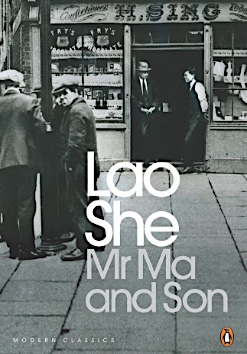
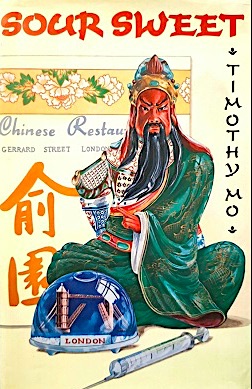


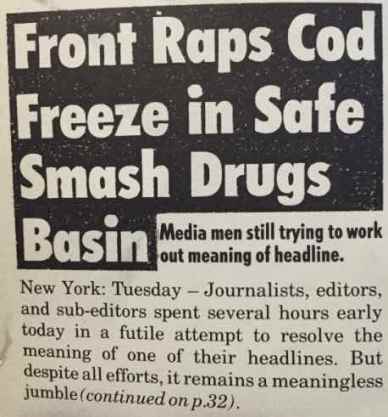



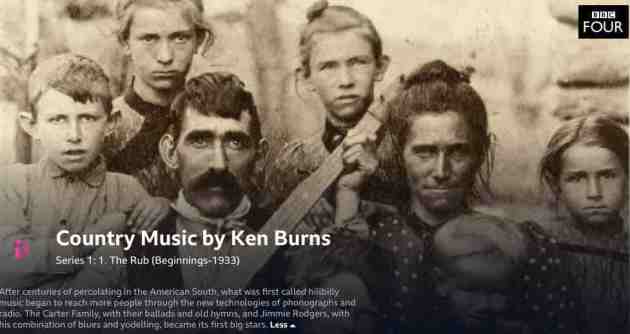
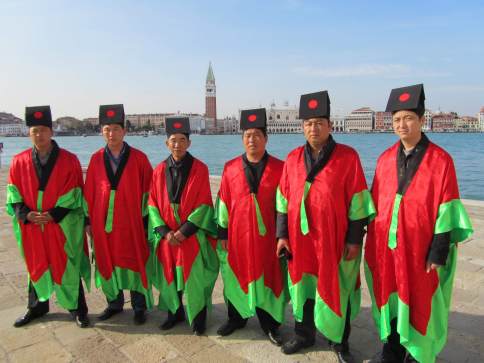




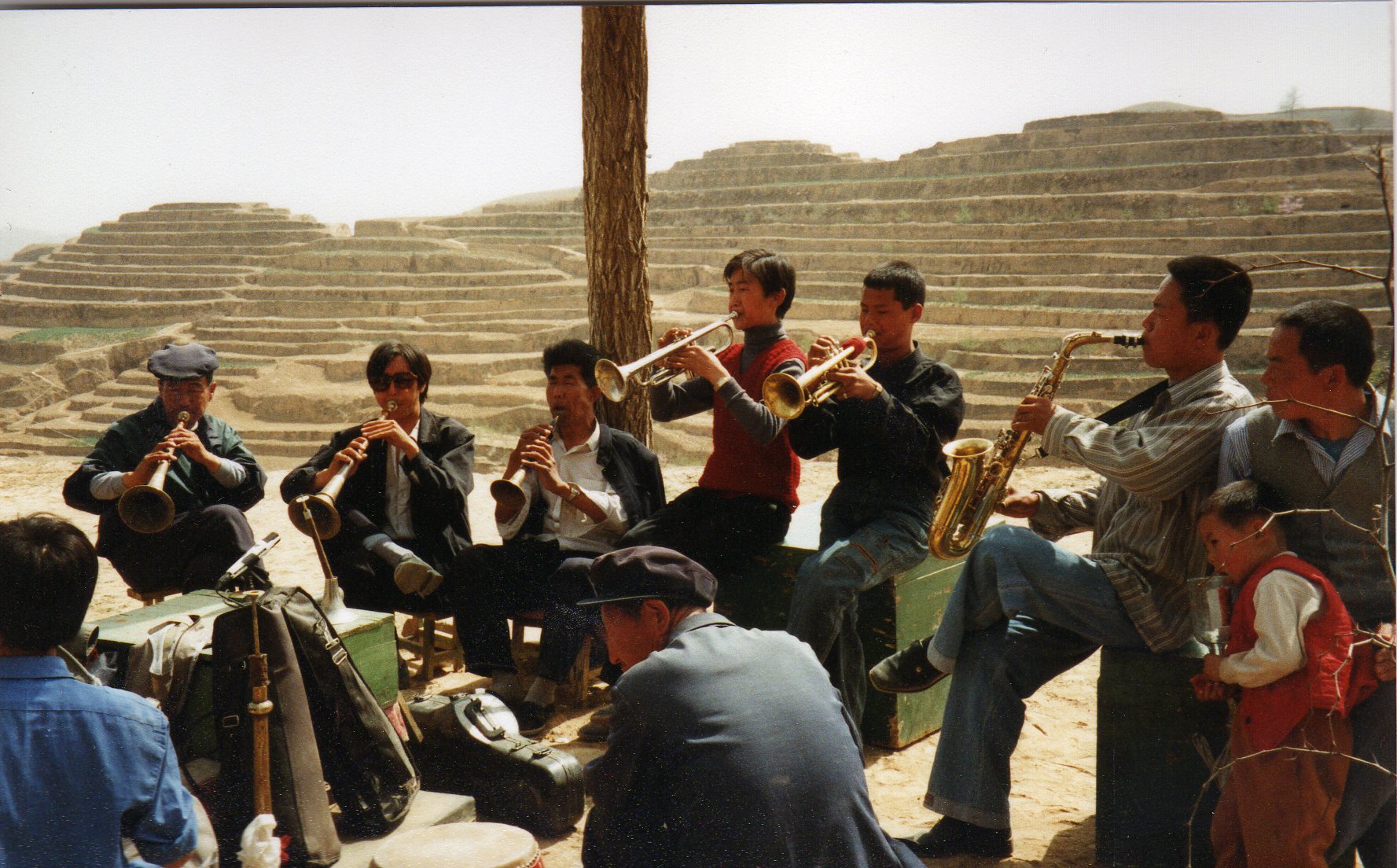
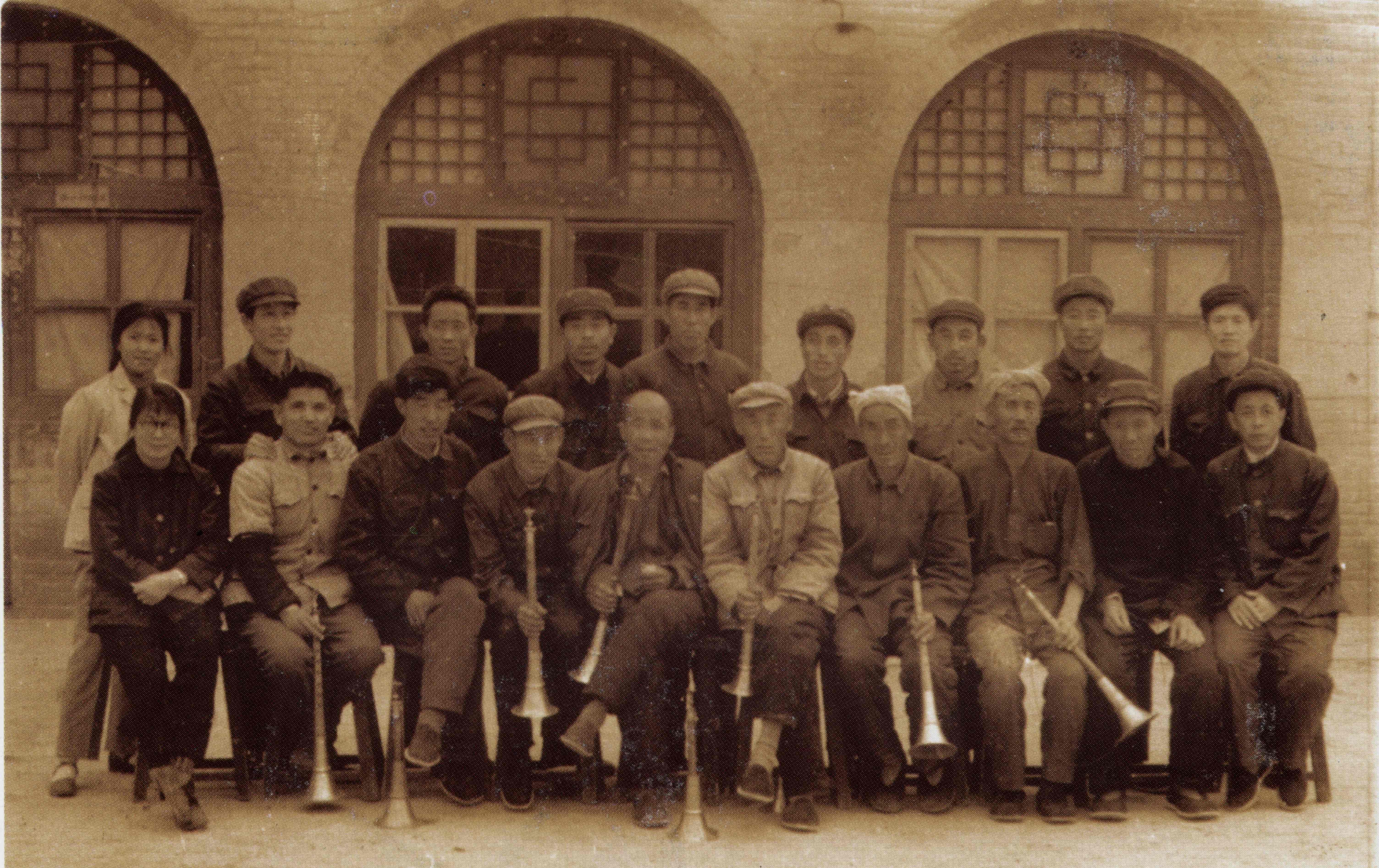 Shawm players from Mizhi county, assembled for a regional festival in 1981.
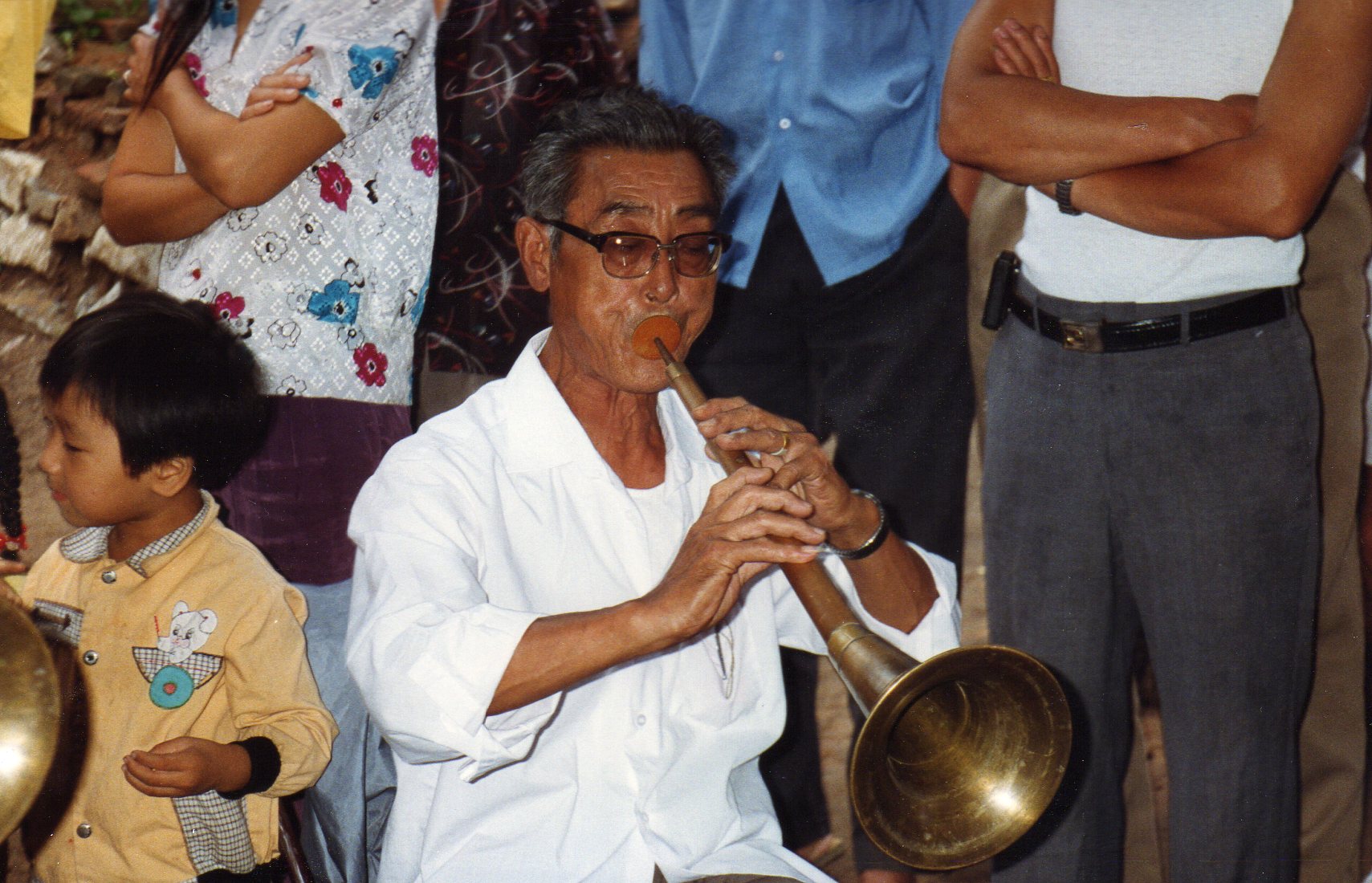


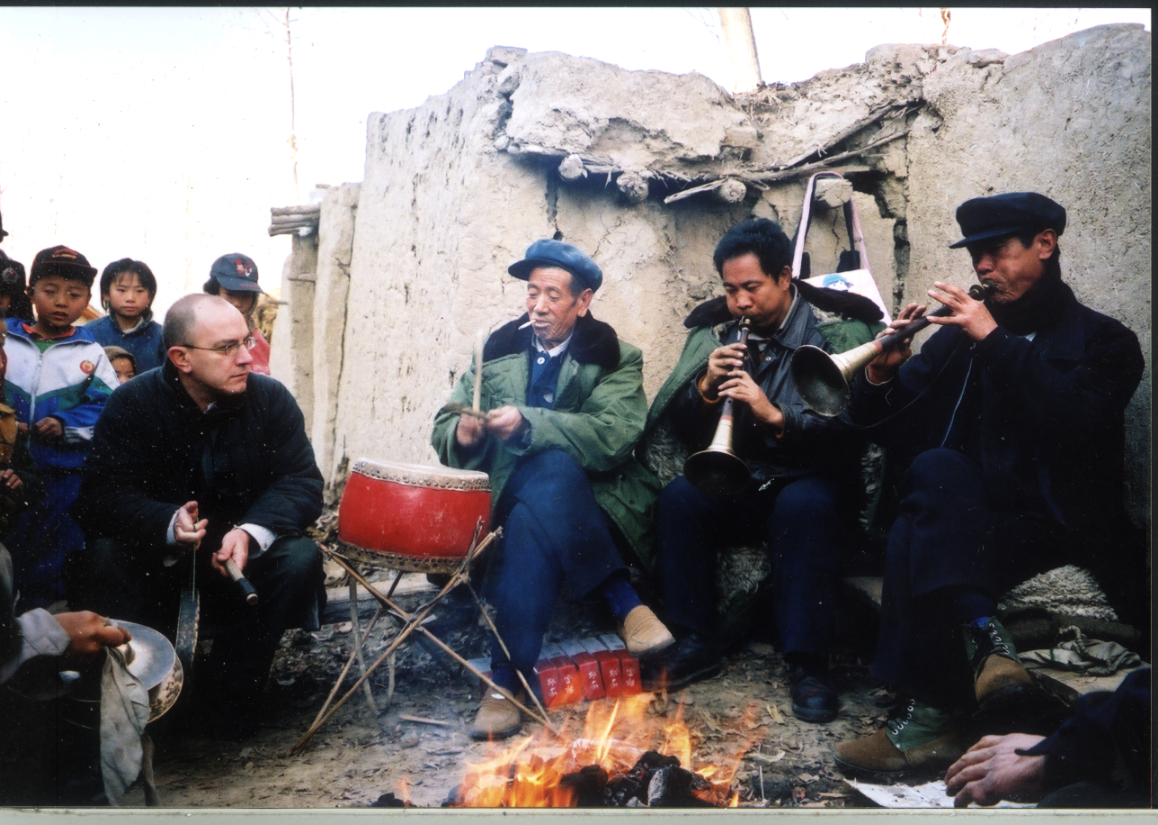


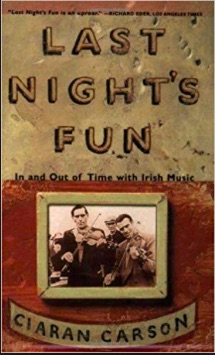
 Temple procession, Xincheng, south Gansu, June 1997.


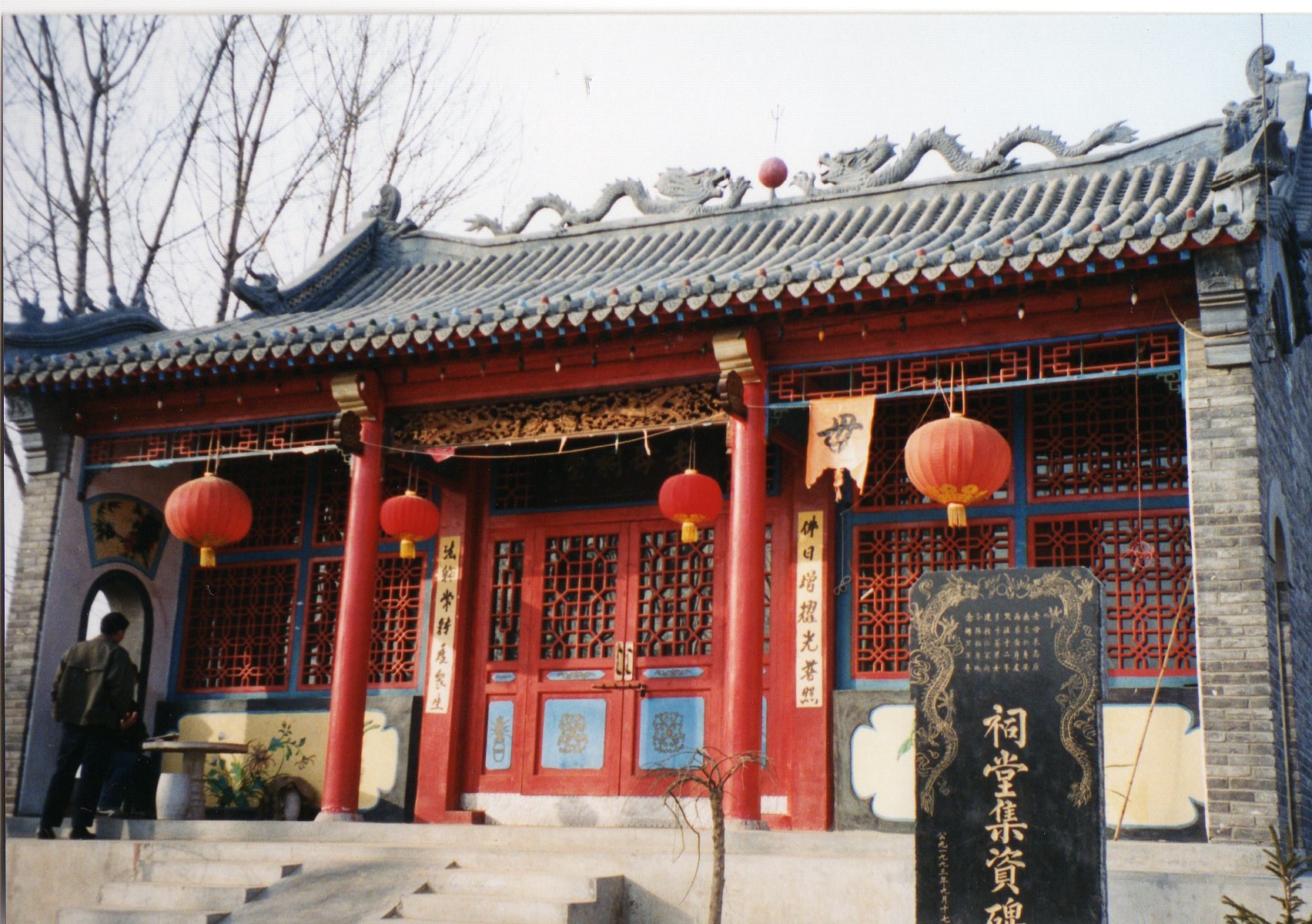

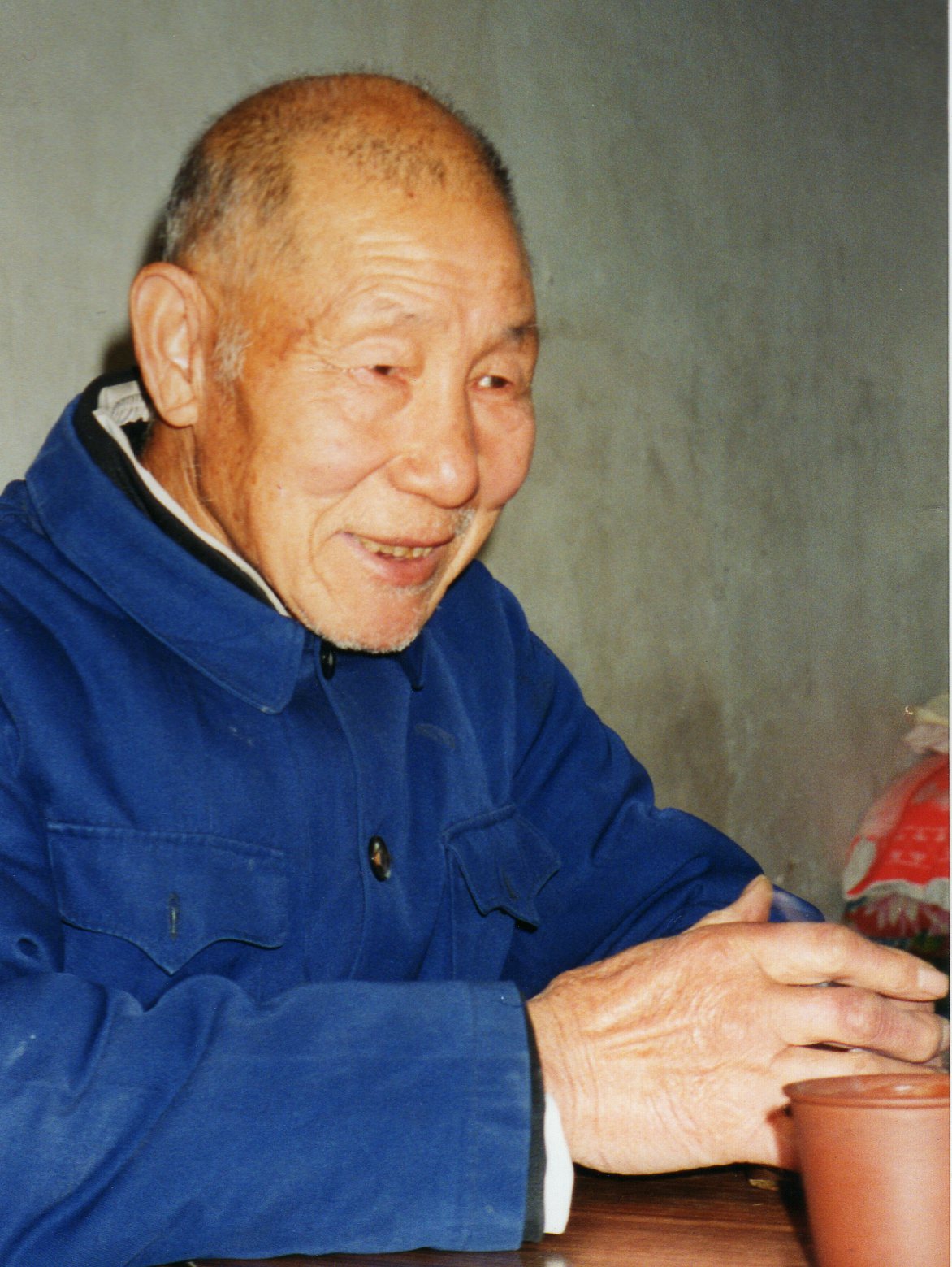
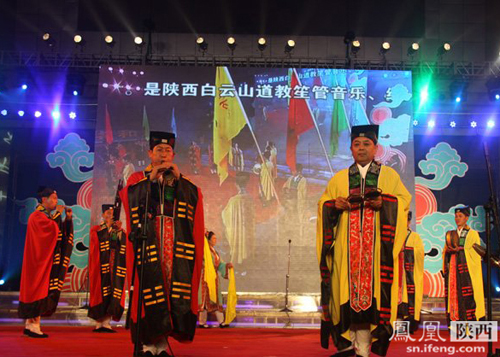
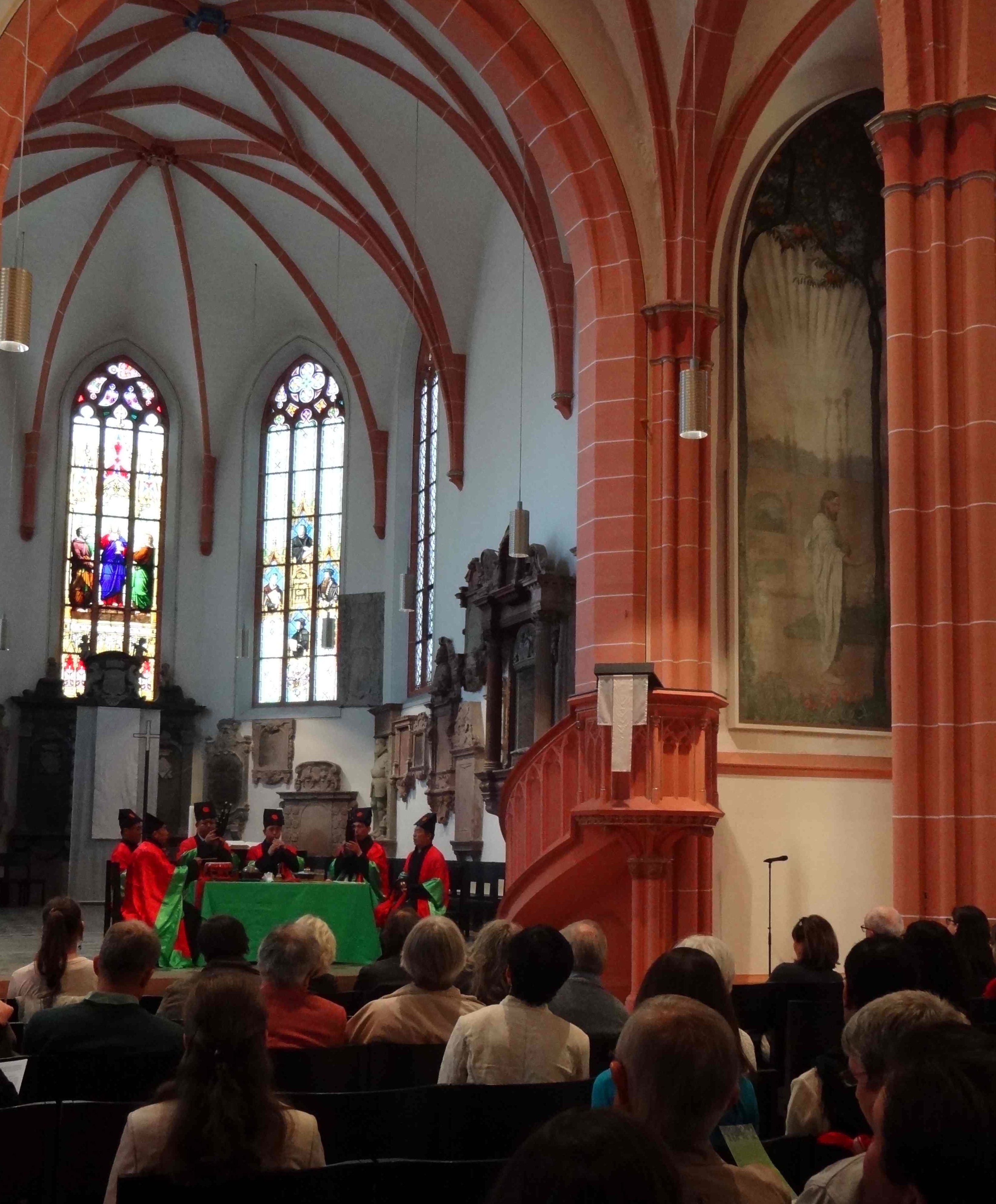




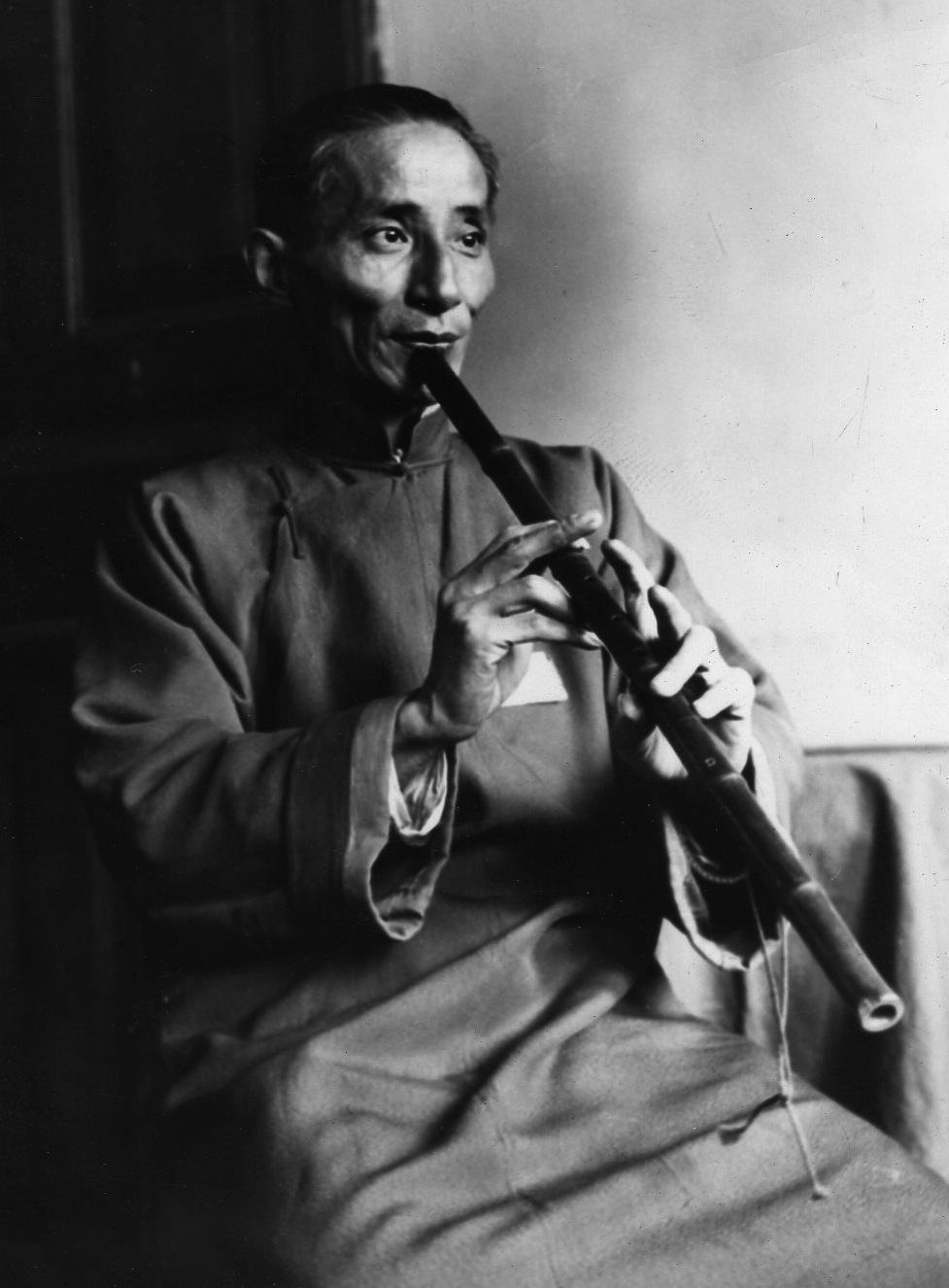
 In Wuxi, under the tuition of the American missionary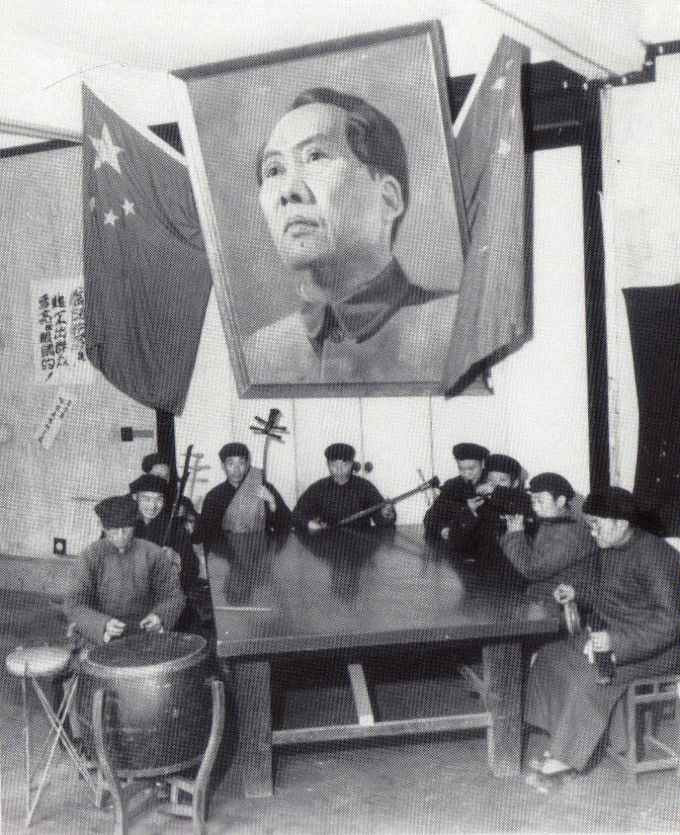




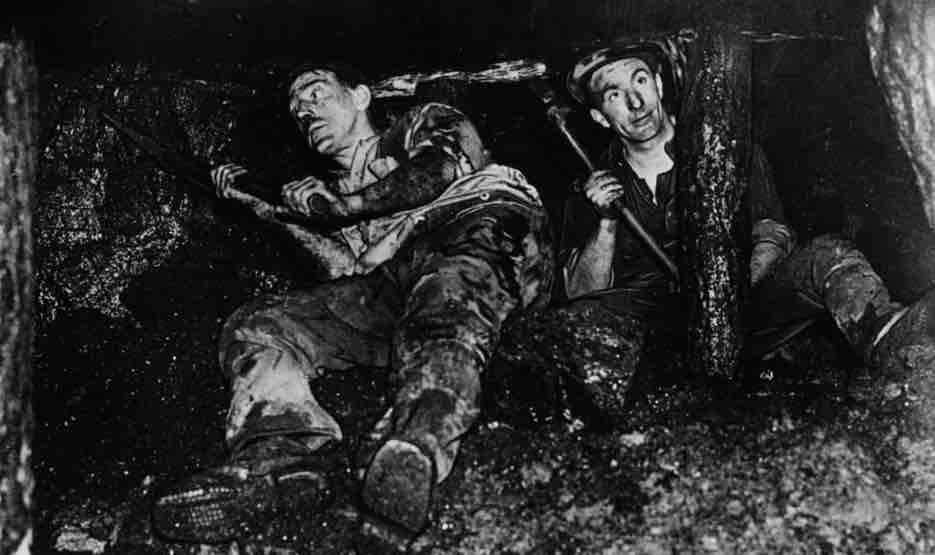


 Stephen Jones: a blog