Analysing world music

AAWM

My writings on Chinese ritual may seem to privilege ethnography and social change. But I do also like to relate all this to the nuts and bolts of the language of sound, as with my Dissolving boundaries (comparing qin and shawm pieces!), and for the liturgy of the Li family Daoists, clues in my book, chs. 14 to 16.

Having just made a plea for soundscape to be considered an intrinsic component of ritual studies, these analyses are highly technical, so I may now be shooting myself in the foot, but hey.

Once upon a time, analysis was the bread-and-butter of world music studies, often following Western Art Music musicology in taking reified “works of art” as its object. Recently the online journal Analytical approaches to world music takes a valuable step forward—enriching silent text by embedded audio examples. And while the analyses are dense, they always take note of changing social and performance contexts.

Some highlights that appeal to my own tastes—starting with flamenco, since I’m always grappling with the palmas hand-clapping patterns:

For a roundup of my series on north Indian raga, click here.

And a perspective on chant:

Anyway, none of this should dissuade the ethnographer with a less technical grasp of musical elements from paying attention to the soundscape of ritual and the lives of performers and their patrons!

A rare duet for qin and erhu

Much as I love the qin zither, I still need to rehabilitate myself for daring to query its dominance in Chinese music studies—as I observed here, it is as if the whole varied spectrum of European musics were represented mainly by the clavichord (see also here).

So here’s a rare version of the qin solo piece “No ulterior motives regarding seabirds” (Oulu wangji 鷗鷺忘機: I might suggest “Seabirds: forgetting ulterior motives”) as a duet with fiddle, recorded in 1962 by the great Zha Fuxi (1895–1976) on qin with Jiang Fengzhi (1908–86) on erhu:

In the 1954 image here, left to right are: Wu Jinglue, Wu Zhenping, Zha Fuxi, Jiang Fengzhi (looking remarkably like Yang Yinliu!), Guan Pinghu.

The qin has such an intimate solo timbre that the only other instrument usually deemed suitable to play with it is the mellifluous end-blown flute xiao; the erhu, with its modern romantic conservatoire repertoire, is generally considered quite remote from the meditative ethos of the qin. But this version of Oulu wangji shows how a simpler, restrained, selfless style of fiddle playing can blend well, enhanced by the low tuning—a model for Bach on the erhu?! It’s also effective because whereas in most qinxiao duets both instruments play throughout, here the erhu takes the main melody while Zha Fuxi accompanies selectively with pivotal notes, almost like a continuo player.

It’s all the more poignant when we think of the date of recording—during the interlude between the traumas of the Great Leap Backward and the Four Cleanups. It may seem hard to imagine how anyone can be nostalgic for the period before the Cultural Revolution—but despite their tribulations, the stellar gatherings of qin masters, and the brilliant scholars of the era, have a numinous allure (see my series on the qin in Beijing under Maoism).

Oulu wangji is a favourite of qin players—among many versions online are performances by Guan Pinghu and Wu Zhaoji. As ever, John Thompson’s website is a treasury of information—for Zha Fuxi, see here, and for a typically erudite discussion of the piece, here.

The story goes back to the ancient Daoist sage Liezi[1]

There was a man living by the sea-shore who loved seabirds. Every morning he went down to the sea to roam with the seabirds, and more birds came to him than you could count in hundreds.

His father said to him: “I hear the seabirds all come roaming with you. Bring me some to play with.”

Next day, when he went down to the sea, the seabirds danced above him and would not come down.

Therefore it is said: “The utmost in speech is to be rid of speech, the utmost doing is Doing Nothing.” What common knowledge knows is shallow.

See also Daoist non-action and Confucius he say—slowly; and for musical style, Different values.


[1] Liezi, BTW, deserves a bit of an image-rebrand to boost his ratings alongside Laozi and Zhuangzi! By the Tang his work was honored with the fine title True Classic of Simplicity and Vacuity (沖虛真經)—an award now reserved for TV reality shows.

Thinking outside the (music) box

Li Yuan qushui better

In studying any socially-grounded human activity such as Chinese ritual, those with an interest in soundscape (which, after all, is the basis of ritual performance) may feel pigeonholed, marginalized. And I’m not alone in resisting the categorization of “ethnomusicologist” (for an accessible overview of the field, see Nettl).

Michelle Bigenho reflects cogently on the issue in her chapter

Stobart

I take her words to heart. As she writes,

I resist being classified as an ethnomusicologist because the label often inadvertently carries with it certain assumptions. Under the label “ethnomusicologist,” “music” becomes my object of study, and I am then expected to musically map the geographic area of my purported expertise, an expectation that clings to a notion of bounded, discrete cultures tied to specifically grounded places. When music becomes the object and geographic mapping becomes the project, many compelling anthropological and theoretical questions are swept to the sidelines. Many ethnomusicologists are working beyond and outside of these two problematic assumptions, but the discipline’s institutional affiliations often inhibit its ability to move beyond these conceptualizations of “culture.” Furthermore, the ethnomusicologist label also carries with it expectations about a researcher’s position as a participating musician. While this point is usually held up as a particular strength of ethnomusicology, to privilege “doing music” over other kinds of fieldwork participation is to play into Western ideologies about music, talent, giftedness etc.—all points that should be under anthropological scrutiny rather than assumed as givens.
[…]
I contend that even though maintaining the idea of music participation as a special realm of ethnographic work may have its benefits, such framings also have significant drawbacks. All forms of fieldwork participation are different and unique, but constructing music participation as a privileged realm works hand in hand with an ethnocentric ideology that affords music an autonomous space. Emerging from very powerful ideologies about music in Western society, the awe factor cuts two ways—amazement at the imagined talented colleague who “does music too,” and a tendency to assume that one cannot fully understand work on music without being a musician. While anthropologists seem to be quite adept at opening their minds to absorb complex specialized information about kinship or linguistics, strong ideologies about musical knowledge, who has access to it, and who is empowered to speak about it, shape their open-ness to hear about musical details of ethnographic work. The apologetic “I’m not a musician, so…” seems to be invoked in a peculiar way. I suggest that anthropologists might heed Michael Herzfeld’s suggestion that we learn proficiency in other expressive modes beyond what is usually expected in terms of language training (2001:280).

Not everyone who learns Quechua as a fieldwork language ends up speaking it fluently, but having studied it at all is considered one of the many ways to struggle toward an anthropological understanding. I think more supposed “non-musicians” should be learning proficiencies in music and writing about social life through the lens of music.
[…]
When music participation is claimed as a privileged form of ethnographic experience the claim plays into hidden Western ideologies about talent and giftedness (see Kingsbury 1988), about music as an autonomous sphere, and about experience and personhood.

Bigenho unpacks the assumptions of insider and outsider status, as well as the constraints of academic disciplines and area studies.

Anthropologists may admire their colleague who does music, but along with that admiration come ideas about an imposed insider-ship and the suspicion that one may be having too much fun to do anything of theoretical significance. Herzfeld calls attention to how anthropologists suspect media as a legitimate area of inquiry because of media’s associations with pleasure (2001:312). Similarly, music—unless it is closely allied with linguistic anthropology (see Feld and Fox 1994)—may be seen as a realm of too much pleasure, a realm from which substantive theoretical contributions are imagined to rarely emerge.
[…]
When anthropologists present work with intricate details of kinship, linguistics, and the law, these details are not the object of analysis, but rather the lenses through which to examine broader cultural questions. When people call me an ethnomusicologist, music implicitly becomes the object of my studies; the practice of music-making becomes my work; and I am immediately imagined on conference panels with others who “do music,” even though I feel much more in dialogue with scholars focussing on anthropologies of nationalism, the State, indigeneity, and embodied experience. Even though ethnomusicologists have worked on these themes, music still overwhelms ethnomusicology’s project. Like it or not, external perspectives and institutional demands (more below) on ethnomusicology still construct music as the discipline’s central object, and this construction, because of powerful Western ideologies about music, remains at odds with one of ethnomusicology’s major projects (at least as I understand it): to move music out of the autonomous space afforded it by Western-centered musicology. Michelle Kisliuk argued the same point from a different angle, underscoring the problem of analyzing music as a separate entity when in many contexts there is no such conceptualization of “music” (1998:313; also see Herzfeld 2001:280). Ethnomusicology may benefit from a closer positioning with musicology and a focus on specific questions of music practice—a positioning where ethnomusicology might wield a productive influence over transformations within the older and usually dominant of the two disciplines. But when music is taken as the object or when music practices are privileged over other kinds of fieldwork participation, “music” begins to get in the way of questions that could be of interest to both anthropologists and ethnomusicologists.
[…]
Most of my courses do not have “music” in the title because the questions I find most compelling are about embodiment, the politics of sensory  perceptions, the politics of pleasure, nationalism and indigenous representations, ideas of property, national patrimony, and performance in social life.

music box

She concludes:

I have found it useful to think outside the “music” box. * My work through music evokes questions about the politics of perception, the politics of authenticity, ideas of property, processes of folklorization, the pleasures of viewing/listening to Others etc. (Bigenho 2002; Bigenho 2005). Participation in music performance led me to these broader questions, but I resist claiming a privileged position for this kind of ethnographic participation. Like many anthropologists, I am engaged in the practice of  participant-observation, a problematic methodology of ethnographic fieldwork, no matter how you slice it. Oh yes… and I “do music” too, and I usually have a great deal of fun doing it.

As we get to grips with Chinese ritual performance in changing society, all this should strike a chord (in this case, the organum of the sheng mouth-organ and the heterophony of the voices and instruments in long slow hymns at the ritual site!). Among the varied social, political, and economic topics that concern so-called ethnomusicologists, we are interested in all kinds of sounds, performers, behaviour, and audiences that some might not even consider under the narrow rubric of “music” (and again, see Nettl)—such as spirit mediums and their utterances. We want to know how performers learn, about their social status, and how patrons assess the success of an event; the impact of collectivization and migration, indeed people’s changing lives; the ancestry of ritual manuals, and their relationship with texts as performed; where wind players get their reeds, how percussion patterns may vary according to context; and so on and on. Without demanding detailed semiotic analysis, none of this is beyond the abilities of scholars less highly trained in “music” (cf. McAllester on the Navajo).

So returning to my theme, here’s the deal: if we come to your party, you have to come to ours too:

Just as “music scholars” have learned to consider all kinds of social elements as they study performance, so scholars of ritual too must include in their brief all kinds of issues arising from soundscape, rather than coyly farming it out to musicologists.

* Zen update
NY governor Cuomo, April 2020:

Everybody has to think outside the box, because there is no box.

This appears to go back not to the Platform sutra of Huineng but to Walt Disney; for his Daoist inspiration, see also here.

Pontius Pilate, and the mad jailers

pilate

Hot on the vertiginous goose-stepping heels of Gepopo

In my series on stammering I’ve already covered Michael Palin’s authentic depiction in A fish called Wanda.

But he was already on the case of various types of imp-p-pediment with Monty P-Python, as in the iconic Pontius Pilate scene (taking the pith) in The life of Brian:

Michael Palin also does a great turn as the benign schoolmaster:

Returning to s-s-stammering, still more disturbing are the cameos from the mad jailers (this time played by Terry Gilliam and Eric Idle)—hideously well-observed, right down to the stamp of the foot to force the word out. In the first scene here, they taunt the ever-well-meaning Palin; and the second (from 2.07) is the coup de grace, with the jailers nonchalantly reverting to fluency once alone together—reminiscent of Larson’s cows:

Some stammerers may find that tough going, but I’d suggest it’s all part of chipping away at the iceberg of fear.

One of the benefits of group speech therapy sessions, however excruciating, is to watch one’s disfluent speech played back on video, so as to observe all the ways in which we sabotage the whole vocal apparatus—extreme tension of the lips and throat, holding the breath, futile movements of eyes, hands, and body, and so on. Disfluency takes many forms. Sufferers are often so trapped in desperate attempts to avoid stammering, and their audiences so trapped in embarrassment, that neither may have a clear idea of what exactly it is that is preventing them from uttering the word. The crucial first stage is monitoring.

And a further technique is for the sufferer to imitate such features deliberately—choosing a consonant on which to tense the mouth and lips, repeating it quickly or slowly with varying degrees of tension, even reproducing the way we backtrack and then start over, deciding how many repetititititions to do. Varying the severity of the block like this can create the precious experience of having control over one’s speech for a change. And then (maybe) one can insert “easy stammers”, and if not actually refrain from stammering, at least be aware of some options.

It’s easy for you to say that, SSSteve…

Anyway, far beyond its niche exploration of speech impediments, The life of Brian is brilliant! More insights, on the uncritical veneration of sages, here.

Maoist worship in Gansu

Gansu Daoists 1

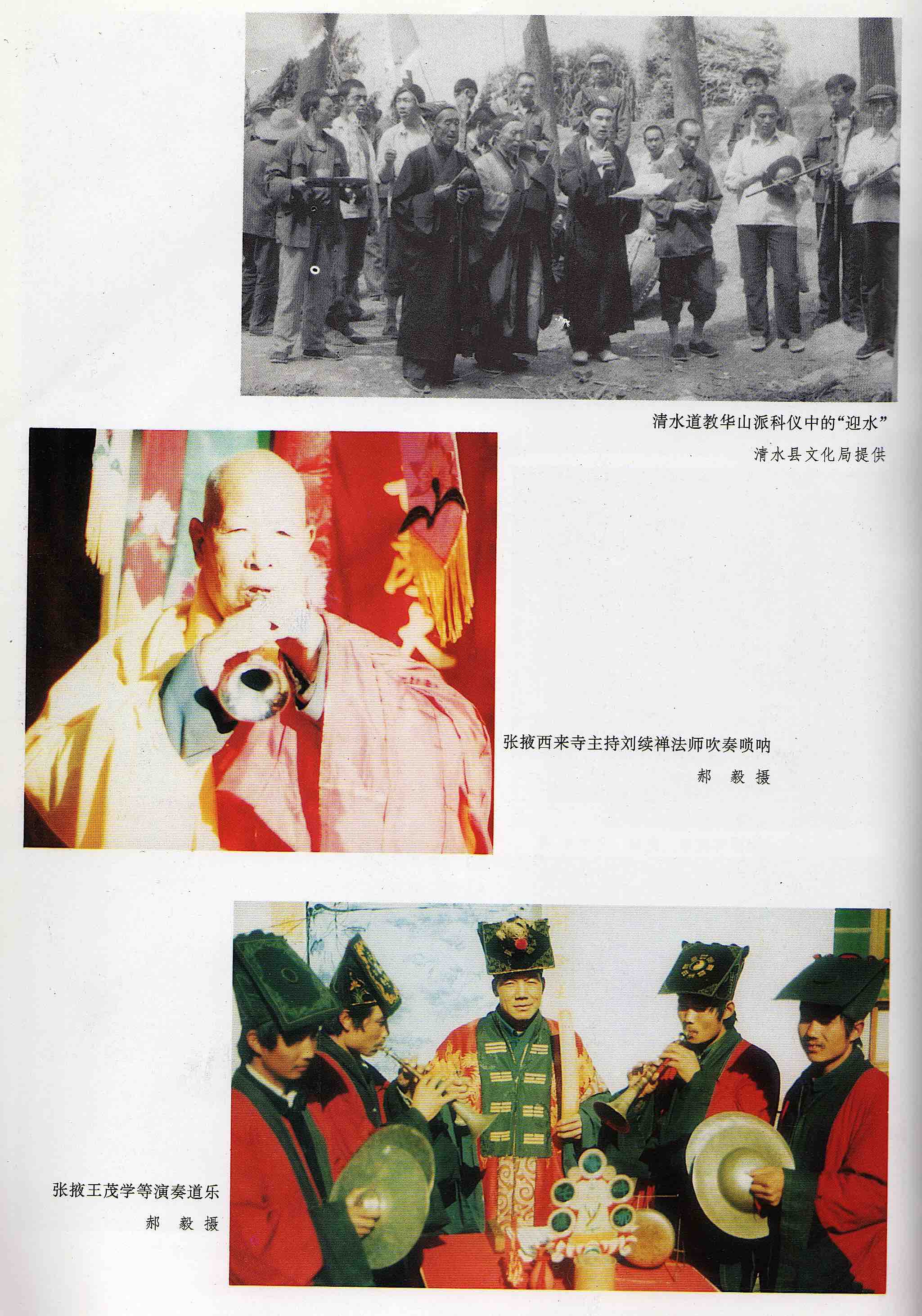
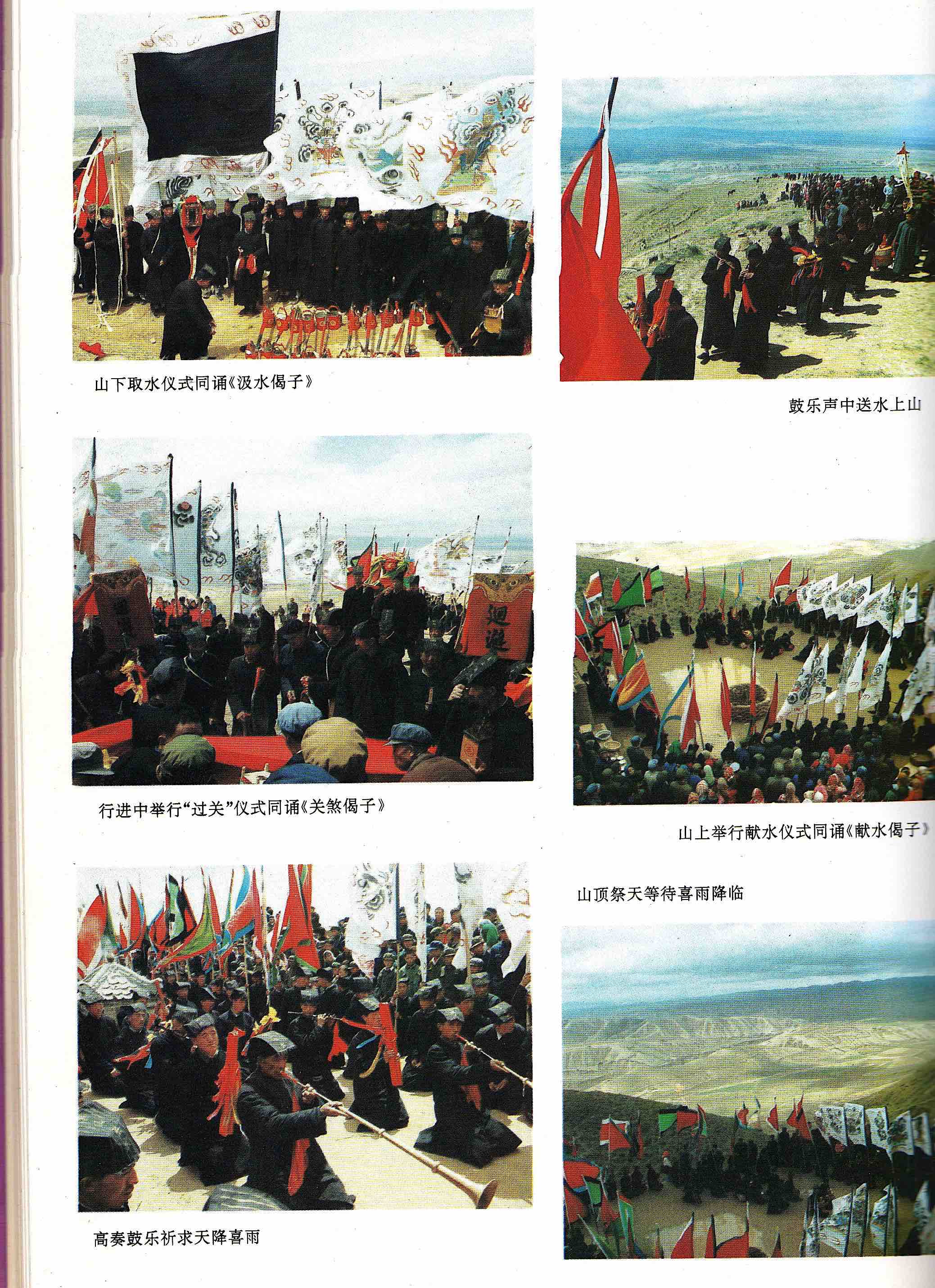
Huashan-branch Complete Perfection household Daoists performing the Receiving Water ritual, Qingshui county;
Buddhist temple monk playing shawm, Zhangye county;
Household Daoist band led by Wang Maoxue, Zhangye county.
Source: Zhongguo minzu minjian qiyuequ jicheng, Gansu juan (1997)
中国民族民间器乐曲集成,甘肃卷. Cf. Tibetan Buddhism in Labrang.

I’ve been longing for a comprehensive project on Daoist ritual in Gansu; the Anthology provides some promising leads (cf. my In search of the folk Daoists of north China, ch.6).

The temple fair here wasn’t quite what I had in mind—but it’s all part of the picture:

Uploaded from tudou.com in 2015 (further clips on Chinese sites here and here), it shows the ritual of Receiving the Palanquin to consecrate a bronze statue of Mao Zedong at the Wulanshan temple fair in Jingyuan county northeast of Lanzhou.

We might see this as the continuation of a long tradition: the deification of historical personages has an ancient imperial history, and emperors too were revered as gods. Much has been written on the secular cult of Chairman Mao—not just his veneration while he was alive but more recent leftist campaigns inspired by him, which have attracted consternation (not least within China). Also intriguing are local temples built for his religious worship. Indeed, media attention focuses on such clickbait at the expense of more traditional religious life.

Still, popular temple worship doesn’t always involve liturgy, and for such temples I haven’t heard much about formal ritual activity. So what intrigues me with this Gansu temple fair—small in scale, apparently organized by the local community without outside official involvement—is its creative use of religious observances performed by Daoist ritual specialists, with full paraphernalia, a shawm band leading the way.

Once the god statue is installed inside the temple, the Daoists open proceedings with choruses of Chairman Mao comes to our village (far more earthy than the saccharine versions online, like this) and The East is red.

Left: idyllic image from YouTube Chairman Mao comes to our village—no irony apparently intended. Right: less idyllic image of the Great Leap Backward (source: China Daily!).

After helpers clothe the statue (to a schmaltzy added soundtrack), the chief liturgist, wielding sword and placard, animates it with incense, fire, and mirror (to a hardly less dodgy accompaniment of dizi flute solo).

* * *

I’ve explored post-traumatic amnesia in China and Europe (e.g. here and here). In this case, apart from the misplaced nostalgia for a regime that kept people in poverty (indeed, Gansu was one of the provinces worst affected by the famine), there’s the further irony of performing rituals for a leader who did his utmost to destroy religion. Nationally it’s not an isolated case, though I don’t know how common it is in this region. [1] And we might compare the Russian nostalgia for Stalinism.

Already, an update would be interesting. Uncle Xi first criticised the personality cult of Mao worship, and then mounted one for himself—even while aligning himself with the Shaanbei mystique (a campaign ridiculed here). And as his power was further consolidated, “patriotic” rituals—obligatory demonstrations of the Party’s power over religion—have recently been incorporated into stage-managed events at some larger official sites of worship. Meanwhile, the secular cult of Mao doesn’t appear to be at odds with the goals of the current leadership; and manifestations of religious piety towards Mao at the grass roots (as at this Gansu temple) are a minor phenomenon, even if they may alarm the secular atheist leftists. Temples to Uncle Xi are a vision for the future…

So I still hope that scholars will focus on serious study of the enduring (albeit ever-changing!) life of traditional Daoist ritual in Gansu and elsewhere…

Gansu Daoists 2Daoists of the Daode guan temple, Zhangye county;
Cao Jixiang’s Daoist band performing the Ten Offerings ritual, Jingtai county;
Cao Jixiang’s band seated.

Among my posts on Gansu (roundup here) I’ve also written about a more traditional exorcistic ritual that recently aroused the ire of the Party leadership; and for instances elsewhere of leftist campaigns opposing traditional customs, see here. For a classic ethnography of a Confucian temple in Gansu, see here. Note also the Maoism tag.


[1] For Qinghai, note Gerald Roche and Wen Xiangcheng, “Modernist iconoclasm, resilience, and divine power among the Mangghuer of the northeast Tibetan plateau”, Asian ethnology 72.1 (2013), with many further citations. Note also Amdo rituals: early and recent films.

Gepopo: pa-pa-pa-panic

Gepopo 2

Speaking (sic) as a stammerer, I’m always on the lookout for coverage of speech imp-p-pediments (see e.g. We have ways of making you talkStammering gamesPontius Pilate, and the mad jailers; Lost for words; and for more stammering songs, see here).

So in György Ligeti‘s wacky, grotesque, absurdist opera Le Grand Macabre (see e.g. this article by Tom Service) I note the character of Gepopo, whose extreme vocal irregularities occupy a special place in the spectrum of communication issues.

The astounding Barbara Hannigan introduces the role she has made her own:

The character Gepopo, the chief of the secret police of Brueghelland, approaches Prince Go-Go to warn him and the people of Brueghelland that intelligence has learned of a huge comet heading through space towards them which will destroy their planet. Unfortunately, Gepopo is paralyzed with fear and paranoid hysteria, so his almost unintelligible, coded warning is not easily understood by Prince Go-Go, who, mainly interested in a hearty meal, drives Gepopo to further convulsions of highflying vocal panic as the piece draws to a anxiety-ridden finale.

Gepopo

Shades of the Pearl and Dean theme tune? So far this passage has not found favour as an in-flight announcement (cf. The perils of the tannoy, and Putana da seatbeltz; for airline acronyms, see here). But I digress…

Psychotic, deranged, Gepopo is hardly an advertisement for easy stammering—no more to be recommended as speech therapy than Rossini’s “stupefaction ensembles”. BTW, reasons for the far higher ratio of male to female stammerers are still not well understood.

Here’s Barbara Hannigan in an, um, “orthodox” stage version:

Gepopo’s three arias (“Pssst! … Shsht! … Cocococo!“, “Aah! … Secret cipher!“, and “Kukuriku! … He’s coming!“) are also performed as a cycle arranged by Elgar Howarth for the concert stage as Mysteries of the macabre—here conducted (suitably) by S-S-S-Simon:

Dazzling as it is, I’m not sure it’s exactly PC to distract the audience from Gepopo’s demented sadism with a fantasy schoolgirl uniform—perhaps the transgressive, meretricious device suits Ligeti’s concept (discuss…). We might also compare this version:

Feminist scholars have unpacked gender roles in music—including Berg’s Lulu, closest to Hannigan’s heart (see here). Such an approach could be instructive with Gepopo too.


With thanks to Rowan—
whose own vocals, while not so ambitious,
are “less irritating than Glenn Gould”

(The Feuchtwang Variations, n.3).


Is music a universal language?

What is music, anyway?
And who’s asking?

Nettl

Ethnomusicologists have long questioned the seductive idea—derived from 19th-century Europe and latterly popular with the peace-and-love brigade—that music is a global language transcending the conventions of time and space. As always,

  • Bruno NettlThe study of ethnomusicology: thirty-three discussions (3rd edition, 2015, augmenting his original 1983 version),

gives a masterly and accessible overview of the field, in chapters 2, 3 and 5—and indeed passim.

In Chapter 2 he notes the wide range of definitions among societies of what constitutes “music” (cf. McAllester on the Navajo):

There is no conceptualization of definition of music that is shared by all or perhaps even many cultures, and very few societies have a concept (and a term) precisely parallel to the word “music”. They may instead have taxonomies whose borders cut across the universe of sounds produced by humans (or even animals) in ways quite different from those of Western societies.
[…]
Fieldworkers early on learn this major lesson: they may get one kind of answer when asking a question that would normally have no place in the culture and another when observing the society’s behavior. And we may note rather different approaches in formal statements by authorities, informal interviews, and ordinary conversations. Of the three, the cocktail party conversation may give us the most reliable perspective on the way urban, middle-class Americans actually use the concept of music in their lives.

The perspective of the (“gluttonous, insatiable”) ethnomusicologist is broader than that of a cultural insider—itself, as he observes, an ethnocentric approach, though, always broad-minded, he approves of a plurality of ethnomusicologies as much as of musickings.

In Chapter 3, while noting changing trends, Nettl cites a 1939 article by George Herzog stressing the diversity of world musicking.

It seems to me that for some twenty years after about 1940, musics—as conceived in Western academia—had to be liberated, as it were, from Western ethnocentrism; ethnomusicology had to make clear their mutual independence, had to urge the acceptance of each on its own terms and not simply as evolutionary way stations to something greater and more perfect. This mission accomplished, ethnomusicology could return to exploring the world’s musics as part of a single whole.

He goes on to discuss different kinds of universals; and under origins, besides worship and individual or group bonding, he notes competition and conflict. Music separates and defines us just as much as it brings us together—varying constantly and delineating boundaries not only of ethnicity but over time, and by class, age, gender, and so on.

In Chapter 5 Nettl explores some boundaries of concept, space, and time, borrowing from linguistics and noting idiolects as well as heterogeneity and polymusicality within individual cultures. Musical cultures may not be universal, but it would be unwise to draw clear boundaries. For more, see here.

* * *.

Meanwhile on BBC Radio 3, Tom Service’s long-running series The listening service always broadens the mind beyond the confines of the station’s largely WAM audience (cf. here, and here)—ethnomusicology in plain clothes, perhaps. He debunks cosy Western myths in a series of three programmes to accompany the TV series Civilisations (which wisely limited its brief to material culture)—a welcome antidote to Radio 3’s mystifyingly ethnocentric complement to Neil MacGregor’s fine series Living with the gods.

In the first programme, Searching for paradise, Service notes the basic importance of music to religious observances, with a collage of ritual music from around the world (shamans, qawwali, plainchant, Sardinian liturgy, Bach…). Unpacking the “spiritual” and reflecting on the historical ambivalence of religious leaders towards the embodiment of ritual texts through sound, he makes connections with the latter-day rituals of the concert hall.

Indeed, the search for exotic Oriental mysticism is a major theme in Western studies of the East. In his second programme, Orientalism and the music of elsewhere, Service adduces Mozart, catering to the 19th-century craze for all things Turkish; the taste for the exotic sounds of Indonesia and Japan in 19th-century France (later furthered by Messiaen); and more recently, raga, the music of Africa (Reich, Ligeti), film music, and the whole “world music” fad with its gleeful taste for “fusion” (for a parody of which, scroll down here).

But, he suggests, for some composers such sounds were more than a “titillating and imperialist added extra”: they also transformed our ways of experiencing sound, suggesting other modes beyond the discursive, nay “shouty”, 19th-century ethos. Here we might also add Mahler’s Abschied. And so for visual culture too.

Along with my early fascination with Eastern mysticism (see series beginning here), I too was seduced by all this, and remain so—even as I found through fieldwork (as one does) that musicking in local Chinese societies was anything but an exotic activity.

Meanwhile in the notionally Mystic East, led by Japan, Western culture became suddenly desirable, with profound and lasting consequences—not least in China, where traditional culture came to be considered “unscientific”. There’s a thoughtful cameo from Unsuk Chin (who adorns the splendid T-shirt of female composers!), with her piece for the sheng mouth-organ. But the “two-way conversation” surely remains unequal.

Service suggests we listen to music in its own terms (that is, in the terms of its own culture), rather than as sonic propaganda. I like his bald question “Is our music better than theirs?”, evoking Judith Becker’s influential 1986 article “Is Western Art Music superior?“, which debunks some major Western preconceptions.

In his last programme, Is music a universal language?, Service opens with a discussion of the “universality” of Fidelio, observing, “You need to be conversant with the patterns of tension and release in the specific confines of the Western tonal harmonic system”—not to mention knowing what opera means, and what it meant in Vienna at the start of the 19th century, and so on. He then segues adroitly to Chinese opera.

As he notes, identifying “universals” (fast repeated rhythms for dancing, slow repeating lyrical melodies for lullabies, and so on) may be a bland exercise. We can find similar building blocks, such as the (anhemitonic!) pentatonic scale, but the way they are used and experienced will differ widely. It’s nature and nurture again. And then there’s timbre…

* * *.

Such issues, bearing not just on “music” but on human cultures, are part of the standard fare of ethnomusicology. While in my studies of Chinese ritual I tend not to scare the sinological horses by focusing too narrowly on music, the discipline is really most stimulating. Don’t stop me if you’ve heard this before: sound is not some optional decoration to rital, it’s the very medium through which it is expressed! Whatever your cultural focus, do follow up The listening service by reading Nettl! And for further canonical works, see here—including advertisers’ debunking of the “universal language” myth.

The art of the miniature

Tom and Jerry

By way of supplementing my playlist of great songs with a little series on great theme-tunes (below):

Tom Service’s BBC Radio 3 series The listening service is always stimulating—like Susan McClary, he breaks down boundaries, as here.

This episode [sic] on Brevity, with a playlist of miniature gems encompassing Bach, Beethoven, Chopin, Satie, Webern, Boulez, Zorn, Napalm Death, Bartók, Kurtag, and Ligeti, is full of fine observation—under the headings of absurdity, immediacy, density, violence, and eternity.

Irrespective of genre, such pieces are microcosms, crafted with a range of expression and intensity—akin to haiku (see under Some posts on Japanese culture) or netsuke.

Also among the fleeting exhibits is the great Carl Stalling, composer of classic soundtracks for Warner Brothers cartoons (these playlists should work if you click on YouTube at the bottom right of the window):

Not forgetting Scott Bradley, of Tom and Jerry fame:

Not least, this is about taking seriously all kinds of musicking throughout human societies, including WAM and popular music.

So here are some thoughts on great theme-tunes:


Mahler 3 at the Proms

*For an introduction to my whole series on Mahler, with links, click here!*

After attending some memorable Proms this season (Mahler 10, Turangalîla, Ravel, Mahler 5The Rite of Spring)—I went out on a legal high with Mahler 3 (for which, see also here)—a kind of  fin-de-siècle middle-European equivalent of the cosmic visualisation of the Daoist jiao Offering ritual.

By now I must know what I’m in for when I go to hear a Mahler symphony, but it’s always overwhelming. And Prom-goers get to hear some great orchestras, but the Boston Symphony Orchestra with Andris Nelsons sounds incredible. Nelsons’ balletic conducting style reminds me of Otto Böhler’s 1899 silhouettes of Mahler.

Now that I have the time and inclination to attend concerts rather than earn a living of sorts by taking part in them, I experience a certain schizophrenia. I’ve been coming to the Proms since the 60s, and playing in them since the 70s: this is my cultural background, my home base, so up to a point I might just sink into familiarity.

But with my perspective broadened by attending rituals in rural China and sessions in flamenco bars, and trained by reading books like Musicking and Professional music-making in London, I can’t entirely banish ethnographic thoughts—the genteel behaviour of performers and audience, with the latter scrupulously avoiding any bodily movements, sounds, or signs of emotion; the dress-codes; the complicated pieces of equipment like music-stands containing funny black dots on pieces of paper, on which the performers depend. And all the historical information at the audience’s disposal, like programme booklets (studiously consulted even during the concert), and the radio announcer’s suave comments—while the audience at a soul gig, or a Chinese funeral, may be still more steeped in contextual background, the WAM audience comes expecting to be educated with literate props. And tiny features contribute to the different sounds of European and American orchestras, like their different habits—even down to the way the latter come on stage early to take their places.

Youthful enthusiasm can easily be ground down by the mundane realities of professional orchestral life—a tension well observed by Alan Bennett (here, and here). But then, suddenly, one can be transported—like hearing Wu Mei decorating the funerary hymns of the Daoists (again, notwithstanding ethnography).

So while I value the informed discrimination of the insider, I now wonder if the outsider’s experience, free of such worldly distractions, is just as valid. Even jaded orchestral players cherish those rare moments when they somehow merge into a magical organism.

And apart from all that, it might seem surprising that I’m so taken with the glossy streamlined sound of an orchestra like this. Sure, you can just hear the sponsors rattling their jewellery (to quote John Lennon)—the limousines, the champagne, the alimony payments. But the pain and transcendence of Mahler’s music doesn’t get drowned under the gorgeous sumptuous sound: it’s an irresistible experience, totally immersive, all the more in the intense atmosphere of the Proms.

For all the bravado of the brass-playing fraternity, there’s no shortage of deeply musical playing there (there’s much thoughtful discussion online, like this). Apart from the solos and the blazing tuttis, it’s the perfect blending of timbre that impresses—and that too (as with the Li family Daoists) is a result of a long accumulation of experience throughout the orchestra. I love the utterly implausible idea that Miles Davis, a reluctant pupil at Juilliard, might have ended up in such an orchestra; hearing the subtly calibrated vibrato of the Boston brass reminds me of his comments (for a wide selection of posts on trumpet-playing, see here).

So among all the varied, immersive ways of musicking that give meaning to the lives of sub-communities around the world—orchestral playing is one of them! “It doesn’t get much better than that—or does it?”

And while we’re on the Boston Symphony—on a lighter note, don’t miss the Eric Leinsdorf story.

Among classic recordings, one might start with Charles Adler in 1951:

Then there’s Barbirolli, Horenstein, Rattle, and so on—and here’s a live recording by Tennstedt in 1981:

Outstanding filmed performances include Bernstein with the Vienna Phil in 1972:

and (always my first choice) Claudio Abbado with the Lucerne Festival Orchestra, in 2007:

See also Mahler 3 with MTT.

Daoist ritual in southwest Shanxi

*For main page, click here!*

Shanxi pics

This article introduces household Complete Perfection Daoist groups in the counties south of Linfen city.

Since southwest Shanxi is another region that I haven’t visited, my account is based on limited secondary sources, so this is more of an invitation than a report. So this is a modest if more colourful update of the material in ch.4 of my In search of the folk Daoists of north China. Even if many details need clarifying, we gain a tantalizing glimpse into grass-roots Daoism since imperial times.

And following my articles on the worship of the goddess Houtu on the Hebei plain, I also give a note on Houtu temples in south Shanxi.

A playlist of songs

Apart from the mainly-Chinese playlist in the sidebar (commentary here), below are some links to an eclectic selection of All-time Great Songs* on this blog. Besides the songs, the posts are worth reading too—Trust Me, I’m a Doctor.

* Of course, varied as this selection is (à la McClary; see also here, and here), it isn’t so eclectic as to include Albanian funeral laments, Sardinian tenores, flamenco deep song,  Indian dhrupad, Inuit throat-singing, Umm Kulthum, the namthar arias of Tibetan opera, or Aboriginal dream songs… (see also Voices of the world). But I can’t resist including

And I can’t start adding songs without words, but we just have to include the divine Clara Rockmore’s Vocalise on theremin:

For two celebratory playlists, see Dancing in the streets!!! and A playlist for Emma and Leylah.

For a similarly diverse playlist of trumpeters, see here (indeed, trumpet has its own tag); and for some feminist lists, here (with bonus tracks including Sheridan’s Smith’s amazing cover of Anyone who had a heart) and here.

A thrilling new sub-category!

tailgut

By popular demand [not—Ed.] I’ve now added a new sub-heading of early music to the WAM category in the sidebar. True, early music is constantly getting later (Mahler, Ravel, and beyond), but here I’m defining it as “before opening time”.

Apart from earnest articles on Bach and Taruskin (Bach has his own tag; and I haven’t included posts on Rameau, Purcell, Buxtehude, Handel, and so on, whom you can type into the searchbox), it also includes more jocular items like Early music put in its place, The Mary Celeste, and A music critic.

Musical self-defence

viola

Another orchestral story from 1970s’ London, not so much viola jokes and maestro-baiting as self-defence.

A senior conductor is rehearsing his own chamber orchestra—both have seen better days. There’s a tricky passage for the violas, so he gets the section to play it together without the rest of the band, but it’s still not sounding right.

Opting for the bold step of getting them to play it individually—a demand very much frowned upon—he eyeballs a trusty old player who’s been sitting innocuously at the back of the violas minding his own business since the dawn of time, and asks him imperiously,

“You, Norman—can you play this passage for me?”

Norman looks back at him and remarks dryly,

“Harry, if I could play this passage, I wouldn’t be sitting here in this orchestra…”

I can now divulge that this was the very same conductor who had the celebrated exchange with the timpani player. For a wealth of related stories, click here.

Layers of fieldwork

SLY map - Version 2

Map of Upper Liangyuan village, Li Manshan 2012, showing former temples and the houses of Daoists.

As you may notice in my series of reports on local ritual, fieldwork often oscillates between various geographical levels, all mutually beneficial—zooming in with thick description, or out to sketch the wider picture.

Dong Xiaoping reflected on this issue in a thoughtful review of field reports on west Fujian (in Overmyer, Ethnography in China today, pp.347–50), commenting again on the old “unity and diversity” theme in Chinese culture.

We need a balance between “making a base” (dundian) and “surveys” (pucha). My two detailed long-term projects on Gaoluo village and the Li family Daoists have both benefitted from surveys of the wider regional culture of which they are part.

Thus, in my writings as in the wider literature, one can find studies of

My posts on local ritual illustrate all this with many maps. The more we zoom in, the more satisfying the results; but the broader picture is necessary too.

Yanggao personalities

Wang Ji 2003

Wang Ji (right) explains the structure of a “precious scroll” to Shanxi scholar Jing Weigang, My photo, Yanggao 2003.

Worldwide, biography makes a fruitful complement to social history. Fieldwork reports on religious life in rural China don’t necessarily focus on personalities at all—with some noble exceptions (such as the book of Stephan Feuchtwang and Wang Mingming on charisma, or Antoinet Schimmelpenninck‘s work on folk singers), they’re often more concerned with silent, inanimate artefacts like ritual manuals or temple murals.

When we do discuss the lives of Real People, our work often focuses on particular “bearers of tradition”. Even then, Chinese biographies often seem to take their cue from the hagiographies of Lei Feng (all the more so since the contagious ideology of the Intangible Cultural Heritage); and even Western descriptions tend to portray their Daoist masters as paragons nobly aloof from any engagement with social and political change. But we also need to document the complexities of their lives within changing society; over a long period I’ve come to engage with many other local figures too. Writing history clearly involves looking beyond kings and queens.

My first long-term field site of Gaoluo, where the village’s amateur ritual association represented the whole village, made a good education: while I focused on ritual specialists like He Qing and Cai An, the cast was diverse. This trained me to integrate my accounts of ritual in changing society with people’s lives—a theme that I continued with my work on bards and shawm players in Shaanbei.

* * *

In Yanggao county of north Shanxi, my primary mentors were again outstanding ritual performers—first the Hua family shawm band, and then Daoist masters Li Qing and his son Li Manshan (see also here). But again I began to spread the net wider.

Li Manshan’s wife Yao Xiulian, and his mother Xue Yumei.

First, a reminder of the women of Yanggao, whose various roles I’ve described in three posts—the female relatives of Daoists, sectarians and mediums, and singers. Anthropologists like Guo Yuhua also stress the importance of studying women’s experiences under Maoism.

Further to my film and book, on tour of France with the Li family Daoists in 2017 I wrote a series of tributes, starting here.

Li Xu with Li Manshan, 2013; right, Li Xu’s coffin, 2015.

In the Li family’s home village of Upper Liangyuan, I met poor peasant Li Xu (1926–2015) all too briefly. Though illiterate, he seemed to be the only villager who knew of the precious early steles of the village’s two main temples (my book, pp.46–9). If only I had been in time to learn more from him—he was a living library of local customs.

SLY oldies

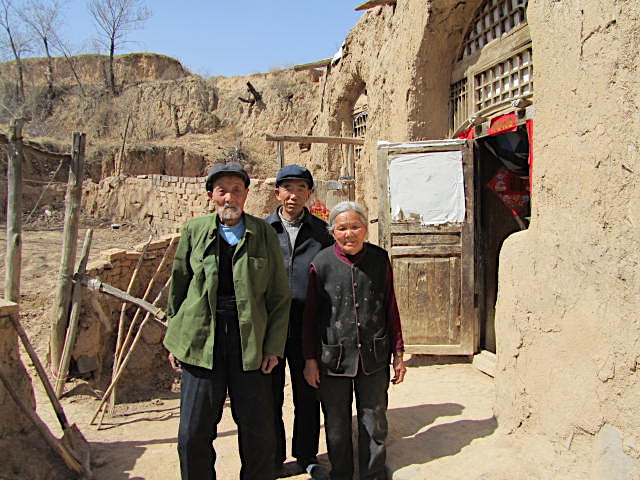
In 2011 Li Manshan took me to meet the oldest person in the village, born in 1915. Just south of the site of the Temple of the God Palace, opposite the house of senior Daoist Kang Ren (1925–2010: photos here and here, with playlist #2; more in my book), he lived in a humble cave-dwelling with his (somewhat younger) wife. Being poor and childless, the couple had played no active role in major events in the village. That didn’t mean they couldn’t have valuable insights; they were friendly and articulate, and we had a long chat about life before and after Liberation (temples, rain processions, campaigns against sects, and so on); but even Li Manshan found them quite hard to follow, and I learned less than I had hoped.

Shi Shengbao 2018

Shi Shengbao with Li Manshan, Yangguantun 2018. Photo: Li Bin.

Nearby in Yangguantun, the energetic Shi Shengbao (b.1948) has fulfilled the role of ritual director there since 1981. One of the Li family’s most trusted collaborators, he’s the subject of a nice vignette in Ian Johnson’s book (pp.373–4).

North of the county-town everyone admired the kindly and devout ritual specialist Wang Ji (1950–2017, photo at head of article), local leader of an amateur sect that performs “precious scrolls” as part of their rituals (for an update, see here).

In another instance of the tacit maintenance of ritual traditions during the Cultural Revolution (see e.g. under “Other coverage of liturgy” in my post on Ningxia), Wang Ji studied from 1967 with his father and another sectarian master in the village. They were all disciples of a former abbot at Wutaishan, whom they looked after in this period. They also studied with a liturgist in a nearby village. Wang Ji was formally admitted to the sect in 1970. Though it was formally proscribed after Liberation, they  were clearly active throughout the period, and he and his father had no problems as long as they didn’t cause trouble for the village cadres by practising too openly. In some memorable sessions in 2003 Wang Ji patiently explained to us the complex practice of singing the scrolls, as well as inviting us to the sect’s imposing rituals.

* * *

As to the lowly shawm players who also accompany life-cycle and calendrical rituals, I endured some challenging times over the years with the brilliant yet dysfunctional Hua family, both in Yanggao and on foreign tours. Most bands have long abandoned the complexity of the former long suites for a pop repertoire, but Yang Ying still leads a fine band, as well as depping with the Li family Daoists.

But it was two senior blind players who made a deep impression on both Wu Fan and me (For blind shawm players, see also here). Liuru’s circumstances had been desperate both under Maoism and since the reforms; Erhur at least had children to help him out. Their spellbound reciting of the gongche mnenomics of the shawm melodies gave us an entry into their world.

Left: Liuru, with Yinsan, another blind shawm player. Right: Erhur. Photos 2003.

ZQ and me

With Zhang Quan, 2018.

In recent years I’ve always been delighted to meet up with the sweet semi-blind shawm player Zhang Quan in Pansi village—this time he was helping me with my search for the kang murals of Artisan the Sixth!

gravediggers HGT 2013

Grave-diggers, Houguantun 2013.

I should also consult some of the other still more lowly helpers, like coffin-bearers and grave-diggers. One character whom I’ve seen countless times at funerals over the years is a bearded, itinerant helper with ragged clothes. Despite impaired use of his limbs he accompanies the kin, helping out with various duties like carrying props for the Invitation procession.

I’ve never managed to chat (guada 呱嗒) with him, but the trusty Li Bin has just given me some background on his story, which—in utter contrast to the long hereditary solidity and repute of the Li family—evokes chronic rural poverty and family vulnerability:

He’s known by his nickname Yanjun. Born in Liujiaquan village in the mid-1980s, his mother came from Sichuan, from where poor village men often buy wives. But she soon returned there, leaving him behind. Again, such bartered brides often sought to flee their unwanted new homes, and the unfamiliar northern climate and dialect, though many too resigned themselves to their fate—I’ve met several of them. Even in those days transport was still primitive, and there were no telephones.

But Yanjun’s maternal grandmother stayed on to look after him—he had severe physical problems, and if it hadn’t been for her care he might never have learned to walk. But later she too returned to Sichuan, while Yanjun’s father found another wife and set up a family in Inner Mongolia just north (again, a common refuge of Yanggao people since imperial times). Yanjun now moved in with his poor bachelor uncle.

An only child, Yanjun never went to school, and he has no prospect of finding a wife. As a vagrant, he’s quite aware of his outcaste status. He knows his place—I’ve never seen him chatting with anyone at funerals, and of course he doesn’t eat with the guests, just hanging around outside the field kitchen. I can’t even recall seeing him indoors. But he’s alert and trustworthy, and the host families take pity on him, giving him cigarettes and liquor, as well as (these last few years) quite a bit of cash—most of which he spends on buying cigarettes for the funeral director. Charity isn’t always evident in rural society, but inconspicuously it operates its own safety net. Now Yanjun also gets a little dibao allowance from the local government.

Meanwhile on a trip into town, Li Manshan’s younger brother, a successful cadre, invites me with a group of friends to a sumptuous banquet in a posh restaurant, washed down with a case of 2011 Cabernet Sauvignon. The gulf between rich and poor in China is staggering.

* * *

Jing Ziru

Right to left: Jing Ziru, Li Bin, and Li Jin, 2013.

At the other end of the social scale from Yanjun, by comparison with areas like Fujian in south China, cultural scholars in north Shanxi are thin on the ground. But in Yanggao the affable Jing Ziru (b.1926) is a local historian whose erudition is alas displayed only in a few brief articles. Also widely admired—truly an unsung local hero—is Li Jin (b.1945), successively opera performer, trusted cadre, and retired amateur Errentai instrumentalist, to whom I wrote a heartfelt tribute. But like their rural counterparts, they too suffered under Maoism. See also Yanggao: a distant Daoist connection.

Alongside all the necessary work documenting material artefacts like temple steles, ritual manuals, and so on, it’s only through such wide-ranging personal accounts—the tribulations of people’s lives—that we can evoke a vivid picture of changing rural society.

A fine riposte

Complementing Stewart Lee’s classic demolition of xenophobia (also a meditation on nothingness!), this exchange (pointed out by @SabrinaMahfouz) also deserves a wide audience:

BeOfgxFIMAABJss

Among the endless idiocies of the horrifying Orange Baby was this, in February 2024:

“We have languages coming into our country … they have languages that nobody in this country has ever heard of. It’s a horrible thing” *

—another comment that might have been more appropriate from the lips of Native Americans confronted by early waves of invaders “settlers”.

This clip is so convincing that its sarcasm eludes some viewers (“My ancestors stole that land fair and square—and if these Native Americans don’t like it, they can go back to where they came from”):

For Tang-dynasty xenophobia, see They come over ‘ere… For Navajo ceremonial and musical culture, click here, part of a series.


* His own language being largely incomprehensible, alternative transcriptions have been proposed:

cause everybody I speak to says they’re horrible, there’s nobody can explain to me how
allowing millions of people from places unknown, from countries unknown, who don’t speak languages, we have languages coming into our country, we have nobody that even speaks those languages. They’re—they’re truly foreign languages, nobody speaks them.

Doing things

Doing Things cover

My 2015 film Li Manshan: portrait of a folk Daoist (which complements my book Daoist priests of the Li family) is an intimate evocation of the Li family Daoists (next London screening here!).

In a field where silent inanimate publications vastly outnumber audio-visual documentation, for further background on ritual life in Yanggao it’s also worth watching my earlier DVD Doing things (办事, widespread parlance for “performing rituals”), which comes with my 2007 book Ritual and music of north China: shawm bands in Shanxi. For “doing things”, note Catherine Bell’s fine survey of ritual studies.

Apart from the shawm bands (notably the Hua family band: the magnificent suite in §C of the DVD is analysed here), this film also contains many interesting scenes of funerals and temple fairs in Yanggao from as far back as 1991, including not only the Li family Daoists but also

  • Li Yuan‘s Daoist band
  • Rituals such as Fetching Water (for both funerals and temple fairs), Burning the Treasuries, Transferring Offerings, and the burial procession
  • Raising the Pennant, and Judgment and Alms, at the 2003 Lower Liangyuan temple fair
  • A nocturnal yankou ritual performed by Buddhist monks
  • The Gushan temple fair, with Daoists and sectarians
  • pop music at funerals and temple fairs (cf. here, and here).

XLY yangfan 03

And while I’m here, don’t forget the DVD Notes from the yellow earth with my Ritual and music of north China, vol.2: Shaanbei—a vivid complement to the book and my series of posts on Shaanbei!

Both volumes are now in paperback

Ravel: an enchanted Prom

Rattle’s Ravel, or Ravel’s rattle

Ravel prom

After Boléro as a pulsating early overture the previous week, S-S-Simon‘s Ravel Prom was a delight from start to finish.

Even the opening Ma mère l’Oyein the expanded ballet version (1912), less often heard than the suite—was charming, chiming with the childlike world of L’enfant et les sortilèges after the interval. Here too there’s a magic garden, a princess, and birdsong. Ravel seems less likely than Debussy to have been inspired by hearing gamelan at the 1889 Exposition universelle,  but oriental influences abound in his music; the organum of the oboes at the beginning and end of L’enfant reminds me of the sheng mouth-organ.

Chinoiserie (see here, and here) is prominent in Shéhérazade too. Last year at the Proms Marianne Crebassa sang it exquisitely; in a week when we rejoiced in Aretha Franklin and Madonna, Magdalena Kožená’s singing was further cause for celebration of the wonders of the human voice.

L’enfant et les sortilèges (first performed in 1925, but not heard in Britain until 1958!) is an enchanted, enchanting lyric fantasy. In the story the protagonist is 6 or 7 years old—the same age as the girls for whom Ravel wrote the original piano pieces of Ma mère l’Oye. 

Whereas Colette wrote the text in eight days, Ravel worked on it over several years—she was in awe of the way he brought her libretto to life. Full of variety, the piece blends the comic drôlerie of the furniture, with ragtime and foxtrot, and the astounding fire aria, with the moving scene of shepherds and shepherdesses from the wallpaper leading into the boy’s poignant duet with the storybook princess.

The cat duet leads into a magical evocation of the garden. Here Ravel’s music anticipates Messiaen‘s use of birdsong and the ondes martenot, with evocative use of a slide whistle (Sachs-Hornbostel 421.221.312!—the cheese grater escapes me, though). Now it’s the turn of the animals and birds to indict the boy’s casual cruelties.

Amidst all the quirky virtuosic pastiche, and ravishing orchestration, the moments of tendresse register all the deeper, as he reflects on his errors; redeeming himself at last, the final chorus is a moving atonement.

If only a certain other public figure in the news could be converted from infantile petulant tantrums…

* * *

Both as player and concert-goer, I do admire conductors who trust to memory, dispensing with a distracting score, as S-Simon did for the first half.

As of 2020, apart from memory, the only trace of the concert is this brief excerpt.

London film screening!

I’ve just added details of the next London screening of my film Li Manshan: portrait of a folk Daoist to the Upcoming events in the sidebar. Do come along if you can—it’s always good to watch it in company, and the post-match discussions can be lively…

The free event is hosted by the SOAS China Institute—details here.

Slapping the coffin, and headgear

LMS huacai

Li Manshan decorates a coffin.

Apart from the liturgy of the Daoists that is my main topic, many other concomitant mortuary observances tend to fall under the domain of “folklore”.

After a death in rural Yanggao, among all the complex arrangements shown in my film, there’s a tiny exchange (from 14.11) where the son of the deceased reads out Li Manshan’s prescription for the funeral arrangements.

I’ve never witnessed Slapping the Coffin (yicai 移材, my book, pp.186–7), but I now find a little description in Wu Fan’s notes from our 2003 fieldwork in Yanggao:

According to the “old rules”, Slapping the Coffin follows the nocturnal Escorting Away the Orphan Souls ritual segment and the lengthy Crossing the Soul [aka Sitting Through the Night] instrumental sequence from the shawm band or Daoists (my book, p.128). Around half an hour after the band has fallen silent, when all is quiet, the oldest son and oldest daughter slap the coffin with their palms, crying out “Go, then” (Zouba, zouba 走吧,走吧). Then the son leads the way, sweeping the path while the daughter takes the paper cart (now often a car) from the funeral artefacts, kowtowing all the way to a crossroads, where the cart is burned.

See also Allan Marett’s comment below on a Song-dynasty Zen collection.

By 2003 this procedure had commonly been simplified for some time, and even Sitting Through the Night was optional. But it’s an instance of all the minutiae formerly observed by the kin, beyond the more public rituals of the Daoist band—”customary” rather than “religious”.

The kin still observe elaborate, ancient distinctions in their funerary headgear—these are just the appendages for the female kin:

IMG_3250.JPG

Headgear appendages for female kin. Left to right: 1–2 daughters, wife; 3–7 sisters’ daughters, wives of sisters’ sons; 8–9 granddaughters, wives of grandsons; 10–11 maternal granddaughters, wives of maternal grandsons. Made by Li Manshan’s wife.

Left, sister; right, granddaughters.

But as ever, “customs differ every 10 li“. We should document both religious and customary rituals. Neither is timeless: we need to show how they change within local societies.

While we’re talking headgear, I’m very fond of this image from my film, of Daoist hats hanging out to dry after being washed—a reminder that ritual equipment has to be maintained:

yinyang hats


Reaching a crescendo, or not

Mahler 2 crescendo

Mahler 2: crescendo leading to the shattering climax of the first movement!

I get blank looks whenever I explode at the phrase

reaching a crescendo.

It’s long been a bête-noire of mine—a recurring peeve that I now find I share with many others. But we dissenters are powerless to influence usage; and it’s a far more thorny issue than it may seem.

There’s much online discussion—notably this, from 2013, on the fine languagelog site (filed inter alia under the fine tag “Prescriptivist poppycock”). [1] If you’ve got better things to do than read all the way through the thread there, then I guess you won’t be reading this either—but here are some points that strike me.

The debate revolves around linguistic change. In the Real World, etymology is neither here nor there. I’m both amused and disgruntled by the similar trajectories of the words climax and gamut—and indeed latte (“I ordered a ‘latte’ in Italy at a coffee bar, and got milk”).

For what it’s worth (not a lot, here),

gamut originally referred to the lowest note of Guido d’Arezzo’s hexachord system, a contraction of “gamma ut’” It gradually came to signify the whole system, similar to “alphabet” [Ha, there’s another one!]. I have never heard it used in reference to a note on a keyboard instrument, and I am unaware of any such instrument that has gamma ut (low G) as the lowest note.

Early culprits include F. Scott Fitzgerald (1925):

The caterwauling horns had reached a crescendo

and P.G. Wodehouse (1939):

The babble at the bar had risen to a sudden crescendo.

For more citations, see Webster’s Dictionary of English Usage.

As an early instance of the fightback Robert Coren cites a book by Leonard Bernstein c1959, presumably The joy of music—I’d love to have a source for this.

Daniel Trambaiolo asks

by what criteria, corpus-based or otherwise, do contemporary linguists distinguish between awkward metaphorical usages based on a misunderstanding of the relevant literal meaning, and usages that have lost their metaphorical character so far that the original literal meaning is no longer relevant. It seems clear that “climax” has successfully made the transition, and that many people here believe “crescendo” has done the same. At what point does it become unreasonable to deny that we are no longer in a grey zone?

Later he comments:

We all constantly use words whose meanings have changed over the years […] Maybe we’re aware of those earlier meanings—it certainly widens the world for me to know how the language has changed over time. Or maybe we’re as ignorant as those poor musical illiterates you’re shaking your head over. (But we’re all ignorant to some degree, aren’t we? I don’t know the original meaning of every word I use. Do you? Maybe some linguists do.) But for most purposes, most of the time, it’s simply not important what a word used to mean, or what it still means for the small group that used to have sole possession of it. And it’s not important whether the people who use “crescendo” to mean “climax” don’t know the musical meaning. As it happens, I’m quite aware what a musical crescendo is. But that’s not going to stop me from using it to mean “climax” if I damn well feel like it.

John:

Just because “languages change” and peeving won’t stop that happening doesn’t mean it’s intrinsically bad to be annoyed by things you consider to be wrong.

Vidor:

Really, are there any rules that should be defended? Any usages? Any spellings? If languages change, and purists shouldn’t peeve, why do we have English grammar classes?

Rose offers a further angle:

Not only is “reached a crescendo” an unfortunate misuse of a word (a word with a clear meaning, easy enough to discover), it’s a cliché, and a tired one at that. (And because it’s become a cliché its use should be accepted?)

The comments also feature some excursions into the declining popularity of “classical music”.

Finally, Yakusa Cobb:

I have followed this thread for some time. As it now appears to be reaching a diminuendo, I shall quit.

It’s a veritable smorgasbord of opinions.

OK, I get it: “reaching a crescendo” isn’t “wrong”. I’m all for descriptive rather than prescriptive usage, but I can’t help myself.

Anyway, the Transferring Offerings ritual in Yanggao does not reach a crescendo with Yellow Dragon Thrice Transforms Its Body (my film, from 1.07.53). OK?


[1] Some articles cited there:
https://www.nytimes.com/1991/08/11/magazine/on-language-reach-crescendo.html
https://www.nytimes.com/2013/07/29/opinion/a-crescendo-of-errors.html
https://www.nytimes.com/2013/08/01/opinion/a-dissonant-crescendo.html.

Update on Yanggao ritual

Gushan yinyang 2003

Following my links to images of Yanggao temple murals, I’ve also updated my post More Daoists of Yanggao with photos of the temple at Gushan—recent ones from Hannibal Taubes, and my own images of some rituals there in 2003, including a fine sectarian group.

So do (re)visit the post—useful background for ritual groups there apart from the illustrious Li family. Not to mention many more articles on other counties of north Shanxi, Hebei, and so on, linked under Local ritual.

Gushan sect 2003.3

Folk and temple ritual in Ningxia

*For main page, click here!*

NX Daoist

Continuing my series on local ritual in north China, the province of Ningxia, between Shaanbei and Gansu, looks to have lively traditions of Daoist and Buddhist ritual, both temple-based and household.

Of course Ningxia is better known for its Hui Muslim population—and the recent clampdowns. But Han Chinese make up around two thirds of the inhabitants, and their Buddhist and Daoist ritual activity is widespread, with a long history. One scholar has estimated that there are over thirty thousand household Daoists active there!

With no personal experience of fieldwork there, my little introduction is based on limited secondary sources, merely suggesting the kind of spadework one should do before venturing into the field. I set forth from the instrumental volume of the Anthology of folk music of the Chinese peoples, itself resulting from fieldwork in the late 1980s to early 90s. As usual, while I dispute the very concept of “religious music”, I’m grateful for all the clues there.

Still using the Anthology, I also add a note on “Buddhist precious scrolls” and “Daoist morality tales” performed by devotional sectarian groups in Gansu.


More temple murals from Yanggao

Rear central hall rear wall west mural

As part of my work on the Li family Daoists (film, book, and unwieldy category), I’ve just added links to a wealth of images of temple murals (for Lower Liangyuan, Zhenmenbu, and Gushan) from the recent explorations of Hannibal Taubes around Yanggao, in my posts on

As to ritual paintings, see these posts on north Shanxi:

For the series of field reports from my recent trip to Yanggao, see links here.

And for Hebei, see

as well as many posts under

Spreading the net still wider, you might browse the art tag.

Meanwhile, do continue consulting Hannibal’s inexhaustible website!

The Mary Celeste

A couple of dubious and inadvertent highlights from my orchestral life, on the perils of gut strings—among several occasions in my so-called “career” in early music when the taint of maestro-baiting would be quite unfounded:

Mary Celeste

Göttingen, mid-1980s. Concert performance of a Handel opera on stage, recorded live for broadcast. I’m sharing a desk with a Hungarian violinist who hasn’t been playing with the band for long, and in the middle of a frantic tutti passage his E string breaks (as they do).

We do take spare strings onstage, but it’s not long till the end of Act One, so you might think he could just flounder around in the upper reaches of the A string when necessary before putting on a new string in the interval—it’s quite a tricky procedure, made tense in public. Ideally you want to take time notching the bridge, and the node at the top of the fingerboard, with a pencil; securing the loop at the tailpiece and threading the string carefully into the peg (perhaps after applying a bit of peg-paste), spooling it neatly inwards in the pegbox; stretching the string and adjusting the bridge—and even once you’ve got the string on and up to pitch, it needs a while to bed in. By now the other three strings will have gone haywire too. *

But no—my desk partner, bold as brass, decides to replace the string right there and then, on stage. It’s not exactly that I’m not amused at the comic potential, but apart from my subtle discouraging shrug there’s not a lot I can do—am I my brother’s keeper? So as the loud chorus gives way to an intense recitative from Michael Chance, I join in with the magical sustained pianissimo string accompaniment, while my desk partner is noisily and cheerfully cranking his string up to pitch, twanging away, tuning peg creaking ominously.

Later in the bar with my mates I evoked the soundscape:

It was just like the Mary Celeste

Needless to say, backstage in the interval it was me that got a bollocking from the maestro: “Steve, you really should keep your desk partner under control—these foreigners just don’t understand our system…” WTAF.

tailgut

And here’s a related incident from the second half of a concert in Lübeck cathedral during the wonderful Bach Cantata Pilgrimage in 2000, again being recorded:

I was sitting in the middle of the band innocently admiring a hushed secco recitative when the tailgut on my fiddle snapped. Since that’s what holds the whole contraption together, it exploded spectacularly, sending bridge, tailpiece, tuning pegs and sundry fittings flying high into the air. It wasn’t so much the initial explosion—everyone watched spellbound as bits of wood descended in slow motion onto the ancient tiled floor all around, the clatter drowning the singer’s exquisite pianissimo. With a husk of a violin in my hand, I scrambled round furtively on the floor to retrieve all the debris I could find, and sloped off while the cantata continued.

I thought I handled the mishap rather well, but sure enough, after the gig I got another (neither deserved nor surprising) bollocking from the maestro, who seemed to take it as a personal affront—as if I had deliberately made my violin explode in order to undermine his personal majesty. Hey ho.

Drowning my sorrows at the posh reception afterwards, ** I asked around to see if there was a luthier there who could get my fiddle back in shape for the rest of the tour, and sure enough I was introduced to a kindly old man who, after we’d shared a few more drinks, took me back to his workshop to take a look. We spent a lovely hour chatting as he carefully fitted a new tailgut and pieced my violin back together, exchanging stories of my fieldwork in China and his own early memories of Lübeck cultural life.

My new friend refused to take any payment, but having been just as enchanted as I was by the Buxtehude Klaglied in the first half, he asked if I might possibly get hold of a copy of the recording that had been made. Later, back in London, I did indeed manage to send it to him, which made a suitable reward for his kindness, and he sent me a postcard in thanks (“Excuse me, but we are very lucky that your violin was broken”—a sentiment with which many of my colleagues would doubtless concur). Silver lining, then.

See also Muso speak: excuses and bravado, and the early music and humour subheads under the WAM category. For an unlikely connection with the rugby ball, click here.


* If you like this kind of detail, then try my comments on the Daoist mouth-organ, and Ciaran Carson’s on Irish music. If you don’t, then tough.

** For Gary Kettel’s classic posh reception story, and Stewart Lee’s variation, click here.

This season’s Proms

Mahler 10 scream

Notwithstanding my admiration for Christopher Small‘s critique of the curious behaviour that is concert-going, as opposed to more communal kinds of musicking (see e.g. here), I’m enjoying visits to this year’s Proms.

So far, among the feast (nay, “veritable smorgasbord“) of musicking on offer, I’ve basked in Turangalîlaalways an overwhelming experience, as well as the NYO Prom.

The latter included Debussy’s La mer (which I played with the NYO at the Proms under Boulez in 1971!) and the Ravel Piano Concerto for the left hand (for ways of occupying the other hand, see here). Now I’m looking forward to Les enfants et les sortilèges with S-S-Simon.

Meanwhile it was wonderful to hear the Philharmonia with the great maestro Salonen (the drôle story of whose interview encapsulates Some People’s attitude to WAM!). Effectively, from the spartan pointillism of Webern he segued directly into the desolate viola line the opens the first movement of Mahler 10, before its devastating prophetic catclysm (see my fantasy timeline here; lots more under Mahler tag). Salonen conducted this first half of the concert without a baton, recalling Boulez with his expressive hand gestures and the insights of a composer. I can’t wait to hear him conduct the complete symphony live.

For Salonen’s Mahler 9, see here.


Rain rituals in north China

From Xiao Mei’s DVD footage of rain processions in Shaanbei.

In barren mountains barefoot males, stripped to the waist, adorned with head-dresses of willow branches, kneel in the dust to pray hoarsely to the Dragon Kings.

That’s the closing scene of Chen Kaige’s 1984 film Yellow Earth, evoking Shaanbei in 1939 (see also here). An iconic image, of course it’s romanticised, but it’s based on an enduring reality; while successive waves of social change have occurred, processions to pray for rain are still widely performed today

* * *

Images of the Dragon Kings in temple iconography are all the rage (see also my post on Elder Hu), but the practical purpose of veneration for such deities is expressed in performance—in this case, rituals to pray for rain.

Daniel Overmyer collects early sources on rain rituals in Chapter 1 of his Local religion in north China in the twentieth century. A slim tome by Dong Xiaoping and David Arkush also gives interesting clues for north China, including Gansu, Shanxi, Henan, and Hebei. [1]

Apart from calendrical rituals like temple fairs, the most important occasional observances are funerals—for which demand, of course, has remained constant. Another important ritual occasion until the 1950s was the ritual procession to pray for rain, held in the summer months—broadly to be subsumed under “rites of affliction” (see my In search of the folk Daoists of north China, p.9). On behalf of the whole community, it is organized by the village leadership.

The extreme weather of north China has long prompted processions to beseech the gods for rain. There is rarely any rain at all from September through to the following June; drought is common—although when it does rain in the summer, it is often torrential, and floods become a serious problem. So rain processions may be held in the summer during times of exceptional drought. But in many areas they may also be calendrical, part of temple fairs (see below), subsumed into Fetching Water (qushui) rituals there. [2]

Indeed, Fetching Water is a routine segment of funeral rituals; in such cases it commonly represents a more generalized prayer for well-being.

Here I’d like to pursue the story through Maoism and the reform era since the late 1970s. As with other areas of religious culture, we can’t simply assume that rain processions ceased after the Communists took power in the 1940s. We may question the official version that they became naturally obsolete after irrigation projects became efficient, but the general picture is that such public “superstitious” extra-village activities were severely restricted.

In some regions such processions restored from the 1980s along with the revival of tradition, but since such demonstrations require significant mobilization, as time went by they became less common. The close links between secular and sacred village leaderships had already been attenuated under Maoism; under the reforms urban migration and the loss of community cohesion, along with ever-diminishing reliance on agriculture, have had a major impact. Even so, the “sufferers” left behind still occasionally hold rain rituals.

These rituals are not liturgically complex. Texts to bring rain appear in the Daoist Canon, and local scholars in Tianshui (Gansu) have collected several rain scriptures, though sadly we have no notes on how, or if, they are performed (Dong and Arkush, Huabei minjian wenhua, pp.20–21). Indeed, rain-making, and the Dragon Kings, are just as much Buddhist as Daoist: there are texts in the Chanmen risong. Overmyer also describes clerics reciting scriptures. Some early sources mention jiao Offering rituals performed as part of the observances. However, in modern times rain ceremonies in north China seem rarely to involve Daoist or Buddhist clerics: even household ritual specialists play a minor role. In Hebei the shengguan ensemble of village ritual associations may perform “holy pieces”.

The Hebei plain
The case of the Hebei plain is rather exceptional, in that most villages had an amateur ascriptive public body for organizing rituals such as funerals and temple fairs, called yinyuehui and overlapping with various sectarian groups.

Our notes from many villages on the Hebei plain south of Beijing (links here; NB also Zhang Zhentao, Yinyuehui, pp.354–61, and Hebei tag) supplement Overmyer’s survey, showing how very common rain processions were before Liberation.

The letters of the Stimmatini Catholic priests from their parish of Yixian in the 1930s show the desperation caused by drought. Despite their faith in the miraculous appearance of the Madonna to protect the village of East Lücun, the priests mock the credulousness of the villagers. They often mention rain processions in Shannan village, in the southern part of Yixian county.

Rain ceremonies are held at a network of pilgrimage sites. These are often occasions when the associations go beyond the boundaries of the village, and establish or confirm links with other villages. As such, they have suffered with greater political control, since solidarity within the village may be threatened when worshippers leave the confines of the village. Thus the Xiaoniu Music Association continued to make the Houshan pilgrimage in the years leading up to the Cultural Revolution, but in a smaller group, and not daring to bring their association pennants with them. Part of the significance of the rain procession, musicians observed shrewdly in Gaoluo, was to demonstrate their adversity to the county authorities, in the hope of remission of taxes.

Rain prayers are most common in mountainous areas, but besides temples, wells and rivers are generally the goal. Most of this area is rather flat, but the mountains in northwest Laishui and Yixian seem to invite rain prayers.

As elsewhere, the main deities worshipped for rain here are the Dragon Kings (Longwang), Guandi (Laoye), and Erlangye, as in Qujiaying.

Gaoluo
My ethnography of Gaoluo village, in Laishui county, has some notes on rain rituals there (based on Plucking the winds, pp.93–4):

Since droughts were frequent and often disastrous, summer processions to pray for rain were a major part of villagers’ ceremonial life. By the 1950s rain processions in this area were rare, but not non-existent—some nearby villages even observed them in the early 1960s, as the pressures of campaigns and famine forced them to seek divine help. There are still occasional observances in this area today, but they are far less common than in more remote, barren mountainous regions like Shaanbei or Gansu, where they are regular and imposing. As Communist analysts would say, such “superstitions” persist largely where economic progress and ideological pressures have been ineffective. One nearby village which we visited in 1994 had just held a rain procession as a protest against the exorbitant water rates charged by the local authorities.

To pray for rain before Liberation, Gaoluo villagers once used to make a pilgrimage to Baiyutang in the mountains of Fangshan, quite distant, about 60 Chinese li (30 km) north, where they “fetched water” from a big gulley where turtles swam, taking a statue of the Dragon King. They filled a gourd with the water and took it back to the village. Venerable Shan Zhihe also recalled a rain pilgrimage to Xianggai village 10 li to the south, near which there was an auspicious well in the grounds of the Dragon Kings Temple. Someone from Bailu village had to come and take water from the well, since the Dragon Kings’ mother was said to come from there; she had married to Xianggai. Villagers could only take water from the well when there was a drought. They lowered a jar made from willow branches into the water, drawing it up with a pulley. They then emptied the water into a gulley nearby, from where it flowed into the Juma river towards Gaoluo.

Before 1932 young Shan Zhihe had himself gone twice on the procession to Xianggai, and had seen how efficacious it was: “it usually rained even before the water could reach the river. If it didn’t work the first time, it always rained the second time!” Our friends knew of the custom of putting a god statue out to make it suffer in the sun until it rained, which is commonly attested, but no-one recalled having to do so.

The statues taken by the villagers on these processions were of the Dragon Kings or Guangong (Laoye). The statues used for pilgrimages were smaller portable versions of the big clay ones in the temples, about a metre high, but not every village had them, and so rain-prayers were sometimes known as “stealing the statue” (touxiang), since they had to borrow one from a nearby village. Of course, it was a formal ritual procedure. They made a sedan for the statue out of willow-branches and carried it on poles. The ritual association would lead the procession; Cai Fuzhong, father of Party Secretary Cai Yurun, had fired the three-cartridge cracker-firer. The borrowing village would usually repaint the statue; egg-yolk, also used for the animation of god-statues, was used. Finally they returned it to the temple with great ceremony.

When the village men went to pray for rain, the ritual association decked out its “public building” with god paintings and incense. The men parading in front of the sedan sang “songs of rejoicing” (xige 喜歌)—a rare admission of any former folk-song tradition. The association would lead the procession; Cai Fuzhong, father of talented Yurun, fired the three-cartridge cracker-firer. Part of the significance of such processions, our friends observed shrewdly, was to demonstrate adversity to the county authorities, in the hope of remission of grain taxes; the Baiyutang procession actually stopped off at the county government yamen.

The second time Shan Zhihe went on the Xianggai procession was in 1930, when he was 12 sui and studying at the village private school, just before the Catholic church was built. Erudite Shan Fuyi recalled that the village’s last rain procession was in the summer of 1949 just after [the village] Liberation, when he was in 2nd grade at primary school. Though it was quite a small-scale occasion, the ritual association played. The villagers toured a statue of Laoye which they had “stolen” from Xiazhuang village just east of the river. After parading through North and South Gaoluo villages, they had the statue repainted, inviting a painter and ritual paper maker called Yang, from South Dawei; he repainted the statue in the ritual association’s “public building”. Some musicians even recalled a rain pilgrimage when Shan Ling was at secondary school, which must have been in the mid-1950s, when collectivization was already under way. That time, they claimed, they made the more distant procession to Baiyutang.

A similar ritual which soon became obsolete in Gaoluo was “setting out the river lanterns” (fang hedeng), an exorcistic ceremony still performed today by ritual associations on 7th moon 15th in several other parts of the region. Genial Shan Yude recalled seeing it in Gaoluo for the last time when he was 8 sui, around 1949. Lanterns were placed in a paper boat and in hollowed-out gourds to light the way for the souls of the drowned and avert flooding, while the association perfomed. The ritual may have been discontinued largely through official disapproval, though the river was anyway becoming more shallow.

Yixian county
Just west of Laishui county, in Liujing at the foot of Houshan, the guanshi assistants of the village’s four ritual associations go to a spring on Houshan called “water room” (shuifangzi) to offer incense and pray for rain. Menstruating women are forbidden to go, since they would offend the Dragon Kings and prevent rain falling. In 1985 the people made Dragon Kings and Dragon Mother statues. Around 1991 the four assistants were asked by the villagers to pray for rain; the cadres didn’t interfere, but the associations didn’t go because it would take too much arguing between the ritual representatives of the four villages.

Nearby in Baoquan, Li Yongshu (b. c1926) said they still performed rain ceremonies, burning incense and reciting scriptures—he said there was no special ritual manual, but the Ten Kings scroll was often used. They sang the Hymn to the Dragon Kings, inviting other gods like Laoye or even Houtu—the people decided which, depending on which they believe in. Li Yongshu had first prayed for rain when 17 or 18 sui (c1943), when five villages combined to take statues of the Dragon Kings and Laoye on tour.

Further south in Yixian, Shenshizhuang villagers used to go to the summit of Zijinguan, 100 li distant. They went in 1947, and again after the temples were destroyed in the Four Cleanups, around 1965. Then the brigade organized the ritual association to play on the pilgrimage; wearing hats made of willow branches, they took their own provisions, while locals provided firewood. They played any pieces, there was no fixed repertory. That very evening as they were walking home, it started to rain!

But most elderly villagers describing rain ceremonies remembered them only as a thing of their youth. Even Wei Guoliang in Matou described it thus. The last time his son’s wife recalled was in the 1950s. According to Wei, it was also called “catching the turtle” (zhua gui), just like an exorcism. There were two ritual sites on Houshan to seek water: Matou zhai and Taohua an. They used to go for three days, bearing aloft statues of the Dragon Kings, the ritual association playing in front. Daoist priests recited the Mantra to Mulang (Mulang zhou); Wei didn’t know what the Buddhist priests recited.

East Baijian village used to perform a rain ceremony called Offering for Hailstones (ji bingbao 祭冰雹). They went on procession to the Central Yi river to float lotus lanterns (or river lanterns?), with the ritual association accompanying. They still did it once after the Japanese invaded, but it became very rare thereafter. They had prayed for rain clandestinely in 1962 and even in 1964, by agreement with the village brigade, but they didn’t dare use the shengguan wind ensemble of the ritual association.

Remarkably, in the 7th moon of 1994 the East Baijian village men again prayed for rain, wearing headgear of willow branches and bearing aloft an image of Laoye. Unlike the clandestine observances of 1962 and 1964, this time the ritual association accompanied the procession with their shengguan. Despite the common official claim that irrigation has rendered such superstitious observances obsolete, this ceremony was precisely a kind of demonstration against the exorbitant water rates charged by the government. The authorities were charging the village 28,000 yuan for the irrigation of their land for only a dozen or so days—elders remembered when it only cost 300 yuan for a whole month! The villagers bore aloft an image of Laoye. So they still felt that they had to “rely on Heaven to eat” rather than on the government, or science.

Dingxing county
Zhang Mingxiang, former Daoist priest at the Donglin si temple in Dingxing county town, recalled their prayers for rain. The people bore aloft a statue of the Dragon King (Erlangye?), with a bell around its neck. They wore willow headdresses, went barefoot, even the county chief. There were wells at the Nanyin si and Longmu miao temples south of the town, one for praying for rain, the other for hailstone rituals. They took a bucket of water from the well, sprinkled it on the ground as they lit incense, set fire to an old gu tree, and recited the Zaotan shenzhou 早壇神咒 manual. If their prayers were answered, they staged an opera in the autumn. Here the last rain prayers were held in 1937–8—after that it became impossible because of the fighting.

Xiongxian and Renqiu counties
We found more clues to rain processions in the villages of Hanzhuang, Gegezhuang, Dabu, and Mihuangzhuang.

In Hanzhuang, Xie Yongxiang recalled rain ceremonies, which hadn’t been performed in the region since 1937—the last time was when Xie was 12 sui, his wife 15, the year they got married! For the first three days they took an image of Laoye (Guangong) outside the temple to expose it; after the third day the ritual association and the villagers, with willow branches on their heads, took it on a tour in a sedan. If it still hadn’t rained after nine days then they took the statue home. The ritual association played small pieces (lingqu 另曲), mainly three melodies given the acronym of Jin–Wu–Cui (Jinzi jing, Wusheng fo, and Cuizhulian).

Gegezhuang had last prayed for rain around 1945. They “beseeched Elder Wang”. The incense head (xiangtou, here the leader of the ritual association) was in charge. but the chaozi association played, not the ritual association. They went to the Yaowang miao temple, to beseech the three Wang Elders, of whom Liu Wangye (Yaowangye) was in charge. They took the Yaowang statue on a tour of the village—the last time was around 1945.

They had heard a story of nearby Dabu village praying for rain in the late Qing. There was not a cloud in the sky, but as soon as the incense head took the sword of fate (mingjian 命剑) of Yaowang and pointed it to the northeast, clouds appeared, and before long there was a downpour. But it fell only on the village; there was not a drop outside the village! In cases when it didn’t rain, they punished the incense head by locking him up for a few days.

Mihuangzhuang had a Yuwang miao temple (alas we omitted to clarify if this was Yu the ancient emperor or Yuhuang!). Two red poles, 5 or 6 metres long, were held horizontally, with a cover (mogai) hung from them. They brought out the statue of Guangong (Laoye) and placed it on the structure, parading to a large open space. People wore tabards. Everyone faced outwards in a circle, and the statue was paraded all round. Two people called “bridge-grabbers” stood on the poles, in the “eight-step zen position”, and while the carriers raced as fast as they could, they had to stand firm. There was no incense head—the organizer was just a senior villager. Again the percussion of the chaozi association, not the yinyuehui ritual association, performed.

Further south on the plain, North Hancun in the south of Renqiu county also went on a tour. Wherever the Dragon King Elder of a village was efficacious, they took it on tour around the villages, and the receiving villagers would provide refreshments of tea and snacks. The procession was accompanied by large drums, but no shengguan, and the nuns of the village didn’t take part. procession often went on for seven days, and if no rain, they extended it for three further days. There were “songs of rejoicing” for “red rituals” such as weddings and building a house—for which the village had a special singer.

Tianjin
We have a description of rain-prayers “in the past” in the greater Tianjin area, in which “dharma-drumming associations” (fagu hui 法鼓会) playing shengguan music took part. One would like an update.

Praying to Dragon King Elder, the procession was led by pennant-bearers. A gong was sounded to Open the Way; four men carried a statue of the dragon, one carried on his back a tortoise-shell made from a sieve, holding a large mace in each hand; another man pulled along a leech (representing the aquatic kingdom); and a man dressed as a leech wore a leather coat inside-out, his face painted red and black, wearing a “god hat” (foguan, known as mazi) made of paper, with a painting of Dragon King Elder on it, attached to the head with red string.

Immediately behind followed the incense bowl, and barefooted villagers. The Dharma-drumming association with their shengguan music brought up the rear (Guo writes “blowing”, not just percussion). As they proceeded, the musicians played the percussion item Changxingdianr, as someone shouted “Black dragon head, white dragon tail, day and night come to bring water”. When they reached the riverside all made kowtows, burned incense, chanted prayers, and the association played various melodies. Finally they threw the Dragon King statue into the river and dispersed, making their way home.

Shanxi
For north Shanxi, I have given some clues to former rain processions in Yanggao, home of the Li family Daoists[3] Going south, in Xinzhou before Liberation, “rain-thanksgiving” (xieyu) did require Daoist and Buddhist clerics. Rain ceremonies continued there after Liberation, and were still performed in the 1990s, though it is unclear if ritual specialists took part; we were even told of a village that held a rain procession in 1972, during the Cultural Revolution. Similarly, rain ceremonies persisted in the Wutai area after Liberation, and even took place on the quiet through the Cultural Revolution, continuing since.

Catholics in Shanxi also hold ceremonies for rain, like the Catholic village of Wujiazhuang, Xinzhou county, that we visited in 1992. Henrietta Harrison’s fine work on the Catholics of central Shanxi contains several instances. [4]

Daoists took part in rain prayers in the Liulin area of the Lüliang region in west Shanxi (Dong and Arkush, Huabei minjian wenhua, p.74), which belongs culturally with Shaanbei.

Shaanbei
In Shaanxi, pilgrimages to the mountains south of Xi’an in the sixth moon remain popular: see map here[5] But we have more detailed reports from Shaanbei, the northern part of the province. [6]

Rain processions in Shaanbei are commonly referred to as “shouldering the god sedan” (tai shenlou) or “shouldering the Dragon Kings” (tai Longwang). They mostly take place in the searing heat of the 6th moon. They are organized by a committee of senior male villagers, with all households contributing—except that the women are not allowed to observe. The route is thought to be determined by the gods: in one village they had to stop because the gods were leading them over a cliff.

As to soundscape, male villagers sing (or “shout”, as they say) in solo and choral response, the “rain master” playing gong, another villager playing drum, while shawm bands may play on arrival at ritual sites. Since many Dragon King temples are on remote hillsides, opera stages are often in the village; on return to the village an opera troupe is commonly invited to perform to thank the gods.

Notes from our 2001 visit to the Jiaxian opera troupe (my Ritual and music of north China, vol.2: Shaanbei, pp.17–19):

They take work all over the southern Yulin region. Sometimes (mainly in the winter) opera troupes are invited for weddings and funerals, costing around 1,000 yuan. But their main context is temple fairs from the 1st to the 8th moons, mainly in the six southern counties of the Yulin region—without temple fairs, as Li said, they would be out of business. They take part in over thirty temple fairs, large and small—most such contexts demand that they perform a series of items over three days. They also perform “three or five times a year” for villages holding rain prayers, from the 5th to the 7th moons.

Guo Yuhua‘s chapter on Yangjiagou in her Yishi yu shehui bianqian opens with an account of a rain ritual there. A chapter on Shaanbei rain rituals by Xiao Mei 萧梅,

  • “Huwu hujie qi ganlin: Xibei (Shaanbei) diqu qiyu yishi yu yinyue diaocha zongshu” [The buzz of praying for sweet rainfall: field survey on ritual and music of rain prayers in the northwest (Shaanbei) region], in Tsao Poon-yee [Cao Benye] (ed.), Zhongguo minjian yishi yinyue yanjiu, Xibei juan [Studies of Chinese folk ritual music, Northwest vol.] (Kunming: Yunnan renmin chubanshe, 2003, with DVD), pp.419­–88,

is enriched by two sequences on the accompanying DVD, filmed in 2000 at Longyangou and the Black Dragon Temple (for which Adam Chau‘s book Miraculous response is a must-read), and documented in her chapter. As ever, even a short film is worth hundreds of pages of silent, static textual accounts. Some screengrabs appear at the head of this article.

Xiao Mei begins her account like a traditional sinologist, with a useful survey of early historical sources, complementing those of Overmyer. But then she pursues the theme with a rare participant’s description, using an anthropologist’s eyes and ears. The only woman allowed to participate was a spirit medium (p.443).

And while you’re about it, do read Xiao Mei’s long article on spirit mediums in distant Guangxi (again with DVD), cited in n.4 here.

This documentary, filmed at a village in Hengshan county in 2005, is also worth watching.

Ningxia

Lianhuashan

Several volumes of the Anthology gives further slim leads to rain ceremonies, such as that for Ningxia, which has photos of the qingmiao shuihui Green Shoots Water Assembly procession on Lianhuashan mountain in Tongxin county—grandest of a network of calendrical observances for rain, with its main day on 4th moon 15th. [7]

I may add that the photos in the Anthology often surpass the texts in suggesting promising leads—even if in this case they considerably predate the iniquities of the Intangible Cultural Heritage, this event was recreated and elaborated quite soon after the 1980s’ revival with involvement from cultural cadres.

* * *

These piecemeal instances merely hint at the ubiquity of rain rituals in north China before the 1950s. As ever, such rituals might be large or small in scale. But as with all aspects of religious behaviour, they have undergone a fundamental change, not just since the 1950s but under the reforms, with rural populations depleted and community cohesion attenuated. Still, those rituals that are still performed are not some exotic vestige of “heritage”, but a sign of ongoing suffering. Contemporary ethnographic accounts are not just a means of imagining the dry accounts of past rituals, but a major part of our understanding current society.


[1] Dong Xiaoping and David Arkush, Huabei minjian wenhua, pp.20–22, 72–5, 106–13. For further early sources, see articles by Zhang Zhentao and Xiao Mei in this post.
[2] E.g. Wu Fan, Yinyang, gujiang, ch.3; see also Yuan Li, “”Huabei diqu qiyu huodongzhong qushui yishi yanjiu” [The Fetching Water ritual in north Chinese rain ceremonies], Minzu yishu (Guangxi) 2001.2, pp.96–108 and 121. For Fetching Water in Yanggao funerals and temple fairs, see also my film, and the DVD with my Ritual and music of north China: shawm bands in Shanxi.
[3] See my Ritual and music of north China: shawm bands in Shanxi, pp.72–4; Wu Fan, Yinyang, gujiang, ch.3. Further leads for other areas of Shanxi are to be found in Wen Xing 文幸 and Xue Maixi 薛麦喜 (eds.), Shanxi minsu 山西民俗 (Taiyuan: Shanxi renmin cbs, 1991), pp.399–400. Cf. Wang Lifang 王丽芳,”Minzhong qiuyu xisude shengtai jingjixue sikao: yi Shanxi minjian qiuyu xisu weili” 民众求雨习俗的生态经济学思考——以山西民间求雨习俗为例, Shengchanli yanjiu 2006.6.
[4] E.g. The man awakened from dreams: one man’s life in a north China village, 1857–1942and The missionary’s curse, pp. 104–7.
[5] Tiny clues in Zhongguo minjian gequ jicheng, Shaanxi juan: text 920, transcriptions 926–7.
[6] For some sources, see my Ritual and music of north China, vol.2: Shaanbei, pp.22–3. Cf. Zhongguo minjian gequ jicheng, Shaanxi juan, text p.572, transcriptions (from Dingbian, Jiaxian, and Fugu) pp.606–8.
[7] Transcriptions, with texts, from Lianhuashan and Xiangshan, as well as Pingluo and Yinchuan, in Zhongguo minzu minjian qiyuequ jicheng, Ningxia juan, pp.713–46. See also Zhang Zongqi 张宗奇, Ningxia daojiao shi [History of Daoism in Ningxia] (Beijing: Zongjiao wenhua cbs, 2006), pp.210–11, 261–7. The term “water association” (shuihui) is quite common; though some such urban groups were more or less secular—local militia for protection against fire and robbers—in rural north China they were often associations for rain, as in the pilgrimages just south of Xi’an (for refs. see my In search of the folk Daoists, p.81). The term Green Shoots has only been attached since 1983.

Detroit 67

More “delighting in all manifestations of the Terpsichorean muse”, à la McClary and Small—in this related post I both make a disclaimer and explore the point of venturing beyond familiar territories.

On soul, apart from classics like Nelson George, Where did our love go? (1985), I’ve been admiring

  • Stuart Cosgrove, Detroit 67: the year that changed soul (2015)—

not just to educate myself about the music, but to admire compelling writing about history, and the nexus of society and culture.

For background (if you’re on another planet, like me—I guess if you know much about soul, you’ll have better things to do than reading this blog…) it’s worth revisiting the fine BBC documentary R.E.S.P.E.C.T (from the Dancing in the street series), here in four parts—they should segue automatically:

The film also covers the southern scene, no less important—and more edgy—do follow this up with Cosgrove’s Memphis 68: the tragedy of southern soul.

* * *

In 1967—just as the Cultural Revolution in China was becoming even more violent, and ritual specialists were keeping their heads down; shortly before the crushing of the Prague Spring; while I was primly learning Brahms and Ravel in a youth orchestra in suburban London, with little idea that there might be any other kinds of musicking in the world—Detroit and Motown were entering a pivotal phase of turmoil.

Cosgrove’s focus on one year is a most effective device. At a time-remove from the “one-year” rule of anthropological fieldwork, he takes 1967 as a microcosm of festering race relations, social upheaval, and musicking.

Incredulous as we are at the current travails of the USA, it’s also a reminder that they have a long history.

This was the year of Sgt Pepper (for all popular [Anglo–American, that is!] genres that year, see here). Indeed, the soul movement had had to react to the market challenge from British groups like the Beatles, and to maintain crossover appeal; but Sgt Pepper itself was a retreat from the innocent lyrical messages they had been crooning on their frantic touring life.

Supremes 2

A fine piece of thick-description ethnography from a distance of time and space, the book is based on the troubled relations of Berry Gordy and his protégées The Supremes, with a focus on the ill-fated Florence Ballard. But Cosgrove adroitly weaves in portraits of individual figures with their back-stories; the automobile industry, social change, race, housing, poverty, crime, and the police; civil rights, Vietnam, hippy counterculture, bikers, and LSD.

There was the hippie Steering Committee, the young rock gods of the Grande Ballroom, the disgruntled officers of the Detroit police, and a legion of car-assembly workers drawn from the tense communities of Polish and African-Americans. There were disenchanted young men who moved from unemployment to Vietnam, the radical soldiers of Black Power, the independent producers who saw soul music as their Klondike, and the caravan of older gospel Christians who had seen their homes destroyed to make way for freeways.

Youth culture was fragmenting into a mosaic of different tribes.

Half a million people had migrated to Detroit between 1940 and 1943, mostly African-Americans from the southern states. Already by 1959 its image as a boomtown was wearing thin, but migrants kept arriving.

As anti-Vietnam protests grew, in 1965 came a wave of self-immolations. By 1967

the area around Twelfth Street had witnessed complete transformation in twenty years as white residents fled to new buildings, better neighbourhoods or the encroaching suburbs. In a contemporary survey by the University of Michigan’s Psychology Department, the area was described as a community of high stress where an overwhelming majority of the residents were disenchanted with their living conditions. […] It was a blighted area about to take centre stage.

Still, the social milieu for Motown was aspirational. In March, Berry Gordy’s mother hosted a coffee evening in her role as past Exalted Ruler of the Lady Camille Temple of the Michigan Elks:

Floral handbags, matching frocks and elegant hats turned the room into a chorus of colour. […] This was a room of elegant elderly women who valued status, took pride in their families, and cared deeply about emancipation.

In June the Supremes, “in a bubble of fame, increasingly out of touch with the new militancy in the black community and the rising fury of their hometown”, made an ill-judged appearance in LA for a beleaguered President Johnson.

The July riots, including the appalling Algiers Motel incident (on which see John Hersey’s book), were a flashpoint—and again there’s plenty of youtube footage. As with the violence in towns throughout China at that very time, the turmoil had deep social roots.

As Motown abandoned Detroit for LA, African-American music kept moving.

Detroit’s wooden-porch image as the home of soul music had been damaged to the core, and the family image that had been so crucial to the Motown story was brutally displaced by darker visions of a charred city under martial law. […] The nightclubs, the bars and the independent studios that had been the foundations of Detroit’s soul scene had been burned to the ground, ransacked, or destroyed. […] The generation that had shaped one of the greatest periods in the history of popular music had seen its city devastated. For the Supremes and others within Motown, the riots were to become a metaphor for ruined harmonies and wrecked friendships. In a broader sense, the disturbances were also a requiem for Detroit’s great industrial achievements and its declining manufacturing base.

Meanwhile John Sinclair and MC5 feature regularly, and there are cameos from Muhammed Ali and Martin Luther King. The latter observed:

Perhaps the most tragic recognition of reality took place when it became clear to me that the war was doing far more than devastating the hopes of the poor at home. It was sending their sons and their brothers and their husbands to fight and to die in extraordinarily high proportions relative to the rest of the population… So we have repeatedly been faced with the cruel irony of watching Negro and white boys on TV screens as they kill and die together for a nation that has been unable to seat them together in the same schools. So we watch them in brutal solidarity burning the huts of a poor village, but we realize that they would never live on the same block in Detroit. I could not be silent in the face of such cruel manipulation of the poor.

It was his assassination in 1968 that would mark a definitive turning point for both society and music.

Singers, songs, music
The Motown sound emerged from the background of the incredibly rich talents brought up in gospel, blues, jazz, R&B, and so on. Cosgrove explores the nuances of changing style, documenting the host of composer-arrangers, choreographers, backing groups, instrumentalists, recording execs, and lawyers.

And decorum coaches—the Motown Finishing School (great scenes in #2 of the R.E.S.P.E.C.T. film)! Some of the singers took readily to Miss Maxine Powell’s training, while one of the Temptations complained “I don’t want to learn how to be white”.

To some, Motown resembled a hit machine, an assembly-line like the city’s car plants, producing polished feel-good tracks—a saccharine soundtrack to a convulsive era. It was “predicated on a compromise”. Gordy had

softened the rough edges of R&B, draped the music in the familiar cadences of teenage love, and his girl groups […] pioneered a highly addictive from of “bubblegum soul” that lent itself perfectly to the still-segregated radio stations of America.
[…]
It was in every respect an art of repetition: familiar backing tracks were refashioned, everyday phrases repackaged and the anxieties of young love were played out as memorable drama.

I may be the last person qualified to offer a playlist, but it hasn’t stopped me before (e.g. Amyfeminist punk)…

In fact even I heard The Supremes on Top of the Pops in the mid-60s, though they felt alien to me. Of course, they were—but countless other British kids were hooked.

Cosgrove also weaves in the stories of

  • Martha and the Vandellas, Dancing in the street—“an otherwise innocent piece of teenage pop [that] became inextricably linked to social unrest”:

  • Marvin GayeAin’t no mountain high enough, with Tammi Terrell:

And the roots of What’s going on were firmly in 1967: “masterpiece of the inner city, echoing the events of the Algiers Motel killings, the ‘trigger-happy policemen’, the lives of returning Vietnam vets, the emotionally devastated mothers who had placed their faith in the benevolence of God, and the scattered fragments of a war-torn city”:

  • Aretha Franklin (R.I.P.) came from Detroit, but wasn’t part of the Motown stable, getting snapped up by other labels. And she was also more readily recruited to the civil rights movement. Respect, her version of an Otis Redding song:

I say a little prayer was originally written by Burt Bacharach and Hal David for Dionne Warwick, but Aretha, along with the Sweet Inspirations, transforms it. Not so homely as the dreamy opening suggests (it’s about the singer’s anxieties for her man serving in Vietnam), it’s both ecstatic and defiant, with a real gospel call-and-response feel:

And two amazing live versions from 1970:

(Talking of how naturally performers learn the complex rhythms of flamenco clapping, I guess no-one even had to think about the triple-time bar inserted into the chorus here (you’ll stay in my heart we never will part—see also here; and for additive metres, here)… Actually, why did Bacharach write it thus? It’d work perfectly well to maintain the duple beat throughout—but in Aretha’s version it creates greater urgency and a feeling of spontaneity. I am in awe of everything about this song.)

Her 1972 church performance of Amazing Grace is legendary. Just the audio, with its lengthy alap, is spine-tingling:

I’ve now done a separate post on the complete footage, a *MUST WATCH!*—here’s a brief trailer:

  • Otis Redding (one of many sadly short-lived artists in the story) also features in the book, though his story belongs with that of southern soul. And James Brown was leading the way forward with that common blend of musical brilliance and unsavoury personal relations.

Behind the glossy stars and glamorous hype lie gruelling touring schedules (indeed, The Supremes were rarely in Detroit), drug habits, internal disputes, and personal breakdowns—like a New York orchestra, a Chinese shawm band, or indeed any group.

Tedious legal wrangles invariably take up considerable space in such books on the popular music business. Motown seemed like a cosy family, yet

the close-knit relationships forged in postwar Detroit were destined to be dismantled as success and dysfunction tore the surrogate family apart.

Here the style and lyrics of such love songs seem quite detached from the realities of personal and social life. That’s common in music worldwide, though anguish is often paraded too, in genres like flamenco deep song, Bach Passions, or Daoist funeral liturgy

In many world genres, links between culture and politics may be opaque. The book’s social context is compelling, but the commercial pressures that drove the music seem estranged from social change. In the end the music inevitably, suitably, takes a back seat, though the songs remain intoxicating.

I had remarkably little idea of any of this, either then or later. Better late than never, eh. Detroit 67 is just the kind of in-depth study of social and musical tensions to which ethnographers aspire in documenting any genre—whether “art”, “folk”, or “popular”.

See also Stuart Cosgrove’s paean to Northern soul, and The Commitments.

Musicking

There is no such thing as music. Music is not a thing at all but an activity, something that people do.

Musicking

It should go without saying that “music” (and, by extension ritual), in all its manifestations, is not some trivial diversion; nor is it some disembodied object for solitary contemplation. Rather, it’s a basic part of what makes us human.

Musicking: the meanings of performing and listening (1998), by Christopher Small (1927–2011), is already a classic. While his insights have long been part of the basic credo of ethnomusicology, the book is more accessible than some weightier tomes, and deserves a far wider readership—not least in Daoist ritual studies…

A deeply personal work, it’s also part of a corpus that approaches WAM with the same mindset that we would apply to any genre of world music (cf. Nettl, Kingsbury, McClary, Taruskin, Finnegan, and more recently Cottrell; note also Ethnomusicology forum 20.3 (2011), “The ethnomusicology of Western Art Music”, with Laudan Nooshin’s introduction here), inviting a global view of the meanings of performance within social interaction (cf. Das land ohne Musik).

It’s worth citing the opening at some length, as it expresses such a basic way of understanding:

In a concert hall, two thousand people settle in their seats, and an intense silence falls. A hundred musicians bring their instruments to the ready. The conductor raises his baton, and after a few moments the symphony begins. As the orchestra plays, each member of the audience sits alone, listening to the work of the great, dead, composer.

In a supermarket, loudspeakers fill the big space with anodyne melodies that envelop customers, checkout clerks, shelf assistants and managers, uniting them in their common purpose of buying and selling.

In a big stadium, fifty thousand voices cheer and fifty thousand pairs of hands applaud. A blaze of colored light and a crash of drums and amplified guitars greet the appearance onstage of the famous star of popular music, who is often heard on record and seen on video but whose presence here in the flesh is an experience of another kind. The noise is so great that the first few minutes of the performance are inaudible.

A young man walks down a city street, his Walkman clamped across his ears, isolating him from his surroundings. Inside his head is an infinite space charged with music that only he can hear.

A saxophonist finishes his improvised solo with a cascade of notes that ornament an old popular song. He wipes his forehead with a handkerchief and nods absently to acknowledge the applause of a hundred pairs of hands. The pianist takes up the tune.

A church organist plays the first line of a familiar hymn tune, and the congregation begins to sing, a medley of voices in ragged unison.

At an outdoor rally, with bodies erect and hands at the salute, fifty thousand men and women thunder out a patriotic song. The sounds they make rise toward the God whom they are imploring to make their country great. Others hear the singing and shiver with fear.

In an opera house, a soprano, in long blond wig and white gown streaked with red, reaches the climax of her mad scene and dies pathetically. Her death in song provokes not tears but a roar of satisfaction that echoes around the theater. As the curtain descends, hands clap thunderously and feet stamp on the floor. In a few moments, restored to life, she will appear before the curtain to receive her homage with a torrent of applause and a shower of roses thrown from the galleries.

A housewife making the beds in the morning sings to herself an old popular song, its words imperfectly remembered.

So many different settings, so many different kinds of action, so many different ways of organizing sounds into meanings, all of them given the name music.
[…]
But none has succeeded in giving a satisfactory answer to the question—or rather, pair of questions—What is the meaning of music? and What is the function of music in human life?—in the life, that is, of every member of the human species.

It is easy to understand why. Those are the wrong questions to ask. There is no such thing as music.

Music is not a thing at all but an activity, something that people do. The apparent thing music is a figment, an abstraction of the action, whose reality vanishes as soon as we examine it at all closely. This habit of thinking in abstractions, of taking from an action what appears to be its essence and of giving that essence a name, is probably as old as language; it is useful in the conceptualizing of our world but it has its dangers. It is very easy to come to think of the abstraction as more real than the reality it represents, to think, for example, of those abstractions which we call love, hate, good and evil as having an existence apart from the acts of loving, hating, or performing good and evil deeds and even to think of them as being in some way more real than the acts themselves, a kind of universal or ideal lying behind and suffusing the actions. This is the trap of reification, and it has been a besetting fault of Western thinking ever since Plato, who was one of its earliest perpetrators.

Note how he could have used more “exotic” examples from further afield, but rather chooses cases that we take for granted in Western society. As he goes on to unpack the meanings of a symphony concert with Geertzian thick description, he doesn’t belittle his (and my) heritage, but asks What’s really going on here? In a personal passage that will strike chords, he observes:

It is my heritage and I cannot escape it, and I understand well the continuing urge on the part of performers, as well as of musicologists, theorists, and historians, to explore those repertories and learn their secrets. I myself continue to love playing such piano works of that tradition as are within the reach of my modest technique and take every opportunity to do so, both in public and in private.

But from the moment when I began to attend large-scale public concerts, I have never felt at ease in that environment. Loving to hear and to play the works but feeling uncomfortable during the events at which they are presented has produced a deep ambivalence that has not lessened over the years. Now, in my seventy-first year, I have come nearer to pinning down what is wrong. I do not feel at ease with the social relationships of concert halls. I can say that they do not correspond with my ideal of human relationships. For me there is a dissonance between the meanings—the relationships—that are generated by the works that are being performed and those that are generated by the performance events.
[…]
It seems obvious to me that performing these works under certain circumstances generates different meanings from performing them under others. For instance, when I, an amateur pianist using material provided by Josef Haydn under the name of Piano Sonata in E-flat and charging nothing for admission, play the piano to a couple hundred of my fellow citizens of the little Catalan town where I live, people from a variety of occupations that could be called working-class as well as middle-class, most of whom I know and who know me, at least by sight in the street, I think: we are together making different meanings from those made when a famous virtuoso pianist performs from that same material to an anonymous paying audience in a big concert hall. At the same time, since we are both playing from the same material, making more or less the same sounds in the same relationships, there must also be a residue of meanings that are common to both performances. Maybe if we knew completely where the differences and the similarities lay, we should understand completely the nature of musical performance. In any case the first step is taken when we ask the question What’s really going on here?

Rotunda

Contrasting the social behaviour reflected in and encouraged by earlier buildings (like the Rotunda at Ranelagh Gardens, painted by Canaletto in 1754, with people standing or walking about, talking, coming and going), Small unpacks the assumptions of modern concert-going—such as architecture, planning, organization, tickets, programming, programme booklets, sponsorship, dress codes, behaviour.

On the 19th-century invention of the concert hall, sealed from the outside world, with its “quiet opulence” and discreet colours:

Perhaps the most interesting thing about this building is that it is here at all. For musicking, even large-scale musicking, does not need a building such as this.

and the audience:

A grand ceremonial space such as this imposes a mode of behaviour on those who are unaccustomed to it. They become somewhat self-conscious, lowering their voices, muting their gestures, looking around them, bearing themselves in general more formally.
[…]
The very form of the auditorium tells us that the performance is aimed not at a community of interacting people but at a collection of individuals, strangers even, who happen to have come together to hear the musical works. We leave our sociability behind at the auditorium doors.

Small cites George Lipsitz’s comment on sharing “intimate and personal cultural moments with strangers”. Indeed, as in other contexts like theatre, sporting events and popular concerts,

the building is designed to discourage social contact between performers and listeners.

By contrast with the premiere of the Rite of spring,

today’s concert audiences pride themselves on their good manners, on knowing their place and keeping quiet.

At rock festivals, as at any kind of musical event, there were, and are, right and wrong ways to behave, right and wrong ways to dress, to speak and respond, both to one another and of course to the musical performances.

Comparing WAM musicking in the 18th century and today,

That audience took from the performance what they wanted, and we take from it what we want. Like any other building, a concert hall is a social construction, designed and built by human beings in accordance with certain assumptions about desirable human behaviour and relationships. These assumptions concern not only what takes place in the building but go deep into the nature of human relationships themselves.

Musicking is reduced to consumers and producers. Meanwhile scholars of Western music,

rather than directing their attention to the activity we call music, whose meanings have to be grasped in time as it flies and cannot be fixed on paper, have quietly carried out a process of elision by means of which the word music becomes equated with “works of music in the Western tradition.”
[…]
This privileging of Western classical music above all other musics is a strange and contradictory phenomenon. On the one hand, it is claimed to be an intellectual and spiritual achievement that is unique in the world’s musical cultures; […] on the other hand, it appeals to only a very tiny minority of people, even within Western industrialized societies; classical music records account for only around 3 percent of all record sales.
[…]
It is regarded as somehow unique and not to be subjected to the same modes of inquiry as other musics, especially in respect to its social meanings. […] It is in fact a perfectly normal human music, an ethnic music if you like, like any other and, like any other, susceptible to social as well as purely musical comment.

He rails against the concept of “autonomous art”, encapsulated in Walter Benjamin’s maxim “The supreme reality of art is the isolated, self- contained work” (sure, discredited in more enlightened circles, but still widespread), where

What is valued is not the action of art, not the act of creating, and even less that of perceiving and responding, but the created art object itself. Whatever meaning art may have is thought to reside in the object, persisting independently of what the perceiver may bring to it. It is simply there, floating through history untouched by time and change, waiting for the ideal perceiver to draw it out.
[…]
It suggests also that music is an individual matter, that composing, performing and listening take place in a social vacuum; the presence of other listeners is at best an irrelevance and at worst an interference in the individual’s contemplation of the musical work as it is presented by the performers.

Instead,

Neither the idea that musical meaning resides uniquely in musical objects nor any of its corollaries bears much relation to music as it is actually practiced throughout the human race. Most of the world’s musicians—and by that word I mean, here and throughout this book, not just professional musicians, not just those who make a living from singing or playing or composing, but anyone who sings or plays or composes—have no use for musical scores and do not treasure musical works but simply play and sing, drawing on remembered melodies and rhythms and on their own powers of invention within the strict order of tradition.
[…]
Music’s primary meanings are not individual at all but social. Those social meaning are not to be hived off into something called a “sociology” of music that is separate from the meaning of the sounds but are fundamental to an understanding of the activity that is called music.

On orchestral musicians, Small’s remarks anticipate Cottrell. As he notes, they live in a paradoxical world. Highly tuned virtuosi, proud of their skills, generally well paid, their profession enjoying a social status that is respectable and even considered glamorous:

Although any glamor they themselves might initially have felt the job to have quickly wears off under everyday work pressures, [cf. Alan Bennett!] they do feel themselves generally to be heirs and guardians of a great tradition.

But most orchestral musicians do not investigate their feelings about this very deeply. […] They resemble, in fact, the members of any other occupational group in that they will engage in any amount of shop talk, gossip, and locker-room humor.
[…]
In general their attitude is more that of the craftsman than that of the autonomous artist.

Like Cottrell, Small notes the “guerrilla warfare” they wage on over-paid conductors.

With its rigid division of labour and social hierarchy,

the modern professional symphony orchestra is in fact the very model of a modern industrial enterprise.
[…]
What for members of the audience may at its best be a transcendental experience of communication with a great musical mind, for the orchestra members may be just another evening’s work and even, for some, a time of boredom and frustration.

On the conductor—a rather recent job-description, with a defined geographical base, of course—Small discusses the changing authority of the “heroic” conductor (or industrial boss), “the incarnation of power” (cf. Lebrecht):

He is the magus, the shaman, who immerses himself in the sacred book and summons up the spirit of the dead composer.

He goes on to unpack the myth of the Great Composers, and the sacrosanct nature of the score. Again he notes things we take for granted—like the music stand, a humble piece of furniture without which the performance could not take place. As he observes, notation is the exception rather than the rule in human musicking.

Invoking Susan McClary, he explores the dramatic conventions of tonal harmony, and is disturbed by the violence of Beethoven.

This is the great paradox of the symphony concert, that such passionate outpourings of sound are being produced by staid-looking ladies and gentlemen dressed uniformly in black and white, making the minimal amount of bodily gesture that is needed to produce the sounds, their expressionless faces concentrated on a piece of paper on a stand before them, while their listeners sit motionless and equally expressionless listening to the sounds. Neither group shows any outward signs of the experience they are all presumably undergoing. It is no wonder that members of other musical cultures should find it a curious, if not downright comical, scene.

All this is punctuated with three theoretical Interludes exploring the nature of performance—The language of gesture (based on Bateson), The mother of all the arts (on ritual), and Socially constructed meanings.

While it is fruitful to view WAM as just another genre of world music, it may seem like an eccentric form of behaviour in many respects. But despite the prestige claimed for it by elites, it is far from a dominant form of musicking worldwide.

Criticisms
Though the book has been criticised, it’s a refreshing and valuable tirade. Those deeply invested in WAM will feel threatened (tough); even ethnomusicologists have reservations about his romantic contrast with ideal local communities.

In the final chapter he evokes a solitary African herdsman playing the flute. Even with no clear social relations involved, he imagines the technology of the instrument’s construction (based on personal relationships), and the generational experience involved in mastering its playing, with its different style of complexity from which musicians in Western industrial societies enjoy, and its delicate inflections, timbre, and rhythms.

Whatever he is playing, it will not be invented from nothing. No human being ever invents anything from nothing but is guided always in his invention by the assumptions, the practices and the customs of the society in which he or she lives—in other words, by its style.
[…]
How he plays will be within the limits of the style he has received from the group, and in playing in that style he will be exploring, affirming, and celebrating the concepts of relationships of the group, as well as his own relationships within it and with it.

Such relationships, he notes, stand along a continuum of conformity–innovation.

He himself notes that some of his friends found this characterization

too much like a totalized representation of the “other” that has beset European thinking about the rest of the human race.

In the Postlude he contrasts the Western divorce of musicianship from society with the way that children grow into music in traditional societies.

I report this, not to demonstrate any inherent superiority that Africans may have in this regard (it happens, in fact, to various extents and in various ways, in most traditional societies), and certainly not in any sentimental spirit of harking back to imagined “simpler” times, but to show that the universal distribution of musical ability is not a fantasy but in many societies and cultures an everyday reality.
[…]
The big challenge to music educators today seems to me to be not how to produce more skilled professional musicians but how to provide that kind of social context that leads to real development and to the musicalizing of the society as a whole.

Earlier he observes,

What is going on in this concert hall is essentially the same as that which goes on during any musical performance. Members of a certain social group at a particular point in its history are using sounds that have been brought into certain kinds of relationships with one another as the focus for a ceremony in which the values—that is, the concepts of what constitute right relationships—of that group are explored, affirmed, and celebrated.

Despite his explanations, I still take issue with his “explored, affirmed, and celebrated” mantra, when (as he would have been the first to observe) all kinds of performances (whether in the concert hall or the notional village community) are so contested and conflicted, often taking place in social milieux that are far from ideal (cf. Geertz).

* * *

Small’s plea for musics of the world to take their place within academic musicology has to some extent already been realized (though see here). Like other disciplines, ethnomusicology can be arcane, jargon-ridden, and forbidding, but Small spells out its mission in an accessible fashion. Now don’t get me wrong: I’m all for detailed analysis of musicking in every society, including WAM. However—and mutatis mutandis this is a caricature that runs through academia since the 1960s—corduroyed professors churning out earnest lectures analysing Renaissance polyphony are now up in arms that their birthright is being threatened by trendy young whippersnappers presiding over jam sessions with nose-flutes and bongos (cf. the recent spat over Music and the potato). ** “Whatever next—will women will be allowed to vote? PC gone mad if you ask me.”

Small (and indeed ethnomusicology) provides us with the tools not only to appraise musicking in all kinds of changing social contexts (a Prom, a Sardinian festa, a Chinese or Javanese funeral)—to make critical reflections, observing how participants experience such events as successful or flawed.

In the end I love this book for raising issues that were so long submerged.

For many related posts, see under Society and soundscape.


** More harmless fun for all the family: create your own parody of the perfect fusion gig, along the lines of

Throat-singing gala with Dame Kiri and Ry Cooder—Afro-Cuban grooves, Balkan brass, kora, and didjeridu!!! In a yurt, FFS.

For the abolition of world music, see here.

Europe: cultures and politics

*Occasionally updated!*
(but could doubtless do with more regular updates
—do let me know of any more posts I should include!)

While the main theme of my blog is the maintenance of local Chinese ritual life (before, during, and since Maoism), it’s worth providing a roundup of recent posts on European cultures and politics—most of which have ramifications for, and links to, China.

Inspired by Euro 24, I put some funky playlists together:

Moving east, try West/Central Asia: a roundup. And in the sidebar, do use the tags, categories, and search box!

Feminine endings: Madonna and McClary

Left: I found this postcard in Ireland in the mid-1990s; though still drôle, it no longer seems quite so fantastical.
Right: Susan McClary—less futuristically.

Since the party for Madonna’s 60th birthday [I know…] has already begun (see e.g. here), it may seem a tad cerebral to celebrate by revisiting the work of the great Susan McClary (notably her classic 1991 book Feminine endings: music, gender, and sexuality). But given that academics are mostly lumbered with writing, she does at least rejoice in the physical.

Of course, many female performers have continued exploring the trail that Madonna blazed, and she no longer has such power to shock. Similarly, while many critics (not least feminist authors) have disputed and refined McClary’s work, the thrust [sic: her own writings are full of such ludic language, matching her theme] of her argument has practically become mainstream—but her thoughts remain most perceptive.

Fem endings

So far I’ve mainly written about Susan McClary in the context of her provocative analysis of the extraordinary harpsichord solo of Bach’s 5th Brandenburg concerto. Her insights also get a mention in my post on Ute Lemper.

It would be quite wrong to reduce her oeuvre to soundbites—but hey, here goes! With her early research based in baroque music, she notes the historical contingency, mutability, of musical signifiers. Inspired by Greenblatt on Shakespeare (“once science discovered that female arousal served no reproductive purpose, cultural forms silenced not only the necessity but even the possibility of sexual desire in the ‘normal’ female”), she revels in the (pre-watershed) erotic friction of the 17th-century trio texture from Monteverdi through Corelli:

in which two equal voices rub up against each other, pressing into dissonances that achingly resolve only into yet other knots, reaching satiety only at conclusions. This interactive texture (and its attendant metaphors) is largely displaced in music after the 17th century by individualistic, narrative monologues.

Aww, shucks. A review goes on:

The narrative structure of 19th-century instrumental music becomes for her
“a prolonged sexual encounter of intense foreplay that results inevitably in a cataclysmic metaphorical ejaculation. Beethoven becomes the supreme perpetrator of sexual violence in music, whose recapitulation of the first movement of the 9th symphony “unleashes one of the most horrifyingly violent episodes in the history of music”.

McClary was a pioneer in broadening our concepts of cross-genre “music” studies, encompassing both WAM from a wide period and notably pop music—all with a focus on gender. Feminine endings also covers Monteverdi, Tchaikovsky, Bizet, and Laurie Anderson—and such breadth is just what makes her so great. She’s a real genre-bender. As she writes in Conventional wisdom: the content of musical form (2000),

If I tend to reread the European past in my own Postmodern image, if I frequently write about Bach and Beethoven in the same ways in which I discuss the Artist Formerly Known as Prince and John Zorn, it is not to denigrate the canon but rather to show the power of music all throughout its history as a signifying practice. For this is how culture always works—always grounded in codes and social contracts, always open to fusions, extensions, transformations. To me, music never seems so trivial as in its “purely musical” readings. If there was at one time a rationale for adopting such an intellectual position, that time has long since past. And if the belief in the 19th-century notion of aesthetic autonomy continues to be an issue when we study cultural history, it can no longer be privileged as somehow true.

Cf. Holding Don Giovanni accountable.

Madonna
In the final chapter of Feminine endings,

  • “Living to tell: Madonna’s resurrection of the fleshly”,

McClary notes the conflicting strands of interpretation between viewing Madonna as mere commodified sexuality or as a feminist in control. And even while she rails against the denial of the body, what most reactions share (as she comments) is an automatic dismissal of Madonna’s music as irrelevant. Visual appearance and image seems primary, yet the music in music videos is also powerful. Hilary Mantel’s 1992 review doesn’t even bother with any of these features (and an apt riposte there draws attention to McClary’s work); perhaps Madonna might herself respond by reviewing Mantel’s significance without referring to her literary output?

As McClary comments, Madonna’s pieces

explore—sometimes playfully, sometimes seriously—various ways of constituting identities that refuse stability, that remain fluid, that resist definition.

Citing the historical demeaning by sexualization of composer–performers Barbara Strozzi (as featured on the wonderful T-shirt) and Clara Schumann, and continuing to unpack the sexual politics of opera, she observes:

One of Madonna’s principal accomplishments is that she brings this hypocrisy to the surface and problematizes it. […]
The fear of female sexuality and anxiety over the body are inscribed in the Western music tradition. […]
Like Carmen or Lulu, she invokes the body and female sexuality; but unlike them, she refuses to be framed by a structure that will push her back into submission or annihilation.

McClary reiterates the historical trivializing of dance by (male) critics. Madonna’s

engagement with traditional signs of childish vulnerability projects her knowledge that this is what the patriarchy expects of her and also her awareness that this fantasy is ludicrous.

No matter what genre she discusses, McClary’s work is always detailed in musical analysis. She repeats her thesis of tonal structures, with the exploration and subduing of “Other” keys—the “desire–dread–purge sequence”, returning to her much-cited portrayal of the violence of Beethoven.

In her analysis of Live to tell McClary shows in detail how such assumptions are subverted:

and she validates the contradictions of Open your heart:

She takes Like a prayer seriously, its ancient virgin–whore cliché mingling with an exploration of religion and race, sexuality and spirituality—

about the possibility of creating musical and visual narratives that celebrate multiple rather than unitary identities, that are concerned with ecstatic continuation rather than with purging and containment.

Her footnotes (endnotes, actually) are always wonderful too. McClary’s, not Madonna’s.

* * *

Whether or not you concur with all of McClary’s conclusions (apart from a host of critiques, do read her thoughtful introduction “Feminine endings in retrospect” to the more recent edition), it’s a throughly stimulating way of reflecting on culture (see also Society and soundscape). (For another lead suggested by the book, see here.)

All my own gadding about from century to century, culture to culture, is partly inspired by her work. But that’s not her fault. As ethnomusicology shows, if elites invariably try to prescribe and control the prestige of genres across the world, in studying them a level playing field is essential (for a cross-class analysis of Chinese music, see here).

Among numerous YouTube clips, albeit less physically engaging than those of Madonna, here’s a sample of McClary’s wisdom:

I used to delight in Bach without stopping to think about Leipzig society of his time; flamenco, without noticing gender and social issues; and it took me some time to unpack gendered aspects of Chinese ritual. Such a mindset is basic to ethnomusicology, to which McClary’s work is a major stimulus.

In the 1990s, for what it’s worth (and not for what it’s not worth), on returning from village funerals in Hebei to regroup at Matt’s place in Beijing, I would regularly bask in Holiday:

In their different spheres, Madonna and Susan McClary are both iconic and iconoclasts!

For attempts to deny the body in politics, see recent furores over AOC and Sanna Marin. And here are some splendid comments on Madonna from six generations of women.

.

More wisdom of the elders

weather

With weather in the news (some classic headlines here), and following my granddad’s wise words, this story appears on several sites—I’ve adapted it somewhat to the version I first heard: **

It’s fall, and the Indians on a remote reservation ask their new Chief if the winter is going to be cold or mild. Being an Indian Chief in a modern society, he’s never been taught the old secrets, so when he looks up at the sky, he can’t tell how the weather is going to be. But to be on the safe side he reports back to his tribe that the winter is indeed going to be cold, and that they should all collect firewood so as to be prepared.

Also, being a practical leader, he gets an idea. He goes down to the phone booth, calls the National Weather Service and asks, “Is the coming winter going to be cold?”

“It looks like this winter could indeed be quite cold,” the meteorologist at the weather service responds. So the Chief goes back to his people and tells
them to collect even more firewood.

A week later, he calls the National Weather Service again. “So are you still predicting a really cold winter?”

“Yes,” the man at National Weather Service replies, “there’s now a 73.8% chance that it will be a very cold winter.” The Chief goes back to his people again and orders them to collect every scrap of wood they can find.

Two weeks later, he calls them up again. “You got an update on how cold it’s gonna be?”

“Sure,” the man replies. “There’s now a 97.6% chance that it’s going to be one of the coldest winters ever.”

“Wow, that’s an amazingly precise science you got there—may I just ask how you can be so sure?” the Chief asks.

The weatherman replies, “The Indians are collecting firewood like crazy.”


**From Alex, like the job interview joke.

Sardinian chronicles

Bernard Irgoli 1995

Bernard Lortat-Jacob entertains villagers, Irgoli 1995. Photo: Maria Manca.

I’ve already mentioned some of the more accessible bibles of ethnomusicology, like the works of Bruno Nettl, Susan McClary, Ruth Finnegan, Christopher Small, Paul Berliner, Ted Levin, and Ciaran Carson. Another justly popular one is the slim tome by

  • Bernard Lortat-Jacob, Sardinian chronicles (1995, with CD; first edition 1990, in French).

How I envy Bernard his fields of study—apart from Sardinia, also Morocco, Romania, Albania…! As with flamenco (first of three posts here), he explores the riches of regional folk cultures around the Mediterranean, integrating changing musical and social practices into everyday life—which is precisely what fieldwork should be about (see also fieldwork tag).

His publications are enough to make anyone want to become an ethnographer. He also blazed a trail in making audio and visual anthropology an indispensable part of our oeuvre. Now we have a wonderful volume reflecting on his life’s work.

* * *

I’ve introduced the riches of the regional folk cultures of Italy here. The concept of “Italy” is rather recent anyway, and there’s still a huge amount to explore in its regional traditions. So taxonomy falls short again: to subsume the folk culture of Sardinia under Italy is no more suitable than discussing Tibetan or Uyghur cultures under China (ha). And it’s another illustration how very blinkered is our search for sun and sea (cf. fado, football, and Fátima).

Sardinian chronicles is popular not only by virtue of its brevity and its engaging style, akin to travel writing, but from its rich ethnographic observation and its musical, social, and indeed psychological detail, with a series of encounters with individual musicians and their families—musicking as part of social interaction within changing local communities.

Like the late lamented Antoinet Schimmelpenninck for China, Bernard is gifted with a natural rapport. And as he unpacks his own involvement, his delights and tribulations form part of the picture. Sardinian chronicles has become a model for later texts—certainly mine (not least my latest film and book).

Despite the luxury tourist enclaves of latter years, the poverty of Sardinia is striking, far from the glamorous life of Tuscany or north Italy. Vendettas remains chronic among Sardinian shepherds—like the feuds of rival clans in south Fujian, and child chimney-sweeps, among the traditional heritages that UNESCO won’t be supporting…

Complementing his book, this beautiful 1989 film by Bernard (with Georges Luneau) makes a fine introduction to various kinds of musicking in Sardinian life:

Here one truly feels the “red-hot sociality” attributed to Chinese temple fairs.

Canto a tenores
This style of a cappella vocal quartet (see e.g. from 16.40 in the film above) is one of the most entrancing vocal sounds anywhere in the world, let alone in Europe. Its sound ideal makes a fascinating contrast with that of the Swedish psalm—more for Lomax’s Cantometrics to explore. Though recently, inevitably, sucked into the heritage razzmatazz (nowhere is safe!) and a regular guest on the world-music circuit, commodification can’t hijack its presence in local society.

Liturgy
On Lunissanti Holy Week in Castelsardo in northwest Sardinia (cf. calendrical rituals, or Athos), Bernard Lortat-Jacob has another gorgeous book

  • Canti di passione (1996; French edition 1998),

with photos by Bachisio Masia—a brilliant innovation of a scholarly work on folk liturgy which doubles as a coffee-table book!

Like Berliner’s Lives in jazz, it is just as detailed in musical as in social analysis—and as with Indian music, or indeed Madonna, a basic grasp of musical features can only enhance a more physical and intuitive response. Apart from the wonderful scenes in Bernard’s film (from 28.26), some video from 1992:

and 2011:

Here the magical canto a cuncordu vocal style evokes that of the secular tenores.

Launeddas
The launeddas (Sachs–Hornbostel #422.3!!!) is another microcosm, with its locally renowned players and makers. With three pipes (one drone, two melodic), it’s a very distant cousin of the Chinese sheng mouth-organ. Again, Bernard’s film has some insightful scenes (from 46.14).

An early pioneer of launeddas studies was Andreas Bentzon (1936–71):

The minimalists would love the constant imperceptible transformations in these riffs!

CD

Prominent among the masters with whom Bentzon studied were Efisio Melis and Antonio Lara (yet more rivals who made a tactical truce!). Their recordings from 1930 and 1961 are featured on a fine CD.

I haven’t yet caught the launeddas in situ, but I was delighted to hear the great Luigi Lai at the City of London festival in 1998, to which I had invited the equally distinguished qin master Lin Youren.

The manic melodic quality of the style is the basis for that of the organetto—one accordion type that Annie Proulx doesn’t quite cover (and to lower the tone, Captain Pugwash perhaps sowed the seed for my generation in Britain). A brief appreciation (of the organetto, not Captain Pugwash, as Nina Stibbe would explain) features below.

* * *

By contrast, to show the limitations of casual visits by an outsider like me, here are some vignettes from a holiday I spent there with my partner from Mantua in the summer of 1998, when Bernard affably introduced us to his adopted village of Irgoli—his chapter about which in Sardinian chronicles is itself a kind of love song, with beautiful insights on guitar song (another major genre) in the bar.

Writing up my notes mainly on the beach, the contrast with my fieldwork in China was extreme—I was deep in my studies of Gaoluo and the Hebei ritual associations at the time.

And despite the ethnographic riches of, um, Chiswick, it’s ironic that I should be writing all this stuck here, sweltering (insert suitable headline here)—I should be there! I guess it’s called work­–life balance.

Our hosts Totore Vacca and Doloretta are friendly—warm and natural. There are lots of musos around. We get by with speaking Italian, though of course they all speak Sardinian together.

On our first evening we go along to a festa for children’s singing, meeting the breezy, nay manic, organetto star Totore Chessa (see e.g. here and here; also featured in Bernard’s film above, and on the Sardinian chronicles CD). Totore uses his big fisarmonica (rather than his organetto) to accompany our hosts’ daughter Francesca. To conclude, the local priest makes a speech that reminds me of a Chinese cadre: family, pride, culture, blah blah.

One evening Totore drives us, manically, to the festa of Santa Margherita Bultei. The gig on a stage in the piazza is furnished with loud amplification. Several groups of dancers perform, one of which Salvatore accompanies, with singers and guitar. The other dance groups have their own organetto accompanists; and there are three groups of tenores, including the fine group from Orgosolo. An old codger goes round liberally dispensing local wine. This sure beats the Nether Wallop church fête.

The costumes seem rather fabricated to me, but it doesn’t affect the authenticity of the performances. The parameters of the music seem simple, narrow, but it’s still hard to grasp.

After the festa ends at 2.15am, the local organetto player Mario Bande invites Totore back to his place for a drink—which turns into an all-nighter. We’re tired enough after the long festa, unprepared for this further private party, but given that Totore is our lift, we tag along with some of the dancers. Their animated talk is incomprehensible, even to my Italian partner; yet if we had managed to understand more, it would have been a wonderful insight into local musical values. Story of my life…

The two of them are subtly sounding each other out. Mario’s uncle and grandfather were great players, and the latter collected many folk pieces, some of which Salvatore is said to have ripped off.

First Mario brings out various instruments for Totore to try out and appraise, then they have a protracted argument about the uniqueness of local dance styles. Totore, defending himself against the taint of plagiarism, makes the point that there can be no evidence that such pieces originated in this one village alone.

They’re not just arguing passionately about aesthetics (the local dancers are also vocal in support of the Bultei faction), with all the loving exploration of craftsmanship of instrument-making that Annie Proulx describes, but they also have a deep and insatiable need to keep playing and dancing. As soon as anyone even tries out a phrase, the dancers can’t help gyrating—a contagious kind of dancing mania. Everyone (except us!) gets involved. Eventually the party winds down, with diplomatic decorum apparently maintained, though we’re not privy to the nuances of their probings.

Totore is pure, other-wordly, childlike, living only for the organetto. He talks just the way he plays, in quickfire bursts and abrupt cadences, always upbeat, hectic, alert to the spark of the moment. People know he’s different.

Here he is with Luigi Lai in 2011:

Back to my notes, covered in wine and suntan lotion:

Totore drives just like he plays too. Still chattering away, he navigates the mountain roads at breakneck speed as the sun rises. He clearly know the roads as well as he knows his keyboard—like Daoist Li Bin as he chases round doing funerals in Yanggao. We get back to Irgoli by 7am. Only later that day do we learn that a shepherd had been shot dead at the edge of the village at 5am—another victim of local vendettas.

Another evening we take our hosts for a pizza in Orosei. They’re keen to go to a screening of Titanic. We make excuses—another of those moral dilemmas of the fieldworker. Solidarity (“Becoming at One with the People”) suggests that we try and share their world, but hey, we’re on holiday… Instead we find Totore Chessa propping up the bar. He drops in next day to invite us to another festa, but we’ve agreed to go to a gara poetica poetry joust in Orosei—which is no longer quite like this:

(As often I tend to cite older clips because they hint at change—more recent footage is easily found!)

On a visit to the museum at Nuoro we get a glimpse of how very much life has changed in Sardinia. Then Bernard and Maria arrive; after a trip to the beach we go to the wedding of their friends, where the tenores di Bitti and a group from Castelsardo are singing. As in China, this is how to experience folk music, rather than in sanitized stage renditions. Sure, it’s all a continuum

tenores 1998

And of course this is yet another instance of the diversity of all the cultures of Europe (like those of China, or Africa) from which Some Brits now seek to isolate themselves…

See also Musics of Crete.

A plea to publishers

Ansai 2

I’d like to discuss in-text citations—yeah, funky, I know. I guess this issue has been subject to debate over the years, but (like Brexit) nothing seems to be happening.

I’ve just been admiring an excellent, well-argued book on Chinese folk culture. Having resigned myself to leaping the constant hurdles of parenthetical references, I finally lost it when, right in the middle of a purple passage, I was confronted with an indigestible mouthful:

Ansai1

That’s not just an Olympic hurdle, it might defeat even a motorbike jumper.

Sure, such references may be useful—in the form of notes (and between footnotes and endnotes, the latter make for a more readable text). But please, I really don’t want to choke on Ansaixian Weiyuanhui Wenshi Ziliao Yanjiu Weiyuanhui 1989! When forced to adopt in-text citations I sometimes give abbreviations (in this case, perhaps ASX 1989; in my latest book I often cite the Yanggao xianzhi as YG, though a more pedantic publisher might expect me to pepper the text with a longer citation).

There’s endless guidance about in-text citations, and I’m not going to address house-style here. But even short in-text citations are irritating. I know we’re used to it; often we just get in the habit of skipping over the parenthesis. If you’re interested in following up, then look at the note, FFS. Often the reader won’t be, in which case a parenthesis is seriously tedious.

And while I’m about it, even if we really want to limit our audience to sinologists, Chinese characters in the text are another distraction. Again, it suggests, “Look at me! I’m a sinologist!” Characters are useful; but assuming one gives them on first appearance, then it’s too much to expect us to try and search back for the characters a couple of hundred pages later. The place for characters is in a combined Glossary–Index.

Most authors are happy enough to get their research in print with a reputable publisher. They are helpless victims. But it’s galling that all their hard work in making their text more reader-friendly than their PhDs should be cancelled out by this fusty academic convention. Meanwhile academic publishers don’t care, as long as they fulfil quotas.

Thing is, as technology improves constantly, there’s hardly an economic argument to be made. Such issues are solveable—as long as publishers care whether their authors’ texts can reach out to a wider audience. It suggests that they simply don’t care if all their authors’ hard work is readable (“Hey, no-one’s gonna read this book anyway”); or perhaps that the very hallmark of academic excellence is to be unreadable. Yet distinguished works of detailed research published outside the narrow ghetto of academia provide notes, not in-text citations; and—surprise surprise—such books sell very well.

Academics seem to be getting mixed messages: even amidst all the modern pressures to “outreach”, academic publishing remains a bastion of obscurity. Scholarly prose is quite impenetrable enough already without these further obstacles.

Meanwhile on a blog like this, apart from the luxury of including colour photos and maps, while I do include some notes (and even some in-text citations), it’s a great feeling to be able to provide online links—like the way that de Selby footnotes increasingly take over the text of The third policeman.

Discuss…

Resistance and collaboration: Les Parisiennes

Fabius

Still belatedly educating myself:

After writing at some length about the traumas of Germany during and after World War Two (notably posts on Ravensbrück, Sachsenhausen, and the work of Philippe Sands), and noting the troubled history of tourist sites, I now learn much from

  • Anne Seba, Les Parisiennes (2016).

Relating history through the lives of women has become a major theme, as in Guo Yuhua’s account of Maoism in a Shaanbei village.

With most men absent, Paris was feminized, the burden falling heavily on women, having to negotiate with the male occupiers. They faced agonizing choices, with constant moral ambiguity, shades of resistance and collaboration.

For women, choice often meant more than simply how to live their own lives but how to protect their children and sometimes their elderly parents too.

Was it collaborating to buy food on the black market if your children were thin, ill and vitamin deficient? Was sending your children to a cousin with a farm in the countryside acceptable? Was it collaborating to perform on stage for or to sell fruit and vegetables to Germans? Or to sell jewellery and high fashion to them, when French women at home had nothing? Was it a choice to walk out of a café or a restaurant if German soldiers walked in, or was that deliberately courting danger given that behaving disrespectfully could have fatal consequences? [1]

Yet again, Neil MacGregor’s question arises: “What would we have done?”

* * *

Paris was iconic for the Parisians, the Germans, and everyone. British people suffered grievously too, all over the world, but least they weren’t occupied. It’s disturbing that the closer I get to home, the more easily I can identify with them. All over vast areas further east, populations were brutalized still more thoroughly—and were then further occupied for decades. Yet the traumas of past eras continue to haunt us.

Anti-semitism was as common in France as elsewhere in Europe, and the population was already swollen with refugees from further east as well as Spain. The initial German occupation didn’t seem too bad, as Gitta Sereny, then a teenage nurse, observed (“The German officers with whom I had to negotiate for food, clothes or documents were always courteous and often extremely helpful.”) Museum curators and librarians played a major role in the budding resistance, including those at the Musée de l’Homme—and the great ethnographer Germaine Tillion, whom I have praised in several posts already.

Mass deportations escalated for Jews and resisters. 3,710 “foreign” Jews were arrested on 14th May 1941, and then three months later a further 4,230, both French and foreign. 13,152 Jews were arrested in July 1942, and further roundups continued. They were held in French internment camps before being sent to Auschwitz or Ravensbrück. The latter, subject of Sarah Helm’s brilliant book, features especially.

Perhaps rather at the expenses of documenting ordinary people’s lives, Seba describes all the salons and soirées of high society and fashion; and the compromises made by women in entertainment, like Édith Piaf. But such hedonism makes a suitably hideous contrast with the lives and deaths of those sent to the camps; as Seba observes, by contrast with high-profile stars in the arts,

there has been a prolonged and inequitable silence in France about the role of so many ordinary women who in some way resisted the occupiers—like the young woman who, persuaded by her Catholic priests, cycled around Paris distributing anti-German newsletters, […] an activity for which she could have been imprisoned if caught…

Following the guillotining of abortionist Marie-Louise Giraud in 1943, the film Le corbeau, about anonymous denunciations, was controversial—and remained so. Violette Leduc’s 1964 autobiography La Bâtarde shows the struggles of poor women in a patriarchal system. The role of church and family in Vichy France recalls that in Portugal and Spain.

Pétain used such occasions to bolster the moral and political conservatism of his authoritarian regime, glorifying the family as an institution in which the man was head and the woman occupied her place by virtue of being a mother.

Noor 1
Seba introduces the story of the female agents recruited to the French section of the SOE by Vera Atkins—subject of another great book by Sarah Helm. A sense of guilt as well as duty clearly played a role as Atkins sought to discover the fate of her charges (their average life expectancy in the field was six weeks). Among them was Noor Inayat Khan (1914–44)—yet another pupil of Nadia Boulanger, incidentally.

A constant struggle went on between the needs to forget and to remember. Many of us will have met survivors while hardly realizing it. I only belatedly documented the successive flights of my orchestral colleague Hildi (here and here). Now I find that Marie-Claude, whom I sometimes see at my local bridge club, is the daughter of none other than the heroic resistance fighter Odette Fabius (1910–90). Interviewed in the book, asked to reflect on whether it was right for her mother to risk her safety when they travelled together by putting documents and false papers in her case, Marie-Claude replies evenly that “she could never have been different. That was who she was.”

In 1943, when Marie-Claude was 12, Odette left her in a cinema while she went on an urgent mission to try and warn her resistance colleagues they were being watched. But she was caught by the Gestapo, soon to be deported to Ravensbrück.

Long after the film was over, Marie-Claude eventually gave up waiting for her mother and decided to make her way to family friends where her father, in due course, came to look after her.

In Ravensbrück, Odette tried to escape but was brutally punished after being captured. Unlike most inmates, she did somehow survive.

ravensbruck

Ravensbrück, 1945.

As Sarah Helm also notes, the later French arrivals at Ravensbrück made an incongruous and separate group amidst all the degradation. Seeming pampered, they suffered a double oppression, from both the SS and fellow prisoners; succumbing more quickly to sickness, they had to learn survival techniques swiftly.

* * *

As throughout Europe, the end of the war was far from an end to suffering, as Keith Lowe describes so well in his book Savage continent.

After Paris was liberated, many were shocked by the brutal misogynistic punishments for women accused of collaboration horizontale. This was also related to class. Arletty, star of the classic Les enfants du paradis (first shown in March 1945), though compromised, spending some weeks in the squalor of Drancy, was not punished by head-shaving as were many ordinary women. Others found the épuration sauvage inevitable, a minor suffering compared to all those women tortured and murdered in the camps. But those who returned, sick and emaciated, still found life difficult, receiving scant sympathy; Parisians didn’t want to be reminded of their recent pain by these skeletal figures. Not all the survivors could bear to speak of their tribulations anyway, but there was little audience for those that did feel a need to do so. Oblivion soon reigned.

Still, Lucie Aubrac, delegate in the new parliament,

was keenly aware of the gendered response to Liberation as France enjoyed its new-found freedom, and she was determined that the country should resist falling for the simplistic notion that the women had collaborated while the men had fought. She insisted it was women who had given the resistance its breadth and depth—the women who had been the essential mailboxes because they were at home, the women who had become couriers because they looked less suspect carrying suitcases, as well as the women who had daringly used weapons. Not everyone was prepared to hear her voice—most were preoccupied with trying to resume normal life.

There were further painful complexities:

Half of those deported for resistance activities returned, but only 3 per cent of of the Jews (2,500 out of 76,000 deported), an unwelcome statistic for those in France denying that a genocide had taken place. Yet the attitude which saw resisters as patriots who had been involved in combat entitled to a higher level of compensation than the deported Jews, perceived as victims, persisted until at least the end of the 20th century in some quarters. […] It also fed into the notion that to have been deported as a resister was noble, but to have fallen into German hands as a victim was shameful.

And disparities were shocking: while British, Americans, and rich Parisians resumed a lavish lifestyle, ordinary Parisians were still on the brink of starvation.

On 27th October 1946 the constitution was finally amended “guaranteeing women equal rights to men in all spheres”; despite several magazines urging women to return to a life of innocence and femininity, the mood was changing. But French society was divided.

Meanwhile Barbara Probst was working to publicize the neglect of Spanish anti-fascists, who had played a major part in the liberation of France.

I was intrigued to learn that Anouk Aimée made her first film in 1946, aged 14; in 2003 she starred in the harrowing 2003 film La petite prairie aux bouleaux, as a Jewish woman coming to terms in later life with her time at Birkenau.

* * *

So after all these years of naively relishing the street life and art galleries of Paris, it’s high time for me to seek out memorial sites and plaques, and camps like Drancy and Fresnes.

1971

Odette Fabius awarded Officier de La Legion d’Honneur, with Geneviève de Gaulle, 1971.

Little did I know that in 2015 Ravensbrück survivors Genevieve de Gaulle and Germaine Tillion were posthumously honoured with a ceremony in the Panthéon.

At the very end of the book Seba gives a succinct list of questions to discuss, some of which I’ve mentioned above:

  • Why has it taken so long for the women’s version of events to become known?
  • How different was it for mothers? Some gave away their children to a passeur without knowing where they were being taken; Odette Fabius abandoned her ten-year-old daughter in the cinema. Did mothers have a responsibility to stay with their children? Was it justifiable for some mothers to compromise their children by using them to carry documents for the resistance?
  • Why do you think fashion continued to matter to Parisiennes during the war? Was it vanity or can it be justified as a demonstration of self-respect and pride?
  • To what extent did all women have a choice during and immediately after the Occupation? Do you think Parisiennes behaved understandably after 1945 or do you think the (largely Jewish) political resisters should have been more supportive of the Jewish resisters who returned from concentration camps?
  • After the Liberation, why were so many women punished—often without trial—for collaboration horizontale, while male economic collaborators avoided repercussions? Was head-shaving ever a justified punishment? [SJ: videos like this are hard to watch—many more clips under criticalpast.com, e.g. here. Gloating men surround helpless women; but female onlookers and children also take part gladly in the ritual humiliation. The victims do not always appear repentant.]

[1] Here I’ve combined text from p.xxxii and the book’s final list of questions.

Brassed off

In its social message—the threat to communities and traditional culture from a repressive government—the 1996 film Brassed off suggests certain parallels with China (among many posts, see e.g. here). It’s permeated by some overwhelming brass-band playing—the soundtrack by the amazing Grimethorpe Colliery Band. A couple of highlights:

The “Concerto di Orange-juice”:

and, as the climax, the William Tell overture—just exhilarating:

Apart from the playing, it’s great filming too—just the way to turn people on to great music.

For a handy list of posts on trumpets, wind and brass bands, see here. See also trumpet tag. Cf. The Commitments.

Updates: Shaanbei, bards, heritage

WKM

Headsup for major updates to several posts in the light of Wu Ka-ming’s fine book Reinventing Chinese tradition, a valuable addition to the literature on Shaanbei— where she gives a nuanced appraisal of paper-cutting, bards, and spirit mediums under changing rural conditions since 2004:

Roaming the clouds: Miranda Vukasovic

Left: Beijing, 2017 (photo: Samantha Camozzi). Right: Cannes, 2018.

On my returns to Beijing from the countryside, much as I miss Li Manshan, I oscillate between encounters with inspiring Chinese scholars and glimpses of the expat life. Following my fleeting introduction to Miranda there, she deserves a separate homage.

You can explore her varied talents online—as singer-songwriter, poet, and designer (notably jewellery).

Photos: Wu Hujun.

* * *

Like a Daoist priest, Miranda roams the clouds 云游, a free spirit, finding evanescent soulmates. In her exuberance she’s more Italian than the Italians. Her company—”red-hot sociality” more akin to Mediterranean fiestas than to Chinese temple fairs—is both enchanting and exhausting; but she lives with her energy all the time.

After her early life in wartime Croatia [1] (and even here, she stresses love, not trauma), Miranda spent periods working in architecture in Milan, Rio de Janeiro, Paris, Mexico 
City, London, and New York before coming to live in Beijing in 2011—always exploring spiritual and physical landscapes, spreading her wings.

Do read her chapter in the fine collection

* * *

Radiance poster

I’m particularly drawn to Miranda’s music. In Beijing she formed the Radiance band in 2015. While I’m keen to avoid the trap of sexist vocabulary like diva and femme fatale (ha!), as a singer-songwriter Miranda creates compelling music “through a kaleidoscope of fragile emotions” in multi-media performances.

From a 2016 gig in Beijing—Beginning of the end:

Soft machine:

Beijing, 2017:

With Nina Simone, David Bowie, Bach, and Astor Piazzolla among her inspirations, Miranda is working with Chinese and international musicians (as has been common since the 1980s, or, to take a longer view, since the Tang dynasty)—constantly exploring.

Beijing gig, 2016.

Miranda—“to be marveled at”, indeed. Beijing is just the kind of creative environment in which she can thrive; she feels an “energy and a flow of young ideas, always in motion”. But wherever she lands, she will always find like-minded people and stimulating projects.

[1] For some other roving female prodigies from East Europe, see here and here.

A Shakespeare mélange

Shakespeare

I won’t presume to create a “Shakespeare” tag, but I discover there’s a pleasant chain of related stories on this blog:

  • The insightful programme by Philomena Cunk (now she does have her own tag…), complete with quiz on words invented by Shakespeare, or not (cuckoo? ukulele? sushi? titwank?).
  • Arthur Smith’s Hamlet story
  • Shakespeare bettered by D.H. Lawrence
  • Peter Sellers declaiming A hard day’s night in Shakespearean style
  • A fine pun
  • A Shakespearean play, eruditely annotated.

and by extension—thinking of cultural gulfs:

For stimulating takes on Shakespeare’s cultural world, try the BBC TV series Upstart crow

Notes from Beijing, 4: between cultures

Left: Dom (photo: SCMP). Right: Matt jamming at home.

The support network enjoyed by fieldworkers rarely intrudes into scholarly accounts, except as dry lists in the acknowledgements to musty tomes. So to follow my posts on recent encounters with Chinese scholars (Notes from Beijing, 1, 2, 3), here are some vignettes on expat life in Beijing—perhaps reminiscent of Nigel Barley’s remarks on the missionary veranda.

The laidback hospitality of Matt Forney has long been a delight whenever I return grubbily to Beijing from the countryside. This time, after my fruitful stay with the great Li Manshan (see a whole flurry of posts from March–April 2018, some linked here), amidst the unprecedented experience of an almost daily lecture schedule, I find expat life a jovial counterpoint to meeting inspiring Chinese teachers and students.

* * *

After a fond farewell with Master Li, I arrive at Beijing station at midnight to join a long taxi queue—rogue drivers touting for business all along the line. Maybe not so much has changed…

I miss Li Manshan and Yanggao already, and am tempted to get straight back on the train. But over the next few days I gradually acclimatize, coming on as “civilized”. I soon stop finding it weird when people say ni hao, xiexie, and zaijian (hello, thankyou, goodbye)—words never heard in rural China. And after acclimatizing to the lunar calendar, I’m back with “normal” dates, even days of the week and the concept of the “weekend”!

Settling in at Matt’s place, next morning I take a welcome shower and put my filthy clothes in the washing-machine. Matt’s wonderful lodger is film-maker Dominique Othenin-Girard, who, finding inspiration in China, has lived in Beijing since 2013. Their door is always open, and they also have the lovely Italians Gabriella and Nelly staying. It’s good to get back to the style and topics of conversations in English (bear in mind that in London I rarely have any company…), and I enjoy cranking up my crap Italian (hallucinante)—though since much of my energy still needs to be invested in Chinese, trying to switch between three languages is perhaps a challenge too far.

The donne italiane are much given to home cooking. Much as I relish meals with Li Manshan and his wife (noodles and baozi dumplings and steamed bread), breakfast of espresso with home-made crostaccia is a treat.

After my first film screening at Beishida, Ju Xi and her students take me to the campus bar round the corner. Already pleasantly pissed (“I drank a little beer”; cf. Some Portuguese epigrams), I take the subway home (so much more civilized these days) to a sumptuous Italian supper over copious wine and a political discussion: why is Italy so totally fucked, in a different way from the US and UK? At least we have been lately stimulated to resist: Italians seem somehow resigned to their fate.

I still find no evidence of a cowed population, either in Beijing or in the countryside. Xi Jinping seems an irrelevance, for both locals and expats. If there is little evidence of him on the street, I do pass an intriguing sign on my walk to the subway:

Pu'an Pharm lowres

The Song-dynasty Buddhist monk Pu’an is remembered throughout Hebei villages (and further afield) in the long pseudo-Sanskrit mantra Pu’an zhou 普庵咒 sung with shengguan accompaniment for exorcistic healing over the New Year’s rituals; so (allowing for typical folk variation of the second character) it seems suitable that a pharmacy should be named in his honour.

After my second Beishida show, on the walk home I pass a group of deaf-mutes signing in heated debate.

What should await me back home but a vision of pan-European elegance, the force of nature that is the multi-talented Miranda Vukasovic, having supper with the Italians and Dom—or rather holding court. Alongside his day-job, Matt is a brilliant old-time banjo player, and he used to play guitar in Miranda’s band. Miranda (like Dom, a roving soul) is a born performer—I can’t wait to see her on stage. She regales us with the long story of the impressive collection of gaily-coloured cazzotti—phallic bottle-openers—that she found in Bali (cf. Bhutan).

I can’t resist trying out my chat-up line “You’re almost as beautiful as Li Manshan!” Yeah I know, I’m such a smooth talker.

(For Li Manshan and Andy Capp, see here).

Preparing with casual expert rapidity, Miranda floats off to go clubbing, leaving me shell-shocked. Aargh, young people. But I can’t possibly expect her to share a stage, so I’ve written a separate homage to her.

Of course, there are cultural bazaars everywhere, but this gives me a glimpse of why people find Beijing such a lively scene these days—like Xi’an in the Tang dynasty?! Sure, there are always challenges—sponsors who are all mouth and no trousers, the arcane ways of bureaucracy, and so on. But beneath all the political flapdoodle there’s an energy here that I’m not sure is so easy to find in a depressed declining Europe (like I’d know). My ailing friend the cult novelist and musician Liu Sola—who should know—says there are a lot of funky people here too.

Another evening, Hannibal and Hannah come over for an aperitivo. Browsing the shelves at April Gourmet I’ve snapped up a bargain bottle of Bombay Sapphire (which features in my fantasy address at the foot of my homepage, with its Chinese name), served complete with Schweppes, ice and slice—”if a job’s worth doing…”.

Then we meet up with the splendid Andrea Cavazzuti at the Ganges; I have the opportunity to introduce him to Dom, a fellow film-maker. Andrea is a long-term resident of Beijing, and an old friend of the Li family Daoists; with Hannibal and Hannah we reflect on change in the Shanxi countryside. Back home we have a little party—my tipple this evening is a beer sandwich, with gin standing in for the bread.

Italian group

With Andrea, Gabriella, and Nelly. Photo: Domenique Othenin-Girard.

Never mind the tribulations of my fellow-students in Beijing in the 1970s—even in the 90s, when my Chinese friends were still terribly poor, such a lifestyle felt like an unwarranted luxury, a failure to Become at One with the Masses. But now that most of us have become poor foreign cousins to the locals (cf. fieldwork too)—and even Li Bin’s circle in Yanggao county-town have become conspicuous consumers—“long gone are the days when” [Molvania] one might feel ashamed at indulging in such expat decadence.

At the same time I’m always aware that I’m only passing through, and I respect the experience of long-term Beijing dwellers like Matt, Andrea, or the redoubtable Ian Johnson (another groupie of the Li family Daoists!).

At one film screening I’m received by a seriously cool Uyghur student, considerate and lovely. After setting up, we sit outside in the courtyard and we check out cool tracks on his tablet. He loves Billie, Amy, and punk—and he takes to heart Nowhere man:

I tell him how I used to play ghijak in London (we are elliptical with words), and we listen to intense muqaddime on satar.

After the film, and astute questions from the students, a bunch of us take cabs to a great upper-storey bar, mates of my new friend. Yet again I get pleasantly pissed, loving their chat—such a great scene here. Adept with their fancy phones, they insist on prepaying for a cab for me back to the hotel. Thankyou all for the inspiration, teachers and students!

Despite my culture-shock on returning from Yanggao, Beijing seems great—overlooking the “architecture”, obviously. But I still miss Li Manshan. He was getting a cold as I was leaving, so I call him up to see if he’s on the mend. I tell him his name is on everyone’s lips here; and I’m happy to report that I met a “Chinese bloke—big cheese” (see here, under 2nd moon 28th).

Next evening I take Matt for a curry, then more laughs with Dom and the Italians. The warmth of their interaction is precious.

Friday is Good Friday—better for us than for Jesus (I suppose that’s the whole point). After our round table at Beishida, we all go for an informal and boisterous meal. The splendid Cao Xinyu wonderfully insists on making a detour to take me home in a cab. My Beijing friends find my commitment to public transport an affectation; I get used to my erstwhile poor Chinese colleagues ferrying me round in cabs and their own gleaming posh cars, the like of which I never see among my friends in the UK.

Back home there’s yet another party going on (a juerga, if you like), to which I contribute Prosecco. I tell the Mantua joke for our Italian maestre della cucina. Matt gets in the groove with some blues, and Stones numbers; after a rendition of I’m a pheasant plucker, he sings an amazing I’ve been everywhere, along the lines of Johnny Cash (“tight but so loose”, as Matt observes)—Country, like flamenco, making another instance of “license to deviate from behavioural norms“:

—itself based on the Hank Snow version. So it’s a “catalogue aria” (here I go again)—as in Don Giovanni (immortalized by Michael Nyman!), or Chinese folk-songs—including ritual items like the Song of the Skeleton and the Twenty-four Pious Ones. So there.

Matt shares the true guitar aficionados’ love of open tuning, and we sing the praises of Keef.

Chez Matt cropped

Gabriella, Dom, Nelly, Matt.

International cultural exchange, eh. On my last day in Beijing my lighter runs out at the same time as my notebook—most satisfying. Then back to London for another dose of culture-shock.

Some silly signs

Of course there are many many compendia of silly signs in Chinglish,* and (more educatively) Victor Mair often features them on the languagelog site. But as a break from Daoist ritual, here are some cute pieces of advice spotted on my recent sojourn in Beijing (for previous sitings, see here):

carefully slide clearer

Charge on bed

lift lowres

In that last sign, may I draw your attention (m’lud) to item 2. I suppose “gamboling” (嬉戏) might be rendered less poetically as “rowdy behaviour”. But now, like a red rag to a bull, whenever I find myself in a Chinese elevator (as one does, more and more), it’s hard to resist a bit of subtle gamboling. So far I’ve managed to avoid scratching on the walls, though (§3)—good basis for a Japanese horror film, methinks. Also note §6: Please do not bang on (and on).

My own written Chinese must be full of such subtly unsuitable usages; I just hope it provides similar harmless entertainment.

Cf. China Daily tag, starting here. See also Temple Chinglish.

*Just a few random examples:
http://www.engrish.comhttp://www.ferretingoutthefun.com/2013/12/04/best-chinglish-signs/,
https://internchina.com/chinglish-the-weird-and-wonderful-world-of-chinese-english/,
http://www.blogaap.nl/blog/3012/Oproep-Het-Beste-van-Chinglish.
And there are some gems here. OK, we’ve all got better things to do, but…

Flamenco, 3: the soul of cante jondo

*Following Part 1 and (you guessed it) Part 2!*

As we saw in my previous posts, the soul of flamenco is cante jondo (“deep singing”). It may be nourished by the toques of the guitar, and may lead into dancing; but at its heart is anguished solo singing and palmas. Besides Washabaugh’s social analysis, I’m also much taken by

  • Timothy Mitchell, Flamenco deep song (1994).

While recognizing the power of cante jondo, Mitchell takes a refreshingly detached, even jaundiced view:

A decoding of flamenco from a psychohistorical perspective will reveal self-pity, posturing machismo, hypersensitive adolescent egos, and a defensive flight into narcissistic ethnicity.

Again, as a counterpoint to the wholesome family revamp subtly promoted in the Rito series, Mitchell shows that the moods and musical techniques of cante jondo

are inseparable from alcohol abuse. […] Flamenco creativity sought to recover Catholicism’s lost catharsis in saloons, bordellos, and prisons. At the behest of playboy-philanthropists, the haunting cries and brash guitars of a stigmatized underclass were harnessed to explore every aspect of co-dependency. To be worthy of deep song, male performers needed to get their hearts trampled by some dark-skinned dancer; female singers needed to be abandoned or battered by their men. Flamenco artistry as we know it today makes sublime psychodrama out of alcoholism, fatalism, masochism, and ethnic rivalry.

Music can convey the most profound expressions of anguish, from the arias of the Bach Passions to the hymns of mourning of the Li family DaoistsCante jondo has long entranced outsiders, from Lorca and Falla’s 1922 festival to the films of Carlos Saura. But Mitchell confronts the crucial question:

Why does flamenco deep song appeal to people who never shared the traumas that precipitated its birth?

—one that we might ask about our esteem for the ravings of mad women and men in WAM opera, for that matter.

He reflects (evoking jazz, and reminding me of China—I plead guilty on all counts),

All forms of human expressive culture may be intrinsically or potentially artistic. In practice only a small range of creative endeavours come to be designated as Art with a capital A. […] A given expressive behaviour becomes art because the right people rally to redefine it as such in accordance with their needs at a given historical moment and usually in conscious opposition to some other group’s standards. Forms of creativity that originated with the “wrong” people can always be redeemed (and thereby transformed) by talking or writing about them in ways associated with established genres.

He is critical of scholars like Demófilo in the 1880s:

With his selective compassion, unabashed elitism, neoromantic primitivism, spurious notions of purity and contamination, classificatory compulsion, lack of sociological acumen, nostalgia, and racialist aesthetics, he paved the way for numerous 20th-century flamencologists.

As Mitchell observes, the performance style

can strike even the most open-minded as brazen, overwrought, tortured, or histrionic.
[…]
Male-female relationships […] contained considerable amounts of codependency, sado-masochism, self-destruction, and (in compensation) large amounts of transgressive ecstasy.

He gives a nice parallel with reactions to the waltz from an 1816 article in the Times:

So long as this obscene display was confined to prostitutes and adulteresses, we did not think it deserving of notice; but now it is attempted to be forced on respectable classes of society by the evil example of their superiors, we feel it a duty to warn every parent against exposing their daughter to so fatal a contagion.

Still, he concludes:

The flamenco style is not only about trauma but about the quest to recover from trauma; it is about distress and discharge too; it is about taking pain, expressing it, playing with it, and possibly working through it.

* * *


tonas

Near the base of the flamenco treetrunk (for full tree, see here), the cluster of tonás (cantes a palo seco, solo songs without guitar, often even without palmas) includes the unaccompanied saeta ritual songs, as well as no-less-intense secular deblas (“goddess”), carceleras (jailhouse songs; there were even penitential jailhouse saeta), martinetes, and seguiriyas.

Melodically, in their narrow range and in the frequent cadences on do, most of these songs show a contrast with the common minor descending phrygian tetrachord of other flamenco palos.

Saetas
I’ve already featured the saeta solo ritual songs in honour of the Virgin as her statue passes—alternating with percussion, and wind ensemble with piercing trumpets. Mitchell’s discussion is illuminating as ever (pp.100–103, 137–42).

Here are some more examples, starting with Niña de los Peines in 1920:

Note also this short film by Duncan Whitley (with his commentary here).

Tonás
This early programme in the Rito series, clearly explained as ever, includes searing instances of martinetes, as well as rare deblas and carceleras, from Juan Talega, Antonio Mairena, Aguejetas with Tio BorricoTia Anica de la Piriñaca, Rafael Romero, and José Menese:

Martinetes
These stark solo songs are literally forged—in forges, with hammer and anvil. Here’s Agujetas el viejo:

And his son:

Ian Biddle (ch.2, pp.31–6, and ch.3, pp.16–18) analyses in detail the martinete “A la puertecita de la fragua” sung by Pepe El Culata:

A la puertecita de la fragua            At the little door of the forge
tú a mí no me vengas a buscar       don’t come looking for me
con el fango a las roillas                  with the mud on your hem,
y las enagüitas remangás.               rolling up your petticoat.

Vinieron y me dijeron                       They came and told me
che tú habías hablao                         that you had been saying
muy mal de mí                                    
bad things about me
y mira mi buen pensamiento:          and look at my good thoughts:
yo siempre pensando en ti.               I am always thinking about you.

Ma fin tenga la persona                    May that person have a bad end
que anda llevando y trayendo          who goes about gossiping,
poniéndole mal corazón                    giving a bad heart
a aquel que lo tiene bueno.                to the one who is good.

La maresita de toítos los gitanos,   The mother of all the gitanos,
toítos venian al tren.                          they were all coming by train.
La mía como estaba malita              Mine, being so bad
no me ha poio venir a ver.                could not come to see me.

La lunita crece y mengua                  The moon waxes and wanes
y yo me mantengo en mi ser,            and I remain in my own being
yo soy un cuadro de triste                 I am a picture of sadness
pegaíto a la paré.                                I will stop being stuck to her.

Seguiriyas
Most often heard among the intense solo tonasseguiriyas—like soleares and bulerías— have an underlying 12-beat metre, though it can take some concentration to detect it; as ever, the studioflamenco site is useful.

Especially in these more intense slow songs, non-lexical sounds are important, like the opening “ay“—”a knife-at-the-throat sound, a chain, a parched throat, a wound”, as Hecht describes it. Another integral aspect of the flamenco event is the jaleo—of which palmas are part—exclamations of encouragement, way beyond the familiar “¡Olé!” (cf. Indian raga).

The Rito series dedicates two programmes to seguiriyasFramed as ever by perceptive comments, this first programme (based around Cádiz) opens with a precious sequence from Tia Anica de la Piriñaca, and concludes with brilliant seguiriyas from Aguejeta and Terremoto de Jerez:

The second programme is centred on Seville. Again it opens with the venerable cantaor Juan Talega, leading on to Chocolate, Louis de Cabellero, and Antonio Mairena:

Oh all right then, here’s the programme dedicated to Terremoto (with soleares from 8.00, a fantastic bulerías from 17.14, and siguiriyas from 24.20):

And more from Agujeta, father and son—with soleares (4.59), romance y alboreá (10.05), bulerías por soleá (21.07), culminating in a mesmerizing seguiriya (27.28)—how intently they listen!

And a complete concert from 1996:

And we just have to include a seguiriyas from Camarón de la Isla:

The Rito series captured Camarón’s early career. Two excerpts:

Near the beginning of the second excerpt (from 1.37) is a wonderful bulería in which Camarón follows his mother:

Coplas
Along with Pohren’s A way of life,

  • Paul Hecht, The wind cried: an American discovery of the world of flamenco (1993)

is a fine ethnography of flamenco social life in the 1960s; and it also contains plentiful translations of coplas verses (or letras, lyrics).

Just a few examples:

A las rejas de la cárcel            Don’t come and weep
no me vengas a llorar             at the jailhouse gate;
ya que no me quitas pena       since you can’t ease my sorrow,
no me la vengas a dar.            don’t darken my fate.

Cuando yo me muera              When I die,
te pido encargo                         in you I confide:
que con las trenzas                  with the braids
de tu pelo negro                        of your black hair
me amarren las manos.          let my hands be tied.

The ¿Y a quién le voy a contar yo mis peñas? genre includes some intense gems of oedipal Catholic masochism (maudlin Andalucian haiku?)—one from Agujetas ticks all the boxes:

Que a nadie se las puedo contar   I’ve got no-one to tell my woes
Yo tengo a mi mare loca                 My mother is crazy
La llevan pa un hospital                 They’re taking her to a hospital.

* * *

There’s a whole treasury of flamenco videos to explore on YouTube. The depth and artistry of flamenco never cease to amaze me—if we think we know European culture, or even flamenco, all this makes an ear-scouring awakening.


*Cf. the more stoic Chinese genre “On visiting a hermit and not finding him in“.

Chet in Italy

*Sequel to Deep in a dream*
(posts on a variety of trumpeters are listed here)

Chet

My brilliant friend Paola Zannoni (who gave me such a wonderful image for that Bach cello prelude), far more “deep in the dream” of Chet Baker than I, has given me her own playlist. She and her brother Fabio inherited their passion for Chet from their father Enzo (1925–98, R.I.P.), an avid participant in the modest yet passionate jazz scene in Verona.

In March 1959 Chet was busted again in Harlem, spending four months in Rikers Island gaol. Soon after his release he was touring in Europe, and in October he recorded the iconic Chet Baker in Milan. Not long after Paola was born, her father went to see Chet’s new film Urlatori alla sbarra (see below) in Milan, hearing him live there too.

As Paola notes, 1950s’ Milan was still a world of factory workers, the Fiat 1100, merry-go-rounds, and suburban dance bands. Local jazzers were keen, but way behind the USA. Franco Cerri recalled,

We should go back to the end of the war in 1945. We were playing for Radio Tevere, which had to sound like a Roman programme even though it was made in Milan—there was fascist propaganda at one end of the studio, with our group Smeraldo at the other.

This was the world onto which exploded the divine druggie Chet—so “cool” that deep down he envied Cerri his little apartment and his Fiat 1100!

Umbria 75

In 1975, when Paola was 17, she went to hear Chet at the Umbria jazz festival. Later she played recorder and cello in the early music scene in north Italy, going on to devote herself to jazz, teaching, and her funky string quartet, always exploring. In 2007 she wrote a thesis on Chet in Milan. Paola’s brother Fabio, a flautist, is also active as a writer on music and organizer of contemporary music in Verona.

 * * *

Of all Chet’s disciples around the world, it was surely in Italy that l’angelo maledetto was most idolized.

Whereas Miles fell in love with Europe (particularly Paris and Juliette Greco), for Chet Europe seems never to have been much more than a useful source of drugs. His tours read mainly as a squalid litany of dodgy dealers, dope busts, and duplicity. But it’s worth noting the many fine local jazzers who worked with him on his European tours—in what were often trying circumstances.

While I’m adjusting our focus on the American scene, it’s worth mentioning jazz behind the Iron Curtain, like Tomasz Stańko in Poland—where the counter-cultural message of jazz felt still more significant (cf. punk in the GDR).

Chet in Italy
Chet’s first European tour began inauspiciously in Milan over New Year 1955, followed by Perugia, Rome, and Genoa, ending in Germany.

By 1959 audiences were drawn to langelo like a moth to a flame. He took a role in the film Urlatori alla sbarra:

For all his romantic image, Chet was truculent and prone to tantrums, as he smuggled in pills, checked briefly into rehab, blagging dodgy prescriptions, and alienating his most devoted followers. He had a devoted following in Lucca, home of Puccini. He was finally busted there in summer 1960, languishing [as you do—Ed.] in jail until his trial in April 1961, where he received a rather light sentence.

Another romantic image now emerged as the tones of his angelic trumpet wafted from behind the prison walls. He was released early in December, even managing not to get deported. He resumed touring; briefly drug-free after his release, he soon resumed the habit. Meanwhile other jazzers kept dying (Deep in a dream, pp.153–83—sordid and depressing as the book is, it’s brilliant, do read it!).

He was welcomed back as a returning hero for a gig in Pescara in 1967 (Deep in a dream, pp.252–3):

The Rimbaud of jazz, often defeated but every time rising … the sweet and fragile boy grown in the slums of New York [sic!] … a bird whose wings are always broken, the defenseless victim of every violence in the wild city.

Always running from the law, he spent summer 1976 in Rome, doing another troubled gig there in 1978. Through the 1980s he did further tours of Italy for adoring audiences, spreading chaos all around his circle. His last gigs in Rome in 1988 were punctuated by street busking to pay off his dealer. By May he lay dead on an Amsterdam pavement; the only mystery about his death was its circumstances.

* * *

But again, utterly dysfunctional as Chet’s life was, the tracks are mesmerizing. For Paola’s thesis she interviewed Renato Sellani and Franco Cerri, who appeared with Chet Baker in Milan in 1959. This is their version of My old flame:

And don’t forget the 1959 video of My funny Valentine, which I already featured.

So here’s a fine selection from Paola:

Indian Summer (Milan, again from 1959)—Paola: with a long, sweet, elegant solo that I LOVE)

Well you needn’t (a boppy version of the famous Monk standard):

These foolish things (whose lyrics Eric Maschwitz wrote as a love song to Anna May Wong!), with René Thomas on guitar:

Here I can’t resist playing two versions by Billie Holiday too—first from 1936, before the literal shot in the arm of the 1940s:

and then from 1952:

Back to Paola’s playlist—Autumn Leaves, with Paul Desmond on sax:

There will never be another you (Chet’s first solo here is a classic study piece for jazz trumpeters):

Ballata in forma di blues (Rome, 1962):

Paola’s selection is based on Chet’s genius as a trumpeter, but she also led me to another searingly intense sung ballad live on video, Almost Blue (also featured in the Let’s get lost film). While he was eminently capable of sounding befuddled and morose, this is on a par with his heart-rending My funny Valentine. His cover of an Elvis Costello song inspired by Chet’s The thrill is gone, it’s a late version from 1987, not long before his death:

There’s another, longer, version in his amazing Tokyo set, also from 1987:

Listening to these late gigs, perhaps I was wrong to conclude:

Whereas most of the jazz greats, through their similar struggles with addiction, were constantly learning, honing their craft, Chet seems to have been gifted with his dreamy cool style very early, and then traded on his angelic image (largely for substances) for the rest of his surprisingly long life, settling for melancholy—without the constant explorations of the other great jazzers.

Even with those standards that he’d been playing year in, year out since the 1950s, he couldn’t help exploring, both in melodic invention and in the depth of his pain.

I often observe that notation is overestimated; still, many jazzers were obsessed with chord sequences, and often consulted scores. There’s discussion (e.g. here) of how familiar Chet was with theory and notation. As Gerry Mulligan observed, “Chet can read, but he doesn’t have to.” Anyway, his sense of harmonic melody was largely aural.

Chet appeared less often in England, but late in his life he was in fine form for a week at The Canteen in London in March 1983. His 1986 appearance at Ronnie Scotts, with Elvis Costello, was also great:

To think that I could have been there… 1986 was my first stay in China, but I now add this to the list of great gigs that I kick myself for missing—Amy Winehouse, Tennstedt doing Mahler, and so on.

Lastly, another of my favourite ballads, Time after time—the 1954 recording:

and live in 1964—deep in the dream:

Flamenco, 2: gender, politics, wine, deviance

Pastora

As I try to get to grips with the wonderfully varied palmas patterns of flamenco, I’m going to keep updating my introductory post—an aural, rhythmical equivalent of the blind leading the blind (cf. my “Turning a blind ear”), perhaps useful for those (like me) hampered by a WAM (or even simply “Western”) background…

In that post I featured both female and male performers—but gender and power relations in genres like flamenco are complex. I’ll begin by outlining the study of flamenco politics.

Politics
Though flamenco and fado (for the latter see here, and here) are remarkably different musically, their social history has some similarities—with shared underworld origins, an early commercial strand alongside popular activity in a still very poor society, misleading associations with regressive political conservatism, and then the fascist state gradually forced to open out, partly through tourism.

Franco

From site here.

  •  William Washabaugh, Flamenco: passion, politics, and popular culture (1996)

is worth reading whole, but here I’ll focus on his chapters on Women and on a major documentary series.

In Franco’s Spain between 1939 and 1975, following the physical devastation and lasting psychological scars from the civil war,

the diverse traditions, customs, practices and, of course, musics of different regions were represented as elements of the integral body of Spain, analogous to the “Mystical Body” of the Roman Church.

Indeed, the reactionary role of the church recalls that in Salazar’s Portugal (see also The struggle against Mussolini).

This motto (Washabaugh, p.viii) might be inscribed above the portals of Daoist and Chinese music studies:

As Michael Bakhtin and his colleagues have noted, something is wrong with any interpretative method that reifies genres and objectifies abstractions to the point that events in the present are reduced to reflections of the past.

In 1959 a law was enacted requiring bars in Andalucia to close by 12.30am, just as flamenco events would have been just beginning—a thinly-veiled attempt “to silence musical events that would normally have bred local loyalty and stimulated political debate” (see also Don Pohren’s A way of life, pp.16–17). At the same time, staged flamenco was becoming a tool of propaganda.

But just as in China, the commodified spectacles are merely the tip of the iceberg of activity among local folk communities. And dissident artists and scholars expressed their opposition to Franco’s nacionalflamenquismo—“the promotion of meretricious spectacles that celebrated the richness of Spanish art while hiding both the poverty and the regional allegiances of the artists” [again, shades of China and the whole heritage flapdoodle!].

Flamenco clearly survived under Franco, even before tourism—not merely in the form of the peña spectacles instituted in the 1950s, but “among the people”. And nostalgia for the regime still lives on.

Washabaugh has a stimulating chapter discussing the important documentary series Rito y geografïa del canteone hundred half-hour programmes made from 1971 to 1973 in the declining years of franquismo, at once representing and resisting the images of the flamenco scene of the time: “a political statement rather than a nostalgic review”. He even unpacks the concepts underlying the title sequence (150–57). While expressing reservations about the “realism”of the series, he is full of admiration for its subtle juxtaposition of the “front” and (more “authentic”) “back” regions of flamenco.

Reminding me of Guo Yuhua‘s Narratives of the sufferers, Washabaugh comments:

The fact that the filmmakers made liberal use of selective emphases in presenting these remembrances should not render the series particularly liable to claims that it is unfaithful as a document of history. On the contrary, these Rito films embody the principle only lately popularized among social scientists, that documents of memory often make inventive uses of the past for the purposes of “willing backward” the future.

Citing Horkheimer and Adorno’s motto “All reification is forgetting”, Washabaugh observes the process whereby the sounds of daily life came to acquire fixed genre names in flamenco, detached from the social relations in which they arose—like the way that songs for selling wares (Rito #72) evolved into pregones (#79).

Some scenes from the “back region”:

  • The potter Oliver de Triana:

  • MarÍa Sabina from Cadiz—who with her blacksmith son Santiago Donday, “if there were ever a pair who would qualify as puro, that pair would be certainly be Sabina and son”:

  • Some fascinating ethnographic scenes from Extremadura bordering Portugal, including tangos, jaleos, and alboreá wedding song:

As if tourism wasn’t bad enough, later, inevitably, the Intangible Cultural Heritage came along to muscle in on the act; but as in China, it hardly affects the beating heart of local traditions. Rather like nanyin in south Fujian, flamenco has long experience of commodification, though this will only be a minor aspect of its life; indeed, their whole history is one of utilizing commodification while maintaining grassroots social practice.

Still, below we’ll see how Washabaugh warns against the fiction of “authentic” flamenco (cf. the musos’ touring game).

Gender
Gender studies, and power relations, are a major and growing theme of ethnomusicology (so far on this blog I’ve subheaded the gender tag under the basic themes of China, music, and other). Just a little selection of some of the major works:

  • Ellen Koskoff (ed.) Women and music in cross-cultural perspective (1987), and her
  • A feminist ethnomusicology: writings on music and gender (2014);
  • Susan Cusick, “Gender, musicology, and feminism” , in Cooke and Everist, Rethinking music (1999);
  • Pirkko Moisala and Beverley Diamond, Music and gender (2000), including Marcia Herndon’s Epilogue there, and others by her;
  • Ruth Hellier (ed.), Women singers in global contexts: music, biography, identity (2013).

Among many studies of women’s musicking in particular cultures, I love

For a typically articulate and reader-friendly  overview of the field, see

  • Bruno Nettl, “I’m a stranger here myself: women’s music, women in music”, ch.27 of his canonical The study of ethnomusicology: thirty-three discussions.

As always, he also reflects with insight on gender relations in WAM (for which there’s a parallel field of study—one might start with Susan McClary, also featured in my post on Ute Lemper in discussing the diva–femme fatale–prima donna complex).

In my post on a wonderful Swedish psalm (just about as far as one could get from flamenco) I cited a relevant observation on gender and vocal timbre from Alan Lomax’s Cantometrics project.

There’s a fine collection of essays on Mediterranean musics:

  • Tullia Magrini (ed.), Music and gender: perspectives from the Mediterranean (2003).

Gender in flamenco
Among fine essays on Corsica, Calabria, Eastern Europe, Greece, and the Maghreb, the latter volume contains a useful article on flamenco:

  • Joaquina Labajo, “Body and voice: the construction of gender in flamenco” (variant here),

analyzing the most basic elements of staging, including role distribution, the actual nature of the interacting voices, and the resources of the protagonists’ corporal expression; and exploring the demystification of images laden with exotic and romantic references that have come down to us through the years, confronting them with other social, political, religious and economic realities and strategies of both the past and the present.

Articles elsewhere include

I must read the book

  • Loren Chuse, The cantaoras: music, gender and identity in flamenco song (2003).

But here, again, here I’ll mainly cite Washabaugh’s chapter on “Women” in his Flamenco: passion, politics, and popular culture. He observes that the Rito compilers’ resistance to nacionalflamenquismo

could consist of nothing more spectacular than disturbing the overly neat franquista portrayal of men as public, women as detached, confined, and, except in the absolute privacy of the family, untouchable.

He notes the widespread, and early, “Manichean” dichotomy of madonna and whore, and the “male-dominated music of the streets”, “a noise that made it possible for people to deal with the confusions of urban life”, “the music of the brawling popular religiosity of men, the music of boisterous binges carried on in the name of the Virgin”. Citing Christopher Small, he notes.

Such music inevitably included the component of percussion that had been banished from the reasoned music of the 17th century because percussive tones elude rational control—”It was not until late in the 17th century that the first percussion instruments were readmitted, the timpani,* which could be tuned to a pitch”.

Urban spaces became increasingly associated with images of “pleasure, excitement, the carnivalesque and disorder”.

While I have reservations about any such portrayal of popular culture through the prism of the educated elite, flamenco artists of the late 19th and early 20th centuries “lived in a lowbrow [sic] underworld dominated by males, a flamenco bar-and-party circuit”, with flamenco song riding on “waves of alcohol to reach peaks of dubious ecstasy”.

Such ecstatic catharsis mediated by sodden singers may have been acceptable for men, but women were singled out and inevitably relegated to the category of the shameless and the whore. Proper women were said to be out of place in a juerga— an all-night binge of song and drink.

Washabaugh notes the exception of the feria, seasonal celebrations of the fair and the carnival providing “occasions for women to flaunt their culturally defined wildness, their seductive physicality, their passion”.

Men were, and are, in the driver’s seat, and they typically use their power to marginalize, exclude, and subordinate women.
[…]
In Andalucia, as elsewhere, men control popular culture regardless of the significance of women’s contributions.

Moving on to the Franco regime, Washabaugh comments:

More than merely discriminating against women, franquista practices virtually annihilated women. In public affairs, the identity of women was systematically denied.

Catholic traditionalism, underwritten by the state, severely limited the place of women, relegating them to a sphere defined as narrowly, and perhaps more so, than the women’s sphere of the 19th century. Women could aspire to marriage and motherhood but little more. The Franco regime literally [sic] turned back the clock on the legal position of women.
[…]
Flamenco bars were nudged out of existence. […] The peña fraternities [sic] [now a welcome relief from the touristy tablau] came into being in the 1950s—formalized, licenced, and, one must suppose, subjected to surveillance, […] a forum in which flamenco aesthetes could pursue issues of artistic purity wholly detached from any practical public interests. Such sterile estheticism in flamenco circles was passively complicit with franquismo. On the other hand, franquista policies encouraged the development of flamenco spectacles that presented women as examples of detached femininity and untouchable beauty, and in these respects, women became powerful magnets for tourist dollars.

Discussing the image of women in the Rito series of the early 70s, Washabaugh observes how the compilers

picked up on some of the tentative and largely unnoticed innovations in both content and style made by female artists in flamenco circles during the Franco years, [… advancing] a picture of women deeply involved in flamenco while still consummately honorable. The documentarians produced this effect by emphasizing the family as a common and fertile site for musical activity, an emphasis that weakened the longstanding association of flamenco with “booze-bars-and-babes” while strengthening associations of flamenco with women, wine, and Andalucian family life.

While many of the films do show tablaos and peñas where women are absent or subordinate, or “caught somewhere between participant, witness, and decoration”, “nevertheless they never venture into that often parodied domain that includes shameless women”. The films deliberately refrain from showing juergas (“notorious occasions for excessive drinking and shameless womanizing”).

(In a lapse from ethnographic empathy, Washabaugh seems to concur with the elite view of the “ugliness, the grotesque vulgarity, the lewdness, and the obscenity of the debauched juergas of the past?!)

Instead, women are presented a pivotal figures, as matriarchs of song. Some examples:

  • The Pinini family:

  • and the Perrate family:

  • Tia Anica la Piriñaca:

  • MarÍa Vargas:

  • Cristobalina Suarez—note the seguiriyas from 12.05, and tangos from 16.01! In her introduction to the latter she refers to the bulerías featured in my first post:

Washabaugh observes,

Paradoxically, the shrewdness of this resistant response lay in its complicity with so many other aspects of Franco’s cultural politics. […] By using family to cloak their revisionary images of flamenco, the Rito filmmakers managed to oppose franquismo while seeming to comply.

  • Having admired Bernarda and Fernanda de Utrera in my previous post, here’s a wonderful soleares from them in their youth, from the 1952 Duende y Misterio del Flamenco (punctuated by the great torero Juan Belmonte):

  • From the same film is a gorgeous bulerías showing the familial basis of flamenco, yet tinged by tragedy—the singer Pastora Amaya, first wife of the great Farrucco, died in a car crash later that year, aged 15:

And here’s a stunning clip of La Negra (born in Algeria) and her daughter Lole Montaya singing an Umm Kulthum song as a tangos (duple rhythm!), partly in Arabic (see the comments to the video)!

Deviant behaviour
Leading on from his discussion of the role of women, Washabaugh notes the somewhat sanitized treatment of alcohol in the Rito series’ :

Wine […] never suggested debauchery, nor did it operate as a component of a “drinking subculture”. Instead, quite to the contrary, wine symbolized home and family.

Wine drinking was discussed in the soberest of terms, as a stimulant to song, as a catalyst to artistry, and as a lubricant for performances.
[…]
Transformed in the Rito films, wine became a rite (a rito) of Andalucian family life rather than a stain left over from Andalucian bar life.

Programme 97 is devoted to wine and flamenco:

Conversely, in the “Triana” programme Washabaugh notes the scene (from 26.47) filmed in the Morapio bar in a housing project outside Seville, the women’s dance subverting the traditional image:

Her antics as a dancer mocked the traditionally conceived “flamenco woman”, the beautiful but inactive, unthinking, and untouchable totally self-possessed woman.

Indeed, somewhat at odds with the Rito‘s mission to embed flamenco in respectable family life are the many stories of musicians’ deviant behaviour, evoking Merriam’s classic “license to deviate from behavioural norms”.

Diego

Any romanticizing tendencies are well corrected by reading Don Pohren‘s classic A way of life, a candid grassroots account based on his stay in Andalucia in the 1950s and 60s, a constant orgy of juerga.

As he makes the finishing touches to his flamenco bar in March 1966,

the town of Morón was absolutely sure of one thing: the finca was slated to be a cabaret featuring prostitutes and flamenco.

His vignettes on the “impish” Diego del Gastor (pp.103–21) are wonderful—such as his disciples’ ill-fated gift of a fine Santos guitar (WAM musos have similar stories!):

Diego was like a child with a new toy, and played and played and accompanied us like never before. Finally, late at night, he grew tired of playing and wanted to rest, but couldn’t find a safe place to put his guitar, as none of us had thought of buying a case for it. Diego solved the problem by locking it in the cab outside. He rejoined the gathering jubilantly, and amidst the ensuing drinks and merry-making completely forgot the existence of the guitar. At juerga’s end, still unusually exuberant for some reason he could not quite recall, Diego danced out to the car, hurled himself drunkenly into the back seat, lit atop his beloved Santos and smashed it into pieces.

Timothy Mitchell unpacks the myths of flamencology in his fine 1994 book Flamenco deep song:

A decoding of cante jondo from a psychohistorical perspective will reveal self-pity, posturing machismo, hypersensitive adolescent egos, and a defensive flight into narcissistic ethnicity.

Washabaugh encapsulates Mitchell’s approach to flamenco:

“maudlin music that lubricates the wheels of an essentially bipolar society and a culture of victimage”!

Mitchell notes the importance of alcohol, and gives telling instances of the mania for pranking (pp.182–8, cf. Pohren pp.41–3):

Flamencologists are thus presented with a difficult choice indeed. Whom are they to prefer, amoral señorito-pranksters or the humorless mystagogues who gathered in Granada in 1922?

For more on cante jondo, see the third post in this series!

* * *

The study of the Rito series is a worthy reminder that even filmed representations of which we may approve are just that—representations. The authors’ “realism” in filming the “authenticity” of the “back region”, and the back region itself, are also constructions. Authentic flamenco is a fiction:

The danger posed [by the Rito series] is that we will canonize this version of flamenco, and use it as a fixed standard for assaying contemporary performances, thereby surrendering ourselves to the very ideology that the Rito series so vigorously opposed, and, in the end, bailing out of our human responsibility to struggle with our own noise.

All this is very fine, but as in China,** what I miss is a diachronic grass-roots account of family milieux less subject to state control, and more free from academic representation; beyond Pohren’s A way of life, perhaps such accounts exist in Spanish or even English. Meanwhile the performers interviewed in the Rito series, both women and men, are articulate and perceptive.

Alongside the Rito‘s fine social documentation, it provides wonderful material to immerse ourselves in all the diverse song genres—so while I gradually begin to absorb the melodic contours of singing, the coplas lyrics, and the toques de guitarra, I’ll keep updating my original post on palmas.

At all events, whatever the class background of flamenco, there’s nothing “lowbrow” about this music. I just don’t get this false dichotomy between art and folk music (cf. China): the prestige that the elite claims for its own culture is notional (see What is serious music?!).

And call me old-fashioned, but while I have no choice but to concede to listening to WAM in the sterile concert-hall, these videos illustrate perfect settings for musicking, don’t you agree…


* I just have to direct you to two classic timpani stories, here and here.

** Another echo of Maoism: “if it isn’t prohibited, it is compulsory” (Washabaugh 161).

Bards of Shaanbei

In my summary of Guo Yuhua’s fantastic book on a Shaanbei village, I mentioned the blind bard Li Huaiqiang. The complex fortunes of these bards under Maoism and since the reforms require a nuanced approach, and deserve a separate post. [1]

As I edit my old material from around 2000, I’m aware that fieldwork is always of its time. I haven’t sought to update it, but the period since then will also have seen rapid change—which I discuss further below in my review of a more recent book.
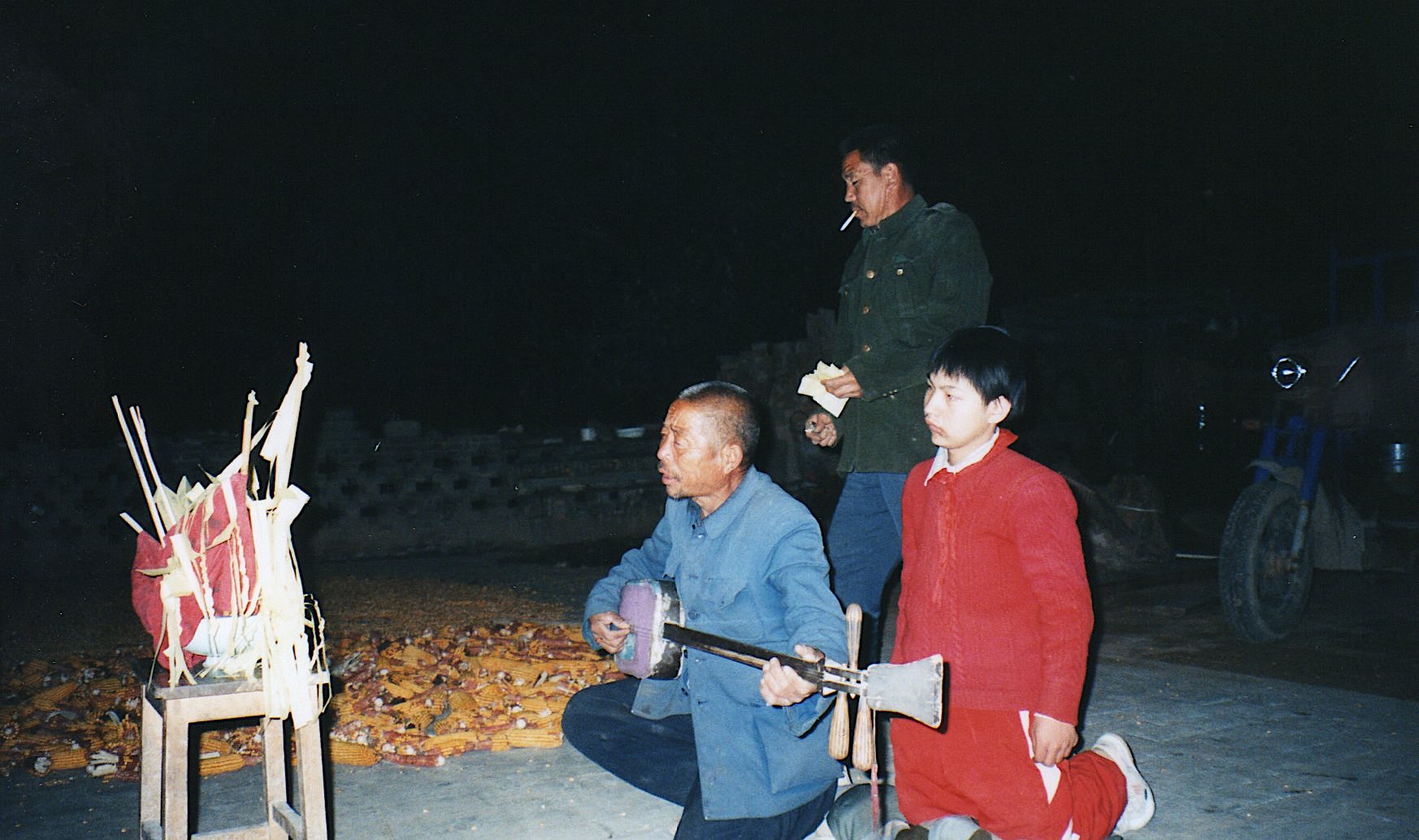
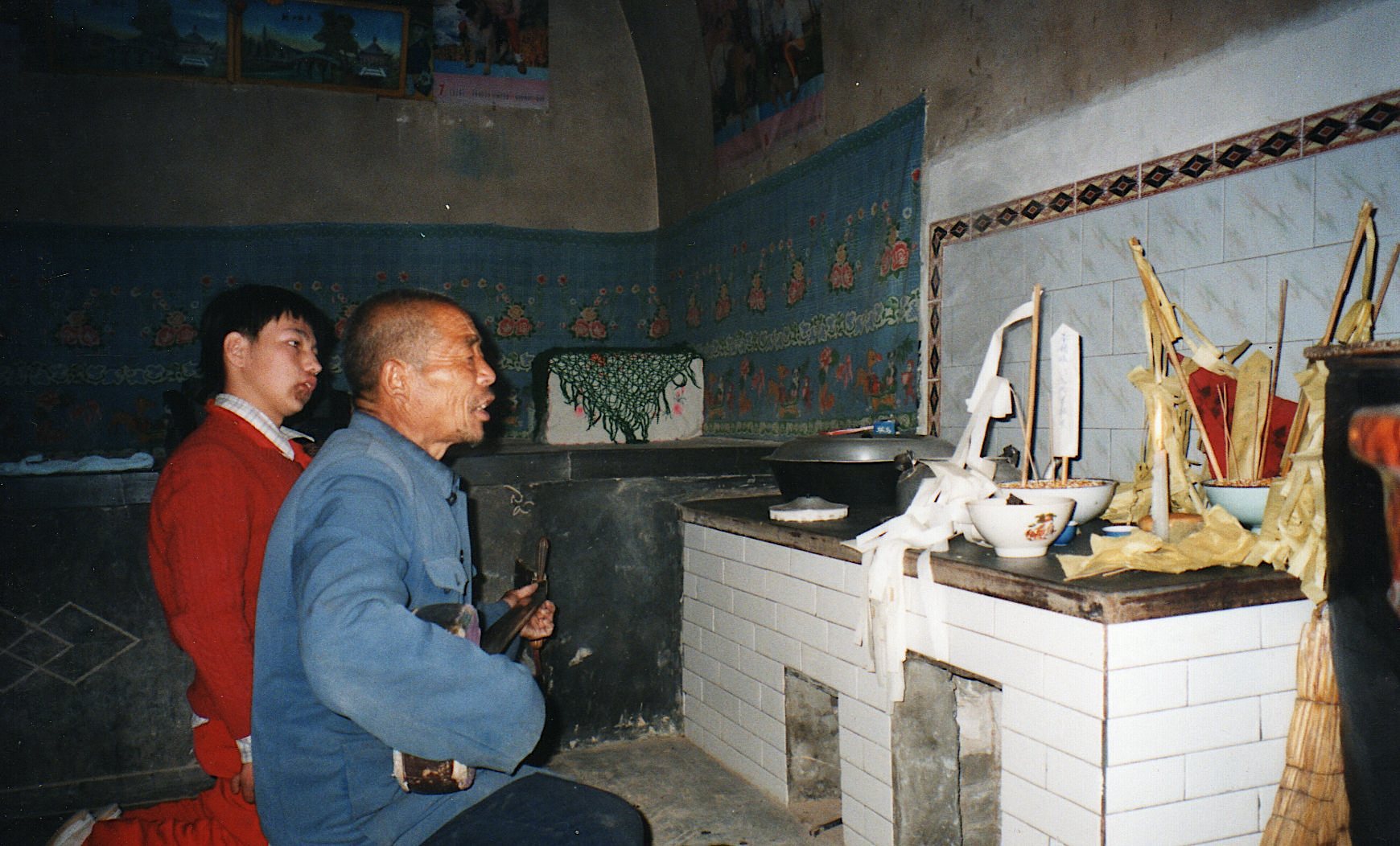
LWJ in courtyard

LWJ shuoshu

Sighted bard Li Wenjin performs a “story for well-being” to protect the son of the host family, first inviting the gods in the courtyard and then narrating a sequence of stories before the altar inside the cave-dwelling.
See DVD §C4 with my Ritual and music of north China, volume 2: Shaanbei,
and pp.83–4 there).
Photos: Guo Yuhua, 1999.

Introduction
In Shaanbei, as in much of rural China, while many blind men earn a living by taking up the shawm (on which see my post on Guo Yuhua, and here, as well as this post on north Shanxi), others have also long served as protectors of children, acting as godfathers and healers, and telling fortunes—as well as singing “stories for well-being”, accompanying themselves on a plucked lute and clappers, a kind of one-man band. They are itinerant, going by foot over quite a wide area.

Though in decline since the 1960s, the bards appear to have adapted rather little in context or sound. Under the Maoist collectives, some spent brief periods being taught new stories in the county-town “propaganda teams”, but this hardly affected their repertory or performing contexts. Since the 1990s, the popularity of the genre has been further threatened by the media of TV and pop music; and little bands now increasingly supplement the solo performers.

Social background
Blind bards also tell fortunes, cure illness, and act as godfathers—occasions when they do not necessarily perform stories. As godfathers they perform ceremonies protecting children (including hanging the locket, the annual Crossing the Passes ceremony at temple fairs, and opening the locket). These ceremonies have doubtless become rather less common since the 1950s, though neither campaigns against superstition nor any gradual improvement in healthcare entirely explain this.

Li Huaiqiang, in his 70s, had hung the locket for three or four hundred children; Guo Xingyu, in his 50s, for “over 290”.

Like geomancers and mediums, the blindman performs healing in a ritual called Settling the Earth or Settling the Earth God. For this he recites incantations and depicts talismans, but does not perform stories.

These occupations were a lifeline for males only: the fate of blind females was pitiable.

Occupations for blind men in Shaanbei

  • begging (yaofan 要饭)
  • playing in a shawm band (guyue 鼓乐, chuishou 吹手)
  • telling fortunes (suangua 算卦)
  • exorcism / healing (antushen 安土神, zhibing 治病)
  • hanging the locket (baosuo 抱锁, daisuo 带锁), opening the locket (kaisuo 开锁), Crossing the Passes (guoguan 过关)
  • narrative-singing (shuoshu 说书).

Contexts for narrative-singing

  • Stories for vows (yuanshu 愿书), to fulfil a verbal vow (huankouyuan 还口愿):
    household (jiashu 家书), for well-being (ping’an shu 平安书)
    temple fairs (huishu 会书: miaohui 庙会)
    parish (sheshu 社书)
  • less common: weddings (hongshi 红事), moving into a new cave-dwelling (nuanyao 暖窑), going off to the army (canjun 参军), official meetings (jiguan 机关).

Ritual equipment, stories, and music
For the narrative-singing contexts, the bard performs before a small temporary altar. Inscriptions for the gods and family, rectangular paper “god places” with a triangular head, mounted on gaoliang stalks, as well as changqing yellow paper streamers, are inserted into one or two rectangular bowls filled with grains of millet or corn. Before the altar are placed a lit candle, small bowls to hold incense and burn paper offerings, and offerings such as dough shapes, biscuits, dates, fruit, peanuts, cigarettes, and cups of liquor.

The altar is placed on the family stove or on a table; for the rituals to invite the gods and escort them away at the beginning and end of stories for well-being, it is placed on a table in the courtyard outside. Li Huaiqiang, though blind, prepared the changqing streamers himself; someone sighted and literate has to be found to write the inscriptions. Incense and paper are burnt before the altar periodically throughout the performance.

The bard takes with him a red cloth bearing the titles of a pantheon of gods. When not in use it is rolled up and kept in the bard’s bag. The cloth is unfurled and placed upright behind the altar, supported by two sticks inserted into a sleeve at either end of the cloth.

Cloth pantheons:
(left) Li Huaiqiang, 1999;
(right) Xu Wengong, 2001 (for a list of these gods, see Zhang Zhentao, Shengman shanmen, p.356).

Stories overlap with opera plots, relating historical tales of love, official success, solving of crimes, famous battles, and righteous protest—all familiar in Chinese fiction since the Ming dynasty, and often referring to still earlier times. Like opera, these stories have long been a dominant form for poor people to learn of history, legend, and morality, only being challenged by schooling since the 1950s. Schooling even now is quite elementary, though TV and pop music are doubtless replacing traditional stories for entertainment.

Indeed, bards’ stories are like a cheaper, more portable version of opera that can be brought into the home to bring good fortune to the family. Like opera (and indeed TV soap opera), stories may be performed in sections at successive sittings—commonly three episodes (huihui).

Bards improvise phrases on the basis of a well-known story—as He Guangwu observed: “We respond to the changes on the spur of the moment (suiji yingbian 随机应变), the lyrics aren’t fixed and dead (dingsi 定死).”

The solo performer accompanies himself on a plucked lute and usually two percussion instruments attached to his left leg and right hand. He may rest his right foot on a low stool, and drapes a towel over his shoulder to wipe sweat from his face. The plucked lute is either unfretted three-stringed sanxian (known as xianzi) or the fretted four-stringed pipa; the sanxian is most common, the use of pipa declining drastically in this area since the 1980s.

This rare form of pipa (see below), held less vertically than the “modern” pipa, and played with a plectrum, was a major discovery, reminding scholars of the Tang dynasty pipa. As was the trend through the 1980s, they were keen to conjure up “living fossils” and evoke the glories of ancient dynasties, but they mustered less publicity for this supposed relic of the Tang pipa than did scholars of nanyin in southeast China.

Han Qixiang and the training sessions
As with many other genres in China, the national reputation of narrative-singing in Shaanbei rests largely on one performer who came to the attention of cultural cadres and was cultivated by them. Han Qixiang (1915–89), dubbed “China’s Homer” but redder than red. The Party’s model blind bard in Shaanbei during the Yan’an period.
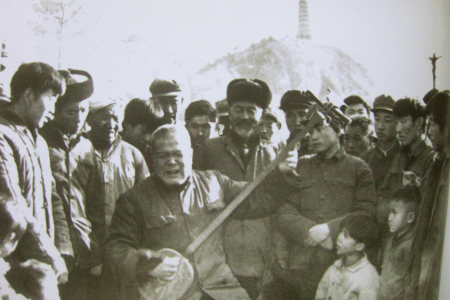
Han Qixiang

from http://www.confucianism.com.cn/html/minsu/15021455.html

In my book I outline his career, trying to read between the lines of hagiographic Chinese accounts on the basis of the 1993 article

  • Chang-tai Hung, “Reeducating a Blind Storyteller: Han Qixiang and the Chinese Communist Storytelling Campaign”, Modern China 19.4 (1993).

From 1945, Party ideologues went to some lengths to reform storytelling with a network of training sessions. After the national “Liberation” of 1949, every county government throughout China set up an arts-work troupe, which soon metamorphosed into an opera troupe; some county authorities further set up a narrative-singing artists’ propaganda team (shuoshu yiren xuanchuandui). These narrative-singing teams were less permanent (and much less costly) than the opera troupes; they held training sessions before dividing into smaller teams to go off on tour round the villages. Bards were lodged together, sometimes for a few months but often for just a few days, and even if they could remember the new stories, they remained reluctant to perform them once they went on the road.

Apart from Han Qixiang, another blind performer mentioned in the 1940s as creator of new stories is Shi Weijun (b.1924), who organized training sessions for bards around Suide county. Blind bard Guo Xingyu (see below), himself no simple official mouthpiece, hinted that Shi Weijun found it hard to adapt to official demands after Liberation. “But then he gave up—he didn’t even want his wages, he lost his standing, and went off on his own to tell stories.” He was clearly reluctant to take part in official events.

We can discount the rosy official image, but even the candid local scholar Meng Haiping recalls the period before the Cultural Revolution as a golden age for the blind bards, with county Halls of Culture organizing them into teams and issuing permits, so that district and village leaders had to receive them, hosting and feeding them—an unprecedented and welcome way to guarantee their “food-bowl”.

Conversely, if the state now acted as the bards’ patron, their richer patrons had disappeared, and their poorer ones were becoming wary of inviting them; temple fairs and “superstition” were under threat. Many bards were not recruited to the teams or were unwilling to join, and even those who did take part did so only intermittently. Although those not registered in the teams were not given permits, they still managed to perform, relying on the old contexts such as “stories for well-being” and godfather duties. But the climate was changing: as the power of campaigns sunk into people’s consciousness, they would have been increasingly nervous of inviting bards openly.

Even those bards who did spend periods in the official teams learning new stories continued to earn their living from more or less “feudal superstitious” contexts. You couldn’t perform new items for hanging the locket, or as stories for well-being.

Party ideologues admired popular oral literature; while deploring its links with superstition, they were unsuccessful in seeking to break such links. The new stories were often based on novellas or opera scripts, and composed with the “guidance” of cadres. As Hung points out, it was hardly a collaboration between peasants and intellectuals—it was never in doubt who was in charge.

It’s hard to assess is how the new stories were received. Even clues in the unremitting hagiography unwittingly give glimpses of constant conflict and difficulties. Han Qixiang composed a new story called “We can’t withdraw from the collective” (Buneng tuishe) (how very true!), reportedly converting peasants who were opposed to collectivism. Having heard that in some Zichang villages women were reluctant to work in the fields, and men reluctant to tolerate them doing so, he composed pieces exhorting them and praising female labour heroes. During the famine of 1959–60 he performed “Turning over a new leaf” (see link in Comment § below) for peasants disgruntled with the paltry goods available on New Year’s Eve, supposedly enlightening them as to how much their lives had improved since the bad old society. Yeah right…

Still, Han Qixiang was a fine performer; even when he told new stories, he would naturally vary them every time, like bards worldwide, and he retained the colourful local vocabulary of bards throughout the area. One cannot merely assess his stories from the page, without being able to witness his performances and those of other bards of the day. Bards I met were less impressed by his technique or creativity than by his good fortune in meeting the right people at the right time and getting onto the government payroll.

So whereas Han Qixiang appears to have been a model “folk artist” propounding Party policies with conviction, most bards in Shaanbei have continued to eke out a living from their traditional exorcistic “stories for well-being”, both under Maoism and since the reforms.

Immortal Li
Among the characters in Guo Yuhua’s book on Jicun is the village’s blind bard Li Huaiqiang (1922–2000, known in the village as “Immortal Li”, Li xian); as ever, my notes benefit from her rapport with him. Visiting his cave-dwelling in 1999, she introduced us and we all sat ourselves down on his kang brick-bed; having explored my facial contours with his hands, he gently held my hand throughout our chat.
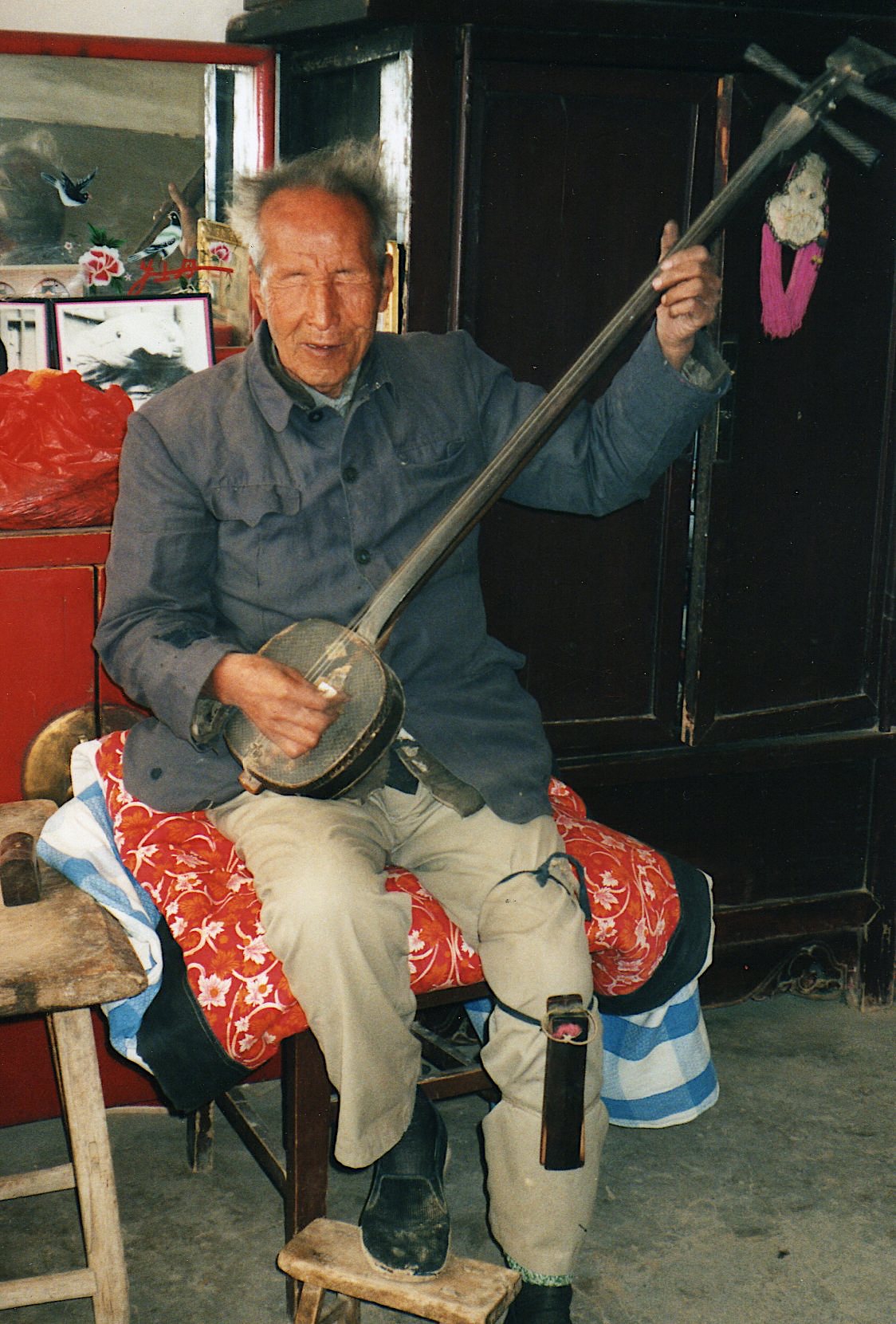
LHQ shuoshu

Li Huaiqiang was among the great majority of bards (and audiences) not amenable to the new stories. Under Maoism, though he gained a house and a family, his livelihood was reduced; since the reforms of the 1980s he suffered both from the decline in popularity of the art and his own dwindling skills.

Li Huaiqiang was born to a poor family of hired labourers working for the village landlords. Such poor families couldn’t afford to send their children to school, and he attended “winter school” for a mere few days. He lost his sight completely by the age of 10 sui. When he was 15 or 16 sui (c1936–7) his father took him to a blind bard to “learn up the arts” of narrative-singing, “history”, fortune-telling, and healing. Learning stories phrase by phrase was time-consuming and expensive—his father had to scrape the fees together. Li contrasts that ruefully with the ease of young upstarts today who can learn just by listening to tapes.

Li began “going out of the door” to earn a living before he was 18 sui, practising both healing and narrative-singing. He was often in demand to cure illness: when someone’s child was seriously ill, Li could give acupuncture and Chinese medicine. When adults had some irregular illness (xiebing), some bad karma, for which orthodox medicine was no use, he’d find them some special herbs.

Since Yangjiagou was still a landlord stronghold, in the early days Li often performed stories all four seasons of the year for the landlords in the village itself. Such performances—like longevity celebrations, or for the first full moon of newly-born children—often lasted seven or eight days. The landlords had a shrine to the god of wealth in their houses—before it bards would tell their stories, and Buddhist monks would recite their scriptures.

Ritual has always remained paramount for bards like Li. “Poor people (shoukuren) worship the Dragon King Elder (Longwangye), stockbreeders worship Horse King Elder (Mawangye), people in business worship God of Prosperity Elder (Caishenye). When people make vows they invite us to tell stories, that’s how we make our living.” Since vows were often fulfilled in the 1st and 2nd moons, bards were most busy then.

By the 1940s, Li’s itinerant business was taking him—by foot—all over Shaanbei. Recalling the old temple fairs, he mentioned the two most famous, still very active now: “I used to go to Baiyunshan for over twenty years, I even went once after the end of the Cultural Revolution. I used to go every year, there were kids there that I’d hung the locket for.” Li performed for the small temple fairs in his home village too, notably the 4th-moon fair at the Pusa miao temple. The temple fairs in the neighbouring hamlet of Sigou were planned best, and were popular; people liked listening to narrative-singing there.

Li Huaiqiang’s early visits south to the Yan’an region, in 1938 or 1939, were part of his routine itinerant business. He told stories around Hengshan and Bao’an (Zhidan) counties too. “No-one controlled what stories you told then, you could narrate what you liked.”

In 1943, after the Suide–Mizhi area was taken over by the Communists, Li found himself unable to make a living there, and went off to Yinchuan in Ningxia and nearby Xichuan. The Nationalist officials loved listening to stories—bards were invited to their quarters. They could travel freely then—only later, when the Communist–Nationalist collaboration ended, did the roads become impassable.

Still, his assessment of the Red and White areas was ingenuous. “It was just the same under the Communists and the Nationalists. Under the Nationalists it was easy to earn money, people liked to listen to stories. After the Communists took control over people, not allowing superstition, at least there was provision for us disabled people, there was relief. So things were the same.” But he did remark, “In the end the Communists came along and broke all the temple fairs up, so there was nothing left.”

I wonder how many bards chose to seek a living in either the Red or White Areas. Evidently old stories did not suddenly vanish throughout the Yan’an countryside. The Yulin region was a seesaw area between the two sides, and most local leaders would, as yet, be broad-minded about traditional forms. We can’t judge, but it is worth challenging the propaganda. And having blithely equated “new stories” with items supporting the Communists, I wonder if bards in the Nationalist areas performed new stories opposing the Communists.

Li Huaiqiang dismissed our queries about the officially-organized groups—he had only the vaguest recollection of this experience. It might have remained an exciting moment in his life distinguished by its uniqueness—but apparently hadn’t. Li went on:

From 1945 they summoned all the blind bards to meetings—they weren’t allowed to sing old stories any more, they had to sing new ones. I studied them and then forgot them all—well, I basically didn’t study them! When you go out [on business], the common people don’t listen to that stuff! New stories aren’t good to listen to—people don’t like listening to new stories, they like old ones! I could never forget the old stories I learned when I was young, though. I can tell twenty or thirty stories. When you went out in the old days there was business, you could count on it—who’d have thought it would all come to an end?

He knew of Han Qixiang but didn’t hear him perform or meet him. “That Han Qixiang, he got onto the official payroll. Oh yes, people in our business all know about Han Qixiang. In the Yan’an period people reformed it into new stories, but they didn’t control us lot who narrated old stories, we just went off round the countryside narrating on our own.” He knew that some performers sang for political meetings, but didn’t admit to doing so himself.

Li Huaiqiang was lucky to find a wife:

I was 24 when I got married [c1946]. They came to take conscripts—people stuck to their old habits, no-one wanted to go off, but they forced them. But us blind people, we couldn’t go off to the army, no-one wanted us—that’s how I got a wife. People were afraid of joining the army, both sides were taking people off, no-one dared go, as soon as you went off you’d get killed. If it was today I couldn’t get married—now it’s hard enough for sighted men to find a wife.

During land reform there were meetings all the time. The Communist Party controlled people, eliminating superstition. When they wanted to hold a meeting they first summoned a bard to narrate a [new] section, so everyone turned up—then the bard sang the old stories that people liked.

This was a common theme, of great significance for our understanding of the Maoist period. The bard would attract people to turn up for tedious political meetings, and satisfy the demands of political expediency by performing a brief political item first, before the fun began. Scholar Meng Haiping recalled: “Both old and new stories were heard then. Until 1956, they began with a short section with new content, then moved onto the old stories like ‘The story of five women reviving the Tang’ (Wunü xing Tang zhuan).”

Li Huaiqiang originally lived in a miserable cave-dwelling made of earth, but after land reform, he was helped to “buy” a comfortable cave-dwelling right at the top of the village from the former landlords, which had been servants’ quarters. The landlords also had to “sell” him their precious sanxian banjo, which he bought for one dan of grain.

If in that sense Li was able to profit from the overthrow of the landlords, he soon suffered from their demise. “We were allowed to narrate stories in the early days after Liberation, but people’s consciousness was raised, people had studied a lot of books.” I didn’t care to argue with him there, so he went on, “They said narrative-singing was boring, so there was a lot less of it—it got less all of a sudden with the collectives [from the mid-1950s]. People like us just tilled the fields, told fortunes, we could just about get by, the state gave us relief. We couldn’t just die off—some people were given relief, some were put in old people’s homes, some with skills could go out and heal illness and tell fortunes.” And he was still taking large numbers of godchildren, whose parents’ regular little gifts always presented a lifeline.

If Li Huaiqiang was unaware of it, the Mizhi county authorities were attempting to organize bards. Gao Zhiqiang, former chief of the county Hall of Culture, recalled, “The county first set up a narrative-singing team in the early 1950s, organizing over twenty blind bards, training them all together to sing new stories. The Hall of Culture issued them with performance permits, which meant that the district and village authorities had to host them—that resolved blind men’s problem of livelihood.” But the teams never controlled blindmen for long.

Li Huaiqiang, who had never belonged to a team or performed in a group, still relied on a minimal handout from the village government to survive; with his wife and five children, times were desperate. “In the Cultural Revolution they didn’t invite us bards any more, it just stopped. But people like us still went out—mostly to tell fortunes, not so much to narrate stories.” And he sometimes sneaked out to hang the locket for children in exchange for “a couple of little coins”. Li was soon branded an “ox demon and snake spirit”, accused of feudal superstition. They took his manual off and burned it; they took his sanxian banjo away too, but he got it back after half a year. “Pesky kids, coming to our houses to get us to hand things over—if you did, then you were let off, if you didn’t then they paraded you through the streets.” Li was only paraded once. The only time he could recall when the authorities regulated narrative-singing was in the year of rebellion (zaofan) of the Cultural Revolution, when all the brigades had to organize blind bards into narrative-singing teams to go round and make propaganda, the county Hall of Culture taking a cut.

The reform era
In Shaanbei, as elsewhere in China, as the commune system began to be dismantled from the early 1980s, traditional culture revived more openly. Bards had been active throughout the commune period, both in and out of the new teams; if the old contexts and stories had never died out, after the “rotting of the collectives” there was no longer such need for collusion or duplicity. As Li Huaiqiang recalled, “As soon as Mao Zedong died, they stopped controlling us bards.” But like other traditional performers, they were soon competing with new economic pressures, TV and pop music taking their toll: where Maoism had failed to marginalize tradition, capitalism looked like succeeding.

Despite his privations under Maoism, he warmed to the theme:

Society’s different now, people have “turned over a new leaf”, reforms and all that—too much reform, it’s all gone too far…

Ebullient local pundit Meng Haiping had a perceptive comment:

In those days [under the communes] they tried to destroy traditional culture, but couldn’t; now they don’t control it any more, but it gradually declines anyway. 1984 to 1990 was the best period. Ever since the great wave of economics started, culture has been dying out.

The agenda of the cultural authorities hardly changed, even if state policy would never again be so “hard”: they still sought to teach the bards new stories to spread education about party policies, and they still aspired to both “controlling” and “looking after” the bards—ambivalent meanings of the term guan 管.

By the late 1990s Li Huaiqiang, quite frail in his old age, was less active as a bard. Lucky enough to have found a wife during times of war, Li has two sons and three daughters; but the family has remained poor, and the sons have been unable to find wives. In 1999 Li performed for the 4th-moon temple fair in his village, and he still did the occasional story for well-being for families fulfilling vows. But he told us: “I’m almost without business these days, 80% of my work is gone. Most temple fairs don’t have narrative-singing any more. These days people read books a lot [surely he overestimates this!]—the state doesn’t control it any more, people just don’t want to be away from work. They’ve got TV and recordings too now.” He used to perform for audiences of 80 or 90 people, but now it’s only for around 20 or 30, mostly elderly. “I can’t keep up.” This didn’t apply generally to narrative-singing in the whole area, but to Li in particular—elderly, frail, and no longer a gifted performer.

In the exceptional conditions of Yangjiagou, the occasional visit from Japanese tourist groups, Chinese and foreign scholars, and visitors to the memorial hall to Chairman Mao’s 1947 sojourn, allowed Immortal Li to supplement his meagre income: “They always get me to perform when someone comes.” But his main income still came from his godchildren, as it had done under Maoism. While we were in the village, one of his godchildren’s children was getting married, and when he paid a visit he was given 20 kuai; when he left they gave him mantou steamed buns, and later they gave him some clothing.
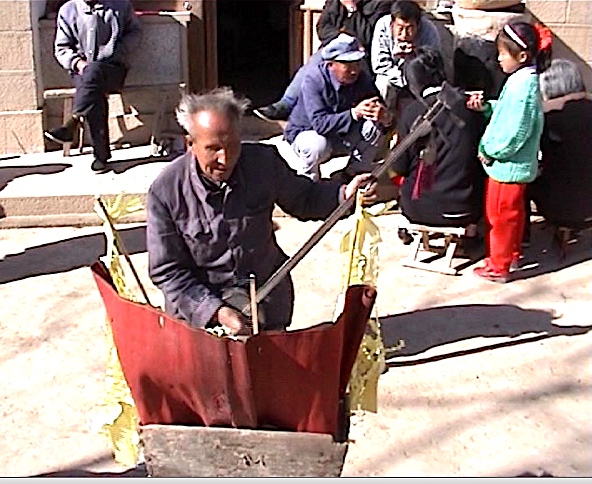
LHQ qingshen

We took him to the cave-dwelling of our host Older Brother, the sweet blind shawm player, to perform a “story for well-being” for the family, as usual inviting the gods outside in the courtyard before telling a story indoors. Though his skills were in decline, it was a memorable occasion.

Li Huaiqiang died in July 2000, falling from a narrow mountain path while on his way to another village to hang a locket. Since his death, other itinerant bards occasionally stop off to perform in the village.

He Guangwu
He Guangwu (b. c1932) is a semi-blind bard from a village west of the river, south of Mizhi town. He began to lose his sight when 15 sui (c1946), so a couple of years later he began “learning the arts” with a master from Zizhou county, mastering a dozen traditional stories—although this was supposedly a climactic period for the new stories, the old stories were being transmitted as if nothing had changed.

He married when 21 sui. Their families arranged the match; his betrothed lived in a village only two li away, but they wouldn’t let her see him, and she only discovered his disability at their wedding. Now she jokes about it and is evidently happy that the family is relatively prosperous with many great-grandchildren; we didn’t like to press her on how it had seemed then.

He had taken part in training sessions in 1955 and 1964, but his concept of his livelihood barely took official contexts into account.

His family has done well since the reforms. He is active over a small area, proudly claiming to be well known within a radius of 20 li (10 kilometres), and he hasn’t taken any disciples. But he is busy. “People still invite me, and I still go. For temple fairs, or if a donkey isn’t eating its fodder, or if a family member is on a long journey, you must invite a ‘story for well-being’; and I tell stories for opening the locket, weddings, moving into a new cave-dwelling, and sons going off to the army.” He is also busy telling fortunes and healing.

HGW and me 2001

With He Guangwu, 2001. Photo: Zhang Zhentao.

In 2001 we found He Guangwu at a small temple fair at Jijiashigou, near his home village. He had agreed to tell fortunes for a family there to help them overcome adversity, and hadn’t brought his sanxian. He agreed to tell a story for us back at his home if we took him back to the temple fair later.

Tian Zhizi
We also visited Tian Zhizi (b. c1933) at his son’s home in a little town south of Zizhou on the road to Suide. He had belonged to the Zizhou team, and also studied in the Suide team. “My eyes were no good from young—I began studying narrative-singing in 1944. My master was Wang Jialai from Zizhou county. When I learned I lived at his house—his fee was 3 dan of grain per year, and I learned for three years.” Through the War of Resistance and the War of Liberation—precisely the period when the new stories were supposedly in the ascendant—Tian supported himself by curing illness, reciting incantations, and depicting talismans.

I began telling stories in 1951, and in 1952 became chief of the Zizhou blind people’s propaganda team, which had been formed the previous year. I was chief of the team for three years; it had over 60 members. Between 1952 to 1956 I studied new stories at the Jiuzhenguan hall in Suide.

Their boss was Shang Airen, an influential cultural official in Shaanbei. Despite my suspicions, Tian recalled,

In the 1950s the peasants loved hearing new stories. The main ones I learned were “The outstanding troupe member”, “Zhang Yulan takes part in the election”, “Opposing shamans”, “The tobacco pouch”, “Mother Gui makes shoes for the army”, and “Wang Piqin takes the southern road”.

Still, through the 1950s and 60s, while the bards from the team sometimes went on tour in small groups, Tian usually went round on his own. When he was 28 sui (c1960), Tian married a girl from the same town—which he claimed was “free love’” not arranged. In 1962 he spent a period working in Yan’an with none other than Han Qixiang, earning 36 kuai a month. Later he resigned and returned home, still making a living as an itinerant bard, also telling fortunes, hanging and opening lockets—by 2001 he had over 200 godchildren.

He went on, “I have 28 disciples in all, eight in Wubu, four in Yulin, two in Shenmu, also in Yan’an, Ansai, and Bao’an [Zhidan]. I took some disciples while I was at Yan’an in 1962, others stayed at my house to learn.”

Unusually, the Cultural Revolution was a significant period of activity for blind bards, who continued to perform both in their traditional contexts and in the state groups. The latter now had a new lease of life as “Blind artists’ Mao Zedong Thought propaganda teams”. In Mizhi county, the Hall of Culture organized a dozen bards into one such team, touring villages, mines, and schools—villages without electricity, mines where accidents were routine, schools with few tables or chairs, and the whole population constantly hungry and demoralized, if you will forgive me for reminding you.

“In 1972 I was mainly taking disciples in Wubu, ‘cos the Wubu Hall of Culture invited me to come to train members for their propaganda team.” Though it was ever harder for bards to perform without the sanction of the teams, popular taste still appeared to require an escape from the relentless revolutionary diet. Tian Zhizi had claimed that the new stories were popular in the 1950s, but “from 1967 [traditional] narrative-singing was forbidden—by that time people preferred old stories, or at least they didn’t like new ones, so we bards told some old ones in the villages on the quiet.”

Other bards also told us that while they couldn’t hang the locket openly during the Cultural Revolution, for those who needed it they still did it, and they still performed in secret in the villages—the people liked to listen and protected them. Geomancers were also still furtively active.

Ironically, perhaps the worst case of penalization was revolutionary Han Qixiang himself, inactive and subject to public criticism throughout the period. As late as 1976, just as the Gang of Four was about to be arrested, he was summoned to perform in Xi’an and criticized, though by late 1977 he was well back on the road to rehabilitation, taking part again in official meetings.

Guo Xingyu
A younger blind bard more able than many to move with the times is Guo Xingyu (b.1951), with whom I spent some time in 2001. His case is quite exceptional among bards I have met, following political trends astutely while continuing to take godchildren and cure illness.

Brought up in a poor Suide village, Guo Xingyu was blind from young. He studied narrative-singing and fortune-telling for ten moons with Wang Jinkao from the age of 12 sui (c1962). He started going out on business when about 16 sui, on the eve of the Cultural Revolution. “When I was young I enjoyed learning everything from my master, curing illness, depicting talismans and chanting mantras”.

When I was just starting out we mainly told old stories, though in public contexts we told bits of new stories. New ones I liked telling, before and during the Cultural Revolution, were “Fuss over an abortion”, “Eliminating transactional marriages”, “The great immortal who eats ghosts”, “Eliminating superstition”, and “The tale of the city youth returning to the countryside”.

In 1968 Guo Xingyu joined the Suide county blind peoples’ propaganda team, which had several dozen bards, divided into three or four sub-groups:

In the 60s we were issued with narrative-singing permits; we had to hand over part of our income to the Hall of Culture as “public assets”—the state also took a certain amount of training expenses, but later that stopped. In the 60s and 70s the whole county probably had about 70 or 80 bards—about 40 or 50 didn’t enter the training bands, they had to tell stories on the quiet.

Guo Xingyu even took part in official festivals in Suide, Yulin, and Xi’an; he was praised by the venerable Han Qixiang. He appeared a model bard in the new mould—little would one think that all the while he was performing stories for well-being and healing.

From 1972 I was head of the blind men’s propaganda team organized by the Suide Hall of Culture. I entered the Party in 1975, and from 1978 I was political instructor of the team. In the 1980s I composed some new propaganda-type stories on the basis of the political needs of the time, mainly things like advertising the spirit of the Party’s 12th and 14th Plenary, and birth control, like “Fuss over an abortion” and “Marrying Late”.

By 2001 the team was moribund. Guo and his (sighted) wife were dividing their time between his home village and an apartment in the suburbs of Suide town. He had rarely performed as a bard since getting heart disease around 1991; now his main livelihood was curing illness by depicting talismans and chanting incantations, and hanging and opening lockets. Relying on his traditional magic, he legitimized it with a fashionably scientific-sounding defence: “magic power is rational (fali you daoli)”.

Guo Xingyu took us to see his blind master Wang Jinkao at his village home south of Suide town (DVD §C3).

WJK, GXY heying

With (right to left) Wang Jinkao, Guo Xingyu, and Wang’s son, 2001. Photo: Tian Yaonong.

Wang (known as Niur, b. c1930) married a sighted girl in 1947; they have three sons and a daughter, all peasants in the village. Wang accompanied himself on pipa rather than sanxian. When Guo Xingyu studied with him around 1962 he was running a kind of blind school in Qingjian; he learned in a group of five or six blind boys, whose parents had to pay fees. He was one of few bards still using pipa rather than sanxian.

Wang Jinkao had had minimal contact with the new ethos: he could tell new stories like “Wang Gui and Li Xiangxiang”, but if he had ever taken part in training sessions or belonged to the county team, no-one cared to remember.

As we saw, bards mostly worked solo; even when they assembled for temple fairs and New Year’s festivities, they performed in sequence, not together. But under Maoism, bards were sometimes organized into small groups to perform for non-ritual contexts.

Still, both new contexts and musical innovations remained a minor feature even through the years of Maoism, and after the “rotting of the collectives”, tradition became yet more dominant. Some new stories were still performed—on the birth-control policy, the reform and open-door policy, the private enterprise system. Some county authorities continued their efforts to organize blind performers, even trying entry by ticket. But as prices rose and more modern entertainments became popular, they resorted to more viable money-making ventures like setting up halls for video games, or classes teaching electronic keyboards.

By the 1990s the propaganda teams were virtually defunct. As one cultural cadre told us: “Later the bards didn’t want people to control them, and we didn’t have enough money anyway, so we gave up.”

Blind and sighted bards
Though Han Qixiang mentioned competition between blind and sighted bards when he was learning in the 1930s, narrative-singing in Shaanbei was largely a monopoly of blindmen, and only since the eve of the Cultural Revolution has the taboo against sighted performers been seriously challenged.

By around 2000 it was a fait accompli for sighted men to muscle in on the trade. There were fewer blind people anyway, since health has improved (though still appalling); and they could now receive modest disability benefits, or migrate in search of work as masseurs.

Nor do sighted men fear going blind any longer if they take it up. Half of Tian Zhizi’s 28 disciples were sighted—presumably those he taught since the 1970s. Although one elderly bard commented that the new disabled allowance for blind people makes them lazy, blind performers who are still active rather resented the encroachment on their “food-bowl”. “Originally sighted people weren’t allowed to tell stories—if you’re sighted you can do anything [else].” Now not only can sighted people learn, but they can even learn from tapes, saving them money but depriving senior blind bards of teaching fees.

Scholar Meng Haiping pointed out: “In the old days, bards’ social status was low; now for everyone all that counts is money, social status no longer comes into it.” This was certainly true for trendy young chuishou shawm-band musicians in the towns, but less obvious for the bards. Unlike the chuishou, bards have not spruced up their image so ambitiously, and remain quite modestly paid; nor have they yet availed themselves of the mobile-phone revolution that has occurred since about 1998. Whereas chuishou often ride motor-bikes, bards (even sighted ones) mostly go on foot.

Guo Xingyu:

Now there are sighted bards everywhere—many senior-secondary graduates, not wanting a hard life, go and tell stories. In Zizhou, Hengshan, and Yulin there are a lot of sighted bards, and there are some in Mizhi and Jiaxian too. Now there are fewer than thirty blind bards in Suide, but there are more sighted ones. They began appearing in the 1980s or 1990s, they drove the blind ones away; the blind ones were very angry about it—but the sighted ones had permits too.

He went on darkly,

Now how did that come about, then? Perhaps by bribery. Now blind artists are in great difficulties. There are more of them west of the river, but quite a few of the old artists have died; east of the river their skills aren’t quite so good.

Li Wenjin
I met sighted bard Li Wenjin (b. c1943) with Guo Yuhua in 1999 when he performed informally for staff at the office of the Black Dragon temple (on which see Adam Chau’s fine book Miraculous response), as a kind of advertisement for his arrival in the area. He comes from a village in Zizhou county. Soon after Liberation, in the early 1950s, he studied for three winters in the evenings in the “school for sweeping away illiteracy”. His parents died early, but he only began studying narrative-singing in the early 1980s, with the old blind bard in his village. His master could never find a wife: “when the five organs are incomplete, no-one will follow you”—though most of our blind mentors were exceptions. There was a libretto (benben) that he could follow—even blind performers sometimes owned a libretto. Li Wenjin was active over quite a wide area. He usually sings with his eyes closed—in imitation of blind bards?

LWJ and GYH

Guo Yuhua and temple organizers listen to Li Wenjin, Black Dragon Temple 1999.

A couple of days after meeting him at the temple where we were staying, we bumped into him on our way back there, and he invited us along to hear a “story for well-being” that evening for a family in the nearby village (see photos at head of this post).

Xu Wengong
We met another sighted bard at the White Cloud Mountain temple fair in 2001. Xu Wengong (b. c1948), from a village in Qingjian county, began learning at 17 sui [c1964] from an uncle, so the taboo was perhaps being broken down even then. He has never taken part in any county-organized teams, or learned new stories. During the Cultural Revolution he was protected by villagers as he went round performing and hanging lockets on the quiet.

Many pilgrims attend the temple fair under the auspices of a dozen or so regional associations, each with particular allegiances among the many temple gods, sponsoring different daily rituals. Apart from the daily performances of opera, bards perform in a less public and commercial arrangement that is also typical of Shaanbei temple fairs. One evening we visit the cave of the Zizhou, Qingjian, and Ansai association where Xu Wengong was performing.

He comes to this fair every year as part of this pilgrim association, in order to fulfil a vow. “My father was a model labourer, and was head of this association”—note this typically casual link between Communist and traditional authority. “He came here to take part in the rituals and made a vow, because I’d had stomach disease for twelve years, and sure enough I got better. So I’ve been coming here to fulfil the vow every year since the temple restored, to revere the great god Zhenwu; I come here to avert calamity.” Some other bards also come to the temple fair not to make money but to fulfil vows.

There is no need to “invite the gods”, since they are already present, but on the left of the cave, as you stoop to enter, is an altar behind which the bard’s red cloth pantheon is displayed (see photo above). Individual pilgrims periodically burn paper and kowtow before it. Xu Wengong performs opposite the altar, the pilgrims sitting on mats at the rear of the cave, listening intently. They consist mostly of men over 50, but even those over 60 were brought up largely under Maoism. Yet such senior men entirely represent tradition; ritual associations like this surely represent a kind of passive alternative to government control.

Baiyunshan pilgrims 2001

XWG BYS 2001

Xu Wengong, Baiyunshan 2001

Old and new stories
Despite the propaganda surrounding Han Qixiang, not only does no-one value new stories now, but few recall them being popular even under Maoism. He Guangwu recalled, “In those days, usually we’d tell a section of a new story first and then tell an old one.” Other bards like Li Huaiqiang had no time for new stories at all. He had heard “Smashing superstition” on tape at a villager’s house, but “people don’t like it, it’s not good to listen to—you can’t sing stories like that for families, only for big meetings where tickets are on sale!” He Guangwu had learned “Opposing shamans” in the training session in the 1950s, but he too commented wryly, “You can’t tell that story nowadays—that’d be blasphemy!”

Even if the popularity of new stories was highly limited, and the subjects remained traditional, Li Huaiqiang pointed out that the bards’ language had been evolving along with the language of society generally. A certain change of style, reflecting the times, had evidently left him behind.

In the old days you sang of “Lady” or “Mistress” (furen, xiaojie), now it’s “missus” (poyi); in the old days it was “setting up as a family” (chengjia), nowadays it’s “the couple have got together”, “they held hands as they walked”, “they kissed”—it’s so lacking in culture! Old people won’t listen to that stuff, in the old days it was real cultured, now it just ain’t the same. But you have to adapt yer language to the times, eh?

So why should people apparently prefer stories about events many centuries earlier to ones about their society now? Local scholar Meng Haiping explained the ability of the old stories to survive under Maoism:

Traditional stories propound truth, goodness, beauty, and filial piety (zhenshanmeixiao 真善美孝)—that is China’s traditional morality, the Party doesn’t oppose that, and doesn’t suppress it.

Though there is ample evidence to show that they did oppose it, deliberately, regarding it under headings such as “bourgeois morality”, Meng was still making a fair point—because the Party he refers to is that on the ground, where continuity is more evident in local practice than the rupture often advocated by central theory.

Having complained about the coarsening of the bards’ language, Li Huaiqiang went on to lament the changing times:

In the old days bards used to wear a robe, and a hat with a pigtail. Nowadays it’s all simplified. Then it was wagai hats, sitting at a high table; now you don’t get changed, and just sit on a stool, it’s much simpler. And the gods used to be more efficacious, they were dead efficacious—if you didn’t follow them you could die. Once someone’s son died, and the parents made a vow to beg him to come back to life, so I obeyed the gods, and he really did come back to life.

So why didn’t the new stories become popular? Sure, villagers might be conservative and escapist in their tastes, finding stories of emperors and concubines, scholars and maids, generals and outlaws more attractive than propaganda. But the new stories might have been entertaining and meaningful in the contexts of the 1940s too. The irony was that the whole purpose of the new stories since the 1940s was to address current issues of great importance to the peasantry: namely tackling endemic social problems inherited from the old society.

But problems that might be arising under the new society were not now to be publicly aired. I would surmise that villagers might have been open to new stories, but were disillusioned by their glib political correctness, their failure to reflect complex new realities. The new stories were surely rarely heard in the villages apart from at mass meetings by which people were anyway alienated. If villagers were still able to host a performer to sing to invite the gods to heal their livestock, the new stories were inappropriate. In the early period of the 1940s, they might have had considerable novelty, and even helped people confront genuine problems, like forced marriages, opium, landlord exploitation. But maybe the themes didn’t keep pace with the problems: by the 1950s their perceived problems included campaigns, collectivization, irrational directives, and thus the new items seemed false, like the propaganda itself.

Still, as we saw, the stories Han Qixiang performed on his tours in the late 1950s were often semi-improvised according to the events unfolding in the village. That is, problems such as reactionary thinking among the peasants could be ridiculed; perhaps even bourgeois thinking of local leaders; but central policy could hardly be questioned.

As to issues topical since the reforms of the 1980s, several performers mentioned stories about the birth-control policy—that is, supporting it; given its massive unpopularity, has anyone dared sing stories opposing it? If no stories have arisen dedicated to sensitive issues such as official corruption, they are doubtless subtly aired in passing, if not as flagrantly as the fictional balladeer in Mo Yan’s visceral 1988 novel The Garlic Ballads (p.73):

A prefecture head who exterminates clans,
A county administrator who wipes out families;
No lighthearted banter from the mouths of power:
You tell us to plant garlic, and that’s what we do—
So what right have you not to buy our harvest?

Since the government mounts regular poster campaigns warning of sexually transmitted diseases, even if it was slow to admit to the danger of AIDS, I wonder if the bards could now be enlisted to tell stories warning of such perils. It seems unlikely. For a hard-hitting song from blind singer Zhou Yunpeng in Beijing, see here; and for songs on the Coronavirus, click here and here.

At any rate, one can only be impressed by the adaptability and creativity of storytellers, and whatever the constraints on public speaking both under the communes and since the reforms, they must always rely to some extent on keeping their audience entertained with topical remarks which will strike a chord.

Note that it was the texts that the Party cadres sought to reform—the traditional melodic and rhythmic elements were not an object of their attention.

Research and images
By the 1980s, while local scholars did most of the work by contacting the bards through the urban teams, rather than accompanying them on tour, they were now concerned to document ritual aspects of the performance. People’s mind-sets had become much more free than under Maoism—one local scholar who recorded bards for the Anthology was not going to be hoodwinked into toeing the Party line by recording new stories:

When I recorded them, I chose anything about Heaven, Earth and Man, and rejected everything about the Party, Chairman Mao, and Socialism!

One might see this as a political bias in itself, but I would view it as a shrewd correction of any tendency the bards might have to play safe by performing a politically-correct piece for a government representative.

Since Shaanbei is often featured romantically in the national media as a revolutionary base, brief sanitized glimpses of Shaanbei folk culture are occasionally broadcast. The standard images are yangge dancing or a cheesey folk-singer, but in 2001 I saw a young sighted man do a passable imitation of a Shaanbei bard on a national CCTV chat-show featuring the cult Shaanxi novelist Jia Pingwa.

Avant-garde Chinese artists have presented a less revolutionary image of Shaanbei. One fine antidote to Han Qixiang is the blind bard in the novella Life on a string (Ming ruo qinxian) by Shi Tiesheng (b.1951), one of many “educated youth” rusticated to a village near Yan’an in 1969 (see my Shaanbei book, pp.8–11, 76–7). This 1985 story mystically evokes the life of an itinerant blind bard and his young blind disciple:

The old man believes that when he has broken one thousand strings, he can open up his sanxian and find a prescription inside which will restore his sight. When he finally does so, the piece of paper inside is blank.

The story was made into a film by Chen Kaige (1991), director of the brilliant Yellow Earth, also showing the gulf between the harsh realities of rural life and the Party’s ideals.

Such avant-garde creations, with their mystical minimalism, are more popular outside than inside China. While far from ethnography, they at least offer an imaginative alternative to the revolutionary idealism of official sources.

You can find many video clips of Shaanbei bards online (on Chinese sites and even YouTube), most but not all in a commodified style. This one, while close to the traditional setting, is clearly specially staged. In recent years Cao Bozhi 曹伯植 has published prolifically on musical aspects of the genre.

* * *

Now I also learn much from

  • Ka-ming Wu, Reinventing Chinese tradition: the cultural politics of late socialism (University of Illinois Press, 2015).

Though Wu immersed herself the lives of her village hosts, she also engaged more with officialdom than I did. She was introduced to bards through the propaganda teams, which look to be more important in her region of the Shaanbei field site than in mine. So whereas bards that I met—even those who had spent periods in the training teams—found the new initiatives evanescent, she tends to take the institutional level as primary, although local variation may also play a part.

For instance, her subheading to Chapter 3 “Propaganda storytelling turned into spiritual service” puts the cart before the horse—when the latter has such a long history, and the former remains only one aspect of their activities. Following blind bard Master Xu around for a month, she gives some excellent vignettes.

She found that

He had transformed his performance into a series of clandestine religious activities and religious performances.

But this was precisely how the blindmen had always earned their living throughout history! A similar slip is

Northern Shaanxi storytelling was originally designed as part of a government-sponsored cultural enrichment mission to poverty-stricken rural areas. (104)

 In Chapter 4 Wu valuably describes danwei work-unit performances, which I hadn’t found. She shows bards’ (not always successful) search for performances in such danwei; indeed, even when a bard goes on a solo tour of the countryside she suggests a rather formal arrangement with the village leadership. Conversely, the nearest to this that any bards I met got to was when Li Wenjin announced his arrival in the area to the Black Dragon Temple temple committee—whereupon word soon spread, and household patrons came forward.

Again she shows how bards tend to open with a brief modern propaganda item (no longer based on class politics, as she notes) before launching into a more popular traditional story.

She gives some valuable translations of lyrics, both traditional and modern. Further to my comments above on stories about topical issues, she translates a remarkable item “Quality Control System Spread to Millions” warning against fake consumer goods, performed at a factory; and the 2008 “Alleviate Earthquake Disaster, Look Forward to the Olympics, Increase Productivity” for a staff appreciation event.

While she notes that such national and government messages were overshadowed by the traditional stories that followed them, she reminds us to pay attention to the mutual interpenetration and agenda contestation among the local state, danwei, and folk cultural practitioners.

She finds that storytelling

neither resists nor colludes with the state; nor does it cater to urban tourism or consumption.

And she observes acutely:

Instead of attributing the spiritual revival to a simple return to the storytelling tradition from before the 1940s, I relate it to the huge movement of labor, objects, and emotions between the rural and urban areas.
[…]
My point is not that northern Shaanxi folk storytelling has revived because of depressing rural economic conditions. Rather, I wish to emphasize that the revival of storytelling practice becomes one of the rare social and communal occasions for rural villagers to get together where they can openly discuss all kinds of major rural developmental contradictions: lack of elderly care, split households, and youth who find no career development in remote rural hometowns and who encounter much difficulty surviving in cities.
In short, folk storytelling occasions are valuable not so much because villagers are getting more religious or that the practice is a time-honored heritage. Rather, folk storytelling has become what Megan Moodie called “platforms for articulation”, where local citizens draw traditional cultural resources to discuss pressing concerns of split households among left-behind elderly and young wives in remote communities in a translocal age. (101–102)

 Despite these areas for discussion, when she writes so perceptively such variations in focus are welcome.

Conclusion
Despite the substantial material published on Communist reforms of narrative-singing, and ethnomusicologists’ eager search for change and modernization, it was hard while observing daily life in Shaanbei around 2000 to credit the Party’s reform programme with much long- (or even short-) term influence.

As Guo Yuhua observes, people remained loyal to their traditional concept of local village culture rather than to the state. Though state-funded troupes are undoubtedly an aspect of overall activity, this point appears to be of wide relevance for ritual activity and expressive culture in the Chinese countryside today, and for our understanding of modern China.

If the bards are now threatened by the recent spread of TV and pop music, they are still in demand for their “stories for well-being” as well as for their healing skills. While they do assemble for public rituals like temple fairs and New Year, they mostly perform solo. From the 1940s, a disjuncture emerged between the secular political performances of the official teams and the rituals of the solo bards. Narrative-singing has perhaps become a lesser aspect of the blindmen’s activities than their godfather and healing duties. Indeed, since sighted bards do not necessarily learn the healing arts of blind men, a potential divorce also looms between narrative-singing and healing—all the more since people can now learn stories by listening to commercial tapes.

My point is not to belittle official efforts, either in the cultural or political spheres. But we should avoid basing our assessments either on the new stories of Han Qixiang or on a simple revival or reinvention since around 1980. As Ju Xi comments, criticizing the recent interpretations of “secularization” (compared with imperial China) and “revival” (compared with the Maoist era), both of which portray Chinese religion as somewhat isolated from society, local religion is not merely a “spiritual creation” or “cultural heritage”—it’s a cultural resource and social power which can play active roles in contemporary rural society.

The Party never managed to “eliminate superstition”, but complex social and economic changes continued to affect ritual life and expressive culture both under Maoism and since the reforms. Studying their changing fortunes in such a society requires a nuanced approach.

Click here for a trailer for the documentary Shujiang (Cao Jianbiao 曹建标, 2019). See also Bards of Henan, and my roundup of posts on narrative-singing.

.


[1] This article is based on Part Two of my book Ritual and music of north China, volume 2: Shaanbei, (where you can find further refs. and characters)—note §C of the accompanying DVD. See also my “Turning a blind ear: bards of Shaanbei”, CHINOPERL 27 (2007); and Zhang Zhentao, Shengman shanmen 声漫山门, pp.353–79. I use the term “bard” for convenience, and to hint at their broader ritual duties.

China and Europe: local society and politics


My article on Guo Yuhua leads to several related posts on my blog—many collected under the Maoism tag in the sidebar.

For further alternative grass-roots accounts of Chinese society, see

For the troubled maintenance of local ritual life under changing regimes:

On recent conflicts between state and society, see e.g.

In Guo Yuhua’s interview with Ian Johnson she gives short shrift to the Intangible Cultural Heritage—as do I. Some tasters among the numerous posts under the heritage tag in the sidebar:

* * *

For Chinese parallels with authoritarian regimes in Europe, see e.g. my posts on


For another handy digest on a variety of topics, see here.

A feminist Chinese proverb

Jiuzhan quechao

Occupying the male stronghold: Li Min (left), her sister, and their children, 2013.

Further to proverbs like “No silver here” and, um, “Confucius, Mencius…“, the thought-provoking Appendix of Guo Yuhua‘s definitive book on Maoism in a Shaanbei village is titled

鸠占鹊巢 jiu zhan quechao
doves occupying the magpie’s nest

This may sound rather like our dog in the manger, and while there doesn’t seem to be a suggestion that the doves are being pointlessly selfish, in imperial times it did acquire a derogatory sense of usurpation.

Guo Yuhua used it to evoke the stubborn resistance of a somewhat down-and-out villager in refusing to move out of the cave-dwellings that had become incorporated into the village’s glossy new Commemorative hall to the revolution. Indeed, the Party leadership had itself requisitioned the former landlord complex when they moved into the village in the 1940s.

Further east in north Shanxi, whenever I come to Upper Liangyuan village to stay with Li Manshan, his wife and any visiting female relatives use the east room—by the kitchen—while Li Manshan and I sleep in the west room, which becomes our male domain for chatting amidst a fug of cigarette smoke.

I mentioned Li Manshan’s brilliant second daughter Li Min in the first of three posts attempting to redress the flagrant gender imbalance of my fieldwork on ritual life in Yanggao. Li Min maintains a healthy scepticism about my visits—my outsider status and general ineptitude in facing the challenges of village life—and with her quiet yet fierce intelligence she’s always ready with an astute quip, like the way she pithily unpacked the ethnographic time-frame for me.

While the proverb had long acquired a pejorative tone, Li Min herself usurped it with a wry feminist slant one afternoon when Li Manshan and I returned home to find her, her sister, and their young children availing themselves of “our” west room, taking their due—doves occupying the magpie’s nest, as she observed.

In fact their visits enliven the general mood at home, and Li Manshan and his wife make wonderful grandparents… For my gifts to Li Min’s son, do click here!

Like the BBC of Lord Reith’s mission statement (cf. Philomena Cunk‘s aperçu “The show got a record audience of 400—the sort of viewing figures BBC4 still dreams of”), Li Min always informs, educates, and entertains me; she’s a star. As I tell her, she may never have got on the official payroll, but she should be made Director of the Datong Bureau of Culture forthwith. And jiu zhan quechao might make a suitable motto for the Chinese feminist movement.

Li Min reading

Li Min reads a passage on women’s status in Yanggao ritual life from Wu Fan’s fine book.

Guo Yuhua: Notes from Beijing, 3

GYH chat with last headscarfed man

2005: Guo Yuhua chats with the last man in Jicun village still wearing the traditional headscarf of the north Chinese peasant, iconic image of the revolution. Photo courtesy Guo Yuhua.

During my recent sojourn in Beijing, as well as my lecture series at Beishida and film screenings at People’s University and Peking University, it was a great inspiration to meet up again with the fine anthropologist Guo Yuhua 郭于华 (b.1956).

She’s done an interview for Ian Johnson (latest in a fine series for the NYRB); this interview is also instructive, as well as this earlier one in Chinese, along with recent posts by David Ownby (here, here) and Jonathan Chatwin, so here I’d just like to add my own personal reflections on her extensive oeuvre, with further material on fieldwork. [1]

1 Introduction
Introduced in London by the great Stephan Feuchtwang in the 1990s, we later met up in Beijing. In 1999 she took me on a fieldtrip to the Shaanbei village that was already a major focus of her research. In March 2018, not having seen her for ages, I was keen to catch up.

Professor of sociology at Tsinghua university in Beijing since 2000, Guo Yuhua is widely admired by scholars in China and abroad, maintaining high academic repute in the innovative sociology department alongside Shen Yuan 沈原 and Sun Liping 孙立平[2] What distinguishes them from other China anthropologists—both in China and abroad—is their rigorous critique of “Communist civilisation”.

I meet Guo Yuhua on the vast Tsinghua campus one afternoon and we go to a quiet café. I sip a bucket-sized strawberry frappé for hours as she delivers a passionate tirade/lecture, talking non-stop.

After gaining her PhD at Beishida and doing a post-doc at Harvard, by the 1990s Guo Yuhua was involved in a major project on oral history at the Chinese Academy of Social Sciences (CASS), documenting villagers’ personal experiences of the Maoist era—a project very far from the traditional oral history of folklorists.

Her early fieldwork focused on folk culture (as was the vogue at the time), but as she began delving deeper she moved onto the wider, and deeper, social and political systems of modern life. In 1999 she edited the influential book

  • Yishi yu shehui bianqian 仪式与社会变迁 [Ritual and social change] (Beijing: Shehuikexue wenxian cbs),

with contributions from leading scholars like Wang Mingming and Luo Hongguang. Most articles explore the complex relation between local society and the state. Apart from her introduction, her own article there expounds many of the issues in her 2013 book (see below):

  • “Minjian shehui yu yishi guojia: yizhong quanli shijiande jieshi” 民间社会于仪式国家:一种权利实践的解释 (陕北骥村的仪式于社会变迁研究) [Folk society and the ritual state: an interpretation of the practice of power (Ritual and social change in Jicun, Shaanbei)].

Guo Yuhua was an early blogger, later moving onto Weibo, Wechat and Twitter, where she is indefatigable in exposing injustice and defending rights.

Surveying her activist online activity, it might seem as if she’s changed paths since her early fieldwork on rural society and ritual, towards a deeper political engagement. But far from it, it’s all a continuum (“the whole dragon” again)—the social concern was always there. Amidst the current threat to our own values in the USA and Europe, many Western scholars may now be appreciating her wisdom.

But in China, such a principled stance requires more determination. Guo Yuhua’s blog and social media accounts have long been regularly blocked or censored. As she observes, in the face of constant scrutiny, it’s never clear where the line is—you just have to keep probing. The Party can’t control thought totally—the genie is out of the bottle, and China has to stay open for business; social media stills brings information and can be astutely deployed. Still, plain speaking is easier for established scholars than for younger scholars starting out.

I’m scribbling notes as she talks, but after a while my pen runs out. I suggest, “Is this one of Theirs, trying to stop me writing down your Thoughts?!

Apart from her Tsinghua colleagues, scholars she admires include historians Qin Hui 秦晖 and Zhang Ming 张鸣; and in legal studies, Xu Zhangrun 许章润 (for the latest in a series of critiques, see here; and for Guo’s defence after his 2019 suspension, here), He Weifang 贺卫方, and Zhang Qianfan 张千帆 (individual articles also on aisixiang.com—gosh, what an important resource this site is!). Guo Yuhua is part of a chorus of scholars criticising the “New Rural Construction” campaign, with its coercive programmes of expulsion.

Complementing her through background in Western sociology, her work builds on Chinese tradition—like Fei Xiaotong’s candid account of villages evading state collective policy (Dikötter, The Cultural Revolution, p.280).

Though she is closely surveilled even when she does rural fieldwork, she never loses her sense of humour—she has lots of funny stories about her fieldwork, and being surveilled. She seems cool and open, knowing she’s doing the moral thing, saying what needs to be said, on the basis of her rich practical and theoretical experience, with careful detailed scholarly research. She speaks for truth, that of the common people among whom the CCP once gained support by espousing. She does all this not out of “bravery” but more as a duty, like the patriotic intellectuals of yore. As she comments in the NYRB interview,

Sometimes, you feel you can’t tolerate it—you have to speak out. And if you’re looking at the people in society who are suffering, well, they’re so pitiful. It’s intolerable. You feel you can’t help them in another way, so at least you can try to publicise it and get a public reaction. In fact, you aren’t really helping them, but you feel you have to speak.

And she still manages to take teaching very seriously. Her courses, with impressive reading lists, include rural sociology, research methods, and the sociology of politics. Taking students on village fieldwork, she even does livestreams.

Such Chinese scholarship doesn’t tally neatly with Western concepts of left and right.  Over here, last time I looked, those who strive for social justice and speak truth to entrenched conservative power are considered on the left. But When Guo Yuhua visited the Max Planck Institute for Social Anthropology in Halle in 2016, making a critique of Karl Polanyi’s views on the market economy, their views were at odds.

While she understands my lament that some foreign media coverage seems to suggest that Chinese people are brainwashed automatons, she still worries that many are indoctrinated. Like in the USA, I ask? I may sometimes feel uncomfortable with foreign China-watchers’ monolithic portrayal of an evil surveillance state, but Guo Yuhua, in the thick of it, commands great authority.

* * *

Fieldwork may stimulate a social conscience (cf. journalistic reports like those of Liao Yiwu), and anthropology has a long history of activism—if less so for China. The task is to understand different lives, and speak out on people’s behalf—obvious topical instances including Syrian refugees and Beijing migrants.

I’m tempted to wonder, isn’t this a natural career path for any anthropologist (or indeed priest) working among the poor? What may seem more curious is that many, whether Chinese or foreign, don’t follow such a path. Exposure to the lives, and cultures, of rural dwellers should inevitably prompt us to ponder their situation—but that rarely surfaces clearly in the literature on China. And it does seem to lead naturally to a principled involvement with issues of social justice. So perhaps that’s why authoritarian governments are likely to be wary of anthropology, and “experts” in general.

The anthropology of ritual and expressive culture in China may seem somewhat separate from such social and political enquiry, but it needs to absorb such lessons (as I often suggest. e.g, here). So with much research on Chinese music and Daoist studies still blinkered and stuck in reification and myths of an earlier idealised past, I’ve long looked to anthropology for inspiration. Still, compared to the 1990s when one could do meaningful work, Guo Yuhua finds the current anthropological scene in China backward, with funding ever more politically controlled.

Of course, anthropologists don’t only study exotic tribes and peasants. They may also explore the lives of the legions of those who make “our” own pampered lifestyles possible—migrants, cleaners, construction workers, often from poor villages whose conditions the anthropologists may also document.

Under Maoism the Chinese Masses were thoroughly exploited even while they received empty praise as salt-of-the-earth laobaixing, but since the 1980s’ reforms state media have serially demonised them with the taints of  “low quality” (suzhi di) and “low-end population” (diduan renkou). Guo Yuhua is always on their side.

2 Narratives of the sufferers
There’s already a substantial literature in Chinese and foreign languages not only on Shaanbei-ology (see also Shaanbei tag) but on the village of Yangjiagou (Guo Yuhua uses its old name, Jicun). It features prominently in my own book

Adapted from pp.xxvi–xxvii there:

In the hills east of Mizhi county-town, Yangjiagou has been the object of study for a steady stream of Chinese and foreign scholars. It is not necessarily typical, in that it was home to a dominant local landlord clan in the Republican period, and has been visited by sociologists since the 1930s; since Chairman Mao stayed there in 1947 it has become a minor revolutionary pilgrimage site. Sociologists with new agendas have made thorough restudies since the 1990s, and recently a Japanese team has published a book on its architecture, soundscape, and society. Today villagers have become all too accustomed to outsiders. However, the revolutionary connection hasn’t protected it from poverty. Though only 18 kilometres from the main road, it was a difficult journey until 1999. The village gained electricity only in the early 1980s, and its first telephone only in 2000. Though Yangjiagou’s musical traditions have been declining since the 1930s, they were maintained into the reform era. My modest contribution to Yangjiagou studies is to attempt to put the lives of its bards and its shawm-band musicians since the 1930s in the wider Shaanbei context.

By the time Guo Yuhua took me on my first fieldtrip to Shaanbei in 1999 she was already engaged in an important oral history project there. I suppose my tagging along with her confirmed my gradual shift towards the more social approach that had already been emerging in my work with Chinese colleagues in Hebei—an approach more embedded in the changing lives of people than was, or is, the fashion in either musicology or Daoist studies.

It was a great trip, instructive and fun—even if she was doubtless underwhelmed by my limited ability to behave suitably with either peasants or cadres. But I learned a lot from her, from the warmth and honesty of her rapport with villagers, right down to little practical details like buying a modest amount of incense paper as a suitable gift on attending funerals.

We spent some time around the Black Dragon Temple—another site which she and Luo Hongguang were studying, later covered in Adam Chau‘s book Miraculous response—before going to stay in Yangjiagou.

Guo Yuhua’s principled stance is shown in a nice story from our fieldwork together. In my Shaanbei book (p.147) I describe how I found some obscure tapes of shawm bands there:

I sweated blood to get hold of some of these cassettes. Few shops stock more than a couple of them, and I finally tracked down a selection on an expedition by foot to a dingy general store in the sleepy township near Yangjiagou. As I eyed the cassettes up over the counter, the dour assistant—who apparently hadn’t ever sold any of them, and certainly not to a foreigner—spotted a business opportunity. She ingenuously asked 5 yuan each for them—I had enough experience to realize they sold at around 2 yuan. My companion Guo Yuhua was indignant, and we launched into some increasingly impolite haggling. But the assistant wouldn’t budge. I generally get angry when people try to overcharge me in China, but having been searching for these tapes for years, in this case I was inclined to allow myself to be ripped off—the three tapes I had set my heart on would still cost less than a half-pint of London beer. But for Guo Yuhua the principle was clear, and she dragged me out of the shop, refusing to let me part with my money.

After some spirited exchanges as we set off back to Yangjiagou along the filthy main track, debating the balance between adhering to principle and yielding to corruption, I dashed back to the shop and bought them at the inflated price, flinging the money at the assistant with a vain display of sarcasm that went clear over her head.

Guo Yuhua reminds me how my visits to the latrine always prompted the “patriotic” family dog, chained worryingly nearby, to bark fiercely—but a visit from a district cadre also aroused its ire, so it had a certain taste. Another vignette:

One day in 1999 we visit a former village cadre—who also happens to be a spirit medium—to chat with him while his wife prepares lunch for us (“Typical!“), when in walks a young policeman from the township nearby, in search of a signature from our host for some bureaucratic trifle. I’m a bit alarmed, not so much as we’re kinda talking about some sensitive stuff here, but because as the climate relaxed through the 1990s we had reckoned we could probably economize on the laborious rounds of local permits that my forays once invited. Sure enough, the cop eyes me somewhat ferociously and goes, “What’s this wog [oh yes, there’s another story!] doing here?”

When our host explains that I’m from England, even before I can launch into some spiel about collecting the fine local folk music heritage, blah-blah, international cultural exchange, blah blah, he is open-mouthed. “Do you like Manchester United?” he asks, spellbound. Relieved, I launch into my Beckham routine, we exchange cigarettes as we discuss the prospects for the World Cup, and he leaves contented.

On my second stay there in 2001, this time accompanied by Zhang Zhentao, I spent more time with the village’s lowly shawm players (see below), and appreciated them a lot.

An important book
Propaganda is pervasive—and not just in China, as this recent attempt at debating the British legacy shows. The romantic patriotic image of Shaanbei (cf. my post One belt, one road), deriving first from Mao’s base there on the eve of “Liberation”, is now further entrenched by the bland legends of Xi Jinping’s seven years there as a “sent-down youth” during the Cultural Revolution.

Guo Yuhua’s article on Jicun in Ritual and social change already broached many of the issues expounded in her 2013 book

  • Shoukurende jiangshu: Jicun lishi yu yizhong wenming de luoji [Narratives of the sufferers: The history of Jicun and the logic of civilization] (Hong Kong: Chinese University, 2013)
    (for Chinese reviews, see e.g. this by Sun Peidong, herself hounded out of her post at Fudan in 2020).

封面

If I were King of China (an unlikely scenario), it would be required reading for all. But I’m not, it’s not, and even to find a copy in the PRC may take a certain ingenuity.

As Guo Yuhua writes [Harriet Evans’s translation],

We discovered that ordinary peasants are both able and willing to narrate their own history, as long as the researcher is a sincere, respectful, serious and understanding listener.

Notwithstanding my comment that ethnography is about description, not prescription,

Bourdieu and his collaborators’ work in listening to these people’s stories and entering their lives can be seen as a fulfillment of the sociologist’s political and moral mission—to reveal the deep roots of the social suffering of ordinary people.

The peasants of Ji village where we have been carrying out fieldwork for many years refer to themselves as “sufferers”. This is not a term that we as researchers have imposed on the subjects of our research; rather it is the definition that villagers give to themselves. In the region surrounding Ji village, “sufferer” is a traditional term that peasants continue to use today to refer to those who farm the land present. In local language, the “sufferers” are those who “make a living” on the land; it is a local term that is popularly accepted and conveys no sense of discrimination. When you ask a local person what he is doing the common response is “zaijia shouku” (lit. “suffering at home”), in other words, making a living farming the land.
[from Harriet Evans’s translation].

In the Hong Kong interview Guo Yuhua explains,

Of course, in doing oral history we would never expect people to “tell about your suffering”—we’d never ask like that. Rather, we ask them to tell us their stories: how their life was when they were young, when they grew up, married and became parents. We don’t go in search of suffering, and their accounts aren’t entirely about pain. Sometimes their stories sound really painful, but they will talk very ironically. Often we find women laughing and crying at the same time—one moment crying as they talk of heartache, the next finding it funny how foolish they must have been at the time.
[…]
Scholars aren’t some Arts Propaganda Troupe [!!!]—we don’t have to extol how happy and contented we are nowadays, that’s not our job [cf. “WTF” article in n.1 below]. Our job is to view the issues in this society, to understand the painful experiences of ordinary people, and where they come from.

Citing Xu Ben 徐贲 (For what do human beings remember? 人以什么理由来记忆) and Wu Wenguang’s project on the famine, she goes on to discuss the significance of memory.

Apart from the villagers’ own accounts, the subtlety and perception of Guo Yuhua’s enquiries are a model for fieldworkers (e.g. 211–12).

As we will always find, the village’s history is utterly remote from its model revolutionary image. You might think it would take more effort to ignore what happens than to document it, but people have been effectively groomed in public amnesia. The case of Yangjiagou is all the more revealing since it is a common rosy theme online, including videos, based on the image of Mao’s sojourn there and the whole CCP myth-making. It also makes a good case because there were no excess deaths there in the “famine”; unlike the labour camp stories, it’s a story not so much of extreme degradation but rather the routine degradation of daily life—the constant hunger, duplicity, and brutality.

Breaking free of the simplistic class narrative of Maoism, Guo Yuhua’s thorough theoretical Introduction [3] is inspired notably by Bourdieu, as well as authors like James Scott, Philip Huang, and Guha and Spivak; for the stories of women, she cites Marjorie Shostak.

Clearly written and structured, the book highlights the vivid voices of the local “sufferers” (including former “landlords”, cadres, women, and so on), linked by her trenchant commentaries.

GYH 2006

Chat with village women, 2006.

The memories of women form a major component of the story, on which she reflects thoughtfully—not least issues in eliciting their more domestic world-view (e.g. 127–37; cf. this article).

Women do recognize the social “conviviality” (honghuo) of being forced out of the house to work in the collective fields. [4] But the true impact of hunger hits home in their accounts of childcare, with the constant anguish of being unable to feed their children.

In the Hong Kong interview she expands on the changing status of women, as ever disputing the Party line:

Some scholars consider that after rural women had experienced the female liberation (elevating their status), they regressed after the reforms. But after you have done fieldwork among rural women and listened to them describing their life experiences, you will realize that it simply couldn’t be called “liberation”. However is liberation passive? To be called liberation it has to be autonomous, personal. Their status was merely changed: previously dependent on family and lineage, they were now dependent on the state and the collective. They remained tools, objects, being organized and mobilized into collective labour against their will. What they seem to be telling is how they fell sick, exhausted by labouring, looking after children, sewing, enduring famine amidst a lack of material goods. Such accounts may sound like trivial matters, but the whole background it is quite clear what it really meant to be a rural woman, and what it was that created their plight. With no room for choice, women had to do what they were told; they had to take on the most exhausting, physically demanding tasks, not even able to recuperate properly after giving birth, thus subjecting them to disease. Their condition was one of enslavement.

After the reforms, they could leave the village to work, and there were plenty of active young women able to use their determination and aptitude to change their fate to some extent. This was definitely progress, but it wasn’t an automatic process: there were still many constraints, with injustices at many institutional levels. Still, although many girls don’t appear independent, and may choose to find a good husband, at least they have this choice; or they can choose to go and study, become female enterpreneurs and independent women. All this gives them more choices than under the collective era.

Adroitly adopting the recent CCP buzzword hexie 和谐, Guo Yuhua pointedly details how—both under Maoism and since the reforms (121, 240–41)—the “harmonious” social relations of the old society were polarized and moral values poisoned.

The revolution brought to the fore the less reputable elements in local society, like the local bully who used his new power as an activist under the CCP to torture a “landlord” into giving him his young daughter in marriage (60–61). And the villagers remained disgusted despite his political power. As she notes, facing such problems in mobilizing the masses, “the use of bad people became the only choice” (112–14).

As throughout Shaanbei, infant mortality rates were high, both before Liberation and under Maoism. Apologists like Mobo Gao point out certain advances (in healthcare, education, and so on) under the commune system; the Mizhi county gazetteer (p.630) [5] claims an increase in life expectancy from 35 in 1949 to 60 by 1989. Indeed, the villagers concede that some of the economic advances since the reform era were based on the desperate projects under Maoism.

But for Guo Yuhua such defences are derisory. On my interminable bus journey back to Beijing in 2001 I chatted with a modest young guy from poor Jiaxian county who was studying for an economics PhD at People’s University in Beijing; he was one of fifteen children, of whom only three had survived.

In numerous villages like this where there was no resentment towards the landlords (they were widely considered “benevolent”), and the concept of “exploitation” was alien, the CCP had to manufacture “class hatred” by the indocrination of constant campaigns. Landlords and their children, educated and able, joined both sides of the conflict, working away from the village until they were dragged back to be punished as “sacrificial victims”, notably with the layoffs from state work-units around 1962 (another universal theme in my own studies, e.g. Li Qing in Yanggao: Daoist priests of the Li family, pp.113–18).

She concludes: “Overall, before 1946 Jicun was a relatively tranquil and serene traditional village.” (Discuss…)

The new rulers now had to foster class consciousness. With both oral accounts and substantial official sources Guo Yuhua documents the stages of land reform, with its inevitable corruption and theft. [6] Conscription, brutally enforced (108–10), added to their woes. Citing Zhang Ming (see above), she shows how the goal of land reform was not economic but political (113).

She refutes the CCP myths of “temporary problems” like the Cultural Revolution, or the “three years of difficulty”: just as I found in north Shanxi, villagers were starving for over two decades, from collectivization right until privatization.

After a brief interlude when the peasants at least nominally had their own land, a long succession of political rituals now cowed the villagers into obedience, condemning them to long-term hunger, exhaustion, and sickness. Having already suffered famine in winter 1947–8, their hunger became ever more severe as collectivization was enforced; one villager recalls that from 1958 to 1979 it got worse year by year (154). Scavenging was the only hope of survival. We may note certain parallels in the fate of a First Nation community in Canada.

Coercion was an intrinsic component of the whole system, and excessive violence was rewarded (236­–8). As the objects of attack soon expanded from the landlord class to the whole rural population (114), campaigns became a life-or-death struggle.

In describing the stages of collectivization, Guo Yuhua reminds us of the traditional voluntary methods of mutual help, and the whole ethical system, that were demolished (117–21).

Stressing the militarization of society, she details the whole succession of what the villagers call “a fucked-up flim-flam” (luanqibazaode mingtang 乱七八糟的名堂)—like short-lived care enterprises for children and the childless elderly, largely unsuccessful literacy campaigns, the failure to teach revolutionary songs. After the sheer desperation following the Great Leap and the short-lived communal canteens, the interlude when private plots were tolerated from 1961, giving peasants a slender lifeline, was all too brief before the Socialist Education and Four Cleanups campaigns led into the Cultural Revolution, as hunger became endemic again. Cadres were just as clueless as ordinary villagers about the details and goals of these “rotten” campaigns; and the aims of factional fighting (180–82) were no clearer, apart from the constant cycle of petty revenge that the whole system had long fostered.

Apart from the persecution of cadres, the landlords again made inevitable scapegoats. Only two villagers met violent deaths in the Cultural Revolution (and that after the main violence of 1966–8)—but their story still haunts villagers today (182–6).

With its landlord history, the village had a wealth of fine old architecture. Nearly forty years after a stone mason was recruited to detonate “the finest archway in Shaanbei”, Guo Yuhua finds him to tell the story.

Fufengzhai

The former landlord stronghold, 1999.

As in Europe, even today the older buildings that somehow survived look picturesque—as long as you don’t dwell too much on the indignities that they have witnessed.

By the 1960s villagers’ disillusion was complete. Still, Guo Yuhua notes their own later conflicted memories (cf. the Soviet nostalgia for Stalinism):

  • the sense of conviviality (honghuo) enforced by collective labour (including singing haozi work hollers), which she compares with the “collective effervescence” of ritual;
  • the sense that they were all in the same boat—scant consolation when people were all destitute and starving together, but contrasting with their later atomization since the reforms:

Out we went, voices all round, chattering away merrily, convivial all of a sudden. As soon as we got back home, there was nothing to eat, the kids were crying, clothes all tattered, nothing to mend them with—just that moment of conviviality.
[…]

Commenting on their more recent memories, she notes

Material amelioration and the deterioration of social life, as well as nostalgia for the collective life produced by their escalating marginalization, to some extent transforms and even conflicts with their memories of suffering.

  • and their startling ironic “logic” that with the collapse of the commune system the CCP slogan “first bitter, then sweet” (coined to contrast the old feudal society with the Communist Utopia) had indeed finally come to pass with the present material sufficiency—albeit several decades too late, and only after the collapse of the very system that had touted the boast (156–65). For some, the transition

from collective to privatization wasn’t a retrogressive transformation of correcting the mistakes of the system, but like a natural “first bitter, then sweet” cause-and-effect.

She notes the villagers’ sullen passive resistance in showing up for collective labour without working, citing the dictum of Qin Hui (see above) that communes from which people can’t withdraw are no different from concentration camps.

Since the reforms
As the stultifying commune system collapsed (“rotted” as they say, lan nongyeshe 烂农业社; another common expression for the privatizing reforms is dan’gan 单干, “going it alone”), the book describes the long complex process of adjustment.

With villagers clamouring to overthrow the commune system, at first some cadres hesitated to stick their necks out, anxious that the political winds might change yet again.

A vivid exchange in an interview with a former cadre:

Later it became the norm, the whole county was dividing up…
[Woman interjects:] It was spring. I remember dividing up the donkeys, don’t I.
Cattle, you mean cattle.
[They argue over whether it was donkeys or cattle…]

As for villagers in north Shanxi, this was the real “Liberation”:

Going it alone was great, just great. If we’d have gone on in the collective, in a few more years there’d be no-one alive, we’d all have fucking starved to death [laughs]—really! (212)

Guo Yuhua goes on to reflect on the mechanism that had enabled such coercion, and the villagers’ own assessment of the changing times, including their reservations about the way society had gone on to evolve (213–21).

In the final chapter she draws conclusions, exploring the “logic” of both sufferers and the system that they endured, and warning that the campaign style is still active.

In an Appendix (also online) entitled “Doves occupying the magpie’s nest” she updates the story, reflecting on later visits in 2005 and 2006. The dwelling where Mao stayed from 1947–8 had been revamped as “Commemorative hall to the revolution”, and the former ancestral hall of the Ma landlords was being converted to an “Commemorative hall to the battle relocation in Shaanbei”, an “educational base on the revolution”. No room for the villagers’ own voices here.

Taking a tour of Mao’s old dwelling she suddenly realizes that two of the cave-dwellings—former residence of Peng Dehuai, no less—had become the home of the eccentric villager Liudan, whose father had made such a deep impression on Guo Yuhua that she had published an article about him in 1998:

Though from a landlord background, he was considered “enlightened gentry”, and was on the advisory team for land reform. Becoming a teacher away from the village, he was yet another victim of the state cuts in 1962, having to return home. He now became “maladjusted”, cut off from village life.

Now, amazingly, his son Liudan was still occupying the two caves in the revolutionary site, adamantly refusing the state’s handsome offer of money to move out. Never able to find a wife, he too was unable to work; most villagers understood his seeming mental deficiency as a highly astute form of passive resistance. Even recently he was still something of a down-and-out. As Guo Yuhua observes, his refusal to move out was reminiscent of both the indignant protests of evicted urban dwellers and the struggle over whose version of history will prevail; but given his mental frailty, his resistance was rather complex.

Anyway, we needn’t hold our breaths for a memorial to the victims of Maoism, to match the commemoration sites in Germany for those of Nazism and the GDR.

And Guo Yuhua still manages to go back regularly to Yangjiagou—even as year by year, fewer people remain who can recall the period before “Liberation”; before long, who will remember the Great Leap Backward?

GYH 2011

Village chat. 2011.

As in Europe, we all visit sites where people were tortured and murdered within living memory, yet we may merely see them as picturesque—an image avidly promoted by Chinese propaganda.

* * *

Language
One feature that enriches the authenticity of the book is its direct citations of villagers’ accounts in their own words. Thus it also serves as a kind of practical handbook for Shaanbei dialect. Use of language, of course, lends insights into people’s conceptual world. [7]

Apart from having to latch on to regional pronunciations, like de (duo), hou (hao), he (hei), bie (bei), ha (xia), ka (qu), and so on, Guo Yuhua soon helped me pick up some basic expressions, like haikai 解开 “understand” and chuanka 串去 “go for a stroll”. Now I can finally savour the language of her meticulous documenting of peasants’ reflections, albeit twenty years too late—basic expressions like nazhen 那阵 “then” (jiuqian 旧前 “in the old days”); zhezhen 这阵 or erke 尔刻 “now”; laoha 老下 “dead”; yiman 一漫 “totally”; ele 恶了 “very” (not the standard feichang). The whole commune system is known as nongyeshe 农业社 or daheying 大合营; for collective labour they say dongdan 动弹.

Among the many pleasures of peasant language is its liberal use of expletives, a revealing contrast with the standard Chinese of propaganda—polished, polite, and so flagrantly false as to insult the intelligence.

Religion and ritual
Guo Yuhua’s PhD, which became the book

  • Side kunrao yu shengde zhizhuo 生的困扰与死的执着:中国民间丧葬仪式与传统生死观 [The puzzle of death and the obstinacy of life: Chinese folk mortuary ritual and traditional concepts of life and death] (Beijing: Zhongguo Renmin daxue cbs, 1992),

largely concerned traditional rural mortuary rituals, and remains stimulating (note her fieldnotes from Shanxi and Shaanxi, pp.198–217). Indeed, her 2000 article on Jicun in Ritual and social change contains more material on changing temple life there than does her 2013 book.

While she has moved on from ritual to broader social issues, she recognizes the importance of both religion and religious studies in China. I think of de Martino‘s fieldwork on taranta in south Italy, also engaging with the plight of the sufferers.

Guo Yuhua sees religion and myth as behaviour with long historical roots to explain the world, a kind of survival technique. (cf. Ju Xi). In an email she notes similarities with the CCP’s enforced belief system:

If the latter is as “scientific” as they claim, then it too should be subject to corroborating or refuting; it should be explored, debated, doubted, critiqued. But the current reality is that it demands unconditional veneration as an item of faith, even written into the constitution—a totally illogical position.

Religious studies should take account of such [sociological] approaches, rather than mere descriptive documentation or “salvage”—viable cultures will endure and evolve without such measures. Given the importance of religion in society, as long as studies takes account of its social basis, then it’s a worthy discipline.

As she observed in interview, alluding to the Gemeinschaft and Gesellschaft debate,

If you say, Chinese tradition is such a society of rites and customs (lisu 礼俗), not of legal rationality (fali 法理), then its distinctive feature is human governance. To be satisfied with this explanation is to shirk responsibility, because if everything goes back to the ancestors, then what is there for us to do? If one wants true reform, I think we have to start from the institutional level, so naturally we have to transfer our attentions towards institutions, or more precisely, the interactive configuration of culture and human nature. 

Expressive culture
My taste of fieldwork with Guo Yuhua stimulated my own quest to relate local expressive cultures to politics and society—a common goal of ethnomusicologists, but much less commonly achieved for China (in another post I lead from the state’s persecution of human rights lawyers to the tendency of anthropologists and ethnomusicologists to speak up for oppressed minorities).

On one hand, the study of imperial China is eminently necessary, but for many Chinese scholars it has had the added attraction of being relatively safe (cf. former Yugoslavia). Studies of culture and ritual, too, tend to be an autonomous zone into which social change since 1900 rarely intrudes.

As the state has receded somewhat since the 1980s, it may seem slightly less risky to document the current fortunes of folk genres, though this too often descends into a simplistic lament about the lack of a new generation; and as the overall society certainly becomes more affluent, those stark social problems that do remain continue to be taboo. So we accumulate dry lists of ritual manuals and sequences, vocal and instrumental items, and birthdates of performers.

Meanwhile, social and political change is often seen only through the lens of “revolutionary” culture, while living (or at least only semi-moribund) traditional vocal and instrumental genres are imprisoned in museums and libraries, and their performances sanitised for the concert platform. Their history under Maoism is blandly encapsulated by listing a few isolated performances at secular regional festivals, along with a standard clichéd sentence on the “mistakes” of the Cultural Revolution.

Guo Yuhua tellingly describes the replacement of traditional ritual culture by that of political campaigns—although in my Shaanbei book I note the enduring strands of tradition even through the years of Maoism. While the lives of blind bards and shawm players feature in her account, I think my own focus on them in my book still makes a useful supplement.

LHQ shuoshu

Li Huaiqiang, 1999.

In my survey of itinerant storytellers in Shaanbei, my accounts of the changing fortunes of the village’s blind bard Li Huaiqiang (1922–2000, known as “Immortal Li”, Li xian) also derive from Guo Yuhua’s close relationship with him (see my Ritual and music of north China, vol.2: Shaanbei). As this article grows, I’ve written about him and other bards in a separate post.

Another major theme of my Shaanbei book, and the accompanying DVD (§B, cf. my comments on the funeral clip from Wang Bing‘s recent film), is the village’s shawm band. Such bands belong to the traditional litany of social outcasts. One of Guo Yuhua’s main informants is Older Brother, the sweet semi-blind shawm player who features in my own book and DVD (cf. blind shawm players in Yanggao, north Shanxi).

Yangjiagou funeral 1999

Yangjiagou funeral, 1999. Older Brother second from left.

While I was filming the procession to the hilltop grave, setting off before dawn, Guo Yuhua was taking photos:

funeral climb 1

funeral climb 2

grave

In a society where no matter how desperate people were, even vagrancy offered no hope (p.162), Older Brother tells Guo Yuhua how, with his family starving, he reluctantly went on the road begging in the second half of 1968 (pp.133–4, 193–6), led by a sighted old man from a martyred revolutionary family. In a moving account, he tells how they went on a long march throughout Shaanbei, sleeping rough; they were treated kindly on the road, learning to beg for scraps. When conditions allowed simple funerals, he even played his shawm, his companion accompanying on cymbals. He would find people to write letters home to his father to reassure him he was still alive. By the winter he had found a rather secure village base where he was hopeful of eking a living, but this enabled his father to track him down and summon him home.

It may seem ironic to cite Mao here, but as he observed,

There is in fact no such thing as art for art’s sake, art that stands above classes, art that is detached from or independent of politics.

So did the socialist arts Serve the People, meeting their needs? Whose needs do state propaganda units like the Intangible Cultural Heritage serve now? Of course, while the state has its own agenda for the latter, local actors can utilize it to achieve their own requirements, as several scholars have observed (and that is perhaps the only thing that can be said for it).

As I suggested in my post on the recent film of Wang Bing, this is the context in which we blithely analyse the scales, melodies, and structures of Chinese music. Primed with Guo Yuhua’s book, you’ll never again want to read the bland reified propaganda from the ICH.

* * *

In her book, as in her whole scholarly output, Guo Yuhua makes a rational and forceful indictment based on detailed evidence, a passionate plea for heeding the voices of ordinary people and rewriting history.

All this may be a rather familiar story abroad (from individual studies like those of Chan, Madsen, and Unger (Chen village), Friedman, Pickowicz, and Selden’s two volumes on Wugong, Jing Jun’s The temple of memories, my own Plucking the winds and Daoist priests of the Li family, or the broader brush of Frank Dikötter—I hardly dare mention the few apologists like William Hinton and Mobo Gao, to whom Guo Yuhua gives short shrift). But it feels yet more incisive coming from PRC scholars, and her research is both detailed and amply theorised. The only aspect where the stories of Chen village and Wugong may make more impact is that they follow individual lives, whereas most of Guo Yuhua’s citations are anonymised.

While her work such as that on “Jicun” exposes the tragic failures and outrages of the Maoist decades, she is also relentless in denouncing current abuses—always upholding the values of social justice and the liberation of the sufferers, inspired by the same concern for the welfare of Chinese people that once made the CCP popular. (For my own nugatory contribution to Xi Jinping studies, see here, and even here.)

I seem to be suggesting a rebalancing from the newly-revived Guoxue 国学 (“national studies”: traditional Chinese culture, especially Confucianism) towards Guoxue 郭学 (Guo Yuhua studies). She bridges the gap between politics, anthropology, and cultural studies. Whether you’re interested in society, civil rights, history, music, or ritual, let’s all read her numerous publications—and do follow her on social media.


[1] Many of her important articles are collected here, including several related to her work in Shaanbei. For another major recent article, see here (or here). For a brief yet penetrating and indignant essay, try “OMG, not that stupid ‘happiness’ again?!” My thanks to Guo Yuhua, Stephan Feuchtwang, Harriet Evans, and Ian Johnson for further background.

[2] For a translation of Sun’s recent article, soon blocked from WeChat, see here. For a useful English account of the Tsinghua group, see here; and yet another fine anthropologist there is Jing Jun 景军. For Wang Mingming at Peking University just up the road, click here.

[3] §4 of which was translated by Harriet Evans as “Narratives of the ‘sufferer’ as historical testimony”, in Arif Dirlik et al. (eds.). Sociology and anthropology in twentieth-century China: between universalism and indigenism (Hong Kong: Chinese University, 2012), pp.333–57.

[4] Guo Yuhua notes that traditionally women’s main opportunity for public interaction was at the 3rd-moon temple fair for Our Lady, but I wonder if their exclusion from the ritual sphere was so severe: female spirit mediums had been, and still are, a major element in ritual life.

[5] The silence of the 1993 Mizhi county gazetteer on the privations and indignities of the Maoist decades makes the frank accounts in the Yanggao gazetteer (also 1993) all the more impressive: see my Daoist priests of the Li family, e.g. pp.100–101, 123.

[6] Hinton, in his classic Fanshen, also documents complexities, but within an overall positive tone.

[7] I’m not sure how rare this is in academia, but it has been adopted by novelists such as Li Rui and Liu Zhenyun. In Sun Peidong’s review she cites Han Shaogong’s novel A dictionary of Maqiao (Maqiao zidian 马桥词典), set in Hunan, for its unpacking of local language. For Shaanbei dialect, cf. the 2007 book Tingjian gudai 听见古代 by Wang Keming 王克明. For film documentaries, click here.