Fassbinder’s bitter tears

Bitter tears

Tears feature in several of my posts, such as the Evangelist in the Bach Passions, Nina Hagen’s Naturtränethe Uyghur ashiq, and Yesterday (cf. the traumas expressed in flamenco cante jondo; see also What is serious music?!).

Yet another of those great arthouse films that captivated me in my youth (even if I could hardly have understood it) is The bitter tears of Petra von Kant (Rainer Werner Fassbinder, 1972). Here’s a trailer:

With an all-female cast led by Margit Carstensen and Hanna Schygulla, the atmosphere is unrelentingly claustrophobic. The soundtrack includes the Walker Brothers, Jo Green Guiseppe Verdi, and The Platters—here’s the Smoke gets in your eyes scene:

While we’re on The Platters, here’s the wonderful Only you (1955)—I’m not sure how deliberate this vignette of the diners was in laying bare the hierarchical racial structure of American society:

And I can never resist the theremin:

Often described as a successor to Fassbinder is Pedro Almodóvar.

And for a bonus, almost as perfect in its simplicity as Härlig Är Jorden is Orlando Gibbons’ Drop, drop slow tears (1623):

Precious recordings from imperial China

Laufer

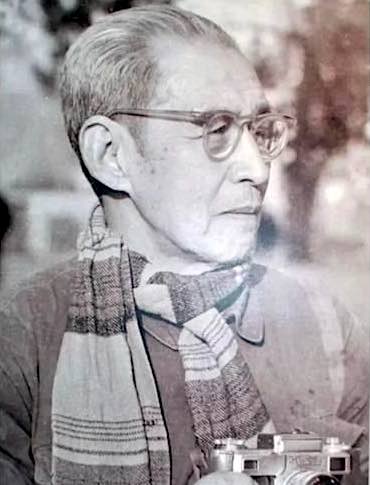
Berthold Laufer (left), Hankou c1904. Source here.

Wonderfully, the Indiana Archives of Traditional Music has now made available the Berthold Laufer China Collection of 385 wax cylinder recordings that Laufer made in Shanghai and Beijing in 1901 and 1902—in the wake of the Boxer uprising, as the collapse of the Qing dynasty was bringing two millennia of imperial rule to an end.

To explore the recordings, click here
(the link may take some time to respond)

The anthropologist Berthold Laufer (1874–1934) led the 1901–1904 Jacob H. Schiff expedition to China, also making a comprehensive ethnographic collection of objects used in daily life, agriculture, folk religion, medicine, crafts, and puppetry, including costumes and musical instruments.

The first 211 tracks in the collection were recorded in Shanghai (including many arias from Beijing opera, in chamber qingchang 清唱 form), tracks 212–385 in Beijing—the latter including drum singing such as Xihe dagu, Meihua dagu, and danxian. For more, see

  • Hartmut Walravens, “Popular Chinese music a century ago: Berthold Laufer’s legacy”, Fontes Artis Musicae 47.4 (2000)
  • articles by Laurel Kendall.

Of course, Laufer’s precious recordings are far from a general survey of musicking in late imperial China. Still, it would be most churlish of me to lament that he didn’t record other soundscapes such as temple and folk ritual…

Here’s a playlist of some other early recordings:

For posts on Qing court music, click here; for rare moving images of religious life in 1930s’ Fujian, here; for archive recordings from before and since the Cultural Revolution, here. And for Laufer’s egregiously misguided praise of smoking, see under Vermeer’s hat.

Punk: a roundup

slits

I may be an unlikely chronicler of punk, but it seems an important theme. Here’s a selection from the punk tag—starting with the great Viv Albertine:

moving on to

and by way of Nina Hagen, I explore punk under state socialism:

as well as

Madrid punk

For a female Indonesian metal trio, see Voice of Baceprot.

The temple of memories

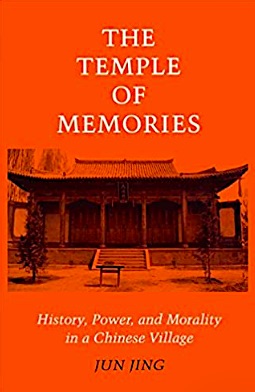
Jing Jun cover

Along with my common themes of religion, Maoism, and famine, I plead for more studies of ritual life in Gansu (see Gansu: connecting social trauma and expressive culture). So I’ve been re-reading the ethnographic classic

  • Jun JING, The temple of memories: history, power, and morality in a Chinese village (1996).

The opening of the book is compelling:

The Kongs of Dachuan cannot forget that winter, more than three decades ago, when their village was effaced and life as they had known it had ended. For much of 1960 they had ignored, then resisted, the government’s declaration that their homes lay in the path of one of the more ambitious projects of the Great Leap Forward, and that by autumn’s end they would have to make way for a hydroelectric dam and reservoir. […]

So months lapsed, the deadline passed, and still the Kongs stayed on. And then, on a chill December night, the militia entered, shock troops of eviction, targeting first households without strong young men. Old women screamed and clung to their beds, refusing to leave. They were carried out bodily. The supporting pillars of the houses were roped to mules and pulled down. As dawn broke, the frightened villagers began dismantling their own houses in a scramble to salvage what they could to build shelter elsewhere. They hastily dug up the graves of immediate ancestors and close relatives, and, in violation of all tradition, unceremoniously threw bones in cement sacks or whatever other containers they could find for reburial on higher ground. “It was no time for being proper about such things,” an elderly villager recalled years later. Nor did they have the physical strength to save older graves; the trauma of dislocation was exacerbated by a debilitating famine, the worst in modern Chinese history.

While still a student in the Sociology department of Peking University, Jing Jun began fieldwork in Dachuan in 1989, prudently absenting himself from the tense atmosphere of the capital in the aftermath of the 4th June massacre (cf. Liao Yiwu). He is among several fine Chinese anthropologists and folklorists such as Guo Yuhua, Wang Mingming, Yue Yongyi, and Ju Xi.

Apart from fieldwork with villagers, he also unearthed material by consulting the county archives.

* * *

For some scholars such a topic might be a disembodied paean to the resilience of imperial grandeur, but for an ethnographer like Jing Jun it makes a telling prism on the traumas of the Maoist era. Noting the background of serious poverty, he goes on to detail the fate of the “community of suffering” (cf. Guo Yuhua) after the 1949 revolution.

Jing’s study makes a worthy complement to detailed accounts of turbulent events in individual villages under MaoismHe explores two main themes: suffering (both individual and communal), and means of recovery from political persecution, economic deprivation, and cultural disruption. Amidst state attempts to dictate and manipulate remembrance and forgetting, he focuses on the politics of social memory, suggesting three main topics: collective, official, and popular memory.

Stylistically, whereas obligatory academic citations of broader theoretical perspectives may be formulaic, Jing Jun has a rare gift for making such comparisons revealing.

* * *

In Dachuan village in Yongjing county southwest of the provincial capital Lanzhou, 85% of the villagers belonged to the Kong lineage, considering themselves to be descended from Confucius. Dachuan was the centre for an ancestral cult of many villages in the county.

The earlier history of the temple was not untroubled: it had been destroyed in 1785, rebuilt in 1792, looted and burned during the major Muslim rebellion in 1864, but only restored in 1934—it seems curious if the cult remained inactive over this long period. It was just at this time that the Kongs of Dachuan contributed to the compilation of a major genealogy documenting the nationwide lineage; Confucius and the major ritual site for his worship at Qufu in Shandong play a major role in villagers’ historical imaginations (cf. the fate of the Confucian ritual in Hunan).

After “Liberation”

The destruction of their village was the central event in a long procession of tragedies for the Kongs under the new Communist regime.

Following the Communist takeover in 1948, the prelude to a long period of state-organised violence was the siege of Dachuan by the PLA in December 1950 in response to reports that a rebellion was being organised by “secret societies” led by the Kongs.

All exits from the village were sealed off as soldiers went from one compound to the next, searching for weapons. After a full cartload of daggers, spears, swords, hunting guns, and old muskets were hauled away, a mass rally was staged and about fifty local people were paraded onto an improvised stage. These villagers, whom the government accused of being affiliated with “reactionary religious associations” (fandong hui dao men), were warned by military and government officials that any misconduct on their part would meet with severe penalties. Three Kongs, key members of a semi-religious and highly militant group known as the Big Sword Society (da dao hui), were escorted out of Dachuan, and beheaded.

The search for weapons and the executions at Dachuan heralded the new government’s crackdown on religious societies. Five months later, an “investigation-and-registration” campaign identified more than 11,500 people in Yongjing county as members of “reactionary religious associations”.

The divisive land reform campaign was implemented from 1951 to 1953. Under the commune system the system of lineage elders was destroyed. Even as the Kong lineage was being persecuted, they continued to provide the village leadership.

In the early years of Communist rule, many of those not targeted

engaged in clandestine activities in smaller religious groups attached to temples honouring various deities and community patron gods. […]
Geomancy and shamanistic healing were still secretly practised until at least the early 1960s.

But during the 1958 Great Leap Backward, police and militia forces rounded up 855 people in Yongjing county; temples were dismantled, and religious implements destroyed. The Confucius temple at Dachuan was sealed off. In August an armed uprising was quelled in nearby Dongxiang county. As famine escalated from late 1959, the villagers were relocated in 1960, as the temple lay decrepit and abandoned.

Large-scale hydraulic projects were a major part of the state’s efforts to generate electricity by creating reservoirs, despite the great suffering they caused—and their social disruption continues to concern anthropologists. On 31st March 1961, as the floodgate of the Yanguoxia dam was lowered, Dachuan was among many villages flooded. Though there was considerable resistance, most villagers were forcibly relocated, while some remained on higher ground there. One of the most traumatic violations of tradition was the loss of gravelands.

Such stories are also submerged under the “master narrative” of rosy state propaganda, seeking to legitimise painful experiences.

The remains of the temple, empty and waterlogged, were still standing until 1974, when it was destroyed in the anti-Lin Biao and Confucius campaign.

The 1980s’ revival
Such a history of Maoism at the grassroots needs telling anyway, but it’s also essential background to the revival since the 1980s after the collapse of the commune system. Jing Jun observes:

These ideas and practices are not mechanically retrieved from the past; they are blended with cultural inventions, shaped by the local experience of Maoism, and permeated with contemporary concerns.

In a similar pattern to that taking place throughout China, as the villagers began to retrieve what had survived of the temple artefacts, rituals were held at a provisional ancestral shrine from 1984. The Confucius temple was rebuilt in 1991.

Dachuan 1

Jing explores the backgrounds and moral authority of the new temple leaders, and reflects on the whole process of cultural invention.

In a situation in which the administrative power of Dachuan’s village cares was rapidly shrinking, leadership in ancestral worship could be a key step toward winning respect, popularity, and even trust.

But power structures were in flux, as grievances from the Maoist era became public, with petition drives and demonstrations common.

Since the surviving lisheng ritual performers had only distant memories of how to perform the ceremony, they gradually recreated its liturgical structure, actions, and vocal style, culminating with the compilation of a ritual handbook in 1991 (this is not quite a typical case, I’d say: in many regions of China under Maoism, household ritual specialists had managed to transmit a more substantial corpus of their ritual expertise.) As Jing notes, there were certain models for the literary style of the written texts in the fragments of wider religious life. And I might suggest that even the rhythms and high-pitched style of the chanted elegies were not recreated in a vacuum: the traditional soundscapes of folk-song, local opera and shadow-puppetry, and so on—which had persisted to some extent under Maoism (for Hunan, see e.g. here)—might offer piecemeal clues.

Jing addresses the complex issues in studying genealogies, again focusing on social memory.

Dachuan 2

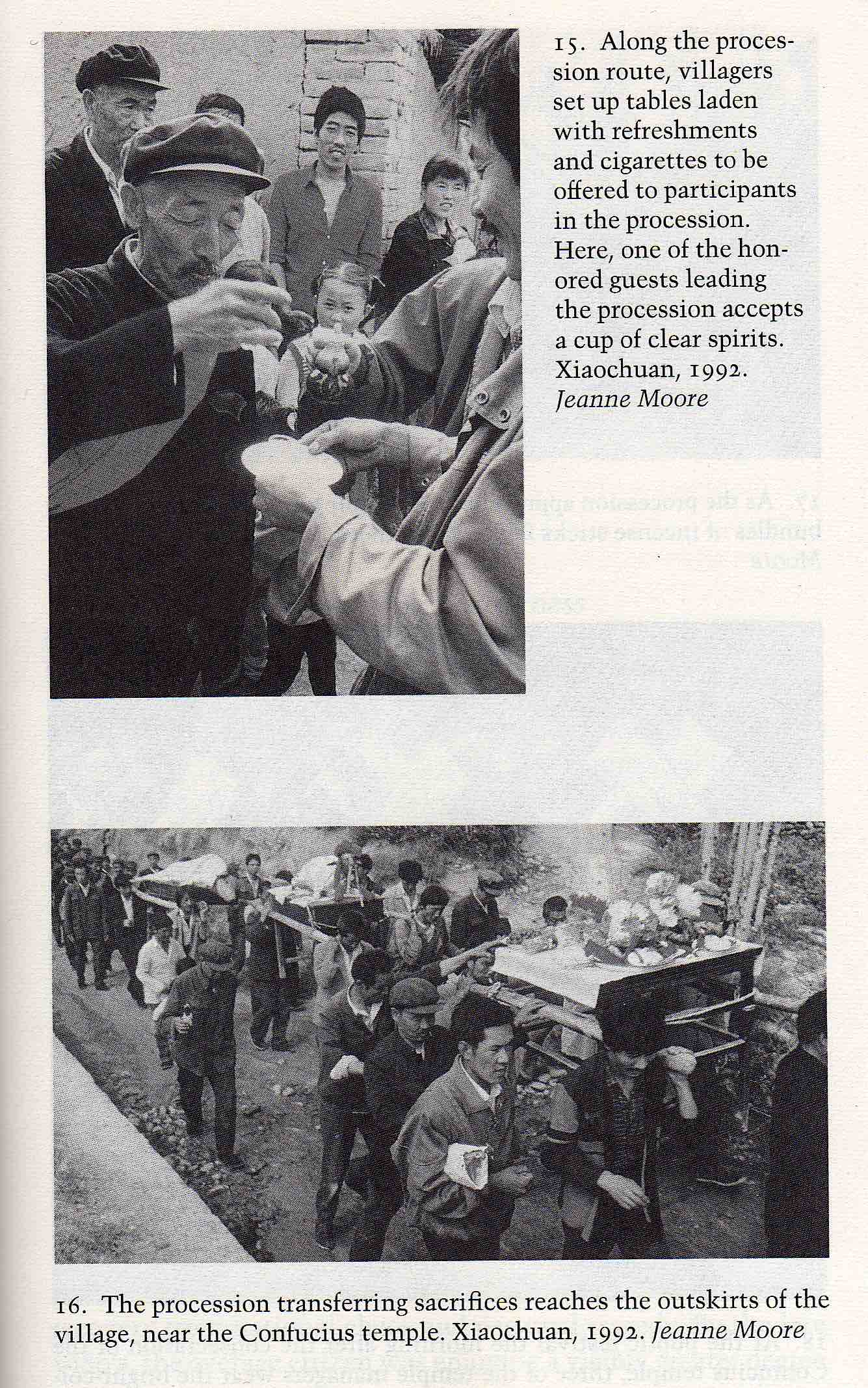
In 1992 the nearby village of Xiaochuan restablished its own Confucian temple. From 1958 it had suffered a similar fate to that of Dachuan. In both villages the ceremonies were now opened to outsiders beyond the immediate lineage. Jing distinguishes “dominant” and “variant” ritual structures.

In the latter, women played a major role (again, this is typical of temple fairs more generally)—including a spirit medium who brought over thirty female followers from her nearby village. Women were particularly devout in making vows, burning paper offerings, and singing songs of lamentation.

An older woman whose vivid renditions of songs from qinqiang, or Shaanxi opera, attracted a thick circle of spectators was led away by men in charge of the festival’s security. Another circle formed around a middle-aged woman whose body jerked spasmodically and who mubled what sounded like poems as if in a trance. She was carried away by the security guards, who were young men from Xiaochuan. After these women clamed down, they were sternly lectured by the festival organisers for having performed “superstitious” acts that could draw unwelcome attention from the local government to Xiaochuan’s festival.

Jing notes hierarchies among those attending the festival, and in the food provided. He goes on,

The woman’s eviction displeased some visitors, since singing is perfectly acceptable at many temple activities. This incident thus indicates a clash between two different perceptions of the festival.

While the Kongs were as fond as anyone of combining the singing of local opera with the worship of local deities, they rejected it as a proper form during a service for ancestor worship. Jing suggests that their antipathy went back to an incident in the early 1940s, when community leaders had objected to the staging of an opera inside the Xiaochuan temple to celebrate a bumper harvest—their resentments partly based on a rich man treating the occasion as a self-serving display of wealth and generosity. But as he says, few would have been aware of that. Such incidents mainly illustrate multivocal interpretations:

Such negotations were precipitated by variations in historical experience, personal memory, understanding of religious symbols, and concepts of ritual propriety.

Jing opens the impressive final chapter, “Finding memories in Gansu”, by encapsulating the tension between ethnography and history:

In an ethnography of the Kongs, one could take a synchronic approach, a type of analysis typical of the structural functionalists and French structuralists, that treats a society as if it were “outside of time”, that is, without reference to historical context.

Indeed, as I have noted, it’s more complex: in many field reports on local Chinese ritual, the fieldwork makes a pretext for timeless depictions that are dominated by early historical context while glossing over the current social picture.

Anyway, Jing gives ample reasons for placing the Dachuan rituals in their modern setting. He goes on to give instances of accounts of the memory of suffering in other societies, including Alan Mintz and Lucette Valensi on the Holocaust, and Anastasia Shkinlyk’s devastating study of the despair and agony of a relocated Ojibwa community (see here). He also cites Arthur Kleinman’s work on illness narratives among Chinese patients. And we can now add Stephan Feuchtwang’s study After the event (cf. China: commemorating trauma, including Wu Wenguang’s memory project).

He is right to note the official conformity of depictions in county gazetteers compiled since the 1980s—although in the accounts of Maoist campaigns and famine for some counties like Yanggao in north Shanxi (see e.g. my Daoist priests of the Li family, pp.122–3) one may discern a subtle resistance to state propaganda. He also sets forth from Frances Yates’s 1966 The art of memory to explore the historical memory embodied in religious artefacts.

As Jing Jun observes, the reinstated worship of Confucius in the Dachuan area is not an isolated case of religious revival in a rather remote part of China. He places it in the broad context of the religious revival in China, if not in Yongjing county. Thus while we find vignettes on other forms of religious expression (mediums, sectarian groups), his coverage might have benefitted from an outline of the broader fortunes of ritual life in the area through the 1950s, such as the fate of other temples in Dachuan and nearby, funerals and temple fairs, and the activities of household Daoists and bards. The story of the Dachuan temple make a particular but revealing case. [1]

For related reflections on memory in China, see here.


[1] Though focusing on ritual life before and since the Maoist era rather than on state initiatives under Maoism, a project on cults in Shaanxi and Shanxi led by Christian Lamouroux and Marianne Bujard, with Qin Jianming, Dong Xiaoping, and Patrice Fava, is also relevant. See e.g.

  • Marianne Bujard, with Dong Xiaoping, “Hydraulique et société en Chine du Nord: une coopération franco-chinoise en sciences sociales”, BEFEO 2001, notably the Yaoshan shengmu cult in Pucheng, Shaanxi:
  • Qin Jianming 秦建明 and Lü Min吕敏 [Marianne Bujard], Yaoshan shengmu miao yu shenshe 堯山聖母廟與神社 [The sacred mother temple and holy parishes of Yaoshan] (Beijing: Zhonghua shuju, 2003).

Frozen brass

Wind bands, and brass bands, continue to play a major role in the soundscape of many cultures around the world (cf. New Orleans brass bands; see also trumpet tag; for early wind bands in Europe, click here).

A splendid project by Rob Boonzajer Flaes, with Fred Gales, Ernst Heins, and Miranda van der Spek, resulted in 2 CDs issued on Pan records in 1993:

  • Frozen brass: Anthology of brass band music, #1: Asia
  • Frozen brass: Anthology of brass band music, #2: Africa and Latin America.

They’re magnificently ear-scouring. Both are on Spotify, and the Asia tracks are on a YouTube playlist:

The liner notes give perspectives:

In the times of colonialism, when European soldiers, traders, and missionaries set out to occupy large parts of other continents, they were accompanied by brass bands. The brass band stood for more than just instruments, uniforms, and songs. The martial appearance, the loudness of the instruments, the discipline of the musicians, and its mobility made it a proper symbol of the culture of the conquerors. Technological developments, strict training, rationality, and standardization had produced this ensemble: a band that could play anything in the temperate scale, everywhere, and always in time; a multi-functional ensemble suitable for emperors and military campaigns, enlightening the masses and evoking edifying religious feelings.

The brass band conquered the world as a well-devised formula, as a musical weapon, and a thunderous proof of Western military and religious superiority. Western habits and customs were forced upon the colonized; traditional music, dances, and instruments were forbidden; and local musicians were trained on brass instruments to perform in church, in school or at public events such as national holidays, royal birthdays, and visits of dignitaries. But of course sooner or later, someone discovered that a brass band could do more than merely reproduce Western classics, and enterprising musicians started to use the instruments to music a local audience would listen to, dance to, and—even more important—pay for.

The rigid and uniform colonial brass band came to terms with local music, leading to a wide variety of popular band traditions. Musical hybrids developed, not as part of any grand cultural tradition, but as an ingredient of local popular culture. Nowadays in many countries brass bands (or brass band derivatives) have become indispensable for weddings, circumcisions, processions, funerals, and even for communicating with spirits and inducing trance-like states.

Similar musical hybrids, for example the Bleh music from the Balkansklezmer from the Jewish communities of Eastern Europe, and—most famous of all—the development of jazz in New Orleans attracted the attention of the recording and writing industry. Outside Europe and North America, however, brass bands are only locally known.

The African, Asian, and Latin American brass bands are in many ways different from their western counterparts: the instruments may be worn out, or replaced by replicas; traditional drums may be added; and the uniforms can be anything from the local postman’s cast-offs to the most elaborate pieces of art. Marches and hymns are replaced by local tunes, mesmerizing rhythms, or decorous funeral music: tokens of the creativity of thousands of nameless plodders who made the brass band formula their musical way of living.

CD 1 contains tracks from Nepal, IndiaIndonesia (Sumatra, Java, the Moluccas, Sulawesi), and the Philippines; CD 2 has examples from Ghana, Surinam, Bolivia, and Peru. The notes give useful introduction to genres and bands.

For a taste, how about this Batak hymn from Sumatra, for the second day of a 1992 Protestant funeral:

Such tracks are not mere curiosities, but a window onto the soundscape of social life. Of course, audio recordings can only hint at the “red-hot sociality” of people interacting for communal activities—indeed, at the moment one misses social interaction altogether.

* * *

CWZ big band

Chang Wenzhou’s big band plays for village funeral, Shaanbei 2001.

Brass bands also became common in major Chinese cities from the 1880s, introduced by such Westerners such as Robert Hart, and in the Republican era warlords used them for their own armies. Since the 1980s they have developed out of folk shawm bands (my many posts on which start here), such as in Shaanbei (see my Ritual and music of north China, volume 2: Shaanbei, ch.9, and DVD). For links to posts on shawms around the world (China, Tibet, south Asia, the Middle East, north Africa, Europe), click here.

Left: funeral procession, Quanzhou 1990;
Right: Catholic band, Gaoluo village, New Year 1995.

As a bonus, click here for a wind band on ice in Tuva—opening with a Tsam masked ritual procession, to boot. This rather pre-empts my plan to stage the Matthew Passion On Ice.

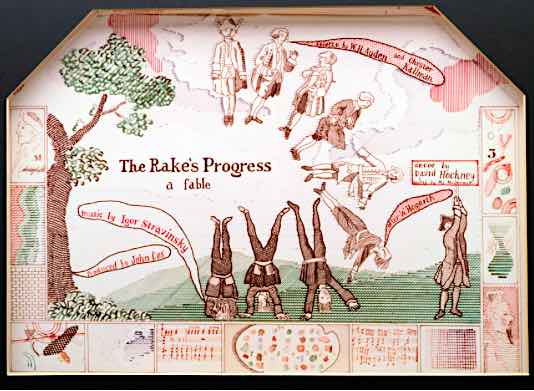
The rake’s progress

Hockney

Stravinsky’s opera The rake’s progress (1951, with libretto by W.H. Auden and Chester Kallmann, is loosely inspired by a series of paintings by William Hogarth.

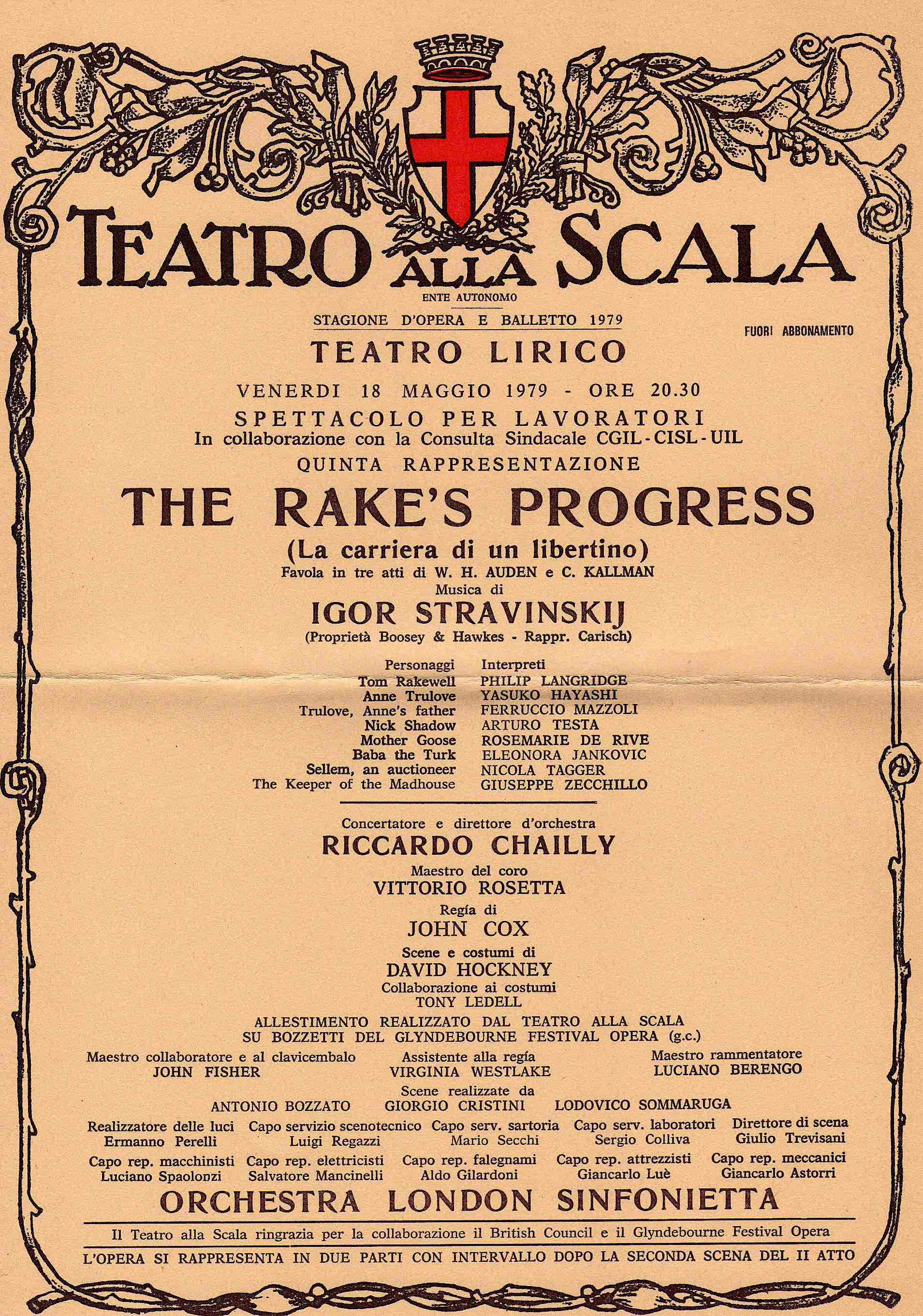
I got to know the opera in 1979 through playing it in the pit with Riccardo Chailly and the London Sinfonietta in Milan for La Scala, with sets by David Hockney. With performances only every couple of days, it made a wonderful three-week holiday, giving me my first opportunity to explore Milan and the nearby towns of north Italy (Cremona, Brescia, Bergamo, Verona, and so on), long before our 1990s’ tours of Mozart operas in Parma and Ferrara (for more Italian inspirations, see here). “But that’s not important right now“.

Rake 1979

As ever, Richard Taruskin‘s perspectives on Stravinsky’s opera are stimulating (The danger of music, pp.109–17). It also gives me another pretext to admire the wonderful Barbara Hannigan—here she is in concert, singing, and conducting, Anne’s aria from Act 1:

To follow Susan MccLary’s incisive comments on the astounding use of the harpsichord in Brandenburg 5, I admire its sinister use in the Act 3 graveyard scene.

See also Stravinsky tag.

Hogarth

William Hogarth, In the madhouse.


Some posts on Japanese culture

Here’s a varied selection from the Japan tag in the sidebar.

A little series on Noh:

and, less reverently:

On film:

Some haiku in English:

as well as

See also

and for some great Western proponents of Japanese culture:

Not forgetting the *Must-read*

Ordering a pint in Glasgow

Bryson

Bill Bryson’s Notes from a small island is full of perceptive observations about the British (for diverse comments on How to be English, see here). These vignettes also make a companion to my posts on the challenges of communicating in Chinese and Greek.

On a trip to Glasgow, Bryson finds that one doesn’t have to venture to exotic climes to experience the language barrier:

I wandered along a series of back lanes and soon found myself in one of those dead districts that consist of windowless warehouses and garage doors that say NO PARKING GARAGE IN CONSTANT USE. I took a series of turns that seemed to lead ever further away from society before finally bumbling into a short street that had a pub on the corner. Fancying a drink and a sitdown, I wandered inside. It was a dark place, and battered, and there were only two other customers, a pair of larcenous looking men sitting side by side at the bar drinking in silence. There was no-one behind the bar. I took a stance at the far end of the counter and waited for a bit, but no-one came. I drummed my fingers on the counter and puffed my cheeks and made assorted puckery shapes with my lips the way you do when you are waiting. (And just why do we do that, do you suppose? It isn’t even privately entertaining in the extremely lowlevel way that, say, peeling a blister or cleaning your fingernails with a thumbnail is.) I cleaned my nails with a thumbnail and puffed my cheeks some more, but still noone came. Eventually I noticed one of the men at the bar eyeing me.

 “Hae ya nae hook ma dooky?” he said.

 “I’m sorry?” I replied.

 “He’ll nay be doon a mooning.” He hoiked his head in the direction of a back room.

 “Oh, ah,” I said and nodded sagely, as if that explained it.

 I noticed that they were both still looking at me.

 “D’ye hae a hoo and a poo?” said the first man to me.

 “I’m sorry?” I said.

“D’ye hae a hoo and a poo?” he repeated. It appeared that he was a trifle intoxicated.

I gave a small, apologetic smile and explained that I came from the English-speaking world.

 “D’ye nae hae in May?” the man went on. “If ye dinna dock ma donny.”

 “Doon in Troon they croon in June,” said his mate, then added: “Wi’ a spoon.'”

 “Oh, ah.” I nodded thoughtfully again, pushing my lower lip out slightly, as if it was all very nearly clear to me now. Just then, to my small relief, the barman appeared, looking unhappy and wiping his hands on a tea towel.

 “Fuckin muckle fucket in the fuckin muckle,” he said to the two men, and then to me in a weary voice: “Ah hae the noo.” I couldn’t tell if it was a question or a statement.

 “A pint of Tennent’s, please,” I said hopefully.

He made an impatient noise, as if I were avoiding his question. “Hae ya nae hook ma dooky?”

“Tm sorry?”

 “Ah hae the noo,” said the first customer, who apparently saw himself as my interpreter.

 I stood for some moments with my mouth open, trying to imagine what they were saying to me, wondering what mad impulse had bidden me to enter a pub in a district like this, and said in a quiet voice: “Just a pint of Tennent’s, I think.”

 The barman sighed heavily and got me a pint. A minute later, I realized that what they were saying to me was that this was the worst pub in the world in which to order lager since all I would get was a glass of warm soap suds, dispensed from a gasping, reluctant tap, and that really I should flee with my life while I could. I drank two sips of this interesting concoction, and, making as if I were going to the Gents’, slipped out a side door.

One is reminded of the classic Billy Connolly story:

To be fair, Bryson has problems in the American south too (The lost continent):

Maybe things were picking up. Maybe now I would see chain gangs toiling in the sun and a prisoner in heavy irons legging it across fields and sloshing through creeks while pursued by bloodhounds, and lynch mobs roaming the streets and crosses burning on lawns. The prospect enlivened me, but I had to calm down because a state trooper pulled up alongside me at a traffic light and began looking me over with that sort of casual disdain you often get when you give a dangerously stupid person a gun and a squad car. He was descended from the apes like all the rest of us, but clearly in his case it had been a fairly gentle slope. I stared straight ahead with a look that I hoped conveyed seriousness of purpose mingled with a warm heart and innocent demeanor. I could feel him looking at me. At the very least I expected him to gob a wad of tobacco juice down the side of my head. Instead, he said, “How yew doin’?”

This so surprised me that I answered, in a cracking voice, “Pardon?”

“I said, how yew doin’?”

“I’m fine,” I said. And then added, having lived some years in England, “Thank you.”

“Y’on vacation?”

“Yup.”

“Hah doo lack Miss Hippy?”

“Pardon?”

“I say, Hah doo lack Miss Hippy?”

I was quietly distressed. The man was armed and Southern and I couldn’t understand a word he was saying to me. “I’m sorry,” I said, “I’m kind of slow, and I don’t understand what you’re saying.”

“I say” — and he repeated it more carefully — “how do yew lack Mississippi?”

It dawned on me. “Oh! I like it fine! I like it heaps! I think it’s wonderful. The people are so friendly and helpful.” I wanted to add that I had been there for an hour and hadn’t been shot at once, but the light changed and he was gone, and I sighed and thought, “Thank you, Jesus.”

Several commentators take Bryson to task for getting cheap laughs at the expense of people who are different (e.g. here; cf. Molvania), though some defend him. Indeed, I tend to feel he’s laughing at his own preconceptions and incomprehension.

Another Uyghur film-maker

*For more, see my roundup of posts on Uyghur culture*

In Xinjiang, the Uyghur people, and their whole culture, remain under severe repression. Still no news emerges of the great anthropologist Rahilä Dawut.

The Uyghur dancer, film-maker, and anthropologist Mukaddas Mijit, based in France since 2003, has a creative engagement with the beleaguered culture of her homeland. Do consult her website, and her YouTube channel,

Among her short films, I note this documentary on the Centre for Muqam Transmission in Qumul, inaugurated in 2009 with UNESCO support, some years before the clampdown. The Centre, like others of its kind, makes a classic instance of staged commodification, a world away from Uyghur folk culture—showing how the Chinese state attempts to sanitise it through reification, under the insidious banner of “safeguarding”:

One senses the reservations of the senior muqam masters recruited to the Centre. What has become of such flagships for Uyghur culture amidst the current genocide?

It’s not that an autonomous Uyghur nation wouldn’t be capable of such reification. Such initiatives have long been common among independent nations in Central Asia and elsewhere.

Here’s Mukaddas Mijit’s artistic tribute to her parents’ hometown of Ghulja—long among the flashpoints for ethnic tension in the region, and the site of a 1997 massacre:

She also pays attention to Uyghur rock music—here’s the band Qetig, recorded in Urumqi:

Meanwhile the fate of Uyghur culture at the grassroots—life-cycle observances, pilgrimages, and village celebrations like the mäshräp—looks bleak. For Mukaddas Mijit’s recent film on Uyghur meshrep in Kazakhstan, see note here.

For a conference at SOAS on “Surveillance and repression of Muslim minorities: Xinjiang and beyond”, click here.

How to mangle, and relish, words

Windsors

For a fruitful way of spending your time under isolation, The Windsors (Channel 4, three series now available) has much to delight in—not least linguistically.

The entire cast is brilliant. Charles (Harry Enfield) and Wills (Hugh Skinner, gormlessly idealistic to follow his cameo as feckless Will in W1A) have great fun with their posh accents and mannerisms; but it’s the personas, and voices, of Princesses Beatrice and Eugenie (Ellie White and Celeste Dring, wonderful) that I find most fascinating (or rather fascinatoring).

Along with their spectacular vapidity, their facial expressions and body language contributing to the effect, they both mangle and relish their vacuous words, constantly finding new ways of distorting vowel sounds—and even lavishing their regal attention upon the last word of a sentence, managing to elongate final consonants.* So just as you think the sentence is fizzling out with its usual innocuous ending, there’s a whole concentration of extra input. It’s like a VAR replay, slowing up even more to show if the ball really crossed the line.

Celeste Dring was inspired by Made in Chelsea—indeed, her very name surely qualifies her for the role. At least they go easy on the whole AQI uptalk thing???, though it is well suited to the Sloaney style (“I’m like, hellooooo?”).

A taster (“I think a job is where you have to go into a building, or something…”):

In their attention to enunciating vowels and consonants I detect a progression from series 1 to series 3. Good start-up words to practise include “now”, “house”, “years”, “money”, “water”.

The princesses deserve an award for elocution, if perhaps not for advancing the cause of women.


* BTW, the extensive stammering tag on this blog is worth consulting. One feature of speech impediments is that we (that’s an inclusive “we”—disfluencies of all kinds may afflict royalty and their loyal, servile subjects alike) tend to stammer on initial consonants: it’s getting going that’s the problem. One technique in “prolonged speech” therapy, a means of desensitisation, is to elongate the consonants, smoothly (easier for ssssustainable nasals and fricatives, whereas p-p-p-plosives have to be repeated). Now the fragrant princesses have got me wondering if it might be fair to give the neglected final consonants a chance too.

The struggle against Mussolini

Rossellis

Amelia with her sons Carlo r(ight) and Nello Rosselli.

As a necessary reminder that Italy is more than gorgeous paintings and picturesque piazzas, I’ve been reading

Moorehead

  • Caroline Moorehead, A bold and dangerous family: the Rossellis and the fight against Mussolini (2017).

The book is framed by crucial murders: of Giacomo Matteotti in 1924, and of the brothers Carlo and Nello Rosselli in 1937.

The rise of fascism in Italy is amply studied by scholars such as Richard Bosworth. Yet the focused, personal angle of biography makes an engaging perspective on the political upheavals of the 20th century—as we find for China (e.g. here; see also under Cultural Revolutions, including my work on the Li family Daoists).

The present physical and mental landscape of Europe is shaped by the events of the past century (for fascism—Italy 1922–45, Portugal 1933–74, Germany 1933–45, Spain 1939–75—see this wiki article). I’ve outlined the rise of fascism in Spain and Portugal in the context of their singing cultures. And as in China, it can be tempting to retreat into nostalgia for early cultural grandeur.

Amelia: the early years
While the fate of the brothers is the main story of the book, their lives shouldn’t overshadow that of their mother, Amelia Pincherle Rosselli (1870­–1954), Jewish feminist, playwright, and translator.

Reminding us that Italy was only unified in 1870, Moorehead evokes Amelia’s early life in Venice; alongside its splendour, she notes its decaying, sinister feel (D.H. Lawrence: “abhorrent, green, slippery”). She was excited by the launch of the first vaporetto in 1881. Her father died when she was 14, whereupon she moved to Rome. She came to share the ideals of Giuseppe Mazzini, a family friend who spent much of his exile in London. His

patriotism, his hatred of xenophobia and imperialism, his honesty and moral clarity, were all crucial to the Rossellis’ view of themselves and the world they lived in.

Amelia young

Amelia at the time of her marriage.

After her wedding in 1892, the couple took a honeymoon of nearly three months, visiting Naples, Nice, Monte Carlo, Spain, Portugal, North Africa, France, and England. In Vienna Amelia became more politicised, absorbing feminist ideas; becoming multi-lingual, she soon gained a reputation for her challenging plays. After returning to Rome, she gave birth to three sons. But as the couple grew apart, Amelia took them off to live in Florence in 1903, a rather benign separation. There, as Moorehead notes with perspective on modern architectural vandalism, in the last fifteen years alone,

one of the most famous city centres in the world had been stripped down—26 old streets destroyed, along with 40 piazzas—in the name of modernity and hygiene.

Florence (also with a lively expat English community) now made a lively venue for Amelia’s creative talents. Her plays in Venetian dialect were well received. She took part in the evolving feminist movement. Politics played a growing role; as anarchists fostered strikes among the many poor city-dwellers, later battle lines were drawn between reformers and reactionaries. Gaetano Salvemini (1873–1957), an inspiration for the Rossellis, was among the most long-lived anti-fascist historians.

While thinkers were keen to free Italy from the passatismo cult of the past, some futurists also extolled war, like Filippo Tommaso Marinetti; it was important, he wrote, to liberate Italy from

its smelly gangrene of professors, archeologists, Ciceroni and antiquarians. We mean to free her from the numberless museums that cover her like so many graveyards. […] We will glorify war, the world’s only hygiene […] and scorn women.

Hmm—just when it was going so well…

Amidst the cataclysm of World War One (Moorhead notes that as many as half of the Italian soldiers were illiterate), the death of Amelia’s oldest son Aldo in the Dolomites was devastating.*

The rise of Mussolini, and the resistance
The unhealed scars of hatred from the war led to the rise of Mussolini. Major strikes of workers from 1920 to 1922 were countered by “punitive expeditions” against “subversives” by fascist squadristi, egged on by the police, army, and judiciary.

Carlo became part of a committed anti-fascist circle that included Filipo Turati, Giacomo Matteotti, and the young Piero Gobetti. Through Salvemini he met the Englishwoman Marion Cave, who would become his wife. In 1923, after a trip to Paris, he got to know the Italian community in London, busy with its own political tensions.

The first Italians, pedlars, organ-grinders, and jugglers had arrived in London early in the 18th century, and settled in Clerkenwell, turning its narrow, modest streets into a little Italy, where few of the women spoke English. England had been welcoming to these exiles, as it was to the artisans, barbers, asphalters, carpenters, tool-makers, cooks, and ice-cream makers who travelled up through France and across the Channel all through the 19th century. Arriving in Clerkenwell, they felt at home among the flowering window boxes and the sheets hanging from the windows. Some sold ice from the back of a cart. Others opened boarding houses. Pasta was made at home, then hung from the washing line to dry.**

Among the more affluent Italian community in London many were sympathetic to the fascist cause, including groups like the splendidly-named Ice Cream and Temperance Refreshment Federation. But others lampooned the fascists.

After taking part in a Fabian gathering in genteel Hindhead, Carlo visited Birmingham and the Midlands, “the real England, smoky, dirty, industrial, ugly, productive”—though he found no redeeming features in English food of whatever social level.

After a brief period of ambivalence towards women’s rights, by 1923 Mussolini went on the attack against feminism. Soon

magazine articles showed pictures of comely peasant women in national dress. And sturdy peasant men “mirthful”, yet “sober in their habits”, enjoying “health” and “praiseworthy” pastimes. Private dance halls were closed “for reasons of morality”. People were urged to become lean, willowy, sinewy. “I have no pity,” declared Mussolini, “for the fat”. The new Italian was to be “Herculean”, potent, granite-like, made of steel.

Italian youth were indoctrinated in the Balilla movement (not to be confused with the Barilla pasta company, latterly unlikely sponsors of the wonderful Coco Gauff). Mussolini sent a mission to England to sudy Baden Powell’s Boy Scouts.

Matteotti

The last photo of Matteotti (centre), shortly before his murder.

The murder of Matteotti in 1924 was a decisive moment, shocking the younger dissidents into political action. It was now clear that Mussolini could not be defeated by legal means.

As repression intensified in Italy, Carlo visited London again to observe guild socialism and the new Labour government. Back in Florence, fascist squadri were ever more active. In Monteleone a sculpture was erected of a Madonna and child brandishing a club, La Madonna del manganello. Salvemini was forced into exile.

Confino
After managing to help Turati flee to Paris, Carlo was thrown into prison. Though the sentencing of the defendants to a mere ten months at the “trial of the professors” in 1927 seemed like some kind of victory against fascism, Mussolini still sent them off for five years’ confino on a succession of remote island penal colonies. Meanwhile Nello married Maria Todesco; but he too was soon sentenced to confino.

Banishment to penal colonies was a common method of dealing with opponents of the fascist regimes in Europe (for Portugal, see here; cf. The first gulag), and had a long history as far back as ancient Rome. As elsewhere, in recent years these islands—Ustica, Favignana, Lipari, Ponza, Pantelleria, Lampedusa, Le Tremiti—have become tourist destinations, their painful histories often ignored. In recent years they have also become staging posts for desperate migrants on the route to Europe.

Though conditions were spartan, the islands had a certain rustic charm, and compared to many other such camps conditions were relatively benign. Those with sufficient funds were able to find their own dwellings; they received basic supplies from relatives, and educated themselves—and the locals. The Rossellis’ wives and children, and Amelia, were permitted to join them. Early in 1928, Nello was released from Ustica, though he remained under surveillance.

Meanwhile Carlo was on Lipari. Again the confinati kept busy, selling doughnuts, organizing deliveries of Parmesan, giving talks on Dante.

Left: Nello’s house on Ustica, with a crowd of confinati.
Right: Carlo, with Nitti and Lussu, escaping from Lipari on their way to freedom.

Fleeing from such islands was considered impossible; yet in 1929, after several attempts, Carlo managed to escape with two other confinati by boat to Tunisia, eventually reaching Paris, where he joined a lively community of anti-facist exiles; soon Marion and their young children arrived. Nello was soon returned to Ustica before being moved on to Ponza, but he was released again by November.

The struggle continues
Though Mussolini’s network of spies was active in Paris, Carlo and his comrades still managed to stage demonstrations in Italy against fascist power, dropping leaflets by plane over Milan. Such resistance may seem largely ineffectual, but it was significant.

In 1930 Nello spent time in England, meeting up with Salvemini and English supporters of the cause. Amelia joined him. Her nephew Alberto Moravia also arrived; though he was now fêted for his novel Gli indifferenti, Amelia and Nello were disturbed by his cool cynicism. Stopping off in Paris on his way back to Italy, Moravia met up with Carlo, who asked him to post a letter in Rome for an anarchist friend, which he did reluctantly.

This passage may sound familiar:

The Italians were fed inconsistencies, falsehoods, contradictions, differing interpretations, all designed to mystify and confuse, many of it [sic] couched in stentorian, martial tones over the radio. It was forbidden to mention failures.

As the indoctrination of youth continued, we can imagine Amelia’s reaction:

As for girls, who had to be protected from the “unnatural desires of English suffragettes” and the frivolity and worldliness of “French coquettes”, they were made to dance, garden, iron, and knit, and given “doll drills”, in which they were taught how to hold babies the correct way. When, in the early summer of 1928, thousands of girls between the ages of 16 and 18 were brought to Rome for the first gymnastic-athletic competition, they were told to discipline their muscles and take part in rifle practice, while at the same time to study “good mothering”, in order to become “neither feeble… nor gloomy”. (Pope Pius XI protested about the rifles: if girls raised their arms, it should “be always and only in prayer and charitable actions”.)

Marinetti continued to propound his wild vision: he

wanted to “fascistise” all culture, do away with classical architecture and fill Italy’s squares with electric trams and overhead wires. He wanted to industrialise Venice and ban everything foreign—films, food, orchestras, and even languages—within “our virile, proud, dynamic pensinula”.

Being antipassatista involved being anti-pasta:

And since the new man had to be futuristic inside as well as out, he launched a campaign against pasta, saying that it had made Italians gross, lazy, complacent, and stupid, and led to pessimism and prostitution. “Until now men have fed themselves like ants, rats, cats, and oxen,” he declared in an article on Futuristic cooking. The new man would do better to eat black olives, fennel hearts, and kumquats, and as he ate, stroke sandpaper and velvet, enjoying the contrast in taste and texture, while a waiter sprayed carnation-scented water on to the back of his neck and from the kitchen were relayed the roars of aeroplane motors. At the Holy Palate, his proposed Futuristic restaurant in Turin, diners would be given a boiled chicken accompanied by ball bearings in whipped cream, served by a “woman of the future”, bald and wearing spectacles. Compared to the remorseless severity and humourlessness of most fascist dictators, Marinetti’s crazy fantasies had a certain innocent charm.

Though Marinetti’s vision may have had little long-term impact, Mussolini did indeed wage war on pasta. His remark to Bocchini, head of his secret police, has a more contemporary ring:

We want to create a kind of magical eye which keeps Italians under control and can at any moment provide me with a complete, up-to-date picture of everything being said and done in the whole of Italy. Men … with the craftiness of a fox and the speed of a serpent, they need to learn the difficult art of provocation, how to insinuate themselves into a crowd, how to fit into every situation and every social circle.

In Florence

a “moral cleansing” was launched, with campaigns against swearing, pornography, immoral plays, and indecent fashions. “Eroticism” was done away with, wherever it occurred. Girls were enjoined not to dance the Charleston, and to wear thick stockings and blouses with long sleeves. Dance halls were closed down. There were calls to ostracise “Northern habits”, such as Christmas trees.

Amelia resigned from the Lyceum, once a lively forum for ideas.

The anti-fascists continued their work. In October 1931 leaflets were dropped over Rome. But the secret police were ever-vigilant.

Turati, whom Carlo described as the moral leader of Italy, died in Paris in 1932. With the aid of Sylvia Pankhurst (but not the British government), Carlo attempted to help Matteotti’s widow leave Italy for Paris.

After Hitler came to power in Germany, he came to Venice in 1934 to meet Mussolini for the first time—neither was enamoured.

In 1935 the remaining members of the anti-fascist network in Turin were arrested—including Carlo Levi, whose months of exile in a southern village prompted him to write Christ stopped at Eboli.

Full of bellicose imperial ambitions, Mussolini launched a brutal campaign in Abyssinia. The reproaches of the British government prompted another tirade from the ever-reliable Martinetti, decrying British snobismo, alcoholism, degeneracy, lack of genius, and above all their “sexual abnormalities”.

Carlo was now recognized as leader of the Paris exiles, and, for the spies watching him, the main threat. In Italy, Moravia had just published Le ambizioni sbagliate, but he rebuffed Carlo’s attempt to recruit him to the cause.

Spain, and the assassination
In 1936 the Spanish civil war broke out, with Franco supported by Mussolini. As the anti-fascists sought to redeem their past failures, Carlo set off for the front with a band of volunteers. But with the resistance soon riven by dissent, Carlo returned to Paris in January 1937. That year too, Antonio Gramsci, leader of the Italian Communist Party, died after eleven years in prison.

In Florence anti-semitism was ever more flagrant. Just as a cell of French Cagoulards, with the blessing of Mussolini, was plotting to have Carlo eliminated, Nello, fatefully, resolved to meet his brother in Normandy. In June 1937, after a happy reunion, they were ambushed and murdered as they drove through the woods—Carlo was the target, Nello an unfortunate collateral victim.

The truth emerged only gradually; Pablo Picasso and André Breton were among a group of intellectuals who wrote that if the death of Matteotti had signalled the death of liberty in Italy, that of the Rosselli brothers has signed its death warrant in the whole of Europe.

From Alberto Moravia, Amelia’s much loved nephew, there was total silence. No telephone calls, no letters, no flowers. She did not take it well.

Amelia, broken, left Italy with Maria to Switzerland; soon Marion joined them. Seeking wider horizons, in 1939 they moved to an English village. In 1940 the Germans invaded France; the family now felt it wise to emigrate again to the USA. In New York too, politics were divisive. They met up with like-minded exiles, including the senior Salvemini, who had taken up a teaching post at Harvard in 1934 after going into exile in Paris in 1925.

In a household of women, the matriarch Amelia was now in her seventies; more than either of her daughters-in-law, she approached the New World with curiosity and openness.

Mussolini was ousted from power in the summer of 1943 before he was executed in April 1945. From afar, the Rossellis learned of the liberation of Florence and Rome. Trials were now held for the murders of Carlo and Nello. The family returned to Italy in June 1946, learning how their friends and acquaintances had collaborated with the fascists. In 1951 the bodies of Carlo and Nello were moved from Père Lachaise cemetery to Florence.

Moravia
In 1945 Alberto Moravia had at last written to his aunt Amelia trying to explain his inability at the time, under surveillance, to express his condolences for the murder of Carlo and Nello; but she considered him to have acted “out of opportunism, or, at its most charitable, out of weakness”.

Moravia (1907–90) comes poorly out of this whole story. His novel The conformist (1951), which Bertolucci made into a wonderful film (see this post), reads as a telling denunciation of fascism, and is based on the lives and deaths of the Rossellis. The story of Marcello, the damaged protagonist falling prey to the fascist cause in his vain search for “normality”, contrasts with the principled, life-affirming exiles in Paris; his betrayal of Professor Quadri leads to the horrifying assassination of him and his wife in the woods. Yet Moravia remained distant from the Rosselli family. Was his novel a plea for absolution? Of course, not everyone could be as brave as the Rossellis: at the time, and for many years to come, people had to make uncomfortable moral choices throughout Europe (e.g. the GDR), Russia, and China.

Conformist

From the film The conformist.

Carlo’s widow Marion died in 1949, and “the Rosselli heroes left sad legacies of depression and troubled minds”. Amelia, ever strong, died at the age of 84 on Boxing Day 1954. Melina, daughter of Carlo and Marion, became a successful poet, but committed suicide in 1996 on the anniversary of the death of Sylvia Plath, whose work she had translated.

* * *

As this review notes, Moorehead makes use of contrasting sources: not only the family archive of letters, shot through with love and shared political passions, but also the huge stash of documents, inspired by suspicion and hostility, from the network of spies who documented their every move.

Now I look forward to reading her account of the resistance around Turin, A house in the mountains: the women who liberated Italy from fascism (2019). And then onto all the murky politics of later Italian politics, and the continuing threat of fascism.

Why didn’t I know, or care, about all this through my youth? Alas, my interests were so abstruse. It’s also a world away from the concerns of the Burlesque-only generation; yet the scars remain, and as fascism turns out not to have been erased, it seems ever more relevant. Like Neil MacGregor, I also wonder,

What would we have done?


* In England such trauma was to be movingly evoked by Vera Brittain, who lost her brother Edward in the same region.

** For a fascinating account of Italian folk musicians in England playing zampogna bagpipes and other folk instruments, click here. The zampogna was still heard in 1960s’ New York. Moorehead might also have mentioned more reputable early Italian migrants to England like performers of WAM.

Blind musicians in China and elsewhere

Blind musicians have long been major transmitters of traditional culture: do click away on this list of some posts featuring them.

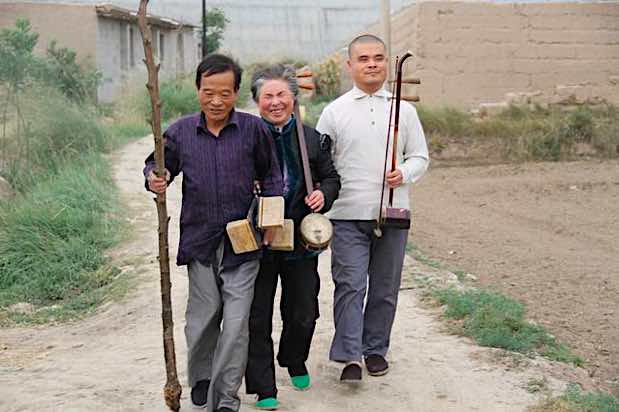
For China—mainly shawm players and bards (passing quickly over the “usual suspects”, the ancient Master Kuang and the ubiquitous Abing):

as well as my first two posts on Coronavirus:

For blind musicians elsewhere:

Indeed, one could greatly augment the list for many other cultures around the world.

Self-mortification: dervishes of Kurdistan

with a note on Tibetan spirit mediums in Amdo

dervish

Leading on from my post on Yazidi culture, here I consider a distinctive kind of ritual activity among the Kurds—mainly through a fine documentary from 1973.

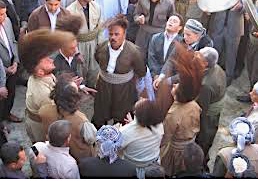
Suffering in the quest for union with God is a universal theme, such as among the Uyghur ashiq, or indeed the Bach Passions. An extreme instance is the controversial yet widespread practice of tatbir ritual self-mortification by such acts as flagellation and skewering the body. Practised quite widely through the Islamic world, mortification of the flesh is a theme in other ritual cultures too, including Christianity: it was practised by Lutherans and Methodists, and among Catholics, rituals continue in Spain and Italy. It seems rare in China, though spirit mediums perform self-mortification at extreme northwest and southeast regions: Tibetans in Amdo, and Hokkien in south Fujian and Taiwan. [1] As ritual performers in the public domain, they are male (see here).

As to Kurdistan, dervishes—broadly members of a Sufi tariqa lodge/order/fraternity, sometimes also religious mendicants—perform dhikr (zikr) ecstatic devotional acts, commonly in the form of litanies, but also in rituals of self-mortification. Of course, as in other cultures, this is only one among many manifestations of faith. Beyond sensationalist voyeurism, one hopes for a more sober ethnographic approach—like the documentary

  • Kurdistan: the mysterious dervishes (André Singer and Ali Bulookbashi, 1973, in the series Disappearing world).

It shows the daily lives and religious practices of a dervish community in the Kurdish village of Baiveh on the border between Iran and Iraq, at a time when the two countries had cut diplomatic ties. Many were refugees from Kurdish areas of Iraq; a major source of their economy was contraband. They were dervishes of the ecstatic, mystical Qadiri cult. The film explores the spiritual and temporal power wielded by their leader Sheikh Hussein. By serving him the dervishes consider that they are also serving God. He presides over rituals in which they have the power to carry out acts which would normally be harmful, such as having electricity passed through their bodies, eating glass, and skewering their faces.

It is the less privileged members of the community who seek to enhance their status through performing such acts of subservience—demonstrations of loyalty, as much to the Sheikh as to God. The film also includes explores the tensions with the local mullah, representative of orthodox Islam; but it is the complex of modern secular values that pose a greater challenge to the ways of the dervish, and to the Sheikh’s feudal power.

Here’s the film—not at all for the faint-hearted:

A restudy would be interesting.

A more recent French documentary also features extreme scenes.

The resilience of tradition in troubled modern times is also shown in the revival of ritual pilgrimages, again often featuring tatbir (on the revival since the fall of ISIS, see e.g. here). The ancient battle of Karbala is commemorated in the Arba’een pilgrimage to Karbala that marks the end of the Ashura festival.

As ever, the commodified urban performances of dervishes for tourists that are often featured in the media—invariably cast as “whirling”—are a world away from local rituals—though they too are a proper subject for ethnographers.

See also Some Kurdish bards, and Zaza and Hawrami.

Tongren 1

Qinghai 2

Tibetan self-mortification, Rebkong: source here.


[1] For trance mediums in Amdo, see here. For the 6th-moon Klu-rol festival of Tibetans in Rebkong (Tongren), Qinghai, note
Charlene Makley, “Rebgong’s Klu rol and the politics of presence: methodological considerations” (2013), perceptively situating the event within the changing politics of the area as it has become a tourist attraction since 2001 (as you can see from online videos). And now she has published The battle for fortune: state-led development, personhood, and power among Tibetans in China (2018).
Among several other articles, see e.g.
Kevin Stuart, Banmadorji, and Huangchojia, “Mountain gods and trance mediums: a Qinghai Tibetan summer festival”, Asian folklore studies 54 (1995);
articles by Katia Buffetrille, including her chapter in a special volume on Mediums and shamans in Central Asia; and
Cao Benye 曹本冶 and Xue Yibing 薛艺兵, “Renshen gongwu: Qinghai Tongren liuyuehui jishen yuewude diaocha yanjiu” 人神共舞: 青海同仁六月会祭神乐舞的调查研究, in Cao Benye (ed.), Zhongguo chuantong minjian yishi yinyue yanjiu, Xibei juan 中国传统民间仪式音乐研究, 西北卷 (2003, with DVD).
For more references, see Isabelle Henrion’s extensive Western-language bibliography on the Tibetan performing arts, §8. Note also R. Solomon Rino, Deity men: Reb gong trance mediums in transition (2008).

For self-mortifying mediums in south Fujian, note Ken Dean’s fine film Bored in heaven; for Taiwan, see Donald Sutton, Steps of perfection (2003), Margaret Chan, Ritual is theatre, theatre is ritual; tang-ki: Chinese spirit medium worship (2006), and Patrice Fava’s 1995 film Mazu la déeese de la mer, réalité d’une légende.

For a broader treatment of self-inflicted violence in the imperial history of Chinese religion, see Jimmy Yu, Sanctity and self-inflicted violence (2012).

Cf. the Rufai order in the Balkans, and Sun dance rituals.

A thingamabob about whatchamacallit

thingummy

“At my age” I find myself having rather more recourse to what are cutely known as placeholders, rather like the boring prophets in The life of Brian:

There shall, in that time, be rumors of things going astray, erm, and there shall be a great confusion as to where things really are, and nobody will really know where lieth those little things wi-with the sort of … raffia-work base that has an attachment. At this time, a friend shall lose his friend’s hammer and the young shall not know where lieth the things possessed by their fathers, that their fathers put there only just the night before, about eight o’clock.

Beyond our own oojamaflip, thingamajig, whatchamacallit, gizmo, and doohickey, the useful site Europe’s not dead now enables the Europhile to tour throughout the continent and make an impression on the natives with a convincing grasp of idiom in a variety of languages—from Italian coso, Portuguese coiso and cena, chisme in Spanish, and the French truc to a wealth of words in Scandinavia (not least the Norwegian duppeditt and snurrepipperi) and around central and east Europe. Many are genital in origin; and for the organologist, in Belarus people sometimes use bandura—erstwhile a plucked lute, big and inconvenient to carry.

What’s more, a lengthy, erudite Twitter thread has supplemented the list with languages around the world. BTW, Chinese nage shenme (“that what?”) may be colloquially abbreviated, with classical economy, to nasha.

Seriously Though Folks, while taking care to avoid over-using such terms, allaying suspicion that one doesn’t actually know any words at all in the language in question, it’s precisely idioms like these that allow us to endow our colloquial conversations with authenticity. See also Some global idioms.

Let me see now, what did I come in here for again?

The changing musical life of north India: social structure, and the sarangi

*For a roundup of posts on raga, with a general introduction, click here!*

Neuman cover

The photo shows a gathering of music masters in Nepal, c1900.

While immersing ourselves in the melodic and rhythmic riches of Indian raga we may forget that, like any other musical culture (including WAM), it is an evolving product of a social system, and that “music isn’t a thing, but an activity“. Bruno Nettl’s imaginative citing of the north Indian gharana system in his book on the schools of WAM reminded me to re-read the important early study

  • Daniel M. Neuman, The life of music in north India: the organization of an artistic tradition (1980, with updated preface, 1990).

Nettl ranks Neuman’s work alongside other ethnographic studies of a similar vintage, such as Steven Feld’s work on the Kaluli, Paul Berliner on the mbira, and Lorraine Sakata on Afghan musicians. It also makes a good instance of Nettl’s own taxonomy of responses to change in musical traditions around the world.

Bearing particularly on traditions of “art music”, Neuman’s points may vary significantly for regional folk genres, for India (see under Indian tag, e.g. Shawm and percussion bands of south Asia) and elsewhere around the world (such as flamenco, the festivities of Morocco, or—you guessed it—Chinese shawm bands), where intensity and communication are just as relevant but depend more on constant exposure than on rigorous formal training.

From afar I was absorbed in raga long before I began visiting China. It was a pioneer on the scene later dubbed “world music”, invigorated by the hippy vibe of the 1960s. Raga (at that stage mainly considered as a solo instrumental genre) seemed a pure, spiritual art—and that is indeed part of the story. Like WAM (see links under Society and soundscape) and Chinese music (e.g. Debunking “living fossils”), it may seem timeless, autonomous; and most early studies focused on disembodied musical analysis, notably on the art of improvisation. But change, both social and musical, is a constant theme—a process going on since at least the mid-19th century and still proceeding apace. Neuman’s analysis makes an important corrective to those who still prefer to leave their orientalist fantasies of the Mystic East untrammelled.

In a preface for the 1990 paperback edition, Neuman observes change even over the years since he carried out his original fieldwork, such as the boom in institutions, festivals, and research (both in India and abroad), further technological revolutions, a broadening in class, the increasing importance of pop music—and the scene has continued to transform since. While the general sound of the tradition has proved quite resilient,

as constant as the sound itself is the persistent concern and dismay about the present state of classical music, an ever-present dismay that must be as old as the tradition.

In his Introduction, Neuman asks

how such a characteristic, yet elusive and ephemeral, cultural phenomenon continues to maintain its integrity and autonomy in a world so vastly changed from that which gave it birth.

He reminds us of the 19th-century background of elite private patronage, with musical events taking place in the noble courts and homes of the wealthy, rulers going to great lengths—as in baroque Europe—to sustain a top-ranking musical establishment. And from the 1920s, the scene was partially redefined by the tastes and economic power of the rising middle class and the search for a national identity, with musicking becoming one of the social graces of the bourgeoisie, not least among women—as in 19th-century Europe. From the 1930s new radio stations, and the film industry, played an increasing role in patronage; the culture of art music was becoming urbanized and diversified.

I like Fox Strangways’ comment (1914!):

India has had time to forget more melody than Europe has had time to learn.

Take that, Berlioz!

In Chapter 2, “Becoming a musician”, Neuman focuses on riaz “practice” and the guru–shishya relationship between master and disciple that defines the gharana stylistic “school”. Riaz is a source for many stories of extreme, ascetic devotion to practice (“scars, scorpions, and sleepless nights”), many of which have taken on a mythic air. Such tales of the moral virtues of perseverance put my tribulations with Ševčík violin studies in the shade.

Neuman gives a nice instance of participant observation:

Often when I met musicians, the very first thing they asked me was whether I had been practicing hard; and while saying this, one would take my left hand and look at my nails and cuticles for the “hard” evidence. If the cuticles were built up into a horny ridge, and if my nails had grooves at the point where the nail meets the cuticle, then the evidence was there.

He discusses the transition from the dedicated discipline of the disciple to maintenance in later years, as “the leisure of the idealized village of the past or the princely patronage system is replaced by the scramble to earn a living”. As Ram Narayan observed, an important stage is learning how to practice correctly. Again, parallels here with WAM.

Exploring the relationship between disciple and master, Neuman cites a venerable ustad on the possible demise of the surbahar bass sitar, with a simile that precisely recalls the Chinese proverb “playing the qin for an ox” 对牛弹琴:

You think that the ustads want to keep the surbahar to themselves. It is wrong to think that way. We want to teach, but who is going to learn? It is such a big science, and if anybody asks for it and we give it then it would be like playing the vīṇā [the bīn] in front of a water-buffalo, so we can only play for those who understand.

Some “secret” ragas, too, are conveyed only to exceptional disciples.

In Chapter 3, “Being a musician”, Neuman discusses music as divine expression. But

although music and God are closely related, music and religion are not.

By “music”, he’s referring to the raga tradition—the soundscape of Indian ritual practice is another subject. He mentions rāg Malkauns, considered especially attractive to jinn spirits. But the move to the concert stage has attenuated such knowledge:

Musicians are, in a sense, twice removed from the sacred and magical. They believe in the power of music, but rarely seem to experience it. Like riaz as a sacred duty and the guru-shishya system as a hallowed relationship, musicians as magical performers are becoming a thing of the past. “It is the common man,” as some musicians are fond of putting it, “who calls the tune”. The piper’s patron which has emerged is a very complex mixture of people, and musicians are now listening carefully so that they know which tune to play.

This leads Neuman to a discussion of the listening public. As audiences have become more diverse, musicians adjust their repertoire. Sometimes they perform in special mehfil gatherings for connoisseurs, including other musicians—the most intimate and satisfying context (I think of the flamenco juerga, or the qin gathering in China).

But usually in recent decades they have to perform on the concert platform for a large, unfamiliar audience, or even (as often in the case of radio) with no listeners present as they play. Neuman gives instances of audiences around India considered more and less discriminating, and discusses amplification. He mentions the verbal reactions of audiences—at prescribed junctures—such as kyā bāt! (“what a thing!”) or javāb nahī (“no answer”), yet again reminding one of the jaleo calls of flamenco (olé, agua, and so on).

The move to the concert stage has made performers tailor their repertoire, calibrating the sequence and length of more highbrow alap and vilambit, and the more virtuosic sections of the raga, including crowd-pleasing sawāl-jawāb question-and-answer exchanges.

The book wisely refrains from discussing the substantial variations in length of the preludial alap in the various vocal and instrumental genres. Rather than a simple modern abbreviation of a once-grandiose form, in some cases it may be the opposite. The advent of recording, with its limited capacity, may have influenced performance practice to some extent, but doesn’t seem to correlate closely with the varying duration of alap in live performance. A major factor may be the performer’s assessment of the changing audience’s discernment.

Neuman discusses musicians’ own evaluations under the headings of competence, appropriateness, and affect. His account doesn’t quite resemble the contrast between an abstract study period and having to make a living in the real world (cf. Training Daoists in Shanghai).

In Chapter 4, “The social organization of specialist knowledge”, Neuman attempts an etic taxonomy, observing hierarchies. As in many cultures, there is no common term for “musician” (and even our term is extremely vague). Neuman unpacks the term “professional musician”—an occupational category that subsumes a variety of performing specialists from various social groups. He discusses performers by ethnic origins (based in Delhi, he found that most musicians came from hereditary Muslim families), community, caste; by gender, residence, and age; by the extent of their musical knowledge; and by the type of music that they performed.

Musicians acknowledge the distinction between soloists and accompanists: a singer with an accompanying instrument (harmonium increasingly replacing sarangi), or a melodic instrumentalist with tabla. Vocal genres (dhrupad, khyal, thumri, ghazal)—ranked on a scale of seriousness—are a constant theme.

Neuman notes that the sarangi player Ram Narayan was rare in making the transition from accompanist to soloist; and he discusses the female vocalists, formerly associated with the courtesan tradition. While most soloists still perform on sitar and sarod, performers of other instruments such as shahnai oboe, bānsrī (bansuri) flute, and violin have occasionally come to achieve celebrity (see also Indian and world fiddles).

He goes on to consider the sarangi and tabla accompanists, mostly belonging to specific occupational groups and “associated by outsiders with dancing girls, tawaifs, and brothels”. The sarangi players are mainly associated with khayal, but never accompany dhrupad. Their knowledge is different from that of soloists (“artists”): while less creativity is expected of them, they are skilled, expert craftsmen (“artisans”). The role of the tabla, previously subsidiary, has grown. Neuman unpacks their basis in the caste system, with historical leads involving rural and urban origins.

In Chapter 5, “Gharanas: the politics of pedigree”, he notes conflicting views about the value of the gharana, yet another fluid system formed with “the introduction of the railway and telegraph system in the 1850s, the great uprising of 1857 with its concomitant social dislocations, and a slow but steady increase in urbanization”.

Chapter 6 concerns adaptive strategies. He returns to the theme of changing patronage; for the former musical parties of the nobility he reminds us of Sayajit Ray’s 1958 film The music room. A fine section follows on the important role of All India Radio, which became a major employer of vocalists and instrumentalists. Neuman discusses the accompanying role of the harmonium, now standard: commonly used in India since the 19th century, it became popular with vocalists themselves. As it came to threaten the livelihood of sarangi players, its use was controversial; All India Radio banned it in the 1950s, but had to recant by the 1970s (cf. the violin in Crete).

An image of Gauhar Jan led me to this 1902 recording—with harmonium:

For another early instance to illustrate that the use of harmonium is not just a modern abomination, listen to Hazrat Inayat Khan in 1909 here.

Neuman then discusses public performances, fixing fees, “foreign returned” artists, contacts, and changing modes of tuition, including educational institutions. Against the broad and superficial teaching of such schools,

professional musicians are often heard to say that it is far better to concentrate on one or a very few rags, exploring each in depth to enable the disciple to extend his understanding of many other rags quickly. “If you practice rag Yaman intensely, and come to really know it, then the knowledge of other rags will come of itself”

Again, this reminds me of the Chinese qin zither: Wu Jinglue, one of many senior masters recruited to the conservatoire yet never wholly absorbed into its ethos, gave me just the same advice. More broadly reminiscent of Chinese music are the decline of elite patronage, and social change since the traumas surrounding independence—though the historical trajectories of China and India are utterly different.

In Chapter 7, “The ecology of Hindustani music culture”, Neuman ponders the perceived constancy amidst social change and a radically altered cultural terrain (again recalling Nettl’s parameters). On producers of music, he further ponders themes such as the increasing diversity of the scene, hereditary and non-hereditary musicians, and the growing participation of women.

Such changes are reflected in repertoires. Returning to rāg Malkauns, he comments:

When rāg Malkauns ceases to be the rāg of jinns and becomes a pentatonic scale, the music becomes something different because it means something different.

As to consumers, Neuman includes advertising and sponsorship in his discussion, as well as the role of the state and audiences for live and recorded music. For modern stage performances, he distinguishes “courtly” and “devotional” models, noting stage presentation and costume. He discusses technologies of production and reproduction and their influence on performance practices—again a popular theme in studies of WAM. He suggests a decrease in the diversity of performance styles along with an increase in the variety of experiments and forms.

Chapter 8, “The cultural structure and social organization of a music tradition”, further unpacks the relationship of musicians and audiences to the imagined past. While there is not always a harmonious equilibrium between social and cultural changes, Neuman suggests that the structure

can adapt to changing social conditions because it is constructed from elements which allow both contradictory intepretations and a continuing potential for revision.

* * *

Among the accompanying instruments, the sarangi has long been prominent, though (as we saw) threatened by the harmonium. The remarkable website of Nicolas Magriel contains a wealth of information on individual players, along with a treasury of precious audio and video field recordings—made just at a time when the system was going into decline. As he comments in this interview,

“One thing that’s really unique is the amount of footage inside very traditional musicians’ homes. No one else has done this with anything in Indian music. I happen to be crazy enough to make 450 hours of video of sarangi players—I met most of them in the 1990s, in 18 cities across India. This is the real life of the musician—people practising and teaching at home, while the women are cooking vegetables, people are wheeling motorbikes in and out of the room, and the kids are going crazy. Even in India the concert-going public has no idea what this traditional life of musicians is; they know music as a packaged item that they see on the stage.” […]
“The sarangi is the black sheep of Indian music. It’s the most difficult instrument and the lowest status. It was a rural folk instrument, and in the 18th century it came into the classical world because courtesans needed it to accompany singing and dance. It was by far the most popular and widespread instrument in 19th-century India, because every brothel had sarangi players. But in the 20th century sarangi players were more and more marginalised; they were excluded from the mainstream of classical music, so they maintained their premodern way of life.”

Magriel’s Sangi Rangi website has both male and female stars—the men are sarangi players and teachers, while the women are courtesans: skilled dancers and singers who employ sarangi players as accompanists and sometimes their agents. “In the words of my dear Ustad Abdul Latif Khan,” he says, “these women kept this music alive for the last 400 years.” The site has films of them at work, and pays tribute to their role, which Magriel feels has been written out of Indian musical history. “That was the core of classical music, and it’s something that’s been whitewashed, both in the West but specially in India. Everyone wants to think of it as a kind of spiritual music that was played in the temples. There was court music, but in many cases the male musicians who were idolised, actually they existed in order to teach the women how to sing. When India moved towards independence there was a feeling that there should be a classical music tradition, and so you needed first to connect it with ancient texts. Secondly they tried to create a pure Hindu art, whereas music had been the domain of muslims in India for 400 years. Ordinances were passed which in effect gradually repressed the courtesan tradition. Muslims were discriminated against, and sarangi players were discriminated against by association.”

Still, while Magriel finds a growing shallowness in the music, along with Indian art music in general, he doesn’t entirely subscribe to the notion that the sarangi is endangered.

sarangi pics

Among the numerous masters covered in depth on Magriel’s site are Sabri Khan and Bundu Khan, who feature in Neuman’s study. The site includes much material on female musicians (such as here), as well as his films for the Growing into Music project. Note also his recent magnum opus on the sarangi, and the major updates to the site in 2024.

One of the first sarangi players to attract attention abroad was Ram Narayan, who was largely responsible for elevating the sarangi as a solo instrument on the international concert stage, and who collaborated with Neil Sorrell in Indian music in performance: a practical introduction (1980), just as Neuman was writing. Joep Bor (compiler of the indispensable annotated CD set The raga guide) also paid great attention to sarangi players.

Having featured rāg Marwa in a previous post on Heart of glass (yeah, I know), here’s a version by Ram Narayan:

What I find so attractive about this raga is the challenge of having to struggle to keep track of the scale and its relationship with the tonic. This is always true, actually—just that in this case one is forced to engage with the pitch hierarchies.

While our interests in the diverse ways of musicking around India, and elsewhere, have broadened substantially, the northern raga tradition remains a major topic, for which Neuman’s work was an important early ethnography.

The perils of tourism

Man jumping

Men Not Jumping.

I’ve already praised the exhilarating minimalist Buzz buzz buzz went the honey bee of Orlando Gough‘s band The Lost Jockey (for more minimalism, see here). Now, via the appearance of his brother Piers on Private passions, I delight further in

  • The perils of tourism, from the 1986 album World service by Lost Jockey’s successor Man Jumping

a band formed to take the Lost Jockey minimalism in the direction of pop, dance music and jazz, to get paid to play, and to concentrate on recording”.

Brian Eno described us as “the most important band in the world”—or did he? No-one was ever quite sure. The sales were disappointing. Managers were bought in, and mostly succeeded in irritating us. We probably would have benefited more from psychotherapists.

So here’s The perils of tourism—a concept almost, but not quite, before its time:

Their output also includes Lenin tempted by a job in advertising, a title of which Alexei Sayle would be proud. All this deserves to be far more popular—but it’s never too late. BTW, Orlando’s site has a wealth of drôle creative writing on his early travails on tour and the struggle between creativity and survival.

His later work continues to enchant. Continuing the theme of re-imagining world music, here’s a playlist of The world encompassed (2017), written for the enterprising viol consort Fretwork, about Francis Drake’s circumnavigation of the world—the title taken from a book by Drake’s nephew. As Orlando explains,

My approach is to imagine the viol players returning to England at the end of the voyage. Their friends say, so what was it like, this exotic music you heard? And they say, well, er, not so easy to give you an idea, but it was a bit like this……. And their version of the local music is as unreliable as the account of the voyage in The World Encompassed—biased, half-remembered, and severely compromised by the choice of instruments.

Studying “old customs” in 1950s’ Wenzhou

Left: Mei Lengsheng, 1950s;
right, yankou ritual, Baiyun guan temple, Wenzhou, 2015.

Further to research under Maoism on ritual life in China, I appreciate

The work of local scholars in China striving over this difficult period to legitimize their religious cultures continues to impress me.* Katz’s article astutely discusses the

  • Wenzhou jiusu shiliao 溫州舊俗史料 [Historical materials on Wenzhou’s old customs]

on ritual life in the late Qing and Republican periods, a report of over 100,000 words compiled in 1960.

Katz traces the identities of the elites who composed the monograph, as well as their agendas in doing so (such as the new dichotomies promoted since the late 19th century, particularly that of “religion” and “superstition”).

Among the main compilers of the 1960 study was Mei Lengsheng (1895–1976), whose fortunes Katz describes. He notes study sessions apparently linked to the 1956 Hundred Flowers Movement, euphemistically known as “immortals’ gatherings” (shenxianhui ), when elders and other elites were encouraged to reminisce freely about the past, including local culture and customs—information that often ended up being used against them during the following “anti-rightist”movements, and then the Cultural Revolution, when Mei and others were punished. Still,

China’s elites did what they could to create at least some room for creative accommodation in which they could preserve valued facets of local culture. Intellectuals and other elites strove to the utmost to survive in this tricky environment; including (like Mei) performing acts of self criticism when necessary, but also relying on personal connections while attempting to use state rhetoric to their own advantage.

Noting that such works exploited CCP rhetoric against local customs to serve the cause of preserving them, Katz reads between the lines of the Preface. The main contents that follow are subdivided thus:

  • 1) Annual ritual calendar (suishi 歲 )
  • 2) Peasant proverbs (nongyan )
  • 3) Birth (shengzi )
  • 4) Marriage (hunjia 婚嫁)
  • 5) Birthdays, anniversaries (shengri, zhushi he zhushou )
  • 6) Mortuary rituals (sangzang )
  • 7) Prayers (qidao 祈禱)
  • 8) Miscellany (zazu 俎),

with temples and their festivals included in categories 1 and 7. Indeed, the “prayers” rubric subsumes rituals performed by Daoist and other ritual specialists, such as rituals for rain and to repay vows. Katz goes on to discuss some of these in detail, such as the plague expulsion rituals of Marshal Wen (on which he has written extensively), noting the continuity of the compilers’ disparaging language (however obligatory) with that of their elite imperial forebears as shown in county gazetteers.

But what we can hardly expect of such material under Maoism is a detailed account of religious life at the time of writing. Though the work is inevitably framed as “historical”, with current practices downplayed, Katz considers change over the period, outlining the relatively laissez-faire approach of the Communist authorities towards folk religious life from 1949 until the 1958 Great Leap Backward; and he cites a 1957 survey by the Rui’an county [1] Buddhist Studies Association of some 340 temples, and ritual specialists, there.

As he notes, while some of these traditions have disappeared, many others have revived since the liberalisations of the late 1970s—one starting point might be the Anthology for Zhejiang province, notably the lengthy section on “religious music” in the instrumental music volumes. [2] Katz concludes by suggesting that the delicate accommodation since the late 1970s with the power of the state may partly be traced back to such writings from the 1950s.

* I’ve always been most partial to such research—see my Folk music of China, pp.52–4; for more, see e.g.

A further perspective is that of fictional films like The blue kiteevoking the personal stories behind the tensions of the era.

For Katz’s work on ritual in Hunan, see here; and for his article on temple fairs in Taiwan in a recent book on doing fieldwork in China, here.


[1] On Rui’an county, I look forward to reading Xiaoxuan Wang, Maoism and grassroots religion: the Communist revolution and the reinvention of religious life in China (2020) (well reviewed here).

[2] Further to Mayfair Yang’s article “Shamanism & Spirit Possession in Chinese Modernity”, I also look forward to reading her Re-enchanting modernity (2020).

Forgotten victims


Roma

Margerite Kraus, a Czech Roma who survived Auschwitz (her camp number visible on her left forearm) and Ravensbrück. GDR, c1966.

Only a few more days remain to view an exhibition at the excellent Wiener library in London,

The site gives extensive links to press coverage. Note also relevant sections of the United States Holocaust Memorial Museum, including this page on music (Roma musicians also play a major role in my post on Musical cultures of east Europe).

In the history of the Holocaust, the Porajmos (“Devouring”, though among the Roma the term is controversial and little used), far less publicised than the Jewish genocide, is often reduced to a footnote.

The exhibition explores Roma and Sinti life in Germany and Austria prior to the Second World War, and genocidal policies starting in German-occupied Poland in 1940. It also examines the post-war lives and legacies for Roma and Sinti, who fought to obtain recognition and compensation for their oppression. It reflects on the situation in Britain and Europe today, with prejudice and discrimination against them still common—featuring the testimony of Józef Sadowski, the only known Roma survivor of Nazi persecution living in the UK today.

Fonseca

A most compelling ethnography is

  • Isobel Fonseca, Bury me standing: the gypsies and their journey (1995); she reflects on the Porajmos in ch.7. 

Gypsies have no myths about the beginnings of the world, or about their own origins; they have no sense of a great historical past. Very often their memories do not extend beyond three or four generations—that is, to those experiences and ancestors who are remembered by the oldest person among them. The rest, as it were, were not history. […]
The Second World War and its traumas are certainly within living memory; but there is no tradition of commemoration, or even of discussion. Some thought that such talk might actually be dangerous: “Why give them ideas?” a young Hungarian Rom asked, fifty years after the event. Under the Nazis, the Gypsies were the only group apart from the Jews who were slated for extermination on the grounds of race. It is a story that remains unknown—even to many Gypsies who survived it.

As Fonseca observes, whereas the Enlightenment brought European Jews opportunities for education and commerce previously closed to them, the Roma remained the “quintessential outsiders of the European imagination”, rejecting assimilation.

Belzec camp, 1940: left, perhaps Jozef Kwiek, self-proclaimed King of Polish gypsies; right, Kalderash gypsies from Romania.

Even before Hitler came to power in 1933, a law “Combatting Gypsies, vagabonds, and the work shy” was passed in Bavaria in 1926, with a counterpart in Prussia the following year. The plight of the Roma became ever more acute through the 1930s. The Nazis regarded gypsies as congenital criminals, subsuming them in a litany of “undesirables” or “asocials”—along with communists, social democrats, trade unionists, pacifists, homosexuals, dissenting clergy, Jehovah’s Witnesses, freemasons, Slavs.

Rough estimates of Roma murdered during the war (and their populations of the time) vary widely: from between 220,000 and 500,000 (25% to over 50% of slightly under 1 million Roma), to about 1.5 million out of 2 million.

Although German Gypsies had been out into German concentration camps as early as 1934, in November of 1941 Łódź became the first place in Poland where Gypsies were gathered for extermination in a camp setting. Here they were completely sealed off, and were out of sight; only the few Jewish doctors who treated a typhus epidemic, and then Jewish gravediggers, witnessed their end.

Apart from the Sinti of central Europe—German, Austrian, Polish, Czech, Slovak—those rounded up came from Hungary, Romania, Serbia, Croatia, Slovenia, Russia and the Baltic states; from Norway, Belgium, France, and Holland. Many were herded into ghettos and deported to camps—including Auschwitz, Chelmno, Dachau, BuchenwaldRavensbrück, and Sachsenhausen—and subjected to forced medical experiments and sterilisation. In Auschwitz they were housed as families in Zigeunerlager; but the atrocious conditions there soon led to fatal epidemics.

And as Timothy Snyder points out, in the Bloodlands those summarily executed in mass shootings far outnumbered those who perished in the camps.

On commemorating the traumas of Nazism, note also A Nazi legacy. For the USSR, see under Life behiind the Iron Curtain: a roundup; for Maoist China, here.

Towers and wells—and a ferocious quadruped

San Gim

San Gimignano.

From 1979, in that youthful idyll that one somehow took for granted, I delighted in taking part in the summer music festivals of Montepulciano (Mahler 10!!!),* Batignano (Mozart’s Zaide!!!), Pesaro (Rossini’s Mi manca la voce!!!), and the Arena di Verona. Meanwhile I avidly began exploring the whole region—Florence, Siena, Perugia, Urbino, Pisa, Orvieto, Arezzo, and so on (see also The rake’s progress).

S Fina
Apart from phrase-books, impressionistically-translated guidebooks can provide much Harmless Fun for All the Family. Among the favourites in my collection is one that I found in the medieval hill-town of San Gimignano, “the Manhattan of Tuscany” (cf. Suzhou, Venice of the East, Balham, gateway to the South, and “palm trees are nothing to us—we’re from Torquay”).

Here’s St Fina (1238–53, sic), patron saint of the town, clasping a model of it (or possibly a birthday cake), as depicted in a series of scenes from her legend on a reliquary tabernacle (1401–2) by Lorenzo di Niccolò Gerini.

Some of these guidebooks are impressively erudite. In English, estimable research like that of Enzo Raffa in San Gimignano by the beautiful towers has been pleasantly garbled, supplementing education with giggles—always a winning combo. It opens with evocative images:

Seen in the distance, it seems an inaccessible town. Going up from the Poggibonsi way, which is the most common, the towers lose their prospective and get down** till disappearing among olive trees. The brown silver color of leaves increases the silence around red bricks of walls. From the Certaldo way, the town is more braggart. Towers are as straight as halberds be they wet by the rain or burnt by the sun, they always keep the very same color and maintain the same soleliness of the black and closed cypresses of these places.

He then goes all Zen on us:

And here, in the space enlarging at a bell’s touch, a strange sensation of surety embraces our soul.

As he takes us through the usual catalogue of medieval strife, some elements in the social picture are timeless:

A few families, the richest ones, try to impose their sovereignty through the joke of reincharges.

With Italy currently a major centre for Coronavirus, some recent articles have made parallels with historical disasters such as the 1629 outbreak in Florence. Still earlier, as Raffa relates, San Gimignano was stricken by the Black Death pandemic:

Where the interior struggles could not get, the pest arrived. The great pest of 1348, the one killing the sweet Laura of Petrarca poet, along with a great number of persons.

And he’s aware of other modern parallels:

For a town like San Gimignano, the destruction of walls would have been equal to the taking off of a suit at the open air in a rigid winter day. […] San Gimignano is refusing.

Once upon a time it was said that San Gimignano had 72 beautiful towers. Only 25 were standing up in 1580. Today there are 14, others may be numbered but they are either included in buildings or docked to a great extent. Their architecture is a speaking sign of the mentality made of surety, of offense and of pride.

As the author explains:

The holes we can still see on the facades were used for the quick building of bridges which could be used either for reaching friend families’ towers or to attach enemy families’ towers.

I’m sure he’s right, but I wonder if anyone spotted a design flaw there.

well

Piazza della Cisterna.

Elsewhere I read that a common, if one-off, pastime in San Gimignano was to commit suicide by throwing oneself off a high tower. But another popular way of ending it all, in Italy as in China, was by throwing oneself down a deep well. The most elegant method, I surmise, would be to throw oneself off a high tower into a deep well, as Freud and Jung might have suggested—one possible target for the ambitious acrobatic depressive might be the well in Piazza della Cisterna.

Well (sic) might one exclaim, like a duty roster for the Wigan emergency services as read in the voice of Alan Bennett:

Sick transit, Gloria, Monday

Cf. A Bach mondegreen, and Jan ‘n’ Dia—L.A. den “Bhabi!”.

From Assisi, home of Saint Francis, I moved on to Gubbio, enjoying the miracle of the saint taming a wolf that terrorized the town until it meekly offered its paw to him. Actually, it was a peace deal:

“As thou art willing to make this peace, I promise thee that thou shalt be fed every day by the inhabitants of this land so long as thou shalt live among them; thou shalt no longer suffer hunger, as it is hunger which has made thee do so much evil; but if I obtain all this for thee, thou must promise, on thy side, never again to attack any animal or any human being; dost thou make this promise?”

“Giving in to terrorism”, as it might now be called.

Sassetta

The wolf of Gubbio is one of many panels that Sassetta painted from 1437 to 1444 for an altarpiece in San Francesco at Borgo San Sepolcro near Arezzo. And now I can go and admire it, alongside some gorgeous Duccio panels, at Room 52 of the National Gallery in London!

Describing the wolf, my Italian guidebook to Gubbio contained the delightful phrase quadrupede feroce—an expression that later my Italian partner and I always tried, on the flimsiest of pretexts, to shoehorn into our conversations revolving around cuddly domestic pets.

The troubled background of such picturesque old towns can now be neatly packed away under cultural history; and they are not mere cultural playgrounds for tourists—real people have to make a living there through changing times (cf. Venice daily life in a theme park). Still, basking in these guidebooks now, with their lavish illustrations of exquisite medieval archecture and painting, I find it intriguing that only a few years later I graduated to traipsing around grimy dilapidated towns in north China, where little trace has survived of any material culture predating the 1950s (see also Molvania).

Suide 2001

Suide county-town, Shaanbei, 2001. My photo.

And the villages are hardly more idyillic: among decrepit single-storey dwellings from the Maoist era, the alleys are strewn with litter. The great compensation, of course, is the expressive culture of rural China.

See also Italy: folk musickingOn visual cultureThe struggle against Mussolini; and Nearly an Italian holiday.

* Exclamation marks courtesy of Mahler himself.

** Cf. “get down baby” in Bo Dudley’s Mama’s got a brand new bag.

Coronavirus 4: household Daoists in Shanxi


Li Bin’s first funeral shop in town.

Li Bin’s funeral shop in Yanggao town.

To follow my earlier posts on Coronavirus (1, 2, 3), I’ve been catching up, remotely, with the household Daoists of the Li family in Yanggao county of north Shanxi, 300 km west of Beijing on the way to the city of Datong—in normal times, ever more accessible. Whereas my previous posts on the crisis have concerned responses online and behind the closed doors of temples, here we find how ritual activity is still being maintained for routine burials.

In recent years, as the wonderful Li Manshan has begun to take things easier in his eighth decade, his son Li Bin, working since 2007 from the base of his funeral shop in the county-town, has been worked off his feet (for their busy diaries, see here and here; and for the tough life of the household Daoist, here). Not only does he book and lead a band to perform funeral rituals throughout the villages, but he has to organise every stage of the mortuary procedure from death to burial—as well as making routine individual consultations to “determine the date” for weddings, health, journeys, selecting auspicious sites for new buildings, and so on.

Since the Coronavirus scare, strict measures have been in place in north Shanxi, though no cases seem to have been reported there. Many neighbourhoods in Datong city were sealed; in Yanggao town the gated communities monitored all activity. Restaurants and schools have been closed. For a change, there are no traffic jams at the crossroads just north of Li Bin’s funeral shop (my film, from 4.17).

Wedding festivities are on hold, and bereaved families are not currently allowed to invite Daoists or shawm bands to perform group funeral rituals (known as “opening the drum” kaigu 开鼓), as is normally de rigueur. So regular members of the Daoist sextet like Wu Mei and Li Sheng, normally busy reciting the scriptures with wind and percussion for the sequence of rituals they perform for funerals over two (sometimes three) days, now find themselves temporarily unemployed. Golden Noble, another core member of the band who leads the vocal liturgy, can perform the solo mortuary procedures like determining the date, siting graves, and supervising the burial, so he has picked up a bit of work in the immediate vicinity of his home township Houying.

One accomplished Daoist who has only rarely been able to appear with the ritual group since seeking work as a migrant labourer in 2004 is Li Qing’s nephew Erqing. Whereas the other Daoists are active over a small radius, his work has taken him over a large area of north and south China. He has been an important member of our foreign tours. Like Gansu singer Zhang Gasong and countless others, since returning home for New Year he has found himself exiled there.

Erqing and WM

Erqing (right) with Wu Mei, funeral 2009.

Despite the crisis, Yanggao didn’t go into total lockdown. Remarkably, Li Bin is still in considerable demand, individually, to meet people’s routine needs for mortuary procedures; indeed, he is just as busy as ever—the boss continuing to prosper as the workers are laid off?! Few customers have been venturing out to his funeral shop, but he fields constant messages on his smartphone. So he is still called out constantly, driving throughout the countryside but now having to pass through a laborious series of checkpoints on the main roads and at the entrance to every village, where temperatures are taken and all movements registered. Li Bin’s work is considered a legitimate cause for such journeys.

Checkpoints in Yanggao, February 2020. Photos: Li Bin.

In these poor villages that are depleted yearly by urban migration, with the population ageing, conditions of hygiene may have improved since around 2000, but remain far from ideal (for earlier epidemics in Yanggao, see here). Routine burials still need to be held—though currently by the immediate family alone, with one single Daoist carrying out the necessary procedures (see my Daoist priests of the Li family, pp.185–200).

After a death, the immediate task is to summon Li Bin to use his almanacs to determine the date for the burial—which may vary, as usual, from around five days to over a month. Then he has to write the placard announcing the death (yangzhuang 殃狀), supervise the encoffinment, and provide mourning clothes for the kin as well as the paper artefacts (which he and his wife make at their shop) to be displayed and eventually burned at the grave; he has to decorate the coffin, write the tomb tile, depict talismans to be pasted up at the house of the deceased, and choose an auspicious fengshui site for the grave, using his luopan compass to determine its position and alignment. All these tasks are shown in my film, and even over this stressful period Li Bin still continues to perform them constantly.

Left: reverse side of tomb tile; right, talismans. My photos, 2011.

Even in normal times some very poor families, unable to afford the elaborate funerary rituals of the full band, have long requested a single Daoist to preside over a simplified burial ritual (known as “settling the burial” anzang 安葬). During the current crisis this has become routine. Mostly it only takes an hour or two, though even now some families expect a rather longer ritual.

Li Manshan: decorating a coffin (2015), and exorcising the house (2013).

Just before the coffin is raised out of the central room of the deceased’s home (my film, from 1.16.31), the Daoist—now wearing a face-mask in addition to his red costume (fayi 法衣) and yinyang hat (riyue guan 日月冠)—exorcises the rooms (qiyang 起殃) by wielding a sheaf of gaoliang stalks and a cleaver, knocking them against the lintels and silently reciting the mantra Qiyang zhou 起殃咒. Then, as the coffin-bearers raise the coffin out of the house, the Daoist uses his cleaver to smash a food-bowl on the floor at the entrance to the room, marking the end of the son’s duties to feed his parent; indeed, “smashing the bowl” (dawan 打碗, more graphically “decapitating the bowl” zhanwan 斬碗) is the term commonly used to describe the whole simplified burial ritual. As he does so, the Daoist silently recites another mantra, the Zhanpen zhou 斩盆咒. These two mantras for dangerous liminal moments serve to protect the Daoist himself.*

Li Bin then accompanies the coffin through the fields to the grave he has chosen, and fine-tunes its alignment in the grave. After returning to the house he performs a further brief exorcism there. He then hurries off to other villages help more bereaved families.

Again, I note the adaptability of the “old rules”; in times of crisis, rituals can be simplified, yet a proper commemoration of grief is still needed. In Li Bin’s notebook he keeps a careful record of all his daily work, noting the precise date and time of death, details of the birth dates of the deceased and their sons and grandsons, the location of the grave, and the date that he determined for the burial.

Li Bin’s father Li Manshan too has to respond to the requests of his local clients, zooming round on his motorbike to determine the date, choose burial plots, and smash bowls. Sure, all this is their livelihood; but like their forebears right back to the 18th century, they are like parish priests, “serving the people”—a cliché now commonly used with a rather satirical edge, but in this case true. Meanwhile elsewhere in Yanggao, in neighbouring counties (see my other posts on Shanxi under local ritual), and doubtless further afield, other Daoists too will be continuing to meet the needs of their rural clients.

By 23rd February, with no new cases of the virus reported in Yanggao, roadside checks were easing and officials were only monitoring travellers’ temperatures, not registering their details. I wonder how long it will take for the more elaborate funeral rituals to be restored, with the other Daoists joining Li Bin in performing the full sequence of vocal liturgy, accompanied by wind and percussion.

Update
Indeed, since late February the full ritual sequence has been restored, with Li Bin booking the whole Daoist band to perform funerals; but since he has still been busy doing all the solo mortuary tasks, only on 5th April could he lead his group for the first time since the lockdown, “opening the drum” at a funeral in Upper Liangyuan.


silent mantras


* Though the texts of these two silent mantras don’t appear in any of the Li family’s surviving ritual manuals, Li Manshan eventually found them for me in his little blue pocket-book, which he copied in the 1980s from a similar notebook of his late great father Li Qing (for whom, see e.g. here, and, for his ritual manuals, here).

Seeking instruction with Li Manshan one day, I joked that I had learned them, “reciting” them for him, lips firmly closed—providing us with another creative topos (e.g. in France).


Punk in Madrid

None of them looked like good Catholics.

Madrid punk

Source here.

For all the pervasive global influence of Anglo-American popular culture, its distinctive regional variants around the world are always worth bearing in mind.

In my rash coverage of punk, I’ve expanded to the GDR and China. Now I’m grateful to a recent Guardian article for opening my ears to La Movida Madrileña punk movement in Madrid, also broadening my Iberian horizons beyond flamenco and fado (here, and this sequel)—for more on Spanish punk, click here; for punk in Portugal, see e.g. here.

Franco had been dead for a while before those he repressed in Spain felt brave enough to celebrate in public. The dictator’s four-decade rule did not neatly expire in 1975, when he died. The country was still being effectively run by soldiers and priests when a ragged lineup of young punks staged a free concert at Madrid Polytechnic on 9 February 1980. Forty years later, that night is remembered as the event that launched La Movida Madrileña, a countercultural eruption in the city during the country’s volatile “transition” to democracy.

In Spain the Sex Pistols’ “fascist regime” had a more visceral connotation. As punk pioneer Servando Carballar recalls,

people forget just how long the practices of church-sanctioned military rule persisted after Franco. Homosexuality was only decriminalised in 1979. Spanish women, including Carballar’s bandmate and future wife Marta Cervera (aka Arcoiris), had long been subject to a patrician curfew, which made most streets and bars an entirely male domain by 9pm. The country’s Civil Guard could still break up any gathering of more than three people, and detain anyone whose clothes, hair, or face gave them the flimsiest pretext under the prevailing law of “dangerousness and social rehabilitation”.

Notable bands included Aviador Dro and His Specialised Workers, Los Secretos, La Banda Trapera del Río, and Parálisis Permanente. Here’s the all-female band Vulpes, reminiscent of The Slits, with their soon-to-be-banned Me gusta ser una zorra (“I like being a slut”), a cover of The Stooges’ I wanna be your dog (1969!):

Another female singer was Alaska—who appears as lesbian rocker Bom in Pedro Almodóvar’s debut film Pepi, Luci, Bom y otras chicas del montón (1980). Here’s a trailer:

Today, Madrid is run by a rightwing coalition who refer to that period, if at all, as a brief spell of leftist decadence.

To complement my post on French slang, I also learn of Spanish cheli, which adopts words from the underworld—such as cutre, “seedy in a good way”, perhaps “edgy”.


Coronavirus 3: temples, Sichuan

sdr

Daoist temple ritual, Sichuan, lunar New Year’s Eve, 2020. Photo: Volker Olles.

To follow my first two posts featuring songs commenting on the Coronavirus outbreak in China (here and here), I now consider how local ritual life has been adapting to the crisis at the grassroots.

* * *

Reflecting the age-old adaptability of ritual practice, much activity has moved to a virtual life on WeChat. I’m grateful to Volker Olles, based at Chengdu in Sichuan for his project on Daoist ritual traditions there, for this vignette. As he wrote on 17th February:

All temples are still locked down, but Daoist clerics in the sanctuaries will occasionally perform rituals or offer incense and candles in the name of adherents (thanks to WeChat!). ​So the temples are still working—behind closed doors. Through Wechat, people can even participate in rituals by having their names added in ritual documents. In this regard, WeChat is a real blessing, allowing communication, payment of liturgical fees (fajin 法金), and feedback by means of video sequences of the rituals posted by the clerics.

I spent the Spring Festival in a remote Quanzhen Daoist temple in Chongzhou, west of Chengdu, just when the lockdown started. The liturgies at Chinese New Year’s Eve and the welcoming of the God of Wealth were properly performed by the Daoists, burning masses of ritual documents (shuwen 疏文), with the help of lay adherents—who were partly stuck at the temple and unable to return home on time. ​

All religious institutions are closed and closely monitored by the authorities. I also had to register with the local government and the Bureau of Religious Affairs. However, I’m back in Chengdu now, and we all hope that spring (in the best sense) finally will arrive.

notice

Public notice [my translation—SJ]

Owing to the severity of the current Coronavirus outbreak, for the health and safety of everyone to pass a secure, auspicious, and blessed New Year, the temple Management Committee has decided after investigation:

From 8am on 24th January 2020 the temple is temporarily closed to outsiders. All activities seeking blessing to greet the New Year will be managed according to the law by the temple priests. Please do your best not to visit the temple, in order not to come into mutual contact, and to prevent the contagion of the virus. All prayers for blessing and the elimination of calamity are to be liased via WeChat. We request the great masses and the faithful to share [this information].

During the current initiative to restore traditional Chinese rites, when you meet, please clasp your hands in greeting and avoid shaking hands!*

Xizhu Daoist Temple Management Committee, Chongzhou
24th January 2020​

Huolei
Note also Ian Johnson’s article on the response to the outbreak from temples, mosques, and churches, covering charitable donations and rituals from all over China—including a Purifying the Land ritual at the Changchun Daoist temple in Wuhan; as well as a new Daoist song Huolei jiangmo lu 火雷降魔錄 by Sichuan dramatist Zhang Shuzhi.

For a Daoist priest’s memorial tablet for victims of the virus, click here; and for an update from Shanghai, here.

In my next post on Coronavirus I report on the busy schedule of the household Daoists of the Li family in Shanxi, even through the crisis, as they continue to meet the needs of their rural clients for routine burials.


* I now also see that as the virus spreads around the world, churches in Italy are issuing directives on ritual hygiene and online worship.

Hancock’s half hour

Hancock

Here’s another post to add to my series on Being English.

I can’t tell how younger people respond to the masterly oeuvre of Tony Hancock. My generation is perhaps the last that remembers the original programmes; like Brief encounterBeyond the fringe, or the Hoffnung speeches, it seems to belong to a bygone age. Rappers are less likely to be aware of, or respond to, such works than are the aging BBC Radio 4 demographic.

Among the wealth of original broadcasts, Hancock’s disgruntled persona is justly celebrated in The blood donor:

But in recent years there have been several projects to recreate episodes (both radio and TV) for which no tapes survive, with the aid of scripts—an exercise more reliable than recreating Daoist ritual from the manuals. As with listening to early music, one tends to discern contemporary spin on the urtext. Of course, in this case—by contrast to the lack of recordings of Bach performing his own music—we can compare the original.

In the recent series The missing Hancocks the episode Prime Minister Hancock (after the 1955 original), performed with a fine feeling for period style, is particularly topical. His campaign speech (from 10.11) could have been written yesterday, alas:

Now Zoe Williams has perceptively compared the spirit of the original broadcasts with our current malaise.

In Hancock’s Half Hour everyone is ridiculous—the people who hate change and the ones who seek it, in this playful mudbath of piss-take and self-parody. Implacable differences of opinion and outlook weren’t a cause for mournful patience and hand-wringing toleration: they were the price you paid for a society full of people it was enjoyable to laugh at.

We are not in the grip of unprecedented or enigmatic division: the only mystery is when we lost our sense of humour about it.

Coronavirus 2: songs from Gansu, and blind bards

ZGS vid

To follow blind bard Liu Hongquan’s song mourning Li Wenliang, thanks to Alex Davey and others on Twitter I note some great new satirical songs about Coronavirus by the enterprising Gansu folk-singer Zhang Gasong 张尕怂 (b.1989).

His own song about Li Wenliang appeared only very briefly on Weibo (see his regular posts there at weibo.com/zhangdabenshi). Another one, criticising a range of responses to the crisis, with incisive visuals, was also soon deleted from Chinese social media. Here’s a playlist:

And he created this song to cheer up his granny by satirising his unexpectedly lengthy sojourn upon returning home for New Year —a common predicament:

Musically the gutsy style, with funky sanxian lute, is reminiscent of the blind bards of Shaanbei—like Liu Hongquan’s song, the “northwest wind” makes an incisive medium.

On Zhang Gasong there’s a lengthy article in Chinese, with a clip from the documentary Huanghe gayao 黄河尕谣. What’s more, I find that he’s a fellow-stammerer (among posts under the stammering tag, note Great Chinese stammerers)! Here’s the trailer to Stammering ballad (Zhang Nan, 2018):

Brought up in a poor village of Baiyin municipality beset by frequent drought, he relished the huar song festivals at temple fairs; he managed to attend college, but found himself drawn back to his local culture, becoming a collector as he studied with noted folk performers.

Zhang Gasong studying Liangzhou xianxiao with Zang Shande (left) and blind female singer Feng Lanfang (right).

A busy touring schedule has brought him celebrity—though he finds the idea of “touring” (xunyan 巡演) poncey: “it’s pretty much like being an itinerant singer”. As his horizons have expanded, he’s absorbed new pop styles; yet he’s aware of the dangers of losing himself in the urban jungle, and as he astutely comments, he doesn’t like to be forced into representing a contrast between rural and urban China.

Here’s his song “Tell the truth”:


Appendix

Zhang Gasong’s work in collecting the local song cultures of Gansu, with its complex ethnic tapestry, is part of a long tradition dating back to the Maoist era. As ever, it’s worth consulting the folk-song and narrative-singing volumes of the Anthology:

  • Zhongguo minjian gequ jicheng, Gansu juan 中国民间歌曲集成, 甘肃卷 (1994)
  • Zhongguo quyi zhi, Gansu juan 中国曲艺志, 甘肃卷 (2008) (see here)
  • Zhongguo quyi yinyue jicheng, Gansu juan 中国曲艺音乐集成, 甘肃卷 (1998)
  • Zhongguo xiqu zhi, Gansu juan 中国戏曲志, 甘肃卷 (1995) (see here)
  • Zhongguo xiqu yinyue jicheng, Gansu juan 中国戏曲音乐集成, 甘肃卷 (2006).
Feng Lanfang

Feng Lanfang (centre).

Just one instance: Zhang Gasong visited Wang Yue 王月 (b. c1936; see also here), Zang Shande 臧善德 (b.1945), and female performer Feng Lanfang 冯兰芳 (b.1965) to study melodies from the Liangzhou xianxiao 凉州贤孝 (“virtuous and filial songs of Liangzhou”) genre, popular around the region of Wuwei. Belonging under the wide umbrella of morality songs “exhorting virtue“ quanshan 劝善, widespread in China, its history and structure are outlined in the Gansu narrative-singing volume. [1] Like so many genres around China (such as Zuoquan in Shanxi), it is mainly performed by itinerant blind singers for life-cycle and calendrical observances.

Research was carried out under Maoism, with official attempts to reform “superstitious” content of limited effect. Activity resumed more openly in the 1980s, coinciding with the Anthology fieldwork. In recent years Liangzhou xianxiao has been espoused by the Intangible Cultural Heritage project, with considerable media coverage—while (here I go again) substituting reified festivals on urban stages for serious ethnographic fieldwork on its life in a changing society.

Some of the great perfomers whom Zhang Gasong visited may be found in online videos; here’s Feng Lanfang, incorporating topical themes into her morality tales (cf. Bards of Shaanbei, under “Old and new stories”): [2]

For a roundup of posts on Gansu, click here. For some archive recordings of huar songs and narrative-singing from the northwest, note the CDs here; and for a recent project from Naxos, Folk music of China, vol. 1: folk songs of Qinghai and Gansu. See also my roundup of posts on narratvie-singing. Yet more instances of the remarkable resilience of Chinese tradition through successive modern crises…


[1] Zhongguo quyi yinyue jicheng, Gansu juan: introduction pp.636–40, transcriptions 641–92, biographies 693–4. More recently, see e.g. Li Wulian 李武莲 ed., Liangzhou xianxiao jingxuan 凉州贤孝精选 (2011).

[2] As I’m sure you’ll notice, the final instrumental melody (from 16.54) was mistakenly uploaded at high speed!

Brahms: tempo and timbre

Brahms

I’m so utterly in love with Hélène Grimaud‘s piano-playing that I find she dispels all considerations of period style—indeed, pretty much everything else.

Still, inspired by her Brahms, and as early music gets later, I find myself browsing

  • Michael Musgrave and Bernard D. Sherman (eds.) Performing Brahms: early evidence of performance style (2003)

notably Sherman’s own article:

  • “Metronome marks, timings, and other period evidence for tempo in Brahms”,

covering the range of Brahms’s ouevre—the symphonies, chamber music, the German requiem, and so on.

It’s a topic that has rears its ugly head with the fracas over Norrington’s recordings (cf. the rancorous vibrato debate in Mahler—don’t miss “Roger Norrington’s stupid Mahler Ninth”!). Assembling an impressive array of evidence, Sherman’s conclusion is suitably underwhelming:

… in practice, it is evident that Brahms and his contemporaries took varying tempos from performance to performance. […] Brahms clearly did not believe that there is one ideal tempo for a work. He wrote that any “normal person” would take a different tempo “every week”.

As with baroque music, the use of historical instruments is an important element in the choice of tempo. As you may have gathered, I’m no purist, but here’s Hardy Rittner playing the 1st piano concerto on an 1854 Erard—like Mozart’s piano, once you’ve adjusted to the timbre, it has a lot to offer over the gargantuan glossiness of the modern instrument, however brilliantly performers like Grimaud manage to overcome it:

The issue of tempo is particularly notable in the Adagio (from 22.18), where the 6/4 metre flows more audibly than in “straight” performances (at least in the orchestral passages—there’s less contrast between the tempi of the piano solos). Whether it’s Adagio or not—let’s keep reading up…

Anyway, now I’d love to hear Grimaud playing it on an Erard, not least because I think she’d find even more potential there for her creative genius. But I’m sure she’s perfectly happy using the modern piano, and that’s fine!

For yet later HIP, try The Rite of Spring. And while we’re on Brahms, again casting aside academic concerns, do bask in Kleiber’s Brahms 2; see also A German Requiem. For the long retardation of Tang music in Japan, see here.

Buddhist ritual of Chengde

*For main page, click here!*
(in Main menu > Hebei)

As part of my extensive series on local ritual, I’ve just added a page about an early salvage project on the shengguan wind ensemble of Buddhist temples in Chengde in northeast Hebei, summer retreat of the Qing emperors—where I made a little fieldtrip in 1987, with comments inspired by a passage from Bruce Jackson’s wonderful book Fieldwork.

Chengde 4

Bruce Jackson on fieldwork

Right: Bruce Jackson with Diane Christian.

Among all the numerous tomes on fieldwork (and numerous posts under said category), I keep recommending

(e.g. here, and recently in this post on Doing fieldwork in China), so I thought I should re-read it, and give a little introduction. Purely incidentally, I’m very keen on one-word titles—for a less succinct citation, see here, under Jarring.

Part One: Human matters opens with a chapter on ways of doing fieldwork. He wonders:

What did Alan A. Lomax do when his informants sang songs he didn’t like? What did he say and do when they interspersed in their folksy repertoires songs they learned from the radio or the jukebox?

To be fair, fieldworkers do now tend, consciously, to include such material. But folklorists, unlike scientists, rarely report on their failed experiments—Jackson cites Charles Keil on the Tiv; we might add Nigel Barley in Cameroon, and even my 2018 trip in search of Chinese village temples. As Jackson was writing, the literature also rarely betrayed personal opinions of the fieldworker. While noting exceptions like James Agee’s Let us now praise famous men, Jackson cites John M. Johnson:

It is impossible to review the literature about methods in the social sciences without reaching the conclusion that “having feelings” is like an incest taboo in sociological research.

Again, more recent work has partially rectified this tendency (e.g. Kulick and Willson, eds, Taboo: sex, identity and erotic subjectivity in anthropological fieldwork, or Barz and Cooley eds, Shadows in the field, or indeed Barley). By the way, I also like Barley’s comment on how fieldwork enables one to assess the monographs of others:

Henceforth […] I would be able to feel which passages were deliberately vague, evasive, forced, where data were inadequate or irrelevant in a way that had been impossible before Dowayoland.

Jackson takes us through the various conceptual and mechanical stages of planning. As to the work of collecting “in the field”, he notes the move from acquiring disembodied texts towards documenting their whole social context. In his early days he collected variants of the song “John Henry” as if they had some kind of autonomous existence, but he soon became wary of lofty context-free academic discourses on “meaning”. He gives a nice list of questions, that would be useful for collectors of Chinese folk-song:

  • Where and when and from whom did you get that song?
  • Did you change it? If so, how?
  • Are there other versions you like less or more? What and whose are they and why do you feel the way you do about them?
  • What’s the song about?
  • What else is it about?
  • What do you think about that story?
  • Do you think about that story?
  • When would you sing it?
  • When do you sing it now?
  • If you don’t perform the song, do you know it? If you know it, why don’t you perform it?

He cites worthy early advocates of such an approach, from Ben Botkin (1938) to Peter Bartis (1979) and the archaeologist William Sturtevant (1977), noting the difference between formal interviews and informal observation:

You can often learn more from what happens to be said and done in your presence than you can from what’s said and done in response to your questions or requests.

Still more succinctly, he summarises:

What sorts of things do people do? What sort of sense do they make do the people doing them?

Discussing salvage folklore, he reflects wisely on the age-old sense of urgency about “rescuing” traditions:

It’s always too late to capture such things. Aspects of culture being changed can never be seen by the visitor for or as what they were. We can learn things of value by trying to discover what’s been lost, but the knowledge is never more than partial—exactly as all historical enquiries can never give us knowledge that is more than partial. The world of our forebears will never be ours. […]
Salvage folkore can be valuable, but only if the collector understands the place the information collected plays in the lives of the people supplying the information.

He goes on:

The heart of the salvage folklore operation is to rescue from oblivion some art or artefact or piece of knowledge. That’s a perfectly legitimate reason for doing fieldwork: those songs or stories or legends or folkways or folk arts are part of our heritage, part of what makes our world what it’s become, and they should be preserved for exactly the same reasons works of literature or sculpture or letters of prominent persons or old city maps should be preserved. Knowing such facts helps us understand cultural adaptation and change. The reason few folklorists do salvage folklore nowadays isn’t because they’ve all decided such preservation is useless; rather it’s because the definitions of folklore and the folk process have expanded in ways that permit folkorists to deal with modern life and with traditions, processes, and styles that are very much alive.

By now the ideology of salvage may have been widely downgraded, but it remains common in China today, both among Chinese and foreign scholars: such issues of context hardly feature in the accounts of scholars in search of Daoist ritual manuals or seeking to record “ancient music”.

Jackson discusses the multiple ways of finding “informants” (a term to which he resigns himself more readily than I do). Indeed, in China I’ve noted that rather than making platitudinous visits to the county Bureau of Culture, more useful sources of local information might come from chatting with the boss of a funeral shop, or stopping to chat to an old melon-seller by the roadside. For the broad range of my own mentors in Yanggao, click here.

Jackson reflects on more and less successful field trips. He reminds us that the “facts” of our data collection, and indeed the way we use the mechanical equipment we bring to the field, are subjective.

MYL played

I take part in the New Year’s rituals on yunluo gong-frame, Gaoluo 1998.

In Part Two: Doing it, Johnson clarifies the notion of “participant observation” (which again is less common among Chinese fieldworkers):

Participant observation means you’re somehow involved in the events going on, you’re inside them. You might, like Bruce Nickerson (1983), study factory work by taking a job in a factory; or, like William Foot Whyte (1943), you might take up residence within the community you want to study. You might go drinking or fishing or picnicking or campaigning with the people whose folklore concerns you.

He notes the ethical questions that this poses:

Each variation of the participant-observer role requires some measure of trust—in exchange for which the fieldworker has responsibilities more complex than those of the complete outsider.

More recently Sudhir Venkatesh‘s work with Chicago street gangs provides a particularly troubling instance of the dilemma. Jackson cites Edgerton and Langness (1974):

Complete involvement is incompatible with the anthropologist’s primary goals, but complete detachment is incompatible with fieldwork. Successful fieldwork requires a balance between the two, a balancing act which is every bit as difficult as it sounds.

He notes that with folklorists now working more often in industrial societies than among those whose life cycle is based on the agricultural calendar, they are more flexible in options than anthropologists, and more ranging in concern than oral historians. For China, while a year-long stay is routine among Western-trained anthropologists such as Liu Xin or Adam Yuet Chau, scholars more commonly make shorter visits over a long period.

Fieldworkers are always working in contexts of their own devising, whether as hidden observers or asking individuals to perform. There is […] nothing wrong with this, so long as the fieldworker understands the nature of the devised context, knows how it limits the information provided and how it infuences the behaviours of the informants. Fieldworkers deal with real people in real situations, and they must, therefore, understand the ways their presence influences what’s going on. They must be sensitive to the kinds of relationships they develop with the people who may agree to perform for them, and they must understand that the rhetorical form called “the interview” is different from ordinary discourse in critical ways.

Gaoluo: left, my famous haircut, 1993;
right, maestro Cai An introduces Wu Fan to the wonders of singing the gongche notation in preparation to realize it on the shengguan ensemble, 2003.

This leads to Chapter 6, where Jackson discusses the crucial issue of rapport. Mentioning “stranger value”, he discusses “why people talk to you”, and the pros and cons of payment. He recommends Jean Malaurie’s The last kings of Thule, and cites Charles Keil’s Tiv song; he tells stories about working with Pete Seeger at a black convict prison in Texas in 1966 (see below), and later at an Arkansas prison; and he tells how his mother defused a threatening incident while working as a nurse in a mental hospital. At a tangent, you may enjoy this post on my own run-ins with the local constabulary in China.

In Chapters 7 and 8 he discusses interviewing and ordinary talk in turn.

Having a conversation about a part of life and interviewing someone about a part of life are not the same kinds of event; they’re not even the same kinds of discourse. […]
The best interviewers somehow make the difference between conversation and interview as unobtrusive as possible.

We all adapt constantly, “code-switching” naturally:

I automatically adopt different styles and levels of discourse when talking to one of my classes, to a police officer who insists I was exceeding the speed limit, to an auditorium full of strangers, to my family at home, to my mother, to someon who owes me money, to someone I owe money. You do the same thing. None of these styles is necessarily dishonest or phony; most of them are what seems appropriate for the situations in which they emerge.

Listening to tapes of his interviews Jackson learns that he talks too much. And he finds that one can’t always record everything on tape: sometime it may interfere with the occasion.

Have a good time. Tell yourself to remember as much as you can and be sure to take notes later. Sometimes it’s okay just to be a person.

He describes his experiences in compiling A thief’s primer (1969), based on interviews, and chats, with a Texan check-forger and safecracker called Sam, as well as his search for supporting material from others.

More useful advice:

Many times slight rephrasing of a question puts it in a form that demands a discussion rather than a word. Instead of “Did you like what he said” ask “What did you think about what he said?” Instead of “Did you always want to be a potter?” ask “How did you become a potter?”Instead of “Have you heard other versions of this song? ask “What other versions of this song have you heard?” […] Putting the question in a way that elicits discussion rather than a single word gives the subject a chance to talk, and it indicates that you value the response. […]
Part of the task is being sensitive to the rhythms of utterance. Native New Yorkers, for example, rarely have notable pauses in their conversations; when pauses occur, other speakers usually leap in. Native Americans frequently have pauses; leaping in is rude. […]
Often the most interesting responses are produced by follow-up questions—questions you ask after you get the first answer. The follow-up question interrogates the response itself; someone tells you what was done, the follow-up asks why it was done, or why it was done that way, or when and how often and by whom it was done; someone tells a story, the follow-up asks what the teller thinks the story was about, and whether the teller believes it, and whether the teller heard it any other time.

Moving on to “ordinary talk”, Jackson notes the usefulness of listening to people talking among themselves.

The lengthy Part Three: Mechanical matters largely concerns technical guidance on the equipment that one takes to the field, and the production of related outputs. Though, strangely, this was Jackson’s main original purpose in writing the book, such advice (also a regular feature of ethnomusicological handbooks) is inevitably ephemeral. Still, this section is interspersed with useful, more enduring comments on our own role and interaction with our subjects.

These insights feature prominently in the opening chapter, “Minds and machines” . Here he first ponders “what machines do for you and to you”. He recommends a sharp eye and a good memory, along with pen and paper. As he notes, the latter are unsatisfactory for interviews, detracting from engaging fully with one’s subject. But using recording equipment has similar flaws, such as “field amnesia”. Jackson discusses teamwork and division of labour, noting that the fewer outsiders intrude, the better.

My fieldwork colleague Xue Yibing chats with an elderly former Daoist in an old-people’s home, and with a young ritual recruit, early 1990s.

Even I began to take Jackson’s points on board with my work on Gaoluo village, and later on the Li family Daoists. In Gaoluo I worked with one, sometimes two, Chinese colleagues, with them taking notes affably while I thought of irritating etic questions and distributed cigarettes (the latter deserving a major chapter in any fieldwork guide to China). By contrast, with the Li family Daoists since 2011 I’ve mostly managed on my own. Jackson suggests taking only as much equipment as you really need. Given that I rarely care to make audio recordings of my chats, I’ve had to develop a way of maintaining engagement while taking notes; sometimes while engaging fully, with my notebook to one side, I sheepishly go, “Hang on a mo, I gotta get this down!”

53 GN and WM amused cropped

Relaxing in the scripture hall between rituals, Daoists Golden Noble and Wu Mei amused by my notebook. I know I use this photo a lot (e.g. here), but I really like it!

In detailed chapters (much of whose fine technical detail has inevitably become obsolete), Jackson then discusses recording sound, microphones, photography, and video (useful tips here). He notes the different purpose of such work (as art, and as diary), as well as the subjectivity of the eye and ear. In Chapter 15 “Records” he discusses the work of documenting one’s material in logs—along with fieldnotes, an important supplement to fragile memory.

Part Four: Ethics, consists of the chapter “Being fair”—“the most important thing of all”. Jackson covers the role of the fieldworker both in the field and later, publication in various formats, and the thorny issue of ownership, rights, and payment, much discussed since, as “communal ownership” of folklore material came to be questioned. He cites the case of the Lomaxes’ recordings of Lead Belly—who was among the first convicts they recorded in Louisiana State Penitentiary in 1933, long before Alan Lomax went on to work with Jackson.

Cummins

Inside the wire: Cummins, Arkansas.

In the Appendix on Death Row Jackson ponders issues surrounding his major work with Diane Christian in prisons in Texas and Arkansas. Here’s a trailer for the 1979 documentary Death Row (1979):

Jackson explains his initial fear of being voyeuristic, and the complex issues of gaining a degree of trust.

Some men talked because they wanted people to know what the place was like. Some talked because we gave them a chance to vent their grievances against the criminal justice system or the prison administration or other inmates of the row. Some talked because they thought the film might do some real good.

And he quotes Rosalie Wax:

It would be gross self-deception not to admit that many informants talked to me because there was nothing more interesting to do.

As he observes, there is no such thing as a neutral observer. And

all reconstructive discourse—a statement by a murdere waiting in a tiny cell in Texas, the autobiography of Henry Kissinger, the letter of a lover to a lover who is presently angry—is craft.

Following Jackson’s book Wake up dead man (1972), here’s an excerpt from his 1994 CD of recordings of Texas convict worksongs:

And this site has useful links to his work with the Seegers at Huntsville prison in 1966. In Chapter 6 he tells how Pete Seeger overruled Jackson’s doubts about the value of him playing for the inmates, resulting in “one of the best concerts I ever heard or saw”—and substantial gains in trust. I pause to reflect how hard is to imagine a similar fieldwork project for Chinese or Russian prisons. Meanwhile Johnny Cash was also finding how popular his prison concerts were.

* * *

While music plays a quite minor part in Jackson’s book, he came to folklore through an early interest in folk-song. Among the tasks that George List gave him in the Archive of Folk and Primitive [sic] Music at Indiana University was preparing the master tape for the 1964 Folkways LP of Caspar Cronk’s recordings in Nepal—mainly of Tibetan songs.

* * *

Many of Jackson’s approaches have since become standard; some of his comments might seem obvious, but they’re always right on the nail. And as with Bruno Nettl, it’s his engaging style that appeals to me; just as he stresses human rapport in fieldwork, he seeks to communicate in his style of writing—not always an academic priority, to put it mildly. The reader can tell that he really cares about both the work and the people he consults, and that he finds such projects important and inspiring.

Coronavirus: mourning Li Wenliang, and blind bards

LWL

WeChat: “In this world there are no heroes descended from heaven, there are only ordinary people who come forward”.

Among the many areas of life in China that are suffering under the lockdown prompted by the Coronavirus outbreak are collective events such as life-cycle and calendrical ceremonies among rural communities.

SGL guiwang

Ghost king, South Gaoluo.

The grand New Year’s rituals from the 12th to the 16th of the 1st moon that take place throughout villages in north China, such as those of Gaoluo village in Laishui county south of Beijing, have had to be cancelled—though their purpose is precisely to “destroy the hundred diseases” (dui baibing 丢百病).

It reminds me of a story that villagers told me about the New Year’s rituals in 1997 (Plucking the winds, pp.317–18: passages below modestly edited). After thefts of the association’s ritual paintings the previous year, the New Year’s rituals now made a focus for a cultural fight-back. In preparation they managed to retrieve some of the paintings handed over the Baoding museum during the Cultural Revolution, and had handsome new donors’ lists (also stolen) rewritten and repainted from my photos, ready to display in the lantern tent.

But just as everyone was preparing for an ostentatious New Year, the death of Premier Deng Xiaoping threatened to disrupt it. A typical bit of mental juggling was now required in order for the village rituals to continue undisturbed. Deng died on the 11th day of the 1st moon in 1997, with remarkable, if uncharacteristic, attention to the rural calendar. When his death was announced, just before the major rituals around the 15th, the “commune” (as they still call the district authorities) dutifully ordered that New Year’s celebrations should be cancelled, and the village brigade had to tell the ritual association not to perform. As one musician confided, “I turns it over in my head: when someone dies in the village, we play for them, so didn’t we oughta be able to play when Deng Xiaoping dies too? So I reckons, how about writing a motto ‘In mourning for Deng Xiaoping’, pasting it up outside the lantern tent, and playing as usual?” The village’s “southern” ritual association followed suit, and the New Year’s rituals went ahead.

I love this story: in order to make sure that Premier Deng’s death will not get in the way of their customary entertainment, they profess respect by pointing out the traditional use of ritual to venerate the dead. As with all the best scams, its sincerity is unassailable. Things had changed a lot in the two decades since Chairman Mao’s death in 1976. Then the ritual association had virtually ceased to exist, and villagers had obeyed central orders without question out of genuine, indeed almost “superstitious”, belief in the Great Helmsman. Since 1978 villagers doubtless had a lot to thank Deng for, but there were ironies. It was thanks to Deng’s liberalizations that the association had been able to revive, but it was threatened by new pressures; it was also thanks to him that people no longer placed blind faith in leadership, and were now disinclined to let his death take priority over their local culture.

Villagers regarded the 1997 New Year as the most lively in living memory, perhaps partly by necessity, to legitimize the association’s new leadership and fight back against the theft of the paintings.

In many regions “rites of affliction” have long been an important part of the repertoire of ritual specialists—serving a symbolic rather than medical function. In the current crisis, however, such large-scale gatherings are unthinkable.

1965 poster campaign combining public hygiene and eliminating superstition: “Incense ash cannot cure disease” and “Human diseases are not an offence of the gods and ghosts”—another reminder (see e.g. here, under “Expressive culture”) that even at such a revolutionary time, plenty of people still thought so.
Source: https://chineseposters.net.

Elaborate funeral rituals, for which among the many locals attending are kin returning from distant parts of the country, have also been put on hold. Still, in Yanggao county in Shanxi, far from both the source of the outbreak in Wuhan and major urban centres like Beijing, the Li family Daoists, individually, are still in demand to provide routine burial services, as I describe here.

On local government websites (e.g. those of Laishui and Yanggao counties) I haven’t yet found any explicit bans on collective ritual activities—only bland, formulaic warnings proclaiming the state’s resolute response to the crisis. But morbidly creative slogans everywhere hammer out the message:

slogan

No visits for New Year this year
Those who come to visit you are enemies
Don’t open the door for enemies.

For the response in Tibetan regions, see e.g. here; and for concerns over Xinjiang, here.

* * *

 Even if folk musical activities are suspended, there are signs that local performers are reflecting the outbreak, in what Confucius would have called “the sentiments of the people” (minqing 民情). First, some background.

I’ve already written at some length about shawm players (many of whom were traditionally visually impaired) and blind bards (see also this roundup for narrative-singing). The blindmens’ propaganda troupe of Zuoquan county in the Taihang mountains of east-central Shanxi has a history dating back to 1938, under Japanese occupation. One of the most illuminating and harrowing books on rural life in north China is

  • Liu Hongqing 刘红庆, Xiangtian er ge: Taihang mangyirende gushi 向天而歌: 太行盲艺人的故事 [Singing to the heavens: stories of blind performers of the Taihang mountains] (2004, with VCD, and abundant photos by Wang Jingchun).

LHQ book

One of innumerable such groups throughout the countryside, the Zuoquan troupe has always adapted to the changing times, from the warfare of the 1940s through Maoism to the reform era. In the latter period they began to perform stories criticising corruption.

The book’s author Liu Hongqing (see e.g. this interview) is the older brother of blind performer Liu Hongquan, whose life features prominently. Though Hongqing escaped the rural life to become a journalist, he kept in regular contact with his family, providing vivid stories of the troupe’s itinerant lifestyle (cf. Li Qing’s stint in the Datong Arts-Work Troupe from 1958 to 1962) and writing with great empathy about the lives of poor peasants.

ZQ pic

Liu Hongqing also pays great attention to the wretched fate of women in a rural area that remained chronically poor under Maoism. Two twins in the troupe had an older sister, four of whose five children were born blind. After she died in 1963 the burden of caring for the whole family fell upon the oldest daughter Chen Xizi, then 15 sui. She too was ill-fated. Her first daughter died at the age of 11 sui after going dumb the previous year; her son, born in 1968, was blind, dumb, and disabled; a second daughter died at the age of 7 sui; and a third daughter was herself left with three daughters at the age of 32 sui after her husband died. But amazingly, Chen Xizi’s youngest son endured great tribulations to become a researcher at Shanghai Communications University—the family’s only hope in an ocean of misery. Chen Xizi’s older brother Xizhao, a fine shawm player who died at the age of 55 sui in 1998, “bought” four wives, all mentally disabled.

After the death of another blind performer in the troupe, his widow had moved in with his younger brother, a common expedient (xuqin 续亲) in poor communities where early deaths were common and widows vulnerable.

Such stories, all too common in rural China (note e.g. Guo Yuhua’s ethnography of a Shaanbei village, and Bards of Henan), make an important corrective to rosy state propaganda, putting into perspective scholarly accounts of machinations within the central leadership; and the fierce, anguished singing and playing of groups like this are utterly remote from the bland, cheery ditties of official troupes.

The Zuoquan performers are instrumentalists too—Liu Hongquan is a fine shawm player (for thoughts on the way shawm-band music reflects suffering, see here). Like others in the troupe, he has taken several adopted sons, forming a network of well-wishers throughout the villages where they perform. Like blind performers in north Shanxi, they had their own secret language (p.69), based on the ancient qiezi 切字 phonetic system.

TQ

Tian Qing (left, in white) with the blind performers of Zuooquan.

The group was soon promoted by eminent cultural pundit Tian Qing (see e.g. here, and this video). Following his visit to Zuoquan they gave their first Beijing performance in 2003. From 2007 the popular TV presenter and director Yani took them to heart, engaging with their lives in a documentary filmed over ten years.

Since being enrolled under the aegis of the Intangible Cultural Heritage, while continuing their itinerant lifestyle performing for rural ceremonial, they have become media celebrities, promoted in regular TV appearances.

But even once absorbed into the state apparatus, such folk groups are not always mere mouthpieces for state propaganda. We may tend to think of folk-songs as commemorating events in the distant past—even when describing traumas such as famine, they tend to refer to early famines before the 1949 revolution. Itinerant performers like blind bards are occasionally enlisted to explain state policies among the folk, but they may also express resistance. With such topical songs hardly appearing in the collections of Chinese fieldworkers, it’s hard to judge how common they are. In Bards of Shaanbei (under “Old and new stories”) I explored the themes of AIDS, SARS, and Mo Yan’s fictional portrayal of a bard protesting at unjust local government requisitions, also linking to a protest song by Beijing blindman Zhou Yunpeng.

* * *

And so to Coronavirus and the debate over freedom of speech. The Wuhan ophthalmologist Li Wenliang was among the first whistleblowers (among a multitude of tributes, see e.g. here and here; for more on the lockdown in Wuhan, see Ian Johnson’s book Sparks, chapter 12). Before his death on 6th February at the age of 34 he was punished for “spreading false rumours”. Though the central Party later backtracked on criticising him (and by April he was officially deemed a martyr), the widespread tributes on Chinese social media mourning his death were largely an outpouring of popular resentment against the state’s irredeemably secretive policies in reaction to the outbreak—at a time when popular resistance to state power (notably in Xinjiang and Hong Kong) is otherwise muted. But online discussions continue to be censored.

A tribute to Li Wenliang, posted on WeChat on 8th February and only deleted by the 13th, featured a folk-song movingly performed by none other than Zuoquan blindman Liu Hongquan (contrast his rosy forecast here). Do listen to the song, since you can no longer hear it on WeChat:

The lyrics were written by Peking University economist Zhang Weiying, a native of Shaanbei who in 2019 composed, and sang, a Xintianyou folk-song in defence of dissident law professor Xu Zhangrun (see this article in a lengthy series by Geremie Barmé; for his translation of Xu’s essay on the virus, see here, and here; cf. this article in Chinese by Zhang Qianfan, another righteous scholar). Zhang Weiying’s lyrics for the new song commemorating Li Wenliang adopt the distinctive idiom of Shaanbei folk-song language, hard to render in translation:

At dead of night appeared a star
The whole world weeping in unison, Oh brother, for you

Snowflakes flurrying over three thousand leagues
Sleepless for the first time, Oh brother, and who’s it for?

Semi-translucent like lighting eggshell lanterns
First they sealed your lips, Oh brother, then they sealed the city

All over the world people’s feelings are bitter
When has it become to hard to tell the truth, Oh brother, about one’s feelings?

When you blew the whistle in the twelfth moon no-one listened
Amidst the bustle of the first moon, Oh brother, the sound of your song was silenced

Lighting lanterns at New Year to see you off
But throughout the land, Oh brother, it’s like observing the Feast of the Dead

Bright blue skies of Sovereign heaven
Now that the whole nation has awakened, Oh brother, you are already far away

Now that the whole nation was awakened, Oh brother, you are already far away.

LWL lyrics

The Party has also recruited performers to play a more orthodox role in promoting public health, such as this epic singer from Inner Mongolia:

(more here) and this song in the style of Huadengxi opera in Guizhou, filmed to promote awareness of the crisis.

And during the 2022 outbreak, here’s a great thread on ache-lhamo opera at a roadside Covid checkpoint in Tibet:

For more songs from north China on the virus, see here; for temple ritual in Sichuan, here; and for continuing activity of household Daoists in Shanxi, here.

Amidst the widespread publicity on the global ramifications of the virus, it’s worth considering its effects on poor rural communities in China and their collective observances. Perhaps some of you have further instances of how folk culture is suffering, responding, resisting?


Appendix

A beguiling online post from Duyi Han shows murals purporting to come from a Hubei church, paying homage to Coronavirus medical workers. On reflection it’s clearly a virtual creation, but it makes an impressive and ingenious artistic tribute:

church murals

One has to read carefully to interpret this sentence as implying that it’s a virtual project:

The project sees the walls and ceilings of a historic church in Hubei province transformed into a large mural depicting figures dressed in white decontamination suits.

It’s clarified in this interview, but if one took that literally, some doubts might soon spring to mind—I append mine below merely to show you how gullible I was initially, how little I know about logistics of life in Hubei over these weeks—and how careful we have to be about what we find online, “nowadays”:

  • Where is this chapel, and how many Chinese churches have such classical architectural features?
  • Did the congregation not demur at the loss of their original Christian images?
  • Who is the artist, and if working alone (?), however could the murals be completed so quickly?  Supposing Hubei churches have been closed since the outbreak, OK I guess the artist could get a key.
  • We have to imagine them somehow finding a vast amount of paint (assuming there’s a well-stocked shop that’s open over this period), and putting up scaffolding…
  • And how about all the stages of painting murals, and drying times in winter?

Still, it’s easy to take at face value. Incidentally, apart from the major Daoist temple complex of Wudangshan, I haven’t sought material on folk ritual life around Hubei (as ever, we might start with the “instrumental music” volumes of the Anthology for Hubei), though the scene is (or was, before the virus struck) doubtless more active than this report may suggest.

Reviving culture: the Yazidis

Lalesh April 2019

Lalish, April 2019.

Among all those who suffered under ISIS, the Yazidi people, and particularly its women, endured most appalling traumas. [1]

Yazidi 1920s

Sinjar, 1920s.

With most Yazidi populations living in north Iraq, they are ethnically Kurdish, speaking Kurmanji dialect; major locations include the pilgrimage site of Lalish and Mount Sinjar to the west.

map

While the fate of the Yazidis under ISIS is shocking, they have long been persecuted, with massacres during the Ottoman empire and tribulations under Saddam. For social and religious change over recent decades, suggesting the region’s troubled history and complex economic and political context, do watch this documentary by Eszter Spät, filmed on the eve of the genocide, about the ritual tour of the sacred peacock standard—with the hymns of the qewwal ritual specialists accompanied by frame-drums and flutes:

For the oral tradition, see e.g. here, and for a detailed textual study,

  • Khanna Omarkhali, The Yezidi religious textual tradition: from oral to written (with CD-ROM, 2017).

Under the ISIS regime the Yazidis were executed, abducted, enslaved, raped. With many survivors now in displacement camps, refugee communities are also quite widespread, such as in Germany and Nebraska.

In extremis, culture may lie dormant (cf. Blind minstrels of Ukraine, and the ongoing onslaught on the Uyghurs), or adopt exceptional forms (cf. the Cultural Revolution in Tibet). Now a project from the AMAR Foundation is working with Yazidis to support and document their musical culture, and earlier this month they brought a group of male qewwals and female singers to England to perform for select audiences in Oxford and London (see e.g. here and here).

While media coverage tends towards clickbait headings like “rescuing ancient music”, suggesting an unspoilt, pristine culture destroyed by a single apocalypse (cf. China), the Yazidis’ fate under ISIS is but the latest and most extreme instance of their persecution.

And music is not a thing, it’s what people do. So as AMAR recognizes, the whole maintenance of Yazidi culture is part of a complex long-term endeavour, depending on the rebuilding of communities with a modicum of stability that require ceremonial and entertainment activities and have scope to practise them. Cultural foundations may play a certain role, but most of what such societies need is beyond their powers. The task is not to become the latest flavour-of-the-month on the world music bandwagon; foreign tours can help promote their international profile, but the regeneration of Yazidi culture depends on their’ own efforts in their homeland, and in the camps where they have been relocated. This was filmed in July 2019 at Khanke displacement camp, Duhok:

As Bruce Jackson observes about “salvage” fieldwork, it’s always too late. The fate of the Yazidis may be an extreme case, but much of this applies to the cultures of the diverse ethnic groups and communities throughout the war zone. For instance, what will become of the rich musical and ritual culture of Aleppo, whose fall is so movingly documented in For Sama? And alongside traditional music, popular genes (rap, hip-hop, and so on) are a major part of the identities of such ethnic and political groups.

For Kurdish ritual culture, see here.


[1] On wiki, see here, and for Yazidi religion, here. Apart from the outstanding journalism of Channel 4, I also admire the sincerity of reports by Stacey Dooley; in this programme she spent time with an all-female Yazidi battalion. Among numerous media articles from before and since the 2014 genocide, see e.g.
https://www.nytimes.com/2003/01/03/world/bashiqa-journal-a-sect-shuns-lettuce-and-gives-the-devil-his-due.html
https://www.bbc.co.uk/news/blogs-magazine-monitor-28686607 https://www.theguardian.com/world/2014/aug/07/who-yazidi-isis-iraq-religion-ethnicity-mountains
https://www.pri.org/stories/2017-09-12/photos-yazidi-women-undergo-rebirth-ceremony-after-isis-enslavement


Heartland excursions

Ethnomusicology at home
Heartland

Following the recent loss of the great Bruno Nettl, I’ve been revisiting another of his stimulating books,

  • Heartland excursions: ethnomusicological reflections on schools of music (1995).

It’s thanks to works like this that we can now understand WAM within the context of musicking in societies throughout the world. Such “ethnography at home” belongs with a corpus of studies like those of Ruth Finnegan, Christopher Small, Henry Kingsbury, and more recently Stephen Cottrell.

Nettl opens his Introduction thus:

Let me be quite personal. What is it about ethnomusicology that has fascinated me for over some four decades? At first, it was the opportunity of looking at something quite strange, of hearing totally unexpected musical sounds and experiencing thoroughly unfamiliar ideas about music. Later, to learn to look at any of the world’s cultures, and listen to any of the musics, without being judgmental. And further on, the notion that one should find ways of comprehending an entire musical culture, identifying its central paradigms, and finding points of entry, or perhaps handles, for grasping a culture or capturing a music. And eventually, having also practiced the outsider’s view, to look also at the familiar as if it were not, at one’s own culture as if one were a foreigner to it.

He shows that while this idea was taking root in ethnomusicology by the 1980s, scholars native to the traditions they researched (Africans, Indians, Native Americans, Indonesians, and so on—and Chinese, of course) had been studying the musics of their own “cultural backyards” all along; as indeed had those studying urban minority cultures in North America and Europe, including popular genres.

Listing some major contributors to the field, Nettl explains his description of WAM as “the last bastion of unstudied musical culture”: ethnomusicologists

try to understand the musical culture through a microcosm, to provide an even-handed approach without judgment, to look as well as possible at the familiar as if one were an outsider, to see the world of music as a component of culture in the anthropological sense of that word, and to view their own music from a world perspective.

Here his main subject is his own musical “home”: schools of music in universities in the Midwest (rather than the world of professional WAM performance, for which see Small, Cottrell, and so on). He makes suggestive comparisons with other musical cultures, notably those of the Blackfoot, Tehran, and Madras.

Always seeking to elicit structures, he comments

A wonderful musical system may not mean a wonderful cultural system, only the desire for one; a musical system with sharp social distinctions may reflect a social system, or it may only remind us that the social system contains the seeds of inequality.

He ends the Introduction by explaining that his purpose is not (quite?) to criticise—reminding me of Small’s ambivalence and the doubts of his reviewers:

Although I may discuss Western classical music—and the subculture that practices and teaches it in one of its 20th-century venues—with a raised forefinger, or with tongue in cheek, or with wrinkled nose, and maybe even with a note of cynicism or sarcasm, and although I think it may reflect the cultural structure of a sometimes mean and unkind society, I nevertheless cannot imagine life without it.

RCMThe Royal College of Music, London.

In Chapter 1 Nettl views the music school as “something like a religious system or a social system in which both the living and the dead participate” (cf. Aboriginal culture), viewing it as “a society ruled by deities with sacred texts, rituals, ceremonial numbers, and a priesthood”. He introduces the extraterrestrial ethnomusicologist from Mars, who

arrives at the mid-western school of music and begins work by listening to conversations, reading concert programs, and eavesdropping at rehearsals, lessons, and performances. The E.T. is overwhelmed by hearing a huge number of names of persons, but eventually it realizes that many of these persons are alive, but many are no longer living and yet the rhetoric treats them similarly. […]
The E.T. soon finds that many kinds of figures populate the school: students, teachers, administrators, members of audiences, musicians who are not present but are known, and a large number of musicians who are not living but are treated as friends in conversation. Among these are a few who seem to be dominant figures in the school. They constitute pantheon, the composers about whom one rarely if ever hears a critical word. Two seem to get more (well, just a tiny bit more) attention than the rest: their names are Mozart and Beethoven, and they appear to have the roles of chief deities.

He discusses

the Mozart and Beethoven of the present, as they are perceived by music lovers today, as living figures in today’s musical culture. My purpose is not, however, to participate in the now widely respected study of reception history, but to characterize contemporary art music culture.

Going on to describe pantheons and canons. By way of the dream songs of the Blackfoot, Nettl discusses acts of creation, and the identity of the quasi-sacred composer. The “great works” of the WAM canon are akin to religious scriptures, served by a priesthood of performers and musicologists.

The Concertgebouw, Amsterdam; right, Mahler.

He discusses the significance of the names of the great composers engraved on concert halls and music schools, making the analogy with bumper stickers and T-shirts. What is the purpose here? Such buildings are like shrines where we should pay homage.

Despite the apparent claim to eternity, tastes change: as with other league tables, composers can be promoted or demoted over time. This can be entertaining; to Nettl’s instances from the USA, we might add the list of names at the Concertgebouw, where

around the balcony and ceiling of each are inscribed the names of the great composers, perceived from an earlier Dutch perspective: Wagenaar beside Tchaikovsky, Dopper next to Debussy, and Rontgen alongside Richard Strauss, while in the small hall Rubinstein and Hiller rub shoulders with Mozart and Beethoven.

Suggesting that the Mozart–Beethoven axis reflects the dualism of modern Western thought (genius and labour, light and heavy, Zeus and Prometheus), he notes that as in other pantheons, lesser deities have their distinct personalities too.

As in The study of ethnomusicology, Nettl explores the nature and role of genius. He discusses myths central to cultures, from the supernatural beaver of the Blackfoot to those of Mozart and Beethoven. He explores the notion of greatness—large orchestral performances of great works by great composers; and costume (“tuxedos, blazers, turtlenecks, robes, dhotis, Elizabethan garb, T-shirts with holes, leather jackets”) as an indicator of musical hierarchies:

Uniform accomplishes the depersonalization of the individual, giving the orchestra a faceless quality that is exacerbated by requirements of such uniform behaviour as bowing. […] Your uniform tells people what you do, and musical uniforms tell what kind of music musicians “do”.

He is alert to gender:

It is indicative of gender roles in American society that these uniforms derive principally from men’s dress, that there is less difference among their various female versions, and that women sometimes simply use the men’s versions of uniforms.

and always takes a broad view:

The tendency of musicians in Western culture to wear clothes different from their everyday attire contrasts with the custom of Plains Indian powwow singers, who wear precisely and determinedly what they might wear at other times—jeans, T-shirts, and farmers’ caps—despite the clearly special nature of musical performance. Perhaps they do so because virtually all others present—the dancers—are in costume, and the singers wish to separate themselves from them.

The symphony orchestra may be seen as a metaphor of industrial factory, political organisation, and colonial empire. The concert master is “a kind of factory foreman keeping things in shape for the management”, while the conductor, with a “baton” of military origin, is the general:

he gets credits for victories, is listed on the album cover, takes bows, but is not heard and so risks little. […] The occupants of the first chairs are officers who have a certain amount of authority over their troops, whose main task is to march—that is, bow and finger—in unison, mainly for the appearance of discipline. There is little democratic discussion. […] Conductors are often permitted or even expected to be eccentric; sport long hair, strange dress, and a foreign accent; and lead a strange life.

He enjoys reiterating the metaphor:

If the orchestra is a kind of factory or plantation for producing great music or an army for exhibiting perfection on the parade ground, it is principally in the service of the great masters.

Nettl unpacks the major role of notation in the culture, and the strange notion of “reading” music:

Having perhaps forgotten that they learned their first songs by hearing them, many of the denizens cannot conceive of a musical culture that does not use notation, and until recently my colleagues were inclined to marvel at my account of Indian musicians’ improvising interestingly for an hour, or Blackfoot Indians’ maintaining a repertory of hundreds of songs, keeping them separate and knowing which go where in rituals, without any visual mnemonics.

Notation is a meta-language:

Various musicians can communicate with each other and play in the same orchestra, even when they do not share a language. It is also a separating device in the sense that it enables individual musicians in orchestras or bands to play their parts without knowing what sounds will emerge or how the entire work sounds.

He wonders what it is that is transmitted:

We should ascertain whether a performer is required to play a piece exactly as he or she learns it, whether changes are permitted, whether there are interpretive choices, or even whether there is the requirement that a piece be altered every time it is rendered. The cultures of the world vary greatly in their answers to these questions.

He discusses the changing structures of concert programming, again comparing other cultures:

In a concert of the classical music of South India, the multi-sectioned improvised number called ragam-tanam-pallavi begins just after the midpoint, although there is actually no intermission. In Persian classical music, the conceptually central and most prestigious section, the improvised Āvāz, appears in the very centre of the full-blown performance.

He ends the chapter provocatively:

In this system of Western culture that produces wonderful music, what are the principles and values that are expressed and that underlie it? Here are intriguing concepts such as genius, discipline, efficiency, the hierarchical pyramid of musics and composers, the musician as stranger and outsider, the wonders of complexity, the stimulus of innovation, and music as a great thing with metaphorical extensions. But we are also forced to suggest dictatorship, conformity, a rigid class structure, overspecialization, and a love of mere bigness are all explicitly or by implication extolled. One may counter that the analysis is faulty, that instead of conformity there is cooperation, instead of authoritarians there are leaders. Or argue that the kind of social structure described, for all its undesirable aspects, is essential for the proper performance of music by the great masters, that in order for music of such an incredibly elite character as that of Mozart’s or Beethoven’s to be created and performed one must simply sacrifice independence and personal opinion, must undertake an incredible amount of discipline and accept dictates of an elite wherever they lead.

But Nettl never downplays the role of hierarchies in other traditions. He opens Chapter 2 by observing the competitive, even conflicting distinctions among performers in south Indian music, where caste, professional status, and gender play major roles. He then explores the opposing forces of our schools of music (teachers, students, administrators; performers and academics; singers, string players, wind players; conductors and conducted), reflecting the hierarchies, the “corporate ladders”, in American society. As ever he offers parallels: the progression by age of singing and playing didjeridu in Aboriginal societies, Persian radif, and south India again. He elaborates on the industrial model, with its customers (students and audiences) and products; and he discusses classes of musicianship, and competing central and peripheral roles. On the tension between music educationists and musicologists, he observes:

Performers see musicologists as a kind of police, imposing music history requirements on their students, making them take entrance examinations, and otherwise forcing them to jump through hoops of (they think) an essentially irrelevant defence of an obscure and ephemeral canon. They may see little need for their students to know about medieval and Renaissance music, or about the music of India and China.

Still more revealing is the division between singers and instrumentalists. Again he highlights gender, noting that in other societies (and indeed in our own popular music and jazz) women sing more commonly than playing instruments. Of course, in line with broader social changes over recent decades, women have come to play an increasing role in orchestras and as conductors. Nettl unpacks cultural stereotypes:

Men are traditionally thought in this society to be better at handling tools (e.g., instruments) and better at solving intellectual problems, whereas women are “closer to nature” and more “emotional”.

Such distinctions are to some extent submerged beneath the wider struggles between the music school and the rest of the university, the arts versus the sciences, and art music versus pop and rock.

He observes a further distinction between “bowing and blowing”, with string players generally more esteemed than wind players, mainly due to their greater place in the canon. And he notes the major role of the piano.

The maintenance of the stock of pianos is one of the major financial—and ideological—commitments of the school.

By way of a discussion of the importance of heritage (like Indian gharanas), adducing pedagogical lineages such as those of Theodor Leschetisky, Leopold Auer, and Ivan Galamian, he moves onto the various types of ensembles within the school. The role of the conductor (another godlike persona, further elevated in the professional world) is discussed at greater length in Small’s Musicking.and Norman Lebrecht, The maestro myth.

If the music school might seem a potential meeting-place for all musics, in Chapter 3 Nettl’s ethnomusicologist from Mars quickly notes that not even the various genres of WAM are treated on equal terms, and when other types of music are considered at all, it is only on special terms; indeed, in some ways

The music school functions almost as an institution for the suppression of certain musics.

This is worth noting, though it’s no great surprise: other musical institutions around the world (families in Rajasthan or Andalucia, and so on) also naturally privilege their own traditions; outside music too, other Western institutions have long been selective about including popular genres. Nettl likens such policing of choices to “purification rituals”. He suggests the model of concentric circles to evoke the taxonomy and relative value of musics at the school, with the canon at its centre; as in the world’s cultures at large, genres converge and collide. Again, he outlines the changing modern history of the school of music, with early and contemporary musics gaining a certain ground, as well as jazz, folk, and world music, noting degrees of bimusicality and polymusicality, as is routine outside the elite institution.

A Blackfoot man whom I knew claimed to have two musics central to his life—the intertribal powwow repertory of Plains Indian culture and the country and western music that he plays in a small band in a bar. He was also trying to learn, but slowly, some older and explicitly Blackfoot ceremonial music. He played trumpet in high school band and learned the typical repertory of such institutions (marches and some concert band music), he goes to a Methodist church and can sing several hymns from memory, and—a person of some curiosity—he has seen two opera or musical comedy productions at a nearby college.

Many institutions, however (his list includes the Met, the First Lutheran Church, groups in Tehran and Madras, and some radio stations), are mainly unimusical.

In North American society he finds a certain potential mediation between styles in the form of concerts, record stores, the film industry, and even the music school. He unpacks the various kinds of music presented in concert—quite diverse, yet still only rarely encompassing rock and Country.

The similarity of the concentric circle structure to a colonial system is suggestive. Musics outside the central repertory may enter the hallowed space by way of a servants’ entrance: classes in musicology. They may be accepted (performed) as long as they behave like the central repertory (performed in concerts with traditional structure) but remain separate (no sitar or electronic music in an orchestral and quartet concert). It is difficult to avoid a comparison with the colonialist who expects the colonized native to behave like himself (take up Christianity and give up having two wives) but at the same time to keep his distance (avoid intermarrying with the colonialist population).

He reminds us that each society has its own music history:

Nowhere is music simply “what happened”; it is always interpreted in ways that are determined by, and support, fundamental values and principles of culture. Even where societies have little information about their own musical past, they still have ideas and beliefs of what happened based on myth, folklore, and oral tradition; they also have some idea of how music history “works”, about its mechanisms of change and continuity.

While many cultures emphasize that their music is ancient, a pure expression of the culture, distinct from—and even superior to—the music of other societies, this notion is particularly central to WAM. Nettl ponders the “specialness” of Western music history (cf. Is Western Art Music superior?).

Other societies also insist on the uniqueness of their own music, but they usually do not suggest that it ought to be adopted by all other cultures. Western musicians, like the Western politicians of yore, impose their music on the rest of the world. Western society regards its [art?—SJ] culture as different from the rest, not only in degree but also in kind, and reflects this in its attitude towards music.

Nettl notes the contrasting stresses in WAM between the values of the old and the demand for innovation. In the potential meeting of musics he finds convergences and collisions, encouraged or inhibited by the preservation of purity, specialised audiences, and among the “peripheral” ensembles, the privileging of those that seem to reflect the values of the central canon.

He broaches the widely-used metaphors of the melting-pot and mosaic (and the bazaar is another one). Within the central repertoire the meeting of musics is blunted, while genres outside it—which are often unsuitable to concerts, for a start—are approximated to its ethos: the (modern) concert format rules. Mediation is limited: the peripheral genres are “permitted to maintain a modest spot in the institution if they bow to the values of the centre”. Again, all this may seem unremarkable, a common feature of musical groups around the world.

In Chapter 4, mustering his usual cross-cultural comparisons, Nettl further explores the school’s repertoire, with its central canon. But he begins with more Martian contextualising, considering the obligatory songs of the music school and the wider society, “that everybody seems to know and can sing, a group that she may not find attractive but seems to hear a lot”: the ceremonial repertoire, such as songs for life-cycle and calendrical events and graduation ceremonies, including Happy Birthday, Auld lang syne, and Stars and stripes forever. Such songs might also seem to be “central”, yet “it is not what the denizens of the Music Building regard as their culture’s great music, and most of it is not serious music to them”; despite the ritual origins of much of the core repertoire,

in the art music world of today, it seems inappropriate to associate what we consider the best music with specific ritual or ceremonial functions; it is a way of denigrating the music’s stature.

Typically, he compares such pieces to ritual items like Peyote songs or the Proper and Ordinary of the Christian Mass. The rituals of the Music Building

are not carried out, in the last analysis, for the sake of humans and their necessary activities, but in the service of the great masters, whose works stand above the hustle and bustle of human coming and going and exist as art for art’s sake.

He now points out that rather than defining the “central” as “normal” or indeed “popular”, in the world of WAM it resides in the more abstruse “great works” of the canon, which he proceeds to unpack. Musical “greatness” seem to reside in bigness and complexity, and its centre lies between 1720 and 1920.

Do the typical musical structures of that time reflect the social structure that the American middle-class desires, or was it what society used to desire, or did musical structure and the relationship of musical and social organisation just freeze at some point, as Small has suggested?

Nettl surmises that

the kinds of relationships that are evident in the the society of people in the Music Building, and in art music generally, play an important role in determining ways in which they conceive of the musical materials themselves—pieces of music, kinds of compositions, and instruments.
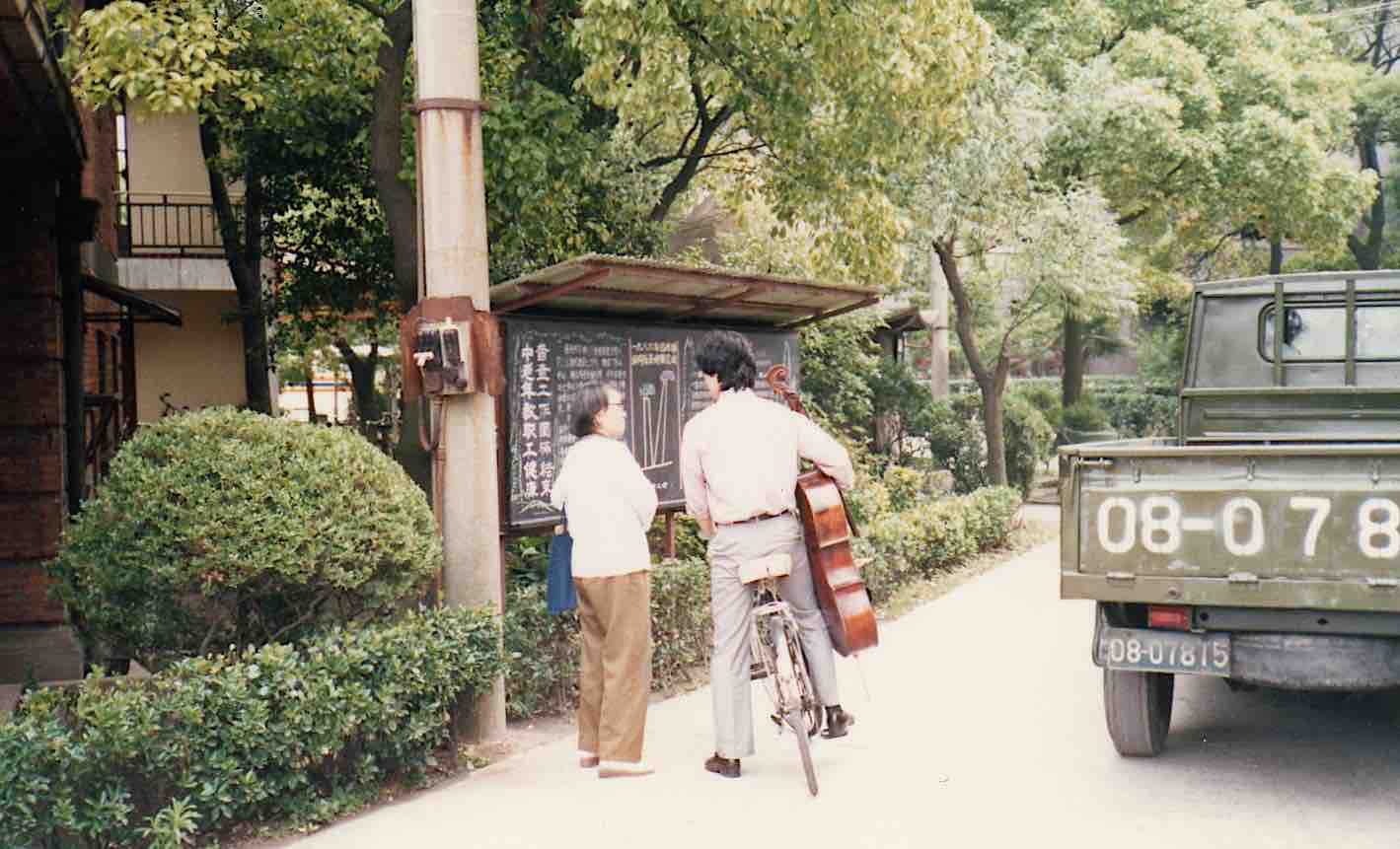
YYXY 86Cellist, Shanghai Conservatoire, 1986. My photo.

Noting that the taxonomy of instruments among cultures is modeled on important aspects of their worldviews, adducing Chinese and Arabic classifications, he considers “families” of instruments—a concept also adopted in African societies. He adduces the development of orchestras with SATB “choirs” of “traditional” instruments as a pervasive pattern of musical Westernization:

The four-part structure does reflect some major tensions in family and between genders and generations in society—and this perhaps accounts for its amazing tenacity.

He discusses the hierarchical concept of leaders and followers (accompanists) in music and society (cf. McClary on Brandenburg 5), going on to consider genres and forms within the “ruling class” of WAM.

Is it not conceivable that certain composers and groups of composers or musical cultures simply discovered better ways of producing music, and that this ability was recognized by later musicians and listeners?

Yet

We are tempted to ask whether modern music listeners are most comfortable with music reflecting a social structure that precedes the social upheavals of the French revolution and the 19th and early 20th centuries.

While noting that some of the canonical works, like Mozart operas, “go further than simply representing or going along with the inequalities and inequities of society”: they also provide a critique of the system. Nettl is

struck by the ways in which the critique is incorporated into a style that otherwise reflects a conservative view of society.

He explores the values of the concerto, with its “tension between art as the organization of forces and art as individual accomplishment”.

Under “the priesthood of the repertory” and the concept of equality he notes some of the most highly valued music, such as fugues,

in which there is textual equality of parts, and in which distinctions of power, volume, tone colour, and role specialization are relatively unimportant, a body of music that has, in addition to its sonic existence, a life in the abstract. This is music whose structural details play a greater role than the pleasurable nature of its sound, moment to moment. In general, it has no programmatic content and perhaps little in the way of obvious emotional connotations.

The discipline of the fugue “seems to result from a combination of technical and social principles”, and it had a significant afterlife even after the heyday of the art.

He reflects on the role of the string quartet in the canon—I’d love to see him or Susan McClary discussing the Große Fuge, so very full of conflict. And he surveys the quartet audience (“broken down by age and sex”, like Keith Richards).

Discussing “cultural performance”, Nettl again opens with the instructive instance of the Blackfoot powwow, going on to consider the tensions of the secular academic “commencement” ceremony, where the values and allegiances of the WAM community are celebrated and graduates admitted to the priesthood of elite music, an army to defend its beleaguered position in society. He offers an interlude on the colour pink, suggestive of subordination, curiously used for their academic hoods since 1895.

In his brief Afterword, Nettl, like Small, expands on the trepidation he expressed at surveying his heartland in such terms. In an important passage he considers the related work of Henry Kingsbury, Music, talent and performance: a conservatory system (1988), and its review by Ellen Koskoff (Ethnomusicology 34.2, 1990)—herself no hidebound defender of the autonomy of WAM, but a great ethnomusicologist focused on gender issues (see Flamenco 2, under “Gender”):

The impression Kingsbury gives to some readers is of a culture or subculture that is essentially mean and even brutish to most of its population. Ellen Koskoff’s review suggests that Kingsbury has “an axe to grind”; that he wishes to “laugh, poke fun at, or cry… at the grim reality of conservatory life” [cf. Mozart in the jungle]; and that he will only convince those musicians “who remember their own musical training with resentment and who want, deep down, to settle the score”. Kingsbury does not totally deny these aims in his response, because he closes his rejoinder by citing Howard Becker to the effect that social scientists must make judgments, and that “appeals for ‘balanced’ accounts in the social sciences are all too often merely veiled admonitions to endorse the status quo”. Kingsbury would presumably like to see change in the conservatory, change that would improve life and maybe improve music, and I applaud and agree. Even the rosiest picture would have to contain its share of grimness. And so I, too, would like to see change, although at this point I am not sure from what to what.

It’s a complicated place, the Heartland music school, existing as it does at a number of crossroads. It’s a place that aims specifically to teach a set of values, and it does so not only through practical instruction but also through the presentation of a quasi-religious system. It’s a place that puts “music” first and looks at music as if it were a reflection of a homogeneous human society. It is an umbrella under which different approaches to music can coexist, interact, and argue. It collects many kinds of music, brought from many places and composed at many different times, putting them all under one roof but making them all march to the drummer of the central classical tradition. It reflects the culture in which it lives, but it also tries to direct that culture in certain directions. […]

However, I have tried to avoid endorsing anything. If an explicitly critical stance will preach only to the converted, then perhaps an approach that tries to present a balanced picture might show champions of the status quo why they should depart from it. But that will have to be their own choice. An article of faith with most ethnomusicologists is that they should try their best to avoid disturbing the cultures they study or introducing new musics and practices, and that they should also restrain themselves from unduly encouraging musical cultures to eschew change in order to preserve the past. And, in my role of ethnomusicologist, I wish to abide by this principle, even when considering the culture in which I live. As much as I can.

Yet again I relish the lucid accessibility of Nettl’s style. As a system within a particular society, the rules of WAM deserve unpacking just like those of any other. But, just as Nettl implies, while WAM scholars and aficionados would benefit greatly from such an analysis, I suspect they may be the last to read studies like this; still, they should feel stimulated rather than threatened by this kind of approach.

For more armchair ethnography from my Chiswick home, see here. Note also The hidden musicians.

Compound surnames in Chinese and English

Left: Sima Qian; right: Zhuge Liang.

For China, besides my post on alternating single and double given names by generation, there are also some intriguing double surnames, often deriving from northern ethnic minorities.

Of the many that were used in early history, some have fallen out of use, with clans often adopting single surnames—a process that took place over a long period, unlike the rapidly changing fashions in given names. Double surnames still quite common are Ouyang 歐陽, Shangguan 上官, Sima 司馬 and Situ 司徒; less so are Zhuge 諸葛, Xiahou 夏侯, Huangfu 皇甫, Huyan 呼延, and Zhongli 鍾離. Oh, and Chenggong 成公 and Geshu 哥舒.

Left: Ouyang Xiu; right: Zhongli Quan.

The latter surname was Turkic in origin. Among ethnic minorities, longer compound surnames are still common, adapted to Chinese style, such as the Manchu Qing imperial clan Aisin Gioro. But with the Han chauvinism of the current CCP this is changing too—for Uyghur names under the current clampdown in Xinjiang, see e.g. this article.

* * *

For the Han Chinese double-barrelled surnames I can’t discern potential for satire, as we class-conscious English like to do for Posh Upper-Class Twits—whether fictional characters like Gussie Fink-Nottle and Sir Arthur Streeb-Greebling, and Monty Python’s Vivian Smith-Smythe-Smith, Simon Zinc-Trumpet-Harris, Nigel Incubator-Jones, Gervaise Brook-Hamster, and Oliver St. John-Mollusc (click here)—or real people who really should be fictional, like Jacob Rees-Mogg. There is latitude in the use of the hyphen. Indeed, why stop at two surnames? This wiki article also considers international naming practices, including Germany and Iberia. As Silly Names go, it’s hard to beat Leone Sextus Denys Oswolf Fraudatifilius Tollemache-Tollemache de Orellana Plantagenet Tollemache-Tollemache, British captain who died in World War One. 

Now the Riff-Raff [sic] are getting in on the act too, with young sporting luminaries such as Alex Oxlade-Chamberlain, Trent Alexander-Arnold, a trio of Southampton players—and the wonderful Katarina Johnson-Thompson, who soars high above the recumbent Tree-Frog.

In a rather different category is the litany of middle names for Boris Piccaninny Watermelon Letterbox Johnson as documented by Stewart Lee, which grows almost weekly.

See here for more on How to be English.

Keeping you guessing

I’ve found the last few weeks most fruitful—I hope you’re as stimulated as I am by this range of topics. Here’s a reminder of some recent posts.

Below I group them under themes, but in real time I also keep the reader [singular, eh? Mrs Ivy Trellis I presume—Ed.] guessing by purposefully alternating them, with frequent cross-links—the old “delighting in all manifestation of the Terpichorean muse“. Do click away: 

On war, trauma, and memory:

Not forgetting China:

and more… Some of my favourites from the archive, both serious and jocular, are grouped here, with a more succinct list here.

Bhutan: a tongue-twister, archery festivals, and teasing cheerleaders

Bhutan

Not a Lot of People Know This, but the popular tongue-twister*

How much wood would a woodchuck chuck if a woodchuck could chuck wood?

is a modern American adaptation of an ancient ritual in Bhutan.

Really?—The Plain People of Ireland.
No—SJ.
Begob! You had me there.

The woodchuck song (cf. More stammering songs) dates from 1902—here’s the popular version by Ragtime Roberts, recorded in 1904, just as Mahler was conducting the premiere of his 5th symphony:

I like this 1946 Glenn Miller version, with the follow-up “How many cats would a catnip nip…”:

cartoon
To answer the question, apart from the song’s decidedly surly “A woodchuck would chuck as much wood as a woodchuck could chuck if a woodchuck could chuck wood”, there have been some hilarious scientific attempts
(cf. Stewart Lee’s pedantic research on “the tip of the cesspit” under The c-word).

* * *

The word woodchuck, first recorded in 1674, is an English rendition of the Algonquin wejack or wuchak. And by way of the etymology of wang in whangdoodle (cf. schlong), I note, with the greatest respect, the many illustrious bearers of the name Wangchuk in Bhutan—which inspires me to

How much wang would a Wangchuck chuck if a Wangchuck could chuck wang?

In translation this may not quite match the elegance of the woodchuck version, with its euphonic “wood” and “would/could”—but I like to imagine that it works even better in the original Middle Bhutanese (just the kind of wacky topic that Sir Harold Bailey might have relished: “Indeed I’d say there’s hardly a line that could not have been understood by any Persian of the fourth century”)—perhaps

Wonga wang wunga Wangchuk chuka wangka Wangchuk wunga chuka wang?

wangsDare I surmise [Yes, I’m afraid you probably do—Ed.]** that wang-chucking festivals were once a major part of the ritual calendar in Bhutan, with ornately decorated wangs,*** assembled from monasteries throughout the region, to be hurled towards a distant target, or tôs-pöt? The arcane sentence might thus be the pious request of a courtly petitioner, curious despite the ineligibility of the royal family to participate in an event of which they were the main patrons.

Indeed, phallic symbols, representing Avalokiteśvara, are common in Bhutan and Tibet, as documented in this substantial (and for once, real) article. One of the names of Shiva is Wangchuk chenpo; and the phallus was a major part of the symbolic repertoire of atsara jesters.

* * *

Perhaps [sic] we may find the modern descendant of the Bhutanese wang-chucking ritual in its archery festivals (cf. Zen archery). OK then, so far this post has been Rather Silly, but now that I come to seek material on archery in Bhutan, I am full of genuine admiration.

Via the splendid community website bongopas.com, I find several videos of archery festivals (do consult the original posts, under bongop videos). Here’s a lovely short documentary from 2015, showing the ritual sequence, with vignettes from flag-bearer and storekeeper as well as the women of the chorus, and—for anyone who likes to think of Bhutan as “unspoilt”—a final comment on the decline of the “old rules” (cf. China, e.g. here):

Women play a major role as cheerleaders [sic], singing songs to tease the archers with their nicknames (cf. French taunting):

Whose forehead is bulging and swollen like a wine-serving spoon, in aimless flight his shaft will drift to hit the mark not even once.

Lips sheltered in a black beard, in aimless flight his shaft will drift to hit the mark not even once.

Here are some more instances (“Forehead is like wine sieve??”, “Dried ears!!!”, “Sneezing carpenter??”, “Pumpkin wine container”, “Polished stone head”):

And some more choral songs:

So while I’m encouraged by their own delight in jocular wordplay, ethnography makes a fine counterpart to my earlier frivolity.

Talking of Bhutanese films, this looks interesting.

Archery festivals are also common in Ladakh and Sikkim, and, with very different modern histories, in Tibet, Kham, and Amdo—as in this documentary, filmed in Lo khog village, Qinghai:

Returning to Bhutan, all this should encourage us to explore the riches of diverse soundscapes there, through sites such as this—not least monastic rituals, such as this 2-CD Lyrichord collection recorded by John Levy in 1971 (liner notes for download here):


The research for this project was
not made remotely possible by a generous grant from SPICE, the Society for the Promotion Prevention of International Cultural Exchange; and believe it or not, no ice-cubes were “educated” with Bombay Sapphire during the creation of this post.


* For an operatic tongue-twister, click here; and for a Chinese tongue-twister of mine, here.

** In such exegesis I may be inspired by Mots d’heure: gousses, rames; for other spurious excursions in cultural and linguistic history, see my series on the faqu (“French pieces”) under this roundup of posts on the Tang dynasty.

*** Cf. Dud ‘n’ Pete’s illumination of the lyrics “Mama’s got a brand new bag yeah, gonna groove it the whole night long baby“. More recently, Miranda Vukasovic has amassed an impressive collection of gaily-coloured phallic bottle-openers from Bali.

Enough already

Coco Naomi

In the opening salvos of what will be a wonderful long tennis rivalry, first Naomi Osaka beat the astounding Coco Gauff in the 2019 US Open (and in that post, do watch their beautiful on-court interview!); and now Coco has taken her revenge in the 3rd round of this year’s Australian Open.

But here I have a linguistic point in mind. Commenting on her 2nd-round match, Osaka described her rocky path to victory:

I was like, “Can I just hit a winner already?”

This led me to explore discussions of the usage of “already” as an intensifier to express impatience or exasperation (see e.g. here). It still seems more common in American English than in the UK, but I like it.

Some suggest that it was adapted in the States early in the 20th century from the Yiddish shoyn (genug, shoyn! “Enough already!”). cf. gut shoyn, ”All right already!” in the sense of ”Stop bugging me,” and (one calibration more irritated) shvayg shtil shoyn, ”Shut up already!”. But, thickening the plot, it’s also common in other languages, such as French déjà and Spanish ya. It also rather recalls the emphatic use of the particle le 了 and its expressive variant la 啦 in Chinese.

Doubtless people have been slaving away at erudite PhDs on the subject (“When are you gonna finish your goddam thesis already?”, or perhaps “When are you gonna finish your goddam thesis ‘Already’ already?”).

And now Naomi has won the 2020 US Open too, all the while drawing attention to BLM.

Anyway, both Coco and Naomi are inspiring. Already.

The Kazakh famine

Trauma and memory

famine

The famine in Ukraine of the early 1930s (see posts under Life behind the Iron curtain: a roundup) was publicised abroad by early journalists like Gareth Jones, and later through the work of the Ukrainian diaspora and scholars like Robert Conquest and Anne Applebaum.

But from 1931 to 1934 there was widespread dearth throughout the Soviet Union; the Ukraine holodomor has largely eclipsed other devastating famines in the North Caucasus and the Volga, and notably further east in Kazakhstan—a vast territory the size of continental Europe. It makes an important piece of the grisly jigsaw filling in the troubled histories of Russia, Xinjiang, and China (see e.g. here); and it also relates to the commemoration and recognition of guilt in Germany (see e.g. here).

Conquest had already addressed the topic in chapter 9 of his 1986 book The harvest of sorrow (1986), “Central Asia and the Kazakh tragedy”. Now we have two major books to help supplement the picture: [1]

  • Robert Kindler, Stalin’s nomads: power and famine in Kazakhstan (translated by Cynthia Klohr, 2018; German original, 2014)
  • Sarah Cameron, The hungry steppe: famine, violence, and the making of Soviet Kazakhstan (2018)

It is no easy task to unravel the threads of forced collectivization, famine, and all the social changes that they entailed. In Central Asia, the state’s attempts to implement socialism were further complicated by their mission to permanently sedentarise nomads. While I look forward to reading Cameron’s book, here I’ll discuss that of Kindler.

Central Asia since the 1990s

Central Asia since the 1990s.

In his Introduction Kindler summarizes the main themes.

More than a third of all Kazakhs died, or a fourth of Kazakhstan’s entire population. People died of hunger or disease, were shot, or slain. Hundreds of thousands were displaced; some turned to begging or banditry. Social nets fell apart. As the nomads’ herds were confiscated and depleted, the economy of the steppe collapsed. […]

Clans were replaced by kolkhozes, brigades, and other collectives that produced and distributed indispensable resources. People became dependent on the institutions of the Soviet state. […] It was Sovietization by hunger.

These initiatives “threw the region into chaos, causing mass flight, civil war, and an unprecedented shortage of food”.

As Kindler observes, Soviet modernity made no provision for pastoralists. Nomads were difficult to tax and difficult to supervise, thwarting the “dictatorship of the proletariat”. Citing James Scott, he notes that

the probability of catastrophe grows when authoritarian leaders use such methods on societies that are unable to ward off radical change. […] But the road from theoretical sedentism to real permanent settlement was long, arduous, and paved with suffering.

For the competing groups within Kazakh society,

collectivization and sedentarization gave them opportunities to advocate their own particular interests. […] Different levels of loyalty [to the Soviet state] were often difficult to distinguish.

While the whole system was built on confusion and terror, violence, omnipresent throughout the USSR under Stalin, was not a simple two-sided war between the state and the people. As later in China,

The Soviet project to rebuild society rested on the generation of perceived differences. […] Stalin pitted various institutions against each other to keep them under control.

Kindler unpacks the inadequacies of analyses of famine:

Students of the Soviet famine of 1932–33 have often focused on the social, political, and economic causes of famine and its demographic consequences. Much of this research has suggested that under the circumstances of food shortage, frustrated people had no influence on the events dictated to them. People affected by famine were mostly depicted as vague, passive, helpless victims with almost no agency. What happens to people who starve, how they behave when threatened with death, and what it means to survive a food shortage have seldom been described. Rarely do we read that people confronted with starvation become self-centered and asocial. Post-Soviet historiography in particular has cultivated the myth that peasants and nomads formed mutually supportive groups to master the crisis collectively, but that, unfortunately, they failed.

It takes time for food shortages to wreak devastation. Citing Amartya Sen on “food entitlement decline”, Kindler suggests a broader approach going beyond economic analyses. Strategies to cope with vulnerability; even in extremis, when a crisis becomes so great that it can no longer be met with the instruments normally employed in such situations, people are not merely victims. Still, by the early 1930s the Kazakhs had lost much of their capacity to resist external threats. Hunger may not have been premeditated, but it broke the nomads’ resistance.

Kindler disputes the popular theory of deliberate genocide that has become common for Ukraine. He notes the inevitable bias of the text-based, largely Soviet and Russian, sources; naturally we have few written accounts from the largely oral, illiterate culture of the nomads themselves. Even major sources that he utilises in the Kazakh archives still only contain the nomads’ own views as mediated by others.

Chapter 1, “Kazakh nomads and Russian colonial power”, shows that in the hierarchical traditional Kazakh society, the term kulak was no more relevant than for other cultures in the Soviet Union. Waves of state sedentarising policies predated the revolution but escalated. In 1916 the conflict between peasant settlers and nomads erupted in a major uprising, with hundreds of thousands of Kazakhs fleeing to China. Civil war soon followed, bringing anarchy and starvation.

In Chapter 2, “Soviet rule in the steppe”, Kindler shows how the Communists gradually expanded their power by destroying the old clans, at the cost of deeply alienating the people. But as later in rural China, there were severe obstacles to the reach of the state:

Many party members were technically and politically illiterate: they could neither read nor write. When documents could not be translated into Kazakh, the most rational solution for aul leaders was simply to gather, acknowledge, and then ignore them.

Alliances between indigenous leaders and the Communists were fragile.

Kindler goes on to explore the process of sedentarization. As later with the Chinese peasantry, the thorny issue of “raising the cultural level” of the nomads loomed; the Bolsheviks considered them “backward”, their whole culture “inferior”. But their efforts to transform the nomads’ customs by addressing issues in hygiene, and the status of women, were largely fruitless.

Source: Central State Archive of Video and Photo Documents of the Republic of Kazakhstan (courtesy of Zhanbolat Mamay), via Sarah Cameron.

The leadership only briefly countenanced the warnings of experts that nomadism was the only form of productivity on the steppe, and that to transform it would be to destroy the economy. State power depended on limiting mobility.

As the conflict between nomads and settlers intensified, Russian farmers also suffered. With land reform, many were forcibly deported in a reign of terror led by Georgii Safarov. Resistance in 1920 was crushed: as one report commented, “These evacuees are almost exclusively women and children. There are no men among them; the men have almost all been executed”. The Kazakhs saw land reform as an opportunity for revenge for the massacre of 1916.

Land reform came to a halt soon after Safarov was demoted in 1922. Meanwhile unyielding grain procurements led to another famine in 1921–22, when conservative estimates suggest that over 400,000 died. As the pendulum swung again, a fragile peace obtained. Kazakhs were given preferential treatment over settlers migrating to the region, but the latter put up a fight, and with Party leaders unable to reconcile the disparate interests, by 1928 settler migration was once again condoned.

In 1925, as Filipp Goloschekin was installed as the first Party Secretary of the region, conflict, repression, and purges escalated. Kindler goes on to unpack the complex competing networks among clans and within the Party leadership. Kazakhs within the Party were often marginalized, as mere figureheads—a pattern later all too common among the minority regions of the PRC.

Chapter 3, “Collectivization and sedentarization”, shows how central policies continued to impact on the regional picture. In the wake of the national Great Terror of 1927–28, the Great Turn of 1929, implemented with violence, initiated the destruction of the private sector. Confiscations and requisitions of grain and livestock from pastoralists soon led to destitution. Many fled across the border to Xinjiang, as they had often done before. But “collectivization was not only a war of the state against the people, it was also a war of the folk against itself”.

Both peasants and nomads had to pay. In the winter of 1929–30 hell broke loose in Soviet villages, with brutal raids. The task of the young activists sent by the central leadership to implement the brutal decree, often with no experience of either rural or nomadic life, was also unenviable:

Emissaries from the Soviet regime were threatened, beaten, tortured, and murdered when they collected tributes or tried to force people to join the kolkhozes.

1929 ganbu

While many of them had been successfully educated to believe in their task, not all were crusaders for the cause.

Numerous reports of the men’s enormous consumption of alcohol and their excessive carousing perhaps indicate that many suffered emotionally from the strain of their duties.

In March 1930 Stalin briefly put a brake on coercive collectivization—immediately prompting mass defections as well as further agricultural ravages. But even while 20,000 “kulak” families were deported from Kazakhstan, the region had to accommodate 30,000 “kulak” households from elsewhere in the Soviet Union. As the catastrophe escalated, herds were destroyed: by 1933 over 90% of all livestock had been lost. “Sedentarization through expropriation turned nomads into refugees and beggars.” Settlements were decreed on land unsuitable for cultivation; lack of materials made building work fruitless. Chaotic measures took a terrible toll.

Nomads would also have to make way for the vast network of labour camps for victims of repression from elsewhere, that was being planned from 1930.

In Chapter 4, “Civil war and flight”, Kindler shows the tenuity of Bolshevik rule if Kazakhs could manage to mobilize in resistance. By 1930 the long hostility of both nomads and peasants to state policies escalated into a fragmented civil war—Kindler again unpacking diverse motives for popular violence. Some Muslim groups waged holy war and sought to establish sharia law. Brutal revolts were brutally suppressed; after September 1931 serious uprisings ceased.

flight

Amidst the vast coercive displacements of the whole Soviet people, the indigenous Kazakh population was inundated with outsiders, including many inmates from labour camps. While nomads always depended on mobility, they now resorted to more radical migration across borders, with a vast exodus of refugees. While state policies eased somewhat after 1935, with nomadism tacitly condoned again, the pattern of cross-border migration would continue over a long period—and in both directions.

Warfare was intense in the Sino-Soviet borderland. Many Kazakhs fled by arduous routes to the Chinese-held province of Xinjiang; but there too, complex power struggles were under way, with smugglers, spies, and bandits among the population. [2] Nomads were accustomed to moving between borders, and there had been major flights in 1916 and 1928. Soviet forces carried out several massacres. For those Kazakhs who managed to reach Xinjiang, starvation was a danger there too.

Within the Soviet borders many Kazakhs also fled to Turkmen and Uzbek territory, as well as western Siberia. Unwelcome in such regions that Soviet policies had also reduced to desperation, they often became beggars.

Chapter 5, “Famine”, most lengthy and harrowing of all, opens starkly:

Between 1930 and 1934 at least a quarter of Kazakhstan’s total population perished.

Famine was widespread throughout the Soviet Union, not just in Kazakhstan and Ukraine but in North Caucasus and the Volga region. Other ethnic minorities within these regions also starved. But relief was secondary to the central goals of procurement and collectivization: the crisis reached its peak following the introductions of measures contrived to reduce it.

The catastrophe had unfolded gradually, but in the midst of armed struggles and mass migration, reports of famine multiplied from 1930. As solidarity and social cohesion dwindled, no-one could escape violence and its consequences. Children were orphaned or abandoned. Kindler cites documents describing cannibalism, and tellingly discusses the very countenance of starvation:

Going hungry radically changes people. They do not suddenly become recognizable victims. Over a longer period of time their figures, facial features, and ultimately their natures begin to change. Death by starvation is not sudden and unexpected. It announces itself gradually over days, weeks, even months. […] The hungry lose weight and look haggard and boney. Their skin loses suppleness and becomes pale. Muscles atrophy and warp posture. The starving often become apathetic and passive toward their environment. Finally they lose interest in anything except food. Starvation blocks out all other emotions and and induces a condition in which people tend to develop extreme forms of what, under other circumstances, they would consider their “normal” behaviour.

The faces of the starving frighten and horrify others. Their countenances speak of imminent death. Others may feel as if the radical change in facial expression comes from a loss of individuality and personality.

He cites the shocked reports of officials on the disaster.

But after experiencing the initial horror most people became complacent and callous. No-one could handle such constant confrontation with misery. […] The majority gradually became accustomed to the starving around them and resigned to accepting it. The longer they were confronted with hungry people, the less it bothered them. […]

Rejection of the starving often enough turned into overt hostility. […] The starving formed society’s lowest stratum. They were chased off, threatened, and often killed. They were strangers and beggars. Refugees were part of an undifferentiated gray mass with no future and a past that interested no-one.

As with the later Chinese famine,

It is no coincidence and it was not for a lack of camera equipment that there are few photographs of starving people in Kazakhstan. The catastrophe had no countenance and it was to be given none.

The food distribution points set up by the authorities were sites to which the starving were banished and left to die, reflecting “what characterized the Soviet Union as a whole: the conviction that useless people must be cleared away and disposed of as waste”. Violent ethnic tensions increased further. Officials too were vulnerable, concerned only for their own survival in a fragile pecking order. For the Soviet leadership the famine was an opportunity to subordinate the Kazakh nomads and peasants once and for all.

By late 1933 minor policy adjustments gradually led to the end of the worst sufferings. Despite resistance from both the Kazakh leadership and refugees, refugees began to be repatriated. Even people who had fled to Xinjiang, itself in the grip of civil war, planned to return. Still, with provisions for returnees quite inadequate, the death count continued to rise in 1934. A repressive system of internal passports was introduced. Those who had somehow survived now had to resign themselves to the kolkhoz.

In Chapter 6, “Soviet nomadism”, Kindler describes the aftermath. While plans for sedentarization continued, nomadism was now partially tolerated; the size of herds gradually increased, although only a minority would now be under the control of the kolkhozes. The leadership even began to accept national customs and folklore, at least in commodified form—as ever, I’m keen to see local reports on any such grassroots revival. Conditions on Kazakh-run kolkhozes were yet worse than those managed by Russians, and their performances poorer. Kolkhozes often became fictitious entities, lacking permanent buildings.

This standoff continued until the chaos unleashed by the Great Terror of 1937–38. In Kazakhstan regaining control over livestock breeding became a focus, resulting in further expropriations. And the region now became one of the major destinations for mass deportation:

Entire ethnic groups like Armenians, Koreans, and later Germans and Chechens populated the “special settlements” and the Kazakh branches of the Gulag, including above all the gigantic Karlag.

As the plan to “make the steppe arable” was left to prisoners and slave-labourers, the gulag came to form the backbone of Soviet power in central Kazakhstan (see e.g. here and here), a major part of the fatally warped economy. In One day in the life of Ivan Denisovich Solzhenitsyn describes his time in Kazakh gulags in the early 1950s. Between 1931 and 1959 over one million “enemies of the people” laboured in the Karlag.

The war that erupted when Nazi Germany invaded the Soviet Union in 1941 caused grievous losses throughout the bloodlands of the western regions. It also marked a renaissance for Kazakh nomadism, although many livestock froze or starved to death. After the Great Victory, agronomists and ethnologists gave attention to ways of making migratory animal husbandry serve the interests of the socialist economy. “Soviet status was no longer bound to a sedentary way of life”.

In the brief but important final Chapter 7, “Legacy”, Kindler reflects:

Kazakhstan’s present multi-ethnic society is largely a product of Stalinism, forged by the nomads who managed to survive the famine and by the victims of Stalin’s mass deportations who were settled there.

As he explains,

Moral behaviour became perilous during the famine. Many people had no choice but to abet the corrupt system. The distinction between victim and perpetrator was blurred and, even in retrospect, we cannot clearly separate one from the other. A society that deemed the individual worthless and made the collective the greatest good stamped a verdict of guilty on anyone who valued his own life. […]

The crisis did not erode Soviet structures, it strengthened them by making individual survival almost completely dependent on Soviet mechanisms of order and distribution. Whoever survived the famine did so by the grace of the state that had caused it in the first place.

This resulted in complex processes of adaptation and psychological repression. […] Many Soviet citizens who had survived hunger, terror, and war, went on to live under the strain and stress of the Soviet system. They learned to cope with the tension and bury the dark sides of their past. […]

Victory in the Great Patriotic War blocked the tragedy of famine out of the collective memory of Kazakh society.

After the death of Stalin, in the mid-1950s many migrants poured into the steppe in response to Kruschev’s Virgin Lands Campaign—which though an economic failure and an ecological disaster, further integrated Kazakhstan into the Soviet Union.

Meanwhile I note that after the 1949 Communist victory in China, many Kazakhs and Uyghurs fled to the Soviet Union, particularly in the wake of the disastrous Great Leap Backward: a major exodus took place in 1962. And in Xinjiang today, while the Uyghurs bear the brunt of the brutal clampdown as their whole culture is assaulted, Kazakhs and other “minority” peoples are also suffering in a pervasive new gulag network.

Kindler explains the partial reclaiming of Kazakhstan’s history in recent decades:

After decades, it was finally perestroika that enabled the mention of famine in Kazakhstan. […] But due to the challenges of life under ongoing social transformation the topic was soon abandoned. After a short phase of public commemoration and rehabilitation between 1988 and 1993, coming to terms with the past once again became the domain of historians whose findings were barely noticed outside the small world of academic research.

This suited the new national narrative of independent Kazakhstan (for the current human rights situation, see here). A monument to victims of the famine, set up in 1992, was only completed in 2017. Commemorations finally increased from 2012. But with the example of Ukraine in mind, the authorities have remained wary:

The oasis of stability that the leaders of Kazakhstan like to present may then soon prove to be fictitious.

By now the urban–rural divide between Russian and Kazakh was even clearer. Kindler shows how the narrative of Kazakh victims impedes the study of the famine, downplaying the role of Kazakhs themselves in the disaster and silencing those who suffered. However, Kindler suggests that the interests of rulers and ruled might in some ways coincide:

Where no-one spoke about dying and suffering, no-one asked about personal responsibility and guilt. Silence held people together. When no-one spoke out, it was not only for fear of the regime. It also suppressed awareness of one’s own involvement. Excluding the victims meant including everyone else and doing so far beyond the end of the famine itself.

As in China (see this post on commemorating the abuses of Maoism), “forced trust” bound Soviet leaders and citizens together. People continued carefully to observe taboos: “the rules prescribed not only what was said, but what was not said as well.” Meanwhile in Germany the recognition of trauma took place more openly. Finally Kindler refrains from suggesting answers:

In light of Kazakh society’s instability, was it a rational strategy for coming to terms with the past to ignore the problematic aspects of the country’s own history? Does it suffice to label the famine a “national tragedy”, like a natural disaster, and leave it at that? Or is it time for Kazakhstan to explore its own responsibility for the outbreak of famine?

Click here for a recent documentary by Zhanbolat Mamay, Zulmat: mass hunger in Kazakhstan.

Now I look forward to reading Sarah Cameron’s book too.

For both nomadic and sedentary populations, Soviet policies led to extreme suffering. The whole period was a nightmare. With my focus on China I find it all the more tragic that some twenty-five years later, the CCP allowed this same disaster, with similar causes and consequences, to befall over forty million Chinese people. Wherever we do fieldwork, people still have to live with the memory of such traumas.

For the destruction of a First Nation community in Canada, see here.

[1] Both works are reviewed here; Cameron’s work here and here, as well as this substantial lecture. See also here and here; and note Alun Thomas, Nomads and Soviet rule: Central Asia under Lenin and Stalin (2018). For further comparative studies, see Famine: Ukraine and China, under “Comparisons, figures”.

[2] For the perspective of Uyghur culture, see Rachel Harris, The making of a musical canon in Central Asia, pp.29–33.

Noh drama in London

Noh poster

Following my recent posts on contemporary Noh drama and transmission and change in Noh, and hot on the heels of relishing late Beethoven quartets, for a different vision of sublime mysteries I returned to the South Bank for a live performance of a new English-language Noh play at the Purcell Room. Do hurry (an unlikely word in this context!) to catch further dates on the tour here, with more in London, as well as Ireland and Paris.

Since the group can hardly recreate the elaborate Noh stage on tour, they’ve opted for a simple backdrop. But the performance, by the seasoned artists of Theatre Nohgaku with their long experience of creating Noh in English, was mesmerizing.

The evening opened with the auspicious final dance from the traditional drama Takasago, which I introduced in my first post, with the distinguished Akira Matsui embodying the God of Sumiyoshi.

Then came the world premiere of the English-language Noh drama Between the Stonesthe third collaboration between author Jannette Cheong and composer Richard Emmert. It explores how the burden of grief can be transformed through the healing power of the karesansui Zen rock garden. Attuned to the spirit of traditional Noh, the text is highly poetic. The programme’s libretto gives helpful clues to structure—shidai and issei entrance music, sageuta and ageuta low- and high-pitched song, mondo dialogue, and so on.

Ryoanji

In the midst of a typhoon, a grieving traveller (waki, Jubilith Moore) visits the rock garden at the Ryoanji temple in Kyoto. where she meets a woman gardener (shite, Kinue Oshima—the only professional female Noh actor in the Kita school). Understanding the traveller’s sadness, the gardener helps her appreciate the nurturing properties of the garden and how the art of raking the gravel enhances its beauty and evokes a peaceful soul. The gardener then vanishes.

In the interlude a temple priest (ai, Ashley Thorpe) appears, giving the traveller an introduction to the history and mystical significance of the garden. He then tells her that the woman gardener was an illusion, perhaps the spirit of the garden appearing to the traveller.

Act Two takes place some years later “on an island in the West”, where the traveller has now created a simple rock garden of her own. The woman gardener reappears and reveals herself as the garden’s Spirit of the Silent Waves. Along with the chorus, they evoke the pain of loss and the courage of those who face death—”as heavy as Mount Tai, or as light as a winter butterfly”. The Spirit of Winter Butterflies then emerges with the final dance, performed by 11-year old Iori Oshima—sixth generation in the Oshima lineage.

The hayashi ensemble—including two female performers—is entrancing as ever, with ethereal flute and haunting kakegoe cries from the three drummers. The international chorus plays a major role too.

Between the Stones makes a numinous addition to the growing repertoire of Noh in English. Here’s an excerpt from Pagoda, the first collaboration of Cheong and Emmert from 2009, a modern British–Chinese story pondering themes of identity and migration:

Late Beethoven quartets

Heilige

Through my teens, when I wasn’t listening to the Beatles or reading the Zen classics, I spent much of my time immersing myself in late Beethoven string quartets—almost a definition of “serious music”. And then I got to play them at Cambridge; but later (even before I read Susan McClary) I came to react against his cerebral style. Indeed, I’ve rarely heard a string quartet in live performance since the 1970s.

So after a long absence from these works, it was a suitably intense, immersive experience to hear the Salzburg-based Hagen quartet (no relation to Nina, alas) playing the A minor and C♯ minor quartets the other day at the Queen Elizabeth Hall. The three siblings in the group (Lukas, Veronika, and Clemens) have been musicking together since childhood; and Rainer Schmidt replaced a fourth sibling back in 1987. With such long experience their blend of sonority is wondrous; they have clearly thought a lot about vibrato, now using it sparingly—notably Schmidt in the unsung role of 2nd violin.

Whereas the orchestral life can be soul-destroying (see Mozart in the jungle), with as much drudge as ecstasy (and for jazzers too, square notions like health and security tend to get sacrificed in the quest for creative autonomy), from the outside, making a living from chamber music seems like an enviable life—particularly belonging to a string quartet. For the virtuoso soloist, the repertoire is narrower, and travelling solitary; for jobbing orchestral musos, chamber music may serve as a reminder of why they took up music in the first place. Still, only a minority of quartets achieve a reliable “food-bowl”—and even they can’t avoid the trying routine of airports, hotels, and promotions (for insights on the life of a string quartet, see under Quartets). And of course, such stellar groups are just the tip of the iceberg: there’s a rich repertoire for amateur combos to explore.

* * *

The extreme contrasts of Beethoven’s late quartets display the kind of splintered psyche that only became explored commonly in the 20th century. Besides Joseph Kerman’s classic The Beethoven quartets (1967), among myriad discussions of the A minor quartet, see here; it has been much analysed, not least by Susan McClary in Conventional wisdom. Indeed, it has been cited as a counterbalance on the importance of analysing any world music, such as aboriginal dream songs.

Like the Bach Air, the Adagietto of Mahler 5, or indeed Daoist hymns, the Heiliger Dankgesang (also the well-chosen name for PDQ Bach‘s co-commentator) is even more intense when heard live in the context of the whole work. The Hagen quartet’s 2005 recording used to appear on a currently dormant playlist.

Since then, to judge from the concert, they may further refined the purity of their timbre for this movement and others such as of the penultimate Adagio of the C♯ minor quartet, often sounding even more like a viol consort.

Going back to the 1930s, when the use of vibrato was in flux, the seminal recordings of the Busch quartet (at Abbey road!) from 1936–37, on the eve of devastating global warfare, are less sparing with vibrato:

And here the Heiliger Dankgesang is much more molto adagio too:

For the 1927 recording of the C♯ minor quartet by the Rosé quartet, click here.

And here are the 2017 recordings by the Quatuor mosaïques on original instruments—in line with changing modern tastes:

And, as a bonus, nearly two centuries after its premiere (which Beethoven missed as he was down the pub) the Große Fuge (or “The grocer” as it’s known in the biz) is even more challenging and revolutionary—like The Rite of Spring, its aural bombardment is always a shock:

Anyway, with fresh ears, I found the Hagen quartet’s concert most inspiring. And for magical performances of Beethoven’s late E major piano sonata, click here.

So much for the apogee of “serious music” in WAM: for the global picture, do click here. To end on a lighter and typically unsuitable note, click here for the creative tribulations of the composer according to Monty Python, and here for their Beethoven LP (“The second tune, which Beethoven said on his arrest was “just a harmless bit of fun…”).

For Sama

Sama

Following on from Soviet lives at war, just in case you haven’t yet watched Waad al-Kateab’s moving 2019 documentary For Sama, then you must.

During the siege of Aleppo, Channel 4 regularly featured reports by both Waad and her doctor husband Hamza from the makeshift hospital where he received casualties of the constant bombings. For Waad, filming served as a means of both survival and resistance.

family

Dealing with a vast amount of footage, the editors’ eventual decision to structure the story through baby Sama was a fine discovery, “moving between dark and light, with Sama as their—and our—lifeline”.

Sama, will you remember Aleppo? Will you blame me for staying here? Or blame me for leaving now?

Amidst all the carnage, at their wedding they dance to Crazy. Their friends Afraa and Salem, and their children, are full of resilience and humour. Waad and Hamza question their resolve not only to bring Sama into the world but, after a brief visit to Turkey, to bring her back with them to Aleppo, ever more dangerous as the regime’s grip tightened.

Among all the media coverage, this is good, as well as this Channel 4 interview:

Note also their project Action for Sama.

Amidst such suffering, expressive culture may seem like a dream, but what will become of the fabled musical traditions of Aleppo?

More recently Channel 4 has broadcast a series of reports from beleaguered Idlib—and here’s an article by Waad al-Kateab on the desperate situation there.

See also Aleppo: music and trauma, and Reviving culture: the Yazidis.

In memoriam Bruno Nettl

Nettl

The great ethnomusicologist Bruno Nettl (1930–2020) died last week. So far we have this tribute from Philip Bohmann, and I’ll add others as I find them. Here’s a brief appreciation from me.

A great inspiration, Nettl’s writings were accessible and engaging as well as wise, his perspectives always valuable. Alongside his rare overview of the global picture, he had a gift for explaining the nuts and bolts of musicking in particular societies—seting forth from his fieldwork among Native Americans, and in Iran and south India. His 1995 book Heartland excursions: ethnomusicological reflections on schools of music makes a fine complement to the ethnomusicological literature on WAM (see e.g. herehere, and here).

NettlPosts on this blog inspired by his insights include:

DO read Nettl’s wonderful The study of ethnomusicology: thirty-three discussions—for anyone still not attuned to the importance of soundscape in society, but in search of a mind-opening book, this is what we need!!! 

Doing fieldwork in China: a new book

The purpose of fieldwork is not simply to answer questions that have been incubated elsewhere. By learning what is important to people, fieldwork can be the source of the questions themselves. Talking to people, visiting a site, or experiencing a ritual are all irreplaceable ways of personally and viscerally understanding the processes that others have described in texts.

Fieldwork

The new volume

contains a wealth of stimulating articles on doing fieldwork in China—covering both urban and rural sites, with synchronic and diachronic approaches, and encompassing unofficial, oral history and local archives.

The editors provide a thoughtful preface, citing many further sources. As they observe, the articles have in common

first, a belief that ordinary people and distinct local cultures are worth understanding, both for their own sake, and as representing an important important perspective on sweeping trends of historical change; and second, a research method that prizes deep familiarity with a place, its physical contours, remnants from the past, and most notably its people, who often preserve not only memories, but also textual scripts, material objects, and oral and performative traditions.

While some chapters discuss issues of rapport and eliciting stories of people’s lives, for broad perspectives I’d still recommend Bruce Jackson’s Fieldwork (cf. this post). 

The twenty-four chapters are grouped under four sections:

History and fieldwork in historical perspective
This section includes

  • David Faure on the field research of Chinese intellectuals in the 1920s and 1930s, setting forth from their early work on the Miaofengshan temple fair, showing the problems they faced—and created;
  • Linda Grove on the rich 1940s’ Japanese field material on China (an important source for later studies of religious life in rural Hebei); and
  • Myron L. Cohen with pertinent thoughts on historical anthropology, focusing on the “traditionalist” phase in fieldwork on Taiwan from 1960 to 1980.

Left: route of 1956 fieldtrip to Hunan; right: fieldworkers in Hequ, Shanxi, 1953. For a roundup of posts on fieldwork on local ritual traditions under Maoism, see here.

Work reflections: fieldwork in the mirror,
Contributors here are

  • Michael Szonyi with lucid reflections on the importance of fieldwork for Ming historians;
  • Guan Yuxia on conducting fieldwork as a “local” in the multi-ethnic society of Hulunbuir, Inner Mongolia;
  • Kang Xiaofei, also pondering the complex tensions between emic and etic perspectives as she explores gender and ethnicity in the Sino-Tibetan borderland (“Who are they, and who am I?”);
  • Ma Jianxiong crosses disciplinary borders with fieldwork among the Lahu in Yunnan;
  • and in my own chapter I reflect on working with the ritual association of Gaoluo and the Li family Daoists, with vignettes that will be familiar to readers of this blog.

left: Guo Yuhua chatting with senior villager, Shaanbei;
right: household Daoists, amused by my notebook, relax between rituals.

Walking the ground, talking to people.
The first group of chapters here mainly concerns religion and ritual:

  • John Lagerwey on basic questions for fieldwork on pre-1949 Chinese society;
  • Paul R. Katz with a social-historical perspective on festivals in Taiwan;
  • Vincent Goossaert on doing historical-anthropological fieldwork in Jiangnan (“gazetteers, newspapers, and real life”); and
  • Ken Dean (see also here) on incorporating historical GIS in fieldwork on the ritual culture of the Putian diaspora.

This section continues with

  • Ching May Bo and Liu Zhiwei taking an engaging walk through urban Guangzhou to reflect on doing historical anthropology;
  • He Xi on contextualizing ethnic classification among the Li of Hainan;
  • Micah S. Muscolino on the 1950s’ social and environmental history of conservation in a Shaanxi county;
  • Fang Xiaoping on medicine, health, and disease among the barefoot doctors of Hangzhou;
  • Dong Guoqiang on discovering the Cultural Revolution through oral history in Jiangsu; and
  • Thomas DuBois with an interdisciplinary approach to the “history of things”—production, commerce, and consumption.

Finding and working with grassroots documents.
While I focus on contemporary fieldwork, participant observation, and personal oral history, I’m always keen to find local written sources too. So I find these chapters insightful, showing the potential for delving in local archives. This section includes

  • Du Zhengzhen on legal archives of Longquan (Zhejiang) for the late Qing and early Republican eras;
  • Liu Yonghua on account books as sources for the local history of Huizhou;
  • Huang Sujuan on land and property deeds and urban studies for Guangzhou;
  • Rao Weixin on genealogies and revolution in the Jiangxi Soviet;
  • Liu Shigu on using local and Public Security Bureau archives for a Jiangxi county in the 1950s; and
  • Jan Kiely exploring the limitations and potential of an Intangible Cultural Heritage archive from a county in north Jiangsu. 

In all, the contributors to this new volume offer thoughtful reflections on diverse approaches to doing fieldwork in China.

For a recent article on the ethical challenges of doing social science research in China, click here.

Soviet lives at war

Svetlana Alexievich and the struggle over memory

in hiding

Continuing my belated education in Soviet lives, always bearing in mind parallels with modern Chinese society, I’ve begun reading the remarkable oral history projects of Svetlana Alexievich (b.1948), winner of the Nobel prize in 2015 (see e.g. this NYT review), starting with

  • The unwomanly face of war (1983, English translation 2017) (review here) and
  • Last witnesses: unchildlike stories (1985, English translation 2019) (review here).

Such memoirs should be read in conjunction with historical accounts such as Timothy Snyder’s The bloodlands. And they are just the kind of memories utilised by Orlando Figes in The Whisperers and documented on his website. For a roundup of posts on life behind the Iron Curtain, see here.

A genuine sense of collective idealism, so difficult for the Soviet state to instil through all the tribulations of forced collectivisation, famine, show trials, and gulags, only came much later with the Great Patriotic War unleashed by the 1941 Nazi invasion. But after the Victory this patriotic pride was soon followed by renewed disillusion. For the People’s Republic of China after 1949, conversely, the national myth fed on the whole process of the revolution, of which the wartime resistance against Japan was but one element. And then, as I observed in Lives in Stalin’s Russia,

Whereas the 1989 Soviet “liberation” occurred after over seventy years of repression, in China “reform and opening” not only happened earlier, following the collapse of Maoism in the late 1970s, but came after a mere thirty years of state repression. Both Russia and China suffered grievously under invasion and warfare; and for both, the hard-earned victory came to form a cornerstone of the national image. But whereas in China the war set the scene for the Communist takeover and the people finally “standing up”, in Russia it made an interlude within a system in which repression was already deeply entrenched; it seemed to offer hopes for reform, which were soon thwarted. In China too the lid on popular expression of trauma remained quite tightly sealed, though as Sebastian Veg notes, “after a period of post-traumatic outpour, followed by commodified nostalgia, popular memory in recent years has shown signs of moving towards more critical discussions.” But both Chinese and Russian regimes continue to devise new forms of repression.

* * *

In The unwomanly face of war Alexeivich focuses on the roles of women, their strivings and sufferings: tank drivers, snipers, sappers, pilots, nurses and doctors, on the front lines, on the home front, and in occupied territories; as well as the “second front”, all those women working backstage—doing laundry, cooking, repairing machinery and vehicles, and so on.

She also comments on the whole issue of representing war; on the process of eliciting such painful memories; and on the difficulties of publishing such material even after perestroika—notably in the lengthy opening section, “A human being is greater than war”.

I am writing a book about war…

I, who never liked to read military books, although in my childhood and youth this was the favourite reading of everybody. Of all my peers. And this is not surprising—we were the children of Victory. The children of the victors. What is the first thing I remember about the war? My childhood anguish amid the incomprehensible and frightening words. The war was remembered all the time: at school and at home, at weddings and christenings, at celebrations and wakes. Even in children’s conversations. […]

For us everything took its origin from that frightening and mysterious world. In our family my Ukrainian grandfather, my mother’s father, was killed at the front and is buried somewhere in Hungary, and my Belorussian grandmother, my father’s mother, was a partisan and died of typhus; two of her sons served in the army and were reported missing in the first months of the war; of three sons only one came back. My father. The Germans burned alive eleven distant relations with their children—some in a cottage, some in a village church. These things happened in every family. With everybody. […]

The village of my postwar childhood was a village of women. Village women. I don’t remember any men’s voices. That is how it has remained for me: stories of the war are told by women. Their songs are like weeping. […]

At school we were taught to love death. We wrote compositions about how we would love to die in the name of … We dreamed.

As a review comments:

The official response to this legacy of suffering was a Soviet history that reduced pain to superlative clichés —heroism, bravery, sacrifice—and replaced the individual with the archetype of the Soviet soldier-hero.

The “Holocaust by bullet” in the bloodlands, which bore the full brunt of Hitler’s invasion, were particularly horrendous—notably in Belarus, [1] where Alexeivich grew up; indeed, many of the accounts that she went on to collect refer to the Minsk region. Vasil Bykau’s novel The dead don’t hurt [aka The dead feel no pain] was published in 1965 but immediately banned: “his characters stubbornly stand outside the Soviet national myth. They are cowardly as often as they are brave; they betray and are betrayed; they are not always sure that victory over fascism or capitalism justifies their deaths” (from this review).

Eventually Alexeivich came across another book about wartime Belarus that struck a chord: I am from a burning village [aka Out of the fire, 1977] by Adamovich, Bryl, and Kolesnik. Impressed by the book’s polyphonic style, Alexeivich found it to be

composed from the voices of life itself, from what I had heard in childhood, from what can be heard now in the street, at home, in a café, on a bus. There! The circle was closed. I had found what I was looking for. I knew I would.

After another long struggle with the censors, Elem Klimov was finally able to begin shooting a film based on the book, Come and see (1985; review here). Here’s a trailer:

As Alexeivich read more widely, it became clear to her that the standard literature on war was “men writing about men”:

Men hide behind history, behind facts; war fascinates them as action and a conflict of ideas, of interests.

But

No one but me ever questioned my grandmother. My mother. Even those who were at the front say nothing. If they suddenly begin to remember, they don’t talk about the “women’s” war but about the “men’s”. They tune into the canon.

She reflects on the way women portray their wartime selves (memory too is a creative process), noting that educated people are more “infected by secondary knowledge”, by myths. She explains the process of finding the women and interacting with them.

The wartime recollections are disturbing, but the fortunes of the manuscript make another worrying topic. The 1983 manuscript of The unwomanly face of war was criticized for tarnishing the image of the Soviet woman.

The manuscript has been lying on my desk for a long time… For two years now I’ve been getting rejections from publishers.

Then came perestroika, and an edition appeared (albeit heavily censored), soon becoming hugely popular; as she received dozens of letters daily, she soon found herself “doomed to go on writing my books endlessly”.

In the unexpurgated 2017 English edition Alexeivich includes excerpts from her journal from 2002 to 2004:

I think that today I would probably ask different questions and hear different answers. And would write a different book—not entirely different, but still different.

She gives instances of passages that the censors threw out—and even that she herself had censored. Many of these have since been restored, but as she says, they too make a document. She intersperses such passages with her conversations with the censor:

“Who will go to fight after such books? You humiliate women with a primitive naturalism. Heroic women. You dethrone them. You make them into ordinary women, females. But our women are saints.”

Our heroism is sterile, it leaves no room for physiology or biology. It’s not believable. War tested not only the spirit but the body, too. The material shell.

“Where did you get such thoughts? Alien thoughts. Not Soviet. You laugh at those who lie in communal graves.”

Another exchange:

“Yes, we paid heavily for the Victory, but you should look for heroic examples. There are hundreds of them. And you show the filth of the war. The underwear. You make our Victory terrible… What is it you’re after?”

The truth.”

“You think the truth is what’s there in life. In the street. Under your feet. It’s such a low thing for you. Earthly. No, the truth is what we dream about. It’s how we want to be!”

Alexeivich laces the brief, distressing individual memoirs with revealing notes on the context of her encounters with their authors: their demeanour, the cramped apartments.

Amidst the frank descriptions of warfare, some of the women she met retained an enthusiasm for Communism, but others were bitterly critical of the society that Stalin had created. Here’s one letter she received:

My husband, a chevalier of the Order of Glory, got ten years in the labour camps after the war… That is how the Motherland met her heroes. The victors! He had written in a letter to a university friend that he had difficulty being proud of our victory—our own and other people’s land was covered with heaps of Russian corpses. Drowned in blood. He was immediately arrested… His epaulettes were torn off…

He came back from Kazakhstan after Stalin’s death… Sick. We have no children. I don’t need to remember the war. I’ve been at war all my life…

Another woman, whose husband had fought, was captured, and then sent to labour camp after Victory, reflects:

I want to ask: who is to blame that in the first months of the war millions of soldiers and officers were captured? I want to know… Who beheaded the army before the war, shooting and slandering the Red commanders—as German spies, as Japanese spies. […] I want… I can ask now… Where is my life? Our life? But I keep silent, and my husband keeps silent. We’re afraid even now. We’re frightened… And so we’ll die scared. Bitter and ashamed…

After one harrowing account from a former medical assistant of a tank battalion, Alexeivich adds a sequel. She received a package containing published praise for the woman’s patriotic educational work, and found the material she had sent heavily censored. Alexeivich reflects on the two truths that live in the same human being:

one’s own truth driven underground, and the common one, filled with the spirit of the time. The smell of the newspapers. The first was rarely able to resist the massive onslaught of the second.

On the interviews, she goes on to note:

The more listeners, the more passionless and sterile the account. To make it suit the stereotype.

One veteran explains how women were silenced after the war:

Back then we hid, didn’t even wear our medals. Men wore them, but not women. Men were victors, heroes, wooers, the war was theirs, but we were looked at with quite different eyes. […] I’ll tell you, they robbed us of the victory.

Alexeivich finds them less candid in speaking about love than about death. Indeed, traditional values remained punitive: one woman tells how she got married after Victory, only to find that her husband’s parents were ashamed of this frontline bride.

After the war we got another war. Also terrible. For some reason, men abandoned us. They didn’t shield us.

* * *

Woman’s history has rightly become a major topic, both in fiction and non-fiction. I’ve addressed women at war in Les Parisiennes and Bearing witness; there have been notable studies for Britain too, also providing a much-needed corrective to our legacy of patriotic war films. For China, the voices of women are an important aspect of Guo Yuhua’s study of a Shaanbei village under Maoism (see also my series on Women of Yanggao, starting here, and China: commemorating trauma). Among many posts under my fieldwork category, I explore issues such as listening to people here.

* * *

Whereas the narrators of The unwomanly face of war were at least in their teens when they joined the Great Patriotic War, in Last witnesses (first published in 1985, and again adapted for the English translation, which bears the dates 1978–2004) they are often recalling their very early years, aged from 3 to 14. Here Alexeivich refrains from comment, leaving the young voices to speak for themselves. “Instead of a Preface”, she cites People’s Friendship magazine to remind us:

In the course of the Great Patriotic War (1941–1945) millions of Soviet children died: Russians, Belorussians, Ukrainians, Jews, Tatars, Latvians, Gypsies, Kazakhs, Uzbeks, Armenians, Tadjiks…

The accounts make up a relentlessly grisly litany of partisans, atrocities, torched houses, mutilated corpses, transports, camps—an indelible trauma for these young children, often orphaned after witnessing their families and fellow-villagers murdered, hiding in forests and swamps, constantly hungry. However repressed, this trauma would persist throughout the years following the Victory.


[1] Belarus is a frequent topic of Snyder’s Bloodlands. As in Ukraine and elsewhere in the region, the war was never a simple struggle between the local population and German invaders. The NKVD had already committed terrible atrocities, complicating the partisans’ allegiances: some groups were pro-Soviet, others fighting for independence.


The c-word

also starring fatuous asterisks, bendy bananas, and the b-word (bi)

Lee

How is the poor reader expected to differentiate between b******* and b*******?

Talking of The end of the f***ing world, the prissy prurience of the tabloids’ use of asterisks is brilliantly demolished by David Marsh in this article from the fine Guardian series Mind your language, prompted by the John Terry trial—citing a reader:

 I never cease to be amazed by newspapers which shyly make him say “f***ing black c***”, leaving intact the one word which aroused Mr Ferdinand’s wrath,

and calling on the unlikely couple of Charlotte Brontë and Ken Loach. See also this LRB review of a book on a 1923 trial revolving around women’s use of “foul language”, class, and the uses and abuses of literacy—with a pre-echo of Paul Kratochvil’s splendid story in a quote from 1930: “soldiers used the word ‘fucking’ so often that it was merely a warning that ‘a noun is coming’ “.

Moreover, reclaiming “the c-word (cunt)” has been a concern of feminists—as discussed in this post (from another useful site), citing authors from Germaine Greer to Laurie Penny. See also this article from Rachel Braier; the wiki article is useful too. And do admire the work of the Profane Embroidery Group. More under Words and women.

In Stewart Lee‘s latest book March of the lemmings (2019—not aka The bumper book of  Stewart Lee jokes: jolly japes for all the family) he pursues the style of How I escaped my certain fate with typically expansive Teutonic footnotes to the script of his show Content provider [or should that be C***ent provider?]. In one of these, warming to several topics, he reflects on the efficacity of his “so-called comedy” with purposeful, insistent use of “the c-word (cunt)”—which I hereby feel obliged to emulate.

First we should hear him doing the live version that prompted this tirade, since it gains so much from his masterly inflection, timbre, timing, and delivery:

And it isn’t, to be fair, you know, and I think—look, we’re gonna leave the EU, that is happening, and I think people have gotta put their differences behind them now and try and make it work. And I—I don’t know if you can make massive generalisations about people that voted to leave Europe anyway, because people voted to leave Europe for all sorts of different reasons, you know, and it wasn’t just racists that voted to leave Europe. Cunts did as well, didn’t they? Stupid fucking cunts. Racists, and cunts, and people with legitimate anxieties about ever-closer political ties to Europe.*

So here’s the footnote:

* How does this joke, which drew tears and cheers, even though I say it myself, night after night for the best part of two years, work? (1) Firstly, shock. I rarely swear on stage, and compared to most edgelord stand-ups, my swears count is probably only one level up from the sort of acts who market themselves as “clean” to get gigs at hospices run by born-again Christians. So it is a funny shock to hear me abandon my usual vocabulary and say the c-word (cunt). The c-word (cunt) is probably a way-too-heavy word to use here, and the deployment of such a disproportionately heavy weapon is part of what makes choosing to do [it] so funny. (2) The structure of the bit has a relationship with the much-touted idea that liberal Remainers should look outside their bubble and seek to understand the fears and concerns that drove 17.4 million people to vote Leave (“People voted to leave Europe for all sorts of different reasons, and it wasn’t just racists that voted to leave Europe…”), but then subverts the progression of thought by just calling them the c-word (cunts). To quote an old Lee and Herring routine, or possibly Viz’s Mr Logic, “Our expectations were subverted, from whence the humour arose”. (3) This second idea is then given what we in the trade call a “topper” by doubling back on the original premise and conceding that some Leave voters may also have “legitimate anxieties about ever-closer political ties to Europe”. There is then a second topper, in the form of a letter from a punter [“Dear Palace Theatre, Southend, please inform the “comedian”, and I use that word advisedly, Stewart Lee, who I had the misfortune of being taken along by friends to see last night, that I actually voted to leave Europe and I am neither a racist nor a cunt. Merely someone with genuine anxieties about ever-closer political ties to Europe. Yours, A. Cunt, Burnham-on-Crouch.”], which is a real letter (with the name changed) received during an early stage of the show at the 2016 Edinburgh Fringe try-outs, which just replays the joke again but in a funny voice and with more swearing, and with the town the complainer comes from changed to some local place every night—in this case, Burnham-on-Crouch.

By now the c-word (cunt) has long become a veritable mantra. The ever-expanding footnote goes on to do battle with Lee’s critics, with a plea for context:

The Tory Brexiteer and Sun columnist Tony Parson, in the February 2019 edition of GQ, the sort of style and status bible Patrick Bateman in American Psycho would read in between dismembering prostitutes in a penthouse apartment, wrote, on the subject of the c-word (cunt):

In the little corner of Essex where I grew up,”c***” was practically a punctuation mark among men and boys [see above—SJ]. It was in the foul air we breathed. But it grates now. It feels like the rancid tip of a cesspit that is the modern male attitude to women. And what I find bewildering is that it is not just thick ignorant oafs who use the c-word with such abandon. It is the woke. It is the enlightened. It is the professionally sensitive. It is the Guardian columnist, the BBC-approved comedian who can be guaranteed to dress to the left. “It wasn’t just racists that voted to leave Europe,” Stewart Lee recently quipped, “C***s did as well. Stupid fucking [sic!] c***s.” Does Lee’s use of the word sound rational or healthy? Does it provoke tears of mirth? Do you think it might persuade the 17.4m who voted to leave the European Union—the largest vote for anything in the history of this country—they were wrong? Some of my best friends are Remainers, but such spittle-flecked fury when using the word “c***s” makes Brexit sound like the very least of Lee’s problems.

Obviously, like Julia Hartley-Brewer and other Conservative Twitter types who alighted on the Brexit bit, Parson removed the qualifying section that followed it, where I acknowledge the out-of-touch nature of the so-called liberal elite in London, which in turn buys me some leeway, and also makes the subsequent attack on the so-called non-liberal non-elite more of a surprise; and Parson, presumably knowing little of my work, doesn’t appreciate that the use of the c-word (cunt) reads to my audience here in a comical way precisely because using it is so out of character. It is not the swear word in and of itself that brought the house down nightly. It has to have context.

And of course, the word isn’t delivered with “relish”, and it isn’t “spittle-flecked” either. The c-word (cunt) is delivered here with a kind of despairing calm, as if the cuntishness of the Brexit c-words (cunts) was just a sad matter of fact. When I was directing Richard Thomas’s Jerry Springer: the opera at the National Theatre in 2003 (as I am sure I have written before), we were given the benefit of the theatre’s voice coach for one session, who took the singers aside to teach them to enunciate all the libretto’s swear words and curses, to spit them out with relish. I waited for the session to subside, respectfully, and then had to unravel the work that had been done. The swear words weren’t necessarily to be sung in that spirit at all. For the most part, they represented the disenfranchised Americans working, in heightened emotional states, at the edges of the limited vocabulary that was available to them, and had to be used to convey not simply hate and venom, but also love, hope, despair and longing, the feelings expressed in Richard’s music. If I’d really wanted this particular c-word (cunt) to read with spittle-flecked relish, you’d have known about it. There’d have been spittle on the lens. I’m not averse to spitting on stage (on an imaginary Graham Norton, for example), so a lens would hold no terrors for me. To me, the c-word (cunt) here was mainly about how utter despair drove the beaten and frustrated Remainer character on stage (me) to the outer limits of his inarticulacy, painstakingly logical arguments against Brexit having broken down into mere swears.

And I didn’t “quip” the line either. One thing you will never see me doing is quipping. My work is too laborious and self-aware to ever include a comic device as light-hearted as a “quip”, and if I see one, I usually have it surgically removed from my script, or at least quarantined between ironic inverted commas (“Oh yeah, I can do jokes”). [Here’s a rare, and sadly very funny, example—SJ] And obviously, the bit was not in any way intended to “persuade the 17.4m who voted to leave the European Union—the largest vote for anything in the history of this country—they were wrong”, so it is stupid to criticise it for failing to achieve something it never set out to do. That’s like saying that Fawlty towers, for example, was written to encourage hoteliers to control their tempers; or that the very funny playground joke that ends with the line “Lemon entry, my dear Watson” was written to encourage Sherlock Holmes to keep suitable anal-sex lubricants close to hand for his congress with Watson, rather than relying on whatever out-of-date fruit preserves he could find in his larder.

Maybe I came onto Parson’s radar of late because I talked about Brexit, which he and his employer the Sun support, or because I am now one of those “cultural figures” that informed commentators like him are supposed to know about (“God! Haven’t you heard of Stewart Lee, Tony? I can’t believe it!”), who get praised in the London Review of Books, and get called the greatest living stand-ups in The Times, irrespective of their perceived market penetration or popularity. For Parson I am a “woke… enlightened… professionally sensitive… BBC-approved comedian who can be guaranteed to dress to the left”, which is hardly news, as it’s essentially what I describe myself as on stage, having done lazy Parson’s work for him.

Nonetheless, it’s odd to be called out as evidence of “the rancid tip of a cesspit that is the modern male attitude to women” in a magazine whose website has a “Hottest Woman of the Week” feature. It’s such an odd phrase, “the rancid tip of a cesspit”, that I had to go online and google pictures of cesspits to make sure I had understood what one was.

In my newspaper columns, I deliberately try to mangle my metaphors, writing in character as a man with imposter syndrome who is out of his depth in a posh newspaper and is trying to overcompensate with complex language that is beyond him. But Parson’s incoherence, as brilliantly parodied each month in Viz, is effortless. A cesspit is, literally, a pit full of cess. It can’t have a tip as it is not a conical solid. The only way a cesspit could have a tip is if it were somehow upended and its contents swiftly hardened in some kind of large-scale commercial drying unit, and the remaining cylinder or cuboid (depending on the shape of the pit that had moulded the cess within it) then sharpened at one end, perhaps using an enormous pencil sharpener rotated by shire horses on some kind of mill harness, or by Parson himself, until it formed the rancid tip Parson described. The only way a cesspit could have a natural tip would be if the body of the cesspit itself were conical, which perhaps they were “in the little corner of Essex where Parson grew up.

In fact, there is an Essex folk-song, collected by the archivist Shirley Collins inthe ’50s from the old traveller singer Gonad Bushell, that goes:

I’m a Billericay gypsy, Billericay is my home,
My house it is a caravan, my cesspit is a cone,
And if I want to see the cess become a rancid tip,
I tip the cesspit upside down, then dry and sharpen it!
And the curlew is a-calling in the morning.
[This is worthy of Stella Gibbons—e.g. Cold Comfort Farm, or her brilliant Britten pastiche—SJ]

Parson may have a point about the c-word (cunt), though I don’t really think my Brexit bit is hugely relevant to his discussion, and seems to be cranked in as part of some kind of twisted vengeance. Out of academic curiosity, I wondered what the dictionary definition of the c-word (cunt) was, and to my surprise, when I turned to it, there was just a massive picture of Tony Parson’s face. And it had all arrows pointing towards it as well.

Imagine writing the sort of space-filling shit Parson does, day after day. At least my columns are supposed to be stupid.

bendy

Back at the routine, Lee moves on ineluctably to the Brexiteers’ fatuous topos of bendy bananas (demolished e.g. here; also a theme of his columns, such as here and here, the latter included in March of the lemmings):

People did vote to leave Europe for all different sorts of—they did, don’t snigger away down there—they voted for all, you know, not everyone that voted to leave Europe wanted to see Britain immediately descend into being an unaccountable single-party state, exploiting people’s worst prejudices to maintain power indefinitely. Some people just wanted bendy bananas, didn’t they? “Oh no, I only wanted bendy bananas, and now there’s this chaotic inferno of hate.” “Oh well, never mind, at least the bananas are all bendy again, aren’t they?” Like they always fucking were.

In the second half of the show he adapts the Brexit material into an “I don’t know if you can make massive generalisations about Americans who voted for Trump…” routine:

Not all Americans who voted for Trump wanted to see America immediately descend into being an unaccountable single-party state, exploiting people’s worst prejudices to maintain power indefinitely. Some Americans just wanted to be allowed to wear their Ku Klux Klan outfits to church, didn’t they?

And still the footnotes to the script persist. Like How I escaped my certain fate, Lee’s comments are worth reading in full.

For more, see numerous posts under the Lee tag—and Ladies and gentlemen, Lenny Bruce!! A 2023 Guardian article has an update on our greater tolerance for swearing, again stressing context. For more on lying xenophobic misogynistic politicians, see under my roundup of posts on Tory iniquity, as well as the Tweety tag. Click here for two erudite literary jokes; and for what in Chinese, charmingly, is “the b-word (bi)”, see Forms of addressInterpreting pinyin, and Changing language.

Staving off old age

I may be nostalgic for 1950s’ comedy, like Beyond the fringe and Tony Hancock, and as to New-Fangled Popular Beat Combos I only make occasional rash forays beyond Bach [sic: see e.g. Bach as bandleader and arranger] and the Beatles (e.g. punk, Country, northern soul, and so on). My tastes in film also often hark back to formative experiences in my youth (see this roundup).

But just now, in my desperate attempt to stave off old age (less harmful than the alchemical elixirs for long life consumed in vain by ancient Chinese emperors), there are two British TV series that I just love among a plethora of Yoof programmes (across the pond, cf. Family guy, Parks and recreation, and Soap).

  • The end of the f***ing world. The asterisks there are sadly authentic, result of the delicacy of Channel 4, not mine or indeed that of the series’ creators—which inspires me to yet another post on The c-word.

The two seasons are both noir and tender; the surreal style of filming, along with the fabulous playlist, (season 1 here, season 2 here; or complete on Spotify), evokes David Lynch; and the limited vocabulary of the awkward young couple Alyssa and James (Jessica Barden and Alex Lawther) is weirdly expressive. Here’s a trailer for season 1:

* * *

Going back a little further, also on Channel 4,

  • Fresh meat (2011–16), somewhat less surreal than The young ones, remains delightful—all four series are available online. In a strong cast, the priceless character of Vod (Zawe Ashton—notwithstanding her great versatility and later celebrity) never fails to hit the spot:

When Josie tells her she’s thinking of switching to pharmacology:

Vod: What is it?

Josie: It’s the study of drugs.

Vod: You can study drugs? Now they tell me.

God has given me a brain. And I’m choosing to do some pretty wicked things to it. Which may or may not result in further hospitalisation.

More in this playlist—but go on, watch the series!

Series 4 ends with her “organising” Vodstock—”a festival that is Burning Man meets Cirque du Soleil meets Countryfile meets hajj“. In the end it’s just a student party.

* * *

phoneSo I’m like, YAY! (adjusting my monocle à la The Haunted Pencil). BTW, FFS, WTF is “streaming” anyway? WTF is an “app”? It’s OK, I don’t really want to know. And FYI, a phone is a big heavy Bakelite thingy on the table in the hall (cf. Alexander Graham Bell’s priceless prophesy).

See also Fleabag, Philomena Cunk and We are Lady Parts.

Right, back to those Daoist ritual manuals (for vain attempts to keep up with Chinese youth culture, click here).

Religious life in 1930s’ Fujian

The film footage of Harry Caldwell

Fujian province in southeast China remains one of the most vibrant regions for folk religious activity (see this introduction, and my post on Ken Dean’s early work there).

Harry Caldwell (1876–1970), a Methodist missionary from the Appalachian mountains of Tennessee, first travelled to China in 1900, inspired by his brother’s missionary work there, making a base in Fujian with his family until 1944. An avid hunter and naturalist, in his book Blue tiger (1924) he showed how hunting with the locals for man-killing tigers paved the way for effective missionary work [file under fieldwork techniques—SJ], and he discussed the delicate diplomacy required to negotiate peace between soldiers and bandits in his attempts to spare villagers caught amidst the fighting (cf. the Italian Catholic mission in Gaoluo).

Apart from filming agricultural, military, and daily scenes in Fujian, he also paid extensive attention to local religious life there—and now, in an enterprising project (click here) by the Department of Religious Studies of the University of Tennessee at Knoxville (UTK) under the direction of Megan Bryson, ten clips on religious ritual that Caldwell filmed in the 1930s have been restored and made available online, with extensive annotations by UTK students.

The evocative clips (alas silent!) comprise:

  • an opulent deity procession
  • a divination session, with a Buddhist monk presiding
  • a fertility ritual, with Daoist masters wielding ritual swords and horns at an elaborate altar
  • a Daoist healing ritual to protect children (cf. Crossing the Passes, e.g. Gansu and Shaanxi), with exuberant ritual dancing and the burning of a paper boat
  • an apotropaic ritual: pasting a talisman, a fishing net, and cacti at the family lintel
  • a Bathing the Buddha procession, and women offering at small shrines
  • Methodist church activities—including the distribution of baby chicks to the congregation
  • “Hell puppets”
  • plague-dispelling rituals, with paper boats sent off
  • a grand Buddhist funeral at the Yongquan si temple in Gushan.

Watching such footage, one always wonders what became of all these people over the turbulent decades to come. While the project offers precious glimpses of ritual life in Fujian before the 1949 revolution, all such practices still thrive in the region; with the addition of colour and sound, one might almost suppose many of these clips to come from Ken Dean’s wonderful 2010 film Bored in heaven (among many films listed here). I hope to see comments on Caldwell’s footage from scholars working on ritual life in Fujian—perhaps providing some more precise locations.

For Daoist ritual in Fujian and elsewhere in south China, see here; for early and recent films from distant Amdo, here.

The first gulag

people

Prisoners of the Solovki camps. Source here.

With an Iron Fist, We Will Lead Humanity to Happiness

—slogan at gate of Solovki prison camp.

Prompted by the troubled memory of abuses under Maoism in China, and the ongoing sensitivity of the topic (cf. my posts on the Nazi camps of Ravensbrück and Sachsenhausen), and following my reviews of Orlando Figes’s The whisperers and Timothy Snyder’s Bloodlands (for a roundup, see here), I’m gradually, and belatedly, reading up on the Soviet gulag system. A suitable starting point is the Solovki prison camp in the White Sea, prototype for the whole gulag network.

Even during the early years of the camp, some quite frank descriptions of Solovki were published, such as S.A. Malsagov, An island hell (1926) and Raymond Duguet, Un bagne en Russie (1927).

But it was only much later that more thorough accounts would emerge. After the chapter devoted to Solovki in Aleksandr Solzhenitsyn’s seminal The gulag archipelago (1973), Anne Applebaum gives an incisive account of the camp’s history in chapter 2 of Gulag: a history (2003). [1]

The inhospitable Solovetsky islands had been home to a fortified monastery complex since the 15th century, and a remote place of exile under Tsarist rule. After the revolution, the prison camp was constructed from 1923, as the monastery property was confiscated and monks murdered or deported to other camps. The number of prisoners soon grew rapidly. Solovki was itself a network of camps, both on the main island and the yet more lawless outlying islands, becoming a major site for forced labourers constructing the Baltic–White sea canal, all under the brutal direction of the OGPU state security apparatus.

Over the sixteen years of the network’s sorry existence (1923–39), the harsh conditions and the brutal labour regime alone gave rise to endemic, often fatal, disease; but sadism, torture, and executions too were soon routine. As the system was refined, notably under the leadership of Naftaly Aranovich Frenkel—a former prisoner—Solovki became a model for the gruesome system of “corrective” slave labour for profit, such as we see even now in a sinister modern incarnation in Xinjiang. The notion of “re-educating” inmates to create model citizens was always a figleaf.

After a serious incident in 1923, the socialist politicals (who had at first been privileged) were downgraded in status, becoming lower in the hierarchy than common criminals. In its isolation Solovki was virtually impregnable, and only a tiny handful of prisoners somehow managed to escape in 1925, 1928, and 1934 (Gulag: a history, p.358).

Here’s a remarkable silent 79-minute propaganda documentary filmed in 1927–8 (also here; a 5-minute cut, with translated captions, is here):

Cultural life and religion
Like Nazi camps, Solovki had its own concert band, theatrical performances, a library, a printing press, and a Society for Local Lore. [2] But under Frenkel such cultural activities were curtailed.

Remarkably, even religious services were observed in the early years (cf. Famine: Ukraine and China). A former prisoner recalled the “grandiose” Easter of 1926:

Not long before the holiday, the new boss of the division demanded that all who wanted to go to church should present him with a declaration. Almost no one did so at first—people were afraid of the consequences. But just before Easter, a huge number made their declarations. … Along the road to Onufrievskaya church, the cemetery chapel, marched a great procession, people walked in several rows. Of course we didn’t all fit into the chapel. People stood outside, and those who came late couldn’t even hear the service.

Applebaum goes on:

Along with religious holidays, a small handful of the original monks also continued to survive, to the amazement of many prisoners, well into the latter half of the decade. […] The monks were joined, over the years, by dozens more Soviet priests and members of the Church hierarchy, both Orthodox and Catholic, who had opposed the confiscation of Church wealth, or who had violated the “decree on separation of Church and state”. The clergy, somewhat like the socialist politicals, were allowed to live separately, in one particular barrack of the kremlin, and were also allowed to hold services in the small chapel of the former cemetery right up until 1930–31—a luxury forbidden to other prisoners except on special occasions.

Meanwhile, catacomb services were held in secret (for more accounts of the Solovki martyrs, see e.g. here):

As Applebaum relates,

Solzhenitsyn tells the story, repeated in various forms by others, of a group of religious sectarians who were brought to Solovetsky in 1930. They rejected anything that came from the “Anti-Christ”, refusing to handle Soviet passports or money. As punishment, they were sent to a small island on the Solovetsky archipelago, where they were told that they would receive food only if they agreed to sign for it. They refused. Within two months they had all starved to death. The next boat to the island, remembered one eyewitness, “found only corpses which had been picked by the birds”.

Gorky’s visit, and the final days

Gorky

Maxim Gorky (centre) visiting Solovki, 1929.

In June 1929, to counteract foreign criticism, Maxim Gorky, “the Bolsheviks’ much-lauded and much-celebrated prodigal son”, returned to the USSR for an elaboratedly-choreographed visit that included a three-day visit to Solovki (Gulag: a history, pp.59–62). Though he was not entirely credulous, seeing through part of the official smoke-screen, his report in published form for the international media inevitably put a benign spin on conditions at the camp. As Applebaum observes, “We do not know whether he wrote what he did out of naivety, out of a calculated desire to deceive, or because the censors made him do it”.

Elsewhere too, foreign visitors were easily misled, whether out of enthusiasm for the new social experiment or out of expediency during the struggle against Nazism—such as journalist Walter Duranty for the Ukraine famine, and USA Vice-President Henry Wallace on his 1944 visit to the Kolyma camp in Siberia (Gulag: a history, pp.398–401).

1929 marked “the great turning point”. As Stalin further consolidated his power, the regime becoming ever more draconian, with more systematic persecution of its perceived opponents.

Throughout the Solovki camp’s history countless prisoners were executed, culminating in the Great Terror of 1937–8. As war loomed—with the site lying too near to the border with Finland, and as its main industry of logging was depleted with the deforestation of the area—the camp was closed in 1939, amidst further executions. Meanwhile the gulag system persisted throughout other parts of the USSR right through into the late 1950s, even after the death of Stalin.

The legacy since perestroika
In the 1980s, as memoirs of the period began to be published more widely, intrepid researchers like Yuri Brodsky set about unearthing the dark secrets of Solovki. I’m keen to see Marina Goldovskaya’s 1988 documentary Solovki power (some footage here). But within Russia—even since the collapse of the Soviet Union—the history of the gulags has remained contested (see e.g. here).

As early as 1967, while the Solovetsky monastery was still inactive, a museum had been opened there; by 1989 a new permanent exhibition became the first to commemorate the gulag system. In 1992 the monastery was re-established, and the inscription of the complex on the UNESCO World Heritage list thoroughly downplayed the dark history of the camp.

With official repression of memory continuing to grow in an unholy pact between church and state orthodoxy, by 2015 human rights activists were deploring the removal of all traces of the Solovki camp (see this NYT article from 2015). This article shows how pilgrims from Ukraine have also been obstructed from visiting in recent years.

See also Kolyma tales.


[1] Both works feature in this New Yorker review. Online there are many sites about Solovki, such as herehere, and (an early exposé from 1953) here. For more work by Applebaum, see here, as well as her major study of the famine in Ukraine.

[2] Note the virtual exhibition Beauty in hell: culture in the Gulag (introduced here), with some fine photos—product of the research of Andrea Gullotta (e.g. here; see also this TLS article from 2018).

Ritual artisans in 1950s’ Beijing

huapencun

Mural, Lord Guan Hall, Huapen village, Yanqing district, Beijing, c1809.

Quite beyond my area of expertise, I was inspired by reading the brief yet suggestive article

  • Liu Lingcang 劉淩滄, [1] “Minjian bihuade zhizuo fangfa” 民間壁畫的製作方法 [Techniques of making folk murals], Yishu yanjiu 1958.2, pp.52–6.

As Hannibal Taubes divined when he sent it to me, slight as it is, it links up nicely with my taste for scholarship under Maoism documenting the customs of old Beijing just as they were being dismantled. It’s not so much the quality of the research that attracts me here—rather, the delicate nature of studying the topic just as collectivisation was escalating, painfully evoked in films like The blue kite. As ever, we need to read between the lines. Moreover, we can always learn from accounts of the nuts and bolts of creativity.

I’ve already introduced the work of the great Yang Yinliu at the helm of the Music Research Institute, along with the ritual traditions of old Beijing represented by the Zhihua temple. For more on old Beijing, see also Li Wenru, Wang ShixiangChang Renchun, and narrative-singing (here and here)—and in recent years a major project on the social history of imperial and Republican Beijing temples through epigraphy and oral sources.

* * *

From November 1955 to the autumn of 1956, the Central Academy of Fine Arts carried out a project documenting the work of ritual painters in Beijing. Rather than Liu’s gloss huagong 画工, the common folk term was huajiang 画匠 “artisan painter”, as in Yanggao, referring to artisans working for what had always been largely a ritual market—part of the whole network of ritual service providers upon whom Chang Renchun‘s work opens a window. They were apprenticed from young, often within the family.

Themes of their murals and paintings included the Seventy-two Courts (qisier si 七十二司) (cf. here, under “Buddhist-transmitted groups”) and the Ten Kings of the Underworld, depictions of Guanyin, the life of the Buddha, Yaowang Medicine King, and Water and Land rituals; and scenes from popular fiction such as the Three Kingdoms and the Water Margin. The article also hints at the market in the surrounding countryside for New Year’s lanterns and diaogua hangings, such as our own team found in Hebei (cf. the story of itinerant Qi Youzhi and his forebears, maintaining sheng mouth-organs for temples and village ritual associations). The themes of such hangings were closely related to historical subjects embodied in opera and story-telling.

Diaogua hangings adorning the alleys of Gaoluo village, 1989. My photos.

Just as our understanding of ritual is enriched by zooming in on the nuts and bolts of its vocal and instrumental soundscape, we can learn much by unpacking the techniques and vocabulary of religious painting. [2] In the end, ritual performers and ritual artisans are closely related.

The whole process of creating murals consisted of three stages (yixiu erluo sancheng 一朽二落三成):

  • xiu “draft”, known as tanhuo 擹活, creating a draft outline, drawn in charcoal
  • luo (lao, perhaps), “setting down”, known as laomo 落墨 “setting down the ink”
  • cheng “completion” (cheng guanhuo 成管活).

As with Renaissance artists in Europe, the laborious final stages depended on a division of labour, with the assistance of disciples.

Liu goes on to discuss elements in turn, with details on materials and tools, including this marvellous summary of the technicalities of preparing Water and Land paintings:

Shuilu details

Citing examples as far back as the Tang dynasty to illustrate techniques still in use, Liu goes on to discuss applying ground layers to the wall, templates (fenben 粉本), traditional methods of mixing and adjusting mineral pigments, the use of glues and alum, creating 3-D effects, and colour gradation. For pigments, while Liu notes the incursion of Western materials since the 1920s, among the team’s informants for traditional painting techniques was none other than Guan Pinghu, master of the qin zither! And in a detailed section on depicting gold, Liu consulted Wang Dingli 王定理 and Shen Yucheng 申玉成, working on the statuary of Tibetan temples in Beijing, as the best artisans then working in the medium.

An intriguing part of the final stages of mural painting is the addition of colours according to the master craftsman’s indications in charcoal, such as gong 工 for red and ba 八 for yellow—economical versions of the characters hong 红 and huang 黄, or liu 六, whose pronunciation stood for  绿 green. They even found such indications visible in the Ming-dynasty murals of the Dahui si 大慧寺 temple in Beijing. Liu notes that the custom was already dying out in Beijing, [3] but the shorthand reminds me, not quite gratuitously, of the secret language of blind shawm players in north Shanxi, and (less directly) the characters of gongche notation, which persisted.

Though again the ancient tradition of oral formulas (koujue 口诀) was dying out (at least in Beijing), Liu lists those that they could recover—just the kind of vocabulary that we seek from ritual performers, going beyond airy doctrinal theorising to gain insights into the practical and aesthetic world of folk society:

koujue

Just as the ritual soundscape still heard throughout the countryside in the 1950s (and today) contrasted starkly with the official diet of revolutionary songs, these traditions occupy an utterly different world from our image of propaganda posters of the time.

But—not unlike all the 1950s’ fieldwork on regional musical traditions (links here)— what the article could hardly broach was how the lives and livelihoods of such ritual service providers were progressively impoverished after Liberation, as their whole market came under assault and temples were demolished or left to fall into ruin. Even in the previous decade, through the Japanese occupation and civil war, the maintenance of temples can hardly have been a priority; new creation of murals was clearly on hold, and one wonders how much, if any, maintenance and restoration these artisans were still doing when Liu’s team visited them. Some of the artisans were doubtless already seeking alternative employment such as factory work or petty trade. We get but rare glimpses of this story, such as Zha Fuxi’s 1952 frank letter to the former monks of the Zhihua temple tradition. Later in the 1950s some official documents inadvertently provide further material on the period.

Of course, irrespective of their current circumstances, asking people to recall their previous practices is always an aspect of fieldwork, while one seeks to clarify the time-frame of their observations.

[1] Liu LingcangBy this time Liu Lingcang (1908–89) was already a distinguished artist and educator; but his early life qualified him well for the project discussed here. A native of a poor village in Gu’an county, Hebei, as a teenager he worked as an apprentice folk ritual artisan in nearby Bazhou before finding work as a restorer of temple murals in Beijing—so the 1955–6 project was based on his own former experience as a participant. Becoming a member of the Research Association for Chinese Painting in 1926, he went on to study at the Beiping National School of Art (precursor of the Central Academy of Fine Arts), taking up senior official posts after the 1949 Liberation. Some of his later paintings addressed religious themes: like Yang Yinliu over at the Music Research Institute, he clearly remained attached to his early background, despite his elevation. Again I think of Craig Clunas’s comment “The published curricula vitae of Chinese scholars often give a false idea of the continuity of their employment, and conceal the long periods of frustrating idleness caused by periodic political campaigning.”

[2] Craig Clunas kindly offers some further leads to “technical art history” in China, such as John Winter, East Asian paintings (2008), and (for the medieval period, notably for Dunhuang) Sarah Fraser, Performing the visual: the practice of Buddhist wall painting in China and Central Asia, 618-960 (2004). For technical details in the world of literati painting (such as mounting), see Robert van Gulik, Chinese pictorial art as viewed by the connoisseur (1981).

[3] As Hannibal tells me, a variant of this system is still used by folk ritual artisans in rural Shaanbei. For the anthropology of folk ritual art there he also directs us to a wealth of research, notably the insightful work of Huyan Sheng 呼延胜, such as his PhD on Water and Land paintings (Shaanbei tudishangde shuilu yishu 陕北土地上的水陆画艺术), and the article “Yishu renleixue shiyexiade Shaanbei minjian simiao huihua he kaiguang yishi” 艺术人类学视域下的陕北民间寺庙绘画和开光仪式, Minyi 民艺 2019.3; as well as a detailed article on painter-artisans in nearby Gansu by Niu Le 牛乐, “Duoyuan wenhuade yinxing chuancheng celue yu wenhua luoji” 多元文化的隐性传承策略与文化逻辑, Qinghai minzu yanjiu 2018.3.

Gosh—for such remarkable continuity in Chinese culture, despite all its tribulations, yet another reminder that “when the rites are lost, seek throughout the countryside”, and that “a starved camel is bigger than a fat horse”.

The genius of Abbey road

Abbey road

Abbey road album cover: no title, band unnamed.

*Click here for my series on the great Beatles albums, with introduction!*

You can go for ages without paying attention to some of the most iconic works of music, while they lie dormant in the soul. Or, as a counterpart to my more obscure posts, we may just consider this the latest in my extensive series “Pieces that everyone knows are totally brilliant—that I now find are totally brilliant”. So it may be a case of “selling the Three-character scripture at the door of Confucius” (cf. here), but hey.

Abbey road (1969) was the Beatles’ final masterpiece, created (like Sgt Pepper) in the recording studio as they took refuge from the frenetic touring life. Given my constant stress on musicking as a social activity, I’m aware of the irony of paying tribute to such disembodied creations (see also n.1 below).

Just in case you’re on another planet, here it is as a playlist, with the songs individually—it’s far better just to put on the LP (or CD), listening to the two sides whole, with the original transitions—and silences—between tracks. [1] You can find the lyrics on sites such as this.

Both Sgt Pepper and Abbey road are full of extraordinary variety, nuance, and (even within single songs) contrast, with multiple layers and homages to the whole gamut of popular culture. Even the lighter, seemingly jocular songs contribute to the panorama. As I will comment in a general post on the Beatles, both albums make cogent sequences, resembling unstaged operas, or orchestral song-cycles, even if only Side 2 of Abbey road seems to have been so designed.

  • In the opening song Come together, “a portrait of a kind of hobo-outcast messiah”,

the screwed up vocal line […] attains a near-miraculous release in the refrain, when the reiterated minor third suddenly swings up a fifth, then down to the major third—harmonised, however, with the submediant triad.

  • The exquisite, soaring Something (George’s composition—Pollack’s analysis worth reading as always, suggesting parallels with Beethoven), punctuated by the intoxicating key shift of the hook, and a gorgeous guitar break;
  • Maxwell’s silver hammer, an unsettling black comedy;
  • Oh! darling, with Paul’s amazing gutsy vocals, the song’s “passionate intensity undimmed by its parodistic elements”. (On another autobiographical note, such was my classical snobbery in the 60s that the concurrent explosion of blues and soul was lost on me; so they could only tinge my consciousness through the benign filter of the Beatles, rather than through the hardcore medium of the Stones);
  • Octopus’s garden (Ringo!), “a child’s dream-song” (cf. Yellow submarine), though I don’t pick up on Mellers’ “hiding something blackly nasty in the woodshed“—far more applicable to the dark comic songs of Side 2;
  • In I want you (she’s so heavy), Mellers notes how the the zany vocal melisma modifies our response to the hammered dominant ninths that create the frenzy; and the refrain, “apparently in D minor but with dominant ninths of A (changing to German sixths on B flat), so that the A major triads are uncertain of their identity, wobbling between dominants of D and tonics of A”, becomes a long (over 3 minutes!) relentless 10-beat ostinato for the coda, “on the threshold of a scream”—ending the track, and Side 1, with an abrupt cut-off.

If these six songs of Side 1 themselves constitute a cohesive thread, the fragments assembled for Side 2 are still more of a continuous suite (see e.g. Pollack’s thorough discussion)—starting again on an innocent note after the preceding menace:

  • Here comes the sun (George again), its phrases linked by additive rhythms (3+3+3+3+2+2), leading into
  • Because, inspired by the Moonlight sonata, is entrancing, “runic” (again reminding me that I didn’t do nearly enough drugs—”just couldn’t seem to find the time”…). Beneath the spacy, soaring choral harmonies, suspended in the void, the keyboard arpeggios (the intro—George Martin on harpsichord!—seemingly continuing the 3+3+2 rhythm), are “like a lulling of the cradle or even a swaying of the amniotic waters”. To cite Mellers at length:

The eight-bar first strain rocks slowly in dotted rhythm through its minor triad (“Because the world is round it turns me on”), dropping rather than drooping on to the subdominant triad, and dreamily fading in a melisma. The effect of this sudominant is unexpectedly emotive, perhaps because the triadic harmony has been so static. The answering strain extends and deepens the feeling, since the melody is protracted into dotted minims, and instead of the subdominant we have a submediant chord of the ninth, the melismas wafting longer and more hazily. The resolution of this ninth chord on to the supertonic is delayed because we shift abruptly back to C sharp minor for the second stanza, which tells us that “because the wind is high it blows my mind“. When, after the second stanza, the dominant ninth does resolve on to a D major triad, it’s hardly a real modulation establishing a new, and remote, key. Its harmonic function is “Neapolitan” but the triad, on the exclamation “Ah“, immediately pivots back from D not to the dominant but to F sharp, C sharp’s subdominant. This initiates the middle section which, changing the subdominant minor to major, creates with inspired simplicity the newness and all-embracingness of love. This middle contains four bars only; after which the enveloping arpeggios return and the haunting melody sings da capo,  finally floating away in extended melismata, but without harmonic resolution. Indeed, although that flattened supertonic opens heavenly vistas, the song is virtually without harmonic progression, the only significant dominant–tonic cadence in the piece being the one that returns us to our source, and to the da capo of the melody. […] In the coda the upward leaping sixth—traditionally an interval of aspiration—is pentatonically suspended on the word “Because“; indeed the arpeggiated swaying is replaced intermittently by silence—in the use of which the Beatles betray something like genius.

Because

Slightly skewed screenshot—not the result of the intake of medicinal substances, honest guv.

  • You never give me your money opens wistfully, but successively ramps up the mood, segueing into Out of college (its introductory boogie-woogie only fleeting), an exhilarating guitar modulation into One sweet dream (“tonally rootless, rhythmically exuberant”), before merging into the hazy nursery-rhyme paradise of One two three four five six seven, all good children go to heaven—HOWEVER DID THEY DO ALL THIS?!;
  • Sun king, whose trippy feel develops out of Here comes the sun and Because;
  • Mean Mr Mustard, abruptly changing the mood—its brief refrain oscillating between E and C major, leading into a plagal cadence approached by way of the flattened seventh (more additive rhythms at the end!);
  • Polythene Pam (“a mythical Liverpool scrubber”, apud John) and
  • She came in through the bathroom windowboth songs “comically scary portraits, at once within the dream and part of the crazy-kinky scene that passes for today’s reality”, before the brilliant final sequence:
  • Golden slumbers, “an ironic title to an ironic song”, with “Sleep, pretty darling, do not cry, and I will sing a lullaby“, with soothing strings, contrasting with the raucous refrain, leading into
  • Boy you’re gonna carry that weight—savage, grim, with a memory of You never give me your money, segeuing into
  • The End “abandons words for a furious hammering of percussion, which leads into a long instrumental section, all dominant sevenths in rumba rhythm, but rocking a tone lower than the starting point, getting nowhere [great consecutive guitar breaks from Paul, George, and John!]. Suddenly the hubbub stops; there’s a tinkling of A major triads on a tinny piano; and Paul’s voice returns to sing ‘in the end the love you take is equal to the love you make’. The phrase descends scalewise, harmonised in parallel triads that fall from F major, to E minor, to D minor, to A minor, and so to C major.” And then, just when you think it’s all over,
  • Her Majesty (an unlisted “hidden track”), sung by Paul—a perfect little throwaway fragment, a nonchalant farewell to Beatledom.

Mellers observes that

The seraphic vision of Because was momentary, and the rest of the disc trips away from vision and from Pepper‘s awareness of human relationships into a magical mystery tour that, if it’s a dream, is a bad one, and no escape.

Still, the cumulative effect, with its multiple layers, is supremely life-enhancing.

sessions

[1] I trust you won’t be thrown off the scent by the many cover versions masquerading online (to me they sound awful, almost sacrilegious). That’s not to belittle cover versions generally—they’re part of music’s whole creative social afterlife—but they can make us appreciate the craft of the original all the more. By contrast, I want every single guitar break, every tiny vocal inflection, to be faithfully reproduced and worshipped come sta for eternity, preserved in aspic—gleefully aware that this contradicts just about everything I’ve ever written (e.g. under Unpacking “improvisation”). Indeed, the release of the original sessions (with alternative tracks and running orders), and the remixes, remind us that even a studio recording is a living organism, subject to variation: what I regard here as so sacrosanct is just one possible realisation. The songs were recorded individually, and only later arranged into the sequence that we now found so cohesive and definitive.

Transmission and change: Noh drama

kakegoe

Further to my post on contemporary Noh drama, I’m grateful to Allan Marett for drawing my attention to

the lucid text well rendered in fluent translation by Edgar W. Pope—no easy feat.

I introduce this lengthy article here not just for its insights on Noh, but because it bears more widely on the transmission of traditional genres—including the WAM canon. Indeed, it often reminds me of debates over rubato in romantic piano music.

Bruno Nettl has suggested parameters for change in musickings around the world; Noh would seem to belong to his rubric of “gradual, normal change” (“An absolutely static musical culture is actually inconceivable”; for Daoist ritual, see e.g. here), and the concept of “isolated preservation”. Fujita’s article also bears on Nettl’s discussion of flexibility and improvisation.

Within the conservative goal of preservation, Fujita seeks to reconcile apparently conflicting emic and etic viewpoints, and the tensions between ideal and real performance—common concerns of those analysing world music. He wisely considers the whole Noh community, and addresses both the nuts and bolts of performance and the mystical underpinnings of the tradition. As Pope summarizes:

A puzzling situation defines the contemporary transmission of Noh. On one hand, the genre’s community of practice is governed by strict orders to preserve musical sound through repeated imitation and to avoid change at all costs. On the other hand, the community discourages explicit dialogue between teachers and learners concerning what exactly constitutes those ideal musical sounds as well as the extent to which those sonic ideals are being faithfully maintained across performances. With a focus on the transmission of hiranori vocal rhythms, Fujita explores the ambivalent strategies with which participants navigate this conundrum and discovers a paradoxical process by which Noh’s so-called “preservation imperative” actually encourages musical change.

Pope also highlights the relationship between ideal models and actual performance, discourses of continuity and authenticity, and the sometimes-frustrating ambiguities of self-consciously “traditional” arts.

The article also demonstrates Fujita’s characteristic methodological approach: combining close musical analysis with perspectives gained from extensive ethnographic experience, and using critical historical insights to complicate his own ethnographic observations and challenge common scholarly assumptions.

As Fujita explains:

According to the theorists cited above, the place of performance is precisely where creativity happens. But in reality, do the spectators gathered in that place of performance always expect creativity or novelty from the performing art? At each and every performance, do they always focus their attention on how much creativity is being exhibited? One cannot necessarily say so. Depending on time and circumstance, many spectators are likely to expect not something new, but rather a past performance repeated in the same way, here and now. A performance that makes use of bodily movement and sound occurs only once, and then immediately vanishes. The desire to try repeating it again the next day often arises; but can we say conclusively that creative processes and interpretive variation exist there as well? […]

Classical music is like an antique, in the sense that as times change it does not necessarily adapt itself to the changing tastes of its audience. In order to transmit this antique from generation to generation, the community itself has taken on the distinctive form of the iemoto system, in which the iemoto and their branch families are at the apex, and beneath those, in the form of a tree, are positioned their disciples and the disciples of disciples (cf. my image of the iceberg). The focus of this essay is the acquisition by low-level members (disciples) of the techniques held by high-level members (teachers).

Performing artists must be sensitive to the changing demands of changing times if they always construct their performances on the basis of unchanging prescriptions, it is likely that audiences will eventually grow tired of them, and the art itself will become extinct. [….]

This high-pressure imperative takes the form: “Even if it’s boring, don’t ask why—just preserve!” […] Suppose, hypothetically, that you were to find yourself a member of such a community. You yourself have no clue as to what the purpose of preservation might be. And yet you are compelled to participate in preservation. You think to yourself “What’s the use of this? It’s boring. I want to quit!” But you are unable to defy the preservation imperative, and as your participation immerses you completely in the various mutually contradictory rules of practice that fall under the preservation imperative, you experience, at some times and in some cases, a joy in the very practice of preservation itself. Once you have had this sort of experience a number of times, you reach a state where you suddenly think to yourself “I’m glad I’m doing this.” Even though you are repeating (or being made to repeat) over and over again things that have been determined in advance, one day a feeling even comes over you that some realm of freedom is finding expression here—a world in which you feel that a kind of richness that surpasses the merely technical has been secured. The community that provides this strange experience is the community of classical music transmission in Japan.

Fujita suggests the enduring basis of this conservatism in the vestiges of Confucian ideology, with instances from Buddhist chant and biwa music (and of course around the world other ideologies impose limiting effects on creativity in varying ways and degrees), and a brief aside on the aesthetics of calligraphy. He goes on to observe that the community’s emphasis on preservation is modified in actual practice, adroitly suggesting why my suggestion of punk versions of Noh was so impertinent (not to mention this).

Notation is always an imperfect tool. Analysing the rhythmic structure of Noh, Fujita uses tradional graphical representations, largely to reveal their inadequacy. Indeed, he notes that in the past, they “were considered an impediment to learning and were apparently kept hidden”; that they have never come to be used as standards; and that the actual sound of Noh deviates greatly from such schemas.

A stable flow of sound that could appropriately be called a pulse never reaches your ear. You hear a series of terrible arrhythmias, so to speak. As a result, it is generally difficult to perceive an eight-beat meter [2] from the actual sound, that is, to reconstruct the graphical representation from the sound.

Fujita explains in detail the vital roles of the kotsuzumi and ōtsuzumi drums. Commenting on the great flexibility of the pulse, he gives a magnificent analogy:

For the reader who is unfamiliar with the sound of Noh, please envision, for example, a scene in which a drunk person is singing a song with a great deal of emotional expression. Large changes in the pulse will often occur. If a sober listener who knows the song well tries to clap along with the performance, it will become clear that there are large expansions and contractions in the intervals between pulses, of the kind we have described here.

On singing, Fujita observes:

Scholars who try to explain the rhythm of Noh singing usually abandon from the beginning any attempt to explain this phenomenon of elasticity of the aural pulse. Many of them, when explaining rhythm, begin by introducing a graphical representation (such as Figure 1) that shows twelve syllables arranged over eight beats. After that they add some such commentary as the following:

In transcription it appears as shown above, but in actual performance the rhythm is transformed, through various techniques, to the point that this basic meter can barely be perceived. When watching Noh, the parts where one cannot follow the beat in relation to the performance on stage are mostly these hiranori parts, which are constructed through an extremely complex and subtle rhythmic sense. One might call it a rhythm that does not show its rhythmic sense on the surface.

This is clearly a declaration that the writer has given up on explanation. But why does he arrive at this kind of impasse? The problem is that with no detailed observation or description of contemporary practice, he has developed an explanation that depends from the outset on graphical representations, which are not actively used as models within the community. We have seen that the rhythm of Noh, when compared to its graphical representation, involves large tempo changes and is greatly “distorted” in performance. We must not, however, take such “distortion” [henkei] to mean literal distortion. The “distortion” of Noh rhythm is systematic and has been thoroughly drilled into the performer in the course of practice. To that extent, rather than being the result of individual contrivance, it is more accurate to think of it as something that has been habitualized.

He then identifies the set of norms that produce such “distortion”: the way that the drummers memorize sequences, with mnemonics for timings (komi, the preparations for producing sounds) and timbre, and the haunting kakegoe vocal cries (mostly in the intervals between pulses, and a major element in Noh’s rhythmic elasticity). The interplay of the two drummers is crucial. We may be only mildly reassured by the conclusion of this section:

The form of explanation that begins with something like “Noh rhythm is based on an eight-beat meter”, although not at all incorrect as a historical explanation, turns out to be completely meaningless as a description of current practice. In reality, as we have seen, the lengths of drum syllable sequences used by ōtsuzumi and kotsuzumi players do not necessarily fill up a span of eight beats; and performance proceeds from a consciousness centered on those drum syllables. During a performance, moreover, many performers have no idea where they are (i.e., which beat they are on) in terms of pulse numbers. In actual practice, this is no longer eight-beat music. It is quite natural, then, that the sound produced by the performers does not sound like eight-beat music.

While he points out that performers are not entirely oblivious to graphical schema, they may adopt some principles and regularities that they perceive therein for the purposes of their own performance.

Principles discovered by performers for themselves are not used as oral explanations in education. Moreover, graphical representations of those principles have never come to the forefront and circulated as a primary means or as standards for learning. This has been especially true in the study of Noh singing.

In §3 Fujita takes a historical approach to komi. While the concept has long existed, it has only been emphasized more recently. Identifying “surreptitious” change below the preservation imperative, he astutely unpacks emic and etic approaches:

When scholars accept without question the ideology of the preservation imperative, thinking that the practices of traditional music transmit the forms of ancient sounds mechanically like a tape recorder, and repeating like parrots the community’s assertions that they “do it exactly the way it was taught,” it is evident that we have a problem. On the other hand, a standpoint that assumes people in the community are simply lying when they say “we do it exactly the way it was taught”, that focuses only on empirically tracking down changes in actual sound and seeking to discover in those the creativity of performers, could be seen as rushing to conclusions and distorting the object of research. What we need, then, is to look carefully at how the ideology actually operates.

So he goes on to discuss the language used since the late Meiji period to inhibit undue reliance on graphical rhythmic schema—particularly with regard to singing, the most popular activity within the amateur community.

With regard to singing practice, sound itself is excessively emphasized [!]. Everyone in the community is expected to imitate faithfully the sound of Noh singing. From the beginning, they must not rely on schemas that serve as frameworks. They must not look at graphical representations. They must not have any interest in theory. This sort of thing is hammered into their heads.

Fujita cites a passage from 1943 [his italics]:

At first there is no need to think about the logic of jibyōshi [the eight beat meter]. One simply has to swallow as a whole the actual way of singing with the meter, and pound it into one’s memory until it becomes a habit. Regardless of any theory about meter, its actual use is nothing other than a focusing of the spirit [kiai], and so the best way to give life to the meter is to grasp the focusing of spirit that appears in your teacher’s singing. In short, the fundamental problem must be to build a foundation from which you can sing more or less together with the meter, even if you don’t know how to keep the meter. You can try to study meter on the basis of Noh singing, with its uncertain pulse, but all you will get is a logical understanding, which you will not necessarily be able to use in the actual practice of singing. Even worse, you may well end up with meter for the sake of meter, not meter for the sake of singing.

He explores the learning process, and the interaction of singers and drummers:

Of course, the singer’s memory of the sound is not perfect. The singer, furthermore, has no understanding of the schema. It is therefore entirely possible that discrepancies will arise between the singer and the drummers in some places. For example, it must frequently happen that a singer starts one pulse too early, or one pulse too late. Those who do so are instructed to practice that part over and over, and as a result of this repeated practice acquire a feeling of “falling into the meter”, even in that part.

§4 goes on to discuss the mysticization of identity: the realm of kokoro (heart/mind)—”the place for secret manouevring”. Here he turns to the flute:

In the following episode, a teacher of Noh singing critiques the flute-playing of one of his students. Unlike the drums discussed in §2, the flute is an instrument with a low degree of structure in the realm of articulation, and in that sense we could say that it is similar to vocal performance. On one occasion, a flute performance was critiqued in the following way. Kaneuchi Yoshihira was the youngest Noh flute player during the time my teacher was alive, and he also had a weak physical constitution. One time when he was playing flute for the otokomai dance in “Atsumori” he noticed that his teacher was looking at him; apparently he froze, and the sound of his flute abruptly stopped. Nevertheless out of fear of his teacher he tried even harder to play, while taking kurai, but finally he lost his composure and was unable to produce a sound. He continued on like a madman, puffing away at his flute without making a sound, until the piece ended. He then went back to the musicians’ room, cringing at the thought of the scolding he would get. But he found his teacher to be in an extremely good mood. “It was fine, it was fine. Your iki [spirit] and your kuraidori [taking kurai] were very good today.” Kaneuchi spoke of how happy he was when he heard those words of praise, and said that for the first time he felt self-confidence in his flute playing.

Noting a further tendency: “an irresistible turning toward the enjoyment of unrepeatable immediacy”, he ponders the apparent conflict between emic (“we always do it the same”)  and etic (“these details are completely different”) views (again, cf. Nettl), and lists significant emic terms that appear to resolve them.

morae
Observing that

in spite of its rigid, closed, and conservative appearance, there actually do exist “free” and “creative” processes,

Fujita concludes by discussing the recent influence of audio-visual techology on the learning process, which was slow to gain acceptance but is now compressing the space for the preservation imperative.

Such thoughtful, detailed analysis is a valuable contribution to studies of change in musickings around the world.


[1] For this post I silently [sic] convert the “nō “of the text to “Noh”. For more in English, see e.g. here.

[2] For the very different (and more audible) eight-beat structure of Chinese shawm bands and Daoist groups, see here. For official attempts to replace ritual skills with discursive knowledge, see Training Daoists in Shanghai.

Temple murals: a new website

HT site

For aficionados of Chinese art and religion, following on from the fine website of Hannibal Taubes on north Chinese temple murals (see my post here), we now have a related (and ever evolving) site A Rosary of Walls (formerly called Temple Trash—the drôle title taken from the description of the murals by an unnamed professor!):

 http://twosmall.ipower.com/murals/

Both websites are vast, and still only a selection from the archive deriving from his fieldwork. It’s a Herculean (or in this case Hannibalesque) task, that invites us to reassess the whole history of Chinese religious art—commonly assumed to have entered terminal decline since the Ming dynasty. Unlike the many glossy compendia of early temple murals and architecture protected by the state, these murals come mainly from minor village temples, and often suffer from neglect and pillage. And given the southern focus of religious studies, the focus on north China (mainly for Hebei, Shanxi, and Shaanbei), is itself original.

Categories

Focusing on A Rosary of Walls, the wealth of images is meticulously documented. As Hannibal explains, the image scroll on the main page is in chronological order from c1500 to the present day, top to bottom. Click on the little squares to see the galleries. You can browse the images according to type by clicking on the “Categories and navigation” menu—select the dropdown menu for a quick-list of categories (deities, genres and topics, locations, venues, periods, and so on, all extensively subdivided), or scroll down for more info. The murals are shown in context, with details of temple architecture and village topography.

To give a few examples of the wealth of the new site: apart from the temple focus, some interesting galleries show images depicted since the 1949 founding of the PRC. Some living traditions of ritual paintings are also included (cf. my modest contributions on this blog under Ritual paintings), such as pantheon scrolls for spirit mediums (Shaanbei, and Wutai in Shanxi). Among many topics, the theme of Women in murals supplements the Goddesses listed under the Deity category.

Of course (as I would say), like ritual manuals, material culture is both silent and immobile: temples are not mere repositories of artefacts, but sites for social activity. All such documentation should complement studies on religious life in north China; and (as I would say) funerals too have remained vibrant occasions for ritual life.

Exploring these sites is an edifying, eye-opening pleasure.

For a CCTV documentary about Hannibal’s fieldwork, click here. See also his guest post A Daoist temple in California.

Bach gravy

I’ve already mused on the list of countries that the Stats for this blog provide for me. For some obscure reason, the Stats also include a list of Search Terms that have somehow led readers to my site. This can be entertaining—recently I found

Bach gravy

It sounds like a hazily membered dream in that common category of impossible tasks:

“We need to serve the Bach gravy without further ado, Algernon! You’re keeping the guests waiting—we can’t afford another scandal.”

Or perhaps it’s hipster slang:

“Man, that cat was off his tits on the ol’ Bach gravy!”

Or is it an arcane allusion to the mondegreen (or rather soramimi) Ate, in terror, Paxo minibus from the B Minor Mass?

I wonder if the curious seeker found a satisfying answer—I do hope so. I was so intrigued that I had to Google it myself, to little avail.

Now I love Bach, and gravy, but as Philomena Cunk observed wisely to Jay Rayner,

bread, and sauce, are two completely different things, aren’t they?

Still, now I’m keen to try some, liberally poured over my sausages. And like Haydn’s prophetic symphony (see link here), it deserves its own hashtag (#Bachgravy™)—could be the culinary hit of the new decade.