A modest literary pedigree

1918 to use

Edith Miles (left, in white) with her parents, sister Alice (centre), and brothers Ernest (in uniform) and Charlie, 1918.

My only smidgeon of a literary ancestry appears in the slight figure of my great-aunt Edith Miles (1898–1977; on my mother’s side of the family), who from 1929 published a succession of novels “for girls”.

Along with my granddad (also wonderful) and two other siblings, Edith grew up in Potterne, near Devizes.** Their father, Thomas Draper Miles, was the village craftsman bootmaker, last in a family line said to go back two hundred years. And that may make a distant connection with my work on rural artisans in China…

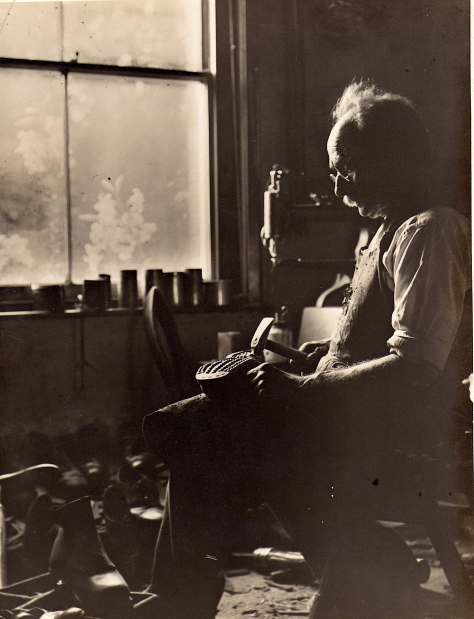
Here’s a remarkable photo of my great-grandfather (d.1946) taken by Edith’s other brother Charlie, probably in the 1930s:

Cobbler lowres

I don’t know how the Great War affected the teenage Edith, but there was evidently something of a studious air in the house at Potterne. Apparently my Granny used to say that visiting there was a trial because all they did—even during meals—was read books!

London school 1920

London school, 1920. Source.

Edith went on to qualify as a teacher, and from 1920 she taught in the East End of London—what a contrast from rural Wiltshire! She must have begun writing stories then. What kind of music would she have heard? I wondered if she might have became at all politicised—there’s no hint in her novels. Indeed, I now learn that she corresponded with George Bernard Shaw; and her brother Charlie was an ardent socialist (a rare breed around Devizes, I suspect, though the Liberals were gaining ground). I imagine how Edith might have gone on to emulate not Enid Blyton (born a year earlier) but (for example…) Vera Brittain (who lectured for the League of Nations in the East End in the 1920s) or Stella Gibbons (who didn’t—although she was a wry observer of rural–urban contrasts…).

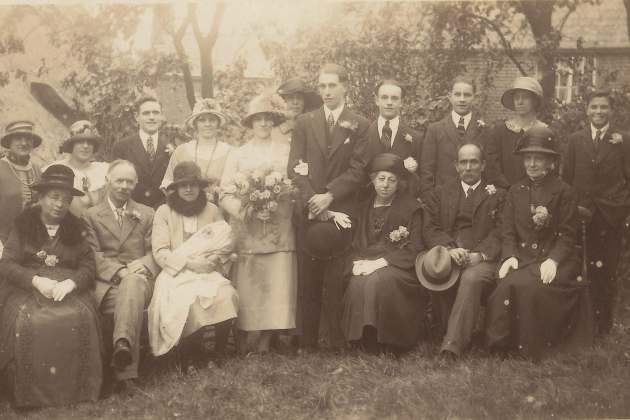
1925 wedding

Wedding of my maternal grandparents, 1925. Edith in back row, second from right.

Meanwhile, after the militant suffragette movement had been put on hold to support the war effort, women over the age of 21 were eventually given the right to vote by 1928. Surely Edith must have come into contact with the movement in the East End, but alas we have no inklings.

But then a cruel blow struck. In 1927, after seven years of teaching, a bout of scarlet fever resulted in the gradual loss of her hearing. A letter from the London County Council, dated 20th April, states:

The School Medical Officer is of the opinion that the state of your health is such as to render it necessary for you to give up your School duties in London.
In these circumstances you should not resume your duties after the Easter holidays.

On 27th April she received a handwritten testimonial from the Rev. Wilfred H. Abbot in Haggerston, E8:

In the whole course of the seven years no single complaint of any kind has ever been made by parents or children against Miss Miles and her work.
No higher recommendation could ever be given about anyone at the present day when parents and children are so apt to find fault [sic!—SJ]. I am quite sure that Miss MIles will always prove herself efficient in any work that she undertakes. We part with her with great reluctance.

The authorities provided Edith with a modest superannuation allowance, but she must have been devastated at her abrupt turn of fate. As a door onto a world that had been opening up for her was abruptly slammed back in her face, she retired back to the family home at Potterne.

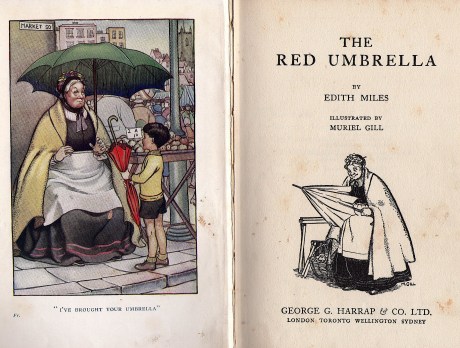
The spotted book, the first of her eleven novels, was published in 1929. I am most attached to the copy of The red umbrella (1937) that she gave me; it enjoyed considerable success, running into several reprints. Well, more success than my books on north Chinese ritual, I trust (for more umbrellas, see here)… Perhaps the chapters (“The postman”, “The chimney-sweep”, The baker”) subtly prepared me for writing the lives of ordinary people.

Red Umbrella coverRed umbrella lowres.jpg

The girl chums of Norland road is a fine title too. I’m not sure if I can also count such works as my feminist ancestry… Over the other side of the world, we shouldn’t neglect the role played by the wives of household Daoists in Yanggao villages.

Visiting Auntie Edith in Potterne when I was little, she seemed as quaint and exotic as the old house. She fitted the bill for what, thankfully, is no longer known as a “spinster”, “maiden aunt”, or “old maid”. A certain spark in her eyes hinted at her alert sense of humour, though even I could pick up an inevitable air of sadness. While she could lip-read, there was a youthful frisson for me in passing little notes across the kitchen table to help us communicate.

Having hardly thought of her for several decades, I now find myself moved both by her fate and by her equinanimous resilience. I also discover further fanciful connections. I was too young to articulate the thought, but the im-p-pediment of my stammer must have made me identify with her (another link to my work with blind shawm players in China?). And looking back, I feel that her enforced isolation made her seem pleasantly unworldly, before I dabbled in the hippy values resisting the growing consumerism of the 60s.

Strangely, I know a lot more about Li Manshan’s family than about my own. Now that I learn of the tribulations of my Chinese mentors through the period, and the convulsions of Europe, I wish I knew more about Edith’s experiences—a bright rural girl setting off to teach in a tough bustling urban environment, later to become a solitary single deaf author in troubled times, striving to eke a living by writing from her silent house in a little Wiltshire village.

With thanks to my uncle John and cousin Mark for precious material.

**Cf. another of my granddad’s favourite jokes (and another story that can be dated quite precisely): “Why do they eat boiled potatoes in Wiltshire?” “Cos they ain’t got no Devizes for Chippenham!”

Ritual and sport: the haka

haka

Since I am wont to make blithe analogies between the performances of ritual and sport, the pre-match haka of the All Black rugby team makes a fine illustration, also revealing the enduring depth of folk culture. In its constant adaptations, both in sporting and other ceremonial versions, it’s deeply impressive.

The wiki articles on the traditional and sporting versions make a useful introduction, and there are many fine YouTube clips.

As a Māori ritual war cry the haka was originally performed by warriors before a battle, proclaiming their strength and prowess in order to intimidate the opposition. But haka are also performed for diverse social functions: welcoming distinguished guests, funerals, weddings, or to acknowledge great achievements, and kapa haka performance groups are common in schools. Some haka are performed by women.

Its social use has become widespread. In 2012 soldiers from the Royal New Zealand Infantry Regiment performing a haka for fallen comrades killed in action in Afghanistan; and in 2015 hundreds of students performed a haka at the funeral of their high-school teacher in Palmerston, New Zealand:

In 2016, on the 15th anniversary of 9/11, New Zealand firefighters honoured the victims with a powerful haka.

And here’s a moving recent wedding haka:

In 2019 students performed a haka to commemorate the Christchurch shootings:

And the haka was performed for the Standing Rock protests of 2016 (link here if it doesn’t respond below):

* * *

The New Zealand native football team first performed a haka against Surrey (!) on a UK tour in 1888. The All Blacks have performed it since 1905. After witnessing the haka in Paris in 1925, James Joyce adapted it in Finnegan’s wake. For the 1954 version at Twickenham and evolution in the wake of TV, see here. The sequence below begins with 1922 and 1925 renditions, passing swiftly over the comically inept low point of 1973, to the increasingly choreographed versions of recent years:

So it’s no “living fossil”, being subject to regular adaptation. In 2005, to great acclaim, as an alternative to the usual Ka mate the All Blacks, led by Tana Umaga, introduced the new haka Kapa o pango, modified by Derek Lardelli from the 1924 Ko niu tireni:

Its adaptation to the sporting event compares favourably with Chinese concert versions of ritual. However it’s done, it never descends to the kitsch of such adaptations—it’s always performed with great intensity and integrity, giving an impressive glimpse of a serious ritual world. The pride that they take in performing it with such practised commitment contrasts strangely with the casual way in which they sing the national anthem that precedes it—even the Brazilian anthem doesn’t inspire its footballers to such intensity.

As a spurious link to a fine story, I note that the team performed a kangaroo version in July 1903:

Tena koe, Kangaroo                 How are you, Kangaroo
Tupoto koe, Kangaroo!           You look out, Kangaroo!
Niu Tireni tenei haere nei       New Zealand is invading you
Au Au Aue a!                             Woe woe woe to you!

* * *

From the sublime to the ridiculous… Several YouTube wags have suggested suitable responses from opposing teams: a burst of Riverdance by the Irish team, or (from the English) the hop-skip-hand-behind-the-back routine in Morecambe and Wise’s Bring me sunshine.

Morris dancing might unsettle the All Blacks too (music added later; in memoriam George Butterworth, killed in the Great War):

The Intangible Cultural Heritage rears its ugly head again—perhaps the English team could emulate the Britannia Coconut Dancers of Bacup, a 150-year-old troupe of Lancastrian clog dancers.

Not quite à propos, and Don’t Try This at Home—or in the Matthew Passion:

As a further riposte to the haka, even I can’t quite imagine the Daoist “Steps of Yu” (Yubu 禹步), but how about the Sacrificial dance of The Rite of Spring, complete with Roerich’s costumes and Nijinsky’s choreography? That really might take the lead out of the All Black pencil.

But we should celebrate the deeply serious nature of folk culture, and the evolving transmission of performances like the haka.

See also this helpful guide to the rules of rugby.

More Chinese wordplay, and a poem

or
What’s in a name?

My Chinese name Zhong Sidi 鍾思第 was given to me by the great Tang-music scholar Yin Falu 陰[阴]法鲁 (1915–2002) at my first supervision with him during my 1986 study-period at Peking University.

“Zhong” (Bell) approximates to my surname Jones; while itself a common surname, for me it has nice echoes of both ritual and music, evoking both Zhong Kui 鍾馗 the ugly drunken demon-queller (Ha!) and the woodcutter Zhong Ziqi 鍾子期, zhiyin soul-mate of qin zither master Bo Ya in the famous ancient story. And even Zhongli Quan 鍾離權, one of the Eight Immortals—a bit of a stretch, perhaps, since Zhongli is a rare double-surname (see here), but hey. Not to mention the huangzhong 黃鍾 and linzhong 林鍾 pitches of the ancient tonal system!

“Sidi” is short for “Sidifen”, a transliteration of “Stephen”. * Professor Yin chose the characters 思第, which in classical Chinese mean something like “mindful of advancement”—which is elegant but somewhat ironic, since I’ve always had enough of the hippy in me to mitigate against any worldly success (it never occurred to me that I might ever get a job, and sure enough I never did).

Without the bamboo radical at the top, the character di 弟 following the si would be a female name: “wanting a little brother”—one that peasants, disapppointed at having a daughter (yeah I know), do indeed sometimes adopt. And one cultural official in Yanggao, moved to write an article about my fieldwork there, somehow miswrote the character as 娣, with the female radical at the side. When I showed it to Li Manshan, we had another typical exchange:

Me: “WTF?! Doesn’t he know how to write my bloody name by now?”

Li Manshan (peering pensively at the character): “Maybe he thinks you’re a hermaphrodite…”

Anyway, as my interests soon transferred from early music history to living traditions of folk music (see here, and here), Yin Falu was remarkably tolerant of my frequent absences to go and hang out with peasants—as was Yuan Jingfang, my supervisor at the Central Conservatoire the following year. I’m also deeply grateful that Yin Falu introduced me early on to Tian Qing (then a lowly and impoverished research student!) and the Music Research Institute, beginning a fruitful long-term collaboration.

* * *

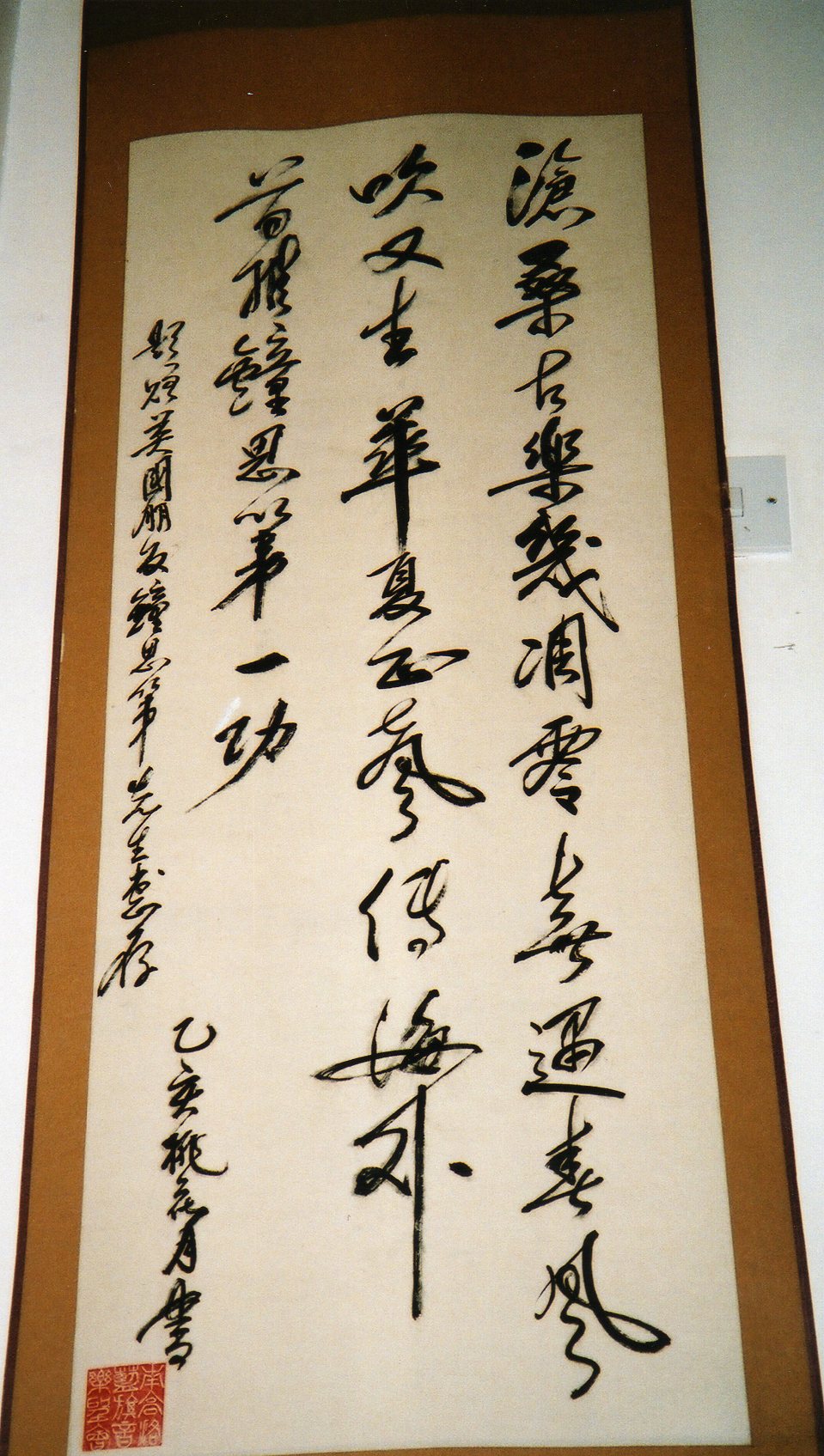
One of the most treasured gifts I’ve received is a scroll that the ritual association of South Gaoluo gave me in 1995 on the eve of my return to Europe (see my Plucking the winds, pp.236–8). They went to great trouble to have a piece of calligraphy made for me, which illustrates their ingenuity. First they “collectively” composed a poem, led by Cai Yurun and the urbane brothers Shan Ming and Shan Ling, most literate of the musicians. They then travelled to town to buy good-quality paper, went and found artistic Shan Fuyi (peasant xiucai litterateur, himself a great authority on the village’s history) at his work-unit and got him to do the calligraphy. To have the paper mounted, they then took the bus to Baoding, where they had a contact from Yongle village who had worked in the prestigious Rongbaozhai studio in Beijing. All this was a complex process, expressing their appreciation of our relationship.

GL scroll

The seven-word quatrain itself shows not only their literary flair but also their own perception of the significance of my fieldwork:

How rare the strains of ancient music
Gladly meeting the spring breeze, blowing is reborn
As the proper music of the ancient Chinese is transmitted beyond the seas
First to be praised is Stephen Jones

There are several charming puns here: in “blowing is reborn” (chui you sheng), “blowing” alludes to the breeze but also clearly to their wind music, and the “born” of “reborn” is homophonous with sheng 笙 the mouth-organ. The last line, impossible to translate, incorporates the device they had been seeking all along: the character di of my Chinese name Zhong Sidi is also an ordinal (as in diyi “first”, di’er “second”, and so on), so by playing with the caesura they managed to incorporate it into a meaningful phrase.

They couldn’t have thought of a better gift. I adore it, not for its flattery—foreigners in China are only too accustomed to receiving extravagant and groundless praise—but because they expressed their appreciation of our bond with such creative energy. In our everyday dealings, the musicians are all too used to me forestalling any incipient flattery by my favourite Chinese phrase, beng geiwo lai zheyitao 甭给我来这一套 “cut the crap”. This expression also comes in handy whenever someone is so sentimentally drunk that they, suddenly moved by the sheer fun of our fieldwork, rashly let out the awful Chinese cliché “international cultural exchange“.

My friends call me “Old Jonesy” (Laozhong 老钟), which is also a jocular way for Chinese people to refer to themselves (老中, for Zhongguo 中国 China) as opposed to laowai 老外 “foreigner”, even “Wog”. Laozhong then leads onto Naozhong 闹钟 “alarm clock”. (For nicknames in the music biz, see here.)

For Craig Clunas’s Chinese name, click here.


* Talking of transliterations of foreign names (see here and here), “Stephen” is conventionally rendered as 斯蒂芬. That last fen character is shared with Beethoven (Beiduofen 贝多芬), whose characters, following the brilliant (if controversial) gender analysis by Susan McClary, I like instead to render as 背多粪 “shouldering a load of shit”—“but that’s not important right now”.

Taruskin on early music

***Link to this page!***

I’ve finally got round to reading the great Richard Taruskin properly. Among his wide-ranging themes, in this page (under WAM in Menu), I discuss his seminal comments on early music, informed by my own humble experiences of the scene.

As he links it with modernism, placing it firmly within the context of our contemporary culture, this is no mere niche topic, it’s profound, essential reading on culture in modern society— and with maestro-baiting galore!

Even if one disagreed with every word of the book, the writing is always a joy to read.

Ritual life around Xi’an

Xi'an miaohui lowres

A new page (under Themes in Menu) introduces changing ritual life around Xi’an, setting forth from my visits since 1986 and the work of the late great Li Shigen.

It accompanies the new track 11 on the audio playlist, with comments here.

As so often for north China, all the musicological studies are very desirable, but there should be far more to it than that. It can’t be left only to musicologists—it’s just as much a topic for historians, ethnographers, and scholars of religion.

Kulture


joke

As I snap remorselessy at the heels of the heritage shtick, my cavils revolve around the Chinese concept of mei(you) wenhua 没(有)文化 “lacking in culture”. It’s a cliché referring to people’s degree of modern state education. Even peasants deprecate themselves with the term, though it is precisely the riches of their quite separate culture that “educated” urban pundits purport to admire—before trying to shoehorn it into their own.

LB joke

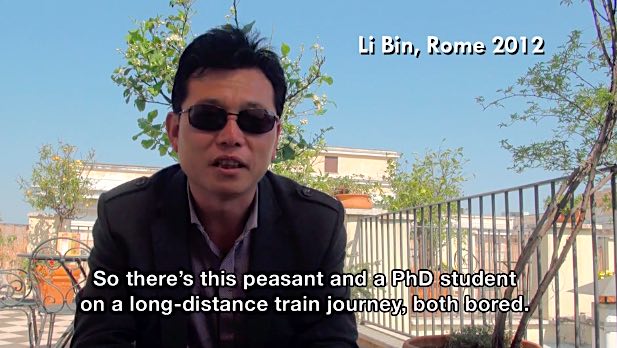
Li Bin’s brilliant joke (keep watching after the final credits of my film) subtly satirizes the gulf between peasants and intellectuals. Here’s a fuller English version (my book, p.ix):

So there’s this Ph.D. student on a long-distance train journey, sitting in the same compartment as a peasant.

He’s dead bored, so to pass the time, he says to the peasant,

“I know, let’s play a game. We both ask each other one question. If you can’t answer my question, you have to give me 100 kuai; if I can’t answer yours, then I have to give you 200—because I have a Higher Level of Culture, don’t you know?”

The peasant goes, “Oh right—umm, OK then.”

The student says smugly, “You can start, because I have a Higher Level of Culture!” So the peasant thinks for a bit and asks,

“OK then, I got one—so…
What is the animal with three legs that flies in the sky?”

The student racks his brains. “Huh?? An animal with three legs that flies in the sky? Hey, there isn’t one, surely… Ahem… Crikey—you’ve got me there. OK, I give up, I guess I have to pay you 200 kuai.” He hands the cash over to the peasant.

The student, still bemused, goes on, “An animal with three legs that flies in the sky… Go on then, you tell me, what is this animal?”

The peasant scratches his head and goes,

“Hmm… nope, I dunno. OK then, I can’t answer your question either—here’s 100 kuai!”

LMS Rome

It’s even better in Yanggao dialect—Li Manshan tells it hilariously too.

As local traditions continue to be distorted, large areas of the world are in danger of being turned into a kitsch Disneyland theme park. A certain amount depends on the “level of culture” of state bureaucrats all along the chain; in China the central ICH authorities do indeed organize “training sessions” for regional cultural cadres, with limited success.

The whole system seems inherently flawed. Local, um, heritage bearers have their own ideas about what to do with their traditions—and given the dubious benefits and evident dangers of the state system, with its own “lack of culture”, people like me might hope they could be left alone to do so. But beguiled by the chimera of fame and fortune, locals—in China and elsewhere—are all too easily hijacked by the power of state machinery and tourism.

A Bach mondegreen

WAM musos tend to pick up a smattering of what Peter Cook called The Latin. So in the spirit of Myles, we may interpret the fifth movement of the B Minor Mass thus:

Algernon was starving and scared as the van carrying gravy mix called round. The incident has been immortalized in many a baroque Mass:

Ate, in terror, Paxo minibus

Actually, like Un petit d’un petit, that’s a soramimi, not a mondegreen. Cf. Gandhi in Mary Poppins (I know, the italics don’t really make that sound any better.) For Sick transit, Gloria, Monday, see here.

Anyway, from ridiculous to sublime—a flippant pretext to extol the glories of Bach:

Et in terra

Not a lot of people know that Bach had a dog called Potentia. Hence the movement in the Magnificat:

Fetch it, Potentiam!

And this is perhaps a suitable place for “most highly flavoured gravy”, a favourite remoulding of “most highly favoured lady” from The angel Gabriel by choristers Down the Ages—see here, with a link to Joseph Needham and Cambridge.

See also Comely scone. You can follow all this up with the mountweazel

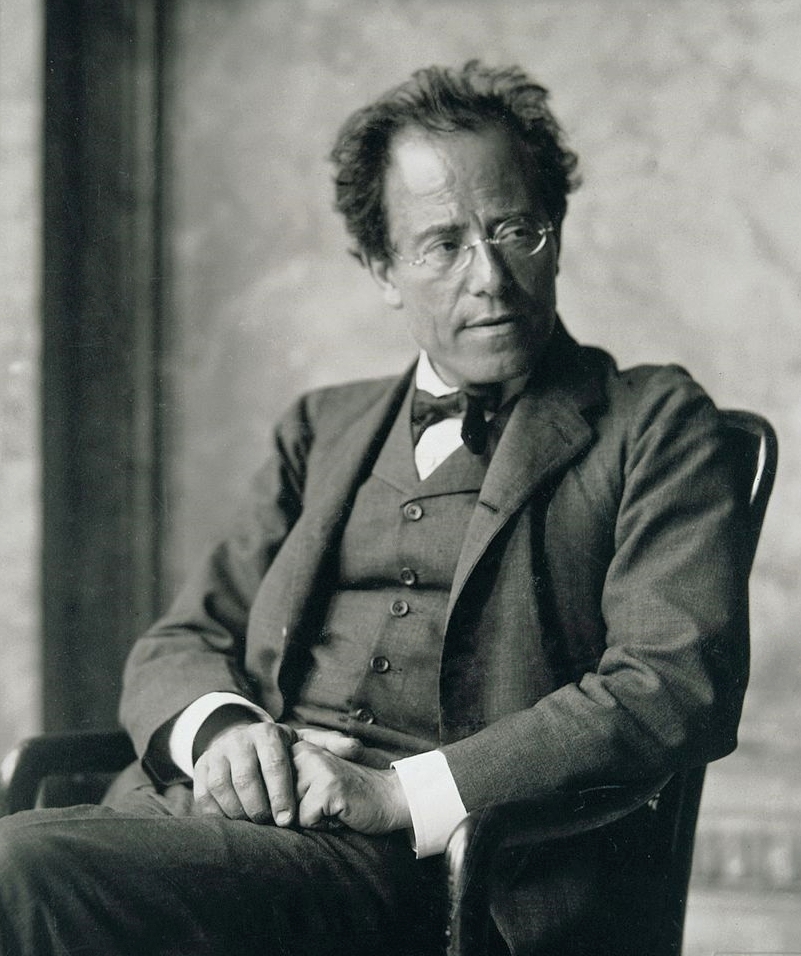
Mahler, the exclamation mark, and John Wayne!

*For an introduction to my whole series on Mahler, with links, click here!*

We’ve had Mahler and Anna May Wong, now for Mahler and John Wayne.

I make but a paltry effort to control my addiction to exclamation marks (!). In my defence I cite Mahler himself— I recall the instructions in his scores as being liberally sprinkled with them. Now that I come to seek instances, they’re not so ubiquitous, but here are some examples:

viel Bogen!

Vorschlage möglichst kurz!

And, like a red rag to a bull for the horns (sic) or clarinets, the immortal

Schalltrichter auf!

Such exclamation marks add a personal touch—we can feel the composer–conductor communicating with his musicians. At the climax of Der Abschied, transcendent finale of Das Lied von der Erde, they suggest awe:

Langsam! ppp!

My search continues for instances of his use of triple exclamation marks!!!

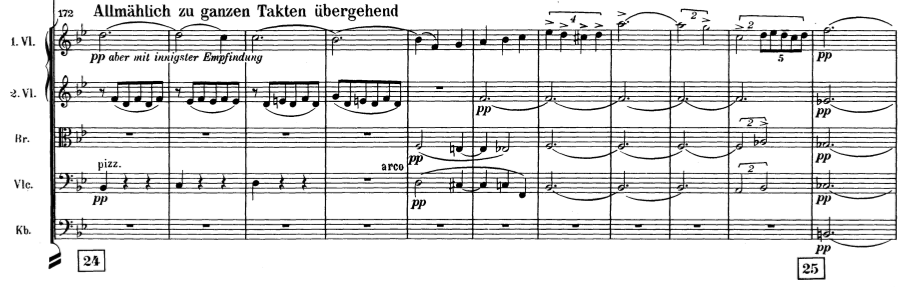
Having drawn attention to Mahler’s use of quintupletsDer Abschied is full of cross-rhythms— time dissolving into the nirvana of

Allüberall und ewig blauen licht die Fernen!
Ewig… ewig…

In this melody, emerging out of mysterious ascending motifs on flutes, the triple time is soon subverted by a duple metre, the quintuplet leading into that most distinctively plaintive of Mahler chords. (from 10.44 on the YouTube link here):

Abschied 2

Abschied

* * *

Now, you may think those awed exclamation marks make a flimsy and irreverent pretext to cite the famous John Wayne story—but hey:

In rehearsal for The greatest story ever told, the Duke, playing the Roman soldier who spears Jesus on the cross, says rather flatly,
“Truly he was the son of God.”
The director cuts in: “Not like that—say it with awe!”
Obligingly Wayne repeated his line, still deadpan:
“Aw—truly he was the son of God.”

And that links to the notorious vinegar ad.

Searching for a comprehensive analysis of Mahler’s markings, I came across this guide, which is even funnier.

Dissolving boundaries

I’ve just added a page (under “Themes” in Menu) on

Folk and art music in China: qin and shawm music

Hua band 2001 edited

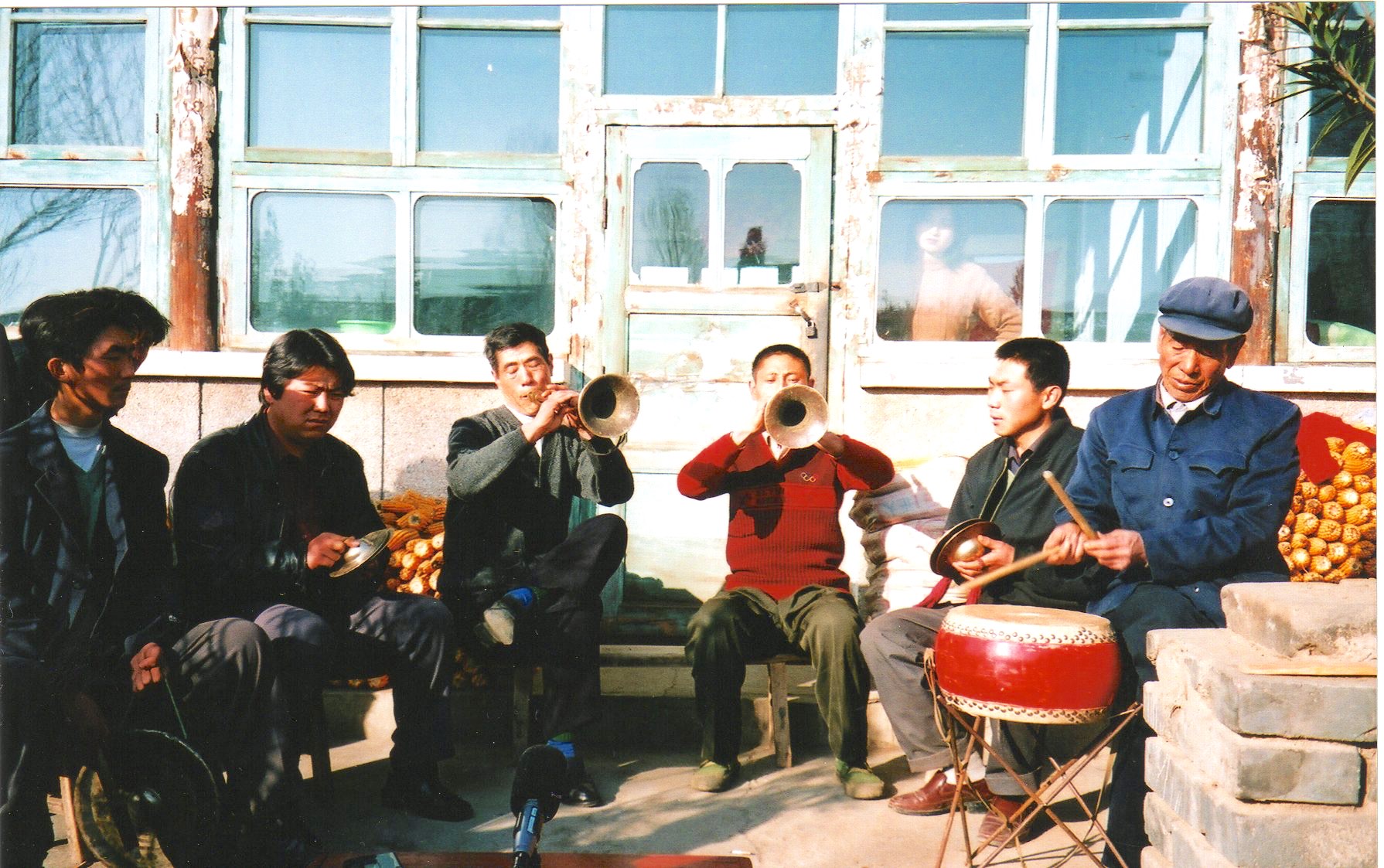
Far away from the pop music and cutesy erhu solos that dominate the Chinese media, I’d like to compare two melodies with the common theme of “Geese landing”: the intimate meditative solo Pingsha luoyan 平沙落雁 for the elite qin zither, and the searing folk suite Da Yanluo 大雁落 for two shawms and percussion.

Such utterly contrasting styles may seem to make an absurd comparison, and we shouldn’t suppose that any two pieces with a similar title will have anything in common. In this case it’s more of a convenient pretext to reflect on disparate genres.

One tradition is highly literate, the other non-literate. Yet the incongruous juxtaposition, however polemical, turns out to be illuminating—querying the widely-held myth that qin music, as “art music”, will be more sophisticated and complex than “folk” shawm pieces.

*** Both pieces are illustrated by recordings of master musicians!***

The Proms, YAY

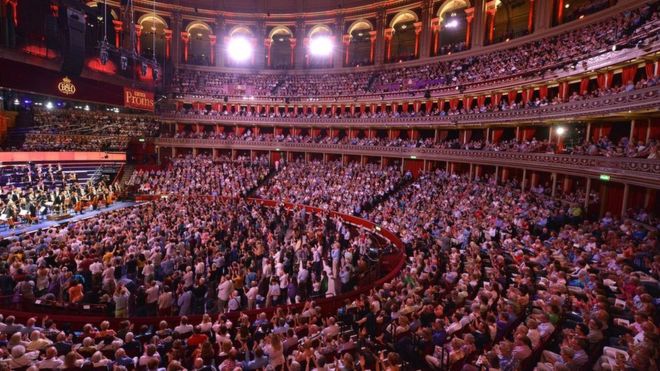
“Concerts” are a niche activity within the broad spectrum of music-making in human societies. Generally I find them a necessary evil, but with the festival of the Proms getting under way today (daily for the next two months), as usual I’m all agog (yes, a Complete Gog) for my favourite concert series.

Critical of concert halls too, I’m more than happy to settle for the Victorian setting of the Albert Hall—round buildings have a distinctive ambience, and the unique receptive atmosphere of the series is largely attributable to the Prommers in the Arena, their rapt silence encircled by the seated audience.

If you think my blog is mired between populism and elitism, then get this—WAM for Yoof:

http://www.bbc.co.uk/programmes/p01mv2zh

That’s F hashtag minor, not A flat miner, you note. Cf. Korngold at the Proms.

A great annual ritual: Wimbledon

Centre Court

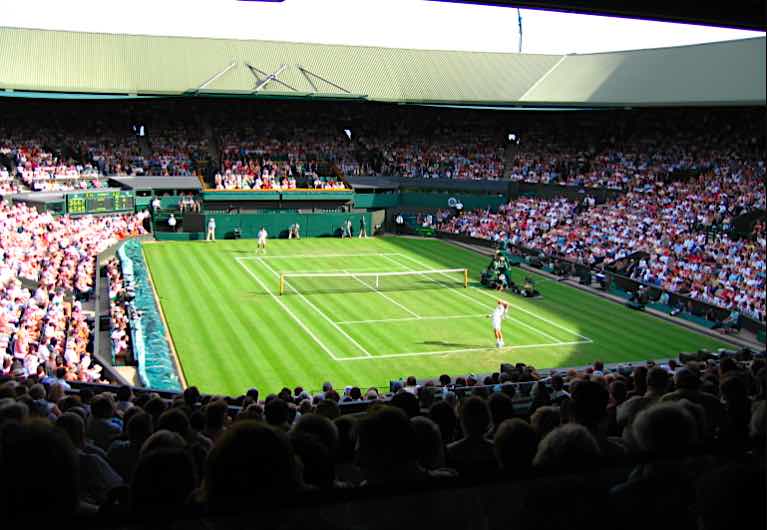
The annual Wimbledon ritual is well under way again.

Never mind the tennis, the Beebs’s own line-up is impressive enough—Brits like Trusty Tim, always playing with a straight bat [?—Ed.], and the demure Sam Smith, obligatory Funny Foreigners led by generally lovable but sometimes off-message Mac, wise Tracy Austin and Martina Navratilova, with the ever-hot Pat Cash. It’s entertaining to see how the stalwart female commentators maintain patience with the hapless male pundits negotiating the sexist minefield in the wake of the Inverdale–Bartoli fiasco.

Quaintly more antiquated than the other Majors, it’s a benign celebration for the middle classes (including me—I went to school nearby, and sold ice-creams there). As a Guardian review observed in 2022, the event comes with

that familiar sense of something performative, theatrically static, being British for the British, in front of the British.

Like any ritual, indeed any performance, Wimbledon confirms Correct Behaviour (not least to keep those errant Foreigners in line); and it will mean different things to different people. But it’s a visual treat, despite the retro ritual costumes; and as to the ritual soundscape, the ping-pong [sic] of the ball makes a fine soundtrack too—along with the spectators’ Wimbledon groan.

The Beeb gets it just right by clinging on to the old signature tune (like child chimney-sweeps and Morris dancing) by Leslie Statham (aka Arnold Steck)—here in all its extended glory:

Doubtless this old story will be revisited during the longueurs between matches:

Vitas Gerulaitis lost his first sixteen matches against Jimmy Connors. After finally defeating him at the 1980 Masters, he proudly declared:

Nobody beats Vitas Gerulaitis seventeen times in a row!”

This post, with a sequel, belongs in my series on The English, home and abroad. For Beethoven’s Wimbledon debut, click here. See also Cocomania and other tennis posts under A sporting medley.

The heritage shtick

Just added a convenient new tag (in the sidebar) for “heritage”:

https://stephenjones.blog/tag/heritage/

collating my observations on the troubling effects of the Intangible Cultural Heritage juggernaut on north Chinese ritual—also taking in Stella Gibbons, “Mediterranean diet”, the deep-fried Mars bar, and the Lake District…

I once attended a conference on the ICH at which a wry Chinese scholar asked, “So are we going to inscribe Spring Festival, then?!” I hereby nominate Breathing, indeed Life. Beat that.

Taxonomy eh—dontcha just love it.


French taunting

It’s been a while since we’ve had any French drôlerie (try A French letter, and the series on the Tang faqu). So it’s high time to remind ourselves of the classic scene from Monty Python and the Holy Grail:

Food for thought on the Brexit debate? And for aficionados of Chinese ritual, note the long trumpet near the opening.

For the taunts of cheerleaders at archery festivals in Bhutan, see here.

Mahler in Chinatown

*For an introduction to my whole series on Mahler, with links, click here!*

It’s always worth tuning in to Donald Macleod’s Composer of the week on BBC Radio 3. Even for a Mahler fanatic like me, last week’s programmes (based on the well-trodden theme of his years with Alma) were instructive.

I suppose this story belongs to the cliché of “international cultural exchange” (guojixing wenhua jiaoliu 国际性文化交流, which deserves an entry in my Catechism of Chinese cliché):

We all know (don’t we) about Mahler’s settings of Hans Bethge’s embroidered translations of Tang poems for Das Lied von der Erde (composed in 1909 but only performed after his death in 1911). In 1910, as he was fêted in New York, the Schirmers [some sources say the Roosevelts] took him and Alma on a visit to an opium den in Chinatown. Long before the stereotypes of Fu Manchu and Anna May Wong, this could have been an intriguing encounter.

Their visit to the “teeming” Lower East Side Jewish quarter must have been more conflicted (among myriad discussions of Mahler and Judaism, Norman Lebrecht, Why Mahler? is accessible). Alma’s portrayals are not always reliable, but here it’s worth citing her account (Gustav Mahler: memories and letters, pp.161–2)—more prurient than ethnographic:

We were invited by the music publisher, Schirmer, and his wife to dine with them one day and drive with them afterwards “down town”, into China town. The indispensable detective sat beside the chauffeur. We turned out of the busy streets into narrower ones which became by degrees quieter, narrower, darker and more uncanny. We got out, accompanied by the detective with a loaded revolver in his pocket, and went into an opium den. A creature with a sickeningly womanish face received us in an ante-room, where we had to put down a sum of money. He began at once to give us a long list of his successes with white ladies, and told us he acted female parts in the Chinese Theatre. A Chinese woman, of course, may not either act or look on in a theatre. He showed it in his face—it was the most degenerate man-woman face you could imagine. He showed us numerous photographs of American women he had—and he said the rest by gestures. Then he conducted us into several small but high rooms, empty in the middle but furnished with bunks along the sides, each of which contained a stretcher; and on each stretcher lay a doped Chinese with his head lolling into the room. Some of them raised their heads heavily as we approached, but at once let them sink again. It was a gruesomely horrible sight. They were simply dumped there to sleep off their intoxication. They might be robbed or murdered while they were in this state and know nothing about it. The whole scene resembled a baker’s shop with human loaves.

On now to a house of cards higher and higher, up into a room luxuriously furnished for strangers, cushions everywhere, and beside each cushion an opium pipe. And a Chinese, for payment, was ready to smoke a pipe on the spot while we watched him slowly succumb, rolling his eyes and twisting his limbs about. We were invited to smoke too but declined with horror. Next the theatre. Charming, but no play was being given. If it had been, no European would have been allowed among the audience. On again. Rats with long pigtails slunk nimbly and rapidly along the walls of the stinking street. Mahler said: “I can hardly believe that these are my brothers.”

On again. Small shops, small hotels, all silent. Finally, on the outskirts of this district we came on the habitat of a religious sect. There was a large hall at the far end of which sat a man with the face of a fanatic playing hymns on a harmonium in a pronouncedly whining style. The benches were occupied by a starving congregation. We were given the explanation. For listening to those hymns and joining in—a cup of coffee and a roll. What wretchedness in those faces! We pushed our way out, followed by hostile eyes, and for long afterwards we could still hear the flat notes of the hungry singers.

On again, and now the Jewish quarter. It was dark by this time. But here all was life and bustle, chaffering and shouting. The racial difference was staggering, but it was because the Jews worked day and night shifts to lose no time. The whole street was full from end to end of old clothes and rags. The air was heavy with the smell of food. I asked Mahler softly in his own words, “Are these our brothers?” He shook his head in despair.

With a sigh of relief we at last turned a corner and found ourselves in a well-lighted street among our own sort of people. Can it be that there are only class and not race distinctions?

Mahler’s music is so full of what would be known as folk and world music that his consternation is startling; can his success have made him so oblivious to his own background? And as ever, while trying to visualise the ethos of the time, we can only read this with later history in mind.

For more on Der Abschied, see also here and here. For more on Mahler in New York, and an ominous funeral, see Mahler 10.

Writing about music

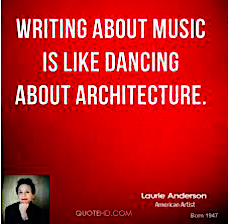
This succinct critique by no means invalidates musicology (if it does, then Uh-oh), but I’m fond of the expression

Writing about music

With All Due Respect to Laurie Anderson, and indeed to Steve Martin, Frank Zappa, Elvis Costello,  Miles Davis, Thelonius Monk, * and Clara Schumann (now that’d be some jam session: cf. my fantasy dinner party), its many variations have been widely attributed. It’s another snowclone going back in sentiment to the Mists of Time (well, 1918), as in this fine piece of detective work (cf. wiki).


* Whose wife Nellie Smith allegedly nicknamed him “Melodious Thunk”.

Practice makes perfect

More WAM ethnography:

Brass players enjoy, even flaunt, their hooligan image (more “licence to deviate from behavioural norms”)—or at least, UK brass players in a befuddled heyday from the 1960s to the 1990s, still an ongoing hangover today.

Becoming a musician (or indeed a household Daoist) is about far more than “learning the dots”; aspiring musicians also look to the lifestyles of their role models. The intoxicant du jour changes—Chinese shawm players have moved from opium to amphetamines, for instance. But both in jazz and WAM, many musos have learned to their cost that adopting the, um, recreational pastimes of Charlie Parker or John Wilbraham doesn’t necessarily help them play the way their heroes  did.

The trumpeter John Wilbraham (“Jumbo”) was legendary. This is a beautiful site well worth exploring—an insider’s ethnography. I came across him when he was trumpet tutor for the NYO, and later in the BBC Symphony Orchestra.

There are also some fine stories on this site, not least about two of my most admired conductors (more maestro-baiting):

“The one thing we do know about Bach for certain, is that he didn’t want it to sound fucking awful!”
—John Wilbraham to John Eliot Gardiner.

(a succinct critique of the Early Music movement?), and

“If I’d wanted to play in front of a clown, I’d have joined the fucking circus.”
—John Wilbraham (Jumbo) on Gennadi Rozhdestvensky (Noddy)

(For more orchestral nicknames, see here).

Learning to perform—in any tradition!—requires endless hours of practice (again, it’s the stories about jazzers, rather than WAM musos, that inspire me here). There’s another famous story, which strangely I haven’t yet found among all the online anecdotes:

Before Mahler 5 at the Proms, a music critic was having a drink in the 99, favoured hostelry of Prom-goers. He watched in amazement as Jumbo downed pint after pint, and then picked up his trumpet case to stagger off to the gig. Expecting the worst, the critic took his place in the audience. The symphony opens with a scary exposed trumpet solo, and is challenging throughout. Jumbo played the whole piece perfectly.

After the concert the critic returns to the pub, to find Jumbo already propped up at the bar, more pints lined up. He walks up to him and says,

“You must excuse me, Mr Wilbraham, but may I ask how you manage to play so perfectly when you’re pissed?”

“It’sh perfectly simple,” Jumbo smiles back at him conspiratorially, “I practice pissed!”

Stories like this belong to the treasury of orchestral myth-making.

To go: a parallel text

Further to Signoffs and other cross-pond drôlerie (NB n.3 there) and indeed my helpful exegeses of the alarming Teach yourself Japanese, here’s a parallel text, hopefully of use to travellers in either direction:

US: Hey man—can I get a Diavola to go?

British: A very good day to you, my dear chap. Now would you be so obliging as to provide me with with one of your fine pizzas, engagingly (and with a certain mischief, perhaps?) known as Diavola—enclosed, moreover, in some kind of disposable container, if you would be so kind; for such are the exigencies of modern life that I regrettably find myself unable to relish said comestible at your own fine place of purveyance, but, rather, will be reluctantly compelled to consume it in less salubrious and elegant surroundings while otherwise occupied.

I acknowledge my debt to the cheeseshop sketch. And, come to think of it, to the great Gerard Hoffnung’s 1958 Advice for tourists, still irresistible after all these years:

As with the Alan Bennett Sermon (and indeed as with live performance generally), the pleasure is augmented by the audience response, and the vignette it now affords us into that particular milieu of late-1950s’ English society.

In Hoffnung’s wiki entry I like the succinct description of his brief sojourn at the Hornsey College of Art:

He was expelled for his lack of gravity in the life class.

See also posts under The English, home and abroad.

Doing Hamlet

Here’s another story from the great Arthur Smith. I can only find a truncated version online, so I’m going to do an expanded paraphrase that I’m sure I heard him tell on radio:

Arthur had somehow got to know Kray henchman “Mad” Frankie Fraser. One day when they meet up, Frankie goes,

“Hello Arfur, wot you up to then?”
“Well Frankie—funnily enough, I’m doing Hamlet next month!”
With avuncular concern, Frankie goes,
You don’t have to do ‘im, I’ll do ‘im for yer—where’s ‘e live?”

This almost links up with the musos’ favourite prison examiner story.

Three studies of ethnic culture (not)

More perks of orchestral touring: Noh theatre in Japan, 1992,
not long after fieldwork in Shanxi.

Three monographs on ethnic religion and culture that I haven’t yet seen—or even written:

  • On campaigns against popular shamans:

Striking a happy medium.

  • On the stagecraft of Japanese drama (Altogether now):

There’s no business like Noh business.

(For a rather more serious treatment, see here.)

And having added an acronym for British Art Music to the one for Western Art Music, how about the “classical” traditions of the Maghreb?

  • On the well-attested debt of the Western classical tradition (notably British music) to the nuba art music of the Maghreb, with reference to the antiquated sexist ideology perpetuated therein:

WAM, BAM, thankyou MAM.

  • This one has already been done, but in similar vein is my venture into sociology:

From WAGs to witches: the demonisation of celebrity girlfriends.

More Daoist wordplay

I’ve already given some examples of the lighter side of fieldwork with my Chinese colleagues and the Li family Daoists.

Wu Fan has not only become a brilliant fieldworker, but (sure, this would be related) has a lively mind, with an inexhaustible supply of jokes. Setting off from some casual phrase in conversation, she links stories up in a long chain. Her book is a valuable companion to my publications on Yanggao—as a prelude to one of her classic lines, here I adapt part of my Introduction to it:

When my trusted long-standing fieldwork companion Zhang Zhentao brought along a young female student on our 2003 trip to Yanggao, I was none too pleased. I had a tried-and-tested routine of fieldwork with Zhang, and was afraid that Wu Fan’s lack of experience would get in the way. Coming from a comfortable urban background, she confesses that the conditions of rural Shanxi were a bit of a shock.

But she soon proved well able to endure the tribulations of fieldwork. After a few days staying at the bustling Xujiayuan temple fair—trudging through the mud, trying to handle complicated guanxi among the gujiang shawm bands, chasing around taking in all the diverse festive behaviour while finding time to talk to all kinds of people, after late nights recording the yankou ritual, sleep interrupted by bits of roof falling on our heads and huge moths practising their kamikaze bombing routine on us helpless victims on the kang brick-bed—she was in her element. Shock and novelty give way to familiarity, and soon she was feeling at ease.

It had been a bold move for her to abandon the security of a good job in Wuhan to embark on the dubious rewards of ethnomusicology—I hope she doesn’t regret it! If her background of “Western food” in a large city didn’t prepare her for fieldwork, her experience working in TV did perhaps give her one advantage: she has a natural ease when talking with people, making friends, earning respect, crucial skills that aren’t so easy to learn from a manual on fieldwork technique. Her rapport with people comes into its own when she visits poor blind musicians. Like her elder teachers, she really cares about these disadvantaged people. Apart from all the hard grind, it’s useful if fieldwork can also be fun, and moving. With her, it is—but it never stops her from analysing objectively.

I have always been immensely fortunate in my Chinese fieldwork colleagues, but before my very eyes Wu Fan transformed from a timid pupil into someone whom I could trust to ask all the questions on my mind, and more—to the point that I quickly became even more superfluous than usual, and I now feel I can look forward to an early retirement. Rolling her eyes every time she realized I was about to try and interrupt the natural flow of conversation to suggest an avenue that she already had on her agenda—all in good time, Zhong laoshi… Behind a demure exterior lurks a ferocious intellectual appetite.

I won’t dwell on the difficulties faced by a female fieldworker in a male-dominated society: the scholarly field looks increasingly dominated by women, and Wu Fan has some astute comments on gender issues. One of my most precious videos is of her comical early attempts to forge a bond with a group of tough young gujiang by perching insecurely behind their drum-kit to accompany them in a pop music medley—a sobering instance of participant observation for our times.

If we ever get round to making any useful general observations about Chinese culture, or even north Chinese ritual culture, it will need an awareness of all the local historical, economic, political, and personal factors that make up the experiences of millions of overlapping communities, and will require a whole new army of scholars with Wu Fan’s determination and aptitude.

So on that first trip of hers to Yanggao in 2003, there we were with the Li band at the Lower Liangyuan temple fair, filming the whole sequence of rituals throughout the day and taking the opportunity between them to seek Li Manshan’s wisdom. It had been a long day, but now we were looking forward to the evening Communicating the Lanterns (guandeng 觀燈) ritual. The writing of this term varies: in many ritual manuals it appears as “Closing the Lanterns” (guandeng 關燈)—which in colloquial Chinese means “switch off the light”.

After supper we all retired to the scripture hall to rest, as Li Manshan prepared while Golden Noble adjusted the tuning of their sheng and Wu Mei checked his reeds. We were all tired, but as time went by there was still no sign when the ritual might begin.

Li Manshan’s son Li Bin, always most solicitous for his visitors, asked Wu Fan:
“Aren’t you tired? Wouldn’t you like to go back and get some sleep?”

Wu Fan came out with the classic line, punning on the double meaning of guandeng:

“你不关灯,我怎么睡觉?!”
“How can I get to sleep if you don’t switch out the light?!”

Michelle Obama

Meanwhile (see my previous post), the passionate engagement, dignity, and basic human decency of Michelle Obama are desperately needed in these disturbing times.

We may indeed have reservations about her husband’s legacy, and his current conformity to the distressing rule of enrichment (a trail blazed more predictably by our own former “socialist” leader), but if only we had appreciated him more at the time—all the more so, given the dangerous pompous immoral self-serving infantile sulky posturings of his successor.

Even as an orator, while her hubby is no slouch himself, Michelle is in another league. Her passion was movingly evinced in her speeches to schoolgirls on her visits to Britain since 2009:

Now I realize all this is a clichéd bleeding-heart liberal do-gooder Guardian reader’s take, and I quite get the surly defensiveness of the fusty conservative stuck in the 1950s, before their birthright was threatened by uppity women and foreigners, when (or so they thought) the unwashed classes still knew their place. For a fine article on the antithesis to inspirational women like Michelle, see here—and note several BTL comments that throw out the baby with the bathwater by “refusing to be told what to think”.

Anyone unmoved by Michelle’s speeches has a heart of stone. Her inspiration is already bearing fruit here. Still,

Dialect: Yangpu and Lunpu

Yangpu

County gazetteers are often a useful source for local dialect. Source: Yanggao xianzhi 阳高县志 (1993).

Among themselves, the Li family Daoists chat (guada 呱嗒) in Yanggao dialect, which is quite tough to understand, in pronunciation, tones, and vocabulary. From my book Daoist priests of the Li family:

Most north Chinese dialects are supposed to be close enough to standard Chinese, but some people from Beijing find Yanggao peasants nearly as hard to understand as I do. Li Manshan sometimes makes an effort to speak with me in something he imagines to resemble standard Chinese (as on his voiceovers for our film), but he generally forgets, which is both flattering and frustrating; and their chat among themselves is largely impenetrable. Weirdly, the only subject on which we can communicate reliably is the titles of obscure medieval ritual sequences and hymns.

Several pronunciations fox my Beijing friends, let alone me. Shi and si, and zhi and zi, are hard to distinguish. Huang sounds like hong, and guang like gong; hou sounds like khio, hao like hou, and yao like you or yu; guo and shuo become gua and shua; li and lai are both close to lei. Baishi (funeral) becomes beisi. Several pronunciations remind me of my time in Shaanbei: hei becomes he, he becomes ha, and hai becomes hei; bai and bei are sometimes closer to bie. As in Hunan, an initial N often becomes L; so “rich peasant” (funong) is fulong. The often-used term kabulei (“fantastic”) would be kebulai  可不赖 in standard Chinese [you can hear bulei in Xu Tong‘s harrowing documentary Cut out the eyes]. I like duohuir (“When?”), more classically economical than the cumbersome standard shenme shihou.

One feature of Yanggao dialect that does strike me is how the descending fourth tone is used with abandon, notably in place of the low dipping third tone, as in hashui (drinking water), pijiu (beer), fanguanr (restaurant), or ritual terms like dagu (playing drum) and xietu (Thanking the Earth)—all with a heavy accent on the final falling syllable. With my notoriously poor grasp of the tones, this becomes something of a relief to me: if in doubt, use the fourth tone!

One more instance: fazhan (develop): I hadn’t noticed this, since it’s not the kind of word peasants use much, but there’s a nice instance in Cut out the eyes, at 16.34.

jingtang

So on behalf of “cultured” outsiders (see this joke), my Daoist friends sometimes make an effort to speak the Yanggao version of putonghua Standard Chinese, whose acronym is Yangpu 阳普. It doesn’t bear much more resemblance to the standard language than my own crap Chinese—which by the same process I acronymise to Lunpu 伦普, short for Lundun putonghua (London Standard Chinese). When meeting Confucius Institutes, I boldly seek to upgrade this to Lunyu 論語, “The Confucian Analects”. Hey ho.

For the secret language of blind shawm players around Yanggao, see here.

Daoists and Confucians

Jpeg

On tour in France, spellbound yet again by the Li family Daoists’ performances under the august aegis of the Confucius Institute, who better to cite than the Grand Maître himself:

子在齊闻韶,三月不知肉味,曰: 不图為樂之至于斯也。
《論語·述而》

After Confucius heard the Shao music in the kingdom of Qi, he didn’t notice the taste of meat for three months.* He said, “I had no idea that music-making could reach such heights!”
Analects §7.14.

My comment, precisely 2,534 years later:

鐘注:小子在巴闻道亦是也!
Jones notes: Lil Ol’ Me feels the same on hearing the Way in Paris! [1]

I feel blessed to have found this subject—fieldwork, inspiration, ritual, laughter. And now to take a rocking sextet on tour, all at ease with each other, great mates.

For more from Confucius, see here.


* The Analects doesn’t appear to contain his later comment, “Stuff this for a lark, anyone fancy a burger?”


[1] 巴: short for Paris 巴黎, not 巴蜀 Sichuan. Or Bali, for that matter. Note how I replace Shao by Dao.

The whole long dragon 一条龙

To bring this little French tour to fruition has involved a lot of work. A long chain of people has made it possible, from the Cini people in Venice (2012) and Thomas Roetting in Leipzig (2013) to Adeline Herrou and Hélène Bloch at Nanterre, the brilliant Yan Lu of the Nanterre Confucius Institute, Kersten Zhang our able fixer in Beijing, the Clermont-Ferrand CI team, Nicolas Prevot, the Centre Mandapa, and Li Bin in Yanggao.

Indeed, the roots of our tours, and my whole project on the Li family, go right back to Chen Kexiu’s early research and the 1990 trip to Beijing led by Li Qing.

Again, with the Li band we riff on “Without the Communist Party there would be no new China”:

(me:) Without Chen Kexiu there would be no Steve-and-the-Li-band
(Li Bin:) Without Steve  there would be no Li band tours
(me:) Without the Li band there would be no Steve

As I observed (my book, p.339):

The audiences go wild, their faces rapt; I love the feeling of turning on audiences to this music that has enchanted me for so many years. Our hosts always latch onto how very special this tour is.

Yan Lu prepared one of the most detailed schedules I’ve ever had in four decades of orchestral touring. And I love it when we’ve done all possible preparation, and then just naturally come together in haste, improvising to make the little details work, carried along on a wave of enthusiasm.

The Daoists fit into it all and always put on an amazing show night after night, so that we and everyone, dazzled by their brilliance, see that it’s all been worthwhile.

Still, all this is merely an occasional interlude for them: their daily “rice-bowl” remains performing rituals for their local community in the Yanggao countryside.

The Li band in France: notes

It’s worth rounding off these vignettes of the Li family on tour with some of my daily notes, as a little contribution to the ethnography of one, um, caravanserai on the global bazaar—and also as a further illustration that Daoists are Real People, not mere Faceless Paragons of Ancient Wisdom.

18th May
After a long journey from Yanggao via Beijing, the Daoists reach our hotel at 7.30am. Alas, despite my blandishments at the desk, they have to wait all morning for their rooms to become available, but I catch up with them as they rest on sofas in the foyer, letting Li Manshan sleep in my little room.

I take Li Bin, Golden Noble, Erqing, and Wang Ding round the corner to Rue de Rome, helping spendthrift Li Bin buy a preliminary round of gifts for his guanxi network back home: he asks me to help him choose four bottles of olive oil and ten bottles of vin rouge. Confessing my ignorance, I try to muster a little bon goût. He wants to splash out on more posh bottles, but I choose vin pretty ordinaire, trying vainly to control his reckless spending. A friend of Erqing has even asked him to buy him a particular vintage of Château Lafite. I tell him to forget it. Still, imagine—twenty years ago the average annual income for a Yanggao peasant was still only around £100.

We do splash out on an adapter, though. This has become a touring ritual, since they never bring the ones we have bought on previous trips. They keep it busy with recharging their mobiles and i-pods.

At midday we go round the corner to Rue Budapest for Sichuan noodles. They drink Erguotou liquor. We chuckle over our Confucian hosts’ quirky arrangement over expenses: 20 kuai each per meal for them, a mere 15 kuai for me. This causes much mirth: do I get less because I’m too fat?! After lunch, and after a meeting with Teacher Wang, now abbreviated to “hold meeting” (kaihui), their rooms are available—three doubles (sociable types that they are, they wouldn’t even want singles).

It’s so great to be on tour with a brilliant sextet who have been doing rituals together for thirty years, and who are now in the rhythm of touring abroad too. Li Manshan is a wise laissez-faire (wuwei?!) leader, Li Bin an able fixer, Golden Noble and Wu Mei best mates, and Erqing and Wang Ding are cool too. We slot into our secret language, always laughing, dusting off old stories, devising new takes.

At 6pm our hosts Adeline Herrou and Yan Lu, with her assistant Alessandra, come to our hotel to guide us to the conference banquet. Arriving a bit late in a downpour, we are fortunately siphoned off to another quieter restaurant nearby so we can get to know our hosts in peace. Yan Lu is géniale, petite, full of joi de vivre. We give her our favourite ritual couplet written by Li Manshan, and local dried apricots from Yanggao. It’s been a long first day (and their travel from Yanggao itself took nearly 24 hours before that), but after taking the metro home, Li Manshan and I have our usual sweet chat outside the hotel.

19th May
We have a good breakfast; they eat plenty of everything, with lashings of coffee. I no longer have to help—they’re even experts with the egg-boiling contraption.

I end up in Golden Noble and Wu Mei’s room, where we have a nice chat. I mention the Wang family Daoists of Shuozhou just southwest of Yanggao. Wu Mei knows Wang Junxi’s guanzi-playing and likes it, having seen his videos online; he has appeared in a secular show with them, but there was nothing much for them to talk about!

Now that my film and book are out, we can relax without my constant pedantic questions. But I’m always in fieldwork mode—I just can’t help taking notes. Li Manshan tells me more about the Temple of the God Palace in the southeast of his village—site of the original settlement Dazhaizhai 大寨寨.

53 GN and WM amused cropped

Relaxing in the scripture hall between rituals, Golden Noble and Wu Mei amused by my notebook, 2011.

The Daoists busy themselves preparing for our first gig at the Nanterre conference: while Li Bin packs all the stuff to take, Golden Noble checks their sheng mouth-organs, Wu Mei works on his reeds. Their rooms are scattered with the debris of touring: shavers, battery chargers, mobiles, i-pods, cymbals, a solder (to tune their sheng), fags, pot noodles just in case, cigarette cartons, gifts of dried apricots…

We take the train to Nanterre, and after a canteen lunch the splendid Hélène Bloch takes us on a reccy of our pre-concert route to and through La ferme du bonheur circus on campus—it’s just like being back in Yanggao, as it really is a farm, with sheep, a peacock, and lovely laidback warm people. I dream of running away to join the circus; there’s a new release of La strada just out. The peacock displays for Li Manshan but not for me, a typical show of xenophilia (chongyang meiwai 崇洋媚外)!

edf

La ferme du bonheur. Photo: Hélène Bloch.

After my film screening, the Daoists are waiting outside to lead the audience through the campus to the farm, where we all take a tea-break, and then to the concert hall.

The hall is small, but the gig is amazing, as always. Our encore of the Mantra to the Three Generations, with me joining in, goes well.

Nanterre encore

As Ian Johnson observes in his book The souls of China (pp.37–40), the progression of the Li band to minor international celebrity has been a gradual process, from Chen Kexiu’s research to the 1990 Beijing festival, through to our foreign tours (cf. my book, ch.18).

For what it’s worth, such northern ritual styles do perhaps lend themselves better to the concert format than many southern Daoist groups, the entrancing wind ensemble supplementing the vocal liturgy and percussion.

We take the train back to our hotel, then go for supper. Li Manshan has given me two bottles of lethal Fenjiu white spirit from Shanxi, which we (all except him—he’s not a drinker) polish off with our meal. I’m TP again. I stagger back to my room to take stock, then around midnight Li Manshan knocks on my door for another “meeting” outside. First we gravitate to my bathroom for me to explain how the taps work, and he tells me his story about a Chinese guy who brought back the hotel soap as a present, and his mate says “Uurgh, this foreign white chocolate tastes disgusting!”.

We adjourn outside for more jokes, and fond reminiscences of Li Qing. As always, our most intimate moments are late at night, tranquil, alone together. These tours just get better and better. Yan Lu and all our hosts love this, and so do we.

My two rules for when the time has come to leave China:
1) when I begin to enjoy drinking baijiu white spirit;
2) when I begin to like Chinese pop.

In the old days such tours were inevitably accompanied by a gaggle of superfluous apparatchiks on a freebie trip abroad. Now the Daoists have their own private passports, and on tour I look after them on my own.

It’s also amazing how much Chinese food abroad has improved over the last couple of decades. “Long gone are the days when” we have to endure sweet-and-sour pork—though even that has a certain nostalgia for me. With a busy schedule, and several good Chinese restaurants on our doorstep, I feel no great need to educate the Daoists in the richesses of French cuisine.

20th May Saturday
By 5am I’m chatting with Li Manshan again outside the hotel over a fag. After a quick breakfast we all take the new line 14 to Gare de Lyon. Streetwise Erqing is useful on the metro, noticing our route, watching out for signs—I no longer need to marshall them so closely, but the spectre of losing a national treasure in New York in 2009 still haunts me.

SanskritWe’re in plenty of time for the 8.59 to Clermont-Ferrand—whose Chinese name Kelaimeng Feilang, preceded by Aofonie (Auvergne) reminds me of one of the Li band’s pseudo-Sanskrit codas, such as the one at the end of the hymn Diverse and Nameless!

I go off with Li Bin to buy lunch for the band to eat on the train.

The lunch-pack of Notre Dame

(How could I resist? Just in case you’re not familiar with this one, it’s the answer to “What’s wrapped in cellophane and goes DONG?”)

Wu Mei and Li Manshan soon nod off, the latter tapping out drum rhythms even in his sleep. Later as I try to photo him chatting with Golden Noble, he tries to mess up my photo with his smelly sock.

They get excited seeing a field. To me it’s just a field. Wisely, they’ve long given up asking me technical questions about European agriculture. Golden Noble and Wu Mei have a beautiful chat—relaxed, thoughtful.

Our train is late, but hey. Valérie Bey-Smith and Wu Yunfeng, our keen Confucian hosts, meet us on the platform. Clermont-Ferrand feels pleasantly remote and eccentric—a bit like one of those Hunan mountain towns (where I’ve never been, BTW). We make hasty preparations for the gig in the conservatoire. After intros from the Confucius Institute and the Chinese consul in Lyon, my talk goes fine, with Valérie translating for me. I’m getting better at this. The gig is great—the audience goes wild.

The concerts only last an hour, but the Daoists are soaked in sweat. Still, it’s no big deal compared to their long rituals in Yanggao. The two sheng players, little trumpeted, have to work especially hard. In the trick sequence, even the way Erqing stays still for Wu Mei to slot the bell of his curved trumpet onto the pipe and then at once starts twirling it, playing all the while, is virtuosic. Wu Mei sometimes gets in a bit of trouble balancing the cymbal on his head, or the false eyes (walnut shells) coming loose, which all adds to the excitement—I observe to him that such little hitches should be a deliberate part of his routine, so as to show the audience how difficult it is, and keep them on edge.

SONY DSC

SONY DSC

Nanterre. Photo: Nathalie Béchet.

CF congratulations

Congratulations from the Chinese Consulate General in Lyon.

I get the usual erroneous compliments from the Chinese about me “discovering” them, and about the Chinese not knowing their own culture. OK, urban educated Chinese may not (I’m no great authority on Morris dancing either), but there has long been a wealth of research from native scholars, which is ongoing; and The Plain People of Yanggao have always been perfectly clear about their local Daoist culture.

CF group

After a nice meal with our hosts and innocent young students, they take us for a little tour of town, but we’re all completely knackered, and soon retire to our quaint hotel—next to the Hotel Ravel, I note.

Valérie, like our other hosts, is understandably ému (not Emu, or Rod Hull).

21st May Sunday
Up again by 5, I take a little stroll near our hotel with the band, admiring the market, and the murals on the wall next door.
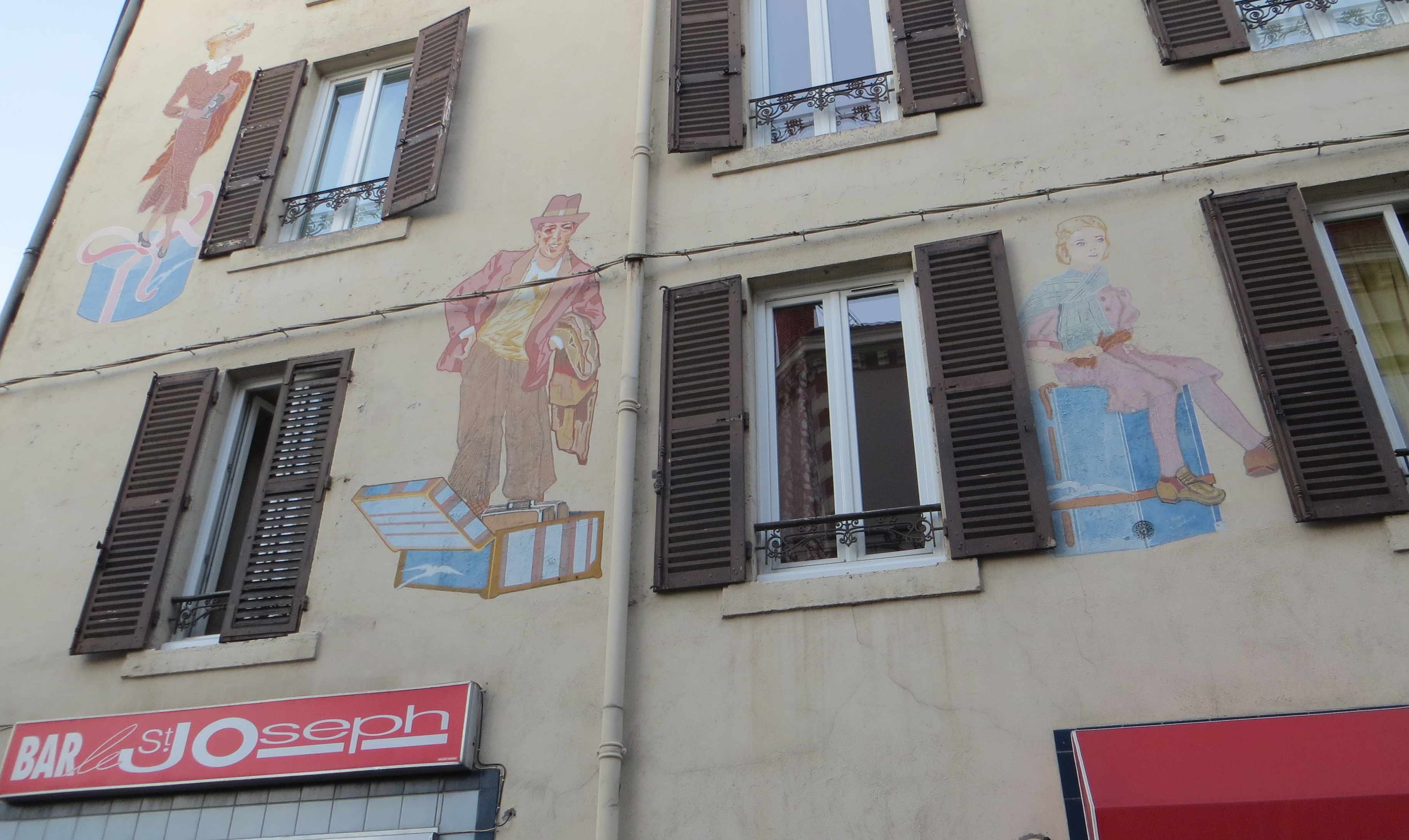
murals CF.jpg

In a nearby square we find five little posts, correctly arranged for a bonsai Hoisting the Pennant ritual (my film, from 44.21) on a future fantasy visit of Li Manshan’s 5-year-old grandson and his schoolmates.

CF posts

Doing daily travel with a gig is tough—but like my former orchestral life, it incites camaraderie. Our previous tours have been less frantic, but this one is pleasantly condensed.
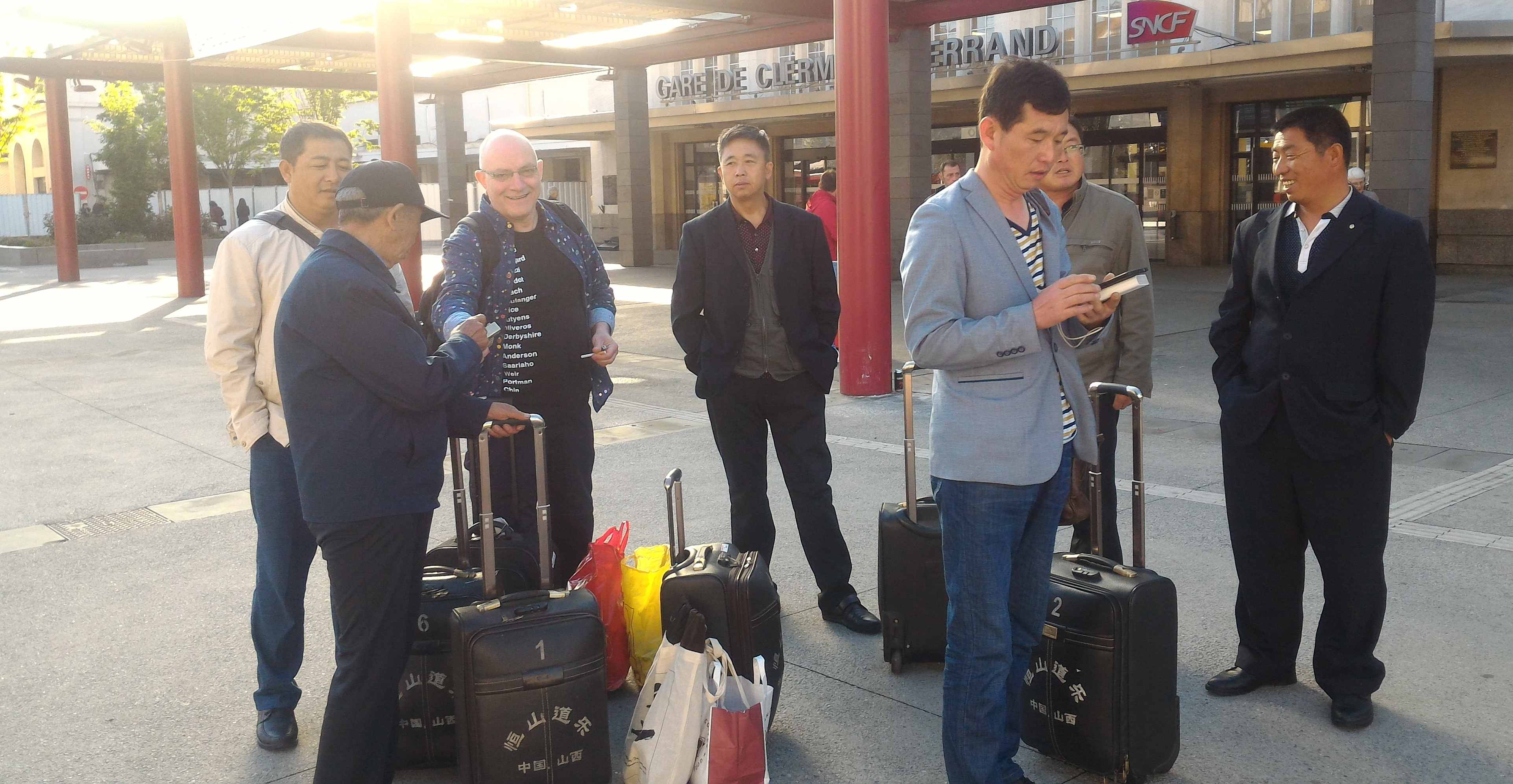
Jpeg

The touring life. Photo: Wu Yunfeng.

Valérie and Teacher Wu take us to the station, with thoughtful gifts of Gitanes (!) and food for the train. We were also happy to receive Clermont-Ferrand Confucius Institute umbrellas.

Jpeg

Valérie sees us off on the train.

The train ride is fun again. It’s much faster today, so we arrive early at midday, and take the metro to find the Centre Mandapa, a splendid venue for world music since 1978, led by the splendid Milena Salvini.

With Mandapa technician Milou we try out my film for a most successful screening; my intro goes well, and at the end Li Manshan and I take a bow. The Daoists love watching our film too.

It’s a lovely little area, so we have plenty of time to relax. They find the quirky antique emporium over the road. A succession of beggars ask us for fags, which they give gladly. Intriguingly, the Centre Mandapa is also right opposite the 1913 church of the Antoinist cult:

Deviation

The state stance on “heterodox cults”? My photo.

We set up the stage during a tea-break for the audience, then the Daoists do yet another amazing gig. Though it’s a small room, my fears that the concert will be deafening turn out to be unjustified—it’s a great acoustic. I join them again for the encore (playlist #3, with commentary here).

It’s always good to see friends at our concerts. Several Shanxi people introduce themselves, excited to find the band performing in France; and today fine scholars like Jacques Pimpaneau, Robin Ruizendaal, François Picard, and Nicolas Prevot come along too.

One cultural difference: after a gig, sure we all want to get away, but the Daoists only drink with food, not before or after (usually), whereas we WAM musos make a beeline for the pub as soon as we have taken our final bow.

Our secret language (“black talk” heihua) is as arcane as ever, with all our inside jokes. Recalling a filthy joke that Guicheng told at a hotel party in Leipzig (I can’t possibly tell you that one), I only have to say “Can you sew this up for me?” for Li Bin to burst out laughing. We giggle again at Tian Qing’s “Eat a young monk” joke.

22nd May
We have a free day at last before the Daoists’ evening flight home. Last night Old Lord Li had a bath, slept till 1am, watched TV, slept again, and got a call from a family in Pansi village to determine the date for a funeral, so he was up before 4. Meeting up at 5 yet again, I take him to the bar down the road, where Tweety McTangerine comes on TV—Li Manshan hasn’t even heard of him, how enviable! Back to my room together to read Yan Lu’s draft article on the Nanterre events.

Li Manshan calls the Pansi family again at 6am. It’s a village that he likes best, and they most trust him. Then we have a good breakfast.

We stroll down together past the Opéra to the amazing Chinese department of Galeries Lafayette, brilliantly rendered as Laofoye (“Old Buddha Elder”). Li Bin and Erqing buy loads of perfume (“Hey guys, how many lovers have you got?!”)

Laofoye

Later Li Manshan and I buy toys for his young grandson: a trumpet and maracas, to go with the, um, Ming-dynasty instruments I bought him before.

We store our luggage and go for lunch, washed down by Leffe. Old Lord Li is drumming with his chopsticks again. Delightful mood over lunch, as always—everyone chipping in with stories, jokes, reflections. Over delicious yuxiang qiezi, I ask Li Manshan if he has an aubergine tree. Often the subject turns to their hymns, as well as the Zouma suite (playlist #4, commentary here) and funky Yellow Dragon percussion piece, and the whole calibration of the trick sequence—how to improve them, tempi, and so on.

They rest on sofas at the hotel, and I film Li Manshan telling another sh-sh-sh-shikuaiqian joke.
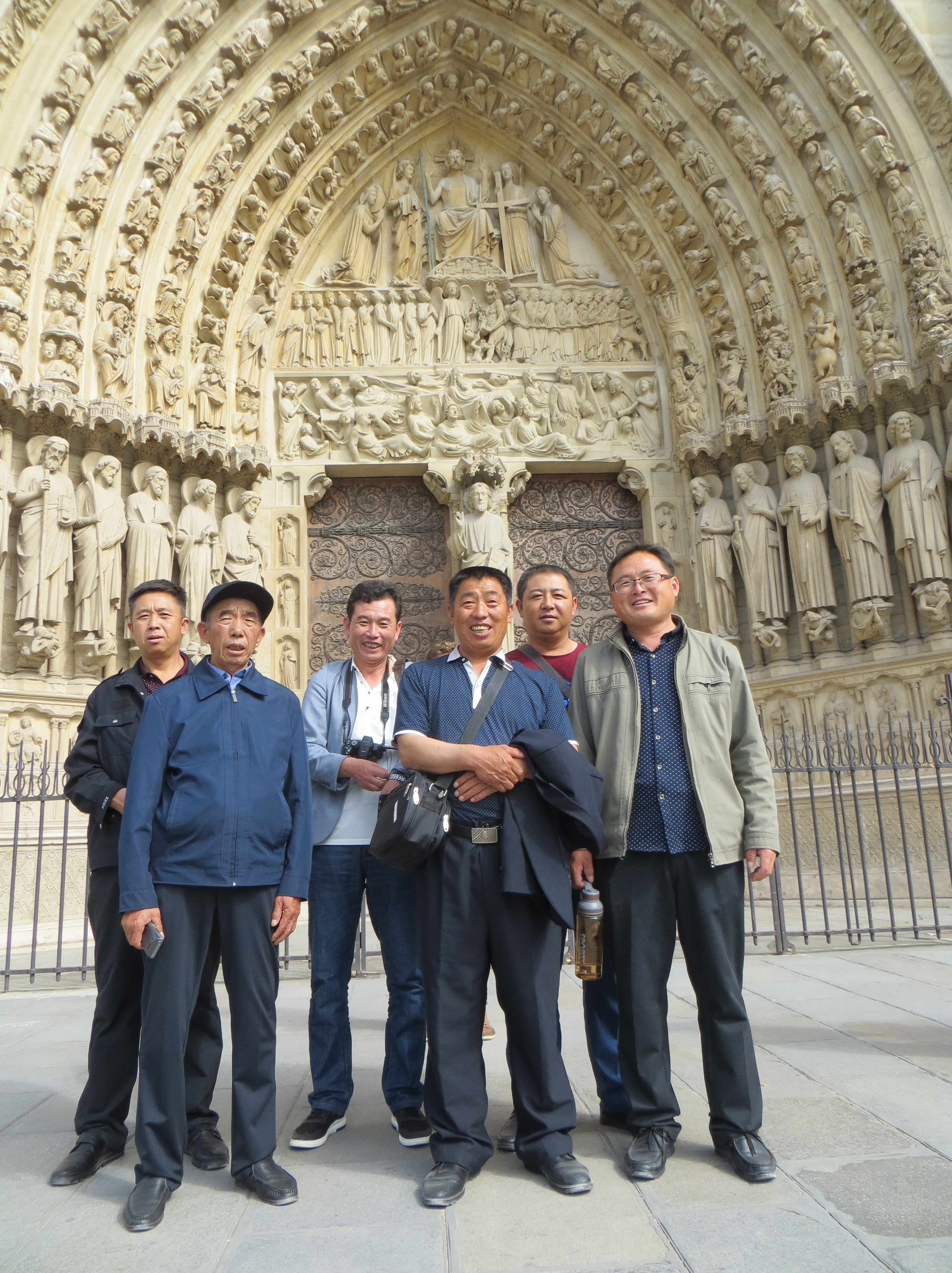
Notre Dame

Later we take line 14 to Châtelet, and wander round the little islands. I choose different flavours of Bertillon ice-cream on Île de la Cité for them. After a little guided tour of Notre Dame, we return home for a quick supper of  noodles and beer before Adeline and Yan Lu arrive, Lu thoughtfully giving them posh French chocolates. I have to go off to catch the last train back to London, but their taxi for the airport arrives early, so I can wave them off after all, but it’s a hasty parting.

If it’s a quick hop back home to London for me, their journey was not so simple:

22nd: 23.20 flight from CDG to Beijing,
23rd: landing at 15.20, 21.40 train from Beijing station,
24th: arriving in Yanggao at 03.44! But both Li Manshan and Li Bin had to rush off almost immediately to attend to village clients (for Li Bin’s diary after returning, see here).

I’ve been out of love with Paris for a while; the romantic image is hard to square with its gritty realities (rather like China, perhaps?). But this trip with the Li band naturally made me fall in love with it again. In this supposedly homogenised age—as with other cities like Leipzig, VeniceSeville, or Lisbon—we must delight in Parisian culture too!

After Daoist music in France (and Italy, and Germany), try Andean music in Japan

As I write these notes up, Haitink conducting Mahler 9 comes on Radio 3, live from the Barbican; and then next evening, another live broadcast of Turangalîla! Perfect. I hear echoes of the Li family rituals in both: all the contrasts of monumental tutti and intimate chamber styles that we find in a Daoist ritual. But that’s just me… If only Messaien were still around to hear the Li family in Paris!

Posted at 5am to commemorate daily sessions with Old Lord Li.

Vignettes 1: Li Manshan

Li Manshan is as adorable as ever.

I was determined to get to CDG to meet the band off their Air France flight from Beijing, but it arrived early at 5.30am, so in the end I just had to wait for them at our hotel right by Gare Saint Lazare. We met up there at 7.30, Li Manshan giving me a big grin and a hug.

Now 72 sui, he is gradually giving way to his son Li Bin, only doing nearby rituals. But he still can’t turn down requests to go and determine the date, and he still decorates coffins. This process of handing over must always happen, but no-one ever describes it. Personalities within a ritual group, the transmission from father to son as the latter gradually takes over—all such detail is absent from both historical records and most fieldwork reports. If only we could document it in detail for ancient Daoist masters like Du Guangting.

Li Manshan has new headgear, now a more trendy baseball cap, not as sweet as his old one, but hey. He only takes it off, reluctantly, when we enter Notre Dame. He also has a new mobile, the same old make, but with a new ringtone that sounds like The magic roundabout, so another of my names for him is Zebedee—who would have liked the Daoist Pacing the Void. I miss Li Manshan’s old kitsch ringtone of The little wicker basket.

After his lovely gift to me of the old folding stool he made, I gave him a digested translation of The good soldier Švejk, a copy I must have bought in Beijing in the early 1990s. I inscribed it to him:

踏罡步斗的明星李老君
Old Lord Li, superstar Stepping the Cosmos and Pacing the Dipper

“Old Lord Li” references one of our favourite ritual couplets pasted up at the gateway of the scripture hall, hard to translate elegantly:

穩如泰山盤腿座
貫定乾坤李老君
Seated in lotus posture firm as Mount Tai,
Old Lord Li thoroughly resolves the male and female elements.

And Stepping the Cosmos and Pacing the Dipper are rituals in the family’s manual collection.

Old Lord Li is immediately hooked on Švejk. I knew it would be just his cuppa tea—the innocent common man muddling his way jovially through an irrational state machinery. He can’t put it down. Later, suitably, I also give him my old spare toothbrush to use, as he hasn’t brought one.

After catching up together and working out our day, I go off with Li Manshan for the first of many meetings with Teacher Wang, now abbreviated to “hold meeting” (kaihui).

How amazing to be on tour again with this brilliant sextet who have been doing rituals together for thirty years, and who are now in the rhythm of touring abroad too. We use our secret language, always laughing.

In the concerts, the others (like Wu Mei for his amazing tricks on the wind instruments, or Golden Noble with his solo recitation) may attract more attention, but Li Manshan is right at the heart of everything, drumming unerringly, singing intensely, subtly directing. Even the twisting route he improvises on the tiny stage as he leads the final Chase round the Five Quarters, unsheathing the “precious sword” to sketch talismans on the ground, is magisterial.

LMS on train to Nanterre

On the train to Nanterre.

Late at night we have our usual sweet chat outside the hotel. It’s been a long day, but they’re troopers.

Li Manshan is always tapping away on his fingers (even while sleeping on the train) or on his chopsticks as we wait for our meal to arrive.

LMS at Hotel Ravel

Clermont-Ferrand: two of my favourite masters.

Following a quick weekend flit to Clermont-Ferrand, after our last gig back in Paris he had a (rare) bath—the concerts are hot work, and they’re all bathed in sweat. He then slept till 1am, watched some TV, slept again, got a call from Pansi village to determine the date after a death, and was up by 4am.

We meet up in the foyer at 5am for fags outside, lovely. I take him to the bar down the road, full of workmen on the early shift, so I can have a café and orange juice as we chat with the Wenzhou people behind the bar. Trump comes on TV—Old Lord Li hasn’t even heard of him, how enviable. Back to my room together to read through a draft article by our wonderful Confucius Institute host Yan Lu that she has just sent me.

Li Manshan calls Pansi again at 6am with more guidance. It’s a village that he likes best, and they most trust him.

After our hectic schedule, we’re all glad to have a final day free for sightseeing and buying gifts. While his son spends a fortune, Li Manshan just wants to find a couple of toys for his young grandson.

LMS and WD

With his pupil Wang Ding.

A quick farewell hug, and they embark on their long journey back to Yanggao to resume their busy ritual routine. Hardly had they got back home when both Li Manshan and Li Bin had to rush off to separate villages to determine the date for more funerals, which is the start of another sequence of tasks for them over the next couple of weeks (for Li Bin’s diary after their return, see here).

See also The Li band in France: notes.

Depping with master singers

Just home from Paris after an unforgettable time with the Li family Daoists. It already seems like a dream.

Nanterre encore

Our encore, Centre Mandapa. Photo: Nicolas Prevot.

As an encore [English term—Ed. When in France say bis!] I joined in with the Li band, singing the Mantra to the Three Generations a cappella (audio playlist track 3, cf. 2001 version, track 2: commentary here).

For anyone fortunate enough to do fieldwork on Daoist ritual, I thought this might remind us of the benefits (indeed the very possibility) of participant observation; but it was also an opportunity for me to keep my hand in after a year apart from the Daoists. Having remoulded the proverb “Mr Li wearing Mr Zhang’s hat”, I enjoy refuting another popular one, “The monk from outside knows how to recite the scriptures” (wailaide heshang hui nianjing 外来的和尚会念经).

Long schooled by accompanying Mark Padmore and the Monteverdi Choir on my violin, I now have to set aside my instinct to invest words with meaning, instead trying to latch onto the lugubrious timbre of the voices of Li Manshan and Golden Noble, and Wu Mei’s guanzi. Li Manshan’s bushy eyebrows are a useful image here.

During rituals, when we sing a cappella hymns we stand in two rows of three, facing each other across the altar table. So usually I’m either playing small cymbals over the other side from Wu Mei, or playing gong at the other end. But this time I found myself standing right next to him and Golden Noble for the encore, with Li Bin (also brilliant) on my right, all of them subtly supporting me. I realised Wu Mei is not only one of the greatest wind players in the world and a brilliant player of the bo cymbals, but (like Li Manshan and Golden Noble) a fantastic singer too. Not just his nasal timbre and the projection of his voice, but the taste of his choices—where to inject extra volume and fervour, rise up high, or put in a tiny variation. Listening carefully to each other as always, dovetailing, with subtle “rules” about where to take a breath and where to sustain. There’s much more to their singing than meets the ear—the texts of the a cappella hymns are rendered with great intensity and concentration.

Over fags outside the hotel we had worked out an edited version of the Mantra, segueing smoothly from the end of the 1st verse directly into the coda of the 3rd verse. With a very subtle accelerando, its exuberant repeated final couplet begins from a high do the first time, soaring to an exuberant high mi on the repeat:

Vowing this evening to attend the ritual assembly,
Leading the deceased spirits to ascend upwards towards the Southern Palace!

We noted a nice pun, glossing “ritual assembly” (fahui) as “French concert” (Faguo yinyuehui)—the extra characters to be recited silently (monian), like a secret formula. Li Manshan congratulates me again on my silent recitation—”The only thing you’ve learned properly, Steve!”

In rituals back home they don’t always give their all, but on tour, wanting to put on a good show, they are magnificent. Standing in with the Li band—whether at a Paris concert or at a Yanggao funeral—is one of the great musical experiences of my life, “and I’ve had a few in my time I can tell you” (take your pick—Christmas Oratorio in Weimar, B Minor Mass in the Barbican after a tour of Japan, and so on…).

After all my tedious academic questions, being right in the middle of the action with these master Daoists (not “musicians”!) is overwhelming for me. Li Manshan, Golden Noble, and Wu Mei are right on my case. There are no passengers—Erqing and Wang Ding (Li Manshan’s pupil, a welcome new recruit to our touring band) are great too. Focusing on the vocal ensemble, surrounded by Li Manshan’s sparse and subtle drum patterns, the regular crotchet beat of the gong, and quavers on the bell, I also have to remember where to beat out the occasional syncopated cadences on the small cymbals with Li Manshan’s drum accents.

It reminds me of my occasional depping with them in Yanggao for funeral segments (my book, pp.325–6) when they’re one short—waiting on the substitutes’ bench. It also has a disturbing echo of my orchestral experience—that’s another depressingly familiar phone-call from orchestral fixers,

“Can you come and do a Messiah next Tuesday in Barnsley? I’ve tried everyone, we’re absolutely desperate!”

Thanks a lot…

Our chats turned to the singing of the revered older generation of Li Qing and his colleagues. Li Zengguang was admired as a vocal liturgist; Li Qing’s own voice declined somewhat with age. Some had fine voices but less mastery of the texts; other masters who knew all the texts perfectly were somewhat variable in intonation and vocal ability. Apart from their astounding instrumental ensemble, I doubt if there’s ever been a more brilliant vocal group than the present band under Li Manshan, working together almost daily for thirty years.

Signoffs and other cross-pond drôlerie

In our daily badinage on orchestral tours of the US of A in the Good Old Days, we got into the habit of handing over to each other by imitating CNN’s signalling style:

And they say there could be more revelations to come. Wolf.

[Wolf Blitzer, [1] of course, was an “anchor”. Considering that Britannia Rule the Waves (just dig that funky optative verb there, folks—”You Wish”, as the Argot of Yoof [2] would have it), it’s curious how we don’t much go in for anchors. [3]  I guess we consider them beneath us…]

Rather like my teacher Paul’s empirical use of classifiers, we interpreted it as a fixed signoff at the end of every sentence, which led us to:

I thought the Adagio was really too slow last night. Wolf.

I’m starving. Let’s go eat. [4] Wolf.

Usually, rather than an interrogative (“Wolf?”), it’s declaimed confidently in the matter-of-fact descending fourth tone.

It does seem wise to keep such signals simple:

On stage at the end of a concert, among ourselves we would also adopt the brilliant casual signoff,

Well folks, I guess that’s just about it for tonight!

This works particularly well after an obscure or meditative work. Like:

Join us next time for another wacky episode of Ockeghem’s Marian Antiphons!

For an equally zany intro for such pieces, see here; and PDQ Bach is also essential listening. Wolf.


[1] OK, we Brits have our own proud tradition of silly names, but American names are in a class of their own. Following the credits at the end of a Hollywood movie is like reading an avant-garde poem, plunging into an exotic cornucopia containing all the cultures of the world. Though if Tweety has anything to do with it, there will be no more films, no more culture, no more world. Nothing, as Stewart Lee observes.

[2] The Argot of Yoof: a popular media pub, always packed at lunchtime. Near the somewhat quieter Aardvark and Climbing Boot.

[3] Unless you count Piers Morgan, who tries unsuccessfully to lose the initial W.

[4] For me at least, there’s an illicit thrill in uttering the formulation “go eat”. Similarly for “Can I get” instead of “May I have”—a quick web search reveals mainly  the usual pompous British indignation yearning for ethnic purity, though one writer suggests rather elusively that “Shakespeare probably would have loved it” (as in the little-known line from Romeo and Juliet: “Can I get a Diavola and a supersize Coke to go?”). Can I get or May I have, that is the question. See also my thoughts on “Who is this?”.

More useful socialist vocabulary

I’ve mentioned several distinctive terms in the vocabulary of former socialist countries, like China and the GDR. But still more usefully:

Lumumba

It’s good to learn that what is called caffé corretto in Italy (an espresso “corrected”, with grappa, or what the Chinese term with blunt accuracy dub “white spirit”) was known in Communist Albania as a Lumumba. (Garton Ash, The file, p.45). Well, you do need a snifter to get through all those Norman Wisdom films. (Cf. elsewhere in north Europe, where it is a somewhat different beverage.)

Cubalibre

This is rather in the spirit (sic) of the cubalibre[1] one of my favourite tipples in Spain as a change from my standard G&T. By contrast with the mealy-mouthed measures of English pubs (which should come with a microscope), both are notable because you are presented with a large tumbler into which the waiter pours an unlimited quantity of gin/rum/bacardi, leaving only a token amount of room for a casual dash of tonic/coke.

The cubalibre is quite familiar to our Spanish waiter, but I always enjoy the little ritual we go through whereby he looks enquiringly at the range of spirits behind the bar while I specify, with one of my few fluent phrases,

… con Ron, por favor!

Back in Blighty, the Spanish influence on my own domestic aperitifs is clear in my generous measures from the Azure Cloud Bottle—to which my address on the home page pays fitting homage. I ring the changes by buying the occasional bottle of Tanqueray, purely in homage to Amy.

In China, where the 1957 Anti-Rightist backlash following the Hundred Flowers movement was prompted in no small measure by the recent Hungarian uprising, the threat of liberal agitation was charmingly known as goulash deviationism. That sounds funny to us now, even if at the time it was a taint that could ruin people’s lives and destroy whole families.

The Lumumba never caught on in China—whyever would you want to dilute white spirit? But they did stage a rally to protest his killing in 1961:

[1] “Free Cuba”—descriptive or prescriptive?! Cf. the British tabloid headline
“Free Nelson Mandela”,
to which a reader wrote in,
“I dunno what a Nelson Mandela is, but if it’s free, can I have one please?”

And now we have this headline, which could do with a bit of punctuation:

Come on England

Just remind me again, what is music?!


Hardly was the ink dry (or whatever we should call it nowadays) on my comment

It’s worth replacing the vague term Western music with Western Art Music (WAM), if that’s what we mean; and observing how European folk traditions are an equally precious part of our heritage. “Music” can be a misleading little word: just as there’s more to music in Shanghai than its opera house—such as amateur silk-and-bamboo clubs or temple fairs in Pudong—so music in Lisbon is more than the Teatro Nacional de São Carlos. Symphony orchestras and erhu solos are but the tiny shiny tip of the iceberg.

than I perused the BBC4 schedule to find:

The Birth of British music
The legacy of Austrian composer Josef Haydn in Britain.

Hmm. Discuss (with the aid of Bruno Nettl; cf. Das Land ohne Musik).

Of course, it’s just an amusing casualty of knocking up a snappy publicity blurb. And to be fair, it’s the third in a series that runs from Purcell and Handel (sic) through Haydn (sic) and Mendelssohn (sic­—well that’s quite a lot of sic). I’m not blaming anyone—making programmes about four WAM composers who lived or spent some time in Britain is cool by me (cf. They come over ‘ere…).

Still, it combines two common misapprehensions—about history and about class. Much as I love Purcell, I’m sure the engaging presenter Charles Hazlewood is perfectly aware that even British ART music (BAM!) goes back a little before that. This isn’t my forte, but never mind Tallis, Byrd, Lawes, and so on (whatever would Francis Baines have said?!)—how about the medieval mystery plays and early manuscripts, or musicking at the time of Boudicca?!

And anyway, if we’re talking about “British music”, there’s that social ellipsis again—how about broadside ballads, singing and fiddling in tavern culture, early wind bands, and so on?

This casual use of language is just as bad as the (still more common) other extreme, which is to date the origins of British music from Lonnie Donegan or Frank Ifield.

I’m sure it’s a great series on those four composers. “British Art Music from the 17th to 19th centuries” doesn’t make quite such a snappy title.

Conversely, here’s another misleading title, this time from the Guardian:

The 20 best music documentaries.

There are some great films in this list (including Amy and, at No.1, In bed with Madonna), but it’ll be disappointing for those expecting to find coverage of WAM, flamenco, musicking in Sardinia or India, and so on. Again, the title The 20 best documentaries on Anglo-American pop doubtless struck them as pedantic.

Just saying, like…

In similar vein, see Old and new musics.

Some Portuguese epigrams

For Nick—
i
f the reader finds this post a tad arcane, just wait till you see his WAM anagrams

Further to my little Lisbon jaunt, I’m always disappointed at my total lack of success when I try to busk it in Spanish by randomly adapting Italian—but it’s even more futile to further modify my crap Spanish into bacalhau (sorry, I mean cod) [1] Portuguese.

I soon dispensed with my old Portuguese phrase book (less entertaining, and less sinister, than Teach yourself Japanese)—its very opening phrase suggests a similar deep anxiety about even setting foot outside our own green and pleasant land:

There’s been an accident.

I flew TAP (Take a Parachute). Indeed, the flight prefix is further abbreviated by omitting the middle letter, so not for the only time, I found myself flying TP (Totally Pissed).

Aboard TAP flights, with impressive urbanity in the vein of Mots d’heures, the airline regales the traveller with a pithy and somewhat obscure epigram evoking the saudade of fado. It seems to recall a sad incident in the colourful past of an early Lisbon femme fatale, perhaps a widow of French patrician stock (even a refugee from the guillotine?):

Colete Salva-Vidas sob a Cadeira [2]

I’ve added capitals for clarity, but in order to preserve the ambiguity of the original I have refrained from supplying what seems to be a missing apostrophe—indeed, could it even be an exhortation?

Either way, it is far more evocative in Portuguese than in its prosaic English rendition

Life jacket under the seat.

Cf. Airplane:

Airplane is packed with little visual detail like that, requiring as much long-term revisiting as the Ring Cycle. Even the opening sequence is a too, er, deaf ‘orse.

And I’m keen to dally with Mme [sic] Salva-Vida’s [just as sic] enticing daughters

Rolagem, Descolagem, and (black sheep of the family) Aterragem,

also commemorated in TAP’s onboard annotations. Again, their names are so much less elegant in English:

Taxi, Takeoff, and Landing.

For a new addition to the family, Proxima Paragem, see here.

Just had one of those wacky dreams:

In Lisbon, invited implausibly to some suspiciously traditional social event with an old friend, we make our tortuous way there by means of a badly bombed Escher staircase. Arriving unscathed, I mingle suavely with the locals. Pleased with myself for managing to utter a grammatically convincing phase, I exclaim “Progresso!” “Si,” my Portuguese friend nods, “Esta Truro.”

How pitilessly my subconscious satirises my naïve aspirations to insider status.

For another dream, and a Portuguese limerick, see Ogonek and Til.


[1] Altogether Now: The Piece of Cod Which Passeth All Understanding.

[2] Cadeira: twinned with Madeira.

Jottings from Lisbon

Just home from Lisbon, where I screened my film for a select and rather posh CHIME conference. How good to have a few days to enjoy cobbled streets, tiles, and little wood-lined trams—authentically scattered, as everywhere, among decrepit building sites.

Back in the 1990s, annual working holidays in Lisbon (as well as Parma, Ludwigsburg, Amsterdam, Paris, and London—happy days) were a regular gig while we were doing Mozart operas with John Eliot Gardiner.

On the same principle as seeking out flamenco in Seville after the Matthew Passion, it was always good to go in search of fado in Lisbon after our concerts there. Fado can be great, as long as we don’t expect it to be flamenco—this is a bit like relationships altogether (tutti, bemused: “This is a bit like relationships”.)

The old-style fado bars, holes in the wall, have become ever more elusive, long outnumbered by glossy tourist restaurants. As ever, a good sign is the lack of a sign.

fado

Fado singing, 1993. My photo.

We found a good little fado dive this time too, rather by chance. And then on our last night our fine hosts kindly took us to the Boteco da Fa in the Alfama, a classy joint that nonetheless has a great atmosphere—it’s just a little room that can pack in around fifty aficionados. We heard Sandra Correia (for a 2022 feature, click here)

and Augusto Ramos:

The quintessential saudade (“missingness”!), a first cousin of the duende of cante jondo in flamenco (and see several other nice intercultural equivalents under that saudade link), was much in evidence.

Both singers are well-known performers in “concert”, and in a club like this the atmosphere is quite formal (the rather good food can only be a brief diversion between—not even during!—sets), but Augusto also doubles as a waiter there, and they’re pouring their hearts out just a few feet away from you.

Focusing as I was on the intensity of the singing, it took me a while to realise how great the two pluckers were too— Luis Guerreiro, the leading guitarra player, totally at ease, always exploring patterns and harmonies, his riffs even featuring the occasional soupçon of  Django.

pluckers

Brilliant fado pluckers. Photo: Xiao Mei.

Being in Lisbon, we were able to express our appreciation with warm applause—I read that

According to tradition, to applaud fado in Lisbon you clap your hands, while in Coimbra one coughs as if clearing one’s throat.

Could Coimbra have been a British colony?!

Our group from the conference included the brilliant Xiao Mei and two young Chinese conservatoire performers. I relish this recent rapport, this new sense of equality. Xiao Mei, most enlightened among Chinese musicologists, is always in fieldwork mode, lapping it all up, as were the younger musos, recording on their posh smartphones and chatting in breaks with the musos. A wonderful evening— Chinese Twitter will be abuzz with it, and that’s just so inspiring…

fado group

Sandra Correia, Xiao Mei, and Enio Souza, dynamic conference organizer.

In a small way, all this reminds us all why it’s worth replacing the vague term Western music with Western Art Music, if that’s what we mean; and observing how European folk traditions are an equally precious part of our heritage. “Music” can be such a misleading little word: just as there’s more to music in Shanghai than its opera house—such as amateur silk-and-bamboo clubs or temple fairs in Pudong—so music in Lisbon is more than the Teatro Nacional de São Carlos. Symphony orchestras and erhu solos are but the tiny shiny tip of the iceberg (cf. here, and my post on folk musicking in Italy).

Nor would any visit to Lisbon be complete without a serious overdose of nata:

nata

Whereas the English custard pie is only good for slapstick. Typical

* * *

Meanwhile at our conference on Chinese music, it’s always good to hear Xiao Mei introducing her work on spirit mediums and trance, with her amazing videos of rituals among the ethnic minorities within the PRC.

Since the conference was held at the Centro Científico e Cultural de Macau, the music of Macau was one theme. With typical impertinence I suggested that studies of music-making in Macau might be inspired by Ruth Finnegan’s seminal book The hidden musicians, exploring all the diverse kinds of musical activity in Milton Keynes, whose population is less than half of that of the Chinese metropolis. Macau’s cultural life outside official institutions remains to be explored—for instance, no-one has yet made the connection with the household and temple Daoists there. [1]

* * *

Back in May 1993, Lisbon was among several wonderful venues for our series of performances of Le nozze di Figaro:

That’s a live concert recording at the Queen Elizabeth Hall after we returned to London. Soon after that I returned to Hebei for my second visit to Gaoluo and further survey of village ritual associations.

On a free day between Figaro shows, I visited the resort of Cascais, a pleasant excursion just west along the coast. On the street I came across a blind busker called Rosa, then 36, from Almada just across the river. She accompanied her songs on the triangle, occasionally checking the lyrics in Braille.

Cascais singer

Rosa, 1993. My photo.

I assumed she was just another blind beggar who never comes much to anyone’s attention, unless you count me. So imagine my surprise, today, when none other than Xiao Mei saw my photo and told me that Rosa (now “Dona Rosa“, with a backing band) had come to give concerts in China! And sure enough, she’s now become a star on the world music circuit, having been “discovered” (not by me—I kept her to myself) but since 1999 and more widely since 2004.

How was I to know?! Can I indeed claim to have discovered her, like Yang Yinliu discovered Abing?! Hardly, since I’ve sat on the fruits of my casual fieldwork for 24 years. I am reminded of the occasional blind bard from Shaanbei who materialises, bemused, on glossy Chinese TV extravaganzas.

Here’s one of several YouTube clips of Dona Rosa:

As usual, the exigencies of the world music big band distract from the atmosphere of her solo singing. Try this instead—from a concert at New Year 2008 in the Concertgebouw, no less:

Still, from a BTL comment by fjcnunes I also learn:

It’s sad and lamentable that this great lady is still begging on the street of Rua Augusta, Lisbon. This was the case in June 2014, when I saw her there and took a picture with her. In her words, she gets paid “next to nothing” to play in Portugal and is forced to play on the streets to make a living. Probably the promoters and organizers get the lion’s share of the revenues from her concerts. I wonder if the same would have been allowed to happen to Cesária Évora? If you happen to travel to Lisbon, Portugal, please pass by Rua Augusta and purchase one of her CDs, directly from her. At least you’ll know where the money’s going.

* * *

Anyway, that chance find in Cascais was typical of the kind of superficial yet rewarding little jaunts one can fit in as a touring muso—like flamenco in Seville, dance houses in Budapest, tralallero choirs in Genova, and so on.

The Alentejo region is famed for its folk choral singing. I haven’t caught it live yet, but it’s evidently a rich tradition.

In Cascais I also enjoyed the parade for voluntary fireman’s day.

firemen

Parade for voluntary fireman’s day, May 1993. My photo.

All this belongs to my recurring theme of delighting in all manifestations of the Terpsichorean muse. In the present climate, we must relish our cultural diversity all the more. And yes, that does include Mexican migrants and Syrian refugees. All those Brits who find themselves (not) with an extra 350 million squid a year to spend might lavish a bit of it on educating themselves about the traditions of their newly-alien neighbours.

For sequels on Lisbon, click here and here. Note also Portugal: folk traditions.

[1] See e.g. http://www.macaotaoist.org/澳門道教科儀音樂/http://www.baike.com/wiki/澳门道教科仪音乐,
http://www.chinataoism.org/showtopic.php?id=1005; for a major community ritual for the 2003 SARS epidemic, see http://www.cciv.cityu.edu.hk/macau/3/2.php.

Registers

Talking of acronyms, one that slips less lightly off the tongue is ENSRC, a useful network for Chinese religion led by the indefatigable Philip Clart and Vincent Goossaert.

I welcome spoof suggestions for what ENSRC might stand for, à la LUFTHANSA…

There’s been a recent flurry of discussion there about Daoist lu registers (not the lu emoluments that I miss), discussing their varied formats and functions (have we no homes to go to?!).

I don’t think anyone has yet suggested that such registers were ever rolled up in the form of a scroll, but if they were (by analogy with baojuan “precious scriptures”, sometimes rendered as “divine rolls“), they might be known as

lu rolls

Acronyms

Following on from silly Chinese acronyms, seasoned travellers will be familiar with the airline acronyms—anyway, there are loads online. Among the highlights (PC temporarily suspended in favour of transmitting historical linguistic creativity—Ed.) are

QANTAS
Queens And Nymphos Trained As Stewards

which leads nicely to

LUFTHANSA
Let Us Fuck The Hostess As No Steward Available

Of numerous versions for TWA, I like

Try Walking Across

And ALITALIA

Always Late In Takeoff, Always Late In Arrival

Cf. the old one about the BA poster

Breakfast in London, lunch in New York

To which some wag has added

Luggage in Bombay

For Air Portugal, see here.

Wordplay with Daoists

Sometimes when I’m with the Li family Daoists I wear my SOAS T-shirt, which bears the name “SOAS, London University” in most of the Oriental and African languages taught there. The Chinese version, on the back, reads

伦大亚非学院         Lunda YaFei xueyuan,

Lunda being short for Lundun daxue (London University),* Yafei short for Yazhou (Asia) and Feizhou (African), and xueyuan meaning academy. One day in Italy the ever-lively Third Tiger, Li Manshan’s younger brother, frowning as he tried to interpret these six arcane characters, asked me,

What’s Lundaya feixueyuan supposed to mean?

We all burst out laughing, as usual. He was reading it not as three binomes (Lunda—YaFei—xueyuan), but as Lundaya—some weird transliteration of a foreign name, perhaps?—and feixueyuan, “anti-academy”. But his interpretation has stuck; it has a further resonance when adorning my own back, since with my championing of more earthy folk sounds I’m (ever-so-slightly simplistically) notorious for my anti-conservatoire stance… On my next visit to Yanggao I just had to bring a SOAS T-shirt to give him.

In similar vein (my book, pp.331—2), Li Manshan and I have a lot of fun with the name Intangible Cultural Heritage. The Chinese translation Feiwuzhi wenhua yichan is itself flagrantly at odds with, um, the Chinese heritage. I set the ball rolling by wilfully getting the name wrong, calling it Feiwenhua wuzhi yichan, “Anti-cultural materialistic heritage.” Li Manshan, now designated as a Transmitter of the ICH, takes up the riff: when I joke with him, “You’re an Intangible (feiwuzhi)!”, he comes back with: “Ha, I’m a Waste of Space (feiwu 废物), more like!” This becomes our regular name for the project.

For more T-shirts, see here—oh, and here. And for more wordplay with Daoists, here.

*Another regular sources of giggles on visits to rural latrines is the common re-formation of Lundun with the characters 轮蹲, “taking turns to squat”, further elaborated in our revision of Lundun dashiguan 伦敦大使馆 “London embassy” to  轮蹲大屎馆  or “Taking turns to squat in the big London shithouse”…

Corpsing: Inuit culture and Haydn

A much-discussed piece of “salvage ethnography” is the film Nanook of the North (Robert J. Flaherty, 1922):

For his 1926 film Moana, see here.

More recent is a highly praised film from Zacharias Kunuk, Atanarjuat: the fast runner (2001)—click here for a trailer. It enacts an ancient legend while lavishing great anthropological care in evoking early Inuit culture.

But Nanook of the North is to some extent a fictional creation too, blurring the lines between documentary and drama. It is an early case-study in a substantial discourse in the ethics of visual anthropology that leads on to Jean Rouch, representations of the Yanomami, and so on.

As to vocal styles, in katajjaq throat-singing (e.g. Voices of the World, CD 1 §12), the duet is considered to come to an end when one of the singers laughs, loses her breath, or breaks concentration (LOL).

Hard to imagine a performance of such charm at certain other recent swearing-in ceremonies…

Now I’d like to seek ethnographies of changing life in Inuit communities since the time of Nanook (preferably not containing the words “traditional way of life” or “vanishing culture”—“but that’s not important right now“). This is a lively topic in ethnomusicology—there are many studies to add to my reading list, such as Maija M. Lutz, The effects of acculturation on Eskimo music of Cumberland peninsula (1978), Beverley Cavanagh, Music of the Netsilik Eskimo: a study of stability and change (1982), and studies of throat singing by Nicole Beaudry and others—as an introduction to the detailed work of Beaudry, note her thoughtful reflections in Shadows in the field. See also First Nations: trauma and soundscape.

Here’s a trailer for the short film Throat song (2013), in which a young Inuk woman, lost in a community that has been tragically separated from its past, begins to connect with other victims of violence in her community, and seeks to reclaim her voice:

Throat singing also inspires a lively experimental scene, with singers such as Tanya Tagaq.

* * *

Corpsing is one of the pleasures of musical life in WAM too—we’ve all done gigs like that. I can’t suggest here the numerous ways in which fiddle players try to corpse their desk partners by a tiny little gesture of resignation at the repeat of a minuet, or a fake sforzando attack on a pianissimo entry.

Generally “the show must go on”, but once, the Allegri string quartet were performing the intimate, intense slow movement of a Haydn quartet when the viola player let out an extended and voluble fart.* The leader giggled sotto voce, and as the mirth spread (even to the miscreant, who’s generally the first to keep a straight bat) all four of them were soon so helpless with laughter that they just couldn’t keep going, and had to leave the stage to compose themselves.

To be sure, this is at a certain remove from Inuit culture. In the latter, as if you haven’t worked this out already, corpsing is intrinsic to the performance event; in WAM, it’s an illicit part of the muso’s “deviant behaviour“. For corpsing in the crucifixion scene of the Matthew Passion, click here; and for the suave Charlotte Green on BBC radio, here.


* I’m reminded of the old Punch cartoon:

Host (to guest who has just perpetrated an embarrassing histrionic effect) “Gad sir, you’ve farted in front of my wife”.

Guest, with air of studied nonchalance, “Oh, I’m most frightfully sorry, I didn’t realise it was her turn.”

The abuse of language

Further to the Stasi’s use of language, OK, this is shooting fish in a barrel, but among an endless list of crimes for which Tweety McTangerine will burn in hell is his own distinctive desecration of language (see e.g. 100 days of gibberish).

Well he said, you’ll be the greatest president in the history of, but you know what, I’ll take that also, but that you could be. But he said, will be the greatest president but I would also accept the other. In other words, if you do your job, but I accept that. Then I watched him interviewed and it was like he never even was here. It’s incredible. I watched him interviewed a week later and it’s like he was never in my office. And you can even say that.

Roll over Shakespeare.

The “enemy of the American people” has naturally been having a field day in assessing the first 100 days. Spoilt for choice, I will content myself with citing the excellent Hadley Freeman.

Among my various Tweety posts, perhaps this is most apposite.

Update (2018): another classic speech (aka nonsensical rant):

I have broken more Elton John records, he seems to have a lot of records. And I, by the way, I don’t have a musical instrument. I don’t have a guitar or an organ. No organ. Elton has an organ. And lots of other people helping. No we’ve broken a lot of records. We’ve broken virtually every record. Because you know, look I only need this space. They need much more room. For basketball, for hockey and all of the sports, they need a lot of room. We don’t need it. We have people in that space. So we break all of these records. Really we do it without like, the musical instruments. This is the only musical: the mouth. And hopefully the brain attached to the mouth. Right? The brain, more important than the mouth, is the brain. The brain is much more important.

Lives under the GDR

*See also sequel here*

The experiences of Eastern European countries under state socialism, not to mention the Soviet Union and China, were all very different (see also Life behind the Iron Curtain: a roundup).

From a comfortable distance, looking at the GDR can seem voyeuristic, some kind of Stasi porn. But perhaps it’s more like “What would we have done?”—as Neil MacGregor asks in Germany: memories of a nation, full of insights on successive eras.

I guess I’m also trying to atone for my lack of curiosity as a touring muso on early trips to the GDR. In 1980 I played Elektra with Welsh National Opera in East Berlin and Dresden. With John Eliot Gardiner, in 1985 we did Israel in Egypt (see under Handel) in Halle, staying in Leipzig—apart from Michael Chance’s divine rendition of Thou shalt bring them in, my main memory is the whole orchestra and choir descending on Peters bookshop like locusts, to spend our over-generous Ostmark subsistence allowance (OK, unlike locusts) by buying up their entire stock of, ur, texts—sorry, I mean urtexts. In 1987 we did a memorable Matthew Passion in East Berlin (note also Hildi’s story).

My readings are also stimulated by my experience of China.

In Leipzig, I already mentioned the fine Forum of Contemporary History, and the Stasi Museum at the Runde Ecke is suitably disturbing. On the exceptional degree of surveillance under the Stasi, I can’t address the literature in German, but two books in English make useful introductions:

  • Anna Funder, Stasiland, a brilliant piece of writing,

and

File

Garton Ash notes how Stasi is chasing Hitler fast as “Germany’s best export product”:

Ironically, this worldwide identification of Germany with another version of evil is a result of democratic Germany’s own exemplary commitment to expose all the facts about its second twentieth-century dictatorship, not brushing anything under the carpet. (229)

In 1979, when many Western observers were downplaying or ignoring the Stasi, I felt impelled to insist: this is still a secret police state. Don’t forget the Stasi! In 2009, I want to say: yes, but East Germany was not only the Stasi. (230)

The opening up the Stasi records had enormous consequences:

You must imagine conversations like this taking place every evening, in kitchens and sitting-rooms all over Germany. Painful encounters, truth-telling, friendship-demolishing, life-haunting. (105)

The file ponders the wider problems of writing about people’s lives, and memory:

I must explore not just a file but a life: the life of the person I was then. This, in case you were wondering, is not the same as “my life”. What we call “my life” is but a constantly rewritten version of our own past. “My life” is the mental autobiography with which and by which we all live. What really happened is quite another matter. (20)

He notes

the sheer difficulty of reconstructing how you really thought and felt. How much easier to do it to other people! (37)

The very act of opening the door itself changes the buried artefacts, like an archaeologist letting in fresh air to a sealed Egyptian tomb. […] There is no way back now to your own earlier memory of that person, that event. (96)

Now the galling thing is to discover how much I have forgotten of my own life.
Even today, when I have this minute documentary record—the file, the diary, the letters—I can still only grope towards an imaginative reconstruction of that past me. For each individual self is built, like Renan’s nations, through this continuous remixing of memory and forgetting. But if I can’t even work out what I myself was like fifteen years ago, what chance have I of writing anyone else’s history? (221)

Indeed, my process of writing about people’s lives in China has made me unpack the blurred lines of my own story.

As Garton Ash comes face to face with the people who had informed on him, he experiences constant moral doubts.

As I leave I can see in her eyes that this will haunt her. Not, I think, because of the mere fact of collaboration—she was, after all, a communist in a communist state—but because working with the secret police, being down in the files as an informer, is low and mean. All this is such a far, far cry from the high ideals of that brave and proud Jewish girl who set out, a whole lifetime ago, to fight for a better world. And, of course, there will still be the lingering fear of exposure, if not through me then perhaps through someone else.

I now almost wish I had never confronted her. By what right, for what good purpose, did I deny an old lady, who had suffered so much, the grace of selective forgetting? (129)

He notes the irony in the careers of West German academics:

Cultured, liberal men in their thirties or forties, they are scrupulous pathologists of history, trained on the corpses of the Gestapo and SS. Theirs, too, is a peculiarly German story: to spend the first half of your life professionally analysing one German dictatorship, and the second half professionally analysing the next, while all the time living in a peaceful, prosperous German democracy. (196)

West Germans, who never themselves had to make the agonizing choices of those who live in a dictatorship, now sit in easy judgement, dismissing East Germany as a country of Stasi spies. […]
Certainly this operation has not torn East German society apart in the way some feared it would. In an agony of despair at being exposed as a Stasi collaborator, one Professor Heinz Brandt reportedly smashed to pieces his unique collection of garden gnomes, including, we are told, the only known specimen of a female gnome. Somehow a perfect image for the end of East Germany. (199)

Two schools of old wisdom face each other across the valley of the files. On one side, there is the old wisdom of the Jewish tradition: to remember is the secret of redemption. And that of George Santayana, so often quoted in relation to Nazism: those who forget the past are condemned to repeat it. On the other hand, there is the profound insight of the historian Ernest Renan that every nation is a community both of shared memory and of shared forgetting. (200)

He recognises the accident of birth:

I was just so lucky. Lucky in the country of my birth. Lucky in my privileged background, my parents, my education. Lucky in true friends like James and Werner. Lucky in my Juliet. Lucky in my choice of profession. Lucky, too, in my cause. For the Central European struggle against communism was a good cause. Born a few years earlier, and I might have been backing the Khmer Rouge against the Americans. Born in a poor family in Bad Kleinen, East Germany, and I might have been Lieutenant Wendt. […]
What you find here is less malice than human weakness, a vast anthology of human weakness. And when you talk to those involved, what you find is less deliberate dishonesty than our almost infinite capacity for self-deception.
If only I had met, on this search, a single clearly evil person. But they were all just weak, shaped by circumstance, self-deceiving; human, all too human. Yet the sum of all their actions was a great evil. It’s true what people often say: we, who have never faced these choices, can never know how we would have acted in their position, or would act in another dictatorship. So who are we to condemn? But equally: who are we to forgive? “Do not forgive,” writes the Polish poet Zbigniew Herbert,
Do not forgive, for truly it is not in your power to forgive
In the name of those who were betrayed at dawn.
These Stasi officers and informers had victims. Only their victims have the right to forgive. (223–4)

He notes people’s withdrawal into private lives:

Intelligent, well-educated, well-informed through watching Western television, they nonetheless devoted virtually all their energies to their private lives, and particularly to extending, decorating and maintaining their cottage on a small lake some half-an-hour’s drive from Berlin. […] My friend Andrea too, concentrated on private life, bringing up her small children in the charmed atmosphere of a run-down old villa on the very outskirts of Berlin. There were lazy afternoons in the garden, bicycle-rides, sailing and swimming in the lakes. (66)

The intersection of family and political history is well described in

a microcosm of modern Germany. I’m also most impressed by

  • Maxim Leo, Red Love (to which I devote a separate post)

—not least by the author’s amazing counter-cultural parents: compared to the lives of my own parents, theirs have been anything but drab. And then there’s

  • Hester Vaizey, Born in the GDR: living in the shadow of the Wall

To return to The file, Garton Ash observes the insidious use of language:

The process for which English has no word but German has two long ones: Geschichtsaufarbeitung and Vergangenheitsbewältigung. “Treating”, “working through”, “coming to terms with”, or even “overcoming” the past. The second round of German past-beating, refined through the experience of the first round, after Hitler. (194)

Another distinctive mouthful with echoes of China is Parteiüberprüfungsgesprach, “a ‘scrutinizing conversation’, a kind of confession for loyal comrades” (Red Love, p.212).

And after my citation of an over-generous definition of the Chinese term dundian, in German not just words but definitions can be expansive too. Abschöpfung is

laboriously defined in the 1985 Stasi dictionary as “systematic conduct of conversations for the targeted exploitation of the knowledge, information and possibilities of other persons for gaining information”. The nearest English equivalent, I suppose, is “pumping”. (108)

Garton Ash goes on to ponder the surveillance system of his own country:

The domestic spies in a free country live in this professional paradox: they infringe our liberties in order to protect them. But we have another paradox: we support the system by questioning it. That’s where I stand. (220)

And

Thirty years ago, when I went to live in East Germany, I was sure that I was travelling from a free country to an unfree one. I wanted my East German friends to enjoy more of what we had. Now they do. In fact, East Germans today have their individual privacy better protected by the state than we do in Britain. Precisely because German lawmakers and judges know what it was like to live in a Stasi state, and before that in a Nazi one, they have guarded these things more jealously than we, the British, who have taken them for granted. You value health most when you have been sick.
I say again: of course Britain is not a Stasi state. We have democratically elected representatives, independent judges and a free press, through whom and with whom these excesses can be rolled back. But if the Stasi now serves as a warning ghost, scaring us into action, it will have done some good after all. (232)

German fictional treatments of the period include

  • Christa Wolf, They divided the sky, and
  • Eugen Ruge, In times of fading light.

And then there are films like Barbara (2012)

and The lives of others, perceptively reviewed by Garton Ash.

Going back a little further, among innumerable portraits of ordinary German lives compromised, warped, under Nazism, I admire

  • Hans Fallada, Alone in Berlin.

Here’s a playlist of 65 English-language documentaries on the GDR:

not apparently including the 1970 BBC film Beyond the Wall, which you can still watch here. For subversive feature films made under the regime, see here; and for a documentary on WAM, here.

* * *

The nuance and detail of studies like those of Garton Ash contrast with Dikötter’s blunt and pitiless agenda in exposing the undeniable iniquities of the Maoist system.

While China and Germany were utterly different, parallels are explored by

  • Stephan Feuchtwang, After the event: the transmission of grievous loss in Germany, China and Taiwan,

and by Ian Johnson.

But for China, archives, and even memory, remain hard to access. For the Maoist era, the literature on the famine is growing—note especially Wu Wenguang’s memory project. Among fictional treatments, few films are as verismo as The blue kite and To live, or (for the last throes of Maoism) the films of Jia Zhangke. Chinese novels too tend towards either magical realism or over-dramatising.

For crime fiction from China and Germany, see here; for life-stories in the Soviet Union under Stalin, click here.

More vignettes from The souls of China

I’m still absorbing insights from Ian Johnson’s new book.

As he points out (16),

This is not the China we used to know. For decades, we have been used to thinking of China as a country where religion, faith, and values are marginal. Our images of Chinese people are overwhelmingly economic or political; of diligent workers in vast factories, nouveau riche flaunting their wealth, farmers toiling in polluted fields, or dissidents being locked up. When we do hear about Chinese people and faith, it is either about victims—Chinese Christians forced to worship underground—or exotic stories of wacky people walking backward in parks, hugging trees, or joining scary cults.

I would add: one might suppose that all the field reports on local ritual would help correct all this, but they bear little on the issue since they generally avert their gaze from modern society.

Apart from Ian’s chapters on the Miaofengshan pilgrims, the Li family Daoists, the Chengdu Christians, and so on, his fascinating outline of the Eastern Lightning sect (ch.25) calls out for further local fieldwork in its birthplace of rural Henan—none too easy to achieve.

Clearly discerning periods within the reform era since the 1980s, Ian is good on the recent state rebranding of “traditional culture”, the latest exploitation of religion at the hands of commercial interests (e.g. 229, 255, 257, 276–81), and the hijacking of the Clayman Zhang figurines (ch.27) by the “China dream” (358):

The government campaign, he said, is a misuse of culture. If China’s past and its beliefs are presented as static, they are more easily controlled.

In a passage on Miaofengshan (232–3) he gives a fine instance of “What they said and what they meant”, also a popular tradition in the West:

Just as the pilgrimage associations had their flags, the party had its slogans.

Printed on big red banners, they festooned the square:

PROMOTE CULTURAL VALUES, DEVELOP A CULTURAL INDUSTRY, INSPIRE THE VILLAGERS’ SPIRIT.

PROMOTE THE BEIJING PARTY CONGRESS’S SPIRIT, SPEED UP THE INTEGRATION OF XITIEYING WITH THE CITY.

Parsed, these two slogans meant

CREATE NEW VALUES BECAUSE NO-ONE BELIEVES IN COMMUNISM, MAKE MONEY OUT OF CULTURE, MAKE THIS POOR AREA FEEL LESS HOPELESS.

DO WHATEVER THE LATEST PARTY CONGRESS INSTRUCTS, TEAR DOWN XITIEYING AND MAKE IT ANOTHER SUBURB.

An announcer read out the names of the dignitaries present: the head of the Bejing Daoist association, a local representative of the Beijing Municipal Congress, various experts and officials, too numerous to list. Chief among them were representatives from the Intangible Cultural Heritage office. I thought back to the local official from my earlier trip here: it’s not religion; it’s culture. Worshipping a goddess is just culture. Repeat after me.

Such analysis of the nexus and dynamics of power is just the kind of thing historians of religion do for earlier periods like the Tang dynasty; yet it remains rare among supposed ethnographies of contemporary religious life—precisely the period for which we can collect detailed material.

Love song, and more Mozart

Bailey

Talking of craftsmanship in words and music, here’s Bill Bailey:

Of many classic lines, this is brilliant:

The duck lies shredded in a pancake
Soaking in the hoisin of your lies.

I’m also keen on his pub joke:

An Englishman, an Irishman, and a Scotsman walk into a bar—and everything unfolds with a tedious predictability.

More elaborate is this:

And he’s a fine pianist! It would be just as much fun to play Mozart piano concertos with him as with Robert Levin—here playing Mozart’s very own piano:

Gosh—I’m even playing in the band there too, a stay in Salzburg making a pleasant change in between fieldwork trips to rural Hebei. For my speculations about the reversal of colours on the keyboard soon after Mozart’s day, see Black and white.

Among other tributes to Bill Bailey, see here.

Another headline

Another fine headline, perhaps from the 1950s. Such is its linguistic creativity that I’ll settle here for the language of the day, rather than trying to rephrase the story in PC-speak:

A patient escaped from a loony bin, burst into a launderette, and molested two staff before running off.  The headline ran:

Nut screws washers and bolts

Linguistically an even more perfect version manages to award the first word a plural too:

A rich family named Nuts owned a chain of laundromats [cf. the old “lavatory chain” line]. Having exploited their workers for years they finally absconded. Hence

Nuts screws washers and bolts

For more, do consult my roundup of the headlines tag.

The windmills of your mind

Windmills cover

While we’re on the wonderful melody, harmony, and orchestration of Michel Legrand, how about The windmills of your mind (apparently * inspired by the slow movement of Mozart’s Sinfonia concertante!)—here’s Legrand singing it himself in 1969, the rhythms always fluid:

And it loses nothing in English—I continue to be belatedly impressed at the good taste of Dusty Springfield (with English lyrics by the Bergmans, like You must believe in spring):

But though the lurch to the bombastic is only fleeting, I still prefer to maintain the tranquil mood of the original. Above the gorgeous shifting harmonies and suspensions, not only does the melody relish leaps of a 7th, but after the 3rd phrase each new incipit sets forth by falling a 7th from the previous cadence! Cf. the 7ths in Moon river.

Alas, a beautiful danced version has disappeared from YouTube.

For a recent version by Tom Jones, see under Sawdust in Tophane. Cf. Francis Lai; and for sequences, click here.


* We commonly read that The windmills of your mind is “borrowed” from the opening two phrases of the Mozart; but I can’t find a comment from Legrand himself recognising a conscious inspiration. Anyway, here it is—just as wonderful:

Cf. Mahler and Beauty and the Beast.

You must believe in spring

Cleo

After blithely adducing French film music for Bach’s Zerfließe, I’m reminded of You must believe in spring—for those tricky moments when you seek inspiration and the Resurrection of Our Lord doesn’t quite fit the bill.

Composed by Michel Legrand for Les demoiselles de Rochefort (1967), its English lyrics were then written by Alan and Marilyn Bergman. I just adore Cleo Laine’s 1974 version—all the more moving for being recorded live:

Tony Bennett and Bill Evans make a magical team too:

The song, those harmonies, made perfect material for Bill Evans—here’s an instrumental version from 1977, released after his death in 1980:

When lonely feelings chill
The meadows of your mind,
Just think if winter comes,
Can spring be far behind?

Beneath the deepest snows,
The secret of a rose
Is merely that it knows
You must believe in spring.

Just as a tree is sure
Its leaves will reappear;
It knows its emptiness
Is just the time of year.

The frozen mountain dreams
Of April’s melting streams,
How crystal clear it seems,
You must believe in spring.

You must believe in love
And trust it’s on its way,
Just as the sleeping rose
Awaits the kiss of May.

So in a world of snow,
Of things that come and go,
Where what you think you know,
You can’t be certain of,
You must believe in spring and love.

For another brilliant Michel Legrand song, see The windmills of your mind.

Poetic satire

Of a different type of ingenuity from more literary wordplay is a couplet pasted up at people’s doorways in the Cultural Revolution (see my Daoist priests of the Li family, p.131).

In one of few ways that peasants could ridicule the rigid political system, some satirised the deprivation of their conditions. A couplet commonly pasted up at the time ran succinctly:

Two three four five, six seven eight nine.

This may not seem like the most inspired piece of poetry, but Chinese is so ingenious—everyone knew that the lack of the numbers one and ten meant that people had no yi (“one,” also clothing) or shi (“ten,” also food)—queyi shaoshi 缺衣少食, a proverb that goes back to the Ming dynasty.

queyi shaoshi

One of the Daoists pasted the couplet up and was ticked off by the village cadres. Like naughty schoolboys, villagers joked that so-and-so may have written it but someone else had thought it up. But it was engraved in the sullen sardonic hearts of many peasants.

Still, their impotence reminds me of Peter Cook’s comment:

those wonderful Berlin cabarets which did so much to stop the rise of Hitler and prevent the outbreak of the Second World War.

As today, satirists’ gain is society’s loss…

See also under famine.

Calendrical rituals

Further to my thoughts on festivals, today is the focus of the round of Bach Passion performances, now a kind of secular pilgrimage very different from the original liturgical context—not just of Good Friday but of the whole calendar (note John Eliot Gardiner, Music in the castle of heaven, ch.9, “Cycles and seasons“). Different too are our ears, bodies, world-views, experiences, sanitation

Mark Padmore, incomparable Evangelist in the Passions, makes some thoughtful points here (cf. this article). Do watch his Matthew Passion as staged by Peter Sellars. And here he is in the John Passion (cf. Passion at the Proms)—how he sings und ging heraus und weinete bitterlich (from 33.48), and how Bach composed it, is miraculous:

Also in the John Passion is one of Bach’s most moving arias is Zerfließe, mein Herze:

Zerfließe, mein Herze, in Fluten der Zähren        Dissolve, my heart, in floods of tears
Dem Höchsten zu Ehren!                                         to honour the Almighty!
Erzähle der Welt und dem Himmel die Not:        Tell the world and heaven your distress:
Dein Jesus ist tot!                                                     your Jesus is dead!

More performative tears (see links here)—like north Chinese Daoist ritual, the aria is also accompanied by anguished wind ensemble, almost evoking (for modern ears) French film music.

While Protestants do their thing, let’s not forget Holy Week in Spain, with solemn hooded processions, soaring trumpets, and saeta devotional songs for the images of Christ and the Virgin (for more saeta, along with other moving cante jondo songs, see here):

Indeed, for me one of the benefits of being a touring muso was being able to combine both Bach Passions and flamenco. In southern Spain flamenco only tends to get going in the small hours, but concerts also begin at 10pm or later. So by the time we had played the final chorus of the Matthew Passion in Seville, there was plenty of time to stroll over the bridge to the wonderful Anselmas bar in Triana, downing a few G&Ts before the flamenco began to get in the groove.

Note also the liturgy of Castelsardo in Sardinia.

* * *

Meanwhile it’s a busy period in the Chinese ritual year calendar too. [1] On the Hebei plain, apart from everyone taking part in the lineage observances for the Qingming festival, Catholics are busy holding Masses and making pilgrimages—not least evading police road-blocks (see here, and for the Gaoluo Catholics, here). It is also the time of the 3rd-moon festival for the goddess Empress Houtu, when many villagers go on pilgrimage to the Houshan mountain temples to revere her.

Houshan disciples

The Houshan pilgrimage, which under the commune system had been observed only by a tenacious minority through the 1960s and 70s, began reviving in the 1980s; by the 1990s it was attracting around 100,000 pilgrims for its 3rd-moon temple fair. We met several village ritual associations on the mountain for the festival in 1995, though Gaoluo village no longer organizes a group; in recent years “people’s hearts are in discord”, as association leader He Qing lamented. In some places the Houtu festival has been revived within the village: for the 3rd-moon festival in 1996, for instance, we visited Shenshizhuang, south of Yixian county-town, whose four ritual associations all celebrate the Houtu festival in their separate ritual buildings in the village.

SSZ xihui 1996

Altar to Houtu, Shenshizhuang West association 1996.

Many villagers make the pilgrimage in small groups on their own initiative. Their vows are pledged to Houtu. One can climb to the Houshan temples to offer incense and pledge a vow, or just make it at home; the vow often used to include a promise to “look after a banquet” for the ritual association.

So the red flag which one often sees adorning truckloads of villagers in the 3rd moon now heralds a group of pilgrims rather than any political campaign—another sign of the changing times. But despite the lengthy impoverishment of ritual and faith, the power of Houtu is still strong: even in 1997 Gaoluo friends reminded me “Here we believe in the Empress Houtu, so a lot of people offer incense”.

* * *

For the dispassionate (sic) observer, some photos may distinctly suggest a stress on masochism in Easter observances around the world. Meanwhile on a visit to the Saudis, celebrated defenders of religious values, our Prime Minister gets herself embroiled in a futile dispute about Easter eggs with the notoriously subversive National Trust. Indeed, this “We’re not even allowed to celebrate our own culture any more” fatuity is itself becoming an annual ritual. Hey-ho.

For thoughts on our approaches to Morris dancing and local Chinese rituals, see here. See also The Annunciation in art and music.


[1] These notes are revised from my Plucking the winds.

Dragging the icon to the trash

dwarf

For the late great Christopher Hitchens—never one for blind hagiography—the deaths in quick succession of Princess Diana and Mother Teresa (“a simpering Bambi narcissist and a thieving, fanatical Albanian dwarf”) were like a red rag to a bull:

http://www.who2.com/did-christopher-hitchens-really-call-mother-teresa-a-thieving-fanatical-albanian-dwarf/

How cute that Hitchens was unfairly misquoted as calling Teresa “a lying, thieving Albanian dwarf.” Not lying, merely thieving and fanatical—so that’s all right then…

“Dragging the icon to the trash” is also a suitable metaphor for some biographies, such as Tony Palmer’s film (and book) Menuhin: a family portrait.

Talking of haphazard links through death date, few would think of connecting Lin Zhongshu and Chuck Berry.