It is far from a literal translation of my English script—I was keen to adapt it to reflect the idiom and way of thinking of the Gaoluo villagers. So rather than the terminology of urban academia, we incorporated local vocabulary like lao guiju 老规矩 (“the old rules”: tradition), dangjia 当家 (“boss”), jiahuo 家伙 (percussion), wentan 文坛 (“civil altar”: vocal liturgy), and songjing 送经 (“escorting the scriptures”). In many ways I find it preferable to the English text—since the original English voiceovers are intact, it’s worth watching even for those not dependent on the translation.
The Chinese version is now available both (in China) on the CDTM website (follow this link) and on my YouTube channel (alongside the English version):
And do browse the posts under Gaoluo in the top Menu! Click here for thoughts arising from presenting the film at SOAS; here for an intriguing Chinese review; and here for a screening in Leiden along with my film on the Li family Daoists.
Presenting my film on Gaoluo at SOAS the other day, and the following discussion, thoughtfully led by Rachel Harris and Feng Jun, prompted me to try and rework some of my thoughts.
My book on Gaoluo was published in 2004, the result of frequent fieldtrips ever since 1989, and it’s full of detail on the lives of villagers through all the social and political upheavals of the 20th century. But I then moved onto other projects, and I only returned to the topic recently, to compile this film from my footage of the 1995 New Year’s rituals, which makes a nice succinct subject—and already a historical one, as I say in the film.
I see ethnography and film as essential complements to library work on imperial history (see here). This kind of subject, though vital to folk society, can’t be addressed only by reading old books in libraries. Actually, the topic hardly appears at all in old books—it’s only revealed by fieldwork. Until the 1950s almost every village in the region had an organisation like this; and many of them still do. While I eventually focused on this one village, we also did a survey of over a hundred village associations nearby (see e.g. under “Hebei” in the main menu, including this survey).
Religion The whole topic of the Hebei ritual associations was only “discovered” by Chinese musicologists in 1986, and it has become a major theme within that discipline—but alas, not in religious studies. I think there are two main reasons for this.
First, terminology. These groups are now commonly known by the umbrella term yinyuehui, which seems to translate simply as “Music Associations”. But it’s confusing: in these villages the term yinyue refers very specifically to the melodic instrumental ensemble that accompanies the rituals of Buddhist and Daoist temples. That indeed was our initial interest, but it’s only one aspect of the associations’ ritual activities, their “instrumental department”, if you like. The term does have an authentic historical pedigree, but tous (both in the West and for urban-educated Chinese) it suggests an unfortunately secular image, like some kind of folk club for entertainment, which encourages Chinese attempts (both in the media and in academia) to downplay the pervasive role of religion (or “superstition”!) in folk society. So I obstinately insist on calling them ritual associations. Despite the gradual decline of vocal liturgy in the region, associations preserve many ritual manuals. And while the melodic instrumental repertoire now dominates, many groups regard these pieces as “scriptures”.
Apart from terminology, folk religion is a sensitive subject. There are some fine scholars in China, but they mainly write about earlier history and written texts, and are cautious about documenting events since 1949, or current activity; whereas we who study expressive culture incline more towards fieldwork. At least, scholars of religion could choose a few villages to clarify the transmission (whether “Buddhist” or “Daoist”) from early temple priests, and study early artefacts such as ritual manuals (not least the “precious scrolls”) and god paintings. While it may now be hard to establish a different image to that of the ICH (see below), the system has legitimised such associations, and they are not subject to the taint of “superstition”—even if scholars of religion may choose to exercise a certain discretion about the early sectarian connections that we documented.
These associations on the Hebei plain are devotional, priding themselves on providing ritual services for their home village without payment. Their ritual sequences are not very dense, but their purpose is to appease the gods. I again put them in the context of other manifestations of religious behaviour in China (such as sects, occupational groups of household Daoists, and spirit mediums). Like my film on the Li family Daoists (which I also encourage you to watch!), this film is set in the north; the soundscapes of the two films are similar, but their social contexts are rather different.
After the end of the main film, the Appendix gives some clues to the workings of the majestic percussion suite, ending with the most moving complete rendition. This is the most convincing illustration of the inadequacy of text, audio recordings, and photos, and it shows the villagers’ deep commitment to the tradition.
All this is a good illustration of how ethnomusicology is based on society and soundscape. Ritual in performance is always animated by sound, so soundscape should always be a major element in our study of ritual. Indeed, most local traditions of “Chinese music” depend on ritual—folk-song, opera, narrative-singing, and dance. One might compare the ritual groups in southwest China studied by Helen Rees, or “song festivals” in the northwest. In Uyghur culture, the pervasive role of Islam is masked by Party propaganda on muqam. The world music industry also remoulds “Sufi music” misleadingly to highlight instrumental music.
Conflict, and the 1949 barrier Politics and social change are major themes of my book and this website. It’s always important to break through the 1949 barrier. We must take modern history seriously. The story always continues, from imperial and Republican times to the Maoist and reform eras, adapting to the changing times. People’s life stories and personalities make a revealing human window onto history and social change. Stories like those that I document—amidst campaigns, conflicts, famine, massacres, thefts—are airbrushed under the current Chinese regime.
Unlike small occupational household groups such as Daoists and shawm bands, these associations are public bodies, which the villages cadres have always played a major role in supporting.
I’m always struck by this amazing image of a former monk training disciples in a nearby village in 1959 (see here, under North Xinzhuang), just as the devastating great famine was occurring—the famine is among crucial topics that can hardly be addressed in China.
Shadows in the field I could only offer superficial responses to Feng Jun’s salient query about how I positioned myself in relation to the people and events I was documenting. It’s a major theme of the book (and of a thesis in Chinese). I was most fortunate to have two excellent fieldwork companions from Beijing, who were totally on board with studying social and religious change. It’s most important to stay in the village, and to take part in their ritual life (neither of which is common for Chinese scholars). The villagers were open in replying to my questions, which Chinese scholars hardly asked.
I never thought of making films for the public domain; I filmed strictly for my own research purposes, and only realised later that some footage could be edited into watchable films. Our visits energised the Gaoluo association, while others were declining, but transmission was a constant anxiety of theirs, and a theme of our discussions. We can now see this as a precursor of the Intangible Cultural Heritage system.
The ICH Since my last visit in 2003, a lot has happened in these villages. They’re no longer so poor. Crucial issues, everywhere, are migration, social media, state education, and the whole emptying of the countryside. And there’s no escaping the ICH system, which has influenced many such village groups. Many authors have described how the system commodifies, secularises, and reifies local traditions (see e.g. here). It’s state propaganda; most “research” under its auspices is superficial. While my film, and the book, inadvertently make a contrast with the celebratory approach enshrined by the ICH, I’m perturbed that Chinese viewers don’t seem to articulate this; they can’t read my book in Chinese, and anyway I’m not sure they would care to dwell on my different approach. With recent Chinese fieldwork dominated by the ICH, it is hard to gain a more in-depth picture.
Although the system uses “music” and “culture” as a smokescreen to downplay religious life, it works both ways; for the communities themselves, it helps protect them, legitimise them. With the tenuous survival of these groups under question ever since the 1980s’ reforms, joining the ICH made a tempting expedient for the association leaders. And faith endures, with villagers using the system to their own ends; the Gaoluo association still does funerals, and villagers still offer incense.
The village’s Catholic minority (whose brass band took part in a “demonstration” on 1st moon 15th in 1995, shown in the film) makes an intriguing sub-plot in the story. In this whole area the relationship between “Patriotic” and underground churches has long been opaque, and without a prolonged stay it would be hard to further our understanding of the shifting scene.
As with my work on the Li family Daoists, the combination of book, film, and website is most instructive.
Towards a dynamic approach to material artefacts in diachronic social context
Further to my previous post giving background on material support for amateur ritual associations on the Hebei plain, I now focus on Gaoluo village, whose four ritual associations all preserve a wealth of ritual artefacts. Here our prolonged fieldwork allows us to “break through the 1949 barrier” by incorporating the easily-neglected Maoist era into the wider picture both before the Communist victory and since the 1980s’ liberalisations.
To remind you, both South and North villages have their own ritual association, now commonly known as Music Association (yinyuehui, yinyue referring to the “classical” style of paraliturgical melodic instrumental ensemble); and both villages have their own Guanyin Hall Association (or Eastern Lantern Association, dongdenghui), now known as Southern Music Association (nanyuehui, having adopted the more popular style of “Southern music”). But whereas the misleading term “music association” has since become standard in the region, note that neither the 1930 nor the 1990 lists of South Gaoluo use the term: both texts (like their 1983 gongche score) refer to “Southern Lantern Association” (nandenghui), the 1990 list glossing it as“sacred society” (shenshe). So to stress yet again, this whole topic belongs firmly within the study of folk religion and society, far beyond “musicology”. Do watch my film on the 1995 New Year’s rituals in Gaoluo!
These two donors’ lists from 1930 and 1990 make striking exhibits, but the village’s other associations also suggest clues; having written about them separately, here I rework them into a diachronic account.
A common stimulus for creating new donors’ lists is the expenditure of replacing ritual artefacts (ritual manuals, god paintings, instruments, and so on); besides recording the contributions of named villagers, many lists provide detailed public accounts.
The 1930s For our main ritual association in South village, one such list, which we saw adorning the lantern tent for the 1995 New Year’s rituals, was said to date from the late 19th century, but alas it was so faded as to be totally illegible. Instead, most handsome of the ritual artefacts on display was the 1930 donors’ list—apparently the only surviving list from before Liberation that we have found in the region:
Now if we saw this list on the wall of a museum, it would have limited potential. But since the tradition endures, not only can we witness rituals, hearing the wind and percussion music and vocal liturgy before the gods; but further, the descendants of the people featured in the list were able to provide considerable detail, putting the initiative in the context of the Republican era in the region. To summarise my discussion in Plucking the winds and in Ritual images: Gaoluo, during 1930 both associations in South village undertook a refurbishment of their ritual apparatus—apparently prompted both by the brief restoration of peace in the area after many years of fierce fighting between warlords, and by competition with the renewed energy of the village Catholics.
The 1930 list, entitled Wanshan tonggui (“The myriad charities return to the same source”), commemorates the commissioning of a major series of diaogua hangings from Painter Sun of Doujiazhuang village in Zhuozhou county just north. It records 92 heads of households, surely consisting of most of those then living in the southern half of South village which the association served, though some were doubtless too poverty-stricken to be able to afford even a minimal contribution. For all the beauty of the list, many (including all the womenfolk) were unable to read it.
The donations, ranging from 6 yuan to 5 jiao, totalled 109.83 yuan; the cloth cost 24 yuan, the paintings 61.5 yuan, and other expenses amounted to 33.83 yuan, leaving debts of 9.5 yuan. Five “managers” of the association are named at the head of the list: Cai Lin, Cai Ze, Shan Xue, Shan Chang, and Shan Futian (sketches in Plucking the winds, p.54). As their descendants recalled in the 1990s, all were prominent figures in the village, some of whom were also active as ritual performers.
Later in 1930, in preparation for the following New Year’s rituals, the South village Guanyin Hall Association also made a donors’ list for the commissioning of twelve new ritual paintings, listing four “managers”, two “organisers”, and three “incense heads”. The paintings were again made by Master Sun; the 1990s’ members also say he made new diaogua hangings for their association. In the years before the 1937 Japanese invasion, one Wang Laoguo from South Gaoluo painted more diaogua for them.
Further suggesting the ritual revival of the time, the early Dizang precious scroll of the Guanyin Hall Association in North Gaoluo contains a section recopied in 1932 (the precious scrolls are introduced here, and for Hebei, here and here).
Under Maoism In the decades after the 1949 Communist revolution, many village ritual associations gradually became less active or ceased entirely. However, a close look belies the common notion that ritual life was in abeyance right until the 1980s’ reforms. For this crucial and ever more elusive period, material artefacts serve only as an adjunct to the memories of villagers.
With the new regime in its infancy, peace gave rise to hope for local communities long traumatised by warfare. Even as the collective system escalated, Gaoluo’s new village administration managed to embrace its traditional associations. The production teams used to give a little grain or other goods to support whichever association lay within their patch. The political climate didn’t dampen faith in village ritual associations: they continued to perform funerals and observe the New Year’s rituals in their respective lantern tents. Between 1950 and 1964 several groups of young men were recruited to learn both the vocal liturgy and the instrumental music; new gongche scores of the latter were compiled.
However, I doubt if the associations often dared hang out their ritual artefacts, and the atmosphere must have discouraged the making of donors’ lists. Our association didn’t make one between 1930 and 1990, but in 1952 the South village Guanyin Hall Association converted from their chaozi shawm-and-percussion music to the more popular style of “Southern music”. They invited the locally-renowned musician Hu Jinzhong from nearby West Yi’an village to teach them, giving him food and accommodation through the winter, but no fee, as ever. There was some official opposition to them learning the music, so the association sought no public donations; it still owned some land in the early 1950s, so it could buy instruments independently. Supporters merely “took care of a banquet” for the association, and no donors’ list was made.
The early 1960s From 1961 to 1964, in the brief lull between the famine and the Four Cleanups campaign, ritual associations revived strongly throughout the Hebei plain, training youngsters in both the instrumental ensemble and the vocal liturgy. The latter tradition was in general decline on the plain, with the elders of the “civil altar” dying off. In Gaoluo, the vocal liturgy of South and North village Guanyin Hall Associations effectively came to an end with the deaths of Zhang Yi in 1950 and Shan Yongcun around 1956. Only our South village ritual association had a group of keen teenagers who came forward in 1961 to study the vocal liturgy with senior masters. But elsewhere the shengguan instrumental ensemble increasingly came to represent the scriptures before the gods.
One might imagine the early 1960s’ revival prompting our association to compile a new donors’ list, but perhaps the leaders were wary of creating such a public pronouncement. However, in 1962 the South village Guanyin Hall Association used its 1930 list to add a new list of donors.
And in 1964 the Gaoluo village opera troupe, not inhibited by the taint of “superstition”, commemorated its revival in a donors’ list (composed by Shan Fuyi), with the 280 donors representing the great majority of households in North and South villages at the time. The list records the donation of c450 yuan in total.
For both the ritual associations and the opera troupe, the early 1960s were a cultural heyday such as they had not been able to enjoy since the early 1950s, reflecting the social recuperation after the famine afforded by a central withdrawal from extreme leftist policies. Little did they know that political extremism was once again to disrupt their lives still more severely; the optimism of their declarations was soon to look naive and hollow.
Since the 1980s’ reforms In the Hebei villages, as throughout the whole of China, the last two decades of the 20th century were particular in that their associations were reviving after at least fifteen years of stagnation—and even those that had been active until the eve of the Cultural Revolution had practised somewhat furtively. Thus they needed to replace a considerable amount of their ritual equipment.
In Gaoluo after the liberalisations following the collapse of the commune system in the late 1970s, the village “brigade” (dadui) gave 100 yuan a year to all the village’s main associations, which our South village ritual association spent on getting its sheng mouth-organs tuned. In the early 1980s they commissioned a new ritual pantheon of Dizang and the underworld, and compiled a new gongche score, but they didn’t yet create a new donors’ list.
However, the North village Guanyin Hall Association had a donors’ list made as early as 1981, to commemorate their own revival, written in elegant classical Chinese (text copied in Zhang, Yinyuehui, pp.128–9). This association had a reputation for observing the ritual proprieties, and preserved splendid “precious scrolls” from the 18th century, but their fine tradition of reciting them was going into decline even before Liberation. The first historical material on the list consists of four names (“transmitters of the ritual business”) from the 1920s. Unusually, having originally been a temple-based ritual association based on reciting the scriptures, they had diversified by adopting secular genres, acquiring opera in the 1930s, reformed pingju opera in 1951, “Southern music” in the 1960s (learned from their sister association in South village), and lion dancing in 1981.
The 1990s As the economic liberalisations gathered pace and communal consciousness was attenuated, many village associations that had revived found it hard to maintain activity. In Gaoluo the 1990s were distinctive for the renewed energy provided by our fieldwork (Plucking the winds, pp.189–205).
After our first visit over the New Year’s rituals in 1989, our association now resolved to refurbish their “public building”, which they had reclaimed from the village brigade after the collapse of the commune system. This initiative was led by the then village chief Cai Ran, himself a keen member of the “civil altar”. After writing enterprisingly but unsuccessfully to the Music Research Institute in Beijing to request funding for the project, they managed to be self-sufficient in realising the project, with villagers donating money and labour.
So in 1990 the leaders of our association invited Shan Fuyi to make a new donors’ list. His substantial text outlining the association’s history (see Ritual images: Gaoluo) makes clear that my visit was a stimulus for the project; still, it was written with no guarantee that outsiders would return.
The 1990 list names 270 heads of households. Still, villagers were becoming less conscientious about donating (see Women of Gaoluo, under “Rural sexism”).
From the 1930 and 1990 lists alone, we can hardly perceive change. The association still served the ritual needs of the villagers, and was still supported by most households in its catchment area. Without thick description from fieldwork and interviews, we might never know how ritual and social life were changing.
In the early 1990s there were several thefts of ritual artefacts in Gaoluo—but this served as a stimulus for the association to reclaim those that had been taken off by cultural authorities under Maoism.
The lantern tent of the South village ritual association, 1998, with new and newly-copied donors’ lists.
Our attention to the South village ritual association stimulated another competitive ritual flurry among the two villages’ other three ritual associations. For New Year 1990 the North village ritual association also had new ritual paintings made, of their own pantheon and the Ten Kings of the Underworld (for the donors’ list commemorating this initiative, see under Ritual images: Gaoluo). We also saw a more transient paper list of expenses from New Year 1992, pasted at the entrance to their ritual building, and already decrepit and hard to read by the following summer. They had received 690.47 yuan; they had incurred expenses such as buying coal, meat, vegetables, doufu, oil, salt, tea, firecrackers, tuning sheng, buying cloth bags for sheng, copying scores, and mounting ritual manuals and paintings—all conscientiously recorded. At New Year 1998 we saw their paper lists of income and expenses for the past year. Most of the association’s income had come from the hiring of crockery; donations had also been made when the association performed funerals (the rate being around 100 yuan). Some individuals had donated cash (one as much as 750 yuan), and the village committee had given 200 yuan. They had received 3,638.2 yuan (including 939.8 yuan brought forward from the previous year) and spent 2,992.2 yuan.
After the demise of the commune system, the South village Guanyin Hall must have revived along with the other associations by about 1980. Following our 1989 visit and the revamping of the ritual associations of North and South villages, they too had a surge of energy. For New Year 1992 they made a new donors’ list (image here) for the rebuilding of their humble ritual building, with this inscription:
The Eastern Lantern Association of South Gaoluo rebuilt its public building in 1992 AD under the People’s Republic of China, with the aid of the donors listed above. Total expenditure 2,984 yuan 4 jiao; 15 yuan surplus.
The list shows 215 household heads giving sums from 20 yuan to 2 yuan.
Conclusion In all, community support for ritual life had not waned despite successive social upheavals. But new challenges were taking their toll: migration to the towns in search of work, state education, and popular media culture. Since my last visit in 2003, Gaoluo has continued to be transformed—notably by the arrival of the Intangible Cultural Heritage system, which I will address soon.
Static, silent material artefacts are most instructive when we can use them in conjunction with fieldwork and interview, helping us connect them to changing social life, filling in the gaps, learning more about practice and personalities over time. This is where the ethnographer has an advantage over the historian. I wish we had been able to find yet more detail—for instance on the 1950s: how funerals were changing, how calendrical rituals became less frequent, the decline of the vocal liturgy, and so on. We were lucky to be able to consult people who had taken part in the events commemorated in donors’ lists; but as time goes by, fewer villagers remain who can recall the early years of Maoism, let alone the “old society” before 1949.
[1] See the index of Plucking the winds, under “donations and donors’ lists”; Zhang Zhentao, Yinyuehui, pp.116–35, copies and discusses all the Gaoluo donors’ lists. On this site, note also the series of articles under the Gaoluo rubric of the main Menu.
Stone, cloth, paper: economic support for village ritual associations
My new film on Gaoluo prompts me to revisit our fieldwork the ritual associations of the Hebei plain—a task further stimulated by the recent reification of these groups under the Intangible Cultural Heritage system. I now wish to outline economic support for such ritual organisations under the successive political regimes of modern times—”breaking through the 1949 barrier”.
First, in this post I expand on some themes from my survey of ritual associations on the Hebei plain; and in a sequel I focus on Gaoluo, where we found a wealth of ritual artefacts to accompany our prolonged fieldwork and discussions with villagers. Both essays are mere samples of the material we collected through the 1990s—please excuse the considerable overlap with many of my previous writings, both on the ritual associations and on Gaoluo. [1]
Introduction Living traditions of Chinese folk ritual provide a rich source of material artefacts dating back several centuries (cf. China’s hidden century). Still, they are mere snapshots of particular moments: one hopes to be able to augment them by fieldwork on observed ritual practice and the oral accounts of villagers throughout living memory.
In rural China, as everywhere, ritual and cultural life depends on moral and economic support from local communities. Patronage, in cash and in kind, depends on the nature and scale of the enterprise.Occupational family-based groups such as household Daoists and shawm bands (as well as individual intermediaries like spirit mediums) are paid for a particular event such as a funeral, and have successfully adapted to changing patterns of social support in the post-reform era.
In the religious sphere, alongside local temples, the composite term huidaomen (used pejoratively by the Communist state—hui Association, dao “Way”, and men “Gate”) subsumes both ascriptiveamateurvillage-widedevotionalassociations and voluntarysectariangroups. On the Hebei plain, the two broad categories overlapped (see e.g. our notes on Xiongxian and Xushui counties).
Priding themselves on not accepting payment, ascriptive ritual associations have long relied on recouping their expenses through donations from the village communities whose ritual needs they serve. But whereas support for voluntary sectarian (as well as Catholic) groups remains grounded in enduring faith, the ascriptive associations have faced a particular crisis in the new economic climate since the 1980s.
Temples and temple fairs, ritual associations and the “public building” Temples have always been an important focus of community life, and in many regions they remain so, such as in south China (Fujian, Jiangxi, Hunan, and so on) and the northwest—although much research there has focused on the imperial legacy rather than modern change.
On the Hebei plain, temples were ubiquitous until the 1950s. Village ritual associations learned from Buddhist or Daoist temple clerics, or from other nearby associations that had done so, at various times since the Ming dynasty; they existed mainly to serve the village temples. But in a long process over the 20th century, temples were destroyed or abandoned; rather few have been rebuilt since the 1980s’ liberalisations, and still fewer have any regular staff apart from a temple-keeper. So the main venue for the reduced calendrical rituals of such villages became the “public building” (guanfangzi: Zhang Zhentao,Yinyuehui, pp.181–204), an inconspicuous building only adorned with god paintings and other ritual artefacts, easily stored away, during calendrical rituals on behalf of the community. Besides the long-term decline of active temples in the region, this may suggest insecurity among village communities through political upheavals.
Villages that have restored their former temples are in a minority, but in such cases the refurbished temples seem to provide a greater focus, visited and tended more often, as in Gaozhuang (Xushui county) and two villages in Xiongxian county, Hanzhuang and Kaikou. Still, their annual ritual calendar remains quite sparse (see my survey, under “Ritual duties”).
Even once we recognise the importance of the “public building”, a major part of the duties of these associations is to supply funeral rituals at the homes of deceased villagers.
Donors’ lists Alongside the wealth of material artefacts that we found among the Hebei village ritual associations (ritual paintings, ritual manuals, scores, and so on) are donors’ lists (beiwen碑文), documenting support over the previous year, or for a major initiative. Displayed alongside the god paintings in the ritual building, they proclaim the associations’ support among their community for providing calendrical observances and funerals, symbolising the village’s sacred core. As Zhang Zhentao notes, local terms like beiwen and bushi布施 (“donating”) remind us of the living connection of these groups with the tradition of supporting Buddhist and Daoist temples.
More ephemerally than the stone steles of temples, the donors’ lists of Hebei village ritual associations are commonly inscribed on cloth; but many are even more perishable, written on paper, pasted on the wall of the ritual building over the New Year’s rituals—when new donations (often in cigarettes and tea) are recorded daily. Thus they might never be documented unless some ethnographer happened to be there to take photos at the time.
Throughout China, paper documents are commonly pasted up announcing temple fairs, temple inaugurations, and particular rituals; some of these may record donors and amounts contributed. Even for weddings and funerals, scribes record gifts. The donors’ lists of the Hebei associations are rather different, recording the names of household heads—thereby establishing them as members of the association not just for particular rituals but throughout the year—and amounts contributed. Since these associations were responsible for performing rituals on behalf of the whole village, their leaders sought donations from virtually every household. Besides a few more affluent patrons, most families could only afford a token contribution.
While village ritual associations were inextricably linked to their local temples, there is no direct transition from the stone steles of the latter to the cloth and paper memorials of the former. Most associations must have made donors’ lists ever since their founding, generally in the Qing dynasty or even the Ming, but alas they don’t survive. Even if they did, we couldn’t make a simple comparison.
For those Hebei temples that have been rebuilt since the 1980s’ liberalisations, we found a rare instance of a stone inscription listing donations on the back of the 1993 stele for the inauguration of the Ancestral Hall to Venerable Mother (Laomu citang) in Gaozhuang, Xushui county—led by the village’s ritual association.
Whatever the material on which such lists are written, the Hebei associations are mostly village-wide public bodies, perhaps encouraging them to openly display both their expenditure and the names of their patrons. Still, many of these groups have sectarian ancestry, so I wonder if such lists have been documented among sectarian groups elsewhere in China—leads welcome.
Lists of expenses Also often detailed on such lists is the expenditure of the association, justifying the leaders’ probity on behalf of their patrons. Expenses documented include replacing instruments or maintaining them (notably tuning and repairing sheng mouth-organs), commissioning new ritual paintings; buying other equipment (tables, pennants, incense, candles, lanterns, paper, food for banquets); “utility bills” for the ritual building or rehearsal venue (coal for rehearsals, oil for lanterns, electricity); and New Year’s expenses such as firecrackers. For example, again from Gaozhuang is a paper list of expenses from 1995:
Here’s a 1994 list of expenses from Kaikou village (Xiongxian county) for the revival of the temple and its association (Zhang, Yinyuehui, pp.140–43):
Beiwen with written histories Rather as temple steles from imperial times might also document successive renovations, some donors’ lists include brief histories. Some associations even composed separate histories, such as a 1990 banner from Xin’anzhuang, Renqiu county:
Was this prompted by some interest from county cultural workers, I wonder? It clearly constituted some kind of public declaration; but the preludes of some gongche solfeggio scores of the paraliturgical melodic ensemble, whose readership was limited to the performers themselves, also contain brief histories of the association, like those of Longhua from 1963 and 1980 (for both Longhua and Xin’anzhuang, see under Ritual groups around the Baiyangdian lake).
Intriguingly, the instances that we documented were written since the 1949 revolution. Under state socialism, did political anxieties now prompt ritual associations to proclaim or justify their history, portraying the tradition as “culture”, downplaying religion? Re-reading the brief texts that head some donors’ lists, I find them diplomatic, distancing the associations from sectarian connections, claiming a place within the official discourse long before the Intangible Cultural Heritage. This seems to complement the innocuous appearance of the “public building”, the easily-concealed ritual artefacts, and indeed the growing prevalence of the shengguan instrumental ensemble over the vocal liturgy.
Still, such histories can make a useful starting point as we compile more detailed accounts from villagers’ oral recollections.
Some further examples Apart from the Gaoluo associations (to be discussed in a separate post), Zhang Zhentao (Yinyuehui, pp.130–50) details donors’ lists from other village groups we visited on the Hebei plain. These include two 1992 paper lists from North Qiaotou in Yixian county (Zhang, Yinyuehui, pp.136–40; see my discussion here)—a donors’ list introduced by a text in praise of the association’s benevolent virtue:
and their list of expenses:
In Xushui county, on our visit to North Liyuan in 1995 we found donors listed on a blackboard:
Also under my page on Ritual groups of Xushui is material on the rebuilding of village temples in East Zhangfeng (§8) and Xiefangying (§9). Zhang Zhentao further documents lists from Zhaobeikou on the Baiyangdian lake, and Fuxin in Wen’an county.
Many of these groups were of sectarian ancestry—the North Qiaotou association derived from a Hunyuan sect, for instance. As I suggested above, perhaps this made their public proclamation of charitable virtue still more apposite, counteracting state suspicion of “superstition”.
Summary Static, silent material artefacts only provide snapshots in the life of these groups. They are most instructive when we can use them in conjunction with fieldwork, helping us connect them to changing social life, filling in the gaps for the intervening periods, learning more about practice and personalities over time, using the frozen material evidence to prompt recollections from villagers, building up a picture of the longer term. This requires prolonged familiarity—as we gained in Gaoluo, subject of the following post.
And to repeat my point yet again, whereas the topic was discovered by musicologists, it belongs firmly within the study of folk religion and society.
[1] For the Hebei ritual associations, see this survey, and many pages under the Gaoluo and Hebei rubrics of the main Menu. Besides my 2004 book Plucking the winds, as well as “Ritual music under Mao and Deng” and “Revival in crisis”, note in particular Zhang Zhentao’s 2002 book Yinyuehui: Jizhong xiangcun lisuzhongde guchuiyueshe 音乐会: 冀中乡村礼俗中的鼓吹乐社. Like his discussions of the “public building” and gongche scores (pp.181–204, 365–407), his chapter on donors’ lists (pp.115–80) is excellent; following perceptive discussions of particular lists, he analyses the material on pp.150–79, including the role of the local gentry in supporting ritual associations, and comparison with the opaque economics of the mercenary shawm bands.
My new filmon the 1995 New Year’s rituals in Gaoluo has recently been screened at a grand event (billed as a conference) in the village itself, thanks to the enterprise of Wei Xiaoshi (CDTM) in collaboration with Cai Yurun, who has long served both as leader of the ritual association and the village. A detailed review of the occasion has just appeared on the CDTM WeChat site (click here).
I’m delighted that my old fieldwork companion Xue Yibing could take part—we witnessed the New Year’s rituals in the village together for the first time in 1989, and his careful fieldnotes on Gaoluo and other villages over the next decade were invaluable (see mainly under Hebei in main Menu).
Gaoluo: our first visit to the Lantern Tent, New Year 1989.
One of my sessions with village litterateur Shan Fuyi, displayed on his daughter-in-law’s mobile.
I trust the film was well received, giving younger villagers an opportunity to glimpse their parents and grandparents in the days before the reified commodification inculcated by the Intangible Cultural Heritage began to influence their practices. With sonorous speeches inevitably the order of the day, the constraints of the occasion made me nostalgic for the informality of our fieldwork. The very setting, in a revamped Party Committee office, suggested how material conditions in the village have improved since my visits.
South Gaoluo New Year’s rituals, 2025. Images: Wei Xiaoshi.
Still, the religious context has not been lost: the New Year’s rituals still attract the village faithful, and the association still performs funerals for them. But the authoritative Cai Yurun voiced concerns that ICH support still can’t guarantee the future prospects of the association—in particular the vocal liturgy (which has been in a wider decline on the Hebei plain for many decades). It would take a further period of lengthy immersion in the villagers’ lives to learn their true perceptions (perhaps prompted by the film) on social and ritual change over these last thirty years. My film didn’t seem to prompt comments on how significantly the ethnographic perspective differs from the sanitised media approach typified by the ICH, but Zhang Zhentao has now published an intriguing review on this topic. Inevitably, whereas my book Plucking the winds stresses the constant tribulations of such villages under successive regimes, the prevailing congratulatory mood within China discourages such an approach.
Enbedded in the review of the event, the performance of the percussion suite in the courtyard, while still technically accomplished, inevitably lacks the spirit of the 1995 rendition before the gods. I doubt that this derives merely from the official secular context of the event; the total commitment of masters of yore like Cai An and Shan Rongqing seems to have been diluted.
Above: the association with helpers, 1995 Below: members of the association with connference delegates, 2025.
The Chinese version of the film will soon be available both on my YouTube channel (alongside the English version) and (in China) on the CDTM website. And do browse the posts under Gaoluo in the top Menu!
Click here for recent screenings in Leiden of my films on the Li family Daoists and Gaoluo.
Complementing updates by Frank Kouwenhoven in the new CHIME newsletter (subscribe here, under Newsletter) on silk-and-bamboo music, I also appreciate two further field reports from him, again written in his communicative style. First he writes on huar 花儿 song festivals in Gansu and Qinghai provinces of northwest China. [1]
Part of the wider phenomenon of shan’ge “mountain songs”, huar has long been a hot topic in Chinese folk-song studies. With his late lamented partner Antoinet Schimmelpenninck, Frank made fieldwork trips there from 1997 to 2009. Do read his substantial chapter
“Love songs and temple festivals in northwest China” in Music, dance, and the art of seduction (2013, soon also to appear on his website), which he co-edited with James Kippen—altogether a fine volume, with a particular focus on India.
In a rapidly changing society, Frank has recently embarked on a restudy, which he outlines with engaging vignettes in the newsletter.
Though huar (an umbrella term) has long been commodified, with leading singers recruited to regional song-and-dance troupes to perform on stage, [2] Frank characterises its local folk basis as part of “the universal triangle of music, sex, and religion”. As often, the study of such festivals should be carried out not only by musicologists but by ethnographers and scholars of ritual. They should also be incorporated into the thriving field of Amdo studies, [3] addressing a complex ethnic mix—Han Chinese, Tibetans, Hui and other Muslim groups, Dongxiang, Bao’an, Salar, as well as various Monguor-speaking groups. Under the current censorship regime within China, and for a region long troubled by ethnic tensions and poverty, one can hardly expect frank coverage of religion or sex—or indeed politics.
In 1993 Xi Huimin listed nearly one hundred festivals for Gansu and Qinghai (reproduced in Qiao Jianzhong, vol.1, pp.125–8); by 2013 Frank provided a map of 213 festivals in south Gansu alone (Music, dance, and the art of seduction, p.158). The largest and best-known festival is that of Lianhuashan. As he observes, the content of every festival is shaped by local needs and circumstances. Motives for attending include entertainment, contact with the gods, political affairs, and solving social problems, all closely intertwined.
Festivals are not merely places for pilgrimage, prayers, and chance encounters with strangers. They are major social events, combining markets, opera plays, disco dancing, kung fu movies, sooth-saying ceremonies, acrobatic shows, horse races, ritual processions of local gods, prayer sessions and a great deal more.
But the Chinese media
usually present these songs as a harmless form of musical entertainment, and often refer to the temple festivals in which they are sung as ‘hua’er festivals’, as if the songs are unrelated to the ritual settings, and void of religious connotations.
Still,
Some scholars who ignore or deny connections between hua’er and temple worship may do so not out of real conviction, but mainly in order to protect hua’er culture: religion is a politically sensitive topic in China, and in the past several local ritual traditions are known to have been forbidden by the authorities after details about them had been published in academic studies.
Frank also notes the Buddhist and folk-religious songs performed inside the temples, as at the Upper Bingling temple festival (pp.127–34).
As ever, it would be good to glean material on the maintenance of such local events through the Maoist decades (cf. Sparks). Even
during the Cultural Revolution, people went on singing at the risk of being arrested or attacked by Red Guards. Complete battles took place between hua’er singers and Red Army soldiers at Lianhuashan after the government had forbidden the festival there.
Frank’s chapter goes on to discuss courtship and sex, sacred singers in mythology, and fertility cults; power, authority and competition at temple festivals; and ethnicity.
Hornblowers at the head of the annual procession of the eighteen gods in Xincheng, 1997.
His recent fieldwork focuses on the festivals at Erlangshan (Minxian) and Xincheng. As in his earlier chapter, he notes how processions of the gods often result in violence. In Xincheng,
We recorded violence between three such groups at one spot near the south gate, resulting in bloodshed, chaos, people squeezing one another, and furious quarrels flaring up between individual men. A big police force had been kept on standby. It soon arrived on the scene, some twenty, thirty men including national guards, but they were unable to calm down the mob.
A bunch of daredevils had used their sedan chair as a weapon, pushing and chasing another sedan chair down the road. It was as if the gods themselves were taking up a fight. The dense crowd began to move, shouting, gesturing, and the assembled policemen were involuntarily pushed along.
Among recent changes on Erlangshan, Frank notes that some singers themselves now favour amplification:
It made their singing much louder, but obviously undermined the option for most people to join in spontaneously with a phrase or a couplet, precisely the thing that had made the whole tradition so endearing: the free-flowing exchange of lyrics, an ever ongoing battle of wits… Now, the person in a crowd holding the microphone would decide whom to give it to for a reply, with all others essentially being excluded from the sung conversation.
Frank also documented devotional songs in nearby villages. While musicological analysis is always desirable, I’m keen to see more research on the ritual aspects of these cultures in changing society.
In Minxian he also attended a grand stage show, illustrating the secularisation and commodification of local culture—leading nicely to his next topic, which I introduce here.
[1] Frank’s 2013 chapter includes a useful bibliography of works on hua’er in Chinese and English. Among publications are several surveys by Qiao Jianzhong (in vol.1 of his works), as well as studies by Du Yaxiong and regional scholars such as the folklorist Ke Yang. One should also consult the Anthology folk-song volumes for Gansu and Qinghai. Rather than the conventional rendering hua’er, I favour the form huar. Links to further posts on Gansu here.
[2] Among such “stars” of huar was Zhu Zhonglu 朱仲禄 (1922–2007), subject of several CDs (and tracks on the archive set Tudi yu ge); this documentary, though straight-laced, is representative of the official image.
Party propaganda may appear to be ever more pervasive, but this is a deceptive image. While the gloriously ear-scouring Chinese punk scene has long captured media attention, I look forward to reading a recent book (now available in OpenEdition) by Nathanel Amar,
Scream for life: L’invention d’une contre-culture punk en Chine populaire (2022) (reviewed e.g. here),
a definitive survey, focusing on Beijing and Wuhan. Amar’s useful website links to many articles (listed here), complemented by his YouTube channel Chinese Alternative Music Project.
It’s good to dip my toes in life waay out of my comfort zone—which, mysteriously, happens to be fieldwork in dusty north Chinese villages documenting funeral rituals. Traditional folk culture too is an alternative scene, even as the Intangible Cultural Heritage system strives to render it toothlessly patriotic.
Brain Failure’s Anarchy in the PRC is an early classic:
All this may be remote from the kitsch Spring Festival Gala, and that’s just what makes it so valuable. The PRC punk scene offers a countercultural alternative, contesting the CCP monopoly on truth and memory (cf. Ian Johnson’s book Sparks on China’s underground historians). It’s part of young people’s cultural world—as I observed in my previous post, students returning from city colleges to attend the rural funerals of their grandparents may be listening to such gritty urban sounds on their phones.
Amar’s article “Drunk is beautiful” (Boire au bord de l’eau: usage de l’alcool dans la communauté punk chinoise) suggests a link to Inebriation and the qin zither, and Deviating from behavioural norms. Read his review of releases in 2024 here (extending to Taiwan and Hong Kong), including the album Kachakacha by Xiaowang/Sonic Baby (playlist). And do pursue his link to this page on the record collection of the iconic Liu Yuan (1960–2024).
See also Punk: a roundup—including the GDR, Croatia, Spain, and Iran. I look forward to post-post-punk.
The wondrous truth of the Buddhas is not concerned with writings
諸佛妙理,非關文字
—Huineng
The Western vogue for Zen was already well established when I sought to learn about it in my teens (see here). Alongside the surveys of Christmas Humphreys, Alan Watts, and classics by Eugen Herrigel and R.H. Blyth, I read the works of D.T. Suzuki with an enthusiasm that I now learn was misguided. [1] But as scholarship expanded vastly, I was discovering other fields to plough, drawn towards the ethnography of folk religion in China. Lately I’ve been wondering why the two most popular Western images of Zen are so elusive in China—the koan encounter dialogues and zazen seated meditation. So I’ve resorted to the useful wiki series on Chan and Zen (see also Zen narratives, Koan, and Zazen; cf. the Stanford Encyclopaedia of Philosophy).
Research on religion (both its early textual history and its current state) is clearly quite different from “doing religion”. For historians and ethnographers, participant observation is optional; and practitioners of religion need not be versed in scholarly literature. Indeed, writing about anything is different from doing it—music, for example. I’m not exactly arguing with the concept of academia—even I am not quite so fatuous. But Chinese Chan and Japanese Zen make particularly stimulating examples of the contrast.
* * *
Early Chan patriarchs stressed a “separate transmission outside the scriptures, not relying on words and letters” (cf. early Daoist writings such as Laozi, “The way you can follow is not the eternal way; The name you can name is not the eternal name”). However, quite remote from our modern iconoclastic image of Zen, the doctrinal history of Chan is remarkably verbose and discursive. [2] This contradiction is itself the subject of much verbal analysis!
The modern Western fantasy of Zen is based on the numinous reputation of the Tang dynasty. Much of the evidence for the early history of Chan is based on the transmission texts, sermons, and doctrinal writings of leading patriarchs such as Bodhidharma, Shenxiu, and Huineng—received images of whom are based on their portrayal by Song-dynasty writers. As Mario Poceski observes (Ordinary Mind as the Way: The Hongzhou school and the growth of Chan Buddhism, 2007),
The connection with the glories of the bygone Tang era bestowed a sense of sanctity and was a potent tool for legitimising the Chan school in the religious world of Song China.
From such sources, gong’an/koan “encounter dialogues” and commentaries emerged. The early masters were prolific writers, even if some recognised the dangers: in the 12th century, Dahui Zonggao “is even said to have burned the woodblocks of the Blue cliff record, for the hindrance it had become to study of Chan by his students”. One revealing theme is the many cogent criticisms of the koan system, both within Chan and by modern scholars. Poceski again:
Although Zen is often portrayed as promoting spontaneity and freedom, encounter-dialogue exegesis actually points in the opposite direction, namely towards a tradition bound by established parameters of orthodoxy
—the masters’ exegeses reinforcing their status and authority, and impressing their literati patrons.
Popular image notwithstanding, I deduce that beyond those monks and patrons, penetrating the gnomic aphorisms of the Tang and Song masters has played only a minor role in temple routine. Conversely, Chan Buddhists have always esteemed the Mahāyāna scriptures: even in the Tang, the Laṅkāvatāra Sūtra and Diamond Sūtra were considered important texts.
Among Western scholars, Bernard Faure has an informed view of the broader picture (see e.g. Chan insights and oversights: an epistemological critique of the Chan tradition, 1993). In his Introduction to Chan Buddhism in ritual context (2003) he gives a useful survey of the field.
Chan/Zen studies are, on the whole, divided between textual/ philological and historical approaches on the one hand, and hermeneutical and philosophical approaches on the other. […] We are still lacking works considering Chan and Zen as complex cultural systems and trying to place them in situ
—this more anthropological approach “in reaction against the spiritualist tendency of traditional historiography and against historicist reductionism”. In the same volume, Wendi Adamek notes:
In the eighth century, Chan masters were no longer simply meditation masters and they had not yet become Zen masters, those enigmatic eccentrics who have made their mark in contemporary popular culture.
The modern visitor to Chinese temples may be perplexed by the apparent absence of the “Zen spirit” there. [3] But, far from some recent dilution, ever since the early history of Buddhism in China, Buddhists have put varying emphases on three types of training inherited from India: vinaya, the rules of discipline; dhyāna, meditation; and dharma, mastery of the Buddhist texts. Wiki cites McRae:
Chan was not nearly as separate from these other types of Buddhist activities as one might think […] The monasteries of which Chan monks became abbots were comprehensive institutions, “public monasteries” that supported various types of Buddhist activities other than Chan-style meditation. […] There was never any such thing as an institutionally separate Chan “school” at any time in Chinese Buddhist history.
Thus as Chan was integrated with other schools (notably Pure Land, Huayan, and Tiantai), while leading masters continued to write abstruse treatises, temple life revolved around the discipline of institutionalised religion. Once we grasp all this, the apparent conflict between early and later history becomes less incongruous.
Xuan Hua meditating, Hong Kong 1953. Source: wiki.
Modern reformist Buddhist movements are the subject of much research. Chan is at the core of the teachings of renowned masters in the PRC, Taiwan, and the USA—who are no less generous with words than their medieval antecedents, like Western pundits such as Gary Snyder and Alan Watts (cf. Krishnamurti, and Paths for the reluctant guru).
* * *
Besides the wealth of hermeneutical studies of Buddhism, one finds scant ethnographic material for normative practice—the daily lives of ordinary temple monks (whether today, in the Ming, or in the Tang). For the late imperial era, fiction may provide a useful source (cf. Ritual in the Dream of the Red Chamber).
A basic acquaintance with temple life in modern Chinese society provides the important perspective of physical diversity—from the grand, prestigious temples of cities and mountains, to medium temples with a modest staff, to small village temples with only a caretaker. Children were often given to small local temples as a means of survival; piety on the part of the parents might play a role, but spiritual concerns were often remote.
I’ll end with some impressionistic instances of usage where the term chan may mislead.
Just as chansi禪寺 refers generally to a Buddhist temple, other uses of the term chan often stand broadly for Buddhism—as in the interdenominational liturgical compilation Chanmen risong 禪門日誦. As Faure observes, ritual has long played a major part in Chan, although he doesn’t seem to address the particulars of liturgical practice (for folk Buddhist ritual, see here).
In Japan, zazen seems to be an intrinsic part of temple life; at outward-looking temples in China and abroad there has been something of a recent boom for meditation classes for laypeople (e.g. here), in response to demand. Chan meditation wasn’t limited to Chan temples, but I wonder how widely it is (and was) practised in local temples.
In temples the term chan is common in chanfang 禪房 or chantang 禪堂, which rather than “meditation room” is now just a common room or assembly room (for basic depictions, see e.g. here, and here). The term chanfang may even stand for the temple itself; found in sources from Li Bai to The Dream of the red chamber, it’s still in common parlance.
At the back of my mind in composing this post was the rough diagram that Li Manshan drew for me of the former Temple of the God Palace (Fodian miao 佛殿廟) in his home village (see Daoist priests of the Li family, pp.47–8, and our film, from 8.35), including a chanfang. Though the temple was quite imposing by the standards of a poor village, its 1876 stele lists only two monks. In many smaller temples, neither formal meditation nor scripture study are necessarily part of the schedule; the daily routine may consist largely of tasks such as sweeping the courtyard, preparing food, and maintenance. Whether or not monks regard such mundane chores as part of their Chan/Zen cultivation, in our times the idea of Zen as pervading worldly activities, from tennis to conducting, has become popular.
Meanwhile for academics, the study of Chan and Zen becomes a career, full of lectures, conferences, bibliographies; practitioners may find such erudite academic discourse alien from their own quest. And I’m just as guilty, adding yet more words on one of the most verbose sites ever. Having grown up with the romantic early image of Chan and Zen, I’m now impressed by all the scholarship unpacking its later doctrinal history. But just to reiterate my glib point, it goes without saying (sic) that historical research is very different from the quest for spiritual enlightenment, and daily temple routine is something else again—illustrating again how our image of the Wisdom of the Mystic East diverges from practice on the ground.
These are some of the issues that I haven’t yet found addressed in the extensive literature. Last word to Alan Watts:
If you are hung on Zen, there’s no need to pretend that you are not. If you really want to spend some years in a Japanese monastery, there is no earthly reason why you shouldn’t. Or if you want to spend your time hopping freight cars and digging Charlie Parker, it’s a free country.
[1] The cogent early criticisms of Suzuki by Hu Shih have been reinforced by David McMahan and John McRae; Bernard Faure describes Suzuki’s writings as “pious verbiage” (for more, see Chapter 2, “The rise of Zen Orientalism” of his Chan insights andoversights). While Alan Watts goes easy on Suzuki, I’m always impressed by his 1959 pamphlet Beat Zen Square Zen and Zen.
[2] I was drawn to this theme by a recent article in Sino-Platonic Papers (no.353!), Ming Sun, “Speaking what cannot be spoken: poetry as a solution to the ineffability in Chan rhetoric”. More generally, Adam Yuet Chau critiques the dominance of the “discursive mode” in “doing religion”.
Sun’s article also led me to “beating and shouting” (banghe 棒喝), practiced from the Tang by Mazu’s Hongzhou school, which
developed “shock techniques such as shouting, beating, and using irrational retorts to startle their students into realisation”. Some of these are common today, while others are found mostly in anecdotes. It is common in many Chan traditions today for Chan teachers to have a stick with them during formal ceremonies which is a symbol of authority and which can be also used to strike on the table during a talk. These shock techniques became part of the traditional and still popular image of Chan masters displaying irrational and strange behaviour to aid their students.
“Beating and shouting” was revived from the late Ming by Miyun Yuanwu (see e.g. Jiang Wu, Enlightenment in dispute: the reinvention of Chan Buddhism in seventeenth-century China (2008, reviewed here). I’m not familiar with the practice in modern Chinese temples (though it is introduced e.g. on Xing Yun’s site, along with copious commentaries), but it sounds somewhat akin to the enduring practice of ritualised debate in Tibetan monasteries (see under Daoism and standup).
[3] For the practice of Buddhism in modern China, note the trilogy of Holmes Welch. At a tangent is Bill Porter’s quest for the spiritual life of modern clerics and hermits.
Here I won’t extend my remit to Daoist meditation techniques, the wealth of scholarship on which is again introduced on wiki. Of course, the regulated life of Daoist temple priests also stands in contrast to the writings of early Daoist sages popular in the West.
The Li family Daoists perform the Pardon ritual at village funeral, Yanggao 1991.
My first visit to Yanggao in 1991 began an enduring relationship with the Li family Daoists and other ritual specialists of the otherwise unprepossessing county in north Shanxi. The great Li Qing (1926–99) was the seventh generation of household Daoists in the lineage, his son Li Manshan the eighth (besides my film and book, posts are rounded up here, including More Daoists of Yanggao, and Yanggao personalities).
Earlier this year I wrote about the venerable Buddhist monk Miao Jiang, also born in Yanggao. Now, thanks to Yves Menheere, I’m intrigued to learn of another native of the county: Li Wencheng 李文成 (no relation to our Daoist lineage!), an “old revolutionary” who miraculously became General Secretary of the Chinese Daoist Association in his 60s. He has just died at the age of 97, prompting nationwide memorial ceremonies (clearly secular services!).
Focused on the PRC, the Bitter Winter website’s coverage of (abuses of) religious liberty and human rights is important, even if I sometimes quibble with its stance (such as here). To augment its obituary of Li Wencheng I’ve gone back to the (selectively) detailed interview by the Chinese Daoist Association in 2021 (and this shorter eulogy, even more conformist). Bitter Winter is indeed frosty:
The former General Secretary of the Chinese Daoist Association knew nothing about religion but was made by the CCP first into a Catholic and then a Daoist leader. […] Li was a crucial figure in the history of government-controlled Daoism. His life and career shed a light on how the CCP selects the personnel it calls to lead the country’s religious organisations.
There can be no doubt about the subservience of state religious departments to the Party. Normally I would give short shrift to such high-ranking apparatchiks; while CCP religious policy is a perfectly valid research topic, it may obscure grassroots practice. Since Li Wencheng’s life makes an intriguing contrast with those of my Daoist masters in the county, here I will intersperse his story with that of the Li family Daoists on the eve of Liberation, under Maoism, and since the 1980s’ reforms (again, covered in my book and film); as well as with that of the eminent Miao Jiang. Despite my own aversion to officialdom, my interpretation will be rather less polemical than that of Bitter Winter.
* * *
With my field experience in Gaoluo, I was keen to document the early years of revolution on the plain just south of Yanggao county-town (for the disparity between my fieldwork methods in the two sites, see here). But I never found any “old revolutionaries” there who could describe the period in detail.
One could hardly expect upright cadres like Li Wencheng to volunteer frank reminiscences of the events surrounding the trauma of land reform. But his account makes a rather more personal supplement to that of the 1993 Yanggao county gazetteer. [1]
Some sites in the partial overlap between Li Wencheng’s war years and (in red) household Daoist bases. Cf. map here.
Li Wencheng in 2021. Cool trousers, eh. Source: Weibo.
Li Wencheng was born in Gucheng village in 1927, the year after the great Li Qing. From July 1945, just before the surrender of the Japanese invaders, he “engaged in revolutionary activities” further south in Yanggao, joining the motley armed militia of 2nd district, a mere couple of dozen men. The militia was soon disbanded, whereupon he was transferred to the county lianshe 联社association (forerunner of the gongxiaoshe Supply and Marketing Cooperatives). He gained admission to the CCP in March 1946.
Ritual life in Yanggao had persisted even under Japanese occupation. A 1942 stele commemorating the Zhouguantun temple fair lists the names of five Daoists from the Li family, who dutifully “offered the scriptures”—including Li Qing, then 17 sui. Li Qing recalled, “Our ritual business didn’t suffer during the occupation—the troops, themselves devout, even made donations when they came across us doing Thanking the Earth rituals! The local bandits didn’t interfere either”. He married in early 1945; his son Li Manshan was born in 1946. Li Qing’s Daoist father Li Peixing was shot dead accidentally by Nationalist troops in 1947.
After the Japanese surrender the Communists briefly took over Yanggao town, but by autumn 1946 Li Wencheng joined them in retreating south to the hills to engage in guerilla activity when Fu Zuoyi’s forces occupied the area. Fording the Sanggan river, they traversed the mountains of Guangling and Lingqiu counties to reach safety in Fanshi. Though travelling in only two trucks, they had to take cover from bombings by KMT planes. In Fanshi Li Wencheng took part in the initial stages of land reform, training for three months in Hunyuan county-town, base of the North Shanxi district committee.
All these counties also had active groups of household Daoists, intermittently serving the ritual needs of their local communities (Guangling, Hunyuan, as well as the household Buddhists of Fanshi).
Li Wencheng’s first mission to implement land reform was doomed to failure, sent all alone to a mountain village on the very southern border of Yanggao county. In December 1947, while still involved in guerilla warfare, he was deployed to Yanggao 1st district, serving as financial assistant (cailiang zhuli财粮助理) for the imposition of land reform in Upper village (Shangbu 上堡) just north of Dongjingji.
The CCP county administration had moved south of the Sanggan river, but the district base was just south of Gucheng at Dongxiaocun, a large village of over a thousand households, its Upper Fort (where they set up) towering over the Lower Fort. But it was sandwiched nervously in between the KMT strongholds of East Jingji township, just 20 Chinese li (10 km) east, and Xubu to the west. The guerillas often had to flee from KMT cavalry raids.
Shanxi-Chahar-Hebei frontier zone, Wutai county 1st district “small team” militia. Source. Note the headscarves, archetypal emblem of the revolution.
By 1948 the Communists could look forward to victory, and the Party government was able to move back to Yanggao town. In the autumn, with Yanggao already “liberated”, Li Wencheng was sent to “support the front line” (zhiqian支前), providing supplies for the troops around the Sanggan river, Fengzhen and Jining further north, and Zhangjiakou.
Li Peisen and his wife Yang Qinghua, late 1940s?
In 1947 in Upper Liangyuan, household Daoist Li Peisen, former village chief, perhaps realising that land reform was imminent, quietly moved his family to his wife’s natal village of Yang Pagoda in the hills just south, taking his sets of ritual instruments and costumes, as well as two trunks full of scriptures handed down in his branch of the lineage. People from “black” families tended to encounter less scrutiny outside their home village. The family of Li Peisen’s wife were well-off and well connected; both he and his wife are remembered as highly intelligent. Their move was clearly an astute way of sidestepping any investigations into his background—his economic standing, and his connections with the vilified Japanese and Nationalists. Yang Pagoda might make a safer base from which to survey the lie of the land under the new regime—the potential sensitivity of practicing ritual would have been a minor issue.
Li Peisen’s cave-dwelling in Yang Pagoda village.
Anyway, Li Peisen wasted no time in displaying his political correctness. Amazingly, he now gains an honorable mention in the county gazetteer. In March 1949—just as family members back in Upper Liangyuan were being stigmatised with a “rich peasant” label—he was the very first in the whole county to organise a mutual aid co-op, consisting of three households. Li Peisen’s move to this tranquil village, and his wife’s careful assertion of local status, were to play a major role in enabling the lineage to preserve its Daoist traditions.
Most of the household Daoist traditions in Yanggao county were based on the plain just south of the county-town; in the hills further south in the county, such groups seem to have been quite few even before the 1950s (I listed some groups in my book, p.63).
Under Maoism From early 1949 Li Wencheng took up a series of administrative posts in Yanggao, then part of Chahar province, serving as secretary of county and regional propaganda departments. In 1950 he married Zeng Hua in Yanggao town. She came from East Chang’an bu village, just southwest of Upper Liangyuan. Their three children went on to find work further afield, whereas Li Wencheng’s four siblings continued tilling the land in Yanggao.
By 1952 Li was assistant editor of the financial team of the Chahar Daily, but later that year Chahar province was abolished and he was transferred to Beijing with over twenty other journalists, where they found themselves under-employed. With two others he was soon selected for the Religious Affairs Department of the Cultural and Educational Committee of the State Council. For six months in 1954 he was trained in “religious history, religious policies, and the domestic and foreign religious situation”. He then took part in a study class for Catholic clergy in the Church of the Saviour (Xishiku) in Beijing, along with over a hundred priests and bishops. As he recalled, they mainly studied patriotism and anti-imperialism, on the basis of articles opposing religion by Fang Zhimin 方志敏, a Red Army military commander executed by the KMT in 1935. Whatever the truth of the incident leading to Fang’s execution, [2] this hardly made a promising introduction to the subject. Li Wencheng now worked loyally for the Chinese Patriotic Catholic Association and the Religious Affairs Bureau. Bitter Winter:
By his own admission, he was a Marxist who knew precious nothing (sic) about religion.
But in contrast to all the detail on the War of Liberation, the interview has a typically glaring lacuna between 1954 and 1984. Through successive political campaigns, even Party loyalists had to be very cautious; serving as a cadre was an unenviable task that could easily lead to labour camp, even before the violence of the Cultural Revolution. The interview doesn’t broach Li Wencheng’s duties in monitoring Catholicism through the 1950s and early 60s—a stressful period. After the arrest and imprisonment in 1955 of Bishop Gong Pinmei along with several hundred priests and Church leaders, the official Chinese Catholic Patriotic Association was founded in 1957, marking a schism with the Vatican, but underground house-churches continued to function. Nor does the article mention Li Wencheng’s experiences during the Cultural Revolution. We may never learn the story of how he weathered the period.
The Catholic church, Gaoluo (just south of Beijing)—built in 1931, destroyed in 1966. The village’s Catholic families maintained their faith through the decades of Maoism, reviving since the 1980s but still resistant to the “Patriotic Church”.
Back in rural Yanggao, Miao Jiang (b.1953) came from a devout Buddhist family in West Yaoquan village, somehow maintaining his faith through campaigns, having his head shaved in Datong to become a monk at the extraordinary time of 1968.
While the Li family Daoists kept performing after Liberation, encroaching collectivisation led to ever more desperate poverty, and by 1958 Li Qing was happy to take a state job in the North Shanxi Arts Work Troupe based in Datong city, even though their tours of the countryside were tough. He returned home when the troupe was cut back in 1962, after the worst of the famine. Despite a brief revival, Daoist ritual was silenced by 1964, and through the Cultural Revolution the Li family lived in fear, vulnerable by virtue of their “black” class background.
Even less palatable for a Party stalwart like Li Wencheng would be sectarians and spirit mediums, many of whom somehow maintained clandestine activity under Maoism despite campaigns to suppress them soon after Liberation. In Yanggao, village adherents of the Bright Association (Minghui) and Yellow Association (Huanghui) recited lengthy “precious scrolls” as part of rituals for their own followers; the leader of one such group even transmitted the liturgy to his teenage son early in the Cultural Revolution. Since the death of Mao and the downfall of the Gang of Four, both sectarians and mediums revived, broadly tolerated by the local authorities.
Since the reforms
Miao Jiang has been based at the Buddhist mountain complex of Wutaishan since 1980, as the mountain opened up to a massive reinvigoration of “incense fire”after the depression of the Maoist era. His devotion to restoring temple life there was soon recognised as he was fêted with official titles.
But in utter contrast to Li Wencheng, he has remained aloof from worldly affairs: his allegiance has always been to the dharma, and any organisational responsibilities grew out of his faith. Eschewing the lifestyle of official banquets, he adheres to a simple Buddhist diet, while sponsoring charitable and relief projects. Still, religion needs organisers…
The Li family Daoists had begun to resume activity from around 1980 (see Testing the waters, and Recopying ritual manuals), and were soon busy “responding for household rituals”. In autumn that year, Li Manshan took his first train trip to Beijing, with his cousin Li Xishan. They wanted to buy a sewing machine, not available (or at least substandard) in Datong, but in the end they couldn’t find a good one in Beijing either—so Li Manshan bought a big bag of socks instead.
As Li Wencheng recalled, as he approached his 60th birthday he was expected to retire. But somehow in 1986 he was chosen to serve as General Secretary of the Chinese Taoist Association. Though at first reluctant, being in good health he was happy to keep working. He stayed in the post for thirteen years until retiring in 1999.
Fourth conference of the Chinese Daoist Association, 1986. Source.
Through his early years around Yanggao, first as guerilla, then as cadre, Li Wencheng can hardly have had any contact with folk ritual activity—and like his comrades, had he chanced upon it, he would surely have disdained it. Once on the Party ladder in Beijing the only experience he gained of religion was overseeing CCP policy towards Catholicism. While many devout and prestigious Daoist and Buddhist clerics were recruited to official religious bodies after Liberation, they were often “mobilised” (coerced) as figureheads.
Li Wencheng now found himself responsible for state policy towards Daoism at a time of a spectacular religious revival (for a fine study of the grassroots revival in Fujian, click here). He helped found the Chinese Daoist Academy and the magazine Zhongguo Daojiao, mouthpiece of Party policy; he re-established the system of ordination in Beijing and elsewhere, working with Wang Lixian 王理仙, respected abbot of the Eight Immortals temple in Xi’an. But he doesn’t mention the great Min Zhiting, who was also summoned to the White Cloud Temple around this time (cf. Zhang Minggui, abbot of the White Cloud Temple in Shaanbei, whose efforts to maintain worship on the mountain ever since the 1940s have always involved negotiating local politics).
In 1990 Li Qing led a group of his Daoist colleagues to perform at a major festival of Buddhist and Daoist music in Beijing. The Li family Daoists were lodged in the White Cloud Temple along with several other Daoist groups from elsewhere in China invited for the festival, doing five performances (not rituals) for private invited audiences over fifteen days in the temple and at the Heavenly Altar. Some apparatchiks were opposed to the event, but influential senior ideologues like He Jingzhi and Zhao Puchu supported it. In the end, the Religious Affairs Bureau and the Chinese Daoist Association must have been among the official bodies sponsoring the festival. I wonder if Li Wencheng attended—would he have been curious to encounter Daoists from his old home of Yanggao, or would he have distanced himself from such household ritual specialists?
And I wonder how often he returned to Yanggao to visit his siblings and their children. For funerals there since the late 80s, it has again become routine to hire Daoists to perform rituals—events that Li Wencheng’s relatives would doubtless often attend.
Great Open-air Offering ritual, White Cloud Temple, Beijing 1993. Source: Weibo.
Another comment in the Bitter Winter article that I find rather too stark: perhaps not exactly that Li Wencheng “used Daoism to spread CCP propaganda in Hong Kong and Taiwan”, rather that Daoism could indeed make a useful tool to further diplomatic rapprochement. To this end a significant step in 1993 was his organising of a Great Open-air Offering (Luotian dajiao 罗天大醮) ritual at the White Cloud Temple, bringing together Daoist priests from temples around the PRC—with representatives from Hong Kong and Taiwan. Clips can be found online, such as this by the Daoists of the Xuanmiao guan temple in Suzhou.
In 2015, for the 70th anniversary of victory in the War of Resistance against Japan, Huang Xinyang (left), Deputy Chief of the Chinese Daoist Association, presented Li Wencheng with a commemorative medal. Source.
2018: Li Manshan with Shi Shengbao (b.1948), ritual director of Yangguantun village, Yanggao.
* * *
Li Wencheng’s responsibility in later life for marshalling CCP policy towards Daoism was quite serendipitous. Bitter winter again:
What is most interesting in this biography is that Li changed religions as others change shirts. He was first non-religious, then Catholic, then Daoist.
Interesting indeed, but the comment is somewhat misleading. Li Wencheng was surely never “religious”, and his task of monitoring Catholicism and then Daoism didn’t imply “belief”, any more than it does for ethnographers of religion; no conversion was involved (and anyway, Buddhist and Daoist deities can happily coexist in folk pantheons!). The article goes on:
This did not really matter since his job was to serve the CCP, not religion. He was sent to different religious organisations to “implement the Party’s religious work policies”. He was a typical example of the bureaucrats the CCP selects for the five authorised religions. Many of them do not believe in God or religion. They are there just to control religion on behalf of the Party.
Most appropriately, the official press release celebrated Li as somebody whose life was “an unremitting struggle for the cause of Communism”—not of Daoism or any other religion.
The Party’s efforts to control temple clerics were extensive, and effective; Buddhism was always based mainly in temples, and temple-dwelling Daoist priests too could be efficiently overseen too. But the life of Daoism depended less on temples, and the countless household Daoists throughout the countryside were harder to control—even if Li Wencheng was doubtless involved in the successive efforts to register them.
* * *
One could find similar grassroots religious activity in the home county of any secular Party apparatchik (all the way up to Chairman Mao and his Hunan origins)—I’ve just given these vignettes from my experience of Yanggao. The Li family Daoists remain busy performing rituals in the nearby villages; Miao Jiang, a devout Buddhist since his early youth, found himself becoming a revered master on Wutaishan; Li Wencheng, who never had any sympathy with religion, somehow ended up overseeing major Daoist projects from his Beijing office.
Conversely, Party overseers often lament cadres’ persistent adherence to “feudal superstition”. At the local level, it is perfectly routine for village cadres to consult household Daoists (like Li Manshan) or spirit mediums to “determine the date” or identify an auspicious site; some such cadres may even be ritual specialists themselves. But cadres higher up the Party ladder too may consult “superstitious practitioners” (e.g. here).
Even among those who were earmarked to represent Party religious policy, we find a range of ideology. Some, like Li Wencheng, were entirely secular in their thinking, their sole mission to serve the Party. Temple priests invariably have to pay lip service to the CCP cause; like the broader population, they are used to compartmentalising public and private spheres. Back in the countryside, “faith” may play a certain role for some household Daoists (such as Jiao Lizhong in Hunyuan) but for others it is a minor issue, compared to the mundane exigency of feeding their families while serving the local community.
As evoked movingly in Tian Zhuangzhuang’s 1993 film The blue kite, everyone was trying to survive, subject to the whims of Party campaigns. Some were able to escape the poverty of rural life by finding an “iron food-bowl” with a Party career, while others remained tied to the land and its rituals. Both were common trajectories. And both the CCP and religious observance, in all their diverse manifestations, are part of the fabric of life in China.
[1] Though I haven’t yet found Li Wencheng’s name in the county gazetteer, it’s a useful source for both the civil war and “revolutionary heroes”, with considerable detail on the period (mainly on pp.15–20 and 50–54), which I haven’t attempted to collate with Li’s own account.
In a post on an enigmatic shop-sign in pinyin I’ve written about the useful term shabi (“fuckwit”), followed in Changing language by zhuang bi (“poseur”). Subcultures have thrived ever since the 1980s’ reforms, but have taken off with the internet. There’s some impressive coverage of popular recent buzzwords reflecting countercultural trends of disillusionment, from “loser” (diaosi 屌丝) and “mourner” (sang 丧) cultures to “lying flat” (tangping躺平). Of course, like the subaltern subjects of Xu Tong’s films, such news makes a welcome counterpoint to reports on the glorious triumphs of the latest Party Plenary session.
An interview with anthropologist Xiang Biao and a New Yorker article by Yi-Ling Liu further introduce “involution” (neijuan内卷)—feelings of burnout, ennui, and despair. Xiang Biao scores points (with me, at least) for alluding to Prasenjit Duara’s theory of state involution. He refers to the pressures of Confucianism, but I haven’t seen wuwei cited as prototypes for the dropout generation, or early Daoist recluses such as the Seven Sages of the Bamboo Grove.
The Seven Sages of the Bamboo Grove.
Alienation has always been a theme of Chinese culture. Under Maoist campaigns, one finds hints in the memoir of Kang Zhengguo and it’s evident in much fiction, as well as the films of Jia Zhangke, masterpieces of small-town ennui in the early years of reform. Still, returning to the internet age,
According to Professor Huang [Ping], lying down can be seen as the opposite of involution—a decades-old academic term referring to societies becoming trapped in ceaseless cycles of competition that resurfaced last year [2020] as an online buzzword in China. “In a relatively good social environment, people may feel involuted, but at least they’re trying,” he said. “If it’s worse, people will tangping.”
And Yi-Ling Liu observes tellingly:
China’s crisis is unique in the severity of its myopia and its methods of entrapment. The young high schooler, disillusioned with the monotony of school, cannot easily access subversive subcultures or explore alternative ways of living, because, increasingly, that information is deemed “vulgar” or “immoral” and banned by the government, scrubbed from the digital sphere in the name of “promoting positive energy.” The delivery driver, seeking better working conditions, can’t protest his grievances or organize his fellow workers in an independent union, because he rightly fears that he will be detained. The disillusioned office worker, instead of taking action, will more likely sink deeper into his desk chair. Involution is a new word that helps keep an old system, and those who control it, in place.
* * *
For the new kid on the ennui block, Made in China journal has an intriguing article by Casey Wei, “The involution of freedom in yabi subculture”, with analyses based on class and gender as well as a useful list of further readings.
In yabi 亚逼 the bi is shabide bi, prefixed by ya (Asia, inferior: the “sub” of yawenhua 亚文化, “subcultures” that develop among “like-minded people” 同温层tongwenceng). * Yabi signifies “subcultural resistance under a heavily repressed authoritarian regime, […] a post-internet hotchpotch, influenced by (but not limited to) punk, otaku, e-girl, cybergoth, K-pop and J-pop, Asian babygirl, hip-hop, rave, and techno styles from across the globe”. I’m not sure how relevant are Wei’s ambitious historical perspectives on the “feminine supernatural”, from early imperial history through to the Maoist era (“From goddesses and fox spirits to Holding up half the sky”).
The yabi subculture is often deemed messy and superficial.
Anyway, I’ve penned a couple more haiku (see here):
So much for wuwei Lying flat is so old hat Time now for yabi
Not gonna zhuang bi Lie flat, fold in?—bit too much I’m just a shabi
* * *
Even in our own societies, it’s a challenge to absorb changing culture and language, all the more so with the explosion of digital media. In analysing Brahms manuscripts or medieval Daoist ritual manuals, the ivory tower of academia is estranged from the practical issues of Real Life. Moreover, the vocabulary of those of us who make intermittent study visits to somewhere like China is always going to be partial, based not only on our particular study topics (political, cultural, and so on) but also on our early exposure, and we may find it hard to keep up with a rapidly changing society. **
I have no illusions that I could possibly keep up with UK youth culture (see Staving off old age, Cleo Sol, New British jazz, and so on). Still, chagrin and curiosity combine to encourage us to learn just how far we have fallen behind; and however traditional the topics we study in China, the attitudes of new generations will be influential. Even if we’re hoping to “salvage” Daoist ritual, our fieldwork takes place not in a social vacuum but within an ever-changing context. With the slogans of Maoism long replaced, popular culture and urban ennui seep into rural values, as grandchildren surf their phones on visits back to the countryside to attend family funerals.
* My own coterie being those who will be amused when I identify which kou character I’m referring to by explaining “Yuqie yankoude kou“. Speaking of ya 亚, I love the creative misgrouping of the elements in Lunda YaFei xueyuan 伦大亚非学院 (SOAS) by one of the Li family Daoists!
** Again, my personal lexicon remains based on an incongruous mix of folk ritual terminology and the trite political slogans of the 1950s’ village Party Secretary (here, under “Rapport”).
Master Miao Jiang, Wutaishan through successive regimes, and religious life around Datong under Maoism
I got to know the Buddhist monk Kuan Guang 宽广 (b.1974) while he was doing his PhD at SOAS—guided by Tim Barrett—about the mountain temple complex of Wutaishan, epicentre of Buddhism in north China, where he trained.
Originally from Baoding south of Beijing, he is blessed with a calm and benevolent nature—such as one doesn’t always find among clerics, or indeed among the household ritual specialists whom I have consulted in north China. In addition, his deep, sonorous voice conveys his authority and wisdom.
So it’s wonderful to catch up with him. Apart from furthering his research on the history of Wutaishan in the Ming dynasty, he has created the Qingliang Buddhist Centre at a former church in Peckham, south London. Inspired by his venerable master Miaojiang 妙江法师 of the Bamboo Grove temple 竹林寺 on Wutaishan, Kuan Guang has undertaken this complex enterprise in the spirit of “expedient means” (Sanskrit upāya, Chinese fangbian方便).
* * *
In both old and new societies, entering the clergy was often ascriptive, rather than a spiritual choice; poor families would routinely give a young son to a local temple as relief from adversity. However, in the case of Miao Jiang, his parents (surnamed Liu) were devout lay believers (the following account is based on this online biography; in English, see here).
Liu Jiang (his original name) was born in 1953 in Yanggao county (home of the Li family Daoists!) just east of the grimy coal city of Datong, in West Yaoquan village in Gucheng township. * The daily domestic worship of his family environment made a stark contrast with the escalating political campaigns of the 1950s. When he was only 3 years old, his parents, busy with agricultural chores for the collective, sent him to a nearby temple, where his master Chang Rong 常荣, himself only 15, lavished exceptional care on his bright young disciple.
In 1959, just as food shortages were becoming desperate, Liu Jiang’s mother took him to Datong to pledge allegiance at the Shanhua temple 善化寺. ** While receiving a rudimentary secular education at his village primary school, he prudently refrained from divulging that he was devoting most of his energies to his parallel cultivation of the dharma—praying with his mother before the family shrine, studying Buddhist texts such as the Pumen pin普门品 scripture, and learning to recite the Dabei zhou大悲咒 mantra. At a time when villagers were desperately foraging for food, when the meager crop from the autumn potato harvest was being divvied out among the brigade team, he would only take home his share after the others had chosen the best ones. As he later recalled, “I would eat whatever Old Budda Elder ate” (老佛爷吃啥我吃啥).
Lin Huiyin, architect wife of Liang Sicheng, Wutaishan c1937. Source: Sixth Tone.
In Datong after the Japanese occupation and civil war, the extensive buildings of the imposing Upper and Lower Huayan temples 上下华严寺 were under restoration through the 1950s, and were designated as national cultural relics in 1961. As the Cultural Revolution broke out in 1966, while religious sites and clerics all over China were being assaulted, some of the major Datong temples were safeguarded under the aegis of a Bureau Chief, a Buddhist believer from Wutaishan. *** Although the Red Guards chased off most of the remaining monks, the Bureau Chief gathered some former monks—in plain clothes—to keep watch over the temples. So amidst all the chaos, the Upper Huayan temple became a clandestine meeting place where youngsters like young Liu Jiang and his fellow believers could seek instruction in the dharma.
The Huayan temples, 1939: left, Lower temple; right, grounds of Upper temple. Source (colourized).
It was at the highly unlikely time of 1968 that he had his head shaved to become a monk, at the behest of his master in the Shanhua temple. With a group of senior monks officiating, they locked the gate early, and around midnight held his formal ceremony. Shortly afterwards, when his master returned from the nearby Buddhist cave complex of Yungang, the teenager was given the Buddhist name Miao Jiang.
Such biographies require us to adjust our simplistic view of the blanket destruction of religion though Maoism and the Cultural Revolution (for another instance, see Kang Zhengguo‘s account of his Buddhist grandfather).
After the liberalizations around 1980, five more members of Miao Jiang’s family over four generations joined the clergy: both his parents (in 1983), followed by two sons and a granddaughter in his older sister’s family. Popular opinion was full of praise for their exceptional devotion.
In 1973, when Miao Jiang was miraculously unscathed by an accident while repairing a reservoir, he considered it a sign of the protection of the Bodhisattva Mañjuśrī (Wenshu pusa 文殊菩萨). This was the inspiration for him to turn further south in Shanxi towards Wutaishan, around which his mature life has revolved. He has been based there since 1980, as the mountain opened up to a massive reinvigoration of “incense fire” (xianghuo 香火) after the depression of the Maoist era. Through those early reform years, he served as abbot in several temples, which thrived under his leadership. As Wutaishan became ever more commodified by tourism and heritagification, he was fêted with official titles—but he has remained aloof from worldly affairs.
Miao Jiang’s reputation grew, not by preaching but through the influence of his practice—”bodily instruction” (shenjiao 身教) rather than “verbal instruction” (yanjiao 言教). Still, after the challenges of practising Buddhism under Mao, it has been a very different kind of test to spread the dharma and maintain its integrity in the brash, mercenary new society. Eschewing the lifestyle of official banquets, he adheres to a simple Buddhist diet, while sponsoring charitable and relief projects.
Kuan Guang formally joined the Buddhist order under the guidance of Miao Jiang in 1993. After Maoism and the reforms in China, nurturing the dharma in multicultural Peckham presents yet another kind of challenge. Apart from a programme of events at the Qingliang centre, such as guided meditation and calendrical rituals, Kuan Guang now plans to open a Buddhist vegetarian canteen there. He was always wise, but he too has now become a veritable master, whom his disciples can look up to. While I’m not generally predisposed towards Buddhist centres in Britain, this is a most admirable enterprise. In praising Kuan Guang, I’m reminded of the old Krishnamurti paradox: his efforts are selfless, devoted entirely to promoting the dharma (cf. Paths for the reluctant guru).
It also occurs to me that while I often come across devotional sects in my fieldwork (such as the Bright Association 明會 in Yanggao, scrolling down here), I have had little contact with jushi lay Buddhist adherents. In Yanggao since the 1980s, rather few temples have been restored: but in those temples which are active, their keepers were often ordained as Buddhist monks or spent time “roaming the clouds” in Wutaishan or Datong—such as the gentle Zhang Zheng, who helped Li Manshan decipher a stele at the Zhouguantun temple in Yanggao. ****
Having immersed myself in Zen in my teens, I rather lapsed, although for several years after first visiting China in 1986 I would regularly kowtow before the altar on entering a Buddhist or Daoist temple—mainly the grander ones of the cities and sacred mountains (Wutaishan was one of my first ports of call in 1986). But I came to feel a bit of a poseur, and later, frequenting small village temples, it hardly seemed appropriate…
* * *
In another post I explained why field studies of folk ritual in China mainly focus on household Daoists. While they dominate the rural ritual scene, when we find Buddhist ritual specialists, they may also perform similar rituals; the toolbox required to study the two is similar, and we shouldn’t compartmentalise our studies. Buddhism is more dominated by institutions (the major temples); formerly, Buddhist clerics worked mainly from their temples, and the 20th-century waves of laicization and temple destruction were more of a blow to the Buddhists than to the Daoists. The Buddhists perhaps tended to cater more for elite patrons, and were less able to survive during times of economic recession; state policies of the 1950s came as a double blow to them, as apart from laicizations and temple destruction, their former patrons also vanished. Conversely, the Daoists had long lay and household traditions, alongside any institutional base; they were more adaptable to local religious life, more all-embracing. The difficulty of regulating them has always been their hidden strength.
So I rarely encounter exalted Buddhist masters like Miao Jiang and Kuan Guang. But when I do, I am deeply impressed. While I have the utmost respect for the wisdom of more down-to-earth peasant ritual specialists like Li Qing and Li Manshan (see my film), around whom my fieldwork has revolved, in the presence of great temple clerics I feel a certain embarrassment that my path has led me away from the quest for spiritual enlightenment towards documenting the “heat and noise” of folk ritual; yet somehow my early background in that quest has formed an enduring foundation.
* Indeed, his disciple Kuan Guang was able to give me valuable help in 2011 when I struggled to decipher the dialect of Yanggao peasants on my fieldtapes. I am consoled and amused that when I screen my film for urban Chinese students, with Li Manshan’s own voiceovers, most of them have to rely on the English subtitles!
*** Around Datong the worst vandalisations only occurred in 1968; still, the Huayan temples soon resumed life as a museum—until the 1980s’ reforms, since when religious observances have had to compete with tourism.
**** My film, from 36.01; cf. my Ritual and music of north China: shawm bands in Shanxi, pp.71–8, and Daoist priests of the Li family, pp.50–51.
Talking with Chinese people, when one doesn’t understand a bit of dialect or an obscure term, they sometimes adopt a device that supposedly solves the problem, as the wise Victor Mair describes in his recent post on Language Log:
Countless are the times I’ve seen people writing Chinese characters in the air to tell which of dozens of homophones they might be referring to. They say, “You know, it’s this one”, and then their index finger goes flailing through the air. It never works, because there are no points of reference from one stroke to the next or between one component and the next, plus they are writing backward with regard to the person to whom they are trying to describe the character.
It works a bit better writing sinoglyphs in the air if the drawer and the viewer stand facing the same direction—but not much.
Writing characters with your finger works a lot better if you do it on a surface—your palm, a table, a car hood, whatever, but it’s still far from ideal, because the movements are ephemeral.
I would add that while the palm is indeed a surface (and I can usually just about work it out when someone “writes” the character in my palm), more often they write it in their own palm, which is facing them, not you, so you can’t even see it properly… As a foreigner one feels a certain obligation to pretend one has understood, perhaps to avoid losing face, or to reassure them that you are literate and “have culture”. So while gratified to learn that it can be a challenge even for such a master as Prof. Mair, when I’m perplexed in such a situation I still find it a tad embarrassing, since Chinese people together seem to find it a perfectly satisfactory solution.
For simpler cases, one is accustomed to widely-understood verbal descriptions of a character—whether by depicting its component parts, such as for the surnames Wu (koutian wu 口天吴 “wu with mouth and heaven”) and Li (muzi li 木子李 “li with wood and son”), or by stating its use as part of an unambiguous binome, like my own Chinese surname (zhongbiaode zhong 钟表的钟 “zhong as in clock”, a bit like “cat as in catastrophe”). * This can get pleasantly silly, like when I tell rural ritual specialists (or other friends who share my abstruse predilections) which character for kou I’m referring to: “Yuqie yankoude kou 瑜伽焰口的口” (“kou as in the Yogacara Flaming Mouth ritual“), establishing a niche complicity…
Left, Yankou shishi ritual manual, 1922 (see here, under Gaoqiao). Right, former monks performing a funerary yankou ritual, Beijing suburbs 1993.
Talking of which, in the early 1990s I used to visit the elderly former monk Benxing in his bare room at the Zhihua temple, listening as he told me about the ritual life of old Beijing, and his own story. As I was taking notes, sometimes I had to query how to write a character that came up in conversation—not so much Buddhist terms as the names of people, streets, or villages. This was long before the days of mobile and internet, and he didn’t even have a little dictionary—but what he did have was a copy of the voluminous Flaming Mouth ritual manual, which he now used for the same purpose. Having learned thoroughly to recite it in his youth before Liberation (and still sometimes performing the ritual for patrons in the suburbs), Benxing was able to fast-forward mentally through the entire text until he came across the character in question, and then deftly flick through the manual to show me!
Back to oral descriptions: one evening in Shaanbei in 2001 with my two fieldwork colleagues at a grotty hostel in Jiaxian county-town, I was telling them how I’d been reading up on the origins of the county Jinju opera troupe in the nearby village of Mutouyu (木头峪, “Wood Gulch”) which had made important innovations before Liberation, performing for Chairman Mao at the Baiyunshan temple fair in 1947. ** I had great fun trying (with studied ineptitude) to explain how to identify the characters for the village:
木头的木,嗯,木头的头。。。嗯,木头峪的峪! mu as in mutou [wood]—um—tou as in mutou [wood]… um [finding it a challenge to evoke the final character, and then triumphantly:]—yu as in “Mutouyu”!
* * *
So much for mundane communication—an altogether more cosmic air-writing device is that of the Daoist priest at the altar during rituals, depicting complex fu 符 talismans that can only be understood by the gods. Brilliantly (if perhaps controversially?!), in his 2005 film Han Xin’s revenge, on Daoist ritual in Hunan, Patrice Fava renders the characters visible on screen as the priest depicts them!
Screenshots from Han Xin’s revenge: Left, Zou Qishan writes the secret names of the deity Wang Lingguan 王灵官 Right, Chen Demei inaugurates the puppet-statue of Han Xin.
In this clip Chen Demei depicts the taboo characters for the astral deity Ziwei 紫微讳:
* A distant English variant of this (though far more boring, rigid, and infuriating) is the NATO phonetic alphabet (F for Freddie, U for Uniform, C for Charlie…)—making a further gruelling ordeal when you finally get through to an institution on the phone, charmingly satirised by Bridget Christie. “Cat as in catastrophe, dog as in dogmatic” is part of a joke about trying to buy broccoli, which I’ll save up for another time…
** See e.g. the Shaanxi volume of the Monograph on opera in the great Anthology: Zhongguo xiqu zhi, Shaanxi juan 中国戏曲志, 陕西卷, p.536 (above), and latterly online articles such as this. As ever (for Baiyunshan, see e.g. here), such an outline invites us to “read between the lines” to recreate the socio-political picture of the day.
Among the “underground historians” highlighted by Ian Johnson in his latest book Sparks is the documentarian Hu Jie 胡杰. I mentioned his 2016 film The songs of Maidichong village (Maidichongde gesheng 麦地冲的歌声) in my introduction to the China Unofficial Archives site, but it deserves a separate post (for more, see this review by Max Berwald, cited below).
Here’s the film (you may be able to find an English-subtitled version too):
Opening strikingly with an elderly village woman singing the hymn Amazing grace to camera, the story is told without apparent rancour by stoic, quietly determined peasants and church elders; by an itinerant rural dentist—and in several thoughtful reflections, a veteran cadre, former secretary on the Yunnan Party Committee, who often visited the village on government business during the high tide of Maoist campaigns:
People’s hearts began to change. At first they were close to the Communist Party, because you brought them practical benefits—land reform. But then came the People’s Communes that actually deprived the peasants of what they were given. Moreover, the famine that followed was what they remembered most. I remember the embarrassment going down to the countryside to implement the minorities policy. We asked them to start by pouring out their past woes [suku 诉苦]. When they did that, they all began with the famine during the Great Leap Forward, all about the commune canteen that made people starve.
Screenshot
Screenshot
Maidichong, a Miao (Hmong) village just north of Kunming, was evangelized in 1903 by the English Methodist pastor Samuel Pollard.
Under Maoism, serious repression intensified with the 1958 Great Leap Forward. We learn of the life, works, and martyrdom of Reverend Wang Zhiming, brutally executed late in the Cultural Revolution:
His death marked a moment of violent confrontation between two competing modernization programmes: Christian missionary modernization, itself part of a colonial project, and nationalist, communist modernization. Both were interested in bringing literacy and modern healthcare to Maidichong—both regarded as key social indicators of development to this day—and both claimed the authority to name the sacred.
Both movements, as Berwald comments, promised “modernity in exchange for loyalty to a political project”. He asks, “How can memories of Christian missionary work ever be mobilized on behalf of a history of resistance by oppressed peoples?”
As one Reverend explains to Hu Jie, Christianity appealed particularly to the Hua Miao subgroup, whom he describes as among the most exploited and impoverished of Miao peoples in the region in the late imperial era.
1980, when the central Party leadership finally implemented a more open religious policy.
A theme common among devotional communities: younger generations since the reform era, lured by material prosperity, modern pop and media culture, are losing commitment to the faith; “development”, which once led people to Christianity, is now drawing them away from it. Still, the Yunnan authorities remains wary of such groups, mounting periodic campaigns.
As Berwald observes, the film doesn’t come across as a portrait of a community in crisis; Hu Jie’s questions don’t force a reckoning with a traumatic past (I suppose this is a similar approach that dawned on me in my studies of Gaoluo village and the Li family Daoists). Berwald concludes:
The faith of this community appears starkly contingent, with the film offering neither an indictment of the imperialism of British missionaries or of any state formation. Rather, what we have is a Christian community freely practicing its faith and remembering particular histories. Songs From Maidichong does not stoop to preach, insisting only “this too”, and forsaking polemical fury as it does so. How radical such an approach appears depends on the audience.
Ian Johnson lists many of Hu Jie’s other documentaries in Sparks. I’ve also just been watching Remote mountain, an utterly bleak film set in the barren northwest, cited in n.1 of Social issues in rural Henan. For more on Christianity in Yunnan, see Liao Yiwu, God Is Red: the secret story of how Christianity survived and flourished in Communist China (2012).
* * *
The many rural Christian communities in Yunnan have attracted considerable research, not least from ethnomusicologists. Alongside his studies of Daoist and Buddhist ritual music there, Yang Minkang 杨民康 has published extensively on the topic, e.g. Bentuhua yu xiandaixing: Yunnan shaoshu minzu Jidujiao yishi yinyue yanjiu 本土化与现代性: 云南少数民族基督教仪式音乐研究 (2008).
For the story of a determined community of underground Catholics in north China, click here. Of course, indigenous religious groups too, and indeed the whole of Chinese society, have been subjected to severe traumas, both under Maoism and since the 1980s’ reforms: see e.g. Cultural Revolutions, China: commemorating trauma, and Memory, music, society.
Taipei: Daoist priests working for the Hsien-miao altar 顯妙壇, led by master Chu K’un-ts’an 朱堃燦, “open the eyes” of a god statue damaged in a temple fire. All images courtesy of Yves Menheere. [1]
Yves Menheere, The Way and its powers: an ethnographic account of Taoist practice and religious authority in northern Taiwan (2020),
a lucid study which helps further my education on a topic that I previously found somewhat indigestible.
The Introduction sets the tone for Menheere’s enquiry:
Why do people put their faith in religious specialists? Why are some people considered to be more adept at communicating with deities, explaining scriptures, blessing objects, or solving problems with ghosts and other malevolent forces?
Contrasting rituals that are “supposed to work” with those that are meant to be carried out “in the correct way”, Menheere finds that “neither efficacy nor proper performance can explain why people put more faith in one particular priest and not another”. In exploring authority and charisma he considers the work of Max Weber, Stephan Feuchtwang and Wang Mingming, Vincent Goossaert, and Pierre Bourdieu.
His useful summary of previous research starts with J.J.M. De Groot in late-19th-century Xiamen (in mainland Fujian); and for Taiwan under Japanese rule (1895–1945), studies by Japanese scholars and colonial administrators, notably a 1919 report under the supervision of Marui Keijirō. After World War Two, the pioneering work of Kristofer Schipper (on south Taiwan) and Michael Saso (for Hsinchu in the north) was continued by John Lagerwey for both north and south. Taiwanese scholars have also been industrious, from Liu Chi-wan and Lee Fong-mao to Lü Ch’ui-k’uan, followed by Lin Chen-yuan and others. As Menheere notes, the main focus of such studies has been the description of rituals and the search for the origins of particular practices and traditions; however, scholars adopting more anthropological approaches include Stephan Feuchtwang, David Jordan, John McCreery, Robert Weller, and Chang Hsun.
For ritual studies, I’ve outlined how by the early 1980s, as the PRC opened up after three decades of Maoist repression, the scope of fieldwork at last expanded to mainland China—fanning out from south Fujian (ancestral home of the Taiwanese Daoist altars) in a succession of major projects, mostly led by scholars with experience of the religious scene in Taiwan. So whereas previously the island was almost the only accessible site where scholars could study the riches of Daoist ritual, a wealth of local traditions now beckoned all over the vast expanses of the PRC, “if not eclipsing the reputation of Taiwan’s heritage, then at least putting it into perspective”, as I wrote (cf. The resilience of tradition).
However, it’s always worth paying attention to the ritual life of Taiwan, subject to fewer disruptions than in the PRC—with research now enriched by access to traditions shared with the southeastern mainland. And since scholarship on both sides of the strait, though based on fieldwork, has stressed the early origins of rituals rather than social ethnography (cf. Debunking “living fossils”—combining these approaches for Fujian, though, is Ken Dean), Menheere offers a fresh perspective.
* * *
The distinction between Redhead (ang-thau 紅頭) and Blackhead (o-͘thau 烏頭) ritual specialists is particular to Taiwan and Fujian; while much discussed, it remains complex. In north Taiwan, Blackhead priests specialise in performing mortuary rituals, and are either Sek-kau 釋教 Buddhists, or Daoists sometimes described by the name Numinous Treasure (Leng-po / Lingbao 靈寶). Redhead Daoists—Menheere’s focus, whom he describes as “the Northern Priests”—refrain from performing funerals. While belonging to the Cheng-it / Zhengyi 正一 branch (like Daoists further south in Taiwan), they
carried out rites in ways that were broadly similar, and they were able to work together in ritual performances, which frequently occurred. Their way of working set them apart from priests from central or southern Taiwan, who performed rituals in different ways and were generally unable to work in concert with priests from northern Taiwan. These priests agreed that they belong to the same phai 派 or “branch” of Taoism and that priests from central and southern Taiwan belonged to a different branch. [2]
As Menheere observes, authority is relational: “it depends on the position of the individual priest in a wider network of priests, and it is always socially constructed and cannot be reduced to a particular priest’s personality or individual qualities”.
Between the Introduction and Conclusion, the book is arranged in six unnumbered chapters, to which I will award numbers here.
Chapter 1 (“Gods, ghosts and ancestors”) opens with a description of an exorcistic ritual intended to deter malignant forces of the road (lo-͘soah 路煞) from causing traffic accidents and other misfortunes besetting the community. Menheere goes on to give an overview of the religious environment in which the Northern Priests operate. Apart from large-scale temple ceremonies like the Chio / Jiao 醮 Offering, brief “minor rites” (sio-hoat 小法, or “little things” sio-su-a 小事) are also a regular part of the priests’ duties, often requiring only a single officiant. (I was glad to learn that priests in Taiwan describe the performance of ceremonies as “doing things” (cho-su 做事), cf. banshi 办事 in north China).
Always favouring practical grassroots perspectives above historical theory, Menheere unpacks the meaning of Cheng-it (Zhengyi)—”a term used by priests who shared their particular way of working, which presumed knowledge of two particular sets of rites; and did not perform funerary rites”.
By contrast with Schipper’s account for south Taiwan (e.g. his influential 1985 article), where “classical” and “vernacular” rites are carried out by different specialists, the Northern Priests practise a hybrid tradition, with two categories of rites, the “Way” (Tō / Dao 道) and “Methods” (Hoat / Fa 法): “two separate systems of rites, different in their performance, but referred to by the priests as complementary and sometimes even overlapping”. So Menheere ponders Schipper’s classical / vernacular dichotomy in the northern context, under the headings of language, pantheon, transmission, and the “mental states” of meditation and trance. Again working from the practical standpoint of the priests themselves, he confounds any simple distinction between the two types. Valuably, he notes contingency and modern change:
When we consider the meaning of Tō and Hoat and their associated ritual traditions, we must account for how the terms take shape in local practice and acquire different meanings, rather than ascribe them meaning devoid of social and historical context.
Still, “whether a rite was Tō or Hoat did not, for the priests at least, depend on its historical origins, but on the type of ceremony with which it was associated and on the way it was performed”. Noting that priests freely made use of the two categories during both exorcisms and offerings, Menheere illustrates this with Tō and Hoat versions of the “Worshipping the Lord of Heaven” ritual segment (pai Thin-kong 拜天公).
Chapter 2, a history of the Northern Priests from the Qing dynasty through the Japanese era to modern times, is full of detail on modern developments in their practice, showing that it is not immune to change. For the period since the 1980s, Menheere notes a shift away from healing rituals towards large-scale Offerings—which was attributed to perceived modernisation, notably in medical care. Thus “knowledge of the Tō rites for multiple-day Chio […] was slowly acquired by priests who initially performed mostly Hoat rites”. Moreover,
The expanding ritual market of the 1980s enabled several altars that at the time had only recently been established to rise to prominence. Indeed, some of the most successful and notable altars I observed doing fieldwork only began conducting offerings on a regular basis in the 1980s.
He also suggests a rather recent shift in the way the priests referred to themselves, with the autonym Cheng-it becoming more common.
Chapter 3, “Work and training”, looks at how ceremonies are performed and how the required knowledge to do so is transmitted. Menheere provides a good discussion of the role of “altars” (toan / tan 壇, an important term in south China that is seldom applied to household Daoists in the north), the physical and conceptual locus of a Daoist family tradition; and he gives a useful account of hierarchy and roles within the ritual group. As to personnel,
composition of groups varied from altar to altar and depended on the position of the priest in the field. Priests with more successful altars usually limited hires to their apprentices and a small group of priests that worked almost exclusively for them. Priests with fewer apprentices or fewer opportunities to organise ceremonies, however, had to look outside their immediate ties.
Menheere notes that “family was the principal source of knowledge for a small majority of the priests I observed”, but “recognising a master” from an unrelated family was also rather common. As to training in practice, he again finds variety, followed by a section on how priests assess competency:
A priest’s skills were described with the word kang-hu [gongfu] 功夫, and priests who lacked the physical attributes of the ideal priests—priests that were too short, for instance—could compensate for such perceived shortcomings with their kang-hu.
He continues with a most salient reminder:
It is perhaps worth noting that being familiar with the intricacies of Taoist doctrine as found in its classical texts did not play a role in the training of the priests or judgment of their competency.
The following two sections discuss the major ceremonies associated with the two ritual traditions. Chapter 4 explores the links between authority and the correct performance of rituals through a discussion of changes in the programme of the Chio Offering over the past century (with rich material in Appendix A listing sequences for ten such rituals).
After introducing the old “orthopraxy” trope and considering factors inhibiting change, Menheere argues “that despite the importance attached to correct performance, priests did occasionally—at least to a certain degree—have the ability to change the contents of rites and ceremonies and that such changes would not necessarily affect a priest’s authority”.
While the structure of three-day Chio seems quite constant over the century for which we have evidence, five-day Chio (an expanded version of the three-day programme) have also become increasingly common. The main addition here was the fast chanting of various [nationally standard] jing 經 scriptures—which household Daoists in north China have tended to omit in modern times, even though they comprise a major part of their ritual manuals (e.g. Daoist priests of the Li family, pp.211–13, 375–8).
Menheere continues with a detailed account of versions of the recently-elaborated ritual segment Ascending the Platform (teng-tai pai-pio 登台拜表) as interpreted by three different priests (cf. my account of Li Qing’s Pardon ritual):
All priests who performed the versions of the rite had access to Zhang Enpu’s text, yet none chose to follow his text to the letter. Even Master Tiong, who adhered to it most strictly, chose to add elements, attempting to, as he indicated in our discussions, make the rite more “correct”. It is possible that the priests in the other two cases chose to perform a much shorter rite because it was more convenient, not only for themselves, but also for all lay participants, who had to stand and watch the rite throughout.
He concludes the chapter thus:
The example of “Ascending the Platform” demonstrates that priests did have flexibility in revising rites in ways that did not transform them altogether. They were the experts, and as long as the performance of particular rites fulfilled expectations, the patrons neither grasped minor changes nor challenged a priest’s authority.
Scene from the Great Improvement of Luck ritual: the patron blows out a flame to send away the im 陰 fire.
Chapter 5 focuses on the links between authority and efficacy in the exorcistic Toa-po-͘un 大補運 Great Improvement of Luck, the major healing ceremony of the Northern Priests, when the patron often suffers from a serious medical condition. While careful not to add further layers of anthropological abstraction to the complexities of the ritual system itself, Menheere again begins with theoretical perspectives; [3] then, setting forth from the research of Hsu Li-ling, he moves on to elements in the adaptable programme for the Great Improvement of Luck ritual, and five vivid case studies from his own fieldwork (note the lists of ritual segments in Appendix C).
If patrons were not familiar with the logic of the Toa-po-͘un, they were generally free to interpret the ceremonies in ways not directly derived from the meanings enacted in the rites. For patrons, the “effective meaning” was found, not so much in the symbolism of the rite, but in the fact that a priest, possessing a body of specialised knowledge to which they had no access, was involved and employed his knowledge to interact with and implore deities to intercede. Such an attitude, combined with the spectacle of the ceremony and the impressions it left on the spectators, predisposed observers to connect the performance to any event during or after the ritual proceedings.
Menheere ends the chapter by considering efficacy (ling 靈)—the core of Chinese popular religion, according to Valerie Hansen and Adam Yuet Chau:
Patrons did not hire priests to conduct Toa-po-͘un because they knew the rituals would work. They hired priests because they believed in the potential of the ritual and that it was the right course of action. These beliefs were bolstered by, not so much prior successes in Toa-po-un performances, but by a priest’s connections with institutions and trusted individuals.
He argues that
efficacy was the product of authority, rather than the other way around. A priest did not become a great priest because he cured his patients, he came in the position to cure his patients—or not—because he had become a great priest.
The Wei Yuan Altar 威遠壇 in suburban Taipei, with Lin Ch’ang-tung 林昌桐 (1947–2019) presiding.
In Chapter 6 Menheere further ponders the way the organisation of ceremonies is distributed and how this relates to the idea of a field of priests. Recurring occasions include
ceremonies organised in honour of a deity’s anniversary; Worshipping the Dipper ceremonies, which many temples organised once or twice a year; ceremonies conducted for the construction of a new temple, the restoration of an old one, or the consecration of a new statue; and ceremonies held to feed the hungry ghosts during the seventh lunar month. Priests also commonly performed exorcisms […] as well as temple ceremonies held for the benefit of the ancestors of the faithful. On some of these occasions, temples could also choose to organise a Chio, but this was less common.
While he notes some exceptions,
more common, recurring ceremonies were typically conducted by the same priest; that is, the priest responsible for a ceremony on one occasion returned to perform the ritual again.[…] In some cases, relationships between temples and altars spanned multiple generations.
He finds that “patrons unconnected to either a priest or a temple resorted to other ways to find a priest”, mainly through local or personal networks.
Priests occasionally recounted how territorial claims were violently enforced in the past, but during my fieldwork, I was not aware of any violent incidents. Still, priests could be visibly displeased when they felt other priests were infringing on their perceived territory and would try to use their own local connections to displace the infringing priests if they felt that this was indeed happening.
Menheere details various procedures in organising the Chio Offering—“the most elaborate and important ceremonies in the Northern Priests’ repertoire”, which (nonetheless) few of them had a chance to organise during their career. There was considerable competition between priests for the task of presiding over this ritual. Temples might appoint a chief priest directly, solicit bids, or appoint through divination.
Knowledge of particular forms of ritual was a prerequisite to conduct ceremonies, but knowledge in itself did not guarantee success. The most knowledgeable priests were not necessarily those conducting the most ceremonies.
Still, “priests who inherited a successful altar had the best chances at claiming a dominant position in the field”. He ends the chapter thoughtfully by suggesting further factors that may need including:
It would probably be easier to develop new contacts and lead a flourishing altar in areas where fewer priests operated than in an area with many active priests. We must also consider historical conditions and change. The situation was quite different in the 1980s, when the market for religious services, including the ceremonies of the priests, was quickly expanding and a priest’s method of entering the field may have been less important.
In his Conclusion, Menheere reminds us that
terms like Tō, Hoat, Chio, and Cheng-it (and their Mandarin equivalents) have specific meanings that are locally and historically embedded, can change over time, and should not be taken for granted. […] Ritual practices can change, even if they are part of a tradition that highly values correct practices and sees immutability as a defining feature of what actually constitutes correct practice. While such changes can be triggered by external factors, specialists themselves do play an important role in shaping changes.
* * *
Time for my inevitable spiel: after silent, immobile text, nothing can compare to experiencing the “heat and bustle” (cf. Chau, Religion in China, pp.67–8) of Daoist ritual for real—here, for instance, is a “Great Improvement of Luck” ritual in 2022, just one of many online videos uploaded by the Wei Yuan Altar:
And to sample the more “classical” Tō tradition, click here for a 1977 introduction to a temple inauguration, filmed by Patrice Fava (another scholar whose grounding in Taiwanese ritual bore fruit on the mainland)—see his Un taoïste n’a pas d’ombre: mémoires d’un ethnologue en Chine (2023), pp.30–31, 53.
* * *
While I’m in awe of their erudition, some scholars of Daoist ritual seem so committed to the Wisdom of the Ancient Sages that their accounts may seem more prescriptive than descriptive, almost evangelical; in both Chinese and English, they can speak only to a highly limited audience. Instead Menheere, with his clear style, refrains from unduly mystifying either the priests or their rituals.
The Way and its powers is valuable for incorporating ethnography, modern change, and ritual theory—all largely absent from the field as it took shape—into the established concerns of scholarship on Daoist ritual, which (first for Taiwan, later for the PRC) has come to be dominated by the salvage of medieval ritual structures and texts. The study of ritual traditions in mainland China might look quite different if the ethnographic approach had found more of a voice in Taiwan.
[1] Sadly, Menheere’s original PhD thesis (2017) contains a mere three images (the published version has none!), so I’m grateful to him for helping me illustrate this post with some of his splendid fieldwork photos. Images by Patrice Fava are found in John Lagerwey’s attractively-illustrated book Le continent des esprits (1991); though the captions don’t give locations, I’m told that they show rituals and priests from both north and south Taiwan.
For transliterations of terms and names I have followed Menheere’s practice, based (for Taiwanese) on the “Church” romanization and (for Mandarin) on Wade-Giles, with some pinyin equivalents added for terms with wider significance (such as Cheng-it / Zhengyi 正一).
[2] Menheere comments further: “Taoist Blackhead priests were active in different areas in northern Taiwan, but only in locations such as Hsinchu and Tamsui would they regularly carry out other ceremonies in addition to funerals. In both areas, however, they had to compete with the Northern Priests”. Michael Saso gave an early taxonomy of the ritual life of Hsinchu in “The Taoist tradition in Taiwan” (1970).
Similar distinctions are commonly found in mainland south China, e.g. in Hunan; in the north I don’t recall hearing of household Daoists who refrain from performing funerals—if there are any areas where they do so (also for regions such as south Jiangsu), then I’m keen to learn. In north Shanxi the Li family Daoists used to perform rituals for both the living and the dead, but mortuary rituals now comprise the great majority of their business (see Ritual change in north Shanxi, and my film). Note also my major rethink of the Zhengyi–Quanzhen dichotomy.
[3] Here, besides the sources that he cites, it’s worth consulting Catherine Bell’s surveys of the field of ritual studies.
I still find it worth reminding you of my page Rethinking Zhengyi and Quanzhen, for its fundamental rethink of Daoist ritual practice.
In my book In search of the folk Daoists of north China (2011) I began exploring the false dichotomy between Orthodox Unity (Zhengyi 正一) and Complete Perfection (Quanzhen 全真) branches(note especially pp.17–18). The page on my blog augments the material there in the light of further fieldwork.
Whereas the household Daoist groups of south China have dominated previous research, numerous groups of household Daoists are also active throughout the north—and they may nominally belong to either Orthodox Unity or Complete Perfection branches. But such simplistic pigeonholing may distract us from the details of their ritual practice; in both their rituals and ritual manuals I can rarely discern any significant distinction between them. When the Complete Perfection branch evolved in the 12th century, its priests (both temple and household) inherited a long tradition of Orthodox Unity ritual practice: as John Lagerwey once observed to me, “that was the only show in town”. And while a distinct Complete Perfection literature did evolve (see my book, pp.203–207), their ritual practice never developed into a separate corpus of Complete Perfection ritual texts.
That explains why such an august Complete Perfection temple priest as Min Zhiting was constantly citing Orthodox Unity ritual manuals from the Daoist Canon; and why the best mainstream source for the ritual texts of the Li family (Orthodox Unity) household priests in Yanggao is the repertoire of modern “Complete Perfection” temple practice like the Quanzhen zhengyun and Xuanmen risong.
Household Zhengyi Daoists of the Li family, Shanxi.
In some places now—since around 2000—the picture is further confused by a certain “centripetal” tendency. With wider access (such as the internet), some groups that have always been Orthodox Unity may be exploring ways of “legitimising” themselves by seeking manuals from prestigious central sites like the White Cloud Temple in Beijing, and having costumes and hats made which make them appear to be Complete Perfection Daoists. They may even reform their “local” ritual practice by adopting elements from the “national” White Cloud Temple.
The local ritual scene is further obfuscated by a tendency among some scholars (both local and central) to assume that if a group is household-based, then they must be Orthodox Unity—a problem I have already queried. We really must debunk this assumption. Among my articles on Local ritual, the household Daoists of Changwu in Shaanxi turn out to belong to the Huashan branch of Complete Perfection, and the household Daoists of Guangling in Shanxi appear to come from a Longmen tradition. Actually, this is not so clear-cut—even non-Quanzhen priests might adopt Longmen titles (note sources by Vincent Goossaert cited in my In search of the folk Daoists, p.18 n.34).
So while both the ritual texts and ritual sequences of the two notional branches are rather similar, what always makes local traditions distinctive is the way in which the texts are performed. Even here there’s another erroneous cliché that needs debunking. Generations of scholars of Daoist music have parroted the notion that in style the “music” of Orthodox Unity (conceived narrowly as “household” or folk) Daoists is more popular and lively, whereas that of Complete Perfection (again, conceived narrowly as austere monastic) Daoists is solemn, slow and restrained. This derives entirely from an unfounded theory about household and temple practice. We only need to watch my film about the Li family band to realise this simply won’t do. The basic style of Orthodox Unity Daoists (exemplified by the zantan hymns that permeate all their rituals) is extremely slow and solemn—but as you can hear, it is indeed punctuated by exhilarating moments. The idiom of (household!) Complete Perfection Daoists is certainly no more “solemn”. Both branches may use melodic shengguan instrumental ensemble—and if anything, that of the Orthodox Unity groups tends to be more slow and solemn.
Indeed, when I showed Li Manshan my videos of funeral segments by the Complete Perfection household Daoists in Shuozhou just south of Yanggao, he found their performance “chaotic” (luan). Orthodox Unity groups in Yanggao like that of Li Manshan pride themselves on the “order” (guiju) of their performance. My only ongoing note on this is that several household Complete Perfection groups (such as in Shuozhou and Guangling) may have preserved the element of fast tutti a cappella recitation of the jing scriptures better than in some Orthodox Unity traditions like those of Yanggao. But that doesn’t bear on the false stylistic dichotomy. Like Life, It’s Complicated… We always need to expand our database and use our critical faculties, rather than parroting outdated clichés.
Do refer to my original page, with its greater detail! More essays on conceptual issues in Chinese ritual under Themes in the top menu—besides many fieldnotes on Local ritual…
In vocal traditions of Chinese expressive culture (as I keep harping, or drumming, on), the neat pigeon-holes of folk-song, narrative-singing, and opera disguise a continuum from solo singing though to fully-staged genres with larger forces, all oscillating between a range of points along the ceremonial–entertainment continuum—see my
“Reading between the lines: reflections on the massive Anthology of folk music of the Chinese peoples”, Ethnomusicology 47.3 (2003), pp.287–337, e.g. §4.4.
Within the Anthology, one often needs to consult all three rubrics: folk-song, narrative-singing, and opera—and indeed dance. Along with my focus on ritual traditions and instrumental ensembles, narrative-singing (aka “story-telling”) is often relevant to my studies. So I’ve recently added a tag in the sidebar for shuoshu说书 (aka shuochang说唱, or in official parlance quyi曲艺)—I’ll try and keep updating this roundup.
Another issue of taxonomy in the Anthology: whereas “religious music” is largely consigned to the instrumental music volumes, some ritual groups accompanying their vocal liturgy only with percussion are found within the narrative-singing volumes, such as the household Daoists of Changwu in Shaanxi. Also classified somewhat uncomfortably under “narrative-singing” is the substantial theme of
“precious scrolls” (baojuan)—surveyed here, with links to Hebei, Gansu, and south Jiangsu.
Of course, rather than being constrained by narrow categories, we need to place the variety of expressive cultures in social context. Studies of “narrative-singing” often highlight the refined urban entertainment of urban stages and teahouses, with a largely sinological, literary approach to late imperial history—itself a worthy topic—tending to reify performances that are in fact animated by a strong element of improvisation. And as with folk-singing, opera, and indeed instrumental music, this may distract us somewhat from the ethnography of changing modern society. In rural China, ritual contexts are strong; much story-telling takes place in the context of temple fairs and domestic blessings. The rural perspective is significant across all genres, but I find it particularly salient in coverage of narrative-singing. It may also remind us of the importance of poverty. Itinerant blind performers are prominent.
Salutary instances include these two posts on Shanxi:
Here I introduce Liu Hongqing’s harrowing exposé of the lives of poor peasant families in the Taihangshan mountains, based on a blindmens’ “propaganda troupe”.
Other regions featured on this site, in more or less depth, include
Through the Maoist decades after the 1949 Communist takeover, while the society of mainland China was constantly beset by a succession of iconoclastic traumas, the Republic of China on the island of Taiwan was considered a bastion for the maintenance of traditional Chinese culture.
What I suspect hasn’t always been clarified is that Taiwan cannot embody that culture as a whole: naturally, its heritage largely reflects the traditions of the particular regions from which they were descended on the southeastern mainland—and it was that, until the 1980s, which was the only peep-hole through which we could view the enormity of Chinese culture. *
But then, as “reform and opening” swept the PRC, ritual and other folk performance activity—that outsiders could only assume to have been extinguished there after the Communist takeover of 1949—began reviving on a vast scale, along with an array of central and regional scholars keen to resume fieldwork and research. And at the forefront of discoveries was the region of south Fujian, just across the strait from Taiwan (see e.g. C.K. Wang, Kristofer Schipper, Ken Dean, John Lagerwey). As fieldwork expanded to other parts of the southeast (see Daoist ritual in south China), it soon became clear that there was a vast repository of local traditions of ritual and expressive culture to document all over China (see The resilience of tradition)—if not eclipsing the reputation of Taiwan’s heritage, then at least putting it into perspective. The research of Taiwanese scholars was now able to inspire fieldwork on the mainland.
Still, the main genres of Taiwan have rather little bearing on the kind of ritual traditions that were coming to light in the north Chinese countryside, or even in east-central China; indeed, they only represent a small selection from the diverse range of genres around Fujian, as becomes clear by consulting the volumes of the monumental Anthology (for now, see here, with a further post to follow).
I also think of the transformation of Tibetan studies. After 1950, exile communities (led by TIPA in Dharamsala—see e.g. Zlos-gar, 1986) had been considered as the sole heirs to the culture of Tibet; but by the 1990s scholars began shifting towards the mature ethnographic assessment of its vicissitudes under the Chinese yoke (under Recent posts on Tibet, see e.g. Labrang 1). In her wise article “Easier in exile?, Isabelle Henrion-Dourcy ponders the different challenges of doing fieldwork among Tibetans in Lhasa and Dharamsala (see The enchanting world of Tibetan opera).
* * *
Taiwan Besides the small minority of aboriginal groups (c2%), the main populations of Taiwan are Hoklo (Holo, c70%), Hokkien speakers originating from the Quanzhou and Zhangzhou regions of south Fujian; and Hakka (c15%), descended from the mainland regions of east Guangdong and west Fujian (click here and here for the expressive cultures of both groups). Refugees from elsewhere in China fleeing to Taiwan in the 1940s also brought some staged vocal genres with them.
With Taiwanese society subject to far fewer traumatic social upheavals than on the mainland, cultural forms were certainly better maintained there. But as in any modern society, there are no “living fossils”: besides the island’s complex colonial legacy, performers and patrons have to negotiate the incursions of modernity and popular media (see Society and soundscape, notably the work of Bruno Nettl).
Since the clampdown in the PRC under Xi Jinping, perspectives regarding the mainland and Taiwan are modifying (see The Queen Mother of the West); having myself been busy studying the maintenance of local ritual cultures in the PRC, it’s high time for me to re-assess my approach. So as sometimes happens on this blog (e.g. Precious scrolls, and even A jazz medley), this basic overview of music–ritual traditions is as much for my benefit as yours…
Surveys In English, starting points include articles in The New Grove Dictionary of music and musicians, TheGarland encyclopedia of world music (Wang Ying-fenpp.423–9, Hsu Tsang-houei pp.523–9), Wang Ying-fen in The Rough Guide to world music, Europe, Asia & Pacific (3rd edition, 2009), and even wiki.
At the forefront of studies of traditional music in Taiwan was Hsu Tsang-houei許常惠 (1929–2001), who gravitated from WAM-style composition to fieldwork on folk traditions. ** Among his surveys are Taiwan yinyue shi chugao台灣音樂史初稿 (1991, I think) and (with Cheng Shui-cheng) Musique de Taiwan (1992). See also Lü Ch’ui-k’uan 呂錘寬, Taiwan chuantong yinyue gailun台灣傳統音樂概論 (2005, 2007), in two volumes on vocal and instrumental music.
Genres Among the most popular topics are nanguan and Daoist ritual—both, since the 1980s, informed by fieldwork on either side of the strait. Amateur nanguan 南管 music societies, performing exquisite chamber ballads for calendrical and life-cycle ceremonies, have long been deeply embedded in community life (see this post). Nanguan is the subject of much research, both in Fujian and Taiwan. Wang Ying-fen has published extensively on the Taiwan scene in both Chinese and English—I particularly admire her articles on the risks inherent in state promotion of nanguan (such as this), worthy contributions to studies of the thorny issue of heritage.
Temple fairs, with vibrant processions, remain a major part of life in Taiwan. Regional traditions of Daoist ritual (for the north, click here) are the focus of generations of Taiwanese and foreign scholars. For the former, alongside many distinguished scholars, Lü Ch’ui-k’uan 呂錘寬 has paid notable attention to ritual soundscape (e.g. Daojiao yishi yu yinyue道教儀式與音樂, 1994). Another major theme in ritual studies is the worship of the female deity Mazu, widespread both in Taiwan and around the southeastern coast of the mainland.
The composite genre of beiguan 北管 (good wiki page here, with links) is again performed mainly for calendrical and life-cycle ceremonies, largely by occupational groups; while closely related to vocal drama, it’s best known for its loud outdoor shawm-and-percussion bands. Here’s a short documentary about the master Qiu Huorong 邱火榮 (b.1937):
Most flexible of popular operatic forms is gua-a-hi (gezai xi歌仔戲). And more popular in Taiwan than shadow puppets and marionettes, glove-puppetry (budai xi 布袋戲) has adapted to changing times; the former tradition was transmitted by masters such as Li Tianlu 李天祿 (1910–98), whose early life is evoked in Hou Hsiao-hsien’s 1993 film The puppetmaster.
Narrative-singing is best known through Chen Da陳達 (1905–81) on the Hengchun peninsula. He was “discovered” in 1967 by Hsu Tsang-houei and Shih Wei-liang 史惟亮 as part of their fieldwork for the Folk-song Collection movement, forerunner of several state-sponsored organs in Taiwan. Here’s Shih Wei-liang’s recording from 1971:
In the north of the island, the blind female singer Yang Xiuqing楊秀卿 (b.1934) is also renowned.
(As in the PRC, please excuse me if I fall into the old Songlines trap of giving undue attention to “star performers”—whereas in-depth ethnography soon uncovers the myriad unsung bearers of tradition, such as Vincent Goossaert’s “ordinary Daoists”, or rank-and-file members of festive groups.)
Like beiguan, the Hakka bayin 八音 ensemble is dominated by shawms and percussion. Here’s the CD Taiwan: mountain songs and bayin instrumental music (Inedit, 2006; as playlist):
As in mainland China, the vocal polyphony of minority peoples (notably Amis, Bunun, Tsou, Paiwan, Rukai—around 2% of Taiwan’s population) has attracted much attention, with many recordings issued of aboriginal singing, such as Polyphonies vocales des Aborigènes de Taiwan (Inedit, 1989):
and Taiwan: music of the Aboriginal tribes (Jecklin, 1991) (playlist):
As in mainland China, while such traditions struggle to remain relevant in a modernising society, national cultural bodies have adopted particular genres as symbols of identity. Expressive culture has made a major component in the rapprochement between the PRC and overseas Chinese communities. Wind Records in Taipei issued a succession of CDs of mainland genres in conjunction with the Music Research Institute in Beijing, notably an important series of archive recordings (folk-song, narrative-singing, opera, and instrumental music, as well as minority polyphony), and of the qin zither. The journal Minsu quyi, with its detailed studies (mostly in Chinese) on ritual, theatre, and folklore, also expanded its scope from Taiwan to the mainland.
* * *
Growing political tensions encourage us to pay renewed attention to Taiwan, and to support beleaguered democracy. While it’s fruitful to study the genres introduced above on both sides of the strait, the island remains a conducive environment for both performance and research. Now I’m keen to see someone with fieldwork experience in both societies, such as C.K. Wang, Wang Ying-fen, Ken Dean, or Adam Yuet Chau, expounding the different trajectories of the diverse traditions there, and the challenges that they face.
* Now, none of these comparisons quite work, but… While it’d be far too parochial to imagine the Isle of Wight as a refuge from a radical government in mainland UK, perhaps we might visualise Cuba becoming a liberal sanctuary from a Gilead-style fundamentalist north America (see The handmaid’s tale)—or even Sicily as the sole isolated outpost for tradition while mainland Europe languishes in the grip of authoritarian regimes.
In chapter 10 of In search of the folk Daoists of north China I made a similarly rash comparison, seeking to incorporate north China into our overview of Daoist ritual (cf. this post, again):
It is rather as if our knowledge of Christianity in the whole of Europe were based almost entirely on Sicily and Puglia, with the odd footnote on the Vatican and Westminster Abbey. We may like what we find in those places, perhaps considering it more exalted, mystical, and ancient—but that is another issue.
Without at all playing into the greasy hands of PRC propaganda, one might consider Taiwan (culturally, not politically, since it is clearly an independent nation! Cf. China has always been part of…) as just one among over thirty provinces of China, all of whose forms of expressive culture are dominated by long-established local folk traditions while also featuring some “national” genres and styles from other regions.
** If Yang Yinliu wasn’t the Chinese Bartók, then Hsu Tsang-houei wasn’t the Taiwanese Yang Yinliu (whereas Bill Evanswas the Bill Evans of jazz).
Precious scrolls of village ritual associations near Houshan, Hebei: left, “Demon-queller scroll”, Lijiafen; right, “Ten Kings scroll”, Jijiagou.
My sideline in “precious scrolls” (baojuan寶卷) [1] goes back to our 1990s’ field project on the central Hebei plain, when we were impressed to find a substantial treasure-trove of early editions in villages of Yixian and Laishui counties—and particularly to witness them still being performed by the liturgists of amateur ritual associations there (see under The Houshan Daoists and The Houtu precious scroll).
While the central Hebei plain, and the living performance of its early sectarian scriptures, remain my main focus in baojuan studies, after this recent note on the traditions of Gansu my wider interest has been further piqued by the latest in a succession of anthologies:
whose 50 volumes contain 150 precious scrolls, each with an introductory synopsis. They belong mainly to sectarian groups such as Wuwei 無為, Huangtian dao 黄天道, Xi Dacheng jiao 西大乘教, and Hongyang jiao 弘阳教 / Hunyuan jiao 混元教, many of which feature in our fieldnotes on Local ritual in Hebei (see e.g. Ritual groups of Jinghai).
As instances of texts that we found in rural Hebei, vols. 24 and 25 comprise six editions of the “Demon-queller scroll” Huguo youmin Fumo baojuan護國佑民伏魔寶卷, performed until recently for mortuary rituals in villages around Houshan. Of early printed scrolls that we found in Gaoluo village, the “White Clothes scroll” Xiaoshi Baiyi Guanyin pusa song ying’er xiasheng baojuan銷釋白衣觀音菩薩送嬰兒下生寶卷 is in vol.29, and the Fuguo zhenzhai lingying Zaowang baojuan 富國鎮宅靈應竈王寶卷 in vol.38 (cf. the Gaoluo editions, from 1745 and 1720 respectively). The compendium also includes the “Dizang scroll” 地藏王菩薩執掌幽冥寶卷 (vol.29) and “Ten Kings scroll” 泰山東嶽十王寶卷 (vol.30), preserved by nearby village ritual associations in early editions. In this region at least, the most commonly performed scrolls address the major preoccupations of Chinese villagers: birth (to Guanyin and Houtu), and death (to Demon-queller, Dizang, and the Ten Kings).
* * *
I can’t keep up with the “baojuan fever” that has grown since the 1990s. These notes serve as much for my benefit than yours—rather, perhaps, we constantly seek to refine and clarify our earlier studies.
Baojuan is an umbrella term for a range of texts. Many scholars have considered baojuan more as “folk literature”, or as a textual window onto early sectarian religion, than as a living performance tradition. Pu Wenqi’s own long-term research set forth from studying sectarian (if not always “secret”) folk religion in north China—under the aegis of the great Li Shiyu 李世瑜 (1922–2010); and it was Li Shiyu who blazed a trail in unpacking structural elements of baojuan in ritual performance, which are among the many themes discussed by later specialists.
The research paths of scholars have depended largely on which among the diverse types of baojuan were prevalent in their own region and to which they had access (cf. “blind people groping at the elephant“). As a broad outline, the early “religious” style has mainly been found near Beijing, while later “folk” texts are common in east-central China and the northwest.
Actually, in my earlier posts (based on Plucking the winds, and Appendix 3 of In search of the folk Daoists of north China) I appear to have had a basic grasp of the place of the Hebei scrolls in baojuan studies. As I noted, “while scholarship on the precious scrolls has tended to be more historical and sinological than contemporary and ethnographic”, “the whole point of these precious scrolls is that they are performed for rituals—they’re not musty tomes to be read silently in libraries.” What struck me about the Hebei scrolls was that they belonged very much to the early “religious” type of baojuan, but were still part of a living tradition—most performers we met were liturgists within ascriptive village-wide ritual associations, which had sectarian connections within living memory. And we found the classic structure of early religious baojuan to which Li Shiyu drew attention in 1957: 24 chapters (pin品 or fen分), each incorporating ten-word form, qupai labeled melodies, and so on (see under The Houtu precious scroll).
Of course, just as baojuan only constitute only one small sub-head among the vast mass of Daoist and Buddhist scriptures, they were just one component of the manuals performed by the liturgists whom we visited (see A tribute to two vocal liturgists, Gaoluo: vocal liturgists, Funerals in Hebei). (And zooming out still further, as Adam Yuet Chau reminds us, we need to overcome the hegemony of discursive/scriptural texts, when so much of the meaning of religious activity in society is relational and non-literate!)
Background Early advocates for the study of baojuan were Gu Jiegang from 1924, and Zheng Zhenduo 郑振铎, inspiring a succession of articles in the 1930s and 40s. In the first catalogue, published in 1951, Fu Xihua 傅惜华 listed 246 scrolls in Baojuan zonglu宝卷总录—the same title that Li Shiyu used for his 1960 catalogue, listing 618 scrolls in 1,487 editions.
Since the 1980s, as baojuan came out into the open both in performance and research, scholars have reflected further on origins and classification. Two authoritative figures in baojuan studies are Pu Wenqi濮文起and Che Xilun 车锡伦. Following Che Xilun’s useful 2001 retrospective, his major book Zhongguo baojuan yanjiu中国宝卷研究 (2009) contains both an overview and case studies. Similarly, alongside chapters on specific themes, Pu Wenqi and Li Yongping 李永平 eds., Baojuan yanjiu 宝卷研究 (2019), includes surveys by Pu Wenqi himself and by Wang Mingbo 王明博 and Li Guisheng 李贵生. In English, the detailed studies of Rostislav Berezkin on traditions of baojuan performance in south Jiangsu include useful introductions to the wider topic (cf. my Appendix under Ningxia).
Che Xilun has distinguished “religious baojuan” before the Kangxi reign (1662–1722) from later “folk baojuan”—with subdivisions: [2]
A) Before the Kangxi reign: “religious baojuan” 明正德 (1505–21) 以前“佛教世俗化宝卷”: “演释佛经” “讲唱因缘” 正德后“民间宗教宝卷”: “宣讲教义” “讲唱故事”
B) After the Kangxi reign: “folk baojuan” “劝世文” “祝祷仪式” “讲唱故事”: “神道故事” “妇女修行故事” “民间传说故事<” “俗文学传统故事” “时事故事” “小卷”
Catalogues and anthologies By the 1990s, catalogues were expanding significantly, such as
Che Xilun, Zhongguo baojuan zongmu中国宝卷总目 (2000, after a 1998 Taiwan edition), listing 1,585 scrolls in over 5,000 editions.
Wide-ranging anthologies of the texts themselves were also published, such as
Wang Jianchuan 王见川 and Lin Wanchuan 林万传 (eds), Ming-Qing minjian zongjiao jingjuan wenxian 明清民间宗教经卷文献 (1991) (12 vols, 207 texts) and the 2006 sequel edited by Wang Jianchuan, Che Xilun, et al. (12 vols, 204 texts), mostly consisting of baojuan.
Ma Xisha 马西沙, another long-term scholar of folk sectarian religion, has also addressed baojuan, including the major anthology
Zhonghua zhenben baojuan中华珍本宝卷 (2013) contains 30 vols, with 138 texts,
before Pu Wenqi’s recent collection with which I opened this survey.
Regional fieldwork and research Much of the collection work has long consisted in editing baojuan held in libraries and private collections, but fieldwork became an increasingly important source of texts—often bringing further insights from observing living performance (in another useful overview, see §3 and §5 here).
There had been a few such projects under Maoism, in a period when both performance and research were becoming increasingly risky (cf. the work of Yang Yinliu and his colleagues at the Music Research Institute in Beijing). [3] But fieldwork could only begin in earnest with the liberal reform era since the 1980s. Around Tianjin and further afield, Li Shiyu resumed his work with alacrity—now with a keen disciple in Pu Wenqi.
South Jiangsu and Zhejiang became popular sites for fieldwork, with a particular focus on ritual groups around the Suzhou region, notably Jingjiang (see here, and n.1 here). Again, many texts were published, [4] and fieldwork encouraged scholars to observe actual performance practice—often in the context of zuohui 做会 religious gatherings. In English, after a 2001 article by Mark Bender on the Jingjiang tradition, Rostislav Berezkin has expanded the field in a series of detailed articles.
Another lively site for baojuan studies was the Hexi corridor of Gansu (here I cited this recent survey by Cheng Guojun 程国君). Local cultural workers such as Duan Ping 段平 and Fang Buhe 方步和 were early collectors. [5] The numinous ancient site of Dunhuang tempted some researchers to embroider a connection with early bianwen religious narratives there—a tendency (akin to the persistent “living fossil” shtick, and further mired in romantic fantasies of the Tang and Silk Road) that Che Xilun disputed in his 1999 article “Ming-Qing minjian zongjiao yu Gansude nianjuan he baojuan” 明清民间宗教与甘肃的念卷和宝卷. Nearby, baojuan traditions were also discovered in the Mani assemblies 嘛呢会 of largely Tibetan areas of eastern Qinghai (see e.g. Liu Yonghong 刘永红, Qinghai baojuan yanjiu 青海宝卷研究, 2013); see also under Ningxia.
The baojuan of south Jiangsu and Gansu, while numerous (and again based in ritual performance), are mostly in the later “folk” style, not so early as the early 24-chapter sectarian scrolls that we found on the Hebei plain. For north China, besides Pu Wenqi, other scholars paying attention to the latter kind of baojuan include Cao Xinyu, Yin Hubin尹虎彬, and Liang Jingzhi 梁景之.
In the great Anthology of folk music of the Chinesepeoples, baojuan falls within the scope of the relevant provincial volumes for narrative-singing: Zhongguo quyi yinyue jicheng 中国曲艺音乐集成, and particularly the historical material of Zhongguo quyi zhi 中国曲艺志 (see e.g. under Famine and expressive culture). Foreign scholars of baojuan include Daniel Overmyer (for north China), Rostislav Berezkin (south Jiangsu), Victor Mair and Wilt Idema (Gansu).
As always, silent library study cries out (sic) to be enriched by documenting the soundscape and bustle of ritual in social life (cf. More films). To complement the vast corpus of published texts, and textual studies of their ritual context, even a modest collection of audio/video recordings of baojuan in folk performance is most desirable (my usual caveat: I refer to field recordings, rather than the reified, sanitised staged versions of the Intangible Cultural Heritage project!). The CD with my 2004 book Plucking the winds has a paltry two audio tracks from the Houtu scroll (one of which features on the playlist on this blog, with commentary here—and I look forward to making a new documentary on the 1995 New Year’s rituals in Gaoluo!!!). And click here for a video clip from a ritual performance by a group in Shaoxing.
[1] Though I use the term “precious scrolls”, which has attained a certain niche currency, allow me to repeat Dan Overmyer’s observation (n.3 here) that baojuan is more properly rendered as “precious volumes”.
[2] I’m not sure how useful is Che Xilun’s further distinction between “literary” and “non-literary” baojuan (按照宝卷的内容和题材,又可将宝卷分为“文学宝卷”(包括各个时期讲唱故事的宝卷及民间宝卷中的“小卷”和部分“祝祷仪式”宝卷)、“非文学宝卷”(包括宗教宝卷中“演释佛经”“宣讲教义”的宝卷和民间宝卷中的“劝世文”及部分“祝祷仪式”宝卷)两大类。)
[3] In south Jiangsu, Jiangsu nanbu minjian xiqu shuochang yinyue ji江苏南部民间戏曲说唱音乐集 (1955) was part of a project collecting material on opera and narrative-singing. And for Jiexiu in Shanxi, Zhang Han 张颔,Shanxi minjian liuchuande baojuan chaoben山西民间流传的宝卷抄本 (1957) used material collected in 1946—see also Li Yu 李豫, Shanxi Jiexiu Zhanglan diqu baojuan wenxue diaocha baogao 山西介休张兰地区宝卷文学调查报告 (2010), and the chapter by Sun Hongliang 孙鸿亮 in Baojuan yanjiu.
[4] E.g. Zhongguo Heyang baojuan ji 中国河阳宝卷集 (2007); You Hong 尤红 et al. eds, ZhongguoJingjiang baojuan 中国靖江宝卷 (2007); Lu Yongfeng 陆永峰 and Che Xilun 车锡伦 eds, Jingjiang baojuan yanjiu 靖江宝卷研究, 2008; Che Xilun ed., Zhongguo minjian baojuan wenxian jicheng, Jiangsu Wuxi juan 中国民间宝卷文献集成·江苏无锡卷 (2014, 15 vols).
[5] As in all walks of life, both performers and scholars bore the scars of Maoist campaigns. Following her tribulations around 1960 as one of the Spark protesters blowing the whistle on the famine, Tan Chanxue 谭禅雪 was based from 1982 to 1998 at the Dunhuang Research Institute, where as part of her studies of Dunhuang folklore she published articles on, and editions of, baojuan.
Bell Yung has already issued a fine series of CDs, recorded in 1975–6, that make an impressive anthology of the repertoire of the blind bard Dou Wun杜焕 (1910–79) in Hong Kong (click here). Now he has published a detailed book, in Chinese, on the topic:
Rong Hongzeng 榮鸿曾 [Bell Yung] with Wu Ruiqing 吴瑞卿 [Sonia Ng], Xiangjiang chuanqi: yidai gushi Du Huan 香江傳奇:一代瞽師杜焕 [Tales from Fragrant River: the blind master Dou Wun] (2023, with CD).
“A humble blind singer’s autobiographical song: oral creation facing a Hong Kong teahouse audience”, Ethnomusicology 67.2 (2023).
As to the book, the nine chapters of Part One introduce successive social, economic, and political changes of Hong Kong; the genre of naamyam南音 as part of a rich tradition of performed oral literature, with constant improvisation; musical and textual analysis of naamyam, as well as baan’ngaan板眼 and lungzau 龍舟. In chapters 7 and 8 Sonia Ng gives useful roundups of Dou Wun’s comments on his fluctuating experiences amidst changing Hong Kong society, illustrating another subaltern milieu.
The Fulong teahouse, 1975.
With Hong Kong constantly modernising, the tradition was virtually defunct by the 1970s, so this was already very much a salvage project. Even finding a suitably conducive ambience, venue, and audience to record Dou Wun’s performances was a challenge. After a poor childhood in Guangzhou, he had arrived in Hong Kong in 1926; from the teahouses and brothels of his early years there (despite the 1935 prohibition of the latter, he managed to sing at illegal venues until 1952), and beset by family tragedies, he had mainly “sold his singing” on the streets, besides a regular radio slot from 1955 to 1970. So by 1975, Dou had hardly performed in teahouses for over twenty years; Bell did well to arrange thrice-weekly sessions at the Fu Long teahouse in Sheung Wan district, the stories punctuated by the chirping of caged songbirds brought by its clientele (pp.34–43) (contrast the sterile, empty venues where PRC fieldworkers have mostly recorded).
Part Two (pp.184–237) provides the complete text of Du Huan’s precious six-hour sung autobiographical tale, heard on the 6-disc CD set Blind Dou Wun remembers his past: 50 years of singing naamyam in Hong Kong, and Part Three (pp.239–355) the texts of other items in his repertoire—also featured on the CDs.
Biography is an important component of anthropology and ethnomusicology (for China, see e.g. Helen Rees ed., Lives in Chinese music; cf. my own work on Gaoluo and the Li family Daoists). Yet it’s an unattainable goal to “become as one” with the people on whom we impose (see e.g. here). In personal reflections, Bell has expressed a certain regret that he couldn’t take the project further, entering more fully into Dou Wun’s life; their interaction, and Bell’s material, was largely based on the recording sessions and brief chats at the teahouse. The reader might also like more detail on Dou Wun’s use of the zheng plucked zither (cf. its use to accompany narrative-singing in Shandong).
While it works well as a self-contained project about one artist, one is curious to learn more about the whole performing culture of which Dou Wun was part, not only in Hong Kong but over in the PRC, in Guangzhou and around the Pearl River Delta. There, a starting point might be the narrative-singing volumes of the great Anthology for Guangdong province—for instance, on naamyam, see Zhongguo quyi yinyue jicheng, Guangdong juan中国曲艺音乐集成, 广东卷, pp.422–66, with brief biographies (including Dou Wun!) on pp.467–9; and under a variety of rubrics, Zhongguo quyi zhi, Guangdong juan中国曲艺志, 广东卷 (at a mere 470 pages, surely among the Anthology‘s shortest volumes!).
Seeking clues in the monumental Anthology of folk music of the Chinese peoples, in my first post I cited the Monograph on Opera for Gansu; here I address the Monograph on Narrative-singing (Zhongguo quyi zhi, Gansu juan 中国曲艺志,甘肃卷)—with less than satisfactory results.
In studying Chinese expressive culture, the neat categories of folk-song, narrative-singing, and opera are porous, and best understood as a continuum, from solo singing through small-scale dramatic storytelling to fully-staged drama—onto which we might also map the spectrums of ceremonial–entertainment and amateur–occupational (see also my roundup of posts on narrative-singing).
I introduced the Anthology at length in
“Reading between the lines: reflections on the massive Anthology of folk music of the Chinese peoples”, Ethnomusicology 47.3 (2003), pp.287–337.
As I outlined in my review (NB §4.8), whereas much of the other volumes is dominated by musical transcriptions whose value it is hard to assess in the absence of recordings, the monographs on narrative-singing and opera contain some of the richest material for the imperial and modern histories of a wide variety of folk genres.
Across all volumes of the Anthology, the abilities and enthusiasm of collectors and editors varied widely by province (see e.g. Hebei, Liaoning). Of course the general tone of PRC publications is sanitised, but whereas some volumes of the monographs afford glimpses of the social trauma that people suffered under Maoism, my high hopes of the Gansu narrative-singing volume were deflated; there’s a remarkable lack of references to the single defining period in people’s lives, the famine and political terror of the late 1950s.
To understand such variations in coverage and tone, one would have to learn about political conditions in Gansu cultural departments over the period it was compiled—the allegiances of officials and their stance towards the Maoist era. The opera monograph (which alludes only a little more frankly to political traumas of Maoism, as you see from my previous post) was published in 1995, and the volume on narrative-singing music (Zhongguo quyi yinyue jicheng, Gansu juan中国曲艺音乐集成, 甘肃卷) in 1998. However, the work for the narrative-singing monograph was fruitlessly protracted. It began in 1986; a draft was produced by 1996, but the work was interrupted from 1997 to 2003, and not until 2005 was a final version completed, its 855 pages published at last in 2008 (see Afterword, pp.827–8). Still, the text appears to contain no dates since 1985. From here I can’t assess the balance of lethargy and controversy in the long delay, but one suspects that political ghosts from the early reform era still lurked—even before the more thorough clampdown on expression under XI Jinping.
* * *
On early 1950s’ attempts to “reform” the old occupational troupes (Overview, p.15)—
one of numerous passages requiring us to read between the lines.
The Overview (pp.3–21) outlines historical periods from early imperial times right through to the 1980s’ reform era. The style of the section on the early years of the PRC is bland, falling entirely within the boundaries of acceptable CCP historiography. Upon Liberation, cultural officials made efforts to register and control the mass of locally active groups (notably “narrative-singing festive bands and itinerant artists” quyishehuodui yu liusan yiren 曲艺社火队与流散艺人).
During the campaign to Eliminate Feudal Superstition, some ancient genres and traditional items ceased to be performed. In the struggle against Anti-Rightists, some artists and narrative-singing workers were classified as Anti-Rightist elements and suffered politically. These abnormal phenomena were not corrected until 1962. (p.18)
As elsewhere (e.g. Gaoluo in Hebei, such as here, under “The 1961–64 restoration”) there was indeed a brief lull in the early 60s between extreme leftist campaigns, but any “correction” was highly precarious. Most glaringly, this section avoids any mention of the famine.
Official sources have long been more able to make limited acknowledgement of the casualties of the Cultural Revolution than of the preceding fifteen years of Maoist campaigns. Still in standard terms, the Overview goes on to describe the assault on traditional culture and its representatives from 1966—the closure of teahouses, the banishing of cultural workers to the countryside, the destruction of a wealth of material collected since Liberation, and some cases of victimisation and murder.
In particular regions, the phenomenon appeared of people being paraded, sentenced, and even persecuted to death for secretly performing, secretly watching, secretly narrating, or secretly listening to traditional narrative-singing.
At least this suggests that there were plenty of people indulging in such illicit activities—indeed, they must have been commonly taking such risks ever since the mid-1950s. An instance, again from the Cultural Revolution: like errentai performer Guo Youshan in Inner Mongolia (see Xu Tong‘s film Cut out the eyes), in the section on Liangzhou xianxiao (p.73, see below) we learn that the blind performer Zhang Tianmao 张天茂 (b.1935) was struggled for “singing in secret” (touchang 偷唱). (Zhang survived to become a celebrity of the genre in his 80s, lauded for the reified Intangible Cultural Heritage (ICH) project (see e.g. here), performing on stage and issuing many CDs. Such reversals of fortune were commonplace throughout the society).
Rather than documenting the escalating desperation throughout society as collectivisation and the commune system were enforced, CCP historiographers have always found it far more comfortable to toe the line by latching onto the firm dates of prestigious official events. As in the opera monograph, the “Major events” section (pp.25–52) documents the grand official festivals, with new troupes performing new items throughout the whole period—when the only major events that could have mattered to people were constant hunger and threat of arrest. By contrast with the revealing material in the Appendices of the Hunan (and Henan, n.1 there) volumes, I learn little from the few documents between 1956 and 1962 from the Gansu Bureau of Culture (pp.815–20).
Dai Xingwei, transmitter of the Hexi baojuan tradition, copying a scroll. Source.
A major context for rural narrative-singing, obscured by the propaganda of state modernisation, is ritual. Gansu is among the main regions where “precious scrolls” (baojuan 宝卷) are still performed (see e.g. recent studies by Li Guisheng 李贵生 and Wang Mingbo 王明博, Cheng Guojun 程国君, and Liu Yonghong 刘永红; see also under Ningxia; cf. Hebei). Known in Gansu as “reciting scrolls” nianjuan 念卷 (pp.67–70, 625–6) or “morality tales” shanshu 善书, since 2006 these genres have been reified for the ICH project, resulting in the publication of many early manuscripts (see e.g. this survey by Cheng Guojun 程国君; for largely literary perspectives in English, see the work of Victor Mair and Wilt Idema)—while avoiding references to the traumas of their senior transmitters.
Similarly religious in content and context are the “virtuous and filial” xianxiao 贤孝 genres, notably “Hezhou xianxiao” (pp.95–7) around Linxia, and “Liangzhou xianxiao” (pp.71–3) around Wuwei (such official names, coined since the 1950s, are generally misleading—e.g. Xi’an guyue, Jiangnan sizhu, Hebei chuige). Meanwhile “religious music” was cannily redefined as instrumental ensemble music for performance on stage.
The Monograph proclaims the CCP cultural authorities’ attempts to reform and “develop” the ritual genres of Gansu, but as fieldwork in Shaanbei shows, such efforts were sporadic, and traditional contexts obstinate. Many such genres were dominated by blind performers. In 1984 a national musical contest for blind artists was held in Beijing (p.73).
A passage on “singing fengshui” (chang fengshui 唱风水) around Qingyang in east Gansu (pp.83–5) provides a tiny clue to the surreptitious survival of ritual:
After the founding of the PRC, since large-scale activities like jiao Offerings, rain prayers, and temple rituals came under suspicion for their colouring of feudal superstitious activities, they went underground (xiaosheng yinji 消声隐迹). But small-scale activities organised by household heads, like mortuary rituals (祭祀亡灵), pacifying the dwelling and house-building (anzhai jianfang 安宅建房), still persisted. Whoever suffered a death in the family, whether rich or poor, they would invite a fengshui master to sing a few sections of scripture. […] The reward was agreed in advance by both sides.
(“Rewards” were always a matter of negotation; at such horrific times, performers would have been desperate for any kind of remuneration. Peasant families in Tianzhen, north Shanxi, still managed to invite Daoists in the “years of difficulty”—but even the village cadres came to lift the coffin just so they could get some free gao paste to eat.)
One even wonders how a solo genre like “telling of spring” (shuo chun 说春) (pp.122–4), auspicious New Year’s songs apparently sung byitinerant beggars, could have fared during times of extreme adversity. In these monographs, other useful sections bearing on traditional activity include “Performing customs” (yanchu xisu) (pp.622–34) and “Anecdotes and legends” (Tiewen chuanshuo) (pp.641–61).
Even the Biographies (pp.777–807) contain slim pickings. We can only imagine the tribulations of performers like Zhang Huixian (1892–1970, above), one of few female baojuan performers, based in a village in Jingchuan county (p.790).
But no-one was safe—neither poor itinerant peasant performers nor the officially-recognised representatives of the state troupes; neither obstinate traditionalists nor enthusiastic Party reformers. Wen Bingheng 文炳恒 (1913–58, p.801), organiser of folk performing groups in Heshui county, took part keenly in CCP cultural projects before and after the 1949 “Liberation”. But during the Three Antis (sanfan) campaign of 1951, in blowing the whistle on the corruption of “a certain cadre” he was erroneously classed as a counter-revolutionary element; in 1958 he was sentenced to death.
A different kind of danger: Yang Wensheng 杨文生 (1933–58, pp.806–7), performer of xiangsheng skits with the PLA, was “martyred” in the south Gansu region during a campaign against “bandits”—presumably referring to Tibetan insurgents (among my posts on Tibet, see e.g. here) (we’re not told about Tibetans who perished under the Chinese onslaught).
Of course the biographies can only be selective, featuring just some of those whom the collectors and editors identified as leading bearers of tradition; the mass of lowly performers in the countryside remain largely unsung. Despite the vast loss of life around 1960, death dates at the time are not prominent in the biographies—though one feels almost as bad for those who survived the horrors of Maoism.
* * *
I still regard the Anthology as an essential basic source to open doors onto the depth of folk expressive culture in China. Besides the wealth of data on early history in the monographs, I suppose it’s stating the obvious to observe that for more rewarding material on the Maoist era we would have to seek out unofficial memoirs (see Ian Johnson’s excellent recent book Sparks), which are in short supply.
Alas, it’s already getting late to rectify the glaring omissions of official sources by doing fieldwork. One might decide to write a biography of one folk performer, or document one genre over a defined period; documenting the transformations of the scene since the 1980s’ reforms would make a valuable project in itself. We might even find a senior artist, perhaps born in the 1940s, to offer clear recollections of the late 1950s. Even as the Maoist era recedes, the famine and the whole political climate of the time will always be the elephant in the room.
Timothy Brook, Vermeer’s hat: the seventeenth century and the dawn of the global world(2009).
The author, a specialist in Ming China, sets out to write a “global history of the intercultural transformations of 17th-century life”, using Vermeer’s paintings to “open doors” onto the social history of the day (cf.Music in the time of Vermeer). Such an approach has evidently become a tradition in art history—from my very limited experience, it somewhat recalls the style of Michael Baxandall and Michael Jacobs (see On visual culture), on the far broader canvas of the whole globe.
while most of the figures in the paintings of the Dutch golden age look as if they have never strayed more than a day or two from Delft, the material world through which they move is stuffed with hats, pots, wine, slaves and carpets that have been gusted around the world by the twin demands of trade and war. […]
Behind the serene chinaware and glinting silver coinage that furnish Vermeer’s burnished interiors lay real-life narratives of roiling seas, summary justice, and years of involuntary exile. […]
What Brook wants us to understand is that these domains, the local and the transnational, were intimately connected centuries before anyone came up with the world wide web.
First encounters were becoming sustained engagements; fortuitous exchanges were being systematised into regular trade; the language of gesture was being supplanted by pidgin dialects and genuine communication.
Things, and people, were moving around on a global scale.
Chapter 1, “View of Delft”, introduces the Dutch East India Company (VOC); the narrative soon expands from Delft and Amsterdam, with Spain and Portugal also trading in southeast Asia.
Chapter 2, “Vermeer’s hat”, sets forth from Officer and laughing girl, with a fine discourse on hats in the artist’s time, leading seamlessly to Samuel Champlain’s encounter with the Mohawks at the Great Lakes in 1609, the crucial role of the new technology of weaponry, and the beaver hat. Brook always makes connections:
I spend my summers on Christian Island, which is now an Ojibwa reserve, and I cannot walk the dappled path that angles past the place where the children are buried without thinking back to the starvation winter of 1649–50, marvelling at the vast web of history that ties this hidden spot to the vast networks of trade and conquest that came into being in the 17th century. The children are lost links in that history, forgotten victims of the desperate European desire to find a way to China and a way to pay for it, tiny actors in the drama that placed Vermeer’s hat on the officers’ head.
Indeed, “the lure of China’s wealth haunted the 17th-century world“—and the lure of china, theme of Chapter 3, “A dish of fruit”, based on Vermeer’s Young woman reading a letter at an open window. The British East India Company enters the fray, with their battles in St Helena. We learn of the spread of blue-and-white, in Persia, India, Mexico; exploits in the South China Sea, Macao, and Zhengzhou and Quanzhou in Fujian; and in Suzhou, Wen Zhenheng’s A treatise on superfluousthings (cf. another inspired book by Craig Clunas). Brook addresses class and aesthetics. He contrasts European taste for foreign objects (“stirring no contempt or anxiety”) with Chinese mistrust of the wider world, “a source of threat, not of promise or wealth, and still less of delight or inspiration”.
In Chapter 4, “Geography lessons” based on Vermeer’s The geographer, Brook addresses the way that “the great minds of Vermeer’s generation were learning to see the world in fresh ways”. By way of the Delft draper, surveyor, and polymath Antonie van Leeuwenhoek we are taken again to the South China Sea—Manila and Macau, and coastal China, where besides Red Hairs (Dutch), Dwarf Pirates (Japanese), and Macanese Foreigners, African slaves (servants of the Portuguese) as well as Muslim merchants, were also seen. Jesuits such as Paolo Xu and Matteo Ricci play a significant role.
Chapter 5, “School for smoking”, is another fascinating exploration, covering the diffusion of the new habit around the world; “every culture learns to smoke in a slightly different way”. From images in Dutch painting and porcelain, Brook moves again to China, exploring the three routes by which tobacco entered the country. Writing in 1643, Yang Shicong noted the new taste in Beijing, whither it had spread rapidly from the southeast coast. In 1639 the Chongzhen emperor decreed that anyone caught selling tobacco in the capital would be decapitated. The colloquial term “eat smoke” (chiyan), still heard in rural China, was already in use. In the New World (documented from 1505), tobacco was used to “move between the natural and supernatural worlds and to communicate with the spirits”—a function which it still serves in Chinese ritual today. It was thought to have both spiritual and medicinal properties. Moreover,
In daily life, tobacco was an important medium of sociability that, like healing, was something that benefitted from the spirits’ kind support. Managing social relations on a personal or communal level required thoughtfulness and care, and could best be accomplished when the spirits were on one’s side. Burning or smoking tobacco was a way of propitiating the spirits if they were in an ugly mood—as they so often were—and inducing them to bless your enterprise.Sharing a smoke at a tabagie was done in the presence of the spirits, and it helped the smokers find consensus when differences arose.
In China this is another important aspect of social and ritual life that tends to get neglected in our focus on ritual texts. In 1924 Berthold Laufer praised smoking in an egregious misapprehension with grains of insight:
Of all the gifts of nature, tobacco has been the most potent social factor, the most efficient peacemaker and benefactor to mankind. It has made the whole world akin and united it into a common bond. Of all luxuries it is the most democratic and the most universal; it has contributed a large share towards democratising the world.
Brook offers perceptive asides on witchcraft in Europe, class, gender, a tobacco ballet in 1650 Turin—and slavery. And he notes how the habit of smoking morphed into opium dependency in the 19th century—another tragic story of the ravages of trade.
Chapter 6 departs from Vermeer’sWoman holding a balance todiscuss the role of silver, crucial to the world economy of the day, travelling from Potosi in the Andes to Europe and Asia—with erudite discussions of coinage and morality.
Chapter 7, “Journeys”, interrogates a painting by Hendrik van Der Burch showing an African servant boy (cf. Jessie Burton’s novel The miniaturist, evoking the changing world of 17th century Amsterdam). Brook goes on to describe five journeys to distant shores: Natal, Java, a Korean island, Fujian, and Madagascar. He ponders pictorial representations of Biblical scenes (cf. Balthasar).
In the final Chapter 8, “Endings: no man is an island”, Brook ties the themes together, with discussions of translators, the role of the state, and the concept of a common humanity.
If we can see that the history of any one place links us to all places, and ultimately to the history of the whole world, then there is no part of the past—no holocaust and no achievement—that is not our collective heritage.
Yet as Brook shows throughout, all this came at vast human cost: warfare, shipwrecks, ruined lives. He appends a useful list of Recommended reading and sources.
Vermeer’s hat is a virtuosic, stimulating piece of writing.
I don’t know how often sinologists, or other bibliophiles, overhaul their groaning shelves, but it’s been a delight to reorganise my Chinese library over the last year—part of a thorough decluttering of all my Worldly Goods as the entire house is renovated.
First, I resolved to slim down the collection, radically—a process which itself took several months. This, of course, involves deciding which books and recordings I am actually likely to refer to ever again, and which I might possibly seek one day for a reference…
Then I found Good Homes for many of the volumes and recordings with which I could bear to part—one main recipient being the CHIME library in Heidelberg.
Then, along with all the other aforementioned Worldly Goods, I put everything into storage for six months.
Next, with a brilliant team, devising a loft (now a generous space) that would take the remaining material (China books in English, including religion, anthropology, and literature, mostly belonging on the ground floor).
Then—at last!—unpacking all the heavy boxes and adorning the loft.
So what for forty years had steadily grown into a random, grimy accumulation of books, journals, * offprints, fieldnotes and fieldtapes, instruments, CDs and DVDs, spread over various rooms, has now become a compact shrine that reflects the enchantment of doing fieldwork in China since 1986, including precious volumes from the Maoist era, along with a modest selection of meaningful artefacts. Far more than a dry repository of arcane academic material, it’s become a tribute to generations of Chinese peasants and scholars, along with the whole history of fieldwork in the PRC.
Although I have no illusions of doing further fieldwork in China (both out of decrepitude and as a futile moral stance against worsening repression), my three decades studying there make an enduring perspective on my whole worldview, and I will continue to reflect on their significance, in both Chinese and global contexts.
With many books double-parked yet still accessible (and a multitude of loose documents neatly stored in brightly-coloured box-files on another wall!), the classification goes something like this:
My fetish for taxonomy is reflected in several posts (starting here, with links to the joys of indexing and the Sachs-Hornbostel system…). The loft is just one locus for taxonomy—where do table mats and salad bowls belong, for instance (or, more ambitiously, All Things Bright and Beautiful)?!
Renovating the whole decrepit little house has been a gruelling but hugely rewarding project. The result is just exhilarating. As to the loft, it’s far from a mere cosmetic exercise: sure, I’ve managed amidst chaos for forty years, but a conducive environment creates headspace—heartspace—for focused thought. So the new Chinese studio is now a tranquil haven that I, and perhaps visitors too, can relish—to sit, browse, study, relax, play violin or even erhu…
京西微玄觀內碧雲罐庵 Priory of Azure Cloud Bottle within Belvedere of Tenuous Obscurity
* I had a substantial collection of the major PRC musicology journals for c1980 to 2000, largely superfluous as they became available online—at least until CNKI toed the Party line of closing China off to the world again. Anyway, by now personal libraries should be increasingly manageable, with many books also available as pdfs. Still, without rigorous self-control, collections tend to expand…
Fishing alone on cold river 寒江獨釣圖, Ma Yuan (1160–1225).
To follow A Tang couplet, the bold investigative journalism of the “underground historian” Jiang Xue 江雪 (see under Sparks) reminds me of one of the great Tang poems, by Liu Zongyuan (773–819), River Snow (much discussed, e.g. here):
Calligraphy by Feng Xuelin 冯雪林 (b.1950).
《江雪》
千山鳥飛絕 On a thousand mountains, not a bird takes flight 萬徑人蹤滅 On ten thousand paths, not a soul in sight 孤舟簑笠翁 In a solitary boat, grass-caped old man in bamboo hat 獨釣寒江雪 Fishing alone in snow of cold river
Adorning my newly-transformed house is calligraphy that my old friend Tian Qing wrote for me over thirty years ago, rather before he became an eminent cultural pundit. Among his endless stories, I’m always amused by the telegram he sent me from Beijing as we prepared for the Wutaishan monks’ UK tour in 1992, and the one about misreading a restaurant sign…
The couplet comes from a poem by the early-Tang poet Chen Zi’ang (661–702), who served as an advisor to Empress Wu Zetian, and (by an interesting coincidence) spent time in prison.
Chen composed the poem (see e.g. here and here) in 692 in praise of the illustrious Chan Buddhist master Yuanhui 圆晖. It’s generously titled
《同王员外雨后登开元寺南樓因酬晖上人獨坐山亭有贈 》
鐘梵經行罷,香床坐入禪
岩庭交雜樹,石濑瀉鳴泉 水月心方寂,雲霞思獨玄
寧知人世里,疲病苦攀缘
The couplet in question evokes Yuanhui’s meditation:
Moon in water, heart at last tranquil Clouds and haze, pondering particularly profound
The moon reflected in water is a Buddhist metaphor for the illusory nature of life (cf. the early-Qing-dynasty Shunzhi emperor’s long poem on impermanence, recited for rituals by the Li family Daoists until the 1960s). Tang poets frequently extolled their interactions with Chan Buddhist masters (see e.g. here).
Tian Qing, Beijing 1987.
I don’t know if this was at the back of Tian Qing’s mind, but apart from our proclivity for Chan (Zen), the opening character of the poem is zhong 鐘 (bell), my Chinese surname, accompanying the vocal liturgy that I was just getting to know (mainly among household rather than temple ritual specialists)… I can’t find an English translation of the complete poem by someone who actually knows about Tang poetry, so here’s my very approximate rendition (“Hey, I’m just a fiddle player”: revisions welcome!):
Finished are sounds of bell with chant, and scripture ambulation On incense platform he sits to enter meditation
Rock garden interspersed with trees Eddying of rocks, swirling round resounding spring
Moon in water, heart at last tranquil
Clouds and haze, pondering particularly profound
How could he know, among the human world, Our fatigueand disease at the bitter social climb?
Besides Tian Qing’s many reflections on the Intangible Cultural Heritage (in English, see this interview with Ian Johnson), for his calligraphy and painting, see Fayu chanfeng: Tian Qing shuhua zuopin ji 法雨禅风:田青书画作品集 (2014). For his writings on Buddhism, see e.g. his book Chan yu yue 禅与乐 [Zen and music] (2012) and Liu Hongqing 刘红庆, Foxin 佛心 (2007)—for Liu’s harrowing study of blind bards in Shanxi (whom Tian Qing also promoted), click here. And for the bond between qin zither, chess, calligraphy, and painting, see masters featured in The qin zither under Maoism.
Following The souls of China (2017), Ian’s valuable survey of the diverse manifestations of religious activity in the PRC, this is a most admirable study—thoughtful and eminently readable. Ian’s website lists the many rave reviews by people far more qualified than me, so I need hardly add to them; but I’d really like to spread the word still further. For his teaching notes, click here.
Sparks revolves around the control of history (“a battleground for the present”), and the role of memory in countering official propaganda. While “dissidents” are well documented for the Soviet bloc (for the USSR itself, Ian refers to Orlando Figes’ The whisperers; see also under Life behind the Iron Curtain), their Chinese counterparts have been less prominent in the public eye (see e.g. China: memory, music, society).
The book’s protagonists are “underground historians” (Sebastian Veg: “amateur or one might say guerrilla historians”), waging an “asymmetrical battle between a few, often beleaguered citizens opposing an overwhelmingly strong state”. While much of the material here is available in niches of academia (the work of the counter-historians has been highlighted by Western scholars such as Geremie Barmé, David Ownby, and Sebastian Veg), Ian portrays even activists who are already quite well-known with great clarity and perception. A major thread through all this is the personal missions of Ai Xiaoming and Jiang Xue.
Ai Xiaoming (left) and Jiang Xue—among the images by Sim Chi Yin that enrich the book.
As noted in a review by Han Zhang, Ian’s first book on China, Wild grass (2004), covered a not dissimilar group of activists during a relatively liberal period. Whereas after the authoritarian clampdown since 2016 his tone might seem less upbeat, nonetheless the work of those introduced in Sparks continues to inspire hope, even amidst the gruesome litany of atrocities, persecutions, and cover-ups that they document.
Ian meshes the successive eras of modern China: pre-Liberation, Maoism, the “reform and opening” of the 1980s and the early 21st century, back to the current retrenchment under Xi Jinping.
This conviction of history’s importance drives a movement of underground historians that has slowly gained momentum over the past twenty years. I call these people historians as a shorthand for a broad group of some of China’s brightest minds: university professors, independent filmmakers, underground magazine publishers, novelists, artists, and journalists. Some are outsiders and might be thought of as dissidents, but most have one foot inside the system, where they continue to hold jobs, own property, and raise families. All of them risk their careers, their futures, and prison to publish samizdat journals, banned books, and independent documentary films. They seek to correct the Party’s misrepresentation of the past and change their country’s slide toward ever-stronger authoritarian control. And they do so by using new technologies to publicize the regime’s failings, often linking current problems to debacles of the past.
It’s long been clear that not all Chinese people gullibly accept Party propaganda. As the state reverts to more draconian policies, while the growth in new technology helps the security surveillance apparatus, righteous Chinese historians also use it to find ways to evade censorship. And their mission is important for our understanding of China:
If people grow up thinking that the Chinese Communist Party played a key role in fighting the Japanese, took power thanks to popular support, and is led by a group of meritocratic patriots, then they will have a hard time understanding why China is prone to purges, corruption, and political violence.
* * *
Sparks is in three parts, The Past, The Present, and The Future. The chapters are interspersed with vignettes on Memory.
Part One opens with the labour camp of Jiabiangou in the poor northwestern province of Gansu, a series of determined investigations culminating in the long documentaries of Ai Xiaoming and Wang Bing. And this is no mere documenting a traumatic past, as Ai Xiaoming’s experience spells out:
The “hit, smash, loot” tactics of the Cultural Revolution that she and her family had experienced were not unique and are not dead; it is how the party regularly deals with people who have different views—especially when they dare touch on Communist Party history.
Still in the northwest, the memoirs of Gao Ertai (a Jiabiangou survivor) reveal the political turmoil at the Buddhist cave complex of Dunhuang in the 1960s.
Members of the Spark group, 1960:
Tan Chanxue, Sun Ziyun, Zhou Shanyou, Ding Hengwu.
A major theme is the work of Hu Jie and Jiang Xue on the short-lived magazine Spark, published by a group of students in Tianshui in 1960. At first they had the upright resolve to make the people’s desperate plight during the famine known to the central leadership, but soon, as it became clear that the latter had compelled the chain of regional and local cadres to report fictitious, exaggerated grain yields, they penned cogent critiques denouncing the people’s communes and the whole socialist edifice. Forty-three of those involved were soon arrested and sentenced to long prison terms; two of the leaders, Zhang Chunyuan and Du Yinghua, were executed in 1970.
Ian cites the solitary anti-Nazi propaganda of Otto and Elsie Hampel under Hitler, driven to tell the truth even if the attempt was futile—a story evoked in Hans Fallada’s novel Every Man Dies Alone / Alone in Berlin.
Spark 1st edition, 1960: “Give up your fantasies and prepare to fight!”.
From 2008 Hu Jie filmed compelling interviews with many of the original Spark group, still passionate in their determination to speak the truth. He released a moving documentary online in 2013 (note the mournful shawms from 3.00 to commemorate Du Yinghua):
In “Memory: Snow’s visit”, Ian introduces Jiang Xue’s own work on Spark with a vignette on her extended, intimate interview with Xiang Chengjian in 2016—here’s the film, edited by Tiger Temple (see below) (slightly different edit here):
Just as moving is an earlier film by Hu Jie, Searching for Lin Zhao’s soul (2004), on the horrifying fate of a young Peking University student, unable to compromise her democratic ideals as society disintegrated in the wake of the Anti-Rightist campaign, who was imprisoned for six years before she was executed in 1968.
Ian looks back at the Party’s machinations, casualties, and pathological purges at Yan’an in the wartime Shaanbei Base Area, with the stories of Liu Zhidan and Liu Jiantong’s banned 1962 novel about him; of Gao Gang, Wang Ming, and Xi Jinping’s father Xi Zhongxun. Even after a palatable version of the Maoist era was being fabricated in the 1980s, and as “Red tourism” swept the country, Gao Hua embarked on a scathing indictment of the Yan’an period.
Ian gained experience of the Party’s control of archives in his study of the fate of the Maoshan temples since the 1930s (see Ritual life around Suzhou). Under Xi Jinping, with history ever more rigidly controlled, the National Museum of China has become a mere propaganda showcase.
In Part Two we meet the novelist Wang Xiaobo and his wife Li Yinhe, documenting subaltern lives; and the anthropologist Guo Yuhua, whose research on “the sufferers” in Yangjiagou village thoroughly demolished the Shaanbei myth. In Xi’an (setting for the cult novels of Jia Pingwa) Ian accompanies Jiang Xue to visit citizen journalist Zhang Shihe (“Tiger Temple”), with his bitter past as a child labourer in the Cultural Revolution. We eavesdrop on meetings of the editors of the Zhiwuzhi public forum.
Returning to Ai Xiaoming, Ian explains her background, and her support for rights-defender lawyers. Assessing the current retrenchment she comments,
The severe political pressure unleashed through governmental response has made it clear that it is unshakable, it does not need to listen, it has idolized itself. What happened in the past, the demonization of those critical of the government, is taking place once again.
The mass murders of the early Cultural Revolution in Daoxian county, Hunan, where—at the instigation of the Party—over 9,000 were murdered in August 1967, have been exhaustively researched by Tan Hecheng, and published in English as The killing wind: a Chinese county’s descent into madness during the Cultural Revolution. Ian provides a vignette on Yu Luoke’s exposé of the massacre in Daxing county in the Beijing suburbs at the same time. Yu was arrested and executed in 1970, but since 2016 his story has been circulating again.
A couple of instances of how such scars should impact on our fieldwork: in the 1990s I was impressed to find amateur Daoist and Buddhist ritual groups in Daxing, but I never learned of the 1967 massacre there. Ian comments further:
One survey of local gazetteers [Yang Su, Collective killings in rural China during the Cultural Revolution] shows that between four hundred thousand and 1.5 million people perished in similar incidents, meaning there were perhaps another one hundred Dao County massacres around this time.
And, from a distance, I’ve long been curious about the expressive culture of Gansu province—including its household Daoist traditions. The counties that scholars of religious and musical life should do fieldwork are among those where the most disturbing abuses under Maoism took place—so somehow we have to integrate society and culture into our studies.
Ian visits retired film historian Wu Di, co-founder of Remembrance (one of a whole series of samizdat journals), taking up the shocking topic of high-school girls in Beijing torturing and beating their vice-principal Bian Zhongyun to death in 1966—subject of another harrowing film by Hu Jie, Though I am gone, recounted by her bereaved husband:
This leads the Remembrance group to debate the career of Red Guard poster-girl Song Binbin, who witnessed (at least) the murder.
In Sichuan we meet Huang Zerong, who, undaunted by over two decades in labour camp as a “Rightist”, in his old age began publishing an unofficial history magazine, Small scars of the past—earning him another prison sentence, a fine, and close surveillance. In a reproach to the reluctance to “dwell on the past” (common among many traumatised peoples), he explains the importance of the 1958 Anti-Rightist Campaign:
Without the Anti-Rightist Campaign there would have been no Great Leap Forward; without the Great Leap Forward, people would not have starved to death. If people didn’t starve to death, there would not have been the Cultural Revolution. Without the Cultural Revolution, there would have not have been Tiananmen.
Fanning out from Beijing, Cui Yongyuan (Oral History Centre) and Wu Wenguang (Village Documentary Project and Folk Memory Project, focusing on the Great Famine) have done impressive work.
Li Wenliang.
Part Three, “The Future”, reveals shifting concerns. Ian documents the Coronavirus in Wuhan and whistle-blower Li Wenliang; while the Party was busy suppressing the truth, the awful realities of life under a draconian lockdown were again exposed by independent counter-historians, including Ai Xiaoming, along with front-line diarist-reporters like Zhang Zhan and the reputable novelist Fang Fang. Ian’s account is always nuanced:
The events in Wuhan show the potential anger, dissatisfaction, and critical thinking that lies beneath the surface. People like Ai Xiaoming, Jiang Xue, Tiger Temple, and Tan Hecheng represent a minority of Chinese. But their well-articulated critiques resonate when people are shaken from their lethargy.This is why one way to look at the Wuhan outbreak is as an example of government power. But a more convincing explanation is that it was a classic example of the repeated eruptions against unchecked government authority.
Lhasa, 1966: from Woeser’s Forbidden memory.
The ever more vexed flashpoints of Xinjiang, Tibet, and Hong Kong are another major area for underground historians. Ian introduces the work of Tsering Woeser on her father’s photos of the Cultural Revolution in Lhasa, and the Tibetan stories collected in Conflicting memories. We learn of the travails of Hong Kong and the elimination of the free publishing world there. Part Three ends, perhaps rather more tangentially, with another trip with Jiang Xue to visit the Zhongnanshan hermits (also outside society), alongside an account of the lockdown in Xi’an.
The excellent Conclusion confronts the underlying questions: are the odds too great, is resistance to the authoritarian state useless, are those few who resist doomed to failure? Ian ponders how we should engage with China, challenging conventional wisdom on how to view it—when
the dominant way of understanding China is that nothing happens there except a string of dystopian horrors: surveillance, cultural genocide, mindless nationalism.
But
Government propagandists can flood the media with their version of reality or slow down unwanted information. This sophisticated form of censoring means that most people will still agree with the government version of events. And yet enough people now have access to alternative interpretations of the past that questioning has become widespread and persistent, despite harsher and harsher crackdowns. […]
The fact that people still resist and do so in a more coordinated form than at any time in the past, seems more significant than the banal point that an authoritarian regime is authoritarian.The fact is that independent thought lives in China. It has not been crushed.
He goes on,
The Party does not always win. Despite overwhelming odds, people inside China today still publish works and make films that challenge authority. Their ideas continue to spread, and when problems in society reach a critical point, people look to them for ways of thinking about their country. This is why Xi Jinping has made control of history one of his signature policies—because he recognises counter-history as an existential threat.
Thus Ian queries whether amnesia has really triumphed:
Saying that “most people” don’t know or care is a truism applicable to almost every society in every era; what matters is that many Chinese do know and continue to battle, today, to change their society.
Moreover,
Prosperity is not inevitable. For any country, it requires constant self-reflection and an ability to think up new solutions to new problems. The Chinese Communist Party’s ability to do so is open to question, especially when we consider its decade-long aversion to meaningful economic reform and its failure to build a top-ranked education system for non-elites.
Before the extensive Bibliography comes a useful Appendix on Exploring China’s Underground History. Ian notes dGenerate Films, Icarus Films, and the Chinese Independent Film Archive, while on YouTube there are channels for Hu Jie, Ai Xiaoming, and Tiger Temple—I’ve featured some of his recommendations above. He also offers a succinct list of recommended books. And an important new site, the China Unofficial Archives, has just gone live (see my introduction). Endnotes (a system that I much admire, cf. Eat the Buddha) provide detailed further references.
* * *
One naturally characterises such figures as “brave”. Guo Yuhua, herself long punished by the authorities and harassed by state security, told me she doesn’t feel particularly brave: rather she acts out of a sense of duty—part of a long tradition of righteous scholars throughout Chinese history, as Ian observes. One can only feel the deepest respect for the people who have stood up for truth, and for those who document their labours.
Still, these are people whom most of us wouldn’t normally encounter—or might not be aware of encountering. So where might The Masses stand on all this—those who swallow their scruples for the sake of a quiet life for themselves and their families? One finds plenty of resentment, of course, and even resistance—such as from organised religious groups; and individual cynicism is often heard, both from those clearly targeted, like “reactionaries”, and from the peasantry, who suffered just as grievously and in larger numbers. But just as distressing are the fates of the many who fervently believed in the Party, yet were assaulted in successive campaigns.
Foreign scholars may visit China for a variety of reasons. However much we may wish to eschew politics, and however much we like and esteem our friends in China, the gruesome history of the Party, trampling people’s lives, is the essential backdrop to all the topics that we study in modern (and indeed imperial) China—including history, culture (art, architecture, music, literature), and religion (see my post Cultural Revolutions). Mao was right about one thing: “There is no such thing as art that is detached from or independent of politics”. No walks of life have been untouched by all this, and Sparks should be essential reading for us all.
Filmed around the very regions where I’ve done my long-term fieldwork on ritual life in north China, the documentaries of Xu Tong 徐童 (b.1965) make deeply uncomfortable yet necessary watching. *
His work explores aspects of subaltern people’s lives of which I’ve only been peripherally aware. I’ve never wished to filter them out: unlike most portrayals of religious activity in China, my films show glimpses of itinerant performers, grave-diggers, beggars, pop music, smoking, joking… But my focus has made it hard for me to do these people justice.
As peasants migrate to urban areas in search of labour, choosing urban squalor over rural poverty, the depletion of the villages continues. In Xu Tong’s films, the scenery alone challenges our image of China’s rapid economic progress; the values of the pre-Liberation and Maoist eras (whether traditional, religious, or socialist) are almost entirely absent, yet one catches hints of a different kind of morality. As I observed in my post on Guo Yuhua, under Maoism the Chinese Masses were thoroughly exploited even while they received empty praise as salt-of-the-earth laobaixing, but since the 1980s’ reforms, state media have serially demonised them with the taints of “low quality” and “low-end population”.
Cut out the eyes (Wa yanjing, 挖眼睛, 2014) is a most striking documentary (substantial review in Chinese here), in which Xu Tong follows round an itinerant blind errentai singer in rural Inner Mongolia—just north of my fieldsite in north Shanxi.
Small groups performing errentai songs and skits appear regularly at weddings and funerals along the broad northern expanse of Hebei, Shanxi, and Shaanxi. I’ve often come across them—several scenes in Cut out the eyes remind me strongly of fieldwork, such as the funeral beggars (from 16.41), or Blindman the Fifth’s troupe (from 54.38). The shawm bands (known here as gujiang 鼓匠), very much part of this lowly milieu, include errentai in their repertoire (see vignettes in my DVDs Doing things and Notes from the Yellow Earth that come with my 2007 and 2009 books); even household Daoists incorporate such pieces in their popular sequences (see my film Li Manshan, from 42.52). Note also Yanggao personalities; A flawed funeral; Blind shawm players of Yanggao; Women of Yanggao 3; Hequ 1953; An unsung local hero; and Blind musicians in China and elsewhere.
However, the way I’ve delineated my topic has never afforded me time to immerse myself in this world—mercifully, one might say; so Xu Tong’s ethnography of their lives, “warts and all”, is most welcome. It all feels so familiar: gambling, dysfunctional families, pimps, dope-smoking, overturned lorries by the roadside… And hearing the dialectal expression bulei (“great”) again, which would be bulai in putonghua, is music to my ears.
Here’s the blurb for Cut out the eyes from a recent festival:
At once piercingly observant and intimately complicit in his approach, director Xu Tong trains his mobile, intimacy-generating camera on unique real-life characters in order to explore the ongoing clash of rural traditions with China’s rush to modernity.
In Cut out the eyes, Xu follows Er Housheng, a blind musician who travels Inner Mongolia with his lover/partner Liu Lanlan performing the saucy, sensationally bawdy form of musical duet comedy called errentai. Er Housheng’s female audiences are particularly enthralled with his combination of sensuality, Rabelaisian earthiness, and socially subversive lyrics.
Er Housheng is a charismatic, mesmerising narrative-generating machine, singing of his own incredibly fascinating, violently tumultuous life, and of the (mostly) sex lives of the people who form his community, grass roots down-to-earth folk whose lives haven’t changed much in decades, in rural Chinese Inner Mongolia.
Live performance, in Er Housheng’s hands (and in his and Liu Lanlan’s voices) is something both enthrallingly surreal and earthily commonplace: his audiences hear him boast about his prowess, his courage, his creativity, his trouble with women, not unlike a 1930s American blues singer, or even a 21st-century Chinese rural Kanye West!
The commonplace becomes spectacle, reality shines like magical fables, but there is darkness, danger, and unspeakable violence in Er Housheng’s life, love, and lyrics.
While the film is on one level an enthralling ethnographic showpiece, at its core Cut Out the Eyes is a passionate, frenzied psychodrama of lust, violence, and genius.
At last in a long scene on a visit home, Er Housheng tells how his lover’s husband cut out his eyes when he was 29; later (1.02.13) his graphic retelling of the lurid true crime story in song (and even the sexist denouement) has a painful authenticity which, just as much as his bawdy lyrics, explains his popularity. His songs contrast with much of the music in Xu Tong’s films, where the brash propriety of revolutionary songs and the saccharine pop from recent times express the degradation of people’s lives in a different way. For more on his life (he died in 2021), click here.
Here’s the film, with subtitles in Chinese and English:
Guo Youshan, senior master of “east-road” (donglu) errentai, recalls the perils of singing “unhealthy songs” after Liberation (cf. Gansu: a sequel).
He and cultural pundits may deplore the “unhealthy” downward spiral represented by performers like Er Housheng and Lanlan, but men and women, old and young, gobble it all up (and I suspect that’s a more subtle pun than you’ll find in the songs!).
Cut out the eyes gives an unflinching portrait of grass-roots errentai, utterly remote from the sanitised image of state troupes (cf. my vignette on attending a “concert” in Shaanbei) and the razzmatazz of the Intangible Cultural Heritage. Unsettling as it is, this film should be compulsory viewing for anyone interested in Chinese society and its expressive culture.
* * *
The sense of voyeurism in viewing such harrowing scenes is accentuated when watching the “Vagabonds trilogy” (Youmin sanbuqu 游民三部曲) with which Xu Tong made his name—films on subaltern lives around Beijing that are also most revealing:
Wheat harvest (Maishou 麦收, 2008). The protagonist Hongmiao is a sex worker at a brothel in Fengtai district of south Beijing. Her home village is in Dingxing county, where I found ritual groups through the 1990s (see under Local ritual, notably The Houshan Daoists), very near Gaoluo. This world of migrants drawn to Beijing—construction jobs, rudimentary health care, brothel workers and clients, seedy karaoke bars—is one that I only glimpsed. The benefits of modernization look most elusive; contrary to Partyspeak, there’s nothing noble about the plight of “the masses”. But the characters consider “culture”, “moral quality”, and “respect”.
You can watch the film complete in three parts, which should follow on from here; or, on YouTube, here’s the first 68’ (missing the last 31′) (this and the following videos with Chinese subtitles only):
Fortune teller (Suanming 算命, 2009; see here, wiki, and this critical review on the “Screening China” site). Caring for a mentally and physically handicapped partner, the disabled Li Baicheng moves round Hebei province offering his services as a fortune teller (his story far from those of the prestigious hereditary Daoist lineage of Li Manshan in Shanxi). The stories his clients tell him are distressing too—sexual violence, self-harm, prison, begging. Here it is, punctuated by Xu Tong’s instructive commentary:
One of Li Baichang’s clients in Fortune teller became the protagonist of
Shattered (Lao Tangtou 老唐头, 2011; see e.g. here and here), uploaded in three parts, which should follow on from here. After her release from prison, the tough brothel owner Tang Caifeng returns home to visit her family in rural Heilongjiang in northeast China. Her father Old Man Tang recalls how he joined the Party in 1948 but withdrew in 1958, disgusted by the farcical, and tragic, steel campaign; still, like many veterans, he deplores the decline since the 1980s’ reforms. Dysfunctional family dynamics are paraded on camera again. Caifeng is impressed by Brother Wu, owner of an illegal coal mine (cf. Platform); in the final scene, captions reveal that she has hired thugs to beat up the man who reported the mine to get it closed down.
Around this time she changed her name to Tang Xiaoyan, and began working with Xu Tong on his projects (Cut out the eyes was among the films on which she helped him—see e.g. here); in 2023 they married.
Xu must be aware how these scenes will look to his audience—who like him are mainly urban, educated and relatively well off compared to the people on screen. By constantly homing in on aspects of rural life that he knows will likely make this audience squirm, I feel like Xu is—perhaps unconsciously—pandering to the disparaging view of rural life commonly held by Chinese urbanites. […]
I always end up feeling uncomfortable with Xu’s films because I feel like he looks at his subjects with the detached ethnographic gaze of an educated, middle class urbanite fascinated with the “primitive” life of China’s poor—a perspective that can’t help but end up being condescending towards his subjects.
Even if the results may sometimes seem invasive rather than empathetic, with some scenes extended gratuitously, I still admire not just Xu Tong’s choice of subaltern subjects, but the way he masters the considerable challenge of filming them unobtrusively. And his attention to the accounts of older people recalling the Maoist era adds a valuable historical dimension.
All these films are seriously challenging to watch. My focus on ritual performance has to a large extent insulated me from confronting many of these issues; and it reminds me how equivocal my Chinese colleagues must have been when they realised my enthusiasm to get to grips with grass-roots life. Yet the desperation of people cast adrift, the utter inadequacy of the state’s response, and the clash of values, need to be revealed.
On the written page, I value exposés of subaltern China such as Liu Hongqing’s harrowing book on blind bards and their families, Kang Zhengguo’s Confessions, and Liao Yiwu’s vignettes (here and here). And for the “dark underbelly” of Lhasa society before the Chinese occupation, click here.
With “mistakes” (closely followed by denials—notably Brexit) having become routine under this evil Tory regime, I’m reminded that I’ve always been fond of the Italian sbaglio (verb sbagliare), with the appealingly economical negative prefix s- creating an expressive diphthong. Admittedly in this case a positive version baglio/bagliare is elusive, but it reminds me of other words equivalent to English dis-, such as
Returning to “mistakes”: in British politics, “misjudgements” that have appalling social and economic consequences can now be casually brushed aside with a patrician air of disdain. In China, however (as throughout the socialist bloc), “making a mistake” (fan cuowu 犯错误), a catch-all for political, sexual, and indeed clerical misdemeanours, is now used humorously—despite (or because of) its Maoist heritage, with the disastrous personal and familial consequences that could ensue from innocent infringements against the fluctuating political orthodoxy of the day, or entirely innocuous casual remarks—cf. Goulash deviationism, China: commemorating trauma, and movies such as Blue kite and Living. In documents from the Maoist era the term is a sparse hint of such faux pas, as under The Houshan Daoists, requiring us to read between the lines (see my review of the Anthology of the folk music of the Chinese peoples).
Ren Erbei in later life. All images here from this article.
In the course of decluttering my groaning bookshelves, I find I’m not ready to part with my little collection of the ouevre of the great
Ren Erbei 任二北, also known as Ren Bantang 任半塘 (1897–1991), [1]
who over his long career shone a light on sources for song, dance, and drama in the Tang dynasty (618–907) through the prism of the literature of the day (for a roundup of my posts on the Tang, click here).
At Cambridge I was introduced to his early writings by Laurence Picken and Denis Twitchett. Laurence was keen to explore such sources, but it was mainly Denis who led me deeper into the complex process of compilation of the musical material in the official Old Tang history (Jiu Tang shu 舊唐書)—notably the now-lost Taiyueling biji 太樂令壁記 [Wall inscription for the Director of the Imperial Music Office] by Liu Kuang 劉眖, a work from the early part of Xuanzong’s reign, before the An Lushan rebellion (755–63).
Almost forty years ago, when I was beginning work on my PhD dissertation, I spent many enjoyable evenings reading through the “Monograph on Finance” of the Jiu Tang shu with Piet van der Loon, attempting to relate its text with other Tang period sources, and to see what is possible to deduce about the way Jiu Tang shu was put together over a period of more than two centuries.
YAY, party time indeed! After moving to Princeton in 1980, Denis gave me occasional updates on his work by postcard:
Meanwhile, scholars were studying an extant work from the heyday of Xuanzong’s court, the Jiaofang ji教坊記 by Cui Lingqin 崔令钦, edited by Ren Bantang in Jiaofang ji jianding敎坊記箋訂 (1962). Such sources made important material for Laurence’s recreations of Tang court music.
I now look on all this impressive research with a mixture of deep admiration, nostalgia, and relief that I went on to find a very different kind of party. By the early 1980s I realised how the study of Tang music had long been a hot topic in mainland China, and was now reviving vigorously there. [2] So it was Tang music that made the stimulus for my first visit to China in 1986 to study at Peking University under the great Yin Falu; but as I discovered the riches of living folk ritual culture on regular forays to the countryside, I was already in the process of defecting from the silent sources of early history. Though I picked up my own copies of Ren Erbei’s books in Beijing, I soon became a Tang manqué. Still, I continued visiting Laurence to update him on my fieldwork, and Denis kept in touch so we could meet up on his occasional return visits to Blighty.
* * *
Ren Erbei was prolific; most of his later publications were based on research he began before Liberation and pursued under Maoism. Two major books (albeit far from easy reading even for the heavy-duty sinologist):
On Tang drama: Ren Bantang, Tang xi nong 唐戏弄 (2 vols, 1958/1982)
On Tang sung poems: Ren Bantang, Tang sheng shi 唐聲詩 (2 vols, 1982; see e.g. here and here).
After the end of the Cultural Revolution he finally published his book on Chinese jesters,
Yet another interrupted career Whereas before I began spending time in China I had regarded such scholarship as belonging safely in libraries, once I began visiting senior intellectuals I couldn’t help becoming engaged with their life stories and tribulations under the decades of Maoism (see e.g. Craig Clunas on Wang Shixiang, in my post on his wife Yuan Quanyou; cf. Yang Yinliu, and Li Shiyu).
Brought up in Yangzhou, Ren Erbei gained admission to Peking University at the age of 18, embarking on the study of early ci and qu lyrics. After graduating he took up posts in his home province of Jiangsu.
Teachers at Yangzhou 5th Secondary School, 1921; Ren Erbei back row, centre.
Following the 1949 “Liberation”, he became professor at Sichuan University in 1951. While constantly beset by political problems, particularly after being branded a “rightist” and “historical counter-revolutionary” in 1957, he still managed to persist in his research despite spending extended periods in detention.
Rehabilitated following the downfall of the Gang of Four, after all his ordeals in Chengdu he was helped to return to his native Yangzhou, taking up a position at the Normal University there in his eighties.
Ren Erbei with his wife after their return to Yangzhou, 1984.
He now trained a bright young disciple, Wang Xiaodun 王小盾 (Wang Kunwu 王昆吾, b.1951) (see his tribute, and here), who went on to publish works such as Tangdai jiuling yishu 唐代酒令艺术 (1995) and Sui Tang Wudai yanyue zayan geci yanjiu 隋唐五代宴乐杂言歌辞研究 (1996, following the 1990 Sui Tang Wudai yanyue zayan geci ji 集, co-edited with Ren Erbei). [3]
Ren Erbei’s tribulations under Maoism were no less distressing for being so common, making his scholarship all the more impressive.
[1] Both were hao (“style”) names that he himself chose. His original name was Ren Na 仁吶, while his zi name (given upon maturity) was Ren Zhongmin 任中敏; both the na and min characters (the former of which I learned as nuo) alluded to Confucius’s dictum “The superior man wishes to be slow [na] in his speech and earnest [min] in his conduct”. The main Chinese baike article on Ren (written with impressive candour, with an extensive bibliography) appears under Ren Zhongmin. For further aspects of Chinese naming customs, click here.
[2] How unfortunate that Western and Chinese scholars had been unable to engage in “international cultural exchange” through the Maoist decades, and that Western sinologists had such limited access to Chinese research—rather as Robert van Gulik was largely unable to partake of the 1950s’ renaissance of the qin zither in the PRC(see my tribute to him, under “Interlude: fate and nostalgia”).
[3] While I’m here, I may list a couple of basic sources on Tang expressive culture:
Quan Tang shi zhongde yuewu ziliao 全唐诗中的乐舞资料 [Material on music and dance in the Complete Tang Poems] (ed. Zhongguo wudao yishu yanjiuhui 中国舞蹈艺术研究会, 1958)
Tangdai yinyue wudao zaji shi xuanshi 唐代音乐舞蹈杂技诗选释 [Annotated selection of poems on music, dance, and acrobatics in the Tang dynasty] (ed. Pu Zhenggu 傅正谷, 1991).
The Chinese novelist Jia Pingwa 贾平凹 (贾平娃, b.1952) maintains his reputation despite often falling foul of the censors—a pattern all too familiar to other artists such as film-makers.
Brought up in southeast Shaanxi in a village in the Shangluo region, Jia Pingwa studied at the provincial capital Xi’an from 1971. His novels exemplify “native-place fiction” and the blending of traditional story-telling and modern verismo. For useful introductions to his work, click here and here.
I’m particularly keen to read
Feidu 废都 (“Ruined city” or “Abandoned capital”, 1993; translation by Howard Goldblatt, 2016), and
Qinqiang 秦腔, 2005; (forthcoming translation “The Shaanxi opera” by Dylan Levi King and Nicky Harman—see here, and here).
King introduces both novels in an evocative account of a trip on which he and Harman followed Jia back to his home village, now converted into a theme park…
“Native-place” writing has a clear affinity with the movies of Jia Zhangke (no relation!). Indeed, Jia Pingwa, Yu Hua, and the female writer Liang Hong are the subjects of Jia’s 2019 documentary Yizhi dao haishui bianlan 一直游到海水变蓝 (“Swimming out till the sea turns blue”)—characterised by Liu Qing, in her critical review from a gender perspective, as “fixated on the self-mythologising of ordinary men”. Here’s a trailer:
Nancy Pelosi’s visit to Taiwan this week for an audience with President Tsai Ing-wen was both bold and costly. As she tweeted,
America’s solidarity with the 23 million people of Taiwan is more important today than ever, as the world faces a choice between autocracy and democracy.
But at such a highly sensitive moment in world affairs, her trip has inflamed relations with the PRC, prompting much ominous sabre-rattling from them; and according to many China-watchers, and indeed the US government, it was ill-advised. So far not only has the PRC regime escalated the war of words, but it is retaliating seriously by launching live-fire military drills.
Pelosi’s visit was illustrated by this striking image that has been making the rounds on social media:
The transliteration Nanxi Peiluoxi 南西 佩洛西 is felicitous (cf. Shuaike 帥克 for Švejk). Her Italian parents migrated west (xi 西), and her mother came from the south (nan 南); more to the point, in the image above the final xi character has been elided into the popular deity Queen Mother of the West (Xiwangmu 西王母). * It illustrates the, um, nexus between sacred and secular power that one finds so often in Chinese religion, both before and since the 1949 “Liberation” (such as the ritual associations of Hebei; see e.g. my Plucking the winds). And on opulent processions in both Taiwan and Fujian across the strait, such god images are borne aloft on palanquins to re-assert territorial boundaries.
Still, by contrast with Pelosi’s excursion, pilgrimages for the seafarers’ goddess Mazu 媽祖 have been a major factor since the 1980s in the political, economic, and cultural rapprochement of people on both sides of the strait (see e.g. here).
And as to Pelosi and Catholicism, click here for a discussion of an extraordinary image from the Chinese embassy in France, depicting the Virgin Mary (Pelosi) as a baby-stealing witch.
For Pelosi’s “long history of opposing Beijing”, including her 1991 visit to Tiananmen to commemorate the victims of the 1989 demonstrations, click here.
Meanwhile, as rabid nationalist Hu Xijin of the Chinese Global Times denounced Pelosi’s visit, Chinese netizens have fabricated an unlikely fantasy love affair between them:
Just as unlikely, “back in the USA”, for once, Fox News and Mitch McConnell—normally Pelosi’s harshest critics—are full of praise for her initiative.
* * *
Around the time of Obama’s visit to China in 2009, “Obamao” T-shirts (“serve the people”) were sold in Beijing before being banned:
While the T-shirts made a popular kitsch image in Beijing, adroitly combining enthusiasm for a foreign icon with misplaced nostalgia for Mao, in the USA they were soon in demand among Obama’s opponents, who fatuously compared his health-care reform with the Holocaust.
The world is a complicated place (You Heard It Here First).
I suppose most people read it simply as “Nanxi Peiluoxi wangmu niangniang” rather than “Nanxi Peiluo Xiwangmu niangniang”, but it’s a nice ambiguity—cf. the classic story of the hilarious misconstruing of a report on Prince Sihanouk’s visit to China!
Checking in with the Li family Daoists (click here for a roundup—and do watch our film, if you haven’t already!):
In the same vein as Li Qing’s poem to the Eight Immortals (Literary wordplay), his grandson Li Bin has just sent me this image of a cute New Year’s duilian couplet that he spotted, pasted up at a gateway in Anjiazao village in Gucheng district, south of the Daoists’ base at Upper Liangyuan.
At least, it looks like a duilian, with upper (right) and lower (left) columns both apparently comprising seven characters. Actually it’s another of those series of composite characters, each one containing four characters within it. The deciphered text is a fairly standard auspicious New Year’s wish for prosperity, but the visual effect is striking. As you will soon discern, the motto at the top reads
In a poor county where literacy levels were low right until the 1990s, I’m impressed by this creativity with the script.
The shengguan group, 2011: left to right Li Bin, Wu Mei, Yang Ying.
Meanwhile, as the world lurches from one crisis to the next, Li Bin and the Yanggao Daoists are busy as ever providing ritual services to their local community. During the pandemic, while he couldn’t lead a ritual band for funerals, he was still in demand to determine the date, site the grave, supervise the encoffinment, and so on; and now that the initial alarm has receded in Yanggao, he again leads his band for the rituals culminating in the burial.
We impertinent laowai are used to descending on a Chinese community to interpret its customs, but it’s less common to find Chinese ethnographies of religious life in Western societies.
Li Shiyu 李世瑜 (1922–2010) was a leading authority on Chinese sectarian religion and its “precious scrolls” (baojuan 寶卷). Alongside his historical research, he was concerned to document religious life in current society—although it was hard to broach the latter in China after the 1949 revolution. In his work on the precious scrolls, I have also been impressed by his attention to performance practice (see under The Houtu scroll). When I met him in the early 1990s he was still going strong, and still doing fieldwork.
Li Shiyu with his wife, 1993. My photo.
Li Shiyu undertook his early field training in rural north China in 1947–48, on the eve of the Communist revolution, assisting his teacher, the Belgian Catholic missionary Willem Grootaers, in documenting village temples around the regions of Wanquan, Xuanhua, and Datong. [1] Whereas Grootaers was mainly concerned with listing the material evidence of “cultic units”, Li went further in describing sectarian activity. His resulting thesis Xianzai Huabei mimi zongjiao 现在华北秘密宗教 [Secret religions in China today], was published promptly in 1948, focusing on four sects including the Way of Yellow Heaven (also active in north Shanxi in counties such as Yanggao and Tianzhen, and later documented by scholars such as Cao Xinyu and Liang Jingzhi).
After the 1949 “Liberation” Li’s research was highly circumscribed (like that of countless other scholars such as Wang Shixiang), though he managed to continue his study of the precious scrolls, publishing a major catalogue in 1961. It was only after the liberalisations of the late 1970s following the collapse of the commune system that was he able to resume his work in earnest.
And in that early reform era, from 1984 to 1986 he also spent eighteen months as a Luce Scholar at Pennsylvania University. Hannibal Taubes (always ready to supply a stimulating lead: e.g. here, and here) alerts me to a chapter in Li Shiyu’s memoirs (Li Shiyu huiyilu 李世瑜回憶錄 [2011], pp.296–311) in which he attempted to apply the kind of field methods that he had acquired under Grootaers (described in pp.267–70) to the “folk religions” of the USA, with vignettes of the diverse Christian life of urban Philadelphia.
In his last six months there Li Shiyu made an ethnographic survey of church activity in the university district—an area of twenty streets and some 8,000 inhabitants. The 160 churches there might be large or small, with some shared by more than one denomination; seventeen were established Catholic and Protestant churches, while the others belonged to over seventy different groups that had mostly been formed since World War Two, some of them just small “house churches”.
With the Mayor of Philadelphia.
My eyebrows were raised to read of Li Shiyu’s first port of call: in search of statistics, he began by consulting the very people he would never dream of going anywhere near in China—the Police Chiefs 公安局局长 (!) of the district and city. In China, local police archives (see Liu Shigu’s chapter for Fieldwork in modern Chinese history) would make most instructive sources on religious activity for the whole era of Maoist campaigns, but attempting access would be rash. Indeed, to Li Shiyu’s lasting anguish, his 1948 thesis had been used by the Public Security Bureau to suppress the very sectarian groups he had respectfully documented.
Anyway, when the Philadelphia police chiefs were unable to help, the City Council introduced him to the Mayor, who asked, “Why do you wanna know? You been sent by your government? Are you gonna give your report to them when you go back?”. [2] Li Shiyu replied that he was just doing academic research, nothing to do with the government—just as we might have to explain in China (cf. Nigel Barley in Cameroon, cited at the end of my post on The brief of ethnography).
In answer to Li Shiyu’s query whether churches needed to register when they opened, the Mayor explained how “freedom of religious belief” worked in the States; all people had to do was to find a property, ideally one bequeathed in someone’s will, tax-free and rent-free. He went on, “Some pastors are pitiable—unable to find a site, they have to rent one temporarily, paid by donations from the congregation or from their subsidiary occupation. Spreading the teachings is a good thing, it’s good for society, there’s no need to register with the police—so I dunno how many churches there are in Philly.”
Next Li Shiyu visited the Westminster Theological Seminary. But as one has to do in China, he soon gave up on officialdom, “going down” to the churches themselves, one by one. As he notes, in an unstable, even dangerous, American society, parents sought to prevent their children getting into trouble by introducing them to the spiritual power of the church (rather like the elders of Hebei ritual associations, as recalled by many villagers such as Cai An). Li absorbed himself in the intensity of sermons and choirs, getting to know congregation members. But rather than observing the mainstream churches, his experience in China doubtless prompted him to seek out some of the more less orthodox, charismatic groups—some of which forbade marriage or the owning of property.
To imbue us with the holy spirit, here’s a musical interlude from 1976 (which will get you in the mood for Aretha’s ecstatic Amazing Grace):
Li Shiyu’s survey makes fascinating reading in Chinese, bearing in mind his particular concerns, suggesting parallels with religious life in China. A case in point is the first, and most remarkable, of his nineteen vignettes, “The Holy Mother descends from the mountain” (Shengmu xiashan 圣母下山).
I doubt if Li Shiyu quite knew what he was getting into [3] when he stayed for ten days in a hostel on 36th Street, whose basement was the meeting place of the International Peace Mission. The mission was founded by the controversial African-American preacher Father Divine—here’s a short documentary:
After his death in 1965 the organisation was led by his white wife Edna Rose Ritchings, known as “Sweet Angel”, “Mother Divine”.
Mother Divine signs her book for Li Shiyu.
In March 1986 Li Shiyu witnessed Mother Divine’s annual “descent from the mountain” (the “mountain” of her estate at Woodmont in the suburbs), and even made a speech as guest of honour at the banquet. But he can’t have been privy to Father Divine’s turbulent story or the Peace Mission’s intrigues. From 1971 Mother Divine was engaged in a dispute with cult leader Jim Jones, until he fled to Guyana in 1978 and instigated his followers to commit a horrific mass suicide there (subject of several documentaries, e.g. here)—alas, just the kind of cult that the Chinese state seizes on as a pretext to suppress peaceful gatherings of believers.
Li Shiyu goes on to introduce the Miracle Temple of Christ; he takes part in a “qigong” healing session, and a service involving “wild kissing”; he is struck by the silence of prayer at a Quaker (Kuike! 魁克) meeting (evidently “unprogrammed worship“), discovers Sister Tina’s lucrative psychic fortune-telling business, and observes a rather stressful immersive baptism. In an experiment that only the most intrepid fieldworker will care to contemplate, he confuses a couple of what sounds like Jehovah’s Witnesses by showing a genuine interest in their teachings, asking them etic questions like why there were so many denominations in Philadelphia, and their economic circumstances. And he describes the only occasion in visiting over a hundred churches when he was met by a hostile reception.
Of course, Chinese scholars have long sought to understand “Western culture”; one might even see it as the mainstream of Chinese intellectual life since at least the May Fourth era (for science, philosophy, fiction, music, and so on)—I think, for example, of Fou Ts’ong’s father Fu Lei. Though Western culture didn’t reside solely in advanced technology or reified masterpieces of high art, it was rare for Chinese scholars to have the curiosity (or means) to contemplate the ethnography of living Western societies.
Even making the transition from rural to urban ethnography is rather rare, let alone shifting one’s sights from rural China to urban America. Just as Western fieldworkers in China build on a considerable body of research by local scholars, within the USA such charismatic traditions attract much study. And like Western scholars making an initial survey in China, during Li Shiyu’s time in Philadelphia he could hardly engage with the complexities involved in documenting religious life, or address issues such as race, gender, poverty, migration, and social change.
Still, he clearly found the encounter most fruitful and suggestive. For Chinese readers, potentially, such studies might suggest that “superstitious” practices were not unique to a “backward” China, that they have their own social logic. Li Shiyu’s non-judgmental, etic viewpoint is refreshing.
Though he gives Christian Science an easy ride, when interviewed by a representative he encapsulates a significant issue: asked, “Why do you want to come to the States to study our folk religion?”, Li Shiyu replies feistily, “That’s a question I’d ask your scholars—why do you come to China to study our folk religion?!”, citing the Chinese proverb Lai er bu wang fei li ye 來而不往非禮也 “Not to reciprocate is against etiquette”. Click here for the more elaborate interview in The Christian Science Monitor.
Despite his somewhat testy initial encounter with the Mayor, Li Shiyu clearly relished the ease of doing fieldwork in the States, without the fear of consequences that bedevilled research under Maoism in China. His sojourn in Philly must have made a welcome relief before he plunged back into the fray of fieldwork in China, as academic pursuits there became more free—if never free enough.
[2] The Mayor was apparently Wilson Goode—who might well have been feeling sensitive since he was under the shadow of an investigation into the police’s botched attempt the previous year to clear the building occupied by the radical anarcho-primitivist cult MOVE, when a police helicopter had dropped a bomb that led to a fire destroying four city blocks, killing eleven (including five children) and leaving 240 people homeless (documentary here). Goode himself later went on to become a minister of religion.
[3] Rather as I had no idea in 1989 when I first witnessed the New Year’s rituals in Gaoluo that the village had been the scene of a major massacre in the 1900 Boxer uprising, and that the Catholics there had later been evangelised by Bishop Martina, who was accused of plotting to blow up the Communist leadership at the 1949 victory celebrations in Tiananmen: click here.
The Harvard Library has a new bilingual exhibition (until the end of August) on the life and work of Rulan Chao Pian 卞趙如蘭(1922–2013; here, and wiki), with rare books, original field recordings, and other material from her research and teaching.
Daughter of the linguist Yuen Ren Chao, Rulan Chao Pian was a leading scholar of the performing arts and music history of China, teaching at Harvard from 1947 until her retirement in 1992. She was one of the founders of CHINOPERL. In 1974 she became the first Chinese American woman professor at Harvard. Soon after mainland China opened up with the liberalisations of the late 1970s she was active in researching and lecturing there, while spreading word abroad of the revival in performance traditions and scholarship.
In her bibliography, note the wealth of articles on Peking opera and narrative-singing. On early history, her 1969 book Sonq dynasty musical sources and their interpretation explored material that was already being interpreted by scholars like Yang Yinliu in China and Laurence Picken in England. See also the festschrift Themes and variations: essays in honor of Rulan Chao Pian, ed. Bell Yung and Joseph Lam (1994).
While there’s an abundance of collections of satirical stories from around the Soviet bloc (see Hammer and tickle, with further links), I’ve noted the general neglect of the rich seam of subversive Chinese jokes debunking the Maoist decades, and indeed the following reform era. Serving as an outlet to defuse genuine distress, they constitute a major resource for understanding the “sentiments of the people” (minqing 民情).
In a substantial recent post on David Cowhig‘s useful website, he rounds up some fine Chinese sites for modern political jokes—notably this and this. He classifies them under headings such as Gang of Four jokes, dialect jokes, sex jokes, extreme political rituals, and historical revisionism. * Among David’s links are a site for Jiang Zemin and Li Peng stories, with more on the latter here (roughly translated here)—for some choice Li Peng stories on my own blog, click here, here, and here.
Admittedly, some of the stories are for the specialist and are hard to translate effectively, hinging on arcane Chinese puns. This one is worth bringing out when adopting the popular slogan jinburuxi 今不如昔 “things ain’t what they used to be” (as does Li Manshan at the end of my portrait film, from 1.19.20):
One evening the production team held a general meeting, and according to the instructions of the county committee and the commune, the old production-team leader expected the members to severely criticise the reactionary fallacy that “the present [jin] is not as good as the past [xi]”. But all evening no-one spoke up, because everyone felt that the present was indeed not as good as the past, so what was there to criticise? The old team leader had no choice but to prompt everyone: “How can the present be worse than the past? How much does gold [jin] cost a catty? How much does tin [xi] cost a catty?” So commune members came out with their criticism: “What a load of bollocks—of course gold is more expensive than tin!”
There used to be a famous restaurant called Da Sanyuan in Changdi, Guangzhou. During the Cultural Revolution, it was ordered to change its name to Jin sheng xi 今胜昔 [The Present Beats the Past]. When Hong Kong or overseas compatriots came back to Guangzhou, reading from right to left in the traditional manner, they read the name as “The Past Beats the Present” (昔胜今). So they didn’t know whether they should enter the restaurant.
During the Cultural Revolution, there were often mass criticism meetings. One day someone’s father was dragged up on stage and criticised. At the end of the meeting, he was asked to shout slogans to make a clean break with his father and draw a clear line between the two of them. He rushed to the front of the stage and shouted with his arms held high: “Down with my father! Down with my father!” At this point the crowd joined in, jumping up and raising their hands, yelling : “Down with my father! Down with my father!”
And
The work unit held a meeting to criticise Lin Biao and Confucius. A tenor and a soprano got on stage to lead the audience in chanting slogans: (leader) “Down with Lin Biao!” (crowd) “Down with Lin Biao!” (leader) “Down with Confucius!” (crowd) “Down with Confucius!” (leader) “Harshly criticise ourselves and restore propriety!” (Crowd) “Harshly criticise ourselves and restore propriety!” After the slogans, there was a brief moment of silence before the leaders spoke. Just then, old Zhang from the communications office rushed out backstage and shouted to the leaders seated on the podium: “Phone call for Director Wang!” So the whole crowd followed him by chanting: “Phone call for Director Wang!”
I wonder how long it might take for us to totally reverse our perspectives on “doing religion” in China—privileging oral, largely non-literate practices and relegating elite discourse (including the whole vast repository of early canonical texts) and temple-dwelling clerics to a subsidiary place?!
In contrast to the more literate manifestations of religious practice in China that dominate sinology, spirit mediums also play an important role in local society (note the useful bibliographies of Philip Clart and Barend ter Haar). The gender ratio varies by region, but in many areas female mediums dominate, serving not only as healers but as protagonists in religious life; for women in particular, becoming a medium gives them a social status that is otherwise unavailable. Their tutelary deities may be either male or female.
Me-mot mediums in Guangxi. Photo: Xiao Mei.
This is to draw your attention to a new “mediums” tag in the sidebar. The main posts include
Lives of female mediums, introducing studies on Guangxi (XIao Mei) and Wenzhou (Mayfair Yang)—as well as our own work around Hebei and north Shanxi, on which I reflect further in the second post of my series on
Wutai county, Shanxi (referring to pantheon paintings on Hannibal Taubes’s site)
Shanghai (where Daoists learn to collaborate with mediums),
as well as
the self-mortifying mediums of Amdo (here, and in note here).
Under Maoism, whereas public forms of religious life were vulnerable to political campaigns, the more clandestine activities of mediums were tenacious—indeed, the social and psychological crises of the era ensured that they continued to emerge (see e.g. the work of Ng and Chau above). Still, distribution is patchy; in this post I discussed the decline in Gaoluo village.
For the Word of the Sage to flourish is the Proper Way
For worldly affairs to decline evinces chronic vicissitudes
This may seem to reflect an enduring pre-Liberation faith—the Word of the Sage apparently referring to a Christian worldview (“the Word of God”). But it’s combined with phrases adapted from a poem of Chairman Mao:
人间正道是苍桑
The Proper Way among humans is inconstant
—appealing, whether fortuitously or ingeniously, to political correctness. Shame I didn’t have a chance to chat with the host.
For a Buddhist meditation on impermanence in the vocal liturgy of the Li family Daoists, click here.
CHINOPERL, a US-based association for the study of oral and performing traditions of China, was founded in 1969 by a distinguished group including Yuen Ren Chao, Harold Shadick, and Cyril Birch; notable figures such as Rulan Chao Pian and Kate Stevens continued the initiative.
The main focus of CHINOPERL is regional traditions of narrative-singing (shuoshu 说书, shuochang 说唱, quyi 曲艺) and drama, both staged and unstaged. The recently-revised website contains a contents list for back issues of the journal, with articles by scholars such as Wilt Idema, Victor Mair, Bell Yung, David Johnson, Mark Bender, and Vibeke Børdahl.
Whereas CHINOPERL tends to stress historical and textual research, coverage of narrative-singing on my own site takes a more ethnographic approach, highlighting ritual, poverty, and itinerant blind performers—posts on local traditions are listed here.
Sola is one of three children of Liu Jingfan, younger brother of Liu Zhidan (1903–36), a guerrilla hero in Shaanbei whose career as Red Army commander was cut short by the arrival of Mao Zedong’s Long March forces. After the story of Liu Zhidan’s fate was exposed in a historical novel by Sola’s mother Li Jiantong, in 1962 Mao not only banned the book (declaring “Using novels to engage in anti-Party activities is a great invention”), but had all those involved in its publication ruthlessly persecuted (see David Holm, “The strange case of Liu Zhidan”, 1992, and chapter 5 of Ian Johnson’s book Sparks). Even after the end of the Cultural Revolution, Li Jiantong continued to struggle against censorship as she compiled sequels.
Composition students at the Central Conservatoire, 1978.
Left to right: Liu Sola, Ai Liqun, Tan Dun, Chen Yi, Sun Yi, Zhang Lida, Zhang Xiaofu.
More images in this short documentary.
In 1977–78, as the Central Conservatoire in Beijing reopened after the death of Mao and the overthrow of the Gang of Four, Sola—already seriously cool—gained admission to the composition department, along with bright young students like Qu Xiaosong, Tan Dun, Guo Wenjing, and Ye Xiaogang. Having only recently been liberated from punishing stints of rural labour as “sent-down youth”, their studies were punctuated by fieldtrips to collect folk-song in the remote countryside of south China—an experience that now felt more revelatory (cf. Fieldworkers, Chinese and foreign).
After graduating, partly in rebellion against the establishment that contemporary Western Art Music seemed to represent, Sola chose to become a pop musician, giving concerts and composing for film soundtracks, TV, and theatre. At the same time she made a great impression with her 1985 novellas Ni biewu xuanze 你别无选择 (You have no choice), Lantian lühai 蓝天绿海 (Blue sky green sea), and Xunzhao gewang 寻找歌王 (In search of the king of singers). Her voice was
irreverent and honest, blasé and innocent, light and serious, negative and positive all at once; a voice marked by a characteristic humour that manages to be dark and yet not cynical.
By now she was the life and soul of a lively artistic scene in Beijing.
London and New York In 1987 the US News Agency invited Sola on a visit to the States—where, igniting her early interest in blues, the “King of Singers” turned out to be Junior Wells. In 1988 she came to live in London, “a challenging and precarious time”, furthering her studies without the celebrity status of her time in Beijing.
With Vini Reilly, 1988.
Working with British musicians like Justin Adams, Clive Bell, and the Durutti Column, she tasted WOMAD, performing with Mari Boine, though dissatisfied with the exotic pigeonholing of “world music”.
In summer 1989—as she witnessed the horrifying events of Tiananmen from afar—Sola deepened her devotion to blues on a trip working with musicians in Memphis (Memphis diary, 1993). Her experience of blues is a major theme of the wide-ranging, richly illustrated collection of conversations Xingzoude Liu Suola 行走的刘索拉 (Liu Suola on the move, 2001). Meanwhile she composed for Zuni Theatre in Hong Kong, and for Chiang Ching’s dance drama June snow.
Among writings from her London period is Hundun jia ligelong 混沌加哩格楞 (Chaos and all that, 1991), a novel that “both acknowledges cultural diversity and provides a darkly comic critique of it”. I’m also very fond of her paintings, like this from June 1990 (signed “Chegong”, Sola’s name in traditional Chinese gongche notation!):
After taking part in the Iowa Writers’ Program in 1992, Sola moved to New York in 1993. Immersing herself in the avant-garde scene there, she relished collaborations with musicians like Bill Laswell, Fernando Saunders, and Ornette Coleman, enjoying a freedom that had been elusive in London. This bore fruit in her wonderful 1995 album Blues in the East.
In her following New York albums such as China collage (1996) she took a rather different path. She later reinvented her exhilarating song Festival as A chicken at the country fair:
In this period she also wrote Da Jijiade xiao gushi 大继家的小故事 (Little tales of the great Ji family, 2000), perhaps her finest novel (translated into Italian and French, still not available in English), a historical fantasy based on the tribulations of her family—“part Virgil, part Monty Python”.
Back in the PRC After fifteen years abroad, by 2003 the cultural scene in China seemed promising, far from the mood when Sola had left in 1988. Still, she
cannot be associated with the many haigui’s or “sea-faring turtles” who return after working or studying abroad to flaunt their “international credentials”. Nor is working in China with Chinese music a form of cultural nationalism; such nationalism is especially easy to profess at a moment when Chinese music will sound less marginal now that China has become a dominant world power. Rather […] her work in China undertakes the almost Sisyphean task of overcoming clichéd ideas of Chinese music and the use of such clichés for propaganda.
In 2005 she appeared in Ning Ying’s film Wuqiongdong (Perpetual motion, 2005), for which she also wrote the music. Notable compositions include two chamber operas, both international collaborations. Fantasy of the Red Queen (Jingmeng 惊梦, 2006) is “a woman’s tragedy about the power of illusion and the illusion of power”, told through through the devilish persona of Jiang Qing. It draws on Berg, Schoenberg, the qin zither, Beijing opera, Kunqu, revolutionary and folk opera, and 1930s’ Shanghai pop, with snatches of jazz, tango, and hip hop. Here’s an excerpt:
The afterlife of Li Jiantong (Zizai hun 自在魂, 2009) is a deeply personal drama in which Sola receives a visitation from her mother, who takes her on a journey to the spirit world to meet her late father. Using a complex compositional scheme, Sola makes use of the kuqiang “weeping melody” style of Chinese opera, with a baroque group led by Paul Hillier among the accompanying ensemble.
From The afterlife of Li Jiantong.
Always relishing live performance, she went on to form the Liu Sola and Friends ensemble with select Chinese musicians, building on her grounding in jazz to overcome conservatoire and ideological training. And she has continued to publish, with the essay collection Kouhong ji 口红集 (Lipstick talk, 2009) and the novel Milian zhou 迷恋咒 (Lost in fascination, 2011); a new novel is on the way.
Here’s a short CCTV documentary:
* * *
Amidst the ever-changing scene in China (see e.g. New musics in Beijing, and Rock it, mom), Liu Sola’s constantly innovative mix of music, fiction, and drama is utterly distinctive; her musical and literary works, both early and later, have a cult following. She remains vivacious and young at heart, always exploring.
South Fujian is all the rage. In a recent post on Language Log the illustrious Victor Mair, querying the dominance of Modern Standard Mandarin, gives two Tang poems in Southern Min (Hokkien) pronunciation, also common in Taiwan. *
A comment on Victor’s article suggests an analogy between the Chinese topolects and the diverse evolution of Latin pronunciation around Europe.
By the Middle Ages no one tried to pronounce it the way it had been pronounced in the days of Julius Caesar and likewise no one worried too much that it was pronounced differently elsewhere in Europe. Then came the 20th century and, for the first time ever, schoolchildren were taught to pronounce Latin in a conjectural reconstruction of “proper” ancient pronunciation rather than whatever living evolved topolectal tradition had been handed down to them.
Note further comments under the post. In particular, a substantial wiki article details changing fashions in the English pronunciation of Latin.
* * *
For all its flaws, Wikipedia has become established as a useful reference point; after all, weighty earlier encyclopedias are far from perfect, and wiki can be constantly updated. It even polices itself, as in articles like these:
* A handy nearby rabbit-warren for some intrepid readers to disappear down is the reconstruction of early Sinitic—again, see Victor Mair (e.g. here) and wiki.
Despite our best intentions, Hergé’s Tintin books and TV animations remain compelling, both in the West and in the cultures in which he dabbled from afar (see also wiki). The sonorous declamation “Herge’s Adventures of Tintin!!!” in the 1950s’ cartoons is still highly nostalgic for early generations of naïve youth like me—who would have been unaware how we were being indoctrinated by “racial stereotypes, animal cruelty, colonialism, violence, and even fascist leanings, including ethnocentric, caricatured portrayals of non-Europeans”.
Hergé developed the series as illustrator at Le vingtième siècle, “a staunchly Roman Catholic, conservative Belgian newspaper based in Brussels, describing itself as a “Catholic Newspaper for Doctrine and Information” and disseminating a far-right, fascist viewpoint.
His first story Tintin in the land of the Soviets (1929–30) was followed by Tintin in the Congo, written “in a paternalistic style that depicted the Congolese as childlike idiots”. His fictional creation of Syldavia long predates Molvania. After the war Hergé somewhat distanced himself from such racist, paternalistic messages. The first English translations appeared in 1951, and the TV cartoons became popular.
By 2007, the UK Commission for Racial Equality called for Tintin in the Congo to be pulled from shelves, stating: “It beggars belief that in this day and age that any shop would think it acceptable to sell and display [it]” (cf. this Channel 4 report). Still, in Belgium the Centre for Equal Opportunities warned against “over-reaction and hyper political correctness”; and Claude Lévi-Strauss, no less, stated that “Tintin was the comic strip that was the most respectful of world cultures”—admittedly a low bar. A thriving discipline of Tintinology emerged, as well as parodies.
* * *
Tintin: So you see, my dear Chang, that’s how many Europeans see China!
Chang: Oh! How funny the people of your country are!
The Blue Lotus (1934–35; see also wiki), set in Shanghai, was inspired by Hergé’s friendship with the Chinese artist Zhang Chongren, then a student in Brussels.
In the story Zhang appears in the form of Chang Chong-chen, who relieves Tintin of his preconceptions.
In China, pocket editions of the Tintin books were pirated from the 1980s, giving him the pleasingly economical name of Dingding 丁丁. A recent Sixth Tone article explores the reputation of The Blue Lotus there. As Alex Colville comments there, “without Zhang’s humanising influence, it is easy to imagine The Blue Lotus simply becoming a tale of Tintin foiling a group of pigtailed Chinese opium dealers.” The story scored points for its anti-Japanese stance; and moving away from imperialist stereotypes, Tintin defends the Chinese not only from Japanese aggressors but bullying Western businessmen.
Zhang Chongren returned to China in 1936. Rehabilitated after the Cultural Revolution, he met up again with Hergé in 1981 in France, where he ended his days.
Here’s a 1992 animation of The Blue Lotus:
* * *
The character of Chang also features in Tintin in Tibet (1958–59, sic) (wiki; note also Séagh Kehoe here). By this time Hergé was doing more research; the story was based on his readings of works such as Fosco Maraini’s Secret Tibet, Heinrich Harrer’s Seven years in Tibet, Tsewang Pemba’s Tibet my homeland, discredited author Lobsang Rampa’s The third eye, and the books of Alexandra David-Néel.
For Hergé, Tibet might seem a Can of Worms, yet another potential candidate for the Duke of Edinburgh Gaffe of the Year award—but instead in 2006 the Dalai Lama bestowed the Light of Truth award on the book. A Chinese edition under the sneaky title Tintin in Chinese Tibet had already been retracted in 2001 after protests by the publishers and the Hergé Foundation. YAY!
Sidestepping politics, there are no baddies here; it’s been seen as a story of friendship, a spiritual quest. Here’s the 1992 animation:
For all their flaws, these works may have enticed many young minds like mine to China and Tibet. Apart from innocent childish pursuits, the whole series must have inspired more anthropologists than crypto-fascists.
The northwestern province of Shaanbei (see sidebar tag) is a popular venue for the discussion of the interplay of politics and traditional culture, its iconic image as “a revolutionary mecca of modern China with colourful folk cultural traditions and scenic landscape” contrasting with the changing complexities of local reality.
Just in case you haven’t noticed, the top menu (under the Other publications sub-menu!) has a page on Shaanbei-ology, introducing splendid studies by David Holm, Adam Yuet Chau, and Ka-ming Wu;
and most notably, the ethnography of Guo Yuhua (must-read page here) on the hill village of Yangjiagou, detailing the peasant’s own views of the periods before, during, and since the coercive Maoist era.
My own work on Shaanbei is mainly presented in my 2009 book, leading to a series of posts on this site, including
To follow my article on Pacing the Void hymns, what I didn’t attempt there was to discuss the musical style of modern renditions of the genre. It’s clearly important to document the soundscape of ritual: the most basic argument for taking it into consideration is that ritual is about performance, andsound is the means through which silent texts are animated and ritual expressed.
However, I find it hard to find clues that might help differentiate styles within vocal repertoires (such as notional “archaic” elements), or to suggest how Pacing the Void hymns may be distinguished from other items—either among temple or household Daoists.
Scholars of ritual tend to discuss whole segments and whole ritual manuals, rather than the individual elements within them. But it’s not just music scholars who focus on the detail: collections of musical transcriptions from current temple practice reflect the emic views of Daoists themselves (both temple and household) in documenting individual hymns. Since the same text is often used in different rituals, we may call such texts “floating” hymns.
I find more of the Li family’s Orthodox Unity texts in modern Complete Perfection temple practice than in the Daoist Canon or the Daozang jiyao; most come from the daily services and the yankou. At least nine of the texts sung by the Li family today appear in the “Orthodox melodies of Complete Perfection” (Quanzhen zhengyun) (cf. Rethinking Zhengyi and Quanzhen).
In a ritual corpus like this we have three types of text, some highly standard and national, others apparently distinctive and regional, even local:
ritual manuals: now hardly performed; few sources in the DaoistCanon or elsewhere, either whole or in part
individual hymns still in use today: few appear in the Canon, but many are found in modern temple sources like the daily services and the nocturnal yankou ritual—which are now known mainly in Complete Perfection versions
scriptures (jing 經) and litanies (chan 懺), which the Li family no longer performs: nationally standard, ancient, and found in both the Daoist Canon and modern temple sources.
In content, Pacing the Void texts can’t be neatly distinguished from those of other hymns. Many of the same hymns may now be used for several different ritual segments. As I explained in my previous post, the Li family’s Pacing the Void hymn is performed at the central pole for Hoisting the Pennant (yangfan 揚幡) and just before the coffin is taken out of the house to be buried.
In structure and style there is no clear difference between song types, like hymns (zan 讚) , mantras (zhou 咒), and gāthas (ji 偈) (such as Hymn to the Three Treasures, Mantra to the Three Generations, Gātha to Water), so such titles provide few clues. Here the terms zhou 咒 and zhenyan 真言 (mantra) seem to be used interchangeably; and despite its title, Sanbao zan 三寶讚 isn’t a “hymn” in the classic six-line structure of 4-4-7-5-4-5 words, common to both Daoist and Buddhist ritual (for an extensive collection of such texts in the syncretic tradition of Lesser Huangzhuang village south of Tianjin, see here).
As to textual structure, some hymns are in regular verse with lines of five or seven words—such as Recitation to the Great Supreme (Taishang song 太上誦, our Pacing the Void hymn Taiji fen gaohou 太極分高厚) and Diverse and Nameless (Zhongzhong wuming 種種無名) respectively—but most are in verses of irregular lines. Some hymns are strophic, with a recurring melody for successive verses, though that of the opening line is usually somewhat different. Two textual structures with several different lyrics are sung to the same two melodies: the six-line hymns, and the Lantern structure. More often, one just has to learn them individually.
For the seven visits to the soul hall over the day to Deliver the Scriptures (songjing 送經) , some hymns are prescribed, others a free choice. The hymns sung at the five poles for the Hoisting the Pennant segment are prescribed, but their texts are not specific to the ritual; and those for Transferring the Offerings (zhuanxian 轉獻) are a free choice, with only the brief shouted instructions to the kin between the sequence of hymns relating to the ritual itself. Such flexibility might seem like an impoverishment, but we find similar versatility in the elite temples, where many of the same texts may be used within different rituals.
Sound For contrasting reasons, the texts of both hymns and scriptures are barely intelligible to the human ear: whereas the former are sung very slowly with melisma, the latter were chanted very fast, isorhythmically.
In Chapter 14 of my book I went on to discuss the Li family Daoists’ vocal liturgy in some detail.
What the Daoists learn is not so much ritual manuals to be recited complete, as how to perform rituals—acquiring the building-blocks and learning how to put particular hymns together within the context of the ritual segments required.
Daoist and Buddhist traditions, both temple and household, use a variety of styles of vocal delivery along the continuum from speech to song. The Yanggao Daoists now distinguish only shuowen 說文 solo recited sections and zantan 讚嘆 sung hymns; they are all “recited” (nian 念), though for visiting scholars they may explain that the hymns are “sung” (chang 唱)—a word usually denoting popular secular singing. “Reciting” can mean singing a cappella, accompanied only by the ritual percussion; when a hymn is further accompanied by the shengguan wind instruments, they call it chui 吹 “blowing” (see Unpacking “Daoist music”)—the singing goes without saying. Before focusing on the sung hymns that are now the main content of the Li family’s ritual practice, we should note other vocal styles:
short chanted shuowen solo introits (film from 32.19)
fast chanted mantras (film from 35.00)
reciting documents (solo) (film from 1.02.55)
silence (rare!).
As an instance of variety within the seemingly narrow parameters of vocal liturgy, I analysed the Invitation (zhaoqing 召請) segment performed at dusk at the edge of the village.
Focusing on the hymns, most are sung in unison by the whole group—either all six Daoists (formerly seven) when singing a cappella with percussion accompaniment only, or three (formerly four) when accompanied by the shengguan wind ensemble.
Whereas the melodies of the shengguan ensemble are recorded in gongche solfeggio notation, vocal liturgy is not traditionally notated. But as I seek to identify a core melodic style in the latter, the useful cipher-notation score (see here, under 3rd moon 4th), compiled by Li Manshan’s father Li Qing while he was recopying the ritual manuals upon the revival of the early 1980s, lists a group of several hymns with similar or identical melody. Of these, still performed are A Lantern (Yizhan deng 一盞燈, film from 27.30) and Mantra of the Wailing Ghosts (Guiku zhenyan 鬼哭真言, sung a cappella for Redeeming the Treasuries huanku 還庫, film from 1.03.58), as well as Diverse and Nameless, based on the same melodic material. Li Qing further listed four other hymns to the same melody that have not been performed since the 1950s. Also closely related in melody is the Mantra of the Skeleton (Kulou zhenyan 骷髏真言), used to Open the Scriptures in the afternoon (film from 56.08).
Some hymns are only sung a cappella—I haven’t heard a shengguan version of the Hymn to the Three Treasures (Sanbao zan 三寶贊), first hymn to Open the Scriptures in the morning (film from 22.02) though Li Qing notated it. Li Manshan observes that the a cappella versions must be primary; and that “six-line hymns” are hard to sing with shengguan.
Conversely, some other items seem to be performed only with shengguan, like our Pacing the Void hymn Recitation to the Great Supreme; Diverse and Nameless is rarely sung a cappella; and A Lantern could presumably be performed a cappella (as are some other hymns with the same melody and textual structure), but the Daoists never do so.
To the casual listener it’s not at all clear how a cappella and shengguan versions of the “same piece” align. In my score below, the upper stave shows Mantra of the Wailing Ghosts, the lower stave A Lantern—they may look quite similar, but note that the latter is performed very much slower than the former!
Today one of few hymns still regularly heard in both a cappella and shengguan versions is Mantra to the Three Generations (Sandai zhou 三代咒). My film shows the contrast between the a cappella rendition sung at the gate on the return from the Invitation (from 1.06.08; cf. Playlist in sidebar, §§2 and 3, with commentary here) and the magnificent slow decorated version with shengguan in Transferring the Offerings (from 1.08.01); again, this is how the openings of the two versions align:
In Chapter 14 I went on to discuss cadences and melisma; repeated words, text-setting and timbre; vocal contour, register, and tempo progressions. The percussion accompaniment on drums and cymbals follows the same rules across the sung hymns (for the melody and accompaniment of the opening of Diverse and Nameless, see here, and here).
If we listen again to the Li family’s Pacing the Void hymn (with the aid of my score), while it contains some phrases from the core melodic repertoire, it also uses phrases not heard there. The patchwork of melodic elements has to be learned hymn by hymn.
* * *
In sum, there are many sonic distinctions to be made within any Daoist ritual corpus: the sung hymns, fast chanted sections, and so on. But I find little to distinguish the Li family Daoists’ Pacing the Void hymn from their other vocal liturgy: it belongs firmly within the general stylistic parameters of their repertoire. Any distinctive melodic, or even textual, identity is elusive. So we should treat it not as some exotic ancient remnant, but rather as a part of a living ritual tradition.
At the same time, a reminder: ritual is about performance, andsound is the means through which silent texts are animated and ritual expressed!
For ritual traditions elsewhere in north Shanxi, see under Local ritual.
Li family Daoists sing Taishang song at central pole to open Hoisting the Pennant ritual,
Yanggao 2011.
Following the recent commemorations of the great Kristofer Schipper, I’ve been re-reading his article
“A study of Buxu: Taoist liturgical hymn and dance”, in Pen-yeh Tsao [Tsao Poon-yee] and Daniel Law (eds), Studies of Taoist rituals and music of today (1989).
The volume was the result of a conference held in Hong Kong, just as the revival of ritual traditions was getting under way, with further contributions by such scholars as Michael Saso, Chen Yaoting, John Lagerwey, Ken Dean, Issei Tanaka, Qing Xitai, John Blacking, and Alan Kagan.
It’s impressive that “Daoist music” was considered to belong with Daoist ritual so early; later, scholars of ritual and those studying ritual soundscapes (a more suitable term) would work separately, to the detriment of both.
Many of the articles in the volume are historical; and most of those discussing “rituals and musics of today” concern southeast China and Taiwan. Indeed, even now, this focus of time and place still dominates the field.
Schipper’s article opens with modern practice in south Taiwan, noting that Buxu 步虛 Pacing the Void hymns are sung there in unison at the opening of jiao Offering rituals, as well as within chao Audience rituals. But the bulk of his article concerns early textual history. He notes that while Buxu hymns already opened jiao Offerings in the Southern Song dynasty, their texts date back as early as the 4th century, soon becoming enshrined in Lingbao liturgy. He also seeks clues about how such hymns were performed in medieval times, noting Buddhist influence. And he finds early associations with meditation, citing the 5th-century Daoist Lu Xiujing:
In the practice of the Lingbao Retreat, when reciting the stanzas of the Empty Cavern Buxu: grind the teeth three times, swallow three times, and then concentrate on the vision of the sun and the moon, in front of one’s face. The rays enter through the nose in the Palace of the Golden Flower. There, after a moment, they change into a nine-coloured halo… Again, grind the teeth three times and swallow three times, and then concentrate on the vision of the Primordial Lord of the Three Simple (pneumata) in the Palace of the Golden Flower, in the likeness of an infant…
Schipper also notes the link with the bugang 步綱 Pacing the Constellation (Yubu 禹步) liturgical dance steps, as well as the Buxu genre in secular literature. He ends by stressing the link between music and meditation in the simultaneous execution of an “interior” and external” ritual:
The way of achieving this, and this is borne out in a way no literary source can provide by today’s rituals, is through music. Only music can integrate the different levels of execution during a ritual, make the meditation and breathing of the Master follow step by step the performance of the outward ritual by the acolytes. Only music can bridge the separation between the two worlds and ensure the harmony of man and his environment and beyond that, of all the spheres of the universe.
I much admire Schipper’s stress here on soundscape; and the high bar that he sets for the “internal” aspects of Daoist ritual was indeed evident in the practices of his own Daoist masters in Taiwan. Yet the fundamental importance of soundscape in ritual practice (hardly pursued by later scholars of Daoism) is far wider than the abstruse arts of cosmic visualisation.
* * *
Schipper set the tone for Daoist ritual studies, which relate modern liturgy firmly to the medieval era. Yet the basis of modern practice is the formation of liturgical traditions since the late imperial period. Throughout China, at the opening of the rituals of both temple clerics and household ritual specialists (Orthodox Unity and Complete Perfection alike), Pacing the Void hymns turn out to be widely performed today. Thus modern collections of vocal liturgy and the provincial volumes of the Anthology of folk music of the Chinese peoples, compiled through the 1980s and early 90s (see e.g. under Suzhou Daoist ritual), contain numerous transcriptions of Pacing the Void hymns from all over China.
For temple practice, Buxu hymns such as Dadao dongxuan xu 大道洞玄虛 are part of the Xuanmen risong 玄們日誦 daily rituals (Min Zhiting 閔智亭 ed., Quanzhen zhengyun puji 全真正韵譜輯, pp.31–2):
And such hymns, sung very slowly with melisma, are just as common among household Daoists. In my chapter on vocal liturgy in Daoist priests of the Li family I gave an example:
Recitation to the Great Supreme (Taishang song 太上誦) is the main hymn that the Li family sings in the Pacing the Void (Buxu) genre. Its incipit is Taiji fen gaohou (“As the Great Ultimate divided high and broad”); this ancient text, sometimes attributed to the Daoist master Du Guangting (850–933), is often found both in the Daoist Canon and in current temple practice.
It consists of eight five-word lines, plus a final fast seven-word invocation to the Great Heavenly Worthy of Five Dragons who Expels Filth (Wulong danghui da tianzun). As ever, my translation stays rather close to a literal interpretation, though the text (such as the obscure third couplet) has been subjected to highly arcane commentary.
Only performed with shengguan wind ensemble, never a cappella, the hymn is mainly used in three rituals: Fetching Water (qushui 取水); Hoisting the Pennant (yangfan 揚幡), at the central pole; and at the soul hall before the coffin is taken out (film, from 45.20 and 1.14.38). Until the 1950s it was also sung for Opening the Quarters (kaifang 開方), and in the Announcing Text (shenwen 申文) ritual for earth and temple scriptures. Buxu is also the title of a percussion item, which they now rarely play—the longest interlude between sections of certain a cappella hymns, a slightly expanded version of Jiuqu (Daoist priests, p.286).
So while the hymn texts are “in general circulation” (Schipper’s term again), the melodies to which they sung vary widely by locality.
Anyway, Schipper did well to point out the significance of Pacing the Void, even if he could hardly have imagined at the time how very widespread the genre was throughout the PRC. As he wrote, “an entire book could, and perhaps should, be written about Buxu.”
So our choice of emphasis is significant: whereas the sinological method is to use fieldwork as a mere adjunct to unearthing textual vestiges of medieval theology, a more ethnographic approach incorporates such ritual archaeology into our studies of living ritual repertoires in modern society—further discussed here.
Coda of Taishang song before the burial procession:
Li Manshan, Golden Noble, Wu Mei, Li Bin.
For a sequel on the Li family Daoists’ vocal liturgy, see here.
A drôle recent Languagelog post on “Pineapple suicide” somehow put me in mind of the shasheng 煞聲 in traditional Chinese music. I’m a bit like that.
A useful little item in the 1985 Zhongguo yinyue cidian 中国音乐词典 (pp.335–6) crams in considerable arcane ancient scalar theory, whose practical application remains obscure. Anyway, in the Northern Song dynasty Shen Kuo 沈括 (1031–95), in his Mengxi bitan 夢溪筆談, defined shasheng as a final cadential note (biqu suoyong zhiyin 畢曲所用之音, also glossed as jiesheng 結聲). Shen Kuo seems to use 煞 and 殺 interchangeably here, and later folk scores do indeed use homophonous characters quite freely.
Outside WAM the final cadential pitch of a melody is not a very useful guide to its melodic structure, and it’s hardly a concern of most performers. To identify the shasheng of a melody, rural musicians in modern north China sometimes name a pitch in the gongche solfeggio system (such as yi chezi sha 以尺字殺 “cadencing on the pitch che”). More illuminating for us are modern Western techniques like note-weighting, including the cadential notes of individual phrases (cf. my detailed analysis of a shawm-band suite). While neither ancient theorists or modern folk musicians shared such concerns, at least we can identify their use of the term shasheng.
As the great Yang Yinliu explains (Zhongguo gudai yinyue shigao, pp.554–60), in the zaju drama of the Yuan dynasty the sha 煞 may be a series of final sections within a suite.
Some related topics come to mind. Decorated cadential patterns on the qin zither, with the left thumb repeatedly striking the soundboard to voice the upper note, rather remind me of early baroque cadences in Italy. In ensemble, extended ostinato cadential patterns are used as punctuation between melodicphrases (see my Folk music of China, pp.126–9). And in the shengguan ensemble of northern temple and folk ritual (see under Three baldies and a mouth-organ), 4-bar ostinatos on two adjacent notes are common:
Gongche score, 1947, West An’gezhuang village, Xiongxian, Hebei.
The gongche score above shows versions of Jinzi jing and Wusheng fo in fandiao scale, a whole tone below the “basic scale”. Ostinato cadential patterns appear in lines 2 (wu wu yi wu wu yi wu) and 3 (che che gong che che gong che) of Jinzi jing; and in the following Wusheng fo, in lines 1 and 2. For more, see my “The Golden-character scripture”, Asian music XX-2 (1989).
One might go on to consider the ostinato-based peiqu 配曲 “supporting pieces” of northern ritual groups, and the “tassels” (suizi 穗子), a more popular style used by northern wind bands (Folk music of China, pp.146–8; cf. #8–9 on the first CD of China: folk instrumental traditions).
A separate theme is the sha 煞 baneful influences in Daoist exorcistic ritual, which are to be exorcised by means of talismans and visualisation techniques (see e.g. here)—“but”, digressing still further from pineapples, “that’s not important right now” (see under Solfeggio, again).
Around Yanggao in north Shanxi, home of the Li family Daoists, the common dialectal term for “chat” (liaotianr 聊天 in standard Chinese) is guada 呱嗒 (for more on Yanggao dialect, see here). Usually duplicated as guada guada, its wider etymology evokes the click of the clappers accompanying kuaishu 快书 story-telling, the smack of the lips while eating, or the thwack of dough on board—it’s also the name for a Shandong street-snack. Guada suggests just the kind of rapport to which fieldworkers aspire, rather than “interviewing” “informants”.
Knowing my fondness for the Yanggao term, as Hannibal Taubes was reading the “Painted wall” (Huabi 畫壁) story from the celebrated Liaozhai zhiyi 聊齋誌異 [Strange stories from a Chinese studio] by Pu Songling 蒲松齡 (1640–1715), he was soon beguiled by the expression guada 挂搭 there—which Chinese commentators had felt the need to explain.
Alas, here it has nothing to do with the Yanggao term! My introduction has been a red herring! (For more wilful misreadings of the classics, see Fun with anachronisms).
So while our fleeting linguistic frisson soon became a wild goose chase (A really wild goose chase), at least it prompted me to read up on the story… It opens (in Judith Zeitlin’s translation):
Meng Longtan of Jiangxi was sojourning in the capital along with Zhu, a second-degree graduate. By chance they happened to pass through a Buddhist temple, none of whose buildings or rooms were very spacious and which were deserted except for an old monk temporarily residing [guada] there. When he caught sight of the visitors, he respectfully adjusted his robe, went to greet them, and then led them on a tour of the temple. In the main hall stood a statue of Lord Zhi, the Zen monk. Two walls were covered with paintings of such exceptionally wondrous skill that the figures seemed alive. On the eastern wall, in a painting of the Celestial Maiden scattering flowers, was a girl with her hair in two childish tufts. She was holding a flower and smiling; her cherry lips seemed about to move; her liquid gaze about to flow. Zhu fixed his eyes upon her for a long time until unconsciously his spirit wavered, his will was snatched away, and in a daze, he fell into deep contemplation. Suddenly his body floated up as though he were riding on a cloud, and he went into the wall.
Chinese commentators glossed guada there as 挂褡, “hanging his monkly robes”. I’m somewhat disturbed to find that even Qing-dynasty classical texts require such exegesis—yet despite our attachment to dialect, they are quite right! The radicals flanking the phonetic elements clearly matter. To some readers the term may even suggest guadan 掛單, the temporary enrolment of a wandering monk at a temple.
Judith Zeitlin reflects on the story’s blurring of the boundaries between reality and illusion. [1] Indeed, this is just the kind of topic that Hannibal explores on the basis of his rich archive of temple murals (see e.g. his Trompe l’oeilcategory).
The Historian of the Strange remarks: “ ‘Illusion arises from oneself’—this saying seems to be the truth. If a man has a lustful mind, then filthy scenes will arise; if a man has a filthy mind, then terrifying scenes will arise. When a bodhisattva instructs the ignorant, a thousand illusions are created at once, but all are set in motion by the human mind itself. The monk was a bit too keen to see results. But it’s a pity that upon hearing his words, Zhu did not reach enlightenment, unfasten his hair, and withdraw to the mountains.”
Zeitlin illustrates the theme with murals from the Fahai si temple in the Beijing suburbs (for technical aspects, see Ritual artisans in 1950s’ Beijing):
Peering into the semi-darkness as the figures gradually emerge, we can almost visualise how the contemplation of such dazzling images sets the story into motion. […] The small and deserted buildings of the real monastery are transformed into a large and bustling complex in the painted world.
* * *
The Liaozhai, and this story, are popular subjects for glossy Chinese film and TV adaptations. Here’s a trailer for the Hong Kong film Mural (Chan Ka-Seung 陳嘉上, 2008):
And the first episode of the 2005 Shanghai TV series:
[1]Historian of the strange: Pu Songling and the classical Chinese tale (1993), pp.183–99, with full translation pp.216–18. Cf. John Minford’s translation, and the old version by Giles; among other Western scholars who addressed the work was Jaroslav Průšek.
The Shipping forecast on BBC Radio 4, whose antecedents date from 1861, is an extraordinary marker of British identity (cf. The Archers and Desert island discs, among many posts under The English, home and abroad). To be fair, Radio 4 listeners may not quite be representative of the whole population (You Heard It Here First), but still…
The forecast is replete with the abstract, poetic litany of
North Utsire, South Utsire, Viking, Cromarty, Forth, Dogger, German Bight…
and
southwesterly veering northwesterly five or six, decreasing four. Rain then showers. Moderate with fog patches, becoming good.
In a perceptive chapter on “weather rules” from her brilliant book Watching the English, Kate Fox notes the power of this “arcane, evocative, and somehow deeply soothing meteorological mantra”:
None of this information is of the slightest use or relevance to the millions of non-seafarers who listen to it, but listen we do, religiously mesmerised by the calm, cadenced, familiar recitation of lists of names of sea areas.
Mark Damazer, Controller of Radio 4, attempted to explain its popularity:
It scans poetically. It’s got a rhythm of its own. It’s eccentric, it’s unique, it’s English. It’s slightly mysterious because nobody really knows where these places are. It takes you into a faraway place that you can’t really comprehend unless you’re one of these people bobbing up and down in the Channel.
Zeb Soanes, a regular Shipping Forecast reader:
To the non-nautical, it is a nightly litany of the sea. It reinforces a sense of being islanders with a proud seafaring past. Whilst the listener is safely tucked up in their bed, they can imagine small fishing-boats bobbing about at Plymouth or 170ft waves crashing against Rockall.
Like Fran in Black books, perhaps:
Charlie Connelly, in his engagingly nerdy book Attention all shipping: a journey around the Shipping forecast (2004, complementing the 1998 picture-book Rain later, good), notes the subtleties of reading the forecast at different times of day.
The late-night broadcast is particularly evocative (as in the old joke “Drink Horlicks before you go to sleep—otherwise you’ll spill it”). It’s perfectly crowned by the healing aural balm of Sailing by (1963), by the splendidly-named Ronald Binge, creator of Mantovani’s “cascading strings” effect [Persontovani, please!—Ed.]:
In case you’re still mystified as to what the forecast is for, click on the YouTube icon and note the BTL comments there.
As reader Jane Watson comments, the forecast is “comforting for people at home, because they’re tucked up in bed and they’re hearing that it’s absolutely blowing a gale somewhere out at sea”—which might sound rather like Schadenfreude.
As with most ritual traditions, the language is slow to change—how I would love to hear the suave tones of Charlotte Green announcing
Pissing down. Bummer.
Among many parodies, most brilliant are Les Barker’s version as read by Brian Perkins:
and Stephen Fry (1988):
Back at the real script, Alan Bennett (“occasionally moderate”) read it for Radio 4’s Today at the inspired request of Michael Palin—taking on a quite different tone, both sinister and hilarious:
Talking of British identity, the forecast waxes philosophical in the phrase “losing its identity”—precisely the paranoid fear bandied by Brexiteers.
Stellar lords of the Northern Dipper, from the chanted Litanies for Prolonging Life (Yansheng chan 延生懺) manual, copied by Li Qing, early 1980s.
Radio 4 listeners, bless their cotton socks, defend the ritual fiercely: there was a “national outcry when the BBC had the temerity to change the time of the late-night broadcast, moving it back by a mere 15 minutes (‘People went ballistic’, according to a Met. Office spokesman).” When the name of sea area Finisterre was changed to FitzRoy, “Anyone would think they’d tried to change the words of the Lord’s Prayer!”
Needless to say, such formalistic language reminds me of the long litanies of deities and pseudo-Sanskrit mantras that punctuate Daoist ritual (e.g. here, under “20th May”), whose efficacy for the devotee is also unsullied by mere cerebral comprehension.
In The joys of indexing I essayed a rough classification of the many Chinese jokes on this blog; with this one I can now add the subhead “ancient”.
The man of Song (a kingdom during the Warring States era, equivalent to modern Henan) is a niche early butt of many stories, recalling similar jokes around the world targeting out-groups such as the Irish, viola players, and so on.
A story from chapter 49 of the Han Feizi tells how a man of Song, tilling his fields, sees a rabbit hurtle into a tree-stump and break its neck; whereupon he gives up farming and waits for more rabbits to suffer a similar fate. LOL 😀
With this early experiment in the “Man walks into a bar” trope, it’s no wonder that Han Feizi, despite his speech impediment, was in such demand as a standup on the Warring States Comedy Club circuit. Of course, audience response varied by kingdom, as Ken Dodd later found:
You can tell a joke in Liverpool and they won’t laugh in London… they can’t hear it.
But wait, there’s more! Han Feizi’s story has a moral, à laStewart Lee: it’s a metaphor for “those who attempt to rule people of the current era with the governance of previous kings”:
Blind singer Dou Wun (right) with Bell Yung, c1975.
I rarely presume to cover south China, but further to my series on blind performers such as bards, a counterpart to the fine work of Bell Yung 榮鴻曾 on the elite qin zither is his study of folk narrative-singing from the Hong Kong region—notably naamyam 南音, [1] as well as the related styles of baan’ngaan 板眼, lungzau 龍舟, and yue’ou 粵謳.
Bell Yung has produced eight CD sets of naamyam songs, mainly his 1975 recordings of the blind singer Dou Wun 杜煥 (1910-1979) accompanying himself on zheng zither. Each set includes a booklet of essays and the complete song texts.
The first CD set was recorded live in 1975 at the Fu Long teahouse in Hong Kong. The second set, Blind Dou Wun remembers his past: 50 years of singing naamyam in Hong Kong, is remarkable for consisting of a six-hour autobiographical song created at Bell Yung’s request. As he comments, it is both ordinary in its story of “displacement, alienation, trials, and triumphs” and extraordinary in that he was the last surviving professional singer of an important genre; and it gives a folk perspective on a turbulent period of Hong Kong’s history.
CD 5 The Blind Musician Dou Wun Offers Auspicious Songs for Festive Occasions contains songs from old Hong Kong, Macau, and Guangzhou, sung for calendrical festivals, opening of a business, and private family celebrations such as birthdays and weddings—including The Eight Immortals’ Birthday Greeting and The Heavenly Official Bestows Blessings.
CD-set 6 The Birth of Guanyin, Goddess of Mercy, with three discs, contains songs that Dou Wun sang for Guanyin’s birthday celebrations on 3rd moon 19th.
For more, the instructive article
Bell Yung, “Voices of Hong Kong: the reconstruction of a performance in a teahouse”, Critical zone 3 (2009)
has thoughtful reflections on the history and cultural identity of Hong Kong, as well as Bell’s own early background growing up there after the family fled from the Communists in 1948, still largely estranged from Cantonese culture. As Dou Wun’s stories seemed increasingly out of step with the glossy skyscrapers, pop music, and the modern educational system, he was discovered by intellectuals who realised his art was precious but did not quite understand it, and his performing venues moved from opium dens, brothels, and teahouses to concert stages and colleges.
In 2004 Bell also issued a fine documentary, A blind singer’s story: 50 years of life and work in Hong Kong.
Bell Yung, Uncle Ng Comes to America: Chinese narrative songs of immigration and love (2013),
a translation of six Toisan (Taishan) muk’yu 木魚 songs sung by Uncle Ng (Ng Sheung Chi, 1910–2002), with four introductory essays, audio recordings, and a documentary. And for temples of early emigrants from the region to California, click here and here.
For fine recordings of Italian immigrants in 1960s’ America, including zampogna and ciaramella in New York, click here! Cf. Accordion crimes. For Cantonese music in London, see here.
Bell introduces the folk music and local culture of Hong Kong in this lecture:
In Chinese, for the sheer variety of local narrative-singing traditions all around China, a good starting point is the vast Anthology of folk music of the Chinese peoples 中国民族民间音乐集成, province by province, under the separate headings of Zhongguo quyi zhi 中国曲艺志 and Zhongguo quyi yinyue jicheng 中国曲艺音乐集成. See also my roundup of posts on narrative-singing.
[1] Not to be confused with the Hokkien nanyin in south Fujian, or other genres around south China that use the term!
Of the many that were used in early history, some have fallen out of use, with clans often adopting single surnames—a process that took place over a long period, unlike the rapidly changing fashions in given names. Double surnames still quite common are Ouyang 歐陽, Shangguan 上官, Sima 司馬 and Situ 司徒; less so are Zhuge 諸葛, Xiahou 夏侯, Huangfu 皇甫, Huyan 呼延, and Zhongli 鍾離. Oh, and Chenggong 成公 and Geshu 哥舒.
The latter surname was Turkic in origin. Among ethnic minorities, longer compound surnames are still common, adapted to Chinese style, such as the Manchu Qing imperial clan Aisin Gioro. But with the Han chauvinism of the current CCP this is changing too—for Uyghur names under the current clampdown in Xinjiang, see e.g. this article.
* * *
For the Han Chinese double-barrelled surnames I can’t discern potential for satire, as we class-conscious English like to do for Posh Upper-Class Twits—whether fictional characters like Gussie Fink-Nottle and Sir Arthur Streeb-Greebling, and Monty Python’s Vivian Smith-Smythe-Smith, Simon Zinc-Trumpet-Harris, Nigel Incubator-Jones, Gervaise Brook-Hamster, and Oliver St. John-Mollusc (click here)—or real people who really should be fictional, like Jacob Rees-Mogg. There is latitude in the use of the hyphen. Indeed, why stop at two surnames? This wiki article also considers international naming practices, including Germany and Iberia. As Silly Names go, it’s hard to beat Leone Sextus Denys Oswolf Fraudatifilius Tollemache-Tollemache de Orellana Plantagenet Tollemache-Tollemache, British captain who died in World War One.

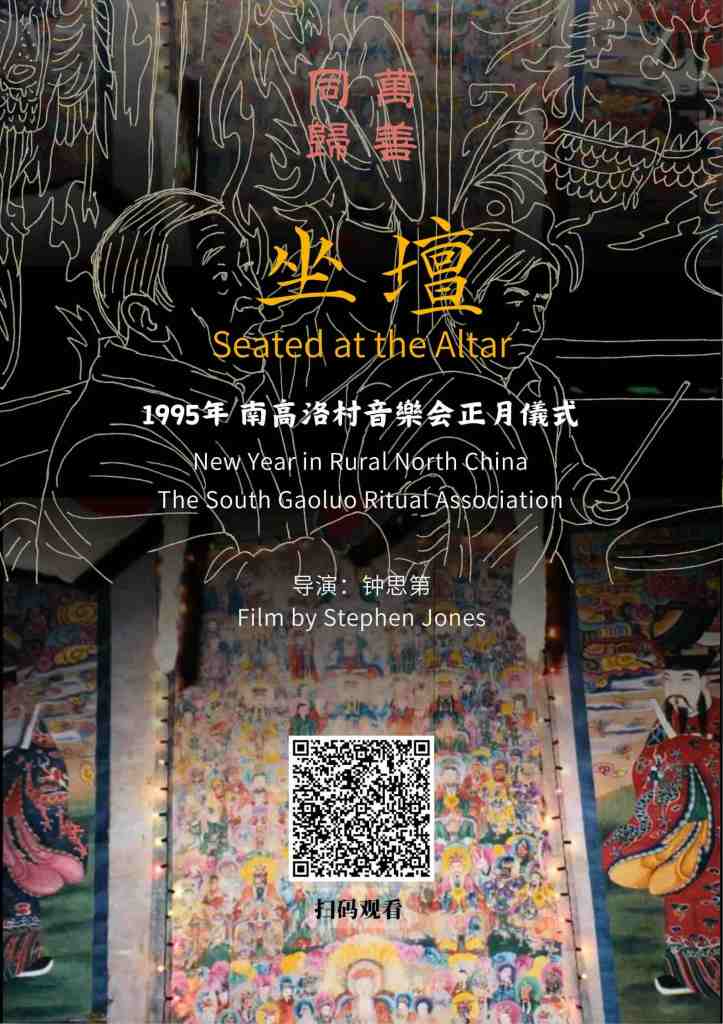


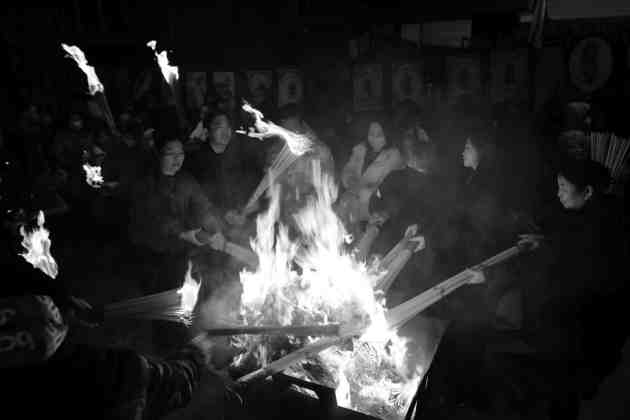


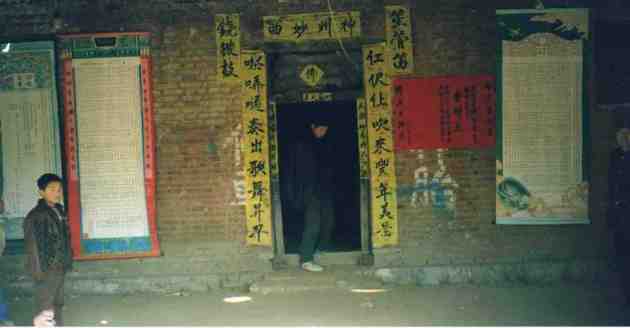
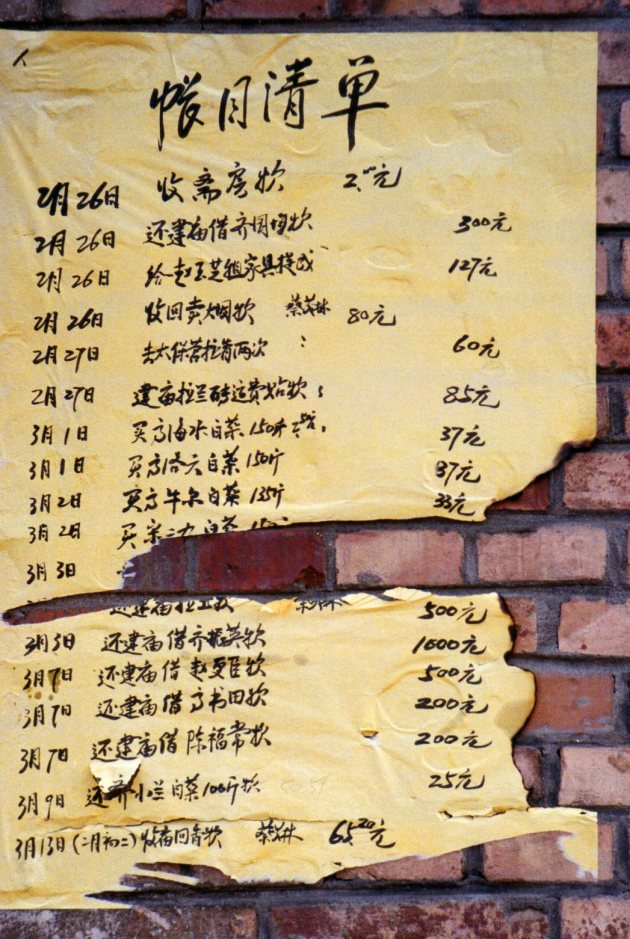

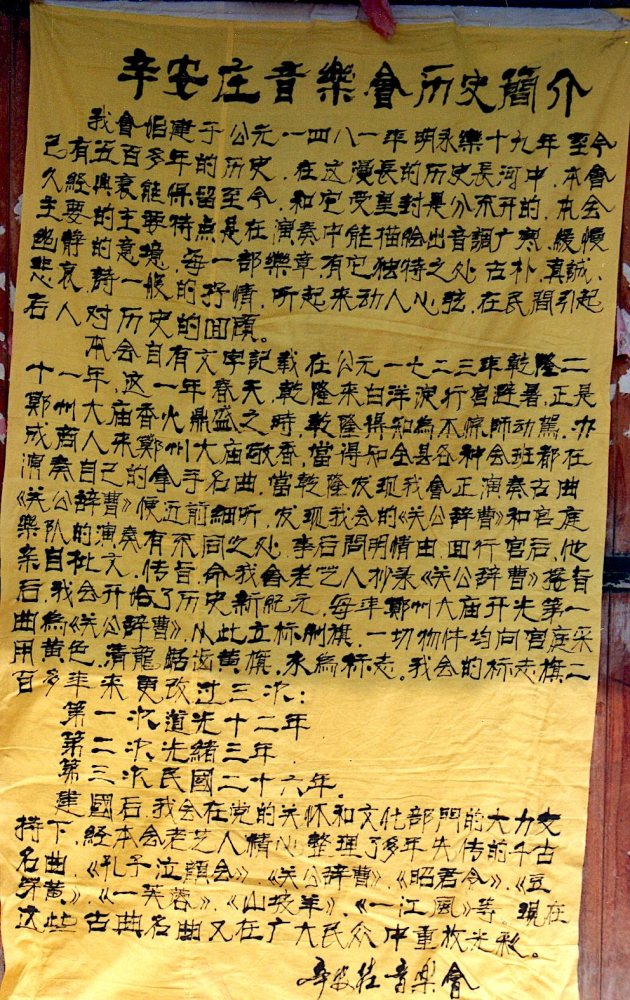


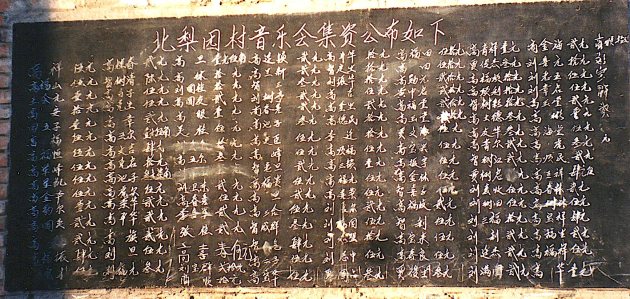
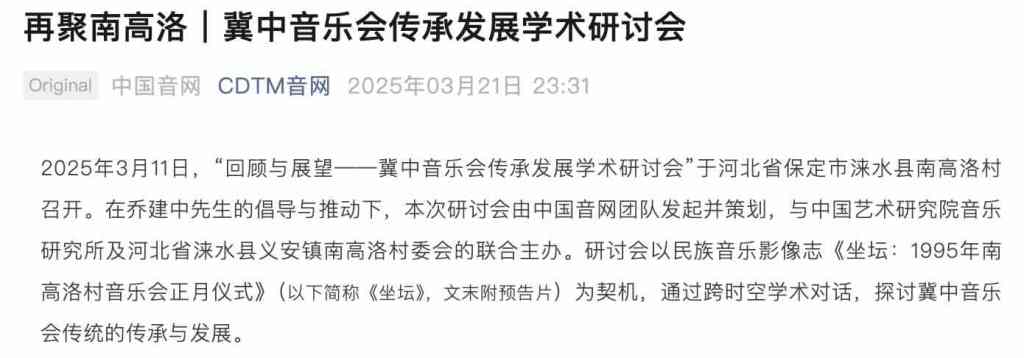


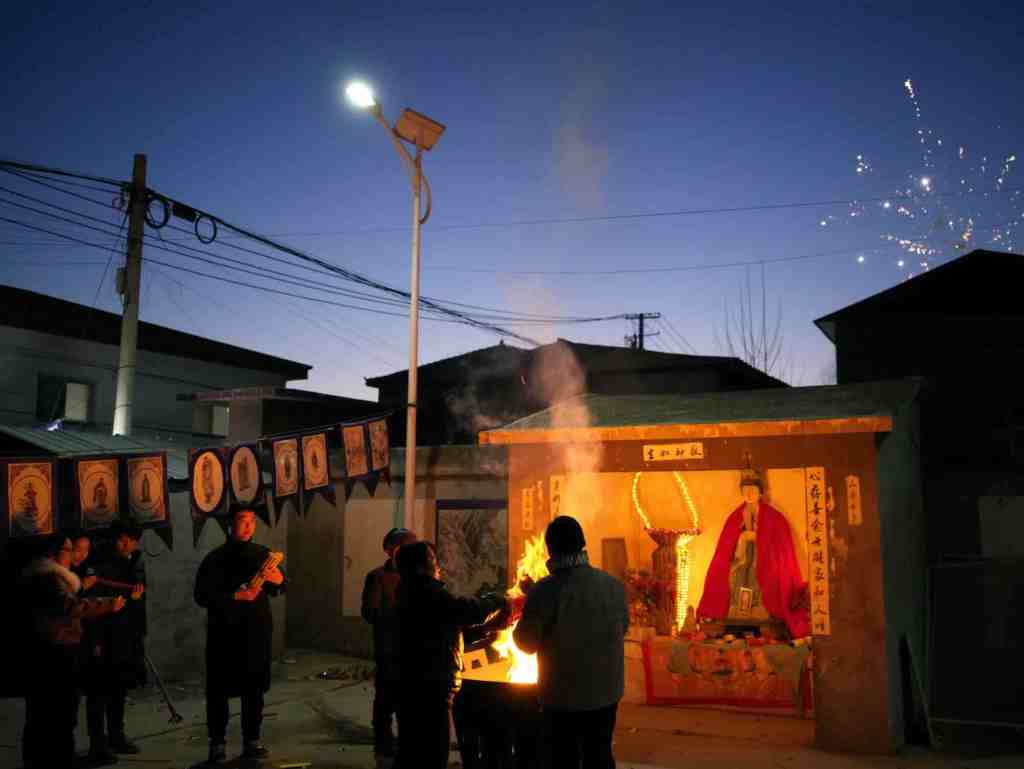


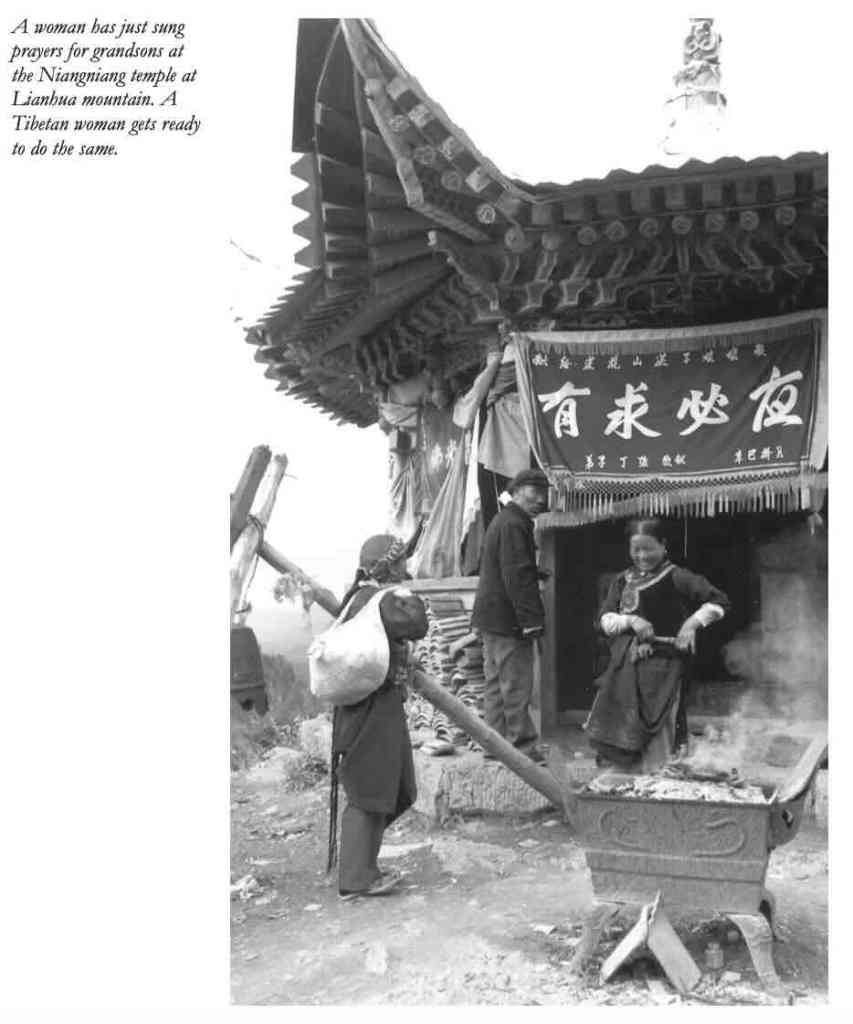

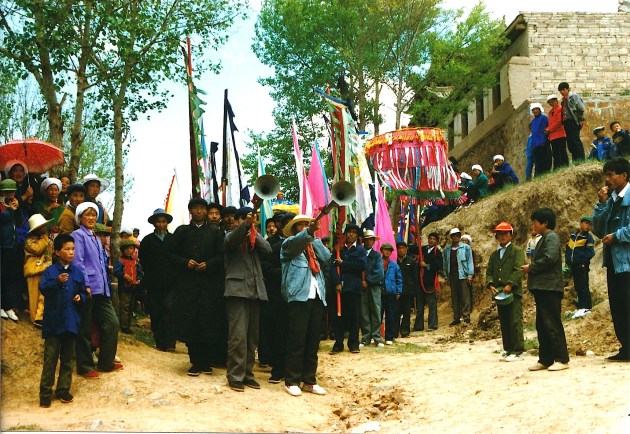


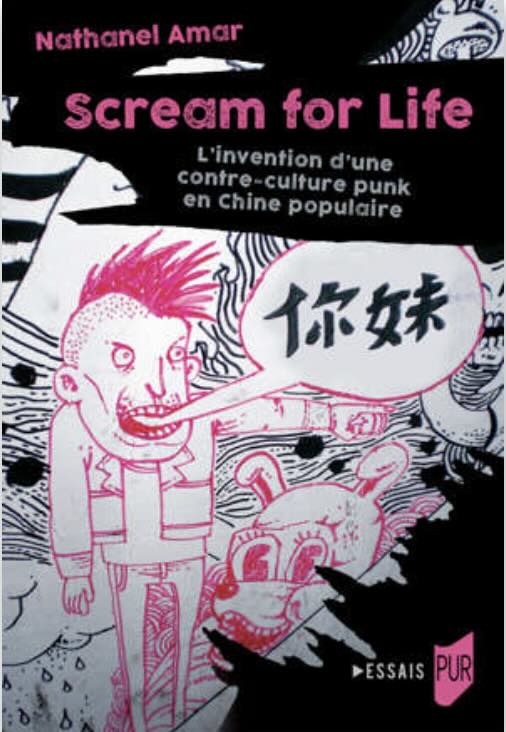
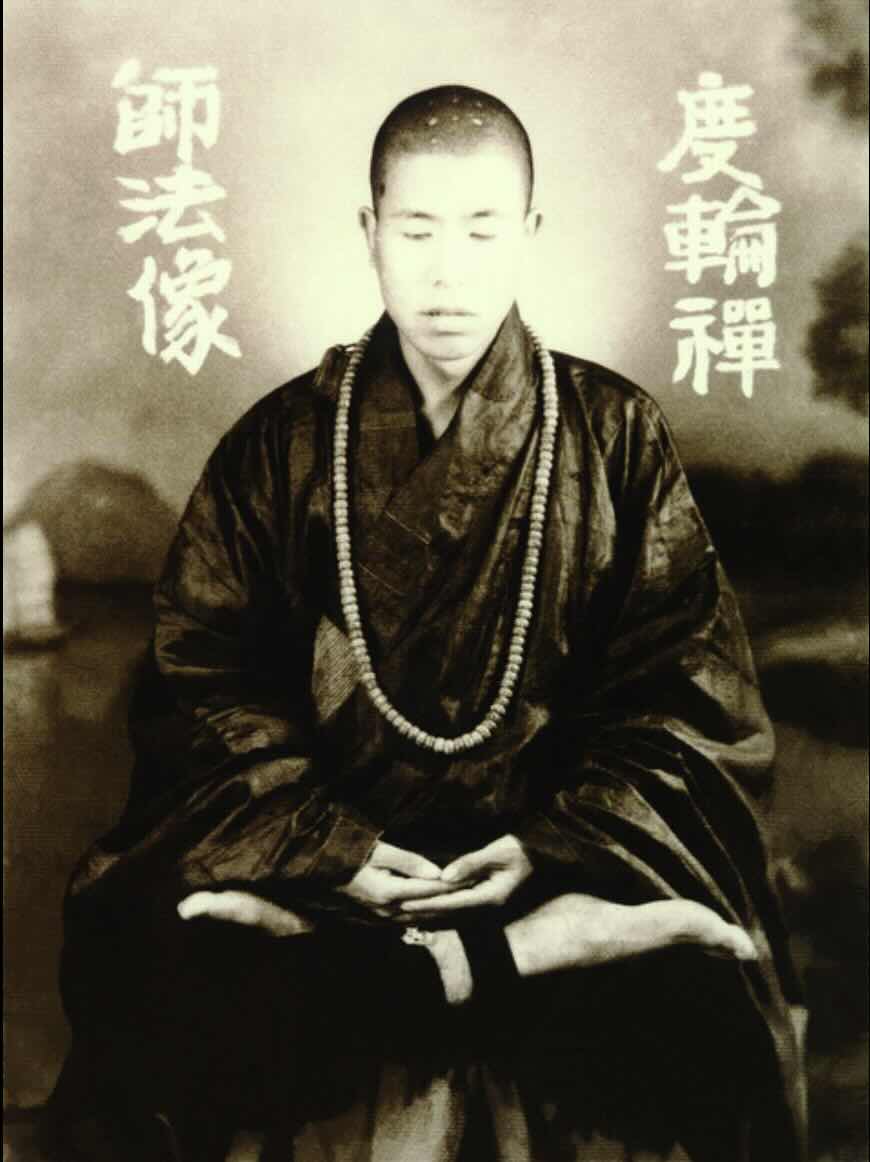

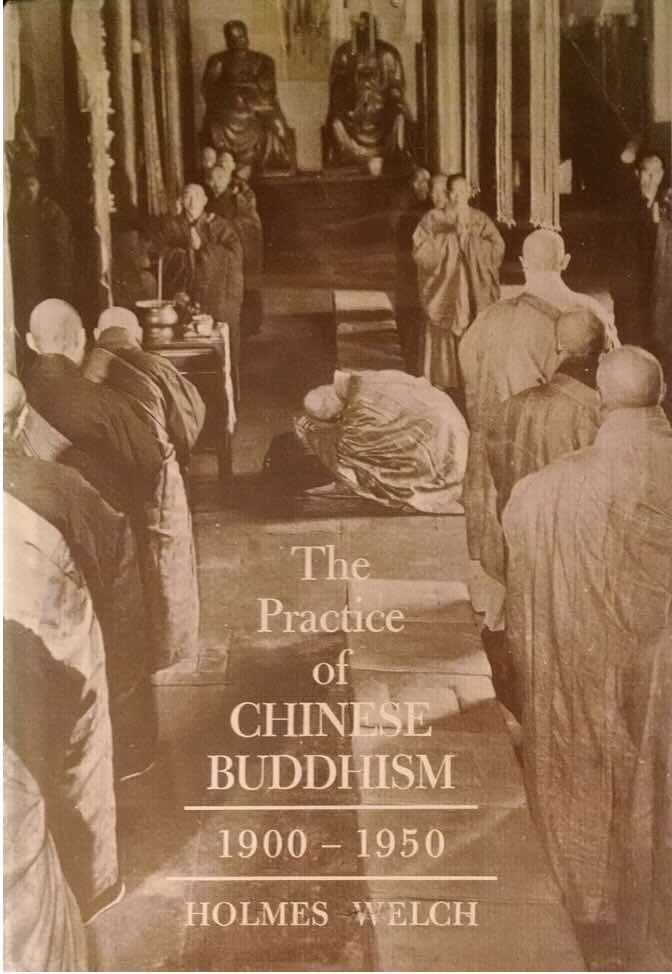 [3]
[3] 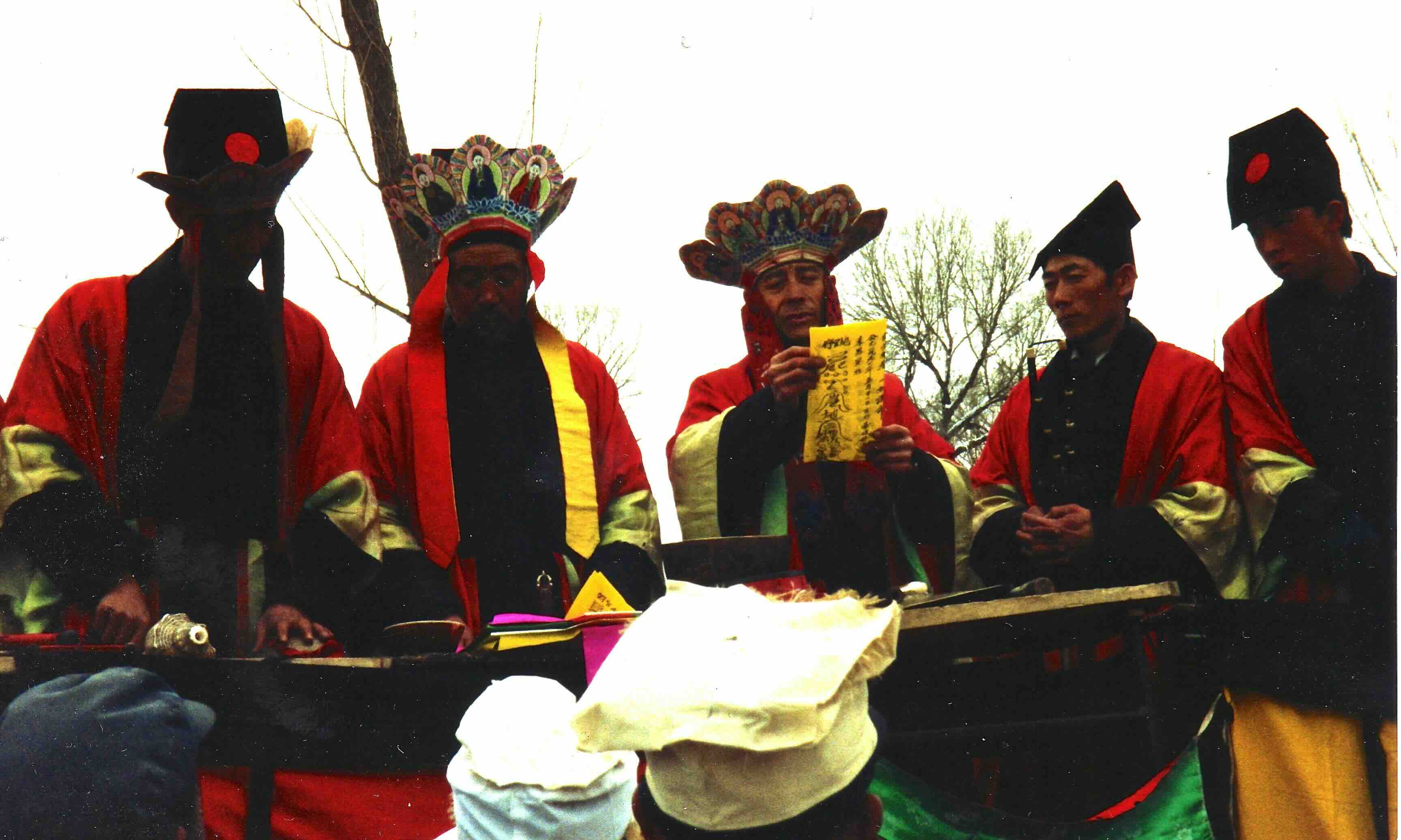 The Li family Daoists perform the
  Li Wencheng in 2021. Cool trousers, eh. Source: Weibo.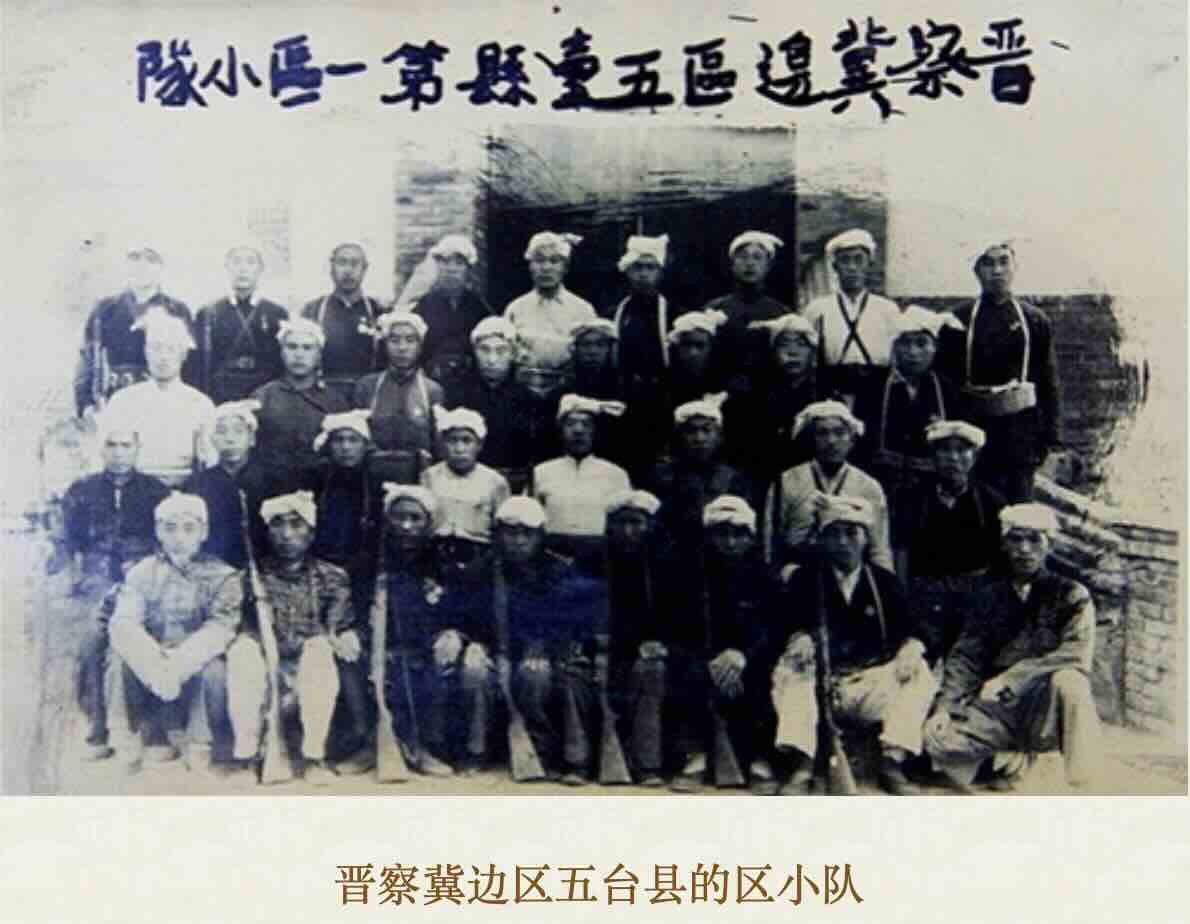

 Li Peisen’s cave-dwelling in Yang Pagoda village.
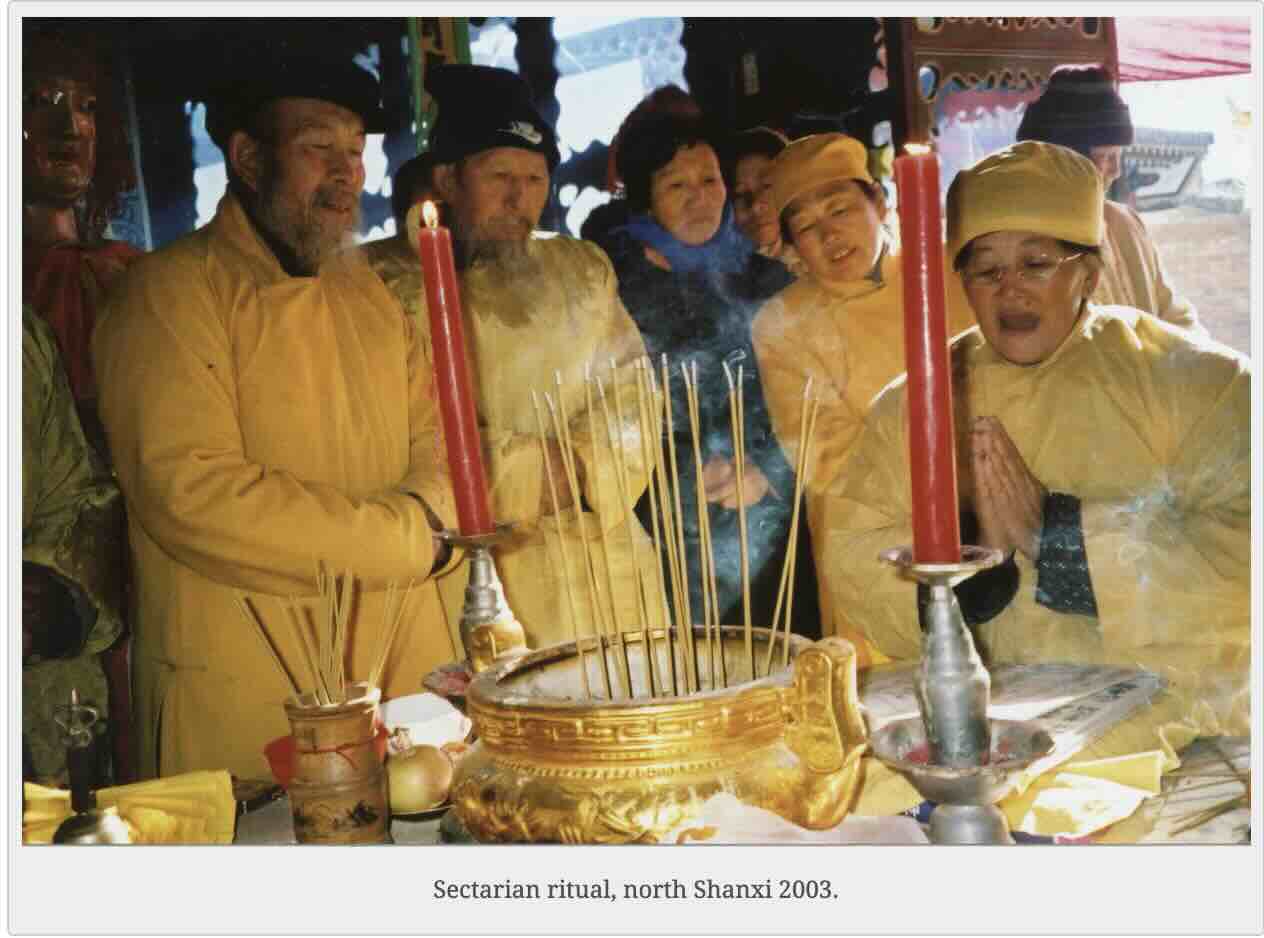

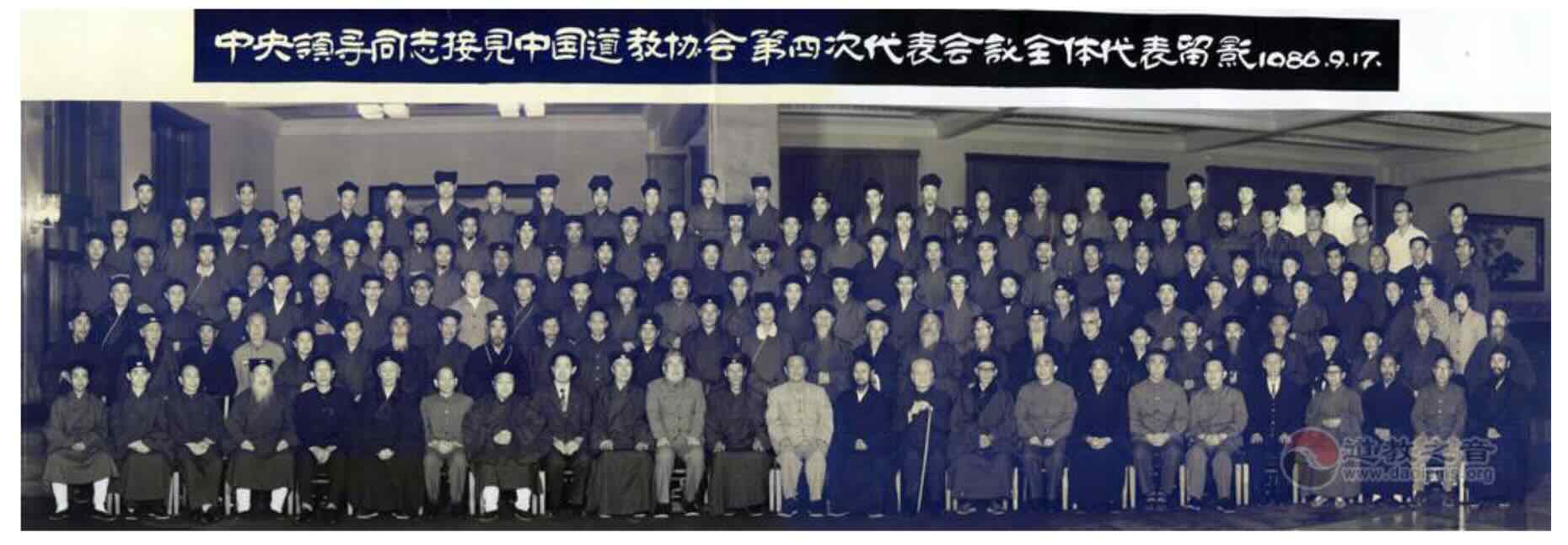
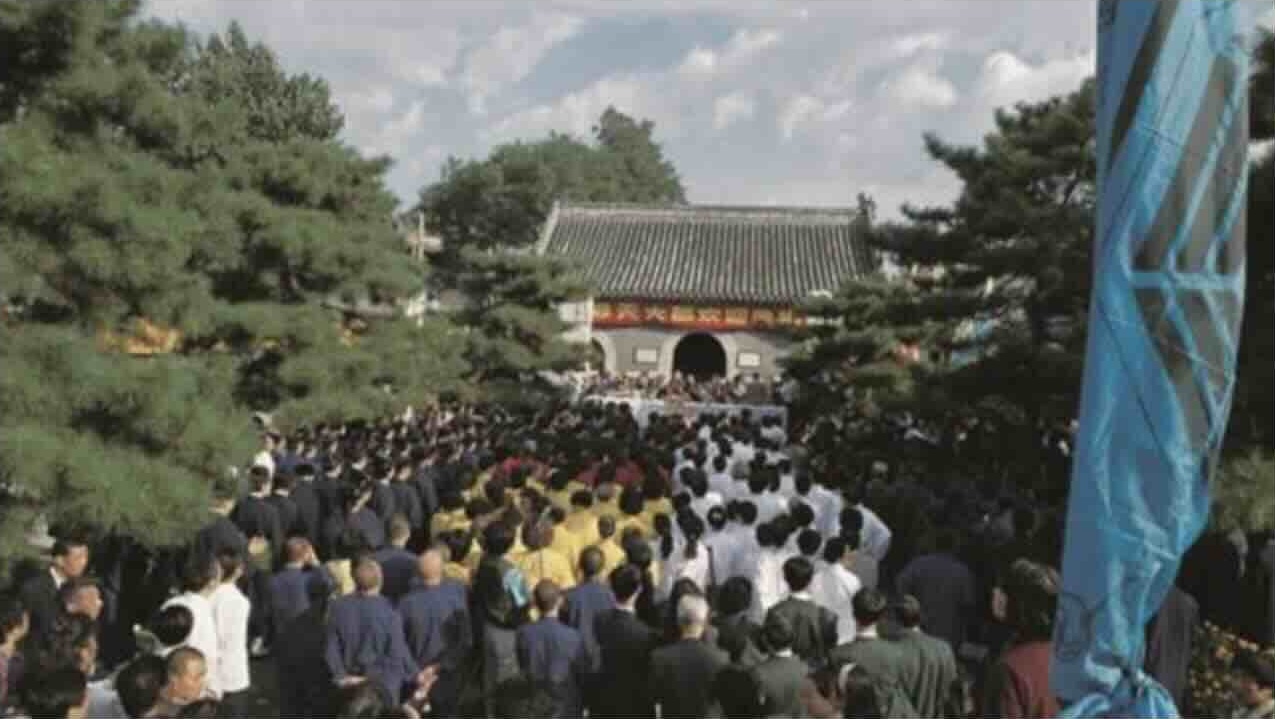 Great Open-air Offering ritual, White Cloud Temple, Beijing 1993.


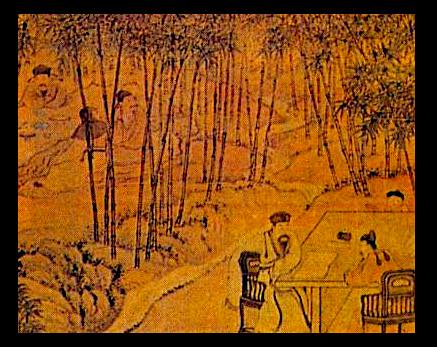
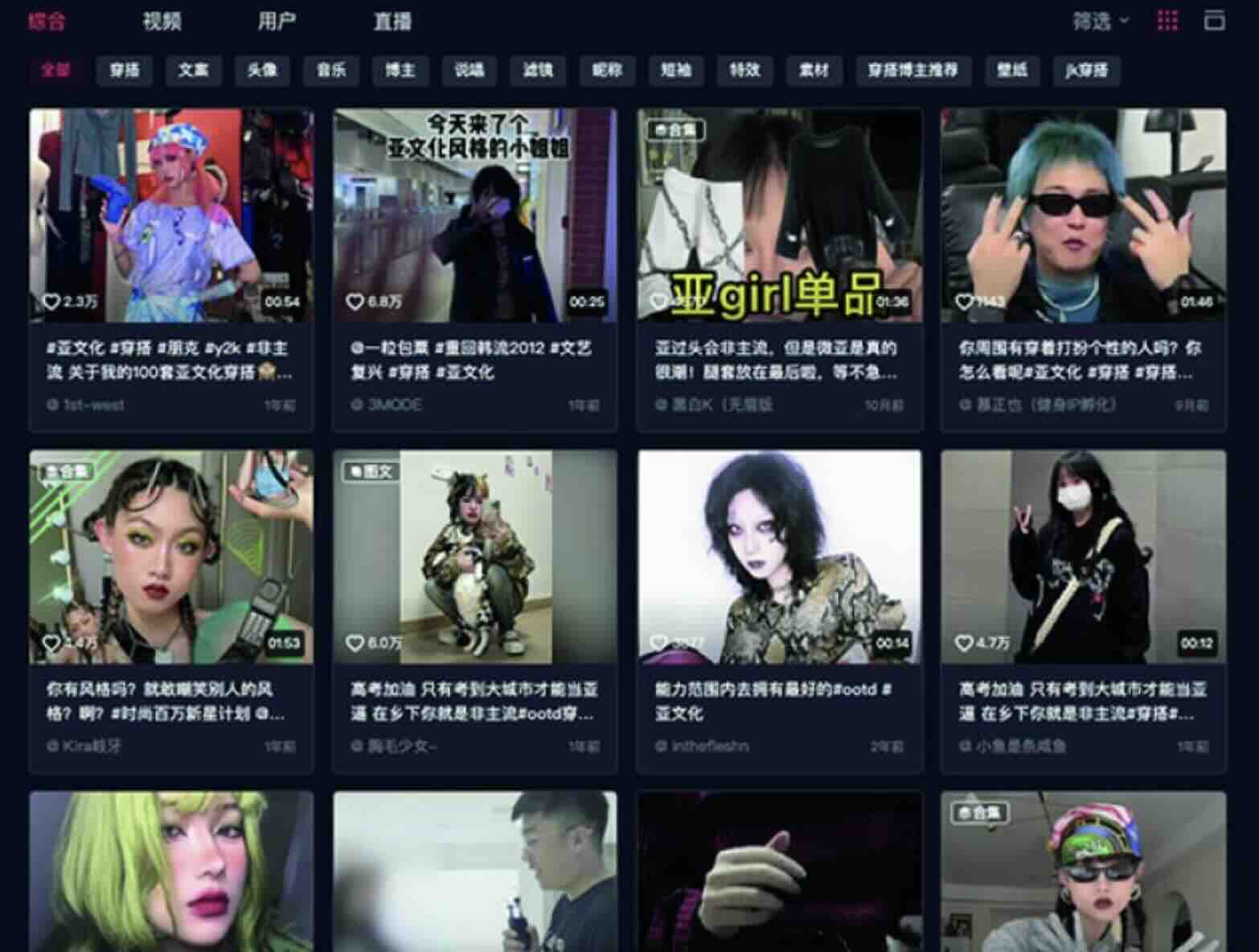


 The Shanhua temple during the




 Scene from the Great Improvement of Luck ritual:
 The Wei Yuan Altar 威遠壇 in suburban Taipei,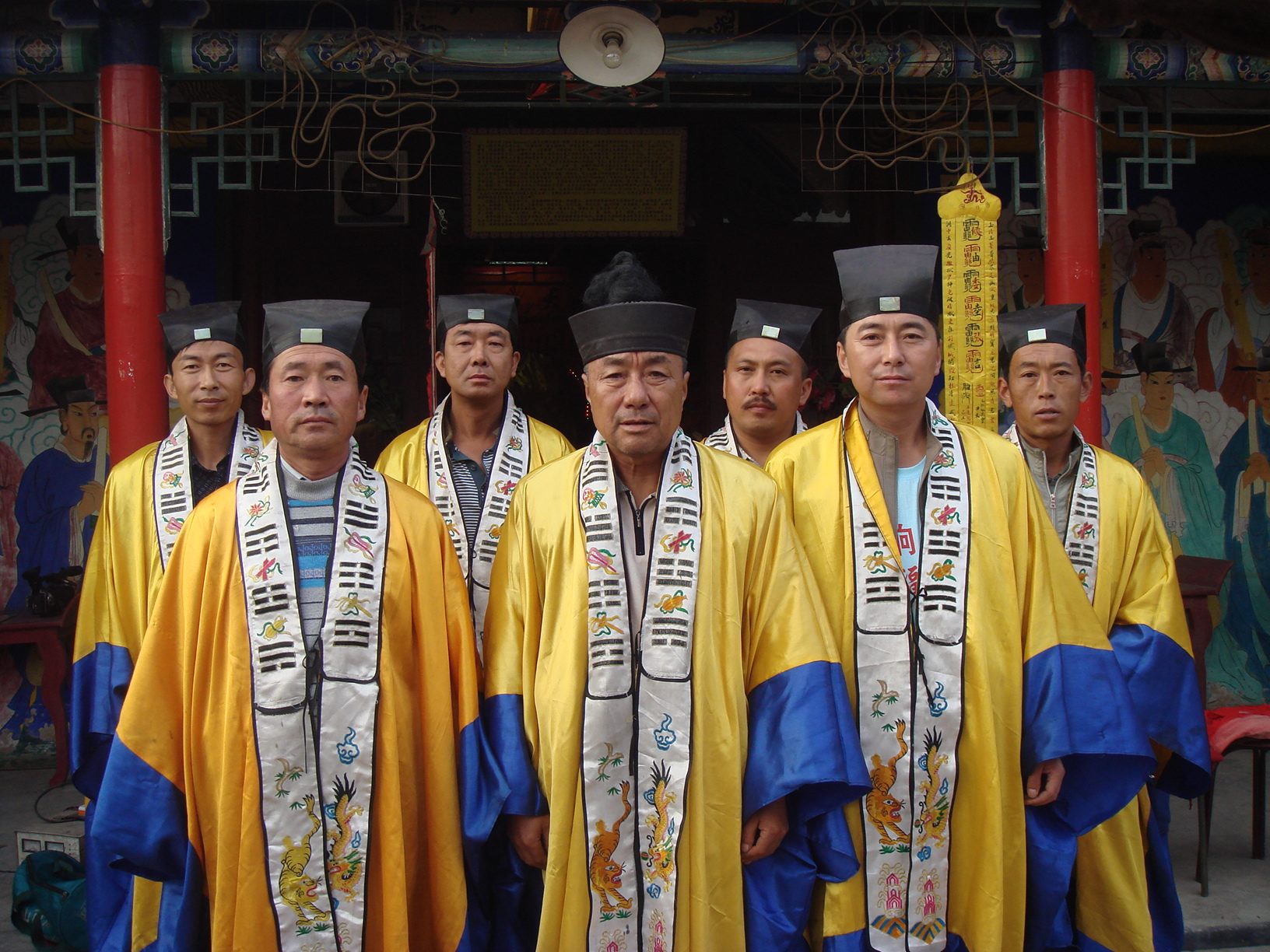


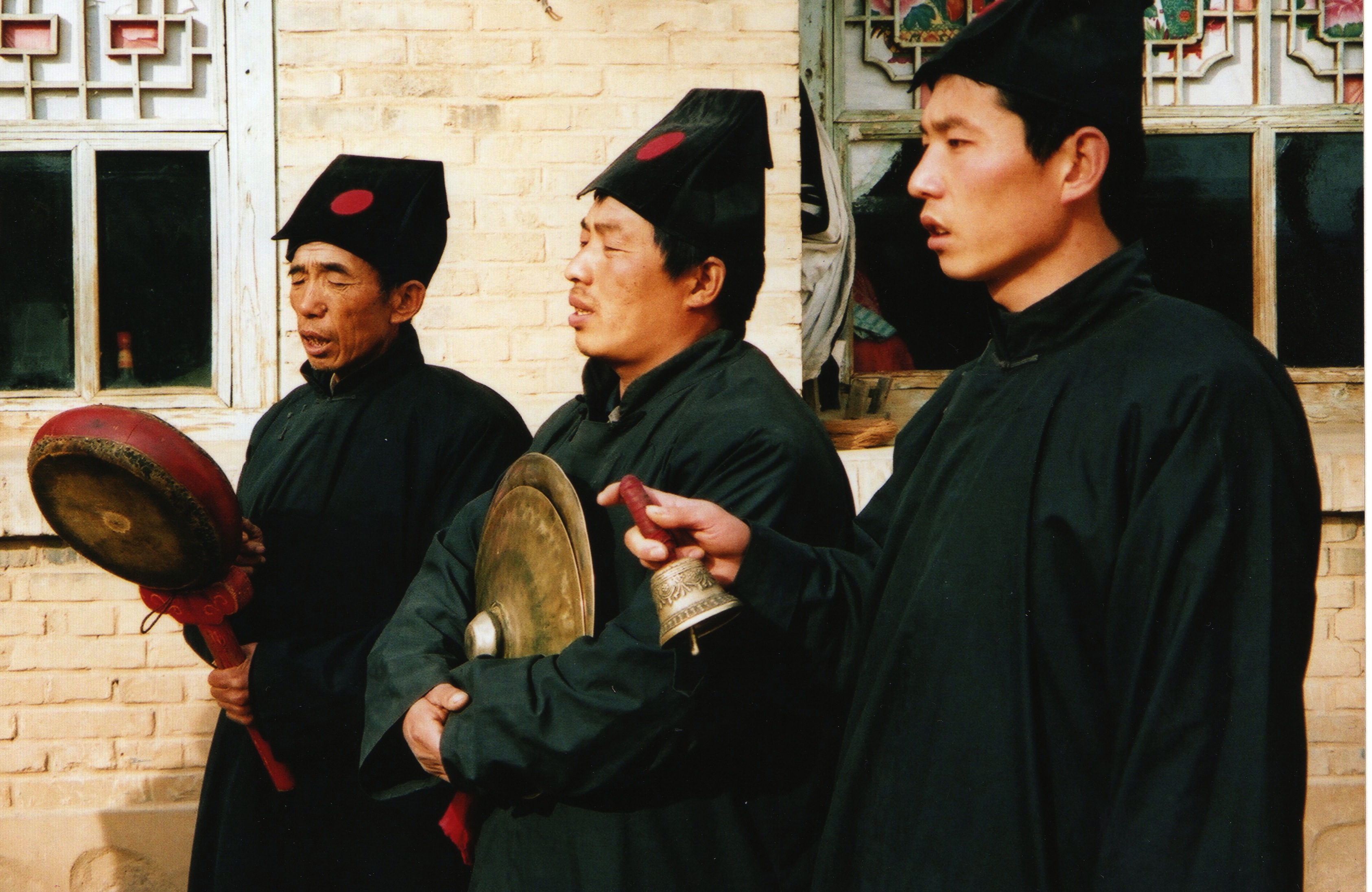
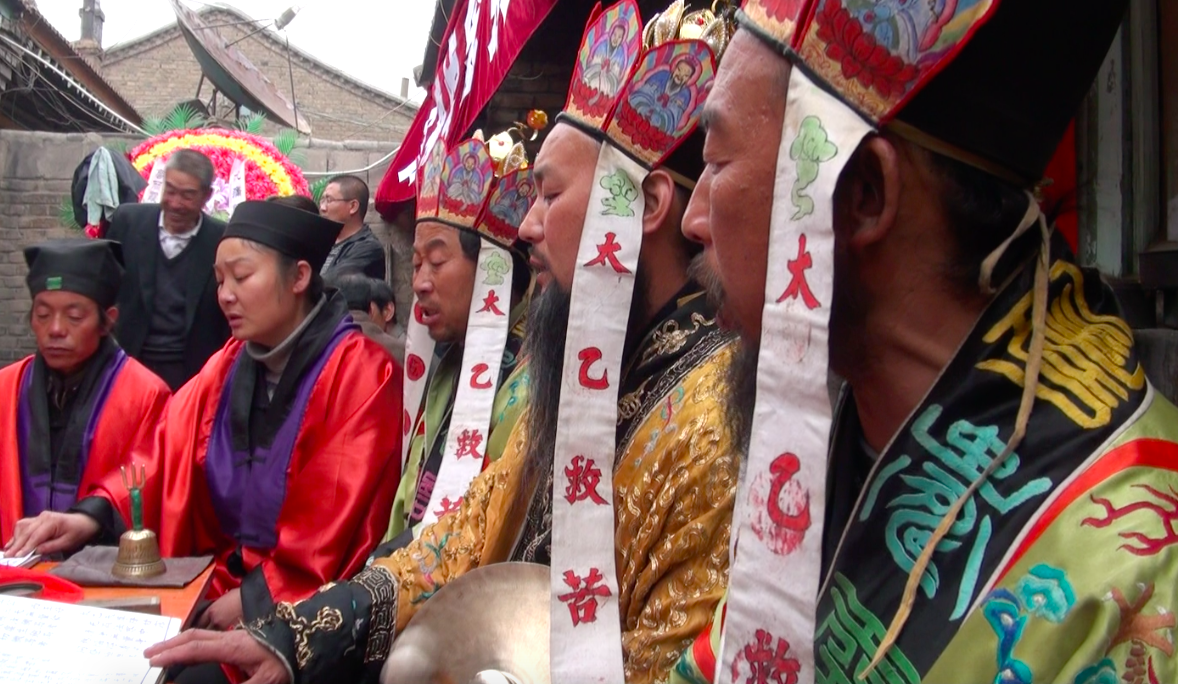


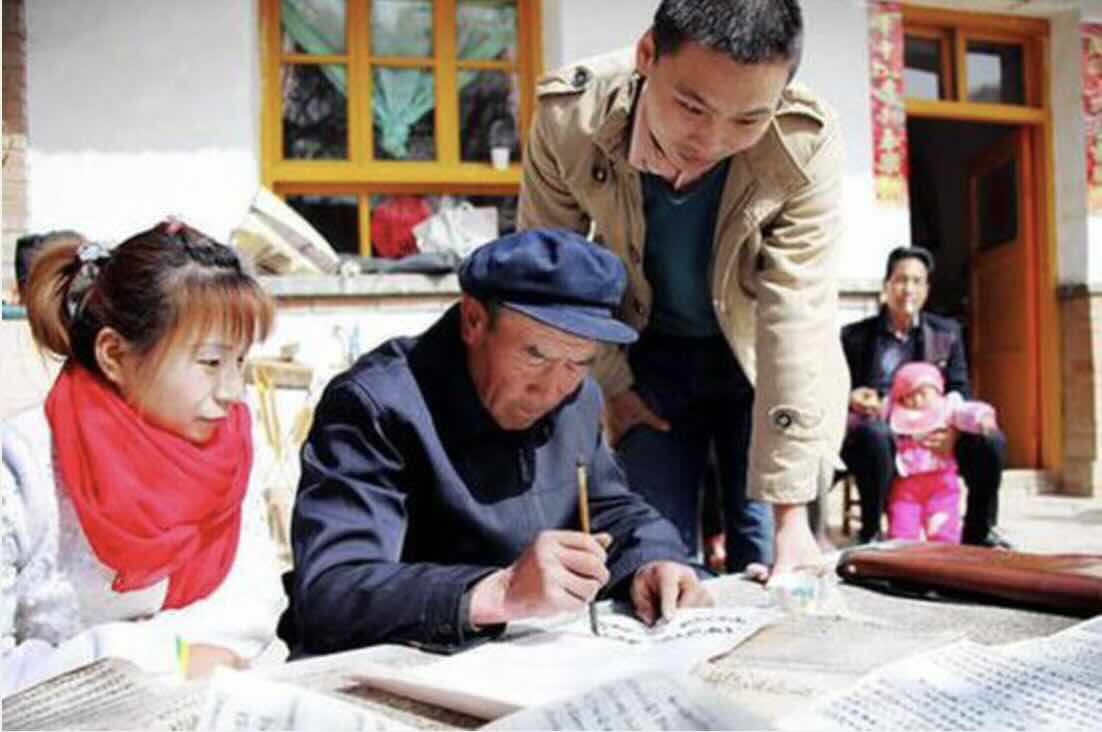





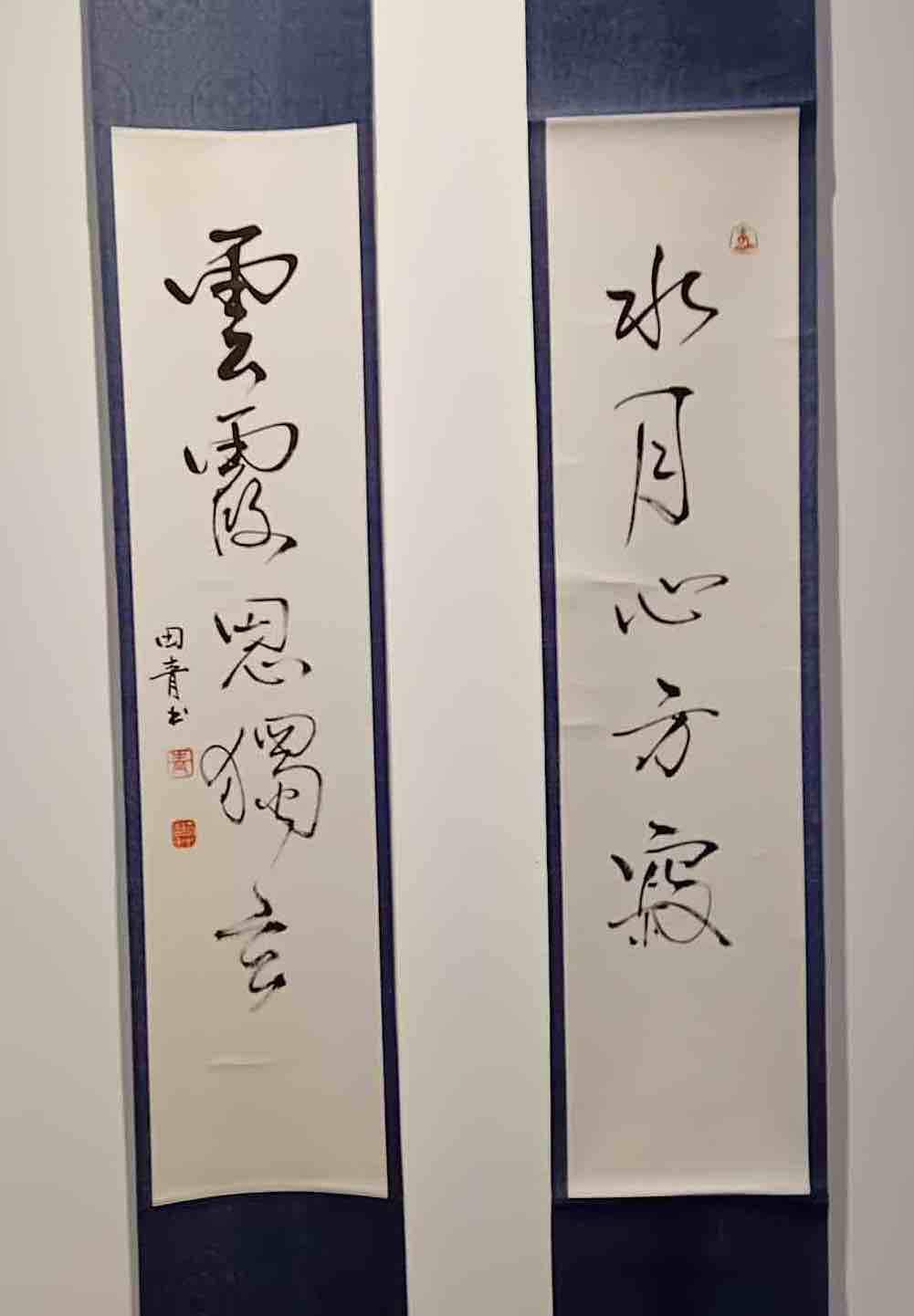
 The couplet comes from a poem by the early-Tang poet
 Besides Tian Qing’s many reflections on the





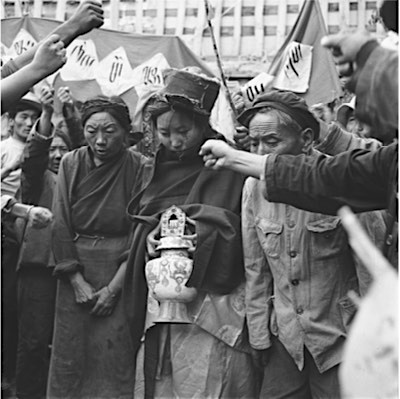

 From Blue kite (Tian Zhuangzhuang, 1993).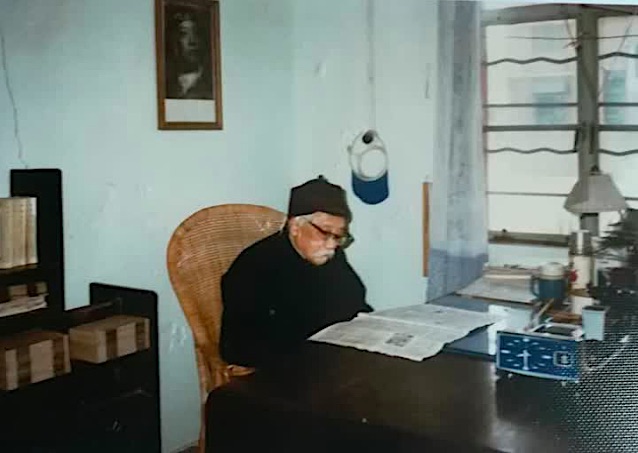


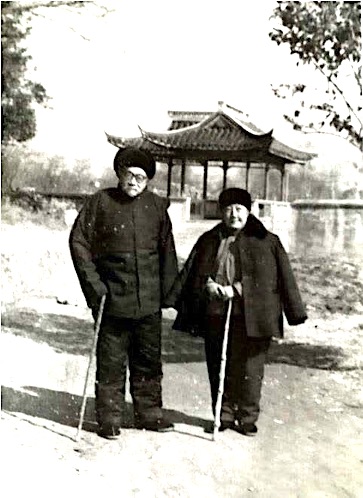
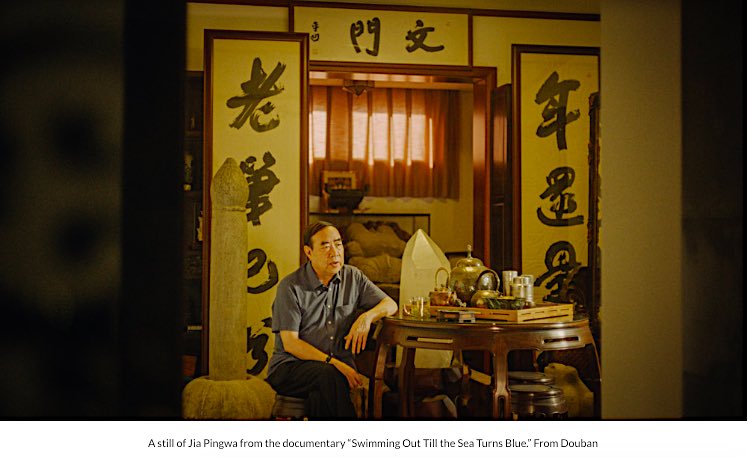




 With the Mayor of Philadelphia.
 Mother Divine signs her book for Li Shiyu.

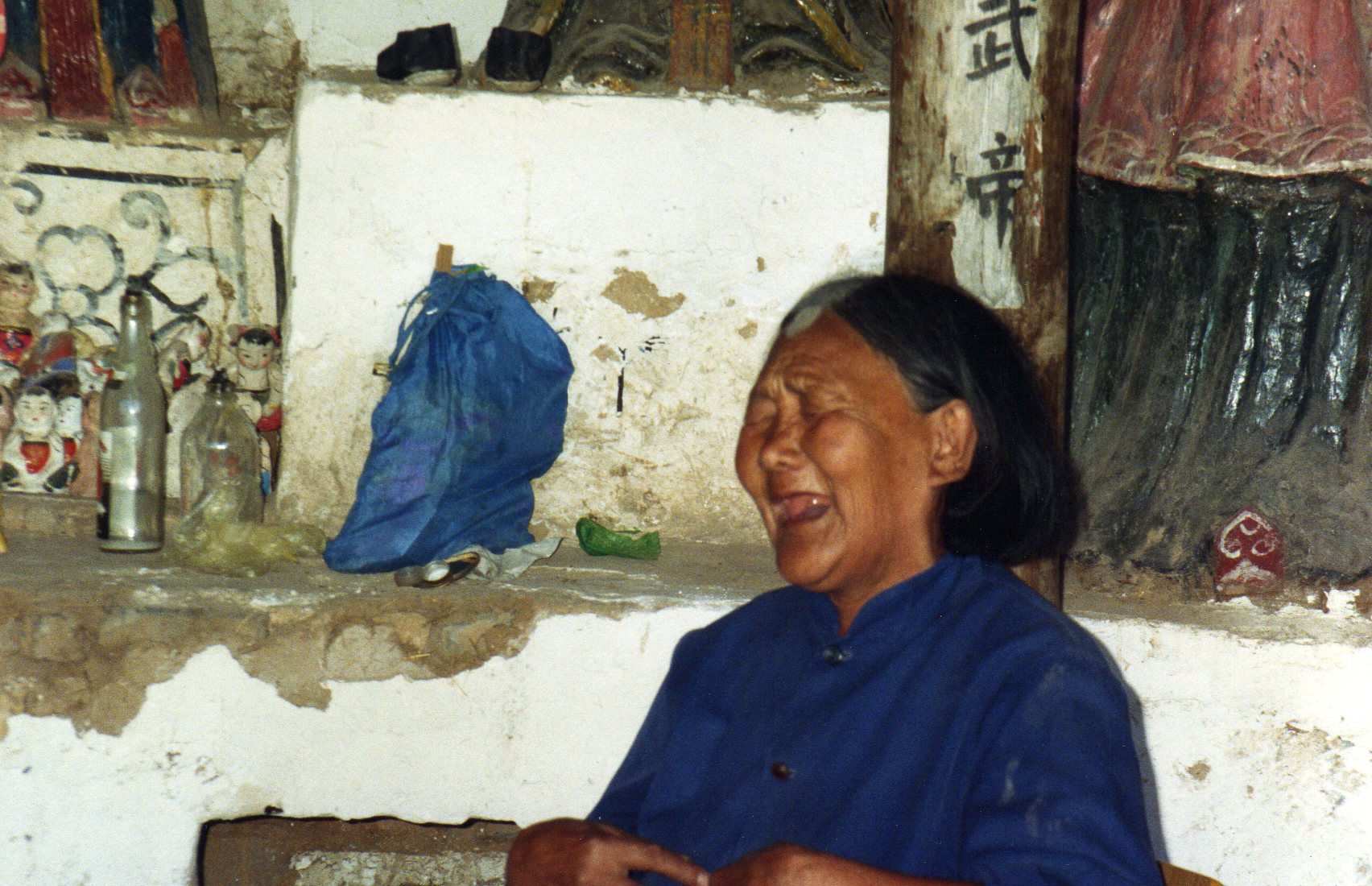


 Sola is one of three children of
 After graduating, partly in rebellion against the establishment that contemporary Western Art Music seemed to represent, Sola chose to become a pop musician, giving concerts and composing for film soundtracks, TV, and theatre. At the same time she made a great impression with her 1985 novellas Ni biewu xuanze 你别无选择 (You have no choice), Lantian lühai 蓝天绿海 (Blue sky green sea), and Xunzhao gewang 寻找歌王 (In search of the king of singers). Her voice was


 From The afterlife of Li Jiantong.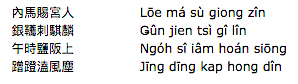


 The character of Chang also features in

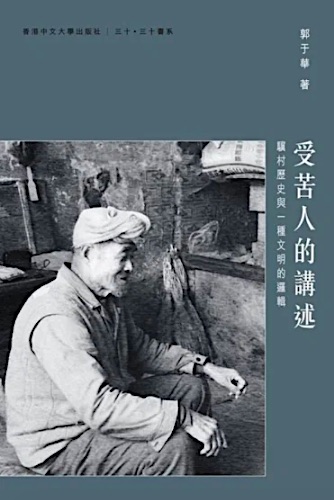


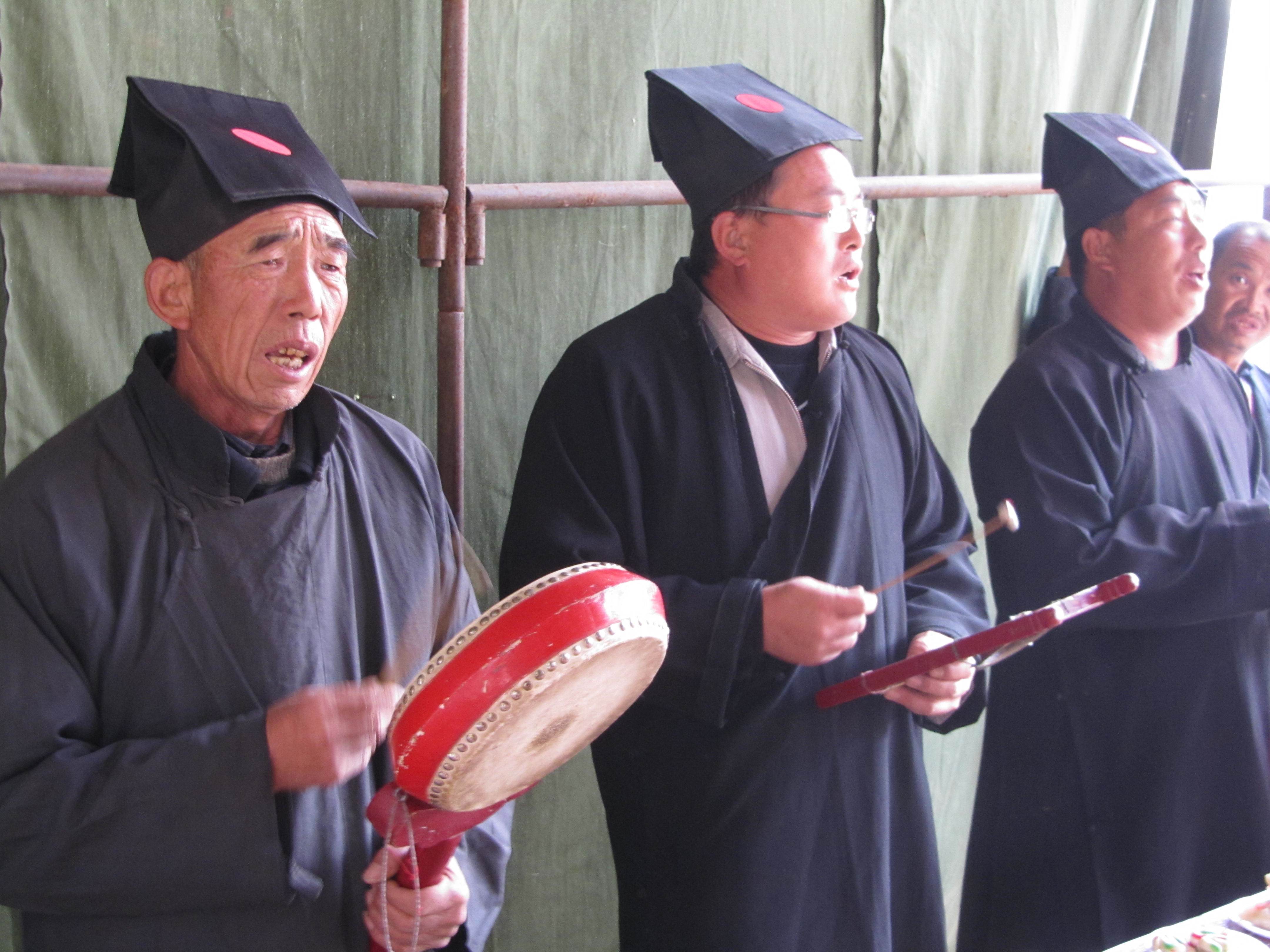

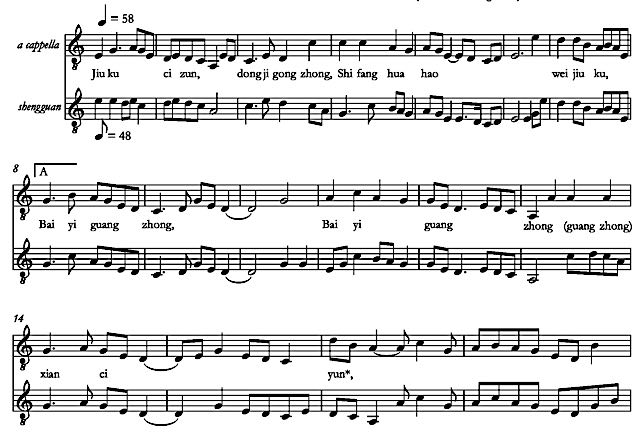


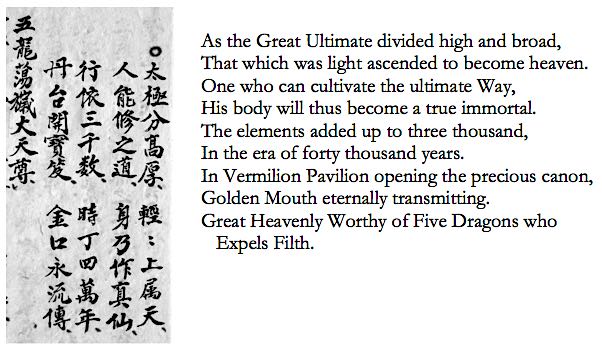


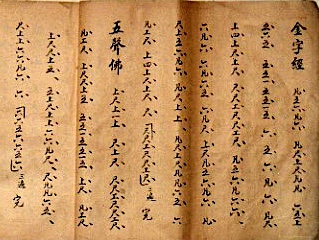


 So while our fleeting linguistic frisson soon became a wild goose chase (A really

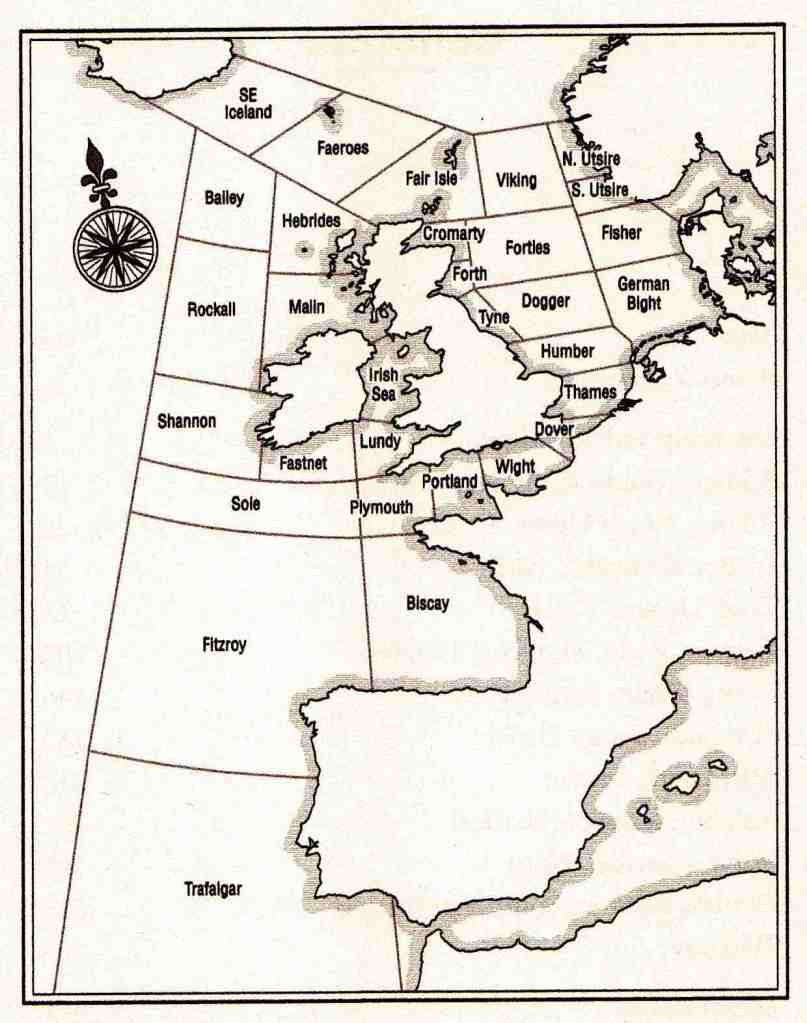

 Radio 4 listeners, bless their cotton socks, defend the ritual fiercely: there was a “national outcry when the BBC had the temerity to change the time of the late-night broadcast, moving it back by a mere 15 minutes (‘People went ballistic’, according to a Met. Office spokesman).” When the name of sea area Finisterre was changed to FitzRoy, “Anyone would think they’d tried to change the words of the Lord’s Prayer!”


 Stephen Jones: a blog