The English, home and abroad

Fond as I am of making connections, here’s an extensive series of posts on various aspects of being English:

Some bygone sounds:

Also

I also note this group of posts on intrepid British explorers:

—and, with serious respect,

You can find more from Messrs Bennett, Lee, and Cunk under their respective tags in the sidebar.

Hequ 1953: collecting folk-song

Hequ

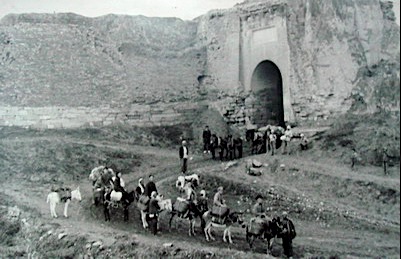
The fieldwork team sets off into the Hequ countryside, 1953.

After the Russian revolution, the work of ethnographers in the Soviet Union and their satellites was severely hampered right until the 1990s (see also here). So turning to China, I remain deeply impressed by the energy of fieldworkers documenting folk culture in the first fifteen years after the 1949 “Liberation”, for all its limitations.

In autumn 1953, in one of the first major field projects of the Music Research Institute in Beijing, Yang Yinliu and Li Yuanqing dispatched a team to spend three months collecting folk-song in rural Hequ (“river bend”) county in Shanxi. On the banks of the Yellow River at the borders of Inner Mongolia and Shaanxi, this large isolated area in the far northwest corner of the province connects the Datong region and the much-studied Shaanbei (see also here).

The results of the project were published in the 244-page

  • Hequ minjian gequ 河曲民間歌曲 [Folk-songs in Hequ], ed. Zhongyang yinyuexueyuan Zhongguo yinyue yanjiusuo (Beijing: Yinyue chubanshe, 1956, reprinted 1962).

Hequ cover

The team of eight was led by Xiao Xing 晓星, and included Li Quanmin 李佺民 and Jian Qihua 简其华, who went on to do significant field research further afield.

Meanwhile back in Beijing, a Czech couple were documenting narrative-singing, while Yang Yinliu and Zha Fuxi were discovering the shengguan wind ensemble of the Zhihua temple. Whereas the study of temple music was rather bold, folk-song—the creation of the labouring masses—seemed to make an acceptable topic.

But despite the experience gained in the Yan’an base area in the 1940s, where collecting folk-song was already a pillar of CCP cultural policy (as shown in the 1984 film Yellow earth; see also here), the editors reveal a certain resistance among local cadres to the idea, and go to some lengths to justify it. With the social changes upon Liberation, they hint that it was already to some extent a salvage project: “people don’t sing shanqu nearly as much as before”.

Hequ singer

Here one can hardly expect candid ethnographic coverage of the Japanese occupation, civil war, and the early years of Liberation (cf. Hinton‘s detailed, but also ideologically-driven, accounts for the land reform and later campaigns in a village in southeast Shanxi). And sadly, the volume includes only a few very brief biographical accounts of the singers. This 1953 photo of Guan Ermao was reproduced in the Anthology.

As in Shaanbei, the repertoires are dominated by “mountain songs” (shanqu), “Walking the Western Pass” (zou xikou), and errentai genres. Through the zou xikou songs the collectors paid attention to seasonal migration, and songs about love and marriage prompted them to explore the lowly status of women—in the “old society”. They documented work hollers (including those of boatmen), and the songs of miners. Apart from lyrics and transcriptions, the introduction (5–41), and the substantial report (107–224) are inevitably pervaded with the language of the day—”feudalism”, “working masses”, and so on; the authors’ attempt to explore the relation of the songs with people’s lives is constrained by ideology. Still, there’s rich material here.

For a definitive 2-CD set with archive recordings of Chinese folk-song, note

  • Tudi yu ge 土地与歌 [English title Songs of the land in China: labor songs and love songs], ed. Qiao Jianzhong (Taipei: Wind Records, 1996).
Hequ map

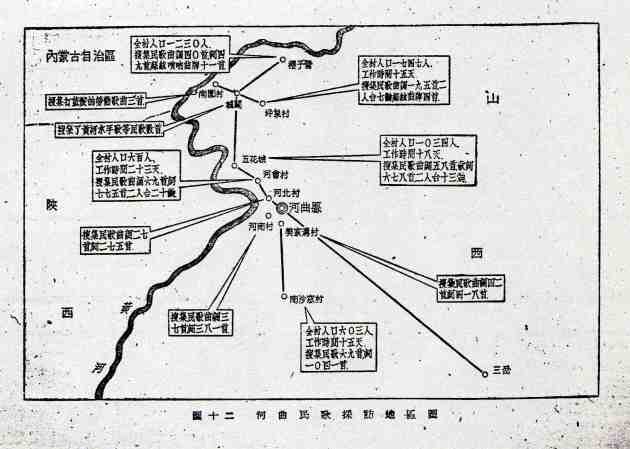
Field sites in Hequ county, 1953.

The bleak Hequ landscape later formed the backdrop for Chen Kaige’s 1991 film Life on a string. By the way, I’m curious to learn of any household Daoist activity in this little-studied region.

* * *

After the Cultural Revolution disrupted research, and lives, the collapse of the rigid commune system from the late 1970s soon allowed the task of documenting expressive culture to resume—now with the monumental Anthology project. The folk-song volume for Shanxi

  • Zhongguo minjian gequ jicheng, Shanxi juan 中國民間歌曲集成, 山西卷 (942 pp.)

was published in 1990. For Hequ, indeed, it includes some transcriptions from the 1956 volume.

I touched on folk-song collecting in

  • “Reading between the lines: reflections on the massive Anthology of folk music of the Chinese peoples”, Ethnomusicology 47.3 (2003), pp.287–337.

Clearly, as William Noll also observes, we always have to interpret texts in the context of their time; learning to read between the lines is a basic task in studying both early and modern Chinese scholarship. Yang Yinliu and others had to learn to use the rhetorical language of communism to handle ideological pressure. However obligatory his language of class struggle, he documented both folk and élite traditions with great insight.

Still, explicit or implicit ideological frameworks will inevitably affect the work of collection and presentation. An obvious case is the former Maoist highlighting of “revolutionary songs”.

It is a tribute to the advances of Chinese musicology since the 1980s that Yang Mu’s comments (“Academic ignorance or political taboo? Some issues in China’s study of its folk song culture”, Ethnomusicology 38.2 [1994]), based mainly on his experiences in China in the 1980s, now look dated. Yang caustically describes the limitations of Chinese folk-song collection, questioning the “authenticity, representativeness, and reliability” of the early Anthology folk-song volumes. He observes the narrowly political nature of fieldwork in China: that “the arts must serve proletarian politics”, and that collection often served as material for new composition. Yet this criticism again seems to fail to distinguish slogans from genuine intent or actions.

Yang Mu reasonably finds such collections misleading, with revolutionary songs being given space far above love songs. Yang points out that revolutionary songs are not representative of actual folk-song activity, as they were not popular, being performed only for government-sponsored events—at least by the 1980s, and quite probably through the Maoist era too, I might add. Such songs may be academically significant as reflections of the Party’s artistic policies, but as Yang Mu says,

after asking the local singers to sing all types of their local folk songs, and having listened to them singing for many hours, I never heard a single song that could be considered “revolutionary”.

Singers may know a few such songs, but they are not part of their customary repertory. Yang Mu claims the scholars arguing against political control lost the battle, but revolutionary songs take a more modest place in most of the published volumes, so quickly has Chinese thinking shaken off Maoism. Whereas until the 1980s revolutionary songs compulsorily opened most collections, in the Anthology they take their chance along with other songs.

in the Anthology the list of themes at the end of each volume (with minor variations), however subjective, is as useful as any rough-and-ready system. Political songs are included under the headings “social struggle” and sometimes also “revolutionary struggle”, both with sub-categories; a category called suku, “speaking bitterness” or lamenting hardship, may be included under either heading. In many volumes these songs occupy around 10% of the total, which one may still find “unrepresentative”, though by no means as dominant as Yang Mu suggests. I gave a couple of examples:

table 3

table 4

Yang Mu also criticizes the excessive selection of “texts describing or complaining about the bitter life, suffering, and distress of the laboring class people before they were liberated by the CCP”. But such songs are not always clearly about the old days, and even if they are (such as deploring a cruel landlord), songs lamenting the bitter life of olden times are rather common in many societies, and motivations for singing them may be quite complex; they may embody a kind of historical memory, and might even be seen as a subtle criticism or expiation of current woes. Many songs I have consulted in this category seem, like the blues, to be simply lamenting hardship or separation, with no clear time-frame. So I would be less keen to assume political bias here.

Still, if songs praising the CCP are no longer dominant, songs criticising it are entirely absent, which may or may not reflect reality! Songs with “negative” (e.g., feudal, religious, or sexual) texts may have been censored, both by singers and collectors.

In the Anthology love songs and work songs are in a majority. The ritual and religious soundscape has been allowed a certain presence throughout; but if the collectors and editors have significantly reversed any revolutionary bias, a secular bias may remain. How may one assess their relative importance? Short of fly-on-the-wall recording of folk-song life over a long period, singers may indeed censor songs they see fit to sing for outsiders, long before collectors and then editors make their own selections.

By contrast with Yang Mu’s criticisms, I’ve already discussed the choice of one local cultural cadre collecting the repertoires of blind itinerant male bards in 1980s’ Shaanbei (see here, under “Research and images”):

“When I recorded them, I chose anything about Heaven, Earth and Man, and rejected everything about the Party, Chairman Mao, and Socialism!”

For more on folk-song collection, click here.

* * *

For Shanxi, neither in the 1956 report nor in the Anthology folk-song volume do the collectors give revolutionary songs pride of place; but they hardly fulfil their aspiration to evoke people’s lives. And while the 1980s’ Anthology fieldwork now looks impressive by comparison with the later superficial reifications of the Intangible Cultural Heritage project, it too falls short in ethnographic detail.

All the same, I’m full of admiration for the team that spent those months “among the people” in 1953. And how one wants detailed accounts of the fortunes of their peasant hosts as collectivisation and campaigns got under way.

A diary clash

huiyishi

Now for another linguistic interlude. I’ve already cited several stories from our fieldworkers’ joke manual (note the Chinese jokes tag; and for a roundup, see here). This old one further illustrates the riches of Chinese punning, and has a hint of the underdog vanquishing pompous male privilege…

It thrives on the homophonous pronunciation of the acronyms for Journalists’ Association (jixie 记协) and Sex-Workers’ Association (jixie 妓协), suggesting parallels with our own airline acronyms.

The verbal creativity may work better in Chinese than in English, but here I loosely adapt a version that I found online (see—the riches of the Chinese web aren’t limited to The Thoughts of Uncle Xi):

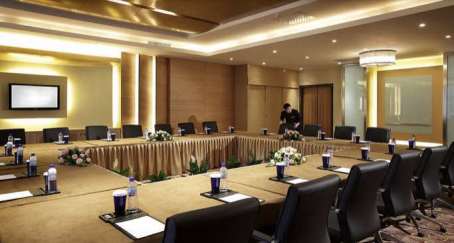
The Journalists’ Association and the Sex-Workers’ Association are both staying in the same hotel for their respective meetings. Both groups need to use the conference room at the same time. The hotel manager initially suggests they combine their meetings into one, but they argue their cases before him.

The Secretary-General of the Journalists’ Association observes proudly, “We journalists are uncrowned kings—how can a gang of women dependent on men compare with us?”

But the Secretary-General of the Sex-Workers’ Association retorts, “What’s the big deal about you journalists? A gang of guys sneaking in to see us—you’re all talk! How can you compete with us? Huh!”

The journalist goes on, “So we’re adversaries with different weapons, eh? We use the pen (bi), and we’re looking for manuscripts (gao).”

The sex worker points out, “Well, we use pussy (bi), and we’re looking for a shag (gao)!”

“We welcome both long and short manuscripts.”

“We’re fine turning both long and short tricks too.”

“We offer preferential rates for our manuscripts.”

“And so do we for tricks.”

In the end the hotel manager can only allow the Sex-Workers’ Association to use the conference room.

记者协会与妓女协会同在一个宾馆召开会议,同样要用会议室。记协秘书长联系会议室,妓协秘书长也在联系会议室。宾馆老板一听,都是开会,也都是叫一个名字,也不管是妓协和记协,对两位秘书长说:《干脆把两个会议合在一起开吧。》

记协秘书长坚决不答应说:《我们记协的记者是无冕之王。你们妓协是什么,你们是一帮女人,靠男人生活,能和我们比?》

妓协秘书长不服气地说:《你们记协有什么了不起。你们的记们,那个暗地里不来找我们的妓,一帮男人光是嘴上的劲。怎能是我们的对手。哼!》

记协秘书长说:《是不是对手,武器不一样,我们用的是笔,要的是稿。》

妓协秘书长说:《我们用的也是×,要的是搞。》

记协秘书长说:《我们长稿短稿都欢迎。》

妓协秘书长说:《我们长搞短搞都能行。》

记协秘书长说:《我们稿费从优。》

妓协秘书长说:《我们搞费也优。》

年轻漂亮的妓协副秘书长在一旁帮腔说:《我们怎样搞都适应,反正比你们强。》

这话气得记协秘书长《唉唉》直叹息。看来记协还得归妓协领导。因而再不言语。宾馆老板一看没法,只得把会议室让给妓协先开会了。

I note en passant that the present incumbent of the White House seems to have more time for sex workers than for journalists.

For the high esteem for sex workers in China, see here.

Alexei Sayle: an Iron curtain update

*See here, Good as New!*

Stalin

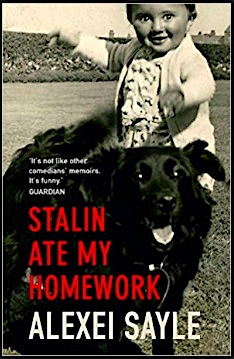
As my coverage of east Europe grows (see under Life behind the Iron Curtain), I’ve just made a substantial update to my post on Alexei Saylewith some vignettes from his insightful memoirs in which he recalls the family’s post-war holidays behind the Iron curtain—setting the tone for his later surreal world, both idealistic and cynical.

So following a reshuffle (in the circumstances, perhaps suggesting that of a 1950s’ Politburo), the post now becomes my main coverage of Alexei’s diverse and wondrous talents—with What’s on in Stoke Newington devoted to some of his pithy later aperçus.

Critiques of artistic competition

LNF

Allow me to draw your attention to several diverting posts bearing on the misguided nature of competitions in music and dance:

In her book WIld music, Maria Sonevytsky has more mature analyses of Eurovision and popular TV contests in Ukraine.

And then, I do concur, contests are a more creative aspect of traditional performance—such as Chinese ritual groups (and shawm bands) “facing platforms”, or “cutting” in jazz…

The Cultural Revolution in Tibet

book cover

With my focus on Han Chinese culture, I rarely presume to venture into modern Tibetan history. But amidst the recent escalation in the plight of the Uyghurs, we should keep in mind the chronic tribulations of the Tibetans within the PRC. This was one of my early posts on Tibet; my attempts at gaining a basic education on the topic has since expanded into a series of reviews.]

Social and political change is a major element in studying the travails of expressive culture and religious activity—not least under authoritarian regimes, including the Han Chinese and ethnic minorities. So work on the Maoist era is particularly important, with local studies such as Chen village, the work of Friedman, Pickowicz, and Selden, Mueggler’s The age of wild ghosts, my study of Gaoluo (Plucking the winds)—and, devastatingly, Guo Yuhua‘s study of a Shaanbei village.

For Han Chinese regions, accounts of factional fighting, armed warfare, and massacres are common for the Cultural Revolution—largely pertaining to the years 1966–68. Since the tension between religious practice and politics is one of my major themes, this disturbingly riveting book makes an extraordinary case-study for a rural Tibetan county near Lhasa: [1]

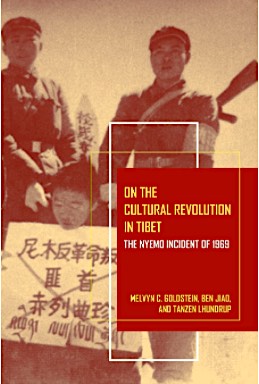
  • Melvyn C. Goldstein, Ben Jiao, and Tanzen Lhundrup, On the Cultural Revolution in Tibet: The Nyemo incident of 1969 (2009).

It’s the fruit of collaboration between Goldstein, leading scholar of modern Tibetan history, with Ben Jiao (Tibet Academy of Social Sciences, Lhasa) and Tanzen Lhundrup of the China Tibetology Centre in Beijing. Yet another instance of the vast amount of material that Goldstein has managed to unearth over a long period, the book prompts us to reflect not only on society, politics, and religion, but on the multiple viewpoints afforded by interpreting fieldwork material.

Context
Since the 1980s, Tibetan studies have emerged impressively from an uncritical reified nostalgia for an idealized old culture, when few (either under Chinese rule or in the diaspora) were able or willing to document modernity and a changing society—a view that still tinges scholarship on Han Chinese culture, not least Daoist ritual

Besides Goldstein’s own ongoing history of modern Tibet (the first three volumes of which take us up to 1957), the definitive single-volume study, from 1999, is

  • Tsering Shakya, The dragon in the land of snows: a history of  modern Tibet since 1947.

Chapter 12 makes a useful introduction to the Cultural Revolution. Note also this site; and vivid personal accounts of the period are found in the writings of Tsering Woeser, based on her father’s photos[2] Also most authoritative on modern Tibetan society is the voluminous work of Robbie Barnett, going back to the early days of the ground-breaking Tibet Information Network. [3] He introduces the field in this 2014 interview.

Throughout the Tibetan populations—not just in the “Tibetan Autonomous Region” (TAR) but also in Amdo and Kham—unrest has been constant under Chinese rule. Serious armed conflicts broke out from 1956 (note the 10th Panchen Lama’s 1962 report to Chairman Mao, detailing severe sufferings among Tibetan communities); [4] and since the partial liberalisations after 1980, the disturbances of 1987–9 and 2008. Such friction is still ongoing today (see e.g. Eat the Buddha).

By the early 1960s the CCP leadership, including TAR Party boss Zhang Guohua, were anxious. Through much of the 50s they had sought for the “stability” of a “gradualist” approach for Tibet: collective farming was postponed after the rebellions of the late 50s, and when the Cultural Revolution erupted they made a case for controlling its volatility. But warfare inevitably broke out between the rival Gyenlo and Nyamdre factions, spreading out from Lhasa. The army sided with Nyamdre. In June 1968 a major battle took place at the Jokhang temple.

By summer 1969—by which time the major violence in inland China had been pacified—serious unrest had broken out in a quarter of the rural counties of TAR, in which ordinary Tibetans participated as much as Chinese-led revolutionary groups. On the Cultural Revolution in Tibet focuses on Nyemo county in Lhasa municipality, but outlines other disturbances in at least eighteen counties; most of the five for which the authors give brief accounts involved a religious element.

The book
Using far more detailed material than previously available, the authors analyse the violence in Nyemo, which came to be led by the former nun Trinley Chödrön. Unlike the 1959 Khamba uprising, the authors argue, this was not explicitly a revolt against the Chinese occupiers. Assessing the balance of nationalist and economic elements, they find the latter more significant:

The Nyemo disturbance was not a spontaneous Tibetan nationalistic uprising against the Chinese “oppressor”, nor was it a revolt aimed at creating an independent Tibet. To the contrary, it was the outgrowth of a careful strategy orchestrated by a Maoist revolutionary faction to seize control of its county from a rival revolutionary organisation.

The power-struggle, they comment,

clearly had nothing to do with the now famous nun called Trinley Chödrön. Gyenlo’s move to wrest power from Nyamdre started well before the nun from Nyemo was involved, and it certainly would have continued with or without her presence. Moreover, at this time, Gyenlo’s strategy was not about religion or nationalism; it was about Gyenlo defeating its rival revolutionary faction with the support of village masses who were willing to join in this venture because Gyenlo was promising them that they would benefit by being allowed to keep more grain, by ridding themselves of officials they saw as corrupt and avaricious, and by stopping implementation of the collective system.

The authors seek to refute previous views of the revolt:

Rather than a simple dichotomy, angry Tibetans spontaneously organizing and striking back at hated Chinese or Tibetans rising to fight only for their material interests, there were multiple levels and multiple actors, Tibetan and Chinese, with different motives, using and manipulating each other for different end goals.

Some may have stood to gain following the “Democratic Reforms” implemented in Tibet after 1959, but the common people were soon hit by exactions, leading to food shortages (from which the Han peoples across inland China were also suffering terribly). The Gyenlo faction promised to postpone the threatened imposition of collective farming. But while the authors find economic factors more urgent causes of popular discontent, the widely-resented assault on religion was a further factor:

Notwithstanding the suppression of organized religion (monasteries and nunneries) after 1959, individuals had still been permitted to practice religion on a private basis. That freedom ended with the onset of the Cultural Revolution in 1966.

Indeed, a work-team sent from Lhasa in 1987 (just as further waves of unrest were looming) reported on the negative consequences of the Party’s assaults on religion:

We used to talk too much but do too little to help people with their religious beliefs. Especially during the Great Cultural Revolution, religious beliefs were labelled as one of the “four olds”, and nobody was allowed to practise any religion. People did not like our policies, and once something tempting about religion appeared, the masses were easily fooled.

This is the tightrope from which the regime constantly falls.

The problematic figure of Trinley Chödrön
Among Tibetans and Westerners it may be tempting to view the nun who came to lead the violence as a heroic freedom fighter, a kind of Joan of Arc. The authors go to some lengths to describe her background and the development of her spiritual powers. Her family and fellow villagers themselves described her as having mental problems—which were doubtless exacerbated by the 1959 measures and the new campaign to destroy the “four olds”.

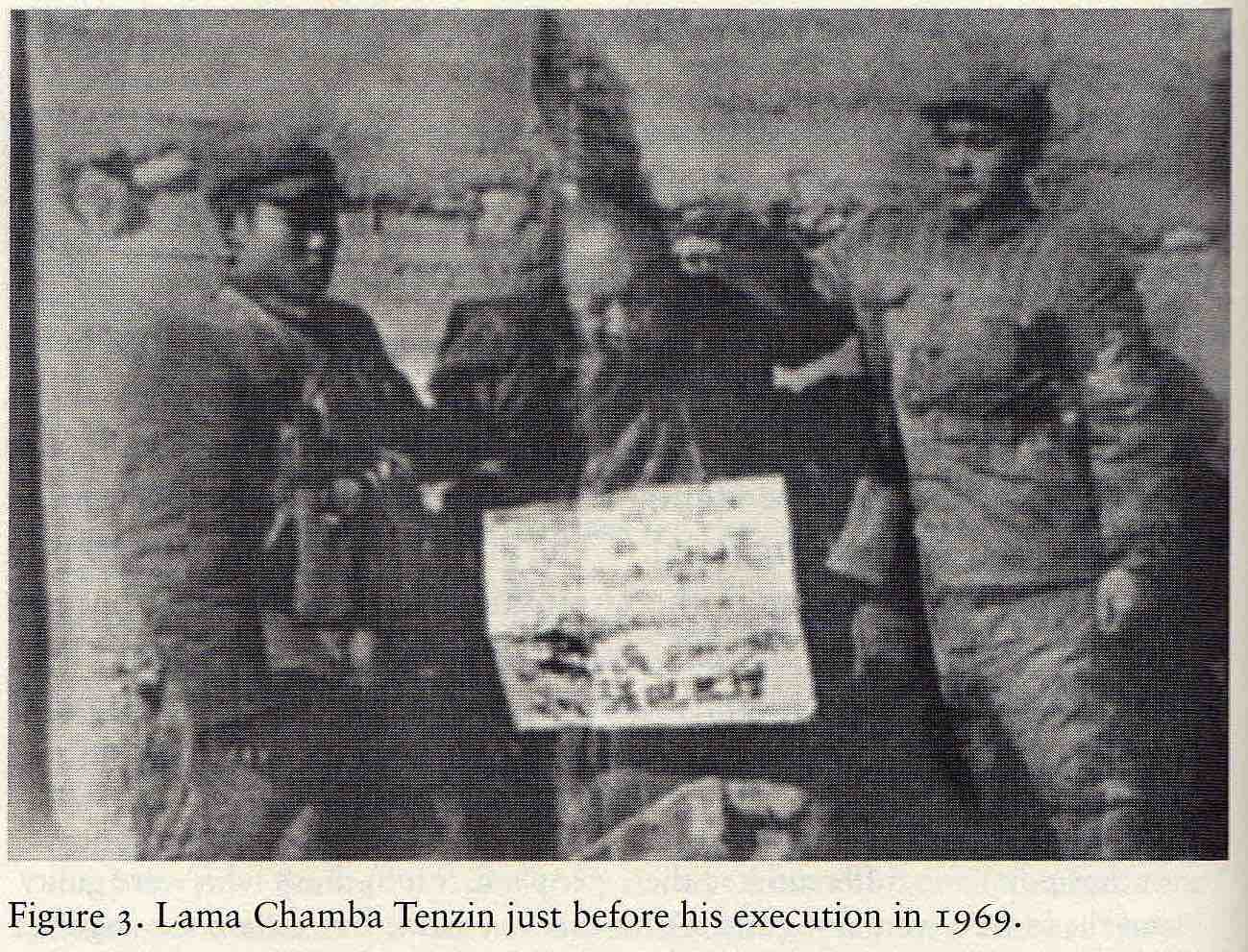
As she developed the powers of a trance-medium, claiming possession by deities, the book describes how she went (in 1968!) with her younger brother to a local lama called Chamba Tenzin for the tsago che initiation ritual. This briefly caused her to become more stable, and she herself applied to join the Gyenlo faction. It was now, as her trances became more frequent, that she gained a following. Still, when she claimed to be possessed by Jowo Rimpoche (the Sakyamuni Buddha whose statue in the Jokhang chapel in Lhasa was the most sacred in Tibet), orthodox lamas were sceptical, not least since trance-mediums channel local territorial deities, not Buddhas.

Of course, in local society mediums were by no means perceived as unbalanced; and  a system was in place to distinguish fake mediums. The authors note how her claims to possession diverged from the those of mediums in traditional society; and it was not just atheist cadres who regarded her as a crazy charlatan.

Still, the authors claim, it was precisely because she was considered insane that she was given latitude to perform religious activities at this unlikely time; but gradually locals came to trust in her powers of healing. The most powerful god by whom she claimed to be possessed was to be Ani Gongmey Gyemo, aunt and adviser of the legendary King Gesar—although how she acquired this allegiance is unclear, since the Gesar story was not popular in Nyemo, and this seems to be a unique case. Anyway, as the authors note, Ani Gongmey Gyemo and Gesar

were not some mythical figures in folktales, nor were they simply local mountain deities; they were real and powerful deities famous for fighting for Buddhism in Tibet.

While Trinley Chödrön’s claim to be a medium for a figure connected to King Gesar was at the core of previous scholars’ understanding of her as primarily a religious or ethno-nationalist figure, the authors note that she now also began to praise the Thoughts of Chairman Mao in public. The pragmatic Gyenlo leaders, while themselves secular in mentality, now saw the value of utilizing her as a channel for the religious faith of local people, to earn them more support in their factional struggle. Still, they themselves described her as “the crazy one”, an assessment they shared with more devout Tibetans; and they were preparing to kill her once they had won victory.

Her following was consolidated with the formation of a group of adherents known as warrior-heroes (badü), who also went into trance in what the authors call a kind of “Gesar hysteria”. With the faction now known informally as Gyenlo’s Army of the Gods, she became crucial to their cause, and soon a series of brutal killings began.

The authors give a nuanced categorization of the “enemies” killed and mutilated, including not just Chinese and Tibetan cadres but those who had ridiculed Trinley Chödrön’s religious authenticity and other hapless victims of her personal vendettas. But still the Gyenlo leaders refrained from intervening to have her detained:

“It is not necessary to arrest the nun. She is just a common lunatic. We’ll have trouble if we take her to the Public Security Bureau. So don’t bother her. She is useful to us. We need to protect her.”

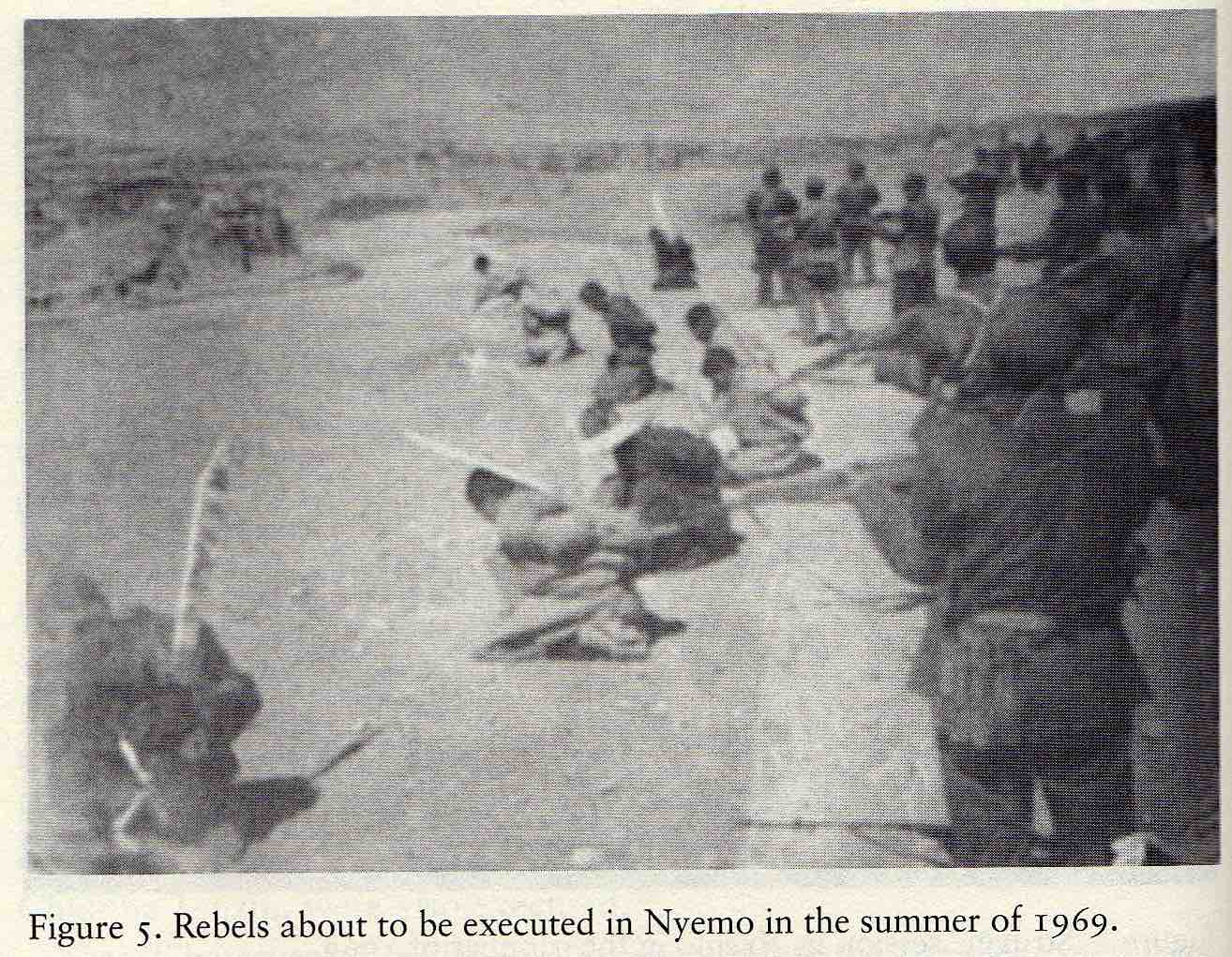
At last the PLA arrived, putting themselves in the firing line. Just like the Boxers in 1900, Trinley Chödrön’s adherents rashly claimed immunity from bullets. Locals, while disillusioned, were fearful of her powers. But eventually in June 1969 she was captured, her followers surrendering. Early in 1970, along with the other warrior-heroes and her lama, she was executed at the sand dune area below the Sera monastery near Lhasa. Gyenlo leaders managed to exculpate themselves until 1970, blaming the massacres on the very “religious reactionaries” whom they had exploited. Investigations continued in 1971; though in 1972 the Gyenlo faction was punished, revised assessments in the 1980s reduced the verdicts.

150156

As the authors observe, the Nyemo disturbances would not have been possible without the state-sanctioned chaos that Mao unleashed with the Cultural Revolution. Yet disturbances of one kind or another have erupted constantly ever since the Chinese occupied Tibet.

It was, of course, very unorthodox for a revolutionary organization of the masses to ask a Tibetan religious medium to dress in costume, go into a trance, and summon a god to motivate them to undertake revolutionary work for Chairman Mao, but Gyenlo in Nyemo was pragmatic to the core, and the leaders found it easy to rationalize the temporary utilization of “superstition” (religion) as an acceptable price to pay for achieving their consuming goal of deposing Nyamdre and taking control of the county.

Though the authors are to some extent proposing an alternative explanation of the Nyemo revolt to those of previous scholars like Tsering Shakya, they conclude:

However, we should not minimize what clearly fuelled this incident: the anger many rural Tibetans felt at the direction party policies had taken, not only in the realms of taxation and economic freedom, but also towards religion and culture.

And to me this doesn’t look so far from Shakya’s own view (The dragon in the land of snows, pp.346–7):

The revolt of 1969 was inspired by the Tibetans’ desire to regain some measure of social, psychological, and cultural freedom. It was not, however, a conscious nationalist uprising, but a cultural response to the chaos of the Cultural Revolution.
[…]
A nationalistic interpretation of the events in Nyemo tends to stress the Tibetanness of the revolt and view it as an anti-Chinese uprising. However, at this stage we do not know how far the events in Nyemo can be separated from the turmoil of the Cultural Revolution, and it has to be remembered that it was the Chinese authorities who highlighted the revolt as a nationalist and separatist movement.

Critiques
On first reading, Goldstein’s analysis seems perfectly convincing. But we can also learn from critical reviews by three scholars who have themselves made notable progress in documenting the travails of modern Tibet: Charlene MakleyRonald Schwartz, and Benno Weiner. What they dispute is the balance of economic/materialist and cultural/nationalist explanations; the role of religion; and the very interpretation of local accounts.

Beginning with the latter, lessons from the book are not just in the extraordinary detail, but in the constant dilemma of assessing fieldwork material. As the authors observe, “We investigate the past not to deduce practical political lessons, but to find out what really happened.” In the years following the violence several investigation teams descended on Nyemo—reminding me of the 1974 visit to Gaoluo of a team seeking material on the Boxer uprising of 1900 (see my Plucking the winds, pp.37–42 and n.42).

TOHAPThe authors seek to assure the reliability of interviews by collating a wide range of accounts (including but not limited to interrogations and confessions), from victims and perpetrators, members of both factions, ordinary people caught up in the events, officials and soldiers. [5] So they claim:

“in the end we feel confident that we are able to represent the different attitudes and experiences in Nyemo accurately.”

Alas, multiple interpretations are always likely to emerge, depending on people’s experience of the society in question and their whole worldview.

Thus Makley argues:

Despite the complex and copious data which they present, the authors’ overwhelmingly statist perspective and the bluntness of their analytic tools obscure their conclusions and leave us with little against which to assess them. In the end, they echo the findings of the state teams charged with re-investigating and re-labeling the Nyemo events in the mid-80s. They refer throughout to “the Nyemo incident”, the term which the 1980s team used to re-categorise the events as isolated local conflicts rather than fundamentally ethnic “rebellion” against Chinese rule.

So she is

unconvinced by the authors’ easy assertions that they controlled for “bias” in their “private” interviews and were able to get at participants’ actual experiences during the violence.

Of course, she isn’t suggesting we should dismiss all the local accounts of the nun’s disturbed mental state as statements made under duress, as propaganda for which the authors have fallen—that might almost amount to questioning the validity of any field discussions within the PRC. After all, such accounts note both Trinley Chödrön’s instability and the faith that local people came to have in her.

I can’t presume to assess Makley’s criticisms, but they are worth citing at some length. She finds that Goldstein’s

preference for the clear contours of the social over the messy indeterminacies of the cultural—especially since the rise of the modern Chinese state critically depended on categorising and disciplining “ethnic minorities” as premodern Others mired in alien cultural worlds—subtly negates Tibetan concerns.

Although to me the book’s variety of views seem suitably messy, and not oblivious to the cultural, Makley comments that Goldstein is brought

face to face with the quintessential premodern Other: Trinley Chödrön, a young Buddhist nun turned deity medium who led brutal attacks, murders and maimings in the name of resistance to Chinese-led “democratic reforms”.

As she explains,

the authors aim to refute idealised or simplistic views that the nun was primarily an ethnic nationalist leading a Tibetan uprising against Chinese rule, arguing instead that she accepted the administrative contours of the “new society” under Mao, only seeking to restore “religion” within it.

But she counters:

Their statist view from the outside gives us no real sense of Trinley Chödrön and her followers’ own, very Tibetan cosmologies and notions of personhood, agency, and power. There is no cultural history of Nyemo here as a specifically Tibetan locale, only testimonies gathered by successive waves of statist outsiders. Thus, despite a perfunctory nod to the basic features of deity possession as a “cultural script” among Tibetans, Trinley Chödrön ultimately figures as the marginal premodern Other par excellence. We come to view the defrocked nun’s unconventional mediumship, claiming possession by Gongmai Gyemo, the divine aunt of the great Tibetan epic hero Gesar, and ordering brutal attacks against her “Gyenlo” enemies, as the repulsive workings of a cult (as in Jim Jones, or Waco).

Of course, “the exoticized premodern Other” was precisely how Tibetan clerics were portrayed before the growth of serious scholarship. And there may indeed be scope for a more sympathetic portrayal. But surely it wasn’t just “statist” Chinese and Tibetan cadres, but ordinary villagers and lamas too, who described her as “crazy”; those whose limbs were hacked off might be reluctant to entertain a cultural defence. Perhaps one might say that Trinley Chödrön’s mental instability reflected that of Tibetan society traumatised under Chinese occupation.

The fate of Tibetan religion under Chinese rule has become a major field, with many detailed and sensitive case-studies. Goldstein may tend to favour economic explanations, but he is quite aware of the major role of religion (e.g. his 1998 co-edited book with Matthew Kapstein, Buddhism in contemporary Tibet: religious revival and cultural identity). Of course, Makley is not suggesting a return to the outmoded idealisation of Tibetan religion; critical ethnographies, such as her own, are to be encouraged.

She further unpacks the authors’ language:

Trinley Chödrön is “the nun” (never the god!) and, unlike other Tibetan youth who were “barely affected”, she is bitterly angry and thus “mentally disturbed” and “unbalanced” at the loss of Buddhist monastic life enforced with the Democratic Reforms. Faction leaders are “firmly committed” to their factions, treating each other as kin; Trinley Chödrön and her followers are “fanatically committed” to the gods, “immersed in imagined worlds”, or subject to “Gesar hysteria”. In essence, this is a stratigraphic approach to history; the Nyemo events unfold on “two planes”, the Tibetan cultural world of protector gods inhabited by Trinley Chödrön layered over the primary world of economic concerns and realpolitik inhabited by faction leaders and most other Tibetans. Culture never infects the faction leaders’ motives. Their brutality is understandable; Trinley Chödrön’s is an aberration.

Schwartz’s critique largely tallies with Makley’s. He finds the authors “at a loss to explain the syncretic and millenarian elements of Trinley Chödrön’s religious vision.” And

The testimony of the participants collected by the researchers through interviews also declares the mediums to be frauds. But the pressure to reconstruct the Nyemo incident in line with the officially acceptable narrative—in both the interrogations documented by Chinese investigators immediately after the incident and in the recollections of participants many years later—is difficult to ignore.

Schwartz continues:

The authors gloss over the extent to which cultural practices suppressed by the new state reappeared overnight and quickly became widespread once it became clear that they were permitted—burning incense, prayers, the exchange of katas. But the same thing happened after 1980 following the post-Mao reforms and continues right up to the present whenever policies on religious practice are relaxed. The underlying memory of religious practice has never disappeared, and whatever its sources, it is deeply rooted in Tibetan culture and society. The revival of religion defies a strictly economic explanation—it recurs during periods of prosperity as well as during periods of deprivation.

Goldstein and his co-authors’ efforts to temper the overwhelming focus among Westerners on ethnicity and nationalism in the Sino–Tibetan conflict is laudable, but their own profoundly statist and modernist perspective forces them to swing the pendulum too far the other way. The particularly Tibetan violence of Trinley Chödrön and her followers in 1969 is just too great a challenge for them. Their efforts to cordon off Trinley Chödrön from the other characters whom they recognise as modern and rational leads to no clear sense of her character and motives: she is mentally ill, she is a hapless puppet, she is a cunning manipulator. In the end, we are left with no real means to assess the authors’ core claim that Trinley Chödrön accepted the “new society” under Mao, because they give us no systematic sense of local Tibetans’ own views and experiences of “the state” or of the Maoist factions. Only a decade after the trauma of the Democratic Reforms, we cannot assume with the authors that Tibetans had entirely assimilated the grounding premises and administrative geographies of the modern Chinese state. A clue comes when the authors comment incredulously at Trinley Chödrön’s “bizarre” statement that Mao is the incarnation of Manjuśri. Yet for centuries Tibetans across the plateau have recognised emperors as incarnations of the bodhisattva of wisdom; Trinley Chödrön here recognizes Mao as a commensurate imperial agent—far away and benign, yet under the jurisdiction of Buddhism.

This is a good instance of how carefully we have to read Goldstein’s text. The relevant passage from his p.81:

At the same time, the nun also said bizarre things like “I am the right shoulder [hand] of Chairman Mao” and “Chairman Mao will not treat us badly, since he is the incarnation of Manjuśri. It is the internal [local] people who are the worst.” Such claims and comments reinforced many people’s belief in her mental instability…

So whereas lamas and common people do seem to have been taken aback by her initial claim to be possessed by Jowo Rimpoche, and indeed by her mental problems, in this case the authors haven’t given a source to show that locals doubted the Manjuśri–Mao equation. Schwartz goes on:

The unfortunate, unintended effect of the authors’ modernist ttake on Trinley Chödrön is that it individualizes, pathologizes, and dehumanizes Tibetans’ shock, grief, and anger at the physical and cultural violence of CCP intervention in 1959. Trinley Chödrön as the emblematic premodern Other stands in for any misguidedly ethnic Tibetan left behind in the sweep of Chinese-led modernization. Indeed, throughout the book, although the devastating trauma of the 1959 Democratic Reforms is referred to, it is not considered as a major causal factor behind the Nyemo events ten years later during the Cultural Revolution. Such violence could only happen in the absence of the state. Cordoning off Trinley Chödrön as the aberrant premodern allows the authors to retain the ultimate value in the book: the modern, rational State that returns, legitimately, to restore Order.

* * *

Both the book and its reviews overturn the simplistic stories once told on both sides of the fence. As a mere onlooker, I take the reviewers’ points, but I like to think that the seemingly conflicting “materialist” and “cultural” interpretations can be mutually beneficial.

For me, branching out from the often reified realm of Daoist ritual studies, the intrusion of the Real World is most welcome—even if its interpretation is controversial. However lurid and “messy” the story may be, all this serves as a reminder of the importance of Tibetan studies. Both the book and the responses to it indicate the acumen that is now being brought to bear on the plight of the Tibetans, from which scholars of Han Chinese society and culture can learn.

As to the embattled condition of Tibetan expressive culture—particularly the traditions of ritual and soundscape that have somehow continued to evolve against all the odds—again there is a far more complex story to be told than the reified portrayals on both sides of the PRC–exile divide. It would be rash of me to attempt an overview, “reading between the lines” of research by Tibetan and Chinese scholars within the PRC. But here’s a preliminary attempt for Labrang.

With many thanks to Robbie Barnett


[1] For remarkable fieldwork on household ritual practitioners in Nyemo, see the work of Nicolas Sihlé, e.g. here.

[2] See also interviews by Ian Johnson (here and here, as well as Woeser’s 2013 book (with Wang Lixiong) Voices from Tibet. Indeed, following the initial lively debate between Tsering Shakya and Wang Lixiong, the latter has come much closer to Shakya’s viewpoint.

[3] See e.g. Robert Barnett and Ronald Schwartz (eds.), Tibetan modernities: notes from the field on cultural and social change (2008). Among recent volumes, note Conflicting memories.

[4] See A poisoned arrow: the secret report of the 10th Panchen Lama (TIN, 1998).

[5] See the Tibet oral history archive; cf. Wu Wenguang’s archive for the famine.

Seven samurai

Kyuzo

I was first spellbound by Seven samurai (Akira Kurosawa, 1954) at Cambridge in the early 1970s, among many other formative film experiences there. Here’s a trailer:

Of the samurai, I was most captivated by the master-swordsman Kyūzō (a character inspired by the “sword-saint” Miyamoto Musashi), akin to the Zen archers and mystics who were then inspiring me.

While my fellow-students were attracted to contemporary China, I was still mired in silent immobile ancient texts; but though the film’s drama is set in 16th-century Japan, it must somehow have sown the seed for my later studies of Chinese peasant life…

Among several homages, never mind The magnificent seven: most subtle and perceptive is Tampopo. See also Kurosawa’s early noir movie Drunken angel.

Update on Hebei ritual

pic 2

Petitions burned for Hailstone Association ritual, Greater Yidian, Gu’an 2016.

As village ritual associations throughout the Hebei plain south of Beijing perform their rituals for 1st moon 15th, I’ve just been taking another cursory glance at recent online material from the team led by Qi Yi 齐易 doing fieldwork since 2015 around our old hunting ground (see this substantial general introduction; also here, a whole series of detailed articles under Local ritual, and the Gaoluo and Hebei tags). They have revisited many of the village ritual associations that our own team documented in the 1990s.

You can find links on both chuansong.me and qq.com (don’t blame me for the adverts), with a search under 土地与歌 or specific names of counties. I won’t try and give individual links to all this material, but I have updated a few of my articles accordingly. As I mentioned in my general introduction to the Hebei ritual associations, the project shares the flaws of the Intangible Cultural Heritage project, but it still provides some useful supplementary material.

Following their earlier focus on the ritual yinyuehui, the recent studies branch out into other genres in the region (including chaozi hui 吵子会, shifan 十番, and vocal genres), also potentially interesting.

Despite the rapid encroachment of urbanization and the whole heritage flapdoodle, from the videos of lively recent rituals (I’ve added links for Shixinzhuang in Gaobeidian, and the Hailstone Association of Greater Yidian in Gu’an) we can see that such assocations remain far from secularized.

The whole topic still offers much scope for scholars of local folk religion!

pic 1

3rd-moon Houtu festival, Shixinzhuang 2015.

A Czech couple in 1950s’ Tianqiao

Věna Hrdličková, Zdeněk Hrdlička,
and narrative-singing in 1950s’ Beijing

with qi baishi

Věna Hrdličková and Zdeněk Hrdlička with Qi Baishi, Beijing 1952.

This article is based on material kindly provided by Lucie Olivová (former student of Věna Hrdličková) and the couple’s grandson Zdeněk.

My brief mention of narrative-singing in 1950s’ Beijing leads me to a remarkable Czech couple, and thence to the Prague sinologists, prompting me to consider the work of Chinese and Czechoslovak scholars—and their tribulations.

The Prague sinologistsPrusek
The Prague school of sinology became widely admired for its achievements in the realms of modern and traditional Chinese literature, linguistics, history, and philosophy. It was led by the great Jaroslav Průšek (1906–80), who became head of the Institute of East Asian Studies at Charles University.

Do read Marián Gálik’s useful introduction to their work up to the demise of state socialism. [1] It both attests to their remarkable energy and gives glimpses of careers and lives (both Czech and Chinese) frustrated by political currents—among countless instances, we might compare the vicissitudes of the great Ming scholar Wang Shixiang.

Věna Hrdličková and Zdeněk Hrdlička
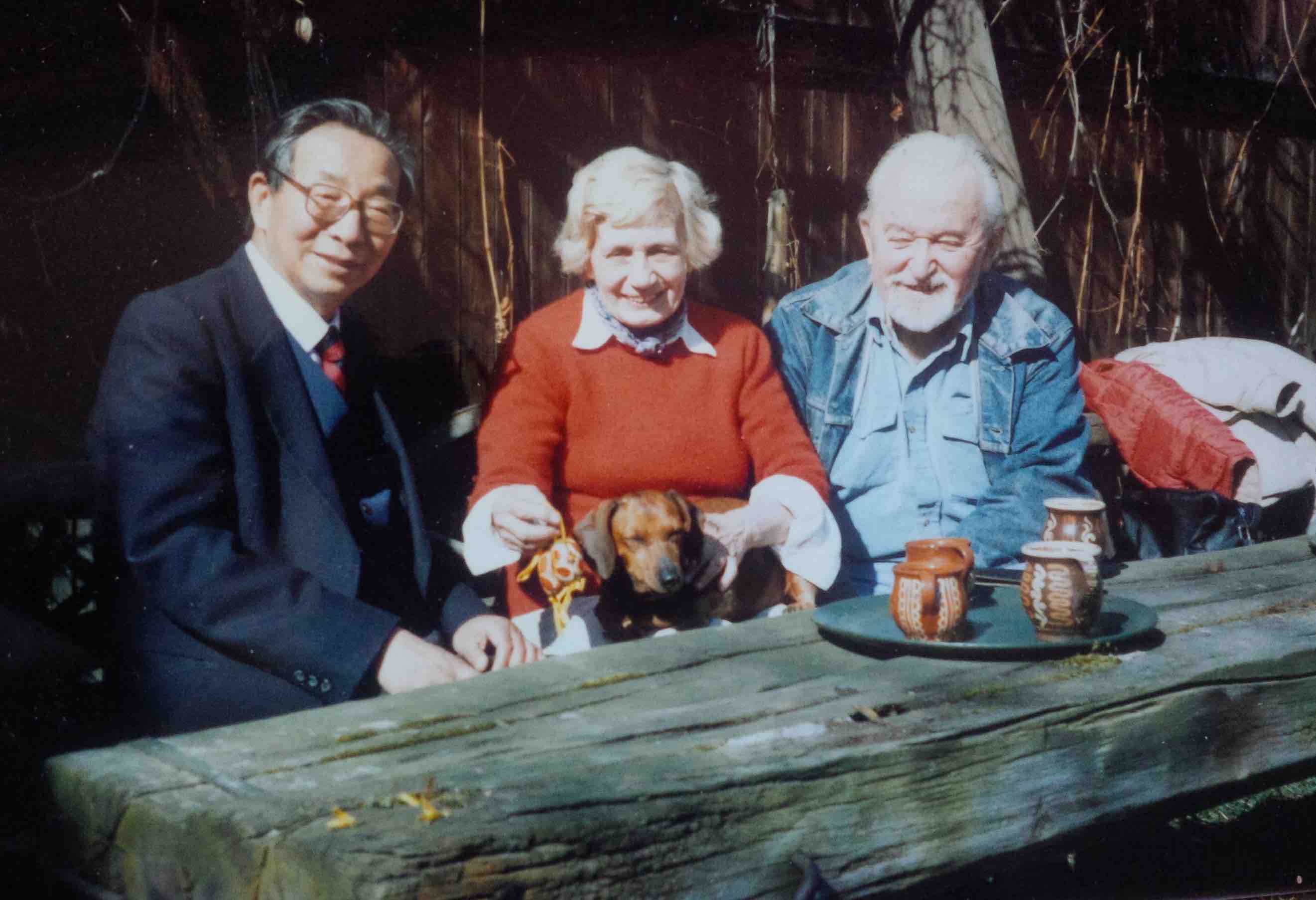
For Věna Hrdličková (1925–2016) and her husband Zdeněk Hrdlička (1919–99), useful introductions are

  • Lucie Olivová, “Chinese and Japanese storytelling: selected topical bibliography of the works of Věna Hrdličková and Zdeněk Hrdlička”, CHINOPERL papers 25 (2004), pp.87–97 [2]
  • Vibeke Børdahl, “In memory of Věna Hrdličková, 1925–2016”, CHINOPERL papers 35.1 (2016), pp.83–8 (here).

Among their own articles are

  • Zdeněk Hrdlička, “Old Chinese ballads to the accompaniment of the big drum,”Archiv orientální 25.1 (1957), pp. 83–145
  • Věna and Zdeněk Hrdlička, “Lianhua lao and its traditions”, in Vibeke Børdahl (ed.), The eternal storyteller: oral literature in modern China (1999), pp.71–7.

I am also most grateful to the Hrdlickas’ grandson Zdeněk for sharing further material—including a draft translation (awaiting publication) of an eloquent series of interviews in Czech with Věna by Ivana Bakešová (Czech Chinese Society, Prague, 2016). Below, apart from direct citations (indented), I have collated and adapted text from all these sources.

Early years
Under the Nazi occupation, universities were closed and most Czech books were forbidden. Věna came from a schoolmaster’s family, whose classroom was a hut with an earthen floor. Teachers now had to say Heil Hitler! as they entered the classroom—though, as Věna recalled, they did it carelessly, just waving their hand at most.

Managing to avoid being sent to work in Germany, at high school Věna studied English, when most schools were teaching French and German. Meanwhile she attended dance school—where she met her future husband Zdeněk. His father, a widowed railwayman, was also a bandmaster.

The couple became interested in China—Věna inspired by early poetry, Zdeněk with a view to contemporary prospects. They discovered that they could study Chinese with Průšek at the Oriental Institute. In 1945 Zdeněk, together with other colleagues, founded the journal Nový Orient [New Orient]—still being published.

In 1946, at Průšek’s recommendation, they received scholarships from the Ministry of Education to study in the USA. They travelled by train to Paris, where a sailors’ strike compelled them to spend a month, and then took the ship to New York. Since term hadn’t yet begun, they used the interlude to get married. They spent two years studying in the USA (Věna at Radcliffe College, Cambridge, Zdeněk at Harvard), attending lectures and seminars by John Fairbank, Edwin Reischauer, and others. Following the war, Harvard was now favouring modern spoken Chinese above classical studies.

In 1948 they returned to Europe by ship from Québec. Back in Czechoslovakia the Communists, under Soviet domination, were tightening their grip. As I remind myself, Prague was still recovering from the trauma of long Nazi occupation, the devastation caused in the 1945 uprising and Soviet “liberation”, and the ensuing expulsions of (and vengeance upon) the German population. [3]

As Czech universities reopened, the couple enrolled in Sinology and Religious Studies at Charles University; Věna also studied Japanese. Zdeněk graduated in 1949 with a thesis on the Daoist concept of immortality; the next year Věna graduated with her thesis on the author Ki no Tsurayuki in Heian Japan.

1950s’ China
Meanwhile in 1949 the People’s Republic of China was founded. That year a Chinese Peace Delegation visited Czechoslovakia, led by Guo Moruo, soon to be president of the Chinese Academy of Sciences; Zdeněk was chosen to attend. From 1950 he was employed at the Oriental Department of the Ministry of Information and Culture, and that winter the couple joined the first Czechoslovak cultural delegation to the PRC, led by Průšek.

They took the Trans-Siberian train, stopping off in Moscow for a couple of days. There Věna recalled the perils of crossing chaotic roads with crazy drivers, and admired the palatial metro system. And then they took the train through Siberia. In the dining carriage, as Švejk connoisseurs they shared their enthusiasm with an elderly gentleman. After spending the night in a little hotel at the border in Manzhouli, they changed to a Chinese train. Průšek, cracking sunflower seeds, was full of expectation. They arrived in Beijing in beautiful sunny weather, the sky clear above the glistening rooftops of the Forbidden City near the embassy. Their affable hosts had new winter coats made for them.

Still, returning to Beijing after an absence of around ten years, Průšek was disappointed, exclaiming “This is not the China I knew.” And while Prague in the late 1940s, recovering from war, must have been devastated, Věna’s strongest initial impression of Beijing was the poverty. When they arrived in the winter cold, she stood through the night at her window in the Beijing Hotel watching rickshaws trudging through the snow. She was also shocked by the lines of blind people walking the streets. She admired the Chinese for the speed with which they were able to fall asleep, no matter where they were. But as she became acquainted with the society, she appreciated the urge of the Chinese to improve their conditions.

In 1951 Zdeněk was appointed the first Czechoslovak cultural attaché to the PRC. Wanting to live among the Chinese rather than in an expat bubble, they rented a modest siheyuan courtyard house, living beside poor neigbours in Zhong Shicao hutong alley just west of the Zhihua temple—just as Yang Yinliu and his colleagues were discovering the Beijing temple traditions there.

Lao Zui lowres

With Lao Zui. Photo: courtesy of Zdeněk Junior.

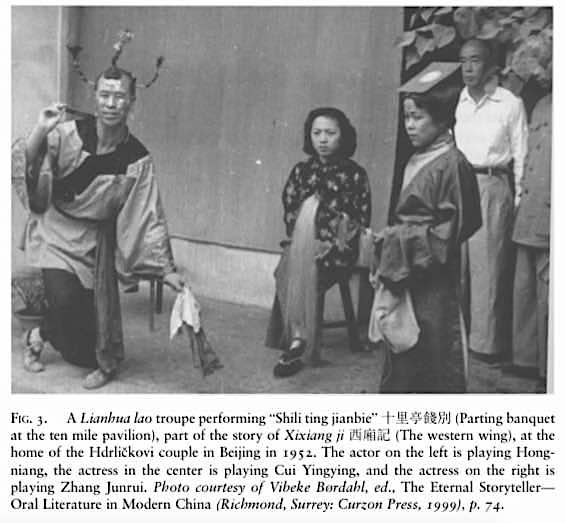
Their cook Lao Zui served as a general fixer for them, finding them books and arranging for a lianhualao troupe to perform at their house. Their first son, also called Zdeněk, was born in Beijing in 1952; their teacher (a Manchu) gave him the Chinese name Huasheng 华生 “born in China”, soon adapted by their nanny to Huashengmi (Peanut). Their second son Stanislav was born in 1957.

During a period of remarkably good relations between the two countries, the couple got to know leading cultural figures—including academician Guo Moruo, painters Qi Baishi and Xu Beihong, Slavic scholar Ge Baoquan 戈宝权 (1913–2000), authors Mao Dun, Ding Ling, and Lao She, Indeed, Lao She had also been studying in the USA, but had made the fateful decision to return to the New China out of patriotic idealism.

As their secretary the Hrdličkas were happy to find Yang Leyun 杨乐云 (1919-2009). Among her later translations into Chinese were the works of Bohumil Hrabal—another Czech author hardly suited to state socialism.

By contrast with most pampered Western academics, the couple had in common with Chinese scholars a legacy of occupation and a tacit awareness of the constraints of the new society.

During their mission they negotiated an official gift of Chinese books to the Oriental Institute, which became the core of the Lu Xun Library in Prague, and the purchase of Chinese antiquities for the National Gallery.

Meanwhile in 1953 a Czechoslovak team was filming a documentary about the construction of the Sichuan–Tibet highway—including rare glimpses of a landscape of daily Tibetan life and traditional ritual that was soon to be erased. Premiered in 1955, the film won awards at the film festivals in Venice and Karlovy Vary. It was screened in Czechoslovak cinemas in 1956, but it was later banned by the Communist authorities, right until its recent rediscovery and showing in Prague.

After the 1949 “Liberation” these early years of the PRC were a relatively optimistic period, before collectivization and campaigns intensified. By contrast with residents from the Western bloc, [4] not renowned for their devotion to Chinese expressive culture, the Hrdlička couple were exceptionally interested in the performing arts, immersing themselves in the narrative-singing scene.

Narrative-singing in early 1950s’ Beijing
Sinology has traditionally been concerned mainly with silent written texts, and remains so in many branches of the field. As Věna later recalled, they were now drawn to oral performance culture because with some 80% of the population illiterate, it was largely thus that they transmitted their history and culture. They were also aware that oral traditions would be threatened by the modern media.

In China there was little ethnographic discussion of the changing conditions of narrative-singing between the 1940s and the Cultural Revolution, but the couple provide some glimpses. Following in the footsteps of Průšek in the 1930s, they often visited the Tianqiao quarter. In an article published in 1968 Věna evoked their explorations:

The T’ien-ch’iao, Peking’s Heavenly Bridge, was one of the most colourful places of this kind, where not only storytellers but also other entertainers regularly competed for attention. Despite its exalted name, it was an unpretentious marketplace with simple earthen arenas, small crude huts and humble teahouses, but it offered much enjoyment for modest sums. We spent there many unforgettable hours enthralled by the mastery of puppeteers, the deftness of magicians, the incredible skill of acrobats, and of course the art of the storytellers. They often commented on our presence with improvised verses, which, though not complimentary, were witty and never really offensive. Eventually, when we became more familiar with fairly frequent attendance, they treated us in the same way as they did the Chinese in their audiences.
[…]
We used to invite itinerant storytellers and ballad-singers to our residence in Peking. Though their dress made it obvious that they were poor, their professional pride gave them great dignity. After singing, they were served tea. They then would bow and leave quietly. Some of them in time became our friends, divulging the secrets of their art and helping us to collect handwritten and printed texts of various forms of shuo-shu.

In their article on lianhua lao they recalled:

In the early 1950s we had occasion to watch a group performing caichang lianhua lao in the Tianqiao market, while we were studying shuochang in the field. Thus we made their acquaintance and they consented to give us a performance in our home, in a typical hutong [lane], Zhongshi caor in the eastern part of the capital. These performers from the marketplace presented their act in the courtyard, surrounded by a wall. In addition to the principal of the troupe, Wang Pingtan, there were two women singers, a comic actor, and a musician [on sanxian]; they were typical folk performers, and obviously of low social standing. They had not yet been brought under the aegis of any of the professional organizations then being set up to reform the narrative arts by purging their repertoire of elements of feudalism, as the phrase was, and replacing this with texts that could serve political ends, and help in the struggle against illiteracy, corruption, or for equality of the sexes.

Of course, despite the formation of such troupes, only a few performers were ever recruited to this cause, and only sporadically—as we can see in my notes from Shaanbei. In the cities (such as Yulin), change would have been caused as much by the evolving control of public space as by political elements.

Lianhualao

Teahouse in Tianqiao, 1987. My photos.

After I began working in China from 1986, I only dabbled in the narrative-singing scene in Beijing. Whereas many amateur clubs remained active after reviving, the Tianqiao scene enjoyed but a brief revival in the 80s before the area was irretrievably glamourized. Though narrative-singing moved to more salubrious fake-antique venues, some charming amateur clubs have persisted.

Prague and Japan
Their time in China was interrupted when Zdeněk was recalled to Prague in 1954, where he now taught Asian history at Charles University. When they returned to Prague, Věna completed her doctoral thesis on storytelling, based on her fieldwork in China. She defended it in 1959.

The 1956 revolts in Hungary and Poland had ramifications in China—where the short-lived Hundred Flowers movement soon led to the Anti-Rightist campaign, condemning many to tragic fates. Meanwhile Hungarian and Chinese musicologists met in Beijing.

When the Czechoslovak diplomatic mission in Tokyo reopened belatedly in 1957, Zdeněk was appointed chargé d’affaires there (1957–61), later serving as Extraordinary and Plenipotentiary Ambassador (1964–69). They decided to live in a Japanese-style house.

They were on good terms with the Soviet ambassador Nikolai Fedorenko (1912–2000), “an elegant, handsome man” with a wealth of international experience, who served as Soviet representative at the UN from 1963 to 1968. Over at the American embassy were their former teachers John Fairbank and Serge Elisséeff.

They could only take the boys to Tokyo under the condition that they would attend Russian school, but when circumstances became a bit more relaxed they transferred them to Japanese school, where they were taught in Japanese in the mornings and in English in the afternoons; the children were happy there, and apart from speaking Czech at home and learning Russian they became fluent in Japanese and English. Their grandchildren too followed in the family footsteps.

Despite the intensive workload in these posts, the couple continued to pursue their cultural interests enthusiastically. Věna continued to explore folk story-telling. Each tea-house had a banner saying which story-teller was going to perform that day. They were pleasantly surprised to find small story-telling theatres in the Ueno quarter, including one for rakugo 落語. They were enchanted by Japanese folk ceramics, travelling throughout Japan to collect them, and later presenting them in exhibitions and writings. They studied the tea ceremony, cuisine, gardens and bonsai.

I note superfluously that during their interlude in Prague they do not seem to have met the young Alexei Sayle, later himself to become a folk storyteller…

The Prague Spring and “normalization”
Amidst diverse global revolutions, the couple was spared the Cultural Revolution in China. Their old acquaintance the great author Lao She, himself an aficionado of narrative-singing, was hounded to death in 1966.

But in August 1968 the Prague Spring was brutally crushed when the Warsaw Pact armies occupied Czechoslovakia. The family were on holiday in Prague. It was night-time, and still jet-lagged, they didn’t hear the airplanes with their transports of tanks—they were only woken by the sound of someone shouting: “The Russians have invaded!” Věna thought it was nonsense until she switched on the radio. Zdeněk immediately set off for the Ministry of Foreign Affairs, where a lot of employees had already gathered, moving to safety some documents that might be of potential interest to the invaders.

He was ordered to return immediately to Japan. Not knowing what was awaiting them, or even if they would ever be able to return, they only took bare necessities in their rucksacks. A friend drove them to the Austrian border, and they flew Swiss Air to Tokyo. At the airport they were met by embassy employees and Japanese reporters; Zdeněk made it clear that the country had been brutally invaded. The newspapers published photographs of him and Dubček. The Czechoslovak flag was flown at half-staff on the embassy building.

As Věna recalled, the Japanese were supportive, but diplomats behaved according to their political affiliations; among the east Europeans, only the Romanians could offer any support. At first, embassy employees unequivocally condemned the occupation, but then gradually things became blurred. As it became clear how the situation was going to evolve, some started distancing themselves.

The couple’s postings to China and Japan evoke the career of Robert van Gulik, who served in China before the Communist takeover, going on to successive postings in Japan. Of course, they moved in different circles: the only contacts between diplomats of the Western and Soviet allies occurred at formal receptions. Still, in Tokyo the couple did indeed meet van Gulik. His third posting there from 1965 had to be interrupted in June 1967 so he could return to the Netherlands for medical treatment, where he died in September. But after the Prague coup the following year van Gulik’s son Pieter sent Zdeněk this letter of sympathy:

Gulik letter lowres

Courtesy of Zdeněk Junior.

Meanwhile, with murky realpolitik, the Chinese leadership also denounced the Soviet-led intervention—ironically, given their support for the quelling of the 1956 Budapest uprising (not to mention later events in Beijing).

Jan Palach’s self-immolation in 1969 predated the common resort of Tibetans protesting occupation.

The couple remained in Tokyo for around a year, but they took recall as a matter of course; they knew what awaited them, and never considered emigration. As soon as they arrived back in Prague, Zdeněk was sacked from the ministry. He briefly became research fellow at the Oriental Institute, but during the so-called “period of normalization” [5] that followed the repression he lost his new post—he wasn’t even admitted to the Oriental Institute library.

While his was a high-profile demotion, he was not alone: as Gálik shows, several other Czech sinologists, including the great Průšek, were expelled from the Academy of Sciences, and the Party, over these years. No-one was immune, neither academics nor ordinary workers.

The Hrdličkas had to go to some lengths to secure the children’s progress in education, with help from their neighbour Jiří Marek (1914–94), author of the script for the 1968 TV series Sinful people of the city of Prague. Věna was pressured into taking early retirement, and Zdeněk too received a small allowance. They took their fate stoically.

Wine-Press Manor
In 1976 Zdeněk and Věna retreated into idyllic rural seclusion—emulating principled ancient Chinese literati like the poet Tao Yuanming (never an option, alas, for their counterparts in Maoist China). In the tiny village of Brzánky on the river Elbe the couple cultivated their Wine-Press Manor (Na Lisu); visitors delighted in the magical atmosphere there, discussing poetry and the arts in the garden over wine with their hosts.

Their bucolic retreat, though dilapidated, had a large plot of land. Without electricity, they had no fridge, but they did have a cold cellar. They grew garlic, kept bees, harvested fruit, and made their own wine—which though ordinaire, they relished because of the work and joy that went into it. In a way it was a beautiful life, giving them time to read and study. Věna later reflected wryly that by depriving them of employment the regime improved their health.

They liked to have guests, such as the renowned art historian František Dvořák with his wife Nataša, and their friends like the artists Jan Zrzavý (1890-1977) and Kamil Lhoták (1812-1990). Denied passports, the couple weren’t allowed to travel abroad; but over the years their foreign friends managed to visit them at the cottage. They maintained contacts with Russian friends who had denounced the occupation. In April 1989 their old friend Ge Baoquan visited them there:

with GBQ lowres

Photo courtesy of Zdeněk Junior.

Through the oppressive years of Soviet occupation, Věna managed to keep her post of lecturer at the Department of Asian and African studies of Charles University—still, she was only belatedly awarded the full dozent professorial qualification in 1990. In the Department she mainly taught Chinese literature, training a number of students—including Lucie Olivová. Věna’s textbooks The history of Chinese classical literature, vol.1 (1980), and An introduction to sinology (with Jaromír Vochala, 1985) are still valued.

Most of the studies that Věna and Zdeněk wrote jointly during the 1970s and 80s could only be published under her name. A couple of journals were bold enough to publish his papers, but Nový Orient, the popular journal for Asia—which Zdeněk had created—remained closed to him.

Meanwhile, of course, many of their friends, both at home and in China, were punished in many ways from the mid-50s until the early 80s. Both peoples had suffered under wartime occupation and had to adapt to one-party rule; both had seen brief liberalizations ruthlessly crushed.

A certain rehabilitation came when Zdeněk, with other enthusiasts, was able to found the first ever Bonsai club in Prague, which later became the Prague Bonsai Society. They published a quarterly newsletter from 1981; from 1990 it became a journal in successive incarnations. As well as organizing activities, exhibitions, and lectures, here it was possible for Zdeněk to publish. The couple designed several Chinese and Japanese gardens in Czechoslovakia, receiving a gold medal for the design of a Japanese garden at the Flora Olomouc Exhibition in 1983.

Since 1989

Vena 2004

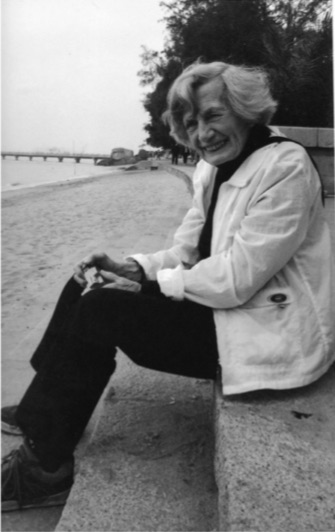
Věna in China, 2004.

After the Velvet revolution of 1989, new freedoms opened a sudden range of possibilities. The couple once again traveled to the USA, Japan, and China.

In the new Czech Republic, they participated in the re-establishment of the Czech-Chinese Society and the Czech-Japanese Society. They organized projects such as an exhibition of paintings by Qi Baishi at the National Gallery at Prague, and the publications of miscellanies, including the often-reprinted Èajová zastavení [Tea stations] (Prague, 1997). Věna published literary translations of contemporary Chinese novels, and Chinese and Japanese folk tales, which appeared in splendid Czech and foreign editions. She translated over a hundred films, mainly from Japanese, for Czech TV and other distributors. She was much decorated.

So at last they were able to publish under their own names. After working together at the tranquil cottage, the couple published the popular book Emperor Shenzong’s China (Čína císaře Šen-cunga) and books about Japanese and Chinese gardens.

Zdeněk’s sudden death in March 1999 came as a painful shock to all his friends and acquaintances; however, Věna continued her activities and research with commitment and perseverance.

Chinese studies of narrative-singing
After 1949, although the Hrdlička couple explored the narrative-singing scene on their own initiative rather than in collaboration with Chinese scholars, the latter too were busy studying and promoting the diverse genres along the middle of the vocal spectrum from folk-song to opera.

Of course, the big cities were only the tip of the iceberg. Later studies tended to focus on the Jiangnan region, but genres still common around Beijing and Tianjin include Jingyun dagu 京韻大鼓, Meihua dagu 梅花大鼓, and Xihe dagu 西河大鼓. Yang Yinliu himself began studying the danxian 单弦 melodies of Beijing as early as 1950, soon after arriving there.
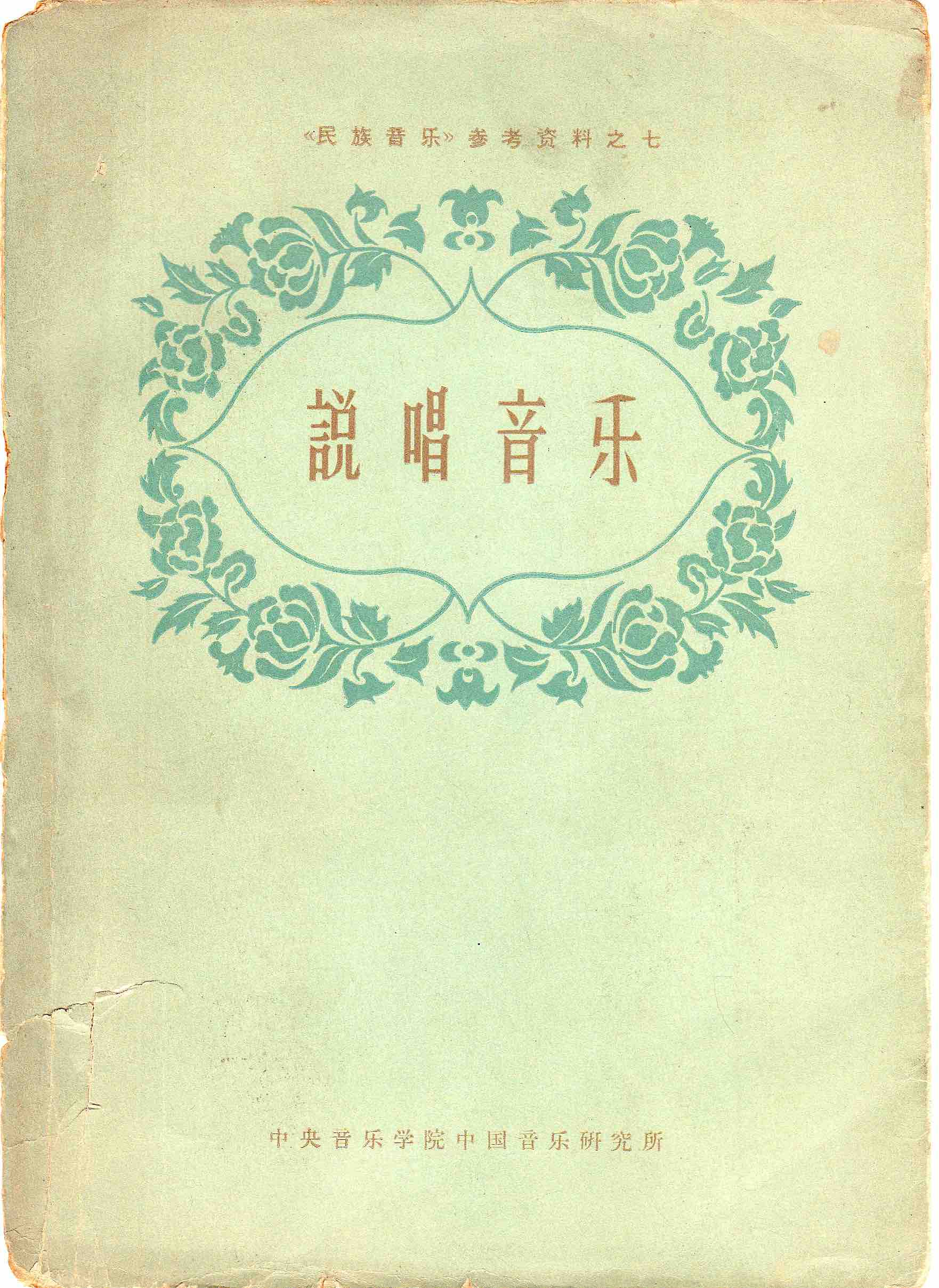
Shuochang yinyue

For a nationwide inventory, see

  • Shuochang yinyue 说唱音乐 (ed. Zhongyang yinyuexueyuan Zhongguo yinyue yanjiusuo, 1961).

While its 589 pages consist almost entirely of transcriptions, it includes a useful bibliography. Many festivals were also held through the 1950s.

1958

National festival of narrative-singing, August 1958.

1954Above: danxian performer Rong Jianchen (front, 4th from left) with disciples, 1954.
Below: Founding of drum-singing guild, Tianqiao, 1940s.
Source: Zhongguo quyi yinyue jicheng, Beijing juan.

LHLLarge-format lianhualao led by Rong Jianchen and Wang Wanfang (6th and 5th from right), 1950s.
Source: Zhongguo quyi yinyue jicheng, Beijing juan.

Though the work of the Chinese scholars was constrained and reified, it laid the foundations for later studies, notably the Anthology—for which note the provincial volumes of both the Zhongguo quyi zhi 中国曲艺志 and the Zhongguo quyi yinyue jicheng 中国曲艺音乐集成—see my “Reading between the lines: reflections on the massive Anthology of folk music of the Chinese peoples”, Ethnomusicology 47.3 (2003).

JYDGJingyun dagu masters. Above: Liu Baoquan, 1920s. Middle: left, Liu Baoquan, 1936; right, Bai Yunpeng. Below: Bai Fengming.
Source: Zhongguo quyi yinyue jicheng, Beijing juan.

Ma Zengfen Xihe daguMa Zengfen 馬增芬 performing Xihe dagu, 1950s.
Source: Zhongguo quyi zhi, Beijing juan.

Some fine archive recordings are included in the 2-CD set

  • Shibaduan quyi 十八段曲藝 [English title Shuochang: the ultimate art of Chinese storytelling] (1998).

Many clips are also available online, from both before and after Liberation, such as these items from Liu Baoquan, Luo Yusheng, and Bai Yunpeng.

Meanwhile it became apparent that alongside entertainment genres, the ritual component of narrative-singing was also widespread and important in local cultures throughout China (see this roundup). The Czech couple’s explorations could hardly extend to the countryside—even just a few hours south of Beijing, narrative-singers continued to perform through the 1950s, alongside ritual groups.

Back in Czechoslovakia, ethnographic study of regional folk traditions was also circumscribed after the Communist takeover—as earlier in Ukraine.

* * *

In what may sometimes appear as a Western-dominated field, all this serves as a reminder of the wider world of scholarship and the international situation in the years following the revolutions of the late 1940s, as well as the achievements and vicissitudes of scholars and artists both in China and in Soviet-dominated countries.

With many thanks to Lucie Olivová and Zdeněk the younger! 

[1] The list of twenty-two scholars includes my own mentor Paul Kratochvil; note also Dana Kalvodová (1928-2003), scholar of Chinese opera.

[2] Lucie Olivová, Věna Hrdličková–Zdeněk Hrdlička: A list of published works and oral presentations 1945/46–2002 (Prague: Oriental Institute, 2002, bilingual) lists almost a thousand bibliographical entries under headings including storytelling, Chinese and Japanese gardens, Japanese pottery, and Chinese literature.

[3] See e.g. Keith Lowe, Savage continent: Europe in the aftermath of World War II, pp. 126–35; for background on the early Communist period, see Anne Applebaum, Iron curtain: the crushing of eastern Europe.

[4] from journalists like Edgar Snow and Agnes Smedley to politically-engaged residents like the Hintons and the Crooks: see Beverley Hooper, Foreigners under Mao: Western lives in China, 1949–1976 (2016).

[5] As I write this, I’m reading Christopher Hitchens’ remarkable memoir Hitch-22, where he describes it as “one of the most casually ugly phrases of the whole 20th century”—but then, if anyone is equipped to demolish such insidious language, it’s the Czechs themselves.

Fiddles and racism

gusle

My bold recording of Bach on erhu reminds me of two casual, worrying, yet entertaining reviews from the early 1990s—suggesting that Berlioz‘s failure to appreciate the beauties of world music hasn’t been erased.

First, a blurb for a festival of new Chinese music on BBC Radio 3:

New music for old instruments—such as the er-hu and the gu-quin [sic] (Chinese for “finger-nail-down-the-blackboard” and “moggie-in-the-mangle”), Marvellous ear-scouring stuff.

And this review of a controversial BBC2 Bookmark programme is reminiscent of Molvania:

billed as a celebration of the epic tradition in Serbian poetry and a homage to Dr Radovan Karadzic, described in the subtitles as “poet and psychiatrist”. Many of those who heard Dr Karadzic explaining on Monday morning that Serbian forces were not casually shelling Sarajevo for the hell of it but responding to Muslim artillery fire would have added “mass-murderer” to the list of his qualifications.
[…]
It undermined the Serbian case more effectively than a dozen polemics. Karadzic was shown to be a rambling, inconsistent, sentimental bouffanted crook. His countrymen came over as a gang of brutal yokels with a cultural life marginally richer than that of Neanderthal man.  Their favourite musical instrument is a single-string violin, which they scratch interminably while boasting tunelessly about their achievements against the Turks. After they have wiped out the Bosnian Muslims they will doubtless apply for a grant from the BC Cultural Harmonization Fund to put a second string on their wretched instruments.

However well-meaning and colorful the review may be, it’s just as about as racist as the mindset it criticizes; one might wish for a more thorough ethnography. But I digress. Doubtless the gusle singers are heartfelt, but perhaps the best thing that can be said for my erhu performance is that it doesn’t legimitize genocide. So much for music as the universal language of peace and love.

For another perplexing case, see Musics of Crete; see also fiddles tag. Cf. The politics of ethno-trad.

Ritual groups of Liaoning

*For main page, click here!*
(posted in the main Menu under “Elsewhere”)

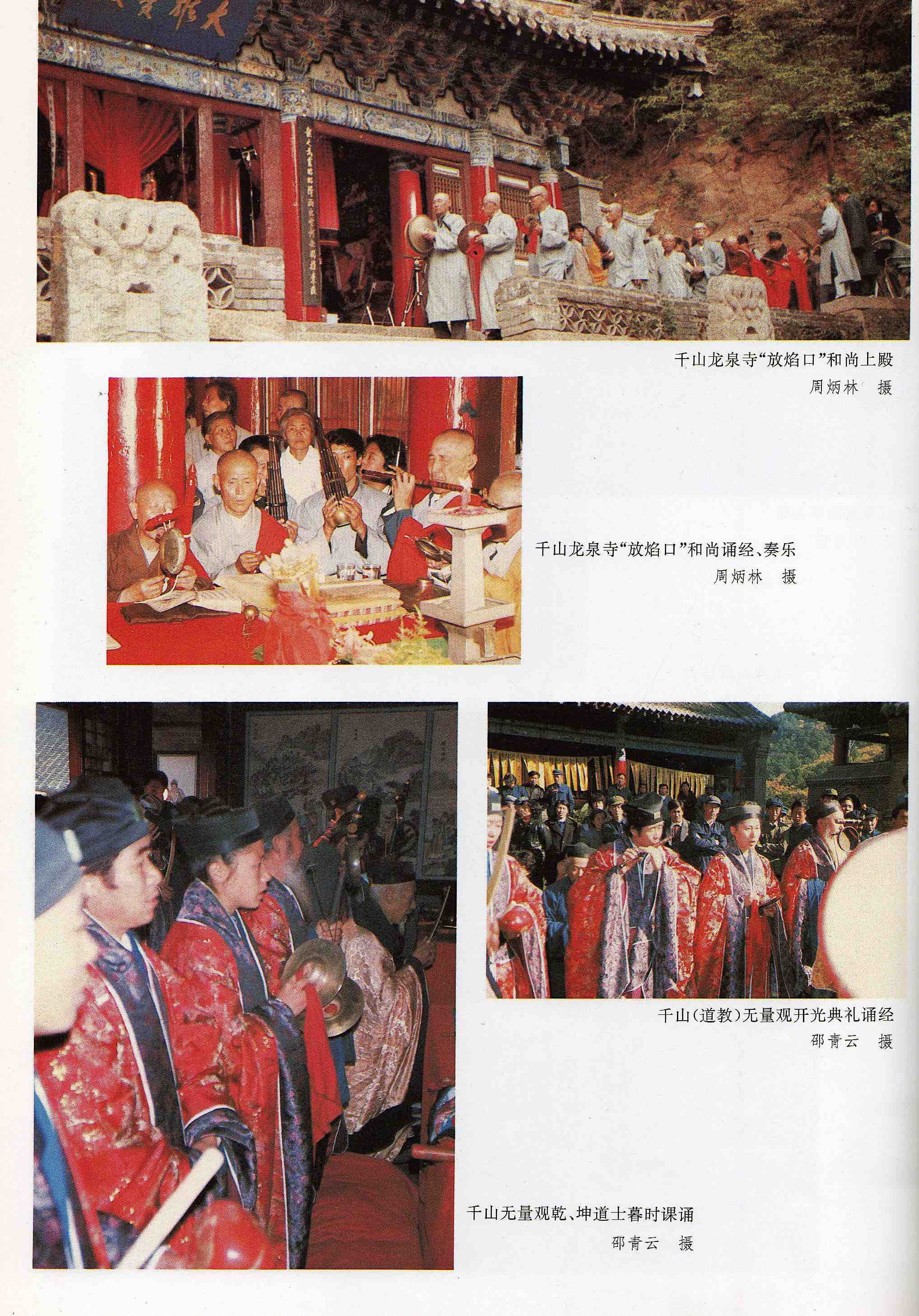
Qianshan

This is among my more superficial introductions to changing ritual life over a wide region, the northeastern province of Liaoning.

I set forth from Ling Qizhen’s 1958 study of “Buddhist music” (shengguan wind ensemble) in Shenyang, moving on to the 1980s’ Anthology accounts of Buddhist and Daoist (largely temple) activity, and Li Runzhong’s fine detailed “salvage” ethnography from Panjin municipality.

Change is constant, not only in the vast social upheavals since the early 20th century but in the adoption of the “southern” style of vocal liturgy and the decline of the shengguan wind ensemble. But here it does appear that the ritual practice of household ritual specialists was much impoverished by the 1950s, and any folk activity today remains elusive.

So as with some of my other reports, this is a mere introduction to tempt people to continue such fieldwork.

New wave of temple demolition

Fangshan

Amongst considerable media coverage, the Bitter winter website reports regularly on the current wave of measures to demolish temples and expel clerics—contrasting starkly with the Party’s claim to protect religious sites and worship.

Of course Islamic and Christian groups have every reason to be deeply anxious; for the Han Chinese too, I’ve already given some instances of the Party’s insensitivity to local values, such as in Shandong and Gansu.

Unlike the instances above (directed specifically at ritual practice), the pretext for temple demolition is often a failure to conform to planning and registration directives. It can be hard to discern the balance of the authorities’ concern to control both popular worship and finances; pecuniary factors seem uppermost, though they may accompany ideological extremism. We need a clearer understanding of local factors, but what is clear is that these measures are coercive, entailing serious conflict with villagers. Grand ancient temples that have long been converted to mere tourist attractions are not an object of attack; but material like this (for Shaanxi, Hebei, and Liaoning) makes a salient contrast with the glossy images of picturesque ancient temples paraded in the Chinese media.

Among further links on the Bitter winter site, this report also comes from Shaanxi. And for recent reports from Weihui and Shaogang municipalities in Henan, see here. Most of these reports come from north China, but the south is not immune.

Naturally, what such important single-issue sites are not concerned to document is that religious activity has somehow persisted throughout China since the 1940s. Today, when household Daoist groups perform funerals, or a temple holds a grand jiao Offering ritual; when spirit mediums hold healing sessions, or sectarian groups meet to chant scriptures for domestic blessing—none of this attracts such media attention. “Temples demolished” always makes a more eye-catching headline than “Temple fair lively as usual”.

We might be better at balancing these conflicting parts of the current equation if we did so for the three decades of the Maoist era—but there again (and again understandably) the negatives have dominated, with the troubled maintenance of ritual life little studied.

So far for the Han Chinese, repressive measures seem exceptional rather than systematic—but the growing number of cases is indeed worrying. We need more in-depth studies of religious activity at local level—both when it manages to function (as it has, painfully, since the 1940s), and when it prompts repression.

None of these observations constitute a defence of irrational state power.

A personal lexicon


Here’s a little vocabulary to help those whom Myles calls “non-nationals” (like Euripides) negotiate some of my more elliptical allusions—arcane idées fixes in my idiosyncratic language, nay idiolect. Myles makes a suitable place to start, then:

To the divine Stella Gibbons I am indebted to

  • flapdoodle (usually in the context of heritage),

and to Monty Python the concept of

Tempted though I was to do these in the form of an index:

muse, Terpsichorean, delighting in all manifestations of 174,

I’m grouping them by themes.

  • S-S-Simon Rattle is a recurring theme of mine, referring to this story.

Several succinct allusions refer to Airplane:

As if that’s not enough, with the Li family Daoists I have come to share an even more arcane secret language of allusion, like “holding a meeting with Teacher Wang“, “Here’s 100 kuai!” and “Nin…”.

Such catch-words are hopefully more entertaining than some of those in vogue among anthropologists (see e.g Bourdieu’s habitus).

Alan Bennett points out the rich world of allusion in painting and film (see Visual culture, near the end):

The twentieth-century audience had only to see a stock character on the screen to know instinctively what moral luggage he or she was carrying, the past they had, the future they could expect. And this was after, if one includes the silent films, not more than thirty years of going to the pictures. In the sixteenth century the audience or congregation would have been going to the pictures for 500 years at least, so how much more instinctive and instantaneous would their responses have been, how readily and unthinkingly they would been able to decode their pictures—just as, as a not very precocious child of eight, I could decode mine.
And while it’s not yet true that the films of the thirties and forties would need decoding for a child of the present day, nevertheless that time may come; the period of settled morality and accepted beliefs which produced such films is as much over now as is the set of beliefs and assumptions that produced an allegory as complicated and difficult, for us at any rate, as Bronzino’s Allegory of Venus and Cupid.

So having gone to some lengths to try and understand the world-view of Chinese peasants, and liberated from the Lowest-Common-Denominator language of academia, I now feel emboldened to reflect my own, however arcane. For more, see here.


New tag: dance

I’ve just added a tag in the sidebar for dance, suggesting some of the diversity and creativity of dancing around the world, such as


Das Land ohne Musik

1912

Royal Earsdon Sword Dancers, Northumberland, 1912. More here.

Das Land ohne Musik

Oscar Schmitz, 1914

There is no city in the world, I am sure, where so much music is consumed as in London.

Hector Berlioz, 1851

Susan McClary’ s book Feminine endings is always full of leads, such as:

Linda Austern and Richard Leppert have demonstrated that one reason the English have produced so little music is that they—more than their German or French neighbors—have long associated music with effeminacy. (p.17)

An intriguing thought, but it begs questions. First of all, “produced” here clearly refers to the composition of art music. A perceptive essay is

  • Peter Holman,* “Eighteenth-century English music: past, present, future” (ch.1 of David Wyn Jones (ed.), Music in eighteenth-century Britain, 2000),

where he tellingly probes the description of 18th-century England as “Das Land ohne Musik” (cf. Haydn). He dates it back further to a pithy 1840 comment by Heinrich Heine:

These people [the English] have no ear, either for rhythm or music, and their unnatural passion for piano playing and singing is thus all the more repulsive. Nothing on earth is more terrible than English music, save English painting.

Touché! As Holman notes,

Of course, this agenda is part of a larger one that has more to do with 19th-century cultural politics than with a proper, balanced evaluation of the total corpus of 18th-century music. It privileged what was perceived as the centre—Italy, Germany, and Austria— over the supposed periphery—Scandinavia, eastern and central Europe, France, the Iberian peninsula, and England. It privileged instrumental music, especially those genres that used Viennese sonata form, over vocal music. And it privileged the work of the professional secular male in concert music over all others, such as church musicians, amateurs, and women.
[…]
The most persistent observation on musical life in 18th-century England is that it was dominated by Handel and other immigrant composers, the implication being that native composers were too feeble, parochial, or conservative to offer them much competition.

OK, he’s broadly following the continental critics here in equating “musical life” with art music—not all the diverse folk traditions, such as the musical life of taverns in East Anglia. But he unpacks the assumptions of even this limited definition:

It was not a new situation. Immigrants had played an important role in bringing new ideas from the continent ever since the reign of Henry VII.

(See Wind, ethnicity, and gender, and They come over ‘ere…)

Adducing Ferrabosco, Notari, and Draghi, Holman notes that as the scale of immigration increased,

these developments were not symptoms of weakness or decline, but evidence of a vibrant and complex musical life. Musicians were not attracted to London from all over Europe by the prospect of becoming big fish in a small, stagnant pond, but because London was the largest and most exciting pond of all, where you did not need to be a big fish to make a fortune.

Indeed, it could be argued that England was the most musical country in Europe by the second half of the 18th century, judging by the amount of musical activity of all types.

The variety he cites here includes rival concert series, Italian opera, provincial music societies, church choirs, and amateur musicking such as “gentlemen” competing in taverns. This is indeed more diverse than the narrow picture he criticizes, but still doesn’t subsume “folk” activity such as sea shanties or street fiddlers. He goes on:

My second objection to the “foreign domination” theory is that there is little sign that immigrants replaced native musicians in lucrative employment, or prevented them from obtaining it.

Just as the Lupo and Bassano families had supplemented indigenous instrumentalists at the court of Henry VIII, Italian opera became just an extra strand enriching the musical life of London. But

My most serious objection to the “foreign domination” theory is that it is based on an anachronistic conception of national and racial identity. […] England has always been a nation of immigrants, and it makes no sense to restrict an account of its culture to the work of natives, or, more accurately, to the work of the descendants of less recent immigrants.
[…]
What is often forgotten is that immigrant composers, anxious to be accepted in England, adapted their own idioms to conform to English taste.

This is all grist to Stewart Lee‘s mill.

At the same time, the “foreign domination” theory does rest to a large extent on the focus on the composers and performers of art music. Despite my pleas to broaden the social scope, Holman’s perspective, like a lot of in-depth studies of WAM, belongs firmly within the wise counsels of ethnomusicology. His chapter contains many more perceptive observations, which you must read!

* * *

To return to McClary’s lead,

  • Richard Leppert and Susan McClary (eds.), Music and society: the politics of composition, performance and reception (1987)

is full of stimulating chapters, not least her own:

  • “The blasphemy of talking politics during Bach year”,

which I introduced here. As the book’s Introduction notes, recent changes in scholarship,

especially evident in literature, film, and visual art, have led to a systematic investigation of the implicit assumptions underlying critical methods of the last two-hundred years, including prominently the assumption that art consistutes an autonomous sphere, separate and isolated from the outside social world.

Janet Wolff’s Foreword is another nail in the coffin of “autonomous” art—and another critique that should be compulsory for heritage pundits in China. The book ranges rather widely, with chapters from Rose Subotnik on Chopin, Simon Frith on popular music, John Shepherd on music and male hegemony, John Mowitt on electric technology in sound production, and Leppert’s own discussion of the music, domestic life, and cultural chauvinism of British subjects in India.

The authors point out that they hardly deal with music and society in non-Western cultures, touching “only lightly on questions about the music of women, and ethnic and racial minorities”. They observe that women, and the lower classes, have been erased from the received picture, though they are rarely excluded from musicking—just from prestigious public musicking.

So again the book is largely based on the musical activities of the bourgeoisie—not least because the source material largely derives from them. Still, the debt to ethnomusicology is clear: even if WAM scholarship may seem to contrast with ethnomusicology, they can enter into a rapprochement [uh-oh, more non-national terms?—Ed.].

* * *

Actually, all we need to deflate the idea of Das Land ohne Musik is the classic question “What is music?“—or rather, “What is musicking?”. Pundits of both WAM and pop music tend to take a limited view, as I often observe (e.g. here, and here).

By a narrow definition based on composers of art music, most of the world over most of history would be considered “without music”. Do mothers singing lullabies, spirit mediums, or percussion bands, count? Even once we’ve thrown out the narrow assumption that music means art music, I wonder how one might rank the cultures of the world in terms of “musicality”: Inuit, Italian, Andalucian, Tibetan, Bolivian, Malian, Afghan, and so on. Were Afghans or Andalucians “unmusical”, and are they now? And we may be lumbered with the dodgy cliché that Africans, like Chinese ethnic minorities, are “good at singing and dancing”—but where might north Americans come in the spurious league table, for instance?

Cultural genocide—the suppression of indigenous cultures by a dominant force—is a separate subject. As I write this, I notice this blurb for what I’m sure is a fine BBC4 programme:

Masters of the Pacific coast: the tribes of the American northwest
Exploring how culture was established on the American northwest.

Discuss… An inspiration for the Party’s current replacement of the complexities of Uyghur music by “If you’re happy and you know it, clap your hands” (note also this post)?

Is a society in which most people frequently sing or dance less musical than one with an opera house, a symphony orchestra, and a conservatoire? “Expenditure on the arts” is a dubious index. Is a funding-dependent society in which children are discouraged from singing and dancing unless they’re formally trained as musical as one where such activity is assumed, embedded in the culture? Indeed, even in such a culture, formally-trained musicians make up only a small proportion of participants.

As always, it’s worth considering the wise words of Bruno Nettl, in his

  • The study of ethnomusicology: thirty-three discussions,

He addresses the issue of “what is music?” —a point also made by Christopher Small in his introduction to Musickingin a famous vignette in his chapter 2, “Combining tones: the concept of music”:

Let me reconstruct a cocktail party conversation about 1975 when I confessed to working in ethnomusicology. “Studying American Indian music?” says one amazed person. “I didn’t know they even had music”. I try patiently to explain. “Oh yes, I knew they had chants, but is that really music?” From an elderly gentleman: “I spent a year in Africa, heard a lot of singing and drumming, but is that music? After all, they don’t write it down. Maybe they just make it up as they go along. Do they really know what they’re doing?” More explanation. A young man has added himself. “But these sounds that some peoples in Asia make with their instruments and voices, or the Indian chants, can you call them music? They don’t have harmony.” And a middle-aged lady: “My teenage sons play something they call music all day. I can’t stand any of it.”

We might now wonder if Nettl was going to the wrong kind of parties; indeed, he notes that people may have since become more broad-minded, but the issue remains. He discusses John Blacking’s important book How musical is man? (1973):

writing today, he would likely have asked “How musical are humans?” […] He recognized the world as a group of musics, though he personally was always more interested in their borderlands than the centers, but he wanted to make sure that his readers understood a major point: in the end, all musics are equally valuable, or, let’s put it this way, all musics are to an equal degree music.

Nettl’s whole book explores such themes—essential reading! Even his models for types of cultural change may be instructive to understand the fates of native American and Uyghur cultures.

piper

Billy Purvis (1784–1853).

So the Land ohne Musik slight rests on a blinkered valorization of a league table of Great Works by Great Composers, rather than the diverse forms of musicking in society generally. Ironically, it’s based on new music.

As to England being ohne Musik in 1914 (or indeed 1714), never mind all the WAM activity then, how about all the traditions then being unearthed by Cecil Sharp and Co.—singing, local dance traditions, street music, wind bands? In the narrow view, none of these seem to count.

Issues here include the balance of “active” producers and “passive” consumers, amateur and occupational performers. What of a society which expects to invite performers often, as in Hokkien cultures in southeast China; or one where people simply attend a lot of parties?

Music does seem more ubiquitous than ever today: not just via technology (over speakers in malls and, um, elevators), but actively: both listening to recorded music most of the time, and active musicking at all kinds of social events, including clubbing, places of worship, and football matches.

So never mind 1730s’ Leipzig or 1780s’ Vienna, how about Liverpool and Detroit in the 1960s, or Herat in the 1970s—or Beijing, New York, and London today? I’m not exactly disputing the notion that some societies may be more “musical” than others, but attempting to compile a league table of world musicality would ultimately be a cul-de-sac. Whether for the 18th century or today, it’d take a thorough broad-based survey of soundscapes to assess all this—one fine example of the broad view is Ruth Finnegan’s 1989 The hidden musicians, on musical life in Milton Keynes.

At least, people don’t wait for composers (whether indigenous or foreign) to write symphonies and operas to express their musicality. All this may seem obvious, but people still tend to stick within their particular tribes.

By the way, I constantly dispute the narrow dominance of one particular limited view of what constitutes “Chinese music”. I’ve given many instances of the narrow dominance of the conservatoire style and commercial pop; but punk, all kinds of vocal music along the continuum from folk-song to opera, spirit mediumshousehold Daoists, shawm and percussion bands, and so on, are all part of the picture we have to consider—as for any society in the world, for any period. Yet again, we should delight in all manifestations of the Terpsichorean muse


* This is neither here nor there, but it was on tour with Peter that Paul O’Dette told me the hemiola story

Gaoluo: New Year’s rituals

*For main page, click here!*

vendor

Eating ice-cream in winter always reminds me of my stays in Gaoluo village over New Year, between rituals in the lantern tent, the opera outside, and imposing processions. As Chinese New Year approaches, I’ve just added a page on the rituals around 1st moon 15th, based on my book Plucking the winds and part of a revamped series on Gaoluo (see here).

fdz

Looking back now, I was most fortunate to be privy to this ever-changing microhistory—reinvention, conflicts and all, as social dynamics evolved constantly in the wake of successive thefts of ritual paintings, with a change of leadership, and the rise of rival groups.

Indeed, conflict was a regular feature of the village’s history, from the animosity between the ritual association and the Catholics which led to the 1900 Boxer massacre, to the social dislocation of Maoism. Such a detailed and frank account contrasts with both the sparse imperial records and recent heritage propaganda—conflict, another core socialist theory, biting the dust…

Gaoluo: the decline of spirit mediums

liang deshan 95

Liang Deshan, 1995.

This a kind of footnote to my series on the enduring activities of spirit mediums.

On the Hebei plain in the 1990s, alongside the folk religion derived from Buddhism and Daoism practised by the ritual associations, spirit mediums, claiming to heal illness by means of divine possession or assistance, were also quite common in the Laishui–Yixian area, and throughout rural China.

Having encountered many local mediums on the Houshan mountain during the 3rd-moon pilgrimage (see here, and here), I thought there might be some in Gaoluo, but they seems to have become rare in this village since Liberation.

Sun Xiang, who died in the late 1950s, father of opera singer Sun Bowen, was a medium and folk healer, who used to perform exorcisms. He acted alone, not as part of any association or sect, and he never sang while doing exorcisms; he drew talismans and wielded the “seven-star precious sword”. Such was Sun Xiang’s reputation for averting evil and guaranteeing well-being that several parents used to ask him to be godfather (ganye) to their young children; he was even godfather to the eminently rational village historian Shan Fuyi. The mother of ritual performer Cai Futong was also a medium, but since her death in the early 1960s the village itself had no other mediums.

Nonetheless, some Gaoluo dwellers still had recourse to other locally respected shamans when there was a problem. Soon after the 1980s’ reforms, villagers planning to build on the site of the old opera stage had consulted a medium, who advised them not to do so—but they had ignored the advice.

In 1992 a whole tractor-load of sick people went to consult a medium from a village in nearby Dingxing. In 1993 some villagers again enlisted her help when they were building a house and accidentally buried a trowel in the wall—a taboo. By lighting incense she was able to reveal where it was buried (cf. Henan). Since then she had been arrested by the police, which had itself given rise to a new story in praise of her psychic gifts: there were long queues outside her door, but she said “I can’t cure you all today, the police are coming to arrest me!”, and sure enough ten minutes later there they were.

Elderly He Yi recalled that the ritual specialists of the ritual association used to recite scriptures for exorcisms, but they had to stop after the arrival of the 8th Route Army in the 1940s. Indeed, exorcisms are still performed by ritual associations in some nearby villages; healing illness, however, is more often the domain of more explicitly sectarian groups, as in Xiongxian.

In this region mediums are called by names like mingren, xiangxiang, or tiaodashenr, rather than the official and derogatory shenpo, wupo, and shenhan. For male exorcists like Sun Xiang, Gaoluo villagers used the term wushi 巫师, like “wizard”, but more commonly they spoke of zhuoyaode 捉妖的 “demon-catcher” or namo xiansheng 南無先生 “namo master”. Domestic exorcisms were called Pacifying the Dwelling (anzhai 安宅 or jingzhai 净宅), for when the “black turtle disturbs the dwelling” (wugui naozhai 乌龟闹宅).

Elsewhere, as you can see from my post on Yanggao, and from Adam Chau’s work in Shaanbei, mediums were by no means stamped out after 1949, even during the Cultural Revolution, though their activities were doubtless furtive; and they revived strongly in the 1980s.

In 1995 I visited Liang Deshan (b. c1915) in a village in nearby Yixian county. He turned out to be a close colleague of Older Sister Kang, whom we had met on Houshan: they were fellow devotees of the goddess Houtu. He too knew the story of Houtu rescuing a battalion during the Korean War.

A “rich peasant”, he had attended sishu private school. He knew all about the three yang kalpas and the sectarian creator goddess Wusheng laomu, and had copied several scriptures, including “precious scrolls” and a Longhua juan. But I suspect his interest in sectarian religion dated only since the reforms, and he seemed to operate alone. In 1993 he had copied a Baiyang baojuan 白陽寶卷, “revealed” to him by the Baiyang god (Baiyang fo). At my request he donned his ritual costume and posed with his “precious sword” and “five-god hat” (wufo guan). As ever, it would have taken more time with him to learn more about his ritual life, but it made a slender clue to the enduring activities of mediums in the area.

* * *

I can’t perceive why in many regions (including north Shanxi, notably the remarkable ever-thriving scene around Wutai county; Shaanbei; and even quite near Gaoluo) mediums are a major engine of local temple activity, but here they declined. Nor can we quite recreate an earlier picture when they might have played a more prominent role in ritual life. I now wonder if mediums are less common in villages that have active ritual associations, though I doubt if they are clear-cut alternatives.

Update on Uyghur culture

camps

While I am tarred by the brush of studying Han Chinese cultures—themselves long accustomed to state brutality—the traditions of the Uyghurs in Xinjiang also feature in several of my posts, collected under this tag. Now painfully aware that my review of the film Ashiq: the last troubadour already needs revisiting in the light of the recent cultural genocide in Xinjiang—reminiscent of Stalin’s nationalist purges yet much more efficiently hi-tech and far-reaching—I’ve just done a distressing update to that post, with some further links.

Yet again this illustrates the vacuous, duplicitous claims of heritage pundits (note this post), whose reified presentations (for the Han Chinese too, if less fragrantly destructive) serve mainly to consolidate the ideological agenda of the modern state. But such polite, subtle manipulations are now rendered brutally obsolete.

Other posts under the Uyghur theme should also be read with this picture in mind.

The Tzar-spangled banner—diversity—female genius

I began writing this as another paean to the great Bill Bailey, to follow his greatest-ever love song (“soaking in the hoisin of your lies“), but it has soon turned into yet another tribute to diversity and female genius.

David Hughes (himself a prolific drôle songwriter as well as leading authority on Japanese music) thoughtfully alerts me to this (allegedly) Kremlin-sanctioned version of The star-spangled banner, which is becoming ever more topical:

See also “I think you’ll find—it’s MINOR!”

To return to the major (sung by a minor), this, from Malea Emma Tjandrawidjaja, then 7 (taking a rather different path from Alma Deutscher), is remarkable too:

They come over ‘ere…” See also And did those feet in ancient time?, and The haka.

While I’m here, how can I resist featuring another most inspiring viral clip—and do follow up with Katelyn Ohashi’s thoughtful blog and innumerable further links, like this and this—bearing on ecstasy and drudge, and the nature of artistic competition:

OK then, for a hat-trick of What Really Makes America Great (see The wise AOC):

Do follow @AOC, the most articulate and engaged advocate for political change!

Yet more much-needed hope for our future… Call me a !typical member of the Guardian-reading, tofu-eating wokerati (formerly known as “the Grauniad-reading metropolitan liberal elite”), but long may the likes of “Rear Admiral” Foley turn in their graves.

For another inspirational role model, see here.

Let me see now, what did I come in here for again?

Janáček and Moravian folk

fanfare

Leoš Janáček‘s Sinfonietta (1926) may be a great orchestral showpiece, but it’s complex and stimulating. It also links nicely to several of my themes:

  • His music is another reminder of the centrifugal variety around the peripheries of European art music
  • Since Janáček dedicated the piece to the “Czechoslovak Armed Forces”, this classic story from my mentor Paul Kratochvil is highly apposite
  • It further illustrates the use of additive rhythms
  • It makes a fine addition to the variety of posts grouped under the trumpet tag
  • And the timpani part, like the snare-drum in Nielsen 5, is another that I have earmarked to be played by Li Manshan
  • See also my post on Hašek (and for yet more, including more Švejk, the Czech tag).

Tom Service always makes a good guide (and do watch his link to Jakub Hrůša’s musical tour of Brno).

This is music that Janáček wanted ideally to be played by a military band like the one he’d heard a few years prior to the composition of Sinfonietta, and whose music he wrote down in the composing notebook he took everywhere with him. If you had to perform the Sinfonietta without a military ensemble, Janáček said (as it almost always is in concert halls these days), make sure the brass players sound as rough, brash, and bright as an army band.
[…]
On one hand, the jump-cuts and juxtapositions of Janáček’s music, the way he repeats little cells of music and then without warning moves to a new idea, means that you experience a continuous sense of surprise and suspense when you hear this piece. That kind of cinematic editing and shuffling of musical time seems to be the opposite of the conventional symphonic principle, substituting a logic of surreal colours, unpredictable textures and even less predictable timing for the development, argument, and discourse of proper symphonic behaviour.

There’s a host of spectacular recordings of the Sinfonietta. Since Charles Mackerras was a great champion of Janáček’s music, I was going to suggest his version (not least to remind you his wonderful anagram, Slasher M. Earcrack); but for some historical depth how about this one, with Czech performers—just after the war and Communist takeover, as musicians and audiences must have been anxiously awaiting life-changing measures wrought by their new leaders:

And here’s a 1961 recording with Karel Ančerl, who had survived Terezin and Auschwitz:

The Sinfonietta makes a glorious prelude to exploring the riches of Janáček’s music—operas, chamber music, and so on.

* * *

Please excuse me for returning to folk music, but it was a major inspiration for composers throughout central and east Europe, like Bartók. Along with pioneers like František Sušil and František Bartoš, Janáček collected Moravian folk culture keenly, long before Kundera dissected the way it was distorted under Communist rule.

1906

Janáček collecting folksongs on 19th August 1906 in Strání.

As well as my overview of musical cultures of east Europe I introduced Polish folk music here; Czech and Slovak traditions are projects for another time. Many of those features that Service notes—the use of cells, jump-cuts, shuffling—must relate to Janáček’s background exploring the rhythms and textures of peasant life.

Again, the Rough Guide to world music makes a starting point, under “Czech and Slovak republics”. Janáček’s own recordings have been reissued on the CD

  • The oldest recordings of folk-singing from Moravia and Slovakia, 1909–1912 (Gnosis, Brno).

See also

  • Barbara Krader, “Bohemia, Moravia, and Slovakia”, in Helen Myers (ed.), Ethnomusicology: historical and regional studies, pp.178–85

and

  • Magda Ferl Zelinská and Edward J.P. O’Connor, “Czech Republic and Slovakia”, in The Garland encylopedia of world music, vol.8: Europe.

Amateur musicking in urban Shaanbei

The “little pieces” of Yulin
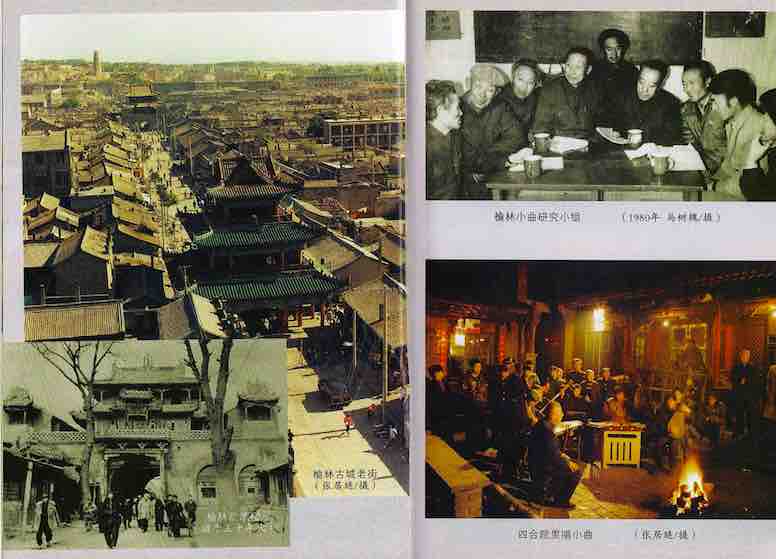
ylsq 1

Source: Huo Xianggui, Yulin xiaoqu ji. Right, top: the “study group”, 1980.

In modern China we can find plenty of exceptions to the simple dichotomy between rural ritual and urban entertainment, but it’s a useful framework. I’ve written a series of posts on ritual activity around the Shaanbei countryside (starting with this, recently-updated), but here I enter the regional capital Yulin to outline a recreational form of vocal music with ensemble, now moribund.

In chapter 12 of my 2009 book Ritual and music of north China, volume 2: Shaanbei (where you can find further leads) I gave an overview of musical activity in Yulin—far short of the thorough treatment of Ruth Finnegan’s 1989 book The hidden musicians, for, um, Milton Keynes.

Once again, as the Maoist era recedes, it still makes an important yet little-explored bridge between earlier history and the reform era.

The regional capital of Yulin
The bustling county-towns, commercial hubs dotted around the barren landscape of Shaanbei, already represent a more modern environment than the chronically poor villages and little district townships remote from the main transport arteries. But entering Yulin, the capital city of the region, one feels frankly in a different world, even if traces of tradition remain.

Yulin, a likely starting point for forays into the countryside, lies towards the far north of Shaanxi province. From the west and north the desert is creeping up year by year. Access was difficult until very recently. The main road going south towards Yan’an, and eventually the provincial capital Xi’an still further south, has been improved since the 1990s; and even by 2000 it was a 20-plus-hour bus ride east to Beijing. A train runs from Shenmu, not far northeast of Yulin, east to Datong in Shanxi province; by 2002 direct train routes all the way from Beijing to Yulin, and from Yulin south to Xi’an, were promised. By 2005 there was a direct flight from Beijing, “Opening up the West” still further.

The city has something of the feel of the wild-west frontier. Main Street (Dagai) retains its old-world charm, though in the evenings bikers rev up at the crossroads. There are four funeral shops along Main Street alone. There are also several bookshops, none of any distinction, and many shops selling CDs and cassettes; even a Buddhist shop selling CDs and cassettes as well as statuettes, incense, scriptures, and so on. Second Street (Ergai) is a kind of Wangfujing or Oxford Street, with pop music blaring from the sound-systems of shops. Away from the centre, the urban sprawl contains both new tower-blocks and rows of single-storey dwellings in traditional cave format. Even the old city walls remain. Coal bricks are piled up in courtyards to protect against the winter cold.

By the 1990s traditional musical activity in the city seemed much impoverished. Yet weddings, funerals, and temple fairs are held here too, all requiring live music. Few of the Yulin city temples have been restored to their former opulence. Vocal liturgy is still performed in the temples, but shengguan instrumental ensemble, once a feature of Yulin funeral ritual, has not been heard since the monks were laicized in the 1950s.
twins

Mother with twin daughters, Yulin 2001.

The state-funded Yulin Region Arts-Work Troupe and several opera troupes perform Qinqiang opera, as usual mainly for temple fairs. Towards the secular end of the continuum, the Yulin Folk Arts Troupe performs conservatoire-style arrangements of local singing and dancing.

In 2001 genial cadre in the troupe had a few young erhu pupils, to whom he taught the standard modern national repertory. There was a School of Arts (Yixiao), teaching national styles of singing and dancing. Yangge dance parades were held by work-units, including schools. But with pop music now dominating the soundscape, karaoke, TV, and VCD-players were doubtless city dwellers’ main exposure to music.

Before Liberation, funerals in Yulin, as in Beijing and other northern cities, were often accompanied not only by shawm bands (chuishou; see here, and for Shaanbei also here), but by temple priests, both Buddhist and Daoist. Shawm bands continued activity in Yulin city under Maoism, but since the 1980s’ reforms their activities have expanded; by 2001 there were at least eight bands, all migrants from the countryside.

But their extrovert style seems to hide a lack of discipline. Young shawm-band boss Feng Xiaoping observed, “Yulin is without order (mei guiju). Yulin people can’t appreciate the shawm—they don’t react even when we play well, and if we play badly, no-one ridicules us.” Both here and in the countryside, in the new undiscriminating get-rich-quick climate, ceremonial ostentation is rampant, while the “old rules” go into further decline.

The Yulin “little pieces”
Throughout China, many rural genres with long traditions have managed to outlive Maoism, thanks largely to the continuing demand for ceremonial. In the Shaanbei countryside, folk opera troupes, itinerant blind bards, shawm bands, folk-singers, and spirit mediums managed to weather political campaigns before reviving more openly in the 1980s for life-cycle and calendrical ceremonies. Even in Yulin city, there is demand for occupational chuishou.

The city also had a distinctive amateur vocal music with instrumental ensemble. Like many genres in world music, it barely had a name; like many genres in China, if people needed to call it anything, they might mention “little pieces” (xiaoquzi), “playing little pieces” (shua xiaoqu), or “playing silk strings” (shua sixian). The official title Yulin xiaoqu was casually given in 1958. [1]

As a relatively literate genre, its popularity was largely limited to the city—unlike small-scale vocal and instrumental groups like errentai or daoqing, widely performed throughout the countryside. We saw how the literate elite patronized the music of the lowly chuishou, employing them as a ritual duty. But the Yulin elite supported the “little pieces” as amateur recreation, and might even perform. The elite outside Yulin city, though thin on the ground, sometimes performed it too; in Yangjiagou village, landlord stronghold until the 1940s, young members of landlord families sometimes got together to play string and wind instruments. But in Yulin city by the 20th century, its main clientele was among ordinary citizens, and its main performers were male manual workers.

Imperial and Republican periods
As often with folk traditions, early evidence is inconclusive. By the 15th century regional governors were often posted from the distant Jiangnan–Zhejiang region of east China, and brief passages from the 1670s show musical activity at the Yulin court. Indeed, from the presence of many southern titles in various Shaanxi narrative-singing repertories, and indeed throughout China, one should not underestimate the wider influence of Jiangnan culture in imperial times. Among the themes of the Yulin songs (mainly love and city life), Jiangnan scenery also features; musically too, traces of Jiangnan style may be heard, although the dominance of the so mode appears to be a local modification. Another theory (also said to be supported by musical similarities) is that the style was based on the opera of distant Hunan, which may have been brought to Yulin in the Tongzhi reign-period (1862–74) by a company attached to a division of Zuo Zongtang’s Hunan army on campaign in the region.

The music is said to have been transmitted outside the regional court in the Daoguang era (1821–50) by Li Diankui and his son Li Fang. Oral tradition names musicians since the late 19th century. More pieces were composed in the early 20th century, and pieces arranged by the literatus Wang Jishi. Later Zhu Xiaoyi (1905–88) was a respected musician; a carpenter, he was also a luthier, making zheng zithers, yangqin dulcimers, sanxian plucked lutes, and erhu fiddles, which he sold as far afield as Shanxi and Inner Mongolia.

luo and wang 2001

With Luo Xinmin (left) and Wang Qing, 2001.

Musicians were amateur, and male—mainly artisans (silverworkers, watchmakers, tanners, woodworkers, plasterers, cobblers), as well as doctors and dentists. Apart from getting together for fun, musicians were also invited to perform for life-cycle ceremonies. In 2001 I met musicians Luo Xinmin (b.1925) and Wang Qing (b.1954). Luo recalled:

In the 1940s we took part in weddings, longevity celebrations (for which the piece Rejoice in a Thousand Autumns [Xi qianqiu] was prescribed), and first-full-moon celebrations for babies. We played seated on the host’s kang brick-bed—the chuishou played in the courtyard outside. We played mainly in the evenings, the chuishou mainly in the daytime.

Some children of landlord families might play music similar to the little pieces, on pipa plucked lute or bowed fiddle (as in Yangjiagou), but in Yulin the landlords and merchants didn’t maintain a regular band for the little pieces, though they might have a few instruments for people to play; they just invited musicians when they held a ceremonial.

Sources barely discuss the fortunes of the music during the troubled 1930s and 1940s. It is said—compulsorily—to have suffered in the War against Japan and the civil war, but Luo recalled:

The War of Liberation didn’t affect us—people from the Red and White areas got along quite well, going back and forth.

A popular venue was run by one Wang Yunxiang at the Qingxing silver furnace, by the old Drum Tower.

After Liberation
Typically, the sources stress the Party’s avuncular concern for the Yulin little pieces. Along with state organization came research and control—as an urban genre it was quite susceptible to official supervision.

Still, folk activity continued alongside official initiatives until the Cultural Revolution. Memories of old musicians suggest that in this case the “new life” compulsorily claimed for all genres after Liberation was not so fanciful:

After Liberation there was even more activity than before. In the evenings, because there was no electricity, and no other entertainment, people liked to get together.

Qiao family 1962

The Qiao family, Yulin 1962, during a lull between campaigns. Left to right (brackets denote seniority), rear: Jianren 建人 (3), Lifang 麗芳 (5), Jianzhong 建中 (1, b.1941), Jianguo 建國 (2), Jianmin 建民 (4); front: Jianfu 建府 (9), Lanfang 蘭芳 (7), Rui 銳 (father), Jianping 建平 (12), Liu Caiqiu 劉彩秋 (mother), Jianzheng 建政 (6), Jiangong 建功 (10), Jiancheng 建成 (11).(the missing eighth sibling was given at birth to a cousin of their mother). As you will notice, the second characters of the first eight sons’ names (after the constant jian 建 “construction”) spell out 中國人民政府功成 “China People’s Government is accomplished”; the ping 平 character of the ninth name suggesting that had yet another son followed, he would have been called An 安, to make the binome ping’an “well-being”—thus wishing “Well-being to the accomplishing of the China People’s Government”! Photo: courtesy Qiao Jianzhong. For a more traditional custom of generational naming, see here.

I chatted with the musicians about our mutual friend Qiao Jianzhong, a Yulin native who had become director of the Music Research Institute in Beijing, and whose encouragement had led me to Shaanbei. The oldest of nine brothers and three sisters brought up in an old house in Main Street, his parents were typical of the city folk who enjoyed the little pieces.

Especially in summer evenings, a lot of people came to listen, they could understand the words—Qiao Jianzhong’s mother used to say “This is much better than a film!” Mostly they invited us by treating us to tea and cakes (chayebing).

In the 1950s we were active in the common hall (jiti tingtang) by the Bell Tower in the city centre. The silverworkers’ shop next door to the Qiao family’s house in Main Street was a venue—instruments were available to play there for anyone who came along. And there was an old Chinese doctor called Lin Maosen [1903–68] who loved to sing—he often invited people to his house to play in the [early] 1960s.

If such recreational activity remained common, the life-cycle celebrations at which they had also participated before Liberation were now drastically reduced.

As to the official side, in 1950 a study group was organized in the Yulin workers’ club, and musicians met three evenings a week, training over forty performers—now including women for the first time. The genre gained a wider profile as musicians took part in festivals and won awards at provincial and national level from 1953 to 1960.

ylxq 3

Top: Beijing 1957 (left to right, Ran Jixian, Wu Chunlan, Hu Futang, Wang Ziying, Bai Baojin). Middle: preparing for Xi’an festival in 1953. Lower: Hu Yingjie and Wu Chunlan, 1979. Source: Yulin xiaoqu (1994).

ylxq 4

Top: female singers consult Hu Yingjie (date unclear). Middle: filming “Music of the Western Regions”, with Hu Yingjie. Lower: filming “Gazing at the Great Wall”. Source: Yulin xiaoqu (1994).

The life of the music through this period, both official and amateur, depended on a group of admired senior musicians. [2] Zhang Yunting (1900–64), a leather worker, was a fine sanxian player as well as singer. From 1950 he was the main teacher for the study group in the Yulin workers’ club. He won awards at festivals in 1956, 1957, and 1960, and recorded for provincial radio. In 1962 fieldworkers from the Shaanxi volume of the folk-song Anthology visited him. Bai Baojin (1914–83) was a tileworker; a zheng player, he also played jinghu and erhu fiddles, as well as singing. He too took part in the festivals of the 1950s.

Hu Yingjie (b.1921 or 1923) was an admired singer. A manual worker, he later worked for the post office.

In the 1950s some young women were recruited to sing, but most gave up after they got married. Most celebrated was Wu Chunlan (b.1930), a senior-secondary graduate, who learnt with Zhang Yunting in the first group after Liberation. Taking part in official festivals from 1953, she went on to win an award in a 1957 national exhibition.

Two vocal styles have been identified, mainly distinguished by enunciation: the Back street (Houjie) style of Zhang Yunting and Wen Ziyi (1911–68), later only represented by Wu Chunlan, and the Front street (Qianjie) style of Lin Maosen and Hu Yingjie.

Through the Cultural Revolution both folk and official contexts were basically silenced. There were occasional sessions on the quiet; once in the early 1970s, a general from the Lanzhou military region came and insisted on hearing the “little pieces”, so the musicians were assembled at the Hall of Culture, the gate was locked, and they performed for him in secret.

ylxq 5

Top row: Wang Jisan, Wang Ziying, Wen Ziyi, Bai Baojin.
Middle row: Lin Maosen, Zhang Yunting, Hu Futang, Ran Jixian.
Lower row: Zhu Xiaoyi, Li Xinghua, Hu Yingjie, Wu Chunlan.
Source: Yulin xiaoqu (1994).

Here as ever, expressive culture is about people’s lives through turbulent social change, about which musicking can offer us a revealing window; but the story needs supplementing. As collectivization was raging in the poor villages, how did artisans and manual workers in a regional city weather successive campaigns (on which the sources are scrupulously taciturn)? Of course, they weren’t vulnerable like “superstitious” ritual practitioners, but how were public and private spaces, and expressive culture, influenced by the changing economic fortunes of urban dwellers? [3] This issue is also relevant to 1950s’ Beijing.

Since the reforms
Official patronage resumed after the end of the Cultural Revolution, but if folk activity revived, it was short-lived; by the 1980s there was little folk counterweight to official modernization.

As early as 1976 a conference on the “little pieces” was organized by the Yulin Hall of Arts for the Masses and the Hall of Culture. In 1977 a team from the Music Research Institute in Beijing came to record. In 1979 a group took part in the folk arts festival for the Yulin region, they recorded for provincial radio, and in 1982 they performed in Beijing. The music was featured in TV documentaries such as “Music of the Western Regions” (Xibu zhi yue) for Shaanxi TV and the CCTV “Gazing at the Great Wall” (Wang changcheng); a Taiwanese TV station broadcasted a programme on the music. An arrangement of the piece Fang fengzheng 放风筝 became part of the touring repertory of the glossy Yulin Folk Arts Troupe.

In 1986, as work on the Anthology progressed, another “study group” was formed to document texts and study the history of the genre, resulting in a useful 1994 volume. A performing group was officially set up, organizing rehearsals twice a week and cultivating new performers—including ten female singers. Hu Yingjie, who had retired in 1980, was a leading member, and even sat on the Yulin city political committee.

Ironically, this period of revival, like that after Liberation, is hailed as another triumph for the Party’s avuncular concern for folk music. But however well-meaning these efforts, since the 1980s there has been virtually no folk activity, and the genre was now performed mainly for visiting dignitaries. Some senior instrumentalists remained, but they rarely got together as there were few singers in the old tradition—and younger people, now mesmerized by pop music, were reluctant to take part.

The polished arrangements of the fewer and shorter pieces played by the official group were increasingly remote from the traditional soundworld. Though the repertory had long been expanding, it was largely after Liberation that pieces were incorporated from other genres, even from outside Shaanbei. As the old vocal dadiao (see below) were rarely performed, and changes were made in instrumentation and technique, the genre was diluted. Luo and Wang found the troupe arrangements incongruous: “The Folk Arts Troupe plays it, but the flavour is all wrong.”

In 2000, students from the composition department of the distant Wuhan conservatoire came for a study-trip. By 2006, keen elderly amateurs in the research association for the little pieces told participants at the CHIME conference at Yulin that they still met informally. Though playing occasionally for life-cycle rituals and temple fairs, they now did so to scrape funds together for the group, and had to meet the tastes of audiences for other less “refined” vocal genres, further diluting the genre. They were gloomy for the future.

The kiss of death
As with other official attempts to “improve” traditional music in China, the change of context from regular amateur entertainment to sporadic cultural showcase on the concert platform naturally led to changes in style. Instruments, technique, and structure were all modified.

Through the 1950s, despite official involvement, instruments had stayed largely immune from modernization. The basic traditional instrumentation is yangqin dulcimer, zheng plucked zither, pipa and sanxian plucked lutes, and jinghu bowed fiddle; the singer beats time by striking a ceramic bowl with chopsticks. Until the 1970s all the melodic instruments were small local versions; apart from the yangqin, the strings were made of silk.

ylxq 2

Left, lower rows: Zhang Yunting, Wang Ziying, Wen Ziyi; Hu Futang, Ran Jixian, Bai Baojin. Right: yangqin, pipa, yueqin, zheng; and Zhu Xiaoyi playing a zheng that he made . Source: Huo Xianggui, Yulin xiaoqu ji.

The yangqin dulcimer was a small instrument with fourteen metal strings, known as “ten-note instrument” (shiyin qin) after its main ten pitches. The pipa plucked lute had four xiang frets and thirteen pin frets. Musicians only used three fingers to stop the strings, sounded by false nails of eagle’s wing-bone. Wang Qing recalled a more simple playing style: his father Wang Ziying, a great pipa player, used few finger-rolls (lunzhi). The sanxian plucked lute was quite large, tuned to the pitches so, la, and mi, and played in only first position, the strings sounded one at a time. Again, Luo and Wang lamented that later the common sanxian used for northern drum-singing was adopted, and that younger conservatoire-trained players used a more virtuosic, “less rhythmical” style.

The zheng zither is often portrayed as a kind of folk equivalent of the qin, but like the pipa it too is quite rare in north (and even south) China. In the 1980s some provincial scholars became excited about reviving the Shaanxi (Qin) style of zheng (秦箏); a “Qin zheng” society was founded in the provincial capital Xi’an (see Sun Zhuo, The Chinese zheng zither: contemporary transformations, ch.4).

The Yulin zheng was perhaps the most convincing candidate. It was a small instrument with fourteen silk strings. A fifteenth string made of ox tendon, tuned very low, was only used as an effect for the piece Jiangjun ling to add to the percussive feel, but later as the piece fell from the repertory they didn’t put the string on any more. Luo and Wang recalled that they still used silk strings for the 1979 Shaanxi Radio recording, and in 1980 the zheng teacher Zhou Yanjia, on a visit from the Xi’an conservatory, encouraged them not to change; but in 1982 the decision was taken—by whom, one wonders?—to adopt a standard national conservatoire zheng with twenty-one metal strings.

False nails, again traditionally of eagle’s wing-bone, were used to pluck the zheng strings. Luo and Wang wistfully contrasted the traditional style with that of the recent official version:

Their playing techniques are different from ours. Our zheng uses no “flowery fingerings” (huazhi)—originally the right-hand glissandos (guluzi, guolengzi) were very innocent (danchun).

Luo Xinmin showed us his old zheng, made before Liberation. It has gongche solfeggio names for the strings on the bridge. The older generation sung gongche but didn’t write it down; Luo had learnt the modern system of cipher notation, but knew the gongche names, like the string tunings.

From the Republican period, erhu fiddle and yueqin plucked lute were often added to the ensemble. But since the 1970s, under official influence—again typically—further instruments were added like dizi flute and, to boost the bass, dihu cello and zhongruan plucked lute, as well as the zhonghu alto fiddle. Call me old-fashioned, but the modern plucked bass in Chinese music is unutterably naff. Also since the 1970s, the traditional instruments themselves were modernized; as well as the zheng, “national” standard versions of the yangqin, pipa, and sanxian were adopted; even the erhu rendered the traditional jinghu marginal.

As to structure, phrases are short and four-square, with instrumental guomen interludes. Before Liberation, in a session of three or four hours, the instrumental ensemble usually played a few pieces before the singing began. [4] Short vocal items in simple strophic form (xiaodiao, “little melodies”, known as yizidiao 一字調) followed, and then, after a break, longer vocal sequences (dadiao, “large melodies”). Dadiao may be either sequences of melodies, or the same melody varied in many verses—or both together. Some melodies may be sung to different texts. Most pieces are sung by one singer, but dadiao may include some duet singing and recitation.

The dadiao are most complex—and, according to elderly musicians, best to listen to. Local scholar Huo Xianggui recorded all the dadiao from 1980 to 1982. By the 1990s, Hu Yingjie was the only one who still knew the dadiao, and he was in his autumn years. The official programme of the Folk Arts Troupe was largely limited to the shorter xiaodiao—the only style the women were taught.

If recordings of the shawm bands are quite hard to track down, at least one still hears them performing for ceremonial. How I hope Huo Xianggui’s precious early recordings of the “little pieces” and other genres will be made available! Online the closest I can find to the traditional Yulin style is something like this.

So for all the riches of musical life in rural Shaanbei, it seemed to me that there was precious little left to study here. It was always instructive to consult ebullient Yulin cultural pundit Meng Haiping—I’ve already cited his comments on the general cultural decline (here, under “The reform era”). He felt the Folk Arts Troupe had basically preserved the regional style at first; but later, finding its “development” unsatisfactory, he rarely went along. As he observed,

If you try to force a cultural form to destruction, you can’t; but some people try to protect it and end up loving it to death.

I still don’t quite understand the dynamics of official involvement. In the 1980s several senior musicians remained, and officials like Huo Xianggui and Meng Haiping clearly had their hearts in the right place. Somewhere along the line, people fall prey to the insidious conformism of modernization and “improvement”. Recently, in Beijing at least, there have been several voices resisting this trend, but they came too late for the Yulin little pieces. The dwindling scene today seems dominated by staged heritage performances on demand, remote from tradition. The Intangible Cultural Heritage project constantly wrings its hands over the crisis of such genres, touting the Party’s embrace while both compounding the problem and refusing to engage with the complex factors involved in the decline.

* * *

In Yulin city after Liberation, the “little pieces” were maintained by amateur enthusiasts even as official efforts were made to publicize and “develop” the music. After the end of the Cultural Revolution, as folk activity failed to revive, official control distorted the traditional features of the music, and by the 1990s it was moribund. So whereas I often discredit “salvage“, and in my work on rural ritual genres I’m keen to document all periods right down to today, in a case like this nostalgia (albeit for Republican and Maoist societies rather than the Tang and Song!) may play a larger role.

Again I’d stress that the main stories in Shaanbei, as throughout China, are to be told in the innumerable poor villages. The ability of cadres to “control” the Yulin little pieces in the regional capital, and the decline of the folk base there, contrast with the independence of the genres in the surrounding countryside.

But again in Yulin we find the conundrum that I broached in my post on the “suite plucking” of old Beijing. Whereas amateur activity in chamber genres along the southeastern coast (e.g. Shanghai, and south Fujian) has remained strong through the reform period, with a spectrum of traditional and official styles, genres like the Yulin little pieces effectively died out.

I surmise that in Yulin since the 1980s, the base of senior amateurs was simply too small to resist the official pressures of modernization. Musicians can typically be found to participate in the official modernizing agenda, but here it’s hard to find anyone who believes it a success.

In both ritual and music studies, received images are misleading. In ritual studies, south China dominates the field, but it’s just as important in the north; in musicology, the apparent dichotomy between southern entertainment and northern ritual groups also needs refining.

Of course, the varied local conditions we find throughout China today are obscure heritages from imperial times, complex amalgams of factors such as ecology, economy, lineage customs, and historical migration, further complicated by local histories in Republican, Maoist, and reform eras (local politics and personalities, Japanese occupation, radical Communist leadership, local protectionism, and so on). It is hard as yet to explain these variations, and we need a far more detailed body of work.

[1] Note Yulin xiaoqu, special edition of Yulin wenshi ziliao vol. 13 (1994), and Huo Xianggui, Yulin xiaoqu ji [Collected Yulin little pieces] (Xi’an: Shaanxi lüyou chubanshe, 2005).
See also the Anthology: (under narrative-singing) Zhongguo quyi yinyue jicheng, Shaanxi juan (1995), pp.607–15, 758–9, transcriptions 616–757; (under folk-song) Zhongguo minjian gequ jicheng, Shaanxi juan (1994), pp.421–2, 464–81; (under instrumental music) Zhongguo minzu minjian qiyuequ jicheng, Shaanxi juan (1992), pp.858–9, 878–83, 899–905.
The genre is not to be confused with the rural errentai music of nearby Fugu and Shenmu, also casually named Yulin xiaoqu since 1953, popularized by Ding Xicai: see Ritual and music of north China, volume 2: Shaanbei, p.17 n.31.

[2] For brief biographies, see Huo Xianggui, Yulin xiaoqu ji, pp.311–18.

[3] A starting point might be the Yulin county gazetteer; perhaps studies like 高雨露,近现代榆林城市文化空间形态演变研究 (西安建筑科技大学) are relevant.

[4] For full scores, see Zhongguo minzu minjian qiyuequ jicheng, Shaanxi juan, pp.899–905; Zhongguo quyi yinyue jicheng, Shaanxi juan, pp.614, 639–44; Huo Xianggui, Yulin xiaoqu ji, pp.269–94. Some pieces may be played solo by zheng, yangqin, or pipa.

More stammering songs

Baroque, vaudeville, fieldwork, and blues

possum pie

As part of my series on stammering I’ve already featured several songs about speech impediments, like There once was a man from CalcuttaRossini’s “stupefaction ensemble”Gepopo, and Uri Caine’s take on Bach. Now, thanks to this page from Judy Kuster (part of a site containing rich material), I find a plethora of further links, worth reading together with two splendid discussions, here and here.

As the latter page observes,

By the rise of vaudeville, the stuttering song was established enough that it was considered its own small genre, a specialty for comic singers—Sammy Stammers, from 1894, is a typical example. These stuttering songs fit naturally into a coarse period whose popular music mocked the Irish, Jews, Asians, and blacks.

And in all these cases, modern audiences can only await their cue from the victims to benefit from, even enjoy, such creations.

In the heady days before PC (“gone mad”), there was a b-b–bumper crop in the early days of the recording industry, showing at least that stammering was a significant element in public consciousness. It’s good to contextualize it in the context of other disabilities:

  • Joseph Strauss and Neil Lerner (eds.), Sounding off: theorizing disability in music (2006),

among many interesting chapters (not least on Glenn Gould!), includes

  • Daniel Goldmark, “Stuttering in American popular song, 1890-1930”,

showing how stutterers there were portrayed in music between 1890 and 1930. Note also an article by Josephine Hoegaerts.

Here’s a medley of short clips:

Intriguingly, several of the most popular songs focus on female sufferers, always in a minority—like K-K-K-Katy (Billie Murray, 1917), which, on a roll, he followed up with the “incredibly insulting” You tell her I S-T-U-T-T-E-R.

Oh Helen (1918) contains the ingenious lyric

Oh H-H-Hel, Oh H-H-Hel, Oh Helen please be mine
You s-s-simp, You s-s-simp, You simply are divine
You m-m-mud, You m-m-mud, You muddle me it’s true
Oh D-D-Dam, Oh D-D-Dam, Oh Damsel I love you 

i'm always

Still, there’s a disturbing undercurrent of romance. As the Locust St. post oberves,

The poor stuttering protagonist falls in love but his impediment makes it hard for him to express his feelings. There are typically two outcomes. There is the (relatively) optimistic: in “Stuttering Dick,” as in “The Stuttering lovers,” an Irish folk song, the stuttering guy finds a stuttering girl, and the two live in bliss. Then there is the more popular and more tragic scenario, when the stuttering character falls in love, can’t communicate his feelings, and winds up scorned and ridiculed.

todd

Charles L. Todd records among Mexican migrants, California 1941.

Turning to ethnographic fieldwork, here’s the full version of the unusually endearing song that opens the YouTube medley above. Sung by Lloyd Stalcup, a 14-year old Texan migrant worker, it was recorded in 1940 at Shafter FSA (Farm Security Administration) Camp in California as part of the fine Voices from the Dust Bowl project by Charles L. Todd and Robert Sonkin of the Library of Congress (with evocative fieldnotes here):


But as non-PC goes, the pick of the b-b-bunch—as politicians are discovering, if you’re gonna be offensive, why not go all the way?—has to be Possum pie (or The stuttering coon, 1904), with lyrics by Joseph C. Farrell, music by Hughie Cannon:

Of course, few of these songs attempt to break out of the rhythmic mould to reflect more accurately the irregularity of stammering. Ironically, the impediment disappears when singing, and in rhythmic speech, but neither offers more than temporary relief. I wonder if there are any east-European songs in the parlando-rubato form beloved of Hungarian scholars, or even Bulgarian aksak “limping” treatments…

Delving further back, for us early music fans Andrew Oster has a chapter in Sounding off about Demo, a stammering dwarf (YAY!) in Cavalli’s 1649 opera Giasone. Here the fast repetitious ornament trillo or gruppo, a kind of throat tremolo (defined by Caccini, used expressively by Monteverdi—and recently by Abrahamsen in the mesmerizing let me tell you (see Soundscapes of Nordic noir), is put to comic use:

It reminds one of the drunken stammering poet in Purcell’s The fairy queen (1692—also featuring a Chinese man and woman, BTW):

Now all we need for a full house is a drunken stammering black Jewish Chinese gay dwarf, FFS.

The links above take the story on to pop since the 1950s; but for blues fans, I’ll play out with John Lee Hooker—one of the more realistic impersonations of the sound. You can decide if it’s “a revelation—the singer isn’t a poor victim but a player, wooing a girl through his stammer” or if it’s just “good old-fashioned sexual harrassment”:

* * *

This may just be a coincidence of the birth of the recording industry, but it looks rather as if stammering songs reached peak popularity in the wake of World War One. So recalling that many Chinese stammerers are also documented in historic periods of warfare, we may wonder if there’s some correlation between social trauma and disfluency in speech. Speech therapy is clearly among the needs of current refugees, for instance. Still, if conflict were a simple stimulus, our forebears would all have been at it. And I’ve no idea how one might make a more comprehensive global diachronic survey—taking account of class, economic conditions, gender, and so on.

For more stammerers in opera, see here; and for an Azeri song, here!

A Daoist serves a state troupe

17 troupe 1959

North Shanxi Arts Work Troupe, Datong 1959. Li Qing front row, far right.

My post on the folk–conservatoire gulf reminds me of the brief sojourn of the great household Daoist Li Qing in the grimy coal city of Datong as a state-employed musician. Indeed throughout China, many “folk artists” were recruited to such troupes, like wind players Hu Tianquan and Wang Tiechui. Daoists were also enlisted (see e.g. Ritual life around Suzhou, §5); Daoist priest Yang Yuanheng even served as professor at the Central Conservatoire in Beijing until his death in 1959.

But under Maoism the “food-bowl” of the state troupes was short-lived; most employees were soon laid off. And while in the troupes, performers’ lives were no picnic: the whole society was poor, all the more so during the Years of Hardship while Li Qing was employed.

The following is adapted from ch.5 of my Daoist priests of the Li family.

In the early years after the 1949 Liberation, religious ritual in Yanggao had persisted despite sporadic campaigns and the nominally atheist stance of the new Communist leadership. But by 1954, as collectivization began to be enforced ever more rigidly (see here, under “Famine in China”), creating ever-larger units which made it hard to protect local interests, and with ambitious new mobilizations taking up more and more time, it was becoming increasingly hard to “do religion.” The main thrust of campaigns may have been economic, as household enterprises were forced into inactivity; but “eliminating superstition” was never forgotten, and was to be one explicit slogan of the 1958 Great Leap Forward.

Li Qing eats off the state
When not busy laboring in the collective fields or doing rituals, Li Qing enjoyed playing his beloved sheng mouth-organ in the village’s amateur “little opera band”, accompanying both the majestic “great opera” (Jinju) and the skittish local errentai duets. In the bitter cold of the first moon in 1958 Li Qing, now aged 33 sui, made the journey to Yanggao county-town to take part with his village band in a secular arts festival there. The county cultural authorities were choosing musicians for their Shanxi opera troupe, [1] and were keen to recruit Li Qing. But scouts attending from the prestigious North Shanxi Arts Work Troupe in the grimy regional capital city of Datong pulled more weight, and it was for this ensemble that he was now chosen. In this period regional arts-work troupes and county opera troupes throughout China commonly recruited Daoists and other folk ritual performers as instrumentalists (see e.g. under Ritual life in Suzhou). Li Qing was to spend nearly four years in the troupe. Thus, although they made regular tours of the countryside, he was protected somewhat from the worst excesses of the Great Leap Forward back home.

In 2011, to learn more about Li Qing’s time in the troupe I visited Datong to seek out some of his former colleagues there—Li Manshan and Li Bin had already bumped into a couple of them on trips there.

It’s good to see my old friend Bureau Chief Li again. We track down two old musicians from the troupe and invite them round to his posh flat where I am staying the night. It would make a tranquil venue, but since it is the time of the Mid-Autumn festival, an auspicious time for weddings, our chat is regularly punctuated by deafening firecrackers echoing around the high-rises, so that the soundtrack evokes the battle of the Somme.

datong

Li Kui (left) and Zhang Futian, Datong 2011.

Li Kui, who played erhu fiddle in the troupe, and the effervescent Zhang Futian, a dizi flute player, both born in 1939, were 19 sui when they joined, thirteen years younger than Li Qing. Wary of hagiography as I am, all those who met Li Qing remain moved by his kindly soul and unsurpassed musicianship. Those years were not just a contrast to the rest of his life but a unique period for everyone. Recruitment to a prestigious state ensemble may sound grand—until you realize not only the desperate conditions of the late 1950s but that they spent much of the year touring the ravaged countryside on foot. Still, for them the period has a bitter-sweet nostalgia that I can’t help sharing. My visit provides an excuse for them to get together to reminisce about old times—they are so loquacious that I rarely get to chip in with a question.

Li Qing went off to Datong to take up his new job in the 8th moon of 1958, just as the Great Leap Forward was being rolled out to great fanfare. Even if he had a choice about taking the job, he can have had little hesitation. With Daoist ritual business, and society as a whole, going through such a tough period since the enforcement of collectivization, he would have been grateful to get on the state payroll.

The Party officials of the troupe must have found out about Li Qing’s rich-peasant status but drawn a veil over it. Throughout the Maoist period, the Yanggao cultural cadres didn’t dare have any contact with the Daoists or even the shawm bands—but the Datong troupe leaders didn’t need to know that Li Qing was a Daoist. His colleagues would find out, but everyone understood there was no need to discuss that kind of thing. He didn’t talk much at first, but became more chatty as he felt more at ease. For his closest friends he even furtively held sessions to determine the date.

The new troupe, based in a compound at no.13 Zhengdian street, was an amalgamation of the North Shanxi and Xinzhou regional troupes. Eight or nine musicians were recruited to the band at first, gradually increasing to around sixteen; with singers, dancers, stage crew, and cadres, the troupe consisted of around sixty people. Its reputation was second only to the troupe in the provincial capital Taiyuan.

Li Qing now found himself accompanying stirring patriotic folk songs and short simple instrumental compositions in revolutionary style. As a household Daoist, he was a born musician, and effortlessly versatile. Apart from his old vocal liturgy and the “holy pieces” of the shengguan instrumental music, he knew a wide range of more folksy instrumental pieces played on procession and for the popular afternoon sequence, and he had the local opera repertoire in his blood.

Dancer Feng Yumei, also from Yanggao, arranged some of the earliest dance suites in folklore style, like “The Earth around the Yellow River” (Huanghe yifangtu), considered one of the earliest and best creations in the idiom. The troupe performed a new opera composed in Hubei, later made into a film.

Li Qing was the only Daoist in the troupe; the only other instrumentalist from Yanggao was the fine gujiang shawm player Shi Ming (1932–2003) from Wangguantun just northwest (see also my Ritual and music of north China: shawm bands in Shanxi, p.22). They remained lifelong friends. Shi Ming, already 27 sui, had an eye for the dancers, but they preferred the younger more eligible guys, like Li Kui himself! The troupe’s star soloist on the suona shawm was Yang Xixi from Xinzhou. Our friends ranked him alongside the nationally celebrated virtuoso Hu Tianquan, also a native of Xinzhou, mainly renowned for his sheng playing. Li Qing sometimes played Yang Xixi’s guanzi for fun.

As the only sheng player in the troupe, Li Qing accompanied Zhang Futian’s flute solos. Sometimes he played solos himself, accompanied on the accordion by one Ma Yun, over 50 sui in 1958. One solo that his colleagues recall was a Napoleonic Marche du Victoire (Kaixuan guilai), perhaps even the March from Aida. Imagine—Li Qing even performed a foreign piece! He played with feeling, and was infinitely adaptable. The conductor never criticized him; if he made the slightest error, he would correct it at once. Zhang Futian’s appraisal was still higher than that of the local Daoists: “He was a genius—the greatest musician I ever met.”

WGT trio_2

Li Qing (left) with fellow wind players Yang Xixi and Shi Ming, 1959.

No less impressive was Li Qing’s personality. Affable and generous, he had no temper. Even if he got ill, he never asked for leave. He earned a reputation for generosity and for smoothing over disputes in the troupe; his mere presence was enough to ease any tensions within the group. In a society where mutual suspicion was fostered and nasty rumours spread rapidly, he had no bad words for anyone, and bore no grudges. Folk musicians prided themselves on loyalty (yiqi).

The salary system was graded. Ordinary members got 25 kuai a month, most of the band 35 kuai. Relatively senior, Li Qing was soon considered an “old artist” (laoyiren), getting 45 kuai a month. The wind players and dancers got an extra 2 liang in rations.

During his time in the troupe Li Qing learned the modern system of notation called jianpu “simplified notation,” which uses the Arabic numerals 1 to 7 to represent the solfeggio pitches of Chinese gongche notation. [2] Though simple, it never caught on in the countryside; for the Daoists, traditional gongche remained in place as a means of learning the outline of the shengguan instrumental melodies, and they had no need of any notation at all to learn all the complex vocal hymns. The gongche solfeggio translates rather easily into numerical notation. The latter was used in the troupe to learn new pieces, but Shi Ming didn’t take to it, so Li Qing helped him learn them. Li Qing was to put this new skill to use from the 1980s when he used it to write scores of his Daoist repertoire.

For much of the year the troupe went on tour through the impoverished countryside, doing over a hundred performances a year. Apart from visits further afield in north China, they toured throughout north Shanxi, including Yanggao villages—mostly on foot, sometimes with horses and carts. Sometimes they slept in peasant homes, dispersed among several suitable families by the village brigade, or in the village school; or they put up a big tent. They took their own food, and stoves to cook it on. Li Qing didn’t smoke or drink, but the others drank laobaiganr liquor from a little flask; at first the troupe supplied them with packs of Happiness cigarettes, but later they were reduced to picking up fag-ends after a gig and rolling them into a new one. Their program was written in ink and stuck up as a poster. It was a tough life—Zhang Futian admits he got fed up with it.

Over these four years Li Qing was only able to go home once or twice a year for a couple of days, bringing only a bit of money, but no food. His wife, alone with four children to look after, never visited him in Datong. Li Manshan only went to see him once, in 1961; but soon after he arrived, Li Qing had to go off with the troupe to Harbin in northeast China to perform, so he could only go to the station with his father before taking a packed windowless bus back to Yanggao town and walking home from there.

For several generations the Li family’s exquisite sheng mouth-organs had been made by the Gao family in Gaoshantun near Upper Liangyuan. In 1961 Li Qing managed to get an invitation for the elderly master Gao Bin (1887–1967) to spend ten days with the troupe mending his various sheng, when Gao was really down on his luck; even the meager pickings in the troupe’s canteen probably saved his life.

Like many state work-units throughout China, the troupe was cut back in 1962, and Li Qing returned to his village early that spring. With such relocations, by 1963 some 84% of the Chinese population were living in the countryside—the highest proportion in the history of the People’s Republic. [3]

The troupe staggered on until it was disbanded in late 1962. Some of its members were recruited to the provincial song-and-dance troupe in Taiyuan, some of the Xinzhou contingent found work back home, while others like Li Qing and Shi Ming had to return home to their starving villages. Several of the performers went on to wider fame; dancer Feng Yumei 冯玉梅 became chair of the provincial dance association, and folksinger Xing Chouhua 刑丑花, from Xinzhou, gained national renown. The troupe reformed in 1964; soon, mainly using Western instruments for the revolutionary “model operas”, it was dominated by “educated youth” from Beijing, Tianjin, and Shanghai. But it disbanded again in 1968.

For a peasant like Li Qing to be chosen for the troupe was a great honor. His “black” class status was no barrier to being selected, and on his return his local prestige was even greater. But in volatile political times, assaults were not far away. If the economy hadn’t collapsed at this time, Li Qing might have continued in the state system; after the end of the Cultural Revolution, he might even have become a sheng professor at a conservatoire. Still, I am grateful that the troupe folded, and that the troupes or conservatoires never again summoned him. Had he secured a long-term state post, he would never have resumed his ritual practice, copied all those scriptures and scores, or taught the present generation.

* * *

If Li Qing’s repertoire in the troupe was new, and his long ritual tradition on hold, at least he was still playing the sheng there and receiving a handsome regular salary. Food supplies in the city were scant, even in state work units; but meanwhile back in Upper Liangyuan, people were desperate. In the absence of Li Qing there were still plenty of Daoists available; the senior Li Peiye, or Li Peisen (who had cannily absented himself from political scrutiny by moving to Yang Pagoda), could have still led bands if there were demand. But they were virtually inactive; not only had their instruments been confiscated, but people’s bellies were empty, and patrons had no strength to observe ritual proprieties.

Still, Li Qing’s return in 1962 coincided with a very brief ritual revival, with a retreat from the extremist policies of the disastrous Leap. Though very few domestic or temple rituals had been held for some years. Li Manshan recalls taking part in a ritual in 1963, commissioned at the home of an individual as a vow for recovering from illness. This was perhaps the last time they recited the Averting Calamity scriptures (Rangzai jing). Already by now they were mainly doing funerals, but Li Qing’s widow recalled that even then they were only able to do two or three a month. So there was less work in the early 1960s than now—there was still a serious famine, and however many deaths there were, people couldn’t afford to put on a grand funeral even if they had the energy.

However intermittent the Daoists’ appearances were during these years, Li Manshan sighs as he recalls how the villagers loved their grand rituals before the Cultural Revolution—in the days before TV and pop music. Even by the time of my visits in 1991 and 1992 there still wasn’t any singing outside the gate—that only began from 1993. In 1991 virtually the whole village seemed to turn out, crowding round respectfully (see my film, from 30.32). Li Qing’s sojourn in the troupe had added to his reputation as a Daoist and virtuous man; Li Manshan’s own repute is still based to a considerable degree on that of his father.

For the Li family Daoists’ ritual revival from the late 1970s, see here and here.

[1] For which see the Yanggao xianzhi (1993), p.468. Alas, links to Chinese websites cited in my book seem to have disappeared—watch this space.

[2] For gongche and cipher notation, see also my Folk music of China, pp.111–123; Plucking the winds, pp.245–246, 262–263.

[3] Cf. Friedman, Pickowicz, and Selden, Revolution, resistance, and reform in village China, p.19.

A Confucius mélange

To complement my little series on Shakespeare (like I’d know), there’s now a quorum of Confucius quotes:

with the related

and at a tangent,

See also my Daoist adaptation of “selling the Three-character scripture at the door of Confucius” (preaching to the converted, as we might say).

The folk–conservatoire gulf

Yang Yinliu 1950

Yang Yinliu, 1950.

I just remembered a wise quote from the great Yang Yinliu. First, some useful background (“Typical!”).

Further to my post on Different values, the gap that has opened up between the sound ideals of traditional and conservatoire musicians is a regular theme of this blog (see e.g. many posts on “heritage” rounded up here). Indeed, I already discussed it in chapter 3 of my first book Folk music of China (1995/1998). It may be a spectrum, but it often seems like a chasm.

In the Republican era, in the face of the apparently wholesale victory of Western civilisation and technology over the “backward” Chinese heritage, along with the influx of a range of Western genres patriotic Chinese sought with modernizing zeal to create an “improved” “national music”, learning from the West while searching for valuable elements in their own tradition. This, of course, was a common reaction in many cultures around the world, as explored by Bruno Nettl.

Some rejected the old “feudal” culture completely; another response was a self-conscious musical antiquarianism, with educated Chinese establishing patriotic groups for the preservation of the “classical” heritage. This not only perpetuated the abstractions of early Confucian music theorists, but also left a legacy that has now been enshrined in the romantic staged reifications of the Intangible Cultural Heritage project.

Indeed, in the Chinese and foreign media this has come to stand for traditional music, despite the continuing vigour of a vast wealth of rural genres.

Early uses of the term “national music” (guoyue) were found among the literati of what were still regional groups, as in Chaozhou and Hakka groups and around Shanghai. What became a “conservatoire style” was based to a large extent on the Shanghai style.

Meanwhile inland in Shaanbei at the CCP base of wartime Yan’an, a debate was also waged between “foreign” and “indigenous” (yang 洋 and tu 土) approaches; the latter was always going to dominate, but Communist cadres often found the raw folk material that confronted them “feudal and superstitious”. I noted the dilemma of cultural cadres in “managing” poor blind bards there under Maoism; and for gender perspectives on “superstition”, see here.

The ambiguity, not to say confusion, of the Party line on traditional culture was expressed by Wang Chun, mentor of the author Zhao Shuli. He criticized both opera and narrative-singing, lamenting the close links between folk music and “superstition”. This established a tendency to treat music as autonomous, divorced from context.

Of course, all this was based on social conditions. At local level, despite the assaults on former patrons, the expressive culture of many rural societies remained based in ritual, whose values were little influenced by the secularizing trends of the cities. As you can see from my post on Festivals, what developed was a range of performance along a continuum.

17 troupe 1959

North Shanxi Arts Work Troupe, 1959. Li Qing front row, far right. His four years there (1958–62) were a brief interlude within a lifetime of ritual practice.

The new state-funded institutions (opera troupes, arts-work troupes, conservatoires, and so on) didn’t replace the traditional groups (like ritual associations, shawm bands, amateur clubs), but supplemented them. Musicians from folk backgrounds recruited to the official troupes found themselves having to compromise (see e.g. my Daoist priests of the Li family, pp.113–18). Some adapted more than others. Regional characteristics were gradually diluted in an attempt to forge a “national” synthesis (see e.g. The zheng zither in Shandong).

sfg-50s

Daoist Shifan gu, c1962.

Right, here’s what I was going to offer you:

The great Yang Yinliu, whose encyclopedic erudition on Chinese music history was enriched by being brought up among traditional musicians (Kunqu, Daoist ritual, the qin zither), was well aware of the stylistic conflict. In an article on instrumental music, first published in Renmin yinyue in 1953—not long after Liberation, and just as he was studying the shengguan music of the Zhihua temple—he touched on several sensitive topics including “temple music” and “palace music”, already under criticism from rigid ideologues on simplistic class grounds—carefully couching his defence in the new politicized language. He went on to observe tellingly (cited in my Folk music of China, p.51):

Once in Wuxi there was a technically brilliant and enthusiastic comrade directing a group of twelve folk artists who were thoroughly versed in performing the local wind-and-percussion music. He announced his opinions to them about the “improvement” [of the music] considering the peasants’ music too long (around half an hour), and that it would only be right if the pieces were abbreviated so that the whole suite lasted about five minutes; further, the peasants’ percussion music was too complex, with too many decorations; the workers only liked simple pieces, and they should eliminate all the decorations on the drum and other percussion instruments. The result was that the folk musicians began to feel doubtful, and their interest dwindled. They felt that after abbreviating the pieces, not only would it be difficult for them to make the transitions, but the transmission of the pieces would be endangered if the greater part of them were cut; and completely to eliminate all the decorations was simply to make them regress to the stage of beginners.

In such official contexts at least, uncomprehending apparatchiks wielded power over helpless folk musicians. I went on to comment:

As Yang wisely points out, “these opinions of the folk musicians cannot be neglected”, but the same patronizing attitude towards folk musicians and audiences alike remains endemic today.

Again, this relates partly to context: the apparatchiks were seeking to adapt folk music for short breezy staged performances, whereas in ritual life, musicking unfolds gradually over events lasting a couple of days.

Still, irrespective of the new institutions and the platitudes of Party pundits, folk activity persisted, resistant to Party ideology. And Yang, with his able colleagues at the Music Research Institute, just kept on researching living genres (both folk and elite), and their imperial history, right until the Four Cleanups campaign of 1964. But the sound ideals of folk and conservatoire musicians continued to diverge starkly, as we found with the 1980s’ recreations of the “suite plucking” of old Beijing.

More than Bartók, Yang Yinliu was also concerned with documenting the changing society in which music functions. As suggested in my post on him (such as his account of Daoism in Wuxi and his 1956 report from Hunan), he was attuned to issues that were soon to become basic to ethnomusicology—even if such study was still limited under Maoism, and (with honourable exceptions) remains so today under stultifying heritage propaganda.

See also under Walking shrill (with sequel), and Resisting fakelore. For more nuanced approaches to the conservatoire in Central Asia, click here.

Ronnie: a roundup

Ronnie

As the Masters tournament breaks off again at Ally Pally, it’s that time of year when I make another futile attempt to Rend Asunder the Bonds of Daoist ritual, the Iron curtain, and Bach by extolling the magic of Ronnie O’Sullivan, the Mozart of snooker. Like Mozart, he has his own tag in the sidebar: here’s a cue [sic].

The most essential viewing is his 147 maximum break from 1997—5’20” of sheer genius.

Further posts include

Watching Ronnie in full flow, with his effortless grace and instinctive intelligence, is the most exhilarating experience.

HIs 2023 appearance on Desert island discs (here) is full of typical introspection.

On a lighter note,

If you’re feeling really broad-minded, try the sport tag too. You’ll even find Daoist football there.

Trust me, I’m a doctor. To adapt Hašek,

the first fifty readers to view these posts will receive as a gift a free pocket aquarium.

Musical cultures of imperial north China

Navigational aid for fans of late imperial Chinese history: here’s a roundup of posts on musicking in the Qing—not only at the Beijing court but further afield, looking beneath the tip of the iceberg.

But of course, we shouldn’t focus narrowly on defunct genres, or cling to simplistic notions of  “art” and “court” cultures. Notwithstanding social change, all the living local ritual traditions I study have been transmitted virtually continuously since the Ming and Qing among folk groups (“When the rites are lost, seek throughout the countryside“). This doesn’t mean that we can neatly relegate them to “history”: the study of all kinds of expressive cultures also involves fieldwork on their fortunes since the collapse of the imperial system, with ethnography and oral history becoming more fruitful than library study.

Still, Like Life, one thing leads to another. More generally, early Western contacts with Chinese music are the subject of a wider range of research from scholars both in China and abroad (see comment below).

Soundscapes of Nordic noir

bh

Nordic noir on screen is all very fine (see Saga and Sofia!); but on Thursday I went to hear an inspiring (rather than bleak) wintry concert at the Barbican, with the spellbinding combo of Barbara Hannigan (see also here) and S-S-Simon Rattle programme notes here).

At the heart of the concert was Hans Abrahamsen’s magical let me tell you (2013), with lyrics by Paul Griffiths. It has already become a classic among orchestral song cycles—to follow Nuits d’été and Shéhérazade, the Wesendonck and Altenberg lieder, the Rückert liederand the Four last songs.

I don’t need to add to all the praise (reviews here), but as well as the three creators discussing the piece, do also watch Hannigan’s own reflections:

As she suggests, this re-imagining of Ophelia’s monologue is enriched by the following 500 years of female experience. With her utterance at once fragile and resolute, the result is not bleak but luminous. And Hannigan is just mesmerizing on stage, embodying the role—one of the great singers (see also my Playlist of songs).

The cycle was also part of the CBSO Prom in 2016 (from 11.00), with the excellent Mirga Grazinyte-Tyla conducting:

At the Barbican the other day Let me tell you was sandwiched [Aww, no smorgasbord?—Ed.]* between two challenging symphonies, which S-Simon conducted from memory. He describes Sibelius 7 (1924, one of his last works before he devoted himself more single-mindedly to the bottle) as “almost like a scream” (cf. Mahler 10). (Sibelius makes a flimsy pretext to remind you of this post on Finno–Ugric musicking).

nielsen

Nielsen aged about 14.

Carl Nielsen’s 4th symphony (“The inextinguishable”, or even Det uudslukkelige) (1916), like his 5th (for whose snare-drum part I hereby nominate Li Manshan), is a battle with chaos. Though Denmark wasn’t directly touched by the war, its echoes are clear. But again, with its incandescent ending in E major (cf. Bruckner 7 and the home key of Chinese ritual wind ensembles!), the overall mood is far from bleak.

To harp (nyckelharpa? Another world fiddle for our list) on the folk angle, whereas other composers like Bartók approached their local traditions as outsiders, Nielsen came from a poor peasant background as a brass player and traditional fiddler on the island of Funen. For more Danish folk music, see under A folk playlist for Euro 24!.

Getting to know both the music of Sibelius and Nielsen in my teens thanks to enterprising amateur orchestras, I must have been vaguely aware of Nordic gloom, but in my callow youth I suspect I heard “classical music” as a monolith, hardly discerning regional, temporal, or personal diversity.

The concert made an evening that was both disorienting and inspiring. Live performances by Barbara Hannigan are not to be missed.

* SJ: Not today, but I can offer you “pining for the Fjordiligis”.

Musicking at the Qing court 2: Pedrini and Amiot

pedrini 2

To return to my fantasy of Bach at the 18th-century Beijing court (see—and hear!—The Feuchtwang variations), the musicking of the European missionaries there makes an intriguing tangent to the varied material on all the diverse forms of musicking at the Qing court (a list to which I’ve now added Manchu shamans).

An authority here is François Picard (list of publications here, including this useful summary of relevant works—and note his CDs, introduced below).

Jesuit missionaries had established themselves as early as 1589 at the Ming court, and continued to find favour at the Qing courts of Kangxi and Qianlong. As Picard explains:

Their strategy was to convert the Chinese to Christianity, starting from the top. They did this, first of all, by demonstrating their status as experts and thus gaining access to the court; they then aimed to prove the superiority of the West, of Christendom, and therefore—syllogism—of Christianity, in the realms of science, astronomy, cartography, measurement, and music, the study of which belonged to the field of scholarship in both civilizations. Acoustics, instrument-making, notation, and performance were all part of that strategy of integration, competition, and persuasion.

Following Matteo Ricci (1562–1610), Adam Schall von Bell (1591–1666), and Ferdinand Verbiest (1623–88), Tomàs Pereira (1645–1708; for a range of studies, see here) is notable for his major compilation for the Kangxi emperor on the theory of Western (art!) music. This was completed by the Lazarist priest Teodorico Pedrini (1671–1746), who, reaching Beijing in 1711 (after an epic eight-year journey that puts the travails of British train commuters in perspective)* was active there along with Florian Bahr (1706–71) and Jean Walter (1708–59). Pereira and Pedrini are further discussed by several scholars, including Joyce Lindorff and Peter Allsop (e.g. here). The Jesuit priest Joseph-Marie Amiot (1718–93) arrived in Beijing in 1751.

Even transporting the keyboard instruments was a mind-boggling task for the missionaries. While they were braving such obstacles, Bach’s long-term residency in Leipzig was bearing fruit in a constant stream of creation.

François Picard’s work bears fruit in his collaboration with Jean-Christophe Frisch and his ensemble XVIII-XXI Musique des Lumières, notably an enterprising series of CDs—with contributions from the Fleur de Prunus ensemble and the choir of the Centre Catholique Chinois de Paris, and instructive liner notes with further references.

While the missionaries were not mainly concerned with documenting or performing Chinese music, Amiot notated some Chinese melodies, and some canticles were set to Chinese texts.

The Congregation of Musicians of the Northern Church in Beijing, numbering about thirty young musicians, including several Manchu princes, would accompany important celebrations, the most spectacular of which was the feast of the Sacred Heart of Jesus.

gongche

Liuyejin, in gongche solfeggio with stave transnotation, Amiot 1754.

Some of Amiot’s Divertissements chinois, based on Kunqu melodies, are imaginatively recreated with Chinese instruments on the CD

  • Teodorico Pedrini: concert baroque à la cité interdite (Auvidis, 1996)

Here’s a playlist:

Other CDs in the project include

  • Joseph-Marie Amiot (1718-1793), Messe des jésuites de Pékin (Auvidis, 1998)
  • Chine: jésuites et courtisanes (Buda Records/Musique du monde, 2002)
  • Vêpres à la Vierge en Chine (2004)

In the chamber items with both baroque and Chinese instruments, the timbres blend well—and would do so even better had the latter been set up in 18th-century fashion, with silk or gut strings.

All this makes an intriguing if inconclusive exploration of elements: whereas ornamentation is common to both traditions, it’s more of a challenge to reconcile Chinese heterophony with the harmonic basis of baroque music. Amiot didn’t take the “superiority” of his musical culture for granted—Picard cites a perceptive passage:

Here, there is neither bass, not tenor, nor treble, everything is in unison, but that unison is varied according to the nature and capacity of each instrument [what we now call heterophony! SJ], and the composer’s skill, the beauty of the piece and the whole art of music lies in that variation. […] It would be of no avail to endeavour to prove to the Chinese that they must find pleasure in something in which they really find none at all.

In Picard’s notes for the Chine: jésuites et courtisanes CD he cites some contemporary reports relevant to the “suite-plucking” of the nobility, such as notes by courtier Gao Shiqi:

[The Kangxi emperor] ordered the ladies of the palace to play a melody, hidden behind a folding screen. He then said: “The people of the palace are excellent with string instruments (xiansuo).” He ordered his courtiers to show their art and successively play the hupo, pipa, and sanxianzi string instruments. He then said: “Play the qin piece “On the beach the geese are landing” (Pingsha luoyan) on the four string instruments—hupo, pipa, xianzi, and zheng—together.”

Adding female nobles to our list of performers, the emperor went on:

“The ladies of the palace have played the zheng zither since their childhood, to the point of forgetting to eat or sleep.** After ten years of efforts, they have attained sheer mystery [cf. Shenqi mipu].” He then ordered them to play “The moon is high” in a “changing tonality” (Bianyin yuer gao).

For more excursions in Qing ritual culture, see here.

* * *

To return to my Bach fantasy, European art music performed by European musicians at the Chinese court is a perfectly valid topic. It’s a welcome clue to early Chinese exposure to Western music, which from the late 19th century would become a major and more pervasive theme. And Amiot’s arrangements of Chinese melodies may have been performed by Chinese musicians. But while it’d be nice to think of European missionaries learning Chinese style, whether on Chinese fiddles (tiqin, sihu) or on violin, I can’t see any evidence; their contacts with the broader society, and indeed their tastes, were circumscribed.

Of course, world music “fusion” in China goes back to the Tang dynasty and earlier. But in the Qing, even within the rarefied milieu of the court, and despite the efforts of the missionaries, I find little evidence of more significant interaction, such as Chinese performing European music on Chinese instruments or Europeans taking part in Chinese ensembles.

For the Vêpres à la Vierge CD I took part, implausibly, on baroque violin, erhu and shawm—but I never quite knew whom I was impersonating (an imaginary missionary, either steeped in Chinese style or not? Perhaps even a Chinese Catholic convert keen to bury his musical heritage beneath superior Western learning?!). My ears conditioned by exposure to living Chinese traditions that often go back beyond the Qing, I found our experiments tentative; we were on firmer ground with the purely Western items, which now sound more successful to me. Later in a couple of concerts I began doing some semi-chinoiserie noodling on the two types of fiddles (miantiao? tagliatelle?) that I, at least, found a bit more satisfying; but I still couldn’t work out who I was—me, I guess.

Anyway, I was content to get back to my work with the living folk ritual groups of Hebei and Shanxi—where besides indigenous traditions, Christian groups had come to adopt their own local shengguan wind ensembles for ritual observances.

Catholics in rural Shanxi—left: Wenshui, 1933 (see South Gaoluo: the Catholics);
right: Xinzhou, Shanxi, 1992 (see Shanxi, summer 1992).

* * *

For such imaginative cross-cultural time-travelling excursions, one might compare several projects on baroque music in Latin and south America, and the fine project of Jordi Savall and Hesperion XXI on the routes of slavery:

—in line with their previous work on medieval music, such as their versions of the medieval estampies (better received than ours…).

See also the thoughts of John Thompson.

* * *

In these two posts on the Qing court I’ve given just two instances of the great variety of musicking there. As you know, I don’t go in much for recreations. While such experiments are imaginative, as Taruskin reminds us, the whole social and aesthetic framework in which we experience them—our very ears—are quite different (see e.g. Bach and Daoist ritual); we can only hear them for what they are: our creative response, for our own tastes in our modern societies.

* Since this post entails historical re-enactment, many would doubtless welcome the nomination of Transport Minister Chris “Failing” Grayling to retrace Pedrini’s route.

** I dunno, these teenage kids on their mobiles, Typical!—Ed.

Calligraphy of a Manchu imperial scion

Aixin shufa

In my post on Robert van Gulik I mentioned my 1986 encounter with the painter and pipa-player Yang Dajun (1913–87), who was in wartime Chongqing with van Gulik and my mentor Laurence Picken. Another illustrious heir to traditional culture whom I visited in Beijing in 2001 was Aisin Gioro Yuhuan 愛新覺羅毓峘 (1930–2003), great-great grandson of the Daoguang emperor.

Aixinjueluo

As we saw in my post on the “suite plucking” of old Beijing, apart from his distinguished painting, Aisin Gioro Yuhuan had learned the sanxian plucked lute from the age of 8 with a former palace eunuch, and then with blind folk musicians; from 1985 he mentored conservatoire students as they recreated the repertoire once played by Manchu–Mongolian nobles along with lowly itinerant blind performers.

My visit was rather belated, perhaps because whereas I was aware of the genre, by the 1980s it was long been obsolete in social practice. In Beijing I’d been spending more time with elderly former monks; and the village ritual associations in which I was immersed were still active, their shengguan wind ensemble repertoires still forming richer repository of early melody. Still, meeting Aixin Gioro Yuhuan, a living descendant of the Qing imperial family, made an apt reminder of Granny Liu’s epithet in The dream of the red chamber on the continuity of tradition despite all its tribulations.

In the calligraphy that he wrote for me, we can discount its typical flattery of the foreigner, attributing to me a deep empathy with Chinese music (for a more humble yet heartfelt example from my Gaoluo friends, see here; and for the calligraphy of Tian Qing, here). But it makes a precious souvenir.

New tag: fiddles!

At last I’ve added a tag in the sidebar for fiddles, embracing all kinds of bowed lutes (or even, um, friction chordophones) around the world, including folk fiddles, ghijak and satar, sarangi and kamancha, violins in WAM, and so on.

It’s a typically extensive list, and I’m sorry I can’t subhead tags, yet. If I could, the entries might include

and so on.

See also Some jazz fiddling.

Do also explore the tags for Irish and the brilliant Ciaran Carson—some highlights include

One quirk of the blog format I use here is that I can only give categories and tags to posts, not pages. So I’d add other pages like

and so on.

For another instrument tag, see trumpet—giving links to many world traditions of wind and brass playing.

Some great Chinese stammerers

As a card-carrying stammerer, I’m always on the lookout for fellow-sufferers—not least in China.*

I’ve already described my encounter with a stammering shawm player in Shaanbei (here, under “Status and disability”), and suggested a motto for the Chinese Stammerers’ Association, as well as noting an entertainingly crap Chinese therapy. I’ve noted how the public nature of Chinese life may force the stammerer to confront the issue.

Now (thanks to NBL on languagelog) I learn of the illustrious stammerer Deng Ai 鄧艾 (197–264 CE), a military general in the Romance of the three kingdoms (Sanguo yanyi 三國演義).**

On further study, this clue leads to a whole world of Sanguo nerds, largely through the medium of video gaming…

Chapter 107 of the Romance of the three kingdoms reads:

The other man is presently a lower official. His name is Deng Ai […]. He lost his father when he was young, but he always harbored great ambitions. Whenever he saw mountains or valleys, he would instinctively point out the best places to station troops, store grain, or stage an ambush. Everyone else laughed at him, but Sima Yi appreciated his talent and came to include him when discussing military strategy. Deng Ai has a speech defect. He always stutters when he’s trying to speak, so that whenever he had to make a report he couldn’t help saying ‘Ai Ai…’.*** Sima Yi once teased him about it, asking him, “You’re always saying ‘Ai Ai’. How many Ai’s are there?”

But Deng Ai immediately replied, “They say O Phoenix, O Phoenix, when there’s only one phoenix.” From this, you can see that he has a quick and alert mind. You must watch out for these two people.

姓鄧,名艾,字士載。幼年失父,素有大志。但見高山大澤,輒窺度指畫,何處可以屯兵,何處可以積糧,何處可以埋伏。人皆笑之,獨司馬懿奇其才,遂令參贊軍機。艾爲人口吃,每奏事必稱『艾,艾』。懿戲謂曰:『卿稱艾艾,當有幾艾?』
艾應聲曰:『鳳兮鳳兮,故是一鳳。』其資性敏捷,大抵如此。二人深可畏也。

Putting down a heckler with a quote from the Analects of Confucius—now that’s niche! Beat that, Stewart Lee. Later, as Deng Ai rose to power, he mastered his stammer, addressing his troops—another tough gig.

Here’s a typically cute Chinese video!

Actually, this illustrates how a certain insider knowledge on a seemingly technical topic may illuminate our studies—such as geographical and topographic features in early literature, or the availability of materials for painting or sculpture; or for Daoist ritual, how participant observation, an understanding of vocal, percussive, and instrumental melody in performance, should be a basic aspect of research. “Yeah?”

* * *

Some useful Chinese sites (like this) list many other illustrious Chinese stammerers, ancient and modern. Starting with the early legalist philosopher Han Feizi 韓非子, and the poet Sima Xiangru 司馬相如, there’s a g-glut [measure word] from the pre-Tang era. For the aficionado of Tang poetry we have Meng Jiao 孟郊, writing (and stammering) in the aftermath of the cataclysmic An Lushan rebellion. (In a post on stammering songs I speculate whether there’s a link between fluency and social trauma.)

Celebrated 20th-century stammerers (putting aside Wang Guowei, who seems to belong in Confucius’s “deliberate” category) include the philosopher Feng Youlan 馮友蘭, influential both within and beyond China.

gjg

Gu Jiegang and his family, 1954.

Most notable for my tastes is the folklorist Gu Jiegang 顾颉刚 (1893–1980), to whose 1925 fieldwork on Miaofengshan one often refers [Innit though—Ed.]. He might have made a drôle companion to interpret my own questions in the field. Lu Xun abruptly goes right down in my estimation as I learn that in their literary feud he uncharitably took the piss out of Gu’s impediment (B-b-bastard).

* * *

But my favourite reference to early Chinese stammering has to be a passage from Sima Qian’s Records of the grand historian (Shiji), to which the erudite Hannibal Taubes, always alert to niches that might attract me, alerted me. It appears in the biography of Chancellor Zhang 張丞相列傳, referring to the stammering minister Zhou Chang:

及帝欲廢太子,而立戚姬子如意為太子,大臣固爭之,莫能得;上以留侯策即止。而周昌廷爭之彊,上問其說,昌為人吃,又盛怒,曰:臣口不能言,然臣期期知其不可。陛下雖欲廢太子,臣期期不奉詔。上欣然而笑。既罷,呂后側耳於東箱聽,見周昌,為跪謝曰:微君,太子幾廢。

In Nienhauser’s 2008 translation (p.213):

When the Emperor wanted to depose the heir and install Ju-yi, the son of Beauty Ch’i, as the heir, the great ministers firmly challenged this, but none was able to win him over. The Emperor [eventually] because of the Marquis of Liu’s strategy desisted. But Chou Ch’ang having been mighty in the court disputes, the Sovereign asked him for his arguments. Ch’ang was a man with a stutter and furthermore was filled with anger. He said, “My mouth cannot speak, but surely I kn-kn-know this is not permissible! Even if Your Majesty wants to depose the Heir, your subject surely will n-n-not accept the decree!” The sovereign laughed delightedly. After [court] had been dismissed, Empress Lü, who had been eavesdropping from the chambers on the eastern side, saw Chou Ch’ang, knelt down to him, and thanked him.“Without you, Sir, the Heir would certainly have been deposed.”

More um, fluently, Joseph Needham and Christoph Harbsmeier (Science and civilisation in China, volume 7: the social background, part 1, pp. 43–4) translate the relevant passage thus:

“I cannot get the words out of my mouth.” he replied. “But I know it will n-n-n-ever do! Although Your Majesty wishes to remove the heir apparent, I shall n-n-n-ever obey such an order.”

Indeed, even for those who are otherwise fluent, having to speak truth to power before a capricious amoral emperor might bring on a speech impediment. One inevitably thinks of the current wranglings around the White House—for my Hollywood screenplay I have Michael Palin lined up as Zhou Chang, with a bit part for Stormy Daniels as Concubine Ji.

While the great Han scholar Michael Loewe was introducing me to the riches of the Shiji all those decades ago, he somehow omitted to draw my attention to this—out of tact, perhaps?!

This topos is sometimes combined with an allusion to the Deng Ai story in the phrase qiqi aiai 期期艾艾.

Dong YuHannibal has further supplemented my list of illustrious Chinese stammerers with a biographical sketch of the muralist Dong Yu 董羽. As described in Song[/sheng]chao minghua ping 宋[/聖]朝名畫評 by the Song-dynasty author Liu Daochun 劉道醇, Dong Yu was an attendant to Li Yu 李煜 (Li Houzhu), last emperor of the short-lived southern Tang in the Five Dynasties period. A native of Piling in Jiangsu, Dong excelled at depicting dragons, fishes, and seas. The sketch opens with the comment “with his stammer, he couldn’t get his words out, so he was known as The Mute”.
None of Dong Yu’s ouevre seems to survive, so here’s a detail from the Nine dragons handscroll by Chen Rong, from 1244:

Dragon Chen Rong 1244

Gratuitously, here’s a dragon-shaped cloud above the Sea of Marmara this summer:

Marmara dragon

For a wealth of images from Dragon Kings temples in north China, note Hannibal Taubes’s website.

Note also the fine songs about Coronavirus by the stammerer Zhang Gasong.

So we can add such luminaries to the list of historical stammerers like Moses and Demosthenes, and later Marilyn Monroe and Ed Balls—one of those niche pub-quiz topics, like left-handed calligraphers, or Norman Wisdom and Albania.

But what about the suffering workers, eh?!


* BTW, more colloquial than the standard kouchi 口吃 is jieba 结巴 (jiejiebaba!), but still more common in north China is jieka 结卡.

** See, I Have No Kulture (paltry excuse: I’ve been busy with Tang poetry, and Daoist ritual under Maoism).

*** Call me a pedant, but while it’s perfectly possible to stammer on a vowel (and a diphthong), written Chinese doesn’t capture the likely nature of the impediment here. Repeating whole syllables or words is less common than repeating initial c-c-consonants.

Musicking at the Qing court 1: suite plucking

On the folk–art continuum in culture

XS early

“Musiciens Chinois. légation a Pékin”, Paul Champion, 1865/1866, with sanxian plucked lute, xiao end-blown flute, yangqin dulcimer, and sihu fiddle.

Inspired in 2017 by Stephan Feuchtwang’s 80th birthday to essay a fantasia on Bach at the court of the Qianlong emperor, I’ve been meaning to give a little introduction to the court music of the Qing dynasty (for another vignette, see here).

First we need to unpack the wafty term “court music”, subsuming all kinds of activities (for an early study from the Forbidden City, see e.g. Wan Yi and Huang Haitao, Qingdai gongting yinyue, 1985; see also the succinct introduction in Yang Yinliu, Zhongguo gudai yinyue shi gao, pp.1005–1009). It includes the large-scale yayue, ceremonial groups of both Inner and Outer courts, Daoist, Buddhist, and shamanistic observances, various genres of opera—and recreational chamber ensembles for life-cycle celebrations.

Most of the groups that I study in rural China serve the ritual needs of their local communities—whether occupational or (as in the case of sectarian associations) devotional. Amateur musicking for recreation or entertainment is less common. Even vocal genres like opera and narrative-singing are often occupational, largely serving ritual; but we do find some recreational groups, mainly in urban areas. And even here, the ceremonial–entertainment dichotomy is not clear-cut: recreational genres too were often performed for life-cycle and calendrical ceremonies.

Suite plucking
After Liberation, cultural cadres gave misleading names to many folk genres (cf. here, and for the “songs-for-winds”, here). The recreational chamber repertoire known since the 1950s as the “thirteen suites for strings” (xiansuo shisan tao 弦索十三套) was simply known as “suite plucking” (tantao 彈套). [1]

Often valorised by a narrow association with the Manchu court elite, it turns out to belong to a wider circle of folk activity (and here we may detect echoes of the hype surrounding the Zhihua temple). Indeed, it’s not useful to draw a clear line between folk and elite musical cultures in China—for a detailed instance, see this comparison of a qin piece and a shawm suite.

The social and cultural life of the late Qing is a rich topic, little explored in relation to these suites. I learn much from a 2013 article by Zhang Weidong 张卫东, stalwart of the amateur narrative-singing clubs around Beijing. Among many sources, he cites Jin Shoushen 金受申, Lao Beijingde shenghuo 老北京的生活—just the fascinating kind of social detail also found in the work of Chang Renchun on the customary and ritual life of old Beijing.

As part of his broad cultural education Aisin Gioro Yuhuan 爱新觉罗毓峘 (1930–2003), descendant of the Qing imperial family, learned the sanxian plucked lute from the age of 8 in Japanese-occupied Beijing with the former palace eunuch Luo Defu 羅德福, and later with blind musicians Wang Xianchen 王宪臣 and Zhang Songshan 张松山. He expanded on this background in several interviews, including articles in Renmin yinyue 1988.9 and 1990.6. For my visit to him, see here.

Like most musicking in China and worldwide, the genre wasn’t dependent on notation: indeed, it was largely an oral tradition. And again it illustrates the continuum between folk and art musics: it now tends to be associated with the Manchu–Mongolian nobility, but they learned this repertoire as patrons of lowly blind itinerant street performers (menxianr 門先 or gumu 瞽目) whom they invited to their mansions. Blind musicians are important in local social life, such as shawm players and bards (and, further afield, in Ukraine—formerly), and the menxianr were major players in the Beijing narrative-singing scene.

menxianr

Illustration from the “72 trades of old Beijing”.

In the mid-19th century [2] a blind sanxian player called Zhao Debi 趙德壁 was renowned for his rendition of the suites. His pupil Yue Fengting 岳鳳亭 was an influential transmitter of the repertoire. And Wang Xianchen, a protegé of the empress Cixi, served the inner court.

Instruments included the plucked lutes sanxian and pipa; a bowed lute tiqin or sihu; and the zheng zither—which, despite its rippling ubiquity in the conservatoires, is rarely used in folk ensembles in north or even south China. A xiao end-blown flute, dizi transverse flute, or small sheng mouth-organ might also take part, but were already less often used by the early 20th century.

Scores
In the early 19th century the Mongolian nobleman Rong Zhai (Ming Yi 明誼) learned the repertoire along with four other princes (gong 公), and in 1814 he compiled a gongche score in his Xiansuo beikao 弦索備考.

By the 1940s, this and several related scores kept in private hands had reached Beijing music scholars (cf. this post), Later Cao Anhe thickened the plot with a discussion of these versions, including forgeries, showing the importance of textual research:

  • Cao Anhe, “Xiansuo shisan tao paishengchulaide jizhong wei yuepu” 弦索十三套派生出来的几种伪乐谱, Wenyi yanjiu 1981.4.

This resulted in yet another project from the brilliant Music Research Institute (MRI) in Beijing under the aegis of Yang Yinliu, largely consisting of transnotations. It was first published in three slim volumes in 1955 and 1962, and then reprinted in 1985:

  • Cao Anhe 曹安和 and Jian Qihua 简其华 (eds.), Xiansuo shisan tao 弦索十三套.

Yet again I marvel at the energy and discrimination of the Beijing scholars before and after Liberation, also including Wang Shixiang, the great painter and qin player Pu Xuezhai雪齋 (1893–1966, another scion of the Aixin Gioro imperial family—see below), and Ling Qizhen 凌其阵. [3]

In 1963 Aisin Gioro Yuhuan was invited to teach at the Beijing conservatoires, but this was soon interrupted by the outbreak of the Cultural Revolution (cf. Daoist drum master Zhu Qinfu: my Folk music of China, pp.255–6). By 1985 he had hardly played sanxian for over thirty years, but he now worked closely with Tan Longjian to recreate the style of the Xiansuo beikao suites. She went on to publish separately the results of their work on the sanxian parts:

  • Tan Longjian 谈龙建, Qing gu gongwangfu yinyue: Aisin Gioro Yuhuan sanxian chuanpu 清故恭王府音乐: 爱新觉罗·毓峘三弦传谱 (1988), with a useful introduction by Yuan Jingfang 袁静芳.

Rong Zhai had given individual parts for each instrument, spelling out their heterophony. By contrast, when melodies of instrumental ensembles were notated, it was invariably in a single gongche skeletal outline, with the realizations on particular instruments left to the taste and experience of the musicians. This was evidently so for these suites too: the score was an isolated instance of documentation in what remained an oral tradition.

In one case Rong Zhai even gave a “full score” with all the parts aligned—perhaps a unique instance in traditional notation:

XSBK

Xiansuo beikao, opening of Shiliuban. From Zhongguo yinyueshi cankao tupian, vol.4 (1955).

Still, as in all traditions of musicking around the world, performance requires practical experience of learning with a master; and this applies even when notation is available.

The suites consist of sequences of melodies, though titles within the suites are not always given. The repertoire overlaps with that of shengguan ritual wind ensembles such as Haiqing 海青 and Pu’an zhou 普安咒, widely performed both in the temples of old Beijing and among amateur ritual associations in the countryside nearby and further afield. It was on these rural groups, still active, that I came to focus; and here too, I learned that one’s field of study must be far broader than “instrumental music“.

Changing society
As I often note for ritual studies too, scholars tend to favour reified documents, at the expense of changing social context.

Well before the Communist revolution of 1949, the social system had been changing along with the demise of the imperial system in 1911. But when musicologists began transnotating the suites in the early 1950s, there were still some musicians who recalled playing them—like Aisin Gioro Yuhuan, indeed. How I wish Yang Yinliu and his colleagues had managed to record them then, like their 1953 Zhihua temple recordings (sidebar playlist #14, with commentary here). According to Cao Anhe (1981) the MRI did indeed record four or five suites played by the great blind sanxian player Wang Xianchen (for whom, see again Zhang Weidong’s article). By 1950 Wang must have been at least 80 years old, but alas these recordings appear to have been lost. I’ll save another surviving recording for further below.

QYDWhat did persist in Beijing, both before and since the Cultural Revolution, was the amateur narrative-singing scene—a must for any aficionados of The dream of the red chamber, by the way. Some instrumental pieces are still played there as preludes or interludes, but the suite repertoire didn’t survive. Anyway, it’s another of the pleasures of Beijing musical life, less well publicized than the indie/punk scene there.

In the 1990s, between fieldtrips in Hebei, I enjoyed visits to a little hutong in Xinjiekou for the weekly gatherings at the house of the late great Qian Yadong 钱亚东 (right, in 1995—then aged 85!).

Jixian chengyun

Sihu, pipa and sanxian players (the latter blind—long rare at such gatherings) at Qian Yadong’s house, 1995.

For the narrative-singing scene in early 1950s’ Beijing, the vicissitudes of Czech and Chinese scholars and artists, and the 1980s’ Anthology, see here.

Belated recordings
With the renewed vigour of the 1980s, the Central Conservatoire in Beijing organized students to perform the suites on the basis of the 1950s’ transnotations, consulting Aisin Gioro Yuhuan and Cao Anhe.

I’ve given some instances of the aesthetic gulf between folk and conservatoire, and here’s another. While well-intentioned, these reified conservatoire recordings can hardly capture the more traditional mood of the earlier masters. Of course, young conservatoire students were not only learning from prescriptive modern notation, but belonged to another aesthetic world to that of the itinerant blind performers and the Qing nobility—and even to that of their own conservatoire teachers, many of whom (including masters like Yang Yinliu, Cao Anhe, Yang Dajun, Cao Zheng) had been brought up in a traditional aesthetic. Even the instruments, and their strings, would have been different.

You can find the conservatoire recordings in a YouTube playlist from David Badagnani (note also the Chinese documentary to which he refers):

So just like my own humble rendition of Bach on the erhu,

After intensive research on Qing-dynasty performance practice, I can now say with some certainty that…  it wouldn’t have sounded like this.

We can get more of a flavour of a convincing style for “suite plucking” from early recordings of narrative-singing in old Beijing. And thanks to Yuan Jingfang I learn of a 1950s’ recording of (a variant of) the “plucking suites” piece Hehuan ling 合歡令 on sanxian by none other than Pu Xuezhai (see above)! Indeed, whereas Pu quite correctly regarded the qin as merely part of the whole “qin, chess, calligraphy, and painting” amateur literati culture, he seems to have been more adept as a sanxian player. Gratifyingly, the recording has been reissued:

* * *

Such genres in China, largely performed by amateurs for entertainment, are commonly grouped under the umbrella term of “silk-and-bamboo” (sizhu). Some are mainly for instrumental ensemble (as in Shanghai or Chaozhou); in others (such as the nanyin of south Fujian) the ensemble mainly accompanies a solo singer, and genres may be classified under narrative-singing. They are often linked to a literate elite background, later becoming popular among ordinary people.

These groups have survived well along the southeastern coast. Nanyin continues to enjoy wide popularity, not just in the main urban centres like Quanzhou and Xiamen but throughout the surrounding countryside. Some genres are nationally renowned, and a common topic of music scholars; but my reading of the fine ethnographic reports around the region suggests that they are only a minor part of expressive culture there—with Daoists and mediums, opera troupes and puppeteers, shawm bands and percussion ensembles dominating the rich ritual culture of the area. Many more genres, little-known outside their catchment area, can be found in the instrumental and narrative-singing volumes, by province, of the Anthology (see e.g. the “silk-strings” of Wugang in Hunan, mentioned in my “Reading between the lines”, pp.327–8, and also recently the object of heritagification).

In the north, most string ensembles with substantial separate repertoires seem to have declined since the 1950s, suffering from a decline in both recreational activities and patronage. As for the south, I introduced some groups briefly in my Folk music of China, and again you can pursue them further in the Anthology—such as in Chengde northeast of Beijing; various types of Shifan 十番 ensemble; Henan bantou 板頭 and Shandong peng baban 碰八板 repertoires. See also my post on the “little pieces” of Yulin city—amateur groups that survived Maoism but became moribund since the reforms, with the kiss of death bestowed by the reforming zeal of cultural officials.

The question remains, why amateur folk activity in those chamber genres along the southeastern coast has remained strong through the Maoist and reform eras, with a spectrum of traditional and official styles, whereas in the north most amateur string ensembles seem to have become musical casualties of the revolution.

* * *

So while a narrow musicological approach tends to encourage reification, the study of “suite plucking” should lead us to the cultures of late imperial Beijing, both folk and elite; and to the voluminous sources on the whole history of vocal music.

What such research doesn’t spell out is that entertainment has moved on: the social milieu in which the plucking suites were performed before 1911 has long ceased to exist. The current Beijing elites no longer play along with itinerant blind musicians! Of course, the 1980s’ project on the suites was not seeking to reinvigorate them as a form of social life; they came to form part of the nostalgic re-imagining of the imperial past, quite removed from society. So this yet again confirms my reservations about recreating early music for genres whose performing traditions have been lost. As with any musicking worldwide (including WAM, such as Bach or Haydn), we need to study changing performance practice in social context, and reception history.

Ritual activity, however, persists in China. The rosy reification of imperial culture may distract us from the ethnography of groups that have remained active through the tribulations of the 20th century, and from the enduring importance of living soundscapes as part of changing social activity.

Lastly, even where we can distinguish between folk and elite cultures, there is nothing “superior” about the latter, either in China or elsewhere (see What is serious music?!, and for China, Dissolving boundaries)!


[1] Here I’ve expanded modestly on my brief introduction in Folk music of China, pp.208–12. For rich material on vocal and instrumental groups in the late imperial period, note Yang Yinliu, Zhongguo gudai yinyue shi gao, vol.2.

[2] Cao Anhe and Jian Qihua give Qianlong–Jiaqing eras, but Zhang Weidong’s later dates of Daoguang–Xianfeng (1820–61) seem more reliable.

[3] Ling Qizhen (1911–84) was a qin player, originally from Shanghai, later professor at the Shenyang Conservatoire, where he founded the Liaoning qin research association. For his useful 1958 article on “Buddhist music” in Shenyang, see here.

How to be English

Lee

The insights of Stewart Lee feature regularly on here. Last week he did a wonderful guest slot of three programmes on Radio 3’s Late Junction (starting here):

Now who doesn’t like Czechoslovakian Communist-era free jazz…

And I now find a rich archive of his TV series Comedy vehicle on the BBC website. Among all the treasures there, I am most taken with his take on St George’s Day in the England episode (Bring it back, BBC!)—pursuing his bête noire of Paul Nuttall and the UKIPs.

As ever, he reformulates motifs from previous work, just like Bach and Miles Davis [fine new submission for Pseuds’ corner—Ed.]. But what I respectfully wish to submit [m’lud] is the passage from 20.31. He goes on (and on, and on):

[Nuttall is] only trying as best he can to ensure the future domestic prosperity of Bulgaria—I don’t doubt that for a minute. […]

I live here, in the People’s Republic of Hackney, in northeast London. It’s very culturally diverse (not really in this audience). I’ve had kids at nursery and playgroup here. And what they do at the nurseries and playgroups in Hackney, they celebrate all the different kids’ festivals and cultural events in what you might call a logical, sensitive, and pragmatic approach to cultural diversity… “gone mad”. They celebrate Christian Christmas, Chinese New Year, Muslim Michaelmas, Atheist April Fool’s Day, Pantheists’ Pancake Day, Odinist Oatcake Day, and Lesbian Gay and Bisexual Harvest Festival […]

But, EDL members and Daily Telegraph readers relax—they do celebrate St George’s Day as well. On St George’s Day they told me I had to send my little two-year-old girl into the Hackney playgroup dressed in traditional English costume. So I sent her in dressed as a 1970s’ English football hooligan, with a cross of St George and all swastikas drawn on her face… and I had her drunk on Special Brew, and high on amphetamines… I gave her sharpened coins to throw at horses, and I had her shouting,
“I’m English, I’m English! Wanna make something of it?”

Now, that led to a misunderstanding… and the police became involved. “Apparently if you say you’re English these days you get arrested and thrown in jail…”

The dénouement there refers back to his exchange with a taxi driver:

The bigoted taxi driver has long been a regular guest in his routines, as here.

I do appreciate that I will now look like the worst kind of BBC liberal apologist idiot if you’re all sitting at home watching this dubbed into Bulgarian. With Romanian subtitles.

All this ploughs a somewhat different furrow from that of The ArchersFor more on being English, see here.

Guide to another year’s blogging


Struggling to encompass all this? I know I am. While we inevitably specialize in particular topics, it’s important to build bridges. I guess it’s that time of year when another guide to my diverse posts may come in handy—this is worth reading in conjunction with the homepage and my roundup this time last year.

I’ve added more entries to many of the sidebar categories and tags mentioned in that summary. I’ve now subheaded many of the categories; it’d be useful for the tags too, but it seems I can’t do that on my current WP plan. Of course, many of these headings overlap—fruitfully.

Notably, I keep updating and refecting on my film and book on the Li family Daoists. I wrote a whole series resulting from my March trip to Yanggao (helpfully collected here) and Beijing (starting here, also including the indie/punk scene). Other 2018 posts on the Li family include Yanggao personalities and Recopying ritual manuals (a sequel to Testing the waters).

To accompany the visit of the Zhihua temple group to the British Museum in April, I also did a roundup of sources on the temple in the wider context of ritual in Beijing and further afield, including several posts on this site.

I’ve posted some more introductions to Local ritual, including

Gender (now also with basic subheads) is a constant theme, including female spirit mediums—to follow the series on women of Yanggao, starting here. Or nearer home, Moon river, complementing Ute Lemper.

Sinologists—indeed aficionados of the qin, crime fiction, and erotica—may also like my post on Robert van Gulik (and note the link to Bunnios!).

I’ve added a few more categories and tags, notably

The film tag is developing, with a side order of soundtracks—for some links, see here.

I’ve given basic subheads to the language category (note this post on censorship), which also contains much drôlerie in both English and Chinese. Issues with speech and fluency (see stammering tag) continue to concern me, such as

Following Daoist football, the sport tag is worth consulting, such as The haka, and a series on the genius of Ronnie.

Some posts are instructively linked in chains:

More favourites may be found in the *MUST READ* category. Among other drôlerie, try this updated post, one of several on indexing and taxonomy; and more from the great Philomena Cunk.

Most satisfying is this collection of great songs—still not as eclectic as it might become:

Do keep exploring the sidebar categories and tags!