I’m most gratified that my film Seated at the altar, on the 1995 New Year’s rituals in Gaoluo village, was awarded two prizes at the Chinese Musics Ethnographic Film Festival (CMEFF) International Biennial of Audiovisual Ethnomusicology, held in July at the Shanghai Conservatory of Music. In addition to the Bronze Award, it received the Intangible Cultural Heritage Music Documentation Award—which, given my trenchant critiques of the ICH system, has a fine irony!
Zheng Zhentao, in his stimulating review of the film, highlights the contrast between my method (representing ethnographic standards in the West, I’d say) and the glamorised reification that is de rigueur within China in the portrayal of folk culture—an established tradition long before the ICH. So I’m gratified to find that there are those in China who appreciate my approach, as confirmed both by the discussion at the festival and the film’s reception at the screening in the village. The mere fact that I filmed New Year’s rituals and funerals in the village—rather than choosing staged settings such as the concert hall—seems to be original. However, such a verismo method looks unlikely to gain ground in China.
My films should always be viewed in conjunction with my writings—for Gaoluo, my detailed diachronic ethnography Plucking the winds. In the latter, far more broadly than mere “music”, the main themes of ritual, poverty, politics, and conflict are far more explicit. As I stressed here, “music” is merely a prism through which to document ritual and social change.
While I was doing fieldwork I was educating myself on rural Chinese society through modern regimes as revealed through Western scholarship (see e.g. here), such as Chen village, Gao village, and the studies of Friedman, Pickowicz, and Selden, as well as the work of Jing Jun, and (in Chinese) Guo Yuhua. These were my major inspirations.
It is easier to depict history on the page than in film. While the film hints at political aspects through photos and voiceovers, showing the village cadres’ support for the ritual association amidst the upheavals before and after the 1949 “Liberation”, this will only become clearer by reading my book (see e.g. this excerpt, and the history of the village Catholics). Yet these topics can hardly be broached under the current climate in China, where early history is idealised and modern history sanitised, in both text and film. Self-censorship is inevitable; even the word “politics” is largely taboo (cf. Ritual studies mildly censored).
So returning to the film, I’m still curious to know how Chinese audiences perceive the contrast between their romanticised image and ethnographic verismo. And I still wonder how Chinese film-makers manage to glamorise their rural themes.
The same journal soon elaborated on the theme of ritual under Communism in a useful special issue (11.1, 2002) edited by Rachel Harris and Barley Norton, entitled “Red ritual“. Predating the Intangible Cultural Heritage razzmattazz, which further thickens the plot, it includes chapters on carnival in the Peruvian Andes (Jonathan Ritter), god processions in Cuba (Katherine Hagedorn), spirit mediums of northern Vietnam (Norton), Uyghur mazar festivals (Harris, with Rahilä Dawut—cf. this roundup), mortuary rituals in Fujian, China (Hwee-San Tan), and the Jewish service in Communist Hungary (Judit Frigyesi).
In their cogent Introduction the editors outline approaches to ritual, the contexts and functions of “ritual music” (focusing on performance), as well as revivals and recycling. Since they mention Kundera’s polemic against the state “bastardisation” of folk culture, we might now add the movie Cold war (see Resisting fakelore). See also Shamans in the two Koreas, Madonna pilfrimage in Communist Poland; and note Maoism tag. With local ritual practices often perceived as a counter-hegemonic threat to the state and a vehicle for political resistance, such studies confirm “the failure of Communism’s modernising mission. Ritual music continues to play a central role in religious expression and has the capacity to enact social memory, to forge ethnic identities, and to both propagate and challenge political and nationalist ideologies”.
The maintenance of ritual practice under authoritarian regimes is a theme that continues to engage me. Still, I find myself ever more wary of the rubric “ritual music”. While soundscape is always a crucial element animating ritual, and some of the most apposite fieldwork on performance comes from ethnomusicology, I still wish that scholars of religion and society could naturally consider soundscape without it having to be pigeonholed under “musicology” (cf. Bigenho). If the study of ritual subsumed soundscape and society, then it would be unnecessary to create a separate niche for “ritual music”.
Instrumental lives: musical instruments, material culture, and social networks in East and Southeast Asia (2024),
edited by Helen Rees, professor of ethnomusicology at UCLA, who, besides her long-term work on ritual groups in southwest China, also edited the useful book Lives in Chinese music.
The chapters offer original perspectives, going far beyond dry organology, revealing “how musical instruments interact with their environments and societies”, and treating them as living organisms, with their own life cycles. Preceding Rees’s fine Introduction is an outstanding Foreword by Xiao Mei. Besides the book’s abundant further references, the publisher’s website has useful supplemental material, including audio, video, and photos.
The book is organised into three sections. The first explores the characteristics and social roles of various categories of instruments. Terauchi Nauko describes the aesthetics of silk versus synthetic strings for the Japanese koto zither (a debate highly relevant to modern Chinese history, but which I suspect is unlikely to resonate widely today outside academia). And Tyler Yamin contributes an admirable chapter on an extinct Balinese wooden clapper, “The cålåpitå past and the “dull edge” of extinction: a shaggy dog story of repatriation and refusal in Bali”. Splendidly, he ends by citing a venerable senior musician, to whom he presented a painstakingly-restored clapper, long obsolete in practice:
No thankyou. I don’t like it. Just take it back with you.
Section two includes yet another brilliant article on the elite qin zither by Bell Yung, tracing the life story of his own qin(“b.1640”, a fine characterisation) and its illustrious owners. And Jennifer Post introduces her fieldwork on end-blown flutes in rural western Mongolia.
By comparison to practice in local communities, instrument collections of museums and university music departments, removed from their natural habitat, may seem like a minor theme. But as Rees observes, the three essays of the final section “treat instrument collections not as mausoleums or specimen drawers for pinned butterflies but as dynamic entities that redirect their charges into new habitats and new social roles”. After essays on an exibition in Laos and the Thai instruments at UCLA, the volume ends with a splendid account by Rees herself of the role of Asian instruments in the founding of the UCLA collection.
For my own topic of folk ritual groups in north China one can see and feel the performers’ deep attachment to their wind instruments—like the beauty of older sheng mouth-organs, worn around the finger-holes, although they have a limited lifespan (see e.g. here and here). Some players have requested that their guanzi oboes should be buried with them.
While environmental concerns often feature, coverage of China, at least, might be further informed by the role of politics—not only campaigns but the general decline through the decades of Maoism, besides the determined resolve of communities to maintain their local traditions amidst the destruction and neglect of temples, ritual paintings, and other material artefacts. However, under the current regime even scholars outside the PRC are likely to show tact in discussing such topics.
It is far from a literal translation of my English script—I was keen to adapt it to reflect the idiom and way of thinking of the Gaoluo villagers. So rather than the terminology of urban academia, we incorporated local vocabulary like lao guiju 老规矩 (“the old rules”: tradition), dangjia 当家 (“boss”), jiahuo 家伙 (percussion), wentan 文坛 (“civil altar”: vocal liturgy), and songjing 送经 (“escorting the scriptures”). In many ways I find it preferable to the English text—since the original English voiceovers are intact, it’s worth watching even for those not dependent on the translation.
The Chinese version is now available both (in China) on the CDTM website (follow this link) and on my YouTube channel (alongside the English version):
And do browse the posts under Gaoluo in the top Menu! Click here for thoughts arising from presenting the film at SOAS; here for an intriguing Chinese review; and here for a screening in Leiden along with my film on the Li family Daoists.
Presenting my film on Gaoluo at SOAS the other day, and the following discussion, thoughtfully led by Rachel Harris and Feng Jun, prompted me to try and rework some of my thoughts.
My book on Gaoluo was published in 2004, the result of frequent fieldtrips ever since 1989, and it’s full of detail on the lives of villagers through all the social and political upheavals of the 20th century. But I then moved onto other projects, and I only returned to the topic recently, to compile this film from my footage of the 1995 New Year’s rituals, which makes a nice succinct subject—and already a historical one, as I say in the film.
I see ethnography and film as essential complements to library work on imperial history (see here). This kind of subject, though vital to folk society, can’t be addressed only by reading old books in libraries. Actually, the topic hardly appears at all in old books—it’s only revealed by fieldwork. Until the 1950s almost every village in the region had an organisation like this; and many of them still do. While I eventually focused on this one village, we also did a survey of over a hundred village associations nearby (see e.g. under “Hebei” in the main menu, including this survey).
Religion The whole topic of the Hebei ritual associations was only “discovered” by Chinese musicologists in 1986, and it has become a major theme within that discipline—but alas, not in religious studies. I think there are two main reasons for this.
First, terminology. These groups are now commonly known by the umbrella term yinyuehui, which seems to translate simply as “Music Associations”. But it’s confusing: in these villages the term yinyue refers very specifically to the melodic instrumental ensemble that accompanies the rituals of Buddhist and Daoist temples. That indeed was our initial interest, but it’s only one aspect of the associations’ ritual activities, their “instrumental department”, if you like. The term does have an authentic historical pedigree, but tous (both in the West and for urban-educated Chinese) it suggests an unfortunately secular image, like some kind of folk club for entertainment, which encourages Chinese attempts (both in the media and in academia) to downplay the pervasive role of religion (or “superstition”!) in folk society. So I obstinately insist on calling them ritual associations. Despite the gradual decline of vocal liturgy in the region, associations preserve many ritual manuals. And while the melodic instrumental repertoire now dominates, many groups regard these pieces as “scriptures”.
Apart from terminology, folk religion is a sensitive subject. There are some fine scholars in China, but they mainly write about earlier history and written texts, and are cautious about documenting events since 1949, or current activity; whereas we who study expressive culture incline more towards fieldwork. At least, scholars of religion could choose a few villages to clarify the transmission (whether “Buddhist” or “Daoist”) from early temple priests, and study early artefacts such as ritual manuals (not least the “precious scrolls”) and god paintings. While it may now be hard to establish a different image to that of the ICH (see below), the system has legitimised such associations, and they are not subject to the taint of “superstition”—even if scholars of religion may choose to exercise a certain discretion about the early sectarian connections that we documented.
These associations on the Hebei plain are devotional, priding themselves on providing ritual services for their home village without payment. Their ritual sequences are not very dense, but their purpose is to appease the gods. I again put them in the context of other manifestations of religious behaviour in China (such as sects, occupational groups of household Daoists, and spirit mediums). Like my film on the Li family Daoists (which I also encourage you to watch!), this film is set in the north; the soundscapes of the two films are similar, but their social contexts are rather different.
After the end of the main film, the Appendix gives some clues to the workings of the majestic percussion suite, ending with the most moving complete rendition. This is the most convincing illustration of the inadequacy of text, audio recordings, and photos, and it shows the villagers’ deep commitment to the tradition.
All this is a good illustration of how ethnomusicology is based on society and soundscape. Ritual in performance is always animated by sound, so soundscape should always be a major element in our study of ritual. Indeed, most local traditions of “Chinese music” depend on ritual—folk-song, opera, narrative-singing, and dance. One might compare the ritual groups in southwest China studied by Helen Rees, or “song festivals” in the northwest. In Uyghur culture, the pervasive role of Islam is masked by Party propaganda on muqam. The world music industry also remoulds “Sufi music” misleadingly to highlight instrumental music.
Conflict, and the 1949 barrier Politics and social change are major themes of my book and this website. It’s always important to break through the 1949 barrier. We must take modern history seriously. The story always continues, from imperial and Republican times to the Maoist and reform eras, adapting to the changing times. People’s life stories and personalities make a revealing human window onto history and social change. Stories like those that I document—amidst campaigns, conflicts, famine, massacres, thefts—are airbrushed under the current Chinese regime.
Unlike small occupational household groups such as Daoists and shawm bands, these associations are public bodies, which the villages cadres have always played a major role in supporting.
I’m always struck by this amazing image of a former monk training disciples in a nearby village in 1959 (see here, under North Xinzhuang), just as the devastating great famine was occurring—the famine is among crucial topics that can hardly be addressed in China.
Shadows in the field I could only offer superficial responses to Feng Jun’s salient query about how I positioned myself in relation to the people and events I was documenting. It’s a major theme of the book (and of a thesis in Chinese). I was most fortunate to have two excellent fieldwork companions from Beijing, who were totally on board with studying social and religious change. It’s most important to stay in the village, and to take part in their ritual life (neither of which is common for Chinese scholars). The villagers were open in replying to my questions, which Chinese scholars hardly asked.
I never thought of making films for the public domain; I filmed strictly for my own research purposes, and only realised later that some footage could be edited into watchable films. Our visits energised the Gaoluo association, while others were declining, but transmission was a constant anxiety of theirs, and a theme of our discussions. We can now see this as a precursor of the Intangible Cultural Heritage system.
The ICH Since my last visit in 2003, a lot has happened in these villages. They’re no longer so poor. Crucial issues, everywhere, are migration, social media, state education, and the whole emptying of the countryside. And there’s no escaping the ICH system, which has influenced many such village groups. Many authors have described how the system commodifies, secularises, and reifies local traditions (see e.g. here). It’s state propaganda; most “research” under its auspices is superficial. While my film, and the book, inadvertently make a contrast with the celebratory approach enshrined by the ICH, I’m perturbed that Chinese viewers don’t seem to articulate this; they can’t read my book in Chinese, and anyway I’m not sure they would care to dwell on my different approach. With recent Chinese fieldwork dominated by the ICH, it is hard to gain a more in-depth picture.
Although the system uses “music” and “culture” as a smokescreen to downplay religious life, it works both ways; for the communities themselves, it helps protect them, legitimise them. With the tenuous survival of these groups under question ever since the 1980s’ reforms, joining the ICH made a tempting expedient for the association leaders. And faith endures, with villagers using the system to their own ends; the Gaoluo association still does funerals, and villagers still offer incense.
The village’s Catholic minority (whose brass band took part in a “demonstration” on 1st moon 15th in 1995, shown in the film) makes an intriguing sub-plot in the story. In this whole area the relationship between “Patriotic” and underground churches has long been opaque, and without a prolonged stay it would be hard to further our understanding of the shifting scene.
As with my work on the Li family Daoists, the combination of book, film, and website is most instructive.
Towards a dynamic approach to material artefacts in diachronic social context
Further to my previous post giving background on material support for amateur ritual associations on the Hebei plain, I now focus on Gaoluo village, whose four ritual associations all preserve a wealth of ritual artefacts. Here our prolonged fieldwork allows us to “break through the 1949 barrier” by incorporating the easily-neglected Maoist era into the wider picture both before the Communist victory and since the 1980s’ liberalisations.
To remind you, both South and North villages have their own ritual association, now commonly known as Music Association (yinyuehui, yinyue referring to the “classical” style of paraliturgical melodic instrumental ensemble); and both villages have their own Guanyin Hall Association (or Eastern Lantern Association, dongdenghui), now known as Southern Music Association (nanyuehui, having adopted the more popular style of “Southern music”). But whereas the misleading term “music association” has since become standard in the region, note that neither the 1930 nor the 1990 lists of South Gaoluo use the term: both texts (like their 1983 gongche score) refer to “Southern Lantern Association” (nandenghui), the 1990 list glossing it as“sacred society” (shenshe). So to stress yet again, this whole topic belongs firmly within the study of folk religion and society, far beyond “musicology”. Do watch my film on the 1995 New Year’s rituals in Gaoluo!
These two donors’ lists from 1930 and 1990 make striking exhibits, but the village’s other associations also suggest clues; having written about them separately, here I rework them into a diachronic account.
A common stimulus for creating new donors’ lists is the expenditure of replacing ritual artefacts (ritual manuals, god paintings, instruments, and so on); besides recording the contributions of named villagers, many lists provide detailed public accounts.
The 1930s For our main ritual association in South village, one such list, which we saw adorning the lantern tent for the 1995 New Year’s rituals, was said to date from the late 19th century, but alas it was so faded as to be totally illegible. Instead, most handsome of the ritual artefacts on display was the 1930 donors’ list—apparently the only surviving list from before Liberation that we have found in the region:
Now if we saw this list on the wall of a museum, it would have limited potential. But since the tradition endures, not only can we witness rituals, hearing the wind and percussion music and vocal liturgy before the gods; but further, the descendants of the people featured in the list were able to provide considerable detail, putting the initiative in the context of the Republican era in the region. To summarise my discussion in Plucking the winds and in Ritual images: Gaoluo, during 1930 both associations in South village undertook a refurbishment of their ritual apparatus—apparently prompted both by the brief restoration of peace in the area after many years of fierce fighting between warlords, and by competition with the renewed energy of the village Catholics.
The 1930 list, entitled Wanshan tonggui (“The myriad charities return to the same source”), commemorates the commissioning of a major series of diaogua hangings from Painter Sun of Doujiazhuang village in Zhuozhou county just north. It records 92 heads of households, surely consisting of most of those then living in the southern half of South village which the association served, though some were doubtless too poverty-stricken to be able to afford even a minimal contribution. For all the beauty of the list, many (including all the womenfolk) were unable to read it.
The donations, ranging from 6 yuan to 5 jiao, totalled 109.83 yuan; the cloth cost 24 yuan, the paintings 61.5 yuan, and other expenses amounted to 33.83 yuan, leaving debts of 9.5 yuan. Five “managers” of the association are named at the head of the list: Cai Lin, Cai Ze, Shan Xue, Shan Chang, and Shan Futian (sketches in Plucking the winds, p.54). As their descendants recalled in the 1990s, all were prominent figures in the village, some of whom were also active as ritual performers.
Later in 1930, in preparation for the following New Year’s rituals, the South village Guanyin Hall Association also made a donors’ list for the commissioning of twelve new ritual paintings, listing four “managers”, two “organisers”, and three “incense heads”. The paintings were again made by Master Sun; the 1990s’ members also say he made new diaogua hangings for their association. In the years before the 1937 Japanese invasion, one Wang Laoguo from South Gaoluo painted more diaogua for them.
Further suggesting the ritual revival of the time, the early Dizang precious scroll of the Guanyin Hall Association in North Gaoluo contains a section recopied in 1932 (the precious scrolls are introduced here, and for Hebei, here and here).
Under Maoism In the decades after the 1949 Communist revolution, many village ritual associations gradually became less active or ceased entirely. However, a close look belies the common notion that ritual life was in abeyance right until the 1980s’ reforms. For this crucial and ever more elusive period, material artefacts serve only as an adjunct to the memories of villagers.
With the new regime in its infancy, peace gave rise to hope for local communities long traumatised by warfare. Even as the collective system escalated, Gaoluo’s new village administration managed to embrace its traditional associations. The production teams used to give a little grain or other goods to support whichever association lay within their patch. The political climate didn’t dampen faith in village ritual associations: they continued to perform funerals and observe the New Year’s rituals in their respective lantern tents. Between 1950 and 1964 several groups of young men were recruited to learn both the vocal liturgy and the instrumental music; new gongche scores of the latter were compiled.
However, I doubt if the associations often dared hang out their ritual artefacts, and the atmosphere must have discouraged the making of donors’ lists. Our association didn’t make one between 1930 and 1990, but in 1952 the South village Guanyin Hall Association converted from their chaozi shawm-and-percussion music to the more popular style of “Southern music”. They invited the locally-renowned musician Hu Jinzhong from nearby West Yi’an village to teach them, giving him food and accommodation through the winter, but no fee, as ever. There was some official opposition to them learning the music, so the association sought no public donations; it still owned some land in the early 1950s, so it could buy instruments independently. Supporters merely “took care of a banquet” for the association, and no donors’ list was made.
The early 1960s From 1961 to 1964, in the brief lull between the famine and the Four Cleanups campaign, ritual associations revived strongly throughout the Hebei plain, training youngsters in both the instrumental ensemble and the vocal liturgy. The latter tradition was in general decline on the plain, with the elders of the “civil altar” dying off. In Gaoluo, the vocal liturgy of South and North village Guanyin Hall Associations effectively came to an end with the deaths of Zhang Yi in 1950 and Shan Yongcun around 1956. Only our South village ritual association had a group of keen teenagers who came forward in 1961 to study the vocal liturgy with senior masters. But elsewhere the shengguan instrumental ensemble increasingly came to represent the scriptures before the gods.
One might imagine the early 1960s’ revival prompting our association to compile a new donors’ list, but perhaps the leaders were wary of creating such a public pronouncement. However, in 1962 the South village Guanyin Hall Association used its 1930 list to add a new list of donors.
And in 1964 the Gaoluo village opera troupe, not inhibited by the taint of “superstition”, commemorated its revival in a donors’ list (composed by Shan Fuyi), with the 280 donors representing the great majority of households in North and South villages at the time. The list records the donation of c450 yuan in total.
For both the ritual associations and the opera troupe, the early 1960s were a cultural heyday such as they had not been able to enjoy since the early 1950s, reflecting the social recuperation after the famine afforded by a central withdrawal from extreme leftist policies. Little did they know that political extremism was once again to disrupt their lives still more severely; the optimism of their declarations was soon to look naive and hollow.
Since the 1980s’ reforms In the Hebei villages, as throughout the whole of China, the last two decades of the 20th century were particular in that their associations were reviving after at least fifteen years of stagnation—and even those that had been active until the eve of the Cultural Revolution had practised somewhat furtively. Thus they needed to replace a considerable amount of their ritual equipment.
In Gaoluo after the liberalisations following the collapse of the commune system in the late 1970s, the village “brigade” (dadui) gave 100 yuan a year to all the village’s main associations, which our South village ritual association spent on getting its sheng mouth-organs tuned. In the early 1980s they commissioned a new ritual pantheon of Dizang and the underworld, and compiled a new gongche score, but they didn’t yet create a new donors’ list.
However, the North village Guanyin Hall Association had a donors’ list made as early as 1981, to commemorate their own revival, written in elegant classical Chinese (text copied in Zhang, Yinyuehui, pp.128–9). This association had a reputation for observing the ritual proprieties, and preserved splendid “precious scrolls” from the 18th century, but their fine tradition of reciting them was going into decline even before Liberation. The first historical material on the list consists of four names (“transmitters of the ritual business”) from the 1920s. Unusually, having originally been a temple-based ritual association based on reciting the scriptures, they had diversified by adopting secular genres, acquiring opera in the 1930s, reformed pingju opera in 1951, “Southern music” in the 1960s (learned from their sister association in South village), and lion dancing in 1981.
The 1990s As the economic liberalisations gathered pace and communal consciousness was attenuated, many village associations that had revived found it hard to maintain activity. In Gaoluo the 1990s were distinctive for the renewed energy provided by our fieldwork (Plucking the winds, pp.189–205).
After our first visit over the New Year’s rituals in 1989, our association now resolved to refurbish their “public building”, which they had reclaimed from the village brigade after the collapse of the commune system. This initiative was led by the then village chief Cai Ran, himself a keen member of the “civil altar”. After writing enterprisingly but unsuccessfully to the Music Research Institute in Beijing to request funding for the project, they managed to be self-sufficient in realising the project, with villagers donating money and labour.
So in 1990 the leaders of our association invited Shan Fuyi to make a new donors’ list. His substantial text outlining the association’s history (see Ritual images: Gaoluo) makes clear that my visit was a stimulus for the project; still, it was written with no guarantee that outsiders would return.
The 1990 list names 270 heads of households. Still, villagers were becoming less conscientious about donating (see Women of Gaoluo, under “Rural sexism”).
From the 1930 and 1990 lists alone, we can hardly perceive change. The association still served the ritual needs of the villagers, and was still supported by most households in its catchment area. Without thick description from fieldwork and interviews, we might never know how ritual and social life were changing.
In the early 1990s there were several thefts of ritual artefacts in Gaoluo—but this served as a stimulus for the association to reclaim those that had been taken off by cultural authorities under Maoism.
The lantern tent of the South village ritual association, 1998, with new and newly-copied donors’ lists.
Our attention to the South village ritual association stimulated another competitive ritual flurry among the two villages’ other three ritual associations. For New Year 1990 the North village ritual association also had new ritual paintings made, of their own pantheon and the Ten Kings of the Underworld (for the donors’ list commemorating this initiative, see under Ritual images: Gaoluo). We also saw a more transient paper list of expenses from New Year 1992, pasted at the entrance to their ritual building, and already decrepit and hard to read by the following summer. They had received 690.47 yuan; they had incurred expenses such as buying coal, meat, vegetables, doufu, oil, salt, tea, firecrackers, tuning sheng, buying cloth bags for sheng, copying scores, and mounting ritual manuals and paintings—all conscientiously recorded. At New Year 1998 we saw their paper lists of income and expenses for the past year. Most of the association’s income had come from the hiring of crockery; donations had also been made when the association performed funerals (the rate being around 100 yuan). Some individuals had donated cash (one as much as 750 yuan), and the village committee had given 200 yuan. They had received 3,638.2 yuan (including 939.8 yuan brought forward from the previous year) and spent 2,992.2 yuan.
After the demise of the commune system, the South village Guanyin Hall must have revived along with the other associations by about 1980. Following our 1989 visit and the revamping of the ritual associations of North and South villages, they too had a surge of energy. For New Year 1992 they made a new donors’ list (image here) for the rebuilding of their humble ritual building, with this inscription:
The Eastern Lantern Association of South Gaoluo rebuilt its public building in 1992 AD under the People’s Republic of China, with the aid of the donors listed above. Total expenditure 2,984 yuan 4 jiao; 15 yuan surplus.
The list shows 215 household heads giving sums from 20 yuan to 2 yuan.
Conclusion In all, community support for ritual life had not waned despite successive social upheavals. But new challenges were taking their toll: migration to the towns in search of work, state education, and popular media culture. Since my last visit in 2003, Gaoluo has continued to be transformed—notably by the arrival of the Intangible Cultural Heritage system, which I will address soon.
Static, silent material artefacts are most instructive when we can use them in conjunction with fieldwork and interview, helping us connect them to changing social life, filling in the gaps, learning more about practice and personalities over time. This is where the ethnographer has an advantage over the historian. I wish we had been able to find yet more detail—for instance on the 1950s: how funerals were changing, how calendrical rituals became less frequent, the decline of the vocal liturgy, and so on. We were lucky to be able to consult people who had taken part in the events commemorated in donors’ lists; but as time goes by, fewer villagers remain who can recall the early years of Maoism, let alone the “old society” before 1949.
[1] See the index of Plucking the winds, under “donations and donors’ lists”; Zhang Zhentao, Yinyuehui, pp.116–35, copies and discusses all the Gaoluo donors’ lists. On this site, note also the series of articles under the Gaoluo rubric of the main Menu.
Stone, cloth, paper: economic support for village ritual associations
My new film on Gaoluo prompts me to revisit our fieldwork the ritual associations of the Hebei plain—a task further stimulated by the recent reification of these groups under the Intangible Cultural Heritage system. I now wish to outline economic support for such ritual organisations under the successive political regimes of modern times—”breaking through the 1949 barrier”.
First, in this post I expand on some themes from my survey of ritual associations on the Hebei plain; and in a sequel I focus on Gaoluo, where we found a wealth of ritual artefacts to accompany our prolonged fieldwork and discussions with villagers. Both essays are mere samples of the material we collected through the 1990s—please excuse the considerable overlap with many of my previous writings, both on the ritual associations and on Gaoluo. [1]
Introduction Living traditions of Chinese folk ritual provide a rich source of material artefacts dating back several centuries (cf. China’s hidden century). Still, they are mere snapshots of particular moments: one hopes to be able to augment them by fieldwork on observed ritual practice and the oral accounts of villagers throughout living memory.
In rural China, as everywhere, ritual and cultural life depends on moral and economic support from local communities. Patronage, in cash and in kind, depends on the nature and scale of the enterprise.Occupational family-based groups such as household Daoists and shawm bands (as well as individual intermediaries like spirit mediums) are paid for a particular event such as a funeral, and have successfully adapted to changing patterns of social support in the post-reform era.
In the religious sphere, alongside local temples, the composite term huidaomen (used pejoratively by the Communist state—hui Association, dao “Way”, and men “Gate”) subsumes both ascriptiveamateurvillage-widedevotionalassociations and voluntarysectariangroups. On the Hebei plain, the two broad categories overlapped (see e.g. our notes on Xiongxian and Xushui counties).
Priding themselves on not accepting payment, ascriptive ritual associations have long relied on recouping their expenses through donations from the village communities whose ritual needs they serve. But whereas support for voluntary sectarian (as well as Catholic) groups remains grounded in enduring faith, the ascriptive associations have faced a particular crisis in the new economic climate since the 1980s.
Temples and temple fairs, ritual associations and the “public building” Temples have always been an important focus of community life, and in many regions they remain so, such as in south China (Fujian, Jiangxi, Hunan, and so on) and the northwest—although much research there has focused on the imperial legacy rather than modern change.
On the Hebei plain, temples were ubiquitous until the 1950s. Village ritual associations learned from Buddhist or Daoist temple clerics, or from other nearby associations that had done so, at various times since the Ming dynasty; they existed mainly to serve the village temples. But in a long process over the 20th century, temples were destroyed or abandoned; rather few have been rebuilt since the 1980s’ liberalisations, and still fewer have any regular staff apart from a temple-keeper. So the main venue for the reduced calendrical rituals of such villages became the “public building” (guanfangzi: Zhang Zhentao,Yinyuehui, pp.181–204), an inconspicuous building only adorned with god paintings and other ritual artefacts, easily stored away, during calendrical rituals on behalf of the community. Besides the long-term decline of active temples in the region, this may suggest insecurity among village communities through political upheavals.
Villages that have restored their former temples are in a minority, but in such cases the refurbished temples seem to provide a greater focus, visited and tended more often, as in Gaozhuang (Xushui county) and two villages in Xiongxian county, Hanzhuang and Kaikou. Still, their annual ritual calendar remains quite sparse (see my survey, under “Ritual duties”).
Even once we recognise the importance of the “public building”, a major part of the duties of these associations is to supply funeral rituals at the homes of deceased villagers.
Donors’ lists Alongside the wealth of material artefacts that we found among the Hebei village ritual associations (ritual paintings, ritual manuals, scores, and so on) are donors’ lists (beiwen碑文), documenting support over the previous year, or for a major initiative. Displayed alongside the god paintings in the ritual building, they proclaim the associations’ support among their community for providing calendrical observances and funerals, symbolising the village’s sacred core. As Zhang Zhentao notes, local terms like beiwen and bushi布施 (“donating”) remind us of the living connection of these groups with the tradition of supporting Buddhist and Daoist temples.
More ephemerally than the stone steles of temples, the donors’ lists of Hebei village ritual associations are commonly inscribed on cloth; but many are even more perishable, written on paper, pasted on the wall of the ritual building over the New Year’s rituals—when new donations (often in cigarettes and tea) are recorded daily. Thus they might never be documented unless some ethnographer happened to be there to take photos at the time.
Throughout China, paper documents are commonly pasted up announcing temple fairs, temple inaugurations, and particular rituals; some of these may record donors and amounts contributed. Even for weddings and funerals, scribes record gifts. The donors’ lists of the Hebei associations are rather different, recording the names of household heads—thereby establishing them as members of the association not just for particular rituals but throughout the year—and amounts contributed. Since these associations were responsible for performing rituals on behalf of the whole village, their leaders sought donations from virtually every household. Besides a few more affluent patrons, most families could only afford a token contribution.
While village ritual associations were inextricably linked to their local temples, there is no direct transition from the stone steles of the latter to the cloth and paper memorials of the former. Most associations must have made donors’ lists ever since their founding, generally in the Qing dynasty or even the Ming, but alas they don’t survive. Even if they did, we couldn’t make a simple comparison.
For those Hebei temples that have been rebuilt since the 1980s’ liberalisations, we found a rare instance of a stone inscription listing donations on the back of the 1993 stele for the inauguration of the Ancestral Hall to Venerable Mother (Laomu citang) in Gaozhuang, Xushui county—led by the village’s ritual association.
Whatever the material on which such lists are written, the Hebei associations are mostly village-wide public bodies, perhaps encouraging them to openly display both their expenditure and the names of their patrons. Still, many of these groups have sectarian ancestry, so I wonder if such lists have been documented among sectarian groups elsewhere in China—leads welcome.
Lists of expenses Also often detailed on such lists is the expenditure of the association, justifying the leaders’ probity on behalf of their patrons. Expenses documented include replacing instruments or maintaining them (notably tuning and repairing sheng mouth-organs), commissioning new ritual paintings; buying other equipment (tables, pennants, incense, candles, lanterns, paper, food for banquets); “utility bills” for the ritual building or rehearsal venue (coal for rehearsals, oil for lanterns, electricity); and New Year’s expenses such as firecrackers. For example, again from Gaozhuang is a paper list of expenses from 1995:
Here’s a 1994 list of expenses from Kaikou village (Xiongxian county) for the revival of the temple and its association (Zhang, Yinyuehui, pp.140–43):
Beiwen with written histories Rather as temple steles from imperial times might also document successive renovations, some donors’ lists include brief histories. Some associations even composed separate histories, such as a 1990 banner from Xin’anzhuang, Renqiu county:
Was this prompted by some interest from county cultural workers, I wonder? It clearly constituted some kind of public declaration; but the preludes of some gongche solfeggio scores of the paraliturgical melodic ensemble, whose readership was limited to the performers themselves, also contain brief histories of the association, like those of Longhua from 1963 and 1980 (for both Longhua and Xin’anzhuang, see under Ritual groups around the Baiyangdian lake).
Intriguingly, the instances that we documented were written since the 1949 revolution. Under state socialism, did political anxieties now prompt ritual associations to proclaim or justify their history, portraying the tradition as “culture”, downplaying religion? Re-reading the brief texts that head some donors’ lists, I find them diplomatic, distancing the associations from sectarian connections, claiming a place within the official discourse long before the Intangible Cultural Heritage. This seems to complement the innocuous appearance of the “public building”, the easily-concealed ritual artefacts, and indeed the growing prevalence of the shengguan instrumental ensemble over the vocal liturgy.
Still, such histories can make a useful starting point as we compile more detailed accounts from villagers’ oral recollections.
Some further examples Apart from the Gaoluo associations (to be discussed in a separate post), Zhang Zhentao (Yinyuehui, pp.130–50) details donors’ lists from other village groups we visited on the Hebei plain. These include two 1992 paper lists from North Qiaotou in Yixian county (Zhang, Yinyuehui, pp.136–40; see my discussion here)—a donors’ list introduced by a text in praise of the association’s benevolent virtue:
and their list of expenses:
In Xushui county, on our visit to North Liyuan in 1995 we found donors listed on a blackboard:
Also under my page on Ritual groups of Xushui is material on the rebuilding of village temples in East Zhangfeng (§8) and Xiefangying (§9). Zhang Zhentao further documents lists from Zhaobeikou on the Baiyangdian lake, and Fuxin in Wen’an county.
Many of these groups were of sectarian ancestry—the North Qiaotou association derived from a Hunyuan sect, for instance. As I suggested above, perhaps this made their public proclamation of charitable virtue still more apposite, counteracting state suspicion of “superstition”.
Summary Static, silent material artefacts only provide snapshots in the life of these groups. They are most instructive when we can use them in conjunction with fieldwork, helping us connect them to changing social life, filling in the gaps for the intervening periods, learning more about practice and personalities over time, using the frozen material evidence to prompt recollections from villagers, building up a picture of the longer term. This requires prolonged familiarity—as we gained in Gaoluo, subject of the following post.
And to repeat my point yet again, whereas the topic was discovered by musicologists, it belongs firmly within the study of folk religion and society.
[1] For the Hebei ritual associations, see this survey, and many pages under the Gaoluo and Hebei rubrics of the main Menu. Besides my 2004 book Plucking the winds, as well as “Ritual music under Mao and Deng” and “Revival in crisis”, note in particular Zhang Zhentao’s 2002 book Yinyuehui: Jizhong xiangcun lisuzhongde guchuiyueshe 音乐会: 冀中乡村礼俗中的鼓吹乐社. Like his discussions of the “public building” and gongche scores (pp.181–204, 365–407), his chapter on donors’ lists (pp.115–80) is excellent; following perceptive discussions of particular lists, he analyses the material on pp.150–79, including the role of the local gentry in supporting ritual associations, and comparison with the opaque economics of the mercenary shawm bands.
*Furthering my education in the travails of modern Tibet*
Within the Tibetan cultural world, research on the Amdo region (see e.g. here) has become a remarkably dynamic field of scholarship. A fine recent instance is
Timothy Thurston, Satirical Tibet; the politics of humor in contemporary Amdo (2024; open access here), in the University of Washington Press series Studies on ethnic groups in China. Here’s the publisher’s blurb:
Humour has long been a vital, if under-recognised, component of Tibetan life. In recent years, alongside well-publicised struggles for religious freedom and cultural preservation, comedians, hip-hop artists, and other creatives have used zurza, the Tibetan art of satire, to render meaningful social and political critique under the ever-present eye of the Chinese state. Timothy Thurston’s Satirical Tibet offers the first-ever look at this powerful tool of misdirection and inversion. Focusing on the region of Amdo, Thurston introduces the vibrant and technologically innovative comedy scene that took shape following the death of Mao Zedong and the rise of ethnic revival policies. He moves decade by decade to show how artists have folded zurza into stage performances, radio broadcasts, televised sketch comedies, and hip-hop lyrics to criticise injustices, steer popular attitudes, and encourage the survival of Tibetan culture.
Surprising and vivid, Satirical Tibet shows how the ever-changing uses and meanings of a time-honored art form allow Tibetans to shape their society while navigating tightly controlled media channels.
As Stevan Harrell, editor of the series, observes in his Foreword:
Because Tibetans are an oppressed people, we can easily assume that there is little joy or laughter in their lives, and that we should approach their predicament with uniform solemnity. This is wrong. Tibetans deal with the tragedy of Communist oppression as they have dealt with the vicissitudes of life on Earth for centuries—not only with “quiet desperation” or extreme religious devotion but also with uproarious comedy and biting satire.
Whereas some studies of Tibetan folk traditions sadly circumvent sensitive issues (e.g. Shépa: The Tibetan oral tradition in Choné), Thurston engages fully with modern Amdo society, illustrating periods since the reform era of the 1980s through changing popular media. As he notes, such satirical sketches (for which he uses the nuanced term zurza) always have a serious purpose, exploring a social problem of some sort: they convey important messages about contemporary Tibetan life, shaping attitudes towards issues such as language, culture, urbanisation, education, territory disputes—and the popular topic of fake lamas. Such sketches may be subversive, but they are not “underground”: though inevitably accommodating to the institutions of the Chinese state, a large part of their efficacity lies in the very fact that they can be aired in the public domain.
Thurston’s extensive quotes from the various genres are instructive, even if their broad appeal to Amdowa people is hard to convey in English. Though the book lacks images, for this post he has kindly suggested some illustrative YouTube clips, embedded below. The extensive final References are useful.
The Introduction, “Doing zurza”, provides useful context.
Zurza and the laughter that frequently accompanies it are hardly the first things most people think about when they hear the words China and Tibet in the same sentence. And why should they be? Many in the Euro-American “West” may hear the word Tibet and think of a traditionally Buddhist society, perhaps oppressed by a colonising Chinese Communist Party. The same people may think of recent news reporting about Tibetans self-immolating, and Tibet’s Nobel Prize-winning exiled religious leader. For many who have grown up in China, meanwhile, images may range from a feudal society liberated by and incorporated into the People’s Republic in the 1950s, to news spots showing Tibetans dancing happily in displays of gratitude to the Communist Party for the “gift” of modernity, to a pristine environment for young Han to conquer as they escape from China’s heavily polluted coastal metropolises. These descriptions, all carrying elements of truth, select some of the most contrasting images possible to make a rhetorical point. But the discourses of modernity and progress, and of traumatic experience and dramatic resistance, all emphasise grand narratives that leave little room for zurza.
Set against the background of these ongoing and well-publicised cultural and political tensions, a book about a topic as seemingly trivial as zurza and humour can come across as being in poor taste. And yet, laughter has served as the soundtrack to almost every one of my experiences of Tibet. This also manifests in everyday life. During dinners among friends, the seemingly endless toasting with liquor—almost always three cups at a time—often lowered inhibitions to the point at which teasing and reminiscing might devolve into uncontrolled hilarity. At traditional weddings, women from the host village may use humour and wit to demand some sort of payment or gift from the visiting representatives of the person marrying into the village (usually the maternal uncles of the bride). In the valley of Rebgong, interludes in the annual harvest festival featuring inebriated villagers—sometimes cross-dressing or wearing monks’ robes—may make fun of the behaviour of certain members of the community, to the applause and laughter of all in attendance. Tibetan communities possess a diverse vocabulary for humorous activity that mirrors the diversity of ways that laughter appears in everyday life, including kure (joking), labjyagpa (boasting), tséwa (play), and zurza. This humour frequently accomplished important social work: to entertain, mask existential pain, serve hegemonic forces, speak the otherwise unspeakable, provide a “steam-valve” for social discontent, and/or to project and reflect worldviews. […]
When famed trickster Uncle Tonpa tricks a landlord or merchant, or makes a king bark like a dog, he “does zurza.” When the seventeenth-century lama Shar Kalden Jyamtso (1607–1677) composed songs poking fun at the behaviour of monks, he was also “doing zurza.” And when a contemporary comedian mocks people whose behaviour seems out of touch in the contemporary moment, they too do zurza.
In Chapter 1, “Dokwa: ‘eating the sides’ in oral and literary traditions”, Thurston notes:
Amdo boasts an incredible array of oral and festival traditions. Just focusing on the oral ones, Tibetans in Amdo are known to perform a variety of secular and religious verbal arts, including but not limited to tamhwé (proverbs), tamshel (speeches), khel (riddles), laye (love songs), and lushag (antiphonal song duels). These sit alongside a much broader array of oral and festival practices from across the Tibetan cultural world [see e.g. under Bhutan].
He also adduces the satirical street songs of Lhasa from before the Chinese invasion (Goldstein 1982), and satirical elements in Tibetan opera, as well as in other cultures.
Not limited to the oral tradition, Tibetan poets and authors like the renowned early-20th-century polymath Gendun Chopel also traditionally used zurza in satirical poems to criticise the behaviour of others, including powerful monks. […]
Even in the most difficult moments of the Maoist and post-Mao reform eras—periods when the Tibetan language and portrayals of Tibetan traditions in media faced tight restrictions—zurza served as one valuable tool for authors, folktale collectors, and others to be seen and heard.
Chapter 2, “Khashag: language, print, and ethnic pride in the 1980s”, introduces the scripted, staged performances of khashag “crosstalk” dialogues after the end of tjhe Cultural Revolution (reminiscent of the Chinese art of xiangsheng), which satirised the politics of language and ethnicity in the emerging post-Mao order. In Chapter 3, “Khashag on air: solving social ills by radio in the 1990s”, Thurston gives detailed, astute comments on the “Careful Village” sketches of Menla Jyab, who shared “complex critiques about Tibetan engagement with modernity”.
Whereas comic dialogues had hitherto been disseminated mainly via radio broadcasts and audio cassettes, Chapter 4, “Garchung: televised sketches and a cultural turn in the 2000s”, explores the new style of garchung that extended from state TV stations to VCDs and the internet. Audiences could now see as well as hear the performers, requiring more preparation and better acting. In style and themes, these sketches continued to reflect the rapidly changing conditions in Amdo, such as (in Harrell’s words) “the increasingly precarious state of Tibetan culture, with many barbs directed at both Chinese and foreigners who began to view Tibet as a source of religious and ecological inspiration, often aided by Tibetans eager to benefit from their national and cosmopolitan connections.” The main exhibit here is “Gesar’s Horse Herder”:
In the wake of the repression following the 2008 Beijing Olympics, Chapter 5 explores “Zheematam: Tibetan hip-hop in the digital world”. The emerging cultural nationalism of the previous decade now “moves online, intensifies, and becomes more frustrated. With this change, new forms of satirical cultural production emerge to articulate this critique digitally.” This new genre provided
a new generation of artists with opportunities to rework oral traditions and emerging cultural practices—in conjunction with modern concerns about linguistic and cultural loss—into new and emerging art forms. In doing so, their work builds on the trends of previous generations and articulates a new set of concerns, all during a period of increasing restrictions in Tibet’s cultural sphere.
Thurston contrasts the styles of Uncle Buddhist, such as his 2019 song City Tibetan:
and Jason J, such as Alalamo:
In such work,
artists still say they are “doing zurza,” but it ceases to be as humorous or playful. Instead, it uses indirection to articulate an (at times) almost angry cultural nationalism directed both at the current conditions of Tibetan life and of the intellectual foundations of Tibetan modernism. The example of Jason J, however, demonstrates that this inversion and indirection also ensures that zurza provides a resource of constant revision and renewal of Tibetan culture in the face of increasing political and economic headwinds.
In his Conclusion, “The irrepressible trickster”, Thurston reflects saliently:
I left Amdo in 2015, returning for short trips each year prior to 2019. Since leaving, I often struggled to describe to people outside of China—including but not limited to academics, activists, and members of the exile community—the very complex calculus of internal motivations, social pressures, and external incentives that seemed to shape the decision-making processes of the Tibetans I met. At conferences, workshops, and in casual conversations, my descriptions were frequently met with some variation of the response: “They’re brainwashed” or “They have no choice”. Others reflexively seemed to blame every problem on “the Chinese.” I cannot accept these assumptions—at least not when formulated in this way.
Tibetans in the People’s Republic undoubtedly live in and navigate a highly constrained environment, in which they must carefully monitor what they say and do (and, as I have shown in this book, how they say and do them). But ignoring the creative ways that Tibetans have maintained and even revolutionised their culture—both from within the state system and in resistance to it—denies them agency and treats them only as victims. I have shown how zurza—the Tibetan arts of indirection, sarcasm, and satire—provided cultural producers with a powerful way of actively localising new expressive resources, accessing state media to do this work, and ensuring Tibetan physical and cultural presence in some of the harshest of times. Across decades and media, the texts examined in this book record some of the ways that Tibetans have used zurza to foreground issues seen as particularly pressing for their communities in spite of the tremendously asymmetric power of the Chinese state.
Such ethnographic research on the embattled resilience of Tibetan culture within the PRC evinces an impressive maturity in Amdo studies, belying the simplistic polarised propaganda of both Party apologists and the exile community.
Among journalists based in China through the early years of reform, I admire the work of John Gittings, whose books such as Real China: From cannibalism to karaoke (1996) and The changing face of China (2005) make useful background to our studies.
Stories that appear to be told by still images are beguiling yet facile. I’ve been appreciating Gittings’ recent blogposts (here and here) in which he reflects on the relationship between words and photos in his coverage for the Guardian from 1978 until he retired in 2003.
Looking through my selection, I can see that many fall into one of three different types. There are those that contain visual pointers or signals—perhaps missed by me at the time they were taken—which add meaning to what is shown and what is remembered. A second type invites the viewer to reflect on the hidden history behind their subject matter—a more speculative delving into the past. Then there are a small number that cast retrospective doubt on what I wrote at the time: that can be unsettling.
Alongside telling images of Tiananmen in 1980 and 1989 are photos of his trips further afield. At the Qilin temple, Shandong, in 1997:
Many of the attenders were elderly women such as these, who had been brought from other villages on open-backed tractor-trailers. They burnt incense in front of the temple, and each was given a box of cookies. Studying their faces now, I can see that they are very tired: it may have been a long way back to their homes. And I wonder about their long, hidden, history too. Age is always hard to estimate but the oldest ones may have been born not long after the fall of the Qing dynasty. They would have experienced warlord upheavals, floods and famine, Japanese atrocities, revolutionary war, land reform, the Great Leap Forward, the Cultural Revolution and more. What memories from the past were revived when they attended the re-opening of the Qilin temple?
Anhui, 1982:
The old village houses are built in rows, with packed mud walls, tamped mud floor, and a thick thatched roof now dripping in the spring rain. Small children peer out of front doors, buffalo and oxen huddle close to the back doors. A few chickens scurry in the liquid mud. Fengyang County in Anhui province has always been desperately poor, and is only slowly beginning to change. There had been some improvement after the 1949 Communist victory, but Mao’s Great Leap Forward was a disaster. People ate dogs to survive, and in 1959–61, one in six of the population died “in an irregular manner”—the euphemism for starvation. I have been taken to Kaocheng, till recently a People’s Commune but now part of a pilot experiment for the Commune to be replaced by a new structure that returns power to the local area. It has already been the pace-setter for the rest of Anhui province, trialling a new “responsibility system” that allows peasants some freedoms to farm the land. They are assigned a plot of state-owned land and have to contribute a fixed quota of their produce, but can decide what else to grow and sell it for themselves. The traditional village markets have re-appeared—I saw a huge cattle-fair under way on a dried-up river bed—and small-scale businesses are no longer banned as “sprouts of capitalism”.
Urumqi, 1978:
Sometimes the images that I revisit now do not chime with the words that I wrote then, and the retrospective doubts that this raises are hard to resolve. On my first solo trip to China, I interviewed the imam of the main mosque in Urumqi, which had not long re-opened, and I then took the photo above of him at the mosque entrance, together with members of his committee. In the story I wrote at the time, I described the imam as having given a “cheerful” account of the mosque’s revived fortune. That adjective could not be applied to this photo. Were they just being solemn for the camera, or had I been misled by the “short introduction” (carefully prepared with the relevant authorities) that the imam had just delivered? The photo would not have been developed till I returned to England, and probably after I had written up the story. Does it suggest a rather less “cheerful” situation?
Another image from 1978:
The Muslim minorities, Uighur and Kazakh, in this farthest west corner of China had a hard time during the Cultural Revolution. “They closed the mosques, and would not let people wear their caps”, I am told in late 1978. The Arabic script had been replaced by a Roman alphabet that few could understand, and the history of the minorities was suppressed. Local organisations including street committees were only now being “restored”. I am taken to a new “workers’ home” to see how life is so much better. The bearded patriarch Tuerdi had 82 direct descendants down to his great-grandchildren. His youngest daughter has returned from teacher training college in Wuhan (she is on the right). On the left are Tuerdi and his wife; next to them is the head of the Street Committee whom I describe in my notes as “trying to interrupt whenever possible”. Behind her is a friendly neighbour, the only person who is smiling. The positions adopted in the photo are revealing: the Han Chinese cadre is in the centre background; his Uighur colleague next to him. I also note that Uighur cadres behave “with an air of deference” towards their Han superiors.
Considering a photo he took on a trip to Qinghai in 2003, Gittings reflects:
High up on a dusty plateau in the village of Taktser, Qinghai province, lies the only shrine to the Dalai Lama to be found in China. It is in the house where he was born, and is lovingly cared for by his nephew (shown here). On the altar is a letter written in the Dalai’s own hand. “I was born here with the name of Lhamo Dhundup,” it reads. “I was discovered to be the reincarnation of the previous Dalai Lama and went away. I have never forgotten my home village. I pray for its people and hope they are safe.” A wide valley stretches in the distance to Mount Tsongkhapa whose peak, say the villagers, resembles the Buddha’s head. The balcony outside the house looks across a courtyard decked with prayer flags to a village that has changed very little since 1938, when a search party of high-ranking lamas found the three-year-old Dalai. In 1986 the Chinese government rebuilt the family home, which had been destroyed in the Cultural Revolution, as a gesture in its dialogue with the Tibetan government in exile. Yet no agreement has ever been reached: the house is closed to pilgrims (and as a foreign journalist I am not supposed to be there). “The people of Tibet weep every night and pray for him to return”, I am told. “We are five or six million Tibetans, scattered over a vast land. We can do nothing without him.”
Like journalists, ethnographers often resort to “hit-and-run” visits for surveys of a region. Even when they make a base in one locale over a longer period, photos may give a misleading impression of timelessness—and this is just as true for images of ritual performance. We should always connect “snapshots” to their broader context, as I have sought to do for Gaoluo and the Li family Daoists. Against the backdrop of changing society, there are always personal stories to tell.
As I often stress (e.g. here), the study of both topics belongs firmly within the realm of religious studies, even if it has been dominated by Chinese musicologists. Sure enough, the distinguished sinologist Barend ter Haar graced us with lively comments, and I was delighted to see Tao Jin, formidable authority on Daoist ritual, on a visit from Beijing via Paris (see under Ritual life around Suzhou, and here).
With Tao Jin.
With both films concerning ritual life in north China, their subjects and soundscapes may appear somewhat similar, but the differences are significant (click here for differences in approach that emerge from studying with the two types of group). The Li family Daoists are
occupational, in a small group of five or six
active in a small radius around their home village; constantly busy, mainly for funerals,
with dense ritual sequences,
whereas Gaoluo is
among many amateur devotional associations, village-wide (cf. Xi’an, Yunnan, Jiangsu, and so on)
mostly serving the village itself, and not busy except at New Year,
its ritual sequences less dense.
My most focused fieldwork with the Li family Daoists was from 2011–18, with previous trips in 1991–2 and 2001–3; the film mainly shows footage from 2011 to 2015. My fieldwork in Gaoluo took place from 1989 to 2003, the film footage showing three weeks in 1995.
While the impact of the Intangible Cultural Heritage on the Li family Daoists has been negligible (cf. here), in village ritual associations like Gaoluo it has been major—which makes the 1995 footage even more significant.
I look forward to introducing both films further to live audiences in the coming months. Meanwhile, do watch them online!
Under the current political regime in China, we may have doubts about the scope for in-depth field research; but in the sphere of musicology, grand compilations of previous work continue to proliferate impressively, such as a valuable recent publication from the Music Research Institute (MRI) of the Chinese Academy of Arts:
Zhongguo chuantong yinyue kaocha baogao中国传统音乐考察报告 [Field reports on traditional Chinese music] (ed. Zhongguo yishu yanjiuyan Yinyue yanjiusuo, 10 vols, 2022),
reproducing the MRI’s original fieldwork reports (mostly mimeographs) dating from the 1949 “Liberation” through to the eve of the 1966 Cultural Revolution. For each subject, lists of recordings made at the time are appended. For introductions to the compilation, see e.g. here and here.
Volume 1 is prefaced by an authoritative survey from the redoubtable Zhang Zhentao 张振涛. Scholars now delineate three periods in the modern history of Chinese music fieldwork: the Maoist decades, the Anthology (1980s–90s), and the Intangible Cultural Heritage (ICH) era since around 2004. As Zhang reflects, after the fieldwork for the Anthology and its publication, we didn’t know if we still needed to read these pre-Cultural Revolution “field reports” and what value they might have. The majority of these traditions were, and are, embedded in ritual life—which maintained activity, at least until the Great Leap Forward, and again in the brief interlude between the easing of the ensuing famine and the 1964 Four Cleanups. However, the bulk of these studies focuses on narrowly musical aspects, so clues to social ethnography are in short supply—over a period of great change. Interviews were often conducted during visits by folk groups to urban festivals. Nonetheless, I am as full of admiration as Zhang Zhentao for the achievements of these early scholars.
If the political climate under Maoism had dictated a cautious approach towards ritual, the Anthology era began to hint at a more mature approach to social ethnography; but under the ICH such study is again being hampered by a sanitised patriotic agenda.
In my early years from 1986 visiting the MRI archives in Zuojiazhuang—then still permeated with the atmosphere of Maoism (see under Qiao Jianzhong)—I was immensely fortunate to have access to such studies, photocopying flimsy mimeographs, and I have introduced some of them in earlier posts. They formed a basis for the Anthology fieldwork after the liberalisations of the 1980s. These volumes have long been somewhat hard to find, so I hope they will now be more accessible—as long as libraries outside China can afford to stock the compilation.
Contents, vol.1.
Yang Yinliu 1950.
Zhang again stresses the crucial leading role of Yang Yinliu. Vol.1 opens inevitably with his iconic A Bing quji (1979, based on their long acquaintance before Yang’s 1950 recordings), and his equally numinous studies of northern instrumental traditions: Ziwei village in Dingxian, Hebei (1952), the Zhihua temple (1953), and Xi’an guyue (1953). Vol.5 also includes a report, new to me, on “musical life” in the rural suburbs of Beijing (cf. here). Several studies address Shanxi, such as two reports from 1953—on folk-songs in Hequ, north Shanxi (vol.4), and yangge and huagu (vol. 5).
Hequ 1953Shiban, west Fujian 1962
Vol.1 ends with the 1956 national survey of the qin zither scene led by Zha Fuxi. Vol.3 is devoted entirely to the extensive 1956 Hunan survey led by Yang Yinliu, and vol. 6 includes his insider’s study of the paraliturgical instrumental ensemble music of Daoists in Wuxi, south Jiangsu. Li Quanmin’s report on his 1961–62 survey around Fujian (vol.7) laid a basis for later work there. Vol.4 features an essay on issues in collecting folk-song and instrumental music; vol.10 ends with the 1963 handbook Minjian yinyue caifang shouce 民间音乐采访手册.
Vol.2 is devoted to narrative-singing: danxian paiziqu, narrative-singing in Tianjin, bajiaogu in Liaocheng (Shandong), the liqu of Pu Songling (a rare historical departure), the qingqu of Yangzhou, and Henanquzi.
Studies of the ethnic minorites also punctuate the compilation—such as folk-songs of the Dong and Miao people in Guizhou, and Baisha xiyue in Yunnan (vol.4); the lusheng mouth-organ of the Miao (vol.6), and Mao Jizeng’s 1959 pamphlets on nangma and toshe in Tibet (vol.5). Vol.7 includes further reports from Yunnan, as well as Hainan, and from national events showcasing folk dance and amateur musical life among ethnic minorities. Vols 8 and 9 contain 1958 reports on minority arts festivals, and vol.10 reports on opera festivals—including interviews with performers that give clues to social change before and since “Liberation”.
The era came to an end by 1964 with the tense political climate that led to the Cultural Revolution, silencing both traditional culture and its study until after the reforms of the late 1970s.
Complementing updates by Frank Kouwenhoven in the new CHIME newsletter (subscribe here, under Newsletter) on silk-and-bamboo music, I also appreciate two further field reports from him, again written in his communicative style. First he writes on huar 花儿 song festivals in Gansu and Qinghai provinces of northwest China. [1]
Part of the wider phenomenon of shan’ge “mountain songs”, huar has long been a hot topic in Chinese folk-song studies. With his late lamented partner Antoinet Schimmelpenninck, Frank made fieldwork trips there from 1997 to 2009. Do read his substantial chapter
“Love songs and temple festivals in northwest China” in Music, dance, and the art of seduction (2013, soon also to appear on his website), which he co-edited with James Kippen—altogether a fine volume, with a particular focus on India.
In a rapidly changing society, Frank has recently embarked on a restudy, which he outlines with engaging vignettes in the newsletter.
Though huar (an umbrella term) has long been commodified, with leading singers recruited to regional song-and-dance troupes to perform on stage, [2] Frank characterises its local folk basis as part of “the universal triangle of music, sex, and religion”. As often, the study of such festivals should be carried out not only by musicologists but by ethnographers and scholars of ritual. They should also be incorporated into the thriving field of Amdo studies, [3] addressing a complex ethnic mix—Han Chinese, Tibetans, Hui and other Muslim groups, Dongxiang, Bao’an, Salar, as well as various Monguor-speaking groups. Under the current censorship regime within China, and for a region long troubled by ethnic tensions and poverty, one can hardly expect frank coverage of religion or sex—or indeed politics.
In 1993 Xi Huimin listed nearly one hundred festivals for Gansu and Qinghai (reproduced in Qiao Jianzhong, vol.1, pp.125–8); by 2013 Frank provided a map of 213 festivals in south Gansu alone (Music, dance, and the art of seduction, p.158). The largest and best-known festival is that of Lianhuashan. As he observes, the content of every festival is shaped by local needs and circumstances. Motives for attending include entertainment, contact with the gods, political affairs, and solving social problems, all closely intertwined.
Festivals are not merely places for pilgrimage, prayers, and chance encounters with strangers. They are major social events, combining markets, opera plays, disco dancing, kung fu movies, sooth-saying ceremonies, acrobatic shows, horse races, ritual processions of local gods, prayer sessions and a great deal more.
But the Chinese media
usually present these songs as a harmless form of musical entertainment, and often refer to the temple festivals in which they are sung as ‘hua’er festivals’, as if the songs are unrelated to the ritual settings, and void of religious connotations.
Still,
Some scholars who ignore or deny connections between hua’er and temple worship may do so not out of real conviction, but mainly in order to protect hua’er culture: religion is a politically sensitive topic in China, and in the past several local ritual traditions are known to have been forbidden by the authorities after details about them had been published in academic studies.
Frank also notes the Buddhist and folk-religious songs performed inside the temples, as at the Upper Bingling temple festival (pp.127–34).
As ever, it would be good to glean material on the maintenance of such local events through the Maoist decades (cf. Sparks). Even
during the Cultural Revolution, people went on singing at the risk of being arrested or attacked by Red Guards. Complete battles took place between hua’er singers and Red Army soldiers at Lianhuashan after the government had forbidden the festival there.
Frank’s chapter goes on to discuss courtship and sex, sacred singers in mythology, and fertility cults; power, authority and competition at temple festivals; and ethnicity.
Hornblowers at the head of the annual procession of the eighteen gods in Xincheng, 1997.
His recent fieldwork focuses on the festivals at Erlangshan (Minxian) and Xincheng. As in his earlier chapter, he notes how processions of the gods often result in violence. In Xincheng,
We recorded violence between three such groups at one spot near the south gate, resulting in bloodshed, chaos, people squeezing one another, and furious quarrels flaring up between individual men. A big police force had been kept on standby. It soon arrived on the scene, some twenty, thirty men including national guards, but they were unable to calm down the mob.
A bunch of daredevils had used their sedan chair as a weapon, pushing and chasing another sedan chair down the road. It was as if the gods themselves were taking up a fight. The dense crowd began to move, shouting, gesturing, and the assembled policemen were involuntarily pushed along.
Among recent changes on Erlangshan, Frank notes that some singers themselves now favour amplification:
It made their singing much louder, but obviously undermined the option for most people to join in spontaneously with a phrase or a couplet, precisely the thing that had made the whole tradition so endearing: the free-flowing exchange of lyrics, an ever ongoing battle of wits… Now, the person in a crowd holding the microphone would decide whom to give it to for a reply, with all others essentially being excluded from the sung conversation.
Frank also documented devotional songs in nearby villages. While musicological analysis is always desirable, I’m keen to see more research on the ritual aspects of these cultures in changing society.
In Minxian he also attended a grand stage show, illustrating the secularisation and commodification of local culture—leading nicely to his next topic, which I introduce here.
[1] Frank’s 2013 chapter includes a useful bibliography of works on hua’er in Chinese and English. Among publications are several surveys by Qiao Jianzhong (in vol.1 of his works), as well as studies by Du Yaxiong and regional scholars such as the folklorist Ke Yang. One should also consult the Anthology folk-song volumes for Gansu and Qinghai. Rather than the conventional rendering hua’er, I favour the form huar. Links to further posts on Gansu here.
[2] Among such “stars” of huar was Zhu Zhonglu 朱仲禄 (1922–2007), subject of several CDs (and tracks on the archive set Tudi yu ge); this documentary, though straight-laced, is representative of the official image.
At this time of year I like to rearrange the deckchairs on the Titanic by organising some of my more notable posts from the past year under particular themes. As ever, many belong under multiple tags, so below I make some whimsical choices.
Keeping company with my film on the Li family Daoists, most important is my *new film* on the 1995 New Year’s rituals in Gaoluo (Chinese review here). It also prompted me to devise a new Menu, and even a YouTube channel (with playlists reflecting my diverse tastes as well as my own films). For now I still resign myself to Twitter, but I’m posting on BlueSky too, so let’s all migrate there!
Homages to the genius of three friends who greatly inspired me:
You can find any posts I’ve neglected in the monthly Archive as you scroll waaay down in the sidebar. All this suggests that it would be a sensible New Year’s resolution for me to burden you with fewer of these ramblings—but first I plan a major series inspired by the Gaoluo film…
People like Li Wenbin and He Qing perceived no conflict between worshipping the gods and supporting Mao’s broad social goals.
My new film on the 1995 New Year’s rituals in Gaoluo prompted a recent post on the tenacity of rural tradition. Still reflecting on my fieldwork, it’s worth revisiting my remarks in Plucking the winds (pp.277–85, with minor edits) on “belief”—referring to devotional village-wide groups like those of Gaoluo
By 1995, as throughout its history, the association had a patchwork of ritual artefacts made at various times over the last century. The previously bare and unprepossessing “public building”, once fully adorned, becomes a place of great beauty, a fitting backdrop for the association’s ritual performance. But since the 1980s’ liberalisations, unlike many villages in north and south China, and indeed nearby such as Niecun just across the river, Gaoluo has not sought to build new permanent temples.
What beliefs do such artefacts symbolise? Aside from popular belief in Houtu and the God of Prosperity, formidable He Qing, always a fine source for old traditions, said the association worships Dizang, god of the underworld, as the association is said to go back to “the Tang king’s tour of hell”. Members have often said this was a Daoist association, even that Gaoluo was a Daoist village. We must understand this in the context of a dilution of the term Dao, meaning simply ritual. The senior He Yi recalls a tradition that their [melodic instrumental] music was learned long ago from Daoists (laodao), for what it is worth; perhaps a priest attached to the temple of North Gaoluo or the temple of South village. In fact, where one can distinguish, their ritual manuals have a substantial Buddhist component, and they also claim to believe in the Buddhas (fo). Fo and Dao are often interchangeable in these villages.
Screenshot
Association members themselves do not generally worship, regarding participation in ritual activities itself as a form of worship. In fact, women are altogether more prominent as worshippers, despite being excluded from active participation in the association. Incidentally, the name “music association” (yinyuehui, see here and here) seems to be used less than terms like huitong 会统 “association” and zaijiaode 在教的 “those in the teachings”. Ritual function is paramount: in discussing the activities of the association, villagers also often talk of the scriptures, with terms like “taking out”, “escorting”, or “offering up” the scriptures (chujing 出经, songjing 送经, fengjing 奉经).
Masters of the vocal liturgy: left, Cai Yongchun; right, Li Wenbin.
As to the ritual specialists, while they practise the rituals with considerable intensity, few of them claim to “believe” deeply in the gods. This is a difficult area—my efforts to elicit insights often recall Nigel Barley’s bemusement in Cameroon. Genial Shan Yude, himself a member of the “civil altar” reciting the scriptures, recalled the previous generation frankly: “Cai Fuxiang didn’t really believe, he just learned the liturgy when he was young and got attached to it, like me; he was a Party member. Cai Yongchun believed—he didn’t join the Party.” In these cases there seemed to be a certain negative correlation between Party membership and religious faith.
But it was complex, for few sought or gained admission to the Party, but many more, including Cai Yongchun, were leading participants in the revolution. Anyway, after Cai Fuxiang’s decline, his belief in the gods, or the habit of ritual, endured, but that was not the cause of his later expulsion from the Party. And there were some people, whether Party members or not, who had no time for religious traditions at all, like Shan Yude’s own father: “He didn’t believe in any gods—he was always doing things for the Party, but he didn’t join.” But throughout the area we have found leading local Communist cadres preserving the tradition of reciting their villages’ ritual manuals. People like Li Wenbin and He Qing perceived no conflict between worshipping the gods and supporting Mao’s broad social goals. Whether or not they joined the Party, people’s commitment to the new society was just one element in their psychological make-up: there was no simple correlation between religious belief and identification with the ideals of the new society.
Shan Yude also claimed “Most people in this area aren’t so superstitious, but my grandparents’ generation was more devout.” This may be broadly true: on the Hebei plain, so near the modern ideas of Beijing, faith may have declined more over the 20th century—gradually, note, not abruptly upon Liberation—than in some more remote mountainous regions of inland central China. But again the point needs qualifying. As we saw, belief was already variable among the previous generation of ritual specialists, and continues to be so today. Cai Haizeng’s father Cai Fulü practised the rituals, but with no great commitment; but now, villagers say, Haizeng is a believer, certainly more than his father. Yude himself observed, “Cai Ran and Haizeng are more devout than me. He Qing also believed, but he had a lively mind.”
Yude even admits to not believing at all, like his father. Still, if so, then he practises the ritual with utter commitment: we should distinguish belief in gods and belief in tradition, in the morality of convention. Cai Yurun made a comment that reveals the new social tolerance: “whether villagers believe or not, it’s harmless”. Though it was only officially considered harmless after about 1980, under the Maoist climate of the previous decades private worship might have become rarer, but belief was hard to assess; after all, public rituals had persisted. Very limited scientific advances and an increasingly secular climate had only partially obviated the need for the gods, and people continued to feel vulnerable.
A facile comparison with Europe springs to mind. Regional variations in industrialisation and literacy may partly explain different levels of religious belief, but within particular societies, and between generations, the situation is uneven; north Italy may generally be less “superstitious” than south Italy, but young and old people in both regions may or may not believe. Our problem for China is to recognise variation and put the supposedly dominant control of ideology in perspective. […]
Cai Yurun pointed out: “The saying goes that when they’re folded away the god paintings are just cloth, but when they’re hung out they’re gods. Don’t pay too much attention to our bullshitting normally—as soon as we Open the Altar we’re pretty serious.”
The lantern tent, New Year 1998, with new and newly-copied donors’ lists.
On pp.304–5 I observed:
As to ordinary villagers, though there are more women than men offering incense, quite few of the people are elderly: young and middle-aged women and young men seem to be more active in this. Many pray silently to the goddess Houtu for a healthy son, or for the health of their aged parents; more generally, people pray for good luck and prosperity. One couple were offering incense for the safety of the husband, who is a driver—even for the most diehard atheist, recourse to divine help is particularly tempting on Chinese roads. The atmosphere is highly jocular as people enter the courtyard. As they go to offer incense and kowtow they look embarrassed, but then when they are actually doing it they become extremely serious. Then as they get up and dust down their trousers, they look all embarrassed again, and, avoiding meeting the gaze of all the onlookers, they leave the area, often going into the “temple”.
So in many such villages over previous decades, the driving force behind the maintenance of ritual practice seems to have become not so much “religious belief” (itself an alien term) as the “old rules” (lao guiju 老规矩) of tradition. Devotional associations provide ritual as a service for the needs of the community. Under “Note on sources” in my introduction to these groups, see also my articles “Chinese ritual music under Mao and Deng” (1999) and “Revival in crisis” (2010).
Besides groups like these, this may even apply to occupational groups of household Daoists such as the Li family in north Shanxi. With the Maoist decades followed by the assaults of popular media and migration, ritual groups in some regions (including Hebei) are now further vulnerable to the secularised commodifications of the Intangible Cultural Heritage. But it would be interesting if one could somehow compare communities further south like Fujian (see under “Elsewhere” in main Menu), where religious faith appears to be a still more pervasive catalyst for popular culture. And of course faith in the gods is still evident in the popularity of spirit mediums, pilgrimages, and so on.
Pondering the wider significance of my new film on the 1995 New Year’s rituals in Gaoluo, it strikes me that a major theme is the tenacity of mainland Chinese peasant communities in maintaining their ritual traditions “amidst massacre, invasion, civil war, famine, political campaigns, theft, destruction, banditry, and religious rivalry”—a history detailed in Plucking the winds.
It’s a theme I noted in this post with reference to the different modern histories of the PRC and Taiwan, and it’s all the more relevant today amidst the sanitised packaging of traditional expressive culture from the Intangible Cultural Heritage.
Shawm-and-percussion bands occupy a lowly but vital position in folk cultures around the world. Throughout rural China they are the major performers for life-cycle and calendrical rituals, as is clear from the monumental Anthology of folk music of the Chinese peoples. *
For folk expressive cultures, our evidence for change before the early 20th century is limited to the inspection of historical documents and iconography; for the whole modern period since the Republican era, our sources are hugely enriched by fieldwork. Continuity with the imperial heritage tended to be obscured by the political interventions of the Maoist era, but was revealed again by the massive revival of local traditions in the early reform period of the 1980s—documented in the Anthology and coinciding with my own fieldwork.
In two books (with DVDs) I introduced shawm bands of north Shanxi (2007) and Shaanbei (2009)—see under Other publications. In my survey Walking Shrill I outlined their lowly milieu: however indispensible,
shawm bands were always at the bottom of the social pile. Virtual outcasts, they were often illiterate, bachelors, opium smokers, begging in the slack season, associated with theft and violence.
For the period before and after the 1949 Liberation, some players were visually impaired, as shown in the rich material of the Anthology; while I still came across senior blind musicians during my own fieldwork in north Shanxi and Shaanbei through the 1990s, fewer remained active (similarly, sighted bards were encroaching on the livelihood of blind performers). But most sighted players still had a somewhat unsavoury reputation, partial to alcohol and amphetamines.
Coinciding with the revival, the Anthology fieldwork came at the most opportune time to document local traditions. But today’s society is already very different from that of the 1990s, with pervasive changes escalating . So I’m curious to learn how widely the outcast status of shawm bands still applies. We certainly can’t draw conclusions about the broad picture on the basis of the ideology of the urban troupes and conservatoires—the mere tip of a vast iceberg. Much of my work documents underlying rural customs that resist or circumvent such values—as they did even during the Maoist era. A different mode of state intrusion (or shall we say “presence”—e.g. Guo Yuhua ed., Yishi yu shehui bianqian) may now apply, but it’s never the whole story.
Chang Wenzhou’s big band at village funeral, Mizhi 2001.
I was not entirely oblivious to recent change. I described how shawm bands were turning to pop music, incorporating the “big band”, adding trumpet, sax, and drum-kit, in north Shanxi (2007, pp.30–38) and Shaanbei (2009, pp.149–53); and for the latter region I gave a vignette on the image presented by an urban troupe (pp.210–12, recast here). I have noted how the new wave of pop culture since the 1980s promised to be more successful in erasing tradition than political campaigns during the decades of Maoism.
* * *
Detailed ethnographic updates are scarce. At SOAS, Feng Jun has just completed a fine PhD thesis on paiziluo shawm bands in southeast Hubei—an instrumentation which, perhaps exceptionally, dispenses with drum in favour of gongs.
Left, paiziluo after dinner at funeral. Right, two paiziluo bands performing simultaneously in the ancestral temple. Images courtesy of Feng Jun.
Feng Jun discusses the role of these bands in funerals and ancestral ceremonies, which still require a largely traditional repertoire—whose modal variations she analyses in detail. But she also highlights weddings, which have long featured more innovative popular pieces (cf. my Shaanbei book, pp.188–9, and DVD §D2). Performers now “selectively appropriate diverse musical spectacles, particularly through the national Spring Festival Gala, and project their own re-imagining of these spectacles in the ceremonial spaces of village rituals.”
Left, brass band performing for village wedding. Right, dancing to the song Rela nüren (“Hot and spicy women”).
The increasing participation of women is another trend that I haven’t kept up with. I noted how shawm-playing men might encourage their daughters to take part in the family band, at least before marriage, since the 1980s; but in Hubei, with men often absent as migrant labourers in distant towns, married women now not only take part in paiziluo groups but form their own brass bands—another radical innovation. Feng Jun goes on to unpack the practical impact of the Intangible Cultural Heritage (ICH), now an unavoidable topic—where a plethora of detached academic analysis detailing its negative effects never manages to convey just how damaging it is.
In Hubei Feng Jun found no such prejudice against shawm-band musicians as has been documented in north China—which she explains by the greater lineage cohesion of southern society. This makes me wonder if their exclusion from mainstream society is less widespread than my material suggests. So we might consider two caveats referring to space and time: differing long-term regional customs, and recent social change. For the former, we might go back to other provincial volumes of the Anthology for more clues. As always, there will be regional variations, depending partly on the poverty and insularity of a locale. For the mid-20th century, I suspect my impression still holds good for the north and northwest, and for the Shandong–Henan region; perhaps less so as one goes further south.
And even in more backward areas, as the country has become more affluent and villages further depopulated by migration to the cities, peasants seek upward mobility through education while the influence of national trends expands greatly through social media. For some shawm families, other more reliable and salubrious livelihoods beckon; but those younger generations who still take up the trade of their elders tend to spruce up their former lowly image.
Musical change is perhaps more evident in public events (including temple fairs), that can be exploited by cultural authorities, than in domestic rituals such as funerals or the activities of spirit mediums. Household Daoists are also invited for funerals in southeast Hubei—their rituals doubtless also changing, if less obviously than those of the shawm bands.
All this is probably a question of emphasis: pop music was already part of the rural scene by the time the Anthology was being compiled, but was mentioned there only in passing. Innovations that I still considered minor only twenty years ago would now be a significant part of our description.
* * *
In Walking Shrill I outlined the minor presence of the suona in the conservatoire (cf. jazz, which has also gained admission to the academy since the Golden Age). Indeed, while the term suona is used in historical sources, it now belongs to the conservatoire, folk musicians preferring a variety of local terms; where they do adopt the word, it is itself a badge of modernity.
Though the shawm lacks the suave image of erhu, zheng, or pipa, it has long had a foot in the conservatoire door. Under Maoism since the 1950s, state-funded Arts Work Troupes featured suona solos by celebrated “folk artists” such as Ren Tongxiang (heard e.g. on the archive CD Xianguan chuanqi). After the 1949 Liberation, some shawm players from hereditary traditions became conservatoire teachers, training younger generations from similar backgrounds—like Liu Ying, who found his way from rural Anhui to join the Shanghai Conservatoire soon after the downfall of the Gang of Four in 1976. And far more than other instrumentalists in the conservatoire, Liu Ying’s pupils tended to come from a poor rural background, the Shandong–Henan region (see here, and here) remaining the heartland for such recruitment.
Even if rural musicians won’t necessarily make a lot more money in this new environment than they would back home (cf. Ivo Papazov—see here, under “Bulgaria, Macedonia”), they will naturally leap at any prospect of upward mobility. The troupes and conservatoires make a promising route to urban registration, an escape from a tough life (cf. The life of the household Daoist); still, they will never be able to absorb more than a minor intake.
As to the shawm band musicians who remain in the poor countryside serving life-cycle and calendrical ceremonies, their lives and livelihoods are changing. But thanks to the internet, the polished style of the conservatoire virtuosi is one strand among a range of new images to emulate.
Chinese scholars write academic theses on regional shawm-band traditions—although they are surely at a disadvantage under a system that still discourages the participant observation that is routine in Western ethnomusicology. So I suppose the idea of a PhD in suona studies, combining performance and writing, shouldn’t seem so comical to me. “China’s first suona Ph.D. is ready for her solo” is perhaps only a clickbait headline for the likes of me (cf. this more detailed article in Chinese).
A young Liu Wenwen performs with her parents. Source.
At the Shanghai Conservatoire, Liu Ying’s pupil Liu Wenwen (b.1990—no relation!) recently gained China’s first PhD in suona, for which she had to perform three solo recitals and write an original dissertation. Her father Liu Baobin is descended from a shawm lineage from southwest Shandong, and is said (here) to be a pupil of Ren Tongxiang; her mother Liu Hongmei comes from a long line of shawm players in Xuzhou in northwest Jiangsu. Unlike in the northwest, in the Shandong–Henan region the custom of absorbing female players into family bands appears to date back several decades. Practising from childhood under her parents’ guidance, Liu Wenwen began making journeys to Shanghai for lessons with Liu Ying, and by the age of 15 she enrolled at the conservatoire to study formally with him.
As household Daoist Li Qing found in north Shanxi when he escaped the worst of the famine by taking a job in the regional Arts Work Troupe, the conservatoire style consists largely of quaint “little pieces”, often using kaxi techniques to mimic bird-song. This repertoire never approaches the complex grandeur of traditional shawm suites (note Dissolving boundaries); and even when “little pieces” are a significant component of rural practice, they are performed (and creatively varied) within the context and rules of lengthy life-cycle and calendrical ceremonies.
In the troupes and conservatoires we also find change through different eras—not least in the spin put on the rural background. Under Maoism the suona soloists of the Arts Work Troupes fostered the image of peasants nobly toiling for the common cause, whereas publicity for today’s suave virtuosi deflects the political spin for a more glamorous image, with aspirational hype about “ascending to the hall of great elegance” (deng daya zhi tang) on the concert stage, trumpeting the success of modernisation. In both images the actual conditions of the countryside are irrelevant.
Left, village band performing for funeral, Shaanbei 1999. Right, Liu Wenwen accompanied by Tan Dun. Source.
In the case of Liu Wenwen, gender again plays a role in innovation. On the international stage, her playing has made another bandwagon for composer Tan Dun. The differing contexts entail adaptations in costume; the headscarf of the male peasant, emblem of the revolution, is now only paraded for kitsch staged performances and the ICH. **
It’s worryingly easy for the conservatoire tip of the iceberg—and the ICH—to obscure both local traditions and the pervasive changes taking place in the countryside, revealed in fieldwork like that of Feng Jun.
** I wrestled with this issue in presenting the Hua family shawm band on stage; after teething issues in Washington DC in 2002, I was able to opt for suits without ties, a cool look that doesn’t conflict too much with their casual local attire. The band may have been gratified by their brief residency at SOAS in 2005, but, free of pressure to glamorize their image or simplify their repertoire, it was very different to the long-term cultural shift embodied by players like Liu Ying and Liu Wenwen.
BTW, when visited by academics, peasants may initially appear impressed; once they discover that we’re totally hopeless at any useful, practical task, their respect may turn to consternation as our credentials prompt envy at our mystifying ability to cadge an “iron food-bowl”. This is an element in the Li family’s magnificent Joke, which follows the final credits of our film!
The Li family Daoists perform the Pardon ritual at village funeral, Yanggao 1991.
My first visit to Yanggao in 1991 began an enduring relationship with the Li family Daoists and other ritual specialists of the otherwise unprepossessing county in north Shanxi. The great Li Qing (1926–99) was the seventh generation of household Daoists in the lineage, his son Li Manshan the eighth (besides my film and book, posts are rounded up here, including More Daoists of Yanggao, and Yanggao personalities).
Earlier this year I wrote about the venerable Buddhist monk Miao Jiang, also born in Yanggao. Now, thanks to Yves Menheere, I’m intrigued to learn of another native of the county: Li Wencheng 李文成 (no relation to our Daoist lineage!), an “old revolutionary” who miraculously became General Secretary of the Chinese Daoist Association in his 60s. He has just died at the age of 97, prompting nationwide memorial ceremonies (clearly secular services!).
Focused on the PRC, the Bitter Winter website’s coverage of (abuses of) religious liberty and human rights is important, even if I sometimes quibble with its stance (such as here). To augment its obituary of Li Wencheng I’ve gone back to the (selectively) detailed interview by the Chinese Daoist Association in 2021 (and this shorter eulogy, even more conformist). Bitter Winter is indeed frosty:
The former General Secretary of the Chinese Daoist Association knew nothing about religion but was made by the CCP first into a Catholic and then a Daoist leader. […] Li was a crucial figure in the history of government-controlled Daoism. His life and career shed a light on how the CCP selects the personnel it calls to lead the country’s religious organisations.
There can be no doubt about the subservience of state religious departments to the Party. Normally I would give short shrift to such high-ranking apparatchiks; while CCP religious policy is a perfectly valid research topic, it may obscure grassroots practice. Since Li Wencheng’s life makes an intriguing contrast with those of my Daoist masters in the county, here I will intersperse his story with that of the Li family Daoists on the eve of Liberation, under Maoism, and since the 1980s’ reforms (again, covered in my book and film); as well as with that of the eminent Miao Jiang. Despite my own aversion to officialdom, my interpretation will be rather less polemical than that of Bitter Winter.
* * *
With my field experience in Gaoluo, I was keen to document the early years of revolution on the plain just south of Yanggao county-town (for the disparity between my fieldwork methods in the two sites, see here). But I never found any “old revolutionaries” there who could describe the period in detail.
One could hardly expect upright cadres like Li Wencheng to volunteer frank reminiscences of the events surrounding the trauma of land reform. But his account makes a rather more personal supplement to that of the 1993 Yanggao county gazetteer. [1]
Some sites in the partial overlap between Li Wencheng’s war years and (in red) household Daoist bases. Cf. map here.
Li Wencheng in 2021. Cool trousers, eh. Source: Weibo.
Li Wencheng was born in Gucheng village in 1927, the year after the great Li Qing. From July 1945, just before the surrender of the Japanese invaders, he “engaged in revolutionary activities” further south in Yanggao, joining the motley armed militia of 2nd district, a mere couple of dozen men. The militia was soon disbanded, whereupon he was transferred to the county lianshe 联社association (forerunner of the gongxiaoshe Supply and Marketing Cooperatives). He gained admission to the CCP in March 1946.
Ritual life in Yanggao had persisted even under Japanese occupation. A 1942 stele commemorating the Zhouguantun temple fair lists the names of five Daoists from the Li family, who dutifully “offered the scriptures”—including Li Qing, then 17 sui. Li Qing recalled, “Our ritual business didn’t suffer during the occupation—the troops, themselves devout, even made donations when they came across us doing Thanking the Earth rituals! The local bandits didn’t interfere either”. He married in early 1945; his son Li Manshan was born in 1946. Li Qing’s Daoist father Li Peixing was shot dead accidentally by Nationalist troops in 1947.
After the Japanese surrender the Communists briefly took over Yanggao town, but by autumn 1946 Li Wencheng joined them in retreating south to the hills to engage in guerilla activity when Fu Zuoyi’s forces occupied the area. Fording the Sanggan river, they traversed the mountains of Guangling and Lingqiu counties to reach safety in Fanshi. Though travelling in only two trucks, they had to take cover from bombings by KMT planes. In Fanshi Li Wencheng took part in the initial stages of land reform, training for three months in Hunyuan county-town, base of the North Shanxi district committee.
All these counties also had active groups of household Daoists, intermittently serving the ritual needs of their local communities (Guangling, Hunyuan, as well as the household Buddhists of Fanshi).
Li Wencheng’s first mission to implement land reform was doomed to failure, sent all alone to a mountain village on the very southern border of Yanggao county. In December 1947, while still involved in guerilla warfare, he was deployed to Yanggao 1st district, serving as financial assistant (cailiang zhuli财粮助理) for the imposition of land reform in Upper village (Shangbu 上堡) just north of Dongjingji.
The CCP county administration had moved south of the Sanggan river, but the district base was just south of Gucheng at Dongxiaocun, a large village of over a thousand households, its Upper Fort (where they set up) towering over the Lower Fort. But it was sandwiched nervously in between the KMT strongholds of East Jingji township, just 20 Chinese li (10 km) east, and Xubu to the west. The guerillas often had to flee from KMT cavalry raids.
Shanxi-Chahar-Hebei frontier zone, Wutai county 1st district “small team” militia. Source. Note the headscarves, archetypal emblem of the revolution.
By 1948 the Communists could look forward to victory, and the Party government was able to move back to Yanggao town. In the autumn, with Yanggao already “liberated”, Li Wencheng was sent to “support the front line” (zhiqian支前), providing supplies for the troops around the Sanggan river, Fengzhen and Jining further north, and Zhangjiakou.
Li Peisen and his wife Yang Qinghua, late 1940s?
In 1947 in Upper Liangyuan, household Daoist Li Peisen, former village chief, perhaps realising that land reform was imminent, quietly moved his family to his wife’s natal village of Yang Pagoda in the hills just south, taking his sets of ritual instruments and costumes, as well as two trunks full of scriptures handed down in his branch of the lineage. People from “black” families tended to encounter less scrutiny outside their home village. The family of Li Peisen’s wife were well-off and well connected; both he and his wife are remembered as highly intelligent. Their move was clearly an astute way of sidestepping any investigations into his background—his economic standing, and his connections with the vilified Japanese and Nationalists. Yang Pagoda might make a safer base from which to survey the lie of the land under the new regime—the potential sensitivity of practicing ritual would have been a minor issue.
Li Peisen’s cave-dwelling in Yang Pagoda village.
Anyway, Li Peisen wasted no time in displaying his political correctness. Amazingly, he now gains an honorable mention in the county gazetteer. In March 1949—just as family members back in Upper Liangyuan were being stigmatised with a “rich peasant” label—he was the very first in the whole county to organise a mutual aid co-op, consisting of three households. Li Peisen’s move to this tranquil village, and his wife’s careful assertion of local status, were to play a major role in enabling the lineage to preserve its Daoist traditions.
Most of the household Daoist traditions in Yanggao county were based on the plain just south of the county-town; in the hills further south in the county, such groups seem to have been quite few even before the 1950s (I listed some groups in my book, p.63).
Under Maoism From early 1949 Li Wencheng took up a series of administrative posts in Yanggao, then part of Chahar province, serving as secretary of county and regional propaganda departments. In 1950 he married Zeng Hua in Yanggao town. She came from East Chang’an bu village, just southwest of Upper Liangyuan. Their three children went on to find work further afield, whereas Li Wencheng’s four siblings continued tilling the land in Yanggao.
By 1952 Li was assistant editor of the financial team of the Chahar Daily, but later that year Chahar province was abolished and he was transferred to Beijing with over twenty other journalists, where they found themselves under-employed. With two others he was soon selected for the Religious Affairs Department of the Cultural and Educational Committee of the State Council. For six months in 1954 he was trained in “religious history, religious policies, and the domestic and foreign religious situation”. He then took part in a study class for Catholic clergy in the Church of the Saviour (Xishiku) in Beijing, along with over a hundred priests and bishops. As he recalled, they mainly studied patriotism and anti-imperialism, on the basis of articles opposing religion by Fang Zhimin 方志敏, a Red Army military commander executed by the KMT in 1935. Whatever the truth of the incident leading to Fang’s execution, [2] this hardly made a promising introduction to the subject. Li Wencheng now worked loyally for the Chinese Patriotic Catholic Association and the Religious Affairs Bureau. Bitter Winter:
By his own admission, he was a Marxist who knew precious nothing (sic) about religion.
But in contrast to all the detail on the War of Liberation, the interview has a typically glaring lacuna between 1954 and 1984. Through successive political campaigns, even Party loyalists had to be very cautious; serving as a cadre was an unenviable task that could easily lead to labour camp, even before the violence of the Cultural Revolution. The interview doesn’t broach Li Wencheng’s duties in monitoring Catholicism through the 1950s and early 60s—a stressful period. After the arrest and imprisonment in 1955 of Bishop Gong Pinmei along with several hundred priests and Church leaders, the official Chinese Catholic Patriotic Association was founded in 1957, marking a schism with the Vatican, but underground house-churches continued to function. Nor does the article mention Li Wencheng’s experiences during the Cultural Revolution. We may never learn the story of how he weathered the period.
The Catholic church, Gaoluo (just south of Beijing)—built in 1931, destroyed in 1966. The village’s Catholic families maintained their faith through the decades of Maoism, reviving since the 1980s but still resistant to the “Patriotic Church”.
Back in rural Yanggao, Miao Jiang (b.1953) came from a devout Buddhist family in West Yaoquan village, somehow maintaining his faith through campaigns, having his head shaved in Datong to become a monk at the extraordinary time of 1968.
While the Li family Daoists kept performing after Liberation, encroaching collectivisation led to ever more desperate poverty, and by 1958 Li Qing was happy to take a state job in the North Shanxi Arts Work Troupe based in Datong city, even though their tours of the countryside were tough. He returned home when the troupe was cut back in 1962, after the worst of the famine. Despite a brief revival, Daoist ritual was silenced by 1964, and through the Cultural Revolution the Li family lived in fear, vulnerable by virtue of their “black” class background.
Even less palatable for a Party stalwart like Li Wencheng would be sectarians and spirit mediums, many of whom somehow maintained clandestine activity under Maoism despite campaigns to suppress them soon after Liberation. In Yanggao, village adherents of the Bright Association (Minghui) and Yellow Association (Huanghui) recited lengthy “precious scrolls” as part of rituals for their own followers; the leader of one such group even transmitted the liturgy to his teenage son early in the Cultural Revolution. Since the death of Mao and the downfall of the Gang of Four, both sectarians and mediums revived, broadly tolerated by the local authorities.
Since the reforms
Miao Jiang has been based at the Buddhist mountain complex of Wutaishan since 1980, as the mountain opened up to a massive reinvigoration of “incense fire”after the depression of the Maoist era. His devotion to restoring temple life there was soon recognised as he was fêted with official titles.
But in utter contrast to Li Wencheng, he has remained aloof from worldly affairs: his allegiance has always been to the dharma, and any organisational responsibilities grew out of his faith. Eschewing the lifestyle of official banquets, he adheres to a simple Buddhist diet, while sponsoring charitable and relief projects. Still, religion needs organisers…
The Li family Daoists had begun to resume activity from around 1980 (see Testing the waters, and Recopying ritual manuals), and were soon busy “responding for household rituals”. In autumn that year, Li Manshan took his first train trip to Beijing, with his cousin Li Xishan. They wanted to buy a sewing machine, not available (or at least substandard) in Datong, but in the end they couldn’t find a good one in Beijing either—so Li Manshan bought a big bag of socks instead.
As Li Wencheng recalled, as he approached his 60th birthday he was expected to retire. But somehow in 1986 he was chosen to serve as General Secretary of the Chinese Taoist Association. Though at first reluctant, being in good health he was happy to keep working. He stayed in the post for thirteen years until retiring in 1999.
Fourth conference of the Chinese Daoist Association, 1986. Source.
Through his early years around Yanggao, first as guerilla, then as cadre, Li Wencheng can hardly have had any contact with folk ritual activity—and like his comrades, had he chanced upon it, he would surely have disdained it. Once on the Party ladder in Beijing the only experience he gained of religion was overseeing CCP policy towards Catholicism. While many devout and prestigious Daoist and Buddhist clerics were recruited to official religious bodies after Liberation, they were often “mobilised” (coerced) as figureheads.
Li Wencheng now found himself responsible for state policy towards Daoism at a time of a spectacular religious revival (for a fine study of the grassroots revival in Fujian, click here). He helped found the Chinese Daoist Academy and the magazine Zhongguo Daojiao, mouthpiece of Party policy; he re-established the system of ordination in Beijing and elsewhere, working with Wang Lixian 王理仙, respected abbot of the Eight Immortals temple in Xi’an. But he doesn’t mention the great Min Zhiting, who was also summoned to the White Cloud Temple around this time (cf. Zhang Minggui, abbot of the White Cloud Temple in Shaanbei, whose efforts to maintain worship on the mountain ever since the 1940s have always involved negotiating local politics).
In 1990 Li Qing led a group of his Daoist colleagues to perform at a major festival of Buddhist and Daoist music in Beijing. The Li family Daoists were lodged in the White Cloud Temple along with several other Daoist groups from elsewhere in China invited for the festival, doing five performances (not rituals) for private invited audiences over fifteen days in the temple and at the Heavenly Altar. Some apparatchiks were opposed to the event, but influential senior ideologues like He Jingzhi and Zhao Puchu supported it. In the end, the Religious Affairs Bureau and the Chinese Daoist Association must have been among the official bodies sponsoring the festival. I wonder if Li Wencheng attended—would he have been curious to encounter Daoists from his old home of Yanggao, or would he have distanced himself from such household ritual specialists?
And I wonder how often he returned to Yanggao to visit his siblings and their children. For funerals there since the late 80s, it has again become routine to hire Daoists to perform rituals—events that Li Wencheng’s relatives would doubtless often attend.
Great Open-air Offering ritual, White Cloud Temple, Beijing 1993. Source: Weibo.
Another comment in the Bitter Winter article that I find rather too stark: perhaps not exactly that Li Wencheng “used Daoism to spread CCP propaganda in Hong Kong and Taiwan”, rather that Daoism could indeed make a useful tool to further diplomatic rapprochement. To this end a significant step in 1993 was his organising of a Great Open-air Offering (Luotian dajiao 罗天大醮) ritual at the White Cloud Temple, bringing together Daoist priests from temples around the PRC—with representatives from Hong Kong and Taiwan. Clips can be found online, such as this by the Daoists of the Xuanmiao guan temple in Suzhou.
In 2015, for the 70th anniversary of victory in the War of Resistance against Japan, Huang Xinyang (left), Deputy Chief of the Chinese Daoist Association, presented Li Wencheng with a commemorative medal. Source.
2018: Li Manshan with Shi Shengbao (b.1948), ritual director of Yangguantun village, Yanggao.
* * *
Li Wencheng’s responsibility in later life for marshalling CCP policy towards Daoism was quite serendipitous. Bitter winter again:
What is most interesting in this biography is that Li changed religions as others change shirts. He was first non-religious, then Catholic, then Daoist.
Interesting indeed, but the comment is somewhat misleading. Li Wencheng was surely never “religious”, and his task of monitoring Catholicism and then Daoism didn’t imply “belief”, any more than it does for ethnographers of religion; no conversion was involved (and anyway, Buddhist and Daoist deities can happily coexist in folk pantheons!). The article goes on:
This did not really matter since his job was to serve the CCP, not religion. He was sent to different religious organisations to “implement the Party’s religious work policies”. He was a typical example of the bureaucrats the CCP selects for the five authorised religions. Many of them do not believe in God or religion. They are there just to control religion on behalf of the Party.
Most appropriately, the official press release celebrated Li as somebody whose life was “an unremitting struggle for the cause of Communism”—not of Daoism or any other religion.
The Party’s efforts to control temple clerics were extensive, and effective; Buddhism was always based mainly in temples, and temple-dwelling Daoist priests too could be efficiently overseen too. But the life of Daoism depended less on temples, and the countless household Daoists throughout the countryside were harder to control—even if Li Wencheng was doubtless involved in the successive efforts to register them.
* * *
One could find similar grassroots religious activity in the home county of any secular Party apparatchik (all the way up to Chairman Mao and his Hunan origins)—I’ve just given these vignettes from my experience of Yanggao. The Li family Daoists remain busy performing rituals in the nearby villages; Miao Jiang, a devout Buddhist since his early youth, found himself becoming a revered master on Wutaishan; Li Wencheng, who never had any sympathy with religion, somehow ended up overseeing major Daoist projects from his Beijing office.
Conversely, Party overseers often lament cadres’ persistent adherence to “feudal superstition”. At the local level, it is perfectly routine for village cadres to consult household Daoists (like Li Manshan) or spirit mediums to “determine the date” or identify an auspicious site; some such cadres may even be ritual specialists themselves. But cadres higher up the Party ladder too may consult “superstitious practitioners” (e.g. here).
Even among those who were earmarked to represent Party religious policy, we find a range of ideology. Some, like Li Wencheng, were entirely secular in their thinking, their sole mission to serve the Party. Temple priests invariably have to pay lip service to the CCP cause; like the broader population, they are used to compartmentalising public and private spheres. Back in the countryside, “faith” may play a certain role for some household Daoists (such as Jiao Lizhong in Hunyuan) but for others it is a minor issue, compared to the mundane exigency of feeding their families while serving the local community.
As evoked movingly in Tian Zhuangzhuang’s 1993 film The blue kite, everyone was trying to survive, subject to the whims of Party campaigns. Some were able to escape the poverty of rural life by finding an “iron food-bowl” with a Party career, while others remained tied to the land and its rituals. Both were common trajectories. And both the CCP and religious observance, in all their diverse manifestations, are part of the fabric of life in China.
[1] Though I haven’t yet found Li Wencheng’s name in the county gazetteer, it’s a useful source for both the civil war and “revolutionary heroes”, with considerable detail on the period (mainly on pp.15–20 and 50–54), which I haven’t attempted to collate with Li’s own account.
Lest anyone despair that my Chinese theme has recently been submerged beneath football and tennis…
Having studied the qin zither obsessively for my first few years after coming to China in 1986, I then defected—feeling not exactly unworthy but just too immersed in the utterly different world of folk ritual life in the poor countryside (see Taking it on the qin). So my posts on this elite solo tradition (see qin tag) are partly an attempt to atone for jumping ship. The qin being a genuine ivory tower, we might try and see the wood for the trees (make up your own metaphors—though “Swirls before pine” is unbeatable!).
John Thompson has never wavered in his devotion to the qin. The documentary
Music beyond sound: an American’s world of guqin (Lau Shing-hon, 2019) (watch here; introduction here, with links)
makes a useful introduction to his lifelong work. Interspersed with lengthy sequences in which he plays his reconstructions of Ming pieces at scenic spots in Hong Kong and Hangzhou (in the mode of the literati of Yore), he reflects on his early life, his later path, and the state of the qin (biography here). Subtitles are in both English and Chinese. It’s something of an illustrated lecture, with testimonials.
From a background in Western Art Music (WAM), John was drawn to early music, as well as popular music and jazz. After graduating in 1967 he was confronted with the draft, serving in Military Intelligence in Vietnam (cf. Bosch) for eighteen months and making trips around East Asia. Already educating himself on Chinese culture, he returned to the USA to attend graduate school in Asian Studies, studying Chinese language and discovering “world music” through ethnomusicology, learning the Japanese shamisen. In those early days before the vast revival of traditional Chinese culture around 1980, he was understandably underwhelmed by the bland diet of conservatoire dizi and erhu solos. Instead, through reading the seminal work of Robert van Gulik, The lore of the Chinese lute, he became fascinated with the highly literate, prescribed microcosm of the qin. *
For this his best option was Taiwan, where from 1974 to 1976 he studied with Sun Yu-ch’in (1915–90); he then studied with Sun’s accomplished pupil Tong Kin-woon and the veteran Tsar Deh-yun (1905–2007) ** in Hong Kong, where he made his home. While learning from the qin renaissance in mainland China before and after the Cultural Revolution, he has forged his own path performing and researching early tablatures; setting forth from reconstructing the 64 pieces in the 1425 Shenqi mipu (6-CD compendium with 72-page booklet, 2000), he avidly sought out other early tablatures (CD Music beyondsound, 1998).
This may seem like a niche within a niche, and it’s an even more solitary pursuit, but the search for early pieces vastly expands the small repertoire handed down from master to pupil. All this work gave rise to his remarkable website.
In the PRC since the 1960s the traditional silk strings of the qin were largely replaced by metal, though they persisted in Taiwan and Hong Kong, and there are some advocates on the mainland. In keeping with his taste for historical recreation, John is a fervent advocate of silk strings (see this typically exhaustive essay).
In Hong Kong he also served as Programme Adviser for the Festival of Asian Arts from 1980 to 1998. In 2001 he married Suzanne Smith and they moved to New Jersey. Alongside his ongoing research he continues to engage with the qin scene in mainland China, where his work is respected. In 2010 he was among fourteen masters invited to take part in a festival at the Zhejiang Museum to play qin zithers from the Tang dynasty (!!!) (click here; for a 2019 festival, here). Like other wise qin players, confronted by the performance ethos of the conservatoire and the Intangible Cultural Heritage, he valiantly proclaims the literati aesthetic of self-cultivation.
* * *
While silkqin.com contains a vast range of material, John remains devoted to recreating Ming tablatures (still, I find it refreshing to hear him explaining that in such an oral tradition, there was no need for tablature!). The site contains ample material on the changing modern practice of the qin, but the social context before, during, and since Maoism (suggested in my series on the qin zither under Maoism) is not his main theme. Clearly the quietism the film evokes (cf. the spiritual quest of Bill Porter) is remote from the “red and fiery” atmosphere of the folk festivities that I frequent, but the social bond of PRC qin gatherings is also largely absent.
In the Chinese media the dominance of elite imperial culture is stark; online there is a wealth of information on the qin, whereas material for far more common traditions (such as the rituals of spirit mediums) is elusive. While John’s comments on the differences between early WAM and “Chinese music” are thoughtful, the vast variety of the latter cannot be represented by the qin; his dedicated study of one aspect of an elite tradition hardly allows room to absorb the wider context.
Bruno Nettl has wise words on “you [foreigners] will never understand our music” (The study of ethnomusicology: thirty-three discussions, ch.11). Conversely, I’m tired of the old clichés “Why should a foreigner study Chinese culture?” and “The monk from outside knows how to recite the scriptures“. Within China there are plenty of “monks to recite the scriptures”; no-one there would ever suggest that the qin is only understood by foreigners. John is indeed exceptional in his long-term in-depth study, but further afield this kind of thing is common—as is clear from the careers of other foreign scholar-performers such as Ric Emmert for Japanese noh drama, Veronica Doubleday for Afghan singing, or Nicolas Magriel for the sarangi in India. ***
In the sinosphere, whereas scholars rarely engage in participant observation for folk music, for the qin performing and scholarship tend to go hand in hand. So alongside the majority of qin players who have been content to transmit the repertoire that they learned from their teachers are some distinguished masters who unearth and recreate early historical sources—such as Zha Fuxi, Yao Bingyan, Tong Kin-woon, Bell Yung, Dai XIaolian, and Lin Chen. John’s work as performer and scholar is a particularly intense instance of this historical focus, a niche in the wider movement of Historically Informed Performance (HIP: see e.g. Richard Taruskin, John Butt).
Qin fraternities are now thriving in mainland China, Taiwan, Hong Kong, and around the world. Senior figures on the Hong Kong scene include Tsar Teh-yun, Tong Kin-woon, Lau Chor-wah, and Bell Yung. Note also the work of Georges Goormaghtigh. The qin has long been a popular choice for foreign students to study in the PRC.
My usual point: given its tiny coterie of players, the qin is vastly over-represented in studies of Chinese music! But however niche, the qin is an essential aspect of literati culture through the imperial era, along with poetry, painting and calligraphy; and John Thompson’s work is an essential resource.
** See Bell Yung, The Last of China’s literati (2008), and the 2-CD set The art of qin music (ROI 2000 / AIMP 2014).
*** Note the contrasts between these four cultures, and approaches to them: Emmert working within the “isolated preservation” (Nettl) of noh, Doubleday as participant observer of an Afghan folk tradition soon to be decimated by warfare and fundamentalism, Magriel immersed in the changing social context of sarangi, and Thompson focusing on his own historical recreations of qin music.
Like Beijing nearby, the municipality of Tianjin encompasses a large region, much of it still rural. On ritual and its soundscapes there, my previous articles include
which as ever contain substantial material on ritual traditions. To remind you of my introduction to a similar recent survey for Fujian province in southeast China,
Ritual pervades all genres of folk expressive culture: in the Anthology, it is a major theme of the volumes for folk-song, narrative-singing, opera, and dance. In the instrumental music volumes, even genres that lack explicit liturgical content are also invariably performed for ceremonial occasions—but a further reason to consult them is that the specific rubric of “religious music” has been consigned there. I’ve described the flaws of the Anthology project in my
“Reading between the lines: reflections on the massive Anthology of folk music of the Chinese peoples”, Ethnomusicology 47.3 (2003), pp.287–337.
Apart from the Anthology‘s valuable Monographs for opera and narrative-singing and brief textual introductions to genres, its volumes consist mainly of transcriptions, of limited value without available recordings. Conceptually its classifications are rudimentary, but it opens up a world of local cultures.
It’s important to grasp the geography of the large regions covered by such surveys (cf. Layers of fieldwork). At the time of compilation the greater Tianjin municipality comprised four suburban areas (east, west, south, north), five counties (Wuqing, Jinghai, Ninghe, Baodi, * Jixian), and three districts (Tanggu, Hangu, Dagang), all of which had distinctive local traditions.
Useful as always are sketches of some leading groups (pp.1327–39) and brief biographies (pp.1340–56), containing promising leads to further ritual associations and sects.
Volume 1 is entirely devoted to “drumming and blowing” (guchui yue 鼓吹乐). Here the rubric of “Songs-for-winds associations” (chuigehui吹歌会) is misleading (see under Ritual groups of Xushui), compounded by the sub-categories of leading instrument (guanzi, suona, sheng, dizi). While many musicians are versatile on wind instruments, this masks the important distinction between occupational shawm bands and devotional ritual associations led by guanzi. However, there is some valuable historical information bearing on the “classical” style of amateur ritual groups (often known as “music associations” yinyuehui) serving ritual, such as the Tongshanhui 同善会 of Huanghuadian in Wuqing county (p.1336; brief mention here, under “Further leads”). Such groups were to become my main focus (see Menu, under Hebei and Gaoluo).
Nao and bo cymbals of the Tianxing dharma-drumming association, inscribed Xuande reign, 5th year (1429). Besides museums, folk performing groups preserve important evidence for the material culture of imperial China (see China’s hidden century).
Shawm bands always occupy a substantial part of the Anthology coverage. Here the summary introduces traditions for all the municipality’s regions, notably in the north around Baodi and Jixian (pp.36–8, 41–2; groups pp.1338–9, biographies p.1343–4, 1355).
The “great music” of Tianjin.
Still under the heading of “drumming and blowing”, a separate rubric introduces the imposing “great music” (dayue大乐, though here I seem to recall it should be pronounced daiyue) of the Tianjin region. These shawm bands, derived from the Qing court (cf. longchui and Pingtan paizhi in Fujian), were transmitted among the folk through the Republican era until the 1950s, mainly in urban districts but also in the suburbs; but later they became largely obsolete, so the Anthology fieldwork was largely a “salvage” project.
The impressive introduction (pp.599–610) refers to documents from the late Qing, including material on the “imperial assembly” (huanghui皇会), supplementing that of the dharma-drumming associations), and details the use of the genre at weddings and funerals. Besides recordings made for the Anthology in the 1980s, the appetising transcriptions (pp.611–78) utilise early discs that I’m keen to hear—Pathé (Baidai) from 1908 and the 1920s, Shengli 胜利 from the 1930s. Cultural cadres recorded senior artists in the 1950s and even “in the mid-70s”. By the 1980s, surviving musicians were recorded for the Anthology, and took part in the Boxer movie Shenbian神鞭 (Holy whip, 1986).
Shifan band, 1930s.
Volume 2 opens with an introduction to the mixed ensemble shifan十番 (text pp.679–701, transcriptions pp.702–875; further material on the late Qing societies Siru she 四如社 and Jiya she 集雅社 on pp.1327–8). Related to the better-known genres of south China, notablyJiangnan, shifan bands are also found in a few northern regions including Hebei (see my Folkmusic of China, pp.206–8). In Tianjin, where shifan was part of the thriving Kunqu scene before Liberation, the major figure in documenting the tradition was Liu Chuqing 刘楚青 (1909–99) (pp.1341–2), who used his youthful immersion in the culture to compile a major volume in 1987.
Notable among percussion ensembles (pp.876–1138) arethe dharma-drumming associations (fagu hui法鼓会), which my mentors at the Music Research Institute (MRI) in Beijing were excited to discover in 1986 and 1987 while attending major folk music festivals in Tianjin. These groups commonly subsumed a shengguan melodic ensemble—from the 1986 festival, listen to the MRI’s audio recording of the Pudong “music and dharma-drumming association” in Nanhe township, Xiqing district 西青南河镇普东音乐法鼓会. These events led us to the fieldwork of local scholars—notably Guo Zhongping 郭忠萍, author of the valuable overview in the Anthology (pp.876–97; transcriptions pp.898–1009; see also groups pp.1328–34 and biographies pp.1347, 1349), based on her more detailed early publication Fagu yishuchutan (1991).
This section also introduces the percussion of “entertainment associations” (huahui花会): “flying cymbals” (feicha飞镲), stilt-walking (gaoqiao高跷), dragon lanterns (longdeng龙灯), and flower drum (huagu花鼓).
“Religious music” As always, despite my criticism of the term, this is a substantial category in the Anthology, subsuming some major traditions of Buddhist and Daoist ritual.
Jinmen baojia tu shuo (1846).
For major insiders’ accounts by temple clerics Zhang Xiuhua and Li Ciyou before and after the 1949 “Liberation”, see n.1 here, leading to Appendix 1 of my book In search of the folk Daoists of north China and the research of Vincent Goossaert.
Daoist band, Tianjin. Tell us more…
For “Buddhist music” (pp.1141–52) and “Daoist music” (pp.1274–9) the introductions can only serve as a starting point for more sophisticated fieldwork—like the transcriptions (pp.1153–1273 and 1280–1326 respectively). There are slim pickings here—although the section on Daoist temple music provides a remarkable vignette from 1972 (!) on a Pingju opera musician’s visit to Zhang Xiupei 张修培, elderly (former?) abbot of the Niangniang gong temple, to notate his singing for the purposes of “new creation”. This section also introduces Li Zhiyuan 李智远 (1894–1987) of the Lüzu tang and Tianhou gong temples; though laicized after “Liberation”, from 1985 he was able to support the renovation of the Lüzu tang. More promising are the rural areas, where there are always household Daoist bands to explore. The transcriptions end with three items of vocal liturgy from the Western suburbs (pp.1313–26): the popular “Twenty-four Pious Ones” (Ershisi xiao 二十四孝), the “Song of the Skeleton” (cf. the Li family band in north Shanxi), and Yangzhi jingshui 杨枝净水.
The accounts of many folk groups offer glimpses of the sectarian connection. In Yangliuqing township (known for its nianhua papercuts), the Incense Pagoda Old Association (Xiangta laohui 香塔老会, above) of 14th Street (which we visited all too briefly in 1989) had scriptures including Hunyuan Hongyang baodeng混元弘陽寶燈 and Linfan jing临凡經. Tracing their transmission back eleven generations to the Wanli era (1572–1620) of the Ming dynasty, they have remained active exceot for the hiatus of the Cultural Revolution. In the western suburbs the Tianxing dharma-drumming association (pp.1331–2) belonged to the Tiandimen sect, and groups in Dagang district (p.33) also derive from Tiandimen and Taishangmen sects.
For all its flaws, the Anthology remains a valuable resource; but as ever, the groups introduced there call for fieldwork from scholars of folk religion as well as musicologists.
* Rural Baodi is known to Beijing musicologists and other intellectuals for its “7th May Cadre Schools” (Wuqi ganxiao 五七干校), wretched sites of exile during the Cultural Revolution—for scholars of the Music Research Institute at Tuanbowa (Jinghai), scroll down here.
Master Miao Jiang, Wutaishan through successive regimes, and religious life around Datong under Maoism
I got to know the Buddhist monk Kuan Guang 宽广 (b.1974) while he was doing his PhD at SOAS—guided by Tim Barrett—about the mountain temple complex of Wutaishan, epicentre of Buddhism in north China, where he trained.
Originally from Baoding south of Beijing, he is blessed with a calm and benevolent nature—such as one doesn’t always find among clerics, or indeed among the household ritual specialists whom I have consulted in north China. In addition, his deep, sonorous voice conveys his authority and wisdom.
So it’s wonderful to catch up with him. Apart from furthering his research on the history of Wutaishan in the Ming dynasty, he has created the Qingliang Buddhist Centre at a former church in Peckham, south London. Inspired by his venerable master Miaojiang 妙江法师 of the Bamboo Grove temple 竹林寺 on Wutaishan, Kuan Guang has undertaken this complex enterprise in the spirit of “expedient means” (Sanskrit upāya, Chinese fangbian方便).
* * *
In both old and new societies, entering the clergy was often ascriptive, rather than a spiritual choice; poor families would routinely give a young son to a local temple as relief from adversity. However, in the case of Miao Jiang, his parents (surnamed Liu) were devout lay believers (the following account is based on this online biography; in English, see here).
Liu Jiang (his original name) was born in 1953 in Yanggao county (home of the Li family Daoists!) just east of the grimy coal city of Datong, in West Yaoquan village in Gucheng township. * The daily domestic worship of his family environment made a stark contrast with the escalating political campaigns of the 1950s. When he was only 3 years old, his parents, busy with agricultural chores for the collective, sent him to a nearby temple, where his master Chang Rong 常荣, himself only 15, lavished exceptional care on his bright young disciple.
In 1959, just as food shortages were becoming desperate, Liu Jiang’s mother took him to Datong to pledge allegiance at the Shanhua temple 善化寺. ** While receiving a rudimentary secular education at his village primary school, he prudently refrained from divulging that he was devoting most of his energies to his parallel cultivation of the dharma—praying with his mother before the family shrine, studying Buddhist texts such as the Pumen pin普门品 scripture, and learning to recite the Dabei zhou大悲咒 mantra. At a time when villagers were desperately foraging for food, when the meager crop from the autumn potato harvest was being divvied out among the brigade team, he would only take home his share after the others had chosen the best ones. As he later recalled, “I would eat whatever Old Budda Elder ate” (老佛爷吃啥我吃啥).
Lin Huiyin, architect wife of Liang Sicheng, Wutaishan c1937. Source: Sixth Tone.
In Datong after the Japanese occupation and civil war, the extensive buildings of the imposing Upper and Lower Huayan temples 上下华严寺 were under restoration through the 1950s, and were designated as national cultural relics in 1961. As the Cultural Revolution broke out in 1966, while religious sites and clerics all over China were being assaulted, some of the major Datong temples were safeguarded under the aegis of a Bureau Chief, a Buddhist believer from Wutaishan. *** Although the Red Guards chased off most of the remaining monks, the Bureau Chief gathered some former monks—in plain clothes—to keep watch over the temples. So amidst all the chaos, the Upper Huayan temple became a clandestine meeting place where youngsters like young Liu Jiang and his fellow believers could seek instruction in the dharma.
The Huayan temples, 1939: left, Lower temple; right, grounds of Upper temple. Source (colourized).
It was at the highly unlikely time of 1968 that he had his head shaved to become a monk, at the behest of his master in the Shanhua temple. With a group of senior monks officiating, they locked the gate early, and around midnight held his formal ceremony. Shortly afterwards, when his master returned from the nearby Buddhist cave complex of Yungang, the teenager was given the Buddhist name Miao Jiang.
Such biographies require us to adjust our simplistic view of the blanket destruction of religion though Maoism and the Cultural Revolution (for another instance, see Kang Zhengguo‘s account of his Buddhist grandfather).
After the liberalizations around 1980, five more members of Miao Jiang’s family over four generations joined the clergy: both his parents (in 1983), followed by two sons and a granddaughter in his older sister’s family. Popular opinion was full of praise for their exceptional devotion.
In 1973, when Miao Jiang was miraculously unscathed by an accident while repairing a reservoir, he considered it a sign of the protection of the Bodhisattva Mañjuśrī (Wenshu pusa 文殊菩萨). This was the inspiration for him to turn further south in Shanxi towards Wutaishan, around which his mature life has revolved. He has been based there since 1980, as the mountain opened up to a massive reinvigoration of “incense fire” (xianghuo 香火) after the depression of the Maoist era. Through those early reform years, he served as abbot in several temples, which thrived under his leadership. As Wutaishan became ever more commodified by tourism and heritagification, he was fêted with official titles—but he has remained aloof from worldly affairs.
Miao Jiang’s reputation grew, not by preaching but through the influence of his practice—”bodily instruction” (shenjiao 身教) rather than “verbal instruction” (yanjiao 言教). Still, after the challenges of practising Buddhism under Mao, it has been a very different kind of test to spread the dharma and maintain its integrity in the brash, mercenary new society. Eschewing the lifestyle of official banquets, he adheres to a simple Buddhist diet, while sponsoring charitable and relief projects.
Kuan Guang formally joined the Buddhist order under the guidance of Miao Jiang in 1993. After Maoism and the reforms in China, nurturing the dharma in multicultural Peckham presents yet another kind of challenge. Apart from a programme of events at the Qingliang centre, such as guided meditation and calendrical rituals, Kuan Guang now plans to open a Buddhist vegetarian canteen there. He was always wise, but he too has now become a veritable master, whom his disciples can look up to. While I’m not generally predisposed towards Buddhist centres in Britain, this is a most admirable enterprise. In praising Kuan Guang, I’m reminded of the old Krishnamurti paradox: his efforts are selfless, devoted entirely to promoting the dharma (cf. Paths for the reluctant guru).
It also occurs to me that while I often come across devotional sects in my fieldwork (such as the Bright Association 明會 in Yanggao, scrolling down here), I have had little contact with jushi lay Buddhist adherents. In Yanggao since the 1980s, rather few temples have been restored: but in those temples which are active, their keepers were often ordained as Buddhist monks or spent time “roaming the clouds” in Wutaishan or Datong—such as the gentle Zhang Zheng, who helped Li Manshan decipher a stele at the Zhouguantun temple in Yanggao. ****
Having immersed myself in Zen in my teens, I rather lapsed, although for several years after first visiting China in 1986 I would regularly kowtow before the altar on entering a Buddhist or Daoist temple—mainly the grander ones of the cities and sacred mountains (Wutaishan was one of my first ports of call in 1986). But I came to feel a bit of a poseur, and later, frequenting small village temples, it hardly seemed appropriate…
* * *
In another post I explained why field studies of folk ritual in China mainly focus on household Daoists. While they dominate the rural ritual scene, when we find Buddhist ritual specialists, they may also perform similar rituals; the toolbox required to study the two is similar, and we shouldn’t compartmentalise our studies. Buddhism is more dominated by institutions (the major temples); formerly, Buddhist clerics worked mainly from their temples, and the 20th-century waves of laicization and temple destruction were more of a blow to the Buddhists than to the Daoists. The Buddhists perhaps tended to cater more for elite patrons, and were less able to survive during times of economic recession; state policies of the 1950s came as a double blow to them, as apart from laicizations and temple destruction, their former patrons also vanished. Conversely, the Daoists had long lay and household traditions, alongside any institutional base; they were more adaptable to local religious life, more all-embracing. The difficulty of regulating them has always been their hidden strength.
So I rarely encounter exalted Buddhist masters like Miao Jiang and Kuan Guang. But when I do, I am deeply impressed. While I have the utmost respect for the wisdom of more down-to-earth peasant ritual specialists like Li Qing and Li Manshan (see my film), around whom my fieldwork has revolved, in the presence of great temple clerics I feel a certain embarrassment that my path has led me away from the quest for spiritual enlightenment towards documenting the “heat and noise” of folk ritual; yet somehow my early background in that quest has formed an enduring foundation.
* Indeed, his disciple Kuan Guang was able to give me valuable help in 2011 when I struggled to decipher the dialect of Yanggao peasants on my fieldtapes. I am consoled and amused that when I screen my film for urban Chinese students, with Li Manshan’s own voiceovers, most of them have to rely on the English subtitles!
*** Around Datong the worst vandalisations only occurred in 1968; still, the Huayan temples soon resumed life as a museum—until the 1980s’ reforms, since when religious observances have had to compete with tourism.
**** My film, from 36.01; cf. my Ritual and music of north China: shawm bands in Shanxi, pp.71–8, and Daoist priests of the Li family, pp.50–51.
In Beijing after the 1949 “Liberation”, the Music Research Institute (MRI) of the China Academy of Arts was headed by the great Yang Yinliu (1899–1984). From the early 1980s, as the Maoist era gave way to the liberalisations of the early years of reform, Qiao Jianzhong乔建中 made a worthy successor to Yang’s enlightened leadership, steering the MRI wisely through a new phase.
With Qiao Jianzhong (right) and Huang Xiangpeng, MRI 1989.
Soon after arriving in China in 1986 I was adopted by the MRI, finding Lao Qiao 老乔, as he was known, endlessly supportive as I mined the rich archives (helped by gentle library assistant Li Wenru) and arranged fieldtrips. Those of us who recall the old MRI at Zuojiazhuang are most nostalgic for its dilapidated corridors. The extraordinary energy of scholarship there through the troubled times of the 1950s still animated the building—perpetuated by seniors like the great Yuan Quanyou, unassumingly labouring to produce major anthologies of Chinese music iconography, and Wang Di, successor to the qin master Guan Pinghu. The MRI became my home base, from where I made forays to the countryside to learn the basics of fieldwork under the guidance of Qiao Jianzhong and his talented protégés.
A voluminous anthology of Qiao Jianzhong’s lifelong work has just been published:
providing yet another opportunity to admire the fruits of fieldwork and research since the 1980s’ reforms. Here I can do no more than list some of the articles that have captured my attention so far. Qiao’s own reflections on his lifetime of study are found in vol.1, pp.31–53 and vol.5, pp.440–53; also useful are the chronology of his life, and an impressive list of his fieldtrips (superfluously reproduced in most volumes, like the introductory tributes). Vol.10 consists of articles by Qiao’s colleagues on the significance of his work.
As an important complement to the text, those with WeChat (perhaps everyone except me) can scan QR codes to access a range of audio/video material and further images, although the process seems to be laborious.
* * *
Qiao Jianzhong was born in 1941 in the Shaanbei town of Yulin, heartland of Mao’s wartime CCP base area; in 1947, during the civil war following the defeat of the Japanese he took refuge with his family in Baotou before it was safe to return to Yulin.
Qiao’s early years bear all the hallmarks of the tribulations of artists and intellectuals through the Maoist era. In 1958, aged 17, he managed to move to the provincial capital Xi’an, soon studying at the conservatoire there—with rural interludes as political campaigns increased. By 1964 he gained admission to the Chinese Conservatoire in Beijing, but as the Four Cleanups campaign escalated he was sent down to communes in Xi’an and Hebei. After graduating in 1967 he could only intermittently manage to pursue his growing interest in folk music; but for several years from 1973, assigned to Ji’nan in Shandong, he took part in fieldwork on folk-song, opera, and shawm bands of the Heze region—the latter, even before the end of the Cultural Revolution, a particular concern of local scholars, which would bear fruit in the 1980s after the collapse of the commune system. Having married in 1972, the couple celebrated the end of the Cultural Revolution with the birth of their daughter Xiao Bei.
At last in 1979, aged 38, Qiao was able to return to Beijing pursue a bona fide career in music research. After graduating in 1981 from the Research Students’ Department of the Chinese Academy of Arts (he pays tribute to Guo Nai’an’s lectures in vol.5, pp.510–24), he did further fieldwork in Shandong (the co-authored 1982 Luxinan guchuiyue xuanji鲁西南鼓吹乐选集 was one of the earliest volumes on local traditions published after the Maoist era); and he became closely involved in folk-song studies, with important early fieldtrips to Guangxi (for minority polyphony) and Gansu/Qinghai (huar) in 1982–83.
In 1988 Qiao Jianzhong succeeded Huang Xiangpeng, another distinguished scholar, as Director of the MRI. Coming from such a lowly provincial background, his ascent was impressive, his sincere and modest character shining through. Despite all the burdens of admin, meetings, and laborious missions to fund the institute’s projects amidst the challenges of a radically new economic climate, Qiao still managed to find time for fieldwork and research.
In 1952–53 Yang Yinliu and Zha Fuxi had studied the shengguan wind ensemble of the Zhihua temple in Beijing (for my series of posts on the temple “music”, click here; for Qiao’s 2009 reflections on its tenuous survival, see vol.4, pp.139–59). On 28th March 1986 the MRI made another groundbreaking fieldtrip just south to Gu’an county: thanks to Qujiaying village chief Lin Zhongshu’s relentless visits to scholars and pundits in Beijing, the MRI “discovered” its ritual association; for my brief introductions, see here, and sequel). Revealing his special bond with the lowly yet tenacious Lin, Qiao Jianzhong’s 2014 book Wang: yiwei laonong zai 28 nianjian shouhu yige minjian yueshede koutoushi 望:一位老农在28年间守护一个民间乐社的口述史 is reproduced in vol.7, pp.121–284, commenting at length on Lin’s own oral accounts of the story—one of the collection’s most impressive sections, full of useful detail.
The “discovery” of Qujiaying led to our major project through the 1990s, again headed by Qiao Jianzhong, with my splendid colleagues Xue Yibing and Zhang Zhentao, that opened the door onto the world of amateur village ritual associations throughout the Hebei plain. With Qujiaying soon becoming a media circus, I focused on the nearby village of Gaoluo, whose ritual contexts were better maintained and where I could make a base (dundian 蹲点, see under “Rapport” here) informally.
Qiao Jianzhong (left) and Lin Zhongshu (2nd left), 2013,
documenting nearly three decades of tireless work on Qujiaying.
In 1992 I arranged for Qiao to visit the National Sound Archive in London with Xue Yibing to copy some of the MRI’s precious early recordings—a visit which resulted indirectly in the 2-CD set China: folk instrumental traditions (AIMP, 1995), some of whose tracks feature in the audio gallery on the sidebar of this site, with commentary here.
It was perhaps significant that Qiao’s retirement in 2001 coincided with the relocation of the institute to sanitised modern buildings in Xinyuanli, bereft of the personal histories of the old MRI. But despite losing his wife in 2008, Qiao has been no less active in his later years, with a busy itinerant schedule of teaching and lecturing in Shanghai, Beijing, and Xi’an, as well as Fuzhou, Hangzhou, and Taiwan, supervising many PhD students—and still doing fieldwork (Gansu, Qinghai, Inner Mongolia, Shaanxi, Shanxi, Liaoning, Jiangsu, Hubei, Hunan, Zhejiang…). Since 2013 his main bases have been the Xi’an Conservatoire and his old home Yulin—where he headed a new museum of Shaanbei folk-song and celebrated his 80th birthday in 2021.
Qiao Jianzhong is best known for his research on folk-song cultures (see here, and here), particularly on Shaanbei and huar in the northwest, but with such wide field experience his national surveys are also valuable. His influential book Tudi yu ge土地与歌 (1998; revised edition with A/V 2009) forms the nucleus of the present anthology (note also the essential CD sets of archive recordings from the MRI that he masterminded, especially the folk-song disc).
Through the 80s and 90s, Qiao’s studies coincided with the fieldwork and editorial tasks for the monumental Anthology of folk music of the Chinese peoples, on which he has many insights (cf. my major review, cited e.g. here). Inevitably, too, since 2004 he has had to reflect on issues surrounding the Intangible Cultural Heritage project, sounding notes of caution.
While the themes of the ten volumes seem rather loosely grouped, with my own focus on ritual I find volume 5 particularly salient. As Chinese music scholars are well aware, life-cycle and calendrical rituals form the constant backdrop to all folk genres in social life: folk-song, narrative-singing, opera, instrumental music, and dance; and as I keep saying, soundscape should be an essential component of ritual studies. While the senior generation in China couldn’t necessarily latch onto the anthropological approach and thick description that began to develop there from the late 1980s, fieldwork inevitably immersed them in “ritual music”. Qiao has wise words on projects to document ritual traditions (pp.380–96). He was closely involved in the major series edited by Tsao Poon-yee, Zhongguo minjian yishi yinyue yanjiu 中国民间仪式音乐研究 [Chinese folk ritual music]; I learn from his substantial survey (pp.531–79) for the East China volume, and he was a major contributor to the Northwest volume (see under Rain rituals in north China; vol.1 (pp.240–69) contains Qiao’s notes on a temple fair in Hengshan county in Shaanbei, “Xinyang yu jianshou” 信仰与坚守(“Faith and perseverance”, 2012). As a native of Shaanxi, Qiao has also promoted the long-term research on the ritual groups around Xi’an, initiated by Li Shigen in the early 1950s (e.g. the valuable survey “ ‘Xi’an guyue’ yanjiude liushinian” 西安鼓乐研究的六十年, vol.5, pp.486–509).
Always cultivating the research of promising younger scholars, Qiao Jianzhong gradually handed over the reins to my brilliant fieldwork colleagues Xue Yibing and Zhang Zhentao, and the illustrious Tian Qing—all of whom take “religious music” as a crucial theme. Another outstanding scholar trained at the MRI is the music anthropologist Xiao Mei (see her excellent tribute to Qiao, vol.1, pp.12–19), who went on to establish the Centre for Ritual Music in Shanghai. In Beijing, besides the MRI, research at the conservatoires also thrived, with another senior scholar, Yuan Jingfang, at the Central Conservatoire. Despite an inevitable caution over broaching social/political issues, younger scholars have published a plethora of theses under their guidance, based on fieldwork.
I find it deeply satisfying to browse this collection—a tribute to both Qiao Jianzhong and the MRI, and an essential general education in the whole range of Chinese music studies, continuing that bequeathed by Yang Yinliu.
Uyghur anthropologist Rahilä Dawut, “disappeared” since 2017.
But we also need to pay constant attention to the plight of the Tibetans and Uyghurs (both within the PRC and in exile), as well as the perspective from the independent island of Taiwan—a trio for which I’ve just alighted on the handy acronym TUT, sounding like an absurdly genteel and futile English rebuke to CCP excesses.
Roundups—part of my attempts to educate myself:
Uyghur culture: over a dozen posts on shrine festivals, Sufi groups, muqam, and so on, featuring the research of Rahilä Dawut, Rachel Harris, Mukaddas Mijit, Musapir, Darren Byler and others
Tibet—for Amdo, Kham, TAR, and Dharamsala: over thirty posts on the ravages of Maoism, biography, expressive culture, ritual, opera, and so on, reviewing the work of Jamyang Norbu, Robbie Barnett, Tsering Woeser, Isabelle Henrion-Dourcy and others.
Among the “underground historians” highlighted by Ian Johnson in his latest book Sparks is the documentarian Hu Jie 胡杰. I mentioned his 2016 film The songs of Maidichong village (Maidichongde gesheng 麦地冲的歌声) in my introduction to the China Unofficial Archives site, but it deserves a separate post (for more, see this review by Max Berwald, cited below).
Here’s the film (you may be able to find an English-subtitled version too):
Opening strikingly with an elderly village woman singing the hymn Amazing grace to camera, the story is told without apparent rancour by stoic, quietly determined peasants and church elders; by an itinerant rural dentist—and in several thoughtful reflections, a veteran cadre, former secretary on the Yunnan Party Committee, who often visited the village on government business during the high tide of Maoist campaigns:
People’s hearts began to change. At first they were close to the Communist Party, because you brought them practical benefits—land reform. But then came the People’s Communes that actually deprived the peasants of what they were given. Moreover, the famine that followed was what they remembered most. I remember the embarrassment going down to the countryside to implement the minorities policy. We asked them to start by pouring out their past woes [suku 诉苦]. When they did that, they all began with the famine during the Great Leap Forward, all about the commune canteen that made people starve.
Screenshot
Screenshot
Maidichong, a Miao (Hmong) village just north of Kunming, was evangelized in 1903 by the English Methodist pastor Samuel Pollard.
Under Maoism, serious repression intensified with the 1958 Great Leap Forward. We learn of the life, works, and martyrdom of Reverend Wang Zhiming, brutally executed late in the Cultural Revolution:
His death marked a moment of violent confrontation between two competing modernization programmes: Christian missionary modernization, itself part of a colonial project, and nationalist, communist modernization. Both were interested in bringing literacy and modern healthcare to Maidichong—both regarded as key social indicators of development to this day—and both claimed the authority to name the sacred.
Both movements, as Berwald comments, promised “modernity in exchange for loyalty to a political project”. He asks, “How can memories of Christian missionary work ever be mobilized on behalf of a history of resistance by oppressed peoples?”
As one Reverend explains to Hu Jie, Christianity appealed particularly to the Hua Miao subgroup, whom he describes as among the most exploited and impoverished of Miao peoples in the region in the late imperial era.
1980, when the central Party leadership finally implemented a more open religious policy.
A theme common among devotional communities: younger generations since the reform era, lured by material prosperity, modern pop and media culture, are losing commitment to the faith; “development”, which once led people to Christianity, is now drawing them away from it. Still, the Yunnan authorities remains wary of such groups, mounting periodic campaigns.
As Berwald observes, the film doesn’t come across as a portrait of a community in crisis; Hu Jie’s questions don’t force a reckoning with a traumatic past (I suppose this is a similar approach that dawned on me in my studies of Gaoluo village and the Li family Daoists). Berwald concludes:
The faith of this community appears starkly contingent, with the film offering neither an indictment of the imperialism of British missionaries or of any state formation. Rather, what we have is a Christian community freely practicing its faith and remembering particular histories. Songs From Maidichong does not stoop to preach, insisting only “this too”, and forsaking polemical fury as it does so. How radical such an approach appears depends on the audience.
Ian Johnson lists many of Hu Jie’s other documentaries in Sparks. I’ve also just been watching Remote mountain, an utterly bleak film set in the barren northwest, cited in n.1 of Social issues in rural Henan. For more on Christianity in Yunnan, see Liao Yiwu, God Is Red: the secret story of how Christianity survived and flourished in Communist China (2012).
* * *
The many rural Christian communities in Yunnan have attracted considerable research, not least from ethnomusicologists. Alongside his studies of Daoist and Buddhist ritual music there, Yang Minkang 杨民康 has published extensively on the topic, e.g. Bentuhua yu xiandaixing: Yunnan shaoshu minzu Jidujiao yishi yinyue yanjiu 本土化与现代性: 云南少数民族基督教仪式音乐研究 (2008).
For the story of a determined community of underground Catholics in north China, click here. Of course, indigenous religious groups too, and indeed the whole of Chinese society, have been subjected to severe traumas, both under Maoism and since the 1980s’ reforms: see e.g. Cultural Revolutions, China: commemorating trauma, and Memory, music, society.
Taipei: Daoist priests working for the Hsien-miao altar 顯妙壇, led by master Chu K’un-ts’an 朱堃燦, “open the eyes” of a god statue damaged in a temple fire. All images courtesy of Yves Menheere. [1]
Yves Menheere, The Way and its powers: an ethnographic account of Taoist practice and religious authority in northern Taiwan (2020),
a lucid study which helps further my education on a topic that I previously found somewhat indigestible.
The Introduction sets the tone for Menheere’s enquiry:
Why do people put their faith in religious specialists? Why are some people considered to be more adept at communicating with deities, explaining scriptures, blessing objects, or solving problems with ghosts and other malevolent forces?
Contrasting rituals that are “supposed to work” with those that are meant to be carried out “in the correct way”, Menheere finds that “neither efficacy nor proper performance can explain why people put more faith in one particular priest and not another”. In exploring authority and charisma he considers the work of Max Weber, Stephan Feuchtwang and Wang Mingming, Vincent Goossaert, and Pierre Bourdieu.
His useful summary of previous research starts with J.J.M. De Groot in late-19th-century Xiamen (in mainland Fujian); and for Taiwan under Japanese rule (1895–1945), studies by Japanese scholars and colonial administrators, notably a 1919 report under the supervision of Marui Keijirō. After World War Two, the pioneering work of Kristofer Schipper (on south Taiwan) and Michael Saso (for Hsinchu in the north) was continued by John Lagerwey for both north and south. Taiwanese scholars have also been industrious, from Liu Chi-wan and Lee Fong-mao to Lü Ch’ui-k’uan, followed by Lin Chen-yuan and others. As Menheere notes, the main focus of such studies has been the description of rituals and the search for the origins of particular practices and traditions; however, scholars adopting more anthropological approaches include Stephan Feuchtwang, David Jordan, John McCreery, Robert Weller, and Chang Hsun.
For ritual studies, I’ve outlined how by the early 1980s, as the PRC opened up after three decades of Maoist repression, the scope of fieldwork at last expanded to mainland China—fanning out from south Fujian (ancestral home of the Taiwanese Daoist altars) in a succession of major projects, mostly led by scholars with experience of the religious scene in Taiwan. So whereas previously the island was almost the only accessible site where scholars could study the riches of Daoist ritual, a wealth of local traditions now beckoned all over the vast expanses of the PRC, “if not eclipsing the reputation of Taiwan’s heritage, then at least putting it into perspective”, as I wrote (cf. The resilience of tradition).
However, it’s always worth paying attention to the ritual life of Taiwan, subject to fewer disruptions than in the PRC—with research now enriched by access to traditions shared with the southeastern mainland. And since scholarship on both sides of the strait, though based on fieldwork, has stressed the early origins of rituals rather than social ethnography (cf. Debunking “living fossils”—combining these approaches for Fujian, though, is Ken Dean), Menheere offers a fresh perspective.
* * *
The distinction between Redhead (ang-thau 紅頭) and Blackhead (o-͘thau 烏頭) ritual specialists is particular to Taiwan and Fujian; while much discussed, it remains complex. In north Taiwan, Blackhead priests specialise in performing mortuary rituals, and are either Sek-kau 釋教 Buddhists, or Daoists sometimes described by the name Numinous Treasure (Leng-po / Lingbao 靈寶). Redhead Daoists—Menheere’s focus, whom he describes as “the Northern Priests”—refrain from performing funerals. While belonging to the Cheng-it / Zhengyi 正一 branch (like Daoists further south in Taiwan), they
carried out rites in ways that were broadly similar, and they were able to work together in ritual performances, which frequently occurred. Their way of working set them apart from priests from central or southern Taiwan, who performed rituals in different ways and were generally unable to work in concert with priests from northern Taiwan. These priests agreed that they belong to the same phai 派 or “branch” of Taoism and that priests from central and southern Taiwan belonged to a different branch. [2]
As Menheere observes, authority is relational: “it depends on the position of the individual priest in a wider network of priests, and it is always socially constructed and cannot be reduced to a particular priest’s personality or individual qualities”.
Between the Introduction and Conclusion, the book is arranged in six unnumbered chapters, to which I will award numbers here.
Chapter 1 (“Gods, ghosts and ancestors”) opens with a description of an exorcistic ritual intended to deter malignant forces of the road (lo-͘soah 路煞) from causing traffic accidents and other misfortunes besetting the community. Menheere goes on to give an overview of the religious environment in which the Northern Priests operate. Apart from large-scale temple ceremonies like the Chio / Jiao 醮 Offering, brief “minor rites” (sio-hoat 小法, or “little things” sio-su-a 小事) are also a regular part of the priests’ duties, often requiring only a single officiant. (I was glad to learn that priests in Taiwan describe the performance of ceremonies as “doing things” (cho-su 做事), cf. banshi 办事 in north China).
Always favouring practical grassroots perspectives above historical theory, Menheere unpacks the meaning of Cheng-it (Zhengyi)—”a term used by priests who shared their particular way of working, which presumed knowledge of two particular sets of rites; and did not perform funerary rites”.
By contrast with Schipper’s account for south Taiwan (e.g. his influential 1985 article), where “classical” and “vernacular” rites are carried out by different specialists, the Northern Priests practise a hybrid tradition, with two categories of rites, the “Way” (Tō / Dao 道) and “Methods” (Hoat / Fa 法): “two separate systems of rites, different in their performance, but referred to by the priests as complementary and sometimes even overlapping”. So Menheere ponders Schipper’s classical / vernacular dichotomy in the northern context, under the headings of language, pantheon, transmission, and the “mental states” of meditation and trance. Again working from the practical standpoint of the priests themselves, he confounds any simple distinction between the two types. Valuably, he notes contingency and modern change:
When we consider the meaning of Tō and Hoat and their associated ritual traditions, we must account for how the terms take shape in local practice and acquire different meanings, rather than ascribe them meaning devoid of social and historical context.
Still, “whether a rite was Tō or Hoat did not, for the priests at least, depend on its historical origins, but on the type of ceremony with which it was associated and on the way it was performed”. Noting that priests freely made use of the two categories during both exorcisms and offerings, Menheere illustrates this with Tō and Hoat versions of the “Worshipping the Lord of Heaven” ritual segment (pai Thin-kong 拜天公).
Chapter 2, a history of the Northern Priests from the Qing dynasty through the Japanese era to modern times, is full of detail on modern developments in their practice, showing that it is not immune to change. For the period since the 1980s, Menheere notes a shift away from healing rituals towards large-scale Offerings—which was attributed to perceived modernisation, notably in medical care. Thus “knowledge of the Tō rites for multiple-day Chio […] was slowly acquired by priests who initially performed mostly Hoat rites”. Moreover,
The expanding ritual market of the 1980s enabled several altars that at the time had only recently been established to rise to prominence. Indeed, some of the most successful and notable altars I observed doing fieldwork only began conducting offerings on a regular basis in the 1980s.
He also suggests a rather recent shift in the way the priests referred to themselves, with the autonym Cheng-it becoming more common.
Chapter 3, “Work and training”, looks at how ceremonies are performed and how the required knowledge to do so is transmitted. Menheere provides a good discussion of the role of “altars” (toan / tan 壇, an important term in south China that is seldom applied to household Daoists in the north), the physical and conceptual locus of a Daoist family tradition; and he gives a useful account of hierarchy and roles within the ritual group. As to personnel,
composition of groups varied from altar to altar and depended on the position of the priest in the field. Priests with more successful altars usually limited hires to their apprentices and a small group of priests that worked almost exclusively for them. Priests with fewer apprentices or fewer opportunities to organise ceremonies, however, had to look outside their immediate ties.
Menheere notes that “family was the principal source of knowledge for a small majority of the priests I observed”, but “recognising a master” from an unrelated family was also rather common. As to training in practice, he again finds variety, followed by a section on how priests assess competency:
A priest’s skills were described with the word kang-hu [gongfu] 功夫, and priests who lacked the physical attributes of the ideal priests—priests that were too short, for instance—could compensate for such perceived shortcomings with their kang-hu.
He continues with a most salient reminder:
It is perhaps worth noting that being familiar with the intricacies of Taoist doctrine as found in its classical texts did not play a role in the training of the priests or judgment of their competency.
The following two sections discuss the major ceremonies associated with the two ritual traditions. Chapter 4 explores the links between authority and the correct performance of rituals through a discussion of changes in the programme of the Chio Offering over the past century (with rich material in Appendix A listing sequences for ten such rituals).
After introducing the old “orthopraxy” trope and considering factors inhibiting change, Menheere argues “that despite the importance attached to correct performance, priests did occasionally—at least to a certain degree—have the ability to change the contents of rites and ceremonies and that such changes would not necessarily affect a priest’s authority”.
While the structure of three-day Chio seems quite constant over the century for which we have evidence, five-day Chio (an expanded version of the three-day programme) have also become increasingly common. The main addition here was the fast chanting of various [nationally standard] jing 經 scriptures—which household Daoists in north China have tended to omit in modern times, even though they comprise a major part of their ritual manuals (e.g. Daoist priests of the Li family, pp.211–13, 375–8).
Menheere continues with a detailed account of versions of the recently-elaborated ritual segment Ascending the Platform (teng-tai pai-pio 登台拜表) as interpreted by three different priests (cf. my account of Li Qing’s Pardon ritual):
All priests who performed the versions of the rite had access to Zhang Enpu’s text, yet none chose to follow his text to the letter. Even Master Tiong, who adhered to it most strictly, chose to add elements, attempting to, as he indicated in our discussions, make the rite more “correct”. It is possible that the priests in the other two cases chose to perform a much shorter rite because it was more convenient, not only for themselves, but also for all lay participants, who had to stand and watch the rite throughout.
He concludes the chapter thus:
The example of “Ascending the Platform” demonstrates that priests did have flexibility in revising rites in ways that did not transform them altogether. They were the experts, and as long as the performance of particular rites fulfilled expectations, the patrons neither grasped minor changes nor challenged a priest’s authority.
Scene from the Great Improvement of Luck ritual: the patron blows out a flame to send away the im 陰 fire.
Chapter 5 focuses on the links between authority and efficacy in the exorcistic Toa-po-͘un 大補運 Great Improvement of Luck, the major healing ceremony of the Northern Priests, when the patron often suffers from a serious medical condition. While careful not to add further layers of anthropological abstraction to the complexities of the ritual system itself, Menheere again begins with theoretical perspectives; [3] then, setting forth from the research of Hsu Li-ling, he moves on to elements in the adaptable programme for the Great Improvement of Luck ritual, and five vivid case studies from his own fieldwork (note the lists of ritual segments in Appendix C).
If patrons were not familiar with the logic of the Toa-po-͘un, they were generally free to interpret the ceremonies in ways not directly derived from the meanings enacted in the rites. For patrons, the “effective meaning” was found, not so much in the symbolism of the rite, but in the fact that a priest, possessing a body of specialised knowledge to which they had no access, was involved and employed his knowledge to interact with and implore deities to intercede. Such an attitude, combined with the spectacle of the ceremony and the impressions it left on the spectators, predisposed observers to connect the performance to any event during or after the ritual proceedings.
Menheere ends the chapter by considering efficacy (ling 靈)—the core of Chinese popular religion, according to Valerie Hansen and Adam Yuet Chau:
Patrons did not hire priests to conduct Toa-po-͘un because they knew the rituals would work. They hired priests because they believed in the potential of the ritual and that it was the right course of action. These beliefs were bolstered by, not so much prior successes in Toa-po-un performances, but by a priest’s connections with institutions and trusted individuals.
He argues that
efficacy was the product of authority, rather than the other way around. A priest did not become a great priest because he cured his patients, he came in the position to cure his patients—or not—because he had become a great priest.
The Wei Yuan Altar 威遠壇 in suburban Taipei, with Lin Ch’ang-tung 林昌桐 (1947–2019) presiding.
In Chapter 6 Menheere further ponders the way the organisation of ceremonies is distributed and how this relates to the idea of a field of priests. Recurring occasions include
ceremonies organised in honour of a deity’s anniversary; Worshipping the Dipper ceremonies, which many temples organised once or twice a year; ceremonies conducted for the construction of a new temple, the restoration of an old one, or the consecration of a new statue; and ceremonies held to feed the hungry ghosts during the seventh lunar month. Priests also commonly performed exorcisms […] as well as temple ceremonies held for the benefit of the ancestors of the faithful. On some of these occasions, temples could also choose to organise a Chio, but this was less common.
While he notes some exceptions,
more common, recurring ceremonies were typically conducted by the same priest; that is, the priest responsible for a ceremony on one occasion returned to perform the ritual again.[…] In some cases, relationships between temples and altars spanned multiple generations.
He finds that “patrons unconnected to either a priest or a temple resorted to other ways to find a priest”, mainly through local or personal networks.
Priests occasionally recounted how territorial claims were violently enforced in the past, but during my fieldwork, I was not aware of any violent incidents. Still, priests could be visibly displeased when they felt other priests were infringing on their perceived territory and would try to use their own local connections to displace the infringing priests if they felt that this was indeed happening.
Menheere details various procedures in organising the Chio Offering—“the most elaborate and important ceremonies in the Northern Priests’ repertoire”, which (nonetheless) few of them had a chance to organise during their career. There was considerable competition between priests for the task of presiding over this ritual. Temples might appoint a chief priest directly, solicit bids, or appoint through divination.
Knowledge of particular forms of ritual was a prerequisite to conduct ceremonies, but knowledge in itself did not guarantee success. The most knowledgeable priests were not necessarily those conducting the most ceremonies.
Still, “priests who inherited a successful altar had the best chances at claiming a dominant position in the field”. He ends the chapter thoughtfully by suggesting further factors that may need including:
It would probably be easier to develop new contacts and lead a flourishing altar in areas where fewer priests operated than in an area with many active priests. We must also consider historical conditions and change. The situation was quite different in the 1980s, when the market for religious services, including the ceremonies of the priests, was quickly expanding and a priest’s method of entering the field may have been less important.
In his Conclusion, Menheere reminds us that
terms like Tō, Hoat, Chio, and Cheng-it (and their Mandarin equivalents) have specific meanings that are locally and historically embedded, can change over time, and should not be taken for granted. […] Ritual practices can change, even if they are part of a tradition that highly values correct practices and sees immutability as a defining feature of what actually constitutes correct practice. While such changes can be triggered by external factors, specialists themselves do play an important role in shaping changes.
* * *
Time for my inevitable spiel: after silent, immobile text, nothing can compare to experiencing the “heat and bustle” (cf. Chau, Religion in China, pp.67–8) of Daoist ritual for real—here, for instance, is a “Great Improvement of Luck” ritual in 2022, just one of many online videos uploaded by the Wei Yuan Altar:
And to sample the more “classical” Tō tradition, click here for a 1977 introduction to a temple inauguration, filmed by Patrice Fava (another scholar whose grounding in Taiwanese ritual bore fruit on the mainland)—see his Un taoïste n’a pas d’ombre: mémoires d’un ethnologue en Chine (2023), pp.30–31, 53.
* * *
While I’m in awe of their erudition, some scholars of Daoist ritual seem so committed to the Wisdom of the Ancient Sages that their accounts may seem more prescriptive than descriptive, almost evangelical; in both Chinese and English, they can speak only to a highly limited audience. Instead Menheere, with his clear style, refrains from unduly mystifying either the priests or their rituals.
The Way and its powers is valuable for incorporating ethnography, modern change, and ritual theory—all largely absent from the field as it took shape—into the established concerns of scholarship on Daoist ritual, which (first for Taiwan, later for the PRC) has come to be dominated by the salvage of medieval ritual structures and texts. The study of ritual traditions in mainland China might look quite different if the ethnographic approach had found more of a voice in Taiwan.
[1] Sadly, Menheere’s original PhD thesis (2017) contains a mere three images (the published version has none!), so I’m grateful to him for helping me illustrate this post with some of his splendid fieldwork photos. Images by Patrice Fava are found in John Lagerwey’s attractively-illustrated book Le continent des esprits (1991); though the captions don’t give locations, I’m told that they show rituals and priests from both north and south Taiwan.
For transliterations of terms and names I have followed Menheere’s practice, based (for Taiwanese) on the “Church” romanization and (for Mandarin) on Wade-Giles, with some pinyin equivalents added for terms with wider significance (such as Cheng-it / Zhengyi 正一).
[2] Menheere comments further: “Taoist Blackhead priests were active in different areas in northern Taiwan, but only in locations such as Hsinchu and Tamsui would they regularly carry out other ceremonies in addition to funerals. In both areas, however, they had to compete with the Northern Priests”. Michael Saso gave an early taxonomy of the ritual life of Hsinchu in “The Taoist tradition in Taiwan” (1970).
Similar distinctions are commonly found in mainland south China, e.g. in Hunan; in the north I don’t recall hearing of household Daoists who refrain from performing funerals—if there are any areas where they do so (also for regions such as south Jiangsu), then I’m keen to learn. In north Shanxi the Li family Daoists used to perform rituals for both the living and the dead, but mortuary rituals now comprise the great majority of their business (see Ritual change in north Shanxi, and my film). Note also my major rethink of the Zhengyi–Quanzhen dichotomy.
[3] Here, besides the sources that he cites, it’s worth consulting Catherine Bell’s surveys of the field of ritual studies.
Last week on the eve of Nowruz, just back from Istanbul, I was happy toattend a concert of shashmaqom in the Brunei Gallery at SOAS, featuring two fine musicians from the Academy of Maqam in Dushanbe, Tajikistan: Sirojiddin Juraev on long-necked lutes and Khurshed Ibrohimzoda on vocals and tanbur plucked lute.
As I seek a rudimentary education on this suite repertoire of refined Sufi poetry accompanied by instrumental ensemble, in my explorations below (typically) I merely “gaze at flowers from horseback” 走马观花.
Shashmaqom originated from the numinous cultural metropolis of Bukhara, with related traditions evolving in centres such as Tashkent and Ferghana. For the greater region, Theodore Levin has adopted the term Transoxania, favoured by his fieldwork colleague Otanazar Matyabukov (“OM”)—stressing its “underlying geographic and social coherence rather than its more recent ethnic and political divisiveness”.
From The hundred thousand fools of God.
Basic sources on shashmaqom include an essay by Alexander Djumaev, the Musics of Central Asia site; Will Sumits’ chapter 15 in Michael Church, The other classical musics (cf. Musics lost andfound, chapter 17); “Central Asian Republics” in The Rough Guide to world music: Europe, Asia, and Pacific; and sections in the New Grove Dictionary of music and musicians and TheGarland Encyclopedia of world music.
Rather than attempting to define “classical” (cf. What is serious music?!, Joining the elite musical club, and in the introduction to my series on the Beatles) or to regard shashmaqom as a “living fossil” of courtly art music from a bygone society, it surely makes sense to understand such a tradition as part of the widespread, shifting maqam family of repertoires crossing national and class boundaries, albeit subject to canonisation (“maqām-isation”) even before the interventions of modern state regimes (see Rachel Harris, The making of a musical canon in Chinese Central Asia, pp.9–10, 97–9, 107–8).
Under the Soviet era, while shashmaqom was the object of official posturings about its “national”, “elite”, or “popular” status, it “found itself at the centre of a nationalistic tug-of-war” (in Sumits’ phrase), with competing Tajik and Uzbek versions.
So it’s high time for me to revisit Theodore Levin‘s “pioneering cultural odyssey” The hundred thousand fools of God: musical travels in Central Asia (and Queens, New York) (1996, with CD). Despite its brilliant title, I suppose I was somewhat resistant to the book at first: reading it just at a time when I was deep in Chinese traditions of village ritual that were (then) remarkably unmediated by conservatoire-style remoulding, I found it unfortunate that so many of Levin’s interlocutors were representatives of state ensembles. Whereas Veronica Doubleday and John Baily, living in Herat on the eve of the Soviet invasion, had been able to immerse themselves in the grassroots world of social musicking, Tashkent was different; when Levin arrived there in 1977 his institutional base was doubtless inevitable. On that initial stay he can have had little access to the social milieu that OM later described to him (pp.33–4):
The entire unofficial cultural network and economic system that supported the central events in Uzbek social life—the toy (wedding), âsh (literally, “food”—an early morning quasi-religious gathering of men given separately by the fathers of both bride and groom before every Uzbek marriage), and ziyâfat, gap, gurung, or majlis, as intimate evening gatherings of friends for conversation, food, and music are variously called—had existed all along in the shadow of the official cultural life played out in concert halls and theatres, at public ceremonies and on radio and television.
Source: The other classical musics.
The tradition of gap is related to the Uyghur mäshräp, now the object of a new wave of repression in Xinjiang.
But if Levin too was perhaps frustrated that his initial clues to this elusive world were largely based on second-hand accounts rather than direct observation, he writes most insightfully about his encounters, with revealing stories of senior musicians’ lives. On his later visits to Tashkent with OM from 1990, he was able to attend gap and âsh ceremonies, meeting latter-day abdâl Sufi dervish “fools of God” (cf. Uyghur ashiq).
Back in 1977 Levin regarded the shashmaqom as stagnating—”a musical system propped up from above by the policies of Uzbekistan’s culture apparat” (“Frozen music”, pp.47–51):
Though I couldn’t put my finger on it, something had seemed not right about the performances of Shash maqâm I heard when I first came to Tashkent. Put simply, they lacked life. As taught at the Tashkent Conservatory, the Shash maqâm could have been compared to a dying person being kept clinically alive on a respirator. The respirator was controlled by the Ministry of Culture. It was the Ministry that had approved of the resuscitation of the moribund Shash maqâm in the late 1950s and had stage-managed its ideological repositioning as a leading exemplar of Uzbekistan’s “national” music (this after a near-death experience in the early 1950s in which the Ministry had decreed that the Shash maqâm had been too close to the feudal culture of the emirs, too distant from “the people”, too infused with undercurrents of Sufism, and thus had to be suppressed).
Still, as I learned of the troubled maintenance of folk ritual activity in China through the Maoist decades (see e.g. Gaoluo), I doubted if the turgid state ensembles could really have monopolised the musical market before 1990. Indeed, Levin continues with a vivid section on Turgun Alimatov (1922–2008), whom he met between 1990 and 1994. As Alimatov recalled, after his radio ensemble was disbanded in 1952,
I played at weddings with two brothers named Bâbâ Khan and Akmal Khan Sofixânov. Their father, Sofi Khan, was a famous hafiz [classical singer]. In those years, there were several musical dynasties which had a high calling […]. In contrast to other singers, the Sofixânovs performed exclusively songs with a religious content. They were religious people themselves, even during the time when religion was strictly forbidden. People who rejected religion simply didn’t associate with them, and for their part, the Sofixânovs stayed away from atheists. They were invited to the houses of believers.
Alimatov told Levin how he used to take part in many Sufi zikr-samâ rituals at which the Sofixânovs would perform (cf. Turkey). And he contrasted such devout behaviour with that of a lowly class of musician known as attarchi—with whom he also used to associate (cf. the underworld of old Lhasa). On this CD (Ocora, 1995), recorded by Levin, Alimatov moves from long-necked bowed lute sato to the plucked tanbur:
The ghijak spike fiddle is common to Transoxania and Xinjiang. But whereas in Xinjiang the soulful satar had long been at the heart of the Uyghur muqam, in Transoxania the sato had long been dormant when Alimatov revived it in the 1950s, followed by his pupil Abduvali Abdurashidov in Dushanbe (see below). And here is Alimatov on tanbur in 2001, recorded by Jean During, leading scholar of Central Asian maqam:
Levin continues with a revealing account of Arif Xatamov, another “unrepentant traditionalist who bemoaned the spiritual superficiality of contemporary music”—here’s a 2013 CD from Alchemy (as playlist):
And in the following chapter on Bukhara (note Levin’s CD Bukhara: musical crossroads of Asia [Smithsonian Folkways, 1991] and Shashmaqam: the tradition of Bukhara [New Samarkand Records, 1999]), while learning of the depth of Sufi and Jewish traditions he pursues shashmaqom in greater depth, finding more “frozen music”:
The worker’s state whose goal had been to eliminate class barriers in art had vilified the Shash maqâm as an elite art and tried to expunge it from cultural life. When that had failed, it had then tried to transform the Shash maqâminto a popular art. But Soviet cultural stategists had gotten everything reversed. In Bukhara, the Shash maqâm and other “heavy” music had been a popular art. And when they had tried to turn this music into a “national” folk art, they had inadvertently created an elite art: elite, that is, because it had all but lost its audience. No-one wanted to listen to a music whose soul had been usurped by the state.
The ponderous ideology of the state troupes still persisted in the early years after independence from Soviet rule. But since then, as the concert market has liberalised, shashmaqom has found a niche in the “Heritage” and “world music” industries, affording a home for some fine, creative musicians.
The hundred thousand fools of Godcontinues with chapters on musical life in the south of Uzbekistan, Khorezm, the Upper Zarafshan and Yagnâb, and Shahristan, where Levin encounters a range of musical activity in social contexts—Sufi rituals, weddings, epic singers, healers. The book is another accessible classic of ethnomusicology, valuable both as an account of the nuanced views of musicians striving to emerge from the Soviet-style cultural yoke, and in paving the way for detailed ethnographies of traditional musicking in Transoxania.
* * *
Anyway, if I find a radical gulf (or might I say gap) between folk and conservatoire in Han-Chinese musicking, it seems I should be rather more broad-minded on the journey further west. In 1950s’ China, when “old artists” were recruited to the new state song-and-dance ensembles and arts-work troupes, they often found themselves busy accompanying a bland, politicized repertoire quite divorced from their former folk practice, which they now abandoned. [1] Conversely, prestigious musicians in the Uyghur homeland and in Central Asia, rather separately from their duties in the state ensembles, often seem to have quietly maintained more traditional styles and contexts.
While I’m keen to learn more about shashmaqom-related grassroots social life(however attenuated by modernization), this kind of music is always easier to find online in commodified versions on stage—including this short UNESCO presentation. Here’s a film from the Aga Khan Music Programme, which has played a major role in enhancing the global profile of Central Asian musics, and in sponsoring centres such as the Academy of Maqam:
Invisible face of the beloved: classical music of the Tajiks and Uzbeks. Music of Central Asia, vol. 2 (2006):
Vol. 7, In the shrine of the heart: popular classics from Bukhara and beyond (2010), introduces other regional traditions worth pursuing.
Abduvali Abdurashidov, the main guide in Invisible face of the beloved, leads this fine Tajik chamber ensemble on sato at a 2010 Paris concert, with singer Ozoda Ashurova, [2] Pasha Hanjani on ney—and a young Sirojiddin Juraev, whose visit to SOAS inspired this little survey:
Abdurashidov appears on the CD Tadjikistan: chants et musiques classiques (Ocora, 2013):
I’m enthralled by the CD Shashmaqom: Dugoh maqomi (Inédit, 2002), again recorded by Jean During:
For more, see again here, under Audio and video recordings, §8.
Again (cf. Taiwan), I note that one consequence of a superficial survey like mine is an undue attention to the “star” performers, rather than the unsung participants who are at the heart of grassroots musicking (cf. China).
The hundred thousand fools of Godconcludes in Queens, New York, where a notable Bukharan Jewish tradition of shashmuqom has taken root. The Ensemble Shashmaqam there is comprised of emigrés from Uzbekistan and Tajikistan (heard on Levin’s 1991 Smithsonian Folkways CD Central Asia in Forest Hills); in this concert they celebrate the artistry of three leading women performers who have performed with the ensemble over the years. In 2014 Evan Rapport supplemented Levin’s account in Greeted with smiles: Bukharian Jewish music and musicians in New York.
So much for homework. Since China opened my eyes and ears to musicking as a vital part of social gatherings (life-cycle and calendrical ceremonies, and so on; cf. Society and soundscape), I’ve had conflicting feelings about “concerts”—events that we so easily take for granted. Of course I grew up with Western Art Music in concert (see e.g. here), and I’ve been complicit in presenting Chinese ritual traditions on stage (e.g. here, and on tour with the Li family Daoists—contrast my film); just that I’m sometimes struck by how such reification can skew our impression of the vitality of expressive culture in local society.
As Djumaev observes, while the new academies seek to adapt the traditional master-apprentice (ustod-shogird) system, a range of strategies for transmission has emerged in response to changing times. Still, however sensitively accomplished musicians may devise classroom teaching, I still find it an alien, stultifying environment for such a culture (cf. Training Daoists in Shanghai).
At SOAS last week, the concert and the preceding workshop were engagingly introduced by Saeid Kordmafi, new lecturer in the Music Department. In duet Sirojiddin Juraev (YouTube playlist) and Khurshed Ibrohimzodahave a wonderful understanding, their musicking at once natural and intense, never showy. Ibrohimzoda’s vocal items (some incorporating a vertiginously high tessitura—apparently his personal taste rather than a feature of the tradition) alternated with instrumental solos on plucked lutes and an intimate meditation on bowed sato. For all my concerns about the academy, their spiritual focus would surely have impressed venerable senior masters like Turgun Alimatov and Arif Xatamov. The dancer Madina Sabirova adorned two items, the singing in the lively finale revealing a more popular folk style.
Across the muqam world, as Levin (pp.55–6) notes, “rigidly structured, closed repertoires like the Shash maqâm had given way to autonomous pieces performed in a relatively personalised style”. The innovations of Turgun Alimatov remind him of Jean During’s remarks on modern change in Persian art music, characterising the shift as a “transformation from classical formalism to Romanticism”,
in which music is cleansed of its status as a sacred object in order to become recentred in the interiority of the individual. […] The values of inspiration, creativity, originality, and personality of style and improvisation have become exalted to the detriment of conformity to standards, fidelity to repertoire, and fixed composition.
While I might suspect that this downplays the creative individuality of the master musicians of Yore, it looks like an inexhaustible topic for debate.
In its latest reinvention of tradition for the concert platform, shashmaqom is most beguiling—I just wonder whether it might be creating a new kind of “frozen music”. As always, I’d like to learn about its prospects for a viable social life beyond the concert hall.
[1] See e.g. A Daoist serves a state troupe. Though the opera and narrative-singing troupes were also the objects of intense remoulding (see e.g. my post on Gansu, and sequel), their musicians were often better able to preserve a more traditional style. Re my aversion to the conservatoire, I’m reminded of the Chinese text on the SOAS T-shirt, magnificently misread by one of my Daoist mentors as “anti-academy”…
[2] For the modern admission of female singers into maqam ensembles, see again Djumaev. For the Ferghana tradition, a female star of maqom is Munojot Yoʻlchiyeva (b.1960), also introduced by Levin (pp.77–80). In Europe, CDs have been issued by Ocora (1994, 1998) and World Network (1997). Here she is in concert:
Making a valuable corrective to Party propaganda, it’s a repository of alternative sources on the history of modern China,
dedicated to making accessible the key documents, films, blogs, and publications of a movement of Chinese people seeking to reclaim their country’s history. Unlike official government or university archives, the China Unofficial Archives is open, free, and accessible to anyone from any walk of life. The site is fully bilingual in Chinese and English.
The site is still growing, with new sources in the pipeline. The sidebar lists useful rubrics:
Era
Format
Theme
Creator.
Themes—covered by Western academics (see e.g. Cultural Revolutions, and under my Maoism tag), but whose Chinese sources are less easily accessed—include
Land reform before and after 1949
Covid-19
Famine
Farmers’ rights and rural issues
Non-Han ethnic minority groups
Women and feminism,
and (still in progress),
Faith-based persecution and crackdown—including yet another moving film by Hu Jie on the tribulations of a Christian Miao community in Yunnan, Maidichongde gesheng 麦地冲的歌声 (The songs of Maidichong village, 2016), subject of a separate post.
I will doubtless be posting on some topics that particularly interest me—for instance, I’m keen to get to grips with
Fujianprovince in southeast China is one of the most vibrant areas to explore folk and ritual expressive cultures, which its local scholars have been particularly avid in documenting. Its traditions—always rooted in life-cycle and calendrical ceremonies—are known to outsiders largely through the Minnan region in the south of the province, particularly the treasury of nanyin ballads [1]—not least because much of the culture of the island of Taiwan across the strait derives from its Hokkien migrants (click here).
The visits of my early fieldwork years were inevitably superficial, “gazing at flowers from horseback” 走马观花. For background, Li Quanmin’s 1961 field report—during a lull between Maoist campaigns—was already based on collections by local cultural workers. After the hiatus of the Cultural Revolution, Fujian minjian yinyue jianlun福建民间音乐简论 (1986) by Liu Chunshu 刘春曙 and Wang Yaohua 王耀华 made a worthy survey for the early reform era, including both vocal and instrumental genres.
Meanwhile the compilation of the monumental Anthology of folk music of the Chinese peoples was under way; and it’s taken me all this time to get round to browsing the 2,775 pages (!) of the two instrumental music volumes for Fujian,
Zhongguo minjian qiyuequ jicheng, Fujian juan中国民间器乐曲集成, 福建卷 (2001), again with the experienced Wang Yaohua as editor-in-chief.
Ritual pervades all genres of folk expressive culture: in the Anthology, it is a major theme of the volumes for folk-song, narrative-singing, opera, and dance. In the instrumental music volumes, even genres that lack explicit liturgical content are also invariably performed for ceremonial occasions—but a further reason to consult them is that the specific rubric of “religious music” has been consigned there. I’ve described the flaws of the Anthology project in my
“Reading between the lines: reflections on the massive Anthology of folk music of the Chinese peoples”, Ethnomusicology 47.3 (2003), pp.287–337.
Apart from the Anthology‘s valuable Monographs for opera and narrative-singing and brief textual introductions to genres, its volumes consist mainly of transcriptions, of limited value without available recordings. Conceptually its classifications are rudimentary, but it opens up a world of local cultures.
For Fujian, whereas nanyin is amply documented on CD and film, most other genres are unique to the province and hardly known outside their own locale. So I find these volumes a revelation, opening up many perspectives (particularly for the late imperial and Republican eras) and making one of the most impressive introductions to the riches of expressive culture in China. It confirms my observations about the resilience of tradition in the PRC—for all the cultural riches of Taiwan, they are dwarfed even by the single province of Fujian, despite the traumas of three decades of Maoism there.
* * *
The main rubrics adopted for the instrumental volumes of the Anthology (a rough-and-ready national framework, based on the classification developed since the 1950s and later elaborated by Yuan Jingfang) are:
“compound” (zonghexing综合性, referring mainly to a substantial vocal component)
“silk-and-bamboo” sizhu 丝竹
“drumming and blowing” guchui 鼓吹
“blowing and beating” chuida 吹打, with a more diverse instrumentation than guchui
percussion bands luogu 锣鼓
“sacrificial music” jisi yinyue 祭祀音乐 and “religious music” zongjiao yinyue 宗教音乐(Buddhist, Daoist, both temple and household—the latter covered far more comprehensively in separate projects by Chinese and foreign scholars).
Besides all the articles introducing particular local traditions, brief yet instructive sections are appended with histories of some notable groups (pp.2687–99) and biographies of performers (pp.2700–19), sampled below.
As throughout China, social performance is dominated by ensembles (see e.g. Liaoning), some occupational, others amateur. By contrast with the “conservatoire style”, instrumental solos play a very minor role in folk practice—here represented only by pieces for the zheng zither around Zhao’an and Yunxiao (pp.1683–1754), just east of Chaozhou in east Guangdong—another enclave for zheng solo repertoires.
* * *
Even for the Quanzhou region of south Fujian, while nanyin 南音 is a main focus, it is only part of a diverse scene. Nanyin has become a significant cultural element in the rapprochement between Fujian and Hokkien communities overseas. With so much research elsewhere, the Anthology section (pp.31–46, transcriptions pp.37–354) may not detain us long, though we should also consult other volumes, notably those for narrative-singing—both “music” (Zhongguo quyi yinyue jicheng, Fujian juan 中国曲艺音乐集成, 福建卷, pp.45–1102!) and the monograph (Zhongguo quyi zhi, Fujian juan 中国曲艺志, 福建卷).
Beiguan 北管 isa major genre in Taiwan (see again here), but in Fujian (where it is particular to Hui’an county near Quanzhou) it has a far less extensive repertoire (pp.355–60, transcriptions pp.361–97; biographies 2716–18).
Local traditions under “silk-and-bamboo” (a rubric as unwieldy as the others) include
shiyin 十音of the Pu–Xian region (Putian and Xianyou) (aka shiyinbayue 十音八乐, with the added format of shawms and percussion: for video clip, see under Walking shrill)
“guyue” 古乐 of Zhao’an in the southern Zhangzhou region, related to Chaozhou ensemble music and the zheng zither repertoire
shiban 十班 groups around west Fujian.
“Greater guchui” procession in Anxi.
Shawm-and-percussion bands, again serving life-cycle and calendrical observances, are ubiquitous throughout China, including all regions of Fujian—though they are hardly known outside local communities. Under the heading of “guchui” are introductions to
Ningde in northeast Fujian (for a shawm band in Xiapu, see also pp.2696–8).
around Fuzhou, Annan chi 安南伬 (and introduction to a renowned band in Linpu village, pp.2691–2)
in Fuqing south of Fuzhou, jin guchui 金鼓吹
“lesser guchui” of Xianyou and “greater guchui” of the Pu–Xian region.
Biographies of Pingtan paizhi master Wang Shanglong and Chen Renzhen.
Since imperial times, shawm bands were often transmitted through regional military garrisons, such as
longchui 龙吹 around Quanzhou (text pp.784–5, transcriptions pp.786–96), introduced in my Folk music of China pp.312–18, CD #12 (in the sidebar on this blog, audio gallery #15, with commentary here), and another instance is
paizhi of Pingtan island平潭排只 (text pp.663–4, transcriptions pp.665–708; biographies of Wang Shanglong 王尚龙 [1846–1917] and Chen Renzhen 陈人祯 [1911–88] p.2707, with a brief introduction to the latter’s band on p.2695).
shiyin十音 around Quanzhou (Folk music of China, pp.318–20)
naoting 闹厅 of Yongchun (cf. film footage of Yongchun migrants to Malaysia, here)
shawm bands in Anxi and Xiamen
for Changtai near Zhangzhou, greater guchui and lesser bayin—introducing the Qinghe guan 清和馆 society, whose masters trained over fifty groups in the vicinity.
Transmission of Raoping chui in rural Longyan, p.931.
Around west Fujian:
Raoping chui饶平吹 of Longyan (and introduction to a village band pp.2695–6)
shifandiao 十番调 of Yongding
wuyin 五音 of Shanghang
and genres in Wuping, Liancheng, and Changting.
In central Fujian, bands in counties of Sanming municipality.
In the north, shawm bands in counties of Nanping municipality
In the east (opening vol.2), shawm bands of the She minority 畲族 around Xiapu, Fu’an, Ningde, and Yong’an.
“Blowing and beating” Under the rubric of chuida (a more diverse instrumentation than the “guchui” shawm bands):
around the provincial capital Fuzhou, shifan 十番 (for various groups in the region, see also pp.2692–4)
shijin 拾锦 of Fuding, and genres in Fu’an and Gutian
in the Zhangzhou region, Siping luogu 四平锣鼓 of Nanjing 南靖 county (see also p.2696).
in north Fujian, Shifan luogu 十番锣鼓 [2] of Wuyishan, and groups in Pucheng.
Percussion ensembles include
taiping gu太平鼓 around Fuzhou, and
goutou 沟头 of Fuqing
jin guluo 金鼓锣 of Zhouning further north
genres in the south and west of the province.
Ritual As we saw, while all genres of expressive culture are pervaded by ritual, in the Anthology the major rubric of “religious music” has been allotted to the instrumental music volumes. Though the articles of the lengthy section for Fujian (pp.1757—2683) fall far short of detailed monographs elsewhere (e.g. the Daojiao yishi congshu series for household Daoists), they constitute subsidiary references that may yet offer further clues (for early film footage, see Religious life in 1930s’ Fujian).
In the constant struggle with taxonomy (note the thoughtful studies of Catherine Bell), the editors’ ritual categories are unsatisfactory—in folk practice, even the terms “Buddhist” and “Daoist” are porous, as is clear from several volumes of the Daojiao yishi congshu. Before the listings of temple and household Buddhist and Daoist genres under “religious music”, they have inserted a section on “sacrificial music”, comprising
“Three in One” (Sanyi jiao 三一教) groups in the Pu–Xian region (see also biography of Liu Maoyuan 刘茂源, b.1916, pp.2710–11)—note Kenneth Dean, The Lord of the Three in One: the spread of a cult in southeast China (1998)
for the She minority around Ningde and Fu’an, a rather detailed article with the misleading title “music of mediumistic rituals” wushu daochang yinyue 巫术道场音乐 (pp.1837–42, liturgical texts with scores 1843–93; also biography of sixth-generation master Zhong Fuxing 钟福星 [b.1930], p.2718). Known here as wangshi 尫师 (an interesting character, wang), such ritual specialists are Daoist exorcists in the Lüshan or Maoshan tradition, presiding over the complex liturgical sequences of jiao Offering and mortuary rituals (cf. this 2017 article), just like their Han Chinese counterparts elsewhere in the province (below under “religious music” > Daoist > household)—as distinct from the self-mortifying spirit mediums who also play a significant role in Fujian rituals (see e.g. Dean’s splendid film Bored in heaven).
Chanhe ritual, Fuzhou.
For both simplicity and clarity, these sections might rather have been subsumed under the single rubric of “religious music”—which includes
Buddhist:
liturgy of temple monks: Guanghua si temple in Putian, Kaiyuan si in Quanzhou, and Nan Putuo si in Xiamen
household ritual specialists:
chanhe 禅和 amateur ritual societies in Fuzhou (introduced en passant in my Folk music of China, pp.295–6)—another substantial section (see also biography of Xie Guiming 谢桂铭, b.1913, p.2709)
xianghua 香花 household priests in Putian (cf. Meixian in east Guangdong).
Household Daoist rituals, Putian.
Daoist:
liturgy of temple priests: Xiamen and Zhangzhou
household ritual groups in Putian, Xianyou, and Nan’an (for the latter, see also biography of Daoist Li Shi 李湿 [b.1932], pp.2712–13)—the scores useful, at least, for liturgical texts. Again, these sections will merely supplement detailed studies by scholars of religion.
Segments of mortuary rituals, Nan’an (again, cf. Ken Dean).
* * *
Even limiting our scope to instrumental music, it takes considerable conceptual adjustment to broaden our view of the musical culture of Fujian from nanyin to a multiplicity of groups such as shawm bands and ritual specialists. Unsatisfactory as the Anthology may be, beyond merely documenting “pieces” it reminds us that the lifeblood of all these traditions is social—and ritual—practice. Many individual genres are doubtless the subject of articles in Chinese journals since the publication of the Anthology, and one could make a base in any one county, indeed any one village, combining a wealth of material by observing life-cycle and calendrical activities. Meanwhile, even before consulting several thousand further pages of the Anthology for vocal and dance genres, these volumes provide valuable clues to the local ceremonial cultures of Fujian, the life stories of its transmitters, and social change, making a gateway to our studies of ritual life.
For a survey of folk traditions around the Tianjin municipality, again based on the Anthology, see here.
[1] This is a common reductive view. In surveying Chinese expressive culture, we must always beware merely regarding south Jiangsu as silk-and-bamboo, Hebei as songs-for-winds, Shanxi as “eight great suites”, and ethnic minorities as “good at singing and dancing”—just as we may reduce Spain to flamenco, Indonesia to gamelan, and so on.
Through the Maoist decades after the 1949 Communist takeover, while the society of mainland China was constantly beset by a succession of iconoclastic traumas, the Republic of China on the island of Taiwan was considered a bastion for the maintenance of traditional Chinese culture.
What I suspect hasn’t always been clarified is that Taiwan cannot embody that culture as a whole: naturally, its heritage largely reflects the traditions of the particular regions from which they were descended on the southeastern mainland—and it was that, until the 1980s, which was the only peep-hole through which we could view the enormity of Chinese culture. *
But then, as “reform and opening” swept the PRC, ritual and other folk performance activity—that outsiders could only assume to have been extinguished there after the Communist takeover of 1949—began reviving on a vast scale, along with an array of central and regional scholars keen to resume fieldwork and research. And at the forefront of discoveries was the region of south Fujian, just across the strait from Taiwan (see e.g. C.K. Wang, Kristofer Schipper, Ken Dean, John Lagerwey). As fieldwork expanded to other parts of the southeast (see Daoist ritual in south China), it soon became clear that there was a vast repository of local traditions of ritual and expressive culture to document all over China (see The resilience of tradition)—if not eclipsing the reputation of Taiwan’s heritage, then at least putting it into perspective. The research of Taiwanese scholars was now able to inspire fieldwork on the mainland.
Still, the main genres of Taiwan have rather little bearing on the kind of ritual traditions that were coming to light in the north Chinese countryside, or even in east-central China; indeed, they only represent a small selection from the diverse range of genres around Fujian, as becomes clear by consulting the volumes of the monumental Anthology (for now, see here, with a further post to follow).
I also think of the transformation of Tibetan studies. After 1950, exile communities (led by TIPA in Dharamsala—see e.g. Zlos-gar, 1986) had been considered as the sole heirs to the culture of Tibet; but by the 1990s scholars began shifting towards the mature ethnographic assessment of its vicissitudes under the Chinese yoke (under Recent posts on Tibet, see e.g. Labrang 1). In her wise article “Easier in exile?, Isabelle Henrion-Dourcy ponders the different challenges of doing fieldwork among Tibetans in Lhasa and Dharamsala (see The enchanting world of Tibetan opera).
* * *
Taiwan Besides the small minority of aboriginal groups (c2%), the main populations of Taiwan are Hoklo (Holo, c70%), Hokkien speakers originating from the Quanzhou and Zhangzhou regions of south Fujian; and Hakka (c15%), descended from the mainland regions of east Guangdong and west Fujian (click here and here for the expressive cultures of both groups). Refugees from elsewhere in China fleeing to Taiwan in the 1940s also brought some staged vocal genres with them.
With Taiwanese society subject to far fewer traumatic social upheavals than on the mainland, cultural forms were certainly better maintained there. But as in any modern society, there are no “living fossils”: besides the island’s complex colonial legacy, performers and patrons have to negotiate the incursions of modernity and popular media (see Society and soundscape, notably the work of Bruno Nettl).
Since the clampdown in the PRC under Xi Jinping, perspectives regarding the mainland and Taiwan are modifying (see The Queen Mother of the West); having myself been busy studying the maintenance of local ritual cultures in the PRC, it’s high time for me to re-assess my approach. So as sometimes happens on this blog (e.g. Precious scrolls, and even A jazz medley), this basic overview of music–ritual traditions is as much for my benefit as yours…
Surveys In English, starting points include articles in The New Grove Dictionary of music and musicians, TheGarland encyclopedia of world music (Wang Ying-fenpp.423–9, Hsu Tsang-houei pp.523–9), Wang Ying-fen in The Rough Guide to world music, Europe, Asia & Pacific (3rd edition, 2009), and even wiki.
At the forefront of studies of traditional music in Taiwan was Hsu Tsang-houei許常惠 (1929–2001), who gravitated from WAM-style composition to fieldwork on folk traditions. ** Among his surveys are Taiwan yinyue shi chugao台灣音樂史初稿 (1991, I think) and (with Cheng Shui-cheng) Musique de Taiwan (1992). See also Lü Ch’ui-k’uan 呂錘寬, Taiwan chuantong yinyue gailun台灣傳統音樂概論 (2005, 2007), in two volumes on vocal and instrumental music.
Genres Among the most popular topics are nanguan and Daoist ritual—both, since the 1980s, informed by fieldwork on either side of the strait. Amateur nanguan 南管 music societies, performing exquisite chamber ballads for calendrical and life-cycle ceremonies, have long been deeply embedded in community life (see this post). Nanguan is the subject of much research, both in Fujian and Taiwan. Wang Ying-fen has published extensively on the Taiwan scene in both Chinese and English—I particularly admire her articles on the risks inherent in state promotion of nanguan (such as this), worthy contributions to studies of the thorny issue of heritage.
Temple fairs, with vibrant processions, remain a major part of life in Taiwan. Regional traditions of Daoist ritual (for the north, click here) are the focus of generations of Taiwanese and foreign scholars. For the former, alongside many distinguished scholars, Lü Ch’ui-k’uan 呂錘寬 has paid notable attention to ritual soundscape (e.g. Daojiao yishi yu yinyue道教儀式與音樂, 1994). Another major theme in ritual studies is the worship of the female deity Mazu, widespread both in Taiwan and around the southeastern coast of the mainland.
The composite genre of beiguan 北管 (good wiki page here, with links) is again performed mainly for calendrical and life-cycle ceremonies, largely by occupational groups; while closely related to vocal drama, it’s best known for its loud outdoor shawm-and-percussion bands. Here’s a short documentary about the master Qiu Huorong 邱火榮 (b.1937):
Most flexible of popular operatic forms is gua-a-hi (gezai xi歌仔戲). And more popular in Taiwan than shadow puppets and marionettes, glove-puppetry (budai xi 布袋戲) has adapted to changing times; the former tradition was transmitted by masters such as Li Tianlu 李天祿 (1910–98), whose early life is evoked in Hou Hsiao-hsien’s 1993 film The puppetmaster.
Narrative-singing is best known through Chen Da陳達 (1905–81) on the Hengchun peninsula. He was “discovered” in 1967 by Hsu Tsang-houei and Shih Wei-liang 史惟亮 as part of their fieldwork for the Folk-song Collection movement, forerunner of several state-sponsored organs in Taiwan. Here’s Shih Wei-liang’s recording from 1971:
In the north of the island, the blind female singer Yang Xiuqing楊秀卿 (b.1934) is also renowned.
(As in the PRC, please excuse me if I fall into the old Songlines trap of giving undue attention to “star performers”—whereas in-depth ethnography soon uncovers the myriad unsung bearers of tradition, such as Vincent Goossaert’s “ordinary Daoists”, or rank-and-file members of festive groups.)
Like beiguan, the Hakka bayin 八音 ensemble is dominated by shawms and percussion. Here’s the CD Taiwan: mountain songs and bayin instrumental music (Inedit, 2006; as playlist):
As in mainland China, the vocal polyphony of minority peoples (notably Amis, Bunun, Tsou, Paiwan, Rukai—around 2% of Taiwan’s population) has attracted much attention, with many recordings issued of aboriginal singing, such as Polyphonies vocales des Aborigènes de Taiwan (Inedit, 1989):
and Taiwan: music of the Aboriginal tribes (Jecklin, 1991) (playlist):
As in mainland China, while such traditions struggle to remain relevant in a modernising society, national cultural bodies have adopted particular genres as symbols of identity. Expressive culture has made a major component in the rapprochement between the PRC and overseas Chinese communities. Wind Records in Taipei issued a succession of CDs of mainland genres in conjunction with the Music Research Institute in Beijing, notably an important series of archive recordings (folk-song, narrative-singing, opera, and instrumental music, as well as minority polyphony), and of the qin zither. The journal Minsu quyi, with its detailed studies (mostly in Chinese) on ritual, theatre, and folklore, also expanded its scope from Taiwan to the mainland.
* * *
Growing political tensions encourage us to pay renewed attention to Taiwan, and to support beleaguered democracy. While it’s fruitful to study the genres introduced above on both sides of the strait, the island remains a conducive environment for both performance and research. Now I’m keen to see someone with fieldwork experience in both societies, such as C.K. Wang, Wang Ying-fen, Ken Dean, or Adam Yuet Chau, expounding the different trajectories of the diverse traditions there, and the challenges that they face.
* Now, none of these comparisons quite work, but… While it’d be far too parochial to imagine the Isle of Wight as a refuge from a radical government in mainland UK, perhaps we might visualise Cuba becoming a liberal sanctuary from a Gilead-style fundamentalist north America (see The handmaid’s tale)—or even Sicily as the sole isolated outpost for tradition while mainland Europe languishes in the grip of authoritarian regimes.
In chapter 10 of In search of the folk Daoists of north China I made a similarly rash comparison, seeking to incorporate north China into our overview of Daoist ritual (cf. this post, again):
It is rather as if our knowledge of Christianity in the whole of Europe were based almost entirely on Sicily and Puglia, with the odd footnote on the Vatican and Westminster Abbey. We may like what we find in those places, perhaps considering it more exalted, mystical, and ancient—but that is another issue.
Without at all playing into the greasy hands of PRC propaganda, one might consider Taiwan (culturally, not politically, since it is clearly an independent nation! Cf. China has always been part of…) as just one among over thirty provinces of China, all of whose forms of expressive culture are dominated by long-established local folk traditions while also featuring some “national” genres and styles from other regions.
** If Yang Yinliu wasn’t the Chinese Bartók, then Hsu Tsang-houei wasn’t the Taiwanese Yang Yinliu (whereas Bill Evanswas the Bill Evans of jazz).
Born in 1935 to parents based in Mukden (Shenyang) during the Japanese occupation of Manchuria, he returned with his family to Japan in 1941. His rise to conducting stardom was meteoric. A pupil of Hideo Saito (1902–74), in 1959 he won a conducting competition in Besançon. This led to an invitation to study with Charles Munch and Pierre Monteux in Boston, where he soon won the Koussevitzky Prize; this began his close association with the Tanglewood Festival. Gaining a scholarship to study with Herbert von Karajan in West Berlin, he was spotted by Leonard Bernstein, who made him assistant conductor of the New York Phil in 1961. Here Bernstein introduces Ozawa conducting the overture to The marriage of Figaro in 1962:
Ozawa remained the only conductor to have studied under both Karajan and Bernstein (cf. Unlikely bedfellows).
In 1963, still little-known in the USA, Ozawa appeared on What’s my line (cf. Anna Mahler on You bet your life, 1952!). By the late 60s, in contrast to the staid, ageing Teutonic maestros to whom concert-goers were accustomed, he exuded a rock-star vibe that no-one has since been able to emulate (NYT: “with his mop of black hair, his boyish demeanor and his seemingly boundless energy, he captured the popular imagination early on”; Peter Gelb: “a symbol of male beauty on the podium that I don’t think the world had seen before.”) As Norman Lebrecht commented (The maestro myth, pp.137–41):
Ozawa sported a Beatle fringe, flowery shirts and cowboy boots, and wore a roll-necked sweater instad of a dress-shirt at concerts. His appointment was clearly aimed at rejuvenating the Symphony Hall subscription list. Oriental mysticism was all the rage among the East Coast college kids who escaped conscription to Vietnam; and Ozawa was, they said, something else.
In the early 70s I too basked in his charisma at London concerts, hearing him conduct an exhilarating Symphonie fantastique, as well as November steps—Takemitsu’s music becoming known partly thanks to Ozawa’s advocacy.
Ozawa acted as music director of the Boston Symphony from 1973 to 2002, a tenure that “many thought too long for anyone’s good: his own, the orchestra’s or the subscribers’ “.
According to the NYT, he played a role in easing tensions between China and the USA in 1979, when the Boston Symphony toured China, still emerging from the Cultural Revolution (cf. the 1973 visits of the Philadelphia and London Philharmonic). Peter Gelb, then the orchestra’s publicity director, said that Ozawa had been crucial in making the tour happen, Chinese officials feeling “a connection with him since he had spent part of his childhood in China” (hmm, I wonder how that worked…).
Noting Ozawa’s fine ear for timbre and nuance, some magical selections:
Ozawa’s 1968 recording of Messian’s glorious Turangalîla, with Jeanne and Yvonne Loriod (on 2 LPs, with November steps), is on this playlist—here’s the fifth movement Joie du sang des étoiles (Gramophone: “turbo-thrusted to the point of kinky delirium”):
and the sixth, Jardin du sommeil d’amour (“an early window into Ozawa’s ear for obsessive detail and softer-than-soft textures”):
* As I write, the regular Guardian is strangely devoid of an obituary—a gap filled by the East London and West Essex Guardian, whose readers seem rather less likely to be avid tofu-eaters. Update: Guardian notice here.
like a suburban Sisyphus doing and undoing a jigsaw, having gone to great lengths to mix up the daily sequence of my diverse topics in a stimulating fashion, it’s that time of year when I try and reassemble them into some kind of thematic order.
In order for this exercise to be worthwhile, you’ll have to click on the links! Ideally, spread the word by reposting on one of those “Social Media” Thingies They Have Nowadays… Even if you only read a dozen of these posts, then my labours will not have been in vain!
I’m going to adopt Stella Gibbons’ drôle device in Cold Comfort Farm, drawing attention with *** to passages (mostly posts, in this case—indeed, the book’s protagonist is Flora Poste) Not To Be Missed. And this list isn’t even exhaustive—the committed masochist can consult the monthly archive in the sidebar, scrolling waaay down.
I’ll begin with Nicolas Robertson, who alas joined the Heavenly Choir in November (see my tribute). His extraordinary anagram tales (introduced and listed here***), a kind of fantasy Esperanto fiction, are among the highlights of this blog, and in further tribute to his brilliant mind I have recently added two more:
So here are listings under some main themes (many, of course, belong under several themes, which is the point of giving them categories and tags, listed in the sidebar):
Seeking clues in the monumental Anthology of folk music of the Chinese peoples, in my first post I cited the Monograph on Opera for Gansu; here I address the Monograph on Narrative-singing (Zhongguo quyi zhi, Gansu juan 中国曲艺志,甘肃卷)—with less than satisfactory results.
In studying Chinese expressive culture, the neat categories of folk-song, narrative-singing, and opera are porous, and best understood as a continuum, from solo singing through small-scale dramatic storytelling to fully-staged drama—onto which we might also map the spectrums of ceremonial–entertainment and amateur–occupational (see also my roundup of posts on narrative-singing).
I introduced the Anthology at length in
“Reading between the lines: reflections on the massive Anthology of folk music of the Chinese peoples”, Ethnomusicology 47.3 (2003), pp.287–337.
As I outlined in my review (NB §4.8), whereas much of the other volumes is dominated by musical transcriptions whose value it is hard to assess in the absence of recordings, the monographs on narrative-singing and opera contain some of the richest material for the imperial and modern histories of a wide variety of folk genres.
Across all volumes of the Anthology, the abilities and enthusiasm of collectors and editors varied widely by province (see e.g. Hebei, Liaoning). Of course the general tone of PRC publications is sanitised, but whereas some volumes of the monographs afford glimpses of the social trauma that people suffered under Maoism, my high hopes of the Gansu narrative-singing volume were deflated; there’s a remarkable lack of references to the single defining period in people’s lives, the famine and political terror of the late 1950s.
To understand such variations in coverage and tone, one would have to learn about political conditions in Gansu cultural departments over the period it was compiled—the allegiances of officials and their stance towards the Maoist era. The opera monograph (which alludes only a little more frankly to political traumas of Maoism, as you see from my previous post) was published in 1995, and the volume on narrative-singing music (Zhongguo quyi yinyue jicheng, Gansu juan中国曲艺音乐集成, 甘肃卷) in 1998. However, the work for the narrative-singing monograph was fruitlessly protracted. It began in 1986; a draft was produced by 1996, but the work was interrupted from 1997 to 2003, and not until 2005 was a final version completed, its 855 pages published at last in 2008 (see Afterword, pp.827–8). Still, the text appears to contain no dates since 1985. From here I can’t assess the balance of lethargy and controversy in the long delay, but one suspects that political ghosts from the early reform era still lurked—even before the more thorough clampdown on expression under XI Jinping.
* * *
On early 1950s’ attempts to “reform” the old occupational troupes (Overview, p.15)—
one of numerous passages requiring us to read between the lines.
The Overview (pp.3–21) outlines historical periods from early imperial times right through to the 1980s’ reform era. The style of the section on the early years of the PRC is bland, falling entirely within the boundaries of acceptable CCP historiography. Upon Liberation, cultural officials made efforts to register and control the mass of locally active groups (notably “narrative-singing festive bands and itinerant artists” quyishehuodui yu liusan yiren 曲艺社火队与流散艺人).
During the campaign to Eliminate Feudal Superstition, some ancient genres and traditional items ceased to be performed. In the struggle against Anti-Rightists, some artists and narrative-singing workers were classified as Anti-Rightist elements and suffered politically. These abnormal phenomena were not corrected until 1962. (p.18)
As elsewhere (e.g. Gaoluo in Hebei, such as here, under “The 1961–64 restoration”) there was indeed a brief lull in the early 60s between extreme leftist campaigns, but any “correction” was highly precarious. Most glaringly, this section avoids any mention of the famine.
Official sources have long been more able to make limited acknowledgement of the casualties of the Cultural Revolution than of the preceding fifteen years of Maoist campaigns. Still in standard terms, the Overview goes on to describe the assault on traditional culture and its representatives from 1966—the closure of teahouses, the banishing of cultural workers to the countryside, the destruction of a wealth of material collected since Liberation, and some cases of victimisation and murder.
In particular regions, the phenomenon appeared of people being paraded, sentenced, and even persecuted to death for secretly performing, secretly watching, secretly narrating, or secretly listening to traditional narrative-singing.
At least this suggests that there were plenty of people indulging in such illicit activities—indeed, they must have been commonly taking such risks ever since the mid-1950s. An instance, again from the Cultural Revolution: like errentai performer Guo Youshan in Inner Mongolia (see Xu Tong‘s film Cut out the eyes), in the section on Liangzhou xianxiao (p.73, see below) we learn that the blind performer Zhang Tianmao 张天茂 (b.1935) was struggled for “singing in secret” (touchang 偷唱). (Zhang survived to become a celebrity of the genre in his 80s, lauded for the reified Intangible Cultural Heritage (ICH) project (see e.g. here), performing on stage and issuing many CDs. Such reversals of fortune were commonplace throughout the society).
Rather than documenting the escalating desperation throughout society as collectivisation and the commune system were enforced, CCP historiographers have always found it far more comfortable to toe the line by latching onto the firm dates of prestigious official events. As in the opera monograph, the “Major events” section (pp.25–52) documents the grand official festivals, with new troupes performing new items throughout the whole period—when the only major events that could have mattered to people were constant hunger and threat of arrest. By contrast with the revealing material in the Appendices of the Hunan (and Henan, n.1 there) volumes, I learn little from the few documents between 1956 and 1962 from the Gansu Bureau of Culture (pp.815–20).
Dai Xingwei, transmitter of the Hexi baojuan tradition, copying a scroll. Source.
A major context for rural narrative-singing, obscured by the propaganda of state modernisation, is ritual. Gansu is among the main regions where “precious scrolls” (baojuan 宝卷) are still performed (see e.g. recent studies by Li Guisheng 李贵生 and Wang Mingbo 王明博, Cheng Guojun 程国君, and Liu Yonghong 刘永红; see also under Ningxia; cf. Hebei). Known in Gansu as “reciting scrolls” nianjuan 念卷 (pp.67–70, 625–6) or “morality tales” shanshu 善书, since 2006 these genres have been reified for the ICH project, resulting in the publication of many early manuscripts (see e.g. this survey by Cheng Guojun 程国君; for largely literary perspectives in English, see the work of Victor Mair and Wilt Idema)—while avoiding references to the traumas of their senior transmitters.
Similarly religious in content and context are the “virtuous and filial” xianxiao 贤孝 genres, notably “Hezhou xianxiao” (pp.95–7) around Linxia, and “Liangzhou xianxiao” (pp.71–3) around Wuwei (such official names, coined since the 1950s, are generally misleading—e.g. Xi’an guyue, Jiangnan sizhu, Hebei chuige). Meanwhile “religious music” was cannily redefined as instrumental ensemble music for performance on stage.
The Monograph proclaims the CCP cultural authorities’ attempts to reform and “develop” the ritual genres of Gansu, but as fieldwork in Shaanbei shows, such efforts were sporadic, and traditional contexts obstinate. Many such genres were dominated by blind performers. In 1984 a national musical contest for blind artists was held in Beijing (p.73).
A passage on “singing fengshui” (chang fengshui 唱风水) around Qingyang in east Gansu (pp.83–5) provides a tiny clue to the surreptitious survival of ritual:
After the founding of the PRC, since large-scale activities like jiao Offerings, rain prayers, and temple rituals came under suspicion for their colouring of feudal superstitious activities, they went underground (xiaosheng yinji 消声隐迹). But small-scale activities organised by household heads, like mortuary rituals (祭祀亡灵), pacifying the dwelling and house-building (anzhai jianfang 安宅建房), still persisted. Whoever suffered a death in the family, whether rich or poor, they would invite a fengshui master to sing a few sections of scripture. […] The reward was agreed in advance by both sides.
(“Rewards” were always a matter of negotation; at such horrific times, performers would have been desperate for any kind of remuneration. Peasant families in Tianzhen, north Shanxi, still managed to invite Daoists in the “years of difficulty”—but even the village cadres came to lift the coffin just so they could get some free gao paste to eat.)
One even wonders how a solo genre like “telling of spring” (shuo chun 说春) (pp.122–4), auspicious New Year’s songs apparently sung byitinerant beggars, could have fared during times of extreme adversity. In these monographs, other useful sections bearing on traditional activity include “Performing customs” (yanchu xisu) (pp.622–34) and “Anecdotes and legends” (Tiewen chuanshuo) (pp.641–61).
Even the Biographies (pp.777–807) contain slim pickings. We can only imagine the tribulations of performers like Zhang Huixian (1892–1970, above), one of few female baojuan performers, based in a village in Jingchuan county (p.790).
But no-one was safe—neither poor itinerant peasant performers nor the officially-recognised representatives of the state troupes; neither obstinate traditionalists nor enthusiastic Party reformers. Wen Bingheng 文炳恒 (1913–58, p.801), organiser of folk performing groups in Heshui county, took part keenly in CCP cultural projects before and after the 1949 “Liberation”. But during the Three Antis (sanfan) campaign of 1951, in blowing the whistle on the corruption of “a certain cadre” he was erroneously classed as a counter-revolutionary element; in 1958 he was sentenced to death.
A different kind of danger: Yang Wensheng 杨文生 (1933–58, pp.806–7), performer of xiangsheng skits with the PLA, was “martyred” in the south Gansu region during a campaign against “bandits”—presumably referring to Tibetan insurgents (among my posts on Tibet, see e.g. here) (we’re not told about Tibetans who perished under the Chinese onslaught).
Of course the biographies can only be selective, featuring just some of those whom the collectors and editors identified as leading bearers of tradition; the mass of lowly performers in the countryside remain largely unsung. Despite the vast loss of life around 1960, death dates at the time are not prominent in the biographies—though one feels almost as bad for those who survived the horrors of Maoism.
* * *
I still regard the Anthology as an essential basic source to open doors onto the depth of folk expressive culture in China. Besides the wealth of data on early history in the monographs, I suppose it’s stating the obvious to observe that for more rewarding material on the Maoist era we would have to seek out unofficial memoirs (see Ian Johnson’s excellent recent book Sparks), which are in short supply.
Alas, it’s already getting late to rectify the glaring omissions of official sources by doing fieldwork. One might decide to write a biography of one folk performer, or document one genre over a defined period; documenting the transformations of the scene since the 1980s’ reforms would make a valuable project in itself. We might even find a senior artist, perhaps born in the 1940s, to offer clear recollections of the late 1950s. Even as the Maoist era recedes, the famine and the whole political climate of the time will always be the elephant in the room.
The province of Gansu was chronically poor even before the horrifying abuses its people suffered under Maoism, culminating in (but not limited to) the Great Famine from 1959 to 1961. Nor should we forget the non-Chinese ethnic inhabitants of the region, who were targeted just as brutally through the period—see under Recent posts on Tibet, notably for Amdo (e.g. Labrang, here and here).
Many documents on Gansu are to be found in Yang Jisheng’s definitive exposé Tombstone, as well as the China famine 1959–1961 site. Before the studies of Frank Dikötter (Mao’s great famine) and Xun Zhou, Jasper Becker already gave a useful introduction to the disaster in Gansu in his 1996 book Hungry ghosts.
The Hexi corridor, leading deeper into the oasis towns of Central Asia, is perhaps most widely known by the early Buddhist cave complex of Dunhuang, projecting a proud image of the glories of ancient Chinese culture. So again Ian Johnson does well to remind us of the memoirs of Gao Ertai, revealing bitter political turmoil there in the 1960s.
Looking again at this undated image (in the “Instrumental music” [sic] volumes of the Anthology) from the Qingshui Bureau of Culture (“Welcoming Water ritual of Huashan Daoists” 清水道教华山派科仪中的“迎水”), I surmise it was taken in the 1980s.
I’ve long felt that Gansu was a major lacuna in coverage of household Daoist ritual. I’ve noted recent developments in Wuwei (Another Daoist debate), and in Jingyuan county northeast of Lanzhou (Maoist worship in Gansu). Counties where some of the most active Daoist groups are based, such as Zhangye, Jingtai, and Tongwei, are among those where the famine was particularly severe (for the famine in Tongwei, see e.g. Dikötter pp.307–9).
More images from the “instrumental music” volumes of the Anthology for Gansu:
Daoists of the Daode guan temple, Zhangye county;
Cao Jixiang’s Daoist band performing the Ten Offerings ritual, Jingtai county;
Cao Jixiang’s band seated.
However, most scholars of Daoism still gravitate to the image of imperial grandeur, focusing on manuscripts with ancient ancestry rather than documenting transmission history since the mid-20th century, or people’s lives. But whether we’re interested in Daoist ritual before 1949 or before the Song dynasty, the condition in which we find it today is permeated by the bitter experiences of its practitioners and patrons since the 1950s.
The range of expressive culture in Gansu—folk-song, narrative-singing, opera, shawm bands, and so on, embodies the sound of suffering. Vignettes on some genres include
In such extreme conditions of social disintegration, it seems most unlikely that anyone could muster any energy to perform, either for ceremonial or entertainment—but even in extremis (indeed, particularly in extremis), villagers resorted to their religious traditions, staging rituals to alleviate adversity and to resist collectivisation (note The temple of memories); and (as in Hunan and Hebei) refugee groups banded into itinerant folk performing troupes in a desperate bid to survive. Not just local archives, but some published county gazetteers (like that of Yanggao in north Shanxi), give impressively frank accounts of the famine years.
The great Anthology of folk music of the Chinese peoples may be flawed, but if used selectively it can yield useful material—particularly the Monographs on Opera and Narrative-singing (as I explain in my extensive review of the whole project, cited here). The Appendices of the Narrative-singing Monograph for Hunan reproduce concerned documents from regional Cultural Bureaus over the period, providing startling evidence of social disruption. I discuss the equivalent volume for Gansu in a separate post, but the Opera Monograph (Zhongguo xiqu zhi, Gansu juan 中国戏曲志, 甘肃卷 [1995]) doesn’t include such documents. The introductory Overview, under “Opera in Gansu since the founding of the PRC” (pp.25–34) has terse hints at the crisis.
Right from the 1949 “Liberation”, Gansu was part of the national drive to “rescue” the rich heritage of regional genres, led by the new cultural units set up at county, regional and provincial levels (for brief accounts of a plethora of state-funded and amateur groups, note pp.436–524) . But from 1957, Party “rectification” was infecting such institutions, and the ensuing Anti-rightist campaign was bitter and destructive. Even as society collapsed further with the 1958 Great Leap, leading to the famine, opera workers were regimented to create new dramas reflecting the agenda of high socialism.
The 1959 “celebrations” around the 10th anniversary of the founding of the PRC featured new items from eleven genres—not just qinqiang and Peking opera, but regional folk styles like shadow-puppetry of south Gansu 陇南影子腔, qingshui quzi 清水曲子, Yulei huadeng xi 玉垒花灯戏, Wuwei xianxiao 武威贤孝, and daoqing from east Gansu 陇东道情. The latter was now adapted into the staged form Longju 陇剧, with a newly-formed state troupe embarking on a prestigious national tour. But
From 1960, Gansu suffered a succession of natural disasters [sic], and opera work went into crisis; with a great increase in the proportion of sick and injured, many opera troupes were unable to maintain regular activity. Some troupes used the pretext of touring to go to Xinjiang in search of food.
Again, fleeing to the northwest was a common measure—indeed, at the time, many Uyghurs were taking refuge even further northwest in the USSR (cf. the long migration of the Dungan people).
By 1962, in a common pattern throughout China, many county-level troupes were laid off, and many artists migrated or changed trades. At the same time (cf. Hunan),
some opera troupes and informal folk opera groups used the opportunity to perform bad and forbidden operas such as Shazi bao 杀子报 and Dashangdiao 大上吊, and in some regions harmful customs (louxi 陋习) from the past like “exorcising the stage” (datai 打台, jitai 祭台, pp.594–5), and singing holy dramas (chang shenxi 唱神戏) were revived, creating an adverse social influence. After the general improvement over the whole province from 1963, this was corrected [sic].
The “chronicle of major events” for 1959 to 1964 (pp.70–75), supplemented by lists of official opera festivals for those years (pp.684–98), has a typical list of glamorous official events, giving no hint of the unfolding disaster. As ever, we have to read between the lines. With a basic awareness of the disastrous social climate, even the roster of official festivals over the period makes disturbing reading. Those chosen for the state performing troupes were in a small minority of folk artists throughout the countryside. Life in the urban troupes might provide them with a tenuous lifeline as long as they were still able to function, but institutions were becoming ever more vulnerable: with political campaigns targeting “rightists” and anyone who dared speak out, they too lived in a climate of fear. One can only imagine that even the state performers would have been severely malnourished, at the risk of being sent to labour camp, while their families back in the countryside were starving (cf. household Daoist Li Qing in north Shanxi).
Even before the imminent casualties of the early Cultural Revolution, death rates around 1960 among folk performers would have been just as high as among the general population. Although I don’t find such dates prominent among the biographies of celebrated artists in either the Opera Monograph or other volumes for Gansu, among the countless lives cut short there are doubtless tragic stories to be told—like those of (p.674, above) qinqiang performers Xin Xing’an (1930–59), who died after being “struggled” at the height of the Anti-rightist campaign, and Chen Huiying (1930–61), portrayed as working herself to death in the spirit of self-sacrifice.
* * *
Like Henan and Anhui, Gansu was an extreme case, but most of the senior performers I was meeting in other regions from 1986 to 2018 shared similar experiences that were none too simple to elicit. The adjacent region of Shaanbei, with its barren loess hills, shares a history of poverty and famine, not least under Maoism: among posts listed here, note the work of Guo Yuhua.
The famine, and the whole Maoist era, are major themes in my own work on the Gaoluo village ritual association and the Li family Daoists, and in our fieldwork in Hebei and Shanxi (see under Local ritual). There’s always a complex story to be told, as in this extraordinary 1959 image of former Buddhist monk Daguang with his young ritual disciples in North Xinzhuang village in the Beijing suburbs—at the height of the Great Leap and the famine:
Among many stimulating articles on the site of the China Books Review, two caught my attention, on the lives of Chinese women.
It’s an important topic, much studied—when socialist revolutions always promise more for women than they deliver. [1] Both reviewers point out the increasing sensitivity of broaching such issues: as Irene Zhang observes, such works are all the more notable “in a Chinese media landscape increasingly hostile to feminists, and with state organs intent on stamping out grassroots activism”.
The book gives “profiles of ten women of different generations, occupations, and social statuses” in the small town [2] of Xianshi in Sichuan—“a former brothel madam, a cotton fluffer’s wife, a hotelier, a lesbian village cadre, a struggling mother, a butcher’s daughter, a beautician, a divorced university dropout, an orphaned migrant worker, and a 17-year-old prostitute.”
Zhang observes:
Interwoven through the ten profiles are themes that define rural womanhood: discrimination, domestic violence, family duty, and resilient entrepreneurship.
As Yi Xiaohe sums up,
Life in Salt Town is a series of tiny cuts and open wounds. Women are trying to stanch the bleeding, while men are adding salt to the wounds.
Zhang’s review makes some salient [sic] critical points, concluding:
Rural Chinese women live with deep intergenerational trauma from centuries of deprivation and state violence, with few guarantees of institutional protection. They still struggle to move upward in a stubbornly discriminatory society all too happy to exploit their labor. While tackling the topic is commendable, in Salt town the big-city writer looks at the small town the same way we look at this history today—from a safe distance. What hurts Xianshi’s women is still at large.
Zhu Xiaobin 朱晓玢, Tade gongchang buzaomeng: shisanwei nügong dagong shi 她的工廠不造夢 ──十三位深圳女工的打工史 [Her factory makes no dreams:the working stories of thirteen Shenzhen female workers] (2022).
Whereas Salt town soon became a bestseller in the PRC, Zhu’s book, published in Taiwan, is banned in mainland China. It tells the stories of thirteen women—as Zheng observes, a more diverse sample than in Lesley T. Chang’s 2008 book Factory girls: from village to city in a changing China.
Her Factory Makes No Dreams tells the stories of individual rebellion by female workers: escaping from arranged marriages; choosing to live alone instead of in abusive domestic situations; going on strike against unfair working conditions; and defying patriarchal society by participating in feminist movements against sexual harassment.
The review goes on:
Reporting the stories of female factory workers inevitably touches upon sensitive topics that can provoke the ire of authorities: gender inequality; exploitation of workers; “stability maintenance” measures to crack down on protest; an unfair household registration system; and shocking wealth disparity.
In conclusion, Zheng writes:
Where once the voices of female workers were heard, now the Chinese state has dismantled these windows into their lives. This is lamentable for the Chinese people, not only because they no longer have the opportunity to hear the stories and demands of workers from different classes, but because a greater crisis lurks ahead. With declining employment rates in China, low birth rates and escalating social conflict—when stability maintenance policies can no longer quell the anger of those who face injustice—without these bridges to the public, will the people still be able to navigate their difficulties peacefully and without violence?
[1] Among many authors to read in in English are Elisabeth Croll, Gail Hershatter, Harriet Evans, and Leta Hong Fincher. For my paltry observations on the lives of women in China (mainly in the rural north) and elsewhere, click here; see also Chinese translations of Elena Ferrante and Sally Rooney.
[2] Small towns (zhen), or townships, between the county-towns and the villages, are an important nexus: see e.g. Dong Xiaoping here.
Following The souls of China (2017), Ian’s valuable survey of the diverse manifestations of religious activity in the PRC, this is a most admirable study—thoughtful and eminently readable. Ian’s website lists the many rave reviews by people far more qualified than me, so I need hardly add to them; but I’d really like to spread the word still further. For his teaching notes, click here.
Sparks revolves around the control of history (“a battleground for the present”), and the role of memory in countering official propaganda. While “dissidents” are well documented for the Soviet bloc (for the USSR itself, Ian refers to Orlando Figes’ The whisperers; see also under Life behind the Iron Curtain), their Chinese counterparts have been less prominent in the public eye (see e.g. China: memory, music, society).
The book’s protagonists are “underground historians” (Sebastian Veg: “amateur or one might say guerrilla historians”), waging an “asymmetrical battle between a few, often beleaguered citizens opposing an overwhelmingly strong state”. While much of the material here is available in niches of academia (the work of the counter-historians has been highlighted by Western scholars such as Geremie Barmé, David Ownby, and Sebastian Veg), Ian portrays even activists who are already quite well-known with great clarity and perception. A major thread through all this is the personal missions of Ai Xiaoming and Jiang Xue.
Ai Xiaoming (left) and Jiang Xue—among the images by Sim Chi Yin that enrich the book.
As noted in a review by Han Zhang, Ian’s first book on China, Wild grass (2004), covered a not dissimilar group of activists during a relatively liberal period. Whereas after the authoritarian clampdown since 2016 his tone might seem less upbeat, nonetheless the work of those introduced in Sparks continues to inspire hope, even amidst the gruesome litany of atrocities, persecutions, and cover-ups that they document.
Ian meshes the successive eras of modern China: pre-Liberation, Maoism, the “reform and opening” of the 1980s and the early 21st century, back to the current retrenchment under Xi Jinping.
This conviction of history’s importance drives a movement of underground historians that has slowly gained momentum over the past twenty years. I call these people historians as a shorthand for a broad group of some of China’s brightest minds: university professors, independent filmmakers, underground magazine publishers, novelists, artists, and journalists. Some are outsiders and might be thought of as dissidents, but most have one foot inside the system, where they continue to hold jobs, own property, and raise families. All of them risk their careers, their futures, and prison to publish samizdat journals, banned books, and independent documentary films. They seek to correct the Party’s misrepresentation of the past and change their country’s slide toward ever-stronger authoritarian control. And they do so by using new technologies to publicize the regime’s failings, often linking current problems to debacles of the past.
It’s long been clear that not all Chinese people gullibly accept Party propaganda. As the state reverts to more draconian policies, while the growth in new technology helps the security surveillance apparatus, righteous Chinese historians also use it to find ways to evade censorship. And their mission is important for our understanding of China:
If people grow up thinking that the Chinese Communist Party played a key role in fighting the Japanese, took power thanks to popular support, and is led by a group of meritocratic patriots, then they will have a hard time understanding why China is prone to purges, corruption, and political violence.
* * *
Sparks is in three parts, The Past, The Present, and The Future. The chapters are interspersed with vignettes on Memory.
Part One opens with the labour camp of Jiabiangou in the poor northwestern province of Gansu, a series of determined investigations culminating in the long documentaries of Ai Xiaoming and Wang Bing. And this is no mere documenting a traumatic past, as Ai Xiaoming’s experience spells out:
The “hit, smash, loot” tactics of the Cultural Revolution that she and her family had experienced were not unique and are not dead; it is how the party regularly deals with people who have different views—especially when they dare touch on Communist Party history.
Still in the northwest, the memoirs of Gao Ertai (a Jiabiangou survivor) reveal the political turmoil at the Buddhist cave complex of Dunhuang in the 1960s.
Members of the Spark group, 1960:
Tan Chanxue, Sun Ziyun, Zhou Shanyou, Ding Hengwu.
A major theme is the work of Hu Jie and Jiang Xue on the short-lived magazine Spark, published by a group of students in Tianshui in 1960. At first they had the upright resolve to make the people’s desperate plight during the famine known to the central leadership, but soon, as it became clear that the latter had compelled the chain of regional and local cadres to report fictitious, exaggerated grain yields, they penned cogent critiques denouncing the people’s communes and the whole socialist edifice. Forty-three of those involved were soon arrested and sentenced to long prison terms; two of the leaders, Zhang Chunyuan and Du Yinghua, were executed in 1970.
Ian cites the solitary anti-Nazi propaganda of Otto and Elsie Hampel under Hitler, driven to tell the truth even if the attempt was futile—a story evoked in Hans Fallada’s novel Every Man Dies Alone / Alone in Berlin.
Spark 1st edition, 1960: “Give up your fantasies and prepare to fight!”.
From 2008 Hu Jie filmed compelling interviews with many of the original Spark group, still passionate in their determination to speak the truth. He released a moving documentary online in 2013 (note the mournful shawms from 3.00 to commemorate Du Yinghua):
In “Memory: Snow’s visit”, Ian introduces Jiang Xue’s own work on Spark with a vignette on her extended, intimate interview with Xiang Chengjian in 2016—here’s the film, edited by Tiger Temple (see below) (slightly different edit here):
Just as moving is an earlier film by Hu Jie, Searching for Lin Zhao’s soul (2004), on the horrifying fate of a young Peking University student, unable to compromise her democratic ideals as society disintegrated in the wake of the Anti-Rightist campaign, who was imprisoned for six years before she was executed in 1968.
Ian looks back at the Party’s machinations, casualties, and pathological purges at Yan’an in the wartime Shaanbei Base Area, with the stories of Liu Zhidan and Liu Jiantong’s banned 1962 novel about him; of Gao Gang, Wang Ming, and Xi Jinping’s father Xi Zhongxun. Even after a palatable version of the Maoist era was being fabricated in the 1980s, and as “Red tourism” swept the country, Gao Hua embarked on a scathing indictment of the Yan’an period.
Ian gained experience of the Party’s control of archives in his study of the fate of the Maoshan temples since the 1930s (see Ritual life around Suzhou). Under Xi Jinping, with history ever more rigidly controlled, the National Museum of China has become a mere propaganda showcase.
In Part Two we meet the novelist Wang Xiaobo and his wife Li Yinhe, documenting subaltern lives; and the anthropologist Guo Yuhua, whose research on “the sufferers” in Yangjiagou village thoroughly demolished the Shaanbei myth. In Xi’an (setting for the cult novels of Jia Pingwa) Ian accompanies Jiang Xue to visit citizen journalist Zhang Shihe (“Tiger Temple”), with his bitter past as a child labourer in the Cultural Revolution. We eavesdrop on meetings of the editors of the Zhiwuzhi public forum.
Returning to Ai Xiaoming, Ian explains her background, and her support for rights-defender lawyers. Assessing the current retrenchment she comments,
The severe political pressure unleashed through governmental response has made it clear that it is unshakable, it does not need to listen, it has idolized itself. What happened in the past, the demonization of those critical of the government, is taking place once again.
The mass murders of the early Cultural Revolution in Daoxian county, Hunan, where—at the instigation of the Party—over 9,000 were murdered in August 1967, have been exhaustively researched by Tan Hecheng, and published in English as The killing wind: a Chinese county’s descent into madness during the Cultural Revolution. Ian provides a vignette on Yu Luoke’s exposé of the massacre in Daxing county in the Beijing suburbs at the same time. Yu was arrested and executed in 1970, but since 2016 his story has been circulating again.
A couple of instances of how such scars should impact on our fieldwork: in the 1990s I was impressed to find amateur Daoist and Buddhist ritual groups in Daxing, but I never learned of the 1967 massacre there. Ian comments further:
One survey of local gazetteers [Yang Su, Collective killings in rural China during the Cultural Revolution] shows that between four hundred thousand and 1.5 million people perished in similar incidents, meaning there were perhaps another one hundred Dao County massacres around this time.
And, from a distance, I’ve long been curious about the expressive culture of Gansu province—including its household Daoist traditions. The counties that scholars of religious and musical life should do fieldwork are among those where the most disturbing abuses under Maoism took place—so somehow we have to integrate society and culture into our studies.
Ian visits retired film historian Wu Di, co-founder of Remembrance (one of a whole series of samizdat journals), taking up the shocking topic of high-school girls in Beijing torturing and beating their vice-principal Bian Zhongyun to death in 1966—subject of another harrowing film by Hu Jie, Though I am gone, recounted by her bereaved husband:
This leads the Remembrance group to debate the career of Red Guard poster-girl Song Binbin, who witnessed (at least) the murder.
In Sichuan we meet Huang Zerong, who, undaunted by over two decades in labour camp as a “Rightist”, in his old age began publishing an unofficial history magazine, Small scars of the past—earning him another prison sentence, a fine, and close surveillance. In a reproach to the reluctance to “dwell on the past” (common among many traumatised peoples), he explains the importance of the 1958 Anti-Rightist Campaign:
Without the Anti-Rightist Campaign there would have been no Great Leap Forward; without the Great Leap Forward, people would not have starved to death. If people didn’t starve to death, there would not have been the Cultural Revolution. Without the Cultural Revolution, there would have not have been Tiananmen.
Fanning out from Beijing, Cui Yongyuan (Oral History Centre) and Wu Wenguang (Village Documentary Project and Folk Memory Project, focusing on the Great Famine) have done impressive work.
Li Wenliang.
Part Three, “The Future”, reveals shifting concerns. Ian documents the Coronavirus in Wuhan and whistle-blower Li Wenliang; while the Party was busy suppressing the truth, the awful realities of life under a draconian lockdown were again exposed by independent counter-historians, including Ai Xiaoming, along with front-line diarist-reporters like Zhang Zhan and the reputable novelist Fang Fang. Ian’s account is always nuanced:
The events in Wuhan show the potential anger, dissatisfaction, and critical thinking that lies beneath the surface. People like Ai Xiaoming, Jiang Xue, Tiger Temple, and Tan Hecheng represent a minority of Chinese. But their well-articulated critiques resonate when people are shaken from their lethargy.This is why one way to look at the Wuhan outbreak is as an example of government power. But a more convincing explanation is that it was a classic example of the repeated eruptions against unchecked government authority.
Lhasa, 1966: from Woeser’s Forbidden memory.
The ever more vexed flashpoints of Xinjiang, Tibet, and Hong Kong are another major area for underground historians. Ian introduces the work of Tsering Woeser on her father’s photos of the Cultural Revolution in Lhasa, and the Tibetan stories collected in Conflicting memories. We learn of the travails of Hong Kong and the elimination of the free publishing world there. Part Three ends, perhaps rather more tangentially, with another trip with Jiang Xue to visit the Zhongnanshan hermits (also outside society), alongside an account of the lockdown in Xi’an.
The excellent Conclusion confronts the underlying questions: are the odds too great, is resistance to the authoritarian state useless, are those few who resist doomed to failure? Ian ponders how we should engage with China, challenging conventional wisdom on how to view it—when
the dominant way of understanding China is that nothing happens there except a string of dystopian horrors: surveillance, cultural genocide, mindless nationalism.
But
Government propagandists can flood the media with their version of reality or slow down unwanted information. This sophisticated form of censoring means that most people will still agree with the government version of events. And yet enough people now have access to alternative interpretations of the past that questioning has become widespread and persistent, despite harsher and harsher crackdowns. […]
The fact that people still resist and do so in a more coordinated form than at any time in the past, seems more significant than the banal point that an authoritarian regime is authoritarian.The fact is that independent thought lives in China. It has not been crushed.
He goes on,
The Party does not always win. Despite overwhelming odds, people inside China today still publish works and make films that challenge authority. Their ideas continue to spread, and when problems in society reach a critical point, people look to them for ways of thinking about their country. This is why Xi Jinping has made control of history one of his signature policies—because he recognises counter-history as an existential threat.
Thus Ian queries whether amnesia has really triumphed:
Saying that “most people” don’t know or care is a truism applicable to almost every society in every era; what matters is that many Chinese do know and continue to battle, today, to change their society.
Moreover,
Prosperity is not inevitable. For any country, it requires constant self-reflection and an ability to think up new solutions to new problems. The Chinese Communist Party’s ability to do so is open to question, especially when we consider its decade-long aversion to meaningful economic reform and its failure to build a top-ranked education system for non-elites.
Before the extensive Bibliography comes a useful Appendix on Exploring China’s Underground History. Ian notes dGenerate Films, Icarus Films, and the Chinese Independent Film Archive, while on YouTube there are channels for Hu Jie, Ai Xiaoming, and Tiger Temple—I’ve featured some of his recommendations above. He also offers a succinct list of recommended books. And an important new site, the China Unofficial Archives, has just gone live (see my introduction). Endnotes (a system that I much admire, cf. Eat the Buddha) provide detailed further references.
* * *
One naturally characterises such figures as “brave”. Guo Yuhua, herself long punished by the authorities and harassed by state security, told me she doesn’t feel particularly brave: rather she acts out of a sense of duty—part of a long tradition of righteous scholars throughout Chinese history, as Ian observes. One can only feel the deepest respect for the people who have stood up for truth, and for those who document their labours.
Still, these are people whom most of us wouldn’t normally encounter—or might not be aware of encountering. So where might The Masses stand on all this—those who swallow their scruples for the sake of a quiet life for themselves and their families? One finds plenty of resentment, of course, and even resistance—such as from organised religious groups; and individual cynicism is often heard, both from those clearly targeted, like “reactionaries”, and from the peasantry, who suffered just as grievously and in larger numbers. But just as distressing are the fates of the many who fervently believed in the Party, yet were assaulted in successive campaigns.
Foreign scholars may visit China for a variety of reasons. However much we may wish to eschew politics, and however much we like and esteem our friends in China, the gruesome history of the Party, trampling people’s lives, is the essential backdrop to all the topics that we study in modern (and indeed imperial) China—including history, culture (art, architecture, music, literature), and religion (see my post Cultural Revolutions). Mao was right about one thing: “There is no such thing as art that is detached from or independent of politics”. No walks of life have been untouched by all this, and Sparks should be essential reading for us all.
Uh-oh, I’ve been cajoled into giving local partygoers another burst on the erhu fiddle—* I’m more used to people asking me not to play it… This gives me another pretext to roll out my old excuses, such as “It was in tune when I bought it”, and “I just sort of… picked it up” (cf. my early days with Ray Man).
Along with Abing’s inescapable Erquan yingyue (immortalised in Yang Yinliu‘s 1950 recording), the plangent Jianghe shui (literally “River waters”, but often rendered, suitably, as “Song of suffering”) has been a mainstay of the erhu concert repertoire since the 1960s (see here, and David Badagnani’s notes).
The concert piece derives from a melody of traditional shengguan ritual wind ensembles in south Liaoning—sadly, I can’t find a rendition, so we’ll just have to imagine it from other recordings, such as the guttural shawms on #6 of my Audio Gallery in the sidebar (notes here). Soon after the 1949 “Liberation” it was adapted to the conservatoire style (for which see here, and here) as a solo for the double guanzi oboe (shuangguan)—here’s Gu Xinshan with the Lüda Song and Dance Troupe of Dalian in 1956:
Hu Zhihou on (single) guanzi, with a sparsely-inflected rendition:
Indeed, the melody has re-entered the folk repertoire in Liaoning, as we can hear on #12 of the Ocora CD Chine: musiques de la première lune.
But Jianghe shui soon came to be known mainly as an erhu solo, accompanied by yangqin dulcimer, following Huang Haihuai’s 1962 arrangement—click here for his recording from 1963.
Min Huifen, 1963.
It became a signature piece of the great Min Huifen—here she is in 2007:
Even conservatoire solos were largely a male preserve until the 1980s (see e.g. the archive CD-set Xianguan chuanqihere), when women players began to dominate; see e.g. Song Fei’s lecture-demonstration on her own highly emotive interpretation.
In between the flexibility of the traditional wind ensemble style and the rigidly-prescribed conservatoire version, all I might add is that while playing Jianghe shui on erhu it’s always worth bearing in mind the plaintive timbre of the double reed. And I learn much from the sheer physical dynamism of the great players, their kinetic grace with both hands and arms. Of course I can’t even begin to emulate the sheer technical perfection of conservatoire virtuosos, but I can just about get away with it before an audience that has never heard real Chinese musicians who can actually play it. And as a change from my usual diet of rural funerals and temple fairs, it’s an interesting challenge to think myself into the heart-on-sleeve romanticism of the conservatoire style.
Kundera worked on the book in the years following his expulsion from the Party in 1950. Published briefly before the Prague Spring was crushed, it shows personal and political to be enmeshed, as well as the degradation, nihilism, and duplicity of life under state socialism—through a brilliant exposé of the “fakelore” indignities to which the regime subjected traditional culture in Moravia.
For insights on the musical elements of The joke, I recommend
Michael Beckerman, “Kundera’s musical joke and ‘folk’ music in Czechoslovakia, 1948–?”, in Mark Slobin (ed.), Retuning culture: musical changes in central and eastern Europe (altogether a useful volume—see under Musical cultures of East Europe).
With The Ride of the Kings pageant as the novel’s climax, Kundera saw through the propaganda:
… Tereza, when she met the chairman of the collective farm at the spa, conjured up an image of the countryside (a countryside she had never lived in or known) that she found enchanting. It was her way of looking back, back to Paradise. […]
The state supported folk music and festivals in an attempt to show, quite simply, that in this “people’s paradise” the folk, at least, were alive and well.
Cynical as Kundera’s alter ego Ludvik is, he has a genuine attachment to the folk culture that was now being distorted. But his revenge is hollow. Here’s an excerpt from the 1969 screen adaptation by Jaromil Jireš:
Just as fascinating is Jireš’ short film about the Ride of the Kings:
* * *
All this, and more, is brilliantly evoked in the Polish movie
Ravishingly filmed in black-and-white, it’s a visual and musical tour de force. The early scenes, soon after the Communist takeover, are revealing in themselves. Fieldworkers Wiktor and Irena avidly record folk musicians in the countryside, then help develop the sanitised style of the “Mazurek” song-and-dance ensemble (based on the real-life Mazowsze troupe), until the folk ethos is further compromised by numbers in service of the Party agenda.
My post on folk traditions of Poland opens with this brief period of energy in the collection of folk music after the Communist takeover. The soundtrack, masterminded by Marcin Masecki, illuminates the whole drama. Opening strikingly with a gutsy song accompanied by bagpipe and fiddle in a snowy village, the early scenes, with Irena and Wiktor inspired by the project, communicate the whole excitement of discovering folk culture through fieldwork (see also Musics lost and found).
As in The joke, prescriptive apparatchiks play a disturbing role. Their companion Kaczmarek, soon to become director of the new state troupe, doesn’t share their enthusiasm; this revealing exchange is horribly familiar to me from meetings with cultural cadres in China:
You’re not afraid it’s too crude, too primitive? No, why?
Where I come from, every drunk sings like this.
Kaczmarek is also a believer in racial purity. Listening to a beautiful recording they’ve just made:
What language are they singing in? Lemko.
Thought so. Shame. Why?
That it’s not ours. Mr Kaczmarek, whether it’s ours or not is none of your business.
They record a young girl singing an unadorned Dwa serduszka (Two hearts)—a song which punctuates the story in successive reincarnations:
Kaczmarek soon becomes director of the new state troupe, spouting sonorous platitudes. As Peter Bradshaw comments:
Of course, they are not “welcoming tomorrow”—they are welcoming the past, a hyperreal, state-sanctioned, quaintly fabricated time of “folk” tradition that will combine Soviet obedience and ethnic conformity. […]
This kind of genteel artistic display is vital for foreign diplomacy, for establishing relations with Russia and a prestigious display for the west. It is a world of privileged foreign travel, with fears of defection.
Auditioning for the troupe is young singer Zula. Though she looks the part, she’s “a bit of a con”— not from politically-correct peasant stock, on probation, and choosing to sing a song learned from a Russian movie. Himself resistant to ideology, Wiktor is charmed by her energy, spirit, and originality. As Zula goes “from victim to victor and back again”, their fatal attraction now unravels over fifteen years from Poland to East Berlin, Paris, and Yugoslavia.
While many peasants were nonplussed by the state troupes’ misappropriation of their culture, the film does well to observe that this new sanitised style was welcome to some audiences who perhaps (like Kaczmarek) found folk music unpalatable in its raw form. After one glossy spectacle, an audience member comes up to Wiktor and Irena:
I never believed in all this folky stuff. But this—it moved me. You are a genius. To take something so… and make it so beautiful. Thank you both—this is the most beautiful day of my life!
At a tense meeting a stony-faced Party Boss dictates the direction the troupe is to take:
In your repertoire you access priceless treasures of our People’s culture. This is highly commendable. We want you to become a living calling-card for our Fatherland. But I think it’s time for you to add something new to our repertoire—about Land Reform, World Peace and the threats to it. A strong number about the Leader of the World Proletariat. And we, in turn, will do everything in our power to show our gratitude. […]
Irena politely protests:
I would like to express gratitude on behalf of the whole ensemble for your appreciation of our hard work. But when it comes to our repertoire, it’s based on authentic folk art. The rural population doesn’t sing about Land Reform, Peace and Leaders—simply doesn’t do it, so it would be difficult.
But the canny Kaczmarek hastily reassures the Boss:
Comrade Bielecka, I assure you that our nation is not so ignorant, including its rural elements. Quite the contrary. And it will sing about those issues—as long as it is encouraged, and given direction. This, I believe, is exactly what I believe the role of our ensemble should be.
The principled Irena soon quits, while Wiktor (a male archetype straight out of a Kundera novel) bides his time as musical director—and as Zula’s lover. Not to toe the new ideological line could destroy lives.
And all that’s just in the first half-hour—essential viewing for the impact of state socialism on expressive culture, more eloquent than volumes of worthy academic analysis.
While the ensemble is in East Berlin on tour in 1952, Wiktor defects, going on to eke a living at a jazz club in Paris. Over the following years the lovers’ brief encounters become ever more bleak as they come together and pull apart, until the degradation of their final meetings back in Poland, crossing paths again with Kaczmarek. Peter Bradshaw again:
A love affair thrashes and wilts in the freedom of a foreign country, and then begins to submit to the homeland’s doomy gravitational pull.
Cold war richly deserves all the praise it has gained. Now I’m also keen to watch Pawlikowski’s 2013 film Ida (trailer here), set in 1962.
The state’s manipulation of folk culture that Kundera and Pawlikowski evoked was a common element throughout the Soviet bloc, such as sharovarshchyna in Ukraine—and also a major theme in China.
And the impasse has continued in the “Golden Age” myth, idealising the Glorious Past (see Debunking “living fossils”). Even in cases where local cultures have not been explicitly targeted by the state for remoulding, scholars may unwittingly impose their own agendas, notably in the flummery of “Intangible Cultural Heritage“. See also Different values, and The politics of ethno-trad.
I never know which of my diverse topics will prove popular. In a way I’m not bovvered—you don’t spend half your life doing fieldwork on Daoist ritual if you’re hoping to be an overnight TikTok sensation. Like Flann O’Brian, I write largely
without regard to expense or the feelings of the public.
Still, I sometimes find it perplexing when one post gets a lot of readers while another related one goes down like a one-legged man at an arse-kicking party.
For instance, Shamans in the two Koreas went modestly viral, whereas readers were underwhelmed when I reposted my roundup of essays on Spirit mediums in China. Would that be because the word “shaman” is clickbait—or is it that North Korea seems more exotic than the PRC?
My lengthy reflections on the new British Museum exhibition China’s hidden century have been well received, with many instances of the wealth of material on the late Qing that can be gained from fieldwork among local rural traditions. Just as fascinating is the life of Nadine Hwang—her high-flying early life in Beijing and Paris, then meeting her partner Nelly Mousset-Vos in the hell of Ravensbrück, and living together in Caracas after their release.
To my chagrin, rather few readers seem to share my enthusiasm for either WAM or pop music—both Beethoven’s Op.109 sonata and Mr Sandman are utterly captivating!
With my experience of China, I’ve long been curious about people’s lives under state socialism behind the Iron Curtain, particularly in the GDR (links here), and the potential for expressing alternative viewpoints under such regimes.
In China political and artistic dissent had already been severely punished in the Communist Base Area at Yan’an from the 1930s, and during the Maoist era after the 1949 “Liberation” the scope for variant stances was highly circumscribed, with only a few bold authors like Ding Ling, Wang Meng, and Liu Binyan daring to publicly query the Party line (see e.g. here); the brief Hundred Flowers campaign of 1956–57 was soon regarded as a trap to expose subversion.
As to the GDR, the new translation by Lucy Jones of Brigitte Reimann’s novelSiblings (DieGeschwister, 1963) has prompted a spate of perceptive reviews. *
New German and English editions of DieGeschwister/Siblings, the latter with well-chosen cover artwork by Walter Womacka (1925–2010) (full mural here).
Rejecting the “boy-meets-girl-meets-tractor” tenets of socialist realism, Brigitte Reimann (1933–73; Foundation; wiki) was an idealistic yet conflicted writer. Besides her diaries (citations below from this article),
Her most famous novel, Franziska Linkerhand, which Jones describes as “German history fed through the form of a love letter”, was incomplete when she died, but became a bestseller when it was published in 1974. […]
Her books’ unusually open depictions of day-to-day life in the GDR, told through the particular viewpoint of a woman, led to them playing an important role in the country, particularly in the 1970s and 1980s as East German citizens sought to critically examine the rationale behind a land that either cosseted them or locked them in, depending on your viewpoint. In the post-communist era they have also offered an insight for younger generations keen to understand their own mothers’ attitudes towards the socialist state in which they grew up.
For Elisabeth, a young painter, the GDR is her generation’s chance to build a glorious, egalitarian socialist future. For her brother Uli, it is a place of stricture and oppression. Separating them is the ever-wider chasm of the Party line; over them loom the twin spectres of opportunity and fear, and the shadow of their defector brother Konrad. In prose as bold as a scarlet paint stroke, Brigitte Reimann battles with the clash of idealism and suppression, familial loyalty, and desire. The result is this ground-breaking classic of post-war East German literature.
Charting the reality of the everyday in socialist Germany, she details her time spent as a state-sponsored artist at an industrial plant in the new town of Hoyerswerda where she ran writing classes for the workers. Her stints on the factory floor, during which she sucked in the black sooty air which likely contributed to the cancer that ended her life, also informs her gritty descriptions of industrial life and quotidian challenges of a socialist state, from supply chain issues, to the scorn she attracted for wearing lipstick at work.
Like Reimann herself, Elisabeth “strains against the artistic and political orthodoxies of old party comrades who refuse to listen to young people, especially women, with fresh ideas”.
It wasn’t blind confidence we were after. It was trust. My generation had designed new machines, cleared forests and built power plants. We’d drained swamplands and manned border posts. We’d painted pictures and written books. We had a right to be trusted. We had a right to ask questions if something seemed shady, if a verdict was disputable, or an authority questionable.
The shadows of Nazism and the war are sketched only briefly; and when Elisabeth is visited by a “nice young man” from the Stasi, she is startled but unscarred. Her brother Konrad has already defected; visiting him in the Western sector, she feels out of place:
Even though I heard German words, I felt like a stranger in a foreign country. I’d thought: When I went to Prague last year, I felt at home, and no matter where I went, I heard Czech being spoken, but never once, not for a minute, did I feel like a foreigner.
The translation comes with useful endnotes. Among the attributes of this short-lived lost civilisation, Michael Hofmann notes
the distressing ugliness of the official jargon, the Kaderwelsch, a play on the words Kader (a party cadre) and Kauderwelsch, meaning “gobbledygook’”.
Of course, such words had a life before and since the GDR (see Some German mouthfuls).
Hofmann also remarks, rather too sweepingly, that
Elisabeth’s feelings towards seniority—as I think Reimann’s were too—are informed by expectant obedience, a sort of eroticised respect. […] All the men in Siblings seem to be the same man, and the woman seems to be equally drawn to all of them.
While soul-searching became common—almost de rigueur—in Germany after the fall of the Wall, it’s impressive that writers such as Reimann could represent such nuance amidst the high tide of state socialism.
For a compelling biography of a GDR family over three generations, do read Maxim Leo’s Red love.
In China after the 1949 “Liberation”, all kinds of religious activities persisted, with difficulty, at local level under Maoism—even during the Cultural Revolution—until they could be observed more openly since the 1980s’ reforms, as shown in numerous posts on this blog. Among the diverse cast of practitioners in local communities are spirit mediums, who constitute an important resource consulted by those seeking to resolve various physical, psychological, and practical afflictions (see this roundup of posts).
From Manshin: ten thousand spirits (see below).
In Korea (where they are mostly women), there’s a range of terms, among which mudang and manshin are commonly heard; in English they are widely, if controversially, known as “shamans” (see the useful discussion in wiki). While their practices in the south are well documented, they have clearly also maintained clandestine activity under the severely impoverished conditions of the DPRK in North Korea—a regime often likened to an ongoing Cultural Revolution. [1]
So I write these notes mainly out of curiosity; for whereas scholars who were previously limited to fieldwork in Taiwan have been able since the 1980s to turn their attention to religious life under state socialism in mainland China (see e.g. The resilience of tradition, Kristofer Schipper, Ken Dean), no such thaw has occurred in the DPRK, so clues to their activities there, gleaned mainly from defectors, remain highly elusive.
Two jangseung tutelary deities outside a Korean village, 1903. Source.
After the Korean war, the ecstatic shamanic tradition of the Hwanghae region (now the southwest of the DPRK) was introduced by many shamans taking refuge in the south. It seems important to distinguish the large-scale kut rituals performed by the mudang and the less public divination sessions of jeomjaengi fortune-tellers. An NPR article from 2021 provides some clues to the recent situation:
In South Korea, shamanistic rituals are visually flashy and involve a lot of sound, whereas in the North, from what I’ve heard, they are very small-scale and quieter. […] Practitioners can be jailed, sent to reeducation and labour camps, or executed for taking part in what’s considered an illegal superstition.
As in China, where religious activity increased in response to periods of extreme deprivation (such as in Hunan), an article on North Korea from 2015 suggests that consulting shamans (or at least the jeomjaengi fortune-tellers) has surged in popularity since the 1990s’ famine. As one defector commented:
North Koreans widely believe in shamanism. Before marriage they check their marital compatibility, when moving houses they check the site of their future home, and before they leave for business people used to ask me whether the journey would be comfortable or not.
Despite severe deterrents, the law may be overlooked at local level (again as in China, e.g. Officials without culture, and One eye open, one eye closed; for Chinese cadres maintaining their local ritual traditions, see e.g. here)—not least because local cadres are themselves among the shamans’ main clients (cf. this article from 2022). In a 2018 report on religious freedom in North Korea, the US State Department reported
an apparent continued increase in shamanistic practices, including in Pyongyang. […] Authorities continued to react by taking measures against the practice of shamanism. […] Defector reports cited an increase in Party members consulting fortune-tellers in order to gauge the best time to defect.
A South Korean scholar consulted for the 2021 article commented:
Because North Korean shamans who hold rituals risk being discovered and arrested, some shamans there simply do fortune-telling, which can still be effective in explaining the reasons for clients’ problems.
The article goes on:
Lee Ye-joo told fortunes in North Korea before defecting to the South in 2006 at age 33. She now lives in Chungnam province, south of Seoul. When she was 12, Lee began studying a book of divination called the Four Pillars of Destiny, based on the Chinese calendar system. She began telling fortunes eight years later. “All people who came to me were officials”, she recalls. Because ordinary North Koreans “don’t even have enough to eat, the only people who seek out fortune-tellers are those with money, like big-name officials. They usually ask when they might lose their job or who their children should marry.” Lee built up her clientele surreptitiously, by word of mouth. She had to be careful not to get caught, she says—but then again, so did her clients. “They were all linked to other officials who introduced me to them”, she says. “So if one of them got me into trouble, I could tell on all the others.” Telling fortunes didn’t pay well, so she turned to trading. She says she bought and smuggled goods out of a special trade zone to sell, often making a perilous trek through the mountains to evade authorities.
In the late 1950s, the state began to conduct campaigns against “superstitions”—a term that often included more institutionalized forms of religion as well. Since women made up the majority of fortune-tellers’ customers, the Women’s Union carried out most of these actions. […]
There are even reports about shamanistic rituals occasionally being performed in the countryside in the 1960s and 1970s—but a limited number of participants carried out such rites quietly, without music or singing, to avoid discovery. […]
The situation began to change in the early 1990s. Economic crisis and famine seriously damaged the once hyper-efficient surveillance system, and poorly-paid enforcers lost much of their erstwhile zeal. Simultaneously, the new world of trade, starvation, opportunities, and dangers made all kinds of superstitions far more popular. Amid capitalist uncertainties, it was too tempting to believe that a skilful shaman would persuade spirits to guide the newly established venture to prosperity. […]
Though sacrificial offerings, called jaesa, remained banned for a few decades, the state partially permitted some graveside rites from 1972. […]
As to geomancy and physiognomy, palm reading and dream interpretation,
North Korean refugees report that during the “Arduous March” famine it became common to consult with kunghap specialists about a would-be spouse.
Just as in China, assaults on custom are often made in the name of anti-extravagance campaigns:
In April 2007, Choseon Yeoseong (Korean Woman) magazine criticised large celebrations for the “four family events” of coming of age, weddings, funerals, and ancestral worship. “This extravagance leads to the waste of grain which was harvested with such great labour, and creates conditions for drunkenness.”
* * *
In South Korea, besides having to adapt to commercial pressures and competition from Christianity (the latter also a significant underground presence in the DPRK), shamans have also experienced periods of state repression. A celebrated figure since the 1980s, when the mudang first came to wider attention and were documented by scholars and the media, is Kim Keum-hwa (1931–2019). [2] The vicissitudes of her life are brilliantly depicted in the splendid Manshin: ten thousand spirits (Park Chan-kyong, 2013), both documentary and biopic, a must-watch (here) even without English subtitles—which are at least provided in this trailer: [3]
Born in Hwanghae province—now part of North Korea, and then under Japanese occupation—Kim was subject to disturbing sinbyeong visions in her youth (such psychic crises commonly indicate that one is “chosen” to become a medium, in China and elsewhere); by the time she was 17, her parents could no longer resist, and her grandmother (who was also a mudang) initiated her with the naerim-gut ritual.
After the outbreak of the Korean War, [4]Kim Keum-hwa’s “superstitious” practices came under attack from troops of both sides. For this turbulent period, the film (from 23.44) has some intriguing detail, which Simon Mills has kindly summarised:
During the war, Kim recalls seeing someone’s head explode and their guts fly up into the branches of a tree—she still feels disturbed when she thinks of it. One day a man wearing a communist-style cap and trousers said “You! Come out here!” As she came out, he said “So you’re a mudang, eh? Bring out all your things and we’ll burn them!” So she has nothing remaining from that period. At the time it was a case of do or die.
[Recreation] A woman asks Kim: “Could you help us? I hear that you’re a new mudang! Please do a kut just this once for us, to save my son-in-law Mr Park!” Kim replied: “I sense that his fortune is good. Let’s figure out a suitable date for the kut.”
(Still, as she recalls: “When the Communists retreated, the home guard treated us even worse—thinking that mudang were corrupting people’s minds and spying for the communists [presumably because they held discussions with many people and travelled around to see clients—SM]. In that period, we never thought we’d be able to hold rituals, but even people in the army would come to me for help.”)
So Kim makes the risky decision to head out to heal Mr Park—a spy from the South. During the ritual, she declares “He’ll get better” but in her head she’s hearing “He’s going to die”—and as she sings, her unconscious thoughts come out. A man points a gun at Kim and says “an unskilful novice just kills people; you should die right now!”, but both the woman who invited her and the afflicted man intervene. Kim comments: “That kind of thing happened all the time—people saying that it was all superstition and illusion… When they accused me, I just said: “My only sin was being born as a mudang…”
“As it turned out Mr Park returned to full health, but as the war situation became worse I escaped, fleeing from island to island in the West before arriving in Incheon.” She almost died in a sea storm, clinging onto some cymbals for protection, and hearing others speak of the River Jordan, wondering what they meant…
Ritual specialist attacked in anti-superstition campaign, South Korea 1972. Still from Manshin: ten thousand spirits.
Kim Keum-hwa eventually managed to relocate to Seoul, going on to master major rituals from great shamans. She started promoting the artistic features of shamanic rituals to the public, going on to win an award at the National Folk Art Competition in 1974.
But even in South Korea the mudang‘s trade was vulnerable. Coinciding with the Cultural Revolution in China, as part of the Saemaul campaign the authoritarian president Park Chung-hee unleashed a Movement to Overthrow Superstition. As mudang Kim recalled (here):
Anything that hinted at superstition was frowned upon. I was persecuted day and night. I detested that I couldn’t be a normal housewife, raising a family that loves me. I loathed my fate for that. As I encountered one obstacle after another and saw how happy other people were, I was envious. Then I told myself off for coveting things that weren’t mine. My path was clearly in front of me, and I made up my mind to live it the best I could. After 40, I stopped envying the lives of others.
By the 1980s shamanism began to enjoy a vogue, and Kim Keum-hwa received the title of Living National Treasure in recognition of her work in preserving rituals, notably the baeyeonshin-gut fishing-boat blessing.
The film also shows a ritual for unification that Kim performed in 1998 near the demilitarized zone, during which she became possessed by the spirit of DPRK leader Kim Il-sung, behaving exactly as he did, to everyone’s amazement.
Still in South Korea, several other renowned mudang have perpetuated the northern Hwanghae style (see e.g. this 1988 article, and here on Yi Hae-gyŏng). Here’s a short film on the younger shaman Seo Gyunguk:
Back in the DPRK [unreleased Beatles track?], under the state ideology of juche “self-reliance”, the intense fervour for the Supreme Leader that is demanded at public demonstrations has led scholars to suggest influences from traditional Korean religions, such as the ecstasy of shamanic ritual. I would need to read up more on this before being convinced, since such politically-induced veneration appears across diverse cultures.
If grass-roots religious practices in China like those of spirit mediums have become a sub-theme of research alongside the formal institutions of Daoism, Buddhism, and Christianity, it remains impossible to conduct such ethnographic fieldwork in North Korea. Still, it’s clearly not a religious void, even if tantalising clues from defectors suggest that “shamans” there mainly practise surreptitious divination, rather than the grand public rituals of the south. If only we could somehow gain access to internal reports from local Public Security and Cultural bureaus on the continuing need to suppress “superstitious practices” among the people, such as we have for Maoist China (see e.g. under Hunan).
With thanks to Simon Mills.
[1] For the opaque society of the DPRK, note Barbara Demick’s fine book Nothing to envy: ordinary lives in North Korea (2010); and the Inspector O crime novels of James Church are both imaginative and well-informed. For divided Germany after the war, see links here, under the GDR.
[4] For the story of the goddess Houtu rescuing a Chinese brigade during the Korean war, see The Houshan Daoists, under “Houshan before and after Liberation”—another article that shows the tenacity of religious faith under Maoism. Cf. the deified young soldier shown on the pantheon of a Shanxi medium (here, under “Dongye township”).
In her all-too-brief life, the film-maker Sara Gómez (1942–74) applied a critical ethnographic eye in documenting everyday lives in Cuba after the 1959 revolution.
One of only two black film-makers in ICAIC (Instituto Cubano del Arte e Industria Cinematográficos), and the institute’s first (in her lifetime, Cuba’s only) woman director, she was “concerned with representing the Afro-Cuban community, women’s issues, and the treatment of the marginalized sectors of society” (black people and women, the poor, religious, and young)—highlighting social injustice, as well as racial and gender discrimination. *
From De cierta maniera.
Most of her oeuvre consists of short films, such as her debut Iré a Santiago (1964)—visually innovative despite some almost touristy images, its voiceover as yet unchallenging but eschewing the clichéd travelogue style later parodied by Monty Python—note the funeral from 4.07, and Carnival from 11.53:
The social agenda (both the regime’s and her own) develops in Una isla para Miguel (1968):
In her final, full-length, masterpiece De cierta maniera (One way or another, 1974) Gómez incorporates a fictional love story within a documentary style to shed light on tensions in the revolution, using real people playing themselves alongside professional actors. While the style of the criticism session that opens the film may recall China under Maoism, her message is far more probing than in Chinese films of that era. Here it is:
Melodramatic outbursts of emotion are followed by an erratic camera flowing freely inside crumbling edifices. Sociological musings fade in favour of heartfelt musical renditions. Transitions are rarely seamless, clashing with every canon possible (even the revolutionary ones), but precisely because of such frontal disregard, Goméz’s cinema feels liberated. Only answering to the concerns of the souls framed on screen, every moment is used to challenge official narratives and position the urgency of the work still to be done.
Note also the vignette on the Abakuá religious fraternity (14.35–18.23)—here Gómez’s analysis concurs with socialist orthodoxy:
This cultural manifestation epitomises the social aspirations, norms, and values of male chauvinism in Cuban society. We believe that its traditional, secret, exclusive nature sets it against progress and prevents it from assimilating the values of modern life. Therefore, in the present stage it generates marginality, promoting a code of parallel social relations that is the antithesis of social integration.
Discuss—for a range of more nuanced approaches to ritual, refer to Catherine Bell…
With Gómez’s black middle-class background (see her 1966 short Guanabacoa: crónica de mi familia), her musical training was classical—but she was animated by the Afro-Cuban rhythms of the streets, lovingly documented in the fine Y… tenemos sabor (1967): **
The procession from 22.27 even features a shawm! ***
Here’s the illuminating documentary Sara Gomez, an Afro-Cuban filmmaker (Alessandra Müller, 2004):
* * *
More recently, note the films on Cuba in the Growing into music series. Akin to Goméz’s stress on marginalized groups, for the Maoist decades in China Guo Yuhua documents “the sufferers”—ironically, the peasant majority, again including women. For musicians’ “licence to deviate from behavioural norms”, click here. ****
** More piffling linguistic pedantry: the three dots should indeed follow the opening word Y, although many citations put them before it. No less pedantically, I note that the 2004 documentary seems to lack the accent on Gómez’s surname. Yes, I should get a life.
**** This isn’t the place for an analysis of suitable venues for a revolution (cf. Bill Bryson), but I recall a tour of France with an early music group playing worthy recreations of Qing-dynasty court music, where we ended up in the same hotel as a young early music group from Cuba, playing recreations of early Cuban music in the same festival. While our group were all buried in our arid, ponderous early music conservatoire shtick, the Cubans exuded sensuous physicality from every pore, laughing, grooving, alive. With All Due Respect, I realised I was doing the wrong gig—like the musos’ recurring dream. For the denial of the body, cf. Madonna and McClary.
If the heroic war movie is no longer so ubiquitous on British TV, in mainland China the War of Resistance against Japan and the early strivings of the Communist Party remain perennial, unavoidable themes of big-budget TV series.
The “Anti-Japanese oratorio” (kangri shenju 看日神剧, subject of an interesting article on Chinese Free Wiki—shenju literally meaning “holy drama”) is a satirical internet term for wartime dramas that incorporate tropes from imperial culture such as martial arts, romance, and miracle tales. Instances from the wiki entry include using a rifle to shoot down a plane, tearing the enemy in half with one’s bare hands, and kicking away incoming grenades. Such tropes recall the supposed invulnerability of the righteous—as in the 1900 Boxer uprising, another popular topic in Chinese film. An early instance of the genre was the 1989 movie Rennai mochao人奶魔巢 (watch here). CCP ideologues have criticised such dramas as vulgar.
Recently on Twitter Yang Han relayed a short scene from WeChat, showing the divine intervention of Thunder Lord and Lightning Mother (leigong dianmu 雷公电母) from the clouds on behalf of the heroic Communist troops—a deus ex machina device, we might say. But Yang’s comment “I don’t know how this anti-Japanese drama passed the political censors? Communist Party members are clearly atheists” was premature. It transpires to be an ingenious spoof, * part of a mini-genre, with clips such as this.
And in this one it’s none other than the Buddha who intervenes—rebuking the Japanese for their barbarity as they sought to create a Buddhist empire. Indeed, villagers prayed to their temple gods for protection from the Japanese, as in north Shanxi; there too, household Daoist Li Qing recalled:
Our ritual business didn’t suffer during the occupation—the troops, themselves devout, even made donations when they came across us doing Thanking the Earth rituals!
Japanese troops entered the village on 3rd moon 15th just as the ritual association was leading the annual ritual for the goddess Houtu in the ritual tent. But the invaders merely entered the tent respectfully and kowtowed before the ritual paintings (my Plucking the Winds, p.92).
What Party ideologues oppose in those spoof clips is not the vulgarisation of religion but the offence to wartime Communist heroes. Still, the regime’s relation with religion has never been simple. When pressure from central ideology has allowed, grassroots cadres have long showed a certain laissez-faire. Despite periodic campaigns, ritual life persisted through the 1950s (see e.g. my work on Gaoluo, the Li family Daoists, and under Local ritual).
Left, Houtu painting, N. Qiaotou, Hebei; right, detail of pantheon, Wutai county, Shanxi.
And stories of divine intervention during times of war are common in the local folk cultures where the PLA recruited its cannon-fodder. In Hebei we heard accounts of how the female deity Houtu rescued a Chinese brigade during the Korean War; and in a Shanxi village, spirit mediums showed us a handsome ritual pantheon featuring a deified PLA soldier. Indeed, if those online clips came from real movies, they might speak to audiences who have heard such tales from their grandparents. Temples often have images venerating Mao and other national leaders (e.g. in Gansu).
But more often, religious groups mobilised to resist the social disruption of CCP campaigns. Throughout the high tide of Maoism in the 1950s and 60s, local sects rose up “under the cloak of religion” (as Party propaganda has it) in protest against coercive collectivisation, seeking divine protection just as they had done during the Japanese occupation. In Tibet too, as the Cultural Revolution caused extreme social and psychological breakdown, a divinely-inspired revolt against the Party broke out in Nyemo, with warrior-heroes again rashly claiming immunity from bullets. In Tibet since the 1980s’ reforms, the monasteries have been a focus for resistance to Chinese policies (see e.g. Eat the Buddha). And scholars have noted the irony of the atheist CCP claiming authority over the reincarnation of high Lamas.
Whether or not it’s reflected in Chinese media, the religious fabric is an enduring theme of social life (see e.g. C.K. Yang, Adam Yuet Chau, and Ian Johnson).
* After all, no-one would believe you if you told them Boris Johnson was a real politician.
With “mistakes” (closely followed by denials—notably Brexit) having become routine under this evil Tory regime, I’m reminded that I’ve always been fond of the Italian sbaglio (verb sbagliare), with the appealingly economical negative prefix s- creating an expressive diphthong. Admittedly in this case a positive version baglio/bagliare is elusive, but it reminds me of other words equivalent to English dis-, such as
Returning to “mistakes”: in British politics, “misjudgements” that have appalling social and economic consequences can now be casually brushed aside with a patrician air of disdain. In China, however (as throughout the socialist bloc), “making a mistake” (fan cuowu 犯错误), a catch-all for political, sexual, and indeed clerical misdemeanours, is now used humorously—despite (or because of) its Maoist heritage, with the disastrous personal and familial consequences that could ensue from innocent infringements against the fluctuating political orthodoxy of the day, or entirely innocuous casual remarks—cf. Goulash deviationism, China: commemorating trauma, and movies such as Blue kite and Living. In documents from the Maoist era the term is a sparse hint of such faux pas, as under The Houshan Daoists, requiring us to read between the lines (see my review of the Anthology of the folk music of the Chinese peoples).
The independent scholar Jianglin Li—evidently no longer based in China—has a useful website War on Tibet, working with Matthew Akester. I’ve been reading her book
When the iron bird flies: China’s secret war in Tibet
(Chinese original, Taiwan 2012; English translation by Stacy Mosher of the revised version, 2022, 550 pages).
After her 2010 book Tibet in agony: Lhasa 1959 (English version 2016), When the iron bird flies describes the brutal military conflict in Tibetan regions from 1956 to 1962, which has long remained a closely guarded secret. It supplements chapters in Tsering Shakya, The dragon in the land of snows (1999) (see his review of Li’s book) and vols 3 and 4 of Melvyn Goldstein’s magnum opus A history of modern Tibet (2013, 2019), as well as recent volumes like Conflicting memories.
The main focus of When the iron bird flies is the regions of Kham and Amdo (for some sources on the latter, click here), whose chiefdoms had always been resistant to external political power. Li’s account is based both on Tibetan accounts and classified Chinese documents within the PRC, as well as interviews with Tibetan refugees in India and Nepal.
Traditional Tibet, comprised of the three provinces of Kham, Ü-Tsang, and Amdo,
in current Chinese administrative divisions. Source: Marvin Cao.
For several years after occupying minority regions the Communists moved slowly; but the trigger for the convulsions of the late 1950s was “democratic reform”—their euphemism for coercive land reform and expropriations. It was launched over several stages in different provinces: in Yunnan in 1955, Sichuan in 1956, Gansu and Qinghai in 1958, and the Tibetan Autonomous Region (TAR) in 1959. Revolts broke out widely as the reforms were being imposed. Li introduces the system that soon became routine: work teams, struggle sessions, the fixing of class statuses, taxation, confiscation of grain and guns, assaults on monasteries. Even Tibetan activists groomed to the Communist cause were shocked to see the disastrous effects of reform when they returned to their localities.
The “first shot in the Khampa armed rebellion” came at Sertar county in Garzê. In response the Sichuan Party bosses only escalated the situation.
By the end of March 1956, eighteen of Garzê Prefecture’s twenty counties and forty-five of its seventy-seven townships had experienced full-scale or localised insurrections involving a total of 16,000 people and more than 8,000 firearms. During this time, fourteen land reform work teams came under attack, and ten county seats were besieged or encircled. More than 200 land reform cadres were killed, and the PLA suffered more than 300 casualties.
Reform was not invariably met by resistance:
In Middle Village and Lower Village in Ngawa’s Trokyab county, land reform was completed in about three months without conflict. But when the work team proceeded under order to Upper Village to launch land reform, it came under attack, and almost all of the thirty land reform work team members were killed.
But heavy taxation and grain confiscations led to food shortages.
Resistance by the Hor Drango (Shouling) monastery in Drango county was suppressed in March 1956. After Communist troops “annihilated more than 700 people,” “the Shouling temple’s eighty-member council sent representatives to the county’s Work Committee to deliver a written assurance that they would not resist taxation again”. This indicates that taxation was the direct reason for the Drango monks’ resistance.
As both Chinese and Tibetan sources show, with many of the most influential monks and laypeople having been recruited to official positions in the CCP system, resistance came mainly from the lower middle classes, including farmers, herders, monks, and traders. Li studies the class composition of areas, with tralpa (who leased land and cultivated their own crops) and gepa (who cultivated land or worked as servants for landowners, headmen, or monasteries):
The vast majority of peasants in these regions cultivated their own fields. Tralpa were not necessarily poor, and families with surplus labourers could engage in trade or hire themselves out. As a result, when the Tibetan regions were divided into class categories, the landlords, rich peasants, and middle peasants were mainly tralpa, whom the CCP classified as “serfs.”
As in Han Chinese regions, class classification was arbitrary and variable by locality. With land that had previously been communally owned now becoming state property,
a district designating 10 to 20% of its people as “landlords and rich peasants” meant that a relatively large portion of the middle stratum had their assets confiscated; this caused many of them to join in uprisings. [….]
Every stage of the land reform process in Kham, from its preparations to its implementation, demonstrated the arrogance and high-handedness of the CCP regime, as well as the ignorance and brutality of its cadres.
Numerous problems in the “redistribution” of resources were intractable. Resistance to land reform was inevitable. In response the Party requested military reinforcements while mobilising Tibetans into the army—who, hastily trained, suffered the heaviest casualties. The first battle, over nine days in March 1956, was in Lithang in southwest Garzê (cf. this post).
In a series of battles, both sides suffered heavy casualties. Determined to crush all resistance, on 29th March the air force dispatched two Tupolev Tu-4 aircrafts (a gift from Stalin to Mao) to strafe and bomb the monastery. Next day the PLA made their final assault.
This battle being the PLA’s first major military operation in the Tibetan region, its shock wave was felt by both the Chinese and the Tibetans. Tibetans were shocked by the “iron bird,” a powerful modern weapon they had never before seen or heard of, while the Chinese commanders were surprised by the willpower of the Tibetan resistance. In the following years, Tibetan willpower and Chinese modern weaponry would clash over and over again.
Southwest of Lithang, the people of Chatreng were also fiercely independent. Again, the early years of Chinese occupation were relatively mild, but in mid-February 1956,
Chatreng’s two main monasteries received a document from the work team. As Tibetans recall it, the document included seven points:
1) Lamas and monks have to be eliminated; 2) monasteries and their contents have to be eliminated; 3) worship and ritual are prohibited; 4) the wealthy and eminent members of the community have to be eliminated; 5) all land will be appropriated by the state; 6) all property will be appropriated by the state; 7) everyone has to obey the Liberation Army and serve them. If you do not agree to this, we will bomb you from the air and send troops on the ground and wipe you out. […]
The Tibetan leaders of Chatreng secretly held a meeting to discuss the document and then sent a messenger to deliver a strongly worded reply:
You officers, district heads, and soldiers are here in our land without the slightest justification, and have no business imposing these seven points, which are completely unacceptable. You had better leave immediately, otherwise we have also made our war preparations, and there is no doubt that we will fight.
From 20th March county government bases were besieged by the local Tibetans. When the surrounded Chinese finally managed to send word to Zhou Enlai, reinforcements were dispatched. On 2nd April bombers were again deployed, destroying large areas of Sampeling monastery and killing over two hundred monks and laypeople. Three monasteries in the region were bombed over nearly a month. Chatreng was destroyed.
Among the land reform work teams were many Tibetan activists trained by the Chinese. In Nyarong (yet another region long resistant to external power), 185 out of 257 members were Tibetan. The rebellion there began in February 1956, as land reform teams came under attack, with insurrections breaking out in 78% of rural townships. Again, PLA reinforcements were sent. Coercive reforms continued throughout the year.
In Ngawa prefecture, Sichuan province (focus of Barbara Demick’s Eat the Buddha), uprisings broke out from March 1956, again prompting Chinese military intervention. As elsewhere, “goodwill troupes” occasionally sought (vainly and cynically) to mollify a furious population even while persisting in reforms.
The following chapters turn to what became the TAR, where reforms were delayed, with a useful survey of the early years under occupation. But by 1956 news of the violence in Kham was causing great alarm in Lhasa among the Tibetan leadership and public. Li describes the intense diplomatic intrigue in 1956–57 surrounding the Dalai Lama’s visit to India, involving Zhou Enlai, Nehru, and the USA—as Zhou emptily promised the Dalai Lama that there would be no reforms for six years. The Dalai Lama returned to Lhasa on 1st April to find the situation increasingly tense. Meanwhile the CIA-trained Chushi Gangdruk (“Four Rivers and Six Ranges”) volunteer army prepared to resist Chinese occupation.
The “socialist transformation” continued, with forced collectivization around Golok Prefecture in 1958, as the Great Leap Backward (my apt term) caused untold suffering right across China. By August,
resistance among the Qinghai Tibetans had spread to five autonomous prefectures, 24 counties, 240 tribes, and 307 monasteries, involving more than 90,000 people. The Chinese government sent in five army divisions and 30 regiments of various kinds, plus 25 companies of armed police and local militia, for a total armed force of more than 50,000, including air force, artillery, infantry, cavalry, armoured troops, and others. […]
In Chikdril County, 1,050 people, nearly 10% of its total population, were arrested within three years. More than half of these captives died in prison over the next five years, and some were in jail until the early 1980s. Of the hundreds of herdsmen arrested from the Khangsar clan, only about twenty of them ever made it home again.
At least 9,262 people were arrested in Golok Prefecture, the vast majority of them males in the prime of life; in some places the proportion of young men to young women was one to ten.
As the military campaign shifted north from Sichuan and Yunnan to Qinghai and Gansu, Li documents the horrific “Yellow River massacre” at what later became Khosin Township (Yulgen county) on 1st June 1958—as ever, carefully assessing the conflicting sources.
After a Chinese convoy was ambushed in Yulshul, rebellions broke out at monasteries, with bombers again deployed. Over a third of the population of Yulshul died in these years. Many survivors were imprisoned in labour reform camps, where they died or suffered for long years. With food shortages worsening, in May 1958 the PLA murdered monks at the Drakar Drelzong monastery in Tsikorthang, Tsolho Prefecture; in September there was a bloodbath at Drongthil Gulch. A second wave of assaults took place from June to September 1959.
As the Chinese military administration was convulsed by Rectification and Anti-rightist campaigns, Tibetan resistance to reform was widespread—though what Chinese sources portray as rebellion (thus creating a pretext for massacres) was sometimes a mere exodus of herders fleeing collectivization. Refugees were described as “bandits” if they were killed, or “liberated masses” if they were captured. Resistance continued in 1959, met by massive troop deployments, with further major battles.
In 1958 a major arrest and denunciation rally took place at Kumbum monastery in Rusar county, Qinghai. The monastery then has 1,615 monks—remarkable in itself, we might suppose. Tibetan Buddhist life had been relatively unscathed through the early years of occupation; but now the CCP initiated a secret “religious reform movement”, in which Buddhist activity was specifically targeted, notably the monasteries. A document from the period noted the scale of the issue:
more than 5,000 monasteries of various sizes, and 450,000 religious personnel, among which there are more than 3,000 lamaist temples and 250,000 lamas in Tibet; 20,000 lamas in Mongolia and Xinjiang; and a total of 2,000–3,000 lama temples and more than 170,000 lamas in Gansu, Qinghai, Sichuan, Yunnan, and other provinces.
Apart from ideology, the monasteries possessed substantial assets, in land and precious material artefacts—Li gives regional instances of the assets confiscated, metal statues and religious implements. Labrang monastery (in Gansu), with its 4,000 monks, was surrounded in April 1958; after “reform” began in June, over 1,600 people there were arrested, imprisoned, or executed. Many monasteries were now destroyed. In Qinghai province,
223 monasteries in the pastoral areas have been disbanded, 51.98% of the total, and 17,685 religious personnel have returned to secular life, composing 36.56% of the total. Among these, 97.5% of the monasteries in Huangnan prefecture have been disbanded, and 55.1% of religious personnel have returned to secular life; adding in those arrested or sent to group training brings it to around 95% of the total. In Hainan prefecture, 91.8% of the monasteries have been disbanded, and 87.9% of religious personnel have returned to secular life. In Haibei and Haixi prefectures, more than 80% of the monasteries have been disbanded, and more than 70% of the religious personnel have returned to secular life. The emergence of these new scenarios shows that religion is on the brink of total collapse.
The Anti-rightist campaign gave another pretext to denounce religious figures. As a Qinghai document declared:
After a large number of religious monasteries have been destroyed and a large number of religious personnel have returned to secular life, all localities must rapidly launch religious systemic reform work in the monasteries that have been purposely retained. […] The monasteries that remain must be controlled by progressive elements and must be completely controlled under the party’s leadership.
Another Party document explained:
In order to look after the religious beliefs of the masses, block rumours and provocations by counterrevolutionaries inside and outside of China, and facilitate the centralised management of lamas who have not returned to secular life, preserving some temples is essential. As to the appropriate number to retain, this should be according to the influence of the temple and the views of the masses. Rank the temples; in principle it is undesirable to retain too few. […] In terms of retaining temples, it is advantageous at present to retain more rather than less.
By the beginning of 1959, the vast majority of monasteries in Amdo and Kham had been closed down, occupied, or destroyed. I note that whereas in post-reform China the Cultural Revolution makes a scapegoat for a far more protracted range of abuses, in the vast heartland of the Han Chinese, the Communists began destroying temples from the early 1950s—in some areas as soon as they took power, even before the national “Liberation”. I’m also reminded that food shortages there predated the 1959–61 famine by several years, following collectivization. Yet Tibetan religious faith was not extinguished: it went underground.
Struggle meeting against monk officials in Sera monastery.
Struggle meeting against a Tibetan government official in Lhasa.
Lhasa was “the last hope”, where activists and ordinary people from Kham sought refuge in ever larger numbers. Li surveys the fateful events leading to the Dalai Lama’s escape to India—described in greater detail elsewhere, including her own earlier book. But as resistance continued, fierce battles took place in Lhoka, Namtso, and Mitikha. 1960 saw further campaigns. She looks in more detail at the covert activities of the CIA Tibet Task Force. The extended resistance in Chamdo from 1959 to 1962 was yet again ruthlessly suppressed with annihilation campaigns and aerial bombing.
Finally Li attempts to collate the conflicting statistics over the whole region—deaths in conflict, arrests, Chinese troop numbers, confiscated assets, and so on. Just the figures suggesting population decrease are staggering.
From 1956 to 1962, the iron horse galloped wildly across the plateau. Wherever its iron heels trod, the flames of war were ignited, monasteries collapsed, scriptures were burned, people were killed, and leaders fled into exile. The political system, economy, military, culture, and society of the Tibetan people were completely destroyed.
And again she reminds us of the tragic personal experiences buried beneath such statistics.
In an Afterword, Li considers the “rehabilitation” of the early 1980s, further evidence of the grievous losses of the secret war. She notes the Panchen Lama’s 1962 petition; and she hints at the further wave of destruction that was to follow with the Cultural Revolution, observing the ironic fates of some of the worst central and regional Chinese masterminds of the holocaust, purged and humiliated.
After the individual memoirs that I reviewed recently (here and here), the broader canvas and more dispassionate tone of this volume are no less affecting; Tibetan and Chinese documents are interwoven with personal stories, some recounted by ageing exiles in India. Whereas in the 1950s the Chinese presence in Tibet was novel and tenuous, by the 1970s, following the violence of the Cultural Revolution there, it became a fait accompli, with the suppression of public memory seeking to bury the story of the appalling brutality of the late 1950s. But the imprint of the period clearly remains deep in people’s hearts, making a backdrop to the sporadic unrest that continues to erupt around Amdo, Kham, and the TAR.
For those studying expressive culture, all this makes an important reminder that the much-vaunted “singing and dancing of minority peoples” could hardly be maintained during such a traumatic period of social disruption. Yet, remarkably, after the downfall of Maoism in the 1980s, people pieced together the fragments of cultural life with alacrity, while adapting to new social changes (see e.g. Some folk ritual performers).
translated by Hannibal Taubes in the promising new journal of Tibetan studies Waxing Moon, makes a significant addition to our understanding of Tibetan people’s lives.
It’s the “auto-narrative” [1] of Shawo Tsering (1932–2015), a high-ranking regional leader from the Tu (Monguor) minority in the Repkong (Chinese Tongren) district of Qinghai province—part of the greater region of Amdo, an increasingly prominent focus of Tibetan studies (cf. Conflicting memories; for further leads, see under Labrang 1; see also When the iron bird flies). Written in Chinese, it was edited by local historian Zhao Qingyang and published in 2010.
Benno Weiner provides an Introduction, noting ways in which authoritarian states manage memory and history, and the various forms of “unofficial memory” circulating just below the surface of state historiography (cf. my China: memory, music, society). He unpacks the agendas of the series of local “cultural and historical materials” (wenshi ziliao, where Shawo Tsering’s account was published) that thrived irregularly in the PRC (cf. Paul Katz on Wenzhou).
The translator’s own introduction is lucid. Tibetans who have fled into exile have written numerous accounts of the iniquities of Chinese rule, but while publication is far more strictly controlled within the PRC, as Hannibal observes,
Students in a class on Chinese or Tibetan history should be exposed to the forms of moral-historical discourse produced by the CPC for and about itself, and have an understanding of how those Chinese, Tibetans, and others who serve the PRC justify themselves as ethical actors. For better or for worse, people like Shawo Tsering made China and Tibet what they are today, and they will shape these nations’ futures; their experiences are correspondingly important. Students should be schooled in the “hermeneutics of suspicion” necessary to read such texts, including the ways that subtle forms of criticism and dissent are coded within the “public transcript” of authoritarian states. In point of fact, Shawo Tsering himself explicitly warns us to read his own words critically. Of a speech he was forced to make in 1978, he comments: “In fact human affairs are always like this. You can’t say what you want to say, and you must say what you don’t want to say—this is what’s called ‘words that violate the heart’ (Ch. wei xin zhi yan).”
Despite Shawo Tsering’s frank account of the Maoist cataclysms between 1958 and 1978, “the fundamental legitimacy of PRC rule on the Tibetan plateau is never questioned”. Still, scholars of the PRC are used to reading between the lines (see my review of the Anthology of folk music of the Chinesepeoples, and under Yang Yinliu). Shawo Tsering’s account of his life from the 1930s to the 1990s subtly challenges “some of the fundamental discursive pillars upon which the post-Mao narrative of Amdo’s incorporation into China rests”.
Hannibal provides most useful summaries before each chapter.
Chapter 1, “A childhood of many difficulties”, covers the period from the early 20th century to the 1949 Communist victory in China, with complex power relationships. Major figures include the controversial Muslim leader Ma Bufang, and the Tibetan monk, reformist educator, and modernist politician Sherap Gyatso.
In Chapter 2, “Setting out on the revolutionary road”, Shawo Tsering recalls the early years of Chinese occupation until 1958, when he became a prominent cadre under the new regime, serving as a “crucial linguistic and cultural bridge to the complex societies of Tongren”. He married with a grand ceremony, headed educational work in the county, and became vice-director of the prefectural Bureau of Culture and Public Health.
As Hannibal writes,
Shawo Tsering’s narrative journey towards “liberation” climaxes in his 1956 interview with premier Zhou Enlai, a scene that perfectly encapsulates the mixture of cult of personality, religious fervor, patronising cultural essentialism, Marxist developmentalism, resource-colonialism, and rhetorical CPC assumption of the imperial mantle that characterises the Chinese Communists and their relationship with Tibet.
Nevertheless, Shawo Tsering’s account is not entirely sycophantic. As is typical in such PRC publications, he refers to negative or politically sensitive events obliquely, and criticises state actions by praising people or policies that he feels resolved such problems.
Chapter 3 relates his bitter experiences of the “leftist storm” between 1958 and the end of the Cultural Revolution. As monasteries were closed, revolts broke out and labour camps were filled; Shawo Tsering’s assessment “is given force by the fact that, while imprisoned himself, he was given the task of reading out the verdicts and sentences”. Amidst heavy loss of life, the Great Leap Forward led to severe famine. He recalls that during his imprisonment from 1958 to 1962,
my family had experienced unimaginable change. In 1959, my three sons all contracted infectious measles. They were not able to see a doctor. One after another they were carried away by the god of death. In 1960 a natural disaster occurred. There was no grain harvest. During the hardships of that time, my mother, wife, and little brother all left this world. Another younger brother had only been able to escape starvation because he was studying at the prefectural teachers’ college. My little sister recalled to me the scene of my mother’s death: When my mother died, my sister was laying in her arms, but how my mother died, how her body was carried away, these things my sister was unable to remember. After my mother’s death, my sister had become an orphan, begging for food every day at the doors of village houses.When I heard how each member of my family had cruelly perished, when I saw the scene of cold desolation before me, all of my spirit collapsed. It was as if I’d suddenly lost consciousness, and become a man made from wood. I spent over a month at home. Many people from the village came to see me, telling me how my family had died, as well as who else in the village had passed away, so and so, and so and so, and on and on.
Further campaigns culminated in the mass hysteria of the early Cultural Revolution, whose vicissitudes he also recalls in detail.
Chapter 4 describes Shawo Tsering’s later career, from being rehabilitated in 1979 to his retirement in 1995. Charged, “quite simply”, with the rebuilding of Amdo, he became “an indispensable figure in restoring some legitimacy” to the Party’s attempts at post-Mao good governance. As the monasteries began to re-open, he hosted the 1980 visit of the Panchen Lama, and confronted practical problems. He led a Tibetan opera troupe on a tour of the Tibetan Autonomous Region.
In Chapter 5 he reflects on his life after retirement, and outlines the fortunes of his family. Again, Hannibal provides useful context.
By its final pages, the book has revealed itself as an extended plea to a Sinophone audience not to allow the catastrophes of Mao’s reign to happen again—in this moment, the composite narrator Shawo Tsering speaks with a moral and historical authority that is both Tu, Tibetan, and Chinese.
Two years before the account was published in 2010, new protests had erupted in Lhasa and throughout the Tibetan plateau. Tibetan-language education had already begun to be replaced by Chinese. Since Xi Jinping came to power in 2013, the climate has deteriorated drastically. As Hannibal concludes,
The Tibetan regions generally have seen growing surveillance, militarization, media censorship, and arrest and intimidation of activists. It is unlikely that Shawo Tsering’s frank discussion of his experiences between 1958 and 1978 would be published in the PRC today.
With his detailed footnotes, Hannibal’s translation contains a useful glossary and bibliography. It’s a fascinating story that requires us to abandon simplistic views of Tibet’s modern history.
[1] I note that the Chinese zishu (“auto-narrative”) often has an element of “confession” from the Maoist era—cf. Kang Zhengguo.
I’m probably not alone in harking back to the early films of Zhang Yimou, rather neglecting his ouevre since then. While he later turned to glossy big-budget blockbusters, he still made more affecting films like Not one less (1999), The road home (1999), and Coming home (2014).
Set in the sand dunes of the barren northwest during the later years of the Cultural Revolution, it was filmed in Dunhuang (for Li Ruijun’s movies set in Gansu, see Fly with the crane and Return to dust). Click here for a roundup of posts on Gansu.
Described as Zhang’s “personal love-letter to cinema”, One second has thus been likened to Cinema paradiso, but while both are set against the backdrop of a repressive regime, Zhang’s film is more permeated by pain. The main character is a fugitive from a state labour camp, desperate to catch a tiny glimpse of his long-lost daughter in a newsreel. His quest is hindered and helped by a young orphan urchin girl and “Mr Movie”, the projectionist responsible for the mobile cinema touring the desert towns; after the rather farcical mood of the opening sequence, their changing relationships become quite affecting. Most poetic are scenes of the villagers mobilised to clean and restore the damaged celluloid—a metaphor both for individual striving and for the herculean yet largely futile mass projects of Maoism.
Like Return to dust, the film has also fallen foul of the censors, despite international acclaim. Sensitivities perhaps concerned the Uyghur issue, as well as renewed caution about exposing the indignities of the Cultural Revolution. However the film has been re-edited, it looks to navigate political anxieties rather cleverly—the ending, as hope dawns with the collapse of Maoism, is almost saccharine. But as Cath Clarke observes in her review,
With all the tinkering and tweaks, what censors haven’t been able to expunge is the torment and suffering on the face of Zhang Yi’s political prisoner; this is a deeply felt film, grief and pain go to the bone.
Having revisited Keila Diehl’s study of the soundscapes of Tibetan refugees in Dharamsala, I’ve also learned from re-reading an imaginative evocation of the focus of their longing:
Robert Barnett, Lhasa: streets with memories (2006).
Just as Lhasa can’t stand for the whole of the Tibetan Autonomous Region (TAR), the latter doesn’t represent the whole of “Greater Tibet”, with the majority of Tibetan people within the PRC living in the extensive regions of Amdo and Kham to the north and east, comprising large areas of Gansu, Qinghai, Sichuan, and Yunnan provinces. Along with fine scholars such as Tsering Shakya and Melvyn Goldstein, Robbie has documented the modern history of Tibet in detail—the 1950 invasion, the 1959 uprising, the Cultural Revolution; the early 1980s’ reforms, protests from 1987, the tightened security from 1993 as Chinese (both migrant workers and tourists) began to flood the city, and renewed unrest since 2008.
The book is a sophisticated and personal affective history of a city, revolving around memory (cf. more recent volumes edited by Robbie, Forbidden memory and Conflictingmemories). He eschews simplistic stereotypes: both nostalgia for an “unspoilt” mystical paradise before the 1950 invasion, and horror at the garish modern architecture that bludgeons dwellers with the inescapable Chinese presence. The main text, interspersed with notes on his visits to the city, is quite succinct, with substantial endnotes not cued in the main text but offered as further reading—it’s a blessing that one’s reading is uninterrupted by in-text references.
He opens the Preface with some broad context:
Returning to London after some years away, I am struck by the way each street evokes specific memories and sometimes poignant feelings. I sit on the upper deck of the No.55 bus and look over the iron railings and the walls that shield Gray’s Inn Fields. I see the windows of an office once occupied by a leading politician, and the blue plaque that marks the house in Doughty Street where Dickens lived…
Some of these associations mark moments that are significant only to me, while others might be relevant to a larger community. Some derive their potency from something I have read or heard, a film I have seen, or scraps of conversation that I cannot quite recall. They are triggered by the sight of memorable buildings and places that I pass.
Cities can be illegible to foreign visitors; as Robbie excavates the multiple stories of Lhasa, he finds that
some of the elements that I will find will turn out in time to be my own invention, or to be irrelevant to the web of associations most valued by the inhabitants or even damaging to their interests.
In the following Note on history, he traces inhabitants’ reserve about speaking with foreign visitors back to the British military expedition led by Younghusband in 1903–4. This was followed in 1910 by another invasion, this time from the East, as a Chinese military force occupied Lhasa; but the 13th Dalai Lama soon declared his country fully independent. Robbie gives a lucid, nuanced account of the debates over the status of Tibet, ably rebutting Chinese claims.
Chapter 1, “The unitary view”, critiques the rosy views of pre-occupation Lhasa by both outside observers and refugees—the “easygoing and carefree life” of religious festivals, picnics, and parties. Such accounts from exile represent
not naïveté or a desire to mislead, but a natural flattening of memory, an understandable form of evocation by people forced to abandon their homeland, and a counter to overstated, opposing claims by those who had usurped their positions and ridiculed their legacy.
Robbie reveals a more complex picture—not only theft and monkish misbehaviour, but incidents like the 1912 sacking of Tengyeling monastery, the blinding of Lungshar in the 1930s, and the prison death of the former regent Retring. Complementing such accounts is Jamyang Norbu’s article on the “dark underbelly” of Lhasa before the 1950 invasion.
A contrasting kind of one-dimensionality that mirrors nostalgic exile accounts is the typical Chinese view of the Tibetans as “enthusiastic and open-minded and good at singing and dancing”. The latter is a trusty cliché, dutifully parroted (even by a young Chinese musicologist trying to do fieldwork in Lhasa in 1956—though he wasn’t so naïve as to dispense with a revolver).
Besides, pre-1950 Lhasa was politically diverse, modernising, with an international presence. As early as 1904 Younghusband had been offered Huntley & Palmers biscuits in the Lhasa Yamen by amban commissioners—perhaps the inspiration for Jamyang Norbu’s vignette in The mandala of Sherlock Holmes.
Such reflections are juxtaposed with Robbie’s notes on the trauma of his first visit in 1987, which coincided with a major demonstration against Chinese repression—first of a series of protests over the following years. He also uses these notes to suggest the partiality of his own impressions.
Chapter 2, “Foreign visitors, oscillations, and extremes”, continues the story of early portrayals of Lhasa. The golden roofs of the temples and the splendour of the Potala are staples in the accounts of visitors that yet accompany a contrasting image of dirt, both physical and moral. Not just Chinese but many Western observers too found the images of Tibetan Buddhism to reveal “bigotry, cruelty, and slavery”. Such visitors were at once entranced and repelled. Among the latter were Christian missionaries; Robbie cites a leaflet from as late as 1990:
Is there no light that cuts through the demonic darkness in Tibet, a nation long steeped in demonism and Tibetan Buddhism called Lamaism? … Satan has enslaved the people to a lifetime pre-occupation with right words and works. “Om mani padme hum” and other phrases are chanted repeatedly to false gods.
Such views can easily “mutate into engines of persecution”. I might add that while being a missionary would seem to be a serious handicap when seeking to understand a non-Christian culture, it has been noted that some of them have shown a remarkably enlightened view, favouring description rather than prescription.
Lhasa, late 1950s.
Meanwhile Robbie continues to unpack the Chinese attempt to rewrite history in Tibet. Most Chinese statistics and descriptions now use 1980 as the date
to mark the beginning of Chinese modernization in Tibet, much as if China had not been in control for the previous thirty years. […] Had the previous decades not been excised from the Chinese calculations, the overall achievement in Tibet, at least, might have seemed marginal.
Chapter 3 considers topography as a window on the Tibetans’ own moral world-view, with illustrations from early history, including the place of Buddhism. While they always conceived Lhasa as Ü, the “centre” of a square, later they depicted themselves as belonging to the northern, barren region—a different concept from the vain Chinese claim of occupying the “central kingdom”. Robbie gives a cogent account of debates over the “civilising” influence of the 7th-century Chinese princess Wencheng.
Chapter 4 looks at the spiritual geography of Lhasa, including the Potala, the Jokhang temple, the Barkor, and the Norbulingka. He notes that tranquility was not a fitting attribute to describe the city or its teeming monasteries; the Barkor was not only a pilgrimage site but a thriving market. The layout of the city was shaped not [only] by its religious edifices, but by the market squares and aristocratic mansions.
As elsewhere, there was no sense of contradiction between commerce and religion: for both Tibetans and foreign visitors,
the excitement of Lhasa was as much about shopping as about prayer—
until the Chinese occupation, when commerce and supplies abruptly disappeared.
It is one of the great tragicomic ironies of the Chinese presence that since the new transition point of 1980, Beijing’s main claim to legitimacy in Tibet has been the fact that it has brought consumer commodities to Tibet; until the Chinese arrived, the shops had been full of them.
Chapter 5 considers the 1980s’ reforms, when the Chinese began initiating grandiose construction projects—hotels, hospitals, squares, danwei work units, long broad thoroughfares. As the city expanded hugely, formerly isolated settlements on the outskirts became part of an unbroken urban sprawl. Around the Barkor some noble mansions remained intact, but many old houses had been so neglected for decades that demolition seemed inevitable. New buildings before the late 1980s were “large, symmetrical, and regular, […] statements of the solidity and purposiveness of the new regime”.
À propos foreign rulers making a statement by reshaping the streets of another nation’s capital, Robbie offers an aside on the Hanoverian project in Edinburgh,
the capital of a mountain territory with a strong and traditional religious culture scorned by the new rulers; it had also been annexed, through a claimed but disputed legal process, by a neighbouring state. In both cases the new rulers belonged to an aspirant dynasty that had foreign, protestant, progressivist, and puritanical ideas. Both dynasties were capable of immense feats of organisation, rapid technological advancement, and inordinate cruelty.
In 1995 a new set of construction projects for Lhasa was unveiled, among which the most grandiose was the vast military parade ground of the New Potala Palace Square—nicknamed Kalachakra Square by the locals in subtle homage to the exiled Dalai Lama.
I reflect that just as in Beijing, it seems absurd that one can now be nostalgic for the old architecture not only of the 1950s, but even of the 1980s.
Chapter 6 continues the story with the vogue for geometric structures in glass and chrome, replacing the former concrete. Until then,
building primarily in cement offered the advantage that fewer trees would need to be cut down in Tibet. This rationale was largely theoretical, because the Tibetan forests were anyway then being cleared to supply the market for timber in inland China.
From 1992, as petty commerce was encouraged, box-shaped, one-room shops proliferated in central Lhasa. Karaoke bars also became highly popular. In 1996 the official Party newspaper in Tibet published a letter from an unnamed reader:
Comrade Editor,
On a recent stroll through the streets of Lhasa, this writer discovered that the shop signs of several stores, restaurants, and karaoke dance halls showed extremely poor taste. Their display is strongly coloured by feudal superstitions, low and vulgar, of mean style, with some even making indiscriminate use of foreign names…
By 1997, while the city covered an area seventeen times that of 1950, the Tibetan quarter was shrinking fast. With the rise of (largely Chinese) tourism, some efforts were made to create new buildings that blended with the Jokhang in style, if only cosmetically.
Late in the 20th century the Tibetan quarter of Lhasa was thus a confusion of religiosity, decaying mansions, feverish construction, half-planned amenities, and demolition sites as it faced the onward rush of rapid modernization.
Chapter 7 takes us into the 21st century. At last, private houses were built in a hybrid Tibetan style. As wages of government employees rose, partly in compensation for restrictions on their behaviour and to mollify them for the influx of Chinese workers, some built new Simsha homes on the outskirts: “a new style of Tibetan housing, living, and class division had finally emerged”. Parks too, rendered soulless under Maoism, became Tibetanized. Still, casual visitors were unlikely to notice such changes amidst the hypermarkets and giant housing developments.
Western journalists and writers like myself found that our stories of five or ten years earlier had to be rewritten. Like our predecessors who had come with the British invasion a century before, we arrived prepared to write about the iniquities of the system and departed somewhat in awe of its achievements. This time the achievements were economic rather than spiritual, the system was Chinese rather than Tibetan, and the change was effected by major alterations in local policies more than by the exigencies of foreign outlook or temperament. Those who had created narratives after 1987 that focused on dissent, protest, and their suppression by the state found themselves wandering down streets where there were fewer police visible and far less crime than in the cities from which they had come. Those streets were now lined with arcades, malls, and shops advertising the same cornucopia of endlessly available commodity goods we were accustomed from our own histories to see as the goal of social progress.
Some writers even began to tone down their criticisms of the regime. While “the modern mechanisms of discreet control still abounded”, open demonstrations had ceased—for now.
Robbie also notes the “Tibet chic” craze among the Chinese middle classes, with a new respect for Tibetan Buddhism, seeking spiritual enlightenment in a way not unlike that long pursued by Western pilgrims. This craze was not matched by greater state tolerance, as monasteries were controlled even more strictly.
Meanwhile Robbie was changing too; by now he was Director of the Modern Tibetan Studies Program at Columbia University, spending summers in Lhasa as a visiting teacher at the university there; as he became accustomed to modernization, it lost the ability to shock him. He finds his vision becoming blurred:
As my life in Lhasa filled with the momentary excitements and quotidian disappointments of work, relationships, food, and sleep, the streets I had studied became ways to get to a meeting or a meal, and buildings whose history I had once dreamed of understanding became permeable exteriors of which only the contents mattered: they became unnoticed extensions of the people I knew and the ways in which they lived, talked, and slept. Any clarity of vision that I had once thought I had on arrival became obscured, and the lines that Italo Calvino had said were written in the corners of city streets and the gratings of windows became invisible. They could not be deciphered. They were no longer available as the distinct elements that the foreign writer wishes for, to control, describe, and play with according to his or her dreams.
As to interactions with Lhasa dwellers, as he has already noted, where the line lies that Tibetans cannot safely cross in conversations with others
is a matter of contention, and it changes from time to time, according to political conditions, the temperament of certain leaders, individual interpretations, and, most dangerously, erroneous calculation of risk.
Visitors may not know when they have caused harm. He and his students
mainly inferred the rules that limited us through a vague sense of recent history or from collective fears. These last were more effective than explicit prohibitions.
In Chapter 8 he talks with a Chinese friend who confides, in a rare moment of candour:
“I do not like what we have done to this city. We have not treated these Tibetans as well as they deserve. The buildings are too low. What this place needs is tower blocks like we have in Chengdu.”
And he visits a student in his class, a stern-faced Chinese cadre who was part-owner of a high-class nightclub. Locals would describe her as gya ma bod, neither Chinese nor Tibetan, a mestizo. Her Tibetan mother, born to a poor rural family, had become a leading official.
The half-goat, half-sheep grazes both the pastureland and the mountainsides; she doesn’t run away to sea. The pure-breed lives only in the imagination, and finally migrates in search of dreams; the hybrid buys shares in nightclubs, reads books in foreign languages, and adapts. The one enchants, the other discards outward charms. With her the future lies.
In the brief concluding Chapter 9 Robbie recaps the diverse architectural styles and the world-views they represent, reminding us of earlier historical themes.
Within the walled and unwalled compounds of the city formed by these streets and buildings live people the archaeology of whose lives can scarcely be read from their exteriors, and whose present surroundings may speak nothing of their histories and desires.
While interrogating silent buildings may seem a poor substitute for meaningful interaction with people, Robbie stresses the dangers of claiming “knowledge” of such a culture, and gives revealing notes on necessarily guarded encounters with Tibetan (and Chinese) Lhasa dwellers. He has led the way in detailing the indignities and abuses from which Tibetans continue to suffer under Chinese rule, but here they are hinted at rather than spelled out. In similar vein, the book is illustrated with line drawings—again, of buildings rather than people; and again, whereas one might suppose that photos would have reminded us better that Lhasa is a Real Place (for remarkable photos from the Cultural Revolution there, note Woeser’s book on the topic), instead the drawings underline Robbie’s focus on the elusive, fuzzy nature of memory.
Since the book was published in 2006, the relative standoff that had prevailed in Lhasa and further afield at the turn of the new century has again been shattered by yet another cycle of protest and repression (for Robbie’s analysis of the 2008 protests, see e.g. here). Surveillance has become ever more high-tech, with police cameras and checkpoints prominent.
Alongside documentation that is rarely so qualified by doubts about subjectivity, Lhasa: streets with memories is a most welcome study. For updates, see e.g. posts (in Chinese) by Tsering Woeser (blog; Twitter), such as this (translated) from 2013.
It is most important to keep the travails of the Tibetans in the public eye alongside those of the Uyghurs.
Nancy Pelosi’s visit to Taiwan this week for an audience with President Tsai Ing-wen was both bold and costly. As she tweeted,
America’s solidarity with the 23 million people of Taiwan is more important today than ever, as the world faces a choice between autocracy and democracy.
But at such a highly sensitive moment in world affairs, her trip has inflamed relations with the PRC, prompting much ominous sabre-rattling from them; and according to many China-watchers, and indeed the US government, it was ill-advised. So far not only has the PRC regime escalated the war of words, but it is retaliating seriously by launching live-fire military drills.
Pelosi’s visit was illustrated by this striking image that has been making the rounds on social media:
The transliteration Nanxi Peiluoxi 南西 佩洛西 is felicitous (cf. Shuaike 帥克 for Švejk). Her Italian parents migrated west (xi 西), and her mother came from the south (nan 南); more to the point, in the image above the final xi character has been elided into the popular deity Queen Mother of the West (Xiwangmu 西王母). * It illustrates the, um, nexus between sacred and secular power that one finds so often in Chinese religion, both before and since the 1949 “Liberation” (such as the ritual associations of Hebei; see e.g. my Plucking the winds). And on opulent processions in both Taiwan and Fujian across the strait, such god images are borne aloft on palanquins to re-assert territorial boundaries.
Still, by contrast with Pelosi’s excursion, pilgrimages for the seafarers’ goddess Mazu 媽祖 have been a major factor since the 1980s in the political, economic, and cultural rapprochement of people on both sides of the strait (see e.g. here).
And as to Pelosi and Catholicism, click here for a discussion of an extraordinary image from the Chinese embassy in France, depicting the Virgin Mary (Pelosi) as a baby-stealing witch.
For Pelosi’s “long history of opposing Beijing”, including her 1991 visit to Tiananmen to commemorate the victims of the 1989 demonstrations, click here.
Meanwhile, as rabid nationalist Hu Xijin of the Chinese Global Times denounced Pelosi’s visit, Chinese netizens have fabricated an unlikely fantasy love affair between them:
Just as unlikely, “back in the USA”, for once, Fox News and Mitch McConnell—normally Pelosi’s harshest critics—are full of praise for her initiative.
* * *
Around the time of Obama’s visit to China in 2009, “Obamao” T-shirts (“serve the people”) were sold in Beijing before being banned:
While the T-shirts made a popular kitsch image in Beijing, adroitly combining enthusiasm for a foreign icon with misplaced nostalgia for Mao, in the USA they were soon in demand among Obama’s opponents, who fatuously compared his health-care reform with the Holocaust.
The world is a complicated place (You Heard It Here First).
I suppose most people read it simply as “Nanxi Peiluoxi wangmu niangniang” rather than “Nanxi Peiluo Xiwangmu niangniang”, but it’s a nice ambiguity—cf. the classic story of the hilarious misconstruing of a report on Prince Sihanouk’s visit to China!
We impertinent laowai are used to descending on a Chinese community to interpret its customs, but it’s less common to find Chinese ethnographies of religious life in Western societies.
Li Shiyu 李世瑜 (1922–2010) was a leading authority on Chinese sectarian religion and its “precious scrolls” (baojuan 寶卷). Alongside his historical research, he was concerned to document religious life in current society—although it was hard to broach the latter in China after the 1949 revolution. In his work on the precious scrolls, I have also been impressed by his attention to performance practice (see under The Houtu scroll). When I met him in the early 1990s he was still going strong, and still doing fieldwork.
Li Shiyu with his wife, 1993. My photo.
Li Shiyu undertook his early field training in rural north China in 1947–48, on the eve of the Communist revolution, assisting his teacher, the Belgian Catholic missionary Willem Grootaers, in documenting village temples around the regions of Wanquan, Xuanhua, and Datong. [1] Whereas Grootaers was mainly concerned with listing the material evidence of “cultic units”, Li went further in describing sectarian activity. His resulting thesis Xianzai Huabei mimi zongjiao 现在华北秘密宗教 [Secret religions in China today], was published promptly in 1948, focusing on four sects including the Way of Yellow Heaven (also active in north Shanxi in counties such as Yanggao and Tianzhen, and later documented by scholars such as Cao Xinyu and Liang Jingzhi).
After the 1949 “Liberation” Li’s research was highly circumscribed (like that of countless other scholars such as Wang Shixiang), though he managed to continue his study of the precious scrolls, publishing a major catalogue in 1961. It was only after the liberalisations of the late 1970s following the collapse of the commune system that was he able to resume his work in earnest.
And in that early reform era, from 1984 to 1986 he also spent eighteen months as a Luce Scholar at Pennsylvania University. Hannibal Taubes (always ready to supply a stimulating lead: e.g. here, and here) alerts me to a chapter in Li Shiyu’s memoirs (Li Shiyu huiyilu 李世瑜回憶錄 [2011], pp.296–311) in which he attempted to apply the kind of field methods that he had acquired under Grootaers (described in pp.267–70) to the “folk religions” of the USA, with vignettes of the diverse Christian life of urban Philadelphia.
In his last six months there Li Shiyu made an ethnographic survey of church activity in the university district—an area of twenty streets and some 8,000 inhabitants. The 160 churches there might be large or small, with some shared by more than one denomination; seventeen were established Catholic and Protestant churches, while the others belonged to over seventy different groups that had mostly been formed since World War Two, some of them just small “house churches”.
With the Mayor of Philadelphia.
My eyebrows were raised to read of Li Shiyu’s first port of call: in search of statistics, he began by consulting the very people he would never dream of going anywhere near in China—the Police Chiefs 公安局局长 (!) of the district and city. In China, local police archives (see Liu Shigu’s chapter for Fieldwork in modern Chinese history) would make most instructive sources on religious activity for the whole era of Maoist campaigns, but attempting access would be rash. Indeed, to Li Shiyu’s lasting anguish, his 1948 thesis had been used by the Public Security Bureau to suppress the very sectarian groups he had respectfully documented.
Anyway, when the Philadelphia police chiefs were unable to help, the City Council introduced him to the Mayor, who asked, “Why do you wanna know? You been sent by your government? Are you gonna give your report to them when you go back?”. [2] Li Shiyu replied that he was just doing academic research, nothing to do with the government—just as we might have to explain in China (cf. Nigel Barley in Cameroon, cited at the end of my post on The brief of ethnography).
In answer to Li Shiyu’s query whether churches needed to register when they opened, the Mayor explained how “freedom of religious belief” worked in the States; all people had to do was to find a property, ideally one bequeathed in someone’s will, tax-free and rent-free. He went on, “Some pastors are pitiable—unable to find a site, they have to rent one temporarily, paid by donations from the congregation or from their subsidiary occupation. Spreading the teachings is a good thing, it’s good for society, there’s no need to register with the police—so I dunno how many churches there are in Philly.”
Next Li Shiyu visited the Westminster Theological Seminary. But as one has to do in China, he soon gave up on officialdom, “going down” to the churches themselves, one by one. As he notes, in an unstable, even dangerous, American society, parents sought to prevent their children getting into trouble by introducing them to the spiritual power of the church (rather like the elders of Hebei ritual associations, as recalled by many villagers such as Cai An). Li absorbed himself in the intensity of sermons and choirs, getting to know congregation members. But rather than observing the mainstream churches, his experience in China doubtless prompted him to seek out some of the more less orthodox, charismatic groups—some of which forbade marriage or the owning of property.
To imbue us with the holy spirit, here’s a musical interlude from 1976 (which will get you in the mood for Aretha’s ecstatic Amazing Grace):
Li Shiyu’s survey makes fascinating reading in Chinese, bearing in mind his particular concerns, suggesting parallels with religious life in China. A case in point is the first, and most remarkable, of his nineteen vignettes, “The Holy Mother descends from the mountain” (Shengmu xiashan 圣母下山).
I doubt if Li Shiyu quite knew what he was getting into [3] when he stayed for ten days in a hostel on 36th Street, whose basement was the meeting place of the International Peace Mission. The mission was founded by the controversial African-American preacher Father Divine—here’s a short documentary:
After his death in 1965 the organisation was led by his white wife Edna Rose Ritchings, known as “Sweet Angel”, “Mother Divine”.
Mother Divine signs her book for Li Shiyu.
In March 1986 Li Shiyu witnessed Mother Divine’s annual “descent from the mountain” (the “mountain” of her estate at Woodmont in the suburbs), and even made a speech as guest of honour at the banquet. But he can’t have been privy to Father Divine’s turbulent story or the Peace Mission’s intrigues. From 1971 Mother Divine was engaged in a dispute with cult leader Jim Jones, until he fled to Guyana in 1978 and instigated his followers to commit a horrific mass suicide there (subject of several documentaries, e.g. here)—alas, just the kind of cult that the Chinese state seizes on as a pretext to suppress peaceful gatherings of believers.
Li Shiyu goes on to introduce the Miracle Temple of Christ; he takes part in a “qigong” healing session, and a service involving “wild kissing”; he is struck by the silence of prayer at a Quaker (Kuike! 魁克) meeting (evidently “unprogrammed worship“), discovers Sister Tina’s lucrative psychic fortune-telling business, and observes a rather stressful immersive baptism. In an experiment that only the most intrepid fieldworker will care to contemplate, he confuses a couple of what sounds like Jehovah’s Witnesses by showing a genuine interest in their teachings, asking them etic questions like why there were so many denominations in Philadelphia, and their economic circumstances. And he describes the only occasion in visiting over a hundred churches when he was met by a hostile reception.
Of course, Chinese scholars have long sought to understand “Western culture”; one might even see it as the mainstream of Chinese intellectual life since at least the May Fourth era (for science, philosophy, fiction, music, and so on)—I think, for example, of Fou Ts’ong’s father Fu Lei. Though Western culture didn’t reside solely in advanced technology or reified masterpieces of high art, it was rare for Chinese scholars to have the curiosity (or means) to contemplate the ethnography of living Western societies.
Even making the transition from rural to urban ethnography is rather rare, let alone shifting one’s sights from rural China to urban America. Just as Western fieldworkers in China build on a considerable body of research by local scholars, within the USA such charismatic traditions attract much study. And like Western scholars making an initial survey in China, during Li Shiyu’s time in Philadelphia he could hardly engage with the complexities involved in documenting religious life, or address issues such as race, gender, poverty, migration, and social change.
Still, he clearly found the encounter most fruitful and suggestive. For Chinese readers, potentially, such studies might suggest that “superstitious” practices were not unique to a “backward” China, that they have their own social logic. Li Shiyu’s non-judgmental, etic viewpoint is refreshing.
Though he gives Christian Science an easy ride, when interviewed by a representative he encapsulates a significant issue: asked, “Why do you want to come to the States to study our folk religion?”, Li Shiyu replies feistily, “That’s a question I’d ask your scholars—why do you come to China to study our folk religion?!”, citing the Chinese proverb Lai er bu wang fei li ye 來而不往非禮也 “Not to reciprocate is against etiquette”. Click here for the more elaborate interview in The Christian Science Monitor.
Despite his somewhat testy initial encounter with the Mayor, Li Shiyu clearly relished the ease of doing fieldwork in the States, without the fear of consequences that bedevilled research under Maoism in China. His sojourn in Philly must have made a welcome relief before he plunged back into the fray of fieldwork in China, as academic pursuits there became more free—if never free enough.
[2] The Mayor was apparently Wilson Goode—who might well have been feeling sensitive since he was under the shadow of an investigation into the police’s botched attempt the previous year to clear the building occupied by the radical anarcho-primitivist cult MOVE, when a police helicopter had dropped a bomb that led to a fire destroying four city blocks, killing eleven (including five children) and leaving 240 people homeless (documentary here). Goode himself later went on to become a minister of religion.
[3] Rather as I had no idea in 1989 when I first witnessed the New Year’s rituals in Gaoluo that the village had been the scene of a major massacre in the 1900 Boxer uprising, and that the Catholics there had later been evangelised by Bishop Martina, who was accused of plotting to blow up the Communist leadership at the 1949 victory celebrations in Tiananmen: click here.
Images from 1968 (left) and 1980 (right); see here.
In north China the white cloth that male peasants tie around their heads became an emblem of the revolution. The custom long predated the 1949 Liberation, but was another casualty of the collapse of the commune system in the late 1970s.
While the headgear was common throughout the north Chinese countryside, it is often associated with Shaanbei, revolutionary base from the 1930s. In this 1981 group photo from Yulin, only a couple of shawm players were wearing them (see Walking shrill), outnumbered by the peaked caps which were a more modern image of the revolution:
In the hill village of Yangjiagou, here’s the shawm player Chang Bingyou (1916–98), father of our friend Older Brother:
Though fashion moved slowly in the countryside, by the time I visited Shaanbei in 1999 headscarves were already rare. Here’s the Yangjiagou band at a funeral in 1999:
So it was purely in a spirit of nostalgia that we took this photo with Older Brother and Chouxiao in 1999:
But some older people in the region were still wearing the headscarf—here’s a band from Linxian (across the river in Shanxi) at the Baiyunshan temple fair in 2001:
Here’s Guo Yuhua with the last Yangjiagou villager still wearing it in 2005:
In the countryside south of Beijing, headscarves were also rare in Gaoluo by the 1990s. The wonderful He Yi was virtually the only villager who still wore one:
The fine line between irony and Looking a Complete Twat is lost on the repugnant Minister for the 18th Century, “eternally trapped in the ridiculous fancy-dress outfit that he once wore for a laugh at a school party” (oh, I said that):
Irony was also in full flow during the recent Opening of Parliament, with a crown worth billions of pounds, delivered in a gilded carriage, on display during a speech that neatly sidestepped the cost-of-living crisis (government advice: “Why not try earning more money?”):
As to clothing, one might note that men are not only free to choose for themselves, but that they are also kind enough to decide on behalf of women.
While there’s an abundance of collections of satirical stories from around the Soviet bloc (see Hammer and tickle, with further links), I’ve noted the general neglect of the rich seam of subversive Chinese jokes debunking the Maoist decades, and indeed the following reform era. Serving as an outlet to defuse genuine distress, they constitute a major resource for understanding the “sentiments of the people” (minqing 民情).
In a substantial recent post on David Cowhig‘s useful website, he rounds up some fine Chinese sites for modern political jokes—notably this and this. He classifies them under headings such as Gang of Four jokes, dialect jokes, sex jokes, extreme political rituals, and historical revisionism. * Among David’s links are a site for Jiang Zemin and Li Peng stories, with more on the latter here (roughly translated here)—for some choice Li Peng stories on my own blog, click here, here, and here.
Admittedly, some of the stories are for the specialist and are hard to translate effectively, hinging on arcane Chinese puns. This one is worth bringing out when adopting the popular slogan jinburuxi 今不如昔 “things ain’t what they used to be” (as does Li Manshan at the end of my portrait film, from 1.19.20):
One evening the production team held a general meeting, and according to the instructions of the county committee and the commune, the old production-team leader expected the members to severely criticise the reactionary fallacy that “the present [jin] is not as good as the past [xi]”. But all evening no-one spoke up, because everyone felt that the present was indeed not as good as the past, so what was there to criticise? The old team leader had no choice but to prompt everyone: “How can the present be worse than the past? How much does gold [jin] cost a catty? How much does tin [xi] cost a catty?” So commune members came out with their criticism: “What a load of bollocks—of course gold is more expensive than tin!”
There used to be a famous restaurant called Da Sanyuan in Changdi, Guangzhou. During the Cultural Revolution, it was ordered to change its name to Jin sheng xi 今胜昔 [The Present Beats the Past]. When Hong Kong or overseas compatriots came back to Guangzhou, reading from right to left in the traditional manner, they read the name as “The Past Beats the Present” (昔胜今). So they didn’t know whether they should enter the restaurant.
During the Cultural Revolution, there were often mass criticism meetings. One day someone’s father was dragged up on stage and criticised. At the end of the meeting, he was asked to shout slogans to make a clean break with his father and draw a clear line between the two of them. He rushed to the front of the stage and shouted with his arms held high: “Down with my father! Down with my father!” At this point the crowd joined in, jumping up and raising their hands, yelling : “Down with my father! Down with my father!”
And
The work unit held a meeting to criticise Lin Biao and Confucius. A tenor and a soprano got on stage to lead the audience in chanting slogans: (leader) “Down with Lin Biao!” (crowd) “Down with Lin Biao!” (leader) “Down with Confucius!” (crowd) “Down with Confucius!” (leader) “Harshly criticise ourselves and restore propriety!” (Crowd) “Harshly criticise ourselves and restore propriety!” After the slogans, there was a brief moment of silence before the leaders spoke. Just then, old Zhang from the communications office rushed out backstage and shouted to the leaders seated on the podium: “Phone call for Director Wang!” So the whole crowd followed him by chanting: “Phone call for Director Wang!”


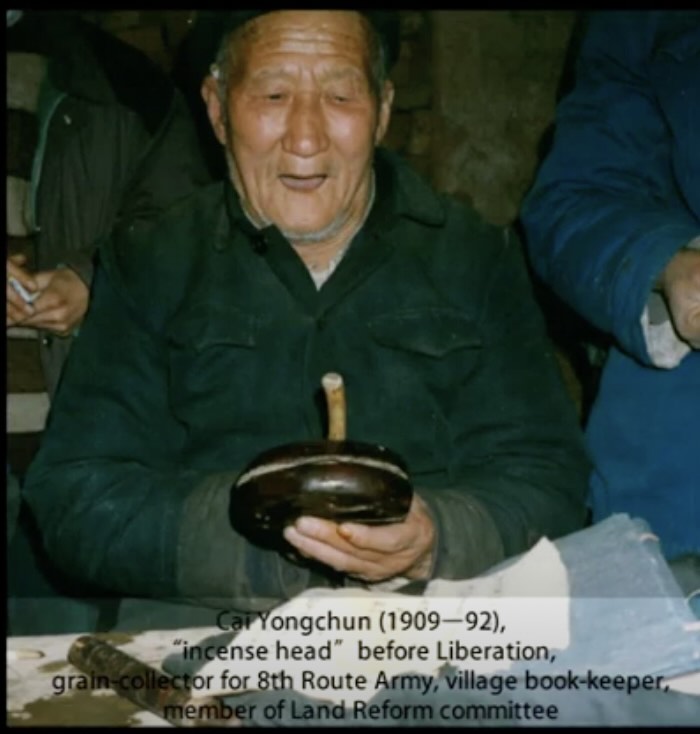


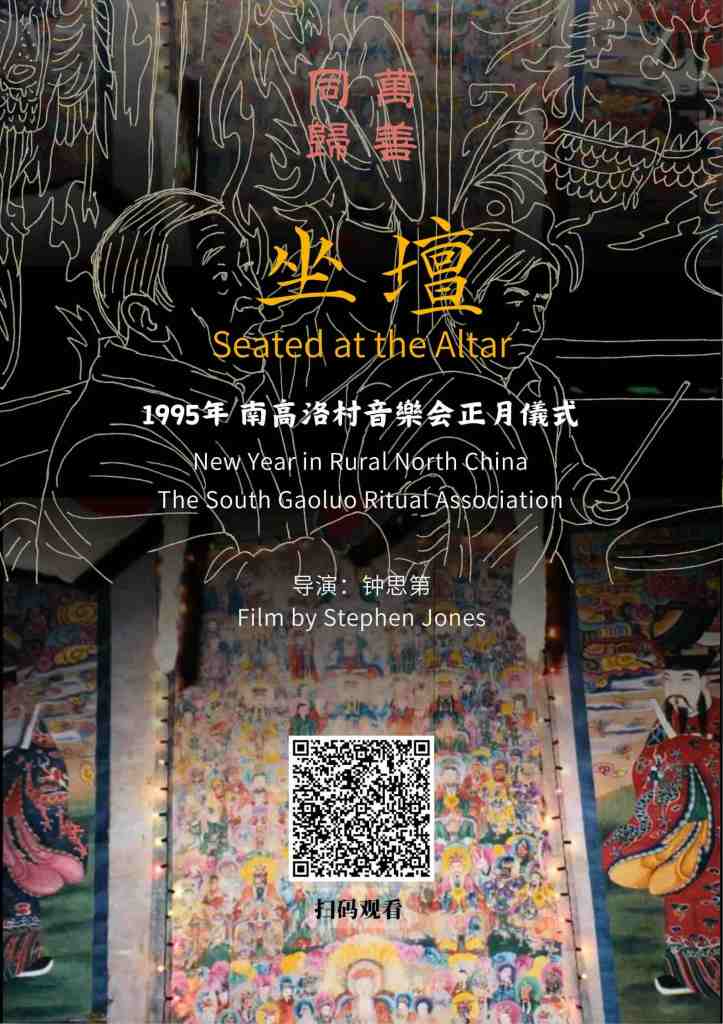


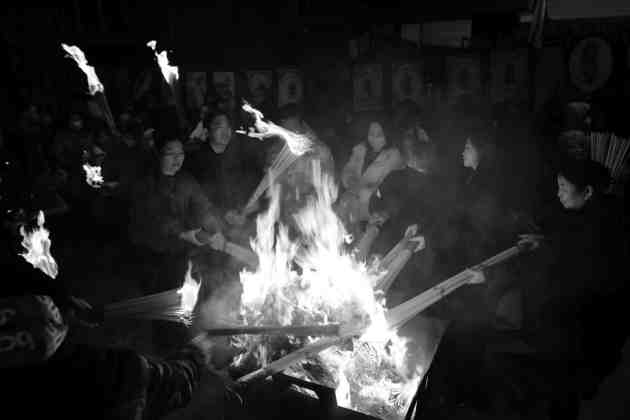


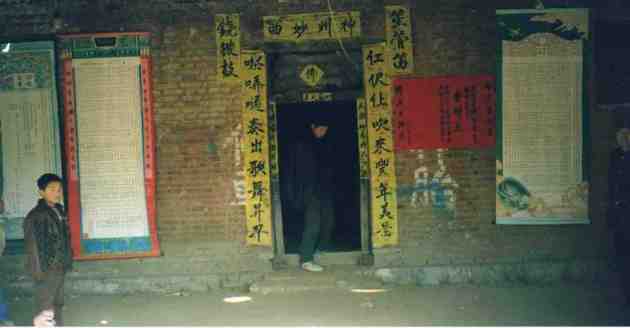
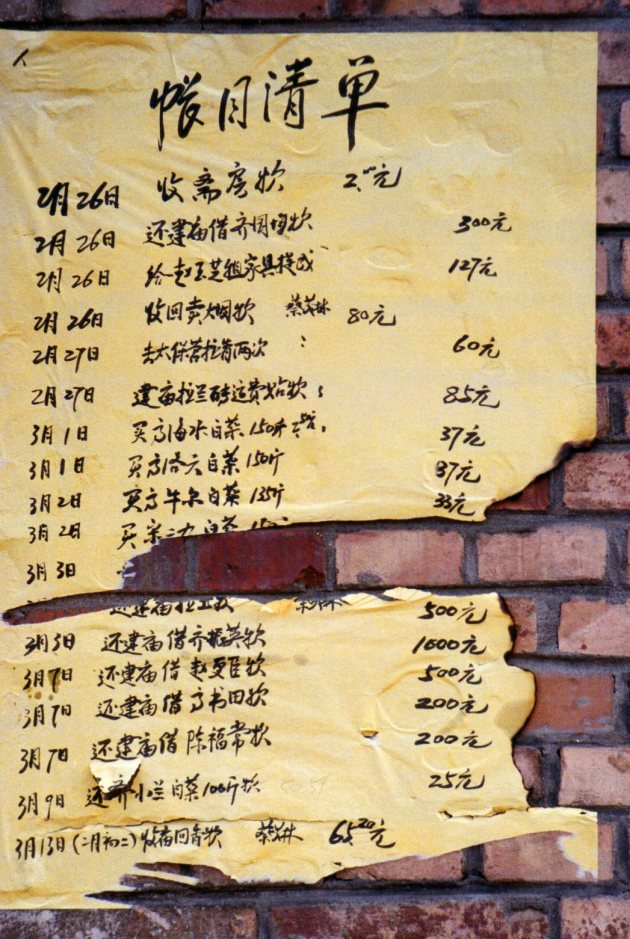

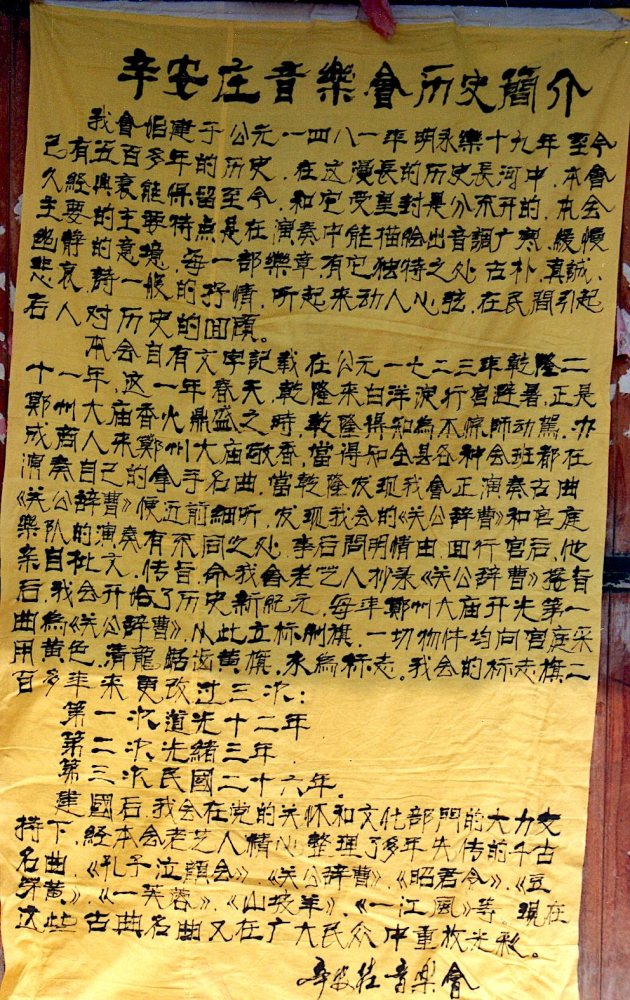


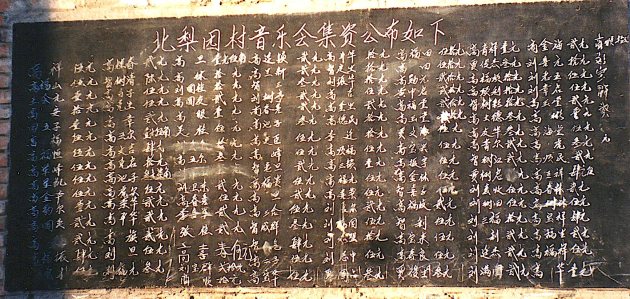


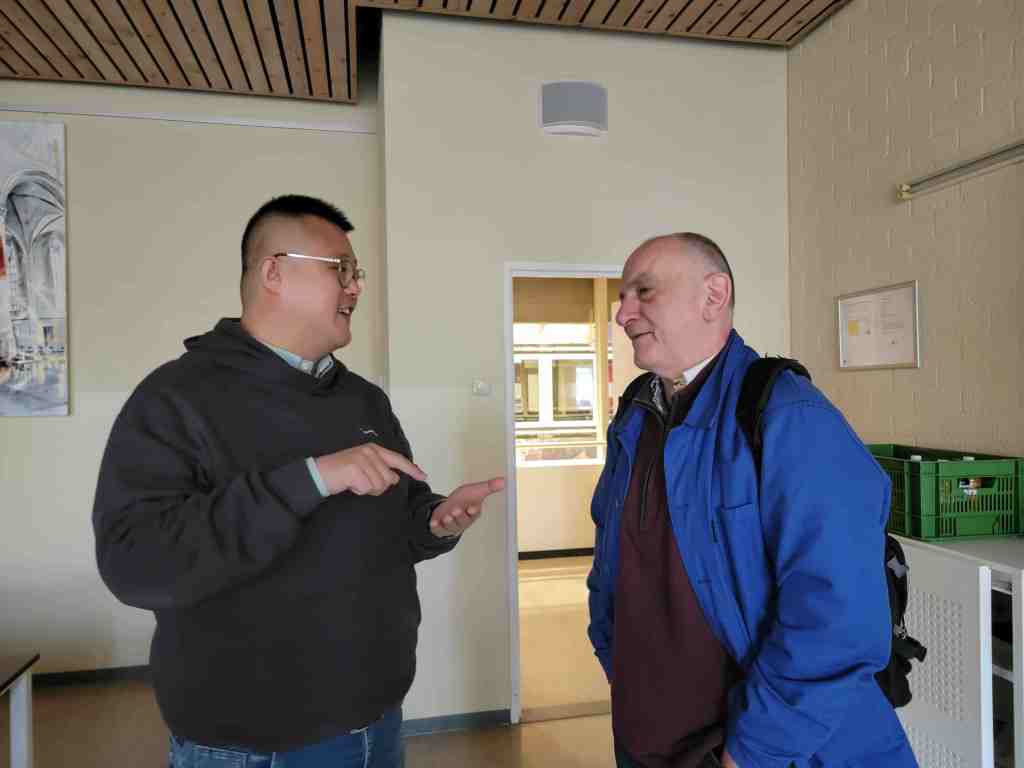


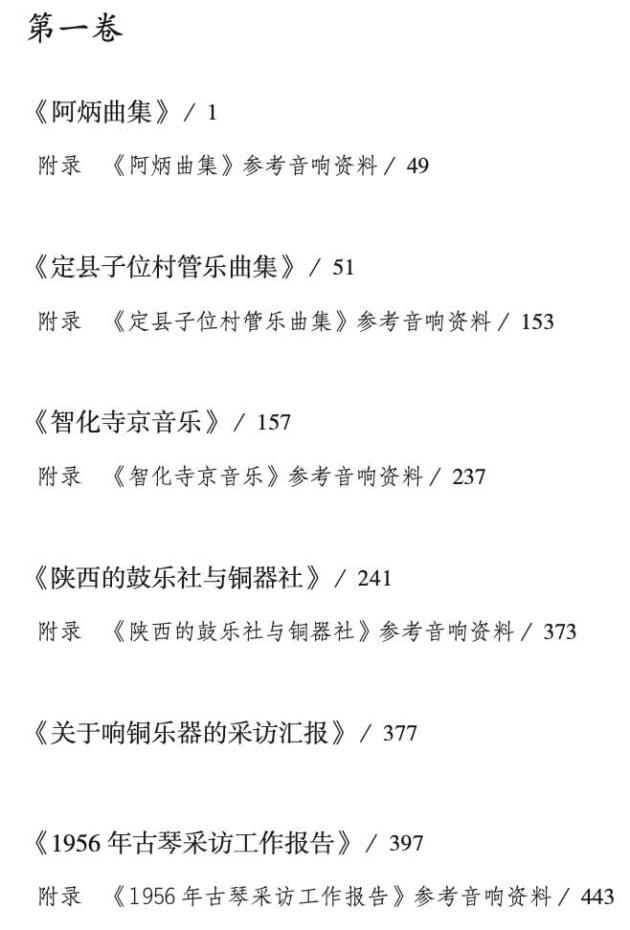


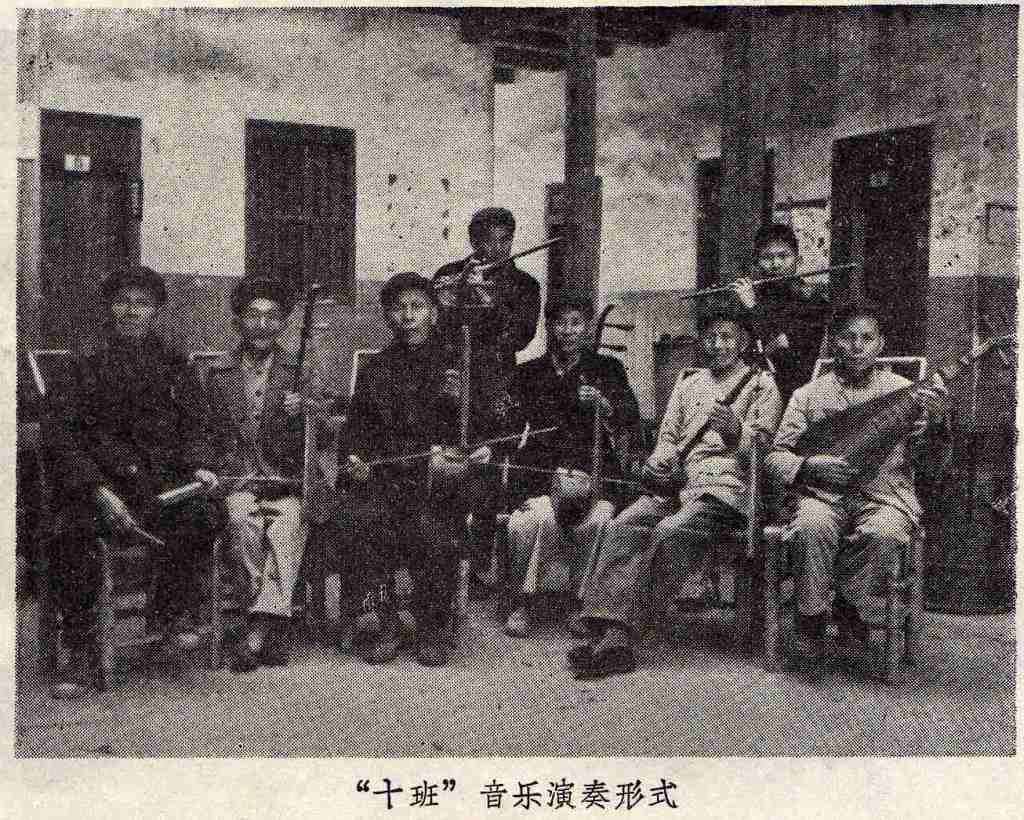
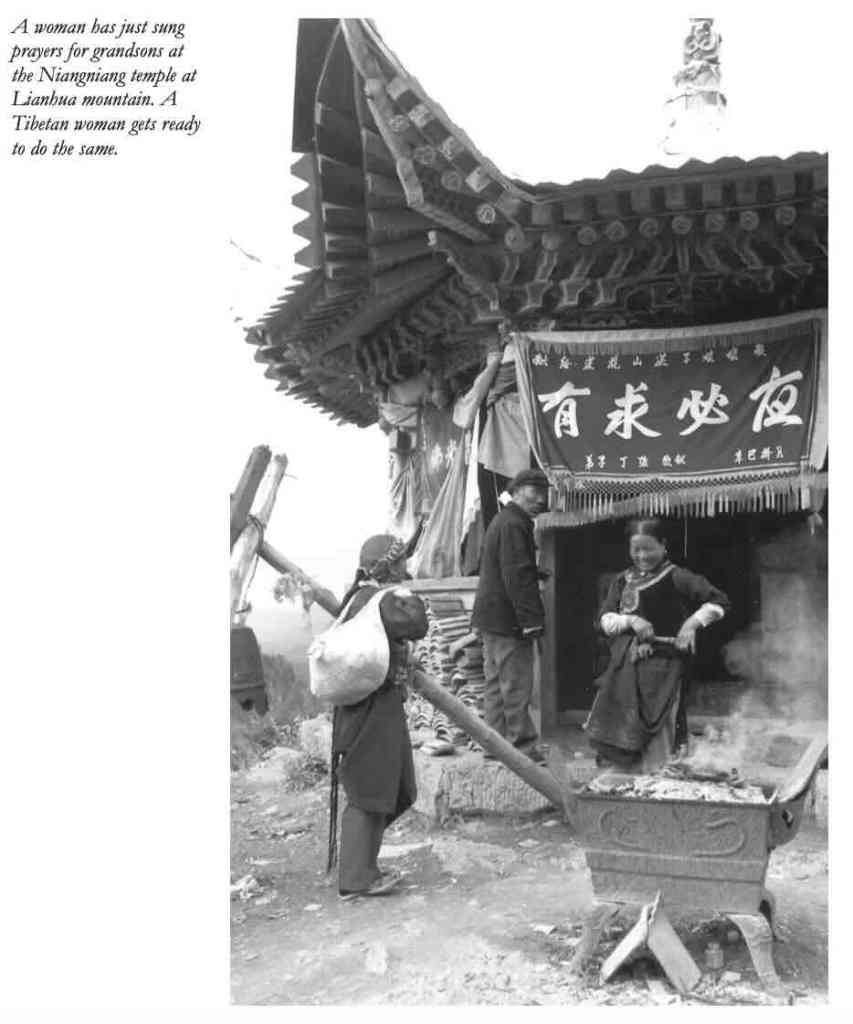

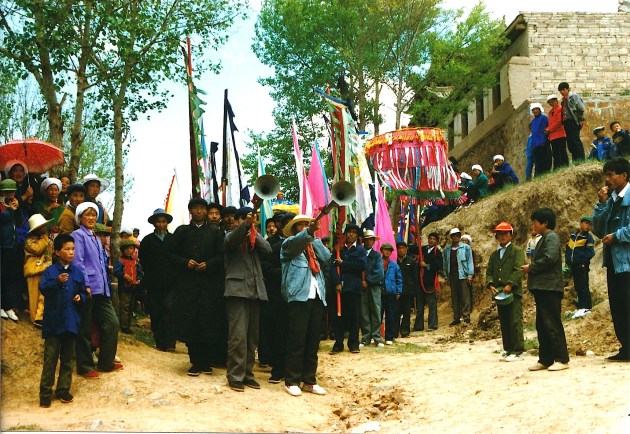




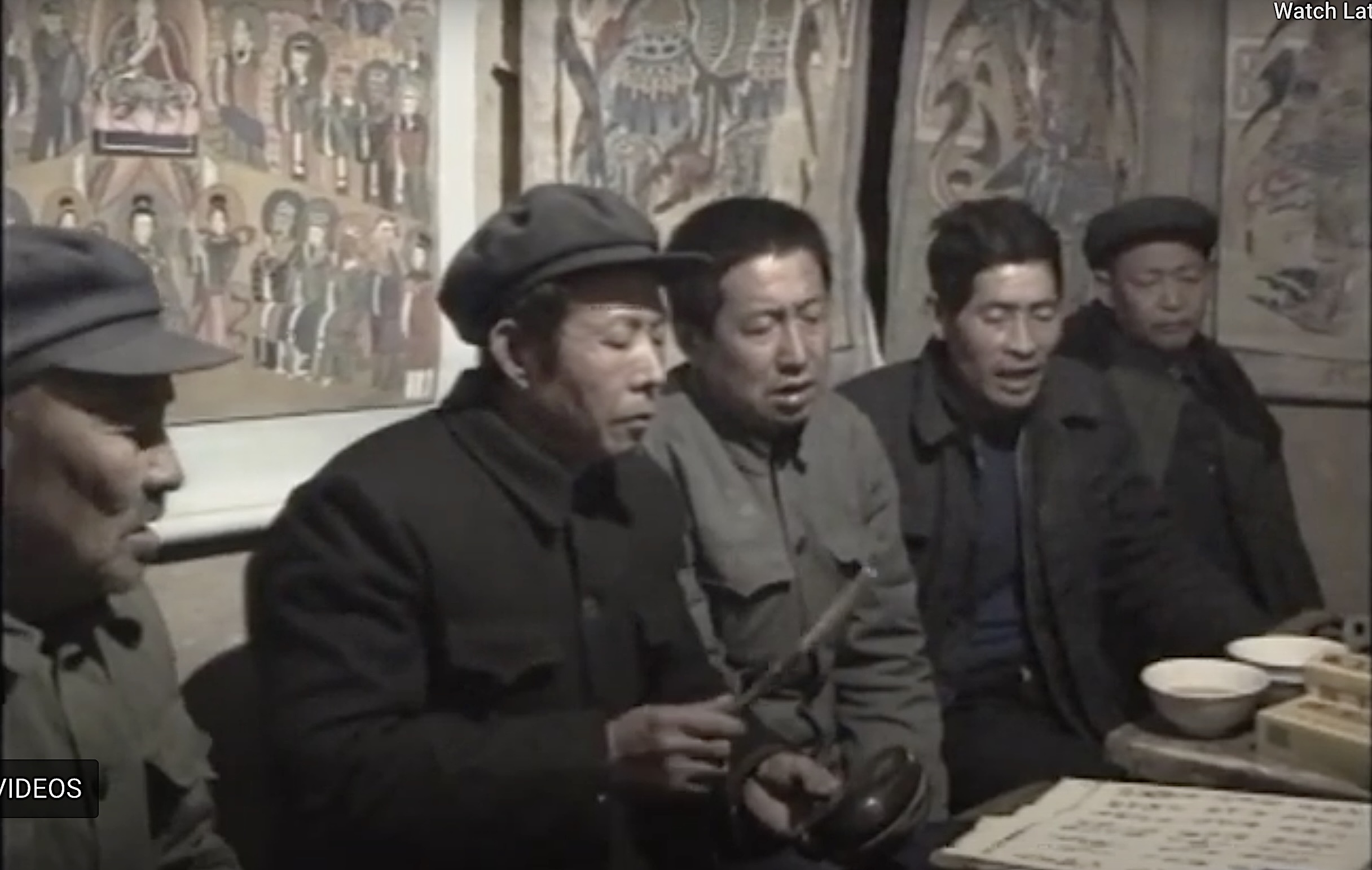


 The lantern tent, New Year 1998, with new and newly-copied donors’ lists.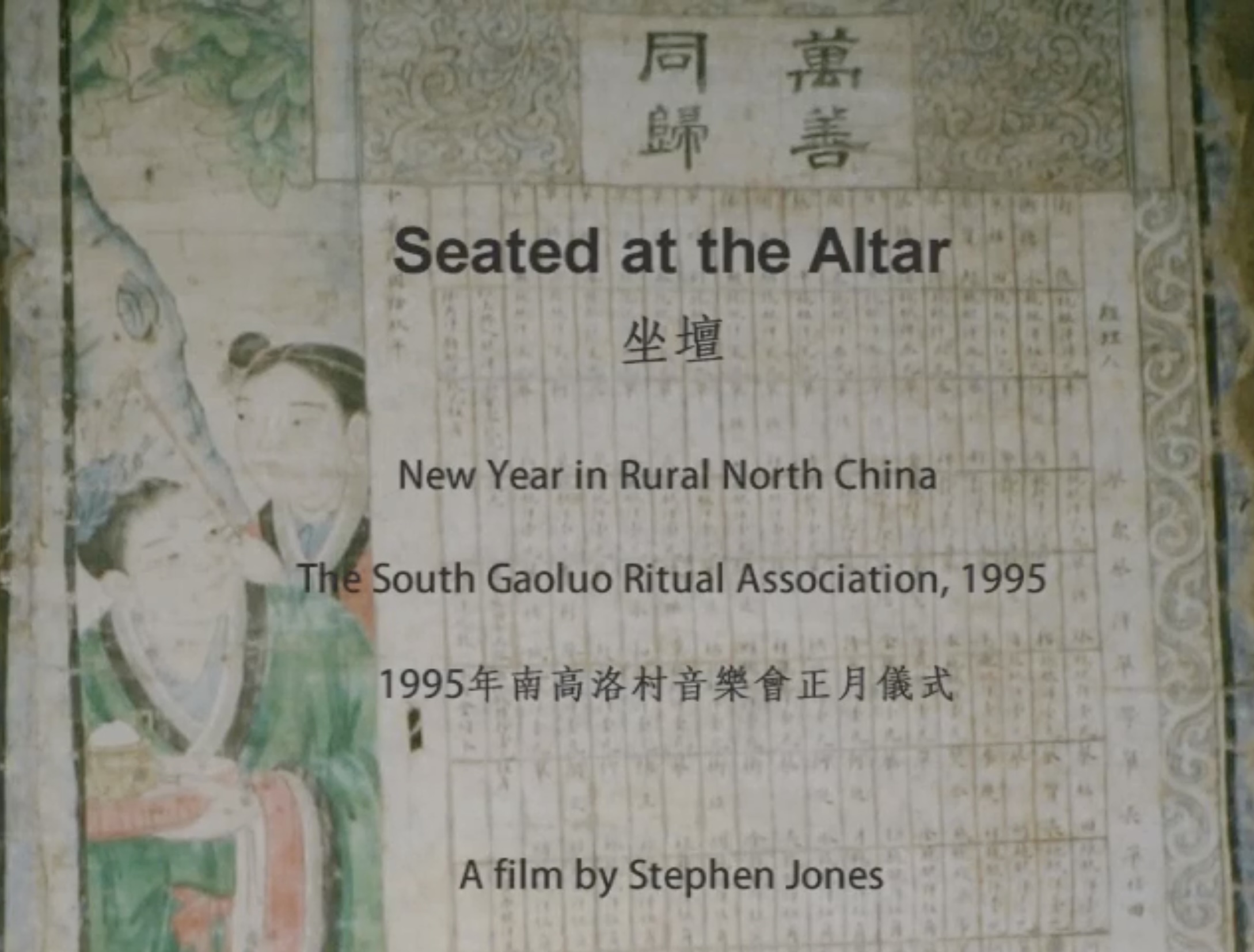


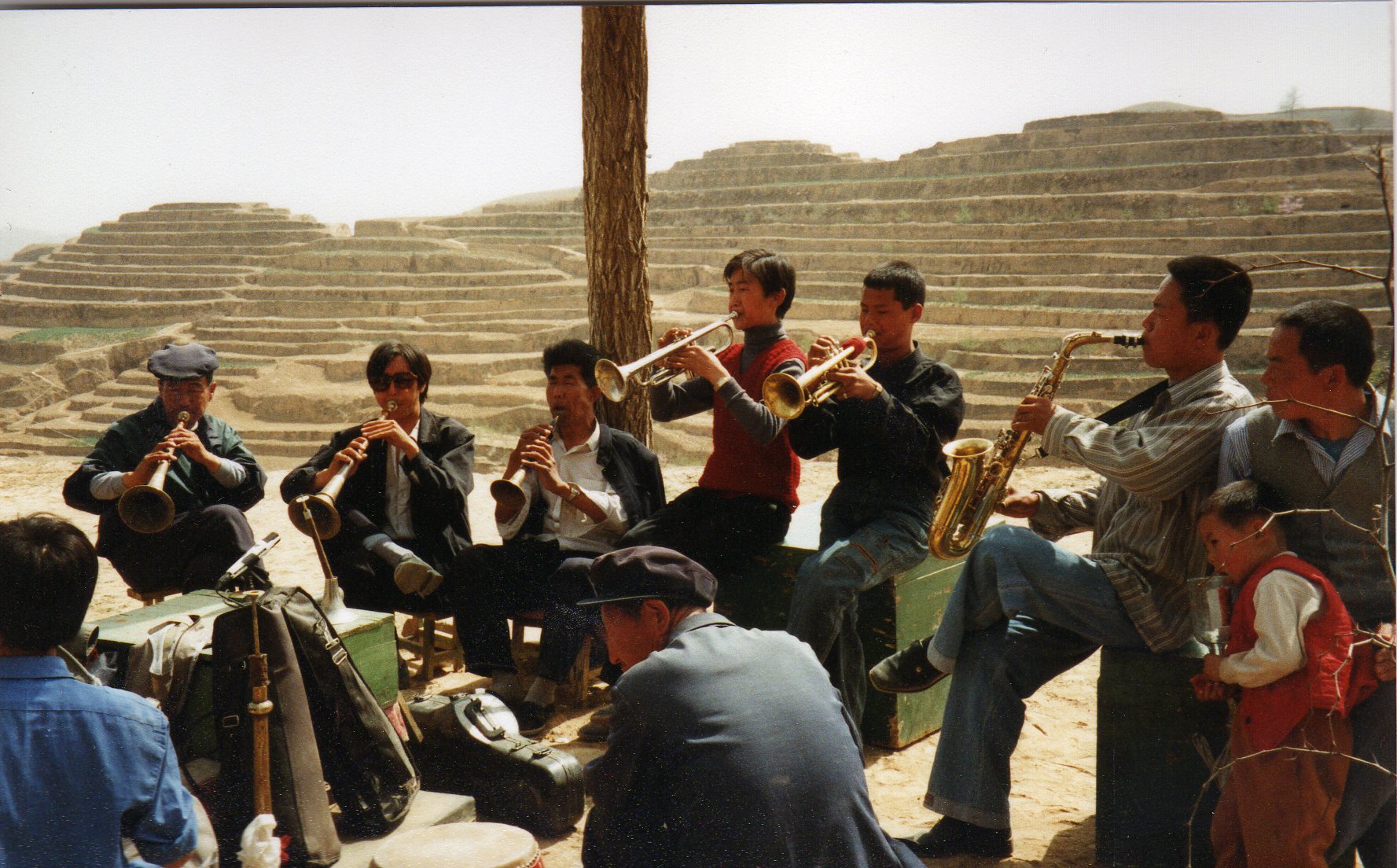 Chang Wenzhou’s big band at village funeral, Mizhi 2001.


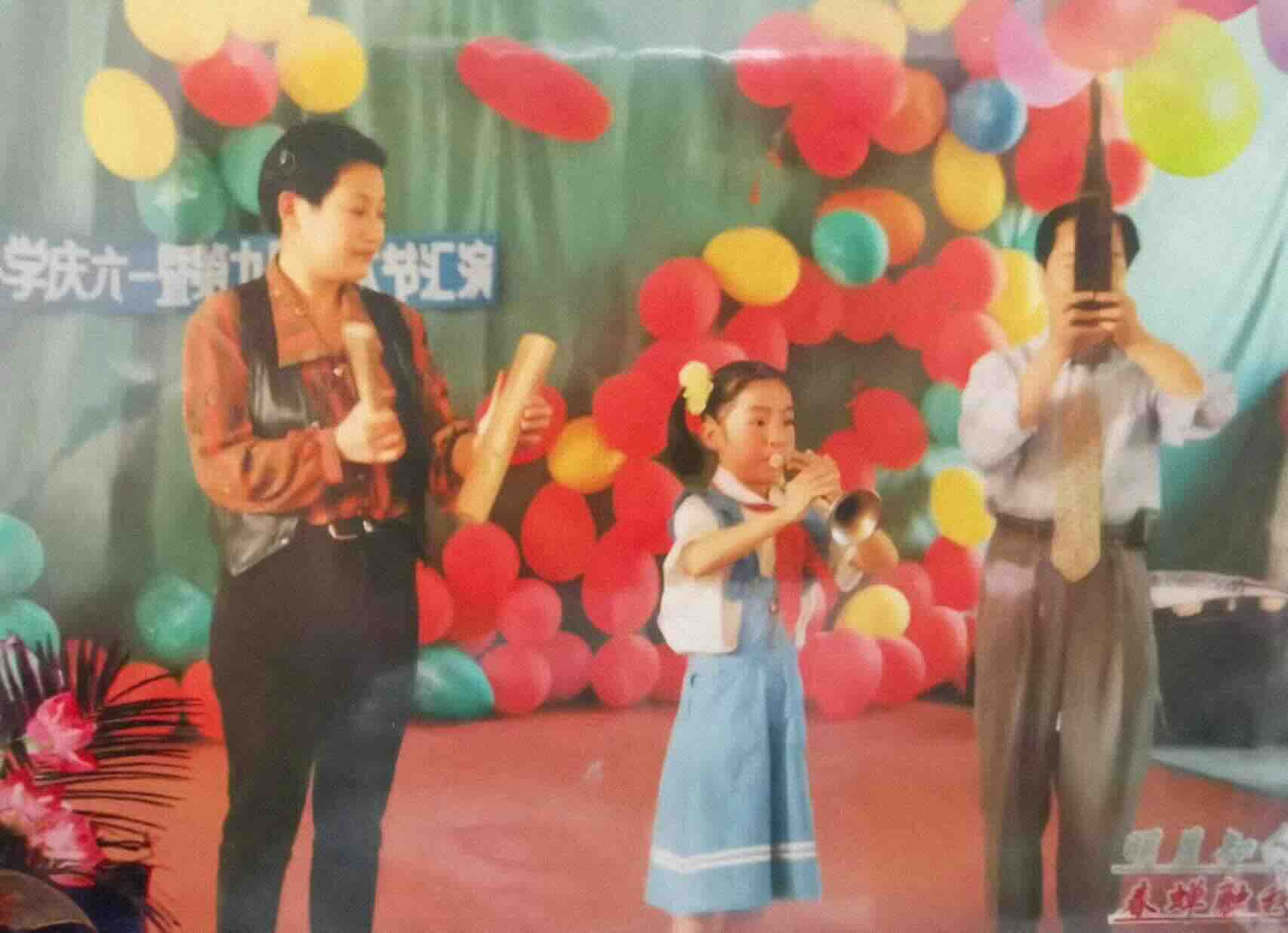 A young Liu Wenwen performs with her parents.

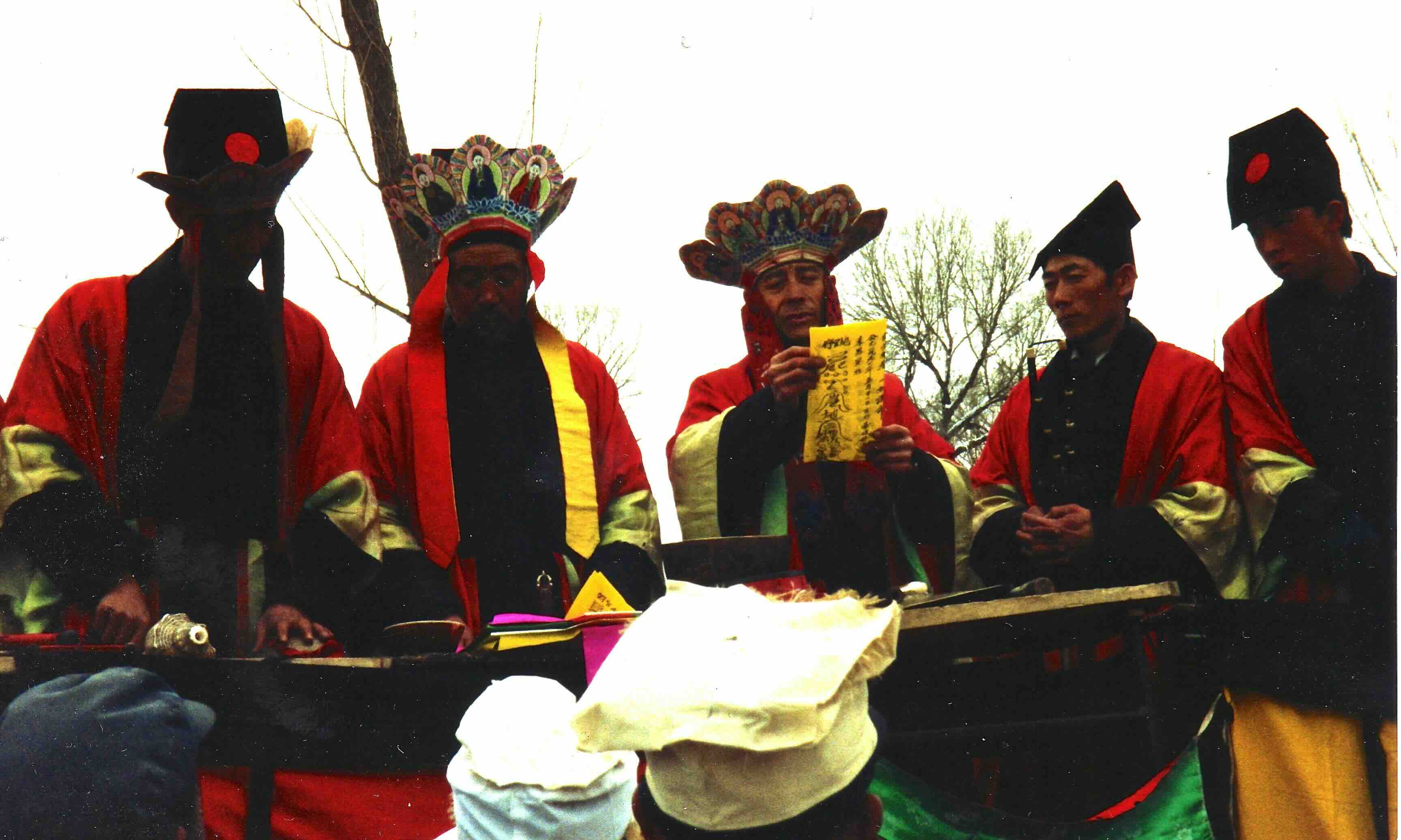 The Li family Daoists perform the
  Li Wencheng in 2021. Cool trousers, eh. Source: Weibo.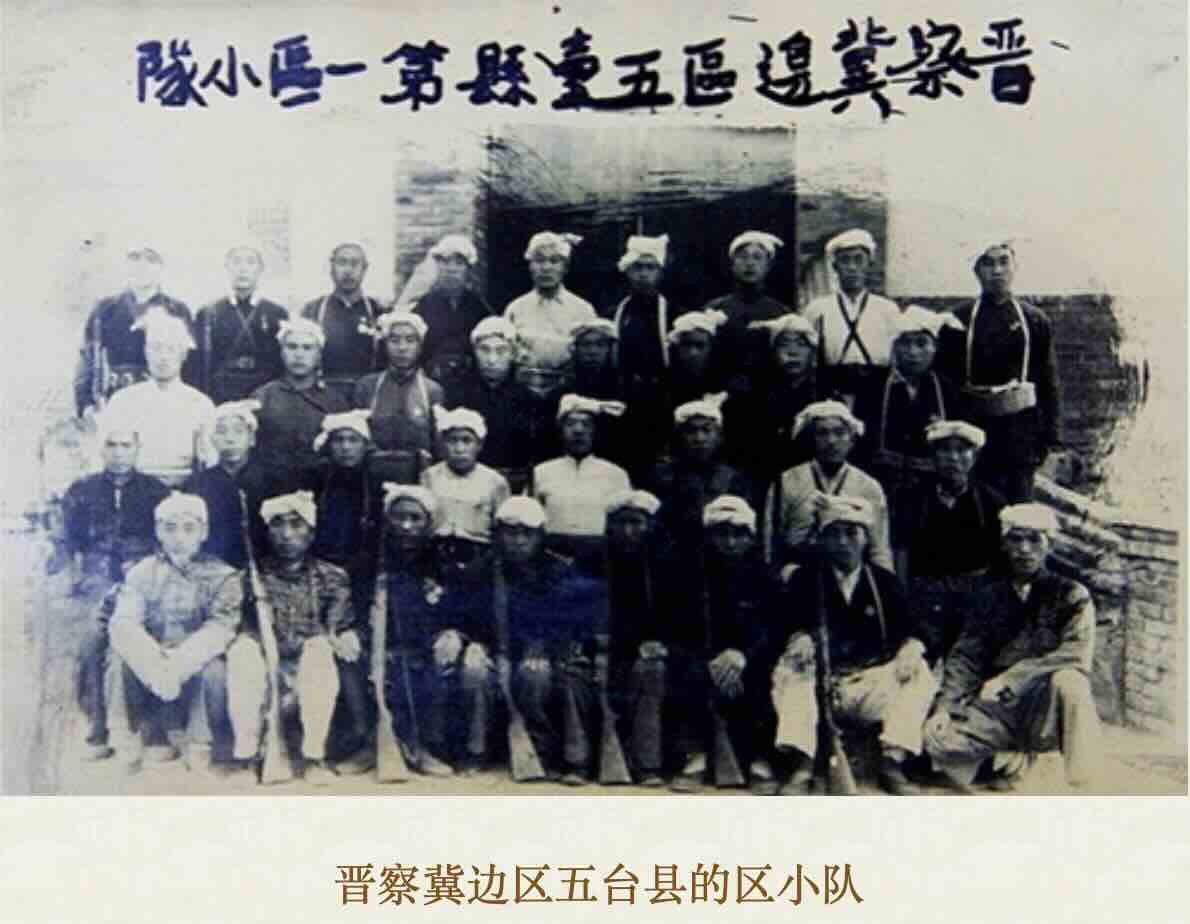

 Li Peisen’s cave-dwelling in Yang Pagoda village.
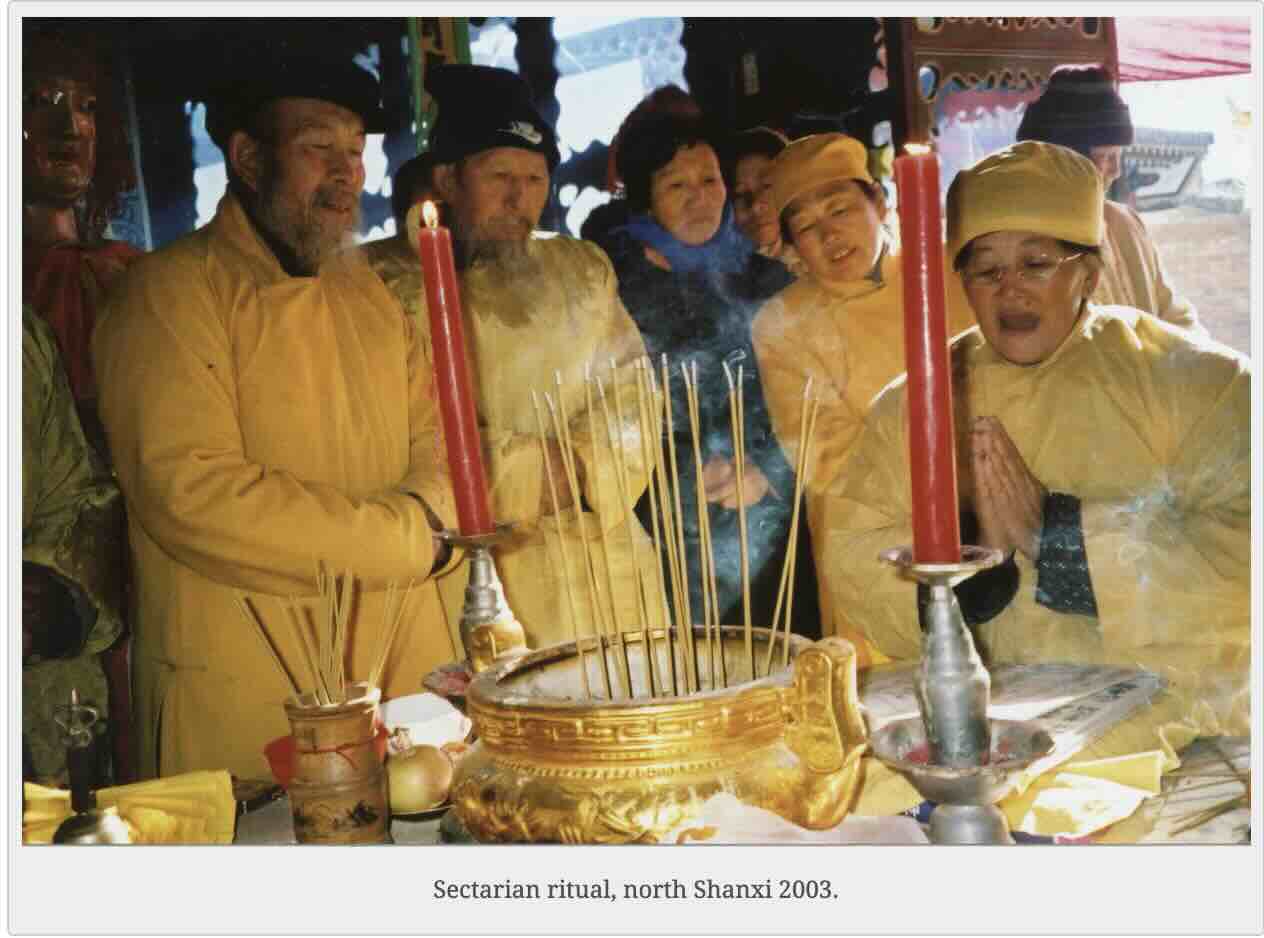

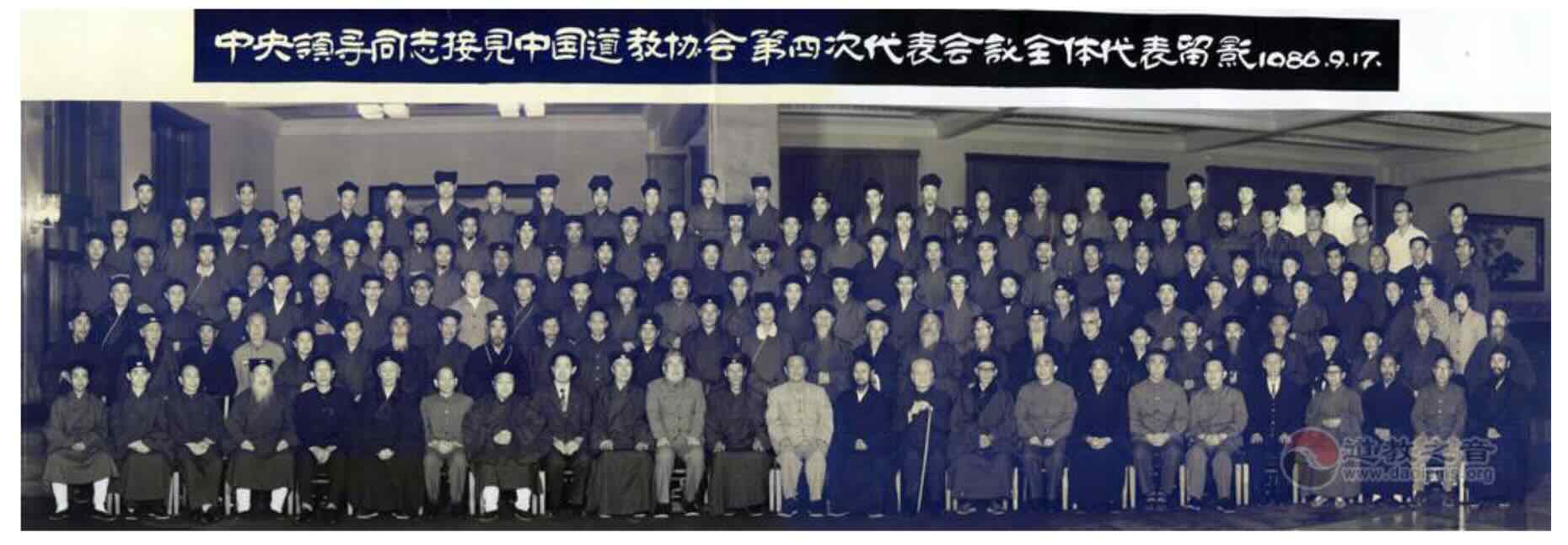
 Great Open-air Offering ritual, White Cloud Temple, Beijing 1993.


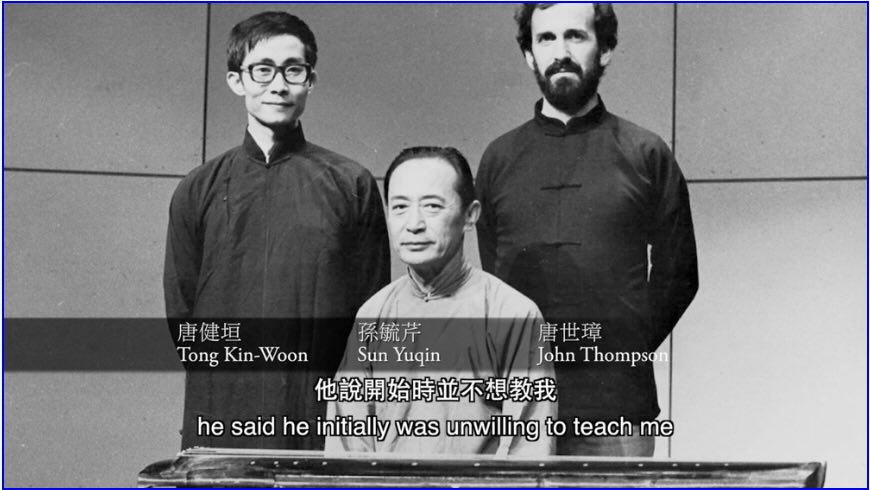

 Nao and bo cymbals of the Tianxing dharma-drumming association,
 Shifan band, 1930s.
 Jinmen baojia tu shuo (1846).


 The Shanhua temple during the


 With Qiao Jianzhong (right) and Huang Xiangpeng, MRI 1989.


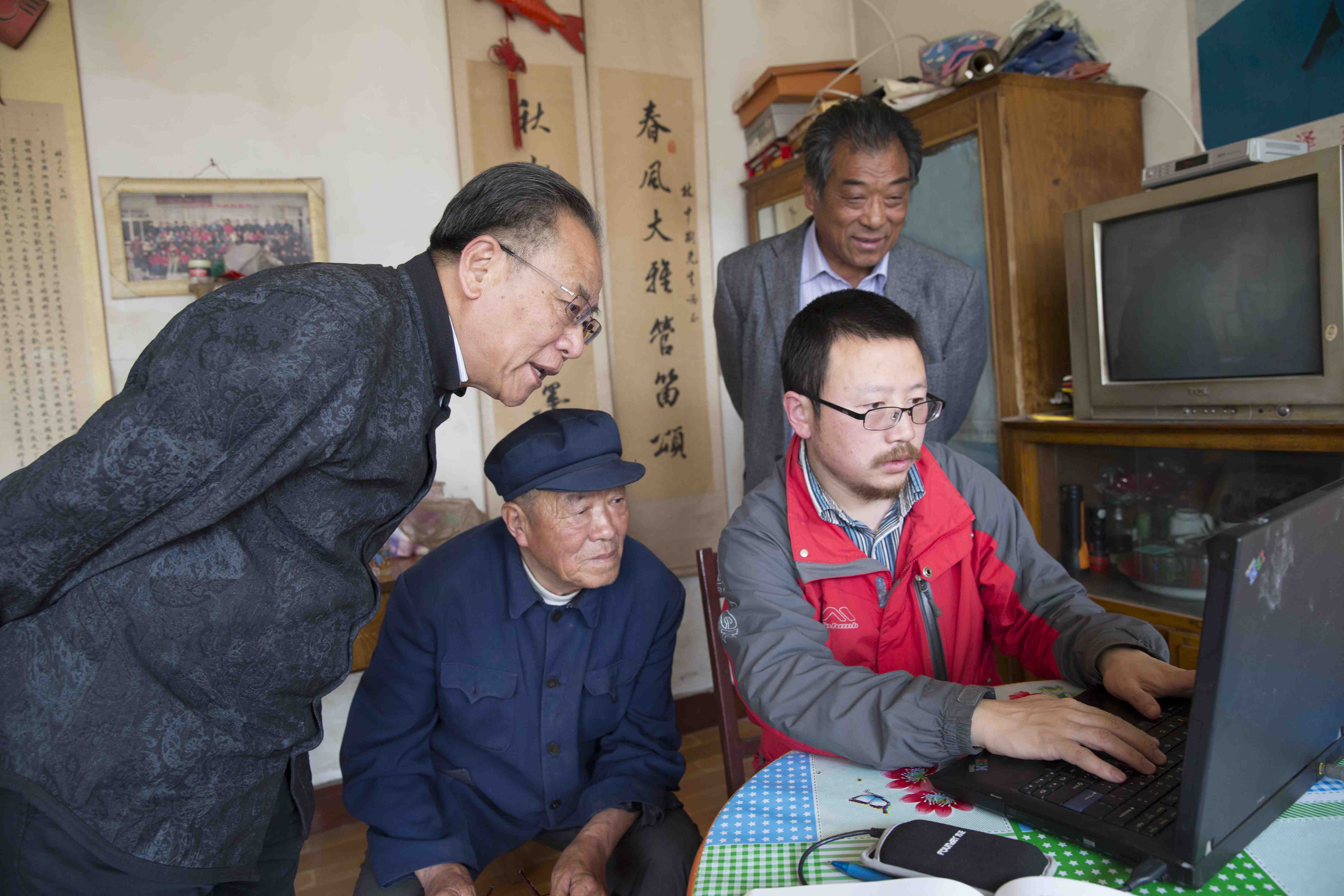 Qiao Jianzhong (left) and Lin Zhongshu (2nd left), 2013,

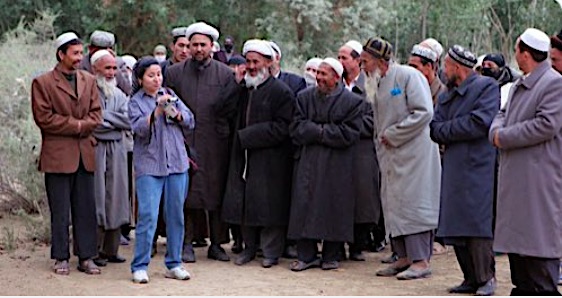




 Scene from the Great Improvement of Luck ritual:
 The Wei Yuan Altar 威遠壇 in suburban Taipei,
 From The hundred thousand fools of God.



 Biographies of Pingtan paizhi master Wang Shanglong and Chen Renzhen.
 The Qinghe guan society in Changtai.
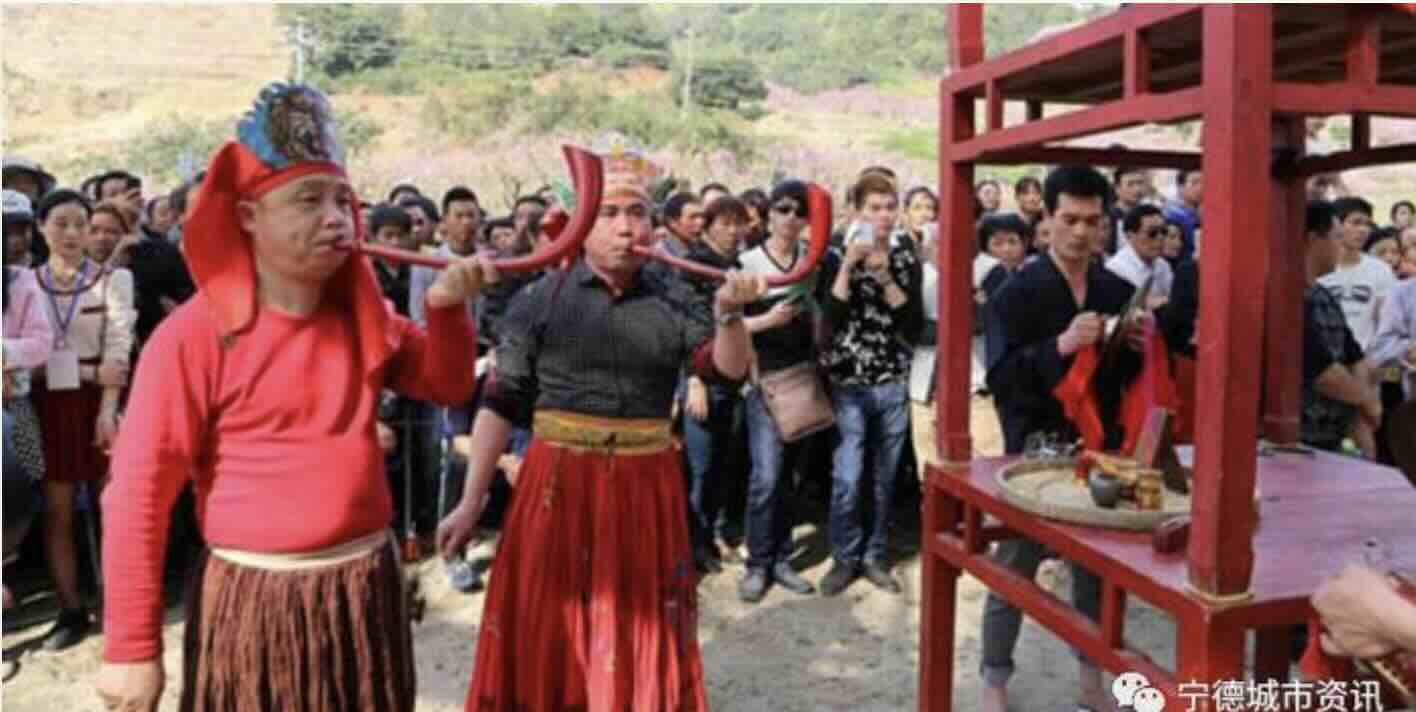

 Household Daoist rituals, Putian.
 Segments of mortuary rituals, Nan’an (again, cf.


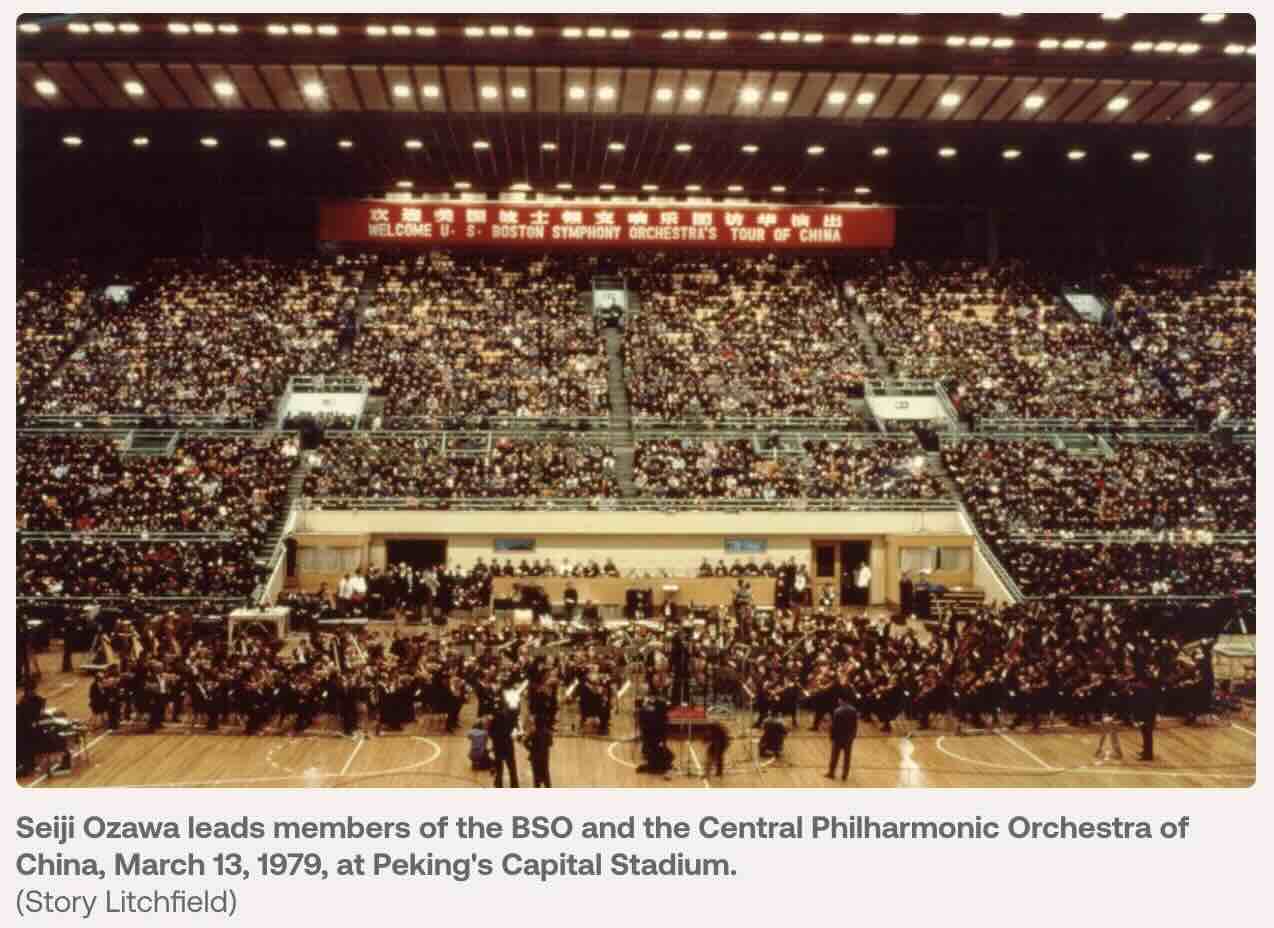


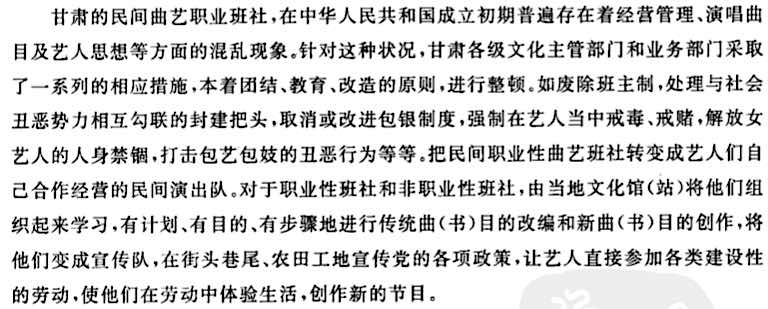
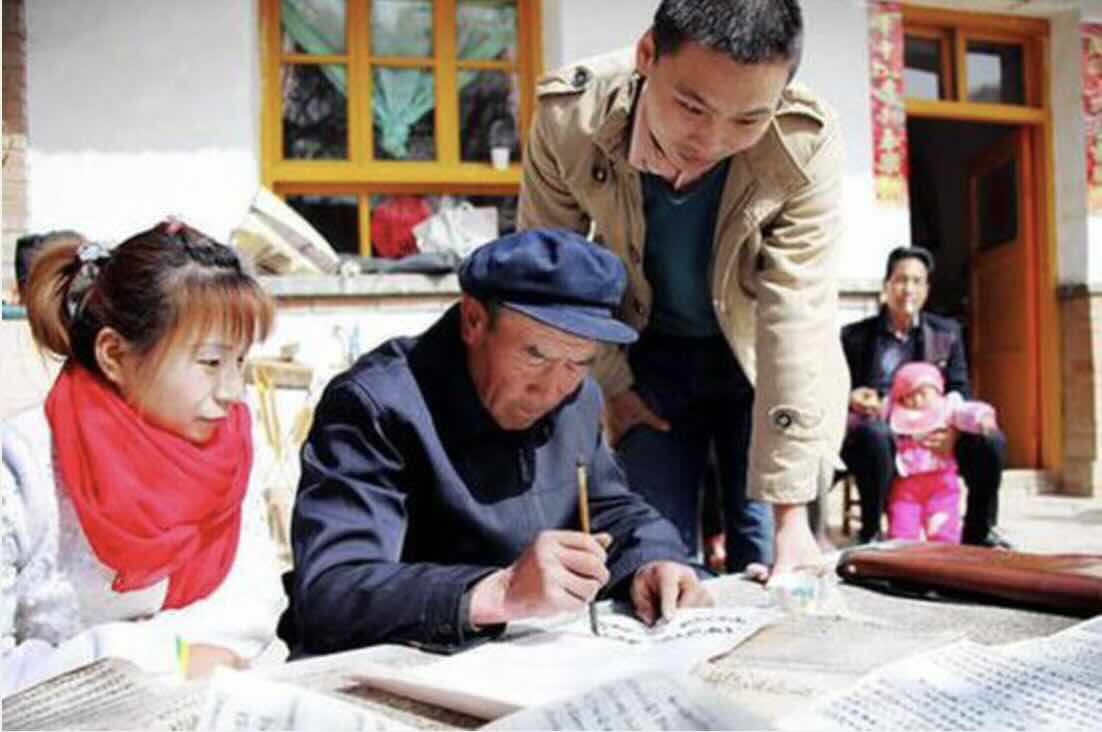


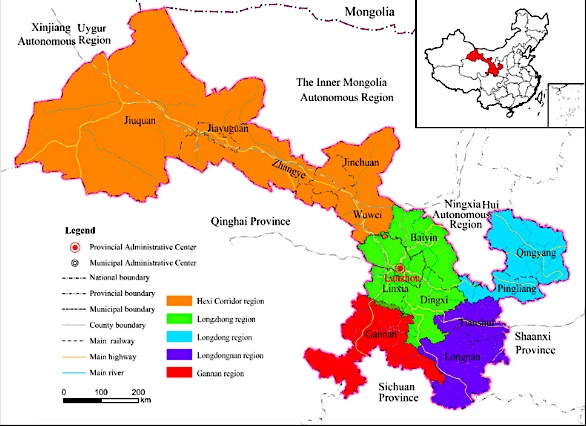


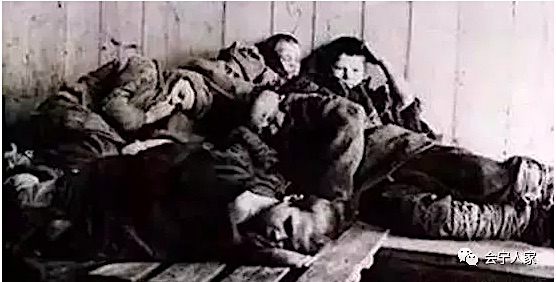





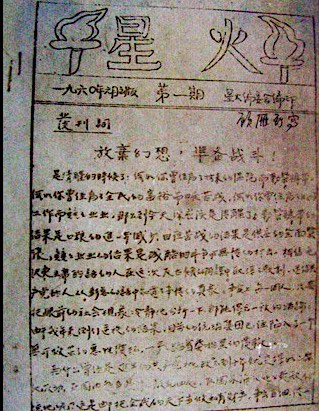


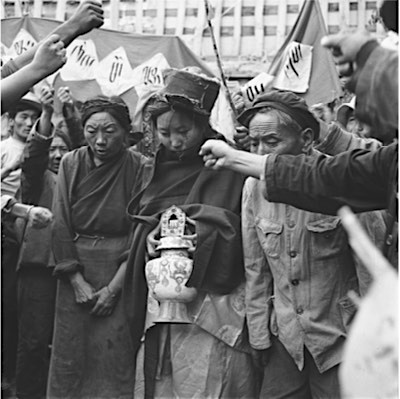





 Hofmann also remarks, rather too sweepingly, that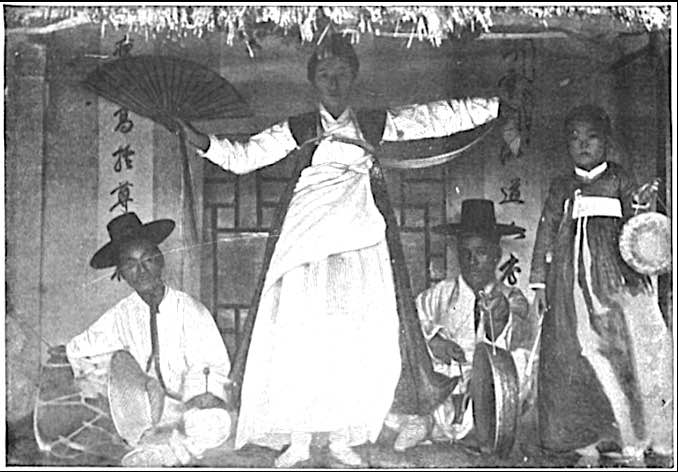


 From Blue kite (Tian Zhuangzhuang, 1993).
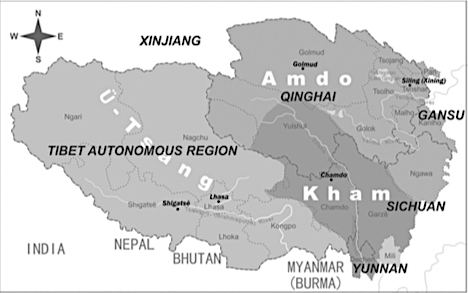
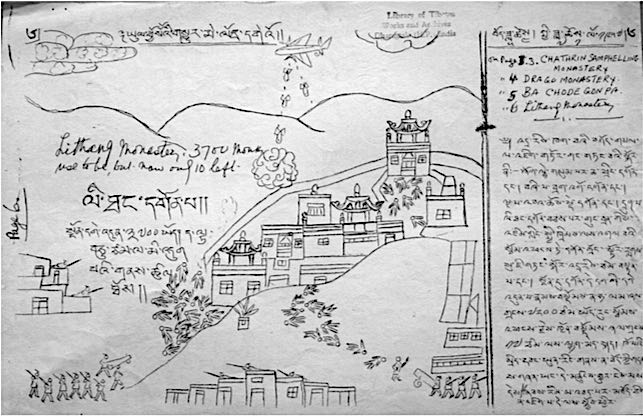
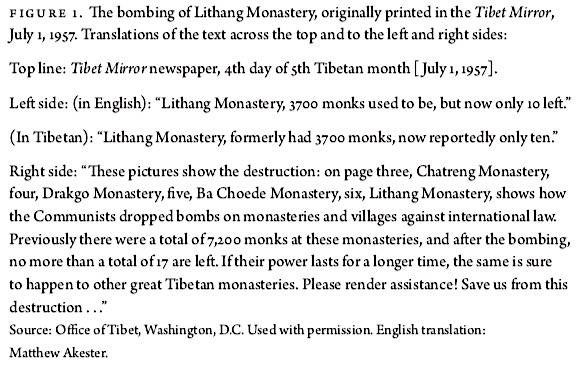
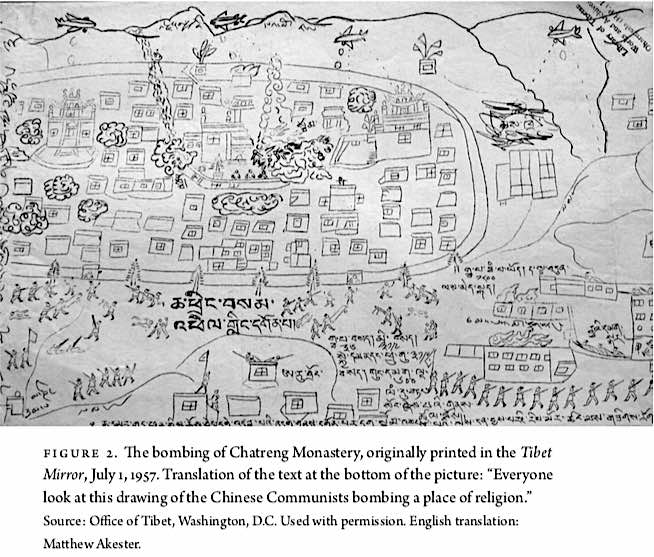
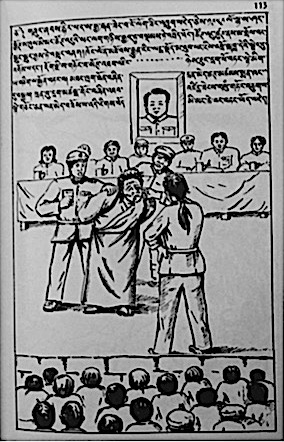
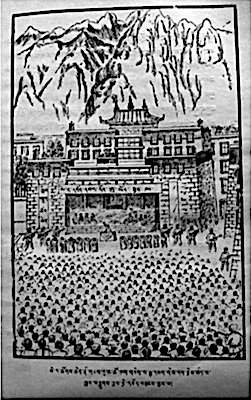
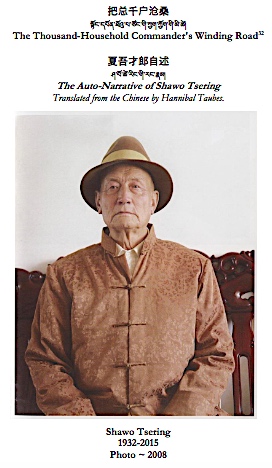


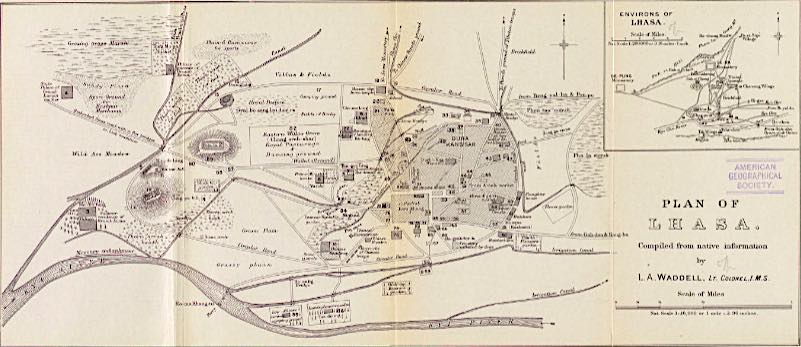 Plan of Lhasa, 1904, by L.A. Waddell.




 With the Mayor of Philadelphia.
 Mother Divine signs her book for Li Shiyu.

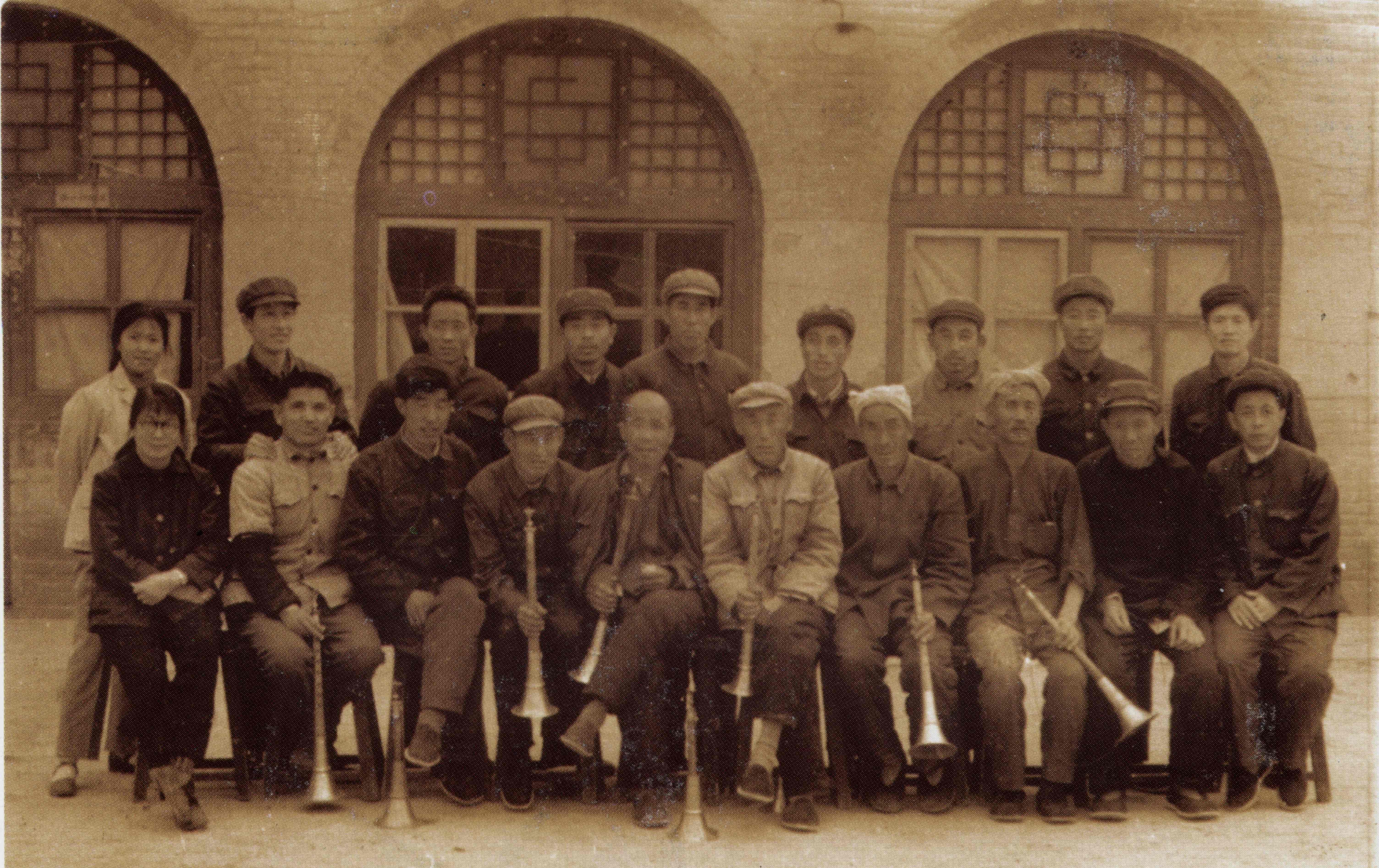
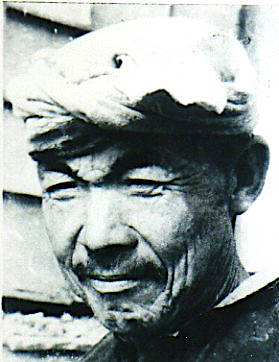
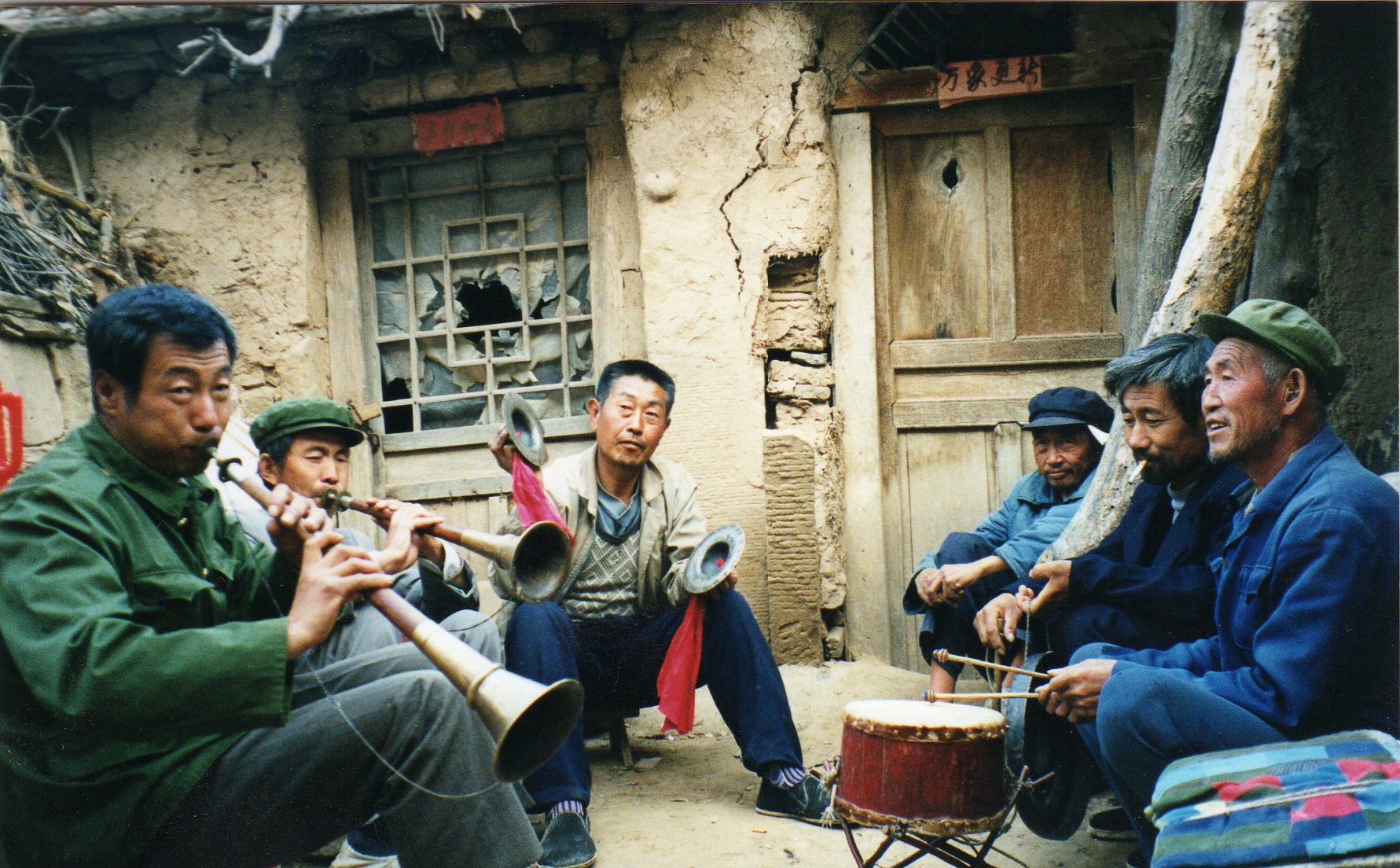
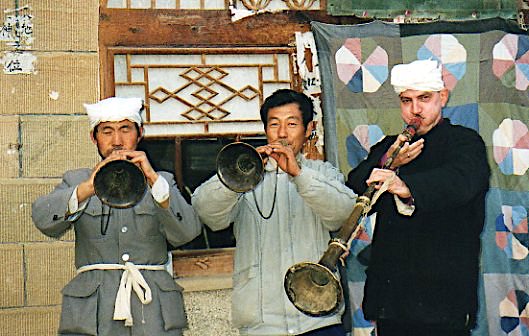

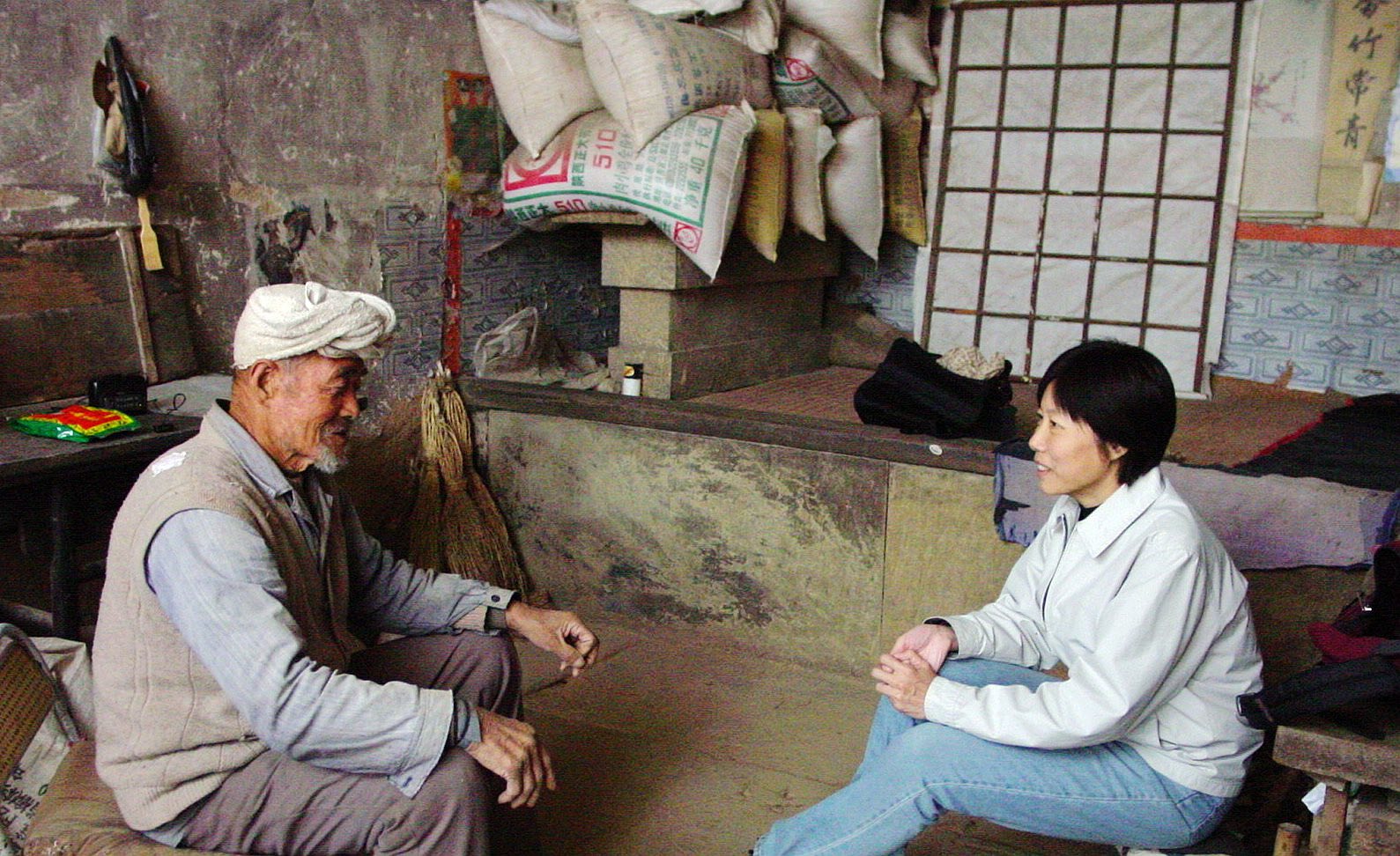




 Stephen Jones: a blog