An Armenian archive

A recent talk at the Orient-Institut in Istanbul, when Ara Dinkjian (son of the great Onnik) and Vahé Tachjian introduced early recordings of Armenian classics, led me to the impressive website

  • Houshamadyan: a project to reconstruct Ottoman Armenian town and village life.

With navigational aids, including useful context here, the site covers local Armenian communities and families on the eve of the 1915 genocide, largely through diasporic records— family histories and memoirs, images and recordings. The site is trilingual in English, Armenian, and Turkish—and the audience within Turkey seems to be significant, as explained in this review.

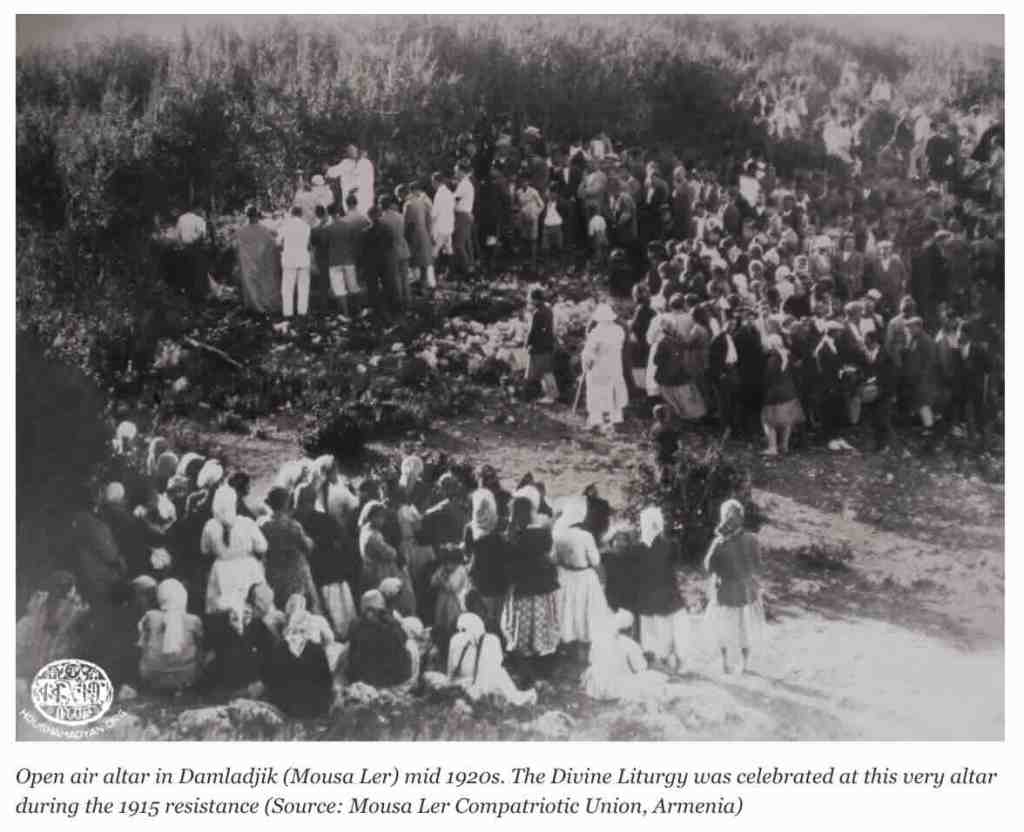
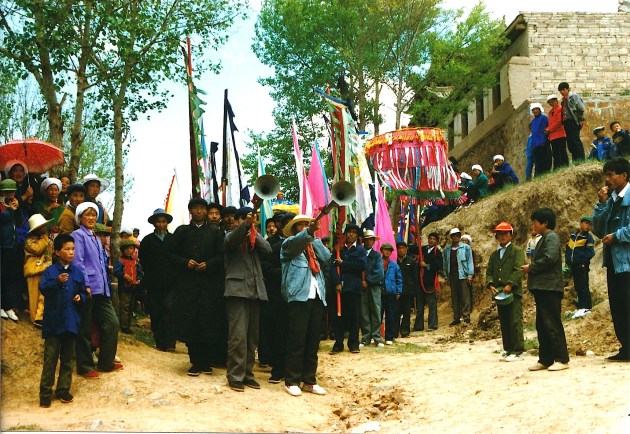
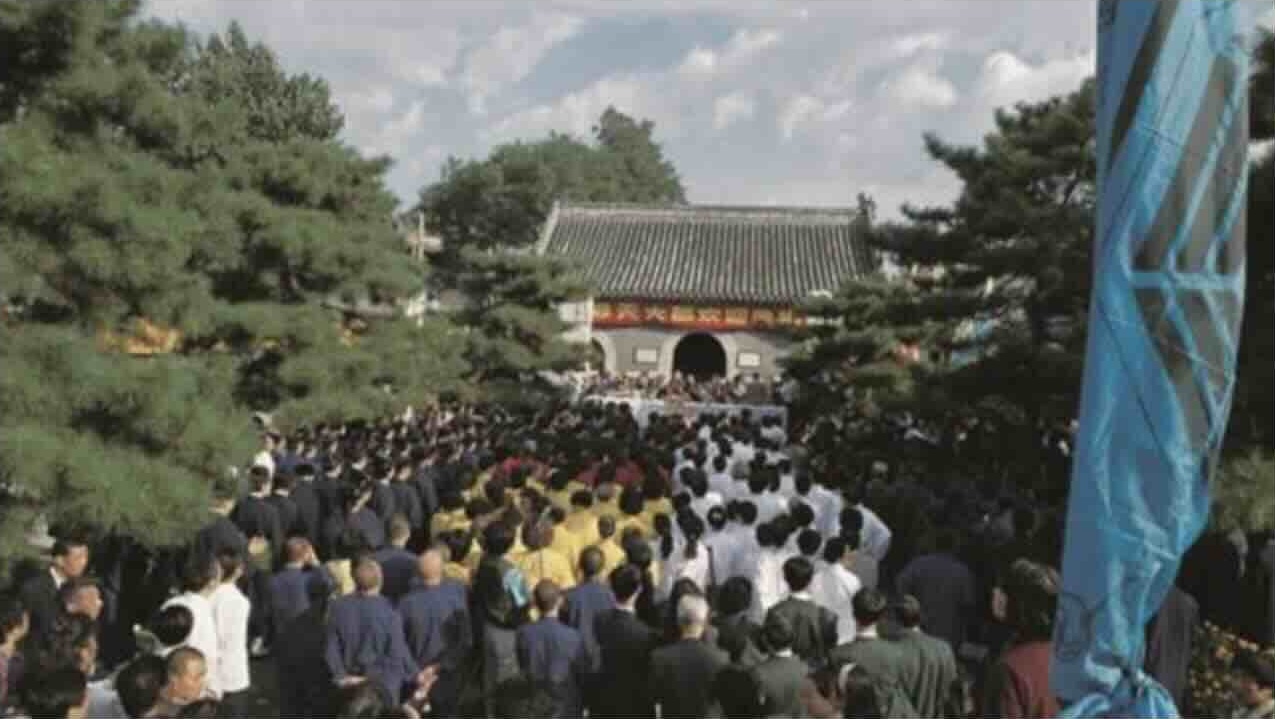
From the “Religion > Festivals” rubric”. Source.

For a documentary introducing the musical world of Dinkjian father and son, click here.

For more of my dabblings in the cultures of west/Central Asia, click here. For another remarkable online archive, see Nicolas Magriel’s work on the sarangi. For diasporic communities in the USA, note Annie Proulx’s wonderful novel Accordion crimes. And for attempts to counteract state-induced amnesia in China and Tibet, see e.g. here.

In memory of David Hughes

Source: CHIME newsletter.

On Sunday SOAS hosted a grand celebration of the life of the great ethnomusicologist David Hughes (1945–2025), who died in May. Among many notices online, see this by Rachel Harris and Hwee-san Tan; Frank Kouwenhoven wrote eloquently in the CHIME newsletter.

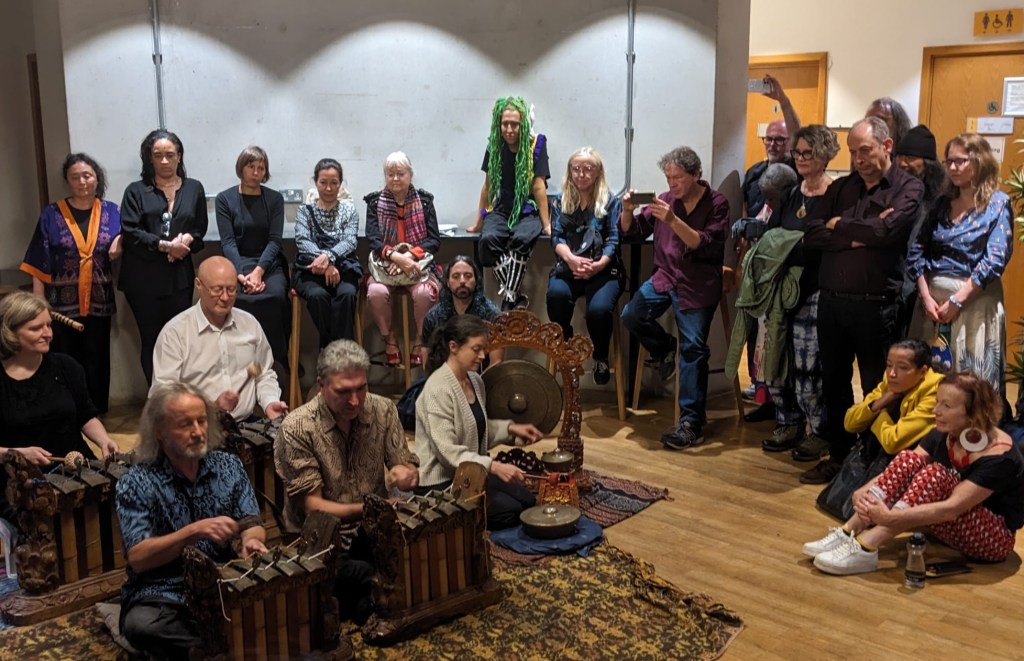
After embarking on a PhD in ethnomusicology at Michigan under William Malm, from 1977 David thrived on fieldwork in Japan, together with his wife Gina Barnes. In 1981 they came to Cambridge (England!) to further their research, and it was there that I first met him as we consulted Laurence Picken. David went on to teach Japanese and Southeast Asian music at SOAS, becoming Head of Music and building a vibrant performance culture in a wide range of genres (he covered some of these topics, engagingly as ever, in this playlist). So the SOAS event resembled a retrospective of three decades of world music at SOAS and in Britain, with many of David’s former students performing; apart from copious Japanese music, among other featured groups that David supported and inspired were lively renditions of Cuban music and gamelan. And videos of his own performances were on display at the reception.

David was a co-founder of the British Forum for Ethnomusicology, and offered wise perspectives as a member of the CHIME board. Along with his in-depth research on Japanese folk-song, he had an authoritative grasp of Japanese musical cultures, as shown in his co-editing of The Ashgate research companion to Japanese music and his chapter on Japan for The other classical musics; he received several awards in Japan for outstanding contributions to Anglo-Japanese understanding. His lively and informal presence offered a welcome antidote to the more traditional British style of academic presentation—as a jovial performer, he was the life and soul of the party, delighting in language, an inspiration to many students. As is the nature of such things, the one person who would most have relished the event could not be present. David is much missed.

See also Some posts on Japanese culture.

Gaoluo film: Chinese version!

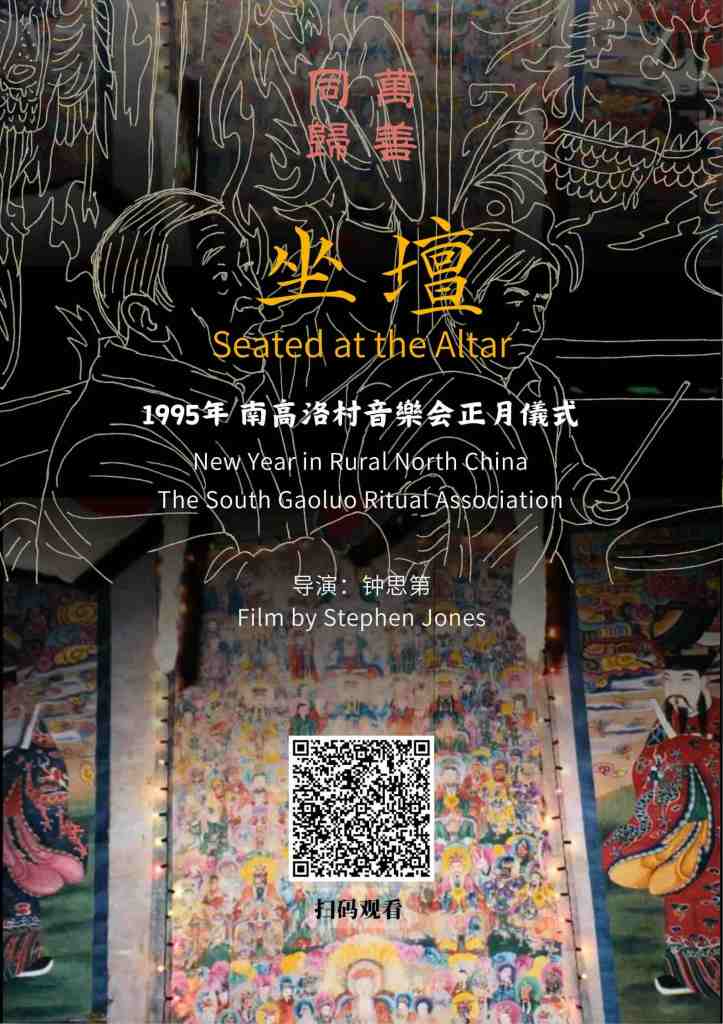
Following the online publication of my film on the 1995 New Year’s rituals in Gaoluo, a screening in the village itself prompted a version with Chinese subtitles, on which I worked with the diligent Feng Jun.

It is far from a literal translation of my English script—I was keen to adapt it to reflect the idiom and way of thinking of the Gaoluo villagers. So rather than the terminology of urban academia, we incorporated local vocabulary like lao guiju 老规矩 (“the old rules”: tradition), dangjia 当家 (“boss”), jiahuo 家伙 (percussion), wentan 文坛 (“civil altar”: vocal liturgy), and songjing 送经 (“escorting the scriptures”). In many ways I find it preferable to the English text—since the original English voiceovers are intact, it’s worth watching even for those not dependent on the translation.

The Chinese version is now available both (in China) on the CDTM website (follow this link) and on my YouTube channel (alongside the English version):

And do browse the posts under Gaoluo in the top Menu! Click here for thoughts arising from presenting the film at SOAS; here for an intriguing Chinese review; and here for a screening in Leiden along with my film on the Li family Daoists.

With many thanks to Wei Xiaoshi!

Gaoluo: some themes

Presenting my film on Gaoluo at SOAS the other day, and the following discussion, thoughtfully led by Rachel Harris and Feng Jun, prompted me to try and rework some of my thoughts.

My book on Gaoluo was published in 2004, the result of frequent fieldtrips ever since 1989, and it’s full of detail on the lives of villagers through all the social and political upheavals of the 20th century. But I then moved onto other projects, and I only returned to the topic recently, to compile this film from my footage of the 1995 New Year’s rituals, which makes a nice succinct subject—and already a historical one, as I say in the film.

I see ethnography and film as essential complements to library work on imperial history (see here). This kind of subject, though vital to folk society, can’t be addressed only by reading old books in libraries. Actually, the topic hardly appears at all in old books—it’s only revealed by fieldwork. Until the 1950s almost every village in the region had an organisation like this; and many of them still do. While I eventually focused on this one village, we also did a survey of over a hundred village associations nearby (see e.g. under “Hebei” in the main menu, including this survey).

Religion
The whole topic of the Hebei ritual associations was only “discovered” by Chinese musicologists in 1986, and it has become a major theme within that discipline—but alas, not in religious studies. I think there are two main reasons for this.

First, terminology. These groups are now commonly known by the umbrella term yinyuehui, which seems to translate simply as “Music Associations”. But it’s confusing: in these villages the term yinyue refers very specifically to the melodic instrumental ensemble that accompanies the rituals of Buddhist and Daoist temples. That indeed was our initial interest, but it’s only one aspect of the associations’ ritual activities, their “instrumental department”, if you like. The term does have an authentic historical pedigree, but to us (both in the West and for urban-educated Chinese) it suggests an unfortunately secular image, like some kind of folk club for entertainment, which encourages Chinese attempts (both in the media and in academia) to downplay the pervasive role of religion (or “superstition”!) in folk society. So I obstinately insist on calling them ritual associations. Despite the gradual decline of vocal liturgy in the region, associations preserve many ritual manuals. And while the melodic instrumental repertoire now dominates, many groups regard these pieces as “scriptures”.

Apart from terminology, folk religion is a sensitive subject. There are some fine scholars in China, but they mainly write about earlier history and written texts, and are cautious about documenting events since 1949, or current activity; whereas we who study expressive culture incline more towards fieldwork. At least, scholars of religion could choose a few villages to clarify the transmission (whether “Buddhist” or “Daoist”) from early temple priests, and study early artefacts such as ritual manuals (not least the “precious scrolls”) and god paintings. While it may now be hard to establish a different image to that of the ICH (see below), the system has legitimised such associations, and they are not subject to the taint of “superstition”—even if scholars of religion may choose to exercise a certain discretion about the early sectarian connections that we documented.

These associations on the Hebei plain are devotional, priding themselves on providing ritual services for their home village without payment. Their ritual sequences are not very dense, but their purpose is to appease the gods. I again put them in the context of other manifestations of religious behaviour in China (such as sects, occupational groups of household Daoists, and spirit mediums). Like my film on the Li family Daoists (which I also encourage you to watch!), this film is set in the north; the soundscapes of the two films are similar, but their social contexts are rather different.

After the end of the main film, the Appendix gives some clues to the workings of the majestic percussion suite, ending with the most moving complete rendition. This is the most convincing illustration of the inadequacy of text, audio recordings, and photos, and it shows the villagers’ deep commitment to the tradition.

All this is a good illustration of how ethnomusicology is based on society and soundscape. Ritual in performance is always animated by sound, so soundscape should always be a major element in our study of ritual. Indeed, most local traditions of “Chinese music” depend on ritual—folk-song, opera, narrative-singing, and dance. One might compare the ritual groups in southwest China studied by Helen Rees, or “song festivals” in the northwest. In Uyghur culture, the pervasive role of Islam is masked by Party propaganda on muqam. The world music industry also remoulds “Sufi music” misleadingly to highlight instrumental music.

Conflict, and the 1949 barrier
Politics and social change are major themes of my book and this website. It’s always important to break through the 1949 barrier. We must take modern history seriously. The story always continues, from imperial and Republican times to the Maoist and reform eras, adapting to the changing times. People’s life stories and personalities make a revealing human window onto history and social change. Stories like those that I document—amidst campaigns, conflicts, famine, massacres, thefts—are airbrushed under the current Chinese regime.

Unlike small occupational household groups such as Daoists and shawm bands, these associations are public bodies, which the villages cadres have always played a major role in supporting.

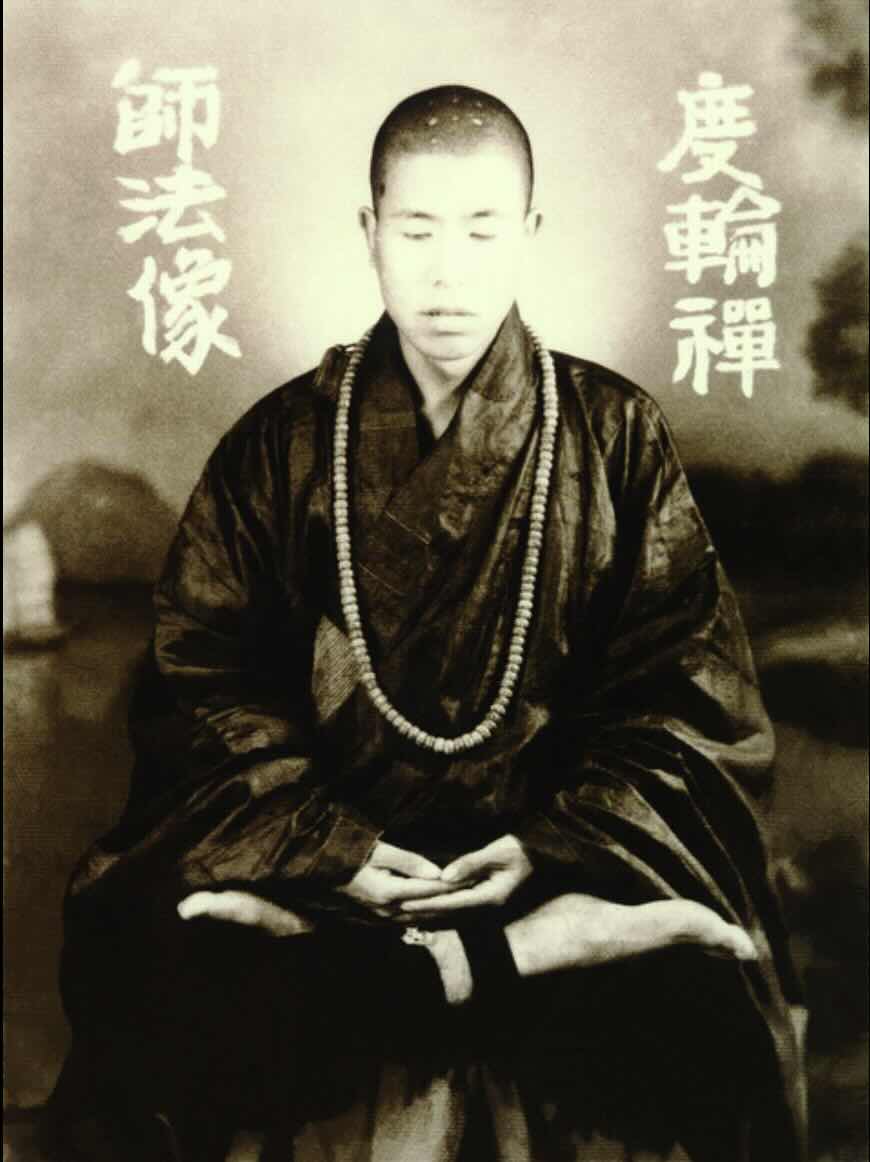
I’m always struck by this amazing image of a former monk training disciples in a nearby village in 1959 (see here, under North Xinzhuang), just as the devastating great famine was occurring—the famine is among crucial topics that can hardly be addressed in China.

Shadows in the field
I could only offer superficial responses to Feng Jun’s salient query about how I positioned myself in relation to the people and events I was documenting. It’s a major theme of the book (and of a thesis in Chinese). I was most fortunate to have two excellent fieldwork companions from Beijing, who were totally on board with studying social and religious change. It’s most important to stay in the village, and to take part in their ritual life (neither of which is common for Chinese scholars). The villagers were open in replying to my questions, which Chinese scholars hardly asked.

I never thought of making films for the public domain; I filmed strictly for my own research purposes, and only realised later that some footage could be edited into watchable films. Our visits energised the Gaoluo association, while others were declining, but transmission was a constant anxiety of theirs, and a theme of our discussions. We can now see this as a precursor of the Intangible Cultural Heritage system.

The ICH
Since my last visit in 2003, a lot has happened in these villages. They’re no longer so poor. Crucial issues, everywhere, are migration, social media, state education, and the whole emptying of the countryside. And there’s no escaping the ICH system, which has influenced many such village groups. Many authors have described how the system commodifies, secularises, and reifies local traditions (see e.g. here). It’s state propaganda; most “research” under its auspices is superficial. While my film, and the book, inadvertently make a contrast with the celebratory approach enshrined by the ICH, I’m perturbed that Chinese viewers don’t seem to articulate this; they can’t read my book in Chinese, and anyway I’m not sure they would care to dwell on my different approach. With recent Chinese fieldwork dominated by the ICH, it is hard to gain a more in-depth picture.

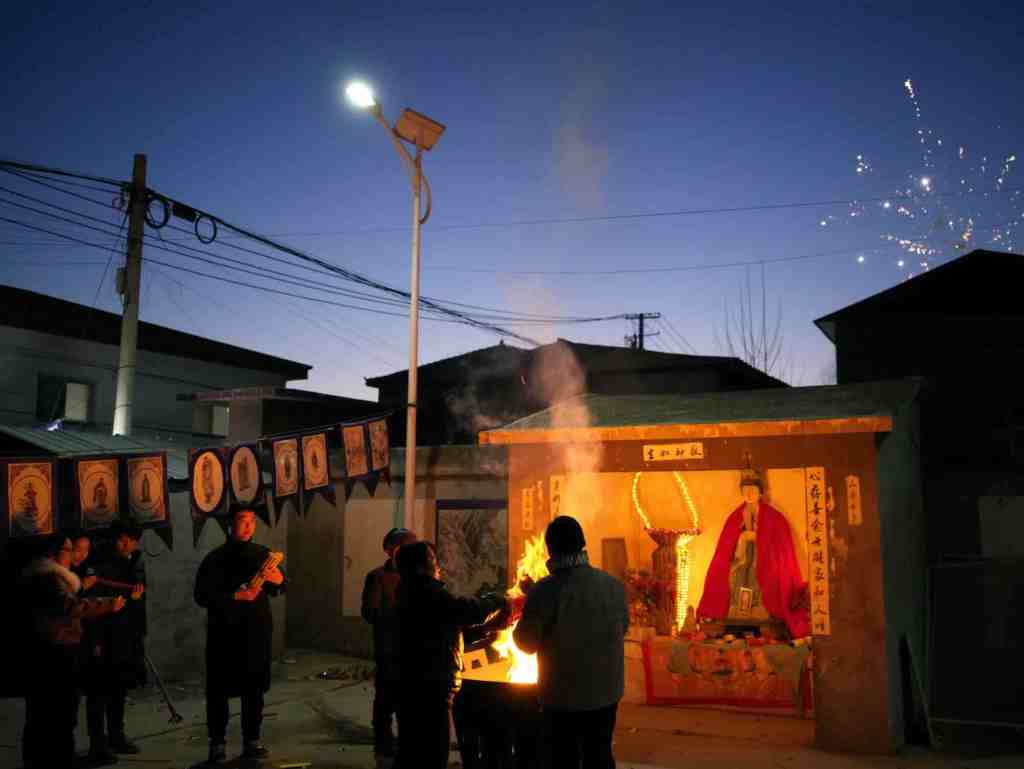
Although the system uses “music” and “culture” as a smokescreen to downplay religious life, it works both ways; for the communities themselves, it helps protect them, legitimise them. With the tenuous survival of these groups under question ever since the 1980s’ reforms, joining the ICH made a tempting expedient for the association leaders. And faith endures, with villagers using the system to their own ends; the Gaoluo association still does funerals, and villagers still offer incense.

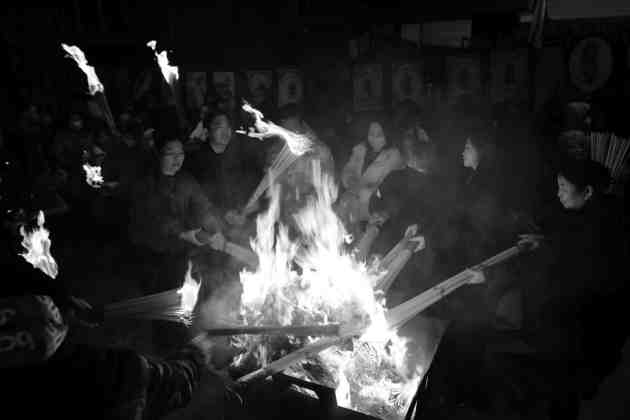
New Year in Gaoluo, 2025. Image: Wei Xiaoshi.

The village’s Catholic minority (whose brass band took part in a “demonstration” on 1st moon 15th in 1995, shown in the film) makes an intriguing sub-plot in the story. In this whole area the relationship between “Patriotic” and underground churches has long been opaque, and without a prolonged stay it would be hard to further our understanding of the shifting scene.

As with my work on the Li family Daoists, the combination of book, film, and website is most instructive.

The rise and fall of the semicolon

Source.

Hold the front page:

Marked decline in semicolons in English books,
study suggests

To complement the Oxford comma, more fodder for punctuation nerds in Amelia Hill’s entertaining recent Guardian article—complete with quiz.

The first use of the semicolon has been attributed to the Italian scholar and printer Aldus Pius Manutius the Elder in 1494. Abraham Lincoln observed, “I have a great respect for the semicolon; it’s a very useful little chap” (hmm). Virginia Woolf used it over 1,000 times in Mrs Dalloway. Cormac McCarthy included 42 semicolons in his first book, The orchard keeper—but then just one across his next nine novels (and what might we deduce from that, I wonder?!). 

Kurt Vonnegut disapproved of it, averaging fewer than 30 a novel, about one every 10 pages. Salman Rushdie, John Updike, and Donna Tartt each used an average of 300 semicolons for 100,000 words. As if other negative reviews of the Fifty shades trilogy weren’t enough, “E.L. James was criticised for repeatedly using commas inaccurately instead of semicolons”.

Perhaps someone can square these two comments for me:

“Semicolon use in English rose by 388% between 1800 and 2006, before falling by 45% over the next 11 years. In 2017, however, it started a gradual recovery, with a 27% rise by 2022.”

“The semicolon seems to be in terminal decline, with its usage in English books plummeting by almost half in two decades—from one appearing in every 205 words in 2000 to one use in every 390 words today.”

For more, see e.g. here. Now I think we should go the whole hog and sing the praises of the colon too.

Much of the pleasure in reading an article like this lies in marvelling at the projects with which academics manage to fill their time. But there’s no limit to the topics for which statistics can be enlisted—I think of Grootaers’ fieldwork survey documenting the declining numbers of temples in north China villages through the Republican era, and the deities to whom they were devoted.

The language of the novel was effectively dramatised by Monty Python:

For some German punctuation, see The idiot’s apostrophe.

Donors’ lists 2: Gaoluo

Towards a dynamic approach to material artefacts in diachronic social context

Further to my previous post giving background on material support for amateur ritual associations on the Hebei plain, I now focus on Gaoluo village, whose four ritual associations all preserve a wealth of ritual artefacts. Here our prolonged fieldwork allows us to “break through the 1949 barrier” by incorporating the easily-neglected Maoist era into the wider picture both before the Communist victory and since the 1980s’ liberalisations.

Again, please excuse the considerable duplication with many of my previous writings on Gaoluo—in particular my book Plucking the winds, and on this site, my pages on Ritual images: Gaoluo and the village’s three other ritual associations. [1]

To remind you, both South and North villages have their own ritual association, now commonly known as Music Association (yinyuehui, yinyue referring to the “classical” style of paraliturgical melodic instrumental ensemble); and both villages have their own Guanyin Hall Association (or Eastern Lantern Association, dongdenghui), now known as Southern Music Association (nanyuehui, having adopted the more popular style of “Southern music”). But whereas the misleading term “music association” has since become standard in the region, note that neither the 1930 nor the 1990 lists of South Gaoluo use the term: both texts (like their 1983 gongche score) refer to “Southern Lantern Association” (nandenghui), the 1990 list glossing it as  “sacred society” (shenshe). So to stress yet again, this whole topic belongs firmly within the study of folk religion and society, far beyond “musicology”. Do watch my film on the 1995 New Year’s rituals in Gaoluo!

These two donors’ lists from 1930 and 1990 make striking exhibits, but the village’s other associations also suggest clues; having written about them separately, here I rework them into a diachronic account. 

A common stimulus for creating new donors’ lists is the expenditure of replacing ritual artefacts (ritual manuals, god paintings, instruments, and so on); besides recording the contributions of named villagers, many lists provide detailed public accounts.

The 1930s
For our main ritual association in South village, one such list, which we saw adorning the lantern tent for the 1995 New Year’s rituals, was said to date from the late 19th century, but alas it was so faded as to be totally illegible. Instead, most handsome of the ritual artefacts on display was the 1930 donors’ list—apparently the only surviving list from before Liberation that we have found in the region:

Now if we saw this list on the wall of a museum, it would have limited potential. But since the tradition endures, not only can we witness rituals, hearing the wind and percussion music and vocal liturgy before the gods; but further, the descendants of the people featured in the list were able to provide considerable detail, putting the initiative in the context of the Republican era in the region. To summarise my discussion in Plucking the winds and in Ritual images: Gaoluo, during 1930 both associations in South village undertook a refurbishment of their ritual apparatus—apparently prompted both by the brief restoration of peace in the area after many years of fierce fighting between warlords, and by competition with the renewed energy of the village Catholics.

The 1930 list, entitled Wanshan tonggui (“The myriad charities return to the same source”), commemorates the commissioning of a major series of diaogua hangings from Painter Sun of Doujiazhuang village in Zhuozhou county just north. It records 92 heads of households, surely consisting of most of those then living in the southern half of South village which the association served, though some were doubtless too poverty-stricken to be able to afford even a minimal contribution. For all the beauty of the list, many (including all the womenfolk) were unable to read it.

The donations, ranging from 6 yuan to 5 jiao, totalled 109.83 yuan; the cloth cost 24 yuan, the paintings 61.5 yuan, and other expenses amounted to 33.83 yuan, leaving debts of 9.5 yuan. Five “managers” of the association are named at the head of the list: Cai Lin, Cai Ze, Shan Xue, Shan Chang, and Shan Futian (sketches in Plucking the winds, p.54). As their descendants recalled in the 1990s, all were prominent figures in the village, some of whom were also active as ritual performers.

Later in 1930, in preparation for the following New Year’s rituals, the South village Guanyin Hall Association also made a donors’ list for the commissioning of twelve new ritual paintings, listing four “managers”, two “organisers”, and three “incense heads”. The paintings were again made by Master Sun; the 1990s’ members also say he made new diaogua hangings for their association. In the years before the 1937 Japanese invasion, one Wang Laoguo from South Gaoluo painted more diaogua for them.

Further suggesting the ritual revival of the time, the early Dizang precious scroll of the Guanyin Hall Association in North Gaoluo contains a section recopied in 1932 (the precious scrolls are introduced here, and for Hebei, here and here).

Under Maoism
In the decades after the 1949 Communist revolution, many village ritual associations gradually became less active or ceased entirely. However, a close look belies the common notion that ritual life was in abeyance right until the 1980s’ reforms. For this crucial and ever more elusive period, material artefacts serve only as an adjunct to the memories of villagers.

With the new regime in its infancy, peace gave rise to hope for local communities long traumatised by warfare. Even as the collective system escalated, Gaoluo’s new village administration managed to embrace its traditional associations. The production teams used to give a little grain or other goods to support whichever association lay within their patch. The political climate didn’t dampen faith in village ritual associations: they continued to perform funerals and observe the New Year’s rituals in their respective lantern tents. Between 1950 and 1964 several groups of young men were recruited to learn both the vocal liturgy and the instrumental music; new gongche scores of the latter were compiled.

However, I doubt if the associations often dared hang out their ritual artefacts, and the atmosphere must have discouraged the making of donors’ lists. Our association didn’t make one between 1930 and 1990, but in 1952 the South village Guanyin Hall Association converted from their chaozi shawm-and-percussion music to the more popular style of “Southern music”. They invited the locally-renowned musician Hu Jinzhong from nearby West Yi’an village to teach them, giving him food and accommodation through the winter, but no fee, as ever. There was some official opposition to them learning the music, so the association sought no public donations; it still owned some land in the early 1950s, so it could buy instruments independently. Supporters merely “took care of a banquet” for the association, and no donors’ list was made.

The early 1960s
From 1961 to 1964, in the brief lull between the famine and the Four Cleanups campaign, ritual associations revived strongly throughout the Hebei plain, training youngsters in both the instrumental ensemble and the vocal liturgy. The latter tradition was in general decline on the plain, with the elders of the “civil altar” dying off. In Gaoluo, the vocal liturgy of South and North village Guanyin Hall Associations effectively came to an end with the deaths of Zhang Yi  in 1950 and Shan Yongcun around 1956. Only our South village ritual association had a group of keen teenagers who came forward in 1961 to study the vocal liturgy with senior masters. But elsewhere the shengguan instrumental ensemble increasingly came to represent the scriptures before the gods.

One might imagine the early 1960s’ revival prompting our association to compile a new donors’ list, but perhaps the leaders were wary of creating such a public pronouncement. However, in 1962 the South village Guanyin Hall Association used its 1930 list to add a new list of donors.

And in 1964 the Gaoluo village opera troupe, not inhibited by the taint of “superstition”, commemorated its revival in a donors’ list (composed by Shan Fuyi), with the 280 donors representing the great majority of households in North and South villages at the time. The list records the donation of c450 yuan in total.

For both the ritual associations and the opera troupe, the early 1960s were a cultural heyday such as they had not been able to enjoy since the early 1950s, reflecting the social recuperation after the famine afforded by a central withdrawal from extreme leftist policies. Little did they know that political extremism was once again to disrupt their lives still more severely; the optimism of their declarations was soon to look naive and hollow.

Since the 1980s’ reforms
In the Hebei villages, as throughout the whole of China, the last two decades of the 20th century were particular in that their associations were reviving after at least fifteen years of stagnation—and even those that had been active until the eve of the Cultural Revolution had practised somewhat furtively. Thus they needed to replace a considerable amount of their ritual equipment.

In Gaoluo after the liberalisations following the collapse of the commune system in the late 1970s, the village “brigade” (dadui) gave 100 yuan a year to all the village’s main associations, which our South village ritual association spent on getting its sheng mouth-organs tuned. In the early 1980s they commissioned a new ritual pantheon of Dizang and the underworld, and compiled a new gongche score, but they didn’t yet create a new donors’ list.

However, the North village Guanyin Hall Association had a donors’ list made as early as 1981, to commemorate their own revival, written in elegant classical Chinese (text copied in Zhang, Yinyuehui, pp.128–9). This association had a reputation for observing the ritual proprieties, and preserved splendid “precious scrolls” from the 18th century, but their fine tradition of reciting them was going into decline even before Liberation. The first historical material on the list consists of four names (“transmitters of the ritual business”) from the 1920s. Unusually, having originally been a temple-based ritual association based on reciting the scriptures, they had diversified by adopting secular genres, acquiring opera in the 1930s, reformed pingju opera in 1951, “Southern music” in the 1960s (learned from their sister association in South village), and lion dancing in 1981.

The 1990s
As the economic liberalisations gathered pace and communal consciousness was attenuated, many village associations that had revived found it hard to maintain activity. In Gaoluo the 1990s were distinctive for the renewed energy provided by our fieldwork (Plucking the winds, pp.189–205).

After our first visit over the New Year’s rituals in 1989, our association now resolved to refurbish their “public building”, which they had reclaimed from the village brigade after the collapse of the commune system. This initiative was led by the then village chief Cai Ran, himself a keen member of the “civil altar”. After writing enterprisingly but unsuccessfully to the Music Research Institute in Beijing to request funding for the project, they managed to be self-sufficient in realising the project, with villagers donating money and labour.

So in 1990 the leaders of our association invited Shan Fuyi to make a new donors’ list. His substantial text outlining the association’s history (see Ritual images: Gaoluo) makes clear that my visit was a stimulus for the project; still, it was written with no guarantee that outsiders would return.

The 1990 list names 270 heads of households. Still, villagers were becoming less conscientious about donating (see Women of Gaoluo, under “Rural sexism”).

From the 1930 and 1990 lists alone, we can hardly perceive change. The association still served the ritual needs of the villagers, and was still supported by most households in its catchment area. Without thick description from fieldwork and interviews, we might never know how ritual and social life were changing.

In the early 1990s there were several thefts of ritual artefacts in Gaoluo—but this served as a stimulus for the association to reclaim those that had been taken off by cultural authorities under Maoism.

The lantern tent of the South village ritual association, 1998,
with new and newly-copied donors’ lists.

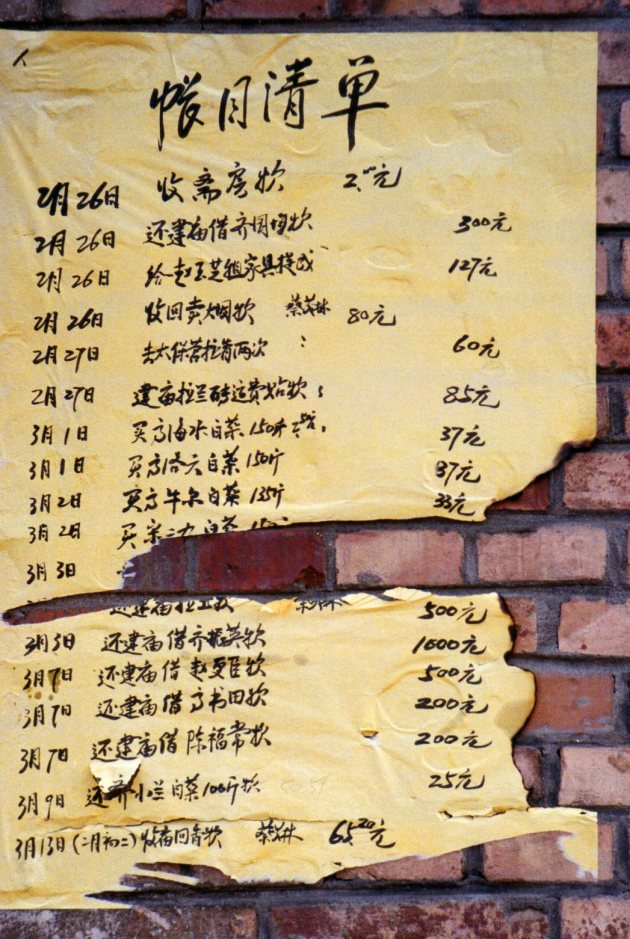
Our attention to the South village ritual association stimulated another competitive ritual flurry among the two villages’ other three ritual associations. For New Year 1990 the North village ritual association also had new ritual paintings made, of their own pantheon and the Ten Kings of the Underworld (for the donors’ list commemorating this initiative, see under Ritual images: Gaoluo). We also saw a more transient paper list of expenses from New Year 1992, pasted at the entrance to their ritual building, and already decrepit and hard to read by the following summer. They had received 690.47 yuan; they had incurred expenses such as buying coal, meat, vegetables, doufu, oil, salt, tea, firecrackers, tuning sheng, buying cloth bags for sheng, copying scores, and mounting ritual manuals and paintings—all conscientiously recorded. At New Year 1998 we saw their paper lists of income and expenses for the past year. Most of the association’s income had come from the hiring of crockery; donations had also been made when the association performed funerals (the rate being around 100 yuan). Some individuals had donated cash (one as much as 750 yuan), and the village committee had given 200 yuan. They had received 3,638.2 yuan (including 939.8 yuan brought forward from the previous year) and spent 2,992.2 yuan.

After the demise of the commune system, the South village Guanyin Hall must have revived along with the other associations by about 1980. Following our 1989 visit and the revamping of the ritual associations of North and South villages, they too had a surge of energy. For New Year 1992 they made a new donors’ list (image here) for the rebuilding of their humble ritual building, with this inscription:

The Eastern Lantern Association of South Gaoluo rebuilt its public building in 1992 AD under the People’s Republic of China, with the aid of the donors listed above. Total expenditure 2,984 yuan 4 jiao; 15 yuan surplus.

The list shows 215 household heads giving sums from 20 yuan to 2 yuan.

Conclusion
In all, community support for ritual life had not waned despite successive social upheavals. But new challenges were taking their toll: migration to the towns in search of work, state education, and popular media culture. Since my last visit in 2003, Gaoluo has continued to be transformed—notably by the arrival of the Intangible Cultural Heritage system, which I will address soon.

Static, silent material artefacts are most instructive when we can use them in conjunction with fieldwork and interview, helping us connect them to changing social life, filling in the gaps, learning more about practice and personalities over time. This is where the ethnographer has an advantage over the historian. I wish we had been able to find yet more detail—for instance on the 1950s: how funerals were changing, how calendrical rituals became less frequent, the decline of the vocal liturgy, and so on. We were lucky to be able to consult people who had taken part in the events commemorated in donors’ lists; but as time goes by, fewer villagers remain who can recall the early years of Maoism, let alone the “old society” before 1949.


[1] See the index of Plucking the winds, under “donations and donors’ lists”; Zhang Zhentao, Yinyuehui, pp.116–35, copies and discusses all the Gaoluo donors’ lists. On this site, note also the series of articles under the Gaoluo rubric of the main Menu.

Donors’ lists 1: Hebei

Stone, cloth, paper: economic support for village ritual associations

My new film on Gaoluo prompts me to revisit our fieldwork the ritual associations of the Hebei plain—a task further stimulated by the recent reification of these groups under the Intangible Cultural Heritage system. I now wish to outline economic support for such ritual organisations under the successive political regimes of modern times—”breaking through the 1949 barrier”.

First, in this post I expand on some themes from my survey of ritual associations on the Hebei plain; and in a sequel I focus on Gaoluo, where we found a wealth of ritual artefacts to accompany our prolonged fieldwork and discussions with villagers. Both essays are mere samples of the material we collected through the 1990s—please excuse the considerable overlap with many of my previous writings, both on the ritual associations and on Gaoluo. [1]

Introduction
Living traditions of Chinese folk ritual provide a rich source of material artefacts dating back several centuries (cf. China’s hidden century). Still, they are mere snapshots of particular moments: one hopes to be able to augment them by fieldwork on observed ritual practice and the oral accounts of villagers throughout living memory.

In rural China, as everywhere, ritual and cultural life depends on moral and economic support from local communities. Patronage, in cash and in kind, depends on the nature and scale of the enterprise.  Occupational family-based groups such as household Daoists and shawm bands (as well as individual intermediaries like spirit mediums) are paid for a particular event such as a funeral, and have successfully adapted to changing patterns of social support in the post-reform era.

In the religious sphere, alongside local temples, the composite term huidaomen (used pejoratively by the Communist state—hui Association, dao “Way”, and men “Gate”) subsumes both ascriptive amateur village-wide devotional associations and voluntary sectarian groups. On the Hebei plain, the two broad categories overlapped (see e.g. our notes on Xiongxian and Xushui counties).

Priding themselves on not accepting payment, ascriptive ritual associations have long relied on recouping their expenses through donations from the village communities whose ritual needs they serve. But whereas support for voluntary sectarian (as well as Catholic) groups remains grounded in enduring faith, the ascriptive associations have faced a particular crisis in the new economic climate since the 1980s. 

Temples and temple fairs, ritual associations and the “public building”
Temples have always been an important focus of community life, and in many regions they remain so, such as in south China (Fujian, Jiangxi, Hunan, and so on) and the northwest—although much research there has focused on the imperial legacy rather than modern change.

On the Hebei plain, temples were ubiquitous until the 1950s. Village ritual associations learned from Buddhist or Daoist temple clerics, or from other nearby associations that had done so, at various times since the Ming dynasty; they existed mainly to serve the village temples. But in a long process over the 20th century, temples were destroyed or abandoned; rather few have been rebuilt since the 1980s’ liberalisations, and still fewer have any regular staff apart from a temple-keeper. So the main venue for the reduced calendrical rituals of such villages became the “public building” (guanfangzi: Zhang Zhentao,Yinyuehui, pp.181–204), an inconspicuous building only adorned with god paintings and other ritual artefacts, easily stored away, during calendrical rituals on behalf of the community. Besides the long-term decline of active temples in the region, this may suggest insecurity among village communities through political upheavals.

Villages that have restored their former temples are in a minority, but in such cases the refurbished temples seem to provide a greater focus, visited and tended more often, as in Gaozhuang (Xushui county) and two villages in Xiongxian county, Hanzhuang and Kaikou. Still, their annual ritual calendar remains quite sparse (see my survey, under “Ritual duties”).

Even once we recognise the importance of the “public building”, a major part of the duties of these associations is to supply funeral rituals at the homes of deceased villagers.

Donors’ lists
Alongside the wealth of material artefacts that we found among the Hebei village ritual associations (ritual paintings, ritual manuals, scores, and so on) are donors’ lists (beiwen 碑文), documenting support over the previous year, or for a major initiative. Displayed alongside the god paintings in the ritual building, they proclaim the associations’ support among their community for providing calendrical observances and funerals, symbolising the village’s sacred core. As Zhang Zhentao notes, local terms like beiwen and bushi 布施 (“donating”) remind us of the living connection of these groups with the tradition of supporting Buddhist and Daoist temples.

More ephemerally than the stone steles of temples, the donors’ lists of Hebei village ritual associations are commonly inscribed on cloth; but many are even more perishable, written on paper, pasted on the wall of the ritual building over the New Year’s rituals—when new donations (often in cigarettes and tea) are recorded daily. Thus they might never be documented unless some ethnographer happened to be there to take photos at the time.

Throughout China, paper documents are commonly pasted up announcing temple fairs, temple inaugurations, and particular rituals; some of these may record donors and amounts contributed. Even for weddings and funerals, scribes record gifts. The donors’ lists of the Hebei associations are rather different, recording the names of household heads—thereby establishing them as members of the association not just for particular rituals but throughout the year—and amounts contributed. Since these associations were responsible for performing rituals on behalf of the whole village, their leaders sought donations from virtually every household. Besides a few more affluent patrons, most families could only afford a token contribution.

While village ritual associations were inextricably linked to their local temples, there is no direct transition from the stone steles of the latter to the cloth and paper memorials of the former. Most associations must have made donors’ lists ever since their founding, generally in the Qing dynasty or even the Ming, but alas they don’t survive. Even if they did, we couldn’t make a simple comparison.

For those Hebei temples that have been rebuilt since the 1980s’ liberalisations, we found a rare instance of a stone inscription listing donations on the back of the 1993 stele for the inauguration of the Ancestral Hall to Venerable Mother (Laomu citang) in Gaozhuang, Xushui county—led by the village’s ritual association.

Whatever the material on which such lists are written, the Hebei associations are mostly village-wide public bodies, perhaps encouraging them to openly display both their expenditure and the names of their patrons. Still, many of these groups have sectarian ancestry, so I wonder if such lists have been documented among sectarian groups elsewhere in China—leads welcome.

Lists of expenses
Also often detailed on such lists is the expenditure of the association, justifying the leaders’ probity on behalf of their patrons. Expenses documented include replacing instruments or maintaining them (notably tuning and repairing sheng mouth-organs), commissioning new ritual paintings; buying other equipment (tables, pennants, incense, candles, lanterns, paper, food for banquets); “utility bills” for the ritual building or rehearsal venue (coal for rehearsals, oil for lanterns, electricity); and New Year’s expenses such as firecrackers. For example, again from Gaozhuang is a paper list of expenses from 1995:

Here’s a 1994 list of expenses from Kaikou village (Xiongxian county) for the revival of the temple and its association (Zhang, Yinyuehui, pp.140–43):

Beiwen with written histories
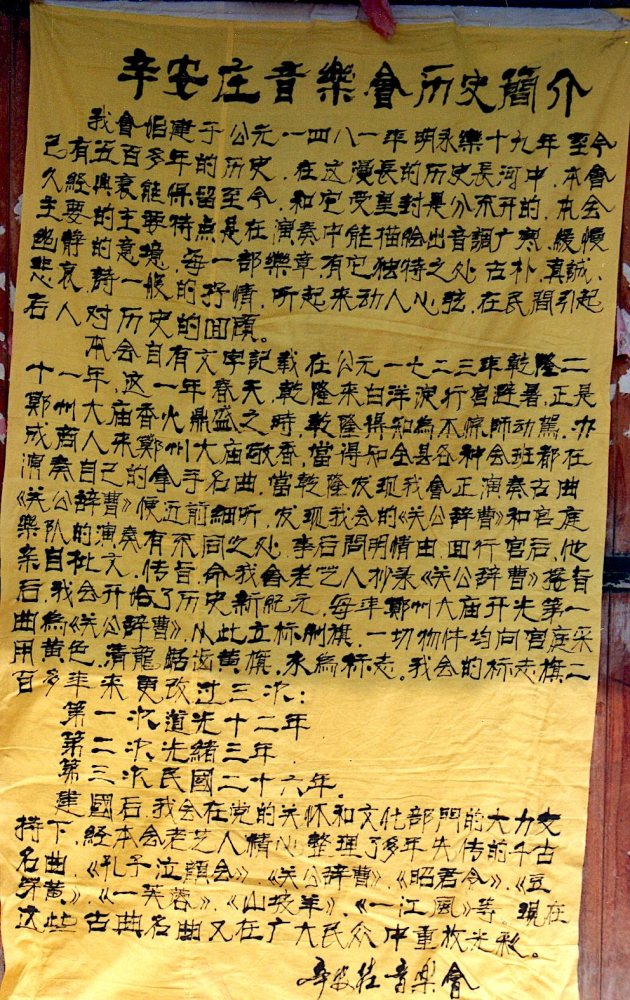
Rather as temple steles from imperial times might also document successive renovations, some donors’ lists include brief histories. Some associations even composed separate histories, such as a 1990 banner from Xin’anzhuang, Renqiu county:

Was this prompted by some interest from county cultural workers, I wonder? It clearly constituted some kind of public declaration; but the preludes of some gongche solfeggio scores of the paraliturgical melodic ensemble, whose readership was limited to the performers themselves, also contain brief histories of the association, like those of Longhua from 1963 and 1980 (for both Longhua and Xin’anzhuang, see under Ritual groups around the Baiyangdian lake).

Intriguingly, the instances that we documented were written since the 1949 revolution. Under state socialism, did political anxieties now prompt ritual associations to proclaim or justify their history, portraying the tradition as “culture”, downplaying religion? Re-reading the brief texts that head some donors’ lists, I find them diplomatic, distancing the associations from sectarian connections, claiming a place within the official discourse long before the Intangible Cultural Heritage. This seems to complement the innocuous appearance of the “public building”, the easily-concealed ritual artefacts, and indeed the growing prevalence of the shengguan instrumental ensemble over the vocal liturgy.

Still, such histories can make a useful starting point as we compile more detailed accounts from villagers’ oral recollections.

Some further examples
Apart from the Gaoluo associations (to be discussed in a separate post), Zhang Zhentao (Yinyuehui, pp.130–50) details donors’ lists from other village groups we visited on the Hebei plain. These include two 1992 paper lists from North Qiaotou in Yixian county (Zhang, Yinyuehui, pp.136–40; see my discussion here)—a donors’ list introduced by a text in praise of the association’s benevolent virtue:

and their list of expenses:

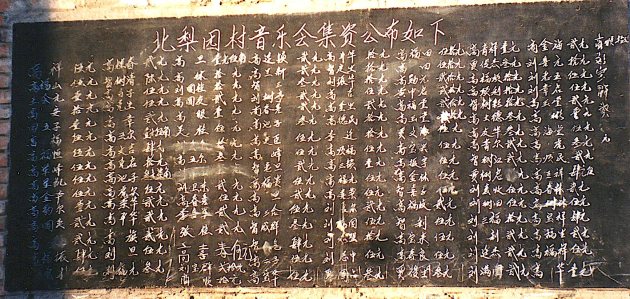
In Xushui county, on our visit to North Liyuan in 1995 we found donors listed on a blackboard:

Also under my page on Ritual groups of Xushui is material on the rebuilding of village temples in East Zhangfeng (§8) and Xiefangying (§9). Zhang Zhentao further documents lists from Zhaobeikou on the Baiyangdian lake, and Fuxin in Wen’an county.

Many of these groups were of sectarian ancestry—the North Qiaotou association derived from a Hunyuan sect, for instance. As I suggested above, perhaps this made their public proclamation of charitable virtue still more apposite, counteracting state suspicion of “superstition”.

Summary
Static, silent material artefacts only provide snapshots in the life of these groups. They are most instructive when we can use them in conjunction with fieldwork, helping us connect them to changing social life, filling in the gaps for the intervening periods, learning more about practice and personalities over time, using the frozen material evidence to prompt recollections from villagers, building up a picture of the longer term. This requires prolonged familiarity—as we gained in Gaoluo, subject of the following post.

And to repeat my point yet again, whereas the topic was discovered by musicologists, it belongs firmly within the study of folk religion and society. 


[1] For the Hebei ritual associations, see this survey, and many pages under the Gaoluo and Hebei rubrics of the main Menu. Besides my 2004 book Plucking the winds, as well as “Ritual music under Mao and Deng” and “Revival in crisis”, note in particular Zhang Zhentao’s 2002 book Yinyuehui: Jizhong xiangcun lisuzhongde guchuiyueshe 音乐会: 冀中乡村礼俗中的鼓吹乐社. Like his discussions of the “public building” and gongche scores (pp.181–204, 365–407), his chapter on donors’ lists (pp.115–80) is excellent; following perceptive discussions of particular lists, he analyses the material on pp.150–79, including the role of the local gentry in supporting ritual associations, and comparison with the opaque economics of the mercenary shawm bands.

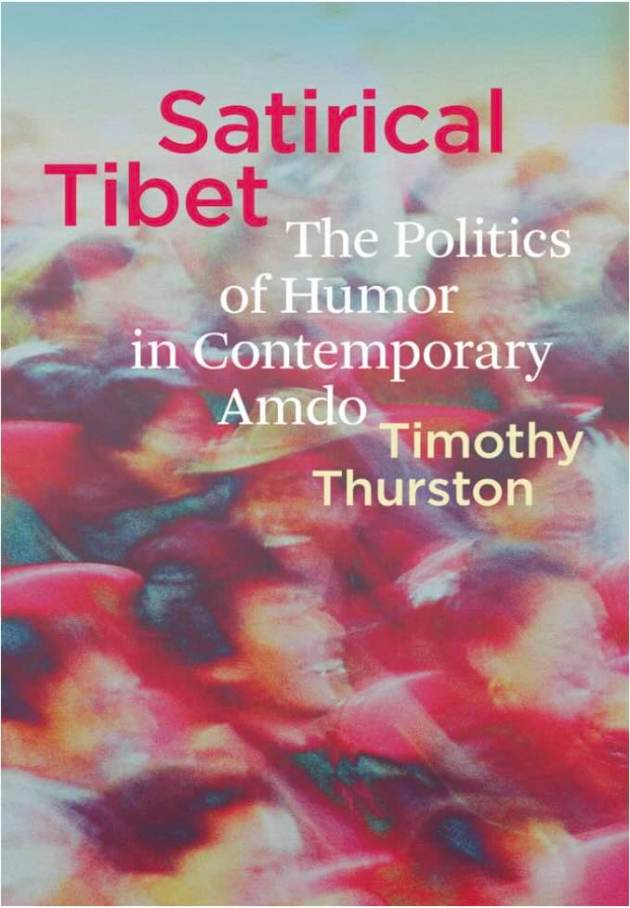
Satirical Tibet

*Furthering my education in the travails of modern Tibet*

Within the Tibetan cultural world, research on the Amdo region (see e.g. here) has become a remarkably dynamic field of scholarship. A fine recent instance is

  • Timothy Thurston, Satirical Tibet; the politics of humor in contemporary Amdo (2024; open access here), in the University of Washington Press series Studies on ethnic groups in China. Here’s the publisher’s blurb:

Humour has long been a vital, if under-recognised, component of Tibetan life. In recent years, alongside well-publicised struggles for religious freedom and cultural preservation, comedians, hip-hop artists, and other creatives have used zurza, the Tibetan art of satire, to render meaningful social and political critique under the ever-present eye of the Chinese state. Timothy Thurston’s Satirical Tibet offers the first-ever look at this powerful tool of misdirection and inversion. Focusing on the region of Amdo, Thurston introduces the vibrant and technologically innovative comedy scene that took shape following the death of Mao Zedong and the rise of ethnic revival policies. He moves decade by decade to show how artists have folded zurza into stage performances, radio broadcasts, televised sketch comedies, and hip-hop lyrics to criticise injustices, steer popular attitudes, and encourage the survival of Tibetan culture.

Surprising and vivid, Satirical Tibet shows how the ever-changing uses and meanings of a time-honored art form allow Tibetans to shape their society while navigating tightly controlled media channels.

As Stevan Harrell, editor of the series, observes in his Foreword:

Because Tibetans are an oppressed people, we can easily assume that there is little joy or laughter in their lives, and that we should approach their predicament with uniform solemnity. This is wrong. Tibetans deal with the tragedy of Communist oppression as they have dealt with the vicissitudes of life on Earth for centuries—not only with “quiet desperation” or extreme religious devotion but also with uproarious comedy and biting satire.

Whereas some studies of Tibetan folk traditions sadly circumvent sensitive issues (e.g. Shépa: The Tibetan oral tradition in Choné), Thurston engages fully with modern Amdo society, illustrating periods since the reform era of the 1980s through changing popular media. As he notes, such satirical sketches (for which he uses the nuanced term zurza) always have a serious purpose, exploring a social problem of some sort: they convey important messages about contemporary Tibetan life, shaping attitudes towards issues such as language, culture, urbanisation, education, territory disputes—and the popular topic of fake lamas. Such sketches may be subversive, but they are not “underground”: though inevitably accommodating to the institutions of the Chinese state, a large part of their efficacity lies in the very fact that they can be aired in the public domain.

Thurston’s extensive quotes from the various genres are instructive, even if their broad appeal to Amdowa people is hard to convey in English. Though the book lacks images, for this post he has kindly suggested some illustrative YouTube clips, embedded below. The extensive final References are useful.

The Introduction, “Doing zurza”, provides useful context.

Zurza and the laughter that frequently accompanies it are hardly the first things most people think about when they hear the words China and Tibet in the same sentence. And why should they be? Many in the Euro-American “West” may hear the word Tibet and think of a traditionally Buddhist society, perhaps oppressed by a colonising Chinese Communist Party. The same people may think of recent news reporting about Tibetans self-immolating, and Tibet’s Nobel Prize-winning exiled religious leader. For many who have grown up in China, meanwhile, images may range from a feudal society liberated by and incorporated into the People’s Republic in the 1950s, to news spots showing Tibetans dancing happily in displays of gratitude to the Communist Party for the “gift” of modernity, to a pristine environment for young Han to conquer as they escape from China’s heavily polluted coastal metropolises. These descriptions, all carrying elements of truth, select some of the most contrasting images possible to make a rhetorical point. But the discourses of modernity and progress, and of traumatic experience and dramatic resistance, all emphasise grand narratives that leave little room for zurza.

Set against the background of these ongoing and well-publicised cultural and political tensions, a book about a topic as seemingly trivial as zurza and humour can come across as being in poor taste. And yet, laughter has served as the soundtrack to almost every one of my experiences of Tibet. This also manifests in everyday life. During dinners among friends, the seemingly endless toasting with liquor—almost always three cups at a time—often lowered inhibitions to the point at which teasing and reminiscing might devolve into uncontrolled hilarity. At traditional weddings, women from the host village may use humour and wit to demand some sort of payment or gift from the visiting representatives of the person marrying into the village (usually the maternal uncles of the bride). In the valley of Rebgong, interludes in the annual harvest festival featuring inebriated villagers—sometimes cross-dressing or wearing monks’ robes—may make fun of the behaviour of certain members of the community, to the applause and laughter of all in attendance. Tibetan communities possess a diverse vocabulary for humorous activity that mirrors the diversity of ways that laughter appears in everyday life, including kure (joking), labjyagpa (boasting), tséwa (play), and zurza. This humour frequently accomplished important social work: to entertain, mask existential pain, serve hegemonic forces, speak the otherwise unspeakable, provide a “steam-valve” for social discontent, and/or to project and reflect worldviews. […]

When famed trickster Uncle Tonpa tricks a landlord or merchant, or makes a king bark like a dog, he “does zurza.” When the seventeenth-century lama Shar Kalden Jyamtso (1607–1677) composed songs poking fun at the behaviour of monks, he was also “doing zurza.” And when a contemporary comedian mocks people whose behaviour seems out of touch in the contemporary moment, they too do zurza.

In Chapter 1, “Dokwa: ‘eating the sides’ in oral and literary traditions”, Thurston notes:

Amdo boasts an incredible array of oral and festival traditions. Just focusing on the oral ones, Tibetans in Amdo are known to perform a variety of secular and religious verbal arts, including but not limited to tamhwé (proverbs), tamshel (speeches), khel (riddles), laye (love songs), and lushag (antiphonal song duels). These sit alongside a much broader array of oral and festival practices from across the Tibetan cultural world [see e.g. under Bhutan].

He also adduces the satirical street songs of Lhasa from before the Chinese invasion (Goldstein 1982), and satirical elements in Tibetan opera, as well as in other cultures.

Not limited to the oral tradition, Tibetan poets and authors like the renowned early-20th-century polymath Gendun Chopel also traditionally used zurza in satirical poems to criticise the behaviour of others, including powerful monks. […]

Even in the most difficult moments of the Maoist and post-Mao reform eras—periods when the Tibetan language and portrayals of Tibetan traditions in media faced tight restrictions—zurza served as one valuable tool for authors, folktale collectors, and others to be seen and heard.

Chapter 2, “Khashag: language, print, and ethnic pride in the 1980s”, introduces the scripted, staged performances of khashag “crosstalk” dialogues after the end of tjhe Cultural Revolution (reminiscent of the Chinese art of xiangsheng), which satirised the politics of language and ethnicity in the emerging post-Mao order. In Chapter 3, “Khashag on air: solving social ills by radio in the 1990s”, Thurston gives detailed, astute comments on the “Careful Village” sketches of Menla Jyab, who shared “complex critiques about Tibetan engagement with modernity”.

Whereas comic dialogues had hitherto been disseminated mainly via radio broadcasts and audio cassettes, Chapter 4, “Garchung: televised sketches and a cultural turn in the 2000s”, explores the new style of garchung that extended from state TV stations to VCDs and the internet. Audiences could now see as well as hear the performers, requiring more preparation and better acting. In style and themes, these sketches continued to reflect the rapidly changing conditions in Amdo, such as (in Harrell’s words) “the increasingly precarious state of Tibetan culture, with many barbs directed at both Chinese and foreigners who began to view Tibet as a source of religious and ecological inspiration, often aided by Tibetans eager to benefit from their national and cosmopolitan connections.” The main exhibit here is “Gesar’s Horse Herder”:

With zurza providing one device in reappropriating state discourse, the chapter also addresses the Intangible Cultural Heritage system (note Isabelle Henrion-Dourcy’s perceptive article).

In the wake of the repression following the 2008 Beijing Olympics, Chapter 5 explores “Zheematam: Tibetan hip-hop in the digital world”. The emerging cultural nationalism of the previous decade now “moves online, intensifies, and becomes more frustrated. With this change, new forms of satirical cultural production emerge to articulate this critique digitally.” This new genre provided

a new generation of artists with opportunities to rework oral traditions and emerging cultural practices—in conjunction with modern concerns about linguistic and cultural loss—into new and emerging art forms. In doing so, their work builds on the trends of previous generations and articulates a new set of concerns, all during a period of increasing restrictions in Tibet’s cultural sphere.

Thurston contrasts the styles of Uncle Buddhist, such as his 2019 song City Tibetan:

and Jason J, such as Alalamo:

In such work,

artists still say they are “doing zurza,” but it ceases to be as humorous or playful. Instead, it uses indirection to articulate an (at times) almost angry cultural nationalism directed both at the current conditions of Tibetan life and of the intellectual foundations of Tibetan modernism. The example of Jason J, however, demonstrates that this inversion and indirection also ensures that zurza provides a resource of constant revision and renewal of Tibetan culture in the face of increasing political and economic headwinds.

In his Conclusion, “The irrepressible trickster”, Thurston reflects saliently:

I left Amdo in 2015, returning for short trips each year prior to 2019. Since leaving, I often struggled to describe to people outside of China—including but not limited to academics, activists, and members of the exile community—the very complex calculus of internal motivations, social pressures, and external incentives that seemed to shape the decision-making processes of the Tibetans I met. At conferences, workshops, and in casual conversations, my descriptions were frequently met with some variation of the response: “They’re brainwashed” or “They have no choice”. Others reflexively seemed to blame every problem on “the Chinese.” I cannot accept these assumptions—at least not when formulated in this way.

Tibetans in the People’s Republic undoubtedly live in and navigate a highly constrained environment, in which they must carefully monitor what they say and do (and, as I have shown in this book, how they say and do them). But ignoring the creative ways that Tibetans have maintained and even revolutionised their culture—both from within the state system and in resistance to it—denies them agency and treats them only as victims. I have shown how zurza—the Tibetan arts of indirection, sarcasm, and satire—provided cultural producers with a powerful way of actively localising new expressive resources, accessing state media to do this work, and ensuring Tibetan physical and cultural presence in some of the harshest of times. Across decades and media, the texts examined in this book record some of the ways that Tibetans have used zurza to foreground issues seen as particularly pressing for their communities in spite of the tremendously asymmetric power of the Chinese state.

Such ethnographic research on the embattled resilience of Tibetan culture within the PRC evinces an impressive maturity in Amdo studies, belying the simplistic polarised propaganda of both Party apologists and the exile community.

See also rubrics under Isabelle Henrion-Dourcy’s bibliography on the Tibetan performing arts, including the work of Anna Morcom. Cf. Tibetan jokes, and Tibetan clichés.

Gaoluo film: village screening!

My new film on the 1995 New Year’s rituals in Gaoluo has recently been screened at a grand event (billed as a conference) in the village itself, thanks to the enterprise of Wei Xiaoshi (CDTM) in collaboration with Cai Yurun, who has long served both as leader of the ritual association and the village. A detailed review of the occasion has just appeared on the CDTM WeChat site (click here).

I’m delighted that my old fieldwork companion Xue Yibing could take part—we witnessed the New Year’s rituals in the village together for the first time in 1989, and his careful fieldnotes on Gaoluo and other villages over the next decade were invaluable (see mainly under Hebei in main Menu).

Gaoluo: our first visit to the Lantern Tent, New Year 1989.

Besides many of the villagers, delegations attended from a variety of musicological departments in Beijing, and from Hebei University. If only institutes of folk religious studies and sociology could be alerted to the significance of such ritual associations! But even if they were to venture beyond the safety of historical research into fieldwork on the condition of these groups since the 1940s, their ability to publish in China is ever more limited. 

One of my sessions with village litterateur Shan Fuyi, displayed on his daughter-in-law’s mobile.

I trust the film was well received, giving younger villagers an opportunity to glimpse their parents and grandparents in the days before the reified commodification inculcated by the Intangible Cultural Heritage began to influence their practices. With sonorous speeches inevitably the order of the day, the constraints of the occasion made me nostalgic for the informality of our fieldwork. The very setting, in a revamped Party Committee office, suggested how material conditions in the village have improved since my visits.

South Gaoluo New Year’s rituals, 2025. Images: Wei Xiaoshi.

Still, the religious context has not been lost: the New Year’s rituals still attract the village faithful, and the association still performs funerals for them. But the authoritative Cai Yurun voiced concerns that ICH support still can’t guarantee the future prospects of the association—in particular the vocal liturgy (which has been in a wider decline on the Hebei plain for many decades). It would take a further period of lengthy immersion in the villagers’ lives to learn their true perceptions (perhaps prompted by the film) on social and ritual change over these last thirty years. My film didn’t seem to prompt comments on how significantly the ethnographic perspective differs from the sanitised media approach typified by the ICH, but Zhang Zhentao has now published an intriguing review on this topic. Inevitably, whereas my book Plucking the winds stresses the constant tribulations of such villages under successive regimes, the prevailing congratulatory mood within China discourages such an approach.

Enbedded in the review of the event, the performance of the percussion suite in the courtyard, while still technically accomplished, inevitably lacks the spirit of the 1995 rendition before the gods. I doubt that this derives merely from the official secular context of the event; the total commitment of masters of yore like Cai An and Shan Rongqing seems to have been diluted.

Above: the association with helpers, 1995
Below: members of the association with connference delegates, 2025.

The Chinese version of the film will soon be available both on my YouTube channel (alongside the English version) and (in China) on the CDTM website. And do browse the posts under Gaoluo in the top Menu!

Click here for recent screenings in Leiden of my films on the Li family Daoists and Gaoluo.

With many thanks to Wei Xiaoshi!

John Gittings on words and photos

Among journalists based in China through the early years of reform, I admire the work of John Gittings, whose books such as Real China: From cannibalism to karaoke (1996) and The changing face of China (2005) make useful background to our studies.

Stories that appear to be told by still images are beguiling yet facile. I’ve been appreciating Gittings’ recent blogposts (here and here) in which he reflects on the relationship between words and photos in his coverage for the Guardian from 1978 until he retired in 2003.

Looking through my selection, I can see that many fall into one of three different types. There are those that contain visual pointers or signals—perhaps missed by me at the time they were taken—which add meaning to what is shown and what is remembered. A second type invites the viewer to reflect on the hidden history behind their subject matter—a more speculative delving into the past. Then there are a small number that cast retrospective doubt on what I wrote at the time: that can be unsettling.

Alongside telling images of Tiananmen in 1980 and 1989 are photos of his trips further afield. At the Qilin temple, Shandong, in 1997:

Many of the attenders were elderly women such as these, who had been brought from other villages on open-backed tractor-trailers. They burnt incense in front of the temple, and each was given a box of cookies. Studying their faces now, I can see that they are very tired: it may have been a long way back to their homes. And I wonder about their long, hidden, history too. Age is always hard to estimate but the oldest ones may have been born not long after the fall of the Qing dynasty. They would have experienced warlord upheavals, floods and famine, Japanese atrocities, revolutionary war, land reform, the Great Leap Forward, the Cultural Revolution and more. What memories from the past were revived when they attended the re-opening of the Qilin temple?

Anhui, 1982:

The old village houses are built in rows, with packed mud walls, tamped mud floor, and a thick thatched roof now dripping in the spring rain. Small children peer out of front doors, buffalo and oxen huddle close to the back doors. A few chickens scurry in the liquid mud. Fengyang County in Anhui province has always been desperately poor, and is only slowly beginning to change. There  had been some improvement after the 1949 Communist victory, but Mao’s Great Leap Forward was a disaster. People ate dogs to survive, and in 1959–61, one in six of the population died “in an irregular manner”—the euphemism for starvation. I have been taken to Kaocheng, till recently a People’s Commune but now part of a pilot experiment for the Commune to be replaced by a new structure that returns power to the local area. It has already been the pace-setter for the rest of Anhui province, trialling a new “responsibility system” that allows peasants some freedoms to farm the land. They are assigned a plot of state-owned land and have to contribute a fixed quota of their produce, but can decide what else to grow and sell it for themselves. The traditional village markets have re-appeared—I saw a huge cattle-fair under way on a dried-up river bed—and small-scale businesses are no longer banned as “sprouts of capitalism”.

Urumqi, 1978:

Sometimes the images that I revisit now do not chime with the words that I wrote then, and the retrospective doubts that this raises are hard to resolve. On my first solo trip to China, I interviewed the imam of the main mosque in Urumqi, which had not long re-opened, and I then took the photo above of him at the mosque entrance, together with members of his committee. In the story I wrote at the time, I described the imam as having given a “cheerful” account of the mosque’s revived fortune. That adjective could not be applied to this photo. Were they just being solemn for the camera, or had I been misled by the “short introduction” (carefully prepared with the relevant authorities) that the imam had just delivered?  The photo would not have been developed till I returned to England, and probably after I had written up the story. Does it suggest a rather less “cheerful” situation?

Another image from 1978:

The Muslim minorities, Uighur and Kazakh, in this farthest west corner of China had a hard time during the Cultural Revolution. “They closed the mosques, and would not let people wear their caps”, I am told in late 1978. The Arabic script had been replaced by a Roman alphabet that few could understand, and the history of the minorities was suppressed. Local organisations including street committees were only now being “restored”. I am taken to a new “workers’ home” to see how life is so much better. The bearded patriarch Tuerdi had 82 direct descendants down to his great-grandchildren. His youngest daughter has returned from teacher training college in Wuhan (she is on the right). On the left are Tuerdi and his wife; next to them is the head of the Street Committee whom I describe in my notes as “trying to interrupt whenever possible”. Behind her is a friendly neighbour, the only person who is smiling. The positions adopted in the photo are revealing: the Han Chinese cadre is in the centre background; his Uighur colleague next to him. I also note that Uighur cadres behave “with an air of deference” towards their Han superiors.

Considering a photo he took on a trip to Qinghai in 2003, Gittings reflects:

High up on a dusty plateau in the village of Taktser, Qinghai province, lies the only shrine to the Dalai Lama to be found in China. It is in the house where he was born, and is lovingly cared for by his nephew (shown here). On the altar is a letter written in the Dalai’s own hand. “I was born here with the name of Lhamo Dhundup,” it reads. “I was discovered to be the reincarnation of the previous Dalai Lama and went away. I have never forgotten my home village. I pray for its people and hope they are safe.” A wide valley stretches in the distance to Mount Tsongkhapa whose peak, say the villagers, resembles the Buddha’s head. The balcony outside the house looks across a courtyard decked with prayer flags to a village that has changed very little since 1938, when a search party of high-ranking lamas found the three-year-old Dalai. In 1986 the Chinese government rebuilt the family home, which had been destroyed in the Cultural Revolution, as a gesture in its dialogue with the Tibetan government in exile. Yet no agreement has ever been reached: the house is closed to pilgrims (and as a foreign journalist I am not supposed to be there).  “The people of Tibet weep every night and pray for him to return”, I am told. “We are five or six million Tibetans, scattered over a vast land. We can do nothing without him.”

Cf. roundups of my posts on Uyghur and Tibetan cultures; as well as Maoism and the famine, and Images from the Maoist era.

Like journalists, ethnographers often resort to “hit-and-run” visits for surveys of a region. Even when they make a base in one locale over a longer period, photos may give a misleading impression of timelessness—and this is just as true for images of ritual performance. We should always connect “snapshots” to their broader context, as I have sought to do for Gaoluo and the Li family Daoists. Against the backdrop of changing society, there are always personal stories to tell.

North Xinzhuang, Beijing suburbs 1959.

Presenting my films in Leiden

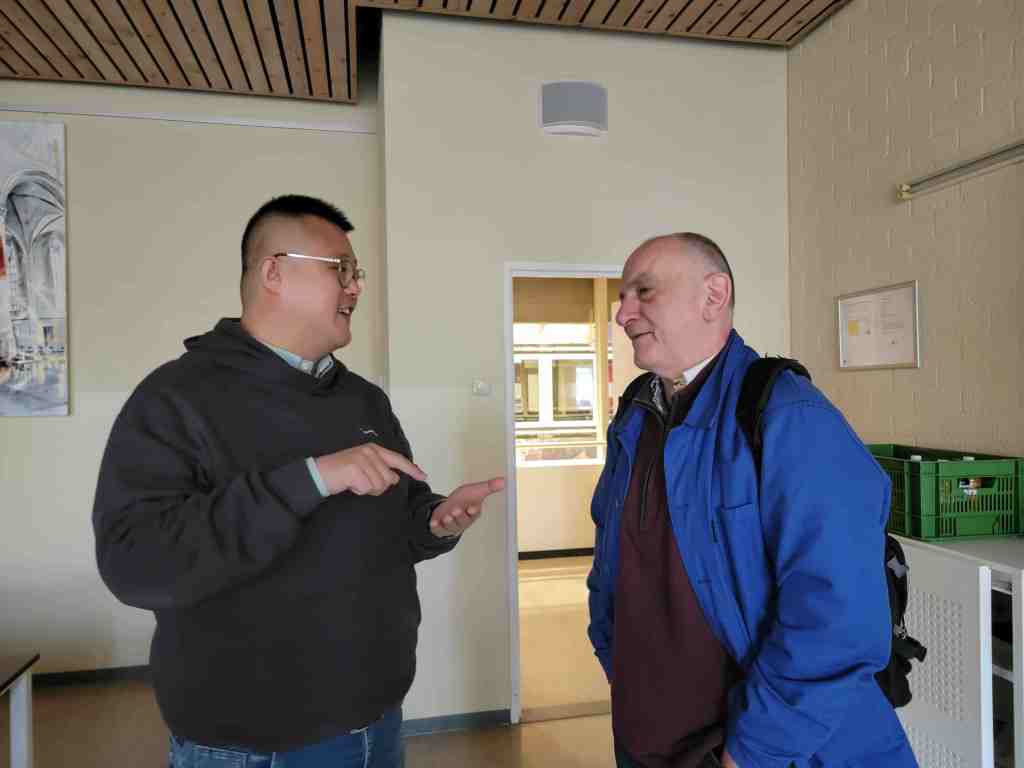
With Barend ter Haar (left) and Frank Kouwenhoven (right). Image: Yves Menheere.

Following the online publication of my recent film on the 1995 New Year’s rituals in Gaoluo, its public world premiere was at a grand event last week in the village itself. Shortly afterwards I visited Leiden University to present the film, as well as my portrait film on the Li family Daoists in Shanxi, as part of Yves Menheere‘s course on Chinese religion, and in collaboration with Frank Kouwenhoven of CHIME.

As I often stress (e.g. here), the study of both topics belongs firmly within the realm of religious studies, even if it has been dominated by Chinese musicologists. Sure enough, the distinguished sinologist Barend ter Haar graced us with lively comments, and I was delighted to see Tao Jin, formidable authority on Daoist ritual, on a visit from Beijing via Paris (see under Ritual life around Suzhou, and here).

With Tao Jin.

With both films concerning ritual life in north China, their subjects and soundscapes may appear somewhat similar, but the differences are significant (click here for differences in approach that emerge from studying with the two types of group). The Li family Daoists are

  • occupational, in a small group of five or six
  • active in a small radius around their home village; constantly busy, mainly for funerals,
  • with dense ritual sequences,

whereas Gaoluo is

  • among many amateur devotional associations, village-wide (cf. Xi’an, Yunnan, Jiangsu, and so on)
  • mostly serving the village itself, and not busy except at New Year,
  • its ritual sequences less dense.

My most focused fieldwork with the Li family Daoists was from 2011–18, with previous trips in 1991–2 and 2001–3; the film mainly shows footage from 2011 to 2015.  My fieldwork in Gaoluo took place from 1989 to 2003, the film footage showing three weeks in 1995.

While the impact of the Intangible Cultural Heritage on the Li family Daoists has been negligible (cf. here), in village ritual associations like Gaoluo it has been major—which makes the 1995 footage even more significant.

I look forward to introducing both films further to live audiences in the coming months. Meanwhile, do watch them online!

A Dunhuang symposium

On 21–22 February, to mark the closing of the exhibition A Silk Road oasis: life in ancient Dunhuang, the British Library is to hold a two-day symposium (also livestreamed online)—full programme here.

Besides religion and art, literature and languages, topics among a wide range of fascinating papers include the Buddhist slave trade, medicine, costume, and everyday life. And to follow October’s concert curated by Wei Xiaoshi (cf. the British Museum event), he will elaborate on the multi-faceted musical life of Dunhuang.

Temple festivals in Gansu

Complementing updates by Frank Kouwenhoven in the new CHIME newsletter (subscribe here, under Newsletter) on silk-and-bamboo music, I also appreciate two further field reports from him, again written in his communicative style. First he writes on huar 花儿 song festivals in Gansu and Qinghai provinces of northwest China. [1]

Part of the wider phenomenon of shan’ge “mountain songs”, huar has long been a hot topic in Chinese folk-song studies. With his late lamented partner Antoinet Schimmelpenninck, Frank made fieldwork trips there from 1997 to 2009. Do read his substantial chapter

  • “Love songs and temple festivals in northwest China” in Music, dance, and the art of seduction (2013, soon also to appear on his website), which he co-edited with James Kippen—altogether a fine volume, with a particular focus on India. 

In a rapidly changing society, Frank has recently embarked on a restudy, which he outlines with engaging vignettes in the newsletter.

Though huar (an umbrella term) has long been commodified, with leading singers recruited to regional song-and-dance troupes to perform on stage, [2] Frank characterises its local folk basis as part of “the universal triangle of music, sex, and religion”. As often, the study of such festivals should be carried out not only by musicologists but by ethnographers and scholars of ritual. They should also be incorporated into the thriving field of Amdo studies, [3] addressing a complex ethnic mix—Han Chinese, Tibetans, Hui and other Muslim groups, Dongxiang, Bao’an, Salar, as well as various Monguor-speaking groups. Under the current censorship regime within China, and for a region long troubled by ethnic tensions and poverty, one can hardly expect frank coverage of religion or sex—or indeed politics.

In 1993 Xi Huimin listed nearly one hundred festivals for Gansu and Qinghai (reproduced in Qiao Jianzhong, vol.1, pp.125–8); by 2013 Frank provided a map of 213 festivals in south Gansu alone (Music, dance, and the art of seduction, p.158). The largest and best-known festival is that of Lianhuashan. As he observes, the content of every festival is shaped by local needs and circumstances. Motives for attending include entertainment, contact with the gods, political affairs, and solving social problems, all closely intertwined.

Festivals are not merely places for pilgrimage, prayers, and chance encounters with strangers. They are major social events, combining markets, opera plays, disco dancing, kung fu movies, sooth-saying ceremonies, acrobatic shows, horse races, ritual processions of local gods, prayer sessions and a great deal more.

But the Chinese media

usually present these songs as a harmless form of musical entertainment, and often refer to the temple festivals in which they are sung as ‘hua’er festivals’, as if the songs are unrelated to the ritual settings, and void of religious connotations.

Still,

Some scholars who ignore or deny connections between hua’er and temple worship may do so not out of real conviction, but mainly in order to protect hua’er culture: religion is a politically sensitive topic in China, and in the past several local ritual traditions are known to have been forbidden by the authorities after details about them had been published in academic studies.

Frank also notes the Buddhist and folk-religious songs performed inside the temples, as at the Upper Bingling temple festival (pp.127–34).

As ever, it would be good to glean material on the maintenance of such local events through the Maoist decades (cf. Sparks). Even

during the Cultural Revolution, people went on singing at the risk of being arrested or attacked by Red Guards. Complete battles took place between hua’er singers and Red Army soldiers at Lianhuashan after the government had forbidden the festival there.

Frank’s chapter goes on to discuss courtship and sex, sacred singers in mythology, and fertility cults; power, authority and competition at temple festivals; and ethnicity.

Hornblowers at the head of the annual procession of the eighteen gods in Xincheng, 1997.

His recent fieldwork focuses on the festivals at Erlangshan (Minxian) and Xincheng. As in his earlier chapter, he notes how processions of the gods often result in violence. In Xincheng,

We recorded violence between three such groups at one spot near the south gate, resulting in bloodshed, chaos, people squeezing one another, and furious quarrels flaring up between individual men. A big police force had been kept on standby. It soon arrived on the scene, some twenty, thirty men including national guards, but they were unable to calm down the mob.

A bunch of daredevils had used their sedan chair as a weapon, pushing and chasing another sedan chair down the road. It was as if the gods themselves were taking up a fight. The dense crowd began to move, shouting, gesturing, and the assembled policemen were involuntarily pushed along.

Sedan bearers start a fight in Xincheng.

Running up the stairs of the temple with a sedan chair
(cf. mediums’ sedans in Shaanbei).

Among recent changes on Erlangshan, Frank notes that some singers themselves now favour amplification:

It made their singing much louder, but obviously undermined the option for most people to join in spontaneously with a phrase or a couplet, precisely the thing that had made the whole tradition so endearing: the free-flowing exchange of lyrics, an ever ongoing battle of wits… Now, the person in a crowd holding the microphone would decide whom to give it to for a reply, with all others essentially being excluded from the sung conversation.

Frank also documented devotional songs in nearby villages. While musicological analysis is always desirable, I’m keen to see more research on the ritual aspects of these cultures in changing society.

In Minxian he also attended a grand stage show, illustrating the secularisation and commodification of local culture—leading nicely to his next topic, which I introduce here.


[1] Frank’s 2013 chapter includes a useful bibliography of works on hua’er in Chinese and English. Among publications are several surveys by Qiao Jianzhong (in vol.1 of his works), as well as studies by Du Yaxiong and regional scholars such as the folklorist Ke Yang. One should also consult the Anthology folk-song volumes for Gansu and Qinghai. Rather than the conventional rendering hua’er, I favour the form huar. Links to further posts on Gansu here.

[2]  Among such “stars” of huar was Zhu Zhonglu 朱仲禄 (1922–2007), subject of several CDs (and tracks on the archive set Tudi yu ge); this documentary, though straight-laced, is representative of the official image.

[3] Note the Amdo Research Network, and references here.

More vocab for the dentist’s

For some handy expressions at the dentist, to follow my post on Gallipoli and Ljubljana, idly consulting the relevant section of my Turkish phrasebook, my imagination is captured by the expression

Bitmedi, tekrar gelmelisiniz
Come back, I haven’t finished!

This reminds me of Nigel Barley’s comment on his first fieldtrip to Cameroon (The innocent anthropologist, p.109–10), as he emerges bloodied after having his two front teeth pulled out with pliers:

I had fallen into the obvious trap that anyone in a dental surgery, wearing a white coat and prepared to extract teeth, was a dentist.

Cf. David Sedaris, “When you are engulfed in flames”. Also under Language learning: a roundup, note especially That is the snake that bit my foot.

Bobby McFerrin

McFerrinSource.

The human voice is the most remarkable instrument. Thinking of the diverse ways it’s used around the world (note the fine survey on the CD-set Les Voix du monde), an astounding vocalist is Bobby McFerrin (b.1950) (website; wiki; YouTube channel).

Here’s his solo album The voice (1984):

Besides his Don’t worry, be happy (1988), note also his Circlesongs project.

Here’s a clip from Bach and friends:

And here he is in concert with Chick Corea:

Among many related posts, see my Playlist of songs, A cappella singing, Strings and voices, Flamenco, Meredith Monk, Two guttural vocalists, Nina Hagen, Barbara Hannigan, and Counter-tenors.

Anarchy in the PRC

To follow New musics in Beijing

Amar Scream cover

Party propaganda may appear to be ever more pervasive, but this is a deceptive image. While the gloriously ear-scouring Chinese punk scene has long captured media attention, I look forward to reading a recent book (now available in OpenEdition) by Nathanel Amar,

  • Scream for life: L’invention d’une contre-culture punk en Chine populaire (2022)
    (reviewed e.g. here),

a definitive survey, focusing on Beijing and Wuhan. Amar’s useful website links to many articles (listed here), complemented by his YouTube channel Chinese Alternative Music Project.

It’s good to dip my toes in life waay out of my comfort zone—which, mysteriously, happens to be fieldwork in dusty north Chinese villages documenting funeral rituals. Traditional folk culture too is an alternative scene, even as the Intangible Cultural Heritage system strives to render it toothlessly patriotic.

Brain Failure’s Anarchy in the PRC is an early classic: 

Note also the documentary This is our Utopia! Punk collectives in China.

All this may be remote from the kitsch Spring Festival Gala, and that’s just what makes it so valuable. The PRC punk scene offers a countercultural alternative, contesting the CCP monopoly on truth and memory (cf. Ian Johnson’s book Sparks on China’s underground historians). It’s part of young people’s cultural world—as I observed in my previous post, students returning from city colleges to attend the rural funerals of their grandparents may be listening to such gritty urban sounds on their phones.

Amar’s article “Drunk is beautiful” (Boire au bord de l’eau: usage de l’alcool dans la communauté punk chinoise) suggests a link to Inebriation and the qin zither, and Deviating from behavioural norms. Read his review of releases in 2024 here (extending to Taiwan and Hong Kong), including the album Kachakacha by Xiaowang/Sonic Baby (playlist). And do pursue his link to this page on the record collection of the iconic Liu Yuan (1960–2024).

See also Punk: a roundup—including the GDR, Croatia, Spain, and Iran. I look forward to post-post-punk.

***Roundup for 2024!!!***

film title

At this time of year I like to rearrange the deckchairs on the Titanic by organising some of my more notable posts from the past year under particular themes. As ever, many belong under multiple tags, so below I make some whimsical choices.

Keeping company with my film on the Li family Daoists, most important is my *new film* on the 1995 New Year’s rituals in Gaoluo (Chinese review here). It also prompted me to devise a new Menu, and even a YouTube channel (with playlists reflecting my diverse tastes as well as my own films). For now I still resign myself to Twitter, but I’m posting on BlueSky too, so let’s all migrate there!

China:

Chu Chien-ch'eng

Finnegan cover

cruz

You can find any posts I’ve neglected in the monthly Archive as you scroll waaay down in the sidebar. All this suggests that it would be a sensible New Year’s resolution for me to burden you with fewer of these ramblings—but first I plan a major series inspired by the Gaoluo film

Portugal: folk traditions

with a seasonal tinge—
and fieldwork as resistance to fascism

Our image of Portuguese music is so dominated by fado (see here and here) that it’s easy to forget the abundance of folk traditions in rural communities there.

Until recent decades Portugal was a very poor agricultural society. This useful channel leads to the complete films of Michel Giacometti (1929–90)—whose fieldwork, as Anne Caufriez describes, helped undermine Salazar’s fascist regime. *

The archive (mostly filmed from 1971 to 1974) is on YouTube, as well as a playlist of excerpts. As in China, major themes are work songs (The Land! e.g. 50—not forgetting fishing), solo and a cappella singing, and church festivals; drums and fifes, bagpipes; stick-dances (e.g. 51, from São Martinho de Angueira) recall our much-maligned Morris dancing. Of particular note are the regions of Trás os Montes in the northeast, and the Alentejo. Here’s a compilation of religious music (45):

Mainly from the ritual repertoires, a few highlights:

  • In the Alentejo, the village of Venda holds the Festa da Santa Cruz (2–4) in May to celebrate spring (cf. Maggio in Tuscany, under Italy: folk musicking). This introduction refers to major studies by Morais and Fitas.

The group that goes down towards the crossroads is led by the Mordoma, dressed in white and carrying in her hands the Holy Cross, decorated with gold lent by the residents; the group that goes up to the meeting place is led by the Madanela, dressed in black and carrying in her hands a cloth with the face of Christ crowned with thorns. Both comprise a central female figure, two godmothers, four female singers with tambourines, and three male rifle-shooters. After the “meeting” of the Cross and the Cloth, they come together (beijo, “kiss”) to form a single group going up the village. Once at the Casinha da Cruz, Madanela and Mordoma present the Cross together. The next day, the Cross will leave the Casinha, remaining in the Mordoma’s house until the following year.

  • Romaria festivals (43), including that of São João no Rosmaninhal on 24th June (35).
  • Nativity singers of Alpalhão (23–5); around Portalegre, Castelo Branco, Beja and Faro (30, 31), the cycle of Janeiras and Rios songs for the twelve days from Christmas to Epiphany, as well as the choral Oração das Almas in São Bento do Ameixial (9, 10).
  • The tamborileiros of Baixo Alentejo (17–22):

  • This documentary features a surreal viola (from 3.45):

From the same era is this programme in the Rito y geografia del cante series, featured in my second post on flamenco.

Given the belated economic progress of the last half-century, I suppose this counts as salvage ethnomusicology—some of these traditions were already in decline, but others prove resilient amidst change (cf. Musics lost and found).

* * *

Some audio recordings of note include Musical traditions of Portugal (Smithsonian, 1988), and Tras-os-Montes: chants du Blé et cornemuses de berger (Ocora, 1978)—here’s a track:

See also my post on bagpipes in my unlikely series on Euro 24. In the Trás os Montes region, the bagpipe tradition continues to adapt:

For more leads, try the useful surveys in Songlines and The Rough Guide to world music.

For more European folk traditions on film, see e.g. my flamenco series; cf. Musical cultures of East Europe. See also Calendrical rituals, and The ritual calendar: cycles and seasons.


* Someone must have pondered this, but I wonder how such fieldwork tangibly helps further the revolution. As in Yellow Earth, it might merely depress the visitor at the enormity of “backward” thinking—not least conservative religious values—among the people they hope to help. See also Taranta: poverty and orientalism.

Jazz Club on the Fast Show

*A lighter note in my jazz series!*

Fast show jazz

The affectionate “Jazz Club” spoofs from The fast show are collected here:

A regular item over six years in the 90s, the series (scripted by Charlie Higson) is recalled in a 2016 article by presenter John Thomson—a genuine jazz aficionado and drummer. Alongside the smugly cool persona of the jazz pundit, the earnest critical vocabulary, the TV set, the language of jazz filming, and the well-observed costumes (“Buddy Rich rocked the polo-neck look”), the musical parodies are impressive—

not that we ever had any trouble getting musicians to appear. In my experience, musicians have a much better sense of humour than many comedians. We’d use session musicians who were all incredibly good—they had to be, because some of the music Phil Pope wrote for the sketches was really tough.

They’re augmented by other Fast show regulars, like Paul Whitehouse (on fiddle at 5.49, channelling Nigel Kennedy!), and the homage to John Cage that follows.

In his article Thomson praises Stanley Clarke’s album School days, and he offers a playlist, based on jazz funk.

In vino veritas, or rather Imitation is the Sincerest Form of Flattery. For more irreverence, see my spoof on Indian raga, and this story about the Matthew Passion (with a bonus of Always look on the bright side of life). For musos’ humour, click here.

Got my mojo working

As we bandy around the word “mojo”, its origins in African ritual aren’t necessarily uppermost in our mind.

The wiki article makes a useful introduction. In African-American Hoodoo, mojo is among many terms for a protective amulet consisting of a flannel bag containing magical items, deriving from Islamic practices of West and Central Africa. In West Africa a generic term is juju bags. The gris-gris pouch of the Mandingo spread from West Africa via slavery to the southern States and Haiti, fusing with African-American Christianity (and making a link with Native American cultures). In the 1930s mojo bags were part of Zora Neale Hurston‘s ethnographic research. See also America over the water.

mojo 2

Mulatto ex-slave in her house near Greensboro, Alabama, 1941 (wiki). Caption:
African-American women sewed charms and mojo hands into their quilts for spiritual protection. Newspaper is placed on the walls to ward off evil spirits.

Minkisi

Minkisi, Kongo/Central Africa (World Museum, Liverpool) (wiki). Caption:
Minkisi cloth bundles were found on slave plantations in the United States in the Deep South.
Minkisi bundles influenced the creation of mojo bags in Hoodoo.

* * *

Muddy Mojo

Since the 20th century, the word spread in American culture in movies and songs, coming to refer to sexuality and virility, and more broadly to motivation in general. It became a theme of blues, such as

Little did I realise that Bo Dudley’s “Mama’s got a brand new bag, gonna groove it the whole night long” had such a pedigree.

Images of Zen

The wondrous truth of the Buddhas is not concerned with writings

諸佛妙理,非關文字

—Huineng

The Western vogue for Zen was already well established when I sought to learn about it in my teens (see here). Alongside the surveys of Christmas Humphreys, Alan Watts, and classics by Eugen Herrigel and R.H. Blyth, I read the works of D.T. Suzuki with an enthusiasm that I now learn was misguided. [1] But as scholarship expanded vastly, I was discovering other fields to plough, drawn towards the ethnography of folk religion in China. Lately I’ve been wondering why the two most popular Western images of Zen are so elusive in China—the koan encounter dialogues and zazen seated meditation. So I’ve resorted to the useful wiki series on Chan and Zen (see also Zen narratives, Koan, and Zazen; cf. the Stanford Encyclopaedia of Philosophy).

Research on religion (both its early textual history and its current state) is clearly quite different from “doing religion”. For historians and ethnographers, participant observation is optional; and practitioners of religion need not be versed in scholarly literature. Indeed, writing about anything is different from doing it—music, for example. I’m not exactly arguing with the concept of academia—even I am not quite so fatuous. But Chinese Chan and Japanese Zen make particularly stimulating examples of the contrast.

* * *

Early Chan patriarchs stressed a “separate transmission outside the scriptures, not relying on words and letters” (cf. early Daoist writings such as Laozi, “The way you can follow is not the eternal way; The name you can name is not the eternal name”). However, quite remote from our modern iconoclastic image of Zen, the doctrinal history of Chan is remarkably verbose and discursive. [2] This contradiction is itself the subject of much verbal analysis!

The modern Western fantasy of Zen is based on the numinous reputation of the Tang dynasty. Much of the evidence for the early history of Chan is based on the transmission texts, sermons, and doctrinal writings of leading patriarchs such as Bodhidharma, Shenxiu, and Huineng—received images of whom are based on their portrayal by Song-dynasty writers. As Mario Poceski observes (Ordinary Mind as the Way: The Hongzhou school and the growth of Chan Buddhism, 2007),

The connection with the glories of the bygone Tang era bestowed a sense of sanctity and was a potent tool for legitimising the Chan school in the religious world of Song China.

From such sources, gong’an/koan “encounter dialogues” and commentaries emerged. The early masters were prolific writers, even if some recognised the dangers: in the 12th century, Dahui Zonggao “is even said to have burned the woodblocks of the Blue cliff record, for the hindrance it had become to study of Chan by his students”. One revealing theme is the many cogent criticisms of the koan system, both within Chan and by modern scholars. Poceski again:

Although Zen is often portrayed as promoting spontaneity and freedom, encounter-dialogue exegesis actually points in the opposite direction, namely towards a tradition bound by established parameters of orthodoxy

—the masters’ exegeses reinforcing their status and authority, and impressing their literati patrons.

Popular image notwithstanding, I deduce that beyond those monks and patrons, penetrating the gnomic aphorisms of the Tang and Song masters has played only a minor role in temple routine. Conversely, Chan Buddhists have always esteemed the Mahāyāna scriptures: even in the Tang, the Laṅkāvatāra Sūtra and Diamond Sūtra were considered important texts. 

Among Western scholars, Bernard Faure has an informed view of the broader picture (see e.g. Chan insights and oversights: an epistemological critique of the Chan tradition, 1993). In his Introduction to Chan Buddhism in ritual context (2003) he gives a useful survey of the field.

Chan/Zen studies are, on the whole, divided between textual/ philological and historical approaches on the one hand, and hermeneutical and philosophical approaches on the other. […] We are still lacking works considering Chan and Zen as complex cultural systems and trying to place them in situ

—this more anthropological approach “in reaction against the spiritualist tendency of traditional historiography and against historicist reductionism”. In the same volume, Wendi Adamek notes:

In the eighth century, Chan masters were no longer simply meditation masters and they had not yet become Zen masters, those enigmatic eccentrics who have made their mark in contemporary popular culture.

The modern visitor to Chinese temples may be perplexed by the apparent absence of the “Zen spirit” there. [3] But, far from some recent dilution, ever since the early history of Buddhism in China, Buddhists have put varying emphases on three types of training inherited from India: vinaya, the rules of discipline; dhyāna, meditation; and dharma, mastery of the Buddhist texts. Wiki cites McRae:

Chan was not nearly as separate from these other types of Buddhist activities as one might think […] The monasteries of which Chan monks became abbots were comprehensive institutions, “public monasteries” that supported various types of Buddhist activities other than Chan-style meditation. […] There was never any such thing as an institutionally separate Chan “school” at any time in Chinese Buddhist history. 

Thus as Chan was integrated with other schools (notably Pure Land, Huayan, and Tiantai), while leading masters continued to write abstruse treatises, temple life revolved around the discipline of institutionalised religion. Once we grasp all this, the apparent conflict between early and later history becomes less incongruous.

Xuan Hua
Xuan Hua meditating, Hong Kong 1953. Source: wiki.

Modern reformist Buddhist movements are the subject of much research. Chan is at the core of the teachings of renowned masters in the PRC, Taiwan, and the USA—who are no less generous with words than their medieval antecedents, like Western pundits such as Gary Snyder and Alan Watts (cf. Krishnamurti, and Paths for the reluctant guru).

* * *

Besides the wealth of hermeneutical studies of Buddhism, one finds scant ethnographic material for normative practice—the daily lives of ordinary temple monks (whether today, in the Ming, or in the Tang). For the late imperial era, fiction may provide a useful source (cf. Ritual in the Dream of the Red Chamber).

A basic acquaintance with temple life in modern Chinese society provides the important perspective of physical diversity—from the grand, prestigious temples of cities and mountains, to medium temples with a modest staff, to small village temples with only a caretaker. Children were often given to small local temples as a means of survival; piety on the part of the parents might play a role, but spiritual concerns were often remote.

I’ll end with some impressionistic instances of usage where the term chan may mislead.

Just as chansi 禪寺 refers generally to a Buddhist temple, other uses of the term chan often stand broadly for Buddhism—as in the interdenominational liturgical compilation Chanmen risong 禪門日誦. As Faure observes, ritual has long played a major part in Chan, although he doesn’t seem to address the particulars of liturgical practice (for folk Buddhist ritual, see here).

ChanSource.

In Japan, zazen seems to be an intrinsic part of temple life; at outward-looking temples in China and abroad there has been something of a recent boom for meditation classes for laypeople (e.g. here), in response to demand. Chan meditation wasn’t limited to Chan temples, but I wonder how widely it is (and was) practised in local temples.

In temples the term chan is common in chanfang 禪房 or chantang  禪堂, which rather than “meditation room” is now just a common room or assembly room (for basic depictions, see e.g. here, and here). The term chanfang may even stand for the temple itself; found in sources from Li Bai to The Dream of the red chamber, it’s still in common parlance.

At the back of my mind in composing this post was the rough diagram that Li Manshan drew for me of the former Temple of the God Palace (Fodian miao 佛殿廟) in his home village (see Daoist priests of the Li family, pp.47–8, and our film, from 8.35), including a chanfang. Though the temple was quite imposing by the standards of a poor village, its 1876 stele lists only two monks. In many smaller temples, neither formal meditation nor scripture study are necessarily part of the schedule; the daily routine may consist largely of tasks such as sweeping the courtyard, preparing food, and maintenance. Whether or not monks regard such mundane chores as part of their Chan/Zen cultivation, in our times the idea of Zen as pervading worldly activities, from tennis to conducting, has become popular.

Meanwhile for academics, the study of Chan and Zen becomes a career, full of lectures, conferences, bibliographies; practitioners may find such erudite academic discourse alien from their own quest. And I’m just as guilty, adding yet more words on one of the most verbose sites ever. Having grown up with the romantic early image of Chan and Zen, I’m now impressed by all the scholarship unpacking its later doctrinal history. But just to reiterate my glib point, it goes without saying (sic) that historical research is very different from the quest for spiritual enlightenment, and daily temple routine is something else again—illustrating again how our image of the Wisdom of the Mystic East diverges from practice on the ground. 

These are some of the issues that I haven’t yet found addressed in the extensive literature. Last word to Alan Watts:

If you are hung on Zen, there’s no need to pretend that you are not. If you really want to spend some years in a Japanese monastery, there is no earthly reason why you shouldn’t. Or if you want to spend your time hopping freight cars and digging Charlie Parker, it’s a free country.


[1] The cogent early criticisms of Suzuki by Hu Shih have been reinforced by David McMahan and John McRae; Bernard Faure describes Suzuki’s writings as “pious verbiage” (for more, see Chapter 2, “The rise of Zen Orientalism” of his Chan insights and oversights). While Alan Watts goes easy on Suzuki, I’m always impressed by his 1959 pamphlet Beat Zen Square Zen and Zen.

[2] I was drawn to this theme by a recent article in Sino-Platonic Papers (no.353!), Ming Sun, “Speaking what cannot be spoken: poetry as a solution to the ineffability in Chan rhetoric”. More generally, Adam Yuet Chau critiques the dominance of the “discursive mode” in “doing religion”.

Sun’s article also led me to “beating and shouting” (banghe 棒喝), practiced from the Tang by Mazu’s Hongzhou school, which

developed “shock techniques such as shouting, beating, and using irrational retorts to startle their students into realisation”. Some of these are common today, while others are found mostly in anecdotes. It is common in many Chan traditions today for Chan teachers to have a stick with them during formal ceremonies which is a symbol of authority and which can be also used to strike on the table during a talk.
These shock techniques became part of the traditional and still popular image of Chan masters displaying irrational and strange behaviour to aid their students.

“Beating and shouting” was revived from the late Ming by Miyun Yuanwu (see e.g. Jiang Wu, Enlightenment in dispute: the reinvention of Chan Buddhism in seventeenth-century China (2008, reviewed here). I’m not familiar with the practice in modern Chinese temples (though it is introduced e.g. on Xing Yun’s site, along with copious commentaries), but it sounds somewhat akin to the enduring practice of ritualised debate in Tibetan monasteries (see under Daoism and standup).

Welch cover[3] For the practice of Buddhism in modern China, note the trilogy of Holmes Welch. At a tangent is Bill Porter’s quest for the spiritual life of modern clerics and hermits.

Here I won’t extend my remit to Daoist meditation techniques, the wealth of scholarship on which is again introduced on wiki. Of course, the regulated life of Daoist temple priests also stands in contrast to the writings of early Daoist sages popular in the West.

The idiot’s apostrophe

apostrophe

A relaxation of official rules around the correct use of apostrophes in German has not only irritated grammar sticklers but triggered existential fears around the pervasive influence of English.

More fodder for punctuation nerds: I’m intrigued to learn from a recent Guardian article that the Council for German Orthography (YAY!) has made a concession to a growing trend.

For establishments that feature their owners’ names, German does not traditionally use apostrophes to indicate the genitive (Barbaras Rhabarberbar!); but signs  like “Rosi’s Bar” or “Kati’s Kiosk” have become common. Popularly known as Deppenapostroph (idiot’s apostrophe”), this is

not to be confused with the English greengrocer’s apostrophe, when an apostrophe before an ‘s’ is mistakenly used to form the plural of a noun (“a kilo of potato’s”).

—my own favourite being OBO’S for aubergines.

The article points out that the trend isn’t necessarily a mere kowtow to the encroachment of English: the Council has long approved the apostrophe for the sake of clarity, such as “Andrea’s Bar” to make clear that the owner is called Andrea and not Andreas. But it has sparked a pedants’ revolt [possibly pedant’s revolt? Generic singular à la greengrocer’s apostrophe and idiot’s apostrophe? Aargh], bemoaning the “victory march of English”.

Cf. The rise and fall of the semicolon.

The life of Jesus

Dud and Pete Jesus

Further to Jesus jokes (and sequel), here’s a Dud n’ Pete sketch from 1971:

Dud and Pete had already attempted to air the theme in 1964 with The Dead Sea tapes, never broadcast for fears of infringing blasphemy laws. Less stimulating for a modern audience used to such irreverence, the filmed sketch perhaps needs to be regarded with historical ears and eyes. Not quite as polished as one might wish, it could do with some pruning, but the concept is stimulating—

“me and the lads were abiding in the fields…”, “getting a bit muddled up with his Ye’s”, “the worst bit of swaddling and wrapping I’ve ever seen in my life”, the perplexing gifts of the Three Wise Men, Jesus’s landlady, and (as immigration was becoming a hot topic) an early debunking of Jerusalem.

Such tropes were later immortalised in The life of Brian—a kind of, um, Bible for independent thinking, vignettes from which I’ve managed to cite in posts on Confucius, Krishnamurti, Alevi and Daoist ritual, Bach, and Cultural Revolution jokes.

Dud and Pete’s fantasy was part of the post-war satirising of conformist orthodoxy led by the Beyond the fringe team—Alan Bennett having a particular Anglican bone to chew (e.g. Sermon, Season’s greetings, and WWJD).

Billie Holiday, a sequel

Billie

Always spellbound by the 1957 TV appearance of the astounding Billie Holiday, I assembled an essential selection in tribute to her some years ago (as well as a separate post for Crazy)—but I never stop listening to her music, and the tracks below are no less essential!

While I’ve accumulated something of a library on her life and work, I’ve only just got round to reading a smattering of the vast literature—not exactly that I think it’s enough to “let the songs speak for themselves”, more that it’s become such a huge industry. Such books include

  • Donald Clarke, Wishing on the moon (1994)
  • Leslie Gourse (ed.), The Billie Holiday companion: seven decades of commentary (1997)
  • Farah Jasmine Griffin, In search of Billie Holiday: if you can’t be free, be a mystery (2001), an astute study with the benefits of a black woman’s perspective, unpacking “how we know what we think we know” about her—referring to sources such as Angela Davis, Blues legacies and black feminism
  • John Szwed*, Billie Holiday: the musician and the myth (2015) (review), which I’ll cite below
  • and of course the “autobiography” Lady sings the blues (1956), ghost-written by William Dufty (well covered by Griffin, pp.45–55, and in Szwed’s first two chapters; cf. this LRB review).
    The 1972 biopic (watch here), with Diana Ross as Billie, is even more fictitious; though much criticised, it’s all part of the myth-making (e.g. Szwed, pp.83–94, and wise words from Griffin, pp.56–64).

Billie is just as popular a subject on film. The BBC documentary The long night of Lady Day (John Jeremy, 1984) is highly regarded—although Griffin rightly balks at the entitled white male pundits, still controlling her (and yes, now I’m getting in on the act too…):

I can only apologise for adding to the endless attempts to encapsulate Billie’s genius—but at least there’s lots of great music coming up.

* * *

John Szwed writes:

Given her acknowledged stature as a musician, it is odd that many of the books on Holiday have only secondary interest in her music. But then again, maybe not so odd: music writing today is increasingly focused on lifestyles, as if the events of artists’ lives are enough to explain their music, and the songs they record are treated primarily as documents in support of a given biographer’s argument. […]
Most biographers look for those moments in an individual’s life that unlock its secrets or at least sum it up, then weave a narrative that focuses on these moments and ignores or downplays those that don’t support their analysis. […]

My intention was not to deny or gainsay the tribulations and tragedy of her life, but to shift the focus to her art. The consistency and taste she brought to nearly every performance, even those when her body was failing her, display a discipline, an artist’s complete devotion to her work, and a refusal to surrender to the demands of an insatiable world.

Billie’s voice, dreamy but never sentimental, had a unique blend of vulnerability and toughness. Once the microphone became more widely available in 1933, Billie adapted to a more intimate way of using her voice. Her tempi (like those of jazz generally) were partly a function of context—recording, or live; and if the latter, then the position of the song in the programme, and her mood on the night, influenced by that of the audience. Still, even in her early years listeners found her slow tempi a challenge, and as she grew older she tended to sing more slowly, more innig, dwelling on the pain.

Some features of her distinctive style (which among her many imitators can sound like mannerisms):

  • The way she combined speech and song (far from the contrived sprechstimme of art music—see also Szwed, pp.161–3), bending notes, with pitches often indeterminate; **
  • Her timing—rhythms lagging behind the beat or just outside it (Szwed pp.156–9), floating freely around the band’s regular metre—and the spaces in between, like the ma of Japanese culture, or Miles;
  • Jazz musos have a fine sense of how and when to use vibrato (e.g. Miles again). Szwed cites Billie: “When I got into show business you had to have the shake. If you didn’t, you were dead… That big vibrato fits a few voices, but those that have it usually have it too much. I just don’t like it. You have to use it sparingly. You know, the hard thing is not to do that shake.” Her use of vibrato was carefully calibrated—Szwed notes how she would often set a single note in motion by increasing the width of vibrato just before moving on to the next note or phrase.

For every aspect of learning, style, and creativity, it’s always worth returning to Paul Berliner, Thinking in jazz, often cited in my series on jazz.

* * *

So here’s a second playlist to follow my first post—every song a true gem.

I’ll get by, 1937 (Szwed, pp.192–3), the breezy instrumentals belying Billie’s minimalist singing:

All of me, 1941:

Billie’s blues live at the Met in 1944—slower than her 1936 recording (Griffin, pp.134–8):

Cf. Live at Carnegie Hall in 1956.

Three versions of Yesterdays—1939:

1952:

and 1956, again live at Carnegie Hall, with extreme contrasts:

Three recordings of My man, 1937 (Szwed, pp.249–50):

1948:

and 1952:

Very often her style evokes the Chinese concept “the Great Music is sparse in sound” (dayin xisheng 大音希声, often applied to the qin zither)—such as the lapidary How am I to know?, 1944:

with the horns commenting softly on the action “like a Greek chorus” (Will Friedwald, in Gourse, p.126) (contrast Jack Leonard 1939, or Frank Sinatra 1940).

Also from 1944, and just as entrancing in its minimalism, is I’ll be seeing you (Szwed pp.238–40)—where her free-tempo meditation over the band’s slow pulse “almost seems as if she is treating each word as a separate phrase” (again, contrast Jo Stafford, Frank Sinatra, Bing Crosby):

The arrangement is by Eddie Haywood, whose noodlings on piano remind me of Messiaen. Possibly it would only occur to Deryck Cooke that the song’s opening phrases suggest the finale of Mahler 3!

Both songs are highly reminiscent of Embraceable you, featured in my first post on Billie. And yet another 1944 recording, for those stuck in the Casablanca groove—As time goes by.

Gloomy Sunday, 1941 (Szwed, pp.226–9):

I mentioned Strange fruit in my post on Nina Simone, with links to Billie’s 1939 recording and 1959 performance. While I debate whether to impertinently write more in a separate post, the song is much discussed—perhaps starting with Szwed and Griffin, not to mention David Margolick, Strange fruit: Billie Holiday and the biography of a song (2001).

Pundits feel a need to defend or lament the singing of Billie’s last few years. The string backings of Lady in satin (1958) divided fans (Szwed, pp.260–64); though some songs work better than others, her voice will still enchant those without doctrinal axes to grind. And always watch in awe that 1957 TV appearance!

* * *

Bandleaders like Teddy Wilson, Count Basie, and Artie Shaw, as well as a host of pianists and horn players, were unanimous in their deep admiration for Billie (besides Szwed, see Griffin, pp. 17–20). Her own appreciation of them is significant too, shown most movingly in the 1957 TV show. Much has been written about Billie’s deep bond with her musical soulmate Lester Young. Amidst all the myth-making, Griffin (pp.84–93) finds particular value in the recordings of 1955 rehearsals on Songs and conversations (playlist here; cf. Nat Hentoff, in Gourse, pp.108–10).

Szed cites Artie Shaw:

I gave her a record of Debussy’s L’après midi d’un faune. She could sing the whole thing, the top line: Da, da-da-da-da-da-dee***—she could do the whole thing. Didn’t have the range for it—but she had a very good ear.

and adds:

It must have meant as much to her as it did to him: she still had the recording until she died, and often played it for guests.

One afternoon, the harpsichordist Ralph Kirkpatrick invited her to his apartment (Szwed, pp.52–3):

While Billie put away the better part of a bottle of rum, I played Bach for her. Her face registered everything, and no manifestation of the music seemed to escape her… I could have used her like a precision instrument to monitor my performance of the G minor English suite simply by watching the subtle variations of expression on her face show me with an infinitely sensitive instrument to monitor what was coming off and what was not. Her own performances, heard through the haze of cigarette smoke in a nightclub, gave heartrending glimpses of a raw and bleeding sensibility condemned to exploitation on every side, unsustained by the protective bulwarks that education and privilege could have given her, and destined, as I knew from the day I first saw her, to end in the gutter.

Later, the two of them sat together at the keyboard. Since Billie could not read music, he played a piece through once, but only once, so she could sing it. “Holiday had the most extraordinary gift of phrasing that I’d ever heard in a singer”, he said. “Once she heard it, she knew exactly how the tune should go”.

Most jazz musicians have never relied on notation, but find it a useful tool to augment their oral/aural training; but for a singer like Billie it was a blessing to be unhampered by little black dots on the page, both in pitch and rhythm. And having internalised an original song, she would then constantly re-compose it (cf. Unpacking “improvisation”). Her finely-tuned ear is further evinced by Leonard Feather’s blindfold test, where Billie comments on twelve tracks by a variety of performers (Gourse, pp.57–62).

OK, I’ll keep listening, and I trust you will too. My Playlist of songs has some amazing tracks, but no-one, in any genre, can ever compare to Billie…


* Also the author of biographies of Miles Davis and Alan Lomax that I must read.

** I’m not inclined to make too much of Paul Bowles’s comment after hearing her 1946 Town Hall concert, describing her voice as “like modern Greek song, Balkan song, conto [cante!] jondo… Her vocalisation is actually nearer to north Africa than to west Africa”.

*** One too many “da”s has crept in there, but hey!

Yanggao: a distant Daoist connection

Pardon 1991The Li family Daoists perform the Pardon ritual at village funeral, Yanggao 1991.

My first visit to Yanggao in 1991 began an enduring relationship with the Li family Daoists and other ritual specialists of the otherwise unprepossessing county in north Shanxi. The great Li Qing (1926–99) was the seventh generation of household Daoists in the lineage, his son Li Manshan the eighth (besides my film and book, posts are rounded up here, including More Daoists of Yanggao, and Yanggao personalities).

Earlier this year I wrote about the venerable Buddhist monk Miao Jiang, also born in Yanggao. Now, thanks to Yves Menheere, I’m intrigued to learn of another native of the county: Li Wencheng 李文成 (no relation to our Daoist lineage!), an “old revolutionary” who miraculously became General Secretary of the Chinese Daoist Association in his 60s. He has just died at the age of 97, prompting nationwide memorial ceremonies (clearly secular services!).

Focused on the PRC, the Bitter Winter website’s coverage of (abuses of) religious liberty and human rights is important, even if I sometimes quibble with its stance (such as here). To augment its obituary of Li Wencheng I’ve gone back to the (selectively) detailed interview by the Chinese Daoist Association in 2021 (and this shorter eulogy, even more conformist). Bitter Winter is indeed frosty:

The former General Secretary of the Chinese Daoist Association knew nothing about religion but was made by the CCP first into a Catholic and then a Daoist leader. […] Li was a crucial figure in the history of government-controlled Daoism. His life and career shed a light on how the CCP selects the personnel it calls to lead the country’s religious organisations.

There can be no doubt about the subservience of state religious departments to the Party. Normally I would give short shrift to such high-ranking apparatchiks; while CCP religious policy is a perfectly valid research topic, it may obscure grassroots practice. Since Li Wencheng’s life makes an intriguing contrast with those of my Daoist masters in the county, here I will intersperse his story with that of the Li family Daoists on the eve of Liberation, under Maoism, and since the 1980s’ reforms (again, covered in my book and film); as well as with that of the eminent Miao Jiang. Despite my own aversion to officialdom, my interpretation will be rather less polemical than that of Bitter Winter.

* * *

With my field experience in Gaoluo, I was keen to document the early years of revolution on the plain just south of Yanggao county-town (for the disparity between my fieldwork methods in the two sites, see here). But I never found any “old revolutionaries” there who could describe the period in detail.

One could hardly expect upright cadres like Li Wencheng to volunteer frank reminiscences of the events surrounding the trauma of land reform. But his account makes a rather more personal supplement to that of the 1993 Yanggao county gazetteer. [1]

Some sites in the partial overlap between Li Wencheng’s war years and
(in red) household Daoist bases. Cf. map here.

Li WenchengLi Wencheng in 2021. Cool trousers, eh. Source: Weibo.

Li Wencheng was born in Gucheng village in 1927, the year after the great Li Qing. From July 1945, just before the surrender of the Japanese invaders, he “engaged in revolutionary activities” further south in Yanggao,  joining the motley armed militia of 2nd district, a mere couple of dozen men. The militia was soon disbanded, whereupon he was transferred to the county lianshe 联社 association (forerunner of the gongxiaoshe Supply and Marketing Cooperatives). He gained admission to the CCP in March 1946.

Ritual life in Yanggao had persisted even under Japanese occupation. A 1942 stele commemorating the Zhouguantun temple fair lists the names of five Daoists from the Li family, who dutifully “offered the scriptures”—including Li Qing, then 17 sui. Li Qing recalled, “Our ritual business didn’t suffer during the occupation—the troops, themselves devout, even made donations when they came across us doing Thanking the Earth rituals! The local bandits didn’t interfere either”. He married in early 1945; his son Li Manshan was born in 1946. Li Qing’s Daoist father Li Peixing was shot dead accidentally by Nationalist troops in 1947.

After the Japanese surrender the Communists briefly took over Yanggao town, but by autumn 1946 Li Wencheng joined them in retreating south to the hills to engage in guerilla activity when Fu Zuoyi’s forces occupied the area. Fording the Sanggan river, they traversed the mountains of Guangling and Lingqiu counties to reach safety in Fanshi. Though travelling in only two trucks, they had to take cover from bombings by KMT planes. In Fanshi Li Wencheng took part in the initial stages of land reform, training for three months in Hunyuan county-town, base of the North Shanxi district committee.

All these counties also had active groups of household Daoists, intermittently serving the ritual needs of their local communities (Guangling, Hunyuan, as well as the household Buddhists of Fanshi).

Li Wencheng’s first mission to implement land reform was doomed to failure, sent all alone to a mountain village on the very southern border of Yanggao county. In December 1947, while still involved in guerilla warfare, he was deployed to Yanggao 1st district, serving as financial assistant (cailiang zhuli 财粮助理) for the imposition of land reform in Upper village (Shangbu 上堡) just north of Dongjingji.

The CCP county administration had moved south of the Sanggan river, but the district base was just south of Gucheng at Dongxiaocun, a large village of over a thousand households, its Upper Fort (where they set up) towering over the Lower Fort. But it was sandwiched nervously in between the KMT strongholds of East Jingji township, just 20 Chinese li (10 km) east, and Xubu to the west. The guerillas often had to flee from KMT cavalry raids.

Li Wencheng xiaodui

Shanxi-Chahar-Hebei frontier zone, Wutai county 1st district “small team” militia. Source.
Note the headscarves, archetypal emblem of the revolution.

By 1948 the Communists could look forward to victory, and the Party government was able to move back to Yanggao town. In the autumn, with Yanggao already “liberated”, Li Wencheng was sent to “support the front line” (zhiqian 支前), providing supplies for the troops around the Sanggan river, Fengzhen and Jining further north, and Zhangjiakou.

LPS and wife

Li Peisen and his wife Yang Qinghua, late 1940s?

In 1947 in Upper Liangyuan, household Daoist Li Peisen, former village chief, perhaps realising that land reform was imminent, quietly moved his family to his wife’s natal village of Yang Pagoda in the hills just south, taking his sets of ritual instruments and costumes, as well as two trunks full of scriptures handed down in his branch of the lineage. People from “black” families tended to encounter less scrutiny outside their home village. The family of Li Peisen’s wife were well-off and well connected; both he and his wife are remembered as highly intelligent. Their move was clearly an astute way of sidestepping any investigations into his background—his economic standing, and his connections with the vilified Japanese and Nationalists. Yang Pagoda might make a safer base from which to survey the lie of the land under the new regime—the potential sensitivity of practicing ritual would have been a minor issue.

Yang PagodaLi Peisen’s cave-dwelling in Yang Pagoda village.

Anyway, Li Peisen wasted no time in displaying his political correctness. Amazingly, he now gains an honorable mention in the county gazetteer. In March 1949—just as family members back in Upper Liangyuan were being stigmatised with a “rich peasant” label—he was the very first in the whole county to organise a mutual aid co-op, consisting of three households. Li Peisen’s move to this tranquil village, and his wife’s careful assertion of local status, were to play a major role in enabling the lineage to preserve its Daoist traditions.

Most of the household Daoist traditions in Yanggao county were based on the plain just south of the county-town; in the hills further south in the county, such groups seem to have been quite few even before the 1950s (I listed some groups in my book, p.63).

Under Maoism
From early 1949 Li Wencheng took up a series of administrative posts in Yanggao, then part of Chahar province, serving as secretary of county and regional propaganda departments. In 1950 he married Zeng Hua in Yanggao town. She came from East Chang’an bu village, just southwest of Upper Liangyuan. Their three children went on to find work further afield, whereas Li Wencheng’s four siblings continued tilling the land in Yanggao.

By 1952 Li was assistant editor of the financial team of the Chahar Daily, but later that year Chahar province was abolished and he was transferred to Beijing with over twenty other journalists, where they found themselves under-employed. With two others he was soon selected for the Religious Affairs Department of the Cultural and Educational Committee of the State Council. For six months in 1954 he was trained in “religious history, religious policies, and the domestic and foreign religious situation”. He then took part in a study class for Catholic clergy in the Church of the Saviour (Xishiku) in Beijing, along with over a hundred priests and bishops. As he recalled, they mainly studied patriotism and anti-imperialism, on the basis of articles opposing religion by Fang Zhimin 方志敏, a Red Army military commander executed by the KMT in 1935. Whatever the truth of the incident leading to Fang’s execution, [2] this hardly made a promising introduction to the subject. Li Wencheng now worked loyally for the Chinese Patriotic Catholic Association and the Religious Affairs Bureau. Bitter Winter:

By his own admission, he was a Marxist who knew precious nothing (sic) about religion.

But in contrast to all the detail on the War of Liberation, the interview has a typically glaring lacuna between 1954 and 1984. Through successive political campaigns, even Party loyalists had to be very cautious; serving as a cadre was an unenviable task that could easily lead to labour camp, even before the violence of the Cultural Revolution. The interview doesn’t broach Li Wencheng’s duties in monitoring Catholicism through the 1950s and early 60s—a stressful period. After the arrest and imprisonment in 1955 of Bishop Gong Pinmei along with several hundred priests and Church leaders, the official Chinese Catholic Patriotic Association was founded in 1957, marking a schism with the Vatican, but underground house-churches continued to function. Nor does the article mention Li Wencheng’s experiences during the Cultural Revolution. We may never learn the story of how he weathered the period.

church

 The Catholic church, Gaoluo (just south of Beijing)—built in 1931, destroyed in 1966.
The village’s Catholic families maintained their faith through the decades of Maoism,
reviving since the 1980s but still resistant to the “Patriotic Church”.

Back in rural Yanggao, Miao Jiang (b.1953) came from a devout Buddhist family in West Yaoquan village, somehow maintaining his faith through campaigns, having his head shaved in Datong to become a monk at the extraordinary time of 1968.

While the Li family Daoists kept performing after Liberation, encroaching collectivisation led to ever more desperate poverty, and by 1958 Li Qing was happy to take a state job in the North Shanxi Arts Work Troupe based in Datong city, even though their tours of the countryside were tough. He returned home when the troupe was cut back in 1962, after the worst of the famine. Despite a brief revival, Daoist ritual was silenced by 1964, and through the Cultural Revolution the Li family lived in fear, vulnerable by virtue of their “black” class background.

Minghui

Even less palatable for a Party stalwart like Li Wencheng would be sectarians and spirit mediums, many of whom somehow maintained clandestine activity under Maoism despite campaigns to suppress them soon after Liberation. In Yanggao, village adherents of the Bright Association (Minghui) and Yellow Association (Huanghui) recited lengthy “precious scrolls” as part of rituals for their own followers; the leader of one such group even transmitted the liturgy to his teenage son early in the Cultural Revolution. Since the death of Mao and the downfall of the Gang of Four, both sectarians and mediums revived, broadly tolerated by the local authorities.

Since the reforms

Miao Jiang x

Miao Jiang has been based at the Buddhist mountain complex of Wutaishan since 1980, as the mountain opened up to a massive reinvigoration of “incense fire”after the depression of the Maoist era. His devotion to restoring temple life there was soon recognised as he was fêted with official titles.

But in utter contrast to Li Wencheng, he has remained aloof from worldly affairs: his allegiance has always been to the dharma, and any organisational responsibilities grew out of his faith. Eschewing the lifestyle of official banquets, he adheres to a simple Buddhist diet, while sponsoring charitable and relief projects. Still, religion needs organisers…

The Li family Daoists had begun to resume activity from around 1980 (see Testing the waters, and Recopying ritual manuals), and were soon busy “responding for household rituals”. In autumn that year, Li Manshan took his first train trip to Beijing, with his cousin Li Xishan. They wanted to buy a sewing machine, not available (or at least substandard) in Datong, but in the end they couldn’t find a good one in Beijing either—so Li Manshan bought a big bag of socks instead.

As Li Wencheng recalled, as he approached his 60th birthday he was expected to retire. But somehow in 1986 he was chosen to serve as General Secretary of the Chinese Taoist Association. Though at first reluctant, being in good health he was happy to keep working. He stayed in the post for thirteen years until retiring in 1999.

Daoxie 1986

Fourth conference of the Chinese Daoist Association, 1986. Source.

Through his early years around Yanggao, first as guerilla, then as cadre, Li Wencheng can hardly have had any contact with folk ritual activity—and like his comrades, had he chanced upon it, he would surely have disdained it. Once on the Party ladder in Beijing the only experience he gained of religion was overseeing CCP policy towards Catholicism. While many devout and prestigious Daoist and Buddhist clerics were recruited to official religious bodies after Liberation, they were often “mobilised” (coerced) as figureheads.

Li Wencheng now found himself responsible for state policy towards Daoism at a time of a spectacular religious revival (for a fine study of the grassroots revival in Fujian, click here). He helped found the Chinese Daoist Academy and the magazine Zhongguo Daojiao, mouthpiece of Party policy; he re-established the system of ordination in Beijing and elsewhere, working with Wang Lixian 王理仙, respected abbot of the Eight Immortals temple in Xi’an. But he doesn’t mention the great Min Zhiting, who was also summoned to the White Cloud Temple around this time (cf. Zhang Minggui, abbot of the White Cloud Temple in Shaanbei, whose efforts to maintain worship on the mountain ever since the 1940s have always involved negotiating local politics).

In 1990 Li Qing led a group of his Daoist colleagues to perform at a major festival of Buddhist and Daoist music in Beijing. The Li family Daoists were lodged in the White Cloud Temple along with several other Daoist groups from elsewhere in China invited for the festival, doing five performances (not rituals) for private invited audiences over fifteen days in the temple and at the Heavenly Altar. Some apparatchiks were opposed to the event, but influential senior ideologues like He Jingzhi and Zhao Puchu supported it. In the end, the Religious Affairs Bureau and the Chinese Daoist Association must have been among the official bodies sponsoring the festival. I wonder if Li Wencheng attended—would he have been curious to encounter Daoists from his old home of Yanggao, or would he have distanced himself from such household ritual specialists?

And I wonder how often he returned to Yanggao to visit his siblings and their children. For funerals there since the late 80s, it has again become routine to hire Daoists to perform rituals—events that Li Wencheng’s relatives would doubtless often attend.

1993 jiaoGreat Open-air Offering ritual, White Cloud Temple, Beijing 1993.
Source: Weibo.

Another comment in the Bitter Winter article that I find rather too stark: perhaps not exactly that Li Wencheng “used Daoism to spread CCP propaganda in Hong Kong and Taiwan”, rather that Daoism could indeed make a useful tool to further diplomatic rapprochement. To this end a significant step in 1993 was his organising of a Great Open-air Offering (Luotian dajiao 罗天大醮) ritual at the White Cloud Temple, bringing together Daoist priests from temples around the PRC—with representatives from Hong Kong and Taiwan. Clips can be found online, such as this by the Daoists of the Xuanmiao guan temple in Suzhou.

Li Wencheng 2015

In 2015, for the 70th anniversary of victory in the War of Resistance against Japan,
Huang Xinyang (left), Deputy Chief of the Chinese Daoist Association,
presented Li Wencheng with a commemorative medal. Source.

Shi Shengbao 2018

2018: Li Manshan with Shi Shengbao (b.1948), ritual director of Yangguantun village, Yanggao.

* * *

Li Wencheng’s responsibility in later life for marshalling CCP policy towards Daoism was quite serendipitous. Bitter winter again:

What is most interesting in this biography is that Li changed religions as others change shirts. He was first non-religious, then Catholic, then Daoist.

Interesting indeed, but the comment is somewhat misleading. Li Wencheng was surely never “religious”, and his task of monitoring Catholicism and then Daoism didn’t imply “belief”, any more than it does for ethnographers of religion; no conversion was involved (and anyway, Buddhist and Daoist deities can happily coexist in folk pantheons!). The article goes on:

This did not really matter since his job was to serve the CCP, not religion. He was sent to different religious organisations to “implement the Party’s religious work policies”. He was a typical example of the bureaucrats the CCP selects for the five authorised religions. Many of them do not believe in God or religion. They are there just to control religion on behalf of the Party.

Most appropriately, the official press release celebrated Li as somebody whose life was “an unremitting struggle for the cause of Communism”—not of Daoism or any other religion.

The Party’s efforts to control temple clerics were extensive, and effective; Buddhism was always based mainly in temples, and temple-dwelling Daoist priests too could be efficiently overseen too. But the life of Daoism depended less on temples, and the countless household Daoists throughout the countryside were harder to control—even if Li Wencheng was doubtless involved in the successive efforts to register them.

* * *

One could find similar grassroots religious activity in the home county of any secular Party apparatchik (all the way up to Chairman Mao and his Hunan origins)—I’ve just given these vignettes from my experience of Yanggao. The Li family Daoists remain busy performing rituals in the nearby villages; Miao Jiang, a devout Buddhist since his early youth, found himself becoming a revered master on Wutaishan; Li Wencheng, who never had any sympathy with religion, somehow ended up overseeing major Daoist projects from his Beijing office.

Conversely, Party overseers often lament cadres’ persistent adherence to “feudal superstition”. At the local level, it is perfectly routine for village cadres to consult household Daoists (like Li Manshan) or spirit mediums to “determine the date” or identify an auspicious site; some such cadres may even be ritual specialists themselves. But cadres higher up the Party ladder too may consult  “superstitious practitioners” (e.g. here).

Even among those who were earmarked to represent Party religious policy, we find a range of ideology. Some, like Li Wencheng, were entirely secular in their thinking, their sole mission to serve the Party. Temple priests invariably have to pay lip service to the CCP cause; like the broader population, they are used to compartmentalising public and private spheres. Back in the countryside, “faith” may play a certain role for some household Daoists (such as Jiao Lizhong in Hunyuan) but for others it is a minor issue, compared to the mundane exigency of feeding their families while serving the local community. 

As evoked movingly in Tian Zhuangzhuang’s 1993 film The blue kite, everyone was trying to survive, subject to the whims of Party campaigns. Some were able to escape the poverty of rural life by finding an “iron food-bowl” with a Party career, while others remained tied to the land and its rituals. Both were common trajectories. And both the CCP and religious observance, in all their diverse manifestations, are part of the fabric of life in China.


[1] Though I haven’t yet found Li Wencheng’s name in the county gazetteer, it’s a useful source for both the civil war and “revolutionary heroes”, with considerable detail on the period (mainly on pp.15–20 and 50–54), which I haven’t attempted to collate with Li’s own account.

[2] Bitter Winter notes that charges against Fang Zhimin had included the beheading of an American Christian missionary and his wife in 1934—although doubts have been raised whether Fang was directly involved (e.g. here, and here), and even whether the couple’s abduction and execution was among the KMT’s charges against him.

China: the language of dropping out

From shabi to zhuang bi to yabi,
with reference to diaosi, sang, tangping, and neijuan

neijuanSource.

In a post on an enigmatic shop-sign in pinyin I’ve written about the useful term shabi (“fuckwit”), followed in Changing language by zhuang bi (“poseur”). Subcultures have thrived ever since the 1980s’ reforms, but have taken off with the internet. There’s some impressive coverage of popular recent buzzwords reflecting countercultural trends of disillusionment, from “loser” (diaosi 屌丝) and “mourner” (sang 丧) cultures to “lying flat” (tangping 躺平). Of course, like the subaltern subjects of Xu Tong’s films, such news makes a welcome counterpoint to reports on the glorious triumphs of the latest Party Plenary session.

The progression of these concepts is the subject of a substantial article by Zhu Ying and Peng Junqi, “From diaosi to sang to tangping: the Chinese DST youth subculture online” (2024). We corduroyed, monocled professor types [Speak for yourselfEd.] may find the distinctions between such tribes as arcane as their own jaded adherents will regard the taxonomy of ritual segments of a Daoist funeral. (For “mourner” culture—apathy, rejection of the treadmill—see e.g. here; “lying flat”, subject of another Sixth tone article, struck me as a potential wacky Olympic sport. See also this article by David Cowhig.)

An interview with anthropologist Xiang Biao and a New Yorker article by Yi-Ling Liu further introduce “involution” (neijuan 内卷)—feelings of burnout, ennui, and despair. Xiang Biao scores points (with me, at least) for alluding to Prasenjit Duara’s theory of state involution. He refers to the pressures of Confucianism, but I haven’t seen wuwei cited as prototypes for the dropout generation, or early Daoist recluses such as the Seven Sages of the Bamboo Grove.

ZLQX
The Seven Sages of the Bamboo Grove.

Alienation has always been a theme of Chinese culture. Under Maoist campaigns, one finds hints in the memoir of Kang Zhengguo and it’s evident in much fiction, as well as the films of Jia Zhangke, masterpieces of small-town ennui in the early years of reform. Still, returning to the internet age,

According to Professor Huang [Ping], lying down can be seen as the opposite of involution—a decades-old academic term referring to societies becoming trapped in ceaseless cycles of competition that resurfaced last year [2020] as an online buzzword in China. “In a relatively good social environment, people may feel involuted, but at least they’re trying,” he said. “If it’s worse, people will tangping.”

And Yi-Ling Liu observes tellingly:

China’s crisis is unique in the severity of its myopia and its methods of entrapment. The young high schooler, disillusioned with the monotony of school, cannot easily access subversive subcultures or explore alternative ways of living, because, increasingly, that information is deemed “vulgar” or “immoral” and banned by the government, scrubbed from the digital sphere in the name of “promoting positive energy.” The delivery driver, seeking better working conditions, can’t protest his grievances or organize his fellow workers in an independent union, because he rightly fears that he will be detained. The disillusioned office worker, instead of taking action, will more likely sink deeper into his desk chair. Involution is a new word that helps keep an old system, and those who control it, in place.

* * *

yabi

For the new kid on the ennui block, Made in China journal has an intriguing article by Casey Wei, “The involution of freedom in yabi subculture”, with analyses based on class and gender as well as a useful list of further readings.

In yabi 亚逼 the bi is shabide bi, prefixed by ya (Asia, inferior: the “sub” of yawenhua 亚文化, “subcultures” that develop among “like-minded people” 同温层 tongwenceng). * Yabi signifies “subcultural resistance under a heavily repressed authoritarian regime, […] a post-internet hotchpotch, influenced by (but not limited to) punk, otaku, e-girl, cybergoth, K-pop and J-pop, Asian babygirl, hip-hop, rave, and techno styles from across the globe”. I’m not sure how relevant are Wei’s ambitious historical perspectives on the “feminine supernatural”, from early imperial history through to the Maoist era (“From goddesses and fox spirits to Holding up half the sky”).

I like the opening line of Made in China’s Twitter blurb for the article:

The yabi subculture is often deemed messy and superficial.

Anyway, I’ve penned a couple more haiku (see here):

So much for wuwei
Lying flat is so old hat
Time now for yabi

Not gonna zhuang bi
Lie flat, fold in?—bit too much
I’m just a shabi

* * *

Even in our own societies, it’s a challenge to absorb changing culture and language, all the more so with the explosion of digital media. In analysing Brahms manuscripts or medieval Daoist ritual manuals, the ivory tower of academia is estranged from the practical issues of Real Life. Moreover, the vocabulary of those of us who make intermittent study visits to somewhere like China is always going to be partial, based not only on our particular study topics (political, cultural, and so on) but also on our early exposure, and we may find it hard to keep up with a rapidly changing society. **

I have no illusions that I could possibly keep up with UK youth culture (see Staving off old age, Cleo Sol, New British jazz, and so on). Still, chagrin and curiosity combine to encourage us to learn just how far we have fallen behind; and however traditional the topics we study in China, the attitudes of new generations will be influential. Even if we’re hoping to “salvage” Daoist ritual, our fieldwork takes place not in a social vacuum but within an ever-changing context. With the slogans of Maoism long replaced, popular culture and urban ennui seep into rural values, as grandchildren surf their phones on visits back to the countryside to attend family funerals.

* * *

Even ethnomusicologists documenting traditional culture need an overview of urban soundscapes and the wider cultures in which they mingle (OK, I’ll say it—”in the urban bazaar”) (note The hidden musicians)—Istanbul, for instance, is far more than genteel Ottoman ensembles, the call to prayer, and Alevi ritual, as rap replaces arabesque… Whereas the Anglo-American “classical” and pop worlds manage to ignore each other, it’s worth registering the musical diversity of Beijing and Shanghai in the 1930s and 1990s, popular genres (e.g. Shanghai jazz, and New musics in Beijing) co-existing with drum-singing, silk-and-bamboo, Daoist ritual, the qin zither, and indeed WAM (see e.g. Fou Ts’ong).


* My own coterie being those who will be amused when I identify which kou character I’m referring to by explaining “Yuqie yankoude kou“. Speaking of ya 亚, I love the creative misgrouping of the elements in Lunda YaFei xueyuan 伦大亚非学院 (SOAS) by one of the Li family Daoists!

** Again, my personal lexicon remains based on an incongruous mix of folk ritual terminology and the trite political slogans of the 1950s’ village Party Secretary (here, under “Rapport”).

Bloody foreigners

They come over ’ere…

Winder cover

On the recommendation of Satnam Sanghera’s Empireland, I’ve been reading

  • Robert Winder, Bloody foreigners: the story of immigration to Britain (2004, with new chapter for the 2013 edition).

As I write, it’s a horribly topical theme—but it always is (for Winder’s thoughts on this month’s riots, click here).

Immigration has always been a “nuanced and uneven affair”. Migrants are diverse; loyalties can be fluid and overlapping. While Britain has a chronic history of race riots, social unrest has varied.  But “the political language remains morose”, irrational—venting prejudice rather than debate. Emigration “strikes us as daring and sprightly […] yet we habitually see immigrants not as brave voyagers but as needy beggars”. Britain has been both resistant and accommodating, with successive assimilations, new prejudices, routine kindness, and adaptability. Besides all the unsung workers who keep the economy afloat, immigration has long invigorated our institutions, architecture, music, literature, and our very language; “immigration is a form of enrichment and renewal”. But Bloody foreigners is no naive celebration; of course it’s a plea for tolerance, but Winder offers no simple solutions. 

Even in recent times (in the war-inspired propaganda of the 20th century, for instance) we have cultivated a belief in Britain as unconquerable; mighty forces such as the Spanish Armada, Napoleon’s war machine, and the Luftwaffe, we told ourselves, failed to breach our ramshackle but resolute defences. This indoctrination has left a false but distinct impression that we have never been invaded. Indeed, the famous insularity of the British is often attributed to the fact that we do not, unlike our continental friends, have a folk memory of foreign occupation. But this means only that our memories are short and unreliable, because our early history is one of little else.

On the eve of the Norman conquest,

What we now think of as the archetypal English character was already, at this early stage, a robust mixture of Mediterranean, Celtic, Saxon, Roman, Jute, Angle, Danish, and Norwegian, all moulded and rain-streaked by the British climate and landscape.

Traders, craftspeople, entrepreneurs, artisans, and heretics all began finding a home in Britain, and were resisted. Among many disturbances, what Winder describes as a “race riot” erupted in Norwich in 1312, attacking foreign traders, mainly Flemish and Walloon weavers. Chapter 3 relates the prospering of the Jews and pogroms leading up to their expulsion in 1290—“both a tragedy and a national disgrace”.  Chapter 4, “Onlie to seek woorck”, tells how migrants filled a gap in the labour market left by the 1348 Black Death. Gypsies arrived from around 1500, also suffering discrimination. By this time there were 3,000 foreigners in London, 6% of the civic population. In towns like Sandwich and Canterbury as much as a third of the population were immigrants, both bringing prosperity and causing antagonism.

The luckless foreigners incurred the wrath of the locals in two contrasting ways: they were hated if they became rich, and even more if they remained poor. If wealthy, they were gimlet-eyed exploiters; if starving, they were good-for-nothing trespassers.

Concluding a section on the Jews who found a haven from the 1648 pogroms in Ukraine, Winder has a prophetic comment:

In its bumbling way, England was providing a precious sanctuary for those persecuted in brasher countries. Soon however, this newfound tolerance would be tested on a scale never before imagined.

French Huguenots:
Left, refugees landing at Dover in 1685, engraving by Godefroy Durand, 1885 (source).
Right, Hogarth, Noon, 1736 (source)—
Winder’s caption: “Affluent Huguenot churchgoers tiptoe past the ill-kempt natives”.

Huguenots (one of the most inspired vignettes in Stewart Lee’s debunking of UKIP! cf. Rachel Parris) had fled persecution after the 1572 St Bartholomew’s Day massacre, but the main influx began from the late 17th century. Along with their expertise in making clothes, hats, paper, pins, needles, watches, clocks, and shoes, they possessed financial and mercantile skills. [1] The Huguenot merchants

probably thought of themselves as working temporarily from the London office. The rest were waiting for civilisation to return to France so that they could go home and pick up the threads of their former lives. This is true of a great many immigrants, even today. Immigration, indeed, might be a rather grandiose unequivocal word for what is often a diffident decision, full of hesitations and reluctant compromises. The drip-drip process of acclimatisation becomes immigration only in retrospect. […]

The Huguenot exodus was torrid, and only with the benefit of several hundred years’ distance can it strike us as inspiring. But from that vantage-point we can hardly deny that they came, saw, and prospered. Nor that “we”, after a certain amount of bluster and some clenched-fist bitterness, in the end accepted them without much more than a murmur.

Under the Hanoverian empire (George I, “most important immigrant of the 18th century—according to the traditional definition of what counts as important”), Germans came to Britain to work as businessmen and artisans; German architects, playwrights, and musicians played a major role in our cultural life. Migrants arrived from Holland, France, Poland, Italy, and the British colony of India; the population of Sephardic and Ashkenazi Jews kept growing.

Chapter 9, “Servants and slaves”, describes the African slave trade and its immense profits—a story of coercion that contrasts with the choices of previous generations of immigrants.

18th-century England was home to several thousand Africans who carried messages, steered horses through crowds, cooked, swept, busked, scrimped, saved, gambled, drank, slipped into secret doorways, clenched their teeth and cowered in fear, all in plain view of so-called polite society. Most social histories of the period see it as a time of elegant country houses, […] a neoclassical arcadia, in short, shot through with bolts of sexy exuberance, gluttony, and inventive industry.

Africans in Britain were “living among those who were growing rich on their suffering”. Winder sifts the piecemeal material on their shadowy lives. Slavery and racism reinforced each other: “through the slave trade, hostility to foreigners achieved a clearer definition”. (One theme that I dared broach: as the fortepiano was becoming an emblem of gentility, the trade in slaves and ivory must have played a role in the colour reversal of its keys—see Black and white).

Through the Victorian era (another German lineage), Britain continued to provide refuge for cliques of intellectual refugees from Italy, Germany, Hungary, and Poland—”not tolerance so much as indifference”. Meanwhile Winder offers some “industrial revelations”. By 1871 Germans were the largest foreign-born minority in Britain, with roughly 50,000 living here by the end of the century, lured by the industrial boom and freedom from state interference.

Chapter 12 is devoted to “Little Italy”—subject of a forthcoming post. From unsanitary lodgings around Clerkenwell, puppeteers, pantomime artistes, and jesters worked the streets. Juvenile organ-grinders led wretched lives, subject to ruthless exploitation by padroni gangmasters, the street urchins bolstering anti-Italian prejudice. In a process of what would be called “chain migration”, service industries emerged: besides instrument makers, delicatessens and restaurants started a revolution in Britain’s eating habits. Italian schools, churches, and barbers were also established. By the early 20th century the “barrel-organ menace” was a remote memory.

Next Winder turns to the influx of the Irish, with around 400,000 arriving in the wake of the 1840s’ potato famine—“penniless, unhealthy, unshod, and unclean, few immigrants have been less welcome”. Though they made a source of cheap labour, resentment at their presence also revived religious sectarianism, and riots were common.

The police, urged on by a sensationalist or malicious public opinion, moved in to confront the hard core, but ended up having pitched battles with the disaffected residents.

Winder sifts through the stereotypes prompting such enmity, noting a significant middle-class component and assimilation. “From unpromising beginnings the Irish developed into a success story”.
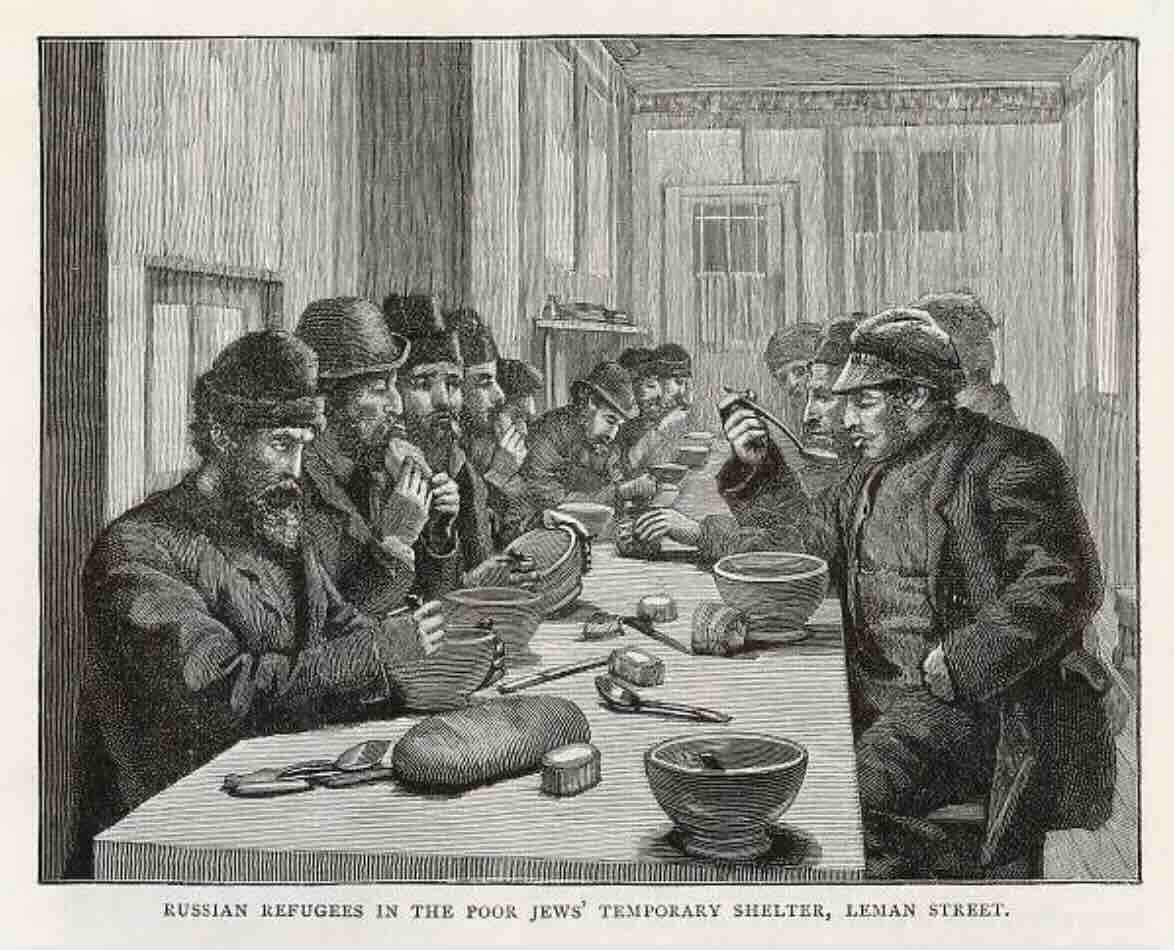
Russian Jews 1890East London, 1890. Source.

In 1889 the Shah Jahan mosque was built at Woking, the first in the country, commissioned by the orientalist Dr Leitner, a Hungarian Jew. A new influx came in the 1890s with around 150,000 Jewish evacuees from the pogroms of Tsarist Russia—some prospering while others toiled in murky sweatshops. The anti-immigration lobby grew; fears of being “swamped” had little justification: “between 1871 and 1910, nearly two million Britons emigrated, far more than the number who arrived”. “Lascars”, a broad term for “Asiatic” seamen, established communities in Liverpool, London, and other ports; Chinatowns began to form. Meanwhile “religion, science, and philosophy joined hands to offer a new vocabulary for racial antipathy”.

During World War One anti-German feeling ran high, egged on by the popular press. Like Satnam Sanghera and Fatima Manji, Winder reminds us of the major contribution of Indian soldiers on the battlefield. But

The First World War was the first time that Britain’s working class had travelled overseas in numbers, and when it returned home, it brought with it a sharpened hatred of all things foreign.

Still, foreign food seemed attractive. Curry had already appeared on the menu of a coffee house in the Haymarket in 1773, and in Hidden heritage Fatima Manji notes a short-lived curry-house in 1810—with a delivery service, to boot. Winder goes on:

In 1931 the Bombay Emporium opened near the Tottenham Court Road, providing the first glimmer of what would later become an indispensable part of British life: the Asian shop. In Portobello, you could buy curry powder, poppadoms, and mango chutney.

Several Indian restaurants opened in Soho, as well as in Glasgow and Cambridge—the beginnings of another culinary revolution. By 1970 there were 2,000 Indian restaurants in Britain (cf. Musical joke-dating).

Winder constantly notes both the stars of industry and culture, and the wretched lives of the exploited sweatshop labourers. Between the wars, new arrivals came from Africa and the Caribbean, mostly students. National independence movements grew. In the 1930s a surge of arrivals from the Irish Free State went largely unopposed. Between 1933 and 1939, some 60,000 Jewish refugees managed to reach Britain—including a dazzling array of cultural figures. Still, anti-Semitism, if “only a pale flaring of the venomous feelings in continental Europe”, was substantial. Nicolas Winton’s Kindertransport stood in rebuke to the British government’s exclusionary policies.

Though Britain’s colonial troops again played a major role in World War Two, fear of aliens was again reinforced. Britain recognised its debt to Polish troops, whose naturalisation after the war attracted little controversy. The following waves of immigrants were not so lucky.

* * *

While all this early history is fascinating, it tends to recede from memory as the story enters the period since World War Two. These were desperate times in Britain, as on the continent (see Lowe, Savage continent). Amidst a labour shortage, the substantial new wave of Irish immigrants was accepted, as were Italian workers—the official beginning of our affair with Italian restaurants and fancy coffee machines. But British racism was clear. The term “immigrants” was fast becoming a polite euphemism for “coloured people”. The popularity of black American troops stationed in Britain during the war had been temporary.

The 1948 Nationality Act gave all imperial subjects the right of free entry to Britain. Despite Britain’s postwar poverty, this seemed a tempting opportunity to a fraction of those now entitled to do so. The voyage of the Empire Windrush attracted much publicity (and anxiety), but it didn’t create a surge of similar voyages; only after 1954 did the exodus gather pace, with London Transport initiating a recruitment drive in 1956. The new West Indian arrivals, though few in number, were unpopular. Caricatures represented by Enid Blyton were being ingrained in children—and their parents.

Over the next decade nearly a quarter of a million migrants arrived from the Caribbean, India, Africa, and Hong Kong, making their way “to the country whose authority they were at last shrugging off”. Migrants were unwelcome in all but the poorest neighbourhoods. Jobs were available, but trade unions were largely hostile; housing was a source of exploitation. The migrants soon became disenchanted with their drab, hostile new home. The government seemed to have no plan:

It declined to take any overzealous measures to prevent immigration, while refusing also to stand up for the migrants themselves.

From India came Sikhs, Hindus, Muslims. Cypriots and Hungarians fled conflict in their home countries. By 1958 the Home Office estimated that there were 210,000 people from the Commonwealth living and working in Britain, three-quarters of them male. Racist resentment grew; teddy boys, egged on by Oswald Mosley, caused havoc.

Whereas male workers had formed the core of previous migrants, the 1962 Commonwealth Immigrants Act (“a preference for muddle over clarity, a refusal to be entirely guided by the promptings of either conscience or prejudice”) led indirectly to the consolidation of migrant families and communities. They became more assertive.

Kenyan Asians found refuge from 1967, and then Ugandan Asians from 1970. But emigration also soared through the 1960s. As tourism and package holidays took  off, more Italian and Mediterranean migrants arrived. By 1971 there were a million Irish migrants, who no longer prompted resentment—though the anti-German temperament endured, recalled by my orchestral colleague Hildi.

Migrants arrived from India and Pakistan, working in factories and setting up corner shops. As National Front youths indulged in “Paki-bashing” rampages, Brick lane, its population now largely from Bangladesh, again became a centre of racist violence.

The Chinese takeaway was becoming a national institution, largely staffed by migrants from Hong Kong. From 50 Chinese restaurants in 1957, numbers grew to 4,000 in 1970 (at a time when there were around 500 French restaurants!). In Sour sweet Timothy Mo gives a gripping fictional portrayal of the Chinese immigrant experience (cf. Ray Man). Despite the common complaint that newcomers refused to “fit in”,

The group of immigrants who made the least effort of all to fit in were the Chinese, who kept themselves to themselves and socialised almost entirely within their own families. Yet they were the least disliked. They kept their distance, and Britain seemed to like it just fine that way.

The Thatcher era from 1979 exacerbated relations. Still, her government soon had to accept 15,000 Vietnamese boat people, rescuing them from “the twin evils of communism and drowning”. Riots took place in Brixton, Toxteth, and Southall. While noting the violence unleashed between different communities from the Indian subcontinent, Winder observes that no-one liked to admit that “Britain’s urban culture was itself incorrigibly tough and brawling”. The terms “ethnic minorities” and “multiculturalism” came into use; schooling and religious instruction became hotly-debated issues. But

No-one could deny by now that Britain’s railways, hospitals, shops, cafés, and restaurants would have ceased to function without migrant workers.

The collapse of the Soviet bloc regimes, along with ongoing crises around the world, led to new surges. Fundamentalist Islam, the Rushdie affair, and 9/11 posed yet another challenge to Britain’s tolerance of migrants. In 2005 the 7th July suicide bombings in London reinvigorated Islamophobic sentiments in some quarters and made others question the nation’s cosmopolitanism. But somehow a violent backlash was avoided.

Distinctions collapsed between refugees, asylum-seekers, and economic migrants. Measures of successive governments became more draconian while the processing system descended into chaos. The idea that Britain might benefit from migration held little sway. The mass media “seemed eager not just to report discord but to sow it”. The “debate”, if it can be called that, was (and remains) rancid and polarised.

Leaving aside the barmier claims that migrants are all disease-ridden, criminally inclined scoundrels who have no place in our well-mannered, sceptred land, there is a sensible argument that they have been arriving on a scale that stretches our strained welfare resources, provokes social unease (true, though holding the migrants alone responsible is mischievous) and provides, in some cases, cover and opportunity for criminals. The opposing argument states that the demonisation of asylum-seekers is both vindictive and misjudged. It looks at a system that imprisons young children for months, and concludes that we are neglecting our moral duty. It suggests that asylum-seekers bring cultural enrichment as well as entrepreneurial drive: above all, they are individuals striving to live by our own ideals for self-improvement and betterment.

The awkward thing about these two extreme views is that they are both true, or contain truth. Immigrants are not all the same. They represent the full spectrum of human types: dreamers and schemers, rascals and rogues, saints and villains.

For the 2013 edition Winder added the chapter “Choppy waters”, with the Conclusion “Identity Parade”. Though forecasters wildly underestimated the number of those who would take advantage of the 2004 enlargement of the EU to come to Britain, it didn’t submerge the island—and it did provide us with a new generation of trusty Polish workers. Many of the new arrivals didn’t intend to stay.

On nostalgic portraits of English life by Betjeman and Orwell, Winder comments

People who contrive thumbnail sketches of national identity are usually lamenting the passing of their own youth, the fraying of the iconography with which they grew up.

He ponders issues of identity and belonging, observing that statistics are unreliable and open to conflicting interpretations. Aware of the problems of segregation, Winder is not uncritical of multiculturalism. He explores whether integration and diversity are mutually exclusive.

* * *

So I’m not sure quite what we can learn here from the famous Lesson of History. In the Preface to the 2013 edition, Winder explains:

I was not seeking to imply that Britain owes everything to immigration; I was merely drawing attention to a common oversight, which was that the role played by immigrants in the story of Britain has been understated and overlooked. […]

Even if entrenched communities were open to such messages, they might hardly profit from realising that we’ve always been both xenophobic and hospitable, or that migrants assimilate eventually. Still, it’s highly necessary to press the case, and among the vast literature on the topic beyond the rabid pages of the Daily Hatemail, this is a great place to start.

Note also the Migration museum in Lewisham. Cf. Hidden heritage, Vermeer’s hat, and Pomodoro!.


[1] Reflecting the history of migration, a 1743 Huguenot church in Brick Lane became a synagogue in 1898 (after an interlude as a Wesleyan chapel), and then a mosque in 1976 (see also this site).

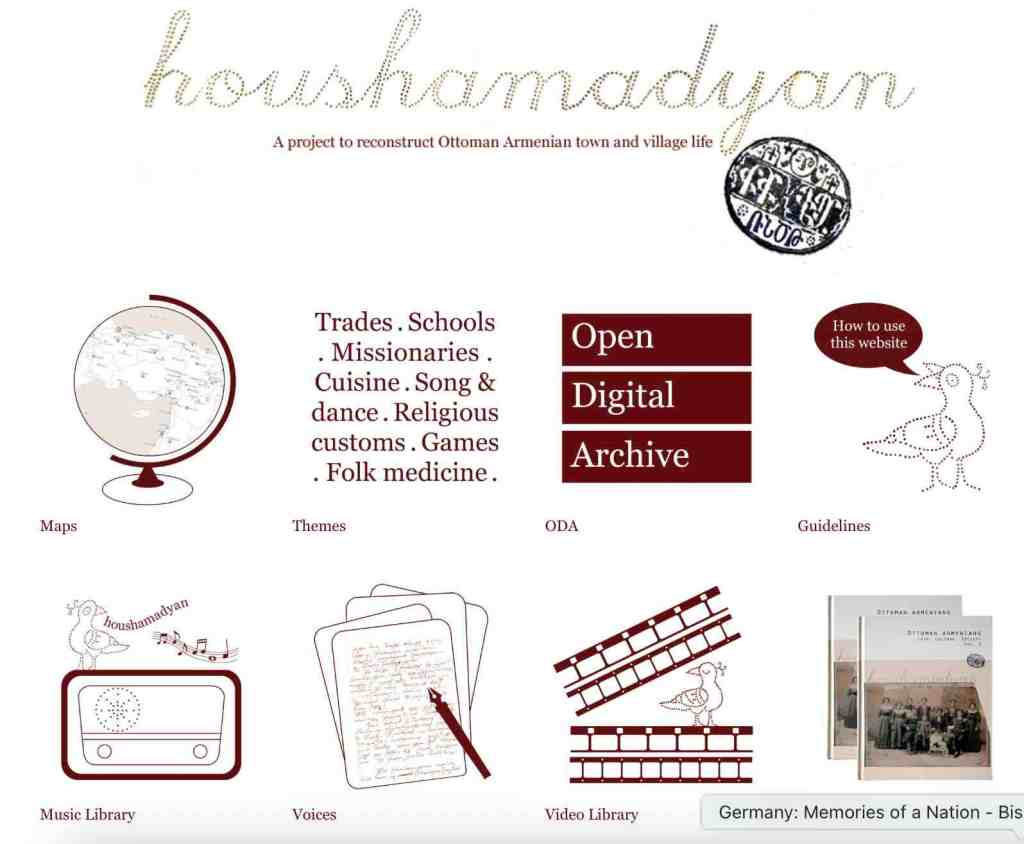
Perfect Pitch

Perfect pitch cover

I’ve often cited Nicolas Slonimsky’s brilliant Lexicon of musical invective. So I enjoyed reading his fascinating memoir

  • Perfect Pitch,
    in a revised third edition from 2023, ably edited by his daughter Electra Slonimsky Yourke.

Written with wit and wisdom at the age of 94, and first published in 1988, it’s a captivating blend of substance and gossip, packed with wonderful anecdotes—a Who’s Who of figures that seemed to matter at the time, part of a niche zeitgeist.

Nicolas Slonimsky (1894–1995) (fine website, with A/V; books, including Writings on music, 4 vols., 2005; wiki) was “a typical product of the Russian intelligentsia”—in the early chapters he gives a detailed account of his Russian family history and political turmoil. Already by 1912 his early musical facility led him to describe himself as a “failed wunderkind”.

In autumn 1918 he left St Petersburg. After stays in Kiev and Yalta, in 1920 he reached Constantinople (pp.85–90), where he found many musicians among the throng of Russian refugees. Lodging with a Greek family, he accompanied Russian dancers, and played for restaurants and silent movies. He composed Obsolete foxtrot and Danse du faux Orient, later included in his Minitudes. After following a girlfriend, a Russian dancer, to Sofia, by late 1921 he arrived in Paris—also inundated by Russian emigrés. There he worked for Serge Koussevitzky for the first time, who introduced him to Stravinsky in Biarritz. Koussevitzky, sorely challenged by irregular time signatures, * asked him to rebar The Rite of Spring for him. Despite moving in cultured circles, Koussevitzky (like Tennstedt later) was not a great reader.

Slonimsky was impressed by Nikolai Obukhov, a “religious fanatic” who made a living as a bricklayer. Inspired by Scriabin, and an unlikely protégé of Ravel, his magnum opus Le livre de vie for voices, orchestras, and two pianos (Preface here) contained “moaning, groaning, screaming, shrieking, and hissing”. He dreamed of “having his music performed in an open-air amphitheatre, perhaps in the Himalayas or some other exotic place”. He developed the croix sonore, a prototype of the theremin.

In 1923 Slonimsky docked in New York, travelling on a Nansen passport, “an abomination of desolation, the mark of Cain, the red spot of a pariah”. He soon found work as opera coach for the new Eastman School of Music in Rochester, at the invitation of Vladimir Rosing. He now confronted the challenge of learning English. Indeed, the book is full of gleeful comments on language learning. Taking advertising slogans as his textbook, Slonimsky’s arrangements (particularly Children cry for Castoria!) became popular. America seemed a fairy-tale land. At Eastman he found a kindred soul in author Paul Horgan.

In 1924 Koussevitzky replaced Pierre Monteux as conductor of the Symphony Orchestra (whose musicians were mainly German, French, and Russian), and the following year he invited Slonimsky to become his secretary (feeling more like a “serf”). Koussevitzky was in awe of Rachmaninoff’s genius, and despite his withering assessments of rival conductors, he did promote Mitropoulos and Bernstein; he was dismissive of Arthur Fiedler’s Boston Pops (cf. the splendid Erich Leinsdorf story). Much as he valued Slonimsky’s talents, his insecurity meant that his young protégé always had to tread carefully, and in 1927 they parted company.

Still, he now enjoyed a “meteoric” conducting career. With no illusions about his rudimentary technique, he founded the Chamber Orchestra of Boston, promoting contemporary composers—notably Henry Cowell, Edgard Varèse, and Charles Ives. After a performance of a work by Cowell, they rejoiced in the headline “”Uses egg to show off piano”. Slonimsky introduced Aaron Copland to George Gershwin. After Cowell introduced Slonimsky to Charles Ives, they became close.

Cowell Ives 1952
Henry Cowell with Charles Ives, 1952.

Slonimsky was full of praise for Ives:

I learned to admire the nobility of his thought, his total lack of selfishness, and his faith in the inherent goodness of mankind. […] He inveighed mightily against self-inflated mediocrity, in politics and art alike. The most disparaging word in his vocabulary was “nice”. To him, it signified smugness, self-satisfaction, lack of imagination. He removed himself from the ephemeral concerns of the world at large. He never read newspapers. He did not own a radio or a phonograph, and he rarely if ever attended concerts.

In 1931 (the year he gained US citizenship), Slonimsky gave the première of Ives’s Three places in New England in New York. Promoting the work with passion, in Perfect pitch he waxes lyrical about its genius.

Slonimsky in HavanaSlonimsky conducting Varèse’s Ionisation in Havana.

He was invited to conduct in Havana, his first experience of modern Cuban music. He conducted revelatory concerts in Paris, sponsored by Ives, encouraged by Varèse. There too he married Dorothy Adlow.

Slonimsky Bartok 1932

He returned to Europe for more concerts in 1932—with Bartók giving the Paris premiere of his 1st piano concerto, and Rubinstein playing Brahms’s 2nd piano concerto!!! In Berlin (in the nick of time before the grip of Nazism) he conducted the Berlin Phil in a modern programme including Three places in New England and Varèse’s Arcana. He repeated the programme in Budapest.

He reflects on this ephemeral phase of his career:

The art of conducting is paradoxical, for its skills range from the mechanical to the inspirational. A conductor can be a semaphore endowed with artificial intelligence, or an illuminating spirit of music. The derisive assertion that “anyone can conduct” is literally true: musicians will play no matter how meaningless or incoherent the gestures of a baton wielder may be. In this respect, conductors stand apart from other performers. A violinist, even a beginner, must be able to play on pitch with a reasonable degree of proficiency. A pianist must have enough technical skill to get through a piece with a minimum of wrong notes. But a conductor is exempt from such obligations. He does not have to play; he orders others to play for him.

This leads him to some wonderful stories about badly-behaved conductors (cf. Viola jokes and maestro-baiting); Toscanini, Klemperer—and this story, evoking the unwelcome posturings of many a later maestro:

Mengelberg once apostrophised his first cello player with a long diatribe expounding the spiritual significance of a certain passage. “Your soul in distress yearns for salvation,”, he recited. “Your unhappiness mounts with every passing moment. You must pray for surcease of sorrow!” “Oh, you mean mezzo forte,” the cellist interrupted impatiently.

I’m eternally grateful to Slonimsky for relating some classic Ormandy maxims (now joyously expanded here by members of the Philadelphia orchestra)—OK then, just a couple:

Suddenly I was in the right tempo, but it wasn’t.

Who is sitting in that empty chair?

In “Disaster in Hollywood” he tells how his first appearance with the LA Phil in 1932 ended in tears. When the programmes for his eight-week season at the Hollywood Bowl in the summer of 1933 proved far too challenging for the “moneyed dowagers”, his conducting career came to an inglorious end. He takes consolation in the later admission of the works that he championed to the pantheon (cf. the fine story of Salonen’s interview for the LA Phil!). Meanwhile in New York he conducted, and recorded, Varèse’s revolutionary Ionisation.

with Electra

With typical linguistic flourishes, he devotes a proud chapter to the birth of his daughter Electra, editor of the volume. He rearranged a limerick:

There was a young woman named Hatch
Who was fond of the music of Batch
It isn’t so fussy
As that of Debussy
Sit down, I’ll play you a snatch.

He would have enjoyed these limericks, and one by Alan Watts, n.2 here.

“Like gaseous remnants of a shattered comet lost in an erratic orbit”, occasional conducting engagements still came his way. In “Lofty baton to lowly pen” he recalls his transition to musical lexicography. He met fellow Russian emigrés Léon Theremin (whose life was to take a very different course) and the iconoclastic theoretician Joseph Schillinger. As Slonimsky compiled his book Music since 1900 (1937!), he became interested in the savage reception of new music, leading to his brilliant Lexicon of musical invective.

Still, he was never tied to his desk. His appetite whetted by his trips to Cuba, in “Exotic journeys” he recalls his 1941–42 tour of Brazil (hearing Villa Lobos’s tales of his Amazonian adventures), Argentina, Chile, Peru, Ecuador, Columbia, Panama, Costa Rica, Nicaragua, Guatemala, and Mexico. His book Music of Latin America was published in 1945.

Returning to Boston, he was plunged into family duties. In 1947 he published Thesaurus of scales and melodic patterns.

In 1935, armed with a US passport, he returned to his birthplace, now called Leningrad, visiting long-lost relatives. He reflects on the death of his mother in 1944, and the life of his aunt Isabelle Vengerova (1877–1956), who became a legendary piano teacher in the States.

After the war, with Russia in vogue in the USA, Slonimsky enjoyed revising his proficiency in his mother tongue, updating old manuals to teach students and taking on work as translator. While he was largely free of McCarthyite suspicion of sympathising with Communism, back in the USSR his brother Michael was at far greater risk for being suspected of opposing it (for Soviet life, note The whisperers).

Dissatisfied with previous compendia and nerdily meticulous, he found a new mission in updating Baker’s biographical dictionary of musicians. He was proud of his 1960 article “The weather at Mozart’s funeral”. In 1956 he achieved unprecedented celebrity through appearing on the quiz show The big surprise.

In “The future of my past” he describes another trip to the USSR and the Soviet bloc in 1962–63, funded by the State Department—an Appendix to the third edition provides a detailed account. He visited Poland, Czechoslovakia, Hungary, Romania, Yugoslavia, Bulgaria, as well as Greece and Israel.  On his meetings with musicians, he was inspired by the energy of Ukrainian and Georgian composers.

His diary is punctuated by his curiosity about language, starting in Moscow:

To my Americanised ears, the new Soviet language sounded almost theatrical in its emphasis, deliberate articulation, and expressive caesuras. I also noticed a proliferation of diminutives….

In Prague he learned the vowel-less tongue-twister Strc prst skrz krk:

I used this phrase as the supposed title of a choral work by the mythical Czech composer Krsto Zyžik, whom I invented and whose name I was tempted (I ultimately desisted) to include as the last entry in my edition of Baker’s.

But soon after his return to Boston his wife Dorothy had a heart attack, which was to be fatal. Bereft after her death in January 1964, he welcomed the offer of a post at distant UCLA. He composed musical limericks for his students’ benefit, but was not always impressed by their aptitude, citing gems from their essays such as “A piano quintet is a piece for five pianos”.

After two seasons he reached compulsory retirement age, but he was never going to go quietly. In LA he enjoyed a wide social circle. Besides many “flaky” composer friends was John Cage, now a guru (Slonimsky cites Pravda: “His music demoralises the listeners by its neurotic drive and by so doing depresses the proletarian urge to rise en masse against capitalism and imperialism”!).

With John Cage, and Frank Zappa.

Back in LA, he made friends with Frank Zappa, who invited him to play at his gig.

Dancing Zappa, wild audience, and befuddled me: I felt like an intruder in a mad scene from Alice in Wonderland. I had reached my Age of Absurdity.

Meanwhile with perestroika in the Soviet Union, Slonimsky was becoming quite a celebrity there too, making several more visits and admiring composers’ creativity in new idioms.

* * *

Far more than a mere entertainer, Slonimsky was a major figure in promoting new music. With his eclectic tastes, I can’t help thinking that he would have enjoyed gravitating to ethnomusicology, questioning the wider meanings of “musician” or “composer” (see e.g. Nettl); but he was deeply rooted in the WAM styles of Russian classics and the American avant-garde. Still, within the world of WAM literature it makes a most fascinating memoir.

For some reason it fills me with joy to learn that a Japanese translation of Lexicon of musical invective has been published.


* Even 5/8 was too much for Koussevitzky:

He had a tendency to stretch out the last beat, counting “one, two, three, four, five, uh”. This ‘uh” constituted the sixth beat, reducing Stravinsky’s spasmodic rhythms to the regular heartbeat. When I pointed this out to him, he became quite upset. It was just a luftpause, he said. The insertion of an “air pause” reduced the passage to a nice waltz time, making it very comfortable to play for the violin section, who bore the brunt of the syncopation, but wrecking Stravinsky’s asymmetric rhythms.

To be fair, Koussevitzky did manage to conduct the 5/4 Danse générale of Ravel’s Daphnis and Chloé (1942 recording here; he first conducted it in 1928).

Some German tongue-twisters

Wartke

Whereas the mind-boggling “tapeworm words” in my post on Some German mouthfuls are of a practical nature, the realm of fantasy opens up whole new linguistic vistas. In a stimulating article, Deborah Cole introduces the work of the Berlin-based cabaret performer, playwright, and pianist Bodo Wartke.

She begins with some drôle political context:

Annegret Kramp-Karrenbauer, a former defence minister with a dastardly difficult name to say, was long seen as a likely successor to the relatively pronounceable ex-chancellor, Angela Merkel. Kramp-Karrenbauer’s resignation as the conservatives’ party chief came as a relief to news presenters the world over, clearing the way for the tight three-syllabic Olaf Scholz. Sabine Leutheusser-Schnarrenberger, once a federal justice minister and the ultimate double-barrelled tongue-tripper, was not invited to join his cabinet.

Now Bodo Wartke and his musical partner Marti Fischer have gone viral with their rap-tinged Zungenbrecher (“tongue-breakers”)—notably  “Barbaras Rhabarberbar” (recorded in 144 takes!), the story of a bar owner named Barbara who enchants all who try her rhubarb cake, including a group of bushy-bearded, beer-swilling barbarians who bring their barber back to try a bite:

This was followed by a charming sequel:

All this is entertaining for Germans and “reliably hilarious to foreigners”. With further links, Cole’s article makes good points about the history and appeal of German tongue-twisters. In English, this video is delightful too.

In Chinese, see A tongue-twister for the household Daoist. The apotheosis of word play, not to be missed, is Nicolas Roberton’s series of Anagram tales. See also under Language learning: a roundup.

In memoriam Klaus Voswinckel

Klaus

The great film-maker and novelist Klaus Voswinckel died recently in Munich on his 81st birthday. His life is commemorated in this obituary.

In his prose he “dances weightlessly between narrative, essay, poetry and sensual philosophy”. He created a wealth of vivid TV films, often with his wife Ulrike, portraying a wide range of musicians—such as The divine drummer: a journey to Ghana, Winterreise: Schubert in Siberia, Steve Reich: music in the words, and A step towards my longing: the composer Sofia Gubaidulina.

Dividing his time between Germany and Italy, Klaus would visit his accomplished daughter Esther and her family in Istanbul, where I was among a multitude inspired by his kindly, gentle soul and wise, good-humoured company. His heart was in Salento, whose popular culture he also documented on film. He was enchanted by taranta—a theme of his novel Tarantella oder Hölderlin tanzt, which I introduced here. So perhaps it’s suitable to send Klaus off with the passionate, intoxicating songs of his friend Enza Pagliara:

Dinner of herbs

Documenting life in rural Anatolia

Herbs

As I work my way through the splendid travel catalogue of Eland publishers—such as Three women of Herat, an anthology of Evliya Çelebi (under Musicking in Ottoman Istanbul), and Nigel Barley—I’ve been appreciating

  • Carla Grissmann, Dinner of herbs: village life in Turkey in the  1960s.

Her year-long stay in a rural hamlet east of Ankara in the late 1960s was curtailed when she was expelled from the village by tedious visa regulations, so she wrote up the story in frustration soon after returning to New York, but it was only published in 2001.

It’s another outsiders’ view of rural poverty that includes classics such as Christ stopped at Eboli, Let us now praise famous men, and so on (see under Taranta, poverty, and orientalism). Always partial to village studies since my time in Gaoluo, I might not have high hopes for the book as ethnography, since she arrived untrained, learning Turkish as she went along—and yet I concur with Maureen Freely and Paul Bowles that it’s most impressive. Anatolian villagers may not easily relate to a single and childless foreigner:

Through all the months I was at Uzak Köy there was hardly a flicker of curiosity about who I myself was, where I had come from, what I had done before or was thinking of doing next. That I had lived in many places, had worked for a magazine, a newspaper, had taught school meant nothing, except perhaps they could vaguely picture a mud schoolhouse similar to their somewhere in the world. What impressed them was that I was an only child, that I had never known my grandparents, that my mother and father lived separately in different countries and that I had no husband and no children. […] In their experience of life my own life was empty.

But while Grissmann’s natural ability to engage with the villagers recalls Bruce Jackson’s thoughts on rapport, her sojourn was not “doing fieldwork”, but living among people.

Herbs 2“People were in and out of each other’s houses from dawn until bedtime.”

She immerses herself in her companions’ challenging routine of cooking, cleaning, childbirth and childcare. “There was always music”—songs with saz, lullabies, the village story-teller, a wedding band, all part of social life, and the conviviality of sharing cigarettes. She obliges an old woman who wants her to record a song, weeping as she sang how one of her sons had killed the other “after that quarrel over nothing”.

On topics such as healthcare and education (and indeed, village latrines, or the dependency of the bride in her new home) I’m reminded of the basic concerns of people in rural China.

Although in the village, being able to read and write was of no great usefulness, it was nevertheless acknowledged that some form of non-religious education, at least for the boys, was of value. It gave them an advantage during their military service, and would always be a safeguard against being cheated by the outside world.

Grissmann sees the wider picture:

Turkey had come so far. Much of the population after the First World War had been lost through battle, disease, and starvation. No proper roads existed, only one railway from Istanbul with a few dead-end branches into Anatolia. Malaria and typhoid still broke out. There were no industries, no technicians or skilled workmen, in a country 90% illiterate, with no established government. The heaviest liability, however, of Ataturk’s derelict legacy from the Ottoman Empire was the great mass of benighted peasants, rooted in lethargy, living in remote poverty-stricken villages untouched by the outside world. Ataturk was determined to loosen the hold of Islam on the people, which he believed was the major obstacle to modernization, and to awaken a sense of Turkish national pride. He fought fiercely for the emancipation of women, denouncing the veil, giving them the right to vote and to divorce.

Still, living in the village, such initiatives seemed remote. Confronted by apathy and prejudice, the village schoolteacher had a daunting task:

On every side the teacher faces the wall of tradition, of the older generation. The masses of Turks obediently took off the fez, yet in their vast rural areas they are still bound to their mosque, fetishism, holy men, and superstitions. Women still cover their face. The men believe that women should indeed be veiled, that girls should not go to school, that sports and the radio are the intrigue of the devil. Illness is cured by words from the Koran, written out and folded into a little cloth bag and pinned on a shoulder, or by having the Imam blow on the diseased or ailing parts. The old men sit in rows fingering their beads and say that what their village needs is a new mosque, not a new road. An new mosque, not a new school.

When she offers money from friends in the USA to install basic amenities, 

They only partially understood; they could not really visualize the source of this wealth in any tangible, significant way. It was providential, immense, incredible, and yet it remained simple. There was no embarrassment of gratitude. 

As to Grissmann’s access to the outside world:

Sometimes a group of children, mute with importance, brought a letter at the crack of dawn, right up to my bed. Most of. these letters had been opened in a friendly way, which I didn’t mind at all. In one fashion or another, everything seemed to arrive, although I never divined any discernable postal system at work or the hand of an actual  postman anywhere in the background.

She ponders the process of learning to communicate:

When you are learning a new language I think you inevitably use a great deal of pantomime and mimicry, and develop small speech idiosyncracies, much of which is inevitably expressed through the comic. Beyond the clownish aspect of this can lie true humour, and if you can genuinely share this most subtle and personal sensibility, I think you have won half the battle of human communication. Although the people in the village were extremely reserved in their speech and their manners, and did not seem to express themselves with gesture or emotion, they were an enthusiastic audience and instantly caught the slightest flicker of whimsy and the allusive point of any story. We built up between us a special way of teasing that never ceased to move me, even after endless repetition. Their teasing of me and each other was a warm human thing and seemed to me to be a part of wisdom, an open, guileless generosity of heart.

Dinner of herbs is a work of great empathy.

Carla Grissmann (1928–2011) led a colourful life. Turkey proved to be a stepping-stone from Morocco to her long-term base in Afghanistan. The 2016 Eland edition contains a vivid afterword by her lover John Hopkins.

* * *

This led me on a preliminary foray in search of further ethnographies of Anatolian life. Grissman mentions Mahmut Makal‘s trenchant A village in Anatolia (1954), as well as Yaşar Kemal’s 1955 novel Memed, my hawk. On Makal and later village websites, see this thesis, as well as wiki on the short-lived Village Institutes.

Following Brian Beeley (Rural Turkey: a bibliographic introduction, 1969, and hisMigration and modernisation in rural Turkey”, in Richard Lawless, ed., The Middle Eastern village: changing economic and social relations, 1987), note the work of Paul Stirling (here, with full text of Turkish village, and papers; he also edited the 1993 volume Culture and economy: changes in Turkish villages). This article introduces some other international anthropologists in the field in the late 1960s; here Chris Hann reviews works by Carol Delaney, Julie Marcus, June Starr, and (for urban arabesk) Martin Stokes. I trust there’s much more out there from Turkish ethnographers. My search continues for documentary films on rural Anatolia (cf. Everyday life in a Syrian village). 

My series on West/Central Asia includes posts on the social life and expressive cultures of rural areas, such as Musicking of the yayla, Bektashi and Alevi ritual, Bartók in Anatolia, Rom, Dom, Lom, A rural woman singer, and Some Kurdish bards. See also Following Miss Bell.

With thanks to Caroline Finkel and Pat Yale,
who are entirely innocent of blame for my rudimentary explorations.

A Buddhist centre in Peckham

Master Miao Jiang,
Wutaishan through successive regimes,
and religious life around Datong under Maoism

I got to know the Buddhist monk Kuan Guang 宽广 (b.1974) while he was doing his PhD at SOAS—guided by Tim Barrett—about the mountain temple complex of Wutaishan, epicentre of Buddhism in north China, where he trained.

Originally from Baoding south of Beijing, he is blessed with a calm and benevolent nature—such as one doesn’t always find among clerics, or indeed among the household ritual specialists whom I have consulted in north China. In addition, his deep, sonorous voice conveys his authority and wisdom.

So it’s wonderful to catch up with him. Apart from furthering his research on the history of Wutaishan in the Ming dynasty, he has created the Qingliang Buddhist Centre at a former church in Peckham, south London. Inspired by his venerable master Miaojiang 妙江法师 of the Bamboo Grove temple 竹林寺 on Wutaishan, Kuan Guang has undertaken this complex enterprise in the spirit of “expedient means” (Sanskrit upāya, Chinese fangbian 方便).
* * *

In both old and new societies, entering the clergy was often ascriptive, rather than a spiritual choice; poor families would routinely give a young son to a local temple as relief from adversity. However, in the case of Miao Jiang, his parents (surnamed Liu) were devout lay believers (the following account is based on this online biography; in English, see here).
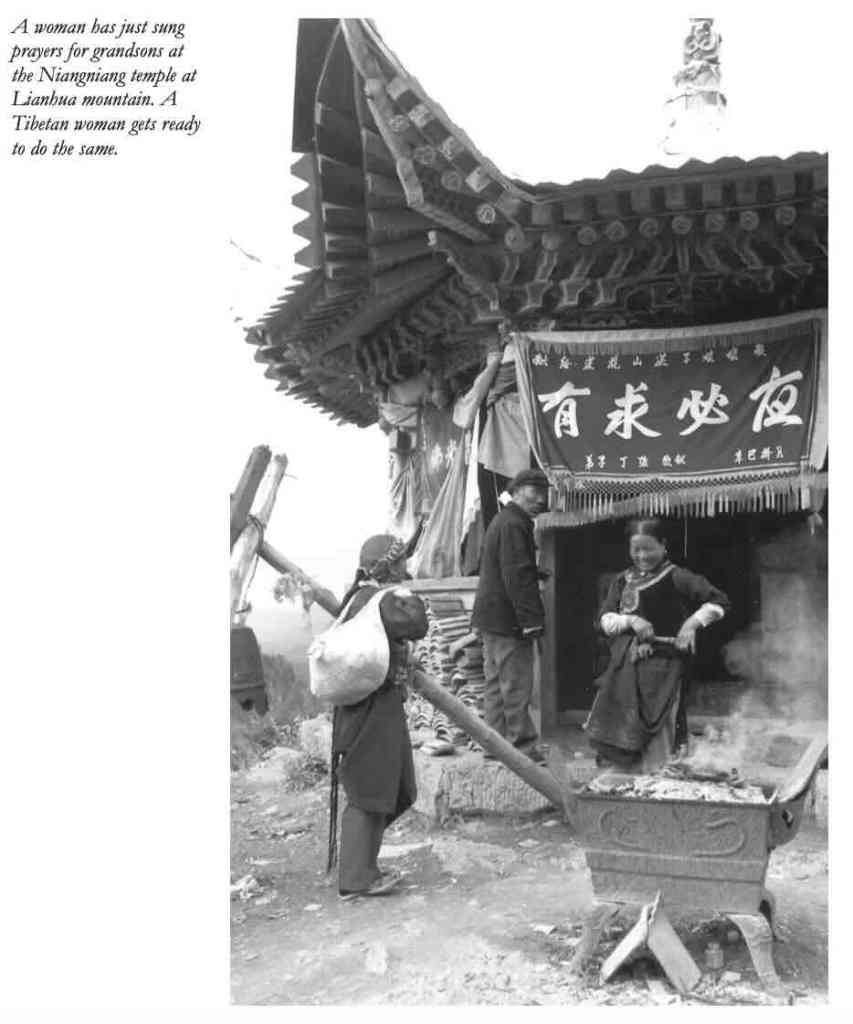
Liu Jiang (his original name) was born in 1953 in Yanggao county (home of the Li family Daoists!) just east of the grimy coal city of Datong, in West Yaoquan village in Gucheng township. * The daily domestic worship of his family environment made a stark contrast with the escalating political campaigns of the 1950s. When he was only 3 years old, his parents, busy with agricultural chores for the collective, sent him to a nearby temple, where his master Chang Rong 常荣, himself only 15, lavished exceptional care on his bright young disciple.

In 1959, just as food shortages were becoming desperate, Liu Jiang’s mother took him to Datong to pledge allegiance at the Shanhua temple 善化寺. ** While receiving a rudimentary secular education at his village primary school, he prudently refrained from divulging that he was devoting most of his energies to his parallel cultivation of the dharma—praying with his mother before the family shrine, studying Buddhist texts such as the Pumen pin 普门品 scripture, and learning to recite the Dabei zhou 大悲咒 mantra. At a time when villagers were desperately foraging for food, when the meager crop from the autumn potato harvest was being divvied out among the brigade team, he would only take home his share after the others had chosen the best ones. As he later recalled, “I would eat whatever Old Budda Elder ate” (老佛爷吃啥我吃啥).

Shanhua siThe Shanhua temple during the 1933 fieldtrip of the architectural scholar Liang Sicheng.
Lin Huiyin
Lin Huiyin, architect wife of Liang Sicheng, Wutaishan c1937.
Source: Sixth Tone.

In Datong after the Japanese occupation and civil war, the extensive buildings of the imposing Upper and Lower Huayan temples 上下华严寺 were under restoration through the 1950s, and were designated as national cultural relics in 1961. As the Cultural Revolution broke out in 1966, while religious sites and clerics all over China were being assaulted, some of the major Datong temples were safeguarded under the aegis of a Bureau Chief, a Buddhist believer from Wutaishan. *** Although the Red Guards chased off most of the remaining monks, the Bureau Chief gathered some former monks—in plain clothes—to keep watch over the temples. So amidst all the chaos, the Upper Huayan temple became a clandestine meeting place where youngsters like young Liu Jiang and his fellow believers could seek instruction in the dharma

The Huayan temples, 1939:
left, Lower temple; right, grounds of Upper temple.
Source (colourized).

It was at the highly unlikely time of 1968 that he had his head shaved to become a monk, at the behest of his master in the Shanhua temple. With a group of senior monks officiating, they locked the gate early, and around midnight held his formal ceremony. Shortly afterwards, when his master returned from the nearby Buddhist cave complex of Yungang, the teenager was given the Buddhist name Miao Jiang.

Such biographies require us to adjust our simplistic view of the blanket destruction of religion though Maoism and the Cultural Revolution (for another instance, see Kang Zhengguo‘s account of his Buddhist grandfather).

After the liberalizations around 1980, five more members of Miao Jiang’s family over four generations joined the clergy: both his parents (in 1983), followed by two sons and a granddaughter in his older sister’s family. Popular opinion was full of praise for their exceptional devotion.

In 1973, when Miao Jiang was miraculously unscathed by an accident while repairing a reservoir, he considered it a sign of the protection of the Bodhisattva Mañjuśrī (Wenshu pusa 文殊菩萨). This was the inspiration for him to turn further south in Shanxi towards Wutaishan, around which his mature life has revolved. He has been based there since 1980, as the mountain opened up to a massive reinvigoration of “incense fire” (xianghuo 香火) after the depression of the Maoist era. Through those early reform years, he served as abbot in several temples, which thrived under his leadership. As Wutaishan became ever more commodified by tourism and heritagification, he was fêted with official titles—but he has remained aloof from worldly affairs.

Miao Jiang’s reputation grew, not by preaching but through the influence of his practice—”bodily instruction” (shenjiao 身教) rather than “verbal instruction” (yanjiao 言教). Still, after the challenges of practising Buddhism under Mao, it has been a very different kind of test to spread the dharma and maintain its integrity in the brash, mercenary new society. Eschewing the lifestyle of official banquets, he adheres to a simple Buddhist diet, while sponsoring charitable and relief projects.

See also Yanggao: a distant Daoist connection.

* * *

Kuan Guang formally joined the Buddhist order under the guidance of Miao Jiang in 1993. After Maoism and the reforms in China, nurturing the dharma in multicultural Peckham presents yet another kind of challenge. Apart from a programme of events at the Qingliang centre, such as guided meditation and calendrical rituals, Kuan Guang now plans to open a Buddhist vegetarian canteen there. He was always wise, but he too has now become a veritable master, whom his disciples can look up to. While I’m not generally predisposed towards Buddhist centres in Britain, this is a most admirable enterprise. In praising Kuan Guang, I’m reminded of the old Krishnamurti paradox: his efforts are selfless, devoted entirely to promoting the dharma (cf. Paths for the reluctant guru).

* * *

It also occurs to me that while I often come across devotional sects in my fieldwork (such as the Bright Association 明會 in Yanggao, scrolling down here), I have had little contact with jushi lay Buddhist adherents. In Yanggao since the 1980s, rather few temples have been restored: but in those temples which are active, their keepers were often ordained as Buddhist monks or spent time “roaming the clouds” in Wutaishan or Datong—such as the gentle Zhang Zheng, who helped Li Manshan decipher a stele at the Zhouguantun temple in Yanggao. ****

Having immersed myself in Zen in my teens, I rather lapsed, although for several years after first visiting China in 1986 I would regularly kowtow before the altar on entering a Buddhist or Daoist temple—mainly the grander ones of the cities and sacred mountains (Wutaishan was one of my first ports of call in 1986). But I came to feel a bit of a poseur, and later, frequenting small village temples, it hardly seemed appropriate…

* * *

In another post I explained why field studies of folk ritual in China mainly focus on household Daoists. While they dominate the rural ritual scene, when we find Buddhist ritual specialists, they may also perform similar rituals; the toolbox required to study the two is similar, and we shouldn’t compartmentalise our studies. Buddhism is more dominated by institutions (the major temples); formerly, Buddhist clerics worked mainly from their temples, and the 20th-century waves of laicization and temple destruction were more of a blow to the Buddhists than to the Daoists. The Buddhists perhaps tended to cater more for elite patrons, and were less able to survive during times of economic recession; state policies of the 1950s came as a double blow to them, as apart from laicizations and temple destruction, their former patrons also vanished. Conversely, the Daoists had long lay and household traditions, alongside any institutional base; they were more adaptable to local religious life, more all-embracing. The difficulty of regulating them has always been their hidden strength.

So I rarely encounter exalted Buddhist masters like Miao Jiang and Kuan Guang. But when I do, I am deeply impressed. While I have the utmost respect for the wisdom of more down-to-earth peasant ritual specialists like Li Qing and Li Manshan (see my film), around whom my fieldwork has revolved, in the presence of great temple clerics I feel a certain embarrassment that my path has led me away from the quest for spiritual enlightenment towards documenting the “heat and noise” of folk ritual; yet somehow my early background in that quest has formed an enduring foundation.

See also A Tang couplet, and Buddhism tag.


* Indeed, his disciple Kuan Guang was able to give me valuable help in 2011 when I struggled to decipher the dialect of Yanggao peasants on my fieldtapes. I am consoled and amused that when I screen my film for urban Chinese students, with Li Manshan’s own voiceovers, most of them have to rely on the English subtitles!

** Not long before Li Manshan’s trip to visit his father Li Qing at the Datong Arts Work Troupe

*** Around Datong the worst vandalisations only occurred in 1968; still, the Huayan temples soon resumed life as a museum—until the 1980s’ reforms, since when religious observances have had to compete with tourism.

**** My film, from 36.01; cf. my Ritual and music of north China: shawm bands in Shanxi, pp.71–8, and Daoist priests of the Li family, pp.50–51.

Madonna in a fur coat

Madonna cover

For Turkish fiction, besides The Time Regulation Institute, Penguin Classics has also published

  • Sabahattin Ali, Madonna in a fur coat (serialised 1940-41, first edition 1943)
    in a translation by Maureen Freely and Alexander Dawe (2016),
    with an introduction by David Selim Sayers.

The teacher Sabahattin Ali (1907–48) (wiki; fuller Turkish version), a protégé of the Sertels and Nazım Hikmet (see The struggle for Turkey), contributed to literary magazines, going on to found and edit the satirical weekly Marko Paşa. Perceived as a dissident author critical of Atatürk and the Republican state, he spent periods in prison. In 1948, while seeking a new life abroad free of state intrusion, he was murdered at the Bulgarian border, apparently at the behest of the Turkish National Security Service.

Ali and HikmetSabahattin Ali (left) with Nazım Hikmet. Source.

In Turkey, as Sayers comments, Ali is “a figure of gravitas […], a devastatingly incisive observer who harnessed the power of his prose to expose the country’s social and political injustices”. Writing in 2016, Maureen Freely explains Ali’s enduring relevance:

The fate of Marko Pasha, his satirical weekly, calls to mind the almost 2,000 prosecutions by President Erdoğan’s of those who have dared to mock him. Ali’s murder, allegedly at the hands of an offended patriot, was echoed by the 2007 murder of the Turkish-Armenian journalist Hrant Dink. It also calls to mind the foiled shooting of the main opposition newspaper’s editor, Can Dündar, as he walked with his wife into court to receive a five-year sentence for publishing an article about the ruling party’s involvement in the secret arming of jihadi groups in Syria. This was only a few weeks ago. And it was just the latest episode in a series of increasingly savage attacks on independent publishing and journalism. The suppression of critical voices is now as harsh, if not harsher, than it was during the fascist-dominated single party state that crushed Ali and so many others. When Ali’s readers cry for him, they are also crying for themselves.

By contrast, Madonna in a fur coat is the semi-autobiographical story of a doomed liaison, set largely in Berlin, where Ali himself studied from 1928 to 1930 before returning to Turkey to teach. The protagonist Raif is a “rather ordinary” man “with no distinguishing features, no different from the hundreds of others we meet and fail to notice in the course of a single day”. As this article explains, by the 1970s interest in Ali grew as he began to be considered as a forgotten author coming to light, now distanced from his ideological identity and turned into a “mystical and romantic” figure adopted by both left and right. And the novel’s recent popularity in Turkey is attributable to its promotion by publishing houses amidst changing copyright laws alongside the power of social media, as well as reassessed images of the author himself. But as Freely observes, while Ali’s admirers have regarded the novel as a “puzzling aberration”, a mere love story,

his least acclaimed novel has become Turkey’s most celebrated love story today because it refuses the traditional gender roles that Turkey’s president seems hell-bent on enforcing, not just in the religious heartlands but also in the cities and towns that have been secularising, and liberalising, for almost a century. Anyone who departs from his retrograde norms, he decries as traitors or terrorists in the making. During last year’s election campaign, he went so far as to accuse Turkey’s LGBT community as being in league with Armenians, Kurds, and the hostile foreign powers that funded them. Hardly a day passes without his saying what a woman should be, and what a man—a real man—should do to keep her in her place.

AliSource.

Sayers too makes a determined case for Madonna in a fur coat. While apparently apolitical, the novel subtly critiques the Republican dream. Raif falls in love with Maria ” in the most Ottoman way imaginable, by looking at her picture rather than her person”. As their intense, complex platonic relationship unfolds amidst the decadence of Berlin nightclub life, Maria laments:

Do you know why I hate you? You and every other man in the world? Because you ask so much of us, as if it were your natural right… Mark my words, for it can happen without a single word being uttered… it’s how men look at us and smile at us. It’s how they raise their hands. To put it simply, it’s how they treat us… you’d have to be blind not to see how much confidence they have, and how stupidly they achieve it. […] And our duties? To bow down and obey, and to give them whatever they want….

Such a “refreshingly unorthodox dissection of gender” lies “firmly outside the norms of Western and Turkish society alike, whether in the 20s, the 40s, or today”. Still, while lacking a background in Turkish culture and politics, I tend to side with those who prefer to value Sabahattin Ali for his more avowedly political writings.

For two other Madonnas of whom you may have heard, click here and here.

China: writing in the air

53 GN and WM amused cropped
During interludes between rituals,
my Daoist friends enjoy trying to decipher the weird squiggles in my notebook.

Talking with Chinese people, when one doesn’t understand a bit of dialect or an obscure term, they sometimes adopt a device that supposedly solves the problem, as the wise Victor Mair describes in his recent post on Language Log:

Countless are the times I’ve seen people writing Chinese characters in the air to tell which of dozens of homophones they might be referring to. They say, “You know, it’s this one”, and then their index finger goes flailing through the air. It never works, because there are no points of reference from one stroke to the next or between one component and the next, plus they are writing backward with regard to the person to whom they are trying to describe the character.

It works a bit better writing sinoglyphs in the air if the drawer and the viewer stand facing the same direction—but not much.

Writing characters with your finger works a lot better if you do it on a surface—your palm, a table, a car hood, whatever, but it’s still far from ideal, because the movements are ephemeral.

I would add that while the palm is indeed a surface (and I can usually just about work it out when someone “writes” the character in my palm), more often they write it in their own palm, which is facing them, not you, so you can’t even see it properly… As a foreigner one feels a certain obligation to pretend one has understood, perhaps to avoid losing face, or to reassure them that you are literate and “have culture”. So while gratified to learn that it can be a challenge even for such a master as Prof. Mair, when I’m perplexed in such a situation I still find it a tad embarrassing, since Chinese people together seem to find it a perfectly satisfactory solution.

For simpler cases, one is accustomed to widely-understood verbal descriptions of a character—whether by depicting its component parts, such as for the surnames Wu (koutian wu 口天吴 “wu with mouth and heaven”) and Li (muzi li 木子李 “li with wood and son”), or by stating its use as part of an unambiguous binome, like my own Chinese surname (zhongbiaode zhong 钟表的钟 “zhong as in clock”, a bit like “cat as in catastrophe”). * This can get pleasantly silly, like when I tell rural ritual specialists (or other friends who share my abstruse predilections) which character for kou I’m referring to: “Yuqie yankoude kou 瑜伽焰口的口” (“kou as in the Yogacara Flaming Mouth ritual“), establishing a niche complicity…

Left, Yankou shishi ritual manual, 1922 (see here, under Gaoqiao).
Right, former monks performing a funerary yankou ritual, Beijing suburbs 1993.

Talking of which, in the early 1990s I used to visit the elderly former monk Benxing in his bare room at the Zhihua temple, listening as he told me about the ritual life of old Beijing, and his own story. As I was taking notes, sometimes I had to query how to write a character that came up in conversation—not so much Buddhist terms as the names of people, streets, or villages. This was long before the days of mobile and internet, and he didn’t even have a little dictionary—but what he did have was a copy of the voluminous Flaming Mouth ritual manual, which he now used for the same purpose. Having learned thoroughly to recite it in his youth before Liberation (and still sometimes performing the ritual for patrons in the suburbs), Benxing was able to fast-forward mentally through the entire text until he came across the character in question, and then deftly flick through the manual to show me!

Back to oral descriptions: one evening in Shaanbei in 2001 with my two fieldwork colleagues at a grotty hostel in Jiaxian county-town, I was telling them how I’d been reading up on the origins of the county Jinju opera troupe in the nearby village of Mutouyu (木头峪, “Wood Gulch”) which had made important innovations before Liberation, performing for Chairman Mao at the Baiyunshan temple fair in 1947. ** I had great fun trying (with studied ineptitude) to explain how to identify the characters for the village:

木头的木,嗯,木头的头。。。嗯,木头峪的峪!
mu as in mutou [wood]—um—tou as in mutou [wood]… um [finding it a challenge to evoke the final character, and then triumphantly:]—yu as in “Mutouyu”!

* * *

So much for mundane communication—an altogether more cosmic air-writing device is that of the Daoist priest at the altar during rituals, depicting complex fu 符 talismans that can only be understood by the gods. Brilliantly (if perhaps controversially?!), in his 2005 film Han Xin’s revenge, on Daoist ritual in Hunan, Patrice Fava renders the characters visible on screen as the priest depicts them!

Screenshots from Han Xin’s revenge:
Left, Zou Qishan writes the secret names of the deity Wang Lingguan 王灵官
Right,
Chen Demei inaugurates the puppet-statue of Han Xin.

In this clip Chen Demei depicts the taboo characters for the astral deity Ziwei 紫微讳:

Do watch the complete film!

With thanks to Patrice Fava.

* * *

Cf. Whistled languages, mundane and transcendental; It’s the only language they understand; and Literary wordplay.


*  A distant English variant of this (though far more boring, rigid, and infuriating) is the NATO phonetic alphabet (F for Freddie, U for Uniform, C for Charlie…)—making a further gruelling ordeal when you finally get through to an institution on the phone, charmingly satirised by Bridget Christie.
“Cat as in catastrophe, dog as in dogmatic” is part of a joke about trying to buy broccoli, which I’ll save up for another time…

Mutouyu JC

** See e.g. the Shaanxi volume of the Monograph on opera in the great Anthology: Zhongguo xiqu zhi, Shaanxi juan 中国戏曲志, 陕西卷, p.536 (above), and latterly online articles such as this. As ever (for Baiyunshan, see e.g. here), such an outline invites us to “read between the lines” to recreate the socio-political picture of the day.

A Miao Christian community in Yunnan

Maidichong

Among the “underground historians” highlighted by Ian Johnson in his latest book Sparks is the documentarian Hu Jie 胡杰. I mentioned his 2016 film The songs of Maidichong village (Maidichongde gesheng 麦地冲的歌声) in my introduction to the China Unofficial Archives site, but it deserves a separate post (for more, see this review by Max Berwald, cited below).

Here’s the film (you may be able to find an English-subtitled version too):

Opening strikingly with an elderly village woman singing the hymn Amazing grace to camera, the story is told without apparent rancour by stoic, quietly determined peasants and church elders; by an itinerant rural dentist—and in several thoughtful reflections, a veteran cadre, former secretary on the Yunnan Party Committee, who often visited the village on government business during the high tide of Maoist campaigns:

People’s hearts began to change. At first they were close to the Communist Party, because you brought them practical benefits—land reform. But then came the People’s Communes that actually deprived the peasants of what they were given. Moreover, the famine that followed was what they remembered most. I remember the embarrassment going down to the countryside to implement the minorities policy. We asked them to start by pouring out their past woes [suku 诉苦]. When they did that, they all began with the famine during the Great Leap Forward, all about the commune canteen that made people starve.

Screenshot

Screenshot

Screenshot

Screenshot

Maidichong, a Miao (Hmong) village just north of Kunming, was evangelized in 1903 by the English Methodist pastor Samuel Pollard.

Maidichong 5

Under Maoism, serious repression intensified with the 1958 Great Leap Forward. We learn of the life, works, and martyrdom of Reverend Wang Zhiming, brutally executed late in the Cultural Revolution:

His death marked a moment of violent confrontation between two competing modernization programmes: Christian missionary modernization, itself part of a colonial project, and nationalist, communist modernization. Both were interested in bringing literacy and modern healthcare to Maidichong—both regarded as key social indicators of development to this day—and both claimed the authority to name the sacred.

Both movements, as Berwald comments, promised “modernity in exchange for loyalty to a political project”. He asks, “How can memories of Christian missionary work ever be mobilized on behalf of a history of resistance by oppressed peoples?”

As one Reverend explains to Hu Jie, Christianity appealed particularly to the Hua Miao subgroup, whom he describes as among the most exploited and impoverished of Miao peoples in the region in the late imperial era.

Screenshot

1980, when the central Party leadership finally implemented a more open religious policy.

A theme common among devotional communities: younger generations since the reform era, lured by material prosperity, modern pop and media culture, are losing commitment to the faith; “development”, which once led people to Christianity, is now drawing them away from it. Still, the Yunnan authorities remains wary of such groups, mounting periodic campaigns.

As Berwald observes, the film doesn’t come across as a portrait of a community in crisis; Hu Jie’s questions don’t force a reckoning with a traumatic past (I suppose this is a similar approach that dawned on me in my studies of Gaoluo village and the Li family Daoists). Berwald concludes:

The faith of this community appears starkly contingent, with the film offering neither an indictment of the imperialism of British missionaries or of any state formation. Rather, what we have is a Christian community freely practicing its faith and remembering particular histories. Songs From Maidichong does not stoop to preach, insisting only “this too”, and forsaking polemical fury as it does so. How radical such an approach appears depends on the audience.

Ian Johnson lists many of Hu Jie’s other documentaries in Sparks. I’ve also just been watching Remote mountain, an utterly bleak film set in the barren northwest, cited in n.1 of Social issues in rural Henan. For more on Christianity in Yunnan, see Liao Yiwu, God Is Red: the secret story of how Christianity survived and flourished in Communist China (2012).

* * *

The many rural Christian communities in Yunnan have attracted considerable research, not least from ethnomusicologists. Alongside his studies of Daoist and Buddhist ritual music there, Yang Minkang 杨民康 has published extensively on the topic, e.g. Bentuhua yu xiandaixing: Yunnan shaoshu minzu Jidujiao yishi yinyue yanjiu 本土化与现代性: 云南少数民族基督教仪式音乐研究 (2008).

For the story of a determined community of underground Catholics in north China, click here. Of course, indigenous religious groups too, and indeed the whole of Chinese society, have been subjected to severe traumas, both under Maoism and since the 1980s’ reforms: see e.g. Cultural Revolutions, China: commemorating trauma, and Memory, music, society.

Palaver, Kerfuffle, and Faff

Palaver
Source.

One of the unsettling things about getting old is that I find myself using antiquated expressions that I always disdained, such as

“Well, this is a bit of a palaver…”

With that classic understatement of the English, the ideal context is when serious calamity strikes, such as when quelling a mutiny of the restless natives [As one doesEd.]. Sure enough (cf. Tickety-boo), its etymology goes back to colonialism. Used in English since the early 18th century,

palaver, “profuse and idle talk; chatter”, comes from Portuguese palavra “word, talk, speech” by way of sailors’ slang. Portuguese was commonly used as a trading language on the West African coast, and palaver came into English first in the sense “a parley or conference, typically between Europeans and the Indigenous people of a region, especially in West Africa”.

One gathers that such discussions were not entirely on equal terms…  The same source goes on:

Portuguese palavra and its Castilian counterpart palabra come from Latin parabola “comparison, explanatory illustration”, and in Late Latin (and especially in Christian Latin), “allegorical story, parable, proverb”.

And it elaborates on a widespread phenomenon:

Metathesis, the transposition of consonants, is common in Spanish and Portuguese: the syncopated form parabla (from parabola) becomes palavra in Portuguese and palabra in Spanish, just as Latin mirāculum “miracle” becomes milagro in Spanish and milagre in Portuguese.

The wiki entry on metathesis gives instances from a wide range of languages including Amharic, Azerbaijani, Kurdish, Finnish, Hungarian, Navajo, Turkish—and English.

It’s just as mystifying to suddenly hear oneself using the word kerfuffle,

early 19th century: perhaps from Scots curfuffle (probably from Scottish Gaelic car “twist, bend” + imitative Scots fuffle “to disorder”), or related to Irish cior thual “confusion, disorder”.

Like Ogonek and Til, Palaver and Kerfuffle could be another “feisty yet flawed” pair of detectives.

I can’t see that kerfuffle is related to faff, another word I’ve weirdly adopted—not so much in the sense of “faffing around” as in “this is a bit of a faff”. Again, its etymology is interesting:

late 18th century (originally dialect in the sense “blow in puffs”, describing the wind): imitative. The current sense may have been influenced by dialect faffle “stammer, stutter”, later “flap in the wind”, which came to mean “fuss, dither” at about the same time as faff (late 19th century).

The stammering connection may now establish “faff” even more f-f-firmly in my vocabulary. I surmise that the emergence of such words denotes the transition from an adventurous, carefree youth to the desire for a tranquil life unruffled (unfaffled?) by the sundry ordeals of old age (passwords, call centres, stairs…).

So now we have Palaver, Kerfuffle, and Faff—a firm of solicitors. Colloquially abbreviated to Falafel.

* * *

For the “exploits” of early colonialists, see Vermeer’s hat; do read Sitting Bull’s rebuke to the invaders in n. 1 of The Ghost Dance; and for more dabblings in Portuguese, click here. I am now in the habit of referring to “hideous encounters with domestic necessity” as “marmalade”, after Compton Mackenzie’s beautiful talk about his meeting with Henry James.

Daoist ritual in north Taiwan: an ethnography

Chu Chien-ch'eng
Taipei: Daoist priests working for the Hsien-miao altar 顯妙壇,
led by master Chu K’un-ts’an 朱堃燦, “open the eyes” of a god statue damaged in a temple fire.
All images courtesy of Yves Menheere. [1]

Pursuing a major theme that I broached in my superficial survey of music-ritual cultures in Taiwan, I learn much from

  • Yves Menheere, The Way and its powers: an ethnographic account of Taoist practice and religious authority in northern Taiwan (2020),

a lucid study which helps further my education on a topic that I previously found somewhat indigestible.

Menheere cover

The Introduction sets the tone for Menheere’s enquiry:

Why do people put their faith in religious specialists? Why are some people considered to be more adept at communicating with deities, explaining scriptures, blessing objects, or solving problems with ghosts and other malevolent forces?

Contrasting rituals that are “supposed to work” with those that are meant to be carried out “in the correct way”, Menheere finds that “neither efficacy nor proper performance can explain why people put more faith in one particular priest and not another”. In exploring authority and charisma he considers the work of Max Weber, Stephan Feuchtwang and Wang Mingming, Vincent Goossaert, and Pierre Bourdieu. 

His useful summary of previous research starts with J.J.M. De Groot in late-19th-century Xiamen (in mainland Fujian); and for Taiwan under Japanese rule (1895–1945), studies by Japanese scholars and colonial administrators, notably a 1919 report under the supervision of Marui Keijirō. After World War Two, the pioneering work of Kristofer Schipper (on south Taiwan) and Michael Saso (for Hsinchu in the north) was continued by John Lagerwey for both north and south. Taiwanese scholars have also been industrious, from Liu Chi-wan and Lee Fong-mao to Lü Ch’ui-k’uan, followed by Lin Chen-yuan and others. As Menheere notes, the main focus of such studies has been the description of rituals and the search for the origins of particular practices and traditions; however, scholars adopting more anthropological approaches include Stephan Feuchtwang, David Jordan, John McCreery, Robert Weller, and Chang Hsun.

ji waifang
Offering and Sending Away (che-sang 祭送) ritual segment.
Left: 1930s (from Kajiwara Michiyoshi 梶原通好, Taiwan nōmin seikatsu kō
台灣農民生活考, 1939).
Right: Lim Ch’ing-chih 林清智 (b.1952), 2015. 

For ritual studies, I’ve outlined how by the early 1980s, as the PRC opened up after three decades of Maoist repression, the scope of fieldwork at last expanded to mainland China—fanning out from south Fujian (ancestral home of the Taiwanese Daoist altars) in a succession of major projects, mostly led by scholars with experience of the religious scene in Taiwan. So whereas previously the island was almost the only accessible site where scholars could study the riches of Daoist ritual, a wealth of local traditions now beckoned all over the vast expanses of the PRC, “if not eclipsing the reputation of Taiwan’s heritage, then at least putting it into perspective”, as I wrote (cf. The resilience of tradition).

However, it’s always worth paying attention to the ritual life of Taiwan, subject to fewer disruptions than in the PRC—with research now enriched by access to traditions shared with the southeastern mainland. And since scholarship on both sides of the strait, though based on fieldwork, has stressed the early origins of rituals rather than social ethnography (cf. Debunking “living fossils”—combining these approaches for Fujian, though, is Ken Dean), Menheere offers a fresh perspective.

* * *

The distinction between Redhead (ang-thau 紅頭) and Blackhead (o-͘thau 烏頭) ritual specialists is particular to Taiwan and Fujian; while much discussed, it remains complex. In north Taiwan, Blackhead priests specialise in performing mortuary rituals, and are either Sek-kau 釋教 Buddhists, or Daoists sometimes described by the name Numinous Treasure (Leng-po / Lingbao 靈寶). Redhead Daoists—Menheere’s focus, whom he describes as “the Northern Priests”—refrain from performing funerals. While belonging to the Cheng-it / Zhengyi 正一 branch (like Daoists further south in Taiwan), they

carried out rites in ways that were broadly similar, and they were able to work together in ritual performances, which frequently occurred. Their way of working set them apart from priests from central or southern Taiwan, who performed rituals in different ways and were generally unable to work in concert with priests from northern Taiwan. These priests agreed that they belong to the same phai 派 or “branch” of Taoism and that priests from central and southern Taiwan belonged to a different branch. [2]

As Menheere observes, authority is relational: “it depends on the position of the individual priest in a wider network of priests, and it is always socially constructed and cannot be reduced to a particular priest’s personality or individual qualities”.

Between the Introduction and Conclusion, the book is arranged in six unnumbered chapters, to which I will award numbers here.

Chapter 1 (“Gods, ghosts and ancestors”) opens with a description of an exorcistic ritual intended to deter malignant forces of the road (lo-͘soah 路煞) from causing traffic accidents and other misfortunes besetting the community. Menheere goes on to give an overview of the religious environment in which the Northern Priests operate. Apart from large-scale temple ceremonies like the Chio / Jiao 醮 Offering, brief “minor rites” (sio-hoat 小法, or “little things” sio-su-a 小事) are also a regular part of the priests’ duties, often requiring only a single officiant. (I was glad to learn that priests in Taiwan describe the performance of ceremonies as “doing things” (cho-su 做事), cf. banshi 办事 in north China).

Always favouring practical grassroots perspectives above historical theory, Menheere unpacks the meaning of Cheng-it (Zhengyi)—”a term used by priests who shared their particular way of working, which presumed knowledge of two particular sets of rites; and did not perform funerary rites”.

By contrast with Schipper’s account for south Taiwan (e.g. his influential 1985 article), where “classical” and “vernacular” rites are carried out by different specialists, the Northern Priests practise a hybrid tradition, with two categories of rites, the “Way” (Tō / Dao 道) and “Methods” (Hoat / Fa 法): “two separate systems of rites, different in their performance, but referred to by the priests as complementary and sometimes even overlapping”. So Menheere ponders Schipper’s classical / vernacular dichotomy in the northern context, under the headings of language, pantheon, transmission, and the “mental states” of meditation and trance. Again working from the practical standpoint of the priests themselves, he confounds any simple distinction between the two types. Valuably, he notes contingency and modern change:

When we consider the meaning of Tō and Hoat and their associated ritual traditions, we must account for how the terms take shape in local practice and acquire different meanings, rather than ascribe them meaning devoid of social and historical context.

Still, “whether a rite was Tō or Hoat did not, for the priests at least, depend on its historical origins, but on the type of ceremony with which it was associated and on the way it was performed”. Noting that priests freely made use of the two categories during both exorcisms and offerings, Menheere illustrates this with Tō and Hoat versions of the “Worshipping the Lord of Heaven” ritual segment (pai Thin-kong 拜天公).

Chapter 2, a history of the Northern Priests from the Qing dynasty through the Japanese era to modern times, is full of detail on modern developments in their practice, showing that it is not immune to change. For the period since the 1980s, Menheere notes a shift away from healing rituals towards large-scale Offerings—which was attributed to perceived modernisation, notably in medical care. Thus “knowledge of the Tō rites for multiple-day Chio […] was slowly acquired by priests who initially performed mostly Hoat rites”. Moreover,

The expanding ritual market of the 1980s enabled several altars that at the time had only recently been established to rise to prominence. Indeed, some of the most successful and notable altars I observed doing fieldwork only began conducting offerings on a regular basis in the 1980s.

He also suggests a rather recent shift in the way the priests referred to themselves, with the autonym Cheng-it becoming more common.

Chapter 3, “Work and training”, looks at how ceremonies are performed and how the required knowledge to do so is transmitted. Menheere provides a good discussion of the role of “altars” (toan / tan 壇, an important term in south China that is seldom applied to household Daoists in the north), the physical and conceptual locus of a Daoist family tradition; and he gives a useful account of hierarchy and roles within the ritual group. As to personnel,

composition of groups varied from altar to altar and depended on the position of the priest in the field. Priests with more successful altars usually limited hires to their apprentices and a small group of priests that worked almost exclusively for them. Priests with fewer apprentices or fewer opportunities to organise ceremonies, however, had to look outside their immediate ties.

Menheere notes that “family was the principal source of knowledge for a small majority of the priests I observed”, but “recognising a master” from an unrelated family was also rather common. As to training in practice, he again finds variety, followed by a section on how priests assess competency:

A priest’s skills were described with the word kang-hu [gongfu] 功夫, and priests who lacked the physical attributes of the ideal priests—priests that were too short, for instance—could compensate for such perceived shortcomings with their kang-hu.

He continues with a most salient reminder:

It is perhaps worth noting that being familiar with the intricacies of Taoist doctrine as found in its classical texts did not play a role in the training of the priests or judgment of their competency.

The following two sections discuss the major ceremonies associated with the two ritual traditions. Chapter 4 explores the links between authority and the correct performance of rituals through a discussion of changes in the programme of the Chio Offering over the past century (with rich material in Appendix A listing sequences for ten such rituals).

After introducing the old “orthopraxy” trope and considering factors inhibiting change, Menheere argues “that despite the importance attached to correct performance, priests did occasionally—at least to a certain degree—have the ability to change the contents of rites and ceremonies and that such changes would not necessarily affect a priest’s authority”.

While the structure of three-day Chio seems quite constant over the century for which we have evidence, five-day Chio (an expanded version of the three-day programme) have also become increasingly common. The main addition here was the fast chanting of various [nationally standard] jing 經 scriptures—which household Daoists in north China have tended to omit in modern times, even though they comprise a major part of their ritual manuals (e.g. Daoist priests of the Li family, pp.211–13, 375–8).

Menheere continues with a detailed account of versions of the recently-elaborated ritual segment Ascending the Platform (teng-tai pai-pio 登台拜表) as interpreted by three different priests (cf. my account of Li Qing’s Pardon ritual):

All priests who performed the versions of the rite had access to Zhang Enpu’s text, yet none chose to follow his text to the letter. Even Master Tiong, who adhered to it most strictly, chose to add elements, attempting to, as he indicated in our discussions, make the rite more “correct”. It is possible that the priests in the other two cases chose to perform a much shorter rite because it was more convenient, not only for themselves, but also for all lay participants, who had to stand and watch the rite throughout.

He concludes the chapter thus:

The example of “Ascending the Platform” demonstrates that priests did have flexibility in revising rites in ways that did not transform them altogether. They were the experts, and as long as the performance of particular rites fulfilled expectations, the patrons neither grasped minor changes nor challenged a priest’s authority.

exorcismScene from the Great Improvement of Luck ritual:
the patron blows out a flame to send away the im fire.

Chapter 5 focuses on the links between authority and efficacy in the exorcistic Toa-po-͘un 大補運 Great Improvement of Luck, the major healing ceremony of the Northern Priests, when the patron often suffers from a serious medical condition. While careful not to add further layers of anthropological abstraction to the complexities of the ritual system itself, Menheere again begins with theoretical perspectives; [3] then, setting forth from the research of Hsu Li-ling, he moves on to elements in the adaptable programme for the Great Improvement of Luck ritual, and five vivid case studies from his own fieldwork (note the lists of ritual segments in Appendix C).

If patrons were not familiar with the logic of the Toa-po-͘un, they were generally free to interpret the ceremonies in ways not directly derived from the meanings enacted in the rites. For patrons, the “effective meaning” was found, not so much in the symbolism of the rite, but in the fact that a priest, possessing a body of specialised knowledge to which they had no access, was involved and employed his knowledge to interact with and implore deities to intercede. Such an attitude, combined with the spectacle of the ceremony and the impressions it left on the spectators, predisposed observers to connect the performance to any event during or after the ritual proceedings.

Menheere ends the chapter by considering efficacy (ling 靈)—the core of Chinese popular religion, according to Valerie Hansen and Adam Yuet Chau:

Patrons did not hire priests to conduct Toa-po-͘un because they knew the rituals would work. They hired priests because they believed in the potential of the ritual and that it was the right course of action. These beliefs were bolstered by, not so much prior successes in Toa-po-un performances, but by a priest’s connections with institutions and trusted individuals.

He argues that

efficacy was the product of authority, rather than the other way around. A priest did not become a great priest because he cured his patients, he came in the position to cure his patients—or not—because he had become a great priest.

Lin Changtong groupThe Wei Yuan Altar 威遠壇 in suburban Taipei,
with Lin Ch’ang-tung 林昌桐 (1947–2019) presiding.

In Chapter 6 Menheere further ponders the way the organisation of ceremonies is distributed and how this relates to the idea of a field of priests. Recurring occasions include

ceremonies organised in honour of a deity’s anniversary; Worshipping the Dipper ceremonies, which many temples organised once or twice a year; ceremonies conducted for the construction of a new temple, the restoration of an old one, or the consecration of a new statue; and ceremonies held to feed the hungry ghosts during the seventh lunar month. Priests also commonly performed exorcisms […] as well as temple ceremonies held for the benefit of the ancestors of the faithful. On some of these occasions, temples could also choose to organise a Chio, but this was less common.

While he notes some exceptions,

more common, recurring ceremonies were typically conducted by the same priest; that is, the priest responsible for a ceremony on one occasion returned to perform the ritual again.[…] In some cases, relationships between temples and altars spanned multiple generations.

He finds that “patrons unconnected to either a priest or a temple resorted to other ways to find a priest”, mainly through local or personal networks.

Priests occasionally recounted how territorial claims were violently enforced in the past, but during my fieldwork, I was not aware of any violent incidents. Still, priests could be visibly displeased when they felt other priests were infringing on their perceived territory and would try to use their own local connections to displace the infringing priests if they felt that this was indeed happening.

Menheere details various procedures in organising the Chio Offering—“the most elaborate and important ceremonies in the Northern Priests’ repertoire”, which (nonetheless) few of them had a chance to organise during their career. There was considerable competition between priests for the task of presiding over this ritual. Temples might appoint a chief priest directly, solicit bids, or appoint through divination.

Knowledge of particular forms of ritual was a prerequisite to conduct ceremonies, but knowledge in itself did not guarantee success. The most knowledgeable priests were not necessarily those conducting the most ceremonies.

Still, “priests who inherited a successful altar had the best chances at claiming a dominant position in the field”. He ends the chapter thoughtfully by suggesting further factors that may need including:

It would probably be easier to develop new contacts and lead a flourishing altar in areas where fewer priests operated than in an area with many active priests. We must also consider historical conditions and change. The situation was quite different in the 1980s, when the market for religious services, including the ceremonies of the priests, was quickly expanding and a priest’s method of entering the field may have been less important.

In his Conclusion, Menheere reminds us that

terms like Tō, Hoat, Chio, and Cheng-it (and their Mandarin equivalents) have specific meanings that are locally and historically embedded, can change over time, and should not be taken for granted. […] Ritual practices can change, even if they are part of a tradition that highly values correct practices and sees immutability as a defining feature of what actually constitutes correct practice. While such changes can be triggered by external factors, specialists themselves do play an important role in shaping changes.

* * *

Time for my inevitable spiel: after silent, immobile text, nothing can compare to experiencing the “heat and bustle” (cf. Chau, Religion in China, pp.67–8) of Daoist ritual for real—here, for instance, is a “Great Improvement of Luck” ritual in 2022, just one of many online videos uploaded by the Wei Yuan Altar:

And to sample the more “classical” Tō tradition, click here for a 1977 introduction to a temple inauguration, filmed by Patrice Fava (another scholar whose grounding in Taiwanese ritual bore fruit on the mainland)—see his Un taoïste n’a pas d’ombre: mémoires d’un ethnologue en Chine (2023), pp.30–31, 53.

* * *

While I’m in awe of their erudition, some scholars of Daoist ritual seem so committed to the Wisdom of the Ancient Sages that their accounts may seem more prescriptive than descriptive, almost evangelical; in both Chinese and English, they can speak only to a highly limited audience. Instead Menheere, with his clear style, refrains from unduly mystifying either the priests or their rituals.

The Way and its powers is valuable for incorporating ethnography, modern change, and ritual theory—all largely absent from the field as it took shape—into the established concerns of scholarship on Daoist ritual, which (first for Taiwan, later for the PRC) has come to be dominated by the salvage of medieval ritual structures and texts. The study of ritual traditions in mainland China might look quite different if the ethnographic approach had found more of a voice in Taiwan.

SJ, Easter 2024.


[1] Sadly, Menheere’s original PhD thesis (2017) contains a mere three images (the published version has none!), so I’m grateful to him for helping me illustrate this post with some of his splendid fieldwork photos. Images by Patrice Fava are found in John Lagerwey’s attractively-illustrated book Le continent des esprits (1991); though the captions don’t give locations, I’m told that they show rituals and priests from both north and south Taiwan.

For transliterations of terms and names I have followed Menheere’s practice, based (for Taiwanese) on the “Church” romanization and (for Mandarin) on Wade-Giles, with some pinyin equivalents added for terms with wider significance (such as Cheng-it / Zhengyi 正一).

[2] Menheere comments further: “Taoist Blackhead priests were active in different areas in northern Taiwan, but only in locations such as Hsinchu and Tamsui would they regularly carry out other ceremonies in addition to funerals. In both areas, however, they had to compete with the Northern Priests”. Michael Saso gave an early taxonomy of the ritual life of Hsinchu in “The Taoist tradition in Taiwan” (1970).

Similar distinctions are commonly found in mainland south China, e.g. in Hunan; in the north I don’t recall hearing of household Daoists who refrain from performing funerals—if there are any areas where they do so (also for regions such as south Jiangsu), then I’m keen to learn. In north Shanxi the Li family Daoists used to perform rituals for both the living and the dead, but mortuary rituals now comprise the great majority of their business (see Ritual change in north Shanxi, and my film). Note also my major rethink of the Zhengyi–Quanzhen dichotomy.

[3] Here, besides the sources that he cites, it’s worth consulting Catherine Bell’s surveys of the field of ritual studies.

Dabbling in Turkish

Turkish cover

In some European countries, armed with a mere smattering of French, German, Italian, and dimly-recalled Latin, one can take a rough guess at the odd word of Foreign; it doesn’t get you far, but it’s ever so slightly reassuring (cf. my Portuguese dream). But as I spend ever more time in Istanbul, though cosseted by wonderful multi-lingual friends, on the rare occasions when I have to fend for myself, coming across the occasional French loanword (ekip, garson), it’s good to find that English doesn’t butter any parsnips—and that globalization isn’t quite as, um, global as we may imagine.

So I’m eventually beginning to realise (Hello?) that I really should make a bit of an effort to augment my tiny, eccentric Turkish vocabulary, consisting merely of a few niche nouns like “shawm”, “recluse”, and “call to prayer”. As an entertainer I’m now scoring a certain success with Türkçe konuşmuyorum (“I don’t speak Turkish”)—a phrase that my rubbish pronunciation renders convincing. In one online tutorial that I consult I’m fond of the rubric “Var and Yok (Existence)”—deep, eh. It also has the worrying phrase

Sen doktor değil misin?
Are you not a doctor?

—cf. this suggestive scenario in my old German phrasebook:

The chambermaid never comes when I ring
[…]
Are you the chambermaid?

Google Translate is a miracle, whether for texting or voice messaging—the latter a real blessing for illiterate Anatolian (or Chinese) peasants, though it still hasn’t quite got the hang of my stammer (kekelemek)… When using it, I like to mouth the words with comic ineptitude while the recording plays, awaiting the reaction of my victims audience with a certain trepidation—which reminds me of yet another Monty Python sketch:

Words are all very well, but the wonderful world of Turkish grammar, with its vowel harmony and zany agglutinative suffixes (düşünemedim, “I was unable to think”, Evinizdeyim “I am at your house”), having seemed utterly impenetrable, is slowly becoming a system that I can just about imagine younger people acquiring, with more free space on their mental hard drives.

For more on language learning, see this roundup—the post of choice always being That is the snake that bit my foot. See also my two contrasting experiences in China. As to dabbling, click here for Alan Bennett’s consternation at being told “I see you dabble in playwriting”.

Central Asia: shashmaqom at SOAS

Bukhara old
Old Bukhara (screenshot from Invisible Face of the Beloved).

Last week on the eve of Nowruz, just back from Istanbul, I was happy to attend a concert of shashmaqom  in the Brunei Gallery at SOAS, featuring two fine musicians from the Academy of Maqam in Dushanbe, Tajikistan: Sirojiddin Juraev on long-necked lutes and Khurshed Ibrohimzoda on vocals and tanbur plucked lute.

As I seek a rudimentary education on this suite repertoire of refined Sufi poetry accompanied by instrumental ensemble, in my explorations below (typically) I merely “gaze at flowers from horseback” 走马观花.

Shashmaqom originated from the numinous cultural metropolis of Bukhara, with related traditions evolving in centres such as Tashkent and Ferghana. For the greater region, Theodore Levin has adopted the term Transoxania, favoured by his fieldwork colleague Otanazar Matyabukov (“OM”)—stressing its “underlying geographic and social coherence rather than its more recent ethnic and political divisiveness”.

mapFrom The hundred thousand fools of God.

Basic sources on shashmaqom include an essay by Alexander Djumaev, the Musics of Central Asia site; Will Sumits’ chapter 15 in Michael Church, The other classical musics (cf. Musics lost and found, chapter 17); “Central Asian Republics” in The Rough Guide to world music: Europe, Asia, and Pacific; and sections in the New Grove Dictionary of music and musicians and The Garland Encyclopedia of world music.

Rather than attempting to define “classical” (cf. What is serious music?!, Joining the elite musical club, and in the introduction to my series on the Beatles) or to regard shashmaqom as a “living fossil” of courtly art music from a bygone society, it surely makes sense to understand such a tradition as part of the widespread, shifting maqam family of repertoires crossing national and class boundaries, albeit subject to canonisation (“maqām-isation”) even before the interventions of modern state regimes (see Rachel Harris, The making of a musical canon in Chinese Central Asia, pp.9–10, 97–9, 107–8).

Under the Soviet era, while shashmaqom was the object of official posturings about its “national”, “elite”, or “popular” status, it “found itself at the centre of a nationalistic tug-of-war” (in Sumits’ phrase), with competing Tajik and Uzbek versions. 

Levin cover

So it’s high time for me to revisit Theodore Levin‘s “pioneering cultural odyssey” The hundred thousand fools of God: musical travels in Central Asia (and Queens, New York) (1996, with CD). Despite its brilliant title, I suppose I was somewhat resistant to the book at first: reading it just at a time when I was deep in Chinese traditions of village ritual that were (then) remarkably unmediated by conservatoire-style remoulding, I found it unfortunate that so many of Levin’s interlocutors were representatives of state ensembles. Whereas Veronica Doubleday and John Baily, living in Herat on the eve of the Soviet invasion, had been able to immerse themselves in the grassroots world of social musicking, Tashkent was different; when Levin arrived there in 1977 his institutional base was doubtless inevitable. On that initial stay he can have had little access to the social milieu that OM later described to him (pp.33–4):

The entire unofficial cultural network and economic system that supported the central events in Uzbek social life—the toy (wedding), âsh (literally, “food”—an early morning quasi-religious gathering of men given separately by the fathers of both bride and groom before every Uzbek marriage), and ziyâfat, gap, gurung, or majlis, as intimate evening gatherings of friends for conversation, food, and music are variously called—had existed all along in the shadow of the official cultural life played out in concert halls and theatres, at public ceremonies and on radio and television.

muqam

Source: The other classical musics.

The tradition of gap is related to the Uyghur mäshräp, now the object of a new wave of repression in Xinjiang.

But if Levin too was perhaps frustrated that his initial clues to this elusive world were largely based on second-hand accounts rather than direct observation, he writes most insightfully about his encounters, with revealing stories of senior musicians’ lives. On his later visits to Tashkent with OM from 1990, he was able to attend gap and âsh ceremonies, meeting latter-day abdâl Sufi dervish “fools of God” (cf. Uyghur ashiq).

Back in 1977 Levin regarded the shashmaqom as stagnating—”a musical system propped up from above by the policies of Uzbekistan’s culture apparat” (“Frozen music”, pp.47–51):

Though I couldn’t put my finger on it, something had seemed not right about the performances of Shash maqâm I heard when I first came to Tashkent. Put simply, they lacked life. As taught at the Tashkent Conservatory, the Shash maqâm could have been compared to a dying person being kept clinically alive on a respirator. The respirator was controlled by the Ministry of Culture. It was the Ministry that had approved of the resuscitation of the moribund Shash maqâm in the late 1950s and had stage-managed its ideological repositioning as a leading exemplar of Uzbekistan’s “national” music (this after a near-death experience in the early 1950s in which the Ministry had decreed that the Shash maqâm had been too close to the feudal culture of the emirs, too distant from “the people”, too infused with undercurrents of Sufism, and thus had to be suppressed).

Still, as I learned of the troubled maintenance of folk ritual activity in China through the Maoist decades (see e.g. Gaoluo), I doubted if the turgid state ensembles could really have monopolised the musical market before 1990. Indeed, Levin continues with a vivid section on Turgun Alimatov (1922–2008), whom he met between 1990 and 1994. As Alimatov recalled, after his radio ensemble was disbanded in 1952,

I played at weddings with two brothers named Bâbâ Khan and Akmal Khan Sofixânov. Their father, Sofi Khan, was a famous hafiz [classical singer]. In those years, there were several musical dynasties which had a high calling […]. In contrast to other singers, the Sofixânovs performed exclusively songs with a religious content. They were religious people themselves, even during the time when religion was strictly forbidden. People who rejected religion simply didn’t associate with them, and for their part, the Sofixânovs stayed away from atheists. They were invited to the houses of believers.

Alimatov told Levin how he used to take part in many Sufi zikr-samâ rituals at which the Sofixânovs would perform (cf. Turkey). And he contrasted such devout behaviour with that of a lowly class of musician known as attarchi—with whom he also used to associate (cf. the underworld of old Lhasa). On this CD (Ocora, 1995), recorded by Levin, Alimatov moves from long-necked bowed lute sato to the plucked tanbur:

The ghijak spike fiddle is common to Transoxania and Xinjiang. But whereas in Xinjiang the soulful satar had long been at the heart of the Uyghur muqam, in Transoxania the sato had long been dormant when Alimatov revived it in the 1950s, followed by his pupil Abduvali Abdurashidov in Dushanbe (see below). And here is Alimatov on tanbur in 2001, recorded by Jean During, leading scholar of Central Asian maqam:

Levin continues with a revealing account of Arif Xatamov, another “unrepentant traditionalist who bemoaned the spiritual superficiality of contemporary music”—here’s a 2013 CD from Alchemy (as playlist):

And in the following chapter on Bukhara (note Levin’s CD Bukhara: musical crossroads of Asia [Smithsonian Folkways, 1991] and Shashmaqam: the tradition of Bukhara [New Samarkand Records, 1999]), while learning of the depth of Sufi and Jewish traditions he pursues shashmaqom in greater depth, finding more “frozen music”:

The worker’s state whose goal had been to eliminate class barriers in art had vilified the Shash maqâm as an elite art and tried to expunge it from cultural life. When that had failed, it had then tried to transform the Shash maqâm into a popular art. But Soviet cultural stategists had gotten everything reversed. In Bukhara, the Shash maqâm and other “heavy” music had been a popular art. And when they had tried to turn this music into a “national” folk art, they had inadvertently created an elite art: elite, that is, because it had all but lost its audience. No-one wanted to listen to a music whose soul had been usurped by the state.
The ponderous ideology of the state troupes still persisted in the early years after independence from Soviet rule. But since then, as the concert market has liberalised, shashmaqom has found a niche in the “Heritage” and “world music” industries, affording a home for some fine, creative musicians.

The hundred thousand fools of God continues with chapters on musical life in the south of Uzbekistan, Khorezm, the Upper Zarafshan and Yagnâb, and Shahristan, where Levin encounters a range of musical activity in social contexts—Sufi rituals, weddings, epic singers, healers. The book is another accessible classic of ethnomusicology, valuable both as an account of the nuanced views of musicians striving to emerge from the Soviet-style cultural yoke, and in paving the way for detailed ethnographies of traditional musicking in Transoxania.

* * *

Anyway, if I find a radical gulf (or might I say gap) between folk and conservatoire in Han-Chinese musicking, it seems I should be rather more broad-minded on the journey further west. In 1950s’ China, when “old artists” were recruited to the new state song-and-dance ensembles and arts-work troupes, they often found themselves busy accompanying a bland, politicized repertoire quite divorced from their former folk practice, which they now abandoned. [1] Conversely, prestigious musicians in the Uyghur homeland and in Central Asia, rather separately from their duties in the state ensembles, often seem to have quietly maintained more traditional styles and contexts.

While I’m keen to learn more about shashmaqom-related grassroots social life (however attenuated by modernization), this kind of music is always easier to find online in commodified versions on stage—including this short UNESCO presentation. Here’s a film from the Aga Khan Music Programme, which has played a major role in enhancing the global profile of Central Asian musics, and in sponsoring centres such as the Academy of Maqam:

  • Invisible face of the beloved: classical music of the Tajiks and Uzbeks. Music of Central Asia, vol. 2 (2006):

Vol. 7, In the shrine of the heart: popular classics from Bukhara and beyond (2010), introduces other regional traditions worth pursuing.

Abduvali Abdurashidov, the main guide in Invisible face of the beloved, leads this fine Tajik chamber ensemble on sato at a 2010 Paris concert, with singer Ozoda Ashurova, [2] Pasha Hanjani on ney—and a young Sirojiddin Juraev, whose visit to SOAS inspired this little survey:

Abdurashidov appears on the CD Tadjikistan: chants et musiques classiques (Ocora, 2013):

I’m enthralled by the CD Shashmaqom: Dugoh maqomi (Inédit, 2002), again recorded by Jean During:

For more, see again here, under Audio and video recordings, §8.

Again (cf. Taiwan), I note that one consequence of a superficial survey like mine is an undue attention to the “star” performers, rather than the unsung participants who are at the heart of grassroots musicking (cf. China).

The hundred thousand fools of God concludes in Queens, New York, where a notable Bukharan Jewish tradition of shashmuqom has taken root. The Ensemble Shashmaqam there is comprised of emigrés from Uzbekistan and Tajikistan (heard on Levin’s 1991 Smithsonian Folkways CD Central Asia in Forest Hills); in this concert they celebrate the artistry of three leading women performers who have performed with the ensemble over the years. In 2014 Evan Rapport supplemented Levin’s account in Greeted with smiles: Bukharian Jewish music and musicians in New York.

* * *

SOAS Tajik
The SOAS concert. Via Twitter.

So much for homework. Since China opened my eyes and ears to musicking as a vital part of social gatherings (life-cycle and calendrical ceremonies, and so on; cf. Society and soundscape), I’ve had conflicting feelings about “concerts”—events that we so easily take for granted. Of course I grew up with Western Art Music in concert (see e.g. here), and I’ve been complicit in presenting Chinese ritual traditions on stage (e.g. here, and on tour with the Li family Daoists—contrast my film); just that I’m sometimes struck by how such reification can skew our impression of the vitality of expressive culture in local society.

As Djumaev observes, while the new academies seek to adapt the traditional master-apprentice (ustod-shogird) system, a range of strategies for transmission has emerged in response to changing times. Still, however sensitively accomplished musicians may devise classroom teaching, I still find it an alien, stultifying environment for such a culture (cf. Training Daoists in Shanghai).

At SOAS last week, the concert and the preceding workshop were engagingly introduced by Saeid Kordmafi, new lecturer in the Music Department. In duet Sirojiddin Juraev (YouTube playlist) and Khurshed Ibrohimzoda have a wonderful understanding, their musicking at once natural and intense, never showy. Ibrohimzoda’s vocal items (some incorporating a vertiginously high tessitura—apparently his personal taste rather than a feature of the tradition) alternated with instrumental solos on plucked lutes and an intimate meditation on bowed sato. For all my concerns about the academy, their spiritual focus would surely have impressed venerable senior masters like Turgun Alimatov and Arif Xatamov. The dancer Madina Sabirova adorned two items, the singing in the lively finale revealing a more popular folk style.

Across the muqam world, as Levin (pp.55–6) notes, “rigidly structured, closed repertoires like the Shash maqâm had given way to autonomous pieces performed in a relatively personalised style”. The innovations of Turgun Alimatov remind him of Jean During’s remarks on modern change in Persian art music, characterising the shift as a “transformation from classical formalism to Romanticism”,

in which music is cleansed of its status as a sacred object in order to become recentred in the interiority of the individual. […] The values of inspiration, creativity, originality, and personality of style and improvisation have become exalted to the detriment of conformity to standards, fidelity to repertoire, and fixed composition.

While I might suspect that this downplays the creative individuality of the master musicians of Yore, it looks like an inexhaustible topic for debate.

In its latest reinvention of tradition for the concert platform, shashmaqom is most beguiling—I just wonder whether it might be creating a new kind of “frozen music”. As always, I’d like to learn about its prospects for a viable social life beyond the concert hall.

* * *

See also under West/Central Asia: a roundup, Posts on Uyghur culture, and The 2002 Silk Road Festival. For other expressive cultures under state socialism and since its demise, see Resisting fakelore, Musical cultures of East Europe, Folk traditions of Poland, and Sound and sovereignty in Ukraine.
There’s always much to learn from Bruno Nettl, such as his taxonomy of responses to the growing hegemony of Western musics (Abandonment, Impoverishment/reduction, and Isolated preservation—the latter perhaps especially salient here); his wide-ranging unpacking of “improvisation“; and his insights on the conservatoire ethos in Western Art Music.

With thanks to Rachel Harris.


[1] See e.g. A Daoist serves a state troupe. Though the opera and narrative-singing troupes were also the objects of intense remoulding (see e.g. my post on Gansu, and sequel), their musicians were often better able to preserve a more traditional style.
Re my aversion to the conservatoire, I’m reminded of the Chinese text on the SOAS T-shirt, magnificently misread by one of my Daoist mentors as “anti-academy”…

[2] For the modern admission of female singers into maqam ensembles, see again Djumaev. For the Ferghana tradition, a female star of maqom is Munojot Yoʻlchiyeva (b.1960), also introduced by Levin (pp.77–80). In Europe, CDs have been issued by Ocora (1994, 1998) and World Network (1997). Here she is in concert:

Rethinking Zhengyi and Quanzhen

Shuozhou Daoists

Household Quanzhen Daoists of Shuozhou, Shanxi.

I still find it worth reminding you of my page Rethinking Zhengyi and Quanzhen, for its fundamental rethink of Daoist ritual practice.

In my book In search of the folk Daoists of north China (2011) I began exploring the false dichotomy between Orthodox Unity (Zhengyi 正一) and Complete Perfection (Quanzhen 全真) branches (note especially pp.17–18). The page on my blog augments the material there in the light of further fieldwork.

Whereas the household Daoist groups of south China have dominated previous research, numerous groups of household Daoists are also active throughout the north—and they may nominally belong to either Orthodox Unity or Complete Perfection branches. But such simplistic pigeonholing may distract us from the details of their ritual practice; in both their rituals and ritual manuals I can rarely discern any significant distinction between them. When the Complete Perfection branch evolved in the 12th century, its priests (both temple and household) inherited a long tradition of Orthodox Unity ritual practice: as John Lagerwey once observed to me, “that was the only show in town”. And while a distinct Complete Perfection literature did evolve (see my book, pp.203–207), their ritual practice never developed into a separate corpus of Complete Perfection ritual texts.

That explains why such an august Complete Perfection temple priest as Min Zhiting was constantly citing Orthodox Unity ritual manuals from the Daoist Canon; and why the best mainstream source for the ritual texts of the Li family (Orthodox Unity) household priests in Yanggao is the repertoire of modern “Complete Perfection” temple practice like the Quanzhen zhengyun and Xuanmen risong.

vocal trio 2001

Household Zhengyi Daoists of the Li family, Shanxi.

In some places now—since around 2000—the picture is further confused by a certain “centripetal” tendency. With wider access (such as the internet), some groups that have always been Orthodox Unity may be exploring ways of “legitimising” themselves by seeking manuals from prestigious central sites like the White Cloud Temple in Beijing, and having costumes and hats made which make them appear to be Complete Perfection Daoists. They may even reform their “local” ritual practice by adopting elements from the “national” White Cloud Temple.

Hunyuan yankou 1

Daoists of Hunyuan, Shanxi—a most interesting case.

The local ritual scene is further obfuscated by a tendency among some scholars (both local and central) to assume that if a group is household-based, then they must be Orthodox Unity—a problem I have already queried. We really must debunk this assumption. Among my articles on Local ritual, the household Daoists of  Changwu in Shaanxi turn out to belong to the Huashan branch of Complete Perfection, and the household Daoists of Guangling in Shanxi appear to come from a Longmen tradition. Actually, this is not so clear-cut—even non-Quanzhen priests might adopt Longmen titles (note sources by Vincent Goossaert cited in my In search of the folk Daoists, p.18 n.34).

So while both the ritual texts and ritual sequences of the two notional branches are rather similar, what always makes local traditions distinctive is the way in which the texts are performed. Even here there’s another erroneous cliché that needs debunking. Generations of scholars of Daoist music have parroted the notion that in style the “music” of Orthodox Unity (conceived narrowly as “household” or folk) Daoists is more popular and lively, whereas that of Complete Perfection (again, conceived narrowly as austere monastic) Daoists is solemn, slow and restrained. This derives entirely from an unfounded theory about household and temple practice. We only need to watch my film about the Li family band to realise this simply won’t do. The basic style of Orthodox Unity Daoists (exemplified by the zantan hymns that permeate all their rituals) is extremely slow and solemn—but as you can hear, it is indeed punctuated by exhilarating moments. The idiom of (household!) Complete Perfection Daoists is certainly no more “solemn”. Both branches may use melodic shengguan instrumental ensemble—and if anything, that of the Orthodox Unity groups tends to be more slow and solemn.

Indeed, when I showed Li Manshan my videos of funeral segments by the Complete Perfection household Daoists in Shuozhou just south of Yanggao, he found their performance “chaotic” (luan). Orthodox Unity groups in Yanggao like that of Li Manshan pride themselves on the “order” (guiju) of their performance. My only ongoing note on this is that several household Complete Perfection groups (such as in Shuozhou and Guangling) may have preserved the element of fast tutti a cappella recitation of the jing scriptures better than in some Orthodox Unity traditions like those of Yanggao. But that doesn’t bear on the false stylistic dichotomy. Like Life, It’s Complicated… We always need to expand our database and use our critical faculties, rather than parroting outdated clichés.

Do refer to my original page, with its greater detail! More essays on conceptual issues in Chinese ritual under Themes in the top menu—besides many fieldnotes on Local ritual

Ripples

Like a circle in a spiral, like a wheel within a wheelNever ending or beginning on an ever spinning reel […]
Or the ripples from a pebble someone tosses in a stream […]
Like the circles that you find in the windmills of your mind!

The windmills of your mind.

I’m both amused and bemused when readers of my posts react to the myriad highlighted links with a certain alarm at finding themselves pursuing my arcane thought-processes down the rabbit-warren that this blog has become (e.g. in my annual roundups, “like a suburban Sisyphus doing and undoing a jigsaw”).

The links are of two kinds: to articles, websites, or pdfs by other authors, and to other posts on this site. They are rarely a red herring, or a wild goose chase—honest guv. While the Plain People of Ireland are quite entitled to their dismay, the consternation of erudite academics seems curious, when they are used to taking in their stride in-text references and ponderous Teutonic footnotes (like de Selby in The third policeman)—keen to consult a reference to Karlgren’s Grammata Serica Recensa which in turn will lead them to early Sogdian manuscripts and thence to medieval viniculture… Only you no longer have to spend a day consulting index cards in a library. And I like to think that I’m performing a public service by distracting such scholars for a moment from their niche focus on Song-dynasty Daoist ritual texts or baroque performance practice—whether by broadening the scope of enquiry or by being reminded of an apposite joke (see e.g. my taxonomy of Chinese jokes, under The joys of indexing). And (suitably equipped with a long ball of string) you can always find your way back to where you started.

Sir, you try my patience!
I don’t mind if I do—you must come over and try mine sometime.

— Groucho.

Even those less obsessively monocultural readers must be used to consulting websites full of links to related topics—like when an online article about the latest pompous idiocies of The Haunted Pencil leads you to other iniquities of the Tory “government”. Perhaps part of the challenge of my personal labyrinth is that its associations are so diverse, keeping you guessing. But that’s Like Life, innit?!

Oops, I seem to have done it again here… Please excuse me! But anyway, my Word Press stats suggest that remarkably few readers ever click on the links (even within roundups, or playlists such as this, where not doing so is like consulting a library catalogue but not looking at any of the books)—which causes me a certain distress 😟 (see The art of emoji)… Go on, give it a whirl!

Narrative-singing in Chinese society: a roundup

ZJYT beggars
Itinerant beggars performing for funeral, north Shanxi 2018. My photo.

In vocal traditions of Chinese expressive culture (as I keep harping, or drumming, on), the neat pigeon-holes of folk-song, narrative-singing, and opera disguise a continuum from solo singing though to fully-staged genres with larger forces, all oscillating between a range of points along the ceremonial–entertainment continuum—see my

  • “Reading between the lines: reflections on the massive Anthology of folk music of the Chinese peoples”, Ethnomusicology 47.3 (2003), pp.287–337, e.g. §4.4.

Within the Anthology, one often needs to consult all three rubrics: folk-song, narrative-singing, and opera—and indeed dance. Along with my focus on ritual traditions and instrumental ensembles, narrative-singing (aka “story-telling”) is often relevant to my studies. So I’ve recently added a tag in the sidebar for shuoshu 说书 (aka shuochang 说唱, or in official parlance quyi 曲艺)—I’ll try and keep updating this roundup.

Another issue of taxonomy in the Anthology: whereas “religious music” is largely consigned to the instrumental music volumes, some ritual groups accompanying their vocal liturgy only with percussion are found within the narrative-singing volumes, such as the household Daoists of Changwu in Shaanxi. Also classified somewhat uncomfortably under “narrative-singing” is the substantial theme of

  • “precious scrolls” (baojuan)—surveyed here, with links to Hebei, Gansu, and south Jiangsu.

baojuan Berezkin

From Rostislav Berezkin, “Scripture-telling (jiangjing) in the Zhangjiagang area
and the history of Chinese storytelling”
 (2011).

Of course, rather than being constrained by narrow categories, we need to place the variety of expressive cultures in social context. Studies of “narrative-singing” often highlight the refined urban entertainment of urban stages and teahouses, with a largely sinological, literary approach to late imperial history—itself a worthy topic—tending to reify performances that are in fact animated by a strong element of improvisation. And as with folk-singing, opera, and indeed instrumental music, this may distract us somewhat from the ethnography of changing modern society. In rural China, ritual contexts are strong; much story-telling takes place in the context of temple fairs and domestic blessings. The rural perspective is significant across all genres, but I find it particularly salient in coverage of narrative-singing. It may also remind us of the importance of povertyItinerant blind performers are prominent.

Salutary instances include these two posts on Shanxi:

  • Xu Tong: subaltern lives, featuring the documentary Cut out the eyes.
  • Here I introduce Liu Hongqing’s harrowing exposé of the lives of poor peasant families in the Taihangshan mountains, based on a blindmens’ “propaganda troupe”.

Other regions featured on this site, in more or less depth, include

Shaanbei:

and under Chinese film classics of the early reform era, Old well and Life on a string.

Gansu:

Beijing and Tianjin:

Henan:

Moving further south,

Hunan:

South Fujian and Taiwan:

Hong Kong and the Pearl River Delta:

Note also

and under Chinoperl. CHIME 21 (2019) is a collection of article on narrative-singing.

* * *

Further afield, see e.g.

Navigational tools coming in handy, I’ve added this post to my Roundup of roundups!

Music–ritual cultures of Taiwan

Music is not a thing at all but an activity, something that people do

Christopher Small, Musicking

Through the Maoist decades after the 1949 Communist takeover, while the society of mainland China was constantly beset by a succession of iconoclastic traumas, the Republic of China on the island of Taiwan was considered a bastion for the maintenance of traditional Chinese culture.

What I suspect hasn’t always been clarified is that Taiwan cannot embody that culture as a whole: naturally, its heritage largely reflects the traditions of the particular regions from which they were descended on the southeastern mainland—and it was that, until the 1980s, which was the only peep-hole through which we could view the enormity of Chinese culture. *

But then, as “reform and opening” swept the PRC, ritual and other folk performance activity—that outsiders could only assume to have been extinguished there after the Communist takeover of 1949—began reviving on a vast scale, along with an array of central and regional scholars keen to resume fieldwork and research. And at the forefront of discoveries was the region of south Fujian, just across the strait from Taiwan (see e.g. C.K. Wang, Kristofer Schipper, Ken Dean, John Lagerwey). As fieldwork expanded to other parts of the southeast (see Daoist ritual in south China), it soon became clear that there was a vast repository of local traditions of ritual and expressive culture to document all over China (see The resilience of tradition)—if not eclipsing the reputation of Taiwan’s heritage, then at least putting it into perspective. The research of Taiwanese scholars was now able to inspire fieldwork on the mainland.

Still, the main genres of Taiwan have rather little bearing on the kind of ritual traditions that were coming to light in the north Chinese countryside, or even in east-central China; indeed, they only represent a small selection from the diverse range of genres around Fujian, as becomes clear by consulting the volumes of the monumental Anthology (for now, see here, with a further post to follow).

I also think of the transformation of Tibetan studies. After 1950, exile communities (led by TIPA in Dharamsala—see e.g. Zlos-gar, 1986) had been considered as the sole heirs to the culture of Tibet; but by the 1990s scholars began shifting towards the mature ethnographic assessment of its vicissitudes under the Chinese yoke (under Recent posts on Tibet, see e.g. Labrang 1). In her wise article “Easier in exile?, Isabelle Henrion-Dourcy ponders the different challenges of doing fieldwork among Tibetans in Lhasa and Dharamsala (see The enchanting world of Tibetan opera).

* * *

Taiwan
Besides the small minority of aboriginal groups (c2%), the main populations of Taiwan are Hoklo (Holo, c70%), Hokkien speakers originating from the Quanzhou and Zhangzhou regions of south Fujian; and Hakka (c15%), descended from the mainland regions of east Guangdong and west Fujian (click here and here for the expressive cultures of both groups). Refugees from elsewhere in China fleeing to Taiwan in the 1940s also brought some staged vocal genres with them.

With Taiwanese society subject to far fewer traumatic social upheavals than on the mainland, cultural forms were certainly better maintained there. But as in any modern society, there are no “living fossils”: besides the island’s complex colonial legacy, performers and patrons have to negotiate the incursions of modernity and popular media (see Society and soundscape, notably the work of Bruno Nettl).

Since the clampdown in the PRC under Xi Jinping, perspectives regarding the mainland and Taiwan are modifying (see The Queen Mother of the West); having myself been busy studying the maintenance of local ritual cultures in the PRC, it’s high time for me to re-assess my approach. So as sometimes happens on this blog (e.g. Precious scrolls, and even A jazz medley), this basic overview of music–ritual traditions is as much for my benefit as yours…

Surveys
In English, starting points include articles in The New Grove Dictionary of music and musicians, The Garland encyclopedia of world music (Wang Ying-fen pp.423–9, Hsu Tsang-houei pp.523–9), Wang Ying-fen in The Rough Guide to world music, Europe, Asia & Pacific (3rd edition, 2009), and even wiki.

At the forefront of studies of traditional music in Taiwan was Hsu Tsang-houei 許常惠 (1929–2001), who gravitated from WAM-style composition to fieldwork on folk traditions. ** Among his surveys are Taiwan yinyue shi chugao 台灣音樂史初稿 (1991, I think) and (with Cheng Shui-cheng) Musique de Taiwan (1992). See also Lü Ch’ui-k’uan 呂錘寬, Taiwan chuantong yinyue gailun 台灣傳統音樂概論 (2005, 2007), in two volumes on vocal and instrumental music.

Genres
Among the most popular topics are nanguan and Daoist ritual—both, since the 1980s, informed by fieldwork on either side of the strait. Amateur nanguan 南管 music societies, performing exquisite chamber ballads for calendrical and life-cycle ceremonies, have long been deeply embedded in community life (see this post). Nanguan is the subject of much research, both in Fujian and Taiwan. Wang Ying-fen has published extensively on the Taiwan scene in both Chinese and English—I particularly admire her articles on the risks inherent in state promotion of nanguan (such as this), worthy contributions to studies of the thorny issue of heritage.

Temple fairs, with vibrant processions, remain a major part of life in Taiwan. Regional traditions of Daoist ritual (for the north, click here) are the focus of generations of Taiwanese and foreign scholars. For the former, alongside many distinguished scholars, Lü Ch’ui-k’uan 呂錘寬 has paid notable attention to ritual soundscape (e.g. Daojiao yishi yu yinyue 道教儀式與音樂, 1994). Another major theme in ritual studies is the worship of the female deity Mazu, widespread both in Taiwan and around the southeastern coast of the mainland.

The composite genre of beiguan 北管 (good wiki page here, with links) is again performed mainly for calendrical and life-cycle ceremonies, largely by occupational groups; while closely related to vocal drama, it’s best known for its loud outdoor shawm-and-percussion bands. Here’s a short documentary about the master Qiu Huorong 邱火榮 (b.1937):

Most flexible of popular operatic forms is gua-a-hi (gezai xi 歌仔戲). And more popular in Taiwan than shadow puppets and marionettes, glove-puppetry (budai xi 布袋戲) has adapted to changing times; the former tradition was transmitted by masters such as Li Tianlu 李天祿 (1910–98), whose early life is evoked in Hou Hsiao-hsien’s 1993 film The puppetmaster.

Narrative-singing is best known through Chen Da 陳達 (1905–81) on the Hengchun peninsula. He was “discovered” in 1967 by Hsu Tsang-houei and Shih Wei-liang 史惟亮 as part of their fieldwork for the Folk-song Collection movement, forerunner of several state-sponsored organs in Taiwan. Here’s Shih Wei-liang’s recording from 1971:

In the north of the island, the blind female singer Yang Xiuqing 楊秀卿 (b.1934) is also renowned.

(As in the PRC, please excuse me if I fall into the old Songlines trap of giving undue attention to “star performers”—whereas in-depth ethnography soon uncovers the myriad unsung bearers of tradition, such as Vincent Goossaert’s “ordinary Daoists”, or rank-and-file members of festive groups.)

Like beiguan, the Hakka bayin 八音 ensemble is dominated by shawms and percussion. Here’s the CD Taiwan: mountain songs and bayin instrumental music (Inedit, 2006; as playlist):

As in mainland China, the vocal polyphony of minority peoples (notably Amis, Bunun, Tsou, Paiwan, Rukai—around 2% of Taiwan’s population) has attracted much attention, with many recordings issued of aboriginal singing, such as Polyphonies vocales des Aborigènes de Taiwan (Inedit, 1989):

and Taiwan: music of the Aboriginal tribes (Jecklin, 1991) (playlist):

As in mainland China, while such traditions struggle to remain relevant in a modernising society, national cultural bodies have adopted particular genres as symbols of identity. Expressive culture has made a major component in the rapprochement between the PRC and overseas Chinese communities. Wind Records in Taipei issued a succession of CDs of mainland genres in conjunction with the Music Research Institute in Beijing, notably an important series of archive recordings (folk-song, narrative-singing, opera, and instrumental music, as well as minority polyphony), and of the qin zither. The journal Minsu quyi, with its detailed studies (mostly in Chinese) on ritual, theatre, and folklore, also expanded its scope from Taiwan to the mainland.

* * *

Growing political tensions encourage us to pay renewed attention to Taiwan, and to support beleaguered democracy. While it’s fruitful to study the genres introduced above on both sides of the strait, the island remains a conducive environment for both performance and research. Now I’m keen to see someone with fieldwork experience in both societies, such as C.K. Wang, Wang Ying-fen, Ken Dean, or Adam Yuet Chau, expounding the different trajectories of the diverse traditions there, and the challenges that they face.


* Now, none of these comparisons quite work, but…
While it’d be far too parochial to imagine the Isle of Wight as a refuge from a radical government in mainland UK, perhaps we might visualise Cuba becoming a liberal sanctuary from a Gilead-style fundamentalist north America (see The handmaid’s tale)—or even Sicily as the sole isolated outpost for tradition while mainland Europe languishes in the grip of authoritarian regimes.

In chapter 10 of In search of the folk Daoists of north China I made a similarly rash comparison, seeking to incorporate north China into our overview of Daoist ritual (cf. this post, again):

It is rather as if our knowledge of Christianity in the whole of Europe were based almost entirely on Sicily and Puglia, with the odd footnote on the Vatican and Westminster Abbey. We may like what we find in those places, perhaps considering it more exalted, mystical, and ancient—but that is another issue.

Without at all playing into the greasy hands of PRC propaganda, one might consider Taiwan (culturally, not politically, since it is clearly an independent nation! Cf. China has always been part of…) as just one among over thirty provinces of China, all of whose forms of expressive culture are dominated by long-established local folk traditions while also featuring some “national” genres and styles from other regions.

** If Yang Yinliu wasn’t the Chinese Bartók, then Hsu Tsang-houei wasn’t the Taiwanese Yang Yinliu (whereas Bill Evans was the Bill Evans of jazz).

Words

Real Group early
The Real Group, 1984. Source.

I’m always enchanted by the a cappella singing of the Real Group—their rapt intoning of the Swedish psalm Härlig Är Jorden is one of the most exquisite pieces I know (click here, with a bonus of Bill Evans).

Another gorgeous song of theirs is Words, by Anders Edenroth, tenor in the group—here’s a 2005 performance in Stockholm, soon after he composed it:

Words
A letter and a letter on a string
Will hold forever humanity spellbound
Words
Possession of the beggar and the king
Everybody, everyday
You and I, we all can say
Words
Regarded as a complicated tool
Created by man, implicated by mankind
Words
Obsession of the genius and the fool
Everybody, everyday,
Everywhere and everyway

Words!
Find them, you can use them
Say them, you can hear them
Write them, you can read them
Love them, fear them

Words
Transmitted as we’re fitted from the start
Received by all and we’re sentenced to a life with
Words
Impression of the stupid and the smart
Everybody, everyday
You and I, we all can say
Words
Inside your head can come alive as they’re said
Softly, loudly, modestly or proudly
Words
Expression by the living and the dead
Everybody, everyday
Everywhere and everyway

Words!
Find them, you can use them
Say them, you can hear them
Write them, you can read them
Love them, fear them

Screenshot

Source: Musescore.

Complementing the, um, words is the finely-crafted music (score matched to audio here, with link to harmonic analysis—and Spanish captions to boot!). The narrow, hieratic pitch range of the verses (with plentiful appogiaturas, gradually venturing beyond a minor third!), adroit rhythmic variation alternating between syncopations and regular quavers, as well as subtle chromaticisms (cf. this post), the melody eventually branching out for the chorus (“Find them…”),

Screenshot

with motifs recombined and elaborated from 1.39…

Here it might be unseemly to note that words aren’t always useful—see e.g. Adam Chau’s caveats about focusing on the discursive/scriptural modality in religious studies, as opposed to “red-hot sociality”. Just saying, like (with words)—cf. Laozi (here and here), as well as “Writing about music is like dancing about architecture“.

Click here for more a cappella singing around the world. Cf. The art of the miniature, and my introduction to Dream a little dream.

Tibet: ritual singing in an Amdo community

*Part of my education in the travails of modern Tibet*

Shepa cover

  • Bendi Tso, Marnyi Gyatso, Naljor Tsering, Mark Turin, and members of the Choné Tibetan community, Shépa: The Tibetan oral tradition in Choné (2023)
    (free access here).

Shépa (bshad pa) * is an encyclopaedic repertoire of antiphonal songs performed by ritual specialists and prestigious elders of the Choné people (Co ne pa), a Tibetan subgroup in the Luchu river valley of Kenlho (Kan lho; in Chinese, Gannan 甘南) Tibetan Autonomous Prefecture of Gansu province in northwest China. The region straddles both the Tibetan regions of Amdo and Kham and the Chinese provinces of Sichuan and Gansu, bordering territory managed by the great monastery of Labrang (cf. this post, including further readings on Amdo, and sequel).

Shépa “encapsulates the evolution of Tibetan civilisation through time and serves as a repository of the cultural, religious, and historical knowledge of the Choné people”. As the authors explain, Choné history is profoundly shaped both by intricate interactions with close neighbours (Han, Hui, and Monguor) and by distant political and religious centres. From creation myths to Bon and Buddhist cosmologies and wedding songs, shépa engages with and draws on elements of religious traditions, historical legacies, and deep-seated cultural memories.

“A collaboration with and between members of the local community, including narrators, monks, and scholars”, with its trilingual format (in English, Tibetan, and Chinese) the book’s 778 pages become less daunting.

Bendi Tso’s preface opens with a promising vignette, in what has become a classic juxtaposition (for Chinese instances, see e.g. my film Li Manshan, from 30.32 and 1.07.34):

Leaning against the living room window the night before Sangye Men’s wedding, I felt as if I was straddling two worlds, separated by a thin pane of glass. In the yard, Sangye Men’s friends formed a circle and took it in turns to sing and dance, accompanied by a giant stereo speaker and a rotating rainbow globe light. Their playlist ranged from Tibetan ballads to Chinese songs, and from the traditional Tibetan lute (sgra snyan) to nightclub music. When Arabian Night started, a popular dance song appreciated by younger generations, the guests turned up the volume as high as it would go, swaying their bodies to the music and showing their enjoyment.

Right across the window and inside a living room, four elders were sitting on tsatap (tsha thab / rdza rdo), a raised clay platform where people eat and sleep, drinking Tibetan spirits (bod rag). The flickering rays of the rainbow globe danced on their faces. Occasionally looking out of the window, the elders continued intermittent conversations while singing Shépa. I wondered whether they were able to catch each other’s words on account of the loud noise emanating from the speaker next door.

The co-authored Introduction (pp.1–64 in the English version) gives a nuanced definition of shépa, which has been considered as “poetic recitals”, “speeches”, “oral literature” or “oral tradition”—a combination of verse and prose in recitation and song. In their broad understanding, it is “an umbrella category including all local oral performances that have survived to the present”, on a spectrum from religious to secular. They discuss the relation of shépa to other oral traditions both in Choné and in the wider Tibetan and Himalayan cultural spheres.

The authors introduce ritual specialists (cf. Tibet: some folk ritual performers):

Almost every Choné village had an anyé bonpo (a myes bon po) household belonging to a lay Bon priest or an anyé gompa (a myes sgom pa) household of a lay Nyingma practitioner, who would be in charge of performing rituals for individuals and community before the 1950s. Nowadays, ever fewer villages have these priests.

As they surely know, this leap in time begs some basic questions. Again:

Leu (le’u / lhe’u), who appear in Shépa, are a type of anyé bonpo. In Choné, Leu are crucial figures who conduct the protection ritual (srung) during the marriage ceremony. Over the past decades, ever fewer households of anyé bonpo have been in a position to transmit their heritage and duties to the next generation. Based on our current research, there remain only a handful of anyé bonpo, and no leu, in Choné.

The emblem of the anyé bonpo’s ritual expertise is the anyé zhidak (a myes gzhi bdag), “a built-in wooden cabinet designed for storing arrows (mda’) that represent lineage, fortune, and fertility, located beside the main pillar in the living room”.

Among the main performance contexts are wedding ceremonies, as well as horse racing and arrow shooting over New Year (cf. Bhutan). Weddings have “changed significantly over recent decades”, but we are not offered details on the process. Other material on change also begs questions:

These days, almost all of the critical moments in the lives of Choné people now involve Geluk monks and lamas, from naming newborn children to blessing newlyweds to performing funeral rituals. Since the 18th century, the majority of Choné people have become Geluk followers. Major festivals, fairs, and pilgrimage dates in the local calendar are arranged according to the religious schedule of Choné Monastery and its branches. In recent years, with village ritual specialists ageing and passing away, villagers offer their non-Buddhist ritual texts to Geluk monks and ask them to perform rituals that were once conducted solely by anyé bonpo and anyé gompa. Monks usually conduct these rituals with some Buddhist modifications.

I applaud the intent of this study. Salvage projects can be valuable to document a kind of maximum repertoire, and the authors’ diligence in recording the community elders is commendable. But after that promising opening vignette, we are never told if shépa has taken on a new life, perhaps modified in new popular forms, beyond the reified stagings of the Intangible Cultural Heritage—whose many problems they recognise:

In recent years, “traditional” ways to learn and perform Shépa have undergone rapid transformation in the Choné Tibetan community. The transmission of Shépa is increasingly privatised and its performance is becoming standardised in response to the inscription of this oral tradition into the Kenlho Prefectural-level register of the Intangible Cultural Heritage in 2016. The performative setting and standards for what constitutes a “good” performer are fast changing, and this process has also been accompanied by a reconceptualisation of what Shépa was, is, and will be.

The remaining seven sections of the Introduction document texts—myths, ** and wedding songs—without any further social-political analysis of changes in wedding customs and New Year’s observances over the previous decades. The book has no index.

* * *

Outside the PRC, the field of Tibetan studies has made immense progress in recognising the legacy of the Maoist era, and the ongoing consequences of Chinese occupation—with research both from Tibetans based abroad (such as Tsering Shakya, and the High Peaks Pure Earth team) and from Western scholars (under my roundup of posts on Tibet, see e.g. Conflicting memories, When the iron bird flies). Among fine ethnographers in the field of customary life and expressive culture (note this bibliography) are Charlene Makley, Isabelle Henrion-Dourcy, Katia Buffetrille, Gerald Roche, Anna Morcom, and Timothy Thurston (see also Keila Diehl’s Echoes of Dharamsala); the monographs of the Asian Highland Perspectives series were compiled by trained local fieldworkers.

Such research hardly features among the Shépa authors’ references. The book provides useful material on early history (migration, the Choné kings, Bon, Buddhist sects, warfare), but is entirely silent about social and political change since the 1950 Chinese occupation. So this is the last episode in their historical overview:

From the mid-19th century, the Luchu valley suffered several regional wars. The Choné people were at that point the largest Tibetan group ruled by the Choné kings. Time and again, they were either conscripted into the king’s militia to suppress insurgents for the Qing and the Republic of China (1912–49) or slaughtered by insurgents. Throughout this period, the Choné people suffered serious depopulation. Most Tibetan villages on the northern bank of the Luchu River were destroyed in warfare. To collect tax and recruit militiamen, the kings leased destroyed, bankrupted or empty [sic] households to Chinese migrants who had narrowly escaped with their lives from social unrest and natural catastrophes in neighbouring areas. This resulted in a steady inflow of Chinese migrants into Choné. By 1949, the Choné people had already become a minority within an ever-growing Chinese population.

The authors state their goal:

We hope that this book may serve as an entry point for the Choné Tibetan community in support of their goal of Shépa revitalisation and at the same time uplift their linguistic heritage and cultural dignity.

This is laudable, yet while they are well aware of “the socio-cultural dilemma facing all Choné people over the past several decades”, political constraints hamper their analysis. Cultural impoverishment in communities like these is not simply a function of some generalised modernisation; it is also indivisible from political history since the 1950s.

Of course we always have to read between the lines of PRC publications (see e.g. under Cultural Revolutions, and my two recent posts on opera and narrative-singing among Han Chinese communities in Gansu during the famine). The book’s four named authors are all based outside the PRC, and (like Amdo dwellers) doubtless have insights on the radical changes in society following the Chinese invasion in 1950, the devastation of communities as political campaigns escalated from 1956, and the new transformations since the 1980s. Even within the PRC, perspectives on the traumatic history of Tibetans (indeed, particularly Amdowa) under Maoism—and since—have not always been entirely off-limits.

But the period since 2015, when the authors were carrying out their own fieldwork, has been marked by intensified state surveillance amidst a severe deterioration in Tibetan–Chinese relations, with serious conflicts which they also pass over in silence, such as the 2008 unrest (e.g. here, under 15th June) and 2015 self-immolations (cf. Eat the Buddha). Their reluctance to broach such issues doubtless follows in part from their noble decision to involve as co-authors “the members of the Choné Tibetan community”; and the authors themselves, even while based outside the PRC, may not feel secure enough to avoid self-censorship. So my caveats are critical not of them, but of the extent of the climate of fear beyond the PRC.

Given that the book’s whole subject is cultural transmission, for which the era of Maoist extremism was a crucial period, I find it disturbing that discretion has obliged the authors to exclude all but the vaguest of allusions to it. Other topics left unexplored include migration, state education, and the vast influence of pop and mass media. Thus their account of “history” comes to an abrupt halt in 1950. While one must respect their decision, it limits the book’s value. I still wonder if there might be a way of giving some tactful clues to the painful maintenance of shépa; otherwise there’s a glaring lacuna, risking the kind of reified, timeless, rosy portrayals that are de rigueur in the Intangible Cultural Heritage mission.

Since the authors quite rightly esteem the elders of the community such as Grandfathers Meng Tusktor and Zhang Gyatso, * one wants to know more about the vicissitudes of their lives—through the late 1950s’ uprisings, the famine, the Cultural Revolution; did they manage to continue singing shépa in the early 1950s, the late 50s, even the 60s? Were any of them recruited to the new song-and-dance troupes funded by the Chinese state—and what was happening to the traditional contexts for shépa in local communities? Have performers and audiences expressed any opinions about all this?

And of course, apart from silent, immobile texts, we also need accessible audio/video recordings (see e.g. Amdo rituals: early and recent films)—something eminently realisable with online publishing.

Despite such lacunae, there is substantial material here for historians of (pre-1950) Amdo; with its trilingual format, it is designed to serve the Choné community, under the conditions in which they find themselves.


* On the minefield of Tibetan and Amdo transliteration, see Robbie Barnett’s introduction to Conflicting Memories.

** Including the bird-like deity Khyung, and Rübel (Cosmic Tortoise, a name just begging to be taken up by a Choné rock band—cf. the Croatian metal combo Teddy Bear Autopsy).

More musical chinoiserie

Bantock 1
Source.

The going was tough for the members of the BBC Symphony Orchestra in the years following the regime of William Glock. A rigorous, ear-scouring diet of avant-garde music was leavened only occasionally by returns to the core symphonic repertoire, as well as dutiful lip service to the “cowpat” school of early-20th-century English composers—although I recall being impressed by Arnold Bax’s Tintagel.

Following Berlioz’s distaste for the music of the not-so-mystic East, I’ve touched on musical chinoiserie in posts such as Mahler and the mouth-organ. Among other composers whose work Angela Kang discusses in her 2011 thesis are Purcell, Gluck, Roussel, Puccini, Debussy, and Stravinsky—see also Ravel, and this article on the American composer Charles Griffes (more here). Cf. Lili Boulanger’s Vielle prière bouddhique, and Kreisler’s Tambourin chinois.

Granville Bantock (1868–1946) was one of the English composers whose work we must have played, somewhat casually, in the BBC SO. I’ve only recently clocked his 32 Chinese songs, a substantial series that he wrote from 1918 to 1920, inspired by the exotic East—Arabia, Japan, Egypt, India, and Persia (note also his vast suite Omar Khayyám) (see also here).

Bantock Persia
Great designs, eh? Well done, Breitkopf & Härtel…

Lute of jadeThe first cycle of Five songs from the Chinese poets (score) set English texts by Bantock’s friend the euphoniously-named Launcelot Cranmer Byng, after Tang poems by Zhang Zhihe, Du Fu, Li Bai, Tong Hanqing, and Sikong Tu. All but one appear in A lute of jade (1909)—one of the first collections of Chinese poetry that I bought (probably from Watkins) while still at school. The cycle was arranged for string quartet in 1933 as In a Chinese mirror. According to this post, some of the lyrics of Songs of China were written by Bantock’s wife Helen.

From the second set (score), here’s John McCormack singing a version of a text by the Tang poet Cen Shen in 1927:

* * *

Bantock also composed Chinese-inspired works on a larger canvas. Besides Choral suite from the Chinese (1914, again to texts by Cranmer Byng), I note the orchestral Four Chinese landscapes (1936)—the latter mostly directed by Walter Collins in 1946:

To the modern ear, such sketches are no more enticing than the works of Chinese composers trained in the WAM idiom such as Xian Xinghai, Nie Er and He Luting (a focus for much ideological wrangling in China over the following decades). But “it is what it is“: Bantock and others were part of a lasting European fascination with the Mystic East (see e.g. More East–West gurus), as yet largely uninformed by later fieldwork in the folk cultures of a vast region.

For later Eastern-inspired works, see e.g. Messiaen, and the ambivalent reaction of Toru Takemitsu to Japanese tradition. For the great Bruno Nettl‘s taxonomy of responses to the growing hegemony of Western musics in developing societies, click here. For Tang poetry, see under A Tang mélange.

Restless

My penchant for the spy novels of John le Carré, the crime fiction of Philip Kerr, and so on has been enhanced since I learned of the real and tragic story of Noor Inayat Khan, as well as the SOE and Ravensbrück.

Restless cover

A gripping fictional portrayal of espionage in World War Two Is

Here’s the opening:

When I was a child and was being fractious and contrary and generally behaving badly, my mother used to rebuke me by saying “One day someone will come and kill me and then you’ll be sorry”, or, “They’ll appear out of the blue and whisk me away—how would you like that?”, or, “You’ll wake up one morning and I’ll be gone. Disappeared. You wait and see.”

It’s curious, but you don’t think seriously about these remarks when you’re young. But now—as I look back on the events of that interminable hot summer of 1976, that summer when England reeled, gasped for breath, pole-axed by the unending heat—now I know what my mother was talking about. I understand that bitter dark current of fear that flowed beneath the placid surface of her ordinary life—how it had never left her even after years of peaceful, unexceptional living. I now realise that she was always frightened that someone was going to come and kill her. And she had good reason.

It was only in 1976, in the genteel setting of Oxford, that Sally Gilmartin finally felt compelled to make a series of revelations to her daughter Ruth, confiding her true identity as Eva Delectorskaya, who had worked as a spy for the British during the war.

Eva’s family had fled Russia upon the 1917 revolution, from St Petersburg and Vladivostok on to Tientsin, Shanghai, Tokyo, Berlin, and Paris. In 1939, while living in Paris, Eva was recruited for the British Secret Service, and trained at a secret mansion in Scotland, “an eccentric boarding school” for spies where she learned about codes, how to drive, shoot a gun, forge documents, tail suspects and evade those on her trail, and to speak like a young, middle-class, privately-educated English woman.

Warned by her suave mentor and boss Lucas Romer never to trust anybody, nonetheless, in wiki’s mot juste, Eva does indeed fall for him. After a mission in Belgium goes badly wrong, the plot thickens further in London. On the eve of Pearl Harbor, amidst the shifting, labyrinthine agendas of the German and Soviet secret services, Eva is part of a British mission concocting propaganda to persuade the USA to join the war—under cover of innocuous institutional fronts in New York and Washington, leading her to a gory betrayal in New Mexico.

Returning bereft to New York, finally trusting no-one, Eva makes an assignation in a cartoon theatre:

She waited two hours for Morris at the theatre, sitting in the back row of the near-empty cinema, watching a succession of Mickey Mouse, Daffy Duck, and Tom and Jerry cartoons interspersed with newsreels that occasionally contained news of the war in Europe. “Germany’s war machine falters at the gates of Moscow”, the announcer intoned with massive, hectoring insistence, “General Winter takes command of. The battlefield”. She saw horses floundering up to their withers in mud as fluid and gluey as melted chocolate; she saw exhausted, gaunt German soldiers with sheets tied around them as camouflage, numbly running from house to house; frozen bodies in the snow taking on the properties of shattered trees or outcrops of rock: iron-hard, wind-lashed, unmovable; burning villages lighting the thousands of Russian soldiers scurrying forward across the icy fields in counter-attack. She tried to imagine what was happening there in the countryside around Moscow—Moscow, where she had been born, and which she couldn’t remember at all—and found that her brain refused to supply her with any answers. Donald Duck took over, to her relief. People began to laugh.

Moving on to Canada, after Pearl Harbor she makes her way back to England. Shocked by further sinister betrayals, she carefully constructs a new identity:

It took her a day or two to calculate how it might just be done. In bombed-out London, she logically supposed, people must be constantly losing everything they owned. What did you do if your block of flats collapsed and burned while you were cowering in your basement shelter in your underclothes? You stumble out, dressed in pyjamas and dressing-gown, into the dawn after the “all-clear”, to find that everything you possessed had been incinerated. People had to start again, almost as if they had been reborn: all your documentation, clothing, housing, proofs of identification had to be re-acquired. The Blitz and now these night raids had been going on since September 1940, over a year, now, with thousands and thousands of dead and missing. She knew black marketeers exploited the dead, kept them alive for a while to claim their rations and petrol coupons. Perhaps there was an opening for her, here. So she began to scan the newspapers looking for accounts of the worst attacks with the biggest number of casualties—forty, fifty, sixty people killed or missing. A day or two later names would be printed in the papers and sometimes photographs. She began looking for missing women about her age.

Sally/Eva’s new domestic mask seems to have ensured her safety, but in a tense dénouement she enlists her daughter to confront the threat.

As the novel alternates the voices of the two women, the period detail is evocative, both for the war years and for 1976 Oxford (hire-purchase, malls, buskers, Hare Krishna, glue-sniffing punks). Ruth, a single mum, teaches English to foreigners—including Hamid, whom she later spots at a demo against the Shah. A sub-plot involves Ruth’s own relationship with Germany, with a vignette on the Red Army Faction.

Here’s a trailer for the all-star BBC TV adaptation of Restless (2012):

For those of us who grew up churlishly dismissive of our parents’ drab lives, neither knowing nor caring much about their personal stories, with our mutual “don’t talk about the war” pact, it makes an intriguing fantasy. I still have to assume my mother’s backstory wasn’t as colourful as that of Eva.

For crime fiction, see e.g. novels set in China, North Korea, Germany, Tibet, Russia, Hungary, LA (The big sleep, Bosch), and among the Navajo.

Precious scrolls: some background

Precious scrolls of village ritual associations near Houshan, Hebei:
left, “Demon-queller scroll”, Lijiafen;
right, “Ten Kings scroll”, Jijiagou.

My sideline in “precious scrolls” (baojuan 寶卷) [1] goes back to our 1990s’ field project on the central Hebei plain, when we were impressed to find a substantial treasure-trove of early editions in villages of Yixian and Laishui counties—and particularly to witness them still being performed by the liturgists of amateur ritual associations there (see under The Houshan Daoists and The Houtu precious scroll).

While the central Hebei plain, and the living performance of its early sectarian scriptures, remain my main focus in baojuan studies, after this recent note on the traditions of Gansu my wider interest has been further piqued by the latest in a succession of anthologies:

whose 50 volumes contain 150 precious scrolls, each with an introductory synopsis. They belong mainly to sectarian groups such as Wuwei 無為, Huangtian dao 黄天道, Xi Dacheng jiao 西大乘教, and Hongyang jiao 弘阳教 / Hunyuan jiao 混元教, many of which feature in our fieldnotes on Local ritual in Hebei (see e.g. Ritual groups of Jinghai).

baojuan cuibian

As instances of texts that we found in rural Hebei, vols. 24 and 25 comprise six editions of the “Demon-queller scroll”  Huguo youmin Fumo baojuan 護國佑民伏魔寶卷, performed until recently for mortuary rituals in villages around Houshan. Of early printed scrolls that we found in Gaoluo village, the “White Clothes scroll” Xiaoshi Baiyi Guanyin pusa song ying’er xiasheng baojuan 銷釋白衣觀音菩薩送嬰兒下生寶卷 is in vol.29, and the Fuguo zhenzhai lingying Zaowang baojuan 富國鎮宅靈應竈王寶卷 in vol.38 (cf. the Gaoluo editions, from 1745 and 1720 respectively). The compendium also includes the “Dizang scroll” 地藏王菩薩執掌幽冥寶卷 (vol.29) and “Ten Kings scroll” 泰山東嶽十王寶卷 (vol.30), preserved by nearby village ritual associations in early editions. In this region at least, the most commonly performed scrolls address the major preoccupations of Chinese villagers: birth (to Guanyin and Houtu), and death (to Demon-queller, Dizang, and the Ten Kings). 

* * *

I can’t keep up with the “baojuan fever” that has grown since the 1990s. These notes serve as much for my benefit than yours—rather, perhaps, we constantly seek to refine and clarify our earlier studies.

Baojuan is an umbrella term for a range of texts. Many scholars have considered baojuan more as “folk literature”, or as a textual window onto early sectarian religion, than as a living performance tradition. Pu Wenqi’s own long-term research set forth from studying sectarian (if not always “secret”) folk religion in north China—under the aegis of the great Li Shiyu 李世瑜 (1922–2010); and it was Li Shiyu who blazed a trail in unpacking structural elements of baojuan in ritual performance, which are among the many themes discussed by later specialists.

The research paths of scholars have depended largely on which among the diverse types of baojuan were prevalent in their own region and to which they had access (cf. “blind people groping at the elephant“). As a broad outline, the early “religious” style has mainly been found near Beijing, while later “folk” texts are common in east-central China and the northwest.

Actually, in my earlier posts (based on Plucking the winds, and Appendix 3 of In search of the folk Daoists of north China) I appear to have had a basic grasp of the place of the Hebei scrolls in baojuan studies. As I noted, “while scholarship on the precious scrolls has tended to be more historical and sinological than contemporary and ethnographic”, “the whole point of these precious scrolls is that they are performed for rituals—they’re not musty tomes to be read silently in libraries.” What struck me about the Hebei scrolls was that they belonged very much to the early “religious” type of baojuan, but were still part of a living tradition—most performers we met were liturgists within ascriptive village-wide ritual associations, which had sectarian connections within living memory. And we found the classic structure of early religious baojuan to which Li Shiyu drew attention in 1957: 24 chapters (pin or fen ), each incorporating ten-word form, qupai labeled melodies, and so on (see under The Houtu precious scroll).

Of course, just as baojuan only constitute only one small sub-head among the vast mass of Daoist and Buddhist scriptures, they were just one component of the manuals performed by the liturgists whom we visited (see A tribute to two vocal liturgists, Gaoluo: vocal liturgists, Funerals in Hebei). (And zooming out still further, as Adam Yuet Chau reminds us, we need to overcome the hegemony of discursive/scriptural texts, when so much of the meaning of religious activity in society is relational and non-literate!)

Background
Early advocates for the study of baojuan were Gu Jiegang from 1924, and Zheng Zhenduo 郑振铎, inspiring a succession of articles in the 1930s and 40s. In the first catalogue, published in 1951, Fu Xihua 傅惜华 listed 246 scrolls in Baojuan zonglu 宝卷总录—the same title that Li Shiyu used for his 1960 catalogue, listing 618 scrolls in 1,487 editions.

Since the 1980s, as baojuan came out into the open both in performance and research, scholars have reflected further on origins and classification. Two authoritative figures in baojuan studies are Pu Wenqi 濮文起 and Che Xilun 车锡伦. Following Che Xilun’s useful 2001 retrospective, his major book Zhongguo baojuan yanjiu 中国宝卷研究 (2009) contains both an overview and case studies. Similarly, alongside chapters on specific themes, Pu Wenqi and Li Yongping 李永平 eds., Baojuan yanjiu 宝卷研究 (2019), includes surveys by Pu Wenqi himself and by Wang Mingbo 王明博 and Li Guisheng 李贵生. In English, the detailed studies of Rostislav Berezkin on traditions of baojuan performance in south Jiangsu include useful introductions to the wider topic (cf. my Appendix under Ningxia).

Che Xilun has distinguished “religious baojuan” before the Kangxi reign (1662–1722) from later “folk baojuan”—with subdivisions: [2]

  • A) Before the Kangxi reign: “religious baojuan
    明正德 (1505–21) 以前“佛教世俗化宝卷”:
         “演释佛经”
         “讲唱因缘”
    正德后“民间宗教宝卷”:
         “宣讲教义”
         “讲唱故事”
  • B) After the Kangxi reign: “folk baojuan
    劝世文
    祝祷仪式
    讲唱故事”:
         “神道故事”
         “妇女修行故事”
         “民间传说故事<”
         “俗文学传统故事”
         “时事故事”
    “小卷”

Catalogues and anthologies
By the 1990s, catalogues were expanding significantly, such as

  • Che Xilun, Zhongguo baojuan zongmu 中国宝卷总目 (2000, after a 1998 Taiwan edition), listing 1,585 scrolls in over 5,000 editions.

Wide-ranging anthologies of the texts themselves were also published, such as

  • Wang Jianchuan 王见川 and Lin Wanchuan 林万传 (eds), Ming-Qing minjian zongjiao jingjuan wenxian 明清民间宗教经卷文献 (1991) (12 vols, 207 texts) and the 2006 sequel edited by Wang Jianchuan, Che Xilun, et al. (12 vols, 204 texts), mostly consisting of baojuan.
  • Zhang Xishun 张希舜 et al. (eds), Baojuan chuji 宝卷初集 (1994) (40 vols, 153 texts).
  • Zhongguo zongjiao lishi wenxian jicheng weiyuanhui 中国宗教历史文献集成编委会 (Pu Wenqi!) (ed.), Minjian baojuan 民间宝卷 (2005) (20 vols, 357 texts).

Ma baojuan

Ma Xisha 马西沙, another long-term scholar of folk sectarian religion, has also addressed baojuan, including the major anthology

  • Zhonghua zhenben baojuan 中华珍本宝卷 (2013) contains 30 vols, with 138 texts,

before Pu Wenqi’s recent collection with which I opened this survey.

Regional fieldwork and research
Much of the collection work has long consisted in editing baojuan held in libraries and private collections, but fieldwork became an increasingly important source of texts—often bringing further insights from observing living performance (in another useful overview, see §3 and §5 here).

There had been a few such projects under Maoism, in a period when both performance and research were becoming increasingly risky (cf. the work of Yang Yinliu and his colleagues at the Music Research Institute in Beijing). [3] But fieldwork could only begin in earnest with the liberal reform era since the 1980s. Around Tianjin and further afield, Li Shiyu resumed his work with alacrity—now with a keen disciple in Pu Wenqi.

baojuan Berezkin
From Rostislav Berezkin, “Scripture-telling (jiangjing) in the Zhangjiagang area
and the history of Chinese storytelling”
(2011).

South Jiangsu and Zhejiang became popular sites for fieldwork, with a particular focus on ritual groups around the Suzhou region, notably Jingjiang (see here, and n.1 here). Again, many texts were published, [4] and fieldwork encouraged scholars to observe actual performance practice—often in the context of zuohui 做会 religious gatherings. In English, after a 2001 article by Mark Bender on the Jingjiang tradition, Rostislav Berezkin has expanded the field in a series of detailed articles.

Another lively site for baojuan studies was the Hexi corridor of Gansu (here I cited this recent survey by Cheng Guojun 程国君). Local cultural workers such as Duan Ping 段平 and Fang Buhe 方步和 were early collectors. [5] The numinous ancient site of Dunhuang tempted some researchers to embroider a connection with early bianwen religious narratives there—a tendency (akin to the persistent “living fossil” shtick, and further mired in romantic fantasies of the Tang and Silk Road) that Che Xilun disputed in his 1999 article “Ming-Qing minjian zongjiao yu Gansude nianjuan he baojuan” 明清民间宗教与甘肃的念卷和宝卷. Nearby, baojuan traditions were also discovered in the Mani assemblies 嘛呢会 of largely Tibetan areas of eastern Qinghai (see e.g. Liu Yonghong 刘永红, Qinghai baojuan yanjiu 青海宝卷研究, 2013); see also under Ningxia.

The baojuan of south Jiangsu and Gansu, while numerous (and again based in ritual performance), are mostly in the later “folk” style, not so early as the early 24-chapter sectarian scrolls that we found on the Hebei plain. For north China, besides Pu Wenqi, other scholars paying attention to the latter kind of baojuan include Cao Xinyu, Yin Hubin 尹虎彬, and Liang Jingzhi 梁景之.

In the great Anthology of folk music of the Chinese peoples, baojuan falls within the scope of the relevant provincial volumes for narrative-singing: Zhongguo quyi yinyue jicheng 中国曲艺音乐集成, and particularly the historical material of Zhongguo quyi zhi 中国曲艺志 (see e.g. under Famine and expressive culture). Foreign scholars of baojuan include Daniel Overmyer (for north China), Rostislav Berezkin (south Jiangsu), Victor Mair and Wilt Idema (Gansu).

As always, silent library study cries out (sic) to be enriched by documenting the soundscape and bustle of ritual in social life (cf. More films). To complement the vast corpus of published texts, and textual studies of their ritual context, even a modest collection of audio/video recordings of baojuan in folk performance is most desirable (my usual caveat: I refer to field recordings, rather than the reified, sanitised staged versions of the Intangible Cultural Heritage project!). The CD with my 2004 book Plucking the winds has a paltry two audio tracks from the Houtu scroll (one of which features on the playlist on this blog, with commentary here—and I look forward to making a new documentary on the 1995 New Year’s rituals in Gaoluo!!!). And click here for a video clip from a ritual performance by a group in Shaoxing.


[1] Though I use the term “precious scrolls”, which has attained a certain niche currency, allow me to repeat Dan Overmyer’s observation (n.3 here) that baojuan is more properly rendered as “precious volumes”.

[2] I’m not sure how useful is Che Xilun’s further distinction between “literary” and “non-literary” baojuan (按照宝卷的内容和题材,又可将宝卷分为文学宝卷(包括各个时期讲唱故事的宝卷及民间宝卷中的小卷和部分祝祷仪式宝卷)、非文学宝卷(包括宗教宝卷中演释佛经”“宣讲教义的宝卷和民间宝卷中的劝世文及部分祝祷仪式宝卷)两大类。)

[3] In south Jiangsu, Jiangsu nanbu minjian xiqu shuochang yinyue ji 江苏南部民间戏曲说唱音乐集 (1955) was part of a project collecting material on opera and narrative-singing. And for Jiexiu in Shanxi, Zhang Han 张颔, Shanxi minjian liuchuande baojuan chaoben 山西民间流传的宝卷抄本 (1957) used material collected in 1946—see also Li Yu 李豫, Shanxi Jiexiu Zhanglan diqu baojuan wenxue diaocha baogao 山西介休张兰地区宝卷文学调查报告 (2010), and the chapter by Sun Hongliang 孙鸿亮 in Baojuan yanjiu.

[4] E.g. Zhongguo Heyang baojuan ji 中国河阳宝卷集 (2007); You Hong 尤红  et al. eds, Zhongguo Jingjiang baojuan 中国靖江宝卷 (2007); Lu Yongfeng 陆永峰 and Che Xilun 车锡伦 eds, Jingjiang baojuan yanjiu 靖江宝卷研究, 2008; Che Xilun ed., Zhongguo minjian baojuan wenxian jicheng, Jiangsu Wuxi juan 中国民间宝卷文献集成·江苏无锡卷 (2014, 15 vols).

[5] As in all walks of life, both performers and scholars bore the scars of Maoist campaigns. Following her tribulations around 1960 as one of the Spark protesters blowing the whistle on the famine, Tan Chanxue 谭禅雪 was based from 1982 to 1998 at the Dunhuang Research Institute, where as part of her studies of Dunhuang folklore she published articles on, and editions of, baojuan.

The sound of early singing

Tallis

The Tallis Scholars.

As an Early Music performer manqué, I (along with most of my colleagues) never delved deeply into theoretical issues. Akin to factory workers, we were more concerned with turning up for the gig, getting the notes right, and keeping together. Only quite recently have I begun to admire the work of scholars like Richard Taruskin and John Butt.

Andrew Parrott’s book The Pursuit of Musick (2022) is astutely reviewed for the LRB (“Hickup over the Litany“) by Peter Phillips, based on his own experience in the Early Music world as director of the Tallis Scholars over half a century. Phillips opens by observing:

One of the abiding mysteries in presenting music from the past is what the singers sounded like. There is no evidence for it, apart from written descriptions, all of which fall far short of telling us anything precise.

Citing a description of the singing in the Chapel Royal in 1515, written by the Venetian ambassador to Henry VIII’s court: “More divine than human; they were not singing but jubilating [giubilavano]”, Phillips comments: “the exact meaning of ‘giubilavano’ has been long debated, to no avail”. He goes on to ask

And what does this résumé of national styles, written in 1517, tell us? “The French sing; the Spaniards weepe; the Italians, which dwell about the Coasts of Genoa, caper with their Voyces; the others bark; but the Germanes … doe howle like wolves.”

Thus in recreating the sounds of early music, instrumentalists had more to build on than singers:

Performing on copies of old instruments produced cleaner textures. Research indicated lighter and quicker tempi, and suddenly the colours inherent in the orchestration became apparent, like the colours concealed under centuries of varnish on Old Master paintings. Singing followed suit. Romantic slush became almost morally unacceptable, when it was realised that vibrato in singing, as in playing, had gone too far by the 1960s. The only difference was that the instrumentalists were building on solid foundations, and the singers on what was sometimes no more than guesswork.

He refers to Parrott:

In 1707, Thomas Brown wrote that some of the singing men at St Paul’s Cathedral and Westminster Abbey “dayly come wreeking hot out of a Bawdy-House into the Church; and others Stagger out of a Tavern to Afternoon-Prayers, and Hickup over a little of the Littany, and so back again”.

—observing that “at times one wonders whether Parrott, after all, isn’t out to persuade us that standards in the past weren’t as high as they are now”.

Whereas Parrott was always more radical, sometimes even contrary, Phillips is among those choral directors who concluded that

the cake isn’t worth the candle, and one might as well go back to basics, look at the music carefully and create a sound which seems to suit what the composer may have wanted, as seen through his scores, and which pleases a modern public.

He notes the common accusation that

the reinvention of the past was doing no more than anaesthetising and colonising it, to give modern people a comfortable sense of nostalgia and possession. And in fussing about minutiae of detail, which might have been misleadingly reported and interpreted, it could distract performers from giving themselves wholeheartedly to a convincing, living interpretation.

Indeed, the Early Music revolution gave way to box-office pragmatism (see e.g. here, and here).

Among those criticising the Early Music movement was Pierre Boulez—here he offered a more recent example:

It is not clear that one would really be pleasing the composer […] by re-establishing performance circumstances that could never have been entirely satisfactory. Stravinsky asserted the unique documentary value of his own recordings and maintained that future interpreters should study them and be obliged to refer to them. Unfortunately, though, his precarious gifts as a performer, the circumstances and time pressures under which the recordings were made and the quality of the forces at his disposal do not let us regard this evidence as any sort of absolute model. In any case, can there be such a thing? Every interpretation conveys an essentially transitory truth.

Along with notes on falsetto, and pronunciation, Phillips cites Richard Sherr on the Sistine Chapel Choir in Palestrina’s time,

when it was the premier choir in Christendom. What indeed would Palestrina say, given the standards of the choir that habitually sang his works at the time, if he could hear modern performances? His music, so perfectly formed, so gleaming, cries out for the kind of choral discipline which is rare today, but must then have been non-existent. [Sherr:] “What is surprising, perhaps, is the number of papal singers throughout the 16th century who were thought by their contemporaries not to have been competent.” […]

The adjectives used to describe them include “harsh” (aspra), “hoarse” (rauca), “dissonant” (disona: “untuned”) … and they are occasionally associated with the noun imbecillitas (“weakness”). Many of them were routinely ill, or absent, some were very old but couldn’t be sacked, and some had been admitted without taking an audition. “In short,” Sherr concludes, “we may really not want to hear the music the Sistine Choir sang in the age of Palestrina in the way that they sang it.”

Phillips too reflects,

I have no doubt that if we were really to recreate an evening with an 18th-century orchestra, or a service with a 16th-century choir, we would be horrified by the standard of performance, and disgusted by the smells.

Phillips adduces Parrott’s 1987 recording of Allegri’s Miserere, shorn of its famous high C:

He moves on to the earliest surviving recordings of (WAM) singers—Caruso, and (also eschewing vibrato) this remarkable 1904 version of Ave Maria by Alessandro Moreschi, then 45 “and reportedly past his prime”:

(Moreschi was part of the Sistine Chapel Choir when they recorded Mozart’s Ave verum corpus in 1902, but not so you’d hear..).

Sistine 1898
Sistine Chapel Choir, 1898; Alessandro Moreschi (4, middle row, centre)
among seven castrati. Source.

As Phillips observes:

If trends can change that much in a century, how much more must they have changed in five hundred years?

His review ends gloomily:

You are left with the impression that old music, when presented narrowly, is for old people.

* * *

Of course, the sound of early singing is still with us, perhaps not so much in the world of Western Art Music as in folk and popular musics (cf. Peter Burke on Popular culture in early modern Europe), in “world” traditions (e.g. Peter Jeffery for liturgy) —and, one might say, in daily life (on a lighter note, click here for a London taxi-driver’s interpretation of the term “early music”). I’m also keen to learn what Phillips has to say about the way that vocal and instrumental sounds of North Africa and the Middle East have been incorporated by interpreters of medieval music, such as Jantina Noorman with Musica Reservata, or in the work of Jordi Savall and Hespèrion XX. And in European regional folk genres we might find clues in living traditions to the way “Spaniards weepe” in the cante jondo of Andalucian flamenco, or how “the Italians, which dwell about the Coasts of Genoa, caper with their Voyces” in trallalero (under Italy: folk musicking). However imprecise, such oral/aural material may supplement early textual sources, adding further pieces to the jigsaw.

Some global idioms

Sharp cover

A gentle Guardian Christmas quiz is based on Adam Sharp’s new book The wheel Is spinning but the hamster Is dead (2023), which we should all Rush Out and Buy (for his nobler purpose, see here).

It’s a delightful parade of “idioms, proverbs, and general nonsense” * from around the world, engagingly grouped in the form of lists. As a taster, just a few idioms that float my boat:

An Irish proverb:

Never bolt your door with a boiled carrot.

A charming German alternative for OMG:

I think my hamster is waxing the floor!

A Polish expression for something that makes no sense:

This is a Czech movie. (Cf. the Czech definition of a Hungarian)

Among Turkish idioms for “once upon a time” (cf. wiki):

When camels were town criers and fleas were barbers.

Irish expression for laziness:

As idle as a piper’s little finger. (For Irish pipers, see under Women in early Irish music.)

Croatian metal band (cf. Croatian punk):

Teddy Bear Autopsy.

In Danish, when something is not your cup of tea:

It doesn’t hoe my potatoes (fallen out of fashion, to Sharp’s chagrin).

BTW, “the wheel is spinning but the hamster is dead” is Swedish— hjulet snurrar men hamstern är död.

Cf. Buttering parsnips, and (under Language learning: a roundup), A thingamabob about whatchamacallit.


* As you see, I can never resist adding the Oxford comma