Cinema Paradiso

As a change from the Rite of Gran visits York and Li Manshan, I do hope you know Cinema Paradiso (Giuseppe Tornatore, 1988), and its soundtrack. Morricone’s* music comes into its own in the overwhelming final sequence—not merely sentimental but a triumph over prurient censorship. You really have to watch the film all the way through—but hey, here goes:

Even in concert, the Big Tune is irresistible—all the more so with violin playing like this, from a 2011 Prom:

In the right hands, it would sound great on the erhu too.

For more on Italian film, see here, and indeed here.

* Actually, it being a father–son collaboration, I should perhaps write Morricones’—hmm.

NYO Prom: The Rite

Rite

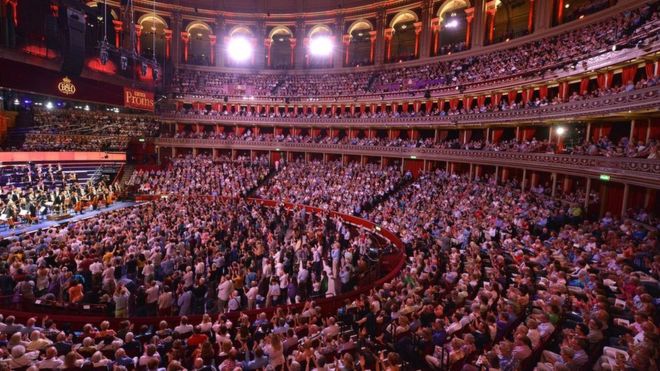
Forty-seven years after playing The Rite of Spring with the National Youth Orchestra (“Yeah, I KNOW…”), I just heard them doing it at the Proms.

In The shock of the new I reflected on the scandalous première, the ballet, jazz and HIP versions, and a rendition on organ.

Like the NYO’s other Proms in recent years (TurangalîlaMahler 9; cf. here), there’s something special for the audience in experiencing young performers relishing challenging modern masterpieces, sizzling with energy and commitment. The Rite may have become more of a repertoire piece than it was even in 1970, but it never fails to amaze. Even if I missed Boulez—who relished the sensuality as well as the violence of the piece (“Not A Lot of People Know That”—I grew up with his Mahler and Ravel too).

The complete BBC4 broadcast included a feature before The Rite with lovely paeans to the band from some of the great conductors who have worked with them, including Boulez and Rattle—the latter himself an alumnus. Our 1970 Rite with Boulez wasn’t at the Proms, but our 1971 Prom with him included more Gran visits York (sorry, I mean Igor Stravinsky), as well as Bartok, Berg, Webern, and Debussy. Wow, how awesome is that—as we hadn’t yet learned to say...

For another Proms Rite in 2022, click here.

Taruskin on early music

***Link to this page!***

I’ve finally got round to reading the great Richard Taruskin properly. Among his wide-ranging themes, in this page (under WAM in Menu), I discuss his seminal comments on early music, informed by my own humble experiences of the scene.

As he links it with modernism, placing it firmly within the context of our contemporary culture, this is no mere niche topic, it’s profound, essential reading on culture in modern society— and with maestro-baiting galore!

Even if one disagreed with every word of the book, the writing is always a joy to read.

Sappho and Hildegard

T-shirt

Taking pride of place on the fine T-shirt of female composers, Sappho is the subject of an engaging Radio 4 programme by Natalie Haynes, both educative and hilarious—I can’t find this episode online at the moment, but here’s the link.

Proceeding in an orderly fashion further down the T-shirt, it was also good this Monday to find Hildegard of Bingen in The Birth of Polyphony on Radio 3’s Composer of the Week:

http://www.bbc.co.uk/programmes/b08zdbb7

The tracks are very fine (for further discography, see here), but I don’t quite know how I want such music to sound. Indeed, as Christopher Page commented,

There’s no real reason to think that any of Hildegard’s songs were ever performed at all. Hildegard writes these pieces as acts of prayer in themselves, and exactly what use they were put to, if any use at all, is something that we don’t really know. It’s possible to imagine Hildegard or somebody else humming them or singing them softly in the context of private prayer, for example.

Despite contemporary medieval groups that immerse themselves in medieval sources, and resulting fine “experiments” in vocal style (Jantina Norman, North African, and so on), most recordings sounds exactly what they are—Oxbridge-educated choral singers since the 1970s. And they communicate with the type of audiences that like to hear that kind of thing. Our ears. The problem lies partly in the medium: the acoustic of recording, or concerts.

The modern sound ideal might succinctly be described as virginal, but I’m not sure a 20th-century Oxbridge virgin sounds quite the same as a 12th-century German one. But after Taruskin, we can all relax.

For “The hottest 900-year-old on the charts”, an entertaining and informed review of recordings and performances of her work, featuring the Hildegurls, see here.

The Proms: more Ravel

I always admire Esa-Pekka Salonen in concert—and not merely because of the fine story (about his interview for the LA Phil) that I love to relay, illustrating establishment mindsets in both WAM and Daoist studies.

Sheherazade

And I can never resist a live performance of Ravel’s Shéhérazade. At the Prom yesterday it was just magical. The venue itself creates a remarkable intimacy—the special communication between performers and Prommers, rapt attention, unique silences. Marianne Crebassa’s singing was exquisite: embodying Ravel’s intimate parlando style, she was always a vehicle for the nuance and drama of the text, deftly avoiding the diva trap. And Salonen conducts with suitably detached clarity. (For L’indifférent, see also here.)

Reluctant as I was to break the spell, John Adams’s grand Naïve and sentimental music eventually won me over.

Hot on the heels of my implausible link from Bach to Stravinsky, the concert began with a more convincing one, Stravinsky’s Variations on Vom himmel hoch. Reading Richard Taruskin as I am just now, I was more in the mood for it than usual.

Bach and Stravinsky

Useless musicological sleuthing of the day…

I like to think that I discovered this—on tour in Spain with the Sixteen, early 1990s:

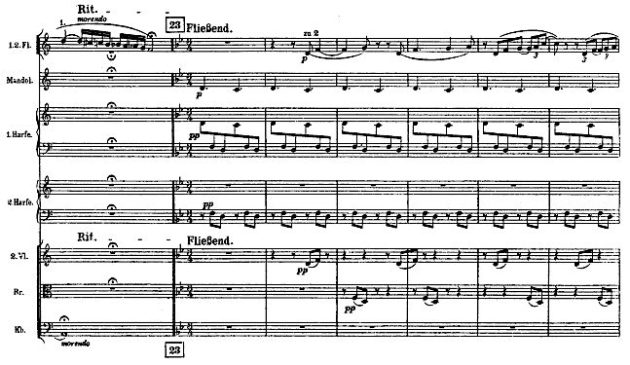
The numinous opening bassoon solo of The Rite of Spring, rather than deriving from a folk melody on the elusive dudka, may instead be borrowed ingeniously from the Matthew Passion, 1st violin part in the 2nd orchestra (no.43, not long before Erbarme Dich):

Bach:Stravinsky

with Stravinsky varying Bach’s pitch and rhythms to his taste. Amidst the fray of the crowd scene, investing the phrase with inexplicable care, I always chuckle to myself, “Not a lot of people know that…” [Weirdo—Ed.].

Proms of yore: the Bach double

AM&RP

Great Proms of our time: how wonderful to have been part of the AAM Prom in 2004, with Rachel Podger and Andrew Manze, the yin and yang of baroque violin, playing the Bach double. Alas, I now find it’s disappeared from YouTube, but here’s their 1996 recording:

It’s a piece that has constantly been rediscovered by audiences over my lifetime. For my generation, brought up on Oistrakh and Menuhin (1958—canonical then, now sounding so joyless as to be hard to take), more recent HIP renditions, no less heartfelt, have given it a new lease of life.

For the 1929 recording by Arnold and Alma Rosé, click here.

I knew Menuhin’s jazz duets with Grappelli, but not the latter’s 1937 Paris recording of the Bach with Eddie South—accompanied by Django Reinhardt! Alas, it’s just the first movement:

See also under Reception history.

Summery Mozart

Talking of Roaming in Paradise, perfect music for summer nights (cf. Berlioz) is Mozart’s C major piano concerto—not least the amazing vista that miraculously unfolds in the finale, introduced by an abrupt cadence (from 3.47):

I’m by no means an early music purist, but I really find the fortepiano more expressive here—or rather, the way it suggests the music can be played. All Mozart’s amazing late concertos are really piano and wind quintets, but melting into those string entries (1.03, 1.52)  is a spine-tingling experience.

By contrast with the disembodied fallacy of “autonomous music”, our experiences of all kinds of music are always an accumulation of associations. Those sessions with Malcolm Bilson at St John’s Smith Square (in interludes between my fieldwork in China) are a happy memory. It also reminds me of accompanying Roy Howat (also a brilliant Ravel specialist) with Charles Groves* directing the Cambridge University Chamber Orchestra during May Week (which is of course two weeks in June, as Clive James reminds us) in 1974. And Robert Levin’s Mozart is in a league of its own.

Sharing the piece with Natasha, always attuned to classical beauty alongside her taste for icons and electronica, was magical too.


*He had just been knighted. I haven’t written “Sir Charles Groves”, not so much out of resistance to antiquated honorifics, but because it would only remind me of the Sir Simon Rattle story. Oh go on then.

A Bach mondegreen

WAM musos tend to pick up a smattering of what Peter Cook called The Latin. So in the spirit of Myles, we may interpret the fifth movement of the B Minor Mass thus:

Algernon was starving and scared as the van carrying gravy mix called round. The incident has been immortalized in many a baroque Mass:

Ate, in terror, Paxo minibus

Actually, like Un petit d’un petit, that’s a soramimi, not a mondegreen. Cf. Gandhi in Mary Poppins (I know, the italics don’t really make that sound any better.) For Sick transit, Gloria, Monday, see here.

Anyway, from ridiculous to sublime—a flippant pretext to extol the glories of Bach:

Et in terra

Not a lot of people know that Bach had a dog called Potentia. Hence the movement in the Magnificat:

Fetch it, Potentiam!

And this is perhaps a suitable place for “most highly flavoured gravy”, a favourite remoulding of “most highly favoured lady” from The angel Gabriel by choristers Down the Ages—see here, with a link to Joseph Needham and Cambridge.

See also Comely scone. You can follow all this up with the mountweazel

Mahler, the exclamation mark, and John Wayne!

*For an introduction to my whole series on Mahler, with links, click here!*

We’ve had Mahler and Anna May Wong, now for Mahler and John Wayne.

I make but a paltry effort to control my addiction to exclamation marks (!). In my defence I cite Mahler himself— I recall the instructions in his scores as being liberally sprinkled with them. Now that I come to seek instances, they’re not so ubiquitous, but here are some examples:

viel Bogen!

Vorschlage möglichst kurz!

And, like a red rag to a bull for the horns (sic) or clarinets, the immortal

Schalltrichter auf!

Such exclamation marks add a personal touch—we can feel the composer–conductor communicating with his musicians. At the climax of Der Abschied, transcendent finale of Das Lied von der Erde, they suggest awe:

Langsam! ppp!

My search continues for instances of his use of triple exclamation marks!!!

Having drawn attention to Mahler’s use of quintupletsDer Abschied is full of cross-rhythms— time dissolving into the nirvana of

Allüberall und ewig blauen licht die Fernen!
Ewig… ewig…

In this melody, emerging out of mysterious ascending motifs on flutes, the triple time is soon subverted by a duple metre, the quintuplet leading into that most distinctively plaintive of Mahler chords. (from 10.44 on the YouTube link here):

Abschied 2

Abschied

* * *

Now, you may think those awed exclamation marks make a flimsy and irreverent pretext to cite the famous John Wayne story—but hey:

In rehearsal for The greatest story ever told, the Duke, playing the Roman soldier who spears Jesus on the cross, says rather flatly,
“Truly he was the son of God.”
The director cuts in: “Not like that—say it with awe!”
Obligingly Wayne repeated his line, still deadpan:
“Aw—truly he was the son of God.”

And that links to the notorious vinegar ad.

Searching for a comprehensive analysis of Mahler’s markings, I came across this guide, which is even funnier.

Yet more heritage flapdoodle: Hongtong

Hongtong 1
Further fodder for my distaste of the heritage shtick—thanks again to Helen Rees, my Word on the Street, I’ve been reading an interesting article by Ziying You,

  • “Shifting actors and power relations: contentious local responses to the safeguarding of Intangible Cultural Heritage in contemporary China”,
    Journal of folklore research 52.2/3 (2015).

And now she has published a book on the topic, which I look forward to reading:

Hongtong cover

Hongtong county, in south Shanxi, is always cropping up in studies of local culture in north China—notably since it was used as a huge migration transfer centre to areas further north and northeast that had been depopulated by the appalling dynastic warfare of the early Ming. Like many villages on the plain south of Beijing, Gaoluo, subject of my book Plucking the winds, is said to have been founded as a result of this migration; and Li Manshan’s lineage moved north to Yanggao just around this time. [1]

It’s a long time since we’ve featured The China Daily, so I’m delighted to cite a 2012 article here:

A step into Hongtong county in southern Shanxi province and I found myself transported into a land filled with fairy tales.

YAY! The paper hasn’t lost its old magic, then. It does provide a couple of charming pieces of folklore:

The Chinese term used today to mean “go to toilet” or jie shou is also linked to the legend.
The migrants had their hands tied behind their backs when they migrated. They were only allowed to untie their hands when they needed to relieve themselves. Jie shou, which literally means to untie the hands, gradually became the term used for “go to toilet”. The expression spread widely to the provinces where the Shanxi migrants were sent.

Another interesting tale on Hongtong involves a woman by the name of Su San in the Ming Dynasty, who became probably one of the most well-known prostitutes in Chinese history.
Su met young scholar Wang Jinglong at her brothel. The two fell in love and Wang stayed with Su for a whole year but was later chased out of the brothel because he ran out of money. Su was then sold to another man as concubine. She was framed for murdering the man, imprisoned and was sentenced to death.
Meanwhile, Wang who attempted the imperial examination, did well and was appointed governor of Shanxi. He heard about Su’s case and helped with the investigation to deliver her from death row.
The lovers eventually got married and as how all fairy tales end, they lived together happily ever after.
The story has been adapted as a Peking Opera play The Story of Su San (Yu Tang Chun) and became one of the best-known Peking Opera plays in China. Hongtong county where Su San was imprisoned became well-known through the play.
Although the original prison was severely damaged during the “cultural revolution” (1966-76), the present one restored in 1984 retains all its original features. For example, there is a cave used for dead bodies, and a well with very small mouth to prevent prisoners from jumping in to kill themselves.
Su San’s story has brought fame to the prison, making it a must-see in Hongtong. Today the site is renamed as “Su San Prison”, and her story is presented by a series of wax statues within the site.

Damn, I’m trying to write about the ICH here… Led astray by The China Daily“typical!”

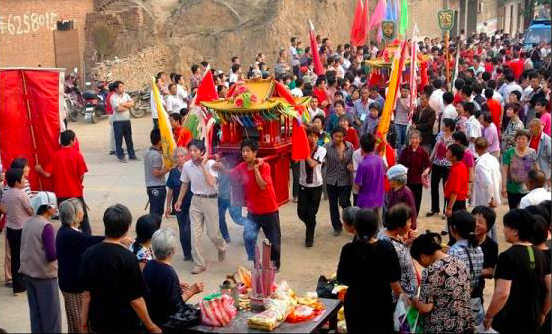
Anyway, Ziying You’s article concerns Hongtong as the site of an enduring cult to the ancient sage-kings Yao and Shun, in which several villages form a she parish, with temple fairs and processions. [2] For ICH purposes it is nominated as Hongtong zouqin xisu “the custom of visiting sacred relatives in Hongtong” [3] — and yes, sure enough the term “living fossil” rears its ugly head again.
Hongtong procession
Though not currently on the UNESCO “Representative list” for the ICH, it has been inscribed on the provincial and then national lists since 2006. With typical official razzmatazz, local cultural cadres set up a “Hongtong Centre for the safeguarding of ICH”, niftily bypassing the temple committees which are the lifeblood of the whole tradition.

BTW, as at many such festivals, I see no signs here of liturgical sequences of ritual specialists—only large groups of gong-and-drum ensembles (which are also widespread in Shanxi).

By contrast with the alacrity of cadres,

For most ordinary people, ICH was a foreign term remote from their knowledge and discourse.
[…]
Those who were mobilized to assist in the ICH application expected to receive a large amount of money from the central government to do whatever they wished within their local communities.

Not only has this expectation been unfulfilled—the Yangxie temple committee spent a substantial amount in the extended process of preparing the application. Moreover, the Centre, jockeying for favour with ICH bodies higher up the chain, monopolizes as-yet elusive state funding. And while the local conflicts between the villages did not originate with the ICH application, they were exacerbated in the process. Anyway, the temple committees, true “bearers of the heritage”, have been disempowered.

The ICH project thus became a means for the local ICH centre to exploit the local population and harvest the profits from the state.

Citing Chiara de Cesari, the author comments:

UNESCO frequently ends up reinforcing the power and reach of the nation-state and its bureaucracy, which is contradictory to its own principle of involving local communities and “grassroots”.

Yet again, the ICH machinery appears not to be safeguarding local cultures so much as safeguarding itself.

My encounters over the years with groups earmarked for ICH status—such as the village ritual associations of Qujiaying and Gaoluo, as well as the Li family Daoists—only confirm such findings. But the juggernaut rolls on.

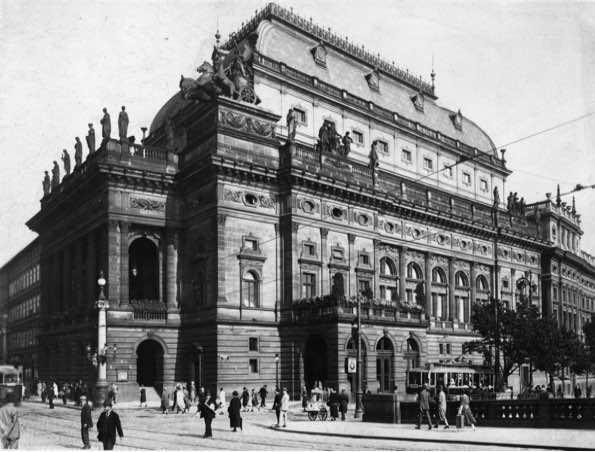
As I write, Haitink’s recent Prom is on the radio, with the Prague symphony. No Mozart balls, just boundless energy and creativity!


[1] For the migrations to Yanggao, see Jing Ziru’s article in Yanggao wenshi ziliao 阳高文史资料 2: 216–228 and 206.
[2] Note also Anning Jing, The Water God’s Temple of the Guangsheng Monastery: Cosmic Function of Art, Ritual, and Theater (Brill, 2001)—albeit more historical iconography than contemporary ritual ethnography.
[3] These photos are among many from http://photo.xinzhou.org/2010/0717/picture_1826.html

A ruse for fiddlers

And when the fiddler is out of excuses, here’s a cunning ruse for orchestral players. Some background:

  • The violins sit two to a desk, following the same part on the stand. The inside player (on the left) has to turn the pages.
  • Walton overtures are fast and full of fiendishly difficult semiquavers.

So in my early days in symphony orchestras a seasoned old pro vouchsafed a handy trick to me:

If there’s a Walton overture coming up, the thing to do, Steve, is to make sure you’re sitting on the inside. You only have to hack out the first half-page—by the time you’ve whipped the page over and got your fiddle back up again, it’s time to turn the next page…

Muso speak: excuses and bravado

Strad in bed

As I try to master more Bach on the erhu, suspending my disbelief, it’s good to be able to use the muso’s classic excuse

It was in tune when I bought it…

Also handy is

It’ll be all right on the night.

Or the immortal words (and notes) of Inspector Clouseau,

Better than ever!

That’s somewhat reminiscent of my Irish Heifetz story.

And then there’s the comment often on our lips after an underwhelming gig gets an inexplicable ovation:

Of all the concerts I’ve ever done in my life… that was one of them,

reminding me of the quote (typically attributed to Groucho)

I’ve had a wonderful evening, but this wasn’t it.

For more putdowns, see here.

See also Bernard Bresslaw’s classic line in The Ladykillers:

Well, I didn’t really study any place, Lady… I just sort of… picked it up.

In memory of Natasha

Natasha 2

This week is the fourth anniversary of the loss of my friend Natasha at the age of 34—younger than Mozart, and just less than two years after Amy Winehouse’s death.

Unable to do anything at all for months after, I thought I’d better not cancel my planned stay with Li Manshan in September, and indeed he and the other Daoists were understanding, easing me back to life. The Li family had themselves suffered a family tragedy at just the same time. The funeral rituals they perform are always moving, but now, as the sounds of shengguan blending with the vocal liturgy soared above the kowtowing kin, I felt their grief more personally.

Natasha left barely a trace on the world apart from her wonderful kids. I dearly want to write a book on her, but since I now find I know nothing about her, this tribute will have to suffice.

Natasha smile

“Troubled genius” doesn’t do Natasha justice. She deeply touched all who met her; irresistible, she could be impossible. She was the incarnation of Elena Ferrante’s Lila.

Her wild and prodigious early life was spent in Ternopil in west Ukraine. She made her home in London aged 18. Painter and composer, with her icons and Tarot, electronica, Bach, and Arvo Pärt, earth mother and sophisticated cook, femme fatale with her look of heroin chic, chunky jewelry and slinky outfits, finally holding down a mundane job for the sake of surviving as a single mum after teaching and playing in a rock band, childlike and severe, intoxicating and intoxicated, insatiable and hallucinatory, her thirst for knowledge reflected in her multi-coloured notebooks full of sketches and musings, she was on another planet. Hearing TurangalîlaragaMozart, or Naturträne through her ears, deep in her soul, was overwhelmingly intense.

Natasha painting

Natasha’s paintings were both radiant and disturbed—her later works were yet darker. Klimt and Schiele would have lapped her up (and she them). It wasn’t easy for her inhabiting a world of Parajanov:

We were supposed to be going to Mahler 5 at the Proms when she had her first heart attack. This is a perfect version of her song, with Magdalena Kožená and Claudio Abbado:

Thriving on impermanence, that I get. But Natasha, you have to keep living…

More Messiaen

Yay! Messiaen was BBC Radio 3’s Composer of the week!

http://www.bbc.co.uk/programmes/p058n84d

With its biographical vignettes, the series is always a good way to explore pieces that may have escaped us. I tend to immerse myself in the works for orchestra, piano, and organ, but how wonderful is his vocal writing—like Harawi, Cinq rechants, or indeed the ravishing Poèmes pour Mi (a fine complement to Berlioz’s Nuits d’été and Ravel’s Shéhérazade). Good to hear Messiaen’s last work too, Concert à quatre.

His Catholic faith was, um, catholic—he made a natural mentor for the budding world music movement. Apart from his beloved birdsong, both his music and teaching were permeated with genres like raga, gamelan, and gagaku. If only I could have introduced him to the Li family Daoist band in Paris!

Notre Dame

For yet more Messiaen, see here.

The Proms, YAY

“Concerts” are a niche activity within the broad spectrum of music-making in human societies. Generally I find them a necessary evil, but with the festival of the Proms getting under way today (daily for the next two months), as usual I’m all agog (yes, a Complete Gog) for my favourite concert series.

Critical of concert halls too, I’m more than happy to settle for the Victorian setting of the Albert Hall—round buildings have a distinctive ambience, and the unique receptive atmosphere of the series is largely attributable to the Prommers in the Arena, their rapt silence encircled by the seated audience.

If you think my blog is mired between populism and elitism, then get this—WAM for Yoof:

http://www.bbc.co.uk/programmes/p01mv2zh

That’s F hashtag minor, not A flat miner, you note. Cf. Korngold at the Proms.

Bach and swimming

As I learn more Bach on the erhuswimming always helps me. I’m just learning to internalize putting my clasped fingers into the water more horizontally, beginning the back-pull more immediately and maintaining the power.

When I get home, I take up the erhu, calibrating my motor-movements—string crossings, changing positions, breathing—in the service of my sound-ideal. Still sounds a bit rubbish, but hey. Practice makes perfect.

The perils of the tannoy

Roger Airplane

Expanding our airline theme (Airplane has its own tag), here’s another classic—and apparently true—story handed down in the orchestral world:

On a long-haul flight, as the stewards* are serving refreshments, the captain makes the usual suave and tedious announcement. He then turns to his co-pilot, and—fatally—fails to realize that he hasn’t turned the tannoy off.

So the entire plane hears the captain’s next comment:

“Know what I could really do with right now? A cup of coffee and a blowjob.”

One of the, um, Trolley Dollies, realising the captain’s mistake, interrupts her serving of the drinks and hastily rushes back to the cockpit to alert him that he needs to switch the tannoy off. As she sashays down the aisle, one of the passengers calls out after her,

“Don’t forget the coffee!”

See also Momentarily.


* Again, historical authenticity suggests that we use the term Trolley Dollies—in the teeth of PC, with which (I must reiterate) I entirely concur…

Mahler in Chinatown

*For an introduction to my whole series on Mahler, with links, click here!*

It’s always worth tuning in to Donald Macleod’s Composer of the week on BBC Radio 3. Even for a Mahler fanatic like me, last week’s programmes (based on the well-trodden theme of his years with Alma) were instructive.

I suppose this story belongs to the cliché of “international cultural exchange” (guojixing wenhua jiaoliu 国际性文化交流, which deserves an entry in my Catechism of Chinese cliché):

We all know (don’t we) about Mahler’s settings of Hans Bethge’s embroidered translations of Tang poems for Das Lied von der Erde (composed in 1909 but only performed after his death in 1911). In 1910, as he was fêted in New York, the Schirmers [some sources say the Roosevelts] took him and Alma on a visit to an opium den in Chinatown. Long before the stereotypes of Fu Manchu and Anna May Wong, this could have been an intriguing encounter.

Their visit to the “teeming” Lower East Side Jewish quarter must have been more conflicted (among myriad discussions of Mahler and Judaism, Norman Lebrecht, Why Mahler? is accessible). Alma’s portrayals are not always reliable, but here it’s worth citing her account (Gustav Mahler: memories and letters, pp.161–2)—more prurient than ethnographic:

We were invited by the music publisher, Schirmer, and his wife to dine with them one day and drive with them afterwards “down town”, into China town. The indispensable detective sat beside the chauffeur. We turned out of the busy streets into narrower ones which became by degrees quieter, narrower, darker and more uncanny. We got out, accompanied by the detective with a loaded revolver in his pocket, and went into an opium den. A creature with a sickeningly womanish face received us in an ante-room, where we had to put down a sum of money. He began at once to give us a long list of his successes with white ladies, and told us he acted female parts in the Chinese Theatre. A Chinese woman, of course, may not either act or look on in a theatre. He showed it in his face—it was the most degenerate man-woman face you could imagine. He showed us numerous photographs of American women he had—and he said the rest by gestures. Then he conducted us into several small but high rooms, empty in the middle but furnished with bunks along the sides, each of which contained a stretcher; and on each stretcher lay a doped Chinese with his head lolling into the room. Some of them raised their heads heavily as we approached, but at once let them sink again. It was a gruesomely horrible sight. They were simply dumped there to sleep off their intoxication. They might be robbed or murdered while they were in this state and know nothing about it. The whole scene resembled a baker’s shop with human loaves.

On now to a house of cards higher and higher, up into a room luxuriously furnished for strangers, cushions everywhere, and beside each cushion an opium pipe. And a Chinese, for payment, was ready to smoke a pipe on the spot while we watched him slowly succumb, rolling his eyes and twisting his limbs about. We were invited to smoke too but declined with horror. Next the theatre. Charming, but no play was being given. If it had been, no European would have been allowed among the audience. On again. Rats with long pigtails slunk nimbly and rapidly along the walls of the stinking street. Mahler said: “I can hardly believe that these are my brothers.”

On again. Small shops, small hotels, all silent. Finally, on the outskirts of this district we came on the habitat of a religious sect. There was a large hall at the far end of which sat a man with the face of a fanatic playing hymns on a harmonium in a pronouncedly whining style. The benches were occupied by a starving congregation. We were given the explanation. For listening to those hymns and joining in—a cup of coffee and a roll. What wretchedness in those faces! We pushed our way out, followed by hostile eyes, and for long afterwards we could still hear the flat notes of the hungry singers.

On again, and now the Jewish quarter. It was dark by this time. But here all was life and bustle, chaffering and shouting. The racial difference was staggering, but it was because the Jews worked day and night shifts to lose no time. The whole street was full from end to end of old clothes and rags. The air was heavy with the smell of food. I asked Mahler softly in his own words, “Are these our brothers?” He shook his head in despair.

With a sigh of relief we at last turned a corner and found ourselves in a well-lighted street among our own sort of people. Can it be that there are only class and not race distinctions?

Mahler’s music is so full of what would be known as folk and world music that his consternation is startling; can his success have made him so oblivious to his own background? And as ever, while trying to visualise the ethos of the time, we can only read this with later history in mind.

For more on Der Abschied, see also here and here. For more on Mahler in New York, and an ominous funeral, see Mahler 10.

Handel

Sorry, I realise this blog risks turning into an unsolicited and infinite edition of Private Passions.

Handel only gets a rare look-in among my posts on WAM, utterly eclipsed as he is by his contemporary Bach. I’ve already praised Zodak the Chartered Accountant, I mean Zadok the Priest, and I’ve taken part in many a moving performance of the operas and oratorios with John Eliot Gardiner. So despite my devotion to Bach, I have to feature some enthralling slow Handel arias.

Just to remind myself that there are other divine counter-tenors besides Michael Chance, here’s Andreas Scholl:

And to further pursue our theme of tears:

and

Mark Padmore singing Waft her, angels:

Israel in Egypt has long been a signature piece of John Eliot Gardiner and the Monteverdi Choir—performers and audiences alike were overwhelmed by Michael Chance singing Thou shalt bring them in:

For Dixit dominus and the ravishing soprano duet De torrente, click here.

And then Eternal source of light divine is moving in diverse versions. Doing it on tour with Carolyn Samson and David Blackadder was overwhelming (OMG, I can’t believe I was involved in that). But here are a couple more versions, beautiful in different ways:

And never mind HIP “authenticity”, this version is just as moving:

And now I just have to add another rendition—also reminding us of the importance of music in ritual: the entrance of the bride at the royal wedding, sadly neglected in the musical coverage, yet worthy of the spellbinding visual images, setting a magical tone for the whole event, with the passion of Michael Curry and Stand by me:

Eternal source of light divine
With double warmth thy beams display
And with distinguish’d glory shine
To add a lustre to this day.

Subtle revenge

Prague opera

Another Strange But True story from my mentor Paul Kratochvil, again bearing on the surreal Czech imagination:

In the early 1960s two players in the Prague opera orchestra were locked in a vendetta. Between performances the band used to leave their concert uniform in the green room. Every couple of weeks, one of them, coming in early and unobserved armed with needle and thread, meticulously took up the cuffs of his adversary’s concert trousers by a tiny bit.

See also Czech stories: a roundup.

Such subtle revenge has now been exacted at the White House:

White House desk

As Jonathan Jones observes in the Grauniad:

It’s a retired person’s table, a desk for TV dinners. This is Trump gradually giving up the pretence he runs a vast country and instead settling into a more leisured life. Like his furniture, he is diminishing before our eyes.

Practice makes perfect

More WAM ethnography:

Brass players enjoy, even flaunt, their hooligan image (more “licence to deviate from behavioural norms”)—or at least, UK brass players in a befuddled heyday from the 1960s to the 1990s, still an ongoing hangover today.

Becoming a musician (or indeed a household Daoist) is about far more than “learning the dots”; aspiring musicians also look to the lifestyles of their role models. The intoxicant du jour changes—Chinese shawm players have moved from opium to amphetamines, for instance. But both in jazz and WAM, many musos have learned to their cost that adopting the, um, recreational pastimes of Charlie Parker or John Wilbraham doesn’t necessarily help them play the way their heroes  did.

The trumpeter John Wilbraham (“Jumbo”) was legendary. This is a beautiful site well worth exploring—an insider’s ethnography. I came across him when he was trumpet tutor for the NYO, and later in the BBC Symphony Orchestra.

There are also some fine stories on this site, not least about two of my most admired conductors (more maestro-baiting):

“The one thing we do know about Bach for certain, is that he didn’t want it to sound fucking awful!”
—John Wilbraham to John Eliot Gardiner.

(a succinct critique of the Early Music movement?), and

“If I’d wanted to play in front of a clown, I’d have joined the fucking circus.”
—John Wilbraham (Jumbo) on Gennadi Rozhdestvensky (Noddy)

(For more orchestral nicknames, see here).

Learning to perform—in any tradition!—requires endless hours of practice (again, it’s the stories about jazzers, rather than WAM musos, that inspire me here). There’s another famous story, which strangely I haven’t yet found among all the online anecdotes:

Before Mahler 5 at the Proms, a music critic was having a drink in the 99, favoured hostelry of Prom-goers. He watched in amazement as Jumbo downed pint after pint, and then picked up his trumpet case to stagger off to the gig. Expecting the worst, the critic took his place in the audience. The symphony opens with a scary exposed trumpet solo, and is challenging throughout. Jumbo played the whole piece perfectly.

After the concert the critic returns to the pub, to find Jumbo already propped up at the bar, more pints lined up. He walks up to him and says,

“You must excuse me, Mr Wilbraham, but may I ask how you manage to play so perfectly when you’re pissed?”

“It’sh perfectly simple,” Jumbo smiles back at him conspiratorially, “I practice pissed!”

Stories like this belong to the treasury of orchestral myth-making.

Singers of the world?

Occasionally I accidentally view snippets of both The voice and Cardiff young singer of the world. Both feature remarkable singers—within their respective genres and social milieux. My reservations merely concern the blinkered media hype, with all its competitive ethos (for Alexei Sayle and others on contests, see here).* They jump through the hoops, displaying just the right degrees of individuality, gauging the prevailing ethos within their respective social and temporal fanbase. Image is is a major aspect of both events.

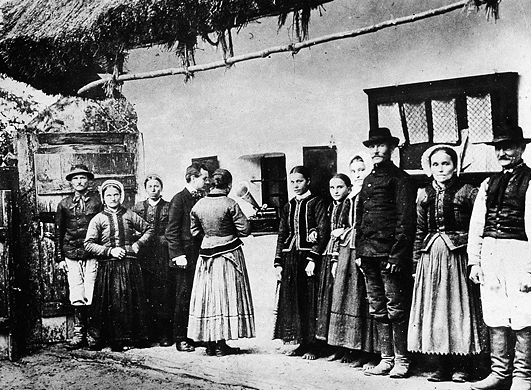
Bartok 1907

Béla Bartók recording Slovak folk singers, 1907.

And of course neither contest, and neither genre, reflects the diverse riches of “singers of the world”— even for the current scene, let alone earlier histories. For a more rigorous attempt to document the riches of world singing, see here.

It’s not that I really expect Romanian wedding laments, praise singing from Rajasthan, or the songs of Chinese spirit mediums to feature prominently in popular TV viewing (for an intriguing case in Ukraine, click here); but even the impasse between those two contrasting contemporary Western genres is glaring. Neither can be regarded as intrinsically superior. For yet more, see here.

* Another fatuous Bible quote:

The race is not to the swift.

Who’s going to break the news to Usain Bolt?

Three studies of ethnic culture (not)

More perks of orchestral touring: Noh theatre in Japan, 1992,
not long after fieldwork in Shanxi.

Three monographs on ethnic religion and culture that I haven’t yet seen—or even written:

  • On campaigns against popular shamans:

Striking a happy medium.

  • On the stagecraft of Japanese drama (Altogether now):

There’s no business like Noh business.

(For a rather more serious treatment, see here.)

And having added an acronym for British Art Music to the one for Western Art Music, how about the “classical” traditions of the Maghreb?

  • On the well-attested debt of the Western classical tradition (notably British music) to the nuba art music of the Maghreb, with reference to the antiquated sexist ideology perpetuated therein:

WAM, BAM, thankyou MAM.

  • This one has already been done, but in similar vein is my venture into sociology:

From WAGs to witches: the demonisation of celebrity girlfriends.

Mahler: quintuplets

*For an introduction to my whole series on Mahler, with links, click here!*

I’m so permanently immersed in Mahler 2, 5, 6, and 9 that I sometimes neglect the 3rd symphony.

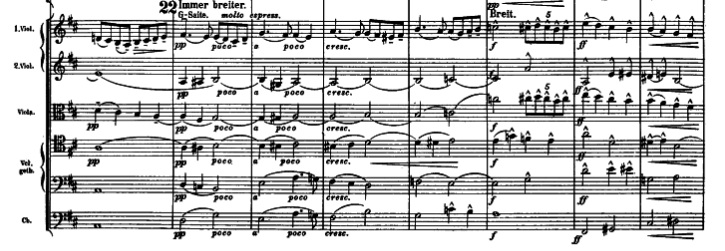
Apart from the overwhelming overall effect, I’d merely like to zoom in on a tiny detail (as I did with the syncopated percussion cadential pattern in the hymns of Yanggao Daoists): the use of quintuplets, often informed by Mahler’s instruction nicht eilen! (“Don’t rush!”). An example from the finale (fig.22, from 1.27.27 in Abbado’s performance here):

Mahler 3

The figure returns at 1.31.58, and then with the full orchestra led by blazing trumpets.

Quintuplets play a similar role at climactic moments of the 9th symphony, like this passage (from 1.06.09 on the Bernstein performance here):

Mahler 9
—and just dig all those string glissandos. Such a rhythm creates a quite different effect from the more conventional alternative, like this magnificent recapitulation on the horns (for the major 7th leap, see here):

Mahler 9 horns

It is as if the quintuplets are struggling to emerge from the stone like Michelangelo’s Slaves. For further instances, see here and here.

Sgt Pepper

*Click here for my series on the great Beatles albums,
with introduction!*

Sgt Pepper

Even I had been surreptitiously following the Beatles from the word go, and all their work is deeply affecting; but their later studio albums took our admiration to a new level. As I reflect in my introduction to this series, of course we didn’t—and don’t—need to “analyse” such work, any more than most audiences do when they attend a performance of a Brahms symphony. But studies like those of Wilfred Mellers (Twilight of the gods) and Alan W. Pollack (online) show how music-making of all kinds can be deeply creative.

* * *

Sgt Pepper’s Lonely Hearts Club Band (1967) was born out of the Beatles’ frustration with touring—an exhausting schedule through which they had to churn out the old numbers almost inaudibly beneath the hysteria. As they retreated to Abbey Road studios, the process of composition with George Martin (“collective creation”, as was all the rage in China at the time) lasted five months.

The Beatles’ previous albums contain many wonderful individual gems, but for me both Sgt Pepper and the following Abbey road are “choral symphonies”, song cycles, seamless wholes—even if only Side 2 of the latter was conceived thus. Individually he songs are gems, but with their themes of childhood and ageing, nostalgia, loneliness all in balanced contrast, they work as one long suite. It’s world music, in the sense that all genres are their canvas.

So while I introduce A hard day’s nightRubber soul and Revolver selectively, here I just have to go through the whole sequence. Wilfred Mellers considers Sgt Pepper:

We have seen how Beatle music began as a communal activity of danced song: and how in their second phase—as verbal developed alongside musical interest—it became concerned with human relationships in a social context. The songs were now to be listened to, rather than danced to; and by the time of Penny lane and Strawberry fields it was improbable that the numbers could even be “participated in” in live performance, since they were dependent on electronic equipment. This does not necessarily mean that the songs have ceased to have ritual significance, for the long-playing record is a more radical innovation than we once realised. It transplants ritual from temple or theatre to any place where two or three may gather together, including the home or commune, as well as club or discotheque. This is why the supreme achievements of pop so far are halfway between ritual and art. With remarkable verbal articulateness, though at a poetic level beyond intellectual formulation, the Beatles’ next disc, Sgt Pepper’s Lonely Hearts Club Band, explores the perennial as well as current problems of adolescence—loneliness, friendship, sex, the generation gap, alienation, fear, nightmare; and perhaps could do so because the Beatles’ early “corporate identity” was always a synthesis of four different individuals. Yet if Pepper is, in this relatively traditional sense, art, it is also a ritual involving the young—through its electronic extension of musical sounds into the environment of the external world—in a ceremonial togetherness, without the prop of a church or state. This two-way function as art and ritual remains valid, even though the Beatles, in common with most pop groups, disclaim both moral responsibility and artistic technique: for that responsibility and technique may be intuitively independent of conscious volition is the heart of the matter.

No longer do the Beatles offer us a miscellany of songs; we rather have a sequence of intricately related numbers, forming a whole and performed without break. The verses, though composed “orally”, by trial and error, are printed on the record sleeve, so that we may go back and read them again, “like a book”: just as on disc we may repeat bits of the music, as one cannot in a live (especially in part improvised) performance.

None of the songs is a love song; and that the main theme of the songs is loneliness would seem to admit that the Beatles’ early attempts at tribal togetherness had failed—not as music, but as a way of life.

Here’s a playlist for the 2009 remastered version:

  • Sgt Pepper’s Lonely Hearts Club Band. Mellers’ comments, illuminating the transitions and contrasts between songs, reveal just how sequential they are. He continues:

Sgt Pepper himself is an old-world character rooted in the camaraderie of a distant past: “It was twenty years today Sgt Pepper taught the band to play”. So we open with a “public” number (by Paul), inviting us to the show, and recalling Edwardian military music, the circus and the working men’s club, delivered with extrovert rhetoric, and with approving audience-noises off-stage. Yet if the brisk rhythm, the jaunty fanfares and the military scoring of this first song suggest simple solidarity, the music is far from being what it superficially seems. In tonality it is curiously ambiguous: for while it gravitates towards a smiling G major, the introduction wobbles between dominant sevenths of D and F, and when we reach the tune itself and the Band, having been introduced, plays and sings, the rhythms of the tootling arpeggiated tune are tipsily displaced by cross accents (three against two) and the “open” tonality is clouded by blue false relations. So this public show-piece hides beneath its zest a certain jitteriness. The cosy world of Pepper may embody a truth; but it’s one that is dubiously relevant to young people today. On the cut-out included with the disc the Beatles sport their resplendent Edwardian uniforms as comic fancy-dress.

Referring to this “overture”, Alan W. Pollack reminds us:

Don’t allow any of the overdubbed effects to blunt your sensitivity to the well executed bassline, lead guitar licks, and drumming.

And he observes that the bowed strings in the fade-up ambient noise prepares us for their major role in She’s leaving home and A day in the life.

  • With a little help from my friends. Mellers goes on:

Indeed, the instability of this first song already demonstrates that although Pepper is a military man, very peppery, and runs a band of people playing together, they none the less play to a club of Lonely Hearts. So we’re not surprised when the public junketings fade out, after a reference to the “lovely audience” Pepper hopes we’re going to be, into a sad little song, also by Paul but with help from John, but sung by Ringo, commonest of common men. And he begins by apologising for his incompetence, as contrasted with peppery professionalism. […] The song epitomises the reasons why the Beatles needed one another and reveals why their awareness of “separateness” and “togetherness” was meaningful to the young at large.

Pollack’s analysis is here. Actually, for the first song proper on the album, I find it just too bold in its hamminess: I’m not prepared yet for such irony. But Now For Something Completely Different:

  • Lucy in the sky with diamonds—(Pollack here) psychedelic, as Mellers notes, a “revocation of a dream-world of childhood”, its vivid colours

those of a poetically recreated kids’ comic”. The music, too, preserves its innocence: a lazily wafting waltz tune undulates around the third of the scale (with dreamy flat sixths and sevenths in the accompaniment), and the fairy-tale scoring, tinklingly plangent, helps us to see and hear the lovely landscape as larger than life, the flowers “incredibly high”, the girl’s eyes “kaleidoscopic”.

An abrupt change to a rapid 4/4 brings further tonal refinements, and

the fade-out carries us back from trip, childhood and dream-girl to reality, though again with equivocal irony.

  • Getting better—balancing contrasts, as this album and Abbey road do. Pollack notes how the abstract Lucy is followed by this representational song, judiciously relaxing the tension. Mellers:

a raggedy music-hall song by Paul, evoking school rebel and angry young man. The scalewise-moving, non-modulating boogie-rhythmed tune expresses fury with rule and authority and lovelessness in personal relationships, with perky insouciance. […] Though the language is not only plain, but blunt, the music doesn’t allow us to take the self-denunciation, or even the denunciation of authority, very seriously. At the same time the diatonic simplicity of the refrain makes its optimism somewhat wobbly. This again indicates how the Beatles’ vulnerability is part of their honesty; so it’s natural enough that this emotional frailty should lead into the deepening commitment of the next song,

  • Fixing a hole: Pollack suggests that here the protagonist is actively fulfilling the potential of Getting better. Mellers:

We’ve moved from Sgt Pepper’s old-world club to the dubious potentiality of friendship; from there to a dream-girl or the fairy-world of childhood; from the dream-girl to a remotely possible real one; and from that nervous expectancy to this subtly mysterious little song about the nature of identity. […] It begins in a dorian F, rocking fourths being followed by a pentatonic upward lift, balanced by a descending flat seventh; the end of the first strain creates the mind’s free wandering, as it floats pentatonically upwards, always just off the beat.

  • She’s leaving home—in triple metre, like Norwegian wood. Pollack finds it close to mimicry, but surely it’s one of the Beatles’ most moving ballads. Mellers:

The girl and her situation, though typical enough, were culled (Paul tell us) from the Daily mirror, and the verses evoke the mystery of the commonplace, having the true economy of poetry. How much is conveyed by the reference to the “note that she hoped would say more”; how sadly funny it is that she leaves home for the purpose of “meeting a man from the motor trade”, probably a shady rather than conventional character, but either way one from whose life-style the glamour will soon wear thin. Even the parents’ lamentation (“With never a thought for ourselves … we gave her everything money could buy”), though guyed with falsetto obbligato, is without trace of bitterness.

He observes the irregular, subtle musical structure:

The vocal tune is a corny waltz mainly in stepwise movement, but with a yearning life from the second to the tonic in the higher octave, followed by a descent by way of the flattened seventh. […] The arching cello solo is as beautiful as it is comic; and the irregular structure enacts the story, conveying not merely the fact of the girl’s departure but all the muddled hope, apprehension, and fear in the girl’s heart, the fuddled incomprehension of the parents. There’s failure all round, in both generations; yet the failure doesn’t deny the tune’s heart-felt lyricism, nor lessen the comedy of the falsetto obbligato. That the song makes us laugh and cry simultaneously is testimony of its truth to experience.

This little tragi-comedy of personal relationships is banished with a return to the public world of the circus in

  • Being for the benefit of Mr Kite! Pollack:

The song’s function in the cycle is more important than its intrinsic interest; it recalls our starting point, after the songs have explored the ramifications of loneliness and togetherness; and by ironic contrast it prepares the way for George Harrison’s number

  • Within you without you (Pollack here). “Bringing in the religious implications of the search for identity”, following tracks on Revolver, the Indian sitar again features prominently, its orientalism (Mellers) “re-created in terms of the Beatles’ newborn innocence”. This was one of the main pop creations that were now turning on a generation to Indian music.

In a mixolydian scale with major third and flat seventh, it’s said to be loosely based on rāg Khamaj (The raga guide, pp.100–101; CD 3, #6)—although the only point of such a claim is to lead one towards the complexities of raga in its native form. The refrain and middle section also feature additive metres.

Pollack makes an interesting comment on the eerie laughter at the end of the song:

I’m aware of at least two schools of thought:

    • The xenophobic audience (remember there’s an underlying element in the “Pepper concept” that at least indirectly connotes a Victorian/Edwardian outlook of supercilious imperialism) is letting off a little tension of this confrontation with pagan elements.
    • The bedazzled composer, in an endearingly sincere nanosecond of acknowledgement of the apparent existential absurdity of the son-of-a-Liverpudlian bus driver espousing such other-wordly beliefs and sentiments, is letting off a bit of his own self-deprecating steam in reaction to the level of true courage expended by him in order to come out of the uneasily-anti-materialist closet.

But, don’t you think it’s a combination of the two?

Mellers:

From these metaphysical reaches within the mind we’re jerked back by a leery laugh; a deliberate exercise in “trivialisation” which may be self-defensive, though its not self-destructive.

Making yet another contrast, the next song, Paul’s

  • When I’m sixty-four, as Mellers continues,

cannot be adequately described as parody, though we’re back in a suburban terraced house, and in the raggy, twentyish music-hall style of George Formby, with oompahing tuba bass and noodling clarinet obbligato. This reinvokes Dad’s world and era with comic yet touchingly poetic wit. […] Of course the oldies’ little cottage has to be in the Isle of Wight, and of course their grandchildren must be called Vera, Chuck, and Dave. Yet these oldies are at the same time identified with the Beatles.

Talking of unpromising chromaticisms,

64

Meanwhile, Pollack seems rather less convinced. Having been a tad disconcerted by With a little help from my friends early on, I’m well cool with the style by now. Returning again to the present,

  • Lovely Rita (meter maid) makes an earthly balance for Lucy in the sky, as Mellers notes, not pretending that she is more than “an alleviation of loneliness and distress”. As Pollack notes, it’s been quite some time since we heard anything resembling rock. The song ends with what Mellers calls an “indefinite threat”, something of which persists through
  • Good morning Good morning (Pollack: “truly, truly, one of the great songs”), with more additive metres—its euphoria containing a spooky, hallucinatory undertone (Mellers), thus leading into
  • Sgt Pepper’s Lonely Hearts Club Band (reprise)—which has “now lost its show-biz glamour, or recognises it as illusory”. Pollack discusses it on his page on
  • A day in the life (here), an epilogue transporting us back into the “real” world, both funny and creepy, as Mellers observes; its news items, whatever their source, do indeed constitute “a Day in the Life—anyone’s life, here and now,” with the contrast between the simplicity and frailty of the little tune and the horror and confusion of the events dispassionately referred to. And then a long electronic crescendo ushers in a more urgent middle section, turning hallucinatory. The final da capo is less innocent,

threatened with ferocious percussion, and leading into another and wilder electronic trip that seems to be also an atomic explosion, obliterating both public revelry and private love.

Mellers even considers this song “the Beatles’ deepest exploration of their familiar illusion–reality theme”.

Perhaps it’s an unconscious tribute to the Beatles’ innocent honesty and tough resilience that, after the explosion, the commotion settles into an infinitely protracted if weirdly spaced (with obtrusive thirds) chord of E major: the key which, in the 18th century and after, was traditionally associated—though the Beatles cannot have known this—with heaven!

Which leads us (OK, me) to Bruckner 7 and the north Chinese ritual wind ensemble…

I can’t tell how people listen to an album like this—in a variety of ways, I suppose, like all music: one can zoom in or out on all kinds of music. But however consciously or not one listens, such analysis explains Sgt Pepper’s deep meaning and lasting appeal for audiences.

* * *

For the 50th anniversary of Sgt Pepper in 2017, Howard Goodall paid homage to the genius of the Beatles—and George Martin—in his fine BBC2 programme Sgt Pepper’s musical revolution (not currently available, but sometimes reshown). It’s popular musicology, accessible yet demanding, in the very best tradition of the BBC.

Goodall gives us illuminating harmonic and melodic analysis, as with his discussion of Lucy in the sky with diamonds. He highlights the empathy, the different perspectives, of She’s leaving home—an insight into the real lives of 60s’ people, by contrast with the glamour of the image; the zeitgeist subsumed the contrasting moods of Ken Loach’s Cathy come home and Jonathan Miller’s Alice in wonderland—both from 1966. Goodall shows the Beatles’ innovative use of technology, as in A day in the life, whose story synthesizes fragments of reportage—and its amazing last chord.

Maestro Goodall also makes a game interviewee in Cunk on Britain.

For Yesterday (from the same period), see here; and note my tribute to Abbey road. Also from the Summer of Love is A whiter shade of pale.

Peccable musical sensibilities

I guess we should be grateful—nothing focuses the mind like having a vindictive sulky misogynistic illiterate baby as Philistine-in-chief in the White House. Some of his advisers were concerned that withdrawing from the climate agreement “might damage his credibility”. Where have they been?

Sure, we have worse things to worry about than his highly peccable aesthetic sensibilities, but they evidently developed early. In “his” 1987 book The Art of the Deal, Trump wrote:

In the second grade I actually gave a teacher a black eye—I punched my music teacher because I didn’t think he knew anything about music and I almost got expelled.

I’d love to know more about this music teacher—just how little is it possible to know about music? Can it be that the young boy’s ire was caused by the inexplicable absence from the syllabus of the late Beethoven string quartets, which as we all know would later form his core listening?

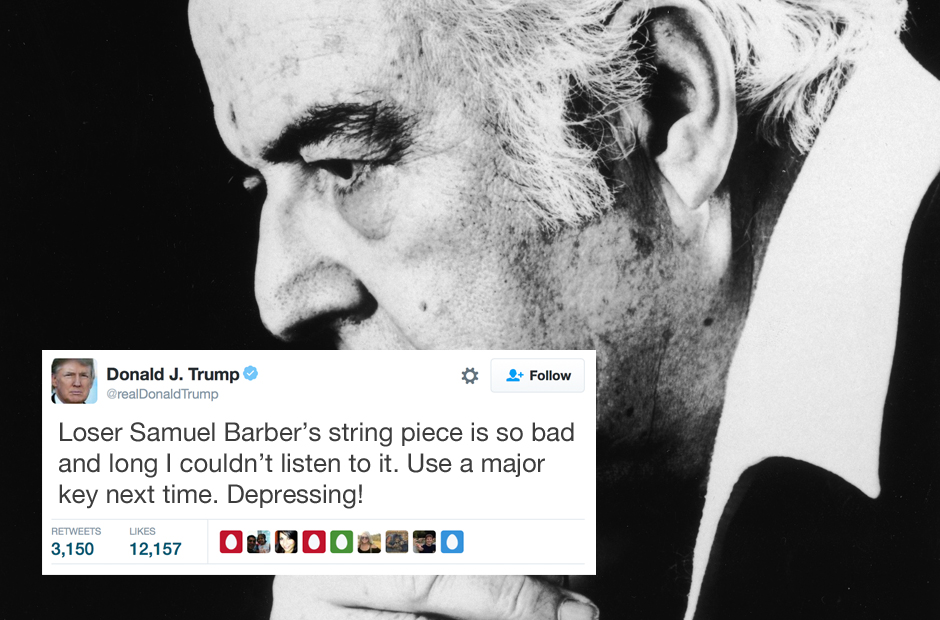
But unseriously though folks, this is a fine spoof. I particularly love

bachs-goldberg-variations-1457709453

stravinskys-rite-of-spring-1457709448

barbers-adagio-for-strings-1457709451.jpg

Such is Trumpolini’s classical erudition that he should appreciate this fugue by “W.T.F. Bach” (lesser-known brother of P.D.Q.)—a must for your local choir:

Like Dudley Moore’s psalm, what makes this so brilliant is the incongruity between the juxtaposition of text and the solemn musical pastiche of baroque grandeur.

And if you think translating medieval Daoist texts is difficult, spare a thought for interpreters, trying to make sense of Tweety’s mangling of the English language. At least culona inchiavabile can be transformed into something even more evocative.

Back in Blighty, I see Bumbling Boris (aka Boris Piccaninny Watermelon Letterbox Cake Disaster Weightloss Haircut Bullshit Wall-Spaffer Johnson) has escaped again, leaping back into the fray by welcoming a kindred spirit to Britain with more blithe inanities—but he’s got The Latin, so that’s all right then. Imagine Conservative Central Office:

“How did he get out? I thought we packed him off to Bongo-Bongo Land!” (for which, see the excellent Afua Hirsch, and wiki).

The Li band in France: notes

It’s worth rounding off these vignettes of the Li family on tour with some of my daily notes, as a little contribution to the ethnography of one, um, caravanserai on the global bazaar—and also as a further illustration that Daoists are Real People, not mere Faceless Paragons of Ancient Wisdom.

18th May
After a long journey from Yanggao via Beijing, the Daoists reach our hotel at 7.30am. Alas, despite my blandishments at the desk, they have to wait all morning for their rooms to become available, but I catch up with them as they rest on sofas in the foyer, letting Li Manshan sleep in my little room.

I take Li Bin, Golden Noble, Erqing, and Wang Ding round the corner to Rue de Rome, helping spendthrift Li Bin buy a preliminary round of gifts for his guanxi network back home: he asks me to help him choose four bottles of olive oil and ten bottles of vin rouge. Confessing my ignorance, I try to muster a little bon goût. He wants to splash out on more posh bottles, but I choose vin pretty ordinaire, trying vainly to control his reckless spending. A friend of Erqing has even asked him to buy him a particular vintage of Château Lafite. I tell him to forget it. Still, imagine—twenty years ago the average annual income for a Yanggao peasant was still only around £100.

We do splash out on an adapter, though. This has become a touring ritual, since they never bring the ones we have bought on previous trips. They keep it busy with recharging their mobiles and i-pods.

At midday we go round the corner to Rue Budapest for Sichuan noodles. They drink Erguotou liquor. We chuckle over our Confucian hosts’ quirky arrangement over expenses: 20 kuai each per meal for them, a mere 15 kuai for me. This causes much mirth: do I get less because I’m too fat?! After lunch, and after a meeting with Teacher Wang, now abbreviated to “hold meeting” (kaihui), their rooms are available—three doubles (sociable types that they are, they wouldn’t even want singles).

It’s so great to be on tour with a brilliant sextet who have been doing rituals together for thirty years, and who are now in the rhythm of touring abroad too. Li Manshan is a wise laissez-faire (wuwei?!) leader, Li Bin an able fixer, Golden Noble and Wu Mei best mates, and Erqing and Wang Ding are cool too. We slot into our secret language, always laughing, dusting off old stories, devising new takes.

At 6pm our hosts Adeline Herrou and Yan Lu, with her assistant Alessandra, come to our hotel to guide us to the conference banquet. Arriving a bit late in a downpour, we are fortunately siphoned off to another quieter restaurant nearby so we can get to know our hosts in peace. Yan Lu is géniale, petite, full of joi de vivre. We give her our favourite ritual couplet written by Li Manshan, and local dried apricots from Yanggao. It’s been a long first day (and their travel from Yanggao itself took nearly 24 hours before that), but after taking the metro home, Li Manshan and I have our usual sweet chat outside the hotel.

19th May
We have a good breakfast; they eat plenty of everything, with lashings of coffee. I no longer have to help—they’re even experts with the egg-boiling contraption.

I end up in Golden Noble and Wu Mei’s room, where we have a nice chat. I mention the Wang family Daoists of Shuozhou just southwest of Yanggao. Wu Mei knows Wang Junxi’s guanzi-playing and likes it, having seen his videos online; he has appeared in a secular show with them, but there was nothing much for them to talk about!

Now that my film and book are out, we can relax without my constant pedantic questions. But I’m always in fieldwork mode—I just can’t help taking notes. Li Manshan tells me more about the Temple of the God Palace in the southeast of his village—site of the original settlement Dazhaizhai 大寨寨.

53 GN and WM amused cropped

Relaxing in the scripture hall between rituals, Golden Noble and Wu Mei amused by my notebook, 2011.

The Daoists busy themselves preparing for our first gig at the Nanterre conference: while Li Bin packs all the stuff to take, Golden Noble checks their sheng mouth-organs, Wu Mei works on his reeds. Their rooms are scattered with the debris of touring: shavers, battery chargers, mobiles, i-pods, cymbals, a solder (to tune their sheng), fags, pot noodles just in case, cigarette cartons, gifts of dried apricots…

We take the train to Nanterre, and after a canteen lunch the splendid Hélène Bloch takes us on a reccy of our pre-concert route to and through La ferme du bonheur circus on campus—it’s just like being back in Yanggao, as it really is a farm, with sheep, a peacock, and lovely laidback warm people. I dream of running away to join the circus; there’s a new release of La strada just out. The peacock displays for Li Manshan but not for me, a typical show of xenophilia (chongyang meiwai 崇洋媚外)!

edf

La ferme du bonheur. Photo: Hélène Bloch.

After my film screening, the Daoists are waiting outside to lead the audience through the campus to the farm, where we all take a tea-break, and then to the concert hall.

The hall is small, but the gig is amazing, as always. Our encore of the Mantra to the Three Generations, with me joining in, goes well.

Nanterre encore

As Ian Johnson observes in his book The souls of China (pp.37–40), the progression of the Li band to minor international celebrity has been a gradual process, from Chen Kexiu’s research to the 1990 Beijing festival, through to our foreign tours (cf. my book, ch.18).

For what it’s worth, such northern ritual styles do perhaps lend themselves better to the concert format than many southern Daoist groups, the entrancing wind ensemble supplementing the vocal liturgy and percussion.

We take the train back to our hotel, then go for supper. Li Manshan has given me two bottles of lethal Fenjiu white spirit from Shanxi, which we (all except him—he’s not a drinker) polish off with our meal. I’m TP again. I stagger back to my room to take stock, then around midnight Li Manshan knocks on my door for another “meeting” outside. First we gravitate to my bathroom for me to explain how the taps work, and he tells me his story about a Chinese guy who brought back the hotel soap as a present, and his mate says “Uurgh, this foreign white chocolate tastes disgusting!”.

We adjourn outside for more jokes, and fond reminiscences of Li Qing. As always, our most intimate moments are late at night, tranquil, alone together. These tours just get better and better. Yan Lu and all our hosts love this, and so do we.

My two rules for when the time has come to leave China:
1) when I begin to enjoy drinking baijiu white spirit;
2) when I begin to like Chinese pop.

In the old days such tours were inevitably accompanied by a gaggle of superfluous apparatchiks on a freebie trip abroad. Now the Daoists have their own private passports, and on tour I look after them on my own.

It’s also amazing how much Chinese food abroad has improved over the last couple of decades. “Long gone are the days when” we have to endure sweet-and-sour pork—though even that has a certain nostalgia for me. With a busy schedule, and several good Chinese restaurants on our doorstep, I feel no great need to educate the Daoists in the richesses of French cuisine.

20th May Saturday
By 5am I’m chatting with Li Manshan again outside the hotel over a fag. After a quick breakfast we all take the new line 14 to Gare de Lyon. Streetwise Erqing is useful on the metro, noticing our route, watching out for signs—I no longer need to marshall them so closely, but the spectre of losing a national treasure in New York in 2009 still haunts me.

SanskritWe’re in plenty of time for the 8.59 to Clermont-Ferrand—whose Chinese name Kelaimeng Feilang, preceded by Aofonie (Auvergne) reminds me of one of the Li band’s pseudo-Sanskrit codas, such as the one at the end of the hymn Diverse and Nameless!

I go off with Li Bin to buy lunch for the band to eat on the train.

The lunch-pack of Notre Dame

(How could I resist? Just in case you’re not familiar with this one, it’s the answer to “What’s wrapped in cellophane and goes DONG?”)

Wu Mei and Li Manshan soon nod off, the latter tapping out drum rhythms even in his sleep. Later as I try to photo him chatting with Golden Noble, he tries to mess up my photo with his smelly sock.

They get excited seeing a field. To me it’s just a field. Wisely, they’ve long given up asking me technical questions about European agriculture. Golden Noble and Wu Mei have a beautiful chat—relaxed, thoughtful.

Our train is late, but hey. Valérie Bey-Smith and Wu Yunfeng, our keen Confucian hosts, meet us on the platform. Clermont-Ferrand feels pleasantly remote and eccentric—a bit like one of those Hunan mountain towns (where I’ve never been, BTW). We make hasty preparations for the gig in the conservatoire. After intros from the Confucius Institute and the Chinese consul in Lyon, my talk goes fine, with Valérie translating for me. I’m getting better at this. The gig is great—the audience goes wild.

The concerts only last an hour, but the Daoists are soaked in sweat. Still, it’s no big deal compared to their long rituals in Yanggao. The two sheng players, little trumpeted, have to work especially hard. In the trick sequence, even the way Erqing stays still for Wu Mei to slot the bell of his curved trumpet onto the pipe and then at once starts twirling it, playing all the while, is virtuosic. Wu Mei sometimes gets in a bit of trouble balancing the cymbal on his head, or the false eyes (walnut shells) coming loose, which all adds to the excitement—I observe to him that such little hitches should be a deliberate part of his routine, so as to show the audience how difficult it is, and keep them on edge.

SONY DSC

SONY DSC

Nanterre. Photo: Nathalie Béchet.

CF congratulations

Congratulations from the Chinese Consulate General in Lyon.

I get the usual erroneous compliments from the Chinese about me “discovering” them, and about the Chinese not knowing their own culture. OK, urban educated Chinese may not (I’m no great authority on Morris dancing either), but there has long been a wealth of research from native scholars, which is ongoing; and The Plain People of Yanggao have always been perfectly clear about their local Daoist culture.

CF group

After a nice meal with our hosts and innocent young students, they take us for a little tour of town, but we’re all completely knackered, and soon retire to our quaint hotel—next to the Hotel Ravel, I note.

Valérie, like our other hosts, is understandably ému (not Emu, or Rod Hull).

21st May Sunday
Up again by 5, I take a little stroll near our hotel with the band, admiring the market, and the murals on the wall next door.
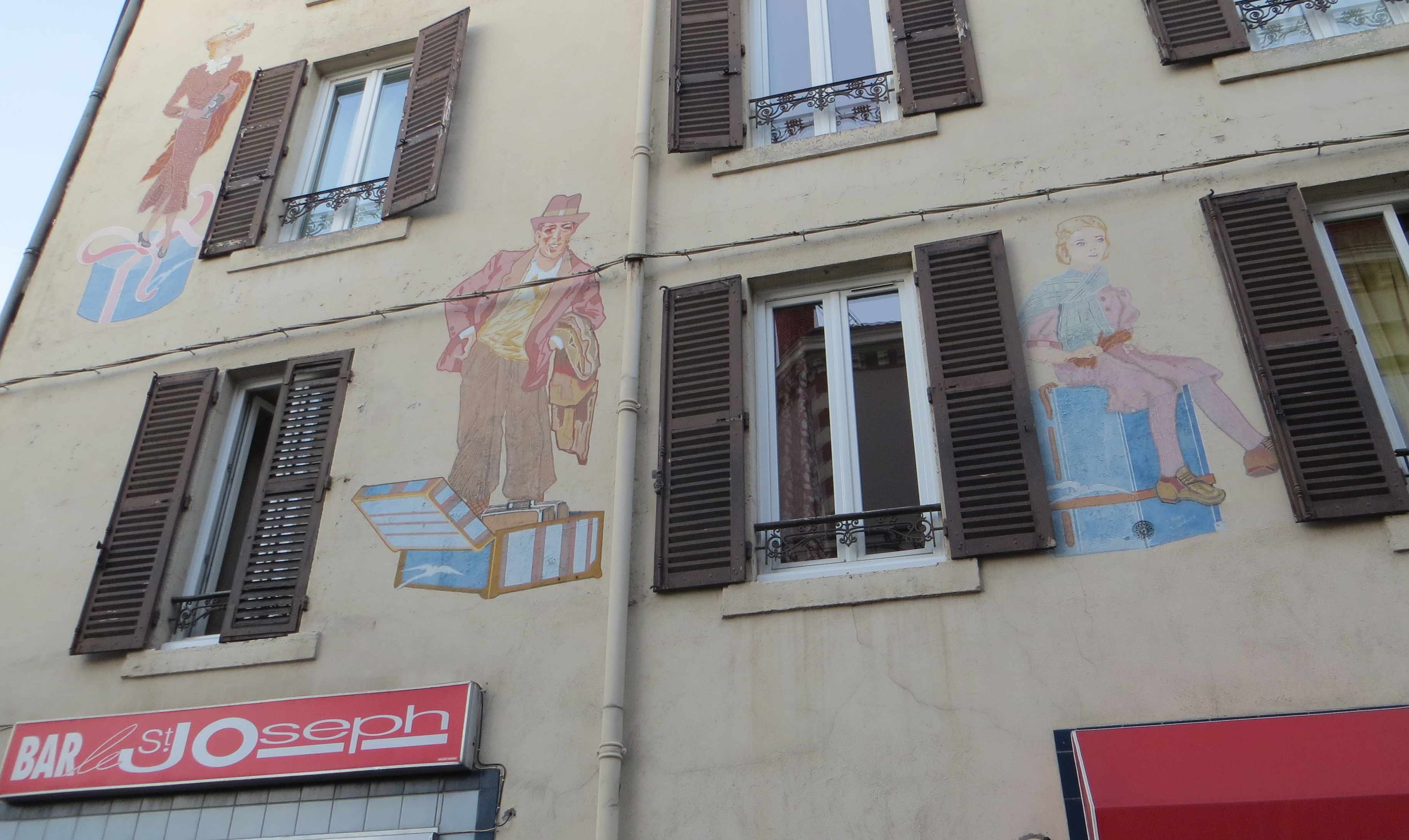
murals CF.jpg

In a nearby square we find five little posts, correctly arranged for a bonsai Hoisting the Pennant ritual (my film, from 44.21) on a future fantasy visit of Li Manshan’s 5-year-old grandson and his schoolmates.

CF posts

Doing daily travel with a gig is tough—but like my former orchestral life, it incites camaraderie. Our previous tours have been less frantic, but this one is pleasantly condensed.
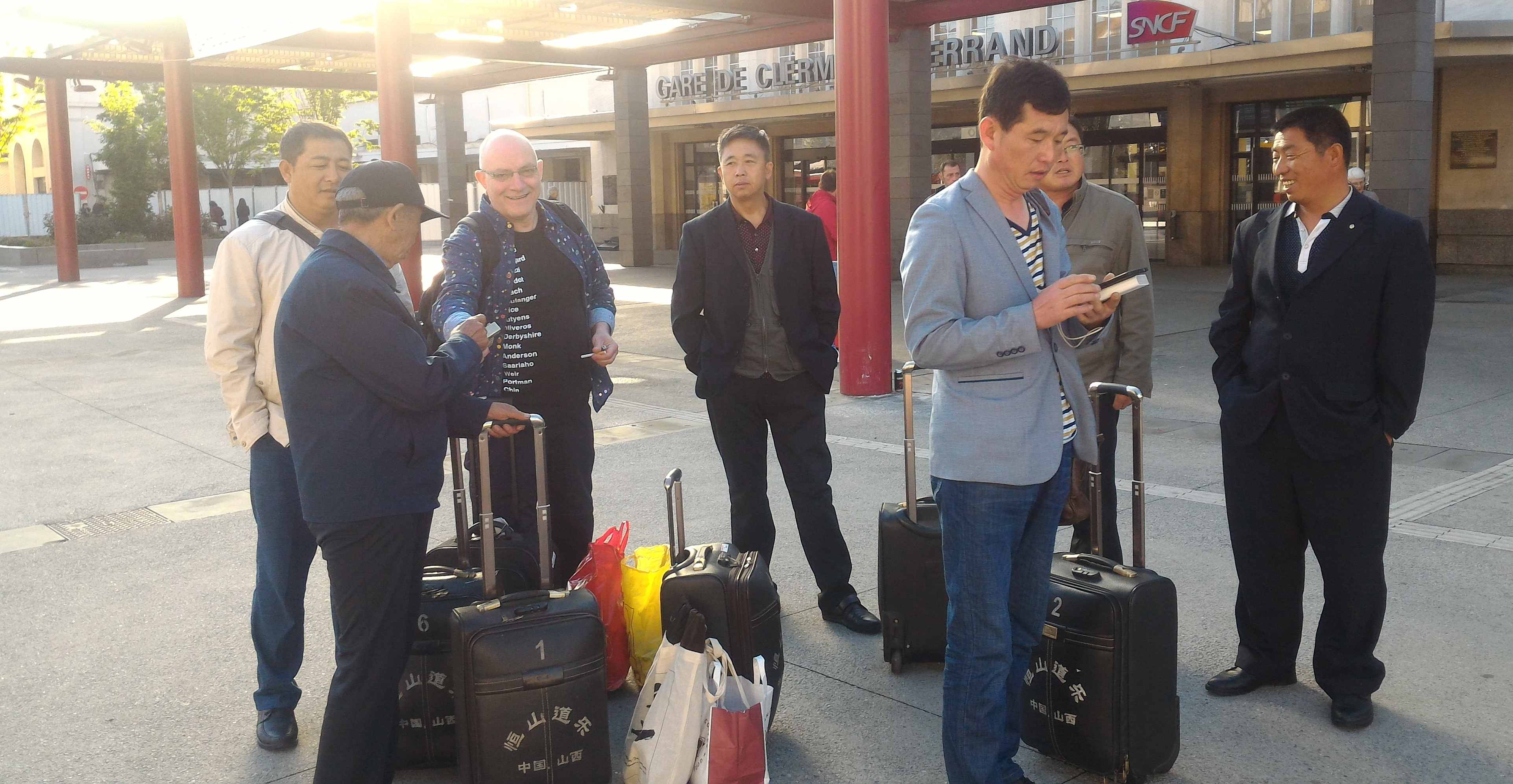
Jpeg

The touring life. Photo: Wu Yunfeng.

Valérie and Teacher Wu take us to the station, with thoughtful gifts of Gitanes (!) and food for the train. We were also happy to receive Clermont-Ferrand Confucius Institute umbrellas.

Jpeg

Valérie sees us off on the train.

The train ride is fun again. It’s much faster today, so we arrive early at midday, and take the metro to find the Centre Mandapa, a splendid venue for world music since 1978, led by the splendid Milena Salvini.

With Mandapa technician Milou we try out my film for a most successful screening; my intro goes well, and at the end Li Manshan and I take a bow. The Daoists love watching our film too.

It’s a lovely little area, so we have plenty of time to relax. They find the quirky antique emporium over the road. A succession of beggars ask us for fags, which they give gladly. Intriguingly, the Centre Mandapa is also right opposite the 1913 church of the Antoinist cult:

Deviation

The state stance on “heterodox cults”? My photo.

We set up the stage during a tea-break for the audience, then the Daoists do yet another amazing gig. Though it’s a small room, my fears that the concert will be deafening turn out to be unjustified—it’s a great acoustic. I join them again for the encore (playlist #3, with commentary here).

It’s always good to see friends at our concerts. Several Shanxi people introduce themselves, excited to find the band performing in France; and today fine scholars like Jacques Pimpaneau, Robin Ruizendaal, François Picard, and Nicolas Prevot come along too.

One cultural difference: after a gig, sure we all want to get away, but the Daoists only drink with food, not before or after (usually), whereas we WAM musos make a beeline for the pub as soon as we have taken our final bow.

Our secret language (“black talk” heihua) is as arcane as ever, with all our inside jokes. Recalling a filthy joke that Guicheng told at a hotel party in Leipzig (I can’t possibly tell you that one), I only have to say “Can you sew this up for me?” for Li Bin to burst out laughing. We giggle again at Tian Qing’s “Eat a young monk” joke.

22nd May
We have a free day at last before the Daoists’ evening flight home. Last night Old Lord Li had a bath, slept till 1am, watched TV, slept again, and got a call from a family in Pansi village to determine the date for a funeral, so he was up before 4. Meeting up at 5 yet again, I take him to the bar down the road, where Tweety McTangerine comes on TV—Li Manshan hasn’t even heard of him, how enviable! Back to my room together to read Yan Lu’s draft article on the Nanterre events.

Li Manshan calls the Pansi family again at 6am. It’s a village that he likes best, and they most trust him. Then we have a good breakfast.

We stroll down together past the Opéra to the amazing Chinese department of Galeries Lafayette, brilliantly rendered as Laofoye (“Old Buddha Elder”). Li Bin and Erqing buy loads of perfume (“Hey guys, how many lovers have you got?!”)

Laofoye

Later Li Manshan and I buy toys for his young grandson: a trumpet and maracas, to go with the, um, Ming-dynasty instruments I bought him before.

We store our luggage and go for lunch, washed down by Leffe. Old Lord Li is drumming with his chopsticks again. Delightful mood over lunch, as always—everyone chipping in with stories, jokes, reflections. Over delicious yuxiang qiezi, I ask Li Manshan if he has an aubergine tree. Often the subject turns to their hymns, as well as the Zouma suite (playlist #4, commentary here) and funky Yellow Dragon percussion piece, and the whole calibration of the trick sequence—how to improve them, tempi, and so on.

They rest on sofas at the hotel, and I film Li Manshan telling another sh-sh-sh-shikuaiqian joke.
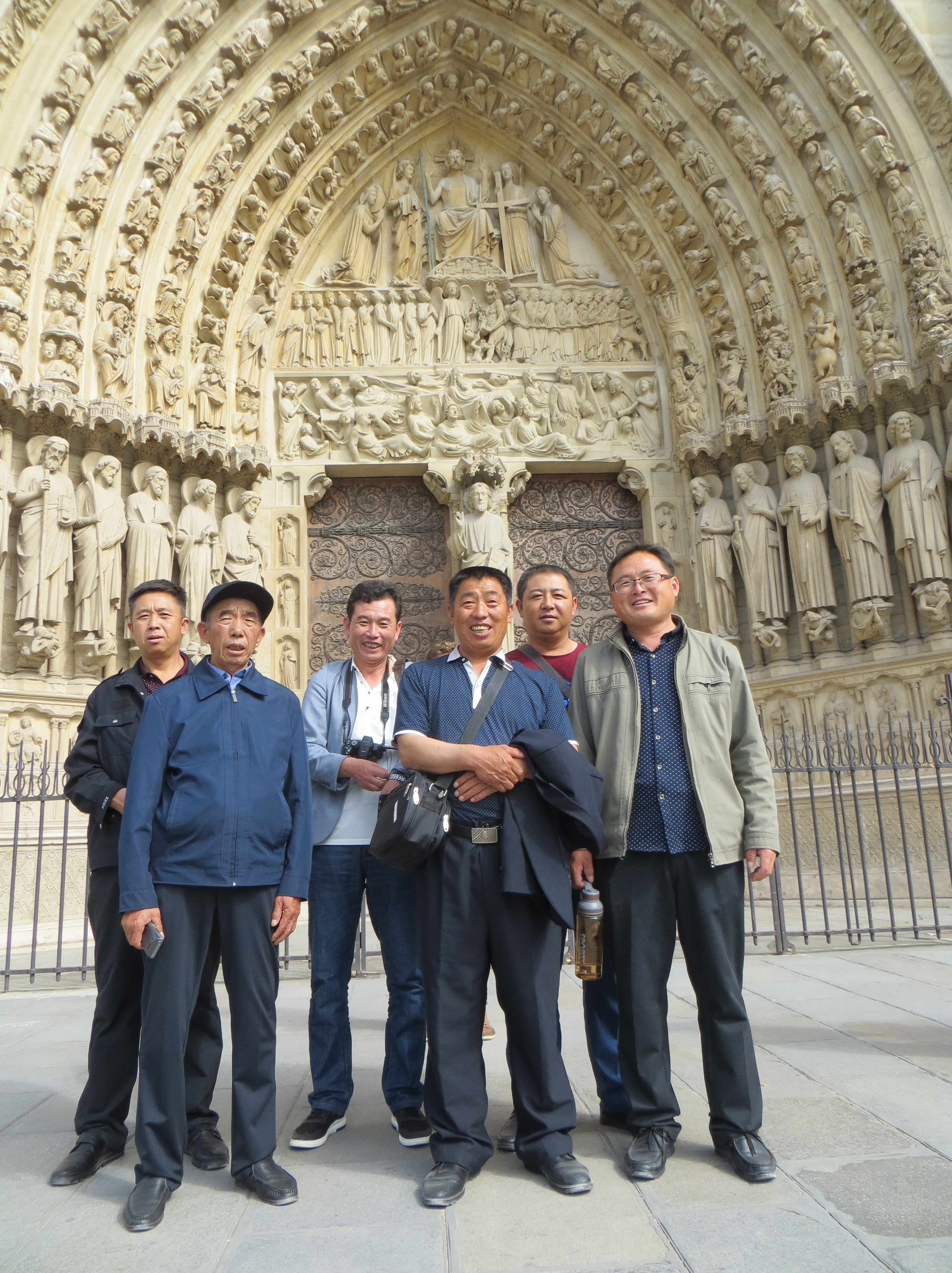
Notre Dame

Later we take line 14 to Châtelet, and wander round the little islands. I choose different flavours of Bertillon ice-cream on Île de la Cité for them. After a little guided tour of Notre Dame, we return home for a quick supper of  noodles and beer before Adeline and Yan Lu arrive, Lu thoughtfully giving them posh French chocolates. I have to go off to catch the last train back to London, but their taxi for the airport arrives early, so I can wave them off after all, but it’s a hasty parting.

If it’s a quick hop back home to London for me, their journey was not so simple:

22nd: 23.20 flight from CDG to Beijing,
23rd: landing at 15.20, 21.40 train from Beijing station,
24th: arriving in Yanggao at 03.44! But both Li Manshan and Li Bin had to rush off almost immediately to attend to village clients (for Li Bin’s diary after returning, see here).

I’ve been out of love with Paris for a while; the romantic image is hard to square with its gritty realities (rather like China, perhaps?). But this trip with the Li band naturally made me fall in love with it again. In this supposedly homogenised age—as with other cities like Leipzig, VeniceSeville, or Lisbon—we must delight in Parisian culture too!

After Daoist music in France (and Italy, and Germany), try Andean music in Japan

As I write these notes up, Haitink conducting Mahler 9 comes on Radio 3, live from the Barbican; and then next evening, another live broadcast of Turangalîla! Perfect. I hear echoes of the Li family rituals in both: all the contrasts of monumental tutti and intimate chamber styles that we find in a Daoist ritual. But that’s just me… If only Messaien were still around to hear the Li family in Paris!

Posted at 5am to commemorate daily sessions with Old Lord Li.

Vignettes 1: Li Manshan

Li Manshan is as adorable as ever.

I was determined to get to CDG to meet the band off their Air France flight from Beijing, but it arrived early at 5.30am, so in the end I just had to wait for them at our hotel right by Gare Saint Lazare. We met up there at 7.30, Li Manshan giving me a big grin and a hug.

Now 72 sui, he is gradually giving way to his son Li Bin, only doing nearby rituals. But he still can’t turn down requests to go and determine the date, and he still decorates coffins. This process of handing over must always happen, but no-one ever describes it. Personalities within a ritual group, the transmission from father to son as the latter gradually takes over—all such detail is absent from both historical records and most fieldwork reports. If only we could document it in detail for ancient Daoist masters like Du Guangting.

Li Manshan has new headgear, now a more trendy baseball cap, not as sweet as his old one, but hey. He only takes it off, reluctantly, when we enter Notre Dame. He also has a new mobile, the same old make, but with a new ringtone that sounds like The magic roundabout, so another of my names for him is Zebedee—who would have liked the Daoist Pacing the Void. I miss Li Manshan’s old kitsch ringtone of The little wicker basket.

After his lovely gift to me of the old folding stool he made, I gave him a digested translation of The good soldier Švejk, a copy I must have bought in Beijing in the early 1990s. I inscribed it to him:

踏罡步斗的明星李老君
Old Lord Li, superstar Stepping the Cosmos and Pacing the Dipper

“Old Lord Li” references one of our favourite ritual couplets pasted up at the gateway of the scripture hall, hard to translate elegantly:

穩如泰山盤腿座
貫定乾坤李老君
Seated in lotus posture firm as Mount Tai,
Old Lord Li thoroughly resolves the male and female elements.

And Stepping the Cosmos and Pacing the Dipper are rituals in the family’s manual collection.

Old Lord Li is immediately hooked on Švejk. I knew it would be just his cuppa tea—the innocent common man muddling his way jovially through an irrational state machinery. He can’t put it down. Later, suitably, I also give him my old spare toothbrush to use, as he hasn’t brought one.

After catching up together and working out our day, I go off with Li Manshan for the first of many meetings with Teacher Wang, now abbreviated to “hold meeting” (kaihui).

How amazing to be on tour again with this brilliant sextet who have been doing rituals together for thirty years, and who are now in the rhythm of touring abroad too. We use our secret language, always laughing.

In the concerts, the others (like Wu Mei for his amazing tricks on the wind instruments, or Golden Noble with his solo recitation) may attract more attention, but Li Manshan is right at the heart of everything, drumming unerringly, singing intensely, subtly directing. Even the twisting route he improvises on the tiny stage as he leads the final Chase round the Five Quarters, unsheathing the “precious sword” to sketch talismans on the ground, is magisterial.

LMS on train to Nanterre

On the train to Nanterre.

Late at night we have our usual sweet chat outside the hotel. It’s been a long day, but they’re troopers.

Li Manshan is always tapping away on his fingers (even while sleeping on the train) or on his chopsticks as we wait for our meal to arrive.

LMS at Hotel Ravel

Clermont-Ferrand: two of my favourite masters.

Following a quick weekend flit to Clermont-Ferrand, after our last gig back in Paris he had a (rare) bath—the concerts are hot work, and they’re all bathed in sweat. He then slept till 1am, watched some TV, slept again, got a call from Pansi village to determine the date after a death, and was up by 4am.

We meet up in the foyer at 5am for fags outside, lovely. I take him to the bar down the road, full of workmen on the early shift, so I can have a café and orange juice as we chat with the Wenzhou people behind the bar. Trump comes on TV—Old Lord Li hasn’t even heard of him, how enviable. Back to my room together to read through a draft article by our wonderful Confucius Institute host Yan Lu that she has just sent me.

Li Manshan calls Pansi again at 6am with more guidance. It’s a village that he likes best, and they most trust him.

After our hectic schedule, we’re all glad to have a final day free for sightseeing and buying gifts. While his son spends a fortune, Li Manshan just wants to find a couple of toys for his young grandson.

LMS and WD

With his pupil Wang Ding.

A quick farewell hug, and they embark on their long journey back to Yanggao to resume their busy ritual routine. Hardly had they got back home when both Li Manshan and Li Bin had to rush off to separate villages to determine the date for more funerals, which is the start of another sequence of tasks for them over the next couple of weeks (for Li Bin’s diary after their return, see here).

See also The Li band in France: notes.

Depping with master singers

Just home from Paris after an unforgettable time with the Li family Daoists. It already seems like a dream.

Nanterre encore

Our encore, Centre Mandapa. Photo: Nicolas Prevot.

As an encore [English term—Ed. When in France say bis!] I joined in with the Li band, singing the Mantra to the Three Generations a cappella (audio playlist track 3, cf. 2001 version, track 2: commentary here).

For anyone fortunate enough to do fieldwork on Daoist ritual, I thought this might remind us of the benefits (indeed the very possibility) of participant observation; but it was also an opportunity for me to keep my hand in after a year apart from the Daoists. Having remoulded the proverb “Mr Li wearing Mr Zhang’s hat”, I enjoy refuting another popular one, “The monk from outside knows how to recite the scriptures” (wailaide heshang hui nianjing 外来的和尚会念经).

Long schooled by accompanying Mark Padmore and the Monteverdi Choir on my violin, I now have to set aside my instinct to invest words with meaning, instead trying to latch onto the lugubrious timbre of the voices of Li Manshan and Golden Noble, and Wu Mei’s guanzi. Li Manshan’s bushy eyebrows are a useful image here.

During rituals, when we sing a cappella hymns we stand in two rows of three, facing each other across the altar table. So usually I’m either playing small cymbals over the other side from Wu Mei, or playing gong at the other end. But this time I found myself standing right next to him and Golden Noble for the encore, with Li Bin (also brilliant) on my right, all of them subtly supporting me. I realised Wu Mei is not only one of the greatest wind players in the world and a brilliant player of the bo cymbals, but (like Li Manshan and Golden Noble) a fantastic singer too. Not just his nasal timbre and the projection of his voice, but the taste of his choices—where to inject extra volume and fervour, rise up high, or put in a tiny variation. Listening carefully to each other as always, dovetailing, with subtle “rules” about where to take a breath and where to sustain. There’s much more to their singing than meets the ear—the texts of the a cappella hymns are rendered with great intensity and concentration.

Over fags outside the hotel we had worked out an edited version of the Mantra, segueing smoothly from the end of the 1st verse directly into the coda of the 3rd verse. With a very subtle accelerando, its exuberant repeated final couplet begins from a high do the first time, soaring to an exuberant high mi on the repeat:

Vowing this evening to attend the ritual assembly,
Leading the deceased spirits to ascend upwards towards the Southern Palace!

We noted a nice pun, glossing “ritual assembly” (fahui) as “French concert” (Faguo yinyuehui)—the extra characters to be recited silently (monian), like a secret formula. Li Manshan congratulates me again on my silent recitation—”The only thing you’ve learned properly, Steve!”

In rituals back home they don’t always give their all, but on tour, wanting to put on a good show, they are magnificent. Standing in with the Li band—whether at a Paris concert or at a Yanggao funeral—is one of the great musical experiences of my life, “and I’ve had a few in my time I can tell you” (take your pick—Christmas Oratorio in Weimar, B Minor Mass in the Barbican after a tour of Japan, and so on…).

After all my tedious academic questions, being right in the middle of the action with these master Daoists (not “musicians”!) is overwhelming for me. Li Manshan, Golden Noble, and Wu Mei are right on my case. There are no passengers—Erqing and Wang Ding (Li Manshan’s pupil, a welcome new recruit to our touring band) are great too. Focusing on the vocal ensemble, surrounded by Li Manshan’s sparse and subtle drum patterns, the regular crotchet beat of the gong, and quavers on the bell, I also have to remember where to beat out the occasional syncopated cadences on the small cymbals with Li Manshan’s drum accents.

It reminds me of my occasional depping with them in Yanggao for funeral segments (my book, pp.325–6) when they’re one short—waiting on the substitutes’ bench. It also has a disturbing echo of my orchestral experience—that’s another depressingly familiar phone-call from orchestral fixers,

“Can you come and do a Messiah next Tuesday in Barnsley? I’ve tried everyone, we’re absolutely desperate!”

Thanks a lot…

Our chats turned to the singing of the revered older generation of Li Qing and his colleagues. Li Zengguang was admired as a vocal liturgist; Li Qing’s own voice declined somewhat with age. Some had fine voices but less mastery of the texts; other masters who knew all the texts perfectly were somewhat variable in intonation and vocal ability. Apart from their astounding instrumental ensemble, I doubt if there’s ever been a more brilliant vocal group than the present band under Li Manshan, working together almost daily for thirty years.

A fine turn of phrase

Simon

Further to my old theme of our irredeemably modern ears (and here), Simon Rattle,* on one of his early early-music outings with the Age of Enlightenment, was rehearsing Mozart with the band.

After one finely polished phrase, he stopped us and said admiringly,

“Wow! I’ve been waiting all my life to hear it played like that! … Anyway, now I’ve heard it, I don’t like it—can you just play it normally, please?!”

*As a stammerer, I hesitate (sic) to call him Sir Simon Rattle. As in the (real) line from a waggish Radio 3 announcer:

That was Sir Simon Rattle conducting Brahms’s 4th symphony. Next week’s guest conductor is M-Mark Elder.

But I now learn from Felix Warnock, encyclopedic authority for orchestral stories, that this line goes back to Symphony Hall in Birmingham, when both the CBSO and the Hallé were rehearsing on the same day for separate concerts. At the stage door, bumping into an old colleague he hadn’t seen for some time, one muso asks another,

“Hey! Are you here for Sir Simon?”

So the other one goes,

“No, I’m here for M-Mark!”

The Li family Daoists in France

Paris gig poster

First concert yesterday on our mini-tour of France, our fifth foreign trip since 2005. Not least, we haven’t seen each other for a year, so it’s great for us to catch up.

After a procession leading the audience through the circus ground on campus at Nanterre, the gig was unforgettable—profound and exhilarating. The audience went wild, and I’m proud for them. They’re right up there with Bird and Dizzy’s band; or with a senior string quartet who have been working together for decades, playing the Heilige Dankgesang on long tours, constantly delving deeper into the inner meaning.

Living the reclusive life that I do, this sudden lurch into serving as their minder, roadie, and stage manager is an invigorating shock to the system. They appreciate all my work—but since I always depend on them when I’m in Yanggao, it’s great for me to able to repay them a bit by looking after them for a change.

In my book (p.335) I wrote about our foreign tours:

Once we’re on the road, looking after the Daoists is an infinitely rewarding full-time job for me. Between sorting out daily logistics with our hosts, shepherding the Daoists round airports, stations, hotels, and restaurants, explaining how things work (showers, coffee machines, and so on), interpreting, helping them buy souvenirs, and keeping everyone in good spirits, I manage to find time to ask further questions about their life stories and rituals. Apart from working as their roadie, I enjoy being stage manager too. Li Manshan observes that they all want to do good concerts for my sake, so I won’t “lose face”; but they take pride in the gigs for themselves, irrespective of my pedantic concert professionalism. Elsewhere I note their high standards back home despite the careless attitudes of their village patrons, and here too they really care about adapting to the demands of a concert. We constantly discuss how to refine their stage presentation, and they get more polished at taking their final bows.

If course one of the insights in spending time in the ”natural habitat” of their home environment is to reveal their humanity. But touring, outside the narrow field laboratory, further helps me relate them to the hubbub of the global bazaar.

They’ve brought me a couple of bottles of Fenjiu “white spirit” from Shanxi, so after our gig we all polished them off over a convivial meal. At midnight Li Manshan knocked on my door and we ended up sharing loads more stories, “having a meeting with Teacher Wang”, and fondly recalling Li Qing, reflecting on this whole amazing story since my first visit in 1991.

Back in Paris tomorrow for our last gig at the Centre Mandapa—for anyone at all nearby, not to be missed!!!

Signoffs and other cross-pond drôlerie

In our daily badinage on orchestral tours of the US of A in the Good Old Days, we got into the habit of handing over to each other by imitating CNN’s signalling style:

And they say there could be more revelations to come. Wolf.

[Wolf Blitzer, [1] of course, was an “anchor”. Considering that Britannia Rule the Waves (just dig that funky optative verb there, folks—”You Wish”, as the Argot of Yoof [2] would have it), it’s curious how we don’t much go in for anchors. [3]  I guess we consider them beneath us…]

Rather like my teacher Paul’s empirical use of classifiers, we interpreted it as a fixed signoff at the end of every sentence, which led us to:

I thought the Adagio was really too slow last night. Wolf.

I’m starving. Let’s go eat. [4] Wolf.

Usually, rather than an interrogative (“Wolf?”), it’s declaimed confidently in the matter-of-fact descending fourth tone.

It does seem wise to keep such signals simple:

On stage at the end of a concert, among ourselves we would also adopt the brilliant casual signoff,

Well folks, I guess that’s just about it for tonight!

This works particularly well after an obscure or meditative work. Like:

Join us next time for another wacky episode of Ockeghem’s Marian Antiphons!

For an equally zany intro for such pieces, see here; and PDQ Bach is also essential listening. Wolf.


[1] OK, we Brits have our own proud tradition of silly names, but American names are in a class of their own. Following the credits at the end of a Hollywood movie is like reading an avant-garde poem, plunging into an exotic cornucopia containing all the cultures of the world. Though if Tweety has anything to do with it, there will be no more films, no more culture, no more world. Nothing, as Stewart Lee observes.

[2] The Argot of Yoof: a popular media pub, always packed at lunchtime. Near the somewhat quieter Aardvark and Climbing Boot.

[3] Unless you count Piers Morgan, who tries unsuccessfully to lose the initial W.

[4] For me at least, there’s an illicit thrill in uttering the formulation “go eat”. Similarly for “Can I get” instead of “May I have”—a quick web search reveals mainly  the usual pompous British indignation yearning for ethnic purity, though one writer suggests rather elusively that “Shakespeare probably would have loved it” (as in the little-known line from Romeo and Juliet: “Can I get a Diavola and a supersize Coke to go?”). Can I get or May I have, that is the question. See also my thoughts on “Who is this?”.

Just remind me again, what is music?!


Hardly was the ink dry (or whatever we should call it nowadays) on my comment

It’s worth replacing the vague term Western music with Western Art Music (WAM), if that’s what we mean; and observing how European folk traditions are an equally precious part of our heritage. “Music” can be a misleading little word: just as there’s more to music in Shanghai than its opera house—such as amateur silk-and-bamboo clubs or temple fairs in Pudong—so music in Lisbon is more than the Teatro Nacional de São Carlos. Symphony orchestras and erhu solos are but the tiny shiny tip of the iceberg.

than I perused the BBC4 schedule to find:

The Birth of British music
The legacy of Austrian composer Josef Haydn in Britain.

Hmm. Discuss (with the aid of Bruno Nettl; cf. Das Land ohne Musik).

Of course, it’s just an amusing casualty of knocking up a snappy publicity blurb. And to be fair, it’s the third in a series that runs from Purcell and Handel (sic) through Haydn (sic) and Mendelssohn (sic­—well that’s quite a lot of sic). I’m not blaming anyone—making programmes about four WAM composers who lived or spent some time in Britain is cool by me (cf. They come over ‘ere…).

Still, it combines two common misapprehensions—about history and about class. Much as I love Purcell, I’m sure the engaging presenter Charles Hazlewood is perfectly aware that even British ART music (BAM!) goes back a little before that. This isn’t my forte, but never mind Tallis, Byrd, Lawes, and so on (whatever would Francis Baines have said?!)—how about the medieval mystery plays and early manuscripts, or musicking at the time of Boudicca?!

And anyway, if we’re talking about “British music”, there’s that social ellipsis again—how about broadside ballads, singing and fiddling in tavern culture, early wind bands, and so on?

This casual use of language is just as bad as the (still more common) other extreme, which is to date the origins of British music from Lonnie Donegan or Frank Ifield.

I’m sure it’s a great series on those four composers. “British Art Music from the 17th to 19th centuries” doesn’t make quite such a snappy title.

Conversely, here’s another misleading title, this time from the Guardian:

The 20 best music documentaries.

There are some great films in this list (including Amy and, at No.1, In bed with Madonna), but it’ll be disappointing for those expecting to find coverage of WAM, flamenco, musicking in Sardinia or India, and so on. Again, the title The 20 best documentaries on Anglo-American pop doubtless struck them as pedantic.

Just saying, like…

In similar vein, see Old and new musics.

Some Portuguese epigrams

For Nick—
i
f the reader finds this post a tad arcane, just wait till you see his WAM anagrams

Further to my little Lisbon jaunt, I’m always disappointed at my total lack of success when I try to busk it in Spanish by randomly adapting Italian—but it’s even more futile to further modify my crap Spanish into bacalhau (sorry, I mean cod) [1] Portuguese.

I soon dispensed with my old Portuguese phrase book (less entertaining, and less sinister, than Teach yourself Japanese)—its very opening phrase suggests a similar deep anxiety about even setting foot outside our own green and pleasant land:

There’s been an accident.

I flew TAP (Take a Parachute). Indeed, the flight prefix is further abbreviated by omitting the middle letter, so not for the only time, I found myself flying TP (Totally Pissed).

Aboard TAP flights, with impressive urbanity in the vein of Mots d’heures, the airline regales the traveller with a pithy and somewhat obscure epigram evoking the saudade of fado. It seems to recall a sad incident in the colourful past of an early Lisbon femme fatale, perhaps a widow of French patrician stock (even a refugee from the guillotine?):

Colete Salva-Vidas sob a Cadeira [2]

I’ve added capitals for clarity, but in order to preserve the ambiguity of the original I have refrained from supplying what seems to be a missing apostrophe—indeed, could it even be an exhortation?

Either way, it is far more evocative in Portuguese than in its prosaic English rendition

Life jacket under the seat.

Cf. Airplane:

Airplane is packed with little visual detail like that, requiring as much long-term revisiting as the Ring Cycle. Even the opening sequence is a too, er, deaf ‘orse.

And I’m keen to dally with Mme [sic] Salva-Vida’s [just as sic] enticing daughters

Rolagem, Descolagem, and (black sheep of the family) Aterragem,

also commemorated in TAP’s onboard annotations. Again, their names are so much less elegant in English:

Taxi, Takeoff, and Landing.

For a new addition to the family, Proxima Paragem, see here.

Just had one of those wacky dreams:

In Lisbon, invited implausibly to some suspiciously traditional social event with an old friend, we make our tortuous way there by means of a badly bombed Escher staircase. Arriving unscathed, I mingle suavely with the locals. Pleased with myself for managing to utter a grammatically convincing phase, I exclaim “Progresso!” “Si,” my Portuguese friend nods, “Esta Truro.”

How pitilessly my subconscious satirises my naïve aspirations to insider status.

For another dream, and a Portuguese limerick, see Ogonek and Til.


[1] Altogether Now: The Piece of Cod Which Passeth All Understanding.

[2] Cadeira: twinned with Madeira.

Jottings from Lisbon

Just home from Lisbon, where I screened my film for a select and rather posh CHIME conference. How good to have a few days to enjoy cobbled streets, tiles, and little wood-lined trams—authentically scattered, as everywhere, among decrepit building sites.

Back in the 1990s, annual working holidays in Lisbon (as well as Parma, Ludwigsburg, Amsterdam, Paris, and London—happy days) were a regular gig while we were doing Mozart operas with John Eliot Gardiner.

On the same principle as seeking out flamenco in Seville after the Matthew Passion, it was always good to go in search of fado in Lisbon after our concerts there. Fado can be great, as long as we don’t expect it to be flamenco—this is a bit like relationships altogether (tutti, bemused: “This is a bit like relationships”.)

The old-style fado bars, holes in the wall, have become ever more elusive, long outnumbered by glossy tourist restaurants. As ever, a good sign is the lack of a sign.

fado

Fado singing, 1993. My photo.

We found a good little fado dive this time too, rather by chance. And then on our last night our fine hosts kindly took us to the Boteco da Fa in the Alfama, a classy joint that nonetheless has a great atmosphere—it’s just a little room that can pack in around fifty aficionados. We heard Sandra Correia (for a 2022 feature, click here)

and Augusto Ramos:

The quintessential saudade (“missingness”!), a first cousin of the duende of cante jondo in flamenco (and see several other nice intercultural equivalents under that saudade link), was much in evidence.

Both singers are well-known performers in “concert”, and in a club like this the atmosphere is quite formal (the rather good food can only be a brief diversion between—not even during!—sets), but Augusto also doubles as a waiter there, and they’re pouring their hearts out just a few feet away from you.

Focusing as I was on the intensity of the singing, it took me a while to realise how great the two pluckers were too— Luis Guerreiro, the leading guitarra player, totally at ease, always exploring patterns and harmonies, his riffs even featuring the occasional soupçon of  Django.

pluckers

Brilliant fado pluckers. Photo: Xiao Mei.

Being in Lisbon, we were able to express our appreciation with warm applause—I read that

According to tradition, to applaud fado in Lisbon you clap your hands, while in Coimbra one coughs as if clearing one’s throat.

Could Coimbra have been a British colony?!

Our group from the conference included the brilliant Xiao Mei and two young Chinese conservatoire performers. I relish this recent rapport, this new sense of equality. Xiao Mei, most enlightened among Chinese musicologists, is always in fieldwork mode, lapping it all up, as were the younger musos, recording on their posh smartphones and chatting in breaks with the musos. A wonderful evening— Chinese Twitter will be abuzz with it, and that’s just so inspiring…

fado group

Sandra Correia, Xiao Mei, and Enio Souza, dynamic conference organizer.

In a small way, all this reminds us all why it’s worth replacing the vague term Western music with Western Art Music, if that’s what we mean; and observing how European folk traditions are an equally precious part of our heritage. “Music” can be such a misleading little word: just as there’s more to music in Shanghai than its opera house—such as amateur silk-and-bamboo clubs or temple fairs in Pudong—so music in Lisbon is more than the Teatro Nacional de São Carlos. Symphony orchestras and erhu solos are but the tiny shiny tip of the iceberg (cf. here, and my post on folk musicking in Italy).

Nor would any visit to Lisbon be complete without a serious overdose of nata:

nata

Whereas the English custard pie is only good for slapstick. Typical

* * *

Meanwhile at our conference on Chinese music, it’s always good to hear Xiao Mei introducing her work on spirit mediums and trance, with her amazing videos of rituals among the ethnic minorities within the PRC.

Since the conference was held at the Centro Científico e Cultural de Macau, the music of Macau was one theme. With typical impertinence I suggested that studies of music-making in Macau might be inspired by Ruth Finnegan’s seminal book The hidden musicians, exploring all the diverse kinds of musical activity in Milton Keynes, whose population is less than half of that of the Chinese metropolis. Macau’s cultural life outside official institutions remains to be explored—for instance, no-one has yet made the connection with the household and temple Daoists there. [1]

* * *

Back in May 1993, Lisbon was among several wonderful venues for our series of performances of Le nozze di Figaro:

That’s a live concert recording at the Queen Elizabeth Hall after we returned to London. Soon after that I returned to Hebei for my second visit to Gaoluo and further survey of village ritual associations.

On a free day between Figaro shows, I visited the resort of Cascais, a pleasant excursion just west along the coast. On the street I came across a blind busker called Rosa, then 36, from Almada just across the river. She accompanied her songs on the triangle, occasionally checking the lyrics in Braille.

Cascais singer

Rosa, 1993. My photo.

I assumed she was just another blind beggar who never comes much to anyone’s attention, unless you count me. So imagine my surprise, today, when none other than Xiao Mei saw my photo and told me that Rosa (now “Dona Rosa“, with a backing band) had come to give concerts in China! And sure enough, she’s now become a star on the world music circuit, having been “discovered” (not by me—I kept her to myself) but since 1999 and more widely since 2004.

How was I to know?! Can I indeed claim to have discovered her, like Yang Yinliu discovered Abing?! Hardly, since I’ve sat on the fruits of my casual fieldwork for 24 years. I am reminded of the occasional blind bard from Shaanbei who materialises, bemused, on glossy Chinese TV extravaganzas.

Here’s one of several YouTube clips of Dona Rosa:

As usual, the exigencies of the world music big band distract from the atmosphere of her solo singing. Try this instead—from a concert at New Year 2008 in the Concertgebouw, no less:

Still, from a BTL comment by fjcnunes I also learn:

It’s sad and lamentable that this great lady is still begging on the street of Rua Augusta, Lisbon. This was the case in June 2014, when I saw her there and took a picture with her. In her words, she gets paid “next to nothing” to play in Portugal and is forced to play on the streets to make a living. Probably the promoters and organizers get the lion’s share of the revenues from her concerts. I wonder if the same would have been allowed to happen to Cesária Évora? If you happen to travel to Lisbon, Portugal, please pass by Rua Augusta and purchase one of her CDs, directly from her. At least you’ll know where the money’s going.

* * *

Anyway, that chance find in Cascais was typical of the kind of superficial yet rewarding little jaunts one can fit in as a touring muso—like flamenco in Seville, dance houses in Budapest, tralallero choirs in Genova, and so on.

The Alentejo region is famed for its folk choral singing. I haven’t caught it live yet, but it’s evidently a rich tradition.

In Cascais I also enjoyed the parade for voluntary fireman’s day.

firemen

Parade for voluntary fireman’s day, May 1993. My photo.

All this belongs to my recurring theme of delighting in all manifestations of the Terpsichorean muse. In the present climate, we must relish our cultural diversity all the more. And yes, that does include Mexican migrants and Syrian refugees. All those Brits who find themselves (not) with an extra 350 million squid a year to spend might lavish a bit of it on educating themselves about the traditions of their newly-alien neighbours.

For sequels on Lisbon, click here and here. Note also Portugal: folk traditions.

[1] See e.g. http://www.macaotaoist.org/澳門道教科儀音樂/http://www.baike.com/wiki/澳门道教科仪音乐,
http://www.chinataoism.org/showtopic.php?id=1005; for a major community ritual for the 2003 SARS epidemic, see http://www.cciv.cityu.edu.hk/macau/3/2.php.

Indian and world fiddles

*See also Ways of playing the violin*

The other day, just before my alarming rendition of Bach on the erhu, I went to an enthralling concert of Carnatic violin by the sisters M. Lalitha and M. Nandini at the Bhavan Centre in West London, a lively centre for the Indian community.

How mesmerizing Indian music can be, unfolding naturally with grace and fluency! Learning such oral traditions is aided by memorizing sargam solfeggio. Tuning the strings in open fifths (like G–D–g–d, often used in world fiddle styles— actually, here they commonly have five strings) lends the violin a wonderful sonority (cf. Keef’s excited epiphany).

The ideal in many cultures is for instruments of all kinds to imitate the voice—I love the way Wu Mei decorates the vocal liturgy of the Li band on the guanzi oboe, for instance. It was by chance that I ended up playing the violin in WAM, but we can all appreciate the link between the voice and bowed lutes (or should I say friction chordophones? No you bloody shouldn’tThe Plain People of Ireland) by extending our interests to other world genres. OK, for us WAM fiddlers embarking on Mahler 5 there may be no clear benefits to this, but why don’t we all learn the rudiments of Indian style and technique too? However rigorous a training in rag may be, it can’t be as arid and painful as ploughing through sodding Ševčík studies—it’s amazing we didn’t all give up.

The Bhavan audience was sadly thin on the ground, but it’s the magic of the rapport that counts. It reminds me of a Mozart Requiem tour of Italy with John Eliot Gardiner in the 1990s. For some reason we ended up doing a gig at a dingy cinema in the sleepy town of Terni on a Sunday afternoon, performing for a tiny audience that barely outnumbered the massed orchestral and choral forces. Nonetheless, with stellar singers like Barbara Bonney and Anne Sofie von Otter, it was one of our most moving performances.

At the risk of sounding like Away from it all (“the one thing that Venice truly lacks is leprechauns“), here’s a random but inspiring sample of some further riches of world fiddling—needless to say, it’s all about technique at the service of the music, which in turn stems from its social use…

Still with the exquisite gamak styles of India, here’s a Hindustani female dynasty (cf. Rāg Malkauns):

And then there’s the wonderful sarangi—click here, here, and here for the remarkable work of Nicolas Magriel.

I outline some of the diverse bowed lutes of China here; the erhu is the least traditional of them, but you must hear this astounding playing. See also here. For the distinctive Korean haegeum, click here.

Irish fiddling can be irresistible (for more from Liz Carroll, listen to Dear Old Erin’s Isle here):

Some unaccompanied Bach (on violin instead of cello, for a change):

And Transylvanian bands (see mainly here):

Poland has some fine fiddle traditions too—here’s Stanisław Klejnas, from a village near Łódź:

From Iran, here’s Mohammad Reza Lotfi on kamancheh:

Kamancha playing from Azerbaijan is amazing too. I used to have a clip here of an Azeri party—complete with mobile phones, naff yet tasteful accompaniment, and no fancy fakelore costumes. But it’s disappeared, so we’ll have to settle for a reified official concert version:

And here’s a stellar gathering of players, all with their own distinctive styles (with thanks to Jeffrey Werbock, himself a fine exponent of Azeri music):

Note also the lyra of Crete and the Pontic Greeks. And here’s a taksim on violin by Salih Baysal (1973):

For more violin taksim, click here. See also New sounds of Anatolia.

For the Uyghurs of Xinjiang, besides the ghijak, the soul of the muqam is the plangent long-necked satar (featured in a wonderful muqaddime prelude here), but they use “our” violin just as expressively too, as on this recording of Raq muqam—from a cassette by the renowned singer Abliz Shakir in the early 1990s:

Some of these genres are explored in the fine projects Growing into music and The music of Central Asia.

That’s just a start. I leave jazz fiddling to another post… For yet more, see fiddles tag in the sidebar, introduced here. For more concerts at the Bhavan, click here and here.

Strings and voices

SMP Miller

The Matthew Passion, staged.

My splendid neighbours Fiz and Mike just held a great 50th-wedding anniversary party. Otherwise gifted with fine taste, they inexplicably cajoled me into giving the guests a burst on the erhu Chinese fiddle—oblivious to my plea that its plaintive timbre really needs to be experienced at the hands of someone who can actually, like, play the instrument. After all, like Bernard Bresslaw in The Ladykillers,

I just sort of… picked it up.

Judiciously waiting until everyone was suitably inebriated, after a rousing (and apparently not entirely unrecognizable) erhu rendition of Jerusalem à la chinois (mercifully brief—my friends have suffered enough), I boldly attempted not to entirely mangle Bach’s so-called Air on the G string.

Bach on erhu and saz

At short notice I secured the estimable services of another neighbour, Martyn—possibly the leading exponent of the Turkish saz in the whole of Bedford Park (sic)—who sensitively provided the bass line. Without regard to expense or the feelings of the public, we stretched to nine strings between us—four and a half each, three of them doubled (“Go figure”). As if it didn’t represent enough of a challenge, I rashly tried further to fill in the texture with the occasional juicy bit of counterpoint by “singing” (I use the word loosely). So I now admire fiddlers who manage to sing at the same time (actually, I shouldn’t be too hard on myself—perhaps it’s not so common to hear fiddlers singing counterpoint as they play).

For a sequel, click here.

A World Music version of Bach is an Idea whose Time has Come, if not necessarily the intonation. We didn’t so much play the Air as hint at it, an esquisse in roughly drawn lines. Thankfully, no audible trace survives of our rendition (“Case for prosecution collapses due to lack of evidence”)—nor, for that matter, of the ear-scouring Chinese wind-band version that our shawm band had played for a friend’s wedding during our, um, heyday. But undaunted, I did later record some Bach on the erhu.

The Bach Air is another instance of music that we can only hear with our own modern ears (also here)—imbued by the old cigar ad, and its whole ubiquity in popular culture. But in performance (OK, in the right hands…) it can hardly fail to move—eighteen bars of intense perfection.

Like Christopher Small (Musicking—essential reading), I now greatly value playing in an informal setting for people I know. In post-industrial societies this has inevitably been diluted by the exigencies of concert economics, with the irony of coming together to share “intimate and personal cultural moments with strangers” (George Lipsitz, cited in Musickingp.39).

Still, the Air always moves me by association with memorable concert renditions in which I’ve taken part over the years—like in Windsor Chapel once on my birthday (as part of the Bach 3rd suite, all the more moving in between exhilarating trumpets and ecstatic fast jazzy string noodling), and as an encore in Budapest with Trevor Pinnock.

And here’s a version on the ethereal theremin (among the early experiments of hYrtis, a work in progress…):

It can be beautiful as an a cappella setting too:

Like the Mahler Adagietto, another media staple that transcends its hijacking by popular culture is the Barber Adagio, equally moving in string quartet and orchestral versions, as well as this ethereal choral arrangement:

Although the Agnus Dei text was added later to fit the melody, it gives me a pretext to play Bach’s version from the B minor mass, sung again by the divine Michael Chance—more vocal and instrumental intertwining:

Just as divine as the Barber is Lux Aeterna, a choral version of Elgar’s Nimrod:

For more a cappella singing, click here; and for Indian and world fiddles, here.

Corpsing: Inuit culture and Haydn

A much-discussed piece of “salvage ethnography” is the film Nanook of the North (Robert J. Flaherty, 1922):

For his 1926 film Moana, see here.

More recent is a highly praised film from Zacharias Kunuk, Atanarjuat: the fast runner (2001)—click here for a trailer. It enacts an ancient legend while lavishing great anthropological care in evoking early Inuit culture.

But Nanook of the North is to some extent a fictional creation too, blurring the lines between documentary and drama. It is an early case-study in a substantial discourse in the ethics of visual anthropology that leads on to Jean Rouch, representations of the Yanomami, and so on.

As to vocal styles, in katajjaq throat-singing (e.g. Voices of the World, CD 1 §12), the duet is considered to come to an end when one of the singers laughs, loses her breath, or breaks concentration (LOL).

Hard to imagine a performance of such charm at certain other recent swearing-in ceremonies…

Now I’d like to seek ethnographies of changing life in Inuit communities since the time of Nanook (preferably not containing the words “traditional way of life” or “vanishing culture”—“but that’s not important right now“). This is a lively topic in ethnomusicology—there are many studies to add to my reading list, such as Maija M. Lutz, The effects of acculturation on Eskimo music of Cumberland peninsula (1978), Beverley Cavanagh, Music of the Netsilik Eskimo: a study of stability and change (1982), and studies of throat singing by Nicole Beaudry and others—as an introduction to the detailed work of Beaudry, note her thoughtful reflections in Shadows in the field. See also First Nations: trauma and soundscape.

Here’s a trailer for the short film Throat song (2013), in which a young Inuk woman, lost in a community that has been tragically separated from its past, begins to connect with other victims of violence in her community, and seeks to reclaim her voice:

Throat singing also inspires a lively experimental scene, with singers such as Tanya Tagaq.

* * *

Corpsing is one of the pleasures of musical life in WAM too—we’ve all done gigs like that. I can’t suggest here the numerous ways in which fiddle players try to corpse their desk partners by a tiny little gesture of resignation at the repeat of a minuet, or a fake sforzando attack on a pianissimo entry.

Generally “the show must go on”, but once, the Allegri string quartet were performing the intimate, intense slow movement of a Haydn quartet when the viola player let out an extended and voluble fart.* The leader giggled sotto voce, and as the mirth spread (even to the miscreant, who’s generally the first to keep a straight bat) all four of them were soon so helpless with laughter that they just couldn’t keep going, and had to leave the stage to compose themselves.

To be sure, this is at a certain remove from Inuit culture. In the latter, as if you haven’t worked this out already, corpsing is intrinsic to the performance event; in WAM, it’s an illicit part of the muso’s “deviant behaviour“. For corpsing in the crucifixion scene of the Matthew Passion, click here; and for the suave Charlotte Green on BBC radio, here.


* I’m reminded of the old Punch cartoon:

Host (to guest who has just perpetrated an embarrassing histrionic effect) “Gad sir, you’ve farted in front of my wife”.

Guest, with air of studied nonchalance, “Oh, I’m most frightfully sorry, I didn’t realise it was her turn.”

Our modern ears

You think I know Fuck Nothing—but I know FUCK ALL!

Almost anyone knows more than I do about punk, Country, film music, and so on. But when I write about them, however naively, my own narrow classical upbringing only serves as a reminder of what a very basic part of the soundscape all such popular genres are for anyone born since around 1900. This is just as true for WAM performers and the Li family Daoists—and even for scholars who interpret them. We really can’t bury our heads (ears) in the sand any longer, or unhear the sounds all around us.

But that’s only one rationale for the growing role of popular music in ethnomusicology since at least the 1960s—from Wilfrid Mellers on the Beatles or the wide-ranging studies of Susan McClary, to all the important work on genres in Asia and Africa, and so on. More fundamentally, I return to “delighting in all manifestations of the Terpischorean muse“: all kinds of musicking in all societies  should be treated on an equal footing—Amy Winehouse, Erbarme Dich, and Daoist ritual really do deserve to be part of the same celebration (for a great playlist, see here).

* * *

That’s very different from the old cliché of “music is an international language”. For better and for worse, it really isn’t (see here, and here): in any tiny region of the world there is incomprehension, with music (and culture generally) delineating barriers as much as commonalities—and that’s what I’d like to overcome.

Oh and that’s a bad miss

As Ronnie glides into the second week of the snooker, it’s also worth tipping our notional hats to the erudite commentators (themselves veteran performers, unlike most scholars of, um, Daoist ritual), full of brilliant detail on both the mechanics and psychology of the event—like good ethnographers (there I go again).

Not quite like this:

In WAM concerts, such detailed information is relegated to a printed programme, and unable to respond to the incidents of performance. This is remedied by PDQ Bach (from his LP):

My favourite BTL comment:

Is it joke?

But actually it’s a highly instructive way of listening… See also Beethoven’s melodic gift—yeah right.

Note also The first snooker commentary.

The late great Hugh Maguire

Hugh Maguire (1926–2013) managed to combine his work as leader of orchestras with making some fine chamber music. I share my admiration for his playing with far more distinguished pupils of his. As he caressed the strings lovingly, his way of turning a phrase was irresistible.

In the NYO another important kind of education for me was pub sessions where he and flautist Norman Knight would swap indiscreet orchestral stories over copious G&Ts.

Blessed with a brilliant Irish sense of humour (see also Irish tag), Hugh could be both charming and tough with conductors; it was he who told me the Hermann Scherchen story. This reminiscence of Jacqueline du Pré, with whom he and Fou Ts’ong loved playing piano trios in the 1960s, gives an idea of his sincerity.

Hugh’s playing appears all too rarely on YouTube, but here’s his wonderful 1964 recording of Scheherazade (Rimsky-Korsakov, not the equally ravishing Ravel version) with Pierre Monteux and the LSO:

BTW, Monteux (1875–1964) had conducted the premières of Petrushka, The Rite of Spring, and Daphnis and Chloé—just imagine! That recording was his last, in his final year.

Pete Hanson, heir to Hugh’s own spirit, recalls his account of a scary moment during the Scheherazade sessions:

Towards the end of a day’s recording, Monteux turned to him after the first take of the finale, with its ethereal high harmonics, and said “Come on Maguire, get it right!”

Hugh too could be as down-to-earth as his playing was sublime. Here’s Pete again, with a couple of choice comments received during lessons:

“You sound great, Pete, all the shapes and feelings are there—but you’ve got to play all the notes!”

“Pete, even if your strings are out, you must play in tune! Just do it wit’ your fingers!”

Nor is the play of fag-ash on ancient instrument the exclusive province of Li ManshanYet again, Cieran Carson has a beautiful description (Last night’s fun, p.54):

So I remember fiddle-players with cigarettes poised between two fingers of their bow-hand, and the ash would wave and sprinkle across their trouser-knees; or the cigarette that drooped between a player’s lips would let drop a little grub of ash into an f-hole of a fiddle, where it disintegrated as it crashed into the ersatz “Stradivari” label. The knees were dusted off, someone rosined up, and a fitful shaft of sunlight would illuminate the dust-motes like a dissolute snowstorm souvenir.

Even better, Hugh really was playing a Strad—like the first fiddler in Mick Hoy’s wonderful story.

This 1968 recording of the Mendelssohn Octet has long been a favourite, with Hugh leading a star cast including Neville Marriner and Iona Brown (or Iona Brown violin, as she’s known):

On the same LP, the poise of Hugh’s playing in the Minuet of the Boccherini Quintet is charming too—with a bold yet tasteful glissando on the cello (0.37, 1.03, and best of all at 3.15):

Boccherini also makes a priceless backdrop for The ladykillers. For an incident in the middle of a string quartet, see here; and for another string quartet, here.

And here’s Hugh leading the Allegri quartet in the Mozart clarinet quintet, with Jack Brymer:

(For the clarinet concerto, click here.)

The windmills of your mind

Windmills cover

While we’re on the wonderful melody, harmony, and orchestration of Michel Legrand, how about The windmills of your mind (apparently * inspired by the slow movement of Mozart’s Sinfonia concertante!)—here’s Legrand singing it himself in 1969, the rhythms always fluid:

And it loses nothing in English—I continue to be belatedly impressed at the good taste of Dusty Springfield (with English lyrics by the Bergmans, like You must believe in spring):

But though the lurch to the bombastic is only fleeting, I still prefer to maintain the tranquil mood of the original. Above the gorgeous shifting harmonies and suspensions, not only does the melody relish leaps of a 7th, but after the 3rd phrase each new incipit sets forth by falling a 7th from the previous cadence! Cf. the 7ths in Moon river.

Alas, a beautiful danced version has disappeared from YouTube.

For a recent version by Tom Jones, see under Sawdust in Tophane. Cf. Francis Lai; and for sequences, click here.


* We commonly read that The windmills of your mind is “borrowed” from the opening two phrases of the Mozart; but I can’t find a comment from Legrand himself recognising a conscious inspiration. Anyway, here it is—just as wonderful:

Cf. Mahler and Beauty and the Beast.

Mark Padmore

Padmore

The brilliant Mark Padmore, Passion Evangelist par excellence (see here, and here), made a suitable guest on the Easter edition of Private passions.

He began by reminding us of the liturgical context of Bach’s own performances, pointing out that Bach only heard the John Passion four times, and as he constantly revised his works, it was not simply about new composition but also about adapting elements of the whole tradition. All of which, surprise surprise, reminds me of Daoist ritual and Li Qing.

Mark went on to choose Lorraine Hunt Lieberson singing Mahler’s Ich bin wer Welt abhenden bekommen (cf. the version here), ending with another kind of devotional singing—from Mahalia Jackson.

A tribute to Francis Baines

Baines concert

Cartoon of Francis by Gerard Hoffnung, 1958.

This week at the Cadogan Hall (among few London concert buildings that I find conducive), luminaries of the early music scene assembled to pay homage to the late great Francis Baines (1917–99) in a concert of music reflecting his wide-ranging tastes.

All-round eccentric and bon viveur, Francis was a true renaissance man, on double bass (sometimes deposited in left-luggage at Victoria because he couldn’t get it onto his barge), viols, hurdy-gurdy, and as composer. Despite being in constant demand on the professional scene, he was a true amateur at heart, a servant of music almost like an ashiqa dervish whirling with his bass.

From the late 1970s, as the early music world became ever more polished, fragrant, and marketable—the inevitable transition from “knit your own yogurt” to Chanel No. 5 (see also here, and here)—one might imagine him finding his amateur ideal going against the tide, yet being both pragmatic and other-worldly, it never cramped his style. He always maintained a sense of both mischief and awed discovery.

He is also lovingly remembered in a beautiful book Francis Baines: musician of several parts, with reminiscences, both moving and hilarious (including more fine maestro-baiting stories), from a variety of distinguished musicians—a contribution to the ethnographic history of musical life in 20th-century Britain.

I’ll limit myself to one story from the book:

Nimbus recording session sometime in the 1980s. Mozart symphonies, Hanover band. Complete takes of whole movements being the modus operandi of this recording company, the rather inexperienced producer emerged from the box to report back on the first take. He said something along the lines of

“It started off well, and then became a bit confused and not so clear in the middle, but towards the end it got better and finished well.”

Francis piped up:

“I believe it’s what they call sonata form.”

We have ways of making you talk

I have already mentioned my encounter with a stammering shawm player in Shaanbei.

As a stammerer, I’m all for a good stammering joke. Now as a limerick this is no big deal:

But sung as a round, in the fine melody to which it was set, it can be brilliant, with its syncops and manic pile-ups of unconnected final words.

I say “can be”… It sounds great sung in the gentle polished affectionate tones of my Oxbridge chums, one to a part. But for us stammerers, the regimented impersonal nature of such a rendition by a large school choir may seem mesmerizingly traumatic. One imagines poor stammering schoolkids cowering red-eyed with fear in the corner, their anxious parents in the audience. Anyway, let’s just imagine it sung kindly with humour… As usual, it’s all about context, and the intentions of performers and audiences.

It’s easy for you to say that, Steve…

It’s well known that stammerers can sing fluently—indeed, most can do silly voices too, although that’s hardly a long-term solution. I note too that stammering is predominantly male; and that it is also common in Japan, another highly pressurized island culture.

“Stammer” or “stutter” is another instance of US/UK English variation.

And further to the collation of Daoist texts, a note on textual variation: some versions open “There was an old man from Calcutta”. Stammering tends to decline with age—though for sufferers like me it takes variant forms. One wonders whether the old man was an expat, or native to Calcutta; if the latter, his fondness for dairy products may be merely an Raj-esque affectation, or else it may indicate a predilection for paneer and ghee—but that would scupper the p-p-poem.

For a more avant-garde take on stammering, see here; and for the brilliant fugal pastiche Donald Trump is a wanker, here.

You’ll be glad to know that our encyclopaedic resident publication The China Daily covers stammering too:

Feng Kezhi, a 24-year-old garage worker, suffered stammering so much that he once stood in the pouring rain and kept slapping his face but this didn’t cure him. It was Wang’s clinic that brought back his confidence. “There are many people like Feng who need a helping hand and I must try my best to help them”, Wang said.

China presents a fine challenge for stammerers like me.  When the English are confronted by a ferocious bout of stammering, polite embarrassed sympathetic reactions are de rigueur—immortalized by the finely-observed scene in A Fish called Wanda:

Conversely, the Chinese just tend to burst out laughing, a nice honest response.

What’s more, whereas in England we fiendishly covert stammerers can usually get away with limiting our conversations to one or two people, in China one is rarely in a group of less than a dozen; so short of feigning dumbness or unconsciousness, it’s not really possible to avoid public talking. It’s rather good shock therapy: “We have ways of making you talk”—which was of course the motto of the S-S-Stammering Association (hence also the name SS). Progress is only possible once one begins to stammer openly.

It’s good to hear Ed Balls talking (openly, and fluently) about his stammer (see also here):

He joins the ranks of distinguished stammerers like Moses, Demosthenes, the Byzantine emperor Michael II, Wittgenstein, Somerset Maugham, Marilyn Monroe, Kylie Minogue, Maggie O’FarrellJoe Biden, Amanda Gorman, * and JJJJJerome Ellis—and for China, see here. There’s another fantasy dinner party, hosted by Michael Palin—a notable advocate for stammering, and the greatest ambassador anyone could ever have for anything.

The excellent British Stammering Association used to run a cartoon series called Stammering Stan, which was somewhat controversial. But this will be evocative for stammerers:

stammering stan

Li Manshan has a brilliant stammering joke, which he loves telling me—but it’s best if you hear him tell it himself…

For more stammering songs, click here and here. See also the stammering tag, including this post on chipping away at the iceberg of fear.

* Update: 13-year-old stammerer Brayden Harrington just made a powerful speech for the 2020 Democratic National Convention:

* Another update: in The speaking voice, do listen to the brilliant Amanda Gorman, erstwhile stammerer, at the 2021 Inauguration!

Gorman

Mozart at the tube station

Goldhawk road

Coming out of Goldhawk road tube late on a rowdy Friday night, the station speakers regale me with the moment where the sun clouds over near the opening of the slow movement of Mozart’s 21st piano concerto. Here it is played by Malcolm Bilson:

I don’t linger, I have an onward bus to catch. Fortunately I’ve been accompanying the concerto for several decades, so I can fill in the tranquil opening and the whole progress of the movement; and it evokes memories of many performances over various stages of my life. So even that tiny fragment, in such an incongruous context, is full of meaning for me. It’s another of those pieces that can’t be ruined by their use in film music (in this case Elvira Madigan). But what if you don’t know the piece? The project wasn’t aimed at people like me.

Still, thanks, TFL.