Molly Drake

Cate DID

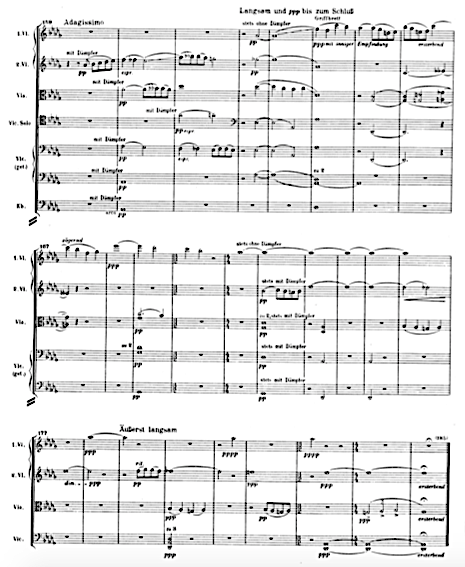
Desert Island Discs constantly reveals the personal meanings of music in our lives. Cate Blanchett’s thoughtful recent selection included Mahler 5, featured in her new movie Tár, in which she plays a conductor—despite rave reviews (see under Endeavour), I look forward to watching it with a certain trepidation, since Western Art Music seldom comes off lightly at the hands of directors (cf. Philharmonia). Anyway, her choice of the second movement (with Abbado, to boot!) was most discerning.

I have to admit that I’ve never warmed to the voice of Kathleen Ferrier, although I’m a devoted fan of Janet Baker. The series generally suggests Christopher Small’s plea to recognise the value of all kinds of musicking, not merely the “prestigious” (cf. What is serious music?!), and guests often include a track of amateur, domestic musicking that evokes intense memories or associations.

Molly Drake

Cate introduces Molly Drake (1915–93; playlist), observing: “So private, she was making music inside her home, for herself really… she gives me quiet courage.” Her choice is The little weaver bird:

Pundits have made a link between Molly’s “melancholy meditations on the fragility of happiness” and those of her son Nick.

Cate Blanchett’s final disc was Count Basie’s mantric, hypnotic rendition of Neil Hefti’s Lil Darlin’ (another gift from Tár):

Right at the end Basie slips in a little quote from In my solitude.

I’m even more infatuated by this version by the wonderful Sant Andreu jazz band (cf. here, and sequel):

Those hieratic wind chords remind me (and probably only me) of Messiaen.

The handmaid’s tale, Season 5

Handmaid 5

Just in time for a merry dystopian Christmas (as if Bambi isn’t enough), the latest season of The handmaid’s tale (for the previous series, click here) has just finished airing on Channel 4—ever more relevant not just amidst the struggle of women in Iran and the further curtailment of women’s right in Afghanistan, but closer to home, since the overturning of Roe v Wade.

Series 5 still steers clear of The testaments, Margaret Atwood’s update to her original novel. It hinges on the mutual dependence of June and Serena after they find themselves crossing paths again in Toronto—no longer such a safe haven amidst the changing dynamics of anti-refugee sentiment and murky diplomacy. As June reminds the saintlike Luke,

“America wasn’t Gilead until it was, and then it was too fucking late.”

Developments in Gilead itself now play a subsidiary role, driven mainly by the manipulations of Commander Lawrence and Aunt Lydia, suggesting a more media-savvy image for the Christo-fascist regime. While the constant degradations have long become over-familiar (and I remain dubious about the way both sides sanctify motherhood as the ultimate moral yardstick), the plot remains compelling. The ending is contrived, but I’m still looking forward to the next season…

Some Chinese posters and pinups

In 1993, as I plunged deeper into fieldwork on ritual associations in rural Hebei, while staying at a dingy hostel in Laishui county-town I was struck by this graphic public information poster from the local Public Security Bureau:

Poster LaishuiThis detail is particularly fine:

Poster Laishui detail
Caption:
Don’t casually drop cigarette-butts or rubbish, and don’t spit all over the place;
maintain cleanliness inside and outside the dwelling.

More precisely, and indecorously, I may add that tutan 吐痰 encompasses the staggeringly common habit of emptying one’s throat via the nose onto the ground, generally with a loud and dramatic flourish—a sound that accompanies some of my finest recordings of ritual performance. At the time it didn’t look as if campaigns against the tradition would have much effect.

Moving swiftly on, political posters have long been a popular topic, but travelling down to the countryside, some intrepid art historian might care to make a diachronic and regional survey of pinups adorning the otherwise bare homes of poor peasants since the 1980s’ reforms, which cheerfully rub shoulders with family photos, posters of Party leaders, and images of deities like Guanyin. I found this montage on the wall of a home in Gaoluo village around 1993:

Pinups Gaoluo

Pinups often make a drôle backdrop to our portraits of wise old folk musicians, like this 1995 image of vocal liturgist Li Yongshu in Yixian county nearby:

Li Yongshu, Baoquan 1995

Here’s a selection from Shaanbei, heartland of the Chinese revolution, in 1999:

All this by contrast with the god images that adorn the ritual building at New Year—Gaoluo again (see here, part of a series on Ritual paintings of north China):

Gaoluo 1989For more recent Uncle Xi pinups, and incentives to display them, see God images old and new, 2—sequel to an article that features murals adorning kang brick-beds dating from just after the reforms of the late 1970s.

ZQ meinv

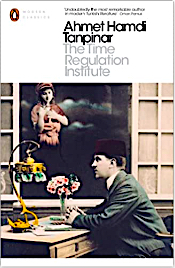
The Time Regulation Institute

Time Reg cover

I’ve been delighting in

A fine satire on the alienation of modern bureaucracy, the novel was published in full after being serialised from 1954.

Born in adversity, the narrator Hayri İrdal becomes apprentice to the wise old clock repairer Nuri Efendi, and spends time (sic) performing in improvisatory theatre groups (“I was living in a world of lies and illusion, and that was all I wanted”). Returning to Istanbul after army service in World War One (“four years spent in vain”), he is indolent and indifferent to everything around him. The Viennese-trained psychoanalyst Dr Ramiz, himself “the incarnation of discontent”, relishes his case, but expects more from him:

“I want you to have dreams that are more in line with your illness. Do you understand me? Use everything in your power to have the right kind of dreams.” […] All this contributed to my moving that much closer to bona fide insanity.

Dr Ramiz introduces Hayri İrdal to a coffeehouse, where he delights in telling stories with the regulars, as life was suspended.

New ideas were at first humoured out of courtesy and a slight curiosity, but they would remain unaddressed until the crowd’s ever-vigilant imagination had recast them as pleasantries, thus assimilating them to their own idiom. This is what happened to any attempt at serious conversation.

His family life is unfulfilling:

I detested the life I was living but lacked the strength to start another. I had severed all ties. I had no bonds with the world save for the compassion I felt for my children. I had no choice but to endure it all—or at least tolerate the world around me. The moment I set foot outside I was a prisoner of my wandering and endlessly colluding mind, which led me off to exotic worlds whose enticements beckoned, only to stay beyond my reach.

While he finds further distraction from his ennui in the Spiritualist Society, the model of the ascetic dervishes can’t help him solve problems stemming from his worldly concerns. At last he meets his mentor Halit Ayarci, with whom, amidst much partying, he hatches the concept of the Time Regulation Institute, a nepotistic institution that defines its own function.

At last Hayri İrdal has a “surging sense of purpose”. He spends his early months at the Institute devising platitudinous slogans and exchanging gossip. As Hayit Ayarci impresses his political contacts with arcane colour-coded charts, the Institute goes into full swing, recruiting suitably talentless employees from their relatives and drinking buddies.

Although Hayri İrdal has always preferred a life in which “idleness, or wasting time, is a source of happiness” (in Pankaj Mishra’s words), they devise a system of fines for those whose timepieces are not synchronised with any other clock in view.

When an inspector notified a citizen of his fine, the offender would initially express surprise, but upon apprehending the form logic behind the system, a smile would spread across his face until, at last understanding this was a serious matter, he would succumb to uproarious laughter.

He refines the system by offering a discount to repeat offenders. The staff expands as they set up Regulation Stations, “small roadside posts where ladies and gentlemen could stop in to adjust their timepieces”.

Gradually he eases into his new role:

I began to use terms like “modification”, “coordination”, “work structure”, “mind-set shift”, “metathought”, and “scientific mentality”…

He muses on freedom:

Today we use the word only in its political sense, and how unfortunate for us. […] The political pursuit of freedom can lead to its eradication on a grand scale—or rather it opens the door to countless curtailments. […] I have been made to understand that in our lifetime freedom has been kind enough to visit our country seven or eight times. Yes, seven or eight times, and no-one ever bothered to say when it left; but whenever it came back again, we would leap out of our seats in joy and pour into the streets to blow our horns and beat our drums.

Pondering the ever-growing roster of employees, Hayri İrdal suggests selecting those with experience, “people who have more or less worked for a certain period of time in a particular field”. Halit Ayarci rebuffs this idea:

“To be experienced means to be run down, frozen at some fixed point, and stuck with stagnant ideas. Such people are of no use to us.”

In a satire on Atatürk’s invention of tradition, after Hayri İrdal gives Halit Ayarci an account of the wonders of clock-making, though “never one for reading or writing”, he is persuaded to compose an entirely spurious biography of a 17th-century clockmaker, The life and works of Ahmet the Timely. His patron “was not at all mistaken when he divined the need for the illustrious Ahmet Zamani to have existed”, nor was he wrong when he assigned him to the reign of Mehmed IV.

Although a handful of armchair academics dismiss the work as a complete fabrication, it becomes a huge international success. Still, the enthusiasm of amiable Dutch scholar Van Humbert poses problems.

Finding the tomb of a man who never existed in mortal form is more difficult than you might imagine, as is surviving vigorous debate with a foreign scholar, even with the aid of an interpreter.

As Hayri İrdal becomes a celebrity, his wife joins in the deception with alacrity, embroidering a fantasy of their happy life together, to Hayit Ayarci’s delight:

To him, my continuing doubts about the existence of Ahmet the Timely and my rejection of my wife’s picture of me as a banjo-playing equestrian were all symptoms of the same malady.

“Your wife has presented you as the ideal modern man and still you doubt and deny it all!”

In a satire on the gullibility of the masses, Hayit Ayarci even concocts a successful singing career for our narrator’s tone-deaf sister-in-law:

You say she’s ugly, so from a contemporary point of view she’s sympathetic. You say her voice is wretched, which means it is emotive and conducive to certain styles. You say she has no talent—well then, without a doubt she is an original.

As the Institute extends its global reach, our hero designs a surreal clock-themed building in a satire on modernist architecture:

People moving up and down either wrought-copper staircase would be visible, as they would be encased in glass. I now saw I could arrange them diagonally across the centre of the hall to disrupt the traditional four leaf clover formation. Of course all the pillars—each one a little higher than the next—would be connected by little bridges so as to allow those moving up and down them to cross.

After a fractious final gathering, the Institute is consigned to continuous liquidation.

Fritz
Painting by Howard Fritz. Source.

* * *

Apart from evoking Kafka and Borges, I was reminded of the stories of Švejk and his creator Hašek (whose Party of Moderate and Peaceful Progress within the Limits of the Law was designed partly to bolster the finances of the pub where the election meetings were held), as well as Flann O’Brien, with his annotations on the ouevre of de Selby, and his All-Purpose Speech.

The 2013 translation is adorned by an excellent Introduction by Pankaj Mishra (cf. his review). Putting the novel in global context, he reflects on Atatürk’s cultural revolution and the developing world’s “feckless programme of Westernisation” in the pursuit of secular and rational ideals, where “the onwards-and-upwards narrative of progress, dictated by the state and embraced by a gullible people, has contaminated everything.” Adducing Russia, Japan, Iran, China, and India, Mishra notes a “tragic mismatch between the intentions of these hasty modernizers and the long historical experience of the societies they wanted to remake in the image of the modern West”. As in his 1939 novel A mind at peace, Tanpinar suggests the deracine sense of arriving late, spiritually destitute, bewildered by the “tawdry illusions of modernity”. Hayri İrdal—“one of those superfluous semimodern men familiar to us from Russian literature: more acted upon than active, simmering with inarticulate resentments and regrets”—“has a keen appreciation of the absurdities of the self-perpetuating and self‑justifying bureaucratic state that embodies progress and enlightenment in Turkey”.

For more Turkish fiction, see Madonna in a fur coat. See also under West/Central Asia: a roundup.

Tango for Messi!!!

For Sunday’s World Cup final, a paean to the genius of Lionel Messi. Watch his magical dribbling skills in awe, click here for a compilation of some of his great solo goals (the magnificent finale adorned with suitably ecstatic commentary!), and admire  this longer compilation. Among innumerable tributes, here’s a detailed analysis, and I like this recent article by Anita Asante. See also this BBC documentary.

For comparable artistry, cf. Ronnie: a roundup, and A god retires, under A sporting medley.

* * *      

The vision of Messi dancing his way through flailing defenders reminded me to expand my limited acquaintance with Argentine tango—don’t worry, I’m not going to try and dance. [1]

As with flamenco, fado (here, with sequel), and rebetika, the demi-monde roots of tango in the ports and bordellos were soon co-opted in a typical progression from banning (like the waltz) to bourgeois respectability, as the genre’s sleazy, predatory background gave way to the elegant sensuality of polished cabaret and ballroom performance (for critiques of artistic competition, click here). Please excuse me if I round up some of the Usual Suspects below, and for focusing on music rather than dance.

The early years, and the Golden Age
In the traditional style, the habanera rhythm, with the jagged, staccato syncopation of its 3+3+2 accents (cf. Taco taco taco burrito), is common to other Latin American genres (see this useful wiki page). The tango sound became more distinctive from the late 19th century with the addition of the bandoneón, originally used for church music in Germany (cf. Accordion crimes—including an early Polish tango).

The dance, with its sinuous intertwinings, spread around Europe from 1910. Echoing the “posturing machismo” of flamenco, Ricardo Guïraldes wrote in homage (sic):

Hats tilted over sardonic sneers. The all-absorbing love of a tyrant, jealously guarding his dominion, over women who have surrendered submissively, like obedient beasts…

Naturally, in recent years the sexism of tango dance has been subjected to much critique.

The global fame of tango was spread by the new radio, recording, and film industries. Here’s Rudolph Valentino with a tango-travesty in The four horsemen of the Apocalypse (1921):

Here’s a playlist of early 78s:

And this playlist includes tracks by a host of bandleaders, including Osvaldo Pugliese and Uruguayan violinist Francisco Canaro:

Here’s a remastered album of Julio de Caro’s band in the 1920s:

and the great Aníbal Troilo on bandonéon with singer Edmundo Rivero in Cafetín de Buenos Aires (1948):

Tango is part of a widespread musical family expressing heartache (duende, saudade, sevda, and so on), whose letras lyrics enhance its melodic melancholy; however, in vocal timbre I find none of the harsh anguish of flamenco cante jondo. The quintessential tango singer was Carlos Gardél (1890–1935), heard on playlists like this:

To redress the macho dominance, women singers from the Golden Age—some great tracks here:

“The ultimate tango cliché”
Like other pieces that suffer from over-exposure (such as Bach’s Air, the Mahler Adagietto, Debussy’s Clair de lune, Ravel’s Bolero, Dream a little dream of me…), it would be great if we could hear La cumparsita with original ears, but the kitsch image of Some like it hot (1959) leaves an indelible impression. Slower and more evocative than the first recording by Roberto Firpo (1917) is Eddy Duchin in 1933:

With the lyrics it’s quite transformed—I like Carlos Gardél’s version (#5 in playlist above), reminiscent of fado. Like most performers, he sang the Si supieras version by Pascual Contursi, which is maudlin enough—but the anguish of tango is rarely expressed so extremely as in Matos Rodríguez’s own lyrics, heard in this 1945 recording:

La cumparsa de miserias sin fin desfila                The parade of endless miseries marches
en torno de aquel ser enfermo                               around that sickly being
que pronto ha de morir de pena…                         who will soon die of grief…

Well, that’s the last time I’m inviting him to one of my parties.

The piece must have become a millstone around the necks of tangueros—but its immortality was confirmed by Tom and Jerry:

Piazzolla
Meanwhile, as juntas and Perónism rose and fell, Buenos Aires was in flux; with an ever-swelling immigrant population and changing tastes, “old-guard” tango declined amidst the rise of pop music. And so to the nuevo tango of Astor Piazzolla (1921–92) (Songlines; wiki), “the Boulez of the bandoneón” (an epithet attributed to L’Éxpress, making one worry about its readership figures), who “elevated” the genre to the status of art music in the concert hall (NB What is serious music?!). After his youth working with some of the great bands of Buenos Aires, Piazzolla was drawn to the style of modern WAM composers like Bartók and Stravinsky, studying with Alberto Ginastera and Nadia Boulanger—who, to her credit, insisted that he follow his own path. 

Boulanger with Piazzolla 1955
Studying with Nadia Boulanger in Paris, 1955.

He also recruited jazz musicians to his groups, although by the standards of jazz his arrangements were over-prescribed (cf. Unpacking “improvisation”).

Again, just a selection. Tres minutos con realidad (1957):

Adiós nonino (1959), a requiem for his father:

Balada para un loco (1969), with his second wife Amelita Baltar:

Libertango (1974) (playlist):

Suite Troileana (1975):

 And the gorgeous Oblivion (1982; danced here, and here):

I’m keen on his late Quinteto Tango Nuevo, with Fernando Suarez Paz (violin), Pablo Ziegler (piano), Horacio Malvicino (guitar), and Hector Console (bass)—click here for their 1984 gig in Utrecht (playlist).

As the “world music” scene took wing and boundaries were breaking down, Piazzolla became a legend. A definitive book is María Susan Azzi and Simon Collier, Le Grand Tango: The life and music of Astor Piazzolla (2000). And here’s the documentary Tango maestro (Michael Dibb, 2004):

Joining a long list of London gigs that I kick myself for missing, in 1985 Piazzolla performed for a week at the Almeida Theatre! Awww…

* * *

The scene has continued to develop, with nuevo tango supplemented by neotango. But as Adam Tully observed, 

It’s too easy to think that [Piazzolla] was leaving it all behind or rejecting it; in truth he was completely a part of this music and wanted it to be ever greater, to grow rather than to stagnate. And the dead end is to think that since Piazzolla innovated, then the natural progression of tango is the language that he invented. The danger there is for other composers, arrangers, and performers to get absorbed into Piazzollean language, which is what happened in the 80s and 90s.

Finally, some bonus tracks. Dance, with its complex technique, remains a vital part of tango’s social life, deserving greater attention than I can offer; but here are some staged representations. Carlos Suara’s 1998 movie Tango:

For Last tango in Paris and The conformist, click here. A scene from Frida (2002):

And Rose and Giovanni in Strictly:

I won’t venture into Finnish tango, but here are a couple of playlists for Turkey (cf. Midnight at the Pera Palace, and Jazz in Turkey). Seyyan Hanım (1913–89):

and Şecaattin Tanyerl (1921–94):

Hmm. Like I’d know—I was just admiring Messi weaving his way through yet another helpless defence, and recalling his time at Barcelona, comparable only to Bach at Leipzig [Late entry for 2022 Pseuds’ Corner Award—Ed.].


[1] Useful starting points include the chapter in The Rough Guide to world music, Songlines (including this selection), and wiki:
https://en.wikipedia.org/wiki/Tango
https://en.wikipedia.org/wiki/History_of_the_tango
https://en.wikipedia.org/wiki/Argentine_tango
https://en.wikipedia.org/wiki/Tango_music
https://en.wikipedia.org/wiki/Figures_of_Argentine_tango

For the wider context, see Peter Manuel Popular musics of the non-Western world.

.

Jazz in Turkey

Jazz in Turkey cover

As a follow-up to Turkish jazz in London and our visit to Nardis in Istanbul, I delighted in the documentary Jazz in Turkey (Türkiye’de Caz, Batu Aykol, 2013; review here). You can watch it online here, and it’s on Mubi.

Opening with the elegant Emek Theatre in Beyoğlu (1924), the film recalls the early years of the jazz scene (cf. Midnight at the Pera Palace), dominated by non-Muslim musicians (cf. Songs of Asia Minor), mingling with foreigners (notably White Russians)—Armenians like Hrant Lusigyan and Gregor Kelekian, and Turkish Jews such as Leon Avigdor (here and here) and Gido Kornfilt. Here’s Gregor Kelekian’s band in 1933:

Here I can only mention a few jazzers whose work I’m particularly keen to explore. The film is structured around fond reminiscences from veterans such as Bozkurt İlham Gencer, Emin Fındıkoğlu, Selçuk Sun (who recalls how he first picked up the bass, cf. Bernard Breslaw!), Cüneyt Sermet, and Okay Temiz.

Also delightful is trumpeter Muvaffak “Maffy” Falay, whose priceless story about how his name was gleefully heard in the States (cf. Lives in jazz) accompanies the final credits—rather like the joke at the end of my portrait film on Li Manshan! And Dan Morgenstern introduces Atlantic Records under the Ertegün brothers.

Also featured are women singers such as Sevinç Tevs and Ayten Alpman.

Welcome Dizzy
Welcome Dizzy, 1955.

Musicians note the effects of the pogrom of 6th–7th July 1955, whereafter the non-Muslim minorities who had nurtured the early scene disappeared. Still, as a new craze for American culture thrived (cf. Japan), jazz became a kind of “diplomatic weapon” in the Cold War, with some of the great musicians like Dizzy Gillespie and Quincy Jones visiting from the States, going on to recruit young Turkish students to the Berklee College of Music in Boston. At the heart of the film is Cüneyt Sermet as he listens enraptured to a blues by Arif Mardin:

And despite the 1980 coup, the scene kept developing, with what became the Istanbul Jazz Festival. Also driving the scene at the time were musicians such as Onno Tunç, and drummer Erol Pekçan, also an influential publicist on radio and TV—he even broadened public taste to jazz from Poland and Spain. Here’s a track from his 1978 album Jazz Semai with Tuna Ötenel & Kudret Öztoprak:

While İlhan Mimaroğlu explored electronic music under the aegis of Atlantic, Neşet Ruacan and his sister Nükhet made a mark, as well as the great keyboard player Aydin Esen. Among those offering insights here are Kerem Görsev.

Özdemir Erdoğan on guitar and wind player İsmet Siral made early experiments in incorporating an Anatolian folk vibe—here’s the latter’s Vay Sürmeli:

and, with Okay Temiz:

Further stimulus came with influence from the “world music” boom, borrowing in particular from the Balkan brass sound—even if commentators observe appositely that this taste is more popular among foreigners (the tofu-eating wokerati, I suspect) than within Turkey. Kerem Görsev and Can Kozlu make some sound points. Here’s Ilhan Erşahin’s band Wonderland:

The topic turns nicely to the importance of the master-pupil relationship, and respect for senior figures like Tuna Ötonel, while featuring the work of the younger generation such as trumpeter İmer Demirer. Finally, Can Kozlu points out that rather than relying on some antiquated cachet, it’s a positive sign that jazz now has to justify its place among other new genres in a “tough, fast, and merciless” new world.

Completed in 2013, Jazz in Turkey was clearly a labour of love for Batu Aykol. The Emek Theatre, which opens the film, was demolished in May that year—just one of the events that stimulated the Gezi Park protests. In 2016 Aykol also published a book with interviews and material that didn’t make it into the film.

The 2002 Silk Road festival

Hua gig

I mentioned the 2002 Smithsonian Silk Road Festival in Washington DC in my post on, um, Jerusalem, national anthems, and football, but now that I come to revisit my photos and notes, I’m struck by what an extraordinary event it was—and how much of it I missed!

The Silk Road has long been an alluring marketing slogan, but it made a spectacular pretext to gather musicians and craftspeople from all along the route—a remarkable feat of organisation, particularly only a few months after 9/11.

In tents set up on the National Mall (Xi’an Tower, Kashgar Teahouse, Nara Gate, Samarkand Square, Istanbul Crossroads, Venice Piazza…), a wealth of groups performed daily over ten hot summer days. To name but a few: Turkmen, Kazakh, Kyrgyz, Tajik, Uzbek, Mongolian, Afghan; [1] Bukharan Jewish traditions from the USA; Peking opera, narrative-singing from Beijing and Suzhou; Indian folk, notably Kathputli string puppets and Manganiyar musicians from Rajasthan; Persian classical, Khakasian, Armenian, Azeri, Turkish, Uyghur muqam… And for sacred cultures, besides Tibetan monks from Drepung monastery in exile (cf. The Cup), Bauls from Bengal, and Syrian Christians, a group of Alevis from Turkey performed their sema ritual. Also featured were martial arts and wrestling from Mongolia, India, and Iran, as well as a range of craft and food traditions.

Walking Shrill CD

Here’s the thing: I hardly managed to catch any of these performances!!! My role was to look after the Hua family shawm band (2004 CD Walking shrill, my 2007 book, and Dissolving boundaries)—the shawm (suona/zurna) having reached China via the Silk Road, you dig. Having visited them at home in Yanggao county, north Shanxi, in 1991 and 1992, I had returned there in 2001 with a view to inviting them for the festival, and I then focused on Yanggao shawm bands for some time—only managing to devote my attention fully to the Li family Daoists from 2011. Anyway, I had to be constantly at the service of the band as minder and roadie, both on the Mall and at our hotel—handling their Byzantine (sic) family dynamics, keeping them happy, varying and refining the repertoire for two gigs of 30’ or 45’ each day, while augmenting my notes on their part in the ceremonial life of Yanggao. The Hua band were accompanied by the genial Li Hengrui from the county Bureau of Culture, who occasionally made himself useful—though I didn’t have the foresight to veto the yellow silk pyjamas that the bureau had designed for them.

Bureau Chief Li teased me for bringing them all this way just to play for “another bloody temple fair”, but the band found it a rather familiar setting. They also played on parade, with Yoyo Ma (figurehead of the festival) making a valiant effort to count to 4 on the gong—the band worked out that he was a Big Cheese, but couldn’t imagine that he would ever make it as a musician (cf. Learning the gong).

All the participants stayed at the same hotel, where our meals were provided; during the day on the Mall we rested in the performers’ area, where we were fed.

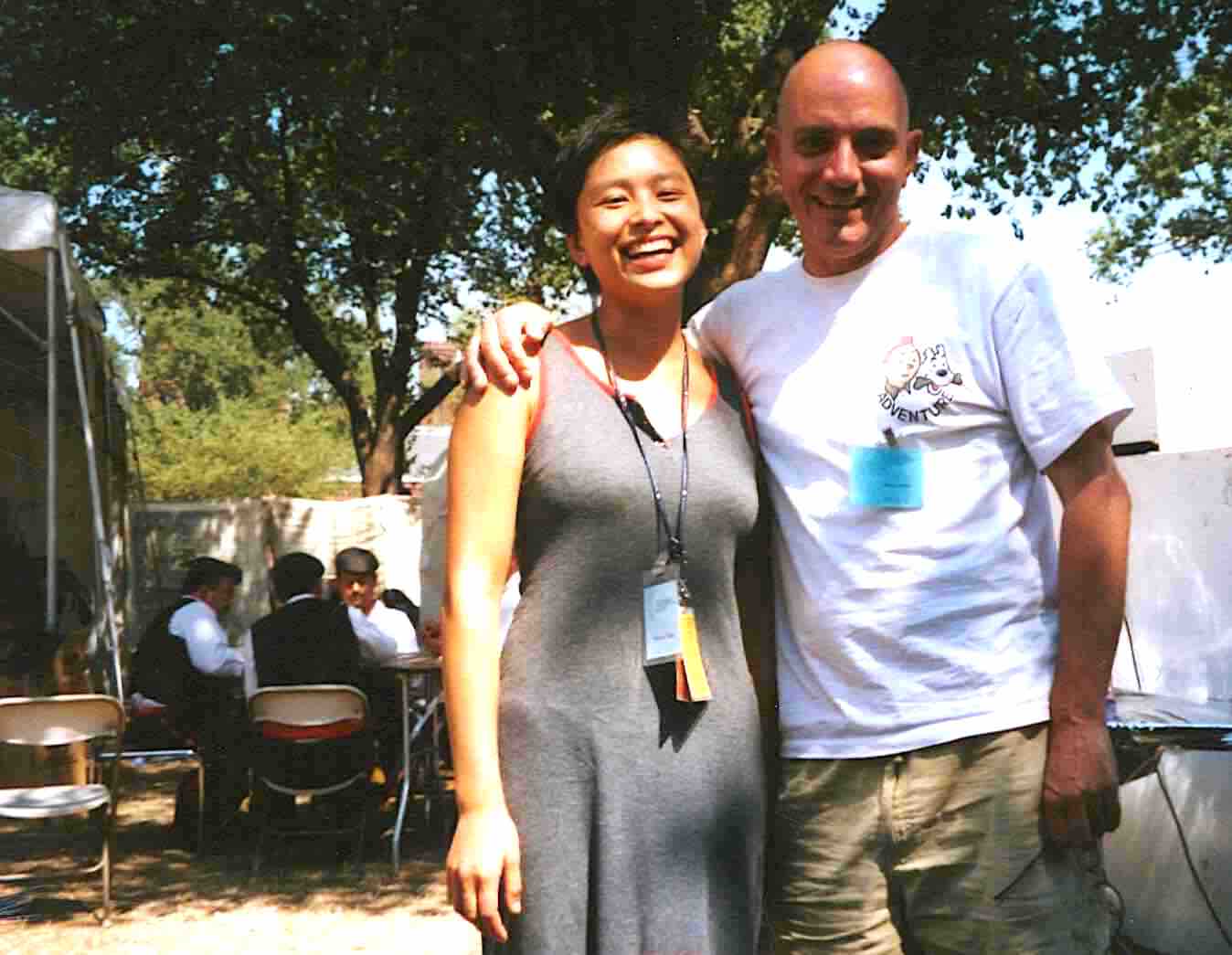
with Shuni

With able organiser Shuni, herself a gifted musician.

Impressive as the daytime gigs were, most delightful were the nightly parties back at the hotel, with everyone dancing to the Indian singers, Turks on zurna, Armenians on duduk, and so on. I did a routine with Indian juggler Kishan while Hua Yun did his amazing tricks on wind instruments.

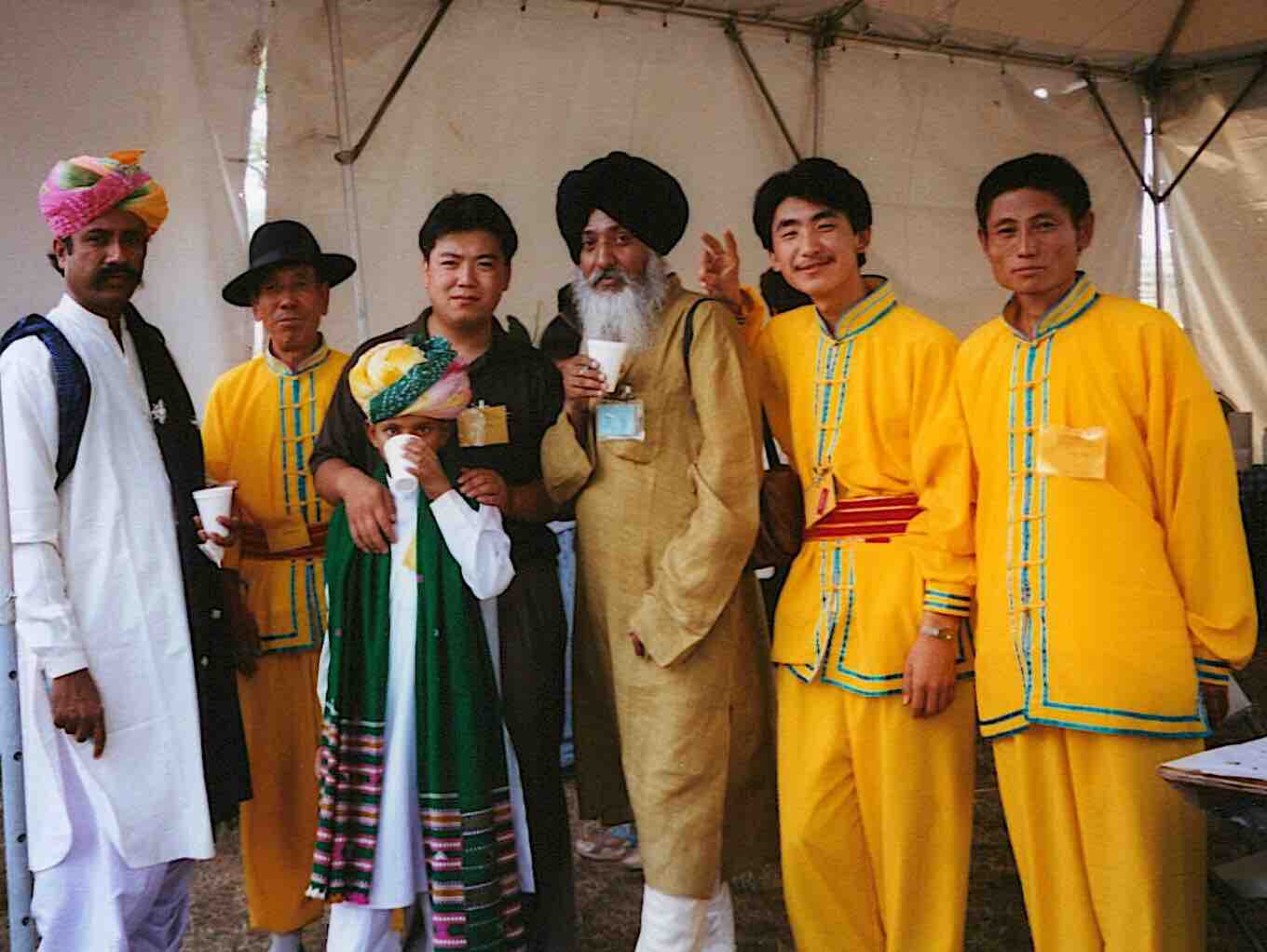
On their first trip outside Shanxi, the Hua brothers were remarkably sociable. They particularly enjoyed hanging out with the Rajasthani musicians—significantly, both came from peasant backgrounds, whereas some of the other groups had rather more conservatoire training. Perhaps some of the musicians who shared an overarching tradition, like the various maqam groups or Central Asian bards, were able to forge more meaningful relationships. Any political tensions were swept under the (brightly decorated) carpet. I’m wary of the modern cliché “International Cultural Exchange” (click here, and here), even if the Silk Road embodies the idea—but the main point was simply for audiences to be able to hear all this wonderful unfamiliar music, as a gateway to further explorations. 

Hua with Rajas

The Hua brothers also met up with Zhang Fengxue, a paper maker from a village in Chang’an county south of Xi’an—their dialects made it hard for them to communicate, so sometimes I had to try and interpret (Yeah Right). Zhang recalled going on rain processions with the village “water association” (shuihui) to Taibaishan in 1952, 1976, 1979, and 1992.

Left, Kathputli puppets; right, Hua Yun with Drepung monk.

In the hotel’s outdoor pool, the Tibetan monks practised underwater meditation, their swimwear matching the colours of their robes. They offered me a Mañjuśrī mantra that they suggested could cure stammering:

OM A RA PA CA NA DHI

Left, blues; right, with Roksonaki.

I took the younger members of the Hua band out to hear blues at Bar Lautrec; everyone met up in the hotel bar early in the morning to cheer on Brazil for the World Cup final. At the 4th July party we admired the fireworks; a nice Turkish volunteer shaved my head, long before I became a regular with my Kurdish barber in Chiswick (cf. At the barbers). The Hua band did an impromptu gig with the Kazakh folk-rock band Roksonaki. Finally we admired a Silk Road fashion show, and Yoyo played a moving Bach solo alap in gratitude to the legion of helpers.

fashion 2

It was the most exhilarating time. There I was, rubbing shoulders daily with a wealth of musicians with whom I would now love to hang out; but there was nothing to be done—I gladly devoted myself to the Hua band.


[1] For an introduction to such traditions, with AV samples, note The music of Central Asia website; see also Central Asia: shashmaqom at SOAS.

Sufism: Naqshbandi ritual in Istanbul and beyond

So far, my dabblings in the ritual traditions of Istanbul have consisted mainly of exploring the cem ceremony of the Alevis—itself a substantial topic, both in the city (here, with sequel) and around Anatolia. In its values, gender inclusiveness, and ritual style, Alevism is closely related to Bektashi beliefs, but is quite distinct from other Sufi orders (tariqa) active in Turkey. Click here for a fine critique of the concept of Sufi music.

An online article by Ömer Tuğrul İnançer makes a useful introduction to the ritual activities in Istanbul of orders such as Mevlevi, Halveti-Jerrahi, Qadiri, Sa’diyya, and Rifaî (see e.g. this extensive list of tekke lodges by order, and historically, by district).

Naqshbandi traditions
Like other tariqat, the Naqshbandi order has a wide presence around west, central, and south Asia. [1] It is influential in Turkey, where it is largely urban, supported by literati, bureaucrats, and merchants.There its pronouncements evince a less than liberal strain, vocally opposing perceived social decadence; opposing Westernising reforms, its leaders are critical of “heterodoxy”.

Hakan Yavuz, in his chapter “The matrix of modern Turkish Islamic movements: the Naqshbandi Sufi order”, observes that “the Sufi orders have turned out to be the major institutions for the aggregation of economic and political interests”. Focusing on Istanbul, he considers the Naqshbandis under the rubrics of inner cultivation and religious salvation, a tool for upward mobility, a network for social and political services, and a model for a community—headings that one might well apply to other orders too.

Naqshbandi Yaddasht
Concentration on God (Yaddasht). Source.

As to the Ottoman background, Sultan Mahmud II (1808–37), suspicious of charismatic popular leaders and competing loyalties within the state, banned the Naqshbandiyya-Khalidiyya order in Istanbul, as well as the Bektashis. But under later Sultans the Naqshbandis expanded their influence, often taking over Bektashi lodges, becoming “one of the most important forces between ruled and ruler”.

In the early years of the Republic, despite their support for Atatürk’s War of Liberation, the Naqshbandi and other Sufi lodges were banned. Still, their

ability to adjust to new situations and to develop new arguments neutralises the hostile propaganda of opponents who seek to identify the movement as fundamentalist or an “enemy” of modernity. For example, the Naqshbandis fully supported the Turkish War of Independence but protested against the radical and authoritarian secular transformation of the system by Mustafa Kemal.

Most of the eighteen rebellions against state policies between 1924 and 1938 were led by the Naqshbandiyya. But they were better able to survive persecution than some other orders.

In response to repression, most of these orders gradually transformed from strictly religious associations into competing educational and cultural informal associations with religious underpinnings. They gathered support from sections of traditional society, which regarded the Kemalist variant of secularisation as too radical and destructive for Turkey’s social fabric.

Indeed, “the post-Republican elite, which shaped the opinion and identity of the leading Muslim movements, evolved among local Naqshbandi groups in Istanbul and Anatolia”, and “the Turkish Muslim understanding of Islam is very much filtered through Naqshbandi concepts and institutions”. In modern Turkey, Naqshbandi is the most politically active of the Sufi orders; like others, they are closely involved in education, healthcare, commerce, and media promotion. Of the four main branches in Istanbul, most wealthy and influential is the lskenderpaşa, based at their Mosque in Fatih. But Hakan Yavuz argues that the remarkable adaptive powers and pragmatism of the Naqshbandi

may lead to decline, not so much because of state suppression or rivalry from other orders, but because of its smooth adaptation to capitalism and its integral involvement in Turkish politics, both of which may undermine the spiritual and cultural aspects of the order.

As he suggests, along with a reduction in the mystical and heterodox features of Islam and Sufism, Islam has been delocalised and a new, abstract, highly centralised and economically conscious faith created to cater for the modern urban population.

Dhikr
On the Anatolian side of Istanbul, we visited the village of Beylerbeyi, just along the Bosphorus from Üsküdar and Kuzguncuk, to attend the Thursday evening dhikr (zikr) ritual at a Naqshbandi dergah (see here, and wiki), where Sheikh Mesud Efendi (d.1908) was influential. Set in a picturesque old quarter up the hill, the wooden building is just as fine.

Naqsh exterior 1

The practice of collective dhikr (zikr) is intense. Among the Naqshbandiyya it is traditionally classified as either khafi “silent” or jahri “loud”; they seem to find both acceptable—see e.g. Isenbike Togan’s chapter on the historical controversy between them in Central Asia, n.1 below.

Glimpses from the women’s gallery.

Directing prostrations in a packed hall, the sheikh chanted a series of invocations, with occasional simple group responses. As the lights were switched off, the worshippers turned to sit in a circle facing the sheikh, the repetitive group invocations becoming more intense. In a segregated area on the upper floor a substantial group of women was also deeply devout, as my companions reported.

* * *

With such a very basic grounding in live ritual, I turned to YouTube for the wider picture, where several videos suggest the deeply immersive somatic experience of Naqshbandi dhikr. In her Introduction (n.1 below), Elisabeth Özdalga observes:

Many Sufi orders practice the dhikr collectively, with intensive and emotion-laden expressions, where the partakers move their bodies rhythmically as they loudly pronounce the names of Allah. The Naqshbandis are traditionally known for greater self-restraint. […] [They] have generally been regarded as more sober and orderly in their religious practices than other Sufis.

I can’t assess this as a general characterisation, but from the clips below it seems to need modifying. This substantial excerpt from a haḍra ritual in Bosnia is well annotated, featuring both Arabic qasidahs and Turkish ilahis:

Still more imbued with emotive expression are the rituals of Uyghur Naqshbandis, in a region of Central Asia that was invaded by the Chinese Communists in 1949. In retrospect, the Chinese state’s approach towards Islam in the decades before the clampdown under Xi Jinping may now appear relatively benign (see here). This zikr was recorded by Jean During in southwest Xinjiang in 1988, during a period when Uyghur traditions were enjoying an impressive revival after the end of the Cultural Revolution:

And the remarkable excerpts below show Uyghur Naqshbandis performing zikr in south Xinjiang on the eve of the Chinese campaign to obliterate Uyghur culture:

As to the Western diaspora, Naqshbandi groups meet in Europe and north America (cf. Alevi ritual), such as the Osmanli Dergahi in New York, transmitting the teachings of Shaykh Nazim Al-Haqqani (1922–2014), who moved from Istanbul to Syria, while also based in his native Cyprus (cf. wiki)—this 2017 video is among many on their YouTube site:

* * *

I’m acutely aware that outsiders like me cannot even begin to comprehend Sufi ritual. But my visit to the Naqshbandi lodge in Beylerbeyi reminded me again that (as in much Daoist and Buddhist temple ritual) the heart of ritual performance lies in The Divine Word, embodied through the pure a cappella vocal liturgy of the mosques and Sufi orders. In this case, the observance is unmediated even by percussion. 


[1] See e.g. Elisabeth Özdalga (ed.), Naqshbandis in western and central Asia: change and continuity (1999), including Isenbike Togan’s chapter on central Asia (on which see also here). Note also the chapter on Afghanistan by Bo Utas.
For Xinjiang, note Rachel Harris, Soundscapes of music in Uyghur Islam, and (for the Istanbul connection) her recent lecture, from 42.00 (see here). I look forward to reading Ha Guangtian, The sound of salvation: voice, gender, and the Sufi mediascape in China (2022). For Uyghur Sufi bards on pilgrimage in Xinjiang, see also Ashiq: the last troubadour.

Vassalage

Goulet
The Treaty of Le Goulet. Source.

As an arcane warmup for the France–England match tomorrow: one of my favourite expressions, outstanding in its entitled pomposity, is this description of Teresa May’s Brexit plan from the patronising patrician lips of The Haunted Pencil:

the greatest vassalage since King John paid homage to Phillip II at Le Goulet in 1200.

JRM

The Tree-Frog should know—he was there. Yup, he sure knows how to Get Down with the Kids. So that’s what they teach them at Eton, when they’re not busy hurling racist and sexist abuse at girls visiting from a state school. I wouldn’t know, I only did Woodwork at Skibbereen Comprehensive. *

I’d love to slip the bon mot (oops) into a chat over a pint at the Aardvark and Climbing Boot, but so far even “vassalage” has proved beyond me. Still, it might work as a new model of car (“Tesla Vassalage SR”), or in a catchy pop lyric—an early draft by Ken Dodd, perhaps, interpreted in the suave tones of Wee-Smug himself:

Vassalage

With this government one doesn’t need such a long memory as Tree-Frog, whoever the Prime Minister is this week, presiding over “the greatest fiasco since the day before yesterday”. May we be released forthwith from this Tory vassalage!


* My attachment to Skibbereen goes back to a rainy evening fuelled by inordinate quantities of Guinness on a Mozart opera tour, also memorable for a brilliant story at an Armagh pub session. I briefly flirted with the idea of applying for the Skibbereen Philharmonic, undeterred by the fact that there isn’t one.

Tibet: The Cup

Cup 1
New refugees prostrate before the abbot.

Having watched The Cup (Phörpa) (Khyentse Norbu, 1999) when it first came out, I’ve enjoyed it just as much on a recent viewing. “Inspired by true events”, it’s a most endearing film, against the spectre of Chinese repression of Buddhism within occupied Tibet (wiki; reviewed e.g. here). This glossy trailer largely fails to convey its charm!

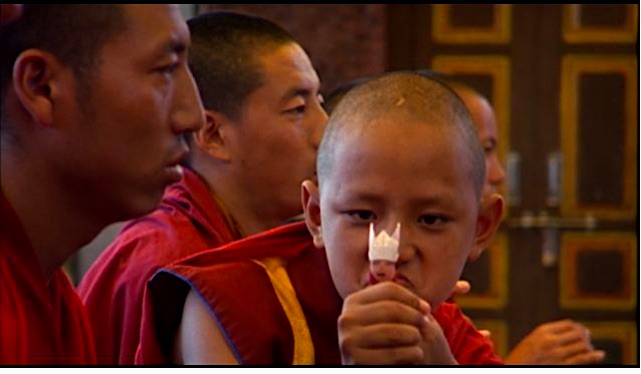
Director Khyentse Norbu is none other than the lama Dzongsar Jamyang Khyentse Rinpoche, who worked as consultant to Bertolucci for Little Buddha. Set in a Tibetan monastery in Indian exile during the 1998 World Cup, the film was shot in Himachal Pradesh, with amateur actors (including the abbot and monks) playing themselves, resulting in what Roger Ebert calls a “cheerful truce between the sacred and the mundane”.

Cup 2Orgyen displays his “shrine”.

The plot is driven by the football-obsessed young monk Orgyen (Jamyang Lodro), and his encounters with the abbot, (longing to return to the homeland), his assistant (more tolerant than he seems), and the oracle (belittled by the younger monks).

Charged with looking after two new arrivals have just escaped from Tibet, when Orgyen leads them in sneaking out of the monastery to watch a match after dark in the nearby village, one of the new refugees struggles to climb through the fence, prompting him to come out with one of my favourite lines:

How did you manage to escape the Chinese?

Another review observes the irony of the abbot’s bemusement at “countries fighting over a ball” while the Tibetans are deprived of their own homeland. Also subtly portrayed are Orgyen’s patronising attitude towards the new arrivals from China, the monks’ lament “When will this country ever develop?”, and their distance from the local Indian community.

Cup 3
Mischief during monastic ritual.

The aspect of ritual as chore—dozing off, fooling around—makes a refreshing change from the much-touted Wisdom of the Mystic East shtick. But beyond mere drôlerie, a message of benevolent wisdom shines through, and after the dénouement of the final between France and Brazil (glimpses of a youthful Zidane!), the final homilies are as gentle as the rest of the film.

Cf. Echoes of Dharamsala and other posts under my Tibet roundup.

Ostinato: jazz in Istanbul

Nardis
Photo: Augusta—who took to the 15/8 pattern like a duck to water…

Soon after the London Jazz Festival celebrated the 20th anniversary of Nardis, I found myself (only partly in the hippy sense) in Istanbul again, so on one of my rare raids on Europe from the Asian side of the Bosphorus I was able to spend an inspiring evening in the jazz club itself, just below the Galata tower—a change from Alevi ritual and köçek dance (see under West/Central Asia).

This documentary about Nardis (so far without English captions) opens with the amazing Bill Evans introducing the 1958 piece by Miles Davis that gave the club its name:

Nardis 2The night we visited, the club—founded by Zuhal Focan (left) with her husband Önder—was hosting the Swiss drummer Cyril Regamey, with François Lindeman (piano) and Andreas Metzler (bass), who came together with local jazzmen Bora Çeliker (guitar) and Can Ömer Uygan (trumpet) to pay homage to the amazing creativity of Herbie Hancock‘s band around 1969–70. Bora Çeliker (YouTube channel) plainly delighted in the material, his funk pedal to the fore; while Can Ömer Uygan (YouTube channel) was discreet, adding some subtle touches.

Note Batu Aykol’s fine film on the history of jazz in Turkey; see also Jazz in Kuzguncuk!.

* * *

Here (not for the first time) I feel like a football commentator reviewing Swan lake—but right from the extended opening number Ostinato (Suite for Angela) I was turned on (belatedly) to Herbie Hancock. A tribute to Angela Davis, it’s one of the gems of his Mwandishi period, on the eve of his immersion in Buddhism (cf. the Sufi influences on Yusuf Lateef, John Coltrane, and Pharoah Sanders):

The complete album is here; we can add to our appreciation with the aid of Bob Gluck’s detailed commentary in Chapter 6 of You’ll know when you get there: Herbie Hancock and the Mwandishi band (2012).

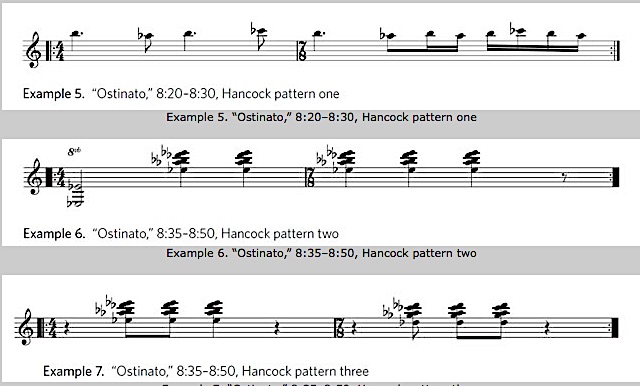
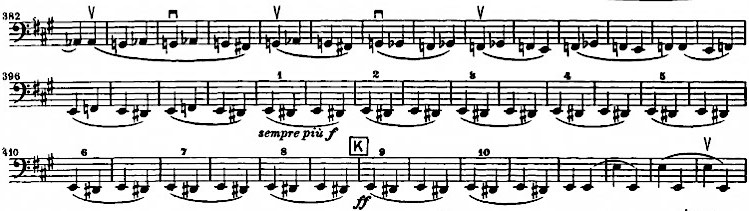
The syncopated ostinato is a thing of beauty in itself. Notation is a cumbersome tool, but it can give us a handle (and most jazzers themselves refer to it at some stage). The recurring bassline has a bar of 4/4 followed by a bar of 7/8 (cf. the additive metres of Taco taco taco burrito)—I’ve transposed it down a semitone, making it easier to envisage in solfeggio:

Ostinato full

So both bars ascend in conjunct pentatonic motion with somewhat different scales before falling to cadences on la and so respectively. * As Hancock reflected,

I wanted to write a tune with an underlying rock beat, but using it in a more open way than usual. I finally achieved it by making the number of beats uneven—it’s in 15/8, one bar of 4/4 and one of 7/8. I started with a repeated syncopated bass line in 4/4, a regular thing. The way I chose the notes in the riff was that I figured most of the rock bass lines telegraph their chord so distinctly that there’s no escaping it. I wrote something that could imply many chords … some fourths even, like Trane and McCoy… a kind of pentatonic scale, but starting on a different degree of that scale.

But then I thought “Why should I keep that all the way through?” so I changed it slightly and shortened every second phrase by half a beat. Now if, instead of two 4/4 bars, I had a 4/4 and a 7/8, it meant I had to change the notes to make them sound natural. Having done that, I had to decide what to put on top, and what it is, is different degrees of tension and release. Music and life flow because of those qualities, as do all the senses. It’s contrast: to know what cold water is, you have to know what hot water is. Music’s like that; it has to flow, and if there’s no tension and release it will be totally bland, with no vitality. […] Having 15 beats in a bar automatically sets up a little tension, because just when you think you’ve got it figured out, it eludes you. At the end of each bar we all hit a phrase together, and that’s a release. That’s also true of harmony. Very little of the music is consonant, but the dissonance varies so greatly that it’s a matter of some of it being less dissonant and thus becoming consonant by comparison.

Amidst a dense electronic and percussive collage, the vamp is introduced by the opening bass clarinet, with Buster Williams taking it over on bass beneath the swirling mists of Eddie Henderson’s trumpet and Herbie’s own keyboard textures.

Ostinato 2

Roll over Beethoven, eh. Seriously though folks, we need to treat all kinds of musical creativity seriously! Great—exploring Herbie’s ouevre will make another embryonic project for my education in jazz, following on from Miles, Trane, and Pharaoh Sanders


* If for some implausible reason we were to interpret the two bars as traditional Chinese melody, where pitch substitution is a common means of temporary modulation through a cycle of fifths (see Table under Dissolving boundaries, §3, “Scales”): as the second bar ascends, la is substituted for a flat 7th, preparing us for the introduction of fa in the cadential pattern—effectively a double transposition of the pentatonic scale from C to B♭! (Keep up at the back there…)

Binmenism

Nostalgia 1

A recent Long Read by Dan Hancox in the Guardian gets to the heart of our distinctive British malaise of nostalgia, trumpeted on the Memory Lane UK Facebook page. At the heart of this phenomenon are the “proper binmen” of yesteryear (cf. Lonnie Donegan):

To their admirers, proper binmen embody a lost postwar idyll—and the decline in national character can be seen in the appalling state of their modern-day counterparts, who are rotten in spirit, in character and in service. […]

Back then, in an unspecified period between 1950 and 1980, the binmen were stronger, more hardworking and more polite. Not just that—back then, the binmen were happy. Everyone remembers them the same way: always cheerful, always smiling, frequently whistling. They always had a kind word for you, never complained, and always closed the gate. They took pride in their job, which was hard work, but honest work. These judgments are delivered with absolute certainty. Back then, “They were always a really friendly crowd who you could have a good laugh with,” writes one commenter. “Not like the bin men of today, you are very lucky if they respond to a ‘good morning’.”

The historic shift in bin collection is taken to mark a wider crisis in masculinity. “That is when men were men, not the wimps we have today,” writes one Facebook commenter. “All be off work with PTSD nowadays,” chimes in another. Proper binmen “didn’t care about Health & Safety Shite”, writes another. The plastic wheelie bins we have today—with their emasculating pastels, often colour-coded for recycling, and their humiliating, labour-saving wheels—are just further markers of our moral, social and spiritual decline.

The supporting cast to proper binmen includes proper football man and proper Labour man. The key is noble suffering.

Stern voices have clamoured to remind us that being dangerously cold, being desperately poor and enduring powercuts, broken supply chains, food shortages and cold baths has happened to Britons before, and it would probably do us good, if anything, if it happened again.

Nostalgia 2

Among numerous other fetishes are

One pound notes. Queueing to use a phone box. Playing in the street and yelling “car!”. French cricket. Jam sandwiches. Scabby knees. Skipping. Coal fires. The slipper. The cane. The ruler. Getting a thick ear. Cumbersome lawnmowers. Ink wells. Duffle coats. Tin baths. Marbles. Jack Charlton. Forgetting your PE kit. Bus conductors. Bob-a-job week. Wooden ice-cream spoons. Snakes and Ladders. Ponchos. Beans on toast. Men opening doors for women. Slow dancing to Nat King Cole. Worzel Gummidge. Sweets by the ounce. Icicles hanging from the window frame (“Before central heating!”). Miss World (“All natural. Not a bit of botox in sight”). The power cuts of 1972–4 (“we coped, we were strong”). Scrubbing and polishing your front steps (“That’s when people had pride in where they lived”). Outdoor toilets. Cigarette machines. Flares. Playing in bombsites. Jumping in puddles.

The list could run and run—one might add cheery bus conductors, or the “innocent” sexism of Carry on films and “saucy” seaside postcards, for instance.

As Hancox notes, the rich and powerful profit from the philosophy of “We had it tough. We kept calm and carried on. We didn’t complain. We muddled through. We made do. We mended. It never did us any harm. It made us who we are”.

Underpinning this celebration of suffering is the masochistic idea that it is your individual responsibility—indeed an important test of your character—to withstand ruinous social and economic crises not of your making. […]

Elizabeth II herself was, we can reasonably assume from the tributes which followed her death, a proper Queen. Under the headline “The Queen’s 1950s frugality is key to our future”, one Times columnist praised her for being “naturally parsimonious”, personifying not obscene wealth and the plundered spoils of Empire, but the halcyon moment of High Binmenism, at some point in the 1950s, before the end of the Chatterley ban and the Beatles’ first LP. “In this age of Amazon Prime and Kim Kardashian-style super-rich spending, her frugality may seem quaint,” Alice Thomson wrote, “but it feels timely. As the cost of living crisis hits, everyone is looking for ways to cut back, taking a Thermos of coffee to work, eating leftovers for lunch and sewing on lost buttons.” That even a literal Queen has to be explained in this way suggests how deep Binmenism goes.

This indeed compounds our mystifying subservience to the monarchy.

Alongside their mission to excavate the rubble of the past, the Facebook nostalgia communities often pour scorn on the objects and rituals of today’s zeitgeist, in particular the damage done by technology. Computer games, smartphones, social media and TV are seen to create a disenchanted childhood, lacking in imagination, adventure and risk.

Still,

The vitality of the nostalgia industrial complex is a reminder of just how appealing it is to have your private reminiscences, buried memories, and hazy childhood images validated by others—whatever your age. It is a source of comfort to know you are not mistaken, that your version of your life’s story is shared. […]

Our gaze seems to inevitably turn backwards. The politics of the past few years abound with a desire for a return to an imagined, halcyon former version of Britain. This is true of both sides of the Brexit referendum; for remainers, there is often wistful talk of the 2012 Olympic opening ceremony or the New Labour period, while Brexiteers look back further into history.

Brexit, like the Memory Lane UK posts, partly speaks to an existential sadness about the passage of time and the desire for revenge on what we imagine it has done to us. You can only take back control if you have become convinced you once had it, and have had it torn from your grasp. […]

Stewart Lee delights in sending up the bendy bananas and Primeval Nothingness to which the Brexiteers long to return. Hancox goes on to cite William Davies on the way people who feel disenfranchised often find solace in nationalism:

The nationalist leader holds out the promise of restoring things to how they were, including all the forms of brutality—such as capital punishment, back-breaking physical work, patriarchal domination—that social progress had consigned to history. For reasons Freud would have understood, this isn’t as simple as wanting life to be more pleasurable, but a deep desire to restore a political order that made sense, in spite of its harshness. It is a rejection of progress in all its forms.

All this can shade into racist memes like attacking the toppling of statues, criticising BLM, and advocating for “proper” history to be taught “again”. At least the current “government” is doing its utmost to restore rationing and poverty—and the return of child chimney-sweeps would doubtless be popular in certain quarters (cf. The Haunted Pencil’s paean to “uplifting” food banks). Our relationship with the NHS, and the migrants who continue to make it work, is another much-discussed aspect of post-war British identity (succinctly, see e.g. this 2008 article).

Hancox cites an LSE report into class identity, which interviewed “successful TV producers, actors, and architects who all brushed aside their own private schooling, housing security, and material privilege to foreground a single grandparent who was a coal miner”.

But he also notes a more tolerant strain of humanist libertarianism, concluding:

It is not good enough to merely dismiss the Facebook nostalgics’ sepia-tinted version of history out of hand, if you care about Britain today. The proper binmen are living inside many of us, pulling our strings and guiding us not just down memory lane, but into the future.

Felicitous conjunctions

Unlike Keith Richards, the figures for my blog are not broken down by age and sex. But WordPress’s Stats do list posts by number of views for day, month, and year—giving rise to some felicitous conjunctions that are Grist to my Mill, recalling Unlikely bedfellows.

Recently I glanced at the daily list to find A tribute to Laurence Picken neck-and-neck with Cunk on Earth, and Taranta, poverty, and orientalism vying with French organ improvisation. In the November stats, Tchaik 6 finds itself sandwiched between Everyday life in a Syrian village and Aboriginal music. In the upper half of the league table for “All Time” views (sic: perhaps since the dawn of human civilisation, rather than the beginnings of life on earth),  Robert van Gulik occupies a respectable position that raises hopes of a Europa League place, but he’s pipped to the post by the Pearl and Dean jingle

Actually, such connections, like apparently random passengers stuck on the Orient Express in the snow, or indeed on the Northern Line, are kinda part of my Masterplan—I do indeed relish making bold leaps in my sequence of posts.

Cf. Global audiences, where viewings by country resemble an Olympic medals table. Hours of Harmless Fun for All the Family…

Bhairav to Bhairavi at Bhavan!

Bhavan

Hot on the percussive heels of Israel Galván’s flamenco reinvention of The Rite of Spring, I paid another visit to the splendid Bhavan Centre in west London, where resident vocal guru Chandrima Misra led her students in the first of two evenings displaying their progress learning a variety of north Indian ragas—the latest in a series of courses over many years.

Bhavan ragaChandrima Misra directing students, Founders’ Day, March 2022.

Between the opening and closing numbers (with nearly a hundred students seated on stage) we heard a variety of solos and for two, three or more singers—mostly women—in the popular khyal style, discreetly supported by Chandrima Misra on harmonium, with Rajkumar Misra on tabla, whose own students also took turns. Students paid eloquent tributes to the diligence and inspiration of their unassuming guru.

Framed by rāgs Bhairav and Bhairavi (introduced here as part of my extensive series on north Indian raga), the programme illustrated a variety of ragas roughly in their proper sequence prescribed over the course of the day, such as Bhimpalasi, Multani, Puriya, and Bihag. Many used chromatic scales with augmented intervals—none more complex than Lalit (introduced here).

As I observed on a previous trip to the Bhavan, it’s always intriguing to hear how young students learn the building blocks of a raga, memorising increasingly lengthy bandish compositions before going on to develop their own voice. The event had a celebratory family charm that rather conjured up an image of the Tring Amateur Dramatic Society; and it suggested the core of the mehfil aficionados who attend concerts of the great visiting artists—a strong amateur basis for the appreciation of raga in the UK.

* * *

In this concert footage, Chandrima Misra sings rāg Multani (flat 3rd ga, sharp 4th Ma, with re and dha—both flat—only sounded in descent), again with Rajkumar Misra on tabla, and Prabhat Rao on harmonium:

She herself trained with Munawar Ali Khan (1930–89), master of the Patiala Gharana tradition; here he sings rāg Yaman, always entrancing:

Munawar Ali Khan was the son of Bade Ghulam Ali Khan (1902–68)—who, as wiki notes, while agreeing that the beauty of classical music lies in leisurely improvisation, favoured shorter expositions of lighter ragas, reluctant to impose long alaps on his audience. In this brief excerpt he sings Bhairavi in thumri style:

And here he is heard in a selection of clips:

Chandrima Misra’s other main teacher was Vidushi Sanjukta Ghosh—in this radio concert from c1983/84 she sings rāg Lalit:

For more London concerts of raga, see Raga at the Proms and Indian singing at the BM. And do explore the wealth of music under A garland of ragas—notably the intense alap of dhrupad singing and the sitar playing of Nikhil Banerjee!

A flamenco Rite

Galvan

I’ve long been hooked on the gritty art of flamenco (series rounded up here), and The Rite of Spring is utterly compelling in both orchestral and ballet versions, always a rich source of inspiration for new interpretations. It makes perfect sense for them to come together, and the other day I was delighted to attend a solo dance performance of La Consagración de la primavera by the ever-innovative Israel Galván at Sadlers Wells.

It’s hard to unhear the sonorities of the orchestral score, but the pared-down arrangement for two pianos (played by Daria van den Bercken and Gerard Bouwhuis) worked well, and Galván was mesmerising, embodying Stravinsky’s vision with his chthonic percussive energy.

Here are excerpts from a performance last year:

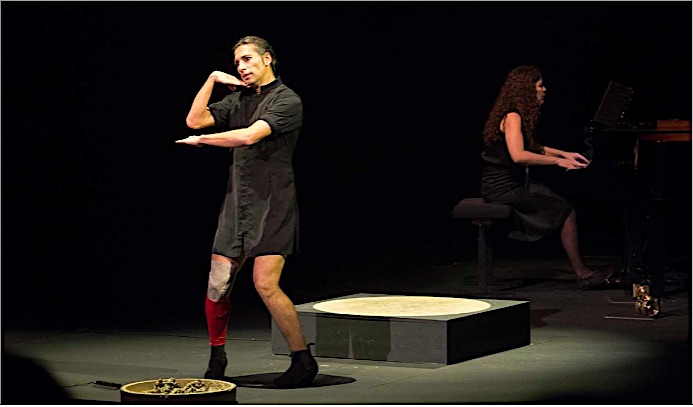
The dance complemented the agonised ethos of flamenco—modifying its ”self-pity, posturing machismo” (Timothy Mitchell) and the “culture of victimage” (William Washabaugh) (see Flamenco, 2). Blurbs for Israel Galván typically remark on how he “challenges gender norms”. While stressing the angular syncopations of Stravinsky, he added his own rhythmic counterpoints. His whole body became a sound-box, with relentless stomps and shimmies (his legs sometimes concealed beneath a huge billowing skirt) and expressive arms. Much as he deserved a nice sit-down, you might not think that the hectic Danse sacrale that concludes the piece would be quite the moment, but he spent most of it on a chair—legs, feet, and arms frantically busy as ever.

The Rite of Spring usually makes a climactic finale, but here it was the centrepiece of a continuous event, amidst two contrasting musical works, Frederic Rzewski’s Winnsboro Cotton Mill Blues and a sonata by Domenico Scarlatti—also making suitable vehicles for Galván’s style. The programme brought out the highly percussive nature of the piano, even if I couldn’t help imagining a version on bandoneón and xylophone.

“Making a mistake” in Foreign

Blue kite stillFrom Blue kite (Tian Zhuangzhuang, 1993).

With “mistakes” (closely followed by denials—notably Brexit) having become routine under this evil Tory regime, I’m reminded that I’ve always been fond of the Italian sbaglio (verb sbagliare), with the appealingly economical negative prefix s- creating an expressive diphthong. Admittedly in this case a positive version baglio/bagliare is elusive, but it reminds me of other words equivalent to English dis-, such as

  • svantaggio disadvantage
  • sfiducia mistrust
  • scontento discontent
  • sfigato loser
  • scaricare unburden
  • sfiorire wither
  • disprezzo “disdain” (as in Moravia’s novel)
  • sprezzatura “studied nonchalance”
  • staccato detached
  • sforzando “with excessive force”—Beethoven’s speciality.

Like I’d know… A suitable aperitivo here is the negroni sbagliato (cf. the Lumumba and cubalibre).

Returning to “mistakes”: in British politics, “misjudgements” that have appalling social and economic consequences can now be casually brushed aside with a patrician air of disdain. In China,  however (as throughout the socialist bloc), “making a mistake” (fan cuowu 犯错误), a catch-all for political, sexual, and indeed clerical misdemeanours, is now used humorously—despite (or because of) its Maoist heritage, with the disastrous personal and familial consequences that could ensue from innocent infringements against the fluctuating political orthodoxy of the day, or entirely innocuous casual remarks—cf. Goulash deviationism, China: commemorating trauma, and movies such as Blue kite and Living. In documents from the Maoist era the term is a sparse hint of such faux pas, as under The Houshan Daoists, requiring us to read between the lines (see my review of the Anthology of the folk music of the Chinese peoples).

Patricia Lockwood excels again

The LRB has enriched my life, but nothing in its pages is so invigorating as Patricia Lockwood’s articles (click here for her own literary ouevre and a selection of her reviews; see also here).

Much as I learn from the LRB, some of its reviewers tend to submerge the book supposedly being considered beneath their own superior expertise, reading like “it should have been ME who wrote about this topic”. Ms Lockwood’s style is highly personal, but she manages to keep the poetry of her own fantastical world in the service of deep insights into the milieu of her subject, while drawing us into the whole craft of fiction writing. In a recent review of two story collections by George Saunders her comments illuminate, rather than obscure, the author’s message.

She reflects on the sense of failure conveyed by Saunders’ characters:

It must be, in order that he can overcome. At some point, the source of poignancy stopped being the characters, and started being the desire of the stories to rise above themselves. They wanted a little more than they had, than they could ever have. They could feel their strength, if they were just given a chance, they could be more than Daryls, Dereks, Kyles…

Commenting on his religious background, she stops herself:

Trying to trap me into writing a big Catholic thing, eh? Well, I won’t, except to say that we probably have a few of the same voices in our heads.

Saunders 3

Reading Lincoln in the Bardo, she observes:

Short fiction is a cruel form. It is life in miniature: not enough time. Some of its best practitioners have been cruel, or doctors in an age when we took legs off with hacksaws. It is hard to keep giving readers that edge they can brace against, catch their breath, say OK, all right, you know it and I know it. It is hard, after experiencing their love, to stop yourself from showing up to rescue your readers too soon.

On Saunders’ experience as a teacher:

If you’re a normal person, the first time you set foot in a classroom you will hear a voice that says: “It is wrong to take their money”. Other claims rise up to drown out this voice—what holier thing than the study of literature; talent cannot be taught, but the fundamentals can; they are paying for a circle of protected time—and all of them are true, but the voice is loud, louder than literature, and grows louder when you see a student so full of desire for her own life that she can barely breathe, and you taking money for it. What will she do? Is there a world for her? Are you part of the cheat, have you been promoted to middle management?

As to his insights on Russian fiction:

Why is Saunders so much more interesting about Turgenev’s “The singers” than about Gogol’s “The nose”, when Gogol would seem his more natural forebear? Most memorably, A swim in a pond in the rain has a great section on Tolstoy’s “Master and man”, the story he is always writing in one form or another: one man dies to save the other, in falling snow.

Finally,

There is something insoluble here. He is telling us that you cannot trust the Pulse—this is the fact that must be continually learned. Your feeling (you are, after all, doing this to feel the feeling) has nothing to do with whether it is good, just as your desire to be good cannot be worked out in fiction. But in those moments it does come to you what a guy is for, and you are covered in glory; it comes to you what it is to be a cloud of consciousness, with lives moving through you and that weird holy look on your face. The body lies far below you, in parts, the Worm Interlude—real site of your genius—passes into another phase, one you seem to remember from before you were born. “Where were you, before you came here?”

Heaven, Jeremy offers.

I want her to teach me everything. In exchange I can offer to share my experience of Daoist ritual in north Shanxi—but I’m not waiting for the phone to ring (that heavy black Bakelite contraption on the table in the hall).

Turkish jazz in London

Anatolian fusion

In the London Jazz Festival, to follow the radiant gig by Andrea Motis I sallied forth to swinging Exmouth Market to sample a mini-festival of Turkish jazz curated by Turquazz in celebration of the 20th anniversary of Nardis jazz club in Istanbul. A “pop-up venue” * in the same pleasant hall that last year hosted Veronica Doubleday’s entrancing concert to launch the new edition of Three women of Herat, among a series of gigs (reviewed here) was Female voices of Turkey, as well as an intriguing talk on Thomas the “Black Russian” and Maksim tavern.

Ozan band

I relished the Anatolian fusion ensemble, led by Ozan Baysal on bağlama plucked lute. Rather as the only word that makes any sense in the “Hengshan Daoist Music Troupe” is “Daoist”, I wasn’t hung up on the Anatolian connection or the fusion, but the ensemble was exhilarating.

My ears having become attuned to the bağlama by its use to accompany the nefes hymns of Alevi ritual (click here, and here), I admired the creativity of Ozan Baysal (YouTube; and e.g. this intro), playing with Tolga Zafer Özdemir on keys and synth, Bora Bekiroğlu on electric bass, and Burak Ersöz on drums, all currently based in London.

While Ozan remains steeped in the traditional style, * the double-necked bağlama opens up new possibilities for him in a rock-based vibe, as he explores the şelpe style with a variety of left- and right-hand techniques. Being keen on free-tempo preludes, I appreciated his fine taksim intros, unfolding into long numbers in exhilarating dialogue with Tolga Zafer’s funky keys and synth. The band clearly loves playing together, and I’m All Agog (a complete gog, or perhaps ğöğ—cf. kösk) to hear more from them.

For a visit to the Nardis jazz club in Istanbul, click here!

* * *

* In more traditional mode, here’s Ozan Baysal at SOAS earlier this year with the different lineup of Anatolian Groove, including the Kurdish/Alevi singer Suna Alan, and Melisa Yıldırım on kamancha fiddle (website, YouTube):

Click here for Ozan’s recent collboration with Melisa Yıldırım. For my belated education in Turkish culture, see under West/Central Asia: a roundup. And click here for a roundup of posts on jazz, including not just the Golden Age but also Ethiopia, Poland, and Japan.


* The tabloid Leitmotif “pop-up brothel” has recently segued seamlessly into “pop-up Prime Minister”

A short story

Note
I found this handwritten manuscript, apparently the author’s only fictional creation, while sorting through my old family papers. * Except by osmosis, I was never privy to the lasting personal trauma it evokes. For me, that itself adds another layer of sadness; I never overcame my teenage alienation from the older generation, unable and perhaps unwilling to identify with their own human conflicts—and indeed it was many years before I became aware that such introspection was even possible. But aside from all that, I greatly admire the literary merit of the story, which speaks to an experience that extends beyond the
Brief encounter generation.


She took the box of chocolates from him and glanced wearily at the contents—why bother to choose, she thought. I’m sure to get it wrong. Turkish delight… orange cream… perhaps ginger or brazil nut. What’s the betting I’ll end up with coffee or nougat—and anyway I don’t really know which one I want, or even if I want one at all. She pushed the box away, and her mind wandered back over the years, taking her from the comfortably furnished room, neat, warm, quiet, with its view onto a carefully tended suburban garden, to the shabby cottage where two little girls waited for their daddy to bring the Saturday treat he always collected for them when he went for his evening sports edition. The pools win had never come, but for her the memory of choosing which sweet to take from the penny packet he triumphantly produced was interwoven with the excited checking of football results.

When did I start to make the wrong choice, she wondered. The choice was my own, people didn’t influence me, did they? Did they? Was it not outside conditions, a sequence of events converging on me, forcing me into a narrowing passage where only one choice became possible, and finally became no choice at all? The war influenced so many people in so many ways, but for me the influence was gentle, tucked away as I was in the country, too young to have to leave home, my father in a reserved occupation, far from the bombs that caused such havoc. Oh no, I can’t blame the war. She thought of her dominant mother, who was outwardly kind, so absorbed in her little family, and whose whole life was lived for them, but who nevertheless expected complete obedience, unquestioning acceptance of her way of life. Was it her rule, her permanent ordering of every detail that had made it so difficult for her daughter to accept the responsibility for her own choice in even the smallest matters?

sisters 1935
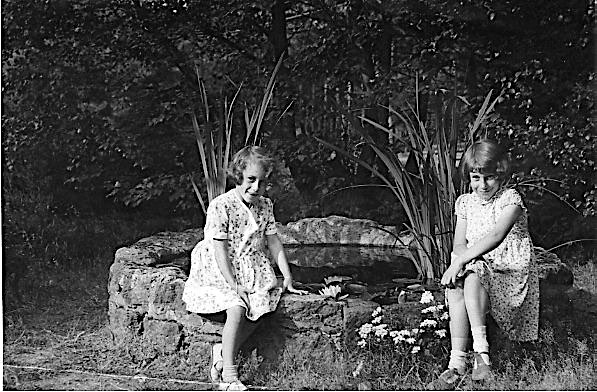
Two sisters, 1935.

At school the range of subjects had been limited by shortage of staff and accommodation caused by the need to share with evacuated schools, so by the time she had realised where her interests were it was too late to change, and the professional training she would have liked had been suspended for the duration of hostilities. She had fallen back on her mother’s choice of career, accepted her ambition for her, but chosen for herself the college in London—in spite of the doodlebugs.

She thought suddenly of the relief of being able to go home to the country from college, and then, for no reason at all, of the young farmer’s son who had been her constant companion. They had been friends, real friends, with an easy give and take, a flow of laughter and understanding, and a joy in the beauty of the countryside around them. His parents’ farmhouse had been welcoming, with a cool, clean atmosphere after the strenuous activities of haymaking in summer, and a friendly glow in winter after attending to the animals. His mother was a homemaker by instinct, not in the self-conscious manner of the modern housewife, and her husband made everyone welcome without looking over his shoulder to see if he was creating the right impression. His family had farmed there for generations; this was where he belonged, and he had no need to consider such things as creating the right image. Theirs was a happy life, and yet when Dan had asked her if she would consider giving up the prospects of the job she was training for and marry him, she had not even thought of it as a choice. She wanted to live in a town with all the excitement of constant entertainment, clever, smart friends and all that the best in the world of culture and arts could offer. Foolish girl that she had been, she had thought then that the big cities held everything the world could give. Foolish, self-pitying old woman that I am now, she thought, at least I know that the heart finds its own happiness regardless of material matters.

I did live in a beautiful city when I set out on my career, and I was so lucky with my work and my colleagues. The creative side of the work satisfied me, and the promise of being useful to others as well as enjoying the necessary routine. Why did I give it up, why did I leave the house where I was living as one of the family, but free to go my own way, why did I abandon my hopes of making my own life as I had planned? My choice again, she thought, to leave so much for so little. I was not swept off my feet by the handsome hero of the story books, I had no illusions about him; I expected no treats or surprises. Oh yes, I was flattered by his attentions, the promise of his devotion, and I made my own decision.

“Another chocolate, dear?” “No thankyou”. He didn’t even notice that she hadn’t taken one before—perhaps he no longer cared any more than she did. Was he too, perhaps, thinking back over the choices in his all to predictable life? The limited finance of the early years when he had chosen to buy a house that would be in the “right” area for one in his position, the child he had never wanted although they had decided together that the time had come when they could afford to start a family. Now that had been a wrong choice. Before that, she had been young enough to make a new life of her own without him, without a child to consider, and still able to make use of her training and experience. Did he remember that as a turning point too, one which had kept him in his dull job, paying the bills, gardening, decorating, listening to her nagging, the child’s grizzling—and for what? She remembered the years of shared misery, the endless arguments, the countless times when she had chosen to stay on, but in reality she had not had the guts to stand up to the recriminations of both families, to his concern about what people would think, how it would affect his career.

Perhaps just once she had rejected the choice to return to living in the country. Had it really been a choice? During one of her husband’s business trips she had taken her son back to the countryside of her youth, and seen again through his eyes the beauty of her native county. A picnic on the farm where she had so often ridden home with the harvest was a must, and it seemed natural that Dan would still be there, natural that she should show the boy the ducks, take him to the milling shed, lift him onto the back of the old horse, now out to grass, who had pulled so many hay carts. They had slipped so easily into their old friendly ways, and he had taken her hand gently, sensing her unhappiness, and said, “I’m still here if you want me, my lovely”.

Her husband was dozing now, and she looked across at him, tired, grey, lined, but still with the determination that was his hallmark. They were alone now; their son had done well, with his degree which had led to a successful career. But they rarely saw him, and when he did visit he was always in a hurry. She looked round the room and thought of the house they were in now. She had intended to leave when her son left, go her own way, at last be free to live her own life, independent of parents, husband, child, forget the bad times and make the most of what was left. But he had had a trick up his sleeve. Did he tempt her with that offer of a fresh start, the move to a new house? Did he really want to please her, make her happy, share with her the fruits of his dreary years? She looked at the room now, gleaming in the lamplight, carefully chosen by him, put together with patience, every detail meticulously stage-managed, taken out of her hands, and ending up like the magazine impression of an “Ideal Home”. The kitchen should be the heart of the home, like the farmhouse kitchen of long ago, but how easily hers had become not the heart but the powerhouse, full of all the latest and smartest equipment, an impressive showpiece.

Now she no longer had any real choice in anything that mattered, no choice whatsoever. Here in this lovely house, which could have been a bribe, in the suburbia to which she had never truly belonged, which had rendered her incapable of belonging to the countryside where her roots lay. “It hasn’t all been bad,” she thought, “there have been happy times, and I have much to be thankful for.” She looked at the helpless figure in the wheelchair, caught his glance as he awoke searching for her presence; shared with him the resignation to the crippling illness which two years ago had trapped him but would not give him a swift or easy release. No choice, she thought as she smiled at him and reached for a chocolate.

MM, 23rd March 1980.


* For more family vignettes, see A modest literary pedigree, Wisdom of the elders, and From the archives.

When the iron bird flies

*Another instalment in my education on the history of modern Tibet*

Iron bird cover

The independent scholar Jianglin Li—evidently no longer based in China—has a useful website War on Tibet, working with Matthew Akester. I’ve been reading her book

  • When the iron bird flies: China’s secret war in Tibet
    (Chinese original, Taiwan 2012; English translation by Stacy Mosher of the revised version, 2022, 550 pages).

After her 2010 book Tibet in agony: Lhasa 1959 (English version 2016), When the iron bird flies describes the brutal military conflict in Tibetan regions from 1956 to 1962, which has long remained a closely guarded secret. It supplements chapters in Tsering Shakya, The dragon in the land of snows (1999) (see his review of Li’s book) and vols 3 and 4 of Melvyn Goldstein’s magnum opus A history of modern Tibet (2013, 2019), as well as recent volumes like Conflicting memories.

The main focus of When the iron bird flies is the regions of Kham and Amdo (for some sources on the latter, click here), whose chiefdoms had always been resistant to external political power. Li’s account is based both on Tibetan accounts and classified Chinese documents within the PRC, as well as interviews with Tibetan refugees in India and Nepal.

map
Traditional Tibet, comprised of the three provinces of Kham, Ü-Tsang, and Amdo,
in current Chinese administrative divisions. Source: Marvin Cao.

For several years after occupying minority regions the Communists moved slowly; but the trigger for the convulsions of the late 1950s was “democratic reform”—their euphemism for coercive land reform and expropriations. It was launched over several stages in different provinces: in Yunnan in 1955, Sichuan in 1956, Gansu and Qinghai in 1958, and the Tibetan Autonomous Region (TAR) in 1959. Revolts broke out widely as the reforms were being imposed. Li introduces the system that soon became routine: work teams, struggle sessions, the fixing of class statuses, taxation, confiscation of grain and guns, assaults on monasteries. Even Tibetan activists groomed to the Communist cause were shocked to see the disastrous effects of reform when they returned to their localities.

The “first shot in the Khampa armed rebellion” came at Sertar county in Garzê. In response the Sichuan Party bosses only escalated the situation.

By the end of March 1956, eighteen of Garzê Prefecture’s twenty counties and forty-five of its seventy-seven townships had experienced full-scale or localised insurrections involving a total of 16,000 people and more than 8,000 firearms. During this time, fourteen land reform work teams came under attack, and ten county seats were besieged or encircled. More than 200 land reform cadres were killed, and the PLA suffered more than 300 casualties.

Reform was not invariably met by resistance:

In Middle Village and Lower Village in Ngawa’s Trokyab county, land reform was completed in about three months without conflict. But when the work team proceeded under order to Upper Village to launch land reform, it came under attack, and almost all of the thirty land reform work team members were killed.

But heavy taxation and grain confiscations led to food shortages.

Resistance by the Hor Drango (Shouling) monastery in Drango county was suppressed in March 1956. After Communist troops “annihilated more than 700 people,” “the Shouling temple’s eighty-member council sent representatives to the county’s Work Committee to deliver a written assurance that they would not resist taxation again”. This indicates that taxation was the direct reason for the Drango monks’ resistance.

As both Chinese and Tibetan sources show, with many of the most influential monks and laypeople having been recruited to official positions in the CCP system, resistance came mainly from the lower middle classes, including farmers, herders, monks, and traders. Li studies the class composition of areas, with tralpa (who leased land and cultivated their own crops) and gepa (who cultivated land or worked as servants for landowners, headmen, or monasteries):

The vast majority of peasants in these regions cultivated their own fields. Tralpa were not necessarily poor, and families with surplus labourers could engage in trade or hire themselves out. As a result, when the Tibetan regions were divided into class categories, the landlords, rich peasants, and middle peasants were mainly tralpa, whom the CCP classified as “serfs.”

As in Han Chinese regions, class classification was arbitrary and variable by locality. With land that had previously been communally owned now becoming state property,

a district designating 10 to 20% of its people as “landlords and rich peasants” meant that a relatively large portion of the middle stratum had their assets confiscated; this caused many of them to join in uprisings. [….]

 Every stage of the land reform process in Kham, from its preparations to its implementation, demonstrated the arrogance and high-handedness of the CCP regime, as well as the ignorance and brutality of its cadres.

Numerous problems in the “redistribution” of resources were intractable. Resistance to land reform was inevitable. In response the Party requested military reinforcements while mobilising Tibetans into the army—who, hastily trained, suffered the heaviest casualties. The first battle, over nine days in March 1956, was in Lithang in southwest Garzê (cf. this post).

Lithang 1957.1

Lithang 1957.2

In a series of battles, both sides suffered heavy casualties. Determined to crush all resistance, on 29th March the air force dispatched two Tupolev Tu-4 aircrafts (a gift from Stalin to Mao) to strafe and bomb the monastery. Next day the PLA made their final assault.

This battle being the PLA’s first major military operation in the Tibetan region, its shock wave was felt by both the Chinese and the Tibetans. Tibetans were shocked by the “iron bird,” a powerful modern weapon they had never before seen or heard of, while the Chinese commanders were surprised by the willpower of the Tibetan resistance. In the following years, Tibetan willpower and Chinese modern weaponry would clash over and over again.

Lithang1957.3

Southwest of Lithang, the people of Chatreng were also fiercely independent. Again, the early years of Chinese occupation were relatively mild, but in mid-February 1956,

Chatreng’s two main monasteries received a document from the work team. As Tibetans recall it, the document included seven points:

1) Lamas and monks have to be eliminated; 2) monasteries and their contents have to be eliminated; 3) worship and ritual are prohibited; 4) the wealthy and eminent members of the community have to be eliminated; 5) all land will be appropriated by the state; 6) all property will be appropriated by the state; 7) everyone has to obey the Liberation Army and serve them. If you do not agree to this, we will bomb you from the air and send troops on the ground and wipe you out. […]

The Tibetan leaders of Chatreng secretly held a meeting to discuss the document and then sent a messenger to deliver a strongly worded reply:

You officers, district heads, and soldiers are here in our land without the slightest justification, and have no business imposing these seven points, which are completely unacceptable. You had better leave immediately, otherwise we have also made our war preparations, and there is no doubt that we will fight.

From 20th March county government bases were besieged by the local Tibetans. When the surrounded Chinese finally managed to send word to Zhou Enlai, reinforcements were dispatched. On 2nd April bombers were again deployed, destroying large areas of Sampeling monastery and killing over two hundred monks and laypeople. Three monasteries in the region were bombed over nearly a month. Chatreng was destroyed.

Among the land reform work teams were many Tibetan activists trained by the Chinese. In Nyarong (yet another region long resistant to external power), 185 out of 257 members were Tibetan. The rebellion there began in February 1956, as land reform teams came under attack, with insurrections breaking out in 78% of rural townships. Again, PLA reinforcements were sent. Coercive reforms continued throughout the year.

In Ngawa prefecture, Sichuan province (focus of Barbara Demick’s Eat the Buddha), uprisings broke out from March 1956, again prompting Chinese military intervention. As elsewhere, “goodwill troupes” occasionally sought (vainly and cynically) to mollify a furious population even while persisting in reforms.

The following chapters turn to what became the TAR, where reforms were delayed, with a useful survey of the early years under occupation. But by 1956 news of the violence in Kham was causing great alarm in Lhasa among the Tibetan leadership and public. Li describes the intense diplomatic intrigue in 1956–57 surrounding the Dalai Lama’s visit to India, involving Zhou Enlai, Nehru, and the USA—as Zhou emptily promised the Dalai Lama that there would be no reforms for six years. The Dalai Lama returned to Lhasa on 1st April to find the situation increasingly tense. Meanwhile the CIA-trained Chushi Gangdruk (“Four Rivers and Six Ranges”) volunteer army prepared to resist Chinese occupation.

The “socialist transformation” continued, with forced collectivization around Golok Prefecture in 1958, as the Great Leap Backward (my apt term) caused untold suffering right across China. By August,

resistance among the Qinghai Tibetans had spread to five autonomous prefectures, 24 counties, 240 tribes, and 307 monasteries, involving more than 90,000 people. The Chinese government sent in five army divisions and 30 regiments of various kinds, plus 25 companies of armed police and local militia, for a total armed force of more than 50,000, including air force, artillery, infantry, cavalry, armoured troops, and others. […]

In Chikdril County, 1,050 people, nearly 10% of its total population, were arrested within three years. More than half of these captives died in prison over the next five years, and some were in jail until the early 1980s. Of the hundreds of herdsmen arrested from the Khangsar clan, only about twenty of them ever made it home again.

At least 9,262 people were arrested in Golok Prefecture, the vast majority of them males in the prime of life; in some places the proportion of young men to young women was one to ten.

As the military campaign shifted north from Sichuan and Yunnan to Qinghai and Gansu, Li documents the horrific “Yellow River massacre” at what later became Khosin Township (Yulgen county) on 1st June 1958—as ever, carefully assessing the conflicting sources.

After a Chinese convoy was ambushed in Yulshul, rebellions broke out at monasteries, with bombers again deployed. Over a third of the population of Yulshul died in these years. Many survivors were imprisoned in labour reform camps, where they died or suffered for long years. With food shortages worsening, in May 1958 the PLA murdered monks at the Drakar Drelzong monastery in Tsikorthang, Tsolho Prefecture; in September there was a bloodbath at Drongthil Gulch. A second wave of assaults took place from June to September 1959.

As the Chinese military administration was convulsed by Rectification and Anti-rightist campaigns, Tibetan resistance to reform was widespread—though what Chinese sources portray as rebellion (thus creating a pretext for massacres) was sometimes a mere exodus of herders fleeing collectivization. Refugees were described as “bandits” if they were killed, or “liberated masses” if they were captured. Resistance continued in 1959, met by massive troop deployments, with further major battles.

In 1958 a major arrest and denunciation rally took place at Kumbum monastery in Rusar county, Qinghai. The monastery then has 1,615 monks—remarkable in itself, we might suppose. Tibetan Buddhist life had been relatively unscathed through the early years of occupation; but now the CCP initiated a secret “religious reform movement”, in which Buddhist activity was specifically targeted, notably the monasteries. A document from the period noted the scale of the issue:

more than 5,000 monasteries of various sizes, and 450,000 religious personnel, among which there are more than 3,000 lamaist temples and 250,000 lamas in Tibet; 20,000 lamas in Mongolia and Xinjiang; and a total of 2,000–3,000 lama temples and more than 170,000 lamas in Gansu, Qinghai, Sichuan, Yunnan, and other provinces.

Apart from ideology, the monasteries possessed substantial assets, in land and precious material artefacts—Li gives regional instances of the assets confiscated, metal statues and religious implements. Labrang monastery (in Gansu), with its 4,000 monks, was surrounded in April 1958; after “reform” began in June, over 1,600 people there were arrested, imprisoned, or executed. Many monasteries were now destroyed. In Qinghai province,

223 monasteries in the pastoral areas have been disbanded, 51.98% of the total, and 17,685 religious personnel have returned to secular life, composing 36.56% of the total. Among these, 97.5% of the monasteries in Huangnan prefecture have been disbanded, and 55.1% of religious personnel have returned to secular life; adding in those arrested or sent to group training brings it to around 95% of the total. In Hainan prefecture, 91.8% of the monasteries have been disbanded, and 87.9% of religious personnel have returned to secular life. In Haibei and Haixi prefectures, more than 80% of the monasteries have been disbanded, and more than 70% of the religious personnel have returned to secular life. The emergence of these new scenarios shows that religion is on the brink of total collapse.

The Anti-rightist campaign gave another pretext to denounce religious figures. As a Qinghai document declared:

After a large number of religious monasteries have been destroyed and a large number of religious personnel have returned to secular life, all localities must rapidly launch religious systemic reform work in the monasteries that have been purposely retained. […] The monasteries that remain must be controlled by progressive elements and must be completely controlled under the party’s leadership.

Another Party document explained:

In order to look after the religious beliefs of the masses, block rumours and provocations by counterrevolutionaries inside and outside of China, and facilitate the centralised management of lamas who have not returned to secular life, preserving some temples is essential. As to the appropriate number to retain, this should be according to the influence of the temple and the views of the masses. Rank the temples; in principle it is undesirable to retain too few. […] In terms of retaining temples, it is advantageous at present to retain more rather than less.

By the beginning of 1959, the vast majority of monasteries in Amdo and Kham had been closed down, occupied, or destroyed. I note that whereas in post-reform China the Cultural Revolution makes a scapegoat for a far more protracted range of abuses, in the vast heartland of the Han Chinese, the Communists began destroying temples from the early 1950s—in some areas as soon as they took power, even before the national “Liberation”. I’m also reminded that food shortages there predated the 1959–61 famine by several years, following collectivization. Yet Tibetan religious faith was not extinguished: it went underground.

Sera
Struggle meeting against monk officials in Sera monastery.

Lhasa
Struggle meeting against a Tibetan government official in Lhasa.

Lhasa was “the last hope”, where activists and ordinary people from Kham sought refuge in ever larger numbers. Li surveys the fateful events leading to the Dalai Lama’s escape to India—described in greater detail elsewhere, including her own earlier book. But as resistance continued, fierce battles took place in Lhoka, Namtso, and Mitikha. 1960 saw further campaigns. She looks in more detail at the covert activities of the CIA Tibet Task Force. The extended resistance in Chamdo from 1959 to 1962 was yet again ruthlessly suppressed with annihilation campaigns and aerial bombing.

Finally Li attempts to collate the conflicting statistics over the whole region—deaths in conflict, arrests, Chinese troop numbers, confiscated assets, and so on. Just the figures suggesting population decrease are staggering.

From 1956 to 1962, the iron horse galloped wildly across the plateau. Wherever its iron heels trod, the flames of war were ignited, monasteries collapsed, scriptures were burned, people were killed, and leaders fled into exile. The political system, economy, military, culture, and society of the Tibetan people were completely destroyed.

And again she reminds us of the tragic personal experiences buried beneath such statistics.

In an Afterword, Li considers the “rehabilitation” of the early 1980s, further evidence of the grievous losses of the secret war. She notes the Panchen Lama’s 1962 petition; and she hints at the further wave of destruction that was to follow with the Cultural Revolution, observing the ironic fates of some of the worst central and regional Chinese masterminds of the holocaust, purged and humiliated.

* * *

So much for the “Peaceful Liberation of Tibet”—the succession of atrocities reminds one of the genocide of Native America, or the wartime devastation of the Bloodlands. While we should take into account the grievous wounds inflicted by Maoism in the Han Chinese heartland through the period, this doesn’t diminish the horror of the Tibetan case.

After the individual memoirs that I reviewed recently (here and here), the broader canvas and more dispassionate tone of this volume are no less affecting; Tibetan and Chinese documents are interwoven with personal stories, some recounted by ageing exiles in India. Whereas in the 1950s the Chinese presence in Tibet was novel and tenuous, by the 1970s, following the violence of the Cultural Revolution there, it became a fait accompli, with the suppression of public memory seeking to bury the story of the appalling brutality of the late 1950s. But the imprint of the period clearly remains deep in people’s hearts, making a backdrop to the sporadic unrest that continues to erupt around Amdo, Kham, and the TAR.

For those studying expressive culture, all this makes an important reminder that the much-vaunted “singing and dancing of minority peoples” could hardly be maintained during such a traumatic period of social disruption. Yet, remarkably, after the downfall of Maoism in the 1980s, people pieced together the fragments of cultural life with alacrity, while adapting to new social changes (see e.g. Some folk ritual performers).

Andrea Motis in London!!!

Motis gig

Andrea Motis is one of the most gifted young musicians nurtured under the aegis of Joan Chamorro’s Sant Andreu Jazz Band project in Barcelona (click here, and here). How very wonderful to hear her live last weekend, performing at the London Jazz Festival on vocals and trumpet at Pizza Express Holborn—an intimate venue conducive to attentive listening—in trio with the splendid Josep Traver on guitar (a Sant Andreu veteran) and the Sicilian bass-player Giuseppe Campisi.

Her alternation of vocals and trumpet recalls Chet Baker, but whereas Chet constantly reproduced a mood that he had discovered in his youth, Andrea is always developing—creating her own magic of the voice, ever deeper in her personal dream. With her growing superstar status, she’s not becoming a diva: her manner remains unassuming.

Here’s an upbeat number (the colour palette not doing justice to the Mediterranean warmth of her Almodóvar-esque dress!):

Between imaginative reworkings of standards like My favorite things and Someone to watch over me, a highlight of her Latin-tinged set was her entrancing transformation of Majorcan/Catalan band Antònia Font’s song Alegria, with its “gentle shower of stardust”—here she is performing it in 2020, with Josep Traver and Joan Chamorro:

Going back to her London debut in 2014 (also at Pizza Express), here’s her creative cover of Amy’s You know I’m no good:

More on Andrea’s website, and her YouTube topic! Note her recent quintet album Loopholes, borrowing from electric jazz, funk, and neo-soul—here’s Heat, live: *

Click here for her version of the gorgeous Dream a little dream of me, here for Feeling good, and here for Summertime. See also under A jazz medley, including New British jazz and Two women vocalists, as well as a Turkish gig in the London Jazz Festival.


* BTL comment (HUH—Discuss):

If Andrea had stayed with her four-piece jazz backup band of Juan and Josep etc., and done original versions of jazz standards, she could have been the European version of Diana Krall and found huge success. With that small jazz band, she was getting hundreds of thousands of views and hundreds of comments on YouTube. With her new band led by her husband and the experimental style, she is fading from view. I find this unfortunate.

Cf. the LA traffic cop’s unwitting put-down of Eric Leinsdorf

Beethoven retorts:

Ich wäre nicht, wo ich heute bin, hätte ich nur gemütliche Lieder geschrieben!

Coltrane too could have stuck to playing cute little ballads…

A grand slam

Bridge

Just for a change from Daoists, Mahler, and Turkish culture, here’s a delightful bridge challenge!

As you see in my note to Perfection is NOT the word for it, my skills on the baize are rudimentary, having been only modestly maintained on orchestral tours on the back of a bus, suitably lubricated by alcohol. By now I’m even more out of practice than usual, but among a wealth of such problems I find this one particularly charming. Like the abstract beauty of dhrupad, it’s an infinite world.

I can’t see the solution online, but after the opening spade lead from West (almost inevitable, one would think, though it’s the only lead that makes the grand slam possible!) all thirteen tricks must be won in dummy—to which end, declarer must first discard the ❤️A and K on the two opening spade tricks, and then discard all the top diamonds on dummy’s four heart tricks!

Wonderful, eh—pour me another gin…

A Tibetan childhood

*Part of my education in the history of modern Tibet*

Nulo cover

Since I reviewed Shawo Tsering’s “auto-narrative”, I’ve been reading

  • Naktsang Nulo, My Tibetan childhood: when ice shattered stone (English translation 2014, by Angus Cargill and Sonam Lhamo).

Nulo Tibetan cover Another account of the catastrophe that befell the Tibetan region of Amdo, it contains harrowing material of a kind only hinted at by Shawo Tsering (cf. When the iron bird flies).

Remarkably, the original, in Amdo Tibetan (title translated as “Joys and sorrows of the Naktsang boy“), was published in China “for internal distribution” in 2007, near the end of a relatively relaxed period in the region. It was soon pirated widely; versions were published in standard Tibetan by Tibetan exiles in India in 2008 and, in Chinese, in Taiwan three years later—by which time it had apparently been banned in the PRC.

As Robbie Barnett observes in his substantial and typically wise introduction,

As the first uncensored recollection published within Tibet of events erased by a half century of enforced forgetfulness, it epitomised the process of collective remembering that appears to have transformed and energised Tibetan cultural life at this time, fuelling a reemergent and potent sense of nationhood.

Outsiders had little access to the voices of ordinary Tibetans (especially those from the eastern regions) until the 1990s, when accounts of Amdo history since the 1950 Chinese occupation began to surface, led by Charlene Makley, Li Jianglin with Matthew Akester, and later by scholars such as Benno Weiner. Robbie also refers to other Tibetan accounts from the period when Naktsang Nulo’s memoir was published.

Amdo map
Northeastern Tibet, showing places and territories mentioned in the text,
with routes taken by the author to Lhasa, fleeing the Chinese army, and on march to prison.

It’s always important to bear in mind the usages of the word “Tibet”—as ever, Robbie gives a cogent account:

Today, in the era of nation-states, single terms for the whole area are much more in vogue, and the northeastern part of the Tibetan plateau is now referred to by Tibetans most frequently as Amdo, while the name Kham is used for the eastern and southeastern areas. Amdo and much of Kham were not consistently ruled by Lhasa after about 1700, although in brief periods up until the 1930s the Tibetan army was able to regain control of one or other border zone in Kham. In this period most of the numerous localities, chiefdoms, and so on within Amdo and Kham fell under the administration of the western Chinese provinces of Sichuan, Qinghai, Gansu, and Yunnan. But Chinese rule in these Tibetan areas was largely nominal until sometime in the late 1950s, as Naktsang demonstrates in his book.

As he explains, exiles and their supporters now commonly use the word “Tibet” to refer to the entire Tibetan snow-land as a political unit, one that was ruled in the past by a single administration. Ironically, by the late 1950s, “facing the experience of invasion, many eastern Tibetans reverted to a probably half-forgotten or perhaps half-invented memory of political unity”.

There are thus at least three Tibets—one recognised by China as the administrative area ruled by the Dalai Lamas until 1950 and limited to the western and central parts of the plateau, another referring to the common cultural and historic heritage found throughout the plateau, and a third implying a single political entity covering all the Tibetan areas. […]

Whether intended or not, the moral logic of his memoir implies a sense of common purpose among Tibetans, irrespective of their location on the plateau, fuelled by their similar experience of Chinese policies in the 1950s.

Robbie reminds us of the seminal importance of Amdo in Tibetan religion, economy, and literature (see e.g. chapters in Conflicting memories).

Born in 1949 in Chugama village in Machu county, Ganlho Prefecture, just east of the Golok region in south Gansu, Naktsang Nulo spent most of his childhood in nearby Chumarleb county, in Yushu (Jyekundo) prefecture of Qinghai province. The memoir describes his early life until he entered school in 1959. For most of his later career he was based in Chumarleb, serving until his retirement in 1993 as an official in the Chinese government, with successive positions as schoolteacher, police officer, judge, prison official, and county leader.

Robbie identifies the significance of the book—in particular the impact of the PLA’s arrival in the area, “the first time that Tibetans there had experienced administration by outsiders at the grassroots level”.

It reinserts long-erased memories into the knowledge bank of younger generations in his community, who until now have had severely limited access to information about their past. And it gives an account, in all senses, of the costs of China’s initial state-building project in Tibetan areas a half century ago: with little comment or condemnation, it records the price paid in lives and lifestyles by the author’s family and community for their incorporation into modern China. It also serves for outsiders as a vivid reminder that events, even those involving widespread atrocities and occurring at pivotal moments in a nation’s history, can be removed from the record in the aftermath of nation-building, lost in the waves of deliberate erasure, ideological preference, and state-driven selectivity that take place at such times.

He contrasts exile Tibetan and Chinese historiography:

The Tibetan version involved much eliding of their complex relations with China in the past, as well as of stark inequities in their social system, while the Chinese narrative involved overlooking Tibet’s history of separate governance, its largely autochthonous cultural and social evolution, and earlier forms of obvious national spirit and belief. These forms of forgetfulness were not equivalent: the Tibetan exiles promoted their version through propaganda and persuasion, often with endorsement from the work of foreign scholars, while the Chinese version of history was implemented more or less coercively. […]

Naktsang Nulo’s memoir provided an account of history that undermined to some extent the versions told by both sides. It did this not by making any statements about Tibet’s political status in the past but by telling that story with some degree of nuance and complexity.

And he elaborates:

My Tibetan Childhood thus represents a moment of coalition between two generations. The older Tibetans, schooled in the necessary arts of silence by their witnessing of numerous state-inflicted deaths and punishments in earlier years, looked across Naktsang’s narrative toward the younger generation, already energised by a growing awareness of a distinctive cultural and religious heritage that seemed to them endangered. The story that it told seemed to say, though not in so many words, that there was a substantive historical basis for the sense of loss and deprivation, and for the feeling that a future had been denied, implicit in the dissatisfactions expressed among Tibetans in the Amdo area, as in Lhasa too, after the turn of the millennium. Before Naktsang’s book appeared, the only knowledge that could have given substantial basis for such ideas would probably have been largely limited to private conversations, smuggled exile propaganda, and ambiguous pop songs about unity, long-lost friends, and separation from one’s homeland. With its patient, detailed, uneditorialised accounting of historical atrocities, seemingly inflicted without reason or explanation by an outside force fifty years earlier, Naktsang’s book provided an intellectual foundation for thoughts and emotions already circulating within his community, a story of the past that made sense of those emotions. […]

In many senses, it is a naive story, the chronicle of a world seen through a child’s eyes. But to readers within Tibet, it was a revelation. It told of epochal events that had rarely if ever been described before in print, and it used a style and approach that ignored the conventions and requirements of history writing in China, let alone in its Tibetan regions.

Thus his child’s perspective is “free of the rituals and requirements of socialist writing practices”. Presented as a story about a boy’s wish to return to his home, the book seems to downplay political messages.

The words “China,” “the Party,” “Communism,” and “policy” are not found in the text. Even the place-names Gansu and Qinghai do not appear, although the action takes place within those provinces; it is as if they have no meaning or significance for the author. There is no reference to class, local lords are not described as feudal, the Tibetan administration in Lhasa is not referred to as a “local government,” exploitation and abuse are criticised in moral terms but not politically, and the concepts of oppression and liberation are not invoked. […]

The teacher in charge of the “Joyful Home” tells the author, “Thanks to our leader, Mao Zedong, we have enough to eat and drink,” just before the famine starts, and again, after the famine has concluded, when the same teacher announces to those who have survived, “Thanks to Chairman Mao Zedong, we will have rice soup to drink, starting tomorrow”. There is no hint as to whether these profoundly grotesque statements should be considered ironic, innocent, forced, or tragic, or even if they should be judged at all. Political terminology has been removed from the text along with judgment, separating it from the body of public writing about history in China. This is thus a book in which what is not said about the past is as important as what is declared.

For more, note Xénia de Heering, “Re-remembering the day ‘times turned around’: the arrival of ‘Chinese soldiers’ at Chukhama in 1958”, Chapter 10 of Barnett, Weiner, and Robin (eds), Conflicting memories: Tibetan history under Mao retold (2020).

* * *

As Robbie notes,

There was clearly little if any presence of Chinese or Hui forces in the author’s area before 1958, even though the PLA had taken over Qinghai nine years earlier, and in most ways people in the nomad areas still ruled themselves.

Naktsang’s early life in his nomad community was permeated by encounters with Buddhist monasteries and lamas. As the family made a 1,500-mile pilgrimage over six months to and from Lhasa, Naktsang gives

an unusually frank impression of life in Lhasa and central Tibet, where the Golok pilgrims are shocked by scenes of utter destitution and by forms of corporal punishment that even they, no strangers to punitive violence, appear to consider extraordinarily brutal.

But on their return, just as he was becoming a monk at the Chugama monastery, his father was arrested by the vindictive head of discipline there and subjected to 1,500 lashes “for what seems to have been a breach of etiquette”.

Until around 1956 the PLA troops were still considered “relatively benign”; when Naktsang was taken to see the Panchen Lama on another pilgrimage to Labrang monastery, it was a PLA soldier who helped him receive a blessing (this was the very Panchen Lama who in 1962 denounced the desperate circumstances of Tibetans in his native Amdo).

But by 1958 tensions were escalating rapidly, and the story becomes ever more harrowing. Back in Chuguma again, a local army was formed to protect the community from the PLA. As Naktsang’s father told him:

Everyone in our chiefdom went to the army as the chiefs ordered. Men over 15 and under 60 have been sent to Sogpo. Our army has already driven out the Chinese land surveyors and killed at least 100 soldiers. But a few days ago all the lamas and chiefs in Tsu were arrested secretly by the Chinese. All the monasteries in the Achong Lhade chiefdom have been destroyed. I heard that about 500 Chinese troops are marching to attack us, and they’ll probably be here tomorrow.”

Recalling his experiences at Labrang, young Naktsang can’t envisage the threat:

I had seen the Liberation Army many times before, when we were staying at Labrang monastery. They had given us beans and candy, and smiled at us as they marched past. Because of that, I had no fear of walking near the soldiers. When the troops arrived at the line of monks, all of them were given darkhas. They applauded in return and handed the darkhas back to the tulkus and lamas.

But as the PLA occupied Chugama, arresting the principal lamas and tulkus, people realised how grave the situation was. As resistance was crushed, in detailed chapters Naktsang tells how the locals were intimidated into destroying their own precious monastery. He now embarked with his father in a group of twelve monks and laymen, including several teenagers (Naktsang was only 10), on another pilgrimage to Lhasa—this time in search of refuge from the Chinese invaders. On their perilous journey they learned of further Chinese atrocities, and were fearful that Lhasa might be in the midst of similar destruction. Along the way they fought off PLA troops; but Naktsang’s father died after being wounded, and the others were forced to surrender.

The final section, “Torture and imprisonment, starvation and survival”, tells of the consequences of that failed flight over the following year, as Naktsang and those around him were integrated into the dominance of the Chinese state.

Nulo Chumarleb

In captivity he was taken under the wing of the kindly lamas Ganden Wula and Sera Lama (“Ganden Wula is respected by the Chinese. He’ll be able to chant rituals—they’ll let him.”). They were taken back to Chumarleb in a group of about 300 prisoners, roped together in lines of six. On the way, in reprisal, Chinese troops cajoled the local crowd into beating the two lamas to death along with four of their followers.

When they arrived at Chumarleb they were thrown into a hole in the prison yard—one of nine such holes, each containing about four hundred prisoners. Five or six died every day. As famine further intensified their desperation (for the appalling devastation in the PRC, see this roundup), after 18 hellish days Naktsang and his older brother were released, staying briefly in the nearby town before starting school, consisting of large tents housing around a thousand children—most of whose parents had been arrested.

The school still apparently functioned quite normally over Chinese [sic] New Year, but three months later food supplies dwindled severely; as they resorted to eating leather and sheepskin, people began to die. Those from erstwhile wealthy families succumbed more quickly; poor children like Naktsang, more capable of fending for themselves, had to dispose of the corpses. Within three months, only fifty-three children remained from over a thousand, and only ten old people from six hundred.

Nulo 1959
This is the book’s only image from the period described in the memoir;
other illustrations show archive photos of Amdo and Lhasa from before the Chinese occupation.

As the famine eased, Naktsang found some of his recently-released fellow prisoners, who took him to herd sheep and calves at the grazing commune where they had been released. On 30th December 1959 he became a student at Chumarleb County School. He ends the book innocuously and astutely:

Now we have grown up and are able to practice our religion and dedicate prayers to him. We are also certain that we will have the chance to return to our native land, and all our relatives will greet us.

Nulo and brother 2012
Naktsang Nulo (right) with his older brother Japé, 2012. Photo: Xénia de Heering.

* * *

In his introduction Robbie Barnett updates the story:

In 2013, five years after his book was published, [Naktsang] wrote a column that spoke out for the first time about the wave of immolations that had swept across Tibet. It was unprecedented in its explicitness. […] We can now see him not as an autobiographer who dared to speak about the past or an intellectual who speaks truth to power but as a strategic communicator and conciliator, an ex-official who pioneered unique pathways by which to negotiate the contours and crevices of the state system in the quest to widen public debate and understanding on topics never previously allowed. Where he had used the convention of childish innocence to enable the act of public recollection, he now uses concession to others’ values to plead for moderation in policy. A project that began as a handing down of the past to coming generations has become a quiet search for ways to nurture a thinking Tibetan public, rich with knowledge of its history as well as of its responsibilities and limitations.

Mahler 9 live!!!

*For an introduction to my whole series on Mahler, with links, click here!*

Mahler 9 concert

Mahler 9 is always deeply moving in concert (I’ve just revised my original post). Last weekend I went to hear the Concertgebouw orchestra playing it under Daniel Harding at the Barbican (reviewed here).

I’ve eventually got used to the Barbican: having negotiated the surrounding concrete jungle, the layout of the hall (at least from the stalls) has a personal feel. And rather than being subjected to the crass materialism of an expensive programme booklet with its glossy ads, we can consult notes online. Better still, just listen

The Concertgebouw has a venerable tradition of performing Mahler; they gave the Dutch premiere of the 9th with Mengelberg in 1918, and it was a core part of their repertoire with Haitink. The relationship continues under Daniel Harding.

Mahler’s most monumental symphonies often stand alone, but some conductors such as S-Simon and Salonen (see under The art of conducting) like to precede them with a suitably challenging overture. So the concert opened with the UK premiere of Rick van Velhuizen’s mais le corps taché d’ombres for harp and strings.

In Mahler 9 the orchestra sounded just fabulous, a perfectly blended ensemble. Though, remarkably, there were a few empty seats (I mean, I love Strictly, but really…), after a long, reverent silence the performance inevitably got a standing ovation. Never miss an opportunity to hear the symphony!

Mahler 9 end

Lest you suppose I’m carried away by Western Art Music (as indeed I am), it’s still worth consulting What is serious music?!.

More gems from Cambridge sinology

CHC

Apart from feeling mildly guilty at defecting from Tang history, another spinoff of my current decluttering is rediscovering random notes from my time editing and indexing volumes of The Cambridge History of China. I’ve already listed some jocular citations from Han and Tang history, so here’s a sequel with gems that I may not have sneaked into the indexes.

Vol.1:

derivative ideas 693
gibberish 692–3
no-ado 693
nudism 833
Other, A.N., as consort of Wu-ti 174
pedantry, academic 758
reality: Hsün Yue criticises 806
supreme nothing, spiritual nothing 839

Vol. 3:

An Lushan the Man
beauty, no harem
cleavage
climax, early
horse-dung
Liang, Later dynasty; Liang, Even Later dynasty
nincompoop, feckless
nonentity, pliant
obsequiousness
riff-raff
wife, monopoly tax

* * *

Maspero

Meanwhile, here are some out-takes from my index to the 1981 English translation of Henri Maspero’s Taoism and Chinese religion:

Divine Man
euhemerism, naïve
Eating Filthy Things
forgetting the body
hairdressers
Heavenly Kitchen
heavy breathing
ho-ho
hot breath
knitting, spontaneous
latrines
massage
orgies
Purple Dame
pustules
sitting down and losing consciousness
Transcendent Pig
vermin, buried in

* * *

I also discovered some more drôle pronouncements on Tang music—we can probably hazard a guess at their author:

“Secular, amnesic, notational dyslexia in the reading of post-13th century flute notations of Tōgaku pieces”

—apparently “people forgetting how to play old scores”:

Perhaps this was a piece in which interest was quickly lost, a piece picked up as an item of temporary fashionable interest, but for which no interest remained after the Chinese court itself had lost interest following the An Lushan rebellion.

Giggle we may, but this was just the kind of analytical detail on the Tang repertoire that I found so fruitful—in the days before my epiphany among the peasants of dusty north China villages.

Nature makes regular guest appearances:

The process occurs, however, no matter what the fermented vegetable substrata may be; and the title is not to be regarded necessarily as referring to wine from fermented grape-juice.

And

There can be no gainsaying the powerful atropaeic significance of the wild duck in East Asian folk belief.

On my penchant for wacky indexes, see The joys of indexing; Lexicon of musical invective; and my draft index to Nicolas Robertson’s outstanding series of anagram tales. For my early spoofs on Tang poetry (“precocious signs of the pointless inanity that was to distinguish my later writings”), click here. And do read Denis Twitchett’s informed spoof on An Lushan, and the faqu series (under A Tang mélange).

Some recent *MUST READ* posts

Cetegories

The *MUST READ* category in the sidebar directs you to some of my more worthwhile posts whose topics deserve to be savoured and shared.

Here’s a selection from recent entries, on a variety of themes:

  • The sceptical feminist, Janet Radcliffe Richards’ 1980 masterpiece, argued with dispassionate philosophical clarity, and still highly relevant despite some period features
  • Some Kurdish bards: politics, gender, and heritagification—epic tales of love and war, plangent kilam laments, with some fine recordings, archive and recent
  • Ogonek and Til—for fans of language, tennis, and fado! Wacky diacritics and nasal vowels in Polish and Portuguese—with matching limericks, and a bonus entry for Gran visits York….

  • Bach in an empty forest: a mesmerising mile-long xylophone in a Japanese forest, the wonders of a Bach cantata, Myra Hess’s wartime National Gallery concerts, and Takemitsu’s early alienation from Japanese musical traditions
  • Dream a little dream: interesting as it is to listen to earlier and later renditions, Cass Elliott’s 1968 version is enthralling—with the most radiant modulation ever!

  • The kiosk in Turkey and Europe: late-Ottoman mansions in Istanbul—the ancien régime, a haunted house, women’s changing status under the Republic, and shanty-town migrants; followed by some European kiosks, with cameos from The fast show and The third man
  • Mahler: a roundup!!! The definitive voice of our age—the symphonies, as well as chamber versions, and piano rolls; quintuplets and major 7ths; Alma and Anna
  • Ray Man, pioneer of Chinese musicking in London: social and musical change in the UK, Hong Kong, and mainland China—with homages to the Cantonese music scene and the early days of Ronnie Scott’s in Gerard street.

I’ve grouped these posts in the form 3+2+3, in the hope of encouraging you to revisit my post on aksak additive metres!

For an earlier list, click here.

Tickety-boo

India
Source.

While emojis like 👍 and ❤️ have partly relieved us of the necessity to create new verbal expressions for approval, one may feel a certain nostalgia for bygone expressions like spiffing, ripping, top-notch, hunky-dory, and tickety-boo.

While the quaintness of such jovial expressions harks back to a broader class-base than the world of Jeeves and Wooster, I suppose they are now usually heard on the lips of a rather educated latter-day generation, with varying degrees of post-modern irony—including both rabid bendy-banana nostalgists and the “Guardian-reading tofu-eating wokerati”

The origin of tickety-boo is unclear. Though there doesn’t seem to be a written example before 1939, it appears to go back at least to the early 1920s—probably RAF slang, perhaps a combination of “that’s the ticket” (early 18th century) and “peek-a-boo” (or at least “boo”).

But there’s also a suggestive derivation from Hindi ṭhīk hai, bābūit’s all right, sir. * This would make it one of a whole host of words adapted from Indian languages, popularised by way of the British empire (cf. Hidden heritage).

In a variation on a passage in Jan Morris’s Pax Britannica (cited in Sathnam Sanghera, Empireland, n. pp.3–4), this elliptical first draft for a film script conjures up a picturesque gathering, setting the scene before introducing the host and his guests, their sporting pastimes followed by a sumptuous buffet:

Dinghy and catamaran on atoll; loot thug in choky. Cushy veranda of jungle bungalow (lacquered teak, calico palanquin, juggernaut; chintz cot, patchouli): Blighty mogul (mandarin) in pukka cashmere pyjamas.
[The guests arrive:]
Lilac cummerbunds (doolally!), khaki dungarees, pashmina (shawl), bangles with bandanas. Jodhpurs for polo and cheetah gymkhana.
Tiffin (kedgeree with chutney) and tank of punch; candy and cheroot—tickety-boo!

Cf. the Venetian language, Some unlikely Turkish vocabulary, and The kiosk in Turkey and Europe. And do relish Nicolas Robertson’s remarkable anagram tales! The linguistic reversals of Armstrong and Miller are also very drôle—see Textual scholarship, OMG.


* An alternative derivation from French, offered in the wiktionary entry, is also attractive: ce que t’es beau (“how beautiful you are”). Cf. “toodeloo”, said to be a corruption of tout a l’heure—even more quaint is toodle-pip.

Bach in an empty forest

Forest 1

Like Bach’s Air, or the Adagietto from Mahler 5, Jesu, joy of man’s desiring is another of those pieces to which we may have become somewhat inured by media recyclings—but here it’s magically transformed on a mile-long hand-carved xylophone in an empty Japanese forest:

The video, made in the unlikely service of a 2011 advertisement for the “Touch Wood” phone of a telecom company (see e.g. here), enjoys an occasional vogue on social media, but I’ve only just clocked it.

The installation, directed by Morihiro Harano, was created by a team led by carpenter Mitsuo Tsuda and sound engineer Kenjiro Matsuo in the Daisetsu Mori-no garden, Hokkaido.

Forest 5

What makes it even more exquisite is the rubato caused by little imperfections in the design. I’d also like to hear more of the tremolo effect (from 1.04), another feat of engineering.

Forest 4

Perhaps this will lead you to the wonders of Takemitsu, the aesthetic of ma 間 “empty space”, and Noh drama (see under Some posts on Japanese culture).

* * *

Nat GallLarge queues formed for the National Gallery concerts. Source.

For senior British generations, the piano arrangement of Jesu, joy of man’s desiring by Myra Hess remains deeply meaningful, epitomising Londoners’ spirit in maintaining morale during World War Two, with the remarkable daily weekday lunchtime concerts which she organised at the National Gallery throughout the whole war (instructive material here).

The series featured many of the leading musicians of the day, such as the Griller quartet and Dennis Brain, in a variety of repertoire that included Bach’s great keyboard works and the Brandenburg concertos; the complete chamber works of Beethoven and Brahms; Hess herself played twenty-one Mozart piano concertos, and Beethoven sonatas.

That much of this “great music” was German in origin says much about the ethos of the concerts and their organiser—who came herself from Jewish stock.

As Kenneth Clark, Director of the Gallery, recalled:

What sort of people were these who felt more hungry for music than for their lunches? All sorts. Young and old, smart and shabby, Tommies in uniform with their tin hats strapped on, old ladies with ear trumpets, musical students, civil servants, office boys, busy public men, all sorts had come.

Hess’s renditions of Jesu, joy of man’s desiring (a piano arrangement she had made in 1926) may seem a minor aspect of that repertoire, but as we listen it’s worth imagining the effect it must have had on Londoners, anxiously awaiting letters from loved ones at the front while bombs were reducing their city to rubble:

So Hess’s performances of the piece have become part of modern British mythology; but as tastes changed the style was largely submerged beneath pop music (see Desert Island Discs).

While for the wartime British Jesu, joy of man’s desiring made a microcosm of civilised values and the valiant resistance to fascism, in postwar Japan it took time for Takemitsu to overcome his alienation from musical traditions there, associating them (not incorrectly) with militaristic nationalism. Such a sub-text may be intriguing, but it’s hardly legible in the forest xylophone…

* * *

Jesu joy

Bach made various settings of the 1661 Lutheran chorale Jesu, meiner Seelen Wonne, such as in the Matthew Passion. The pastoral triplets familiar today are from Herz und Mund und Tat und Leben, part of his magnificent first cycle of cantatas upon becoming Kantor at Leipzig in 1723; stanzas of the chorale conclude both parts of the cantata.

Just as Western Art Music was losing prestige, in post-war western Europe the niche of the early music movement brought a new aesthetic to Bach (see e.g. Taruskin, Butt, and Gardiner)—here’s the final movement directed by Ton Koopman:

Closing stanza of Part 1:

Wohl mir, daß ich Jesum habe,
o wie feste halt ich ihn,
daß er mir mein Herze labe,
wenn ich krank und traurig bin.
Jesum hab ich, der mich liebet
Und sich mir zu eigen gibet;
Ach drum laß ich Jesum nicht,
Wenn mir gleich mein Herze bricht.

Happy am I, to have my Jesus,
oh how firmly I hold on to him
so that he may refresh my heart
when I am sick and sorrowful.
I have Jesus, who loves me
and gives himself to me.
Ah therefore I shall not abandon Jesus
even if my heart breaks.

Closing stanza of Part 2:

Jesus bleibet meine Freude,
Meines Herzens Trost und Saft,
Jesus wehret allem Leide,
Er ist meines Lebens Kraft,
Meiner Augen Lust und Sonne,
Meiner Seele Schatz und Wonne;
Darum laß ich Jesum nicht
Aus dem Herzen und Gesicht.

Jesus remains my joy,
my heart’s consolation and sap,
Jesus protects me from all suffering,
he is the strength of my life,
the delight and sun of my eyes,
the treasure and bliss of my soul;
therefore I do not abandon Jesus
from my heart and face.

The whole cantata is glorious. Here’s John Eliot Gardiner with the Monteverdi Choir and English Baroque Soloists in the Michaeliskirche, Lüneburg, nearing the end of the Bach Cantata Pilgrimage in 2000:

The exhilarating trumpet of the opening chorale, the aria for counter-tenor (Michael Chance!) with oboe d’amore, the soprano aria with violin, the recitative with oboes da caccia leading into the bass aria with trumpet… Yet again I reflect that Bach’s musicians and congregation at Leipzig can hardly have realised how blessed they were—even if they had to sit through a sermon between the two parts of the cantata (see under Bach—and Daoist ritual; cf. Passion at the Proms). For some other wondrous Bach cantatas, see under A Bach retrospective—also including Bach and the oboe. See also Bach from Japan.

So we’ve just heard some moments in the life of a melody as aesthetics have changed—1661, 1723, 1926, 1940, 2011 (cf. Haydn: 1795, 1927, 1973, 2018, part of Reception history).

Tang culture: a tribute to Ren Erbei

Ren Erbei late
Ren Erbei in later life. All images here from this article.

In the course of decluttering my groaning bookshelves, I find I’m not ready to part with my little collection of the ouevre of the great

  • Ren Erbei 任二北, also known as Ren Bantang 任半塘 (1897–1991), [1]

who over his long career shone a light on sources for song, dance, and drama in the Tang dynasty (618–907) through the prism of the literature of the day (for a roundup of my posts on the Tang, click here).

At Cambridge I was introduced to his early writings by Laurence Picken and Denis Twitchett. Laurence was keen to explore such sources, but it was mainly Denis who led me deeper into the complex process of compilation of the musical material in the official Old Tang history (Jiu Tang shu 舊唐書)—notably the now-lost Taiyueling biji 太樂令壁記 [Wall inscription for the Director of the Imperial Music Office] by Liu Kuang 劉眖, a work from the early part of Xuanzong’s reign, before the An Lushan rebellion (755–63).

Denis opened “A note on the ‘Monograph on music’ in Chiu T’ang shu” (1992) with a classic sentence [I’ve converted his original Wade-Giles to pinyin]:

Almost forty years ago, when I was beginning work on my PhD dissertation, I spent many enjoyable evenings reading through the “Monograph on Finance” of the Jiu Tang shu with Piet van der Loon, attempting to relate its text with other Tang period sources, and to see what is possible to deduce about the way Jiu Tang shu was put together over a period of more than two centuries.

YAY, party time indeed! After moving to Princeton in 1980, Denis gave me occasional updates on his work by postcard:

Denis postcard 2b

Meanwhile, scholars were studying an extant work from the heyday of Xuanzong’s court, the Jiaofang ji 教坊記 by Cui Lingqin 崔令钦, edited by Ren Bantang in Jiaofang ji jianding 敎坊記箋訂 (1962). Such sources made important material for Laurence’s recreations of Tang court music.

I now look on all this impressive research with a mixture of deep admiration, nostalgia, and relief that I went on to find a very different kind of party. By the early 1980s I realised how the study of Tang music had long been a hot topic in mainland China, and was now reviving vigorously there. [2] So it was Tang music that made the stimulus for my first visit to China in 1986 to study at Peking University under the great Yin Falu; but as I discovered the riches of living folk ritual culture on regular forays to the countryside, I was already in the process of defecting from the silent sources of early history. Though I picked up my own copies of Ren Erbei’s books in Beijing, I soon became a Tang manqué. Still, I continued visiting Laurence to update him on my fieldwork, and Denis kept in touch so we could meet up on his occasional return visits to Blighty.

* * *

Ren Erbei was prolific; most of his later publications were based on research he began before Liberation and pursued under Maoism. Two major books (albeit far from easy reading even for the heavy-duty sinologist):

  • On Tang drama: Ren Bantang, Tang xi nong 唐戏弄 (2 vols, 1958/1982)
  • On Tang sung poems: Ren Bantang, Tang sheng shi 唐聲詩 (2 vols, 1982; see e.g. here and here).

After the end of the Cultural Revolution he finally published his book on Chinese jesters,

He also edited an important collection of lyrics from Dunhuang:

His essays are collected in

  • Ren Bantang wenji 任半塘文集 (2006).

Yet another interrupted career
Whereas before I began spending time in China I had regarded such scholarship as belonging safely in libraries, once I began visiting senior intellectuals I couldn’t help becoming engaged with their life stories and tribulations under the decades of Maoism (see e.g. Craig Clunas on Wang Shixiang, in my post on his wife Yuan Quanyou; cf. Yang Yinliu, and Li Shiyu).

Brought up in Yangzhou, Ren Erbei gained admission to Peking University at the age of 18, embarking on the study of early ci and qu lyrics. After graduating he took up posts in his home province of Jiangsu.

Ren Erbei 1921
Teachers at Yangzhou 5th Secondary School, 1921; Ren Erbei back row, centre.

Following the 1949 “Liberation”, he became professor at Sichuan University in 1951. While constantly beset by political problems, particularly after being branded a “rightist” and “historical counter-revolutionary” in 1957, he still managed to persist in his research despite spending extended periods in detention.

Rehabilitated following the downfall of the Gang of Four, after all his ordeals in Chengdu he was helped to return to his native Yangzhou, taking up a position at the Normal University there in his eighties.

Ren Erbei and wife 1984
Ren Erbei with his wife after their return to Yangzhou, 1984.

He now trained a bright young disciple, Wang Xiaodun 王小盾 (Wang Kunwu 王昆吾, b.1951) (see his tribute, and here), who went on to publish works such as Tangdai jiuling yishu 唐代酒令艺术 (1995) and Sui Tang Wudai yanyue zayan geci yanjiu 隋唐五代宴乐杂言歌辞研究 (1996, following the 1990 Sui Tang Wudai yanyue zayan geci ji 集, co-edited with Ren Erbei). [3]

Ren Erbei’s tribulations under Maoism were no less distressing for being so common, making his scholarship all the more impressive.


[1] Both were hao (“style”) names that he himself chose. His original name was Ren Na 仁吶, while his zi name (given upon maturity) was Ren Zhongmin 任中敏; both the na and min characters (the former of which I learned as nuo) alluded to Confucius’s dictum “The superior man wishes to be slow [na] in his speech and earnest [min] in his conduct”. The main Chinese baike article on Ren (written with impressive candour, with an extensive bibliography) appears under Ren Zhongmin. For further aspects of Chinese naming customs, click here.

[2] How unfortunate that Western and Chinese scholars had been unable to engage in “international cultural exchange” through the Maoist decades, and that Western sinologists had such limited access to Chinese research—rather as Robert van Gulik was largely unable to partake of the 1950s’ renaissance of the qin zither in the PRC(see my tribute to him, under “Interlude: fate and nostalgia”).

[3] While I’m here, I may list a couple of basic sources on Tang expressive culture:

  • Quan Tang shi zhongde yuewu ziliao 全唐诗中的乐舞资料 [Material on music and dance in the Complete Tang Poems] (ed. Zhongguo wudao yishu yanjiuhui 中国舞蹈艺术研究会, 1958)
  • Tangdai yinyue wudao zaji shi xuanshi 唐代音乐舞蹈杂技诗选释 [Annotated selection of poems on music, dance, and acrobatics in the Tang dynasty] (ed. Pu Zhenggu 傅正谷, 1991).

Dream a little dream

Dream

Composing and performing songs is an art—not just in Western Art Music, but in folk and popular genres around the world (cf. What is serious music?!). The songs of the Beatles deserve to be treated with the same seriousness as those of Schubert (cf. Susan McClary); and apart from pop music generally, it’s worth admiring the craft of miniatures such as cartoons, TV theme-tunes, and jingles (for the merits of “analysis”, see the introduction to my Beatles series, citing Mellers and Pollack). 

The exquisite Dream a little dream of me was composed in 1931 by Fabian Andre and Wilbur Schwandt, with lyrics by Gus Kahn. Unlike Beethoven, those guys really knew how to write a tune. A lullaby for parting lovers, it’s been revisited by many singers to different effects that reflect the changing zeitgeist.

Cass Elliott (1941–74, another sadly brief life) made the most celebrated recording with The Mamas & The Papas * in 1968—a time of revolutionary conflict when we have to remember that there was also a mood for such ballads. As she commented,

I tried to sing it like it was 1943 and somebody had just come in and said, “Here’s a new song”. I tried to sing it as if it were the first time.

And it’s magical:

Stars shining bright above you
Night breezes seem to whisper “I love you”
Birds singing in the sycamore tree
Dream a little dream of me

Say nighty-night and kiss me
Just hold me tight and tell me you’ll miss me
While I’m alone and blue as can be
Dream a little dream of me

Stars fading but I linger on dear
Still craving your kiss
I’m longing to linger till dawn dear
Just saying this

Sweet dreams till sunbeams find you
Sweet dreams that leave all worries behind you
But in your dreams whatever they be
Dream a little dream of me…

Mama Cass caresses the lyrics (“Birds singing in the sycamore tree”…) with dreamy syncopations and triplets, never metronomic. The harmonic progressions into and out of the “Stars fading” section are enchanting. Whether or not listeners are consciously aware of it, various types of modulation are effectively used in pop music. Step-wise shifts are most frequent; but here, after the opening two verses in the home key of C major (with our ears perhaps prepared by the surprising chord at “whisper” in line 2), the second section modulates fluently, exhilaratingly, to A major (from 0.54)—distantly reminiscent of Mahler’s sudden revelation of alpine pastures adorned with cowbells, or an incandescent Messaien meditation suffused with ondes martenot [Steady on—Ed.].

Dream modulation

The “Stars fading” section is a gem in itself. After the chromaticism of the opening two verses, its rather brighter mood, over layers of honky-tonk piano and wordless chorus, far from sounding brash, only enhances the song’s overall intimacy. With more lazy triplets, I relish the descending minor 7th leap (from high so to low la) at “linger on dear” and “linger till dawn dear”, framing more sensuous lingering on the last word of “Still craving your kiss“… And then, to signal the return to the home key, the harmony shifts back with “Just saying this“—first (1.13) beneath a descending semitone in the vocal line, then the second time (2.18) with dreamy wide leaps.

It’s all complemented by the arrangement, with the first bass entry slipping in for verse 2 (Cass responding with a funky rhythmic emphasis on “kiss me”), the nostalgic-pastiche piano interlude and coda, as Mama Cass becomes subtly more jazzy and energised… Every detail is perfectly calibrated to the dream.

* *  *

Going back to quirky original versions from 1931 transports us to a different era of dance music—when the singer was subsidiary, providing an interlude between the main instrumental sections. Here’s Ozzie Nelson and his Orchestra:

And here’s Wayne King, introduced by some wacky chinoiserie at the very start (in homage to the organum of the sheng mouth-organ?!), with Ernie Burchill singing:

BTW, it’s fun to invert the chronology of these early recordings, imagining them as a post-modernist ironic take on Mama Cass’s song by the Michael Nyman band.

We can only hear early music with our modern ears; and how we respond to music over time depends substantially on the persona that we impute to the protagonists. Still in 1931, by contrast with those versions, Kate Smith (cf. By the Sleepy lagoon) performed the song with an impressive rhythmic freedom, and the band arrangement is also effective, already breaking out from the starched corset of the foxtrot:

Ella Fitzgerald and Louis Armstrong recorded it in 1950:

(Several YouTube uploads mistakenly attribute this to Billie Holiday, but alas she doesn’t seem to have recorded it—now that would have been amazing!)

Doris Day (1957) is even dreamier:

Now here’s a thing. For the “Stars fading” section, versions so far modulate upwards by a minor 6th—pleasantly novel, but not radiant like the major 6th modulation of The Mamas & The Papas (a stroke of genius that I surmise we can attribute to Papa John Phillips). And in earlier versions, for the first appearance of the line “Dream a little dream of me” the vocal line has risen brightly (mila–so); but as a later generation perhaps found this too soupy and saccharine, it was discarded, instead falling from a flat mi to re.

Just a few selections from numerous later covers. Anita Harris in 1968, almost contemporary with The Mamas & the Papas’ recording, sounds rather too four-square to my ears. Enzo Enzo recorded a French version, Les yeux ouverts, in 1990; Tony Bennett and k.d. lang sang it in duet in 2002; and the 2013 Robbie Williams cover (with Lily Allen) is in thrall to The Mamas & The Papas.

While there is much to savour in such renditions, the more I listen the more infatuated I am by the dreamy mood of Cass Elliott’s version, with her rhythmic variety, and all the subtle tweaks of the arrangement in timbre and harmony that make it so very enthralling.

And the song keeps inspiring younger musicians—such as Andrea Motis with the Joan Chamorro Quintet (see here, and here):

Other popular songs in similar vein that feature in my wide-ranging Playlist of songs include You’re my thrill, Moon river, I sing a little prayer, You must believe in spring, Comment te dire adieu—and a wealth of Beatles ballads. For dreams perhaps not envisaged by Gus Kahn, click e.g. here and here; see also Aboriginal dream songs. Cf. Bach as bandleader and arranger.

For Augusta!


* Pedants’ corner (cf. my notes to Morris dancing and Messiaen’s transcendent éclairs; see also Punctuation for truck drivers):
I don’t really Hold With the ampersand, which has a whiff of the corporate (the “vast emporium, one of these appalling achievements of our modern craving for the huge, the immense”, as Henry James characterised the Army and [sic] Navy Stores), but here, while curious, it’s correct… I also make a copious exception for G&T.

Some unlikely Turkish vocabulary

4

From my plethora of posts on west and central Asia over the last year, you gather I’ve been spending lengthy periods in Istanbul. However, I seem to have obstinately resisted making any effort to acquire even the most basic language skills, like a sunburned expat wolfing chips on the Costa de Sol.

Ageing Weirdo’s Hard Drive Full

Entirely unsullied by grammar, my Turkish vocabulary is not just paltry but a tad selective. These gnomic vignettes, containing virtually my entire lexicon, are unlikely to feature in a phrase-book of essential items for the traveller (cf. That is the snake that bit my foot):

fal, manav (lokma), ezan, iskele (akbil!)—köşk sema (Aşik Sucu)—zurna, kanun

This (notional) scribbled schedule reminds me that after a coffee-reading * I have to drop in at the grocer’s to pick up some fruit offerings—coinciding with the call to prayer—and not to forget to take my travel card before boarding the ferry, en route for the belvedere to attend a ritual dance led by the celebrated dervish water-seller, and then to shop for a shawm and a zither.

Yet somehow such unpromising ventures result in a two-volume magnum opus (“bawdy swaggering outrageous best-seller“—The Istanbul Bugle), a commentary to the recluse’s stammering discourse on the Divine Love of Sufi mysticism:

Inziva aşk kekelemek muhabbet (çifte kitap).

For my deluded later ambitions of making progress with learning Turkish, click here. See also my roundups of Language learning (notably Nick Robertson’s ingenious exegesis of arcane anagram tales) and Wacky headlines.


* Like Chinese dundian (stay at a selected grass-roots unit to help improve its work and gain firsthand experience for guiding overall work”), fal is another of those succinct words whose English definition might be somewhat laborious: “fortune-telling by means of interpreting the grounds at the bottom of a cup of coffee”…

Some non-Daoists

Daoism and Zen have long made trendy, exotic tags to subsume various activities, or non-activities.

Some volumes, like The Tao of Pooh, are pleasantly tongue-in-cheek, with a certain underlying value; and I’m partial to evoking Zen myself in the magic of Rozhdestvensky and Ronnie O’Sullivan. But nothing beats a startling recent letter to the FT:

Daoist letter

This preposterous idea had already been expounded in a 2020 review of The crown. So on behalf of the Wisdom of the Mystic East, I feel obliged to state the bleedin’ obvious: if you’re the Queen, then waving and shaking hands while wearing a hat and liking horses really doesn’t count as Being a Daoist. Just because British law prevented Queenie from wielding any influence on government, the fact that inaction was central to her “success” doesn’t make her a Daoist Sage Ruler, FFS. Like, hello?

“The sovereign must be empty of all desire, all thought, and all intentionality […]. A person without qualities, they offer no hold to others, for they are nothing but the mirror reflecting nothingness.” These precepts are oddly reminiscent of the Royal Family’s lifestyle.

OK… so we’ve been queueing overnight in the rain to pay homage to a person without qualities…

Freed from mundane worries (like affording the weekly shop, finding the rent, catching the rush-hour bus to a poorly-paid job, or struggling to book tickets for a budget holiday with the kids), One can put One’s feet up and watch Eastenders over a G&T in the knowledge that One will continue raking it in (helped by a creative accountant and valuable contacts) without having to do a day’s work in One’s entire life.

JRM
Another non-Daoist—“the physical embodiment of arrogance, entitlement,
disrespect, and contempt for our parliament”. See also Tory iniquity: a roundup.

Boris on beachSadly, we perhaps need to list some other pastimes that don’t necessarily qualify for the status of “Daoist”:

  • Hanging around on a street corner with a fag dangling from your mouth
  • Pottering around in the garden (with some noble exceptions)
  • Sunbathing on holiday (even while serving as a government minister).

Cf. “I didn’t know we ’ad a king—I thought we were an autonomous collective”. For the Brexit ideal of nothingness, see Stewart Lee.

Beethoven’s melodic gift—yeah right

Beethoven wasn’t big on tunes; but melody wasn’t really the point.

In some ways we might see him as a precursor of minimalism. Too young to know any better, I immersed myself in his music through my teens; but later I tended to steer clear of his music, with honourable exceptions like the late quartets (and now the late E major piano sonata). For the thoughtful Susan McClary, he’s the supreme perpetrator of sexual violence in music.

To be fair, the 7th symphony is exhilarating, both to play and to listen to—DO bask in Carlos Kleiber‘s performance! As I comment in a note there, it seems unlikely that Wagner’s authority for calling the symphony “the apotheosis of the dance” was based on years as a regular on the Bayreuth clubbing scene.

The 1st movement eventually gets going with a wacky motif (the mot juste) on flutes:

B7 flute
My idea of a tune, by L. Beethoven *
(aka “A stack of poppadoms”—cf. Berlioz)—
not to be confused with Taco taco taco burrito or Papa papa papa papa papapa

Beethoven clearly reckons he’s onto something here, as he wastes no opportunity to repeat it, sometimes even on a different note (YAY! And again, yes I know that’s the point…). In the coda, after the bass section treats us to ten more bars of it, against a deep pedal point on E they start grinding away on a chromatic motif (now using all of three notes—I say, steady on!) (cf. Unpromising chromaticisms, and Night and day), like a dog with a bone:

B7 ostinato

OK, this whole build-up is glorious…

Even in the slow movement, Beethoven holds out against giving us a Proper Tune (Viola Grade 8—cf. Viola jokes and maestro-baiting):

B7 slow

The Plain People of Ireland: Begob—this composing lark, it’s a doddle

The finale is obsessive too—without venturing too far into the art of conducting, Kleiber is exhilarating, highlighting its mechanical drive without making it seem too brutal. It opens with more minimalism from the hapless basses:

B7 finale

The violin, um, theme that it accompanies does have a lot of notes (progress), but unless conductors go to considerable lengths to adjust the balance, Beethoven’s instrumentation often drowns out the melody with manic off-beat sforzandi:

B7 finale violin

More unlikely chromaticism from the basses (another pedal point in the service of an exhilarating climax):

B7 finale bass 2

The symphony, built around ostinati, might be considered a response to the mechanization of the Industrial Revolution—returning to Wagner and clubbing, maybe it’s the apotheosis of the techno garage trance dance. But for a really funky ostinato, how about Herbie Hancock?

I must confess that my musical examples above are no more successful in encapsulating Beethoven’s genius than were the Bolton Choral Society in summarising Proust

I’m very fond of the story about the opening bar of Beethoven’s violin concerto; just as drôle are his Wimbledon debut (“the second tune, which Beethoven said on his arrest was ‘just a harmless bit of fun’…”) and Creative tribulations. And do listen to PDQ Bach’s stimulating take on the 1st movement of the 5th symphony!

For an enchanting antidote, see Dream a little dream


* On a technical note, this rhythm can easily slip from

B7 rhythm right
into

B7 rhythm wrong

Even with experienced orchestras this can catch on quite often; it’d be interesting to listen out for how often this happens in performances and recordings.

Cooking with Suella!

Obviously, my roundup of Tory iniquity was never going to be able to keep up. I was hoping to allow the revamped “government” some peace to enjoy their honeymoon, as they gaze mistily into each other’s eyes, lips spittle-flecked with venom. But as a self-confessed member of the Guardian-reading, tofu-eating wokerati™, I already find myself unable to resist outlining some aspects of the current clusterfuck.

Just when we thought the Tories couldn’t possibly make themselves look any more ridiculous, last month’s “Home Secretary” followed up her repulsive “dream and obsession” Rwanda speech (see e.g. here and here) with another unhinged meltdown—introducing an intriguing culinary theme.

SuellaShortly before Suella Braverman fell on her sword (not for being an authoritarian law-breaking racist bigot, but on a “technicality”—rather like Genghis Khan being unable to pursue the sacking of Europe due to an unpaid parking fine), in what turned out to be the last rant of her brief office she listed those responsible for the Just Stop Oil protests:

“It’s the Labour party, it’s the Lib Dems, it’s the Coalition of Chaos [Hello?], it’s the Guardian-reading, tofu-eating wokerati, dare I say, the Anti-Growth Coalition that we have to thank for the disruption that we are seeing on our roads today.”

 Good name for a band, actually:

Besides Yvette Cooper’s cogent riposte, James O’Brien unpacks Braverman’s scapegoat agenda with typical zest, asking “who they’re going to turn you against next”:

They can’t do Brussels, they can’t do unelected bureaucrats, can’t do immigrants… refugees is tricky, cos you just keep giving money to Rwanda, despite the fact that they’re not actually taking any… […] Single mothers just doesn’t work any more, the world has moved on, the nuclear family is in retreat […] Cyclists isn’t gonna work… What’s left??? Who on earth are brain-dead, Brexit-supporting Tory politicians going to pretend are your new enemies, in the hope of distracting you from the chaos and catastrophe that they continue to inflict upon your country?

Following on the heels of “PC gone mad“, the right-wing backlash against “woke” (“an awareness of injustice and the determination to do something about it”—see e.g. here and here) has been gathering steam, or hot air. Since this Sinister Cabal was exposed as the “Anti-Growth Coalition”, Twitter (“sewer of left-wing bile”) has been enjoying listing its members, such as this:

the AGC (“who are they exactly?”)
Labour
the Lib Dems
the SNP
militant unions
vested interests dressed up as think tanks (!)
talking heads
Brexit deniers
Extinction Rebellion
lefty lawyers
lefty nurses
lefty traffic wardens
lefty quantity surveyors
the Archbishop of Canterbury
all teachers
Sadiq Khan
the BBC
cyclists
anyone who criticises the Royals
Meghan bloody Markle
flexitarians
magicians
flamingos
bus drivers who change shift—but not at a terminus
Gary bloody Lineker
people who watch mini-series on Apple TV
triple-cooked chips
anyone who played recorder at school
mime artists
the Dutch
people who turn the corner of the page over when they’ve finished reading
cockapoos
anyone who’s had a temporary tattoo
owners of more than three hardback cookbooks
Pisceans
anyone who got a Blue Peter badge
the Keto diet plan
Mumford—AND Sons
people who keep the ramekins from Gu puddings
cellists
anyone who says “ooooh” when a birthday cake goes past them in a restaurant
dressage fans
smashed avocado
the Tombliboos
people who only like tennis when Wimbledon’s on
Scouts
the left-handed.

Mystifyingly, not only did Ms Braverman receive an education, but she’s a Buddhist—which sounds a bit foreign to me (and in this case is certainly dodgy).

Since she is blessed with such media-savvy charisma, we can look forward to her glossy cookbook (cf. Prick with a Fork). It will surely be a best-seller—if anyone can still afford books, or food; and the spinoff prime-time TV series will also be compulsory viewing [sic: legislation being hurried through Parliament]—if anyone still has a TV and can afford to switch it on.

lettuce

We can expect a wilting lettuce to form the basis of many recipes. But one dish that won’t be featuring is the delicious mapo tofu. Though basically white, it’s contaminated by suspicious-looking black beans and subversive Green leeks.

mapo tofu

Despite the current Tofu amnesty, * with such a ringing endorsement, sales will be soaring—outranking even hummus and avocado, traditional dog-whistles for the anti-woke brigade.

For more on cuisine, click here and here.


* Among many others, Michael Rosen has taken up Tofu-gate with a vengeance:

The worry for parents is that our children or teenage offspring might find their way to Tofu, perhaps without realising it, thinking that it was perhaps halloumi or feta. Some catering outlets serve it up in soup where it is concealed behind noodles. Please be careful out there.

and:

We need to go above and beyond Tofu-eating and consider the possibility of the Tofu-mentality: people who may not eat Tofu but have a Tofu mindset. They are a danger to the state because of their latent Tofu-ness.

Cunk on Earth

Cunk 1

I’m delighted to find a new BBC TV series from Philomena Cunk (aka Diane Morgan), the “Landmark Documentary Presenter”, with her distinctive style of forensic investigation:

  • Cunk on Earth (available here for the next year).

Again, among targets that she sends up are the documentary format, her own persona, both elite and popular cultures, and indeed human history itself.

In the beginnings opens by exploring the achievements of early humans:

One thing they did invent was fire, which allowed them to see at night and kept them warm, tragically prolonging their already tedious lives.

Having conquered numbers, humankind moved on to something even more boring, by inventing writing.

The Ancient Greeks invented lots of things we still have today, like medicine and olives, and lots of things that have died out, like democracy and pillars.

And another invention:

Philosophy is basically thinking about thinking—which sounds like a waste of time, because it is.

On Pompeii,

Thanks to the volcano, we know everyday Romans had grey skin, were totally bald, and spent their time lying around inside their shockingly dusty houses. But it also preserved glimpses of how sophisticated Roman life was, with creature comforts like indoor plumbing and cunnilingus.

In Faith/off the intrepid Ms Cunk covers religion.

What’s ironic about Jesus Christ becoming a carpenter was that he was actually named after the two words that you’re most likely to shout after hitting your thumb with a hammer.

She perks up with an entirely gratuitous plug for an all-inclusive five-star resort near the temple of Kukulkan, “the last word in luxury”.

Islam represented a radical break from previous religions, because the buildings it happened inside were a slightly different shape.

And she asks

Why can’t the religions all learn to live together in peace, like they do in Ireland?

In The Renaissance will not be televised Ms Cunk sets the scene:

It’s the year 1440 (not now, but then, in 1440).

The historic present has always Got my Goat too.

Gutenberg’s press was the first of its kind in history—except Chinese history.

This is Florence—the Italians call it Firenze to try and stop tourists from finding it. […] Florence might look like a pointless mess today, but in the 15th century…

On the Mona Lisa:

Just looking at her prompts so many questions. Who is she? What’s she smiling about? Is she holding a balloon between her knees? And if so, what colour is it?

Cunk 2

Turning to the New World,

After arriving in America to forge a life of honest hard work and toil, many of these colonists quickly discovered they couldn’t be arsed, so they stole people from Africa and made them do it instead.

Eventually Washington won, becoming America’s first president, the single most revered role in the world until 2016.

Rise of the machines opens with a succinct recap:

Last time we saw how the Renaissance turned Europe from a load of mud and parsnips into a posh resort full of paintings…

Introducing Manifest Destiny, she helpfully explains:

Americans back then weren’t the humble unassuming people they still aren’t today.
[…]
The North asked the South what kind of America it wanted to live in—one where white people leeched off other races while treating them as inferior, or one where they pretended they didn’t.

Following the Civil War,

Now Lincoln was President, at long last slavery was abolished, and replaced with simple racial prejudice.

Turning to recording,

Thanks to Edison’s pornograph, classical music could now bore an audience of millions.

Cunk 3

She returns to the theme of femininism, on which she has already established her credentials;

Finally, with the vote, women could choose which man would tell them what to do.

Besides her collaboration with Charlie Brooker, in the final episode, War(s) of the World(s)?, “it’s easy to see why” she’s an admirer of the ouevre of Adam Curtis. Turning to Russia, Tsar Nicolas

was allowed to rule the country like a dictator, which I’ve been advised to say isn’t how Russia works today. […]

A world like this, where the masses toil for pennies while a tiny elite grow rich, seems so obviously unfair and unthinkable to us today. We can scarcely imagine what it must have been like.

Cunk 4

As to 1950s’ America,

Adverts were so influential that it made viewers at home want to be the sort of person who bought things too. They’d work hard to get money, to buy a car, so they could drive to the shops and buy more things, which they’d have to pay for by going back to work, which made them miserable, so they’d cheer themselves up by going out and buying more things, which they’d have to work to pay for.

On the birth of popular culture:

Unlike normal culture, which was paintings and Beethoven, this was stuff people actually enjoyed.

For decades, pioneering black artists had steadily built on each other’s work to develop an exciting new musical form for white people to pass off as their own.

Moving on to the technological revolution, the Apple Macintosh was

the world’s first inherently smug computer.

And

smartphones revolutionised the way people interact, by providing a socially acceptable way to ignore everyone around us.

But we’re not lonely—thanks to social media, it’s quicker and easier to bond with millions of others over something as simple as a cat photo or the ritual shaming of a stranger.

* * *

Cunk interview

Dr Shirley Thompson’s musicological expertise somewhat under-used
in fielding fatuous questions like
“Would it be fair to say the Rolling Stones were the Beatles of their day?”.

To help her unlock the mysteries of human civilisation Ms Cunk consults a range of academics, asking penetrating questions like “Why are pyramids that shape—is it to stop homeless people sleeping on them?”, “Has a mummy ever ridden a bicycle?”, and “Is there a Great Roof of China?”. Scholars such as Jim Al-Khalili, Douglas Hedley, and Ashley Jackson manage to keep a straight face, even as she disputes their so-called expert views with stories about “my mate Paul”, recommending them helpful YouTube videos wat ‘e sent ‘er. The Cunk interview is fast becoming the hallmark of the public intellectual; and I now feel that it should be a compulsory ordeal, a rite of passage for any aspiring lecturer. As Rebecca Nicholson’s review observes:

You could spend a lot of time wondering whether the interviewees are in on the joke or not; if they are in on it completely, it ruins the gag, which surely works best if they think Cunk is deadly serious. The same is true for viewers, in a way. If you look closely enough, you can see that there’s a formula: compare old thing to new thing, ask anachronistic question, wait for baffled response. In both cases, though, I don’t think it matters. None of the academics seem to think they are being mocked, nor are they trying to be funny; likewise, it’s so hilarious and well-written that if you can occasionally see the bare bones poking out, it isn’t much of an issue.

The interview in Cunk on Shakespeare, where she quizzes Ben Crystal on a list of words that Shakespeare, er, might or might not have made up, remains a great favourite of mine:

cuckoo?
ukulele?
omnishambles?
mixtape?
sushi?
titwank?

This series has a new, mystifying musical leitmotif, introduced by fine links such as

Descartes inspired an intellectual movement known as the Enlightenment, during which metrosexual elitists published essays that expanded humankind’s horizons in a manner that will go unmatched until the 1989 release of Belgian techno anthem Pump up the jam… [cue music].

Philomena Cunk attains a level of vacuity with which no-one outside the current government could compete. Too bad she’s over-qualified to serve as the next Prime Minister.

Roundup: Tory iniquity!

Just when we thought this shower couldn’t possibly get any worse, they’re really surpassing themselves, with a new crop of evil self-serving xenophobic bigots! So I was spurred on to add a new tag Tory, from which I offer some highlights:

BoJo

Many posts were “inspired” by Boris Piccaninny Watermelon Letterbox Johnson:

Another regular exhibit in the horror-show is The Haunted Pencil (aka Minister for the 18th century), who now offers unwelcome continuity:

Shading off into Brexit:

See also under

More from the brilliant Rachel Parris:

And to introduce a gory new chapter in the omnishambles,

These posts are but a modest footnote to the brilliant dispatches from John Crace and Marina Hyde—the latter’s columns introduced here.

Attending Greek liturgy in Istanbul

Greek church for blog

Having been impressed by Epiphany at the Greek church near the iskele ferry in Kuzguncuk, recently we got to attend Sunday service at the main Greek church further up the main street (for a fine study of the mahalle‘s multi-ethnic past, see Nostalgia for cosmopolitanism).

Greek church

The Greek population of Istanbul (like other ethnic groups there) having progressively dwindled since the early 20th century, only special feast days attract more than a very few worshippers from around the city.

One might just find the service a sad illustration of the decline of Greek culture in Istanbul, but it made me think. While I’ve long been alienated from prissy, drab Anglican worship, turning as an outsider to Orthodox liturgy (or to any ritual and musical tradition) I’m not in search of the exotic, but I’m drawn to it as if it’s a mystery, not in the sublime sense but like a thriller—trying to work out what’s going on, to decipher its rules.

The distinction between emic and etic perceptions comes into play. Rather than the more spectacular rituals that often attract scholars and visitors, stimulating their mystical romanticism, it’s good to attend normal services to get an impression of ritual as routine. As with the rituals I’ve frequented with Li Manshan’s Daoist band in rural China, one begins to perceive that for those attending it’s partly an obligation, and that for the ritual specialists, to some extent “it’s just a job” (more radically, Frits Staal described ritual as “meaningless”; cf. Catherine Bell). Of course, in both cases there are elements of duty to tradition, even faith; but any “meaning” we impute must be broader than mere doctrine, involving changing social perceptions.

In church the liturgists and assistants do their job unfussily; as in Britain, the little congregation goes through the motions with greater or lesser commitment—it’s a weekly duty. Devout spiritual feelings can’t be taken for granted.

In China, conversely, where the Gaoluo village Daoist/Buddhist ritual association often seemed to be going through the motions, attending vespers in the house church of the Catholic minority there I was struck by their intensity and solidarity, apparently a result of their outlaw status since the 1949 revolution. But whereas the Chinese village Catholics maintain their faith tenaciously, the Greek urban Catholics are a tiny minority overwhelmed in a sea of Islam.

Catholic vespers
Vespers in Gaoluo, 2001.

As to soundscape (the major vehicle for expressing whatever “purpose” there may be to ritual!), the Greek liturgists chant in monophony, with occasional organum, conscientiously alternating solo and choral sections. The tinkling of the thurifer, with the smell of incense, adds a further dimension—which to me remains transporting, though again that’s perhaps not the point.

And without being at all hung up on “living fossils” or Ancient Wisdom, I am somehow inspired by being reminded of a world beyond the dominance of the three-minute pop song, just as the sound of the Muslim call to prayer does more insistently, more publicly (and also routinely). Whereas the silences between phrases of the call to prayer are part of its magic (again, a magic that is not necessarily experienced), in church the liturgy is more continuous; even in melodic material, it reveals a different world from that of the call to prayer or ilahi hymns, though the latter are largely diatonic too.

See also Society and soundscape, and From the holy mountain.

A world tour!!!

The quest for the exotic—and Marrakech.
For another numinous London transport hub, click here.

Having regaled you with several stories of the 94 bus, gateway to the Mystic East (links here), I can now show my versatility with an encounter on another bus.

On Monday, en route to my daily swim, I climbed aboard at Chiswick High Road to find an old codger [Around your age?—Ed.] [Look, I’ve warned you about this—SJ] shouting loudly and somewhat menacingly at his fellow passengers: *

“If anyone’s going all the way to Hounslow Bus Station, just be aware that it takes about two and a half hours! It goes All Round The World!”

Wow, just imagine—the souks of Marrakech, the oases of Central Asia, the fabled Machu Picchu… and all for the price of a bus ticket to Hounslow. Who needs eighty days—I mean it’s not like there can be that much to see (cf. “I mean, what is there in Greece?”). More gazing at flowers from horseback. Anyway, rather than taking the opportunity to bathe in the limpid blue waters of Tianshan Lake, I got off up the road at the pool as usual. **

I won’t divulge the bus route, lest it become wildly over-subscribed.

See also Thankyou Driver!.

Stein
“Typical! You wait for days and then two come along at once!”
Sir Aurel Stein’s travels on the Silk Road, 1914 (click here).


* For another bus rant, see my BTL comment here.

** Seriously though folks, around the late 1990s, when we London musos still had quite a bit of work, I got a phone-call from an orchestral fixer: “Steve, can you pencil in a big world tour for next year, second half of September to late October, Bach and Handel programme with the choir… Starts in the Far East, then round Australia, west to east coast of the States, finishing up with European capitals and the UK”. YAY, I thought.

Couple of months later, phone rings again: “Hi Steve, just to update you, it’s looking like the tour’ll begin on the 28th September, and we should be back in London by 18th October.” Um, OK…

Later in the year (with undiminished enthusiasm): “Steve, we’ve just got those dates confirmed—it’s now going to be one concert in Singapore on 3rd October, and then Birmingham on the 8th.”

This was nearly as tempting as a Messiah in Scunthorpe for a jolly good tea—but it was a harbinger of the state of many an orchestral diary (cf. Perfection is NOT the word for it).

A Tibetan life: the winding road

*Part of my education on modern Tibet*

Shawo

translated by Hannibal Taubes in the promising new journal of Tibetan studies Waxing Moon, makes a significant addition to our understanding of Tibetan people’s lives.

It’s the “auto-narrative” [1] of Shawo Tsering (1932–2015), a high-ranking regional leader from the Tu (Monguor) minority in the Repkong (Chinese Tongren) district of Qinghai province—part of the greater region of Amdo, an increasingly prominent focus of Tibetan studies (cf. Conflicting memories; for further leads, see under Labrang 1; see also When the iron bird flies). Written in Chinese, it was edited by local historian Zhao Qingyang and published in 2010.

Benno Weiner provides an Introduction, noting ways in which authoritarian states manage memory and history, and the various forms of “unofficial memory” circulating just below the surface of state historiography (cf. my China: memory, music, society). He unpacks the agendas of the series of local “cultural and historical materials” (wenshi ziliao, where Shawo Tsering’s account was published) that thrived irregularly in the PRC (cf. Paul Katz on Wenzhou).

The translator’s own introduction is lucid. Tibetans who have fled into exile have written numerous accounts of the iniquities of Chinese rule, but while publication is far more strictly controlled within the PRC, as Hannibal observes,

Students in a class on Chinese or Tibetan history should be exposed to the forms of moral-historical discourse produced by the CPC for and about itself, and have an understanding of how those Chinese, Tibetans, and others who serve the PRC justify themselves as ethical actors. For better or for worse, people like Shawo Tsering made China and Tibet what they are today, and they will shape these nations’ futures; their experiences are correspondingly important. Students should be schooled in the “hermeneutics of suspicion” necessary to read such texts, including the ways that subtle forms of criticism and dissent are coded within the “public transcript” of authoritarian states. In point of fact, Shawo Tsering himself explicitly warns us to read his own words critically. Of a speech he was forced to make in 1978, he comments: “In fact human affairs are always like this. You can’t say what you want to say, and you must say what you don’t want to say—this is what’s called ‘words that violate the heart’ (Ch. wei xin zhi yan).”

Despite Shawo Tsering’s frank account of the Maoist cataclysms between 1958 and 1978, “the fundamental legitimacy of PRC rule on the Tibetan plateau is never questioned”. Still, scholars of the PRC are used to reading between the lines (see my review of the Anthology of folk music of the Chinese peoples, and under Yang Yinliu). Shawo Tsering’s account of his life from the 1930s to the 1990s subtly challenges “some of the fundamental discursive pillars upon which the post-Mao narrative of Amdo’s incorporation into China rests”.

Hannibal provides most useful summaries before each chapter.

Chapter 1, “A childhood of many difficulties”, covers the period from the early 20th century to the 1949 Communist victory in China, with complex power relationships. Major figures include the controversial Muslim leader Ma Bufang, and the Tibetan monk, reformist educator, and modernist politician Sherap Gyatso.

In Chapter 2, “Setting out on the revolutionary road”, Shawo Tsering recalls the early years of Chinese occupation until 1958, when he became a prominent cadre under the new regime, serving as a “crucial linguistic and cultural bridge to the complex societies of Tongren”. He married with a grand ceremony, headed educational work in the county, and became vice-director of the prefectural Bureau of Culture and Public Health.

As Hannibal writes,

Shawo Tsering’s narrative journey towards “liberation” climaxes in his 1956 interview with premier Zhou Enlai, a scene that perfectly encapsulates the mixture of cult of personality, religious fervor, patronising cultural essentialism, Marxist developmentalism, resource-colonialism, and rhetorical CPC assumption of the imperial mantle that characterises the Chinese Communists and their relationship with Tibet.

Nevertheless, Shawo Tsering’s account is not entirely sycophantic. As is typical in such PRC publications, he refers to negative or politically sensitive events obliquely, and criticises state actions by praising people or policies that he feels resolved such problems.

Chapter 3 relates his bitter experiences of the “leftist storm” between 1958 and the end of the Cultural Revolution. As monasteries were closed, revolts broke out and labour camps were filled; Shawo Tsering’s assessment “is given force by the fact that, while imprisoned himself, he was given the task of reading out the verdicts and sentences”. Amidst heavy loss of life, the Great Leap Forward led to severe famine. He recalls that during his imprisonment from 1958 to 1962,

my family had experienced unimaginable change. In 1959, my three sons all contracted infectious measles. They were not able to see a doctor. One after another they were carried away by the god of death. In 1960 a natural disaster occurred. There was no grain harvest. During the hardships of that time, my mother, wife, and little brother all left this world. Another younger brother had only been able to escape starvation because he was studying at the prefectural teachers’ college. My little sister recalled to me the scene of my mother’s death: When my mother died, my sister was laying in her arms, but how my mother died, how her body was carried away, these things my sister was unable to remember. After my mother’s death, my sister had become an orphan, begging for food every day at the doors of village houses.When I heard how each member of my family had cruelly perished, when I saw the scene of cold desolation before me, all of my spirit collapsed. It was as if I’d suddenly lost consciousness, and become a man made from wood. I spent over a month at home. Many people from the village came to see me, telling me how my family had died, as well as who else in the village had passed away, so and so, and so and so, and on and on.

Further campaigns culminated in the mass hysteria of the early Cultural Revolution, whose vicissitudes he also recalls in detail.

Chapter 4 describes Shawo Tsering’s later career, from being rehabilitated in 1979 to his retirement in 1995. Charged, “quite simply”, with the rebuilding of Amdo, he became “an indispensable figure in restoring some legitimacy” to the Party’s attempts at post-Mao good governance. As the monasteries began to re-open, he hosted the 1980 visit of the Panchen Lama, and confronted practical problems. He led a Tibetan opera troupe on a tour of the Tibetan Autonomous Region.

In Chapter 5 he reflects on his life after retirement, and outlines the fortunes of his family. Again, Hannibal provides useful context. 

By its final pages, the book has revealed itself as an extended plea to a Sinophone audience not to allow the catastrophes of Mao’s reign to happen again—in this moment, the composite narrator Shawo Tsering speaks with a moral and historical authority that is both Tu, Tibetan, and Chinese.

Two years before the account was published in 2010, new protests had erupted in Lhasa and throughout the Tibetan plateau. Tibetan-language education had already begun to be replaced by Chinese. Since Xi Jinping came to power in 2013, the climate has deteriorated drastically. As Hannibal concludes,

The Tibetan regions generally have seen growing surveillance, militarization, media censorship, and arrest and intimidation of activists. It is unlikely that Shawo Tsering’s frank discussion of his experiences between 1958 and 1978 would be published in the PRC today.

With his detailed footnotes, Hannibal’s translation contains a useful glossary and bibliography. It’s a fascinating story that requires us to abandon simplistic views of Tibet’s modern history.


[1] I note that the Chinese zishu (“auto-narrative”) often has an element of “confession” from the Maoist era—cf. Kang Zhengguo.

The films of Yilmaz Güney

Yol

Kurdish actor and film-maker Yilmaz Güney (1937–84) was prolific, despite being constantly in conflict with the Turkish regime as a result of his leftist sympathies for the subaltern poor and his highlighting of Kurdish issues (see e.g. wiki, and this review of his ouevre, both providing useful references).

Having admired his film Law of the border (1966—see Early Turkish verismo), I’ve been exploring his work a bit further. Hope (1970) was regarded as a Turkish equivalent of Bicycle thieves.

The theme of rural Kurdish blood-feuds continues in The herd (1978), but as Güney extended his sympathies to the plight of the urban poor, I’m struck by Zavallılar (“The fall”, 1974; literally “The poor”), the stories of three men fallen on hard times, driven to destitution by cruel fate. Here it is, alas without subtitles:

But most impressive of all is Yol (The road, 1982) directed by his assistant Şerif Gören while Güney was in prison. Jailed in 1972, soon after his release in 1974 he was sentenced again for shooting a judge to death. He managed to keep working on projects from prison, and after escaping in 1981 he took the negatives of Yol to Switzerland, editing it in Paris. The film was banned in Turkey until 1999.

His periods in captivity partly inspired the screenplay, which portrays the stories of five prisoners given a week’s home leave in the aftermath of the 1980 Turkish coup, travelling back to their troubled lives in rural south Anatolia to perform traumatic family duties. As this NYT review comments, the film portrays Turkey as one large prison, oppressed not only by political tyranny but also by superstition and bigotry. You can watch it without subtitles here, but it’s well worth buying the DVD: *

Güney’s final film Duvar (The wall, 1983)—recreating a Turkish prison in Paris (interview here)—again uses the metaphor of incarceration. It becomes progressively more involving, with a remarkable manifesto for Kurdistan in the riot near the end. This version is again without subtitles:

For more on Kurdish culture, see under my roundup of posts on west/central Asia.


* The effective soundtrack to Yol is by Zülfü Livaneli, who himself spent periods in jail before going into exile in 1984 (see e.g. his novel Serenade). His song Kardeşin Duymaz, pleading for Greek–Turkish coexistence, is heard at the climax of the TV series The Club.

China: One Second

One second poster

I’m probably not alone in harking back to the early films of Zhang Yimou, rather neglecting his ouevre since then. While he later turned to glossy big-budget blockbusters, he still made more affecting films like Not one less (1999), The road home (1999), and Coming home (2014).

I admired his recent film

Set in the sand dunes of the barren northwest during the later years of the Cultural Revolution, it was filmed in Dunhuang (for Li Ruijun’s movies set in Gansu, see Fly with the crane and Return to dust). Click here for a roundup of posts on Gansu.

One second scene

Described as Zhang’s “personal love-letter to cinema”, One second has thus been likened to Cinema paradiso, but while both are set against the backdrop of a repressive regime, Zhang’s film is more permeated by pain. The main character is a fugitive from a state labour camp, desperate to catch a tiny glimpse of his long-lost daughter in a newsreel. His quest is hindered and helped by a young orphan urchin girl and “Mr Movie”, the projectionist responsible for the mobile cinema touring the desert towns; after the rather farcical mood of the opening sequence, their changing relationships become quite affecting. Most poetic are scenes of the villagers mobilised to clean and restore the damaged celluloid—a metaphor both for individual striving and for the herculean yet largely futile mass projects of Maoism.

Like Return to dust, the film has also fallen foul of the censors, despite international acclaim. Sensitivities perhaps concerned the Uyghur issue, as well as renewed caution about exposing the indignities of the Cultural Revolution. However the film has been re-edited, it looks to navigate political anxieties rather cleverly—the ending, as hope dawns with the collapse of Maoism, is almost saccharine. But as Cath Clarke observes in her review,

With all the tinkering and tweaks, what censors haven’t been able to expunge is the torment and suffering on the face of Zhang Yi’s political prisoner; this is a deeply felt film, grief and pain go to the bone.

I got to watch it on Mubi. Here’s a trailer:

The kiosk in Turkey and Europe

kosk

The other day a further excursion around Kuzguncuk inspired me to reflect on the changing lives of its dwellers and the diffusion of the kiosk.

More grandiose than our humble kiosk, the Turkish köşk (a word itself borrowed from Persian kūshk) may denote a pavilion, gazebo, summer-house, pleasure palace, villa, or indeed belvedere (Chinese guan 觀, as in my own fantasy address “Priory of the Azure Cloud Bottle within the Belvedere of Tenuous Obscurity”).

Among several examples in the Topkapi Palace are the Tiled Kiosk and Baghdad Kiosk; many more köşks can be admired elsewhere in Istanbul; and such structures are dotted around the former Ottoman empire.

On the Asian side of Istanbul near Kuzguncuk are several fine köşks from the late Ottoman era, set in sylvan groves overlooking the Bosphorus. Two of them lead me to stories that encompass the Ottoman ancien régime, a household embodying the changing status of women under the Republic, and post-war Black Sea migrants in shanty settlements.

The Abdülmecid Efendi Mansion (wiki; more detail here) was gifted to the Prince by Sultan Abdülhamid in 1895. Abdülmecid (1868–1944), “the last Ottoman caliph”, was also a gifted painter and student of Western Art Music (for which in Turkey, see here)—he depicted salon life at his köşk in the painting Beethoven in the harem (1915):

salon 1915

Abdülmecid (right, in pasha uniform) listens to his Circassian wife Şehsuvar Kadınefendi playing violin, Hatça Kadın (Ofelia) on piano, and his son Ömer Faruk on cello.
One of the other two women may be his third wife Mehisti.

Abdülmecid went into exile in 1924, living in France. His mansion is currently open to the public for the Biennale, hosting an imaginative art exhibition.

The Cemil Molla Mansion (see here, and here) lies just above the main coast road towards the bridge and the Beylerbeyi Palace. It was redesigned around 1895 by the Italian–Armenian architect Alberti at the behest of Cemil Molla (1864–1941), minister and cultured confidant of Sultan Abdülhamid (see this excellent family history; briefer accounts here, and wiki). It was even connected to the Beylerbeyi palace by a tunnel.

Cemil Molla mansion

Lavishly furnished, the mansion was equipped with electricity, central heating, and a telephone—at a time when such luxuries were the exclusive preserve of the Yıldız Palace. The new köşk made an elegant retreat for the pastimes of Cemil Molla with his wife and children, and their English and French governesses. The children not only studied the Qur’an (Cemil Molla sometimes served as imam at the nearby Üryanizade Mosque) but also learned solfeggio; dignitaries and philosophers assembled for elegant soirées, as the air filled with piano and oud, Baudelaire and gazals—just the type of gathering that musicians like Tamburi Cemil might have frequented.

Left: Cemil Molla köşk, interior; right, from The shining.

Upon the founding of the Republic in 1923, Cemil Molla went into retirement. After his death in 1941 the mansion was confiscated by the State Security Department. [1] It was soon thought to be haunted, * with his ghost wandering in the gardens—“disconsolately” being the obligatory adverb here. Later buyers have felt unable to occupy the mansion, with the Nakkaştepe cemetery nearby. The story cries out (spookily) for a movie screenplay, like a Turkish version of The shining—with an eery soundtrack of taksim on kanun, and Ravel’s La valse, echoing through gilded salons adorned with sepia family photos… This brief introduction to the mansion has some of the ingredients:

* * *

To augment the story, with the encyclopedic Kadir Filiz we accompanied his neighbour, the sprightly Fatma Hanım (“Lady Fatma”), [2] to revisit the slopes where she had made her home. Her account takes us on to the migrations of the post-war period.

Fatma H and Am for blog
Fatma Hanım with Augusta.

Fatma Hanım, now in her mid-80s, is one of those delightful grannies whom one dreams of meeting—we only had to mention a single keyword and she came out with a whole stream of reminiscences.

She comes from the Black Sea town of Boyabat in the hills south of Sinop, just east of Kastamonu. After her husband Ilyas was sent to Istanbul on military service around 1959, he managed to stay on there; soon after he paid a visit back to Boyabat, they returned to Istanbul with their first baby—the first of four.

Their new home was a gecekondu shanty-settlement just behind the Cemil Molla mansion. The land was owned by a Greek boss, who ran a pig farm and slaughterhouse as well as a gazhane factory producing gas. (His son Emil became a great friend of the popular gay singer Zeki Müren.) Fatma recalls life on the estate, in the heart of nature, as paradise—though she was shocked by the informality of the Greeks, with the men wearing shorts… She pointed out the trees she had planted herself.

Ilyas was a gardener on the estate, while Fatma worked as housekeeper for a lady who lived in a relatively modest yalı house on the coast just along from the Cemil Molla Mansion. In a most intriguing digression from the köşk, Fatma’s employer was none other than Sare Hanım (Sare Mocan, Sara Okçu, 1914–2000). This leads us to a complex family history that I can’t even begin to get my head around…

From a distinguished Ottoman family, Sare had been abducted on horseback at the age of 15 by Sefket Mocan, grandson of Sefket Pasha, and was later married to him. Her (much) older sister Celile (1880–1956), a painter, was the mother of the left-wing poet Nâzım Hikmet (1902–63; see under The struggle for Turkey), and over his long years in prison Sare often visited her beloved nephew there.

Left: Sare Hanım in the 1930s, “the first woman to wear a bikini and trousers”
under the Republic. Source.
Right: Nâzım Hikmet with fellow inmates, Bursa Prison. Source.

Sare went on to become a modern cosmopolitan belle; she even flirted with the idea of becoming a Hollywood movie star. After divorcing Sefket she moved back into her family’s Bosphorus yalı; she remarried, and divorced again. Cemil Molla’s family also had a yalı below their köşk, so they were near neighbours.

Sharing the house with Sare was her niece Münevver Andaç (1917–97). Münevver had fallen in love with Nâzım Hikmet in 1949 while he was nearing the end of a long imprisonment, giving birth to a son and marrying him after his release in 1951—but he soon had to go into exile in Moscow. Prevented from accompanying him, she moved in with Sare; under surveillance, Münevver left for Warsaw in 1961 with her two children before making her home in Paris. Sare’s niece Leyla had also married, but moved back to the house after separating from her husband.

Left: Sare in old age, surrounded by her mementos
Right: the green yalı on the Bosphorus.

So the female household where our eloquent guide Fatma Hanım worked for over thirty years sounds like a microcosm of women’s changing status under the Republic (for more, see Midnight at the Pera Palace).

Returning to Fatma Hanım’s own story, in 1992, after the notorious campaign of Istanbul mayor Bedrettin Dalan to destroy the gecekondu shantytowns, thanks to Ilyas’s honest reputation he was able to buy an apartment in the Kuzguncuk mahalle itself for a good price, where he and Fatma have lived ever since.

* * *

Turkey being Umlaut Heaven, ** when diacritically-challenged infidels adopted the word köşk they didn’t quite know what to do with the vowel (for my wacky fantasy on diacritics, click here). Somehow our borrowing in English isn’t quite how I’d expect the vowel to behave (says he, sipping coffee in his pyjamas while plucking the lute), although I don’t know how we could have done better—”kosk” wouldn’t have worked, anyway. ***

In 18th-century Britain, Ottoman architecture enjoyed a vogue thanks to Lady Mary Wortley Montagu (see under Hidden heritage).

Fast Show
Another British homage to Ottoman culture.

Our modern kiosk is far less grand. It might serve as a bandstand, or more often a little stall selling newspapers, cigarettes, snacks, and so on. We don’t seem so good at them in Britain—the garden shed, immortalised by Jessy on The fast show (cf. Rowley Birkin QC), is quite a comedown.

But I do enjoy a good French kiosque or Italian (um) edicola, and I recall some fine examples around pre-1990 central and east Europe—where the vogue had begun with King Stanislaus I (1677–1766) of Poland; for me, the kiosks of East Berlin, Prague, and Budapest were part of the Iron Curtain mystique, with the buzz of street life.

Thrd Man kiosk

With All Due Respect to Ottoman architecture, perhaps the most iconic kiosk is the one in the middle of an eerily desolate Viennese square in The third man, accompanied by Anton Karas’s zither.


[1] By 1942, with the grossly discriminatory Wealth Tax (evoked in the Turkish TV series The Club), the brunt of the burden was to fall on Turkey’s non-Muslim minorities. For Istanbul during World War Two, see Midnight at the Pera Palace.

[2] In the more personal honorific style of Turkish relationships, Kadir and Augusta address her as Fatma Abla (“Elder Sister”) or Fatma Teyze (“Auntie”).

* The Cemil Molla Mansion is listed among the Top Five Haunted Buildings of Istanbul!

** Funny how “umlaut” doesn’t have an umlaut, eh. It seems that Turkish hardly needs a term to specify the ubiquitous dots, üzerine çift nokta koymak (“put a double dot on it”) being a tad over-generous. BTW, I’m very fond of the Hibernian umlaut, which I finally mastered on a tour of the States with a Scottish cellist, whose frequent refrain was “Shall we go and get some füd?”

*** This rather reminds me of my sample sentence of English borrowings from the Venetian language:

If you read in the gazette of the imbroglio over an arsenal of contraband artichokes; and if you’ve ever been quarantined after zany scampi and pistachio marzipan in the ghetto, or worn sequinned pantaloons to a regatta…

George Melly owns up

Owning up cover

George Melly (1926–2007) was one of the great characters of the London trad jazz scene.

He described his early escapades frankly in

  • Owning-up (1965),
    a most delightful and perceptive memoir (cf. Lives in jazz).

Forced as he was at prep school to listen to the cricket on the radio,

even now the sentence “and we return to the studio” holds an irrational beauty.

Very often the announcer, in a suitably apologetic voice, would introduce a record by Ambrose and his Orchestra or Roy Fox and his Band. At this, the headmaster, with the hysterical violence which characterised all his movements, would push back his chair and attempt to silence the ancient set before the first note.

If, as usually happened, the switch came off in his hand, he would drown the music, as he fumbled to replace it on its axle, by shouting “Filthy jazz!” at the top of his voice.

Sitting po-faced under a sepia photography of giraffes in the East African bush, I would mentally add jazz to Bolshevism and the lower classes (“Spurni profanum vulgus”) as things I was in favour of.

At Stowe he discovered little cells of jazz lovers, and he heard Bessie Smith’s classic Gimme a pig-foot and a bottle of beer for the first time.

All over wartime Britain the same thing was happening. […] Suddenly, as if by spontaneous combustion, the music exploded in all our heads.

After Stowe he joined the Navy as an ordinary seaman, taking his gramophone and records on board ship, dreaming of New Orleans. In this same period his other interest was Surrealism, and after demob he began working for E.L.T. Mesens in his newly-opened London Gallery. Eventually he got to hear live revivalist jazz, as trad was known then. Hanging out at Humphrey Littleton’s weekly sessions, he began exploring clubs in the suburbs.

I resolved to become an executant. Too lazy to learn an instrument, I had decided to sing. *

He went to Eel Pie Island on the Thames to hear Cy Laurie’s band:

After I had drunk several pints at a bar half painted to look like the window of a Spanish Hacienda, I asked Cy if I could sing. He couldn’t think of any excuse so I did.

He soon found his groove—in John Mortimer’s words, “singing with the raucous charm of an old Negress, so easily attained by those educated at Stowe”.

Melly and Mick
George and Mick.

As he teamed up with Mick Mulligan, his work at the gallery suffered: “what had been vague inefficiency turned into inspired anti-commercial delirium”. He notes the conflicting credos of trad jazzers and beboppers (the latter being the main topic of my series on jazz):

The revivalists began with the old records, and only learned to play because they loved a vanished music, and wished to resurrect it. Depending on their purism, they drew a line at some arbitrary date and claimed that no jazz existed after it. The modernists did this in reverse. Nothing existed pre-Parker. […]

Very slowly things changed, initially on a personal level. The two schools began to meet socially to argue and listen. Eventually some of the traditionalists became modernists or mainstreamers, and others began to realise that Gillespie and Parker, Monk and Davis were not perverse iconoclasts but in the great tradition, and the modern musicians stopped imagining that bebop had sprung fully armed from the bandstand at Mintons, but had its roots in the early history of the music.

The contrasting ethos was also displayed in the two camps’ sartorial tastes, with George soon creating his own distinctive style.

He branched out from his early homosexuality, with no moral decision involved. After years of patient suffering, his landlord served him with a brilliant eviction notice:

… I have endured your drunken and dissolute ways, your wanton waste of light, gas fire, hot bath water, horse radish, beans, lavatory water, your assumption that my library was yours… I never reproached you when you made this house a doss for band boys and barrow spivs, nor when you plastered the walls of a lovely room with obscenities and childish scrawls…

As the band began making a name, they traveled to seedy suburban jazz clubs via second-hand car lots on bomb sites, and set off on tours of the provinces.

After one session George was head-butted by a young thug wielding a bottle.

I was anaesthetised by fear. I subconsciously did the only thing that might work and it did. I took out of my pocket a small book of the sound poems of the dadaist Kurt Schwitters, explained what they were, and began to read. The book was knocked out of my hand, but I bent and picked it up again, and read on:

langerturgle pi pi pi pi pi
Ookar.
langerturgle pi pi pi pi pi
Ookar.
Rackerterpaybee
Rackerterpaybay
Ookar.
langerturgle pi pi pi pi pi
etc.

Slowly, muttering threats, they moved off. I can’t explain why it worked, but I suspect that it was because they needed a conventional response in order to give me a going over. If I’d pleaded or attempted to defend myself, or backed against the wall with my arm over my face, I think I’d have had it.

Leading lights on the scene included Ken Colyer, purist stalwart of the trad jazz church, and Humph, who George recalls listening to a modern jazz record and then turning away with the remark, “Back to sanity and 1926!”.  In later years on I’m sorry I haven’t a clue Humph would introduce his deadpan put-downs of the show’s long-suffering pianist Colin Sell by intoning languidly, “Listeners may be interested to know that…” 

The Mulligan band performed for the 1951 Festival of Britain (cf. Stella Gibbons), “that gay and imaginative flyleaf dividing the grey tight-lipped puritanism of the years of austerity from the greedy affluence which was to come”.

Mick had a “pathological hatred of rehearsal”. This story of a banjo player, a “kind-hearted formidable pissartist”, takes me back to our ordeal playing Handel in Göttingen:

The replacement of a broken string was a comic performance in itself. He would hold the banjo about two inches from his nose and with slow glassy-eyed deliberation fail time and time again to thread the new string onto the key. Eventually by the law of averages he succeeded, tuned his instrument with conscientious precision and then, often only a bar or two later, another one would snap.

As George lost his job at the gallery, his sexual education continued in a world of scrubbers (see below), knee-tremblers, and bunk-ups. The band turned professional (using the word loosely), playing all over Britain in dance halls, whose décor he evokes poetically. It was a relief to play in jazz clubs. He pays homage to the transport caff; while some were disgusting, “with congealed sauce around the necks of the bottles and pools of tea on the table with crusts of bread floating in them”, others had gleaming juke-boxes and pin-tables and fruit machines, clean tables, and hot, edible food. Such caffs provided

a few minutes of light and warmth in the dark cold hours between leaving the dance hall where the old caretaker and his one-eyed dog snooze over a tiny electric fire, and climbing into bed in the London dawn, grey and shivering from lack of sleep.

He evokes the cellar clubs of Soho, frequented by taxi-drivers, clip-joint hostesses, waiters, small-time criminals, and jazz musicians. In 1952 at their basement club in Gerard street, Mick and George organised all-night raves—a term which Mick apparently coined with his manager Jim Godbolt. George traces the ebb and flow of the revivalist scene, with vignettes on the motley crew of aficionados who kept the flame burning.

Soon after their coach crashed in the Lincolnshire night, Mick dismantled the band, offering to manage George as a solo singer. Changes were afoot in their corner of the jazz world. Ken Colyer came back from New Orleans “like Moses coming down from Mount Sinai with the tablets of the Law”. Humph “was in full revolt against his revivalist past”, eventually settling for mainstream, the small-band jazz of the late 30s–early 40s. Cy Laurie’s cellar club in Windmill street did well, his all-night raves more financially viable than those of Mick and George, before he went off to India on a Quest for a different kind of Truth.

George was ecstatic to hear Big Bill Broonzy at the Conway Hall, the first American jazzman to appear in England after the war (cf. Ronnie Scott and my Chinese-music mentor Ray Man getting to hang out with their American idols in the early 60s), though he found Alan Lomax’s lengthy introduction paternalistic. The visit featured memorable all-night sessions, and on Big Bill’s trip to Liverpool he stayed with George’s parents.

By 1955 Mick couldn’t resist returning to the fray, and George couldn’t resist singing with his re-formed band, staying with him for the next seven years despite other tempting offers. He relays a story from clarinettist Ian Christie:

Mick was very drunk and playing a solo. His control was minimal, his head entirely empty of any constructive ideas. His timing gone. All he could do was blow unbearably loudly, his neck swollen, his eyeballs popping with effort. Ian listened with irritation. When somebody is playing as badly as that it reflects on everybody in the band. Finally Mick finished his thirty-two bars of nothing, and waved his bell in the direction of the trombonist to tell him to take the next chorus. He turned to Ian, his face running with sweat:

“All the noise and vulgarity of Freddy Randall,” he said, “with none of the technique.”

Although jazz and WAM may seem far apart, such hooliganism, like the antics of the band on the road, reminds me of the orchestral scene in the 70s, complete with intemperate excess and practical jokes (see Deviating from behavioural norms!). With the personnel of Mick’s band constantly fluctuating, George gives affectionate portraits of its miscreants’ foibles.

By 1954 Chris Barber was taking over the mantle of Ken Colyer on the trad scene. But just then

a whole new world was in the process of being born, and we were entirely unaware of it. I can’t remember the first time I heard the word “teenager”. I don’t know at what point I began to take in the teenage thing. I doubt many other people can either.

They decided Rock around the clock was a drag, and were underwhelmed by Elvis. But what was changing was the new group identity of young fans. George became aware of the trend through meeting Tommy Steele on a transmission for the embryonic medium of television. Later, sharing a bill with him, he realised what a huge youth following Tommy had, their “orgiastic cries of worship” foretelling the death of jazz. Still, they managed to ride the storm, playing for loyal jazz club audiences. George also notes the rise of skiffle, revived yet again by Ken Colyer, making a star of Lonnie Donegan.

On a Scottish tour in 1955 George got married. He had just done a lecture at the ICA in London on the subject of “Erotic imagery in the blues” to a mixed audience of earnest ICA regulars and his own unruly mates. Generously fortified by gin, and diverging from his well-prepared script, he delivered a rather incoherent attack on the ICA itself, referring to it “with a certain lack of originality” as “Institute of Contemporary Farts” or, to relieve the tedium, “Institute of Contemporary Arseholes”. Finally, as the staff stacked up the chairs, with George insensible, his supporters unstacked them (which could surely have been billed as a work of performance art in itself). In response to outraged coverage of the event in the Melody maker, George

wrote in defence citing Dada and Rimbaud, but leaving out Messrs Gordon and Booth, which was perhaps rather unfair.

After a sympathetic account of the early breakup of his marriage, George describes the exhilaration of hearing Louis Armstrong on his first visit to London in 1956. As American jazzers began touring England more often, George found a particular affinity with bluesman Jimmy Rushing. With Mick’s band they toured with Big Bill Broonzy, as well as Sister Rosetta Tharp, who to their relief turned to be quite a raver.

As to George’s own showmanship on stage,

The general feeling in the band was that my poncing about had become a bit much.

On the road they made “an increasingly dull noise”; but his old jazzmate Wally Fawkes (whose sketch of George adorns the book cover) now asked him to write the dialogue for his popular Flook cartoon in The Daily Mail. This regular income boosted his unpredictable earnings.

Ever alert to language, he notes the transition from “mouse” to “chick” to “bird”, terms whose sexism is hardly redeemed by being well-meant (cf. Words and women). He gives an expansive sociological definition of the term “scrubber”. Whereas in the later Beat world it came to mean a prostitute, in his early days on the road it denoted a girl who slept with a jazzman for her own satisfaction as much as his. Each had their own catchment area, and they tended to specialise in men who played a particular instrument. **

Around 1960 trad jazz enjoyed another vogue, with Mr Acker Bilk rising to fame, prompting George to further unpack the changing scene and deplore the turgid banjo (cf. the rise of the bouzouki in rebetika). He recorded LPs and EPs, and appeared solo on TV as compère and performer, “looking camp as Chloe”.

In Liverpool, doing gigs at the Cavern, they find Beat groups beginning to appear—including one called the Beatles.

By 1962 Mick’s band had agreed to disband again. George, no longer dependent on singing for his supper, found a long-term partner in his wife Diana.

At the time of writing rhythm and blues is taking over from Beat.

His benign conspiratorial chuckle translating onto the page, Melly’s sensibility is so contemporary and his style so candid that it’s hard to believe the book was published as early as 1965. He pursued the musical upheavals of the time with Revolt into style (1972). In Rum, bum, and concertina (1978) he recounted his earlier days in the Navy. 

Of course, even in later years he could never resist camping it up for an audience. Here he is live with John Chilton’s Feetwarmers in 1983:

And he stars in the evocative documentary Smokey dives: jazz faces and places (2001):


* George’s speciality in singing, unsullied by instrumental skills, reminds me of my time at meetings of the Gaoluo village ritual association, with trusty liturgist Shan Yude’s constant self-deprecating lament, “I can’t play wind instruments, I can’t play percussion…” (wo you buhui chui, you buhui da 我又不会吹,又不会打), which I used to impersonate rather effectively to the amusement of his colleagues. They would have enjoyed George’s company too.

** This calls to mind an American groupie friend from my days in the opera pit in Verona, who had a fetish not just for trombonists but for bass trombonists—which one might suppose to be setting rather a high bar. Having already got nine under her belt (the mot juste), I used to tease her whether she could succeed where Beethoven and Bruckner had failed. A couple of years later, back in London I received a triumphant postcard inscribed with the single word “TEN!”

A medley for Einheitstag

garden rock

My current sojourn in Istanbul happily coincided with another fine reception at the German Consulate on a balmy late summer’s evening, to celebrate Einheitstag unification day on 3rd October.

I’m all for a bit of Einheit, * particularly over copious wine and a varied menu in a sumptuous garden. In the Consul’s welcoming remarks he expressed solidarity with Ukraine, followed by personal solo renditions of both German and Turkish anthems sung by a Turkish staff-member. A local rock band then struck up—while I am no authority on these new-fangled Popular Beat Combos, a Good Time was had by all.

garden rock 2

One could also soothe the ear by taking refuge in the salon inside to hear the versatile Consul on flute, accompanied by the radiant Augusta Tickling the Ivories most appealingly. She then offered a medley that included Hildegard Knef (Angela Merkel’s choice for her farewell ceremony, along with Nina Hagen), some Kurt Weill, a song from Marlene Dietrich’s Lola, and Francis Lai’s exquisite Plus fort que nous.

piano

For more on the events leading up to Einheit, see Deutschland 89; the biography of my orchestral colleague Hildi (parts 1 and 2); and other posts under the GDR here—I’m particularly keen on Maxim Leo’s Red Love, with his alternative parents Anne and Wolf as protagonists in the intergenerational family story.

Given the recent regression to 1950s’ deference back in Blighty—the kowtowing of once-critical people to power and privilege, military pomp and Christian values, forming an orderly queue in one last swansong of Einheit before we all succumb to hypothermia and starvation—and the spectacular dog’s dinner that the Tory “government” is making of absolutely everything, surpassing even its own high standards (see under Tory iniquity). I really should have availed myself of the Consulate visit to seek political asylum there…


* Not to be confused with the metaphysical quest, sent up by Woody Allen in a notional adult-education course list (“Spring bulletin”, in Getting even):

Manyness and oneness are studied as they relate to otherness (students achieving oneness will move ahead to twoness).

Memphis 68

Memphis cover

The meshing of social history and musical detail is a cornerstone of ethnomusicology (see Society and Soundscape, and cf. What is serious music?!). To follow my paeans to Stuart Cosgrove’s Detroit 67 and Young soul rebels, every bit as enthralling is his

  • Memphis 68: the tragedy of southern soul (2018),

by turns passionate and dispassionate. Working month by month through 1968, the short chapters, with their snappy titles, unveil a wealth of insightful vignettes, showing a real feel for the streets and for the dazzling cast of troubled musicians in search of stardom, social justice, or just struggling to survive. Cosgrove’s vivid descriptions make one reach for YouTube—so below I complement my introduction with some of the many tracks he evokes so well.

The story hinges on Stax Records, the civil rights movement, the assassination of Martin Luther King on 4th April 1968, and increasingly violent protests. Vietnam, and the obdurate Memphis city mayor Henry Loeb, also loom large. Stax has already been the subject of several studies, such as Rob Bowman, Soulsville U.S.A. (1997) and Robert Gordon, Respect yourself (2013), as well as several documentaries.

Cosgrove’s opening chapter, “Roosevelt Jamison’s blood bank”, segues seamlessly from the segregationist rules for blood donation to Jamison’s thriving sideline nurturing soul bands.

  • James Carr, The dark end of the street (1967):

In Hank Cherry’s words, Carr “dove into his own embattled soul and pulled from the painful reaches of his psyche”. Another star discovered by Jamison was O.V. Wright, who had a series of hits, including

  • A nickel and a nail (1971):

The brilliant Otis Redding was only 26 when he was killed in a plane crash late in 1967, along with the Bar-Kays. Sittin’ on the dock of the bay was posthumously released on 8th January 1968:

Unlike the more controlled Motown system, or, more famously, the Hollywood studio system, Stax was informal, haphazard, and collegiate.

The company, “an oasis of racial sanity”, smashed through segregationist rules. Its (white) owners were Jim Stewart and his sister Estelle Axton; the school system produced a wealth of black talent. The Bar-Kays were educated at the Booker T. Washington High School in South Memphis, still almost entirely black, “informal academy of southern soul”. Stax prodigies Booker T. Jones (no relation!) and the M.G.’s had a hit with the instrumental Green onions as early as 1962:

Another senior mentor was sax player, bandleader, and studio boss Willie Mitchell. At first Stax had a mutually beneficial relationship with Atlantic Records in New York and its “emperor” Jerry Wexler. Among the performers Atlantic sent to Memphis were Wilson Pickett and Don Covay, as well as Sam and Dave—all of whom were volatile and hard to work with.

  • Mustang Sally (1965):

  • Hold on, I’m coming (1966):

But then came the break with Atlantic, as they came under the wing of Warner Brothers—which soon ensnared Stax in knotty legal disputes with a soulless conglomerate.

As young black musicians returned from Vietnam—such as John Gary Williams, a member of the Mad Lads—a group of activists called the Memphis Invaders led student unrest, closely watched by the FBI.

  • James Brown, Say it loud I’m black and proud:

A lengthy garbage workers’ strike—publicised by WDIA, the voice of black Memphis, and supported by charismatic ministers—came to the attention of Martin Luther King. He arrived in Memphis on 28th March as another violent protest march was under way. In successive chapters Cosgrove tells the story of the murky chain of events surrounding King’s assassination on 4th April.

MLKDr King’s supporters point in the direction of the shooting.

King had checked into the Lorraine Motel, where Stax regularly put up visiting black singers. Sax player Ben Branch was due to give a fundraising concert that night, and just before the shooting King addressed his last words to him from the balcony:

“I want you to play Take my hand Precious Lord, Ben—play it real pretty, sweeter than you’ve ever played it before.”

The inner cities now erupted.

King was among those religious men torn by a “civil war inside”, captivated by sex and love, revealed in the tension between sacred and profane, gospel and blues. Bettye Crutcher was a gifted composer of candid songs about betrayal and infidelity, including

  • Johnnie Taylor, Who’s making love:

Stax, hitherto a model of racial harmony, was polarised by King’s death, with black activists increasingly concerned to claim equal rights.

Like Miles Davis, Booker T. Jones had chosen popular music over the orchestral world. He made his name on the Hammond B-3 organ, taking it beyond gospel towards rock and soul. Ironically, while working on the soundtrack for Jules Dassin’s political movie Uptight (watch here), he escaped the turmoil of Memphis to fly to Paris for a round of post-production, only to witness the May riots there.

Cosgrove gives an aside on “black bohemian” Melvin Peebles and his Sweet Sweetback’s Baadassss song, whose soundtrack was also taken up by Stax. Isaac Hayes, who had assumed the persona of Black Moses after his album Hot buttered soul, went on to win an Oscar for Shaft (playlist here), his extravagant stardom playing a major role in Stax’s later travails.

More socially engaged than the “bubblegum soul” of Motown, Stax was rebuilt by Al Bell after the fall-out with Atlantic, aiming at the new market for albums. Another hit single of this period was

  • William Bell and Judy Clay, Private number:

The 1972 Wattstax festival, “the Black Woodstock”, with Isaac Hayes heading the bill, was immortalised in a film—here’s a trailer:

Young mother Juanita Miller led a Poor People’s March by mule train on Washington DC, which turned out to be far less successful than Martin Luther King’s vision, ending in disarray.

  • The Staple Singers, Long Walk to DC:

As black power became more militant, Cosgrove introduces Dino Woodard, a “devout brute” who served as security guard and enforcer for Stax. With his fellow hardman Johnny Baylor he propelled Luther Ingram to stardom:

  • (If loving you is wrong) I don’t want to be right (1972):

After Vietnam and some time in prison, John Gary Williams went on to reflect the changing times with The whole damn world is going crazy (1973):

Olympics 68

The Black Power movement spread to the 1968 Olympics. Athlete Bill Hurd, from Memphis, narrowly missed selection. He was also a sax player brought up in the jazz and the marching band tradition of Manassas High School, where he was trained by Emerson Able—as was jazz pianist Phineas Newborn Jr, “the greatest soul musician that never was”. Newborn also passed through the Plantation Inn, another cradle for soul, whose house band were Ben Branch and the Largos. * Meanwhile Bill Hurd retired from athletics and became a successful opthalmologist, travelling internationally; later he reconnected with his fellow students at Manassas High to record soul albums.

Also visiting Memphis in 1968 was Mahalia Jackson, who remained faithful to her gospel roots at a time when many singers were crossing over to pop and soul. Of course, like the church, the gospel scene was far from pure, with “religious parasites, false preachers, and furious commercialism”. The battle between sacred and profane was again in evidence. Jackson’s Glori-fied Chicken franchise, part of the move towards black-owned businesses, had a branch at Stax corner. Here she is singing Take my hand precious Lord at King’s Atlanta memorial service:

This leads Cosgrove to feature the songs of Ann Peebles, such as I can’t stand the rain:

and Margie Joseph, whose reworking of Stop! In the name of love, with its introductory rap, was influential:

By December, Memphis “had been battered by a divisive rage that few cities in the world could survive, yet it not only survived, it thrived and expanded”.

Meanwhile, FWIW, white stars were making the pilgrimage too. Dusty Springfield (white only reluctantly) came to record an album—although she ended up recording the vocals in New York. Elvis showed up, recording a comeback TV show with a strong Memphis element. Janis Joplin, who also idolised the Memphis sound, did a misconceived gig there with the local regulars. She turned up for Jim Stewart’s Christmas party, “one of the most bizarre events in the history of soul music”. The following November, strung out on heroin, she joined the tragic 27 Club. (The lure of Memphis has persisted—among later pilgrims, on a quest for blues rather than soul, was alternative Chinese singer/novelist Liu Sola).

The Bar-Kays re-formed, reinventing themselves as pioneers of street funk. On stage with Isaac Hayes at the Tiki Club they broke new ground in an innovative cover of By the time I get to Phoenix, with a rap intro—“a mesmerising piece of soul alchemy that took classic Nashville and reimagined it as Memphis soul”. Here they are in the version on the visionary Hot buttered soul album, all 19 minutes of it:

With the obvious exception of jazz, most forms of popular black music had been constrained by the needs of commercialism and the demands of radio stations. Motown had perfected telling stories of teenage love in under three minutes, and not until Hayes broke the mould had any soul artist ever dared to extend songs or disrupt the rules of the marketplace.

In an Epilogue Cosgrove ponders reasons for the “banal and ignominious” demise of Stax records in the 70s: expanding too far from the centre (“like many a dying empire”), bruised by rash financial dealings, and over-indulgence.

Amongst all the creativity of the 60s (Coltrane, Hendrix, Beatles …), the story of Stax Records, beset by social trauma, is remarkable.


* Like Charlie Parker, Newborn spent periods in Camarillo State Mental Hospital—cf. Bellevue in New York, among whose inmates were artists such as Leadbelly, Mingus, and Dusty.

Alevi ritual in Istanbul, 2: Karacaahmet

Kahmet cem for blog

Following my initial explorations of Alevi ritual in Turkey (Istanbul; Anatolia), it was good last week to visit another Alevi place of worship, this one near my home base of Kuzguncuk on the Asian side of the Bosphorus.

I tend to feel more comfortable with the atmosphere of smaller “places of gathering”; some are inconspicuous, resembling house churches. But even the larger centres, like that of Şahkulu, have a modestly-sized cemevi where rituals are held.

In Üsküdar the Karacaahmet Sultan dervish lodge (Karacaahmet Sultan dergahi) occupies a prominent position on the main road. It’s the site of a major türbesi mausoleum, with a large Janissary and Bektashi cemetery. Despite the enigmatic heading

Karacaahmet is a great saint an insane came to him starts behaving sensibly,

the English-language brochure is rather useful.

The 13th-14th century dervish * Karaca Ahmed, a contemporary of Hacı Bektâş Velî, came to Anatolia from Khorasan. He is linked to healing, in particular for issues of mental health.

The centre was busy with followers gathered to pay homage to the tomb and to receive the midday distribution of lokma food in a large canteen. The hospitable dede gave us a blessing over the lokma offering that we had ourselves brought; and he reminded us of the spiritual symbolism of the components of the bağlama plucked lute (cf. the Chinese qin zither, as described e.g. by Robert van Gulik).

Kahmet sheep for blog

We observed the ritual blessings for the sheep about to be slaughtered—it’s also a considerable commercial enterprise serving clients elsewhere in the city. The centre also organises study courses, and has an impressive bookshop.

When we visited the upstairs cemevi, though, the simple ritual was sparsely attended; rather few of the hizmet duties were filled, and the final sema dance was slow and somewhat perfunctory. Later the dede confirmed to us the triple dilution of Alevi ritual, from rural Anatolia to migrant communities in Istanbul and thence to the diaspora.

I pondered the use of amplification, which has become standard around the world despite the poor quality of most sound systems (cf. Chinese shawm bands, who need it like bankers need lower rates of tax).

Several videos from Karacaahmet appear on YouTube, such as this far more impressive cem ritual in honour of the saint Abdal Musa in 2018:

The state still hinders Alevi culture rather than supporting it. Like other cemevis, Karacaahmet is funded by private donations; we were reminded of the Alevis’ frustration at being caught in a Catch-22 whereby their buildings can’t be registered as sites of religious worship and are thus liable to exorbitant utility bills. Moreover, recent assaults on Alevis in the provinces (e.g. here, here) and in Istanbul are disturbing. For all that, the atmosphere at such centres is most welcoming and supportive.

See also “Alevi music” in Turkey, and Querying the notion of gender equality in Alevism. For much more on the cultures of west and central Asia, click here.


* On the plane out to Istanbul I absent-mindedly watched a kitsch Turkish movie about a young dervish, with the usual picturesque timeless landscapes, gorgeous protagonists, blah blah. We needn’t worry about the plot—apart from gnomic utterances about dough and fire (the kinda thing that sounds just great coming from Rumi), it was full of Pythonesque remarks like this, when the dervish’s wife, abandoned while he goes on a lengthy Quest for Truth, is consoled by her mother (surely a part for Terry Jones):

“That’s how dervishes are—they lose themselves when it comes to Divine Love…”

cf. “He’s not the Messiah, he’s a very Naughty Boy”:

This might (but only might) lead us to the different Quests of Gurdjieff and Dalrymple.

For another lesson from the Turkish Airlines in-flight menu, click here.

Lhasa: streets with memories

*Part of my extensive series on Tibet*

Lhasa cover

Having revisited Keila Diehl’s study of the soundscapes of Tibetan refugees in Dharamsala, I’ve also learned from re-reading an imaginative evocation of the focus of their longing:

  • Robert Barnett, Lhasa: streets with memories (2006).

Just as Lhasa can’t stand for the whole of the Tibetan Autonomous Region (TAR), the latter doesn’t represent the whole of “Greater Tibet”, with the majority of Tibetan people within the PRC living in the extensive regions of Amdo and Kham to the north and east, comprising large areas of Gansu, Qinghai, Sichuan, and Yunnan provinces. Along with fine scholars such as Tsering Shakya and Melvyn Goldstein, Robbie has documented the modern history of Tibet in detail—the 1950 invasion, the 1959 uprising, the Cultural Revolution; the early 1980s’ reforms, protests from 1987, the tightened security from 1993 as Chinese (both migrant workers and tourists) began to flood the city, and renewed unrest since 2008.

The book is a sophisticated and personal affective history of a city, revolving around memory (cf. more recent volumes edited by Robbie, Forbidden memory and Conflicting memories). He eschews simplistic stereotypes: both nostalgia for an “unspoilt” mystical paradise before the 1950 invasion, and horror at the garish modern architecture that bludgeons dwellers with the inescapable Chinese presence. The main text, interspersed with notes on his visits to the city, is quite succinct, with substantial endnotes not cued in the main text but offered as further reading—it’s a blessing that one’s reading is uninterrupted by in-text references.

He opens the Preface with some broad context:

Returning to London after some years away, I am struck by the way each street evokes specific memories and sometimes poignant feelings. I sit on the upper deck of the No.55 bus and look over the iron railings and the walls that shield Gray’s Inn Fields. I see the windows of an office once occupied by a leading politician, and the blue plaque that marks the house in Doughty Street where Dickens lived…

Some of these associations mark moments that are significant only to me, while others might be relevant to a larger community. Some derive their potency from something I have read or heard, a film I have seen, or scraps of conversation that I cannot quite recall. They are triggered by the sight of memorable buildings and places that I pass.

Cities can be illegible to foreign visitors; as Robbie excavates the multiple stories of Lhasa, he finds that

some of the elements that I will find will turn out in time to be my own invention, or to be irrelevant to the web of associations most valued by the inhabitants or even damaging to their interests.

In the following Note on history, he traces inhabitants’ reserve about speaking with foreign visitors back to the British military expedition led by Younghusband in 1903–4. This was followed in 1910 by another invasion, this time from the East, as a Chinese military force occupied Lhasa; but the 13th Dalai Lama soon declared his country fully independent. Robbie gives a lucid, nuanced account of the debates over the status of Tibet, ably rebutting Chinese claims.

Lhasa 1904Plan of Lhasa, 1904, by L.A. Waddell. Source.

Chapter 1, “The unitary view”, critiques the rosy views of pre-occupation Lhasa by both outside observers and refugees—the “easygoing and carefree life” of religious festivals, picnics, and parties. Such accounts from exile represent

not naïveté or a desire to mislead, but a natural flattening of memory, an understandable form of evocation by people forced to abandon their homeland, and a counter to overstated, opposing claims by those who had usurped their positions and ridiculed their legacy.

Robbie reveals a more complex picture—not only theft and monkish misbehaviour, but incidents like the 1912 sacking of Tengyeling monastery, the blinding of Lungshar in the 1930s, and the prison death of the former regent Retring. Complementing such accounts is Jamyang Norbu’s article on the “dark underbelly” of Lhasa before the 1950 invasion.

A contrasting kind of one-dimensionality that mirrors nostalgic exile accounts is the typical Chinese view of the Tibetans as “enthusiastic and open-minded and good at singing and dancing”. The latter is a trusty cliché, dutifully parroted (even by a young Chinese musicologist trying to do fieldwork in Lhasa in 1956—though he wasn’t so naïve as to dispense with a revolver).

Besides, pre-1950 Lhasa was politically diverse, modernising, with an international presence. As early as 1904 Younghusband had been offered Huntley & Palmers biscuits in the Lhasa Yamen by amban commissioners—perhaps the inspiration for Jamyang Norbu’s vignette in The mandala of Sherlock Holmes.

Such reflections are juxtaposed with Robbie’s notes on the trauma of his first visit in 1987, which coincided with a major demonstration against Chinese repression—first of a series of protests over the following years. He also uses these notes to suggest the partiality of his own impressions.

Chapter 2, “Foreign visitors, oscillations, and extremes”, continues the story of early portrayals of Lhasa. The golden roofs of the temples and the splendour of the Potala are staples in the accounts of visitors that yet accompany a contrasting image of dirt, both physical and moral. Not just Chinese but many Western observers too found the images of Tibetan Buddhism to reveal “bigotry, cruelty, and slavery”. Such visitors were at once entranced and repelled. Among the latter were Christian missionaries; Robbie cites a leaflet from as late as 1990:

Is there no light that cuts through the demonic darkness in Tibet, a nation long steeped in demonism and Tibetan Buddhism called Lamaism? … Satan has enslaved the people to a lifetime pre-occupation with right words and works. “Om mani padme hum” and other phrases are chanted repeatedly to false gods.

Such views can easily “mutate into engines of persecution”. I might add that while being a missionary would seem to be a serious handicap when seeking to understand a non-Christian culture, it has been noted that some of them have shown a remarkably enlightened view, favouring description rather than prescription.

Lhasa 1950s
Lhasa, late 1950s.

Meanwhile Robbie continues to unpack the Chinese attempt to rewrite history in Tibet. Most Chinese statistics and descriptions now use 1980 as the date

to mark the beginning of Chinese modernization in Tibet, much as if China had not been in control for the previous thirty years. […] Had the previous decades not been excised from the Chinese calculations, the overall achievement in Tibet, at least, might have seemed marginal.

Chapter 3 considers topography as a window on the Tibetans’ own moral world-view, with illustrations from early history, including the place of Buddhism. While they always conceived Lhasa as Ü, the “centre” of a square, later they depicted themselves as belonging to the northern, barren region—a different concept from the vain Chinese claim of occupying the “central kingdom”. Robbie gives a cogent account of debates over the “civilising” influence of the 7th-century Chinese princess Wencheng.

Chapter 4 looks at the spiritual geography of Lhasa, including the Potala, the Jokhang temple, the Barkor, and the Norbulingka. He notes that tranquility was not a fitting attribute to describe the city or its teeming monasteries; the Barkor was not only a pilgrimage site but a thriving market. The layout of the city was shaped not [only] by its religious edifices, but by the market squares and aristocratic mansions.

As elsewhere, there was no sense of contradiction between commerce and religion: for both Tibetans and foreign visitors,

the excitement of Lhasa was as much about shopping as about prayer—

until the Chinese occupation, when commerce and supplies abruptly disappeared.

It is one of the great tragicomic ironies of the Chinese presence that since the new transition point of 1980, Beijing’s main claim to legitimacy in Tibet has been the fact that it has brought consumer commodities to Tibet; until the Chinese arrived, the shops had been full of them.

Chapter 5 considers the 1980s’ reforms, when the Chinese began initiating grandiose construction projects—hotels, hospitals, squares, danwei work units, long broad thoroughfares. As the city expanded hugely, formerly isolated settlements on the outskirts became part of an unbroken urban sprawl. Around the Barkor some noble mansions remained intact, but many old houses had been so neglected for decades that demolition seemed inevitable. New buildings before the late 1980s were “large, symmetrical, and regular, […] statements of the solidity and purposiveness of the new regime”.

À propos foreign rulers making a statement by reshaping the streets of another nation’s capital, Robbie offers an aside on the Hanoverian project in Edinburgh,

the capital of a mountain territory with a strong and traditional religious culture scorned by the new rulers; it had also been annexed, through a claimed but disputed legal process, by a neighbouring state. In both cases the new rulers belonged to an aspirant dynasty that had foreign, protestant, progressivist, and puritanical ideas. Both dynasties were capable of immense feats of organisation, rapid technological advancement, and inordinate cruelty.

In 1995 a new set of construction projects for Lhasa was unveiled, among which the most grandiose was the vast military parade ground of the New Potala Palace Square—nicknamed Kalachakra Square by the locals in subtle homage to the exiled Dalai Lama.

I reflect that just as in Beijing, it seems absurd that one can now be nostalgic for the old architecture not only of the 1950s, but even of the 1980s.

Chapter 6 continues the story with the vogue for geometric structures in glass and chrome, replacing the former concrete. Until then,

building primarily in cement offered the advantage that fewer trees would need to be cut down in Tibet. This rationale was largely theoretical, because the Tibetan forests were anyway then being cleared to supply the market for timber in inland China.

From 1992, as petty commerce was encouraged, box-shaped, one-room shops proliferated in central Lhasa. Karaoke bars also became highly popular. In 1996 the official Party newspaper in Tibet published a letter from an unnamed reader:

Comrade Editor,
On a recent stroll through the streets of Lhasa, this writer discovered that the shop signs of several stores, restaurants, and karaoke dance halls showed extremely poor taste. Their display is strongly coloured by feudal superstitions, low and vulgar, of mean style, with some even making indiscriminate use of foreign names…

By 1997, while the city covered an area seventeen times that of 1950, the Tibetan quarter was shrinking fast. With the rise of (largely Chinese) tourism, some efforts were made to create new buildings that blended with the Jokhang in style, if only cosmetically.

Late in the 20th century the Tibetan quarter of Lhasa was thus a confusion of religiosity, decaying mansions, feverish construction, half-planned amenities, and demolition sites as it faced the onward rush of rapid modernization.

Lhasa 96

Chapter 7 takes us into the 21st century. At last, private houses were built in a hybrid Tibetan style. As wages of government employees rose, partly in compensation for restrictions on their behaviour and to mollify them for the influx of Chinese workers, some built new Simsha homes on the outskirts: “a new style of Tibetan housing, living, and class division had finally emerged”. Parks too, rendered soulless under Maoism, became Tibetanized. Still, casual visitors were unlikely to notice such changes amidst the hypermarkets and giant housing developments.

Western journalists and writers like myself found that our stories of five or ten years earlier had to be rewritten. Like our predecessors who had come with the British invasion a century before, we arrived prepared to write about the iniquities of the system and departed somewhat in awe of its achievements. This time the achievements were economic rather than spiritual, the system was Chinese rather than Tibetan, and the change was effected by major alterations in local policies more than by the exigencies of foreign outlook or temperament. Those who had created narratives after 1987 that focused on dissent, protest, and their suppression by the state found themselves wandering down streets where there were fewer police visible and far less crime than in the cities from which they had come. Those streets were now lined with arcades, malls, and shops advertising the same cornucopia of endlessly available commodity goods we were accustomed from our own histories to see as the goal of social progress.

Some writers even began to tone down their criticisms of the regime. While “the modern mechanisms of discreet control still abounded”, open demonstrations had ceased—for now.

Robbie also notes the “Tibet chic” craze among the Chinese middle classes, with a new respect for Tibetan Buddhism, seeking spiritual enlightenment in a way not unlike that long pursued by Western pilgrims. This craze was not matched by greater state tolerance, as monasteries were controlled even more strictly.

Meanwhile Robbie was changing too; by now he was Director of the Modern Tibetan Studies Program at Columbia University, spending summers in Lhasa as a visiting teacher at the university there; as he became accustomed to modernization, it lost the ability to shock him. He finds his vision becoming blurred:

As my life in Lhasa filled with the momentary excitements and quotidian disappointments of work, relationships, food, and sleep, the streets I had studied became ways to get to a meeting or a meal, and buildings whose history I had once dreamed of understanding became permeable exteriors of which only the contents mattered: they became unnoticed extensions of the people I knew and the ways in which they lived, talked, and slept. Any clarity of vision that I had once thought I had on arrival became obscured, and the lines that Italo Calvino had said were written in the corners of city streets and the gratings of windows became invisible. They could not be deciphered. They were no longer available as the distinct elements that the foreign writer wishes for, to control, describe, and play with according to his or her dreams.

As to interactions with Lhasa dwellers, as he has already noted, where the line lies that Tibetans cannot safely cross in conversations with others

is a matter of contention, and it changes from time to time, according to political conditions, the temperament of certain leaders, individual interpretations, and, most dangerously, erroneous calculation of risk.

Visitors may not know when they have caused harm. He and his students

mainly inferred the rules that limited us through a vague sense of recent history or from collective fears. These last were more effective than explicit prohibitions.

In Chapter 8 he talks with a Chinese friend who confides, in a rare moment of candour:

“I do not like what we have done to this city. We have not treated these Tibetans as well as they deserve. The buildings are too low. What this place needs is tower blocks like we have in Chengdu.”

And he visits a student in his class, a stern-faced Chinese cadre who was part-owner of a high-class nightclub. Locals would describe her as gya ma bod, neither Chinese nor Tibetan, a mestizo. Her Tibetan mother, born to a poor rural family, had become a leading official.

The half-goat, half-sheep grazes both the pastureland and the mountainsides; she doesn’t run away to sea. The pure-breed lives only in the imagination, and finally migrates in search of dreams; the hybrid buys shares in nightclubs, reads books in foreign languages, and adapts. The one enchants, the other discards outward charms. With her the future lies.

In the brief concluding Chapter 9 Robbie recaps the diverse architectural styles and the world-views they represent, reminding us of earlier historical themes.

Within the walled and unwalled compounds of the city formed by these streets and buildings live people the archaeology of whose lives can scarcely be read from their exteriors, and whose present surroundings may speak nothing of their histories and desires.

While interrogating silent buildings may seem a poor substitute for meaningful interaction with people, Robbie stresses the dangers of claiming “knowledge” of such a culture, and gives revealing notes on necessarily guarded encounters with Tibetan (and Chinese) Lhasa dwellers. He has led the way in detailing the indignities and abuses from which Tibetans continue to suffer under Chinese rule, but here they are hinted at rather than spelled out. In similar vein, the book is illustrated with line drawings—again, of buildings rather than people; and again, whereas one might suppose that photos would have reminded us better that Lhasa is a Real Place (for remarkable photos from the Cultural Revolution there, note Woeser’s book on the topic), instead the drawings underline Robbie’s focus on the elusive, fuzzy nature of memory.

Since the book was published in 2006, the relative standoff that had prevailed in Lhasa and further afield at the turn of the new century has again been shattered by yet another cycle of protest and repression (for Robbie’s analysis of the 2008 protests, see e.g. here). Surveillance has become ever more high-tech, with police cameras and checkpoints prominent.

Alongside documentation that is rarely so qualified by doubts about subjectivity, Lhasa: streets with memories is a most welcome study. For updates, see e.g. posts (in Chinese) by Tsering Woeser (blog; Twitter), such as this (translated) from 2013.

It is most important to keep the travails of the Tibetans in the public eye alongside those of the Uyghurs.

Echoes of Dharamsala

*Part of my extensive series on Tibet*

Diehl cover

  • Keila Diehl, Echoes from Dharamsala: music in the life of a Tibetan refugee community (2002)

is the fruit of ten months that the author spent from 1994 to 1995 in the hillside capital of the Tibetan government-in-exile in northwest India, “perched in the middle of one of the world’s political hotspots”. Despite the presence of the revered Dalai Lama, Dharamsala is no mystical paradise.

Diehl 37

As Diehl explains in the Introduction, Dharamsala felt somewhat over-subscribed as a topic, and she had hoped to study Tibetan refugee communities elsewhere in India; but she was drawn back there by circumstance, and soon became a participant observer playing keyboards with The Yak Band. This informs her thesis on the performance and reception of popular music and song by Tibetan refugees—including traditional folk genres, Tibetan songs perceived as “Chinese”, Hindi film songs, Western rock, reggae, and blues, new Tibetan music, and Nepali folk and pop.

In the Introduction she notes a contradiction between scholarship on displacement and the people whose experiences generated it. Whereas anthropological theory tends to celebrate “transgression, displacement, innovation, resistance, and hybridity”,

it became clear that many of the displaced people I had chosen to live among and work with were, in fact, striving heartily for emplacement, cultural preservation, and ethnic purity, even though keeping these dreams alive also meant consciously keeping alive the pain and loss inherent in the exile experience rather than letting or helping these wounds heal.

Further, much of the scholarship that does include ethnographic case studies tends to emphasise

the richness, multivocality, dialogism, and creativity of their subjects rather than their deep conservatism, xenophobia, and dreams of emplacement.

Diehl gives cogent answers, in turn, to “Why study refugees?”, “Why refugee music?”, “Why refugee youth?”, and “Why Tibetans?”. Exploring “zones of invisibility” (and inaudibility), she seeks to

fill in some of the gaps left by the many idealised accounts of Tibetans. Through its generally uncomplicated celebration of political solidarity and cultural preservation in exile, much of the available information on Tibetan refugees exhibits a troubling collusion with the community’s own idealised self-image. […]

After four decades in exile, many Tibetans realise not only that the utopian dream is still an important source of hope but also that it can be a source of disappointment and frustration that has very real effects on individuals and communities who are raised to feel responsible for its actual, though unlikely, realisation.

She introduces the “Shangri-La trope”, analysed by Bishop, Lopez, and Schell, and notes the “disciplinary bias within Tibetan Studies towards the monastic culture of pre-1950 Tibet”—a bias that applied also to Tibetan music, largely interpreted as “Buddhist ritual music” until the mid-1970s (cf. Labrang 1). Since Diehl wrote the book, the whole field has been transformed by new generations of scholars at last able to document Tibetan culture within the PRC.

She notes Dharamsala’s position at the “literal yet liminal intersection” of a “geographical and conceptual mandala”:

Diehl 27.1

Diehl 27.2

What complicates this apparently cut-and-dry native point of view is the fact that […] sounds and musical boundaries are, ultimately, immaterial and are therefore felt and experienced in personal and varied ways.

Chapter 1, “Dharamsala: a resting place to pass through”, depicts the town as both a centre and a limen, a destination for pilgrimage which refugees hope eventually to leave. Besides them, the ever-shifting population also includes civil servants, nomads, traders, aid workers, dharma students, and tourists.

Members of the oldest generation in exile came to India from Nepal, Bhutan, or India’s North East Frontier Area (now Arunachal Pradesh) after escaping from Tibet in 1959 on foot over the Himalayas, travelling in family groups under the cover of darkness, following their leader into exile. Since then, for forty years, Tibetans have continued to escape from their homeland in a procession whose flow varies with the seasonal weather, the attentiveness of Nepali border patrols, the effects of specific Chinese policies in Tibet, and the varying intensity with which these policies are implemented in different regions of the country and different times.

Diehl identifies three general waves of migration:

The first escapees (between 1959 and the mid-1960s) came from Lhasa, Tingri, or other southern border areas of the country. Few Tibetans escaped during the worst years of the Cultural Revolution (1966–1976), but in the 1980s a second wave of refugees, a number of whom had been imprisoned during the first decades of Tibet’s occupation, fled Tibet. Since the early 1990s, a third wave of refugees from Amdo in the northeast, known as sar jorpa (“new arrivals”), have arrived in exile, putting the greatest demands on the government-in-exile’s resources and institutions since the first months spent establishing tent camps, clinics, and schools in 1959.

Besides regional aspects, I note that there are political and class considerations here too, as the old generation that included aristocrats and former monks from the Lhasa region was replaced by commoners (and former monks) from a wider area, brought up under the routine degradations of de facto Chinese occupation. At first the shared plight of exile tended to homogenise interactions:

It was irrelevant, even laughable, to insist on special privileges or respect because one’s father had been a regional chieftain in Tibet, when you had no more power to set foot in Tibet than your neighbour, the son of a petty trader from Lhasa.

But social, regional, and sectarian divisions later re-emerged.

Some refugees in the diaspora avoid Dharamsala altogether, specifically because of the ambition, materialism, self-consciousness, and conservatism engendered by its status as an international hub of activism, tourism, and bureaucracy and because of its overcrowdedness and uncleanliness.

Refugees (and the Indian population) depend to a large extent on the influx of tourists, including the transient “dharma bums” and those on more committed spiritual or welfare missions. The new refugees find themselves

outside the rigid structures of Tibetan society, perched at the margins of Indian society, and inferior to all around them owing to their utter dependence.

Chapter 2 explores the notions of “tradition” and the “rich cultural heritage of Tibet”, which “authenticate the past and largely discredit the present”. The chapter opens at a Tibetan wedding, with a group of older chang-ma women singing songs of blessing and offering barley beer in toasts to the couple and the guests.

Diehl 58

Groups like this had been common in Tibet before 1959, but only became popular in Dharamsala in the 1980s. The women performing for the wedding had all fled from the Tingri region of Tibet, working in Nepal as day labourers, petty traders, or wool spinners before reaching Dharamsala. They had recently pooled their memories of weddings in old Tibet to create a suitable repertoire.

At some remove from such non-institutional groups, Diehl examines the role of government-sponsored community and school events in “cultural preservation”, headed by the Tibetan Institute of Performing Arts (TIPA).

In exile the official drive was inspired both by the dilution of Tibetan culture after exposure to Indian society and by fears over the destruction of traditional culture inside Tibet after 1959 (this mantra, still repeated by rote, probably needs refining in view of research on the state of performing traditions in Tibet since the 1980s). The reified cause of “preservation” required perpetuating a sense of “loss and victimisation” among the second and third generations, who had no experience of the homeland.

But the nostalgic canonisation of certain genres

does little to account for (or respect) the complex mosaic of cultural practices that are continually being constructed in exile through the choices and circumstances of even the most “traditional” Tibetan refugees and that constitute their day-to-day realities.

Nor does it reflect the diversity of culture inside Tibet before the 1950s, and since the 1980s.

Diehl scrutinises the annual ache-lhamo festival of the TIPA Tibetan opera troupe (see here, a post enriched by wonderful videos), as well as TIPA’s international touring activities. But locals note that the school appears demoralised, its performances lacking vitality—the emphasis on preservation apparently leading to “cultural death”, just as in China.

Diehl notes the uncomfortable position of the sar-jorpa “new arrivals” from Tibet:

Rather than being valued as fresh connections to the increasingly remote homeland, as might be expected, these Tibetans more frequently cause disappointment by failing to validate the hopeful dreams of those living in exile. Instead, their apparent foreignness only confirms dire thirdhand news of cultural change (namely, sinicization) in Tibet.

Still, educated Tibetans in Dharamsala told Diehl that

the children escaping nowadays from Tibet (rather than those carefully schooled in exile) are the most likely to maintain a strong commitment to the “Tibetan Cause”, since they have personally experienced the consequences of living under Chinese occupation.

She illustrates the conflict with a telling scene at the Losar New Year’s gatherings. Besides the chang ma singing songs of praise and dancing, a group of new arrivals from Tibet were also taking turns to sing namthar arias from ache-lhamo opera, with loud amplification—a performance shunned by the locals.

It seemed a perfect illustration of the separate worlds refugee Tibetans and Tibetans raised in the homeland inhabit, even when living and dreaming in the same close physical proximity. No Tibetan in the temple that morning wanted to be celebrating another new year where they were, and all knew exactly where they preferred to be, but the differences between their relationships to those reviled and desired places [were] being expressed in ways that exaggerated the temporal, spatial, and cultural experiences that had been their karmic destiny, seemingly muting their commonality.

Diehl goes on to ponder the competing claims to cultural authority in Tibet and in exile. The singers visiting from Tibet were not making explicit claims to “tradition”, but, rather,

employing the range of their musical knowledge […] to express conservative and religious sentiments. Because they had recently come from the physical homeland, their potential space-based authenticity was actually a liability in the context of Dharamsala rather than a resource for claims to cultural propriety. […]

Young Tibetans in Tibet and in exile are not faced with a simple either-or choice between traditional or modern “styles”. […] It is difficult to assess most traditions as simply “preserved” or “lost”. *

Still, cultural pundits in Dharamsala see the risk of Chinese influence as more pernicious than that of other kinds of foreign music such as rock-and-roll. Exiles have criticised the vocal timbre of Dadon, a Tibetan pop singer who escaped Tibet in 1992, as sounding “too Chinese”; even more strident was the controversy over Sister drum.

Chapter 3, “Taking refuge in (and from) India: film songs, angry mobs, and other exilic pleasures and fears”, discusses refugee life in the here and now of contemporary India, when

few voices in the conversation grapple with, or even acknowledge, the Indian context in which the exile experience is actually taking place for the great majority of Tibetan refugees.

The shared disdain of many Westerners and Tibetan refugees for the day-to-day realities of India—hardship, corruption, poverty, and filth—is an important ingredient in the often-romantic collusion between these groups.

The Indians’ resentment of the refugees is “restrained by considerations of economic self-interest”, but ethnic conflicts sometimes arise, as in April 1994, when a fight between a Tibetan and a local gaddi led to a rampage against the refugees. The Dalai Lama’s offer to move out from Dharamsala was clearly in no-one’s interest, and so peace-making gestures were made.

Living in India, Tibetan refugees are no more immune than the rest of the subcontinent to the ubiquitous Hindi film music, with all its “fantastic dreams of sin and modernity”, in Das Gupta’s words. Commenting on the wider consumption and production of such songs among Tibetan refugees, Diehl reflects in a well-theorised section on the similarities and differences between the original and the mime.

Although Hindi film songs had long been adopted by Tibetan refugees as “spice” (or “salt-and-pepper”) at weddings and other events, they were to make a more conflicted choice for Tibetan rock groups. Diehl takes part in the Yak Band as they perform concerts that include some such songs, featuring the demure young schoolteacher Tenzin Dolma, who imitates the voice of Lata Mangeshkar, “the Nightingale of India”. Tibetans’ enjoyment of this repertoire is a guilty pleasure. The Yak band were aware of the risk that the “salt-and-pepper” might become “bread and butter”.

Having added India into the mix, Diehl reflects further on her time with the Yak Band in Chapter 4, “The West as surrogate Shangri-La: rock and roll and rangzen as style and ideology”, exploring the often-idealised romance with the West, and the quest for independence.

Paul McCartney and Eric Clapton have been part of the lives of Tibetans born in exile since childhood. Western rock brings as much cultural baggage as the soundscapes of traditional Tibet, modern India, and socialist China. Diehl notes the scholarly tendency to interpret youth culture in terms of “resistance” or “deviance”, downplaying cases where it may be conservative or centripetal. Referring to Bishop and Lopez, she surveys the Western fascination with first the “spirituality” of Tibet and then the high profile of the Tibetan political cause.

Social divisions in Dharamsala are further amplified when Tibetans who have gained residency in the USA return for a visit; those still left behind in India, not realising the hardships their fellow Tibetans have had to endure in the States to gain a foothold there, envy their apparently affluent lifestyle. But as refugees continue to arrive from Chinese-occupied Tibet, opportunities for those still in India remain limited; the lure of the West is strong.

Still, plenty of Tibetans of all ages in Dharamsala (including “new arrivals”) felt that Western pop and rock “have no place in a community engaged in an intense battle for cultural survival”.

On the one hand, there are very strong, politically informed reactions against any Tibetan music that sounds too Chinese, too Hindi, or too Western. On the other, many Tibetan youth respect traditional Tibetan music but find it boring.

In Chapter 5, “The nail that sticks up gets hammered down: making modern Tibetan music”, Diehl ponders the challenges of creating a modern Tibetan music. She provides a history of the genre from its origins around 1970, introducing the TIPA-affiliated Ah-Ka-Ma Band before focusing on the Yak Band.

Paljor was brought up in Darjeeling, trained by Irish Christian missionaries. His late father was a Khampa chieftain who had been trained by the CIA in the late 1950s to fight Chinese incursion. Thubten, grandson of a ngagpa shaman, had escaped as a small child from Shigatse to Kalimpong in 1957, going on to spend seventeen years in the Tibetan regiment of the Indian army. Phuntsok was born in Dharamsala; Ngodup was an orphan schooled in Darjeeling.

In a community wary of innovation, even traditional musicians have a lowly status. Whatever people’s private tastes within the family, public musicking is subject to scrutiny.

Chapter 6 turns from sound to the crafting of song lyrics, with their narrowly solemn themes such as solidarity for independence, and nostalgia for the loss of a beautiful homeland—themes which demand expression in a language that is largely beyond the literary skills of the younger generation. Diehl talks with the official astrologer for the government–in-exile, who provided poetic lyrics for the local bands, and introduces the early work of Ngawang Jinpa, Paljor’s teacher in Darjeeling. Diehl cites a rather successful lyric by Jamyang Norbu (former director of TIPA, editor of the 1986 Zlos-gar, an important resource at the time; see e.g. The Lhasa ripper, Women in TIbet, 2, and The mandala of Sherlock Holmes), “poetic yet accessible, evocative rather than boring”.

She gives a theoretically nuanced account of what song lyrics communicate, and how; and she explains the refugees’ rather low level of literacy, official efforts to create a standard language among a variety of regional dialects, and the link with sacred sound. Love songs are also composed, but hardly performed in public. It is considered more acceptable to write lyrics in bad English than in bad Tibetan, but such songs are rarely aired in public.

Chapter 7 unpacks public concerts that “rupture and bond”. In January 1995, the Yak Band made a major trek to the Mundgod refugee settlement in south India to coincide with the Kalachakra initiation ceremony there, with the Dalai Lama presiding. Their choice of repertoire over fifteen nightly performances revealed “a comfort with cultural ambiguity and a passion for foreign culture that is disturbing to some in the community”.
Diehl 243

Over the course of the concerts the band agonised over their set list. While their inspiration was to share their songs of praise for the Dalai Lama, their longing for a homeland they had never seen, and compassion for their compatriots left behind in Tibet (exemplified in their opening song Rangzen), they varied the proportion of modern Tibetan songs, “English” rock songs, and Hindi and Nepali songs in response (and sometimes resistance) to the reactions of the multi-generational audiences—which included, at first, young monks, before their abbot imposed a strict curfew on them. While hurt that the audiences preferred “silly Indian love songs” to their core Tibetan offerings, the Yaks reluctantly succumbed to popular demand.

One of the Yaks’ reasons for their visit to Mundgod was to get their tenuous finances on their feet by selling their cassettes, but they returned to Dharamsala having made a loss. Moreover, they now suffered from hostile public opinion about their repertoire.
Diehl 259Disillusioned by the lack of support in Dharamsala, the band drifted apart, but they were able to put on a reunion gig for the Dalai Lama’s 60th birthday—when their preferred Tibetan set list was eminently suitable.

In the Conclusion, Diehl reminds us of the importance of musicking

as a crucial site where official and personal, old and new, representations of Tibetan culture meet and where different notions of “Tibetan-ness” are being confronted and imagined.

In a brief coda she updates the stories of the Yak Band.

* * *

For all the book’s excellent ethnographic vignettes, some sections bear the hallmarks of a PhD, with little adaptation to a more reader-friendly style—which is a shame, since the topic is so fascinating. I’ve already confessed my low tolerance threshold for heavily theorised writing (see e.g. my attempts to grapple with Catherine Bell’s outstanding work on ritual).

From within the goldfish bowl of Dharamsala, Diehl only touches in passing on the changing picture inside Chinese-occupied Tibet. While repression there has been ever more severe since 2008, research on regional cultures there had already become a major theme, with a particular focus on Amdo (see e.g. here, including the work of Charlene Makley, Gerald Roche, and others, as well as chapters in Conflicting memories). For the pop scene, useful sources are §10 of the important bibliography by Isabelle Henrion-Dourcy (including work by Anna Morcom), and the High Peaks Pure Earth website (see also Sister drum, and Women in TIbetan expressive culture). Within occupied Tibet, performers of popular protest songs have been imprisoned, such as Tashi Dhondup; in another thoughtful article, Woeser explores the shifting sands of prohibited “reactionary songs” and the challenge of keeping track of subtle allusions.

Diehl refers to a variety of publications such as those of Marcia Calkowski and Frank Korom, and I cite some more recent sources in n.1 here—among which perhaps the most useful introduction to the topic is

  • Isabelle Henrion-Dourcy, “Easier in exile? Comparative observations on doing research among Tibetans in Lhasa and Dharamsala”, in Sarah Turner (ed.), Red stars and gold stamps: fieldwork dilemmas in upland socialist Asia (2013).

For contrasting lessons from occupation and exile, see also Eat the Buddha. Despite the presence of the Dalai Lama, Dharamsala has begun to occupy a less iconic position in our images of Tibetan culture. For all the growing disillusion with the political promises of Western countries, refugees continue to move on, while “new arrivals” have come to make up a significant component of the town’s Tibetan population—see e.g. Pauline MacDonald, Dharamsala days, Dharamsala nights: the unexpected world of the refugees from Tibet (2013), critically reviewed here. The growing popularity of satellite TV from the PRC, and the issue of Tibetan culture in the growing Western diaspora, further complicate the story.

Ethnographies, however definitive they may seem at the time, are always overtaken by more recent change. While soundscape is always an instructive lens on society, more general studies of Dharamsala lead us to a wealth of research on Tibetan refugees in south Asia by scholars such as Jessica Falcone, Trine Brox, Rebecca Frilund, and Shelly Boihl.

See also Lhasa: streets with memories, and The Cup. For the perils of “heritage”, see this roundup, and for a broad discussion of “authenticity”, note Playing with history.


* One of my own more disconcerting moments came while hanging out with young performers from TIPA on their tour of England in May 2004. Several of them were refugees from Chinese-occupied Tibet, but they were quite happy to speak Chinese with me. Much as I am attracted to Tibetan culture, apart from lacking the language skills, my whole background in Chinese culture has always made me wary of doing fieldwork in Tibetan areas. Whenever I meet Tibetans I am at pains to point out that my Chinese peasant mentors have also suffered grievously at the hands of the state, but I’m still anxious that they might consider me tarred with the brush of the invaders. Still, incongruously, several of the TIPA performers who had fled the PRC were now keen that I should sing them some Chinese pop songs to remind them of their old home, and were somewhat disappointed when I couldn’t oblige.


A god retires

Federer 2

As the divine Roger Federer retires, Barney Ronay has come up with an unbeatable entry for Pseuds’ Corner: *

His backhand was frankly ridiculous, overblown, hilariously good. This, one thought, watching that thing—the flex of the knee, the flourish of the wrist—is a kind of artefact, a European cultural treasure, like a Bach cantata or a complete acorn-fed Iberian ham, the kind of backhand a power-crazed Bond super villain might try to steal from its laser-guarded case and transport to the moon.

And he’s right, of course—while other players achieve greatness by sheer brute force, Federer’s grace as he glides around the court is supreme.

Required reading here is David Foster Wallace’s essay “Federer as Religious Experience”.

Requiring less athleticism, but just as poetic, is Ronnie‘s elegance around the baize. For more on snooker and tennis, including Cocomania and A playlist for Emma and Leylah, see under A sporting medley. My Bach retrospective has links to the cantatas…
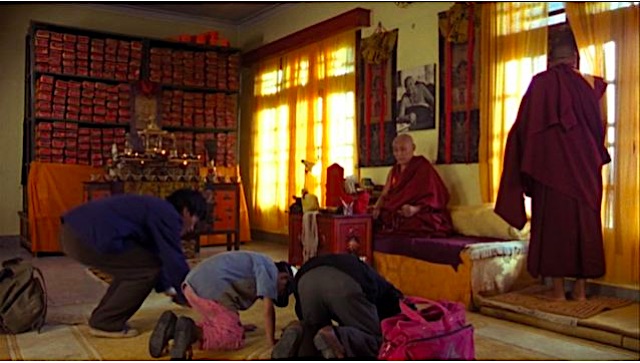

* Pipping to the post cake baking as creative inspiration for Renaissance music, and my own likening of Stewart Lee’s reformulations of previous work to those of Bach and Miles Davis.

Godard and the Nouvelle Vague

with a further note on Last tango in Paris

Godard Karina

In 1970s’ England, while my musical tastes were already imbued with Ravel, Messiaen, and Boulez [Weirdo—Ed.], continental cinema offered an exotic escape from the drab insularity of our lives. French and Italian movies made a particularly important education for us.

The films of Jean-Luc Godard, who died last week (obits e.g. here and here), were iconic. It’s of no great consequence that his ouevre never quite appealed to me, but I’m just trying to work out why. It’s not that I balk at abstraction—I love Rivette’s Céline and Julie go boating, for instance (although you may say that its surreal fantasy is underpinned by the plot of a conventional mystery thriller).

Godard’s images and framing are strikingly original:

But for all the visual attraction of such posing, I suppose I was wary of poseurs. In Bertolucci’s Last tango in Paris (whose main theme is not sex but pain; see under The conformist) the character of Tom is a parody—perhaps more of Truffaut than of Godard, but anyway a satire on the whole pretentiousness of the Nouvelle Vague. To cite this review,

Léaud plays a devoted cineaste much like his New Wave directors, a man obsessed with getting everything on film, capturing something authentic through the most artificial means possible. He’s a punchline, with a camera crew following him everywhere, concocting scenarios that are intended to examine race relations and his girlfriend’s past as the daughter of a French colonialist officer, but it’s all phony, a game. He screams at his camera crew for halting filming in a sudden rainstorm—it’s so romantic and photogenic—and then he runs off into the rain, screaming his love’s name, still acting out the big romantic moment even though the cameras have stopped rolling. In another scene, the background music seems to be non-diegetic until Tom abruptly switches off the tape recorder hanging around his neck, which had apparently been playing the music as an accompaniment to a confrontation with Jeanne. This is a guy who carries around his own soundtrack.

Tom is a walking, talking critique of the contrivances and artificiality of filmmaking, and I think also a critique, if perhaps an unwitting one, of Brando’s self-conscious performance style. Tom is obsessed with authenticity, trying to rearrange reality to fit within his frame. He’s always walking around with his hands held up to form a frame around what he sees, an obvious caricature of a pretentious film director, and all his attempts to capture the essence of reality only come out artificial and silly. Though superficially quite different from Paul—who claims to want to avoid the truth, not discover it—Tom winds up being very much like his counterpart, another character who’s hiding from reality, even while claiming to seek it. In his case, he hides in the cinema…

Similarly, this article comments:

Tom, of course, is a parody of the Godardian New Wave filmmaker, running around putting up his fingers to make camera shots out of everything, and apparently not knowing or caring what Jeanne is doing. He is fittingly played by Jean-Pierre Léaud, who was discovered by Truffaut as a child and has since played in many New Wave movies, looking increasingly like Truffaut himself. Tom is characteristically in the New Wave ethos in trying to make a film about the progress of his love affair leading up to his marriage. His crew creep around after Jeanne, filming her meetings with Tom and then filming her childhood mansion complete with relics from the past. Real life and the world of their film become so entangled that it is hard to say anymore what their reality is. Jeanne’s life becomes the film; the film becomes their reality together; they live the film rather than making a film imitating their lives.

Bertolucci shows clearly the superficiality, irresponsibility, and triviality of Jeanne and Tom’s world together. It is a shrewd comment on contemporary, fashionably “hip” worlds where people are so sophisticated and blasé about everything that they have ceased to be human beings living in the realities of our society and historical moment. It is an entirely escapist world with all the inevitable consequences of shallowness that follow escapism.

The Nouvelle Vague was based on an aloof, impersonal ethos—for which I blame the alienated male auteurs, who were in charge, with women making decorative pawns. Call Me Old-Fashioned, but I still want a bit of plot, personality, communication. In many (perhaps all?!) films, such as La strada or The conformist, it’s the women who provide humanity while the men are swanning around being pompous and fucked-up. The women may be fucked-up too, but largely through being abused by all the fucked-up men. Revealingly, Godard showed his contempt for The conformist—as Bertolucci commented, recalling their meeting 37 years after the event:

He doesn’t say anything to me. He just gives me a note and then he leaves. I take the note and there was a Chairman Mao portrait on it and with Jean-Luc’s writing that we know from the handwriting on his films. The note says: “You have to fight against individualism and capitalism.” That was his reaction to my movie. I was so enraged that I crumpled it up and threw it under my feet. I’m so sorry I did that because I would love to have it now, to keep it as a relic. […]

Here are some trailers for Godard’s early films:

  • À bout de souffle (Breathless, 1960) starred Jean-Paul Belmondo and Jean Seberg:

  • Disprezzo coverLe mépris (Contempt, 1963), with Brigitte Bardot and Michel Piccoli, is so overladen by Godard’s already signature style that it hardly seeks to do justice to the “humiliation and sexual frustration” of Alberto Moravia’s novel Il disprezzo (English translation titled A ghost at noon):

Of Godard’s successive muses, Anna Karina (wiki; obituary) was the most captivating. Their first movie together was Le petit soldat (filmed in 1960, released in 1963), followed by

  • Une femme est une femme (A woman is a woman, 1961):

  • Vivre sa vie (My life to live, 1962):

as well as Bande à part (1964), and Alphaville (1965). Their last film before they broke up was

  • Pierrot le fou (1965):

—which reminds me rather of Betty blue (Jean-Jacques Beineix, 1986) (in the words of Peep show, “great sex-and-suicide flick—turned a whole generation of men onto girls with mental illness”).

Godard’s originality emerged not only through his visual sense, but in musicMichel Legrand, known for working on less avant-garde movies, provided the soundtrack for Vivre sa vie:

Legrand also composed the soundtrack for Bande à part—this dance scene is actually endearing:

It’s as if all a male film director had to do was find a gamine muse (see under Moon river, and Ute Lemper), and success was guaranteed, no matter how minimal and inscrutable the plot-line.

I don’t mean to react merely with a surly Gallic shrug—each of Godard’s films was a tour de force (“too, er, deaf ‘orse”: Cheval trop sourd, unreleased?), and I quite see how epoch-making they were. Perhaps I should say not that his ouevre never appealed to me, but that it didn’t move me. But I guess that’s just the kind of bourgeois conceit that he was exposing; as Bertolucci continued in his recollection,

I had finished the period in which to be able to communicate would be considered a mortal sin. He had not.

Still, Godard’s stance against communication seems to dilute his radical political mission.

To end with an affectionate British parody, here’s a 1997 vignette from the Fast show: