The conformist

with a note on Last tango in Paris

Conformist 1

The conformist (Bernardo Bertolucci, 1970), based on the 1951 novel by Alberto Moravia, is a most captivating film, visually sumptuous—with the gorgeous Jean-Louis Trintignant, Stefania Sandrelli, and Dominique Sanda bringing out the interplay of political and sexual themes.

For my generation it recalls late-night screenings in art cinemas (along with Parajanov, Seven samurai, Marx brothers marathons, The big sleep, La stradaFive easy pieces and Performance (both also 1970), The bitter tears of Petra von Kant (1972), Céline et Julie (1974), and so on—what an eclectic education; see also here). Revisiting The conformist now, alarmingly, makes a timely reminder: until recently the dangers of fascism may have seemed quite remote.

Conformist 2

As with Bertolucci’s other films like Last tango in Paris, music and dance play a crucial role. The soundtrack (by Georges Delerue) has the ambivalence of Cinema paradiso and Twin peaks. As with all the best film music, just the opening theme transports us instantly into the story’s troubled world. Here’s the complete film:

The female radio band near the opening (from 4.12) reminds me of Franco Cerri’s recollections in my post on Chet in Italy.

By way of comparison with the final dance, here’s the equivalent scene in Last Tango in Paris:

—just as iconic as Jack Nicholson’s scene in Five easy pieces where he erupts in the diner, and reminiscent of Alexei Sayle’s critique of ballroom.

As this review observes, Last tango is not about sex but about pain.

Made in France four years after the disillusionment of 1968’s failures, it’s about characters who can’t see past their own emotional and psychological problems, who are solipsistic in the extreme, locking themselves away from everything they can’t face in the outside world.

Pauline Kael’s famous rave review, comparing the film’s importance to that of Stravinsky’s The Rite of Spring, is critiqued in this retrospective, a particularly cogent view of the on-set abuse of Maria Schneider—a revelation that has severely marred the film’s image, which is regrettable since it’s a work in which deep emotions and anguish are conveyed. Among innumerable other reviews, Last tango is also the subject of this excellent 2011 discussion. See also under Godard.

* * *

Bertolucci died in November 2018 (see also here), soon after Nic Roeg (for an assessment of both together, see here). Many more films to revisit, not least The sheltering sky (based, indeed, on the great novel by Paul Bowles, though he was less than keen on the result), The dreamers, and the epic 1900. And Godard died in 2022.

Three women of Herat

Women of Herat

The idea of “women in music” often suggests their starring roles in WAM (as in the T-shirt!) or Anglo-American popular music. But meanwhile gender has become one of the major topics in ethnomusicology (for some refs., see this post on women in flamenco; note also McClary).

Even in the more “classically” oriented confines of ethnomusicology, “women in music” may not immediately suggests the lives of female singers in Afghanistan.

  • Veronica Doubleday, Three women of Herat: a memoir of life, love and friendship in Afghanistan (1998; most recent reprint 2009)

is an engaging, deeply personal story of her time in Herat in the mid-1970s before the Russian invasion. It’s a good illustration of thinking outside the (music) box.

Herat

Gradually cutting through the curtain of purdah, she befriends three young women with different experiences:

  • The authoritative figure of Mariam, from a hereditary family of (male) musicians;
  • Mother of Nebi, whose maraz mental breakdown as a young mother, attributed to jinns, had prompted her to become a diviner (cf. China);
  • Shirin, negotiating the stigma of working as a professional entertainer (see also Veronica’s “Zainab Herawi: Finding acclaim in the conservative Islamic culture of Afghanistan” in Ruth Hellier (ed.), Women singers in global contexts: music, biography, identity (2013).

HeratAs Veronica enters their social world of domestic life and ritual celebrations, she learns to admire their warmth and strength. But her account is never sentimental, acknowledging their tribulations. She reflects cogently on her choice to adopt the veil while living among them; and in becoming a regular member of Shirin’s band and an accomplished singer, she gains direct experience of their tough life.

Veronica’s audio recordings from the period seem to have disappeared from YouTube, but these CDs are excellent:

Ever since those days in Herat, she has worked in partnership with John Baily, not only a fine exponent of the rubab plucked lute but a great maker (and theorist) of ethnographic films (see here), including

  • Amir: an Afghan refugee musician’s life in Peshawar, Pakistan (1986)
  • Lessons from Gulam: Asian music in Bradford (1986)
  • A Kabul music diary (2003)
  • Scenes of Afghan music: London, Kabul, Hamburg, Dublin (2007)
  • Ustad Rahim: Herat’s rubab maestro (2008)
  • Across the border: Afghan musicians exiled in Peshawar (2011).

Here’s a preview of Amir:

and Lessons from Gulam:

* * *

Veronica became a beautiful singer, moving both Afghan and other audiences deeply in more genteel concert settings. Here’s an early clip:

And more recently with John Baily:

Tracks on the CD Sweet nomad girl:

Three women of Herat is a model of participant observation, and an early instance of an ethnographic genre that has since flourished. Further to Veronica’s distressing original Epilogue, the 2009 reprint includes a new Preface and Postscript, giving valuable context on changes not only within Afghanistan but in Western perceptions.

She did manage to return to Herat in 1994 and 2004, just before and after the Taliban occupation; but after their initial visits in the 70s, long-term warfare in Afghanistan impelled John and Veronica to pursue their studies mainly among refugee and migrant communities—which was also to become a major theme of music ethnography.

For a sequel, click here.

Room service

It goes without saying that David Lynch is a genius.

In 1990 and 1991, in between orchestral tours and fieldwork trips to Hebei, and just as I met the great Li Qing for the first time, I spent much of my time back home in London glued to Twin peaks on TV.

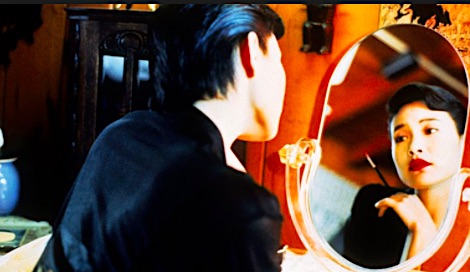
Joan Chen

As always, it’s both disturbing and enchanting, with a diverse cast of stunningly beautiful female and male characters, and

an uneasy strain of nostalgia that blends sentimentality with menace; hideous secrets chafing against the illusion of innocence […] postwar trauma buried beneath an aggressive normality.

Just a couple of clips to epitomise Lynch’s mastery. After the cliffhanger of the series 1 finale, just as we’re all desperate to know what happened to Agent Dale Cooper, the seemingly interminable room-service scene at the very opening of series 2 suspends the whole drama unbearably. You can read a detailed analysis here—this is the only brief clip currently on YouTube:

Long after the 1992 movie Twin peaks: fire walk with me, now I’m in a similar kind of suspense as I try and work out how to view the recent season 3 (also here).

And apart from his taste in coffee, we may note Agent Cooper’s affinity for Tibetan mysticism, as in this lecture, also typically startling within the plot:

Angelo Badalamenti’s soundtrack goes perfectly with the drama (this article has a link to the complete album on Spotify).

Badalamenti had already worked with Lynch on the haunting Blue velvet:

And the Julee Cruise song Mysteries of love:

For Thought Gang, Lynch’s band with Badalamenti, see here (with link to album only recently released!).

Lynch also has great taste in using earlier music (not “early music”), as in the magnificent ending of Wild at heart, with Richard Strauss morphing into Elvis.

For more on film music, and the importance of taking seriously all kinds of musicking throughout human societies, see here.

Robert van Gulik

Van Gulik

Robert van Gulik (Chinese name Gao Luopei 高羅佩, 1910–67)—“diplomat, Asian scholar, calligrapher, polyglot, polymath, passionate lover of life in all its forms”—is perhaps best known for his Judge Dee detective novels set in the Tang dynasty and his writings on the qin zither, as well as on imperial Chinese painting and erotica.

A 1995 biography, now translated into English,

  • C. D. Barkman and H. de Vries-van der Hoeven, Dutch mandarin: the life and work of Robert Hans van Gulik (2018)

makes a fascinating read, at once sympathetic and dispassionate, and covering not just China and Japan but the many cultures where Van Gulik was posted during turbulent times.

And at a recent conference on the qin at SOAS, convened by the enthusiastic London Youlan qin society, I was glad to see the 2016 film

in the presence of Van Gulik’s granddaughter Marie-Anne Souloumiac. It’s far from a biopic, more a free-ranging fantasy—somewhat as imperial China was for Van Gulik and others like Arthur Waley. Here they introduce the film:

Indeed, Van Gulik was only able to make stays in China from 1936 to 1946. While his interests were broad, his character affable, and his lifestyle tactfully bohemian, he immersed himself deeply in the role of an imperial mandarin. For all his hedonism, his writings are full of meditations on impermanence.

Early life
With his parents, Van Gulik’s early life was spent mostly in Dutch East Indies. As he recalled:

Father’s main orderly and groom was a Javanese sergeant who was a lover of the wayang, the ancient Javanese shadow-play. The puppets he had hung on the wall of his room caught my fancy at once (these stylized puppets constitute as a matter of fact one of the finest expressions of Javanese artistic genius) and prompted by me he began to relate to me the stories enacted on the shadow stage. The wayang thus became the dominating passion of my childhood. My parents knew that I expected no other birthday present than a new wayang puppet, and I built up a small collection of the main characters, with which I gave performances against a bedsheet hung across the room, and under the guidance of the Javanese groom.

So precocious was the young Robert that he wrote a substantial essay on wayang in 1921, aged 11! He also attended performances at village feasts, and (like Wang Shixiang in Beijing) enjoyed martial arts, kite-flying, and football.

I can’t help thinking of the accident of birth: what a contrast Van Gulik’s blessed life makes with his Chinese peasant contemporaries like household Daoist Li Peisen—who himself was luckier than most.

Back in Holland, while Van Gulik’s interests turned towards Chinese culture, he became familiar with an array of languages—even including Blackfoot (in whose music Bruno Nettl would also specialize). Still,

Although I had a certain facility for learning languages, my aim in doing so was primarily to come to know more about the people who used these languages, and not to become an accomplished philologue.

Studying Chinese and Japanese at the universities of Leiden and later Utrecht, Van Gulik also added Tibetan and Russian to his repertoire, continuing his studies of Sanskrit. At first the reader may find all this rather overwhelming—as with other prodigies of that generation like Laurence Picken’s mentor Walter Simon, or Harold Bailey at Cambridge.

With his family background, Van Gulik now naturally gravitated towards the Foreign Service, serving as diplomat first in Japan (1935–42) and then China (1943–46)—with a typically picaresque interlude as a secret agent in east Africa.

His first experience of China was a week-long stop-off in Harbin on his train journey towards Tokyo—just around the time that journalist Gareth Jones was murdered by “bandits” in Manchukuo. Though the book’s authors go on to refine it somewhat, van Gulik’s description encapsulates the shock of the idealistic scholar:

Harbin shocked and baffled me. It was the most dismal city in the dismal puppet-city of Manchukuo. I felt completely at a loss, also because my Chinese, Russian, and Japanese colloquial knowledge proved sadly inadequate [YAY!—SJ]. In the cavernous Hotel Modern where I was staying, suave Soviet officers (then still attached to the Chinese Eastern Railway) rubbed shoulders with grim-looking Japanese agents, in the squalid streets Chinese hooligans brawled with pauperized poor White Russians, under the indifferent eyes of slovenly clad, insolent Chinese soldiers, and smartly turned-out, contemptuous Japanese military police; the bars were crowded by blowzy Russian prostitutes, and the noisy Chinese women in the shops and in the streets were drab and ugly. Everywhere one was met with hostility and suspicion. Where were the refined Chinese scholars, writing poetry in their elegant miniature gardens, where their dainty damsels? It was a terrible disillusion.

His confusion continued on arriving in Tokyo. But amidst his busy hedonistic life there, as his spoken Japanese improved, he also took lessons in Chinese; and “every so often he would learn another language (Mongolian, Hindi, Korean)”. Perhaps we can derive very slight consolation from comments that even in later life his spoken Chinese accent was less than perfect. And I note with a certain pride that we can add Van Gulik to the list of Famous People with a Slight Speech Impediment.

Early encounters with the qin
On his first visit to Beijing in September 1936 Van Gulik purchased an antique qin zither, taking lessons with Ye Shimeng. Back in Tokyo he found another Chinese qin player to instruct him further.

Much of the repute of the qin zither outside China may be attributed to Van Gulik’s publications (even if he called it a lute, for which organologists tend to forgive him!). His two books on the “lute” were completed as early as 1940—when he still had very little practical experience of the qin community.

John Thompson, whose amazing website remains basic to qin studies, has an instructive page on Van Gulik. Indeed, John has a cameo in Rob Rombout’s film. I describe my own ambivalent relationship with the qin here.

Tokyo
Van Gulik’s diplomatic work in Tokyo had become even harder after the Japanese launched their full-scale invasion of China in 1937, and then in 1940 with the German occupation of Holland. He intervened to forestall an anti-semitic move in Japan—back in Holland, his brother would help Jews to escape.

In summer 1939 he was able to pursue his sinological interests in Shanghai. But in 1940 he lost his entire collection of books, paintings, and objets d’art after sending them to Batavia for safe-keeping. Like Li Shiyu and his collection of precious scrolls, he simply began again.

On a trip to Beijing in December that year, his first qin master Ye Shimeng having died in 1937, he pursued his tuition with Guan Zhonghang.

His diplomatic work became ever more urgent with the spread of the war to Indochina and the attack on Pearl Harbor. He wrote a detailed report on extreme nationalist parties in Japan. A fortnight after the surrender of Dutch East Indies, Van Gulik still managed to order qin strings from Beijing (indeed, as a baroque fiddler, strings are a topic that I take to heart). In July 1942 the legation was evacuated, sailing to Portuguese east Africa. There, apart from his energetic undercover activities, he began to learn Swahili and Arabic while continuing his library studies. Travelling widely, he found the experience (and, as ever, the women) enchanting. Meanwhile the tide in north Africa turned in favour of the Allies.

Chongqing 1943–46
With much of the heartland of China now occupied by the Japanese, intellectuals and artists flocked to Chongqing, stronghold of the Nationalists in their uneasy truce with the Communist forces based in Yan’an in Shaanbei further north. Van Gulik was now to take up a post as first secretary to the embassy in Chongqing. On his tortuous journey by way of Delhi in 1943, he became acquainted with the great Joseph Needham, then working for the British Embassy.

In between taking shelter from bombing raids, he took part keenly in the activities of the Tianfeng qin society, and sometimes played Chinese chess with the mystically-inclined John Blofeld. He met Shui Shifang, who soon became his wife; they went on to have four children.

My mentor Laurence Picken described his own first visit to China in 1944 (CHIME journal, 1991):

The very evening I arrived in Chongqing, Van Gulik and his wife had arranged a dinner-party for a number of Chinese musicians, the Needhams and myself. Liang Tsai-ping, Zha Fuxi, and Xu Yuanbai were all present…

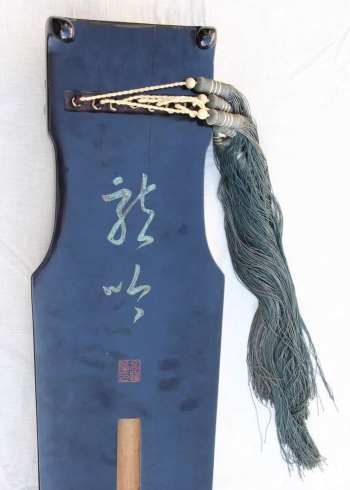
Gulik qin Engrave and seal croppedLaurence too was immediately captivated by the sound of the qin:

There was no music like it! I bought a qin, made under the supervision of Xu Yuanbai, and began to take lessons. I played guqin every day. In England, I had always enjoyed a daily ration of Bach’s 48 Preludes and Fugues; I felt it no loss practicing guqin instead.

Laurence also became a member of the Chongqing qin society, and bought a qin, made in 1935 by Li Shaotang under the supervision of Xu Yuanbai. He asked Van Gulik to stamp his seal on the back.

I’m honoured that Laurence bequeathed this qin to me.

And do read the CHIME story of how Van Gulik made Laurence “a sort of emissary” when he visited Pei Tiexia—and his two Tang-dynasty instruments!—in Chengdu. For an account of the tragic fates of Pei Tiexia and Pu Xuezhai, see here.

Aftermath of occupation
Van Gulik’s insights into the wartime situation in China were tempered by a colonial desire to restore Dutch power in the East Indies. And he made no efforts to engage in covert diplomacy with the Communists. He learned of the Japanese surrender while on a plane to the USA for meetings with the embassy and the State Department, and once there he advised strongly against the removal of the emperor. During his month-long trip he found time to visit libraries and museums, and to confer with scholars.

Talking of the USA, another fine contributor to Rob Rombout’s film is the New York antiquarian bookseller and litterateur Henry Wessells, also a Van Gulik aficionado (for his tribute, see here). In the film he reads from his novel A funeral procession, which features a fantasy Van Gulik—reminding me of the cortège Mahler heard in New York that inspired him to write the finale of his 10th symphony.

As the Dutch embassy relocated from Chongqing to Nanjing in 1946, Van Gulik was recalled to the Netherlands. But first he paid another visit to Beijing, at last meeting his distinguished father-in-law, as well as qin master Guan Pinghu.

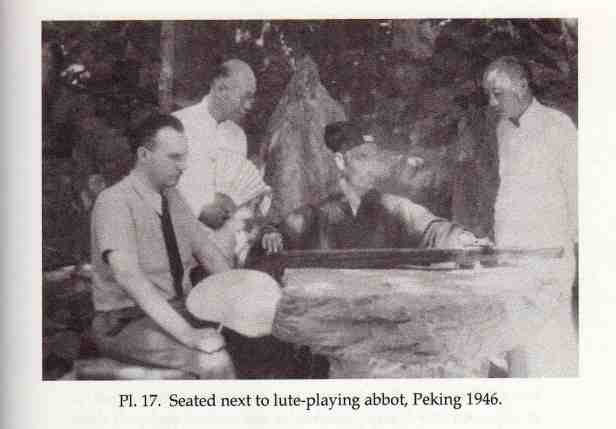
An Shilin 1946

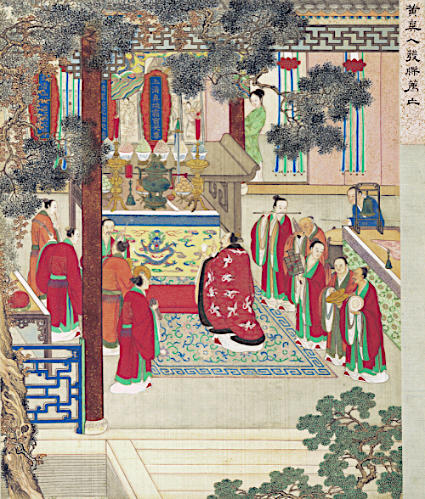
There he also visited An Shilin, errant abbot of the White Cloud Temple—shortly before irate priests burned him to death on his return from performing a yankou ritual. [1] The character of An Shilin was to become the basis for The haunted monastery in Van Gulik’s Judge Dee series (see below).

In 1946 the Van Gulik family spent two weeks in England, visiting London, Oxford, and Cambridge.

Interlude: fate and nostalgia
Once again we come up against the 1949 barrier (see my Daoist priests of the Li family, pp.371–4): alas, neither Van Gulik nor Picken were able to continue visiting China after “Liberation”. This, of course, was a common pattern among Western sinologists right until the 1980s’ reforms.

Van Gulik was unable to serve there since Western nations like the Netherlands had only chargés d’affaires in the new PRC, a post too high-ranking for his status; later in Kuala Lumpur he even declined the Chinese ambassador’s offer of a trip as guest of the government “because he had no wish to revisit China where so many of his best friends had perished.”

And Picken too demurred from attempting to visit, since “I didn’t want to return to a country where I couldn’t move about freely. Travelling would have been possible only on a sort of Intourist basis.” His belated return in 1990 followed an interval of fifty years.

Golden-age nostalgia is a chronic conceit, that has also recently become increasingly fashionable in China. Those gatherings in the 1940s, before the convulsive change of dynasty, are now adorned by a numinous patina.

For all the tribulations of elite culture under Maoism, both of them would have been deeply impressed by all the scholarly and performance activities of the qin fraternity through the 1950s, in Beijing and around Shanghai—many of whom they already knew, like Zha Fuxi, Guan Pinghu, Wang Mengshu, Pu Xuezhai, Xu Yuanbai. How they would have loved to take part in Zha Fuxi’s project in 1956, documenting qin players (and their instruments and tablatures) all over China!

One curious absentee from accounts of Van Gulik’s time in Chongqing is the incomparable Yang Yinliu, who was also active there at the time. With Yang’s deep erudition on Chinese music (both elite and folk, and both history and current practice), and his own studies of the qin, they would have got on splendidly. Indeed, like Picken, Yang had a qin made by Xu Yuanbai in 1935.

Yang Dajun

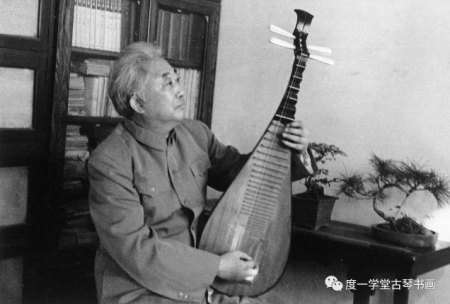
In Chongqing, Van Gulik and Picken had spent time with the pipa player and artist Yang Dajun (1913–87) (see herehere, here, and here). Van Gulik even repaired Yang’s pipa for him. Early on my first trip to China in 1986 I visited him in Beijing, at Laurence’s suggestion; but alas even if my language skills had been up to it, I was still too callow to ask him for details on his life before and after Liberation. But such slender silken threads bind us with the past…

Yang Dajun 1986

With Yang Dajun, Beijing 1986.

Long after Van Gulik’s visit to the ill-fated abbot An Shilin, in Beijing in the early 1990s I also visited the White Cloud Temple to consult the far more upright priest Min Zhiting—great authority on Daoist ritual, and also a qin player.

And now I succumb to nostalgia myself, recalling sessions in the 1980s with qin elders like Wu Jinglue, Wu Zhaoji, Lin Youren, and Yao Gongbai. Even today grand masters continue to assemble at qin gatherings.

One may also be nostalgic for the days of the Renaissance man (even the gendered term is quaintly outmoded) and the polymath orientalist. While such enthusiasts may still be found even in this age of dour professionalized academia, there remains a gulf between the classical sinologist and the modern ethnographer.

As Li Manshan observes at the end of our film, “things ain’t what they used to be” (今非昔比). Indeed, Old Lord Li decorates coffins with images of the qin (see film, from 18.46), although he (like most rural dwellers) has only seen it on TV in the last decade. And while very remote from Van Gulik’s refined taste for the amateur art of calligraphy, Li Manshan is always busy writing characters for ritual use (film, from 10.44).

Still pursuing this unlikely link, Van Gulik, like Li Manshan, was a chain-smoker. I’m amused to learn that, not entirely bound by Confucian taboos, he was wont to allow fag-ash to drop onto his precious antique qin—like my violin teacher Hugh Maguire onto his Strad, and Irish folk musicians.

After China
From 1946, as people worldwide recovered painfully from wartime devastation, Van Gulik embarked on to a succession of posts in The Hague, Washington DC, India, the Middle East, and Malaya, as well as more extended stays in Japan—his Chinese wife gradually overcoming her understandable reluctance to live there. For their son’s letter of sympathy to the Czechoslovak amassador after the crushing of the Prague Spring, see here.

Thus after the age of 36 Van Gulik never returned to China. While he had relished life there, interacting with various types of people, his main passions (like many sinologists and indeed lovers of “high art”) were always antiquarian. Notwithstanding Nigel Barley’s caveat about “being accepted” (here, under “Rapport”), Van Gulik’s insider status has long been fêted both in China and Japan. Apart from important intelligence work, his formidable reputation allowed him to privilege his scholarly pursuits over routine diplomatic chores, his eccentric lifestyle largely tolerated by his superiors.

For all his keen insights into the situation on the ground, his political horizon was limited, as the book observes. With Communist victory imminent in China, he lamented that the USA had not helped Chiang Kai-shek attack them earlier, but commented that the conflict

is not one of ideological differences, it is actually the struggle for supremacy between two rival power groups, both shaped in the same totalitarian mould and both relying on the nationalist sentiments of the Chinese people. Communism in China is not a foreign doctrine to be imposed on the people by force, it links up with how the Chinese have lived for centuries.

He also observed,

Chinese culture is in the Chinese blood and will endure for as long as there are Chinese. Whatever they may say about Communism, it is not totally new in China. Earning money for money’s sake has always been regarded with the greatest contempt in China. Down the centuries, China has offered everyone equal chances, and the important industries have been state property.

Hmm. Discuss…

In Hong Kong, and later in Kuala Lumpur, he took part in gatherings with qin players. In India he pursued his studies of Tantrism. Back in Holland he renewed his affinity with wayang and gamelan, chatting with Jaap Kunst. He continued to enjoy visits to the cinema, and (like Mozart) playing billiards. In Kuala Lumpur he developed a passion for gibbons, keeping them as pets. He relished haiku and limericks.

Meanwhile in the West, oriental mysticism was coming into vogue, as people like Gary Snyder and Alan Watts began to spread the word.

Judge Dee
Most captivating are Van Gulik’s Judge Dee mysteries, set in the Tang dynasty and based on the real character of Di Renjie. Rob Rombout’s film includes suitably naff scenes of the Judge Dee park in Taiyuan.

Van Gulik had taken an 18th-century Chinese novel about Di Renjie with him when the Dutch legation was evacuated from Tokyo in 1942, and set to work on translating it in Washington DC in 1947, publishing this first volume in 1949. He now embarked on a whole series of beautiful novels on Judge Dee’s exploits—some written during his time in Lebanon during the civil war.

Agatha Christie praised The Chinese maze murders, and the series became popular in translation in China. For more, see here; for an internal chronology and Judge Dee’s postings around China, here.

Naturally, since Judge Dee is Van Gulik’s alter ego, he makes him a qin player.

I’m not so sure that the State Department’s erstwhile choice of the novels as “the best possible introduction to the background to Chinese life” was entirely practical—though given my own early taste for Tang culture, I’m a fine one to talk. Anyway, for what it’s worth, soon after reaching China in 1986, inspired by Van Gulik and Picken I avidly began learning the qin; but my own interests transferred to living folk traditions of music and ritual. At first, still seeking vestiges of elite culture, my rural forays were driven by the Confucian concept of “when the rites are lost, seek throughout the countryside“.

But as studies of China continued expanding in scope beyond classical sinology (political campaigns, famine, gender studies, migration, and so on), I was soon pursuing broader ethnographic (and modern) concerns, hanging out with household ritual specialists, spirit mediums, outcast shawm players, and vagrants. Hence my gradual estrangement from the tiny, rarefied world of the qin, despite my admiration for my mentors there like Yuan Quanyou and Lin Youren.

Towards the end of his life Van Gulik was planning keenly for cartoon and puppet versions of the Judge Dee stories. Rob Rombout’s film also features a vignette from Frédéric Lenormand, author of a further series of novels focusing on Judge Dee’s wives.

Art and erotica
Van Gulik’s later life was also devoted substantially to the study of imperial Chinese art and erotica. On the latter he published two major works, Erotic colour prints of the Ming period and Sexual life in ancient China.

He had carried out impressive practical research on the “arts of clouds and rain” during his bachelor days, notably in a succession of more or less transactional liaisons with female companions in Tokyo—hinting again that Philip Larkin may not have been entirely correct to claim that sexual intercourse was invented in 1963.

Quaintly, Van Gulik wrote the more explicit passages in Latin, as they were not intended “to be read by all and sundry”—although even he couldn’t devise a system to prevent the riff-raff from enjoying the illustrations. Diligently, he also documents the array of dildos available to the ancient Chinese, a theme probed further by Li Ling in the film.

Meanwhile his health was declining. Though ever keen to explore new cultures, his last years, apart from another stay in Japan (and Korea) from 1965 to 1967, were spent mainly in the Netherlands, where he succumbed to cancer, too young, aged 57.

* * *

What an extraordinary life. While making allowances for Van Gulik’s background and tastes, his story suggests tantalising perspectives on changing strands in sinology, and how the scholar or amateur might engage with, or withdraw from, the Real World—regarding ancient and modern China, and further afield.

With thanks to Marie-Anne Souloumiac and Cheng Yu

[1] For refs., see my In search of the folk Daoists of north China, p.226; also e.g. Vincent Goossaert, The Taoists of Peking, pp. 259–301; herehere, and here.

.

Pontius Pilate, and the mad jailers

pilate

Hot on the vertiginous goose-stepping heels of Gepopo

In my series on stammering I’ve already covered Michael Palin’s authentic depiction in A fish called Wanda.

But he was already on the case of various types of imp-p-pediment with Monty P-Python, as in the iconic Pontius Pilate scene (taking the pith) in The life of Brian:

Michael Palin also does a great turn as the benign schoolmaster:

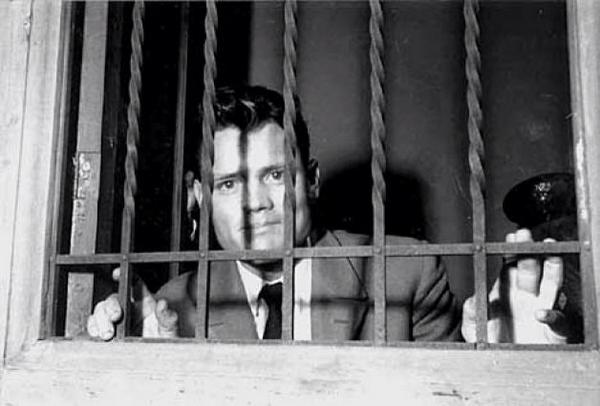
Returning to s-s-stammering, still more disturbing are the cameos from the mad jailers (this time played by Terry Gilliam and Eric Idle)—hideously well-observed, right down to the stamp of the foot to force the word out. In the first scene here, they taunt the ever-well-meaning Palin; and the second (from 2.07) is the coup de grace, with the jailers nonchalantly reverting to fluency once alone together—reminiscent of Larson’s cows:

Some stammerers may find that tough going, but I’d suggest it’s all part of chipping away at the iceberg of fear.

One of the benefits of group speech therapy sessions, however excruciating, is to watch one’s disfluent speech played back on video, so as to observe all the ways in which we sabotage the whole vocal apparatus—extreme tension of the lips and throat, holding the breath, futile movements of eyes, hands, and body, and so on. Disfluency takes many forms. Sufferers are often so trapped in desperate attempts to avoid stammering, and their audiences so trapped in embarrassment, that neither may have a clear idea of what exactly it is that is preventing them from uttering the word. The crucial first stage is monitoring.

And a further technique is for the sufferer to imitate such features deliberately—choosing a consonant on which to tense the mouth and lips, repeating it quickly or slowly with varying degrees of tension, even reproducing the way we backtrack and then start over, deciding how many repetititititions to do. Varying the severity of the block like this can create the precious experience of having control over one’s speech for a change. And then (maybe) one can insert “easy stammers”, and if not actually refrain from stammering, at least be aware of some options.

It’s easy for you to say that, SSSteve…

Anyway, far beyond its niche exploration of speech impediments, The life of Brian is brilliant! More insights, on the uncritical veneration of sages, here.

The art of the miniature

Tom and Jerry

By way of supplementing my playlist of great songs with a little series on great theme-tunes (below):

Tom Service’s BBC Radio 3 series The listening service is always stimulating—like Susan McClary, he breaks down boundaries, as here.

This episode [sic] on Brevity, with a playlist of miniature gems encompassing Bach, Beethoven, Chopin, Satie, Webern, Boulez, Zorn, Napalm Death, Bartók, Kurtag, and Ligeti, is full of fine observation—under the headings of absurdity, immediacy, density, violence, and eternity.

Irrespective of genre, such pieces are microcosms, crafted with a range of expression and intensity—akin to haiku (see under Some posts on Japanese culture) or netsuke.

Also among the fleeting exhibits is the great Carl Stalling, composer of classic soundtracks for Warner Brothers cartoons (these playlists should work if you click on YouTube at the bottom right of the window):

Not forgetting Scott Bradley, of Tom and Jerry fame:

Not least, this is about taking seriously all kinds of musicking throughout human societies, including WAM and popular music.

So here are some thoughts on great theme-tunes:


Doing things

Doing Things cover

My 2015 film Li Manshan: portrait of a folk Daoist (which complements my book Daoist priests of the Li family) is an intimate evocation of the Li family Daoists (next London screening here!).

In a field where silent inanimate publications vastly outnumber audio-visual documentation, for further background on ritual life in Yanggao it’s also worth watching my earlier DVD Doing things (办事, widespread parlance for “performing rituals”), which comes with my 2007 book Ritual and music of north China: shawm bands in Shanxi. For “doing things”, note Catherine Bell’s fine survey of ritual studies.

Apart from the shawm bands (notably the Hua family band: the magnificent suite in §C of the DVD is analysed here), this film also contains many interesting scenes of funerals and temple fairs in Yanggao from as far back as 1991, including not only the Li family Daoists but also

  • Li Yuan‘s Daoist band
  • Rituals such as Fetching Water (for both funerals and temple fairs), Burning the Treasuries, Transferring Offerings, and the burial procession
  • Raising the Pennant, and Judgment and Alms, at the 2003 Lower Liangyuan temple fair
  • A nocturnal yankou ritual performed by Buddhist monks
  • The Gushan temple fair, with Daoists and sectarians
  • pop music at funerals and temple fairs (cf. here, and here).

XLY yangfan 03

And while I’m here, don’t forget the DVD Notes from the yellow earth with my Ritual and music of north China, vol.2: Shaanbei—a vivid complement to the book and my series of posts on Shaanbei!

Both volumes are now in paperback

London film screening!

I’ve just added details of the next London screening of my film Li Manshan: portrait of a folk Daoist to the Upcoming events in the sidebar. Do come along if you can—it’s always good to watch it in company, and the post-match discussions can be lively…

The free event is hosted by the SOAS China Institute—details here.

Resistance and collaboration: Les Parisiennes

Fabius

Still belatedly educating myself:

After writing at some length about the traumas of Germany during and after World War Two (notably posts on Ravensbrück, Sachsenhausen, and the work of Philippe Sands), and noting the troubled history of tourist sites, I now learn much from

  • Anne Seba, Les Parisiennes (2016).

Relating history through the lives of women has become a major theme, as in Guo Yuhua’s account of Maoism in a Shaanbei village.

With most men absent, Paris was feminized, the burden falling heavily on women, having to negotiate with the male occupiers. They faced agonizing choices, with constant moral ambiguity, shades of resistance and collaboration.

For women, choice often meant more than simply how to live their own lives but how to protect their children and sometimes their elderly parents too.

Was it collaborating to buy food on the black market if your children were thin, ill and vitamin deficient? Was sending your children to a cousin with a farm in the countryside acceptable? Was it collaborating to perform on stage for or to sell fruit and vegetables to Germans? Or to sell jewellery and high fashion to them, when French women at home had nothing? Was it a choice to walk out of a café or a restaurant if German soldiers walked in, or was that deliberately courting danger given that behaving disrespectfully could have fatal consequences? [1]

Yet again, Neil MacGregor’s question arises: “What would we have done?”

* * *

Paris was iconic for the Parisians, the Germans, and everyone. British people suffered grievously too, all over the world, but least they weren’t occupied. It’s disturbing that the closer I get to home, the more easily I can identify with them. All over vast areas further east, populations were brutalized still more thoroughly—and were then further occupied for decades. Yet the traumas of past eras continue to haunt us.

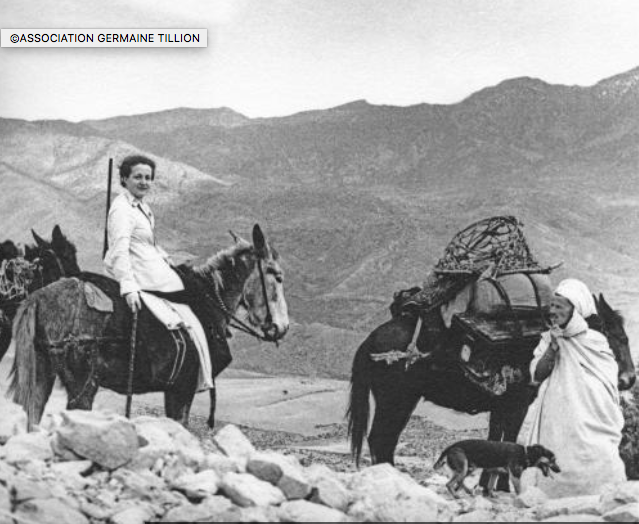
Anti-semitism was as common in France as elsewhere in Europe, and the population was already swollen with refugees from further east as well as Spain. The initial German occupation didn’t seem too bad, as Gitta Sereny, then a teenage nurse, observed (“The German officers with whom I had to negotiate for food, clothes or documents were always courteous and often extremely helpful.”) Museum curators and librarians played a major role in the budding resistance, including those at the Musée de l’Homme—and the great ethnographer Germaine Tillion, whom I have praised in several posts already.

Mass deportations escalated for Jews and resisters. 3,710 “foreign” Jews were arrested on 14th May 1941, and then three months later a further 4,230, both French and foreign. 13,152 Jews were arrested in July 1942, and further roundups continued. They were held in French internment camps before being sent to Auschwitz or Ravensbrück. The latter, subject of Sarah Helm’s brilliant book, features especially.

Perhaps rather at the expenses of documenting ordinary people’s lives, Seba describes all the salons and soirées of high society and fashion; and the compromises made by women in entertainment, like Édith Piaf. But such hedonism makes a suitably hideous contrast with the lives and deaths of those sent to the camps; as Seba observes, by contrast with high-profile stars in the arts,

there has been a prolonged and inequitable silence in France about the role of so many ordinary women who in some way resisted the occupiers—like the young woman who, persuaded by her Catholic priests, cycled around Paris distributing anti-German newsletters, […] an activity for which she could have been imprisoned if caught…

Following the guillotining of abortionist Marie-Louise Giraud in 1943, the film Le corbeau, about anonymous denunciations, was controversial—and remained so. Violette Leduc’s 1964 autobiography La Bâtarde shows the struggles of poor women in a patriarchal system. The role of church and family in Vichy France recalls that in Portugal and Spain.

Pétain used such occasions to bolster the moral and political conservatism of his authoritarian regime, glorifying the family as an institution in which the man was head and the woman occupied her place by virtue of being a mother.

Noor 1
Seba introduces the story of the female agents recruited to the French section of the SOE by Vera Atkins—subject of another great book by Sarah Helm. A sense of guilt as well as duty clearly played a role as Atkins sought to discover the fate of her charges (their average life expectancy in the field was six weeks). Among them was Noor Inayat Khan (1914–44)—yet another pupil of Nadia Boulanger, incidentally.

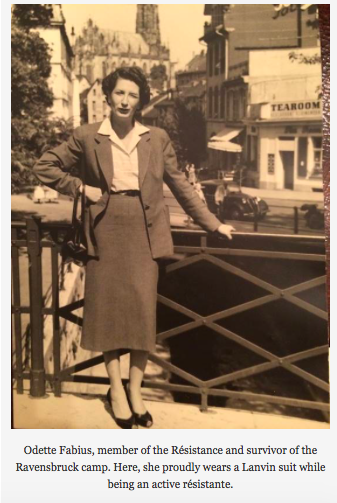
A constant struggle went on between the needs to forget and to remember. Many of us will have met survivors while hardly realizing it. I only belatedly documented the successive flights of my orchestral colleague Hildi (here and here). Now I find that Marie-Claude, whom I sometimes see at my local bridge club, is the daughter of none other than the heroic resistance fighter Odette Fabius (1910–90). Interviewed in the book, asked to reflect on whether it was right for her mother to risk her safety when they travelled together by putting documents and false papers in her case, Marie-Claude replies evenly that “she could never have been different. That was who she was.”

In 1943, when Marie-Claude was 12, Odette left her in a cinema while she went on an urgent mission to try and warn her resistance colleagues they were being watched. But she was caught by the Gestapo, soon to be deported to Ravensbrück.

Long after the film was over, Marie-Claude eventually gave up waiting for her mother and decided to make her way to family friends where her father, in due course, came to look after her.

In Ravensbrück, Odette tried to escape but was brutally punished after being captured. Unlike most inmates, she did somehow survive.

ravensbruck

Ravensbrück, 1945.

As Sarah Helm also notes, the later French arrivals at Ravensbrück made an incongruous and separate group amidst all the degradation. Seeming pampered, they suffered a double oppression, from both the SS and fellow prisoners; succumbing more quickly to sickness, they had to learn survival techniques swiftly.

* * *

As throughout Europe, the end of the war was far from an end to suffering, as Keith Lowe describes so well in his book Savage continent.

After Paris was liberated, many were shocked by the brutal misogynistic punishments for women accused of collaboration horizontale. This was also related to class. Arletty, star of the classic Les enfants du paradis (first shown in March 1945), though compromised, spending some weeks in the squalor of Drancy, was not punished by head-shaving as were many ordinary women. Others found the épuration sauvage inevitable, a minor suffering compared to all those women tortured and murdered in the camps. But those who returned, sick and emaciated, still found life difficult, receiving scant sympathy; Parisians didn’t want to be reminded of their recent pain by these skeletal figures. Not all the survivors could bear to speak of their tribulations anyway, but there was little audience for those that did feel a need to do so. Oblivion soon reigned.

Still, Lucie Aubrac, delegate in the new parliament,

was keenly aware of the gendered response to Liberation as France enjoyed its new-found freedom, and she was determined that the country should resist falling for the simplistic notion that the women had collaborated while the men had fought. She insisted it was women who had given the resistance its breadth and depth—the women who had been the essential mailboxes because they were at home, the women who had become couriers because they looked less suspect carrying suitcases, as well as the women who had daringly used weapons. Not everyone was prepared to hear her voice—most were preoccupied with trying to resume normal life.

There were further painful complexities:

Half of those deported for resistance activities returned, but only 3 per cent of of the Jews (2,500 out of 76,000 deported), an unwelcome statistic for those in France denying that a genocide had taken place. Yet the attitude which saw resisters as patriots who had been involved in combat entitled to a higher level of compensation than the deported Jews, perceived as victims, persisted until at least the end of the 20th century in some quarters. […] It also fed into the notion that to have been deported as a resister was noble, but to have fallen into German hands as a victim was shameful.

And disparities were shocking: while British, Americans, and rich Parisians resumed a lavish lifestyle, ordinary Parisians were still on the brink of starvation.

On 27th October 1946 the constitution was finally amended “guaranteeing women equal rights to men in all spheres”; despite several magazines urging women to return to a life of innocence and femininity, the mood was changing. But French society was divided.

Meanwhile Barbara Probst was working to publicize the neglect of Spanish anti-fascists, who had played a major part in the liberation of France.

I was intrigued to learn that Anouk Aimée made her first film in 1946, aged 14; in 2003 she starred in the harrowing 2003 film La petite prairie aux bouleaux, as a Jewish woman coming to terms in later life with her time at Birkenau.

* * *

So after all these years of naively relishing the street life and art galleries of Paris, it’s high time for me to seek out memorial sites and plaques, and camps like Drancy and Fresnes.

1971

Odette Fabius awarded Officier de La Legion d’Honneur, with Geneviève de Gaulle, 1971.

Little did I know that in 2015 Ravensbrück survivors Genevieve de Gaulle and Germaine Tillion were posthumously honoured with a ceremony in the Panthéon.

At the very end of the book Seba gives a succinct list of questions to discuss, some of which I’ve mentioned above:

  • Why has it taken so long for the women’s version of events to become known?
  • How different was it for mothers? Some gave away their children to a passeur without knowing where they were being taken; Odette Fabius abandoned her ten-year-old daughter in the cinema. Did mothers have a responsibility to stay with their children? Was it justifiable for some mothers to compromise their children by using them to carry documents for the resistance?
  • Why do you think fashion continued to matter to Parisiennes during the war? Was it vanity or can it be justified as a demonstration of self-respect and pride?
  • To what extent did all women have a choice during and immediately after the Occupation? Do you think Parisiennes behaved understandably after 1945 or do you think the (largely Jewish) political resisters should have been more supportive of the Jewish resisters who returned from concentration camps?
  • After the Liberation, why were so many women punished—often without trial—for collaboration horizontale, while male economic collaborators avoided repercussions? Was head-shaving ever a justified punishment? [SJ: videos like this are hard to watch—many more clips under criticalpast.com, e.g. here. Gloating men surround helpless women; but female onlookers and children also take part gladly in the ritual humiliation. The victims do not always appear repentant.]

[1] Here I’ve combined text from p.xxxii and the book’s final list of questions.

Brassed off

In its social message—the threat to communities and traditional culture from a repressive government—the 1996 film Brassed off suggests certain parallels with China (among many posts, see e.g. here). It’s permeated by some overwhelming brass-band playing—the soundtrack by the amazing Grimethorpe Colliery Band. A couple of highlights:

The “Concerto di Orange-juice”:

and, as the climax, the William Tell overture—just exhilarating:

Apart from the playing, it’s great filming too—just the way to turn people on to great music.

For a handy list of posts on trumpets, wind and brass bands, see here. See also trumpet tag. Cf. The Commitments.

Flamenco, 3: the soul of cante jondo

*Following Part 1 and (you guessed it) Part 2!*

As we saw in my previous posts, the soul of flamenco is cante jondo (“deep singing”). It may be nourished by the toques of the guitar, and may lead into dancing; but at its heart is anguished solo singing and palmas. Besides Washabaugh’s social analysis, I’m also much taken by

  • Timothy Mitchell, Flamenco deep song (1994).

While recognizing the power of cante jondo, Mitchell takes a refreshingly detached, even jaundiced view:

A decoding of flamenco from a psychohistorical perspective will reveal self-pity, posturing machismo, hypersensitive adolescent egos, and a defensive flight into narcissistic ethnicity.

Again, as a counterpoint to the wholesome family revamp subtly promoted in the Rito series, Mitchell shows that the moods and musical techniques of cante jondo

are inseparable from alcohol abuse. […] Flamenco creativity sought to recover Catholicism’s lost catharsis in saloons, bordellos, and prisons. At the behest of playboy-philanthropists, the haunting cries and brash guitars of a stigmatized underclass were harnessed to explore every aspect of co-dependency. To be worthy of deep song, male performers needed to get their hearts trampled by some dark-skinned dancer; female singers needed to be abandoned or battered by their men. Flamenco artistry as we know it today makes sublime psychodrama out of alcoholism, fatalism, masochism, and ethnic rivalry.

Music can convey the most profound expressions of anguish, from the arias of the Bach Passions to the hymns of mourning of the Li family DaoistsCante jondo has long entranced outsiders, from Lorca and Falla’s 1922 festival to the films of Carlos Saura. But Mitchell confronts the crucial question:

Why does flamenco deep song appeal to people who never shared the traumas that precipitated its birth?

—one that we might ask about our esteem for the ravings of mad women and men in WAM opera, for that matter.

He reflects (evoking jazz, and reminding me of China—I plead guilty on all counts),

All forms of human expressive culture may be intrinsically or potentially artistic. In practice only a small range of creative endeavours come to be designated as Art with a capital A. […] A given expressive behaviour becomes art because the right people rally to redefine it as such in accordance with their needs at a given historical moment and usually in conscious opposition to some other group’s standards. Forms of creativity that originated with the “wrong” people can always be redeemed (and thereby transformed) by talking or writing about them in ways associated with established genres.

He is critical of scholars like Demófilo in the 1880s:

With his selective compassion, unabashed elitism, neoromantic primitivism, spurious notions of purity and contamination, classificatory compulsion, lack of sociological acumen, nostalgia, and racialist aesthetics, he paved the way for numerous 20th-century flamencologists.

As Mitchell observes, the performance style

can strike even the most open-minded as brazen, overwrought, tortured, or histrionic.
[…]
Male-female relationships […] contained considerable amounts of codependency, sado-masochism, self-destruction, and (in compensation) large amounts of transgressive ecstasy.

He gives a nice parallel with reactions to the waltz from an 1816 article in the Times:

So long as this obscene display was confined to prostitutes and adulteresses, we did not think it deserving of notice; but now it is attempted to be forced on respectable classes of society by the evil example of their superiors, we feel it a duty to warn every parent against exposing their daughter to so fatal a contagion.

Still, he concludes:

The flamenco style is not only about trauma but about the quest to recover from trauma; it is about distress and discharge too; it is about taking pain, expressing it, playing with it, and possibly working through it.

* * *


tonas

Near the base of the flamenco treetrunk (for full tree, see here), the cluster of tonás (cantes a palo seco, solo songs without guitar, often even without palmas) includes the unaccompanied saeta ritual songs, as well as no-less-intense secular deblas (“goddess”), carceleras (jailhouse songs; there were even penitential jailhouse saeta), martinetes, and seguiriyas.

Melodically, in their narrow range and in the frequent cadences on do, most of these songs show a contrast with the common minor descending phrygian tetrachord of other flamenco palos.

Saetas
I’ve already featured the saeta solo ritual songs in honour of the Virgin as her statue passes—alternating with percussion, and wind ensemble with piercing trumpets. Mitchell’s discussion is illuminating as ever (pp.100–103, 137–42).

Here are some more examples, starting with Niña de los Peines in 1920:

Note also this short film by Duncan Whitley (with his commentary here).

Tonás
This early programme in the Rito series, clearly explained as ever, includes searing instances of martinetes, as well as rare deblas and carceleras, from Juan Talega, Antonio Mairena, Aguejetas with Tio BorricoTia Anica de la Piriñaca, Rafael Romero, and José Menese:

Martinetes
These stark solo songs are literally forged—in forges, with hammer and anvil. Here’s Agujetas el viejo:

And his son:

Ian Biddle (ch.2, pp.31–6, and ch.3, pp.16–18) analyses in detail the martinete “A la puertecita de la fragua” sung by Pepe El Culata:

A la puertecita de la fragua            At the little door of the forge
tú a mí no me vengas a buscar       don’t come looking for me
con el fango a las roillas                  with the mud on your hem,
y las enagüitas remangás.               rolling up your petticoat.

Vinieron y me dijeron                       They came and told me
che tú habías hablao                         that you had been saying
muy mal de mí                                    
bad things about me
y mira mi buen pensamiento:          and look at my good thoughts:
yo siempre pensando en ti.               I am always thinking about you.

Ma fin tenga la persona                    May that person have a bad end
que anda llevando y trayendo          who goes about gossiping,
poniéndole mal corazón                    giving a bad heart
a aquel que lo tiene bueno.                to the one who is good.

La maresita de toítos los gitanos,   The mother of all the gitanos,
toítos venian al tren.                          they were all coming by train.
La mía como estaba malita              Mine, being so bad
no me ha poio venir a ver.                could not come to see me.

La lunita crece y mengua                  The moon waxes and wanes
y yo me mantengo en mi ser,            and I remain in my own being
yo soy un cuadro de triste                 I am a picture of sadness
pegaíto a la paré.                                I will stop being stuck to her.

Seguiriyas
Most often heard among the intense solo tonasseguiriyas—like soleares and bulerías— have an underlying 12-beat metre, though it can take some concentration to detect it; as ever, the studioflamenco site is useful.

Especially in these more intense slow songs, non-lexical sounds are important, like the opening “ay“—”a knife-at-the-throat sound, a chain, a parched throat, a wound”, as Hecht describes it. Another integral aspect of the flamenco event is the jaleo—of which palmas are part—exclamations of encouragement, way beyond the familiar “¡Olé!” (cf. Indian raga).

The Rito series dedicates two programmes to seguiriyasFramed as ever by perceptive comments, this first programme (based around Cádiz) opens with a precious sequence from Tia Anica de la Piriñaca, and concludes with brilliant seguiriyas from Aguejeta and Terremoto de Jerez:

The second programme is centred on Seville. Again it opens with the venerable cantaor Juan Talega, leading on to Chocolate, Louis de Cabellero, and Antonio Mairena:

Oh all right then, here’s the programme dedicated to Terremoto (with soleares from 8.00, a fantastic bulerías from 17.14, and siguiriyas from 24.20):

And more from Agujeta, father and son—with soleares (4.59), romance y alboreá (10.05), bulerías por soleá (21.07), culminating in a mesmerizing seguiriya (27.28)—how intently they listen!

And a complete concert from 1996:

And we just have to include a seguiriyas from Camarón de la Isla:

The Rito series captured Camarón’s early career. Two excerpts:

Near the beginning of the second excerpt (from 1.37) is a wonderful bulería in which Camarón follows his mother:

Coplas
Along with Pohren’s A way of life,

  • Paul Hecht, The wind cried: an American discovery of the world of flamenco (1993)

is a fine ethnography of flamenco social life in the 1960s; and it also contains plentiful translations of coplas verses (or letras, lyrics).

Just a few examples:

A las rejas de la cárcel            Don’t come and weep
no me vengas a llorar             at the jailhouse gate;
ya que no me quitas pena       since you can’t ease my sorrow,
no me la vengas a dar.            don’t darken my fate.

Cuando yo me muera              When I die,
te pido encargo                         in you I confide:
que con las trenzas                  with the braids
de tu pelo negro                        of your black hair
me amarren las manos.          let my hands be tied.

The ¿Y a quién le voy a contar yo mis peñas? genre includes some intense gems of oedipal Catholic masochism (maudlin Andalucian haiku?)—one from Agujetas ticks all the boxes:

Que a nadie se las puedo contar   I’ve got no-one to tell my woes
Yo tengo a mi mare loca                 My mother is crazy
La llevan pa un hospital                 They’re taking her to a hospital.

* * *

There’s a whole treasury of flamenco videos to explore on YouTube. The depth and artistry of flamenco never cease to amaze me—if we think we know European culture, or even flamenco, all this makes an ear-scouring awakening.


*Cf. the more stoic Chinese genre “On visiting a hermit and not finding him in“.

Chet in Italy

*Sequel to Deep in a dream*
(posts on a variety of trumpeters are listed here)

Chet

My brilliant friend Paola Zannoni (who gave me such a wonderful image for that Bach cello prelude), far more “deep in the dream” of Chet Baker than I, has given me her own playlist. She and her brother Fabio inherited their passion for Chet from their father Enzo (1925–98, R.I.P.), an avid participant in the modest yet passionate jazz scene in Verona.

In March 1959 Chet was busted again in Harlem, spending four months in Rikers Island gaol. Soon after his release he was touring in Europe, and in October he recorded the iconic Chet Baker in Milan. Not long after Paola was born, her father went to see Chet’s new film Urlatori alla sbarra (see below) in Milan, hearing him live there too.

As Paola notes, 1950s’ Milan was still a world of factory workers, the Fiat 1100, merry-go-rounds, and suburban dance bands. Local jazzers were keen, but way behind the USA. Franco Cerri recalled,

We should go back to the end of the war in 1945. We were playing for Radio Tevere, which had to sound like a Roman programme even though it was made in Milan—there was fascist propaganda at one end of the studio, with our group Smeraldo at the other.

This was the world onto which exploded the divine druggie Chet—so “cool” that deep down he envied Cerri his little apartment and his Fiat 1100!

Umbria 75

In 1975, when Paola was 17, she went to hear Chet at the Umbria jazz festival. Later she played recorder and cello in the early music scene in north Italy, going on to devote herself to jazz, teaching, and her funky string quartet, always exploring. In 2007 she wrote a thesis on Chet in Milan. Paola’s brother Fabio, a flautist, is also active as a writer on music and organizer of contemporary music in Verona.

 * * *

Of all Chet’s disciples around the world, it was surely in Italy that l’angelo maledetto was most idolized.

Whereas Miles fell in love with Europe (particularly Paris and Juliette Greco), for Chet Europe seems never to have been much more than a useful source of drugs. His tours read mainly as a squalid litany of dodgy dealers, dope busts, and duplicity. But it’s worth noting the many fine local jazzers who worked with him on his European tours—in what were often trying circumstances.

While I’m adjusting our focus on the American scene, it’s worth mentioning jazz behind the Iron Curtain, like Tomasz Stańko in Poland—where the counter-cultural message of jazz felt still more significant (cf. punk in the GDR).

Chet in Italy
Chet’s first European tour began inauspiciously in Milan over New Year 1955, followed by Perugia, Rome, and Genoa, ending in Germany.

By 1959 audiences were drawn to langelo like a moth to a flame. He took a role in the film Urlatori alla sbarra:

For all his romantic image, Chet was truculent and prone to tantrums, as he smuggled in pills, checked briefly into rehab, blagging dodgy prescriptions, and alienating his most devoted followers. He had a devoted following in Lucca, home of Puccini. He was finally busted there in summer 1960, languishing [as you do—Ed.] in jail until his trial in April 1961, where he received a rather light sentence.

Another romantic image now emerged as the tones of his angelic trumpet wafted from behind the prison walls. He was released early in December, even managing not to get deported. He resumed touring; briefly drug-free after his release, he soon resumed the habit. Meanwhile other jazzers kept dying (Deep in a dream, pp.153–83—sordid and depressing as the book is, it’s brilliant, do read it!).

He was welcomed back as a returning hero for a gig in Pescara in 1967 (Deep in a dream, pp.252–3):

The Rimbaud of jazz, often defeated but every time rising … the sweet and fragile boy grown in the slums of New York [sic!] … a bird whose wings are always broken, the defenseless victim of every violence in the wild city.

Always running from the law, he spent summer 1976 in Rome, doing another troubled gig there in 1978. Through the 1980s he did further tours of Italy for adoring audiences, spreading chaos all around his circle. His last gigs in Rome in 1988 were punctuated by street busking to pay off his dealer. By May he lay dead on an Amsterdam pavement; the only mystery about his death was its circumstances.

* * *

But again, utterly dysfunctional as Chet’s life was, the tracks are mesmerizing. For Paola’s thesis she interviewed Renato Sellani and Franco Cerri, who appeared with Chet Baker in Milan in 1959. This is their version of My old flame:

And don’t forget the 1959 video of My funny Valentine, which I already featured.

So here’s a fine selection from Paola:

Indian Summer (Milan, again from 1959)—Paola: with a long, sweet, elegant solo that I LOVE)

Well you needn’t (a boppy version of the famous Monk standard):

These foolish things (whose lyrics Eric Maschwitz wrote as a love song to Anna May Wong!), with René Thomas on guitar:

Here I can’t resist playing two versions by Billie Holiday too—first from 1936, before the literal shot in the arm of the 1940s:

and then from 1952:

Back to Paola’s playlist—Autumn Leaves, with Paul Desmond on sax:

There will never be another you (Chet’s first solo here is a classic study piece for jazz trumpeters):

Ballata in forma di blues (Rome, 1962):

Paola’s selection is based on Chet’s genius as a trumpeter, but she also led me to another searingly intense sung ballad live on video, Almost Blue (also featured in the Let’s get lost film). While he was eminently capable of sounding befuddled and morose, this is on a par with his heart-rending My funny Valentine. His cover of an Elvis Costello song inspired by Chet’s The thrill is gone, it’s a late version from 1987, not long before his death:

There’s another, longer, version in his amazing Tokyo set, also from 1987:

Listening to these late gigs, perhaps I was wrong to conclude:

Whereas most of the jazz greats, through their similar struggles with addiction, were constantly learning, honing their craft, Chet seems to have been gifted with his dreamy cool style very early, and then traded on his angelic image (largely for substances) for the rest of his surprisingly long life, settling for melancholy—without the constant explorations of the other great jazzers.

Even with those standards that he’d been playing year in, year out since the 1950s, he couldn’t help exploring, both in melodic invention and in the depth of his pain.

I often observe that notation is overestimated; still, many jazzers were obsessed with chord sequences, and often consulted scores. There’s discussion (e.g. here) of how familiar Chet was with theory and notation. As Gerry Mulligan observed, “Chet can read, but he doesn’t have to.” Anyway, his sense of harmonic melody was largely aural.

Chet appeared less often in England, but late in his life he was in fine form for a week at The Canteen in London in March 1983. His 1986 appearance at Ronnie Scotts, with Elvis Costello, was also great:

To think that I could have been there… 1986 was my first stay in China, but I now add this to the list of great gigs that I kick myself for missing—Amy Winehouse, Tennstedt doing Mahler, and so on.

Lastly, another of my favourite ballads, Time after time—the 1954 recording:

and live in 1964—deep in the dream:

Flamenco, 2: gender, politics, wine, deviance

Pastora

As I try to get to grips with the wonderfully varied palmas patterns of flamenco, I’m going to keep updating my introductory post—an aural, rhythmical equivalent of the blind leading the blind (cf. my “Turning a blind ear”), perhaps useful for those (like me) hampered by a WAM (or even simply “Western”) background…

In that post I featured both female and male performers—but gender and power relations in genres like flamenco are complex. I’ll begin by outlining the study of flamenco politics.

Politics
Though flamenco and fado (for the latter see here, and here) are remarkably different musically, their social history has some similarities—with shared underworld origins, an early commercial strand alongside popular activity in a still very poor society, misleading associations with regressive political conservatism, and then the fascist state gradually forced to open out, partly through tourism.

Franco

From site here.

  •  William Washabaugh, Flamenco: passion, politics, and popular culture (1996)

is worth reading whole, but here I’ll focus on his chapters on Women and on a major documentary series.

In Franco’s Spain between 1939 and 1975, following the physical devastation and lasting psychological scars from the civil war,

the diverse traditions, customs, practices and, of course, musics of different regions were represented as elements of the integral body of Spain, analogous to the “Mystical Body” of the Roman Church.

Indeed, the reactionary role of the church recalls that in Salazar’s Portugal (see also The struggle against Mussolini).

This motto (Washabaugh, p.viii) might be inscribed above the portals of Daoist and Chinese music studies:

As Michael Bakhtin and his colleagues have noted, something is wrong with any interpretative method that reifies genres and objectifies abstractions to the point that events in the present are reduced to reflections of the past.

In 1959 a law was enacted requiring bars in Andalucia to close by 12.30am, just as flamenco events would have been just beginning—a thinly-veiled attempt “to silence musical events that would normally have bred local loyalty and stimulated political debate” (see also Don Pohren’s A way of life, pp.16–17). At the same time, staged flamenco was becoming a tool of propaganda.

But just as in China, the commodified spectacles are merely the tip of the iceberg of activity among local folk communities. And dissident artists and scholars expressed their opposition to Franco’s nacionalflamenquismo—“the promotion of meretricious spectacles that celebrated the richness of Spanish art while hiding both the poverty and the regional allegiances of the artists” [again, shades of China and the whole heritage flapdoodle!].

Flamenco clearly survived under Franco, even before tourism—not merely in the form of the peña spectacles instituted in the 1950s, but “among the people”. And nostalgia for the regime still lives on.

Washabaugh has a stimulating chapter discussing the important documentary series Rito y geografïa del canteone hundred half-hour programmes made from 1971 to 1973 in the declining years of franquismo, at once representing and resisting the images of the flamenco scene of the time: “a political statement rather than a nostalgic review”. He even unpacks the concepts underlying the title sequence (150–57). While expressing reservations about the “realism”of the series, he is full of admiration for its subtle juxtaposition of the “front” and (more “authentic”) “back” regions of flamenco.

Reminding me of Guo Yuhua‘s Narratives of the sufferers, Washabaugh comments:

The fact that the filmmakers made liberal use of selective emphases in presenting these remembrances should not render the series particularly liable to claims that it is unfaithful as a document of history. On the contrary, these Rito films embody the principle only lately popularized among social scientists, that documents of memory often make inventive uses of the past for the purposes of “willing backward” the future.

Citing Horkheimer and Adorno’s motto “All reification is forgetting”, Washabaugh observes the process whereby the sounds of daily life came to acquire fixed genre names in flamenco, detached from the social relations in which they arose—like the way that songs for selling wares (Rito #72) evolved into pregones (#79).

Some scenes from the “back region”:

  • The potter Oliver de Triana:

  • MarÍa Sabina from Cadiz—who with her blacksmith son Santiago Donday, “if there were ever a pair who would qualify as puro, that pair would be certainly be Sabina and son”:

  • Some fascinating ethnographic scenes from Extremadura bordering Portugal, including tangos, jaleos, and alboreá wedding song:

As if tourism wasn’t bad enough, later, inevitably, the Intangible Cultural Heritage came along to muscle in on the act; but as in China, it hardly affects the beating heart of local traditions. Rather like nanyin in south Fujian, flamenco has long experience of commodification, though this will only be a minor aspect of its life; indeed, their whole history is one of utilizing commodification while maintaining grassroots social practice.

Still, below we’ll see how Washabaugh warns against the fiction of “authentic” flamenco (cf. the musos’ touring game).

Gender
Gender studies, and power relations, are a major and growing theme of ethnomusicology (so far on this blog I’ve subheaded the gender tag under the basic themes of China, music, and other). Just a little selection of some of the major works:

  • Ellen Koskoff (ed.) Women and music in cross-cultural perspective (1987), and her
  • A feminist ethnomusicology: writings on music and gender (2014);
  • Susan Cusick, “Gender, musicology, and feminism” , in Cooke and Everist, Rethinking music (1999);
  • Pirkko Moisala and Beverley Diamond, Music and gender (2000), including Marcia Herndon’s Epilogue there, and others by her;
  • Ruth Hellier (ed.), Women singers in global contexts: music, biography, identity (2013).

Among many studies of women’s musicking in particular cultures, I love

For a typically articulate and reader-friendly  overview of the field, see

  • Bruno Nettl, “I’m a stranger here myself: women’s music, women in music”, ch.27 of his canonical The study of ethnomusicology: thirty-three discussions.

As always, he also reflects with insight on gender relations in WAM (for which there’s a parallel field of study—one might start with Susan McClary, also featured in my post on Ute Lemper in discussing the diva–femme fatale–prima donna complex).

In my post on a wonderful Swedish psalm (just about as far as one could get from flamenco) I cited a relevant observation on gender and vocal timbre from Alan Lomax’s Cantometrics project.

There’s a fine collection of essays on Mediterranean musics:

  • Tullia Magrini (ed.), Music and gender: perspectives from the Mediterranean (2003).

Gender in flamenco
Among fine essays on Corsica, Calabria, Eastern Europe, Greece, and the Maghreb, the latter volume contains a useful article on flamenco:

  • Joaquina Labajo, “Body and voice: the construction of gender in flamenco” (variant here),

analyzing the most basic elements of staging, including role distribution, the actual nature of the interacting voices, and the resources of the protagonists’ corporal expression; and exploring the demystification of images laden with exotic and romantic references that have come down to us through the years, confronting them with other social, political, religious and economic realities and strategies of both the past and the present.

Articles elsewhere include

I must read the book

  • Loren Chuse, The cantaoras: music, gender and identity in flamenco song (2003).

But here, again, here I’ll mainly cite Washabaugh’s chapter on “Women” in his Flamenco: passion, politics, and popular culture. He observes that the Rito compilers’ resistance to nacionalflamenquismo

could consist of nothing more spectacular than disturbing the overly neat franquista portrayal of men as public, women as detached, confined, and, except in the absolute privacy of the family, untouchable.

He notes the widespread, and early, “Manichean” dichotomy of madonna and whore, and the “male-dominated music of the streets”, “a noise that made it possible for people to deal with the confusions of urban life”, “the music of the brawling popular religiosity of men, the music of boisterous binges carried on in the name of the Virgin”. Citing Christopher Small, he notes.

Such music inevitably included the component of percussion that had been banished from the reasoned music of the 17th century because percussive tones elude rational control—”It was not until late in the 17th century that the first percussion instruments were readmitted, the timpani,* which could be tuned to a pitch”.

Urban spaces became increasingly associated with images of “pleasure, excitement, the carnivalesque and disorder”.

While I have reservations about any such portrayal of popular culture through the prism of the educated elite, flamenco artists of the late 19th and early 20th centuries “lived in a lowbrow [sic] underworld dominated by males, a flamenco bar-and-party circuit”, with flamenco song riding on “waves of alcohol to reach peaks of dubious ecstasy”.

Such ecstatic catharsis mediated by sodden singers may have been acceptable for men, but women were singled out and inevitably relegated to the category of the shameless and the whore. Proper women were said to be out of place in a juerga— an all-night binge of song and drink.

Washabaugh notes the exception of the feria, seasonal celebrations of the fair and the carnival providing “occasions for women to flaunt their culturally defined wildness, their seductive physicality, their passion”.

Men were, and are, in the driver’s seat, and they typically use their power to marginalize, exclude, and subordinate women.
[…]
In Andalucia, as elsewhere, men control popular culture regardless of the significance of women’s contributions.

Moving on to the Franco regime, Washabaugh comments:

More than merely discriminating against women, franquista practices virtually annihilated women. In public affairs, the identity of women was systematically denied.

Catholic traditionalism, underwritten by the state, severely limited the place of women, relegating them to a sphere defined as narrowly, and perhaps more so, than the women’s sphere of the 19th century. Women could aspire to marriage and motherhood but little more. The Franco regime literally [sic] turned back the clock on the legal position of women.
[…]
Flamenco bars were nudged out of existence. […] The peña fraternities [sic] [now a welcome relief from the touristy tablau] came into being in the 1950s—formalized, licenced, and, one must suppose, subjected to surveillance, […] a forum in which flamenco aesthetes could pursue issues of artistic purity wholly detached from any practical public interests. Such sterile estheticism in flamenco circles was passively complicit with franquismo. On the other hand, franquista policies encouraged the development of flamenco spectacles that presented women as examples of detached femininity and untouchable beauty, and in these respects, women became powerful magnets for tourist dollars.

Discussing the image of women in the Rito series of the early 70s, Washabaugh observes how the compilers

picked up on some of the tentative and largely unnoticed innovations in both content and style made by female artists in flamenco circles during the Franco years, [… advancing] a picture of women deeply involved in flamenco while still consummately honorable. The documentarians produced this effect by emphasizing the family as a common and fertile site for musical activity, an emphasis that weakened the longstanding association of flamenco with “booze-bars-and-babes” while strengthening associations of flamenco with women, wine, and Andalucian family life.

While many of the films do show tablaos and peñas where women are absent or subordinate, or “caught somewhere between participant, witness, and decoration”, “nevertheless they never venture into that often parodied domain that includes shameless women”. The films deliberately refrain from showing juergas (“notorious occasions for excessive drinking and shameless womanizing”).

(In a lapse from ethnographic empathy, Washabaugh seems to concur with the elite view of the “ugliness, the grotesque vulgarity, the lewdness, and the obscenity of the debauched juergas of the past?!)

Instead, women are presented a pivotal figures, as matriarchs of song. Some examples:

  • The Pinini family:

  • and the Perrate family:

  • Tia Anica la Piriñaca:

  • MarÍa Vargas:

  • Cristobalina Suarez—note the seguiriyas from 12.05, and tangos from 16.01! In her introduction to the latter she refers to the bulerías featured in my first post:

Washabaugh observes,

Paradoxically, the shrewdness of this resistant response lay in its complicity with so many other aspects of Franco’s cultural politics. […] By using family to cloak their revisionary images of flamenco, the Rito filmmakers managed to oppose franquismo while seeming to comply.

  • Having admired Bernarda and Fernanda de Utrera in my previous post, here’s a wonderful soleares from them in their youth, from the 1952 Duende y Misterio del Flamenco (punctuated by the great torero Juan Belmonte):

  • From the same film is a gorgeous bulerías showing the familial basis of flamenco, yet tinged by tragedy—the singer Pastora Amaya, first wife of the great Farrucco, died in a car crash later that year, aged 15:

And here’s a stunning clip of La Negra (born in Algeria) and her daughter Lole Montaya singing an Umm Kulthum song as a tangos (duple rhythm!), partly in Arabic (see the comments to the video)!

Deviant behaviour
Leading on from his discussion of the role of women, Washabaugh notes the somewhat sanitized treatment of alcohol in the Rito series’ :

Wine […] never suggested debauchery, nor did it operate as a component of a “drinking subculture”. Instead, quite to the contrary, wine symbolized home and family.

Wine drinking was discussed in the soberest of terms, as a stimulant to song, as a catalyst to artistry, and as a lubricant for performances.
[…]
Transformed in the Rito films, wine became a rite (a rito) of Andalucian family life rather than a stain left over from Andalucian bar life.

Programme 97 is devoted to wine and flamenco:

Conversely, in the “Triana” programme Washabaugh notes the scene (from 26.47) filmed in the Morapio bar in a housing project outside Seville, the women’s dance subverting the traditional image:

Her antics as a dancer mocked the traditionally conceived “flamenco woman”, the beautiful but inactive, unthinking, and untouchable totally self-possessed woman.

Indeed, somewhat at odds with the Rito‘s mission to embed flamenco in respectable family life are the many stories of musicians’ deviant behaviour, evoking Merriam’s classic “license to deviate from behavioural norms”.

Diego

Any romanticizing tendencies are well corrected by reading Don Pohren‘s classic A way of life, a candid grassroots account based on his stay in Andalucia in the 1950s and 60s, a constant orgy of juerga.

As he makes the finishing touches to his flamenco bar in March 1966,

the town of Morón was absolutely sure of one thing: the finca was slated to be a cabaret featuring prostitutes and flamenco.

His vignettes on the “impish” Diego del Gastor (pp.103–21) are wonderful—such as his disciples’ ill-fated gift of a fine Santos guitar (WAM musos have similar stories!):

Diego was like a child with a new toy, and played and played and accompanied us like never before. Finally, late at night, he grew tired of playing and wanted to rest, but couldn’t find a safe place to put his guitar, as none of us had thought of buying a case for it. Diego solved the problem by locking it in the cab outside. He rejoined the gathering jubilantly, and amidst the ensuing drinks and merry-making completely forgot the existence of the guitar. At juerga’s end, still unusually exuberant for some reason he could not quite recall, Diego danced out to the car, hurled himself drunkenly into the back seat, lit atop his beloved Santos and smashed it into pieces.

Timothy Mitchell unpacks the myths of flamencology in his fine 1994 book Flamenco deep song:

A decoding of cante jondo from a psychohistorical perspective will reveal self-pity, posturing machismo, hypersensitive adolescent egos, and a defensive flight into narcissistic ethnicity.

Washabaugh encapsulates Mitchell’s approach to flamenco:

“maudlin music that lubricates the wheels of an essentially bipolar society and a culture of victimage”!

Mitchell notes the importance of alcohol, and gives telling instances of the mania for pranking (pp.182–8, cf. Pohren pp.41–3):

Flamencologists are thus presented with a difficult choice indeed. Whom are they to prefer, amoral señorito-pranksters or the humorless mystagogues who gathered in Granada in 1922?

For more on cante jondo, see the third post in this series!

* * *

The study of the Rito series is a worthy reminder that even filmed representations of which we may approve are just that—representations. The authors’ “realism” in filming the “authenticity” of the “back region”, and the back region itself, are also constructions. Authentic flamenco is a fiction:

The danger posed [by the Rito series] is that we will canonize this version of flamenco, and use it as a fixed standard for assaying contemporary performances, thereby surrendering ourselves to the very ideology that the Rito series so vigorously opposed, and, in the end, bailing out of our human responsibility to struggle with our own noise.

All this is very fine, but as in China,** what I miss is a diachronic grass-roots account of family milieux less subject to state control, and more free from academic representation; beyond Pohren’s A way of life, perhaps such accounts exist in Spanish or even English. Meanwhile the performers interviewed in the Rito series, both women and men, are articulate and perceptive.

Alongside the Rito‘s fine social documentation, it provides wonderful material to immerse ourselves in all the diverse song genres—so while I gradually begin to absorb the melodic contours of singing, the coplas lyrics, and the toques de guitarra, I’ll keep updating my original post on palmas.

At all events, whatever the class background of flamenco, there’s nothing “lowbrow” about this music. I just don’t get this false dichotomy between art and folk music (cf. China): the prestige that the elite claims for its own culture is notional (see What is serious music?!).

And call me old-fashioned, but while I have no choice but to concede to listening to WAM in the sterile concert-hall, these videos illustrate perfect settings for musicking, don’t you agree…


* I just have to direct you to two classic timpani stories, here and here.

** Another echo of Maoism: “if it isn’t prohibited, it is compulsory” (Washabaugh 161).

Tampopo

Tampopo

Tampopo (Juzo itami, 1985), “the first ramen western”, is one of the all-time great genre-defying films.

It’s a profound, exuberant, nuanced meditation on food, sex, dedication, and life, with a succession of wonderful personalities led by truckdriver Gorō as he helps widowed Tampopo to perfect the noodles (“sincere, but lacking in character”) that she serves in her struggling little restaurant. Here’s a trailer:

Every single scene is beautifully crafted, but vignettes include

  • the French restaurant scene
  • an etiquette class for women on how to eat spaghetti properly.
  • the hobo scene (shades of Steinbeck’s Tortilla flat and Sweet Thursday, and indeed Hanshan), moving from veneration of the master to slapstick, and sequeing into
  • the most erotic scene ever. Breaking an egg will never be the same again (nor, for that matter, will the Mahler Adagiettothroughout, the choice of music is brilliant).

egg

Posts on Japanese culture rounded up here.

Saga and Sofia

*UPDATED! Watch the last clip below only if you’ve seen the whole of the final series!*

We can now bask in a fourth series of The bridge on BBC2, more noir than ever.* It’s one of the great dramas “like ever“.

I realized it’s obligatory for TV cops to be damaged, but it remains a mystery to me how Saga could get, and keep, a job that demands such skills of personal interaction, at least a feigning of empathy (contrast the equally magnificent Sofie Gråbøl in The killing—no less troubled, but not hampered by Asperger’s).

This interview with the divine Sofia Helin is one of the best bits of acting since Klaus Kinski playing himself, as she transforms her personality at the flick of a switch:

And we can relish many more interviews with her on youtube too.

This clip is a tad niche, but her diction is a revealing aspect of Saga’s personality:

And a drôle, not to say macabre, language lesson:

To imbibe the passion the series generates, try Twitter #THEBRIDGE4, and the BTL comments under the Guardian recaps.

But don’t take my word for it—here’s a critique of an earlier series from Philomena Cunk, where she explains the technicalities of foreign languages:

The theme tune complements the mood. Its lyrics have defeated most people—here are some fine mondegreens:

https://www.youtube.com/watch?v=nIFg-5rbnYg&feature=youtu.be

BTW, I note that the timbre of the singer is akin to that of Henrik’s voice!

*Watch the clip below only after you’ve seen the whole of the final series!*

Here’s a tribute to the Saga–Henrik relationship:

For more soundscapes of Nordic noir, see here.


*Meanwhile if you have a month to spare right now, the first three series are also available! Not to mention The killing

China: commemorating trauma

Ditch

Just as I was lamenting the lack of public acknowledgement of the crimes of Maoism—by comparison with countries where regime change has enabled such necessary commemoration (see e.g. my posts on Ravensbrück, SachsenhausenHildiGitta Sereny, the work of Philippe Sands, the GDR, and the Salazar regime)—the new Wang Bing 王兵 documentary Dead souls, just shown at Cannes, is a timely reminder of his brave work and that of other documentarists and journalists, not to mention their interviewees, survivors of the late-1950s’ labour-camp system and the kin of its victims (see also this interview). Comparisons with the Soviet Gulag are inevitable (e.g. Kolyma, Solovki, The whisperers).

Case-studies of the system can be found both in factual reports and in novels by authors such as Zhang Xianliang and Yan Lianke. Research on the notorious Jiabiangou camp in Gansu has an estimable history (note also Sparks). Wang Bing’s project goes back to meeting He Fengming in 1995 (herself a Gansu camp survivor), whose husband died at Jiabiangou—resulting in Wang’s 2007 film Fengming: a Chinese memoir (here, with Spanish and Italian subtitles; also interview), shown at Cannes that year. From 2003 Zhao Xu 赵旭 began publishing his research on Jiabiangou, Fengxue Jiabiangou 风雪夹边沟. From 1997 Yang Xianhui 杨显惠 was visiting former inmates, and in 2003 he published his collection Woman From Shanghai: tales of survival from a Chinese labor camp (English translation 2009). As Wang Bing began dramatizing these stories in a narrative film, he met more survivors from Jiabiangou, and The ditch was premiered in 2010—a deeply distressing watch (here with French subtitles):

And then, even before Wang’s latest documentary was released, the great activist film-maker Ai Xiaoming 艾晓明 (b.1953, another Beishida alumna later based in Guangzhou: following Ian Johnson’s interview, note his important book Sparks; for another interview, click here) filmed her six-hour Jiabiangou elegy: life and death of the rightists (2017)—in five parts, starting here:

The interviewees note the general desperation of the inmates’ families and the local population, themselves struggling to find anything edible. Yang Jisheng, whose book Tombstone is an important source on the great famine of the time, points out the political background in Gansu (for the famine and Wu Wenguang’s Memory project, click here; for the works of Frank Dikötter, here).

Wang Bing’s Dead souls is even longer, at 496 minutes—here are three clips:

* * *

That latter excerpt leads me to a subsidiary point about ritual and ritual soundscape, about suffering, and people’s lives—and in this case the suffering that we can, and must, document is that of the Maoist years.

My film Notes from the yellow earth (DVD with Ritual and music of north China, vol.2: Shaanbei) contains a lengthy sequence (§B) from a similar funeral—filmed in a village which indeed has its own traumatic memories. One might hear the playing of such shawm bands as merely “mournful”—indeed, that’s why younger urban dwellers are reluctant to hear them, associating the sound with death. And of course the style and repertoire of these bands took shape long before Maoism, based on earlier historical suffering. But we can only hear “early music” with our own modern ears

Yangjiagou band, 1999

So in the context of Wang Bing’s film the bleakness of the soundscape really hits home, suggesting how very visceral is the way that the style evokes the trauma of ruined lives and painful memory—slow, with wailing timbre and the “blue” scale of jiadiao, the two shawms in stark unison occasionally splintering into octave heterophony. For similarly anguished shawm playing, cf. playlist, tracks 5 and 6 (commentary here). For anyone still struggling, despite my best efforts, to comprehend the relevance of shawm bands, Wang Bing’s scene should be compulsory viewing. Similarly, since I often note the importance of Daoist ritual in Gansu, the camps there might form one aspect of our accounts of ritual life there.

As I noted in my post on the famine, this is just the kind of memory that the rosy patriotic nostalgia and reifications of the Intangible Cultural Heritage project are designed to erase.

* * *

As a recent review notes:

It’s not as if the prisoners had been caught red-handed in plotting the downfall of the Chinese Communist Party. Nearly all of the interviewees insist they are loyal, patriotic party members, with some saying they were indicted for a small critical comment against a supervisor or splashing tears on a portrait of Mao. One interviewee recalls hearing how leading cadres were sending people off to “re-education” by random, just to prove Mao’s view that 5 percent of society is composed of “bad elements.”

Amidst a shameful wall of official silence, both Ai Xiaoming and Wang Bing, along with their interviewees, were subjected to harrassment while filming. It may seem nugatory to observe that technically the editing and structuring of their films is highly accomplished.

And these are just a few of many hundred such camps, with their countless victims. No less harrowing is a film by Xie Yihui 谢贻卉 on juvenile labourers in a Sichuan camp:

The independent film-making of Ai Xiaoming and Hu Jie plays a major role in Ian Johnson’s recent book Sparks.

* * *

The simultaneous national famine is the subject of a growing body of research—here’s an impressive documentary:

Like “the German soul”, suffering in China isn’t timeless: it is embodied in the lives and deaths of real people in real time. People dying since I began fieldwork in the 1980s all had traumatic histories; at the grave their memories, and those of their families, are covered over merely in dry earth, ritual specialists only performing a token exorcism that doesn’t obviate the need for a deeper accommodation with the past.

Arguments for maintaining the stability of the state, avoiding chaos, are paltry compared to the duty to commemorate, to learn from history—for Europe, UK, anywhere in the world. Just a couple of examples: the destruction of the Summer Palace by British troops, and the 1937 Nanjing massacre. We should all owe loyalty to truth, to people; in China it’s an ethical duty, not least in the tradition of filial piety.

And all this may remind us how important it is to seek beyond the sanitized representation of “Chinese folk music”, or indeed Daoist ritual, both in China and abroad. The people shown in these documentaries are just those who anyone doing research in China will encounter—whether working on social or cultural life (for a classic ethnography of commemorating Maoism through the fortunes of a Confucian temple in Gansu, see here). The stories of suffering, however distressing, need telling (cf. Memory, music, and society).


Upcoming film screening in Berlin!

Hot on the heels of three stimulating showings in Beijing of my film Li Manshan: portrait of a folk Daoist, I’ve just added details to the Calendar (in sidebar) of the upcoming Berlin Konfuzius Institut screening on 19th April, moderated by none other than the celebrated Ian Johnson—whose own book (which he will be introducing there on the 16th) contains vignettes on the Li family.

These events are always lively—do spread the word!

Berlin film

Ritual in The dream of the red chamber

Citing Cao Xueqin’s entrancing novel The story of the stone recently, I was reminded that among the many virtues of the epic tale is its detailed depiction of rituals in 18th-century Beijing[1]

A work of fiction it may be, but what I admire here is the ethnographic thick description—a model for modern fieldworkers. Prompting us to experience such rituals within the far wider context of social life and personal experience, the author not only evokes all the human detail of the family’s behaviour and emotional world, including the priests’ relations with their patrons, but depicts the whole physical setting and itemizes expenses.

Chapters 13 and 14 describe a 49-day observance for the funeral of the family matriarch, with several groups of ritual specialists performing. Chapter 13 gives the text of the placard—similar in style to those used in modern times. [2] In David Hawkes’s brilliant translation (for the whole passage, see vol.1, pp. 255–87):

He also instructed someone to invite an expert from the Board of Astronomy to select dates for the funeral and the ceremonies preceeding it. With the approval of this official it was decided that the lying in state should be for forty-nine days and that the notification of bereavement indicating the family’s readiness to receive official visits of condolence should be made in three days’ time.

這四十九日,單請一百單八眾禪僧在大廳上拜大悲懺,超度前亡後化諸魂,以免亡者之罪;另設一壇于天香樓上,是九十九位全真道士,打四十九日解冤洗業醮。然後停靈於會芳園中,靈前另外五十眾高僧,五十眾高道,對壇按七作好事。
A hundred and eight Buddhist monks were engaged to perform a Grand Misericordia for the salvation of all departed souls in the main reception hall of the mansion during these forty-nine days, while at the same time ninety-nine Taoist priests of the Quanzhen sect were to perform ceremonies of purification and absolution at a separate altar in the Celestial Fragrance pavilion. These arrangements having been made, the body was moved to a temporary shrine in another pavilion of the All-scents Garden. Fifty high-ranking Buddhist monks and fifty high-ranking Taoist priests took turns in chanting and intoning before it on every seventh day.
Inside the gateway, facing the street, a high staging was constructed on which Buddhist monks and Daoist priests sat on opposite sides of an altar intoning their sacred texts. In front of the staging was a notice on which was written in large characters:

[…]
WE,
The very Reverend Wan-xu, Co-President of the Board of Commissioners having authority over all monks and clergy of the Incorporeal, Ever-tranquil Church of the Lord Buddha,

and
the Venerable Ye-sheng, Co-President of the Board of Commissioners having authority over all priests and practitioners of the Primordial, All-unifying church of the Heavenly Tao,

HAVE,
with all due reverence and care, prepared offices for the salvation of all departed souls, supplicating Heaven and calling upon the name of the Lord Buddha

NOW,
earnestly praying and beseeching the Eighteen Guardians of the Sangha, the Warlike Guardians of the Law, and the Twelve Guardians of the Months mercifully to extend their holy compassion towards us, but terribly to blaze forth in divine majesty against the powers of evil, we do solemnly perform for nine and forty days the Great Mass for the purification, deliverance and salvation of all souls on land and on sea…

—and a great deal more on those lines which it would be tedious to repeat [Cao Xueqin’s comment, not mine!].

Chapter 14 goes on to list some of the major ritual segments and activities. The Buddhist Water and Land (shuilu 水陸) ritual included Opening the Quarters (kaifang 開方), Smashing the Hells (poyu 破狱), Transmitting the Lanterns (chuandeng 傳燈), Illuminating the Deceased (zhaowang 照亡), Opening the Golden Bridge (kai jinqiao 開金橋), and Leading the Panoplied Pennant (yin chuangfan 引幢幡. [3]

Daoists performed the Presenting the Memorial (shen biao 申表) ritual before the Three Pure Ones and the Jade Emperor; Chan Buddhist monks performed Ambulating Incense (xingxiang 行香), Flaming Mouth (yankou 焰口), and Worshipfully Presenting the Water Litanies (bai shuichan 拜水懺); and thirteen young Buddhist nuns recited mantras.

這日乃五七正五日上,那應佛僧正開方破獄,傳燈照亡,參閻君,拘都鬼,筵請地藏王,開金橋,引幢幡;那道士們正伏章申表,朝三清,叩玉帝;禪僧們行香,放焰口,拜水懺;又有十三眾尼僧,搭繡衣,靸紅鞋,在靈前默誦接引諸咒,十分熱鬧。

Rendering the fantastical vocabulary of Daoist ritual into English is always a challenge—also well met by Ken Dean and John Lagerwey. Again, Hawkes makes a brilliant attempt at this passage—with occasional elaborations, and a quite understandable, even attractive, “translation” of titles for ritual segments into specific actions (which, of course, they are!):

The Thirty-fifth had now arrived—an important day in the penitential cycle of seven times seven days preceding the funeral—and the monks in the main hall had reached a particularly dramatic part of their ceremonies. Having opened up a way for the imprisoned souls, the chief celebrant had succeeded by means of spells and incantations in breaking open the gates of hell. He had shone his light (a little hand-mirror) for the souls in darkness. He had confronted Yama, the Judge of the Dead. He had seized the demon torturers who resisted his progress. He had invoked Kṣitigarbha, the Saviour King, to aid him. He had raised up a golden bridge, and now, by means of a little flag which he held aloft in one hand, was conducting over it those souls from the very deepest pit of hell who still remained undelivered.

Meanwhile the ninety-nine Taoists in the Celestial Fragrance Pavilion were on their knees offering up a written petition to the Three Pure Ones and the Jade Emperor himself in his heavenly palace. Outside, on their high staging, with swinging of censers and scattering of little cakes for the hungry ghosts to feed on, Zen monks were performing the great Water Penitential. And in the shrine where the coffin stood, six young monks and six young nuns, magnificently attired in scarlet slippers and embroidered copes, sat before the spirit tablet quietly murmuring the dharani that would assist the soul of the dead woman on the most difficult part of its journey into the underworld. Everywhere there was a hum of activity.

That final comment “Everywhere there was a hum of activity” (re’nao “exciting”, “bustling”, lit. “hot and noisy”, cf. Chau, Miraculous response, pp.147–68) is ironic after the silent mantras of the nuns. BTW, I almost like the rendition of shifen as “everywhere”, but I’m still inclined to think it carries the modern colloquial sense of “really”—thus “it was really boisterous”.

Chapter 102 gives a detailed account of a one-day exorcism performed by forty-nine Daoist priests, with god paintings hung out, performing Ambulating Incense, Fetching Water (qushui 取水), Worshipfully Presenting the Memorial (baibiao 拜表) and Inviting the Sages (qingsheng 請聖) rituals, and reciting the Dongyuan jing 洞元經 scripture throughout the day. Three chief liturgists, donning seven-star hats, wielded precious swords, flags, and a whip, as a placard was displayed and exorcistic talismans depicted.

In chapters  28 and 29 (Hawkes vol.2, pp.41–92) the family commissions a three-day Daoist Offering for well-being (ping’an jiao 平安醮) at the Qingxu guan 清虚观 temple:

Aroma continued:
“Her Grace sent that Mr Xia of the Imperial Bedchamber yesterday with a hundred and twenty taels of silver to pay for a three-day Pro Viventibus by the Taoists of the Lunar Queen temple starting on the first of next month. There are to be plays performed as part of the Offering, and Mr Zhen and all the other gentlemen are to go there to offer incense. Oh, and Her Grace’s presents for the Double Fifth have arrived.”

This section offers far less detail on ritual, the opera being the main attraction. We tend to assume that in the Good Old Days people gladly respected the “rules” (guiju 規矩), but like that intriguing re’nao of chapter 14, there is clearly a long ancestry to the common lament since the 1980s that audiences care more about ostentation than correct ritual performance. The account uncannily reflects my observations at Yanggao funerals since 2001 (Daoist priests of the Li family, p.356):

Daoists still have to be invited, almost routinely; but by now they are used to not being appreciated. Since the 1990s no-one pays much attention when they arrive at the soul hall; only the kin reluctantly abandon their places watching the pop music outside the gate to go and kneel before the soul hall.

Imagine if Bach had taken that sabbatical in Beijing, then he might have had patrons like the Jia clan in The dream of the red chamber… They could hardly have appreciated Bach’s genius any less than the Margrave of Brandenburg (“what does that even mean?”).

JPM Daoist painting

Perfected Man Huang sends forth an official document recommending the deceased, c1700: Daoists presiding over the liandu funerary ritual of chapter 66 of the Jin ping mei. Nelson-Atkins Museum of Art, Kansas City; see Little and Eichman, Taoism and the arts of China, pp.192–3. Note typical northern shengguan ensemble of guanzi oboe, sheng mouth-organ, dizi flute, and yunluo gong-frame, with large cymbals nao and bo.

Earlier still, the Ming novel Jin ping mei offers just as wonderful ethnographic material for rather less elite social strata—set in Shandong, ostensibly in the 12th century, but clearly based on the milieu of the author’s own day. Here too are many vignettes on minor domestic rituals and major exorcistic and mortuary rituals, as well as on the lives of Daoist priests and Buddhist monks.

Of course, these are just two of the most celebrated works of Ming–Qing fiction wherein we can seek such depictions. Just as with contemporary fieldwork, my first thought is to situate such rituals in space and time, rather than giving generic accounts. Thus one would seek to understand the rituals of the Jin ping mei in the context of 16th-century Shandong, and those of The story of the stone in that of 18th-century Beijing—just as we should be clear if our accounts of modern rituals refer specifically to north Shanxi in the 1930s, west Fujian in the 1990s, and so on.

Despite monumental social transformations since imperial times, all the rituals described in these early novels are still performed today—always varying by region and circumstances. [4]

Still, I need hardly reiterate that both texts (novels, ritual manuals, field reports) and images (paintings, photos) are silent and immobile: what we really need is films—which are in short supply even for current ritual practice, and an even taller order for the imperial era (though dramatized adaptations of The story of the stone may be quite educative!). [5]

[1] Within the vast literature on Hongxue 红学 (“Redology”—Dream of the red chamber studies), there are many Chinese studies of its religious and indeed musical components, searchable on databases. A considerable body of research is also available for Jin ping mei.
[2] For a couple of examples in English (for different kinds of rituals), see Dean, Taoist ritual and popular cults of southeast China, pp.53–8, and my Daoist priests of the Li family, pp.230–31.
[3] For “panoplied pennant” in a funerary hymn, cf. my Daoist priests of the Li family, p.262, and film, from 24.39.
[4] For leads, see my In search of the folk Daoists of north China, and index.
[5] Perhaps I digress, but given the stylized acting culture of China, the “Star of Tomorrow” company’s recent nine-part TV version (beginning with the episode below), using child actors, has been highly praised for its naturalism and conviction—far from merely cute.

Alexei Sayle

Alexei Sayle‘s memoir Stalin ate my homework, on his, um, unusual upbringing, is at once heartfelt, perceptive, and hilarious. And the sequel Thatcher stole my trousers* has insights on the alternative comedy scene, his early standup, and The Young ones.

Born in 1952 to idealistic left-wing atheist Jewish working-class parents—genial Joe and the brilliantly indiscreet Molly—he evokes the conditions of post-war Anfield with wry detail.

Though not universal, it was instinctual among a great many British Communists to be noisily unpatriotic. […] To my parents and their friends it was as if by cheering on the English football team, the cricket team, or Britain’s runners you were somehow revelling in slavery, the Amritsar Massacre, the suppression of the Irish, or the Opium Wars.

At primary school:

At break-time in the first week our teacher, Miss Wilson, said to the assembled class, “All right, class, now let’s bow our heads in prayer and thank God for this milk we’re drinking.” At which point I stood up and said, “No, Miss Wilson, I think you’ll find that the milk comes to us via the Milk Marketing Board, a public body set up in 1933 to control the production, pricing, and distribution of milk and other dairy products within the UK. It has nothing to do with the intervention of some questionable divine entity.”

Echoes of Irene Handl’s line in Morgan: a suitable case for treatment: “I mean, we brought you up to respect Lenin, Marx, Harry Pollitt…” (a line that I think is even funnier if you don’t know who Harry Pollitt was).

Profiting from [!] the free rail travel available to the family with his father’s position in the National Union of Railwaymen [sic], the family often took holidays abroad: “by the age of five I must have been the most travelled child in Anfield.” They soon began making trips behind the Iron curtain—At A Time When It Was Neither Profitable Nor Popular, I note. To pursue the latest results of my interest in east Europe, it’s these vignettes that I’d like to cite here.

For all his parent’s aspirations, Alexei casts a rather more detached view on their holidays. Of course, they could hardly imagine the tribulations of the working people with whom they identified, or even the apparatchiks who hosted them. But with his own background, he does more than merely getting a cheap laugh out of state socialism. These passages are interesting mainly for his own story, in which idealism and cynicism evolved hand in hand, a surreal training that would bear fruit in his later career.

Joe and Molly had taken the crushing of the 1956 Budapest uprising in their stride; welcoming it as a test of faith, they scorned British Communists who

didn’t understand that the march towards liberty, peace, and freedom couldn’t be held up by a load of people demanding liberty, peace, and freedom.

Enthralled by a visit to the Czechoslovak pavilion at the 1958 Brussels World Fair, with its marionettes, Magic Lantern Theatre, and colourful avant-garde design, in August 1959 visited the country for the first time. Somehow their trip begins at a campsite in the sleepy spa-town of Karlovy Vary. After an interlude at a union-owned miners’ sanitorium, the wheels of diplomacy click into gear and they are rescued by a fleet of black Tatra limousines which takes them on to Prague, where they are chaperoned lavishly.

Next year they organized a group of like-minded comrades for another visit. This time the authorities

had decided what the first delegation of British railwaymen to Czechoslovakia would like to see more than anything else were sights, locations, and exhibitis connected with the wartime assassination of Reinhard Heidrich, the butcher of Prague.

They were among early foreign visitors to see Lidice, scene of one of the most appalling Nazi massacres. On a brighter note, they were taken to the Švejk pub in Prague, and when they got back home his parents bought him a copy of Hašek’s novel. When he eventually read it aged 12 or 13, he

wondered if the Czech authorities knew what they were doing promoting with Švejk, letting a pub be opened in his name and selling cuddly toys in his likeness, since the message of the book, while it might have been anti-authoritarian, is certainly not one supportive of the ideals of socialist conformity.

Indeed, The good soldier Švejk soon became very popular in China, where its message must also have concerned the authorities.

Anyway, back in Anfield, by the age of eight Alexei was able to report proudly to an eager young vicar,

“I am a Comrade Cadet, Grade One, Young Pioneers, fourth battalion, based at Locomotive Factory Number One, town of Trutnow, People’s Republic of Czechoslovakia!”

And one already feels a hint of the irony that would later inhabit Alexei’s stage persona (see here), with a substantial ingredient of Švejk.

For their summer holidays in 1961 they visited Hungary, lavishly accommodated in a grand baroque hotel in keeping with their incongruous status as VIPs. On a trip to Lake Balaton Alexei discovers salad, in a passage that will strike a chord with those of our generation:

Back in Anfield we had thought with a certain amount of pride that on Sundays we had been eating salad, but really all we had been eating was lettuce and tomatoes in a bowl, sometimes with a hard-boiled egg on the top and no dressing except perhaps the industrial solvent known as “salad cream”. Now I saw what a salad really could be under socialism. There were red, green, and yellow peppers, corn on the cob, huge tomatoes stuffed with Russian salad, artichokes, celery, lentils, okra, and fresh herbs, all of them covered in rich oils or mayonnaise.

(For Nina Stibbe’s candid assessment of tarragon, see here.)

He accumulates yet more pennants and badges to accompany his hoard of Bohemian glass, dolls, and “folklorique woven things” that he didn’t know what to do with—

It was hard to stop people in Communist countries giving you things [an idea taken further by Elif Batuman].

In 1962 they took their third trip to Czechoslovakia, and in 1963 Joe led a delegation of railwaymen to Hungary. This time Alexei’s feelings are more conflicted:

Sadly, if you are beginning to feel unsettled about people’s motivation then visiting a country in which some six hundred thousand citizens were deported to Soviet labour camps after the Second World War, where they spoke a weird Finno-Ugric language completely unrelated to those around it, where there were great tensions between the various ethnic groupings, Hungarian, Romanian, and gypsy, and where a revolution had been brutally suppressed only seven years before, probably wasn’t a good idea.

Joe and Molly make elaborate preparations for a tour of the northwest by a dance troupe from Czechoslovakia, but it falls through. In summer 1966 they flew to Bulgaria under the auspices of that new bourgeois creation, a package holiday. Meeting some local teenagers in search of Beatles records, he realizes that

up until then we had only ever mixed with people who were part of the system, who were loyal to the party and its allied organizations. […] Clearly there were tensions, but you didn’t get to be a Communist without learning to ignore what was in front of your face.

With his affinity with both railways and Czechoslovakia, he was always going to love Closely observed trains (Jiří Menzel, 1966)—another of those films that also left a deep impression on my student years (can’t find it online at the mo, but do seek it out!).

For Pachelbel on rubber chicken, and Czech trains, click here; and for Alexei’s penchant for Polish cinema, here.

Following Kruschev’s reforms,

though slightly assuaged by the crushing of revolts in Hungary and East Germany, many in the West’s Communist movements were uneasy with this liberalisation. They didn’t like the idea of a Communist society allowing its citizens to express their opinions freely or have a choice of more than one type of hat. Yet they had nowhere to take their disaffection until the Sino-Soviet split offered these puritan characters a choice of an extra-dour kind of socialism more in keeping with their sententious inclinations.

So, going from frying-pan to fire in a remarkable lapse of judgement, Alexei became a Maoist. You can continue reading his later story for yourself, moving on to his perceptive account of his bohemian life at art school in London, his role in alternative comedy—and Molly’s blooming [see what I did there?] as a foul-mouthed lollipop lady. For more (not least his critique of ballroom dancing), see here.

So while Alexei didn’t get to play the Matthew passion or hang out with Li Manshan (though both are charming fantasies), I regard his upbringing, not to mention his later career, with a certain envy.

For other excellent memoirs in what can be a dodgy field, I think of George Melly and Arthur Smith. And this chat with Stewart Lee is a match made in heaven:

* Sinology could do with some titles like these (for a somewhat less appetising one, see under Jarring here).

Love, Nina

Nina

Quite possibly a more plausible Christmas gift than my own books, Nina Stibbe’s Love, Nina: despatches from family life (2013) is hilarious, warm, and perceptive.

In letters to her sister she evokes her life after coming to London to work as nanny to the drôle Mary-Kay Wilmers (of the LRB) and her engaging and challenging kids, in leafy literary Gloucester Crescent in the 1980s.

Anyone taking it at face value may miss its genius. Forgive me if her original letters really had all the book’s subtleties of phrasing, but it seems to me that a lot of subtle mature editing was involved. Anyway, it’s an observational account of a niche tribe, full of linguistic delights—every page has a turn of phrase that leaves me helpless with laughter.

I apologize too for the things I got a bit wrong. Alan Bennett was never in Coronation Street for instance.

She doesn’t take her cultural education lying down:

PS Chaucer. Have you ever read it? Fuck. It’s a whole other language and meant to be hilarious, but it’s grim and annoying.

Later at the library:

… borrowed a recording of a bloke reading Chaucer in the Old English. Nearly wet myself listening.

And

Exams soon-ish. Here is a summary:
R&J: Romeo and Juliet hardly know each other, but they think they’re in love and both kill themselves. The nurse is an irresponsible idiot. The Friar is a moron. It’s a ludicrous story.
[…]
Winter’s Tale: King is mentally ill. Queen is a fool.
Chaucer: W of Bath is an unreliable old bag, but not a hypocrite. Marries for money but likes shagging, thinks women should be in charge.

 Another leitmotif is Nina’s grappling with the baffling poncey new cuisine that was coming into vogue.

Tarragon: the cookbook says tarragon is “misunderstood”. Not by me. I understand it. It’s horrible.

Later she comments,

It’s all pasta and couscous nowadays, in London anyway.

Further fine observation:

MK does the big shopping—a mixed blessing—she buys stuff without a plan (I think she copies other people who know what they’re doing). This is the kind of stuff that comes back [list abbreviated here—SJ]:
quark (German style liquid cheese)
rye bread with seeds
balsamic vinegar of Modena (black vinegar)
fresh lychees
spinach
Persil
olives
And other mysterious things that add up to nothing much when it comes to making meals. It’s like living in another country.

Which reminds me of Ian Rush’s (disappointingly spurious) comment on his struggle to adapt to Italian life during his one season at Juventus in 1987–88:

I couldn’t settle in Italy—it was like living in a foreign country.

Critics haven’t always appreciated what a fine comic creation is her stolidly mundane portrayal of their neighbour Alan Bennett.

Me: You’re good with appliances.
AB: (proud) Well, I don’t know about that.
Me: You sorted out the car, the fridge, the phone, bike tyres and now the washing machine.
AB: I don’t think I am particularly good.
MK: But it’s nice to know you’ve got something to fall back on.

Later:

AB not around. In Yorkshire or New York. I prefer him being around… God knows what he does in NY (if it is NY), can’t imagine him there, being shouted at by taxi drivers and prostitutes. Though his coat would work.

AB himself took issue with Stibbe’s portrayal of him as “solid, dependable and dull”; but while finding some “misrememberings”, he understood—as well he might—that “such is art”.

The BBC TV version worked remarkably well too (like Cold comfort farm—I now realize the ingénue Nina has a distant affinity with confident Flora). As usual when watching, you just have to refrain from clinging onto your own image of the book. As the young Nina would doubtless observe.

* * *

I’ve only recently clocked the useful expression “Is that a thing?” (discussed here, and here), entertainingly used by the great Zoe Williams. A fine discussion on the ever-stimulating languagelog blog seems to date it only to 1995, though comments there hint at earlier variants. Since it makes some clear appearances in Love, Nina (assuming they’re not from a later edit), then we can take it back to the 1980s—e.g. p.132:

He picked up a raw burger and ate it. I was appalled but acted normal. Told MK later and she said it’s a thing (eating raw beef).

[another trademark of Stibbe’s style there—giving pedantic parentheses redundantly clarifying her previous comment].

Or p.136:

Mary-Kay has started wearing two shirts at once. I don’t know where she’s picked it up, but it’s a thing, apparently.

Indeed, I guess Love, Nina is basically about striving to define the rules of an alien culture to whose values one aspires—though I can’t be Saussure [cf. my Foucault pun under Visual culture].

Quartets

Quartets

BBC4 has just reshown an interesting diachronic trawl through the archives in Classic quartets at the BBC, for you to catch online before it disappears again.

Apart from the inevitable Amadeus quartet, there are vignettes from groups like the Borodin, Lindsay, Arditti, and Kronos quartets, as well as the Smith quartet playing Steve Reich’s extraordinary Different trains, and the Brodskys’ work with Elvis Costello.

I like the early footage of the Allegri led by Eli Goren, predecessor of my teacher Hugh Maguire. Here one can’t help noticing James Barton, left-handed fiddle-player—part of a select group that notably includes Charlie Chaplin (see e.g. here, from 4.35). And among hours of harmless fun on YouTube:

How can I resist reminding you that the divine Ronnie O’Sullivan is ambidextrous—though I’m not sure he stretches to Bach.

Of course, the life of a quartet (actually, any performing group that works together regularly—few are so constantly in each other’s pockets as Li Manshan‘s Daoist band) resembles that of a marriage, or (still more thornily) a ménage a quattre—a worthy ethnographic topic (see e.g. articles here and here, and Anthea Kreston’s diary on slippedisc.com).

But I digress. I love the quaint early vignettes, as if the swinging 60s never happened—the clipped tones of announcers, and musicians gamely clambering into their dinky little cars (before long we will all look quaint) to play for expectant audiences keen to worship at the altar of High Culture after the tribulations of the war… Which leads nicely to the delightful thankyou letter to the Martin string quartet!

See also Late Beethoven quartets, and Schubert.

Philomena Cunk

Cunk
As another cautionary tale for fieldwork interviewers, how delightful to find Diane Morgan back on our screens, after her deadpan incarnation as “professional TV dimwit” Philomena Cunk (now with her own tag in the sidebar!).

Among innumerable aperçus, here’s her exegesis of Benefits Street:

They weren’t claiming benefits like MPs do, but a different type of benefits that they weren’t entitled to, because they were poor.

Her Moments of wonder series contains some classics, like her potted history of “femininism”:

—not least her helpful comment on Emily Davison throwing herself in front of the king’s horse at the Epsom Derby in 1913:

They [women] did this partly to highlight how unfair it was that women didn’t have a vote but horses did. And also because, being women, they really liked ponies.

On Shakespeare (“Did Shakespeare write boring gibberish with no relevance to our world of Tinder and peri-peri fries—or does it just look, sound and feel that way?”):

Among her hapless interviewees (watch from 24.19), she consults the valiant Ben Crystal, co-author of the Oxford Illustrated Shakespeare Dictionary, testing him on a list of words that Shakespeare, er, might or might not have made up:

cuckoo?
ukulele?
omnishambles?
mixtape?
[fumbles ineptly with script]
sushi?
titwank?

—a list surely on a par with the names in Rowan Atkinson’s roll-call. Another perspective on Shakespeare is offered by the series Upstart crow.

Diane Morgan now has a hilarious role in the new TV series Motherland, written by the equally brilliant Graham Linehan and Sharon Horgan. I’m reliably informed that it’s horribly well observed:

I really want the children to be brought up like I was—by my mother.

It looks as if a Chinese version might be in order, though I’m not holding my breath. And now we can relish Cunk on Earth!!!

Yet more jazz: Clifford Brown

Clifford Brown

Still exploring the trumpet genealogy (for list of posts, see here), another fine player, influenced by Fats Navarro, was Clifford Brown (1930–56):

This is the only known film footage of him:

Here’s a tribute from Ken Clarke.

You go to my head (1954):

* * *

I also have to single out the most stunning trumpet solo from Roy Eldridge (following a plaintive one from a dying Lester Young) inspired by a spellbound Billie Holiday on their utterly gorgeous 1957 TV session.

That’s in a class of its own, but other early videos give a feeling of jazzers relishing each other’s creativity, like this clip of Bird with Coleman Hawkins, and later, Buddy Rich on drums (despite the arid studio setting):

Note my jazz roundup, including Billie, Bird, Miles, Coltrane, and much more…

As I keep saying, if only we had such a wealth of video footage for Yanggao shawm bands and Daoists in the 1940s—or Bach’s band in the 1720s, for that matter.

Faux nostalgia

In Alan Bennett’s parody The pith and its pitfalls (Writing Home, pp.383–6—”taking the pith”, of course) on the writer and his [sic] roots, he writes thoughtfully of the perennial English fashion for the nostalgia of childhood deprivation—whose Chinese parallel reminded me of The four Yorkshiremen sketch.

Can there be a slag-heap north of the Trent up which ardent young directors from Omnibus, Aquarius, or 2nd house have not flogged their disgruntled camera-crews in pursuit of that forward-retreating figure, the artist?
[…]
What I do recall of my childhood was that it was boring. I have no nostalgia for it. I do not long for the world as it was when I was a child. I do not long for the person I was in that world. I do not want to be the person I am now in that world then. None of the forms nostalgia can take fits. I found childhood boring. I was glad it was over.

There are fashions in childhood as in anything else. A nice, middle-class background was no longer in vogue by the time I started to write. No longer in Vogue, either. Early in 1960, when my colleagues and I were writing the revue that was to end up as Beyond the fringe, we were photographed for that magazine. We sped in a large Daimler to North Acton, where the photographer spent some time finding a setting appropriately stark and gritty for the enterprise on which we were to embark. We ended up gloomy and purposeful against a background of cooling-towers and derelict factories.

I have never done any of those filmed portraits I started off by parodying, though the urge is strong. It is always gratifying to be asked to explain yourself, if only because it makes you feel there is, perhaps, something to explain. I admit, too, that from time to time I catch myself slightly overstating my working-class origins, taking my background down the social scale a peg or two. It is a mild form of inverted snobbery, which Richard Hoggart might dignify by calling it “groping for the remnants of a tradition”. As the man says in the sketch, it is a question of belonging. You would like to think you belong somewhere distinctive, whether it is a place or a class, but you know you are kidding yourself. However, I see that opens up another vast area of humbug and self-indulgence, namely, the writer as rootless man, so I think I had better stop and go home—wherever that is.

Deep in a dream

Chet
Delighting in all manifestations of the Terpsichorean muse, in my little sample of jazz biographies, I didn’t mention

  • James Gavin, Deep in a dream: the long night of Chet Baker, [1]

which goes well with Bruce Weber’s remarkable film Let’s get lost (for the making of which, do read Deep in a dream, pp.328–42).

Born in 1929, Chet somehow managed to live to the ripe old age of 58—this quote seems tailor-made for him:

If I’d known I was going to live this long, I’d have taken better care of myself!

(Like Daoist ritual texts, this has been diversely attributed—to Eubie Blake, Mae West, Adolph Zukor, and so on.)

We don’t expect any artist to be a paragon of moral virtue—and in jazz, there were few angels. The “straight” WAM scene also had its bad boys—not least, trumpeters.

Before we get onto Chet’s iconic slow ballads, I like his early bebop playing:

And here he is with Charlie Parker in 1952:

I often wish someone would do a study of the styles of Chinese shawm players or Daoist guanzi masters like that of Paul Berliner on instrumentalists in Thinking in jazz. He cites John McNeil’s impressive genealogy (more taxonomy!) of jazz trumpeters (p.137):
Trumpet chart
But whereas most of the jazz greats (Billie, BirdMiles, Trane, Bill Evans, and so on), through their similar struggles with addiction, were constantly learning, honing their craft, Chet seems to have been gifted with his dreamy cool style very early, and then traded on his angelic image (largely for substances) for the rest of his surprisingly long life, settling for melancholy—without the constant explorations of the other great jazzers.

Donald Byrd, 1959.

Still, taken individually, ignoring the degradation of Chet’s life, his songs are captivating. Apart from his trumpet playing, Chet is one of few male jazz singers I can relate to (that’s my own weakness—the late great Amy Winehouse was devoted to Tony Bennett, for instance); maybe what distinguishes his singing is the way he dispenses with masculine bravado. But the critics are divided: while Chet’s followers revered him as a god, regarding his solos as “models of heartfelt expression, as graceful as a poem”, others were less enchanted, describing him as “a singing corpse”, “a withered goat”, “a hollow-cheeked, toothless, mumbling, all but brain-dead relic”, and “a drug-ravaged ghost” (Deep in a dream, p.5).

But let’s just forget the film, and the book, and wallow. These songs almost add up to a potted biography in themselves:

I fall in love too easily (1954) (cf. Bernard Lortat-Jacob at 80):

As with My favorite things, everyone has their favourite versions of My funny Valentine, but this one (live from Turin in 1959 [1] —at the height of Chet’s celebrity in Italy, and just as his substance-abuse was rocketing) is heart-rending:

For versions by Miles, see here.

Another lesson from jazzers in how to use vibrato: I fall in love too easily. And let’s hear it for Lars Gullin on sax…

This next recording (evidently achieved through some editorial sleight-of-hand) contrasts with Bille Holiday’s You’re my thrill—which Chet also sang:

For a sequel, with a yet more informed playlist, see here. Alone together, Chet’s album with Bill Evans, is featured here.


[1] I also look forward to reading Jeroen de Valk, Chet Baker: his life and music.
[2] Short of undertaking a global survey, 1959 is widely known as the year of Kind of blue; and in China, for the escalation of famine—still not widely enough known.

The art of the voiceover

Talking of media voices, how David Tennant must delight in doing his deadpan voiceovers for BBC TV’s brilliant spoof W1A, successor to the equally fine Twenty Twelve.

My current favourite line (here, from 3.58) is

… the Department of Culture, Media, And Also For Some Reason Sport…

which cracks me up every time he says it, even in the more subtle version

Department of Culture, Media, And Also Sport.

He slips in gems like

Reaction on social media has been almost universally divided.

The choice of theme tune is perfect too.

Further to my paltry comments on filming techniques, I did the voiceovers for my first two films (DVDs with my books Ritual and music of north China) myself, much to the amusement of my friends—who, used to my imp–p-pediment, couldn’t imagine a budget vast enough to allow for all the editing. In the end I recorded both voiceovers over a single morning, doing only a few retakes, and it didn’t take the editors too long (cf. Porky Pig).

Still, for my portrait film about Li Manshan, it was much more personal for him to do the voiceovers himself, with English subtitles. After lengthy discussion of the script, we eventually recorded them deep in the night at his home—Chinese villages can be noisy places, with dogs barking, donkeys braying, and tractors making those tractor noises…

See also under Can’t get you out of my head.

Another great theme tune

Soap

Having regaled you with the Pearl and Dean signature tune, not to mention the priceless Parks and recreation, let’s not forget Soap, whose brilliant characters were also introduced by a finely-wrought theme:

Apart from its meandering pentatonic opening “statement” (only rescued from banality by its whimsical syncopations), interrupted by a suitably weird temporary modulation and then gratuitously repeated, I love the way the Middle Eight (or rather Four), leading precisely nowhere, is peremptorily brushed aside. Nor is the kitsch orchestration to be neglected. Getting stuck towards the end, it just gives up. Altogether, How Like Life…

Wonderful as it is, reading the BTL comment

I want this played at my funeral… sums up my life really

I’m not sure that the tune quite reflects all the rich variety of the manifestations of the Terpsichorean muse, but hey.

On visual culture

As with my remarks on punk and so on,

You think I know Fuck Nothing—but I know FUCK ALL!

Or to adapt it to the topic in hand,

You think I know Shag Nothing, but I know CHAGALL!

More genteel would be the old “I Don’t Know Much About Art, But I Know What I Like!” (groan from Myles). So, following Myles, I write this in the spirit of The Plain People of Ireland. As often, I’m seeking clues relevant to my own areas of study, making connections that can easily get buried beneath our individual specialities. Perhaps this post might be entitled Renaissance art for Dummies in the Field of Daoist Ritual Studies—not one of their bestsellers, I suspect.

Sassetta: St Francis giving his cloak to a poor soldier.

I first came across

  • Michael Baxandall, Painting and experience in fifteenth-century Italy: a primer in the social history of pictorial style (1st edition 1972)

while browsing Rod Conway Morris’s library in Venice, along with Horatio E. Brown’s splendidly-titled Some Venetian knockers.

It’s my kind of book, full of the practical detail of materials, technical skill, and patronage, as well as exploring changing perceptions. Quite short, and eminently readable, it gains much from having grown out of a series of lectures that he gave. It addresses issues that I hardly find in discussions of Chinese ritual and music (for any period), so I’d like to explore it at a certain length.

Baxandall opens by encapsulating, in plain and elegant language,** issues that, um, scholars of Daoist ritual (of all periods) should absorb:

A 15th-century painting is the deposit of a social relationship.
On one side there was the painter who made the picture, or at least supervised its making. On the other side there was somebody else who asked him to make it, provided funds for him to make it, reckoned on using it in some way or other. Both parties worked within institutions and conventions—commercial, religious, perceptual, in the widest sense social—that were different from ours and influenced the forms of what they together made.

He observes that

The picture trade was a very different thing from that in our own late romantic condition, in which painters paint what they think best and then look round for a buyer.

Exploring the mismatch between our concepts of “public” and “private”, he notes that

Private men’s commissions often had very public roles, often in public places. A more relevant distinction is between commissions controlled by large corporate institutions like the offices of cathedral works and commissions from individual men or small groups of people: collective or communal undertaking on the one hand, personal initiatives on the other. The painter was typically, though not invariably, employed by an individual or small group. […] In this he differed from the sculptor, who often worked for large commercial enterprises. (p.5)

He meshes all this with detailed technical discussion, like the use of ultramarine:

The exotic and dangerous character of ultramarine was a means of accent that we, for whom dark blue is probably no more striking than scarlet or vermilion, are likely to miss. (p.11)

Thus in the Sassetta painting above, the gown St Francis gives away is an ultramarine gown.

The contracts point to a sophistication about blues, a capacity to discriminate between one and another, with which our own culture does not equip us.

Baxandall notes change over the course of the Quattrocento:

While precious pigments become less prominent, a demand for pictorial skill becomes more so. […] It seems that clients were becoming less anxious to flaunt sheer opulence of material.

But he goes on:

It would be futile to account for this sort of development simply within the history of art. The diminishing role of gold in paintings is part of a general movement in western Europe at this time towards a kind of selective inhibition about display, and this show itself in many other kinds of behaviour too. It was just as conspicuous in the client’s clothes, for instance, which were abandoning gilt fabrics and gaudy hues for the restrained black of Burgundy. This was a fashion with elusive moral overtones.
[…]
The general shift away from gilt splendour must have had very complex and discrete sources indeed—a frightening social mobility with its problem of dissociating itself from the flashy new rich; the acute physical shortage of gold in the fifteenth century; a classical distaste for sensuous licence now seeping out from neo-Ciceronian humanism, reinforcing the more accessible sorts of Christian asceticism; in the case of dress, obscure technical reasons for the best quality of Dutch cloth being black anyway; above all, perhaps, the sheer rhythm of fashionable reaction. (pp.14–15)

To show how skill was becoming the natural alternative to precious pigment, and might now be understood as a conspicuous index of consumption, he returns to “the money of painting”—the costing of painting-materials, and frame, as against labour and skill.

You will no longer be surprised to learn that the Quattrocento division of labour between master and disciples (pp.19–23) reminds me of Daoist ritual specialists.

Baxandall goes on to note the differences in patrons’ demands for panel paintings and frescoes. He attempts to address the issue (even for the time of creation) of public response to painting:

The difficulty is that it is at any time eccentric to set down on paper a verbal response to the complex non-verbal stimulations paintings are designed to provide: the very fact of doing so must make a man untypical. (pp.24–5)

Aesthetic terms expressed in words are contingent, varying from age to age, and anyway elusive. Even with the vocabulary of such accounts, discussing that of a Milanese agent, Baxandall notes:

the problem of virile and sweet and air having different nuances for him than for us, but there is also the difficulty that he saw the pictures differently from us.

He goes on to explore different kinds of viewers’ own exercise of skill in appreciating a painting, with their different backgrounds:

… the equipment that the fifteenth-century painter’s public brought to complex visual stimulations like pictures. One is talking not about all fifteenth-century people, but about those whose response to works of art was important to the artist—the patronizing classes, one might say. […] The peasants and the urban poor play a very small part in the Renaissance culture that most interests us now, which may be deplorable but is a fact that must be accepted. […] So a certain profession, for instance, leads a man [sic—SJ] to discriminate particularly effectively in identifiable areas. (p.39)

Whatever [the painter’s] own specialized professional skills, he is himself a member of the society he works for and shares its visual experience and habit. (p.40)

And given that “most 15th-century pictures are religious pictures”, he asks in detail,

What is the religious function of religious pictures?

His answer, in brief, is that they were used “as respectively lucid, vivid and readily accessible stimuli to meditation on the Bible and the lives of Saints.” But he goes on to enquire:

What sort of painting would the religious public for pictures have found lucid, vividly memorable, and emotionally moving?
[…]
The fifteenth-century experience of a painting was not the painting we see now so much as a marriage between the painting and the beholder’s previous visualizing activity on the same matter. (pp.40–45)

Again he makes the crucial point:

15th-century pictorial development happened within fifteenth-century classes of emotional experience.

Alongside colour, he discusses the beholders’ appreciation of gesture and groupings, adducing dance and sacred drama.

It is doubtful if we have the right predispositions to see such refined innuendo at all spontaneously. (p.76)

And apart from their basic level of piety (largely lost to us today), many of the “patronizing classes” would have assessed the work partly through their knowledge of geometry and the harmonic series.

In Part III Baxandall attempts to sketch the “cognitive style” of the time, with the reservation that

A society’s visual practices are, in the nature of things, not all or even mostly represented in verbal records. (p.109)

Finally he reverses his main argument—that “the forms and styles of painting respond to social circumstances” (and so “noting bits of social convention that may sharpen our perception of the pictures”)—by suggesting that “the forms and styles of painting may sharpen our perception of the society” (p.151).

An old painting is the record of visual activity. One has to learn to read it, just as one has to learn to read a text from a different culture, even when one knows, in a limited sense, the language; both language and pictorial representations are conventional activities. […]

In sum,

Social history and art history are continuous, each offering necessary insights into the other.

Such reflections seem more sophisticated than the “autonomous”, timeless approaches still common in both WAM and Daoist ritual. To be fair, we are quite busy trying to document ritual sequences, hereditary titles, and so on—but the Renaissance scholars have just as much nitty-gritty to deal with too.

* * *

Carpaccio

Carpaccio: Baptism of the Selenites, c1504–7 (detail). San Giorgio degli Schiavoni, Venice.

(The painting features a shawm band that I’d love to hear! For Venice’s musical contacts with the East, see e.g. here).

Baxandall ends with a caveat:

One will not approach the paintings on the philistine level of the illustrated social history.

I don’t think he quite had in mind

  • Alexander Lee, The ugly renaissance: sex, greed, violence and depravity in an age of beauty (2014),

a less technical, more sociological book with a firm political agenda that some may find more appealing than others (cf. this review of Catherine Fletcher, The beauty and the terror: an alternative history of the Italian Renaissance (2020).

Poking around beneath the glamorous surface image of the Renaissance, seemingly “an age of beauty and brilliance populated by men and women of angelic perfection”, he observes:

If the Renaissance is to be understood, it is necessary to acknowledge not just the awe-inspiring idealism of its cultural artefacts but also the realities which its artists endeavoured to conceal or reconfigure.

Lee explores the brutal social universe in which artists were immersed. Like Baxandall, he explores the relationship between artist and his assistants and apprentices:

The relationship was naturally based on work, and hence could often be punctuated by squabbles, or even dismissal. Michelangelo continually had trouble with his assistants, and had to sack several for poor workmanship, laziness, or even—in one particular case—because the lad in question was “a stuck-up little turd”.

Given that patrons were as important as artists in shaping the form and direction of Renaissance art,

Rather than being seduced by the splendor of the works they commissioned, it is essential to uncover the world behind the paintings; a world that was populated not by the perfect mastery of colour and harmony that is usually associated with the Renaissance, but by ambition, greed, rape, and murder.

He shows the often dubious motives of patrons. They often valued a commission “for the contribution it could make to reshaping the image of often extremely disreputable men”. Such works “were intended more to conceal the brutality, corruption, and violence on which power and influence were based than to celebrate the culture and learning of art’s greatest consumers”.

Lee also seriously questions the image of the period as one of “discovery” of the wider world:

In their dealings with Jews, Muslims, black Africans, and the Americas, the people of the Renaissance were not only much less open towards different cultures than has commonly been supposed, but were willing to use fresh experiences and new currents of thought to justify and encourage prejudice, persecution, and exploitation at every level.

I suspect such angles may not go unchallenged, but I find it refreshing. And these unpackings again augment my comments on the “Golden Age nostalgia” of the heritage industry in China.

* * *
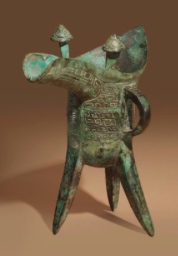
jue

China: jue libation vessel, Shang/Zhou dynasty.

Reception history has perhaps become a rather more established feature of visual culture (including the history of art) than for musical culture. The term “visual culture” itself reflects a more mature holistic approach, like that of “soundscape” for ritual music in China, and indeed the whole inclusive brief of ethnomusicology.

As I dip into Marcia Pointon’s History of art; a student’s handbook, she soon observes:

The meanings of the painting will be determined by where, how and by whom it is consumed.
[..]
Art historians are interested not only with objects with but with processes. […They] concern themselves with visual communication whatever its intended audiences or consumers.
[…]
Art historians investigate the origins, the connections between “high” and “low”, and the ways in which imagery such as this contributes to our understanding of a period of historical time, whether in the present or in the far distant past.

On one hand, as with music, we envy earlier viewers/audiences their familiarity with subjects/languages that we can no longer interpret easily, if at all. At the same time we have also lost the shock of the new.

We’re familiar with the idea of restoring old paintings to their original colours—negating their history?—but we can’t perform a similar operation on our eyes and minds. Doubtless there’s a vast scholarly literature on this, but one might be reluctant to remove the patina from Shang bronzes, restoring them to the condition of glossy new Italian kitchenware. For patina, see also Richard Taruskin’s comments on Gardiner’s Schumann.

Just as most people who experienced art in 15th-century “Italy” had access mainly to those works on public display in their particular city, so, long before CDs and youtube, Leipzig dwellers heard little music apart from Bach and the pieces by other composers that he selected, mostly within the Leipzig tradition. Some creators themselves might be so lucky as to travel, gaining a certain experience of other styles. And in both art forms, a majority of such work was contemporary—even the instruments that baroque musicians played were mostly modern.

To try and get to grips with what art and music meant at the time doesn’t make us able to experience it as did the “consumers” of the day—we can’t unsee Monet, TV, or skyscrapers any more than we can unhear Mahler and punk. And I hope our teeth are in a better state.

* * *

I also admire

  • Michael Jacobs, Everything is happening: journey into a painting (2015), [1]

on Velázquez’s Las Meninas (1656)—with chapters by his friend Ed Vulliamy added after Jacobs’ untimely death. As Vulliamy observes,

In this half-book, beyond a fragment, we have not only a typically Jacobs-esque narrative of his life with Velázquez—one of chance encounters, aperitifs, musings and restless autobiography—but also this manifesto for the liberation of how we look at painting. (p.146)

Jacobs does that thing that people always do in blurbs:

cutting a picaresque swathe

—and the picaro simile is fitting. Jacobs was constantly deploring the “sunless” world of academia. He documents the shift in art history that was then occurring widely in scholarship:

Many of the younger lecturers and researchers, conscious perhaps of the lingering popular image of their discipline as a precious and elitist pursuit, began adopting what rapidly became the prevailing art-historical methodology—a pseudo-Marxist one. People who might once have become connoisseurs in tweeds reinvented themselves as boiler-suited proselytisers dedicated to exposing in art revealing traces of the social conditions of a period, often resorting in the process to a hermetic prose peppered with terms I had first come across in Foucault, such as “discourses” and “the gaze”. (p.44)

Oh all right then, I’ll go for a hat-trick:

You think I know Fuck Nothing, but I know FOUCAULT!

(Note on pronunciation: whereas I can only hear “You think I know Fuck Nothing, but I know FUCK ALL!” in the caricature-Nazi accent of Karl Böhm, the above bon mot clearly belongs on the foam-specked lips of an angry young Alexei Sayle.)

By contrast with the treatments of Baxendall and Lee (themselves quite different), Jacobs’ approach is based on including “us”, the viewers, as agents in the picture—whatever his reservations, he was inspired by Foucault.

Proust, writing on Rembrandt, had spoken about paintings as being not just beautiful objects but also the thoughts they inspired in their viewers. [Svetlana] Alpers was cited as saying that “looking at a work in a museum and looking at other people looking at a work in a museum is like taking part in the life story of this work and contributing to it.”

Still, Jacobs ploughed his own furrow. As Paul Stirton recalls,

Michael always believed in the wonder of looking. Yes, there may be a profound message in a painting, but Michael didn’t want to dress it up in philosophical trappings. By all means approach a painting in a scholarly manner, but never lose the wonder. (pp.179–80)

In his book about artists’ colonies at the end of the nineteenth century, The good and simple life, he is scathing about how most painters wanting to live that life considered “the downtrodden country folk … as little more than quaint components of the rural scene. Their social conscience was as little stirred by them as by pipe-playing goatherds in the Roman Campagna.” At moments, though he is the antithesis of a “political” art critic, Michael’s writing reads like Walter Benjamin fresh from his Frankfurt School, but with a glass of Sangria in his hand. (p.182)

From both his own experience and Thomas Struth’s photos of the public response to Las Meninas over several days, Jacobs recalls

All the faces of the bored, the transfixed, the distracted, the deeply serious, the adults whose only concern was to get the perfect snap, the school children who were wondering when their ordeal would be over, the others who fooled around or diligently made notes, the few whose lives were being transformed. (pp.69–70)

So (suitably) like Monty Python’s Proust sketch, Jacobs never quite got as far as discussing the painting “itself”—not so much due to his death, as by virtue of his propensity to dwell on personal reminiscences on modern Spanish history and his own relationship with it and the painting.

He remarks wryly on the images of Spain current in his youth, reminding me of images of China, not to mention Away from it all. He recalls a train journey in the early years of Spain’s transition to democracy, when he was reading a book that

gave no hint of Spain’s repressive military regime, but instead referred to the country’s “growing agricultural and industrial prosperity” and to the “happy coexistence of the old and the new”.
The book’s role as a catalyst for my early, life-changing Spanish journeys was due entirely to its black-and-white photos, which neglected this supposedly modern and prosperous country in favour of basket-laden donkeys, adobe-walled farms, palm groves, sun-scorched white alleys and other such images that endowed Spain with a predominantly medieval and African look. Even Madrid, so regularly criticized by past travellers for its brash modernity, was made to seem more exotic and rural than any other western city I had seen. The sole street-scene was one of a large flock of sheep being herded in front of a neo-Baroque, cathedral-like post-office building popularly dubbed “Our Lady of the Post”. (p.60)

He discusses the fortunes of Las Meninas during the civil war, as well as more recent events:

… closed shops wherever you looked, restaurants offering “crisis menus”, daily protests, and graffiti and posters revealing grievances with everyone and everything, from the monarchy, to the banks, to the multinationals, to the European Community, to the politicians who made Spain the country with the the highest number of politicians per capita in Europe. (p.72)

And he describes the painting’s changing frames and settings:

The Sala Velázquez was like a shrine. […] On entering this inner sanctuary, people took off their hats, spoke in low voices, and tiptoed around so as not to destroy the atmosphere of worshipful solemnity. Every so often someone would be observed bursting into tears.
There were of course others visitors who disliked this room’s churchlike theatricality and the sentimentally nationalistic and mindless emotional reactions it inspired. (p.115)

So as it stands, Jacobs’ book is concerned more with reception history than with the society of the time of the creation of Las Meninas (though he explored this elsewhere, and doubtless had voluminous notes on the painting to supplement existing research). Background on the society of Velazquez’s day is provided mainly by Vulliamy’s fine Introduction. Evoking Lee, he notes that Seville, far from “the great Babylon of Spain, map of all nations”,

was also headquarters of the Inquisition. Indeed, the “Golden Age” which followed the unification of Spain in 1492 was accomplished, writes Michael Jacobs, “in a spirit of brutal fanaticism”, with the expulsion or enforced conversion of Andalucia’s many Moors and Jews. This dogmatism and what we would now call “ethnic cleansing” [here Vulliamy writes with traumatic personal experience in Bosnia] had a major and insidious demographic impact on the city, yet Seville remained characterized by “an architecture … of great contrasts”, wrote Michael, “for alongside the Muslim-inspired love of decorative arts richness is an inherently Spanish love of the austere”.

For a similar approach that sets forth from 17th-century Delft to go global, note Timothy Brook’s brilliant book Vermeer’s hat.

    * * *
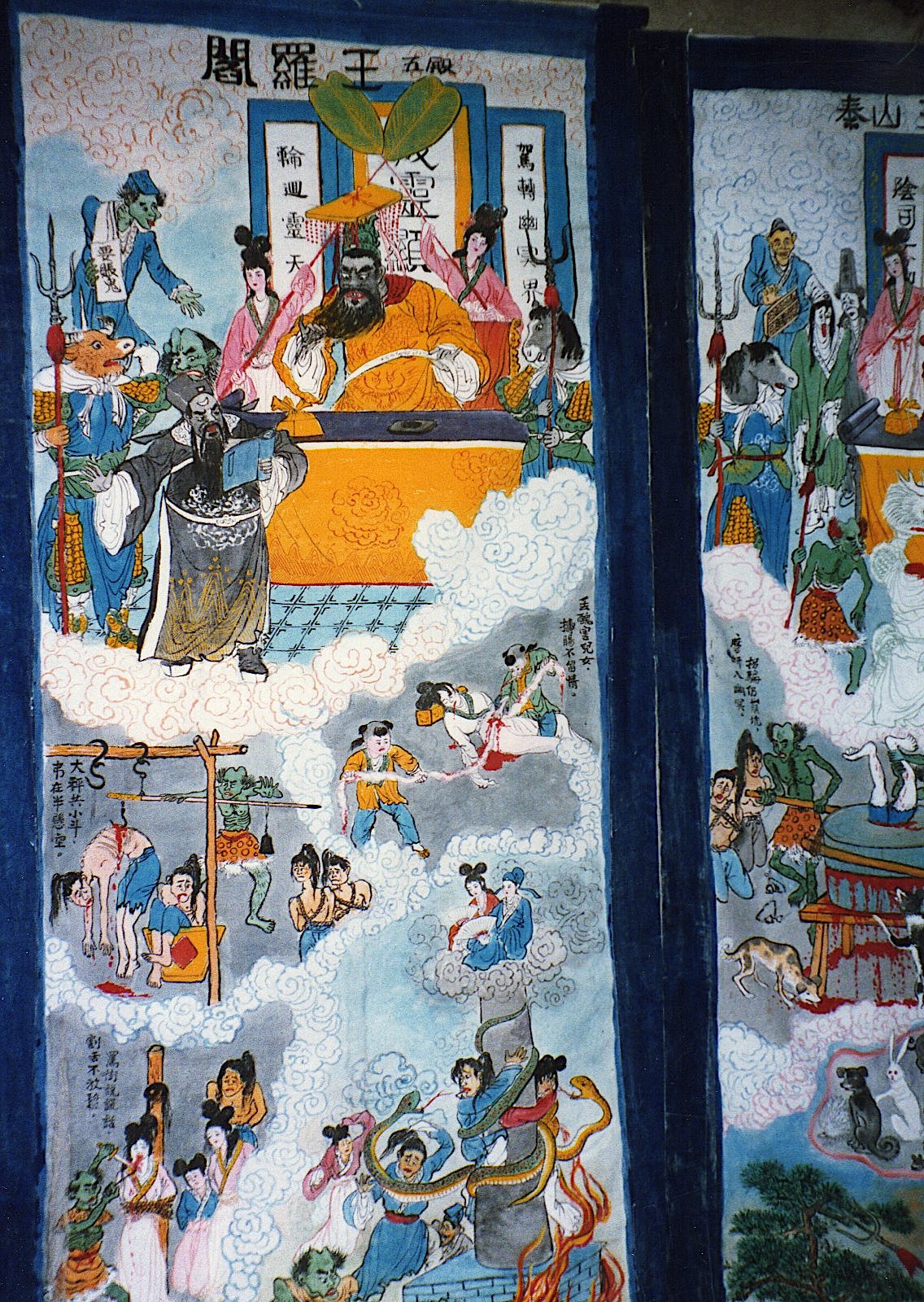
GL Ten Kings

Yama King painting from Ten Kings series, North Gaoluo 1990.

All these books incorporate ethnography and reception history far more than the fusty old reified appreciation of “autonomous” objets d’art. For China,

  • Craig Clunas, Art in China (1st edition 1997)

makes a useful, wide-ranging, and thoughtful introduction, exploring themes like genres, techniques, functions, patrons, markets, producers, class, and gender.

For instance, discussing a wooden sculpture of the female deity Guanyin from Shanxi carved c1200 CE, he describes its original multi-coloured decoration:

All this added to the immediacy of the image for worshippers, but it was covered over at some point, probably about 300–400 years later in the Ming dynasty (1368–1644), when it was painted gold in imitation of a gilded metal sculpture. Such an aesthetic change must have gone hand in hand with some change in the understanding of what a successful image ought to look like, a change at the level of both popular belief and the attitudes of religious professionals which is as yet hardly understood. (pp.56–7)

Whereas much scholarship remains based on artefacts in museums and galleries, fieldwork reveals a vast further repository of images still used in ritual practice. One thinks of the vast hoard of religious statuettes found in rural Hunan, subject of fine research.

And apart from statues and temple murals, ritual paintings depicting the Ten Kings and the punishments of the underworld—hung out for temple fairs and funerals—suggest comparisons with Christian equivalents in medieval and Renaissance art. And they too must have changed their meanings for audiences over recent centuries. At least, illiterate rural audiences would be affected rather deeply, and modern viewers may be underwhelmed now that they are saturated with horror films and video games. But we learn rather little about this from the scholarship; Daoist culture tends to be reified. Meanwhile, household ritual specialists have continued to perform Ten Kings scriptures for funerals.

It reminds me, challenged as I am in the field of visual culture, that ritual images through the ages also need unpacking—assessing changing meanings there too, including early sources for music iconography.

This has a lot to do with reception history. Such studies of visual culture may feed into our experience of Bach and all kinds of early and folk music. If even scholars of WAM and Renaissance painting feel it germane, then studies of Chinese musical cultures, and of Daoist ritual, shouldn’t lag behind.

* * *

But I’d like to end with some more populist vignettes (“Typical!”) on the meanings of art.

Among the numerous virtues of Alan Bennett is his accessible promotion of painting, found in Untold Stories (pp.453–514) [2]notably a talk he gave for the National Gallery, with the fine title “Going to the pictures”. These essays are also a passionate plea for culture to remain accessible, a rebuke to mercenary philistine governments.

He recalls an inauspicious early lecture he gave at Oxford on Richard II:

At the conclusion of this less than exciting paper I asked if there were any questions. There was an endless silence until finally one timid undergraduate at the back put up his hand.
“Could you tell me where you bought your shoes?”

 We’ve all been there. But his remarks on painting are priceless:

Somewhere in the National Gallery I’d like there to be a notice saying, “You don’t have to like everything”. When you’re appointed a trustee, the director, Neil MacGregor, takes you round on an introductory tour. Mine was at 9am, when I find it hard to look the milkman in the eye, let alone a Titian.

We were passing through the North Wing, I remember, and Neil was about to take me into one of the rooms when I said, “Oh, I don’t like Dutch pictures”, thereby seeming to dismiss Vermeer, De Hooch and indeed Rembrandt. And I saw a look of brief alarm pass over his face as if to say. “Who is this joker we’ve appointed?”

He cites his play A question of attribution, about (Michael Jacobs’ teacher) Anthony Blunt:

“What am I supposed to feel?” asks the policeman about going into the National Gallery.
“What do you feel?” asks Blunt.
“Baffled,” says Chubb, “and also knackered” … this last remark very much from the heart.
[… Blunt] tries to explain that the history of art shouldn’t be seen as simply a progress towards accurate or realistic reprentatation.
“Do we say Giotto isn’t a patch on Michelangelo because his figures are less lifelike?”
“Michelangelo?” says Chubb. “I don’t think his figures are lifelike frankly. The women aren’t. They’re just like men with tits. And the tits look as if they’ve been put on with an ice cream scoop. Has nobody pointed that out?”
“Not quite in those terms.”

In a *** passage AB blends hilarity with insight, evoking Baxandall:

In A question of attribution the Queen is made to have some doubts about paintings of the Annunciation.
“There are quite a lot of them,” says the Queen. “When we visited Florence we were taken round the art gallery there and well … I won’t say Annunciations were two a penny but they were certainly quite thick on the ground. And not all of them very convincing. My husband remarked that one of them looked to him like the messenger arriving from Littlewoods Pools. And that the Virgin was protesting that she had put a cross for no publicity.”
This last remark, though given to the Duke of Edinburgh, was actually another flag of distress, stemming from my unsuccessful attempts to assimilate and remember an article about the various positions of the Virgin’s hand, which are an elaborate semaphore of her feelings, a semaphore instantly understandable to contemporaries but, short of elaborate exposition, lost on us today. It’s a pretty out-of-the-way corner of art history but it leads me on to another question and another worry.
Floundering through some unreadable work on art history I’ve sometimes allowed myself the philistine thought that these elaborate expositions—gestures echoing other gestures, one picture calling up another and all underpinned with classical myth—that surely contemporaries could not have had all this at their fingertips or grasped by instinct what we can only attain by painstaking study and explication, and that this is pictures being given what’s been called “over meaning”. What made me repent, though, was when I started to think about my childhood and going to a different kind of pictures, the cinema.
When I was a boy we went to the pictures at least twice a week as most families did then, regardless of the merits of the film. I must have seen Citizen Kane when it came round for the first time, but with no thought that, apart from it being more boring, this was a different order of picture from George Formby, say, or Will Hay. And going to the pictures like this, unthinkingly, taking what was on offer week in week out was, I can see now, a sort of education, and induction into the subtle and complicated and not always conventional moral scheme that prevailed in the world of the cinema then, and which persisted with very little change until the early sixties.

Unpacking the complex attributes of two stock characters, he concludes:

The 20th-century audience had only to see a stock character on the screen to know instinctively what moral luggage he or she was carrying, the past they had, the future they could expect. And this was after, if one includes the silent films, not more than thirty years of going to the pictures. In the sixteenth century the audience or congregation would have been going to the pictures for 500 years at least, so how much more instinctive and instantaneous would their responses have been, how readily and unthinkingly they would have been able to decode their pictures—just as, as a not very precocious child of eight, I could decode mine.
And while it’s not yet true that the films of the thirties and forties would need decoding for a child of the present day, nevertheless that time may come; the period of settled morality and accepted beliefs which produced such films is as much over now as is the set of beliefs and assumptions that produced an allegory as complicated and difficult, for us at any rate, as Bronzino’s Allegory of Venus and Cupid.

For a similar case, see here.

* * *

Apart from any intrinsic merit this little tour of visual culture may have, for me it also suggests several angles barely explored for Daoist ritual.

OK then, just one last aperçu—this time from Kenneth Clark (thanks, Rod). On the contrast between reified art and social reception, here’s his typically urbane formulation in Civilization:

At some time in the 9th century one could have looked down the Seine and seen the prow of a Viking ship coming up the river. Looked at today in the British Museum, it is a powerful work of art; but to the mother of a family trying to settle down in her little hut, it would have seemed less agreeable.

On behalf of the splendid Craig ClunasI accept full responsibility for any inanities in this post.
If you all play your cards right, I promise not to do this kind of thing too often. Craig and any other art historians who have managed to read this far might care to exact revenge by writing Specious Flapdoodle
[famous 19th-century Baptist pastor—Ed.] about early music or Daoist ritual… 


** Not, may I just say, the kind of moronic homespun language used by one maniacal Führer about another: “smart cookie” or “total nut-job”? Roll over Cicero.

[1] Some stimulating reviews may be found herehere, and here.
[2] Online excerpts include http://www.independent.co.uk/life-style/i-know-what-i-like-but-im-not-sure-about-art-1620866.html and https://www.lrb.co.uk/v20/n07/alan-bennett/alan-bennett-chooses-four-paintings-for-schools.

More wordplay

This little digest is partly by way of cajoling my friend Nick, distinguished tenor
[cheap at the price], into unleashing his amazing anagram tales on the world
(now featured on this blog: roundup here!).

Wordplay in English and other languages (not least Chinese) displays dazzling and indeed warped creativity. For “constrained writing”, the oeuvre of Oulipo is most celebrated.

I’ll content myself with one anagram, on Mike Keith’s fine site, an extraordinary version of Dante’s Inferno:

This is a simultaneous anagram and translation. The English text is both an anagram of and an approximate translation of the first four tercets of Canto III of Dante’s Inferno, from the original 13th-century Italian.

Original:
Per me si va ne la citta dolente
Per me si va ne l’etterno dolore
Per me si va tra la perduta gente.

Giustizia mosse il mio alto fattore;
Fecemi la divina podestate,
La somma sapienza e ‘l primo amore.

Dinanzi a me non fuor cose create
Se non etterne, e io etterno duro.
LASCIATE OGNE SPERANZA, VOI CH’INTRATE.

Queste parole di colore oscuro
vid’ io scritte al sommo d’una porta;
per ch’io: “Maestro, il senso lor m’e duro.”

Anagram:
I am a portal to a sad place.
I am a cover to eternal fire.
Go, see our pit ooze craven memories.

Elite persistence moved some creator;
Divine omnipotence created me;
I am solo orgies of primal love.

Listen: ere me no denizens used our portal
I quit not, and I last eternal.
FOREGO ALL HOPE, ALL MEN THAT ENTER.

Crazed and curious, in a daze I sat
To see man pour out over a portal;
So I said: “Master, I cannot see its import.”

For more succinct anagrams, see Igor Stravinsky; Charles MackerrasDarcey Bussell—and Maidstone (an unlikely venue for their rendition of the Rite of Spring). See also

* * *

Among palindromes, [1] I’ve always been fond of

T. Eliot, top bard, notes putrid tang emanating, is sad. “I’d assign it a
name: gnat dirt upset on drab pot toilet”

—attributed to Alastair Read rather than W.H. Auden, it seems.

I like the sound of the Finnish palindrome with 10,102 words—even if, as one commentator candidly observes, “It’s really not that much fun.” We can limber up with some shorter ones (here), like

saippuakuppinippukauppias—soap cup batch trader
[SJ: Aha, perhaps this is useful as Elk lubricant?]

The following are to be found on the sites
http://palindromist.org (“Wary, Alpine Zen: I Play Raw”) and
http://www.cadaeic.net/palind.htm

They can be elegant and suggestive:

Rot, cello collector!

Mao bore Jeroboam.

No more Cicero, mon! [the Rastafarian has had his fill of the classics.]

 Overheard at the flea-market:
“Camel bible, Mac?”
“Cameraware, Mac?”

or the fine

An igloo costs a lot, Ed!
Amen. One made to last! So cool, Gina!

Now Derek can kiss Anais A. Nin, as I, an ass (I, knackered) won.
[extra points for proper names, as Mike Keith notes—the more evocative the better]

Olson, I won—see Saratoga repossess opera! Go, Tara, see Snow in Oslo.

Ajar? Aha! Maybe, Dan, omelet is opposite lemonade, by a Maharaja!

Some men interpret nine memos.

And longer ones like

“Traci, to regard nine men in drag,” Eric (in a play or an ironic art spot) warned, “I am not so bad.” “I’d never even seen knees … never even did a Boston maiden raw,” tops Traci, “nor in a royal panic. I regard nine men in drag —erotic art.”

Or a poem:

Amen, Icy Cinema [title and poem are separate palindromes]
Amen, I can!
I stop elastic ire
To see La Dolce Vita.

Covet?
I moisten nose,
Sonnets I omit, evocative clod!

Ale? Esoteric?
It’s ale! Pots in a cinema!

There are word-unit palindromes too:

You swallow pills for anxious days and nights, and days, anxious for pills, swallow you.

And sure enough, some have risen to the challenge of the palindromic haiku (work in progress), like this one by Ailihphilia (sic):

Oak, dove, temple: hymn
In mutual autumn, in my
Helpmete vodka. O!

Or some by Dalibor.

And then for the gourmet, there’s the menu from the “Moor Room”, a restaurant for palindromists:

Do, O Food [main course]
Tangy gnat
Koalas a la OK
La emu meal
Salad, alas

Gorge Grog [drinks]
Regal lager
Lemon o’ Mel

Desserts Stressed
Sugar a Gus
Bananas an’ a Nab

Some entries from “Drown In Word”, the (fictional) palindromic dictionary:
Gigolo:  Solo gig.
Paranoia:  I, on a rap.
Semantic:  It names.
Pa Plato:  Total pap.

This (from here) is pleasing:

palindromes

I note that “fear of palindromes” is Aibohphobia.

Finally, the erudite David Hughes, himself no mean songster, draws my attention to this:

* * *

True, while any sophisticated artistic activity (which perhaps excludes the KKK songbook and poetry competition) may be seen as a bulwark against philistinism, none of this quite butters any parsnips in the task that currently confronts us—to resist with every pore the barbarity of the putrid tang emanating from the drab pot toilet of the White House. T. Eliot, top bard, would have been sad too. I’d assign it a name, all right.

[1] See e.g.
http://www.cadaeic.net/palind.htm
http://www.cadaeic.net/silopolis.htm
https://www.theguardian.com/notesandqueries/query/0,5753,-2762,00.html
https://www.dailydot.com/debug/worlds-longest-palindrome-sentence/

Cinema Paradiso

As a change from the Rite of Gran visits York and Li Manshan, I do hope you know Cinema Paradiso (Giuseppe Tornatore, 1988), and its soundtrack. Morricone’s* music comes into its own in the overwhelming final sequence—not merely sentimental but a triumph over prurient censorship. You really have to watch the film all the way through—but hey, here goes:

Even in concert, the Big Tune is irresistible—all the more so with violin playing like this, from a 2011 Prom:

In the right hands, it would sound great on the erhu too.

For more on Italian film, see here, and indeed here.

* Actually, it being a father–son collaboration, I should perhaps write Morricones’—hmm.

Kulture


joke

As I snap remorselessy at the heels of the heritage shtick, my cavils revolve around the Chinese concept of mei(you) wenhua 没(有)文化 “lacking in culture”. It’s a cliché referring to people’s degree of modern state education. Even peasants deprecate themselves with the term, though it is precisely the riches of their quite separate culture that “educated” urban pundits purport to admire—before trying to shoehorn it into their own.

LB joke

Li Bin’s brilliant joke (keep watching after the final credits of my film) subtly satirizes the gulf between peasants and intellectuals. Here’s a fuller English version (my book, p.ix):

So there’s this Ph.D. student on a long-distance train journey, sitting in the same compartment as a peasant.

He’s dead bored, so to pass the time, he says to the peasant,

“I know, let’s play a game. We both ask each other one question. If you can’t answer my question, you have to give me 100 kuai; if I can’t answer yours, then I have to give you 200—because I have a Higher Level of Culture, don’t you know?”

The peasant goes, “Oh right—umm, OK then.”

The student says smugly, “You can start, because I have a Higher Level of Culture!” So the peasant thinks for a bit and asks,

“OK then, I got one—so…
What is the animal with three legs that flies in the sky?”

The student racks his brains. “Huh?? An animal with three legs that flies in the sky? Hey, there isn’t one, surely… Ahem… Crikey—you’ve got me there. OK, I give up, I guess I have to pay you 200 kuai.” He hands the cash over to the peasant.

The student, still bemused, goes on, “An animal with three legs that flies in the sky… Go on then, you tell me, what is this animal?”

The peasant scratches his head and goes,

“Hmm… nope, I dunno. OK then, I can’t answer your question either—here’s 100 kuai!”

LMS Rome

It’s even better in Yanggao dialect—Li Manshan tells it hilariously too.

As local traditions continue to be distorted, large areas of the world are in danger of being turned into a kitsch Disneyland theme park. A certain amount depends on the “level of culture” of state bureaucrats all along the chain; in China the central ICH authorities do indeed organize “training sessions” for regional cultural cadres, with limited success.

The whole system seems inherently flawed. Local, um, heritage bearers have their own ideas about what to do with their traditions—and given the dubious benefits and evident dangers of the state system, with its own “lack of culture”, people like me might hope they could be left alone to do so. But beguiled by the chimera of fame and fortune, locals—in China and elsewhere—are all too easily hijacked by the power of state machinery and tourism.

Bearing witness: If this is a woman

*For sequels, see my posts on Sachsenhausen and A life in secrets*

As this turns into a lengthy review, I ponder why I’ve been trying, in an amateurish way, to educate myself about the traumas of modern Europe—beyond the obvious answer, that we all must.

I guess it’s related to my studies of China, and my engagement with the lives of people like Li Manshan; a feeling of duty to report the sufferings of ordinary people I encounter in China—including not just their ritual life but their tribulations under Maoism, with famine, struggle meetings, and labour camps; and my growing awareness of the sufferings of Europeans over a similar period. I don’t want to spoil your holidays (or mine), but as we relish the cultures and scenery of these countries, we shouldn’t forget the ghosts that haunt the landscape.

Among the innumerable studies of the Nazi concentration camp system, Primo Levi is justly famed—actually, I find the sequel The truce just as disturbing as If this is a man, after the camp is finally liberated yet their Odyssey of suffering continues, homecoming ever receding. But I’ve also been deeply moved by

Helm’s account is based on amazingly thorough research and interviews with both victims and perpetrators—much of which was submerged until the end of the Cold War. Of course a historian’s account will give different, more holistic, perspectives from those of an individual inmate, but in a way I find Helm’s work even more moving than that of Levi. At 823 pages, it’s hideously readable—both balanced (whatever that might mean) and personal, in a way that ideologically-driven accounts such as those of Dikötter (for the degradations of Maoism in China) can’t achieve. Even the excellent index is harrowing.

I suppose I’m not alone in thinking of the whole catastrophe in terms of a few appalling place-names like Auschwitz and Belsen, but along with the focus on Ravensbrück, over the whole six years of its existence, we see how very extensive was the whole network of camps, subcamps, death camps, work camps, transports and marches, scarring the whole landscape.

At its height, Ravensbrück had a population of about 45,000 women; over the six years of its existence around 130,000 women passed through its gates, to be beaten, starved, worked to death, poisoned, executed and gassed.

The book opens with an arresting and complex image:

“The year is 1957. The doorbell of my flat is ringing,” writes Grete Buber-Neumann, a former Ravensbrück prisoner. I open the door. An old woman is standing before me, breathing heavily and missing teeth in the lower jaw. She babbles: “Don’t you know me any more? I am Johanna Langefeld, the former head guard at Ravensbrück.” The last time I had seen her was fourteen years ago in her office at the camp. I worked as her prisoner secretary… She would pray to God to stop the evil happening, but if a Jewish woman came into the office her face would fill with hatred…

So she sits at the table with me. She tells me she wishes she’d been born a man. She talks of Himmler, who she sometimes still calls “Reichsführer”. She talks for many hours, she gets lost in the different years, and tries to explain her behaviour. (1)

The book goes on to tell the stories of Langefeld, Buber-Neumann (who also had the terrible distinction of already having been incarcerated in a Russian gulag), and a tragic cast of inmates and their tormentors, with chapters focusing on personalities over the years.

Among them were political prisoners, Jehovah’s Witnesses, “asocials”, “useless mouths”, “idiots”, and (later) children; in this camp only around 10% were Jewish. Its shifting population was international, including Germans, Poles (the largest group), Gypsies, Russians, Czechs, French, Hungarians, Scandinavians, and Dutch, all transported there at various stages.

In April 1944 recent arrivals included evacuees from Majdanek, including more Red Army doctors and nurses, as well as 473 Gypsies transferred from Auschwitz. There were Italian partisans, Slovenians, Greeks, Spaniards, and Danes, as well as three Egyptians and seven Chinese. (419)

They were often in desperate straits even when they arrived.

Ravensbrück guards rowing on the Schwedtsee.

Helm also delves into the lives of guards, doctors, and Blockovas (prisoners—at first often criminals—coopted to carry out the day-to-day work of running the camp). The twice-daily Appell roll-call was an ordeal that regularly led to death, as did stays in the Revier “hospital”.

As she observes, the “asocials”, such as prostitutes (pp.56, 96–108, 417–19, and index), have gone largely undocumented:

Unlike the political women, they left no memoirs. Speaking out after the war would mean revealing the reason for imprisonment in the first place, and incurring more shame. […] The German associations set up after the war to help camp survivors were dominated by political prisoners. And whether they were based in the Communist East or in the West, these bodies saw no reason to help “asocial” survivors. (98)

Perhaps the most sickening story (how might one concoct a hierarchy of inhumanity?) concerns the 86 “rabbits” (mostly from a group of 195 women from Lidice near Prague, deported after the 1942 assassination of Heydrich and the punitive razing of the village), objects of unthinkable medical experiments. [1] But it’s also moving for the way in which the whole camp later rallied round to protect them from being murdered so that their terrible story could at least be told—miraculously, 63 of them survived. Again, Holm switches tellingly to the present day:

I found Zofia Kawińska in her tenth-floor flat overlooking the cranes of Gdansk shipyard. She was one of the second group of victims of Himmler’s sulphonamide experiments. A tiny, bent figure, she walks with difficulty, and has done since the war. I ask if she still suffers pain from the experiments. “A little,” she says, as she offers tea and biscuits.

She stoops to show the scars on the sides of her legs. “They put the bacteria in, and glass and bits of wood, and they waited.” She looks up and fixes me with deep brown eyes, as if to see if there is any chance that I understand. “But I didn’t suffer as much as some. Everyone in Poland came home with wounds.” (243–4)

Surviving “rabbits”, 1958.

The smuggled letters of the rabbits were among many acts of defiance.

In similar vein, Nikolaus Wachsmann, in KL: a history of the Nazi concentration camps (perhaps the most authoritative study of the whole system), refines the view of “prisoners as blank and apathetic automatons, drained of all free will”, recognizing the heroism of such agency, “however small and constrained”. But he makes an important caveat:

We must resist the temptation to make our encounter with the concentration camps more bearable by sanctifying the prisoners, imagining them as united, unsullied, and unbowed. For the most part, the prisoners’ story is not an uplifting account of the triumph of the human spirit, but a tale of degradation and despair.

For anthropologists, the most extremely disturbing instance of participant observation is Germaine Tillion (1907–2008), an ethnologist who had done fieldwork in Algeria before being arrested while working for the French resistance. In impossible conditions she comprehensively documented the activities of the camp, somehow managing to hide her notebooks from the guards. After the war she continued her research on “the history of the de-civilisation of Europe”, and returned to her work on Algeria; her distinguished career was recognized by many awards.

Tillion

While in the camp Tillion even composed and staged an operetta Le Verfügbar aux Enfers, a spoof of Orpheus in the underworld, attempting to help prisoners “resist by laughing” (567). It has been revived since 2007—my post Operetta in extremis includes a complete performance from 2011.

As the camp population grew constantly with prisoners evacuated from camps in the path of the Soviet advance, the 959 French prisoners (known as the “vingt-sept mille” after their camp numbers) who joined Tillion from Paris in February 1944, “jeunes filles biens élevées”, were quite unprepared for what awaited them at Ravensbrück, and adapted badly. Quartered in the “slums” of the camp, soon they were more hated than the Poles; their health quickly failed. Another group of women arrived in August from Warsaw, obliterated after the uprising—reporting to their compatriots, “There is no Warsaw. There is nothing left.” Hungarian Jews were deported to Ravensbrück in October. Babies were soon starved to death.

As it becomes clear that the Nazis are in retreat, the final chapters are just as tense. Desperate to conceal their crimes, with order collapsing, their brutality becomes even more extreme and random. The reader wills the inmates to survive.

By the end of March [1945] the camp was “like a mysterious planet”, said Denise Dufournier, “where the macabre, the ridiculous and the grotesque rubbed shoulders in a fantastic irrational chaos.” Karolina Lanckorońska, watching the crematorium flames shooting higher every night, was reminded of the beginning of the Iliad. She was still giving lectures on Charlemagne and Gothic art as children in Block 27 played a game of selecting for the gas chamber. In the Red Army block the women were making red flags to hang out to welcome their liberators, while the painting gang had been sent to redecorate the maternity block, where, according to Zdenka’s lists, 135 more babies were born in March, of which 130 died. (616)

Despite the shocking complicity of the Red Cross in Geneva, the tireless, heroic work of young Norwegian student Wanda Hjort (1921–2017), using her status to visit the camp and establish contacts, at last achieves results as many prisoners scramble to be taken to safety in the White Buses, with the tense diplomatic negotiations of Folke Bernadotte, Swedish representative of the ICRC, with Himmler.

Wanda Hjort.

But while the buses were being bombed by the Allies, for the majority of women who remained in the camp to await rescue by the Soviet troops, “Liberation” was also horrifying, with widespread rapes perpetrated on women of all nationalities.

* * *

And so into the whole post-war period. Many survivors returning home found there was no home to return to. The Hamburg trials of 1946–8 (a sideshow to Nuremberg)

achieved a great deal. Within a short time the court […] established in the clearest terms the simple fact that everything about the camp was designed to kill. (706)

But the trials were soon followed by amnesia on both sides of the Iron Curtain—and ignominy for the valiant women in the USSR (pp.287–313, 710–11) and the GDR (339–58, 711–14) who had somehow survived only to descend into a new nightmare, now suspected of being traitors. And until 1950, camps like Buchenwald were adopted by the NKVD as gulags for their own prisoners, with many (not only former Nazis) dying in squalor (MacGregor, Germany, pp.468–72).

By 1948 the Allies had lost their appetite for punishing the Nazis and both the war crimes trials and the process of “de-Nazification”—whereby top Nazi supporters were brought to book and denied top jobs—were shut down. (707)

Wachsmann explores the issue in his fine Prologue:

Survivors … were not stunned into collective silence, as has often been said. On the contrary, a loud, polyphonic voice rose up after liberation. … During the first postwar years, a wave of memoirs hit Europe and beyond, mostly searing testimonies of individual suffering and survival.

But as he notes, popular interest soon waned:

Public memory of the camps was being marginalised by postwar reconstruction and diplomacy. With the front line of the Cold War cutting right through Germany, and turning the two new, opposing German states into strategic allies of the USSR and the United States, talk about Nazi crimes seemed impolitic. … Within ten years of liberation, the camps had been sidelined—the result not of survivors unable to speak, but of a wider audience unwilling to listen.

Though popular interest was rekindled to some extent in the 1960s and 70s, more detailed research only took off from the 1990s—with German scholars taking the lead.

By this stage you will be able to decide whether you can face watching this documentary:

* * *

So only now am I beginning to understand the apparent amnesia that took hold all over Europe during my youth—and which still persists in China for the Maoist era (and other more recent events that it’s prudent to bury). Levi explains it well. His If this is a man was published in 1947, but

fell into oblivion for many years: perhaps also because in all of Europe those were difficult times of mourning and reconstruction and the public did not want to return in memory to the painful years of the war that had just ended.

Republished in 1958, it then became exceptionally successful—although even in the 1970s, as Paul Bailey observes in an Afterword, “Primo Levi wasn’t so much forgotten in Britain as totally unknown.”

Not just Neil MacGregor’s “What would we have done?”, but just our capacity for evil, need to be kept at the forefront of our consciousness.  As MacGregor comments,

How did the great humanising traditions of German history—Dürer, Luther’s Bible, Bach, the Enlightenment, Goethe’s Faust, the Bauhaus, and much, much more—fail to avert this total ethical collapse? (473)

In a Postscript to If this is a man and The truce, Levi gives succinct replies to what have come to be called FAQ, like “Were there prisoners who escaped from the camps? How is it that there were no large-scale revolts?” and “How can the Nazis’ fanatical hatred of the Jews be explained?”.

On “ordinary Germans”, I already noted Hans Fallada’s novel Alone in Berlin (now also the subject of a film). Levi expands wisely on the topic “Did the Germans know what was happening?” Observing the authoritarian control of the media (not only in Germany, and not only then), he comments:

Under these conditions it becomes possible […] to erase great chunks of reality. […] However, it was not possible to hide the existence of the enormous concentration camp apparatus from the German people. What’s more, it was not (from the Nazi point of view) even desirable. Creating and maintaining an atmosphere of undefined terror in the country was part of the aims of Nazism. It was just as well for the people to know that opposing Hitler was extremely dangerous. In fact, hundreds of thousands of Germans were confined in the camps from the very first months of Nazism: Communists, Social Democrats, Liberals, Jews, Protestants, Catholics; the whole country knew it and knew that in the camps people were suffering and dying.

Nonetheless, it is true that the great mass of Germans remained unaware of the most atrocious details of what happened later on in the camps. […]

He goes on to cite Eugene Kogon’s Der SS staat:

Even many Gestapo functionaries did not know what was happening in the camps to which they were sending prisoners. The greater majority of the prisoners themselves had a very imprecise idea of how their camps functioned and of the methods employed there. […]

And yet there wasn’t even one German who did not know of the camps’ existence or who believed they were sanatoriums. There were very few Germans who did not have a relative or an acquaintance in a camp, or who did not know, at least, that such a one or such another had been sent to a camp. All the Germans had been witnesses to the multi-form anti-Semitic barbarity. Millions of them had been present—with indifference or with curiosity, with contempt or with downright malign joy—at the burning of synagogues or humiliation of Jews and Jewesses forced to kneel in the street mud. Many Germans knew from the foreign radio broadcasts, and a number had contact with prisoners who worked outside the camps. A good many Germans had had the experience of encountering miserable lines of prisoners in the streets or at the railroad stations. In a circular dated November 8, 1941, and addressed by the head of the police and the Security Services to all… Police officials and camp commandants, one reads: “In particular, it must be noted that during the transfers on foot, for example from the station to the camp, a considerable number of prisoners collapse along the way, fainting or dying from exhaustion… It is impossible to keep the population from knowing about such happenings.”

Not a single German could have been unaware that the prisons were full to overflowing, and that executions were taking place continually all over the country. Thousands of magistrates and police functionaries, lawyers, priests and social workers knew genetically that the situation was very grave. Many businessmen who dealt with the camp SS men as suppliers, the industrialists who asked the administrative and economic offices of the SS for slave-labourers, the clerks in these offices, all knew perfectly well that many of the big firms were exploiting slave labour. Quite a few workers performed their tasks near concentration camps or actually inside them. Various university professors collaborated with the medical research centres instituted by Himmler, and various State doctors and doctors connected with private institutes collaborated with the professional murderers. A good many members of military aviation had been transferred to SS jurisdiction and must have known what went on there. Many high-ranking army officers knew about the mass murders of Russian prisoners of war in the camps, and even more soldiers and member sof the Military Police must have now exactly what terrifying horrors were being perpetrated in the camps, the ghettos, the cities, and the countryside sof the occupied Eastern territories.

Levi adds:

In spite of the varied possibilities for information, most Germans didn’t know because they didn’t want to know. Because, indeed, they wanted not to know. It is certainly true that State terrorism is a very strong weapon, very difficult to resist. But it is also true that the German people, as a whole, did not even try to resist. In Hitler’s Germany a particular code was widespread: those who knew did not talk; those who did not know did not ask questions; those who did ask questions received no answers. In this way the typical German citizen won and defended his ignorance, which seemed to him sufficient justification of his adherence to Nazism. Shutting his mouth, his eyes and his ears, he built for himself the illusion of not knowing, hence not being an accomplice to the things taking place in front of his very door.

Turning to memory, Helm notes:

In the 1950s, as the Cold War began, Ravensbrück fell behind the Iron Curtain, which split survivors—east from west—and broke the history of the camp in two.

The abomination wasn’t the only part of the story that was being forgotten; so was the fight for survival.

Even in Britain, where we enjoyed the rare privilege of not enduring occupation, with all its risks and moral compromises, my parents’ generation—even if they hadn’t personally experienced appalling suffering in active service, or in POW and concentration camps—were all scarred by bombed-out buildings, separation and loss, maimings, food shortages, and terrible insecurity. So I shouldn’t wonder that they were relieved to live in peace, unwilling to inflict traumatic memories on children like me, unwittingly blessed to have been born after the war. But there were survivors all around us—like Maria Bielicka, whom Holm visited at her Earls Court flat in 2010:

She said she had rarely spoken of the camp before. When she first came to live in England after the war nobody believed what she had to say. “Nobody here even wanted to know about the camps.” Since then she has “got on with life”, working for Barclays Bank. (175)

How very much more understandable was this amnesia in an utterly devastated continental Europe. So bruised parents retreated to their well-tended gardens and shiny consumer goods, while their children complacently explored the counter-culture of the 60s. For those who cared, politics was about current problems, at home and in the third world. Meanwhile the nightmare continued in East Europe (and China, and the Soviet Union), as the past was buried and distorted even more mendaciously. Victims and tormentors had to coexist.

With all the vast documentation of mid-20th-century abominations that has eventually surfaced, it is hard to comprehend Steven Pinker’s detailed thesis in The better angels of our nature that violence has declined over millenia, and that the two world wars were but minor spikes in the grizzly statistics (see also his website, and FAQ). At least, it seems cruelly irrelevant; of course Pinker himself would be the first to encourage memory of modern trauma.

See also my posts on Sachsenhausen and Les Parisiennes; and for the first gulag in Soviet Russia, see here.

[1] See e.g. http://ahrp.org/ravensbruck-young-girls-subjected-to-grotesque-medical-atrocities/
http://www.elizabethwein.com/ravensbrueck-rabbits

Mahler, the exclamation mark, and John Wayne!

*For an introduction to my whole series on Mahler, with links, click here!*

We’ve had Mahler and Anna May Wong, now for Mahler and John Wayne.

I make but a paltry effort to control my addiction to exclamation marks (!). In my defence I cite Mahler himself— I recall the instructions in his scores as being liberally sprinkled with them. Now that I come to seek instances, they’re not so ubiquitous, but here are some examples:

viel Bogen!

Vorschlage möglichst kurz!

And, like a red rag to a bull for the horns (sic) or clarinets, the immortal

Schalltrichter auf!

Such exclamation marks add a personal touch—we can feel the composer–conductor communicating with his musicians. At the climax of Der Abschied, transcendent finale of Das Lied von der Erde, they suggest awe:

Langsam! ppp!

My search continues for instances of his use of triple exclamation marks!!!

Having drawn attention to Mahler’s use of quintupletsDer Abschied is full of cross-rhythms— time dissolving into the nirvana of

Allüberall und ewig blauen licht die Fernen!
Ewig… ewig…

In this melody, emerging out of mysterious ascending motifs on flutes, the triple time is soon subverted by a duple metre, the quintuplet leading into that most distinctively plaintive of Mahler chords. (from 10.44 on the YouTube link here):

Abschied 2

Abschied

* * *

Now, you may think those awed exclamation marks make a flimsy and irreverent pretext to cite the famous John Wayne story—but hey:

In rehearsal for The greatest story ever told, the Duke, playing the Roman soldier who spears Jesus on the cross, says rather flatly,
“Truly he was the son of God.”
The director cuts in: “Not like that—say it with awe!”
Obligingly Wayne repeated his line, still deadpan:
“Aw—truly he was the son of God.”

And that links to the notorious vinegar ad.

Searching for a comprehensive analysis of Mahler’s markings, I came across this guide, which is even funnier.

Muso speak: excuses and bravado

Strad in bed

As I try to master more Bach on the erhu, suspending my disbelief, it’s good to be able to use the muso’s classic excuse

It was in tune when I bought it…

Also handy is

It’ll be all right on the night.

Or the immortal words (and notes) of Inspector Clouseau,

Better than ever!

That’s somewhat reminiscent of my Irish Heifetz story.

And then there’s the comment often on our lips after an underwhelming gig gets an inexplicable ovation:

Of all the concerts I’ve ever done in my life… that was one of them,

reminding me of the quote (typically attributed to Groucho)

I’ve had a wonderful evening, but this wasn’t it.

For more putdowns, see here.

See also Bernard Bresslaw’s classic line in The Ladykillers:

Well, I didn’t really study any place, Lady… I just sort of… picked it up.

In memory of Natasha

Natasha 2

This week is the fourth anniversary of the loss of my friend Natasha at the age of 34—younger than Mozart, and just less than two years after Amy Winehouse’s death.

Unable to do anything at all for months after, I thought I’d better not cancel my planned stay with Li Manshan in September, and indeed he and the other Daoists were understanding, easing me back to life. The Li family had themselves suffered a family tragedy at just the same time. The funeral rituals they perform are always moving, but now, as the sounds of shengguan blending with the vocal liturgy soared above the kowtowing kin, I felt their grief more personally.

Natasha left barely a trace on the world apart from her wonderful kids. I dearly want to write a book on her, but since I now find I know nothing about her, this tribute will have to suffice.

Natasha smile

“Troubled genius” doesn’t do Natasha justice. She deeply touched all who met her; irresistible, she could be impossible. She was the incarnation of Elena Ferrante’s Lila.

Her wild and prodigious early life was spent in Ternopil in west Ukraine. She made her home in London aged 18. Painter and composer, with her icons and Tarot, electronica, Bach, and Arvo Pärt, earth mother and sophisticated cook, femme fatale with her look of heroin chic, chunky jewelry and slinky outfits, finally holding down a mundane job for the sake of surviving as a single mum after teaching and playing in a rock band, childlike and severe, intoxicating and intoxicated, insatiable and hallucinatory, her thirst for knowledge reflected in her multi-coloured notebooks full of sketches and musings, she was on another planet. Hearing TurangalîlaragaMozart, or Naturträne through her ears, deep in her soul, was overwhelmingly intense.

Natasha painting

Natasha’s paintings were both radiant and disturbed—her later works were yet darker. Klimt and Schiele would have lapped her up (and she them). It wasn’t easy for her inhabiting a world of Parajanov:

We were supposed to be going to Mahler 5 at the Proms when she had her first heart attack. This is a perfect version of her song, with Magdalena Kožená and Claudio Abbado:

Thriving on impermanence, that I get. But Natasha, you have to keep living…

Sgt Pepper

*Click here for my series on the great Beatles albums,
with introduction!*

Sgt Pepper

Even I had been surreptitiously following the Beatles from the word go, and all their work is deeply affecting; but their later studio albums took our admiration to a new level. As I reflect in my introduction to this series, of course we didn’t—and don’t—need to “analyse” such work, any more than most audiences do when they attend a performance of a Brahms symphony. But studies like those of Wilfred Mellers (Twilight of the gods) and Alan W. Pollack (online) show how music-making of all kinds can be deeply creative.

* * *

Sgt Pepper’s Lonely Hearts Club Band (1967) was born out of the Beatles’ frustration with touring—an exhausting schedule through which they had to churn out the old numbers almost inaudibly beneath the hysteria. As they retreated to Abbey Road studios, the process of composition with George Martin (“collective creation”, as was all the rage in China at the time) lasted five months.

The Beatles’ previous albums contain many wonderful individual gems, but for me both Sgt Pepper and the following Abbey road are “choral symphonies”, song cycles, seamless wholes—even if only Side 2 of the latter was conceived thus. Individually he songs are gems, but with their themes of childhood and ageing, nostalgia, loneliness all in balanced contrast, they work as one long suite. It’s world music, in the sense that all genres are their canvas.

So while I introduce A hard day’s nightRubber soul and Revolver selectively, here I just have to go through the whole sequence. Wilfred Mellers considers Sgt Pepper:

We have seen how Beatle music began as a communal activity of danced song: and how in their second phase—as verbal developed alongside musical interest—it became concerned with human relationships in a social context. The songs were now to be listened to, rather than danced to; and by the time of Penny lane and Strawberry fields it was improbable that the numbers could even be “participated in” in live performance, since they were dependent on electronic equipment. This does not necessarily mean that the songs have ceased to have ritual significance, for the long-playing record is a more radical innovation than we once realised. It transplants ritual from temple or theatre to any place where two or three may gather together, including the home or commune, as well as club or discotheque. This is why the supreme achievements of pop so far are halfway between ritual and art. With remarkable verbal articulateness, though at a poetic level beyond intellectual formulation, the Beatles’ next disc, Sgt Pepper’s Lonely Hearts Club Band, explores the perennial as well as current problems of adolescence—loneliness, friendship, sex, the generation gap, alienation, fear, nightmare; and perhaps could do so because the Beatles’ early “corporate identity” was always a synthesis of four different individuals. Yet if Pepper is, in this relatively traditional sense, art, it is also a ritual involving the young—through its electronic extension of musical sounds into the environment of the external world—in a ceremonial togetherness, without the prop of a church or state. This two-way function as art and ritual remains valid, even though the Beatles, in common with most pop groups, disclaim both moral responsibility and artistic technique: for that responsibility and technique may be intuitively independent of conscious volition is the heart of the matter.

No longer do the Beatles offer us a miscellany of songs; we rather have a sequence of intricately related numbers, forming a whole and performed without break. The verses, though composed “orally”, by trial and error, are printed on the record sleeve, so that we may go back and read them again, “like a book”: just as on disc we may repeat bits of the music, as one cannot in a live (especially in part improvised) performance.

None of the songs is a love song; and that the main theme of the songs is loneliness would seem to admit that the Beatles’ early attempts at tribal togetherness had failed—not as music, but as a way of life.

Here’s a playlist for the 2009 remastered version:

  • Sgt Pepper’s Lonely Hearts Club Band. Mellers’ comments, illuminating the transitions and contrasts between songs, reveal just how sequential they are. He continues:

Sgt Pepper himself is an old-world character rooted in the camaraderie of a distant past: “It was twenty years today Sgt Pepper taught the band to play”. So we open with a “public” number (by Paul), inviting us to the show, and recalling Edwardian military music, the circus and the working men’s club, delivered with extrovert rhetoric, and with approving audience-noises off-stage. Yet if the brisk rhythm, the jaunty fanfares and the military scoring of this first song suggest simple solidarity, the music is far from being what it superficially seems. In tonality it is curiously ambiguous: for while it gravitates towards a smiling G major, the introduction wobbles between dominant sevenths of D and F, and when we reach the tune itself and the Band, having been introduced, plays and sings, the rhythms of the tootling arpeggiated tune are tipsily displaced by cross accents (three against two) and the “open” tonality is clouded by blue false relations. So this public show-piece hides beneath its zest a certain jitteriness. The cosy world of Pepper may embody a truth; but it’s one that is dubiously relevant to young people today. On the cut-out included with the disc the Beatles sport their resplendent Edwardian uniforms as comic fancy-dress.

Referring to this “overture”, Alan W. Pollack reminds us:

Don’t allow any of the overdubbed effects to blunt your sensitivity to the well executed bassline, lead guitar licks, and drumming.

And he observes that the bowed strings in the fade-up ambient noise prepares us for their major role in She’s leaving home and A day in the life.

  • With a little help from my friends. Mellers goes on:

Indeed, the instability of this first song already demonstrates that although Pepper is a military man, very peppery, and runs a band of people playing together, they none the less play to a club of Lonely Hearts. So we’re not surprised when the public junketings fade out, after a reference to the “lovely audience” Pepper hopes we’re going to be, into a sad little song, also by Paul but with help from John, but sung by Ringo, commonest of common men. And he begins by apologising for his incompetence, as contrasted with peppery professionalism. […] The song epitomises the reasons why the Beatles needed one another and reveals why their awareness of “separateness” and “togetherness” was meaningful to the young at large.

Pollack’s analysis is here. Actually, for the first song proper on the album, I find it just too bold in its hamminess: I’m not prepared yet for such irony. But Now For Something Completely Different:

  • Lucy in the sky with diamonds—(Pollack here) psychedelic, as Mellers notes, a “revocation of a dream-world of childhood”, its vivid colours

those of a poetically recreated kids’ comic”. The music, too, preserves its innocence: a lazily wafting waltz tune undulates around the third of the scale (with dreamy flat sixths and sevenths in the accompaniment), and the fairy-tale scoring, tinklingly plangent, helps us to see and hear the lovely landscape as larger than life, the flowers “incredibly high”, the girl’s eyes “kaleidoscopic”.

An abrupt change to a rapid 4/4 brings further tonal refinements, and

the fade-out carries us back from trip, childhood and dream-girl to reality, though again with equivocal irony.

  • Getting better—balancing contrasts, as this album and Abbey road do. Pollack notes how the abstract Lucy is followed by this representational song, judiciously relaxing the tension. Mellers:

a raggedy music-hall song by Paul, evoking school rebel and angry young man. The scalewise-moving, non-modulating boogie-rhythmed tune expresses fury with rule and authority and lovelessness in personal relationships, with perky insouciance. […] Though the language is not only plain, but blunt, the music doesn’t allow us to take the self-denunciation, or even the denunciation of authority, very seriously. At the same time the diatonic simplicity of the refrain makes its optimism somewhat wobbly. This again indicates how the Beatles’ vulnerability is part of their honesty; so it’s natural enough that this emotional frailty should lead into the deepening commitment of the next song,

  • Fixing a hole: Pollack suggests that here the protagonist is actively fulfilling the potential of Getting better. Mellers:

We’ve moved from Sgt Pepper’s old-world club to the dubious potentiality of friendship; from there to a dream-girl or the fairy-world of childhood; from the dream-girl to a remotely possible real one; and from that nervous expectancy to this subtly mysterious little song about the nature of identity. […] It begins in a dorian F, rocking fourths being followed by a pentatonic upward lift, balanced by a descending flat seventh; the end of the first strain creates the mind’s free wandering, as it floats pentatonically upwards, always just off the beat.

  • She’s leaving home—in triple metre, like Norwegian wood. Pollack finds it close to mimicry, but surely it’s one of the Beatles’ most moving ballads. Mellers:

The girl and her situation, though typical enough, were culled (Paul tell us) from the Daily mirror, and the verses evoke the mystery of the commonplace, having the true economy of poetry. How much is conveyed by the reference to the “note that she hoped would say more”; how sadly funny it is that she leaves home for the purpose of “meeting a man from the motor trade”, probably a shady rather than conventional character, but either way one from whose life-style the glamour will soon wear thin. Even the parents’ lamentation (“With never a thought for ourselves … we gave her everything money could buy”), though guyed with falsetto obbligato, is without trace of bitterness.

He observes the irregular, subtle musical structure:

The vocal tune is a corny waltz mainly in stepwise movement, but with a yearning life from the second to the tonic in the higher octave, followed by a descent by way of the flattened seventh. […] The arching cello solo is as beautiful as it is comic; and the irregular structure enacts the story, conveying not merely the fact of the girl’s departure but all the muddled hope, apprehension, and fear in the girl’s heart, the fuddled incomprehension of the parents. There’s failure all round, in both generations; yet the failure doesn’t deny the tune’s heart-felt lyricism, nor lessen the comedy of the falsetto obbligato. That the song makes us laugh and cry simultaneously is testimony of its truth to experience.

This little tragi-comedy of personal relationships is banished with a return to the public world of the circus in

  • Being for the benefit of Mr Kite! Pollack:

The song’s function in the cycle is more important than its intrinsic interest; it recalls our starting point, after the songs have explored the ramifications of loneliness and togetherness; and by ironic contrast it prepares the way for George Harrison’s number

  • Within you without you (Pollack here). “Bringing in the religious implications of the search for identity”, following tracks on Revolver, the Indian sitar again features prominently, its orientalism (Mellers) “re-created in terms of the Beatles’ newborn innocence”. This was one of the main pop creations that were now turning on a generation to Indian music.

In a mixolydian scale with major third and flat seventh, it’s said to be loosely based on rāg Khamaj (The raga guide, pp.100–101; CD 3, #6)—although the only point of such a claim is to lead one towards the complexities of raga in its native form. The refrain and middle section also feature additive metres.

Pollack makes an interesting comment on the eerie laughter at the end of the song:

I’m aware of at least two schools of thought:

    • The xenophobic audience (remember there’s an underlying element in the “Pepper concept” that at least indirectly connotes a Victorian/Edwardian outlook of supercilious imperialism) is letting off a little tension of this confrontation with pagan elements.
    • The bedazzled composer, in an endearingly sincere nanosecond of acknowledgement of the apparent existential absurdity of the son-of-a-Liverpudlian bus driver espousing such other-wordly beliefs and sentiments, is letting off a bit of his own self-deprecating steam in reaction to the level of true courage expended by him in order to come out of the uneasily-anti-materialist closet.

But, don’t you think it’s a combination of the two?

Mellers:

From these metaphysical reaches within the mind we’re jerked back by a leery laugh; a deliberate exercise in “trivialisation” which may be self-defensive, though its not self-destructive.

Making yet another contrast, the next song, Paul’s

  • When I’m sixty-four, as Mellers continues,

cannot be adequately described as parody, though we’re back in a suburban terraced house, and in the raggy, twentyish music-hall style of George Formby, with oompahing tuba bass and noodling clarinet obbligato. This reinvokes Dad’s world and era with comic yet touchingly poetic wit. […] Of course the oldies’ little cottage has to be in the Isle of Wight, and of course their grandchildren must be called Vera, Chuck, and Dave. Yet these oldies are at the same time identified with the Beatles.

Talking of unpromising chromaticisms,

64

Meanwhile, Pollack seems rather less convinced. Having been a tad disconcerted by With a little help from my friends early on, I’m well cool with the style by now. Returning again to the present,

  • Lovely Rita (meter maid) makes an earthly balance for Lucy in the sky, as Mellers notes, not pretending that she is more than “an alleviation of loneliness and distress”. As Pollack notes, it’s been quite some time since we heard anything resembling rock. The song ends with what Mellers calls an “indefinite threat”, something of which persists through
  • Good morning Good morning (Pollack: “truly, truly, one of the great songs”), with more additive metres—its euphoria containing a spooky, hallucinatory undertone (Mellers), thus leading into
  • Sgt Pepper’s Lonely Hearts Club Band (reprise)—which has “now lost its show-biz glamour, or recognises it as illusory”. Pollack discusses it on his page on
  • A day in the life (here), an epilogue transporting us back into the “real” world, both funny and creepy, as Mellers observes; its news items, whatever their source, do indeed constitute “a Day in the Life—anyone’s life, here and now,” with the contrast between the simplicity and frailty of the little tune and the horror and confusion of the events dispassionately referred to. And then a long electronic crescendo ushers in a more urgent middle section, turning hallucinatory. The final da capo is less innocent,

threatened with ferocious percussion, and leading into another and wilder electronic trip that seems to be also an atomic explosion, obliterating both public revelry and private love.

Mellers even considers this song “the Beatles’ deepest exploration of their familiar illusion–reality theme”.

Perhaps it’s an unconscious tribute to the Beatles’ innocent honesty and tough resilience that, after the explosion, the commotion settles into an infinitely protracted if weirdly spaced (with obtrusive thirds) chord of E major: the key which, in the 18th century and after, was traditionally associated—though the Beatles cannot have known this—with heaven!

Which leads us (OK, me) to Bruckner 7 and the north Chinese ritual wind ensemble…

I can’t tell how people listen to an album like this—in a variety of ways, I suppose, like all music: one can zoom in or out on all kinds of music. But however consciously or not one listens, such analysis explains Sgt Pepper’s deep meaning and lasting appeal for audiences.

* * *

For the 50th anniversary of Sgt Pepper in 2017, Howard Goodall paid homage to the genius of the Beatles—and George Martin—in his fine BBC2 programme Sgt Pepper’s musical revolution (not currently available, but sometimes reshown). It’s popular musicology, accessible yet demanding, in the very best tradition of the BBC.

Goodall gives us illuminating harmonic and melodic analysis, as with his discussion of Lucy in the sky with diamonds. He highlights the empathy, the different perspectives, of She’s leaving home—an insight into the real lives of 60s’ people, by contrast with the glamour of the image; the zeitgeist subsumed the contrasting moods of Ken Loach’s Cathy come home and Jonathan Miller’s Alice in wonderland—both from 1966. Goodall shows the Beatles’ innovative use of technology, as in A day in the life, whose story synthesizes fragments of reportage—and its amazing last chord.

Maestro Goodall also makes a game interviewee in Cunk on Britain.

For Yesterday (from the same period), see here; and note my tribute to Abbey road. Also from the Summer of Love is A whiter shade of pale.

The Li band in France: notes

It’s worth rounding off these vignettes of the Li family on tour with some of my daily notes, as a little contribution to the ethnography of one, um, caravanserai on the global bazaar—and also as a further illustration that Daoists are Real People, not mere Faceless Paragons of Ancient Wisdom.

18th May
After a long journey from Yanggao via Beijing, the Daoists reach our hotel at 7.30am. Alas, despite my blandishments at the desk, they have to wait all morning for their rooms to become available, but I catch up with them as they rest on sofas in the foyer, letting Li Manshan sleep in my little room.

I take Li Bin, Golden Noble, Erqing, and Wang Ding round the corner to Rue de Rome, helping spendthrift Li Bin buy a preliminary round of gifts for his guanxi network back home: he asks me to help him choose four bottles of olive oil and ten bottles of vin rouge. Confessing my ignorance, I try to muster a little bon goût. He wants to splash out on more posh bottles, but I choose vin pretty ordinaire, trying vainly to control his reckless spending. A friend of Erqing has even asked him to buy him a particular vintage of Château Lafite. I tell him to forget it. Still, imagine—twenty years ago the average annual income for a Yanggao peasant was still only around £100.

We do splash out on an adapter, though. This has become a touring ritual, since they never bring the ones we have bought on previous trips. They keep it busy with recharging their mobiles and i-pods.

At midday we go round the corner to Rue Budapest for Sichuan noodles. They drink Erguotou liquor. We chuckle over our Confucian hosts’ quirky arrangement over expenses: 20 kuai each per meal for them, a mere 15 kuai for me. This causes much mirth: do I get less because I’m too fat?! After lunch, and after a meeting with Teacher Wang, now abbreviated to “hold meeting” (kaihui), their rooms are available—three doubles (sociable types that they are, they wouldn’t even want singles).

It’s so great to be on tour with a brilliant sextet who have been doing rituals together for thirty years, and who are now in the rhythm of touring abroad too. Li Manshan is a wise laissez-faire (wuwei?!) leader, Li Bin an able fixer, Golden Noble and Wu Mei best mates, and Erqing and Wang Ding are cool too. We slot into our secret language, always laughing, dusting off old stories, devising new takes.

At 6pm our hosts Adeline Herrou and Yan Lu, with her assistant Alessandra, come to our hotel to guide us to the conference banquet. Arriving a bit late in a downpour, we are fortunately siphoned off to another quieter restaurant nearby so we can get to know our hosts in peace. Yan Lu is géniale, petite, full of joi de vivre. We give her our favourite ritual couplet written by Li Manshan, and local dried apricots from Yanggao. It’s been a long first day (and their travel from Yanggao itself took nearly 24 hours before that), but after taking the metro home, Li Manshan and I have our usual sweet chat outside the hotel.

19th May
We have a good breakfast; they eat plenty of everything, with lashings of coffee. I no longer have to help—they’re even experts with the egg-boiling contraption.

I end up in Golden Noble and Wu Mei’s room, where we have a nice chat. I mention the Wang family Daoists of Shuozhou just southwest of Yanggao. Wu Mei knows Wang Junxi’s guanzi-playing and likes it, having seen his videos online; he has appeared in a secular show with them, but there was nothing much for them to talk about!

Now that my film and book are out, we can relax without my constant pedantic questions. But I’m always in fieldwork mode—I just can’t help taking notes. Li Manshan tells me more about the Temple of the God Palace in the southeast of his village—site of the original settlement Dazhaizhai 大寨寨.

53 GN and WM amused cropped

Relaxing in the scripture hall between rituals, Golden Noble and Wu Mei amused by my notebook, 2011.

The Daoists busy themselves preparing for our first gig at the Nanterre conference: while Li Bin packs all the stuff to take, Golden Noble checks their sheng mouth-organs, Wu Mei works on his reeds. Their rooms are scattered with the debris of touring: shavers, battery chargers, mobiles, i-pods, cymbals, a solder (to tune their sheng), fags, pot noodles just in case, cigarette cartons, gifts of dried apricots…

We take the train to Nanterre, and after a canteen lunch the splendid Hélène Bloch takes us on a reccy of our pre-concert route to and through La ferme du bonheur circus on campus—it’s just like being back in Yanggao, as it really is a farm, with sheep, a peacock, and lovely laidback warm people. I dream of running away to join the circus; there’s a new release of La strada just out. The peacock displays for Li Manshan but not for me, a typical show of xenophilia (chongyang meiwai 崇洋媚外)!

edf

La ferme du bonheur. Photo: Hélène Bloch.

After my film screening, the Daoists are waiting outside to lead the audience through the campus to the farm, where we all take a tea-break, and then to the concert hall.

The hall is small, but the gig is amazing, as always. Our encore of the Mantra to the Three Generations, with me joining in, goes well.

Nanterre encore

As Ian Johnson observes in his book The souls of China (pp.37–40), the progression of the Li band to minor international celebrity has been a gradual process, from Chen Kexiu’s research to the 1990 Beijing festival, through to our foreign tours (cf. my book, ch.18).

For what it’s worth, such northern ritual styles do perhaps lend themselves better to the concert format than many southern Daoist groups, the entrancing wind ensemble supplementing the vocal liturgy and percussion.

We take the train back to our hotel, then go for supper. Li Manshan has given me two bottles of lethal Fenjiu white spirit from Shanxi, which we (all except him—he’s not a drinker) polish off with our meal. I’m TP again. I stagger back to my room to take stock, then around midnight Li Manshan knocks on my door for another “meeting” outside. First we gravitate to my bathroom for me to explain how the taps work, and he tells me his story about a Chinese guy who brought back the hotel soap as a present, and his mate says “Uurgh, this foreign white chocolate tastes disgusting!”.

We adjourn outside for more jokes, and fond reminiscences of Li Qing. As always, our most intimate moments are late at night, tranquil, alone together. These tours just get better and better. Yan Lu and all our hosts love this, and so do we.

My two rules for when the time has come to leave China:
1) when I begin to enjoy drinking baijiu white spirit;
2) when I begin to like Chinese pop.

In the old days such tours were inevitably accompanied by a gaggle of superfluous apparatchiks on a freebie trip abroad. Now the Daoists have their own private passports, and on tour I look after them on my own.

It’s also amazing how much Chinese food abroad has improved over the last couple of decades. “Long gone are the days when” we have to endure sweet-and-sour pork—though even that has a certain nostalgia for me. With a busy schedule, and several good Chinese restaurants on our doorstep, I feel no great need to educate the Daoists in the richesses of French cuisine.

20th May Saturday
By 5am I’m chatting with Li Manshan again outside the hotel over a fag. After a quick breakfast we all take the new line 14 to Gare de Lyon. Streetwise Erqing is useful on the metro, noticing our route, watching out for signs—I no longer need to marshall them so closely, but the spectre of losing a national treasure in New York in 2009 still haunts me.

SanskritWe’re in plenty of time for the 8.59 to Clermont-Ferrand—whose Chinese name Kelaimeng Feilang, preceded by Aofonie (Auvergne) reminds me of one of the Li band’s pseudo-Sanskrit codas, such as the one at the end of the hymn Diverse and Nameless!

I go off with Li Bin to buy lunch for the band to eat on the train.

The lunch-pack of Notre Dame

(How could I resist? Just in case you’re not familiar with this one, it’s the answer to “What’s wrapped in cellophane and goes DONG?”)

Wu Mei and Li Manshan soon nod off, the latter tapping out drum rhythms even in his sleep. Later as I try to photo him chatting with Golden Noble, he tries to mess up my photo with his smelly sock.

They get excited seeing a field. To me it’s just a field. Wisely, they’ve long given up asking me technical questions about European agriculture. Golden Noble and Wu Mei have a beautiful chat—relaxed, thoughtful.

Our train is late, but hey. Valérie Bey-Smith and Wu Yunfeng, our keen Confucian hosts, meet us on the platform. Clermont-Ferrand feels pleasantly remote and eccentric—a bit like one of those Hunan mountain towns (where I’ve never been, BTW). We make hasty preparations for the gig in the conservatoire. After intros from the Confucius Institute and the Chinese consul in Lyon, my talk goes fine, with Valérie translating for me. I’m getting better at this. The gig is great—the audience goes wild.

The concerts only last an hour, but the Daoists are soaked in sweat. Still, it’s no big deal compared to their long rituals in Yanggao. The two sheng players, little trumpeted, have to work especially hard. In the trick sequence, even the way Erqing stays still for Wu Mei to slot the bell of his curved trumpet onto the pipe and then at once starts twirling it, playing all the while, is virtuosic. Wu Mei sometimes gets in a bit of trouble balancing the cymbal on his head, or the false eyes (walnut shells) coming loose, which all adds to the excitement—I observe to him that such little hitches should be a deliberate part of his routine, so as to show the audience how difficult it is, and keep them on edge.

SONY DSC

SONY DSC

Nanterre. Photo: Nathalie Béchet.

CF congratulations

Congratulations from the Chinese Consulate General in Lyon.

I get the usual erroneous compliments from the Chinese about me “discovering” them, and about the Chinese not knowing their own culture. OK, urban educated Chinese may not (I’m no great authority on Morris dancing either), but there has long been a wealth of research from native scholars, which is ongoing; and The Plain People of Yanggao have always been perfectly clear about their local Daoist culture.

CF group

After a nice meal with our hosts and innocent young students, they take us for a little tour of town, but we’re all completely knackered, and soon retire to our quaint hotel—next to the Hotel Ravel, I note.

Valérie, like our other hosts, is understandably ému (not Emu, or Rod Hull).

21st May Sunday
Up again by 5, I take a little stroll near our hotel with the band, admiring the market, and the murals on the wall next door.

murals CF.jpg

In a nearby square we find five little posts, correctly arranged for a bonsai Hoisting the Pennant ritual (my film, from 44.21) on a future fantasy visit of Li Manshan’s 5-year-old grandson and his schoolmates.

CF posts

Doing daily travel with a gig is tough—but like my former orchestral life, it incites camaraderie. Our previous tours have been less frantic, but this one is pleasantly condensed.

Jpeg

The touring life. Photo: Wu Yunfeng.

Valérie and Teacher Wu take us to the station, with thoughtful gifts of Gitanes (!) and food for the train. We were also happy to receive Clermont-Ferrand Confucius Institute umbrellas.

Jpeg

Valérie sees us off on the train.

The train ride is fun again. It’s much faster today, so we arrive early at midday, and take the metro to find the Centre Mandapa, a splendid venue for world music since 1978, led by the splendid Milena Salvini.

With Mandapa technician Milou we try out my film for a most successful screening; my intro goes well, and at the end Li Manshan and I take a bow. The Daoists love watching our film too.

It’s a lovely little area, so we have plenty of time to relax. They find the quirky antique emporium over the road. A succession of beggars ask us for fags, which they give gladly. Intriguingly, the Centre Mandapa is also right opposite the 1913 church of the Antoinist cult:

Deviation

The state stance on “heterodox cults”? My photo.

We set up the stage during a tea-break for the audience, then the Daoists do yet another amazing gig. Though it’s a small room, my fears that the concert will be deafening turn out to be unjustified—it’s a great acoustic. I join them again for the encore (playlist #3, with commentary here).

It’s always good to see friends at our concerts. Several Shanxi people introduce themselves, excited to find the band performing in France; and today fine scholars like Jacques Pimpaneau, Robin Ruizendaal, François Picard, and Nicolas Prevot come along too.

One cultural difference: after a gig, sure we all want to get away, but the Daoists only drink with food, not before or after (usually), whereas we WAM musos make a beeline for the pub as soon as we have taken our final bow.

Our secret language (“black talk” heihua) is as arcane as ever, with all our inside jokes. Recalling a filthy joke that Guicheng told at a hotel party in Leipzig (I can’t possibly tell you that one), I only have to say “Can you sew this up for me?” for Li Bin to burst out laughing. We giggle again at Tian Qing’s “Eat a young monk” joke.

22nd May
We have a free day at last before the Daoists’ evening flight home. Last night Old Lord Li had a bath, slept till 1am, watched TV, slept again, and got a call from a family in Pansi village to determine the date for a funeral, so he was up before 4. Meeting up at 5 yet again, I take him to the bar down the road, where Tweety McTangerine comes on TV—Li Manshan hasn’t even heard of him, how enviable! Back to my room together to read Yan Lu’s draft article on the Nanterre events.

Li Manshan calls the Pansi family again at 6am. It’s a village that he likes best, and they most trust him. Then we have a good breakfast.

We stroll down together past the Opéra to the amazing Chinese department of Galeries Lafayette, brilliantly rendered as Laofoye (“Old Buddha Elder”). Li Bin and Erqing buy loads of perfume (“Hey guys, how many lovers have you got?!”)

Laofoye

Later Li Manshan and I buy toys for his young grandson: a trumpet and maracas, to go with the, um, Ming-dynasty instruments I bought him before.

We store our luggage and go for lunch, washed down by Leffe. Old Lord Li is drumming with his chopsticks again. Delightful mood over lunch, as always—everyone chipping in with stories, jokes, reflections. Over delicious yuxiang qiezi, I ask Li Manshan if he has an aubergine tree. Often the subject turns to their hymns, as well as the Zouma suite (playlist #4, commentary here) and funky Yellow Dragon percussion piece, and the whole calibration of the trick sequence—how to improve them, tempi, and so on.

They rest on sofas at the hotel, and I film Li Manshan telling another sh-sh-sh-shikuaiqian joke.

Notre Dame

Later we take line 14 to Châtelet, and wander round the little islands. I choose different flavours of Bertillon ice-cream on Île de la Cité for them. After a little guided tour of Notre Dame, we return home for a quick supper of  noodles and beer before Adeline and Yan Lu arrive, Lu thoughtfully giving them posh French chocolates. I have to go off to catch the last train back to London, but their taxi for the airport arrives early, so I can wave them off after all, but it’s a hasty parting.

If it’s a quick hop back home to London for me, their journey was not so simple:

22nd: 23.20 flight from CDG to Beijing,
23rd: landing at 15.20, 21.40 train from Beijing station,
24th: arriving in Yanggao at 03.44! But both Li Manshan and Li Bin had to rush off almost immediately to attend to village clients (for Li Bin’s diary after returning, see here).

I’ve been out of love with Paris for a while; the romantic image is hard to square with its gritty realities (rather like China, perhaps?). But this trip with the Li band naturally made me fall in love with it again. In this supposedly homogenised age—as with other cities like Leipzig, VeniceSeville, or Lisbon—we must delight in Parisian culture too!

After Daoist music in France (and Italy, and Germany), try Andean music in Japan

As I write these notes up, Haitink conducting Mahler 9 comes on Radio 3, live from the Barbican; and then next evening, another live broadcast of Turangalîla! Perfect. I hear echoes of the Li family rituals in both: all the contrasts of monumental tutti and intimate chamber styles that we find in a Daoist ritual. But that’s just me… If only Messaien were still around to hear the Li family in Paris!

Posted at 5am to commemorate daily sessions with Old Lord Li.

Jottings from Lisbon

Just home from Lisbon, where I screened my film for a select and rather posh CHIME conference. How good to have a few days to enjoy cobbled streets, tiles, and little wood-lined trams—authentically scattered, as everywhere, among decrepit building sites.

Back in the 1990s, annual working holidays in Lisbon (as well as Parma, Ludwigsburg, Amsterdam, Paris, and London—happy days) were a regular gig while we were doing Mozart operas with John Eliot Gardiner.

On the same principle as seeking out flamenco in Seville after the Matthew Passion, it was always good to go in search of fado in Lisbon after our concerts there. Fado can be great, as long as we don’t expect it to be flamenco—this is a bit like relationships altogether (tutti, bemused: “This is a bit like relationships”.)

The old-style fado bars, holes in the wall, have become ever more elusive, long outnumbered by glossy tourist restaurants. As ever, a good sign is the lack of a sign.

fado

Fado singing, 1993. My photo.

We found a good little fado dive this time too, rather by chance. And then on our last night our fine hosts kindly took us to the Boteco da Fa in the Alfama, a classy joint that nonetheless has a great atmosphere—it’s just a little room that can pack in around fifty aficionados. We heard Sandra Correia (for a 2022 feature, click here)

and Augusto Ramos:

The quintessential saudade (“missingness”!), a first cousin of the duende of cante jondo in flamenco (and see several other nice intercultural equivalents under that saudade link), was much in evidence.

Both singers are well-known performers in “concert”, and in a club like this the atmosphere is quite formal (the rather good food can only be a brief diversion between—not even during!—sets), but Augusto also doubles as a waiter there, and they’re pouring their hearts out just a few feet away from you.

Focusing as I was on the intensity of the singing, it took me a while to realise how great the two pluckers were too— Luis Guerreiro, the leading guitarra player, totally at ease, always exploring patterns and harmonies, his riffs even featuring the occasional soupçon of  Django.

pluckers

Brilliant fado pluckers. Photo: Xiao Mei.

Being in Lisbon, we were able to express our appreciation with warm applause—I read that

According to tradition, to applaud fado in Lisbon you clap your hands, while in Coimbra one coughs as if clearing one’s throat.

Could Coimbra have been a British colony?!

Our group from the conference included the brilliant Xiao Mei and two young Chinese conservatoire performers. I relish this recent rapport, this new sense of equality. Xiao Mei, most enlightened among Chinese musicologists, is always in fieldwork mode, lapping it all up, as were the younger musos, recording on their posh smartphones and chatting in breaks with the musos. A wonderful evening— Chinese Twitter will be abuzz with it, and that’s just so inspiring…

fado group

Sandra Correia, Xiao Mei, and Enio Souza, dynamic conference organizer.

In a small way, all this reminds us all why it’s worth replacing the vague term Western music with Western Art Music, if that’s what we mean; and observing how European folk traditions are an equally precious part of our heritage. “Music” can be such a misleading little word: just as there’s more to music in Shanghai than its opera house—such as amateur silk-and-bamboo clubs or temple fairs in Pudong—so music in Lisbon is more than the Teatro Nacional de São Carlos. Symphony orchestras and erhu solos are but the tiny shiny tip of the iceberg (cf. here, and my post on folk musicking in Italy).

Nor would any visit to Lisbon be complete without a serious overdose of nata:

nata

Whereas the English custard pie is only good for slapstick. Typical

* * *

Meanwhile at our conference on Chinese music, it’s always good to hear Xiao Mei introducing her work on spirit mediums and trance, with her amazing videos of rituals among the ethnic minorities within the PRC.

Since the conference was held at the Centro Científico e Cultural de Macau, the music of Macau was one theme. With typical impertinence I suggested that studies of music-making in Macau might be inspired by Ruth Finnegan’s seminal book The hidden musicians, exploring all the diverse kinds of musical activity in Milton Keynes, whose population is less than half of that of the Chinese metropolis. Macau’s cultural life outside official institutions remains to be explored—for instance, no-one has yet made the connection with the household and temple Daoists there. [1]

* * *

Back in May 1993, Lisbon was among several wonderful venues for our series of performances of Le nozze di Figaro:

That’s a live concert recording at the Queen Elizabeth Hall after we returned to London. Soon after that I returned to Hebei for my second visit to Gaoluo and further survey of village ritual associations.

On a free day between Figaro shows, I visited the resort of Cascais, a pleasant excursion just west along the coast. On the street I came across a blind busker called Rosa, then 36, from Almada just across the river. She accompanied her songs on the triangle, occasionally checking the lyrics in Braille.

Cascais singer

Rosa, 1993. My photo.

I assumed she was just another blind beggar who never comes much to anyone’s attention, unless you count me. So imagine my surprise, today, when none other than Xiao Mei saw my photo and told me that Rosa (now “Dona Rosa“, with a backing band) had come to give concerts in China! And sure enough, she’s now become a star on the world music circuit, having been “discovered” (not by me—I kept her to myself) but since 1999 and more widely since 2004.

How was I to know?! Can I indeed claim to have discovered her, like Yang Yinliu discovered Abing?! Hardly, since I’ve sat on the fruits of my casual fieldwork for 24 years. I am reminded of the occasional blind bard from Shaanbei who materialises, bemused, on glossy Chinese TV extravaganzas.

Here’s one of several YouTube clips of Dona Rosa:

As usual, the exigencies of the world music big band distract from the atmosphere of her solo singing. Try this instead—from a concert at New Year 2008 in the Concertgebouw, no less:

Still, from a BTL comment by fjcnunes I also learn:

It’s sad and lamentable that this great lady is still begging on the street of Rua Augusta, Lisbon. This was the case in June 2014, when I saw her there and took a picture with her. In her words, she gets paid “next to nothing” to play in Portugal and is forced to play on the streets to make a living. Probably the promoters and organizers get the lion’s share of the revenues from her concerts. I wonder if the same would have been allowed to happen to Cesária Évora? If you happen to travel to Lisbon, Portugal, please pass by Rua Augusta and purchase one of her CDs, directly from her. At least you’ll know where the money’s going.

* * *

Anyway, that chance find in Cascais was typical of the kind of superficial yet rewarding little jaunts one can fit in as a touring muso—like flamenco in Seville, dance houses in Budapest, tralallero choirs in Genova, and so on.

The Alentejo region is famed for its folk choral singing. I haven’t caught it live yet, but it’s evidently a rich tradition.

In Cascais I also enjoyed the parade for voluntary fireman’s day.

firemen

Parade for voluntary fireman’s day, May 1993. My photo.

All this belongs to my recurring theme of delighting in all manifestations of the Terpsichorean muse. In the present climate, we must relish our cultural diversity all the more. And yes, that does include Mexican migrants and Syrian refugees. All those Brits who find themselves (not) with an extra 350 million squid a year to spend might lavish a bit of it on educating themselves about the traditions of their newly-alien neighbours.

For sequels on Lisbon, click here and here. Note also Portugal: folk traditions.

[1] See e.g. http://www.macaotaoist.org/澳門道教科儀音樂/http://www.baike.com/wiki/澳门道教科仪音乐,
http://www.chinataoism.org/showtopic.php?id=1005; for a major community ritual for the 2003 SARS epidemic, see http://www.cciv.cityu.edu.hk/macau/3/2.php.

Can’t take my eyes off you

Valli

By contrast with slow intense WAM, and as a change from female singers, here’s Frankie Valli and the Four Seasons’ finely-crafted original version of Can’t take my eyes off you (1967), with its smoochy intro leading the funky “I love you baby”:

I note Woody Allen’s comment from Manhattan, in a cab with Diane Keaton:

You look so beautiful I can hardly keep my eyes on the meter.

See also Modulation: Schubert and Coltrane.

Corpsing: Inuit culture and Haydn

A much-discussed piece of “salvage ethnography” is the film Nanook of the North (Robert J. Flaherty, 1922):

For his 1926 film Moana, see here.

More recent is a highly praised film from Zacharias Kunuk, Atanarjuat: the fast runner (2001)—click here for a trailer. It enacts an ancient legend while lavishing great anthropological care in evoking early Inuit culture.

But Nanook of the North is to some extent a fictional creation too, blurring the lines between documentary and drama. It is an early case-study in a substantial discourse in the ethics of visual anthropology that leads on to Jean Rouch, representations of the Yanomami, and so on.

As to vocal styles, in katajjaq throat-singing (e.g. Voices of the World, CD 1 §12), the duet is considered to come to an end when one of the singers laughs, loses her breath, or breaks concentration (LOL).

Hard to imagine a performance of such charm at certain other recent swearing-in ceremonies…

Now I’d like to seek ethnographies of changing life in Inuit communities since the time of Nanook (preferably not containing the words “traditional way of life” or “vanishing culture”—“but that’s not important right now“). This is a lively topic in ethnomusicology—there are many studies to add to my reading list, such as Maija M. Lutz, The effects of acculturation on Eskimo music of Cumberland peninsula (1978), Beverley Cavanagh, Music of the Netsilik Eskimo: a study of stability and change (1982), and studies of throat singing by Nicole Beaudry and others—as an introduction to the detailed work of Beaudry, note her thoughtful reflections in Shadows in the field. See also First Nations: trauma and soundscape.

Here’s a trailer for the short film Throat song (2013), in which a young Inuk woman, lost in a community that has been tragically separated from its past, begins to connect with other victims of violence in her community, and seeks to reclaim her voice:

Throat singing also inspires a lively experimental scene, with singers such as Tanya Tagaq.

* * *

Corpsing is one of the pleasures of musical life in WAM too—we’ve all done gigs like that. I can’t suggest here the numerous ways in which fiddle players try to corpse their desk partners by a tiny little gesture of resignation at the repeat of a minuet, or a fake sforzando attack on a pianissimo entry.

Generally “the show must go on”, but once, the Allegri string quartet were performing the intimate, intense slow movement of a Haydn quartet when the viola player let out an extended and voluble fart.* The leader giggled sotto voce, and as the mirth spread (even to the miscreant, who’s generally the first to keep a straight bat) all four of them were soon so helpless with laughter that they just couldn’t keep going, and had to leave the stage to compose themselves.

To be sure, this is at a certain remove from Inuit culture. In the latter, as if you haven’t worked this out already, corpsing is intrinsic to the performance event; in WAM, it’s an illicit part of the muso’s “deviant behaviour“. For corpsing in the crucifixion scene of the Matthew Passion, click here; and for the suave Charlotte Green on BBC radio, here.


* I’m reminded of the old Punch cartoon:

Host (to guest who has just perpetrated an embarrassing histrionic effect) “Gad sir, you’ve farted in front of my wife”.

Guest, with air of studied nonchalance, “Oh, I’m most frightfully sorry, I didn’t realise it was her turn.”

Lives under the GDR

*See also sequel here*

The experiences of Eastern European countries under state socialism, not to mention the Soviet Union and China, were all very different (see also Life behind the Iron Curtain: a roundup).

From a comfortable distance, looking at the GDR can seem voyeuristic, some kind of Stasi porn. But perhaps it’s more like “What would we have done?”—as Neil MacGregor asks in Germany: memories of a nation, full of insights on successive eras.

I guess I’m also trying to atone for my lack of curiosity as a touring muso on early trips to the GDR. In 1980 I played Elektra with Welsh National Opera in East Berlin and Dresden. With John Eliot Gardiner, in 1985 we did Israel in Egypt (see under Handel) in Halle, staying in Leipzig—apart from Michael Chance’s divine rendition of Thou shalt bring them in, my main memory is the whole orchestra and choir descending on Peters bookshop like locusts, to spend our over-generous Ostmark subsistence allowance (OK, unlike locusts) by buying up their entire stock of, ur, texts—sorry, I mean urtexts. In 1987 we did a memorable Matthew Passion in East Berlin (note also Hildi’s story).

My readings are also stimulated by my experience of China.

In Leipzig, I already mentioned the fine Forum of Contemporary History, and the Stasi Museum at the Runde Ecke is suitably disturbing. On the exceptional degree of surveillance under the Stasi, I can’t address the literature in German, but two books in English make useful introductions:

  • Anna Funder, Stasiland, a brilliant piece of writing,

and

File

Garton Ash notes how Stasi is chasing Hitler fast as “Germany’s best export product”:

Ironically, this worldwide identification of Germany with another version of evil is a result of democratic Germany’s own exemplary commitment to expose all the facts about its second twentieth-century dictatorship, not brushing anything under the carpet. (229)

In 1979, when many Western observers were downplaying or ignoring the Stasi, I felt impelled to insist: this is still a secret police state. Don’t forget the Stasi! In 2009, I want to say: yes, but East Germany was not only the Stasi. (230)

The opening up the Stasi records had enormous consequences:

You must imagine conversations like this taking place every evening, in kitchens and sitting-rooms all over Germany. Painful encounters, truth-telling, friendship-demolishing, life-haunting. (105)

The file ponders the wider problems of writing about people’s lives, and memory:

I must explore not just a file but a life: the life of the person I was then. This, in case you were wondering, is not the same as “my life”. What we call “my life” is but a constantly rewritten version of our own past. “My life” is the mental autobiography with which and by which we all live. What really happened is quite another matter. (20)

He notes

the sheer difficulty of reconstructing how you really thought and felt. How much easier to do it to other people! (37)

The very act of opening the door itself changes the buried artefacts, like an archaeologist letting in fresh air to a sealed Egyptian tomb. […] There is no way back now to your own earlier memory of that person, that event. (96)

Now the galling thing is to discover how much I have forgotten of my own life.
Even today, when I have this minute documentary record—the file, the diary, the letters—I can still only grope towards an imaginative reconstruction of that past me. For each individual self is built, like Renan’s nations, through this continuous remixing of memory and forgetting. But if I can’t even work out what I myself was like fifteen years ago, what chance have I of writing anyone else’s history? (221)

Indeed, my process of writing about people’s lives in China has made me unpack the blurred lines of my own story.

As Garton Ash comes face to face with the people who had informed on him, he experiences constant moral doubts.

As I leave I can see in her eyes that this will haunt her. Not, I think, because of the mere fact of collaboration—she was, after all, a communist in a communist state—but because working with the secret police, being down in the files as an informer, is low and mean. All this is such a far, far cry from the high ideals of that brave and proud Jewish girl who set out, a whole lifetime ago, to fight for a better world. And, of course, there will still be the lingering fear of exposure, if not through me then perhaps through someone else.

I now almost wish I had never confronted her. By what right, for what good purpose, did I deny an old lady, who had suffered so much, the grace of selective forgetting? (129)

He notes the irony in the careers of West German academics:

Cultured, liberal men in their thirties or forties, they are scrupulous pathologists of history, trained on the corpses of the Gestapo and SS. Theirs, too, is a peculiarly German story: to spend the first half of your life professionally analysing one German dictatorship, and the second half professionally analysing the next, while all the time living in a peaceful, prosperous German democracy. (196)

West Germans, who never themselves had to make the agonizing choices of those who live in a dictatorship, now sit in easy judgement, dismissing East Germany as a country of Stasi spies. […]
Certainly this operation has not torn East German society apart in the way some feared it would. In an agony of despair at being exposed as a Stasi collaborator, one Professor Heinz Brandt reportedly smashed to pieces his unique collection of garden gnomes, including, we are told, the only known specimen of a female gnome. Somehow a perfect image for the end of East Germany. (199)

Two schools of old wisdom face each other across the valley of the files. On one side, there is the old wisdom of the Jewish tradition: to remember is the secret of redemption. And that of George Santayana, so often quoted in relation to Nazism: those who forget the past are condemned to repeat it. On the other hand, there is the profound insight of the historian Ernest Renan that every nation is a community both of shared memory and of shared forgetting. (200)

He recognises the accident of birth:

I was just so lucky. Lucky in the country of my birth. Lucky in my privileged background, my parents, my education. Lucky in true friends like James and Werner. Lucky in my Juliet. Lucky in my choice of profession. Lucky, too, in my cause. For the Central European struggle against communism was a good cause. Born a few years earlier, and I might have been backing the Khmer Rouge against the Americans. Born in a poor family in Bad Kleinen, East Germany, and I might have been Lieutenant Wendt. […]
What you find here is less malice than human weakness, a vast anthology of human weakness. And when you talk to those involved, what you find is less deliberate dishonesty than our almost infinite capacity for self-deception.
If only I had met, on this search, a single clearly evil person. But they were all just weak, shaped by circumstance, self-deceiving; human, all too human. Yet the sum of all their actions was a great evil. It’s true what people often say: we, who have never faced these choices, can never know how we would have acted in their position, or would act in another dictatorship. So who are we to condemn? But equally: who are we to forgive? “Do not forgive,” writes the Polish poet Zbigniew Herbert,
Do not forgive, for truly it is not in your power to forgive
In the name of those who were betrayed at dawn.
These Stasi officers and informers had victims. Only their victims have the right to forgive. (223–4)

He notes people’s withdrawal into private lives:

Intelligent, well-educated, well-informed through watching Western television, they nonetheless devoted virtually all their energies to their private lives, and particularly to extending, decorating and maintaining their cottage on a small lake some half-an-hour’s drive from Berlin. […] My friend Andrea too, concentrated on private life, bringing up her small children in the charmed atmosphere of a run-down old villa on the very outskirts of Berlin. There were lazy afternoons in the garden, bicycle-rides, sailing and swimming in the lakes. (66)

The intersection of family and political history is well described in

a microcosm of modern Germany. I’m also most impressed by

  • Maxim Leo, Red Love (to which I devote a separate post)

—not least by the author’s amazing counter-cultural parents: compared to the lives of my own parents, theirs have been anything but drab. And then there’s

  • Hester Vaizey, Born in the GDR: living in the shadow of the Wall

To return to The file, Garton Ash observes the insidious use of language:

The process for which English has no word but German has two long ones: Geschichtsaufarbeitung and Vergangenheitsbewältigung. “Treating”, “working through”, “coming to terms with”, or even “overcoming” the past. The second round of German past-beating, refined through the experience of the first round, after Hitler. (194)

Another distinctive mouthful with echoes of China is Parteiüberprüfungsgesprach, “a ‘scrutinizing conversation’, a kind of confession for loyal comrades” (Red Love, p.212).

And after my citation of an over-generous definition of the Chinese term dundian, in German not just words but definitions can be expansive too. Abschöpfung is

laboriously defined in the 1985 Stasi dictionary as “systematic conduct of conversations for the targeted exploitation of the knowledge, information and possibilities of other persons for gaining information”. The nearest English equivalent, I suppose, is “pumping”. (108)

Garton Ash goes on to ponder the surveillance system of his own country:

The domestic spies in a free country live in this professional paradox: they infringe our liberties in order to protect them. But we have another paradox: we support the system by questioning it. That’s where I stand. (220)

And

Thirty years ago, when I went to live in East Germany, I was sure that I was travelling from a free country to an unfree one. I wanted my East German friends to enjoy more of what we had. Now they do. In fact, East Germans today have their individual privacy better protected by the state than we do in Britain. Precisely because German lawmakers and judges know what it was like to live in a Stasi state, and before that in a Nazi one, they have guarded these things more jealously than we, the British, who have taken them for granted. You value health most when you have been sick.
I say again: of course Britain is not a Stasi state. We have democratically elected representatives, independent judges and a free press, through whom and with whom these excesses can be rolled back. But if the Stasi now serves as a warning ghost, scaring us into action, it will have done some good after all. (232)

German fictional treatments of the period include

  • Christa Wolf, They divided the sky, and
  • Eugen Ruge, In times of fading light.

And then there are films like Barbara (2012)

and The lives of others, perceptively reviewed by Garton Ash.

Going back a little further, among innumerable portraits of ordinary German lives compromised, warped, under Nazism, I admire

  • Hans Fallada, Alone in Berlin.

Here’s a playlist of 65 English-language documentaries on the GDR:

not apparently including the 1970 BBC film Beyond the Wall, which you can still watch here. For subversive feature films made under the regime, see here; and for a documentary on WAM, here.

* * *

The nuance and detail of studies like those of Garton Ash contrast with Dikötter’s blunt and pitiless agenda in exposing the undeniable iniquities of the Maoist system.

While China and Germany were utterly different, parallels are explored by

  • Stephan Feuchtwang, After the event: the transmission of grievous loss in Germany, China and Taiwan,

and by Ian Johnson.

But for China, archives, and even memory, remain hard to access. For the Maoist era, the literature on the famine is growing—note especially Wu Wenguang’s memory project. Among fictional treatments, few films are as verismo as The blue kite and To live, or (for the last throes of Maoism) the films of Jia Zhangke. Chinese novels too tend towards either magical realism or over-dramatising.

For crime fiction from China and Germany, see here; for life-stories in the Soviet Union under Stalin, click here.

Our modern ears

You think I know Fuck Nothing—but I know FUCK ALL!

Almost anyone knows more than I do about punk, Country, film music, and so on. But when I write about them, however naively, my own narrow classical upbringing only serves as a reminder of what a very basic part of the soundscape all such popular genres are for anyone born since around 1900. This is just as true for WAM performers and the Li family Daoists—and even for scholars who interpret them. We really can’t bury our heads (ears) in the sand any longer, or unhear the sounds all around us.

But that’s only one rationale for the growing role of popular music in ethnomusicology since at least the 1960s—from Wilfrid Mellers on the Beatles or the wide-ranging studies of Susan McClary, to all the important work on genres in Asia and Africa, and so on. More fundamentally, I return to “delighting in all manifestations of the Terpischorean muse“: all kinds of musicking in all societies  should be treated on an equal footing—Amy Winehouse, Erbarme Dich, and Daoist ritual really do deserve to be part of the same celebration (for a great playlist, see here).

* * *

That’s very different from the old cliché of “music is an international language”. For better and for worse, it really isn’t (see here, and here): in any tiny region of the world there is incomprehension, with music (and culture generally) delineating barriers as much as commonalities—and that’s what I’d like to overcome.

The windmills of your mind

Windmills cover

While we’re on the wonderful melody, harmony, and orchestration of Michel Legrand, how about The windmills of your mind (apparently * inspired by the slow movement of Mozart’s Sinfonia concertante!)—here’s Legrand singing it himself in 1969, the rhythms always fluid:

And it loses nothing in English—I continue to be belatedly impressed at the good taste of Dusty Springfield (with English lyrics by the Bergmans, like You must believe in spring):

But though the lurch to the bombastic is only fleeting, I still prefer to maintain the tranquil mood of the original. Above the gorgeous shifting harmonies and suspensions, not only does the melody relish leaps of a 7th, but after the 3rd phrase each new incipit sets forth by falling a 7th from the previous cadence! Cf. the 7ths in Moon river.

Alas, a beautiful danced version has disappeared from YouTube.

For a recent version by Tom Jones, see under Sawdust in Tophane. Cf. Francis Lai; and for sequences, click here.


* We commonly read that The windmills of your mind is “borrowed” from the opening two phrases of the Mozart; but I can’t find a comment from Legrand himself recognising a conscious inspiration. Anyway, here it is—just as wonderful:

Cf. Mahler and Beauty and the Beast.

You must believe in spring

Cleo

After blithely adducing French film music for Bach’s Zerfließe, I’m reminded of You must believe in spring—for those tricky moments when you seek inspiration and the Resurrection of Our Lord doesn’t quite fit the bill.

Composed by Michel Legrand for Les demoiselles de Rochefort (1967), its English lyrics were then written by Alan and Marilyn Bergman. I just adore Cleo Laine’s 1974 version—all the more moving for being recorded live:

Tony Bennett and Bill Evans make a magical team too:

The song, those harmonies, made perfect material for Bill Evans—here’s an instrumental version from 1977, released after his death in 1980:

When lonely feelings chill
The meadows of your mind,
Just think if winter comes,
Can spring be far behind?

Beneath the deepest snows,
The secret of a rose
Is merely that it knows
You must believe in spring.

Just as a tree is sure
Its leaves will reappear;
It knows its emptiness
Is just the time of year.

The frozen mountain dreams
Of April’s melting streams,
How crystal clear it seems,
You must believe in spring.

You must believe in love
And trust it’s on its way,
Just as the sleeping rose
Awaits the kiss of May.

So in a world of snow,
Of things that come and go,
Where what you think you know,
You can’t be certain of,
You must believe in spring and love.

For another brilliant Michel Legrand song, see The windmills of your mind.

Catholics of north China

christians-1992

Village Catholics in Xinzhou region, Shanxi 1992. My photo.

One theme of Ian Johnson’s new book The souls of China, also shown in his YouTube clips, is the resurgence of Christianity.

For an introduction to Catholicism in north China, see

  • Richard Madsen, China’s Catholics: tragedy and hope in an emerging civil society (Berkeley: University of California Press, 1998).

For Shanxi, I already mentioned a Catholic village in Xinzhou. Villages just south in central Shanxi are the subject of

  • Henrietta Harrison, The missionary’s curse and other tales from a Chinese Catholic village (Berkeley: University of California Press, 2013).

See also her article

  • “Global modernity, local community, and spiritual power in the Shanxi Catholic church”, in Adam Yuet Chau (ed.), Religion in contemporary China: revitalization and innovation (2011).

Talking of Catholicism in Shanxi, after William Hinton’s remarkable Fanshen, on the land reform in Longbow village in Changzhi municipality, southeast Shanxi, it comes as a surprise to learn in his sequel Shenfan that around 20% of the village’s 2,000 population is Catholic; in nearby Machang the figure is over 80%.

Hinton’s daughter Carma continued his work with some fine films.

As ever, we should bear the whole religious context in mind. South Shanxi is also a focus for studies of the “music households” (yuehu), mainly shawm bands with strong ritual connections. [1] And again, household Daoists are common.

Hebei province is also a hotbed for Catholicism. I discuss the Gaoluo Catholics in a separate page. And for missionaries at the Qing court, see here.

[1] Xiang Yang (2001) Shanxi yuehu yanjiu, Beijing: Wenwu chubanshe, 2001; Qiao Jian, Liu Guanwen, and Li Tiansheng, Yuehu: tianye diaocha yu lishi zhuizong, Nanchang: Jiangxi renmin chubanshe, 2002.

Temple fairs: Miaofengshan and Houshan

Further to my remarks on temple fairs and Houshan, one of Ian Johnson’s main topics in The souls of China is the pilgrimage to Miaofengshan just northwest of Beijing.

It’s been a popular subject ever since the early study of Gu Jiegang (a stammerer, I now learn!), published in 1928. The fine film-maker Patrice Fava has just made a handsome film about it too, for the Chinese Ministry of Culture—making an intriguing comparison with Ian’s own recent footage. Rather than idealizing the temple fair, Ian takes a more personal ethnographic approach, documenting the changing nuances of people’s lives.

How wonderful to see Sidney Gamble’s footage from 1927! Visitors to Miaofengshan in 1925 included not only Gamble with Li Jinghan but also Gu Jiegang’s team. Even then, despite the wealth of devotional performing associations (huahui, xianghui etc.), they found hardly any performance of complex liturgical sequences. Gu Jiegang’s list of 99 associations making the pilgrimage in 1925 contains only one yinyuehui ritual associationwhich he, like most educated urbanites, would have assumed to be an entertainment group; his list mainly consists of huahui and “incense associations” (xianghui), mostly voluntary pilgrim groups from Beijing.

Note the outstanding work of Yue Yongyi on Miaofengshan, Cangyanshan, and Fanzhuang.

* * *

A misleading image may arise of north Chinese religious life, whereby liturgical sequences performed by occupational ritual specialists and amateur sectarian associations are downplayed. By contrast, on the Hebei plain, the Houshan temple fair has many more ritual associations alongside the huahui. [1]

From my experience of ritual life around Beijing and on the plain to the south, the dominance of semi-secular “entertainment associations” at sites like Miaofengshan seems curious. I think, for instance, of the temple fairs on Houshan in Yixian county southwest of Beijing, so much less publicised in the media. Unlike on Miaofengshan and the other sacred mountain sites just north of Beijing, Bixia yuanjun is a minor deity in this region, which instead is dominated by the cult of Empress Houtu.

But the differences aren’t only their respective deities. The two major annual fairs of Houshan are also attended by vast throngs. Apart from the diverse huahui performing groups (martial arts, stilts, and so on) that one finds on Miaofengshan, amateur ritual associations from many villages throughout the area (our project through the 1990s) also make the pilgrimage. They perform devotional hymns to the patron goddess Houtu, as well as their solemn style of shengguan instrumental suites. The elders recall performing in full the “precious scroll” (baojuan) to Houtu—a lengthy process, though this may have lapsed on the mountain itself. But as I noted in Plucking the winds (p.363),

Despite considerable interest in village sects in imperial times and even until 1949, we find rather little on the observed performance of ritual. One scholar wrote laconically in 1948:

During the recitation of canons and divine rolls [viz. precious scrolls] musical instruments were probably used. In the country districts in North China there are still some similar organizations. They perform on musical instruments when they recite their canons.

Why write “were probably used” when he could have gone and observed them performing the scrolls?!

Houshan is also heavily patronised by spirit mediums, many of whom also have “precious scrolls” from which they perform devotional songs.

I note en passant that whereas the “tea-tents” on the route to Miaofengshan are precisely that, in the Xushui–DingxingXiongxian area south of Beijing the Tea tent association is often an alternative name for sectarian groups like Hunyuan and Hongyang associations; and they perform complex rituals with vocal liturgy and shengguan instrumental music.

The more popular, quasi-secular entertainment groups tend to influence our image of north Chinese religious activity; the cliché is that ritual life is far more complex in the south than in the north. I don’t dispute this (my Daoist priests of the Li family, pp.367–8)—some scholars of southern Chinese religion will ask “Where are all the grand jiao Offering rituals?” But we should bear in mind that in the north too, complex vocal liturgy, such as one finds further south in China, is widely performed by groups of occupational Daoist and Buddhist household ritual specialists and amateur ritual associations (see my In search of the folk Daoists of north China).

In other words, it’s another case of “customs differ every ten li” (shilidi butong su). Of course, whether or not we find complex ritual sequences, we still need to document all kinds of activity.

As I noted for Houshan and Baiyunshan, state departments compete with local interests for economic control of the substantial profits from such temple fairs.

* * *

There’s also a puzzle that I mentioned in In search of the folk Daoists. We know there were constant transmissions, in both directions, between Buddhist and Daoist temples in metropolitan Beijing and Tianjin (on the one hand), and (on the other) the myriad local temples and amateur sectarian ritual associations in the surrounding areas. But from our material so far it looks as if these exchanges were largely limited to the plain south, hardly in other directions—like northwest, in the case of Miaofengshan. I surmise that this is related to topography, trade links and transport. Northwest of Beijing the land is hilly and poor. The plain to the south, while also poor, was at least more accessible, and on trade hubs.

But there’s always more fieldwork to be done!

[1] For further sources, see my In search of the folk Daoists of north China, p.118 n.3.
[2] See ibid., p.8 n.14.