Serendipitous courtesy

In our modern world, the flight booking reference consists of a seemingly random combo of six letters and numbers, so on booking my recent flights for Istanbul I was impressed to find the last three letters

FND

which one might suppose to be a quaint honorific that is tailor-made for a trip to Turkey… Surely a one-off, but charming.

Dede Efendi (d.1846), Mevlevi music master. Source.

Tico tico

Earworms can be most insistent. For some reason my current one is Tico tico no fubá, composed in 1917 by Zequinha de Abreu. I first got to know it via the Nimbus CD Choros from Brazil by Os Ingênuos, but recently I’ve been listening to a variety of performances.

There’s much to admire in the choro genre (e.g. this intro on YouTube)—which despite its title (“lament”), often displays great exuberance. With its zany syncops, most versions of Tico tico are mildly manic, but the first recording, by Orquestra Colbaz in 1931, is leisurely (cf. ragtime) and beguilingly genteel:

By the time the piece took off internationally it was becoming virtuosic and up-tempo—like this performance from Bathing beauty (1944) with Ethel Smith on Hammond organ:

The Portuguese lyrics came later, as sung by Carmen Miranda in Copacabana (1947)—with Groucho Marx a bemused onlooker:

This sounds seductively chirpy, but unless I’m missing something, you’d never guess at the niche ornithological content of the lyrics. The English-language version (also on wiki), totally reworked, is engagingly amorous—with the Andrews Sisters wisely opting for a more manageable tempo:

More recently Tico tico became a popular encore for symphony orchestras under Dudamel and Barenboim, but most exhilarating is this, from the Bahia youth orchestra:

The piece continues to inspire later generations—like this, with fine accordion and sax solos:

Bird was better known for Ornithology. but he performed Tico tico too. With Messiaen‘s penchant for bird-song, I like to imagine him swinging a leg to Tico tico. Cf. Tango for Messi, and The art of the miniature. Not to be confused with Taco taco


End of an era

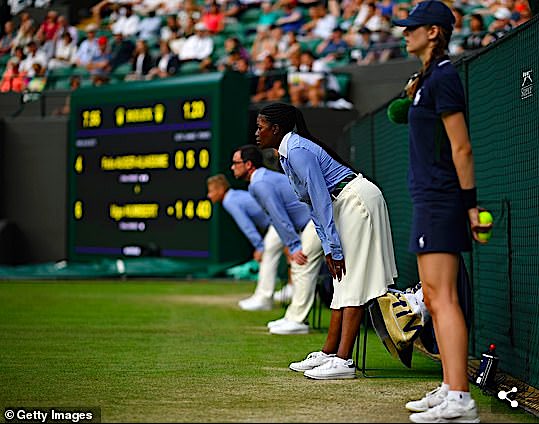
So, the drama of Wimbledon again (“Phew what a scorcher”)!

This year the tournament, like most of the other majors, has replaced line judges with electronic line-calling. As I wonder on what planet some demented sartorial arbiter might consider the former judges “best-dressed“, the courts are now depleted of what to one friend seemed like gatecrashers.

While this largely deprives the players of the frisson of dissent, and the melodrama of audience oohs and aahs as the Hawkeye screen zoomed in to assess a challenge, the new system does seem to be widely accepted. Still, as one comment reflected on the Guardian live feed:

Something felt off, and I couldn’t put my finger on it until you just reminded me about the absence of the line judges. Not only does the court look empty, but I’m surprised to find I also miss their shouts and shrieks, like a supply teacher trying to assert authority. This feels like a minor tournament without them, and it’ll take some getting used to.

See also this article. Since I wrote this, a succession of comments has appeared lamenting the change.

You can find plenty of intriguing posts on tennis under my Sporting medley.

The rise and fall of the semicolon

Source.

Hold the front page:

Marked decline in semicolons in English books,
study suggests

To complement the Oxford comma, more fodder for punctuation nerds in Amelia Hill’s entertaining recent Guardian article—complete with quiz.

The first use of the semicolon has been attributed to the Italian scholar and printer Aldus Pius Manutius the Elder in 1494. Abraham Lincoln observed, “I have a great respect for the semicolon; it’s a very useful little chap” (hmm). Virginia Woolf used it over 1,000 times in Mrs Dalloway. Cormac McCarthy included 42 semicolons in his first book, The orchard keeper—but then just one across his next nine novels (and what might we deduce from that, I wonder?!). 

Kurt Vonnegut disapproved of it, averaging fewer than 30 a novel, about one every 10 pages. Salman Rushdie, John Updike, and Donna Tartt each used an average of 300 semicolons for 100,000 words. As if other negative reviews of the Fifty shades trilogy weren’t enough, “E.L. James was criticised for repeatedly using commas inaccurately instead of semicolons”.

Perhaps someone can square these two comments for me:

“Semicolon use in English rose by 388% between 1800 and 2006, before falling by 45% over the next 11 years. In 2017, however, it started a gradual recovery, with a 27% rise by 2022.”

“The semicolon seems to be in terminal decline, with its usage in English books plummeting by almost half in two decades—from one appearing in every 205 words in 2000 to one use in every 390 words today.”

For more, see e.g. here. Now I think we should go the whole hog and sing the praises of the colon too.

Much of the pleasure in reading an article like this lies in marvelling at the projects with which academics manage to fill their time. But there’s no limit to the topics for which statistics can be enlisted—I think of Grootaers’ fieldwork survey documenting the declining numbers of temples in north China villages through the Republican era, and the deities to whom they were devoted.

The language of the novel was effectively dramatised by Monty Python:

For some German punctuation, see The idiot’s apostrophe.

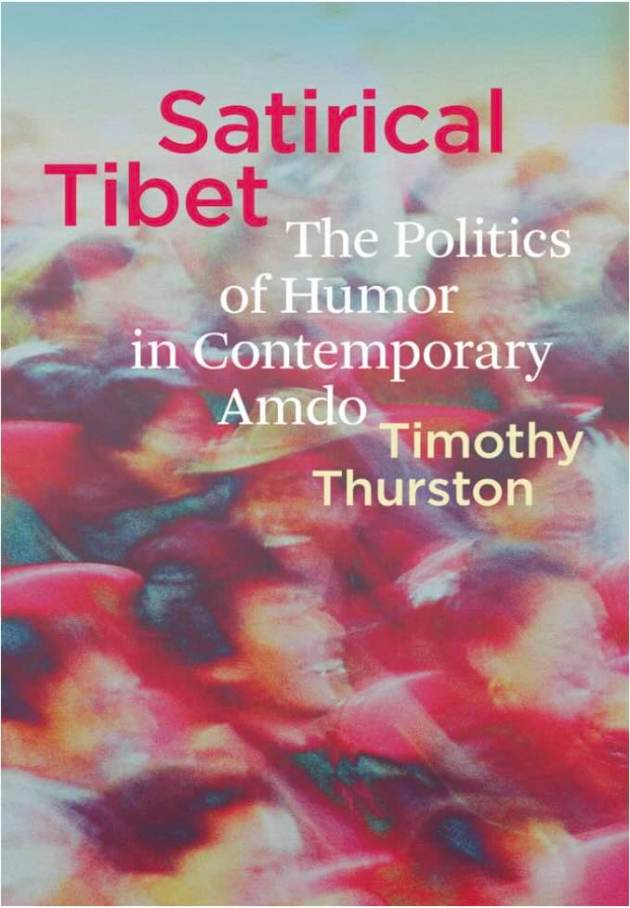
Satirical Tibet

*Furthering my education in the travails of modern Tibet*

Within the Tibetan cultural world, research on the Amdo region (see e.g. here) has become a remarkably dynamic field of scholarship. A fine recent instance is

  • Timothy Thurston, Satirical Tibet; the politics of humor in contemporary Amdo (2024; open access here), in the University of Washington Press series Studies on ethnic groups in China. Here’s the publisher’s blurb:

Humour has long been a vital, if under-recognised, component of Tibetan life. In recent years, alongside well-publicised struggles for religious freedom and cultural preservation, comedians, hip-hop artists, and other creatives have used zurza, the Tibetan art of satire, to render meaningful social and political critique under the ever-present eye of the Chinese state. Timothy Thurston’s Satirical Tibet offers the first-ever look at this powerful tool of misdirection and inversion. Focusing on the region of Amdo, Thurston introduces the vibrant and technologically innovative comedy scene that took shape following the death of Mao Zedong and the rise of ethnic revival policies. He moves decade by decade to show how artists have folded zurza into stage performances, radio broadcasts, televised sketch comedies, and hip-hop lyrics to criticise injustices, steer popular attitudes, and encourage the survival of Tibetan culture.

Surprising and vivid, Satirical Tibet shows how the ever-changing uses and meanings of a time-honored art form allow Tibetans to shape their society while navigating tightly controlled media channels.

As Stevan Harrell, editor of the series, observes in his Foreword:

Because Tibetans are an oppressed people, we can easily assume that there is little joy or laughter in their lives, and that we should approach their predicament with uniform solemnity. This is wrong. Tibetans deal with the tragedy of Communist oppression as they have dealt with the vicissitudes of life on Earth for centuries—not only with “quiet desperation” or extreme religious devotion but also with uproarious comedy and biting satire.

Whereas some studies of Tibetan folk traditions sadly circumvent sensitive issues (e.g. Shépa: The Tibetan oral tradition in Choné), Thurston engages fully with modern Amdo society, illustrating periods since the reform era of the 1980s through changing popular media. As he notes, such satirical sketches (for which he uses the nuanced term zurza) always have a serious purpose, exploring a social problem of some sort: they convey important messages about contemporary Tibetan life, shaping attitudes towards issues such as language, culture, urbanisation, education, territory disputes—and the popular topic of fake lamas. Such sketches may be subversive, but they are not “underground”: though inevitably accommodating to the institutions of the Chinese state, a large part of their efficacity lies in the very fact that they can be aired in the public domain.

Thurston’s extensive quotes from the various genres are instructive, even if their broad appeal to Amdowa people is hard to convey in English. Though the book lacks images, for this post he has kindly suggested some illustrative YouTube clips, embedded below. The extensive final References are useful.

The Introduction, “Doing zurza”, provides useful context.

Zurza and the laughter that frequently accompanies it are hardly the first things most people think about when they hear the words China and Tibet in the same sentence. And why should they be? Many in the Euro-American “West” may hear the word Tibet and think of a traditionally Buddhist society, perhaps oppressed by a colonising Chinese Communist Party. The same people may think of recent news reporting about Tibetans self-immolating, and Tibet’s Nobel Prize-winning exiled religious leader. For many who have grown up in China, meanwhile, images may range from a feudal society liberated by and incorporated into the People’s Republic in the 1950s, to news spots showing Tibetans dancing happily in displays of gratitude to the Communist Party for the “gift” of modernity, to a pristine environment for young Han to conquer as they escape from China’s heavily polluted coastal metropolises. These descriptions, all carrying elements of truth, select some of the most contrasting images possible to make a rhetorical point. But the discourses of modernity and progress, and of traumatic experience and dramatic resistance, all emphasise grand narratives that leave little room for zurza.

Set against the background of these ongoing and well-publicised cultural and political tensions, a book about a topic as seemingly trivial as zurza and humour can come across as being in poor taste. And yet, laughter has served as the soundtrack to almost every one of my experiences of Tibet. This also manifests in everyday life. During dinners among friends, the seemingly endless toasting with liquor—almost always three cups at a time—often lowered inhibitions to the point at which teasing and reminiscing might devolve into uncontrolled hilarity. At traditional weddings, women from the host village may use humour and wit to demand some sort of payment or gift from the visiting representatives of the person marrying into the village (usually the maternal uncles of the bride). In the valley of Rebgong, interludes in the annual harvest festival featuring inebriated villagers—sometimes cross-dressing or wearing monks’ robes—may make fun of the behaviour of certain members of the community, to the applause and laughter of all in attendance. Tibetan communities possess a diverse vocabulary for humorous activity that mirrors the diversity of ways that laughter appears in everyday life, including kure (joking), labjyagpa (boasting), tséwa (play), and zurza. This humour frequently accomplished important social work: to entertain, mask existential pain, serve hegemonic forces, speak the otherwise unspeakable, provide a “steam-valve” for social discontent, and/or to project and reflect worldviews. […]

When famed trickster Uncle Tonpa tricks a landlord or merchant, or makes a king bark like a dog, he “does zurza.” When the seventeenth-century lama Shar Kalden Jyamtso (1607–1677) composed songs poking fun at the behaviour of monks, he was also “doing zurza.” And when a contemporary comedian mocks people whose behaviour seems out of touch in the contemporary moment, they too do zurza.

In Chapter 1, “Dokwa: ‘eating the sides’ in oral and literary traditions”, Thurston notes:

Amdo boasts an incredible array of oral and festival traditions. Just focusing on the oral ones, Tibetans in Amdo are known to perform a variety of secular and religious verbal arts, including but not limited to tamhwé (proverbs), tamshel (speeches), khel (riddles), laye (love songs), and lushag (antiphonal song duels). These sit alongside a much broader array of oral and festival practices from across the Tibetan cultural world [see e.g. under Bhutan].

He also adduces the satirical street songs of Lhasa from before the Chinese invasion (Goldstein 1982), and satirical elements in Tibetan opera, as well as in other cultures.

Not limited to the oral tradition, Tibetan poets and authors like the renowned early-20th-century polymath Gendun Chopel also traditionally used zurza in satirical poems to criticise the behaviour of others, including powerful monks. […]

Even in the most difficult moments of the Maoist and post-Mao reform eras—periods when the Tibetan language and portrayals of Tibetan traditions in media faced tight restrictions—zurza served as one valuable tool for authors, folktale collectors, and others to be seen and heard.

Chapter 2, “Khashag: language, print, and ethnic pride in the 1980s”, introduces the scripted, staged performances of khashag “crosstalk” dialogues after the end of tjhe Cultural Revolution (reminiscent of the Chinese art of xiangsheng), which satirised the politics of language and ethnicity in the emerging post-Mao order. In Chapter 3, “Khashag on air: solving social ills by radio in the 1990s”, Thurston gives detailed, astute comments on the “Careful Village” sketches of Menla Jyab, who shared “complex critiques about Tibetan engagement with modernity”.

Whereas comic dialogues had hitherto been disseminated mainly via radio broadcasts and audio cassettes, Chapter 4, “Garchung: televised sketches and a cultural turn in the 2000s”, explores the new style of garchung that extended from state TV stations to VCDs and the internet. Audiences could now see as well as hear the performers, requiring more preparation and better acting. In style and themes, these sketches continued to reflect the rapidly changing conditions in Amdo, such as (in Harrell’s words) “the increasingly precarious state of Tibetan culture, with many barbs directed at both Chinese and foreigners who began to view Tibet as a source of religious and ecological inspiration, often aided by Tibetans eager to benefit from their national and cosmopolitan connections.” The main exhibit here is “Gesar’s Horse Herder”:

With zurza providing one device in reappropriating state discourse, the chapter also addresses the Intangible Cultural Heritage system (note Isabelle Henrion-Dourcy’s perceptive article).

In the wake of the repression following the 2008 Beijing Olympics, Chapter 5 explores “Zheematam: Tibetan hip-hop in the digital world”. The emerging cultural nationalism of the previous decade now “moves online, intensifies, and becomes more frustrated. With this change, new forms of satirical cultural production emerge to articulate this critique digitally.” This new genre provided

a new generation of artists with opportunities to rework oral traditions and emerging cultural practices—in conjunction with modern concerns about linguistic and cultural loss—into new and emerging art forms. In doing so, their work builds on the trends of previous generations and articulates a new set of concerns, all during a period of increasing restrictions in Tibet’s cultural sphere.

Thurston contrasts the styles of Uncle Buddhist, such as his 2019 song City Tibetan:

and Jason J, such as Alalamo:

In such work,

artists still say they are “doing zurza,” but it ceases to be as humorous or playful. Instead, it uses indirection to articulate an (at times) almost angry cultural nationalism directed both at the current conditions of Tibetan life and of the intellectual foundations of Tibetan modernism. The example of Jason J, however, demonstrates that this inversion and indirection also ensures that zurza provides a resource of constant revision and renewal of Tibetan culture in the face of increasing political and economic headwinds.

In his Conclusion, “The irrepressible trickster”, Thurston reflects saliently:

I left Amdo in 2015, returning for short trips each year prior to 2019. Since leaving, I often struggled to describe to people outside of China—including but not limited to academics, activists, and members of the exile community—the very complex calculus of internal motivations, social pressures, and external incentives that seemed to shape the decision-making processes of the Tibetans I met. At conferences, workshops, and in casual conversations, my descriptions were frequently met with some variation of the response: “They’re brainwashed” or “They have no choice”. Others reflexively seemed to blame every problem on “the Chinese.” I cannot accept these assumptions—at least not when formulated in this way.

Tibetans in the People’s Republic undoubtedly live in and navigate a highly constrained environment, in which they must carefully monitor what they say and do (and, as I have shown in this book, how they say and do them). But ignoring the creative ways that Tibetans have maintained and even revolutionised their culture—both from within the state system and in resistance to it—denies them agency and treats them only as victims. I have shown how zurza—the Tibetan arts of indirection, sarcasm, and satire—provided cultural producers with a powerful way of actively localising new expressive resources, accessing state media to do this work, and ensuring Tibetan physical and cultural presence in some of the harshest of times. Across decades and media, the texts examined in this book record some of the ways that Tibetans have used zurza to foreground issues seen as particularly pressing for their communities in spite of the tremendously asymmetric power of the Chinese state.

Such ethnographic research on the embattled resilience of Tibetan culture within the PRC evinces an impressive maturity in Amdo studies, belying the simplistic polarised propaganda of both Party apologists and the exile community.

See also rubrics under Isabelle Henrion-Dourcy’s bibliography on the Tibetan performing arts, including the work of Anna Morcom. Cf. Tibetan jokes, and Tibetan clichés.

More Anatolian fusion

Derya Yıldırım.
Image: Steve Galli/Shutterstock. Source.

In the random way that is typical of my exposure to popular culture altogether, I came across

  • Derya Yıldırım and Grup Şimşek,

“blending Anatolian melodies with modern psychedelic flair” (see here, and on YouTube, listen here and here).

Born in Hamburg to Turkish parents, Derya Yıldırım (here, and Guardian) grew up immersed both in the diversity of Hamburg and in her family’s Anatolian roots, learning the bağlama. In 2014 she formed Grup Şimşek with international musicians.

Kar Yağar (featured on their 2019 album):

Gurbet:

Davet (to text by Nazim Hikmet):

For fans of additive metre, here’s 3 2 2 3:

Among Derya Yıldırım’s inspirations are traditional bards like Neşet Ertaş and Aşık Mahzuni Şerif. After Dost 1, Dost 2 includes a version of Şerif’s Darıldım darıldım:

From their new album Yarın Yoksa, here’s Hop bico:

And Ceylan, a far cry from Neşet Ertaş’s free-tempo original:

From my series on Turkish culture, see also e.g. Anatolian bards rock, New sounds from Anatolia, and Aynur; Love, Deutschmarks and death, and even Jazz in Turkey. While I merely dabble, it’s heartening to find glimpses of the vitality of musical cultures around the world.

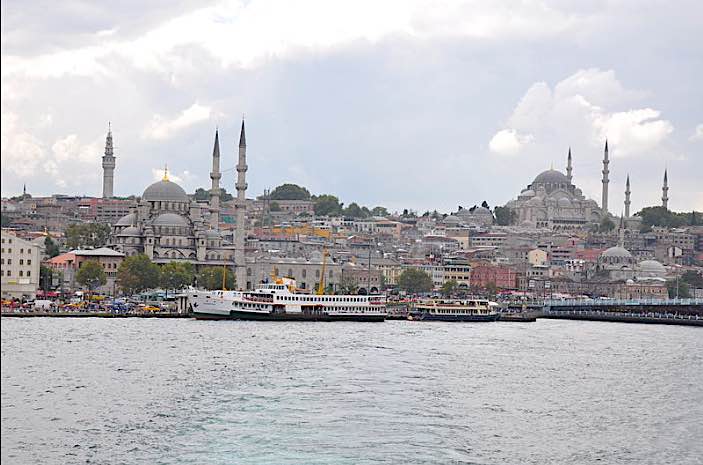
Posted from Istanbul, after a trip to the Princes’ Islands

Learning the gong

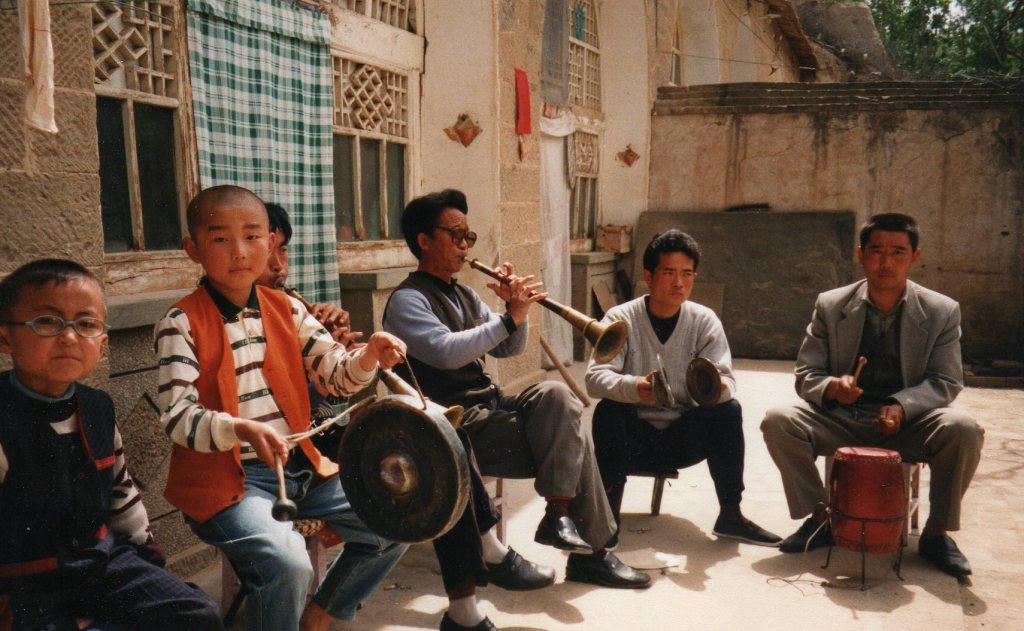
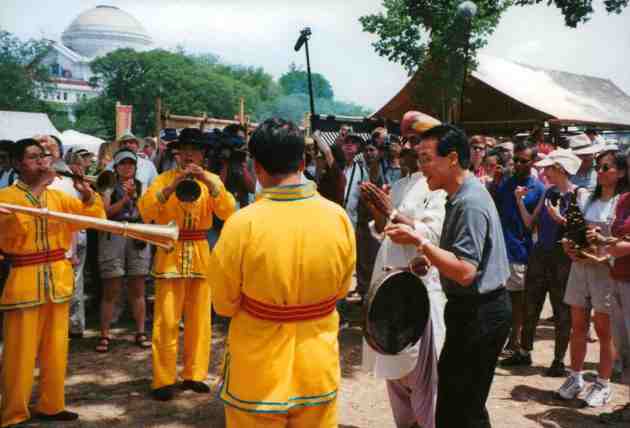
As I ponder this disturbing image of the Haunted Pencil, as a solo effort he shouldn’t find it too challenging, but it calls to mind (OK, my mind) the learning process in Chinese folk ensembles.

Left, Li Qishan’s band, Shaanbei.
Right, I accompany the Hua family band, funeral.
Both images 2001.

Youngsters in a family shawm band begin with the gong, which merely marks the first beat of every bar as the tempo accelerates. This seems simple enough, but as the illustrious Yoyo Ma discovered at the 2002 Silk Road Festival in Washington DC, the novice still needs to acclimatise to the bewildering rhythmic patterns of drum and shawm, which subvert the regular duple metre:

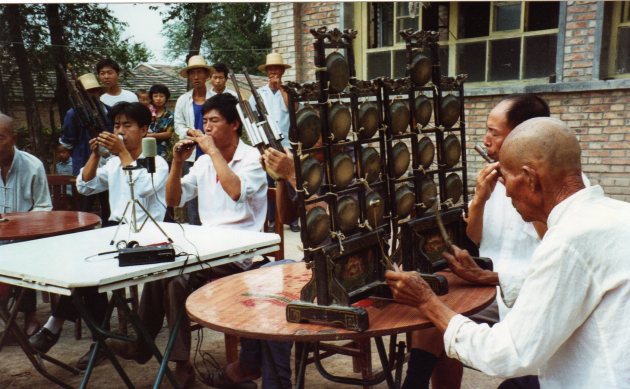
Only somewhat harder to learn is the yunluo, a frame of ten pitched gongs that makes an exquisite part of the shengguan ensemble in ritual groups of north China. While it does involve learning the outline of the melody, it’s still considered the easiest instrument to learn—as a proverb in Hebei goes, “A thousand days for the guanzi, a hundred days for the sheng; you can learn the yunluo by the fifth watch”.

Gaoqiao village ritual association, Bazhou, Hebei 1993;
one player on two frames of yunluo.

Further afield, fatuous Tory toffs like the former Minister for the 18th Century are just as unlikely to apply to join a gamelan ensemble. Cf. Batman’s mum calling him to supper.

The Zen of football

It’s taken me a while to catch up on the role of Zen in football—and when I did, it took the unlikely form of of witnessing it used as a rebuke.

Last weekend, wunderkind Myles Lewis-Skelly * celebrated scoring Arsenal’s brilliant third goal against Man City by adopting a pose which mimicked that associated with Erling Haaland, underlining City’s discomfort. It turns out that meditation has become a niche avenue to footballing success, adopted by players such as Mo Salah, Raheem Sterling, and Anthony Gordon (see e.g. here). Still, I’m not holding my breath for a time when this converts footballers to regarding referees as Daoist sages, meekly accepting their decisions—as in rugby.

David Squires sums up the karmic action in cartoon form here. For more detached applications of Eastern Wisdom, see Daoism and standup, Sprezzatura and wuwei, and in sport, A god retires. Cf. Daoist non-action. See also under A sporting medley, including Philosophers’ football.


* In My Day, such a name would have been more likely attached to a mustachioed colonial brigadier…

Some Bosphorus ferry piers

Among the myriad delights of Istanbul are the iskele piers serving vapur ferries. The smaller iskeles along the Bosphorus are especially charming, like Beylerbeyi:


Most vapur have cafés on board, but some iskeles also have cafés and even libraries—like those at Karaköy and Beşiktaş, a welcome refuge from the surrounding bustle:


The Kadikoy iskele is charming, but most picturesque is at Moda:


Even the Kuzguncuk iskele (from where the Greek bishop throws a cross into the Bosphorus to be retrieved at Epiphany!), despite its sparse ferry schedule, has a popular cafe and library:


Here’s the Paşabahçe iskele in 1910:


Many of these piers date back to the mid-19th century, and have been regularly modified, but the addition of cafés and libraries is part of recent initiatives—the Moda iskele, for instance, had so few passengers that it was closed from 1986, reopening in 2001 and revamped since 2022.

Ara Güler’s classic photos of the vapur and life on the Bosphorus are evocative, like this image from 1956:


For more on Istanbul (including Kuzguncuk), see under West/Central Asia.

More vocab for the dentist’s

For some handy expressions at the dentist, to follow my post on Gallipoli and Ljubljana, idly consulting the relevant section of my Turkish phrasebook, my imagination is captured by the expression

Bitmedi, tekrar gelmelisiniz
Come back, I haven’t finished!

This reminds me of Nigel Barley’s comment on his first fieldtrip to Cameroon (The innocent anthropologist, p.109–10), as he emerges bloodied after having his two front teeth pulled out with pliers:

I had fallen into the obvious trap that anyone in a dental surgery, wearing a white coat and prepared to extract teeth, was a dentist.

Cf. David Sedaris, “When you are engulfed in flames”. Also under Language learning: a roundup, note especially That is the snake that bit my foot.

Fish n chips

Fish n chipsSource.

An intriguing letter from Rob Wills in the LRB (26th December 2024):

Bill Lancaster mentions his friend John Walton’s search for the first fish and chip shop in England and that he discovered a likely candidate in the East End (Letters, 24 October). This location is supported by The Epicure’s Almanack, Ralph Rylance’s comprehensive guide to eating and drinking in London, published in 1815. Reporting on Shoreditch, Rylance noted: ‘Here are Israelitish butchers, fishmongers and cooks. The latter exhibit in their windows fish fried, or rather, perhaps, boiled in oil until they look brown and savoury.’ The book’s modern editor, Janet Ing Freeman, adds that the food ‘may have been some version of the battered fish fried in olive oil popular among Sephardic Jews, often named as an ancestor of today’s fish and chips’. As for the chips, the earliest mention in English is in William Kitchiner’s cookbook The Cook’s Oracle (1817), though Belgium and France remain locked in furious dispute as to who actually invented them.

The two components seem to have become a winning combo by the 1860s. By 1910 there were 25,000 fish-and-chip shops in the UK. For more, see e.g. here, here, and here. Cf. the first curry house in London (1810, under Bloody foreigners), and the ancestry of pizza, under You say tomato.

Fish and chips wrapped in newspaper (probably not the LRB) is one of the classic tropes of Binmenism. I note with pleasure that transliterated into Turkish, chips would come out as cips, and fish as fiş (actually representing the French fiche!)—cf. şef, chef or conductor.

***Roundup for 2024!!!***

film title

At this time of year I like to rearrange the deckchairs on the Titanic by organising some of my more notable posts from the past year under particular themes. As ever, many belong under multiple tags, so below I make some whimsical choices.

Keeping company with my film on the Li family Daoists, most important is my *new film* on the 1995 New Year’s rituals in Gaoluo (Chinese review here). It also prompted me to devise a new Menu, and even a YouTube channel (with playlists reflecting my diverse tastes as well as my own films). For now I still resign myself to Twitter, but I’m posting on BlueSky too, so let’s all migrate there!

China:

Chu Chien-ch'eng

Finnegan cover

cruz

You can find any posts I’ve neglected in the monthly Archive as you scroll waaay down in the sidebar. All this suggests that it would be a sensible New Year’s resolution for me to burden you with fewer of these ramblings—but first I plan a major series inspired by the Gaoluo film

Another fine riposte

desert
Source.

Complementing a riposte from a Navajo speaker, as well as the fine Erich Leinsdorf story:

After a trip to LA, a renowned English cricketer hires a car. Speeding happily along a straight, endless, empty road through the Nevada desert, he is flagged down by two bored traffic cops parked idly at the roadside. One walks over to him and drawls,

“We bin waiting for yew all day, bud!”

Unruffled, he responds affably:

“Well, I got here as fast as I could, officer!”

Jazz Club on the Fast Show

*A lighter note in my jazz series!*

Fast show jazz

The affectionate “Jazz Club” spoofs from The fast show are collected here:

A regular item over six years in the 90s, the series (scripted by Charlie Higson) is recalled in a 2016 article by presenter John Thomson—a genuine jazz aficionado and drummer. Alongside the smugly cool persona of the jazz pundit, the earnest critical vocabulary, the TV set, the language of jazz filming, and the well-observed costumes (“Buddy Rich rocked the polo-neck look”), the musical parodies are impressive—

not that we ever had any trouble getting musicians to appear. In my experience, musicians have a much better sense of humour than many comedians. We’d use session musicians who were all incredibly good—they had to be, because some of the music Phil Pope wrote for the sketches was really tough.

They’re augmented by other Fast show regulars, like Paul Whitehouse (on fiddle at 5.49, channelling Nigel Kennedy!), and the homage to John Cage that follows.

In his article Thomson praises Stanley Clarke’s album School days, and he offers a playlist, based on jazz funk.

In vino veritas, or rather Imitation is the Sincerest Form of Flattery. For more irreverence, see my spoof on Indian raga, and this story about the Matthew Passion (with a bonus of Always look on the bright side of life). For musos’ humour, click here.

Images of Zen

The wondrous truth of the Buddhas is not concerned with writings

諸佛妙理,非關文字

—Huineng

The Western vogue for Zen was already well established when I sought to learn about it in my teens (see here). Alongside the surveys of Christmas Humphreys, Alan Watts, and classics by Eugen Herrigel and R.H. Blyth, I read the works of D.T. Suzuki with an enthusiasm that I now learn was misguided. [1] But as scholarship expanded vastly, I was discovering other fields to plough, drawn towards the ethnography of folk religion in China. Lately I’ve been wondering why the two most popular Western images of Zen are so elusive in China—the koan encounter dialogues and zazen seated meditation. So I’ve resorted to the useful wiki series on Chan and Zen (see also Zen narratives, Koan, and Zazen; cf. the Stanford Encyclopaedia of Philosophy).

Research on religion (both its early textual history and its current state) is clearly quite different from “doing religion”. For historians and ethnographers, participant observation is optional; and practitioners of religion need not be versed in scholarly literature. Indeed, writing about anything is different from doing it—music, for example. I’m not exactly arguing with the concept of academia—even I am not quite so fatuous. But Chinese Chan and Japanese Zen make particularly stimulating examples of the contrast.

* * *

Early Chan patriarchs stressed a “separate transmission outside the scriptures, not relying on words and letters” (cf. early Daoist writings such as Laozi, “The way you can follow is not the eternal way; The name you can name is not the eternal name”). However, quite remote from our modern iconoclastic image of Zen, the doctrinal history of Chan is remarkably verbose and discursive. [2] This contradiction is itself the subject of much verbal analysis!

The modern Western fantasy of Zen is based on the numinous reputation of the Tang dynasty. Much of the evidence for the early history of Chan is based on the transmission texts, sermons, and doctrinal writings of leading patriarchs such as Bodhidharma, Shenxiu, and Huineng—received images of whom are based on their portrayal by Song-dynasty writers. As Mario Poceski observes (Ordinary Mind as the Way: The Hongzhou school and the growth of Chan Buddhism, 2007),

The connection with the glories of the bygone Tang era bestowed a sense of sanctity and was a potent tool for legitimising the Chan school in the religious world of Song China.

From such sources, gong’an/koan “encounter dialogues” and commentaries emerged. The early masters were prolific writers, even if some recognised the dangers: in the 12th century, Dahui Zonggao “is even said to have burned the woodblocks of the Blue cliff record, for the hindrance it had become to study of Chan by his students”. One revealing theme is the many cogent criticisms of the koan system, both within Chan and by modern scholars. Poceski again:

Although Zen is often portrayed as promoting spontaneity and freedom, encounter-dialogue exegesis actually points in the opposite direction, namely towards a tradition bound by established parameters of orthodoxy

—the masters’ exegeses reinforcing their status and authority, and impressing their literati patrons.

Popular image notwithstanding, I deduce that beyond those monks and patrons, penetrating the gnomic aphorisms of the Tang and Song masters has played only a minor role in temple routine. Conversely, Chan Buddhists have always esteemed the Mahāyāna scriptures: even in the Tang, the Laṅkāvatāra Sūtra and Diamond Sūtra were considered important texts. 

Among Western scholars, Bernard Faure has an informed view of the broader picture (see e.g. Chan insights and oversights: an epistemological critique of the Chan tradition, 1993). In his Introduction to Chan Buddhism in ritual context (2003) he gives a useful survey of the field.

Chan/Zen studies are, on the whole, divided between textual/ philological and historical approaches on the one hand, and hermeneutical and philosophical approaches on the other. […] We are still lacking works considering Chan and Zen as complex cultural systems and trying to place them in situ

—this more anthropological approach “in reaction against the spiritualist tendency of traditional historiography and against historicist reductionism”. In the same volume, Wendi Adamek notes:

In the eighth century, Chan masters were no longer simply meditation masters and they had not yet become Zen masters, those enigmatic eccentrics who have made their mark in contemporary popular culture.

The modern visitor to Chinese temples may be perplexed by the apparent absence of the “Zen spirit” there. [3] But, far from some recent dilution, ever since the early history of Buddhism in China, Buddhists have put varying emphases on three types of training inherited from India: vinaya, the rules of discipline; dhyāna, meditation; and dharma, mastery of the Buddhist texts. Wiki cites McRae:

Chan was not nearly as separate from these other types of Buddhist activities as one might think […] The monasteries of which Chan monks became abbots were comprehensive institutions, “public monasteries” that supported various types of Buddhist activities other than Chan-style meditation. […] There was never any such thing as an institutionally separate Chan “school” at any time in Chinese Buddhist history. 

Thus as Chan was integrated with other schools (notably Pure Land, Huayan, and Tiantai), while leading masters continued to write abstruse treatises, temple life revolved around the discipline of institutionalised religion. Once we grasp all this, the apparent conflict between early and later history becomes less incongruous.

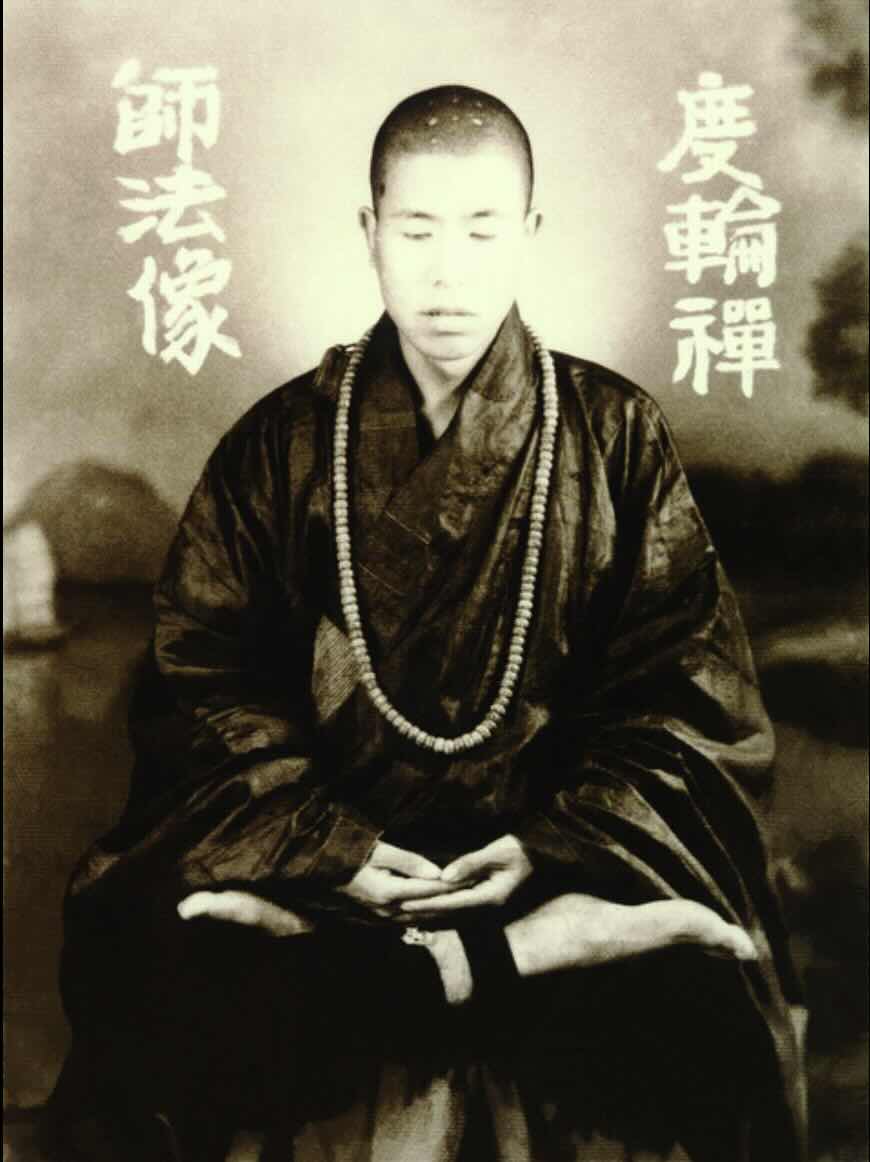
Xuan Hua
Xuan Hua meditating, Hong Kong 1953. Source: wiki.

Modern reformist Buddhist movements are the subject of much research. Chan is at the core of the teachings of renowned masters in the PRC, Taiwan, and the USA—who are no less generous with words than their medieval antecedents, like Western pundits such as Gary Snyder and Alan Watts (cf. Krishnamurti, and Paths for the reluctant guru).

* * *

Besides the wealth of hermeneutical studies of Buddhism, one finds scant ethnographic material for normative practice—the daily lives of ordinary temple monks (whether today, in the Ming, or in the Tang). For the late imperial era, fiction may provide a useful source (cf. Ritual in the Dream of the Red Chamber).

A basic acquaintance with temple life in modern Chinese society provides the important perspective of physical diversity—from the grand, prestigious temples of cities and mountains, to medium temples with a modest staff, to small village temples with only a caretaker. Children were often given to small local temples as a means of survival; piety on the part of the parents might play a role, but spiritual concerns were often remote.

I’ll end with some impressionistic instances of usage where the term chan may mislead.

Just as chansi 禪寺 refers generally to a Buddhist temple, other uses of the term chan often stand broadly for Buddhism—as in the interdenominational liturgical compilation Chanmen risong 禪門日誦. As Faure observes, ritual has long played a major part in Chan, although he doesn’t seem to address the particulars of liturgical practice (for folk Buddhist ritual, see here).

ChanSource.

In Japan, zazen seems to be an intrinsic part of temple life; at outward-looking temples in China and abroad there has been something of a recent boom for meditation classes for laypeople (e.g. here), in response to demand. Chan meditation wasn’t limited to Chan temples, but I wonder how widely it is (and was) practised in local temples.

In temples the term chan is common in chanfang 禪房 or chantang  禪堂, which rather than “meditation room” is now just a common room or assembly room (for basic depictions, see e.g. here, and here). The term chanfang may even stand for the temple itself; found in sources from Li Bai to The Dream of the red chamber, it’s still in common parlance.

At the back of my mind in composing this post was the rough diagram that Li Manshan drew for me of the former Temple of the God Palace (Fodian miao 佛殿廟) in his home village (see Daoist priests of the Li family, pp.47–8, and our film, from 8.35), including a chanfang. Though the temple was quite imposing by the standards of a poor village, its 1876 stele lists only two monks. In many smaller temples, neither formal meditation nor scripture study are necessarily part of the schedule; the daily routine may consist largely of tasks such as sweeping the courtyard, preparing food, and maintenance. Whether or not monks regard such mundane chores as part of their Chan/Zen cultivation, in our times the idea of Zen as pervading worldly activities, from tennis to conducting, has become popular.

Meanwhile for academics, the study of Chan and Zen becomes a career, full of lectures, conferences, bibliographies; practitioners may find such erudite academic discourse alien from their own quest. And I’m just as guilty, adding yet more words on one of the most verbose sites ever. Having grown up with the romantic early image of Chan and Zen, I’m now impressed by all the scholarship unpacking its later doctrinal history. But just to reiterate my glib point, it goes without saying (sic) that historical research is very different from the quest for spiritual enlightenment, and daily temple routine is something else again—illustrating again how our image of the Wisdom of the Mystic East diverges from practice on the ground. 

These are some of the issues that I haven’t yet found addressed in the extensive literature. Last word to Alan Watts:

If you are hung on Zen, there’s no need to pretend that you are not. If you really want to spend some years in a Japanese monastery, there is no earthly reason why you shouldn’t. Or if you want to spend your time hopping freight cars and digging Charlie Parker, it’s a free country.


[1] The cogent early criticisms of Suzuki by Hu Shih have been reinforced by David McMahan and John McRae; Bernard Faure describes Suzuki’s writings as “pious verbiage” (for more, see Chapter 2, “The rise of Zen Orientalism” of his Chan insights and oversights). While Alan Watts goes easy on Suzuki, I’m always impressed by his 1959 pamphlet Beat Zen Square Zen and Zen.

[2] I was drawn to this theme by a recent article in Sino-Platonic Papers (no.353!), Ming Sun, “Speaking what cannot be spoken: poetry as a solution to the ineffability in Chan rhetoric”. More generally, Adam Yuet Chau critiques the dominance of the “discursive mode” in “doing religion”.

Sun’s article also led me to “beating and shouting” (banghe 棒喝), practiced from the Tang by Mazu’s Hongzhou school, which

developed “shock techniques such as shouting, beating, and using irrational retorts to startle their students into realisation”. Some of these are common today, while others are found mostly in anecdotes. It is common in many Chan traditions today for Chan teachers to have a stick with them during formal ceremonies which is a symbol of authority and which can be also used to strike on the table during a talk.
These shock techniques became part of the traditional and still popular image of Chan masters displaying irrational and strange behaviour to aid their students.

“Beating and shouting” was revived from the late Ming by Miyun Yuanwu (see e.g. Jiang Wu, Enlightenment in dispute: the reinvention of Chan Buddhism in seventeenth-century China (2008, reviewed here). I’m not familiar with the practice in modern Chinese temples (though it is introduced e.g. on Xing Yun’s site, along with copious commentaries), but it sounds somewhat akin to the enduring practice of ritualised debate in Tibetan monasteries (see under Daoism and standup).

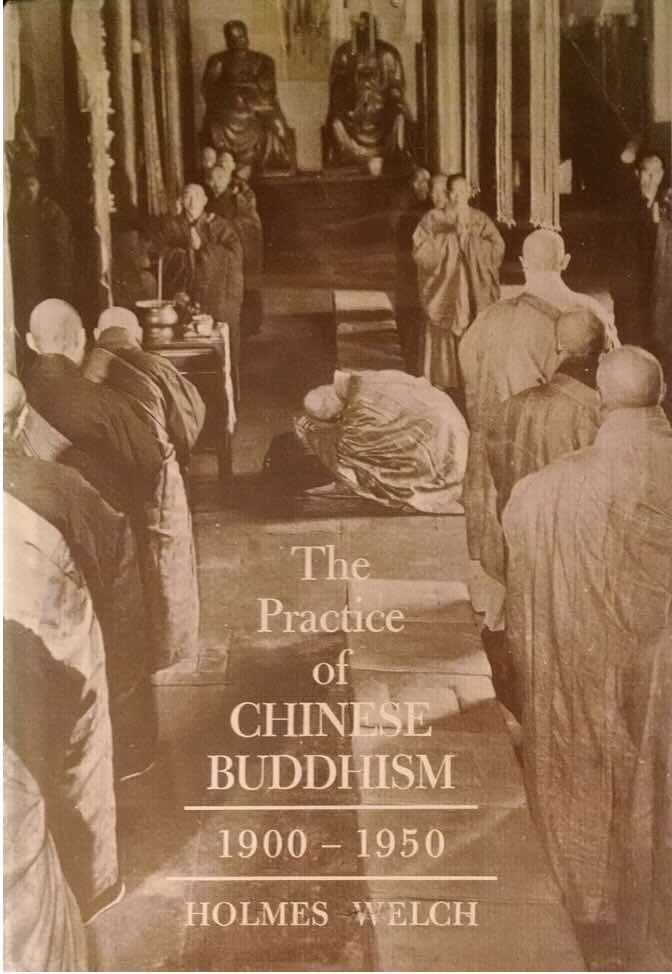
Welch cover[3] For the practice of Buddhism in modern China, note the trilogy of Holmes Welch. At a tangent is Bill Porter’s quest for the spiritual life of modern clerics and hermits.

Here I won’t extend my remit to Daoist meditation techniques, the wealth of scholarship on which is again introduced on wiki. Of course, the regulated life of Daoist temple priests also stands in contrast to the writings of early Daoist sages popular in the West.

The idiot’s apostrophe

apostrophe

A relaxation of official rules around the correct use of apostrophes in German has not only irritated grammar sticklers but triggered existential fears around the pervasive influence of English.

More fodder for punctuation nerds: I’m intrigued to learn from a recent Guardian article that the Council for German Orthography (YAY!) has made a concession to a growing trend.

For establishments that feature their owners’ names, German does not traditionally use apostrophes to indicate the genitive (Barbaras Rhabarberbar!); but signs  like “Rosi’s Bar” or “Kati’s Kiosk” have become common. Popularly known as Deppenapostroph (idiot’s apostrophe”), this is

not to be confused with the English greengrocer’s apostrophe, when an apostrophe before an ‘s’ is mistakenly used to form the plural of a noun (“a kilo of potato’s”).

—my own favourite being OBO’S for aubergines.

The article points out that the trend isn’t necessarily a mere kowtow to the encroachment of English: the Council has long approved the apostrophe for the sake of clarity, such as “Andrea’s Bar” to make clear that the owner is called Andrea and not Andreas. But it has sparked a pedants’ revolt [possibly pedant’s revolt? Generic singular à la greengrocer’s apostrophe and idiot’s apostrophe? Aargh], bemoaning the “victory march of English”.

Cf. The rise and fall of the semicolon.

The life of Jesus

Dud and Pete Jesus

Further to Jesus jokes (and sequel), here’s a Dud n’ Pete sketch from 1971:

Dud and Pete had already attempted to air the theme in 1964 with The Dead Sea tapes, never broadcast for fears of infringing blasphemy laws. Less stimulating for a modern audience used to such irreverence, the filmed sketch perhaps needs to be regarded with historical ears and eyes. Not quite as polished as one might wish, it could do with some pruning, but the concept is stimulating—

“me and the lads were abiding in the fields…”, “getting a bit muddled up with his Ye’s”, “the worst bit of swaddling and wrapping I’ve ever seen in my life”, the perplexing gifts of the Three Wise Men, Jesus’s landlady, and (as immigration was becoming a hot topic) an early debunking of Jerusalem.

Such tropes were later immortalised in The life of Brian—a kind of, um, Bible for independent thinking, vignettes from which I’ve managed to cite in posts on Confucius, Krishnamurti, Alevi and Daoist ritual, Bach, and Cultural Revolution jokes.

Dud and Pete’s fantasy was part of the post-war satirising of conformist orthodoxy led by the Beyond the fringe team—Alan Bennett having a particular Anglican bone to chew (e.g. Sermon, Season’s greetings, and WWJD).

Ability and potential

Ability
Source.

Neatly combining my side dishes of football and the idyllic Istanbul mahalle of Kuzguncuk
(see under A sporting medley, including Futbol in Turkey, then and now;
posts on Kuzguncuk are listed here, with more here)…

This outline of the amateur Knc Yapı Kuzguncuk Spor Kulübü offers a blunt appraisal, which I’m tempted to adapt for my own CV:

Ability 0%
Potential 0%

The team’s average attendance of 100 also reminds me of Philomena Cunk‘s “the sort of viewing figures BBC4 still dreams of”.

Despite all this, the plucky Kuzguncuk side seems to be doing really well, and is clearly THE club to follow—roll over Fenerbahçe (now cajoled by Mourinho the Morose One)!

Kuzguncuk football

The Turkish detective

Let’s face it, no-one had heard of Oxford before Inspector Morse

Alan Partridge

Both in novels and on screen, I’m partial to crime fiction, which can open a window on the societies of diverse places and eras (some posts listed here). So my recent sojourns in Istanbul make The Turkish detective grist to my mill (whatever that is). A series of eight episodes is now on BBC i-Player.

Turkish Detective blurb

The stories are adapted from the Inspector İkmen novels of Barbara Nadel, to which I should now return. Transferring to the screen tends to amplify clichés. Whereas in UK TV detective dramas enjoy a great vogue, in Turkey I gather that soap operas are more popular; this series is also Turkish-made, only with a wider global audience in mind—Ben Schiffer’s screen adaptation making inevitable compromises. I am less cynical about the mix of English and Turkish dialogue than this review by Rachel Aroesti—though I can hardly argue with her overall verdict:

downright ridiculous, in a good way… unbelievably bland in this cliché-stuffed book adaptation. And yet, its far-fetched plots and unguessable twists make it oddly comforting TV fare.

As an exotic location, Istanbul is unbeatable; but besides the usual scenic spots (the series is a boon for the Tourist Board) it also shows the city’s less picturesque side (let’s go for “dark underbelly” again—cf. The Lhasa ripper). Elsewhere, Italy has long made an alluring setting, such as Michael Dibdin’s Aurelio Zen, as well as Donna Leon’s Inspector Brunetti in Venice and Inspector Montalbano in Sicily.

As to the detectives, Montalbano is exceptionally virtuous and attractive. Eccentricity is par for the course (“maverick” being the cliché de rigueur), but fortunately in The Turkish detective Inspector İkmen (played by veteran actor Haluk Bilginer) doesn’t spend too long being merely wacky, soon becoming an avuncular patriarch—making a change from the default stereotype of the curmudgeonly and damaged cop, with variations on shambolic Columbo or grumpy Morse.

Turkish detective

As another review observes:

It’s wise to have Mehmet [Suleyman] as centre of attention rather than the annoyingly volatile Ikmen. He’s a sort of Columbo of the Bosphorus who delights in inflicting his unpredictability on everyone around him

—although Suleyman’s bewilderment at Turkish ways is also somewhat annoying. İkmen is aided by detective Ayse, whom blurbs would characterise as “feisty”. The team is overseen by authentically-chic Prosecutor Selma Hanım. In this case I can live with the stereotypical treatment of both characters and Orientalist settings.

In some series, the tension builds with one theme throughout prompting constant red herrings and cliff-hangers. Less demandingly, and less compellingly, many series solve a different crime in each episode, but here too there are always recurring sub-plots—in this case the threads of Suleyman’s quest to identify the attacker of his London girlfriend, and his relationship with his father.

As this review comments:

Perfect summer viewing […] a lot better than Death in paradise, but definitely not up there with, say, Happy valley. […] The complexities of Turkish society, particularly the tensions between secularism and faith, make it richer and more interesting than all this would be if we were in Basingstoke.

The allusion to Death in paradise is apt, with its fatal feelgood air—far from the visceral impact of Spiral or The killing. But The Turkish dectective is no mere orientalist candyfloss. There’s room to gently explore İkmen’s domestic life, and the role of family hospitality; high and low life, trash collectors, street snacks, Islam, misogyny, domestic violence, and hints of political history. The important role of cats in Istanbul life is well featured.

As to the soundtrack (playlist), notably the playouts, rap is prominent (and forms part of the plot in Episode 3).

The opening track is Bir Şeyler by TurcodiRoma:

The final playout is Ezhel’s Bul Beni:

For other fine series made in Turkey without targeting the international market so clearly, do watch Ethos, and The Club. Cf. The Janissary tree, Sherlock Holmes and Ottoman Istanbul, and other posts under West/Central Asia: a roundup, including Landscapes of music in Istanbul. Like I’d know.

China: the language of dropping out

From shabi to zhuang bi to yabi,
with reference to diaosi, sang, tangping, and neijuan

neijuanSource.

In a post on an enigmatic shop-sign in pinyin I’ve written about the useful term shabi (“fuckwit”), followed in Changing language by zhuang bi (“poseur”). Subcultures have thrived ever since the 1980s’ reforms, but have taken off with the internet. There’s some impressive coverage of popular recent buzzwords reflecting countercultural trends of disillusionment, from “loser” (diaosi 屌丝) and “mourner” (sang 丧) cultures to “lying flat” (tangping 躺平). Of course, like the subaltern subjects of Xu Tong’s films, such news makes a welcome counterpoint to reports on the glorious triumphs of the latest Party Plenary session.

The progression of these concepts is the subject of a substantial article by Zhu Ying and Peng Junqi, “From diaosi to sang to tangping: the Chinese DST youth subculture online” (2024). We corduroyed, monocled professor types [Speak for yourselfEd.] may find the distinctions between such tribes as arcane as their own jaded adherents will regard the taxonomy of ritual segments of a Daoist funeral. (For “mourner” culture—apathy, rejection of the treadmill—see e.g. here; “lying flat”, subject of another Sixth tone article, struck me as a potential wacky Olympic sport. See also this article by David Cowhig.)

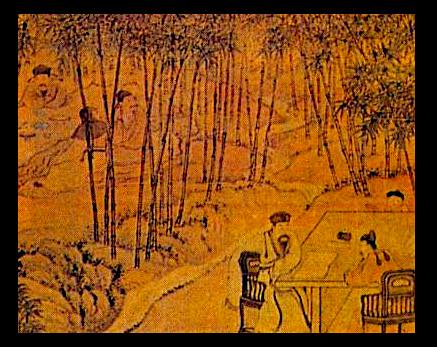
An interview with anthropologist Xiang Biao and a New Yorker article by Yi-Ling Liu further introduce “involution” (neijuan 内卷)—feelings of burnout, ennui, and despair. Xiang Biao scores points (with me, at least) for alluding to Prasenjit Duara’s theory of state involution. He refers to the pressures of Confucianism, but I haven’t seen wuwei cited as prototypes for the dropout generation, or early Daoist recluses such as the Seven Sages of the Bamboo Grove.

ZLQX
The Seven Sages of the Bamboo Grove.

Alienation has always been a theme of Chinese culture. Under Maoist campaigns, one finds hints in the memoir of Kang Zhengguo and it’s evident in much fiction, as well as the films of Jia Zhangke, masterpieces of small-town ennui in the early years of reform. Still, returning to the internet age,

According to Professor Huang [Ping], lying down can be seen as the opposite of involution—a decades-old academic term referring to societies becoming trapped in ceaseless cycles of competition that resurfaced last year [2020] as an online buzzword in China. “In a relatively good social environment, people may feel involuted, but at least they’re trying,” he said. “If it’s worse, people will tangping.”

And Yi-Ling Liu observes tellingly:

China’s crisis is unique in the severity of its myopia and its methods of entrapment. The young high schooler, disillusioned with the monotony of school, cannot easily access subversive subcultures or explore alternative ways of living, because, increasingly, that information is deemed “vulgar” or “immoral” and banned by the government, scrubbed from the digital sphere in the name of “promoting positive energy.” The delivery driver, seeking better working conditions, can’t protest his grievances or organize his fellow workers in an independent union, because he rightly fears that he will be detained. The disillusioned office worker, instead of taking action, will more likely sink deeper into his desk chair. Involution is a new word that helps keep an old system, and those who control it, in place.

* * *

yabi

For the new kid on the ennui block, Made in China journal has an intriguing article by Casey Wei, “The involution of freedom in yabi subculture”, with analyses based on class and gender as well as a useful list of further readings.

In yabi 亚逼 the bi is shabide bi, prefixed by ya (Asia, inferior: the “sub” of yawenhua 亚文化, “subcultures” that develop among “like-minded people” 同温层 tongwenceng). * Yabi signifies “subcultural resistance under a heavily repressed authoritarian regime, […] a post-internet hotchpotch, influenced by (but not limited to) punk, otaku, e-girl, cybergoth, K-pop and J-pop, Asian babygirl, hip-hop, rave, and techno styles from across the globe”. I’m not sure how relevant are Wei’s ambitious historical perspectives on the “feminine supernatural”, from early imperial history through to the Maoist era (“From goddesses and fox spirits to Holding up half the sky”).

I like the opening line of Made in China’s Twitter blurb for the article:

The yabi subculture is often deemed messy and superficial.

Anyway, I’ve penned a couple more haiku (see here):

So much for wuwei
Lying flat is so old hat
Time now for yabi

Not gonna zhuang bi
Lie flat, fold in?—bit too much
I’m just a shabi

* * *

Even in our own societies, it’s a challenge to absorb changing culture and language, all the more so with the explosion of digital media. In analysing Brahms manuscripts or medieval Daoist ritual manuals, the ivory tower of academia is estranged from the practical issues of Real Life. Moreover, the vocabulary of those of us who make intermittent study visits to somewhere like China is always going to be partial, based not only on our particular study topics (political, cultural, and so on) but also on our early exposure, and we may find it hard to keep up with a rapidly changing society. **

I have no illusions that I could possibly keep up with UK youth culture (see Staving off old age, Cleo Sol, New British jazz, and so on). Still, chagrin and curiosity combine to encourage us to learn just how far we have fallen behind; and however traditional the topics we study in China, the attitudes of new generations will be influential. Even if we’re hoping to “salvage” Daoist ritual, our fieldwork takes place not in a social vacuum but within an ever-changing context. With the slogans of Maoism long replaced, popular culture and urban ennui seep into rural values, as grandchildren surf their phones on visits back to the countryside to attend family funerals.

* * *

Even ethnomusicologists documenting traditional culture need an overview of urban soundscapes and the wider cultures in which they mingle (OK, I’ll say it—”in the urban bazaar”) (note The hidden musicians)—Istanbul, for instance, is far more than genteel Ottoman ensembles, the call to prayer, and Alevi ritual, as rap replaces arabesque… Whereas the Anglo-American “classical” and pop worlds manage to ignore each other, it’s worth registering the musical diversity of Beijing and Shanghai in the 1930s and 1990s, popular genres (e.g. Shanghai jazz, and New musics in Beijing) co-existing with drum-singing, silk-and-bamboo, Daoist ritual, the qin zither, and indeed WAM (see e.g. Fou Ts’ong).


* My own coterie being those who will be amused when I identify which kou character I’m referring to by explaining “Yuqie yankoude kou“. Speaking of ya 亚, I love the creative misgrouping of the elements in Lunda YaFei xueyuan 伦大亚非学院 (SOAS) by one of the Li family Daoists!

** Again, my personal lexicon remains based on an incongruous mix of folk ritual terminology and the trite political slogans of the 1950s’ village Party Secretary (here, under “Rapport”).

Some niche Olympic sports

Poodle clipping

Poodle Clipping, Paris Olympics 1900.

For the Paris Olympics, Call Me Old-Fashioned [What, again?Ed.] but I mainly favour the traditional sports, like tennis (Nadalcaraz together in doubles?! WOW) and football—easing the withdrawal symptoms after the Euros (for which I crafted wonderful folk playlists) and Wimbledon.

You had to be quick to catch the Rugby 7s, not just because the tournament began and ended early, but because the matches don’t last long (although how long seems to be a closely-guarded secret). It’s glorious because it’s basically running around like fuck and scoring loads of tries, dispensing with much of Rugby Union’s boring faff like falling over on top of each other, set-pieces, trying to work out arcane rules, and all that pompous cerebral preparation to kick a conversion.

Olympics 1908

Gradually, with the essential aid of expert commentary, one gets drawn into the more niche activities—like Beermat Flipping, Treacle Volleyball, Malteser Shot-Putting, Bonzai Flatpack Assembly, and Synchronised Underwater Hamster Dressage.

Another popular event is The Sound of One Hand Clapping, in which Japan still has a monopoly. The Chinese, not really perpetuating the Daoist tradition of wuwei non-action, now excel at Lying Flat 躺平, but their governing body doesn’t seem keen to get it ratified by the Olympic Committee.

Monty Python got there first with such fantasy:

As to the relay, here’s Mark Simmons:

I love the Olympics. My friend and I invented a new type of relay baton. Well, he came up with the idea, I ran with it.

And turning to table tennis, allow me to remind you of this fine headline:

King Kong Ping-Pong Sing-Song Ding-Dong

See also under A sporting medley: ritual and gender. As I have noted, my viewing stats from WordPress * somewhat resemble a fantasy Olympic medals table:

Medals table


* You may be as dismayed as I am that these stats have begun to address me as “Howdy, StephenJones.blog”. Another sign of The End of Civilisation As We Know It…

Perfect Pitch

Perfect pitch cover

I’ve often cited Nicolas Slonimsky’s brilliant Lexicon of musical invective. So I enjoyed reading his fascinating memoir

  • Perfect Pitch,
    in a revised third edition from 2023, ably edited by his daughter Electra Slonimsky Yourke.

Written with wit and wisdom at the age of 94, and first published in 1988, it’s a captivating blend of substance and gossip, packed with wonderful anecdotes—a Who’s Who of figures that seemed to matter at the time, part of a niche zeitgeist.

Nicolas Slonimsky (1894–1995) (fine website, with A/V; books, including Writings on music, 4 vols., 2005; wiki) was “a typical product of the Russian intelligentsia”—in the early chapters he gives a detailed account of his Russian family history and political turmoil. Already by 1912 his early musical facility led him to describe himself as a “failed wunderkind”.

In autumn 1918 he left St Petersburg. After stays in Kiev and Yalta, in 1920 he reached Constantinople (pp.85–90), where he found many musicians among the throng of Russian refugees. Lodging with a Greek family, he accompanied Russian dancers, and played for restaurants and silent movies. He composed Obsolete foxtrot and Danse du faux Orient, later included in his Minitudes. After following a girlfriend, a Russian dancer, to Sofia, by late 1921 he arrived in Paris—also inundated by Russian emigrés. There he worked for Serge Koussevitzky for the first time, who introduced him to Stravinsky in Biarritz. Koussevitzky, sorely challenged by irregular time signatures, * asked him to rebar The Rite of Spring for him. Despite moving in cultured circles, Koussevitzky (like Tennstedt later) was not a great reader.

Slonimsky was impressed by Nikolai Obukhov, a “religious fanatic” who made a living as a bricklayer. Inspired by Scriabin, and an unlikely protégé of Ravel, his magnum opus Le livre de vie for voices, orchestras, and two pianos (Preface here) contained “moaning, groaning, screaming, shrieking, and hissing”. He dreamed of “having his music performed in an open-air amphitheatre, perhaps in the Himalayas or some other exotic place”. He developed the croix sonore, a prototype of the theremin.

In 1923 Slonimsky docked in New York, travelling on a Nansen passport, “an abomination of desolation, the mark of Cain, the red spot of a pariah”. He soon found work as opera coach for the new Eastman School of Music in Rochester, at the invitation of Vladimir Rosing. He now confronted the challenge of learning English. Indeed, the book is full of gleeful comments on language learning. Taking advertising slogans as his textbook, Slonimsky’s arrangements (particularly Children cry for Castoria!) became popular. America seemed a fairy-tale land. At Eastman he found a kindred soul in author Paul Horgan.

In 1924 Koussevitzky replaced Pierre Monteux as conductor of the Symphony Orchestra (whose musicians were mainly German, French, and Russian), and the following year he invited Slonimsky to become his secretary (feeling more like a “serf”). Koussevitzky was in awe of Rachmaninoff’s genius, and despite his withering assessments of rival conductors, he did promote Mitropoulos and Bernstein; he was dismissive of Arthur Fiedler’s Boston Pops (cf. the splendid Erich Leinsdorf story). Much as he valued Slonimsky’s talents, his insecurity meant that his young protégé always had to tread carefully, and in 1927 they parted company.

Still, he now enjoyed a “meteoric” conducting career. With no illusions about his rudimentary technique, he founded the Chamber Orchestra of Boston, promoting contemporary composers—notably Henry Cowell, Edgard Varèse, and Charles Ives. After a performance of a work by Cowell, they rejoiced in the headline “”Uses egg to show off piano”. Slonimsky introduced Aaron Copland to George Gershwin. After Cowell introduced Slonimsky to Charles Ives, they became close.

Cowell Ives 1952
Henry Cowell with Charles Ives, 1952.

Slonimsky was full of praise for Ives:

I learned to admire the nobility of his thought, his total lack of selfishness, and his faith in the inherent goodness of mankind. […] He inveighed mightily against self-inflated mediocrity, in politics and art alike. The most disparaging word in his vocabulary was “nice”. To him, it signified smugness, self-satisfaction, lack of imagination. He removed himself from the ephemeral concerns of the world at large. He never read newspapers. He did not own a radio or a phonograph, and he rarely if ever attended concerts.

In 1931 (the year he gained US citizenship), Slonimsky gave the première of Ives’s Three places in New England in New York. Promoting the work with passion, in Perfect pitch he waxes lyrical about its genius.

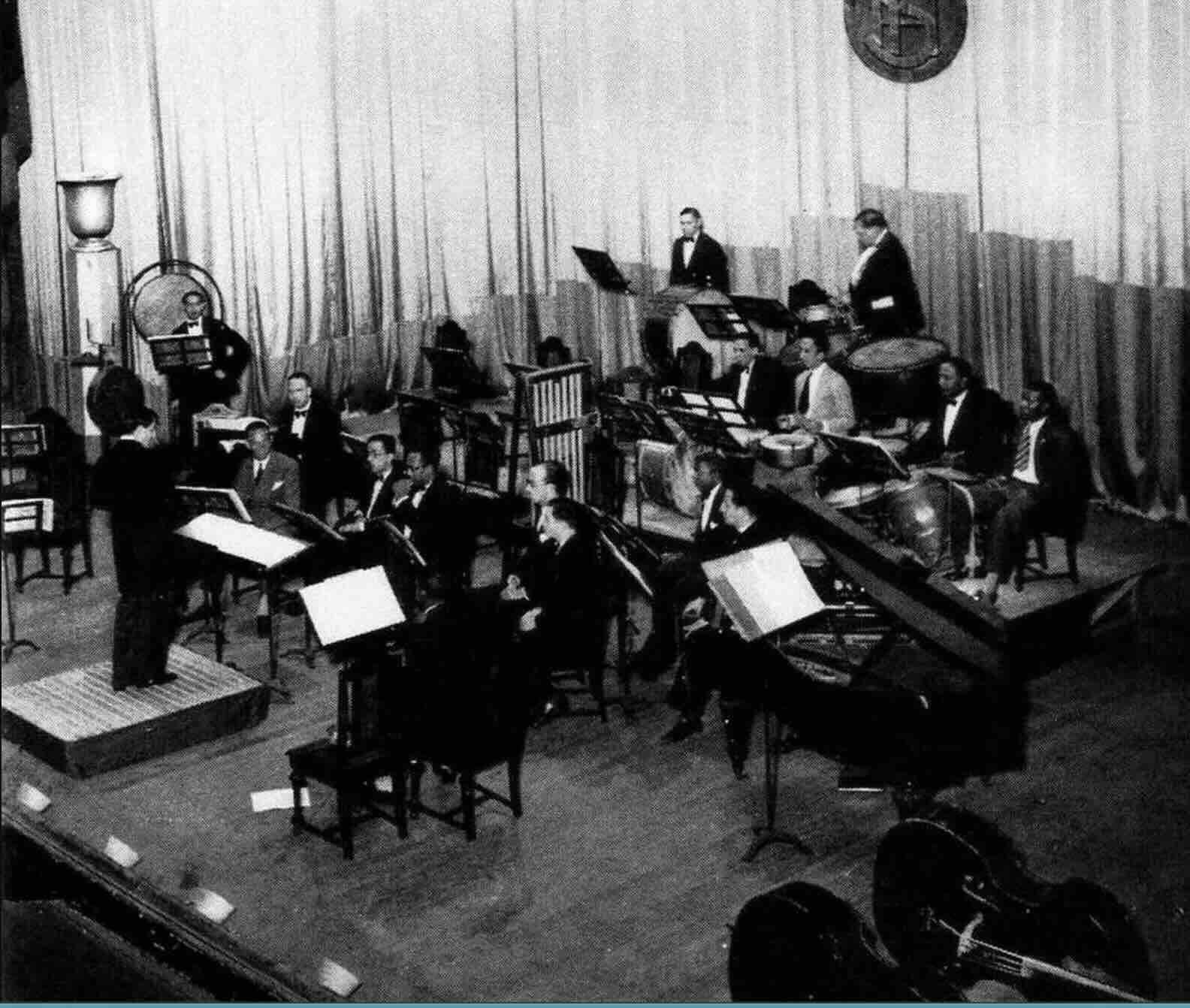
Slonimsky in HavanaSlonimsky conducting Varèse’s Ionisation in Havana.

He was invited to conduct in Havana, his first experience of modern Cuban music. He conducted revelatory concerts in Paris, sponsored by Ives, encouraged by Varèse. There too he married Dorothy Adlow.

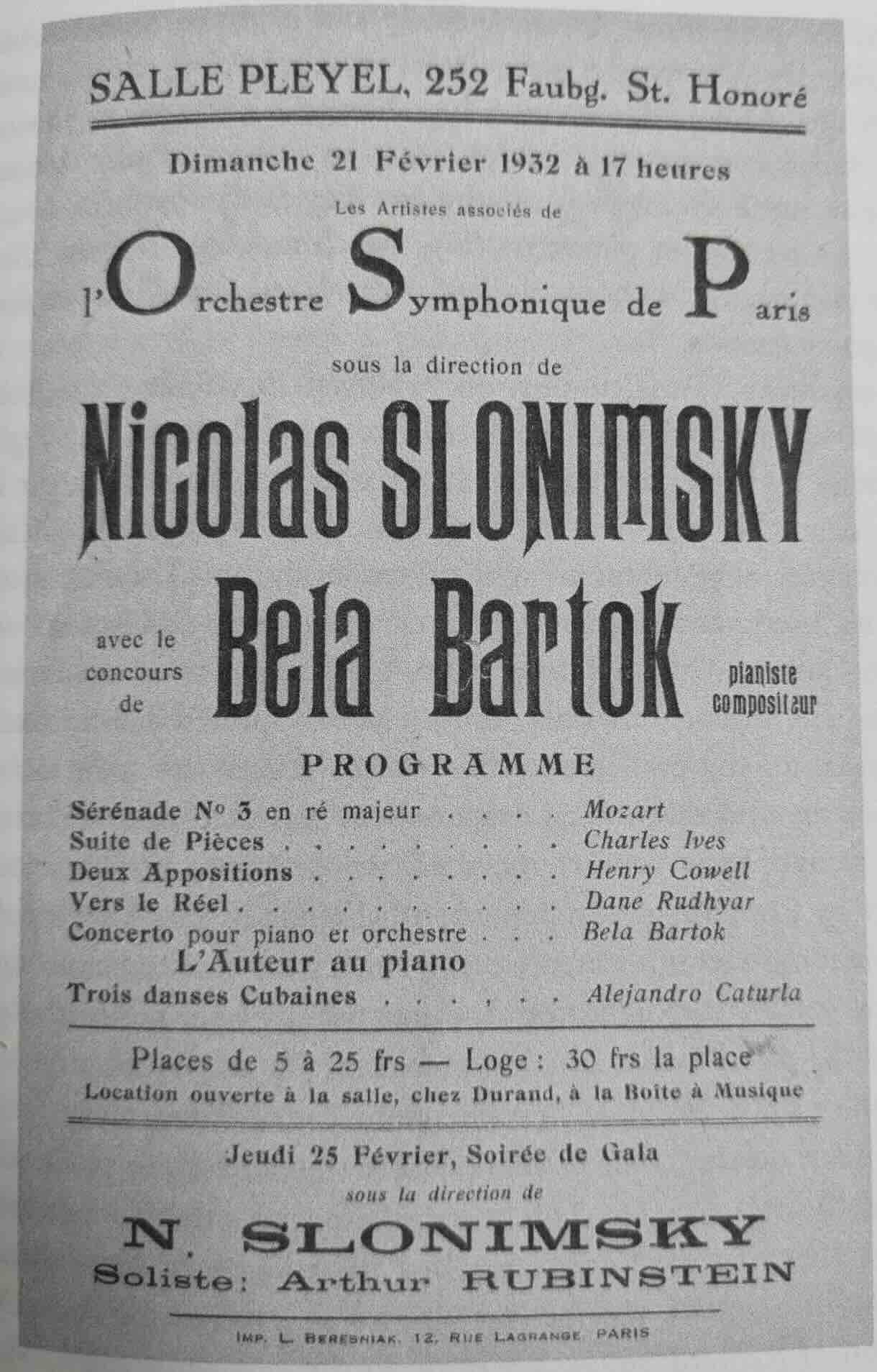
Slonimsky Bartok 1932

He returned to Europe for more concerts in 1932—with Bartók giving the Paris premiere of his 1st piano concerto, and Rubinstein playing Brahms’s 2nd piano concerto!!! In Berlin (in the nick of time before the grip of Nazism) he conducted the Berlin Phil in a modern programme including Three places in New England and Varèse’s Arcana. He repeated the programme in Budapest.

He reflects on this ephemeral phase of his career:

The art of conducting is paradoxical, for its skills range from the mechanical to the inspirational. A conductor can be a semaphore endowed with artificial intelligence, or an illuminating spirit of music. The derisive assertion that “anyone can conduct” is literally true: musicians will play no matter how meaningless or incoherent the gestures of a baton wielder may be. In this respect, conductors stand apart from other performers. A violinist, even a beginner, must be able to play on pitch with a reasonable degree of proficiency. A pianist must have enough technical skill to get through a piece with a minimum of wrong notes. But a conductor is exempt from such obligations. He does not have to play; he orders others to play for him.

This leads him to some wonderful stories about badly-behaved conductors (cf. Viola jokes and maestro-baiting); Toscanini, Klemperer—and this story, evoking the unwelcome posturings of many a later maestro:

Mengelberg once apostrophised his first cello player with a long diatribe expounding the spiritual significance of a certain passage. “Your soul in distress yearns for salvation,”, he recited. “Your unhappiness mounts with every passing moment. You must pray for surcease of sorrow!” “Oh, you mean mezzo forte,” the cellist interrupted impatiently.

I’m eternally grateful to Slonimsky for relating some classic Ormandy maxims (now joyously expanded here by members of the Philadelphia orchestra)—OK then, just a couple:

Suddenly I was in the right tempo, but it wasn’t.

Who is sitting in that empty chair?

In “Disaster in Hollywood” he tells how his first appearance with the LA Phil in 1932 ended in tears. When the programmes for his eight-week season at the Hollywood Bowl in the summer of 1933 proved far too challenging for the “moneyed dowagers”, his conducting career came to an inglorious end. He takes consolation in the later admission of the works that he championed to the pantheon (cf. the fine story of Salonen’s interview for the LA Phil!). Meanwhile in New York he conducted, and recorded, Varèse’s revolutionary Ionisation.

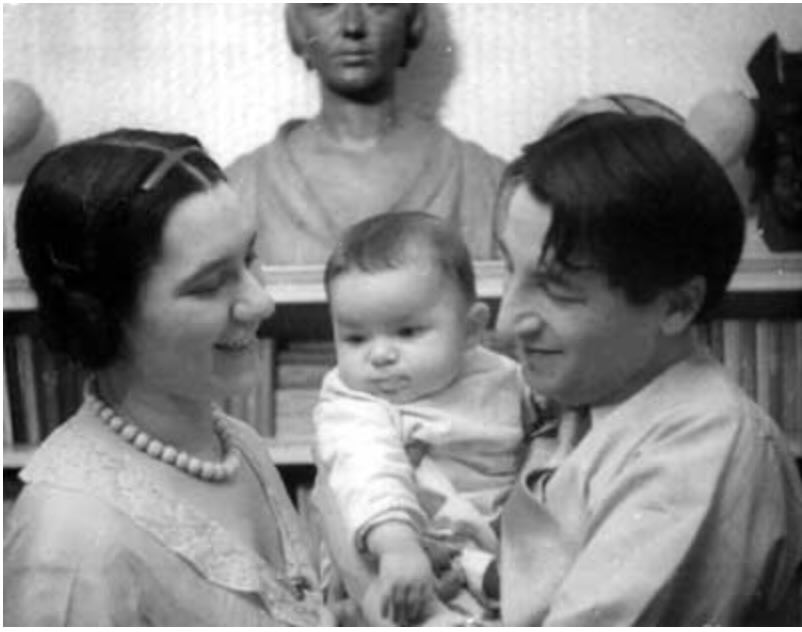
with Electra

With typical linguistic flourishes, he devotes a proud chapter to the birth of his daughter Electra, editor of the volume. He rearranged a limerick:

There was a young woman named Hatch
Who was fond of the music of Batch
It isn’t so fussy
As that of Debussy
Sit down, I’ll play you a snatch.

He would have enjoyed these limericks, and one by Alan Watts, n.2 here.

“Like gaseous remnants of a shattered comet lost in an erratic orbit”, occasional conducting engagements still came his way. In “Lofty baton to lowly pen” he recalls his transition to musical lexicography. He met fellow Russian emigrés Léon Theremin (whose life was to take a very different course) and the iconoclastic theoretician Joseph Schillinger. As Slonimsky compiled his book Music since 1900 (1937!), he became interested in the savage reception of new music, leading to his brilliant Lexicon of musical invective.

Still, he was never tied to his desk. His appetite whetted by his trips to Cuba, in “Exotic journeys” he recalls his 1941–42 tour of Brazil (hearing Villa Lobos’s tales of his Amazonian adventures), Argentina, Chile, Peru, Ecuador, Columbia, Panama, Costa Rica, Nicaragua, Guatemala, and Mexico. His book Music of Latin America was published in 1945.

Returning to Boston, he was plunged into family duties. In 1947 he published Thesaurus of scales and melodic patterns.

In 1935, armed with a US passport, he returned to his birthplace, now called Leningrad, visiting long-lost relatives. He reflects on the death of his mother in 1944, and the life of his aunt Isabelle Vengerova (1877–1956), who became a legendary piano teacher in the States.

After the war, with Russia in vogue in the USA, Slonimsky enjoyed revising his proficiency in his mother tongue, updating old manuals to teach students and taking on work as translator. While he was largely free of McCarthyite suspicion of sympathising with Communism, back in the USSR his brother Michael was at far greater risk for being suspected of opposing it (for Soviet life, note The whisperers).

Dissatisfied with previous compendia and nerdily meticulous, he found a new mission in updating Baker’s biographical dictionary of musicians. He was proud of his 1960 article “The weather at Mozart’s funeral”. In 1956 he achieved unprecedented celebrity through appearing on the quiz show The big surprise.

In “The future of my past” he describes another trip to the USSR and the Soviet bloc in 1962–63, funded by the State Department—an Appendix to the third edition provides a detailed account. He visited Poland, Czechoslovakia, Hungary, Romania, Yugoslavia, Bulgaria, as well as Greece and Israel.  On his meetings with musicians, he was inspired by the energy of Ukrainian and Georgian composers.

His diary is punctuated by his curiosity about language, starting in Moscow:

To my Americanised ears, the new Soviet language sounded almost theatrical in its emphasis, deliberate articulation, and expressive caesuras. I also noticed a proliferation of diminutives….

In Prague he learned the vowel-less tongue-twister Strc prst skrz krk:

I used this phrase as the supposed title of a choral work by the mythical Czech composer Krsto Zyžik, whom I invented and whose name I was tempted (I ultimately desisted) to include as the last entry in my edition of Baker’s.

But soon after his return to Boston his wife Dorothy had a heart attack, which was to be fatal. Bereft after her death in January 1964, he welcomed the offer of a post at distant UCLA. He composed musical limericks for his students’ benefit, but was not always impressed by their aptitude, citing gems from their essays such as “A piano quintet is a piece for five pianos”.

After two seasons he reached compulsory retirement age, but he was never going to go quietly. In LA he enjoyed a wide social circle. Besides many “flaky” composer friends was John Cage, now a guru (Slonimsky cites Pravda: “His music demoralises the listeners by its neurotic drive and by so doing depresses the proletarian urge to rise en masse against capitalism and imperialism”!).

With John Cage, and Frank Zappa.

Back in LA, he made friends with Frank Zappa, who invited him to play at his gig.

Dancing Zappa, wild audience, and befuddled me: I felt like an intruder in a mad scene from Alice in Wonderland. I had reached my Age of Absurdity.

Meanwhile with perestroika in the Soviet Union, Slonimsky was becoming quite a celebrity there too, making several more visits and admiring composers’ creativity in new idioms.

* * *

Far more than a mere entertainer, Slonimsky was a major figure in promoting new music. With his eclectic tastes, I can’t help thinking that he would have enjoyed gravitating to ethnomusicology, questioning the wider meanings of “musician” or “composer” (see e.g. Nettl); but he was deeply rooted in the WAM styles of Russian classics and the American avant-garde. Still, within the world of WAM literature it makes a most fascinating memoir.

For some reason it fills me with joy to learn that a Japanese translation of Lexicon of musical invective has been published.


* Even 5/8 was too much for Koussevitzky:

He had a tendency to stretch out the last beat, counting “one, two, three, four, five, uh”. This ‘uh” constituted the sixth beat, reducing Stravinsky’s spasmodic rhythms to the regular heartbeat. When I pointed this out to him, he became quite upset. It was just a luftpause, he said. The insertion of an “air pause” reduced the passage to a nice waltz time, making it very comfortable to play for the violin section, who bore the brunt of the syncopation, but wrecking Stravinsky’s asymmetric rhythms.

To be fair, Koussevitzky did manage to conduct the 5/4 Danse générale of Ravel’s Daphnis and Chloé (1942 recording here; he first conducted it in 1928).

Some German tongue-twisters

Wartke

Whereas the mind-boggling “tapeworm words” in my post on Some German mouthfuls are of a practical nature, the realm of fantasy opens up whole new linguistic vistas. In a stimulating article, Deborah Cole introduces the work of the Berlin-based cabaret performer, playwright, and pianist Bodo Wartke.

She begins with some drôle political context:

Annegret Kramp-Karrenbauer, a former defence minister with a dastardly difficult name to say, was long seen as a likely successor to the relatively pronounceable ex-chancellor, Angela Merkel. Kramp-Karrenbauer’s resignation as the conservatives’ party chief came as a relief to news presenters the world over, clearing the way for the tight three-syllabic Olaf Scholz. Sabine Leutheusser-Schnarrenberger, once a federal justice minister and the ultimate double-barrelled tongue-tripper, was not invited to join his cabinet.

Now Bodo Wartke and his musical partner Marti Fischer have gone viral with their rap-tinged Zungenbrecher (“tongue-breakers”)—notably  “Barbaras Rhabarberbar” (recorded in 144 takes!), the story of a bar owner named Barbara who enchants all who try her rhubarb cake, including a group of bushy-bearded, beer-swilling barbarians who bring their barber back to try a bite:

This was followed by a charming sequel:

All this is entertaining for Germans and “reliably hilarious to foreigners”. With further links, Cole’s article makes good points about the history and appeal of German tongue-twisters. In English, this video is delightful too.

In Chinese, see A tongue-twister for the household Daoist. The apotheosis of word play, not to be missed, is Nicolas Roberton’s series of Anagram tales. See also under Language learning: a roundup.

Empireland

Empireland

Thoughtful analysis of the legacy of empire is part of a productive academic trend—one which is being vehemently resisted in the corridors of entrenched power, fulminating against the “Guardian-reading, tofu-eating wokerati” (links e.g. here; cf. Fatima Manji, Hidden heritage, and sources there).

  • Sathnam Sanghera, Empireland: how imperialism has shaped modern Britain (2021)

makes an engaging, accessible summary of research (among reviews, Guardian; LSE; and on the sequel Empireworld, LRB).

In the opening chapter Sanghera imagines a revival of Empire Day that would be more educational. As he notes,

It’s all very well highlighting empire awareness by talking about how our honours list still hands out Orders of the British Empire, how many of our common garden plants were originally imported into Britain by imperialists, or how Worcestershire sauce might originally have been an Indian recipe, reportedly brought back to Britain by an ex-governor of Bengal. But our imperial past has had a much more profound effect on modern Britain.

Empire explains why we have a diaspora of millions of Britons spread around the world. Empire explains the global pretensions of our Foreign and Defence secretaries. Empire explains the feeling that we are exceptional and can go it alone when it comes to dealing with everything from Brexit to dealing with global pandemics. Empire helped to establish the position of the City of London as one of the world’s major financial centres, and also ensures that the interests of finance trump the interests of so many other groups in the 21st century. Empire explains how some of our richest families and institutions became wealthy. Empire explains our particular brand of racism, it explains our distrust of cleverness, our propensity for jingoism. Let’s face it, imperialism is not something that can be erased with a few statues being torn down or a few institutions facing up to their dark pasts or a few accomplished individuals declining an OBE; it exists as a legacy in my very being and, more widely, explains nothing less than who we are as a nation.

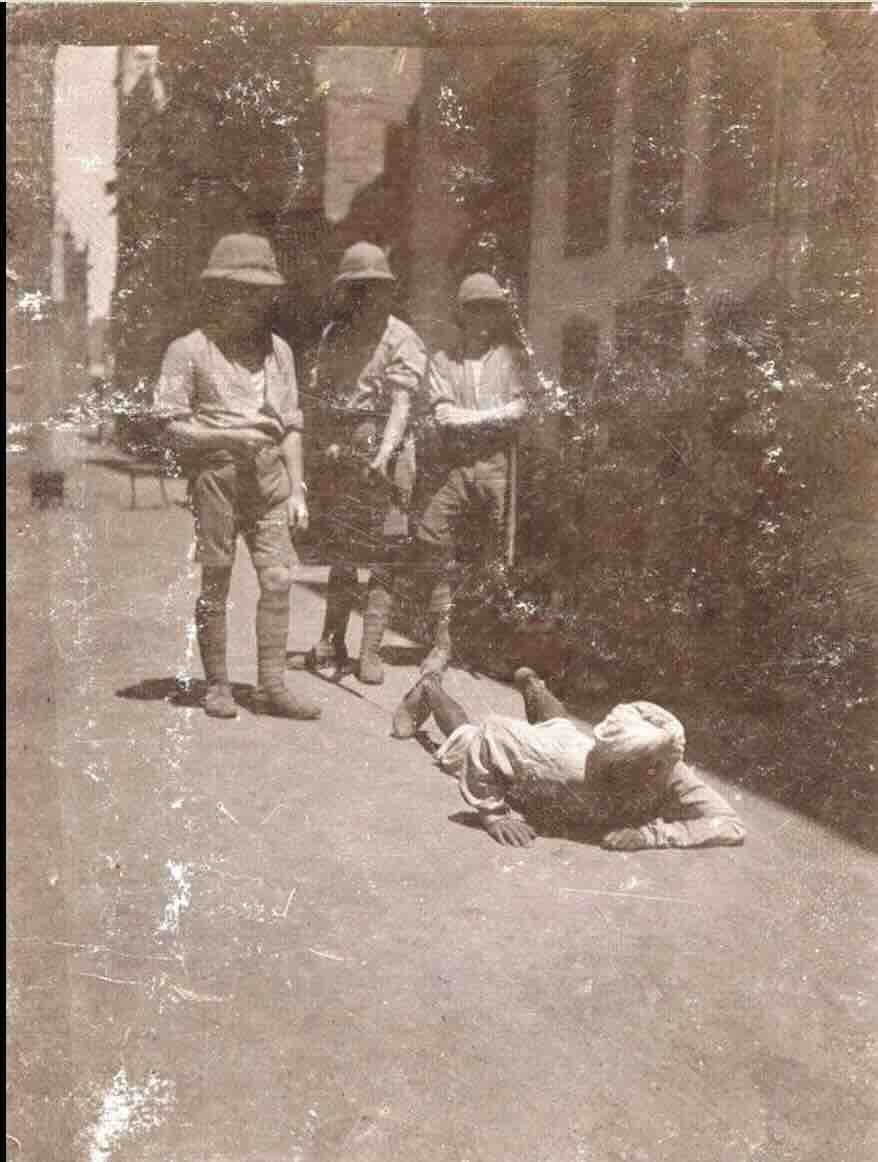
Amritsar 1919Prelude to the Jallianwala Bagh massacre (Amritsar):
“All native men were forced to crawl the Kucha Kurrichhan on their hands and knees
as punishment, 1919″. Source: wiki.

He frankly explores his Punjabi Sikh background, and demolishes the “futile and misleading” balance sheet of “was the Empire good or bad?”. Chapter 4, “Emotional loot” gives an instructive take on the 1903 British invasion of Tibet (“the Younghusband expedition”), leading him to consider the massive stock of looted artefacts that adorns our museums and stately homes, and the bitter debate over restitution. Chapter 5, “We are here because you were there”, opens in Brighton with the story of Dean Mahomed (1759–1851) (also explored by Fatima Manji), leading to an outline of the early presence of black and brown people in Britain.

Sanghera reflects on nostalgia for the Raj, the persistent self-isolation of expat communities around the world, and their taste for British food and education; on the irony of the British search for adventure (“There is no shortage on Instagram of people who confuse travelling with having a personality”); on the lure of sexual opportunity, and prudery; and on the vanity of our claim to be “world-beating”. An intriguing insight on empire’s fetish for manliness:

It was not uncommon to find men with a stammer working in administrative roles in the Indian Civil Service—to have a position in empire instantly gave a man kudos, and a speech impediment might be overlooked for “empire served as proof for masculinity”.

Empireland is full of such instructive byways, such as the history of gin and tonic, “the cornerstone of the British Empire” (Spanish fly 1976):

Gin to fight the boredom of exile and quinine to fight malaria. How else do you think we could have carried the cross of responsibility for the life of millions without the friendly fortitude of gin and tonic?

Sanghera cites a Tweet by Helen Zaltzman:

Britain is hostile to people arriving in boats because Britain knows what happened when Britain arrived in other countries in boats.

Chapter 8, “Dirty money” continues to unearth the foundations of British wealth, while carefully identifying the complex issues. Just as balanced is Chapter 9, “The origins of our racism”:

To say Britain has a dark history of racism which influences contemporary psychology and culture […] does not preclude, for me, the fact that it simultaneously, if inadvertently, inspired anti-racism.

Farage PowellSource.

In Chapter 10, “Empire state of mind”, Sanghera returns to his own experience, pondering the public school system, analysing the warped psychology of Boris Johnson and Jacob Rees-Mogg along with other recent Tory fatuities—but finding inspiration in the work of Edward Said. Chapter 11, “Selective amnesia”, pinpoints a major theme of troubled national histories around the world (see e.g. Memory, music, society), with a trenchant vignette on Britain’s obsession for India’s railways—citing Katherine Schofield’s hashtags #OccasionalMassacre and #ButTheRailways. He introduces James Walvin’s The trader, the owner, the slave as the single best book he has read on slavery—elsewhere he imagines putting Robert Winder, Bloody foreigners on the national curriculum.

Chapter 12, “Working off the past”, continues to explore the right-wing backlash against the convincing arguments of historians, but in conclusion he details several reasons to be optimistic. In 2023 he issued a children’s book, Stolen history: the truth about the British Empire and how it shaped us

Just as reasonable and constructive is his two-part documentary Empire state of mind for Channel 4 (2021). Perhaps you can also find his 2019 film The massacre that shook the Empire. Do consult his useful website.

I remain fond of this definition of patriotism from a Yugoslavian child in the 1990s, cited by Kapka Kassabova:

I love my country. Because it is small and I feel sorry for it.

* * *

Empireland makes a convenient survey of the major topics in imperialism explored by academics—and relieves bigots of the burden of reading them, allowing them to focus their fulminations on Sanghera. Despite his impartial considerations of the evidence, a counter-movement of denial soon surfaced—which he explores thoughtfully (see also here).

For what it’s worth, I am actually grateful for a great deal. […] For having had a free education at one of the best grammar schools in the country; for having attended (for free) one of the best colleges at one of the most successful universities in the world; for an NHS that cares for the people I love the most; for a welfare state that has saved my family from the most crushing consequences of poverty; for the chance to live in the greatest city on earth and work on two of the greatest newspapers in the world; for British pop music; for the glorious British countryside; for Pizza Express. But I resent being instructed to demonstrate my gratitude whenever I analyse any aspect of British life, when my white colleagues don’t get the same treatment. Yes, I have had a better life than I would probably have had in India, but I was born here, not India. I am British. I am as entitled to comment on my home nation as the next man and the endless insistence that I demonstrate my gratitude is rooted in racism. Racism which is, in itself, rooted in the fact that the children of imperial immigrants born here are not always seen as fully British.

Given that many white authors have reached precisely the same conclusions, the backlash against Sanghera and David Olusoga suggests just the kind of racism that this approach exposes, as William Dalrymple observes:

“Despite writing very similar stuff to Sathnam, I have never received a single letter like that. It is a direct result of his ethnicity and skin colour,” says Dalrymple, whose latest book The anarchy tackles the “relentless” rise of the East India Company. “You can’t really draw any distinction between what Sathnam’s writing and what I’ve written. And my books have got a free pass. There is a very serious distinction to be drawn between what he’s gone through writing what he has on empire, and me as a Caucasian writing the same thing.”

BTW, Sanghera,  Olusoga, and Dalrymple are just the kind of scholars I would love to see elaborating on my speculations about the early-19th-century reversal of the black and white keys on fortepianos in the context of slavery and empire.

Curse of the Ninth

*Latest in my Mahler series!*

Curse

Ever since the very first episode in 2014, the BBC TV comic-noir series Inside No.9 (website; wiki) has been consistently brilliant. Written by and starring Steve Pemberton and Reece Sheersmith, it features cameos from a succession of fine actors. The plot twists are ingenious, the mood sinister and enigmatic.

The penultimate episode of the ninth (and final!) series (watch here) takes its title from the Curse of the Ninth, attributed to Mahler’s fruitless efforts to trick fate. Typically macabre, it’s “an Edwardian chiller in which a talented piano-tuner is forced to confront the power of a centuries-old curse by the owners and servants of a large country house.” As the drama unfolds, we hear well-chosen excerpts from the 1st movement of Mahler 9.

Curse 2

The wiki article on the curse gives instances of composers unable to complete their 10th symphony—but also lists counterexamples of others who did manage to do so. So there.

* * *

No.9

A random selection of (nine!) other stimulating episodes from Inside No.9:

The very final episode Plodding on is ingenious…

Euro 24: the last eight bagpipes standing

Another playlist in a series that football fans didn’t know they needed

Euro 24 list

Now that the twenty-four teams of Euro 24 have been reduced to eight, I hear you clamouring for a more focused playlist of bagpipe music to represent them (Yes, I am getting my hearing tested).

Among many sources on the history and distribution of bagpipes, the Essential Vermeer website has instructive material (here and here); and I set forth again from this list. As shown in my previous post, the distribution of instruments rarely aligns with either current or past national boundaries.

SpainGrooving to the gaita. *Coimbra gaita

Starting with

how about gaita from Coimbra (the image by Armando Leça shows an old handmade bagpipe from Coimbra, late 1930s—who knows if such a player inspired Portugal in their 1930 victory over France?!)

—and Galicia:

Guler“Just dig that funky tulum

For a related “tapeworm word”, see under Some German mouthfuls!

Around north Europe, with online clips dominated by medieval revivals, living folk traditions are harder to find.

England goal

  • England—here’s Kathryn Tickell on Northumbrian smallpipes:
  • FranceBreton pipers:

As to

  • Switzerland (not Italy—whence I await more “Caporetto” headlines, to follow those for the 2002 and 2018 World Cup defeats). **
  • Germany
  • The Netherlands (though Romania might have been more fruitful),

referring back to the Essential Vermeer site, there’s some fine material on peasant bagpipes as depicted by Peter Brueghel the Elder and Jan Steen; and we can seek further for modern vestiges under Dudelsack, SackpfeifeDoedelzak, and so on.

Brueghel bagpipes

There—just what you need to warm up for the quarter-finals eh…

More football posts under A sporting medley: ritual and gender.


* Sorry to go on, but this comment in the Guardian live-feed reminded me of my own football dream:

The first time Lamine Yamal joined the Spain squad, they left his boots behind. His and everyone else’s too. When the selección touched down in Tbilisi to face Georgia in September 2023, the trunk carrying part of their kit was still sitting at Barajas, forcing them to complete the evening session at the Boris Paichadze stadium in trainers, unable to strike the ball. The following night, they scored seven. On his debut, the Barcelona winger got the last of them, aged 16 years and 57 days, and the national team got a new beginning.

JRM** Before England’s Great Escape from Slovakia, I was composing our own version of Caporetto, inspired by that popular classic from the Minister for the 18th Century:

“the greatest vassalage since King John paid homage to Phillip II at Le Goulet in 1200”

Magnificently 🍾🍾🍾 , the Haunted Pencil is now Toast, or Ashes—as the sun came up, he crumbled into dust…

A folk playlist for Euro 2024!

*First in a series on folk cultures of Europe!*

Euro teams

Maybe it’s just me, but just as everything else in Europe is falling apart, Euro 2024 seems an exceptionally exciting showcase for football, with a sense of passion accompanying some great matches and brilliant goals.

All—well, almost all—the twenty-four teams in the six groups have inspiring regional traditions of folk music, which (let’s face it) may not be uppermost in the thoughts of most fans. So before we bid farewell to some of the teams, here’s a niche alternative playlist, largely compiled from other posts on this blog.

Albania Euro 24Albanian zurna shawms with dauli drums, a widespread festive combo.

Easy to sample, and exhilarating, are the traditions of east Europe and the Balkans:

  • Albania (Shqipëria!)
  • Croatia (Hrvatska!)
  • Serbia (Srbija)
  • Hungary (Magyarország!)
  • Romania (disappointly, România)

With long histories of discord, national allegiances often remain fractious—chronic enmities are still exposed in the fans’ behaviour at the Euros (see e.g. here). Boundaries having changed over the history of recording, here (based on this article) I will merely offer a few tracks that charm the ear, to encourage us to pursue the soundscape of the whole region:

Bartok 1907
Béla Bartók recording Slovak peasants in 1907.

Other boundaries may be sensitive too:

Note also Resisting fakelore under state socialism in former Czechoslovakia and Poland.

The playlists for other nations pose a different kind of challenge:

  • The Netherlands: by extension, how about this Batak hymn from Sumatra, from the ear-scouring Frozen brass CDs!
  • Belgium: this track comes from the Ocora CD Belgique: ballades, danses et chansons de Flandre et Wallonie (1981)
  • France: pursuing my fetish for shawms (see above), here’s the Bréton bombarde, with accordion
  • England: Morris dancing might not spring to the mind of some fans…
  • Scotland: though perilously close to the “tartan and shortbread” image, pibroch is not to be sneezed at—besides the ubiquitous fiddle, the bagpipe (not so much a dark horse as a black sheep?) is among other instruments commonly played in most nations under consideration—see this list.

Ukraine bagpipeUkraine: Mykhailo Tafiychuk on volynka bagpipe of the Hutsuls.

Several posts on football can be found under A sporting medley: ritual and gender, including my wonderful playlist for Emma and Leylah.

Yet more drumming

Mastery of the drum is achieved when the drummer no longer needs the drum
Going beyond mastery is when the drum no longer needs the drummer.

Rowan Atkinson has been credited, perhaps spuriously, with this kōan-esque aphorism, but it’s clearly inspired by his brilliant sketch, c1992—here with a transcription, to boot:

However they managed to synchronise the audio, it must have taken major preparation.

For more on Daoist non-action, see here (Walt Disney!) and here (Castiglione!).

Just as astounding is Fred Astaire (Damsel in distress, 1937), albeit with a real drum-kit:

From air drumming to air writing, how about writing Daoist talismans in the air.

For other posts on drumming, see Doof Doof, Tambourin chinois, the opening of the Beethoven violin concerto, and an anonymous conductor‘s faux pas.

with thanks to Selim!

We are Lady Parts

Lady Parts

Still vainly seeking a handle on Yoof Kulture (cf. Staving off old age)—and taking a break from working out the mnemonic captions for the percussion suite in my new film on the New Year’s rituals in Gaoluo—I’ve been relishing Nida Manzoor’s TV drama We are Lady Parts on Channel 4 (here), catching up on the first series before watching the second.

As the characters of the all-female Muslim punk band subvert stereotypes, it’s both hilarious and provocative. The plot is enhanced by brilliant tracks such as Ain’t no one gonna honour kill my sister but me, Bashir with the good beard, Voldermort under my headscarf (on this playlist), Malala made me do it, and Glass ceiling feeling (“Stuck in the master’s house / With the master’s tools /Supercalifraga-racist sexist-xenophobic”).

Here’s a trailer for the first series:

And for the second:

This roundup of posts on punk features Viv Albertine, Riot grrls, and The Linda Lindas, as well as bands from the GDR, Spain, Croatia, Iran, and China. Cf. Voice of Baceprot.

Like I’d know…

Sherlock Holmes and Ottoman Istanbul

Andy cover

Seeking a basic education on Turkish society, I found Andrew Finkel‘s book Turkey: what everyone needs to know a valuable resource—and now I’ve been admiring his debut novel The adventure of the second wife (2024) (see this short video clip).

It’s “a clever, compelling mystery about a Sherlock Holmes enthusiast who with the help of a brilliant Turkish professor, tries to solve the enigma of Arthur Conan Doyle’s dying words only to upend his life in the process”:

Strange that Abdülhamid II, the last great Ottoman Sultan, would have Sherlock Holmes stories read to him before he went to sleep. Even stranger is that his obsession helped change the course of history.

The explanation lies in the mystery of Sir Arthur Conan Doyle’s dying words, that the one Sherlock adventure still to intrigue him was that of “The Second Wife”. For no such story exists… Or does it?

Apart from what I trust is a captive audience of Sherlock Holmes fans and aficionados of Turkish culture, I hope the novel can find a wider audience. Rich detail—for Conan Doyle nerds, on Victorian and late Ottoman society, and on a rapidly changing modern Istanbul—is spiced with dry humour, impressive pastiche, vignettes on topics such as the Raj and the Constantinople exhibition at Olympia in 1893–4, and evocative illustrations. As befits a mystery thriller (has the baffling plot of The big sleep ever disturbed us?!), The adventure of the second wife is a challenging read, crammed with erudite and arcane digressions in virtuosic language.

In the ethnic Conan Doyle bazaar, I remain attached to Jamyang Norbu’s well-informed Tibetan fantasy The mandala of Sherlock Holmes.

See also The Janissary tree, The kiosk in Turkey and Europe, and other posts on Turkish culture under West/Central Asia.

Palaver, Kerfuffle, and Faff

Palaver
Source.

One of the unsettling things about getting old is that I find myself using antiquated expressions that I always disdained, such as

“Well, this is a bit of a palaver…”

With that classic understatement of the English, the ideal context is when serious calamity strikes, such as when quelling a mutiny of the restless natives [As one doesEd.]. Sure enough (cf. Tickety-boo), its etymology goes back to colonialism. Used in English since the early 18th century,

palaver, “profuse and idle talk; chatter”, comes from Portuguese palavra “word, talk, speech” by way of sailors’ slang. Portuguese was commonly used as a trading language on the West African coast, and palaver came into English first in the sense “a parley or conference, typically between Europeans and the Indigenous people of a region, especially in West Africa”.

One gathers that such discussions were not entirely on equal terms…  The same source goes on:

Portuguese palavra and its Castilian counterpart palabra come from Latin parabola “comparison, explanatory illustration”, and in Late Latin (and especially in Christian Latin), “allegorical story, parable, proverb”.

And it elaborates on a widespread phenomenon:

Metathesis, the transposition of consonants, is common in Spanish and Portuguese: the syncopated form parabla (from parabola) becomes palavra in Portuguese and palabra in Spanish, just as Latin mirāculum “miracle” becomes milagro in Spanish and milagre in Portuguese.

The wiki entry on metathesis gives instances from a wide range of languages including Amharic, Azerbaijani, Kurdish, Finnish, Hungarian, Navajo, Turkish—and English.

It’s just as mystifying to suddenly hear oneself using the word kerfuffle,

early 19th century: perhaps from Scots curfuffle (probably from Scottish Gaelic car “twist, bend” + imitative Scots fuffle “to disorder”), or related to Irish cior thual “confusion, disorder”.

Like Ogonek and Til, Palaver and Kerfuffle could be another “feisty yet flawed” pair of detectives.

I can’t see that kerfuffle is related to faff, another word I’ve weirdly adopted—not so much in the sense of “faffing around” as in “this is a bit of a faff”. Again, its etymology is interesting:

late 18th century (originally dialect in the sense “blow in puffs”, describing the wind): imitative. The current sense may have been influenced by dialect faffle “stammer, stutter”, later “flap in the wind”, which came to mean “fuss, dither” at about the same time as faff (late 19th century).

The stammering connection may now establish “faff” even more f-f-firmly in my vocabulary. I surmise that the emergence of such words denotes the transition from an adventurous, carefree youth to the desire for a tranquil life unruffled (unfaffled?) by the sundry ordeals of old age (passwords, call centres, stairs…).

So now we have Palaver, Kerfuffle, and Faff—a firm of solicitors. Colloquially abbreviated to Falafel.

* * *

For the “exploits” of early colonialists, see Vermeer’s hat; do read Sitting Bull’s rebuke to the invaders in n. 1 of The Ghost Dance; and for more dabblings in Portuguese, click here. I am now in the habit of referring to “hideous encounters with domestic necessity” as “marmalade”, after Compton Mackenzie’s beautiful talk about his meeting with Henry James.

Dabbling in Turkish

Turkish cover

In some European countries, armed with a mere smattering of French, German, Italian, and dimly-recalled Latin, one can take a rough guess at the odd word of Foreign; it doesn’t get you far, but it’s ever so slightly reassuring (cf. my Portuguese dream). But as I spend ever more time in Istanbul, though cosseted by wonderful multi-lingual friends, on the rare occasions when I have to fend for myself, coming across the occasional French loanword (ekip, garson), it’s good to find that English doesn’t butter any parsnips—and that globalization isn’t quite as, um, global as we may imagine.

So I’m eventually beginning to realise (Hello?) that I really should make a bit of an effort to augment my tiny, eccentric Turkish vocabulary, consisting merely of a few niche nouns like “shawm”, “recluse”, and “call to prayer”. As an entertainer I’m now scoring a certain success with Türkçe konuşmuyorum (“I don’t speak Turkish”)—a phrase that my rubbish pronunciation renders convincing. In one online tutorial that I consult I’m fond of the rubric “Var and Yok (Existence)”—deep, eh. It also has the worrying phrase

Sen doktor değil misin?
Are you not a doctor?

—cf. this suggestive scenario in my old German phrasebook:

The chambermaid never comes when I ring
[…]
Are you the chambermaid?

Google Translate is a miracle, whether for texting or voice messaging—the latter a real blessing for illiterate Anatolian (or Chinese) peasants, though it still hasn’t quite got the hang of my stammer (kekelemek)… When using it, I like to mouth the words with comic ineptitude while the recording plays, awaiting the reaction of my victims audience with a certain trepidation—which reminds me of yet another Monty Python sketch:

Words are all very well, but the wonderful world of Turkish grammar, with its vowel harmony and zany agglutinative suffixes (düşünemedim, “I was unable to think”, Evinizdeyim “I am at your house”), having seemed utterly impenetrable, is slowly becoming a system that I can just about imagine younger people acquiring, with more free space on their mental hard drives.

For more on language learning, see this roundup—the post of choice always being That is the snake that bit my foot. See also my two contrasting experiences in China. As to dabbling, click here for Alan Bennett’s consternation at being told “I see you dabble in playwriting”.

Ripples

Like a circle in a spiral, like a wheel within a wheelNever ending or beginning on an ever spinning reel […]
Or the ripples from a pebble someone tosses in a stream […]
Like the circles that you find in the windmills of your mind!

The windmills of your mind.

I’m both amused and bemused when readers of my posts react to the myriad highlighted links with a certain alarm at finding themselves pursuing my arcane thought-processes down the rabbit-warren that this blog has become (e.g. in my annual roundups, “like a suburban Sisyphus doing and undoing a jigsaw”).

The links are of two kinds: to articles, websites, or pdfs by other authors, and to other posts on this site. They are rarely a red herring, or a wild goose chase—honest guv. While the Plain People of Ireland are quite entitled to their dismay, the consternation of erudite academics seems curious, when they are used to taking in their stride in-text references and ponderous Teutonic footnotes (like de Selby in The third policeman)—keen to consult a reference to Karlgren’s Grammata Serica Recensa which in turn will lead them to early Sogdian manuscripts and thence to medieval viniculture… Only you no longer have to spend a day consulting index cards in a library. And I like to think that I’m performing a public service by distracting such scholars for a moment from their niche focus on Song-dynasty Daoist ritual texts or baroque performance practice—whether by broadening the scope of enquiry or by being reminded of an apposite joke (see e.g. my taxonomy of Chinese jokes, under The joys of indexing). And (suitably equipped with a long ball of string) you can always find your way back to where you started.

Sir, you try my patience!
I don’t mind if I do—you must come over and try mine sometime.

— Groucho.

Even those less obsessively monocultural readers must be used to consulting websites full of links to related topics—like when an online article about the latest pompous idiocies of The Haunted Pencil leads you to other iniquities of the Tory “government”. Perhaps part of the challenge of my personal labyrinth is that its associations are so diverse, keeping you guessing. But that’s Like Life, innit?!

Oops, I seem to have done it again here… Please excuse me! But anyway, my Word Press stats suggest that remarkably few readers ever click on the links (even within roundups, or playlists such as this, where not doing so is like consulting a library catalogue but not looking at any of the books)—which causes me a certain distress 😟 (see The art of emoji)… Go on, give it a whirl!

Rugby balls and violin strings

rugby ball
Source.

Glued to the Six Nations rugby, I’m wondering if negotiating the shape of the ball, * with its unpredictable bounce, might be compared to going on stage with a violin whose strings never stay in tune—like playing baroque violin in an overheated concert hall (he said with feeling—see The Mary Celeste).

On the plus side, concerts are less muddy, with fewer injuries, and you don’t get sent off so often. As to referees (Confucius), musos’ attitude to conductors is more like that of footballers than rugby players.

Dali
Salvador Dali, The persistence of memory (1931).

Such a degree of unpredictability is rarely built into the design of the game—as if tennis rackets were crafted from blancmange. Nor did elliptical balls catch on with other sports, like snooker. To cast the net wider, it’s like a steering wheel that offers few clues to the direction of the car, or a novel whose pages the publisher prints in a random order.

This is part of mini-series on rugby under A sporting medley: ritual and gender, featuring the haka and some arcane rules. For more on the perils of tuning in Western Art Music, see under Hugh Maguire, and Muso speak: excuses and bravado (“It was in tune when I bought it”). More unlikely inventions here.


* Apart from unseemly anatomical explanations involving the shape of the pig’s bladder, and posh public-school twats, some suggest that it’s harder to dribble with the feet as in football, and that the oval ball is easier to carry with one arm, leaving the other arm free to push adversaries away—reminding me of the shakuhachi flute as potential weapon (komusō monks rebuked for “meddling in earthly affairs and not the emptiness of being”).

Old and new musics

More on taxonomy

new music

I may seem like a fully-paid-up member of the Guardian-reading, tofu-eating wokerati, but the Guardian‘s end-of-year cultural lists can be mystifying, serving largely to enhance my sense of becoming an Old Fogey (cf. Staving off old age).

Now, I’m all for the demotion of the hegemony of WAM, whose claim to a fictive prestige has long been obsolete (note What is serious music?!, Is Western Art Music superior?, Just remind me again, what is music?!, and Feminine endings). Sure, the Guardian does give “classical” a look-in (here, and here). But I can’t help being amused by the niche sense of “old music” in this roundup—there I was, expecting a roundup of medieval ballads, Tallis, or dhrupad

Discuss, with reference to a cab driver’s interpretation of “early music” and the oeuvre of Bruno Nettl.

old music
Old music, allegedly.

stile nuono
New musics, Caccini 1601. Source.

As to “new music” (an article with the peak Guardian comment “it’s been an incredible year for Brazilian baile funk”), WTAF?! For me, still catching up on the stile nuovo (n.1 here), even an end-of-year playlist for 1707 (Bach, Handel) would be rather modern—and how about the New Music of the Tang dynasty, eh, with Sogdian dance grooves All the Rage through the reign of Xuanzong. Take THAT, Guardian!

global

And then The best songs of 2023 … you may not have heard (How did they guess?). The Guardian concept of “folk” seems a tad limited; and the jazz list for 2023 reminds me how paltry are my attempts at educating myself. Or we can try the Songlines-esque “best global albums”—sure, all this partly revolves around the concept of “album”, not uppermost in the minds of Moroccan herders on the way to an ahouach festivity. OK, I’m just ranting against commercial hype.

Don’t get Me Wrong, I do Delight in all Manifestations of the Terpsichorean Muse—it’s just that I’m ever more aware of being excluded from a lot of them.

Among my Mélange of playlists (raga, Chinese, jazz, Mahler, flamenco, and so on), there’s no beating my Playlist of songs, old and newish—not even quite as ethnic as it could be… Also delightful is A playlist for Emma and Leylah.

Some global idioms

Sharp cover

A gentle Guardian Christmas quiz is based on Adam Sharp’s new book The wheel Is spinning but the hamster Is dead (2023), which we should all Rush Out and Buy (for his nobler purpose, see here).

It’s a delightful parade of “idioms, proverbs, and general nonsense” * from around the world, engagingly grouped in the form of lists. As a taster, just a few idioms that float my boat:

An Irish proverb:

Never bolt your door with a boiled carrot.

A charming German alternative for OMG:

I think my hamster is waxing the floor!

A Polish expression for something that makes no sense:

This is a Czech movie. (Cf. the Czech definition of a Hungarian)

Among Turkish idioms for “once upon a time” (cf. wiki):

When camels were town criers and fleas were barbers.

Irish expression for laziness:

As idle as a piper’s little finger. (For Irish pipers, see under Women in early Irish music.)

Croatian metal band (cf. Croatian punk):

Teddy Bear Autopsy.

In Danish, when something is not your cup of tea:

It doesn’t hoe my potatoes (fallen out of fashion, to Sharp’s chagrin).

BTW, “the wheel is spinning but the hamster is dead” is Swedish— hjulet snurrar men hamstern är död.

Cf. Buttering parsnips, and (under Language learning: a roundup), A thingamabob about whatchamacallit.


* As you see, I can never resist adding the Oxford comma

Buttering parsnips

with a note on the syntax of yore

Parsnips
Source.

Plucking the winds, my ethnography of Gaoluo village and its ritual association, chronicles vicissitudes in the peasants’ lives. At the end of chapter 6 (“Turmoil and tedium”, on the Cultural Revolution) I reflected on how our paths coincided:

Over the other side of the world, in total contrast to their experiences, I took my first steps on my own Long March (more like a Leisurely Stroll) to Chinese musicians and Gaoluo, absorbing enough hippy influence to become “hooked” (shangyin, as the Gaoluo musicians say) on Zen, and thence also on Daoism, Tang poetry, and all the rest. In 1972 Nixon went to see Mao in China, visiting the Great Wall, where he sagely observed, “It’s a great wall”. That same year I started studying Chinese at university; the following year the London Philharmonic Orchestra performed in China. None of this buttered any parsnips in Gaoluo.

I suppose some international, and younger, readers may wonder WTF parsnips are, and why ever anyone might want to butter them. I must have heard the expression in my youth, but I don’t know how I later became so partial to it.

“Faire words butter noe parsnips” is attested from 1639, in the days when the potato was only just becoming a staple (and when spelyng was a Free Countrie—another liberation promised by Brexit?). This site also adduces John Taylor’s Epigrammes (1651):

Words are but wind that do from men proceed;
None but Chamelions on bare Air can feed;
Great men [sic] large hopeful promises may utter;
But words did never Fish or Parsnips butter.

On whose syntax I might comment:

Poets of Yore o’er verb–object inversion may splutter—
An order consigned by Latter Epochs to ye gutter
He who reverses them is clearly a Nutter—
Yet grammarians ne’er a Cavylle do mutter.

OK, I do get it, really—it’s history, innit… 

Cf. Some global idioms.

As to my own culinary habits, I tend to roast parboiled parsnips and potatoes, with shallots, all basted in oil (not butter) and lashings * of spicy Turkish orta. For more cuisine, with links, click here—including the late great Ciaran Carson’s paean to the fry-up and the music of time.


* Here I was boldly seeking another role for “lashings” beyond what I supposed was its traditional duty as measure-word for ginger beer; but in fact, as posts like this explain, it wasn’t Enid Blyton who bound the two together—it seems to have taken hold in our imaginations only since the Comic Strip’s Five go mad in Dorset. This kind of thing happens a lot: see e.g. What’s the craic?.

Roundup for 2023!

As I reflected in last year’s roundup,

like a suburban Sisyphus doing and undoing a jigsaw, having gone to great lengths to mix up the daily sequence of my diverse topics in a stimulating fashion, it’s that time of year when I try and reassemble them into some kind of thematic order.

In order for this exercise to be worthwhile, you’ll have to click on the links! Ideally, spread the word by reposting on one of those “Social Media” Thingies They Have Nowadays… Even if you only read a dozen of these posts, then my labours will not have been in vain!

I’m going to adopt Stella Gibbons’ drôle device in Cold Comfort Farm, drawing attention with *** to passages (mostly posts, in this case—indeed, the book’s protagonist is Flora Poste) Not To Be Missed. And this list isn’t even exhaustive—the committed masochist can consult the monthly archive in the sidebar, scrolling waaay down.

I’ll begin with Nicolas Robertson, who alas joined the Heavenly Choir in November (see my tribute). His extraordinary anagram tales (introduced and listed here***), a kind of fantasy Esperanto fiction, are among the highlights of this blog, and in further tribute to his brilliant mind I have recently added two more:

So here are listings under some main themes (many, of course, belong under several themes, which is the point of giving them categories and tags, listed in the sidebar):

China (culture and ritual, Maoism and politics):

East Asia, other:

This year’s additions to my education in Tibetan and Uyghur cultures:

Turkey and West/Central Asia (see roundup):

Modern Europe:

Ethnomusicology and world music:

Jazz (see roundup***):

Pop:

Western Art Music:

Sport (see roundup):

Film/TV:

Loft best new

Arising from the transformation of my home:

Other:

For roundups of previous years’ musings, see 2018201920202021, 2022. And here’s a roundup of roundups! The homepage is always useful for navigation.

And it’s always worth reminding you to watch my portrait film***
on the Li family Daoists,
 raison-d-être of this whole blog!

Guest post: Salzburg

by Nicolas Robertson

For links to the complete anagram series, click here.

Prelude—SJ
Since Nick has Ascended to the Great Pinball Table in the Sky, I’ve found two more of his mind-blowing anagram tales. Alceste, which I posted recently, is relatively economical; this one—among stiff competition—is surely his most virtuosic, fantastical (and lengthy) creation. Even the introduction is highly challenging, before we reach the “story” and the final gnomic anagram tale itself. In the absence of Nick’s eagle eye, formatting his text has also been a severe challenge.

Nick’s penchant for tombstones as a medium to connect with the spirits of the past, especially evident here, now seems all the more poignant.

* * *

SALZBURG

Leonore, first version of opera by Beethoven, 1805; shelved and reworked in 1814 as Fidelio.

Fidelio was one act shorter with reordered music; and had a brand new overture. Beethoven commented “almost no musical piece remained the same, and more than half of the opera had been completely reworked”—a description I’ve attempted to reflect.

Staged performances by soloists, Monteverdi Choir and Orchestre Révolutionnaire et Romantique, directed by John Eliot Gardiner, including at Salzburg Festival 1996. Archiv recording, issued 1997.

An introduction, the “story”, and lastly the anagrams themselves, of Beethovens “Leonore” followed by Beethovens “Fidelio”.

[Elements written recently—between 2017 and 2020—principally the “apparatus”, are set in blue to distinguish them from the original 1996 text, augmented in 2012. There are three textual notes, marked in red. Photos were taken later, in 2012 and 2014—one did not have phones with cameras in 1996.]

______________________________________________________________________________

“I hope we English will long maintain our ‘grand talent’ pour le silence”
—Thomas Carlyle, “On Heroes and Hero-Worship”, vi.

Salzburg, summer, Festival and Festung. By day, monsoons and the heavy sun of Mitteleuropa; fading into night, a great still, bulging moon, hanging like a distant punchball, haunting the baroque fountains of a city with too much to remember. Here, one dreams—and sings—of escape: Mozart, from Archbishop Colloredo; Florestan, from prison, and Leonore from half-life to bliss.

Perhaps it was no more than normal for the times, but I could not but be torn by the silent witness of those who escaped far too soon, from a world which had hardly begun to hold out its arms to them. St Sebastian’s Friedhof is a lovely shaded cemetery in a cloister on the other side of the Salzach, and just look what memories call to us from it: of Constanze Weber, Mozart’s wife, yes, and his father Leopold too, but also of the great-grandchildren (I surmise) of stone-cutting master Johann Doppler:

Maria and Anna, born 2 November 1859, died 23 November and 4 December 1860; Otto, 17 February 1868–30 January 1870, and Rudolf, 13 April 1865–5 February 1870 (Johann could have had the melancholy task of engraving their stones, had he not died, aged 45, in 1838). And look, too, Therese Patera, b.1859, d.1861, “geliebtes Kindlein”,
3

and, without even such ado, “Egbert Almeric Henry-Henry / born Feb 22 1859 / died March 22 1859” (the stone, high up and reticent, is inscribed, without any other words than these, in English).
4

What was happening in Salzburg in the mid-19th century? Paracelsus, buried in the same St Sebastian’s church in 1541, would have plunged in, reckless of his own health, to fortify the unprotected, even though he well knew that

All, what is, lives.
Nothing is annihilabl,
even Mouldering is transition to new life.

5

(Tomb of Dominic Oberlechner, d.1821 aged 23, St Peter’s Friedhof, Salzburg—and in English, though you will find a similar text on the same monument in German, French, Latin, and Greek…)

6

This has, to me, a profound assonance with these words of Claude Lévi-Strauss (as quoted by Douglas Hyde, and printed in the latter’s Guardian obituary, where I read them on the day I wrote this, 22 September 1996):

“Nothing is settled; everything can still be altered. What was done but turned out wrong can be done again. The Golden Age, which blind superstition had placed behind (or ahead of) us is in us.” [1]

[1] “Si les hommes ne sont jamais attaqués qu’à une besogne, qui est de faire une société vivable, les forces qui ont animés nos lointains ancêtres sont aussi présentes en nous. Rien n’est joué; nous pouvons tout reprendre. Ce qui fut fait et manqué peut être refait: «L’âge d’or qu’une aveugle superstition avait placé derrière (ou devant) nous, est en nous.» I’m not sure from where Lévi-Strauss is quoting (Rousseau?); the whole passage in context is cumulatively inspiring. [Tristes Tropiques, 1955, p.471.] The English version above is as used for the epigraph to Alexander Cockburn’s book of essays The Golden Age Is In Us (1995).]

What is this but the quiet request of the Zen master, Hōgen Daidō: “Why not here? Why not now?”, which translated into the high art terms of the western world would find its parallel in the manifesto of Hölderlin quoted by Geoff Boycott later in this story. But, though I happen to be writing these last (preliminary) words in Japan, I find it more appropriate to round the little life of this squib with the Biblical version of that long sleep which was written on the very slab of Johann Doppler (Steinmetzer, der unvergesslicher Gatte)’s descendants; for it’s worth knowing where we came from, even if we don’t know where we’re going (an apothegm which could well apply to this whole anagram lark):

“Der Herr hat sie gegeben, der Herr hat sie genomen,
der Name des Herrn sei gebenedeit!
Wie es dem Herrn gefallenhat, alsoistesgeschehen.” (Job 1.21.)

* * *

There’s a more dynamic, equally important, side to this theme, though:
 “Soltai os encarcerados!” (“Let loose the prisoners!”)—when Lídia (die ferne Geliebte) sang these words of Gil Vicente in the tiny eponymous theatre in Cascais in 1969, she was banned, along with the play (“Um Breve Somário da História de Deus”) and the recording made of the songs, by Salazar’s nervous jackboots. But now we’re in the realm of heroes (and heroines, I prefer not to draw the distinction, after all Hero was—is—a girl’s name): the world of Carlyle, of Nietzsche’s Übermensch—not remotely, let us be clear, to be equated with the dummkopf Siegfried whose only quality is that he is “freer than the god”: Nietzsche, and his superman, win their status by thought—as well as, rather engagingly, superior nutrition. (Paracelsus to a T.) *

* [What do I make of the fact that in Salzburg I am staying in the outreach of Himmelreich?—is this not Paracelsus?—whose given names are, Theophrastus Bombastus von Hohenheim. What a place to site an airport… “Ich fühle Luft von anderen Planeten”—so wrote Stefan George, Rosicrucian, Paracelsan poet; another Stefan, Zweig, author of Beware of Pity (thank you to the one who lent me this book those years ago, a lucid notion on her part) eviscerated the Hapsburg heritage, counted the human cost of the dereliction immanent in those huge Tartar plains, and has a -Weg named after him, directly overlooking St Sebastian’s Friedhof, on the Kapuzinerberg where he lived.

7The bust, now, to be found at the airport, of Christian Andreas Doppler (can I guess him to be a relative of Johann?—I haven’t been able to do all the necessary research, there must be allowed some holes, to breathe through)—born within metres of Mozart’s Wohnhaus, in 1803, died in Venice fifty years later—is cast however in bronze, not the familiar stone. Furthermore his phenomenal description, known to the English as the “Doppler Effect”, is here called “Doppler-Prinzip”. Cause and effect are not as automatic a sequence as we’d like to think. Cause and effect (I descend from A440 to A430 as the repeating sound waves lengthen) are not as automatic a sequence as we think we’d like… as likeable a sequence as we automatically think…]

I was talking about heroes, heroics. Napoleon was once a hero to Beethoven, until he declared himself Emperor and had to be scratched from the title page of the Eroica—written at the same sort of time as Leonore. It’s maybe not so curious, then, to find echoes of this preoccupation with great men (and women) amongst the jumble of possibilities offered by a shake-up of Beethoven’s Leonore and Beethoven’s Fidelio (to be roughly precise, 230 shake-ups, Fidelio having the tiny edge). Less to be expected, though logical enough if you care to dwell on it, is that one should begin in an atmosphere half-Carlyle (“The Hero can be Poet, Prophet, King, Priest or what you will, according to the kind of world he finds himself born into”—Heroes and Hero-Worship, iii.) and half-Kipling. I append, first, a “translation” (one of finitely many possible) of the jumbly text, and, last, the (re)strained artefact itself.

I owe thanks, indirectly to Nicholas McNair and John Eliot Gardiner (who laid on the raw material), directly to Charles Pott, consistent finder of most of the best individual anagrams (including the title), and essentially to Louis d’Antin van Rooten, author of Mots d’heures, gousses, rames, to Georges Perec, of course, and to those—or the One—responsible for Himmelreich.

Finally, for any who wonder if I shouldn’t indicate the point where “Leonore” anagrams give way to “Fidelio”—I draw the line at that.

____________________________________________________

O BENEVOLENT HEROES

Stalky & Co. M‘Turk, perhaps, is sounding forth about national values, and after teasing poor Beetle pours derision (in his Irish accent) on the Corsican stomach-marcher. Shoving the hapless Beetle forward, he suggests that a music-loving Roman emperor would draw the line at fellow Italian modernists: too subversive, and what’s more unacquainted with Nordic countries.

The same, apparently, could be said for the gifted, unhappy rulers of Ferrara, not least the lovely one who became married to Gesualdo. The only thing to do is concentrate on the job in hand, whittle a snowy-weather vacuum-cleaner which runs on glue. Tony Benn, who’s certainly not to be likened, in his loose diction, to C.S. Lewis’s wonderful talking horse, boy do you stir things up:
“The only pershon to be compawed to Newo ish Beethoven!”
He’s not listened to: there’s more urgent matter. The very vacuum-cleaner’s been nicked: I don’t believe it, I retreat into my shack (the super cabana I staked out myself) and weep.

A multi-national cricket (hockey? football?) competition is a severe rival to track athletics, especially when the star Kenyan’s injured his foot. He goes so far as to contemplate suicide, in Grecian mode, but Helen, dear reposeful one, rules this out, on pain of calling off her Anglo-Saxon lessons. This threat is not esteemed by a couple of more-or-less heavyweight members of the ecclesiastical hierarchy, who call upon a patriarch for help, but it’s left up to the Stage Manager, [2] alert, honourable, to pace around scenting trouble and sorting it out. When I say “pace”, I properly mean “jet”: he checks out Lancashire, the Home Counties, young navvies in south-east Asia, Italy, Africa… where an Afrikaner, salivating with envy, asks if he’s stayed in an Ibis hotel. Of course he has—but not in Egypt, probably only on the outskirts of a French provincial capital.

[2] The Monteverdi stage manager at this time was Noel Mann (see * below).

The African connection turns up a more sinister figure: a Ugandan dictator, whose hurly-burly discourse bears nasty connotations of genocide (though pertinently pointing out that Beethoven’s heroine is not in fact Italian), hardly mitigated by attempts at Shakespeare. His interlocutors, perhaps maliciously taunting him with the Othello role he’d have loved, callously ditch him when another mountainous actor drops by. Trans-sexual badinage involving Spartan slavery and a voracious Russian threatens mayhem; but you only need to regard one bordel, one low-cut tee-shirt, to see that eroticism and spiritual affection aren’t remotely separate—they’re the same thing, whether in English or ancient Greek!

* * *

Behold an oboist at rest: except he never is, worrying about his reeds, his obbligato, the last to be heard still practicing in his hotel room before the bus leaves [this passage is inexplicably interspersed with culinary quotidia, as well as uncalled-for speculation on intra-musical relationships]; opining on tempi in what passes for early music nowadays, multiple instrument-making by an eccentric on the South Coast. Lazily he exhorts Sven (who will reappear) to rock on, man (though mistrusting the quality of his sound system, which appears antiquated), calls on my brother to drink to Robert Burt’s exhilarating song to freedom—and, to placate the authorities, ends up paying homage to the author of “La Disparition”, where no “e” is used, proposing a variety of fun lipograms, including “o” and “c”, all of which are turned down, most forcibly by an American law-enforcement agency:
“You can’t trust your alumni, dammit, they can’t spell and they cover up their sloth by using the duplicating machine.”

A Belgian woman, her accent influenced by long residence in the southern hemisphere, says Davie [3] —a friend of hers—gets very upset by not being able to use another vowel, but reckons he’s nothing better than a golfer who can’t complete a round, having played the first 7/18 of the course like an automaton.

The Ryder Cup captain, recalling unexpected speculation on waterbirds, agrees. So much for Divie.

[3] See n.9 and ** in second part, amongst the anagrams.

* * *

Less is known than should be, perhaps, about the Gothic king who was born an Australian woman, descended from the celebrated gin family: who despite his/her facility for dismembering Celtic émigrés gained a reputation as a good man (/woman). Thus do sanguinary impulses and high culture go hand in hand; even the most austere of Japanese art-forms is welcomed.

Yet the threat of plague hangs over his house. Bovine spongiform encephaly has been identified in one of his pet hares—surely it can’t have reached Cornwall? A jumble of thoughts whirls around Otho’s brain, thus:
“Get rid of that rodent Sussexman [4] on TV, he must of done it, I’ll make the old retainer sort him out. Or… was it an insect bite in Nevada? or the early closing times in Rostock? One’s friends’ girlfriends? Disappointment on Merseyside? Devil take it, even the best come to grief. Ooh…” (here a lateral thought carves a wolfish smile across his/her care-worn features) “Game, eh? Well, if not hare, then hoopoe? three poussins? tandoori venison?… oh, praise my Yugoslav aide’s heavenly logic! We dream of Eden, where the classics are easily available in authoritative parallel texts, and great Venetian painters’ (yes, including the one who did St Antony preaching to the fish) works can be enjoyed inalienably, without fear of predatory preemptions by the Getty Museum.” It’s an honourable vision.

[4] Noel Osborne, distinguished Chichester publisher, bass singer and Cathedral volunteer (see n.10, among the anagrams)

* * *

 “Is it really you?” Eve gasped.
“It is,” Noel replied, “but do you mind if I call you Joyce? You’ve come to my help at such moments of need, as he did.”
“Then – let me call you Dedalus! You’re so good to cyclostomes out in Dublin Bay, and you single-handedly keep the bar running. I’m only sorry you haven’t persuaded them to do dawn sugar-cups.”
“You’re not telling me – oh, that cupbearer, ye Gods! She’s Greek, you see, she doesn’t seem to understand what I say. But – don’t take it into your own hands – ” Too late. Eve flung her bouquet of roses at Noel’s face, and, missing him, caught Liz, standing isolated apart, snagging her shirt.
“Eve, don’t!” she cried, “these chapel flowers ruin my outfit!” And it’s ruined alright.
“Yes, Eve, it’s all very well…”
Ethel broke in adventitiously, “ ’Ere, I do think Noelene idealises Noel, don’t you?” But Noel, intent on Eve, and spotting that the sun was over the yard-arm, offered her crustaceans; and, giggling, she was his.

* * *

I wish it weren’t the case that traditional Japanese theatre left even distinguished bass singers cold. But, mi love, don’t take it as a slur on west country mores, for there’s more at stake than you think – I speak now für Elise

______________________* * ______________________

It’s Elise who enters, but she stands for all Beethoven’s unrealisable loved ones, poetesses, countesses, nephews, ideals, half-perceived splendours, renunciations… Elise has the dubious advantage of being here, in the flesh; knowing herself to be paradise personified…

Well, she lived dangerously, while he never risked enough. Was the din of the spheres sufficient compensation for his half-hearted amorousness? First, let’s consider the problem of right and wrong. The latter: Satan, yes, and wretched diseases like Aids (it has been suggested that a hot mustard bath might help); Satan’s hand is seen too in the beef crisis—but I resist, I’m determined to keep on eating meat, be it only well-hung vermin.

Ben asked if I didn’t know a thing or two about fish, as a matter of fact. This is mere provocation. I refuse to plump for one side or the other, between the totems of sky and earth, land and water; I prefer like Jonah to rest my weary head under a grape trellis.

There’s always going to be men who’ll interfere with even this harmless pleasure, who’ll shred the arbour rather than let someone else enjoy it—yet still a dove could fly with an olive leaf in its beak, to find resting place on a sedged nest cocooned by bees. And in the course of time, this first testimony of freedom from the vengeful god expanded. The hive’s roof became covered with ornament; people worked at the reclaimed soil, patiently levelling out the acres granted them, they took the fruit of the olive trees and stoned them, in generations to come they drew out the sting from angry films made by their own offspring. These sturdy, self-reliant people, they thought little of Wall Street reports, they’d be happy that their already pregnant daughters show themselves in public, and would contentedly wear galoshes because they make sense. The marsh folk.

Quite a different world was inhabited by E. Nesbit, author of Five children and it. Lewisham was her background, the bricky parapets of bourgeois southeast London, its gardens full of buddleia run to seed, rudely kempt hortensias amidst sandpits of nettles. But she escaped, at least once, to one of the best hotels in Venice, in search of some clarity of mind. “ ‘Keep apart’, I told myself,” (she wrote) “ ‘if not, you’ll go mad. Could I have joined in union with the Irishman? Would my faith bear it?’ ” Then, there was the cost of the abysmal accommodation, serried ranks like cows. And yet – she knew of a phoenix, she knew of a miraculously-transforming Psammead, she knew of many things…
Allow me a reflection on hotels. “Old Faithful’s Guide” says you can eat well in one upmarket continental chain. Pity me! if that’s the case my public school was a sheep’s bedroom. I ran, when I saw that silky red sheen on the veal—a sure sign of putrefaction, cancel that meat INSTANTER. There’s always wholemeal bread. Just watch the film German TV made about the state of cows’ meat!

Some food, I’m glad to say, is not only healthy but also delectable. Amongst such I include Simon Davies’ buckwheat dropscones, piled up with raw onion, sour cream and caviar. Theo tried this recipe on Eve, as a way of persuading her to drop her silly eating restrictions, not least her refusal to contemplate pied de cochon—Valéry Giscard d’Estaing’s favourite dish, after all.
But Steven has opinions about French public figures. He accuses the incumbent of unnatural toilet practices, as well as political immaturity –
“Look at your enemy: don’t do what he does!” But falling into the same error, he invokes an early historian of western Christianity, only to discover him to be as flawed as the rest; and with a guttural, choking cry Steven admits that really it’s the romantic Jewish–Teuton poets whom he adores, thus allying himself with the libertine movement and so, according to some, the party of the Enemy.

I don’t think it’s so, fair-headed Steve, but perhaps it’s not your fault in thinking that passion inextricably involves sleeping with people half your age, that that’s where love is; some American states have endorsed this, after all, and so has a British columnist. Adam, though, the first man, has the right to say: “Eve! Self-indulgence running riot! – is your blood boiling? – then feed the dog. Are you obsessed by your circulation?”
“Yah,” cries Steven, catlike in his happy acceptance of the public’s disapprobation, “Ho!” He’s like a teenage pin-up himself now, do you remember the sort of hero-worshipping books one used to read, “The Story Of A Boy”—a boy who certainly went on to public school –
– but there’s dirtier work afoot. A cover-up, no less, disguised by a performance of The Beggar’s Opera, and further prevarications as to the use of Latin in Robinson Crusoe—a conversation with van Gogh’s long-suffering brother reveals a mutual dissatisfaction with Defoe’s meisterwerk. And yet, Theo admits to a devotion to Ben Gunn, the Treasure Island hermit, admits it even to the FBI whose job it is to eradicate any such romanticism –
“Yeah. We know about this ‘passion’ business. It won’t do, it’s the same as sentimentality about cows: sing your sonnets as you will, we say it’s safer to drink powdered milk.”

* * *

   “Do you think life is worth living?” Frustrated, somehow, he plugged on. “I mean—can’t you say life is good, and death is, well – ”
I was too tired to follow up this argument, I watched the sports. The wonderful Scandinavian would get my vote every time, but ‘No’ snaps the snake-master, my great- uncle Ionides, 5 I look after his outrigger, am careful about giving him the respect he deserves.
“You wish to placate the Evil One? – OK, but be quiet about it, there are certain Tokyo spin-offs to be taken advantage of, just remember that when a priest says ‘Credo’ you repeat the words loudly and IMMEDIATELY, all right? We don’t want to be involved with sea-food poisoning or Dutch food embargoes.”

By implication: root out the pupil who won’t behave, even if he’s jealously holding onto a pentatonic recorder (which he won’t play), even if he’s got no spots, prefers to spend his pocket money on deodorants –

– but he’s an innocent beside Sven, Sven’s appetite. Why, Sven alone could retake Thebes, yes, I know that seven were required, but what’s one “e” between friends… Here we have (as well as Sven-Olof):

Fido, the Faithful Hound
Eli – who gives Biblical credibility
Seth – similarly, a son of Adam to boot
Fidel – to remind us this is a genuinely revolutionary enterprise
Niobe – because, finally, it’s always the women who suffer, who lose their children and have to continue doing the housework, shot through with arrows as they are –
and a Presidential candidate who proposes himself for this task, alas, which requires seven-times-over godly efforts –
well, good luck, Robert Dole, let’s just hope you were doing what a man’s got to do.

_________________________________________________

A   “Did you lose yourself in summer’s heat?
B    Slump to slumber in the Lisbon sun?”
A    “Well, perhaps you could call it a treat,
B    To blow on aeroplanes the fees you’ve won.”
C   “But surely – pictured on the glowing screen?”
D   “You think one TV payment pays one’s lunch?
C   What if Fidelio’s source had only been
D   A dream, a joke, a scream (yes, after Munch)?”

E   Some German singers merit more applause
F   Than is afforded by a hostile trade:
G   They’re chosen, do their best, let’s hope their skin
E   Is tough enough to weather what their flaws
F   Imply, like English colleagues, thus afraid:
G  “At least I brake my shakes with wine, not gin.”

[5] Well, he was family, by marriage—and an extraordinary character, game-hunter-turned-snake- protector, in East Africa, whom it would be a shame to forget.
[SJ: I can’t For the Life of Me find the note cue here, but I cant bear to sacrifice the note… Some intrepid reader might like to supply it…]

Another try at this sonnet (and this time, with a more properly Burgessian rhyme scheme, in feeble honour to another hero):

A  “Did you lose yourself in summer’s heat,
B   Slump to slumber in the Lisbon sun?”
B  “Then waste on aeroplanes the pay I’d won?
A  It’s doubtful even you’d call this a treat.”
A  “But if you’re dining ’mongst the screen’s elite?”
B  “Eating your own wallet’s not much fun.”
B  “You’re telling me ‘Fidelio’ couldn’t run
A  To sponsoring your ‘gourmand appetite’?”
C  “I’m German. Speak in English, if you please.”
D  “Your skin’s that thin? Go on—Beethoven knew
E   That ‘slow of hearing’ doesn’t mean ‘obtuse’.”
E  What prejudices blight one’s hope for truce
D  ’Tween sheep and goat (and cow!) – your thought’s askew:
C  They’re all washed down by wine (there go one’s fees).

_____________________________________________________

I was sitting in front of the TV in the Long Room, with Ray, Fred, Geoff, the late Brian, E.W. and the lads.
“You see?” groaned Ray, “he never gave his all, the wretch. He preferred the theatricals, the palm-slapping and name-dropping, to a decent job of hard work.”
“But if you only go by the satellite image,” I reasoned, “you may stop them getting away with daylight robbery, but you’ll go to the grave without winning the Ashes.”
“That’s just it,” broke in Geoff—the scope of the discussion was widening—“you put the right bloke in the wrong place, like Wagner in Bloom’s, and you’ll soon find something’s a-missing – ”
“You’re the one who’s missed out, thee…” cried Fred…
“Wait—can’t you feel it?” I said, “there’s a C sounding somewhere…”
“It’s that violinist the committee hired for concert intervals,” Geoff told me. “She gets a ridiculous salary, but there you are! At least when there’s a barn dance she’ll get ’em jumping!”
“That reminds me, it’s time for evensong,” intoned John Arlott. “A manuscript Latin hymn in fa, and an anthem by Délibes.”
“Did you know Délibes was a Foreign Office spy?”
“Got a gong for supporting freedom movements, so I heard.”
“I heard that your brother-in-law’s setting of a Robert Graves poem was found in the Indian laundry!” [6]

Shades of Ravel’s Introduction and Allegro! Careful as he was, obsessive even, rigidly counting each bean, keeping fellow Basque gastronomes one short of a quorum while sating them with extra virgin cold pression olive oil…

[6] & * William Godfree’s song cycle Her restless ghost, settings of Robert Graves, includes the poem whose first line is “O Love, be fed with apples while you may”. I mixed this with memories of “dhobi” and the Ravel story—one doesn’t often find two laundry items in one place (not my responsibility—it was the anagrams, guv) (see * below).

   “Look, could Beethoven really not hear? ” asked “Jim” Swanton.
“By that stage he wasn’t Beethoven at all, he’d been swapped for a Russian nabob who used deafness as an excuse to write just anything…”

I looked out of the window, watching the afternoon sun slant across the Lords’ turf. At this hour, I reflected, the Grecian mainland was drenched with the deep shades of late afternoon, the last rays of sunlight touching that so-fought-over town with a glance of lavender… And inwardly looking, as I was, there crept over me a shiver of unspeakable joy.
“But he loved Hölderlin, didn’t he?” I heard Geoff saying. “Just hear this – oh Diana, do you mind putting out the silage for the buffalo? – ‘Thus enlightened and unenlightened must finally join hands, mythology must become philosophical for the people to become reasonable, and philosophy must become mythological in order to make the philosophical sensuous. Then eternal unity will reign among us. Never again the contemptuous glance, nor the blind trembling of the people before its wise men and priests. Only then will equal development of all powers, of each and every individual, await us. No power will be suppressed any more.

‘Then general freedom and equality of spirits will reign ! – A higher spirit sent from heaven must found this new religion among us, it will be the last, greatest work of mankind.’ [7]
“Grand, eh? That’ll make ’em sit up in the Yorkshire committee room!”
“Actually,” said Di, breaking the spell that had settled over us with this uncompromising declaration, “the buffalo’d probably have preferred tuna.” 
Well, I might prefer honey. What’s that to do with us now? “Give the food to our Scandinavian friend,” I said.
“Do you think I should? Will he hit me if he doesn’t like it?”
“Who are you asking?” Thinking about it, I wasn’t thrilled with this reply, but was exonerated by the Swede himself, who entered spreading his hands and generously crying, “Anything you can find to eat is fine by me!”

Fine? Does he “love” food in the same way one “loves” one’s pets – buffalos, fish, be they what they will – or Beethoven? If there were no “E” in the language suddenly, or in the musical scale, you might be surprised to find you loved it too, had done all along. “Liebend ist es mir gelungen, Dich aus Ketten zu befrei’n.” It’s through love we know which are the chains, the assumptions, we can break apart – and those we accept –

like, knowing you’re tired, and retiring

(believe, once and for all, every ambiguity is deliberate, exact, even the ones I haven’t noticed)

Not just fine, but,

Fin

(It’s th’ end.)

[7] I’m aware this manifesto is attributed also to Schiller; from what (little) I know of both of them, I feel instinctively its sunlit airiness belongs more properly to Hölderlin, as Nicholas McNair’s original programme article describes, though it’s possible Schiller took it up (as who wouldn’t?). I ́m also aware its presence here isn’t strictly generated by the anagrams, but it is by the opera.

8

O BENEVOLENT HEROES

“Vote Nelson be hero! Even one-horse, Beetle… Nepoleon? Bonee? SHET!” ’E shove Beetle on. “Nero vetoes Nono [8]: rebel he, he nev’r been to Oslo.”
“Nero? Este, love. Bone, hone, bore the solvent sleet hoover” – E. Benn. (O thee, no sloven Bree.) “Nero’s lone Beethoven.” “Hoover? ’E been stolen.”
“E’en Hoover been stolen?” Enter hovel, sob: “No! ” Best hovel ore, e’en one Robertson hoe; eleven elevens bother Rono, sever heel bone too.

“O, see the obol.”
“No, never. Lethe snob? Oo, never.”
“Eh?”
“Verboten. Else no OE,” vetoes Helen, o the serene love.
“Then boo! ”
“No!” – Leon the obese. Rev. ‘Elven’ Oberst: “Ho! Noé!” ’E bother Noel* even so: ’e hover tense, noble, o, ’e rove N. Bootle, E. Sheen, Esher, Bolton even, o, E. Borneo teen shovel, ’e been Vérone, Lesotho…
Boer: “He seen Novotel?” So – Novotel – been here. Thebes rôle even? Noo. E. Rennes hovel.
Obote: “One Serb hotel oven, Eve – ” (best ‘Leonore’: no ‘eh’) “o three-oven Belsen, seventeen-hobo role. To be or no… ”
“E’en shelve Robeson? Loth. Eee…” (Nev.)
“Ben, Nev’s here!” (O’Toole.) “He’s Renée…”
“Novel. Boot even seen Helot boor, even no hetero-lesbo, Ebeneser Leontov.”
“Ho. See one brothel, one vee, Eros, love – both one!” (ἕν..)

[8] I seem to have swapped vowels between adjacent anagrams, as indicated. I’ve left it, for clear reasons, but sorry, it won’t happen again.

* * *

Robson, toe élevé, lone NH oboe Everest: shove oboe, relent, ennerve, hone solo. (“Beet broth,Selene?” “O no, Eve.”)
 O, lento ne’er behoves eleven neo-theorbos. Tenor – love Nobes? Hee… R. Holton v. Nobes? Eeee… Svelte horn, oboe, e’en no bore-hole (vet lens), lone Hove nose-beret. Throb on, Sven, olé!
“Eee ! He be no novel stereo, honest. (Role, one ‘beve’?) Even the Rob solo, ‘Nee…’?”
“O no. See throne? Bevel revel behest: no ‘E’, no ‘O’.”
“No ‘see’?”
“Veto ‘ ’hernobel’.”
“NO ‘SEE’??”
“ ’heviot…” FBI led [9] revolt. “ ‘See’! Oh, none be honest élève. Roneo be sloth veneer.”

Boone (Esther Boone, Loeven) : “Divie bleets of no ‘eh’ ** – boo, seventeen-holer, e’en seven-hole robot.”
Seve: “ ’E bet heron, loon.”
Severe.

* * *

Otho ‘le Bon’, né Noelene Booth, sever Slovene Breton, ho! Eesee. “Noh? Bon.”Oleveret, one BS Eleveret, oh no! ’e BSE even North Looe? Evern Lee, OBE, shoots Noel Osborne [10] (he be TV vole, honest): Reno bee, no Slovene beer o’ the Elbe (o sh, Oenone, Trev – e’en Everton lose…). Hob seethe, von Bono leer. Soon Evoe, treble hen, stone-oven-Rehe, loben Evo’s Booléen ether. Eothen, so noble rêve! Loeb, Veronese (no, the ‘eel’ Veronese, both on ‘no veer’ behest).

[9] and ** The two preceding 17-letter anagrams belong to the second, “Fidelio” half. I can’t tell at what stage they became incorporated here, but, here they are. Perhaps the game with “c”, unavailable in either anagram set, was too absorbing to interrupt.

[10] See note 4 above.

** Here, as promised, the line is drawn.

* * *

“O, Noel !”
“O, Eve! Lebensnot hero!”
“Steven Hero, eel boon, lover to one shebeen! No sherbet levée.”
“O no? Hebe never on toes. Lo!”
“Eve, no!” Beth sore, lone: thorn been sleeve, oo.
“No, Eve – no Bethel rose!” Oo, her bonnet sleeve!
“Bon, Eve…”
Ethel: “ ’onor, ’e’s Noelene Booth’s rêve…”
“Eve?… Noon. Lobster?”
“Heee…!”

O. Noh even bore Steele. Severn blot, o honee? O no.

ENTER SHE, BELOVE *|* D OF BEETHOVEN

’Lise: “I : the visible Eden.”

Oof, she fêted oblivion: ’e lived ’s if he been too feeble. Doth noise vie his fèble devotion? Define evil: Hob, so, et HIV (défense: boil toe), the Devil! Beef! Soon I even bit vee of solid, foetid vole.
 Ben: “Is he noble fish devotee?” I heed not visible foe. Odin/Eve fé shiboleth, footle beside vine.
“Fie! Bleed vine shoot!”
Bon, i.e. the dove flies to solid fen beehive: festoon beehive lid, hoe, bevel finite sod, bone olive, de-fetish bolshie teen video. FT feeble shine, ovoid fen deb, shoe ‘E’.

Tivoli, Vénise: be ’loof, Edith Nesbit – “O folie! He, Dev? I bet he’d love sin – o fé…” Hotel bovine Dis fee, beside.

Novotel: “If he envies food elite…” (H.B. ‘Fidelis’.) “Oh vé! Eton be ovine shed. Flee bit o’ beef, too livid sheen: believe nosh foetid, beef deletion.” Hovis; Holstein beef video.
Theo fed blini. “So, Eve, diet be foolish? Even edible hoof? I…”
 Steven:
“He, fool, envies bidet. Behold foe: évite sin.” Fool, he invites Bede – o the evil sin of Bede! – (sob’d, tief ) – “Love Heine!” Evident Soho belief, i.e. be son of the Devil!

O, blond Steve! If thee, oh, if love is teen bed, fondle, Steve, be Ohio – Levin’s Ohio bed fête…
“Eve! Hedonist foible! – Vein seethe? lob Fido blood. Vein fetish?”
“Ee, the boos feel divine,” boo’d feline Steve, “hi!”. Teen idol he,‘Bevis’ of Eton. “Hide files, be vobis ‘Felon Thieve Ode’.”
“ ‘Vobis ’ ?”
“ ‘Thine’. Defoe, el Isle…”
“O, Defoe be v. thin, Theo.”
“I love Ben, Feds, I – ”
“ – in love ?? Shit. Beef ode. I? I beve Nestlé food.”

* * *

He: “Life is ’bove deth, no?” ’E be foiled – oh, invest. “Life is v. bon – deth? O – eee… ”
I behold Eton fives: Sven-Olof, bei thee I’d…

“Veto!” (Ionides – befehl boot, defensive ‘heil’.)
“Soothe Devil – be fine!”
“Sh! I love Edo benefit. Oh, no deist ? (f) BELIEVE! Hob denotes evil, fie! iodine fob het vlees.”
Boot fiendish élève: he’d five silent oboe, e’en he, divest of boil (b.o. – I’ve invested hole). Ee, the libido of Sven. One v. Thebes? Fido, Eli, Seth, Fidel, Niobe – o vé! Seven-folio Thebeid, sevenfold Hebe, Io, it…”
“… it behoves Dole – fine.”

She: “Fed été oblivion?”
He: “O, I’ve fêted Lisbon.”
“The Lisbon video fee?”
“Vision: hotel feed be.”
“So – if Beethoven lied?”
“So ? ’E felt bovine hide.”
“Oh – is Detlef bovine?”
“Ee! – ist vine flood he be!”

* * *

“Oi, Devon, feeble shit! He believe in soft do : ‘Hi five!’ D. Boon, Steele…”
“Heed television, fob thieves, die of Nobel.”
“O, if Beethoven’s deli void ‘E’ – ” (the ‘E’ snob file…)
“I feel tense doh vib…”
“O, bête violin fee, dosh – hoedo’n: visible feet!”
“Be Ovid in F (sheet), Léo Délibes.”
“The FO envoi!” (Ed.: ‘leftish envoi, OBE’.)
“ ‘O love, be fed’ is in the dhobi.”* O, tensile fève! – eleven foodies bit his oil. “Beethoven def?”
“He Leonid B., Soviet effendi.”

(O Thebes, olive-violet be she.)

“O fine. Di, love, feed the bison.”
“ ’E’d fish volonté.” I, bee
“Feed Bo.”
“Is he violent?”
“Isn’t he?”

Bo: “I love feed!”

He love? ’E??

To bed.

Finis.

May–November, 1996
Nicolas Robertson

9

Guest post: Alceste

Nicolas Robertson

For a general introduction to the series, click here;
for Nick’s sad demise, here.

Prelude—SJ
Having posted nine of Nick’s extraordinary anagram tales, we thought we’d give the reader [still singular, eh?—Ed.] a bit of a break, but now that he has, alas, become “late and lamented”, I find a couple more of his stories that I think I can lick into shape. They will have to stand as a posthumous tribute to his brilliant mind. Here’s the first, with Nick’s own introduction:

ALCESTE
Opera by Gluck. Staged performance in the Théâtre du Châtelet, Paris, 1999, staging by Robert Wilson, with soloists, Monteverdi Choir (offstage, in the pit) and English Baroque Soloists, directed by John Eliot Gardiner. CD recording, and TV and DVD film directed by Brian Large.

Alceste CD cover

This is the last of the “anagram stories” I compiled before the watershed year of Bach’s 250th commemoration year, 2000, and arose from a substantial residence in Paris (we also performed and recorded Orphée et Eurydice, the choir this time on stage); which accounts for the strongly French admixture in the anagrams.

I always hope that these exercises can speak for themselves, as it were. I would like to mention though that the “tsetse éclat escale” image of a clambering insect on a barred jersey was inspired by one of the most beautiful passages of prose I ever read, in Nabokov’s Bend Sinister; and that Nathan Astle, in 2002 (thus after I wrote the anagrams and the story), surprised the world, and perhaps himself, by scoring the fastest Test match double century in history, against England in Christchurch. Looking him up now, I see this is not the only prescience among the anagrams: another of Astle’s records is for the most ducks (5) in World Cup matches—it’s not said if any of them were wild. (Nabokov preferred tennis; Ibsen’s preference is unknown, to me anyway.)

“Alceste” provided the least number of letters I’d elected to work with to date, which posed different challenges, and led me to think it could be worth including a list of the resulting anagrams, in exactly the order used. There are 91 (92 if you include the name “Alceste” itself). I must add, again, that I didn’t use, have never used, any artificial aid, such as a computer programme, in deducing the anagrams, that would be to undermine the whole idea, which is meant to be the exemplification of chance (perhaps not entirely chance) within a random (well, not quite random) set of coordinates.

Alceste anagrams

SELECT A CAST

“Lee, cas télé: Lee scat, EEC lats, le acest.”
Clea? “T’es sec late, ’élas”, etc.
“Cale? – est ‘le Astec’, L*tèce as.”
“Ale sect, ’élas” (etc.).
“EEC salt!”
“Stale EC” – slate CE.
“Cal? Tees ace.”
“Let’s act. Else Elsa, et C.. – ”
“–Claes?”
“–et‘alc’Este –”
“Least! C’è l’ascète!”
“ – steal ce castle.”

Este??
___________________________________________________________

ALEC:                    Tae slec. Elastec. Set lace, cast eel. Celt sea, celte as ce à l’est,
Sète lac, cet Alès.

CELESTA (sec):    ’Alte ! Scélé’at! Sâle ’tec! Tel cas elects ease –

     ÉCLAT

’ÉCATE [LSE] :     L’ecstase – ÉCLAT – et secla [aet. CL] est ce seal,
La’ Tse, ce stèle act.

[Escale; ecseat L.]

_____________________________________________________________________________________________________

Las, ce été, LA sect elates Cal secte, ‘el caste’, acelets lactées (case let see talc, l’été sac caselet, saclet e cesta). Le eel sac taste clé, sleet, ace cleats. Ecsel at easel, TC, sat Clee (teasle ç’a clé: tsetse éclat escale – scale ‘te’ – et escalate le scale → C).

“Est-ce Sal? et Léa? C’est Astle?”
“C’è else cat, Elsa, cette – ”
“Las! Ecce–’elastteal!”

_____________________________________________________________________________________________________

Ces EC tales.

* * *

How does one set about choosing the line-up for an international opera production? The minutes of a recent committee meeting have been passed to me, and confirm that the criteria are more mixed than might, idealistically, have been expected. Here’s an excerpt:

“I’d say we go for Lee, in case the TV recording goes ahead. He can vocalise very convincingly without the words, and has terrific torso muscles, as good as any in Europe. He’s got to be the number one choice.”
“Okay. Now, do you think I – can take on Alceste?”
“Oh, Clea, I wish I could say yes – but you’re always a fraction behind the beat.” (An example of the speciously ‘objective’ excuse.)
“I think we might try bringing in an old rock star from Velvet Underground as Charon, que tel ? He’s a bit of a Central American god here, in fact a star in Paris – ”
“But he drinks beer as if there were no tomorrow” – and other stock denigrations are brought out (see above).
“No, but he’s really the best in Europe!”
“Europe’s old hat.” And so the Church of England is written off.
“What about Cal? He sweeps the board on Tyneside.”
“It’s time for decisions. Otherwise Elsa, and the sculptor whose name I can’t pronounce, Oldenburg, thank you, he and his ‘soft harps’, as well as that Ferrara girl whose yard-arm is always well below the sun – ”
“ – Hang on! Beatrice? But she’s the most spiritual being I know! – ”
“ – will come and storm our citadel, our châtelet.”

What on earth did he mean, talking like that about Beatrice?

Beatrice
Portrait of a woman, inscribed Beatrice d’Este, c1500–10,North Italian artist (Uffizi). Source.

___________________________________________________________________

We were filming on the Breton coast. Alec had done his research, of course, so knew that this bitter moorland, with its marshy sedges which gave the technical team such trouble in achieving the mobility they needed, was supposed to hide the “Youdic”, one of the entrances to Hell. Or perhaps he only thought of this in terms of metaphor. At any rate, even during the takes he seemed to half wish we were somewhere else. That last afternoon he complained abruptly, in his raw Glasgow accent, about our work—too loose, pulling apart then coming together again too sharply. “This is being filmed through a muslin filigree, remember?Is it in place? Cal–throw the bait into the sea, so that the shadow falls on the menhir behind you. Think of Melusine, if you like, calling to you from the waves—but I don’t want a Celtic twilight, people are the same here or anywhere, this scene could be set in the blue basins of a Languedoc fishing-port, or under the ashlar of the Pont du Gard – ”

Celesta’s voice cut across the sea-washed stillness, dry and harsh: “Stop! You retch! You’re like some sort of sordid private eye! The way you lump all these together just shows how lazily you – ”

An incandescent flash split open the earth and for a moment fixed the grey sky as if in negative. The calvary poised at the intersection of the three paths above le Yeun Elez (“le marais des roseaux”, the marsh of reeds) flung its arms backwards as the setting sun caught the bones of its carved face skull-like in a spiralling cartwheel, and from where it had stood arose a creature which sucked in the elements spinning around it, and from the vortex (which reminded me of the impasse I faced in my finals exams at University) seared us with a voice unspeakably beyond our imagining,

<The bliss you seek > – another shattering burst of lightning – <is made up of centuries> (I thought stupidly, this Hecate’s face looks about 150 centuries old) <and each one bears my mark. It’s written in the Tao (in James Thurber’s version) [1] No, o ! the words are graven in stone! >

[1] I understand the reference to be to “The Wonderful O”, where the letter is banned owing to the sad fate of the principal’s mother, who became stuck in a porthole : ‘They couldn’t pull her in, so they had to push her out’. The prohibition had horrible effects, not least for Ophelia Oliver, everyone’s sweetheart hitherto. [Add to Perec’s Oulipian category of “Plagiary by anticipation”.]

The rocks at our feet suddenly tipped up, and as I sprawled amongst the armeria and sea fennel and samphire the earth gaped open to reveal a dizzying stairwell, down which Hecate plunged, disappearing south-east, in the direction of Carnac. Alec was nowhere to be seen.

Hecate
Hecate, Attic red-figure lekythos, 5th century BCE (Hermitage Museum). Source.

____________________________________________________________________

We were tired, that last summer in California, of trying to feel different. The weight of what seemed to us to be history, or rather the end of it, the inevitable progression from the luxury of striking individual poses to the acceptance of group mores, vitiated our tentative forays into anything that could pass for independent thought. We felt obscurely guilty about this, and thus some of us, anyway, were thrilled when a new Los Angeles group seemed to offer ready-made the transcendence our own mental ambitions shied at. Unashamedly elitist (though not of their own volition: they had been “chosen”), these Hispano-Franco-Americans saw themselves, and thus us, as every one a single star in the Milky Way, powdered with a celestial shimmer we should each carry with us, in a little French pouch and a Portuguese wicker basket.

So far, so exquisite, but the angel was in the details. For, following the divinatory rituals of a Greek tribe in iron-age Thessaly, whose priest-queen Alceste, it seems (the legend has come down to us in a jumbled form), had for the first time defied the ancient rigid formalities and refused the seven-yearly sacrifice of the young king, Admète, the clan had located the essence of rejuvenescence not in the shed blood of a royal representative, but in the organs of the lamprey, a cyclostome much appreciated by gourmets and whose formidable richness in nutritional terms can see one safely through the coldest of winters as if clad in 7-league boots. (Part of their lore also included the folk-memory of how it was that Apollo, protector of Alcestis, came from Thessaly to dispossess the earth-mother/serpent cult at Delphi, replacing her with his own oracle—in short, the worship of sky-gods which accompanied the Achaean invaders from Central Europe into Greece, ousting the old chthonic deities: [2] hence the specific emphasis on summer, “l’été sac”, and celestial phenomena, “acelets lactées”. And underlying this, it struck us, the first tentative emergence of the individual, as if from the chrysalis of uniformity, realising the possibility of asserting individual choice in the face of tribal orthodoxy …)

[2] See Robert Graves, The Greek Myths.

But the members of our sect were clever enough to leaven their powerful teleology with art. The boss, known as Top Cat, was a brilliant painter and had even done a portrait of Paul Klee (TC’s spelling was all over the place, it only endeared him to us all the more, as if proof of his sincerity) in Tunisia. He used to point proudly to a burr on his Breton mariner’s top, which he said had been stuck there ever since his visit to North Africa—and this was the key to his and our undoing, for one weird day we saw the “burr” set off shakily up the staves of his striped shirt, at the same time shouldering away its tufty carapace, until with an almost audible crack the chrysalis shattered and a gleaming mature tsetse fly sidled with its smugly crossed wings into TC’s world, pricked his throat and took him down, leaving us lost, into the long sleeping sickness. I will never forget his cry, indignant at first – “Is it a bee?” – then higher pitched, “Oh, see –”. And I can never again think of a rising semitone as optimistic.

“Is that you, Sally? and Léa? is that Nathan? We need a good number 7,” murmured TC, softly, from a deep, dark maze—somehow, in extremis, reaching out to the memory of a hero from his native New Zealand cricket team.
“No, but instead we’ve got the cat who walked by herself, the lioness Elsa, born free like all the sons of Adam. There’s nothing for you to fear –”
“Alas, but look: he’s become at the end like the wild duck!” – pure symbol of freedom, brought low by stupid material ‘reality’ …

_____________________________________________________________________
[One in a series of recastings of European traditional stories: No 91]

**************************************************************************************************

Paris – London, September–October 1999
slightly revised 2015 and 2021
Nicolas Robertson

Ankou
Ankou, messenger of death, Notre-Dame de Bulat, Côtes d’Armor, Brittany.

In memory of Nicolas Robertson

Nick 1
Source.

Alas, Nicolas Robertson died in Lisbon earlier this month, after many years of chronic illness.

A fine tenor (“cheap at the price”, as we would say), after his early years in Cambridge Nick became a long-term member of early-music groups such as the Monteverdi Choir, the Tallis Scholars, and the Sixteen. As a Bach scholar, he worked assiduously in assisting John Eliot Gardiner‘s research, and I pray that Nick’s own studies of Bach may yet see the light of day.

Nick 2Mozart with the Monteverdi Choir in Barcelona, 1991:
Nick back row, centre.

Notwithstanding his bookish demeanour, the touring life gave him ample opportunity to sample the richesses of continental beverages; a denizen of sleazy bars in every port, he was an unlikely pinball wizard. Marrying his soulmate Lidia in 2003, they lived together in Lisbon. At the end of 2008 Nick declared himself bankrupt (“one of the best things I ever did, as well as a fascinating experience”). I suppose he never recovered from losing first their house (in a fire, 2009) and then Lidia (to cancer, 2013). He died on her birthday.

Softly spoken, even reserved, Nick’s conversation was erudite, arcane, and hilarious, making him a somewhat unusual drinking buddy. A devotee of Oulipo and Perec, he delighted in language (or rather, languages). The gnomic tales that he concocted out of anagrams provided by fellow choristers on tour (mostly composers’ names, like Gran visits York [Igor Stravinsky] or Nubile gorilla [Lili Boulanger], and Mozart operas, like Noon? Gad–vini! [Don Giovanni], are just extraordinary—a kind of Esperanto fiction, creating spiralling worlds of fantasy. I was honoured to post a series of these tales on my blog. Nick’s meticulous system of indents, single and double quotes, long and short dashes, italics, and so on offers the reader crucial clues to the possible meaning of the arcane text, so typesetting was fiendishly complicated—Lear (Bacon), aka Barcelona, is a good example—and our correspondence about such minutiae provided us with hours of harmless nerdy fun. I’ve listed the tales here, and they’re among the treasures of this site. Now I really must edit some of the remaining stories, “compiled without regard to expense or the feelings of the public”, in the words of our inspiration Flann O’Brien.

As a keen football aficionado, another ongoing project in which Nick delighted was collecting drôle headlines about Jesus (“Jesus is very happy with his eleven”, and so on).

I didn’t actually spend much time with him on tour. For reasons that may be apparent by now, I have only a hazy recollection of our encounters in said hostelries. During the Paris legs of our annual Mozart opera tours in the 1990s he took up residence in the little dive next to the Châtelet, which boasted one of his favourite pinball machines; after concerts in Lisbon, I knew he was just the guide for the tiny holes in the wall where you could hear amateur fado singers, away from the pomp of the fancy restaurants; and, unlike most of the choir (alas), he was always up for flamenco bars in Andalucia.

After decades of quiet Bacchic indulgence, eventually his taste for the grape caught up with him. Already ailing seriously the last time we met in Lisbon, he remained fascinating company. His emails were a constant source of abstruse giggles.

See also this tribute from his colleague Richard Savage; more on Nick’s Facebook page.

We both chortled over this line from Vivien Stanshall:

If I had all the money I’ve spent on drink… I’d spend it on drink

—and I think Nick might have approved of it as a suitable epitaph.

The acme of Daoist kitsch

Daoist kitsch

Craig Clunas gleefully spotted this clip (posted by Tong Bingxue on what I still like to call “Twitter”), performed by the Yuzhang Daoist Music Troupe 豫章道乐团 (original here):

The troupe (YouTube playlist) is based at a temple in Nanchang (in Jiangxi province, where some of the most vibrant household traditions of Daoist ritual are to be found, BTW)—but regional style is irrelevant here. There are two issues in need of unpacking:

First, Beethoven—much as I like to blame him, in this case he’s obviously Not Guilty (cf. Monty Python: “the second tune, which Beethoven said on his arrest was ‘just a harmless bit of fun’…”). Anyway, the Yuzhang Daoist Music Troupe clearly aren’t in the market for a Beethoven work that might evoke a suitably profound and abstruse mood, like the Heiliger Dankgesang of the A minor string quartet—rather, they’ve gone for the ultimate cliché, Für Elise—such a heavy albatross around the necks of generations of hapless piano students. And if we have to hear it yet again, this arrangement has a certain charm, I suppose, in a cutesy chinoiserie kinda way—a step up from its use for the garbage trucks of Taiwan (“Whenever I hear Für Elise, I feel like I need to take out the garbage as well”).

But quite apart from the choice of piece, far more insidious is the style of instrumental ensemble itself. Adopted in recent years by such “Daoist music troupes” (a concept that I dismantled here!), it’s based on the modernised “national” conservatoire style.

In both musical and religious affairs, it would clearly be wrong to expect central authorities to have more taste than local cultural officials. Since the White Cloud Temple in Beijing led the way, * the chimera of the Intangible Cultural Heritage also plays a dodgy role in encouraging this kind of style, with Disneyfied staged performances of “Daoist music” given by temple groups such as the White Cloud Temple in Shaanbei.

So here we have a mixed-gender ensemble (itself an affront to tradition, but hey) playing modernised sheng, erhu, yangqin, ruan—a Veritable Smorgasbord™ of kitsch. The style is garish enough when it’s just accompanying Daoist hymns, but with this video, what ARE they thinking?! To imagine that Furry Lisa (as it’s known in the biz) would be just the thing to enhance their international credibility—just picture the troupe’s apparatchiks in a meeting:

After decades creating a debased concept of “Daoist music” to delude the ignorant masses, what more can we do to consolidate our reputation? Aha, I know!!!

Beat that, Richard Clayderman. One can only look forward to a Yubu Can-can. Re-education required (though not in a 1958-labour-camp kinda way). Meretricious (and a Happy New Year)!

I mean, Don’t Get Me Wrong, I’m all for experimentation—in a suitable context (e.g. “world music” versions of Bach). Of course there is a certain audience for this kind of thing in China, and even abroad; some listeners whose taste monitor isn’t programmed for China may find it charming, and It’s a Free Country (Yeah right—Ed.]. It is what it is. The ethnographer may feel obliged to document all kinds of activities, but whether or not we believe in the Wisdom of the Ancient Sages, it’s our solemn duty to ridicule such folly, which distorts and cheapens the whole notion of Daoist ritual and its soundscape [Go for it—Ed.].

Meanwhile, away from the concert platform, household Daoists like the Li family in Shanxi continue to perform life-cycle and calendrical rituals for their local communities—and so do temple priests, even in Shanghai and Beijing.

Related posts are The folk–conservatoire gulf and Different values. For a vignette on what the conservatoire style does to folk music in Shaanbei, click here. See also Chinese music clichés, and “international cultural exchange”.

The only way I can bear to hear Furry Lisa is with the brilliant Two Set Violin (complementing their Mahler 5 and Pachelbel’s capon):


* Under the misguided rubric of “Daoist music”, the style was “developed” in the 1980s at the White Cloud Temple (Baiyun guan 白云观) in Beijing, headquarters of the national Daoist Association and official showcase for the acceptable face of Daoism under Party control. By 1985 the venerable Min Zhiting (1924–2004)—whose former priestly career had hitherto been based in Shaanxi—was chosen to teach at the temple, going on to serve as figurehead of the Daoist Association. But despite his great wisdom, the temple authorities were adept at serving the demands of Party conformity.

There’s a certain merit in the temple’s performance of the daily services, or occasional rituals such as Flaming Mouth (yankou), as they still practise the tradition of vocal liturgy accompanied only by percussion—albeit in the “southern style” that has been widely promoted in recent years. Among many videos on YouTube, here’s the final part of a yankou in 2015:

Their newly-added conservatoire-style instrumental ensemble itself derives from the silk-and-bamboo music of the Shanghai region; however, its ethos is remote even from the melodic ensemble that occasionally punctuates Daoist ritual around south Jiangsu, let alone around north China (see under Three baldies and a mouth-organ, and Daoists of Hunyuan, under “Perils of the ICH”)..

Splåtergørd

I’m most resistant to new-fangled kitchen gadgets, but, um, splashing out on a splatter guard for my little Moka makes a delightful early birthday present.

splatter guard

In a felicitous coincidence, the Norwegian centre-forward Einar Splåtergørd was the first footballer to break the £10 transfer-fee barrier, going on to score the winning goal for Burnley in their legendary 1959 Cup Final victory over Tranmere Rovers [You nearly had me thereThe Plain People of Ireland].

For more diacritics, note Ogonek and Til!

Talking of kitchen gadgets, the African American businessman and inventor Alfred L. Cralle patented the “Ice Cream Mold and Disher” in 1897, forerunner of the ice-cream scoop.

scoop

Cf. the inventions of the fridge, tobacco, and the helpline.

The Black Wave

In the same vein as my penchant for subtitled black-and-white movies with amateur actors [zzzzz—Ed.], you can’t beat 1960s’ Soviet-bloc satire, as Stewart Lee would say.

Hole in the soul
Source.

I dimly recall being bemused by W.R.: mysteries of the organism (Dušan Makavejev, 1971) at university, but now, thanks to a recent review by Peter Bradshaw, I’ve been relishing the same director’s 1967 Yugoslavian pulp classic

Makavejev (1932–­2019) was a “satirist, political subversive and eroto-evangelist, a performance artist of ex-Yugoslavia’s cinematic Black Wave”. In exile from 1973, his early films are inevitably compared with Godard.

Love affair poster

The doomed love affair is between switchboard operator Izabela and Muslim rodent sanitation inspector Ahmed (don’t you love it when you can type a sentence like that?). The film

is about politics, sex and death. Or mostly sex and death. Or mostly sex. Sex is the great rebellion in this film, and the great warning. Izabela is killed by a male figure who for all his own unorthodoxy and boozy indiscipline is a submissive follower of the party line. Sex can be an apolitical form of conflict; it does not explicitly exist in opposition to the government, but the erotic mode is revolutionary by its very nature. This film is a short, sharp shock of exhilaration and artistic dissent.

It’s full of incongruous, stimulating disjunctions. The drama is interlaced with patriotic songs. Izabela may be a “tease”, but Makavejev teases us too. While the seduction is going on, what starts as a scene-setting pan to a TV newsreel of the desecration of churches gets us involved, threatening to distract us from the bedroom action. The camera lingers on bodies, alive and dead.

Love affair scene

Roger Ebert’s original review is excellent too, with the fine sentence

He eventually does not exactly hurl her into a deep well.

Makavejev’s first movie Man is not a bird (1965) is on YouTube too:

And his 1994 self-portrait Hole in the soul, for the BBC (fine review here), is no less wacky:

* * *

Also part of the Black wave was I even met happy gypsies (Aleksandar Petrović, 1966; cf. this post, under “Roma”). This upload of the complete film, and these two excerpts, are alas without English subtitles:

Note also the Prague Spring (Closely observed trains, Kundera), Punk in Croatia, and other posts listed under Life behind the Iron Curtain.

You couldn’t make it up

Hyde cover

Political satire may be impotent (as in Peter Cook’s “those wonderful Berlin cabarets which did so much to stop the rise of Hitler and prevent the outbreak of the Second World War”), but apart from making us Guardian-reading tofu-eating wokerati feel smug, it affords us a modicum of sanity. On both sides of the pond, this has been a golden age for satirists, whose only problem is that no matter how exaggerated their fantasies, they couldn’t possibly dream up anything so absurd as the behaviour of the politicians themselves.

The Guardian is blessed with a kind of Brian-and-Stewie double act in the form of John Crace and Marina Hyde. The latter’s columns since 2016 have been collected in the handsome tome

  • Marina Hyde, What just happened? Dispatches from turbulent times (2022; 512 pages).

In her Introduction she addresses the reader:

You have chosen to be reminded that the path to the sunlit uplands goes right through shit creek.

And she reflects:

I know some people like to think of column-writing as an art, but for me, it’s definitely not. It’s a trade. You get up, you write something to fill a space, and you hope it’s not one of your worst shots and that readers enjoy it. Maybe some people are out there imagining they’re writing the first draft of history, but I feel like I’m just sticking a pin in a moment.

While it’s topical to read her dispatches weekly, it’s also salient to digest them en masse under loosely-grouped themes, or rather characters: not just politicians, but

a queen, various princes and duchesses, celebrities, wicked advisers, reality TV monsters, billionaires, philanthropists, fauxlanthropists, Hollywood sex offenders, judges, media barons, populists, police officers, and all kinds of other heroes and villains.

Ms Hyde is happy to be “the journalistic equivalent of a chocolate digestive or a packet of salt and vinegar crisps”, interspersing showbiz and sport with politics and always thinking associatively (“for me the reflexive way of making sense of a lot of things is by using references to other things”). But beyond the dazzling stylistic brilliance of her satire, many columns evince her genuine passion about events where levity is unthinkable, such as the murder of Jo Cox and the Manchester Arena bombing.

It’s all there—Brexit, Covid and Partygate, with the Orange Baby taking a relatively cameo role. Will our grandchildren ever believe any of this, or will it be eclipsed by duplicities and iniquities as yet unimaginable? Copious columns of Ms Hyde excoriate the Tories floundering over Brexit and its “opportunities”, from Theresa May (“the Florence Foster Jenkins of politics”) to the arch-villain BoJo, “matinee idol of the Tory shires”, “the blond black hole”,

journalist, novelist, Churchill biographer, politician, urban planner, diplomat. At this stage in Boris Johnson’s storied career we have to ask: is there anything he CAN do?

I’ve already featured the classic scene in Outnumbered where a visiting German student refuses to believe that “Boris” could possibly be a real politician (see note here). Ms Hyde’s epithets for him are magnificent:

not so much a statesman as an Oxfam donation bag torn open by a fox

this radioactive haystack, this Frankenstein assemblage of all the rejected personality disorders of the minor Greek gods

puts the “I am” into iambic pentameter

lying, hypocritical degenerate

looks like Chucky if he’d borrowed a suit for a court appearance, or a Yewtree version of Worzel Gummidge, or what would happen if you started making Margaret Rutherford out of papier maché but got bored halfway through

and

The level of self-congratulation with which he produces a phrase like “tricephalous monster” marks him out as the classic stupid-person’s-idea-of-a-clever-person, but among the faithful it is undeniable that some of his most recycled lines still bring the house down. And the lovely thing is, he’s never buried in the rubble.

Ms Hyde is incisive on the way “Boris” stokes up Islamophobia. And from October 2021:

For pretty much the entire pandemic, right up until about 10 minutes ago, Johnson has been the teacher who wants to be cool. You know the type—messes his hair up and calls you “mate”. High-fives you when you get a right answer but claims that, in many ways, there are no wrong answers. Tells you to call him by his first name. Deals with early speculative breaches in discipline by announcing he’s not going to send you to the headmaster, mate, because he comes at this stuff from different angles. Tells you to rip out the introduction to your pandemic textbooks.

Insists he’s the same as you guys and totally gets what you’re going through, in fact he actually feels it more deeply. Claims to have been expelled from three schools as a teen. Says he hates teaching because he’s “about freedom”. Rides a dirt bike. Raps Cardi B. Chaperones a school trip where 47 pupils die.

And his Rasputin, the éminence grise Dominic Cummings,

shiftily meeting the camera’s gaze with the same defensive sneer you’d see on the proprietor of a holiday caravan park who had just been released on police bail after a fatal gas explosion thought to have been caused by poor maintenance,

whose intrepid research trip to Barnard Castle, at a time when the feckless riff-raff were just lounging around on their own at home, is yet another priceless gift to satirists.
And then there’s the Haunted Pencil, “someone [Boris] would unquestionably have pitied mercilessly at school”, giving him a patrician endorsement:

“Two years ago, in the Conservative Party leadership campaign, I supported Boris Johnson, because I thought he would deliver Brexit extraordinarily well”, Rees-Mogg intoned, suggesting he has inherited all his father’s gifts of prophecy. “I haven’t seen anything that would cause me to change my mind on that.” Not anything?! He should have gone to MonocleSavers.

Among many classic reproaches to his absurd, sinister shtick is this.

Further sections are devoted to “Big Guys: from street harassers to Supreme Court judges”, Billionaires, and the Royal Family. Ms Hyde’s sports columns are acerbic too, such as “Pity the poor man who’s had the Women’s World Cup shoved down his throat”,

at the expense of one of the four great civil rights questions of our era: 1) When are we getting a White History Month? 2) When is International Men’s Day? 3) Isn’t it time we had Straight Pride? and 4) Can you imagine how sexist people would say it was if we had a men’s World Cup? […]

Ways that it can be shoved down his throat include “being on TV” and “being on a website he normally looks at”.

And Oh No, he’s Being Branded Sexist!

No one more than me wants to help the guy whose chief point about the 2019 World Cup is: “I would so much rather watch parks football on a Sunday morning”. I would also rather he did this.

She pays homage to Marcus Rashford, “worth a hundred ministers”, with his initiative for free school meals; and to the emotional maturity of the England men’s football team after the 2020 Euros, “in stark contrast to that of the prime minister and government”:

It is, on every level, absurd that it should feel socially necessary for footballers barely out of their teens to pen missives to the nation apologising for missing a penalty, but not for a government to even acknowledge vast and lethal mistakes, much less say sorry for them.

In the section on still more recent débacles (“12 parties, three prime ministers, and a war”), she deplores the shameful failure of the “government” to help refugees from Ukraine—or indeed (one might add), refugees from anywhere, or to help anyone ever, except themselves. And I’ve already cited her riposte to the rabid critics of Nazanin Zaghari-Ratcliffe.

Indexes can give a succinct, drôle flavour of a book’s tone; the index here is entertaining in itself, while somewhat more restrained than those of Paula Clarke Bain, or my own draft index for Nicolas Robertson’s mind-blowing anagram tales. The substantial entry for “Johnson, Boris” includes sub-headings such as

banal psychopathy
dishonesty
self-love
and death of shame
farming sunlit uplands
fridge-hiding

See also my roundup of posts on Tory iniquity.

The art of emoji

Emoji zzzAmong all the New-Fangled media that are making us feel old, even I can’t help noticing that emoji are a really useful means of communicating (yup, I’m leaping right in there and being geriatically pedantic about the plural already—see also here and here).

emoji plural

Pictograms evolving out of emoticons, emoji have been constantly developing since the early smiley face 😀, and there’s a wealth of discussion (e.g. wiki; and articles such as this). A 2017 study found that

The French use heart emoji ❤️ the most. People in countries like Australia, France, and the Czech Republic used more happy emoji, while this was not so for people in Mexico, Colombia, Chile, and Argentina, where people used more negative emoji in comparison to cultural hubs known for restraint and self-discipline, like Turkey, France and Russia. […]

Linguistically, emoji are used to indicate emotional state, they tend to be used more in positive communication. Some researchers believe emoji can be used for visual rhetoric. Emoji can be used to set emotional tone in messages. Emoji tend not to have their own meaning but act as a paralanguage adding meaning to text. Emoji can add clarity and credibility to text.

Psycholinguistically, the use of emoji differ depending on speaker and setting. Women use emoji more than men. Men use a wider variety of emoji. Women are more likely to use emoji in public communication than private communication [see also e.g. here].

Extraversion and agreeableness are positively correlated with emoji use, while neuroticism is negatively correlated. Emoji use differ between cultures: studies in terms of Hofstede’s cultural dimensions theory found that cultures with high power distance and tolerance to indulgence used more negative emojis, while those with high uncertainty avoidance, individualism, and long-term orientation use more positive emojis.

Succinct and expressive of nuance, emoji may be misunderstood according to the cultural and contextual interpretation of sender and recipient. Of course, verbal language (both written and spoken) can be misunderstood too, and it can also be a useful device; deliberate ambiguity is easier to detect in speech, which can provide more clues to your meaning.

emoji feminist

Feminism is also on the agenda (e.g. here, and here). And emoji designers are careful to reflect skin colours:

emoji skin

Emoji use by country has interesting but quite minor variations (see e.g. here, and here).

Emoji FWTOJ

The Face with Tears of Joy emoji has led the field since 2015. It

started to decline in popularity around the early 2020s, because Generation Z began to associate it with older generations, thus perceiving it as “uncool”. It has been predominately replaced by the sobbing emoji (😭) and skull emoji (💀) to express similar emotions. However, CNN did note that “sometimes teens and twenty-somethings use emoji—like the laughing crying one—ironically, such as by sending six or seven of them in a row to friends, to exaggerate it. But, overall, that emoji is a no-go”. Whilst the emoji has maintained its popularity with millennials, Generation Z utilises the emoji as a form of irony. Following the decrease in usage over Twitter, the Face with Tears of Joy emoji was briefly dethroned as the most popular Twitter emoji. Researchers speculate that this decrease in popularity is due to its over-saturation and overuse within online communities. In late 2021 and early 2022, however, it returned to the top of Twitter’s most popular emoji.

Victor Mair writes on its Chinese connotations here.

I’m fond of the angel emoji 😇, also ambiguous, ingenuous. And emoji will keep evolving. The brilliant, useful “HELLO?” (or “Like, Duh”—also “Like, hello?” and in reported speech, “I’m like, hello?”) doesn’t quite seem to be covered yet (see this post featuring the sinister Haunted Pencil 👻✏️, adding emoji for racist sexist Tory bigot)—one could use the basic Waving emoji 👋, the Face with Rolling Eyes 🙄, or something in this range 🤔🤭, but we surely need a more focused one.

After Moby Dick, I look forward to emoji versions of Pride and prejudice and the Matthew Passion.

The likes of The Haunted Pencil may tut, but like Popular Beat Combos and the telephone (see Staving off old age), it looks like emoji might really catch on. YAY!

💃  🍾

Some rare recordings

Edison

Early recordings can be inadvertently hilarious, like the French folk-song from 1860 that made Charlotte Green corpse on a BBC news report. The first known recording of Western Art Music is more bemusing than funny. Recorded on wax cylinders (“Mr Edison’s phonograph”) at a grand concert at Crystal Palace on 29th June 1888, it apparently contains excerpts from Handel’s Israel in Egypt—but not so you’d know. The review comments interestingly on the revival of the piece that was then under way:

It is now almost as well known to our choirs in various parts of the country as the “Messiah” itself.

Recalling our own times, the review also notes mixed responses to an audience member:

Among the distinguished persons present at to-day’s performance was Mr Gladstone, who occupied the Royal box, and who on rising at the end of the first part was saluted with marks of approbation, which, originating in the Handel orchestra, soon spread throughout the vast assemblage. The applause was varied here and there with a few hisses, which, strange to say, seemed to proceed in all cases from ladies.

Curiously, the detailed review compliments the solo singers but doesn’t mention the conductor, August Manns, “directing an orchestra of some 500 musicians and a choir of over 4,000 voices, in front of an audience of 23,722 people”.

Handel 1888

Here are the salvaged fragments, ingeniously identified in the comments:

The tempi, albeit hard to detect, are very slow, in the romantic fashion that persisted until the spread of the early music movement (e.g. Mengelberg’s 1939 Matthew Passion—link in my post on Richard Taruskin). If someone could make a better restoration, it’d be fascinating to hear. Perhaps we’re fortunate that

Colonel Gouraud, who made the experiment, did not attempt to record any solo pieces, feeling that the phonograph was too distant from the vocalist.

So to recover, may I suggest Michael Chance singing Thou shalt bring them in—as good as it gets…

* * *

Trane Dolphy
John Coltrane with Eric Dolphy. Image: Herb Snitzer.

While we can hardly derive any musical satisfaction from the 1888 cylinders, further recordings of the great John Coltrane continue to surface. Complementing his complete Village Vanguard recordings, long-lost live tapes from Trane’s 1961 residency at the Village Gate have just been released, with Eric Dolphy alongside Elvin Jones, McCoy Tyner, and Reggie Workman. Here’s Impressions:

and Greensleeves:

A more traditional pairing with Handel would be Jimi Hendrix, who were neighbours in London, though not quite at the same time…

My impertinent editor

Editors can play a most constructive role—such as gently suggesting that it might be inadvisable to use the word “wombat” three times in the same sentence, or explaining the legal repercussions of slagging off evil xenophobic Tory bigots. On my blog, however, as the attentive reader [singular, eh? Mrs Ivy Trellis I presume—Ed.] will have noticed, the main role of my imaginary editor is to constantly snigger at my pretentious ideas and take the piss out of my slavish devotion to PC.

So perhaps we can find some clues to the character and tastes of this elusive figure—like Elena Ferrante, being of indeterminate gender, I like to think of her/him as Ermintrude or Algernon.

ritual-masters

The notional editor likes to nominate me for a Pseuds’ Corner Award for passages such as:

I was just admiring Messi weaving his way through yet another helpless defence, and recalling his time at Barcelona, comparable only to Bach at Leipzig…

or in my tribute to Stewart Lee:

he reformulates motifs from previous work, just like Bach and Miles Davis.

Waxing lyrical about Dream a little dream of me,

reminiscent of Mahler’s sudden revelation of alpine pastures adorned with cowbells, or an incandescent Messiaen meditation suffused with ondes martenot [Steady on—Ed.].

Pondering my early exposure to the ouevre of Godard:

my musical tastes were already imbued with Ravel, Messiaen, and Boulez [Weirdo—Ed.]

On flamenco:

Like Lorca, [Name-dropper—Ed.], my taste draws me to the intensity of cante jondo deep singing”.

In one of my posts on cuisine, Ermintrude/Algernon sniggers at

my legendary dinner parties [legendary in the sense that they never existed?—Ed.]…

Stein

On the 94 bus:

As the fleet plies its trade between East and West, like a medieval caravan along the Silk Road weaving its way through the bustling markets of oases like the fabled Bush of Shepherds [That’s enough now—Ed.]

Some of my finest fantasies are met by a suggestion of inebriation:

“I didn’t get where I am today” [at home with a bottle of Bombay Sapphire—Ed.] by peddling such flapdoodle.

Often when I seem to overreach myself, a sarcastic put-down suffices—such as a raised eyebrow when I claim familiarity with these new-fangled Popular Beat Combos:

my new acquaintance with Turkish-German rap [Yeah right—Ed.]

The editor’s disinterested eye can be useful, as here:

We shouldn’t allow our fascination with iconography [Speak for yourself—Ed.] to detract from documenting people’s actual religious observances.

Ermintrude/Algernon tries to keep me in check:

One evening after doing the Monteverdi Vespers, or should I say Vespas [No you should not—Ed.]

On Tibet:

Could it be that emissaries called out “da-yig!” to announce their arrival, a custom that eventually found its way to Venice via the Silk Road, becoming the gondolier’s cry of O-i? [No it couldn’t. Stop it.—Ed.]

My obsession with Chinese folk music surfaces in the most unlikely places, like this on Irish fiddlers:

What a wealth of creative wisdom under all those nimble fingers, immersed in the style, each with their own lineages and influences, full of regional and personal variation—like shawm players in north China [I was afraid you were building up to that—Ed.].

Some comments hit home:

[Noteauthor’s source for popular culture appears to derive almost entirely from the demure echelons of the BBC—Ed.]

I may be rebuked for levity, as in this aside:

the iconoclastic early punk band Seven Sages of the Bamboo Grove [Behave yourself, Dr Jones—Ed.]

But sometimes Ermintrude/Algernon seems to join in the fun:

I’m always tickled pink [Best possible colour to be tickled—Ed.] by

and on visual culture:

Craig and any other art historians who have managed to read this far might care to exact revenge by writing Specious Flapdoodle [famous 19th-century Baptist pastor—Ed.] about early music or Daoist ritual…

Flann

In my tribute to Myles:

His intolerance of cant (and doubtless Kant) has brought him a cult following [Autospell running amok?—Ed.].

On film criticisms by GDR censors:

the buildings look sad, inhospitable, dirty, and unkempt [Tripadvisor review for Tory Britain?—Ed.]

My elusive critic sometimes takes a rather laidback stance on grammar, as here:

I found myself on the courtyard outside SOAS at midday, where whoM [Pedant—Ed.] should I bump into but…

Ermintrude/Algernon’s rebukes over my sexism seem to be tongue-in-cheek—such as this comment on some favoured limericks:

The young man from Calcutta, The young man from Japan, and The old man from Peru [Typical bias against the middle-aged woman—Ed.]

or

the splendidly-named Ronald Binge, creator of Mantovani’s “cascading strings” effect [Persontovaniplease!—Ed.]

And I am just as likely to be criticised for being unduly Woke, as in my choice of baroque composers:

we should adjust from our image of Barbara Strozzi and Artemisia Gentileschi [PC gone mad—Ed.]

Even my violin playing comes in for sarcasm:

… it feels great to Become One with the instrument again [Again?—Ed.]

At times Ermintrude/Algernon can be rather too literal:

Call me a nerd [You’re a nerd—Ed.], but taxonomy and indexing can be so funky…

Under this constant bombardment, I sometimes get a tad shirty at the editor’s comments:

I climbed aboard at Chiswick High Road to find an old codger [Around your age?—Ed.] [Look, I’ve warned you about this—SJ]

I’m always intoxicated [Now read on—Ed.] [That’s enough of your lip—SJ] by the mood of Irish music.

But in all, I feel most fortunate to have such a tolerant editor, something of a kindred spirit…[Philately will get you nowhere—Ed.] [Hey, that’s my line!—SJ]


At least no confusion in proofreading arises such as befell Guangdong Arts and Crafts when preparing their half-page advertisement for the China Daily:

cliché

Snacking with a rapper in Istanbul

Eminonu

Readers will be familiar with the way my warped mind works, so now that I’m in Istanbul again, to follow our visit to a wood-turner in Tophane, I can’t help imagining taking brunch with a celebrated rapper near the Galata bridge, as reported in the local press:

Menemen with Eminem in Eminönü

Menemen

Delighting as I do in all manifestations of the Terpsichorean muse, following my new acquaintance with Turkish–German rap [Yeah right—Ed.], I would gladly share a bowl of menemen with the great man himself—here he is live in Istanbul in 2012:

And it’s not just me—many men * as well as Onumonu, striker of the Nigerian woman’s football team, might manage a minimal menemen with Eminem in Eminönü.

For a roundup of wacky headlines, both real and imaginary, click here.


* Gender-neutral language sacrificed at the altar of euphony—Ed.

Anatolian bards rock

The Dutch–Turkish retro Anatolian psychedelic rock band (YAY!) Altın Gün (“Golden day”; wiki; YouTube channel), headed by singer Merve Daşdemir, have recently been nominated for a Grammy for their arrangements of Turkish songs from the 60s and 70s (see e.g. here and here).

Altin Gun

In their albums Gece (2019) and album Yol (2021), Altın Gün pay tribute to great folk musicians of yesteryear such as Aşık Veysel and Neşet Ertaş—both solo bards accompanying their songs on bağlama plucked lute, and both the subjects of several documentaries in Turkish. I hope, perhaps vainly, that Altın Gün’s celebrity will prompt fans to go back to the original songs.

Asik Veysel

Aşık Veysel (1894–1973) was a celebrated Alevi blind bard (wiki; YouTube topic; see Thomas Korovinis’ chapter here, and note Metin Erksan’s 1952 biopic). Let’s compare some of his original songs with Altin Gün’s versions.

Derdimi Dökersem (“If I pour my troubles into the deep stream…”):

Anlatmam Derdimi Dertsiz insana (“I cannot tell my troubles to one who knows not what trouble is”):

Kara Toprak (“Black earth”)—Aşık Veysel on a 1969 TV programme:

 Neset Ertas

Neşet Ertaş (wiki; YouTube playlists here and here) was an abdal sage from the Turkmen community.

Kesik Çayır:

Bulunur mu:

Some related posts in my mystifyingly extensive series on Turkish culture include Jazz in Turkey, Turkish jazz in London, Some Kurdish bards, New sounds from Anatolia, and Aynur.