Temple murals: a new website

HT site

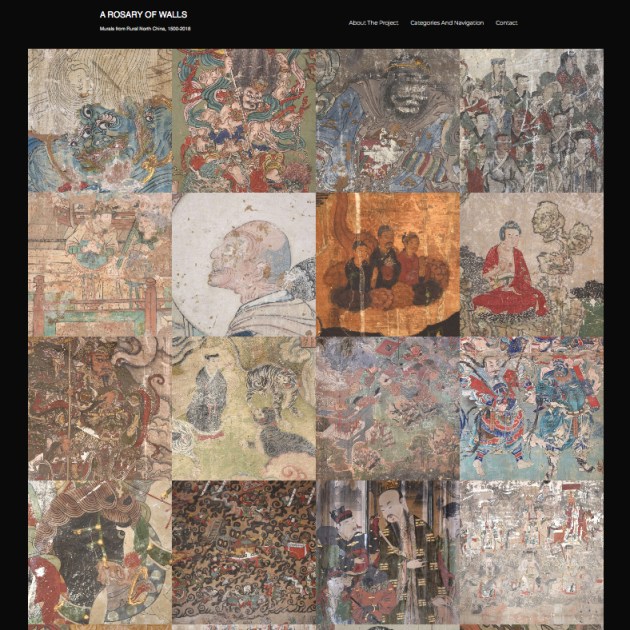
For aficionados of Chinese art and religion, following on from the fine website of Hannibal Taubes on north Chinese temple murals (see my post here), we now have a related (and ever evolving) site A Rosary of Walls (formerly called Temple Trash—the drôle title taken from the description of the murals by an unnamed professor!):

 http://twosmall.ipower.com/murals/

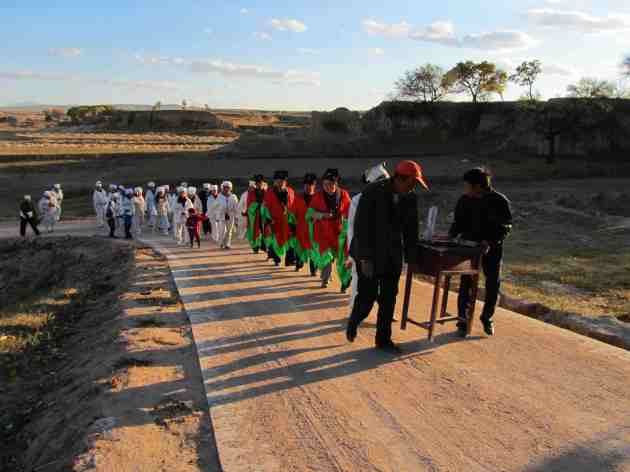
Both websites are vast, and still only a selection from the archive deriving from his fieldwork. It’s a Herculean (or in this case Hannibalesque) task, that invites us to reassess the whole history of Chinese religious art—commonly assumed to have entered terminal decline since the Ming dynasty. Unlike the many glossy compendia of early temple murals and architecture protected by the state, these murals come mainly from minor village temples, and often suffer from neglect and pillage. And given the southern focus of religious studies, the focus on north China (mainly for Hebei, Shanxi, and Shaanbei), is itself original.

Categories

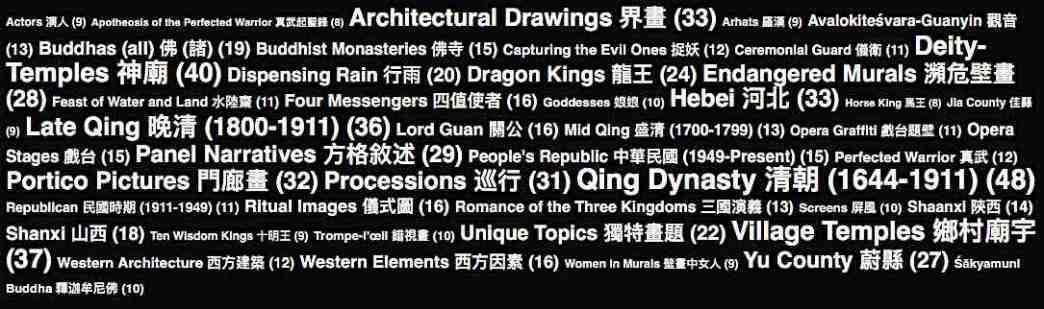
Focusing on A Rosary of Walls, the wealth of images is meticulously documented. As Hannibal explains, the image scroll on the main page is in chronological order from c1500 to the present day, top to bottom. Click on the little squares to see the galleries. You can browse the images according to type by clicking on the “Categories and navigation” menu—select the dropdown menu for a quick-list of categories (deities, genres and topics, locations, venues, periods, and so on, all extensively subdivided), or scroll down for more info. The murals are shown in context, with details of temple architecture and village topography.

To give a few examples of the wealth of the new site: apart from the temple focus, some interesting galleries show images depicted since the 1949 founding of the PRC. Some living traditions of ritual paintings are also included (cf. my modest contributions on this blog under Ritual paintings), such as pantheon scrolls for spirit mediums (Shaanbei, and Wutai in Shanxi). Among many topics, the theme of Women in murals supplements the Goddesses listed under the Deity category.

Of course (as I would say), like ritual manuals, material culture is both silent and immobile: temples are not mere repositories of artefacts, but sites for social activity. All such documentation should complement studies on religious life in north China; and (as I would say) funerals too have remained vibrant occasions for ritual life.

Exploring these sites is an edifying, eye-opening pleasure.

For a CCTV documentary about Hannibal’s fieldwork, click here. See also his guest post A Daoist temple in California.

A 2019 retrospective

For my sake as much as yours, I’m rounding up some themes from the last year (cf. my post for 2018)—do click on the links, both below and in the posts themselves! There’s plenty more to explore under the monthly archives as you scroll down in the sidebar.

I continue to add vignettes on the Li family Daoists (always bearing in mind my film and book!):

and I augment my post Walking Shrill with

On my other main fieldsite of Gaoluo (summary here),

Bearing on both the Li family and Gaoluo is

And under the main menu, it’s always worth exploring the many fieldnotes under Local ritual, and the various pages under the Themes sub-menu.

Among many posts on the great Yang Yinliu are

For links to ritual life around south Jiangsu, see

and for the rich cultures of Fujian,

Note also

For more on China, see

The plight of the Uyghurs is a pressing concern (see also Uyghur tag):

Note also

Further afield, see

The category of “world music“, or rather musicking in societies around the world, continues to grow. For salient perspectives on musical cultures worldwide (notably the brilliant, accessible work of Bruno Nettl), see

For diverse regional genres, see e.g.

For the musics of Iran, see

Pursuing my shawm theme. see

Among several posts on Italian folk culture are

See also

Note also new posts on flamenco.

On English culture (roundup here):

and having given Alan Bennett time off for good behaviour, he stars in several recent posts, notably

Under the WAM category, posts include

and recent additions to the Mozart tag, like

Under the Messiaen tag, major new posts are

On a lighter note are two classics on rubber chicken:

In my Must-Listen Playlist of songs (complementing the sidebar playlist for local Chinese traditions, with commentary here), most spellbinding is

And I continue the theme of stammering:

Also well worth a read is

And don’t forget the *MUST READ* category—among which my personal choice remains

Dream songs

In my post on Noh drama, I noted that Allan Marett’s Eliza made a kind of bridge to his fieldwork on Aboriginal culture in Australia.

In the fine tradition of subaltern studies, Allan Marett, in partnership with Linda Barwick, has long been studying wangga, a musical and ceremonial genre of Aboriginal people of the Daly Region of northwest Australia. Along with many articles, he has written

  • Songs, dreamings, and ghosts: the wangga of north Australia (2005, with CD online here)

and co-authored

  • Allan Marett, Linda Barwick, and Lysbeth Ford, For the sake of a song: wangga songmen and their repertories (2013), with associated website here (NB audio here).

Dream songs make one of the most fascinating instances of the process of musical creation, and the relation between “inspiration and perspiration”. They also make a fine exhibit for us to broaden our concept of “serious music”.

Here I’ll consider Songs, dreaming, and ghosts. It’s the result of nearly twenty years of fieldwork, its detailed analyses enhanced by participant observation. In the Preface Allan explores the ambivalence of non-Aboriginal society towards Aboriginal culture, asking why its visual arts are so much more valued than its music:

Part of the answer must surely lie in the fact that both paintings and popular songs are easily commodified, while traditional songs are not. They do not lend themselves to reframing within a European modernist tradition in the way that paintings do. Moreover, traditional songs work in ways that are unfamiliar to most audiences and are sung in languages that nobody outside their home communities understands. They tend to be intensely local, focused on places that are frequently unknown to any but those who have rights to the country. They rest on cosmologies and ways of being that are radically different from those shared by the majority of the Australian community.

The articulation of the relationship between the living and the dead occurs both in the process of song composition and in ceremony. The whole culture is deeply embedded in the concept of country (for a very different kind of Country, see here).

As Allan observes,

The many social changes—settlement, migration, marginalization—that attended European intrusion on Aboriginal domains in the Daly region are reflected in, and mediated by, wangga.

The focus of the book on the positive roles of cultural transmission emerged from Allan’s dialogue with his mentors, whose primary wish was to share the beauty and resilience of their art, rather than dwelling on the post-colonial traumas that permeate all their lives, shared by indigenous peoples worldwide (for the destruction of a First Nation community in Canada, see here)—poverty, low life expectancy, discrimination, high rates of incarceration, land rights, and so on (see e.g. here). For endangered songs and endangered languages, see here, and for the role of technology in preservation, here.

Allan outlines the history of research since the 1950s (A.P. Elkin, Trevor Jones, Alice Moyle, Catherine Ellis, and so on). He reflects on how to integrate social and musical analysis—a model for which I recommend Berliner, Thinking in jazz. We may think of WAM as complex, but the complexities of both the culture and soundscape of aboriginal life are of a different order. He reflects wisely on the role that notation may serve for us:

Although analysis is not particularly fashionable within ethnomusicology today, I am strongly of the view that it provides our best methodological tool for isolating significant (and signifying) moments of performance. I am not so naive as to assume that Western notation can ever accurately represent the totality of the sound world of wangga—or indeed any complex sound world—but I believe that transcription can, if sensitively handled, be used to direct the listener to salient features of the music, much as maps direct travelers to salient features of the landscape. Just as maps are socially constructed documents with their own sets of conventions, and just as they can never represent every aspect of the landscape without simply replicating the landscape in its entirety, so too are transcriptions socially constructed documents that can never totally encode the sound world to which they relate. But insofar as they help us navigate through an unfamiliar music, they can be extremely helpful.

The reason that I use Western notation—despite its obvious shortcomings—is because it is the most widely understood way of graphically representing musical sound. Many of the recordings on which my transcriptions are based are presented in the accompanying CD, and I invite readers to judge the efficacy of the transcriptions, and their associated analyses, with regard to the extent to which they open up the music and render it intelligible.

Indeed, reading such densely-argued analysis makes it all the more important to follow Allan’s careful transcriptions in conjunction with the 28 short audio tracks on the associated website. Such analysis of arcane repertoires is admirable—all the more so in view of the dearth of indigenous musical terminology. Profound concepts are often expressed in misleadingly simple expressions (cf. “doing things” in north China).

Chapter One introduces repertories, histories, and orders of being—opening with the legend of Old Man Tulh, represented in painting and in song.

Wangga songs are performed by one or two (or occasionally more) songmen, who accompany themselves on wooden clapsticks and are accompanied in turn by another performer playing the didjeridu, a long trumpet fashioned from a tree branch thathas been hollowed out by termites. Wangga songs typically comprise a number of bursts of singing, which I term “vocal sections”, which are accompanied by didjeridu, and, in some cases, clapsticks. Vocal sections are separated from one another by a number of “instrumental sections”, which are performed using clapsticks and didjeridu, with occasional spoken, sung, or hummed interjections by the songman. In many case, it is in the instrumental sections that dance comes to the fore.

The wangga repertory may be divided into two broad musical types. In the first, which I call “unmeasured”, the singer alternates didjeridu-accompanied vocal sections without clapstick accompaniment with instrumental sections performed by both clapsticks and didjeridu. In the second, “measured” type, the singer accompanies himself with clapsticks throughout the whole song, and the delivery of the text in the vocal sections is contstrained by the metrical framework established by the sticks and the rhythmic ostinato of the didjeridu.

Allan introduces the two main centres for the composition and performance of wangga, Wadeye and Belyuen—both migrant communities.

Today it is the Walakhanda wangga repertory that is dominant at Wadeye. The reasons for this go back to a set of extraordinary decisions made by Wadeye elders almost fifty years ago. During the late 1950s and early 1960s, a conscious decision was made to create three new repertories of song—the Walakhanda wangga, lirrga, and dhanba—as the basis of of a new tripartite system of ceremonial reciprocity. […]

The immediate impetus for the establishment of this system was the rapid expansion of the Port Keats mission that occurred during the late 1940s and early 1950s. The expanded community included groups who had long histories of conflict with one another and therefore required a new mechanism to maintain social harmony. The tripartite system established at that time continues to function to the present day and is pointed to as a source of ongoing stability within the community.

In Belyuen, by contrast, the community was further removed from the country in which their totemic Dreamings reside, giving rise to a different set of cultural references.

Chapter Two, “Dreaming songs: sustaining tradition”, opens with the Barunga songman Alan Maralung’s account of how he was given songs in dream, and goes on to explore what exactly it is that the ancestors give to songmen. The author finds that the process of composition continues to evolve.

I once witnessed Maralung rehearsing a new song that he had just received. He sang fragments of melody and text sotto voce and quietly beat out short rhythmic patterns, adjusting the various elements until he was happy with them. Later that day he was able to perform the song for a recording; this perhaps suggests that he required less composition time than Mullumbuk. One should bear in mind, however, that Maralung’s songs involve a much greater degree of improvisation than Mullumbuk’s. They constantly evolve and never attain the degree of stability sought by Mullumbuk, or indeed by Lambudju. When songs are not regularly performed in ceremony, as is the case with Maralung’s repertory, they never become “set”, and their form invariably remains unstable from performance to performance. Nevertheless, both forms—those set by performance in ceremony, and those that continue to evolve from performance to performance—equally represent the collaborative work of humans and ancestors.

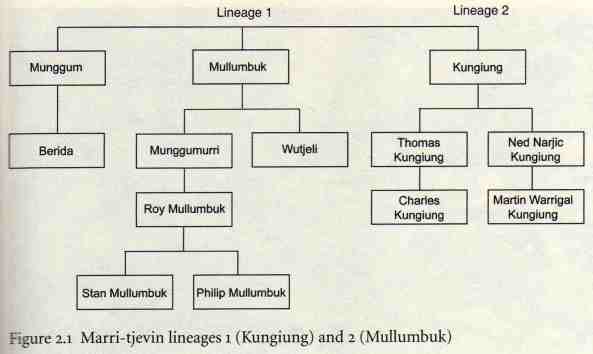
Basic elements are the cooperation and tensions between lineages, and between different language groups, influencing important aspects of performance.

table

As ever, this is not some anonymous, timeless tradition: individual performers make major contributions. As in other genres (including WAM), wangga repertories change significantly over time. Allan notes repertory loss:

Many songs fall quickly from the repertory with the death of their composers, while some survive for several generations. New songs quickly emerge as new songmen take over.

For various parameters for musical change, see Bruno Nettl.

Left: Behaving suspiciously towards strangers [lessons available for Brexiteers].
Right: Circumcision ceremony, Wadeye 1992.

Chapter Three explores ceremony, notably mortuary and circumcision rituals—again, constantly subject to revision. Always paying attention to the underlying importance of myth, Allan focuses on two burnim-rag mortuary ceremonies, in 1988 and 1995; and he makes detailed comparisons between a 1988 circumcision ceremony and accounts from 1935 to 1945. He broadens the topic to include lirrga and dhanba genres, and ceremonial reciprocity.

As performed today, the circumcision ceremonies at Wadeye represent a revival of the rites discontinued in the mid-1940s under influence from the Catholic mission at Wadeye, then Port Keats. The exact date of the revival is difficult to ascertain, though it seems reasonable to assume that it coincides with the creation of new repertories of wangga, lirrga, and dhanba in the late 1950s or early 1960s.

New ritual complexes have been introduced to replace those that are no longer regarded as efficacious. Notwithstanding the function of ritual to enhance social cohesion, given the precarious nature of tradition, I’d be interested to see an account like that of Geertz for a “failed funeral”, which I emulated for China.

Chapter Three ends with an account of funerals, performed within a Christian framework, and “quasi-ceremonial” civic events such as graduation ceremonies and festivals.

Chapter Four addresses the nuts and bolts of song and dance in performance. Referring to Susan McClary, he comments:

The need to focus not only on how performers play against conventions to generate meaning, but also on the meanings embedded in the conventions themselves, is as important for the study of wangga as it is for McClary’s study of the blues or Beethoven’s A minor quartet.

Indeed, pace Taruskin, this is another clear case of “serious music”!

Allan analyses melody, mode, melisma, metre, voice quality (cf. Voices of the world); the role of the rhythmically patterned drone on didjeridu, and the clapsticks, often signifying the footsteps or the gait of an ancestor; and the dance.

He begins by analysing a 1968 performance of a measured wangga song by Tommy Barrtjap at Belyuen (above, with audio track here), discussing in turn how metre and tempo are established in the instrumental introduction, the structuring of vocal and melodic sections, the structuring of text and its rhythmic realisation in song, instrumental interludes and codas, and stabilizing form.

He then unpacks an unmeasured wangga from a 1988 burnim-rag ceremony at Wadeye, and its relationship with dance.

Always uncovering both communal and personal elements in transmission, Chapters Five to Eight explore major repertoires of wangga with detailed analyses. Chapter Five concerns the Walakandha wangga, established in the early 1960s as part of the reorganization of ritual life at Wadeye. Chapter Six discusses the more variable (and now rare) Ma-yawa wangga, Chapters Seven and Eight the wangga of Tommy Barrtjap and Bobby Lambudju Lane at Belyuen.

In Chapter Nine Allan revisits the musical conventions of the Daly region, drawing general conclusions on the diversity of text structures, rhythmic treatment, multivalency, melody and mode, rhythmic mode and dance.

Chapter Ten looks beyond the Daly region to the performance of wangga and lirrga in the Barunga/Beswick and Kimberley regions. Again using material from as far back as the 1940s, Allan explores the wider network of ceremonial reciprocity between Wadeye and other communities, always identifying creativity.

Again, it is most important to follow Allan’s detailed analyses together with the audio tracks on the book’s website. Of course, listening like this we can only admire them as isolated sound objects, detached from the context of ceremony and dance. Short of attending ceremonies ourselves, film should be a major medium to engage with this culture—indeed, I can imagine Allan making a wonderful portrait film on the topic. Meanwhile, we can get a flavour of ceremonial performance here, with Button Jones singing wangga and lirrga from the Kimberley (as in Chapter Ten):

And lirrga from Wadeye:

Allan also admires the dancing in this exceptional video of performers from Wadeye at a 1973 Eucharistic Congress at Melbourne, with specially-composed Christian lirrga:

* * *

Beyond the nuts and bolts of soundscape, Songs, dreamings, and ghosts constantly stresses cosmological significance, and the creativity of individual composers.

Meeting up with Allan again in London recently, I reflect that after our paths converged at Cambridge while studying Tang court music with Laurence Picken, they then diverged with our respective fieldsites, and then converged again with fieldwork on living folk ritual among disadvantaged people (my own topics in China including spirit mediums and blind shawm players)—all paths of which Laurence, in his wisdom, approved.

For the co-option of Aboriginal culture on stage, click here ; see also under Native American musical cultures (here and here).

More Country

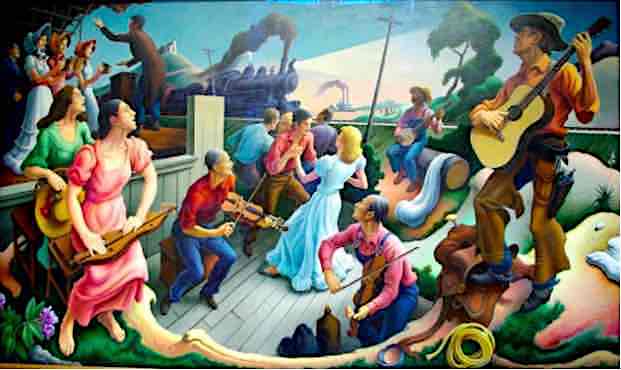
Sources of country musicThomas Hart Benton, The sources of Country music (1975).

Three chords and the truth—Harlan Howard

Do you know what the southern definition of a true music lover is?
It’s a man who, if he hears a woman singing in the shower, puts his ear to the keyhole—cited in Dawidoff, In the country of country.

Complementing his classic series on jazz, the new PBS series by Ken Burns on the simpler but equally meaningful language of Country music reminds us that far from being a quaint byway, it represents the soul of modern US culture. The eight two-hour episodes have been re-edited and pared down into nine 50-minute programmes for BBC4. [1] Now that I’ve watched the latter, I’m keen to see the full version. Here I can only outline a few of the themes and personalities.

If you know about Country, then you won’t be reading this, and indeed you may bring more critical perspectives to bear on Burns’s portrayal; but for the rest of us, it deserves taking seriously. Here’s a trailer:

As with any genre (Aboriginal dream songs, Iranian chamber music, French baroque, and so on), you just have to immerse yourself in the style and the culture (for a more detailed project on flamenco, see the amazing series Rito y geografia del cante).

With Peter Coyote’s distinctive voiceover, the series judiciously blends interviews and performances with lingering photos, encompassing the personal and political, artistic and commercial, poverty and pain, ecstasy and drudge, church and honky-tonks, domestic stability and outlaw excess, survival and solace. Looking beyond the hillbilly costumes and cowboy hats to the heartache, amidst all the drink, drugs, divorces, early deaths, and the ravages of the touring life, Burns accessibly draws us to the lyrics and music, always identifying themes in the history of cultural transmission, and the very nature of tradition.

Gradually over the series, the early log cabins, railroads, coal mines, textile mills, timber yards, and sharecroppers give way to mansions and Cadillacs. And as one review comments, you can almost trace the history in the performers’ faces: the lean lines of the early stars such as Hank Williams and Jimmie Rodgers, giving way to the gnarled faces of Johnny Cash and Merle Haggard, and then the soft, untroubled faces of the ’80s and ’90s stars. But to see it as “a simple journey from the sublime to the ridiculous” risks succumbing to the bourgeois nostalgia for poverty.

Despite the later countrypolitan sounds, audiences constantly returned to the roots authenticity of old-time, bluegrass, hillbilly. Female performers play an exceptional role, such as The Carters, Patsy Cline, Loretta Lynn, Tammy Wynette, Dolly Parton, Rosanne Cash, and Emmylou Harris.

oldies

The Rub (beginnings to 1933) makes a captivating opening, with wonderful archive photos evocatively deployed. Folk music is always eclectic. Spreading through barn dances and travelling medicine shows, the history of Country is intertwined with gospel and spirituals, slavery and the blues, as well as folk traditions of Appalachia and European migrants, notably the British Isles. Though Country has been described as “the white man’s soul music”, the series acknowledges its debt to African-American culture. In addition to the new technologies of phonographs and radio, it soon became a highly commercial proposition, with patronage from institutions like the National Life and Accident Insurance Company and its WSM station, which gave rise to the long-running Grand Ole Opry. Among early performers, the 1927 discovery of the Carter family and Jimmie Rodgers was a seminal moment.

In Hard Times (1933–1945) (“The sad songs are the best”), the industry continues to grow through the Great Depression and World War Two, with major migrations. The Texas Swing of Bob Wills and his Texas Playboys was based on strings rather than horns—a classic case of the eclectic melting-pot of immigrant styles (Cajun, Hispanic, and so on) (cf. Accordion crimes). Nashville becomes the heart of the scene with the rise of the Grand Ole Opry. Roy Acuff and Bill Monroe are admired, and the Carter family become ever more popular. The steel guitar plays a growing role. Social dancing is still a major element.

Why don’t Baptists make love standing up?
Because people would think they’re dancing.

Country helped people cope with loss. Hard times was adopted from Stephen Foster’s 1854 parlor song:

Let us pause in life’s pleasures and count its many tears
While we all sup sorrow with the poor
There’s a song that will linger forever in our ears
Oh hard times come again no more

Tis the song, the sigh of the weary
Hard times, hard times, come again no more
Many days you have lingered around my cabin door
Oh hard times come again no more

While we seek mirth and beauty and music bright and gay
There are frail forms fainting at the door
Though their voices are silent, their pleding looks will say
Oh hard times come again no more

’Tis the song, the sigh of the weary
Hard times, hard times, come again no more
Many days you have lingered around my cabin door
Oh hard times come again no more

’Tis a sigh that is wafted across the troubled wave
Tis a wail that is heard upon the shore
Tis a dirge that is murmured around the lowly grave
Oh hard times come again no more

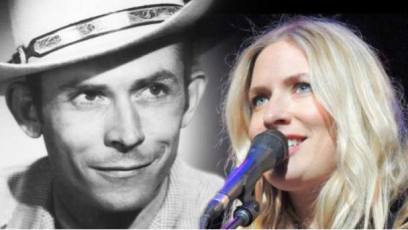
Hank and Holly

Hank Williams and his granddaughter Holly.

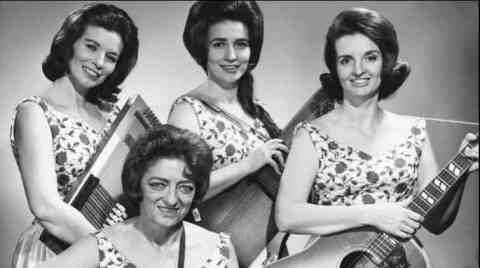
The Hillbilly Shakespeare (1945–1953) evokes the postwar period, focusing on the great, short-lived Hank Williams, with fine vignettes from his granddaughter Holly, and Marty Stuart reminding us of the importance of black musicians in the tradition. Also featured are the stellar bluegrass lineup of Bill Monroe, Lester Flatt, and Earl Scruggs; and the Carter sisters with their mother Maybelle.

Carters

In I Can’t Stop Loving You (1953–1963), the confluence of blues and hillbilly music at Sun Records in Memphis gives birth to rockabilly, the precursor of rock and roll; at the forefront are Johnny Cash (with comments from his daughter Rosanne) and Elvis Presley. Not “Walking the Line”, Johnny Cash gets together with June Carter. Among the rapt inmates for his 1959 concert at San Quentin was Merle Haggard. Like Russians listening to Vladimir Vysotsky, when they heard him they couldn’t believe that Cash hadn’t done time in prison.

Meanwhile in Nashville the country twang was replaced by a smoother sound, with Patsy Cline and Loretta Lynn among its stars. Before Patsy Cline’s tragic death in 1963, there’s a nice story about how they reached the perfect tempo for her recording of Willie Nelson’s song Crazy, whose exceptional melodic and harmonic invention quite transcends the cheesy accompaniment:

In The Sons and Daughters of America (1964–1968), the Grand Ole Opry story continues, even as social conflict intensifies. Johnny Cash embodies the spirit of the age, his self-destruction mirroring his artistic triumphs. From the new East coast folk revival scene he took on board the current of social protest; his admiration for Bob Dylan was mutual. His 1968 Folsom Prison concert was a triumph. Merle Haggard (“San Quentin graduate”, another engaging commentator throughout the series; he died in 2016, R.I.P) emerges from his misspent youth as a great singer.

Amidst the civil rights movement (note also Detroit 67), Charley Pride overcomes racial prejudice with his fine voice. The unfiltered songs of Loretta Lynn chime with the new wave of Women’s Liberation. Dolly Parton, fourth of twelve children from a rural cabin without electricity or running water (the kind of CV that was still de reigueur for that generation of singers), demands to be taken seriously—despite joining a select group of strong women reluctant to acknowledge the boons of feminism.

Tammy and Loretta

Tammy Wynette with Loretta Lynn.

The story continues in Will the Circle Be Unbroken? (1968–1972). As the Vietnam War intensifies, the industry and its audience react to divisive social upheavals. George Jones and Tammy Wynette get together. Despite Tammy’s submissive Stand by your man, she didn’t—by contrast with the tough-talking songs of Loretta Lynn, who did; as Jennie Seely comments “I always kinda thought they wrote each other’s songs.”

Among a growing number of Country recruits from outside the archetypal deprived rural background was Kris Kristofferson. Several singer-songwriters pay tribute to his exceptional lyrics, such as Casey’s last ride:

Casey joins the hollow sound of silent people walking down
The stairway to the subway in the shadows down below;
Following their footsteps through the neon-darkened corridors
Of silent desperation, never speakin’ to a soul.

The poison air he’s breathin’ has the dirty smell of dying
‘Cause it’s never seen the sunshine and it’s never felt the rain.
But Casey minds the arrows and ignores the fatal echoes
Of the clickin’ of the turnstiles and the rattle of his chains.

 Oh! she said, Casey it’s been so long since I’ve seen you!
Here she said, just a kiss to make a body smile!
See she said, I’ve put on new stockings just to please you!
Lord! she said, Casey can you only stay a while?

As he explains, his song Bobby McGee (Busted flat in Baton Rouge, waitin’ for a train, And I’s feelin’ near as faded as my jeans…) was inspired by La strada. Johnny Cash was hugely popular, and increasingly countercultural. And the Californian hippies of the Nitty Gritty Dirt Band recruited senior Country legends like Maybelle Carter, Earl Scruggs, and Roy Acuff for an album that bridged the gap between generations.

In Are You Sure Hank Done It This Way? (1973–1983) (a sentiment that recalls Taruskin) opens by asking a question central to ethnomusicology, how much change a genre can embrace while retaining its identity; and reminds us how resistant Country had always been to arbitrary borders. As the smooth countrypolitan sound reaches new audiences, singers like Dolly Parton achieve crossover success, finding time for the classic epithet

It cost a lot of money to look this cheap.

And Emmylou Harris, with her background in the East Coast folk scene, tells how she found herself by becoming a convert to Country. At the same time, despite pressures from the Nashville bosses, Waylon Jennings managed to persist with a rougher style. And we hear the compelling story of Hank Williams Jr as he emerges from the long shadow of his godlike father to forge his own path (exemplified in his brilliant song Family tradition!)—with further endearing comments from his daughter Holly.

Marty and L Flatt

Lester Flatt with Marty Stuart.

In Music will get through (1973–1983) the less mediated, marginalized bluegrass style enjoys a roots revival: “It was so old that it was new”. It had never gone away, it just hadn’t hit the headlines. Marty Stuart, who provides thoughtful comments throughout the series, comes into his own as a fine performer, touring from young with Lester Flatt and Bill Monroe, and later with Johnny Cash. I’m struck by how much performers themselves revere the whole tradition:

Walking into the Grand Ole Opry with Lester Flatt was like walking into the Vatican with the Pope. It was like that old scene in The Wizard of Oz where the world went from black-and-white to color.

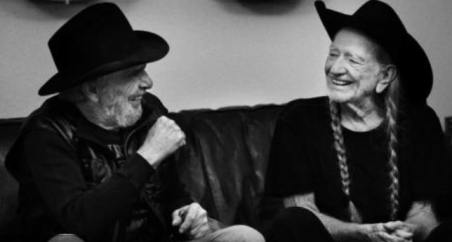
Nelson and Haggard

Merle Haggard with Willie Nelson.

The veteran Maybelle Carter finds a new audience; George Jones and Tammy Wynette, now divorced, come back for a reunion album. Willie Nelson (“Willie’s not from round here—I mean, Earth”) thrived in the freewheeling, genre-bending scene of the Armadillo World Headquarters in Austin, Texas. With Waylon Jennings he launched the Outlaw movement, later going on to work with Merle Haggard.

Following in her father’s footsteps, Rosanne Cash becomes a fine singer-songwriter. Emmylou Harris bridged folk, rock, and Country, influencing a new generation of artists, including young Ricky Skaggs, with all his bluegrass credentials.

As doors continue to open, the final programme, Don’t Get Above Your Raisin’ (1984–1996) features artists like Reba McEntire, Naomi Juggs and her daughter Wynnona; k.d. lang (“a punk reincarnation of Patsy Cline”), Kathy Mattea, Rhiannon Gid, and megastar Garth Brooks.

Cashes

Johnny Cash with Rosanne.

But the pull of the more traditional elements still remains strong. Ricky Skaggs and Marty Stuart stay faithful to the bluegrass sound of Bill Monroe, taking Country back to the front porch. Johnny Cash reinvents himself, bowing out on a high note, with Rosanne offering more insights. The series concludes with a wonderful montage on the whole tradition.

And the story continues…

My purpose here, apart from drawing your attention to a fine piece of film-making, is not so much to provide a superfluous summary as to remind myself, in the spirit of ethnomusicology, that all the musickings of all the cultures around the world deserve to be treated on an equal footing, and that they offer a revealing window on societies in change.

[1] Currently online, alas only briefly, so catch it while you can; otherwise, the DVDs are eminently worth buying. The book, like that complementing Burns’s series on jazz, also looks tempting. Among many reviews far better informed than I can offer, see e.g. herehere and here. Among the extensive literature (note Malone and Neal, Country Music, U.S.A.), I’ve enjoyed re-reading Nicholas Dawidoff, In the country of country: a journey to the roots of American music (1997).

A flamenco Christmas

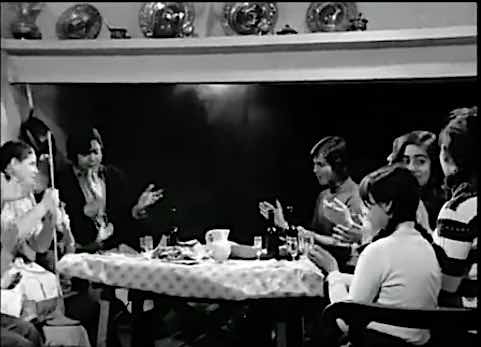
Xmas 1

As a relief from the seasonal bombardment of tinsel, schmaltz, and sprouts, you can’t beat a flamenco Christmas in Andalucia.

I featured the Navidad flamenco programme from the brilliant documentary series Rito y geografia del cante in my article on gender, politics, wine, and deviance, but a separate post seems timely—and like this recent addition to my series on flamenco, it bears on the wonders of inter-generational family upbringing.

Filmed with all the characteristic intimacy of the series, the episode features shots of customary life (“not suitable for vegetarians”) and the making of the zambomba friction drum that accompanies villancicos carols; as well as a fantastic Christmas bulerías session featuring the Soto family in Jerez, with the children taking their turns to sing:

For saeta devotional songs at Easter, see Calendrical rituals, and under Cante jondo.

A new volume on Chinese religion

Cover

  • Cao Xinyu 曹新宇 (ed.), Jibian rujiao: jinshi Zhongguode zongjiao rentong 激辩儒教:近世中国的宗教认同 [Provocations to Confucianism: identifying religion in modern China] (2019).

In a recent volume in a series on “New Historiography”, the ever-industrious Cao Xinyu assembles substantial articles by international scholars on a variety of topics on Chinese religion, illuminating broad, long-term trends with detailed studies. In the tradition of Chinese scholarship, it’s based on “salvage” studies of the late imperial and Republican eras, and on texts rather than performance.

Rain ritual《 映旭斋增订北宋三遂平妖全传》 第十七回插图

Cao Xinyu sets the tone with a substantial introduction, setting forth from a Song-dynasty rain ritual to explore the Catholic encounter with Chinese religion through the Qing rites controversy.

The chapters are grouped under four main headings. Philip Clart and Cao Xinyu explore grassroots Confucianism in Taiwan and mainland China. Articles by Vincent Goossaert, Masaru Yamada 山田贤, and Wang Jianchuan discuss spirit-writing and charitable associations, and Zhang Chaoran contributes a substantial essay on Daoist ritual in history. For Shanxi, Yao Chunmin writes on changing village boundaries, and Henrietta Harrison on Catholic and local healing practices. Further afield, Takeuchi Fusaji 武内房司 discusses folk religion among communities of Chinese origin in South Vietnam. Finally Prasenjit Duara outlines the histories of religion and secularism in Europe, China, and Japan.

For recent English-language volumes on Chinese religion, note the surveys of Adam Yuet Chau and Ian Johnson, as well as the classic study of C.K. Yang.

A flawed funeral

qushui

Fetching Water procession, 2011.

Much of the voluminous work on Daoist ritual focuses on recreating the glories of ancient China. While fieldwork since the 1980s has greatly enriched our understanding, the complexities of modern life rarely intrude even in descriptions of rituals observed; the search for “living fossils” dominates research, implying a timeless social cohesion of local communities.

My diachronic ethnography of the Li family Daoists in Yanggao county of north Shanxi is partly inspired by the classic studies of Geertz; and for China, Ken Dean paid attention to the tensions involved in the 1980s’ revival of ritual practice in Fujian. This post is based on Chapter 19 of my book Daoist priests of the Li family, and in my film you can observe the rituals described here.

* * *

Since my visits from 2003 the “old rules” (lao guiju 老规矩) of ritual practice have been declining rapidly. Nowadays Li Manshan’s band works for patrons, kin, and audiences who have less discrimination, and in some respects the band’s response to this lack of appreciation is to perform less scrupulously. The Daoists are deeply gloomy about the future. They love the exhilarating percussion finale of Transferring Offerings (my film, from 1.11.07) as much as I do, but “within ten years it won’t be heard any more.” They know such repertoire is precious but are helpless to protect it; they make the comment without anguish or sentimentality. Whereas Li Qing’s generation used to wear their thick black costumes underneath their red costumes even in the summer heat, now they merely wear the red costumes over their daily apparel. And for Fetching Water, Call Me Old-Fashioned, but a plastic Sprite bottle just doesn’t do the job (see Changing ritual artefacts).

Yet they still demand basic standards of themselves, maintaining many of the old rules against all the odds. They play on procession all the way out from the scripture hall to the altar, and all the way back. While singing at the altar they may sometimes seem lax (the occasional joke, even answering a mobile), but their basic solemnity shows their perceived need to maintain their reputation. Recently they tend to sing some of the hymns rather too fast in the Invitation (the Song in Praise of the Dipper, and the Mantra to the Three Generations at the gate on the return), but they still perform most of the hymns extremely slowly (notably those for Opening and Delivering the Scriptures), when surely they could go just a tad faster; nor do they abbreviate them. While singing a cappella they keep the large cymbals folded on their chests, maintaining great solemnity. There is still room for further decline.

Like his father Li Qing before him, Li Manshan worried about the stresses of being band boss and choosing suitable personnel—like band leaders in jazz, indeed. But he is far from hands-on; I would like to see this as an embodiment of Daoist wuwei “non-action.” He notes occasional blips in ensemble playing, but he rarely reprimands. The dep Guicheng tends to mime a silent beat between the slow beats on the gong, which is “not good to look at,” but Li Manshan only mildly mentions this to him when he realizes I have noticed it. Back in the scripture hall, by contrast with the way the Daoists fool around now, Li Qing and his colleagues used to “hold a meeting” about how the previous ritual had gone, always maintaining standards. Li Qing would certainly want to retain the “old rules” now, but given the hosts’ apathy he too would be helpless to do so. Even in the 1980s he presided over a radical revision of the temple fair sequence, and the Pardon ritual that he led at a 1991 funeral was very different from the manual (see Daoist priests of the Li family, pp.246–9). The decline has taken place gradually in waves over the last century or so.

When performed at all, some of the fashi public rituals have recently been radically simplified, such as Opening the Quarters, Communicating the Lanterns, and Judgment and Alms. Early one morning before a burial, Golden Noble gave me a perceptive summary of the current situation. The cycle goes from ritual (yishi) to form (xingshi) until the latter itself becomes a type of ritual; thus the ritual becomes a token, then the token becomes ossified. Let’s now discuss some instances of decline that I observed in 2011.

Ritual multi-tasking
The Li family has long prided itself on being able to split into several bands for rituals on the same day. But now the same band can even chase round more than one venue on the same day, cramming in a couple of ritual segments alternately. This is possible thanks to both improved modes of transport and the hosts’ lesser demands. Even on his own, Li Manshan can now zoom from smashing a bowl in one village to decorating a coffin in another.

One morning in 2011 while doing a burial at Houying they fitted in a half-day appearance at the new temple outside Lower Liangyuan. Li Manshan, Li Bin, and Wu Mei left at 7.30am to Open Scriptures there, hooking up with three other Daoists; then they hurried back to Houying for the burial procession before returning to Lower Liangyuan again, playing a long shengguan suite seated round a table outside. Later in a smoke-filled room to the side of the temple complex I found a large group of people, mainly women, clustering round a spirit medium who was curing illnesses. I now realized this must be the main reason why the temple was being rebuilt.

Fast food, Daoist style
In May 2011 I was roped in to take part in another perfunctory ritual.

The band is doing a funeral in Golden Noble’s village of Houying. After a fine Invitation ritual and a jovial supper, before the evening Transferring Offerings, they have agreed to cram in another quick Transferring Offerings at Wujiahe village, half an hour’s drive away along winding little roads. So we all cram cordially into Yang Ying’s car—Golden Noble stays behind to attend to the kin, so I dep for him on gongs.

This other funeral is a very minor affair, with paltry altar decorations, and no-one minds when we rush through the offerings at hectic pace—indeed, they expect us to do so. For the three sections we just sing brief excerpts from hymns, far from the long sequences prescribed. This is exceptional, actually, and the Daoists only agreed to do it because the host begged them.

I already hinted at a certain recent simplification of Transferring Offerings. As we pile back into the car back to Houying for our main course, I joke that this is like a ritual version of fast food, a drive-in take-out. Just further north, hosts are already more “careless”—there they no longer even request the Invitation. Even in our area, some patrons now request shorter hymns for Transferring Offerings; Li Bin recalls a funeral recently where the host didn’t want the ritual at all, considering it “too much hassle” (Pah!). Still, on our return to Houying they do a beautiful full sequence, with three long plaintive hymns.

A flawed funeral
During my stay in October 2011 I am looking forward to a three-day funeral in a nearby village; such funerals are no longer common, so I should be able to attend several rare rituals. When the day comes I am in high spirits; it is a beautiful sunny autumn morning, and it is a picturesque little village with a population of only two or three hundred.

Over the next couple of days my hopes are progressively deflated. First I discover that the Daoists now commonly simplify the three-day sequence. But in this village, as they realize the depth of their hosts’ ritual ignorance, they are even more casual. I begin to realize that a crucial factor in the maintenance of ritual is whether or not “the host is cooperative” (dongjia peihe 东家配合). The Daoists are used to having to guide the host family, but here they sense reluctance.

coffin

The deceased woman was 93 sui. Her third son had died seven years ago, aged 52 sui; his coffin was removed from the grave for the purpose of burying them jointly, and it now stands at the roadside under an awning. Li Manshan did the initial determining the date, decorating the new coffin on the third day, and Li Bin decorated the soul hall two days before the funeral. So they may have sensed a certain ignorance in the host family long before they turned up to do the rituals—but work is work.

The scripture hall—as usual at the other end of the village to allow for a suitably lengthy procession—is the house of an affable but poor 50-sui-old bachelor. It is still hot, and his house is full of flies. I gaze admiringly at the wall paintings around the kang brick-bed of our host; their dilapidated charm reminds me of Ming dynasty murals, and I am taken aback to learn that they were painted when the house was built in 1978!

Xingyuan 2011 female kin

Female kin kowtow before the coffin, 2011.

After the first two morning visits to Deliver the Scriptures, Wu Mei nips into town on his motorbike to collect his new bank card while the others return to Pansi for the burial procession there (more multi-tasking). I give this a miss, chatting with our host as he busies himself sorting the corn harvest piled up in his courtyard. The Daoists return from the Pansi burial at 11.25am, so there is only time for three of the usual four Delivering the Scriptures this morning. The Opening the Quarters ritual, once prescribed at this stage of a three-day funeral, is no longer performed in Yanggao.

Lunch is followed by a siesta. With Li Manshan still busy writing ritual documents on the kang, there is only space for three of us to rest there; two more Daoists recline in Yang Ying’s car, while Wang Ding nods off perched precariously on a narrow trunk. Then a couple of Li Manshan’s mates from Houguantun turn up to chat with him.

At 3pm the Daoists set off on procession to the soul hall for the afternoon Opening Scriptures. This turns into another Failed Experiment, and this time it’s all my fault. At my request they sing Eternal Homage (see here, under 3rd moon 4th), a very slow hymn that I have never recorded. Only afterwards does it transpire that it is commonly accompanied by shengguan; this is the first time they have tried the a cappella version for over twenty years. On the gong Wang Ding, then still inexperienced, keeps going too fast, and it’s a mess. Back at the scripture hall they rehearse it diligently. At least this shows that the a cappella version can still be performed.

Then the Fetching Water ritual (my film, from 41.06). First to the soul hall to collect the kin, then to the rather distant “river,” and back to the soul hall, ending with a fine sequence of popular errentai melodies and clowning. Again, for this sequence the family is either unaware of the tradition of throwing extra money onto the table or too stingy, and I fail to persuade the Daoists to let me give them some.

After supper we admire the bright stars and rest a while in the scripture hall, watching TV, while Li Manshan writes yet more paper documents for tomorrow’s Hoisting the Pennant. When our bachelor host returns I ask him, “You been watching the opera?” He replies wistfully, “Yeah—watching the women.”

At 8.30pm to the soul hall for the long-awaited Communicating the Lanterns—so-called. Instead of the prescribed ritual, the Daoists merely light ten candles in a row on the altar table, sing the long a cappella hymn Mantra of the Wailing Ghosts, then play a quick shengguan sequence, and it’s all over! But the family is oblivious. The Daoists don’t give me any heads-up for this, nor—gratifyingly?!—does it occur to them to perform the proper ritual specially for my benefit. I now begin to realize they are disgruntled because the kin are not “accommodating” and have no understanding of the “rules.” But irrespective of relations with the host, this simplified version of Communicating the Lanterns has become standard in recent years.

So we finish early, before 10pm. The Daoists all live nearby, so we decide against enduring the modest hospitality of our bachelor host; the others zoom off on their motor-bikes while Li Bin drives Li Manshan and me back home to Upper Liangyuan.

Next morning Yuan Xuedong is depping for his cousin Yuan Gaoshan, and Yang Ying for Li Bin, who has gone off to lead another band for a funeral at Lower Liangyuan. In the scripture hall Li Manshan makes the little triangular paper flag to go at the top of the central pole for Hoisting the Pennant (my film, from 44.22), and prepares the goodies, wrapping them up carefully in the beautiful long pennant. After the first two sessions Delivering the Scriptures the Daoists prepare the arena, hanging up the paper squares, sticking the red “god place” inscriptions onto the poles, and raising the flag and pennant high on the central pole. The ritual itself they perform in full, with all the hymns at each of the poles, the kin following them around the arena and kowtowing and burning paper on cue. But for the final chase Golden Noble doesn’t bother to don the five-buddhas hat or wield the precious sword. They are going through the motions. Still, this was the first Hoisting the Pennant here for at least thirteen years. While filming I got hit twice by firecrackers, with magnificent symmetry first on my left shoulder and then not long afterwards on my right. No damage done—occupational hazard.

The Daoists then lead the kin back to the soul hall, where they sing a short a cappella version of the brief pseudo-Sanskrit coda that concludes hymns like Diverse and Nameless. Next, on a brief kitchen visit to Invite Offerings they sing the six-line hymn Songjing gongde. Returning to the scripture hall they do a brief “scriptures for well-being” session for our poor host, playing The Five Offerings on shengguan while he kneels and burns paper before the image of the City God of This Earth. Then back to the soul hall again for a perfunctory Presenting the Offerings ritual. Both Inviting and Presenting Offerings were formerly more lengthy, particularly for temple fairs. After lunch the others take a siesta, but Li Manshan has to keep writing away.

For the first Delivering the Scriptures of the afternoon they sing a cappella the long Mantra of the Skeleton. They give me permission to sit out the second Delivering the Scriptures—and sure enough, on their return they tease me that they sang Fanhun xiang, which I’ve never recorded!

Between (and occasionally even during) rituals the Daoists check their mobiles. To wonder if their Ming-dynasty forebears would have behaved like this is as pointless as the debate whether Mozart would have written jingles for TV ads; the kind of conditions that produce mobile phones are related to those that prompt people to check them during rituals.

Towards dusk they do the Invitation at the edge of the village. Li Qing’s prescription for a three-day funeral places the Invitation on the first day and Redeeming the Treasuries on the second day; but since they no longer do the Pardon or Crossing the Bridges on the second day, there is time to do the Invitation and Redeeming the Treasuries in sequence then.

After returning to the soul hall we immediately set off to the public arena for Judgment and Alms. Again, this ritual is now rarely performed, so this should be a rare chance for me. The paper squares hung up around the arena for Hoisting the Pennant are taken down and burned, then the red god inscriptions on the poles, and finally the central pole is pushed over. But again the ritual is a far cry from what it should be. As Wu Mei later confides, “It was a modernized Judgment and Alms!”

Then immediately back to the soul hall to fetch the treasuries for the Redeeming the Treasuries procession. After supper we enjoy the skit outside the gate, laughing along with the village audience, tearing ourselves away to take our places around the altar table for the first installment of Transferring Offerings. As soon as Wu Mei plays the plaintive preludial two notes of Diverse and Nameless, the tone is set for a deeply mournful long slow hymn; at once we are all deep in the groove, our concentration total. But the ritual is rather perfunctory, and Yang Ying drives us back to Upper Liangyuan by 11pm. Tired as we are, Li Manshan is keen to give me a session on how the Judgment and Alms should really go, our chat itself serving as a kind of exorcism.

burial

On the final day, in bright sunshine, we return to the village for the burial. A list of gifts is pasted up at the gate, on red paper: gifts range from 800 down to 100 yuan, with most donors giving 200. Popular opinion is that these amounts are too mean. The preparations for the burial take ages, the kin faffing around endlessly, while Li Manshan mutters expletives under his breath. The burial procession is uneventful. The son’s coffin is to be reburied next to that of his mother. Li Manshan returns to the soul hall to stick up talismans in a brief exorcism. A protracted lunch—a wearisome day altogether. By now Li Manshan and Li Bin are really annoyed with the family. First Li Manshan has to haggle with them over the bill (never normally an issue), then Li Bin, whose gig at Lower Liangyuan ended at 3am last night, arrives to lend his support. While I wait discreetly in Li Bin’s car, a toothless ancient geezer talks at me non-stop and incomprehensibly for twenty minutes. Since I gather he was talking about the funeral, this might have been interesting, but I can only deduce the gist—that it was a crap funeral, and the family was stingy.

Then an impressively ugly peasant woman in a flimsy minidress walks by, grazing two donkeys. I seem to have stumbled onto a Fellini filmset. She takes pity on my verbal bombardment from the ancient codger, and after he wanders off she chats with me for a while in mercifully standard Chinese. She comes from Sichuan, and was sold to a man in this village twenty years ago; she recalls that it took her a couple of years to adapt to Yanggao dialect.

While Li Bin haggles with the family, quarrels and recriminations break out within the family, people red-faced from booze wandering around shouting at each other. It’s just like Christmas in England. After Li Bin drives us back home to Upper Liangyuan, Li Manshan and I recover, consulting the manuals again, clearing up a few more of my incessant queries, joking.

Cohesion and dislocation
In a modest contribution to the fine tradition of learning from failed rituals, let’s reflect on these notes.

The idea of a failed ritual tacitly accepts that the aim of the proceedings is to confirm and celebrate community solidarity—and indeed that there is such a thing. That Geertz and others don’t always find this may reflect on a supposed loss of such harmony under complex post-colonial (or whatever) social tensions; perhaps by contrast with an imagined earlier ideal age, a notion that we may obviously challenge too.

Funerals in China do indeed seem to me to represent something valuable, for both kin and community. But the family is subject to scrutiny; the event is an opportunity to confirm status within the family and community, but also a moment when underlying animosities may be entrenched. And this applies to other rituals too, like the vast territorial processions of southeast China. The conditions of the 20th century have doubtless created many dislocations in thinking; and we should recognize conflicts in imperial China, between classes and lineages, different aspirations, and so on—the very area that Lagerwey (China: a religious state, pp.153–170) seems to characterize as a kind of rural paradise is one where feuds between lineages, and between villages, have long been brutal.

Shi Shengbao 2018

Shi Shengbao with Li Manshan, Yangguantun 2018. Photo: Li Bin.

With his long experience of serving the villages in the area, Li Manshan has a network of guanxi contacts among senior men familiar with ritual proprieties—for instance, he is always happy to work in Pansi and Yangguantun, where the people are friendly and knowledgeable. At a fine funeral in Yangguantun in 2016, the gujiang shawm band was playing “greater opera” on their truck outside the gate, but stopped when we approached, as the “old rules” demand. The fine director Shi Shengbao, then a youthful 69 sui, took the job up in 1981 because he liked it. The family, and our scripture hall hosts, are cultured and respectful. Still, when you look closely, the village is still poor, with decrepit derelict boarded-up old houses. These villages are dying.

The main reason why the funeral described above was so unsatisfactory was because the Li band hadn’t performed there before, and none of the kin—or indeed the village’s ritual director or the plentiful men in their 50s to 70s—seemed to know the most basic “rules,” so Li Manshan had to explain even fundamental proprieties like kowtowing.

While the Daoists were disturbed by the whole ritual ignorance of the village, they and their rituals were not a crucial element in the failure of the event. It was through their irritation that I became aware of the conflicts within the village and the funeral family, which were going to come to a head anyway. The Daoists have routinely been simplifying the three-day sequence even for more discriminating clients; the titles of many ritual segments endure, but their content is diluted and homogenized.

Daoists still have to be invited, almost routinely; but by now they are used to not being appreciated. Since the 1990s no-one pays much attention when they arrive at the soul hall; only the kin reluctantly abandon their places watching the pop music outside the gate to go and kneel before the soul hall. It shows that a subtle degree of respect for the “rules,” from some quarter, is still expected. Sure, it is a small village, so they don’t get to put on so many funerals, but still, if they had so little clue about the proper procedures, and balked at the expense, then why did they bother requesting a three-day funeral in the first place—why not just book the Daoists for a minimal sequence? Li Manshan’s group is perfectly accustomed to doing this, and one might suppose that their irritation derived mainly from the final squabble over money. But the Daoists were already feeling disgruntled soon after arriving, long before the bill had to be settled.

The decision to hold a funeral over three days rather than two involves far more than merely the minor expense of asking the Daoists to perform a few more rituals. The pop band and the shawm band, as well as the cooks, have to be hired; the returning kin have to take extra time off their work in distant towns.

In sum, a lot depends on whether the host is “cooperative” or not. On tour in Germany in 2013 we observe that our hosts are all very cooperative—whereas we joke that Milan, scene of our most desultory European gig, should twin up with the village described above. Of course, what they expect of their hosts for domestic and foreign contexts are totally different. Abroad, the host merely has to find a good venue and provide decent hospitability; back home, the host family is expected to work closely with the Daoists in accordance with complex ritual organization.

In the Coda of my book, “Things ain’t what they used to be”, I round up the theme of ritual decline.

Note the recent diaries of Li Manshan and Li Bin. Funerals feature throughout my posts under Local ritual; see also e.g. Funerals in Hebei.

Blind shawm players of Yanggao

Liuru

Liuru, 2003.

*Part of a series on blind musicians in China and elsewhere!*

To follow my post on the secret language of blind shawm players in north Shanxi, here I’d like to expand my article on shawm bands in China to introduce further some of those from whom I learned in Yanggao county—based on my book

  • Music and ritual of north China: shawm bands in Shanxi (2007)
    (which, need I add, is available in paperback, with its fine DVD complementing my film on Li Manshan! See also here).

As you read this, do also listen to the amazingly complex, visceral suites that the Yanggao shawm bands (here known as gujiang 鼓匠) performed for folk ceremonial through turbulent times right until the 21st century (Dissolving boundaries, and ##5 and 11 of the Playlist in the sidebar, with commentary here).

* * *

As throughout the world, blind musicians in China have been much praised, from the ancient Master Kuang to the Daoist beggar Abing; but their real lives are far from such hagiography. By contrast with Shaanbei, or indeed further south in Shanxi, (see n.2 here), where blind boys might find a livelihood either through solo narrative-singing or by taking part in shawm bands (again, for Shaanbei, see here, under “Expressive culture”), in north Shanxi the latter made a more common career path.

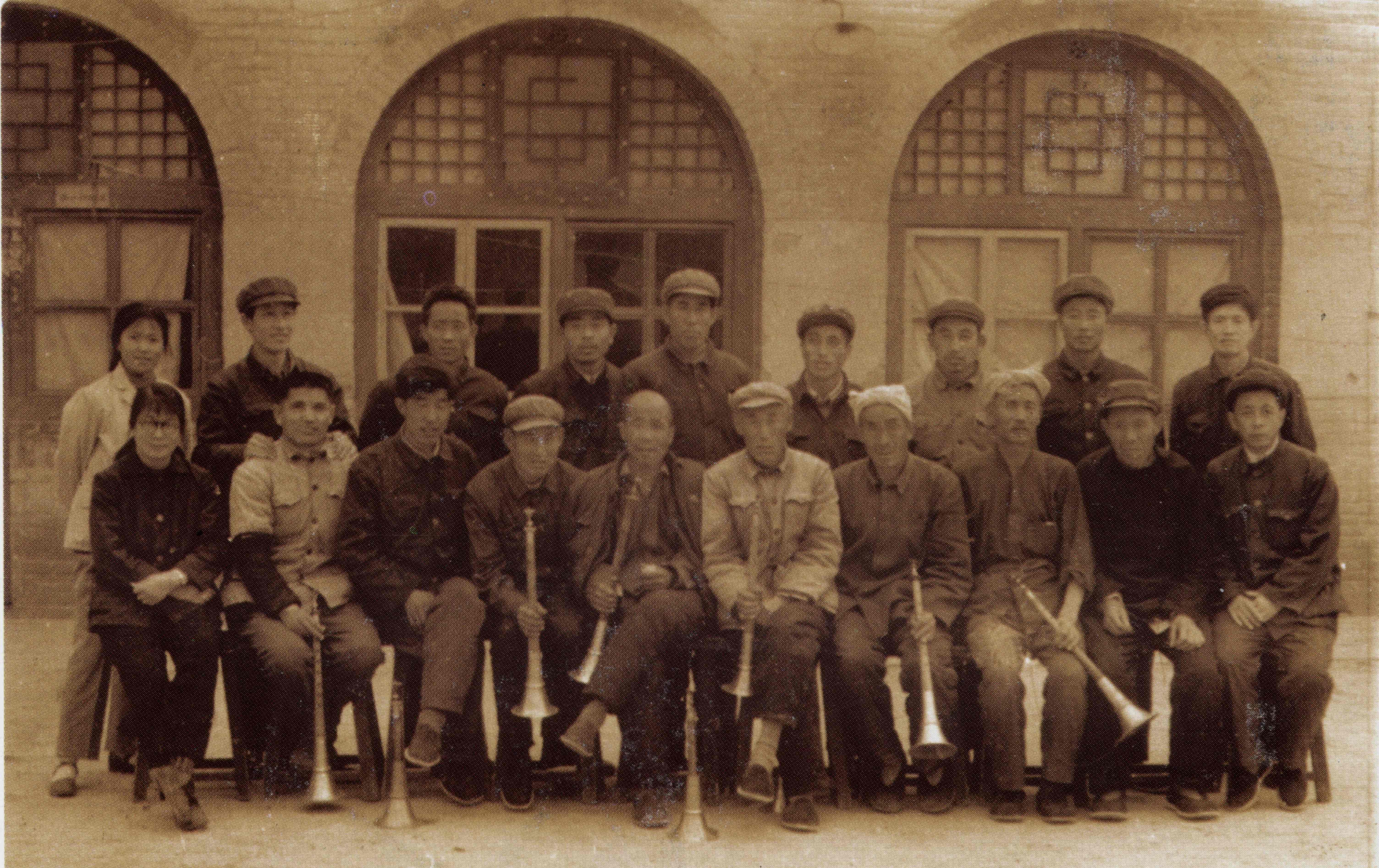
The gujiang bands of Yanggao county commonly included blind players. By 1958 Yanggao town had three bands, one led by blindman Song Chengxin (c1921–76), a disciple of Chen Gang in Anjiaxiang lane. But town players were reluctant to accept disciples from outside their own family, and two of the blind players we met sought their apprenticeship in nearby Xiejiatun village.

1991 funeral

Blind shawm players, Greater Antan village funeral 1991.

I found blind shawm players among a group at a village funeral in 1991, and there were still three distinguished blind gujiang in Yanggao town in 2003. But by then, along with slight but significant improvements in healthcare, there were now fewer younger blind men and thus fewer blind gujiang. Although the senior Erhur and Yin San still managed to lead bands by dint of their seniority and support network, other blind gujiang were less able to keep up with the times, and it was becoming a less likely profession for blind boys.

Liuru
By 2003, the most senior gujiang in the county-town, Li Liuru (c1931–2007, known simply by his given name Liuru; photo above), was pitiable. His eyes went bad when he was 4 sui. His poor family was always on the move, renting rooms. He “did nothing” at home till “learning gujiang” around 18 sui (c1948), but he really liked listening to gujiang before he took it up. He learned with the band in Xiejiatun village just north of the town, a distinguished group whose most famous player in modern times was Yu Fucai (c1925–68). Liuru studied as an apprentice in the Xiejiatun band for three years, and then did another three years for free (“studying three years, repaying three years”), as tradition prescribed; when there wasn’t much business, he played for other bands too, but Yu Fucai’s band was most in demand.

Liuru stopped playing in the Great Leap Forward “because the officials wouldn’t let us play”, and he apparently then played little until after the Cultural Revolution. He only played the lower part, and was not regarded as an outstanding gujiang. Liuru had four brothers and sisters, but they were “all useless”, and the family had no contact. He did manage to find a wife, though, when he was almost 30—also blind, she was a water-seller. The fate of blind girls was even more pitiable: their only hope was begging, and their life expectancy was even shorter than that of blind men.

Erhur
Another young blindman who apprenticed himself to Yu Fucai was Erhur (real name Wang Hui, b.1946). A wonderful man, he has a deep knowledge of the “old rules” and an exceptional love for music: his face becomes a pool of adoration when he recites the gongche solfeggio outlines of the old suites.

Erhur 2003

Erhur, 2003.

Like Liuru, Erhur’s family lived in Yanggao town. He went blind at the age of 3 sui. When he was 12 sui his mother took him to a hospital in Datong; realizing his sight couldn’t be cured, he resolved to seek a way of making a living. They then bought a dizi flute for 36 fen at a Datong stationery shop (there were no instrument shops then). “It took me ages to get a note out of it, but once I did, I didn’t dare take it from my lips,” he recalled. “I played anything I heard, popular folk-song melodies like Anbanshang kaihua.”

Neighbours knew Erhur played well, so one New Year the neighbourhood committee asked him to represent them for a secular county festival. He was a bit apprehensive, but played. There were also an erhu player and a banhu player who played a version of the popular folk-song Wuge fang yang 五哥放羊. He tried to play along with them but found he couldn’t. The erhu player explained it was all to do with tuning! Still, he won a prize of 20 jin of frozen radishes, then worth the princely sum of 2.5 kuai.

This strengthened Erhur‘s resolve to take up music, so he bought a rudimentary erhu in Yanggao town, made from a tin and a stick, costing 4 mao. He soon picked it up, and began getting the hang of scales. He still wanted to learn more instruments. Around 1959, when he was 14 sui, he bought a decrepit sheng mouth-organ for 10 kuai. After taking it home and piecing it together, he began practising “small pieces” like Shifan. All this, remember, at the height of the Great Leap Forward and famine, which were not part of Erhur’s account.

Erhur first spent some time learning with a gujiang called Siban (surname Zhang) in Jinjiazhuang village—for whose band the renowned yinyang household Daoist Liu Zhong also played occasionally when ritual business was sparse during the Cultural Revolution. But after hearing Yu Fucai’s band doing a funeral in town, Erhur asked his parents if he could switch over to Yu as “disciple transferring to another household” (guomen tudi). By this time Yu Fucai was the “main beam” (zhengliang 正梁) of the Yu family band in Xiejiatun village. His fee to take a disciple was 100 kuai a year. Erhur lived at Yu’s house around twenty days a month—the learning process naturally involves taking on the whole gujiang lifestyle. Masters had no way of teaching, pupils just picked it up as they went along; Erhur could only hear his master playing when they performed for ceremonials. He learned along with his master’s oldest son; they got along well at first, but then when Erhur learned faster, the son was always getting criticized, so their relationship deteriorated. Every morning the son was reluctant to get out of bed and go with Erhur into the fields to practise; while Erhur practised, the son would go and look for firewood to make a fire to keep warm.

Yu Fucai’s gujiang father was a hard case, always conning, robbing, and beating people up. He spent some time in prison and eventually, in the 1940s, got his head smashed in with a hammer. Before Liberation gujiang were commonly given opium to smoke by the host family to help them play better. But Erhur knew that addiction was a danger—he had heard of gujiang who had to sell their roof-beams or demolish their outhouse in order to get a fix. Yu Fucai himself had been locked up in an opium-prevention cell for a year soon after Liberation, still only in his teens, and by the time Erhur was studying with him, opium was hard to come by.

As collectivization began to be implemented from 1954, many Yanggao people took refuge further north. Two of Yu Fucai’s uncles fled to Shangdu in Inner Mongolia, and there are still many craftsmen from Yanggao around Hohhot and Baotou.

Yu Fucai had eight children, a heavy responsibility. Erhur had to ask him to recite the gongche solfeggio in the evenings after he got back from the fields. In the mornings after he had practised, he would do chores for his master like milling, fetching water, and ploughing. There were so many mouths to feed that all the flour you milled in a morning was only enough for one meal. In 2003 three of Yu Fucai’s sons, as well as a nephew, were still active as gujiang in Xiejiatun.

Erhur 2003.2

Session at Xiejiatun, 2003.

If all was not all sweetness and light in the Hua family band, gujiang relations in Xiejiatun sound still more fraught. Several gujiang from Xiejiatun apprenticed themselves to the Hua family: one Erxianr (surname Xie) from Xiejiatun got into a feud with the Yu family, so he made a point of antagonizing them by going over to Hua Fa as “disciple crossing the gate”. Another blindman, Duan Guanming (b. c1927, known as Liuzhi “Six fingers” as he had an extra finger on one hand), also came from Xiejiatun, but got on better with Hua Yinshan than with the Yu family—we found him playing in Hua Yinshan’s band in 1991.

DGM1

Duan Guanming on woodblock, 1991.

Erhur came back to the county-town when he was 18 sui (c1963) to set up his own band, taking disciples. Hua Yinshan didn’t mention this, but in his teens he sometimes played for Erhur’s band these next couple of years; he only played sheng at first, but was beginning to get the hang of the shawm too. There was also a great player in Erhur’s band called Little Jinxi (surnamed Wang), from nearby Qingshunbu. For the operatic pieces played in the afternoon of funerals, he used to play two kouqin whistles at once, making a big sound that drew the crowds. He died on the eve of the Cultural Revolution aged only 41 sui, coughing up blood in the middle of playing—an alarmingly common and prestigious way for shawm players to die.

Yin San
Meanwhile, another blindman was “learning gujiang” in the town. Like Erhur, Yin San (b. c1947) played dizi flute when young. He began learning shawm from 16 sui (c1962) with the blind town gujiang Song Chengxin. Yin San also studied at some stage with a gujiang in Wangguantun township, learning the gongche solfeggio of the shawm pieces from him—which he later forgot.

6 LR,YS

Yin San (right) with Liuru, 2003.

Yin San and Erhur both had town registration, and were blind, so they did not have to apply for leave of absence from any production-team or hand over any money to them, unlike village-registered gujiang. Moreover, their ceremonial activities were tolerated more readily by cadres; blindmen could put all their energies into being gujiang, so they could do well. Yin San recalled that in the early 1960s a band got around 5 kuai for an afternoon, 8 kuai for playing all day, 10 kuai including the burial procession next morning. Erhur claimed that while most bands could earn about 12 kuai a day, his own band was so admired that he could charge 22 kuai. In fact payments were only calculated in terms of cash, they were still paid in food: peanuts or gao paste, 1 jin or half a jin each per day—Yu Fucai’s hemp sack was tough from the oil.

But even sighted village bands could still get permission from their production-team to go out on business. The Xiejiatun band earned a dozen kuai a day then, of which they had to give the commune 1.5 kuai each day they were away, in return for one whole work-point each. The band boss Yu Fucai took 15 shares of the fee plus 10 shares for providing the instruments, while everyone else got 10 shares. Yu only used one or two musicians from outside his own family, so it was worth it. Doing funerals they got to eat out for free too, and didn’t have to till the communal fields all the time, so it was a better life than being a peasant.

Still, I can’t quite build a consistent picture from such accounts of gujiang business before the Cultural Revolution. They articulated no clear distinction between the various periods from 1949 to 1966, though I surmise that business must have been easier before collectivization around 1954, and again briefly during the lull in campaigns from around 1961 to 1964. Yin San claimed rosily, “Before the Cultural Revolution business was even better than today, around twenty days a month—there weren’t so many gujiang then, so there was more work to go round.” But he only took part in the life from the early 1960s.

Conversely, Liuru, who was trying to make a living through the 1950s, said times were tough. Erhur pointed out that there was less business under Maoism than either before Liberation or since the 1980s reforms, because people had less money; one death provided no more than three days’ work in all, whereas earlier and later, taking into account all the subsidiary observances before and after the funeral proper, it might provide up to ten days’ work. He reckoned that in the 1950s, bands might go out on business seven or eight times a month, or “every three days or so”.

They agreed that despite all the famine deaths around 1960, there wasn’t so much business then—if people had any money at all, they’d buy something to eat, not invite gujiang. Liuru recalled that for funerals during the famine years, people could only put out a couple of mantou bread rolls on the altar table before the coffin; whenever there was a death, work-teams turned up to prevent gujiang playing and stop the family burning paper spirit-money, on pain of a fine. Indeed, in Yanggao the famine continued until at least 1965, and people were hungry right into the late 1970s. Still, I think we have to assume a slight and temporary improvement in people’s lives in the early 1960s when Erhur and Yin San set up in business.

The Hua band
In Yangjiabu village just north of the county-town, Hua Fa (1917–87), father of Yinshan and Jinshan, was much admired as a gujiang. His nickname was “Heavenly dragon” (Tianlong); soon he was simply known as “Great gujiang” (Da gujiang). He was also known as “Sighted Fifth brother” (Zhengyan wugar) or “False Fifth brother” (Jia wugar), by contrast with another famous blind gujiang in Zhenmenbu village just further east called “Blind Fifth brother” (Xia wugar, surnamed Xue) or “True Fifth brother” (Zhen wugar)—“true” and “false” alluding to the fictional character Monkey. There was no love lost between rival bands: “True Fifth brother” was murdered by a rival gujiang while they were performing for a funeral in the 1940s.

Hua Yinshan’s second uncle Hua Yi, known as “Second gujiang” (Er gujiang), also smoked opium. Their drummer was a blind man—Hua Fa was also a fine drummer. The celebrated gujiang Little Jinxi, from nearby Qingshunbu, sometimes played for Hua Fa band as well as for Erhur. The Hua band had a long-standing feud with the Xiejiatun band, though some Xiejiatun men preferred to come over to Hua Fa’s band, like blindman Duan Guanming, long a regular recruit. Another disciple of Hua Fa was known as “Second Dragon” (Erlong), from Yaozhuang village just east.

Duan Guanming accompanying Hua Yinshan in trick repertoire, 1991:
note Yinshan’s cloistered daughter.

Hua Yinshan claimed he became the “main beam” of the family band on large shawm from the age of 17 sui (c1964). He had heard the classic suites in the family band for many years, but had apparently only just begun playing them on large shawm.

Hua Yinshan was also working with several other bands in this period, with his father’s blessing, as the family needed all the work they could find. He spent some time in the bands of blindmen Erhur and Yin San, both based in the county-town, playing the lower part on shawm, as well as the sheng mouth-organ and the drum. As we saw, Erhur was a disciple of Yu Fucai’s band in Xiejiatun; the Yu band had a long-standing feud with the Hua band, but there was always some interplay.

Apart from the county-town and the villages of Yangjiabu and Xiejiatun, nearby Guanjiabu was the base of another fine gujiang band. The senior gujiang Shi Youtang (d. c1998) had a blind disciple called Shi Zhenfu, a distant relative of his (though their surnames were different Shi characters); he was known as Errenr “Two people”! Both led bands into the 1980s. Another blindman from Guanjiabu, called Yinhur (surname Li), became a disciple of Hua Fa.

Hua Yinshan told me the story of his father’s no.1 large shawms. In the 1940s a blindman called Chanxi in Guanjiabu wanted to buy a pair of shawms. An itinerant shawm maker called Wang Lianguo had moved from Yuxian in Hebei to Chenjiabu, near Yangjiabu. He went to Chanxi’s house to sell him a pair of shawms—this would have been around 1945, when Hua Fa was in his early 30s, between the births of Jinshan and Yinshan. But Chanxi didn’t know how to choose them, so he asked Hua Fa to help him. After Chanxi died, he left the wooden bodies of his shawms to his daughter, who later sold them to Yinshan.

Over twenty-six days in 1989, as part of their work for the Anthology, the Yanggao Bureau of Culture used their limited equipment to make a whole series of precious cassette recordings of the most distinguished shawm bands, including those of the Hua family, Shi Ming in Wangguantun, and Yang Deshan (father of Yang Ying) in Gucheng, as well as the bands of Xiejiatun, Guanjiabu, Luowenzao township, Qingshunbu, and Greater Antan (see my Ritual and music of north China: shawm bands in Shanxi, p.49).

Li Zhonghe
South of the county-town in Shizitun township, yet another celebrated blind gujiang was based in Yaozhuang village. Li Zhonghe (1908–88), known as Second Kid (Erwa 二娃), went blind at the age of 5 or 6 after an itinerant doctor tried to cure his ailing eyes by putting eggshell over them. Li Zhonghe learnt sheng and shawm from 15 sui, sometimes making up a band with an outstanding gujiang called Wantai (surnamed Cui) from Zhouguantun village nearby. Li had two younger colleagues (shidi) in his village, the brothers Fan Liang and Fan Gao.

Around 1952, after the death of Li Zhonghe’s first wife, he married a widow who already had a son and daughter. The son Li Bin (b.1945, not the same as his namesake, Li Manshan’s son!) played percussion in his stepfather’s band from around 1955, and began learning sheng and shawm, as well as gongche solfeggio, with him about four years later. Li Bin claimed his stepfather’s band didn’t stop playing through the Great Leap Forward or the ensuing famine.

Since the reforms
The collapse of the commune system from the late 1970s allowed an impressive revival of tradition (for the Daoists, see e.g. here). But by 2003 the scene was changing further. Erhur was still leading a band, having readily taken pop on board. He and his wife made a handsome couple, and had a lovely clean household in town—though their son, who managed to enter the police force despite (or by dint of?) a dubious reputation, was a worry. Erhur claimed to be able to perform the three suites that we couldn’t track down; but he was later reluctant to recite or perform them for us, perhaps worrying about my relationship with his rival Hua Yinshan.

Yin San, also married, was getting 90 kuai a month from the government disability benefit, and still led a band, usually playing cymbals. Of his two pupils, the younger had been with him for eight years. They could play the few traditional pieces still required for rituals, and Yin San felt no need to transmit the ones that weren’t. After his fine drummer Ling Dawenr (b. c1924) retired, Hua Jinshan had no competition.

Liuru hadn’t played since around 1988. Now he reckoned that only sighted people could do business (chixiang 吃香, a common term for popularity)—no-one wanted blind people any more. Erhur and Yin San were still doing well by adapting; they were a bit younger, more enterprising, and had more of a reputation as musicians. But he was right that in a cut-throat pop market, blindmen were no longer able to hold their own as gujiang without a solid support network.

The decrepit little shack where we found Liuru living in 2003 had been his “base area” for over thirty years; he bought it with the little money that remained when his parents died. His registration was at Xibei village commune, from whom he got 60 kuai a month benefit; as an urban resident his wife (also blind) got 90 kuai. Since giving up the shawm in 1990 Liuru had survived by begging the left-overs from restaurants, but led a pitiful life. He had no contact with his brothers and sisters, and just before we met him his wife had “gone crazy” and he had seen fit to lock her in an outhouse.

Such is the disturbing fate of a lovely senior musician who could still recite the gongche solfeggio of the eight suites more fluently than any other gujiang in the area. Listening to him as he sat cross-legged on the kang brick-bed which takes up most of the space in his pathetic little room, his eyes vacant yet placid as he spoke with dignity and insight of his days as gujiang, would be an upsetting experience for the most hardened fieldworker.

Li Zhonghe’s stepson Li Bin is an exceptional case. Unusually for a gujiang family, Li Bin did quite well in school. Though intermittently active as gujiang through the early years of the Cultural Revolution, around 1970 he went off to work in the coal mines of Datong city, becoming a cadre there, only resuming gujiang business again when he retired in 1996.

Li Zhonghe had taken up as a gujiang again after the reforms, and was still playing right until his death in 1988. He had a blind disciple (younger brother of talented young yinyang Wu Mei) who showed great promise as a gujiang, but he had only been learning for a few months when Li Zhonghe died. Li Bin now wanted to complete his stepfather’s mission in helping him learn, but the disciple soon decided against becoming a gujiang. However, Li Bin soon found another promising disciple.

By 2003 Li Bin had handed over the leadership of the band to Yu He (Quanmin, b. c1960) who played drum and yangqin; he only took up the business after being demobbed from the army in 1984. So the band was now based at Yu He’s home of Fanjiatun village nearby in Tianzhen county. Yu He’s son Chunbo (known as Bobo, like Hua Yinshan’s grandson; b. c1987) became Li Bin’s only pupil, learning since 2001. Li Bin could afford to be choosy; his criterion for accepting a pupil was that they have to be “of good character” (renpin)—an unlikely demand for a gujiang. After leaving primary school, Bobo “wasn’t interested in anything”, so his dad took him along with the band to show him how tough it was making a living; but Bobo fell in love with the life and became a brilliant musician. Though he mainly played pop, Li Bin also taught him pieces from the traditional repertory.

Da Li Bin 2003

Li Bin (left) with Wu Fan, 2003.

Li Bin is at a certain remove from the tradition, far more educated than most gujiang, and quite articulate. Living in Yanggao county-town, his house is comfortable, and the family is quite well-off. His wife became a Protestant around 1993; Li Bin was still at the mines, and she had a tough time having to look after their three children all alone, with no-one to talk to. Li Bin (not himself a believer) sometimes set Protestant lyrics to pop songs for her to use in church. Sincere and curious to study local traditions, he made a rather ideal co-fieldworker.

We saw how gujiang, outcasts in the “old society”, have gradually become rather more assimilated into society, first by being forced into a sedentary agricultural life under the communes, and then by the equality brought by earning power since the reforms. Along with their outcast status before Maoism came a lack of education or upward mobility. Among gujiang families, Li Bin was exceptional in doing relatively well at school, and even more so in finding a job as a cadre. Still more surprising is that having apparently escaped from the lowly life, he then chose to return to it after retirement. In his case, apart from supplementing his pension and giving him something to do, he feels a genuine enthusiasm for the music he learnt from his stepfather in his youth, only tempered now by its rapid loss under the assault of pop music.

Meanwhile Li Bin has been painstakingly making emic transcriptions of his father’s repertoire (both the suites and the many “little pieces” also formerly required for particular ritual segments), writing a 126-page score with parallel gongche solfeggio and cipher notation. While scholars (myself included) have transcribed the Yanggao shawm suites, this is a unique labour of love from a performer.

Very few gujiang could graduate to the world of urban troupes (for Shi Ming’s brief sojourn in Datong, see here), and while most sons of gujiang were now inclined to seek a more respectable profession, other poor village boys might still see it as a better option than tilling the fields—all the more now that learning pop music is less demanding than the traditional training. Today gujiang bands are often in the age-range of 15 to 45. Their main repertory is pop, besides Jinju and Errentai opera pieces and a dwindling repertory of traditional shawm pieces still required to maintain a façade of ceremonial propriety.

Li Sheng

Li Sheng, 2018.

The two Li families (those of Li Zhonghe and the Li family Daoists) have long been on good terms. The great Li Qing sometimes played in Li Zhonghe’s shawm band in the 1970s, when Daoist ritual was on hold. Li Bin’s younger stepbrother Li Sheng (b.1954) learnt suona and sheng from his early 20s upon the revival, spending some years as disciple of Hua Yinshan. He did some petty trade in Datong, as well as doing, returning around 2000. Gradually he gravitated to playing sheng with the Li family Daoists; he has long been a regular member of Li Manshan’s band.

I introduced Zhang Quan, a rather younger semi-blind gujiang in Pansi village whom I’m always happy to see, in these vignettes of the diverse personalities from whom we learned in Yanggao.

* * *

In some other parts of north China (like the Northeast, or Shandong) shawm bands have long and prestigious hereditary traditions, but here, as in Shaanbei, few bands can trace their history back more than three generations—though their classic suite repertoire is more ancient. Note that rather few gujiang live to old age; until the 1950s many were blind, smoked opium, and died young, and it is still quite unusual to find gujiang still playing in their 60s; anyway, opium-smoking blindmen from a despised caste found it hard to set up a family. By the early 21st century senior gujiang were still happy to take disciples, but as it is a low-status occupation they didn’t necessarily encourage their own sons to learn, hoping they would get an education and a proper job instead. If this is true today, there was less choice in the past, with education even rarer and job opportunities fewer.

While sighted players also deserve recognition as gujiang, and suffered from similar discrimination, blindmen formed the core of many Yanggao bands right until the 1990s. Since then they have become less common, along with the whole rich culture of shawm bands in north Shanxi.

But I still cherish the memory of these blind shawm players—outcasts who embodied the wealth of traditional folk culture that somehow survived down to the eve of the 21st century, dovetailing with the rituals of the household Daoists. With their deep experience of the “old rules” of ceremonial, far from the abstruse erudition of the literati who dominate sinology, they were among the main transmitters of imperial Chinese culture, who should be esteemed.

Life behind the Iron Curtain: a roundup

Bloodlands

There’s been some fine media coverage to commemorate the thirtieth anniversary of the fall of the Wall. So apart from my numerous posts under the Maoism tag, here’s a roundup of some of my posts on life, and death, behind the Iron Curtain—always bearing Chinese connections in mind.

On the GDR (for which note the useful Twitter # @DDROnline):

On the USSR:

See also my roundup of posts on Ukraine.

https://stephenjones.blog/2019/02/15/czechs-in-tianqiao/

Elsewhere:

The fate of folk traditions in Moravia and Poland under the socialist state is explored in

For the wider picture, see

And for bitter jokes from behind the Iron Curtain:

All this complements posts on Nazism, such as

See also Timothy Snyder on tyranny.

Yang Yinliu: a conference


YYL poster

To commemorate the 120th anniversary of the birth of the incomparable Yang Yinliu 楊蔭瀏 (1899–1984), from 10th to 15th November a conference on his life and work is taking place at the Chinese Academy of Arts in Beijing (more details on WeChat, I trust).

Yang was one of the great musicologists of the world; his research is central our understanding not only of music history but of traditional Chinese culture more generally.

YYLHe excelled not only as a historian but as fieldworker and performer, steering the Music Research Institute through the choppy waters of Maoism. I’ve devoted a lengthy tribute to him; and do consult his tag in the sidebar—adducing his work on early history, folk and elite traditions (the latter embodied by the remarkable team of qin scholars at the MRI), Daoist and Buddhist ritual, and a range of regional instrumental and vocal genres, including

While I don’t much go on for conferences, I’m sorry I can’t attend this one, which also serves as a retrospective on the whole history of Chinese musicology, with contributions from leading scholars. There have also been celebrations in Yang’s home city of Wuxi.


A secret language in north Shanxi

6 LR,YS

Blind shawm players Liuru (left) and Yinsan, Yanggao town 2003.

The use of Verlan backslang in Engrenages/Spiral reminded me of a fascinating secret oral language in north Shanxi. I’ve mentioned it en passant in my writings, but since I can’t seriously expect readers to follow up such links, it deserves a post to itself.

Known as “black talk” (heihua), it belongs to the wider family of insiders’ languages used by marginal social groups and tradespeople. [1] In north Shanxi it was spoken mainly by the members of outcast shawm bands (here called gujiang 鼓匠 rather than the common chuigushou), illiterate and often blind—mainly, but not entirely, for secrecy. Here I cite the section in

  • Wu Fan 吴凡, Yinyang, gujiang 阴阳鼓匠 (2007),
    Yuebande heihua” 乐班的黑话, pp.119–25.

During her fieldwork in Yanggao county Wu Fan—a native of Wuhan in Hubei—latched onto this arcane vocabulary with amazing alacrity (for her own skills in punning with Daoists, see here). Meanwhile, local scholar Chen Kexiu (to whom we may credit the “discovery” of the Yanggao Daoists and shawm bands), brought up in Yanggao, published an article incorporating the wider region of north Shanxi:

  • Chen Kexiu 陈克秀, “Yanbei guchuiyue yirende heihua” 雁北鼓吹乐艺人的黑话, Zhongguo yinyuexue 2007.4.

The terms for numbers (used mainly to discuss money and fees: Table 2–5 below) were still common until recently. They describe verbally the components of a character, just as Chinese people do routinely when explaining in conversation which character to use, like koutian wu 口天吴 for the surname Wu 吴, or wenwu bin 文武斌 for the given name Bin 斌.

heihua

Above: numbers; below: instruments.

To explain a few instances:

  •  1:  yi 一 becomes dinggai 丁盖, “the cover of the character ding 丁”
  •  2:  er 二 becomes konggong 空工, “the character gong 工 emptied”
  •  3: san 三 becomes chuan 川, rotating the character 90 degrees
  •  7:  qi 七 becomes zaodi 皂底, “the base of the character zao 皂”
  •  8:  ba 八 becomes fengai 分盖 “the cover of the character fen 分”
  • 10: shi 十 becomes tianxin 田心, “the heart of the character tian 田”.

What is remarkable here is that this style is used by illiterate, often blind, shawm players. The theory is that blind men, unable to see who might be listening to their conversation, needed a language where they needn’t fear saying something indiscreet, such as offending their patrons. Yet it’s a highly visual language; I wondered how it came into being. After all, even illiterate blindmen could be told how some characters were written; but you don’t have to know the etymology of words in order to use them!

One might suppose that these terms would be more widespread, but I haven’t found other instances yet. At the same time, another vocabulary for numbers (in various written forms) was in common use here—as around Beijing, Tianjin, and Hebei:

1 2 3 4 5 6 7 8 9 10
刘 (流) 王 (汪) 挠 (神) 斜 (心) 内 (爱)

Throughout China, folk musicians commonly use local terms for their instruments (Table 2–6 above); such names are still used in Yanggao and elsewhere (cf. other areas such as Shaanbei). The derivation of the insiders’ terms for repertoire (Table 2–7 below) is obscure; again, the stimulus was perhaps secrecy—to avoid their choices being understood by their patrons. But these terms seem to have become largely obsolete, along with the repertoire itself (for the searing complexity of which, see here).

heihua 2

Above: titles of shawm suites; below: terms in daily life.

Expressions for daily life (Table 2–8 above) include huoyin 火因 for yan 烟 “smoke” (again splitting up left and right elements of the character); tiaoma 条码 “hottie”; dianyou 点油 (“lighting oil”) for hejiu 喝酒 “drinking liquor”; and kou 口 (prounounced kio) for chi 吃 “eat”. Some of these are dialectal, heard in more general parlance. Chen Kexiu gives an extensive list—and his examples of conversations are daunting:

convo

As you can see there, even the local term gujiang for the members of shawm bands becomes pijia 皮家 (“skins”) in their own parlance.

Thickening the plot, Chen Kexiu goes on to introduce a separate style of black talk used by shawm bands, one that incorporates the ancient fanqie 反切 phonetic system into speech (qiekou 切口) (cf. the blind bards of Zuoquan county). For instance, while the term xunmenshi (or xingmenshi 行门事, yingmenshi 应门事, with shi pronounced si!) is standard local parlance for performing a ritual, one shawm player might ask another (cf. the simpler but no more intelligible 去哪儿贬皮呀? above):

呆劳乃拉许论没人是哩? (到哪儿寻门事?)—“Where are you going to do the ritual?”

Unlike the specialized secret vocabulary that we noted above, once you grasp the principle you can apply it to any words—and it doesn’t require literacy. But the shawm bands among whom Chen Kexiu collected this qiekou style of speech don’t seem to use the specialized vocabulary like the numerical terms; he attributes the qiekou style in particular to the lowly hereditary families of ritual specialists known as “music households” (yuehu), who were descended from banished imperial officials. While there is plenty of evidence for the yuehu further south in Shanxi [1] and elsewhere, I’ve never been very convinced by the piecemeal clues to their presence in north Shanxi. All this is tenuous, but perhaps the supposed yuehu connection for this particular style might just go towards explaining the literate, visual basis of the numerical terms, which otherwise seems so mysterious.

* * *

Much of this vocabulary of the shawm bands was adopted by folk opera groups, also lowly in status; and through constant interaction at rituals household Daoists like the Li family, while somewhat more esteemed, used it to some extent. Of course, all these expressions are pronounced in Yanggao dialect, itself none too easy for the outsider to understand; heihua (“black talk”) itself is pronounced hehua!

The language was still commonly used in the 1990s, but senior blind shawm players were giving way to younger players who no longer suffered such social stigma, and their traditional repertoire was largely replaced by pop. Still, it reminds us what a daunting task it can be for fieldworkers to enter into the aesthetic world of folk performers.

Let’s recite the numbers 1 to 10—altogether now:

dinggai–konggong–chuan–hui–chou–duanda–zaodi–fengai–quwan–tianxin

For some erudite literary wordplay from household Daoists in Yanggao, see here.

Spiral

A worthy competitor with the various classy Scandi noirs that enrich Saturday nights on BBC4 is the French Spiral, whose seventh series has just started. If you’re new to it, it’s worth starting from the beginning—in which case, let’s talk again sometime next year.

The French title Engrenages doesn’t translate easily, referring to interlocking gears—by extension, an inescapable series of events, almost a vicious circle: “Enmeshed”, perhaps?

As with the Scandi noir series, the Grauniad recaps—and their BTL comments—are most enlightening. This led me to Alison Crutchley’s article on the language of the series, “Pute de merde de con! The linguistics of Spiral slang“—again to be read with important BTL comments. As you may imagine from A French letter (a drôle resumé of my Li Manshan film), my schoolboy French is utterly unable to keep up with such dialogue as it flies past; but the article makes fascinating reading.

Thus I learn of loan words like bagnole (from Occitan), “car” (also caisse); and clebs, “mutt”, from Arabic. And

Spiral’s cool kids use Verlan, a type of back slang. Karen calls her girl friends les meufs, Verlan for femmes; Zach texts keufs to his accomplice, to warn him of les flics (“police”).

What’s more, keuf (from keufli) has been re-verlaned, with further resonance, to feuk! And occurring along with the Chinese underworld theme of series 7 is noich (or noichi), for chinois.

anvers

Further topics (also continued in the BTL) include the minefield of using tu and vous (cf. Italian, and this splendid Chinese story); gender; and the subtleties of swearing (cf. French taunting), with arcane variants and combinations of putemerde, and con. It’s amusant to learn that the French for fisting is le fist-fucking, although le fisting apparently serves too—either way, let’s consider it another English export in which we can take patriotic pride.

But just when we thought we were world leaders at punning, it turns out that French is exceptionally rich in puns too. Is rien sacré?

Surely this is the way to inspire kids to learn foreign languages. Surely Quelle bande de branleurs! (“What a bunch of wankers!”) is more attractive and practical than La plume de ma tante. I did indeed relish languages at school, but for some reason the ones that I (like the board of the LA Phil) favoured were all dead (cf. Revolution and laowai). So now I regret that it took me so long to realize that languages could be not so much an elegant yet gratuitous abstraction, or a sadistic ordeal of irregular verbs, but rather, a pathway to understanding fascinating cultures and communicating with real living people (“Like, hello?”).

Conversely, in this case I’m relieved that I can enjoy the script’s linguistic niceties from the comfort of my sofa without having to negotiate them in the gritty milieu that the drama depicts—as has been aptly observed, it’s hardly a promo from the Paris Tourist Board. Spiral really puts the noir into noir.

And now we can relish Series 8 on BBC4!!!

Meanwhile in Glasgow, Irvine Welsh’s novel Trainspotting is helpfully provided with a glossary… For English word games, see here; for the evolving Chinese language, here. See also Kaliarda, Lubunca, Polari.


[1] Note Qu Yanbin 曲彦斌, Zhongguo miyu hanghua cidian 中国秘语行话词典 (1994). 

[2] For links to the major studies of Xiang Yang and Qiao Jian on the yuehu in the Shangdang region, see my In search of the folk Daoists of north China, pp.86–7.

Society and soundscape

While I always gravitate towards the ethnographic nitty-gritty of local fieldwork, it seems time for a succinct roundup for some general posts on society and soundscape—a theme pervading this blog, for China (see below), sundry world music traditions, and WAM alike (see world music category, under “general“).

Most authoritative and accessible are the works of Bruno Nettl—essential reading:

Susan McClary is another influential author:

Two important studies give valuable perspectives, placing WAM within the broader picture:

Later ethnographic perspectives on WAM include

On a visit to the Proms I couldn’t help noticing the contrast between WAM concerts and musicking in folk societies:

And articles by Michelle Bigenho and Henry Stobart are most instructive:

In similar vein is

and note

Classics on society and soundscape include

Also worth consulting is

More recently, Rachel Harris gives incisive accounts of the crisis in Xinjiang, including

Among many fine chapters in the stimulating 1997 volume Shadows in the field: new perspectives for fieldwork in ethnomusicology, I recommend those by Nicole Beaudry (on fieldwork among the Inuit) and William Noll (on fieldwork in the Ukrainian past). For a wise discussion of fieldwork in contested sites for Tibetan culture, see

as well as

I was also reminded of the integrative brief of ethnomusicology by

And in

I wonder how we might incorporate colonial history into the reversal of the colours of the piano keyboard in the early 19th century.

And some thoughts on elusive social contexts in studying medieval Central Asia:

* * *

All this informs my work on local ritual traditions in China. I outlined issues in

As I commented in my post on Bigenho’s chapter,

Here’s the deal: if we come to your party, you have to come to ours too:

Just as “music scholars” have learned to consider all kinds of social elements as they study performance, so scholars of ritual too must include in their brief all kinds of issues arising from soundscape, rather than coyly farming it out to musicologists.

As Adam Yuet Chau observes, this is related to the whole scholarly bias towards discursive, scriptural analysis. Indeed, within China studies more generally, expressive culture, and musicking as a vital aspect of social activity, still seem to be considered marginal themes, with research dominated by silent written texts and immobile visual culture. It’s as if sinologists only consider music as a legitimate part of culture when it’s dead and mute, imprisoned in a museum or text. The ethnomusicological mindset should offer us valuable perspectives on Chinese studies (cf. China’s hidden century).

A village scholar

My vignettes from Gaoluo, taken from my book Plucking the winds, have featured both performing members of the village’s amateur ritual association (Cai Fuxiang, He Qing, Cai An) and supporters like the venerable Shan Zhihe. The name of Shan Fuyi has already cropped up in several posts, but he deserves a separate account.

SFY

Shan Fuyi (right) with my trusty colleague Xue Yibing, 1996.

Shan Fuyi (b.1940) is considered the village’s xiucai talented scholar. Amateur historian, painter and calligrapher, he is widely admired for his intelligence and artistic bent. He was given the task of writing the village history in 1965, and in between making donors’ lists for the opera troupe and the ritual association he did artwork for the Mao Zedong Thought Propaganda Troupe. Latterly he became a trusted employee of Boss Heng, the village’s own nouveau-riche entrepreneur.

We had heard so much about him, but since he was based at Boss Heng’s workplace near Laishui county-town, we never coincided in the village—he seemed elusive, and we even joked that maybe he was a figment of our imaginations.

Finally in 1996 we sought him out in his work-unit. He affably sat us down and, without any preamble, launched into a detailed account of the village from its founding through to the 1990s, instinctively understanding our brief without any need for the long justifications which we sometimes have to give cadres or even ordinary villagers. Indeed, later we did indeed meet up back in the village. Our hopes were well rewarded, and we had many edifying sessions with him, learning from his wide-ranging and impartial knowledge; his detachment in observing the vicissitudes of the village’s history was of rare value.

He is the main source of my account of the village’s early history (Plucking the winds, chs.1–3); indeed, his work gave us valuable perspectives on the history of the whole area, not least the terminology of village names and the she parish network.

Shan Fuyi is not a ritual specialist, and regards himself as a “thorough atheist”, but he takes a keen yet dispassionate interest in all aspects of human behaviour. He’s never been the leading type; unlike most Chinese, who are long accustomed to public speaking, he is petrified of such occasions; with my own stammer, this further endears him to me. He seems to float above the village, observing with detachment and perception. He understood our mission implicitly. He is at once down-to-earth and transcendent. Unassuming, introverted, yet humorous, he never bothered with the empty platitudes of Party-speak. Still, recalling his experiences in the Cultural Revolution and since, he reckons “I keep right up with the way things are going”, a charmingly ambiguous comment; perhaps his very detachment has enabled him to ride all the storms.

Shan Fuyi’s early years
Born in 1940 to a virtually illiterate father, Shan Fuyi attended private school in Zhuozhou county just north for half a year during the civil war when he was 7 sui. With quiet humour, he recalls:

Our texts were The Hundred Family Surnames and The Three Character Classic; when the 8th Route Army passed through we recited “Long live Chairman Mao”; when Nationalist troops passed through we recited “Long live Chairman Jiang” [Chiang Kaishek]; having not offended either of them, when they had both left we could get back to reciting “Zhao, Qian, Sun, Li” [The Hundred Family Surnames] again!

His godfather was Sun Xiang, a spirit medium and folk healer. In 1949 he entered 2nd grade at the village primary school. He recalled the village’s last rain procession that summer. From 1955 he attended the No.1 Secondary School in Laishui county-town, graduating from the junior department early in 1958. He then passed an exam to study surveying at technical college in distant Taiyuan, capital of Shanxi province to the west. In 1960 he began training at the Shanxi Machine Building Factory, but like many villagers, in the autumn of 1961 he was forced by the grave national economic hardships to return home to South Gaoluo, cutting short a promising career. He now served as book-keeper for the brigade orchards.

Meanwhile the village ritual associations continued to adapt to the new regime. After the Great Leap Forward and the famine, the revival of the early 1960s (however short-lived) was significant for the transmission of traditional culture. Not only were the village’s ritual associations reinvigorated, with a substantial group of new recruits training, but the opera troupe also revamped their equipment (Plucking the winds, pp.143–5). Like the ritual associations, they too sought donations from all the village households, shown on Shan Fuyi’s donors’ list dated 2nd moon 1964. In 1996 the musicians took it out to show us:

opera beiwen 1964 edited

Writing a village history
In 1965 the Four Cleanups work-team ordered Shan Fuyi to compile a history of the village up to Liberation in 1948. This may seem like an unlikely task, but their purpose was frankly political: in order to “cleanse the class ranks”, they needed a definitive version of the village’s history (for more, see here).

In north China, apart from county gazetteers (from imperial, Republican, and reform eras), in some counties one finds slim volumes of “material on cultural history” (wenshi ziliao); but with rural literacy low, this is the only history of an individual village that I have seen compiled by a local scholar.

As I observed here, in my work with the Li family Daoist in Shanxi I mainly talk with one extended family, seemingly detached from politics, and with hardly any contact with local leaders. Indeed, the experience of “freelance” household Daoists was different from that of peasants tied to the land, and they were always straining to gain some independence from the production teams. Though inevitably deeply affected by political vicissitudes, they had little investment in the public affairs of the village. In Gaoluo, by contrast, several sources helped me to put the village’s ritual and social culture in political context: many of the members of the association held positions of authority under all three periods of 20th-century history, so we naturally talked with the village leadership. With their detailed knowledge of the modern history of the village, several men were able to offer clear accounts of major events in the area and to connect them to the village’s ritual association. But some of our most detailed material came from our talks with Shan Fuyi.

Back in 1965 he conscientiously set about the task of compiling the history. Though the avowed focus would inevitably be the modern political background, he avidly sought evidence for the early history of the village, right back to its founding in the Yongle reign-period (1403–24) of the early Ming. Apart from documenting oral traditions, he consulted several steles: those of the North Baibao temple from the Ming-dynasty Jiaqing era (1522–66), the temple of North Gaoluo from the Qianlong reign (18th century), and the Wenpu si temple in South Gaoluo from the Daoguang era (1840s).  All these steles were soon to be destroyed. Still, even by the 1990s considerable material evidence survived for the history of both North and South villages of Gaoluo, supplementing Shan Fuyi’s research.

cunshi

The opening of Shan Fuyi’s village history.

After our first meeting with Shan Fuyi in 1996 we all sought the history everywhere in the village and in the county-town, but it didn’t surface. In 1998 he finally brought out a revised version of the history for me, with a mere twenty pages; as he told me, his 1965 version was rather more detailed but also couched in more revolutionary language, full of criticism of “bad elements”, while for his new version he used a more natural style. In a charming reversal of one’s preconceptions, he was apparently giving the foreigner a version from which Communist propaganda had been censored!

In fact our detailed conversations with Shan Fuyi were much more honest and complete than any official version could possibly be. Moreover, his written history went only as far as 1948, whereas our sessions together took the story on to the present. Indeed, he was a thoughtful source for the Maoist and reform eras too.

One topic on which I was able to find considerably more detail in sources from outside the village, unavailable to Shan Fuyi, was the 1900 massacre, which turned out to be a major episode in Boxer history (Plucking the winds, pp.37–42 and p.387 n.42). A team from Tianjin University even came to carry out interviews in 1974. Similarly, while elderly villagers still recalled the Italian missionaries before 1949, I managed to document them further through the Stimmatini archives in Verona.

Inevitably, the representation of events surrounding the complex struggle for Liberation was particularly sensitive and controversial. In 1965 Shan Fuyi was still able to interview most of the protagonists in the revolution, including long-serving Party Secretary Heng Futian—despite his recent demotion—and the traumatized Cai Fuxiang.

The brigade gave work-points to those taking part in the meetings—I had to note them down. We sometimes met at Cai Fuxiang’s house—the meetings were held anywhere convenient.

By no means all the meetings were group sessions:

To understand the situation with “negative characters” (those with particularly bad historical problems) we usually did one-to-one interviews—viewpoints could be so different, you couldn’t sort it out in group meetings.

The next stage was to seek corroboration:

After absorbing the statements we’d taken from people in the village, we needed to corroborate them with historical material, so we sent to the county-town for old police statements. We were very conscientious about seeking proper evidence. Whenever I needed any material, I wrote a note for the work-team, and they sent people to get it.

Cai Fumin, one of the large group of young men who had just begun learning the ritual music, was secretary of the village Youth Corps. He recalled,

The work-team wrote a letter of introduction, and me and Ding You went down the county police station to copy a load of statements, like He Jinhu and He Jinshui’s confessions (they’d been executed as counter-revolutionaries), about how they’d fled, how they’d organised the Return-to-the-district troupes and stuff.

The Cultural Revolution
Shan Fuyi remained largely aloof from factional upheavals. He was known as a good writer and artist, and just as in 1964 he had made the donors’ list in traditional style for the opera troupe, now he inevitably got roped in by both Red Guard factions to write the inscriptions for armbands and flags, and to paint cartoons of “class enemies”. “Large-character posters” were pasted up on the wall of the brigade just opposite maestro Cai An’s house, beside Shan Fuyi’s spirited cartoons showing Capitalist Roaders in dunce’s caps and ratlike figures carrying sedans. As he recalled:

I criticised Deng Xiaoping, criticized Confucius, criticized Liu Shaoqi, criticised the Gang of Four—I criticized everyone except Chairman Mao!

The activities of the village Red Guards were both farcically infantile and casually vicious. While factional strife was not as yet too serious, the Red Guards now singled out not only cadres but helpless individuals with bad class backgrounds.

One main target of the Red Guards’ mission to destroy the “Four Olds” was the demolition of the Catholic church. But they had to work harder to find other icons to smash. The statues in the old temples were so decrepit that no-one had cared much when the brigade finally got rid of them in the early 60s. As Shan Fuyi observed caustically,

The Red Guards were searching for more things to destroy, but there was nothing left, so they had to fight each other instead!

Meanwhile stalwarts of the ritual association scrambled to rescue what artefacts of the village’s tradition that they could, like the Houtu precious scroll.

Shan Fuyi helped out in the village’s Mao Zedong Thought Propaganda Troupe, painting scenery and doing make-up. Still, petty rivalries persisted. Shan Fuyi recalled the troupe going to perform in nearby Fuwei village in 1967 or 1968. Just like a traditional ritual association, they sent someone ahead to issue a red “paper of homage”; the host village then made preparations, setting up the opera stage and matting tent, and making arrangements to feed the performers. When the day arrived, the hosts walked to the entrance of the village to receive the Gaoluo troupe:

The United faction managed to put the boot in that day. They spread a rumour that the opera troupe was only going to perform there so they could cadge a free meal. The performers had no choice but to display their revolutionary fervour by nobly declaring that they wouldn’t perform at all if the village insisted on feeding them; they had brought their own rations, and they would absolutely not eat other people’s food! It was late at night by the time the performance came to an end, but they stuck to their guns and went home with empty stomachs, honour intact.

For more on the Cultural Revolution in Gaoluo, see Plucking the winds, ch.6.

Shan Fuyi’s wedding
Meanwhile, at the height of factional conflict, Shan Fuyi got married on the 29th of the 10th moon in 1966. The wedding was a sign of the subtle obstinacy of tradition. Though no great traditionalist himself (his historical erudition is quite dispassionate), as he recalled it for us thirty years later, it was the resistance to imposed modernity which he stressed—he didn’t mention the correct “revolutionary” part of the ceremony at all. They naturally wanted to invite the school percussion band (“gong-and-drum brigade”, luogudui) to give them a lively send-off.

Although these bands were widely used by work-units everywhere to “report joy”, at the time the use of such music for private celebration was considered feudal—indeed, loud percussion in China commonly serves an exorcistic function to “chase off ghosts”. So at the time the school band was not supposed to play for weddings: the revolutionary slogan went “new affairs must be conducted in a new way”. But they weren’t putting up with that: the evening before the wedding they still borrowed the instruments, and our friends suave Shan Ling and upright teacher Shan Rongqing got up a band to play on the edge of the village; on the big day they played in Shan Fuyi’s courtyard.

Incidentally, the blowers-and-drummers from Shiguzhuang just north (who had escorted Shan Zhihe‘s bride in 1937) had still kept active in the 1950s, but after the Cultural Revolution broke out they too were silenced; during wedding feasts some families now asked the blind Shan Jiuhong to sing a few stories instead.

The other area of conflict between tradition and revolution in Shan Fuyi’s wedding was the custom that the couple should ride horses. The chief of the Women’s Association had dutifully informed them that the bride must not observe this feudal custom; but again they got round the problem. They got hold of a couple of horses and rode the three or four hundred metres from his bride’s house to his own, led by villagers taking the bridles. There were five or six tables at the feast, mainly for the two immediate families.

The response of the village cadres was also a sign of the times. They diplomatically stayed away, making excuses that they had business to do outside the village; if they went to the wedding, they’d have to criticise it, or else they’d be criticised themselves later, so it was better just to stay away and feign ignorance. Such “one eye open, one eye closed” behaviour has ever been a major part of “socialism with Chinese characteristics”: within the village, ideology and policy have always been sensitive to local conditions.

Since the reforms
Through the 1980s, after the collapse of the commune system, Shan Fuyi farmed his own land. He also found outlet for his artistic talents by painting landscapes for the corridors and gardens of a hospital in the suburbs of Beijing.

Shan Fuyi enjoys painting and calligraphy—as with his penchant for local history, he is self-taught. He did traditional paintings on the walls of the houses of his musician friends Cai Ran, Cai Yurun, and Shan Ling, a rare sighting in such villages. Maestro Cai An told us:

He did four paintings in his house showing the quarrels between his mother and grandmother, like a sort of cartoon. And he wouldn’t let his family take them down, so everyone could see—that takes a lot of guts! The women quarrelled less after that.

Quite soon after the 1980 restoration, Shan Fuyi made a painting for the ritual association. Depicting Dizang, god of the underworld, it was displayed at for funerals and also for the New Year rituals:

GL Dizang

During this period while he was quite free, he also wrote a lengthy novel, “Dream of the spring boudoir”, aka “Miasma on the river of love”:

novel

novel intro

It describes illicit young love and wedding customs during the Cultural Revolution, against the background of a village opera troupe and the reclaiming of village land. He sent it to the Literature Association of the regional capital Baoding, who responded frankly that while it was well above the level demanded for publication, it wasn’t commercial enough since it was “pure literature”, not like the popular martial-arts romances that people wanted to read nowadays; if he wanted to publish it, he’d have to put up the money himself. So he put it back in his drawer. But in a poor rural society where literacy was still low, it’s impressive.

It was Shan Fuyi who made the ritual association’s handsome new donors’ list in 1990. Though we didn’t meet him until 1996, he was well aware that our first visit in 1989 had acted as a stimulus for a reinvigoration of the association. His phrase on the list, showing that the decrepit nature of their ritual building seen by a foreign visitor “lost face” for the Chinese people, turns out to have been sincere. For his story about the sexism of such donations, see here.

1990 beiwen

Shan Fuyi’s circumstances were transformed in 1991 when Boss Heng invited him to work at his embryonic tourist complex north of Laishui county-town, where he was made responsible for designing and organising architectural and horticultural features.

Shan Fuyi’s wife sometimes looked after the luxurious mansion of Boss Heng in South Gaoluo—a remarkable contrast with the lowly dwellings of other villagers. Of their four children, one son, training for a post in the air-force, married Boss Heng’s daughter on the politically-correct day of 1st October 1997, anniversary of the founding of the PRC. Though his connection with Boss Heng seems an uneasy alliance, this match must have confirmed his position as Heng’s protégé.

In 1995 my Gaoluo friends asked Shan Fuyi to do the calligraphy for a poem they had composed for me, which is one of my most treasured souvenirs:

GL scroll

One day, at a quiet and informal lunch with him and his family in the village, feeling utterly relaxed, I even broke my rule never to touch the lethal baijiu Chinese liquor, so free was he of the usual pompous macho ceremony which accompanies a drinking bout—and A Good Time Was Had By All.

Edifying commercial break: the highly palatable and efficacious Chongzhi Spirit, like Laishui county-town’s most enterprising institution, the Chongzhi Secondary school, is named after the great local mathematician Zu Chongzhi (430–510), who made what was to be the world’s most accurate measurement of Pi until the 16th century. A lot more accurate than if he’d been imbibing his eponymous spirit, I mused as I staggered out into the alley.

* * *

Again we see how the ritual association involved the whole village, serving its ritual needs both before and after Liberation. While Shan Fuyi was not an active member of the association, his research made major contributions in unearthing its history, and his artistic talents were in constant demand. We learned a lot from him.

Smiling in China

jingtang

Relaxing in the scripture hall between rituals, Yanggao. From my film.

A brief introduction to the origins and history of smiling by Antony Manstead leads me to ponder China. As even a glance at wiki tells us, it turns out to be just as complicated as all others kinds of human behaviour. Here are some preliminary, random notes, awaiting a more thorough study.

Manstead concludes:

Turning points in social practices over time, such as the emergence of dentistry in 18th-century France, the rise of the advertising industry in 20th-century America, changes in social norms regarding the appropriateness of emotional displays and changes in immigration have all contributed to observable differences in how and when we smile.

Another report comments:

One common Russian proverb translates as “smiling with no reason is a sign of stupidity”, while a government leaflet on working in Norway warns that you’ve been in the country too long if you assume smiling strangers are drunk, insane, or American.

Smiles have been classified under many headings, such as fearful, miserable, dampened, embarrassed, qualified, compliance, coordination response, listener response, contempt, angry-enjoyment, fake, flirtatious, and the famous Duchenne smile.

Laughter may seem like a more spontaneous reaction, but it too may be classified under a variety of headings (etiquette, nervous, cruel, and so on). Laughing from amusement is not the same as smiling as a habitual social lubricant, a sign of good will.

Bill Bryson notes how humour is basic to social interaction in Britain. In a passage of Notes from a small island from which I’ve already cited, he observes:

Watch any two Britons in conversation and see how long it is before they smile or laugh over some joke or pleasantry. I once shared a railway compartment between Dunkirk and Brussels with two French-speaking businessmen who were obviously old friends or colleagues. They talked genially the whole journey, but not once in over two hours did I see either of them raise a flicker of a smile. You could imagine the same thing with Germans or Swiss or Spaniards or even Italians, but with Britons—never.

This may be a pertinent comment on the British bourgeoisie, but it will only take us a moment to realize that their habits are anything but universal. We need to unpack different contexts and moments in social interaction—degrees of acquaintance, between friends and within the family; initial greetings and sustained conversation, formal situations, propaganda, and so on.

Bryson’s typical British scenario will not only involve friendly smiles upon meeting, but the whole opening exchange too is likely to take a jocular form. However, the voluntary “social” smile—a form of social signalling—is variable across cultures. Age, class, and economics are clearly important factors: even in Britain, teenagers and poor people don’t feel such a need to express friendliness thus. Smiling is by no means a simple indicator of happiness, but in much of the world—poor societies and war zones, for instance—there’s not much to be happy about. Under state socialism, propaganda only blurs the issue; it’d be interesting to explore how the experience transformed personal interaction. For the USSR, the work of Orlando Figes provides material. None of this maps precisely onto the global happiness index…

China
Like Bryson in Britain, among friends in China I often marvel at their humour; but even observing their social life as a fly on the wall rather than in my exchanges with them, I find much less smiling as social lubricant. Still, again, this is no simple matter.

One would seek to consider diverse social groups, both urban and rural—for the latter, peasants, cadres, entrepreneurs, teachers, traders, vagrants, and so on (for some instances from my own fieldwork, see here).

So here I’m more interested in the incidence of smiling within social groups. However, while outsiders in urban contexts may be able to observe social interaction without intruding on the scene, in smaller rural communities they—whether foreign or Chinese—may not make reliable observers. The arrival of a stranger in such a setting may cause anxiety; but even long-term acquaintance doesn’t bestow insider status. I also think of this wonderful story from Liu Xin. Maybe rural insiders like Mobo Gao would have pertinent remarks.

It will be even harder to document historical change. I look forward to an erudite tome on smiling in the late Tang dynasty. Even analyzing smiles through the 1930s, 1950s, and 1990s may prove difficult, with much of the material based on images rather than ethnography. Under Maoism, as in the Soviet bloc, humour was commonly expressed in the form of bitter jokes (e.g. here, with links; many more instances under Chinese jokes).

For rural China I noted the lack of terms like hello, thankyou, please, and sorry (Daoist priests of the Li family, pp.23–4, cf. here). By contrast with the British jocular small-talk about the weather, a common rural Chinese greeting is: “Have you eaten?”—suggesting a historical anxiety about famine.

Meanwhile the sullen, automatic, negative response “Meiyou” from shop assistants, still standard in the 1980s, began to give way to more friendly exchanges by the 1990s.

As has been well documented, smiling for portraits developed only quite recently even in the West. In China, putting on your best face for the camera has rarely been perceived as requiring a happy smile; posed photos there still typically show serious, unsmiling subjects. This used to bemuse me. While I try to take informal photos, we have also taken many posed group pictures of ritual specialists (see posts under Local ritual), which rarely show anyone smiling.

Qiao family 1962

The Qiao family, Yulin city 1962, in a lull between major social traumas. Showing a range of expressions, it hardly contributes to the discussion—I just love the image.

Photos from the Maoist era (and indeed since), showing workers and peasants smiling or engaged in their work, with no hint of conflict or coercion, are clearly flawed evidence (see e.g. this chapter by Covell Myskens). Most flagrant are images of ethnic minorities singing and dancing—not least the shameful recent CCP propaganda of Uyghurs singing “If you’re happy and you know it”, worthy of Terezin.

Happy Uyghurs

More recently photographers sometimes encourage a smile with the Chinese version of “Cheese!”: “Qiezi!” (aubergine).

Since we’re discussing social interaction here, film footage should be a major database, though again the degree of intrusion of the outsider on the scene will be an element. Apart from documentary, verité feature films are worth considering, such as The blue kite, The story of Qiuju or the work of Jia Zhangke.

Besides class, we should consider gender. Rural women tend not to interact in public, still less with men. Outside the family, smiling may be perceived as indecorous, and their behaviour is highly reserved. Again, one seeks to document their daily interactions among each other. At the same time, social media and the selfie have produced new poses.

As I said, these are just a few preliminary thoughts. Anyway, we obviously have to guard against taking traits that are familiar within the narrow confines of our own society as some kind of benchmark. As I write, the All Black haka shows a distinctive form of social greeting…

Northern soul 北靈

YSR

Inspired by Stuart Cosgrove‘s Detroit 67 and Memphis 68, I’ve been reading his book

  • Young soul rebels: a personal history of northern soul (2016).

In all kinds of wonderful ways, this book does my head in. [1]

Quite rightly, devotees of northern soul will be underwhelmed if I describe it as a diachronic ethnography based on participant observation—which is just what it is, like some of the great works of ethnomusicology…

Cosgrove captures the buzz of his addiction:

Saturday passed slowly as I browsed around local market stalls. The night slowly fell and we walked through the backstreets of Stoke along cobbled terraces. The army of leather feet resonated like a drum solo, building percussion in our speeding heads and raising the adrenaline of anticipation. A swell of people hung by the door of what looked like a wartime cinema, and a blackout curtain seemed to have closed across the north of England. It was virtually impossible to make out faces or detail; everything was sound. A pounding noise escaped through the doorway and the wild screeching sound of saxophones pushed through the fire escapes, desperate for air. We paid at the ticket booth, but even in the foyer, an intense heat much like an industrial oven scorched through the thick aggressive air, and the noise was so pure, so fearless and so commanding, it dragged you inwards into a scrum of lurching bodies: hot, wet, and demonic. This was in every respect the Devil’s music, and I had travelled hundreds of miles from home to sip with the deranged serpents that slithered so gracefully on the floor. There was no going back. No music later in life would ever touch its uniqueness, no rock concert could match its energy, and no rave could come close to its latent illegality. This was northern soul: the reason they invented youth.

Themes
Of all the diverse tribes of popular music, this scene is just as alien to me (and, I surmise, to Alan Bennett) as the spirit mediums of Guangxi are to a scholar trained at a Beijing conservatoire (for China, I broach the issue of insider/outsider status here, here, and here).

Ethnomusicologists like Nettl and Small highlight music as a social activity, and McClary valorizes the physical, bodily response to music as a caveat to the cerebral, disembodied, “autonomous” bias of WAM.

Basic to the northern soul experience were the all-nighters hosted by clubs throughout the north. They may evoke the “red-hot sociality” of festivals worldwide; but such club scenes also broaden our picture, in that live music is subsidiary. At the heart of northern soul was live dancing, athletic and technical—amazing dancers like car mechanic Frankie “Booper” New, at the Torch:

It was as if NASA had invented a device that could drill into the surface of the moon, and the device was a sixteen-stone guy from Widnes.

Some visiting live bands made memorable appearances, but recorded music was more common. After all, a multitude of bands, often inspired by old blues records, were being formed (not least in the north), creating all kinds of new music; but here the point was not to try and form your own soul band—the fetish for rare Motown discs was sacred. Nor did club-goers care to keep pace with the ever-changing tastes of black Americans, for whom both blues and soul were mere staging posts in a constantly evolving scene.

Thus DJing assumed a crucial role (akin to that of the conductor?), with fanatical, driven DJs like Ian Levine and Ian Dewhirst. Another basic element was the amphetamine scene. While not hesitating to depict its squalor (the Wigan toilets “resembling a war zone”), Cosgrove naturally refrains from moralistic prurience. Andy Wilson, a northern soul pioneer from Harrogate who spent much of his formative years at Wigan Casino, going on to become senior lecturer in Criminology at Trent University, “is now an expert in drug subcultures. He always was”. A model of participant observation, then.

Obscurity and obsession
Alongside the sweaty hedonism of northern soul, just as important was the craving for obscurity—not just any obscurity, like seeking out early blues, but “rare soul”—rougher, less polished than the mainstream Motown sound. Even the origin of the term “northern soul” itself, commonly attributed to Dave Godin, is somewhat arcane (pp.25–6).

Cosgrove lovingly details the nerdiness of the scene: “compiling lists and recording obscure detail is part of the everyday autism of northern soul”. OCD was rife. He even provides a suitably nerdy Glossary.

One of the cardinal rules of the northern soul scene is a respect for obscurity and those who die young. […] Northern soul cherishes its role as savior of the neglected—rescuing some acts from being almost wholly forgotten while plucking others from semi-obscurity and giving them the status of gods.

Ill-fated singers like Linda Jones and Darrell Banks were idolized. Cosgrove also pays tribute to some of the casualties within northern soul itself.

He notes, and shares, the jihad mentality, “the Hezbollah rituals that defined the scene”:

Eclectic tastes were rarely tolerated on the northern soul scene, which by the mid seventies was hardening into a zealous sect with its own strict rules. […]

One night, a DJ was brought in front of the crowd charged with playing a Bowie record; he was given a stern warning and a second chance, but there was a noisy faction on the committee who wanted him hounded through the streets in sackcloth and then burned at the stake outside H Samuel. I was among that zealous throng and I have not mellowed since.

Northern soul devotees shared a virulent aversion to the mainstream as embodied in Top of the pops; they were creating their own charts. Meanwhile in a parallel universe, Morris dancing was enjoying a revival, and my own nerdy tastes were for Boulez and Zen scriptures. The northern soul collectors remind me rather of scholars poring over the cataloguing systems of the Daoist Canon, or WAM bores who can’t help citing Köchel numbers.

At a certain remove from the quest of Oxbridge academics for neglected Renaissance church music, northern soul addicts were on a different kind of “early music” craze. Trapped in a mythical past, they were also on a constant quest for new material from that past.

Cosgrove notes the importance of rail and road networks (“You can go everywhere from Wigan train station”, as DJ Richard Searling commented), the impact of immigration, and the scene’s distinctive fashion sense. Chapter 7, elegantly titled “Soul not dole” after a Doncaster club, explores the effects of the miners’ strike, with the story of pit closures running in tandem with the high points of northern soul. There’s a cameo for Grimethorpe, whose brass band was to be immortalized in the film Brassed off. And the heyday of northern soul coincided with the Yorkshire Ripper’s reign of terror.

Unlike punk, which was more openly anti-authoritarian, the northern soul scene has often been written about as if it “floated free” from the politics of the day, but the reverse is true. The northern soul scene was rooted in the industrial towns and cities of Britain, which across the arch of time faced unprecedented waves of deindustrialization.

The book has more on the relation with punk:

Britain’s two greatest subcultures had much in common. Both were underground and frequently misunderstood. Northern soul had grown up organically across a period of ten years since the height of the first-generation Mods and was a subculture that was more authentically the product of young people themselves, often hiding from authority, dodging the drug squad and attending self-managed clubs that were only sparsely advertised. Punk was largely contrived and skillfully managed in part by [Malcolm] McLaren, driven by his genuine love of New York garage bands and an opportunistic interest in anarchism and the Situationist movement.

He cites Paul Mason: “we were using the black industrial music of the late sixties to say something about our white industrial lives in the seventies”. I think also of the intriguing Finnish affinity for tango.

Though—like Daoist recluses—the northern soul crowd prided themselves on shunning outside attention, the scene was soon discovered by media moguls like Tony Palmer, whose 1977 film This England: Wigan Casino divided opinion:

Echoing Alan Bennett’s lament, Palmer

added smouldering furnaces, decaying coalfields and derelict canals—overwrought historical imagery that the citizens of Wigan had long since tired of.

But amidst ongoing debate over “purists not tourists”, the Casino soon became a casualty of economic recession.

Cosgrove’s passion for the music is always evident too:

If the beginning of the night was hectic, the end was emotionally more subdued: it was regretful, solemn, almost elegiac. By 1973, it had become established practice that all-nighters would finish with “3 before 8”: these were three soul songs to mark the end of the night, played as the clock reached 8am and the morning light sliced through the skylight windows in the decaying roofs of the Casino.

Discussing them in sequence, he gives pride of place to the second-to-last song in the set, Tobi Legend’s “Time will pass you by”:

Venues
The chapters describe the heydays of the legendary clubs in turn. In the early days they came up against another kind of fundamentalist, James Anderton (“God’s copper”), with his moral crusade to clean up Manchester. The Twisted Wheel there became “the template by which all subsequent northern soul clubs were judged: the intense atmosphere, the rare soul music and the extravagant dancers”. It was succeeded by the Golden Torch Ballroom, a converted cinema in the suitably obscure venue of Tunstall, near Stoke-on-Trent:

The interior of the Torch also told a story of change, not least the collapse of traditional religion and the rise of youth culture. It was a small hall with marble pillars and a balcony overlooking the wooden dance floor. It had started out as a church, before becoming a roller-skating rink and, in the immediate post-war period, morphing into the Little Regent Cinema. Local soul fan and businessman Chris Burton changed its use again and it became a Mod club, and then eventually an all-nighter whose influence stretched across the Potteries, to Lancashire in the north and the Midlands to the south.

Many clubs

aped the patterns of older working-class institutions—electing committees and treasurers, and holding nights in fading workers’ clubs, miners’ welfares and industrial social clubs.

Next the baton was taken by Wigan Casino and Blackpool Mecca, with their musical policies competing. Describing the rise and fall of seaside venues, their decline complementing the rise of foreign package holidays, Cosgrove gives an evocative portrayal of Blackpool, “a wonderland of donkey rides, kiss-me-quick hats and venereal disease”.

He sings the praises of the all-nighters at the Top of the World in Stafford, a late flourishing of the scene from 1982 to 1986, and serving as a bridge between the warring factions. By now he had moved on to a media career, joining the drift to London—a city pithily described by a friend as “just like Barnsley but with more wankers”. He continued to collect rare soul:

After a few days in Washington DC I had perfected a modus operandi that has served me well over many years in America. Written down on paper, it sounds like the machinations of a serial killer, but here goes…

In Birmingham, Alabama he has an epiphany as he discovers a rare copy of the DC Blossoms’ “Hey Boy” (Shrine, 1966) in an inauspicious-looking store minded by an inscrutable assistant:

For northern soul collectors there is nothing more visceral than a “find”. A sudden surge more emotional than meeting an old friend, more powerful than an away goal, and more satisfying than sex itself. I stared in wonder at the light blue label and the iconic burning Shrine logo. I checked for vinyl cracks and deep scratches, but whatever its wandering history, the disc was virtually pristine and had survived its orphan years with no damage. The paint that had splashed over it like semen on a truck driver’s T-shirt had stained the sleeve, but the record itself was flawless. It was a moment of sheer unadulterated joy. I had an uncontrollable urge to snatch the Kool cigarette from the woman’s hands, kiss her peachy lips, rip off her velour pants and make urgent love to her over the cash register. But sense prevailed. I calmly gave her another dollar bill and waited obediently for my fifty cents change. As she handed me the loose coins, her lips curled into a chubby smile, and she gave me the most generous grin I’d seen in three days in Alabama. It had the look of post-coital ecstasy—the look of true love.

Of course, as he notes, northern soul collectors were far from alone. Such initiatives had

a hundred-year history of collectors and black-music pioneers scouring the backwoods of America, visiting brutal prisons, outdoor chain gangs and hidden rural villages, searching for blues performers and for early recordings. […] Northern soul was not the unique leader I had imagined; it was part of a long legacy of trying to collect and catalogue the very best of the African-American heritage from jazz, to blues, and on to soul.

In 2009, just as Frank Wilson’s “Do I love you” came up for auction,

the National Gallery of Scotland had secured the £50 million it needed to prevent Titian’s 16th-century masterpiece Diana and Actaeon being sold at auction. Fearing that Kenny Burrell’s copy of Frank Wilson would also leave Scotland, I wrote a tongue-in-cheek feature for the Sunday Times arguing that northern soul was as worthy of public investment as high art: “Comparing a soul record to a masterpiece by Titian will seem ludicrous to the uninitiated. But leave aside the mores, prejudices and snob value that separate high art and popular culture, and the strange world of northern soul bears very deep similarities with art. Both are driven by collectors who are fixated by rarity, authenticity and the provenance of their collections. So far, both have also resisted the pressure of recession and the value of collections has either increased or held strong. Words like rare, original and limited edition exist in both communities. Respected dealers existed in both worlds and auctions are a familiar mode of transaction. Art and soul share a culture where fakes, bootlegs and shady attempts to replicate the look of original works are not uncommon.”

Cosgrove mentions the multitude of new underground subcultures, like warehouse parties, the Carolina beach scene, the Chicano low-rider scene, and the rare groove scene in London—where the 100 Club also played a major role.

By the millennium, there was a new and lasting schism within northern soul, the latest division in a series of civil wars: those who wanted to look back to the grand days of the past and saw northern as a revivalist and reunion scene; and those clubs that kept the torch burning and insisted on new discoveries and an upfront music policy. Each new era brought with it ever more demanding clubs. […] Many thousands of people who had drifted away from northern soul returned to swell the ranks of new faces who had discovered the music via the scooter scene and still more who had lasted the journey and never left.

The final chapter, opening with the excellent quote

Technology is anything that wasn’t around when you were born,

describes how social and digital technology has given the scene a new lease of life—YouTube, Facebook groups (where he notes in particular “I used to Go to Stafford All-Nighters”, a veritable popular history project), Mixcloud, and so on.

For all his fundamentalism, Cosgrove admires the new generation:

Younger and brasher than the survivors on the scene, are passionately engaged in the scene and its origins, but have a healthy disregard for its arcane rules: the chin stroking, the soul police regulations and the grumpy insistence that yesterday was always better. […]

The worldwide web has been kind to northern soul. What was once a scene restricted to cardboard boxes and wooden crates in a few obscure clubs is now a global phenomenon, and the footprint that was restricted to a few hundred miles of the industrial north of England now has worldwide reach.

Popular all-nighters now sprung up in Germany, Spain, and Japan (cf. the punk scene in Beijing).

Fran

Fran Franklin.

As to gender, while many female singers from the Motown heyday were worshipped by aficionados (as long as they weren’t too well-known), there were few female DJs, and we find little portrayal of the lives of female dancers—like the young Pat Wall from Rochdale, an early denizen of the Twisted Wheel:

While swimming, she would imagine the body turn at the end of a length as part of a dance routine and would simulate the northern soul “swallow dive”. She often practised in the kitchen of her mum’s council house, mastering the smooth sliding style across uneven linoleum, and within a matter of weeks she would compete with any of the Twisted Wheel’s young men. Her dance trucks were mesmerising and her unassuming smile, whispering the lyrics as if she were praying, as if there were no greater music in the world, made her stand out in a crowd of older and brasher men.”

Another regular on the scene was none other than Jane Torvill, who described her 1984 Boléro at the 1984 Winter Olympics as “the dance of my life”—but as Cosgrove gleefully observes, “that had already happened nearly ten years earlier on the floor of Blackpool Mecca’s Highland Room.”

As the obscure civil war raged, a more benign figure on the scene was Mary Chapman, who hosted events at Cleethorpes Pier—also including a 1976 appearance of the Sex Pistols as the moral panic over punk exploded. And the much-loved Fran Franklin (1961–2014) gives perceptive insights in documentary footage. More recently, female DJs have become important on the scene.

On film
As usual, however evocatively one writes about music (or ritual), it’s still a compromise: silent immobile text can never approach the sensation of the lived experience (cf. China). Among myriad finds on YouTube, following Tony Palmer’s 1977 This England, try

  • Paul Mason’s tribute Northern soul: keeping the faith (BBC, 2013):

  • Northern Soul: living for the weekend (BBC, 2014; some breaks in sound):

Note also Ian Levine’s YouTube channel. Cf. The Commitments.

* * *

I’m rather envious that they coined the term northern soul 北靈 before I could use it for the ritual groups of Hebei and Shanxi, but ethnographies like this can inspire us (obscurely, as ever) in documenting pilgrimage networks and temple fairs in China. Echoing northern soul aficionados’ aversion to the mainstream, I essayed an arcane Strictly spinoff here.

And as I write, I also delight in the wondrous Bach orchestral suites in a live broadcast from the Proms, alternating with new compositions inspired by them. Though from an utterly different social milieu, devotees of Bach—whether amateur concert-goers or nerdy professors poring over manuscripts and watermarks—have more in common with the early music movement of the northern soul scene than one might think. Up to a point…


[1] Apart from numerous websites, other books on northern soul include

  • David Nowell, The story of northern soul: a definitive history of the dance scene that refuses to die (1999)
  • Elaine Constantine and Gareth Sweeney, Northern soul: an illustrated history (2013, complementing the former’s feature film).

Drum patterns of Yanggao ritual

Learning with the Hua band, 2001

Learning with the Hua family shawm band, village funeral 2001.

Even now, all this time after the years I spent immersing myself in the wild shawm and percussion playing of the Hua family band in Yanggao (“Ming-dynasty bebop”), I still regularly find myself tapping out the slow 8-beat drum pattern that accompanies the opening sequence of melodies in their ritual suites.

Within a slow 8/4 metre, the recurring pattern on the drum is punctuated by one gong stroke and four cymbal clashes every measure. The drum pattern may be considered as beginning on the 3rd beat of the bar, with a little syncopated motif “calling for the beat” (jiaoban 叫板) alerting the gong player to sound the coming downbeat. Hua Jinshan often varies the first two beats of the bar. I’ve only attempted a rough rhythmic depiction of the drum part, refraining from an exhaustive notation of all the varied techniques, with rim-shots, single- and double-stick notes, and damped notes—here the slur sign denotes a roll before the beat:

drum

The pattern is quite fixed, with only occasional minor variants—though there is a certain variation between different drummers.

An easily-followed instance is the opening of the Da Yanluo suite, whose melodies I analyse in detail—with video—in Dissolving boundaries. For the gradual accelerando and the cumulative effect of the pattern, do get to know the two versions of Shuilongyin on the CD Walking shrill (one of them also on the playlist in the sidebar, #5, with commentary here). Once you have the metrical framework in your bones, you can admire the long melodic phrases and the way their own syncopated rhythms constantly tug at the metre. This is AMAZING music—Trust Me, I’m a Doctor.

* * *

WD 2011

Li Manshan, Wang Ding, Golden Noble, village funeral 2011.

Meanwhile household Daoists take part in the same rituals; and though their instrumental repertoire is quite different, their use of percussion has certain similarities. As the first beat of the bar approaches (here it is the cymbal player who sounds the downbeat), drummers like Li Manshan play a syncopated motif similar to that of the shawm bands—and then tends to leave the downbeat to the cymbals (for the subtleties of the variants, see here). This example, from the slow, mournful hymn Diverse And Nameless Are The Bitter Roots, shows both the drum patterns and the yaoshuan syncopation on cymbals at cadences:zzwm-perc-ex

In my film (from 22.04) you can find clear examples in the Hymn to the Three Treasures, with the late Yuan Gaoshan on drum.

Along with memorizing the vocal texts and melodies of the liturgy, such unwritten rules are a substantial aspect of the nitty-gritty of what household Daoists have to learn in performing ritual.

LMS drumming

See also The percussion prelude, and Tambourin chinois.

Religion in Chinese society

My reviews of two recent surveys of the Chinese religious world by Ian Johnson and Adam Yuet Chau (and now a volume edited by Stephan Feuchtwang) reminded me to revisit a remarkable early sociological study, also accessible:

  • C.K. Yang, Religion in Chinese society: a study of contemporary social functions of religion and some of their historical factors (1st edition 1961; Chinese edition here).

The sociological approach to Chinese religion was slow to develop—partly due to the difficulty of access to mainland China after 1949, and partly because of the enduring scholarly bias towards discursive, doctrinal issues and early history.

Indeed, much of Yang’s analysis anticipates approaches since the 1980s’ reforms, including Chau’s “five modalities”. Yang already saw through the bias of the discursive/scriptural modality that still holds a particular allure for many in the West, at the expense of the other “diffused” forms.

This study is an attempt to answer the question: What functions did religion perform in Chinese social life and organization so as to provide a basis for its existence and development, and through what structural forms were these functions carried out?

Having trained at Yanching University in Beijing and the USA, Yang returned to China in 1948, carrying out fieldwork there before having to return to the USA in 1951, where he was to be based at Pittsburgh. Given that his book was published in 1961, it may seem understandable that, until the final chapter, it’s largely written in the past tense. In my book Plucking the winds I noted a similar lapse in accounts of the performance of baojuanprecious scrolls”:

During the years of Maoism, “armchair sinology” was the only option, as in many fields. Even by the early 1980s, Daniel Overmyer still found that “unfortunately there are very few materials available for a discussion of sectarian ritual”.

Soon after, there was a growing awareness of the persistence of ritual practice in mainland China, but lapses still occurred: “We know a certain amount about how baojuan were [my italics] performed, although there are all too few good first-hand descriptions.”

wentan004

South Gaoluo liturgists performing the Houtu scroll, 1993.

However, the vocal liturgists of the South Gaoluo ritual association were performing the Houtu precious scroll through the first fifteen years of the PRC, and they were still doing so in the 1990s.

While Yang’s focus is on the late Qing and Republican eras, and he surveys the early roots of Chinese cultural traits, he introduces major themes that later scholars have been able to elaborate with the benefits of detailed fieldwork since the 1980s’ reforms.

Yang makes extensive use of Republican-era sources such as Grootaers and county gazetteers, notably for Hebei (later explored further by scholars such as Naquin and Duara) and the Shanghai region.

In his Introduction he observes how early-20th-century urban scholars dismissed the role of popular religion in Chinese society, from Liang Qichao to Hu Shi (“China is a country without religion and the Chinese are a people who are not bound by religious superstitions”). By contrast, he notes the importance of temples in the collective life of local communities, going on to observe all kinds of religious influence. And despite the secular views of many intellectuals of the day, the Republican era also saw the beginnings of fieldwork on folklore.

In Chapter 2 Yang notes the place of religion in the integration of the family, including ancestor worship and mortuary rites. Chapter 3 goes on to discuss the religious bond in social groups, and Chapter 4 communal aspects of popular cults—notably temple fairs.

Chapters 5 to 8 explore the political role of religion over the long historical perspective. In his account Yang includes both official and popular cults, with notes on cults such as those of the deities Zhenwu and Chenghuang. Chapter 8 discusses the administrative control of religion, later elaborated by Vincent Goossaert; and the persecution of “heterodox cults”, which he pursues further in Chapter 9 on religion and political rebellion—again, while he cites pre-1949 material, the issue continued to fester under Maoism despite fierce campaigns.

As Yang’s manuscript was largely complete, the 1958 Great Leap Backward led to an appalling national famine, and religious sects rose in resistance over a wide area. The state’s partial withdrawal from extremist policies from 1961 produced a short-lived cultural and religious revival.

North Xinzhuang 1959

Former monk Daguang with village disciples, North Xinzhuang, Beijing suburbs 1959. For more images of Maoism, see here.

Yang was not to know of the maintenance of traditions among village-wide ritual assocations in Hebei through the first decade of the PRC, for instance, or the revival of “ghost operas” in Hunan and elsewhere; but his conceptual framework allows ample room to accommodate such grassroots activities.

In Chapter 12 Yang (inspired by Joachim Wach and Emile Durkheim) makes an important distinction between diffused and institutional religion, with the former dominant and the latter weak in Chinese society. In Adam Yuet Chau’s summary (Miraculous response, pp.143–5) he goes further:

C.K. Yang (1961) famously proposed that in China elements of popular religion are diffused into core secular social institutions such as the family, socioeconomic groups such as trade guilds, communities such as villages and native-place associations, and the state. He argued that the diffused religious ideas and practices provided an air of sanctity to, and thus helped uphold, these core institutions. I suggest that the symbiosis between secular institutions and religious life is even more intimate, that the same principles and mechanisms for organizing ordinary social life are used in organizing popular religious life.

Yang’s chapter concludes:

The lack of a powerful priestly religion did not mean the weakness of religious influence in social life. The Chinese common people, especially the women, hardly passed a day or faced a crisis without resorting to religious assistance. Burning incense to the house gods in the morning and evening, going to the temples to pray on numerous public and private occasions, visiting a classical priest for guidance on big or little problems, attending temple fairs and religious festivals, consulting the religious sections of the almanac for an auspicious time for making a major or minor move, and reflecting on the supernatural influence on life and the universe—all these added up to an intimate relationship between religion and life under the traditional social order. Yet all these activities proceeded without the organized direction of any priesthood. People visited a particular temple, worshiped a particular spirit, called on a particular priest, all in accordance with the practical function of religion for the particular occasion. To what religion a temple belonged might be a puzzle to many academicians, but such questions had no functional significance in the religious life of the common people. Hence, weakness in the structural position of institutional religion was not synonymous with the functional weakness of religion in social life.

See also the festschrift

  • Wenfang Tang and Burkart Holzner (eds), Social change in contemporary China: C.K. Yang and the concept of institutional diffusion (2007).

In Chapter 13 Yang uses detailed material to show the changing role of religion through the Republican era, noting the limited impact of the secular views of urban intellectuals and state campaigns. I’m happy to see him citing the maxim attributed to Confucius “When the rites are lost, seek throughout the countryside”, which later became a popular refrain with my fieldwork colleagues.

In Yang’s final chapter he looks beyond “Communism as a new faith”. While analysing the secular rituals of the new Party-state, he takes into account the coexistence with both diffused and institutional theistic religion in both policy and practice. He notes the radical assaults on “superstitious practices” and the destruction of religious properties, but always takes a nuanced view—such as this account setting forth from Wudangshan:

On this scenic mountain were eight palaces; thirty-two temples; twelve shrines; a “golden palace”, the largest existing bronze structure in China; and thousands of bronze Taoist images, many of which were unsurpassed works of art. In 1955 and again in 1956, county officials broke up hundreds of “scattered, damaged, or duplicate” bronze images and sold them as scrap metal to help provide funds for the county budget. Over 50,000 catties (about 65,000 pounds) of bronze were collected. In the 1956 campaign it took forty-eight days to destroy the images, one of which weighed over 3,000 catties or nearly two tons, and a large number of which had been preserved in good condition. Leading Taoist priests, some even with limited political status, could only watch the heart-rending destruction helplessly. Afterwards, as news of the wanton destruction reached the provincial authorities, several of the county officials responsible were given demerits as punishment, which seemed to be an insignificant gesture to placate the rising popular protest. Although the Wutangshan case was brought to public attention because of its prominence as a national religious center, the destruction or selling of the properties and sacred objects of innumerable obscure temples in villages remained unnoticed or unrecorded.

Although antireligious riots and destruction on temple property and images were partly inspired by the anti-supernatural attitude which characterized the Communist ideology, they were nevertheless scattered local occurrences without organized direction from the central Communist authorities. Furthermore, such actions were largely restricted to the destruction of religious properties without direct harm to believers. But when religious beliefs formed an active part of a “reactionary” social system, such beliefs became the object of drastic and systematic elimination in order to overthrow the social system which the religious beliefs supported. In such cases, professional practitioners of these beliefs would face persecution.

Yang also unpacks the state policy of preserving the art and architecture of major temples (cf. Wutaishan):

It should be kept in mind that the restoration work is limited to large, well-known temples in each locality, while innumerable humble ones are left to deteriorate or converted to nonreligious uses. The wholesale impressing of priests into secular production work and the conversion of most temples into secular quarters would seriously reduce the already weak foundation of Chinese institutional religion, an effect not canceled by the restoration of large temples.

Of course, worse was to come, but Yang must have welcomed the revival after the end of the Cultural Revolution, and the new tide of research.

Even while describing campaigns against sectarian groups (on which we now have much more material), he suggests that

it is probably incorrect to assume that the Communists, although they have recently won success by their mastery of underground techniques, possess fully effective countermeasures against the underground sectarian societies. While the Communists can infiltrate into any of the known societies at will, they may not be able to penetrate into every one of the numerous isolayed small units in a highly decentralized organizational system. Furthermore, as one society is suppressed, others continued to rise spontaneously. The root of the matter lies in the popular belief in the gods and their magic to bring deliverance from suffering, and in the popular tradition or organizing religious groups to offer resistance to an oppressive ruling power against which the individual seems helpless.

His conclusion is prophetic, yet largely free of simplistic flag-waving for the supposed triumph of eternal, sacred values which some Western reviewers read into the more recent revival:

Communism’s probable inability to cope with all social and personal crises that may arise in the future would compel the people, when subjected to extreme distress, to continue to reach beyond the finitude of empirical experience and rational thought for relief. Should this be the case, even if the Communist ideology were to endure as a sociopolitical doctrine, it would have to develop permanent tolerance of theistic religion so that theism could perform the moral integrative function of stabilizing the new social order. The gods might then emerge from their eclipse to play a familiar role under the dominance of a disbelieving political orthodoxy, a situation reminiscent of the long and often stormy co-existence of theistic religion and Confucianism, whose excessively earthly quality invited the development of theistic faiths.

* * *

Through the 1950s few scholars were able to undertake fieldwork on the survival of local ritual traditions—with the laudable exception of considerable projects under the cloak of music studies.

But despite the paucity of material then available on the contemporary situation, Yang didn’t see the 1949 revolution as the end of the story. Though he was writing at such a traumatic time for Chinese society, when it would have been easy to take a black-and-white view, his book contains mature insights.

Shawm and percussion bands of south Asia

sahanai

Shawms of panche baja band, Nepal. For more images, see here.

Just as the common images of instrumental music in China are the conservatoire solos of erhu, pipa, and zheng, for south Asia many may think of solo genres like the sitar. However, in both of these vast regions the social soundscape is dominated by loud shawm and percussion groups, performing for ceremonial contexts in the open air, often on procession.

Alongside my interest in Chinese shawm bands, similar groups are common throughout the Islamic world and Europe (for links, click here).

And shawm and percussion bands are also common in south Asia; here I’ll give a little introduction to groups in Nepal and Kerala. As in China and elsewhere, one soon finds that they are among a varied cast of performers for ritual events. And not only do temple festivals require ritual specialists, minstrels, and so on, but we need to place the soundscape within the whole fabric of social life.

Nepal
The Dutch scholar Arnold Bake (1899–1963) (see here, and here) did pioneering fieldwork in the 1930s and 50s—just as Robert van Gulik was exploring Chinese culture. And in 1969 Mireille Helffer released the LP Musician castes in Nepal.

Here I mainly cite the work of Carol Tingey:

  • Heartbeat of Nepal: the pancai baja (1990), and
  • Auspicious music in a changing society: the damāi musicians of Nepal ( 1994).

Tingey

Citing Felix Hoerburger (1970):

Shawms, wherever they occur, from northwest Africa to the Balkans and down to southern Asia, are always played by outcasts of one sort or another: in the Balkan states and in Turkey only by gypsies; in Arabic countries by negroes; in Afghanistan by Jats (a kind of gypsy) or by the socially low members of the barber profession. Yet very important social tasks are associated with the playing of shawms.

she goes on,

In Ladakh, the shawm is played by an untouchable caste of carpenter-musicians, the mon; in Bihar, Orissa, and west Bengal by the ghasi leatherworkers; in south India by barber-musicians, and there are examples to be found throughout south Asia.

The panche baja ensemble is played by occupational damai tailor musicians for Hindu Nepali castes. Along with blacksmiths, tanners, shoemakers, and itinerant minstrels, they are low-class, outcasts—as in China. But they are indispensable, and serve an auspicious function, performing both for calendrical ceremonies of the devotional and agricultural year and for life-cycle rituals (notably weddings).

Throughout Nepal such bands are common in various versions; Tingey focuses on the west-central Gorkha area. I note that Nepal’s total population of 30 million is merely that of one small Chinese province.

The ensemble comprises shawms (sahanai, like shehnai), kettledrums, cymbals, and natural trumpets karnal and/or curved horns narsingha.

narsingha

Yet again it’s worth admiring the wonders of the Sachs-Hornbostel taxonomy.

S-H

from Geneviève Dournon, “Organology”, in Helen Myers (ed.) Ethnomusicology: an introduction (The new Grove handbooks in music).

The trumpets and horns are played in pairs, or in even numbers, with a far more complex technique than in China. Whereas in China the two shawms play at the octave in heterophony, the south Asian bands tend towards unison. But on a blind tasting, so to speak, one might easily mistake many of the Nepali tracks for Chinese shawm bands.

Tingey gives detailed accounts of instrument-making and techniques. Many other features that she observes remind me of China. The repertoire is varied; and a more flexible use of more popular tunes from folk-song and film has been challenging the stricter sequences of ritual items. Tingey notes that “in the Gorkha area, during the course of a single generation, a whole repertoire has been lost”, giving instances of the rags formerly prescribed for each stage of a wedding. And she finds a growing perception of the bands as providing mere ostentation.

Still, Tingey details the complex observances of the ritual ensembles serving temples, more resilient to change. Meanwhile she pays attention to the varied soundscapes of social events, as in this list of recordings:

Tingey list

Nepal is also one focus in the outstanding research of Richard Widdess, such as his book

  • Dāphā: sacred singing in a south Asian city: music, performance and meaning in Bhaktapur, Nepal (2013).

For the shawm and percussion bands, you can find clips online, such as

and several playlists, such as

South India
In Kerala (again, as in China) percussion ensembles (panchari melam, pandi melam) serving kshetram and kavu rituals, without the melodic component of shawms, are common; but shawms (kuzhal, or the long nadaswaram) and kombu curved horns may play a supplementary role.

South India was another site of Arnold Bake. And his 1938 fieldwork there was the subject of a 1984 restudy. Other notable work includes

  • Laurent Aubert, Les feux de la déesse: rituels villageois du Kerala (Inde du sud) (2004)

and the three films collected in the DVD Sketches of Kerala.

Rolf Killius has produced several CDs, including

  • Drumming and chanting in god’s own country: the temple music of Kerala in south India 
  • Drummers from heaven: panchari melam: the ritual percussion ensemble of Kerala
  • Inde: percussions rituelles du Kerala (2 vols)

as well as a book,

His websites on the ritual and ritual music of Kerala and on the folk, devotional, and ritual musics of India provide much information, with further links—as well as this varied playlist.

For films by Bake, Tingey, Killius et al., see here.

* * *

So this is my latest valiant attempt to embed shawm bands in the public consciousness, whatever that is… It’s also a reminder that musicking in south Asia (and everywhere) is far broader than the so-called “classical” traditions. Adjusting the imbalance in the representation of folk and elite cultures involves exploring both context and class. Just as for China, an initial focus on “music” soon reveals the importance of ritual in local communities, demanding that we broaden our scope to consider the variety of participants who create the “red-hot sociality” of such events.

A festival of ethnographic film

film

For anyone who happens to be in Shanghai in late August, the ever-enterprising Centre for Ritual Music Studies at the Shanghai Conservatoire is holding a five-day festival of films on music ethnography, in collaboration with the Shanghai National Museum of Ethnology, from 26th to 30th August. More on FacebookWeChat, and douban, as well as clips here.

The festival is based on Chinese-language films, with further guest items including Anthony Seeger’s Why Suya sing. Ritual is a major theme, with Daoist ritual featuring in films from Guangdong and Zhejiang, as well as my own Li Manshan: portrait of a folk Daoist (which is narrated by Li Manshan himself, with English subtitles for which Chinese audiences have been grateful!).

Cheng

The accomplished Cheng Qiaoqiao 程俏俏 gives a thoughtful perspective on the New Year songs of the Kam people in Guizhou. A short film by Liu Guiteng evokes the rituals of spirit mediums in Qinghai, and “Big nose” and Body music explores the fieldwork of the late Jack Body among ethnic groups of southwest China—also a theme of briefer student presentations.

When thoughtfully made, films about music are always about social life, and often about ritual. As I keep stressing, it is an unfortunate trait of academia that the study of Chinese religion is still dominated by representations in silent immobile text, thereby downplaying the soundscape, actions, and “red-hot sociality” of ritual events.

Fine as the festival lineup is, there still seem to be few such films (edited, with research-led commentary) in the public domain (see e.g. here, under “Film”). The event is devised by Xiao Mei 萧梅, herself a distinguished music-anthropologist whose short films on spirit-mediums in Guangxi and rain rituals in Shaanbei are remarkable. For more films, see here.

Heritage: a roundup

heritage

This recent Guardian headline encapsulates my feelings about the whole heritage shtick. The heritage tag on this blog is voluminous, covering many local genres in China and elsewhere.

minyue

The starter, citing thoughtful research on the Intangible Cultural Heritage (ICH) system around the world, is

John Butt offers useful perspectives in

For China, also basic is this page on the Li family Daoists:

Another relevant post is

More broadly, here I list some posts on the friction between traditional and conservatoire styles. The ICH also crops up in several field reports under local ritual, including

Zhang Zhentao’s review of my film on the 1995 New Year’s rituals in Gaoluo discusses the aesthetic, um, heritage of the manicured ICH style.

While some scholars observe how local dwellers mould the state programme to their own agendas, I often note that its effects are either negative or inconsequential. And I’m not alone.

For the Chinese regime’s abuse of heritage in Xinjiang, see articles by Rachel Harris and Musapir; for Tibet, see Tibetan resistance to Heritage fever and Ritual singing in an Amdo community. For Central Asia, click here; for UNESCO in Turkey, here. And for Fatima Manji’s fine contribution to the current debate about heritage sites in Britain, click here.

Chau on “doing religion” in China

Chau

I’ve long been inspired by the work of Adam Yuet Chau on religion in China. His recent book

distils his wisdom, based both on his own fieldwork (notably in Shaanbei) and on his readings of a wide literature, along with his experience of editing volumes on the topic—notably Religion in contemporary China: revitalization and innovation (2008).

As he explains in his opening salvo “Why are you reading this book?”, Religion in China is aimed at a broad audience, including students taking courses on Chinese and East Asian religions, or on religious studies; seekers of spiritual wisdom, tourists, missionaries; and China-watchers concerned about human rights and politics.

Chau seeks to change the way we understand religion in China and the wider world, disputing the confessional model that produces so much misunderstanding, both in China and abroad.

Another equally prevalent approach is to view religion in China primarily in terms of philosophical and religious ideas, as sources of “Oriental spiritual wisdom”, useful antidotes to an allegedly overly materialist and rationalist West.

Instead, he advocates study of ways of “doing religion”, and a “relational approach”.

There is no need for us to identify and share the beliefs informing these religious practices. […] Having a personal religious or spiritual orientation in whatever form might potentially aid one’s understanding of other people’s religious practices […]. But it could equally well hinder one’s understanding because one might too easily identify the familiar and overlook the radically different, or one might feel threatened by practices that are radically different from one’s own, bringing into doubt the validity of one’s faith or spiritual pursuit. On the other hand, being an atheist also has its advantages and disadvantages in the cross-cultural study of religion.

He takes material primarily from mainland China, but also from Taiwan and Hong Kong. He reminds us of the dangers of statistics that are modeled on a confessional-affiliational understanding of mutually exclusive religious membership.

He discusses the different approaches to religion in China. By contrast with religious studies, which tend to focus on texts, doctrines, concepts, religious thinkers, and schools of thought, he stresses social interaction, history, sociology, political science, and anthropology offer alternative models. For a gendered approach, with a final bold suggestion, see here.

In Chapter 1 Chau presents his “five modalities of doing religion”, expounded in his previous work—a most useful framework, sidestepping the “conceptual fetishes” of “Buddhism”, “Daoism”, and “Confucianism”:

five

As he observes, such “internal diversity” is actually common to Christianity and the other major world religions.

A further question that is worth bearing in mind is whether or not you believe that religious diversity is intrinsically a good thing.

Whereas a religious-pluralist position

treats religion not just as an empirical fact but as a policy goal, Christian missionaries and other kinds of believers in any ultimate religious Truth would prefer to see their own religion triumph over all the others. And staunch atheists would want to see a completely secularized world with no religions at all.
[…]
However, religious diversity as a concept is alien to most Chinese people because their approach to religion is primarily instrumental and occasion-based (what can be called an efficacity-based religiosity) rather than confessionally-based, and their experience of religious diversity is embodied in the employment of different religious service providers on various occasions rather than abstract systems of religious doctrines and teachings.

Thus

what happens on the ground “religiously” is very much a congruence of local customs, historical accidents, social environment, personal temperaments, configurations of modalities of doing religion, and the makeup of the local ritual market.

He goes on to give instance of the five modalities in turn, noting that they may overlap.

At any one time in any locale of the vast late imperial Chinese empire—and to some extent today as well as in the larger Chinese world—all of these modalities of doing religion were in most probability available to be adopted by individuals or social groups, though factors such as class, gender, literacy level, accidents of birth and residence, position within different social networks, temperament, local convention, and the configuration of various modalities might channel some people towards certain modalities and not others. Most peasants in China have traditionally adopted a combination of the relational and the immediate-practical modalities into their religiosity; sometimes they adopt the liturgical modality and hire religious specialists when the occasion requires them, such as funerals and communal exorcisms. Illiteracy and lack of leisure would preclude them from most of the discursive and personal-cultivational modalities. The traditional educated elite tended to adopt a combination of the discursive and the personal-cultivational modalities, but they, too, often needed the services of the liturgical specialists.

However, it is the discursive/scriptural modality, with its high level of literacy and its penchant for philosophical and “theological” thinking, that holds a particular allure for many in the West (and indeed for the Chinese state), at the expense of the other forms.

The vast majority of the world’s population who “do” religion in other ways are thus silenced.

My own work focuses on the liturgical modality, while taking into account those further down the list (see my In search of the folk Daoists of north China, ch.1).

Chapter 2, “Interacting with gods, ghosts, and ancestors” opens with a cross-cultural reminder about deities:

We have to ignore the saint cults in Catholicism, the Sufi saint cults in Islam, the belief in angles and holy persons, etc., in order to preserve the monotheism illusion.

Chau points out that new deities have constantly been produced, at both elite and popular levels. He highlights the importance of ling “spiritual efficacity”, and the gods’ response to the problems of worshippers—which gave him the title for his book Miraculous response. As ever, he stresses

Whether or not we accept the possibility of real divine power, we need to understand ling as a sociocultural construct.

And

Many Chinese people have a practical approach to deity belief. […] One should not not believe, nor should one believe everything”; “If you worship him, the deity will be there; if you don’t worship him, he won’t mind”.

After listing the basic ways of worshipping deities, including offering incense, divination, and so on, he discusses appeasing “hungry ghosts” and ancestor worship. He considers the household as the basic unit of religious engagement (by contrast with Christianity), and stresses “hosting”—for both humans and deities—and “red-hot sociality”.

Chapter 3 discusses festivals and pilgrimages, with examples from both north and south China. Far from the dry portrayals of scholars who focus narrowly on the discursive meanings of ritual texts, Chau stresses the sensory stimulation of such “red and fiery” events—noises, sights, smells, tastes, and ambient sensations. He explains the temple associations that organize festivals, again stressing social relationships. On pilgrimages such as those of Mazu in Taiwan and southeast China, networks are consolidated as deities visit other deities. He broadens the scope by introducing New Age spirit mediumism in Taiwan, as well as the Hajj of Chinese Muslims, and ends by offering the concept of “mutual capturing” through cultural forms.

Chapter 4 unpacks the variety of ritual service providers and their clients. The former—again, engaged with a view to efficacy—include geomancers, occupational household Daoist and Buddhist groups, devotional sects, and spirit mediums. Different types of specialists may be invited for the same event: “ritual polytrophy”. He gives vignettes of a yinyang master in Shaanbei, a group of household Daoist ritual specialists in Shanxi (none other than the Li family!) serving the funeral market, and a Daoist jiao Offering ritual in Taiwan. He introduces the handling of troublesome spirit ties by means of exorcism. He’s ever alert to the social context—I like his description of the spirit medium’s home as

the rural equivalent of a hair salon, where people gather, information and gossip is spread, and there is plenty of red-hot sociality.

Chau contrasts this whole “efficacy-based” tradition with the more “dharma-based” religiosity common elsewhere in Asia.

He goes on to unpack the common lament of “rampant commodification”, revealing its long history.

Many people (including many Chinese) might think that the commodification of religion is somehow not right and therefore is a deplorable trend. However, this value judgment is out of place for observers who wish to understand the cultural logic behind native practices rather than passing judgment on these practices. The view that religion should somehow be a pure, spiritual pursuit freed from such “ugliness” as monetary transactions and “vile” desires is a fundamentalist, elitist, and/or modernist/reformist position that itself needs critical deconstruction.

Given that many fieldworkers may have their minds on higher pursuits, he goes on to prescribe a fine questionnaire pertaining to price-lists for all kinds of religious expenditure, from temple renovation and sponsoring opera performances to fees for minor domestic rituals, the costs of incense and paper money, and banqetting (pp.130–31). Finally he returns to the close relationship between providers and consumers of ritual services, and the benefits of the household idiom.

Having stressed the general paucity of confessional religious identities, Chapter 5, “Communities and networks”, gives some instances where they do indeed come into play. Notwithstanding all the instances that Chau has given to show the enduring vitality of communal and household ritual life,

In many locales in contemporary China there is a definite trend towards the atomization of society, where few people are organizing any collective or communal activities and people spend a large amount of time watching television in the comfort of increasingly nuclearized homes. People seem to be happy that they are no longer being forced to participate in collective labor, collective political study [discuss…], or mass campaign rallies, all prevalent features of Maoist collectivist life. Yet there is also ample evidence to suggest that people in many parts of China have revived pre-Maoist forms of communal social life, sometimes even borrowing techniques of Maoist mobilization and social organization to good effect. […]

But

both historically and in today’s China, there are a significant number of people who do have a strong and definite religious identity (e.g. being a Buddhist, Daoist, or Christian; belonging to a sect). Even though small in numerical terms (but still in the millions), they are very important in the Chinese religious landscape.

He gives examples of monastic communities and networks, the remarkably resilient Christian congregational communities, qigong groups (including Falungong), and lay Buddhist confessional groups like Foguangshan and Ciji. He ends by considering the impact of new technologies on religious transmission.

Chapter 6, “State-religion relations” unpacks issues in a popular theme. Chau observes that the Maoist antipathy towards religious institutions was part of a general intolerance of any social institution outside the orbit of the party-state, as well as an assault on their status as property owners. While household-based ritual specialists were also persecuted, the attacks on them were far less thorough when compared to those on temples, lineages, and major cult centres. Again, the “household idiom” of religious service provision was a key to survival.

He outlines the official regulatory framework, noting the further complexities of the recent Intangible Cultural Heritage and the fuzzy “religion sphere”. He chooses this translation rather than “religious sphere” to avoid any misunderstanding:

Not only is the religion sphere not religious in nature, its existence is constitutive of the overall construction of secularity.

Returning to the discursive-scriptural modality, Chau observes that its rise is also propounded by the secular state—by contrast with the vast majority of providers and consumers of religious services. And after observing a broad local tolerance towards the practice of “superstition”, he outlines recent reforms in funerary and burial practices.

In “Conclusions” he surveys the major theme: the religious revival, once again debunking a reified approach to tradition.

It would be easier to understand this continuity if we understood religious traditions as complex, dynamic, ever-changing clusters of institutions, practitioners, and consumers, knowledge and practices, sociopolitical relations and hierarchies, fully amenable to innovations, inventions, and reinventions all the time. Religious traditions are not static.

Finally Chau stresses the centrality of relationality in doing religion, far beyond mere texts. University courses on Buddhism and Daoism

are often presented as “Oriental thought”, emphasizing ideas at the expense of practice. Presenting a non-Abrahamic religious tradition “systematically” might seem a respectful thing to do, as if granting equal dignity to these traditions that only a century ago were considered unworthy pagan superstitions. This kind of scholarly and pedagogical systemizing owes its inspiration to the Christian tradition of systematic theology, which attempts to formulate Christian doctrines as a coherent whole (but of course ordinary Christians do not necessarily practice their Christianity “coherently”). We might not be able to readily throw off this intellectual baggage, but we must always be aware of such epistemological habits (or “habits of the mind”) when we try to understand any religious tradition.

In a succinct three-page list of basic sources in English, Chau includes John Lagerwey’s China: a religious state, a largely historical overview, and The religious question of modern China edited by Goossaert and Palmer. I might also mention C.K. Yang’s Religion in Chinese society (1961), a fine early study written at an exceptionally traumatic time for the PRC. And Chau might be sympathetic to my suggestion to include some ethnographic films in this list—always a more engaging medium than discursive, silent, immobile representations on the page.

* * *

Like Ian Johnson’s The souls of China (2017) and the recent Handbook on religion in China (ed. Stephan Feuchtwang, 2020), this book should appeal to a rather broad readership. Some of the issues in reaching a wide audience are in presentation, such as in-text references and footnotes—both inimical to more populist publishers. But Chau’s book has sixteen photos, whereas Ian’s, curiously, has none.

The two books are very different. While also giving fine personal vignettes, Chau’s main aim is to illuminate social structures; whereas Johnson’s book, while also well-informed, revolves around portraits of a few figures (again including the Li family Daoists!), and may speak more vividly to non-specialist China-watchers. So The souls of China (“a book that could never have been written by a modern academic, and I mean that by way of praise”—James Miller) makes more welcome fodder for the Western Seekers of Truth, as well as for advocates of religious freedom and the triumph of spirituality over secularism. But I hope all those who admire Johnson’s book will also learn from Chau’s work.

Morocco: Paul Bowles

1950 with Jane

Paul Bowles with his wife Jane Auer, 1950. Photo: Cecil Beaton.

My post on the film Performance, in which I mentioned Paul Bowles (1910–99: wiki here, website here), reminded me to explore his work on the musics of Morocco.

Bowles’s involvement with Moroccan music features rather intermittently in his story. Instead, accounts of both his early years and his later life after settling in Tangier from 1947 read like a Who’s Who of the Great Names of American and European culture.

As in many cases, biography (I read Christopher Sawyer-Lauçanno, An invisible spectator, 1989) provides a more dispassionate survey than Bowles’ own autobiography Without stopping (1972). Written under a publisher’s deadline while his wife Jane’s health was in terminal decline, “because he was so filled with pain and torment he had to shut off his emotions lest it consume the book. The result is that it’s a very impersonal memoir.” (An invisible spectator, p.406).

His relationship with his parents was fraught. As to his father,

I vowed to devote my life to his destruction, even though it meant my own—an infantile conceit, but one which continued to preoccupy me for many years.

This was perhaps a major element in his later escape to Morocco. First he travelled widely around Europe and Latin America. Trained as a pianist, he became a promising composer under the aegis of Aaron Copland and Roger Sessions. A plan to study in Paris with Nadia Boulanger never came to fruition. Later he took part in Virgil Thomson’s splendidly-titled group The Friends and Enemies of Modern Music, Inc.

On early and later trips between the USA, Europe, and Morocco, Bowles regularly met (and collaborated with) a stellar array of artists—including Gertrude Stein, Jean Cocteau, Christopher Isherwood, W.H. Auden, Krishnamurti, Manuel de Falla, Colin McPhee, Leonard Bernstein, Tennessee Williams, Peggy Guggenheim, Marcel Duchamp, Gore Vidal, Talullah Bankhead, John Cage, Jean-Paul Sartre, Anaïs Nin, John Huston, Truman Capote, Cecil Beaton, and Francis Bacon. To name but a few… He married the author Jane Auer in 1938; the sources are rather discreet, but for them and most of their wider circle, heterosexual proclivities were clearly not notable (see e.g. here).

Bowles had embarked on his first voyage to Morocco, with Copland, in 1931:

The trip to Morocco would be a rest, a lark, a one-summer stand. The idea suited my overall desire, that of getting as far away as possible from New York. Beiing wholly ignorant of what I should find there, I did not care. I had been told that there would be a house somewhere, a piano somehow, and sun every day. That seemed to me enough.

Indeed, on his travels he would constantly endure the travails of finding a workable piano—a suitable and unique punishment for the WAM composer. He also wrote reviews for the New York Herald Tribune, and began to review jazz.

This opened the door to folk music as well, inasmuch as it was my contention that every category of recorded music (except strictly commercial popular) ought to be covered.

Incidentally, Béla Bartók had collected folk music in north Africa as early as 1913. Bowles’s later contribution to Bartók’s Concerto for orchestra (1943) may not be so well known:

On an early trip to Casablanca [Bowles] bought a phonograph and “what the French call Chleuh records. (So-called Chleuh music is a popular genre evolved from the folk music of the Souss and sung in Tachelhait.)

The composer Henry Cowell had been using some of these discs in his teaching. Bowles recalls:

He asked me to make a set of records for Béla Bartók, who was living in Pittsburgh. Later he told me Bartók was incorporating the Chleuh material in a piece. Sure enough, when I heard the Concerto for orchestra, there was the music, considerably transformed, but still recognizable to me, who was familiar with each note of every piece I had copied for him.

I’m glad Paul Schuyler finds the connections elusive too (Music of Morocco, booklet).

From a period when W.H. Auden was presiding over an illustrious ménage in New York, Bowles has a nice story about Salvador Dalí and Harpo Marx:

Harpo

At that time Dalí did occasional illustrations for Harper’s bazaar; once they had been reproduced, George [Davis] would bring them home and have them framed. One of these pictures was a fine pencil sketch of Harpo Marx playing a harp strung with barbed wire, while in the desert background some giraffes burned spectacularly. George had left the picture on the windowsill and gone out, and a rainstorm had come up. When he returned to the house, he found his Dalí drenched and stained, just where he had left it, and the window still wide open. He rushed to Susie, the maid, and began to recriminate with her, pointing at the picture and repeating: “How could you, Susie? It’s ruined! Ruined!” Susie was used to this sort of thing, but she sympathised and shook her head. “Yes, Mr Davis, you right,” she said. “It sure is too bad, and it was such a beautiful picture of your mother, too.”

Bowles gave himself over only gradually to fiction and the Moroccan life. Moving to Tangier in 1947, he made his name with the 1949 novel The sheltering sky, later adapted in a 1990 film by Bernardo Bertolucci.

He acquired a taste for kif and majoun, receiving regular visits from Brion Gysin, William Burroughs, Allen Ginsberg, as well as Timothy Leary. During a long trip with Gysin in 1950 they first encountered the musicians of Jajouka at a moussem in Sidi Kacem; Bowles described his ongoing relationship with them in Days: a Tangier journal. Later he would feel nostalgic for these early years; Morocco became independent in 1956, but Jane fell ill in 1957, suffering a long and painful decline until her death in 1973.

Another vignette: on a visit to India (p.312),

I liked the hotel in Aurangabad, and so we settled there for a while. The English manageress was a Christian Scientist and gave me some copies of the Monitor. She also mentioned that a countryman of mine, a Mr Monahan, was due to arrive at the hotel within the next few days. Perhaps I knew him? I said I did not. “He’s very famous,” she insisted. “A famous violinist.” I told her that I had never heard of him, adding that since I had been out of America for several years, he might have become famous since my departure. “No, no. He’s been ever so famous* for years.”
[Correct me if I’m wrong, but I don’t believe Americans often use “ever so”, so this looks like an acute observation of his English host’s language.]

A few days later Mr Monahan did arrive and with Mrs Monahan took the suite next to mine. It was not long before he began to practice. Ahmed straightway pulled out his Moroccan lirah, or cane flute such as shepherds carry, and footled with it [sic]. The practicing stopped; there was muffled murmurs of surprise and incomprehension in the neighbouring room. Each time the violin started up, Ahmed shrilled on the lirah. Presently Mr Monahan retired into a further room and shut the door, to continue his work unmolested. I hoped to avoid having to come face to face with him on the veranda. During siesta time that afternoon somewhere in the hotel a woman began to call: “Yehudi! Yehudi!” At this point I realised who Mr Monahan was. “Do you hear what that woman is calling her husband?” demanded Ahmed. “He ought to knock her down.” In Morocco when a mule or a donkey refuses to move, he gets the word “yehudi” shouted at him. I thought of this, and in order not to call forth some awful scene, I did not explain to Ahmed that Yehudi was actually the man’s name. Later in New York when I saw Menuhin again, I asked him if he remembered the flute in the hotel at Aurangabad, and he did.

This makes a pair with my Irish story about Heifetz.

The 1959 recording project
While Bowles’s own memoirs (pp.344–6) are rather laconic on the subject of his 1959 project, An invisible spectator (pp.349–51) provides some detail. [1] In fact he had already applied for a grant without success some twenty-five years earlier (!). But now,

Before leaving New York, Bowles learned that the Rockefeller Foundation had at last awarded him a grant. He went to the Foundation’s headquarters and was given a crash course in how to operate the professional-quality Ampex tape recorder that they were also providing him. By late May he was back in Tangier, eager to begin his recording. As Jane was holding steady, he decided to set out in July, thinking that it would only take him a short while to arrange permission with the authorities to do his recording. He soon became entangled in Moroccan governmental procedures, however, and finally decided to dispense with trying to obtain formal permission. Instead, he went to the American consulate, which drew up a document stating that the US government was behind the project. The affixed several seals, stamps, and signatures and attached Bowles’s photograph; Bowles decided that it looked sufficiently formal to enable him to begin the project.

In the interim, he had gathered two traveling companions: Christopher Wanklyn, who spoke good Maghrebi and owned a Volkswagen; and a Moroccan, Mohammed Larbi, who’d recently escorted a British expedition on a trans-Saharan journey. Together, over the next five months, on four separate trips, they would travel some 25,000 miles through some of Morocco’s most remote and rugged locales. Of the second trip, made from August 29 to September 22, 1959, Bowles kept a detailed account; he later published a selection of the travel notes as an article, “Ketama Taza”, reprinted in expanded form as “The Rif, to music”, in his book of travel essays, Their heads are green and their hands are blue.

The journey was not without difficulties. First, there was the physical hardship of abysmal hotels, tortuous roads, heat, and ultimately, for Bowles, illness. Second, there was the problem of making recordings. Although Bowles had originally expected governmental hostility, the local authorities were for the most part quite cordial and helpful. This, however, could not compensate for the fact that the Ampex ran only on 110-volt AC current and was not equipped with a battery pack [!!!]. As a result, recording could only be done where there was electricity, and of the correct voltage. Despite all the difficulties, however, Bowles managed to collect a huge variety of music, representative of nearly all of Morocco.

More photos here.

There would, in fact, have been even more music recorded, but in October 1959 the Moroccan government suddenly decided that since his project was “ill-timed” (whatever that meant), he would not be allowed to undertake it. Bowles recalled that “the American Embassy advised me to continue my work”. He proceeded, but by December the government had become aware of what he was doing. “They informed me summarily that no recordings could be made in Morocco save by special permission from the Ministry of Interior…. I had practically completed the project… however, from then on it was no longer possible to make any recordings which involved the cooperation of the government; this deprived the collection of certain tribal musics of southeastern Morocco.” Even with the lack of this latter music, Bowles had recorded more than 250 separate selections by the end of December.

Curiously enough, Bowles’s efforts have never been terribly appreciated in Morocco. According to him, the prevalent “official” Moroccan attitude these days is that traditional folk music is “degenerate”. Indeed, in the 1960s the government engaged in an all-out effort to encourage the composition of “patriotic” music, which would contain a political message—specifically, singing the praises of Morocco and Moroccan progress. The gradual “development” of many of the remote regions of the country and an increased migration from the country to the cities had a profound impact on traditional musical forms. Many of the forms that Bowles recorded are now near impossible to hear in Morocco; and those that are heard are often diluted or mixed with other forms.

As Schuyler comments, “change and hybridity, the very forces that keep music vital, were, in his view, signs of decay.” But Bowles’s fear for the future of such traditions was premature.

In the United States, despite the sponsorship of the Rockefeller Foundation and the Library of Congress, the tapes went promptly into an archive, where for more than a decade they gathered dust. Finally, in 1972, the Library of Congress did issue a superb, two-volume record set, containing a fine sampling of Bowles’s collection. Nonetheless, countless hours of recordings have never been released to the public and most likely never will be.

Still, Bowles and Wanklyn managed to make some additional recordings from 1960 to 1962, and in 1965 Smithsonian Folkways issued a disc under Wanklyn’s name alone (notes here).

Bowles’s notes, reproduced with the 1972 discs (here and here), are impressive, providing cultural and musical background to the tracks. Here’s a revealing vignette:

The Ait Ouaraine live in the mountains southeast of Fez and until recently were in great demand among the residents of that city as entertainers at weddings and other household festivals. Here only women performed, one of them using a bendir as accompaniment. Before setting up the recording session I had been told by the governmental katib that I would be hiring three people to perform. When three men and four women arrived, I began to look forward to difficulties at the moment of payment. The leader of the group, however, was scrupulous about honoring his agreement. “Three people,” he said when I came to pay him, and I remembered that women are not people; these four ha[d] been brought along as decorative assistants and did not expect to be paid.

And in 2016, long after the two Bowles LPs were issued in 1972, the Library of Congress published a handsome four-CD set Music of Morocco, with illuminating additional notes by Philip Schuyler, from both Bowles’ diaries and his own experience. Here’s an online playlist:

I wonder how they decided where to go, and whom to seek. Of course, there were (and are) musicians everywhere, but identifying worthwhile genres and performers requires considerable local knowledge. The government resistance, and stress on patriotism and development, reminds me of China—although some fine fieldwork projects were under way there at the time.

map

From Music of Morocco (2016).

Schuyler provides further material on the trips, such as:

The very first recording session, on August 1 in the seaside village of Ain Diab, seemed to bear out Bowles’s expectations. In Ain Diab, the team took advantage of a festival (musem, or in Paul’s Tangier dialect, ‘amara) in honor of the saint Sidi Abderrhamane. At these events, pilgrims come to worship and celebrate at the saint’s shrine, and merchants, restaurateurs, and entertainers all set up shop to accommodate them. With the cooperation of government officials overseeing the festival, Bowles was able to record six different genres of music representing seven different tribal groups or geographical regions in just two days. The musicians were mostly professionals and many of them, like the pilgrims, had come from a great distance, probably at government expense. It is difficult sometimes to tell exactly who these musicians were or where they resided, because Bowles was recording so quickly that he had little time to gather information.

Alas, these were audio recordings only, in formal conditions removed from social activity. Strangely (given Bowles’ own passion for language), he hardly documented the vocal texts. And as he wrote, “complex arrangements were often necessary for transporting musicians from their remote villages to places where the electric power supply was compatible with the recording equipment.” Still, the set makes a fine survey of diverse vocal and instrumental genres. With my taste for shawms, track 3.03 on the YouTube playlist above is enchanting.

Apart from the 1959 project, Bowles doesn’t seem to have written in much detail about his encounters with folk musicking or performers, in either the cities (his main base) or the countryside. In Fez he sometimes attended domestic mizane performances of Andaluz music; he visited religious festivals in the countryside, and he encountered the Sufi brotherhoods quite early (Without stoppingpp.150–151):

At that time more than half the population of Morocco belonged to one or another of the religious confraternities which enable their adepts to achieve transcendence of normal consciousness (a psychic necessity all over the African continent) and to do so in Islamic terms. For most educated Moroccans the existence of the cults is an abomination; with the emergence of nationalism they were suppressed more or less successfully for two decades or more. When once again they were sanctioned, care was taken to see that the observances took place hidden from the sight of non-Moslems. Visitors might ridicule the participants, it was said, or consider Moroccans a backward people if they witnessed such spectacles. I had suspected that I would stumble onto a scene which would show me the pulse of the place, if not the exposed, beating heart of its magic, but it was a tremendous surprise to find it first on the open street. Yet there they were, several thousand people near Bab Mahrouk, stamping, heaving, shuddering, gyrating, and chanting, all of them aware only of the overpowering need to achieve ecstasy. They stayed there all day and night; I could hear the drums from my room, and during the night they grew louder. The next morning the mob was at Bab Dekaken, just outside the hotel. Then I realized that it was a procession, moving at the rate of approximately a hundred feet an hour, with such extreme slowness that as one watched no visible progress was made. Along the edges of the phalanx there were women in trance; pink and white froth bubbled from their mouths; small shrieks accompanied their spastic motions. When someone lost consciousness entirely and fell, he was dragged inside the wall of onlookers. It took the procession two days to get from Bab Mahrouk to Bab Chorfa, a distance of perhaps a mile. I should never have believed an account of the phenomenon had I not been watching it. But which one or more of the brotherhoods the participants represented, whether they were Aissaoua or Jilala or Hamatcha or something else, there was no way of knowing, nor did I ask. Here for the first time I was made aware that a human being is not an entity and that his interpretation of exterior phenomena is meaningless unless it is shared by other members of his cultural group. A bromide, but one that had escaped until then.

Later he introduced Jane to the amara gathering of Aissoua [Aissawa] pilgrims the cult at Moulay Brahim (Without stopping, pp.285–6; see also e.g. under Bernard Lortat-Jacob at 80). But while he made some recordings of the brotherhoods, such curiosity never evolved into a desire to document them more thoroughly. Although as a long-term resident he was well qualified to conduct such research, he sought tranquil places to live in order to focus on writing; Morocco was a breeding-ground for his creative life, not quite an object of detailed ethnography.

* * *

In a separate project, Alan Lomax went on to record in Morocco in 1967 (see here, and here). By the 1970s it was among the field-sites of the intrepid Bernard Lortat-Jacob. The relevant chapter in his perceptive book

  • Musiques en fête: Maroc, Sardaigne, Roumanie (1994)

makes a good introduction to the kinds of issues that one seeks to address in field research. He documents the laamt village-wide societies that organize the ahouach festivals, the recourse to occupational musicians, and the various genres.

ahouach

Ahouach. Source  here.

Bernard also released several CDs:

  • Musique berbère du Haut-Atlas, 1971
  • Maroc, musique berbère, un mariage dans le Haut-Atlas oriental, 1975
  • Berbères du Maroc, “Ahwach”, 1979.

Over the same period, Philip Schuyler (later involved in the issuing of the 4-CD Bowles recordings) was conducting research, such as

  • “Berber professional musicians in performance”, in Gerard Béhague (ed.) Performance practice: ethnomusicological perspectives (1984),

as well as also producing his own recordings.

For more on ahouach and ahidus festivals, I also like the slim tome

  • Miriam Roving Olsen, Chants et danses de l’Atlas (1997, with CD).

The Moroccan cultural authorities produced a 31-CD set in 2002, critically reviewed here, as well as a 66-CD set. There are further revelations in the 10-CD anthology, Chikhates and chioukhs of the Aïta (2017).

Still (my usual refrain), audio recordings are all very well, and they make an important adjunct to silent analysis on the page; but it seems sad to reduce the intense, exhilarating vibrancy of such social activities (not least dancing) to disembodied sound objects (cf. McClary‘s “denial of the body”)—like the “red-hot sociality” of Chinese temple fairs and funerals, they cry out to be documented on ethnographic film. I’ve spent ages searching online for even brief clips that aren’t too commodified—try this, from the moussem of Sidi Douad, Ouarzazate, in 2004:

But as I glimpsed while eavesdropping on a wedding in the Atlas mountains in 2000, neither academic analysis nor audio or video representations can substitute for actual participation in such events.

Wedding, Imlil 2000. My photos.

Meanwhile, along with tourism, Moroccan culture became an inevitable victim of heritagisation. There are some perceptive articles on the fate of Jemaa el-Fna square in Marrakesh under the Intangible Cultural Heritage, such as

  • Thomas Schmitt, “Jemaa el Fna Square in Marrakech; changes to a social space and to a UNESCO masterpiece of the Oral and Intangible Heritage of Humanity as a result of global influence”, Arab world geographer 8.4 (2005), and
  • Thomas Beardslee, “Whom does heritage empower, and whom does it silence? Intangible Cultural Heritage at the Jemaa el Fnaa, Marrakech”, International journal of heritage studies 22.2 (2016).

General surveys include “Morocco” in The New Grove dictionary of music and musicians. And the article on Morocco in The Rough Guide to world music (Africa, Europe, and the Middle East, pp.567–78) provides an accessible introduction, covering both traditional and popular genres, including ritual gnaoua (latterly adapted to become flavour-of-the-month on the World Music scene—cf. final remark here), chaabi, and the Moroccan version of raï. Songlines also has regular coverage.

* * *

It was Bowles’s own reputation that was responsible in no small measure for attracting the hippies who began to descend on Tangier in the early 1960s, hot on the heels of the first-wave Beats. But as Sawyer-Lauçanno relates (pp.355–6):

This influx created a certain amount of alarm in the expatriate community, most of whom were fairly affluent, well established, and prone to anxiety about their status in Morocco, particularly since independence. William Burroughs commented that the established residents “all felt that the beatniks were endangering their own position, casting aspersions on the foreign colony. And the old settlers were terrified, outraged: ‘The first thing you know they’ll get us all thrown out.’ ” This panic extended to Bowles and Jane, as well. According to Burroughs, “Jane and [her partner] Cherifa were trying to cast a spell on the beatniks. Jane would say, ‘I don’t want to really hurt any of them, just make them a little sick so they’ll go away.’ They were all hysterical that way, particularly the Bowleses. Both of them were always worried that they were going to be thrown out.”

group 1961

Peter Orlovsky, William Burroughs, Alan Ansen, Gregory Corso, Paul Bowles, Allen Ginsberg, Tangier 1961.

Paul, always immaculately turned out, was less than enamoured with the beatnik invasion. Ironically, it was to his parents that he sent this prurient description:

Every day one sees more beards and filthy blue jeans, and the girls look like escapees from lunatic asylums, with white lipstick and black smeared around their eyes, and matted hair hanging around their shoulders. The leaders of the “movement” have made their headquarters here and direct their activities from here. Allen Ginsberg, Gregory Corso, and Burroughs are all established in Tangier now, sending out their publications from here.

Sawyer-Lauçanno goes on:

Despite his disparaging remarks and anxiety about deportation, Bowles made a distinction between the literary beatniks and what Burroughs terms “the lesser beats”, the hangers-on, the beatniks in style only. Indeed, during the early part of the 1960s, Bowles spent a good deal of time in the company of the “movement’s leaders”.

Given the unorthodoxy of their own tastes, all this may seem A Bit Rich… Chacun à son trou, surely.

Still, in the shadow of wartime trauma, when many were simply relieved to be able to tend the begonias of their suburban gardens in peace, I’m always impressed by such early explorers as Bowles. Some, like Gary Snyder, went in search of the wisdom of the Mystic East, while others were drawn to the Middle East and north Africa. But their engagement with folk culture varied.

I rarely presume to venture into the Islamic world, but see also here, and notably the Uyghur tag. For hand-clapping, see here.


[1] See also e.g. https://daily.bandcamp.com/2016/03/28/paul-bowles-in-morocco-the-lost-recordings/,
https://www.newyorker.com/culture/culture-desk/the-sheltering-sound-paul-bowless-attempt-to-save-moroccan-music,
https://legation.ipower.com/blog/?p=53, and
http://archnet.org/collections/872.

New work on sectarian ritual

Hou Chong

I look forward to reading a recent book collecting promising articles on the role of sectarian religious scriptures in folk ritual over a wide area:

  • Hou Chong 侯沖 (ed.), Jingdian, yishi yu minjian xinyang 经典, 仪式与民间信仰 [Classics, ritual, and folk worship] (Shanghai guji cbs, 2018),

continuing a long tradition of such research in China.

The contributors pay attention not only to texts but to performed rituals; and while some articles discuss early history, the focus is on the modern era. Themes include “precious scrolls” (baojuan), the Luo and Xiantian sects, and Zhenwu worship, with contributors such as Wang Jianchuan, Cao Xinyu on White Lotus scriptures, Rostislav Berezkin on funerary baojuan in Changshu (see also n.1 here), Xiao Jihong on North Dipper rituals of the Bai minority in Jianchuan, Yunnan, and Lü Pengzhi on Five Thunder registers (Wulei lu 五雷錄) in west Jiangxi.

Excuse these crappy screenshots—you can view the contents more clearly on sites such as douban:

mulu 1

mulu 2

Many of my posts in the main Menu bear on sectarian worship in north China, both among devotional groups and, before the 1950s, among temple priests. See also here, and here.

For another recent volume on baojuan, click here.

Roundup of posts on south Jiangsu

JC

Here’s a roundup of a series of posts on ritual life and musicking in south Jiangsu.

For vignettes from before Liberation:

In this post I reflect on amateur entertainment and ritual connections in urban and rural Shanghai:

And here I introduce the fine work of Yang Der-ruey on the conflict in Shanghai of the state programme for training Daoists with the traditional values of their masters and the real world of the ritual economy:

See also

ritual 2

On Daoism around Suzhou, following this introduction to a remarkable project under Maoism

I surveyed the broad field of research in

And to illustrate the challenges of adapting ritual to the concert stage:

XMG 93

For a very different take on musicking in Shanghai, see

Ritual life around Suzhou

Blind people groping at the elephant 瞎子摸象

Following my posts on the tangming bands and the 1956 Suzhou Daoist project, while I have no field experience of Daoist ritual around Suzhou, I’ve been trying to get a basic grasp with the aid of exceptionally abundant secondary sources. So this isn’t so much a review of Suzhou Daoism, as an illustration of the multiple ways of approaching it.

TJ master

Wu Shirong leading Xiantian bawang zougao ritual, 2011. Photo: Tao Jin.

Research on ritual life throughout the whole of south Jiangsu—Suzhou, Changshu, Wuxi, Shanghai, and so on—ranks close behind that for southeast China and Hunan. Still, ritual activities in these regions are quite different: in the southeast and Hunan, individual household altars (and particularly their ritual manuals) dominate research, whereas in south Jiangsu wider networks of temples and their priests seem more important.

One might suppose that Suzhou Daoism would be a rather easily-defined topic, but it illustrates my comment (Daoist priests of the Li family, pp.3–4) that we are all “blind people groping at the elephant” (xiazi moxiang 瞎子摸象)—only able to describe that tiny part of the total picture that we happen to grasp, never managing to see the whole.

Even for scholars equipped with the skills to study modern or imperial China, Daoist ritual is a daunting topic. And it’s hard to integrate within the changing religious practices and life stories of ordinary people in rural China under successive regimes since the early 20th century. Indeed, this is a general issue in religious studies: the tension between approaching religion as social activity and as doctrine—the manifestation of the Word of God (see e.g. Catherine Bell, Ritual: perspectives and dimensions, and Ritual theory, ritual practice).

For China, we might identify three broad strands of enquiry: social history, ritual (particularly texts), and “music”, that seem to be conducted independently; it seems hard to piece together the multiple pieces of the jigsaw. And whereas change is a major element in studies of social history, ritual and music tend to be treated as eternal; scholars in both the latter fields engage only sporadically with modern society and people’s lives.

Even studies of Daoist ritual and “Daoist music” don’t quite communicate with each other. While sound is invariably a vital element in the performance of ritual, scholars of ritual tend to downplay performance and its soundscape, whereas scholars of “music” may focus too narrowly on it. Both tend to reify, documenting either ritual sequences and liturgical texts or “pieces of music” at the expense of studying social change.

1 Social history: the wider religious context
Here I can only hint at the riches of ritual activity around Suzhou. As throughout China, Daoist ritual is a major theme in ritual activity in the region, but it’s far from the only one. While studies of Daoist ritual tend to favour “salvage” above ethnography, it should be obvious that an understanding of ritual practice depends on the study of local society.

A network of scholars have done impressive research on ritual life around south Jiangsu from the late imperial era, using exceptionally well-documented material on socio-political change since the mid-19th century.

In his book The Taoists of Peking, 1800–1949, Vincent Goossaert makes a convincing case for studying the lives of “ordinary Daoists”. And further, he spreads the net wider to ordinary ritual practitioners. Around Suzhou (as elsewhere), spirit mediums (xianniang 仙娘 or lingmei 靈媒), devotional groups (xianghui 香會, xuanjuan 宣卷, luantan 亂壇, and so on—often sectarian), temple and household Buddhists, and so on are all active, forming an interrelated complex (for further readings on baojuan, see this overview, and n.1 here).

xuanjuan 2009Xuanjuan scriptural group, Jingjiang 2009.
Source: Berezkin and Goossaert, “The three Mao lords”.

A fine introduction to the wider social background is

  • Tao Jin 陶金 and Gao Wansang 高万桑 [Vincent Goossaert], “Daojiao yu Suzhou difang shehui” 道教与苏州地方社会 [Daoism and Suzhou local society], in Wei Lebo 魏乐博 [Robert Weller] (ed.), Jiangnan diqude zongjiao yu gonggong shenghuo 江南地区的宗教与公共社会 [Religion and public life in the Jiangnan region] (2015).

They cite a wealth of historical sources from the late Qing and Republican eras, as well as more recent field reports. Like Yang Yinliu, they note nested hierarchies of ritual practitioners, and indeed within the ranks of hereditary Daoists—with a minority of elite fashi ritual masters maintaining their historical contacts with Longhushan [1] and Beijing above the ranks of common household Daoists.

Noting changing ritual practices from the late 19th century, the authors provide rich material contrasting the pre-1949 and modern periods, such as the mentu 門圖 or menjuan 門眷 ritual catchment-area system formerly common throughout the region.

One of the recurring themes in Goossaert’s research is the history of state attempts to manage—and control—unlicensed priests operating at the grassroots level, and the whole diversity of the religious scene.

  • “A question of control: licensing local ritual specialists in Jiangnan, 1850-1950”, in Kang Bao 康豹 (Paul Katz) and Liu Shufen 劉淑芬 eds., Xinyang, shijian yu wenhua tiaoshi 信仰, 實踐與文化調適 (Taipei, 2013).

Even in the early 1950s, the Suzhou Daoist association distinguished temple-based Daoists (daofang 道房) and the others (fuying 赴應) whom they hired on a daily basis. The complex relation between Daoists and state supervision has continued to be a major issue in the reform era. Leading Daoist masters who led the preparatory committee for the Suzhou Daoist Association from 1979 included Zhang Xiaoxuan 张筱轩, Ren Junchen 任俊臣, and Zhou Qiutao 周秋涛. Other municipalities also formed Daoist Associations over these years. But there was a wide age-gap between the younger Daoists and their senior masters who had trained under a very different system.

Today, with the increasing vogue of recycling imperial models of governance, we witness to a certain extent a return of this idea that official Daoists and Buddhists holding positions in their respective associations are entrusted with licensing and controlling the vernacular priests in their locales (and indeed, to a certain extent, spirit-mediums who work with them).

By the 2010s, while rituals were still held at the Xuanmiao guan, the temple was partly museified; core focuses serving the ritual needs of communities are now the nearby Chenghuang miao and Qionglongshan (in the western suburbs near Lake Tai).

Another major centre is the Maoshan temple complex. As usual, studies of Maoshan are dominated by ancient history rather than the maintenance of its temple liturgy in modern times; as ever, such prominent temples are subject to great official pressure. Relevant here are

  • Yang Shihua 杨世华 and Pan Yide 潘一德 eds., Maoshan daojiao zhi 茅山道教志 [Monograph on Maoishan Daoism] (2007), and
  • Ian Johnson, “Two sides of a mountain: the modern transformation of Maoshan”, Journal of Daoist studies 5 (2012).

But there is a multitude of smaller temples throughout the municipalities under the Suzhou region—Kunshan, Wujiang, Changshu, Zhangjiagang, and Taicang.

The revival was gradual. A variety of rituals were soon in demand, such as exorcistic and blessing rituals, rituals for new dwellings, mortuary (including commemorative) rituals, and even wedding rituals. The authors describe four main types of jiao Offering currently performed: taiping jiao 太平醮 for the well-being of a local community; guoguan jiao 過關醮 for life crises, particularly for children; jiao to protect from fire (huojiao 火醮); and rituals for the Thunder God leishen 雷神. They note that 7th-moon rituals to deliver the soul have become rare, but they don’t discuss funerals.

Beyond studies of particular rituals (see below), two tables (pp.105–106) suggest the variety of rituals routinely performed today (cf. the diaries of Li Bin and Li Manshan in Yanggao):

Table 1Rituals performed by Tao Jin’s master Zhou Caiyuan in July 2011, showing locations, personnel, ritual type, and ritual segments. For the seven rituals held at the Heshan daoyuan he was a “guest master” (keshi 客师).

Table 2Rituals held at the Chenghuang miao temple in July 2011, including Communal Offerings (gongjiao), Crossing the Passes (guoguan), commemorative daochang, and so on.

As around Shanghai and elsewhere, spirit mediums are crucial organizers. Until the 1950s the xiangtou from the local gentry who invited the elite Daoists to perform rituals, and those attending, were male; nowadays female lingmei (or xianniang 仙娘), and female worshippers, play a leading role. And almost all the rituals (even in the urban temples) are commissioned by rural patrons.

Even some long-discontinued ritual processions resumed—only no longer to the elite temples. For the changing religious scene of festivals, territorial cults, and pilgrimages from the late Qing to the Republican era, see further

  • Gao Wansang 高萬桑 (Vincent Goossaert), “Wan Qing ji Minguo shiqi Jiangnan diqude yingshen saihui” 晚清及民國時期江南地區的迎神賽會, in Kang Bao 康豹 (Paul Katz) and 高萬桑 (Vincent Goossaert) eds., Gaibian Zhongguo zongjiaode wushinian: 1898–1948 改變中國宗教的五十年: 1898–1948 (Taipei, 2015)
  • Vincent Goossaert , “Territorial cults and the urbanization of the Chinese world: a case study of Suzhou”, in Peter van der Veer ed., Handbook of religion and the Asian city: aspiration and urbanization in the twenty-first century (2015).

In the latter, a nuanced account of the ever-changing fortunes of urban, suburban, and rural temples, the processes of deterritoralization and reterritoralization, he observes:

Judging by current practice, small-scale rituals by local communities typically involve two main kinds of ritual specialists: spirit mediums and scripture-chanting masters. […] Not all territorial communities hire Daoists for their celebrations every year; the scripture-chanting masters provide cheaper, simpler services, complemented by dances and songs formed among the community’s elder women. For the larger celebrations involving Daoists, spirit mediums and scripture-chanting masters are also commonly present; these specialists have a clear division of labour and are not in competition.

See further

And the journal Minsu quyi, always core reading for Chinese ritual studies, continues to publish a wealth of material, most recently here.

2 Documenting ritual practice
While such work is exceptionally rich in social detail, it can’t seek to address the nuts and bolts of ritual practice—which for scholars of Daoism is the heart of the matter.

This is the kind of work for which Tao Jin 陶金 is perhaps uniquely qualified, with his detailed historical knowledge of Daoism and its ritual manuals. One of very few scholars of Daoism who have followed the lead of Saso and Schipper in participant observation, Tao Jin apprenticed himself first to Chang Renchun in Beijing and then, since 2008, to the Daoist masters Zhou Caiyuan 周財源 and Wu Shirong 吾世榮 in Suzhou; in 2018 he was himself ordained.

  • Tao Jin 陶金, “Suzhou ‘Xiantian bawang zougao keyi’ chutan” 蘇州《先天奏吿科儀》初探, in Lü Pengzhi 呂鵬志 and Laogewen 勞格文 [John Lagerwey] eds., Difang daojiao yishi shidi diaocha bijiao yanjiu guoji xueshu yantaohui lunwenji 地方道教儀式實地調查比較研究 (國際學術研討會論文集) (Hong Kong, 2013).

In this article Tao Jin explores the esoteric Xiantian bawang zougao ritual to the Doumu 斗姥 deity. It may be adapted to rituals for both the living and the dead; he documents a mortuary version that he attended at a family home, including randeng 燃燈 and poyu 破獄 segments (see photo above).

Only from the tables can we learn that the group consisted of three liturgists and four instrumentalists; they are not named. Tao Jin’s purpose is not to document normative current practice but to explain aspects of the early evolution of Daoist ritual. He gives only minimal coverage of the soundscape—even basic features like solo chanting, group singing, slow/fast, melisma, the function of percussion and melodic instrumental music.

One may choose to depict a given ritual because it encapsulates the core wisdom of ancient Daoism, or because it is frequently performed today. In my work on the Li family I focus on funerals, because that is their main context, which we can document in detail by observation; I also note their performance of temple rituals and Thanking the Earth, rare or obsolete since the 1950s. Tao Jin comments (in a footnote!) that the Doumu ritual is still performed in the Shanghai region for both the living and the dead, whereas in Suzhou it is now used only for the latter; one wonders about reasons for this difference.

Work of this type is more concerned with tracing medieval antecedents and imperial history than with documenting change within living memory, or indeed performance practice. As with the voluminous material on household Daoist groups in southeast China, documenting the radical social or political changes since the 19th century is left to other scholars.

Another of Tao Jin’s themes is the strong historical link with Daoism in Beijing; [2] and such rituals should also be studied in conjunction with those of Shanghai. While he, with his rich insider’s experience as a participant, should be well qualified to detail the practicalities of ritual life, his main energy is devoted to doctrinal history. Still, if anyone eventually compiles a more comprehensive account of the whole range of rituals still performed, then Tao Jin is the person to do it.

3 Music scholarship
All this seems to put the perspective of musicology in the shade, but this approach does at least provide an impression of current practice.

Clearly, the soundscape of Daoist ritual is crucial; but looking to scholarship on “Daoist music” to understand ritual also has its limitations. Around Suzhou and Wuxi, a reified image of the Shifan instrumental genres works to distract us from both ritual practice and local society; however complex, Shifan is only one supporting element in the performance of Daoist ritual in the region.

In the 1950s “Daoist music” became a palatable way of discussing Daoist ritual; but it obfuscated the issue. Still, whether I like it or not, “Suzhou Daoist music” is A Thing. Like the studies of ritual, such works tend to be heavily laced with generic citations from ancient history. And by contrast with the broader enquiry of social scholars, based on folk practice, they are dominated by the official Xuanmiao guan group. Still, they suggest some clues.

So the riches of Daoist ritual around south Jiangsu (and everywhere) need to be addressed by scholars of Daoist ritual, not just “Daoist music”. I would like to read works without the word “music” in the title, where it is a given that coverage of the soundscape is intrinsic to the task.

Transcriptions are an important step towards revealing the nuts and bolts of ritual practice, towards suggesting how performers and patrons experience ritual performance. However, scholars of Daoism may be reluctant to take this on board. Learning to read cipher notation requires very little time, but few will take the trouble to do so—perhaps partly because they will struggle to perceive its relevance. Whether for the vocal liturgy or the instrumental music, they might ask: does the manner of performance—notably its sound—matter, as long as the text gets transmitted? (cf. Daoist priests of the Li family, pp.256–7). Indeed, transcriptions—like reproductions of ritual manuals—are merely a form of graphic representation, not easily translated into sound. What we need is film (on which more below).

The Anthology
After a very basic introduction, the “religious music” section of the instrumental volumes of the Anthology (Zhongguo minzu minjian qiyuequ jicheng, Jiangsu juan 中国民族民间器乐曲集成, 江苏卷) gives extensive transcriptions of items of vocal liturgy (pp.1439–1645), though it only gives brief notes to contextualize them. The Shifan genres which punctuate them are transcribed separately under instrumental ensembles.

JC

From the Anthology: top (left) Daoist tangming group; (right) Mao Zhongqing leads ritual overture on drum at the Chunshenjun miao temple;
mid: (left) Xue Jianfeng accompanies liturgy on shuangqing lute; (right) Maoshan ritual;
below: (left) chuanhua segment of Quangong/Quanfu ritual; (right) Zhou Zufu accompanies vocal liturgy.

JC Maoshan

Opening of Hymn to Incense from San Mao baochan, Maoshan,
with percussion prelude and accompaniment.

From Maoshan the Anthology provides transcriptions from the following rituals:

  • San Mao biao 三茅表
  • San Mao baochan 三茅寶懺
  • Yuhuang chan 玉皇懺
  • Shangqing risong wanke 上清日誦晚課

And from Suzhou:

  • Sanbao chanhui sheshi xuanke 三寶懺悔設[施?]食玄科
  • Qingwei gongtian xingdao chaoyuan keyi 清微供天行道朝元科儀
  • Quangong/Quanfu 全功全符
  • Quangong/Quanbiao 全功全表
  • Miscellaneous vocal liturgy

The Anthology continues with transcriptions of Buddhist ritual (pp.1652–1765), mainly of the influential Tianning si temple in Changzhou, as well as Nanjing and Yangzhou, and some items from the xuanjuan scripture groups.

Valuable as the Anthology is, it provides us with clues, starting-points; its material always needs unpacking. Meanwhile, in the substantial series Zhongguo chuantong yishi yinyue yanjiu jihua 中國傳統儀式音樂研究計畫 [Traditional Chinese ritual music research project]

  • Cao Benye 曹本冶 and Zhang Fenglin 張鳳麟, Suzhou daoyue gaishu 蘇州道樂概述 (Taipei: Xinwenfeng, 2000)

is a rather slim tome. Their dry list of rituals (pp.39–40), under the basic categories of jiao, fashi, and minor rituals, is less than clear. And instead of clarifying, they go on to discuss the instrumental component. They do then give transcriptions (pp.53–130; texts alone on pp.141–72) of the vocal liturgy from two major rituals (Duiling sanbao chanhui sheshi xuanke 對霛三寶懺悔設食玄科 and Lingbao xianweng jilian xuanke 靈寶仙翁祭煉玄科), but entirely without context.

The Offering to Heaven ritual
In the same series, a much more detailed account of one of the core rituals, as performed by the Xuanmiao guan group, is

  • Liu Hong 刘红, Suzhou daojiao keyi yinyue yanjiu: yi “tiangong” keyi weili zhankaide taolun 蘇州道教科儀音樂研究: 以“天功”科儀為例展開的討論 (1999).

It doesn’t consist merely of musical transcriptions, but belongs with the style of the works of Yuan Jingfang 袁静芳 for other traditions (e.g. Beijing, south Hebei, and Baiyunshan), documenting whole rituals in detail.

Liu Hong lists three types of jiao Offering:

  • those formerly commissioned by urban dwellers for prosperity;
  • Communal Offerings (gongjiao 公醮) commissioned by rural groups assembled by a xiangtou leader (usually a tiangong ritual, as here)
  • offerings for individual families.

In a useful section (pp.194–8) discussing flexible elements in the ritual, he notes that whereas before Liberation they used to travel widely in the region to perform lengthy rituals, tailoring them to patrons’ differing demands, since the reforms the patrons come to the Xuanmiao guan temple to have rituals performed, leading to both standardization and abbreviation. This is important, although one now wants similar treatments for all the rituals still performed “among the people”, including those listed in the tables above.

patrons
Patrons for tiangong ritual, 1994. Photo: Liu Hong.The tiangong ritual consists of three main sections: Dispatching the Talismans (fafu 發符), Offering to Heaven (gongtian 供天), and Presenting the Memorial (jinbiao 進表)—a sequence also regularly performed by Zhou Caiyuan under the heading of Communal Offering.

LH

From Liu Hong’s description of the gongtian ritual segment.

Liu Hong’s account isn’t limited to melodic items; he includes texts of chanted sections, and describes ritual actions; and like Tao Jin, he provides titles for ritual manuals and diagrams of altars. He also pays rather more attention to social context; for the ritual he attended in July 1994, the “audience” of over one hundred consisted mainly of female peasants from the outlying regions, bringing offerings to be used during the ritual. He lists the performers for a tiangong ritual at the Chunshenjun miao temple in 1995: seven fashi liturgists (led by Xue Guiyuan), two xianghuo helpers and seven instrumentalists (with Mao Liangshan on drum).

Studies of ritual nearby
We might read this material in conjunction with related monographs on Shanghai and Wuxi:

  • Cao Benye 曹本冶 and Zhu Jianming 朱建明, Haishang Baiyun guan shishi keyi yinyue yanjiu 海上白雲觀施食科儀音樂研究 (1997) documents a 1994 performance of the shishi ritual, and contains reproductions of four ritual manuals.
  • Qian Tiemin 錢鐵民 and Ma Zhen’ai 馬珍媛, Wuxi daojiao keyi yinyue yanjiu 無錫道教科儀音樂研究 (2 vols., 1999) contains transcriptions of the vocal liturgy (pp.165–568), but is dominated by the instrumental repertoire.

For other volumes on Shanghai in the important Minsu quyi congshu series, see n.3 here, including a review by Poul Andersen.

So such studies by musicologists contain considerable material for the scholar of Daoism.

4 Maoism
Though the Maoist era was a crucial period for transmission, details remain elusive. Tao Jin and Goossaert give a bare outline (p.99–100). Household Daoist Zhou Caiyuan recalled a large-scale zhutian hui 朱天會 ritual in the late 1950s at the Wulu Caishen miao temple near the Xuanmiao guan in Suzhou. Maoshan temples managed to maintain activity too: in 1963, roughly 20,000 believers attended a kaiguang 開光 inauguration ritual at the Jiuxiao gong temple there. [3] Even the performance of such rituals under Maoism suggests a nuanced picture, but few details emerge of more routine practice—including funerals, always an important context.

A 1956 list of temples in the city of Suzhou (Suzhou daojiao keyi yinyue yanjiu, pp.15–18) gives a stark picture of the decimation of the physical religious landscape there. Suburban and rural temples may have been hit less hard, though ritual activity there too would have been severely limited.

5 Lives
To return to Goossaert’s plea, it’s worth exploring the lives of the ritual performers.

For scholars of Daoism, the fashi ritual specialists properly take priority over the “musical” Daoists. But the 1957 volume Suzhou daojiao yishuji only lists their names, and the Anthology biographies concern not those specializing in liturgical practice but performers noted for their instrumental accomplishments who went on to achieve fame under Maoism as members of secular state troupes. Still, these Daoists are not mere “musicians”: they have long experience performing lengthy rituals. While some of them formally served as temple clerics before Liberation, most were household Daoists. [4]

Some of the most famed performers are renowned for their drumming (a major component of Daoist ritual around the region), such as Mao Zhongqing and Zhou Zufu, as well as Zhu Qinfu in Wuxi. Scholars pay attention to the complex drum sections that punctuate the instrumental suites, rather than the less virtuosic art of accompanying vocal liturgy (on which, for Yanggao, see here.)

Most of these biographies describe prominent Daosts recruited to the Xuanmiao guan temple group in Suzhou:

Mao Zhongqing 毛仲青 (1915–?)
Mao Zhongqing studied from young with his father Mao Buyun 毛步雲, a priest in the Huoshen dian shrine attached to the Xuanmiao guan. He studied dizi flute with Cao Guanding 曹冠鼎 of the Jifang dian shrine, sanxian plucked lute with Hua Yongmei 華詠梅 of the Wenchang dian shrine, and the whole Shifan repertoire with Dai Xiaoxia 戴啸霞, a Daoist attached to the Greater Guandi miao temple. From the age of 12 sui he was working for the Caishen dian temple.

After Liberation he was recruited to a Music Research Group in the Suzhou Daoist community for the “Resist America, Support Korea” Association. In 1953, like Cai Huiquan, he was employed in the Central Chinese Broadcasting Orchestra, along with his fellow Daoists Wu Mingxing 吳明馨, Qian Zhanzhi 錢綻之, and Hua Lisheng 華麗生. But already in late 1954 he requested leave to return to Suzhou, where he worked for the Suzhou Daoist Study Committee.

In 1956 he took part on drum and tiqin fiddle in the major project to document a complete jiao Offering ritual. Wu Xiaobang, leader of the project, went on to organize the Heavenly Horses Dance Experimental Office (Tianma wudao shiyanshi 天马舞蹈实验室) in Shanghai, with whom Mao Zhongqing toured widely from 1958 to 1960. When the group folded in 1961 he once again returned to Jiangsu, joining the provincial Kunqu troupe. In the early years of the Cultural Revolution he was kept on at the reception office there, but he took early retirement in 1970, returning to Suzhou. In 1979, as tradition restored, he was part of an illustrious group of thirteen Daoists gathered together by cultural officials to record. He was now assigned to the Suzhou Song-and-Dance Ensemble, also taking part in the Suzhou Kunqu Troupe.

Zhou Zufu 周祖馥 (1915–97)
From a background of Kunqu, Zhou Zufu was adopted after his mother’s death into the hereditary ritual tradition of the Zhou family in Huajing village of Wuxian county, descended from the Renshi tang 仁世堂 hall, performing along with four brothers. Aged 17 sui he studied Daoist percussion with Xu Yinmei 許吟梅 of the Caishen dian temple of the Xuanmiao guan, and from 21 sui he invited Zhao Ziqin 趙子琴, an eminent Daoist attached to the Zongguan tang 總管堂 hall, to Huajing to teach them sanxian. After the Japanese occupation, with travel disrupted, he studied Shifan with Zhu Peiji 朱培基 (aka Zhu Boji 朱柏基). By now he was a respected performer in Daoist ritual and tangming groups around the countryside. He was given a post in the Suzhou Daoist association, expanding his ritual activities to the city. After the Japanese were defeated he was the only rural Daoist to take part in the Yixuan yanlu 亦玄研庐, one of many such official Daoist groups formed since the 1920s.

Zhou Zufu

Zhou Zufu, ritual transmission. Source: Liu Hong, Suzhou daojiao keyi yinyue yanjiu.

After Liberation Zhou Zufu was recruited to the Suzhou Daoist Music Research Group. In 1953 he was assigned to the Minfeng Suzhou Opera Troupe (forerunner of the Suzhou Kunqu Troupe), and in 1957 he went on to the Shanghai Chinese Orchestra. Again, he had to return to the Suzhou countryside with the 1962 state cuts.

Following a typical lacuna in the account, he was recalled to the Suzhou Kunqu Troupe in 1977. In 1984 he was recruited to the Xuanmiao guan temple. That year he performed in Venice with a combined group from Suzhou (also including qin master Wu Zhaoji), arranged impressively by Raffaella Gallio, first foreign student at the Shanghai conservatoire from 1980—who incidentally was instrumental in helping me realize that Chinese folk music was reviving (see here).

The account lists official festivals at which he took part through the 1980s and 1990s, including the 1990 Beijing Festival of Religious Music. But by the late 1980s he was also a leading light in rituals at the Xuanmiao guan, teaching the new generation.

Jin Zhongying 金中英 (1925–96)
A hereditary household Daoist from Suzhou city, Jin Zhongying studied at sishu private school from the age of 6 sui, but had to withdraw after two years since the family could no longer afford the fees. When he was 12 sui his father died, and he gradually began performing in rituals, learning instruments and liturgy from masters like Zhao Houfu 趙厚福 (see below), and learning further from 15 sui in the Shouxuan xiejilu 守玄褉集庐 Daoist academy. In 1945, as the Japanese were defeated he took part in its successor the Yixuan yanlu, but their activities were soon curtailed by the civil war. In 1948 he studied with Xu Yinzhu 許吟竹 at the Wenchang dian temple.

After Liberation, in 1951 he too was enlisted to the Suzhou Daoists’ propaganda activities for the Korean War, and from 1953 he headed the second Daoist Music Research Group, with a brief interlude in the Minfeng Suzhou Opera Troupe. He had an impressive collection of ritual manuals, and it was he who in 1953 provided the early Juntian miaoyue score by Cao Xisheng. He was one of the organizers of the 1956 project, and the main author of the resulting volume; and like Mao Zhongqing he went on to join the Tianma Troupe in Shanghai. In 1960 he was recalled to oversee the Suzhou Chinese Music Troupe. From 1965 he held successive cultural posts in Suzhou. He was a leading light in the revival from 1979.

As I observed in my post on the tangming bands, few Daoists would have been reluctant to take up such employment. They had to work out how to survive under the new regime; such posts offered them a reliable “food-bowl” and protected them, mostly, from accusations of “feudal superstition”.

By contrast with other regions, there was more official research activity in Suzhou under Maoism, based to a degree on the lively Daoist institutions of the Republican era. But such biographical sketches are frustrating. They were all versatile instrumentalists, but for details on their ritual and liturgical practice we have to seek elsewhere.

Cao and Zhang give further brief biographies (pp.131–40)—still based more on “musicians” than on liturgists. In addition to the Daoists above, they list:

Zhao Houfu 趙厚福 (1908–?)
Son of the great Daoist Zhao Ziqin 趙子琴, who had over two hundred disciples, Zhao Houfu also studied percussion in the 1930s with the Daoist master Dai Youxia 戴攸霞. From 1951 he was a member of the Suzhou Daoist Music Study Group, and he took part in the 1956 project, going on to the Tianma Troupe.

Xie Jianmei 謝劍梅 (1912–88)
From Suzhou city, from the age of 16 sui he learned with Li Peiyuan 李培元 and Shao Shilin 邵世琳, with further training in liturgy from Qian Zhanzhi 錢綻之, Wu Dinglan 吳鼎蘭, and Jin Shenzhi 金慎之. He became a priest at the Caishen dian shrine of the Xuanmiao guan after the 1945 victory over Japan. In 1951 he joined the Suzhou Daoist Music Research Group, working alongside Jin Zhongying and Hua Lisheng. Later he was recruited to the Kunshan Dasheng Yueju Opera Troupe. During the Cultural Revolution he worked at a primary school. From 1981 he was employed at the Xuanmiao guan.

Cao Yuanxi 曹元希(1913–89)
A hereditary Daoist at the Huoshen miao temple in Suzhou, he was a descendant of Cao Xisheng, compiler of the Juntian miaoyue score. After studying with Shao Shilin 邵士琳 and Xu Yinmei 許吟梅, he became abbot of the Huoshen miao. In 1951 he too joined the Suzhou Daoist Music Research Group, and he took part in the 1956 project. From 1957 he was in the Heavenly Horses dance troupe, moving on to the Suzhou Chinese Music Orchestra and the Suzhou Kunqu Troupe, where he worked until retiring.

Hua Lisheng 華麗笙 (1915–89)
Hua Lisheng became a priest in the Jifang dian 機房殿 shrine of the Xuanmiao guan at the age of only 10 sui, learning ritual with Cao Guanding 曹冠鼎. In 1946, with Zhang Jingyun 張景雲, Li Youmei 李友梅, and Zhang Yunmou 張雲謀 he formed the Yunji she 雲笈社, a short-lived organization for Daoist research. In 1952 he was recruited to the Central Broadcasting Troupe, but returned home due to ill health. Through the Cultural Revolution he made a living from making paper boxes in Xuanmiao guan Alley. From 1981 he worked for the preparatory group for the Suzhou Daoist Association, becoming secretary when it was established in 1986.

Mao Liangshan 毛良善 (b.1927)
From Weiting in Wuxian county, Mao Liangshan was adopted at the age of 6 sui by Zhao Houfu, learning Daoist ritual with him and Zhao’s father Zhao Ziqin. He became a priest at the Xiuzhen guan temple in Suzhou at the age of 13 sui, under the tutelage of Shen Yisheng 深宜生. On the outbreak of the Cultural Revolution he returned to Weiting to work in the communal fields. In 1984 the Suzhou Daoist Association summoned him to perform rituals.

Xue Jianfeng 薛劍峰 (b.1925)
A hereditary Daoist, Xue Jianfeng became a temple priest at 14 sui, studying with his father Xue Songqing 薛松卿 and Shao Shilin. From 18 sui he was abbot of the Liushuixian miao 柳水仙廟 temple. After the disruption of the Cultural Revolution, he returned to the Xuanmiao guan in the early 1980s. While a versatile instrumentalist, he specialized in the shuangqing 雙清 plucked lute. Along with Zhou Zufu and Mao Liangshan he trained the new generation.

Jiang Jierong 蔣介榮 (b.1926)
From Wuxian county, Jiang Jierong began studying Daoist ritual from the age of 8 sui with his father Jiang Nianxuan 蔣念萱. His father died when he was 13 sui, whereupon he studied “shendao” 神道 (the tangming ritual style) for three years under Tao Qinghe 陶慶和 (Tao Dawei 陶大微). At the age of 16 sui he became a priest at the Qingzhou guan temple in Suzhou, furthering his studies with Xu Yinmei. Upon land reform he left the clergy, but continued working as a household Daoist. After a long lacuna in the account, he resumed ritual life upon the reforms, and was recruited to the Suzhou Daoist Association in 1990.

Here I may as well include a renowned Daoist drummer from nearby Wuxi, on whose reputation the wider awareness of the art of Daoist drumming in south Jiangsu is largely based—it’s worth recalling that Chinese musicologists were studying ritual in mainland China long before other scholars, and that this began with the great Yang Yinliu‘s immersion in Wuxi Daoism.

Zhu Qinfu 朱勤甫 (1902–81) [5]
Born to a poor family in Zhucuntou village of Wuxi, Zhu Qinfu was brought up by his Daoist uncle Zhu Xiuting 朱秀亭. He became the fifth generation of Daoists in the family, taking part in rituals from the age of 8 sui, and training formally with Zhu Xiuting from 12 to 16 sui. He was part of the Tianyun she group that performed for Henry Eichheim in 1921.

Around 1940 he formed a band called Shiwuchai 十勿拆, renowned for their rendition of the Shifan gu instrumental repertoire. In October 1947 he was invited by the Yangchun she in Shanghai to combine with the Tianyun she for three days of performances, attended by luminaries like Mei Lanfang and Yu Zhenfei. The recordings were broadcast and issued on six discs, but were apparently destroyed in the Cultural Revolution.

After Liberation, Zhu Qinfu was recruited in 1952 to the orchestra of the Central Opera Academy in Beijing, and then the Central Experimental Opera Academy. In 1962 he was sent back home as a result of the state cuts following the famine—whereupon, to their credit, the conservatoires of Shanghai and Beijing employed him (the CD-set Xianguan chuanqi includes a 1962 recording). But with the outbreak of the Cultural Revolution he was again forced home.

In 1978 the Shanghai conservatoire once again sought him out. Their recordings were less than ideal, since he was no longer in good health. In 1979 they made a TV documentary. Zhu also returned to the Central Conservatoire in Beijing before his death in 1981.

Back in Suzhou, Liu Hong also introduces two leading liturgists:

Xue Guiyuan 薛桂元 (b.1919) began learning with his father from the age of 9 sui, training from 15 sui at the Anzhaiwang miao 安齋王廟 and from 19 sui with Shao Shilin 邵世琳. Whereas the most accomplished Daoist instrumentalists might find work in state troupes, this was not an option for ritual masters like Xue Guiyuan, and from 1951 he had to work as a peasant, right until 1988 when he was summoned to the Xuanmiao guan.

Zhang Boxu 張伯旭 (b.1921), from Wuxian county, learned with his father from 9 to 13 sui, going to study with Li Duanchun 李端春 before making a living as a household Daoist. From 21 sui he spent two years in Suzhou under Lu Zifan 陸子範. He seems to have remained active until 1962, when he had to return to peasant life. Resuming ritual activities from 1988, he was recruited to the Xuanmiao guan in 1992.

Zhang Boxu

Zhang Boxu, ritual transmission.

All these Daoists came from hereditary backgrounds, learning first in the family and then often with other masters. They had all performed rituals for their local communities before Liberation; though such accounts are unclear about their ritual life under Maoism, they had been largely unable to practice until the 1980s’ revival.

Cao Benye and Zhang Fenglin also introduce three able younger Daoists who became priests at the Xuanmiao guan since 1984, taking part in training sessions (cf. Shanghai) and becoming regular members of the temple’s main ritual group: Lu Jianzhong 陸建中 (b.1966), Xie Jianming 謝建明 (b.1971), and Han Xiaodong 韓曉東 (b.1972). Here we can note a shift: with hereditary training having been disrupted, their studies now took place at a later age, and under the auspices of the temple’s training programmes. Lu Jianzhong and Han Xiaodong went on to pursue their studies further with ritual master Xue Guiyuan.

But again, I wonder about the fates of Daoists struggling to make a living after Liberation: not only the more accomplished fashi ritual masters and instrumentalists, but ordinary Daoists too. Many had to return to the collective fields or take up factory jobs, though doubtless some also performed rituals intermittently. More detailed biographies would yield rich material on the Maoist era.

XMG 93

Xuanmiao guan group led by Zhou Zufu (centre, drum), Beijing 1993. My photo.

Today the Xuanmiao guan group comprises some accomplished Daoists (see also here), but the temple’s “museified” official representation may innoculate us from considering the complex realities of local ritual life (cf. the Zhihua temple in Beijing). We still need to include the lives and activities of both fashi ritual masters and ordinary Daoists in the picture.

6 Film
I return to my usual refrain: none of this discussion can convey an adequate impression of the actions and sound of rituals in performance—and sound is precisely the means by which the texts are communicated.

So beyond silent immobile texts (and beyond transcriptions, or even audio recordings), what we need is films. After all, fieldworkers do commonly film the rituals they observe; but their footage is rarely admitted to the public domain. Online you can find a few unedited, undocumented clips, like the footage of the Dispatching the Talismans at the end of this post.

Rather, I’m suggesting edited ethnographic films with commentary and subtitles showing liturgical texts—both documentaries showing ritual life in social context, and “salvage” projects aiming to preserve or recreate rarely-performed rituals. For the former, Ken Dean’s film Bored in heaven enriches his detailed work on ritual life in Putian in Fujian; for the latter, we might cite the current project of the Shanghai Daoist Association, and Patrice Fava’s films tend towards this style. For further such material, see here.

Of course, the historical dimensions of film may be rather shallow. It by no means supplants textual publications, but it should be a sine qua non. However well such textual descriptions are done, they can’t begin to evoke such complex rituals; it’s an absurdity of academia that they are considered adequate. Film is hardly a new medium. Scholars’ reluctance to use it may be partly to do with the lasting dominance of print media in academia, but it also suggests that they consider the written text, not performance, as primary. They write texts about other written texts. In the Appendix of my Daoist priests of the Li family I made this analogy:

It’s like someone with a fine kitchen and loads of glossy cookbooks, who draws the line at handling food or cooking.

If a copy of the 1956 film of the Suzhou Offering ever miraculously resurfaces, then Tao Jin can add subtitles for the ritual segments and vocal texts…

* * *

So the Xuanmiao guan is just one element in Suzhou Daoist ritual; and the latter is just one component of ritual life around the region.

A certain compartmentalization of all these strands may be inevitable; but it’s hard to bring them into dialogue. I suppose it was this kind of synthesis that I attempted in my work on the Li family Daoists in Yanggao, combining text and film. Within the ethnographic framework of the book I gave material both on the wider history of their ritual texts and on their changing performance practice—my task made easier by the sparser historical material and a smaller ritual repertoire. Often my posts on local ritual in north China concern traditions for which little evidence has emerged in either historical or religious studies—which makes them both valuable and limited. But for regions like Suzhou it may be too much to ask for an accessible synthesis of these various elements.

So again the analogy of “blind people groping at the elephant” seems apposite.

With many thanks to Tao Jin and Vincent Goossaert

[1] On the Longhushan connection, see e.g. Vincent Goossaert, “Bureaucratic charisma: The Zhang Heavenly Master institution and court Taoists in late-Qing China”.

[2] “Dagaoxuandiande daoshi yu daochang: guankui Ming–Qing Beijing gongtingde daojiao huodong” 大高玄殿的道士与道场管窥明清北京宫廷的道教活动, Gugong xuekan 2014.2, and
“Dadong wushang jiuji tianxian chuanjie keyi chutan: yige Qingdai Beijing yu Jiangnan wenhua luantan jiaohu yingxiangde anli” 蘇州無上九極天仙傳戒科儀初探: 一個清代北京與江南文化亂壇交互影響的案例, Daoism: religion, history and society 5 (2013).

[3] Johnson, “Two sides of a mountain”, pp.95–6.

[4] My summaries here are based on three sources, not always unanimous in detail: the Anthology, Cao Benye 曹本冶 and Zhang Fenglin 張鳳麟, Suzhou daoyue gaishu 蘇州道樂概述 (2000), pp.131–40, and Liu Hong 刘红, Suzhou daojiao keyi yinyue yanjiu: yi “tiangong” keyi weili zhankaide taolun苏州道教科仪音乐研究:天功科仪为例展开的讨论 (1999), pp.321–8.

[5] Cf. my Folk music of China, pp.255–6.

Customs of naming

LPS jiapu detail

Detail of Li family genealogy copied by Li Peisen, showing Li Xianrong’s generation, and his sons and grandsons.

Lineages in rural north China commonly (though not invariably) observe the custom of alternating single and double given-names by generation.

Most of my instances come from household Daoist lineages, which happen to be my main material. Whereas most of their fellow villagers were illiterate, and common families might not be aware of their forebears’ names beyond their grandfather, household Daoists were often part of a prestigious local gentry, and their rather stable hereditary transmission has preserved names over many generations.

The genealogy of the Li family in Upper Liangyuan village makes a clear instance. The tree below shows only the Daoists in the lineage (Daoist priests of the Li family, p.5). Thus Li Qing gave double names to his sons (like Li Manshan), while their own sons received single names (like Li Bin):

Li jiapu

Daoists in the Li lineage, from Li Fu, himself the 16th generation in the lineage.

Indeed, Li Bin has continued the tradition by naming his son Li Bingchang. You will have noticed that this is a firmly patriarchal tradition; though wives’ surnames are listed on such genealogies, daughters don’t appear at all, and until the 1950s their formal names were little used anyway. While the rule seems to be used more flexibly for daughters, they too sometimes follow the pattern, as with Li Bin’s feisty sister Li Min.

Moreover (Daoist priests, p.40), for the double names used every other generation, in one generation the constant element in the given names is the first character, while in their grandsons’ given names it is the second character. Thus the first character pei [1] is the constant in Li Peiye 培業, Li Peixing 培興, Li Peilong 培隆, but in the names of Li Peixing’s grandsons it is the second character shan that is constant: Manshan 滿山, Yushan 玉山, Yunshan 雲山. Brothers with single names receive related characters, like Tao 淘, Qing 清, and Hai 海, all with the water radical; or in that same generation, Tong 桐, Xiang 相, Huan 桓, and Hua 樺, all with the wood radical, like their grandfathers Shi 柘 and Tang 棠.

Among many fine artefacts that Li Peisen handed down to his son Li Hua (see also here) is his 1981 copy of a memorial for a domestic Thanking the Earth ritual dating back to around 1930. Li Peisen dated his copy “70th year of the Republic” (which we perhaps needn’t consider as an affront to the Communist regime), but he didn’t copy the date of the original memorial. The latter was written by his father Li Tang (c1879–c1931) along with a fine genealogy of his branch of the lineage; moreover, when Li Peisen copied it in 1981 he updated it with a list of more recent kin.

And at New Year 1989 Li Qing edited it for his own branch of the family, also as part of a Thanking the Earth memorial. These documents are evidence of the rather prosperous status of the Li lineage. For a start, only relatively well-off households would commission a Thanking the Earth ritual. But further, such genealogies are less common in north China than in the south; Li Manshan estimates that only 10 or 20% of lineages in the area would ever compile their own genealogy. A family commissioning a Thanking the Earth ritual would invariably list the previous three generations of ancestors, but it was less common to use the occasion to copy such an extensive genealogy, so we are lucky here.

And here’s the Wang lineage of Baideng township (Daoist priests, pp.78–9), descended from the stepson of Li Zengrong—and also Daoists:

Wang jiapu

This custom is common further afield in north Shanxi, as you can see from many posts under Local ritual. Still in Yanggao, here’s another Daoist lineage in Luowenzao township:

Li Fa 李發
Li Wanxiang 李萬祥
Li Tai 李泰
Li Jincai 李進财
Li Ke 李科
Li Deshan 李德山
Li Yuan 李元
Li Tianyun 李天雲

Li Yuan writing

Li Yuan writing funerary documents, 1992.

And the Zhang family Daoists in Jinjiazhuang:

Zhang Lianzhu 張連珠
Zhang Kui 張奎
Zhang Wenbing 張文炳
Zhang Bi 張弼
Zhang Deheng 張德恆
Zhang Mei 張美
Zhang Jincheng 張進成
Zhang Nan 張楠

Zhang Nan and LMS

Li Manshan with Zhang Nan, Jinjiazhuang 2018.

And just south in Yingxian county, here are seven generations of Longmen Daoists in the Zhao lineage:

Zhao Tianyu 赵天玉
Zhao Ming 赵明
Zhao Yongzhen 赵永珍, Zhao Yongbao 赵永宝
Zhao Zhong 赵仲, Zhao Xiu 赵秀, Zhao Cai 赵财, Zhao Rui 赵瑞
Zhao Guowen 赵国文 (son of Zhao Xiu)
Zhao Fu 赵富, Zhao Pu 赵普
Zhao Shiwei 赵世伟

On a practical fieldwork note, as soon as you manage to get to grips with these names, you realize that no-one really uses them. Instead they use nicknames like Golden Noble (Jingui) or Zhanbao, their “little names” (xiaoming)—itself an informal term for “breast name” (ruming). Li Manshan doesn’t even necessarily know the formal names of some of the Daoists from other lineages that he calls on as ritual deps. Actually, this discrepancy with “standard” names is entirely normal in social groups, as I noted in this post featuring the conductor Charles Mackerras (“Slasher”).

The Li family also used another naming system. Males of the same generation were given a double name whose second character was the same; for Li Qing and his siblings it was shun 順, for Li Manshan’s generation it was heng 衡. Thus Li Qing was known as Quanshun, while those who know Li Manshan well call him Manheng. His son Li Bin seems to be known as Li Bin, though even this is complicated; Li Manshan gave him the name Bin 斌 (the characters for “civil” and “martial” combined), but he often uses the name Bing 兵 “Soldier”—he’s not fussy. But most often they refer to each other by kinship terms, like “third maternal uncle”—their precision only useful if you happen to have a detailed genealogy in your head.

* * *

Meanwhile in Hebei province, we can see that the custom of alternating single and double names by generation was widely used in the various lineages of Gaoluo, stalwarts of the village ritual association (Plucking the winds, genealogies pp.357–61) such as the Cai lineage:

Cai

As with the Li family in Shanxi, the generational names often shared a stable element. For instance, the given names of Cai Yurun’s grandfather and his two brothers all had the “mountain” 山 component (Shan 山, Ling 岭, Chong 崇), while their cousins’ names incorporated the “rain” 雨 component (Lin 霖, Lu 露). Traditionally, families would often invite an educated villager to choose suitable characters for the name of the new-born, but by the 1950s the tradition was attenuated, with the parents themselves choosing the name less conscientiously.

The Fu generation there was crucial to the transmission of the ritual association under Maoism, with a whole cohort of distinguished performers. Apart from Cai Fuxiang, old revolutionary and vocal liturgist (like Cai Yongchun, also part of that generation), Cai Fuquan was the leading guanzi player, and Cai Fulai, Fuzhong, Fulü, Fushun, Fumao, Fulin, Fumin, and Futong were all keen members. It was their sons who were our own mentors through through the 1990s, like Cai An, Cai Ran, and Cai Yurun (the latter, son of Cai Fuzhong, being a curious exception to the naming system). Under both the Maoist and reform eras many of them served as village cadres even while supporting the ritual association.

Cai Fulu

A rare image from Gaoluo on the eve of the 1937 invasion:
left, vocal liturgist Cai Fulü; right, Catholic Shan Wenyi, brother-in-law of Woman Zhang.

Back in 1930, when Painter Sun visited Gaoluo to depict ritual images for the association, the Cai lineage had used the occasion to ask him to make a fine genealogy for them on cloth—and it seems to be the only one that has survived decades of turmoil. Somehow it was handed down to Cai Haizeng, third generation of vocal liturgists in his family following in the footsteps of his father Cai Fulü (another exception to the naming rule). When Haizeng hung it up for me to photograph in 1998, he insisted on preparing an altar table with incense, candles, fruit, tea, liquor, and cigarettes.

Cai 1930

Cai lineage genealogy, 1930.

Unlike the Cais, most branches of the Shan lineage simply used double given-names for every generation, but the case of Shan Zhihe (1919–2002), one of our most venerable mentors in Gaoluo, is interesting. His father Shan Futian (1882–1953) gave his two sons their “official names” Zhizhong and Zhihe after their coming of age with the “lesser capping” ceremony. He named them thus because his public baths in Hohhot were called Zhonghe 忠和 (Loyalty and Peace) baths; their names showed that the baths would one day belong to them. The zhi 之 element in their given names was an “empty character”, and so they were considered single names.

But by the 1940s the “old rules” were already being diluted here. The two sons of Shan Zhihe, Shan Ming and Shan Ling, who would eventually become ambiguous figures in the village’s ritual association, were born in Hohhot in 1942 and 1948. Though the custom of alternating single and double names by generation persisted in the Cai and He lineages more than with the Shans, by this time it was becoming more flexible. So when it came to the naming of his own sons, although Shan Zhihe’s own name was effectively, and properly, single, they too were given single names; it was actually their grandfather Shan Futian who made the decision. From the 1950s some families were beginning to adopt “revolutionary” names (see e.g. the wonderful photo of the Qiao family in Yulin, here); but in the Shan family the old tradition was losing ground irrespective of political control.

Here too, people had variant names. At least until the 1980s, after reaching the age of 50 sui, men adopted an “old” name (laohao 老號) beginning with the character “old” (lao). In principle, the new name should complement the original name, in a charming parallel with Cockney rhyming slang. Just as “apples” stands for “stairs” by way of “apples and pears”, so Shan Chang (eternal) took the “old” name Laole (old joy) by way of the binome changle (eternal joy). Cai Qing’s given name Qing (verdant) was associated with the phrase “verdant hills and abundant waters” (shanqing shuixiu) to create his “old” name Laoxiu.

Incidentally, villagers agree that as long as the characters for their given name reflect its pronunciation, it’s not important which characters are used—admittedly within a very narrow choice of two or three. This is evident in the association’s own donors’ lists, where different written versions of the same given name appear. And I must say it’s one of the few reliefs available to us in making fieldnotes.

* * *

While the alternation of single and double given-names is far from a universal rule in rural north China, I suppose it must have been common in the cities too—is it still so? And what of other regions, like south China, where lineage consciousness is more deeply embedded? Comments welcome!

Click here for compound surnames in Chinese and English.


[1] By the way, the pei character is 培, though they often use 丕 (officially pi) as a simplified character. They also often write a simplified character for zeng 增 in several Daoists’ names, with zhong 中 to the right of the earth radical; I haven’t found this in dictionaries.

A village elder

SZH

Shan Zhihe at home, 1998. In background, his older son Shan Ming.

My book Plucking the winds is a historical ethnography of Gaoluo village in Hebei just south of Beijing, focusing on its amateur ritual association. I’ve already posted several vignettes assembling material from the book (listed here); so here’s another one: the story of the venerable Shan Zhihe 单之和 (1919–2002).

By the time of our stay at Gaoluo in May 1996, while my fieldwork with Xue Yibing was going well, we still hoped to be able to visualize the earlier 20th century in greater detail. One evening, invited to supper with our urbane friends Shan Ming and Shan Ling, now among the leaders of the ritual association, we finally met their elderly father Shan Zhihe.

Like his own father, though never a practising member of the village ritual association, Shan Zhihe was a long-standing benefactor. Whereas most Gaoluo villagers had little or no experience of the world beyond a day’s walk, Shan Zhihe had travelled quite widely, and his father even further. Although he spent little time in Gaoluo between 1931 and 1951, some of our most personal information for the changing times under the Republican era, Japanese occupation, and Maoism derives from our sessions with him.

His own experiences through the complex events before and after the 1949 Liberation don’t fall comfortably into the pattern prescribed by official jargon. After his higher education was disrupted by the Japanese invasion in 1937, he found himself working “on the wrong side” in the 1940s. Though his family was then handicapped with the label of “rich peasant”, and he never held any official position in the village, he was a much-admired figure.

Shan Futian
First Shan Zhihe narrated the remarkable story of his father Shan Futian, born into a very poor family in South Gaoluo in 1882. That very year his own father was beaten to death after being framed for the stealing of a donkey. The orphaned Shan Futian studied at the village private school for only three winters. He must have married not long after the 1900 Boxer uprising. His bride came from the Eastgate quarter of Dingxing town nearby. What with chaos of the Taiping uprising of the 1850s and the Boxers, villagers in the area, situated between the strategic centres of Beijing and Baoding, were constantly fearful for their unmarried daughters. So her family had sent her off to relatives in an isolated village just northwest of the Houshan mountains, centre of the cult to the goddess Houtu in whom locals still believe. As tradition demanded, the betrothed couple were not to meet until their wedding day. Shan Futian’s house, on the site of their present house, had only two bare rooms covered in thatch, empty apart from a clay vat to store millet.

But Shan Futian’s fortunes soon took a turn for the better. In about 1910 he found a job through relatives as tea-boy at an inn in Xiheyan in central Beijing, near the Forbidden City. There he earned the pittance of 12 dazir per month, equivalent to about 20 yuan today, according to Shan Zhihe; half of this he sent to his family back in Gaoluo. One day a general called Cai Chengxun came to the inn and noticed Shan Futian’s impressive build and honest demeanour. Cai was a platoon leader in the retinue of Yuan Shikai, who stepped in after the collapse of the Qing government and proclaimed himself emperor before his death in 1916.

Shan Futian now leapt at the invitation to become a bodyguard for Cai Chengxun: as a tea-boy he was bullied, and he couldn’t wait to move on. When Cai was promoted, he gave Shan Futian the post of banner-official in his cavalry. Shan was soon sent on duty to Baoding, where his oldest son Zhizhong was born in 1917, and then to relieve the garrison at Zhangjiakou further north, capital of Chahar; again, after some time his wife was able to join him there, and Shan Zhihe himself was born there in the 3rd moon of 1919.

Warlords were engaged in fierce fighting through the 1920s. The complexities of the political history of the time need not concern us here, but briefly, in 1922 Cai Chengxun, along with another warlord Sun Chuanfang, was sent by Cao Kun to reconquer the distant southern province of Jiangxi. Cai “bought” the governorship of the province, while Sun went on to control Fujian. Based at the Jiangxi capital Nanchang, Shan Futian now acted as cavalry commander.
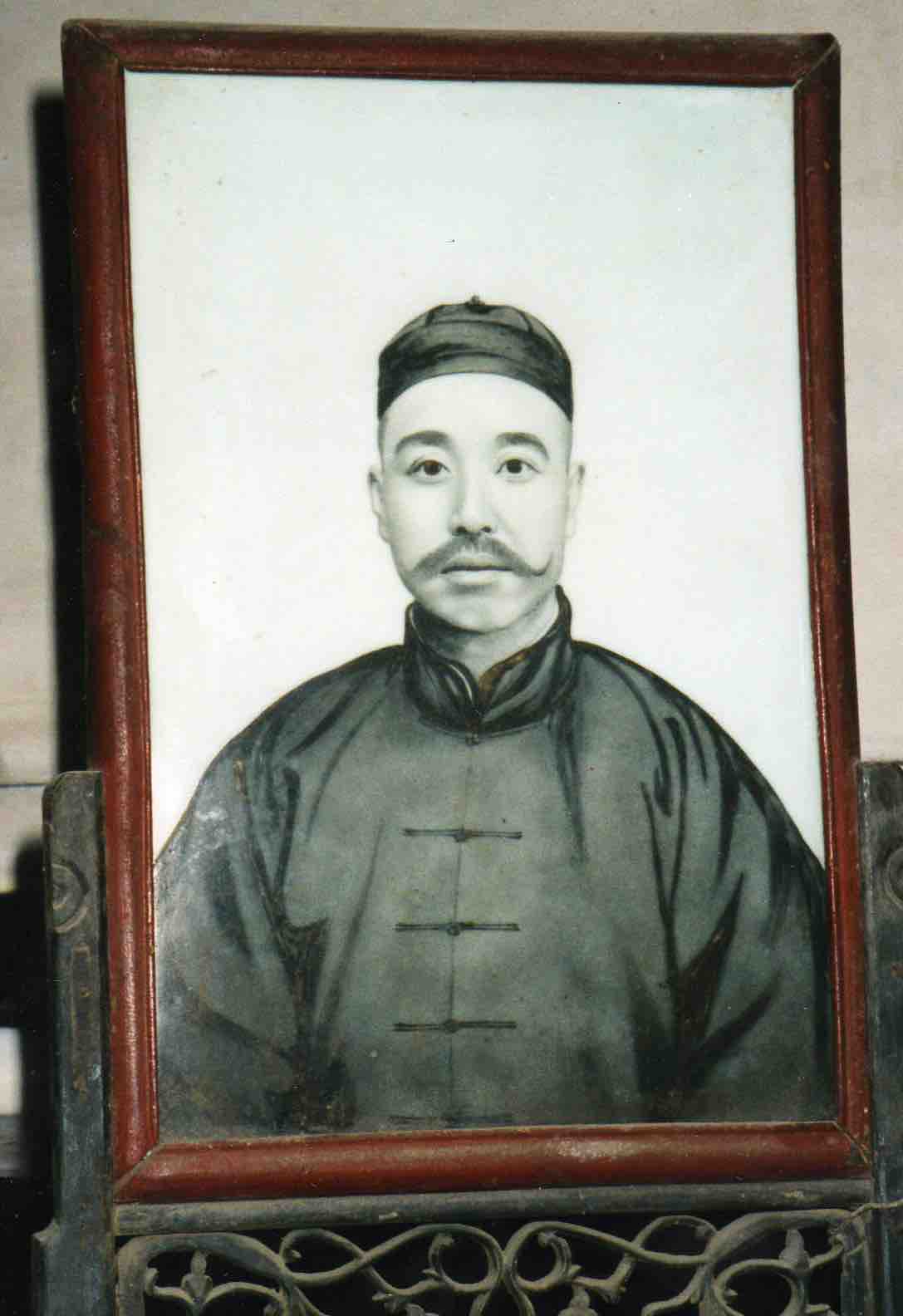
SFTCai Chengxun, victorious in battle, had now made his fortune. Returning north, he retired to his old home in Tianjin. “When the tree falls, the monkeys scatter”; Cai Chengxun’s retinue had now lost their patron. But Cai recognized Shan Futian’s honesty—Shan had never exploited his position in order to enrich himself—and before retiring he wanted to make Shan Futian mayor of De’an county, between Nanchang and Jiujiang, hoping Shan could use the opportunity to make a fortune for himself at last. Shan declined, afraid that his “lack of culture” would make the job difficult for him, although Cai offered him an adjutant. Instead he took the post of county police chief. The 1924 ceramic portrait of Shan Futian, which now had the place of honour overlooking the Shan family’s eight-immortals table, was fired at the famous kiln of Jingdezhen while he was serving in Jiangxi.

But without a patron Shan Futian found the work difficult, and in about 1927 he returned north, having made little money. After a brief reunion with his family in Gaoluo, he was introduced by a relative to do business back in Zhangjiakou. Before long he moved still further north to what is now Hohhot in Inner Mongolia, riding by camel. There he opened a leather business called Total Victory Leather Corporation; he also opened a public baths there in partnership with a relative from Dingxing. Different trades in Beijing were often monopolized by people from a particular area of the surrounding Hebei province; people from Dingxing and Laishui counties (the area of Gaoluo) used to work at public baths—this remained a traditional speciality of Gaoluo villagers right until the 1950s.

Shan Futian was one of several opium smokers in South Gaoluo, along with landlord Heng Demao and village bully He Jinhu. As Shan Zhihe observed, “It wasn’t just the rich who smoked: sick people and general reprobates also had recourse to it. I reckon no more than ten people in the village had the habit”. In 1935 Nationalist official Wang Zuozhou held a bonfire in the county-town as part of anti-opium campaigns throughout China. No-one heard of any such campaign reaching Gaoluo, but the habit—or perhaps rather the addicts themselves—must have died out soon after the Communist Liberation.

Early days of a scholar
Seated magisterially at his fine eight-immortals table, Shan Zhihe now began to relate his own story to us. Third of Shan Futian’s four children, he was born in 1919 at Zhangjiakou, where his father was then based. He and his older brother were given their “official names” Zhizhong and Zhihe after coming of age with the “lesser capping” ceremony. They were so named because their father’s public baths in Hohhot were called Zhonghe (Loyalty and Peace) baths; their names showed that the baths would one day belong to them.

Back in Gaoluo, the Juma river just east of the village had flooded in 1917. Though the flood was not serious and no-one died, it is still famous today in Gaoluo. The only other major flood in the village occurred in 1963. Gaoluo was fortunate, since throughout the whole area floods were frequent and devastating; indeed the village’s long-term immunity from natural disasters is still commonly attributed to the divine blessings brought by its ritual associations.

With his urban education, Shan Zhihe came to know the year of his birth, 1919, as the year of the May Fourth movement, a great urban intellectual ferment modernizing literature and social thinking. In fact, most villagers probably knew nothing of this movement: as amateur historian Shan Fuyi pointed out to us, the only big national historical event villagers definitely knew of was the Marco Polo Bridge incident on 7th July 1937, which unleashed the Japanese invasion. And if they do know such dates, they know them only in terms of the 8th or 26th years of the Republic, not by the official Western calendar.

Rather, most Gaoluo inhabitants know the 8th year of the Republic (1919) as the year of a serious epidemic in the village. In the heat of the 6th and 7th moons, “just as the melons were ripening”, villagers started to get stomach cramps and diarrhoea, death following quickly. Over sixty people died within a month. When one of the coffin-bearers died too, no-one dared observe proper funerals any more—the ritual associations too must have stayed away.

By now Shan Zhihe’s father was doing well in his business enterprises in Hohhot, and had bought up several dozen mu of land back in Gaoluo. In 1922, Shan Zhihe, still only 4, was sent back to South Gaoluo while his father went off to war in distant Jiangxi. Three years later he began attending private school in the village, studying along with forty or fifty other children. The school was at the home of his first teacher, Yan Zhan’ao. Seated before a portrait of Confucius hanging on the wall, the pupils learnt the standard Confucian curriculum, such as Surnames of the hundred families and Document of one thousand characters. Young Shan Zhihe studied there for five years. Since the older masters were less clear in their enunciation, pupils preferred younger teachers like Shan Hongru.

School tuition fees were 3 silver dollars per year. The teachers lived well; apart from tuition fees, pupils were also expected to present gifts three times a year: not only at New Year, but also on the Double Fifth (5th moon 5th) and Mid-Autumn (8th moon 15th) festivals—which have since lapsed in this area. The value of these gifts depended on family circumstances: better-off families might offer a pig or a sack of refined flour, but some poorer families were unable to give anything, and the teachers never blamed them.

The 1930s

1930 donors' list, South Gaoluo

1930 donors’ list, South Gaoluo.

Shan Futian was among the five “managers” on the ritual association’s precious 1930 donors’ list.

My father always thought to give the most money to the association, as much as 5 silver dollars. That was a lot of money then—2 silver dollars bought a sack (44 jin) of refined flour in Beijing. Whenever donations were required, the leaders of the association would go round all the households in the village. Leading members of the Heng lineage always gave last, so that they could display their economic power by giving the most, a bit more even than my father, and “taking first place”.

More charitably, some said it was also so that they could make up for any shortfall in donations. Indeed, on the 1930 list Heng Jun and his son Deyong head the list, before Shan Futian.

On the 6th day of the 9th moon in 1931, just a month after the benediction of the Catholic church, our venerable mentor Shan Zhihe, now 13, left Gaoluo to join his father Shan Futian in distant Hohhot, where he joined in classes of the province’s 4th Primary Comprehensive. Shan Futian wanted his son to continue his education; as we have seen, his own father was a pauper beaten to death without the least pretext, and Shan Futian himself had been poor and uneducated; persistent Confucian values still allotted far higher prestige to the scholar than to merchants like him. Having had such a hard time, he now considered giving his children an education more valuable than any material inheritance he might leave them. I wonder how this decision seems now: many educated Chinese today feel effectively discriminated against for having an education, not only during the Cultural Revolution, but under the market reforms since.

Shan Zhihe recalled ritual life before the Japanese invasion. I cited his account of processions to pray for rain here. He also had insights on the Italian Catholic missionaries, led by Bishop Martina, and the building of the church in 1931.

church

On the 6th day of the 9th moon in 1931, just a month after the benediction of the Catholic church, our venerable mentor Shan Zhihe, now 13, left Gaoluo to join his father in distant Hohhot, where he joined in classes of the province’s 4th Primary Comprehensive. Shan Futian wanted his son to continue his education; as we have seen, his own father was a pauper beaten to death without the least pretext, and Shan Futian himself had been poor and uneducated; persistent Confucian values still allotted far higher prestige to the scholar than to merchants like him. Having had such a hard time, he now considered giving his children an education more valuable than any material inheritance he might leave them. I wonder how this decision seems now: many educated Chinese today feel effectively discriminated against for having an education—not only during the Cultural Revolution, but under the market reforms since.

Shan Zhihe takes a bride
The next time Shan Zhihe returned to Gaoluo was for his wedding in the spring of 1937. One fine morning during New Year 1998 he finally described it for us; he had omitted to mention it during our previous talks, for reasons which will soon become clear.

My Beijing companion Xue Yibing and I both relish his refined conversation. He too is always glad to see us, to chat with relatively educated outsiders about current affairs and history, reflecting on and trying to make sense of his own extraordinary life. With his father’s portrait overseeing us, we sit round his lovely table munching melon seeds in our overcoats (it’s still terribly cold), his children and grandchildren regularly refilling our teacups.

After graduating from primary school in Hohhot, young Shan Zhihe was sent to secondary school in the Xuanwu district of central Beijing. On the 26th day of the 2nd moon in 1937, aged 19, he took leave from his studies to make a special trip back to South Gaoluo for his wedding. The betrothed couple, naturally, had never met. His bride came from the Eastgate quarter of Dingxing town, just like his mother, whose family had arranged the match. She had bound feet and was uneducated; Shan Zhihe was full of modern thinking and had learnt to oppose “feudal customs”, but he had to obey his parents. His return to Gaoluo must have seemed like surrendering himself to the servitude from which his education was promising to free him.

This was to be one of the last lavish weddings in the “old society”, costing the astronomical sum of 300 silver dollars. His bride was carried in an expensive new sedan; Shan Zhihe himself rode a sedan borrowed from landlord Heng Demao. The procession to meet the bride at Dingxing, 5 km distant, started out in pitch darkness at 4am: to set off back home with the bride after midday was taboo, spelling ill-fortune for the match.

The amateur ritual associations perform only for the “white rituals” of funerals, not for the “red rituals” of weddings. For the latter it is common to hire a professional shawm-and-percussion band, known as “blowers-and-drummers”. Since Gaoluo itself had no such band, one was hired from Shiguzhuang village just north. On the procession to collect the bride, the shawm band played as they passed through each village, called “crossing the villages”, as firecrackers were released deafeningly. By tradition the route back to the groom’s home must be different: they passed through Xicheng village in the Northgate area of Dingxing to Nanhou, crossing the river again at Wucun. On arrival at Gaoluo there was a sumptuous feast. The five blowers-and-drummers were handsomely rewarded with half a silver dollar each.

Shan Zhihe spent a month in the village before returning to his studies in Beijing, leaving his new bride behind. Apart from taking part in the lineage observances for the Qingming festival, it was the time of the 3rd moon festival for the goddess Houtu, when many villagers went on pilgrimage to the Houshan mountains. It was also Easter, and Shan Zhihe recalls seeing Bishop Martina ministering to his flock in Gaoluo.

Even in a society in which gender equality was still not remotely on the agenda—we saw the dreadful isolation of Woman Zhang—Shan Zhihe and his wife were to make a particularly incongruous couple, as he recalled dispassionately for us in 1998. She was what he now calls a “housewife” (jiating funü, a term which reveals his own education), and hardly literate; she was five years older than him, and with her bound feet was barely mobile (that was the idea, of course); he was tall and commanding, a scholar with ample experience in the outside world. Couples simply weren’t seen in public. She used to nag him to take her to watch the local opera; one day he had to give in, but as he says they must have made quite a spectacle themselves, with him reluctantly trying to adjust his manly stride as she hobbled along trying to keep up. They never went out together again, and she never forgave him. As he recalled wistfully, they never exactly had any problems: “She didn’t curse me, and I didn’t beat her.” When she died, on the 13th of the 7th moon in 1983, the funeral was quite grand; the ritual association performed, and lavish paper artefacts were displayed and burned, though there was a continuous downpour.

Courteously accepting another cigarette, Shan Zhihe reflects: “My brother and I were both victims of the feudal system of marriage. You can’t blame my parents, they were products of the system themselves. My older brother married a couple of years before me, in 1935, but then went away to study in Baoding; in 1939 he got into the 29th Army, stationed in Hebei, and after going south with the army he stayed there. It was all just to get away from the wife! She stayed behind in Gaoluo the whole time—she was only able to remarry after they got a postal divorce in 1957.”

Incidentally, in 1998 there were still about forty or fifty women in the village with bound feet; of those above 70, only one had natural feet.

The devils invade
In the summer of 1937, back in Beijing after his wedding, Shan Zhihe was in the midst of his studies when the “7th July incident” (Qiqi shibian) occurred. This battle between Chinese and Japanese troops at the Marco Polo Bridge, midway between Beijing and Gaoluo, marked the formal outbreak of the War of Resistance against Japan. It was a decisive moment in modern history for villagers, which they often call simply “the incident”. Of course, the preceding period too transpires to have been anything but rosy, but they often periodize cultural loss by this date, rather than by the Communist “Liberation” some ten years later—the Japanese invasion tacitly marking for them the increasing control of the Communists over their lives, as I eventually deduced.

With the whole Beijing area in chaos, Shan Zhihe eventually made his way back to Gaoluo on foot, by a long route avoiding the area of the Marco Polo Bridge, arriving back home late in July 1937. But what was he supposed to do now? His father had indeed blessed him with an education, and by now he didn’t relish the prospect of taking up as a peasant. The very fact of his education also made his situation precarious, for rival factions would seek to exploit his knowledge, and it would be difficult to choose his own path.

A month or so after his return to Gaoluo, it was clear that the Japanese advance along the main transport routes south could not be contained. Shan Zhihe’s older brother Zhizhong was part of the army which engaged the Japanese at Mentougou west of Beijing, but by the 7th moon they had to retire in defeat. Ordered to regroup at Zhengzhou, quite far south, they were constantly retreating through the area—Shan Zhihe’s mother was busy making bread for them. Zhizhong stopped off in Gaoluo for three days. After he resumed his journey, the brothers were not to meet again until after Liberation, over ten years later. Zhizhong later went off to work in Hubei province far to the south.

Their father Shan Futian was still in distant Hohhot. Shan Zhihe, though reluctant to abandon the family’s considerable property in Gaoluo, was responsible for his mother and sisters, and resolved to take them south out of danger. It was only when they heard the sound of heavy artillery that they decided they must go. But before they had even reached Baoding, they heard that the Japanese had already advanced as far as Shijiazhuang, still further south. Flight was impossible—they had no choice but to return to Gaoluo.

Japanese warplanes bombed Laishui county-town at 8am on 17th September (the 13th of the 8th moon) 1937, and that same day Japanese troops first entered Gaoluo. Coming from the direction of Wucun to the south, they were just passing through; they had about fifty tanks, and were covered by aircraft. The troops entered the village before Woman Zhang could take her children to the church to hide; they passed by her house. In order to dissuade them from murdering them all and setting fire to the village, the village leaders went out to welcome them. Before the Japanese even entered the village, they shot dead a villager who rashly stuck his neck out to look, but after entering Gaoluo they harmed no-one, just asking for fresh water, eggs, and meat. Shan Zhihe himself, along with Cai Ming (a sheng-player in the ritual association who worked as a pig-slaughterer), was responsible for looking after them and giving them water—the Japanese made them drink some first to be sure it wasn’t poisoned. Though they soon went on their way after a token search, Japanese cavalry and infantry passed through constantly for several days on their way to Baoding, and Gaoluo villagers had to look after them.

Seeing our evolving sketch-map of the village gave Shan Zhihe conflicting feelings:

Before the Japanese arrived they had prepared maps which they used when they first entered the village—they made me point out the way to Baoding. In the first party of Japanese troops were some savages [Ainu?] from Hokkaido. When they entered the village they caught some chickens and tore them to bits, eating them raw. When the troops discovered my hands weren’t calloused like those of a peasant they pointed their bayonets at me. I frantically tried to explain by gestures that I ran a baths, and they let me off.

The lawless conditions of the early 1930s had prompted many villagers to arm themselves. Soon after the Japanese invasion in 1937, some Gaoluo villagers sought to set up “Anti-Japanese brigades”. Villagers with guns were invited to join the new militia or at least to give their guns to the resistance effort. Within a couple of days some two hundred volunteers had assembled, including Catholics like Cai Chen and Cai Xing. The new militia called itself by the grandiose title of “The Rear Anti-Japanese self-protection troupe”, and even drew up a constitution. The house of North Gaoluo landlord Yan Shide served as command-post.

But educated Shan Zhihe soon found with dismay that most of the recruits were just village good-for-nothings. While a student in Beijing, he had taken part in patriotic demonstrations boycotting Japanese goods. Now finding himself back in his home village, taking his gun along and soon becoming one of the leaders of this motley crew, he was full of misgivings. Untrained, they were a menace to people outside their own village. “Ordinary people didn’t understand what this ‘anti-Japanese’ stuff was all about anyway, they thought the Japanese devils were just another bunch of bandits.”

The Japanese, learning that Gaoluo had organized a “Red Spears Association”, now sent a division of troops to “encircle and suppress” them. Shan Zhihe had a cousin called Wang Futong, whose family was quite well-off, owning over 100 mu of land. Wang was notorious as a wastrel who kept bad company. When an enemy of his spread a rumour that he was a militia leader, the Japanese came looking for him. Shan Zhihe had gone to Dingxing county-town that day to buy shoes for the militia, and by the time he got back the Japanese had gone, having failed to find Wang. But that was the end of the Gaoluo militia: some hid their guns or threw them down the wells, some went into hiding, while others joined militia groups in other villages, calling themselves anti-Japanese but actually plundering ordinary Chinese houses.

Cultured Shan Zhihe obviously had no future in such a militia. He handed in his gun and took no further part. Events now forced him to flee Gaoluo. Before long his profligate cousin Wang Futong was murdered by a drinking-buddy called Huo Zhongyi, leader of the militia in Xiazhuang just east of the river. Afraid that Shan Zhihe would seek revenge, Huo Zhongyi decided to “destroy root and branch”. He had Shan Zhihe summoned to the house of South Gaoluo landlord Heng Demao, but Shan suspected a trick and decided to flee. For a while he hid out at his grandmother’s house in the nearby town of Dingxing, and then set off to find his father again in distant Hohhot. The 10th moon of 1937 had still not arrived—an eventful start to his married life.

In occupied Hohhot
Shan Zhihe had already begun telling us his story in Gaoluo in 1996. We were back in Beijing for a few days between visits when we learned that he too had come there to stay with a family who needed his medical help. Back in the frenzy of ring-roads and fancy hotels, we missed Gaoluo already; glad of the opportunity to seek his guidance again, we asked him to continue his story for us.
Hohhot

Hohhot, 1930.
Source: https://www.xuehua.us/2018/07/23/罕见历史老照片,1930年蒙古人记忆中的呼和浩特!/

Shan Zhihe left for Hohhot in the 9th moon of 1937, where his father was still running a public baths. Shan Zhihe’s wife, as well as his mother, were able to join them in 1938; the sons Shan Ming and Shan Ling were born there in 1942 and 1948 (for naming customs, see here). But the war had made business enterprises highly subject to intimidation, as Shan Zhihe soon found out when he started working at the baths. Early in 1938 posters advertising for examinations for the police force seemed to offer him a better alternative. Shan Zhihe was a tall and well-educated young man; he passed the exam with no trouble. Only when he started the Japanese-style military training did he realize that what the poster had presented as a force for the protection of Hohhot was in fact a training for the collaborative “traitor army”. By the time he realized he had been conned, it was already too late, and Shan Zhihe was now subordinate to a Japanese police chief. If his story may sound disingenuous, it apparently didn’t seem so to later Communist investigators.

Shan Zhihe was first sent to work at the police station in Great South Street, the most affluent quarter of Hohhot; then after a month he was promoted to personnel management in the police department in the old town. Over the following years he gained promotion through the ranks of the Mongolian and Japanese armies. “I had contact with the Japanese all the time—I got to read the Japanese news, so I knew quite a bit about World War Two.” He was better informed than I about Dunkerque, which in itself was no great feat. He managed to save several Communist guerrillas: when the Japanese caught someone, friends got him to go and set things right, so they were set free.

In the 9th moon of 1942 Shan Zhihe at last got permission to return to Gaoluo for a visit. His military permit entitled him to carry firearms, and his first thought was to seek out Huo Zhongyi and “settle the debt” for the murder of his cousin. But he soon learnt that fate had done the job for him. Huo had gone over to the Japanese, and then, resentful of their cruelty, had resolved to rebel against them; but they had found out and executed him. Shan Zhihe spent only one night at home before setting off back towards Hohhot. On the way he spent a few days at the home of his older sister’s husband in Beijing, and applied for permanent leave from the Japanese army. This was granted, but after he returned to Hohhot he spent most of the next three years virtually unemployed, earning a bit from renting out rooms.

After the Japanese surrender in 1945, Nationalist commander Fu Zuoyi had entered Hohhot and gradually “suppressed” the most evil of the Japanese collaborators. “Times were tough in Hohhot after the Japanese surrender”, recalled Shan Zhihe. “There was no coal, and no barley—we had to eat ‘secondary barley’, a mix of husked sorghum and husked barley. The Nationalists had heard that I was educated and had military training, and they offered me an official post in their army, but I refused. Still, I was only 26, in the prime of life. Frustrated, I could see no options for myself, and in 1946 I ended up as a medical orderly in a hospital at Hohhot. The hospital was of regimental rank, and orderlies were between 1st and 2nd lieutenants in rank.”

Under Maoism

SZH 1948

Shan Zhihe worked as an orderly for the Nationalists in Hohhot through the civil war, witnessing different traumas from those taking place in Gaoluo. In 1948 he took some relatives to Beijing; a photo of him in military uniform shows his impressive stature.
Hohhot was “peacefully liberated” for the second time on 19th September 1949. For the time being the Shan family stayed on there; the family’s bath-house then had five rooms, two of which they rented out for use as a general store, selling off some of their furniture.

But eventually, as private enterprise under the Communists became untenable, the whole family had to return to Gaoluo. Shan Zhihe came back in 1951 with his wife, his daughter, and younger son Shan Ling—the first-born Shan Ming stayed behind with his grandparents, but he too came back with his grandmother in the 3rd moon of 1952.

The aged Shan Futian was last to return, in the following winter. By this time he was seriously ill. Ever filial, Shan Zhihe wanted to sell off the family’s property to help him buy medicine. The family had owned over 90 mu of good land before Liberation. Since they were absentee landlords, they had let villagers cultivate it; the villagers were liable to pay grain tax on it. But the Shans took only a nominal rent, and so upon land reform they were classified as “rich peasant” but were not made an “object of struggle”; they were allowed to keep over 40 mu of land, while the rest was parcelled out, but their property was not touched. Still, the family had been away from the village for the whole preceding period, and Shan Zhihe felt unhappy about his class label. Though the “hat” of landlord or rich peasant was not always brought into play (“neither hot nor cold”), it was a sword of Damocles.

As his father’s health declined, Shan Zhihe sold off 10 mu of the family’s remaining land in the hope of saving him, but Shan Futian wouldn’t let them dispose of more of their assets, and in the 6th moon of 1953 he died. Even in absentia he had been a longstanding benefactor of the ritual association, and his family used to give the association a banquet at New Year. Naturally the association played and performed the vocal liturgy for his funeral; Shan Laole played the drum, Chen Jianhe the guanzi. But the funeral was not especially grand, as Shan Futian had spent little time in the village. Since his son Shan Zhihe had done well since returning to the village by helping at the new village school, the teachers made a traditional offering of cloth.

Mindful of his dubious employment record serving Japanese and Nationalists, Shan Zhihe wrote a “self-examination” after returning to South Gaoluo in 1951. Investigators went to interview people in many places where he had been, but no “historical problems” were unearthed; everyone was full of praise for him. So, remarkably, he remained safe from assault—even through the Cultural Revolution.

Whatever his background, people like Shan Zhihe, the most educated man in the village with enviable modern learning, were much needed to consolidate the revolution in the countryside. He must have known he was skating on thin ice, and having to prove himself he now showed willing.

When I came back to Gaoluo they asked me to teach at the village school. I declined, but I did teach at the People’s School (the evening school) in the Sweep Away Illiteracy campaign of 1953. I was a leader of the West Yi’an district Sweep Away Illiteracy campaign then too. But I felt ashamed of my past, and threw myself into studying Marxism-Leninism, reading works like Das Kapital, On practice, and On contradictions. I read other revolutionary literature like How to make steel [an influential translation of a Soviet novel]. I taught the pupils about Marxism-Leninism, and won an award as a model teacher in the People’s School.

Opera
Apart from the four ritual associations of North and South Gaoluo—which managed to maintain activity through the first fifteen years after Liberation—both villages had an opera troupe, performing a local genre called bengbengr or laozi. In South Gaoluo in the early 1930s Shan Zhihe remembers his older brother Zhizhong getting money from his family to buy the troupe some costumes. But it had to disband after the Japanese invasion.

After Liberation the revamped South Gaoluo opera troupe acquired a great reputation locally. The troupe was to become a flagship for new official cultural policy, based at the village primary school. The reorganization of the troupe was strongly supported by the new Party Secretary Heng Futian, who thought it would be a good way of expanding the village’s influence.

The troupe now resolved to rehearse modern operas which had been created and performed in the revolutionary base of Yan’an in the 1940s: The White-haired girl (1945), as well as Liu Hulan (1948) and Wang Xiuluan. By performing these operas they identified directly with central official artistic policy on the modernization of traditional culture as canonized in Mao’s 1942 Talks at the Yan’an forum on literature and the arts—in stark contrast with the total impasse with the new political ideology which the ritual association continued to represent. Women now took part in the troupe for the first time.

Another main driving force for the opera troupe was Shan Zhihe. Though without formal dramatic training, he had gained experience of the arts while a student, and, despite his dubious work experience before Liberation, was respected as the most “cultured” person in the village. He now acted as director for The White-haired girl. He even brought out his father’s old clothes, hat, and pocket-watch to use as props for the part of the evil landlord Huang Shiren—a fine irony, since his own family had just been landed with the “hat” of rich peasant.

BMNThe virtuous part of the heroine Xi’er’s father Yang Bailao was originally given to He Junyan, Party Secretary of the village Youth League. But he wasn’t up to it, and took the part of Huang Shiren instead, while Shan Zhihe himself took over the role of Yang Bailao—a quaint reversal of their allotted roles in the village. Secretary Heng Futian’s son, Deputy Secretary Heng Qi, took the part of the kindly servant Zhang Dashen. I wonder if the White-haired girl herself, mistaken for a spirit until it transpires that she is merely a common villager whose suffering had turned her hair white, would have reminded locals of their own goddess Houtu.

Incidentally, as a sign of the times, when the Cultural Revolution ballet version of The White-haired Girl was revived in Beijing in 1996, some younger members of the audience missed the point spectacularly. The evil landlord is portrayed in the drama as shameless in his demands for repayment of debts from poor downtrodden peasants, and beats the heroine Xi’er’s father to death when he is unable to repay. At some early performances in the 1940s audience members had so hated the landlord that they virtually murdered the actor, and the plot had to be changed to reflect audiences’ hatred for him: in the revised version he is indeed sentenced to death rather than merely re-educated. But by 1996 his character attracted some sympathy: when interviewed, some said it was quite proper for the landlord to demand repayment! Official commentators understandably lamented the decline of morality: “Thanks to the introduction of a market economy, young Chinese are becoming business-oriented, and their comment reflects the philosophy of business.” Decades of socialist education had come to nought.

Like many Chinese, Shan Zhihe considered the social breakdown to have occurred only with the Cultural Revolution and the loss of integrity thereafter. As he reminded us, in the 1950s life was at last stable, and the Party was popular. Chairman Mao was revered: people said there had never been such a great figure in the whole of China’s long imperial history. The army served the people, fetching water and clearing the land for the villagers. Cadres abided by the “three main rules of discipline and the eight points for attention”, theme of a catchy new song. New Party Secretary Heng Futian was rushed off his feet for a whole month organizing the collection of grain taxes, and the village cadres just had a quick bowl of noodles before their meetings—there was not the least suggestion that they might be fleecing the people.

Shan Zhihe may have had reasons to thank the Party, but he voiced the feelings of many poorer villagers. People we met articulated no negative memories of the campaigns of the early 1950s, and I do not believe this was mere prudence. No-one found labour gangs at all sinister. Many of those who suffered, like the old bullies, were thought to deserve it. It was simply not in people’s vocabulary to sympathize with the plight of the Catholics. And as the landlords disappeared, people neither remembered them badly nor spared the sentiment to miss them. The political mood dictated from above was pervasive: people had no choice but to take part in the elaborate game of “snapping at each other”. People related to or erstwhile friends of those now classed as “elements” went through the motions. Sons of so-called rich peasants, such as young musician Shan Bingyuan, naturally had a tougher time than others from unassailable poor-peasant backgrounds. But even a cadre like Cai Fuxiang, with his impeccable revolutionary credentials, was traumatized by the violence of revolution.

As a former medical orderly, Shan Zhihe had later studied medicine under his older sister’s husband, and was now quite well qualified. He now started to treat patients for free in Gaoluo.

Despite their later nostalgia, many villagers must have been increasingly anxious as collectivization looked imminent. Some households certainly stood to gain from an efficiently-run system. By now the “rich peasant” family of venerable Shan Zhihe was poor: their labour force was weak and they had no experience of tilling the land, so they had no objections to joining the collective. Such families went along with the changes, but many already working efficiently with their own carts, tools, and draft animals saw communal agriculture as inefficient and alienating, and were reluctant to join. Though disgruntled, few were rash enough to articulate such thoughts: complaint was dangerous, and could instantly be interpreted as opposition to the sacrosanct state. The government had also just devised an unenviable class category of “new rich peasant”. Still, collectivization did arouse resistance and sabotage, and in many places (if not in Gaoluo) religious sects resurfaced to oppose it.

After the Great Leap Backward and the ensuing famine, a lull between extremist campaigns allowed a brief revival of the ritual association in the early 1960s. Among thirty new recruits in 1962 was Shan Zhihe’s son Shan Ling.

The Cultural Revolution, opera, and the reform era
Soon after the Four Cleanups campaign opened in 1964, Shan Zhihe wrote a letter to the authorities complaining of the unfairness of his “rich peasant” hat, but once the Cultural Revolution started he was unable to pursue it any further. He realized chaos would be unleashed as soon as he heard the ominous slogan “attack with culture, protect with force”, providing a pretext for violence. In Plucking the winds I describe the factional fighting that spread from the county-town to Gaoluo in 1966—including the remarkable rescue of the Houtu precious scroll. But despite his dubious past, Shan Zhihe remained immune from attack.

The village opera troupe had performed modern opera in the early 1950s, abandoning it in 1958 for the traditional bangzi style. By 1964, at the instigation of the county Bureau of Culture, themselves under orders as part of a huge national drive against the traditional “feudal superstitious” operas which had resurfaced widely, they started performing modern operas again. They then inevitably blew with the winds to serve as a Mao Zedong Thought Propaganda Team, performing the “revolutionary” model operas, as throughout China. By winter 1967 the troupe was performing revolutionary dramas like Shajiabang, Taking Tiger Mountain by strategy, as well as Stealing the seal (Duoyin 夺印, an opera about class struggle) and The commune-chief’s daughter (Shezhang de nü’er 社长的女儿). For most of our friends, erstwhile members of the utterly conservative, but now dormant, ritual association, the development of the opera troupe had an inevitability about it. Even ritual stalwart He Qing now relished playing the smugly virtuous revolutionary Li Yuhe in The tale of the red lantern.

But some other members were none too impressed. Shan Qing, then in his 20s, had learnt the bangzi style in 1962, and only wanted to perform the old operas; he didn’t approve of the model operas, so he withdrew. And despite having subscribed readily to the social goals of the 1950s, Shan Zhihe decided the Mao Zedong Thought Propaganda Team wasn’t his cup of Chinese tea.

Xie JinBut meanwhile he collected material in order to compose a libretto on the theme of Lin Zexu, hero of the Opium Wars. Like the Boxer uprising (also the object of much fieldwork under Maoism), this was always a popular theme rallying the people against the evil foreign imperialists; following a 1959 film, by 1997 the story was taken up in a big way in a blockbuster film by veteran director Xie Jin, making propaganda for the handover of Hong Kong back to the Chinese. The county Bureau of Culture supported Shan Zhihe in his project, but it never came to fruition—too bad, as I joked with him, or I might have landed a part in the revival, though I’m not sure I’d be up to playing Queen Victoria.

For better and for worse, the economic liberalizations after 1978 effectively brought an end to over twenty years of Maoist policies. A new era now began. Class labels were finally abolished, as Shan Zhihe (who had suffered less than many for his bad label) reminded us, causing people to praise the national leader Deng Xiaoping as “Blue Sky Deng”.

In 1980, just as the commune system was being dismantled and the ritual association reviving, South Gaoluo villagers dipped their toes in the newly flowing waters of emergent capitalism as a group of enterprising friends tried organizing an “incense factory”, and soon (sorry, I can’t resist this) got their fingers burnt. The village brigade, led by Cai Yurun, back from the army and just appointed Party Secretary, as well as a keen new recruit to the reviving ritual association, took the lead. The incense factory was also an early experiment in business practices for Heng Yiyou, former “backstage” supporter of the United faction, soon to become a leading local entrepreneur. Even the otherwise sage Shan Zhihe, already in his 60s, took part. Also in 1980 he passed an exam at county level, promoted by the commune, and went on to open a private clinic in Dingxing in partnership with some colleagues.

In 1998 we paid him further delightful visits. Still supporting the association in his old age, by the standards of rural China in the 1990s he was comfortable, well looked after by his family.

Meanwhile a miraculous revival of the village opera troupe was under way. Political freedoms after the dismantling of Maoism then allowed them to restore the traditional style from 1979 to 1981, but economic pressures soon forced them to disband. They started rehearsing again in 1997. The newly formed group was an extension of the village’s new shawm band; thus several members of the ritual association were also taking part, including Shan Zhihe’s urbane sons Shan Ming and Shan Ling. The troupe’s repertoire now subsumed both traditional and modern styles. For New Year 1998 they were preparing classical bangzi excerpts as well as parts of their newer repertory such as Liu Qiaor and the teahouse scene from the Cultural Revolution “model opera” Shajiabang, still in bangzi style. But the revival exacerbated animosities within the ritual association.

SJB

Shajiabang, New Year 1998: Cai Tingwen as Nationalist general, Shan Rongqing on fiddle.

In contrast to the rather insular world of many peasants, the Shan family continued to be rather well acquainted with world events. Indeed, some other villagers too were interested in the Iraq crisis which was reported on Chinese TV—they questioned me about Britain’s role. But the Shan family’s curiosity was rather exceptional, going back to the early 20th century with Shan Futian’s experiences in Beijing, Hohhot, and south China, and continuing with Shan Zhihe’s own background of studying in Beijing and working for the Japanese and Nationalists in Hohhot.

Shan Zhihe, who over half a century earlier had learned of the Normandy invasion, had maintained his interest in world events: he mentioned the death of Princess Diana and the channel tunnel between England and France. So the whole family, including his urbane sons Shan Ming and Shan Ling, naturally had an interest in new culture from outside. They had good contacts in Beijing, where Shan Zhihe paid occasional visits; his daughter’s husband had retired early and become a taxi-driver, making a regular trip to and from Gaoluo—another link to the modern world of the Shan household.

* * *

For me, Shan Zhihe’s story encapsulates the complex transition from the old to the new society. I shared the villagers’ great respect for him. Of course he presented himself in a good light; nearly half a century after having to write “confessions”, Shan Zhihe doubtless found our visits a further opportunity to reflect on his experiences. Now he was writing his memoirs, only partly under the stimulus of our visits. As he reflected to me,

I’ve got a good memory, but my fate is no good. Otherwise after studying in Beijing I might have gone off to England to continue my education! The year the Japanese surrendered I was already 26, but by then it was too late. While I was working for the Japanese I managed to save several Communist guerrillas. But for having served the Japanese I was condemned to live and die in the village, a dismal life.

But things could have been far worse: he could so easily have been branded for life as a Japanese and Nationalist collaborator. By his own analysis, he had gone down the wrong road just once in his life. Having demonstrated against Japanese goods while still a student, he still couldn’t understand how he ended up as a policeman under their rule. Although he had done no wrong, it somehow seemed right that he should return home to reflect on his past and his future—not that he had much choice.

If many people with similar experiences were persecuted under the Communists, many also must have been well treated. It seems that the new leaders knew whom they needed, and that local loyalties also counted. But of course there were also innumerable senseless casualties in the Chinese Revolution; over the following years many Party members who suffered to help build the new society, and remained wholeheartedly loyal to it, were to be ruined. Shan Zhihe now had reason to be grateful to the Party. Psychologically his story is complex. He seemed sincere in parroting the Party-speak cliché of “I reformed my thought through labour and sweat”: layers of irony are hard to fathom.

But he had survived. “My father taught me two things: ‘If you make money, you mustn’t look down on people; if you become an official you mustn’t con people’—I’ve managed to live right down to today by those two mottos.” I believe him, too; his refined demeanour is a far cry from that of so many cadres and nouveaux riches under the reforms. By the 1990s, his family were living rather well; his children and grandchildren were bright. The family has survived—what more could they ask? Zhang Yimou’s moving film To Live (Huozhe, surely better translated as “Surviving”) gives an impression of this instinct. And many ordinary Chinese today still revere Mao, despite all the appalling gratuitous sufferings he inflicted on them, and are actually nostalgic for Maoism, admiring strong leaders; they are confused and alienated by the reforms since the 1980s. We must beware reading such alienation into the vicissitudes of the 1950s.

Do read Plucking the winds!


Training Daoists in Shanghai

for what?

Daoists 87

Burning petitions as Daoist ritual concludes, Baiyun guan, Shanghai 1987. My photo.

Revisiting material on Daoism around Shanghai and Suzhou reminded me of two astute articles by Yang Der-ruey 楊德睿, a fine sociologist trained under the great Stephan Feuchtwang at the LSE. Following his PhD, his writings from the standpoint of contemporary ethnography contain lessons for scholars of ritual, suggesting parallels with other metropolitan centres—including Suzhou and Beijing.

In a fascinating article on how Daoists learn to make their way in the real world of the ritual market:

Yang explores the ramifications of the training programme established by the Shanghai Daoist College, founded in 1986 under the Shanghai Daoist Association, and subordinate to state and Party authorities—the Ministry of Education and the Bureau of Religious Affairs. He shows how the economic behavioural patterns and intellectual concerns shaped by their life in the College are challenged soon after they graduate by the rather traditional local religious economy in which they now have to make their living:

They soon had to learn to discern the structure and change of the local religious economy, to recognize their assets, to envision their niche in the changing economic landscape, and to adjust themselves accordingly, manoeuvring among diverse economic patterns and selectively integrating them into a distinctive, viable niche.

On one hand they learn to accommodate with the secular state apparatus and economic order upon which these young priests’ living depends:

This order can best be named a “socialist public-supply economy” since it is at once “socialist” in terms of the internal redistribution system of the Shanghai Daoist Association and is “public-supply” in terms of the style in which the SDA deals with the clients. The morality it claims to embody is egalitarianism and unselfish devotion for common causes, but in reality this economy encourages hierarchical exploitation, sloth, and apathy.

Temple priests soon began working with the unlicensed freelance household priests. At the same time both learn to collaborate with spirit mediums (daxian 大仙 or xiangtou 香头), the main sponsors of ritual life, and to imitate their approach: [1]

Their economy is an integrated system of a gift economy in the private/individual domain and a tributary economy in the public/communal domain. In the private domain, they provide individual devotees or families with magical or non-magical healing, spiritual protection, divination, psychological consultation, and so on. In the public domain, they take the initiative to organize communal religious activities.

Temple priests began to provide facilities for patrons to create god statues, spirit tablets, and amulets, and to offer divination services. And to satisfy the taste of clients, temple priests began to expand the range and style of their rituals. He cites the remarkable case of Xiao Wang and the “Maoist shaman” whom he replaced as temple leader; thus temple priests learn to act as both “immortal magistrates” and cadres.

Daoist temples came to be considered as a crucial means for revitalising the economy of old, run-down neighbourhoods to boost the motivation of the local population for pursuing economic development. And temple priests have gradually developed a distinctive synthesis of all the economic patterns they can learn from bureaucrats, freelance priests, and mediums.

* * *

So what Chinese sources often portray as a seamless transition is actually beset by conflict. I’ve already given instances of the different values of the traditional ethos of folk musicking and the new style of the conservatoires and state troupes, including a wise insight from the great Yang Yinliu. In

  • From ritual skills to discursive knowledge: changing styles of Daoist transmission in Shanghai”, in Adam Yuet Chau (ed.), Religion in contemporary China: revitalization and innovation (2008), pp.81–107.

Yang Der-ruey shows how modern schooling for training novice Daoist priests has produced a new style of learning and a new type of knowledge among the younger generation of Daoist priests. He argues that the curriculum instituted by the Shanghai Daoist College

is actually an attempt to reset the priority attached to different ways of learning and different kinds of knowledge. In sharp contrast to their predecessors who prioritized rote learning and repetitive bodily exercise, and who attached the highest value to the ability to exert up efficacious power while achieving the highest aesthetic qualities in representing tradition, the College-trained younger Daoist priests are taught to prioritize understanding, explanation, argumentation, and to accord the highest value to the ability to compose awe-inspiring discourse embroidered with references to many books. In short, the College’s curriculum functions, purposefully or inadvertently, to instigate an intellectual revolution among younger Daoist priests by replacing “ritual skills” with “discursive knowledge” as the new ideal model for Daoist knowledge.

This “paradigm shift” of Daoist knowledge/learning style is not directly imposed by state authority or enforced by the official ideology of atheism but derives from an acute sense of a crisis of legitimacy, or even survival, of Daoism that is now widely shared among the Daoist clergy. This sense of crisis was actually cultivated by the State in the first place through forcing Daoism to engage in a peculiar Chinese-styled inter-religious competition that is arguably biased against Daoism as a tradition of “mere” ritual skills. However, the inflictor role of the state tends to be ignored, as it also functions as the enlightening pedagogue that shows Daoist clergy the way toward emancipation: modern priestly schooling modeled after the state-run public schooling system.
[…]
The story may sound quite upbeat for preservationists and revivalists of the Daoist tradition in China, but the reality is just the opposite. Many senior priests in Shanghai, who were once the most passionate supporters of the endeavor, became its bitterest critics, and did not hesitate to voice their disillusionment publicly. Although their disaffection towards their pupils may have been caused by many other reasons, including the generation gap, unfair rates of salary and benefits that discriminates the aged priests, and so on, it is nevertheless based on an apparent fact: the training of young priests today is very different from that in their own youth. Many senior priests considered the College to be an appalling failure, putting the blame either on the personal qualities of the students and the leadership of the College, or on the very idea of setting up a modern priest training school.

The disaffection and accusations of those senior priests surely have certain grounds, and it is unquestionably true that the general qualities of the youngsters’ ritual skills are much lower than that of the elders. However, it should also be acknowledged that, while many aged priests are illiterate or barely literate, all the younger priests are literate and some are actually quite well versed in history, philosophy, and even IT skills, as they all have gone through nine to twelve years of public schooling. Therefore, it would be unfair to conclude that the younger generation priests are inferior to their predecessors and that the College is a failure. So, where do all the squabbles come from? The real problem here is a huge gap between the majority of senior priests and the leadership/faculty of the College on what should be taught to novice priests or what they should be learning through the College. Learning and teaching activities are embedded in, and structured by, the surrounding social and/or institutional contexts; to thoroughly explain the above-mentioned gap would require us to examine not just the knowledge to be taught/learnt but also the context in which the transmission of knowledge takes place.

Yang discusses in detail the types of knowledge transmitted through the local apprenticeship tradition and through the College, highlighting the contrast between them.

Before Liberation mastery of ritual practice was central to the local apprenticeship tradition, and was structurally embedded within the kinship network. Daoists commonly have mottos for the various kinds of ritual skills to be learned, like “blowing, beating, writing, reciting, and looking” chui da xie nian kan 吹打寫念看) in Yanggao (Daoist priests of the Li family, p.15). In Shanghai the list comprises eight skills:

  • chui qiao xie nian pu pai zha zhuo 吹敲寫念鋪排紮著
    wind playing, percussion, writing ritual documents, vocal liturgy, setting up altars (pu and pai), making paper artefacts, decoration.

But further, the more advanced ritual masters are expected to acquire magical power (fali 法力) by mastery of fu 符 (talismans), zhou 咒 (incantations), jue 訣 (mudras), and bu 步 (magical steps). Yang describes the cunxiang 存想 (“indulge in contemplation”) and chushen 出神(“bringing out the gods”) esoteric techniques of such masters.

Table 1

Table 2

He contrasts the degree certificates granted by modern educational institutions (merely an abstract confirmation of a past reality—“X has studied X subject for X years and passed the final examination”) with the Daoist lu 籙 registers, which contain much more information. Although both modern degree certificate and lu registers empower the holders, the “efficacy” of the former depends finally upon its being recognized by the secular establishment and/or the general public, whereas the latter is supposed to be efficacious in its own right because it is warranted by the heavenly bureaucracy.

A nice story from a young graduate of the College, about an encounter at an exhibition on the “religious sector”, shows both the delusion of the modern secular mindset and students’ own awareness of the conflict:

The head of the Bureau of Religious Affairs came to our stands accompanied by a load of bigshots. At first, they seemed surprised that Daoism had also founded a college. Then one of them started to tease me: “What have you learned in this Daoist College, then? Drawing talismans? Reciting spells? Being a medium? Dancing as a shaman?” While he was asking, some onlookers burst into laughter. I did my best to suppress my anger and calmly told the bastard what kind of curriculum we have in the Daoist College. In the end, I really felt I was going to blow my top if I couldn’t put up a bit of a counter-attack, because there was always someone sniggering at me when I was talking to the bastard. So I concluded my explanation like this: “If someone wants to learn Daoist magic like drawing talismans or casting spells, they must have a certain talent and then spend many years on strictly disciplined practices and meditation. It’s not a simple job like reading books. So, a “good student” valued by normal standards, even a PhD, is probably not qualified for learning Daoist magic.” Those who had laughed at me shut their mouths immediately. They could sense that there was a sting in my words.

Daoists

Daoist liturgy, Baiyun guan 2001. My photo.

* * *

Whereas a conservatoire education is broadly in line with later careers in state music troupes, official Daoist training programmes are soon rendered irrelevant when graduates have to make their way in the ritual market.

Of course, conservatoires and state programmes are the tip of the iceberg: most folk musicians, and the majority of household Daoists in rural China, never set foot within the state educational apparatus for either music or ritual. Even in cases where the Intangible Cultural Heritage authorities seek to impose such procedures on household Daoists, the attempt is incongruous and impotent, as with the Li family.

But whereas the ritual market in south Jiangsu continues to thrive along with its population, in rural north China both are dwindling.

[1] For more on the Shanghai mediums, and their relations with temples and Daoists, see e.g. Long Feijun龙飞俊, “Shanghai Longwangmiaode ‘taitai’ men: dangdai Shanghai Longwang miao daojiao difang jisi tixi diaocha” 上海龙王庙的“太太”们——当代上海龙王庙道教地方祭祀体系调查, Zongjiaoxue yanjiu 2014.3, and her ongoing work.

Recent updates on the Li family Daoists


One of the great things about this internet thingie (“don’t think it’s going to catch on”) is that it allows me to keep updating my film and book on the Li family Daoists.

After a flurry of posts from my visits to Yanggao last year (see here), here’s a reminder of recent additions to my material:

For much more, see under updates and vignettes in the “Li family” category of the sidebar.

stele


Changing ritual artefacts

Talking of commemorating the ancestors, for funerals in Yanggao the soul tablet (lingpai 灵牌, or shenwei 神位) (Daoist priests of the Li family, p.197) is carried by the son or grandson at the head of the sequence of processions throughout the day from scripture hall to soul hall, where it is placed on the table before the coffin while the Daoists sing a sequence of hymns; eventually it is burned late at night, on the eve of the burial, for the brief Escorting Away the Orphan Souls that follows the majestic Transferring Offerings ritual (my film, from 1.13.40).

Funeral, Yangguantun 2011: the soul tablet is carried from soul hall to scripture hall.

Since the 1980s the soul tablet has been made of paper, mounted on a chopstick stuck in a bread roll. But one day at a scripture hall I noticed an old soul tablet made of wood, written in Li Qing’s elegant hand in 1980 for the funeral of our host’s mother-in-law. So it transpires that the soul tablet has only been made of paper since the 1980s; previously, the bereaved family could make regular offerings at home over New Year before the more durable wooden version.

Left: wooden soul tablet, written by Li Qing, 1980.
Right: standard paper soul tablet, 2011.

Li Bin came across another old wooden soul tablet recently:

new LB lingpai

Indeed, along with subtle adaptations to ritual practice, funeral artefacts have changed significantly since the 1980s (Daoist priests, ch.19). Apart from the wooden soul tablet, no longer seen are the large rectangular wooden dou 斗 vessel filled with grain for the public rituals, or the layered wooden barrow for jiexian 接献 offerings from the returning female kin; the red lacquered wooden tray of offerings has been replaced by metal, and the elegant ceramic flask for Fetching Water by a plastic bottle.

tray 91

Li Qing takes the red lacquered tray for funerary offerings, 1991.
My film, from 48.23.

Here the paper artefacts burned at the grave, though far less elaborate than in southeast China and Taiwan, have shown only modest innovations: since the 1990s the horse and cart have commonly been replaced by a car, and sometimes the deceased is provided with a mobile phone to ease other-worldly communication.

Paper artefacts to escort the deceased, 1991.
Note headgear denoting grades of kinship.

See also Tomb decoration, ancient and modern.

Perhaps the most significant recent innovations affecting access to ritual life were mobile phones and motor-bikes, allowing patrons to contact Daoists easily, and rapid movement for both. For an apparent threat to this culture from the state, see here.

Li Manshan’s latest diary

LMS

After recent excursions further afield, it’s high time for another update on the Li family Daoists in Yanggao.

The venerable Li Manshan, now 74 sui, may have been taking a back seat to his son Li Bin in the family’s ritual services over the last couple of years, but he’s still busy zooming around on his motor-bike, as I now learn from his recent diary.

LMS 1992

In a break during a funeral, Li Manshan consults with another family to determine the date for a future burial. August 1992.

He has been meaning to limit his work to the immediate vicinity, and focus on determining the date; whereas for funeral consultations he has to visit the bereaved family, for other requests (weddings, timing of journeys, siting of houses, and so on) he can just await patrons at home. But since he has served most of these villages frequently over the last four decades, such as Pansi, Luotun, Wujiahe, Houying, Sibaihu, Shizitun, he still often has to lead the band for lengthy and tiring funerals, and not always so nearby.

2019 (dates in lunar calendar)

1st moon

  • 1 and 2: to Wujiahe to determine date for burial
  • 5–6: funeral at Wujiahe
  • 7–8: another funeral at Wujiahe
  • 8–9: funeral at Luotun
  • 10: major snowfall—made paper artefacts at home
  • 13–14: funeral at Anzao
  • 18: ritual for third day after death at Qiaojiafang
  • 19–20: funeral at Qiangjiaying
  • 21: funeral in Tianzhen; determined date for burial at Pansi
  • 22–24: 3-day funeral at Qiaojiafang
  • 24–25 funerals at Yaogou (Tianzhen) and West Zhanjiawa (Gucheng district, can’t find on map)

2nd moon

  • 1: funerals at Pansi, West Yaoquan, and Luotun
  • 5–6: funerals at Houying and Zanniangcheng
  • 8–9: funeral at Wujiahe; determined date at Tiantun
  • 13–14: funerals at South Renyao and Zhaojiagou
  • 14–15: funeral at Tiantun
  • 18–19: funeral at Upper Liangyuan (his home village)
  • 21–22: funerals at Yangheta (Tianzhen) and Anzao
  • 23: funeral in southern suburbs of Datong
  • 24–25: funeral at Xingyuan
  • 26–27: funeral at Pansi

3rd moon

  • 1: funerals at Pansi and Yangyuan
  • 3–4: funeral at Wujiahe
  • 5–6: funeral at Yaogou
  • 8–9: funeral at Anzao
  • 11–12: funeral at Balitai
  • 15–16: funeral at Shizitun
  • 18–19: funeral at Qiangjiaying
  • 21–22: funeral at Yaozhuang (Yangyuan)
  • 23–24: funeral at Sibaihu
  • 24th–25th: funeral at Shizitun

4th moon

  • 2–3: funeral at Houying
  • 4–5: funeral at Wujiawa (Datong)
  • 6–7: funeral at Taishan village in Datong suburbs
  • 8–9: funeral in Yituquan [good village name, this: “One-spit stream”] (Yangyuan)
  • 13–14: funeral for the wife of our wonderful friend Li Jin in Yanggao town

For some of these funerals Li Manshan works together with Li Bin, but the latter also often has to lead a separate band, as well as doing his own consultations to determine the date. As with Li Bin’s diary from 2017, we can see that improved transport has enabled them to perform funerals in different villages concurrently—never an option before the 1980s when they had to walk everywhere.

So while Old Lord Li deserves to take things easy, he still can’t easily turn down requests. I can understand why he longs for the contemplative life of the temple priest. Belief endures in the powers of the Daoists to deliver the soul, and for now they are still much in demand, as they have been for the last forty years—but with the rural population continuing to dwindle, this can’t last.

For the busy schedules of Li Manshan and Li Bin even during the Coronavirus, see here.

Buddhism under Mao: Wutaishan

YX

After an interlude on ritual around south Jiangsu (notably the great Daoist ritual held in Suzhou in 1956), here I return to my home base of north China, focusing on the Maoist era as a kind of prequel to my post on the Wutaishan Buddhists.

As always, I note the tension between studies of ritual and “music”. Whereas scholars of religion tend to focus on early doctrine and silent texts, Chinese music scholars set forth from the living soundscapes of ritual. At the same time, they have tended to collect reified “pieces of music”, only paying attention to ethnography quite recently. However, at least they do the fieldwork, stressing the actual performance of ritual, and we can glean clues to the changing life of religion in society.

Wutaishan
Wutaishan is one of the foremost sites for Buddhism in north China (see also A Buddhist centre in Peckham). Since the 1980s, the history of its temples has become a major research topic, [1] and Chinese music scholars have documented their rituals (for an introduction, see my Folk music of China, pp.213–25). But already in 1947, amidst civil war and land reform, Ya Xin spent three months on Wutaishan documenting the ritual soundscape (whose features in north China I introduce here).

Following the national Communist victory in 1949, major projects to document a wide range of folk musical genres were initiated right across China. In March 1954 Ya Xin took part in a conference in Chengdu to discuss the enterprise, prompting him and five others to spend August doing fieldwork in the temples of Emeishan in Sichuan. In 1955 he edited a 508-page volume of transcriptions, including both that material and his 1947 work on Wutaishan:
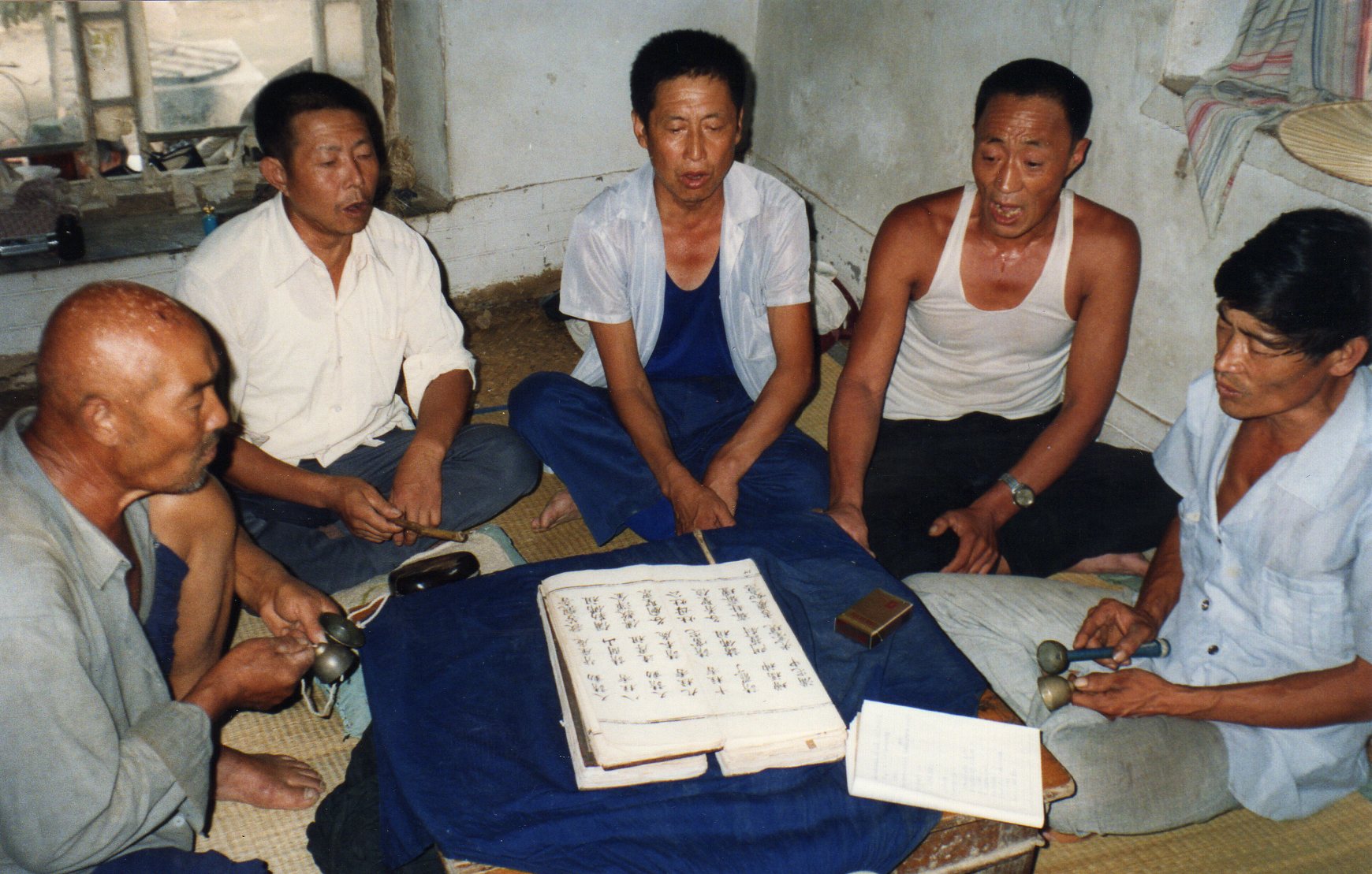
  • Ya Xin 亞欣, Siyuan yinyue 寺院音樂 [Temple music], Zhongguo yinyuejia xiehui Chengdu fenhui, 1955.

By the 1950s, scholars like Yang Yinliu studying “religious music” found it obligatory to defend the “value” of the topic, and Ya Xin prefaced his introduction (pp.1–15) with such a defence. The following transcriptions for Emeishan (pp.16–297) include the major Yuqie yankou ritual, daily services, and other vocal liturgy. [2]

But back in 1947 (just as Bill Hinton was embedded with the land reform teams in a village further south in Shanxi), Ya Xin had carried out fieldwork on Wutaishan while serving as a cultural cadre for the Jin–Sui Liberated Area. The conditions were most taxing: amidst ongoing battles with Nationalist troops, the Communists were implementing land reform. So Ya Xin notes that his work was imperfect. But it was a bold initiative: while collecting folk music had been a major project in the Shaanbei Base Area, temple ritual was not on their agenda.

For Wutaishan (pp.299–454), Ya Xin transcribed the main items from the Yuqie yankou ritual, shengguan wind ensemble melodies for both Han Chinese (qingmiao) and Tibeto-Mongolian (huangmiao) styles, and the Three Days and Nights (san zhouye) mortuary ritual. With the book’s many transcriptions of hymns (zan 讚), gathas (ji 偈), mantras (zhenyan 真言), and so on, it provided an early framework for understanding the mechanics of vocal liturgy.

YX score

From Ya Xin’s transcriptions of the Wutaishan yankou: Daochang chengjiu hymn,
and opening of Huayan hui, showing melisma with padding characters.

Finally, visiting Du Wanzhongshan’s gufang 鼓房 folk wind band in Dongye town at the foot of the mountain Ya Xin notated their “eight great suites” (pp.455–508), derived from the shengguan of the temple monks (Folk music of China, pp.218–19)—although unlike groups of household ritual specialists, they don’t perform vocal liturgy.

Since Ya Xin wasn’t equipped with a recording machine, one both admires his diligence in transcription and wonders at its accuracy. I surmise that much of his work on the vocal liturgy was done with individual monks singing items for him repeatedly, rather than in the course of rituals—not least because the Buddhist texts themselves are highly complex, so he clearly had access to ritual manuals; and he seems to have consulted gongche scores of the shengguan music too. But he didn’t list the temples where he made his transcriptions, or provide names of monks.

Background
We should bear in mind the wider history of Wutaishan around the time. Here I seek clues in the 1988 Wutai county gazetteer. [3] Though such sources are “history of the victors”, they contain some useful material.

Warlord conflict from the 1920s, with Yan Xishan’s troops active, already made the region unstable. But in 1936 Wutaishan had 130 active temples with 2,200 registered clerics (including 800 lamas)—many of whom were doubtless fleeing from warfare. John Blofeld spent time there in 1936–37.

The early architecture of the Wutaishan temples had attracted historians for some time. Japanese scholars found some important temples early in the 20th century, though the Danish Johannes Prip-Møller was unable to visit during his 1929–33 temple survey. In 1937, on the eve of the invasion, Liang Sicheng and Lin Huiyin rediscovered the Tang-dynasty Foguang si temple. The search for “living fossils” would later become a major industry in Chinese musicology.

Japanese troops invaded the area in October 1938, carrying out several massacres. This was an early base area for the Communists in the resistance against Japan. Both patriotic and quisling Buddhist associations were formed in the temples. Many of the monks assisting the resistance were Tibeto-Mongolian lamas, such as those of the Zhenhai si temple, who in 1938 handed over to the 8th Route Army an entire arsenal of weapons that had been given by Chiang Kai-shek to the bodyguard of the Zhangjiafo lama. Monks handed over another cache of weapons in 1942.

The Nationalists fled in 1943, and the Japanese were in retreat from 1944. By July 1946 the Communists were in complete control, and began carrying out land reform. The monks now lost much of their land and income, and some temples were destroyed. By 1947, with little patronage, tilling the monks’ remaining land constituted 89% of their income.

Yan Xishan’s forces returned in October 1946, but retreated again in November. Even in February 1949 they committed a massacre in Dongye town.
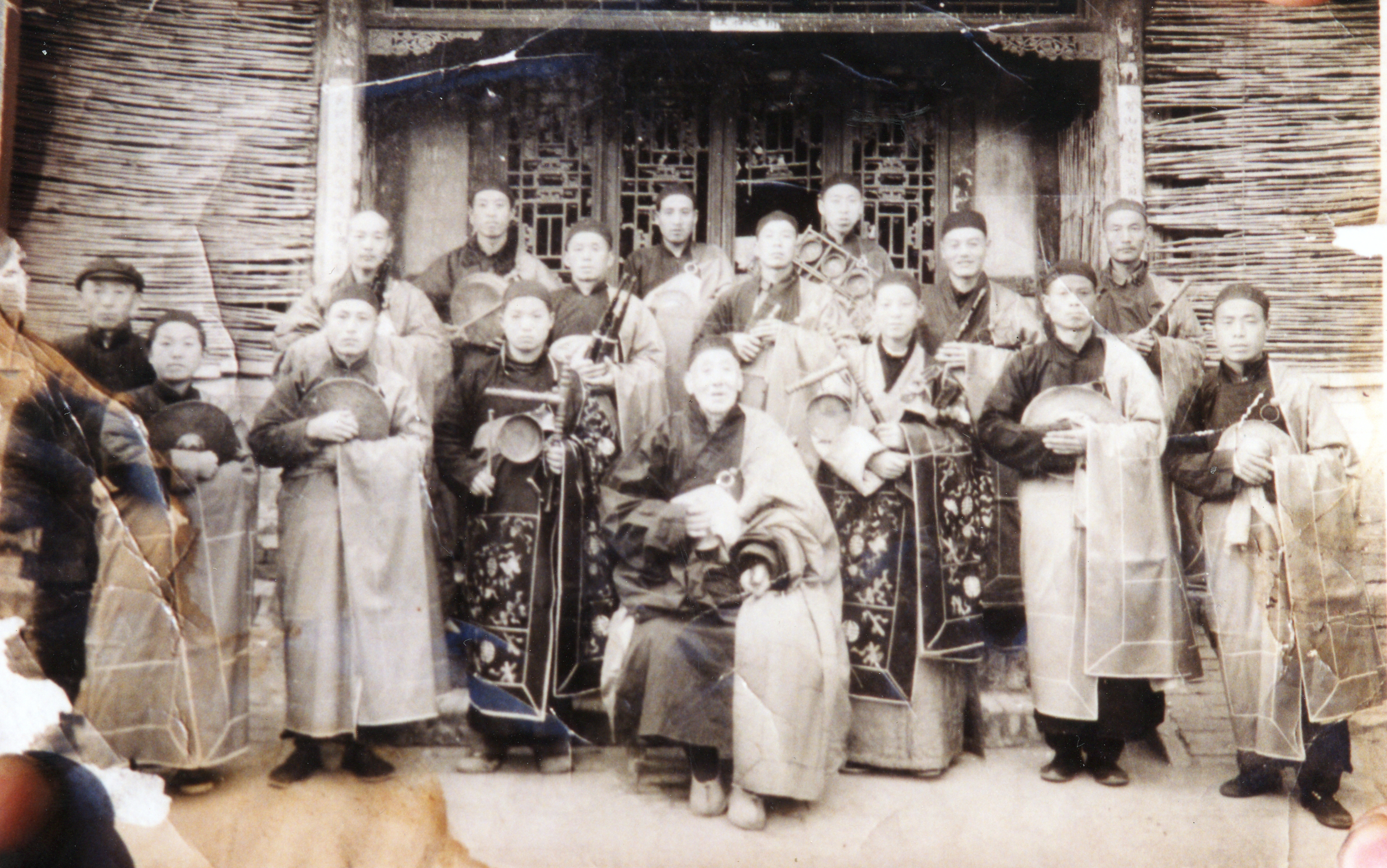
During this whole period from 1937 a succession of Communist leaders had passed through. After Chairman Mao’s 1947 visit to the White Cloud Temple in Shaanbei, on a trip to Wutaishan in 1948 he expressed appreciation of the cultural heritage of Buddhism (for many such comments see e.g. here). Such utterances might have offered a certain intermittent validation for research, though they are utterly paltry alongside the Party’s long-term onslaught on religion.
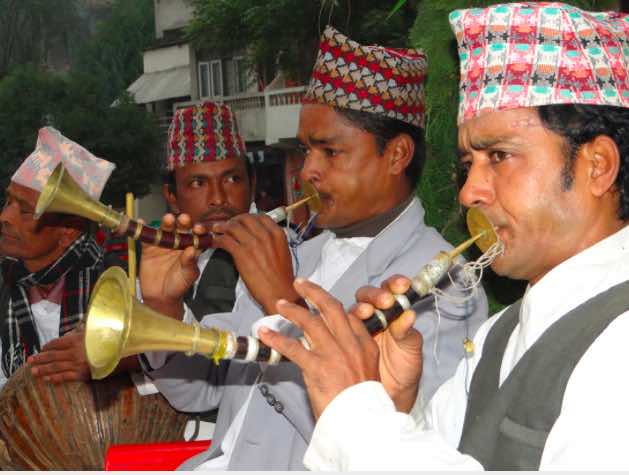
Upon Liberation and over the following years, most temple clerics were laicized, with their traditional patronage severely reduced. The remaining monks on Wutaishan (a 1956 survey lists 445) [4] received a monthly income of 20–40 yuan from the county government. During the Maoist era ritual life was doubtless much impoverished, though the authorities sanctioned occasional visits from overseas Buddhist delegations.
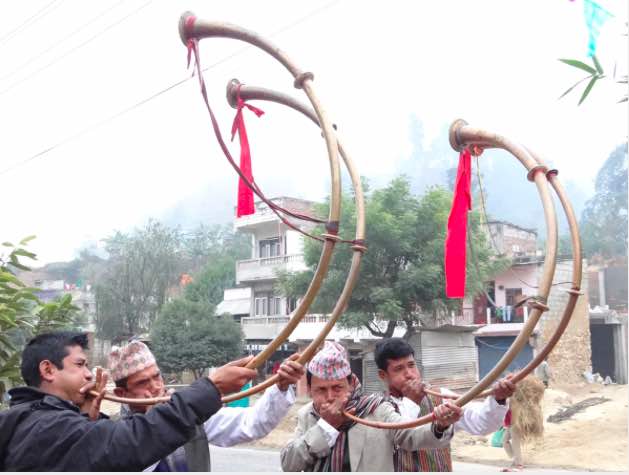
Meanwhile, away from the temples, household ritual specialists, their numbers now boosted by clerics returning to the laity, maintained a certain activity. And although the influence of Wutaishan made Buddhism dominant around the region, Daoist ritual specialists were also active, such as in nearby Xinzhou.

Sects
Sectarian groups are another major theme in religious life throughout China. The sectarian connections of the amateur ritual associations in central Hebei, whose liturgy was transmitted from temples, are a separate case. But all these sects should interest us, since while not all of them performed complex liturgy, they show a link between temple and lay practice.

It is not that Buddhist monks or Daoist priests were usually sectarian; often, as in Yanggao, occupational ritual specialists are clearly distinct from the sects. But I have a growing list of temples where clerics belonged to such groups (Tianzhen, Xinzhou, Baiyunshan).

The recent county gazetteers, however partial, are often a useful source on the sects. Major campaigns were held from 1950 to 1951, and continued through into the Cultural Revolution. Of course, campaigns against “heterodox teachings” were nothing new, having been frequent under both imperial and republican governments, but the new campaigns were far more ruthless. Still, the sects went underground as usual, and have revived since the 1980s. However partial such recent accounts may be, it is important to bear in mind this perspective on local religious organizations when we consider the practice of folk ritual over the last century; this background still colours local society, and our discussions, today.

In the Wutai region, despite campaigns since 1945, intensifying in 1949 and 1950, a variety of sectarian groups were still active through the 1950s, including the Jiugong dao, Huanxiang dao, and Houtian dao. [5] They had a firm base in the temples as well as throughout the countryside. A brief biography of Zhang San Baotai 张三保泰 (1890–1958), [6] leader of the Houtian dao sect, is so rare as to be worth summarizing.

After joining the sect in 1924, Zhang became a monk at the Yuanzhao si temple on Wutaishan in 1938. The following year he declared himself a living Buddha, but his plot with Yan Xishan’s troops to organize an underground arsenal was exposed. In 1941 he travelled through Shanxi, Hebei, and Shandong, recruiting over ten thousand followers. His activities continued under the PRC, despite the campaigns of 1950–51. After returning to Wutai from Yuxian in Hebei in 1955, he prepared a major armed uprising for 1960, planning to establish a capital at Dingxian in Hebei, and mobilizing in Shandong; but he was captured and executed in 1958.

Apart from the general persecution of “orthodox” religious practices, the sectarian connection would have further darkened the cloud hanging over the temples.

Research in the 1950s
I know of no fieldwork on the rituals of the Wutaishan temples after Liberation. Still, eighteen monks from Wutaishan took part in a provincial festival of folk music at Taiyuan in 1958, winning a prize. Provincial scholars were hoping to do fieldwork from the mid-1950s, but were unable to do so. [7]

The “eight great suites”
The folk shengguan instrumental bands made a more palatable topic than the vocal liturgy of the temples, and this style did go on to achieve wider fame. In 1953 the Shanxi Radio Station revisited Du Wanzhongshan’s band in Dongye to record, which were widely broadcast, and Liu Shiying 刘士英 published transcriptions.

tupian

Bapaizi melody for shengguan, in Zhongguo yinyueshi cankao tupian.

Indeed, early in the War against Japan a friend of Bo Yibo, then a major Communist resistance leader in Shanxi, had lent a 1926 gongche score of this repertoire to Lü Ji, who would become the pre-eminent official pundit of Chinese music. After Liberation Lü Ji lent the score to Yang Yinliu; [8] a page was reproduced in vol.4 of the 1957 Zhongguo yinyueshi cankao tupian 中国音乐史参考图片, spreading awareness of the genre in music circles.

Even as the enforcement of the commune system was leading to desperation, further recordings of the suites, along with transcriptions, were made from 1959, with Du’s son Du San now leading the band.

When I first visited Wutaishan in 1986 it was still far from a bustling national and international tourist attraction. Indeed, I needed a special permit to travel there. Even the town of Taihuai was still a tranquil retreat. But my attention soon turned from the temples to folk ritual practice, and on my later trips I explored household groups in the surrounding region, including a fine shengguan band in Dongye town, led by Xu Yousheng. In 1992, having followed them round on funerals, we held a recording session (#5 on CD1 of my China: folk instrumental traditions; or a shorter version as #5 of the CD with the 1998 paperback of Folk music of China).

Since the reforms
The provincial scholars who had planned fieldwork on Wutaishan in the mid-1950s were only able to realize the project after the end of the Cultural Revolution, leaping into action as early as 1978. A group of senior monks was invited to the Shanxi Music and Dance Research Institute that year, and the precious recordings (as well as some further tracks from 1988) were issued on the five-cassette series

  • Wutaishan foyue 五台山佛乐, with notes by Liu Jianchang, in The Audio and Video Encyclopedia of China series, ed. Tian Qing (Shanghai yinxiang gongsi, 1989; reissued on CD since 1998). [9]

The set includes both vocal liturgy and shengguan ensemble music, with excerpts from the yankou ritual and examples of both Han Chinese (qingmiao) and Tibeto-Mongolian (huangmiao) styles. Like the group that came to England in 1992, most of the performers had been ordained on Wutaishan but had spent much of the Maoist era elsewhere in Shanxi, doing rituals sporadically among the folk. And meanwhile the “southern” style of vocal liturgy was replacing the distinctive regional styles of northern temples (such as Beijing and Shenyang).

1978 mim

From 1978 to 1980, Chen Jiabin and Liu Jianchang published transcriptions in mimeograph, and by the 1980s, along with the Anthology fieldwork, several provincial scholars were undertaking studies. The most extensive research is

  • Han Jun 韩军, Wutaishan fojiao yinyue zonglun 五台山佛教音乐总论 (2012).

The Anthology coverage is also substantial:

  • Zhongguo minzu minjian qiyuequ jicheng, Shanxi juan 中国民族民间器乐曲集成, 山西卷 (2000), introduction pp.1543–53, transcriptions 1554–1768.

The yankou: opening of Huayan hui hymn, from Anthology. For variant renditions, see Han Jun, Wutaishan fojiao yinyue zonglun, pp.152–5.

Such studies suffer from the usual flaws of Chinese research, consisting mainly of reified transcriptions rather than ethnography, but they contain some clues to the changing fortunes of religious life.

Meanwhile, as with groups such as the Zhihua temple, media coverage steered clear of the ritual basis of the tradition by highlighting the shengguan instrumental ensemble, with glossy performances on stage.

  • Beth Szczepanski, The instrumental music of Wutaishan’s Buddhist monasteries (2012)

also mainly focuses on the shengguan ensemble, but she takes a more ethnographic approach, with useful sections on the vocal liturgy; notes on actual rituals observed, including a funeral; and astute comments on the ideological baggage of Chinese studies and the recent commodified market.

* * *

In the West the study of Chinese ritual is often considered to date from the work of Kristofer Schipper in Taiwan in the 1960s; and in the PRC much of the vast energy in researching local ritual traditions has taken place since the 1980s.

However, long before scholars of religion, fieldworkers in mainland China, in the Republican era and under Maoism, were hard at work documenting ritual practice—their studies conducted under the discreet guise of “music”. [10] It was the intrepid fieldwork of such scholars before 1965, despite all the ideological obstacles then placed in their way, that formed the background to the monumental Anthology project of the 1980s. While most Chinese music scholars working on northern ritual traditions stress the shengguan ensemble, they don’t neglect the vocal liturgy.

Most scholars of Buddhism, and indeed Daoism, are more concerned with early doctrinal issues and the material heritage than with ritual performance. But as I constantly stress, if we wish to study religion in China, we must get to grips with its soundscape. And even this barely addresses my main concern—the changing ritual life of local communities.


[1] Note e.g. the journal Wutaishan yanjiu 五台山研究, and the recent volume Yishan er wuding: duoxueke, kuafangyu, chaowenhua shiyexiade Wutai xinyang yanjiu 一山而五頂:多學科,跨方域,超文化視野下的五台信仰研究 [One mountain of five plateaus: studies of the Wutai cult in multidisciplinary, crossborder and transcultural approaches], ed. Miaojiang 妙江, Chen Jinhua 陳金華, Kuan Guang 寬廣 (Taipei: Xinwenfeng, 2017).

[2] Yang Yinliu had visited Qingchengshan in the summer of 1942, but his attempts to transcribe vocal liturgy there were frustrated by an unhelpful abbot (see his 1961 essay “How to treat religious music”). BTW, folk and temple ritual in the vast province of Sichuan is also a major topic that I can’t begin to address—as ever, the Anthology is one starting-point, and Volker Olles can provide leads.

[3] Besides other essays in the Wutai xianzhi, for “major events” of the Republican and Maoist eras, see pp.696–714. See also Beth Szczepanski, The instrumental music of Wutaishan’s Buddhist monasteries (2012), pp.10–21. For more background, see Holmes Welch, Buddhism under Mao (1972).

[4] Wutai xianzhi, p.581.

[5] Wutai xianzhi, pp.576–7, 603.

[6] Wutai xianzhi, p.643.

[7] Liu Jianchang 刘建昌, Chen Jiabin 陈家滨, and Ren Deze 任德泽, “Shanxi zongjiao yinyue diaocha baogao” 山西宗教音乐调查报告, Yinyue wudao 1990.1.

[8] Yang Yinliu yinyue lunwen xuanji (1986), prelude by Lü Ji, p.3.

[9] Cf. Szczepanski, The instrumental music of Wutaishan’s Buddhist monasteries, pp.128–9. Of course, rituals such as the yankou, with its complex Tantric mudras, cry out to be documented on film. For a brief 2003 excerpt from a yankou in a minor temple in Yanggao, led by a monk trained at Wutaishan, see my film Doing Things.

[10] Cf. my In search of the folk Daoists of north China, pp.20–26.


A Daoist ritual, Suzhou 1956

SZ 1956

The Daoists who took part in the jiao ritual, with the study team. Suzhou, August 1956.

From the early 1950s to the eve of the Cultural Revolution, notwithstanding constant political campaigns, the fieldwork of Yang Yinliu and the Music Research Institute in Beijing was largely based on ritual traditions. The grandeur of religious life around south Jiangsu was, and is, comparable with that of southeast China and Hunan. Yang Yinliu had long experience of Daoist ritual in Wuxi; but another definitive project in Suzhou in August 1956, while Yang was leading a survey in Hunan, was quite separate:

  • Suzhou daojiao yishu ji 苏州道教艺术集 [Daoist arts of Suzhou], Zhongguo wudao yishu yanjiuhui yanjiuzu 中国舞蹈艺术研究会研究组 (mimeograph 1957, reprint Shanghai shehui kexueyuan, 2009)

Background
Daoism in the whole Suzhou region has an illustrious history. And by the 1950s, by contrast with most other regions of China, the city already had a history of research and training institutions. In the Republican era and even in the troubled 1940s, several such groups were formed, such as the Shouxuan xiejilu 守玄褉集庐 and its short-lived successors Yixuan yanlu 亦玄研庐, Yunji she 雲笈社, and Ziyun daoxue yanjiushe 紫雲道學研究社. After the 1949 revolution, under the watchful eyes of Party officials, the Suzhou Daoist Music Research Group was formed in winter 1952, recruiting many distinguished Daoists.

Under the PRC, despite my reservations about the term “religious music”, a focus on music served to distract from the taint of religion: while Daoist ritual might be suspect, study under the guise of “Daoist music”—particularly its instrumental component—was more palatable to the authorities. Indeed, this was still true when I began my fieldwork in the late 1980s.

In August 1956, Wu Xiaobang 吴晓邦, head of the Chinese Dance Research Association in Beijing, brought a team to Suzhou, where with the assistance of the Bureau of Culture they worked with the Suzhou Daoist Music Research Group to organize a complete large-scale jiao 醮 Offering ritual.

This was a major undertaking. Far from reducing the topic to a simple commodified programme of instrumental melodies (as was still common in the 1990s), they documented the ritual in detail, both in the 330-page book and in a complete documentary film. This was all the more remarkable considering the escalating political campaigns, with people increasingly anxious as the commune system was enforced ever more rigorously. Later, alas, the film seems to have been destroyed, though the editors of the 2009 reprint of the book claim that it was preserved at the Dance Association in Beijing.

Of course, it was a work of salvage. While minimal Daoist rituals were still performed around the region, this was a rare opportunity to assemble leading Daoists to perform a complete jiao—perhaps the grandest religious ritual held in China from 1949 to 1979. Indeed, since the 1990s similar digital salvage projects have been initiated, involving a core of senior Daoists—some of whom had taken part of the 1956 project. But documenting routine ritual practice in socal life, in the 1950s or today, is a separate topic.

XMG 1956

The Xuanmiao guan temple, 1956.

The ritual was held at the Wanshou gong 萬壽宮 temple just south of Suzhou’s main temple the Xuanmiao guan 玄妙觀, which was being restored at the time. The Wanshou gong was itself in disrepair by 1949 but had been converted to a People’s Cultural Palace in 1951, so it was now requisitioned for the ritual.

The book contains three main parts:

  • The segments of the jiao, with its three overarching ritual sections Quanfu 全符, Quanbiao 全表, and Huosi chao 火司朝 (pp.1–61), including diagrams of “dance” postures; followed by long lists of performers and their division of responsibilities, including fashi 法師 ritual masters, instrumentalists, and helpers (pp.62–70).
  • Detailed transcriptions of the vocal and instrumental music in ritual sequence (see below)
  • Plates (pp.276–330), including the jiao itself and its ritual equipment, as well as statues and ritual paintings (with some from other Suzhou temples).

Jifu guan

ritual pics

ritual 2

placard 1placard 2Placards proclaiming the Offering ritual.

Such photos make suitably surprising additions to my post Images from the Maoist era.

The main editors of the volume were Jin Zhongying 金中英 and Yu Shangqing 余尚清. Jin Zhongying (1925–96), a hereditary household Daoist from Suzhou city, headed the official Daoist Music Research Group from 1953. With his extensive personal collection of ritual manuals, he provided the Juntian miaoyue 鈞天妙樂, an important compilation of gongche scores of Daoist instrumental melodies, compiled by Wu Ding’an 吾定庵 and edited by Cao Xisheng 曹希聖 in the late 18th century. Meanwhile many other experienced Daoists were recruited to the Research Group.

SZ daoshi

Zhao Houfu, Cao Yuanxi, Zhou Zufu, and Mao Zhongqing in later years.
Source: Suzhou Daojiao yinyue gaishu.

The Daoists who were assembled in 1956 to perform the jiao came from hereditary backgrounds; until the 1950s, some had been temple clerics, while others had served as freelance household Daoists. Despite the forming of the research group, the authors note a certain depletion of personnel as outstanding Daoist instrumentalists were recruited to state performing troupes. Still, it was a stellar cast of Daoists who took part in the 1956 ritual—including Zhao Houfu 趙厚福 (1908–?), Cao Yuanxi 曹元希 (1913–89, descended from Cao Xisheng!), Mao Zhongqing 毛仲青 (b.1915), Zhou Zufu 周祖馥 (b.1915), and Jin Zhongying himself. Indeed, some of them were recalled for the occasion from their jobs in the troupes. And apart from the instrumentalists, note also the list of eminent fashi 法師 masters (pp.63 and 64) who presided over the liturgy—I would love to learn more about their backgrounds and fortunes under Maoism.

The introduction to the history of “Daoist music” in Suzhou (pp.71–87; note pp.79–80) makes an impressive early account of the subject. The long following section (pp.88–275) provides gongche solfeggio notation for the different ritual segments, showing the whole unfolding sequence of the sung hymns of the vocal liturgy (with their texts shown alongside the melody) and the chuida (Shifan) instrumental items that punctuate the ritual (also a speciality of the former tangming bands). Indeed, even for scholars of Daoist ritual who prefer to study texts in isolation from their performance, volumes like this, and the later Anthology, provide a wealth of ritual texts. Note that traditionally only the instrumental melodies were notated, not the vocal items; and of course, gongche is anyway only an aid to memory.

The authors’ choice of gongche, rather than the cipher notation that was already commonly used in Chinese musicology, is interesting. It may derive from the Daoists’ own familiarity with it—though they made a fine innovation by adding detailed rhythmic markers in the style of cipher notation, which they also used alongside mnemonic characters to notate the complex drum sections.

This is a rare insider’s account of the building blocks of Daoist ritual, thoughtfully annotated. Wonderful as it is, to most scholars of Daoism it will be even less intelligible than cipher notation—even conservatoire students are unfamiliar with gongche.

Songjing gongde gongcheOpening of Songjing gongde, a widely used hymn in both temple and household Daoist groups.

Tianshi hymn gongcheOpening of Quanbiao ritual: instrumental Yifeng shu leading into Tianshi song hymn, whose text is the generational poem for the priestly lineage.

For the vocal liturgy, somewhat more accessible (if only somewhat) are later transcriptions into cipher notation such as the Anthology (Zhongguo minzu minjian qiyuequ jicheng, Jiangsu juan 中国民族民间器乐曲集成, 江苏卷, pp.1473–1645):

Songjing gongde JCOpening of Songjing gongde hymn, transcribed by Anthology collectors from a 1990s’ rendition, also showing percussion accompaniment.

Tianshi hymn JCTianshi song hymn as transcribed by Anthology collectors.

and other modern studies like Liu Hong 刘红, Suzhou daojiao keyi yinyue yanjiu 苏州道教科仪音乐研究 (1999)—here’s his transcription of the Buxu hymn Taiji fen gaohou, another commonly performed item throughout China sung to differing melodies by region (see Pacing the Void):

Taiji

Taiji JCOpening of Taiji fen gaohou hymn as transcribed in the Anthology.

The 1957 volume’s extensive transcriptions are deeply impressive, clearly a labour of love on the part of Jin Zhongying and Yu Shangqing—even recently, scholars of Daoism are often content to reproduce lengthy ritual manuals with scant explanation of how they are performed. So it would be churlish of me to note that this long section (apart from the brief chanted introits to the hymns) provides only the melodic sections, not including the many recited texts which are also a vital aspect of the ritual. It is best read in tandem with the summary of ritual segments on pp.57–61.

Despite the laudable (and rare) focus on soundscape, the volume still falls short of being a complete account of the Suzhou jiao. It would be over thirty years before scholars like Yuan Jingfang began documenting the texts and music of complex rituals still more systematically (see e.g. her volumes on the Beijing yankou and the jiao of household Daoists in south Hebei).

But of course, nothing is so valuable as film, and I still gnash my teeth (a Daoist practice of cosmic visualization, by the way!) over the loss of the 1956 documentary. In its absence, major projects to document Suzhou Daoist ritual on film have resumed in recent years. We can gain a flavour by watching a 2011 excerpt from the Dispatching the Talismans (fafu 发符) ritual segment:

What was not on the agenda in 1956 was a description of ritual activities in the wider society around Suzhou at the time—more on that story later. Meanwhile, let’s pause again to marvel at the energy of ritual research under the taxing conditions of Maoism.

With many thanks to Tao Jin

The Hall of Myriad Harmonies

WHTThe Wanhe tang:
Above left: scores; above right (indirectly related): Juntian miaoyue score, 1799.
Middle: remaining performers assembled in 1993. Below: trunks with instruments.
Source: Zhongguo minzu minjian qiyuequ jicheng, Jiangsu juan.

I often sing qualified praises of the monumental Anthology of folk music of the Chinese peoples (starting here). Most of my posts on local ritual derive from my own studies in the field, but I also sometimes give surveys based on the Anthology—as here. The main lesson from this post is to illustrate the pitfalls of trying to interpret its material without more detailed fieldwork.

Having mentioned the illustrious Tianyun she society in Wuxi, I should also introduce the Wanhe tang 萬和堂 (“Hall of Myriad Harmonies”) in Huangdai town in Wuxian county north of Suzhou. This leads me to consider the whole rich culture of tangming ban 堂名班 groups (some sources give the form 堂鳴) before the 1949 Liberation, amongst whom there were many Daoist ritual specialists; their repertoire included both Kunqu vocal music and the Shifan instrumental ensembles that accompanied rituals (cf. my Folk music of China, pp.252–69).

I began by consulting the Anthology volumes for instrumental music in Jiangsu province:

  • Zhongguo minzu minjian qiyuequ jicheng, Jiangsu juan 中国民族民间器乐曲集成, 江苏卷, pp.1777–79, and p.102.

The Wanhe tang was founded by Cai Jinxiu 蔡錦綉 in the second half of the 19th century, when he was 20 sui. He was himself the third generation of Kunqu amateurs in his family; and he was an accomplished performer of Shifan. The hall he founded was now occupational. They were active performing for temple fairs and celebratory occasions for the local gentry around Suzhou, Wuxi, Changshu, and Kunshan.

By the 1920s Cai Jinxiu had handed over the leadership to his oldest son Cai Meiqing 蔡梅卿; his second and third sons Cai Zhuqing 蔡竹卿 and Cai Chengqing 蔡成卿 went on to lead the group. In the late 1920s there was such demand that they split into northern and southern halls. The main figures of the latter were the three Cai brothers and Cai Zhuqing’s son Cai Huiquan 蔡惠泉, as well as Wang Borong 王伯榮. Leading lights in the northern branch were Xu Jinru 許錦如, Xu Junru 許均如, Gu Yewan 顧葉萬, and Gu Yusheng 顧鈺生. The two groups often combined, but also competed at the same events.

They also absorbed elements from the popular tanhuang vocal style. By the 1930s and 1940s they had a close relationship with temples like the Xuanmiao guan in Suzhou. Other tangming groups formed under their influence included the Xuanhe tang 宣和堂, Chunhe tang 春和堂, Hehe tang 合和堂, Wenhe tang 文和堂, Honghe tang 鴻和堂, and the Lesser Wanhe tang 小萬和堂.

These groups had to cease activity on the eve of Liberation, “as a result of warfare, and so on”. But there was no revival in the early 1950s, and the scores, instruments, trunks, and equipment of the Wanhe tang were gradually “lost”.

Many of its members were now recruited to the new regional state opera troupes. Of Cai Meiqing’s sons, the oldest Cai Rongbing 蔡榮炳 had accompanied the great Peking opera singer Zhou Xinfang before Liberation, and went on to take up a post in the Shanghai Peking Opera Troupe. The second son Cai Rongbiao 蔡榮標 was chosen for the Yangzhou Peking Opera Troupe. Another member of the Cai family became deputy director of the provincial Daoist Association.

The biographical sketch of Cai Zhuqing’s son Cai Huiquan 蔡惠泉 (b.1925) in the Anthology (pp.1775–76) is no more enlightening. Again, it’s a story of two halves. He began studying at private school at the age of 5 sui, and learned Kunqu with his father from 7 sui. By the age of 16 sui he was an accomplished member of the Wanhe tang.

After Liberation, with his traditional livelihood apparently curtailed rather abruptly, Cai Huiquan took part in an official festival at the Xuanmiao guan temple in November 1951, for which tangming performers were assembled to perform. In the audience was Peng Xiuwen, director of the Central Chinese Broadcasting Orchestra in Beijing, who invited him to join them as percussionist in 1954. Cai now became a model member of the state troupe, arranging several pieces of his traditional repertoire to the demands of the new style, and over the next thirty years he created many compositions based on other regional genres. From 1958 he adapted a new paigu set of tuned drums, which was soon widely adopted by state troupes.

This trajectory was not uncommon. Throughout China, outstanding instrumentalists among local ritual groups, including many Daoists, were often recruited to the new state troupes. At least Cai found long-term employment—unlike household Daoist Li Qing in Shanxi, who was among many folk artists whose recruitment to state troupes was curtailed by the cuts of the early 1960s. However, the Anthology account doesn’t begin to describe the fates of those performers who remained in local society amidst campaigns and collectivization.

All this looks like a thriving scene abruptly erased after Liberation. In official accounts the troubled conditions of the 1940s make a convenient scapegoat. But there’s a lot here that isn’t spelled out. How severely did the Japanese occupation and civil war disrupt ceremonial life in the region? When many ritual groups elsewhere in China (both occupational and devotional) remained active in the early 1950s and still later, were these groups really unable to perform? Elements to unpack here include the class status of the performers and their patrons, and the state’s escalating war on traditional contexts.

So in the case of the Wanhe tang, the enticing Anthology photos above are misleading: they merely show the brief reunion of nine senior performers in 1993. Still, it’s clear that not all their scores and instruments had been lost. And while this group was long defunct, as ritual life revived strongly from the 1980s, perhaps the many Daoist groups and chuida bands around the region are the modern heirs to the tradition.

Other tangming groups
The Wanhe tang was just one among a dazzling array of tangming groups throughout the wider region before Liberation. The Anthology introduction to chuida wind-and-percussion bands provides further leads (pp.97–105). Such sources provide considerable material for the Qing dynasty, but here I’ll focus on the transition from the Republican era to Maoism.

Locals distinguished shenjia chuida 神家吹打 and daojia chuida 道家吹打 groups. The shenjia (“holy”) chuida groups performed for life-cycle and calendrical observances, with Kunqu and other vocal music a major part of their repertoire. Before 1949, apart from the Wanhe tang, there were around 150 groups in the Suzhou region alone.

In the city, major groups included the Duofu tang 多福堂, Ronghe tang 榮和堂, Baohe tang 保和堂, Fugui tang 富貴堂, Yonghe tang 永和堂, and Juhe tang 聚和堂. Similar groups around the region included the Hehe tang 合和堂, Hongru tang 鴻如堂, and Shide tang 世德堂 in Wuxian county; in Changshu, the Chunhe tang 春和堂, Quanfu tang 全福堂, Zhonghe tang 中和堂, and Hongfu tang 洪福堂; in Taicang, the Qingxiu tang 慶修堂, Yuqing tang 餘慶堂, Duanhe tang 端和堂, Duanai tang 端靄堂, and Yongle tang 永樂堂; in Wujiang, the Jinyu tang 金玉堂, Dayue tang 大樂堂, and Daxi tang 大喜堂; in Tangkou, Wuxi, the Xinji Wanhe tang 新記萬和堂 and Dongting yaji 動亭雅集; and in Kunshan, the Yongni tang 永霓堂.

Daoist ritual specialists were often core members of the tangming groups, and the daojia chuida groups mainly accompanied Daoist ritual (for a major ritual in 1956 Suzhou, see here). The great Yang Yinliu was brought up in the environment of Kunqu and the tangming, studying the Wuxi Daoists and their Shifan repertoires from the 1930s. Here’s a reminder of the distinctions between local Daoists that he astutely observed (Sunan chuidaqu 蘇南吹打曲, with Cao Anhe, 1957 edition, pp.11–13):

A minority of abbots possessed ritual titles of the Zhang Heavenly Masters, like “Master who Guard the Way” (daoweishi) or “Ritual Master” (fashi), and mostly owned land. They didn’t take part in production. They interacted with landlords and the bourgeoisie in the cities and villages, taking ritual work and contacting and hiring the common village Daoists to take part in major rituals (daochang fashi).

These common Daoists mostly took part in agricultural production, being hired ad hoc: performing for rituals was an auxiliary occupation for them. In both agriculture and Daoism, they were an exploited class. These common Daoists—even the indispensable drummers and flute players, with their excellent musical technique—only got a tiny wage for a whole day’s work.

Conversely, the “Masters who Guard the Way” and “Ritual Masters”, having only taken responsibility for quite brief ritual segments of a few hours like Issuing the Talismans (fafu), Reporting the Memorial (zoubiao), and Flaming Mouth (yankou), claimed a reward many times higher than that of the others. Those who played music were mostly the common semi-peasant Daoists; very few of the “Masters who Guard the Way” and “Ritual Masters” could do so.

For tangming bands around Jiading and Chuansha counties near Shanghai,

  • Zhu Jianming 朱建明, Tan Jingde 谈敬德, and Chen Zhengsheng 陈正生,Shanghai jiaoqu daojiao jiqi yinyue yanjiu 上海郊区道教及其音乐研究 [Daoism and its music in the Shanghai suburbs] (2001)

provides further material in a useful section (pp.29–48). The authors list bands like the Chunhe tang 春和堂, Hexing tang 合興堂, Sanqing tang 三興堂, Xinxi tang 新喜堂, Xianjing tang 仙經堂, Quanfu tang 全福堂, Minle tang 民樂堂, Hehe tang 合和堂, and Hongqing tang 鴻慶堂. They suggest that activity resumed after the disruption of the Japanese occupation, with over thirty bands active in Jiading alone.

For the period after Liberation, the Anthology morphs disingenuously into an account of research, drawing a veil over what became of this rich culture. While even an official survey from 1953 lists 28 tangming groups with 272 performers around Jiading county, the culture was severely reduced after Liberation. As Qi Kun also suggests, major factors in the decline were the disappearance of former elite patrons, and campaigns against religion. Since the reforms, though the term tangming is no longer used, the tradition continues in various genres such as Daoist and qingyin groups, and shawm bands.

* * *

For “folk artists” Chinese sources always find it easier to list exceptional instances of official fame than to document the complexities of grassroots activities. In the case of many performers like Cai Huiquan, recruitment to state troupes was indeed an abrupt metamorphosis. Still, few would have been reluctant to take up such employment. They had to work out how to survive under the new regime; such posts offered them a reliable “food-bowl” and seemed to promise them a certain protection from accusations of “feudal superstition”, blunting the stigma of any dubious class background.

But many others “left behind” had to struggle to adapt to the new society. I have refined the official image in my work on north China, and Qi Kun has provided similar nuance for the Shanghai suburbs. Commonly across China in the early 1950s, ordinary people filled the gap in patronage left by the now-discredited—and impoverished—former elite by inviting such bands for their own more more modest rituals. But as collectivization intensified, many folk performers would have had to change trades, eking out a living from the land or taking up factory jobs.

Here I can’t broach the riches of Daoist ritual activity around Suzhou before Liberation or its changing later fortunes; but the Anthology biographies for Jiangsu also feature several of the most eminent “Daoist musicians”—a misnomer with which I often take issue. This reveals a further issue with the Anthology coverage, which I hope to explore soon.

Images from the Maoist era

Xi'an village festival, 1950s.

Village festival near Xi’an, 1950s.

One of the main themes of this blog, and my whole work, is the tenuous maintenance of expressive culture through the decades of Maoism.

There are many sources for visual images of the period, including the site of Covell Meyskens (see this interview). But photos of folk performance activity in the countryside during the period (like the one above) are less common. One useful source is the Anthology of folk music of the Chinese peoples, under the rubrics of folk-song, narrative-singing, opera, instrumental music, and dance; indeed, the volumes have rare images from the Republican, Maoist, and reform eras.

My posts include many such photos. Here’s a sample—do click on the links for background, and get to know the soundscape through recordings (including the audio gallery in the sidebar, with commentary here).

Several precious photos derive from the definitive work of Yang Yinliu and the Music Research Institute in Beijing (see An anthology of Chinese fieldwork reports), such as

Zhihua temple 1954

My tribute to Yang Yinliu includes several numinous images, such as

  • Yang Yinliu and Cao Anhe immersed in research at the Institute, 1961:

yang-and-cao-best

  • A brief excursion to Huashan amidst the gathering political clouds, May 1965:

Huashan 1965

  • Shifan groups in Jiangsu:

  • Fieldwork in Hequ, north Shanxi, 1953

Hequ

Confucian ritual in Hunan https://stephenjones.blog/2019/03/28/hunan-confucian-ritual/

  • Meanwhile in Suzhou, a remarkable 1956 project documented a complete Daoist jiao ritual:

LQM shiban

  • More from Xi’an: former Daoist priest An Laixu leading a 1961 visit to Beijing:

ALX group lowres

  • Recreational ensembles in Yulin, Shaanbei:

  • including this wonderful 1962 photo of the Qiao family:

Qiao family 1962

  • Images of rural narrative-singing include the model bard Han Qixiang in Shaanbei, and Xihe dagu in Hebei:

A wealth of photos of qin zither players from the period is available, such as

as well as this image of members of the Beijing Guqin Research Association from 1956:

qin hui 1956

A teahouse gathering of qin players in 1959, with no hint of the social crisis of the time:

BJ qin 1959 to use

Yue Ying making a rare recording in 1972:

Yue Ying 1972

For the Li family Daoists in Shanxi,

LPS and wife

  • and the only early photos of the great Li Qing were taken during his brief sojourn in the secular regional troupe in 1959:

If only we had images (or films!) of them performing rituals in the period…

Still in Yanggao,

  • the wonderful Li Jin during his time as an errentai operatic clown:

Meanwhile in Hebei, photos of ritual groups from the period are again rare. Perhaps the most remarkable image of all is

  • former Buddhist monk Daguang with his disciples in North Xinzhuang village in the Beijing suburbs, 1959:

North Xinzhuang 1959

1981 photo

In addition, over the period folk ritual groups recopied many gongche scores of the wind ensemble music that accompanies ritual, many of which appear in my many notes under local ritual.

I’m still curious to learn if such images might be available for expressive culture in Stalin’s Russia. Supplementing our talks with people who recall the Maoist era, it looks as if despite their appalling sufferings, folk traditions in embattled local communities in China were maintained with more resilience, however tenuously. Do read the posts in which these photos appear!

Cf. John Gittings on words and photos.

South Jiangsu: beyond silk-and-bamboo

Laoximen 2001

Qinglian street club, Old Westgate, Shanghai 2001. My photo.

The Jiangnan sizhu (“silk-and-bamboo of south Jiangsu”) instrumental ensemble has become a reified image of secular Chinese entertainment music. It’s played not only by polished professionals on stage, but by amateur groups in teahouses and leisure centres around Shanghai and the whole vicinity (for amateur chamber ensembles elsewhere, cf. suite-plucking in old Beijing, the Yulin “little pieces”, nanyin, and so on). Shanghai is a hospitable cosmopolitan urban centre, and these clubs are a popular haunt of foreign music students there.

The title was formalized only in the 1950s—one of many instances of the official renaming of genres at the time, such as Xi’an guyue or Xiansuo shisantao. Yet however one may dispute reification, Jiangnan sizhu is indeed “a thing”. Over a long period since the early 20th century we can observe a continuum from life-cycle and calendrical performances, through the amateur clubs, to professional staged performances.

In Chapter 13 of my book Folk music of China I began to put silk-and-bamboo in the wider context of musicking around south Jiangsu (Suzhou, Wuxi, Nanjing, Changshu, Yangzhou, and so on—all large regions each containing several hundred villages!). And I outlined the background of regional opera, narrative-singing, and all kinds of ritual practice, including the Shifan ensembles that accompany Daoist ritual. Indeed, Daoist ritual around Shanghai and south Jiangsu is a vast topic subsidiary only to local traditions in southeast China.

So apart from their use as entertainment in the amateur clubs, the various types of sizhu have a firm basis in life-cycle and calendrical rituals.

Folk-singing in the region is easily overlooked, but fortunately we have a wonderful detailed study by Antoinet Schimmelpenninck, who also saw the wider picture. She refers to ritual styles like xuanjuan 宣卷 performed by devotional sectarian groups, common throughout south Jiangsu. [1]

As Chinese genres go, compared with many traditions in both north and south China Jiangnan sizhu is rather youthful. As commonly with folk groups, the musicians sit around a table, an inevitable casualty of stage performance. They often take turns on various instruments over the course of an afternoon session. The personnel remains predominantly male.

Chinese studies have favoured “music” over social context, and most publications on Jiangnan sizhu are based on the “eight great pieces” (for a simple introduction, see my Folk music of China, pp.275–82). While the repertoire is not so reified as this canonization may lead us to suppose, in the teahouses of central Shanghai it remains rather limited. But local variants of the repertoire abound, as shown by the definitive 1985 collection of transcriptions (770 pages!) by Gan Tao 甘涛. As always, we should regard it not as a reified repertoire, but as a regional form of musicking, a social activity (and since the ambience and sound-world of the amateur clubs may be reminiscent of Irish pub sessions, do enjoy my posts on Cieran Carson!).

See also this modest update.

Interlude: laowai
By the 1980s the Jiangnan sizhu repertoire was already the subject of analysis from scholars like Ye Dong, Li Minxiong, and Yuan Jingfang. Meanwhile, as China opened up again after the end of the Cultural Revolution, Larry Witzleben spent extended periods based at the Shanghai Conservatoire from 1981 to 1985, resulting in the brilliant early monograph

  • J. Lawrence Witzleben, “Silk and bamboo” music in Shanghai: the Jiangnan sizhu instrumental ensemble tradition (1995),

still one of the most accomplished ethnographies of a local Chinese tradition.

With chapters on the historical background and intergenre relationships, instruments, repertory, form, variation, texture, and aesthetics, perhaps the most innovative section is Chapter 2, a nuanced ethnography of the scene from 1981 to 1985, including relations with the professional music world.

Silk-and-bamboo soon earned a significant place in Western scholarship, and images of Chinese music, also thanks to the writings of Alan Thrasher, albeit concerned more with musical structures than with ethnography.

Silk-and-bamboo clubs, Shanghai 1987. My photos.

In 1986 and 1987, based in Beijing, I used to decamp to Shanghai occasionally, taking what was then a very long train ride. According to my own apocryphal story, my main incentive was that the showers of the foreign students’ dorms there had a rather reliable supply of hot water, still rare in my student accommodation in Beijing. Anyway, even though I was already entranced by northern ritual culture, it gave me an opportunity to take part in some of the many amateur silk-and-bamboo clubs on erhu fiddle—and also to hang out with the wonderful qin-player Lin Youren and acquaint myself with the thriving Daoist ritual scene.

For foreign students, participant observation was both instructive and pleasurable. As laowai, we were more keen on visiting the teahouses than our Chinese fellow-students, who naturally focused on the polished versions of their conservatoire teachers.

In 1987 I was roped into a Jiangnan sizhu contest at the conservatoire, joining a mixed group of Chinese and foreign students—the latter including François Picard, Fred Lau, and Tony Wheeler (back row, to my right). In the front row, on the far right is Ma Xiaohui 马晓晖, who went on to a career as erhu virtuoso, and at the centre is Zhou Zhongkang 周仲康, the conservatoire teacher assigned to oversee our efforts—our programme included his luogu sizhu composition Qing:

contest 87

The competitive format was hardly my favoured method of engaging with silk-and-bamboo, but it was an interesting experience. Alongside the conservatoire-style ensembles taking part, there were also some fine senior amateur groups. As cute foreign pets we inevitably won a prize, but our sound ideal, however flawed in execution, was modelled on folk practice rather than the more polished version of the professionals. Soon after, Helen Rees also became a regular participant at Shanghai teahouse sessions, while embarking on her fine studies of ritual music in southwest China.

Thinking back, guided by mentors at the Music Research Institute and Yuan Jingfang, my Beijing base propelled me towards ritual in the countryside more inevitably than might have been the case if I had been studying in Shanghai. Rural ritual is plentiful throughout south Jiangsu too, but somehow there is more to encourage one to tarry in cosmopolitan Shanghai without venturing out to the villages and townships.

Zhang Zhengming, 2001: left, with Zhou Hao at the Xuhui club;
right, with his wife—their 1952 wedding photo in the background.

On a visit in 2001 I spent a week in Shanghai, with the wonderful Zhang Zhengming 张徵明 (b.1925) guiding me to a different club every afternoon. It was good to see the renowned erhu master Zhou Hao, then 77, taking part keenly in the amateur groups, naturally modifying his polished style to the ambience; later in a one-to-one session he gave me a fine demonstration of the difference between “folk” and “conservatoire” styles.

diary

I was happy to be able to invite a group led by Zhang Zhengming to the 2005 Amsterdam China festival, as I scurried around hosting the Hua family shawm band and the Li family Daoists from Yanggao.

Again, there’s a continuum: official staged presentations are part of the whole fabric of silk-and-bamboo. This playlist from Jan Chmelarčík includes his videos from the amateur clubs in 2006 and 2007, showing a variety of contexts and styles:

The silk-and-bamboo scene plays a major role in Ruard Absaroka’s thesis Hidden musicians and public musicking in Shanghai, very much informed by anthropological theory. [2]

The wider context: the Anthology
It’s so easy to find activity in central Shanghai that one might not be tempted to explore the suburbs and further afield. But by the 1980s, research was also expanding significantly with the great Anthology:

  • Zhongguo minzu minjian qiyuequ, Shanghai juan 中国民族民间器乐曲, 上海卷 (1993),

edited by the knowledgeable Li Minxiong.

Local collectors documented the wider region in the suburbs of Shanghai, with its twelve municipalities and ten counties. Apart from transcriptions, the collectors also described folk activity, with useful textual introductions as well as biographies and introductions to major groups.

Again it’s worth noting the overall Anthology coverage for Shanghai. After an opening section on solo music (pp.19–234) devoted mainly to pipa solos, there are three main rubrics: sizhu (235–930), chuida (932–1268), and “religious music” (1273–1594). There follow brief biographies and accounts of folk groups (1595–1638, illustrated descriptions of instruments (1639–58), and lengthy appendices, mainly gongche scores (1661–2087).

It may seem impressive that even by 2001 over thirty sizhu groups were still meeting amidst the glossy modernity of central Shanghai. But for the whole region, Li Minxiong gives a figure of 428 groups (!) since the early 20th century; as he explains in his introduction (JC pp.241–63), over two hundred were active on the eve of Liberation.

Following the May Fourth movement of 1919, many groups adopted the term “national music” in their titles. Indeed, such groups were the precursors of the whole “conservatoire style” that later came to represent the official image of Chinese music. The Anthology describes celebrated groups from the Republican era.

JC1

Top: Xiadiao music ensemble; middle: Qingping gathering, 1934; below: Datong music association (note music stands!). Source: Zhongguo minzu minjian qiyuequ jicheng, Shanghai juan.

Juntian

Juntian gathering, 1917, Source: Qi Kun, Jiangnan sizhu.

After the 1949 Liberation, master musicians from the “old society” lent continuity, such as Jin Zuli, Sun Yude, Li Tingsong, Wei Zhongle, Chen Yonglu, and Lin Shicheng (for more, see Anthology, pp.1595–1722). At the same time they were responsible for certain innovations resulting from adapting the style to the concert platform. Commercial recordings were already quite common, but the carefully prescribed arrangements of Lu Chunling’s quartet with Ma Shenglong, Zhou Hao, and Zhou Hui became influential. Here’s a cassette (remember them?) of them from 1982, after the hiatus of the Cultural Revolution:

LCL

As collectivization and campaigns escalated, some folk groups had difficulty maintaining activity; but, as everywhere, the liberalizations following the collapse of the commune system in the late 1970s brought a revival. In 1980 over seven hundred performers took part in a grand performance at the Shanghai conservatoire, with groups coming from Shanghai, Suzhou, Wuxi, Nanjing, and Hangzhou. But as Shanghai was transformed again, amateur clubs have somehow remained active.

Related genres
But apart from the public image of sizhu, the Anthology valuably introduces bands in the surrounding suburban regions, often serving life-cycle and calendrical rituals—in Nanhui, Fengxian, Chuansha, Jiading, Shanghai county, Baoshan, Qingpu, Songjiang, Jinshan, and Chongming island.

JC2

Undated Anthology photos: above and below: chuida bands, Chongming; middle: the Tianshan national music association.

So this involves expanding our explorations in terms of both geography and genre. While sizhu is the main theme, the plot thickens when we include related instrumental genres hardly broached by foreign scholars based in metropolitan Shanghai: the “pure tones bands” (qingyin ban 清音班) and the former tangming 堂名 groups (see also n.3 below).

Moreover, the latter are also related to the occupational “blowing and beating” bands (chuidaban 吹打班) based on shawms and percussion—another main rubric of the Anthology (see introduction, pp.932–45). Among 184 such bands for which collectors found evidence, Li Minxiong gives sketches of rural groups in Chuansha, Baoshan, Qingpu, and Jiading, all with several generations of transmission. This section also contains material on local ritual, including weddings, funerals, and longevity celebrations (qingshou 庆寿), as well as calendrical and religious rituals.

A fine case-study: Nanhui
Qi Kun 齐琨, with a firm background in music anthropology, has produced some fine ethnographic work, notably her book on the qingyin 清音 groups of Nanhui county in the southeastern suburbs [2]—itself an extensive area, with 26 districts (amalgamated in 2001 into 14 townships) and 347 villages:

  • Lishidi chanshi: Shanghai Nanhui sizhuyue qingyinde chuancheng yu bianqian yanjiu 历史地阐释: 上海南汇丝竹乐清音的传承与变迁研究 (2007).

Starting from around 1850 when such groups became common in Nanhui, she uses local gazetteers, interviews with senior performers, and fieldnotes from attendance at rituals and secular performances. She often cites the Nanhui draft for the Anthology, which looks to be among the more detailed local contributions to the Shanghai volumes.

She introduces various related genres in Nanhui, including Daoist groups [3] and their former “household kin” (menjuan 门眷) catchment-area system, occupational chuida bands, Buddhist groups, opera, and the Pudong style of pipa plucked lute.

Qi Kun musters impressive material on bands and activity in the late Qing and the Republican era (itself a period of significant change), with sections on temple fairs, weddings, and funerals.

After the Communist victory of 1949, state-sanctioned performances of Jiangnan sizhu on stage became more common alongside traditional contexts, but as always I’m keen to learn more about folk activity during the decades of Maoism, the crucial transitional period from the “old society” to the consumer culture of the reform era (cf. Yulin).

The Anthology notes in passing some basic elements in the decline of many groups over the period as a result of the state’s pervasive social remoulding, such as migration, army service, collectivization, and campaigns against superstition. But ever alert to change, Qi Kun has a detailed chapter on the Maoist era in Nanhui. She illustrates the severe reduction of the diverse local social contexts that were the basis for expressive culture before Liberation—the rich network of temple fairs, weddings and funerals. Many qingyin performers were absorbed into a scene now based on entertainment rather than ceremonial; as elsewhere, many fine folk musicians were recruited to the new state-funded opera troupes and amateur “art-work troupes”. Qi Kun notes the place of qingyin in state-sponsored events like political meetings and sending off army recruits.

However, there was a certain continuity, and amateur qingyin activity persisted. Qi Kun gives instances from nine districts. She notes the more-or-less undisturbed observance of life-cycle rituals in the early 1950s, with lengthy processions; some groups even persisted performing for these contexts into the early 1960s.

The fortunes of musicians depended largely on their “class status”, but irrespective of this many were reduced to poverty. But there were ironies—as one performer commented:

People like Wen Zhengxiu who served as Daoist priests weren’t persecuted. Almost all of those Daoists smoked opium, so they had virtually no possessions at home, they could never become wealthy. So after Liberation they were classed as poor peasants. Instead it was honest people like us, who had toiled over several generations to accumulate family property, who were targets of punishment.

Such people now became the core of many qingyin groups.

Amidst the traumas of the Cultural Revolution, Qi Kun goes on to describe the maintenance of the qingyin style (if not its former context) in the Mao Zedong Thought propaganda troupes. Some troupes even used the traditional sizhu repertoire, like Xingjie, to accompany political processions.

And even now a certain amount of furtive recreational activity continued (again, cf. Yulin)—behind closed doors, some troupe members even sometimes dared invite former “landlords” and “rich peasants” to play the traditional repertoire along with them. Performers recall both the cruelty and the nuances of the period. Many of the troupe members became core elements in the revival of tradition from the late 1970s—for which, of course, the main factor was the amazing resurgence of ritual practice. Indeed, a modest revival was already under way before the overthrow of the Gang of Four in 1976.

qingyin JC

Qingyin bands in Fengxian, Jiading, and Baoshan. Source: Anthology.

In Chapter 4 Qi Kun takes the story on into the consumer age. After detailing the gradual revival (cf. my own notes on that of the Li family Daoists in Shanxi), she surveys a scene that is still more diverse than that before 1949, with recreational groups (now under semi-official leadership, with some even adopting the title “folk music band” minyuedui 民乐队!) now able to meet regularly, overlapping with occupational bands performing for customary observances. She gives a fine diary of the varied public activities of the Zhuqiao qingyin band from 1994 to 2003, as well as detailed notes on a 2002 wedding and on the grandest of ten funerals that she attended in 2004. Indeed, while such groups traditionally performed for weddings, their participation in funerals is a recent innovation.

funeral

Still, even with the revival, fewer performers are active than before 1949. Qi Kun also illustrates changes in ritual practice over the period with graphic tables. Here she compares figures for qingyin bands active around Nanhui in 1937–49 and in 2004, by district:

QK 326

For all periods, Qi Kun constantly notes the interaction of social, economic, political, and musical change—if only Chinese musicology would learn from such an approach, rather than banging on about heritage and living fossils!

mixin

Wall advertisement for the Tongxin qingyin band, Nanhui c2004. Source: Qi Kun, Jiangnan sizhu (2009).

The advertisement above reads:

Exclusive service for wedding and funerals: destroy superstition and be frugal—stylish and trendy.

I don’t know if this was a disingenuous response to a temporary campaign, but the social mood of the time was not exactly keen on destroying superstition or enacting frugality. Discuss

And suburban regions like Nanhui are anything but a rural backwater: they are inextricably tied to the global economic market of Shanghai. But exploring the environs always reveals a diverse picture.

That’s quite enough for one sitting—but zooming out still further, the instrumental volumes of the Anthology for Jiangsu province give an impression of such bands throughout the province:

  • Zhongguo minzu minjian qiyuequ, Jiangsu juan 中国民族民间器乐曲, 江苏卷 (1998).

Again its main rubrics are chuida, sizhu, and “religious music”.

And just south lies Zhejiang province… Aiyaa.

* * *

Shanghai silk-and-bamboo makes a comfortable repertoire that is too easily reified and detached from the wider society. Much as I have enjoyed visiting the Shanghai teahouses, there’s so much more to study, not only in the suburbs but all around south Jiangsu, where entertainment genres are always subsidiary to ritual! And the cast of ritual performers, here as elsewhere, is still more varied: Daoist ritual specialists, spirit mediums (very important in local society), devotional sectarian groups, and so on.

Like Beijing, Tianjin, Chongqing, and other municipalities, Shanghai is a vast region, the riches of whose expressive culture can hardly be encapsulated by simple labels. As usual, we have to look beyond the reified canons of idealized, “representative” “genres” (the Zhihua temple, the “eight great suites” of Shanxi, the Uyghur twelve muqam, and so on) and plunge into the complex world of changing local social activities.

[1] Among considerable research on xuanjuan, see e.g. articles in Dayin 大音 vols. 3, 4 and 5; Zhongguo quyi zhi, Jiangsu juan 中国曲艺志, 江苏卷; Qian Tiemin 钱铁民 (on Wuxi) in Zhongguo minjian yishi yinyue yanjiu, Huadong juan 中国民间仪式音乐研究, 华东卷 (2007) vol.1; Qiu Huiying 丘慧瑩, “Jiangsu Changshu Baimao diqu xuanjuan huodong diaocha baogao” 江蘇常熟白茆地區宣卷活動調查報告, Minsu quyi 169 (2010), pp.183–247; Li Shu-ju 李淑如, “Zhangjiagang diqu jianwang fahui yishi yu xuanjuan diaocha baogao” 張家港地區薦亡法會儀式與宣卷調查報告, Minsu quyi 204 (2019.6), pp.197–250. In English, see Mark Bender, “A description of ‘jiangjing’ (telling scriptures) services in Jingjiang, China”, Asian folklore studies 60 (2001), and ongoing work from Rostislav Berezkin, such as this, and an article with Vincent Goossaert.

[2] For a flavour [sic] of his recent musings, see “Timbre, taste and epistemic tasks: a cross-cultural perspective on atmosphere and vagueness”, in Friedlind Riedel and Juha Torvinen (eds), Music as atmosphere: collective feelings and affective sounds (2019), which sets forth from timbre and atmosphere in Shanghai silk-and-bamboo. While I like the title, and am happy to add the splendid acronym WEIRD (coined to describe “western, educated, industrialized, rich, and democratic” ethnocentrism) to my list, I may not be alone in finding some of his erudite theoretical discussion a tad arcane. That’s academia for you!

[3] Qi Kun also has related articles in Zhongguo minjian yishi yinyue yanjiu, Huadong juan (with film footage on the DVD), and the Dayin series (n.1 above).

[4] For Daoist ritual in Nanhui, see Zhu Jianming 朱建明 and Tan Jingde 谈敬德, Shanghai Nanhui xian Zhengyi pai daotan yu Dongyue miao keyiben huibian 上海南汇县正一派道坛与东岳庙科仪本汇编 (2006), and Zhu Jianming and Tan Jingde, Shanghai Nanhui xian Laogang xiang nongjia duqiao yishi yu qiao wenhua 上海南汇县老港乡农家渡桥仪式与桥文化 (1996); in Jiading and Chuansha counties, Zhu Jianming, Tan Jingde, and Chen Zhengsheng 陈正生, Shanghai jiaoqu daojiao jiqi yinyue yanjiu 上海郊区道教及其音乐研究 (2001; for the tangming groups, note pp.29–48); and in Shanghai county, Zhu Jianming, Shanghai xian Shengtang daoyuan jiqi taiping gongjiao kaocha jishi 上海县圣堂道院及其公醮考察纪实 (1993). See also a thoughtful review by Poul Andersen in Daniel Overmyer, Ethnography in China today, pp.263–83.

A meditation on impermanence


In several posts I refer to the beautiful Buddhist meditation on impermanence Kangxi yun 康熙云, actually composed not by the Kangxi emperor but by his father the Shunzhi emperor (1638–61).

A variant of the poem forms part of the hymn volume of the Li family Daoists, the very first ritual manual that Li Qing recopied in 1980. This volume is not for one specific ritual segment, but a general-purpose collection of funerary texts—I explain in some detail the process of recopying the manuals in this post (for the hymn volume, see under “Manuals and ritual practice”).

LMS

Here I noted Li Manshan’s attachment to the text of the Kangxi yun (with a very rough translation), and began to wonder what it is doing in the hymn volume. And on my stay with Li Manshan last year (see my diary, under “Pacing the Void”) we sought further clues, speculating about how, and when, the text might have entered the Li family manuals.

But ritual manuals are never merely silent texts; it’s also important to document the function of such texts in ritual performance. The Li family Daoists no longer perform the Kangxi yun, but as Li Manshan explains, it was one of several long texts grouped together in the hymn volume that could be recited in the shuowen solo introit style used for funerary segments like shanggong 上供 Presenting Offerings—discussed here.

shanggong

From my film: a shuowen introit from the shanggong ritual.

Summary: update to Other publications


FWIW, in my post Other publications I’ve just appended a very brief outline of the, um, progression of my work on China. Do take a look!

From 1986, as I converted from Tang music to fieldwork on living traditions of local ritual—groups serving life-cycle and calendrical rituals, I focused first on amateur ritual associations in Hebei villages (notably Gaoluo) and then (after an interlude on shawm bands), on hereditary occupational groups of household Daoists around north China (notably the Li family Daoists in Shanxi).

All this accompanied a shift from studying reified “music” to the ethnography of changing ritual practice in local communities, and documenting the vicissitudes of people’s lives—before, during, and since the decades of Maoism.

Archive Chinese recordings

One essential resource for studying—and teaching—Chinese culture is an excellent series from Wind Records 風潮公司 (Taipei), based on archive recordings of the Music Research Institute (MRI) in Beijing, coordinated by its director Qiao Jianzhong. With many tracks made amidst the constant campaigns of the first fifteen years of the PRC before the Cultural Revolution, the series is the most authoritative overview of Chinese music on disc.

Four 2-CD sets (with booklets in Chinese) are devoted in turn to folk-song, narrative-singing, opera, and instrumental music:

  • Tudi yu ge 土地與歌 [English title Songs of the land in China: labor songs and love songs] (1996).
    Far from the kitsch arrangements that flood the market, these tracks—many recorded in the 1950s—are mostly unaccompanied, with work songs, songs of boatmen and foresters, love songs, wedding laments, passionate huar from Qinghai, and shan’ge from Shaanbei. Also featured are recordings from Hunan, Hubei, Guizhou, Sichuan, and Yunnan.
  • Shibaduan quyi 十八段曲藝 [Shuochang: the ultimate art of Chinese storytelling] (1998).
    This collection of early recordings of narrative-singing includes drum-singing from Beijing and Tianjin, tanci from Suzhou, and less well-known examples from Henan, Gansu, Qinghai, Hubei, and Guangxi. See also my roundup of posts on narrative-singing.
  • Jinye lai changxi 今夜來唱戲 [The beauty of Chinese opera] (1998).
    An overview of regional dramatic traditions, including not only Kunqu and Beijing opera (with Yu Zhenfei, Mei Lanfang, and others), but tracks from Hunan, Sichuan, northern “clapper” operas, as well as yangge opera and searing puppet drama from Shaanxi.
  • Xianguan chuanqi 弦管傳奇 [Special collection of contemporary Chinese musicians] (1996).
    This set focuses on solo instruments, with some of the great masters from the 1950s, including qin and zheng zithers (Zhao Yuzhai, Gao Zicheng, Luo Jiuxiang), pipa plucked lute, and various fiddles. But there are also ensemble tracks led by dizi flute and suona shawm (from southwest Shandong), and guanzi oboe (Yang Yuanheng). The set ends with a drum section from the Shifan gu repertoire played in 1962 by the great Daoist master Zhu Qinfu.
    Some of these tracks are included in my 2-CD compilation for AIMP, again collaborating with the MRI:

The series highlights the sterling work of the MRI under the great Yang Yinliu—to whom Wind Records also dedicated a 2-CD set. Of course audio recordings alone can’t encompass the complexities of changing social life, but basic familiarity with soundscape should be an essential aspect of our education in Chinese culture.

For a further CD-set in the series, see here; for more discography, see my article in The Rough Guide to world music; for films on rural and ritual life in China, click here; and for precious recordings from 1901–2, here. In the sidebar, note also my playlist, with commentary here; and see this YouTube playlist.

Fujian, 1961 and onwards

LQM shiban

Shiban ensemble, west Fujian 1962.

I’ve already introduced important early fieldwork projects after “Liberation” under the auspices of the Music Research Institute in Beijing, led by the great Yang Yinliu. Such work continued even after the chaos caused by the Great Leap Backward.

In late 1961, soon after the publication of Yang’s major survey for Hunan (and as the Morris dancing revival continued in England!) Li Quanmin 李佺民 (1924–83), who had already taken part in the 1953 survey of folk-song in northwest Shanxi, was dispatched to the far south on a trip to Fujian province, whose vibrant folk cultures were still quite unknown to Beijing scholars. [1]

  • Fujian minjian yinyue: caifang baogao 福建民间音乐采: 访报告 [Folk music of Fujian: field report] (Zhongyang yinyuexueyuan Zhongguo yinyue yanjiusuo, 1963, mimeograph, 155 pp.)

LQM cover

Yang Yinliu’s 1956 work in Hunan had utilised both his own team from Beijing and regional cadres, considering a broad range of genres, pervaded by ritual. But Li Quanmin arrived alone in Fujian, and travelled only in the company of the young regional music scholars Liu Chunshu 刘春曙 and Wang Yaohua 王耀华 (who went on to become leading authorities on the musics of Fujian), so this project was less ambitious. In their survey from 12th November 1961 to 28th January 1962 they conducted both overviews for particular counties and interviews on specific genres. Their fieldnotes are reproduced more or less as they were taken at the time.

Even today, outsiders’ impressions of the musical cultures of Fujian may largely be based on the glorious nanyin chamber ensembles of Hokkien communities around Quanzhou and Xiamen, but the report was the first to provide a window on the huge variety of expressive cultures throughout the province. Indeed, while the history, music, language, and ethnography of nanyin alone are a topic for several lifetimes, the 1986 survey Fujian minjian yinyue jianlun can only spare 22 of its 611 pages for the topic!

The cultures of Fujian may profitably be studied alongside those of the diaspora (notably Taiwan); while these have preserved many traditional features that were under attack on the mainland, the resilience of tradition in the PRC is remarkable.

They began by meeting representatives of official state troupes in cultural offices, noting studies by local scholars, and going on to assemble performers to make recordings. They focused on vocal and instrumental chamber ensembles; while, as everywhere, such groups mainly served life-cycle and calendrical rituals, the social contexts receive limited attention. The team got glimpses of the riches of local opera, but merely noted the researches of regional scholars—who, indeed, had been busy collecting material ever since the 1949 Liberation.

Though ritual connections are constantly apparent, the report gives only brief mentions of temple and household ritual specialists. The activities of household Daoists are only mentioned in passing; only since the 1980s have detailed monographs shown what a major feature of life they are throughout the region—indeed, this was the first region that scholars began to study once they were able to expand their studies from Taiwan to the mainland across the strait.

I’ve already noted the need to oscillate between wider generic surveys for a whole province or region (“gazing at flowers from horseback” 走马观花) and more detailed reports on one county, village, or family (see also under Local ritual).

As yet more political campaigns unfolded after the brief lull following the disasters of the Leap, this was to be among one of the last fieldwork projects until work resumed in earnest from the late 1970s.

Part One of Li Quanmin’s report contains reports from the southeast coastal region of the province. In Xiamen they visited the great nanyin expert Ji Jingmou 纪经畝 (1899–1986, or 1901–87), [2] recording him leading the Jinfeng group 金風南樂團.

Just west in Zhangzhou, after gaining brief introductions to jin’ge 錦歌 and shiba yin 十八音 (cf. the shiyin bayue 十音八樂 of Putian), they give a rather more detailed account of nanci 南詞 and the related instrumental shiquan qiang 十全腔. The occupational groups performing nanci were known as tangban 堂班, performing items like The Heavenly Officer Bestows Blessings (Tianguan cifu 天官賜福) before a painting of Heavenly Master Zhang; the genre seems to have spread from Jiangxi.

For the wider Longxi region around Zhangzhou, Liu Chunshu gave them an overview of various genres, including Songs to Wash the Gods (xifo ge 洗佛歌), presented as a superstitious genre from “the past”, sung during the first five moons by itinerant duos, one with a god image on his back; [3] dragon-boat songs in praise of Qu Yuan, noting ritual connections; and musics deriving from Chaozhou just south.

In Quanzhou they gained a further outline of nanyin (on which there was already a substantial amount of local research), as well as briefer impressions of shiyin (for a photo from my 1990 trip see here); they mention the Assault on the Citadel ritual drama (dacheng xi 打城戲) [4] and itinerant sijin ban 四錦班 bands of blind female singers. They also studied the venerable “casket winds” (longchui) shawm bands (on which more below)—I’ve now added one of Li Quanmin’s 1961 recordings to the playlist in the sidebar (#15), with commentary here.

casket

The longchui casket, Tianhou gong temple, Quanzhou 1990. My photo.

In Quanzhou they also talked with the Buddhist monk Miaolian 妙蓮 (see below), making notes on his master the renowned Hongyi 弘一 (Li Shutong李叔同, 1880–1942), an authority on ritual music, and visiting the Kaiyuan si temple.

In Putian and Xianyou—another highly distinctive cultural sub-region—they learned of shiyin bayue 十音八樂, related to the local opera—itself a rich ancient tradition most worthy of study. Folk-song genres included shan’ge 山歌, itinerant lige 俚歌, and “singing the nine lotuses” (jiulian chang 九蓮唱). Li Quanmin reproduces a local draft for the new Putian county gazetteer, which includes a section on “ritual music” (fashi yinyue), outlining Buddhist and Daoist groups.

A clue now led them to make a detour to the poor Badu region of Ningde, north of Fuzhou, to record the two-part folk-songs of the She 畲 minority there—just one of the regions where they dwell through Fujian and adjoining provinces. Li Quanmin lent his recordings of the songs to the provincial Broadcasting Station in Fuzhou for copying—who promptly lost them.

The whole of Part Two is dedicated to the largely Hakka cultures of southwest Fujian further inland. Even their studies around this region involved lengthy journeys. Incidentally, this is yet another region where household Daoists still have impressive traditions.

Here the team focused on the shiban 十班 (in some areas known as shifan 十番) and jingban 靜班 groups. They soon discovered the complexities of local terminology. Mostly amateur groups, with a core of stringed instruments, they are often based on local drama; but usually there is also a strong link with occupational shawm bands and percussion groups.

In the Longyan region the jingban were related to Raoping chui 饒平吹 shawm bands, named after the region further south in Guangdong. Moving west from the regional seat, in Shanghang they noted the effects of historical migrations. In Liancheng they learned from Luo Xuehong, head of the county song-and-dance opera troupe, an erstwhile accompanist of Buddhist and Daoist ritual specialists and marionette bands—reminding us that state troupes were then full of such experienced “old artists”.

They continued their studies of the jingban in Changting—where they also gain a tantalizing clue to the furen jiao 夫人教 (or “singing Haiqing” 唱海青) exorcistic ritual performed by household Daoists to protect children (cf. guoguan). In north China Haiqing 海青 is a common subject of ritual shengguan wind ensemble pieces, but it has been assumed to be a bird of prey; however, material from Fujian shows that he is a deity there: Thunder Haiqing (Lei Haiqing) is a manifestation of Tiandu yuanshuai 天都元帥.

Still in Changting, they gained further material on shiban groups, visiting Dapu 大浦commune to learn of the temple fair to the Great God of the Five Valleys (Wugu dashen 五谷大神). Returning to Longyan they continued to explore the relation between the jingban and shiban groups. Hearing of the lively scene in Kanshi town in Yongding, based on its temple fairs, they moved on there. Back in Longyan again, they ended their trip with a visit to a jingban group in Dongxiao commune.

Throughout the trip, in addition to occupational performers, they met amateurs— factory and manual workers, traders, and peasants—whose livelihoods had been in flux for several decades. But alas, what we can’t expect from such sources is discussion of the changing society (though see here, and for more revealing official sources, here). Fujian was far from immune from the famine, [5] with migrants fleeing in all directions—though the report discreetly refrains some such topics. A desultory sentence on the itinerant singers of lige claims:

Before Liberation most people weren’t keen on singing it [?!], but after the Great Leap Forward in 1958 the government esteemed it and [sic] used it for propaganda.

But in contrast to propaganda, this is just the kind of folk activity that was reviving among migrants in the desperation following the disasters of the Leap.

Since the 1980s
While Li Quanmin’s survey is less impressive than Yang Yinliu’s earlier report on Hunan, it laid a groundwork for later studies of Fujian. After the interruption through the Cultural Revolution, the liberalisations of the late 1970s allowed fieldwork to resume on a large scale, largely under the auspices of the national Anthology project—for whose fruits in documenting instrumental ensembles and “religious music”, click here.

Even before the publication of the Anthology, a single-volume survey appeared by two provincial scholars who had accompanied Li Quanmin in 1961–62:

  • Liu Chunshu 刘春曙 and Wang Yaohua 王耀华, Fujian minjian yinyue jianlun 福建民间音乐简论 (1986).

FJ book

Its 611 pages not only give more informed accounts of the genres introduced in the 1963 survey, but provide more extensive coverage of a wider range of regional genres, including the lesser-known north of the province. The volume adopts the overall classification that had been developed from the 1950s, now enshrined in the Anthology—and as ever, most of them are strongly interconnected:

  • folk-song (with a wider coverage of the She minority, pp.199–­229)
  • narrative-singing (nanyin appears here, alongside genres such as jin’ge, nanci, and beiguan)
  • opera, including Minju, Gezai xi, Pu–Xian xi, Liyuan xi, Gaojia xi, marionettes, and shadow puppets
  • instrumental music: various shifan and shiban genres, longchui, and so on.
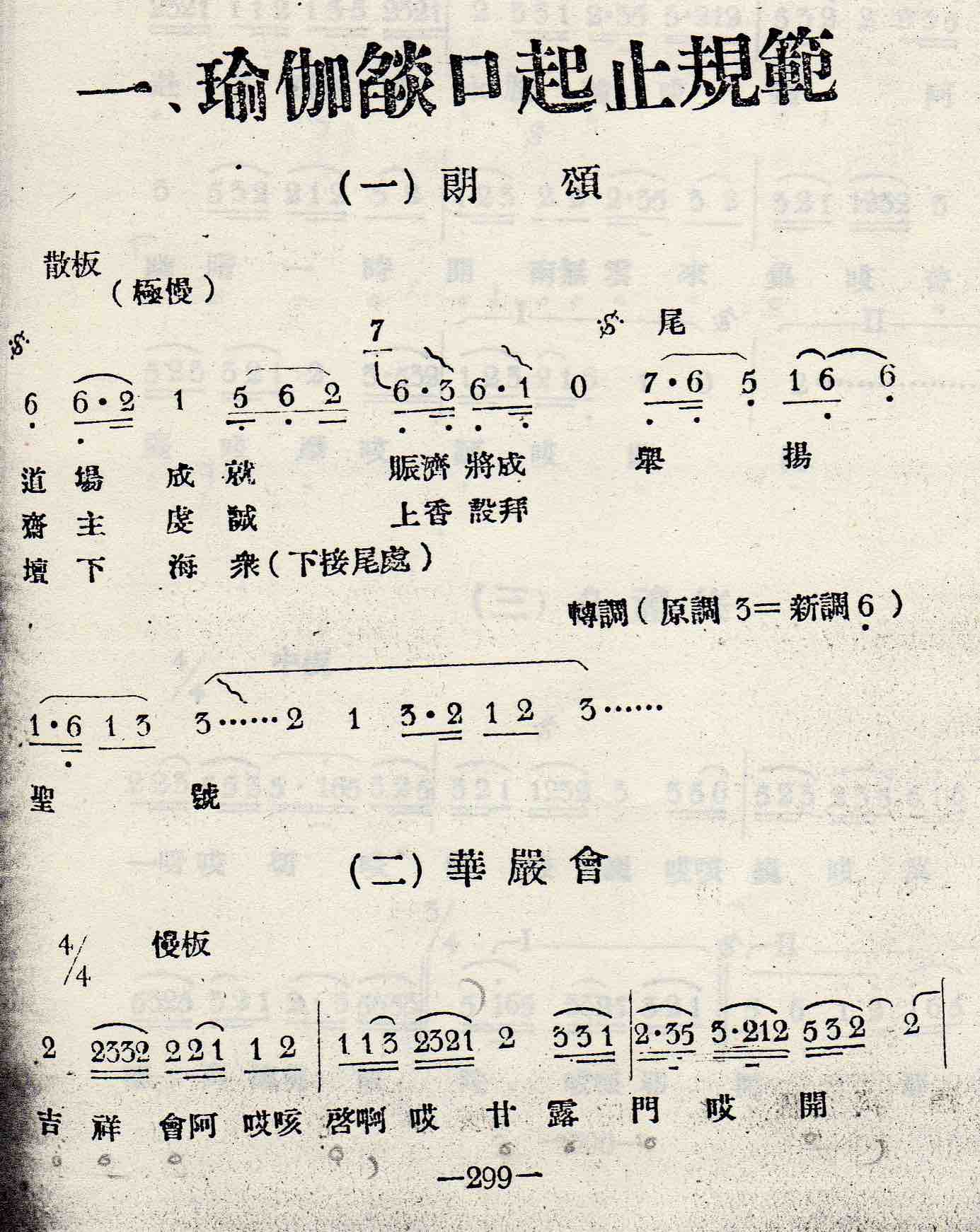
Liu and Wang shiban route

A helpful map of the transmission of shiban.

There is no separate section for “religious music” [sic], but some “religious songs” are briefly introduced (pp.144–63), and ritual genres pervade all the categories.

On a very different note, Wang and Liu end with an introduction to the Fujian tradition of the qin zither, which had also formed part of Zha Fuxi’s national survey in 1956.

Fieldtrips, 1986 and 1990
On my first stay in China in 1986, after exploratory trips to Wutaishan, Xi’an, and Shanghai, I visited Fujian, gaining a preliminary glimpse of nanguan and learning much from Ken Dean, then based in Xiamen. Ken was among the first scholars to cross the strait from Taiwan to the mainland to study local Daoist ritual traditions, and his detailed early field reports are most inspiring (see here; cf. Daoist ritual in north Taiwan):

  • “Two Taoist jiao observed in Zhangzhou”, Cahiers d’Extrême-Asie 2 (1986), pp.191–209
  • “Funerals in Fujian”, Cahiers d’Extrême-Asie 4 (1988), pp.19–78
  • “Taoism in southern Fujian: field notes, fall, 1985”, in Tsao Ben-yeh and Daniel Law (eds.), Taoist rituals and music of today (1989), pp.74–87.

Ken’s fieldwork led to major monographs:

  • Taoist ritual and popular cults of southeast China (1993)
  • Ritual alliances of the Putian plain (2 volumes, 2009)

and most illuminating of all, his vivid 2010 film

  • Bored in heaven, on ritual activity in Putian (for differences between his approach and more text-based Daoist scholarship, click here).

With Ken I attended a nocturnal ritual in a Quanzhou temple, with marionettes (on which, note Robin Ruizendaal’s wonderful 2006 book Marionette theatre in Quanzhou—with rare coverage of the fortunes of such groups under Maoism):

Marionettes for nocturnal ritual, Quanzhou 1986. Photos in this section are all by me.

And I visited the beautiful county of Hui’an on the coast:

Hui’an 1986: left, nuns; right, the distinctively-clothed women of Hui’an.

After my first serious survey of ritual associations on the Hebei plain in 1989 with my trusty colleague Xue Yibing, he accompanied me on my return to Fujian in early 1990, moving north from fieldwork around Guangdong on a reccy for what became chapters 14 and 15 of Folk music of China. Xue Yibing’s careful notes were as precious as ever. Like Li Quanmin, we often began by visiting local experts; but we also sought out local ritual practice, such as temple fairs—and by contrast with most regions of north China, such activity was ubiquitous despite all the traumas of the intervening twenty-eight years.

In Quanzhou city we spent wonderful time with nanyin groups, and learned more about longchui, still magnificent, with the versatile ritual accompanist Wang Wenqin 王文钦 (then 66 sui) and shawm master Huang Tiancong 黃天從 (67 sui, son of Huang Qingquan who led the 1961 recording) as our guides. In Puxi village nearby we found shiyin (see photo here), and in Hui’an we visited one of many groups performing beiguan—a major genre in Taiwan.

As always, folk ritual is the engine for expressive culture, and a variety of such groups assemble for a wealth of temple fairs. In many communities around Fujian the extraordinary ritual revival was stimulated by funding from the overseas diaspora.

At the Tianhou gong 天后宮 temple in Quanzhou city we attended a vibrant Dotting the Eyes (dianyan 點眼) inauguration ritual for the goddess Mazu—with pilgrim groups from all around the surrounding area as well as Taiwan (including palanquins holding god statuettes, shiyin bands and a Gezai xi drama group), a Daoist presiding, ritual marionettes inside and outside the temple, along with magnificent nanyin and longchui.

Above: (left) ritual marionettes; (right) a Daoist officiates.
Below: longchui led by Wang Wenqin on foot-drum and Zhuang Yongchang on shawm.

Later the longchui performers invited us to a gongde funeral at which they alternated with three household Daoists performing a Bloody Bowl (xuepen 血盆) ritual, as well as a lively Western brass band. And the distinguished marionette troupe performed moving excerpts from Mulian 目連 ritual drama for us: [6]

puppet at grave

puppets group

Having recently found the sheng-tuner Qi Youzhi in a town south of Beijing thanks to Yang Yinliu’s precious 1953 clue, we now visited the Buddhist monk Miaolian, whom Li Quanmin had visited in 1961. Now 78 sui, he was still at the Kaiyuan si temple; indeed, he had even remained there throughout the Cultural Revolution, when he was among a staff of over twenty resident monks.

Miaolian and XYB

Miaolian with Xue Yibing, 1990.

We ended our visit in Fuzhou, gaining further clues to the chanhe 禪和 (doutang 斗堂) style of folk ritual (see Zhongguo minzu minjian qiyuequ jicheng, Fujian juan, pp.2086–2243).

As for Li Quanmin previously, the trip merely allowed us to gasp at the enormity of the expressive cultures of Fujian. As I began focusing on north China, I was increasingly aware that local ritual activity must be a major topic there too.

Meanwhile the anthropologist Wang Mingming was doing detailed work on the history and ethnography of the culture of the Quanzhou region.

The Anthology
And meanwhile the monumental Anthology was being compiled, with volumes for folk-song, narrative-singing, opera, instrumental music, and dance each weighing in at between one and two thousand pages—and as usual, the published material is only a small part of that collected. To be sure, much of this consists of transcriptions (which anyway are of limited use if we can’t hear the recordings), but even the textual introductions (as well as the vocal texts, often orally transmitted) offer valuable leads.

Coverage of nanyin, the subject of a vast wealth of separate research, is distributed through the volumes on narrative-singing, instrumental music, and indeed opera. The Fujian folk-song volumes are among the most impressive in that category; the songs of the She minority are covered at some length (pp.1240–1412).

JC shawms

Shawm bands of Changtai county, and (lower left) of Putian county.

In the instrumental music volumes, besides the string ensembles much of the coverage yet again describes shawm and percussion bands. As ever, we find leads to genres that are still largely unknown outside their vicinity. And of course any single county has several hundred villages, all with their ritual and entertainment performance traditions. In 1986, for instance, at least 139 village nanguan societies were active in the single county of Nan’an.

beiguan JC

Beiguan, Hui’an county.

While the coverage of “sacrificial” and “religious” musics (pp.1757–2683) has now been eclipsed by the detailed projects on household Daoists led by scholars based in Taiwan and Hong Kong, the Anthology offers some leads. After a very brief introduction, we find transcriptions of items from the rituals of household Daoists in Putian, Xianyou, and Nan’an counties (pp.1757–1836, 2448–2683). Also introduced are xianghua 香花  household Buddhists of Fuzhou and Putian (pp.2086–2423); and the She minority feature again (pp.1836–93).

For all its flaws, the Anthology is a remarkable and unprecedented achievement.

* * *

Although field research since the 1980s has taken the study of the diverse sub-cultures of Fujian to a new level, it’s important to note the energy of the years before the Cultural Revolution. Indeed, apart from the riches of its performance traditions, Fujian has long had a deep tradition of local scholarship.

Of course, in the context of the pre-Cultural Revolution period, brief visits inevitably focused on reified “genres” rather than on documenting social activity. And “hit-and-run” trips by fieldworkers from Beijing or London can never compare to the long-term immersion of local scholars, like Wu Shizhong for nanyin, or Ye Mingsheng for Daoist ritual. Ye’s account of one single ritual performed by one group of Lüshan Daoists (even while hardly addressing their lives or ritual vicissitudes since the 1940s) occupies a hefty 1,418 pages!

As always, expressive culture—based on ritual—makes an important prism on the changing social lives of local communities.

See also Religious life in 1930s’ Fujian.


[1] See my Folk music of China, ch.14, with extensive refs. up to the mid-1990s; to attempt an update would be a major task. I have fallen back on pinyin, rather than attempting to render terms in local languages.

[2] See Zhongguo minzu minjian qiyuequ jicheng, Fujian juan 中国民族民间器乐曲集成,福建卷, pp.2703–4.

[3] Cf. Fujian minjian yinyue jianlun, pp.130–­36.

[4] For some refs., see my Folk music of China, p.293 n.17.

[5] For the Quanzhou region, see e.g. Stephan Feuchtwang, After the event: the transmission of grievous loss in Germany, China and Taiwan (2011), ch.4.

[6] Among a wealth of research on Mulian drama, see David Johnson (ed.), Ritual opera, operatic ritual: “Mulian rescues his mother” in Chinese popular culture (1989).

Grave charts

fenpu

For the Li family Daoists in Yanggao, north Shanxi, in addition to my film and book I’ve rounded up posts here.

Over the days following a death in Yanggao, among the many solo tasks of household Daoists like Li Manshan and his son Li Bin (along with determining the date for the funeral, writing the yangzhuang placard, supervising the encoffinment, decorating the coffin, and so on) is to determining a suitable site and alignment for the grave in the fields outside the village (see my film, from 16.21).

To help the Daoist in this task, some lineages still preserve grave charts (fenpu 墳譜). Only lineages that were relatively well-to-do before Liberation had them made, and rather few have survived the ravages of Maoism.

My main energies are devoted to the ritual performance of the Daoist band for the funeral proper—including my attempt to understand the texts that the Daoists perform then, with the help of their ritual manuals. From my notes:

As my frame of reference gradually expands—from the instrumental music to the ritual to local history to the wider activities of the Daoists—I am often out of my depth, but Li Manshan has developed a fine sense of where the borders of my research might lie. One day, as I query some abstruse comment of his on the correct timing for the burial in accord with the calendrical indications, he says with a twinkle in his eye, “Hey Steve, you don’t have to understand everything!”

So, like Li Manshan’s many almanacs to help him determine the date, the grave charts are way beyond my competence; but in a society where so much has been lost, they offer a glimpse of former geomantic knowledge in the area.

This vignette accompanies the scene in the film (Daoist priests of the Li family, p.190):

We have just had supper at Li Manshan’s house after an unusually rainy day. Around 7pm he gets a call. A rich entrepreneur in town is to collect him to go to a grave siting (kanfen) outside Lower Liangyuan for his mother. Li Bin has already determined the date. The entrepreneur, in mourning weeds, arrives in one of the poshest cars I have ever seen, and we keenly set about getting it all muddy. Collecting two grave-digger types in the village, we reach the sodden fields as it gets dark. It’s like Glastonbury, only without the irritating music. While I film with night-shot, Li Manshan takes out his luopan compass from its bag, and conscientiously checks the alignment with the compass and some string, consulting the family’s old grave chart.

By the time they finally finish it’s pitch dark. Oblivious of my presence, they blithely stride off with their torches, leaving me stumbling over grave mounds into puddles. At least I finally seem to have achieved that chimera of the fieldworker, becoming a fly on the wall. They come back to rescue me with their torches, and we all clamber back into the posh car and set to work making it all muddy again.

In some cases, such as when the old ancestors are buried elsewhere, Li Manshan really has to look for an appropriate site in the fields before using his compass for the specifics. On one such morning we spend considerable time seeking a suitable spot, driving round, getting out, studying the lie of the land. Me, I’m just looking for an Italian coffee bar.

Some of the grave charts look to have been written from memory since the 1980s, but on Li Bin’s travels through the countryside to assist funeral families he is sometimes shown some older ones. Here are a couple of photos he took from a chart made by a lineage in Xujiayuan north of the county-town, dated 1937:

And Li Bin recently came across one in nearby Yangyuan county, also apparently from before Liberation—here are three of its seven pages:

YY fenpu 3

Online you can find further images of grave charts, and general introductions in Chinese like this and this. For a sequel, see here.

Ethnography at home: Morris dancing

female dancers

Esperance dancers. Source: EFDSS, via https://frootsmag.com/hoyden-morris.

Why bother traipsing halfway around the world, I hear you ask, when our very own Sceptered Isle offers such potential for pursuing the local ethnography of seasonal ritual?

Our folk culture may be a rich and ever-evolving topic, but Morris dancing has long been a national joke. Here I’ve churlishly suggested it as a suitably disturbing English riposte to the magnificent All-Black haka. I suddenly understand why some Chinese people may initially be reluctant to engage with their folk culture (see e.g. here and here).

Morris dancing comes round every so often as a drôle topic for media coverage—this article by A.A. Gill may not impress academics, but it’s brilliant, evocative, and strangely respectful writing.

I’m reminded of the topic again by a recent BBC4 programme, engagingly titled For folk’s sake.

One could almost mistake the May procession, with its bowery palanquin,
for a rain ritual in Shaanbei.

Now, I take a keen interest in calendrical rituals—indeed, as Easter week approaches, Bach is in store, and it’s a busy season for ritual in China too. But I’m not alone in tending to consign Morris dancing, with its incongruous juxtaposition of hankies, bells, and silly hats with beards and beer, to a long list of embarrassing genteel eccentricities of the English, along with The Archers. But like any social activity performed by Real People it deserves serious study, in the context of social change in England since the Industrial Revolution, and even a preliminary exploration is fascinating. [1]

The wiki entry makes a useful starting point. Whatever the etymological connection between Morris and Moorish, it does seem, Like Life (cf. Stewart Lee), to have come from abroad. It’s part of a group of genres that includes mummers’ plays, sword and stick dances, and so on.

Gender and class
Though there is evidence of female Morris dancers as early as the 16th century, male groups predominated. I’d like to learn more about the 19th-century decline; anyway, by the early 20th century the women who soon became the driving force of Morris learned from surviving male performers. From wiki:

Towards the end of the 19th century, the Lancashire tradition was taken up by sides associated with mills and nonconformist chapels, usually composed of young girls. These lasted until the First World War, after which many mutated into “jazz dancers” [note the cryptic quotes].

Mary NealAfter severe losses in World War One (when some entire village sides were killed) the female dominance increased, with women now teaching men.

In 1895 Mary Neal (1860–1944; website here; see also Lucy Neal’s project and this nice article) founded the Espérance Club, a dressmaking co-operative and club to enrich the lives of young working-class girls in London:

No words can express the passionate longing which I have to bring some of the beautiful things of life within easy reach of the girls who earn their living by the sweat of their brow… If these Clubs are up to the ideal which we have in view, they will be living schools for working women, who will be instrumental in the near future, in altering the conditions of the class they represent.

Cecil Sharp (1859–1924) first experienced Morris at Headington Quarry in 1899. Mary Neal began working with him in 1905, but their outlooks conflicted, and she soon joined the WSPU (for the Espérance’s modern reincarnation, see here). Vic Gammon encapsulates the conflict in his review of Georgina Boyes’s The imagined village culture:

Mary Neal, middle-class reformer, socialist, and suffragette who sees the possibility of reviving folk dance among working-class girls in north London, is defeated by Cecil Sharp, professional musician, Fabian, and misogynist who spread the activity of folk dancing among the young genteel, making vernacular arts fit bourgeois aesthetics.

These clips from 1912 feature the sisters Maud and Helen Karpeles, co-founders of the English Folk Dance and Song Society, as well as Cecil Sharp, and George Butterworth, who died in the Battle of the Somme:

But as in the world of work, male groups soon came to dominate again. The all-male Morris Ring was founded by six revival sides in 1934. And between the wars, for John Eliot Gardiner’s father Rolf “mysticism, misogyny, and Morris dancing formed a coherent whole in which nostalgia was a spur to action”. Whether he would have approved of The Haunted Pencil, with his AfD comrades, I couldn’t possibly comment.

Meanwhile Stella Gibbons and Elisabeth Lutyens took a more cynical view of genteel “folky-wolky” representations of English folk culture (note also Em creeps in with a pie).

Following World War Two, and particularly in the 1960s, there was an explosion of new dance teams, with some women’s or mixed sides. A heated debate emerged over the propriety and even legitimacy of women dancing the Morris; and mainly on the left, critics disputed the method of Sharp’s work as they pondered the perilous concept of “tradition” (as they do). But as in most walks of life, despite bastions of male conservatism, the creative participation of women is again becoming a major driving force, as you can see in this fine article by Elizabeth Kinder.

Boss Morris

Click here for a short clip from Berkhamstead in 1950, with pipe and tabor sadly mute. And this was filmed in Thaxted (“hub of the universe”), c1958—just as collectivization was leading to calamitous famine in China:

All this may seem quaint at any period, but all the more so in the Swinging Sixties. For folk’s sake shows glimpses of a 1966 festival at Thaxted—just as revolution (not least the Cultural Revolution) was in the air, alongside jazz, soul, the Beatles… The Saddleworth rushcart festival features in For folk’s sake—here’s a clip from 2014:

And as with folk traditions in China and worldwide, Morris survives alongside newer genres like punk (for punk in Beijing, see here).

holm

Source: David Holm, Art and ideology in revolutionary China (1991).

Indeed, a survey of the many English villages with teams somewhat resembles our documentation of ritual groups in particular counties of China—or the rich local dance traditions like yangge (among several genres using handkerchiefs and sticks!), Boat on Dry Land, Bamboo Horses, and so on, with their common ritual connections—covered at length in the provincial volumes of the Anthology for dance:

  • Zhongguo minjian wudao jicheng 中国民间舞蹈集成,

with over 30,000 pages there alone, besides all the related material in the volumes for folk-song, narrative-singing, opera, and instrumental music.

Among the main regional Morris traditions are Cotswold, Northwest, Border, and Plough Monday groups in Yorkshire and the east Midlands (all the sides have instructive websites)—and as in China, their styles are often distinctive to individual villages. Four teams claim a continuous tradition predating the revival: Abingdon, Bampton, Headington Quarry, and Chipping Campden. In the 1930s at the important centre of Thaxted, the sinologist Joseph Needham championed Molly dancing.

Only now do I recall that my granddad took me to watch mummers in Wiltshire (at Colerne? Marshfield?). Indeed, his home village of Potterne still has a group. It’s a very blurred childhood memory, by which I seem to have been underwhelmed; but did it sow a seed?

Nutters

The Britannia Coco-nut [2] Dancers of Bacup (“Nutters”; see e.g. this article) have a venerable history that inevitably attracts controversy (no less inevitably, one of the transmitters is called Dick Shufflebottom, who celebrated fifty years of service in 2006). A.A. Gill’s description of the Nutters is classic:

They are small, nervous men. And so they might be, for they are wearing white cotton night bonnets of the sort sported by Victorian maids, decorated with sparse ribbons. Then black polo-neck sweaters, like the Milk Tray man, with a white sash, black knee-breeches, white stockings and black clogs. As if this weren’t enough, someone at some point has said: “What this outfit really needs is a red-and-white-hooped miniskirt.” “Are you sure?” the dancers must have replied. And he was. But it doesn’t finish there. They have black faces, out of which their little bright eyes shine anxiously. On their hands are strapped single castanets. A single castanet is the definition of uselessness. The corresponding castanet is worn on the knee. To say you couldn’t make up the Coco-nutters would be to deny the evidence of your astonished eyes.

The dance begins with each Nutter cocking a hand to his ear to listen to something we human folk can’t catch. They then wag a finger at each other, and they’re off, stamping and circling, occasionally holding bent wands covered with red, white, and blue rosettes that they weave into simple patterns. It’s not pretty and it’s not clever. It is, simply, awe-inspiringly, astonishingly other. Morris men from southern troupes come and watch in slack-jawed silence. Nothing in the civilised world is quite as elementally bizarre and awkwardly compelling as the Coco-nutters of Bacup. What are they for? What were they thinking of? Why do they do these strange, misbegotten, dark little incantations? It’s said that they might have originally been Barbary corsairs who worked in Cornish tin mines and travelled to Lancashire, and that the dance is about listening underground, a sign language of miners. And then there’s all the usual guff about harvest and spring and fecundity, but that doesn’t begin to describe the strangeness of this troupe from the nether folk world.

Do watch the Nutters on YouTube.

Again as in China, the Morris vocabulary is suggestive, with teams, sides, squires, bagmen, fools, beasts. At least England hasn’t yet fallen for the Intangible Cultural Heritage flapdoodle (we have our pride). Still, even without it, contentious arguments about “authenticity” continue to fester. And even now there’s still considerable opposition to admitting women. FFS.

I might be tempted to make the music share the blame. Of course, it is what it is, irrespective of the impertinent tastes of outsiders; but it often seems to endow the proceedings with a twee comfy feel that conflicts with the edgy (“pagan”?!) atmosphere of the dance itself. Once mainly accompanied by pipe and tabor, fiddles and melodeons became more common. The gritty new sounds of great musos like Jon Boden don’t seem so relevant to most Morris sides—though again, see Elizabeth Kinder’s article. I’d love to hear a Bulgarian version—accompanied with suitably complex metres by zurna and davul, relatives of early English pipe and tabor.

For the BBC2 documentary Tribes, predators and me, it was a cute idea to show footage of Morris dancing to tribespeople (click here).

* * *

Of course I’m merely dabbling here. But is this the kind of thing that urban educated Chinese people think I’m doing in their country?

In a way, it is: cultures change, in China as in England. The brief of the ethnographer is the same: to document the whole history, down to today, of local traditions amidst ongoing challenges to community cohesion through social and political change. We both have blind spots about our own cultures, further muddied by patriotic posturing and our reactions against it. It’s not that I can’t see the “value” of Morris, just that I’ve inherited negative associations. While plenty of English writers have debunked the myth of an unspoilt Victorian Merrie England, in China the “living fossils” nostalgia, referring to a Golden Age of much greater antiquity that bears even less relation to rural life there, is still touted by heritage pundits. For the awful cliché of “international cultural exchange”, see here.

And whereas in China I’m keenly aware of major dates in the rural calendar when temple fairs may be held, I’m not alone in being completely estranged from the seasonal rhythms of English life; only Bach cantatas manage to educate me.

This may be a particular issue for the English. In Hungary the táncház revival has become popular; and it would seem natural enough for an American studying old-time music in Appalachia to find continuity when working on China.

The world of Morris and English folk-song culture, like that of Newcastle punks, is no more “home” to me than are the rituals of the Fujian countryside for an educated Chinese from Beijing. But whereas local ritual in China still seems to me an intrinsic component of local life, Morris dancing has long seemed a quaint byway in my whole experience of England. Of course, when pressed, I can quite see this is wrong. OK Guys, I’ll take my culture seriously if you take yours…

Anyway, just think, as you board a rickety bus to a poor Hunan village in search of household Daoist rituals, you could be sitting in a sunny Oxfordshire pub courtyard nursing your pint as you take notes on the magnificent ritual spectacle unfolding before you—complete with its “feudal superstitious colourings” 封建迷信色彩.

See also my haiku on Morris dancing. Click here for English folk-song; and for posts on Irish music, here. For a roundup of posts on the English at home and abroad, see here; and for more on Heritage movements, here.


[1] Useful background includes the research of Vic Gammon; Georgina Boyes, The imagined village culture: culture, ideology and the English folk revival (1993/2010); Trish Winter and Simon Keegan-Phipps, Performing Englishness: identity and politics in a contemporary folk resurgence (2013); numerous publications from the English Folk Dance and Song Society, e.g. here; Theresa Buckland, ” ‘Th’owd pagan dance’: ritual, enchantment, and an enduring intellectual paradigm” (2002). On class, gender, and national identity, see also this (cf. Stewart Lee!). For innovative performance-based studies of clog dancing, see the work of Caroline Radcliffe. For an accessible introduction to the English folk scene, see The Rough Guide to world music: Europe, Asia, and Pacific, “England: folk, roots”, and regular features in Songlines and fRoots.

For further refs. on the wider context, see Helen Myers, “Great Britain”, in Ethnomusicology: historical and regional studies (The New Grove handbooks in music, 1993), pp.129–48. Among many fine compilations of British folk music, note the extensive Topic Records series The voice of the people (here on Spotify).

[2] Pedants’ corner (or is it Pedant’s corner?): the form “coconut” seems more common (as on their own website)—I can’t find a ruling on the hyphen, but it seems suitably eccentric (but was it eccentric then? That’s the perennial question!).

Famine: collected posts

LSQ 1

Liu Shaoqi visits Hunan, 1961.

Since the food shortages caused by the 1958 Great Leap Backward were such a major trauma for the people we meet during fieldwork, I’ve just added a tag in the sidebar for famine. See also the Maoism tag.

Indeed, this was no mere “three years of difficulty”: food shortages began even before the Leap, and continued throughout the Cultural Revolution right until the collapse of the commune system in the late 1970s.

Among the main articles are:

The famine also features in many of the pages under Local ritual; it’s a theme of my work on Gaoluo (see e.g. A tribute to two local ritual leaders) and the Li family Daoists. Indeed, while there are many fine studies dedicated to the subject, it should be a recurring theme in coverage of local society, expressive culture, and people’s lives.

North Xinzhuang 1959

North Xinzhuang, Beijing suburbs 1959.

The Confucian ritual in Hunan

LY JC

Source: Zhongguo minzu minjian qiyuequ jicheng, Hunan juan.

One subject of Yang Yinliu‘s 1956 ambitious survey of the diverse performing genres in Hunan province was the large-scale Confucian ritual sacrifice of Liuyang, east of Changsha. Appendix 2 of his report,

  • Kongfu dingji yinyue 孔府丁祭音乐 (1958, 78 pp.)

was discreetly tucked away in a separate mimeograph; I haven’t yet tracked down the original, but its material is included in the 2011 reprint of Yang’s Hunan volume, and cited in the Anthology section. [1]

Perspectives
There are all kinds of themes to unpack here. First, a confession: my own reluctance to study the topic is flawed. Cultures routinely exclude certain soundscapes from their concept of “music”, but ethnomusicology counsels a far more inclusive view. Indeed, for China I’m keen to include the songs of spirit mediums, work hollers, and vocal liturgy within our brief. I have no argument with studying elite culture, even if in most societies, including China (both historically and today), it only represents a tiny tip of the iceberg (for imperial culture, see here; and for similar reservations about the qin zither, here).

I keep stressing that our focus shouldn’t be some reified concept of “music”, but expressive culture within society; and the topic of the Confucian rituals may lead all too easily to the glorification of some notional Golden Age of Ancient Sages. So I’m wary of “recreations” claiming to preserve or salvage such glories. Such a mindset may even distract us from other forms of musicking that are far more deeply embedded in social life.

Still, like the performance of modern CCP propaganda, the Confucian sacrifice is a political subject, which of course we have to study. So it may be irrelevant that it seems to exclude most features that I (or the Chinese) can perceive as “musical”, and that (unlike folk ritual) it seems remote from the lives of ordinary people. Ritual often seems austere—we might adduce the hymns or the fast chanted scriptures of household Daoists like the Li family—but expertise, human energy, social interaction, are usually evident in performance.

The origins of the Confucian sacrifices are in the numinous ancient music of Shao, whose wonders made Confucius himself oblivious to the taste of meat, if only for three months. But I’m going to start with the Tang—not because I wish to recreate its glories, but precisely because I don’t.

Now I don’t applaud the xenophobia and moralistic snobbery of the Tang poets Bai Juyi and his friend Yuan Zhen, as society struggled to recover from the cataclysm of the An Lushan rebellion (see here, n.2). Bai’s poems like “The Standing Orchestra” and “Chime-stones from Huayuan” (which I might rename “Just Can’t Get the Staff, Nowadays”) rest on a flawed nostalgic idealization of the Wisdom of the Ancient Sages; but, with ethnographic candour, they also reveal the ineptitude of the yayue Confucian ceremonial performers of his day.

Several studies have been made of these poems, but they were a theme that my teacher the great Tang scholar Denis Twitchett approached with relish (as you may see from our irreverent correspondence on the faqu, here and here; see also my own spoof Tang poems). So below I’ve adapted his (apparently unpublished) translations from a draft that he sent me, retaining the sometimes E.J. Thribb-like character of Bai Juyi’s original, and refraining from adding the Teutonic footnotes that every phrase invites (as parodied by Flann O’Brien’s commentaries on de Selby):

The Standing Orchestra
Drums and fifes of the Standing Orchestra blare out
Dancers perform the two-bladed sword-dance, jugglers toss the seven balls
Slender maidens walk the tightrope, quivering with long pole
Among the orchestras of the Court of Sacrifices is a rigid hierarchy
Those in the upper hall sit, those in the lower hall stand
In the upper hall the mouth-organ songs of the Seated Orchestra are pure
In the lower hall the drum and fife of the Standing Orchestra resound
At the sound of a single note from the mouth-organ songs, everyone inclines their ears
But if drum and fife were to play ten thousand pieces, no-one would listen
The Standing Orchestra is base, the Seated Orchestra noble
Once rejected, a member of the Seated Orchestra joins the Standing Orchestra
Playing drum and mouth-organ to accompany circus acts
But once a member of the Standing Orchestra is rejected, where can he find a job?
First he is sent to the suspended bells and chimes to play the ritual music
The ritual music has fallen so far out of fashion
That incapable dolts like you are ordered to perform the gong and zhi modes
When at the urban sacrifice we pray to the Earth Lord at the circular altar
The claim takes this music to move the spirits of Heaven and Earth!
Hoping to make the Phoenix come and the hundred beasts dance
Is just like driving your carriage north, hoping to arrive in Chu!*
The musicians are all incompetent fools—how can I adequately describe them?
And you, the Three Ministers of the Court of Sacrifice, whatever sort of men are you?

Chime-stones from Huayuan
Chime-stones from Huayuan, chime-stones from Huayuan
Men of old didn’t listen, but men of today listen
Sonorous stones from the banks of the Si river, sonorous stones from the banks of the Si river
Men of today don’t play them, but men of old played them
How is it that men of old and men of today are so different?
Which instruments are used and which rejected depends on the musicians
Although the musicians have ears like a wall, if they’re unable to distinguish Pure from Muddy sounds then they might as well be deaf!
When the pupils of the Pear Garden adjust the temperament
They only know the new sounds, they are ignorant of the old
Of old it was said of the fouqing chime-stones from the banks of the Si
That their sound moved the listener to thoughts of those serving and risking their lives in distant places
But when once the sound of the Huayuan chime-stones had been heard at the palace
The prince’s heart straightaway forgot his subjects guarding the frontiers
And sure enough, when the barbarian brigand rose up from Yan
Few of the generals were willing to die in defence of the borders
If once one understands how music and the state of government are intertwined
How can one simply listen to the clashing and clanging of these instruments?
“Xiang, the player of the stone-chimes, withdrew to his island in the sea”, leaving never to return
And now kids from the Chang’an market-place have become Master Musicians!
Who is there to truly understand the difference between Pure and Muddy sounds
Between the chime-stones from Huayuan and the sonorous stones from the banks of the Si?

So Bai Juyi is contrasting the expertise of the Seated Orchestra with the ineptitude of the ritual musicians, but “It’s Complicated”. The two genres serve entirely separate functions, with different demands. Technical virtuosity doesn’t correlate with efficacity: a lullaby serves its purpose perfectly, whereas the years of discipline that go into mastering a Paganini Caprice hardly go beyond mere technique. And some of the finest musicians in the world come from the “market-place”… Of course, recruiting practices may have changed from Tang to Ming, but I doubt if evidence is available to suggest that later ritual musicians were of a higher standard—they hardly needed to be. Bai Juyi’s argument doesn’t invalidate the performance, but it does rather, um, chime with my own reservations about studying it.

“But that’s enough about me”. Yang Yinliu, with his historical erudition and concern for “literati music”, “palace music”, and indeed “feudal superstition” and the culture of the “exploiting classes”, was doubtless more interested in the Confucian ritual than I am. Whereas I can see the “value” of exploring the topic but prefer to focus elsewhere, for Yang and his colleagues it formed part of the rich topic of archaeology and early historical sources on which they also worked tirelessly.

The wider context
A useful introduction, for the Ming, is

  • Joseph Lam, State sacrifices and music in Ming China: orthodoxy, creativity, and expressiveness (1998).

He stresses those features, even if the latter two may seem rather remote from many people’s understanding of the topic. For dance, see also

The stimulating article

  • Sébastien Billioud and Joël Thoraval, “Lijiao: The return of ceremonies honouring Confucius in mainland China”, China perspectives 2009.4.

mainly concerns Qufu in Shandong (birthplace of Confucius, and site of the most renowned rituals) and the rehabilitation of Confucius since the 1980s.

Confucian sacrifices were performed widely throughout the empire until the collapse of the imperial system in 1911. They are not only documented in the national dynastic histories but also (at the expense of folk traditions!) often occupy an unreasonable amount of space in imperial county gazetteers, compiled according to a template. The topic, burdened by abstruse theory and false nostalgia, may seem largely to belong to the rarefied confines of early sinology. However, as always, it is no timeless “living fossil”, but was constantly remoulded and re-invented throughout the imperial era right down to today.

Through the Republican era the rituals declined. After the 1949 Communist victory they were promoted by the Nationalist regime on Taiwan, but on the mainland they fell silent—apart from a few initiatives from cultural authorities.

In late imperial times the rituals must have been common elsewhere in Hunan too (the Anthology mentions mid-19th-century accounts in the Yongzhou and Jiahe county gazetteers), but it is those of Liuyang that came to achieve national celebrity. So here I’d like to introduce the fortunes of the rituals there over their life-span of a century, from the 1840s to the 1940s.

Liuyang [2]
Confucian sacrifices may have been performed in Liuyang since ancient times, but we only find firm evidence from 1829, when the local jiansheng 監生 official Qiu Zhilu 邱之稑 (1781–1839) was commissioned to begin a lengthy investigation of how to perform the rituals, with funding to establish a Bureau for Rites and Music (Liyue ju 禮樂局). His research was based not only on early compendia (including Han sources and the Qing Lülü zhengyi) but also on a visit to Qufu.

Qiu Zhilu then had to decide on the pitch standard (itself a thorny historical issue); choose the vast instrumentarium and repertoire (indeed, he is credited with incorporating folk elements, revising the system of one note per beat, and expanding the scale); and rehearse the singers, instrumentalists, and dancers. He documented the results of his research in a series of volumes.

Though Qiu Zhilu died in 1839, the rituals he had designed were first performed in the early 1840s. Every three years over sixty youths over the age of 12 sui within the town—“from decent families” shenjia qingbai 身家清白, an assessment that would have been abruptly reversed after the 1949 Liberation!) [3]—were recruited, training for a month before the 2nd- and 8th-moon rituals.

(An aside: I can’t help comparing this to the hereditary training of shawm-band musicians in Hunan and throughout China, who would begin playing percussion in the family band from around 6 sui, moving on to shawm in their early teens, and learning daily through constant participation in life-cycle and calendrical rituals. And that is where real creativity is to be found: for more on elite and folk cultures, with a detailed analysis of a qin piece and a shawm-band suite, see here. But as in the Tang, the efficacity of the Confucian ritual depended not on the performers but on the “arrangers”…)

The Qing statesman Zeng Guofan (1811–72), himself a native of Hunan, sent envoys to Liuyang to attend the ritual, recommending it to the emperor. After the collapse of the imperial system in 1911, the Bureau was still maintained, though only the 8th-moon sacrifice was now held. Wannabe emperor Yuan Shikai (1859–1916) sent envoys, who reported it to be superior to the Qufu ritual; envoys from there and other regions of the country (including Heilongjiang, Yunnan, and Xinjiang) came to study. Apparently the genre even appeared in a feature film made in the early Republican era.

Liuyang 2
Liuyang 1

These photos of the Liuyang performers appear quite widely online, but I can’t find dates—can anyone provide them? The first seems to date from before Liberation; I surmise that the second was taken when Yang Yinliu took them to record in Changsha in 1956. [4]

As ever, I’m struck by both how much has survived and how much has been destroyed, and by the maxim “when the rites are lost, seek throughout the countryside”.

The 8th-moon ritual was held in 1937 with an ever-dwindling personnel. After Liuyang was occupied by the Japanese, activity was interrupted in 1944. [5] After Japan was defeated, the temple grounds were taken over by the Nationalist administration and a local newspaper. By the time of an October 1945 performance in the temporary provincial capital Leiyang, following social upheavals, instruments had been damaged and the (recent) tradition much reduced. In 1946 the senior Liu Puxian 劉蒲仙 led a ritual with over a hundred performers, still only a pale reflection of the previous quorum. The last ritual performance took place on 28th September 1948.

After the Communist victory, in 1951 the Liuyang Bureau of Culture retrieved the entire collection of over 350 instruments as well as the textual material, holding an exhibition; from 1953 they were stored in the Hunan provincial museum in Changsha, and some newly-reproduced instruments were made.

Such was the backdrop to Yang Yinliu’s 1956 visit. He now assembled a dozen of the senior performers to go to Changsha, recording some of the main hymns with a motley assemblage of instruments whose pitches no longer matched (a topic that he explored eruditely in his monograph). The Anthology reprints Yang’s own transcriptions of these recordings.

LY JC score

Zhaohe (Zhaoping) hymn to welcome the gods (opening), documented by Yang Yinliu. Source: Anthology.

Hunan was hit by the famine that followed the Great Leap Backward, but in 1962, in a brief lull between campaigns, the Hunan cultural authorities organized another project on the ritual. The instruments were even briefly returned to Liuyang; new performers were trained, and further recordings made. Ever since then the instruments have been kept at the Changsha museum. Meanwhile similar research was ongoing in Qufu.

From the 1980s, the resumption of research (now for the monumental Anthology) coincided with a progressive rehabilitation of Confucius and Confucianism. Indeed, Yang Yinliu’s 1956 work in Liuyang formed an important basis for the glitzy 1980s’ recreation of the most renowned Confucian ritual at Qufu, with which it had long-standing links. In recent years—inevitably—the Liuyang cult has been taken up by the Intangible Cultural Heritage (see here), although, as with many such projects, any tradition has long disappeared. The only remaining source was Qiu Shaoqiu 邱少求 (b. 1931), who had spent nearly ten years performing intermittently after training from the age of 9.

LY JC diagram

Reconstructed diagram showing deployment of instruments. Source: Anthology.

* * *

So once again, we have to unpack the thorny question “What is music?”. As Confucius himself observed,

Music! Music! Is it nothing but the sound of bells and drums?

Always remote from the lives of ordinary people, and performed only intermittently, the Liuyang ritual was a very minor aspect of musicking in Hunan; but it’s one that may attract sinological historians. To be sure, like folk musicking, it was in a constant process of change; and a certain creativity was involved—though far from the kind universal to most expressive culture in China and elsewhere.

With Chinese and foreign scholars alike still keen to imagine “living fossils”, such as the ritual traditions of Beijing, Xi’an, and south Fujian, reification is a dangerous theme throughout traditional culture.

Irrespective of my own ambivalence about the topic, Yang Yinliu’s work, even amidst pressure to downplay elite culture, shows his dedication to all aspects of performance and the historical background. At the same time, he wasn’t alone in studying the Liuyang ritual: the Hunan cultural authorities made efforts to document it throughout the first fifteen years after Liberation.


* Satnav on the blink again—Ed.


[1] Zhongguo minzu minjian qiyuequ jicheng, Hunan juan 中国民族民间器乐曲集成, 湖南卷, pp.2049–57, 2137, 2141, 2179–80, transcriptions 2060–85. See also Yang’s 1958 article “Kongmiao dingji yinyuede chubu yanjiu“, reprinted in Yang Yinliu yinyue lunwen xuanji 杨荫浏音乐论文选集 (1986), pp.276–97.

[2] For Liuyang, online sources I have consulted include http://blog.sina.com.cn/s/blog_95b86dd70102xhke.html
http://blog.sina.com.cn/s/blog_95b86dd70102xhqr.html
http://www.feiyicheng.com/cms/index.php?act=article&op=article_detail&article_id=2186
http://www.hnmuseum.com/zh-hans/zuixintuijie/浏阳古乐编吕钟
http://www.lyyzedu.com/Item/6021.aspx
In the Anthology, note the biography of Qiu Zhilu (p.2137) and the item on the Bureau of Rites and Music (p.2141).
See also Yu Yizhi 喻意志 and Zhang Yu 章瑜, “Liuyang jikong yinyue chutan” 浏阳祭孔音乐初探, Tianjin yinyuexueyuan xuebao 2008.2. As ever, several details remain to be clarified.
In English, an early mention of Yang Yinliu’s work on the Liuyang rituals is Rulan Chao Pian, Sonq dynasty musical sources and their interpretation (1967), pp.94–6.

[3] Having observed that many of the CCP leaders came from Hunan, I note that Liuyang was the birthplace of Hu Yaobang (1915–89), who would not have made a suitable recruit…

[4] This site, with 52 pages, contains a rich archive of visual images from Hunan, and leads to further sources showing the depth of both literati and popular culture there.

[5] An instance of my problems interpreting the material: I surmise that it continued until then even under Japanese occupation. One would like more detail on the whole period from 1937 to 1949—but please, if you go to Hunan, do look beyond the Confucian ritual!


Two recent themes

*UPDATED!*

Two images from the 1950s.

Recently I wrote a mini-series of posts on the fortunes of ritual and expressive culture through the first fifteen years of the PRC, and the intrepid scholars who documented it—worth reading along with my tribute to the great Yang Yinliu:

And further posts followed:

Also relevant is

For a salient critique of a Chinese fieldworker in 1956 Lhasa, see

This happens to be an important period for the relationship of politics and culture—the Maoist decades are a crucial bridge from the “old society” to the current reform era—but that’s not the only reason for studying it. One always seeks to gain a picture of change over the lifetimes of informants; if we had visited in the 1880s, or indeed the 880s, we would also have asked them how their social and cultural life had before the cataclysms of the Taiping uprising and the An Lushan rebellion respectively. While I’m critical of reified studies that are limited to the “salvage” of an idealized past, a diachronic approach is always valuable. For a recent volume on doing fieldwork in China, see here.

* * *

I followed up that series with Great Female Singers Week (cf. A playlist of songs):

Again, these are part of larger series, in this case on gender (for a roundup, see here), jazz, and Mediterranean culture—to which you’ll find links in the above posts.

Expressive culture (both popular and elite) always makes a revealing prism through which to view social change—whether for China, Puglia, New York, or Vienna.

New tag: Yang Yinliu!

Yang Yinliu 1950

I’ve just added a new tag in the sidebar for the great Yang Yinliu (1899–1984), whose encyclopedic work on Chinese music encompassed elite and folk traditions, historical sources and fieldwork.

The starting point is this tribute, describing his early background in Kunqu, qin, and Daoist circles, and reflecting on his constant determination to document the whole heritage—notably ritual—despite the strictures of Maoism. It leads to further posts on his discovery of Beijing temple musics, his 1956 fieldwork in Hunan (here, and here), and much more.

Update to A Czech couple in 1950s’ Tianqiao

https://stephenjones.blog/2019/02/15/czechs-in-tianqiao/

I’ve just done a major update to A Czech couple in 1950s’ Tianqiao. Even if you have already read my original post, do take another look—I’ve added considerable further material, courtesy of the couple’s grandson (also Zdeněk).

New content includes more vignettes on their early life; a 1968 letter from the son of Robert van Gulik to Ambassador Hrdlička; more on the tribulations of Czechoslovak scholars; and under post-1968 “normalization”, Věna’s wry gratitude to the authorities for improving their health by depriving them of employment…

Note also Czech tag, including appearances from Švejk and Alexei Sayle…

Famine and expressive culture

Glimpses of the early 1960s’ cultural revival in response to desperation

Liu Shaoqi visits Hunan, 1961.

The disastrous consequences of the Great Leap Backward have been documented by several scholars. But between 1961 and 1965, as the CCP retreated briefly from extreme policies in a brief lull before the Four Cleanups campaign, traditional (incuding ritual) culture revived significantly throughout the countryside. I’ve documented this fleeting revival for my main fieldsites in Hebei (Plucking the winds, ch.5) and Shanxi (Daoist priests of the Li family, ch.5), and it often features in my accounts of local ritual—note also the Maoism tag.

Apart from talking with people who can recall the period, documents by the provincial Bureaus of Culture from the late 1950s–early 1960s make an unlikely but fruitful source. While they are prescriptive decrees calling for further suppression of a gamut of “superstitious” activities, they thereby show how prevalent such practices were becoming—precisely in response to the desperation of the Leap.

Hunan
Here I’ll focus on the province of Hunan, to complement my post on Yang Yinliu’s 1956 survey. [1]

Mao Zedong, Peng Dehuai, and Liu Shaoqi were all natives of Hunan. On 11th May 1959 Liu wrote to Chairman Mao after spending a month investigating the region of his birth:

According to comrades from the provincial Party committee, 40% of all houses in Hunan have been destroyed. Besides this there is also a portion that has been appropriated by state organs, enterprises, communes, and brigades.

On a visit to Mao’s home village in Shaoshan before the fateful Lushan conference of summer 1959, the Chairman himself had hinted at a partial retreat from the more radical policies of the Leap. Peng Dehuai went on to confront him at the fateful Lushan conference of summer 1959:

When Peng had gone back to his home in Xiangtan, he found abuse and suffering everywhere, from farmers forced to practice close cropping to cadres tearing down houses in the iron and steel campaign. Visiting a retirement home and a kindergarten, he saw nothing but misery, the children in rags and the elderly crouched on bamboo mats in the freezing winter. Even after his visit he continued receiving letters from his home town about widespread starvation.

Becker notes that in the anti-Peng hysteria that followed the conference, Hua Guofeng personally supervised the brutal persecution of Peng’s family who lived in the Xiangtan region. Provincial leader Zhou Xiaozhou, who had tried to blunt the impact of extreme leftist policies, was purged, and the madness only escalated.

Dikötter observes:

The number of people per room in Hunan doubled during the years of the Great Leap Forward, as entire families crowded into a single room the size of a wardrobe—despite the space created by the loss of several million to starvation.

Ambitious yet misguided irrigation and land reclamation projects further depleted the environment. People were beaten to death in 82 out of 86 counties and cities. As investigating teams dispatched to the countryside reported:

In Daoxian county many thousands perished in 1960, but only 90% of the deaths could be attributed to disease and starvation. […] Having reviewed all the evidence, the team concluded that 10% had been buried alive, clubbed to death or otherwise killed by Party members or militia. In Shimen county, some 13,500 died in 1960, of whom 12% were “beaten or driven to their deaths”.

Dikötter cites reports from 1961:

In Yuanling county, testicles were beaten, soles of feet were branded, and noses were stuffed with hot peppers. Ears were nailed against the wall. In the Liuyang region, iron wires were used to chain farmers.

Liu Shaoqi returned to Hunan in 1961 in a widely-reported trip (online, see e.g. here):

Determined to avoid the large retinue of bodyguards and local officials that inevitably came with every visit from a top dignitary, Liu set off on 2nd April 1961 from Changsha, travelling in two jeeps in the company of his wife and a few close assistants, bowl and chopsticks tucked away in light luggage, ready for a Spartan regime in the countryside. Soon the convoy came across a sign announcing a giant pig farm. On closer inspection, it turned out that the farm consisted of no more than a dozen scrawny hogs foraging in the mud. Liu decided to spend the night in the fodder store, and his assistants combed the place in vain for some rice straw to soften the plank beds. Liu noted that even the human excrement piled up for fertilizer consisted of nothing but rough fibre, another telltale sign of widespread want. Nearby a few children in rags were digging for wild herbs.

Liu Shaoqi’s fears were confirmed over the following weeks, however difficult it was to get wary farmers to tell the truth. In one village where he stopped on his way home, he found that the number of deaths had been covered up by local leaders, while an official report drew a picture of everyday life which had nothing to do with the destitution Liu saw on the ground. He clashed with the local boss, who tried to steer the team away from speaking with villagers. He tracked down a cadre who had been dismissed as a rightist in 1959: Duan Shicheng spoke up, explaining how the brigade had earned a red flag during the Great Leap Forward. To protect their privileged status, Duan explained, local leaders had systematically persecuted anybody who dared to voice a dissenting view. In 1960 a meager crop of 360 tonnes of grain was talked up to 600 tonnes. After requisitions villagers were left with a paltry 180 kilos, out of which seed and fodder had to be taken, leaving a handful of rice a day.

In his home village Tanzichong, friends and relatives were less reluctant to speak out. They denied that there had been a drought the year before, blaming cadres instead for the food shortages. “Man-made disasters are the main reason, not natural calamities.” In the canteen cooking utensils, dirty bowls and chopsticks were tossed in a pile on the floor. A few asparagus leaves were the only vegetable available, to be prepared without cooking oil. Liu was shaken by what he saw. A few days later, he apologized to his fellow villagers in a mass meeting: “I haven’t returned home for nearly forty years. I really wanted to come home for a visit. Now I have seen how bitter your lives are. We have not done our jobs well, and we beg for your pardon.” That very evening the canteen was dissolved on Liu’s orders.
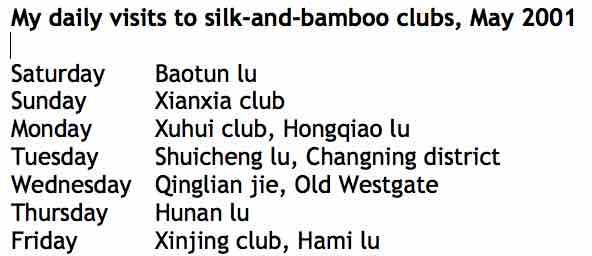
A committed party man, Liu Shaoqi was genuinely shocked by the disastrous state in which he found his home village. He had dedicated his every waking moment to the party, only to find that it had brought widespread abuse, destitution, and starvation to the people he was meant to serve.

Becker also describes Liu Shaoqi’s visit to Hunan:

In the Hengyang district “nearly an entire production team had died of hunger, and there was no one left with the strength to bury the bodies. These were still lying scattered about in the fields from which they had been trying to pull enough to stay alive.” Yet when Liu Shaoqi and his wife, Wang Guangmei, visited Hunan to see for themselves, local leaders went to extraordinary lengths to try and deceive them. Along the road leading to Liu’s home town of Ningxiang, starving peasants had torn the bark off the trees to eat, so officials plastered the tree trunks with mud and straw to conceal the scars. […] Liu only managed to discover the truth in the village where he had been born, Ku Mu Chong, when some villagers dared to tell him that twenty of their number had starved to death, including a nephew of Liu’s, and that a dozen more had fled.

Expressive culture
With all this in mind, it may seem almost perverse to turn our attention to expressive culture. Doubtless in some areas upon the 1949 Liberation, traditional culture was virtually stamped out, quite abruptly, only reviving after the collapse of the commune system from the late 1970s. Even where traditional genres survived relatively unscathed in the early 1950s (in 1956 Yang Yinliu’s team found rich material on his fine fieldtrip to Hunan, and his report contains no hint of the impending disaster), one might suppose that they would have declined further as collectivization intensified. We might doubt the ability of performance genres to survive through the famine following the 1958 Leap. Indeed, in many regions, irrespective of any official prohibitions, it may seem inconceivable that people could even have the strength to observe traditional cultural practices (see e.g. here, under “Religion and culture”).

On the contrary, it seems that it was precisely the desperation of the times that prompted (on the economic front) a revival of folk performing groups and (in the sphere of belief) a renewed emphasis on traditional ritual. With no food or shelter in their home villages, people resorted to extreme measures. Migration was a traditional response to adversity; Hunan peasants often crossed the border into Hubei (cf. the flight of Yanggao dwellers to Inner Mongolia: Daoist priests of the Li family, pp.120–21).

For the condition of folk performance activity in the early 1960s, apart from talking with people who recall the period, official documents in the Appendices of several of the provincial volumes of the monographs on opera and narrative-singing in the Anthology make an unlikely but revealing source, containing documents from imperial, Republican, and Maoist times, often relating to prohibitions (for all three periods!). [2] Often they inadvertently reveal “negative material” in discussing the desperate revival of folk and ritual groups from the late 1950s, reminding us that even through all the traumas of campaigns and collectivization, traditional genres “obstinately“, however tenuously, kept active.

A series of detailed documents from the Hunan Bureau of Culture between 1957 and 1965 gives a remarkably frank impression of a far-from-stable socialist society. [3]

A document from September 1961 innocuously prescribes a systematic project on the province’s rich heritage of local opera, specifically calling for impartial documentation irrespective of “feudal” and “superstitious” elements. Doubtless they benefitted from the model established by Yang Yinliu on his 1956 fieldwork. A lengthier document from March 1962 explicitly includes the diverse genres of narrative-singing in the project.

By October the Bureau of Culture was discussing the registration of “folk professional scattered artists” (minjian zhiye lingsan yiren 民间职业零散艺人) that they had initiated in 1957. They note the recent growth of such performers along with state cutbacks and the arrival of migrant groups; some belonged to the “five black categories”, performing “unhealthy” items.

With new campaigns for Socialist Education, the tide was turning: by April 1963, prompted by a central decree from Beijing, the Bureau of Culture issued a ban on the performance of “ghost operas”, which had grown “in the last couple of years”. For rural and urban Hunan they describe an increase of funeral elegies and rituals, offering incense and worshipping the Buddha, constructing temples, and inviting opera groups for rituals to invite the gods and redeem vows, [4] all encouraging the spread of anti-revolutionary elements and reactionary sects (fandong huidaomen).

A draft discussion from 1964 elaborates further on how to register folk performers, mentioning over 12,000 rural scattered semi-professional artists (performing opera, shadow-puppetry, marionettes, and narrative-singing), some of whose groups “have become hiding places for class enemies, their programmes mostly spreading feudal superstition and capitalism.”

Despite (or because of) the rising tide of political campaigns, a lengthy supplement from August 1965 reveals continuing issues:

wenjian 1
wenjian 2
wenjian 3
wenjian 4

Under “Severe situation” (pp.622–3), problems are listed under five headings, all with detailed examples:

  • Performing bad [feudalistic, superstitious, capitalistic] programmes, long prohibited but still rife, “poisoning people’s thinking”. This was a problem among the state troupes as well as folk groups: from the founding in November 1963 of the No.2 Marionette Troupe in Xinshao county to September 1964, 84 of their 103 performances were deemed “superstitious”.
  • People abandoning production to take up itinerant performance. Of 96 shadow-puppet artists in one district, 21 took it up before Liberation, 17 from Liberation to 1958, but 58 since 1958—and those taking it up since Liberation were mostly strong young men, badly needed to help agriculture recover from the disasters of the years of hardship. In Lixian county, [5] the senior yugu performer Cheng Dengyun’s oldest son (33) was a production-team chief, his second son (28) team accountant, his third son a strong worker, but from 1961 they all took up yugu and abandoned production.

Left: daoqing/yugu performers in Hengyang municipality, 1956.
Right: yugu, undated photo from Zhongguo quyi zhi, Hunan juan.

Yugu 渔鼓, related to daoqing 道情 and shadow-puppetry, is one of the most widespread genres of narrative-singing around Hunan and nearby provinces, using a distinctive drum made from a bamboo tube. The separate Anthology item on the genre introduces the early and later history of yugu, giving useful leads for the various regional styles. [6] But the 1964 document valuably supplements the largely official picture of yugu modernizing under the avuncular guidance of the Party. Online, besides more glossy official versions, you can find some excerpts from recent funerary performances, like this from Qidong county.

  • Exorbitant charges. In a case from 1963, two shadow-puppeteers from a commune in Hengnan county performed an opera to redeem a vow; apart from a ticket price [??] of 6 yuan, they also demanded a dou of “holy rice” and 2 jin of oil; at the end they gave a commune cadre a statue of the deity Guanyin and demanded a further 2 yuan as a donation.
  • Taking disciples, exploitative hiring practices—again showing the persistence of pre-revolutionary traditions.
  • Harbouring bad elements and carrying out anti-revolutionary activities; examples are given of puppeteers performing anti-Communist propaganda.

For local religious life over the Maoist era I haven’t yet sought documents from the Bureau of Religious Affairs, or indeed the archives of the Public Security Bureau, but one might expect revealing results there too.

Such coverage may be exceptional: for instance, the Monographs for Gansu are less revealing (see here, and here).

* * *

Having endured yet more traumas in the Cultural Revolution, such genres, mostly based on ritual practice, revived spectacularly after the collapse of the commune system in the late 1970s. But we can now see that the revival was not some miraculous atavistic re-imagining after three decades of silence: it took up a thread that had never been erased. Indeed, there was even a certain very limited activity through the Cultural Revolution decade. Equally, the wealth of research since the 1980s didn’t spring from a vacuum: it built on the brave work of scholars under Maoism.

Studies of expressive culture under Maoism are often narrowly based on central policy towards “the arts”. Candid documents like those discussed here reveal not only regional policy but—more interestingly—the real situation on the ground, even if they were seeking to “correct” it. Thus the Party refutes its own simplistic narrative that “feudal superstition” was abruptly suppressed after Liberation—a claim that is rarely challenged even by scholars outside China .

So the study of Maoism, expressive culture, and people’s lives should go hand in hand.

For more recent social issues in rural Hunan, click here; for famines in China and Ukraine, here. Cf. Gansu: connecting social trauma and expressive culture.


[1] The material here is based on Jasper Becker, Hungry ghosts and Dikötter, Mao’s great famine, consulting the indexes under Hunan. The famine in some provinces, notably Henan, was considerably worse: I won’t attempt to summarize the abundant material here, but again it is described by Becker, Dikötter, et al. For refs. to Henan folk opera troupes begging during the famine, see Zhongguo quyi zhi, Henan juan, pp.735–40. For the great famines of Ukraine and China, see here.

[2] Zhongguo xiqu zhi 中国戏曲志 and Zhongguo quyi zhi 中国曲艺志; cf. pp.329–30 of my “Reading between the lines: reflections on the massive Anthology of folk music of the Chinese peoples”, Ethnomusicology 47.3 (2003). For a recent discussion of sources on Maoism, see Sebastian Veg (ed.), Popular memories of the Mao era: from critical debate to reassessing history (2019).

[3] For all the rich material on local household Daoist ritual in Hunan, I would love to read more accounts of their activities under Maoism.

[4] Zhongguo quyi zhi, Hunan juan, pp.614–25.

[5] Confession: in “Reading between the lines” I miswrote this place-name—I have no culture!

[6] Zhongguo quyi zhi, Hunan juan, pp. 67–74; for its music, see pp.275–300, and Zhongguo quyi yinyue jicheng, Hunan juan.

An American musician in 1920s’ China

The great Yang Yinliu (1899–1984) (whose work is essential for an understanding of Chinese culture!) was brought up in the city of Wuxi amidst an environment of Kunqu, qin, and Daoist ritual.

In August 1921, the composer and violinist Henry Eichheim (爱希汉, 1870–1942), with his wife and daughter, made a journey to Wuxi to visit the great Wu Wanqing 吴畹卿 (1847–1927), leader of the prestigious Tianyun she 天韻社 Kunqu society, which dated back to the late Ming. Wu now arranged a series of seven private evening concerts for Eichheim. [1]

Apart from the main programme of unstaged Kunqu, the hosts performed solos for qin and pipa, “silk-and-bamboo” ensemble pieces—and Shifan gu and Shifan luogu, staple instrumental components of the local Daoists’ ritual repertoire, which Yang Yinliu was later to document in two definitive monographs. (Note how I avoided the dangerous term “Daoist music” there!) [2]

Shifan gu and Shifan luogu under the more monitored conditions of Maoism.

The concerts ended with Eichheim himself playing a selection of WAM violin pieces accompanied by his wife on piano—I can’t find a list of items, but I like to imagine that they included Kreisler’s Tambourin chinois (1910).

YYL

Yang Yinliu, undated early photo. Source: Yang Yinliu jinian wenji.

Among the musicians that Wu Wanqing assembled was his pupil Yang Yinliu, still only 22. Already a pupil of the American missionary Louise Strong Hammond, he now served as translator for Eichheim.

After trips to Japan, Korea, and India, Eichheim returned alone to a snowy Wuxi in December that year to hear more Shifan luogu. As Yang recalled,

I asked why he wanted to hear shi-fan-luo-gu again. He said that in the intervening months he had travelled to many countries, but this is the music that impressed him the most.

They played from 2 to 7.30pm, before Yang took Eichheim to the train station to rejoin his wife and daughter in India.

Later he also made trips to Indonesia. He was among many composers inspired by the soundscape of the Mystic East, including Ravel and Colin McPhee (but not Berlioz; see also Java to jazz)—though the influence of gamelan in his works, such as his symphonic variations Bali (1931), is not always audible.

Eichheim’s instrument collection is now housed at USCB. I wonder if any further records, such as photographs, survive of his visits to Wuxi. If only there were recordings! Perhaps it would be too much to expect Yang Yinliu to have taken him to film the rituals of the Daoists…

For Eichheim in Japan, click here.


[1] See my Folk music of China, p.248 (amidst an introduction to the Shifan genres, pp.252–69), and Peter Micic, “Gathering a nation’s music”, p.96, both based on Yang Yinliu, Shifan luogu (1980), pp.233–4. In my post on Yang I cited his earlier volume with Cao Anhe on Shifan gu. For the Tianyun she, see also Zhongguo xiqu zhi, Jiangsu juan 中国戏曲志, 江苏卷 p.726. Note also my lengthy review “Images of Abing”, British Journal of Ethnomusicology 6 (1997). For more on Eichheim, see Anthony Sheppard, Extreme exoticism: Japan in the American musical imagination (2019), ch.3.

[2] Despite my aversion to the term “Daoist music”, two volumes by Qian Tieming 錢鐵明 et al., Wuxi daojiao keyi yinyue yanjiu 無錫道教科儀音樂研究 (Taipei: Xinwenfeng, 1999) are substantial. Still, there is a wealth of research on Daoist ritual around the Jiangnan region that doesn’t pluck soundscape out of its ritual context—notably in recent years from Tao Jin 陶金 in Suzhou, Shanghai, and so on: note Roundup of posts on south Jiangsu.