Saga and Sofia

*UPDATED! Watch the last clip below only if you’ve seen the whole of the final series!*

We can now bask in a fourth series of The bridge on BBC2, more noir than ever.* It’s one of the great dramas “like ever“.

I realized it’s obligatory for TV cops to be damaged, but it remains a mystery to me how Saga could get, and keep, a job that demands such skills of personal interaction, at least a feigning of empathy (contrast the equally magnificent Sofie Gråbøl in The killing—no less troubled, but not hampered by Asperger’s).

This interview with the divine Sofia Helin is one of the best bits of acting since Klaus Kinski playing himself, as she transforms her personality at the flick of a switch:

And we can relish many more interviews with her on youtube too.

This clip is a tad niche, but her diction is a revealing aspect of Saga’s personality:

And a drôle, not to say macabre, language lesson:

To imbibe the passion the series generates, try Twitter #THEBRIDGE4, and the BTL comments under the Guardian recaps.

But don’t take my word for it—here’s a critique of an earlier series from Philomena Cunk, where she explains the technicalities of foreign languages:

The theme tune complements the mood. Its lyrics have defeated most people—here are some fine mondegreens:

BTW, I note that the timbre of the singer is akin to that of Henrik’s voice!

*Watch the clip below only after you’ve seen the whole of the final series!*

Here’s a tribute to the Saga–Henrik relationship:

For more soundscapes of Nordic noir, see here.


*Meanwhile if you have a month to spare right now, the first three series are also available! Not to mention The killing

Forms of address

*Not suitable for those of a sensitive disposition!*
[Red rag to a bull—Ed.]

This is one of the classic stories in our Fieldworkers’ joke manual, always coming to mind whenever some formal meeting prompts Chinese people to address me with the honorific nin 您 for “you” rather than the standard ni 你 (for a fine discussion, see here).

Dating from 1980s’ Beijing, the crucial pronouns of the story translate much less naturally into English than into other European languages, which still preserve the distinction between informal singular and honorific plural forms of the word for “you”:

So there’s this factory worker riding his rusty old bike home after his shift, trundling along in a daze. All of a sudden a big shiny Mercedes casually turns right just in front of him [as they do], and with no time to screech to a halt, the worker’s bike bumps into the gleaming car. As the chauffeur stops to inspect the damage, the furious worker leans over into the car and shouts,

“Your mother’s cunt!”
[Ni malegebi!]*

On behalf of the high-ranking Party apparatchik seated in the back, the chauffeur comes back with,

“Hey, comrade! How dare you speak so disrespectfully—don’t you realize there’s a VIP National Leader sitting in the back?”

Feigning an apology, the worker exclaims politely,

“Oh, I’m sooo sorry— I should have said, ‘Your esteemed… mother’s cunt!’
[Nin malegebi!]”

BJ bikes

Getty Images.

In Italian the variants might go “La fica di tua madre” and “La fica di vostra madre” (cf. the vocabulary of Burlesque-only—Oh, and La vaca t’ha fat, also featuring posh car…).

On an Academy of Ancient Music tour of the States around 2002, a couple of my mates enjoyed the story, and wanted to hear me telling it in the original Chinese. Rodolfo, amazing fiddle player from Brazil, thought it would work well in Brazilian-Portuguese, so I talked him through it in English, and one evening after a gig in Nebraska, as the band was gathered in an unsalubrious pub, he did a near-simultaneous Brazilian-Portuguese translation while I told the Chinese version—which, beautifully, had ’em rolling in the aisles. It’s Not the Joke, it’s the Way you Tell it.

Among my Chinese mates this story is such a classic topos that now if I want to swear at one of them, all I have to do is mutter, “NIN…”

*For Miles, Keef, and Listen with motherfucker, see here. For some reason, Chinese bi is a tad less offensive than its English equivalent: see here. For the c-word in English, click here.

Two geniuses


It’s all very well me swanning off to China (see flurry of posts since 14th March) and Germany, but one has to keep up with the domestic news. OK, the Windrush affair is shameful, but on a lighter note:

  • The imminent departure of Arsène Wenger from Arsenal has finally produced the tributes he deserves (for his classy send-off, see here). Football will never see his like again. And if you haven’t noticed my post on Daoist football, then DO!
  • And meanwhile in the snooker, the gorgeous and inspired Ronnie is back in action!!! I’m getting this in early (his next match is on Friday), as one never knows, but beholding him is always a thing of magic. Whether or not he progresses further, here’s my occasional reminder that you just have to watch his 147 maximum break from 1997—I will accept no excuses.

And I have another episode of Cunk in Britain to catch up on too!

Trading classics

I heard these two stories independently, one in England, one in Italy, but they belong to the same family [like we donote for the UKIPs].

A beggar waits at the lights every day for cars to stop so he can ask drivers to spare some change. When a chauffeured Rolls Royce purrs to a halt, he shuffles over and taps on the rear window. As the monocled boss presses a button, the window winds down silently; taking a scornful glance at the beggar, he remarks,

Neither a borrower nor a lender be—William Shakespeare.”

He winds up the window and the car glides off, leaving the beggar disgruntled.

Same thing next day—he spots the Rolls Royce again, and shuffles over. As the boss wearily winds down his window, the beggar responds suavely,

Cunt—D.H. Lawrence.”

I now find this was recounted by the great George Mikes in English humour for beginners (1980).

And here’s a variant from Mantua—birthplace of Virgil, need I add:

There’s this little guy in his clapped-out old Fiat Cinquecento, putting his foot down on a dual carriageway in town to try and beat a gleaming Mercedes. Indeed he clatters up to the lights ahead, but as he frantically revs up there the Mercedes glides up smoothly alongside. The posh driver glances over at the sweating pleb and observes suavely,

Chi va piano, va sano e va lontano—Esopo.”
[The race is not to the swift—Aesop]*

As the lights turn green, the Mercedes purrs off and the little guy in his Fiat chugs along in hot pursuit. Putting his foot down again he does manage to overtake, but once more he has to screech to a halt at the next red light, and the Mercedes glides up again. This time the Fiat driver leans over and shouts,

La vaca t’ha fat!—Virgilio.”
[You were made by a cow!—Virgil]

The different punchlines (the latter in Mantuan dialect, note) and their imputed sources each have their distinctive charm. Another one to file under International Cultural Exchange

*Pedant’s corner: This is the driver’s attribution, of course: it does indeed resemble Aesop’s tale of the tortoise and the hare, but it’s actually an unattributed proverb zzzzz.

Posted from Berlin. But not so you’d know.

At home with a master Daoist

As weird holidays go, this is pretty weird…

To supplement my various articles on particular themes (a ghost village, a funeral, the murals of Artisan the Sixth, Elder Hu, In search of temples, and so on), this diary records the more domestic side of my recent trip chez Li Manshan—like my notes on our French tour last May, the kind of thing one hardly finds in inscrutable accounts of hallowed Daoist ritual.

As I land in Beijing, pausing only to catch up with my wonderful hosts Matt and Dom and to buy a SIM card, I take the midnight train to Yanggao—smashing my personal best time for Fastest Ever Escape From Beijing. You may like to begin by reading my updated description of my first couple of days there.

Catching up
Despite improved transport and smartphones, progress seems superficial. This is still another world from the skyscrapers and Party congresses touted by the international media. Like anywhere else in the world, indeed. And it’s hard to see evidence of greater repression—people are well used to it.

Li Manshan’s home village of Upper Liangyuan still has some over six hundred dwellers, which counts as a lot round here; but it seems forlorn, stagnant. It’s ever clearer that the rural population is “left behind”—elderly people sitting outside awaiting their turn. Litter remains an intractable problem, blighting what might almost be an idyllic landscape.

Having been worked off his feet for many years, now that Li Manshan is in his 70s he’s giving way to Li Bin, who’s busier than ever. Li Bin has three funerals to do today, one a solo attendance at the grave (“smashing the bowl”, “without scriptures”) for a Catholic family, who still need the procedures for the date and siting of the burial. On the 17th (or rather the 2nd, chu’er—I soon get used to the lunar calendar) he has to smash two more bowls.

So now Li Manshan only works nearby—decorating coffins, doing grave-sitings and visits to determine the date for burials, as well as the occasional funeral. Soon after I arrive he zooms off on his motor-bike to Yangguantun to decorate a coffin. I’m happy to try and sleep off my journey from London.
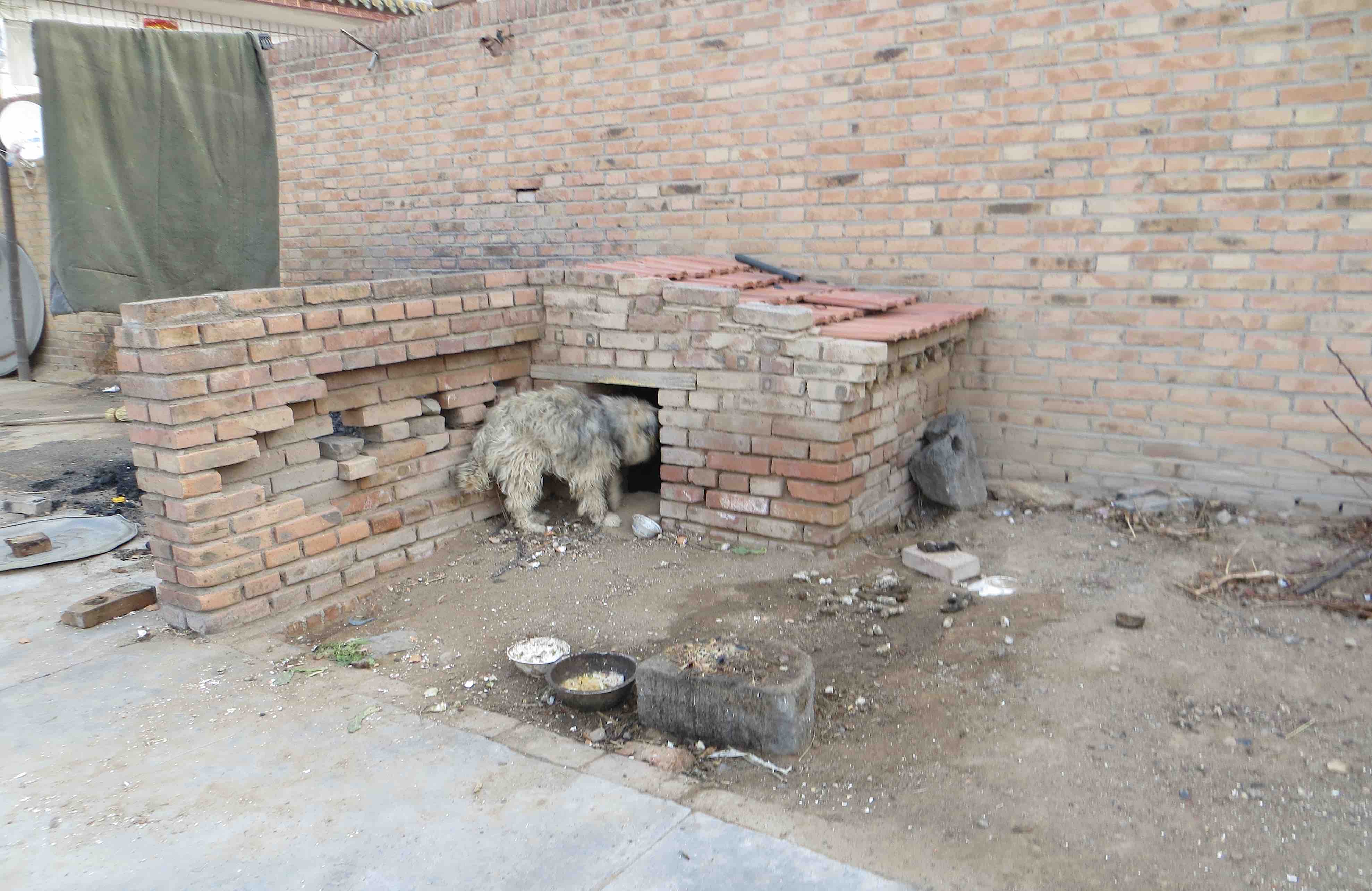
doggie

Visitors are always announced by a barking dog, like a doorbell. The Lis have a new doggie, rarely off its tether by its kennel in the courtyard. It’s frozen. When I tell Li Manshan’s wife (busy making funerary headgear) about our poncey UK winter gilets for dogs, she shrugs, “He’s fine, he’s got fur ain’t ‘e?!”

LMS wife sewing

Li Manshan’s (only) disciple Wang Ding returns from a funeral to unload the decorations for the soul hall, now improved and more convenient. Renting out this equipment to funeral families is another source of income for Li Manshan. Giving Wang Ding a hand, I tell him I wrote a little post about him after our little French tour last year; he hasn’t got internet, so he will look at my blog at Golden Noble’s place. He can speak pretty good Yangpu, but even after all these years I find their dialect as tough as ever.

I hardly bother to wear my glasses any more—like clarinetist Jack Brymer, who when rehearsing a contemporary piece would wear his for the first five minutes, and then only keep them on if he thought it was worth it…

The domestic routine
Li Manshan’s first tasks on rising are to fold the bedding, take out the chamber pot, fetch kindling for the kitchen stove and our little stove in the west room, and boil water. He does his bit with the housework: sweeping, mopping, stoking the stove, preparing water—though he leaves most of the cooking to his wife. The little coal stove is cute and effective, but mafan. At last I learn that the central foyer is called tangdi 堂地. Both living rooms are equipped with a low wooden table, actually rather handsome but covered in plastic, to place on the kang, used for meals and writing. Plastic rules OK—and a jolly good thing too.

meal

Our diet consists mainly of baozi dumplings, [1] noodles, crêpes, mushrooms, eggs, bits of meat, meatballs, doufu, cabbage, nuts. Sometimes our meals evoke the classic film Yellow Earth—indelible image of the fieldworker overwhelmed by the sheer enormity of poverty and traditional culture. But we giggle a lot too.

Again Li Manshan stresses how much he prefers country life. I soon get used again to its basic routines, not least visits to the latrine in the southwest corner of the courtyard—taking paper (The Thoughts of Uncle Xi would be useful, but it’s not to hand/arse), and a torch if dark, to balance on a ledge; adjusting trousers, squatting (not getting any easier)…

Amazingly, for my visit in autumn 2013 Li Manshan modified his old latrine, building a little roofed pier (so to speak) over a floor on pillars projecting from the spacious pit. Like the world, it was built in seven days. After designing it on paper, he borrowed 230 bricks, as well as stone slabs, tiles, and so on, from neighbours; then he got down and dirty over a week at the height of summer. I felt embarrassed, but he pointed out that it would be good for them too.

We refer to it as The London Embassy (Lundun dashiguan, pronounced like “Taking turns to squat in the big shithouse”). The great Beijing cultural pundit Tian Qing even bestowed his illustrious calligraphy on Li Manshan, albeit in the more polite version.

So (thanks to me) the latrine is pretty comfortable, but it makes a suitable image to imagine the poverty of the olden days (including the Maoist era—a sobering contrast with the bright propaganda posters of the time): the old and infirm trudging to an open pit in the snow, with no paper, no sanitary products, no torches in the dark.

I’m so pampered, compared to Li Manshan’s lifetime “enduring suffering” (shouku 受苦). From my book (pp.132–3):

Shoulders unable to carry, hands unable to grasp, soft and sensitive skin…

Coming across this phrase in 2013 as I made inept attempts to help Li Manshan with the autumn harvest, I thought it might have been coined to parody my efforts. Rather, it’s a standard expression used to describe the travails of urban “educated youth” in performing physical labour after being sent down from the cities to the countryside in the Cultural Revolution to “learn from the peasants”. The experience was a rude shock for such groups all over China; brought up in relatively comfortable urban schools to believe in the benefits of socialism, and often protected from understanding the tribulations of their own parents, they were now confronted not just by the harshness of physical labour, but by medieval poverty.

Li Manshan is thrilled with my little gift of a set of UK coins, working out which is which. He proudly offers me a black banana, white and tasty on the inside, but decides to eat it himself; we have a giggle over glossy modernized bananas (cf. “banana republic, but minus the bananas”). His wife passes the time by playing “matching pairs”, a kind of dominoes. A female friend of hers drops by for a chat. They’re all very humorous, beneath a somewhat dour exterior. Li Manshan and his wife seem like counsellors.

In reply to villagers’ curious enquiries about how many kids I have, Li Manshan is now in the habit of replying wu, which they hear as “five” 五 but in his creative head means “none” 无. This surprisingly shuts them up—I worry about having to embroider stories about their careers, my numerous grandkids, and so on, but no. Anyway, Li Manshan would be up for this. He observes that since my surname is Zhong 钟 (Clock), my son might be named Biao 表 (watch).

We share a nice supper of noodles, and more dumplings. The CCTV evening news is on as wallpaper [Breaking news! CCP holds meeting! Xi Jinping still in power! Old gits in suits dead bored!]. It’s ignored until the weather forecast comes on, but Li Manshan loves the nature programmes.

“Wotcha doing when you get back to Beijing?”, he goes.
“I’m going to be giving lectures (jiangke)…”
His local dialect, or his lively mind, instantly converts this to jiekastammering”:
“Old Jonesy, you don’t have to go back to Beijing to stammer—you can just keep on stammering away here!”

I manage both.

Writing
Though Li Manshan is doing fewer funerals these days, he has always got ritual paperwork to do—whether it’s writing talismans, shaping paper for funerary artefacts, or writing mottos for the soul hall (our film, from 10.41;  Daoist priests of the Li family, pp.194–200).

He’s bought big reams of thick paper from Yangyuan county. He recalls that when Li Qing recopied the ritual manuals in the early 1980s, mazhi hemp paper was available from the Supply and Marketing Co-op.

One day our siesta is disturbed by a group coming to ask Li Manshan to “determine the date”. After seeing them off he spends the rest of the afternoon writing several dozen sets of four-character funerary diaolian mottos for the soul hall (my film, from 10.43)—enough for a couple of months. Again he recalls how Li Qing used to write them in the scripture hall for each particular funeral. I devise a new game: arranging the squares in a different order to make a popular phrase or saying. For starters, how about 東方妙,西方福 (“oriental mysticism is all very well, but things are kinda cushy over here”).

A trip into town
One morning we call up the wonderful Li Jin to arrange a nice quiet lunch in town, just the three of us. Li Manshan’s wife chooses a posh shirt and jacket for him.

In 1953, when he was 8 sui, Li Manshan walked into town with his auntie to see the big xiangong parade there. Now we walk up to the main road to catch the No.2 bus into town; it arrives soon, a mere 3 kuai each, taking under half an hour—fun, and good to be independent. I go to have my head shaved at my favourite barbershop, and we meet up with Li Jin at Li Bin’s funeral shop. But then Li Manshan’s (much) younger brother Third Tiger shows up too, and he drives us in his posh car to a posh restaurant (attached to a posh hotel) up a little hutong, with no sign (which is always a good, um, sign)—we’re the only customers. But then entrepreneur Ye Lin (another old mate, formerly head of the Bureau of Culture) arrives too, and Li Bin; so altogether it’s less of a quiet meal than I hoped.

lunch LJ LB LMS

lunch Sanhu

Third Tiger has brought a case of Chilean 2011 Cabernet Sauvignon from Central Valley, a gift from a friend. We polish it off, though later the ganbei toasting seems a bit unsuitable…

Third Tiger had been looking forward to early retirement from his important state job—even claiming in my film (from 55.23) that he’d like to get back to Daoist ritual—but it won’t be happening any time soon. He’s done well as a Party cadre, his only flaw being that he can’t really hold his drink—this should surely be the first question on the application form:

How much baijiu liquor can you knock back before you fall over?

Inevitably Third Tiger foots the bill. I remind my companions of the donkey joke—I’m inadvertently “cadging a free meal wherever I go” again…

After lunch, Li Bin takes us on a fruitless visit to the Cultural Preservation Bureau to learn that the compilation of Yanggao temple steles is still not published. Then we drop in on a shop up the road to sort out a standoff between my camera and my Mac; the guy is even more pissed than me, but does a fine job. We exchange cigarettes, and he refuses any money.

Li Bin is happy to take us home to Upper Liangyuan, and on the way we drop in on the grandson of the great Li Peisen at his funeral shop, to see if he can show us the three manuals not in Li Qing’s collection, which I didn’t copy. He and his wife seem affable, but he can’t find them. It’s hard to know if he’s being cagey: he does show Li Manshan Li Peisen’s thick Yuqie yankou volume, so maybe he really can’t find the others. I ask him, without much hope, to call Li Bin if he does find them. Li Manshan cares more about this than I do.

I’ve also been wondering if the related Wang lineage in Baideng has any ritual manuals we haven’t seen, but when Li Manshan calls up Wang Fei there, he says they have no more than him.

More Heritage flapdoodle
Next to the main sign above his funerary shop, Li Bin has optimistically put up a new sign: “Hengshan Daoist Music, Training Base”.

HSDYT shop placard

This pie-in-the-sky still has precisely no takers, but Li Bin remains involved in a mysterious project with the county Bureau of Culture. We all laugh at the emptiness of the title—but it acts like a protective talisman, a kind of insurance policy.

Pacing the Void: Old Lord Li gets online
Like me, Li Manshan got his first smartphone after returning from France last year. He can read WeChat messages, but hasn’t cared to try and get online—yet. I think he can do it. Actually, WeChat doesn’t seem such a big deal here—sure, the younger people are on it, but the main way of communicating is just phoning. So there.

Getting online with my Mac thanks to the wifi of Li Manshan’s cool shepherd neighbour, I show him the charming TV version of The Dream of the Red Chamber with child actors. He loved reading the novel in the 1980s.

I give him a guided tour of my blog, starting with the posts I wrote about our French tour last year (e.g. here), my tribute to his carpentry skills, and the trio on Women of Yanggao (starting here). We look further at the ritual paintings in Li Peisen’s collection, which leads us to seek murals by Artisan the Sixth.

Then I introduce him to my other world, telling him about Yuan QuanyouHildi, and the 80th-birthday party for the great Stephan Feuchtwang where Rowan and I played Bach on erhu and sanxian—after listening to the recording there (now also sounding a bit crap), I try to attone by playing him Sun Huang’s astounding Saint-Saens (or Sage Mulberry, as he’s known in China), but he’s underwhelmed—the conservatoire erhu is of even less relevance to him than to me. And he’s none too clear about the qin zither, despite painting it regularly on coffins (my film, from 18.30).

LMS huacai

Li Manshan decorates a coffin, 2013. Top: qin zither.

I tell him again about the adorable crazy Natasha, showing him my tribute to her—it was he who helped me regain the will to live after her death in 2013.

Over the next few days Old Lord Li becomes ever more scholarly, devouring the new book on the modern history of the county (only up to 1949, alas!), the gazetteer, and all the online stuff I show him. (You may note that he has reverted to his old hat—was the baseball cap he wore in France a haute-couture choice to impress the laowai?!)

He gets into Ming reign-periods online. I show him the Baidu article on the 1449 Tumu incident (very near Yanggao), making the link with the disgraced palace eunuch Wang Zhen and the Zhihua temple. As he gets hooked on some pre-Tang story in the county gazetteer, I turn the tables on him, commenting “I dunno about that, I wasn’t even born then!”

As he gets used to scrolling on my Mac keypad, I show him the blurb for the Chinese introduction to the already-voluminous Daojiao yishi congshu series, which he reads carefully. When I show him Hannibal Taubes’ amazing site, he thinks that Yanggao temple murals are not so well preserved as those of Yuxian—but I suspect it could also be that Hannibal is really on the case.

I tell Li Manshan of the useful saying “When the rites are lost, seek throughout the countryside”, which is always a succinct way of explaining what we’re doing traipsing around poor villages.

On my blog he’s interested to pore over ritual manuals from other areas. I find an online text for the pseudo-Sanskrit mantra Pu’an zhou, which they never sang, only played on shengguan. When we listen to my recording of Ma yulang with the Gaoluo ritual association (playlist # 10, with commentary here), he’s shocked at how crap they are! I explain that they’re an amateur group, not like our occupational Daoists working together daily. But he’s curious to learn if the melody is similar to their version, a question I haven’t yet addressed.

We discuss the Kangxi yun section in the hymn volume that Li Qing recopied in 1980—I’ve often wondered what it’s doing there, as part of a series of shuowen solo recitations formerly used for the shanggong Presenting Offerings ritual segment. It was actually written not by the Kangxi emperor but by his father Shunzhi. The version copied by Li Qing is a variant.

Kangxi yunAs we read up further, we now speculate that since Kangxi saw the poem on a visit to Wutaishan, and as Buddhist ritual manuals do contain poems, it could have got into one such manual there; spreading further north, it might thence have got into Daoist manuals too—which, after all, contain plenty of Buddhist elements (my book, e.g. p.226).

I wonder if the title Kangxi yun is distinctive to the Li family. If Li Fu copied it from the manuals of his master in Jinjiazhuang, it wouldn’t have been at all old when it was copied by the Zhang family Daoists there. More work for a historian there… Li Manshan buries himself in the Baidu articles on Shunzhi’s mother and Nurhaci.

He knows nothing of Trump, Syria, or the Ukraine famine. While envying him his blissful ignorance, I embark on a political education session; he reads avidly when I show him the relevant Baidu articles. The article on the Ukraine famine looks rather good—though one can hardly expect Baidu to compare it to the Chinese famine following the Great Leap Backward.

After returning from a brief trip to Waterdrop 滴滴水 village with Li Bin, I check the 1948 and 1990 population statistics (first two columns below) in the county gazetteer, but they seem incongruous. Old Lord Li inspects the table for the whole of Zhangguantun district and deftly corrects them. Clever guy!

renkou edits

Born at a different time in another place, Li Manshan might have become a university professor.

2nd moon 28th
As yet another idée fixe in Airplane goes, “Looks like I picked the wrong day to” get my head shaved—it’s really rather cold. Li Manshan kept reading till late last night. We stay home for a study day. He fields another “determining the date” request by phone.

Before midday a couple comes for a prescription about her illness. They’ve come all the way from Datong county, learning of his reputation on the grapevine. Sure, people may also consult mediums, and of course hospitals—the latter terribly expensive, but as Li Manshan observes, their best bet.

LMS krz

The mood is serious as ever when the wife throws the coins and Li Manshan writes down the results. They watch him work it all out, in silence; then she asks questions, the conversation deepening. Li Manshan feels his role (often) is to console them, to lend moral support. As he later tells me, in fact the prescription looks ominous, and mostly he trusts the coins, but he can’t tell them “You’ve had it”, can he? They persuade the couple to stay for lunch (baozi dumplings, cabbage and doufu, onions), washed down at the end with water from the pot. It’s a friendly and sincere scene. They only paid him with five cigarettes, and Li Manshan was fine with that.

Li Manshan’s siesta is devoted to further reading, and he’s only just nodded off when another guy comes for a prescription.

Another great supper: thick-sliced noodles with eggs, dunking meatballs in the broth. Li Manshan glances over at the news, nudging me—some Party bigwig is being interviewed, the caption reading:

中国人大代表 Zhongguo Renda daibiao
Representative of the Chinese People’s Congress,

which he brilliantly converts from three binomes into

中国人,大代表 Zhongguoren dadabiao
Chinese bloke, big cheese.

We fall about laughing. I just love the way this man’s mind works! The following week I’m showing my film at People’s University in Beijing, which is also abbreviated as Renda—so I manage to press the expression into service there.

I clean my teeth in the courtyard, enjoying using my fancy electric Rabbits Don’t Shit, sorry I mean toothbrush (its first outing in China). Since Li Manshan always shoves a fag in my gob as soon as I get back anyway, I beat him to the draw. Whenever I spot an unfamiliar brand, I ask him, “Landlord? Poor peasant?”

3rd moon 1st (chuyi)—which, I note guiltily, is Saturday.
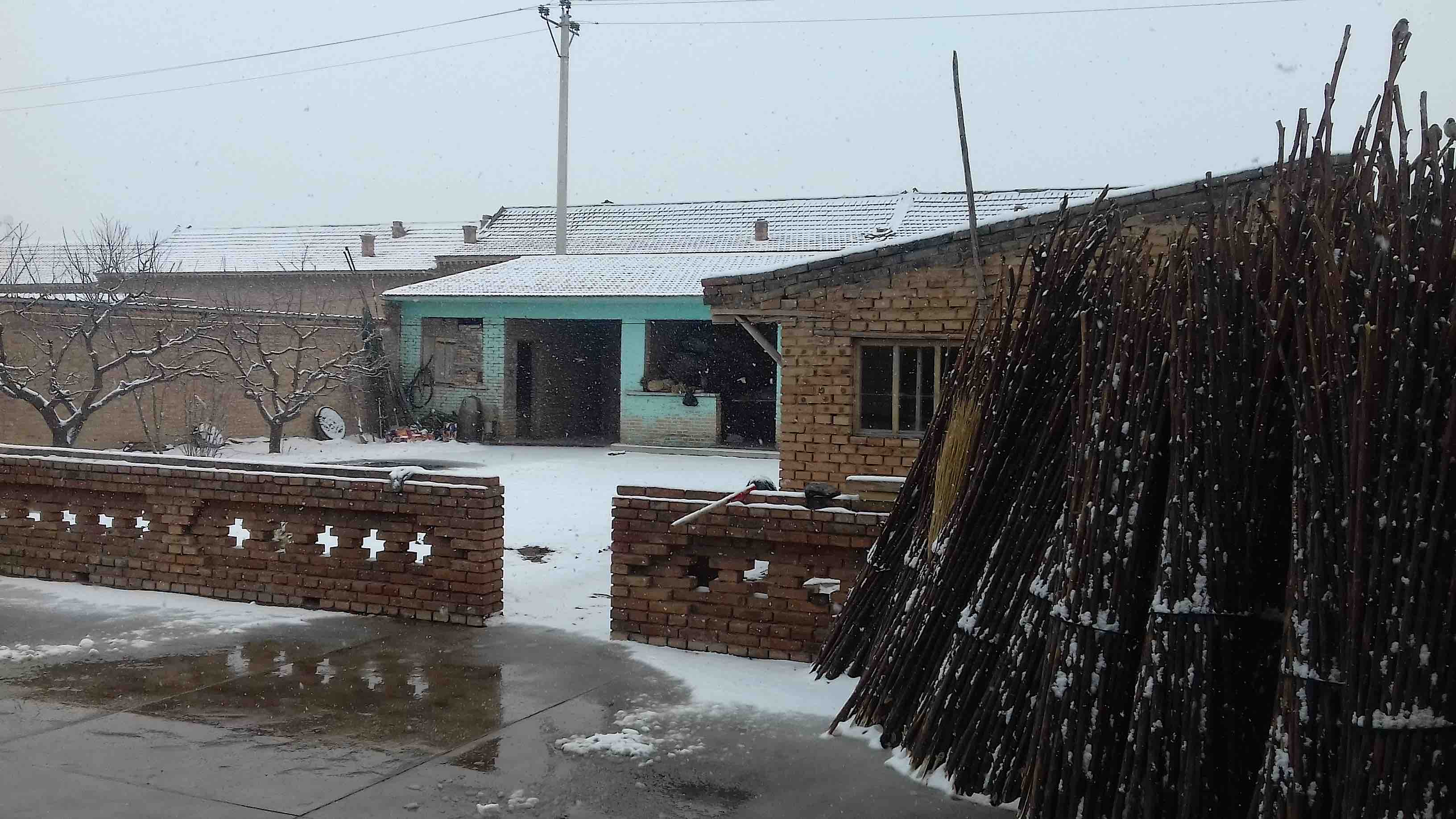
courtyard in snow

Right: sunflower stalks stored for use in making funerary treasuries.

OOH it’s snowing! I’ve been hoping to go in search of more Daoists to Yingxian county with Li Bin and bright young Taiyuan ethnographer Liu Yan, but my carefully laid plans come to nought; the motorways are closed. Li Manshan sweeps the pathway to the latrine, then zooms off back to Yangguantun to smash the bowl in a simple burial for the poor family there. When he decorated the coffin on 2nd moon 25th it was the fourth (not third) day after the death. He explains that there’s no difference between rich and poor in determining the date: it may turn out that poor families also have to store the coffin for over twenty days.

I discreetly perform much-needed ablutions. Li Manshan comes home frozen, unable to see through the snowstorm on his motor-bike. Gradually it eases up.

I show him my photos of the funeral I attended yesterday. He’s always been a laissez-faire leader, but even he draws the line at Wu Mei playing drum while on his mobile. We get a riff going:

“Maybe he was following the drum patterns online?!” he jokes.
“Oh yeah, right—I always felt sorry the so-called Hengshan Daoist Music Ensemble because they were too poor to afford music stands, but now they can read from their mobiles! You’re dead keen on ‘development’, aren’t you?!”—referencing the rose-tinted cliché common in online articles about him.
“Naughty disciple!”
“Naughty master! 青出于蓝。。。”

Wang Ding turns up on his dinky sanlun truck and we help him unload more altar decorations into the south room of the courtyard, redecorated as the village Training Base of the so-called Hengshan Daoist Music Ensemble—and thus, like its town counterpart, entirely unused.

3rd moon 2nd (Sunday, known as libai ba, eighth day of the week, as on their electronic wall-clock)
Foggy at first, gradually the sun comes out. For the first time Li Manshan worries about his cough, and resolves to quit smoking—which, impressively, he manages for nearly a whole hour. Actually he’s not smoking as much as in the old days when he was busy doing funerals with the band.

Having taken a siesta after our fascinating excursion to find murals by Artisan the Sixth, I go outside to clean my teeth, but yet again my oral hygiene is thwarted by the arrival of “Fag Devil” Li Sheng, who insistently shoves another fag in my gob. Typical

I keep up with Tweety McTangerine’s latest lunacies by consulting the Guardian online. But I dissolve in fits of laughter at Stewart Lee’s latest offering there.

3rd moon 3rd
At 7am a guy comes to discuss some work. At 8.20 the formidable wife of an old friend of Li Qing’s comes to moan about her son’s marital problems. Li Manshan is courteous, but considers her “crazy”. I understand virtually nothing, but eventually she makes an effort with me as she pours out her grievances, slapping me regularly on the arm. Village poverty and problems seem intractable, despite advances and propaganda. The only solution touted is thorough urbanization, bringing its own worrying prospects.

Li Manshan isn’t feeling too well, but he takes a break from making paper artefacts to accompany me on a visit to the temple to Elder Hu in the Lower village.

3rd moon 4th
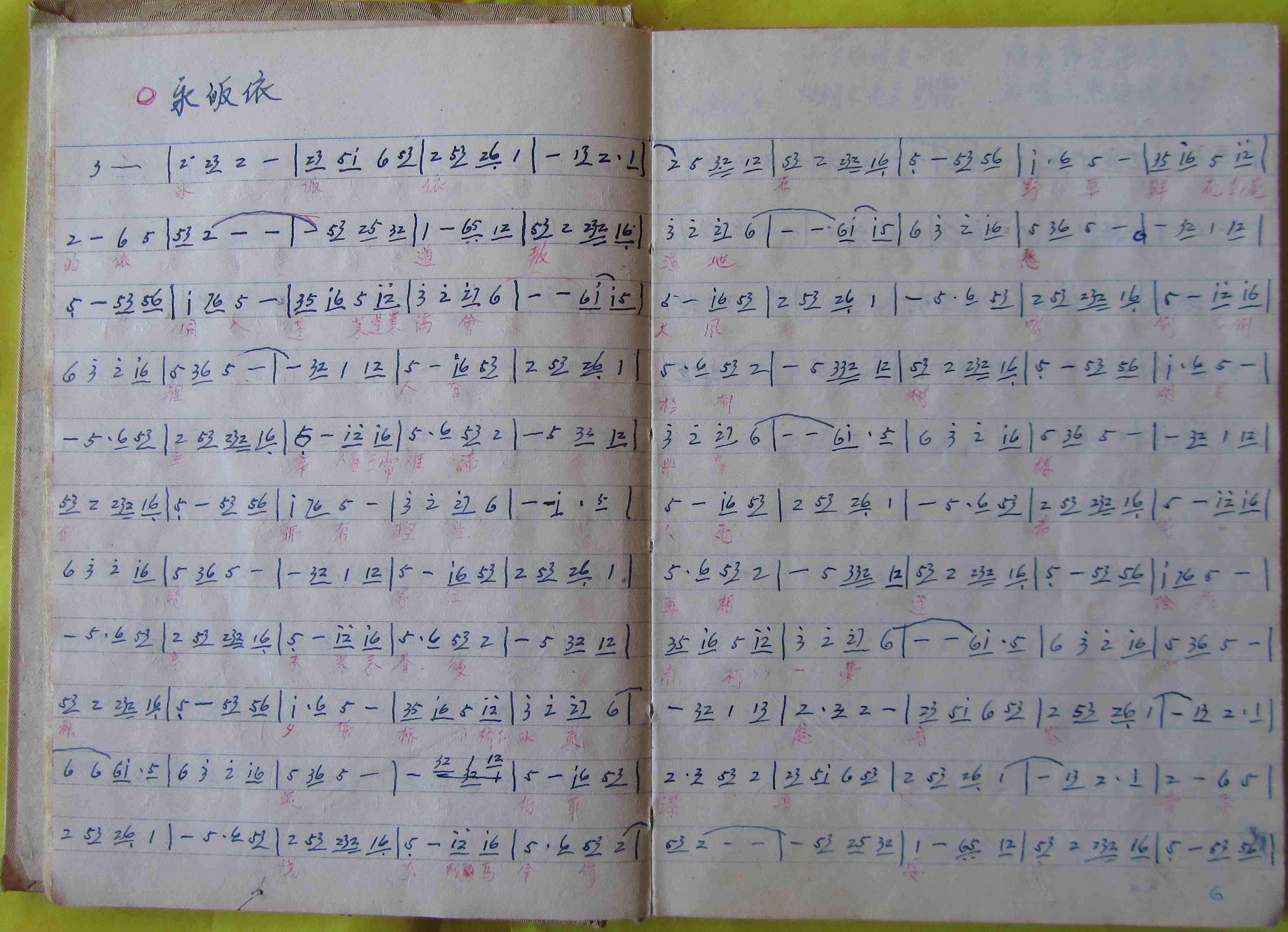
On our last day together, after returning from an intriguing trip to Jinjiazhuang, Old Lord Li suddenly thinks of the slow hymn Eternal Homage (Yong guiyi 永皈依), and we have a nice session on it. It’s one of his favourites, but they rarely use it, and now he can’t remember the opening. He can’t read cipher notation, only gongche solfeggio, so he gets me to sing it from Li Qing’s cipher-notation score. Their more recent green volume has gongche solfeggio underneath too, so he can just about follow it once I get him going.
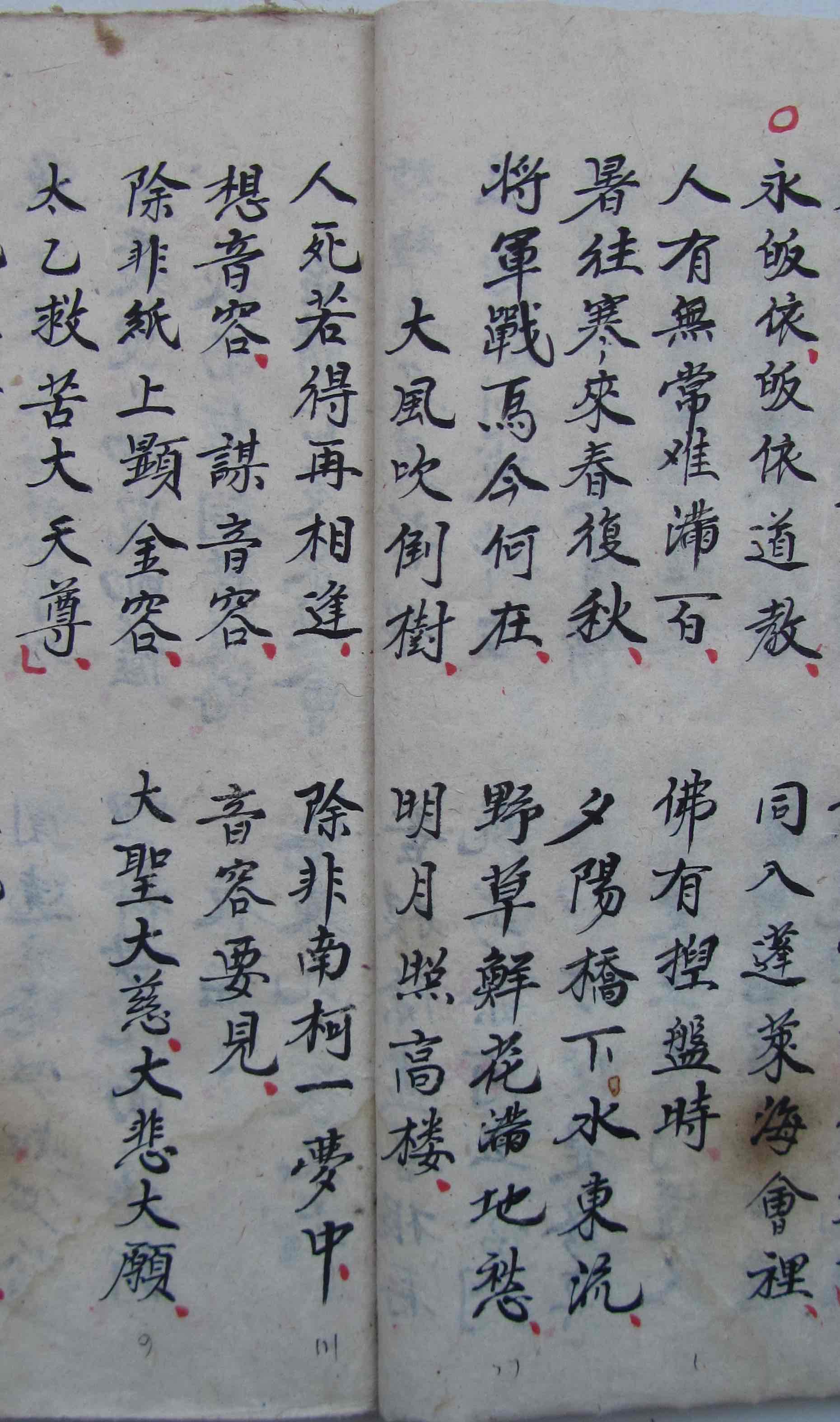
Yong guiyi textSo Li Manshan gets to record me singing a piece I barely know, but I never get to record him. Anyway he always sets off from a really low pitch, so the result tends to sound a bit like Tibetan chanting. When the band sings a cappella hymns for funerals, Golden Noble has a good ear for starting off on a pitch suitable for the range.

In the version they learned, the first section ends after Fo you Niepan shi 佛有涅槃时. Li Qing’s cipher-notation score isn’t divided into sections, but their more recent green volume is. The latter uses the degree shang 上 as do—including the shengguan suites, which I find strange. Li Manshan is fine once he gets through the opening phrase.
Yong guiyi jianpu

We take a siesta before my journey back to Beijing, but soon wake up. Absurdly, he now asks me to transpose Li Qing’s cipher-notation score of the major shengguan melody Yaozhang into gongche solfeggio. Without thinking to consult the precious photos of Li Derong’s old score (which Li Manshan no longer has) I wrongly assume that it would use the early shengguan system with he 合 as do, but hey. After singing it for him as he records it on his phone, I explain to him that he’ll need earphones to play it back…

Li Bin has another busy day today, having to do two reburials as well as decorating a coffin, so I’ll take a cab to the station. This no longer feels so distant. Li Manshan insists on coming along to see me off, and we leave before 4, dropping his wife off at Baideng township for a hairdo. He refuses to let me pay for the cab. My total expenses for nine inspiring days in Yanggao came to 24 kuai—just over £2.

We take the ring road, passing loads of new high-rises, and bid each other a fond farewell. The station is virtually empty, and the train isn’t busy either.

Back in Beijing, I feel like a country bumpkin. Showing my film three times over the next week, I’m happy to make Li Manshan a big star there. After the last screening I call him up to report, and to wish him well before I go back to London.


[1] As in the poseur’s celebrated line (Fieldworkers’ joke manual No.37), useful when someone asks if you know any classical Chinese:

[smugly] “I studied the Four Classics and Five Scriptures—Confucius, Mencius, various dumpling shapes, I’ve studied them all!”
Wo xuedeshi sishu wujing—Kongzi Mengzi baozi jiaozi, dou xueguole!
我学的是四书五经。孔子孟子包子饺子,都学过了!

Oh well, it’s funny in Chinese—Trust Me I’m a Doctor (there goes another 200 kuai).
Similar story here!

Cunk pulls it off again

YAY!!! Much as I love China, you can’t beat coming home to a new BBC TV series of Philomena Cunk (now immortalized with her own tag on this blog!)—this time reflecting, topically, on the history of Britain, in a noble tradition stretching way back to the mists of time with 1066 and all that.

All the trademarks of her inimitable style (scripted largely by Charlie Brooker) are here, not least her fatuous interviews with bemused experts.

Episode 1 takes us through Britain’s early history:

Dinosaurs came in many flavours, just like kettle chips.

On the Cerne Abbas Giant in Dorset (“the second crudest hill in British history, after Benny”):

Before Snapchat, hills were the best way to distribute dick pics to a wide audience.

I’m very keen on “middle-evil” (cf. “femininism“), and intend to adopt it. Admiring the Bayeux Tapestry, she observes:

It’s just like being there—but in wool.

I’ll need several viewings, as by the time I’ve scraped myself off the floor in tears of helpless mirth I’ve missed yet another bon mot.

Episode 2 does for the Tudors [is that it?—Ed.]:

Hampton Court Palace—a building so impressive, it has to be accompanied by harpsichord music.

Drake—the first person to circumcise the globe.

As a Puritan, Cromwell outlawed popular entertainment—effectively turning the entire country into BBC4.

Holding further earnest interviews with the likes of Alice Roberts, Ashley Jackson, and Shini Somara, all suitably shell-shocked:

How did Sir Walter Raleigh invent the potato?

she moves boldly on to Horrorshow Nelson (unable to clap, possibly a prototype for Rod Hull and Emu) and Napoleon Cumberbatch.

The third episode, helpfully called The third episode, takes us on a heady journey right up the 19th century,

a time when British creativity was at its peak, bringing us everything from great works of art to great works of train.

Again hapless experts find themselves fielding probing questions like

If Shelley’s one of the greatest poets in English literature, how come nobody gives a shit about him today?

Who was the man from Nantucket that By Ron wrote about in his poem?

She moves deftly on to the novels of Jane Austen,

filled with words it’s almost impossible to care about.

And the “Industrial Revalation”:

Workers did long, thankless hours with no breaks and low pay, in a squalid and threatening environment—conditions unthinkable today to anyone who isn’t a junior doctor.

Putting her experience in researching “femininism” to good use, she ends with a paean to the suffragettes:

Women were thought of as simple creatures who could give birth and raise families, but couldn’t be trusted with something as complicated as drawing an X with a pencil. Today it’s unthinkable that a woman wouldn’t able to vote—unless she was really hungover or… in her slippers and it was raining…. Emmerdale Pankhurst thought women could be more than just wives and mothers, so she deliberately only had five children, leaving her loads of time for politics.
One suffragette, Emily Davison, threw herself under a horse to get the vote. But the vote wasn’t under a horse—it was in a little wooden booth in a primary school, though to be fair, women wouldn’t have known that.

Episode 4 is a penetrating analysis of the turbulent 20th century, beginning with King Edward—

who despite his name, wasn’t a potato, but a man.

Interviewing the game Howard Goodall about Land of ‘ope and glory, she asks

If you sang it in, like, Portuguese, would it still feel British, or would that just fucking ruin it?

Along with the sitcom Brush strokes, which makes several lengthy and baffling cameos throughout the series, Ashley Jackson is one of the star interview victims, fielding questions like

Why did they call World War 1 “World War 1”? It’s quite pessimistic numbering, isn’t it? Or did they just know it was the start of a franchise?

and

Why did neither side think about mud wrestling?

Cunk addresses the early days of BBC television:

The show got a record audience of 400—the sort of viewing figures BBC4 still dreams of.

Boris Johnson doesn’t come out of it lightly either.

Ms Cunk covers the NHS:

Once the NHS arrived, if you were poor and you got sick, you weren’t on your own any more—you were in a crowded waiting room full of other sick people.

Robert Peston gets sucked into discussing whether the NHS might give out free crisps, observing patiently:

I don’t think many people would argue that you can’t have a decent life without free crisps.

Episode 5, The arse end of history, is the icing on the cake, taking us right up the present—

a time when the archive footage goes colour at long fucking last, and some things you might actually have heard of, happened.

The only form of expression women were allowed was wearing pointy glasses.

Were miniskirts actually shorter, or did it just appear that way, cos people’s legs were getting longer?

With his love of yachts, classical music, and church organs, Edward Heath seemed to be a real man of the people.

Howard Goodall comes in for some more probing questions:

What was the difference between punk rock and … just being angry—but without a guitar?

For Ms Cunk’s insights on medicine, and another eminently suitable interview victim, see here.

* * *

The series is essential viewing. Having been led astray by Chinese culture from an impressionable age, I’m deeply grateful to Ms Cunk for her authoritative survey of British history. Surely the BBC must soon commission a series in which Chinese history is mercilessly subjected to Cunkification, and So-Called sinologists meet their inevitable fate. There’s a promising start here:

They’re not boring people. Like Jiang Qing! She could’ve been from Bolton.

And now we can relish Cunk on Earth!!!

Return of the Prophet (Not)

SLY guada

Li Manshan (2nd right) chatting with fellow villagers in Upper Liangyuan, March 2018.

I’ve just had an amazing time in China, both in the countryside and in Beijing (more anon). Still, it’s good to get back home—a feeling I described in my book (p.357):

Return of the Prophet (Not)
Back in this mild grey country, I begin writing up my notes over a stiff gin-and-tonic (à l’espagnol, easy on the tonic) as I listen to Bridget Christie [1] on BBC Radio 4, relishing cultural diversity again. My life has become schizophrenic; in London I meet up with a couple of friends maybe a dozen times a year, whereas in Yanggao, in the daily company of eight or more people morning to night, I am wrenched into constant socialising. This brings me alive and animates my reclusive life back home. Nigel Barley expresses the confusion of the homecoming fieldworker. [2] Returning from Cameroon, on an ill-fated stopover in Rome,

 Café menus offered so many possibilities that I felt unable to cope: the absence of choice in Dowayoland had led to a total inability to make decisions. In the field, I had dreamed endlessly of orgiastic eating; now I lived on ham sandwiches.

And when he finally manages to get back to Blighty,

It is positively insulting how well the world functions without one. While the traveller has been away questioning his most basic assumptions, life has continued sweetly unruffled. Friends continue to collect matching French saucepans. The acacia at the foot of the lawn continues to come along nicely.

The returning anthropologist does not expect a hero’s welcome, but the casualness of some friends seems excessive. An hour after my arrival, I was phoned by one friend who merely remarked tersely, “Look, I don’t know where you’ve been but you left a pullover at my place nearly two years ago. When are you coming to collect it?”

Having immersed myself totally in Chinese cultures these last few weeks, with only occasional recourse to the Guardian just to remind myself there’s a world out there, this morning on Radio 3 I bask in Germaine Tailleferre, Astor Piazzolla, and Biber…


[1] Whose use of the classic London underground warning, I gladly concede, may well be more effective in feminist comedy than mine in Daoist ritual studies.

[2] Barley, The innocent anthropologist, pp. 184, 187.

Diplomacy

XLY temple
Last week I walked over with Li Manshan to the Lower Liangyuan temple to take another look at its old (and recent) murals. It’s one of the staging posts of the funky deity Hutu (Elder Hu), whose temples Willem Grootaers wrote about in the 1940s.

In my early days in Hebei we had a couple of harmless run-ins with the constabulary in Hebei, as well as one a bit later in Shaanbei (see under §2 here). I’ve never had any hassles at all in Yanggao, but as we’re walking home a passing police-car stops us and the two cops, friendly enough, ask Li Manshan politely where I’m from and who I am. With great presence of mind (resembling Clifford Geertz’s wonderful story about fleeing from the police in a Bali village after a cock-fight) Li Manshan replies authoritatively,

“He’s from England—he’s a professor of music!”

I’ve heard him call me many things, but never that. Getting the hang of it, I chip in,

“Master Li is an international star!”

Peering sceptically at our incongruous double-act, the cops digest this unlikely information. Easily satisfied, they drive off down the dusty track, leaving Old Lord Li and me to light up and continue our walk home.

So, although my enquiries have less and less to do with music, I seem to be protected by the goddess of music—a Chinese Saint Cecilia.

LMS Rome


More Czech drôlerie

Another little entry in my list of Czech witticisms, following on from Paul Kratochvil’s wonderful story about exchanging spectacles, as well as the Czech definition of a Hungarian. Can also be filed under International exchange.

In Prague in the 1990s, as China continued to open up, I knew a bright student of Chinese music who was dipping his toes in the burgeoning scene of international business. He told me they had a saying about doing business with the Chinese:

1) They always try and get you
2) They always get you.

This is in the same ball-park as Molvania—I guess I find such observations less dodgy as long as they don’t involve British prejudices…

Fashion notes

funeral pop better

Pop outside gateway for a village funeral, Yanggao 2018.

Two lists, just possibly somewhat partial, of what is In and what is Out in rural north China:

Things that are at no risk of going out of fashion:

  • hawking and spitting / emptying contents of nose onto the floor (cf. Some Chinese posters and pinups)
  • exchanging cigarettes
  • “leather” miniskirts
  • corruption
  • piles of stinking rubbish by the roadside
  • pollution
  • getting legless (for which there’s a nice Yanggao term, erjinban 二斤半)

(If Uncle Xi is as omnipotent as China-watchers suggest, then WTF?!)

Oh, and

  • Hymn to the Three Treasures as first sung hymn (Opening Scriptures) on arrival at the soul hall (my film, from 21.32).

Things that have gone out of fashion (cf. my book, Coda pp.357–61):

  • the Thanking the Earth ritual
  • funerary Communicating the Lanterns, Crossing the Bridges, yankou
  • shengguan suites for earth and temple scriptures
  • yunluo frame of ten pitched gongs, and dizi flute
  • reed-matting on the kang brick-bed (Plastic Rules OK)
  • Serving the People [remind me when that was In?]
  • pop music at funerals!!!

The latter came as a surprise to me. As you see in one of the most striking images of my film (from 30.32), whereas in the early 1980s villagers were glad to restore the “old rules”, by the 90s they were much more excited* by the pop bands performing on a truck outside the soul hall. Their acts soon became quite innovative. But over the last few years even the audience for pop has dwindled, as people can watch the Real Thing (sic) on their phones.

*In Li Manshan’s words: leqilaile 乐起来了!

Feminist humour, old and new

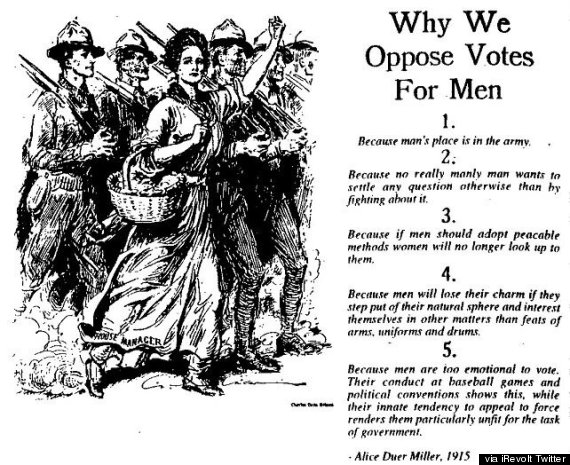
Amidst the suffragette centenary (handily summarized by Philomena Cunk), it’s timely that the brilliant Bridget Christie has a new series on BBC Radio 4.

Alongside numerous Chinese jokes, I’ve posted on humour under state socialism (see also here; cf. Alexei Sayle), and also on Tibetan jokesFeminist political comedy may seem a recent inspiration, but Mary Beard doubtless has classical antecedents, and Krista Cowman [1] shows how astutely the suffragettes used humour, turning the tables. Open-air meetings were akin to, indeed they were, standup—the brave women constantly faced by ridicule and heckling:

Provoking laughter at the expense of their opponents created a powerful and subversive weapon which they put to good use in their campaigns.

Annie Kenney recalled that suffragettes were

taught never to lose our tempers: always to get the best of a joke, and to join in the laughter with the audience even if the joke was against us. This training made most of the Suffragettes quick-witted, good at repartee, and the speakers that most of the audience took a delight in listening to, even though they did not agree with them, were those that were able to make them laugh.

Good to learn that this old joke was a response to a heckle:

An elderly man kept repeating the same statement every few minutes “If you were my wife I’d give you poison”. Eventually the speaker, tired of his repeated interruption, replied, “Yes, and if I were your wife I’d take it.”

See also Wimbledon: protest and suffragism.


[1] “ ‘Doing something silly’: the uses of humour by the Women’s Social and Political Union, 1903–1914”, in Hart and Bos, Humour and social protest, 2008.

The ascent of Rum Doodle

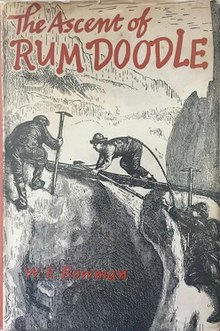
The ascent of Rum Doodle, a 1956 parody by W.E. Bowman, richly deserves a place in the illustrious roster of 1950s’ British satire, debunking heroic British imperial pretensions At A Time When It Was Neither Profitable Nor Popular—a predecessor of travel spoofs like Away from it all and Molvania, or the impressions of Ronnie Ancona.

It describes the misadventures of a motley crew of “mountaineers” of staggering, nay tottering, ineptitude, led by the stoic narrator Binder, as they attempt to climb the world’s highest peak in remote Yogistan.

The team includes Jungle, the route finder, always hopelessly lost, and the physician Prone, who succumbs to a never-ending series of ailments (for his backstory, see pp.70–72, among several touching tales). Constant, diplomat and linguist,

went into the native portion of the train to improve his knowledge of the language, but soon afterwards a riot broke out and he thought it advisable to retire. He explained that the natives were really friendly people of imperturbable dignity and cheerfulness, but they sometimes allowed themselves to be upset by trifles.[…]
They spoke together for several minutes, and a European onlooker might have been forgiven for concluding that they were quarrelling violently; but I told myself that this, no doubt, was the local idiom. […]
We passed through many villages, the inhabitants of which were invariably sullen and unfriendly, except when Constant made overtures, when they became hostile.

As Binder explains,

We were naturally all agog to catch sight of the Atrocious Snowman […] first seen by Thudd in 1928 near the summit of Raw Deedle.

According to a 1946 report,

It wore a loincloth and was talking to itself in Rudistani with a strong Birmingham accent.

The team, supplemented by cynical local porters, is spurred ever upward by their attempts to escape the inedible food of the expedition cook Pong. Copious “medicinal” champagne is quaffed, notably during the inevitable fall into a crevasse and the ensuing rescue attempt.

As Bill Bryson notes in his introduction to the 2001 edition, Rum Doodle earned only a niche following until the 1980s (and like Sir Henry at Rawlinson EndI missed it even then). It gradually became a cult, giving its name to hostelries in Kathmandu and Windermere (sic)—and even to mountains. As Bryson says, it’s one of the funniest books you will ever read.

Tibetan jokes

Courtesy of the fine High Peaks Pure Earth site, it’s high time for some Tibetan jokes—a most welcome addition to Hammer and Tickle and my Chinese jokes series, and similarly educative.

Beyond the usual socialist jokes, this strand has all the complex nuances of minorities wrestling with modern identities.

As with all jokes, they can reveal something about society while simultaneously being either politically incorrect, culturally and contextually specific, lost in translation or just not that funny.

Can you speak Chinese?
How could I? I have not been in the army and I have never been to jail!

“An American, a Japanese and a Tibetan…” jokes make a niche variant to the “an Englishman, a Scotsman, and an Irishman…” topos, or three leaders jokes. Here we even get “Three Tibetans, one from U-Tsang, one from Amdo and one from Kham”:

The Qinghai-Tibet railway reached Tibet. Three Tibetans from different provinces were in the same passenger car, one from U-Tsang, one from Amdo and one from Kham.
The train suddenly stopped on the way. The short-tempered Khampa immediately jumped up, yelling: “Why did the train suddenly stop? I swear to Buddha I will teach the train conductor a lesson!”
The Amdo Tibetan tried to stop him by persuading: “Aro, let’s wait. It does not help to threaten the train conductor.” Meanwhile, he sighed and said with great regret, shaking his head: “What a shame that we Tibetans do not know how to drive a train!”
The Tibetan from U-Tsang responded: “Come on brothers! It is not a big deal. Look! Isn’t it fine as long as we close our eyes and pretend the train is still running?”

I look forward eagerly to further contributions on the site. For an in-depth study, note Timothy Thurston, Satirical Tibet.

Vesna Goldsworthy

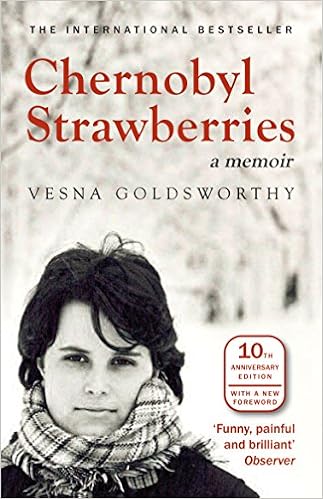
I was drawn to Vesna Goldsworthy’s 2005 memoir Chernobyl Strawberries by her wonderful contribution to Private passions—a valuable companion to the book (Hold the front page! Books are silent! For Serbian soundscapes, see here).

Originating as a record for her young son through the trauma of her cancer treatment, the memoir is whimsical and full of insight—both about her early life in Yugoslavia before it was torn apart (she wonders if it was an accident that her country and her own body were disfigured so soon after each other) and her identity in her adopted home in England since 1986, caught between cultures.

As usual, I read the book partly with the experiences of Chinese people in mind. Goldsworthy’s description of her father’s attitude to her youthful flirtation with palaeography reminds me of the Chinese retreat into history:

Only my father saw some consolation in the fact that it was the kind of work which was unlikely to lead to imprisonment. There seemed to be nothing remotely political in transcribing thousand-year-old prayers, whereas as a media star I was likely to shoot my mouth off sooner or later.

Even so,

In fact, while it was highly unlikely that a palaeographer would end up in prison or without a job, as had been known to happen to the critics of contemporary literature, my father was wrong in thinking that the vellum-bound world was apolitical. You could say, for example, that a manuscript was “probably Bulgarian” or “possibly twelfth-century” and cause an international dispute of major proportions…

Among vignettes on the fates of her forebears, Goldsworthy gives fine insights into the society of Belgrade through her youth (when she was “optimistic, ambitious, invulnerable, and in some ways insufferable”), the nuances of class in a classless society—not least the three rings of schools (her own lycée “educated some of the most intelligent and most fashion-conscious young people east of the Iron Curtain”):

In our senior common room new members of the Communist Party represented a more raggle-taggle selection than before. Some were visibly keen, some rather diffident, some were obvious (clever-clogs, careerist with a bad sense of timing, those who carried a briefcase to school, prominent members of youth organizations, children of well-known communists who could hardly refuse to join), some rather less so (ditzy girls from old families who had fallen for the old hammer-‘n’-sickle chic, the school poet, the fourth-grade hunk, a good third of the school basketball team, encouraged to join as role models and highly visible because they were all six foot six and chewing gum). Working out which members of the teaching staff belonged to the party, information you wouldn’t normally have been privy to as a student, was part of the privilege conferred by this particular entry into the adult world.

The heightened sensibility towards dress-sense also reminds me of Maoism:

Many of our professors addressed us with “Colleague”. Others used “Comrade” or “Miss”, according to whether they were communists or bourgeois recidivists. Forms of address provided an easy way of knowing individual political allegiances. It was useful to be able to distinguish Comrade Professors from Mr or Mrs Professors in order to know whether to cite Lukacs or T.S. Eliot. Although one could often tell the two groups apart simply by the clothes, it was not always safe to make hasty assumptions. Suits, ties and moccasins mostly belonged to comrades; tweed jackets, turtle necks and shoelaces to Mr and Mrs, but safari suits could go both ways, and were surprisingly popular in the early eighties.

And even furniture:

I felt that, through furniture, I had a special path to understanding the world I came from. Whereas in the West the inexhaustible variety of interior design often manages to obscure surprising degrees of conformity, the enforced conformity of the society I grew up in concealed a bunch of eccentrics and sometimes downright madness. While the wives were crocheting, madmen were busy plotting Armageddon.

Goldsworthy describes the schism (and occasional blurring) in poetic circles between bohos and suits, and her own youthful “Penelope poems” about the female who waits ( the waitress) for an absent male, often with pseudo-religious powers.

During the endless family debates over her choice of outfit for a major poetry-reading in honour of Tito (“a strange form of necrophilia”), her sister mumbles “peasant”:

She used the feminine form of the noun. There was no doubt that she had me in mind. Only peasants wrote poetry anyway. (The word peasant, with its full power of character assassination, is not readily translatable into English. It was neither here nor there as far as the real peasantry were concerned, but a poisoned dart if directed at a Belgrade student of letters).

She goes on to reflect on the Tito cult:

The longer it was since his demise, the more there was to celebrate. Like the widow of a murdered Sicilian Mafia don, the country clung to his memory in an incongruous mixture of mourning and décolletage, as if knowing that a collective nervous breakdown would follow once the ritual was no longer observed.

Meeting her future husband, “I was ready to follow the boy to the end of the world, to England itself if need be.” * After reaching Heathrow,

Only minutes later, I was on the Piccadilly line—the Ellis Island of London’s huddled masses—with a copy of the London Review of Books.

In Private Passions Goldsworthy recalls the abundance of classical (and other) music in the Yugoslavia of her youth. And when she moved to England, her friends and family were horrified, asking, “How could you move to a country where there is no music“? So it’s suitable that her Slavic-tinged playlist ends with Purcell’s When I am laid in earth.

As befits an erstwhile poet, her use of English (her third language) is delightful. Like many foreign authors (from Conrad and Nabokov to Elif Şafak, or for China, Yi-yun Li and Xiaolu Guo), she finds that writing in English affords psychological space:

I have fewer inhibitions in English—perhaps because for me it doesn’t quite carry subcutaneous layers of pain. In fact, I sense—however irrational this may seem—that the I who speaks English is a very subtly different person from the I who speaks Serbian and the I who speaks French. That, perhaps, has something to do with the old chameleon tricks or the nature of the language itself. At any rate, the English speaker is a bit more blunt and a bit more direct than the other two. She is and isn’t myself. She takes risks and admits to loss.

In Chapter 4 she reflects on the hereditary aptitude of her homeland for poetry:

In the four years between my move to London and her death, Granny wrote to me only once. It was a short letter, penciled in a deliberate hand clearly unused to writing. She reminded me to visit my parents regularly and urged me to behave in a way which would not dishonour my lineage; no laughing in public places, no loud conversation, modesty in dress and in everything else. Granny wrote as though she was worried that, away from my father and my tribe, I might be in danger of succumbing to some ungodly excess. In her world, Montenegrins who lived apart from their tribes were notoriously prone to prodigal or licentious behaviour. Her prompting came not because she lacked confidence in me, but because she clearly believed that this was what a letter from a grandmother to her granddaughter should be like. It wasn’t the place for frivolities of any kind. Although written in continuous lines, her latter was—from the first word to the last—a string of rhythmic pentameters, the verse of Serbian epic poetry.

As she calls her sister’s answering machine in Toronto to leave messages in “Granny”, adopting an asthmatic wheeze to let flow a torrent of alternating complaints and endearments, she reflects,

The language of my dead grandmother brings to life all our lost homelands, yet no book has ever been written in it. This is the language I lost when I chose to write in English.

Always reflecting on the subjectivity of memory, she has drôle comments on her new jobs in London.

I loved the prospect of boredom. Growing up in Eastern Europe was a powerful vaccine. I had gone through eighteen years of socialist education, learning when to say yes and when to keep quiet, in preparation for a job in which I’d be underpaid and under-employed. Where I came from, such jobs—usually in very nice places—were often described as “ideal for women”.

Reading news bulletins at the Serbian section of the BBC World Service through the traumas of war, she observes how her “RP” broadcasting voice differed from her “real” Serbian (inner suburban stresses, corrupted English slang), ** which had itself become a museum-piece:

My mother-tongue, meanwhile, remained firmly locked in its mid-eighties Serbo-Croat time-capsule, a language which officially doesn’t even exist any more.

 And then the straitened conditions of academic life:

Daughter of a self-managed workers’ paradise, I excel at my job. I criticize and self-criticize, I censor and self-censor, I compose self-assessment sheets about self-managed time, I sit on teaching and research committees, I attend meetings and take notes, I know that literature has hidden and insidious meanings. […] My communist upbringing, my upbringing in communism—to be able to live with myself without believing in anything I say, to be able to accept things without asking too many questions—has certainly stood me in good stead throughout my working life.

In the art of the long meeting, British university workers easily outdid anything I’d encountered in my socialist upbringing. The sessions were often longer than the communist plenaries, the acronyms just as plentiful, the put-downs just as complicatedly veiled in oblique metaphor, the passions just as high, even if the stakes were often infinitesimal.

None of the terms for her status quite fit:

Unlike my ancestral matriarch and so many others in the part of the world where I came from, I have never been a refugee. I am not an exile. Not quite an expatriate either: that term seems to be reserved for those coming from lands which are more fortunate than mine. A migrant, perhaps? That sounds too Mexican. An emigrée? Too Russian.

Getting to know her father-in-law,

I suddenly grasped the sheer luxury of being a British male in the twentieth century. Every conceivable counter-argument notwithstanding—and I know there are many—the picnic rug on the moral high ground still came in khaki and red, the colours of his beloved regiment. My father-in-law stood on the high ground, wielding a pair of secateurs, chopping, felling and dead-heading, without a care in the world.

Yet she notes parallels between his nostalgia for a vanished Indian colonial past and her own experiences, “linked by a homesickness which doesn’t make sense”. At his funeral she reflects:

I can’t bring myself to sing at an Anglican funeral, just as I couldn’t—were it an Orthodox one—wail as my female ancestors were expected to. In Serbia old women were sometimes even paid to mourn. They walked behind the coffin in the funeral procession and celebrated the dead in wailing laments delivered in rhythmic, haunting pentameters. I am stuck somewhere between the singing and the wailing, speechless.

And this isn’t the end of the book, but it could be:

I wish I could say—as people sometimes expect of cancer survivors and immigrants alike—that I am grateful for each and every new day on this green island. Ask me how I am today and chances are that I will respond with that very English “Mustn’t grumble”. Which doesn’t mean that I don’t. Which doesn’t mean that I am not grateful.

Cf. Kapka Kassabova on her upbringing in Bulgaria.


* Cf. The life of Brian, where Brian’s mother Mandy recalls a youthful fling with a centurion: “Nortius Maximus his name was. Promised me the Known World he did…”

** “fensi” meaning pretentious rather than just “fancy”, cf. the recent Chinese zhuang B.

Hidden histories

The current BBC Radio 4 series

hosted by the engaging Clarke Peters, introduces a treasury of recordings illuminating the social history of Europe.

The first series covers the period from 1900 to 1930—notably Black Europe, a richly-documented 44-CD set from Box Family Records.

From the series website:

Received wisdom has it that black popular music arrived in Europe with the Empire Windrush in 1948, but Clarke brings us black sounds recorded in Europe from as far back as 1900.

Programme 1: Focusing on early commercial discs made in the recording studios of London, Paris and Berlin, we hear from dozens of different performers, including African American travelling entertainers, traditional African musicians, black British classical composers and more.

Clarke discovers a huge variety of black music recorded in Europe at the start of the 20th century, including very early examples of blues harmonica, scat singing and stride piano. The programme also includes some of the earliest African music ever recorded, from Senegalese war songs captured at the Paris World Fair in 1900 to the music of a troupe of Congolese pygmies who toured Britain in 1905-07.

Programme 2: Clarke explores the music of black Europe at the time of the First World War. The sounds of what would become jazz start to emerge, including African American banjo bands who entertained London high society, and the military music of Harlem bandleader James Reese Europe which enthralled France. The programme also includes music by captured African Prisoners of War, recorded in camps across Germany.

Programme 3: Clarke explores the sounds of Zonophone records, a pioneering label that recorded a huge amount of early African popular music. Many of these discs were made in London for export to West Africa, including several Nigerian hymns recorded in 1922 by Fela Kuti’s grandfather. The programme also includes the sounds of African American jazz in 1920s Paris, especially the work of Josephine Baker, the world’s first black superstar.

For James Reese Europe and the Harlem Hellfighters, see also

and this short Channel 4 feature.

Series 2 and 3 are now available, taking the story through World War Two, the 60s, and the 70s—antecedents of what even then was still not called “world music”. These programmes too are full of gems, such as hot jazz in Weimar Berlin, calypso in Cardiff Bay; underground bands in Hitler’s Germany, black American trumpet stars in occupied Paris, Caribbean swing bands playing through the Blitz in London; and in the post-colonial era, on to Ambrose Campbell and his West African Rhythm Brothers, Sterling Bettancourt, Lord Kitchener, and the emergence of the Notting Hill Carnival sound; Ghanaian highlife, Congolese rumba from Brussels, Algerian chaabi in Paris, Surinamese jazz from Holland, the songs of Cape Verde—and black flamenco. To Name But A Few…

Leading us to the Shanghai jazz scene, here’s Sam Wooding’s Orchestra playing Shanghai shuffle in 1925 Berlin:

For Algerian chaabi, here’s Dahmane El Harrachi’s Ya rayah:

And here’s Ronald Snijders live:

All these diverse cultures have made up a major part of European social history over the last century. It’s a really ear-opening series, providing many leads to explore.

Critics rebuked

Apart from John Cleese’s main ouevre, he  can be entertaining on the page too. This article, reflecting on four decades of “mixed (in the technical theatrical sense of ‘extremely bad’)” reviews from The Spectator, is a fine rebuke to his critics. Just as yet another well-deserved tribute to Michael Palin (new patron saint of stammering) comes on BBC TV, Cleese’s self-review is fun:

John Cleese is a remarkably talented individual, of an admirably humble disposition, and a rare sweetness of temperament, who continues to tower over his contemporaries, especially Michael Palin.

I’m also most enamoured of “The Zagreb Bugle”, and I eagerly await a review of my own film in this illustrious fantasy organ. Cleese’s comments on cultural pundits remind me of the biting satire of Stella Gibbons, in works like Conference at Cold comfort farm—not least her brilliant “Em creeps in with a pie“.

Changing language

Caonima

Language is always in flux, over the dead bodies of fusty conservatives. English isn’t alone in changing under the stimulus of social media and popular culture.

Since my Chinese vocabulary incongruously lurched from the Tang dynasty to the clichés of Maoism (see also here), where it remained impaled, I’m happy to make some modest updates, partly courtesy of websites like Sixth Tone (e.g. herehere, and here), and Magpie digest—as well as this article, including a recap on the viral caonima “grass-mud-horse” trope. As elsewhere, much of the linguistic innovation is driven by online usage. I’m very keen on the term

To zhuāng bì 装 B is to put on airs — worldly, moneyed, educated, eccentric, or any other combination thereof. In other words: to be a fucking poser.* B is shorthand for níubì ( lit. “cow’s cunt”: see here, with instructive links), meaning “awesome” or “badass”—the English letter “B” being easier to find than the character for cunt (for shabi “fuckwit” and the somewhat less shocking nature of bi in Chinese, see here).

The article describes zhuang B as “a light, often self-deprecating insult”, “sign of healthy subcultural growth”—“by-product of all the new possibilities for young, middle-class Chinese people, a way for millennials to practise defining their way of life.” So it’s a pretentious wanker or tosser—cf. Poseur, moi?”. See also this Sixth Tone article.

I also like galiao 尬聊 “awkward chat”, inevitable chats with boring people—when the person you are talking with lacks communication skills, or when your mind wanders off and the talk reaches a dead end.

Even for those seeking to limit their studies to a bygone age, a basic grasp of how living people communicate (even village ritual specialists) is valuable… For an update, click here.


* Private Eye’Pseuds’ corner polices English excesses with regular entries—like this, from an old programme note of a London Pro Musica concert, penned with tongue in cheek by the splendid Bernard Thomas:

The title of this concert means “a piece of cake”; it comes from the popular song Damene un poco di quella mazacrocha, “give me a piece of that cake (crumpet?)”. The process of baking a cake might be taken a central metaphor for Renaissance musical culture, for the special synthesis of northern polyphony and rhythmic subtlety with the poetry and expressive melody of indigenous Italian music. Florence, together with Siena and Bologna, were, and still are, traditional centres of cake baking. One can only guess at the repeated and prolonged biting into cakes on the creative processes of Heinrich Isaacs during his long stay in Florence.

Guide to a year in blogging

LMS

After a year of frenzied blogging, here’s a seasonal retrospective guide to navigating a diverse ouevre—as much for my sake as as for yours. Meretricious and Happy New Year!

Call me a nerd [You’re a nerd—Ed.], but taxonomy and indexing are so funky… As you see from the (updated) homepage, the whole site began as an introduction to my work on the Li family Daoists, and my portrait film remains one the most enchanting presences there. The Li family has its own category in the sidebar, with a plethora of articles (not least a whole series on our French tour in May 2017, and an update on Li Bin’s diary).

Other pages in the top menu also tend to be rather substantial, with

Still in the top menu, MY BLOG contains all my myriad posts (“delighting in all manifestations of the Terpsichorean muse“), with helpful Categories and Tags in the sidebar, as well as a monthly archive there. Here are some of the more stimulating:

As you can see from this post alone, I just love doing internal links (in blue in the text). So whether you first came here for Daoist ritual, football (indeed, Daoist football), punk, Bach, modern China, or even just for the jokes, they’re all connected, so please do click away on the links!

Last but, um, not least, do click on the links to the relevant posts and pages in the photos in the sidebar.

Alexei Sayle

Alexei Sayle‘s memoir Stalin ate my homework, on his, um, unusual upbringing, is at once heartfelt, perceptive, and hilarious. And the sequel Thatcher stole my trousers* has insights on the alternative comedy scene, his early standup, and The Young ones.

Born in 1952 to idealistic left-wing atheist Jewish working-class parents—genial Joe and the brilliantly indiscreet Molly—he evokes the conditions of post-war Anfield with wry detail.

Though not universal, it was instinctual among a great many British Communists to be noisily unpatriotic. […] To my parents and their friends it was as if by cheering on the English football team, the cricket team, or Britain’s runners you were somehow revelling in slavery, the Amritsar Massacre, the suppression of the Irish, or the Opium Wars.

At primary school:

At break-time in the first week our teacher, Miss Wilson, said to the assembled class, “All right, class, now let’s bow our heads in prayer and thank God for this milk we’re drinking.” At which point I stood up and said, “No, Miss Wilson, I think you’ll find that the milk comes to us via the Milk Marketing Board, a public body set up in 1933 to control the production, pricing, and distribution of milk and other dairy products within the UK. It has nothing to do with the intervention of some questionable divine entity.”

Echoes of Irene Handl’s line in Morgan: a suitable case for treatment: “I mean, we brought you up to respect Lenin, Marx, Harry Pollitt…” (a line that I think is even funnier if you don’t know who Harry Pollitt was).

Profiting from [!] the free rail travel available to the family with his father’s position in the National Union of Railwaymen [sic], the family often took holidays abroad: “by the age of five I must have been the most travelled child in Anfield.” They soon began making trips behind the Iron curtain—At A Time When It Was Neither Profitable Nor Popular, I note. To pursue the latest results of my interest in east Europe, it’s these vignettes that I’d like to cite here.

For all his parent’s aspirations, Alexei casts a rather more detached view on their holidays. Of course, they could hardly imagine the tribulations of the working people with whom they identified, or even the apparatchiks who hosted them. But with his own background, he does more than merely getting a cheap laugh out of state socialism. These passages are interesting mainly for his own story, in which idealism and cynicism evolved hand in hand, a surreal training that would bear fruit in his later career.

Joe and Molly had taken the crushing of the 1956 Budapest uprising in their stride; welcoming it as a test of faith, they scorned British Communists who

didn’t understand that the march towards liberty, peace, and freedom couldn’t be held up by a load of people demanding liberty, peace, and freedom.

Enthralled by a visit to the Czechoslovak pavilion at the 1958 Brussels World Fair, with its marionettes, Magic Lantern Theatre, and colourful avant-garde design, in August 1959 visited the country for the first time. Somehow their trip begins at a campsite in the sleepy spa-town of Karlovy Vary. After an interlude at a union-owned miners’ sanitorium, the wheels of diplomacy click into gear and they are rescued by a fleet of black Tatra limousines which takes them on to Prague, where they are chaperoned lavishly.

Next year they organized a group of like-minded comrades for another visit. This time the authorities

had decided what the first delegation of British railwaymen to Czechoslovakia would like to see more than anything else were sights, locations, and exhibitis connected with the wartime assassination of Reinhard Heidrich, the butcher of Prague.

They were among early foreign visitors to see Lidice, scene of one of the most appalling Nazi massacres. On a brighter note, they were taken to the Švejk pub in Prague, and when they got back home his parents bought him a copy of Hašek’s novel. When he eventually read it aged 12 or 13, he

wondered if the Czech authorities knew what they were doing promoting with Švejk, letting a pub be opened in his name and selling cuddly toys in his likeness, since the message of the book, while it might have been anti-authoritarian, is certainly not one supportive of the ideals of socialist conformity.

Indeed, The good soldier Švejk soon became very popular in China, where its message must also have concerned the authorities.

Anyway, back in Anfield, by the age of eight Alexei was able to report proudly to an eager young vicar,

“I am a Comrade Cadet, Grade One, Young Pioneers, fourth battalion, based at Locomotive Factory Number One, town of Trutnow, People’s Republic of Czechoslovakia!”

And one already feels a hint of the irony that would later inhabit Alexei’s stage persona (see here), with a substantial ingredient of Švejk.

For their summer holidays in 1961 they visited Hungary, lavishly accommodated in a grand baroque hotel in keeping with their incongruous status as VIPs. On a trip to Lake Balaton Alexei discovers salad, in a passage that will strike a chord with those of our generation:

Back in Anfield we had thought with a certain amount of pride that on Sundays we had been eating salad, but really all we had been eating was lettuce and tomatoes in a bowl, sometimes with a hard-boiled egg on the top and no dressing except perhaps the industrial solvent known as “salad cream”. Now I saw what a salad really could be under socialism. There were red, green, and yellow peppers, corn on the cob, huge tomatoes stuffed with Russian salad, artichokes, celery, lentils, okra, and fresh herbs, all of them covered in rich oils or mayonnaise.

(For Nina Stibbe’s candid assessment of tarragon, see here.)

He accumulates yet more pennants and badges to accompany his hoard of Bohemian glass, dolls, and “folklorique woven things” that he didn’t know what to do with—

It was hard to stop people in Communist countries giving you things [an idea taken further by Elif Batuman].

In 1962 they took their third trip to Czechoslovakia, and in 1963 Joe led a delegation of railwaymen to Hungary. This time Alexei’s feelings are more conflicted:

Sadly, if you are beginning to feel unsettled about people’s motivation then visiting a country in which some six hundred thousand citizens were deported to Soviet labour camps after the Second World War, where they spoke a weird Finno-Ugric language completely unrelated to those around it, where there were great tensions between the various ethnic groupings, Hungarian, Romanian, and gypsy, and where a revolution had been brutally suppressed only seven years before, probably wasn’t a good idea.

Joe and Molly make elaborate preparations for a tour of the northwest by a dance troupe from Czechoslovakia, but it falls through. In summer 1966 they flew to Bulgaria under the auspices of that new bourgeois creation, a package holiday. Meeting some local teenagers in search of Beatles records, he realizes that

up until then we had only ever mixed with people who were part of the system, who were loyal to the party and its allied organizations. […] Clearly there were tensions, but you didn’t get to be a Communist without learning to ignore what was in front of your face.

With his affinity with both railways and Czechoslovakia, he was always going to love Closely observed trains (Jiří Menzel, 1966)—another of those films that also left a deep impression on my student years (can’t find it online at the mo, but do seek it out!).

For Pachelbel on rubber chicken, and Czech trains, click here; and for Alexei’s penchant for Polish cinema, here.

Following Kruschev’s reforms,

though slightly assuaged by the crushing of revolts in Hungary and East Germany, many in the West’s Communist movements were uneasy with this liberalisation. They didn’t like the idea of a Communist society allowing its citizens to express their opinions freely or have a choice of more than one type of hat. Yet they had nowhere to take their disaffection until the Sino-Soviet split offered these puritan characters a choice of an extra-dour kind of socialism more in keeping with their sententious inclinations.

So, going from frying-pan to fire in a remarkable lapse of judgement, Alexei became a Maoist. You can continue reading his later story for yourself, moving on to his perceptive account of his bohemian life at art school in London, his role in alternative comedy—and Molly’s blooming [see what I did there?] as a foul-mouthed lollipop lady. For more (not least his critique of ballroom dancing), see here.

So while Alexei didn’t get to play the Matthew passion or hang out with Li Manshan (though both are charming fantasies), I regard his upbringing, not to mention his later career, with a certain envy.

For other excellent memoirs in what can be a dodgy field, I think of George Melly and Arthur Smith. And this chat with Stewart Lee is a match made in heaven:

* Sinology could do with some titles like these (for a somewhat less appetising one, see under Jarring here).

Cunk on Christmas

Cunk

Following her probing accounts of Shakespeare, and “femininism”, what better seasonal viewing than the immaculately-researched historical overview provided last year by Philomena Cunk—herself touched by the divine:

Besides the usual bewildered expert interviewees, she consults some “small adults—which are known as children”, who also manage to keep a straight face.

… Jesus Christ—an icon who was almost as revered back then as Beyoncé is today.

Civil war is like a real war—but not abroad, so it’s cheaper. […] According to the Puritans, Christians shouldn’t celebrate Christmas, ‘cos it’s not in the Bible. Instead, they should be inside a church (which isn’t in the Bible), reading the Bible (which isn’t in the Bible).

At Christmas 1914 there was a brief ceasefire—the fighting stopped, soldiers got out of their holes and joined together in a place called No Man’s Land, showing that even at moments of peace, men will still divide into two sides, and try to beat one another.

She consults a hapless Jay Rayner:

I don’t understand bread sauce […] Bread, and sauce, are two completely different things, aren’t they?
[I’ll leave you to listen to the dénoument]

As ever, it’s not what you say but the way that you say it—her delivery and expression are faultless (see also The art of the voiceover).

Ms Morgan also leapt into print with equal facility, here, and in a handy 2020 guide.

Jeux d’esprit

Here’s a little popery, I mean potpourri—a resumé of some of my more wacky linguistic fantasies:

Among many fine Chinese jokes, my piques du jour* are


* Rather than piqes-niques.

Love, Nina

Nina

Quite possibly a more plausible Christmas gift than my own books, Nina Stibbe’s Love, Nina: despatches from family life (2013) is hilarious, warm, and perceptive.

In letters to her sister she evokes her life after coming to London to work as nanny to the drôle Mary-Kay Wilmers (of the LRB) and her engaging and challenging kids, in leafy literary Gloucester Crescent in the 1980s.

Anyone taking it at face value may miss its genius. Forgive me if her original letters really had all the book’s subtleties of phrasing, but it seems to me that a lot of subtle mature editing was involved. Anyway, it’s an observational account of a niche tribe, full of linguistic delights—every page has a turn of phrase that leaves me helpless with laughter.

I apologize too for the things I got a bit wrong. Alan Bennett was never in Coronation Street for instance.

She doesn’t take her cultural education lying down:

PS Chaucer. Have you ever read it? Fuck. It’s a whole other language and meant to be hilarious, but it’s grim and annoying.

Later at the library:

… borrowed a recording of a bloke reading Chaucer in the Old English. Nearly wet myself listening.

And

Exams soon-ish. Here is a summary:
R&J: Romeo and Juliet hardly know each other, but they think they’re in love and both kill themselves. The nurse is an irresponsible idiot. The Friar is a moron. It’s a ludicrous story.
[…]
Winter’s Tale: King is mentally ill. Queen is a fool.
Chaucer: W of Bath is an unreliable old bag, but not a hypocrite. Marries for money but likes shagging, thinks women should be in charge.

 Another leitmotif is Nina’s grappling with the baffling poncey new cuisine that was coming into vogue.

Tarragon: the cookbook says tarragon is “misunderstood”. Not by me. I understand it. It’s horrible.

Later she comments,

It’s all pasta and couscous nowadays, in London anyway.

Further fine observation:

MK does the big shopping—a mixed blessing—she buys stuff without a plan (I think she copies other people who know what they’re doing). This is the kind of stuff that comes back [list abbreviated here—SJ]:
quark (German style liquid cheese)
rye bread with seeds
balsamic vinegar of Modena (black vinegar)
fresh lychees
spinach
Persil
olives
And other mysterious things that add up to nothing much when it comes to making meals. It’s like living in another country.

Which reminds me of Ian Rush’s (disappointingly spurious) comment on his struggle to adapt to Italian life during his one season at Juventus in 1987–88:

I couldn’t settle in Italy—it was like living in a foreign country.

Critics haven’t always appreciated what a fine comic creation is her stolidly mundane portrayal of their neighbour Alan Bennett.

Me: You’re good with appliances.
AB: (proud) Well, I don’t know about that.
Me: You sorted out the car, the fridge, the phone, bike tyres and now the washing machine.
AB: I don’t think I am particularly good.
MK: But it’s nice to know you’ve got something to fall back on.

Later:

AB not around. In Yorkshire or New York. I prefer him being around… God knows what he does in NY (if it is NY), can’t imagine him there, being shouted at by taxi drivers and prostitutes. Though his coat would work.

AB himself took issue with Stibbe’s portrayal of him as “solid, dependable and dull”; but while finding some “misrememberings”, he understood—as well he might—that “such is art”.

The BBC TV version worked remarkably well too (like Cold comfort farm—I now realize the ingénue Nina has a distant affinity with confident Flora). As usual when watching, you just have to refrain from clinging onto your own image of the book. As the young Nina would doubtless observe.

* * *

I’ve only recently clocked the useful expression “Is that a thing?” (discussed here, and here), entertainingly used by the great Zoe Williams. A fine discussion on the ever-stimulating languagelog blog seems to date it only to 1995, though comments there hint at earlier variants. Since it makes some clear appearances in Love, Nina (assuming they’re not from a later edit), then we can take it back to the 1980s—e.g. p.132:

He picked up a raw burger and ate it. I was appalled but acted normal. Told MK later and she said it’s a thing (eating raw beef).

[another trademark of Stibbe’s style there—giving pedantic parentheses redundantly clarifying her previous comment].

Or p.136:

Mary-Kay has started wearing two shirts at once. I don’t know where she’s picked it up, but it’s a thing, apparently.

Indeed, I guess Love, Nina is basically about striving to define the rules of an alien culture to whose values one aspires—though I can’t be Saussure [cf. my Foucault pun under Visual culture].

Strictly north Shanxi Daoist ritual

Don’t get me wrong, I’m glued to Strictly come dancing every week. Oh yeah, I’ve got my finger on the pulse of popular culture all right [adjusts monocle, grappling ineptly with concept of the high-five]. I was mortified in 2015 when Georgia and Giovanni (aka Joe Varney) didn’t win:

Or indeed Alexandra in 2017… But hey, “It’s not winning but taking part”, eh [zzzzz].

And now the brilliant Stacey Dooley—who did win, YAY!!! (See also Moon river.) Here’s another Charleston. Now let’s all watch her fine documentaries.

The thing about Strictly is, as with Handel opera, or a Moroccan wedding, you just have to suspend your disbelief. The dancers don’t want to go home, but for some reason they do want to go to Blackpool, which is unlikely to feature even on the itinerary of perfectly innocent Russian tourists. Li Manshan hadn’t even heard of the Carnegie Hall, let alone Blackpool, but it’s clearly more appealing than doing a Messiah in Scunthorpe.

Sure, as Barbara Ellen notes in a fine reviewStrictly proved yet again

that it understood its own winning formula—drown the contestants in a vat of fake tan and what a cynic might term even faker bonhomie, and let the controversy and sequins fly. […] A sugar-rush of schmaltz combined with a brawl on the entertainment deck of a cruise ship…

But for me it’s classic BBC “educate, inform and entertain” stuff—inculcating diligence, expression, and appreciation of historical style (!), with the pros and the judges vouchsafing us little dollops of technical advice. For all the fatuous clichés of the competitive format (see also Alexei Sayle‘s pertinent critique), Strictly can be inspiring and deeply moving. So there. And for 2020, Bill Bailey reaffirms our belief!

Still, my question is this:

However were we all conned into thinking that a genre that seemed pathetically antiquated even in the early 1960s could possibly achieve such wild popular success in the 21st century?

This baffling device of prefixing an unlikely and outmoded format with an utterly random adverb gives me an idea whose time has surely come:

Strictly north Shanxi Daoist ritual

After all, Daoist bands have long been used to ritual competition, “facing platforms”. In my film (from 24.08) my use of karaoke captions for the percussion mnemonics makes an instructive innovation that draws us into a crucial element of ritual performance. And we’ve just had “The Reverend Richard Coles” on Strictly, so hey. My new programme concept has got everything from the original—a grand ritual arena, movement, costumes, music… And since, as Heidi Stephens notes in her drôle Guardian commentaries, what viewers really need is a Journey, what better than Pacing the Void?

Admittedly, even with a minimum of six ritual bands contesting, each performing a different ritual segment for each programme (Presenting Offerings, the InvitationBeholding the Lanterns, and so on), the weekly programme would require at least four hours—and the nocturnal yankou ritual alone takes longer than that. Still, BBC ratings will doubtless soar.

Coming up next—we’ve got Du Zhimin’s band all the way from Guangling, performing the Ambulating Incense ritual!!!

I’ll be delighted if the drôle Claudia Winkleman will host the new show. As to

THE JUDGES…,

the fragrant Darcey Bussell [surely an anagram, e.g. “Recall Debussy”—cf. Gran visits York and Maidstone] is always welcome. How can anyone be so elegant and savvy and still be English? Her only tiny flaw seems to be that she can’t get the hang of clapping (watch her as she applauds couples just voted off). And now that the great Li Manshan is ceding much of his ritual work to his son Li Bin, he seems the ideal choice as chair of the judges.

Some quotes from the panel:

Darcey [purring]: “Oh MY! I have to say, just make sure you grade that accelerando in Yellow Dragon Thrice Transforms its Body just a tiny bit more carefully.”

Bruno [does pirouette]: “Bellissimo! But you still need to work on your posture, dahlingg.”

Li Manshan [dragging on fag], in unison with Craig: “That was chaotic!”

And the scores are in

I look forward eagerly to discussions with the BBC. [1]

See also Fantasy Daoist ritual.

* * *

Another Daoist-ritual spin-off might be to adapt the brilliant “One song to the tune of another” from I’m sorry I haven’t a clue. One recent fave was Jan Ravens singing the words of I can’t get no satisfaction to the tune of Wouldn’t it be loverly—and click here for Barry Cryer with Anarchy in the UK to the tune of Singing in the Rain.

The Daoist version might go something like this:

 [Jack Dee, or indeed Li Manshan, lugubriously:] “Now I’d like you to sing words of The Song of the Skeleton to the tune of Diverse and Nameless are the Bitter Roots…”*

*Tedious footnote: at least in Yanggao vocal liturgy, these two items are in fact quite closely related (my book, pp.267–8, 274–5)—so less than suitable here. Scope for exploration, though.

Such impertinent fantasies, if not for purists, are at least more frankly ironic than the kitsch commodifications from the Intangible Cultural Heritage (see under “The reform era” here).

For Groucho and Anna Mahler, click here.


[1] Inexplicably, I still await a reply from the BBC  to my initial pitch, Strictly Albanian Dentistry—where peasants attired in colourful traditional costumes have just a week to learn a series of intricate procedures such as implants and root-canal treatments (cf. Alan Partridge). But following the public verdict on the moral morass of the Strictly dance/snog of shame—a quandary that will be mercifully obviated by Strictly north Chinese Daoist ritual—there’s (allegedly) a letter in the post from the Beeb about my new concept:

letter

For another money-spinner of mine, see here.

180!!!

More local cultural knowledge:

One morning in Maida Vale studios, as the great Pierre Boulez was rehearsing the BBC Symphony Orchestra, he stopped and said suavely,

“Please, we play again from measure* 180.”

Brilliant cockney percussionist Gary Kettel, from the back of the orchestra, punched the air gleefully and screamed out,

“ONE HUNDRED AND EIGHTYYY!!!”

Since Boulez’s broad erudition didn’t stretch to the world of UK darts, he was somewhat nonplussed [‘Ow you say in French?] by Gary’s recondite allusion to the fabled score of three triple 20s. Still, he and Gary always had the utmost respect for each other’s musicianship.


*Boulez always used the French word for “bar”. Endearingly, he called the cor anglais “ze English ‘orn”.

Interpreting religious symbols

Alan Bennett’s 2011 diaries begin with typically drôle observations:

6 January. The alterations we have been having done are now pretty much finished, thanks to Max, a young Latvian who’s unsmiling but an excellent carpenter and Eugene, much jollier and from New Zealand who has supervised it all. Walking around the job this evening R. is shocked to discover in the bathroom above the bath a crudely made wooden cross. He takes this to be the work of Max who, scarcely out of his teens, already has two children and is, I imagine, Catholic. R., whose feelings about religion are more uncompromising than mine, finds the cross disturbing and is determined to ask Eugene to tell Max to take it down. I’m less exercised by it, seeing it as some sort of dedication, the sort of thing (though more crude) that a medieval workman would have put up at the completion of a job. We are both of us wrong as when Eugene is approached he explains it is not a cross at all but a makeshift coat hanger he has rigged up over the bath in order to dry his anorak.

And more comments on the behaviour of WAM musos:

 14 January. George Fenton tells me of a memorial service he’s been to at St Marylebone Parish Church for Maurice Murphy, the principal trumpet of the LSO, who did the opening solo in the music for Star Wars. The service due to kick off at eleven thirty, George arrives with ten minutes to spare only to find the church already full, the congregation seated, silent and expectant. It beings promptly at eleven thirty with everyone behaving impeccably and not a cough or a rustle throughout. And he realizes that it’s because they are all musicians and orchestral players for whom this is like any other concert and where the same rules apply.

Useful ideas for Christmas

The time of year is rapidly approaching when you’re desperately racking your brains for a present for that difficult uncle who’s got everything—even Dame Kiri Sings the Sex Pistols’ Greatest Hits by Candlelight.

Well, look no further—my three former Ashgate books (two with DVDs) are out in paperback! (See also my Amazon list).

And to go with my film (a welcome change from Bambi), don’t forget Daoist priests of the Li family.

To cite The Messiah:

Thou art gone up on high; Thou hast led captivity captive, and received gifts for men

Giving Handel and his librettist Jennens** the benefit of the doubt for sexist language, don’t forget the brilliant T-shirt of female composers—”Breaks the ice at parties”, in the words of Monty Python (who did rather let themselves down* on gender equality).

Such seasonal gifts will make a welcome change from socks and after-shave, and can be enjoyed over a sherry in a party hat while blowing a paper horn—a relative of the vuvuzela, perhaps? Laurence Picken could have enlightened us. You can play the party game of identifying festive toy instruments under the Sachs-Hornbostel system (or play Spot the Difference with Daoist ritual paintings, like the Judgment Officers here). The paper horn also evokes the conch in Daoist ritual—indeed, it would make a suitable companion to these early Daoist instruments of the Li family.

horn

* “Let themselves down”: apart from the Proust sketch (from 2.14, notably the voiceover comment “golf’s not very popular round here”), there’s also the classic headmaster’s speech joke.

** Good to see Jennens slagging off Handel’s music, at least:

“I shall show you a collection I gave Handel, called Messiah, which I value highly. He has made a fine entertainment of it, though not near so good as he might and ought to have done. I have with great difficulty made him correct some of the grossest faults in the composition; but he retained his overture obstinately, in which there are some passages far unworthy of Handel, but much more unworthy of the Messiah.

YAY!—I mean Hallelujah. Praise be to the Lord—and the Three Pure Ones, the Empress Houtu, Bob Marley, Mrs Cratchit and The Ten Kinds of Orphan Souls [can someone check this please?—Ed.] and the Thunder Lord of Three-Five Chariot of Fire—the latter (“Lingguan smoking a posh foreign cigarette on a train journey through his spiritual domain”) a fine read, though I say it myself.

Ronnie again

UPDATE: Cosmic Justice has at least temporarily proved itself amidst a troubled world—I wrote this in the early stages of the UK tournament, but now Ronnie’s won it yet again in another inspiring display!

Ronnie

With his natural grace, Ronnie O’Sullivan is often compared to Roger Federer, but he’s in a league of his own, transcending sport. If you haven’t watched his maximum break from 1997, then do—it’s not merely a world record that is likely to stand for all time, but a thing of exquisite fluent beauty, reminiscent of the nuanced touch of a great musician.

After the morose introspection of yesteryear, Ronnie has come through the early years of obsession and addiction (lessons here for the claustrophobic hothouse of WAM virtuosos), and he’s on great form these days, with a kind of earthy Daoist detachment.

I list my series on Ronnie here.

It’s that man again

More from the diaries of Alan Bennett. I’m filing this 2009 entry under heritage:

23 August. […] I’m glad I’m not a theatregoer living in Elsinore. All they must ever get are productions of Hamlet, while what they’re probably longing for is Move Over, Mrs Markham or Run For Your Wife.

His keen eye for footballers’ physiognomy is in evidence again (2010):

7 April. The open mouth of Frank Lampard, having scored a goal, is also the howl on the face of the damned man in Michelangelo’s The Last Judgement.

This entry depends on a certain cultural knowledge that might challenge translators:

5 July. A child in Settle is said to have asked what the Mafia was and his grandfather said, “It’s like the Settle Rotary Club, only with guns.”

And he often shows his political involvement. When a speech in favour of the NHS from his early play Getting on is well received, he is encouraged to go on:

25 July, Yorkshire. […] whereas nowadays the state is a dirty word, for my generation the state was a saviour, delivering us out of poverty and want (and provincial boredom) and putting us on the road to a better life; the state saved my father’s life, my mother’s sanity and my own life too. “So when I hear politicians taking about pushing back the boundaries of the state I think”—only I’ve forgotten what it is I think so I just say: “I think… bollocks.” This, too, goes down well, though I’d normally end a performance on a more elegiac note.

Sing…

As a corrective to all the glowing speeches from divas and the rapturous adulation of their fans, Bill Bailey (don’t miss his Love song!) recalls:

I was at a Whitney Houston gig, it was supposed to start at three—finally at four o’clock she comes on stage and says,
“I just wanna say, I love each and every one of you!”
and this big black guy next to me shouts,
“Sing, bitch!”

This is a metaphorical version of the fan hitting the shit.

Barbed comments

My dubious encomium for Rowan’s CV (The Feuchtwang variations, n.3) reminds me:

The brilliant Roy Mowatt (see under comments here), a real bedrock of the early music orchestral scene, was always remarkably tolerant of my violin playing in the section he led. I treasure a remark he made to me over a beer or three in a piazza in Parma after a Mozart opera, c1994 (evoking Hugh Maguire’s comment to Pete Hanson—“Pete, even if your strings are out, you must play in tune! Just do it wit’ your fingers!”):

Thing about you, Steve, is that it doesn’t make any difference if your strings are in tune!

You can take that either way, and I think he meant it both ways. I was quite adaptable; yet my intonation wasn’t necessarily helped by tuning up… Cf. “It was in tune when I bought it”.

While I’m in confessional mood, here’s another comment I might add to my CV. Just around that time, a certain maestro took me aside and observed suavely,

Steve, I can’t help noticing that you have a somewhat low threshold of boredom…

JEG

Photo © Jim Four.

Like the review of the Berlin Phil’s response to Simon Rattle, it lacks a certain nuance.

Nicknames

As Kate Fox observes, the creativity of the English language reveals itself at multiple levels.

The fragrant Gary Lineker recalls how the the team-mates of the footballer Kiki Musampa called him Chris (think about it). There are more where that came from, like Fitz Hall—known as One Size.

Brian Smith, a “straight” symphony-orchestra violinist who became a semi-detached admission to the rarefied early music scene in the 1980s, had a whole series of drôle nicknames for his new colleagues, making his conversation surreal: “I think Identikit’s gone off with Ironing Board”. Once word got round that I was making regular trips to China, I became The Missionary. He only used the real names of musos who had a life outside early music and thus qualified as Real People.

Conductors’ nicknames are another rich vein under the rubric of maestro-baiting. The great Charles Mackerras was known as Slasher—not an allusion to his conducting technique, but an abbreviation of his anagram: Slasher M. Earcrack.

Recording and editing

After our rendition of The Feuchtwang Variations à la chinoise at Stephan’s party—which surprised us as much as the guests, even without kazoo—we wanted to make a separate recording, but we had few illusions about how it could turn out. However modest our remit (it would be too ambitious to try and edit within movements, and we didn’t do too many takes), even the minimal editing that Rowan undertook was still a time-consuming process.

Typical exchange during rehearsal:

Me: Can you give me a lovely lingering arpeggio on that first chord, like a theorbo?
Rowan: No.

For me, it recalls all those orchestral recording sessions through the 80s and 90s—with section leaders crowding into the box to make notes and report back, doing endless retakes of a single chord, with the editor then taking months to compile a version that was a total fabrication. Of course, live recordings are far more satisfactory, if we can wean ourselves off glossy perfection—even then, we tended to do a couple of patching sessions after the concert.

It also reminds me of a comment from—you guessed it—Alan Bennett, in his 1990 diaries, on working with the Delme string quartet in recording the soundtrack for his Proust film:

27 June. […] Striking about the musicians is their total absence of self-importance. They play a passage, listen to it back, then give each other notes, and run over sections again. George Fenton, who is coordinating the music, also chips in, but he’s a musician. David H., the director, chips in, but he isn’t a musician, just knows what atmosphere he wants at various points in the film. In the finish even I chip in, just because I know what I like. The musicians nod and listen, try out a few bars here and there, then settle down and have another go. Now one could never do this with actors. No actor would tolerate a fellow performer who ventured to comment on what he or she was doing—comment of that sort coming solely from the director, and even then it has to be carefully packaged and seasoned with plenty of love and appreciation.  Whereas these players, all of them first-class, seem happy to listen to the views of anyone if it results in them doing a better job.
[…] The readiness of players in a string quartet to absorb criticism from their colleagues has been noted by doctors, and the BMA video was made to be shown to businessmen as a model for them to emulate. Perhaps it should be shown to Mrs Thatcher.

Such humility is a trait that musicians might not recognise in themselves; anyway, AB was lucky to work with a quartet, as orchestral recording sessions are (inevitably) far more hierarchical, with a clear pecking order (giving rise to maestro-baiting). Still, the contrast with actors (and politicians) rings true.

Performance ethnography

Pace Robert Hanks and indeed the great man himself, one can never have too much of Alan Bennett.

From his 2008 diaries, more perceptive ethnography of both orchestral musicians and audiences (cf. here and here), about a TV broadcast of the West-Eastern Divan Orchestra from the Proms:

… one of the cameras fascinated with a particular woodwind player who has a good deal to do, but who in turn obviously fancies the flautist who’s next but one. So at the end of his own contribution he’ll often half-turn in order to pass the tune or whatever to this flautist, and she is equally attentive during his solos. There’s a cellist with a cheeky face who plainly makes jokes, a bear of a violinist who throw himself about a lot, and next to him the child violinist with a face made tragic by concentration. It’s hard to conceive how such a small figure copes with the great winds of Brahms, though he’s more composed about it than his hairy and demonstrative neighbour.

It’s moving, too, of course because of the moral stance of the orchestra, though the players are by now probably bored or at least matter-of-fact about this ethical burden. But with similar experience in the theatre (including I hope The History Boys), one longs to stay with them once the performance is over and they disperse. Who looks after the child, I wonder, whom does the cheeky cellist sleep with and are the flautist and the woodwind player as close as their performances suggest? So there’s sadness too in being excluded from all this and longing, just as there is coming away from the theatre or for some people, I imagine, the football stadium.

Competing with the lofty claim of detached spiritual contemplation of the work in hand, such observation is a universal yet little-documented feature of attending public performances—just the kind of detail that ethnomusicologists might seek, and that the “absolute music” wing of WAM scholars would eschew.

Houtu tent

My work with the Li family Daoists is full of such detail, both for their funeral practice at home—such as Golden Noble corpsing the others while reciting the Invitation memorial, or the reluctance of the kin to pay attention to the liturgy of the Daoists they still feel obliged to hire—and for their concerts on tour (such as this, and this). But even in the 1990s I had apparently read enough Geertz, Barley, and so on to pay attention to the behaviour of the Gaoluo villagers—like this passage (Plucking the winds, pp.304–5):

After supper on the 15th, the “temple” courtyard is packed. Apart from South Gaoluo villagers, some have also come from the North village and elsewhere. Many have come to offer incense, but many also just for the fun. Boisterous children are chasing around letting off firecrackers, both outside and inside the “temple”. Five sticks of incense are considered “a bundle” (yifeng).

As to ordinary villagers, though there are more women than men offering incense, quite few of the people are elderly: young and middle-aged women and young men seem to be more active in this. Many pray silently to the goddess Houtu for a healthy son, or for the health of their aged parents; more generally, people pray for good luck and prosperity. One couple were offering incense for the safety of the husband, who is a driver—even for the most diehard atheist, recourse to divine help is particularly tempting on Chinese roads. The atmosphere is highly jocular as people enter the courtyard. As they go to offer incense and kowtow they look embarrassed, but then when they are actually doing it they become extremely serious. Then as they get up and dust down their trousers, they look all embarrassed again, and, avoiding meeting the gaze of all the onlookers, they leave the area, often going into the “temple”.

Of course, Geertz, Barley, and indeed Bennett may do it better, but as with WAM, such social ethnography is quite rare in (both Chinese and foreign) studies of Daoist ritual, which are more concerned with recreating the abstract deep structure of medieval texts and ritual sequences. And similarly, it’s not one or the other—both angles are desirable.

* * *

Later in 2008 AB notes a comment on the distressingly populist Classic FM radio:

Elgar’s Nimrod conducted by John Eliot Gardiner. It doesn’t get much better than that. Or does it? Give us a call.

They come over ’ere…

Central Asian musicians, Tang dynasty.

Here’s a companion piece to my post on foreigners during the Cultural Revolution, where I acknowledged my anachronistic use of the epithet laowai 老外.

I read that indeed the term didn’t become common until the 1980s—just in time to greet me on my late arrival (for some words that Shakespeare may not have invented, see here). The Chinese wiki article on laowai makes a useful succinct introduction, explaining its interplay of respect and xenophobia. I’m still curious to learn how the winning combo of lao and wai suddenly caught on. A detailed forum on the nuances of this and related terms has been initiated by the erudite Victor Mair, so here I’ll just add a few personal reflections.

A still more blunt term is dabizi 大鼻子 “big nose”; foreigners in China have to get used to frequent appraisals of their physiognomy, but as an autonym, at least, the term can be drôle. I’m also fond of the more quaintly retro yang guizi 洋鬼子 (“foreign devil”), which a senior Taiwanese mentor—and, crucially, friend!—likes to call me. As ever, such terms are context-sensitive; they may even confirm guanxi (“You’re my mate—we can take the piss together”).

At a tangent, in Shaanbei a fine shawm-band leader is widely known as Jiekazi “The Stammerer”—in rural China, attitudes towards stammering are both less po-faced and less courteous.

Craig and Ming

Waiguoren!” (not yet “Laowai!”). Craig Clunas, Ming tombs 1975.

Staying with China (derogatory terms for foreigners are of course a rich topic worldwide), apart from the various historical terms (hu 胡, fan 番, yi 夷, man 蠻, and so on—mostly with a strong suggestion of “barbarian”), I’m now curious to learn how the Labouring Masses of the Tang dynasty would have hailed the substantial number of laowai on the streets of 8th-century Xi’an in the popular argot of the day.

We may now regard the Tang as the first great world-music boom (cf. Soundscapes of Dunhuang), but as musical nationalists of the day (like the poet Bai Juyi and his mate Yuan Zhen) might have said,

“They come over ’ere, with their fancy bili and pipa…”

Or their Qing-dynasty counterparts (so does building walls work, then? Eh??):

“They come over ’ere, with their fancy erhu and suona and yangqin…”

OK, I made those up, but this is a genuine Tang quote (adding impertinent male judgment on female attire to the heady xenophobic mix): [1]

Our women are acting like foreigners’ wives, studying foreign make-up;
Entertainers present foreign sounds, servants to foreign music!

Straight out of the Daily Mail, that. With the current surge in “patriotism”, a new campaign to purge corrupting foreign influence from the Chinese instrumentarium would be left mainly with the xun ocarina and the sheng mouth-organ—which might fail to excite even Uncle Xi. It’s ironic that after successive waves, it was the Model Operas of the Cultural Revolution that were largely responsible for a renewed vogue for the instruments of the Western Art Music tradition.

Closer to home (yet equally apposite), a classic rebuke to xenophobia is the great Stewart Lee’s UKIP routine (“Bloody Huguenots, Coming Over Here—doubting trans-substantiation, with their famed ability to weave little jerkins out of lace…”). And to supplement his fantasy chat down the UKIP pub:

“Apparently the guitar is descended from the oud—that’s bloody Moorish, mate! What’s wrong with Morris dancing, that’s wot I say!”

[Inconvenient footnote: an inconclusive etymology suggests that “Morris” is itself derived from “Moorish”…]

As simplistic nationalist agendas rear their ugly orange heads yet again, it’s always worth unpacking language. See also A fine riposte, and Das Land ohne Musik.

For the “Golden Age” of the Tang, Chinese scholars might learn from 17th-century Holland.


[1] See e.g. Suzanne E. Cahill, “Our women are acting like foreigners’ wives! Western influences of Tang dynasty women’s fashion”, in Steele and Major (eds), China chic: East meets West. Among many works, see also Marc S. Abramson (ed.), Ethnic identity in Tang China. The works of Edward Schafer (notably The golden peaches of Samarkand and The vermilion bird, written at a time when such study was neither profitable nor popular) have long been an inspiration for those studying Central Asian culture in the Tang.

More Ted Ibert

bear

Always a keen ethnographer of religion, Alan Bennett documents the ritual paraphernalia of calendrical observancess in a diary entry for 2007:

17 May. Outside the bank I see the local vicar, his arms full of balloons and a Sooty teddy bear in the crook of his arm. “It’s Ascension Day,” he explains.

Pursuing the teddy bear theme, AB reflects on his own innocuous image:

20 December. […] I shall still be thought to be kindly, cosy, and essentially harmless. I am in the pigeon-hole marked “no threat”, and did I stab Judy Dench with a pitchfork I should still be a teddy bear.


YAYwatch

Unlikely as it may sound, I have recently been startled to find myself prone to exclaiming “YAY!”, for which I’m about forty years too old.

This sad habit isn’t formed so much by watching the brilliantly awful Jessica Hynes on the BBC TV series W1A (see this post on voiceovers), as by finding the ironic ambivalence of its usage a useful shorthand. Once it might have been “YES!”, and still earlier “Jolly good show!”, “Hoorah!”, or “Spiffing!”, but “YAY!” has more layers of meaning—the older the speaker, the more pleasantly disquieting it sounds. So that’s my defence.

Chinese vocabularies for approbation change even faster. Victor Mair’s language log has some fine examples, like this. Following bucuo and taibangle,  I still like the north Shanxi kebulai—but I’m not yet aware of any terms with the ironic sense of “YAY!”.

See also OMG, LOL, and The art of emoji.

A different kind of song


As if we needed further evidence of the refined tastes of Tweety McTangerine in the cultural sphere (let alone his fawning admiration for dictators expert in brutal repression):

https://www.theguardian.com/world/2017/nov/13/you-are-the-light-philippines-duterte-sings-love-song-for-trump

Call me old-fashioned, but as love songs go, I still prefer Bill Bailey’s version

The duck lies shredded in a pancake,
Soaking in the hoisin of your lies…

And we can only sigh to recall the days not so long gone when there was taste at the White House (for more on Aretha, see here):

Regional cultures

An ethnologist rarely noted is Ken Dodd, who commented profoundly on variations in regional cultures—as in the Chinese “customs differ ever 10 li” (shili butong su 十里不同俗):

You can tell a joke in Liverpool and they won’t laugh in London… they can’t hear it.

Michael Billington reflects:

It strikes me I’ve been lucky enough in my lifetime to see two performers kissed with genius. One was Laurence Olivier, who could enthral an audience with his animalistic power and interpretative originality. The other is Ken Dodd, who has the capacity to take a roomful of strangers and, through a fusillade of verbal and visual gags that never lets up, induce in them a spirit of collective ecstasy.

Ken is renowned for the length of his shows. Lord Grade has suggested that Xi Jinping’s recent interminable address to the Chinese party faithful was secretly scripted by Ken. If only…

Revolution and laowai

liuxuesheng

Acting the part: new UK students from class of 1975, Foreign Languages Institute, Beijing.
Robin Needham (R.I.P.), Andrew Seaton, Howard Nightingale;
Frances Wood, Derek Gillman, Richard King, Steve Crabbe;
Harriet Evans, Pippa Jones, Beth McKillop, Rose Kerr, Sarah Garbutt.
Photo taken at Wudaokou photo shop and hand-tinted there, autumn 1975.
Courtesy Beth McKillop.

In the light of later exposés of the Cultural Revolution, the acquaintance with Chinese society of laowai (“Wogs”)* from my generation, idealistic students at Cambridge, now inevitably seems somewhat less than well-informed.

The great Frances Wood, long-term curator of the Chinese collection of the British Library, and whose insights and mellifluous voice regularly inform BBC Radio 4’s series In our time, evokes that generation’s experience of revolutionary China in her brilliant memoir Hand-grenade practice in Peking: my part in the Cultural Revolution. The blurb makes a good summary (extra points too for eschewing the standard “smorgasbord” and “picaresque swathe”):

In 1975 I went to Peking for a year, together with nine other British students who had been exchanged by the British Council for ten Chinese students.** The latter knew exactly what they were doing: learning English in order to further the Great Proletarian Cultural Revolution. We were less sure.
From 1966, China had been turned upside down by young Red Guards who were encouraged to “Bombard the Headquarters”. Professors, surgeons, artists, pianists, novelists and film directors were attacked for their bourgeois pursuit of excellence or their attachment to decadent Western ideas.
Though by 1975 there were no longer violent street battles or badly beaten bodies floating down the Pearl River, we found Peking University governed by a Revolutionary Committee of workers, peasants and Party members determined that we should not learn too much and become experts divorced from the masses.
With our Chinese classmates, we spent half our time in factories, getting in the way of workers making railway engines, or in the fields, learning from peasants how to bundle cabbage or plant rice seedlings in muddy water. Heroically, we stayed up half the night to dig rather shallow underground shelters in case of nuclear attack. Much of the rest of the time was spent in class, with two compulsory hours of Marxism-Leninism-Mao Zedong Thought every Saturday morning and compulsory sport, which included hand-grenade throwing. I studied Chinese history which had to be revised overnight when Deng Xiaoping was criticized for the second time and erased from the record. The constant hammering of political rhetoric, broadcast from tannoys hidden in every tree, and the endless expositions of Marxist-Leninist dialectic were only interrupted by funeral announcements as yet another ancient revolutionary went to join Karl Marx.
Just after I returned home, the Great Helmsman himself, Chairman Mao, died. Within weeks, the Great Proletarian Cultural Revolution was not only over but renamed “The Ten Disastrous Years”. The reinstated Deng Xiaoping bounced back and declared that it was glorious to be rich: all my helpful digging and enginemaking had been a mistake.

To some, the book may seem to make light of what was a distressing period for Chinese people, but as Frances notes:

To all those in China who suffered terribly at the time I apologize for my determination to amuse myself and be amused by what I found. I only began to discover what was happening to China’s intellectuals [not just them, I might add—SJ] when I got home.

With quaint stoicism Frances and her fellow-students learn the arts of aimlessly moving rubble, the “ceremony of entering into traffic” (as a Chinese student interpreted the phrase rite de passage) on rickety bikes, and the labyrinthine system of coupons, chits, and travel permits. Cabbages play a major role. Her description of the dangers of eating the baozi dumplings of unheated restaurants in winter brought memories flooding back (also evoking Bill Bailey’s “soaking in the hoisin of your lies“):

They were difficult to pick up and dip in soy sauce at the best of times, even if you had all your fingers free to manipulate the chopsticks. Eating them in an outer coat and padded cotton mittens was a very messy business, and it didn’t take long for the front and cuffs of our coats to become stiff with soy sauce and bits of baozi.

Frances relishes her excursions in search of imperial architecture—which, distressingly, even in those revolutionary times (despite the best efforts of the Red Guards) was much more abundant than today.

With vital government departments depleted, and “so-called experts” dismissed, in favour of glib and dangerous populist slogans (now where have we heard that recently?), Frances reflects on the weird campaign extolling Lei Feng, with its classic song

I would like to be a tiny screw… Put me in place and screw me tight.

Meanwhile, pressed into finding a party-piece to compete with their North Korean and Albanian counterparts, the UK students soon become adept at trotting out “the British national songOld MacDonald had a farm. On other occasions, wheeled out for visits of foreign dignitaries, they feel like model prisoners.

As she devours “negative teaching material“, Frances identifies many experiences familiar to foreigners in China, like holding a fluent conversation in Chinese with a local, who then suddenly interjects, “Can you understand Chinese?” (cf. the scene in a documentary about Hannibal Taubes’s fieldwork). Even her final chapters on the culture-shock of returning to Blighty, bewildered by excessive choice, rank alongside the dénouement of Nigel Barley’s The Innocent anthropologist after his stay in Cameroon.

In his introduction, Oliver Pritchett regards Frances as part of the great tradition of intrepid British women explorers—reminding me of Ronnie Ancona’s spoof. The book is perceptive, hilarious, and warm-hearted, and you must read it at once!

Cambridge 1974

Partying at the Oriental faculty, Cambridge 1974. Beth McKillop, Carol Murray, Catharine Saunders, Tim Wright, Hisako Tottori (later Princess Takamado), a fragmentary bearded Paul Kratochvil, Nick Menzies, Craig Clunas with hair, Evelyn Laing, me with even more hair, André (then “Al”) de Vries.

All the while, amidst the deep waters and raging fire, I was granted a welcome dispensation to remain safe in the ivory towers of Cambridge. When I wasn’t drunk in charge of a string quartet (with grateful thanks to Adnams and Bartók), my own naïveté focused on obstinately reading Tang poetry and Huineng’s Platform Sūtra, inspired as I was by fine scholars like Denis Twitchett and David McMullen—as well as Laurence Picken‘s work on Tang music, and Michael Loewe’s training in Han-dynasty texts. As Frances observes,

Learning Chinese then was like learning a dead language: there seemed no hope of ever using it in China.

For me (rather like the attitude of the LA Phil board towards composers) it wasn’t so much a case of “no hope of using it in China” as “no danger of having to use it there”. My classical bent went along with my stammer—reluctant even to speak English, I couldn’t imagine ever trying to communicate with foreigners. Quelle horreur!

For the early inspirations that drew me to Chinese studies, I wrote a series beginning here.

me 1974

This photo was also taken in 1974, as I went for an exam in spoken Chinese—a concept hardly less ridiculous now than it was then. The fusty pursuits of Tang history were already somewhat antiquarian in an increasingly leftie Cambridge, and hardly appealed (then) to my fellow students. Apart from Frances and Craig, others like Beth McKillop and Nick Menzies, as well as students from other UK universities, were plunging into the fray and Becoming At One with the Masses with extended stays in China as part of their course. Some were rather keen on the revolutionary baptism; the tastes of others were more historical (in China, as Frances notes, “History was regarded as a very dangerous weapon which could not be allowed to fall into the wrong hands”). More than flared trousers, history—which had then seemed like, well, history—soon came back into fashion, and many of my fellow-students later became distinguished sinologists of imperial China; but unlike me, they had already noticed that one’s studies needed to be grounded in some kind of current reality.

Still, I suspect few of us were at all clear by this stage that the Labouring Masses were in a depression that must have seemed terminal, bitterly disillusioned with constant lurches in central policy, and suffering from constant hunger; or that this was already prompting a “silent revolution” in private enterprise, some years before decollectivization became an official policy.

Another 1975 photo [1] of the great Craig Clunas makes an evocative image:

Craig
Craig’s own caption:
Shock and awe on childish faces as Foreign Friend massacres the greatest hits of revolutionary modern Peking opera, Yan’an, 1975.
My take:
Becoming At One with the Masses: revenge for Langlang.
“Wow—
Taking tiger mountain by strategy! Don’t get to hear that much—just what we need!”

Back at Cambridge my only compromise to modern China (indeed, anything after the 9th century) was taking supervisions with Paul Kratochvil, although his expert guidance consisted mainly of plying me with beer and jokes in the pub—for which I’m eternally grateful. But in the vein of Arthur Waley, cocooned in a disembodied dream of ancient oriental wisdom, I only began spending time in the Real China a decade after my fellow-students; whereas they evidently got time off for good behaviour, I’ve since made up for my insouciance by spending the last three decades traipsing around dusty Chinese villages trying to document the fortunes of ritual culture under Maoism, learning to read between the lines of the arcane socialist vocabulary that Frances explores so tellingly.

Still, my first trip in 1986 was hardly prompted by any desire to engage with modern China: I went in search to clues to Tang-dynasty performance practice in living genres. It was only when I found folk culture a vibrant and fascinating theme that I switched my focus to modern society and the ethnography of local religion (see also my tributes to Ren Erbei and Ray Man).

Since 1993 my lengthy stays Becoming At One with the Masses as guest of the Gaoluo ritual association, and later the Li family Daoists, belong under the heading of dundian, “squatting”, or more elegantly “making a base”. I was never dragooned into moving rubble, but in Gaoluo I did spill the occasional bucket of water from the well—and in 2013 I managed quite effectively to get in Li Manshan’s way (my book, pp.132–3):

Coming across the phrase Shoulders unable to carry, hands unable to grasp, soft and sensitive skin… as I made inept attempts to help him with the autumn harvest, I thought it might have been coined to parody my efforts. Rather, it is a standard expression used to describe the travails of urban “educated youth” in performing physical labour after being sent down from the cities to the countryside in the Cultural Revolution to “learn from the peasants.” The experience was a rude shock for such groups all over China; brought up in relatively comfortable urban schools to believe in the benefits of socialism, and often protected from understanding the tribulations of their own parents, they were now confronted not just by the harshness of physical labour, but by medieval poverty.

For my counter-productive work on the harvest we reached a deal whereby Li Manshan would pay me at the rate of 1950s’ work-points. As I suggested that he might extend this arrangement to my sessions depping in his band for funeral rituals, that month I must have earned several pence—almost enough to buy a dough-stick back in Beijing.

How I envy Frances’s early excursion to Datong and its temples, the Yungang grottoes, and even a nearby coal mine. From the train she observed the very villages where I was later to immerse myself in household Daoist ritual groups like the Li family—then nearing the end of over a decade of forced inactivity. In 1974 Li Manshan and his wife had their second daughter, Li Min; their son Li Bin, later to become the ninth generation of Daoists in the lineage, was born in 1977.

The innocence of us laowai at the time is all the more reason why we need to continue our quest to understand the period—and those before and since.

In a topical—somewhat older but no less relevant—kind of remembrance, Frances features in the new Channel 4 documentary Britain’s forgotten army. Meanwhile our teacher Michael Loewe is still going strong at the age of 95. Craig couldn’t attend his lecture at SOAS recently, since he was himself giving a talk on Freud and China—one of those niche Mastermind topics like Norman Wisdom and Albania (I know which I’d choose).


[1] Among many great sites for photos of the Cultural Revolution, see here. For another account, leading on into the reform era, see here. For a major survey, see Beverley Hooper, Foreigners Under Mao: Western lives in China, 1949–1976.

* If the more polite term waiguoren (“foreigner”) was in use in the 1970s, then by the time I arrived in 1986 the more informal, and less diplomatic, laowai was often heard as we walked the streets. Or at least that’s what they always shouted at me… See sequel here.

** For the British Council to send ten UK students to Beijing in exchange for ten Chinese students sounds like a hostage deal gone wrong. Maybe bumbling Boris has this up his sleeve?

Namesakes

Not me, with Sid Vicious.

Of my several distinguished namesakes, I will (alas) not be readily confused for my fellow muso Steve Jones, guitarist of the Sex Pistols—imagine the look on the face of his Careers Guidance Officer at school.

Press cuttings about him provide me with hours of harmless fun. This quote might seem to describe one of my own performances of the transition into the finale of Beethoven’s 5th symphony:

We were all looking at one another. It wasn’t panic, it was more confusion.

Another Stephen Jones, of Babybird, received this concert review:

Stephen Jones abused his audience, his band, and himself.


See also Limits to my versatility.

Background and heritage

Further to Alan Bennett’s thoughts on faux nostalgia, his diaries often reveal the contrast between his own insecurity, inherited from his modest background, and the innate confidence of his Oxbridge peers. From an entry describing his appearance at the Tony awards:

11 June, New York. I am then bundled through a back door and across the street to Rockefeller Plaza where a whole floor has been given over to the press. I’m thrust blinking onto a stage facing a battery of lights while questions come out of the darkness, the best of which is: “Do you think this award will kick-start your career?”

News of my lacklustre performance on this podium must have got round quickly because I’m then taken down a long corridor off which various TV and and radio shows have mikes and cameras and there is more humiliation. “Do you want him?” asks the PA at each doorway, the answer more often than not being “Nah”, so I only score about four brief interviews before I’m pushed through another door and find I’m suddenly back in the street in the rain and it’s more or less over.

Even his admiration for Neil MacGregor is tinged with a sense of inferiority:

26 November. I go part of the way back in a cab with Neil and I ask him about his job, which he revels in and which is not simply confined to the British Museum. He’s practically a cultural ambassador or an UNESCO representative, just back from the Sudan where he’s one of a group surveying the antiquities likely to be submerged by a new dam, currently being constructed on the Nile. The problems though are not simply to do with cultural artefacts and he talks of the villagers the dam will displace, who, although they have been told what is to happen and for whom alternative accommodation has been provided, have nevertheless no idea of which this being uprooted will mean. The human and antiquarian problems in Sudan are mirrored in Iraq where the Director of Antiquities, a Syrian Christian, single-handedly defended his museums against the depredations consequent on the invasion and the war. Now in the aftermath he has to ransom his two sons who have been kidnapped and despairing of such circumstances has left Iraq for Damascus, ultimately hoping to get to America. As Neil pours this out, the words tumbling out of him as they do I feel both inadequate and ill-informed and it’s perhaps as well he doesn’t travel all the way but gets out at St Pancras to go to the Museum—looking, as he always looks, absurdly young but, I would have thought, one of the most remarkable men of his generation.

Philomena Cunk

Cunk
As another cautionary tale for fieldwork interviewers, how delightful to find Diane Morgan back on our screens, after her deadpan incarnation as “professional TV dimwit” Philomena Cunk (now with her own tag in the sidebar!).

Among innumerable aperçus, here’s her exegesis of Benefits Street:

They weren’t claiming benefits like MPs do, but a different type of benefits that they weren’t entitled to, because they were poor.

Her Moments of wonder series contains some classics, like her potted history of “femininism”:

—not least her helpful comment on Emily Davison throwing herself in front of the king’s horse at the Epsom Derby in 1913:

They [women] did this partly to highlight how unfair it was that women didn’t have a vote but horses did. And also because, being women, they really liked ponies.

On Shakespeare (“Did Shakespeare write boring gibberish with no relevance to our world of Tinder and peri-peri fries—or does it just look, sound and feel that way?”):

Among her hapless interviewees (watch from 24.19), she consults the valiant Ben Crystal, co-author of the Oxford Illustrated Shakespeare Dictionary, testing him on a list of words that Shakespeare, er, might or might not have made up:

cuckoo?
ukulele?
omnishambles?
mixtape?
[fumbles ineptly with script]
sushi?
titwank?

—a list surely on a par with the names in Rowan Atkinson’s roll-call. Another perspective on Shakespeare is offered by the series Upstart crow.

Diane Morgan now has a hilarious role in the new TV series Motherland, written by the equally brilliant Graham Linehan and Sharon Horgan. I’m reliably informed that it’s horribly well observed:

I really want the children to be brought up like I was—by my mother.

It looks as if a Chinese version might be in order, though I’m not holding my breath. And now we can relish Cunk on Earth!!!

A gig

The late great Linda Smith (1958–2006) was much loved by her colleagues. Simon Hoggart gives an affectionate tribute to her in A long lunch, including a story that strikes a generational chord—she told it herself, but here’s how he recalls it:

Though she had been to Sheffield University, and most of her early success as a performer had been around South Yorkshire and Derbyshire, she often returned to London and would always see her mother in Erith.* She’d explain why she was coming down—she had a gig in the West End on Saturday, but would pop over on Sunday before returning to Sheffield for another gig…
After some years of this, her mother would drop into that voice all children, of whatever age, dread hearing from their parents, the voice that means “I am about to ask a very serious question that I haven’t liked to ask for a long time, but now I need to know…” What is it going to be? Probably “Why don’t you marry and settle down?”

“What I want to know,” said her mother, “is—what is a gig?”

More gems from Linda Smith here. See also this post on the etymology of the gig.

*Erith in Kent, a town of which she said: “It’s not twinned with anywhere, but it does have a suicide pact with Dagenham.”

Faux nostalgia

In Alan Bennett’s parody The pith and its pitfalls (Writing Home, pp.383–6—”taking the pith”, of course) on the writer and his [sic] roots, he writes thoughtfully of the perennial English fashion for the nostalgia of childhood deprivation—whose Chinese parallel reminded me of The four Yorkshiremen sketch.

Can there be a slag-heap north of the Trent up which ardent young directors from Omnibus, Aquarius, or 2nd house have not flogged their disgruntled camera-crews in pursuit of that forward-retreating figure, the artist?
[…]
What I do recall of my childhood was that it was boring. I have no nostalgia for it. I do not long for the world as it was when I was a child. I do not long for the person I was in that world. I do not want to be the person I am now in that world then. None of the forms nostalgia can take fits. I found childhood boring. I was glad it was over.

There are fashions in childhood as in anything else. A nice, middle-class background was no longer in vogue by the time I started to write. No longer in Vogue, either. Early in 1960, when my colleagues and I were writing the revue that was to end up as Beyond the fringe, we were photographed for that magazine. We sped in a large Daimler to North Acton, where the photographer spent some time finding a setting appropriately stark and gritty for the enterprise on which we were to embark. We ended up gloomy and purposeful against a background of cooling-towers and derelict factories.

I have never done any of those filmed portraits I started off by parodying, though the urge is strong. It is always gratifying to be asked to explain yourself, if only because it makes you feel there is, perhaps, something to explain. I admit, too, that from time to time I catch myself slightly overstating my working-class origins, taking my background down the social scale a peg or two. It is a mild form of inverted snobbery, which Richard Hoggart might dignify by calling it “groping for the remnants of a tradition”. As the man says in the sketch, it is a question of belonging. You would like to think you belong somewhere distinctive, whether it is a place or a class, but you know you are kidding yourself. However, I see that opens up another vast area of humbug and self-indulgence, namely, the writer as rootless man, so I think I had better stop and go home—wherever that is.

Fats Navarro

Fats cover

As I noted in my first post on Chet Baker, among the innumerable delights of Paul Berliner’s book Thinking in jazz is his exploration of trumpet styles and links between them.

Miraculously, we can explore most of these players on YouTube—here’s Fats Navarro (1923–50, yet another distressingly short life—see list here), at the Royal Roost in 1948:

It’s gratifying that Anthropology is not only a discipline that embraces jazz, but (thanks to Charlie Parker) a real living piece:

Cf.

Lady Bird:

Casbah, again with Tadd Dameron, and Rae Pearl (Harrison) singing:

And savour Guilty, a rare male-voice ballad featuring Earl Coleman:

From his last gig, with Bird on 30th June 1950—a week before Fats died:

The treasures of YouTube are inexhaustible, but as a change, the 4-CD set The Fats Navarro story is instructively annotated, like other gems in the Proper Records series—and it ends with two further searing tracks from that last session.

Language and football

Some gems from Alan Bennett’s 2005 diaries, in his recent collection Keeping on keeping on (if it’s not known as KOKO, then I hereby patent the acronym):

1 May. Martha, Charlotte and James’s youngest, has been slow to read but now aged eight is making great strides, particularly enjoying spelling. She is being given additional tuition by the father of a friend, a retired teacher who is also employed by Manchester United; the foreign half of the squad he is teaching to speak English, the English half he is teaching to read and write.

8 December. I buy a bottle of organic wine at Fresh and Wild and looking at the label see that it says “Suitable for Vegetarians and Vagrants”. Momentarily I think, “Well, that’s thoughtful, someone admitting that winos deserve consideration like everyone else”, before realizing, of course, that it says not “vagrants” but “vegans”.

16 December. Roy Keane has the face of a mercenary. Meet him before the walls of fifteenth-century Florence and one’s heart would sink.

World music: a new tag

I sniff at the trendy commercial usage of the term “world music”, but at least it’s a shorthand for all the musical cultures of the world. So I’ve now added a new tag in the sidebar for world music, collating various dilettante excursions into the musical cultures of India, Ireland, the Mediterranean, the Uyghurs, and so on. Doubtless more to come…

cascais-singer

Dona Rosa, Cascais 1993.