Inebriation and the qin zither

Yao Shou

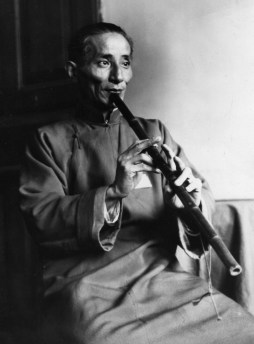
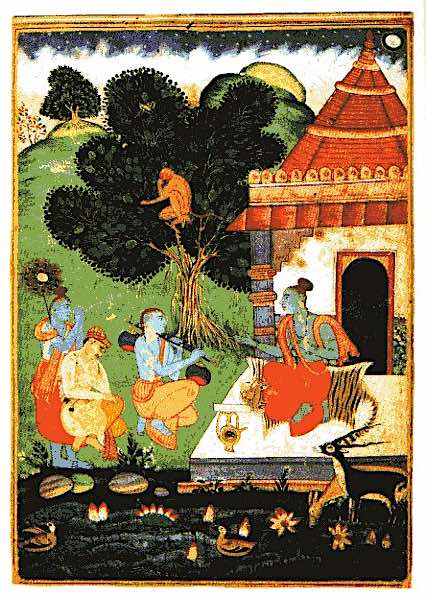
Yao Shou, Drinking and composing poetry, 1485. Source.

Inebriation (zui 醉) makes an intrinsic aspect of Chinese culture, even a philosophical position. It’s a major theme in poetry, best known through the Tang masters (see e.g. here, here, and here, as well as numerous discussions in Chinese, such as this).

Poets have long praised alcohol as a vehicle for transcendence. But they also evoke both the companionship of drinking and the pangs of drinking alone. For the Seven Sages of the Bamboo Grove sharing wine facilitated their oblivion of the mundane world; Ruan Ji also fed into the solitary ethos:

Looking down into my cup, much misery,
I think of friends in former times.
Facing the wine, I cannot speak,
Melancholy blends with bitterness.

Li Bai drinking

The Tang emperor Minghuang inviting Li Bai to drink. Ming dynasty: source.

By way of Tao Yuanming’s “Drinking wine” poems, we come to Li Bai, patron of drunken poets. Among numerous examples,

山中與幽人對酌 Drinking with a gentleman of leisure * in the mountains (in Arthur Cooper’s translation)

两人對酌山花開    We both have drunk their birth, the mountain flowers,
一杯一杯复一杯    A toast, a toast, a toast, again another;
我醉欲眠卿且去    I am drunk, long to sleep; Sir, go a little—
明朝有意抱琴來    Bring your lute ** (if you like) early tomorrow!

* youren perhaps rather “recluse”
** the rendition of qin zither as “lute” popularised by Robert van Gulik.

Gustav Mahler set a translation of Li Bai’s Chunri zui qiyan zhi 春日醉起言志 as The Drunkard in Spring, the fifth movement of Das Lied von der Erde, just before the final Abschied.

處世若大夢      胡爲勞其生
所以終日醉      頹然臥前楹
覺來眄庭前      壹鳥花間鳴
借問此何時      春風語流莺
感之欲歎息      對酒還自傾
浩歌待明月      曲盡已忘情

* * *

In the lore of the elite qin zither too, always inspired by poetry and painting, the role of alcohol is significant and well-documented—again, harking back to the Seven Sages of the Bamboo Grove. Quaintly, qin societies during the Republican era listed their (male) players’ drinking capacity, under “Refined proclivities”:

Jin Yu qinshe 1936

2nd row from foot: drinking capacities of Shanghai qin players,
from Jin Yu qinkan 今虞琴刊 (1936). Courtesy Bell Yung.

More recently, the Bacchic propensities of the late lamented Lin Youren were in line with this tradition.

Jiu kuang YBY

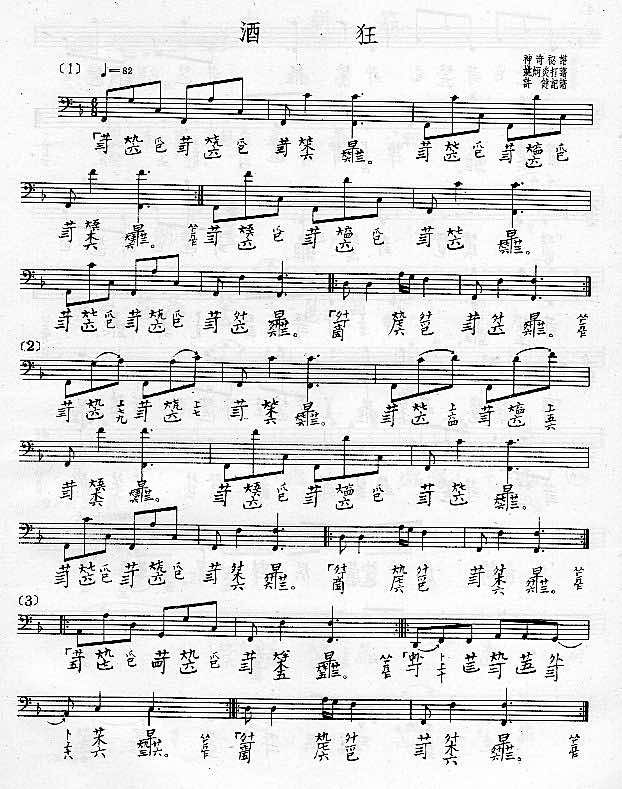
Wine Crazy, §1–2, a copy by Yao Bingyan of the Shenqi mipu.

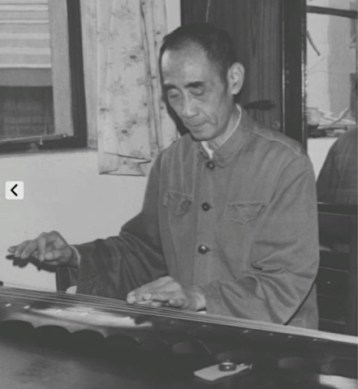
Most celebrated of pieces on this theme is Wine Crazy (Jiu kuang 酒狂), attributed fancifully to Ruan Ji. John Thompson gives a typically thorough exposition (and for qin song versions, here). The piece seems to have been dormant even by the time it was included in the 1425 Shenqi mipu tablature. After many more centuries of silence, it has become firmly established in the qin repertoire since 1957 when the Shanghai qin master Yao Bingyan 姚丙炎 (1921–83) began recreating it through dapu—for Yao, note Bell Yung, “From humble beginnings to qin master: the remarkable cross-fertilisation of folk and elite cultures in Yao Bingyan’s dapu music”, in Lee Tong Soon (ed.), Routledge handbook of Asian music: cultural intersections (2021), and for his Shenqi mipu realisations, Celestial airs of antiquity (1998).

YBY 1982

Yao Bingyan, 1982 (photo: Bell Yung).

Despite the surface technique, the melody is doggedly pentatonic, ambling innocuously up and down the scale with short repeated motifs (cf. my comments on Pingsha luoyan). The originality of Yao Bingyan’s version hinges on his use of triple time, most exceptional in Han Chinese music. After the end of the Cultural Revolution he published an article as early as 1981, “in discussion with visiting student Raffaella Gallio”. Here’s his 1960 recording, included on the “Eight Great Discs”—befuddled rather than virtuosic:

The instrumental version in the Shenqi mipu has only one caption for the coda, “The immortal exhaling his wine”; but the sung version in the 1589 Taigu yiyin provides titles for the previous short sections, each with poems;

  • Enjoying wine and forgetting troubles
  • Drunkenly dancing like a flying immortal
  • Singing loudly to earth and heaven
  • Loving wine and forgetting the body
  • Dashing off calligraphy on art paper
  • Bending over to exhale wine
  • Holding up wine and feigning madness.

Jiu kuang 1

Jiu kuang 2

Yao Bingyan’s rendition of Wine Crazy, transcribed by Xu Jian in Guqin quji vol.2 (1983).

Despite Yao’s reluctance to fossilise his realisation, already by the late 1980s Jiu kuang was becoming something of a cliché on the concert stage, fixed in his triple-time realisation. So it’s worth listening to John Thompson’s duple-time version:

Other qin pieces celebrating inebriation include

* * *

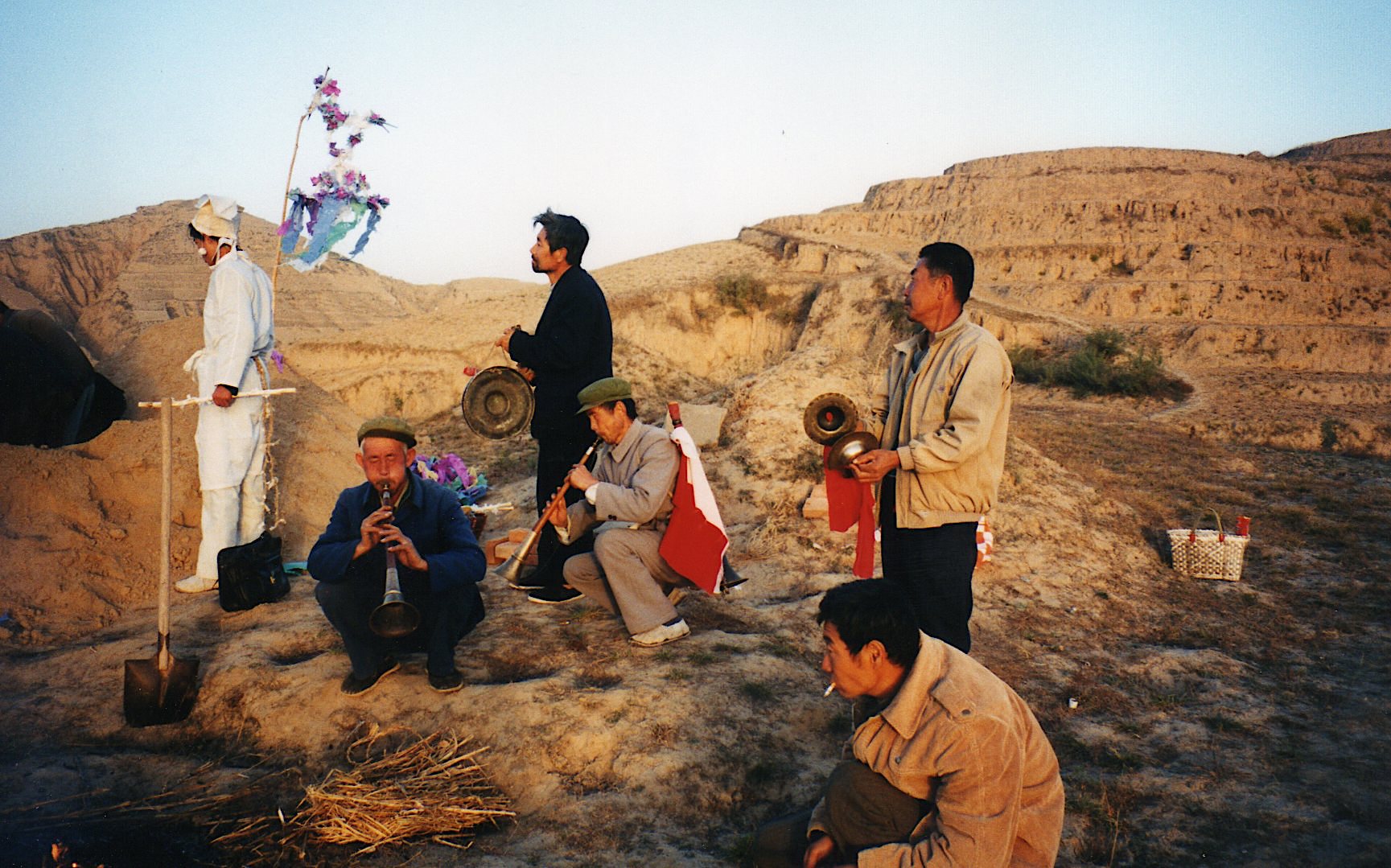
Of course, beyond the confines of literati culture, and without such philosophical underpinnings, alcohol is a trusty lubricant of social singing in rural society. §C2 of the DVD Notes from the yellow earth (with my Ritual and music of north China, volume 2: Shaanbei) has a vignette of a lunchtime drinking session with a group of village men.

The singers were perhaps mediocre even without the prodigious amounts of baijiu liquor they were knocking back; with empty bottles strewn about the floor, one of the singers passed out on the kang brick-bed.

Opium was a vice of both shawm bands and Buddhist monks until the 1950s; shawm bands still take amphetamines as fuel for their labours during rituals. But that’s another story…

Meanwhile in Western culture, intoxicating substances are commonly associated with the heyday of jazz; and in WAM, alcohol makes a strong underground theme, part of the “deviant” pastimes of the lowly rank-and-file. Such behaviour may be an emblem of non-conformity, but it’s rather far from the lofty predilections of Chinese poets and musicians. Another sherry, vicar?

The Bach cello suites

I’ve already praised Stephen Isserlis’s wonderful performances of Bach cello suites, and now, as if by magic, he’s written a definitive guide:

  • Stephen Isserlis, The Bach cello suites: a companion (2021).

Here’s a trailer for his complete recordings of the suites (2007):

Writing about music is like dancing about architecture”, and indeed, Steven writes about them too—but his comments are glorious, leading one irresistibly to the music, and performance. The book is intended “for music-lovers of all shapes and sizes, ranging from the casual listener to the performing musician”; by contrast with the ponderous style of academics whose worthy, voluminous research he digests so well, his chatty style feels personal and communicative rather than twee, always informed by his insights as a performer. Do also consult his website, where he writes engagingly (e.g. his fine post on Harpo).

After a brief biography of Bach, in Part 2 (“The genesis of the suites”) Steven ponders some basic questions. In “Why did Bach write the suites?” he surveys earlier works—Italian pieces for unaccompanied cello, and a German repertoire for unaccompanied violin; and he often contrasts Bach’s own violin sonatas and partitas from around the same period. He explores for whom the cello suites might have been written, and for what instrument, introducing the various types of cello then played, as well as the bow—so important in animating the music. We can’t even date the suites precisely, though they were composed during Bach’s years at Köthen, before he settled in Leipzig.

His discussion of the four early sources, and their relationships, renders arcane scholarship accessible and relevant to performance—seemingly minor differences in the notes, in slurring, and so on—illustrating the latter with the Prelude of the first suite. While making a convincing case for informed readings of the research to illuminate performance, he is amused by scholarly spats:

I am a member of various societies devoted to composers—partly because I’m interested in those composers, and partly because I find it so funny to read such things as, for instance, Professor Y’s triumphant assertion that Professor Z is quite wrong to say that Liszt arrived in Bologna on 30 October, because here is a restaurant bill from a Bologna restaurant dated 28 October. The next newsletter is then likely to contain a furious letter from Professor Z, pointing out that the 28 October bill—as all the world (except Professor Y, evidently) knows—actually dates from the previous year, when Liszt was between Modena and Imola and stopped off for lunch in Bologna between 1pm and 3pm; with all due respect (i.e. very little), Professor Z suggests that Professor Y should have done her homework, and perhaps had her eyesight checked, before making such preposterous allegations.

Steven’s account of reception history is also fascinating. While Bach’s music was not completely forgotten after his death, the cello suites were. Several editions were published in the 1820s, but they still remained accessible only to a select few. At Schumann’s behest, they were performed complete in Düsseldorf over New Year 1853–54, but any other sporadic performances were mostly of single movements, sometimes with piano accompaniment (Shock Horror). In 1879 the suites were eventually published in the Bach Gesellschaft edition. But still, their modern rediscovery came only with Pablo Casals (1876–1973), who at the age of 13 came across a (dodgy) edition in a music shop near the harbour in Barcelona, and later went on to popularise the suites throughout the world. His complete recordings from 1936 to 1939 were made at a particularly traumatic time for both Spain and the world:

In Part 3 Steven stresses the nature of the works as collections of dance movements. After outlining the history of the suite, he explains the style of the individual genres, beginning with the Prelude, then a term for improvisation, “the highest peak of performance” (Mattheson). He gives a fine exposition of the varied tempi of the “challenging” Allemandes, which were already rather distant from social dancing. Following the Courante, “like majestically beating hearts at the centre of each suite, the Sarabandes are oases of poignant calm”, far from the risqué nature of the dance’s Central American origins. After Menuet, Bourrée, or Gavotte comes the final, exuberant Gigue.

In Part 4 Steven adroitly answers fourteen FAQs, including wise comments on style and thoughts on the baroque cello, strings, and bow. On playing from memory:

I do find a music stand somehow impedes contact with an audience in these pieces. […] I did play the fourth suite once with a page-turner; but he turned consistently one movement ahead of the one I was actually playing—so I had to play it from memory after all. I found, in fact, that I could do it—so I thanked him; he’d done me a favour.

He then suggests fourteen rules for the player, beginning with Rule 1: “There are NO rules for playing this music”. Other advice includes “Don’t demonstrate your ideas”, “Dance!”, and he offers wise words on the sparing, expressive use of vibrato, as well as stressing the (often invisible) bassline, and the harmonic structure. Finally he reminds us to enjoy playing the music, with all its joy and humour.

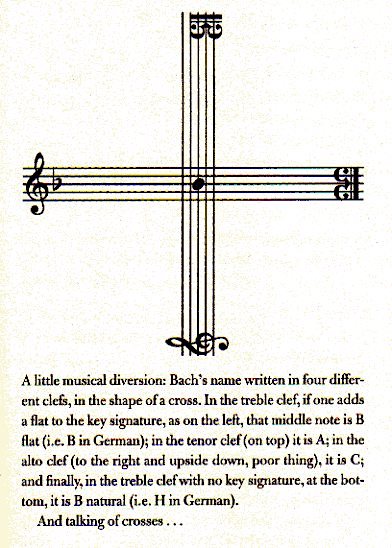
cross

Part 5 makes an impressive case for an underlying sacred programme behind the suites—making them effectively a suite of suites depicting the life of Christ. Here, and throughout, Steven makes insightful comparisons with other Bach works, in particular the church cantatas. Citing Ruth Tatlow, he ponders Bach’s interest in the symbolism of numbers. He then offers rather detailed programmes:

  • 1 Nativity (with a fine analysis of the Prelude)
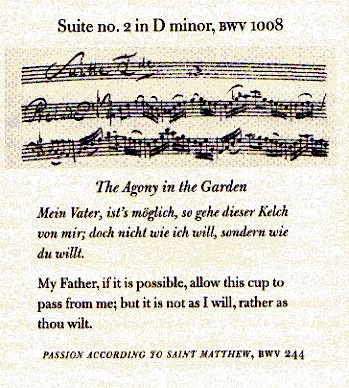
  • 2 The Agony in the Garden
  • 3 The Holy Trinity—or the Ascension
  • 4 Magnificat—or the Presentation in the Temple
  • 5 Crucifixion
  • 6 Resurrection.

suite 2

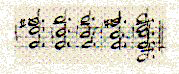
chordsFor the second suite he thoughtfully discusses the puzzling chords at the end of the Prelude; while admitting the possibility of decorating them in the style of the rest of the movement, he also makes an analogy with the Five Holy Wounds.

By contrast with the C major “blaze of glory” of the third suite, the C minor tonality of the fifth suite, “perfect backdrop for the unfolding of tragedy”, is echoed in other “sombre masterpieces” (the final movements of Bach’s own Passions, Mozart, Brahms, Rachmaninoff: see here). At its heart is the Sarabande, “the epitome of loneliness, desolation, despair”.

For the sixth suite,

Having darkened the sound of the cello with the tuned-down A string in the fifth suite, Bach now reaches out to the sky with a fifth string, an E string a fifth above the A—rather like those medieval master builders who developed Gothic windows, with pointed arches reaching towards heaven, letting in more light.

He likens the opening to the pealing of bells—a more authentic simile than the equally evocative image of the Sicilian marranzanu jew’s harp (a post that also includes a complete live performance of the six suites by Yoyo Ma at the Proms).

Steven continues to sing the praises of this Prelude in Part 6, where he takes the suites movement by movement, pondering nuances. For the Courante of the first suite (“a bundle of fun”) he recalls his teacher-guru Jane Cowan describing it as “a portrait of a street entertainer performing an energetic dance to the accompaniment of his pet monkey banging on a drum”; she characterised the Gigue as “drunk”. He includes notes on bowings that (as ever) are not just technical but musical too—such as the Prelude of the third suite, where he explores a conundrum in the variant sources (“Anna Magdalena has been at the wine again”). For his comments on the Sarabande of the fifth suite, click here.

Bach and alap

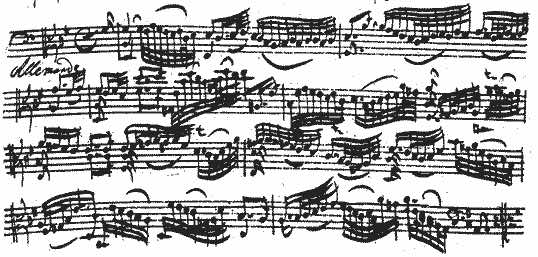
As to the wonderful Allemande of the sixth suite (another alap, I’d say),

If one is thinking in terms of the recitatives that the short note-values bring to mind, there must be a certain freedom within the beat; but it is at least equally important to remember that, even though the style may be vocal in nature, it is still an allemande. […] One has to breathe in expansive, unhurried spans, perhaps imagining a moving bassline controlling the flow of the melodic current.

“The greatest cycle ever to be written for a solo cello” is completed with a Gigue of “bounding, irresistible, unquenchable joy”, with “pedal-note passages, more folk instruments, more bells, impossibly huge leaps…”

And as Steven writes, having completed this glorious cycle, Bach probably just

put down his pen and went out to rehearse, or to repair his harpsichord quill plectrums; or perhaps he settled down to a convivial dinner involving singing with his family and friends, his next masterpieces already buzzing around in his head.

The book makes a fine companion, inviting a wide audience to immerse themselves in these miraculous suites.

* * *

See also A Bach retrospective. Other fine performers who write eloquently about Bach include John Eliot Gardiner (e.g. here and here) and John Butt. Meanwhile in India, the art of dhrupad is less varied but no less profound; and the maqam/muqam/mugham suites performed throughout the Middle East and Central Asia are vast edifices. See also Unpacking “improvisation”.

Wonderful world

Yet another entry in my series on Interviews:

Don’t know much about history,
Don’t know much biology.
Don’t know much about a science book,
Don’t know much about the French I took…

—Thank you very much Mr Cooke, now perhaps we might focus on your particular areas of expertise…

Don’t know much about geography,
Don’t know much trigonometry.
Don’t know much about algebra,
Don’t know what a slide rule is for…

—Well Mr Cooke, I must say you’re very modest—such a disarming interview technique! We quite appreciate that you “don’t wanna get into specifics“. Indeed, I know I can speak on behalf of the board in saying that you seem ideally qualified to assume the post of Dean at the Donald J. Trump Academy of Arts and Sciences.

This video montage takes the idea further:

I’m most taken by the languid, dreamy cover of Sandy Lam 林憶蓮, with the subtle eastern flavour of its harmonies underpinning the pentatonic melody—and she adds a telling further verse:

Don’t know much about the Middle Ages
Look at the pictures and I turn the pages
Don’t know nothing about no Rise and Fall
Don’t know nothing about nothing at all…

which surely clinches the deal.

Cf. Replies from the Complaints Department.

Musics lost and found

MC cover

  • Michael Church, Musics lost and found: song collectors and the life and death of folk tradition (2021)

makes an engaging diachronic introduction to fieldworkers, and the musics they documented, in societies around the world—a sequel to his 2015 book The other classical musics (favourably reviewed here). Of course, our labels of “classical” and folk” are flawed (see e.g. What is serious music?!): the two volumes overlap.

In his astute Introduction, Michael notes the role of “colonial curiosity, sometimes tinged with guilt”, as well as patriotism and the distortion of local traditions under nationalistic movements and then state socialism (cf. the observations of Yang Yinliu and Milan Kundera). He comments:

Some collecting has been a response to horrifying circumstances. The most heroic collector of Nazi death-camp songs was the Polish singer-songwriter Aleksander Kulisiewicz, who survived three years in Sachsenhausen and devoted the rest of his life to performing the songs he had memorised from Jewish fellow-prisoners. There was a clandestine Jewish choir in Sachsenhausen whose members told him that, if he survived, he should preserve their memory by singing their songs to the rest of the world. That became his mission; his 3,000-page typescript of death-camp songs—many collected from survivors of other camps whom he sought out after the war—is now lodged in the Washington Holocaust Memorial Museum.

Even in less extreme conditions, under authoritarian regimes such as the USSR the work of collecting was dangerous. Now I think too of Rahilä Dawut, distinguished anthropologist doing fine work on Uyghur culture until she was “disappeared” in 2017.

While Michael recognises that his selection is to some extent arbitrary, beyond the Usual Suspects (Béla Bartók, Cecil Sharp, the Lomaxes), the chapters tell fascinating stories, digesting a vast amount of material—focusing on pioneering fieldworkers before the 1970s but also showing the ongoing work of more recent scholars.

As to the thorny issues of “loss”,

Most of the work songs which Alan Lomax collected in Spain and Italy in the 1950s are sung no more. The same applies to the work songs which Komitas found in rural Armenia, and which Cecil Sharp and Percy Grainger collected in England a century ago. These songs are gone, because the reasons for their existence—the trades they accompanied—are gone. And after the death of the village comes the death of the songs marking its calendrical and life-cycle events; there comes, in short, the death of local music. This rule holds for all villages, everywhere.

And

Worn-out and irrelevant forms may not be replaced by new ones, because the conditions required for that process—community and kinship networks and the aforesaid shared religion or ideology—no longer obtain, and may never obtain again.

But Michael does well to observe that

The old idea of an immutable musical corpus is giving way to the idea of an endlessly mutable art; the primacy of collecting is being replaced among scholars by the primacy of interpretation.

And indeed he concedes that the prospect is not one of unrelieved gloom. “Migrants carry their music in their baggage”, and

New work inspires new songs: baggage-handlers for Amazon in Genoa, whose forefathers sang as they humped fish, have devised new songs to speed their parcels.

Michael contrasts fusions that are the spontaneous result of social shifts with those that are arbitrarily willed by producers. He ends his Introduction with thoughtful reflections on the role of Covid.

* * *

The chapters are loosely grouped in four sections. “Why it all began” begins with a prelude on the various motives for collecting song in 18th century Europe—political, colonial, and economic—introducing Johann Gottfried Herder and the concept of Volkslied. Chapters follow on the 17th-century broadside ballads and Francis James Child; Orientalists from France (Jesuit priests in Beijing and Salvador-Daniel in Algiers); and the Moldavian prince Dimitrie Cantemir (1673–1723), documenting Ottoman music in Constantinople after being taken hostage. Here’s a sample of Jordi Savall’s project on Cantemir with Hesperion XXI:

“The birth of ethnomusicology” opens with chapters on collecting among Native American peoples—from Alice Fletcher’s work on the Omaha to Franz Boas.

Michael moves on to the work of Komitas (1869–1935) studying Armenian song on the eve of the 1915 genocide; and the British folk-song revival with the “contentious” Cecil Sharp, followed by Percy Grainger.

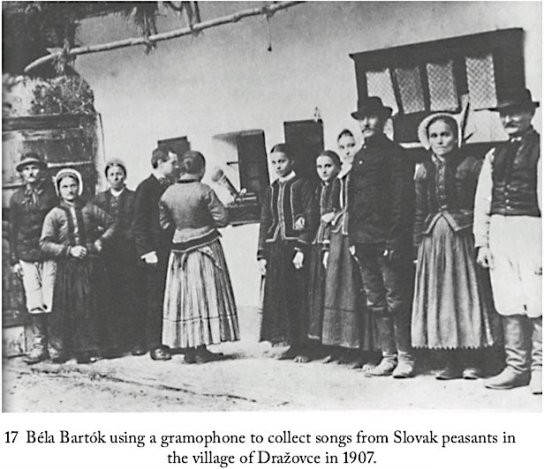
Bartok 1907

In “Carrying the torch: collectors in Northern and Eastern Europe” (a misleading rubric, since the chapters range far more widely), after an Introduction (featuring collectors such as Pyotr Kireyevsky (1808–56) in Russia, Karel Erben (1811–70) and Leos Janáček for Bohemia and Moravia, Vasil Stoin (1880–1938) for Bulgaria, Bjarni Thorsteinsson (1861–1938) for Iceland), Michael offers a fine chapter on Béla Bartók, with his extraordinary fieldtrips before World War One collecting songs in Transylvania, Slovakia, Romania, Ruthenia, Serbia, Bulgaria, Algeria—and much later, Egypt (1932) and Turkey (1936). Michael ponders Bartók’s prescriptive agenda, seeking the “purity” of “ancient” songs, disdaining “Gypsy” and “sacred” melodies. But he was always in search of connections:

In 1912, I discovered among the Maramures Romanians a certain kind of highly ornamented, Orientally-coloured and improvisation-like melody. In 1913, in a village of Central Algeria bordering the Sahara desert, I heard a similar melodic style. […] Who would have thought that the distance between the two phenomena—more than 2,000 kilometres—could be bridged by a causal relationship?

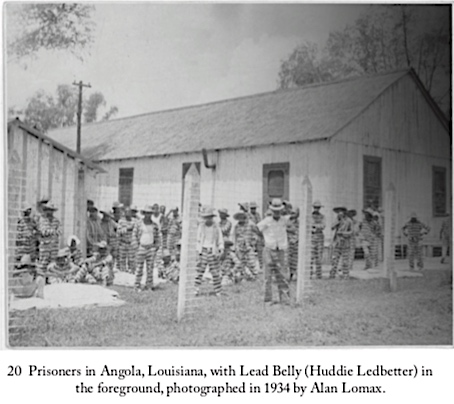
Lomax

This leads to a chapter on John Lomax and his son Alan, subsuming not only their work among (mainly African-) American folk-singers (see e.g. America over the water, and cf. Bruce Jackson) but Alan’s work in the Bahamas, Haiti, Britain, Spain, and notably Italy, working with Diego Carpitella. Note the Alan Lomax Archive and YouTube channel.

Among the pioneers of Australian Aboriginal music cultures, Michael highlights the work of Theodor Strehlow with the Aranda. The old theme recurs:

I am recording the sunset of an age that will never return—every act that I see is being performed for the last time, and the men who are with me have no successors. When they die, they will take all their knowledge to the grave with them—except that part which I have recorded. Hence I am writing down everything in full detail, so as to give the clearest picture of an age and of a culture that no one else but I have been privileged to witness.

In Chapter 12 Michael introduces the Western fascination with gamelan, from the 1889 Exposition Universelle to Jaap Kunst and Colin McPhee (for more, see Java to jazz). The site Bali1928.net has a wealth of (silent, alas) film clips.

The work of Paul Bowles in Morocco makes another vivid topic. Turning to Greece, Michael introduces the mission of Domna Samiou to document folk traditions there. John Blacking’s work on the Venda is a classic inspiration for ethnomusicologists. He goes on to explore the importance of record companies, introducing Moses Asch, Folkways, Nonesuch, Ocora, PAN, and Topic Records—before the label “world music” became a bland catch-all.

The final section, “Musical snapshots: the importance of sound archives” is introduced with notes on the Berliner Phonogramm-Archiv, the Library of Congress and the Smithsonian, East European archives, the British Library Sound Archive and the Golha Project on Persian music.

Chapter 17 explores the traditions of Central Asia—Kazakhstan, Kyrghyzstan, Uzbekistan, Tajikistan, Turkmenistan, Xinjiang—and further afield, Tuva. Despite the spectre of Soviet prescriptive innovations, collectors did some fine work, such as Viktor Uspensky and Viktor Belyayev, followed by foreign researchers like Jean During and Theodore Levin, and the Aga Khan Music Initiative. This leads to Afghanistan, introducing local musician-collectors, and the work of John Baily and Veronica Doubleday.

Chapters follow on Russia and Georgia—as a change from the polished stage presentation of many groups, here’s a Georgian group singing informally:

Musics lost and found continues with Pygmy polyphony in central Africa, with Colin Turnbull, Simha Arom, Suzanne Fürniss; and the radif of Persian art music.

Yang Yinliu 1950

Yang Yinliu, 1950.

Chapter 23 discusses China: the great Yang Yinliu, and my own humble fieldwork with the Gaoluo ritual association, the Li family Daoists, and shawm bands—all themes amply covered on this blog. Korean traditions (see my posts on Dang and Bowed zithers, 1) are introduced through the art of p’ansori; and Japan through taiko drumming—having left the more venerable traditions of gagaku, Noh, and kabuki to The other classical musics.

In the two final chapters Michael discusses the UNESCO Intangible Cultural Heritage programme and its pitfalls, ending with a thoughtful overview of the book’s knotty issues. Besides the bibliography, each chapter ends with a basic reading list.

More digestible than the New Grove and Garland encyclopedias, sections in the two New Grove Ethnomusicology volumes, or even The Rough Guide to world music, this book leads audiences to a wealth of traditions. While scholars were poring over musty tomes in libraries, and composers busy composing, these intrepid collectors were busy in the field, seeking to make sense of the cultural life of grassroots communities.

While Musics lost and found covers an impressive amount of ground, there’s scope for a further volume. The story of Milman Parry and Albert Lord recording the “Homeric” epics of bards in 1930s’ Yugoslavia (archive here) would be grist to Michael’s mill. Bruno Nettl is one of the crucial figures in ethnomusicology, not only for his studies of Native American cultures but for his work in Iran. Also valuable are Bernard Lortat-Jacob’s explorations of the Mediterranean. The chapter on the Lomaxes hints at the vibrant field of Italy, but one might also adduce the work of Roberto Leydi, Tullia Magrini, and so on. Though the work of Richard Widdess in Nepal gets a mention in the Introduction, south Asia deserves a lengthier treatment, to include the likes of Arnold Bake and Nicolas Magriel. And so on…

* * *

Tom Service introduced the book with Michael on BBC Radio 3 Music Matters (here, from 17.01). The programme introduces English folk-song; migration and “climate change in music”; singing in Albania and Genoa; and (from 28.42) Veronica Doubleday discusses her outstanding work in 1970s’ Afghanistan and the current crisis—a clear instance of a culture that is very much under threat, of course.

It’s true that village communities have changed decisively. But we need a new model for the ecosphere of folk tradition. Such genres are not timeless; even Bach’s cantatas soon fell from favour, and whether or not they find new audiences is not something that I worry about, although recordings and documentation are clearly valuable.

In China I often feel as if I’m responsible for the dwindling of the folk traditions that I document; or to put it another way, the very forces that bring us to these sites are those which lead to change. The role of the fieldworker has come under increasing scrutiny, as in such works as Shadows in the field (see e.g. William Noll on blind minstrels of Ukraine). Further to Nigel Barley’s portrayal of the fieldworker as “harmless idiot”, I sometimes feel like a harmful idiot.

Tom Service opens with a soundbite much favoured by pundits: “folk music cultures are in danger of extinction all over the world”.  I’m none too enamoured with the concept of “endangered traditions”: since the beginnings of anthropology, fieldworkers have always supposed they were witnessing the last vestiges of a tradition. It tends to suggest a nostalgia for the halcyon days of child chimney-sweeps (cf. Edible, intangible, dodgy). Cultural loss is a thorny issue. As Michael indeed suggests, the book’s leitmotif—the fear that the music of collectors’ chosen field might evaporate before they managed to fully document it—may not be so well-founded. It’s always too late, and never.

* * *

The book was sonorously launched with an event at the Wigmore Hall, making a fitting tribute to live musicking after a long silence, as well as a reminder of the rich traditions maintained among UK diasporas. In an exquisite programme, it was wonderful to hear Veronica Doubleday again, followed by a cappella songs from the Georgian Maspindzeli choir, Persian classical music performed by Mehdi Namdar (ney) and Fariborz Kiani (goblet drum), and the Anatolian folk songs of Çiğdem Aslan accompanied by Erdal Yapici on baglama.

* * *

See also e.g. my voluminous fieldwork and world music categories in the sidebar; note Society and soundscape.

Köçek in Kuzguncuk!

A fanfare in advance of the anniversary of Atatürk’s death on 10th November

Kocek 6

Just back home after an ecstatic week in Istanbul—first time I’ve needed my passport since visiting Li Manshan in 2018!

The neighbourhood of Kuzguncuk on the Asian shore of the Bosphorus is a delightful community from which I can hardly drag myself away. Amidst constant inspiration, I’ve met more people there in the last week than in the previous five years… Having made a few brief trips to Istanbul Back in the Day to perform with London early music groups, I feel the European side of the city can wait—rather as I take eccentric pride in never having visited the Great Wall on all my stays in Beijing.

As elsewhere in Istanbul, vestiges of Armenian, Greek, and Jewish cultures are still evident in the architecture of Kuzguncuk (click here for a fine study by Amy Mills; see also A bijou mosque in Kuzguncuk).

Armenian church next to a mosque.

Synagogues.

synagogue 2

Inside the main synagogue.

The two Greek churches.

* * *

Kastamonu deli

Among Kuzguncuk dwellers are migrants from Kastamonu, due east of Istanbul in the region south of the Black Sea. Kastamonu is a leading centre of festive köçek dancing, and for the celebrations following Republic Day on 29th October a group came to perform along the lovely tree-lined main street of Kuzguncuk that leads up from the Bosphorus. The dancers’ main instrumental support is provided by davulzurna drum-and-shawm, ubiquitous accompaniment to festivities over a wide area. 

AM filmingIn the afternoon, first they performed at the entrance to the shops lining the street. As locals and visitors threw lira notes at the twirling feet of the two dancers, they gyrated gracefully down to pluck them up in their mouths. The group then made a base at the entrance of a side-street, performing a lengthier sequence beneath a large banner depicting Atatürk; the musicians, now seated, were supplemented by a kemençe bowed lute (cf. Indian and world fiddles, Musics of Crete), with gutsy, exuberant singing. Here are some clips from Augusta’s fine filming:

The band bursts into song as the dancers kneel to assemble the notes around the skirt:

They get back on their feet for the climax:

That evening they went on to perform for a lively street party up the hill.

* * *

Köçek troupes, 1720 (wiki):
left, musicians and dancers entertain the crowds;
right, at a fair for Sultan Ahmed’s celebration of his son’s circumcision.

 Köçek dancing (cf. this introduction) thrived from the 17th century, along with çengi. Notably since the late Ottoman era, courtly genres dispersed among the folk from the courts (a transmission trope also commonly attributed to late imperial China—see “When the rites are lost, seek throughout the countryside“; cf. The Janissary band). The androgynous young male dancers, * then recruited from non-Muslim subject peoples of the empire, began training early (for the Ottoman background, note the useful article by Şehvar Beşiroğlu, “Music, identity, gender: çengis, köçeks, çöçeks”), as well as his “The musical role of Turkish women in perspectives from the Mediterranean music scene“. Having long been part of meyhane tavern culture, groups have continued to perform for folk festivities such as weddings and circumcisions.

In folk traditions today, there may be a solo dancer, or a pair. Of course costumes (and concepts of gender) have changed over time, throughout the whole Levant. We saw two young adult dancers, both clean-shaven, their costumes and props each playing on male-female roles. One wore a long flaring skirt decorated with coins, jewels, and gold, as well as a kind of sporran at the waist, but a (“male”?) waistcoat; he/she sounded the zil finger-cymbals, as played by the female çengi dancers. Meanwhile the “male” dancer wore the skirt of the çengi, and necklaces, clacking the kaşık spoons (cf. çarpare castanets). 

I’ve adapted these leads from §4b here:

Specially-composed musical forms for çengi and köçek dances include tavşanca, çiftetelli, and ağırlama. A collection of songs in the same modal form with lively instrumental ritornellos is called takım. These include songs by named or anonymous composers and performers. Hammamizade Ismail Dede (himself a fine composer of köçekçe) called such forms musikinin orospuluğu (“musical whoring”). Köçekce are composed in popular modal systems like karcığar, gerdaniye, hicaz, hüzzam, gülizar, bayati araban, and saba. Those köçekçe in aksak limping metres are beautiful in both their musical style and poetic lyrics.

The köçek tradition of Kastamonu is renowned. Among many videos online, this general introduction includes a wedding party from 7.14:

Here’s a succinct personal account of change in the livelihood over the last two decades (with a rather confused appeal to “the government” that reminds me of China):

I can hardly begin to encapsulate the myriad delights of Kuzguncuk…

See also Greek Christmas in Kuzguncuk, and for more on modern Turkey, this roundup.

With boundless thanks to Kadir Filiz, Caroline Finkel, Augusta,
and Millie!


* Elsewhere too, cross-gender dancing is rather common, such as in Egypt and Afghanistan (see the distressing 2010 documentary The dancing boys of Afghanistan), not to mention Europe and east Asia.

The qin zither under Maoism, 2: Wang Di

*For a roundup of the whole series, click here!*

GPH WD

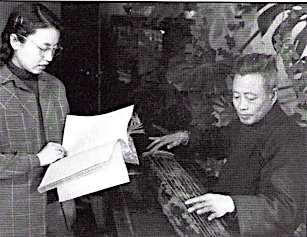
Wang Di checking her transcription of Guan Pinghu’s Guangling san.

In this little series on the qin zither in Beijing under Maoism, I have introduced Guan Pinghu and Zha Fuxi. Wang Di makes a kind of bridge between those two great masters, as well as between them and the reform era since the 1980s.

Gender
In great contrast with the current scene, before the 1980s both music scholars and conservatoire performers were largely male (for the wider gender profile in Chinese musicking, see here).

As solo instrumental performers, women have come to dominate in the conservatoires since the 1990s; but in the 1950s the celebrated performers were male, with few exceptions (notably Min Huifen on erhu: e.g. the CD set of archive recordings). Even the pipa lute and zheng zither, now mainly the preserve of women, were known largely through the playing of men.

However, women have long constituted a substantial minority among qin players (see here). In modern times, they were notable in the Republican era. After the 1949 “Liberation”, Wang Di 王迪 (1923–2005) was among several female students gathering around Guan Pinghu at the Music Research Institute (MRI) in Beijing, including Yuan Quanyou, Shen You, Yue Ying and her sister Yue Xiangyan. They all came from strong literati backgrounds. And for an iconic figure in the Hong Kong qin scene, see Bell Yung, “Tsar Teh-yun at age 100: a life of qin music, poetry, and calligraphy”, in Helen Rees (ed.), Lives in Chinese music (2009).

Wang Di’s early life
Less promoted than some of her contemporaries, Wang Di is best known as the devoted disciple of Guan Pinghu. A companion with Zhang Zhentao’s article on the latter is his

  • “Daihuo jiaotong yun ben bei: qinjia Wang Di xiansheng” 带火焦桐韵本悲——琴家王迪先生 Mingjia 名家 49 (2013) (here, or here).

Born in Beijing in 1923, Wang Di sought out Guan Pinghu soon after hearing him on the wireless when she was 13, becoming his pupil. His living conditions were poor; she fed him when he came to her house for lessons, and helped support him.

Wang Di took part in the activities of the Beiping Qin Study Society from 1947. That year she briefly studied chemistry at the Université Franco-Chinoise in Beijing, “resolving to become a Chinese Madame Curie”, as Zhang Zhentao puts it. But illness soon made her forsake chemistry for the qin, studying from 1948 at the Guoli Beiping yishu zhuanke xuexiao 国立北平艺术专科学校, precursor of the Central Conservatoire, where she was kept on after graduating in 1953.

After Liberation
Having introduced Guan Pinghu to the MRI scholars in 1951, Wang Di was soon to serve as his assistant there. By contrast with Zha Fuxi, well-connected aviation executive, until the 1950s Guan Pinghu’s circumstances were lowly, and he now found himself with a regular salary, paid to do the work he loved.

All this was far from the peasant life now being extolled by the new regime. Alongside the groundbreaking fieldwork on regional folk traditions, somehow the MRI created a spacious ivory tower where research on elite genres (not only the qin, but early history) could be avidly pursued.

After the Beijing Guqin Research Association (Beijing guqin yanjiuhui 北京古琴研究会, see Cheng Yu’s article) was formed in 1954, a siheyuan courtyard-style dwelling in Xinghua hutong near Houhai lake made a regular home for its activities.

BJ qinhui

Pu Xuezhai, Zheng Minzhong, Wang Di, and Xu Jian
listening to Wang Mengshu playing the qin in the association’s courtyard, 1961.
Note the varied attire…
Source.

One aspect of the work of senior masters like Guan Pinghu was the process of dapu, recreating early qin tablatures; this soon became “fixed” in dingpu transcriptions of Wang Di and others, aided by recording.

In 1956 Zha Fuxi enlisted his young students Wang Di and Xu Jian to join him for an iconic survey of qin players in cities throughout China (see under Zha Fuxi). Whereas Zha Fuxi was already well travelled, this was Wang Di’s first opportunity to meet masters from all over the country.

On their return, the First National Music Week was held in Beijing, a prestigious event. Guan Pinghu and Wang Di were among the guests received by Chairman Mao and Zhou Enlai at Zhongnanhai; Zhou even invited Wang Di to dance.

Through this period the association made minor concessions to the political agenda of “reform”, composing some new pieces. Most of these were transient, with the important exception of metal strings replacing silk.

Wang Di had planted a pumpkin in the association’s courtyard, which managed to grow to impressive proportions. In 1960, as food shortages were hitting hard, onlookers watched her with envy as she took it home. As Zhang Zhentao observes, women’s frugal domestic tasks like growing vegetables and needlework took on significance for the qin community; Wang Di could now relate this to the sorrows expressed in ancient melodies. In my post on Guan Pinghu I’ve described Wang Di’s successive changes of abode from the late 1950s.

A foreign pupil
After the 1949 revolution, the few Europeans studying music in China were mainly diplomats. Robert van Gulik had studied the qin profoundly before Liberation, whereafter he continued his work from afar; Věna Hrdličková researched narrative-singing in the early 1950s.

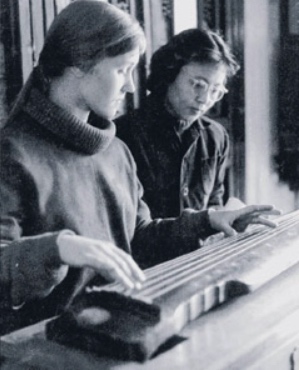
LundqvistCecilia Lindqvist studying with Wang Di, 1961. Source.

In 1961, just as society was recovering briefly from the hardships of the Great Leap Backward, Cecilia Lindqvist (林西莉, b.1932) (wiki, and Chinese version; silkqin; see also here and here) came to Beijing with her husband, cultural attaché at the Swedish embassy, and went on to become a renowned Swedish sinologist. She began studying the qin with Wang Di early in 1961. Lindqvist’s 2006 book (succinctly titled Qin; Chinese translation 2009) includes sections on her studies with Wang Di and the Beijing Guqin Research Association.

When she returned to Sweden in 1962, the association presented her with a Ming-dynasty qin (!!!) and recordings of the master players (heard on the CD with her book).

After Wang Di died in 2005, in 2010 her daughter Deng Hong 邓红 toured Sweden, making a 2-CD set of her own recordings, with notes by Lindqvist.

The Cultural Revolution
Remarkably, research on the qin managed to persist behind closed doors through the Cultural Revolution.

But by 1969 Wang Di, along with most of her colleagues at the MRI, was sent down to the May 7th Cadre School (Wuqi ganxiao 五七干校) at Tuanbowa in Jinghai, south of Tianjin (among several online accounts of conditions there, see e.g. here).

Zhang Zhentao evokes Wang Di’s life at Tuanbowa. Men and women performed the same tasks, like driving, tilling the fields, chopping firewood, mixing cement, and so on. During house-building, it was quite an art to toss adobe bricks up to the worker on the scaffolding above: the person standing below had to aim towards the receiver’s head, so that they could catch it; if they aimed for the hands, it might fall short. Wang Di excelled at this skill, and after returning to barracks she demonstrated it to her daughter, though it would soon become redundant for urban dwellers.

After the reforms
With the revival of tradition that followed the overthrow of the Gang of Four, some qin masters soon began making a reputation on the concert stage. But Wang Di remained unassuming, keeping away from the public eye; still working quietly at the MRI, she was content to continue representing the heritage of Guan Pinghu.

Following Zha Fuxi, Wang Di also became an authority on the dying art of qin songs. She began publishing her long-term research on the genre as early as 1982 (see here).

GPH CDs

From 1991 she made a few visits abroad; and from 2003 she became involved in the Intangible Cultural Heritage project on the qin. But closest to her heart was preparing the CD set of recordings of Guan Pinghu.

In this series I’m focusing on a tiny literati elite that suffered terribly under Maoism. At the same time, it’s worth reminding ourselves that the peasantry who comprised the vast majority of the population endured even worse tribulations, despite the exalted new status that ideology now bestowed upon them.

A mélange of playlists

Still delighting in all manifestations of the Terpsichorean muse, by now I’ve compiled several playlists for diverse genres, mostly containing listening guides with Society and soundscape in mind:

Playlist

  • Chinese folk music (in the sidebar, scrolling down below the image gallery—with commentary here) including the Li family Daoists, the Gaoluo ritual association, searing shawm bands, and numinous recordings from the Zhihua temple (1953) and Xi’an (1961)
  • An eclectic Playlist of songs, with Billie Holiday, fado, Bach, Amy Winehouse, Purcell, Michel Legrand, Mahler, Nina Hagen, Ravel, Aretha Franklin, Barbara Hannigan, and more
  • Links to a varied selection of north Indian ragas, including “diatonic” (Yaman), “minor” (Kafi Zila), pentatonic (Malkauns), with augmented intervals (Bhairav), the beguiling Marwa (“A major over a C drone”)…

  • A series on the great Beatles albums, with the aid of Wilfred Mellers and Alan W. Pollack
  • Feminist songs, including You don’t own me and I will survive
  • see also Punk: a roundup

There must be well over a hundred posts there for you to relish—do click away on all the links!

Bowed zithers, 2: Alpine

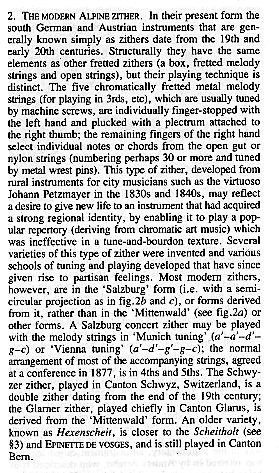
As defined in ethnomusicology, zithers are diverse. In my recent post I outlined the various zither types under the Sachs-Hornbostel system: bar, tube, raft, board, trough, frame. Worldwide, plucked zithers are common (note the “Zither” entry in The New Grove dictionary of musical instruments), but bowed zithers seem quite rare. Half-tube board zithers, both plucked and bowed, are distinctive to East Asia.

Box zithers include hammered dulcimers like the santur and qanun. In medieval Europe the psaltery was plucked; players only took a bow to it in the 20th century.

langspil

Anna Þórhallsdóttir playing the langspil.  From wiki.

The Inuit tautirut is a zither whose bow is a strip of whalebone resined with spruce gum; the Icelandic fiðla and langspil have enjoyed a revival (see here).

* * *

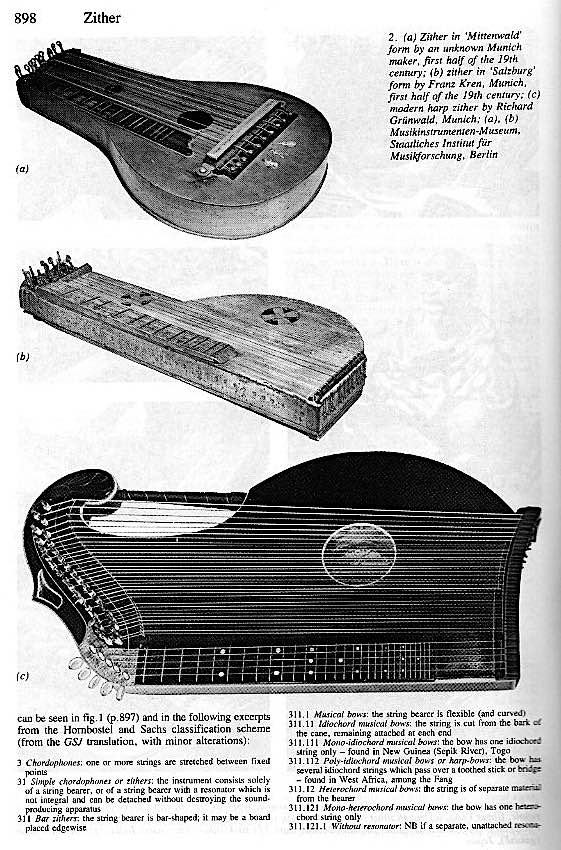
Turning to a less exotic area of “world music”—and perhaps posing us a certain challenge in “delighting in all manifestations of the Terpsichorean muse“—the “Alpine” box zither became common around south Germany, Austria, and Switzerland in the 19th century.

Its precursor was the scheitholt, dating back to the 14th century—which might lead us down the path of early north European zithers like the hummel and épinette de Vosges, as well as the Appalachian dulcimer (see this article on the excellent Essential Vermeer site, which I introduce here); and moving further east, the cimbalom family (including the tsymbaly of Hutsuls in Ukraine), as well as a wealth of Baltic psalteries!

Grove Zither Alpine

From The New Grove dictionary of musical instruments, “Zither” entry.

The Alpine zither is sometimes bowed as well as plucked. Here’s an example:

I’m drawn to the Alpine bowed zither by a personal connection. Rudi Rieber (1934–2004), father of My Brilliant Friend Augusta, taught himself to play the Konzertzither in his youth. He was brought up in Winterlingen in the Swabian Alps south of Tübingen. There, as his daughter explains:

My watchmaker grandfather Wilhelm had a clock-and-silverware shop. One day around 1940 a gypsy woman purchased something there, for which in return she offered to barter her zither. My father Rudi, then 5 or 6 years old, watched her demonstrating how it was to be played, both plucked and with the bow. Later he also taught himself to play the violin, guitar, and mouth-organ.

Left, Rudi Rieber, 1994;
right, Rudi’s grandson Selim, 2000, at the age of 7,
shortly before he followed the path of jazz/rock/pop drumming

In 1994 Rudi recorded a series of songs for his 60th birthday, inviting his former classmates. His spoken introduction reflects a sense of responsibility towards a tradition under threat. Recalling his childhood after the NSDAP took control of the municipality in 1933, he commented:

We were fortunate to still be taught many of these beautiful songs, and we can be happy that this treasure has been given to us. We are grateful to our teacher H.C. Seeger, who understood how to enrich our entire life—in times when folk-song was under the threat of being misused and replaced. With this recording I am attempting to weave a thread of our tradition from half a century ago down to today.

All this was in tune with the Wandervogel youth movement from 1896. In protest against industrialisation, its ascetic devotees immersed themselves in the countryside, communing with nature; and Volkslied was at the heart of the movement. The Wandervogel groups were outlawed by the Nazis in 1933; so while it’s not immediately audible, we might almost regard the maintenance of this repertoire as a kind of underground preservation.

Augusta’s intrepid explorations of her father’s repertoire reveal how early and regional folk traditions became interlaced with the world of Mozart and Mahler.

The early-19th-century collection Des Knaben Wunderhorn had a pervasive influence on German identity, and on both folk and art cultures. Songs that Rudi played from this repertoire include Jetzt gang I ans Brünnele, a Swabian folk-song documented by the composer Friedrich Silcher (1789–1860):

and Im schönsten Wiesengrunde will ich begraben sein:

as well as Bald gras ich am Neckar, whose text Mahler set in the Rheinlegendchen song of his own Des Knaben Wunderhorn.

Es, es, es, und es, es ist ein harter Schluss is a satirical apprentice’s song from the Wanderjahre repertoire (cf. Mahler’s Lieder eines fahrenden Gesellen settings). The wiki entry on Es, es, es… details its reception history since the 19th century—this was one song that the Nazis did readily adopt,apparently apolitical, describing the grievances of the previous century”, its catchy melody suitable for marching.

Among other pieces that Rudi recorded, Wenn alle Brünnlein fließen is a 16th-century antecedent—again apparently Swabian—of Ein Mädchen oder Weibchen from Die Zauberflöte; Mozart also set Komm lieber Mai und mache.

With the rich overtones, and the use of the bow, the material takes on a shimmering, ethereal patina. Here, after a plucked prelude, like an Alpine alap, Rudi adds the bow for a Schuhplattler dance:

This is the kind of domestic musicking quaintly evoked here:

* * *

Intriguingly, the piano is classified as a zither (Not a Lot of People Know That…)! Further to John Cage’s innovative use of the instrument, Stephen Scott (1944–2021) was a pioneer of the bowed piano. Here’s his Entrada:

Ha! There’s one angle that the ever-inventive Augusta, a fine pianist trained in Paris, still has to explore…

I’ve focused here on bowed zithers—but all right then, I guess we have to play out with the theme from The third man (1949), iconic soundtrack to an iconic film, plucked by Anton Karas:

The opening melody makes another worthy addition to my list of Unpromising chromaticisms (“write a staggeringly popular tune using only the five semitones within the range of a major third, with two chords”):

Third Man

See also Zithers of Iran and Turkey.

Posted from Kuzguncuk, Istanbul—
with many thanks to Augusta!

Thankyou Driver!

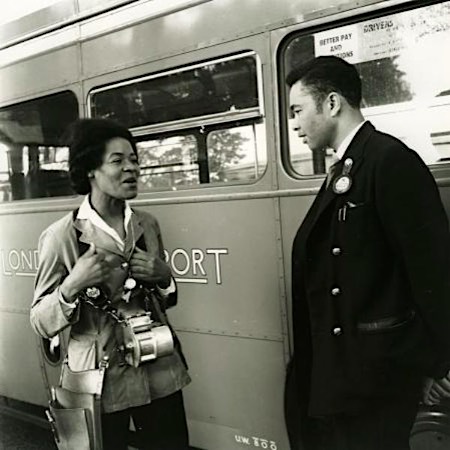
Bus 1962

“Male bus driver and female conductor chatting by their bus;
both are recent recruits from the Caribbean”.
Photo: Henry Grant, 1962.

When passengers get off the bus (or “alight”, as the quaint officialese term has it), I’m surprised how often I hear them calling out “Thankyou Driver!”.

To their less confident, silent fellow-passengers the parting salutation, flaunting a sense of etiquette, may seem like a rebuke. One might suppose it to be one of those hallowed customs trumpeted by the Brexit brigade, like queueing, child chimney-sweeps, and bendy bananas; but it’s only since the 1980s, when drivers had to fend for themselves without a conductor, that it has become possible to thank them audibly.

Little did I know that it has become a common topic of debate, with its own meme. A 2018 Guardian article on the topic prompted 1,380 comments! Like Life, It’s Complicated, with no simple divide between the courteous and the callous.

It seems fair enough when one leaves by the door where the driver sits (cf. the ticket-collector in Alan Bennett’s Sermon). When boomed from the distance of the middle door, more timid souls may find it unseemly—almost virtue signalling, drawing attention to oneself as a pillar of the community. *

It’s also regional. Popular in Scotland and north England, it’s common in Australia too; the article has some comments on bus protocol elsewhere, such as in Germany, Spain, and Russia. One BTL comment noted:

I used to thank bus drivers when I lived in a city where that was a thing people did. For now, I live in a city that mercifully rejects small talk and the forced emotional labor of giving and accepting thanks (New York)—so I no longer do.

It’s not just used by Little Old Ladies, though from my limited sampling in London it does tend to be more of a Woman Thing (statistics, please—“broken down by age and sex”, like Keith Richards). I can’t find the source of the poll showing that 82% of people (“more than 15,300”) thanked the driver, but I’m incredulous.

Don’t Get Me Wrong, I’m all for a bit of personal contact. Maybe it’s the physical distance between them: while the greeter’s boldness impresses me, somehow the use of “Driver” makes it less personal, drawing attention to the grubby contractual relationship. Of course one thanks people face to face, people with whom one has had a certain amount of contact—like a taxi driver, or a doctor. But in other routine exchanges with public (or private) servants, one doesn’t say “Thankyou, Handyman” or “Thankyou, Hedge-fund Manager”.

It seems a bit patrician to me, like a greeting to Staff—the kind of patronising remark that Jacob Tree-Frog ** makes to one of his chauffeurs on the successful completion of a charabanc outing, rather as he dismisses one of his butlers or scullery maids from his August Presence.

In the event that the passenger actually knows the driver (“Thankyou, Bob”) then it’s fair enough. To me it suggests that the driver had made a special diversion to deliver them safe and sound right to their front door, and is going to hop out and take the shopping in for them too.


* Rather like clapping the NHS, which nurses and doctors came to see as a “hollow gesture” compared with, like, supporting fair pay or even following public health guidance—see also here.

** In the latest instalment in JRM’s mission to remind us that he is a fatuous, dangerous lunatic, he explains why Tory MPs don’t need to wear face masks in the Chamber:

“We on this side know each other” and have a “convivial fraternal spirit.”

WTAF???

Bowed zithers, 1: Korea and China

ajaeng

Korea: the ajaeng.

Leading on from Dangak, I’ve been exploring the theme of bowed zithers in Korea and China.

Organology can be a stimulating topic (see e.g. here), illustrating the riches of human creativity. Under the Sachs-Hornbostel system [1] chordophones are classified as lutes, harps, and zithers; it considers playing techniques as well as construction (and while I think of it, do admire the gardon of Gyimes!—here, under “Hungary, Transylvania, Romania”). We find many types of zithers: bar, tube, raft, board, trough, frame. Bowed zithers are a minor but intriguing rubric.

zithers

Schematic chordophone types, from Hournon, “Organology”.

Still, organology tends to reify, whereas instruments should lead us to the genres in which they play a part, and to musicking in society. I can meet that challenge for China, but below my explorations for Korea are somewhat hampered by the fact that such clips as I’ve found on YouTube largely feature performances on the concert stage rather than folk activity.

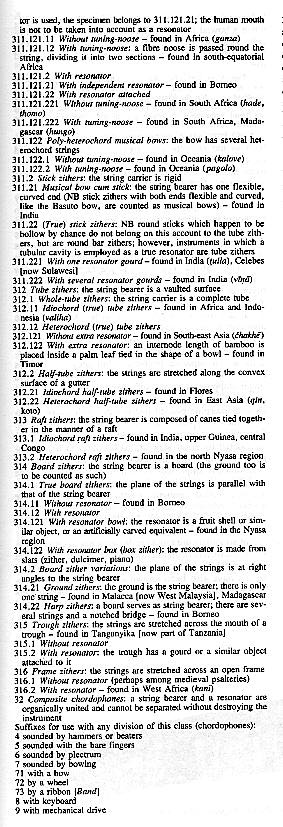
Grove Zither 1

Grove Zither 2

From The New Grove dictionary of musical instruments, “Zither” entry.

East Asia is notable for its half-tube board zithers. In Korea, a striking component of the hyangak ensemble is the ajaeng bowed zither. The bow, now usually made of horsehair, is traditionally a rosined stick.

In the sanjo genre, Kim Il-Gu:

and in Kim’s style, Han Lim:

Kim Yong-seong:

Here’s Kim Young-Gil’s 2012 CD L’art du sanjo d’ajaeng (playlist):

The ajaeng is used in the sinawi genre, derived from shamanism:

Here’s the CD Korea: the art of sinawi (playlist):

Note also the bowed fiddle haegeum, whose Chinese characters 奚琴 attest to its early origin (see Xiang Yang 项阳, Zhongguo gongxian yueqi shi, 中国弓弦乐器史 [History of Chinese bowed string instruments, 1999] pp.174–83).

kut

Away from the concert stage, to complement the video footage of a shamanistic kut ritual in my previous post, in this 2001 film of a ssitkimgut post-death cleansing ritual from the southwestern island of Jindo (cf. Keith Howard) both ajaeng and haegeum are part of the accompanying ensemble (e.g. from 14.03):

See also Shamans in the two Koreas.

* * *

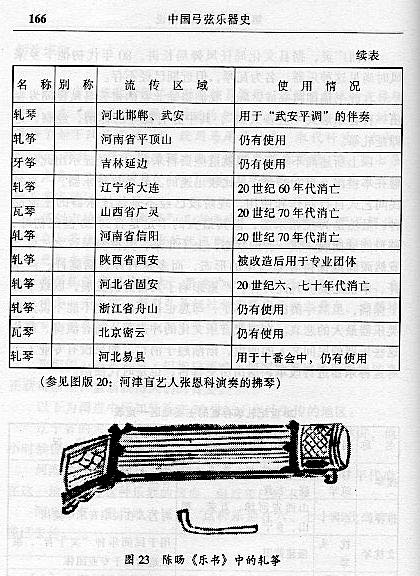
In China, if the variety of bowed lutes (fiddles) is rather little known, bowed zithers are fewer but also remarkably widespread. Following the 1992 Zhongguo yueqi tujian 中国乐器图鉴 (pp.262–4), Xiang Yang devotes chapter 4 of his book (see above) to them.

XY table 1

XY table 2

Bowed zithers in Chinese folk traditions, with alternative regional names.
Table, Xiang Yang pp.165–6.
Illustration from the Yueshu of Chen Yang (1101).

In early history, the zhu 筑 was a struck zither, long predating bowed lutes, as Laurence Picken noted in his “Early Chinese friction-chordophones”, The Galpin Society Journal 18 (1965); Xiang Yang discusses it further in his chapters 2–3.

Left: yaqin, Yixian in Hebei; right, yaqin, Pingdingshan, Henan.

In modern folk traditions, the yazheng 轧筝 or yaqin 轧琴 (here and here) accompanies some regional vocal genres, such as in Yixian county, Hebei (where it was part of the Shifan ensemble), the Handan region of south Hebei, Hejin county in south Shanxi, and the Pingdingshan region of Henan. For the cuoqin 挫琴 around Qingzhou in Shandong, and links with early bowed zithers, see here and here. Recently in China such instruments tend to attract Intangible Cultural Heritage flapdoodle, but hey. For the plucked zheng zither in Shandong, click here.

Left: wenzhen qin, Putian; right, yaqin, Hejin.

In Fujian, the Shiyin bayue ensemble of Putian includes the wenzhen qin 文枕琴.

This excerpt from Pingdingshan in Henan features the yaqin:

For the sequel on Alpine bowed zithers, click here. See also Zithers of Iran and Turkey


[1] See e.g. Geneviève Dournon’s chapter in Ethnomusicology: an introduction (The New Grove handbooks in music), pp. 276–7.

With thanks again to Simon Mills

Women in Tibet, 2

Ajakhaba 1944

The status of women in old and new Tibet is an increasingly popular topic, with studies headed by Janet Gyatso and Hanna Havnevik (eds.), Women in Tibet, including Isabelle Henrion-Dourcy’s chapter on women in expressive culture (outlined here), Charlene Makley on nuns (cf. her book The violence of liberation), and Robbie Barnett on women in contemporary politics.

Jamyang Norbu has long been a challenging voice in the Tibetan exile community (see The Lhasa ripper, The enchanting world of Tibetan opera, and The mandala of Sherlock Holmes). I also appreciate his

a “rambling essay is based on a rambling talk” that he gave to Tibetan students in Delhi on 1st April (sic) 2019.

I made a hash of my talk. A 20-hour flight, jet lag, and an injudicious self-prescribed nostrum [excellent expression—Ed.], didn’t help. But the hundred or so curious, outspoken, eager-to-know students just brushed aside my incoherence, and bombarded me with arguments and questions—even on issues considered terrifyingly taboo in our subservient exile society. I had a great time.

Indeed, the article makes a refreshing complement to more arcane academic studies. His typically virtuosic discussion mainly concerns old Tibet, with notes on the Maoist era. He opens by noting that, by contrast with other Asian societies,

in numerous accounts of visitors and travellers to pre-1950 Tibet one comes across positive and even laudatory comments on the role of women in Tibetan society.

He cites the work of Yudru Tsomo (Sichuan University) on the traditional role of women in business and trade. Socially too,

not only did the lady of the house receive guests and socialise with them, it was in fact required of women to dine and drink with male guests and take part in the conversation.

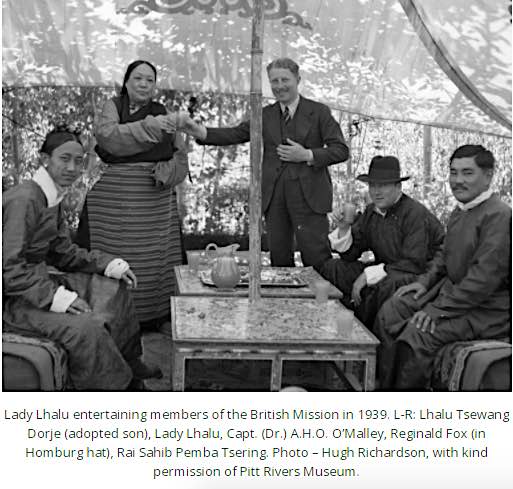
Gould 1939

He notes that

Such social freedoms were not only the preserve of the aristocracy but widespread in all classes. In Lhasa, women drank and made merry publicly during the summer and autumn picnic seasons. […]

Once as a schoolboy in Darjeeling, I passed by a large group of Tibetan women on the Chowrastha road. They had gone for a Sangsol (incense offering) ceremony at the Observatory Hill, or Gangchen as Tibetans called it, the site of the oldest Buddhist temple in the district.  They were returning home, arm-in arm, singing songs, strolling down the main Chowrastha and Nehru Road where all the posh stores were located. They were dressed in their best silks and jewelry and all happily drunk, oblivious of the amused stares of passers-by. Some sheepish looking Tibetan men and servants accompanied them.

He also discusses social freedom and equality, and legal issues such as property rights and divorce. As he observes,

Financial independence gave Tibetan women the freedom to ignore or disregard male (particularly priestly) condemnation of their lifestyles, in particular the use of Western cosmetics that were in vogue from the 1930s.

He cites Alexandra David-Neel (1934), who observed that women

had achieved a de facto equality despite law and scripture unfavourable to them, this by virtue of innate independence and physical stamina…Tibetan women had mastered a harsh environment and gained sway over their men. Tibetan women were clever and brave and therefore valued by their husbands. It also helped that a large portion of the retail trade was in women’s hands.

Even after the Chinese invasion,

In the mid-1950s, when motor-biking became the rage in the Holy City, one of the first and most glamorous of bikers was the celebrated Lhasa beauty, the younger Lady Lhalu Sonam Deki, who roared around the holy city on a black BSA 500.

Women in religious life
He is careful not to portray Tibet as some kind of feminist paradise.

Women had no major role in the great religious institutions, particularly in the Gelukpa monastic universities, and also in the clerical power structure of the Tibetan government. There were important female incarnations as Samding Dorje Phagmo and also some important nunneries, but these were admittedly minor compared to the scale and importance of the male priestly institutions.

Still, as shown in several chapters of Women in Tibet, women played an important and recognised role in spiritual practice and teaching, Jamyang Norbu adduces early figures like the dakani Yeshe Tsogyal, the 11th-century Tantric practitioner Machik Labdron, the Samding Dorje Phagmo lineage (see the work of Hildegard Diemberger), and the Nyingma teacher Shukseb Jetsunma Chönyi Zangmo (1852–1953). As he notes, female spiritual teachers play a prominent role in Tibetan opera.

Women in politics and nation building
Again, while women played no role in the formal official, political, and military life of old Tibet, they were involved in national political life from early times—such as Semarkar, sister of Emperor Songtsen Gampo (547?–649), and Trimalo Triteng, consort of emperor Manglon Mangtsen, the grandson of Songtsen Gampo. Here Jamyang Norbu refers us to the work of Helga Uebach, which again features in Women in Tibet.

In modern times, the Lhasa aristocrat Yeshi Dolma became queen of Sikkim in 1882.

Women in war and revolution
Women played a significant role in the resistance against the Chinese. In the 1930s Gyari Cheme Dolma rose up against the Sichuan warlord/governor Liu Wenhui.

During the 1956 Uprisings in Eastern Tibet we know of at least two women, Ani Pachen Lemdatsang of Gonjo and Gyari Dorje Yudon of Nyarong, who personally lead their male tribal warriors in violent insurrections against the PLA.

The “female warriors” Galingshar Chöla and Gurteng Kunsang were principal figures in the Women’s March on 12th March 1959 against the escalation of Chinese repression. Jamyang Norbu cites a joint statement by two eyewitnesses in 1961:

On October 21, 1959, a 60-year old nun Galingshar Anila was taken around the Barkhor in Lhasa. The Chinese ordered the people to beat her but no one would do so. Then the Chinese gathered some thieves and beggars, gave them some money and had them beat her at her house… She died on the 31st of the same month.

Gurteng Kunsang was imprisoned, but remained defiant; she was executed along with fifteen other prisoners in 1970.

The story of Trinley Chödrön’s role in the 1969 Nyemo uprising is documented by Melvyn Goldstein. And recently, women as well as men have self-immolated in protest at Chinese rule.

Immolations

Women in old Tibet certainly had more freedoms and rights than their counterparts in India, China, and the rest of Asia, and perhaps even more than in Victorian England. Of course it would be wrong to claim that women in Tibet were equal to men in the full contemporary sense—an equality that in spite of tremendous gains over the years, women in present-day democracies still strenuously contend they have not fully realised.

Well, as tends to be my way, this summary is superfluous—you can read the article!

Ethio-jazz

Inspired by Stewart Lee’s recent playlist, I got sidetracked by my reflections on Dang. But unlike the Bolton Choral Society failing to Summarise Proust, here at last are some hot tracks of Ethio-jazz.

Gétatchèw Mèkurya

Gétatchèw Mèkurya and Melahku Belay, 2008. Source.

Lee’s playlist features sax player Gétatchèw Mèkurya (1935–2016). He came from a traditional background of kra lyre and masenqo bowed fiddle, played by azmari bards.

Here’s a scene in an azmaribet:

Mèkurya developed his style on sax and clarinet through the 1950s in Addis Abbaba bands, joining the celebrated Police Band in 1965 (for brass bands around the world, see here).

Police band, 1965, and Imperial Bodyguard Band. Source.

This playlist is based on his album Negus of Ethiopian sax (1970):

The opening track of this album is Just the Ticket to play your gran when she asks to hear a nice waltz and you fancy giving her a heart attack:

Mèkurya elaborated on shellela (as on #2 there), sung by warriors before going into battle; the Smithsonian album Folk Music and Ceremonies of Ethiopia (1974, recorded among peoples in the southwest in 1972), opens with a traditional version (playlist):

From 2004 he worked with Dutch punk band The Ex, as in their 2006 album Moa Anbessa (playlist):

Alas, I can’t regale you with the music of the pioneering Nerses Nalbandian (1915–77), whose family were refugees from the Armenian genocide (see here for the Armenian diaspora in Ethiopia).

Kevork

Kevork Nalbandian and the “Forty children”. Source.

Having been based in Aleppo, he made his home in Addis Ababa from 1938, where his uncle Kevork was a leading musician.

Mulatu

Mulatu Astatke with Black Jesus Experience, Addis Ababa 2015. Source.

More readily found on YouTube is Mulatu Astatke (b.1943) (wiki, and here). He developed his style in London and the USA; after a period working in Addis in the 1970s on the eve of the Mengistu dictatorship, he has largely toured abroad.

Among musicians with whom he worked was singer Mahmoud Ahmed (b.1941), another regular with the Imperial Bodyguard Band.

Lots more to explore on Francis Falceto’s Éthiopiques series, starting here:

For further leads, see Francis Falceto’s useful survey in The Rough Guide to world music: Africa, Europe, and the Middle East, as well as introductions by Robin Denselow and Culture Trip, and playlists from the Vinyl Factory and Songlines. For some quirky piano music from Ethiopia (also in the Éthiopiques series), see The honky-tonk nun.

The Linda Lindas

Lindas LA

Segueing from A Chinese temple in California with a yin-yang kinda vibe,
and as an update to Punk and feminism:

The exhilaration of Racist, sexist boy in the Linda Lindas’ * gig at the LA Public Library ** in May 2021 was augmented by the frisson of the venue:

By the time the video went viral, Bela Salazar (17), Eloise Wong (13), Lucia de la Garza (14), and Mila de la Garza (11) were already experienced performers—here’s an earlier intro:

By contrast with most of their early punk forebears, they are encouraged by cool parents. This is something I can’t imagine—I never even knew it was possible to have parents who were into any kind of popular music. And when I was their age, people swam in the seas of sexism and racism all the time, but few were yet aware of the concepts—in my absurd Ivory Tower I sure didn’t Worry my Pretty Little Head about such things.

As prodigies the Linda Lindas have forged a rather different path from that of Alma Deutscher. Here they chat with Carrie Brownstein, a punk veteran at 47. And here’s their new single Oh!:

More on their YouTube channel.

As Carrie observes,

Oh, thank goodness, the next generation… You guys aren’t even the next generation; you’re like three generations below me. But I’m so glad that you exist.

All this makes a refreshing change from the raging arias of Handel opera and the righteous preoccupations of his class…

Lindas

It’ll be intriguing to see how the quartet negotiates the perils of celebrity and the PR juggernaut; this useful article on Sleater-Kinney comments, “As any band that comes out of a DIY scene knows, no matter how pure your intentions, you’re never far from being accused of selling out.”

By contrast with the all-encompassing Matthew Passion, Mahler, or Abbey road, contrasts of mood and timbre are not often valued in world genres. The variety of Sleater-Kinney’s album The hot rock is something of an exception, surpassing the boundaries of punk.

I rounded up some exhilarating songs to celebrate the Liberation of the USA ; further fave singers include Amy Winehouse and Enza Pagliara, who appear in my Playlist of songs. And here I listed some posts under the punk tag—including The Slits, Nina Hagen, and Riot grrls, as well as punk in Madrid, Croatia, Beijing, and Tehran.


* Their name alluding, need I add [Yes—Ed.] to the Blue Hearts’ 1987 single, which features in the 2007 Japanese movie Linda Linda Linda.

** I can offer this joke:

Guy walks into a public library and confidently asks the assistant,
LARGE COD AND CHIPS PLEASE!
“… You do realise this is a public library, sir?”
“Ah, I see… [leans forward and whispers:] Large cod and chips please!”

Which almost relates to An eye test.

A Daoist temple in California

*Guest post by Hannibal Taubes*

for whose remarkable website on temple murals in north China,
see my introductions here, and here.
This is also a prequel to Daoist temples in California, 1849–1920.

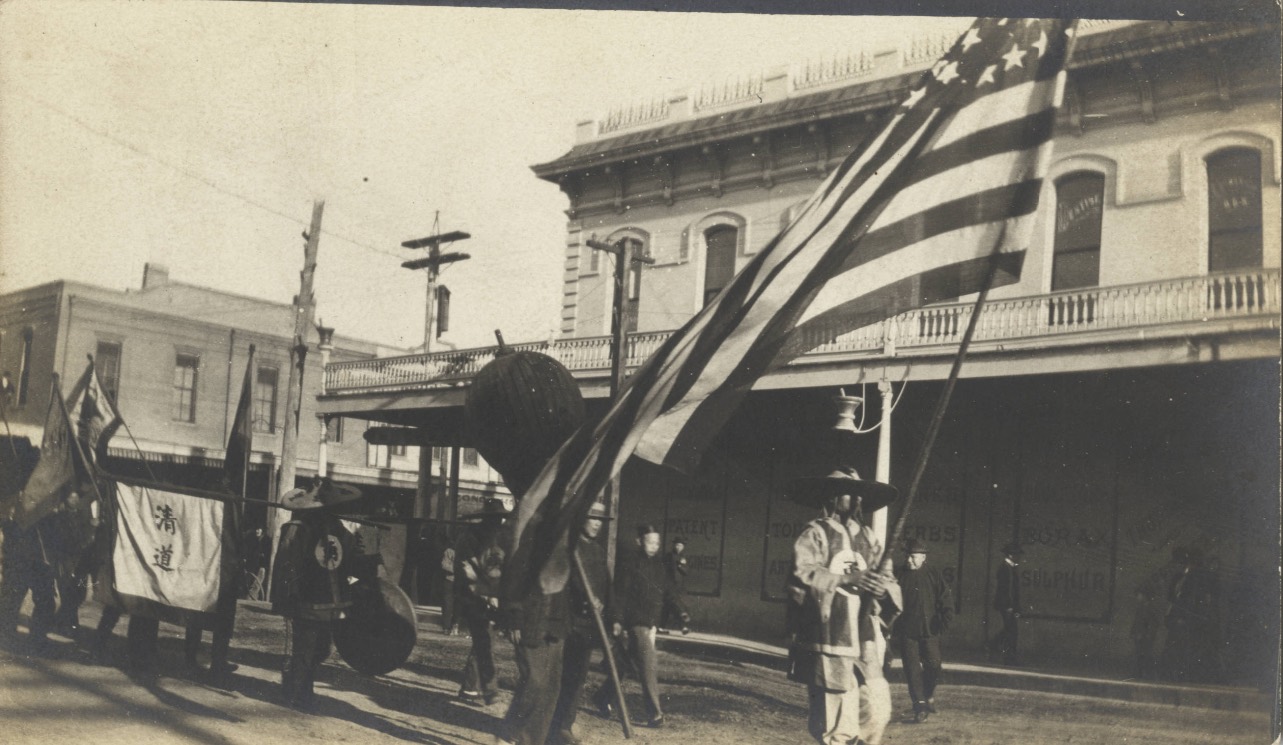
chico funeral procession copy

Funeral procession, Chico. Source.

A short research report, almost entirely built on others’ research

Recently I agreed to do some pro-bono translation work for the History Museum in Chico, a small city of about 100,000 people in the northern part of the Central Valley of California. I had time to stop by the museum in person in August 2021, while driving from Boston to San Francisco and back to pick up my stuff from storage, and was very courteously put-up and dined-out by the emeritus archaeologist in charge there, one Keith Johnson, and his family. I should note right at the start here that I know nothing about this topic, and that essentially all of the information here is shamelessly pulled either from Keith Johnson’s book Golden altars, or from the fantastic and too-little-known Chinese in Northwest America Research Committee (CINARC) website, which should be the real first stop for anyone interested in Chinese culture in 19th and early-20th century North America. Another great online introduction is this series of articles from the National Park Service, which gives a brief but lively account of Chinese settlement in 19th- and early 20th-century California, as well as its physical remains.

Some of the main Chinese temples in California discussed on the CINARC website.

Alta California acceded to the United States in 1848, in the wake of the Mexican-American War. Gold was discovered in the mountains there in the same year, prompting the first gold rush, and bringing the first Chinese immigrants (mostly from the Pearl River Delta) to the ports of California, especially San Francisco. By 1855, the Chinese community in San Francisco had Daoist temples, an opera house, two newspapers, and several civic associations. While the early communities prospered in many professions, they were shut out from various industries by discriminatory legislation and mob violence; many of the stereotypical images of “Asian” professions in frontier America (railway workers, launderers, shopkeepers) resulted from their systematic and often violent exclusion from other fields of work. Nevertheless, the Chinese immigrants successfully established businesses and Chinatowns all across the American West from the 1850s onward.

Chico
The “Palace of Serried Sages” (Liesheng gong 列聖宮) at Chico was founded in 1884 by immigrants from south China, attracted by the mining, logging, and mercantile opportunities afforded by the Central Valley and the foothills of the Sierra Nevada. Later, many found work as launderers, grocers, cooks, and domestic servants. The community was financially and commercially sophisticated—the Chico History Museum possesses a detailed 1917 account-book for what seems to be a Chinese banking and money-lending operation, recording loans, withdrawals, interest, and annuities.

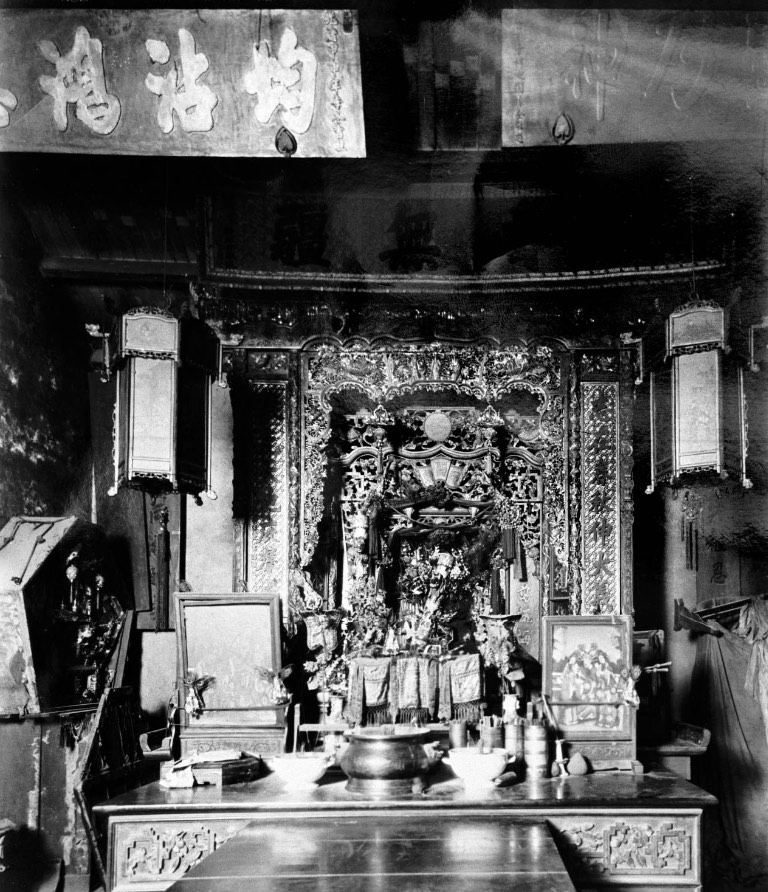
interior of the Chico temple showing altar copy

Interior of the Chico temple showing altar, 1910. Source.

The photographs held in the collections of the California State University at Chico give a vivid sense of what the Chico Chinese community looked like in its heyday, as well as other similar communities in the area, especially the neighboring towns of Oroville and Marysville. We see big, cheerful-looking families, wearing a mix of Chinese- and Western-style clothes. At least one of these families from the 1950s is multiracial, a Chinese man who married an Anglo-American woman. Often the men and boys would sit for formal portraits, staring solemnly into the camera in their starchiest traditional clothes. Another striking photo captures a young girl in a gorgeously embroidered traditional dress and hat, perhaps out for some kind of holiday. Family shots of white households often show Chinese cooks or domestic servants (in the language of the day, “house-boys”), with or without named identification. By the early 20th century, class photos make it clear that ethnic Chinese children attended integrated local schools, alongside their mainly white classmates. More photos capture the scene in the multiple Chinatowns in Chico, Oroville, and Marysville—we see tumbledown launderers’ houses by the river; dense urban districts and bustling town shops; and big houses of brick and rough-hewn wood, as were common in these California frontier settlements at the time.

the altar as it stands in the Chico museum today copy

The altar as it stands in the Chico museum today.

Judging from the dates inscribed on the altar paraphernalia, the Chico temple seems to have been active between the 1880s and the 1910s. This tracks the history of popular Daoism in America generally. As Bennet Bronson notes, popular Daoist temples flourished in Chinese immigrant communities across North America from at least the 1850s onward, with many of the earliest surviving temples on the continent located precisely in the Central Valley region. However, the religion seems to have suffered a sudden and poorly-explained collapse in the 1920s, with many shrines closing or becoming inactive. In the case of Chico, part of the reason may have been an FBI-assisted police raid on a Chinese-run opium-distribution network in 1924 (as a result, the museum today possesses some beautiful carved and inlaid Chinese opium pipes). By the 1930s the Chico Chinatown had almost entirely vanished, and in 1939, three elderly Chinese residents gifted the surviving altar- and temple-goods to a white-American friend, from whose hands these items eventually came to the museum. The temple building was torn down in 1946.

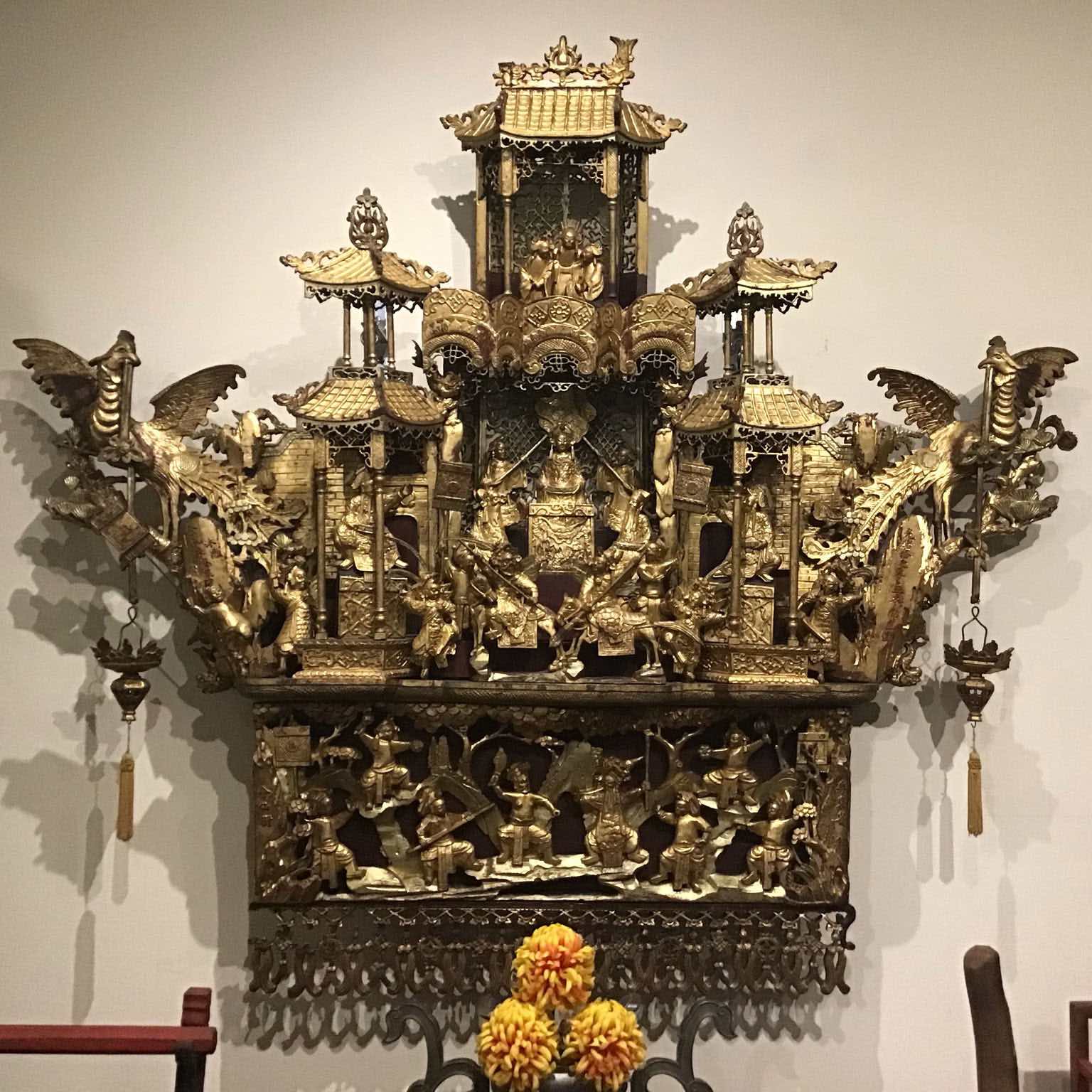
the bright gate copy

The Bright Gate.

From the plaques and inscriptions within the temple, we get a detailed sense of the trans-Pacific and trans-Californian networks that sustained this community. Many of the temple items were manufactured in China. One such item was the massive and intricately carved Bright Gate (caimen 彩門), a gilded frieze depicting opera figures that originally hung above the temple door. According to the inscription, the Bright Gate was built on the Street of Meeting Immortals (Huixian jie 會仙街) in Guangzhou. In other cases, we have the names of the manufacturers. One of the multiple square arches that made up the altar reads:

香港                Hong Kong
城隍街            Street of the City God
百步梯            Hundred-Step Stairs
俊昌造            Made by Jun Chang

In some cases, precisely the vast distances involved in these networks appear as proof of the gods’ all-encompassing power, extending even to the shores of the New World. One set of matching couplets (duilian 對聯) around the altar reads:

帝佑宏深連華夷    神恩浩蕩流海國
The Emperor’s protection is grand and deep, linking both Chinese and Barbarian;
The god’s benevolence is vast and broad, flowing even to the nations beyond the seas.

Most of these goods were gifted to the temple by various fraternal organizations (tong/tang 堂), which could be based either in China, in San Francisco (the nearest large city and sea-port, with a large and well-established Chinese population), or elsewhere on the Western seaboard of the USA. Another inscription on the Hong-Kong produced altarpiece explains how it arrived in Chico:

沐恩余風采堂眾弟子敬     光緒十八年孟春吉旦立
A gratefully received gift of the assembled disciples of the Yee Fung Toy association,
erected on an auspicious day of the first moon of spring in the 18th year of the Guangxu reign [1892].

The majority of inscriptions in the collection are of this sort, recording the charitable or pious gifts to the temple and community, usually by major fraternal associations. While often terse, they do give a sense of how active Chinese civic organizations were in supporting the new settlement in Chico. In a few cases the objects are gifts from individuals, usually described as “disciples” (dizi 弟子) of the god. One inscription from 1908 on a pewter censor describes it as given by “the disciple Zhou Lianzi and the pious woman Yue Hao” 弟子周連子信女月好敬送, indicating that the community of believers included women wealthy and independent enough to be noted as donors.

The purpose of all these donations was to demonstrate one’s own wealth and piety, but also to adorn the communal space with beautiful objects and sophisticated calligraphy. Beyond the gorgeously carved altarpieces and Bright Gate, there are also several elegant plaques and matching couplets. In some cases the calligrapher is identified. One is a decorously anonymous Grass-hall Layman (caotang jushi 草堂居士), whom I have not been able to trace. Another couplet in a cultured hand, described as having been “repaired” (chongxiu 重修) in Guangzhou in 1891, urges lofty sentiments:

志在春秋伸大義    氣充天地庇帬生
Our intent is for the Springs and Autumns, extending great righteousness;
Its qi fills heaven and earth, and protects all living things.

董起庚薰沐敬書
Calligraphy respectfully written by Dong Qigeng, after burning incense and performing ablutions.

Dong Qigeng was a locally well-known exam-graduate, painter, and calligrapher active in 19th century Guangdong, whose works are still popular today in Chinese auction-houses. His fame had even spread abroad—his calligraphy is also found in the Chinese Consolidated Benevolent Association meeting hall (Zhonghua Huiguan 中華會館) in Victoria, British Columbia. All in all, these pieces effectively display the wealth, piety, international reach, and cultural sophistication of the Chico community.

Most of the dates given in these inscriptions are in traditional Chinese format—either an imperial regnal title (“such-and-such year of the reign of the Guangxu emperor”), or in sexagenary format according to the Heavenly Stems and Earthly Branches (tiangan dizhi 天干地支) system, or both. That is, at least as far as formal inscriptions in their temple were concerned, this community counted the years according to the accession of the Manchu emperors in far-off Beijing. One brief inscription on a pewter censor, however, gives insight into another sort of politics:

洪順堂敬送     天運六年吉日
A gift from the Hongshun Association,
on an auspicious day of the 6th year of Heavenly Motion (Tianyun).

The Hongshun Association is one name for the Heaven-and-Earth Assembly (Tiandihui 天地會), an anti-state secret society with branches in many Chinese communities, especially in San Francisco. “Heavenly Motion” is an anti-state calendrical term dating back to at least the 17th century. Its use implies that the Hongshun Association viewed the ruling Manchu imperial house and its regnal titles as illegitimate, and it was thus a statement of revolutionary intent.

When I originally saw the “6th year,” I naturally wondered what “year one” was. A note on the ever-fascinating CINARC website puts the puzzle-pieces together. Another inscription from Victoria, British Columbia, reads “Heavenly Motion 3, or the ding-wei year” 天運三丁未年. The ding-wei year corresponds to 1907. As the CINARC editors note, the famous revolutionary Sun Yat-sen gave a speech in San Francisco in 1904 endorsing the use of Heavenly Motion dates as an anti-state signifier. Thus it seems that at least one revolutionary group on the West coast of North America began to date their calendars from that year. The “6th year of Heavenly Motion” on the pewter vessel in Chico should be from 1910, only one year before China’s last imperial dynasty did in fact collapse in the face of a nationalist rebellion.

As for the rituals that took place inside the Chico temple, our only information is from old photographs and the ritual objects themselves. Like all Chinese temples anywhere in the world, the Chico temple contained incense pots, in which one could place lighted sticks of incense before bowing or “striking the head” (kowtow or ketou 磕頭) at the altar. (Hence the common term for Chinese temples in 19th- and early-20th- century English sources, “joss [incense] houses.”) The altar itself contains spirit-plaques (shenpai 神牌) dedicated to Lord Guan (Guangong 關公), Avalokiteśvara-Guanyin (觀音), the historical doctor Hua Tuo 華陀, the astrological god Great Year (Taisui 太歲), and a god of wealth called “The Astral God of Wealth and Silks” (Caibo xingjun 財帛星君). Another item is a wooden stamp with the words, “The fountainhead of wealth pours broadly in” (Caiyuan guangjin 財源廣進), presumably used for endorsing paper or cloth articles brought to the temple for luck. I haven’t come across anything recording an actual ordained Daoist priest resident in Chico, but it seems probable that one or more laymen had enough basic ritual knowledge to see to their own community’s spiritual needs.

Chico funeral procession with banners copy

Chico funeral procession with banners. Source.

One thing the Chico temple definitely was involved in was organising communal parades, whether for the lunar New Year, or for funerals. These parades were intended to be loud, splendid, and very public displays of the entire community’s joy or grief, and thus they were frequently objects of comment and photography by non-Chinese observers. The California State University at Chico library holds dozens of usefully-digitized photographs of these parades from the 19th century onward, in both Chico and the neighboring towns. Photos show perhaps over a hundred people marching down the main streets of town, often in sumptuous robes or ceremonial military uniforms with the character “Brave” (Yong 勇) embroidered on the front, bearing giant banners, parasols, and ceremonial weapons. Several of these wooden weapons remain among the temple-goods in the museum today. In some of the photos, the procession is led by an immense American flag, perhaps to display patriotism in their new home, or to avoid abuse by their white neighbors on these most visible of communal occasions, or both. Other photos show dragon-dances, setting off firecrackers, carrying temple palanquins with religious images, and so on.

Chico funeral procession with American flag copy

Chico funeral procession with American flag. Source.

Related to these public funeral processions, a major concern of many Chinese communities in North America was the ritually proper burial, and reburial, of the dead. One photograph shows the Chico Chinese graveyard as it stood in the 1950s. The museum has on display two Chinese gravestones, both with elegantly simple inscriptions giving the name, place of origin, and date of death of the interred:

會邑                            Hui Town (Huizhou)
古井磨耳村                Old Well Millstone Village
趙贊美墳磨                The grave of Zhao Zanmei
光緒拾六年                In the 16th year of the Guangxu reign
眾于四月卄一日        He passed away on 21st day of the first moon [June 8th, 1890].

the grave brick copyAnother interesting object in the museum is a small red brick, with the following terse inscription:

白洪[ ]井村  Bai and Hong [one character missing] Well Village
馬贊喜公墳  The grave of master Ma Zanxi
光緒三十一年四月終
Passed away in the 4th moon of the 31st year of the Guangxu reign [~ May 1905].

Such Chinese “grave-bricks” are known from across North America, as far north as Alaska. Many Chinese immigrants, concerned about dying abroad without descendants or proper burial rituals, wanted their remains to be shipped back to their native villages. An elaborate trans-Pacific network sprang up to facilitate this. These small bricks would be buried with the body, providing an accurate name and address in the event of disinterment.

The arrival of special teams from China to disinter corpses was an object of morbid interest in the American press at the time. In his capacity as a reporter in San Francisco, Mark Twain described one attempt by the California legislature to discourage Chinese immigration by banning such ritual disinterments, calling the proposed legislation “an ingenious refinement of Christian cruelty.” Another newspaper article (again, quoted on the CINARC site) describes the arrival of such a team in Chico in 1893:

The Chinese population of the town of Chico, Cal., has for the past two weeks been under a strain of excitement concerning the exhumation and removal of all the bodies buried in the Chinese cemetery of that place. This has been a gruesome spectacle. A company of native resurrectionists dug into the graves, took up the coffins, removed their contents and deliberately set to work getting rid of the more or less decomposed flesh, scraping the bones, drying them, then gathering them in bunches, carefully tied, wrapped, then labeled with the respective cognomens of the several deceased and the residence of the particular families in China … (San Francisco Call 1893-11-14, p.19)

The prurient tone of this newspaper article suggests some of the darker aspects of the Chico Chinese community’s story. For all that the Chinese community lived and prospered in Chico for over fifty years, they remained isolated amidst a society that could treat them with open and sometimes violent racism. The Chico temple was founded only two years after the passage of the Chinese Exclusion Act in 1882. The following decade saw a wave of brutal massacres, expulsions, arson attacks, and acts of mob violence against Chinese in the United States and particularly in California. By the end of the decade, many counties in the area had expelled their entire Chinese populations, often with multiple fatalities. In Chico, a fire destroyed much of the Chinatown in 1887; the firehose that might have put it out was found severed in four places. The California State University at Chico holds and has digitized the minute-book for the “Chico Anti-Chinese League,” which goes on for over a hundred pages between the years 1894 and 1896, in mercifully illegible handwriting.

Unfortunately, this story of discrimination and communal destruction is not yet over—witness the recent rise in anti-Asian hate crimes across the USA. Nor is California’s fascinating heritage of popular Daoist temples safe from harm in 2021—according to Chico archaeologist Keith Johnson, at least two historic Chinese temples in California have been destroyed by accidental fires in the last decade, and more are now in danger from the massive climate-change induced wildfires that now regularly sweep across the state, consuming towns and cities.

In early 2019, I hosted a Chinese friend in San Francisco, a Beijing-based film-maker with whom I’d worked together to document at-risk temples and historic mural sites in impoverished parts of rural Hebei province. As we walked along the waterfront in Berkeley, looking across the great blue Bay to the cloud-wrapped towers of downtown SF, winds off the Pacific were driving long trains of waves through the Golden Gate to crash on the shores of America. I told him that I was as much, and as little, a foreigner here as he. Chinese people have been in California for as long as Anglo-Americans, and Russians and Spanish and Mexicans were here before that, and before them, the Maidu, Ohlone, Miwok, Yokuts, and more peoples too many to name. When some part of this place’s history vanishes, the loss belongs to all of us.

Dang: Gujarat and Korea

Stewart Lee’s recent playlist for Songlines is just as wacky as one would expect. Although I have to mark him down a bit for going down the hackneyed route of Ali Farka Touré and Ry Cooder, he roams the clouds from Shirley Collins and Laura Cannell to Ethiopian jazz. Like Moriarty pursuing Holmes to Tibet, just when I thought I was catching up on jazz behind the Iron Curtain, he’s outwitted me again—Dang!

[And I like to think that “Stew” himself might interject:]

Funnily enough, Dang is a region of Gujarat famed for its dance. These dancers are accompanied by rousing shawms:

which are also heard here:

Pawari dance

And beat this for a wind instrument—the pawari (cf. pāva and satārā):

Here’s a Dang pas-de-deux:

And in ensemble:

All this is remote from the ethereal world of north Indian raga.

* * *

The music of Dang is not to be confused with Dangak, which is the Korean equivalent of Japanese Tōgaku [Oh, right you are—the Plain People of Ireland]. Both genres are obscurely derived from the music of the Chinese Tang court, and both are largely marginally preserved today through museumification—far from the lively Gujarati folk scene. BTW, the population of Gujarat is larger than that of (South) Korea!

Thankfully (did I say that?), only two pieces survive, Nagyangch’un (Chinese: Luoyang chun 洛陽春, a title not in the Tang Chinese repertoire, FWIW):

and Pohŏja, which is the Chinese Buxu 步虛, Pacing the Void:

The hyangak repertoire is native to Korea; here’s Sujecheon:

and P’yojŏngmanbangjigok:

These genres in turn are not to be confused with a-ak, the Korean version of the Confucian yayue 雅樂:

Turning to ritual in living society, mudang shamans are active, as in this ritual filmed in Seoul:

See also Shamans in the two Koreas.

And we might even consider the tang-ki 童乩 self-mortifying spirit mediums among the Hokkien in southeast China (Ken Dean) and Taiwan (David Jordan). For links to posts on Chinese mediums, see here.

* * *

Anyway, all that was meant just as a little preliminary aside—sorry, got carried away (What am I like?! LOL). Throwing pursuers off the scent, what I’m trying to get round to is Stewart Lee’s choice of Ethiopian jazz. But to cite the Plain People of Ireland again, here’s me bus, so I guess that’ll have to wait for another time [Later: here’s the post]… Dang.

With thanks to Simon Mills

The gig

James Reese Europe. Source: wiki.

Long before the “gig economy”, the term gig was widely used in circles such as jazz and WAM. I’m fond of the story about the late lamented Linda Smith chatting with her mum.

The New Grove dictionary of music and musicians gives a succinct, dry definition:

a term commonly applied to a musical engagement of one night’s duration only; to undertake such an engagement.

Wiki elaborates:

Gig is slang for a live musical performance, recording session, or other (usually paid) engagement of a musician or ensemble. Originally coined in the 1920s by jazz musicians, the term, short for the word “engagement” [?], now refers to any aspect of performing such as assisting with performance and attending musical performance. More broadly, the term “gigging” means having paid work, being employed.

More detailed is this discussion on stackexchange, referring to the Word detective site.

I associate the term particularly with freelancers. A Messiah in Scunthorpe for a jolly good tea is a gig of sorts, but so is a Matthew Passion at King’s College Chapel in Cambridge. I wonder when WAM musos, ever keen to deflect pomposity (cf. Viola jokes and maestro-baiting), began using the term.

But (apud Word detective)

Every job is a “gig” today.  Calling your job a “gig” is a way of saying “I’m not really emotionally invested in my job, which I find boring and soulless, and I’m only doing it so I can act/write novels/play jazz saxophone on the weekends”.  And it’s not just laconic “baristas” at Starbucks.  I’ve heard corporate lawyers describe their positions as “gigs”.

Commonly cited is a 1926 Melody maker article, whose byline reads, “One Popular Gig Band Makes Use of a Nicely Printed Booklet”. But The jazz lexicon goes further:

According to jazzman Eubie Blake, bandleader James Reese Europe used the term in its jazz sense as early as c1905; widely current since c1920.

While the use of the term in the jazz world since the early 20th century is widely attested, there are many interesting suggestions about its earlier usage, which remain controversial. The Oxford English dictionary suggests (*Sexism watch!*):

The meaning of the term “gig” is transferred from the deprecatory term for a “flighty girl” and subsequently indicates anything which whirls, or is dangerous or unpredictable.

Word detective has more, alas without giving a source:

The first incarnation of “gig,” around 1225 [?!], was to mean “a flighty, giddy girl,” although this sense may well have been based on an earlier sense of “gig” meaning “something that spins or whirls” (as later found in “whirligig”).  The Oxford English Dictionary suggests that “gig” may be onomatopoeic or “imitative” in origin, meaning that the word itself was meant to suggest something small that whirls.  This sense of “gig” later came to also mean “an odd person, a fool” as well as “a joke” or “a state of boisterous merriment and fun” (“in high gig”).

This sense leads to an etymology from “giggle”, having some fun.

Source: wiki.

By the late 18th century, gig commonly referred to a light, one-horse carriage, popular in New Orleans; by extension,

The thought is that black musicians, in order to avoid being arrested for playing on the street, would instead play jazz on the back of carriages or trucks.

I’m most attracted to two possible musical derivations from gigue (jig), or geiger fiddle. GIG has also been claimed as an acronym: God Is Good, or Get It Going.

Stackexchange thickens the plot bewilderingly by citing the Dictionary of American slang (1960):

gig n1 A child’s pacifier or any object, as a cloth square, spoon, or the like, used as a toy; any object to which a small child is attached and with which he likes to play; any object treated by a child as a fetish; a gigi or ju-ju. Orig. Negro slave and Southern use. From “gigi,” the word is very well known to about 35% of the population, unheard of by the rest. 2 [sometimes taboo] The rectum. From “gigi.” Used euphem. by some children, as part of their bathroom vocabulary, but not common to all children. Used by some male adults [taboo] as a euphem. for “ass” in such expressions as “up your gig.” 3 [taboo] The vagina. From “gigi.” Not common. Prob. Southern use. 4 A party, a good time; esp. an uninhibited party; occasionally but not often, an amorous session, necking party, or even a sexual orgy between a man and a woman. c1915 [1954]: “Cornet players used to pawn their instruments when there was a lull in funerals, parades, dances, gigs and picnics.” L. Armstrong, Satchmo, My Life in New Orleans, 100. 1958: “Life is a Many Splendored Gig,” a song title. 5 A jam session ; a jazz party or gathering of jazz musicians or enthusiasts. Orig. swing use. 1920 [1954]: “Kid Ory had some of the finest gigs, especially for the rich white folk.” L. Armstrong, Satchmo, My Life in New Orleans, 141. 6 Specif., an engagement or job for a jazz musician or musicians, esp. for a one-night engagement. 1950: “If I ask you to go out on a gig, it’s thirty-five or forty dollars for that night.” A. Lomax, Mr. Jelly Roll, 204. 1954: “On a gig, or one night stand.” L. Armstrong, Satchmo, My Life in New Orleans, 221. 7 Something, as a jazz arrangement, that is satisfying or seems perfect. Orig. swing use. 8 A fishing spear; a pronged fork as used for catching fish, frogs, and the like. 1946: [citation omitted]. 9 An unfavorable report; a demerit; a reprimand. Army and some student use since c1940. The relations, if, any, between a child’s pacifier or fetish, the rectum and vagina, a party, a sex orgy, jazz music, a pronged fork, and a reprimand are most interesting, and lie in the field of psychology rather than of etymology.

Karen Dalton

Karen Dalton

Jumping belatedly on a bandwagon long driven by Bob Dylan and Nick Cave, I’m moved by the plangent voice of Karen Dalton (1937–93)—a worthy addition to my essential Playlist of songs!

For some reason I can warm to Country, but I seem to have a blind (deaf) spot about Anglo-American folk. Apart from being a tad allergic to guitar songs, it’s quite unfair of me to reduce it to a wholesome image of apple pie and right-on social activism. But Karen Dalton crashes right through all that.

She may not have approved of Dylan likening her voice to that of Billie Holiday, but it’s inevitable. Billie only rarely sang the blues—though she saved her greatest ever blues for her 1957 TV appearance.

Dalton, Dylan, Neill

Bob Dylan, Karen Dalton, and Fred Neil, early 60s.

There’s more artifice, and variety, in Billie’s voice, and in her opulent backings. Karen emerged from the Greenwich village folk scene, but there’s a rare depth of anguish in her sound, accompanying herself on twelve-string guitar or banjo. “Not interested in playing the music industry’s games in an era when musicians had little other choice”, she managed to self-destruct without going through the usual stages of celebrity and tabloid exposure. So despite her admirers, her music remained a niche taste until quite recently (see e.g. here).

Here’s a playlist for her 1969 album It’s so hard to tell who’s going to love you the best:

Though she only sang covers, she transformed them. It hurts me too had long been a popular blues standard—here’s Elmore James (1957):

and Junior Wells (1965):

But Karen’s version has a plaintive, personal quality:

While I prefer the very basic production values of It’s so hard to tell…, her 1971 album In my own time is also very fine, opening with Something on your mind—another Yesterday song:

Here’s Katie cruel:

This playlist has more.

Here’s a short documentary from 2009:

And a trailer for a recent documentary:

How little I know of all the cross-fertilisations of blues, Country, soul, pop, and onwards… Stop me if you’ve heard this before, but the 60s were remarkable—Coltrane, Miles; soul; Beatles, Stones… Meanwhile in the rarefied echelons of WAM, the Mahler craze was growing, and the early music movement was getting going.

Karen Dalton 2

The qin zither under Maoism, 1: Guan Pinghu

*For a roundup of the whole series, click here!*

Guan Pinghu

Guan Pinghu, 1954.

I’m still seeking in vain to atone for my reservations about the dominance of the elite qin zither in Chinese music studies, where it’s “as if the whole varied spectrum of European musics were represented mainly by the clavichord”. The qin has always been the tip of the iceberg—its players were, and are, far outnumbered by folk-singers, shawm bands, and spirit mediums, for instance.

However, this doesn’t make the rarefied world of the qin any less notable. By contrast with the ocean of folk traditions, its whole long history is extensively documented. And between the ancient sages and the modern scene, a remarkable flowering of the qin took place over the fifteen years following the 1949 “Liberation” (for the period in wider society, see here)—another illustration of the resilience of traditional culture in the PRC.

So in this first post in a mini-series focusing on the Beijing scene, I look further into the life and work of the great Guan Pinghu 管平湖 (1897–1967). John Thompson’s page on his exhaustive site is based on the CD set Guan Pinghu guqin quji 管平湖古琴曲集, well annotated and handsomely illustrated—I have only the original 2-CD set (1995), but Thompson refers to the expanded 4-CD edition (2016). See also e.g. here.

Besides the rich material of Wang Di 王迪 on her master (see here), the great Wang Shixiang also wrote a fine tribute to Guan Pinghu. And my long-term fieldwork companion Zhang Zhentao 张振涛 is not just a diligent chronicler of folk genres, but has also written eloquently about the qin. His articles

  • “Xian’gen: Guan Pinghu yu Zhongguo yinyue yanjiusuo” 弦根: 管平湖与中国音乐研究所, Zhongguo yinyuexue 2016.3 (serialised online in three parts)
  • “Daihuo jiaotong yun ben bei: qinjia Wang Di xiansheng” 带火焦桐韵本悲——琴家王迪先生, Mingjia 名家 49 (2013),
  • as well as a forthcoming essay on Zha Fuxi,

are both detailed and stylish, reflecting on the changing times in the qin world and society at large. The stories of these great players overlap, as they will in my series.

* * *

In the aesthetic of the imperial literati, “qin, chess, calligraphy and painting” (qinqishuhua 琴棋書畫) went hand in hand. Guan Pinghu followed in the footsteps of his father Guan Nianci 管念慈 (d.1909), a renowned painter who also played qin; he was in the retinue of the Guangxu emperor.

GPH paintings

Paintings by Guan Pinghu. Source.

Guan Pinghu rose to prominence among the stellar qin zither masters who gathered in Beijing before and after the 1949 “Liberation”.  From 1912 he took part in the Jiuyi qinshe 九嶷琴社 qin society founded by Yang Zongji 楊宗稷 (Yang Shibai 楊時百, 1865–1933). In 1938 he formed the Fengsheng qinshe 風聲琴社, and in 1947 the Beiping qinxueshe 北平琴學社, whose core members included Zhang Boju, Pu Xuezhai, Yang Boyuan, Wang Mengshu, Wang Shixiang, Guan Zhonghang, Zheng Minzhong, Yue Ying, and Wang Di.

Through the 1940s, apart from teaching qin at several institutes, Guan Pinghu spent time teaching painting at the Beiping jinghua meishu zhuanke xuexiao 北平京華美術專科學校, a forerunner of the Central Academy of Fine Arts. He was among the artists consulted by a team from the academy in 1955–56 for their survey of ritual painting in Beijing.

Still, Guan Pinghu’s ethos was remote from the image of the “exploiting classes”. Oblivious of worldly cares (a theme on which Zhang Zhentao’s article is especially eloquent), he was quite at odds with the new values of both the Republican and Communist eras. His family life was inauspicious: he was apparently separated from his wife, and of his four children three died in the early 1950s, while the fourth was a wastrel. As Wang Di recalled, by the late 1940s he was living alone in a bare little apartment, scraping by on a modest income from selling his paintings and teaching his few disciples. Among these, his female pupils Wang Di, Shen You 沈幼, and Yue Ying 乐瑛—all from affluent families—took responsibility for looking after him, utterly consumed as he was by the world of qin.

After Liberation
In those early days the Music Research Institute (MRI) was part of the Central Conservatoire, then still based in Tianjin. In April 1951 Wang Di took Guan Pinghu on the train there to take part in a recording session of several qin masters on the initiative of Zha Fuxi and Yang Yinliu. Wang Di told them of his difficult circumstances; indeed, seeing his dishevelled clothing the concierge was reluctant to let him in, taking him for a beggar.

So when Guan Pinghu was recruited to the MRI the following year, he attained a much-needed security, receiving a handsome monthly salary of 177 yuan. He was given a little room that served as study and bedroom, allowing him to immerse himself in the qin along with a distinguished group of senior music scholars around Yang Yinliu, whose sense of mission he shared.

In 1953 Wang Di became his assistant. The following year they moved to Beijing with the MRI, first to a building known as the “ten rooms” (shijianfang 十间房) and then to Xinyuanli in Dongzhimenwai, which remained the MRI home until the 1990s.

GPH WD

Wang Di checking her transcription of Guan Pinghu’s
realisation of Guangling san.

We should pause to admire the remarkable energy of Yang Yinliu and his team in those early years: alongside his ongoing historical research, in addition to his 1950 return to his old home Wuxi, in north China he did seminal fieldwork on the “songs-for winds” band of Ziwei village in Hebei, the Zhihua temple in Beijing, ritual groups of Xi’an, and narrative singing, while continuing his research on Daoist ritual in Wuxi. In 1953 others at the MRI embarked on a project on folk-song in north Shanxi.

On the basis of the Beiping qinxueshe, the Beijing Guqin Research Association (Beijing guqin yanjiuhui 北京古琴研究会) was founded in 1954 (see Cheng Yu’s article); the Ministry of Culture took over a siheyuan courtyard dwelling in Xinghua hutong, near Houhai lake, to serve as the association’s tranquil base.

Guan Pinghu and Wang Shixiang shared a taste not only for antique furniture but for the rich street culture of birds and flowers in old Beijing; Wang writes eloquently of how Guan Pinghu spent money he could ill afford to rescue an injured grasshopper, likening its chirp to the lowest open string on his Tang-dynasty qin

While the soul of the qin still resided in the “refined gatherings” (yaji 雅集) of aficionados, the qin now also began to be heard on the concert platform. From October 1954 to January 1955 Guan Pinghu and Zha Fuxi, with erhu player Jiang Fengzhi and pipa player Li Tingsong, gave prestigious performances in ten major cities, before vast audiences.

Despite the unpromising conditions of the unfolding of collectivisation, socialist dogma was still not so rigid as to outlaw the former literati class. Yang Yinliu and his team were just as concerned to document elite culture. Meanwhile vocal genres remained active, such as narrative-singing and opera—still lively folk scenes apart from the new state troupes.

Dapu and transcription
While many qin players were quite content with quite a small repertoire handed down from master to pupil (cf. north Indian raga), such as Geese Landing on the Sandbank (Pingsha luoyan), some of the leading masters were keen on the process of dapu 打譜, seeking to recreate pieces from early scores that had long fallen out of common practice. Guan Pinghu was at the forefront of this movement, along with the Shanghai qin master Yao Bingyan (see Bell Yung, Celestial airs of antiquity, and here).

PSLY 1

Opening of Wang Di’s transcription of Pingsha luoyan as played by Guan Pinghu, Guqin quji vol.1 (1982).

The repertoires of qin players had always been transmitted within particular regional styles. Notation plays a very minor role in most Chinese genres—none at all in some. But for highly literate qin players, tablature is an essential part of the learning process. Throughout history, right until the 1950s, players relied on direct transmission from master to pupil, aided by the tablature, which made an ambivalent record: over-prescribed in terms of pitches and fingerings, it allowed for considerable latitude in rhythmic interpretation.

GLS qinpu

GLS WD scoreOpening of Guangling san: Shenqi mipu (1425) and Wang Di’s transcription.

But in the 1950s, along with the circulation of recordings, the process of “fixing” the performance with composite transcriptions in Western stave notation and the symbols of traditional tablature began leading to a certain standardisation. This applied even to the newly recreated dapu pieces, some of which now entered the repertoire. The 1956 fieldwork of Guan Pinghu’s MRI colleague Zha Fuxi both revealed the great regional variations in repertoire and set a standard for establishing a “national” canon. It is rather hard to think back to the 1950s, when qin players had a very different mental image of their repertoire.

qin hui 1956

Members of the Beijing Guqin Research Association
on a trip to the Yiheyuan, 1956.
Front row, from left: Wang Zhensheng, Yang Qianqi, Guan Zhonghang;
middle row, Yang Yinliu, Pu Xuezhai, Cao Anhe, Guan Pinghu;
back row: Luo Zhenyu, Zha Fuxi, Wang Mengshu.
From Yang Yinliu (jinian ji) 楊陰瀏 (紀念集) (1992).

From 1956
In the summer of 1956, while collectivisation was causing hardship and desperation in the countryside, Yang Yinliu led another field survey in Hunan (here and here). Meanwhile Zha Fuxi led a remarkable project to document qin players over the whole country (more to follow in a later post in the series!).

Urban society was still relatively unscathed. But the Anti-Rightist campaign (1957–59), along with the Great Leap Backward and the famine (from 1958), caused great suffering. While I’ve found few instances of Beijing qin players being rusticated during this period, Guan Pinghu’s close friend Wang Shixiang was branded a “rightist” in 1957, bearing the stigma for twenty-one years. And soon after starting his study of the qin at the Shanghai Conservatoire in 1958, Lin Youren was sent down to rural Anhui and Henan for periods to support the desperate peasants.

Wang Di was ever devoted to taking care of Guan Pinghu in both his artistic life and material needs. In 1957, when the MRI prompted her husband to take leave of sickness, Wang Di had moved out of the institute (then still in the “ten rooms”) with her family. At first they lived at the spacious old family home of Yue Ying in Huazhi hutong, near the base of the Beijing Guqin Research Association. Yue Ying (to whom I’ll devote a separate post) was another female disciple of Guan Pinghu, and she invited him to live there too, as the Great Leap Backward was unfolding. Though the cities were protected from the severe famine in the countryside, Beijing dwellers suffered from food shortages; well-connected Zha Fuxi had baskets of eggs delivered to Yue Ying.

Still, Guan Pinghu’s new prestige was confirmed by an invitation to perform at Zhongnanhai for Chairman Mao, Zhu De, and Chen Yi.

In the early 60s Wang Di’s family moved to the bustling trading and entertainment quarter of Dashalar just south of Tiananmen (on which, note Harriet Evans, Beijing from below). But the redevelopment of the celebrated Rongbaozhai studio forced reluctant inhabitants to move to the Hepingli district further north; since Wang Di’s Dashilan apartment was safe from the developers, she agreed with one such family to let them live there while she moved into their own new dwelling in Hepingli. There she took care of Guan Pinghu. They were like a family—her two daughters called him Grandpa Guan (Guan yeye 管爷爷).

GPH and students

Guan Pinghu with his students, 1957:
(left to right) front row Xu Jian, Guan Pinghu, Zheng Minzhong;
back row Wang Di, Shen You, Yuan Quanyou.

Here we might also appreciate the fictional treatment of family travails through these years in Tian Zhuangzhuang’s 1993 film The blue kite.

New campaigns
Traditional culture was able to revive during a brief lull in the early 60s, spurring further energy in fieldwork and publication. But then the Four Cleanups campaign from 1963 presaged the agonies of the Cultural Revolution.

Apart from all the struggle sessions, murders, and suicides when the Cultural Revolution erupted, Guan Pinghu was among many who met their deaths at the time as an indirect cause of the rampages of the Red Guards. Pu Xuezhai, who also embodied the elite values of qin and painting, disappeared mysteriously in 1966.

Even qin masters hitherto in good standing with the regime like Zha Fuxi and Wu Jinglue were assaulted. Guan Pinghu was terrified as he witnessed the public humiliation of his peers. Long partial to erguotou liquor, he now sought refuge in the bottle, lying disoriented on the bank of the old city moat. Afflicted by liver cirrhosis, his health declined severely.

When he died on the 28th March 1967 he can hardly have imagined an end to all the destructive campaigns. Yet by the 1980s folk and literati genres were thriving again, and Guan Pinghu became a legendary figure, his pupil Wang Di masterminding the CD set that was finally published in 1995.

Recordings
There’s a precious film clip here of Guan Pinghu playing Liushui in late 1956, with Wang Di looking on. In 1977, on the recommendation of Chinese-American composer Chou Wen-chung, his Liushui was to be immortalised by being sent into orbit with the US spaceship Voyager 2.

GPH CDs

The classic resource is the ROI CD set. Guan Pinghu is also well represented on YouTube. Here’s the most celebrated of the ancient pieces that he recreated from Ming-dynasty tablatures, Guangling san—whose subject (to refine the image of the qin as tranquil contemplation!) is the righteous assassination of an evil ruler (among much discussion, note silkqin, and another article by Wang Shixiang):

Thrice Drunk in Yueyang (Yueyang sanzui 岳陽三醉) is inspired by the classical theme of inebriation (now the subject of a separate post!):

For Guan Pinghu’s version of Pingsha luoyan, see here.

* * *

Unlikely as it may sound, the first fifteen years after Liberation were a Golden Age for musicological research. As to the qin, it’s not exactly that it enjoyed a renaissance: regional societies had thrived through the Republican era. But given the new ideology after Liberation, the intensity of research and gatherings under Maoism was remarkable.

We may now feel nostalgic for the old world of “qin, chess, calligraphy and painting”; but it was still embodied in the iconic masters who were active under Maoism. Like household Daoist Li Manshan (jinfei xibi 今非昔比, at the end of my portrait film, from 1.19.20), my nostalgia is not so much for distant imperial grandeur as for the 1950s.

And while countless lives, and precious old instruments, were destroyed in the 1960s, it’s remarkable how many managed to survive to lead the revival since the 1980s’ reforms (cf. The resilience of tradition).

Today, despite a broadening of the appeal of the qin deriving partly from the internet, the refined cultural backgrounds of former generations have largely been marginalised by the narrow conservatoire specialisation of younger students (see e.g. Bell Yung, cited here). Music is never just music.

Zemlinsky

Zemlinsky 1917

Zemlinsky (left) with Schoenberg in Prague, 1917.

After university, during my few years as a regular extra with the BBC Symphony Orchestra, the standard romantic classics took a back seat to the avant-garde repertoire. The orchestra’s focus on contemporary music was a feature of William Glock’s tenure as BBC Controller of Music, particularly from 1971 with Pierre Boulez as principal conductor.

While I was well up for new repertoire, not all of it was inspiring. Concerts at the Royal Festival Hall and the Proms offset the orchestra’s studio recordings at Maida Vale, but many players felt that in taking a steady 9-to-5 job they had sacrificed their hard-earned skills at the altar of modernity. The canteen breakfast was often the high point of the day. As principal horn player Alan Civil recalled,

We did about 80% modern and 20% classical. The awful tragedy, for the orchestra, was that eventually we were not able to play the standard classics. We could sight-read the most fearsome contemporary piece, but a Brahms symphony—embarrassing!

So apart from the occasional Mahler, my most memorable experiences with the band were playing lesser-known early 20th-century works like the Scriabin piano concerto (with Viktoria Postnikova and Gennady Rozhdestvensky!), Bax’s Tintagel—and the Lyric symphony by Alexander Zemlinsky (1871–1942) (see here, and wiki).

A protégé of Brahms—their clarinet trios were paired at this year’s Proms—Zemlinsky went on to thrive in Vienna, working with Schoenberg, his brother-in-law. He was among Alma Schindler’s suitors before she married Mahler in 1902. In 1905 (the year after the premiere of Ravel‘s Shéhérazade, FWIW), Zemlinsky composed his symphonic poem-fantasy Die Seejungfrau:

Written partly to exorcise Zemlinsky’s failed relationship with Alma, Die Seejungfrau was premiered in Vienna at the same concert as Schoenberg’s Pelleas und Melisande. The latter is another fine piece that I relished in Boulez’s interpretation with the BBC—here he conducts it with the Gustav Mahler Youth Orchestra in 2003 (the same group later played it under Abbado in the Musikverein). Apart from Debussy and Schoenberg, Maeterlinck’s 1892 play also inspired Fauré and Sibelius. As Paul Griffiths writes,

Set in Arthurian times and in a remote, decaying castle by the sea, the play chimed with its period’s taste for fairy-tale fantasy in medieval decor. But it also brought to the stage people who, adrift from their feelings, cannot fully express themselves, people with multiple and contradictory levels of personality, such as psychology was beginning to psotulate at the time. […] The action demanded music—to expound what the characters cannot, and yet to preserve the mood of implication, veiling uncertainty.

Schoenberg was full of praise for Zemlinsky, as in this 1949 talk. Critics weren’t always so keen on Schoenberg. It’s always sobering and entertaining to consult Slonimsky‘s Lexicon of musical invective—here’s a review of the first performance:

Schoenberg’s symphonic poem Pelleas und Melisande is not just filled with wrong notes, in the sense of Strauss’s Don Quixote; it is a fifty-minute long protracted wrong note. This is to be taken literally. What else may hide behind these cacophonies is quite impossible to find out.

Zemlinsky concert 1905

Programme for 1905 concert. Source.

After holding conducting posts in Vienna, Prague, and Berlin, Zemlinsky fled Nazism in 1938, making his home in New York, where his work attracted little attention. The Lyric symphony (which inspired the Lyric suite of Alban Berg) dates from 1923, with Rabindranath Tagore’s poems sung by soprano and baritone:

Since the 1980s Zemlinsky’s reputation has grown—as, in a different way, has that of Korngold. See also Jonny spielt auf. See also Proms: Zemlinsky and Schoenberg.

Art Pepper

Pepper meets cover

In my post on Frank Morgan I mentioned how he managed to keep active on sax while in San Quentin by playing along with fellow inmates.

That post set forth from LA detective Harry Bosch’s good taste in jazz, and again Michael Connelly’s novels have some pertinent comments on Art Pepper (1925–82), who was one of Morgan’s jazz colleagues in jail.

Pepper 1966

Pepper was no angel either. Like Chet Baker, he was a white West-coast junkie. In Connelly’s A darkness more than night (2000) he evokes the classic 1957 album Art Pepper meets the rhythm section:

He went into the house and got two more beers out of the refrigerator. This time McCaleb was standing in the living room when he came back from the kitchen. He handed Bosch his empty bottle and Bosch wondered for a moment if he had finished it or poured the beer over the side of the deck. He took the empty into the kitchen and when he came back McCaleb was standing at the stereo studying a CD case.
“This what’s playing?” he asked. Art Pepper meets the rhythm section?”
Bosch stepped over.
“Yeah. Art Pepper and Miles’s side men. Red Garland on piano, Pau Chambers on bass, Philly Joe Jones on drums. Recorded here in LA, January 19, 1957. One day. The cork in the neck of Pepper’s sax was supposedly cracked but it didn’t matter. He had one shot with those guys. He made the most of it. One day, one shot, one classic. That’s the way to do it.”
“These guys were in Miles Davis’s band?”
“At the time.”
McCaleb nodded. Bosch leaned close to look at the CD cover in McCaleb’s hands.
“Yeah, Art Pepper,” he said. “When I was growing up I never knew who my father was. My mother, she used to have a lot of this guy’s records. She hung out at some of the jazz clubs where he’d play. Handsome devil, Art was. For a hype. Just look at that picture. Too cool to fool. I made up this whole story about how he was my old man and he wasn’t around ’cause he was always on the road and making records. Almost got to the point I believed it. Later on—I mean years later—I read a book about him. It said he was junk sick when they took that picture. He puked as soon as it was over and went back to bed.”
McCaleb studied the photograph on the CD. A handsome man leaning against a tree, his sax cradled in his right arm.
“Well, he could play,” McCaleb said.
“Yeah, he could,” Bosch agreed. “Genius with a needle in his arm.”
Bosch stepped over and turned the volume up slightly. The song was Straight life, Pepper’s signature composition.
“Do you believe that?” McCaleb asked.
“What, that he was a genius? Yeah, he was with the sax.”
“No, I mean do you think that every genius—musician, artist, even a detective—has a fatal flaw like that? The needle in the arm.”
“I think everybody’s got a fatal flaw, whether they’re a genius or not.”

The full album seems to have disappeared from YouTube, so here’s Straight life:

The song Patricia features in The black box (2012):

Bosch had begun making his way through the Art Pepper recordings his daughter had given him for his birthday. He was on volume 3 and listening to a stunning version of Patricia recorded three decades earlier at a club in Croydon, England. It was during Pepper’s comeback period after the years of drug addiction and incarceration. On this night in 1981 he had everything working. On this one song, Bosch believed he was proving that no-one would ever play better. Harry wasn’t exactly sure what the word ethereal meant, but it was the word that came to mind. The song was perfect, the saxophone was perfect, the interplay and communication between Pepper and his three band mates was as perfect and orchestrated as the movement of four fingers on a hand. There were a lot of words used to describe jazz music. Bosch had read them over the years in the magazines and in the liner notes of records. He didn’t always understand them. He just knew what he liked, and this was it. Powerful and relentless, and sometimes sad.
He found it hard to concentrate on the computer screen as the song played, the band going on almost twenty minutes with it. He had Patricia on other records and CDs. It was one of Pepper’s signatures. But he had never heard it played with such sinewy passion. He looked at his daughter, who was lying on the couch reading a book. Another school assignment. This one was called The fault in our stars.
“This is about his daughter,” he said
Maddie looked over the book at him.
“What do you mean?”
“This song. Patricia. He wrote it for his daughter. He was away from her for long periods in her life, but he loved her and he missed her. You can hear that in it, right?”
She thought a moment and then nodded.
“I think. It almost sounds like the saxophone is crying.”

Like Frank Morgan, Art Pepper rebuilt his career after being freed from prison in 1965. Here’s a 1978 recording of Patricia:

Don McGlynn’s documentary Art Pepper: notes from a jazz survivor, filmed in 1982, his last year, also features his third wife Laurie (with Patricia discussed from 24.00):

In the LRB Terry Castle riffs brilliantly on Pepper’s 1979 autobiography Straight life.

Aside from “the music itself” (sic), while accounts of jazzers’ lives are vivid (e.g. Miles, Mingus, Chet…), it’s possible to tire of them: self-destruction is one thing, but the misogyny is hard to take. As with WAM composers, we may learn from their stories and the society in which they lived, but admiring the music doesn’t have to entail endorsing its creators. Men behaving badly yet again… (cf. Deviating from behavioural norms).

Jonny spielt auf

Jonny promo

Getty Images: Ullstein Bild.

In my post on Erich Korngold, I mentioned Richard Taruskin’s 1994 essay “The golden age of kitsch”, where he reviews CDs of Korngold’s Das wunder der Heliane and Ernst Krenek’s 1937 “jazz opera” Jonny spielt auf [Jonny goes to town, or Jonny strikes up]. So here I’ll introduce the latter.

Alex Ross (The rest is noise, Chapter 6 “City of nets: Berlin in the 20s”) provides background.

For a little while in the late 20s, Krenek acquired certifiable, almost Gershwin-like celebrity. […] Like so many young Austrians and Germans, he yearned to break out of the hothouse of Romantic and Expressionist art, to join the milling throngs in the new democratic street.

Taruskin’s typically polemical essay is worth citing at some length.

The Nazi concept of artistic degeneracy was incoherent and opportunistic, and so is Decca/London’s marketing strategy. It took very little to run afoul of the Nazis then, and it costs very little to deplore them now. Their opposition, especially when it was passively incurred, conferred no distinction, unless their approval is thought to confer distinction on the likes of Beethoven or Wagner. There are no lessons to be learned from studying the Nazi index of banned musical works, which, like the Nazi canon, contained masterpieces, ephemerae, kitsch, and trash, covering a wide stylistic and ideological range. […]

So just this once let’s forget the Nazis. They had nothing to do with Krenek’s opera or Korngold’s opera. They didn’t even ban them. They didn’t have to ban them, for both works had fallen out of the repertory by 1933. […]

What makes these first [CD] releases fascinating is not what they have to say about the Nazis but what they have to say about the artistic atmosphere of the Weimar Republic, which had a thriving operatic economy—the last truly thriving, that is, consumption-driven, economy in the history of opera. Composers wrote for a market. Their work was in demand. They strove not for eventual immortality but for immediate success. Producers could recoup their investment in new works and sometimes exceed it, so they sought out new works. Premieres were more noteworthy than revivals, and commanded the interest of the press.

Was this a degenerative ecology? Did it lead to exploitative “populist” formulas, or to weak imitation? No, it was synergistic; it led to experimentation and to emulation, with the aim of surpassing previous standards of novelty and distinction.

He goes on to note the great success of operas like Berg’s Wozzeck (for Lulu, see here). But even more popular was Krenek’s Jonny spielt auf. Still, Taruskin describes what strikes me as a common trait of WAM until the late 19th century:

Sudden eclipse was part of the bargain. An opera had its place in the sun if it managed to earn one, and then it moved out of the way.

He attributes the waning of this nurturing operatic ecology to the talkies:

The movies did not only preempt the operatic audience. At a profound level, the movies became the operas of the mid- to late 20th century, leaving the actual opera houses with a closed-off museum repertoire and a specialised audience of aficionados, rather than a a general entertainment public hungry for sensation. With the advent of the sound film, opera found its preeminence as a union of the arts compromised and its standing as the grandest of all spectacles usurped. […]

Cinematic transport to distant times and climes was instantaneous. Evocative atmosphere, exotic or realistic, could be more potently conjured up on film than on the best-equipped operatic stage, and the narrative techniques of the movies were unprecedentedly flexible and compelling. […]

But wait, isn’t there another difference, a bigger one? Opera, however, popular, remains an art, while movies, or at least Hollywood movies, are a mass-produced and mass-reproduced medium and amount only to kitsch. Or so we are told. I am not so sure.

The operatic world from which Korngold and Krenek emerged, like the wider world of art in the period following the Great War, was a bitterly divided world. The division was not simply between stylistic radicalism and conservatism, or between a liberating iconoclasm and a hidebound tradition, though that is how a stubbornly Whiggish historiography continues to represent it. Nor was it primarily a division between a senile romanticism and a new classicism, as so many artists of the time liked to say. It was, rather, a difference in the way that art was viewed in relation to the world.

Citing the early Soviet critic Boris Asafyev:

An authentic modern music would have to be “nearer to the street than to the salon, nearer to the life of public actuality than to that of philosophical seclusion”,

Taruskin goes on to contrast the operas of Korngold and Krenek:

Though they are being marketed now under a crude common rubric, they embodied antithetical values.

Jonny poster

Unlike Korngold, “the master of musical sacroporn” (an epithet that Taruskin also applies to Turangalîla!), Krenek embodied the new genre of Zeitoper, “now-opera”:

“Now-opera” was not simply a matter of contemporary action, of references to current events and American pop-genres (shimmies, tangos, blues, Negro-spiritualen) and pop-timbres (sax, banjo), though these were the grounds for Jonny’s immediate audience appeal and its subsequent (misleading) reputation as a “jazz opera”. Its main novelty was irony: the clash between the ephemeral content and the “classical” form. And this implied another, more fundamental clash: in place of the music of timeless inner feeling, its unabating fluidity of tempo dissolving chronometric reality, there was now to be a music that proceeded just as unabatingly through through busy ostinatos at what Krenek at one point labelled “schnelles Grammophon-tempo”, emphasising uniformity of physical and physiological motion and banshing psychology. It was a music of corporeal elation and spiritual nihilism, a tonic for the tired and the disillusioned, for people who felt betrayed by the lie of transcendence. It was, in short, the music not of America but of “Americanism”. And so the now-opera was not really sachlich after all but still märchenhaft, embodying not a new reality but a new fairy tale, a new allegory and, yes, a new kitsch.

In Jonny spielt auf, the first now-opera, the allegory is overt and sledge-hammer-subtle. The protagonist is not the title character—a negro band-leader vaguely modeled, it seems, on Sam Wooding, whose Chocolate Kiddies Revue swept Germany in 1925–26—but Max, a Central European composer of traditional transcendental bent.

As the glacier-like Max pursues banjo-playing operatic diva Anita (an evocation of Anna Mahler, to whom Krenek was briefly married), Jonny attempts to steal the enchanted Amati violin of Daniello, a slick, matinee-idol classical virtuoso.

A tiny leitmotif, just a descent through the interval of a fourth to a downbeat, pervades everything. (Anyone who has heard Ravel’s “jazz”-tinged L’enfant et les sortilèges of 1925 will recall this very distinctive idea as the “Maman!” motif. Did Krenek?).

Finally Max, his glacier persona melting, sets off with Anita for America, whither Krenek followed in 1938.

Here’s a playlist of excerpts:

Actually, the opera is far from the accessible populism of The threepenny opera (1928), and jazz plays a very minor role—not least because when Krenek “conceived his libretto, he had never met a Negro or an American”. What he set out to provide was “a hope-inspiring Pied Piper, or a latter-day Papageno, as alluringly Other as possible”.

The everyday, the ephemeral, and the phenomenal […] could function convincingly within the world of opera only as an exotic import. By its very presence, it was exceptional, numinous, and threatening. So now-opera was stil, opera. It could only be a special case, a subgenre; and it could not escape the fate of the genre as a whole.

Taruskin finds the opera dubious politically too:

The freedom celebrated at the end of Jonny spielt auf is only the freedom to seek new masters, to submit to a new hypnosis.

He notes the tendency to forgive both the operas of both Korngold and Krenek their cynicism.

The indulgence, it seems pretty clear, is purchased courtesy of the Nazis. Take away their seal of disapproval, and we are left not with easily dismissed “degeneracy” but with decadence, which is more real, more disquieting, and much harder to get a grip on.

This was the downside of the thriving consumer culture that, in our day, with opera a walking corpse, seems at first so enviable. But this was a culture of frisson and titillation posing as a culture of liberation and uplift.

Going rather far in imputing a moral purpose for “serious music” (“The danger of Taruskin”?!), he suggests:

However it may tickle our sense of irony to contemplate it, and even if we choose to excuse its practitioners on grounds of naïveté or sincere bad taste, it entailed a lack of moral purpose that rendered the “serious” arts defenceless against totalitarian rhetoric, and passively complicit in its triumph.

Given Krenek’s hazy acquaintance with the world he was evoking, it’s worth reminding ourselves of the Real Thing (more leads under Clarke Peters’ radio series on black music in Europe): here’s the Sam Wooding band with Shanghai shuffle in 1925 Berlin (leading us nicely to Shanghai jazz):

and the Chocolate Kiddies in 1933:

Note also the post about Jonny spielt auf on the stimulating site Black Central Europe.


* Ross also cites Slonimsky’s fine summary of Max Brand’s Machinist Hopkins (1929) (evoking Stella Gibbons’ spoof synopsis of a Britten opera):

A cuckolding libertine pushes the husband of his mistress to his death in the cogs of a monstrous machine and strangles her when he finds out she has become a promiscuous prostitute, whereupon the foreman, Machinist Hopkins, dismisses him from his job, ostensibly for inefficiency.

Limits to my versatility

wheat

Possibly confused by the broad range of topics that I rashly attempt to cover (China, punk, ritual, Mahler, gender, Bach, and so on—see e.g. my roundup for 2021), Academia.edu just emailed me to ask, somewhat hysterically,

Are you the Stephen Jones who wrote “Evaluation of winter wheat breeding lines for traits related to nitrogen use under organic management”?

Now, just when you thought there were no limits to my versatility (as in “Is there no beginning to your talents?“), I may have fingers in many pies, but that’s not one of them. Nor, alas, have I ventured into millinery or playing guitar with the Sex Pistols. And it’s fair to say that these career paths will remain safe from me. The closest I get to evaluating wheat is slurping noodles with Li Manshan.

And now they’re asking me if I am the author of “Mutant mice that display early ageing-associated phenotypes”. Where will it all end, I wonder.

For some other articles I haven’t really written, click here; for fictitious early signs of versatility, here; and for variations on “You think I know Fuck Nothing, but I know FUCK ALL!”, here. The enquiry also reminds me of a question for Alan Bennett after a lecture he gave at Oxford on Richard II: “Could you tell me where you bought your shoes?”.

The white album

Beatles White Album

Image: John Downing / Getty Images. Source.

*Click here for my series on the great Beatles albums, with introduction!*

In my series, based on the work of Wilfred Mellers and Alan W. Pollack, somehow I’ve left The white album (aka The Beatles) (1968) till last.

Sandwiched between Sgt Pepper and Abbey road, The white album may seem rather less cohesive as a suite, but it has all the hallmarks of the Beatles’ late style, and again the effect of its songs is cumulative. Mellers highlights the parodistic, retrospective elements of the album, with simultaneously innocent and ironic incorporation of a variety of styles (music-hall, Country, R&B, children’s rhymes…), with what Pollack describes as a “rapid string of costume changes”. But the more we listen, the more enthralling it is.

Rishikesh

Source: wiki.

The Beatles conceived most of the songs while on a Transcendental Meditation course with Maharishi Mahesh Yogi in Rishikesh, India. While (in keeping with their late style) the lyrics are trippy, the influence of Indian music, heard on their other albums around the time, is barely evident here.

The austere cover of the double album made a deliberate contrast with the exuberance of that for Sgt Pepper.

Here’s a playlist for the 2009 remastered version:

As usual, Pollack’s analyses are stimulating (links below), often making use of the “Esher demos” to explore the creative process.

Side 1

  • Back in the USSR. Pollack: “hard edged rock-and-roll”, with “the fresh impact of a palate-cleansing, eye-catching, and ear-opening album opener”, channelling the Beach Boys and Chuck Berry:

Well the Ukraine girls really knock me out
They leave the West behind
And Moscow girls make me sing and shout
That Georgia’s always on my mind.

—a satire of naïve patriotism that was issued with unfortunate timing, just months after the Soviet invasion of Czechoslovakia.

  • Dear Prudence. Mellers: “a new type of Eden song”, with a pentatonic melody over a D pedal; Pollack: “taking that same droney aesthetic with which George was so enthralled”.
  • Glass Onion: an up-tempo rock number, its tune “obsessed by the disquieting interval of the tritone” (Mellers).
  • Ob-la-di, Ob-la-da, “a Liverpudlian-West Indian music hall that deflates love by way of deliberate vacuity” (Mellers).
  • Wild honey pie, an entr’acte, “a little bonsai tree of a song” (Pollack).
  • The continuing story of Bungalow Bill, “a total deflation of the tough guy myth, […] the irony given an extra twist by the romantic flamenco-style guitar prelude and the lyrical postlude for solo bassoon” (Mellers).
  • While my guitar gently weeps, a song by George, with guitar solo from Eric Clapton. Pollack gives a particularly detailed analysis. For weeping in a variety of music, see under Fassbinder’s bitter tears.
  • Happiness is a warm gun, satirising cabaret, soul-cum-blues, and corny balladic waltz (for Beatles waltzes, see here), with changes of metre—Pollack even spots hemiola in Mother Superior jumps the gun.

Side 2

  • Martha my dear: related to Ob-la-di, affectionately ironic. The brass-band riff was arranged by George Martin.
  • I’m so tired, an enervated, self-deflating song from John.
  • Blackbird, Paul’s haunting, deceptively simple solo. Mellers:

The folk-poetic identification of light and dark in this refrain complicates our response to what appears to be a straight little song about freedom, but which turns out to be unexpectedly moving in its fusion of naïve white country guitar with black blues. This may be why the squeaky blackbird noises that erupt into the song affect us as being pretty, comic, and scary all at the same time.

Who knows how long I’ve loved you
You know I love you still
Will I wait a lonely lifetime
If you want me to, I will.

  • Julia. Eschewing the usual contrast between tracks, John concludes Side Two in somewhat similar vein, “elegiac, entirely devoid of irony” (Mellers). Analysing the shifting harmonies, Pollack finds it almost agonisingly exquisite in its restrained, laconic poetry. He adds:

Though you probably treasure your knowledge of the poignant personal history that underlies Julia, do you ever stop to wonder how relatively incidental and non-essential that knowledge is to the effect that the song has upon you? Oh, I understand that knowing that Julia was John’s mum unavoidably adds a new dimension to your so-called appreciation of the song, but what I’m asking now is how much less does the song speak to your heart in absence of that knowledge?

Side 3 opens again with a burst of blues-tinged rock-and-roll, in

  • Birthday. As Pollack comments, once you probe more deeply, you quickly discover that this is no mere rote revivalist knock-off.

As they matured they likely found that, in spite of all early interest, the strict blues form was not an idiom that they felt all that comfortable with in terms of self-image and expression. Interestingly, they never quite forgot or expunged the technique from their vocabulary, but it did remain for them something to be used sparingly, for special effect and exotic tang.

On a personal note, I note this felicitous addition to my inventory of Stammering songs:

I would like you to dance (Birthday)
Take a cha-cha-cha-chance—(Birthday)
I would like you to dance (Birthday).

Side 4

  • Revolution 1, an ultra-stylised blues, rather laid-back, with a fashionable reference:

But if you go carrying pictures of Chairman Mao
You know you ain’t gonna make it with anyone anyhow.

  • Honey pie, a quaint rags-to-riches fairy tale, with period detail, described by Mellers as a 1930-ish Fred Astaire number, the wit of the chromatic harmonies nostalgically recalling Rodgers or Cole Porter.
  • Savoy truffle: George in blues mode.
  • Cry baby cry, a surreal anti-lullaby, leading into
  • Revolution 9. By contrast with Revolution 1, this is a long “electronic freak-out and collage piece, distorting and mixing muzak of various kinds” (Mellers), with sung melody banished. Even here, Mellers suggest that the Beatles are parodying their recent electronic experiments in Sgt Pepper.
  • Good night. Deploying a range of dreamy, sentimental Hollywood clichés,

The effect is quite different from the emotive strings in Yesterday, Eleanor Rigby, or She’s leaving home, for we saw that in those songs the lush accompaniment preserved a virginal frailty that, in context, was at once sentimentally committed and ironically detached. […] The kitsch does not discredit the tenderness of tune and harmony. […] Its beauty, despite the cinematic scoring, turns out not to be in inverted commas. (Mellers).

This final sequence leads Pollack to make a fine point:

In order to fully appreciate the uncanny aptness of ending The white album with Good night, you need to first back up and consider why the penultimate album slot is such as logical place for Revolution 9.

Where else could you put Revolution 9? [SJ: he doesn’t consider the option of not including it at all…] Too early in the running order would make the rest of the album seem a bit anti-climactic at best. At worst, you could lose most of your audience well before you’ve trotted out the rest of your best stuff. Putting it at the very end lends it too much emphasis. Maybe put it at the end of one of the other sides, but no-one will be sufficiently motivated to turn the record over. Next to last feels just right.

Now then, what kind of act could possibly follow Revolution 9? You clearly need a sharp contrast, but exactly what kind? Virtually any other song from the album would sound a combination of anti-climactic, stylistically repetitive, underwhelming, or too weird.

Good night has the simultaneous virtues of providing musically arch-conservative ballast, a change of style as refreshingly surprising as anything else on the album, and a clever, self-referential way of telling you the music’s over; turn out the lights.

A cappella singing

WD 2011

In China, the “orthodox” vocal liturgy of both Buddhist and Daoist temples has been thought to be properly accompanied only by ritual percussion (see e.g. here, and here)—just as in Islam and Christianity.

Although many temple and household ritual groups further incorporate melodic instrumental ensemble, the core practice among household ritual specialists is vocal liturgy with percussion.

For the Li family Daoists in north Shanxi, see my film, and e.g. The Invitation ritual, Pacing the Void 2, and audio tracks ##1–3 on the playlist (in the sidebar, with commentary here). Other instances of vocal liturgy with percussion include the Daoists of Changwu (Shaanxi), the performance of “precious scrolls” in Hebei (playlist #7), as well as ritual groups in Jiangsu and all around south China. So in order to understand religious practice in China, we must take into account how ritual texts are performed—through singing.

chant

Further west, note Byzantine and Gregorian chant cultures, and examples from Eritrea and Athos, as well as Ukraine. Around the world, a cappella singing (both liturgical and secular) is perhaps the dominant means of expression; see e.g. Sardinia, and Albania.

Byrd score

Some of these styles even dispense with percussion, and a cappella singing is a notable feature of religion-inspired WAM —some instances:

Some of the WAM pieces were composed for church services (and I haven’t even begun to broach the riches of Bach motets…); but as we move through the 19th century, pieces also began to be written for the quasi-secular setting of the concert stage.

Change of tone: for the Bolton Choral Society’s unsuccessful attempt to summarise Proust, click here.

Posts on Uyghur culture

Dawut

Rahilä Dawut.

Tarred as I am by the brush of specialising in China, my interest in Tibetan and Uyghur cultures is merely that of an outsider. But having written a series of posts on Tibet, it seems suitable to round up my readings on Uyghur culture—and its recent decimation—with a selection from the Uyghur tag in the sidebar.

I began by reviewing

For the fine publications of Rachel Harris, see

with the latter theme pursued by Musapir in

See also

which leads us to the outstanding work of anthropologist Rahilä Dawut, who was disappeared in 2017:

On the work of Mukaddas Mijit, see

Two more posts feature the wonders of Uyghur music, as they were until recently:

See also

Rāg Vindaloo

With apologies to my esteemed mentors…

swanee kazoo

Jugalbandi duet, rāg Vindaloo.

While I very much hope that my series on north Indian raga will encourage you to absorb the melodic and rhythmic intricacies of all the individual items, I’ve reached a point where a certain levity is called for.

In classical treatises rāg Vindaloo is described as a raga for dusk, shortly after opening time; the Portuguese etymology perhaps explains its saudade mood (though fado only seems to have taken root in Goa). To the great relief of mehfil aficionados, the raga is rarely performed today.

Scholars have recently questioned the authenticity of a ragamala painting depicting an obese balding accountant in a pink sombrero, bedecked in opulent wombat furs and clutching a gaily-coloured [can of] Kingfisher, his sumptuous belvedere adorned with a garden gnome.

Questionably, Bhatkande classified rāg Vindaloo under Paneer thaat. It had already appeared by the 18th century in the bold attempt of picaresque, nay swashbuckling, adventurer and arms-dealer Lord Auberon Cholmondeley-Smythe to codify the repertoire, notwithstanding his comment in the Prefatory Observations that “it all sounds the same to me, this Indian music”.

PPIn dhrupad renditions the nomtom syllables tiddley-pom and poppadom are prominent. As to arohana and avarohana patterns, whereas in ascent flat and natural re, ga, dha, and ni, natural and sharp ma may be sounded interminably and apparently at random, in descent all notes are avoided entirely. In the gat, a common phrase—alluding to rāg Madhuvanti, * and later adopted by Henry Mancini—is

Sa, Re ga, Ni Sa Re ga dha Pa, Sa ga Pa Ma,

with a descending anuraṇana “resonance” on the cadential note.

In lengthy alap expositions, the phrase Ni dha pi serves as a cue. The tempo picks up upon the entry of the pakhavaj drum; the rhythmic cycle prescribed in early sources is chapati tāl with 792 mātras. But even in the more leisurely conditions of bygone courtly performance, no-one ever managed to get through even one whole cycle; so more often used in modern times is the challenging dintāl consisting of only one beat, subdivided 2 3 3 4 2 3, the first beat of the 3s marked with a cheery wave of the hand—a subtlety only revealed since the advent of slow-motion technology.

As a legacy from the days of the Raj, the raga is sometimes played in jugalbandi duet with swanee whistle and kazoo, hastening the audience’s departure.

* * *

For instructive multi-cultural exercises in solfeggio, click here. Cf. the spoof entries for the New Grove dictionary; for spoofs on early Chinese history, see Yet more French letters, Faqu tu 2, and More Tang drolerie. Cf. The ascent of Rum Doodle.


* In a vain attempt to redeem myself, for the sake of including some genuinely wondrous dhrupad in this post, here’s Zia Mohiuddin Dagar playing rāg Madhuvanti on rudra vina:

On Nicolas Magriel’s amazing sarangi site (click here and here), his page on Abdul Latif Khan features a rendition of rāg Surti Vardani, whose madhya lay bandish he finds “somewhat reminiscent of the Pink Panther theme”.

Frank Morgan

Morgan

A youthful Frank Morgan. Source.

In the compelling crime thrillers of Michael Connelly, I’ve already admired LA detective Harry Bosch’s good taste in jazz with my post on Tomasz Stańko.

The music of sax-player Frank Morgan (1933–­2007) features in several of Connelly’s novels. I’m reminded to pursue his work as I re-read The burning room (2014).

Morgan was yet another devotee of Charlie Parker—following whose death in 1955, and the release of his own first album (below), he too self-destructed, spending much of the next thirty years in prison; in San Quentin he managed to keep playing in the company of fellow-inmates like Art Pepper. [1] But Morgan thrived again after he was freed in 1985.

Sound of redemption

Connelly sings Morgan’s praises in a corner of his website, introducing the documentary The sound of redemption (N.C. Heikin, 2015), “from drug addict, conman, and convict to beloved elder statesman of jazz”. Here’s a trailer:

As Connelly recalls,

At the time I was putting together a character for a book I was writing. The character was a detective who was a loner and liked to listen to and draw inspiration from jazz. The character—I would name him Harry Bosch—had a particular affinity for the saxophone. Its mournful sound, like a human crying out in the night, was what he was drawn to. The detective saw the worst of humanity every day on the job. He found solace every night in the sound of the saxophone. […]

It was a perfect set up because Harry Bosch did more than simply listen to the music. He identified with the musicians. I wanted him to listen to musicians who had overcome the odds to make their music because Harry had overcome great odds himself.

Here’s Morgan’s 1955 album:

Bosch’s anthem, its minimalism reminiscent of Blue in green and Naima, is Lullaby, with pianist George Cables:

Georgia on my mind (see under Bernard Lortat-Jacob at 80):

Connelly’s The overlook (2007) opens thus:

The call came in at midnight. Harry Bosch was awake and sitting in his living room in the dark. He liked to think that he was doing this because it allowed him to hear the saxophone better. By masking one the senses he accentuated another.
But deep down he knew the truth. He was waiting.
The call was from Larry Gandle, his supervisor in Homicide Special. It was Bosch’s first call-out in the new job. And it was what he had been waiting for.
“Harry, you up?”
“I’m up.”
“Who’s that you got playing?”
Frank Morgan, live at the Jazz Standard in New York.That’s George Cables you’re hearing now on piano.”
“Sounds like All Blues.”
“You nailed it.”
“Good stuff. I hate to take you away from it.”
Bosch used the remote to turn the music off.
“What’s the call, Lieutenant?”

Here Morgan accompanies readings from the book:

From The Burning room:

On the way back to the PAB he stopped by the Blue Whale to see who was playing and who was coming later in the month, and he was pleasantly surprised to see Grace Kelly on the stage with a four-piece band. Grace was a young saxophonist with a powerful sound. She also sang. Bosch had some of her music on his phone and at times thought she was channelling the late, great Frank Morgan, one of his favourite sax men. But he had never seen her perform live, so he paid the cover, ordered another beer, and sat at the back of the room, his briefcase on the floor between his feet.

He enjoyed the set, particularly the interplay between Grace and her rhythm section. But she closed with a solo and it stabbed deeply into Bosch’s heart. The song was “Somewhere over the rainbow”, and she produced a sound from the horn that no human voice could ever touch. It was plaintive and sad but it came with an undeniable wave of underlying hope. It made Bosch think that there was still a chance for him, that he could still find what he was looking for, no matter how short his time was.

Indeed, here’s the prodigious Kelly, then 15, with Morgan in his final months:

More tracks on this playlist:


[1] The list of jazzers who did time in prison is long: see e.g. here, here. For San Quentin, see here; cf. the Lexington Narcotics Farm, and Ladies and gentlemen, Lenny Bruce!!. Cf. the fieldwork of the Lomaxes and Bruce Jackson in southern prisons.

The mandala of Sherlock Holmes

Holmes cover

On modern Tibetan society, Jamyang Norbu has long been a stimulating voice (note his splendid website). Here I’ve already admired his remarks on Tibetan opera, and his article The Lhasa ripper. His novel

  • The mandala of Sherlock Holmes: the missing years (alternative subtitle “the adventures of the great detective in India and Tibet), “edited by Jamyang Norbu” (1999)

is a Rattling Good Yarn, with a serious moral—like many of the best crime novels (Philip Kerr, Tony Hillerman, and so on), both gripping and educative.

Born in 1944 in Lhasa, Jamyang Norbu was sent to a Jesuit school in Darjeeling, where he relished Kipling and Conan Doyle. After an interlude with the Khampa guerrilla group “Four Rivers, Six Ranges” in Mustang to resist the Chinese invasion of Tibet (see e.g. Jamyang Norbu’s own recollections, and Tsering Shakya, The dragon in the land of snows, Chapter 6), he became a leading light in the educational and cultural scene at Dharamsala. Combining the fruits of his early education and his experience as a Tibetan in exile, he wrote The mandala of Sherlock Holmes there (the Epilogue is dated 1989) before making his base in the USA.

Only in the Preface and the Epilogue does Jamyang Norbu write in his own voice, observing the political context in which we now read the tale.

Tibet may lie crushed beneath the dead weight of Chinese tyranny, but the truth about Tibet cannot be so easily buried; and even such a strange fragment of history as this may contribute to nailing at least a few lies of the tyrants.

Still, he indulges poetic fancy by evoking the discovery of Hurree’s notes, and Holmes’s living incarnation in a monastery.

Given the wealth of later tributes to Sherlock Holmes, the Preface opens with a wry flourish:

Too many of Dr John Watson’s unpublished manuscripts (usually discovered in “a travel-worn and battered tin dispatch box” somewhere in the vaults of the bank of Cox and Company, at Charing Cross) have come to light in recent years, for a long-suffering reading public not to greet the discovery of yet another Sherlock Holmes story with suspicion, if not outright incredulity.

Holmes having faked his own death at the Reichenbach Falls in 1891, Conan Doyle had the sleuth explain in The adventure of the empty house (1903, set in 1894):

I travelled for two years in Tibet, therefore, and amused myself by visiting Lhasa and spending some days with the head Lama. You may have read of the remarkable exploration of a Norwegian named Sigerson, but I am sure that it never occurred to you that you were receiving news of your friend.

The story is narrated by Hurree Chunder Mookerjee, a Bengali scholar/spy from Rudyard Kipling’s novel Kim (based on the real-life character of Sarat Chandra Das), who takes Watson’s place as Holmes’ trusted friend and confidant. As Jamyang Norbu explained, “The Sherlock Holmes stories worked because of Dr Watson. You need someone who is sweetly endearing but also slightly dim.”

With erudite footnotes (mostly in the persona of Hurree, on both Holmesiana and Tibetan studies at the time), the novel is a most accomplished pastiche, replete with vignettes—like the use of fingerprinting for identifying criminals, introduced in Bengal in 1896, before it was adopted by Scotland Yard in 1901, or the history of the Thug cult and worship of the goddess Kali.

Holmes arrives in Bombay incognito—or so he hopes—with only a Gladstone bag and a violin case:

This was, of course, suspicious in itself. No self-respecting sahib who travelled to India was without at least three streamer trunks, not to mention other sundry items of baggage like hat boxes, gun cases, bedding rolls, and a despatch box. Also, no English sahib, at least if he was pukka, played the violin. Music was the preserve of Frenchmen, Eurasians, and missionaries (though in the latter-most case the harmonium was a more favoured instrument).

Amidst the “Great Game”, Holmes’s arrival has come to the attention of the British Secret Service in India, and Hurree latches on to him. They soon learn that his life is still in danger.

I commend your energy, Strickland. But I fear that such a direct course of action would prove futile. Colonel Sebastian Moran is a most cunning and dangerous adversary. At the moment the only net we have is too frail to hold such a formidable prey.”
“But, dash it all!” cried Strickland. “The man is an honourable soldier. […] You expect me to believe that an English gentleman, a former member of Her Majesty’s Indian Army, the best heavy-game shot in India, a man with a still unrivalled bag of tigers, is a dangerous criminal. Why, I was with him just two nights ago at the Old Shikari Club. We played a rubber of whist together.”

Holmes Tibet map

All along their arduous journey via Bombay, Delhi, and Simla on to Lhasa, pursued by Moriarty’s well-trained, dastardly henchmen, “Sigerson” solves baffling cases. Even in Simla, “a delightful and sophisticated town”, he is not inclined to relax; as Hurree observes,

I was really at my wits’ end trying to make him enjoy himself. […] Knowing his liking for music, I thought it would not be improper to suggest a visit to the Gaiety Theatre, where at the time a comic operetta by Messrs Gilbert and Sullivan was being performed. It was only much later that I learned that his musical interests leaned towards violin concerts, symphonies, and the grand opera.

Holmes frequents the Antiquarian Bookshop run by Mr Lurgan—another character from Kim—and enlists Hurree to teach him Tibetan. Another period note:

But I will not burden my readers with any further digression into the subtleties of the Thibetan * language, for such a subject can only be of interest to a specialist. Nevertheless, for those readers who would like to know more about the Thibetan language I can recommend Thibetan for the beginner (Re 1) published by the Bengal Secretariat Book Depot, and the Grammar of colloquial Thibetan (Rs 2.4 annas), by the same publisher.

Colonel Creighton fills them in on the situation in Lhasa:

“This is a secret report I received from K.21 just a week ago. His monastery is, as you know, close to the main caravan route from Kashgar to Lhassa, and is therefore a good place to pick up news from the Thibetan capital. Evidently things are not as they should be in Lhassa. There are rumours that two senior ministers have been removed in disgrace from the cabinet, and a much respected abbot of the Drepung monastery jailed like a common criminal. K.21 feels that the Manchu Amban is behind these events, and it is probably an attempt to undermine the position of the Grand Lama and strengthen Chinese influence in Thibet. It seems that these particular ministers and the abbot wanted the young Grand Lama to be enthroned before his constitutional age. They were opposed to the Regency, which has acquired the reputation of being influenced by the Chinese representative, the Amban.”

So in late spring, once the passes are no longer snowbound, they set off, joining the Leh-Lhasa caravan near Mount Kailash.

arrow missive

Sigerson’s passport into Tibet: da-yig arrow missive. **

Reaching the fortress of Tsaparang, Hurree tells Holmes the story of the Portuguese Jesuit community there, founded by Antonio de Andrade in 1624:

“Did the good father succeed in converting many of the natives?” asked Holmes, knocking the ash of his pipe against the side of a broken wall.
“Not very many, I would think. Thibetans are notorious in missionary circles for their obstinacy in clinging to their idols and superstitions.”
“They revel in their original sin, do they?” chuckled Mr Holmes. “Anyhow, there is a surfeit of religion in this country already. Why should the missionaries want to bring in another?”

Lhasa 1904

Lhasa, 1904. Source.

Eventually, with sherpas in tow (shades of The ascent of Rum Doodle?!), on 17th May 1892 they reach Lhasa. In another nice note Jamyang Norbu comments on Hurree’s text: “Only one white man, Thomas Manning, had ever set eyes on it before”:

Hurree is mistaken. John Grueber and Albert d’Orville visited Lhassa in 1661 and saw the Potala palace, although the construction was not fully completed until 1695.

For early Europeans in Tibet, see here.

Holmes Lhasa map

As observed by Tibetscapes in this Twitter thread, the novel critiques the exoticisation of Tibet, bringing to focus Tibetan voices and perspectives. Lhasa is described not as the reified Buddhist utopia of Western imagination, but as a thriving metropolis:

Merchants from Turkestan, Bhootan, Nepaul, China, and Mongolia displayed in their stalls a ruch array of goods: tea, silk, fur, brocades, turquoise, amber, coral, wines, and dried fruits and even humble needles, thread, soap, calico, spices, and trinkets from the distant bazaars of India. Lhassa is a surprisingly cosmopolitan town, with merchants and travellers from not only the countries I have just mentioned, but also Armenians, Cashmiris, and Muscovites.

Holmes and Hurree are ushered into

a well-appointed chamber, decorated in the Thibetan fashion with religious paintings (thangka) and ritual objects, and the floor covered with rich carpets and divans. We were served tea and Huntley & Palmer’s [sicapostrophe pedant] chocolate-cream biscuits.

Visiting the Norbulingka (“Jewel Park”) for an audience with the Dalai Lama’s Chief Secretary, they learn that Sigerson’s true identity has been revealed by the Grand Seer. As the Chief Secretary explains,

Thibet is small and peaceful country, and all that its inhabitants seek is to pass their lives in tranquillity and to practise the noble teachings of the Lord Buddha. But all around us are warlike nations, powerful and as resilient as titans. […] To the east is our greatest peril and curse, Black China—cunning, and hungry for land. Yet even in its greed it is patient and subtle. It knows that an outright military conquest of Thibet would only rouse the ire of the many Tartar tribes who are faithful to the Dalai Lama, and who are always a threat to China’s own security. Moreover, the Emperor of China is himself a Buddhist, as are all the Manchus, and he must, at least for the sake of propriety, maintain an appearance of friendly amicability with the Dalai Lama.
But what he cannot achieve directly, the Emperor attempts through intrigue…

So Holmes assumes the task of rescuing the young 13th Dalai Lama from the plots of the Chinese, in a climactic encounter with the arch-fiend himself. Finally the true numinous identity of Holmes himself is revealed. While Jamyang Norbu has long been a dispassionate critic of the Tibetan religious mindset, the dénouement indulges esoteric mysticism to the full, with the mandala of the Great Tantra of the Wheel of Time and mudra hand gestures playing a crucial role. Lhasa is free to celebrate the coronation of the young Dalai Lama.

Such intrigues can only remind the modern reader of the events leading up to the current Dalai Lama’s flight in 1959. His predecessor himself fled from the Chinese in 1910, returning from exile in 1913 (for more on the intrigues of the day, see e.g. this post by Woeser). In the Epilogue, Jamyang Norbu cites the 13th Dalai Lama’s last testament:

It may happen that here, in Tibet, religion and government will be attacked from without and within. Unless we can guard our country, it will happen that the Dalai and Panchen Lamas, the Father and the Son, and all the revered builders of the Faith, will disappear and become nameless. Monks and their monasteries will be destroyed. The rule of law will be weakened. The land and property of government officials will be seized. They themselves will be forced to serve their enemies or wander the country like beggars. All beings will be sunk in great hardship and overpowering fear; and the nights and days will drag on slowly in suffering.

Like Tintin in Tibet (1958–59, sic) and Twin Peaks, one hopes that such popular works will lead the casual reader to explore the troubled modern history of Tibet. Here’s a roundup of my posts on the topic—including Lhasa: streets with memories. For Sherlock Holmes and Ottoman Istanbul, click here.


A couple of notes of my own [dated 1st April 2021] in homage:

* The aspirated initial might seem to suggest that Tibet was “discovered” by the Irish, the “h” disappearing from orthography as other Westerners heard them evoking the country. Cf. Denis Twitchett’s theory that Li Bai was an Irishman called Patrick O’Leary (n. here).

** Could it be that emissaries called out “da-yig!” to announce their arrival, a custom that eventually found its way to Venice via the Silk Road, becoming the gondolier’s cry of O-i? [No it couldn’t. Stop it.—Ed.]

Shaanbei: spirit mediums

*For a roundup of posts under the mediums tag, click here!*

Lingguan miao 99

The Lingguan temple, Yangjiagou, Shaanbei 1999. My photo.

In a post on gender in Chinese religious life I suggested a bold, nay revolutionary, idea:

I wonder how long it might take for us to totally reverse our perspectives on “doing religion” in China—privileging oral, largely non-literate practices and relegating elite discourse (including the whole vast repository of early canonical texts) and temple-dwelling clerics to a subsidiary place?!

A recent article,

  • Adam Yuet Chau and Liu Jianshu, “Spirit mediumism in Shaanbei, northcentral China”, in Caroline Blyth (ed.), Spirit possession and communication in religious and cultural contexts (2020),

supplements research on both spirit mediums and Shaanbei-ology, building on Chau’s previous work.

In many regions women comprise the majority of mediums, but in Shaanbei they are mainly men; their tutelary deities may be either male or female. The Shaanbei mediums (generally known as “horse lads” matong 马童—horse imagery is often heard) belong to two main categories, wushen 巫神 (“medium deity”) and shenguan 神官 (“divine official”). The wushen are possessed by “proper gods”, often wielding a three-pronged sword; the shenguan are vehicles for “low-level” deities, and often use a heavy drum of wrought iron and goatskin, suggesting a link with Mongolian shamanism just north.

Among many problems for which mediums are consulted, they are mainly consulted for “wayward illnesses” (xiebing 邪病)—as well as for protecting children, a circumstance that Chau and Liu illustrate with a vignette about a family consulting a wushen for help curing the eye ailment of their young son.

Mediums often initiate the building of temples for their tutelary deities; séances are held both in domestic settings and in the temple.

Seance

Evening séance at the home of a medium (possessed by the Ancient Buddha 古佛).
His wife (on the left) serves as the attendant, burning incense and paper money and preparing ritual implements. The medium has in his hands a cleaver and a dough-kneading rod; he also uses the three-pronged sword for exorcism. Shaanbei, 2016. Photo: Adam Chau.

The authors describe a kind of managed spirit possession:

The initial choice by the deity to possess a person is not willed or predictable, but once the person agrees to serve as the medium of the deity, subsequent possession episodes are all managed; the deity is invited to “come down” and possess the medium for planned séances, such as during a general consultation session or at the bequest of a particular client/worshipper.

The chapter also discusses the process of “medium succession”:

Becoming a medium is not a matter of personal desire. Only the deity can choose who will serve as his or her medium. Sometimes a person suffers from a serious and inexplicable illness (the kind that cannot be diagnosed or treated by the hospitals) [cf. Henan], and a deity might ask him or her to be the spirit medium in exchange for getting cured of the illness (in other words, the person is fulfilling a vow once they are cured). Sometimes a person is chosen by the deity because of karmic connections between the two. Even though serving the deity as a medium is seen as an honour for the person and the whole family, most people would rather not have such an honour because the medium is perceived to suffer a lot, especially the frequent exhaustion resulting from séances. Sometimes the deity decides that one family will have two or three generations of mediums serving him, in which case one of the male descendants will “take up the baton” when the older medium retires, in which case there is no need for a fresh search for a successor medium.

Palanquin

A divination palanquin carried by four men. A worshipper, kneeling, consults the Sanguandadi outside the temple hall. Standing in front of the palanquin, behind the worshipper, is the temple cult leader, who addresses the deity with questions. Shaanbei, 2016. Photo: Adam Chau.

When the previous incumbent becomes too weak or dies, a ritual consultation is held, led by the temple cult leader with the aid of a divination palanquin (as in rain rituals; cf. Temple festivals in Gansu).

An individual chosen by the deity to be a medium may sometimes try to decline the privilege. During the Maoist period, [the deity] Sanguandadi chose a [villager] to be his medium, but this person pleaded to Sanguandadi to let someone else do the job. He was working for the government and was afraid of any conflict between his work and his medium duties due to the government’s attitude towards all “superstitious” practices. Sanguandadi let him off the hook and eventually chose another person. But normally, it is very difficult to refuse “the calling.” Although high social status is not an official prerequisite for becoming a medium, there are times when the community refuses to accept the deity’s choice of medium by virtue of the person’s questionable repute or some other factors. In these cases, the deity’s choice can be challenged, such as by insisting on further confirmations of the choice by divination. Sometimes the person chosen can be so obsessed with the idea of becoming a medium, or the potential profit to be gained from this role, that he will defend his newly-acquired status against any challenges.

During the 1960s and 70s only a few courageous spirit mediums and yinyang masters practiced their trade clandestinely. Whether they had to be jailed and re-educated depended on the relationship he (usually he) had with local officials. One medium claimed that, while nine out of ten “practitioners of superstition” had to go to jail, he did not because he had cured the relatives of many of the top officials so they protected him. Also, very poor (thus of good class background) yinyang masters and mediums were not bothered too much by the campaigns. Chau also outlines the ability of mediums and their patrons to circumvent state control.

This kind of study was already suggested in the 1970s by David Jordan for the self-mortifying tang-ki mediums in Taiwan.

As ever, it’s important to glean a flavour of such rituals through film footage. Filmed in Fugu county in 2011, these two short clips of a Shaaanbei medium Inviting the Gods (qingshen 请神) and Opening the Gods (pishen 披神) are subtitled—note the pantheons.

* * *

In another article, yet unpublished, Chau and Liu explore the theme of the attendants who serve the mediums’ deities, providing notes on a temple complex in Hengshan county and a local family of mediums, as well as a 1962 rain procession during the brief lull between campaigns.

As they describe (spoiler alert…), the role of attendant is largely voluntary. He will be a pious devotee of the temple association, quite active in helping with all its affairs. Serving as attendant is a rather onerous task: being around the temple so much, and sometimes traveling away from the village, the chores of his own family will often be left unattended; he should be brave enough to work with both the deity and the medium, as well as to confront evil powers; and he should be comfortable communicating with people. Normally he will be at least semi-literate, since an important task is to take down all the instructions from the medium during the séance. The attendant serves as intermediary between the medium and the client, translating the utterances of the deity, and acting on the medium’s instructions.

Echoing his remarks in Religion in China: ties that bind, Chau observes:

Some scholars and readers will look upon the religious practices discussed in this chapter as “magic,” “sorcery,” or “superstition,” not quite belonging to the category of “religion.” However, this kind of distinction between “proper religion” and “primitive magic” is a product of epistemological biases that privilege particular “modalities of doing religion” and hinders greatly a broad-based understanding of religious life in any society. Such a bias grants more dignity and legitimacy to religious traditions that are believed to be “higher” on an imagined evolutionary trajectory of religions, denigrating those that are supposedly less institutionalised, less systematic, more “ritualistic,” therefore “primitive” and “lower” (if not barbaric and repulsive). This is a well-known Protestant triumphalist prejudice that unfortunately still pervades most understandings of religion. Discarding this prejudice is essential for any sympathetic yet objective understanding of religious life.

Thanks to Vincent Durand-Dastès for alerting me to this substantial “interview with a fox demon” from 2016, which makes a valuable addition to our material.

Twilight of democracy

Twilight cover

  • Anne Applebaum, Twilight of democracy: the failure of politics and the parting of friends (2020; subtitle for US edition the seductive lure of authoritarianism)

serves as a useful survey of disturbing trends around the world, notably in Europe and the USA, making a slim and accessible tome with its own seductive lure. *

As a historian, Applebaum has long been a noted critic of the Soviet system, with her thoroughly-researched accounts of Stalin’s gulag and the 1930s’ famine (see under Life behind the Iron Curtain). Such work is easily co-opted by “anti-Communist” conservatives in the West, and until quite recently Applebaum, happily aligned with the centre-right, didn’t care to argue; like many liberals, she only felt compelled to confront the wider issue when authoritarianism began posing a threat to democracy around the world.

With her media profile as a journalist (e.g. in The Atlantic and on Twitter), Applebaum is prominent among the legion of vocal critics of Trumpism (including, from her own field, other public intellectuals such as Timothy Snyder, as well as committed democrats like Robert Reich), and she’s just as engaged with related global trends, notably in Europe and the UK. By virtue of her own background, her warnings seem, at once, all the more telling (it’s good to find erstwhile conservatives defecting) and flawed.

A 1999 New Year’s Eve party that she hosted with her husband Radek Sikorski at their Polish home prompts her to reflect on the imminent “parting of friends”.

What, then, has caused this transformation? Were some of our friends always closet authoritarians? Or have the people with whom we clinked glasses in the first minutes of the new millenium somehow changed over the subsequent two decades?

Along with anecdotal passages, the book also provides excursions into earlier debates over democratic values. Applebaum suggests:

Authoritarianism appeals, simply, to people who cannot tolerate complexity; there is nothing intrinsically “left-wing” or “right-wing” about this instinct at all. It is anti-pluralist. It is suspicious of people with different ideas. It is allergic to fierce debates. Whether those who have it ultimately derive their ideas from Marxism or nationalism is irrelevant. It is a frame of mind, not a set of ideas.

Following World War Two,

British Tories, American Republicans, East European anti-Communists, German Christian Democrats, and French Gaullists all come from different backgrounds, but as a group they were, at least until recently, dedicated not just to representative democracy, but to religious tolerance, independent judiciaries, free press and speech, economic integration, international institutions, the transatlantic alliance, and the political idea of “the West”.

Such values seemed to have triumphed after the collapse of Soviet regimes from 1989. But recently, “by contrast, the new right does not want to conserve or to preserve what exists at all”; liberal democracy turns out to be worryingly fragile.

Noting the role of political entrepreneurs and propagandists, Applebaum cites Julien Benda’s 1927 La trahison des clercs. Having cautioned us that “there is no single explanation, and I will not offer either a grand theory or a universal solution”, she begins her discussion of right-wing populism, its lies and conspiracy theories, with east Europe (notably Poland and Hungary), where two illiberal parties have monopolies on power: in Poland, the Law and Justice Party, and Vikor Orbán’s Fidesz Party in Hungary.

Applebaum finds hypocritical the grim warnings over the influence of “Communism” that retain an appeal for the right-wing ideologues of her generation. Her explanation of the crisis in Poland is informed by her own involvement with the leading political figures there. In Hungary, she has a run-in with the historian Mária Schmidt, whose House of Terror Museum she had found impressive, but who later espoused Orbán’s nationalist cause.

Observing that these movements are not particular to the former Communist countries of east Europe. Applebaum turns to the UK and the rise of Boris Picaninny Watermelon Letterbox Johnson, whose “outsized narcissism” complemented a “remarkable laziness” and penchant for fabrication. Her encounters in 1990s’ London with “nostalgic conservatives”, and the jocular atmosphere at the Spectator, seemed like harmless fun. She harangues effectively against the Brexit débacle, but again, given that she consorted happily with Simon Heffer and Roger Scruton, one worries about her social circle.

Nostalgia took the form of belief in a world where England made the rules. In The future of nostalgia Svetlana Boym distinguishes “reflective” and “restorative” nostalgia: the former miss the past, without wanting it back; the latter want to live in it, right now, lamenting decline.

In the Western democracies anxiety, anger, and the backlash against immigration may seem like a long-delayed reaction to the crises of capitalism since the 1960s, compounded by new technology (cf. Can’t get you out of my head).

After considering the Vox party in Spain, Applebaum focuses on the USA, noting antecedents to Trumpism and the predilection for violence, and introducing former acquaintances with whom she parted ways, such as the alarming Laura Ingraham and Roger Kimball.

* * *

Twilight of democracy has been widely welcomed—see e.g. LARB, NYT, and in the Guardian, this review (along with Kratsev and Holmes, The light that failed) and interview here. But it’s worth reading two reviews by David Klion and Jorge González-Gallarza—both critical, yet far apart on the political spectrum.

Klion comments:

Applebaum’s blind faith in the centre-right strains of neoliberalism and meritocratic mobility conveniently absolves her and her remaining friends of any responsibility for the present crisis. […] It never seems to cross Applebaum’s mind that having had so many erstwhile friends who ended up on the far right might say something unflattering about her own judgment—and more generally about the centre-right political tradition to which she belongs. […] Applebaum is willing to skewer her erstwhile friends, but she is unwilling to interrogate her own culpability and that of the centre-right establishment more generally.

From a conservative standpoint, Gallarza observes:

Her journalism reads like a (somewhat more) refined version of the doomsday prophesying that prevails among her never-Trump colleagues. […] Waxing alarmist about the demise of the American republic is something of an oversubscribed beat across the mastheads she writes for. […]

Applebaum’s primary ambition is to chronicle how modern republics can undergo dismantling, from within, through the subversive influence of a rogue faction of the intelligentsia. For [her], national populism complicates the democratic experiment, but its hold over a share of the elite intellectual class is most disconcerting.

Gallarza concludes:

[Applebaum] draws attention to an old truth that merits recalling—yes, democracy only thrives when a spirit of republican virtue overcomes factionalism, authoritarianism, and other undemocratic impulses. And there may well be cause for alarm on this score in the post-Soviet East. But Applebaum’s record of casting off divergent views as the work of authoritarian demagogues puts her in a difficult spot to raise the alarm.

Given the valuable role that Applebaum plays in defending the cause of liberal democracy, perhaps we might overlook her dubious past involvements with the sinister figures she now excoriates. But similar arguments from further left may prove to be more valuable. For practical, passionate, informed ways of strengthening social justice, do follow AOC!


* Rather like the decor for her online interviews—runaway winner in the Classy Book-Lined Study category.

AA zoom

Bach Passions at the Proms

Nicolaikirche

To complement Bach’s Matthew Passion from this year’s Proms—always a moving event—here’s a reminder of some relevant posts:

ritual-masters

Bach meets Li Manshan, Leipzig 2013.

All this, and much more, under A Bach retrospective.

For other Proms this season, see 1707, New British jazz, and Korngold. See also Proms tag.

A garland of ragas

As my coverage of north Indian ragas grows, this may be a good moment for an overview. [1]

To guard against any timeless image, divorced from social change, it’s good to start with Daniel Neuman’s fine book:

In my post on Noor Inayat Khan I referred to her father Inayat Khan’s 1921 classic The mysticism and sound of music, along with his 1909 recordings.

I illustrate most of these posts with 17th-century ragamala (“garland of ragas”) paintings reproduced in The raga guide.

* * *

In my Beatles roundup I wrote:

As with all musics, you can zone out or zoom in—or both; anyway, focusing on compositional artistry can enhance our appreciation just as much for the Beatles as for Mahler, the Uyghur muqam, or Chinese shawm suites.

See also Analysing world music.

To immerse ourselves in the melodic soundscape, note The raga guide (Nimbus, 1999, with 4 CDs), and (among a wealth of online material) this site by Patrick Moutal, including audio and video archives for both vocal and instrumental renditions (cf. his 2012 book Hindustani Raga Sangita). Also worth consulting is my post Unpacking “improvisation”.

To help us focus on the infinite riches of raga, it’s illuminating to anchor ourselves in the sargam solfeggio that expresses the pitch relationships. [2] Here are the basic pitches of the heptatonic scale:

Sargam

In this series I use upper-case initials to denote higher degrees (e.g. Ma, sharp fa), lower-case for their lower degrees (ma, natural fa); Sa and Pa (do and so) are invariable.

Always relishing long alap preludes, I marvel at the constant variations of the master musicians, as they explore new connections between pitches and motifs—stages on their lifelong devotion to riaz practice (“scars, scorpions, and sleepless nights”, as characterised by Neuman).

It’s worth trying to sing along, anchoring ourselves with the Sa-Pa tonic-dominant drone, and registering stressed and cadential pitches. As middle, low, and high registers are covered in turn, short motifs develop into longer ascending and descending phrases.

What’s great about the whole progression of an extended alap is that we are gradually coaxed into learning the melodic building blocks, so that by the time the faster, more ornate patterns begin unfolding we’re just about familiar with the scalar language. Recalling the Growing into music films, wouldn’t it be great if our kids could grow up learning to sing and create with this fluency in pitch relationships?! (Cf. flamenco palmas).

Armed with the introduction of The raga guide (pp.1–13), we can consult the basic ascending and descending patterns of particular ragas. In these posts I content myself with offering a few signposts, with very rough outlines based on prominent cadences, leaving you to zoom in on all the detail in between. For dhrupad, my star exhibit, the signposts include the mukhṛā “refrains” of rhythmic repeated notes in a firm pulse. But the microstructure and ornamental detail is always to be savoured, with gamak embellishments and mīnd glides—as well as techniques (explained by Richard Widdess) [3] such as āghāt, “the onset of a pitch, whether by direct attack, or by indirect approach”, and anuraṇana, “resonance”, its prolongation and/or inflection up or down:

The raga guide introduces 74 ragas—like the repertoire of Chinese qin players (see my comments on Chapter 6 of Neuman’s book), few individual musicians perform more than a couple of dozen ragas, and some concentrate intensively on a handful. So here’s my series so far:

Besides vocal renditions, these are illustrated with instrumental versions on the plucked lutes rudra vina, [4] sitar, and sarod, as well as the bowed sarangi; so in a further post,

  • Raga for winds, I feature further instances on bansuri flute and shehnai shawm, featuring some of the above ragas as well as rāgs Desh, Lalit, and Puriya.

Even this modest selection displays great scalar variety: some ragas are largely “diatonic” (Yaman, Maru Bihag, Kedar), some “minor” (Kafi Zila, Bhairavi, and the anhemitonic pentatonic Malkauns, with Chandrakauns a revision of Malkauns with a semitone from Ni to Sa); others showcase augmented intervals (Bhairav, Shri); and Marwa is a challenging yet beguiling “A major over a C drone”.

As a non-specialist, I can only scratch the surface of all this, and that’s kinda the point: if I can begin picking up these clues, then so can you. Anyway, these performances, all very different, make a great introduction to the infinite art of raga.

To draw you into the individual posts, in the playlist below I choose one rendition of each of the ragas I’ve discussed so far, highlighting alap, dhrupad (the Dagar lineage, and Uday Bhawalkar), and Nikhil Banerjee.

  • Kafi Zila:

  • Yaman:

  • Maru Bihag:

  • Bhairav:

  • Bhairavi:

  • Marwa—on sarangi, an interesting topic, introduced here and here:

  • Malkauns:

  • Shri:

  • Chandrakauns:

  • Kedar:

And on a meretricious yet entertaining note, a spoof (with a serious bonus of rāg Madhuvanti on rudra vina):

Further posts derive from concerts I attended at the Bhavan Centre in west London:

See also

I’ll add to this list as I explore further… In other fields, see A playlist of songs, and the Chinese selections in the playlist as you scroll down in the sidebar, with commentary here.

In the words of a Classic FM presenter,

It doesn’t get much better than that. Or does it? Give us a call.

With thanks to Richard Widdess, Morgan Davies, and Daniel Neuman.


[1] Among myriad sources (from early monographs by Alain Daniélou and Nazir Ali Jairazbhoy to the New Grove and Garland encyclopedias, The Rough Guide to world music, and so on), useful references include Jairazbhoy’s chapters in Ethnomusicology: historical and regional studies (1993) and Richard Widdess’s lucid introduction in Michael Church (ed.), The other classical musics (2015).

[2] Indeed, focusing on the pitch relationships of sargam is a good way of listening to traditional Chinese melody—albeit a very different process of composition, with a far more limited tonal palette. Neither of these systems, nor that of WAM, is “superior”: they are all valid means of organising sound (cf. What is serious music?!).

Some might date the “decline” of “Western music” from later Miles, or from the Second Viennese School; one might playfully suggest (pace Bach and Mahler!!!) that it began a millenium or so earlier, with the spread of harmony, or even the invention of graphic notation

[3] As a taster for the definitive study Dhrupad: tradition and performance in Indian music (2004) by Ritwik Sanyal and Richard Widdess, the latter’s “Involving the performers in transcription and analysis: a collaborative approach to dhrupad” (Ethnomusicology 38.1, 1994) takes rāg Multani to illustrate the rich fruits of analysing alap, with detailed attention to the performer’s vocabulary (e.g. the instructive transcription on p.63).

[4] The timbre of the rudra vina rather reminds me of the Chinese qin zither, almost making me wonder if the lost art of improvisation therein might have sounded like this—all the more in view of the scalar variety of Chinese music before the Song dynasty… “But that’s not important right now“.

Korngold at the Proms

Korngold and Walter 1928

A rejected casting for the mirror scene in Duck soup. Allegedly.

Among the highlights of this year’s Proms was John Wilson‘s stimulating programme with the reborn Sinfonia of London.

After Johann Strauss’s Die Fledermaus overture (a favourite of the incomparable Carlos Kleiber), Francesca Chiejina sang the exquisite Seven early songs (1905–08) of Alban Berg. As a polar opposite of the overture, Wilson continued with Ravel’s disturbing La valse (1920), depicting “a society spinning out of control, reeling from the horrors of the recent past towards those of the near future”, in the words of Alex Ross.

* * * 

The second half of the Prom featured the Symphony in F sharp (1952) * of Erich Korngold (1897–1957) (note the excellent Michael Haas, on his “Forbidden music” site ; see also websites, here and here; and wiki).

Korngold cartoon

As a prodigy in Vienna, Korngold was praised by Mahler, Richard Strauss, and Puccini. Making his name with the opera Die tote Stadt, he was a prominent figure in the lively theatrical scene of the 1920s, going on to collaborate with Max Reinhardt. Having commuted between Vienna and Hollywood since 1934, by the time of the Anschluss in 1938 Korngold realised that it would be impossible for him and his family to continue living in Austria. In the USA his film scores soon came to define the Hollywood sound. As Michael Haas comments,

he found himself mugged by both realities—commercial necessity and Hitler, both at the same time.

Korngold films

It’s unfortunate that Korngold himself subscribed to the notion that “serious music” could only reside in the symphonic tradition—to which he returned after retiring disillusioned from film in 1947, but still writing in a romantic style that had plummeted from fashion after the war. Even Messiaen‘s Turangalîla (1949), challenging yet sensual, was met with negative reviews; Boulez’s Le marteau sans maître was premiered in 1955. 

So pieces such as Korngold’s Violin concerto (1947) were received patronisingly. Whatever the zeitgeist was, this wasn’t it; much as we all love late romanticism, surely this was too late?! (cf. the ever-later early music).

But Korngold’s reputation has grown in recent years. As Alex Ross comments,

“That sounds like film music” is a put-down that deserves to be retired. The usual intention is to dismiss a work as splashy kitsch. Over the past century, though, enough first-rate music has been written for the movies that the charge rings false. Hollywood composers have employed so many different styles that the term “film music” has little descriptive value.

Ross gives thoughtful background in Chapter 8 (“Music for all”) of The rest is noise, under “Hollywood music” and “Exile music”. Richard Taruskin is always worth reading too: in The danger of music (§33, “The golden age of kitsch”) he thickens the plot by contrasting Korngold’s Das Wunder der Heliane with Ernst Krenek’s “jazz opera” Jonny spielt auf, both from 1927.

Perhaps the weird twin burdens among WAM aficionados of expecting both background knowledge and linear progress can be eased by imagining Korngold’s late works as composed before the war, as if he were a Rachmaninoff or a Zemlinsky. At least, it would be sad not to allow oneself to relish the symphony’s gorgeous slow movement (and in Haas’s post, do listen to Korngold playing the Adagio on the piano—as with Mahler’s piano rolls, one gets a sense of composition, improvisation).

Indeed, since Mahler was already fêted in New York by 1908 (see e.g. here and here), while it may be fruitless to speculate how his style might have evolved had he lived to the era of the 1930s’ talkies (one can hardly imagine that any more could be said after the 9th and 10th symphonies and Der Abschied), it’s intriguing to wonder whether he too would have been seduced by the lure of Hollywood…

As Haas observes, conflicts over modernity and populism were already hotly debated in 1920s’ Berlin and Vienna (cf. What is serious music?!);

The themes that resonate throughout Korngold’s life are particularly relevant today as they represent the fight for the very purpose of music. Is it elite, or is it populist? Is it high art or easy entertainment? Is it merely an application, like the use of colour in cinema, or is it l’art pour l’art—a thing of purity and a bridge between the listener and a higher state? Is music a cultural cornerstone of European civilisation or is it merely “disposable”? 

So all this makes Korngold’s work grist to John Wilson’s mill—in 2019 he recorded it with the Sinfonia of London.

For audience tastes since the 1970s (again based on Taruskin), see also The right kind of spirituality?.


*  Though it’s often described as “Symphony in F sharp major”, Korngold’s biographer Brendan G. Carroll notes that he was particular in casting the work in F sharp, without specifying either major or minor (cf. the story of the prison exam!). Nor should it be confused with F hashtag minor. Anyway, six sharps would be well above the legal limit on Sundays in Pennsylvania. 

A playlist for Emma and Leylah

Emma LeylahPhoto: Timothy A. Clary/AFP.

🥂🥂

The fairy-tale dénouement of the US Open women’s singles was an even more intense and moving contest than anyone dared imagine. Just exhilarated by this rare moment in sporting history, to celebrate youthful inspiration I’d like to offer a wacky little playlist in homage to both players—a paean to migration, riffing freely on their cultural backgrounds. Some of these connections may be approximate, but you get the idea.

Conveniently, my soundtrack for Emma Raducanu (“london|toronto|shenyang|bucharest“) (TEN MATCHES without dropping a set!!!) can also serve the valuable function of irritating Priti Patel and Piers Morgan…

BTL iconHer mum Zhai Dongmei 翟冬梅 comes from Shenyang in northeast China:

  • so here’s a powerful, majestic, gritty shawm band from nearby Liaoyang (#6 in the Music Player as you scroll way down in the sidebar of this blog, with commentary here)—two players striving in unison, occasionally pulling apart, with the drum evoking the sound of the tennis ball (the very opening perhaps satirising Nadal’s pre-serve routine)?! See also Ritual groups of Liaoning; and click here for Emma speaking excellent Chinese (Yeah I know…).

From her dad’s part of the world,

  • From the Canadian background of Emma’s parents, some Inuit throat-singing—another joyous ritualised game (whereas both Emma and Leylah are decorously silent on court, perhaps this evokes a speeded-up soundtrack of the vocalisations of certain other tennis players):

  • Moving on to, um, Bromley, how about David Bowie:

* * *

Just as inspiring—both on court and for a playlist!—is Emma’s opponent Leylah Fernandez.

For the Philippine heritage of her mum,

  • the elegant passion of nanguan (nanyin) ballads from the Hokkien diaspora of southeast China:

Leyla’s dad comes from Ecuador, suggesting a somewhat imprecise connection with

  • festive wind bands from the Bolivian Andes (see Music and the potato), grounded in seasonal rituals (Wimbledon and the other majors):

And for the family’s Canadian heritage,

  • in French-Celtic mode, the irresistible energy of La bottine souriante playing La tuque rouge:

  • along with Leonard Cohen:

Hallelujahs for both stellar players!

International Cultural Exchange indeed… Cf. They come over ‘ere…

See also A sporting medley: ritual and gender—not least Cocomania. For more celebratory mixtapes, see Dancing in the streets!!!, and Folk cultures of Europe. And do listen to my Playlist of songs

Raga for winds

*For a roundup of posts on raga, with a general introduction, see here!*

Left, Bismillah Khan; right, Hariprasad Chaurasia.

So far in my series on north Indian raga, besides vocal renditions I’ve only featured instrumental versions on the plucked lutes rudra vina, sitar, and sarod, as well as the bowed sarangi, all of which have illustrious traditions. * While these dominate the scene, the bansuri flute and shehnai shawm have also taken to the “classical” concert recital format, emerging from more popular styles. They are best known through the work of three masters.

The bansuri is strongly associated with Krishna. With its mellifluous timbre, in media publicity it’s particularly prone to romantic visual imagery, with sunsets and rippling waters adorning naff titles like Relaxing Lord Krishna flute music for meditation. But none of this should deafen us to the artistry of the great exponents.

The pioneer of bansuri as a concert instrument was Pannalal Ghosh (1911–60)—here he performs rāg Malkauns:

More recently, Hariprasad Chaurasia (b.1938) became the celebrated master of the bansuri. Here he is with  Marwa (“A major over a C drone”):

Now for two ragas that I haven’t previously featured—Desh (largely “diatonic”, with flat ni in descent):

and Lalit:

With flat re and dha, lacking Pa, Lalit is quite daunting—here are its basic melodic contours as shown in The raga guide:

Lalit

Again, we can hear Pannalal Gosh playing Lalit:

For Lalit on sarod, see under Raga at the Proms; and here Uday Bhawalkar sings the rāg in dhrupad style, always an edifying experience.

Here’s the 2013 documentary Bansuri guru on Hariprasad Chaurasia, directed by his son Rajeev:

* * *

More strident, but no less beguiling, is the shehnai, of which Bismillah Khan (1916–2006) was the great exponent (for the modern evolution of the shehnai, see here; cf. shawms in Nepal and south India; see also Shawms around the world).

Here’s his long, entrancing rendition of rāg Yaman:

Bhairav:

and Bhairavi:

(for Bhairav and Bhairavi, click here).

Here’s Malkauns again, in this short film.

In this early video he plays Puriya and (from 16.32) Maru Bihag:


* The mixture of roman and italic here reflecting my confusion about the current status of the instruments regarding their currency in the Western world. BTW, in modern China we find a similar descending hierarchy in the solo conservatoire repertoire: from the plucked zheng and pipa, to the bowed erhu, down to the less common dizi, guanzi, and suona (see e.g. here, and here). But in both China and India, beyond the confines of urban musicking, folk ensemble traditions dominate the soundscape.

Arnold and Alma Rosé

A and A Rosé

Source.

Among the distinguished Jewish musicians in fin-de-siècle Vienna was the Rosé family (see e.g. here).

Arnold Rosé (1863–1946) (here, and wiki), led the Vienna Phil from 1881 to 1931. Having worked closely with Brahms (!), he married Mahler’s younger sister Justine. Meanwhile he led the Rosé quartet from 1882 to 1938—to supplement my post on Late Beethoven quartets, here are the opening movements of their 1927 recording of the C♯ minor quartet:

Alma Rosé (1906–44; see e.g. here, here, and wiki), the niece of Mahler, named for his wife, was also a violinist. Here are father and daughter with the slow movement of the Bach double violin concerto in 1929:

In 1932 Alma formed the salon orchestra Wiener Walzermädeln.

Arnold gave his last concert with the Vienna Phil on 16 January 1938, playing Mahler 9 under Bruno Walter. But after the Anschluss, further devastated by the death of his wife Justine, he retreated to London with their daughter Alma.

But soon after reaching safety there, Alma made the fateful decision to try and resume her career in Holland. Fleeing to France upon the Nazi invasion, she was captured in 1942; after a period interned in Drancy, she was deported to Auschwitz, where she led the Mädchenorchester (see here, here, and wiki), before losing her life in 1944, aged 36.

FF and ALW

Source.

Camp inmates like the musicians serving the whims of their Nazi tormentors (among many sites, see e.g. here and here) constantly had to negotiate impossible moral decisions in the faint hope of survival. Among the survivors was Fania Fénelon (here, and wiki), whose autobiography gives an unflattering portrayal of Alma, and downplays the bond between the musicians; as explained by Michael Haas, her account was disputed by other survivors such as the wonderful Anita Lasker-Wallfisch.

Still, Fénelon’s book formed the basis for the 1980 TV film Playing for time—with Vanessa Redgrave, also controversially:

And there’s a recent Polish dramatisation of Alma’s story by Bente Kahan.

Arnold Rosé survived the war. In 1946 the Vienna Phil sought to reinstate him as leader, but he refused on the grounds that over fifty Nazis still remained in the orchestra (see e.g. here, and wiki). Heartbroken at the loss of his wife and daughter, he died that same year.

Rosé grave

Source.

See also my posts on Ravensbrück, Sachsenhausen, and Noor Inayat Khan; as well as on Gustav and Alma Mahler’s daughter Anna.

1707 at the Proms

JEG Prom 1

To complement John Eliot Gardiner’s Prom last week (shown on BBC4: on i-Player)
with the Monteverdi Choir and English Baroque Soloists:

Both Bach and Handel were born in 1685, and this Prom featured two of their early works, composed when they were 22 years old—both for Easter, indeed. 1707 was a fine vintage.

Bach’s cantata Christ lag in Todesbanden has long been among Gardiner’s signature pieces—it features in this post, where he also comments on his training with Nadia Boulanger.

JEG Prom 2

Handel’s Dixit dominus has also been a regular showcase for Gardiner’s choir and orchestra over the decades. Amidst all the virtuosity, the heart of the piece is De torrente, the ravishing duet for two sopranos—repeated as an encore in the Prom, as in this performance from 2014:

For more on Gardiner’s early experiments with baroque style, see here, under “The world of early music”; his performances appear often in the posts under A Bach retrospective. For Handel arias, click here; for Rameau, born two years before of the “class of ’85”, here.

Rāg Kedar

*For a roundup of posts on raga, with a general introduction, see here!*

Kedar ragamala

Kedar, ragamala:
“… in penance, adorned, grey [with ashes] and dark, a young man beauteous in every limb,
[this is] Kedar raga.”

RF Dagar

Rahim Fahimuddin Dagar.

Another raga that I’ve only acquainted myself with recently is rāg Kedar.

Sargam

Here’s the introduction in The raga guide:

Kedar RG 1

Kedar RG 2

So (unlike my recent posts on the “chromatic” Shri and Chandrakauns) rāg Kedar is largely “diatonic”, with the sharp fourth Ma also enriching the complex ascending and descending patterns (cf. Yaman).

Beginning as ever with dhrupad, here’s Rahim Fahimuddin Dagar:

He lingers on ma before introducing the sharp Ma, revealing how both degrees appear within particular motifs around Pa, as from 18.17, going on to mirror the semitone from Ma to Pa with that from Ni to Sa (introducing the interval NiMa), with an interlude from 30.55 in the lower register. Ever more confident phrases build to climactic cadences on top Sa from 37.30. From 41.17 he sets off again more reflectively, ascending from the middle range. By this stage of the alap, as the tempo accelerates, long phrases commonly embrace the whole range of the earlier explorations of motifs, as here from 46.18.

In standard dhrupad structure, he then becalms the mood to lead into two concluding dhamar songs of praise, in 12-beat chautāl (from 52.09), and then 14-beat dhamar tāl (5+2+3+4, from 1.07.57), both becoming ever more exultant.

Here Uday Bhawalkar sings an alap to introduce another song in dhamar tal (from 20.16):

This track has only a short introduction leading into the praise song in dhamar tāl:

And on sitar (guess who), Nikhil Banerjee, with 16-beat tintāl (from 24.52), then 12-beat ektāl:

Here he launches straight into a gat in tintāl:

One eye open, one eye closed

See Changing ritual artefacts.

A new draft regulation for Shanxi province (Chinese version here), propounding a ban on producing and selling funeral supplies such as paper artefacts, seems to have adverse implications for ritual activity and funeral shops. But it’s not so simple.

Official attempts to restrict “feudal superstition” and traditional funerary observances have a long history—not just under Maoism but through imperial and Republican eras. Indeed, temples have been destroyed and religious activity controlled throughout the 20th century, notably since the Communist takeover, and campaigns continue today.

But in my post on local government interference in Shandong I pondered the gap between rules and practice at local level. Often-heard phrases like “there’s a policy, but it isn’t implemented” and “one eye open, one eye closed” suggest the dilution of state policy as it works its way down to the grassroots, a long chain elegantly encapsulated in the expression yitiao long, “the whole dragon”.

Li Bin’s first funeral shop in town.

While state surveillance of the larger temples and their clerics has escalated since 2016, recent campaigns aimed at folk practice meet with resistance on social media even as they are diluted locally (for another instance, see here). Ritual specialists, their patrons, and local cadres take such official measures in their stride; campaigns blow over—this blog features several examples. Spirit mediums are a regular target of campaigns, but remain popular; and sectarian groups that are still officially proscribed can maintain activity discreetly (for Yanggao, see here).

Earth burial, long targeted, remains standard throughout rural areas like Yanggao, despite the government’s long propounding of cremation. So since “earth burial supplies can still be sold to ethnic minority residents who observe the custom”, it’s unclear if this rider will also apply to the Han Chinese—in which case, there’s nothing new here. And though a renewed attempt to enforce cremation also appears to be on the cards in Yanggao, a local observer reckons earth burial is safe for at least a dozen years yet—by which time the depletion of the rural population will have escalated yet further.

Over the first few years there after the reforms, officials made some attempts to contain the religious revival; but since household Daoists like Li Manshan’s son Li Bin and his colleagues took up the trade in the early 1990s they have practised without interference (see under The Li family Daoists: a roundup).

In my other main fieldsite of Gaoluo south of Beijing, we can see such manoeuvering in the stories of Shan Fuyi’s wedding in 1966 and the 1997 New Year’s rituals after Deng Xiaoping’s death.

Since the 1980s’ liberalisations, both household Daoists and amateur ritual associations have remained largely unaffected by any official prescriptions/proscriptions. More significant in the modification of ritual behaviour are factors such as migration, the changing tastes of local patrons, and the spread of pop music.

So it remains to be seen if the new draft directive for Shanxi will have any practical impact on local activity. While the destructive effects of state policy need to be reported, they may also serve as clickbait that obscures the maintenance of ritual life, which is stressed in detailed field reports from south China (see e.g. here).

Interview stories

World map

I note that there are several related stories on ‘ere about interviews.

This one features a young hopeful applying for a position in the Music Department at Cardiff:

Shifting the scene to a prison, this story may or may not be true:

Branching into “world music”, this one certainly is:

as is this fine story about Esa-Pekka Salonen’s interview for the LA Phil, exposing a mindset that is still common in both WAM and Daoist ritual studies:

Salonen

This is a fantasy interview with Sam Cooke:

“The undisputed master of” * the interview is of course Philomena Cunk, as in her programmes on

Cunk

Seriously though folks, I discussed issues in fieldwork interviewing/chatting here, following Bruce Jackson.


* In homage to I’m sorry I haven’t a clue; with “master” serving as a gender-neutral term until someone comes up with a good substitute…

Anagram tales: a roundup, with wacky index

Here are links to our initial selection from the magnificent anagram tales by Nicolas Robertson. They group neatly in three trilogies—first, Mozart operas:

followed by

and

as well as two recent additions:

The visions emerging here make up a kind of Esperanto fiction—it’s most rewarding to follow the gnomic texts with the aid of the explanatory stories. Here’s a general introduction by Nick himself:

The anagram stories Stephen Jones has been resolutely issuing arose from a specific combination of circumstances. First, amongst professional classical music singers, the 80s and 90s were a high point for tours, residencies, and CD recordings, all of which furnished extended periods of having to sit patiently around—time used in various ways, crosswords, knitting, books and magazines; there were not yet smartphones or iPads, had they already existed it’s unlikely that these texts would ever have developed.

But in 1984 I had been introduced to the work of Georges Perec and the Oulipo, which added to my early enthusiasm for Mots d’heures: gousses, rames and an appreciation of word games of various sorts (though I never enjoyed or was much good at Scrabble, oddly: I think it was the element of competition which spoiled it). Such games had a much more serious aspect for me (as indeed, to a hugely greater extent, they did for Perec), through their function of creating “potential literature”—Oulipo is “Ouvroir de Litterature Potentielle”, freeing up through constraints. Having always been keen on writing, I nevertheless had found myself unable, every time I tried, to write imaginative fictional narrative; what began as a collaborative pastime (many anagrams, and certainly the best ones, were deduced by colleagues, once I’d proposed a source text or name) gradually morphed into a generator of unlikely yet rigorously underpinned stories.

As to the process, during recording sessions etc. I collected from volunteers and compiled my own anagrams, which I then joined up in whatever form of narrative appeared possible, permitting myself any old punctuation but always (the few exceptions are noted in the text) sticking rigorously to the sequence of repeated anagram matrices, with the same letters repeated each time, never overlapping nor transposing—no cheating for effect (however tempting). At first that was as far as I thought of going, but it soon appeared that there was another level of interpretation waiting to be exploited, the “potential literature”, and I spent some months, or even years (in the case of Lili Boulanger and Johann Sebastian Bach) extrapolating the story I felt the anagrams were perhaps telling.

In addition to the nine Steve has published, there are six more which survive—several were wholly or partly lost during the course of time and specifically in a fire in our house in Portugal which destroyed most of my papers (and books) in 2009: the survivals are in great part due to Steve himself, and Charles Pott, a notable contributor, who had kept copies, backed up by a handful I’d managed to consign to the internet (most of the stories also predate the days of web-based email).

These other pieces are:

  • Israel in Egypt (anagrams only, stitched together but without parallel text, 1989)

  • Die Entfuhrung (sic—no umlaut, nor the missing ‘e’ it would represent) / Aus dem Serail (introduction + anagrams only, 1991)
  • Salzburg (introduction + anagrams of Beethoven’s Leonore/Beethoven’s Fidelio + story, 1996—probably the most substantial piece of the whole run)

  • Alceste (raw anagram list + anagrams + story, 1999)

  • Merano (intro + raw anagram list + anagrams + story + epilogue, 2000)

  • Oslo (raw anagram list + anagrams + sort of story + epilogue/more story, 2000).

These last two were envisaged as being integral parts of my reactions to the celebrations at the time of the 250th anniversary of Bach’s death, and the many concerts in which I took part during that year. The last anagram piece I wrote of this sort (there’s since been an acrostic anagram sonnet for Fernando Pessoa) was indeed Johann Sebastian Bach, compiled between 2000 and 2021. There’s a hope that the complete set may eventually interest a publisher…

I still can’t write (and don’t believe I have written) fiction. I was just following where the letters led me.

Nicolas Robertson, August 2021.

* * *

[SJ:] With my penchant for zany indexing (see here, and here), I can’t resist compiling a selective general index of some of the more striking people, places, and themes that adorn the plots so far (just the anagrams, not the extrapolations!), and allowing characters to mingle freely after being trapped within the bonds of the individual stories that generated them. In the absence of page references, you can have fun working out which tales the entries belong to.

196.

index 1

197.
index 2 

198.

index 3

199.

index 4

Alas, Nick died in 2023: click here for my tribute.

Rāg Chandrakauns

*For a roundup of posts on raga, with a general introduction, see here!*

Dagars

Zia Mohiuddin Dagar and Zia Fariduddin Dagar.

To follow rāg Shri, another raga I’m just getting to know is Chandrakauns.

Sargam

Indeed, The raga guide describes it as “a ragini of Malkauns”, sharing flat ga and dha, and stressing ma along with Sa—the 5th degree Pa absent from both melody and drone, and also lacking the 2nd degree Re (though listen to Faiyaz Wasifuddin Dagar below). But in the common variety of modern times, natural Ni (replacing the flat ni of Malkauns) is also pivotal. The third paragraph here lists some variant forms:

Chandrakauns 1

Chandrakauns 2

As ever, I begin with dhrupad and the Dagar lineage. The longue durée of Rahim Fahimuddin Dagar, live in concert, is wondrous (ending with a dhamar praise song from 1.05.00):

And here’s Uday Bhawalkar in duet with Bahauddin Dagar on rudra vina (missing opening and closing sections):

Here the intense depth of Zia Mohiuddin Dagar on rudra vina blends magically with the voice of his brother Zia Fariduddin Dagar (live in Amsterdam, 1985):

In most interpretations of Chandrakauns that I’ve heard, ma sounds like a tonic throughout. But I find the Dagars’ whole long opening section rather different: stressing the semitone from ni to Sa, with excursions up to ga and down to dha, ma is heard only in passing. It is only later that ma begins to compete as a pitch centre, often seeming to serve as a “tonic” from 16.48, and for sustained cadences—so it’s only now that we may have to remind ourselves that we are hearing not Sa but ma, just as in rāg Malkauns. Even after the introduction of a faster, firmer rhythmic pulse revolving around ni–Sa from 46.22, ma remains a subsidiary part of the tonal palette to the end, featuring more strongly in passages from around 50.45 and 53.45.

Faiyaz Wasifuddin Dagar creates a quite distinct effect/affekt—not only is ma important throughout, but he frequently uses natural Re in passing (even descending ma-gha-Re-Sa from 16.06, and again from 42.42 and 53.57). Again he ends with dhamar from 59.22:

Lastly, I always delight in the sitar playing of Nikhil Banerjee:

China: memory, music, society

GLF

The Great Leap. Source: China Daily!

This year’s CHIME conference (details here), with the broad theme of “Chinese music and memory”, is to be held remotely from Prague in two instalments on 1st–3rd and 8th–10th September.

Among the contributors—from both within and outside China—some will address notation (generally an over-subscribed topic) and early history (a rather safe theme, although currently being subjected to the ideology of the PRC). Also featured are folk-song, the qin zither (another niche scene rarely considered in the light of the social traumas of Maoism), the music of the Cultural Revolution, and the inescapable Intangible Cultural Heritage. More promising are Zhu Chuyi’s “ ‘Mother, I am sorry I was born a girl’: sonic, somatic, and traumatic memories in Tujia bridal laments”, and Liu Chang’s “Dakou cassettes, scar literature, and the memory of a traumatic past” (the latter proposal no longer appearing).

Here I’d like to broaden the topic in ways that may appear to be outside the remit of the conference, gathering together several of my blog posts. But we might start with a reminder of aperçus by two weighty pundits:

Music! Music! Is it nothing but the sound of bells and drums?—Confucius

There is no such thing as art that is detached from or independent of politics—Mao Zedong

Soundscape is never autonomous: it’s a window on society (see posts under Society and soundscape). Yet by comparison with countries where regime change has enabled necessary commemoration of painful episodes (see e.g. Sachsenhausen), within China acknowledgement and public scrutiny of the crimes of Maoism are notably absent. For references to some fine work, see Cultural Revolutions, including Jing Jun’s The temple of memories and Erik Mueggler’s The age of wild ghosts; among much discussion (at least outside China), two works on remembering and forgetting the traumatic past are reviewed here. Note also Ian Johnson’s important book Sparks, on the underground historians standing up for memory against the state control of history. For the dissimulation and duplicity inculcated in the USSR, see e.g. The whisperers.

grave

Hilltop burial, Shaanbei 1999. My photo.

A major theme in people’s lives is suffering—as highlighted by Guo Yuhua in her fine ethnography of a poor Shaanbei hill village Shoukurende jiangshu 受苦人的講述 [Narratives of the sufferers], where she managed to elicit the peasants’ own painful memories of the whole Maoist era.

Particularly harrowing cases are the Anti-Rightist campaign and the Great Leap Backward, and the concurrent famines. The horrors of the Jiabiangou labour camp in Gansu have been exposed in long documentaries, Wang Bing’s Dead Souls and Ai Xiaoming’s Jiabiangou elegy.

My film Notes from the yellow earth (DVD with Ritual and music of north China, vol.2: Shaanbei) contains a lengthy sequence (§B) from a similar funeral—filmed in a village with its own traumatic memories. One might hear the playing of such shawm bands as merely “mournful”—indeed, that’s why younger urban dwellers are reluctant to hear them, associating the sound with death. And of course the style and repertoire of these bands took shape long before Maoism, based on earlier historical suffering. But we can only hear “early music” with our own modern ears.

Within the context of Dead souls the bleakness of the soundscape really hits home, suggesting how very visceral is the way that the style evokes the trauma of ruined lives and painful memory—slow, with wailing timbre and the “blue” scale of jiadiao, the two shawms in stark unison occasionally splintering into octave heterophony. Wang Bing’s scene should be compulsory viewing for anyone still struggling (despite my best efforts) to comprehend the relevance of shawm bands. Similarly, since I often note the importance of Daoist ritual in Gansu, its labour camps might form one aspect of our accounts of ritual life there.

The people shown in these documentaries are just those who anyone doing research in China will encounter—whether working on social or cultural life. This is just the kind of memory that the rosy patriotic nostalgia and reifications of the Intangible Cultural Heritage project are designed to erase.

Like the German and Russian “soul”, suffering in China isn’t timeless: it is embodied in the lives and deaths of real people in real time. People dying since I began fieldwork in the 1980s all had traumatic histories; at the grave their memories, and those of their families, are covered over merely in dry earth, ritual specialists only performing a token exorcism that doesn’t obviate the need for a deeper accommodation with the past.

Unfolding along with the Anti-Rightist campaign and the Great Leap was the great famine; under the famine tag, I’ve grouped the main posts here, noting Wu Wenguang’s remarkable Memory Project, as well as Ukraine and Kazakhstan (see also under Life behind the Iron Curtain).

Ritual studies too are often perceived as a society-free zone, retreating into early history without reference to modern tribulations. As I showed in my post Ritual studies mildly censored, anxiety over documenting the Maoist past continues. As we submitted a translation of Appendix 1 of my Daoist priests of the Li family to a Chinese publisher, one sentence proved tricky:

… religious practice since 1949—whether savagely repressed or tacitly maintained—still appears to be a sensitive issue.

Precisely by modifying it they proved my point—by feeling it’d be rash to admit that it was a sensitive issue, they revealingly confirmed that it was!

Gaoluo 1989

New Year’s rituals, Gaoluo 1989.

Thus south of Beijing in the ritual association of Gaoluo village by the 1990s, it was easy to air publicly the vocal liturgy and instrumental melodies that young recruits like Cai An had learned on the eve of the Great Leap, and during the brief revival between the famine and the Four Cleanups; but traumatic memories of the campaigns themselves remained unvoiced.

Cui JianEven for the period since the 1980s’ reforms there is plenty of folk memory for the Party-State to repress (see e.g. Tiananmen: bullets and opium). Long March veteran Wang Zhen’s classic retort to Cui Jian was inadvertently drôle: “What do you mean, you’ve got nothing to your name? You’ve got the Communist Party haven’t you?” The nuances of the indie scene are explored by Jeroen de Kloet. And in my series on Coronavirus in China, a song by a blind bard made a medium to express support for whistleblower Li Wenliang (cf. the satirical songs of Zhang Gasong).

Left: Tibetan monks laying down their arms, 1959.
Right: Rahilä Dawut.

Tibet makes another flagrant case of coercive amnesia; in this roundup of posts, note e.g. Forbidden memory, Conflicting memories, Eat the Buddha, and How *not* to describe 1950s’ Tibet. Song often helps articulate the sense of loss and grievance. In 2009 the popular Amdo singer Tashi Dondhup was sentenced to fifteen months’ imprisonment after distributing songs critical of the occupation—notably 1958–2008, evoking two terrifying periods:

And documenting the past and present of Xinjiang is ever more severely out of bounds (from the Uyghur tag, see e.g. Uyghur culture in crisis, and Soundscapes of Uyghur Islam).

Arguments for maintaining the stability of the state, avoiding “chaos”, are paltry compared to the duty to commemorate, to learn from history—for Europe, UK, the USA, all around the world. Elsewhere too we find belated recognition of the sufferings of Indigenous peoples around the world, and the legacy of colonialism and genocide (see also Empireland).

All this may remind us how important it is to seek beyond sanitised representations of “Chinese music”, or indeed of Daoist ritual, both in China and abroad. However distressing, the stories of suffering—though ever more out of bounds within the PRC—need to be told. Cf. Aleppo: music and trauma.

Anyway, FWIW, these are the kinds of thorny issues that come to my mind as I consult the CHIME conference website—do consider taking part!

The handmaid’s tale

I can’t think why it’s taken me so long to get round to watching The Handmaid’s tale. All four seasons are currently available on Channel 4—the final episodes of Season 4 airing, by an ominous turn of fate, just as Afghan women were in dread at the Taliban takeover.

HT cover

Margaret Atwood’s dystopian novel was published in 1985. It concerns the Republic of Gilead, a religious, misogynistic military dictatorship not far in the (then) future that comes to power in a coup overthrowing the US government. The book was widely read; Atwood reflected on her intentions in 2012, before the parallel with Trumpism became inevitable:

In the UK, which had had its Oliver Cromwell moment some centuries ago and was in no mood to repeat it, the reaction was along the lines of, “Jolly good yarn”. In the US, however […] it was more likely to be: “How long have we got?” […]

Nations never build apparently radical forms of government on foundations that aren’t there already. 

So Atwood was motivated by the enduring strain of Puritanism in American culture; the three great secular dictatorships of the 20th century; modern theocratic regimes such as Iran and Afghanistan; and the atmosphere of oppression was further inspired by her visits behind the Iron Curtain (see this interview).The story adroitly combines the iniquities of all these systems.

I made a rule for myself: I would not include anything that human beings had not already done in some other place or time, or for which the technology did not already exist. I did not wish to be accused of dark, twisted inventions, or of misrepresenting the human potential for deplorable behaviour. The group-activated hangings, the tearing apart of human beings, the clothing specific to castes and classes, the forced childbearing and the appropriation of the results, the children stolen by regimes and placed for upbringing with high-ranking officials, the forbidding of literacy, the denial of property rights: all had precedents, and many were to be found not in other cultures and religions, but within western society, and within the “Christian” tradition, itself.

Even at the “benign” end of Christianity, the insidious submission of women is expressed with typical flair by Patricia Lockwood, reflecting on her relationship with the seminarians who came to stay:

What else could I do but tease them? I had no real power; it was men like these who were in charge of my life. If they decided tomorrow I had to cover my hair or wear skirts or pray separately, or be barred from reading certain books, or take certain pills and not take others, or be silent in the presence of men, I would have to do it. To have that bald dynamic of power on display in your home every day, pretending to arch over and protect you—it does something to a person. The seminarian calls women “the tabernacle of life”. The tabernacle, if you do not know, is an ornamental box that is largely important for what it holds. It is shut up and locked when the men go away, so the consecrated elements inside cannot be stolen.

Atwood describes The handmaid’s tale not as a critique of religion, but as a critique of the use of religion as a “front for tyranny”. The book also has echoes of novels such as Ira Levin, The Stepford wives (1972) and Philip Roth, The plot against America (2004). Another crucial theme is the fertility crisis amidst ecological degradation. As Seth Myers observes, even since the departure of Trump, “the core organising principle of the GOP right now is its fundamental hostility to democracy”.

The TV series
Neither the 1990 film nor the 2000 opera by Poul Ruders went as viral as Bruce Miller’s recent TV series for Hulu. While the far right was always active in the USA, and Atwood’s novel was partly inspired by the rise of the Christian right there, the threat still didn’t seem too tangible; the book appeared as a somewhat remote cautionary tale, a mere fantasy.

The first TV season was ordered in 2016, when few believed that Trump could win the presidency. His victory gave it a more immediate, disturbing relevance. If the idea of a draconian far-right state still seemed distant, the series does focus the mind on the attempted coup on 6th January this year, and on gun-toting militas—a serious challenge to liberal complacency, even since the restoration of sanity.

Bible

How to Bible.

The success of the series came at a time of ever-greater focus on women’s rights and the #MeToo movement—amidst misogyny and the anti-feminist backlash, [1] intrusive surveillance, police brutality, and attacks on the media, with states continuing to tighten bans on abortion. The handmaid uniform now “dresses protests across the world”.

Handmaid protest

While most commentators praise the TV series as a suggestive allegory (e.g. here), Cathy Young, even as a feminist, resisted the general mood, perhaps taking the message rather too literally (or assuming that viewers were doing so):

At the time, it was hailed in major publications as “timely”, “prescient”, and “alarmingly close to home”, despite bearing no resemblance to the actual alarming things happening under the Trump presidency.

As Young notes, Republicans even flaunt their promotion of jobs for women. Rather, their main targets are refugees, asylum seekers, and immigrants.

Race
Opponents of the regime are condemned to forced labour in the Colonies, parts of America contaminated by pollution and radioactive waste. In the book we gather that African Americans (the “Children of Ham”) and Asians have been relocated to “National Homelands” in the Midwest to be housed in ghost towns without access to food or water, and Native Americans have been exterminated.

Given the dominant theme of slavery, the shortcomings of the book in covering race have been much discussed (e.g. here). Ana Cottle characterises it as “white feminism”.

The Handmaid’s Tale suggests that the brutality of slavery alone is not impactful enough to serve as a universal wake-up call; instead, we’re only drawn to this “feminist” rallying point when the person enduring these heinous crimes is a college-educated white woman.

And Catherine Morse observes:

Gilead isn’t a society built on the oppression of women—it’s one built on white supremacy.

Or rather, might one say, the oppression of women is one of the major corollaries of white supremacy.

This review finds that the first series is

more concerned with the interiority of white women at the expense of people of color who recognise that Gilead isn’t a possible horrifying future, but the reality of what America has always been.

As Cathy Young comments, the series’ pretensions to current relevance give it an unpleasant subtext of victimhood appropriation on behalf of privileged women. More dubiously, she claims:

The Handmaid cult is a reminder that, as much as the Trumpian right traffics in wild conspiracy theories and demonises any disagreement with the president, the anti-Trump left has its own paranoid style.

The book’s whiteness is hardly rectified in the TV series by including some black characters; in a society based on white supremacy it may even seem incongruous, blurring the issue.

Episodes
The first season is based on the book; the next three series are sequels, developed in consultation with Atwood. The drama remains harrowing and thought-provoking throughout (synopses of the episodes here), with Elisabeth Moss a riveting presence.

The events unfold over several years, with Season 3 apparently taking place in the present. The characters of Commanders, Wives, Handmaids, Guardians, and Eyes are prominent; the role of the Marthas grows in later seasons too.

As in the book, stonings, hangings, maimings, forced criticism and confession sessions contrast with flashbacks to the “normal” life of “the time before”; in the days leading up to the coup, we see all the insidious details that prepare for dictatorship, as women are deprived of all rights. There are constant echoes of all the appalling abuses perpetuated by dictatorships around the world, and the warped loyalties based on the struggle to survive.

HT trio

Aunt Lydia, June, and Serena Joy.

The story is set in Boston; it becomes apparent (realistically?!) that Gilead’s control remains tenuous, as the republic has to cope with various armed uprisings across the territory, notably in Chicago (effectively shown in Season 4). Meanwhile the humane conditions of refugees in exile, anxious for those still trapped in Gilead, play a growing role.

In Season 1, I found the 6th episode particularly telling—the scenes with the Mexican ambassador, and Serena Joy’s backstory (also in 2/6) as advocate of “domestic feminism” (women are not even allowed to read the Bible, let alone Serena’s book A woman’s place) until she meekly accepts her new role. Gilead propaganda is reminiscent of Goebbels and Xinjiang; and when June eventually manages to tell the ambassador the truth, it is to no avail—a foretaste of murky diplomatic waters. Scrabble also plays an unlikely role.

From Season 2 the story begins to go beyond the book. We get to see the Colonies, evoking the Russian and Chinese gulags. In 2/8 Serena’s mask begins to slip, until she is cruelly beaten back into submission—a missed opportunity here to play out with Stand by your man?

With the Gilead soundscape largely devoid of music, the playout and other tracks (for season 4, see here) are well chosen, making a commentary from a sane, remote world—like Oh bondage up yours for the explosive end of 2/6, I only want to be with you in 2/8; Nappy roots’ Good day (a welcome discovery) for 3/1; Che sara sara in 3/8; the Vivaldi Gloria (glorious) for 3/10; I say a little prayer at the opening of 4/1; and for the gory dénouement of the whole series, You don’t own me.

The Season 2 finale is amazing, with Serena increasingly ambivalent, and the attack on Aunt Lydia (whose backstory emerges in 3/8).

In Season 3, as Serena becomes ever less loveable, the resistance comes into focus. 3/6 shows further horrors on a visit to Washington DC, but the season ends on a note of hope.

By Season 4 June has become a fully-fledged resistance leader. After falling once more into the hands of a vengeful Aunt Lydia, she finally reaches the safety of Canada. Even here the drama never lets up; survivors are still in anguish as they confront their trauma, and Fred and Serena, now to be brought before the International Criminal Court, desperately try to minimise their punishment. The resolution in the finale is not quite one that politicians envisage.

* * *

In 2019 Margaret Atwood published a compelling sequel, The testaments (reviewed e.g. by Anne Enright and Julie Myerson). Just when we thought we knew enough about Gilead, it provides a wealth of new material. Set around fifteen years after the events in the book, and not directly reflected in the TV series, it’s narrated by two young women brought up in the contrasting environments of Gilead and Canada, who turn out to be connected; Aunt Lydia, hitherto an archetypal Nazi female camp guard, also gives a most surprising account of her story.

Testaments

Both books end with appendices consisting of notes from the Symposium on Gileadian Studies in 2195 and 2197 respectively. Both are quasi-scholarly discussions of the authenticity of the material presented: the first, the tapes on which The Handmaid’s tale is based, the second, the three written testimonies. So academic conferences have survived, then, like cockroaches.

The whole story reminds me of Neil McGregor’s question about Nazi Germany: “What would we have done?”

The TV drama remains gripping throughout. While the whole plot hinges on the fertility crisis, sometimes I wonder if the series may portray not only the oppressors but the oppressed as sanctifying motherhood, albeit for contrasting reasons. The tiny acts of resistance are meant to inspire; instead, the only consolation is that the viewer is not in this hell. Even so, among us right now are plenty of refugees from similar regimes for whom such traumas will be distressingly familiar. The story serves both to mourn the victims of past dictatorships and to warn against future or latent ones. Neither liberal democracy nor women’s rights can be taken for granted.

For Season 5, click here.


[1] On wiki, see e.g.
https://en.wikipedia.org/wiki/Cult_of_Domesticity
https://en.wikipedia.org/wiki/Men_Going_Their_Own_Way
https://en.wikipedia.org/wiki/Women_in_conservatism_in_the_United_States

New British jazz

Nubya

Much as I love the Albert Hall, one might wish for a more intimate, or interactive, ambience for jazz. But it worked for Nubya Garcia’s recent Prom—wonderfully cohesive ensemble musicking, showcasing the thriving British jazz scene.

Around world cultures we find a spectrum of tradition and innovation (see e.g. Unpacking “improvisation”, and Bruno Nettl’s parameters for change). Jazz can move forward, or anchor itself in nostalgia. Even retro musicking can be joyful, such as the Sant Andreu jazz band (here and here). Amy Winehouse created original songs within a retro style; nor does Billie Holiday quite fit anywhere. Once Chet had scored with his signature style, he largely rested on his laurels; but jazzers like Coltrane and Miles were constantly moving on…

Nurtured by the Tomorrow’s Warriors project (wiki), the current British jazz scene, “parping away from mainstream view”, is a stimulating case of innovation. Building on the work of seniors like Courtney Pine and Soweto Kinch, young musicians from diverse backgrounds are feeding off each other in the, um, global bazaar.

Garcia Prom

Nubya Garcia, on sax (Youtube channel), is part of a dynamic group. Here’s the full album Nubya’s 5ive, with Sheila Maurice-Grey on trumpet, Theon Cross on tuba, Joe Armon-Jones on keys, Moses Boyd and Femi Koloeso on drums, and Daniel Casimir on bass:

This 2018 gig has a similar line-up, after a bold introductory solo alap:

So while they work harmoniously together, here are some tracks from their individual playlists.

Drummer Moses Boyd (see also YouTube channel):

On trumpet, Sheila Maurice-Grey:

And there are several other young trumpet stars, such as Yazz Ahmed:

Another trumpeter, with a meditative vibe, is Matthew Halsall (also YouTube channel), based in Manchester:

Theon Cross on tuba:

Wind player Shabaka Hutchings (and playlists, e.g. here):

And here’s the YouTube channel of singer-songwriter Yazmin Lacey.

It’s not so much that all this makes me feel old—I would have envied such creativity at any stage of my life.

Shawms around the world

ordam 1

From Rahile Dawut and Aynur Kadir, Music of the Ordam shrine festival.

Shawm bands, accompanied by percussion, are an essential—and seriously loud—feature in the soundscapes of life-cycle and calendrical ceremonies in many parts of the world, appearing often on this blog. So in lieu of an unwieldy tag, here’s a roundup of some of the main posts.

Shawms (with a wooden body and a flared bell, small unlipped double reed enclosed in the mouth, and a pirouette, overblowing at the octave) are more common than oboes (like Chinese guanzi and Armenian duduk), although the distinction is complex, also involving cylindrical or conical bores (zzzzz)—see here.

Names for shawms are often variants of zurna, but there’s a wealth of local terms. The musicians are low in social status.

For China, large shawms are particularly imposing in the north, as shown in my two books Ritual and music of north China. The starter post is

I analyse the complex melodies of the Hua family band in

See also

and, observing a certain scholarly reluctance to countenance such orally-transmitted cultures,

The Shaanbei bands feature in my post on the great

and, adding nearby Gansu, cf.

See also

and for trouble in Shandong,

Shawm bands are common in south China too, such as in Fujian and Hunan.

Some of these styles also appear on the Playlist in the sidebar (##5, 6, 11, and 15, with commentary here).

For Xinjiang, see

and for Tibet, as well as the monastic shawms and long trumpets (still only featured at the end of this post), the courtly gar features in

Elsewhere, most traditions have spread with Islam from the Middle East. See

Among a wealth of audio-video tracks on the playlist of

is a fine taksim on the Turkish zurna.

Additive shawm metres from Turkey and east Europe feature in

For Azerbaijan, see under

and for Morocco, under

In Europe, Spain features in

And for Italian shawms (not least the 1963–64 recordings from the USA!):

See also

And cf. the extensive trumpet tag.

Mahler—what problem?

Mahler 1907

I was stimulated by the fine harpsichordist Mahan Esfahani’s Alternative Bach series on BBC Radio 3, even if I disputed several of his points. In his new series, My problem with…, he again seems to be assuming the role of provocateur, “dragging the icon to the trash”.

To many, the programme on Mahler may sound like heresy. I can live with Esfahani challenging the idolising of Handel and Mendelssohn—indeed, I keep meaning to pen a similar tirade against Vivaldi’s vacuous four-square footling around with arpeggios (Fellow-iconoclast Nigel Kennedy: “Hendrix is like Beethoven, Vivaldi is more Des O’Connor”). Beethoven too, ably demolished by Susan McClary, seems to me like fair game. The reviews assembled by Nicolas Slonimsky in Lexicon of musical invective make an engaging, comical catalogue of early critics’ incomprehension of the great works of WAM from Beethoven to Stravinsky (including Mahler—see e.g. under Mahler 4); I’m even keen to question the hegemony of WAM generally.

But when Esfahani questions the symphonies of Mahler, I can only assume he’s totally deranged. One might imagine him as some heartless cerebral professor tinkling away on baroque fugues, but far from it.

His five fatuous headings should prompt any music-lover to switch off at once:

  • I can’t remember a single one of his tunes
  • When he decides to write a tune it just degrades into kitsch or schmaltz
  • His orchestrations are consistently bizarre, to no discernible end
  • What’s with all this hypothesising and posing of musical questions…?
  • Mahler’s symphonies are endless…

To each of these questions in turn we may respond “WTF???” (for a similar appraisal of medieval estampies by a church janitor, see here).

Sure, it sounds like fun to ruffle the feathers of generations of godlike maestros (Bernstein, Tennstedt, Abbado, Rattle, Salonen, and so on and on: see under Conducting: a roundup), scholars like Henry-Louis de La Grange, and pundits like Norman Lebrecht, whose book Why Mahler? makes an engaging introduction.

While “Esfahani acting dumb” seems like a flimsy peg to hang a programme on, it’s not as fatuous as it sounds. Gradually we gather that he may be playing devil’s advocate, as he shows himself amenable to conductor Joshua Weilerstein’s arguments for the defence. We hear generous excerpts from the symphonies that, pace Esfahani, may even win new adherents to the Mahler fan club; and they have some interesting comments on changing performance practice. Weilerstein uses the 9th symphony to try and dispel Esfahani’s strange incomprehension of Mahler’s visionary orchestration; and one wonders how a sensitive musician can possibly be immune to the profundity of Mahler’s juxtaposition of spiritual and profane. But in the end Esfahani shows himself open to enlightenment.

FFS, just listen to the 2nd!!! The 9th! The 5th! The 6th! The 3rd! The 4th! The 10th!!! Even the 1st! And indeed everything under my Mahler series!

Perhaps Radio 3 concocted a contrarian tone because they thought yet another eulogy seemed too predictable. Go on then, give us programmes on “What’s the big deal about Bach anyway?”, “Mozart—was he just fooling around?” and “The harpsichord—it goes plunk, it goes plink”… *

The concept is highly reminiscent of Philomena Cunk‘s interview technique (“Did Shakespeare write boring gibberish with no relevance to our world of Tinder and peri-peri fries—or does it just look, sound and feel that way?”).


* The latter borrowed from Clive James’s equally profound survey of Japanese culture

The ethereal theremin

Theremin 1927

Theremin demonstrating his instrument, 1927.

By a remarkable coincidence (cf. Köchel), the theremin was invented by Léon Theremin (Lev Sergeyevich Termen, 1896–1993). Given that its timbre is surely that to which singers and instrumentalists aspire, it seems sad that its profile remains largely limited to the niches of film music and “lollipops”.

Termen was drawn to experiments in physics and electrons from his teens. After World War 1 and the civil war Abram Fedorovich Ioffe recruited him to the Physical Technical Institute in Petrograd. In 1920 he invented the instrument that would become known in the USA as theremin. As a cellist, one of the early pieces he adapted was The swan (see below). In this 1954 clip he demonstrates the instrument:

Having married Katia Konstantinova in 1924, he spent time on tour in Europe before they moved to the USA in 1927. His concerts on the theremin soon became popular, and he set up a laboratory in New York, devising a range of inventions, including new electronic musical instruments. As he became the toast of New York society, he was conducting industrial espionage for the Soviet state.

Theremin and Clara

With Clara Rockmore.

Apparently irrespective of the Soviet Consulate’s demands that he should divorce his wife, Theremin proposed to emigré Lithuanian violinist Clara Rockmore (née Reisenberg, 1911–98), who became renowned as a theremin virtuoso. Instead, when Clara married an attorney, Theremin married the African-American dancer Lavinia Williams in the mid-1930s, to some controversy; with racial tensions such a thorny issue, this might have made an interesting match. But in 1938, concerned over his financial problems and the imminent global conflict—and perhaps under pressure from his Soviet minders anxious that his spying activities might be exposed—Theremin returned abruptly to the USSR, whereafter Lavinia never saw him again.

With Stalin’s great purge under way, he was promptly imprisoned. He was sent to work at a sharashka research facility in the remote Kolyma gulag, devising eavesdropping devices. After his release in 1947 he remarried. Rehabilitated in 1956 following the death of Stalin, he continued serving the KGB until 1966, also working at the Moscow Conservatoire.

In 1962 Clara took her husband for a holiday visit to her homeland, and on their visit to Moscow they managed to arrange a clandestine meeting with Theremin at his flat in Moscow. But outside Russia no-one knew if he was still alive until 1967, when Harold Schonberg published an article in the NYT about visiting him at the Conservatoire. This exposure brought his work to the attention of the Director, who declared that “electricity is not good for music; electricity is to be used for electrocution“; his instruments were thrown out, and he was dismissed.

When Lavinia visited Clara in 1974, she was glad to learn that Theremin was still alive; as she started corresponding with him, he even proposed remarriage. He was able to travel abroad only from 1989, visiting the USA in 1991—where he met Clara again.

* * *

For more, Albert Glinsky, Theremin: ether music and espionage (2005) is a fascinating study, meticulously researched. And for an imaginative fictional treatment, this tangled web makes a fine theme for the novel by Sean Michaels, Us conductors (2014). Focusing on Theremin’s relationship with Clara, the story takes in the Russian Revolution, America’s Great Depression and the celebrities of the day, Stalin’s gulag, two world wars, the cold war, and perestroika. Indeed, following the 1993 documentary Theremin: an electronic Odyssey (trailer here), the subject seems to cry out (eerily) for a movie version…

For the American episode, Michaels musters an all-star cast, including Rachmaninoff, Toscanini, Joseph Schillinger, the Marx brothers, Glenn Miller, Nicolas Slonimsky, and George Gershwin. He captures the magic of Clara’s presence:

You crouched in black on the terpsitone’s platform, as if you were praying, centred in a spotlight. Carlos, the harpist, sat beside you. In the wings, I held my breath.

You stood, slowly, staring into the room’s rapt silence. You arched your back. You were a black-barked cherry tree. You were my one true love.

With Carlos you played Bach and Gounod’s “Ave Maria”. Each note was shown in a beam of light. I had built a loudspeaker, covered it in twill, raised on a simple mount above the stage. Your music pushed like breath against the cloth. It trembled and then sang. You danced, choosing every moment, guiding the melody with a rolled shoulder and the tilt of knee. At the clubs you had not danced like this.

* * *

Theremin was interested in a role for the instrument in dance music, developing performance locations that could automatically react to dancers’ movements with varied patterns of sound and light. And the instrument was to be a gift for film soundtracks.

Clara

Among several YouTube playlists, this one features 64 tracks by the great Clara Rockmore—opening magically with The swan:

Even by the other-worldly standards of the theremin, her rendition of Vocalise is Something Else:

And here’s Theremin’s last pupil, his grand-niece Lydia Kavina playing Clair de lune:

A current star of the theremin is Carolina Eyck. Her YouTube channel includes Moon river:

For Bach, see also under The Feuchtwang Variations (Grégoire Blancwebsite and YouTube channel), and Strings and voices (Gladys Hulot (aka hYrtis), website and YouTube channel; here she also plays Only you). Suitably, both players double on the musical saw—here Blanc plays them together:

Messiaen was much taken by the ondes martenot, but some of his works adapt well to the theremin too:

And the cello movement of the Quatuor pour la fin du temps works wonderfully with the winning combo of theremin and accordion:

Now I’m imagining the theremin in dhrupad or Tibetan opera

Rāg Shri

*For a roundup of posts on raga, with a general introduction, click here!*

Shri ragamala

Shri, ragamala:
“Splendidly enthroned, of peerless beauty, he sits hearing stories from Narada and Tumburu.
By the great sages he is called Shri-raga king.”

So far in this series I’ve mainly surveyed ragas that I’ve long known, but now I’m beginning to explore some that haven’t previously come to my attention.

Sargam

The sargam solfeggio system.

Here’s the introduction to Rāg Shri in The raga guide:

Shri 1

Shri 2

A “mysterious, gentle, and austere” raga for the early winter harvest, its melodic progression is distinctive, with the pivotal wide intervals of flat re and sharp Ma (D♭ and F♯, if you will); the natural third Ga and flat sixth dha are heard mainly as fleeting ornaments; in ascent the flat re leaps to sharp Ma or directly to Pa. The natural Ni gives the option of three adjacent semitones NiSare; while the flat sixth dha is less prominent, the equivalent sequence Ma–Pa–dha may be heard.

As ever, dhrupad makes a fine way of immersing ourselves in the raga. Here are the “Junior Dagar brothers” Nasir Zahiruddin Dagar and Nasir Faiyazuddin Dagar:

More recently, Uday Bhawalkar is just as wondrous (cf. his Yaman, and Bhairav):

Udayji’s opening exposition revolves around long sustained re, and then Sa and Ni, introducing the sharp Ma, and Pa, in the lower register at 1.50, ascending to re, now decorated with Ga. At 6.17 he ascends to Pa before returning to the semitone cluster around Sa. From 8.16 he clearly expounds the ascending sequence Ma Pa Ni Sa re. After revolving around the augmented interval of reMa, he reaches sustained cadences on Pa from 9.29. From 16.31 he explores the upper range around top Sa (17.06: Ma Pa Ni, Sa Ni, re Sa).

For the jor section of the alap from 21.29, Udayji injects a firmer pulse, with a mixture of nomtom and ākar (“aah”) syllables around low Sa; having explored around low Pa from 21.24 he returns to Sa after 26.15, the wide interval reMa always featuring prominently. From 31.02 he is oscillating around high Pa, eventually reaching up higher, with sustained cadences on top Sa from 34.19 as the melodic phrases become more florid.

From 38.13 Udayji returns again to the lower register, Sa eventually giving way to Pa as pivotal pitch from 46.14, incorporating the higher register from 49.33 before the pakhavaj drum enters.

From 56.18 he concludes (as in his wonderful Yaman) with a praise song at a more sedate tempo in 14-beat dhamar tāl (5+2+3+4), followed by a faster section from 1.13.02 in sūltāl with five duple units (as he does for Malkauns and other ragas). The very ending is missing.

An audio recording by Udayji appears over two tracks, with alap and a lively jod:

followed by another song in dhamar tal:

On sitar, here’s the sublime Nikhil Banerjee in 1975—note how he features Ga quite prominently, and relishes the interval Ma–dha:

And a longer performance:

This up-tempo version by Ali Akbar Khan on sarod from 1969 brings out the angular wide intervals even more:

And here’s a short but exquisite rendition by Ram Narayan on sarangi:

With thanks yet again to Morgan Davies!

Eat the Buddha

Eat the Buddha cover

  • Barbara Demick, Eat the Buddha: life, death, and resistance in a Tibetan town (2020).

While academic studies of modern Tibetan history and culture have blossomed since the 1980s (see roundup here), the dense language of scholarly publications is often compounded by their prohibitive prices. So there is ample room for an accessible, affordable volume like this to reach a wider audience beyond academia. *

Demick researched her book Nothing to envy: real lives in North Korea (2010) while she was serving as Bureau chief of the Los Angeles Times in Seoul. Based on seven years of conversations, mostly with defectors to the south, as well as nine trips to North Korea from 2001 to 2008 and secretly-filmed video footage, the book is a rare window onto a closed society whose traumas and secrets remain hard to reveal.

By 2007 Demick was covering the PRC, where journalists also face ever greater challenges. From her base in Beijing, she began investigating the lives of Tibetans in the Ngaba region of north Sichuan, which was to become “the undisputed world capital of self-immolation”.

Besides the “Tibetan Autonomous Region” (TAR), the majority of Tibetan people within the PRC live in the extensive regions of Amdo and Kham to the north and east (comprising large areas of Gansu, Qinghai, Sichuan, and Yunnan provinces), on which much recent scholarship has focused (see Recent posts on Tibet).

Ngawa map

Source: Conflicting memories.

Ngaba is a prefecture in northwestern Sichuan, adjoining Golog prefecture, quite remote from Lhasa to the west. Demick puts in context the whole history leading up to the Chinese invasion and since, with vivid personal stories illustrating the successive cataclysms.

Part One begins with locals’ first traumatic encounter with Communist troops in the 1930s—the book’s title, referring to votive offerings eaten by famished Red Army troops on the early stages of the Long March, is borrowed from Li Jianglin and Matthew Akester (note When the iron bird flies). Demick goes on to outline the early years of the Chinese invasion after 1950, when the king of the Mei kingdom pragmatically accommodated with the new Communist overlords.
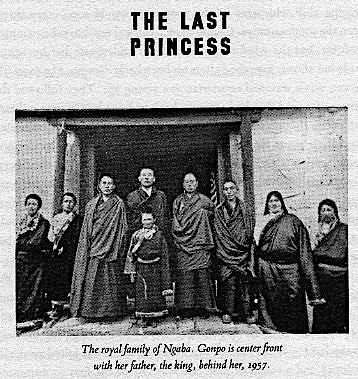
Demick 3

This is the back-story to the devastating assaults from 1958, told through the eyes of Gonpo (b.1950), the last Mei princess. After being evicted from their palace, she was relocated to the provincial capital Chengdu along with her mother and sister; her father, the former king, joined them after a year, traumatised after being held in solitary confinement. But the young Gonpo took readily to being sinicised, and was sent on to a prestigious high school in Beijing.
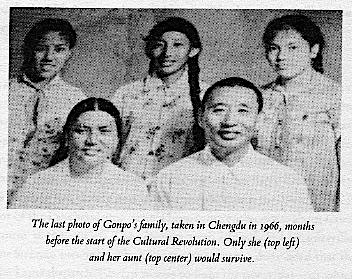
Demick 54

In the summer of 1966 she returned to Chengdu for a holiday with her family, but as the Cultural Revolution broke out she was soon summoned back to Beijing. Having shown willing in previous campaigns (indeed, she supported Chairman Mao avidly), Gonpo was now vulnerable. In 1967 she learned that her parents had died in suspicious circumstances. As she became a target of struggle sessions, a contingent of Red Guards from Ngaba demanded that she should be taken home for further punishment, but instead she was exiled to remote Xinjiang, labouring on a military-run complex in Qinggil (Qinghe) county near the Soviet border. Most of the population sent there were Han Chinese—including her kindly future husband Xiao Tu. They took part in the farm’s propaganda troupe, singing songs in praise of the Party’s “liberation” of Tibet. As higher education began to function again, Gonpo tried in vain to gain admission to colleges in Beijing and Shanghai.

When the couple got permission to take a holiday in 1975, Gonpo took Xiao Tu back to her old home in Ngaba, now unrecognisable; but despite her anxieties, the locals fêted her as a former princess. When they returned to Qinggil they held a simple wedding ceremony. On the death of Chairman Mao later in 1976, their main concern was that Xiao Tu would be able to avoid trouble by maintaining the dodgy loudspeakers broadcasting the funeral. As Demick notes, by the time she was writing Qinggil was the site of a “re-education camp”, inaccessible to outsiders.

We read the story of Delek (b.1949), who came from Meruma village just east of the prefectural capital, where people remained loyal to their former royal patrons. Since his family had suffered grievously as the Chinese enforced their power, he might seem an unlikely recruit to the Red Guards. Yet to many Tibetans the Cultural Revolution presented a welcome opportunity to challenge authority, and by 1968 Delek joined a branch of the Red Guards in Ngaba loyal to the Red City faction in Chengdu, supposing that they could now right the wrongs of the hated commune system and restore religious freedom. But as rebellion spread, the PLA were sent in.

Although this uprising was ultimately a failure, for six months the Tibetans had raised their own livestock, worshipped freely in the monasteries, chanted prayers, and conducted rituals. The monks had worn their robes. It had given Tibetans a taste of freedom, the memory of which could not so easily be extinguished.

In Part Two Demick describes the “interregnum” from the end of the Cultural Revolution to 1989.

By the time of Mao’s death in 1976, Ngaba was a ghost town, sullen and silent. A quarter century of Communist rule had destroyed far more than it had created. What remained consisted mainly of squat mud hovels in dun tones barely distinguishable from the ground underfoot. […] Dust and mud choked the streets. Gutters on either side served as open sewers and toilets.

With the monasteries demolished, there was little to alleviate the drabness or delight the eye. The market nurtured by the king that had made Ngaba worth a detour for traders was long gone.

Demick evokes the resurgence of market enterprise through the story of Norbu (b.1952), who was to become a leading entrepreneur in Ngaba. As a child he had been reduced to begging for the family by the Chinese “democratic reforms”, and later turned to the black market. By 1974 he was making regular trips by bus to Chengdu to buy goods that he could sell back in Ngaba. As the commune system crumbled, the range of merchandise increased. In partnership with his Chinese wife he opened a tea shop and a supermarket.

With the monasteries still closed, some monks also turned to business, with their higher level of literacy. The monasteries re-opened gradually from 1980. Of the roughly 1,700 monks at Ngaba’s main monastery Kirti, only around 300 were still alive; some were traumatised after years in prison. As in Chinese regions, many of those helping to rebuild the temples were former activists who had taken part in destroying them.

New buildings began appearing in the county town—dominated by the institutions of the Chinese state. Tibetans were keen to buy motorbikes, and the trade in caterpillar fungus made a lucrative boost to their income. Ngaba traders travelled not only to the booming southeastern Chinese cities but to Lhasa and the border with Nepal.

The Han Chinese population of Ngaba was growing too; as the Tibetan plateau became a promising place to make money, the state encouraged migration with Develop the West campaigns. Tibetans were soon outnumbered by Chinese in Amdo, and were disadvantaged in many spheres.

Still, Tibetan education was reviving (cf. the lama Mugé Samtan, whose initiative began in Ngaba as early as 1980—see Nicole Willock’s chapter in Conflicting memories, pp.501–502). Tsegyam (b.1964) was a young teacher at the Ngaba Middle School, which opened in 1983. He had been given a Tibetan education by (former) Kirti monks, and became fluent in Chinese, spending a period studying in Chengdu. During the wider cultural revival in the PRC he wrote poetry and essays for literary magazines. At the Middle School he cautiously added Tibetan culture into the curriculum.

Tsegyam’s eyes were opened by reading a copy of the Dalai Lama’s memoir My land and my people, brought back by a friend from a trip to India. As awareness of the Tibetan government in exile grew, major protests took place in Lhasa in 1987. Though there was a strong military presence in Ngaba, Tsegyam echoed the mood by pasting up posters in support of Free Tibet and the Dalai Lama. By 1989, as protests throughout the PRC gathered and were crushed, he was under interrogation; sentenced to another year in prison in 1990, on his release he was unemployed and unemployable.

We catch up with Gonpo. In 1981 she and her husband were permitted to leave Xinjiang with their two children, settling in Xiao Tu’s old home Nanjing. One of countless people whose past backgrounds were now forgotten, Gonpo did well as a primary school teacher. While she kept a small portrait of the Dalai Lama at home, she could pass for a Chinese—by now she could barely recall Tibetan.

Still, she received a visit from a high-ranking Tibetan official on a tour of Nanjing, who had her promoted to posts in the Party; though mainly ceremonial, her new status conferred benefits such as a comfortable apartment.

In 1984 Gonpo managed to arrange belated funeral rites for her parents at Kirti monastery. In Beijing she gained an audience with the Panchen Lama, also recently rehabilitated (see e.g. under Labrang 1); he encouraged her to study Tibetan culture in India, and with his help she set off there with her daughter in 1988 during a thaw in Sino-Indian relations. She intended to return to Nanjing in due course, but the crisis of 1989 ensured that she would now find herself living in exile in Dharamsala.

Part Three takes the story on to 2013, as tensions grew again. As urban China basked in McDonalds and Walmart, rural Tibetans still lacked basic amenities.

In Meruma, Dongtuk was born to a disabled single mother who overcame poverty. In her house was a shrine to her uncle, a tulku reincarnate lama.

What little that children knew about recent history was gleaned from their families.

To the extent that they were taught anything about Tibet in the 20th century, it was about how the Communist Party had liberated Tibet from serfdom. Their parents tended not to talk about it. Maybe they didn’t know about it themselves. Or they feared these stories of collective trauma might arouse anti-Chinese sentiments that could get the children in trouble later down the road. The surviving elders who knew firsthand—and who often carried the scars on their bodies—disgorged their memories only sparingly. If they hadn’t been half-starved and beaten, if they hadn’t languished in prison doing gruelling work, then they had done things of which they were now ashamed. You were either tormented or a tormentor. Nobody had escaped unscathed.

Dongtuk gladly accepted when his mother suggested that he become a monk at Kirti monastery, which was now expanding grandly. In the company of village friends there, he flourished at the monastery school. But a new policy was stamping down on monastic activism; a new “patriotic education” campaign was launched at Kirti in 1998, radicalising many monks. The school was closed in 2002.

Pema (b. c1965) was a supporter of the monastery. After the death of her husband she ran a market stall to support her children, two of whom were monks. She regularly took part in circumambulations at Kirti (cf. Charlene Makley for Labrang, ch.3). She took in a young girl called Dechen, who took to a Chinese education, as well as her niece Lhundup Tso, who was of a more enquiring mind. Pema herself was inclined to be grateful for the limited freedoms they now enjoyed. But she was concerned about a vast new construction project; while she felt more pity than hostility towards the Chinese, she didn’t want any more of them in her town. Infrastructure projects escalated in the buildup to the Olympics—along with surveillance.
Demick 159

Brought up in a nomadic community, Tsepay (b.1977) was not inclined towards dissent. His good looks gained him admission to an official song-and-dance troupe at the glossy resort of Jiuzhaigou, and at first he enjoyed the work. But he came to resent the condescending clichés intrinsic to such displays, and his comments got him into trouble. Leaving the troupe, he began travelling the plateau with cellphone and camera to document the transformation of the landscape.

Despite Chinese censorship, families and monasteries still commonly kept portraits of the Dalai Lama, although people were ready to conceal them if there was a raid. Tsepay listened to recordings of teachings by the Dalai Lama, and became aware of the conflict over the identification of the new Panchen Lama. In 2006, as the Chinese rhetoric against the Dalai Lama became more strident, Tsepay spent a year in prison for distributing Dalai Lama recordings, radicalising him further.

These stories come together in Demick’s account of the 2008 uprising. Serious protests broke out in Lhasa on 10th March on the anniversary of the 1959 uprising that led to the flight of the Dalai Lama. In Ngaba the military police were on full alert, but protests erupted there too on the 16th. Dechen normally found the troops rather dashing, but now the tension was clear. In the middle of a prayer festival at Kirti the young monk Dongtuk saw an older colleague holding up a photo of the Dalai Lama and yelling “Long live His Holiness the Dalai Lama!”. As other monks joined in, they swept out into the streets, confronting the riot police, who responded with tear gas and live ammunition. On their mobiles people began to learn of protests elsewhere in the region, in Labrang, Dzorge, and Rebgong.

Tsepay, on probation, couldn’t resist going into town. There he found the blood-stained body of a young Tibetan woman—probably Pema’s young niece Lhundup Tso. Pema, a curious onlooker, was horrified to learn that she was among those shot dead. Enraged, Tsepay entered the battle. Wounded, he escaped via Chengdu to Shenzhen, where he was pursued by police from Ngaba, but managed to escape again.
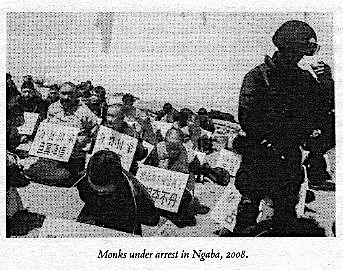
Demick 183

With Kirti monastery now under virtual siege, checkpoints, bunkers, and CCTV were installed. Nearly 600 monks were arrested, over a fifth of the monastery’s population. But the campaign to remove all traces of the Dalai Lama only increased the Tibetans’ reverence for him. At last Dongtuk could interpret the sufferings of his elders in terms of the current oppression. He began listening to illegal Amdo songs such as Tashi Dhondup’s 1958–2008 (see also here).

With Pema distraught over the death of her niece, and normal social life suspended, Dechen became the family’s go-between. Her education at Tibetan middle school had become more conventional; in response to campaigns against expressions of Tibetan nationalism, the students waged subtle protests.

Self-immolation
Life began returning to “normal” by the end of 2008, but the 2009 Monlam New Year festival prompted yet another crisis as a young Kirti monk set himself on fire on the main street. Though he survived, 156 Tibetans have since immolated themselves, of whom nearly a third came from Ngaba and nearby.

Dongtuk’s life at Kirti monastery had become tedious. He was a keen basketball fan, and loved watching movies. His mother eventually submitted to his repeated requests for her to muster the funds to allow him to study in India, but his efforts to leave were unsuccessful.

On 16th March 2011 another Kirti monk, a friend of Dongtuk, set himself on fire—this time fatally. Looking for scapegoats, police arrested monks, and locals rallied to protest. The monastery was barricaded again. But over the next months further self-immolations followed.

Ngaba was now sealed off and equipped with all the technology of riot control—with fire extinguishers now added to the police arsenal. When Demick visited the town in 2013 it reminded her of trips to war zones like Baghdad, Sarajevo, and the Gaza Strip.

As the self-immolations brought renewed international publicity to the Tibetan cause, the Dalai Lama and Tibet advocacy groups were in an awkward position.

Dechen, no longer so amenable to the Chinese, was now alienated by her education at school; Pema now began the complex procedures to help her reach India, as it became ever harder for Tibetan to gain travel permits. With Pema travelling as her chaperone, after a four-month journey they eventually made their way to Dham and crossed into Nepal.

Dongtuk too renewed his efforts to leave. He evaded attention by staying on his father’s nomadic pastures, getting to know his half-brother Rinzen Dorjee. And then, via Lhasa, Dham and Kathmandu, Dongtuk too managed to reach Dharamsala. As he resumed his studies at the branch of Kirti monastery there (founded in 1990), he learned of another self-immolation in Meruma—that of Rinjen Dorjee.

In Part Four Demick visits Ngaba refugees in Dharamsala, learning details hard to divulge in the intimidated atmosphere of Ngaba, and updating the story since 2014. (It is indeed possible for scholars to glean insights through extended stays among Tibetans within the PRC, as did Charlene Makley around Labrang, but in presenting their work they tend to be beset by academic concerns. For fine reflections on the differences between conducting research in Lhasa and Dharamsala, see Isabelle Henrion-Dourcy, “Easier in exile?“, cited in n.1 here).

The journey to India was always fraught with dangers. Following the initial exodus after 1959, another wave took place in the 1980s. We catch up with Gonpo, who had been in inadvertent exile in Dharamsala with her daughter since 1989. The Dalai Lama, whom she had met in 1956, received her warmly, giving her a post in the exile parliament. But as relations between the Chinese and the Dalai Lama deteriorated, Gonpo was unable to see her husband and her other daughter until 2005. As Demick observed after meeting her in 2014,

Not only does the rift between China and the Tibetans run straight through her family, it runs through her psyche. Gonpo loves China as well as Tibet. She still speaks better Chinese than Tibetan. More than most Han Chinese people I know, she absorbed the lessons of socialism. She eschewed conspicuous displays of wealth and was proud that she had shed her aristocratic roots and was, to use a Chinese Communist slogan, serving the people.

Goonpo was deeply disturbed by the self-immolations in her former home.

Demick x

Demick also met the former Red Guard Delek, who had also managed to reach Dharamsala in 1989, becoming a historian as he documented the tribulations of Ngaba, while serving as caretaker at a school for young refugees.
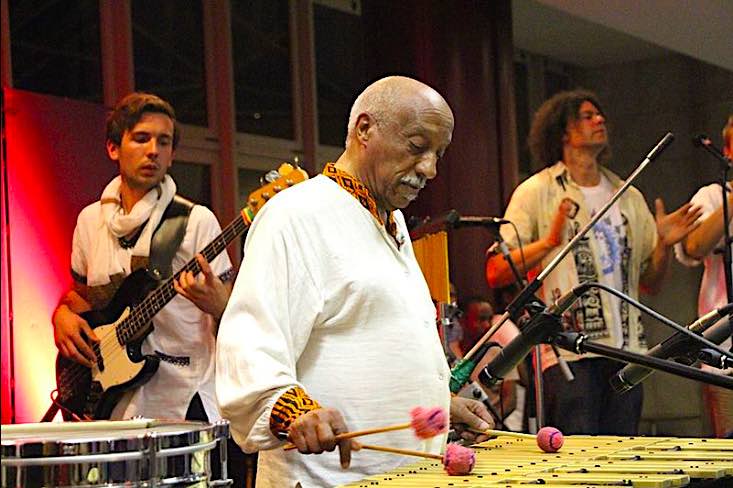
The young teacher Tsegyam had sneaked across the border into India in 1992, eventually becoming private secretary to the Dalai Lama. And after fleeing Ngaba in 2008, Tsepay was on the run for four years, spending over a year in hiding on Wutaishan before reaching Dharamsala.

Dechen was enthusiastic about her studies at the boarding school run by the exile government; educating herself further by reading Woeser keenly, she was hoping to become a journalist. She took Demick to meet Pema, who despite her relief at escaping the appalling repressions in Ngaba, didn’t feel quite at ease, missing the material comforts of her former home.

Indeed, for many exiles the homeland remains ambivalent; with conditions in India less than ideal, they may be tempted to return to their homeland, despite the inevitable scrutiny to which they will be subjected. From a peak of 118,000 in the mid-1990s, the Tibetan population in India declined to 94,000 in 2009. The Chinese had plugged leaks to the borders, and Tibetans often move on to Western countries.

Demick considers the role of the Dalai Lama and current worries over the succession (for recent news, see e.g. here). The bar has lowered from independence to survival; but if the preservation of Tibetan culture sounds like a modest goal, even this can clearly not be taken for granted.

In her final chapter Demick ponders the limits of freedom. Some Tibetans even thought the Chinese had heeded the lessons of the self-immolations; they had cancelled an unpopular water diversion project, and shelved plans to house Chinese workers; aid projects were coming into effect. Photos of the Dalai Lama reappeared at Kirti. But Chinese migration continues, and Tibetans are still disadvantaged.

It should go without saying: The Tibetans are not some exotic isolated tribe trying to preserve an ancient civilisation against the advance of modernity. They want infrastructure, they want technology, they want higher education. But they also want to keep their language and their freedom of religion. […]

Time and again I heard the same story. Almost everybody was better off financially than they’d been a decade ago, like everybody in China. But Tibetans were still poor—even by the standards of rural China. And they could see that the Chinese newcomers in town had a higher standard of living.

Younger Tibetans might not be deeply religious; they might readily take to a Chinese education as a career path, and be seduced by the trappings of modern material goods. And yet they too have come to resent deeply their chronic submission to the Chinese, connecting it to the scars inherited from their elders, and they continue to fight to maintain their identity.

* * *

Eat the Buddha is based on three trips to Ngaba, as well as interviews with Ngaba people elsewhere, most fruitfully in Dharamsala.

With a few exceptions […], the people in this book left Tibet not for political reasons but to further their education or personal growth.

For the most part, they were regular people who hoped to live normal, happy lives in China’s Tibet without having to make impossible choices between their faith, family, and their country.

As she did for Nothing to envy, Demick provides a useful research guide in a section of endnotes, themed by chapter. Besides her own visits to Ngaba, Chengdu, Lhasa, and Dharamsala, she cites sources such as the War on Tibet site of Li Jianglin and Matthew Akester, the work of scholars such as Tsering Shakya, Robert Barnett, and Melvyn Goldstein (we can now add Conflicting memories, including Bianca Horlemann’s chapter 11 on Golog), as well as human rights groups (cf. my roundup of posts on Tibet). Tsering Woeser has written on self-immolation in Tibet on fire (2016), and in this article. Many of these issues are covered on the excellent High Peaks Pure Earth website.

While the Chinese Party-State’s repression of the Tibetans is taking a rather different form to its barbarity in Xinjiang (see this roundup of posts on Uyghur culture), it’s important to keep the Tibetan case in the public eye. Over seventy years of Chinese indoctrination and brute force have been ineffective; a way out of the impasse remains elusive. Engagingly told through personal stories, Eat the Buddha makes a microcosm of the travails of Tibetans in their sorry encounter with the modern Chinese state, serving for the non-specialist (that’s me) as a digestible introduction to complex issues.


* For some effective popular works on other areas, see Charles King (here and here), Undreamed shores, Watching the English, and The souls of China.