Representing Aboriginal music and dance

Harris cover

Further to Dream songs, I’ve been admiring

  • Amanda Harris, Representing Australian Aboriginal music and dance 1930–1970 (2020).

The perspective of non-Indigenous art-music composers writing for the public stage may seem niche:

From a music history or musicology perspective the music and dance events that feature would commonly be perceived as peripheral to the main story. They are not the events that have contributed to the canon of important moments in Australia’s music history, itself a minor player in the canon of (European) Western art music. In the histories of Western art music taught in Australia’s conservatoria and high school music courses, the events which feature here are not even a blip on the radar of music history.

Thus Aboriginal culture itself has been marginalised, as has Australian composition within the wider sphere of WAM; and within the latter, Aboriginal-inspired works may seem even more peripheral. However, Harris puts in focus many important issues underlying the encounter between the broad categories of “folk” and “art” musics, making a fascinating story.

The period from 1930 to 1970 was characterized by government assimilationist policies aimed at “protection” and “welfare”. The book is focused primarily on the southeast and the ways that representation of Aboriginal music and dance linked urban centres to Australia’s Top End and its Red Centre.

Many of the works described here tap into “an appetite for representations of Aboriginality devoid of Aboriginal people”:

Non-Indigenous Australians have engaged more readily with works that could be disembodied from the people who created them, than they have with living, singing, moving Aboriginal people. […]

As Linda Tuhiwai Smith reminds us, Indigenous peoples have long been appalled by the way “the West can desire, extract, and claim ownership of our ways of knowing, our imagery, the things we create and produce, and then simultaneously reject the people who created and developed those ideas and seek to deny them further opportunities to be creators of their own culture and own nations”.

Importantly, Harris listens to the accounts of Aboriginal people themselves, “disrupting” the chapters with three essays. While these commentators partly share the values of the settler majority, they are attuned to the ways of their forebears.

Australian Aboriginal people’s rich oeuvres of song and dance point to the importance of embodied and auditory modes of knowledge transmission and continuance in the same way that the West’s libraries of books and reams of paper archives reveal the dominance of the visual and the written in European epistemologies. […]

Under protection/assimilation regimes, immense pressure was exerted upon Aboriginal people to abandon culture by banning the speaking of Indigenous languages and performance of ceremony and by rewarding actions that showed Aboriginal people were adopting mainstream behaviours like residing in a single house, in a nuclear family unit. These pressures were not just notional, but rather, punitively enforced—people who grew up under this regime remember mothers, aunts and grandmothers obsessively dusting and keeping a clean house, knowing that untidiness could lead to allegations of neglect of children, and that children were routinely removed from their families and placed in institutional care, sometimes indefinitely.

Nevertheless, at moments of national nostalgia, events commemorating European settlements sought to memorialise and celebrate the lost arts that had been actively repressed.

Such events go back to the start of the century, becoming more common from the 1930s. Aboriginal people were presented to gawping non-Indigenous audiences as “noble savages”.

Chapter 1 a general introduction, opens with the 1951 Jubilee of Federation, featuring the Corroboree, a symphonic ballet composed in 1944 by John Antill with new choreography by Rex Reid.

Instead of the dozens of Aboriginal people proposed by the publicity subcommittee, Corroboree presented dozens of orchestral musicians from the symphony orchestras of each state and dancers from the National Theater Ballet Company. No Aboriginal people were involved in the production. The show was acclaimed as a landmark Australian work. […]

Non-Indigenous Australians have appropriated this language to stake a claim in Aboriginal culture and to represent Aboriginal music and dance to non-Indigenous audiences. […] But what relationship do these songs bear to those that Aboriginal people were singing?

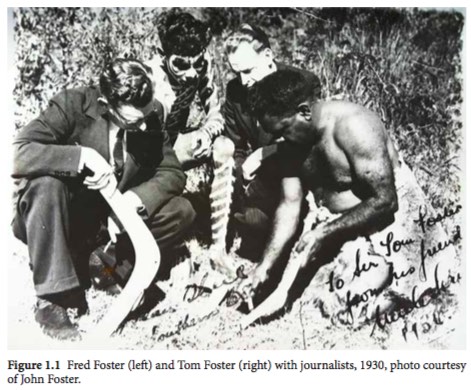
In the Prelude that follows, D’harawal scholar Shannon Foster recalls her great-grandfather, the activist and songman Tom Foster, who spoke out on Aboriginal rights at the Day of Mourning in Sydney in 1938.
Harris 17

As she observes tellingly,

The archival research space is full of contradictions for Aboriginal people. I cannot help but feel a forging of my cultural identity when the archives unveil another piece of “evidence” of who we are and who I come from. I do not need Western research to validate who I am, though it still performs this task, whether I want it to or not. I can use the archives to tell the stories of the destruction of colonization and the violence that has been inflicted on my family, and I need people to know that it is there and not deny it. But I do not want others to misuse this information and to paint us as victims or use our damage to sell their research: to perversely and voyeuristically indulge in our pain and damage. […]

Every time I relish another crumb of information about my grandfathers, the joy is tinged with despair at not knowing or seeing this information until it is delivered to me through a white man’s colonial archive, stained with the blood and pain of our ancestors.

And

I am told by a prominent historian in the audience that they had always seen boomerangs like Tom’s as nothing more than kitsch, cultural denigration, humiliation, and damage. They had never considered (nor thought to ask) how we feel about them. It had never occurred to them that what we see is physical evidence of our existence in a world where we have been consistently erased. Tom’s boomerangs speak to us of survival, resistance, and cultural fortitude and strength.
Harris 26

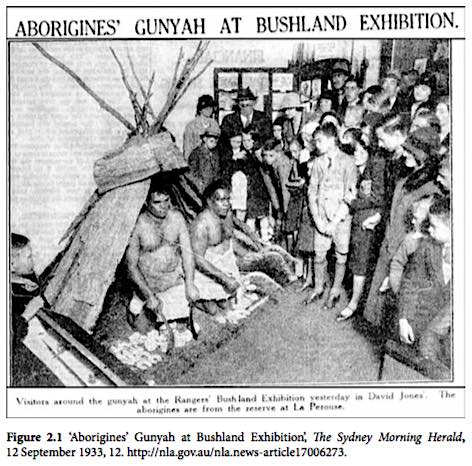
This account makes a bridge to Chapter 2, on the 1930s. Though Tom Foster took part in the troubling silent film In the days of Captain Cook (1930), he was among those asserting the enduring presence of Aboriginal people in society.

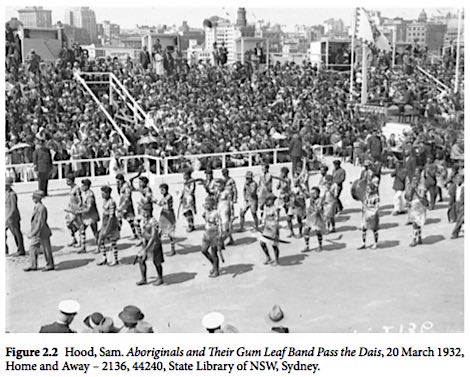
As various official commemorations were staged through the 1930s, Harris describes the Aboriginal presence at the opening of the Sydney Harbor Bridge in 1932. The 1938 reenacting of the First Fleet landing was attended by historical pageants—and the Day of Mourning protests. By contrast with the quotidian limitations on their mobility, the performers were coerced into travelling to Sydney.
Harris 28

Anthropologists had long been recruited to government agencies. They now acted as cultural brokers between performers, the arts sector, and the media; under A.P. Elkin a shift occurred from protection to assimilation.

A major actor in cultural agendas and the new “Australian creative school” was the Australian Broadcasting Commission (ABC), founded in 1932. Alongside visits by Percy Grainger, composers building on European explorations in harnessing folk styles included Clive Douglas, John Antill, and Margaret Sutherland.

Chapter 3, “1940s: reclaiming an Indigenous identity”, surveys wartime performances for recruitment rallies; and after the war, the forming of groups like the radical New Theatre, whose productions included the 1946 Coming our way and the ballet White justice, with Eric and Bill Onus coming to the fore.

Ted Shawn, co-founder of the modern American dance movement, was deeply impressed by the performance culture he witnessed on a visit to an Aboriginal community in Delissaville (now Belyuen) in 1947. Still, when dancers were recalled for his trip, “many Darwin housewives found themselves without domestic labour”.
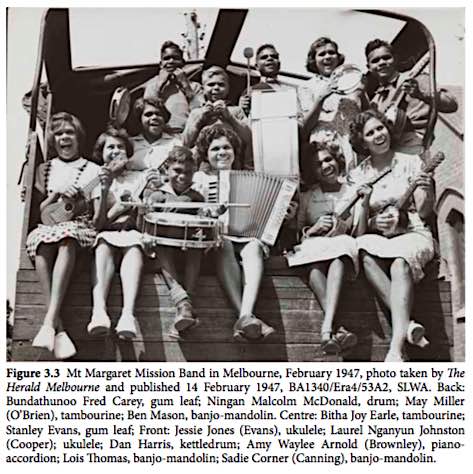
Harris 50

I note that in 1950s’ China too, under the avuncular eye of the Party, dance made a forum for modern experiments, as in the Heavenly Horses troupe in Shanghai (see Ritual life around Suzhou, under “Mao Zhongqing”).

Harris refers to the short 1949 documentary Darwin: doorway to Australia (filmed in 1946), which includes footage of a tourist corroboree in Darwin Botanic Gardens (from 6.23):

As Aboriginal activists continued to meet obstacles, the Aboriginal tenor Harold Blair was exceptional with his recital tours of the USA. Meanwhile the ABC was promoting non-Indigenous composers in “representing an Aboriginal idyll”.
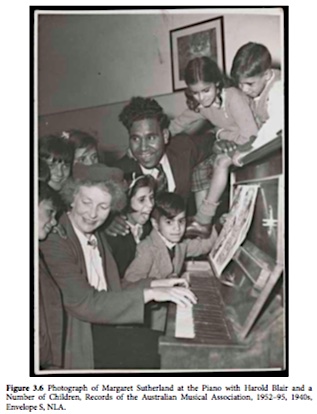
Harris 55

Within this niche, John Antill and his Corroboree, with its clapstick beat persisting amidst the “modernist antics” of the orchestra, made a considerable impact, suggesting comparisons with The Rite of Spring:

New organisations supplementing the cultural work of the ABC included the Arts Council of Australia. Echoing Chinese clichés, “international cultural exchange” now “took Aboriginal music to the world”—specifically to the USA, as Australia’s ties with its imperial parent were downgraded. Ironically,

Just as Aboriginal people were increasingly steered away from maintaining their own cultural practice, non-Indigenous people turned new attention towards it.

But Aboriginal performers still met with obstacles in touring abroad.

Chapter 4 sets forth from the debates surrounding the 1951 Jubilee celebrations. The official cultural initiatives of these years were accompanied by strikes and protests. Performances took on a political dimension, with Bill Onus and Doug Nicholls taking leading roles in asserting Aboriginal rights.

As others have noted, Aboriginal visual and material arts are more readily packaged, reified, than their expressive culture. Despite their sincere aim of enhancing Aboriginal status, the Jubilee committee’s proposals for massed corroborees didn’t come to fruition, being replaced by Antill’s Corroboree. Still better received was the new dance drama Out of the dark: an Aboriginal moomba.

Linking Corroboree to the political, economic, and social exclusion suffered by the Aboriginal owners of the cultures that had inspired it, Margaret Walker of the New Theatre movement proposed her own alternative. She saw Aboriginal people as both a society of “primitive communism” and an oppressed group to be liberated through socialism. In 1951 the Unity Dance Group even toured to East Berlin. In 1958 Aboriginal soprano Nancy Ellis toured China, just as convulsive political campaigns were intensifying there.

Among arts bodies in the 1950s, the Australian Elizabethan Theatre Trust was founded in 1954—looking forward to a cultural renaissance of a type later ridiculously promised by Brexiteers. The Adult Education Boards sponsored major tours by Beth Dean and Victor Carell, whose ethnographic shows introducing song and dance from around the world gave a role to Aboriginal culture—albeit based, until their 1953 “expedition”, on reading anthropology rather than any acquaintance with the people themselves. In 1954 Dean did a new choreography of Corroboree. For events to mark newly-crowned Queen Elizabeth’s 1954 visit, Aboriginal performers again had to travel large distances to perform.

Debra Bennet McLean brings us down to earth:

We asked ourselves how many Aboriginal people could ever really contemplate, let alone afford, to attend the ballet in the era of the “colour bar”; most Aborigines could not walk freely into an Australian town without an exemption form or “dog tag” at the time of Antill’s composing Corroboree, nor could they even sit in the same milk bar or use public toilets at the time of the premiere of the ballet Corroboree.

Harris writes with such empathy about all the diverse actors in these encounters that the following Interlude is timely, refocusing on the people who were the object of all this well-meaning attention, with Tiriki Onus thoughtfully reflecting on his grandfather Bill (for whose films, see here).

In Chapter 5: 1960 to 1967, Aboriginal performers begin to take the main stage. Harris discusses opportunities for public performance and the limitations imposed by state agencies. She begins with talent quests from 1961, the North Australian Eisteddfod, and tours of northern companies in the south—notably the well-received Aboriginal theatre, presented in Sydney by Aboriginal people from north Australia in 1963. Such shows

aimed simultaneously to engage those interested in Aboriginal performance from an ethnographic and/or historical perspective and those creating and producing new works of modern dance, music, and visual art on Australian stages.

As Harris notes, a defining feature of these new contexts was the way that performers from different traditions were brought together into a scratch ensemble, or into competition with one another.

In an interview Harris draws attention to a film about the 1964 North Australian Eisteddfod:

Yet international tours remained elusive. In Australia (as in New Zealand and Canada), with Indigenous and European genres competing for resources, the authorities of settler colonies still preferred to highlight their European heritage—by contrast with countries from which British colonisers had withdrawn (Pakistan, India, Kenya, Ghana).

Expatriate Australian Dudley Glass addressed the Royal Society of Arts in 1963,

writing that though Aboriginal people had given little to music [sic!] with their monotonous music and crude instruments [sic!], the “ingenious” John Antill has given a ballet suite “the flavour of aborigine music”, portraying native dance ceremony and using different totems for different parts of the ballet.

This contradictory sentiment, in which Aboriginal music was deemed to have little value and yet non-Indigenous composers were praised as innovative for evoking it in their music, permeated decisions about how Australia should be represented overseas. […]

In representing itself to international audiences, the Australian government sought to maintain a narrative of Aboriginal people as something old and static, not modern and constantly transforming. Tangible art works were sent overseas—works standing in for the artists who had created them, but live performers were excluded from events like the Commonwealth Festival in favour of non-Indigenous composers and performers who would represent Australia as a culture in dialogue with European modernity.

Here, as often, I hear echoes of the Chinese authorities towards their folk culture.

All this leads back to an update on Antill and Dean, with their 1963 Burragorang dreamtime, using non-Indigenous performers. Harris notes the bitter irony that the people whose displacement by the settler colonists was romanticised in the ballets, and embodied by the performers, had themselves just been displaced by a dam project to supply the Sydney population.

Interestingly, Beth Dean reported on Antill attending Aboriginal theatre:

This was far different from anything Antill had seen before. It was not the rather impromptu “tourist version” by Aborigines who had not been living a tribal life for many years, sometimes generations, as they survived on the outskirts of towns. John was thrilled. One may wonder what Antill might have done if he had experienced this kind of Aboriginal music in his early days, rather than on his 60th birthday.

Chapter 6 dicusses the end of the assimilation era—from the 1967 constitutional referendum, which led quickly and decisively to a shift to Aborigines representing their own culture, to the 1970 Cook Bicentenary, marked by protests.

The referendum belatedly paved the way for full rights of Aborigines as citizens. In the performing arts, they now gained greater rights of self-determination, as groups such as the Aboriginal Theatre Foundation and Aboriginal Islander Dance Theatre were formed. Although I imagine that such developments had a tangential impact for poor dwellers of the remote Country,

Groups like the Aboriginal Theatre Foundation would be momentous in localising the performance of Aboriginal culture internationally, bringing a regional focus to owned and self-represented cultural practice, in dialogue with global contexts for performance.

In Australia’s music (1967), largely a study of contemporary art music, Roger Covell allowed some space for Aboriginal traditions—recalling the prophetic remarks of Percy Grainger in the 1930s:

What would we think of a Professor of Literature who knew nothing of Homer, the Icelandic sagas, the Japanese Heiki Monogatori [sic], Chaucer, Dante and Edgar Lee Masters? We would think him a joke. Yet we see nothing strange in a Professor of Music who knows nothing of primitive music and folk-music, and music of mediaeval Europe, and the great art-musics of Asia, and who knows next to nothing of contemporary music.

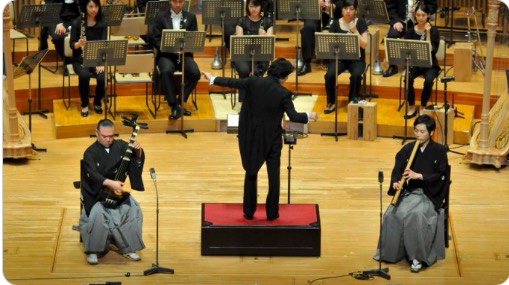
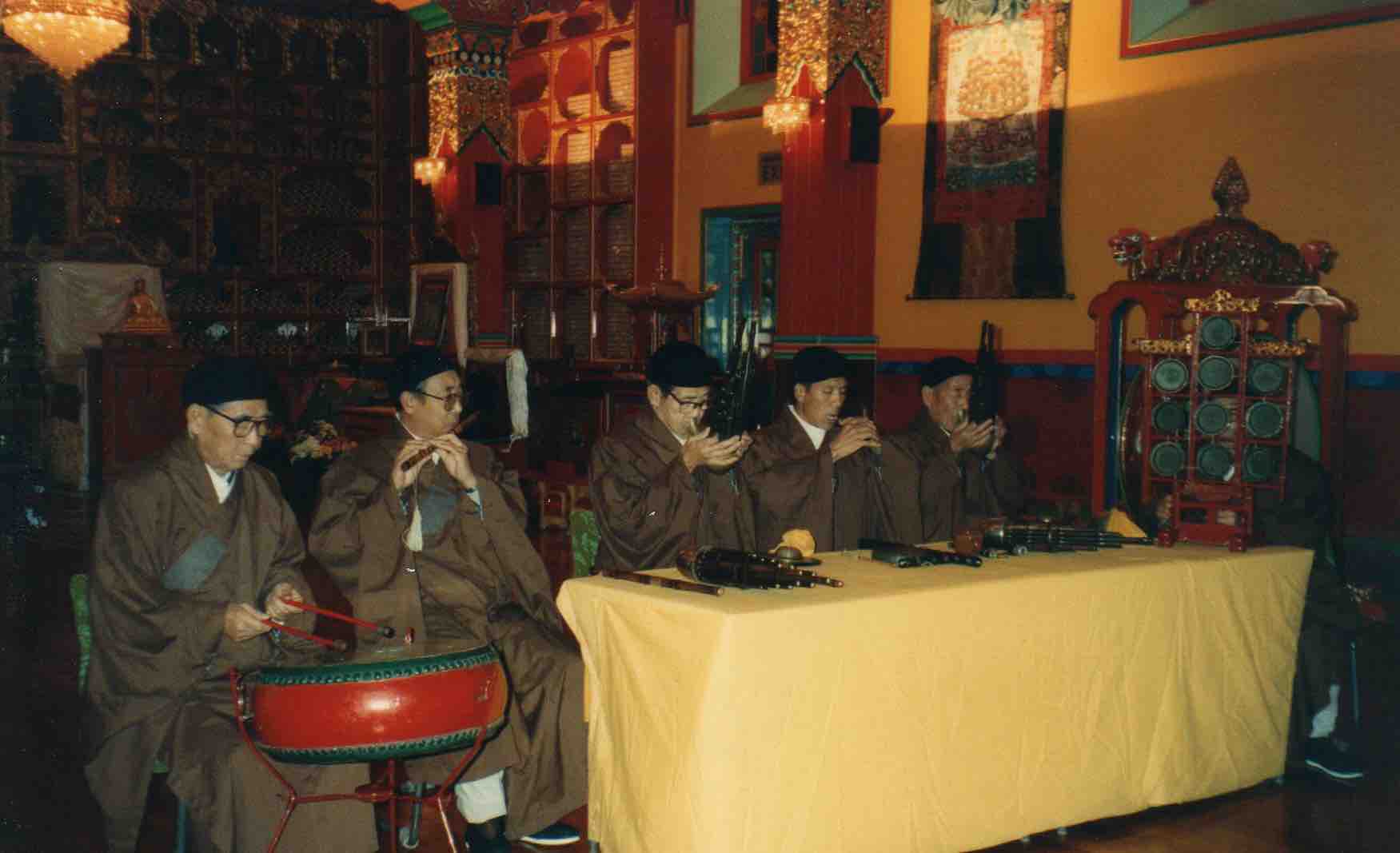
One fruit of this new mindset was the impressive 1971 Sextet for didjeridu and wind instruments, in which composer George Dreyfus collaborated with Aboriginal cultural leader George Winunguj (see cover image above):

For the Mexico Cultural Olympics in 1968, Beth Dean presented the new ballet Kukaitcha, using taped recordings from Arnhem Land, still propagating non-Indigenous representation of Aboriginal culture abroad. Harris comments:

Performing the role of the woman who had transgressed cultural law by witnessing ceremonies forbidden to her in Kukaitcha, while publicly proclaiming her ability to dance men’s dances that women should not even see, Dean seemed more enamoured of the sensationalism of these transgressive actions than of the richness and complexity of the cultures she aimed to represent.

However, new international opportunities for Aboriginal performers were arising, such as performances of the Aboriginal theatre for the 1970 Expo in Japan, amidst complex negotiations.
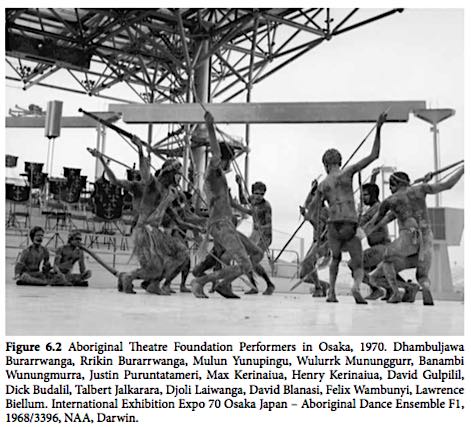
Harris 121

The 1770 Cook landings, and modern protests over commemoration, are much-studied topics.

Despite the involvement of Indigenous performers, Dean and Carell’s 1970 show Ballet of the South Pacific was now at variance with the prevailing mood. Corroboree was still dusted off, to ever lesser impact.

The re-enactment for the Cook bicentenary, attended by the Queen, with Aboriginal performers among the cast, were now controversial. Protests were a feature of nationwide events.

After the “Too many John Antills?” of Chapter 1, Chapter 7 considers the legacy, progressing elegantly to “Too many Peter Sculthorpes?” and pondering the failure of Australian art music to engage with Indigenous cultures, always (inevitably?) remaining at a remove from Aboriginal performances.

Harris offers a balanced assessment of the inescapable Corroboree:

Antill did not appropriate Aboriginal musical culture. He successfully represented it in a way that settler Australians continued to experience it—as a background presence, a remembered soundscape from childhood, one that was not well understood, was constant, but which would always be subject to inundation by the productivity of nation building. In evoking Aboriginal soundscapes, Corroboree may have appeared to celebrate Aboriginal culture, but the action it performed did the opposite, replacing Aboriginal performance cultures on public stages.

Considering her topic in the light of settler colonial (and post-colonial) theory, she notes that composers’ representations of Indigenous culture “aimed to tame Aboriginal Country and define its value in economic terms”.

Antill’s position as composer of a work that would found a national creative school was not just produced out of his own creative industry and good fortune, rather, it capitalised on the state agenda for representing Aboriginal culture without the messiness of engaging with Aboriginal people and their political demands and physical needs.

As Anne Thomas noted in 1987,

Public dances and performances of folk musics that had been so active in the assimilation era fell away once Aboriginal people were able to advocate for their rights in explicit ways.

Harris goes on to describe later collaborative projects that seem to resist narratives of replacement.

Yet as ethnomusicologist Catherine Ellis observed,

very few composers have taken the trouble to examine the structural intricacies of Aboriginal music. They have preferred to look at the superficialities: a descending melody, a regularly repeated stick beat, a didjeridu-like sound.”

Thus

Though the public rhetoric around these works claimed that they aimed to persuade listeners of the value of Aboriginal culture, value (through public recognition, commissions for new works, performances, and recordings) was attributed to the composers and their works rather than to the cultures that ostensibly inspired them.

Peter Sculthorpe (1929–2014) went on to become the leading figure on the WAM scene in Australia. Inspired at first by Japanese Noh drama, by the 1960s his music showed greater Australian Aboriginal influence. But as Harris comments, his works have such a unique voice that “they no longer resemble the Aboriginal music on which their performative capital is dependent.”

She also surveys recent works by composers such as didjeridu player William Barton.

Harris never loses sight of the perspective of Aboriginal people, or their maintenance of traditional ritual life under trying conditions. In a lively Coda, Aboriginal storyteller Nardi Simpson reflects further on the encounter. She makes a simple, pithy statement:

I want to do something that hasn’t been done before with the tools and knowledge that I have and who I am and where I’m from and that’s what I want to do.

* * *

This is a most thoughtful, compelling study. For a survey of the timeline, see also Harris’s Storymap site.

For the period since, one might also turn to Indigenous pop and rock music, another hybrid forum for creative representation with a more far-reaching influence, less constrained by officialdom. Meanwhile, anthropologists and ethnomusicologists have been ever more active in documenting the enduring ritual life of Aboriginal communities—and protests over Invasion Day continue.

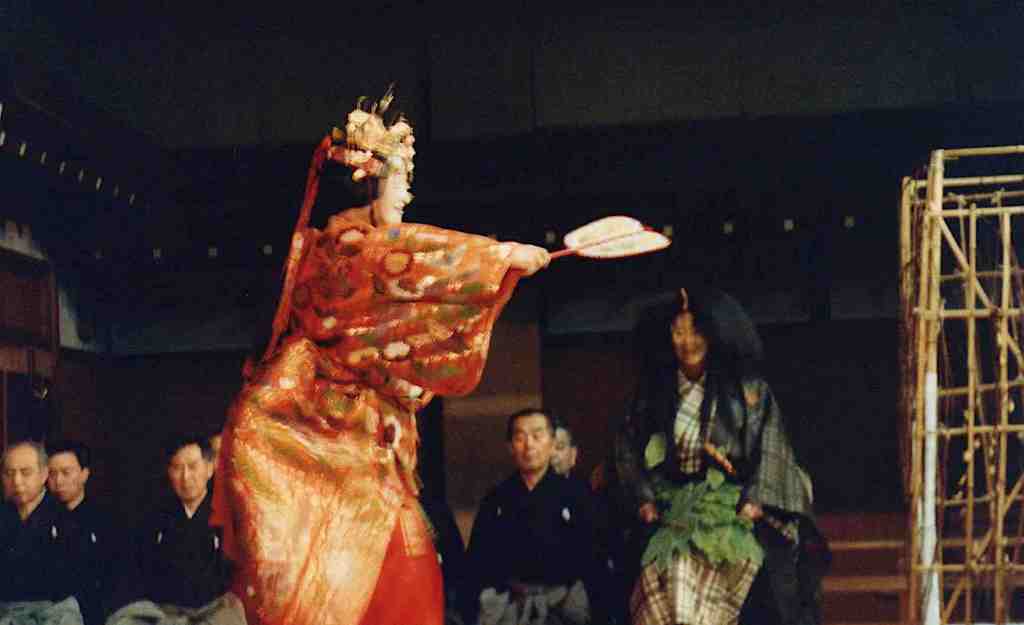
See also Grassy Narrows, Native American cultures, First Nations: trauma and soundscape, and An Indigenous peoples’ history of the United States. For a remarkable vision, cf. Alan Marett’s 1985 Noh drama Eliza. And note What is serious music?!

Comment te dire adieu

Hardy 2

Like I say a little prayer, Back to black, Carminho (among many gems on my Playlist of songs!!!), and festive Bach, it makes me unbearably happy to hear the exquisite chanteuse * Françoise Hardy singing Comment te dire adieu (1968)—the nuances of her expression capturing the ambivalent mood, both in close-up:

and lounging languidly on a chaise longue:

Serge Gainsbourg’s drôle lyrics are brilliant:

Sous aucun prétexte je ne veux
Avoir de réflexes malheureux
Il faut que tu m’ex——pliques un peu mieux
Comment te dire adieu

Mon coeur de silex vite prend feu
Ton coeur de Pyrex résiste au feu
Je suis bien perplexe, je ne veux
Me résoudre aux adieux

(Je sais bien qu’un ex——amour n’a pas de chance, ou si peu
Mais pour moi un ex——plication voudrait mieux)

Sous aucun prétexte je ne veux
Devant toi surex——poser mes yeux
Derrière un Kleenex je saurais mieux
Comment te dire adieu

(Tu as mis à l’index nos nuits blanches, nos matins gris-bleu
Mais pour moi une ex——plication vaudrait mieux)

Sous aucun prétexte je ne veux
Devant toi surex—poser mes yeux
Derrière un Kleenex je saurais mieux
Comment te dire adieu

She sounds soooo cool, there doesn’t seem to be a lot of hurting going on here. Instead, she finds inner strength through a flurry of insouciant wordplay on “ex“—not least Pyrex (a niche hommage to kitchenware in French chanson) and Kleenex. Sex is just a sibilant away….

Nor does she let up in her gorgeous sprechstimme interludes (above a change to triple metre on strings), stressing ex——amour and ex­——plication (as in the sung ex——pliques and surex——poser) with an ecc——entric hiatus, negating the natural rhythm of speech—not so much a speech impediment as the kind of deliberate pause advocated by therapists to prepare the stammerer to approach the following syllable (especially plosives) with easy onset!

True, she would make the Paris phone directory sound irresistibly seductive (cf. the HP sauce label), but here her spoken sections further the dramatic effect, ex——punging, ex——orcising her ex——perience. They’re punctuated by a funky syncopated trumpet motif, courtesy of Caravelli, worthy of Hardy’s fellow-Parisian Messiaen—who three years previously had completed the Sept haïkaï

Then there’s the extra visual frisson of veux, malheureux, aux adieux, mieux. One even hopes to hear her pronouncing the x there (I wonder how this works: do native French speakers somehow hear it in their heads?).

À propos, like many men, Monsieur Pyrex, the passionless, fire-resistant subject of this nonchalent lament, clearly needs his head ex——amining.

The music is suitably minimalist, eschewing melodic or harmonic development—recalling more the theme tune of Soap than the ballads of Michel Legrand (see also Un homme et une femme).

Comment te dire adieu is actually a chic upbeat French recasting of the soupy ballad It hurts to say goodbye, which had recently been recorded by Margaret Whiting and then Vera Lynn—just the kind of ballad I’d love to have heard Dusty sing (cf. You don’t own me; see also How can I miss you when you won’t go away?).

Françoise Hardy subtly subverts both the melodrama and the “gamine elfin waif” trope (see also Feminine endings). Put this song on the British school syllabus and there’ll soon be a legion of fluent young Francophiles…

Her German version of the song works well too; while the lyrics are less detached, they make a bit of an effort to keep the “ex” theme going:

Nach zwei Cognacs ex bekamst du Mut
Deine Abschiedstexte waren gut [Das Lied von der Erde for generation X?]
Ratlos und perplex nur dachte ich
Was mach ich ohne dich

Stets war mein Komplex du bist zu schön
Charm hast du für sechs, ach was, für zehn **
Liebt denn so was exklusiv nur mich
Was mach ich ohne dich

(Ob du daran denkst
Wie einsam und verloren ich bin
Nein, du hast schon längst
Eine Andere im Sinn)

Gib mir keinen Extrakuss jetzt mehr
Der nur noch Reflexbewegung wäre
Ratlos und perplex nur frag ich mich
Was mach ich ohne dich

(All die Nächte mit dir
Voll von Glück bis zum Morgengrauen
Die und dich stahl mir
Eine andere Frau)

Diese Dame X, die dich mir nimmt
Fliegt auf deine Tricks wie ich, bestimmt
Dann als Dame ex sagt sie wie ich
Was mach ich ohne dich

 And she sings it in Italian, with yet another angle on the story:

Non voglio un pretesto per pietà
Sai che io detesto falsità
Sii un po’ più onesto quando vuoi
Finirla fra di noi

Non restar perplesso ad inventar
Scuse che del resto non van mai
Oltre ad un modesto rendez-vous
A cui non vieni più

(Io so bene che i castelli di carta
Con un soffio van giù
Non ne hai colpa tu)

Non voglio un pretesto per pietà
Sai che io detesto falsità
Dammi il fazzoletto quando vuoi
Finirla fra di noi
Finirla fra di noi

That first verse is good:

I don’t want an excuse for piety
Know that I detest falsity
Be a bit more honest when you want
To finish it between us.

One might think Spanish regional languages would offer potential for the exes too. Anyway, the nuances of mood in these various versions are intriguing. Possibly a multilingual EU directive to Brexit Britain? 

Françoise Hardy did a more melancholic version with her soul sister (twin?) Jane Birkin in 1976 (Comment lui dire adieu!):

Later Birkin gave an intense live arabesque rendition (1996/2002), with ex——emplary decorations on solo fiddle:

The 60s, eh?! Ex——traordinare! I am officially applying to be reincarnated as Serge Gainsbourg.

Hardy

Françoise Hardy died in 2024: obituary, tribute.


* English pronunciation shontooz, as in A French letter, n.2.

** Cf. the classic

What comes between fear and sex?
Fünf.

Expressive cultures of the Himalayas

*UPDATED*

Musique et epopee

To complement my introduction to Tibet: the Golden Age, another volume, focusing on ritual and expressive cultures in the Himalayas and Tibet,

  • Katia Buffetrille and Isabelle Henrion-Dourcy (eds), Musique et épopée en Haute-Asie: mélanges offerts à Mireille Helffer à l’occasion de son 90e anniversaire (2017; 427 pages),

makes a fine occasion to survey the inspiration of Mireille Helffer’s pioneering studies.

Helffer

The book opens with a tribute from her long-term colleague Bernard Lortat-Jacob (another doyen of French ethnomusicology, whose own ouevre is the subject of a new volume). The editors themselves provide a detailed overview of Helffer’s life (cf. their tribute after her death in January 2023, at the age of 95). The book includes a bibliography and discography of her work on pp.25–33 (for her audio recordings, see also under https://archives.crem-cnrs.fr).

Though C.K. Yang’s distinction between “institutional” and “diffused” religious practice has been refined, I still find it useful for Tibetan as well as Chinese cultures. While the Tibetan monastic soundscape became a major focus of Helffer’s work (see e.g. her section in the New Grove article on Tibetan music), she always paid attention to folk practice too—a focus continued by scholars in recent years. The chapters further show the relevance of her studies for iconography, historiography, and organology.

Helffer 72

Through the 1960s and 70s, when Chinese-occupied Tibetan regions were inaccessible to outsiders, the base for Helffer’s fieldwork was among the Himalayan peoples in Nepal, India, Bhutan, Ladakh. Since the 1980s her research has inspired younger scholars to address the embattled Tibetan heartland of the TAR, Amdo, and Kham (cf. Henrion-Dourcy, “Easier in exile?” and other articles in n.1 here). Here I’ll just mention some chapters that particularly arouse my interest.

Helffer 100

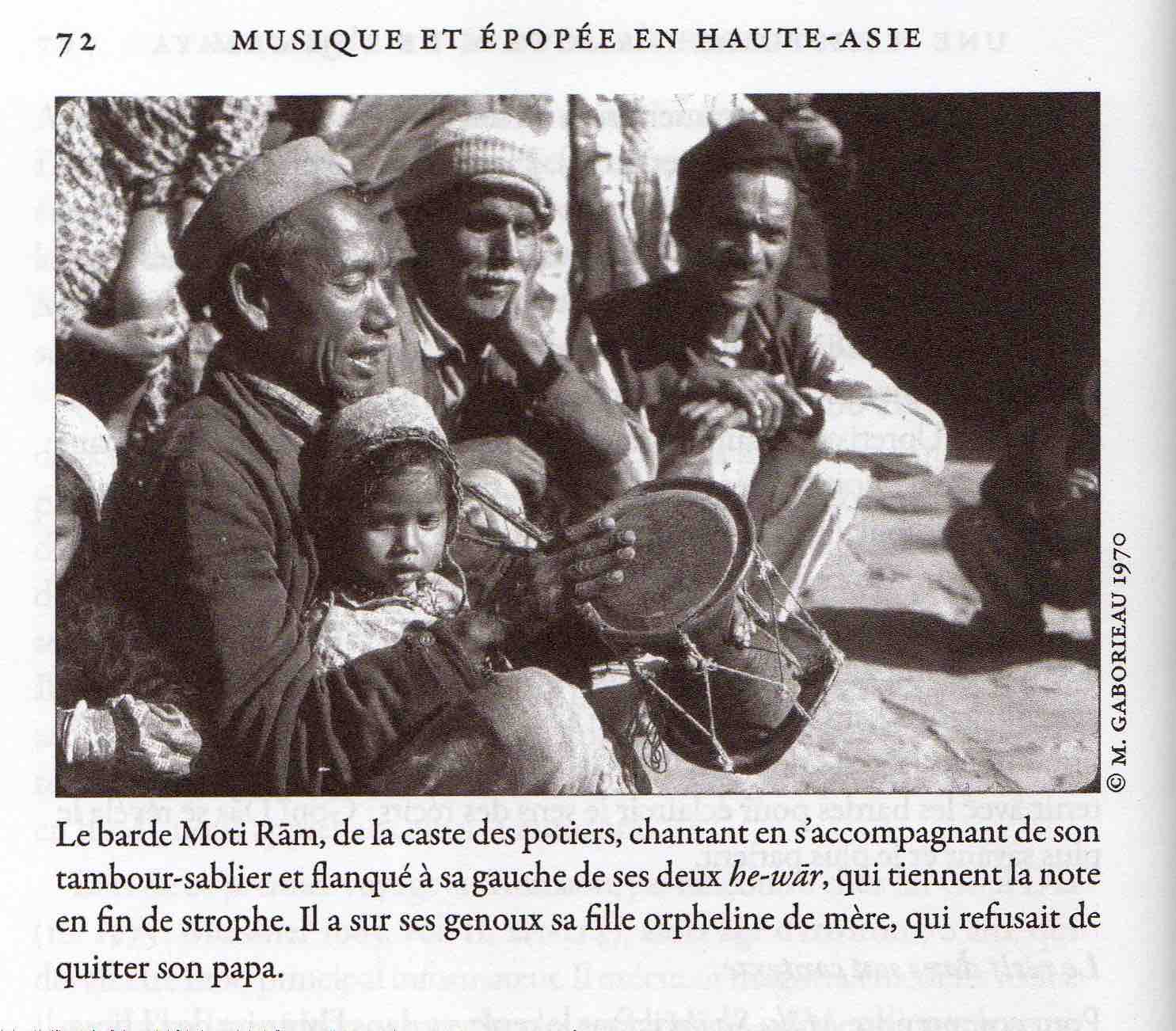
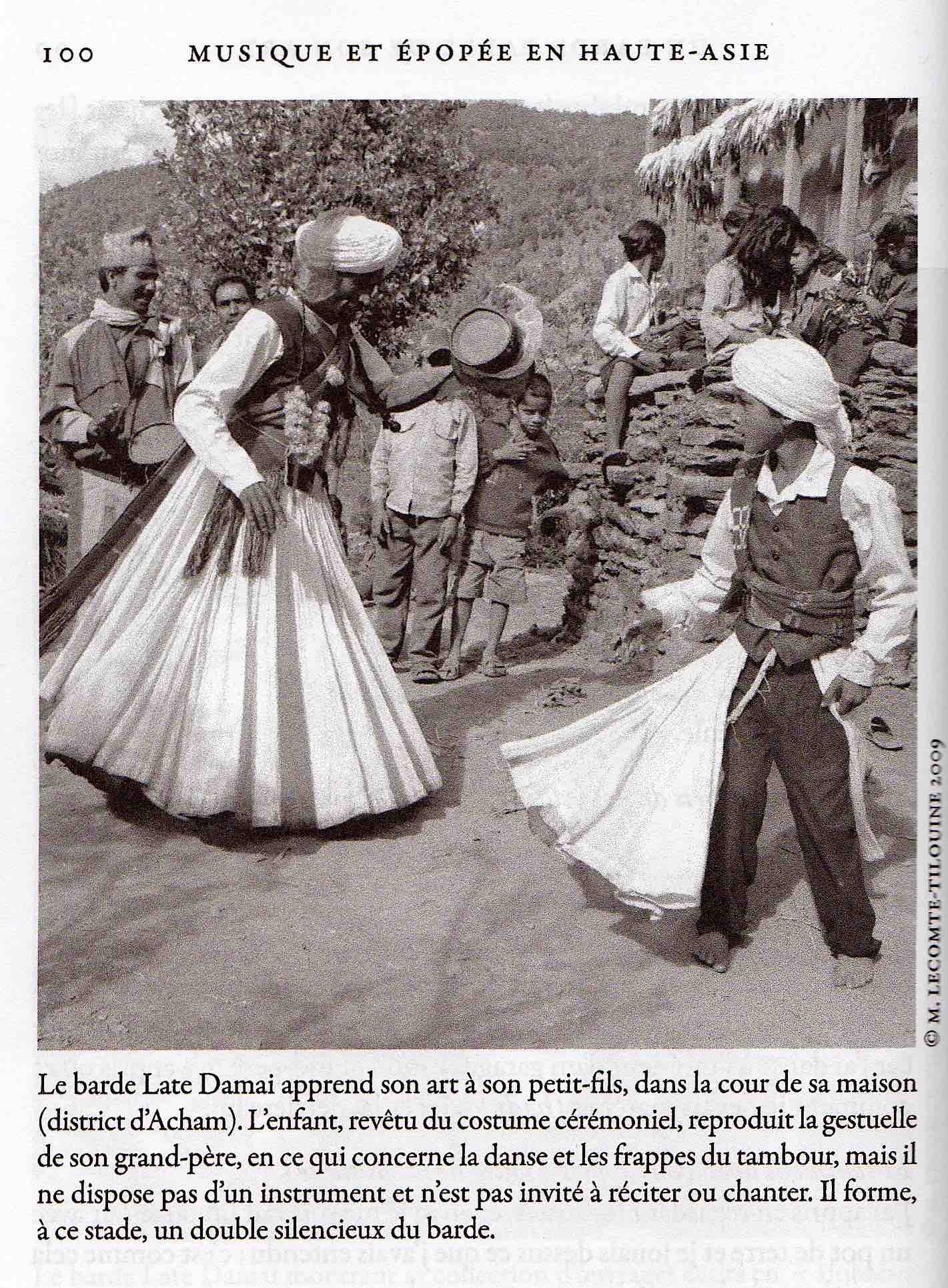
The essays are grouped in three main sections. The first, “Conteurs et épopée”, includes a survey by Gisèle Krauskopff of the early days of ethnology on Nepal, as Helffer’s concern for sung oral literature developed through her fieldwork on the gäine minstrel castes—who are also discussed in the following chapter by Jean Galodé. Marie Lecomte-Tilouine explores a related tradition through an interview with a damāi minstrel. In the first of several contributions addressing the Gesar epic, Roberte Hamayon sets forth from Helffer’s work on the genre to compare its form in Buryatia.

Helffer 222

The second section, “Danse, musique et théâtre”, opens with reflections by Geoffrey Samuel on Tibetan ritual and cham ritual dance, focusing on its use inside the temple. Always keen that we should have an impression of such rituals as performed, rather than mere silent immobile text, I’m glad to learn of the films Tibet: le message des Tibétains by Arnaud Desjardins from the mid-1960s (set mostly in Dharamsala), including this on Tantrism:

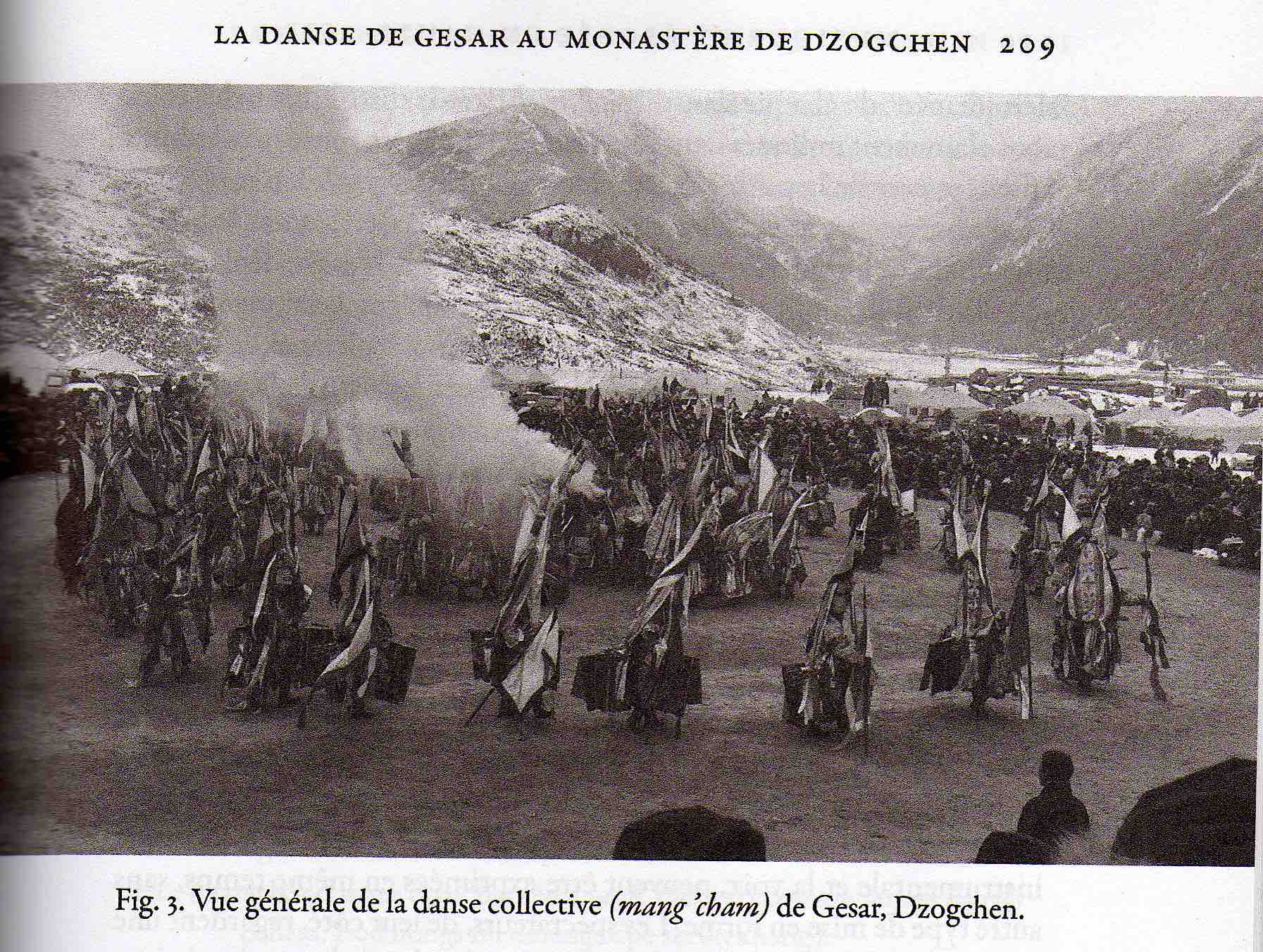
Turning to Kham (in the PRC), Isabelle Henrion-Dourcy reports on her 2014–15 fieldwork on Gesar dance in the Dzogchen monastery—one of three ritual dances created under the Fifth Dzogchen (1872–1935).

Helffer 209

Gesar is also the subject of “From Tibet to Bhutan” by Françoise Pommaret and Samten Yeshi. Françoise Robin contributes a translation, with commentary, of “Dream of an itinerant musician”, a novella by Pema Tseden (b.1969), based in Amdo.

The third section, “Études népalaises et tibétaines”, opens with Véronique Boullier reflecting on issues in studying the life of apparently “closed” Hindu temples in India, setting forth from Helffer’s 1995 article “Quand le terrain est un monastère bouddhique tibétain”. Following chapters discuss themes in the iconography of Tibetan Buddhism.

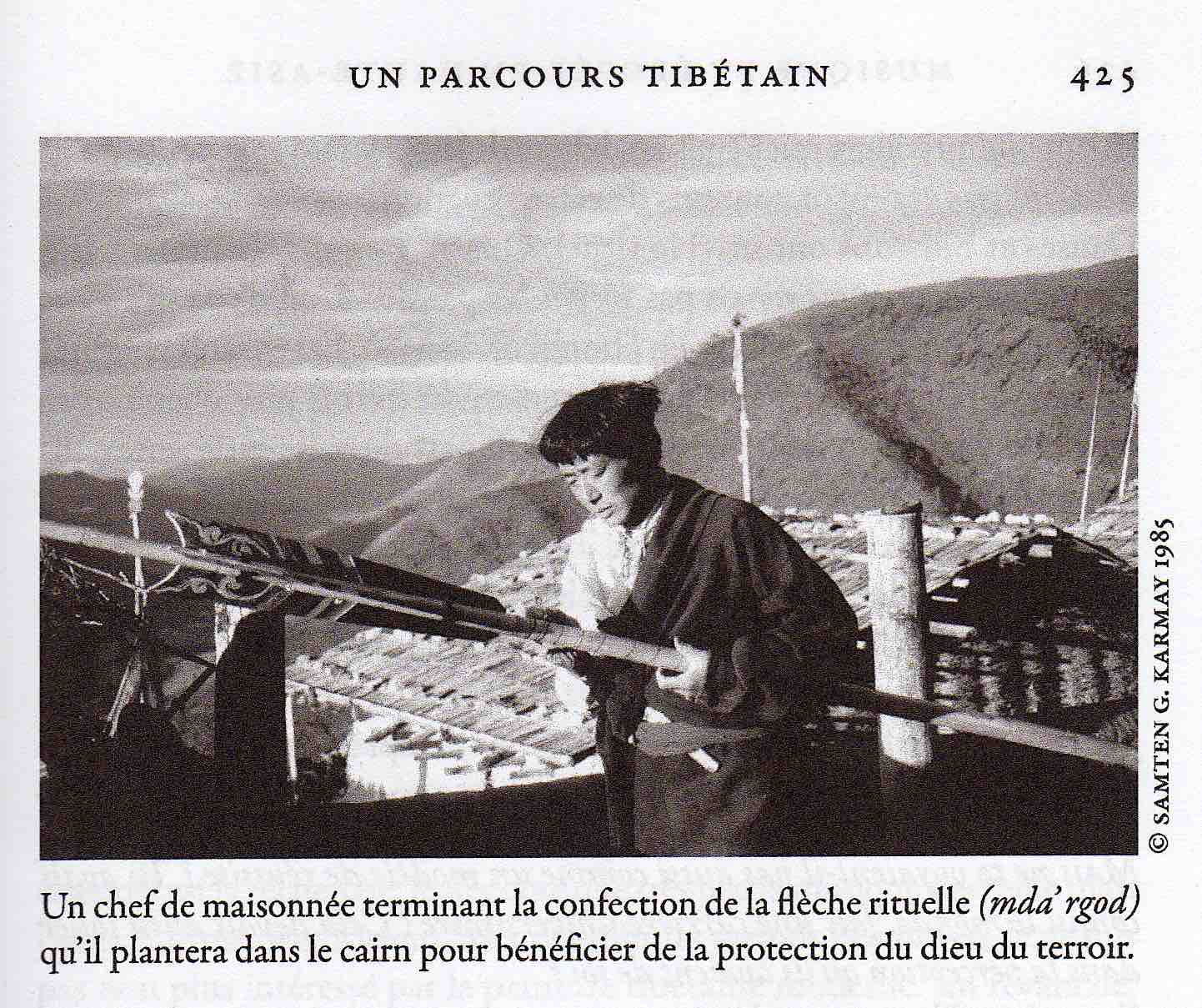
The volume ends with an engaging conversation between Samten G. Karmay and Katia Buffetrille (English version here), with astute reflections from Karmay on the culture clash he experienced since making an academic career in the West from 1960—covering topics such as Karmay’s childhood in Amdo, Tibetology in France, Gesar, Bön, and documenting a ritual on his return visit to his natal village in 1985.

Helffer 425

Ample references complement Isabelle Henrion-Dourcy’s bibliography for the Tibetan performing arts.

Throughout these chapters the influence of Mireille Helffer is clear. Yet again I am struck by the great vitality of Tibetan studies, and the mutual benefit of perspectives from both outside and within the PRC.

See also Recent posts on Tibet.

Yak re-enactments

yaks

Following the Capitol riot, a tweet by Ian Boyden, “the yak re-enactment of the last few days in America”, made me wonder if this might form part of a viral series of Yak Re-enactments of Great Moments in History.

I now eagerly await yak re-enactments of The Signing of the Magna Carta, * The Balcony Scene from Romeo and Juliet, Manet’s Le Déjeuner sur l’herbe, and The 1966 World Cup Final.

Manet

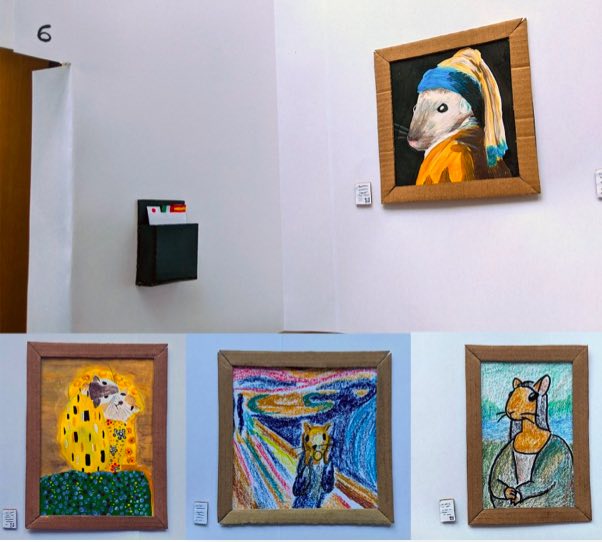
This genre is somewhat reminiscent of the the mini-museum for gerbils (under Great works missing the crucial element).

gerbil


* Not to be confused with the greatest vassalage since King John paid homage to Phillip II at Le Goulet in 1200, as evoked by the sinister Jacob “Happy British fish” Wee-Smug, currently glutting on a surfeit of bendy bananas.

Ave verum corpus

Ave verum

In 1791, his last year, Mozart composed Ave verum corpus for the feast of Corpus Christi in Baden, while he was writing The magic flute.

The Sixteen, with Harry Christophers, make fine exponents:

Sotto voce throughout, its stately, intense simplicity reminds me of Härlig Är Jorden.

I don’t learn as much from this 1902 recording of the Sistine Chapel as I would like:

For Byrd’s Ave verum corpus, see here.

Tibet: the Golden Age

L'age d'or cover

Adding to my series of recent posts on Tibet, I’ve been reading a fine book in French:

  • Katia Buffetrille, L’âge d’or du Tibet (XVIIe et XVIIIe siècles) (2019; 311 pages)
    (review here; this brief notice; numerous other publications by Buffetrille here).

While Tibetologists have long focused on early history, more recently many scholars have turned, impressively, to addressing the complexities and traumas of Tibetan society since the Chinese occupation in 1950; so this volume on the historical background is welcome. Notwithstanding the focus on the “Golden Age”, it provides material on both earlier and later history, making a useful, wide-ranging introduction for the greater Tibetan region—including Amdo and Kham—before the Chinese occupation, as well as relations with neighbouring countries including Bhutan, Sikkim, Ladakh, and Manchu China.

Using Tibetan, Chinese, and European sources, the book is attractively presented in the Guide Belles lettres format, with copious illustrations and a bibliography arranged by topic. Paying attention to both material and conceptual aspects of Tibetan culture, Buffetrille covers not just the upper echelons but popular life too, correcting misconceptions in the process (cf. Tibetan clichés).

Here I’ll merely list some main themes of the eight chapters.

History: subsuming both the thriving period of political stability under the Great Fifth Dalai Lama (1617–82), with the hegemony of his Gelugpa school of Buddhism, and attendant power struggles.

The Tibetan space: cosmology; central Tibet and the peripheral regions, notably Amdo and Kham; and cosmopolitan Lhasa, with its ethnically mixed population (also including Muslims, Newars, Armenians, Christians), dynamic commercial life, and monuments.

Chapter 3 looks at the political and administrative organisation in more detail, including justice, the army, finance, and the postal system.

Chapter 4 unpacks the society and economy. Buffetrille introduces the nobility; the varied strata of common people (“serfs”, in the parlance of some modern observers), including brigands; and the clergy, another stratified category. As to the economy, she discusses agriculture, nomadism, commerce, measures and currency, mining, hunting, and the artisanat.

Age d'or 1

In a chapter on Time, she discusses astrology, the calendar, divination, and the life cycle.

Chapter 6 considers Religions in all their forms. Besides giving a useful overview of the various schools of Buddhism (with earlier historical background) and Bön, Buffetrille features “social inscription”: the life of monasteries, lay practices, pilgrimages, beliefs, indigenous rituals, and local deities.

Age d'or 3

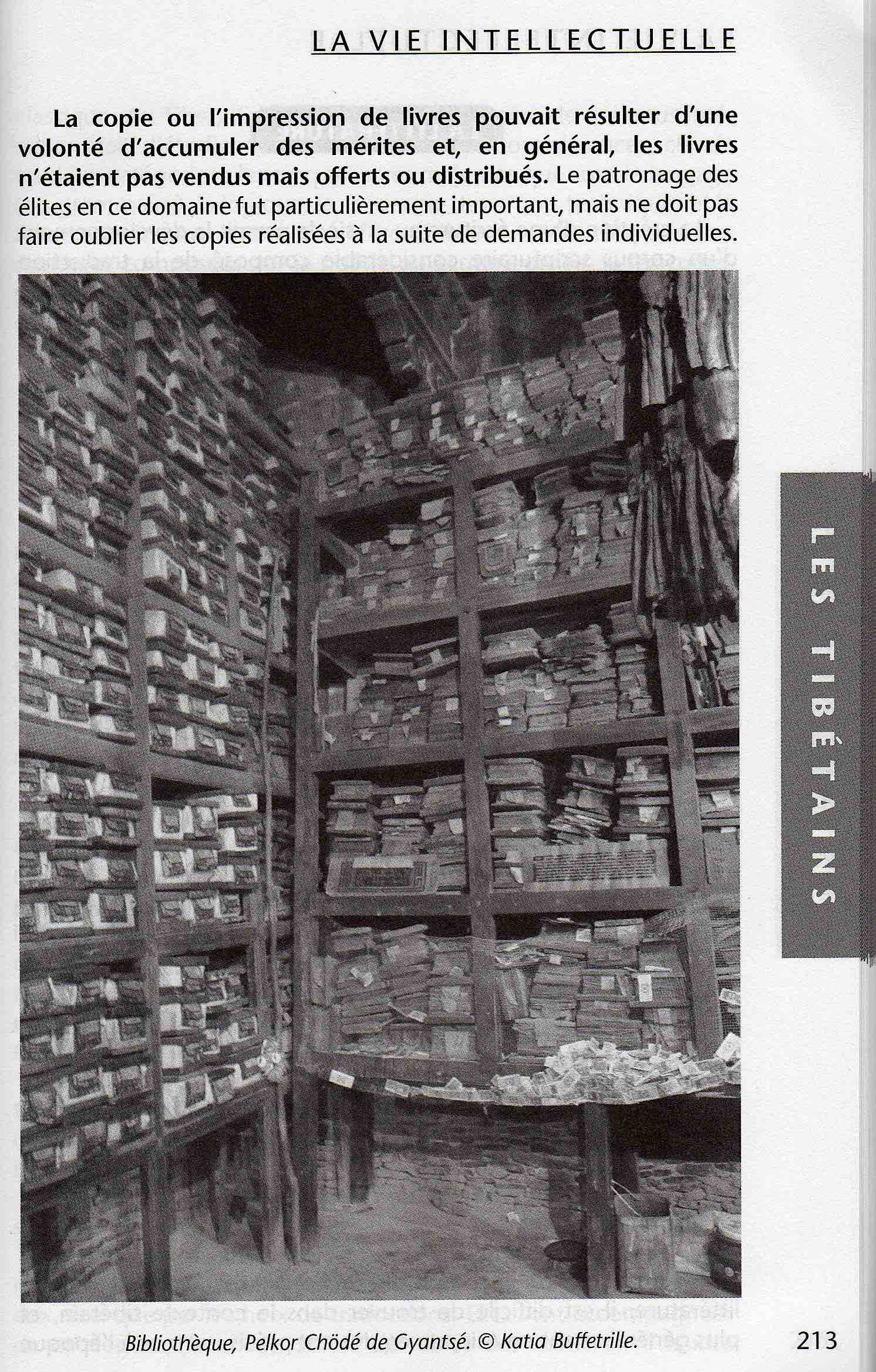
Intellectual life: language, writing, paper, xylography, printing, libraries, and literature (Buddhist, historical, scientific, fiction).

Age d'or 4

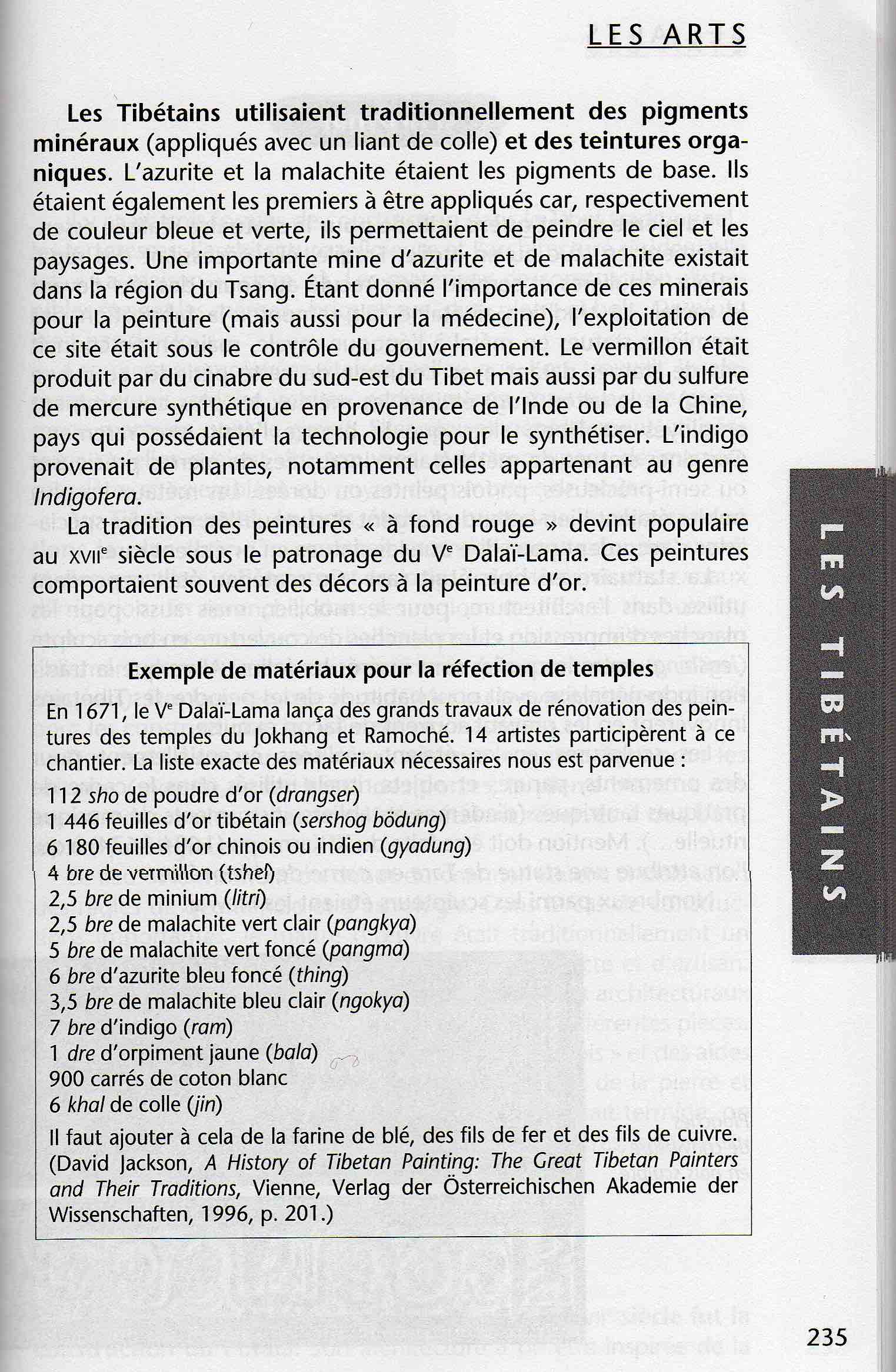
The arts, again enmeshed with religious practice: artists, painters (with an interesting vignette on pigments), iconography, sculpture, architecture—ending with a brief mention of music, which is further covered in

Pastimes, with the annual cycle of festivals, both in Lhasa and in rural communities, including courtly and popular songs and dances, lhamo opera—and picnics.

Private life, including naming customs, family, women, sexuality; the house, tents, food and drink; healthcare, costume.

All this makes a suitable reminder that before the Chinese occupation, for all its social issues, Tibet was a mature, functioning, independent society. This concise introduction much deserves an English translation.

The death of Stalin

Death of Stalin

I’ve been watching Armando Iannucci’s 2017 film The death of Stalin just at a time of crisis for another major world power, as the departure of a capricious monster offers the hope of a more humane society (cf. this review).

A study in duplicity and terror, Iannucci’s telling script continues from In the thick of it and Veep. Far from belittling the gruesome history of Stalinism, the film’s black humour makes the macabre, chilling brutality sink home. Amidst the frantic, ludicrous power struggles of the Central Committee, the brilliant cast is headed by Simon Russell Beale as the evil Beria; besides Kruschev, Malenkov, and Zhukov, Michael Palin as Molotov has some telling scenes.

Most commentators agree that it would be churlish to cavil at the artistic licence the film takes with historical facts—indeed, it’s likely to prompt viewers to delve into the grim realities, consulting the detailed work of scholars such as Orlando Figes (cf. this brief page). In her enthusiastic review, the perceptive Sophie Pinkham (always worth reading) also explores the banning of the film in Putin’s Russia (as Iannucci remarked, “In many ways Putin did our PR for us”).

Stalin’s death not only radically altered Soviet people’s lives, but set off a chain reaction outside the USSR. In China, the population was subjected to similar terrors until the death of Mao in 1976 prompted equally momentous change.

The film’s opening and closing scenes (embroidering a story about the pianist Maria Yudina) feature Mozart’s A major piano concerto, making another indelible association for me.

Short of watching the film on other, um, portals, it’s still available for another week on BBC iPlayer.

Under Life behind the Iron Curtain: a roundup, note e.g. The first gulag, and Kolyma tales. For black humour under state socialism, see herehere, and here. And among satirical stories under the Chinese jokes tag, I’m most keen on You don’t have to be mad to work here, but…Take a flying jump, and Yet more wordplay.

The first snooker commentary

A sequel to Oh and that’s a bad miss, and various posts under Ronnie: a roundup

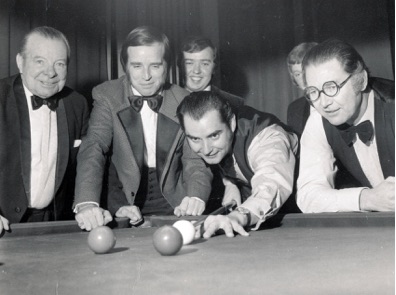
Snooker b&w“What shall we do with all these balls?”

The 2021 Masters snooker tournament is now well under way, NOT reaching a crescendo on Sunday.

A most educative aspect of enjoying snooker on TV is the expert commentary by former players. But way back in the Mists of Time, pundits were considerably less well informed. And everyone was hampered by only being able to see the “game” in black-and-white—even live…

Here’s a transcript of the first ever broadcast:

I wonder what he’s going to do with that stick.
I think you’ll find the technical term is “baton”.
Gosh, he used it to hit one ball onto another one. Well that’s a bad start.
Oops, one of the balls has gone down a hole. Obviously another serious mistake.
Yes, unfortunate, that—looks like the ref’s going to punish him by making him take another go.

Hang on, they gave him a goal then, when that ball went down the hole (I think it might be red, but who can tell?). Rewarding failure, if you ask me—Typical!
Yes, but I notice they only score one goal for that. Someone should tell them not to bother.

[zzzzz]

Oh no, now another ball has gone down a hole!
It’s almost as if they’re doing it on purpose.
This time it looks like a black one—makes a change, I suppose. Screwing up once is understandable, but twice in a row, come on! These chaps are clearly amateurs.
Hey, the ref’s put it back on the table—cheating, surely. Quis custodiet ipsos custodes? O tempora, o mores!

Have you noticed how they keep hitting the white ball first? Bit unimaginative if you ask me.
It’d be easier without the stick too—whatever it is they’re trying to do.
And they might have thought of the risks and just designed a table without holes in it. Basic design fault, what. I’ll give them a call, once someone gets round to inventing the telephone.
Or they could just play with bigger balls, so they don’t go down the holes.

I think he’s eyeing up a plant!!!
What on earth are you on about? Kindly leave botany out of this. People will think we don’t know what we’re doing.
Sorry, no idea what I meant by that. Mind you, now he’s got a nice angle on the blue to go into the pack, hitting the pink full ball.
You’re at it again.

Hang on—do you reckon the goal is to Attain Emptiness, after the fashion of Huineng and Walt Disney?

[…]
Pour me another gin.
I think I’m starting to get the hang of this.

Hmm, not many red balls left on the table. The ref should put them all back. At this rate they won’t have any more balls left to hit—the whole sorry travesty will just fizzle out. Let’s face it, this is never going to catch on. I’m going to take up accountancy.
Fancy a curry?

Ronnie

Ronnie graces the baize on Wednesday.

Cf. Script to an iconic head-butt. Seriously though folks, don’t miss Ronnie’s divine 147!!!

Discerning rules is pretty much what anthropologists and ethnomusicologists do. This vignette from Nigel Barley on his fieldwork among the Dowayo of Cameroon (cited here) is apposite:

They missed out the essential piece of information that made things comprehensible. No one told me that the village was where the Master of the Earth, the man who controlled the fertility of all plants, lived, and that consequently various parts of the ceremony would be different from elsewhere. This was fair enough; some things are too obvious to mention. If we were explaining to a Dowayo how to drive a car, we should tell him all sorts of things about gears and road signs before mentioning that one tried not to hit other cars.

Some meals with Li Manshan

Here’s yet another vignette to complement my portrait film on Li Manshan (watch here!!!) and his family Daoist tradition in north Shanxi.

Now I don’t want to make him out as some kind of Mystic Sage, but for village ritual clients his focus and integrity are a major aspect of his charisma. His unassuming personality shows itself in all the different contexts where we’ve shared food together over the years. He is far more comfortable with informal gatherings than with formal group banquets.

meal

Most relaxed is eating on the kang brick-bed at home in his village with his wife Yao Xiulian and second daughter Li Min, when I relish their gentle, humorous exchanges.

LMS funeral meal

For much of his life since the 1980s Old Lord Li has been fed during village funerals (brief scene in my film from 48.02), where the Daoists sit round their own table in the communal tent, usually with a couple of old friends, and perhaps a couple of members of a gujiang shawm band. He has written some of the ritual documents in advance (my film, from 10.44), but now, smoking as he dips sparingly into the sumptuous dishes, his mind is on the paperwork he still has to prepare back in the scripture hall (my film, from 19.38).

And on his own, when visiting village clients to determine the date, site the grave, supervise the encoffinment, decorate a coffin, and “smash the bowl” (see under Li Manshan’s latest diary), the host family also feed him.

lunch LJ LB LMS

Li Manshan, Li Bin, Li Jin, 2018.

Like the rest of his generation, Li Manshan was constantly hungry through his whole youth, from well before the famines caused by the Great Leap Backward right until the 1980s; the variety of dishes now served at funerals contrasts with the meagre fare then available. Along with other rural dwellers he shares an unease at the conspicuous consumption that came into favour in the towns after the reforms. His son Li Bin (also a Daoist), and his (much) younger brother Third Tiger (my film, from 55.23), who became a cadre in the county-town, are much more at ease with the world of banqueting. Even at a family meal in a posh Yanggao town restaurant, hosted by Third Tiger, with Li Bin and our old friend Li Jin, Li Manshan was quiet (see here, under “A trip into town”).

img_2448

Venice, 2012: lunch at Il Giardinetto with Mirella Licci, our favourite groupie.

Turning to our foreign tours since 2005, group meals with our hosts were none too formal, and pleasant. And with just the band and me, it’s been fun to find little restaurants free of formalities. We became regulars at Il Giardinetto in Venice, relishing delicious courses; and in Paris we were happy to walk round the corner from our hotel to take lunch at little Chinese restaurants, Li Manshan drumming peacefully away on the table with his chopsticks.

Buffet breakfasts at a succession of hotels were always fun too, as the Daoists kept in practice using the cappuccino machine. And on the train between venues in Italy, Germany, and France we enjoyed sandwiches (“the lunch-pack of Notre Dame”).

Less comfortable for Li Manshan (and for me) are mercifully rare official banquets, such as at a Hong Kong conference in 2011, and with the band after our workshops in Beijing in 2013. He doesn’t drink, or make grandiose speeches—which are the main objects of the exercise—so he just sits quietly before slurping the final bowl of noodles and gaining his freedom to go outside for a smoke, his main pleasures.

On our brief stay together in Beijing following our return from Hong Kong we both enjoyed the tranquility of sharing bowls of noodles in modest little noodle joints together before he took the train back home to Yanggao.

See also under Music and the potato.

Research on research

research

The pronunciation of “research” as a noun is one of my Pet Peeves, like “reaching a crescendo” and the rampant ascending cadence.

As a verb, a stress on the second syllable seems standard; more variable is the pronunciation of the noun. I was never aware of the stress on the first syllable (with a long “ee”) until the 1990s; now I often find myself bombarded by it on the radio.

Both forms may have been around for a long time, but I’m not sure the current state of play is entirely random. In the UK it seems to be largely generational—the first-syllable stress perhaps another of those more recent influences from the good ol’ US of A. Amongst all the research [gritted teeth] on stress patterning, someone must have tabulated this by age, period, region, and perhaps by class and even gender (“broken down by age and sex“, like Keith Richards). zzzzz…

So I suspect it’s just an index of my irrational elderly snobbery. For me, absurdly, the stress on the first syllable seems to suggest that the speaker is a callow upstart. The choice seems to distinguish serious study from messing around on the internet; Some Might Say that reSEARCH is what I used to do, while REsearch is what I do now… Hoisted with my own petard—whatever that is.

See also You say potatoSignoffs and other cross-pond drôlerieTo go: a parallel textMomentarily, and This and that.

Toru Takemitsu

Takemitsu

The recent additions to my series on Messiaen (here and here) remind me that he was a major influence on Toru Takemitsu (193­0–96). Here I’ll just feature some of his works directly inspired by the traditional Japanese soundscape—though of course there’s much more to explore in his ouevre (wiki; see also e.g. Tom Service’s succinct general introduction).

Having spent his early years until 1938 with his family in Dalian in occupied northeast China, where his father worked as a businessman, military conscription in 1944 further alienated him from Japanese militarism and nationalism; coming to associate these—not incorrectly—with the musical traditions of Japan (see e.g. this article on gagaku), he was drawn instead to new Western Art Music. He extended his initial aversion to Japanese music to other traditional forms:

There may be folk music with strength and beauty, but I cannot be completely honest in this kind of music. I want a more active relationship to the present. (Folk music in a “contemporary style” is nothing but a deception). [Hah! Discuss!]

Indeed, by contrast with the value-free ears of outsiders, some younger urban native listeners often hear their own traditions as tainted by association with a repressive or stultifying establishment—such as Chinese and Moravian folk, English choral music, or Russian Orthodox liturgy (see also Bach in an empty forest).

So it was only from the early 1960s, partly through John Cage—another important inspiration for him—that Takemitsu came to value the Japanese concept of ma 間 “empty space” (exemplified by Noh drama) and began consciously to borrow from Japanese music. As he recalled:

One day I chanced to see a performance of the Bunraku puppet theatre and was very surprised by it. It was in the tone quality, the timbre, of the futozao shamisen, the wide-necked shamisen used in Bunraku, that I first recognized the splendour of traditional Japanese music. I was very moved by it and I wondered why my attention had never been captured before by this Japanese music.

Here’s the second story, “Woman of the snow”, from the soundtrack for Kwaidan (Masaki Kobayashi, 1964):

November steps

Best known among his Japanese-inspired works is November steps (1967), for shakuhachi, biwa, and orchestra, commissioned by the New York Phil at the behest of Bernstein, premiered under Seiji Ozawa:

For the same combination is Autumn: into the fall after a little while (1973):

Traditional Japanese music, notably the courtly tradition of gagaku, deriving from Tang China, had long inspired Japanese and Western composers. Henry Eichheim‘s visits to east and southeast Asia (for his trips to China, see here) led to works such as Oriental impressions (1919–22), including the gagaku-derived E[n]tenraku (cf. Japanese nocturne); in 1931 Hidemaro Konoye (who the previous year conducted the very first recording of Mahler 4!) made a more faithful orchestral arrangement of Etenraku. Both works were soon taken up by Leopold Stokowski in his programmes with the Philadelphia orchestra.

After the war, Etenraku was again the basis for Yoritsune Matsudaira‘s Theme and variations for piano [hmm] and orchestra (1951); he followed it in 1961 with the orchestral piece Bugaku. Also channelling gagaku were Henry Cowell in Ongaku (1957), and Olivier Messiaen in Sept haïkaï (1963)— to which I devoted a separate post. [1]

Reigakusha

The Reigakusha ensemble (site, largely in Japanese).

But now some composers actually began writing for the gagaku ensemble itself, as innovation became a significant subsidiary theme in the gagaku world. Takemitsu wrote Shūteiga for the gagaku ensemble of the Imperial Household (hichiriki oboe, shō mouth-organ, ryūteki flute, biwa lute, gakusō zither, and percussion), later incorporating it into In an autumn garden (1973), one of the most enthralling essays in the genre. Besides the Imperial Household’s own version, the sonorities of this recording, by the Reigakusha ensemble that grew out of it, are even more mesmerising (cf. this live performance):

Garden rain (1974), for brass ensemble, evokes the cluster-chords of the shō mouth-organ (so very different from the anhemitonic pentatonic organum of its Chinese ancestor the sheng!):

See also this interview with the enterprising shō performer Mayumi Miyata.

Just in case you suppose all these to be avant-garde creations far distant from their model, here’s some “traditional” gagaku:


[1] For the Japanese explorations of Eichheim, Cowell, and others, see W. Anthony Sheppard, Extreme exoticism: Japan in the American musical imagination (2019), ch.3. For other Western works inspired by gagaku, click here. For Western devotees of Zen, see The great Gary Snyder, and More East-West gurus; see also under Some posts on Japanese culture. See also Amazing Grace meets gagaku! For my fantasy of a Japanese Bach Passion, click here.

Amazing Grace

Aretha

In my post Detroit 67, among several clips of the great Aretha Franklin I featured her extraordinary live sessions in January 1972 at the New Temple Missionary Baptist Church in LA. The double album Amazing Grace was released that year to huge acclaim, but the documentary had to wait right until 2018 to see the light of day. [1]

BBC2 followed the film up with the documentary Respect.

Recorded over two evening sessions, the film Amazing Grace is all the more effective for showing its workings, complete with its calculated planning, technical hitches, and even piano-tuning. Yet despite the constraints of live recording, these were clearly inspired celebrations—just like many musical gatherings around the world (see What is Serious music?!, under “Serious world music”).

Between numbers, Aretha’s focus sometimes makes her look pensive, almost frail—but as she sings she becomes a spirit medium, a vessel for the Holy Spirit, possessed with all the joy and pain of Gospel.

Aretha and Rev

With the MC Reverend James Cleveland adroitly mediating sacred and secular, Aretha is backed by the Southern California Community Choir, who are also spurred on by the balletic Reverend Alexander Hamilton. Among very few white faces in the ecstatic congregation are Mick Jagger and Charlie Watts.

On both evenings the tone is set by a devotional opening song (Wholy Holy and Mary don’t weep), followed by rousing up-tempo numbers like What a friend we have in Jesus, How I got over, All go back, I’m climbing higher mountains, as well as the ensemble interactions of Precious memories (“Sacred secrets will unfold”) and Precious Lord, take my hand/You’ve got a friend in Jesus.

The way Aretha opens in slow free-tempo is always moving—her final song (from 1.12.01), I have heard of a land on the far away strand, ‘Tis the beautiful home of the soul where we shall never grow old, is a whole seven-minute alap in itself—just as inspired as Indian dhrupad.

Most miraculous of all is the title track Amazing Grace (from 37.04; for the audio version, see under Detroit 67)—a long, slow meditation (without clearly defined beat or melody!) that leaves the congregation, the choir, Rev. Cleveland, and Aretha herself in tears.

And here‘s a version on Japanese hichiriki… Do also listen to my eclectic playlist of songs


[1] Among many reviews:

https://www.rollingstone.com/music/music-news/aretha-franklin-documentary-review-amazing-grace-754911/

https://variety.com/2018/film/reviews/amazing-grace-review-aretha-franklin-1203027289/

https://www.theguardian.com/music/2019/apr/08/aretha-franklin-amazing-grace-movie-backstory

https://www.theguardian.com/film/2019/may/12/amazing-grace-film-review-aretha-franklin-sydney-pollack

In memoriam Fou Ts’ong

Fu Cong Fu Lei

“Piano prodigy Fou Ts’ong tries to win the approval of his stern Francophile father,
the translator Fu Lei” (Kraus). From China reconstructs, April 1957.

In homage to the great Fou Ts’ong 傅聪 (1934–2020), who became yet another casualty of Covid last week in London, I’ve been re-reading the account of his career in Chapter 3 of Richard Kraus, Pianos and politics in China (1989). It makes a perceptive study of tensions in the Chinese artistic world before and after the 1949 revolution, rippling out to the Iron Curtain and London (note also this post by Jessica Duchen, and this by Chen Guangchen).

Fou Ts’ong’s father Fu Lei 傅雷 (1908–66), renowned Francophile translator and essayist, was a leading light in the Shanghai literary scene. Though steeped in China’s traditional literature, he was deaf to its musical culture:

These antiques are merely things for a musical museum or an opera museum; not only can they not be reformed, they ought not to be reformed.

The debate between urbane cosmopolitanism and revolutionary populism was to be played out in the sphere of traditional Chinese music (see here).

So it was through Western Art Music that Fu Lei resolved to groom his son to “fulfil his destiny” of modernising China. In recent years in China, as Kraus observes,

partly because of the family’s tragic history and partly because of the renewed influence of their class, the Fus have become a posthumous model for upright behaviour, principled integrity, and child-rearing.

 Fu Lei

may seem the image of Confucian propriety to Chinese, but to a Western reader the regime he imposed on his son seems cruel.

Indeed, Fou Ts’ong himself gave a more critical view (here, in Chinese). Latterly such “tiger parenting” has more often been associated with mothers.

Fu Lei Fu Cong

Source: this thoughtful tribute (in Chinese).

So Fou Ts’ong began learning the piano from the age of 7; the following year his father resolved to educate him from home. Among Fou Ts’ong’s early piano teachers was Mario Paci, founder of the Shanghai Symphony Orchestra. After Paci’s death in 1947 he mostly studied piano on his own; but when the family moved to the Nationalist base of Kunming in 1948 to escape unrest in Shanghai, he began to rebel. He was now punished by being sent to school. He remained in Kunming when the family returned to Shanghai in 1949; entering Yunnan university, he hardly played the piano. He returned to “Liberated” Shanghai in 1951, where Western music remained in vogue in bourgeois circles despite the ideology of the Yan’an populists. In 1952 he performed Beethoven’s Emperor concerto with the Shanghai Philharmonic. But by 1953 Fu Lei, disillusioned, refused to allow him to take the entrance exam for the Shanghai Conservatoire.

Poland
With bonds now severed between China and western Europe, Chinese musicians looked to the countries of the Soviet bloc. Later in 1953 Fou Ts’ong was chosen to take part in a festival in Romania—part of a Chinese delegation led by Hu Yaobang. After giving additional performances in the GDR and Poland, he was offered a scholarship to the Warsaw conservatoire in preparation for the 1955 International Chopin competition there. Poland was still recovering from the extreme devastation of the war, and this was an unstable period in the Soviet bloc: even before the 1956 crushing of protest in Budapest, discontent was revealed in the widespread GDR protests of 1953 (see also Life behind the Iron Curtain: a roundup). By 1956 the Polish regime was promoting Western Art Music at the expense of folk culture (see also Polish jazz, then and now).

Fou Ts’ong took third prize at the competition, as well as a special award for his his performances of Chopin mazurkas:

Back in China,

For urban intellectuals, Fou Ts’ong’s success was a badge of their their own ability to participate in the world culture which they held so dear. For the leaders of the Communist Party, the Chopin competition was a diplomatic encounter, in which Fou’s performance demonstrated that China could achieve great things after expelling the imperialist powers.

For Fou Ts’ong the triumph also marked a new independence from his domineering father.

Meanwhile in China political pressures were increasing. Kraus describes the 1955 campaign against Hu Feng, the Hundred Flowers movement that led insidiously to the Anti-rightist campaign, and Fu Lei’s own tribulations after being branded a rightist. Music too was becoming an increasingly perilous battleground.

Fou Ts’ong could only try to grasp these events from Warsaw. As his father’s letters veered from depression to exuberance, the political changes in China between 1954 and 1958 must have seemed both mysterious and frighteningly unstable.

Having been criticised by Chinese students in Warsaw, Fou Ts’ong was recalled to Beijing to take part in rectification. But after writing a self-criticism he soon returned to Poland, graduating from the Warsaw conservatoire in December 1958—just as the Great Leap Backward was rolled out to empty fanfare across China.

London
And so on Christmas Eve that year, Fou Ts’ong defected, seeking political asylum in London, still only 24. Among those helping him flee was Yehudi Menuhin’s daughter Zamira, who became his first wife in 1960. Refusing to return to China, Fou Ts’ong was escaping the dual prisons of Confucianism and Communism. From the safe haven of his London base, his international career soon thrived.

His father’s tribulations were compounded by Fou Ts’ong’s defection, but they continued corresponding. Fou Ts’ong later published a volume of his father’s letters written over the following period:

The family letters of Fu Lei are popular in China allegedly because Fu Lei is such a model of old-fashioned virtue. But one wonders if Fou Ts’ong published them to justify his defection, perhaps unconsciously letting all readers understand that he was fleeing not only China’s politics but the obsessive love of a tyrannical father.

A brief political thaw from 1961 even encouraged Fu Lei to imagine his son returning to China. But in September 1966 Fu Ts’ong’s parents, persecuted by Red Guards from the Shanghai conservatoire, became two of the most notorious suicides of the Cultural Revolution. In the elite world of the qin zither, other tragedies were the suicide of Pei Tiexia (old friend of Robert van Gulik in 1940s’ Sichuan) and the disappearance of Pu Xuezhai.

Fou Ts’ong now went through a difficult period in both his personal and professional life.

On his first return visit to China in 1979, as old wounds began to be plastered over, he took part in a memorial service for his newly-rehabilitated parents. Hard as it is now to imagine a time when glossy Chinese piano superstars were still a rarity, he inspired a new generation with regular visits thereafter.

His reflections on Chopin convey his charm:

Though both father and son espoused a very different aesthetic from that of the qin zither, their stress on wider personal cultivation, and the refinement of Fou Ts’ong’s touch on the piano, recall the refined sensibilities of that world.

I imagine him in his Shanghai youth listening to the numinous 1927 recording of the Schubert G major piano trio by Cortot, Thibaud, and Casals on the family phonograph… By the 1960s Fou Ts’ong, my teacher Hugh Maguire, and Jacqueline du Pré relished playing piano trios together—how I wish I had heard them.

Fou Ts'ong

Roundup for 2020!

Since part of my mission (whatever that is) is to vary the distribution of the diverse posts on this blog, keeping you guessing, this latest annual roundup (cf. 2018, 2019) is an occasion to group together some major themes from the last year (see also the tags and categories in the sidebar). This is just a selection (with apologies to the posts I’ve missed—do seek them out!):

For China, note

A substantial addition to my series on the ritual associations of Gaoluo:

Also new to the extensive Local ritual menu:

and on folk culture around Tianjin:

See also

Book reviews, mostly on religion and politics:

as well as

On modern Tibetan cultures, I’ve added a whole series, listed here:

—complementing my series on Uyghur culture in crisis, also with new input:

besides

* * *

For fieldwork and cultures elsewhere around the world—bearing in mind the important perspectives of

This year’s new posts on Indian raga, including some divine dhrupad singing:

* * *

On the travails of the 20th century:

* * *

On jazz:

and WAM:

On TV, film, popular culture:

* * *

Thanksgivings for liberation from tyranny:

And another sign of hope:

More jocular items include

as well as additions to The English, home and abroad:

and new entries under the headlines tag:

Further roundups:

And much much more, As They Say. Having grouped them together like this, I hope readers will scramble them all up again like a jigsaw, rather than retreating into their own little boxes… And do click on all the links within these posts! Happy, Happier New Year!

Messiaen in Japan

Messiaen Ozawa 1962

Messiaen with Yvonne Loriod and Seiji Ozawa, July 1962.

The exotic soundscapes of the Mystic East have long attracted composers, particularly in France (Berlioz, Ravel, Debussy).

Messiaen may be more commonly associated with Indian music (e.g. Turangalîla), but his fascination with Japanese culture goes back to his honeymoon there with his wife Yvonne Loriod in summer 1962. [1]

While the young Seiji Ozawa led rehearsals for a performance of Turangalîla, Messiaen, besides sightseeing and birdwatching, bought books and recordings of gagaku (cf. Laurence Picken, with whom he shared a love of birdsong), and attended an evening of koto zither, as well as performances of bunraku, kabuki—and Noh drama (see under Some posts on Japanese culture):

I delighted in the music, the steps, the slowness of the movements, and the extraordinary cries of the tsuzumi.

Noh 2

Noh drums, 1992. My photo.

After admiring Mount Fuji and Nara, they visited Hiroshima, guided by the Belgian Catholic priest Fr Ernest Goossens. The fifth movement of Sept haïkaï was inspired by a boat trip to the Miyajima shrine; his notes evoke many images that recur throughout his music:

The sea: salty smell, of seaweed and of water, and the scent of a grove of pines. Large red torii [gateways] in the sea. Marvellous red Shinto temple, maze of rooms, corridors, columns of red wood. Dark interior of the temple where the divinity is hidden (principle room), and the other temple (which one cannot see) with the invisible true God, behind the red torii, in the sea and the sky. Monstrous stone lions defend the temple—stone lanterns on the path beside the sea—the mountains velvety with pines. Sunset above the temple. From a distance one can see the torii against the evening clouds, orange, red, pink, violet. At night one can just make out the torii in the darkness—a full moon, gold and silver, with a hazy red halo, veiled by a thin strip of completely black cloud.

Torii

The result was Sept haïkaï (for piano, wind, brass, percussion including cowbells, and eight lonely violins!), premiered in 1963, with Yvonne Loriod on piano and Pierre Boulez conducting.

  • Introduction
  • Le parc de Nara et les lanternes de pierre
  • Yamanaka cadenza
  • Gagaku (from 7.36; for an earlier orchestral adaptation by Hidemaro Konoye, see here)
  • Miyajima et le torii dans le mer 
  • Les oiseaux de Karuizawa
  • Coda

The vignettes are purely instrumental—it is only the title that alludes to haiku. But I’ve composed a couple for the occasion:

Besides world music
Olivier Messiaen
Enjoyed his birdsong

Meanwhile in Cambridge,

Wise Laurence Picken
Finding gagaku too slow
Relished birdsong too

See also Toru Takemitsu.


[1] See e.g. Peter Hill and Nigel Simeone, Messiaen (2005). Apart from the voluminous scholarly literature on Messaien (Paul Griffiths, Robert Sherlaw Johnson, and so on), good overviews of his ouevre are Richard Taruskin, The danger of music, pp.289–99, and Alex Ross, The rest is noise, pp.485–96 (see The right kind of spirituality?).

Covid: ex-plosives

plosives

Leaf Lalm And Larry On

Since Covid struck, there’s been considerable research on droplets launched by speech (e.g. here); singing, too, has been scrutinised for its risks to public health. Here I’d like to add speech therapy into the mix (see e.g. Modifying disfluency), a topic that such studies hardly take into account. *

The main culprits are plosives—both unvoiced (p, t, k) and voiced (b, d, g) plosives p-p-posing a p-p-particular p-p-problem for us stammerers.

On the languagelog site there’s been much arcane, erudite discussion of multi-lingual spoof health advice, including posts by Mark LibermanBen Zimmer, and Victor Mair. More pleasing to a general Anglophone audience is this drôle fantasy by Peter Prowse:

Since consonants project over a greater distance than vowels, a three-tier system will be introduced in an effort to slow the spread:

Replacing P with F: anyone speaking to other feofle in a fublic flace will have to stop using the flosive sound; failure to do so could lead to a fine—or even frison. The whole fofulation, even members of Farliament, will have to flay their fart in this.

Replacing T with N: although this may cause some initial confusion—for example, neachers in schools will face challenges when neaching the nen nimes nable—we are confident any froblems will be nemforary; and measures under nier noo will help nurn the nide of this fandemic.

Replacing K with L: after a further brief feriod, we will bring in Near Three. The rules under Nears One and Noo will conninue. We have lonsidered these measures larefully, in line with relommendations from frofessors at Lambridge Universiny.

These new rules will affly also to other languages sfolen in this cunnry, including Nerdish, Folish, Fortuguese, and Inalian. I urge feofle to Leaf Lalm And Larry On. Nogether, we will lonquer the Lovid fandemic and renurn noo normaliny in no nime an all.

To be fair, it’s stressed, especially initial, flosives that are farticularly frojectile—and the major hurdle for stammerers. But requesting PPE may still present a challenge.

Levity apart (and here’s my pretext for relaying the topic here), it makes a good reminder for us stammerers to approach words with light contacts (“easy onset”)—and for fluent speakers, to imagine our chronic tribulations.


* Separately, several sites offer guidance for stammerers during Covid; this one has many links, including a BBC video. Of course, stammering is part of general issues in communicating; communication via masks is a challenge for all (cf. Masked drama in Asia). With so little social contact, I haven’t had much experience of negotiating stammering in a mask. I seem to be more reluctant to stammer “openly”, even if it’s invisible. When encountering a (silent) block, I apparently need people to see that I’m at least making an effort (also a reason why sufferers find phone-calls difficult), even if it’s precisely the tension of the mouth that is my undoing.

Amidst the pandemic it’s been suggested that (fluent) people should take up ventriloquism. I wonder if there are any stammering ventriloquists—perhaps a cruel dummy mercilessly taking the p-p-mickey out of their stammering minder… That would be great therapy.

For more melodious public health advice, click here.

La nativité du Seigneur

Nativité stained glass

Nativity, Saint Denis, Paris, 12th century. Source here.

Eschewing tinsel, sprouts, and a plethora of meretricious seasonal listening, what better way of celebrating Christmas than immersing ourselves in the profound meditations of Messiaen’s monumental La nativité du Seigneur! It’s high time for it to soar to the top of the Christmas charts… (cf. What is serious music?!)

Even by 1935, Messiaen’s distinctive vision was fully-fledged, expressed through a unique harmonic, melodic, and rhythmic language, with extreme contrasts.

In French organ improvisation! (which also includes remarkable film of Messiaen himself at the organ of Saint-Trinité) I featured the joyous finale Dieu parmi nous, but you can hear the complete work on YouTube played by Oliver Latry, starting here:

I like the BTL comment “This music seriously messiaens with your head”. I set no great store by notation; it can be distracting as well as instructive, so do listen with eyes closed too.

The nine meditations are:

  • La vierge et l’enfant
  • Les bergers
  • Desseins éternels
  • Le verbe
  • Les enfants de Dieu
  • Les anges
  • Jésus accepte la souffrance
  • Les mages
  • Dieu parmi nous

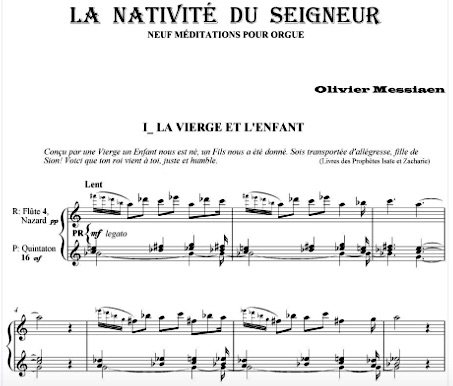
Nativité score

Not that I set great store by notation, this is another useful resource, not least for Messiaen’s own spiritual programme:

For a recent live performance, click here.

This should lead us on to his monumental piano work Vingt regards sur l’enfant-JésusNote also Messiaen tag, leading to equally cosmic orchestral works (Turangalîla, Des canyons aux étoiles, Éclairs sur l’au-delà …), as well as his late opera Saint François d’Assise

Kolyma tales

This post continues my series on trauma—e.g. under Life behind the Iron Curtain, for the Soviet bloc as well as Germany; and for China, e.g. China: commemorating traumaConfessions, The temple of memories, and Guo Yuhua.

Among all the vast gulag camps spread across the USSR (e.g. Solovki), most utterly remote and terrifying was the Arctic region of Kolyma in northeast Siberia (wiki: under KolymaSevvostlag and Dalstroy; also e.g. here). As Anne Applebaum remarks,

In the same way that Auschwitz has become, in popular memory, the camp which symbolises all other Nazi camps, so too has the word “Kolyma” come to signify the greatest hardships of the Gulag.

An early study in English was

  • Robert Conquest, Kolyma: the Arctic death camps (1978)—cf. his major book on the Ukraine famine, a predecessor of Anne Applebaum’s Red famine.

A major source is

  • Varlam Shalamov (1907–82) (wikiwebsite), who endured consecutive sentences in Kolyma from 1937 until 1953.

His Kolyma tales, a bulky collection of stories, most only a few pages long, makes grimly compelling reading. [1]

For the wider story of the camps, a brilliant study is

  • Anne ApplebaumGulag: a history (2003).

She uses Shalamov’s work extensively among a great variety of sources, and it’s worth reading the historian’s forensic overview of the camp system in conjunction with the Kolyma memoirs.

As Applebaum notes in her Introduction, it is impossible to treat the gulag as an isolated phenomenon. The difference between life inside and outside the camps was one of degree.

The Gulag did not emerge, fully formed, from the sea, but rather reflected the general standards of the society around it. If the camps were filthy, if the guards were brutal, if the work teams were slovenly, that was partly because filthiness and brutality and slovenliness were plentiful enough in other spheres of Soviet life. If life in the camps was horrible, unbearable, inhuman, if death rates were high—that too was hardly surprising. In certain periods, life in the Soviet Union was also horrible, unbearable, and inhuman, and death rates were as high outside the camps as they were within them.

Having noted the wretched fate of the “special exiles” (a separate yet related theme), she goes on to summarise the “long, multinational, cross-cultural history of prisons, exile, incarceration and concentration camps, from Ancient Rome and Greece to Georgian Britain, 19th-century France and Portugal, and Czarist Russia itself. She then encapsulates similaries and differences between Nazi and Soviet camps.

Applebaum explains:

To reach the camps of Kolyma, prisoners travelled by train across the entire length of the USSR—sometimes a three-month journey—to Vladivostok. They made the rest of the trip by boat, travelling northwards past Japan, through the Sea of Okhotsk, to the port of Magadan, the gateway to the Kolyma river valley.

The transport ships were themselves deadly, as portrayed in Shalamov’s “The procurator of Judea”, and in the documentary below.

Kolyma map

Source here.

Part II of Gulag: a history, “Life and work in the camps” is a particularly harrowing survey, with chapters on arrest, prison; transport, arrival, selection; life and work in the camps; punishment and reward; guards, prisoners; women and children; the dying; strategies of survival; rebellion and escape.

Having noted that the guards didn’t inhabit an entirely different social sphere from the prisoners, in an astute analysis Applebaum observes that neither “politicals” nor “criminals” were simple categories. While inmates such as scientists, agronomists, former NKVD officers, and artists, mostly loyal Communists, have a higher profile, the “political” rubric was a catch-all for many ordinary people with no strong political views who had made some innocent yet fatal “mistake”, and most prisoners were ordinary workers and peasants. In 1934, 42.6% of the general gulag population were semi-literate; even in 1938, only 1.1%  had higher education. The proportion of “political” inmates rose during the war, reaching nearly 60% in 1946 following an amnesty for criminal prisoners.

Constantly hungry, subjected to relentless, punishing work in the dreaded gold mines and the endless taiga forests, they were at the mercy of the urki criminal inmates; degradation and dehumanisation were essential for survival.

Applebaum cites Evgeniya Ginzburg’s experiences on boarding the boat to Kolyma:

They were the cream of the criminal world: murderers, sadists, adept at every kind of sexual perversion… without wasting any time they set about terrorising and bullying the “ladies”, delighted to find that “enemies of the people” were creatures even more despised and outcast than themselves… They seized our bits of bread, snatched the last of our rags with our bundles, pushed us out of the places we had managed to find…

Shalamov 1937

Shalamov, “The Red Cross”:

Tens of thousands of people have been beaten to death by thieves. Hundreds of thousands of people who have been in the camps are permanently seduced by the ideology of these criminals and have ceased to be people. Something criminal has entered their souls for ever. Thieves and their morality have left an indelible mark on the soul of each. […]

The young peasant who has become a prisoner sees that in this hell only the criminals live comparatively well, that they are important, that the all-powerful camp administrators fear them. The criminals always have clothes and food, and they support each other.

The young peasant cannot but be impressed by this. It begins to seem to him that the criminals possess the truth of camp life, that only by imitating them will he tread the path that will save his life. […]

The intellectual convict is crushed by the camp. Everything that he valued is ground into the dust while civilisation and culture drop from him within weeks. The method of persuasion in a quarrel is the fist or a stick. The way to induce someone to do something is by means of a rifle butt, a punch in the teeth. […]

The intellectual is permanently terrified. His spirit is broken, and he takes this frightened and broken spirit with him back into civilian life.

Applebaum describes thieves’ slang, known as blatnaya muzyka “thieves’ music”.

The minority of women prisoners (Gulag, Chapter 15), again both political and criminal, were terribly vulnerable too. Shalamov’s “Women in the criminal world” is a substantial account, also addressing male homosexuality. As he notes, the sole exception to the contempt for women prescribed in the camps is the hypocritical cult of veneration for the criminal’s mother (cf. flamenco):

Even this seemingly lofty feeling is a lie from beginning to end—as is everything else. […] This feeling for his mother is nothing but a pack of lies and a theatrical pretence. The mother cult is a peculiar smokescreen used to conceal the hideous criminal world.

Crucial for inmates’ desperate strategies of survival (Gulag, Chapter 17) was the hierarchy of hospitals and medics, with their own troubled stories. They often feature in Kolyma tales, such as “Typhoid quarantine”:

The scratch marks on Andreev’s hands and arms healed faster than did his other wounds. Little by little, the turtle-shell armour into which his skin had been transformed disappeared. The bright rosy tips of his frostbitten fingers began to darken; the microscopically thin skin, which had covered them after the frostbite blisters ruptured, thickened slightly. And above all, he could bend the fingers of his left hand. In a year and a half at the mines, both of Andreev’s hands had molded themselves around the handles of a pick and shovel. He never expected to be able to straighten out his hands again. […]

The bloody cracks on the soles of his feet no longer hurt as much as they used to. The scurvy ulcers on his legs had not yet healed and required bandaging, but but his wounds grew fewer and fewer in number, and were replaced by blue-black spots that looked like the brand of some slave-owner. Only his big toes would not heal; the frostbite had reached the bone, and pus slowly seeped from them. Of course, there were less pus than there had been back at the mine, where the rubber galoshes that served as summer footwear were so full of pus and blood that his feet sloshed at every step—as if through a puddle.

Many years would pass before Andreev’s toes would heal. And for many years after healing, whenever it was cold or even slightly chilly at night, they would remind him of the northern mine. But Andreev thought of the future. He had learned at the mine not to plan his life further than a day in advance. He strove towards close goals, like any man who is only a short distance from death. Now he desired one thing alone—that the typhoid quarantine might last for ever. This, however, could not be, and the day arrived when the quarantine was up.

Among their strategies was self-mutilation, evoked in Shalamov’s “The businessman”.

The region’s main town Magadan was built by forced labour from 1932. Evgeniya Ginzburg noted a “peculiar paradox”:

the gulag was slowly bringing “civilization”—if that is what it can be called—to the remote wilderness. Roads were being built where there had only been forest, houses were appearing in the swamps. Native peoples [2] were being pushed aside to make way for cities, factories, and railways. […]

My whole soul cursed those who had thought up the idea of building a town in this permafrost, thawing out the ground with the blood and tears of innocent people. Yet at the same time I was aware of a sort of ridiculous pride…

The early years under Eduard Berzin were later recalled with a certain nostalgia. But

Of the 16,000 prisoners who travelled to Kolyma in Berzin’s first year [1932], only 9,928 even reached Magadan alive. The rest were thrown, underclothed and underprotected, into the winter storms: survivors of the first year would later claim that only half of their number had lived.

Berzin was himself executed in the purges of 1938, as Stalin’s Great Terror took an even more severe toll on the camps.

During the American Lend-Lease programme to assist their Soviet allies, vice president Henry Wallace visited in May 1944, and was efficiently deceived. In a macabre story the most urgent task of a bulldozer donated under the programme is to rebury the frozen corpses of prisoners exposed as mass graves from 1938 began to slide down a hill. And for Monty Python fans, Shalamov also features the prisoners’ withering assessment of spam.

During and after the war, the ranks were supplemented by Ukrainian, Polish, German, Japanese, and Korean inmates (cf. Gulag, Chapter 20)—as well as Soviet prisoners of war, considered traitors.

After the war the general population’s hopes for a less punitive society were soon crushed (see The whisperers).

In “The lepers” Shalamov describes yet another disturbing story.

In the course of the war the leprosaria had been destroyed, and the patients had merged with the rest of the population. […] People ill with leprosy easily passed themselves as wounded or maimed in war. Lepers mixed with those fleeing to the east and returned to a real, albeit terrible life where they were accepted as victims or even heroes of the war.

These individuals lived and worked. The war had to end in order for the doctors to remember about them and for the terrible card catalogues of the leprosaria to fill up again.

Lepers lived among ordinary people, sharing the retreat and the advance, the joy and bitterness of victory. They worked in factory and on farms. They got jobs and even became supervisors. But they never became soldiers—the stubs of the fingers that appeared to have been damaged in the war prevented them from assuming this last occupation. Lepers passed themselves off as war invalids and were lost in the throng.

* * *

Rebellion and escape attempts were rare, and doomed (Gulag, Chapter 18). As in China, there was nowhere to escape to (ironically, it was only 55 miles across the Bering Strait to America). In “Major Pugachov’s last battle” Shalamov notes a certain change after the war:

The arrests of the thirties were arrests of random victims on the false and terrifying theory of a heightened class struggle accompanying the strnghtening of socialism. The professors, union officials, soldiers, and workers who filled the prisons to overflowing at that period had nothing to defend themselves with except, personal honesty and naïveté—precisely those qualities that lightened rather than hindered the punitive “justice” of the day. The absence of any unifying idea undermined the moral resistance of the prisoners to an unusual degree. They were neither enemies of the government nor state criminals, and they died, not even understanding why they had to die. Their self-esteem and bitterness had no point of support. Separated, they perished in the white Kolyma desert from hunger, cold, work, beatings, and diseases. They immediately learned no to defend or support each other. This was precisely the goal of the authorities. The souls of those who remained alive were utterly corrupted, and their bodies did not possess the qualities necessary for physical labour.

After the war, ship after ship delivered their replacements—former Soviet citizens who were “repatriated” directly to the far north-east.

Among them were many people with different experiences and habits acquired during the war, courageous people who knew how to take chances and who believed only in the gun. There were officers and soldiers, fliers and scouts…

Accustomed to the angelic patience and slavish submissiveness of the “Trotksyites”, the camp administration was not in the least concerned and expected nothing new.

So escape attempts increased, but were just as futile. Shalamov evokes another such attempt in “The green procurator”.

Here’s a 1992 documentary, if you can bear it:

* * *

The 1930s and 40s were the most horrifying years for the gulag system. After the war amnesty (Gulag, Chapter 21), the death of Stalin in 1953 created a new mood, and Kruschev declared a more lasting amnesty in 1956, freeing many. But as Applebaum describes in her concluding chapters, some still had little choice but to remain until the 1990s.

The end of the war may have brought an end to the Nazi camps as such, but in the USSR the gulag network continued operating; and just as it was winding down following the death of Stalin, in China Mao was expanding his own system of labour camps.

As Applebaum explains carefully in an Appendix to Gulag, attempts to assess the death toll have been inconclusive; for comparisons with estimates of victims under Hitler and Mao, cf. Timothy Snyder and Ian Johnson.

The legacy
Memory of the whole gulag system is a complex subject, explored by Applebaum in her perceptive Epilogue (cf. Figes). More recent accounts of the haunted Kolyma region discuss memory, ignorance, and veneration for Stalin. Jacek Hugo-Bader revisited the region in Kolyma diaries (2014), reviewed here by Kapka Kassabova (cf. this article).

And Yury Dud challenges modern amnesia in Kolyma: the home of our fear (2019):


[1] I’ve been reading the 1994 translation by John Glad; a recent version by Donald Rayfield (“Kolyma stories”) is well reviewed here, including its vexed publication history, and a comparison with Solzhenitsyn. See also the sequel Sketches of the criminal world. Other survivors’ accounts of Kolyma include those of the Polish Stanislaw J. Kowalski, The land of gold and death, Vladimir Nikolayevich Petrov, Evgeniya Ginzburg, and the Romanian Michael M. Solomon.

[2] Accounts of Kolyma inevitably focus on the camps’ Russian inmates and other outsiders; the fate of local indigenous peoples like the YukaghirsYakutChukchi, and Evenki, with their shamanistic cultures, is another story.

Saint Bill: Black books

Coffee and books is a fad.

YAY!!! As further evidence that there’s hope yet for civilisation, I’m delighted that Bill Bailey, guided by the ever-wise Oti Mabuse, has just been canonised by winning Strictly (see this fantasy). So to supplement all the adulation:

His musical standup is brilliant (e.g. here; and Love song: The duck lies shredded in a pancake, Soaking in the hoisin of your lies…). Here’s another one, ranging from panto and military calls to the Alberti bass (“making the music go further—like cutting your blancmange with Angel Delight”), culminating in the East European version of the Match of the Day theme (“The tractor would not start”), following in the footsteps of Mahler:

Nor should we forget Black books—episodes from Saint Bill’s earlier life (Channel 4, three series 2000–2004).

Black books

All three protagonists—Bernard (Dylan Moran, also co-author with Graham Linehan), Manny (Bill Bailey), and Fran (Tamsin Greig)—are delightful, making complementary role-models. Despite Bernard’s persona as a “vile, rude, arrogant, elitist, filthy, chain-smoking alcoholic”, and, um, all the senseless cruelty and violence, the series has the charming mood of a kinder bygone age.

The first episode of Season 2 has more on learning the piano. If you already know that Bill is an accomplished musician (as one does nowadays), then you just have to suspend disbelief. This is a nice reversal of a persistent dramatic cliché:

I always wanted to learn, but my parents forced me not to. I spent hour after hour playing football, all by myself, peering in at all the other children in the neighbourhood practising their piano.

Click here for Bill discovering an affinity for jazz in the bookshop, as well as this:

In a Baileyesque kinda way, all this might lead us to John Cage‘s Sonatas and interludes, the Persian santur, and Studying the cello.

Mahler 4

*For an introduction to my whole series on Mahler, with links, click here!*

Klimt

Choir of angels from paradise, Gustav Klimt 1901.

Mahler 4, whose premiere the composer conducted in 1901, may seem like a less weighty, almost “classical” interlude in between the monumental 2nd and 3rd symphonies and the angst of the 5th and 6th. But different as it is, it’s substantial—a continuation of Mahler’s Des Knaben Wunderhorn theme, with typical layers of irony (wiki; and here’s an essay by the authoritative Henry-Louis de La Grange).

Mahler 4 MS

In the words of Norman Lebrecht (Why Mahler?), “death is never very far from the children who play in its meadows”. At the very opening of the first movement, he finds the sleigh-bells “dangerous as a runaway car on a mountain pass, driving conductor and orchestra to near-chaos”. Still, there are intimations of a transcendent world (from 4.26 in the Abbado performance below, and again from 14.31—see The major 7th leap), as well as an ominous premonition of the opening of the 5th symphony (from 9.54).

Death fiddleThe Scherzo is a Totentanz, inspired by Arnold Böcklin’s 1872 Self-Portrait with Death Playing the Fiddle, with the solo violin tuned up a whole tone. Mahler’s idea contrasts with that of earlier composers “dressing up gypsy music for family consumption”—Lebrecht goes a bit far:

He confronts civic society with its greatest fear, the untamed classes outside the law, and he exacerbates the threat by treating gypsy music not as a primitive sound to be colonised by an educated composer but as an art with a vitality and integrity all its own. […] The Scherzo is arguably the first multicultural work in western music and certainly the first before Bela Bartók to treat indigenous music with respect and admiration as an equal form of art.

Even here Mahler incorporates an elysian vision, with strings in full Mantovani mood making a counterpoint to the folk dance style of the wind instruments (Abbado from 22.55):

The tranquil variations of the gorgeous slow movement are offset by a more clouded section in the minor—klagend, leidenschaftlich, leading to a gorgeous sequence: 

Mahler 4 slow minor

After the return of the opening Ruhevoll mood, *** Santa’s speeding sleigh (from 41.52) hurtles headlong into a deep snowdrift (hmmI don’t really feel music in metaphors like this: I blame writing about music—cf. my programme for Mahler 10). This turns out to be another pathway to paradise, adorned by horns and then more sumptuous strings à la Mantovani:

Mahler 4 adagio 1

Mahler 4 adagio 2

It’s interrupted by a blazing vision (from 44.25) modulating abruptly to the heavenly key of E major, combining a foretaste of the melody of the finale with the motif on timpani and plucked basses taken from the ruhevoll opening. This leads to the concluding pianissimo, “sehr zart und innig“—whose suspensions develop the string chords before the vision, now with Mahler’s ultimate Sublime Mystery harmonies:

Mahler 4 adagio 4

A clarinet emerging out of the silence introduces the final Das himmlische Leben, an innocent yet unnerving vision of heaven, marked “with a childlike, cheerful expression, without parody”. Hard as it is to find an ideal singer, it’s unrealistic to assess versions of the symphony purely on the singing, overriding overall timbre and choice of tempi. Early-music chastity, without sounding coy, may seem more suitable, but it still hasn’t quite replaced fruity warbling; while boy trebles have been tried, we await a version by a choirgirl.

Punctuated by manic reminiscences of the opening sleigh-bells, the poem (far from untrammelled—not suitable for vegetarians) also belongs with Mahler’s farewells:

Wir genießen die himmlischen Freuden,
D’rum tun wir das Irdische meiden.
Kein weltlich’ Getümmel
Hört man nicht im Himmel!
Lebt alles in sanftester Ruh’.
Wir führen ein englisches* Leben,

Sind dennoch ganz lustig daneben;
Wir tanzen und springen,
Wir hüpfen und singen,
Sankt Peter im Himmel sieht zu.

Johannes das Lämmlein auslasset,
Der Metzger Herodes d’rauf passet.
Wir führen ein geduldig’s,
Unschuldig’s, geduldig’s,
Ein liebliches Lämmlein zu Tod.
Sankt Lucas den Ochsen tät schlachten
Ohn’ einig’s Bedenken und Achten.
Der Wein kost’ kein Heller
Im himmlischen Keller;
Die Englein, die backen das Brot.

Gut’ Kräuter von allerhand Arten,
Die wachsen im himmlischen Garten,
Gut’ Spargel, Fisolen
Und was wir nur wollen.
Ganze Schüsseln voll sind uns bereit!
Gut’ Äpfel, gut’ Birn’ und gut’ Trauben;
Die Gärtner, die alles erlauben.
Willst Rehbock, willst Hasen,
Auf offener Straßen
Sie laufen herbei!
Sollt’ ein Fasttag etwa kommen,
Alle Fische gleich mit Freuden angeschwommen!
Dort läuft schon Sankt Peter
Mit Netz und mit Köder
Zum himmlischen Weiher hinein.
Sankt Martha die Köchin muß sein.

Kein’ Musik ist ja nicht auf Erden,
Die unsrer verglichen kann werden.
Elftausend Jungfrauen
Zu tanzen sich trauen.
Sankt Ursula selbst dazu lacht.
[ending with a descending portamento, by contrast with the frequent ascending ones for strings!!!]
Kein’ Musik ist ja nicht auf Erden,
Die unsrer verglichen kann werden.
Cäcilia mit ihren Verwandten
Sind treffliche Hofmusikanten!
Die englischen* 
Stimmen
Ermuntern die Sinnen,
Daß alles für Freuden erwacht.

non angli sed angeli!!!

Note that hushed last verse, in the radiant key of E major—like that vision in the slow movement. For Mahler’s own piano roll of the finale, see here.

* * *

Lebrecht cites xenophobic early reviews, contrasting with comfortable later assessments:

  • Jewish wit has invaded the symphony, corroding it
  • A restless, nervous work
  • Nothing but Viennese corruption, carnival
  • No trace of spontaneity, not a single autonomous idea, no original feeling.

La Grange has more:

  • amusing himself by using thematic material alien to his nature
  • taking pleasure in shattering the eardrums of his audiences with atrocious and unimaginable cacophonies
  • incapable of writing anything other than stale and insipid music lacking in style and melody, music that, artificial and hysterical, was a medley of symphonic cabaret acts.

And for Lexicon of musical invective, Slonimsky finds yet more scathing judgements:

The Adagio, barring an abuse of organ point effects, is at first harmless enough; but suddenly we are introduced to a circus scene. This may be a not unwelcome diversion for some; but without wishing to be traditional or pedantic, we cannot but remark that for us, at that moment, it was a shock and an unpleasant one. From a business standpoint it might be advantageous to utilize portions of this adagio on the pleasure boats which travel up and down the Danube in the spring. The bands could easily master any difficulties forthcoming in such appropriate extracts, and the Viennese ladies, munching sweet cakes, sipping light wine and flirting with handsomely dressed officers, would no doubt very much enjoy a dainty accompaniment to their conversation. [winner of the 1901 Rear Admiral Foley Award for Sexist Crap.]

And

The drooling and emasculated simplicity of Gustav Mahler! It is not fair to the readers of the Musical Courier [TweetySO UNFAIR! Cf. Peccable musical sensibilities] to take up their time with a detailed description of that musical monstrosity, which masquerades under the title of Gustav Mahler’s Fourth Symphony. There is nothing in the design, content, or execution of the work to impress the musician, except its grotesquerie… The writer of the present review frankly admits that… to him it was just one hour or more [sic] of the most painful musical torture to which he has been compelled to submit.

Pah! No pleasing some people…

* * *

Armed with this comprehensive review, here are some recordings that delight my ear.

Again (e.g. Mahler 2), long before the Mahler craze of the 60s, early versions are rich ground for studies of changing performance practice (see also Reception history). The first ever recording (mystifyingly cutting one of the most exquisite passages in the 3rd movement!) was made in 1930 by Hidemaro Konoye with the New Symphony Orchestra of Tokyo—a year before his own symphonic composition Etenraku, inspired by the gagaku piece! The singer in the exceptionally ponderous finale is Eiko Kitazawa.

If Willem Mengelberg‘s Bach is hard to take nowadays, in November 1939, on the eve of the German occupation of Holland (and as with Furtwängler and others, there have been attempts to defend his collusion with Nazism), he recorded Mahler 4 with the Concertgebouw and Jo Vincent. Though he’s remarkably cavalier with Mahler’s instructions (right from the huge rit. after the opening sleigh-bells), and his rubato doesn’t always work (like the cellos in the first “vision” from 4.45), it’s still wonderful:

Of several versions by Bruno Walter, there’s a recording of his live performance in February 1944 with the New York Phil and (singing in a kind of English!) Dési von Halban (daughter of the soprano Selma Kurz, whom Mahler himself, um, favoured just around the time he was composing this symphony); here’s their 1945 studio recording:

Walter also recorded the symphony in 1955, with the Vienna Phil and Hilde Güden; and in 1962, with the Concertgebouw and Elisabeth Schwarzkopf. Note also his Mahler 2 from 1948.

From the next generation, here’s John Barbirolli in 1967, with the BBC Symphony Orchestra and Heather Harper:

And Leonard Bernstein live in 1972, with the Vienna Phil and Edith Mathis:

Michael Tilson Thomas with the San Francisco Symphony and Laura Claycomb, recorded live in 2003, is also very fine:

And among many versions by the wonderful Claudio Abbado, here he is live in 2009, with the exceptional Lucerne Festival Orchestra and Magdalena Kožená:

And I just have to remind you of the same team’s performance of Ich bin der Welt abhanden bekommen

See also Mahler and Messiaen!!!.

With thanks to Augusta!

Tianjin: a folk Buddhist group

*For main page, click here!*
(under Hebei in Menu)

Tianjin FYT 1989

Having written about the 1990s’ UK tours of ensembles from Wutaishan (Buddhist) and Suzhou (Daoist), my articles on dharma-drumming associations and sectarian groups around Tianjin now remind me to introduce a household Buddhist group based in the Southern suburbs there.

Tianjin FYT 1993.1

As tradition revived with the 1980s’ reforms, the group was guided by former temple monks, long laicised. I reflect on their 1993 UK tour and the resulting Nimbus CD Buddhist music of Tianjin.

Tianjin CD cover 1

Four sacred pieces

Alongside the soundscape of popular celebration in Italy, we might think ourselves into the mood of late-19th century Italian Catholicism among the elite with the Quattro pezzi sacri of Jo Green—sorry, I mean Giuseppe Verdi, composed between 1886 and 1898.

In 1992, as early music kept on getting later (cf. The shock of the new), John Eliot Gardiner and the wonderful Monteverdi Choir recorded it, with me maintaining a suitably low profile on violin after a summer traipsing around Shanxi in search of, um, sacred pieces (shenqu 神曲, the core of the ritual suites of north Chinese ritual groups):

The whole piece, highly chromatic, demands close listening. Of the two a cappella movements Ave Maria and Laudi alla Vergine Maria, the first is inspired by the “enigmatic scale

Verdi scale

(with five semitones and four whole tones!!! Cf. Unpromising chromaticisms)—though I haven’t yet found it in Indian raga, I’d love to hear a dhrupad version.

For more a cappella, cf. Bruckner’s Locus iste, and The Real Group.

Dharma-drumming associations of Tianjin

*For main page, click here!*

Tianjin huanghui tu

Yet another instance of the variety of ritual performance around Beijing, Tianjin, and Hebei

Just southeast of Beijing, the municipality of Tianjin is vast, with extensive suburban and rural regions. I’ve only made brief forays there (notably to sectarian groups around rural Jinghai), but it’s a remarkably rich area for fieldwork, both for ritual traditions and for various genres of narrative-singing.

In many villages in the Western and Southern suburbs, large “dharma-drumming associations” (fagu hui 法鼓會), perform for mortuary observances, calendrical rituals for the parish (she 社) temple fairs, and rain prayers; processions for popular entertainment, and formerly the grand ceremonies of the elite.

Tianjin is a major centre for maritime trade, so it has long been a rare northern outpost for the worship of the seafarers’ goddess Mazu, such a pervasive element in the cultures of south Fujian and Taiwan. 

Huanghui 2

Also known as the “Imperial assembly” (huanghui 皇會) since the patronage of the 18th-century Qianlong emperor, it is the subject of considerable research—not least on its heyday before Liberation, suddenly a legitimate topic after the 1980s’ reforms. Since 2005 it has become an object for the commodifying agenda of the Intangible Cultural Heritage, along with the dharma-drumming associations.

So do click here for the main page!

Hašek’s adventures in Soviet Tatarstan

Josef Lada, illustrations to The good soldier Švejk.

Having featured the character of Švejk under The great siege of Przemyśl (cf. Why the First World War failed to end), I was prompted to explore further the life of his creator Jaroslav Hašek (1883–1923) (see under Czech stories).

Cecil Parrott’s biography The bad Bohemian (1978) is full of insights (see also this review, and even this 2019 thesis). As Parrott observes,

Like so many Czechoslovak personalities, Hašek ran the gauntlet of differing assessments according to the prevailing political doctrines of the time. From his death until 1939 he was looked on as a “bad bohemian”; from 1939–45 (under the Germans) he was outlawed and his books burnt; from 1945–48, thanks largely to Communist influence, he was rehabilitated to a limited extent; and since 1948, after a brief period of uncertainty, he has almost been canonised.

Thus, ironically, Hašek became a “hero of Communism”, and Švejk approved reading for the Czechoslovak army. But

Had Hašek not been disillusioned about politics but engaged himself more deeply in party activities, it is almost certain that with time he would have been expelled from the Party too, because by his very nature he could not be anything but a non-conformist. His experiences in Prague soon after his return cooled his ardour and, paradoxically enough, his subsequent withdrawal from political activity was to prove his saving grace and to earn him later a place in the Communist canon.

Indeed, this whole history was submerged as Švejk became a theme for tourist pub-crawls (to which I also plead guilty).

Beermat from U Kalicha, as borrowed from my trip to Prague in 1980.

As Parrott describes in chapter 7 of The bad Bohemian, Hašek had already thought up the character of Švejk by 1911, well before the war, when he published five stories, which Parrott translates in The Red Commissar (1981).

One evening he had returned home very exhausted. Hardly had he woken up next morning when [his wife] Jarmila saw him feverishly searching for a scrap of paper which he had left about the night before. Before going to bed he had jotted down on it a “brilliant idea” and to his horror had now completely forgotten it.

Jarmila goes on:

In the meantime I had thrown it on to the rubbish heap. (Jarmila had a fetish for tidiness.) Hašek rushed to search for it and was delighted when he found it. He carefully picked up the crumpled note-paper, read its contents, crumpled it up again and threw it away. Meanwhile I rescued it again and preserved it. On it I saw clearly written and underlined the heading of a story, “The booby in the company”. Underneath was a sentence which was just legible: “He had himself examined to prove that he was capable of serving as a regular soldier”. After that came some further words which were illegible.

Parrott explains, “At a time when no Czech wanted to be classified as mentally or physically fit for service, the ‘booby in the company’ was literally asking for it!”

Aficionados of the Tang may even see echoes of the recluses Hanshan and Shide.

In The good soldier Švejk Hašek offers few clues that he might suffer from any delusions of political engagement. Parrott describes the japes of his early years—his hoaxes, spoof articles for The animal world, and his brilliantly-named Party for Moderate and Peaceful Progress within the Bounds of the Law, “designed largely to satisfy Hašek’s innate thirst for exhibitionism and partly to bolster the finances of the pub where election meetings were held” (see also stories in The Red Commissar).

This seems to have been the extent of his propensity for leadership at the time.

* * *

So it’s hard to square Hašek’s bohemian, alcohol-fuelled capers before the War, and after his return to Prague in 1920, with his interlude of commitment and responsibility in revolutionary Russia.

As Parrott notes, Slav prisoners of war were treated abysmally; Hašek was lucky to survive. After a spell in the Czech Legion in Russia, at first he worked as propagandist in Kiev, while continuing to write satirical sketches. He soon found himself in charge of an army detachment.

These years were a convulsive period when people had to juggle personal survival with shifting, murky political allegiances. With the Russian revolutions of 1917 Hašek’s loyalties shifted from monarchism to Bolshevism. From 1918 he broke with the Czech Legion to spend two years in the Red Army, soon becoming a leading figure in the town of Bugulma in southeastern Tatarstan during the civil war.

Parrott opens The Red commissar with Hašek’s nine short Bugulma stories. Like Švejk, the persona of Hašek here blurs the lines between fact and fiction. As Parrott observes, while the stories are satirical, they give a mellow, benevolent view of the convulsive social changes then under way.

With Hašek’s constant aversion to authority, the stories revolve around how he outmanouevres the belligerent yet hopelessly dimwitted Comrade Yerokhymov, Commander of the Tver Revolutionary Regiment. Hašek generally ends up having to give counter-orders to such proclamations by Yerokhymov as

To the whole population of Bugulma and its Region!
I order everyone in the whole town and region who cannot read and write to learn to do so within three days. Anyone found to be illiterate after this time will be shot.

Commandant of the Town, Yerokhymov

Also featured is the enmity between the local Chuvash and Cheremis, and their shared bemusement at the struggles they now found themselves caught up in.

In addition to the Bashkirs the Petrograders brought in other prisoners, youths in peasant sandals, aged seventeen to nineteen, who had been mobilised by the Whites and had been watching for the first opportunity to make a bolt.

There were about three hundred of them, emaciated young men in tattered homespuns. Among them were Tartars, Mordvins, and Cheremisses, who knew as much about the significance of the civil war as they did about the solution of equations to the power of x.

Parrott retells another story:

A member of the Central Committee came to Ufa and at once searched for me!
“You’re Comrade Gashek, aren’t you?”
I nodded…
“You’re a former legionary, aren’t you?”
He looked at me sternly, straight in the eyes.
“Yes, I am.”
“You’re from Prague, aren’t you?”
“Yes, I am.”
“Comrade Gashek, you’re a great drunkard. Isn’t that right?”
“Yes, that’s right.”
“Comrade Gashek, everything’s all one to you—there’s nothing sacred, right?”
“Quite right.”
“When you were at home they say you were everything—Anarchist, Social Democrat and working in editorial offices all over the place. Is that correct?”
“Perfectly correct.”
“Khorosho [good]! You don’t deny anything. You’re a good man.”
After his departure in about a fortnight, I was appointed inspector of the Fifth Red Army.

He spent time as Commissar in Ufa, capital of the Bashkir Autonomous Republic—where he was involved in purges, and began a relationship that became a bigamous marriage.

His language skills came into play:

He spoke some Russian, Polish, German, and Hungarian, and later learned some Bashkir as well as a little Chinese. Indeed, his “pidgin” Chinese seems to have great success with the Chinese prisoners-of-war.

He continued studying Chinese in 1920 when posted to Irkutsk in western Siberia, and published a report of his work among the Chinese Communists (for the 1956–57 film of Švejk dubbed into Chinese, see here; and note The definitive transliteration). There too he learned the Buryat language, founding its first ever journal—earning him the title “father of the nation” there. But clues to a planned mission to Mongolia remain elusive.

Accounts differ over Hašek’s alleged abstention from alcohol during this period.

Summoned back to Prague in 1920 by the Czechoslovak Bureau of Agitation and Propaganda (attached to the Central Committee of the Russian Bolshevik Party), his early death in 1923 rescued him from having to confront the more disturbing ramifications of his political involvement, and from learning the limits of satire under the new regime.

Some middle-period Miles

Roll over late Beethoven

Miles with Coltrane: source here.

Stanley Nelson’s documentary Miles Davis: Birth of the cool (still on iPlayer, if you’re quick) makes a useful survey, despite this critical review (cf. Eric Nisenson’s biography Round about midnight, and Miles’s own autobiography).

With Frances Taylor.

Putting to one side Miles’s dubious treatment of women, much as I admire his constant urge to move forward—a bandleader, always recruiting young creative young talent—there’s always much to explore in his middle period before he gravitated to funk and rock styles. While his early work with Bird and Dizzy is amazing, here’s a little selection from the late 50s and early 60s, mainly revealing my taste for more soulful ballads.

Having featured Chet’s iconic My funny Valentine, here are three versions by Miles. First, from the 1956 Prestige sessions before he signed with Columbia, with Red Garland on piano:

From 1958, with Bill Evans—and Coltrane:

And from the 1964 live album, with Herbie Hancock on piano and George Coleman on tenor:

Kind of blue (1959), again with Coltrane, never ceases to amaze—for me, particularly Bill Evans’s Ravelian Blue in green. Here’s a live version of So what:

Just before the Kind of blue sessions Miles improvised the soundtrack to Elevator to the gallows (Louis Malle, 1958):

With Coltrane on their last tour together, 1960.

And here’s the title track of Someday my prince will come (1961)—yet again with Coltrane, before he went on to pursue his own vision:

Madonna pilgrimage in Communist Poland

The Black Madonna of Częstochowa.

One of my main themes for Maoist China is the persistence of religious activity. In my posts on folk traditions of Poland and east Europe I mentioned the 2009 volume Music traditions in totalitarian systems (see also Life behind the Iron Curtain).

Complementing studies of the largely “secular” Polish folk genres, an interesting chapter there is

  • Jacek Jackowski, “Folk religious songs sung during the Peregrination of Virgin Mary’s Icon: an example of traditional Polish peasant piety in Communist times”.

Despite secular, atheist Communist policy, the Catholic church remained central to Polish identity, and a focus of resistance.

Among many pilgrimages in Poland, the Jasna Góra monastery in Częstochowa northwest of Kraków inspires a national network of religious devotion, with its holy icon of the Virgin Mary, the Black Madonna (most famous of many such images around Europe and around the world).

The pilgrimage was sometimes interrupted by political movements from the late 18th century, and notably during the wars of the 20th century.

Source here.

As in Communist regimes more widely, a partial thaw followed the death of Stalin in 1956, though persecutions of the clergy continued. From 1957 major round of Peregrinations to the Icon got under way in many dioceses and parishes, which were held until 1966—just as in China local folk rituals that had managed to persist during the first fifteen years of Maoist rule were also silenced by the Cultural Revolution. After the Icon was “arrested” that year, empty frames were taken on pilgrimage, “the best example of authentic folk piety”.

Meanwhile in Jasna Góra small copies of the Icon were consecrated and offered to all parishes in Poland for veneration. With the approval and guidance of the institutional Church, domestic services (“Small Peregrinations”) before the Icon also became highly popular. Even after the clampdown, all these manifestations of popular piety persisted, emerging more openly by the 1980s.

A 1983 Peregrination.

As with any study worth its salt, Jackowski pays attention to the soundscape, going on to give details of religious song, under three broad headings:

  • Church songs, from official songbooks, with official approbatur
  • Religious songs from the songbooks especially issued on the occasion of the Peregrination
  • Local religious and devotional folk creations—a rich repertoire.

Pilgrimage songs were led by przewodnik/prowadnik “guides”, often elderly women.

With religious devotion and pilgrimage significant elements in the popular resistance to the Communist regime, such songs were also sung during strikes and protests.

Meanwhile the Catholics of China were enduring their own tribulations.

The mantric Shipping forecast

The Shipping forecast on BBC Radio 4, whose antecedents date from 1861, is an extraordinary marker of British identity (cf. The Archers and Desert island discs, among many posts under The English, home and abroad). To be fair, Radio 4 listeners may not quite be representative of the whole population (You Heard It Here First), but still…

The forecast is replete with the abstract, poetic litany of

North Utsire, South Utsire, Viking, Cromarty, Forth, Dogger, German Bight…

and

southwesterly veering northwesterly five or six, decreasing four. Rain then showers. Moderate with fog patches, becoming good.

In a perceptive chapter on “weather rules” from her brilliant book Watching the English, Kate Fox notes the power of this “arcane, evocative, and somehow deeply soothing meteorological mantra”:

None of this information is of the slightest use or relevance to the millions of non-seafarers who listen to it, but listen we do, religiously mesmerised by the calm, cadenced, familiar recitation of lists of names of sea areas.

Mark Damazer, Controller of Radio 4, attempted to explain its popularity:

It scans poetically. It’s got a rhythm of its own. It’s eccentric, it’s unique, it’s English. It’s slightly mysterious because nobody really knows where these places are. It takes you into a faraway place that you can’t really comprehend unless you’re one of these people bobbing up and down in the Channel.

Zeb Soanes, a regular Shipping Forecast reader:

To the non-nautical, it is a nightly litany of the sea. It reinforces a sense of being islanders with a proud seafaring past. Whilst the listener is safely tucked up in their bed, they can imagine small fishing-boats bobbing about at Plymouth or 170ft waves crashing against Rockall.

Like Fran in Black books, perhaps:

Charlie Connelly, in his engagingly nerdy book Attention all shipping: a journey around the Shipping forecast (2004, complementing the 1998 picture-book Rain later, good), notes the subtleties of reading the forecast at different times of day.

The late-night broadcast is particularly evocative (as in the old joke “Drink Horlicks before you go to sleep—otherwise you’ll spill it”). It’s perfectly crowned by the healing aural balm of Sailing by (1963), by the splendidly-named Ronald Binge, creator of Mantovani’s “cascading strings” effect [Persontovani, please!—Ed.]:

In case you’re still mystified as to what the forecast is for, click on the YouTube icon and note the BTL comments there.

As reader Jane Watson comments, the forecast is “comforting for people at home, because they’re tucked up in bed and they’re hearing that it’s absolutely blowing a gale somewhere out at sea”—which might sound rather like Schadenfreude.

As with most ritual traditions, the language is slow to change—how I would love to hear the suave tones of Charlotte Green announcing

Pissing down. Bummer.

Among many parodies, most brilliant are Les Barker’s version as read by Brian Perkins:

and Stephen Fry (1988):

Back at the real script, Alan Bennett (“occasionally moderate”) read it for Radio 4’s Today at the inspired request of Michael Palin—taking on a quite different tone, both sinister and hilarious:

Talking of British identity, the forecast waxes philosophical in the phrase “losing its identity”—precisely the paranoid fear bandied by Brexiteers.

Yansheng chan gods

Stellar lords of the Northern Dipper, from the chanted Litanies for Prolonging Life
(Yansheng chan 延生懺) manual, copied by Li Qing, early 1980s.

SanskritRadio 4 listeners, bless their cotton socks, defend the ritual fiercely: there was a “national outcry when the BBC had the temerity to change the time of the late-night broadcast, moving it back by a mere 15 minutes (‘People went ballistic’, according to a Met. Office spokesman).” When the name of sea area Finisterre was changed to FitzRoy, “Anyone would think they’d tried to change the words of the Lord’s Prayer!”
Needless to say, such formalistic language reminds me of the long litanies of deities and pseudo-Sanskrit mantras that punctuate Daoist ritual (e.g. here, under “20th May”), whose efficacy for the devotee is also unsullied by mere cerebral comprehension.


For further meteorological drôlerie, see Cloudy with showery outbreaks, and More wisdom of the elders.

Folk traditions of Poland

String band, Polish highlands 1931. Source here.

My recent post on the great siege of Przemyśl reminds me to explore Polish folk soundscapes, which were somewhat outside my remit in surveying folk musics around east Europe but also deserve to be savoured.

As Simon Broughton observes in his useful Songlines update, since he edited the second edition of The Rough Guide to world music in 1999, Polish folk music has seen a dynamic revival akin to the earlier Hungarian táncház movement. See also the third edition (2009).

https://stephenjones.blog/2020/12/02/poland-folk/Fieldwork project, early 1950s. Source here.

Fans of “world music” have long made an avid audience for the folk musics of Hungary and Romania. Poland’s extreme sufferings in the mid-20th century (see also Bloodlands) were followed by state socialism and its sanitised musical “fakelore” (brilliantly dissected by Kundera for Moravia). But local traditions were maintained there too—and indeed collected, both before the 1939 invasions [1] and in the early 1950s, although official support for such fieldwork was an ironic casualty of the 1956 political thaw. Note also chapters in Music traditions in totalitarian systems, 2009 (slow to load, but worth persisting!). Cf. fieldwork in Maoist China.

So here, as is my wont, I seek more hardcore rural traditions, the inspiration for higher-profile bands touring on the world music circuit like the Warsaw Village Band, Kroke, and, notably, Janusz Prusinowski’s group.

Do explore the riches of Andrzej Bieńkowski’s Muzyka Odnaleziona site (for perceptive interviews with him, click here and here), along with hundreds of wonderful videos on his YouTube playlists, featuring both instrumental bands and singers from regions including Lublin, Radom, and (in Łódź province) Rawa and Opoczno, as well as Ukrainian, Belarusian, and Lithuanian traditions within current Polish borders (several of my posts also feature Ukraine and the work of William Noll, such as this).

Recording venues of the Muzyka Odnaleziona project.

We might start with Bieńkowski’s own selection of favourite clips:

Kapela string bands (often family-based) for festive dancing are led by fiddles—with sawing accompaniment, or sometimes a slapped bass resembling the gardon of Gyimes [Plain people of Ireland nod knowingly]. As one moves south, triple-time dances give way to duple metres. The Muzyka Odnaleziona material also does a nifty sideline in bagpipes.

Among the discography in Simon’s article is an impressive anthology of 27 CDs in the Muzyka Źródeł series from Polish radio (here, or here), featuring great musicians such as the fiddler Stanisław Klejnas (1905–88), from the tiny village of Raducz east of Łódź:

He’s also shown in this clip:

From the 1970s, a major inspiration for the renewed interest in Polish folk traditions was Kazimierz Metó (1922-–2008), from Glina south of Łódź. Here he is at home in 1987:

The brothers Jan and Piotr Gaca, based in Przystałowice Małe in the Radom district, are also renowned:

Particularly famed for its distinctive traditions is the Podhale region of the southern Górale highlands, near the border with Slovakia (and west of Przemyśl)—despite the popularity of the main town Zakopane as a tourist resort. In similar vein to Bartók, Kodály, and Janâček, the folk culture of this region inspired WAM composers from Mierczyński and Szymanowski to Górecki, as well as the anthropologist Malinowski. [2] 

This style is addictive as that of the string bands of Transylvania at the southern reaches of the Carpathians. Besides the sheer energy of the music, it’s intriguing to become acquainted with the syntax and signposts of the distinctive harmonic progressions; and above them, apparently quite independent, the decorations of the fiddle melodies. Such features are all the more stimulating for seeming rather close to the familiar conventions of WAM (and indeed pop music) while operating quite outside them.

The ever-discerning Nimbus label (e.g. their flamenco recordings) issued two intoxicating CDs in 1996. Recorded a couple of days apart in nearby villages, they evoke a festive conviviality, punctuated by gutsy vocals and dance calls:

  • Music of the Tatra mountains: Gienek Wilczek’s Bukowina band —among whose many delights are the funky coda of Oh, Susanna that rounds off the ballad sequence of #5 on this playlist!:

and

  • Music of the Tatra mountains: Trebunia family band:

Here’s a 1985 video of Tadeusz Szostak’s kapela—based, like the Trebunia band, in Poronin:

Note also the CD Poland: folk songs and dances (VDE-Gallo, 1993), compiled by Anna Czekanowska (author of many works, including Polish folk music, 1990).

As in China, it’s only by zooming in from region to county to village to family that we can marvel at the depth of local traditions. By analogy with my experience of the Hebei plain and north Shanxi, I can well imagine the wealth of material that detailed fieldwork can afford on the lives of Polish people through all the vicissitudes of modern history.

* * *

Further to Accordion crimes, and among a rich archive of recordings of migrant communities in the USA (such as Italian piffero and ciaramella players in 1963–64!), yet another great Folkways album features early recordings (1927–33) of Polish bands around Chicago and New York; as the liner notes suggest, over this period the rougher folk string-band style (e.g. #4, from the Tatras—where, as we’ve heard, it has persisted) was giving way to a more, um, polished idiom with wider commercial appeal:

Note also the “cheerfully infanticidal” #2. For a companion disc of Ukrainian immigrants, click here.

See also Sound and sovereignty in Ukraine; Madonna pilgrimage in Communist Poland, and Polish jazz, then and now.


[1] For the early history of documenting Polish folk music, see also Barbara Krader’s section in Helen Myers (ed.), Ethnomusicology: historical and regional studies (1993), pp.171–7.

[2] For the music of Podhale, note the works of Timothy Cooley, such as Making music in the Polish Tatras: tourists, ethnographers, and mountain musicians (2005), and this article; see also here, and for the renowned fiddler Bartek Obrochta (1850–1926), here. For a hint of the region’s travails during and after World War II, see here and here, as well as The Ratline.

Another dream: navigation

Following The Tibetan ancestry of I will survive, a Portuguese vision, and Mozart vocal trios, another recent dream:

I don’t recall the setting, but tangerine trees and marmalade skies may have been involved. Talking to someone daunted by the extent of my blog, I was explaining the importance of learning to navigate (and I quote my oneiric persona verbatim):

It’s like when you go to a library, you don’t just wander around aimlessly, do you, the books are like, divided up—Real Stuff, Made-up Stuff, Hippy Bollocks, Medieval Albanian Dentistry, that kinda thing. There’s even a catalogue.

They seemed impressed. Not amused, just impressed. The clown shoes I was wearing were not remarked upon. No car chases, just classification—Story of my Life.

You can take this as a reminder to use the Categories, Tags, and Searchbox in the sidebar. But you don’t have to read it that way.

Note also A taxonomy of taxonomies—including The joys of indexing (also starring Slonimsky’s Lexicon of musical invective and the work of Paula Clarke Bain):

and some unlikely place-names in a book on Daoist ritual!

Index 3

Gaoluo: vocal liturgists

*For main page, click here!*

This is to direct you to yet another vignette on the ritual association of South Gaoluo, based on my detailed historical ethnography Plucking the winds. Focusing on the transmission of the vocal liturgy through the first fifteen years of Maoism and since the 1980s’ revival, my main purpose here is to illustrate the close relation of ritual and political authority both before and after the Communist revolution, with sketches of the vocal liturgists (“civil altar”) of the association, and their strong hereditary backgrounds, from the 19th right through to the 21st century.

The new page (to be read in conjunction with Two ritual leaders) features the great masters Cai Fuxiang, Cai Yongchun, and Li Wenbin, who steered the vocal liturgy through the early years of the revolution; and their young students from 1961 to 1964, Shan Mingkui, Shan Yude, Cai Ran, and Cai Haizeng, who have represented the “civil altar” in performing for funerals and calendrical rituals since the 1980s.

Do explore the wealth of further material on Gaoluo (as well as its tag) and the many other village ritual associations on the Hebei plain (also in the top menu)!

Cowbells: Mahler, Messiaen, and Bill Bailey

Mahler, a constant inspiration, got me exploring cowbells (wiki: here and here).

For Mahler they represented a far-away realm, “the last greeting from earth to penetrate the remote solitude of the mountain peaks”—suggesting Chinese poetry and painting (cf. Das Lied von der Erde).

He uses them in the 6th symphony, most strikingly (sic) in the first movement, where they feature (along with celeste!!!) in a pastoral vision that suddenly interrupts the trampling jackboots—in my post, on Bernstein’s performance from 12.05, or on Barbirolli’s recording from 8.24. This brief refuge is itself brashly crushed (Bernstein 15.01).

In a later revision to the score Mahler added this typically generous instruction:

Die Herdenglocken müssen sehr diskret behandelt werden—in realistischer Nachahmung von bald vereinigt, bald vereinzelt aus der Ferne herüberklingenden (höheren und tieferen) Glöckchen eine weidenden Herde—Es wird jedoch ausdrücklich bemerkt, dass diese technische Bemerkung keine programmatische Ausdeutung zulässt.

—which, in the spirit of David Pesetsky, I’m tempted to translate as “inaudible”, only it’s a useful insight into his vision—notably Mahler’s final comment “this technical remark does not allow for a programmatic interpretation”.

Cowbells also appear in the slow movement and finale of the 6th. But Thomas Peattie (“Mahler’s Alpine journey”, Acta musicologica 83.1, 2011) unpacks their complex associations, refining the literal programmatic interpretations of critics, and noting that such apparently bucolic scenes are both fractured and fleeting: Utopia as an illusion.

Mahler used cowbells again in the 7th symphony: as this review tells us,

Tennstedt, in rehearsals for his last performances, was intent on showing his percussionists that cows would shake their heads violently and exhorted the player to shake the bell in just such a way (so good was his impersonation of a cow shaking its head, or at least so good was the orchestra’s reaction to it, Tennstedt did it again).

Church bells appear in the 2nd and 3rd symphonies, and sleigh-bells in the 4th. For bells in Bach’s soundscape, click here, as well as at the start of Bach’s sixth cello suite.

Cowbells also feature in Richard Strauss’s Alpine symphony. And they made a natural choice for Messiaen—part of his huge battery of tuned and untuned percussion, along with xylophone, marimba, woodblocks, and so on (not to mention piano and ondes martenot). Cowbells feature in a group of three wonderful works from the early 1960s: Sept haïkaï (with inspirations from gagaku and Noh!), Couleurs de la cité céleste, and Et exspecto resurrectionem mortuorum.

But that’s enough about WAM! Organology (Sachs-Hornbostel 111.242; cf. the cheesegrater) classifies cowbells as with or without clapper, tuned or unturned, externally struck or not.

Typically (cf. Whistled languages), they are considered as endangered: here’s a heritage project on the manufacture of cowbells in Alcáçovas, in the Alentejo region of Portugal:

And here’s Bill Bailey (currently a Strictly favourite) presiding over a charming rendition of The swan:

But what about the cows, eh? Here’s a health warning for them—”PC gone mad, if you ask me…” And now we have the headline

Swiss health authorities advise public against watching oom-pah bands

With the north Chinese ritual shengguan ensemble never far from my thoughts, I’m reminded of the yunluo frame of ten pitched gongs that adds a numinous halo to the wind instruments (e.g. playlist #8, in sidebar, commentary here). No longer part of the ensemble in north Shanxi, it should be!

For reflections on the household doorbell, press here.

Festive soundscapes of the Rioja

Further to my flamenco series, and Songs of Valencia, continuing to explore the regional cultures of Spain, I return to the fine CD

  • La gaita: dance and festive music of La Rioja (Pan, 2000),
    with instructive liner notes by Ad Linkels.

It comprises vocal hymns and dance music from the fiestas of villages in La Rioja (the northern province of Logroño) for their local patron saints.

Short of being there, or watching video footage, as an aural portrait these recordings are highly atmospheric—with most tracks captured live during feast days, and most inclusive in showcasing the variety of the ambient soundscape. They hardly offer the illusion of listening as disembodied sound.

So the CD title refers to the whole festive soundscape, with its gaita dances (often using sticks, stilts and ribbons—cf. Morris) accompanied by small shawms (dulzaina, gaita) and tamboril drums. But the latter are only one element in the texture of the soundscape, which also features campanillas ritual songs of confraternities, punctuated by church bells and hand-bells; festive jota songs; castanets, and the chirping of caged birds.

Here it is as a playlist:

The CD includes extended sequences from three village fiestas: ##1–8 from Cervera del Rio Alhama (for Santa Ana and San Gil); ##13–17 from Anguiano (for Santa Magdelena), with twirling, perilous zancos stilt-dancing; and ##18–23 from San Vicente de la Sonsierra.

Here’s a video of the Anguiano stilt dancers:

San Vicente de la Sonsierra is also among many villages which hold self-mortifying processions:

And here shawms accompany giants at the nearby festival of Estella:

(many more clips under “Gaiteros de Estella”).

The region is also among many parts of Spain notable for a variety of bagpipes. For links to posts on shawms around the world (China, Tibet, south Asia, the Middle East, north Africa, Europe), click here.

The great siege of Przemyśl

Fortress cover

Further to Why the First World War failed to end, the history of the chronically traumatised region of the eastern Bloodlands (see also here) makes a necessary counterpart to our British focus on the horrors of the Western Front. A fine recent vignette on World War One is

  • Alexander Watson, The fortress: the great siege of Przemyśl (2019, reviewed e.g. here).

It’s a detailed and readable account of extreme human suffering, quite overcoming my aversion to military history.

In the province of Galicia, soon after the Russian invasion and the fall of the capital Lwów (L’viv) to the east, Przemyśl—today in southeast Poland near the border with Ukraine—became a crucial Habsburg stronghold.

With the Habsburg military operation headed by the reckless, inept General Conrad, the cowed troops who converged on Przemyśl on 14th September 1914 were already broken by defeat. After the field army retreated further, the inhabitants had to endure the Russian siege until March 1915.

Przemyśl was a multicultural city, with Polish and Ukrainian-speaking Ruthenian populations (respectively characterised by allegiance to Roman and Greek Catholicism), Jews, and Germans. Despite all the simmering tensions, they had somehow managed to coexist; with inter-ethnic antagonisms now sparked by international conflict, the war created flashpoints in a long-term clash.

As Watson observes, “the memory of the First World War is dominated by youth”. But the “ragtag garrison” left to defend Przemyśl was composed of a “dad’s army” of middle-aged reservists—including Austrian Germans, Hungarians, Romanians, Serbs, Slovaks, Moravians, Bohemians, Italians, Poles, and Ruthenians. The gulf in class and culture between largely German- or Czech-speaking officers and this Babel of peasant soldiers was reflected in problems of communication.

Most widely mistrusted by the Habsburg command was the local Ruthenian population, suspected of Russian sympathies. The peasant population in the villages had largely been evacuated, their homes brutally demolished, but many returned, unable to survive in squalid refugee camps; others had never left. Now, trapped in the starving purgatory of no man’s land, they found themselves vulnerable to both armies.

Siege Galicians

Within the fortress itself, violent repressive measures were taken against potential traitors such as Ukrainian nationalists and Greek Catholics, with deportations and executions.

Siege hanging

The Russian army too was diverse, with Ukrainians, Jews, Poles, and Romanians alongside people of various ethnicities within the Russian empire. But the Russians had their own agenda of ethnic cleansing, aimed in particular at growing Ukrainian and Polish nationalism, and at the Greek Catholic church.

And the whole region already had a history of anti-Semitic violence. All these enmities came to a head in World War Two under the genocidal policies of ruthless totalitarian states.

In the ravaged countryside around Przemyśl, the fortress was guarded by an outer perimeter of forts, whose defences are described in great detail, with their “gloomy subterranean tunnels and low-ceilinged chambers”, places of terror; out of dysfunctional pyrrhic resistance, heroic legends were concocted.

The following chapter-headings flag the sequence of events: Storm, Barrier, Isolation, Starvation, Armageddon—subsuming epidemics, starvation, stress disorders, fear of espionage, desertions, executions; changing technologies (not least in weapons of war), and a thriving (and class-based) sex trade. Diversion could even be found in cultural events such as cinema and concerts. As morale continued to plummet further, officers indulged in obscene banqueting.

Siege cartoon 2

Watson cites a bitter joke from Przemyśl:

Q. What is the difference between Troy and Przemyśl?

A. In Troy, the heroes were in the stomach of the horse, and in Przemyśl the horses are in the stomach of the heroes!

Siege cartoon

With no hope of relief, the end came in March 1915 upon the inevitable failure of a breakout—in the utterly deluded direction of the east. Here’s footage from the end of the siege:

And the recapture of Przemyśl in June 1915—with the soundtrack perhaps inadvertently mocking pretensions of imperial grandeur and their appalling consequences:

Still the terror continued. Prisoners were deported to camps in Turkestan and Siberia, the foundations of the Soviet gulag system; already exhausted, many died in captivity. The Russian vendetta against the Jews intensified.

After Przemyśl was recaptured by the Habsburgs, it passed to the new independent Polish republic, under which antagonism between Poles and Ukrainians escalated, and Jews continued to be scapegoated.

Though the rival Habsburg and Russian empires soon fell, the violence, poisoned by an endless thirst for revenge, “persisted, mutated, and further radicalised”—culminating in the ethnic cleansings of World War Two, outlined in Watson’s Epilogue, “Into the dark”. Under successive Soviet and Nazi occupations Jewish, Polish, and Ukrainian peoples—and the whole of the Bloodlands—fell victim to unimaginably brutal atrocities. Pogroms and ethnic cleansing continued even after the formal end of the war in 1945 (see e.g. Keith Lowe, Savage continent, ch.18).

Today, bands like Krajka are rediscovering the traditional music of the region:

And Przemyśl is among many towns all along the border with Ukraine whose people are offering a welcome for refugees.

* * *

Watson laces his disturbing account of barbarity with black humour—like the ludicrously complex choreography of the three-part ritual that troops were expected to perform as a recognition system while patrolling no man’s land, which “would have been funny, had it not put lives at risk”.

Such tragic absurdities may remind us of Jaroslav Hašek’s The good soldier Svejk and his fortunes in the World War (1921–23—see under Czech stories).

Volume 4 (unfinished on Hašek’s death) evokes the ignominious dénouement of Švejk’s involvement in the Galician campaign. Out of curiosity he dons a Russian uniform that he found by the lake, whereupon he is seized by a gendarmerie patrol as a fugitive prisoner of war. He is then classified as a Russian spy and escorted on foot from Dobromil to Przemyśl—a fiction later commemorated there more readily than the realities of the siege.

Svejk p.675

Illustration by Hašek’s friend Josef Lada.

Hašek himself served with the Habsburg army on the Galician front. Captured by the Russians, he went on to work, quite commitedly, with the Bolsheviks. For a “humorist, satirist, journalist, anarchist, hoaxer, truant, rebel, vagabond, play-actor, practical joker, bohemian (and Bohemian), alcoholic, traitor to the Czech legion, Bolshevik, and bigamist”, his brief Soviet career was remarkably exalted ( see Hašek’s adventures in Soviet Tatarstan). He commanded Chuvash troops in the Red Army and served as commissar of Bugulma in Tatarstan (which inspired stories translated in The Red commissar). In Siberia he found himself the “hero of the Buryat nation”; he was learning Chinese, and wiki also mentions a “mysterious mission to Mongolia”. He returned to an independent Czechoslovakia in 1920.

In the novel, Hašek’s comments on the ineptitude of the Habsburg command are echoed in Watson’s portrayal of General Conrad—who, “never a man to permit reality to interfere with his plans, insisted on having his horse and eating it”.

Meanwhile, Švejk meets his fellow prisoners:

The Russian prisoner looked at Švejk in full understanding of the fact that he could not understand a single word of what he said.

“No understand. I Crimean Tartar. Allah achper”, the Tartar said. Then he sat down, crossed his legs on the ground, folded his arms on his chest and began to pray, half in Russian and half in Tartar. “Allah achper, Allah achper—bezemila—arachman—arachim—malankin mustafir”.

“Well now, so you’re a Tartar, are you?” said Švejk with compassion. “Well, you’re a fine customer then! How could you with your double-Dutch be expected to understand me then and I you, if you’re a Tartar? […]
Švejk turned to another prisoner:

“Are you a Tartar too?”

The person addressed understood the word Tartar, shook his head and said half in Russian: “No Tartar, Circassian, Circassian born and bred. I chop off heads!”

It was Švejk’s luck that he found himself in the company of these various representatives of the Eastern peoples. The transport comprised Tartars, Georgians, Osetins, Circassians, Mordvins, and Kalmyks.

As Hašek’s fine translator Cecil Parrott observes, “I know of no novel which conveys so poignantly not only the ugliness of war but the utter futility of anything connected with it.” I may not be alone in needing to re-read the book with a clearer picture of the tragedy that pervades it.

Masked drama in Asia

Speaking of masks for the current crisis, the use of masks in performance is common throughout the world. It occurs to me that this blog now has a quorum of posts featuring masked drama around Asia.

Starting with Tibet:

For China and Japan:

And for Tuva:

Elsewhere, apart from Africa and the Americas, masked performances around Europe would make a fruitful theme, both in folk and art cultures.

Anna Mahler—Groucho, and sculpture

https://stephenjones.blog/2020/11/18/anna-mahler/Anna Mahler. Source here.

This post leads from the ridiculous to the sublime, so don’t despair.

Courtesy of slippedisc.com, here’s a challenge to the imagination: on 2nd January 1952 the sculptor Anna Mahler, daughter of Gustav and Alma, appeared as a contestant on the Hollywood radio quiz show You bet your life, with Groucho Marx as host. Not just OMG, but

O––––M––––G…

It epitomises the Chinese expression kuxiaobude 哭笑不得, which is somehow more expressive, more versatile, than “not knowing whether to laugh or cry”. Anna tries her luck over the first 11 minutes here:

Undeterred, whether desperate or legally bound (both Anna and Groucho were struggling at the time), she came back for more the very next day for the TV version; thankfully it doesn’t seem to appear online—though in a masochistic kind of way, that too would be hard to resist.

The life of Anna Mahler (1904–88; see also here and here) was just as eventful as that of her mother Alma. Anna’s older sister Maria died in 1907 aged 5; her father in 1911, aged 50; and her half-sister Manon Gropius (the “angel” to whom Berg dedicated his exquisite violin concerto) died at the age of 18 in 1935.

Anna’s first two marriages, to conductor Rupert Koller and composer Ernst Krenek, were short-lived. Having trained in painting, by 1930 she gravitated to sculpture.

After another divorce, she fled the Anschluss in 1938, living in Hampstead and marrying conductor Anatole Fistoulari; their daughter Marina was born in 1943. Following the war she made a home, without her husband, in California, before divorcing yet again in 1956. She returned to London after Alma died in 1964, going on to live in Spoleto from 1969 and taking a fifth husband. She died while visiting Marina in Hampstead in 1988; you can read Ernst Gombrich’s address at her funeral here.

Anna’s father had been fêted in New York, both as conductor and composer, from 1908 to his death in 1911—Groucho, then in his late teens and making his way in vaudeville, could even have attended his concerts. Still, by 1952 he could be forgiven for having but a sketchy awareness of the composer’s towering work—it was some years before the craze for his music that took off in the 60s, often associated with Bernstein and Barbirolli (besides Mahler tag, more links here).

Like Harpo, public persona aside, Groucho was thoughtful and cultured: normal conversation between him and Anna might have been urbane. It’s the superficial format that reduces the encounter.

On the show, although Groucho would already have had background on his guests, he does at least sound suitably impressed to learn of Anna’s parentage and Viennese background, trying out his “old-world charm”. While he doesn’t do his Margaret Dumont routine on her, his badinage almost rescues the occasion: it would have been even more cringeworthy with Yer Average vapid quiz-show host quipping his way through such ritual exchanges. Anna puts on a brave face, right up to Groucho’s final question “What kinda fruit do you use in a peach pie?”

* * *

Just around this time J.D. Salinger was elaborating the precocious, mystically-inclined child characters of the Glass family, whom he portrayed as making long-term appearances on the radio quiz show It’s a wise child from 1927 to 1943. And John Cage‘s 1959 appearances on the Italian TV show Lascia o radoppia (“Double or quit”) were based on his serious sideline as an erudite mycologist.

All this was long before politicians learned that there’s no such thing as bad publicity, submitting to ritual humiliation by trying in vain to Get Down with the Kids (think Anne Widdecombe, George Galloway—actually, no, don’t).

And it almost makes the various Monty Python spoofs (like this, with Marx, Lenin, Che Guevara, and Mao struggling over questions on football and pop music) seem perfectly plausible.

But actually, why the hell not? The music of Anna’s own father is testimony to the synthesis of high and popular art (cf. Alan Bennett, in coda here; What is serious music?!; Dissolving boundaries; and Strictly north Shanxi Daoist ritual).
[Well, I gave that a trial spin, but I still listen to the show peering through my fingers from behind a sofa.]

* * *

Apart from her stone sculptures, Anna’s work included busts of Berg, Schoenberg, Furtwängler, Klemperer, and Walter, as well as Schoenberg’s death mask.

So as an antidote to You bet your life, we can recover with Anna’s exquisite 1954 film A stone figure (do watch here), made over several months, in which she not only provides the instructive voiceover but also plays Bach for the soundtrack—somehow one feels a deep connection with her father (for his relation with Bach, see here).

“Talking of Michelangelo” (and Groucho knew T.S. Eliot! I rest my case), I remain fond of the apocryphal comment on how to create a sculpture of an elephant: “Just chip away everything that doesn’t look like an elephant.”

Momentarily

Having been reading wa-ay too many reports on the US elections (YAY!), I keep stubbing my metaphorical toe on the common American use of the word “momentarily” to mean, um, “soon”.

Mark Liberman explores the issues on Languagelog, under “Peeves” (cf. Stack exchange). (For a bête noire of mine, see Reaching a crescendo, or not.)

As usual (cf. OMG), the usage goes back a long way—in this case to at least 1798. But more recently it is the Americans who have clung to the meaning of “soon”. The discussion also mentions “momently”, also early but now obsolete.

As many observers have commented, for Brits new to flying in the States it’s most disconcerting to hear the pilot announcing “We will be taking off momentarily”; since one hopes that having achieved altitude we might be able to remain airborne for quite some time, one surely expects a rather more upbeat prediction. At the other end too, Dick Cavett’s comment

When the flight attendant would say, “We will be landing in Chicago momentarily,” I used to enjoy replying, “Will there be time to get off?”, 

inspires a brilliantly pedantic thread, which needn’t detain us here.

I also support the objection that “momentarily” sounds like “an attempt to be fancy” [Objection sustained—there’s another thing we don’t get to say over here].

Anyway, I’m always glad of an excuse to cite Airplane. For a fine mid-air tannoy story, click here; for further divergent US/UK usages, here, here, and even here; see also And I’m like.

This, from BBC news only last week, was suspiciously prophetic (reporter waiting round dark corner with baseball bat):

Diego Maradona is to have emergency surgery caused by a head injury in the next few hours.

First Nations: trauma and soundscape

Tell them we don’t just wander around.

—Sami herder, to ethnographer Robert Paine

SR 1973

Standing Rock protests, 2016 (source).

Further to my post on the harrowing story of Grassy Narrows, and the resulting series on Native American cultures, I’ve been reading

  • Tanya Talaga, All our relations: indigenous trauma in the shadow of colonialism (2020),

based on her 2018 lecture series. Talaga, a journalist, had to rediscover her Ojibwe heritage on her mother’s side. Whereas Shkilnyk’s book on Grassy Narrows is a detailed ethnography of the sufferings of one small community, Talaga extends her scope to the wider fate of indigenous peoples in north America and around the world—including the Inuit, tribal groups in Brazil, the Sami people of Scandinavia, and Aboriginal people in Australia. I’m also reminded of the fate of ethnic minorities in the PRC such as Tibetans and Uyghurs.

Talaga opens her account with the high incidence of suicides—particularly of children—in the territories of NAN (Nishnawbe Aski Nation), a group of forty-nine First Nations in northern Ontario. From 1986 to 2017 there were over 558 suicides there; 37 people took their own lives in 2017 alone. The problem was common throughout First Nation bands in Canada, notably among the Inuit, where the suicide rate is ten times the national average.

Left: Inuit demonstration, c2018
Right: Sami climate strike joined by Greta Thunberg, 2020.

Nearly one in three Sami have thought about or attempted suicide. In Guarani-Kaiowá in southwest Brazil, the suicide rate is 34 times higher within indigenous communities than among the non-Indigenous population. In Australia too, intentional self-harm was the leading cause of death for all Aboriginal people between the ages of 15 and 34. Meanwhile incarceration rates are far higher than in the general population.

Talaga puts all this in the context of the global search for justice, civil rights, and freedom—subsuming environmental protection, housing, healthcare, education, nutrition, and access to clean, drinkable water.

She sketches the painful colonial histories that have led to the ongoing plight of these peoples: genocide, disease, treaties betrayed, multi-generational trauma, discrimination, suppression of identity; residential schools and churches, constant official prevarication and obstruction.

As she notes, all this is strongly reminiscent of the apartheid system in South Africa. She cites Martin Luther King:

Our nation was born in genocide when it embraced the doctrine that the original American, the Indian, was an inferior race. Even before there were large numbers of Negroes on our shores, the scar of racial hatred had already disfigured colonial society. From the 16th century onward, blood flowed in battles of racial supremacy. We are perhaps the only nation which has tried as a matter of national policy to wipe out its Indigenous population. Moreover, we elevated that tragic experience into a noble crusade. Indeed, even today we have not permitted ourselves to reject or feel remorse for this shameful episode. Our literature, our films, our drama, our folklore, all exalt it.

Against the legacy of the residential schools, the “lock hospitals” of Australia, and segregated hospitals in Canada, Tanaga meets fine community leaders striving to redress injustice, themselves mostly survivors of the residential schools.

NAN awards, 2019.

Yet despite the involvement of such enlightened figures and social scientists, a plethora of institutions—themselves responsible for much of the trauma—have been quite unable to tackle such problems, and are widely distrusted.

With a long succession of decrees falling far short, protests have been frequent for many decades. Despite the Standing Rock protests over the Dakota Access Pipeline from 2016, construction has resumed under Trump, with his contempt for the environment.

Tanaga suggests that while education has long kept people in ignorance, it can now play a major role in alleviating the situation.

Here’s one of several of her talks to be found online:

* * *

While expressive culture may seem a cruel irrelevance in all this, it was precisely the forced removal of these people from their cultures that led to their sufferings.

So moving to soundscape, Mitchell Akiyama, in “Unsettling the World Soundscape Project”, unpacks the methodologies of the ten-hour radio series Soundscapes of Canada, recorded for CBC in 1973.

As project leader Murray Schafer observed, “the general acoustic environment of a society can be read as an indicator of social conditions which produce it and may tell us much about the trending and evolution of that society”. Prescriptively, the series warns against “the degradation of the soundscape thanks to the mounting din of industrial modernity”.

Innovative and well-meaning as the series was, it appears as a “back to nature” project, and “what the broadcasts exclude is perhaps more important than what they include”. The recordings largely ignored urban soundscapes: “Anyone unfamiliar with the Canadian soundscape would be forgiven for coming to the conclusion that the world’s second largest nation was a bastion of early industrial machinery, a sanctuary for quiet, self-reliant, God-fearing folk”.

Also largely absent are the First Nations and its “visible minorities”. “Their portrait of a pastoral, post-colonial British outpost shunted the country’s sizeable non-Christian, ethnic population squarely out of earshot”, dismissing

a protracted, often violent and brutal, campaign of assimilation that replaced one set of sonic practices with another. For generations of Indigenous Canadians, the sounds of church bells would likely not have connoted community or belonging, but would have rather reverberated with echoes of the “re-education” in settler religion and language that many were forced to endure in Canada’s residential schools”. […]

If a nation needs a myth, it can do better than telling stories about the necessity of shoring up a colonial legacy whose time has come.

Of course, the “traditional”, and changing, cultures of indigenous cultures have also been a popular subject; what is at issue with this series is how they are kept separate, marginal. And it’s very common for a project to be less all-embracing than its title suggests (e.g. “Singers of the world“, “British music”, Punk).

As long as we bear this in mind, it’s quite natural to focus on a particular area within a culture; with the bolder aim of encompassing the soundscape of a whole culture, however, one has to be more inclusive.

Another post on the site explores the “hubbub” of First-Nation healthcare in Vancouver’s downtown Eastside, and the film East Hastings pharmacy (Antoine Bourges, 2012):

For Sami musical culture, we might start with the article “Sámiland: joiks of the tundra” in The Rough Guide to world music: Europe, Asia, and the Pacific. Among recordings of traditional song, Yoik: a presentation of Saami folk music comprises 3 CDs with a 310-page book. And here’s the playlist of the 1956 Folkways album Lappish joik songs from northern Norway (liner notes here):

For the maintenance of aboriginal cultures in Australia, click here and here. See also links under Society and soundscape.

Public health announcement!

One of the great creations of 2020, “informing, educating, and entertaining” à la BBC, is Wear a mask by Noah Lindquist and Ashley Young—the catchiest public health announcement ever, worth celebrating now that the incumbent of the White House and scientists are no longer singing from a different hymn-sheet:

It’s a parody of “Be our guest” from the late Disney movie Beauty and the beast (1991)—its melody charmingly reminiscent of a theme from the first movement of Mahler 3 (from 11.05 and 28.51 in Bernstein’s performance there). Cf. Mozart and Michel Legrand.

Apart from the musical production values (worthy of Family Guy), the lyrics are priceless—such as

Try not to be so grouchy
Have some faith in Fauci

See also Covid: ex-plosivesA shot in the arm, and Stay at home.

Songs of Valencia

Several of my posts derive from the perks of orchestral touring (e.g. Calendrical rituals, Enza Pagliara). For Spain, I’ve focused on the vibrant flamenco scene of Andalucia (roundup here)—but like Italy, regional cultures all around the country are remarkably diverse (see also Festive soundscapes of the Rioja).

In Valencia on the Mediterranean coast, the cant d’estil are short festive songs sung on the street and on procession. My baroque gigs there have coincided with a couple of processions to the cathedral, but I’ve never managed to hear cant d’estil live. What I did pick up, though, was

  • Antologia del cant Valencià d’estil 1915–1996,volumes XXV–XXVI (!) of Fonoteca de materials of traditional Valencian music,

a 2-CD set with 192-page booklet by Jordi Reig in both Valencian [related to Catalan] and Spanish, containing 59 pieces by 46 singers; the erudite notes (with photos, transcriptions, analysis, and English summary) consider (quite limited) musical change over the 80-year period.

And cant d’estil is the subject of yet another fine CD by Bernard Lortat-Jacob, assisted by Vicent Torrent, compiler of the Antologia:

  • Espagne, València, cant d’estil, joutes chantées (Ocora, 2005), with recordings from 2003—here’s the playlist:

Of the two main genres, valencianes are accompanied by guitarró, with wind bands providing formulaic punctuation; albas are framed by dolçaina small shawm and tabal snare-drum. The songs themselves are more florid and free in tempo than the rigid, banal instrumental sections—the two seem in deliberate conflict; even the fandango strummings of the guitarró serve merely to offset the rhythmic freedom of the singing.

Within a framework that seems based on “art music”, there is considerable latitude in both texts and melody. The creation of songs, with llisteros and versadors whispering in the singer’s ear to prompt themes, may remind us of the gara poetica “poetic jousts” in Sardinia. Both men and women sing in the same range, the former in a “forced” high register.

The brief lyrics are not just traditional, but also cover charmingly topical themes:

I ask the crowd here assembled
To give a thought
To whether the powers that be
Will ever find a solution
To the parking problem.

Others seek to do little more than introduce the band (cf. Sgt Pepper):

Today the wind section
Are all here
Toni on the powerful trombone
Tico on the trumpet
And Casar on the clarinet.

Among many YouTube clips, this sequence, from 9.14, after the opening speeches, shows the prompters:

And alba:

And pursuing my drum-and-shawm theme around the world, having featured a Catalan group here, here’s the Valencia tabal and dolçaina combo that frames alba songs (featured on the Antologia, and #13 of Bernard’s CD):

Shawm and drum score, featuring additive metre.

Among posts on other Mediterranean cultures, see e.g. Musics of Crete.

Dancing in the streets!!!

🥂YAYYYYYY!!!🥂

Just to join in the parties from afar:

Kamala’s beautiful speech here is worth watching in full:

As to the Inauguration— just WOW: Kamala, the Bidens, the Obamas, Amanda Gorman (speech here!!!), Lady Gaga…

So here’s a little playlist for expressions of joy:

Detroit 67.
Katelyn Ohashi.

And among a wealth of festive Bach, the final chorus of O ewiges feuer, from 14.46, is an exhilarating number for dancing in the pews:

Here’s an interesting electoral map for the 2016 elections:


Meanwhile, in a parking lot between a dildo store and a crematorium:

Chinese film classics of the early reform era

From The story of Qiu Ju.

Along with the first flush of the liberal reforms that attended the collapse of the commune system, the classic feature films of the 1980s’ “fifth generation” were part of a widespread flowering of the arts, overturning the “socialist realism” of the Maoist era.

As with the other arts, while Chinese films and documentaries have continued to adapt (see e.g. Social issues in rural Hunan), it remains worth celebrating this early body of work—made just around the time when I was becoming familiar with folk music and ritual in village China, fostering my concern to consider wider social change. For more films (mainly documentaries) on Chinese ritual and rural life, see here.

Wedding scene from Yellow earth.

There’s a wealth of academic and media coverage, but here I’ll make a little selection of some films—just the Usual Suspects, for those already in the know—that explore the lives of ordinary people (both rural and urban), including their folk music. Often set in the barren landscapes of rural Shaanbei and Shanxi, several of these works use amateur actors—always a good sign. Some are verité depictions of the early reform period itself, while others are set in the Maoist and pre-Liberation eras, but they were all important in helping revise our image of China. Of course, as fieldworkers we hope to document all three periods.

A seminal film from the early days was

  • Yellow earth (Huang tudi 黄土地, Chen Kaige, 1984). Set in the Shaanbei base area during the War against Japan, exemplifies the travails of early CCP folk-song collectors (cf. Hequ 1953) as they were confronted by the poverty of rural China, and the vast cultural gulf separating them from the peasants they were seeking to rescue from “feudal superstition”. It’s framed by the opening wedding scene, and the final rain ritual: watch here.
  • Old well (Laojing 老井, Wu Tianming, 1986, with Zhang Yimou) [1] is based on a poor village’s struggle against constant drought. One well-observed vignette (from 1.20.19) features a village story-telling session with blind musicians, and the peasants’ taste for “dirty songs” licensed by a token politically-correct speech (cf. Bards of Shaanbei, under “Old and new stories”):

Despite the 1989 Tiananmen massacre, this wave persisted into the early 1990s. A timeless, mystical story of a rural blind bard in a stunning landscape is

  • Life on a string (Bianzou bianchang 邊走邊唱, Chen Kaige, 1991):

In more verité style, filmed in rural and urban Shaanbei, is

  • The story of Qiu Ju (Qiu Ju da guansi 秋菊打官司, Zhang Yimou, 1992), surely Gong Li’s greatest and most uncharacteristic role as a sullen, aggrieved, confused peasant, a far cry from her standard fragrant image—with the street scenes particularly authentic, and a soundtrack punctuated by gutsy wanwanqiang singing by Li Shijie 李世傑 (sorry, no English subtitles here):

On the insidious pressures of urban family life under Maoism, a most moving film is

  • The blue kite (Lan fengzheng 蓝风筝, Tian Zhuangzhuang, 1993):

(For more on Tian Zhuangzhuang, click here.)

And in similar vein,

In these two films I find links with depictions of the lives of ordinary people under the GDR.

Among many films revising images of Tibet within the PRC (note Robbie Barnett’s chapter in Conflicting memories, and §4 of his Columbia course) is

  • The horse thief (Daoma zei 盗马贼, Tian Zhuangzhuang, 1986):

Similar themes and approaches were to be explored in the work of directors such as Jia Zhangke, set in small-town Shanxi. For a recent film by Zhang Yimou, click here.


[1] Not to be confused with Blind shaft (fine translation of Mangjing 盲井, Li Yang 2003), another disturbing film about mining.

Yaman 2

*For a roundup of posts on raga, with a general introduction, see here!*

In my earlier post on rag Yaman I focused on dhrupad, so that by the time I reached the sitar I contented myself with the great Nikhil Banerjee. Thanks to Daniel Neuman we can now admire versions by some other masters.

Vilayat Khan (cf. his rāg Malkauns here) gave a classic exposition in 1968, accompanied by Manik Rao Popatkar:

Dispensing with alap, he launches into a leisurely gat in 16-beat tintal, with 1st-beat cadences often falling on Ga. He plays mellifluous phrases in even quavers, as in the extended passage from 4.59, and again from 9.54 and 10.40, with easy syncopations. Moving on upwards, patterns revolve around cadences on Pa from around 11.56, Ni from 13.37, top Sa by 16.01, but still often balanced by cadences on Ga, with top Ga from 17.45, and a flow of gorgeous melodic phrases from 18.04. In the final section from 19.17 he sets off again in the middle register, soon leading to faster patterns, with bursts of energy punctuating the metre.

From 23.46 he begins another gat, still in tintal. From 33.58, great syncopated energy around phrases setting forth from sharp MaPa MaPa lead to a fast drut laya from 38.57, always firmly melodic.

And here’s his younger brother Imrat Khan on surbahar (bass version of sitar) in 1974:

As on the rudra vina, the glides are most affecting. Even the high passages from 23.33 are full of rhythmic creativity.

Here are both brothers in duet:

On sarod, click here for Ali Akbar Khan in 1982, and here for Amjad Ali Khan. For a version on shehnai, see Raga for winds. For the related rāg Maru Bihag, click here.

Just one single rag generates such a wealth of melodic creativity…

For a roundup of other posts in this series, click here.

Smile

Charlie Chaplin, Nat King Cole, Judy Garland

Smile was first heard as the romantic orchestral theme in Charlie Chaplin’s Modern times (1936), with Paulette Goddard as “the Gamin”.

It’s a political film critical of industrialisation, lamenting the hardships of the Great Depression. Graham Greene feared it would be seen as a Communist film, and indeed Goebbels banned it. By 1954 when the theme was arranged into a song, Chaplin was banned from the USA.

Here’s the original, purely instrumental, with its gorgeous harmonies:

So despite the smoochy strings, it’s innocent of sentimentality; rather, it’s a parody of the domestic bliss of which most people are deprived, recognising the challenges of life.

It’s said to be inspired by Puccini, but while the melody is indeed close to Ah, quegli occhi! (cf. Jeepers creepers), it was a more generic sound that Chaplin (one of a select group of left-handed violinists!) seems to have offered to his young arranger David Raksin to embellish (see here and here). If we’re playing the melodic similarities game (always a vexed issue; see also Unpromising chromaticisms), its contour is echoed in the opening of Glenn Miller’s Moonlight serenade:

Modern times is also famed for its nonsense song (cf. Doubletalk):

Talkies had already replaced silent films, but Chaplin persisted; the song is the only time in the Little Tramp films that his voice is heard—ironically, singing gibberish.

* * *

One doesn’t have to know Chaplin’s film to relish the 1954 vocal version by Nat King Cole (one of rather few male pop singers I find expressive):

The bland lyrics may appear to give it a more explicitly sentimental message—the trite concept of being cheery in the face of adversity later satirised in Always look on the bright side of life. But here the effect is still bitter-sweet, transcending the lyrics (like Stand by your [lying, cheating, alcoholic] man).

So with all its further heart-rending harmonic shifts and inspired touches of orchestration, it’s still a sad song. Its mood also reminds me of Michel Legrand’s exquisite You must believe in spring, with its more sophisticated lyrics.

Judy Garland’s 1963 version has a special poignancy:

The Soul music programme on Smile is here.

Of course, smiling is a cultural issue: for smiling in China, see here.

A stammering musical Bodhisattva?

Prelude to shengguan score, Hanzhuang village,
Xiongxian county, Hebei.

A Buddhist monk called Miaoyin 妙音, “Wondrous Tones”, is associated with transmissions of the grand shengguan suites that have punctuated the vocal liturgy of amateur village ritual associations around Xiongxian county in Hebei since the late 18th century (see also under Local ritual).

Hannibal Taubes, ever on the trail of recondite historical byways, leads me to Gadgadasvara, a minor-league figure among the great Bodhisattvas of Mahayana Buddhism. Since his name literally means “stammering tones”, even if he’s an imaginary being, he may appear to be a promising early Indian candidate to complement my list of great Chinese stammerers—and a musical one, to boot (see also stammering tag). But there are several strands to unravel here, both for ancient India and late-imperial China.

Gadgadasvara, as described in chapter 24 of the Lotus sutra (e.g. here and here),

emits rays of light from his topknot and between his eyebrows and illuminates the world of the Buddha Kamaladalavimalanakṣatrarājasaṃkusumitābhijña [Kevin for short—Ed. Try saying that with a speech impediment].
[…]
Gadgadasvara passes through many worlds, and his beautiful form is described. He arrives at Vulture’s Peak Mountain on the seven-jeweled platform and presents a necklace to Śākyamuni Buddha, inquiring after him on behalf of Buddha [Here we go again—Altogether now] Kamaladalavimalanakṣatrarājasaṃkusumitābhijña. *
(source here).

Gadgarasvara Nepal

Modern bronze image of Gadgadasvara, Nepal.

Svara is not just “sound” or “voice”, but the comprehensive system of musical pitches as represented by sargam solfeggio (see e.g. here). Sources do indeed allude obliquely to Gadgadasvara’s mastery of music:

In the worlds through which he passed, the land quaked in six ways, seven-jeweled lotus flowers rained everywhere, and hundreds of thousands of heavenly musical instruments sounded spontaneously without being played. 

Still, musical accomplishments play only a minor role in his transcendent CV:

According to T’ien-t’ai’s Words and Phrases of the Lotus Sutra, this bodhisattva is called Wonderful Sound because he propagates the Lotus Sutra throughout the ten directions with his wondrous voice. Among the many sutras, Bodhisattva Wonderful Sound appears only in the “Wonderful Sound” chapter of the Lotus Sutra.

And he doesn’t seem to be among the numerous cosmological deities who feature in the rich mythology of Indian music.

As to gadgada, the etymology of stammering, faltering, even sobbing, is clear. However, there seems to be no suggestion that the Bodhisattva was ever actually portrayed as a stammerer. Moreover, would any Indian, now or at any earlier point in history, be conscious of the etymology? Instead, the name has long been interpreted as “Wonderful Voice” or “Wonderful Sound”, and that is how it was rendered in Chinese.

So alas, Gadgadasvara is not an ancient mystical precursor of the characters listed here. In short, neither stammering not music make fruitful avenues to explore! Aww.

Conversely, Moses (like Marilyn Monroe) has been widely recognised as a stammerer, although the evidence is open to dispute (see e.g. here and here). The image on the left (from the latter article, p.169) shows the ancient hieroglyph for “stammer”!

* * *

From Lotus sutra scroll. Source: British Library.

In medieval Chinese translation, Gadgadasvara became Miaoyin 妙音 “Wondrous Tones”—which seems a faithful rendition of how the Sanskrit name has been understood.

After that inconsequential excursion to the ancient world of scripture-revelation, let’s return to our musical monk in Qing-dynasty Xiongxian county. It remains to be seen how distinctive it was for a monk to be given the name Miaoyin. For the double-character names chosen for Buddhist and Daoist clerics, either the first or second element was stable within each generation (cf. Customs of naming), and miao 妙 was often adopted for the first; the second character yin 音 seems less common than sheng 聲 (sound)—such as the cohort of young monks at the Guangji an temple in Beijing in the 1930s (see my In search of the folk Daoists of north China, p.223).

Anyway, even if Miaoyin received his early ritual training in Beijing before being deputed to staff a rural Hebei temple, such occupational “musical monks” (yiseng 藝僧) performing rituals around the old city were most unlikely to be familiar with the Lotus sutra, which is not among the ritual manuals that they performed—so our musical monk clearly wasn’t named after Gadgadasvara.

Still, while he would have been utterly remote from the abstruse concerns of ancient Buddhist cosmology, the prelude to the Hanzhuang score does indeed describe him as “Chan master Miaoyin, Wang ‘Bodhisattva’ Guanghui” (妙音王菩薩光輝禪師)—the honorific “Bodhisattva” suggesting his local reputation.

Anyway, do get to know the wondrous tones of the shengguan ritual suites attributed to Miaoyin, still being performed by ritual associations in Hebei villages (cf. ##8 and 14 of playlist in sidebar, and for the process from singing the oral gongche to instrumental performance, ## 9 and 10—with commentary here)!

Gongche solfeggio score, Hanzhuang: Hesi pai prelude to Qi Yan Hui suite.

Long story short: like “And did those feet in ancient time?“, my title seems to resemble those questions they ask you at airport check-in—to which you’re pretty sure the answers are going to be “No”, but you have to keep on your toes just in case.


* I don’t mean to labour the point à la Stewart Lee, but in search of wisdom, I find this helpful explanation:

The Sanskrit term Kamaladalavimalanakṣatrarājasaṃkusumitābhijña can be transliterated into English as Kamaladalavimalanaksatrarajasamkusumitabhijna or Kamaladalavimalanakshatrarajasamkusumitabhijna.

Thanks for that.

Music and the potato

The potato is central to the structuring of musical expression.

—Henry Stobart 
(To be fair, he wasn’t claiming this as a universal of human musicking.
Cf. The life of Brian sermon: ““Blessed are the cheesemakers”
Well, obviously, this is not meant to be taken literally.
It refers to any manufacturers of dairy products.”)

*UPDATED!*

Being highly partial to a good potato, I’m well up for an article on its relation with music.

  • Henry Stobart, “Flourishing horns and enchanted tubers: music and potatoes in highland Bolivia”, British journal of ethnomusicology 1994.3,

makes a tasty hors d’ouevre for his 2006 book Music and the poetics of production in the Bolivian Andes; note also his Introduction to The new (ethno)musicologies (2008)—a volume that includes many thoughtful chapters, such as those of Michelle Bigenho. and Nicole Beaudry. For me, Stobart’s discussion of a rural Andean hamlet marks a rare excursion to south America.

Music is not the universal language that many people have often claimed it to be. This does not prevent us from deriving great pleasure and inspiration from the musics of other cultures, but the structural principles, aesthetics, and perceptual bases of our appreciation are likely to be radically different from those of the performers themselves.

In another instance of the exclusive, culturally-based meanings of the term “music”, the Spanish word musica is used to refer to either urban brass bands or sometimes sikura panpipe ensembles. As conversations veer off into agriculture, he learns that performance revolves around cycles of agricultural production.

Flutes and guitars, or panpipes, are played for rainy and dry seasons in turn. The wooden pinkillu flutes, considered “alive”, with their “eyes”, are strongly associated with the potato, whereas the panpipes of the dry season, lacking fingerholes, are unable to regenerate. The flutes are “enclosed” by women in the qhata circle dance, and released at Carnival preceding the dry season.

As Stobart notes, “the lives of humans and potatoes overlap and are sometimes compared with one another”. Instruments are considered to “weep”. The pinkillu is also associated with the sirinus, demonic and enchanting beings, who are said to provide players with new melodies between the feasts of San Sebastian and Carnival. The flutes are then hidden away until the following November—which according to a recent survey in The Strad was also voted one of the “best possible things you can do with a viola“, among other popular items covering the entire annual cycle.

For my hosts the potato is no mundane staple, but is an enchanting and magical being whose life is seen in many ways to parallel and enable their own. Potatoes must be loved and cared for, just like human children. This sentiment is expressed through music, song, poetry, and dance which in turn are some of the ultimate expressions of human feeling. For the people of this highland hamlet, it would seem that the potato must count among the most important organising principles of musical performance. Or rather, might it be more accurate to say that music is one of the primary expressions of the potato?

As one often finds, this cyclical relation between agriculture and performance is being impoverished by migration and changing patterns of labour. But this account makes a welcome antidote to all those (alas, perennial) panpipe bands that clog high streets worldwide, bless their alpaca socks.

* * *

To introduce a meretricious interlude on Li Manshan, I can offer the classic headline

Oh my gourd! (cf. these other silly article titles).

LMS potatoes

For more, see The history and social influence of the potato. Though “Daoist ritual and the potato” is a yet-unploughed field, for some reason I always think of Li Manshan when I’m peeling potatoes at home in Chiswick—which I do remarkably often, if impressionistically. While potatoes (shanyao 山药 or yangyu 洋芋 rather than standard tudou 土豆) feature rather sparingly in the local cuisine, which (as generally in north China) is based on noodles, he has a cool underground store in his courtyard, occasionally using a wicker basket to dredge up some potatoes for his wife to incorporate into various succulent recipes. For Li Manshan’s relationship with the earth, see my film, from 6.20.

See also You say potato, You say tomato, and Alan Partridge‘s confident, tasteless comments on the Irish famine.

* * *

“Flourishing horns and enchanted tubers” belongs to Stobart’s early career. In a fine recent update,

  • “Potato music revisited and the rise of a worldly music studies: perspectives from the UK”, in Gerd Grupe (ed.), Recent trends and new directions in ethnomusicology: a European perspective on ethnomusicology in the 21st century (2019),

he puts it in a wider context, reflecting wisely on the changing scene in UK musicology, as WAM scholars have fought a rearguard action against the growing trend for studies of folk and popular music, jazz, and film music.

On his early article, he notes that if he had written it a decade later,

it would probably have included explicit references to (post)colonialism, modernity, class, race, politics, violence, gender issues, migration, or new technologies; themes, among many others, that I would go on to explore in subsequent work.

But that’s not the main issue he needs to address here. Like other ethnomusicologists, Stobart is eminently sympathetic to the study and practice of WAM. Conversely, as Bruno Nettl already observed over half a century ago, the WAMmies are anxious about the perceived threat to their status (a regular theme of my blog, e.g. under Musicking, and What is serious music?!), fearing that “the ethnos are taking over”. So Stobart’s chapter is mainly a careful, equanimous response to belated, misleadingly simplistic critiques by J.P.E. Harper-Scott and Ian Pace.

Is Harper-Scott suggesting that by glancing beyond, what he calls, a “Eurocentric focus on Beethoven” and asking bigger questions, students’ minds might somehow become contaminated?
Alternatively, is he worried about the legitimacy of what he studies and teaches, where we might interpret his attack as an attempt to shore up this music’s value though negative assessment of others?
[…]
The “noble savage”-style “essential authenticity” Harper-Scott reads into the article is largely a product of his own imagination.

Moreover,

According to Harper-Scott, I should be berated for failing to condemn these Bolivian potato farmers for their misogyny and pro-natalist attitudes from a universal moral position. Quite how he manages to read the text , and interpret the symbolism of this dance, as evidence of these people’s misogyny is hard to fathom. […]

Of course, a global economic order which enables certain populations to live in poverty is immensely troubling. As Harper-Scott would know if he read my 2006 book, I am painfully aware that the musical expressions I have documented in this rural community have been maintained in large part because of the precariousness of people’s lives. However, it is hard not to be annoyed by the dismissive way in which Harper-Scott seems to propose that, rather than listening to these people and trying to understand their values and way of life, I heroically barge in with scientific knowledge to miraculously bring them out of poverty.

That’s just a taster—do seek out the whole article, as well as reading Music and the poetics of production in the Bolivian Andes!

While Bach did reflect exotic imports with his Coffee Cantata, a Potato Cantata has not come to light. Indeed, potatoes were not grown as a field crop in Germany until the 1770s; considering the malnutrition from which Bach’s ancestors suffered, John Eliot Gardiner (Music in the castle of heaven, pp.23–4) laments that “they had no access to the common spud”.

Posts on Tibet

*UPDATED!*

Amidst outcry over China’s recent assault on the Uyghurs, I’m finally giving equal coverage to the plight of the Tibetans. My comments set forth not from any knowledge of the societies in question, but from my interest in local communities and lives under the CCP, both during the Maoist era and since the 1980s’ reforms. So these posts cover social change, political upheavals, and expressive culture.

and necessary corrections to misguided views:

On the ritual cultures of ethnic groups around Amdo, besides links here, see

Apart from a note in a post on Bhutan, a conspicuous absentee from my coverage so far is monastic ritual, a major part of the Tibetan soundscape that has been much studied, even at the expense of other genres. And as many Western studies turn to the lively scene of Tibetan pop, I tend to seek the changing fortunes of traditional culture.

See also Tibet tag.

From the archives

me reading

Don’t like to boast, but in this early photo I am preparing my review of the Sanskrit translation of the pop-up version of Wittgenstein’s Tractato logico-philosophicus.

Arsenal 1958Soon I would even learn to tie my own shoe-laces—which stood me in good stead for joining the Arsenal forward line-up for a record transfer fee of 4 guineas. My artistry is hard to make out in the grainy TV footage of the day, since I was so small, which made me tough for burly defenders to mark; in my own early version of the nutmeg, I kicked the ball between their legs and then crawled through myself.

And here I am giving my first performance of Messiaen’s Vingt regards su l’enfant Jésus:

me piano 1955

Meanwhile I made my Carnegie Hall debut with my own arrangement of the complete Bach cello suites for kazoo. And the rest isn’t history.

See also Wisdom of the elders, A modest literary pedigree, and A short story.

Iranian lives

In reportage, a cartoon book, and feature films

I’ve been seeking to glean a few basic perspectives on Iranian society beyond its (seemingly “autonomous”) chamber music—note Laudan Nooshin’s useful Songlines introduction to the sound spectrum in Iran.

  • Ramita Navai, City of lies: love, sex, death, and the search for truth in Tehran (2014)

makes a compelling read, an effective blend of interviews, observation, and research. The eight vignettes read like a novel—in “Sources” she explains how she compiles each account, giving further references. In a final note she summarises her own story: based in London from young, returning to Iran as a journalist since 2004, engaging with the poor of south Tehran. Her website also includes her excellent films for Channel 4 from around the world.

With the long avenue of Vali Asr as a thread linking bourgeois north Tehran and the gritty south of the city, the characters (both male and female) encompass all the contradictions of changing modern life there—regime supporters, mullahs and judges, party-goers and dissidents, morality police and mobsters; fashion, nose jobs, and rap; opium, crystal meth, and heroin.

Among all the waves of repression and executions since the 1979 revolution, the protests of 2009 loom large, as well as the constant lure of refuge in the diaspora—including the murky Iranian underworld in Japan.

The book opens with the tale of an MEK hit-man returning to Tehran for a botched assassination attempt. Other characters include Somayah, a devout girl who still falls foul of the regime’s moral strictures, reveals the society’s misogyny; Amir, unable to forgive a repentant judge for sentencing his parents to death; Leyla, whose divorce leads her to sex work and the thriving porn scene, exploited by hypocritical police and judges; Morteza, an abused young member of a basiji militia who finally manages to have a sex-change operation (a chapter that opens with a vignette on ritual self-mortification); and Farideh, a widow from an affluent family fallen on hard times, who, having learned that swinging 60s’ London was uptight and “backward”, finally decides to make a home there, but returns to Tehran after only two months.

While the contrast between tradition and modernity is a staple cliché of travel writing, here Navai brings real insight to these life stories, always nuanced, conflicted.

Even in large cities, the soundscape is among ways in which such conflicts are evident—in this case, not just the contrast between rap and the call to prayer, but the duality of the art music of the radif and more gritty sounds like festive shawm bands. As Morteza observes the incantations, sobs, and drum-beats of ritual self-flagellants in trance, he notes that they appear strangely like the north Tehran ravers they abhor (cf. Soundscapes of Uyghur Islam).

To varying degrees, duplicity is perhaps a universal in societies, “the consequence of surviving in an oppressive regime”. While it has been noted as a characteristic of socialist societies (e.g. The whisperers), Alan Bennett also regards hypocrisy as a defining trait of the English. More basic is the imposition of power through intimidation, exercised both by political regimes and by traditional values—often reminiscent of China.

* * *

I was reminded of the educative cartoon book

  • Marjane Satrapi, Persepolis (2000­–2003; complete English edition 2007),

another fine introduction to the modern urban society of Iran.

At 343 pages it’s a substantial autobiography, whose innovative format belies its serious message. Under headings such as “The veil”, “The party”, and “The croissant”, it evokes her early experiences after the 1979 revolution, her troubled teenage years in Vienna from 1983, and her return, feeling defeated, four years later to Iran—where she gets married and divorced before leaving again for good. Since 1993 she has been based in France.

Here’s a trailer for the 2007 film version:

* * *

One of Ramita Navai’s characters approves of the film A separation (Asghar Farhadi, 2011), by contrast with the “overrated and pretentious” Iranian films, with their heavy-handed symbolism, that beguile the Western media—a suspicion that is widely common within societies, again as in China.

Still, the new wave films of Iran have a distinguished history, the “second wave” led by Abbas Kiarostami (1940–2016) such as the Koker trilogy—here’s a trailer for Where is the friend’s home? (1987):

As to the “third wave”, Samira Makhmalbaf (b.1980), following the path of her father Mohsen (b.1957; family website here) directed her first film The apple (1998) at the age of 17, a moving story of a Tehran family in difficulty (reenacted by the family themselves) that again blurs the line between documentary and fiction.

By contrast, Blackboards (2001) depicts the plight of Kurdish refugees in desolate countryside, against the backdrop of the chemical bombing of Halabja, only revealed at the devastating greyed-out ending. As an itinerant teacher struggles stoically to convince poor villagers of the remote benefits of literacy, he creatively puts his blackboard to more practical uses:

See also Women, Life, Freedom in film.

All this just to remind myself again that music is never autonomous… Cf. Three women of Herat.

Bhairav and Bhairavi

*For a roundup of posts on raga, with a general introduction, click here!*

Rediscovering my youthful devotion to north Indian raga, I turn to the popular ragas Bhairav and its female partner Bhairavi.

Bhairav
Bhairav, associated with Lord Shiva, uses a flat second and sixth but natural third and seventh degrees (S r G m P d N S). Here’s The raga guide outline:

For a vocal version in dhrupad style, here’s the sublime Uday Bhawalkar again:

For the extended alap, it’s useful again to anchor ourselves in the main cadences. Exploring the tension between natural Ga and flat re, like that between Ni and flat dha, he builds up to a decorated cadence on Sa from 10.01, and then explores further around Ga, with the “subdominant” ma too featuring quite prominently. Always expanding the combinations of phrases, in a long passage from 14.51 he starts ascending to the flat dha. Still moving upwards, hints of top Sa are confirmed in long sustained cadences from 21.53.

From 25.38 he introduces a firm pulse with mukhṛā cadential refrains, exploring lower and middle registers in turn, eventually building to another sustained cadence on top Sa at 38.52, with excursions up to top Ga. From 43.19 the pulse intensifies further, until the pakhavaj entry at 50.08. As my trusty gurus explain, the two concluding songs are devotional bhajan, the first from 1.05.00 to Lord Shiva in 10-beat jhaptāl (2+3, 2+3), followed from 1.20.43 by a song to Vishnu in 10-beat sūltāl, with five duple units.

Here’s another vocal rendition, by Rashid Khan, with discreet sarangi:

On sitar, I’m charmed as ever by Nikhil Banerjee:

with gats in 7-beat rupak tāl (3+2+2, which I pick up from 41.19) followed by 16-beat tintāl (from around 55.51).

And another version:

All that is more than enough to absorb, so take a break before embarking on

Bhairavi
Bhairavi, the “devoted and compassionate consort of Bhairav”, is “usually portrayed in a small shrine worshipping a Shiva linga” (which, like touring, clearly doesn’t count; for some sacred phalluses in Bhutan, see here).

Here’s The raga guide on rāg Bhairavi:

To the ear—as with the whole raga-ragini theoretical system—there is no apparent male-female dichotomy here. Bhairavi is based on flat second, third, sixth, and seventh degrees (S r g m P d n S), but the natural version of Re is often heard as a passing note leading upwards to the flat ga. Now that we have some clues on how to listen, I’ll be more sparing with my comments.

Here’s rāg Bhairavi in dhrupad style sung the senior Dagar brothers Moinnudin and Aminuddin (from a 1968 LP recorded by Alain Daniélou, whose book was my main guide for raga back in the 1970s):

Still with dhrupad, here’s the great Zia Mohiuddin Dagar on rudra vina:

And his son Bahauddin Dagar:

In thumri style, here’s the female singer Kesarbai Kerkar:

On sitar, here’s Nikhil Banerjee again, always sooo comfortable to listen to (or if you’d like to admire peacocks rather than trees, click here):

As well as contrasting flat and natural versions of re/Re, he flirts with a natural Dha at 10.15 (and from 16.58 as a passing note up to flat ni). The vilambit, with Nikhil Ghosh on tabla (in jhumra tāl, 3+4+3+4 beats), begins at 11.10.

For both Bhairav and Bhairavi on shehnai, see Raga for winds.

For wider perspectives, see Unpacking “improvisation”.


Tibet: some folk ritual performers

Ngagmo female ritual group, Rebkong (Amdo), c2009. Source here.
For the Tibetan peoples, both before the Chinese occupation—or the uprisings from 1956—and under the reform era since the 1980s, our popular image of religious life is dominated by “institutional” monastic activity. Even genres like lhamo opera, nangma-töshe, and grand local folk communal rituals seem more widely known than the diverse types of folk ritual performers.

To remind ourselves of Isabelle Henrion-Dourcy’s pertinent comment,

any attempt at (re)presenting Tibetan culture today is inseparable from an implicit ideological and political commentary on the situation of Tibet, through history and at present. 

Taxonomy
Emic and etic ways of slicing the cake of expressive cultures vary; and for Tibet they vary both within and between Tibetan, Chinese, and Western approaches. As in many cultures, a simple dichotomy like sacred–secular will only confuse, even if we take it as a continuum. Catherine Bell reflects wisely on the variety of “ritual specialists” within world cultures in Ritual theory, ritual practice, pp.130–40. But again, such an etic umbrella term often seems inadequate for Tibet.

One would include the male ngagpa and female ngagmo self-cultivational groups of Tantric practitioners (see e.g. the work of Nicolas Sihlé, such as this article; wiki, and here; photo above). Further, with religion such a pervasive element in the daily life of Tibetan people, there’s no simple way of encapsulating the variety of performers, family groups and individuals, occupational, often itinerant—such as spirit mediums and diviners, mendicants and beggars (for the latter in pre-occupation Lhasa, see e.g. Part Two here, under “Professional and spiritual beggars”). Moreover, the trite rubric of “song-and-dance” subsumes calendrical rituals with communal, largely ascriptive participation (see e.g. here). [1] Indeed, since the 1950s, and still now, lay performers may be less closely surveilled than the major monasteries such as Labrang (for which see here and here).

A variety of such genres is described in the 2006 book (in Chinese) Zangzu shuochang yishu [Narrative-singing arts of the Tibetan people] by Suolang Ciren 索朗次仁 [Sonam Tsering], (cf. this page).

As with Han Chinese traditions, some of these genres are described as obsolete, and appear to belong to “salvage” fieldwork. Having so often heard this claim from Chinese cultural cadres anxious about revealing “superstitious” activities in their domain, I am reluctant to take it as gospel. It is hard to assess the current picture from published material in Chinese and Tibetan. On one hand PRC scholars may take mediated, secular performances on the concert platform as evidence of the continuing life of tradition; on the other, their access enables them to document local genres. But of course change is always a factor. As with some Han Chinese traditions, folk activity may be continued by other means, and I suspect that lengthy immersion in a given area may still reveal neglected life in such genres. At the same time, few of these groups quite resemble the household ritual specialists who are my main theme in local Han Chinese communities.

In exile, while some genres of the former elite were maintained, and the monasteries have long been the main scholarly focus, many folk ritual genres hardly feature in representations of Tibetan expressive culture such as the 1986 Zlos-gar. However, some of the folk performers who made their way into exile sought to continue activity there.

Moreover, one would seek to consider groups among Tibetan communities such as those of Sikkim, Bhutan, and Ladakh, from where some of the most interesting material derives. As with other “marginal survivals”, always bearing in mind that these are local traditions, it can be tempting to regard such manifestations as suggestive of culture within old Tibet (cf. “When the rites are lost, seek throughout the countryside”).

* * *

Among all these genres, by far the most popular area of research is the Gesar epic (see here, n.2, and here). Though it is often treated as a reified genre of oral literature, and since the 1980s has also been performed on the secular stage, the solo performers (both the “inspired” bards who received the text through spiritual revelation in trance after a psychological crisis, and those who learned by listening to other bards) continued to play a role in the domestic rituals of their local communities after the 1980s’ reforms, despite the encroachment of pop and media culture.

But as in south Asia and China, there was (and is) a variety of performers. So here I will illustrate the difficulties of simple classification with brief introductions to lama mani, drekar, and ralpa.

Lama mani
The itinerant solo folk storytellers lama mani enact religious tales with the aid of thangka paintings. It may be more suitable to regard them as educators. [2]

lama mani old 1

An important source for the wider historical context around China and south Asia is

  • Victor Mair, Painting and performance: Chinese picture recitation and its Indian genesis (1989).

For the TAR, the lama mani feature in Zangzu shuochang yishu; see also this introduction. Around Lhasa, this 2014 article portrays “Chilie” [Thinley / ‘Phrin las] (b. c1940), typically, as “the last lama mani”.

Brought up in a village of Nagarze county in the Lhoka region of southeast TAR, both of his parents had performed lama mani, and he learned with them from young, along with his three older sisters; here one would wish to fill in the gaps in his biography for the Maoist decades. Even recently, his status as a Transmitter of the Intangible Cultural Heritage hadn’t brought him security: in 2014, performing on the street in the Barkhor, he was moved on by the police.

Thinley performing in Lhasa, 2014.

Some lama mani have also been active in exile—note

Here’s a documentary by Tsering Rithar Sherpa on transmitting the art of lama mani in Nepal:

And 10-minute footage of lama mani there:

For a project on the artefacts of lama mani, including thangkas and scripts, click here.

Drekar
Drekar oldAlso belonging within this diverse rubric are the drekar (in Chinese, zhega 折嘎: see this useful page), mendicant masked buffoons reciting auspicious verses for New Year and weddings (cf. Chinese beggars, such as in Shaanbei).

Again, the drekar have been described as obsolete, both within and beyond the PRC. A brief recorded excerpt (from since the 1980s’ reforms!) can be heard in #2 of CD 6 in Mao Jizeng’s anthology Xizang yinyue jishi. Whereas it was clearly recited on request, Woeser filmed this even briefer video during a street performance, suggesting that there may still be potential for fieldwork:

Ralpa
Until the 1950s the ralpa or relpa (in Chinese, reba 热巴), mostly from the Kham region in origin, were family-based, low-class, itinerant performers, using narration, singing, dancing, acrobatics, and small plays, based on the life of Milarepa.

Ralpa dancers, Dengchen, Chamdo. Source here.

But the sense in which ralpa is now commonly promoted is as a communal dance festivity in the villages of Kham—subject of a book by Gonpo Gyaltsen (1928–2020), himself a former ralpa from the Dechen region there: in Chinese, Oumi Jiacan 欧米加参, Xuecheng reba 雪域热巴 (1998), Tibetan translation Gangs-ljongs ral-pa (2017).

Today this form too may be largely obsolete (see e.g. this useful survey), even as it has become a victim of commodified dance arrangements and the Intangible Cultural Heritage.

* * *

Under Chinese occupation and modernity some of these genres have doubtless suffered more than others; but we should include them all within our picture of the varied religious behaviours in local Tibetan societies—even as many fine scholars, quite legitimately, turn their attention to the pop soundscape. And of course more revealing ethnographies could be compiled on how individual, family, or devotional groups of lay participants dovetail in local societies with monasteries, communal ritual activities, and so on [3]over time: as usual, we might hope to seek threads of continuity in 1950s’ activity.

For more posts under my coverage of Tibet, see e.g. Expressive cultures of the Himalayas, Women in Tibetan expressive culture, and Ritual singing in an Amdo community.

With thanks as ever to Isabelle Henrion-Dourcy


[1] Sources for such genres appear rather piecemeal. Some feature in §III of the New Grove article on Tibet, and in the bibliographies of Isabelle Henrion-Dourcy (for Western-language sources) and Sangye Dondhup (for Tibetan and Chinese items); but Isabelle surveys much of the material in chapter 3 of her magnum opus Le théâtre ache lhamo, with references including some notes by early Western Tibetologists (such as Tucci and Stein), and for the post-reform era, studies by Tibetan and Chinese scholars, again mostly brief.

For Tibetan communities within the PRC, among the Anthology volumes (for the Tibetan Autonomous Region [TAR], Qinghai, Gansu, Sichuan, and Yunnan, in Chinese), those on narrative-singing (and perhaps on folk-song, and dance) should give further leads.

At a tangent, YouTube has a range of interesting material under “Tibetan wedding”, like this 2013 ceremony from a village in Qinghai, with some fine singing. This might lead us to the chang ma beer servers in old and new Tibet.

[2] Among references to lama mani in Le théâtre ache lhamo (n.1 above), two discuss the drama Padma ‘od-‘bar (also popular in lhamo, like many items here): Anne-Marie Blondeau’s chapter in Zlos-gar (referring mainly to the relation of paintings and text), and a 2012 booklet (in Tibetan) with three CDs, for the Intangible Cultural Heritage.

[3] For a mendicant singer in early 20th century Amdo, with pertinent details on present-day performers, see this article by Gerald Roche.