Confessions: an innocent life in Communist China

Opposition is the movement of the Dao
反者道之動

—Laozi

Kang cover 2

Among the literature on China under Maoism and since, one of the most perceptive and disturbing accounts that I have read is

  • Kang Zhengguo, Confessions: an innocent life in Communist China (2007).

Peppered with evocative allusions to classical Chinese literature, in Susan Wilf’s translation it makes a compelling read. One can find more shocking accounts of the Maoist era: while Kang was only formally incarcerated from 1965 to 1971, many others spent over twenty years in the labour-camp system, or never returned from exile at all. But it is precisely the routine, banal nature of his “descent into hell” that is so revealing. Sadly, it’s just as relevant today.

In his Introduction, Perry Link comments “this may be the best account of daily life in Communist China that I have ever read”.

Hundreds of writers of both fiction and nonfiction have given accounts of “the people” (aka “the masses”) during China’s Mao years, but nearly all use an ideological lens that flattens the perspective and homogenises the background, indeed starches the clothing, tidies the town square, recolours the sky, and, most important, tells you what to think about a social problem in terms that are usually oversimplified and often grossly false. This account, in contrast, is clear-eyed.

One might consider feature films like The blue kite.

Link surveys “modernist” literature since the 1980s, “post-traumatic symptoms” of the Maoist era. Despite impressive dissenting voices such as Zhang Xianliang, he misses a Chinese Solzhenitsyn, Vaclav Havel, or Primo Levi.

Never inclined to submit to authority, Kang “trundles through life”, ignoring boundaries. He details the mechanics of the Maoist control system, to which most people learned to adapt instinctively in the interests of self-preservation (as in the Soviet Union).

While Kang made token efforts in this direction, he was not alone in being worn down by the system. He finds that “the only way out is down”, leading him “from college to brick factory to labour camp to prison and finally into rural exile”. With guilt by association, people feared that the political leprosy would spread to them—creating the illusion of unanimous support for the Party.

Link finds Kang’s writing “free of self-censorship, supplicatory attitude, bizarre modernism, or other deflections of vision […] and the kind of distortion that, in some writers, grows out of conscious rebellion against such deflection.” He notes the power of official language, again internalised in daily life. Kang’s writing seems to make the Party shrink, despite its enduring power, belying the notion that “Party and people are one”.

Early years
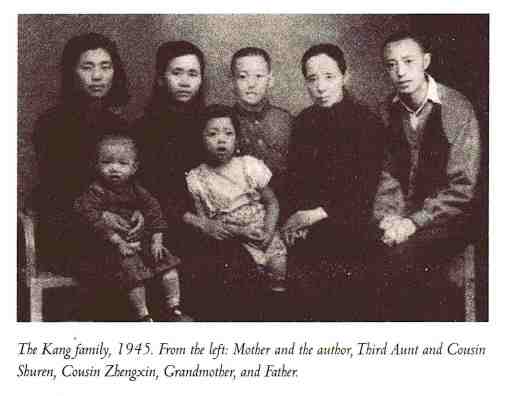
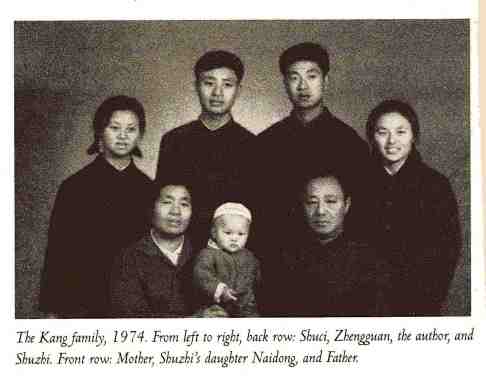
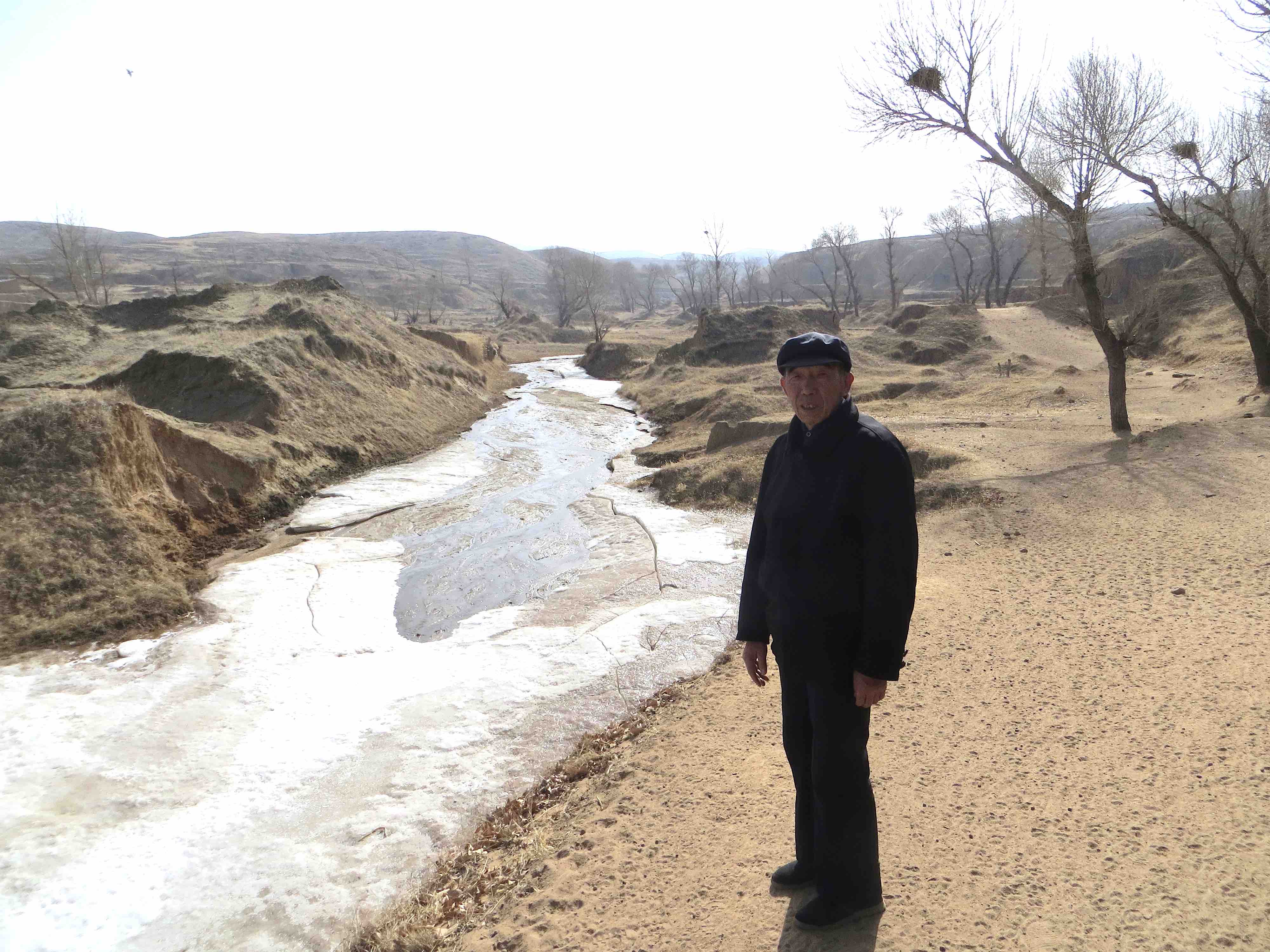
Born in Xi’an in 1944, Kang’s earliest memories are of taking refuge with his Nanny at her parents’ village home in the early summer of 1949, as refugees streamed in all directions, alarmed that the “bumpkin army” was to arrive.

Kang 7

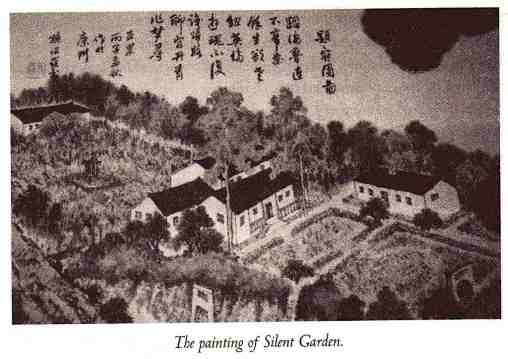
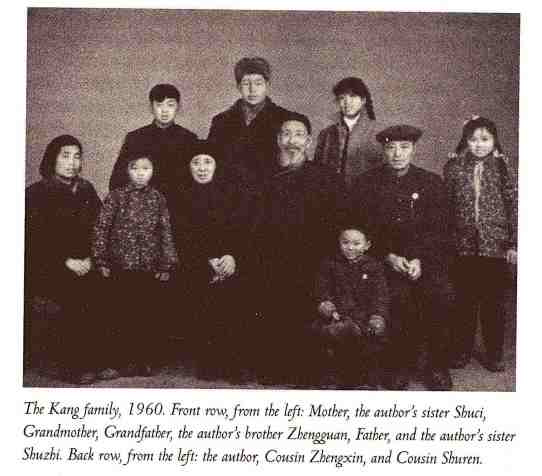
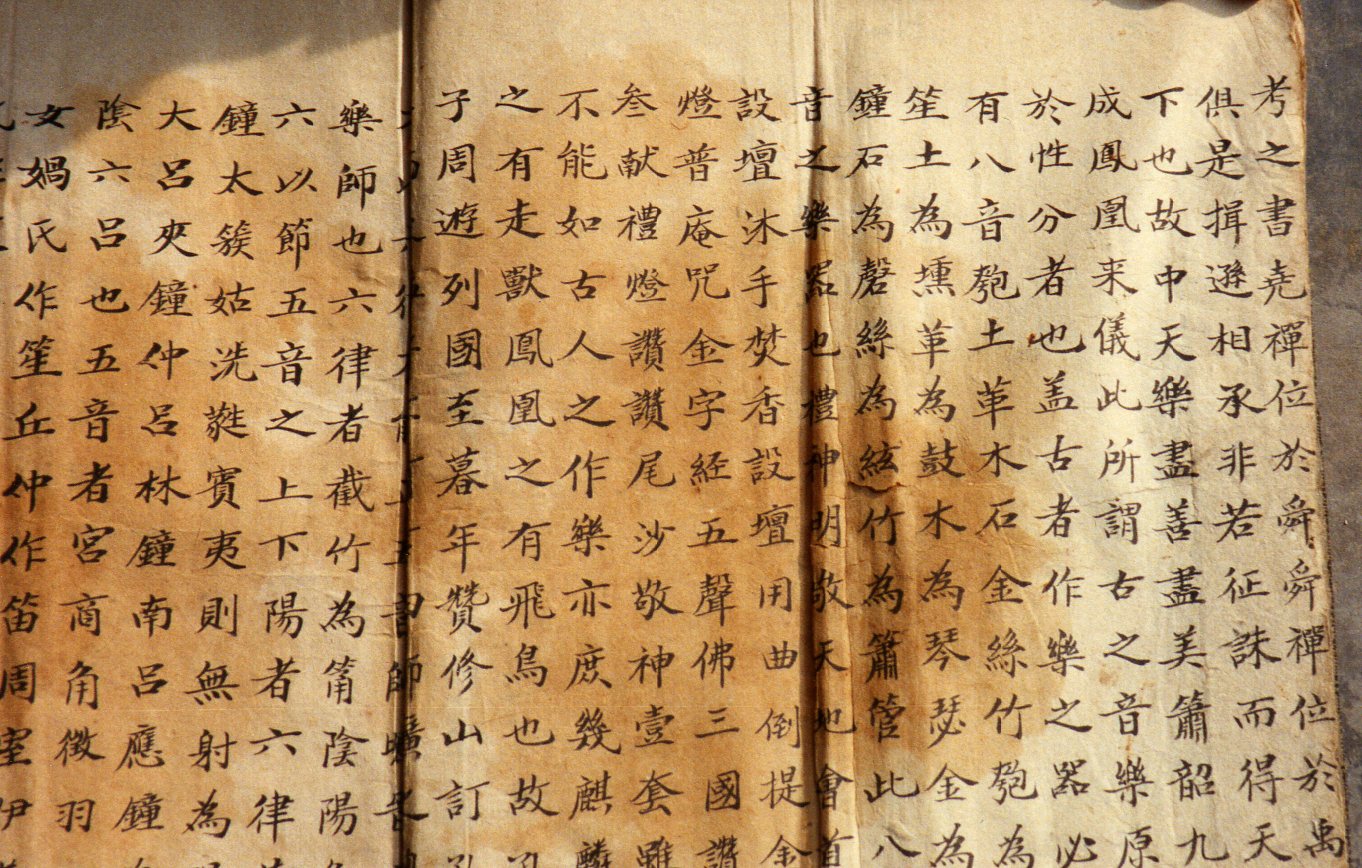
He recalls the fanfare of the early days of Liberation. His grandfather, a devout lay Buddhist (cf. the family of Miao Jiang in north Shanxi), had been involved in radical politics in his youth; but by the 1920s, from his base of the idyllic Silent Garden, he devoted himself to Buddhism—leading local charities, relief work, collecting donations to repair dilapidated temples, and printing scriptures. Even after the Communist land reform, though now classified as a landlord, he remained active, shielded by a renowned living Buddha from Qinghai, and was given a salaried post as Buddhist representative on the Municipal Consultative Committee, taking part in meetings with some alacrity.

Kang 425

Kang recalls the frenzy of the Great Leap Forward. But he relished the classical literature that he found in his grandfather’s library. At school, with his independent bookish tastes, he began to acquire a dubious political reputation.

Kang 28

Though the cities were always protected from the worst hardship, by 1960 food shortages were common in Xi’an. As refugees begged on the streets, Kang’s grandfather took in a peasant from the Henan countryside. Kang began to see through the boastful state propaganda.

With a certain economic relaxation following the chaos of the Leap, free markets reappeared; Kang recalls the bustling market at the Baxian gong Daoist temple. Foreign films were in vogue too.

Under his grandfather’s influence he began keeping a diary, whose personal reflections he contrasted with the empty show of Lei Feng’s posturings.

Kang’s father was a senior engineer, whose alcoholism gave rise to family tensions. He tried to dissuade his son from bookish pursuits; whereas science was a rather safe subject, the humanities were considered risky (cf. Vesna Goldsworthy in Yugoslavia). But Kang persisted. By 1963, still at school, he was falling under suspicion. Despite gaining admission to Shaanxi Normal University, as the political climate deteriorated, he felt alienated by the mediocrity and conformity of the teaching.

The professors who were old enough to have suffered during the Anthi-rightist campaign carried their prudence to the point of idiocy, while the younger ones merely trumpeted the literary policies of the day.

Kang was cajoled into writing the first of many self-criticisms.

Kang 71In March 1965, seeing no way out, he took the No.15 bus to enter “the gates of hell”, becoming a “resettled worker” at the No.2 Brickyard in Xi’an. His romantic illusions about finding Robin Hood types were soon dispelled. Though they were allowed to take occasional breaks in town, it was effectively a labour camp.

In autumn 1965, as the Socialist Education and Four Cleanups campaigns intensified, he learned that his ever-devout grandfather, then in his mid-eighties, had been subjected to a struggle session at the Wofo si temple. His house was ransacked, and his land confiscated.

Kang summarises his grandfather’s fortunes since Liberation:

Kang 90I don’t think that Grandfather was aware of the extent to which the temples had been politicised or to which the Party’s promise of religious freedom was pretence. There was a reason why he had been granted prestigious positions in the Buddhist Association and the Municipal Political Consultative Committee, along with a monthly subsidy of 100 yuan. As a prominent Buddhist spokesman for official policies he has an unwitting figurehead for the Party’s United Front policy of the political assimilation of non-party members. In the comparatively relaxed climate of the past few years he had fallen for a host of false promises. Imagining that he could promote Buddhism as he had before the Communists, he had continued to advocate religious reform. Unfortunately his proposals—to hold gatherings to celebrate Buddhism, for example, and to require temples to enforce religious discipline—had aroused the ire of both the Party and the monastic community. Maybe even at the bitter end he still failed to understand that his religious zeal exceeded the limits tolerated by the authorities, who saw the latest political campaign as an opportunity to attack him.

After living peacefully under Communism for sixteen years, Grandfather was getting a taste of the Party’s sinister tactic of turning people against one another. He was bewildered by the virulence of the attacks on him by monks, nuns, and lay Buddhists, who had always treated him with respect but now seemed even crueller than the cadres in charge. He never realised that the Party agents within the monastic community had been informing on him all along and that the Party had been keeping a dossier on him, lying in wait as he incriminated himself.

Though Kang started to appeal against his own verdict, he was left without options.

In my post on the ritual life of Xi’an I cited his account of a mass struggle session that he witnessed at the town of Weiqu.

The Cultural Revolution, and labour camp
In 1966 he witnessed the further desecration of the Wofo si temple, and the humiliation of its abbot, who soon hanged himself after severe beatings from the Red Guards. Kang pre-emptively sold off the most dangerous of his book collection. His youngest sister, barred from the Red Guards because of the “black” status of her family, went on a rampage against the “four olds” in the house, before the Red Guards completed the job. Kang’s grandparents were evicted, moving into a cramped flat.

For a moment the mood of rebellion against state authorities gave him misguided hope. He sneaked off on the train to Beijing in an attempt to lodge an appeal. Returning to Xi’an, he tried his luck at the university, also in the turmoil of rebellion, but soon realised he was vulnerable there too.

In 1967, amidst armed struggle between factions, Kang’s fate worsened yet again. Apart from classical Chinese literature, his literary tastes had long extended to foreign novels. Among a few volumes still surviving from his collection at home, he explored Russian fiction. In what he himself describes as a moment of madness, he sent off a letter to the Moscow University Library to request a copy of Doctor Zhivago.

While he waited, his fellow-inmate the racketeer Pimple Ma, a Muslim, took him under his wing. Even now, as Link observes, the period “brought him more, not less, access to ‘bourgeois’ pleasures like reading non-Communist books, smoking cigarettes, and chatting with friends”. As some of the plundered spoils from the Four Olds circulated, he got hold of an unexpurgated copy of The golden lotus, and some old Russian records. He joined in the unlikely revival of dance parties, dabbling in romance.

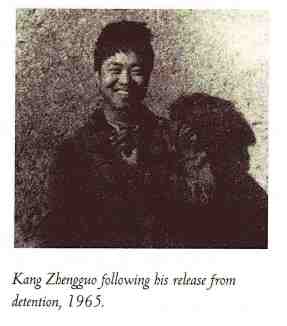
Kang’s grandparents had been given permission to return to Silent Garden, now in ruins, but both died soon after. In September 1968 Kang was arrested. During a stay in prison the charge against him was still unclear. Eventually, sentenced to three years at the Malan Farms labour camp complex in Xunyi county further north, it transpires that his major crime was having written to Moscow for a copy of Doctor Zhivago.

Even now he cherished a dream that the camp would be full of idealist “anti-rightists”; on arriving he found that most of the inmates were juvenile delinquents. Now he had to get used to the “Sisyphean labours” of the regime.

Rural exile and village life
Released in 1971, Kang made his way back to his parents’ home in Xi’an. His status still vulnerable, he had to lie low. Though the extreme violence of the first three years of the Cultural Revolution had died down, the system of residence permits and ration tickets was oppressive, and Kang remained a burden on his family.

His father was now out of trouble himself. Though angry at the way Kang had brought calamity on the family, he had been going to great lengths to negotiate a transfer for him to a rural commune in Chang’an county just south of the city. With obstacles to settling his status still in the way, they tried to marry him off to a peasant woman, but by 1972 they found a childless old pauper to adopt him, in a deal that involved building him a modest new home to replace his old hovel. His adopted father was to be responsible for finding him a wife, and he was to support him in his old age and take care of his funeral.

What objections could I possibly have at this point? I had given my parents so many headaches over the years that nothing could probably offend them anymore. And if they could accept this situation, why couldn’t I? Right then it occurred to me that it might be a good thing to change my name. Settling down in the countryside with a brand-new class status would be better than sponging off my parents. Even if my life was tough from now on, my family would be spared any further suffering on my account. Changing my name seemed like a small price to pay. […]

Very few people understood my past, and nobody paid it much attention. Once I had my new name, it was as if I had been reincarnated in Team No.4 with a completely clean slate. Nobody seemed to care that I was a reactionary or to show any curiosity about my expulsion from college and incarceration in the labour camps. Neither did anyone seem to think it was important that I’d been to college and was highly literate.

Indeed, he soon learned that villagers were quite used to complex kinship relations:

Production Team No.4 was so poverty-stricken that many of the men could not afford traditional marriages. The village was full of blended families and there were plenty of other adopted children besides me. Some of the older bachelors had scraped together enough money late in life to marry widows with children. Shiquan, for example, had acquired a couple of stepsons in this way. Shili, our village carpenter, had married the widow of a criminal landlord element, adaopting her daughter and two sons. Our accountant, Rangdao, who lived next door to me, had been adopted from a relative’s family. And Yinzui was actually the grandnephew of his adoptive father, who had taken him in because he was afraid that his own son, Dinghan, was not reliable enough to support him in his old age. Dinghan had been away in the labour camps at the time and had returned unmarried. Recently, however, he had found a woman from Gansu who had run away from her husband, and she had a son and a daughter. Given these haphazard family arrangements, you had to be careful about whom you called a bastard.

Despite his experience of manual labour, Kang (or Li Chunlai, as he was now) found himself a “substandard peasant”. He observes village life astutely as a cultural outsider. People remained acutely aware of private property; petty jealousies abounded. Still unable to migrate to the cities, they envied urban dwellers.

With an interlude on a dam construction project, as restrictions on enterprise grew more lax, he began making pocket money with electrical repairs and clock-mending, setting off on foot around the nearby villages, making occasional trips for parts into Xi’an—already an alien place to him. Getting hold of an old transistor radio and some textbooks, he began teaching himself English. He was still under surveillance.

Kang 300

After his father died in 1974, he came under growing pressure to find a bride. Introduced to Xiuqin, a woman from Shangluo prefecture, they married in Xi’an in 1975 and he took her on her first ever bike-ride to begin married life in his village.

Xiuqin’s story, told by Kang with characteristic frankness, also illustrates the times. Her father came from an impeccable revolutionary background, becoming a respected township cadre. But misreading the mood after the Great Leap Forward, he took part in a plot to distribute grain to the starving peasants, and was sentenced to labour camp as a counterrevolutionary. Xiuqin’s mother now faced great hardships in bringing up the children. They were further persecuted in the Cultural Revolution. Her father was released in 1969, but soon subjected to a series of struggle sessions. Xiuqin was desperate to find a husband as a way out of her suffering. After several false starts, she was introduced to Kang Zhengguo.

None too impressed by her new husband’s living quarters, on a trip back home she learned that her father was in ever deeper trouble. After enduring further ordeals from the vindictive cadres, she eventually got permission to leave. In Kang’s adopted village she learned how the peasants resented them. She gave birth to a daughter and then a son. While Kang was often absent, she worked hard.

The death of Chairman Mao in 1976 seemed to offer them hope of gaining urban residence in Xi’an. Kang’s adoptive father also soon died; while the villagers grudgingly considered their funeral arrangements suitable, they always resented the couple inheriting his house, and sought opportunities to wheedle money out of them. Meanwhile Xiuqin’s father, still being tormented, died too.

But now, as society was thawing, their life was improving. By 1978 Kang resumed his studies of English, on hold since 1974 when he learned he was still under surveillance. Beginning to get teaching jobs, he set his sights on returning to Xi’an. And his petitions to be rehabilitated were successful, his reputation finally cleared. In 1979 he was appointed to Shaanxi Normal University, from which he had been expelled some fifteen years earlier.

As he notes, that should be the end of the story, enabling him to enjoy the placid, uneventful life of a tenured scholar of literature.

The reform era, and emigration
If Kang’s successive degradations under Maoism are disturbing, so is his story since the reforms.

Observing three former friends now blowing with the new wind, he comments:

The course of action that these three friends had chosen was also open to me. I could have swallowed my pride and obsequiously accepted favours from the Party, becoming a docile professor with my nose buried in my books. This would have been a happy ending to my tale.

Instead, soon falling foul of the Spiritual Pollution campaign of 1983, he was dismissed from the university. While teaching at Jiaotong University, though initially wary of the 1989 protest movement, partly out of concern for his family, he was soon swept up in it. Though he avoided arrest, he now became subject to further surveillance.

His career opportunities were still limited. However, his thesis A study of Chinese poetry on women and by women had somehow come to the attention of a Chinese scholar at Yale, who now wrote to him. Sending off his reply, he thought of the only other letter he had ever sent to a foreign country in 1967. Invited to a conference at Yale, he had to surmount a series of obstacles in order to attend. Once in the USA, realising the challenges of surviving there as an immigrant, his dreams of remaining soon evaporated, and he meekly returned to China—where people were surprised to see him.

Still, he had made such a good impression that in 1994 he was offered a job as a Chinese-language instructor at Yale, and after further bureaucratic hurdles, he took refuge there with his wife and children.

This might make a second happy ending. But after several peaceful years teaching at Yale, in 2000 he planned a return visit to China, to attend an academic conference in Nanjing, as well as to visit his mother in Xi’an and relocate the family graves.

His visit coincided with the anniversary of the 1989 demonstrations, always a tense time; anyway, the Public Security Bureau was already back on his case. Indeed, from the kind of titles that his wife wisely tried to stop him taking for his old friends in China (Havel, Beijing spring, Pu Ning’s Red in tooth and claw, and so on) he had clearly been keeping a keen eye on “dissident” literature.

Attending the conference on “Gender issues in Ming and Qing literature”, his observations strike a chord:

I felt like a country bumpkin in such lavish surroundings. I had never seen such ostentation at American scholastic conferences. In China, the booming economy had stimulated a surge in conspicuous consumption. With China’s entry into the age of globalisation, the Chinese now sought to conform to international standards or even to outdo the foreigners at their own game. The results often struck me as excessive.

Meeting up with old friends from the 1989 protests, he finds them too absorbed in their nouveau-riche lifestyle to dwell on the past. Sensibly postponing his return to Xi’an until after the 4th June anniversary, in an attempt to avoid potential charges of troublemaking he took a trip to Lhasa with his brother (himself now vaunting the superiority of Chinese life over the American dream); this may not seem very well thought out, but it passed off without incident. Still, en route to Lhasa they had met up with the dissident Liao Yiwu in a Chengdu teahouse—again, hardly a prudent decision.

Kang reflects on his own innate contrariness:

Even if I had wanted to become a businessman like my brother, I would never have succeeded. Moreover, I believed that dissenting voices were essential forces of progress. The regime’s vaunting of “stability” showed that its vested interest still obstructed any social change that might undermine the power structure. Despite people’s insistence that things had improved, I could see that Chinese citizens were deprived of many of the same basic rights they had lacked under Mao.

Soon after returning to Xi’an he was arrested yet again. As the extent of the surveillance becomes clear, with his green card seeming ever more flimsy, his interrogators tried to get him to inform on his “subversive” friends in China.

Letters had always been my downfall. I had a lifetime of firsthand experience with the censorship of the Chinese postal system. My mistake had been to imagine that the the dictatorship had relaxed its grip in the post-Mao era when in fact it was as restrictive as ever, and its spy apparatus was now streamlined by the latest technology. Like a spider in its web in a dark corner of the room, the Security Bureau was always lying in wait for its prey.

As the American authorities attempted to intercede on his behalf, Kang was cajoled into writing yet another “confession”. Despite injunctions to get out while he could, he still proceeded with the reinterment of his elders. Returning to his adoptive village, he finds it much changed, the environment ruined by the money-making schemes of the 1980s. Few of his old friends and adversaries there had fared well. He boarded the flight back to America with relief.

Scrapping the liability of his Chinese passport, he now gained American citizenship. In his tranquil family home in the New Haven suburbs he thought of Silent Garden. His wife and children thrived.

At first he remained silent about his recent ordeal in China, avoiding the press. But after a year he found the pact of silence unbearable.

This latter part of Kang’s story might seem like a minor footnote, but re-reading it as the surveillance state becomes ever more intrusive, it takes on added significance. Now, long after the apparent demise of Maoism, we can read about such intimidation daily.

While no-one could be entirely naïve in such an environment, Kang Zhengguo had always been outwitted in his attempts to gain some respite by playing the Party’s gruesome game.

On my explorations in around Xi’an from 1986 in search of traditional culture, I had no idea of all this troubled recent history, and no-one was in a hurry to educate me. This book should be high on the reading lists of people undertaking any kind of fieldwork in China.

Labrang 2: the violence of liberation

This review follows on from my posts on Tibet in the Cultural Revolution (here and here), and on issues arising from the 2002 UK tour of monks from the Labrang monastery.

Since the 1990s the polarized viewpoints of scholars within the PRC and in exile have been impressively refined. Just to reiterate, diverse topics in Tibetan culture are now receiving attention not only for central Tibet (“Tibetan Autonomous Region”, TAR) but also further afield in Amdo and Kham (for other works on Amdo, see Labrang 1).

Makley cover

By contrast with the timeless, transcendental image of Tibetan culture based on monastic ritual that beguiles some scholars, the complex, changing tensions around Labrang are brilliantly unpacked in

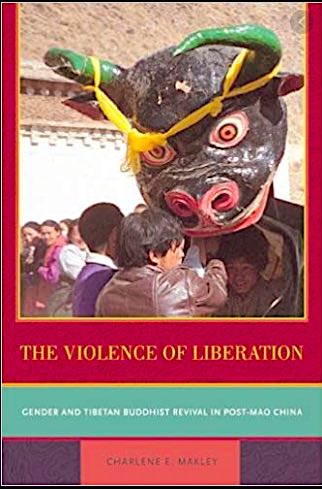
  • Charlene Makley, The violence of liberation: gender and Tibetan Buddhist revival in post-Mao China (2007); reviewed far more knowledgeably by Mona Schrempf and Isabelle Henrion-Dourcy.

Highlighting the role of gender, Makley’s sophisticated ethnography considers history before, during, and since Maoism to survey Buddhism at various levels;  the wider community; Chinese and foreign tourism; and generational attitudes.

The book’s evocative title is borrowed—and extended—from Mona Schrempf, who used it to refer to the distinctive Tibetan tantric subjugation of the earth and its associated enemy agencies. In the Introduction, Makley asks:

How did gendered inequalities structure the revitalization of the famous Tibetan Buddhist monastery of Labrang Tashi Khyil during post-Mao reforms? What were the exigencies of great gendered changes for Tibetans who lived under the nightmare shadow of state terror even as they encountered utopian dreams of pleasurable consumption in a new market economy? And what were the implications of my analytic interest in gender difference as a contingent and translocal social process in a community that was vigorously invested in rebuilding stable and coherent local worlds after the collective trauma of socialist transformation?

By the time that she arrived at Labrang in the mid-1990s, she found that

a decade of state-supervised tourism in the region had actually solidified a certain distance between locals and foreign visitors, in that assumptions each held about the other’s nature and interests had become anchored in stereotypes, often-cited rumours, and certain patterned interactions.

As she notes, the packaging of “ethnic culture” in the PRC under Mao and since has been much studied, and “state officials, local Tibetans, and foreigners all participated in this new commodity voyeurism in the valley”. Whereas Tibetans made up the great majority of the population in the surrounding areas, in the town itself they were outnumbered by Han and Hui residents. Labrang was

a rapidly urbanizing locale where the premises for power, value, and morality were shifting, and many residents thus deeply felt that boundaries among persons, places, and agencies were dangerously blurring.

Makley justifies her focus on gender as a key element in these multiple relationships, elaborating Goffmann’s “participation frameworks”.

Since the monastery was reopened in 1980, lamas and their monk and lay male students had been deeply invested in reframing Buddhism first and foremost as prestigious, rationalized knowledge production.

At Labrang she makes a discovery that can be observed in many cultures:

As I set out to talk with Tibetans of every stripe about local history, and their opinions about gender and ritual practices, I learned that there were no general Tibetan terms in everyday use for “religion” and “ritual” that would cover all the practices constituting the lay-monastic relationship. Tibetans across the community instead referred to a vast repertoire of efficacious practices with particular terms depending on the task to be accomplished, the target of the practice, and whether or not it conferred benefits to future lifetimes. But in the face of state regulation that divided institutionalised and Party-supervised “religion” from dangerously irrational “superstition”, what most structured this complex ritual life in Labrang was locals’ heightened insistence on a gendered social ontology that attributed highest efficacy to the rational knowledge of Tibetan Buddhist scholar-adepts initiated in the monastic system.

The attitude of a lay male Tibetan friend to her studies might also apply to the difference in approach between Western scholars of religion and anthropologists working in many cultures:

To him, my efforts to learn about ritual practices from the perspective of Tibetans at various levels of the community, and especially my interest in talking to laywomen and nuns, threatened to muddle seriously the crucial distinction between folk knowledge and authentic Buddhist knowledge. Despite his own position as a lay teacher under secular state auspices, Dargye was appalled that I was working outside the monastic contexts of initiation and oral instruction on a canon of Buddhist texts under a lama qualified to confer them, especially since Labrang was one of the few places left where one could find such a lama. In his view, any knowledge I produced through social science methods was trivial at best and mistaken at worst, and rendered suspect the quality of my scholarship.

Makley notes, and refines, the scholarly interest in “borderlands” (cf. Bloodlands, and Between East and West).

Chapter 1, “Fatherlands: mapping masculinities”, opens with the striking figure of Gompo, illustrating how new masculinities cut across regions and between lay and monastic contexts. Among many young nomad men in the town who “browsed the shops looking for necessities to take back up to the grasslands, attended public events at the monastery, or haggled prices with Hui merchants over sheep or wool they were selling”, seeking a good time by night in the bars and dance halls, Gompo modelled his image on that of fashionable Tibetan pop singers. While mentored by an old monk in the monastery, with his cosmopolitan ambitions he had spent over two years as a dancer in the “Folk Cultural Village” in distant Shenzhen—an uncomfortable experience for him.

As Makley observes, for both Tibetans and Chinese there were good reasons to reify a past that had been sealed off by the violence and destruction of the Maoist era. Exploring the competing masculine authorities of trulku reincarnate lamas and the post-reform Chinese state, she notes that historically

the most successful Tibetan trulkus were those who learned to mediate competing interests while carving out privileges and relative autonomy for their monasteries and estates.

She stresses the false dichotomy between “ritual” and “rational” contexts. Rather than a simple return to “tradition”, for Tibetan men the revival since the 1980s was “an often painful process of negotiating the essential hybridity of their positions as subordinated ethnic Others on the national margins”. As during the Maoist era, albeit now with less flagrant violence, the domestication of Tibetan men was a major aspect of the Chinese state’s “civilising project”.

Makley highlights the overarching “mandalisation” of Labrang society, viewing the grand New Year’s public rituals as the high point of exchanges between the high lamas and the wider community.

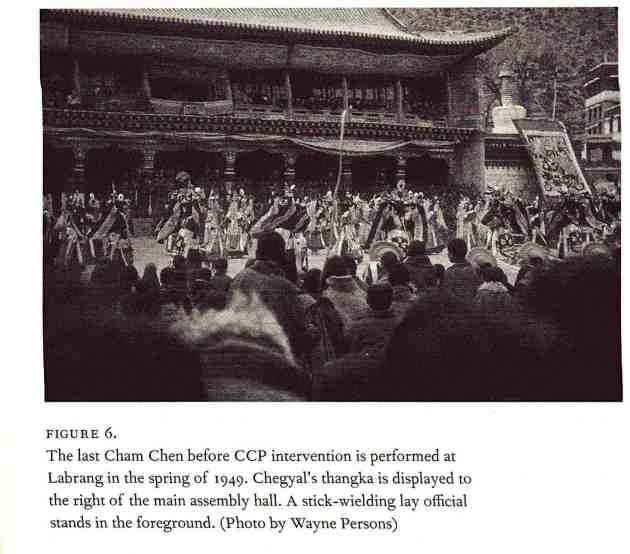
cham 1949She unpacks the multiple meanings of the cham dance ritual, “the culminating component of the greater mandalising event that was the annual Great Prayer Festival at the lunar New Year”. Following the destabilizing of the frontier zone in the wake of the decline of the Qing rule and the splintering of rule in China, in 1949 the monastery held the last cham before the Chinese occupation.

The tantric participation frameworks of such events were always amenable to misrecognition or appropriation by participants and competing agents for their own ends. […]

In effect, the Great Prayer Festival was a culminating “tournament of value” in which the circulation of the highest Buddhist values (trulku blessings, merit) provided frameworks and networks for the circulation of other values—everyone was invested, but not necessarily along preferred lines.

The conflict between sacred and secular gain was not a new feature of the reform era:

As early as 1865, the concerned ministers of the seven-year-old fourth Jamyang Shepa felt compelled to issue an edict […] warning all the monk officials and trulkus competing with one another in lucrative loan and long-distance-trade businesses not to be greedy, exploit others, or embezzle communal funds for personal profit.

After the Maoist decades, Labrang was the only Tibetan Buddhist monastery in the prefecture with any buildings left standing. The Great Prayer Festival there was revived in 1979. Around four hundred monks were soon allowed to return, their ranks rising to over a thousand by the mid-1990s, most of them under the age of 35. By 1985, eighty-nine monasteries had re-opened throughout the prefecture, with over five thousand monks, far exceeding state quotas.

In Chapter 2, “Father state”, Makley goes on to observe the cham ritual in 1996—by which time it had long become not just a focus for faithful locals but also a glossy attraction for Chinese tourists and state officials.

Always alert to gender issues, in her conversations with locals she considers the “heavy and often hidden” burden of the past, as forgetting became a pervasive policy of the Chinese state—not just for Tibet (see e.g. here and here). As a corrective to Chinese state propaganda, she notes that Westerners have commonly assumed the role of collecting testimonies from Tibetans about Chinese state repression; yet Tibetans themselves don’t necessarily share faith in such moralising historiography.

Under Maoism, as the ratio of Tibetans to Han and Hui settlers, and of adult Tibetan men to women, declined, among the life stories that Makley elicits are accounts of the training of female Tibetan cadres. People (notably cadres) came under pressure to replace Tibetan clothing with modern uniforms, and to wear their hair short, sacrificing their traditional headdresses. Women’s liberation under Maoism mainly involved the state exploitation of their labour. Village temples were recalled as centres for state terror during the 1950s, and resistance to the Chinese state then as virtuous. As in China, the famine resulting from collectivisation was another major aspect of their sufferings at the time.

But Makley’s discussions at Labrang also bear on the conflicts of class politics within Tibetan society as much as between Tibetans and Chinese.

I came to realise that the unspeakable among Tibetans was not just the result of state repression; it was also a marker of locals’ grapplings with the nature of their own and other Tibetans’ agency (and responsibility for) the unprecedented shape and scope of violence beginning in 1958.

We can observe a similar conflict in the memories of ordinary people in Han Chinese regions—and in many trouble zones of the world where the simple categories of oppressors and oppressed were blurred.

Makley highlights the role of the local People’s Militias,

an alternative participation framework for local young men especially, who sought social mobility to bypass their male elders.

Indeed, they played a major role in suppressing the rebellion. Moreover, as Woeser also notes, “those who had served the state well then continued to live well in the present”. One village woman, married to a man who had joined the Party in 1953 and helped suppress the 1958 rebellion, wavered between vilifying the “bad” Tibetan cadres under Maoism for their conscious actions and asserting that they weren’t really responsible. As with activists in Han China, stories about the karmic retribution of their early deaths circulated widely.

Alternative historiography among Tibetans was an ongoing and deeply gendered interpretative battle—with themselves as well as with the state.

Chapter 3, “Mother home: circumambulation, femininities, and the ambiguous mobility of women”, opens with the fanatical popular reception for the 10th Panchen Lama upon his return to Labrang in 1980.

Discussing the dilemmas posed by modernity and mobility since the reform era, Makley explores the gendered spatial politics of shifting divisions of ritual labour, and different “participation frameworks”. Here she joins the faithful (mostly women) who seek merit by circumambulating the perimeter of the monastery grounds—the “most broadly quotidian and public” ritual work at Labrang. It has apparently remained true that such important ritual activities often went unnoticed by foreign travellers (as Robert Ekvall noted in 1964); and indeed by scholars of religion, who tend to focus on discursive, logocentric expressions (cf. Adam Yuet Chau‘s comments).

The most determined of practitioners, the ones who walked so rapidly that they passed everyone else many times, were those who had ritual obligations or jawa given them by a lama, most often a trulku with a particularly close relationship to their households, whom they had approached for help with a particular problem, usually physical ailments, but also household difficulties.

The new state policies of development and consumption were seen to reflect the interests of the state. Highways in the region were primarily built to facilitate the continuing exploitation and control of the frontier, not to expedite local travel; by the early 1990s, 80% of villages were not accessible by car, and half the townships did not have paved roads. Moreover,

Dengist modernisation policies has disastrous effects on state-sponsored secular education in rural Tibetan regions, because the return to a “quality” approach to education (versus a “quantity” approach that emphasised providing basic education to the masses) channeled basic resources away from rural and primary levels toward urban and higher-education schools.

Thus

the concentration of resources on Labrang monastery supported what many locals came to see as the only good, prestigious, useful education in the region for those sons who could be spared.

But just as crucial was what Makley calls the “contesting entrepreneurships” of Tibetan masculinity.

The dream here would seem to be, in the absence of state support for secular education, to harness the taming power of Tibetan monasteries in order to recruit and sedentarise young Tibetan monks as a loyal (patrifilial) and aspiring labour force for national capitalist advance.

Yet now, by contrast with the Maoist era, young Tibetan men

could experience their communal private consumption and daily movements as appropriately (heroically) “Tibetan”, in that they allowed for a powerful sense of resistance to or transcendence of state discipline.

Meanwhile “images of Tibetan feminine cyclicity pervaded the writings, art, videos, and music of foreigners, Han, and Tibetan alike”, stressing their role as mothers and nurturers. And as in China and other societies, Tibetans still subscribed to a timeless notion distinguishing women occupying domestic spaces “inside” the household from men “outside” it, with their prestigious ritual and political affairs.

Since the 1980s, there were two competing centres at opposite ends of the valley—at one end, the rapidly revitalizing monastery, which had the highest concentration of lama-scholars in the Amdo region and was attracting hundreds of young monastics and lay worshippers from afar, and at the other, the headquarters of the Party and government of Xiahe county, whose buildings by the 1990s were rivalled in size only by the large new tourist hotels that had been erected between them and the monastery.

Makley notes the tensions in the juxtaposition of celibate monasticism and the lay communities on which it depends, with life in the town increasingly “chaotic”.

In a trend that further intensified the processes of increasing population densities, sedentarisation, and ethnic heterogeneity in the frontier zone since the founding of the monastery, Labrang by the 1990s had become a vital node in a regional movement to urbanity, a gathering place for young aspiring Tibetan men and women. Such rapid demographic shifts associated with state violence in locals’ living memory contributed to the strong sense many Lhade residents had that their valley was under siege by unprecedented numbers of non-Tibetan outsiders. […]

Like young men, young Tibetan women were increasingly drawn to the expanded horizons promised by Deng’s call to modernizing progress and agentive consumption, yet their aspirations could confront them with particularly painful dilemmas.

These themes are pursued in Chapter 4, “Consuming women: consumption, sexual politics, and the dangers of mixing”. Labrang now offered “unique opportunities for secular and monastic education, wage work, and contacts with cosmopolitan Others”, becoming “a gathering place not only for young monks and nuns but also for unmarried and ambitious young Tibetan laywomen and laymen” from surrounding rural areas and even other provinces. As in other urban centres,

a new form of commodified sexuality worked to sell not only bodies and products but also the sparkling future visions of a capitalist modernity.

Again, Makley’s discussion subsumes the periods before the Chinese occupation and under Maoism. She qualifies some common misconceptions. Monks had commonly engaged in commercial activities long before the reform era. Makley refines the contrasting images of “the transcendent power of celibate lamas in the monastery and relatively open sexuality in town”. She notes the enduring Tibetan taste for discretion, and the role of sexuality in tantrism; she cites Goldstein’s observation that the very ethic of “mass monasticism” meant that only a small minority of monks approximated the monkly ideal.

Most ordinary monks differed little from nuns except in the relative prestige attached to the various occupations they undertook to bring in income—most stopped at the novice level of vows and achieved only basic literacy.

Referring to the revival of the early 1980s, she notes one distinction:

All the monks I spoke to who entered monkhood at that time did so either on their parents’ initiative or with their enthusiastic support, and all of them were younger brothers with many (between four and nine) siblings. In contrast to nuns I interviewed, many fewer monks fled home to enter monastic life. Twelve out of eighteen nuns I spoke to who were ordained after the reforms fled home to enter the monastic life, while only two out of eighteen monks I interviewed who were ordained after the reforms had done so.

And

Most monks did not remain sequestered in monasteries; instead, they moved frequently between natal homes and monasteries (especially those who joined monastic communities close to home), growing up playing with lay boys, and in adulthood travelling often between monasteries on pilgrimage, monastic business, or trading missions.

Makley adduces the courtship themes of layi folk-songs, performed in ritualised contexts—and now also in bars and dance halls as prelude to commercial sexual encounters.

Again, while Tibetans seemed to subscribe to media and state laments about the apparent “chaotic” breakdown of sexual morality, they too were agents, negotiating modernities on their own terms—albeit enduringly androcentric.

The presence in the valley of foreign and urban Han women tourists, as well as of rural Tibetan laywomen and nuns, exhibited an unprecedented translocal mobility of female bodies. This had dangerously sexualised and desacralized public spaces in and outside the monastery. It had thus become paramount for local women to distinguish themselves from the unrestrained sexuality associated with tourist women, nuns, and prostitutes—even though many young laywomen in town who sought to distance themselves from commercial sex their own aspirations for independent social mobility and their desire to postpone the disproportionate burdens of marriage were precisely the motivations that were increasingly leading young women of every stripe to accept money for sex, not only in Labrang, but across the country.

Tibetan men vigorously pursued possible “modern” futures and lifestyles held out for them in the globalizing media. And

communal masculine consumption—of alcohol, food, travel funds, and cigarettes—was considered to be an essential means for building and reproducing the vital masculine networks across generations and regions that in post-Mao China provided any opportunities for social mobility or participation in commercial entrepreneurship.

In an aspect of such consumption, young men and monks frequented video halls by night—lured by the newly available soft-porn images (at first mainly of Western women, later of Chinese and other Asian models) displayed as pin-ups, on playing cards, and even on the covers of scholarly journals. Young women, including nuns, who ventured out at night risked harassment and violence.

In “the new eroticism of the frontier”, “state and local gazes converged on Tibetan women’s bodies as commodified objects both of sexual desire and efforts to contain it”.

In Chapter 5, “Monks are men too: domesticating monastic subjects”, Makley delves further into the new tensions in the claim of Gelug monkhood to transcend the polluting attachments of one’s sexual-karmic inheritance, and “the performative claim of the monastic community to have tamed lay masculinity in the service of Buddhism”.

The inherent gap between between the monk ideal and actual monk behaviour that fall far short of it was not necessarily experienced as “paradoxical” or “contradictory” for Tibetans. […]

Monkhood did not necessarily represent a “sharp division” of the male population either before or after Communist intervention.tangkha 1949

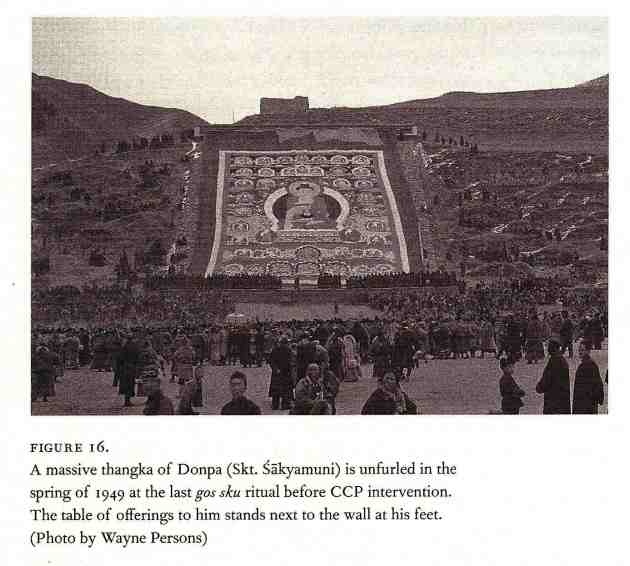
Attending the spectacular Great Prayer Festival in 1996 (for recent images, uncomplicated by reflection, see e.g. here)—just as news of the dispute over the recognition of the new Panchen Lama was circulating—Makley elicits the conflicting messages of the event for a wide range of participants, with tourists and state cadres alongside monks and lay pilgrims. The unfurling of the massive thangka became “the ritual frame for a culmination of interethnic and state-local hostilities played out in legitimized masculine violence”.

She tells the story of a committed young graduate student from rural Qinghai who had grown up hearing stories of the brave resistance to PLA military campaigns and Cultural Revolution struggle sessions. He was now struggling to find a career in which he could benefit ordinary Tibetan people.

“Heroic masculinities” are enshrined in the Gesar epic—the object of much attention from the heritage industry that hardly broaches its social life. [2] In Amdo the focus on such ritual exchanges was also evident in popular VCDs featuring mountain deities, threatening “to configure masculine loyalties and inspirations outside the disciplinary purviews of both monastery and state”. Chinese and Tibetan cadres were still frustrated by the enduring power of trulkus to mediate in feuds between tribesmen.

Amidst considerable historical latitude in monkly behaviour, even “hypermasculine” warrior monks known as dapdop could flourish, serving as a kind of monastic police force.

But despite the return to mass monasticism, Tibetans had to adapt to the emasculating power of the state. Official regulations persisted in distinguishing dutiful, “patriotic” religious activities from “superstition”:

[The monastery] must absolutely forbid such people as mediums and diviners from carrying out such activities inside Buddhist monasteries as calling deities or demons, curing illness by taming demons, or reading signs or letters, or divining in any way.

As in Han Chinese regions, prohibitions like this may alert us to the continuing activities of such folk ritual specialists.

Apart from the entrepreneurial activities of the monastery, lay offerings—in the form of money, goods, livestock, and donated labour—also constituted a vast income. Such unregulated movements of capital, and the enduring charisma of leading trulkus, represented a danger to the state.

Yet older Tibetans were disturbed to find the younger generation of men, with their new mobility, becoming lazy, selfish, and undisciplined; loitering around town, with a propensity for violence.

As Makley recognises, monks and nuns commonly claimed to be motivated by the exalted study of Buddhism. But they too were part of an increasingly venal society. And since those monks who were more devoted to their studies tended not to perform ritual services for wages, locals often requested such services from the ranks of those not within assemblies. But to wear a monk’s robes no longer conferred automatic respect.

* * *

So we can ignore neither the vast revival since the 1980s nor the ongoing tensions. As a particularly visible, accessible site, Labrang is not “typical”. But all these stories reveal not a simple conflict between pious lamas and a cruel state, but conflicts, and agency, at all levels of a diverse society amidst constant change. Indeed, as I noted in my first post on Labrang, unrest has intensified since 2008. [1]

We may now bear in mind Makley’s perspectives to assess online representations, such as this clip of the cham ritual dance in 2015:

See also Women in Tibetan expressive culture, and Makley’s chapter in Conflicting memories.

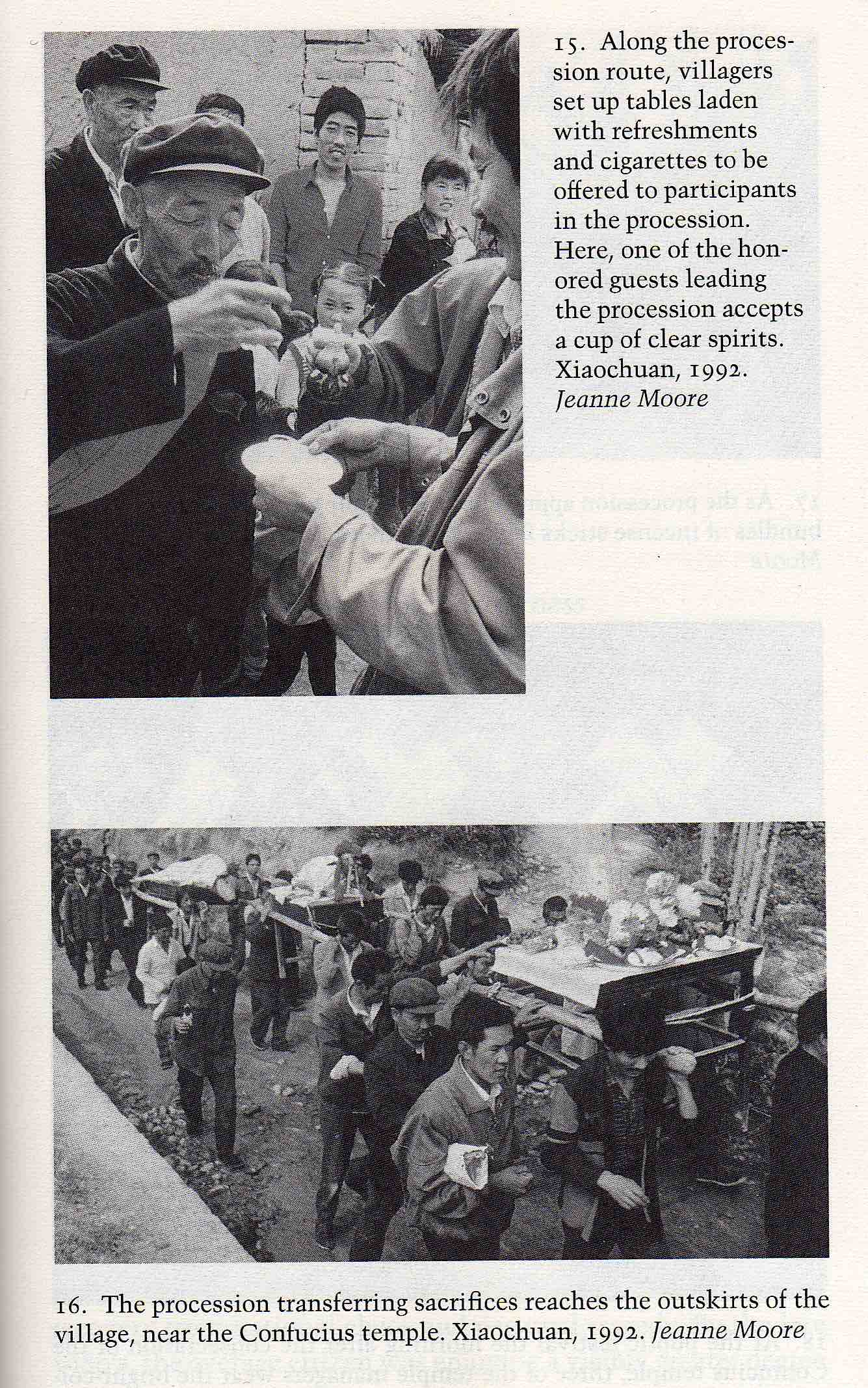
[1] Here I mainly cite descriptive passages, homing in on the ethnographic detail rather than the densely-argued theoretical sections. The latter are anyway hard to encapsulate, but it’s also my personal choice. It’s always a challenge to balance narrative and theory (cf. my review of Emily Ng’s book on spirit mediums in Henan). I don’t always find this an issue: for instance, Jing Jun manages to incorporate theoretical discussion readably (see also A forfeit for theorists). So here I’m not so much criticising Makley’s style as querying the wider anthropological discipline to which she belongs—in which jargon, compounded by lengthy in-text references, may seem to exert a new kind of, um, hegemony, substituting another alien vocabulary for that of the CCP. All this can make the text rather heavy going to negotiate, particularly early on. This concerns me since it’s such an astute analysis of a great topic, deserving a wider readership.

[2] For Western-language sources on Gesar, see §6 of Isabelle Henrion-Dourcy’s bibliography, and more recently the work of Timothy Thurston, such as this. Within the PRC, Gesar studies have long been popular, expanding into a major field since the 1980s; yet as Sangye Dhondup suggests in his review of Tibetan and Chinese sources, the important dimension of ritual performance in society has still received little attention. See also under Yumen here.

Spirit mediums in Henan

Ng cover

The grassroots ubiquity of spirit mediums (often female) in Chinese religious life is increasingly recognised (for collected posts, click here). I often plea for them to be recognised as among the most important practitioners “doing religion” in China—and now, as if in divine response to my entreaties, a welcome addition to our knowledge is

  • Emily Ng, A time of lost gods: mediumship, madness, and the ghost after Mao (2020),

on spirit mediums in a county of central Henan province. [1] Here’s the blurb:

Traversing visible and invisible realms, A time of lost gods attends to profound re-readings of politics, religion, and madness in the cosmic accounts of spirit mediumship. Drawing on research across a temple, a psychiatric unit, and the home altars of spirit mediums in a rural county of China’s Central Plain, it asks: What ghostly forms emerge after the death of Mao and the so-called end of history?
The story of religion in China since the market reforms of the late 1970s is often told through its destruction under Mao and relative flourishing thereafter. Here, those who engage in mediumship offer a different history of the present. They approach Mao’s reign not simply as an earthly secular rule, but an exceptional interval of divine sovereignty, after which the cosmos collapsed into chaos. Caught between a fading era and an ever-receding horizon, those “left behind” by labour outmigration refigure the evacuated hometown as an ethical-spiritual centre to come, amidst a proliferation of madness-inducing spirits. Following pronouncements of China’s rise, and in the wake of what Chinese intellectuals termed semicolonialism, the stories here tell of spirit mediums, patients, and psychiatrists caught in a shared dilemma, in a time when gods have lost their way.

Ng begins by reflecting on her initial confrontational encounter with the medium Zheng Yulan, who soon moved from indifference towards her guest to rejecting any further engagement, a telling story that rings true—the perceived dangers of transmitting messages “across what the mediums deem enemy lines”. [2]

Henan [3] 
Ng notes the “demonising” of Henan, in Ma Shuo’s term “a symbolic place of stagnation”:

Now, in place of a civilisational centre, Henan is more potent in the national imaginary as a land of poverty, backwardness, charlatans, and thieves, evocative of the famines of the 1940s and 1950s under Nationalist and Maoist rule, and of the HIV scandal of the 1990s, when villagers contracted the virus from blood plasma sales for cash.

Indeed, Henan suffered particularly grievously from the famine during the drive to communisation in the late 1950s. Citing Ann Anagnost on the “spectralisation of the rural” since the reform era, Ng evokes a society in which “ghostly presences swirl amid the hollow of an emptied centre”. See also Bards of Henan.

Mediums and vocabulary
Rather like Henan itself, mediums have been written out of the official history. They themselves have an alternative view of the Maoist and reform eras:

The purportedly antireligious campaigns of the socialist state, for the mediums, constitute cryptic acts of divine intervention—acts inaugurated by otherworldly forces that allowed the earthly state to misrecognise itself as secular.

Ng unpacks the local vocabulary for mediums and possession. The verb kan 看 is used, which she translates as “see”, as in kanxiangde 看香的 “one who sees incense”; as with the kanrizi “determining the date” among household Daoists, I’d suggest the more active rendition “looking with incense”, with the further implication of “taking care of through incense”. Mediums are also described as “those who walk/run/stand guard for spiritual power” (zougongde 走功的, paogongde 跑功的, shougongde 守功的). [4] Ng defines mediums broadly, as “those who regularly receive supplicants at an altar and those who regularly undergo possession at temples without necessarily receiving supplicants”, “lending their bodies” to spirits—as opposed to (usually male) diviners and fortune-tellers. Again like household Daoists, their domains are the yin and yang realms. The common term for the deities who possess mediums is xian 仙 “immortal”—who may also be ghosts.

Ng’s host quips with her by using the standard term shenpo 神婆 “witch”,

a term […] that I had brought to the scene, one intelligible to her while marking my externality to local articulations. It was a phrase more common with urban friends with less familiarity with such matters and carried a slight air of modern accusation. The term is rarely used in Hexian without either a note of disdain from those who denounce so-called superstitions or a knowing emphasis from those who do engage with such practices.

The aftermath of Maoism
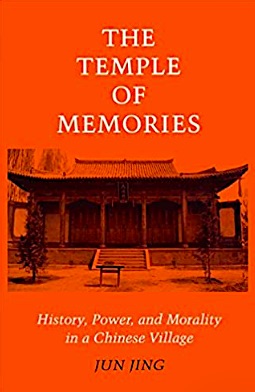
Ng notes how the Cultural Revolution (and indeed, its first two years) often stands misleadingly as a condensed image of the Maoist era in its entirety. At a certain remove from Jing Jun’s study of the revival of a Confucian temple in Gansu, Ng approaches evocations of culture in a shifting moral landscape “not as a straightforward continuation but as painful enunciations and wounded reworkings after the cultural as such has been rendered petrified and petrifying”.

Despite variations on divine details, spirit mediums who frequented Fuxi temple in Hexian agreed: it was upon Chairman Mao’s death that the ghosts returned to haunt. Just across the road, in the psychiatric unit of the People’s Hospital,  patients lament accursed lives, tracing etiological paths through tales of dispossession, kinship, and betrayal. South from the hospital, a Sinopec gas station sits atop what was once known as the “ten-thousand-man pit” (wanrenkeng), where bodies of the poor and treacherous were flung, throughout decades of famine and revolution.

Ng describes “a set of tensions, between a reconstituted rurality and an ambivalent urbanity, a mournful psychiatry and a shaken cosmology.” She evokes “culture as aftermath”: “the time when Chairman Mao reigned” (dangjia 当家, “in charge”, an ubiquitous term for both secular and sacred leaders, as we heard constantly in rural Hebei) is recalled as an interval of divine sovereignty, after which the cosmos collapsed into chaos.

Recognising a painful rupture to traditions of thought, in this sense, is not antithetical to taking seriously ongoing engagements with a cultural repertoire, as the cultural is loosened from assumptions of its qualities as an immobile, unbroken, closed system, and fragmentation is no longer assumed to be characteristic only of the modern or postmodern. Instead, attention to the aftermath of culture allows us to address how “culture” in the historical present  is not simply an anachronistic concept but seethes in its simultaneous transmission of efficacious potential and tormenting attacks—from within and without.

At the temple square
Chapter 2 opens at the gate of the Fuxi temple in the county-town, as a man recites a Mao poem in a voice “from above”. For many mediums the journey consists in “walking Chairman Mao’s path”, and this is the focus of Ng’s study. But almost in passing she makes an important qualification:

Not all [mediums] centre their practices on Mao. They might be chosen by a number of tutelary deities from Buddhist, Daoist, and local pantheons to join their spiritual family and work in their service, or they might simply be vulnerable to possession by ghosts and spirits without an allocation of a divine task. But those who walk Chairman Mao’s path have a continual and notable presence at the temple square, on and beyond common ritual days, and even those who dedicate their ritual labour to other deities acknowledge Mao’s position in the cosmology.

So Ng surveys work on the Mao cult in the religious sphere—the study of Mao worship has become something of an industry (cf. this post on Gansu). As she notes, while commentators such as Geremie Barmé have described the “new Mao cult” as offering an implicit counterpoint to official portrayals, almost entirely divested of its original class, ethical, and political dimensions, her own work in Henan shows Mao still serving as ethopolitical and even cosmological figure.

In an inversion of the state’s ritual displacement of popular religion, the potency produced through Maoist-era political rituals is reactivated in post-Mao mediumship. Sharing a symbolic repertoire with the earthly state, the spectral polity speaks to the sense of a morally hollowed present and a revolution incomplete.

At the square she observes the scene acutely:

The air is dense with anticipation. Those who do not otherwise frequent the temple rush toward the gate, jostling their way through the crowds to burn the last batch of incense for the year. Making my way across the square, I am drawn toward a rumbling drum beat, steady and declarative, in sets of three. A large circle of onlookers gather around six women and two men, middle aged, as they prepare for ritual. They don matching and seemingly brand-new green Mao-era army coats, topped with brown Soviet-style fur hats, a single red star at the centre. One woman at the inner edge of the crowd holds a tall pole, topped with a large yellow flag with the word ling (lit. “command, order, or decree”; in this context meaning “divine command”) etched in red.

Ayahao!” Another woman, in a red parka and a red embroidered dress reminiscent of old Shanghai, traces the edges of the encirclement with her steps, passing at its northernmost point. Facing the heavens, hands outstretched, her arms slowly lift toward the sky. She is receiving not only lingqi from above but also divine command for the opening of the ritual. “Ayahao!” she cries again—an interjection confirming an otherworldly presence or signal, often one’s own possession or infusion by spiritual personae or airs. “Ayahao! Ayahao! Ayahao!” echo several spectators in the crowd—a signal that they too acknowledge and experience the presence and signals of the spirits. While some rituals on the square involve particular appeals to the powers above, rituals such as this are often considered a mode of acknowledgement and oblation for the gods as well as a means of gathering spiritual force.

Inside the circle eighteen sheets of yellow fabric—used commonly in local rituals and often considered, on the temple square, the colour of the emperor—have been laid out in the shape of a fan, flanked by a head of cabbage and two large stalks of scallions. Agricultural goods are often incorporated into ritual spreads at the temple square, sealing within them symbolic meanings and forces both shared and esoteric. […] North of this more yellow fabric, this time in a row of five, every other sheet topped with a bamboo platter […] is covered by paper cutting of four concentric red stars, one embedded in another, the emblem of the Communist Party.

On the central bamboo platter, three cigarettes point northward, an offering to the gods, I am told. A common offering in Hexian in ritual and mediumship, cigarettes are often smoked by mediums and at times are burned in an upright position in place of or in conjunction with incense on the temple square. Some say the use of cigarettes was a carryover from the Cultural Revolution, when incense sales were banned and visits to mediums were held covertly behind closed doors in the night. Above the cigarettes four sticks of incense burn in a golden urn—three for humans, four for ghosts, as the saying went—aside a row of plastic-wrapped sausages, “because gods like to eat too”.

At the very top, farthest north, thus of highest position in the cosmic-symbolic geography, is a large poster of Mao in a red-collared shirt, seated and flanked by his generals in blue uniform. Placed on the poster are three mandarin oranges and three slices of metallic-gold ritual paper—two covered in looping spirit writing, the third with the words “Through virtue, one gains all under heaven” (de de tianxia).

Fifty or so onlookers have gathered around by now; men smoking, women bundled in scarves, several in their teens and twenties peering on, gawking, giggling. A man, perhaps in his late thirties, cigarette dangling from his lips, begins swinging a three-feet-long necklace of Buddhist beads above his head. After a minute or so, he meticulously lowers the necklace atop the poster of Mao and the generals. The two men in Maoist army coats begin striking a gong and cymbals, tracing deliberate steps across the spread of ritual offerings. Others—mostly those I have seen frequenting the square before—join to walk the perimeter of the encirclement, some singing, some dancing, some plucking offerings off the spread, brandishing them toward the heavens. The percussion gains speed. The cries intensify. “Ayahao! Ayahao! Ayahao!”A woman walks to the centre of the circle and closes her eyes. Another twirls, palms up highto collect spiritual airs from above. A voice bellows amid the drum and song.

“Wansui! Wansui! Mao zhuxi wansui!” Ten thousand years! Ten thousand years! Ten thousand years for Chairman Mao! A woman, standing beneath the yellow flag of divine command, howls at the top of her lungs. “Wansui! Wansui!” she calls out again and again, until her voice grows hoarse. In an adjacent ritual circle, the drumming also reaches its peak. “Shenglile! Victory! Dajia shenglile! Victory to all! Shijie dapingle! The world has reached supreme peace! Zhongguo shenglile! China has reached victory! “Wansui! Wansui! Wanwansuiiiii!” Ten thousand years! Ten thousand years! Tens of thousands of years!

Probably out of discretion, the book only includes two photos:

Left: drawing of Mao on yellow fabric, with characters on watermelon reading junling “military [divine] command”. Right: “Cartography of loss”, showing stitching with neon yellow thread on red fabric, with character zhong “middle” in centre.

Ng points out that while corruption is a common lament, it is deeply embedded at all levels of society. She adduces the common issue of exorbitant entrance fees to temples (cf. Houshan). With the world of deities also tainted, the image of Chairman Mao has remained virtuous; many associate him, and the campaigns he led, with a kind of spiritual rectification.

In what is a widespread karmic trope, Ng notes that several Red Guards who took part in destroying the temple artefacts fell prey to strange illnesses or died bad deaths.

Acutely aware of fakery throughout reform-era society, local people struggle to distinguish fake mediums, and indeed fake deities who may possess them.

With the Chairman’s withdrawal back to the heavens postreform, an epidemic of brazen charlatanism and greed was unleashed across human and spiritual worlds.

So even if the “Mao shamans” are only one part of the picture, Ng contributes nuance to the discussion.

Consulting a medium at home
By contrast with the more performative public spectacle at the square, in Chapter 3, “Spectral collision”, Ng accompanies her host Cai Huiqing as she takes the bus to consult a medium at her village house, noting its unobtrusive “minimalist” nature, in Adam Yuet Chau’s term. As was common at the houses of mediums whom Ng visited, her altar had its own dedicated wing in the house complex, with its own entrance.

At the altar we take a seat across from Zheng Yulan on the west side of the square ritual table—the spiritually and symbolically less powerful side of the arrangement, in contrast to the east. In front of the altar, sitting between Zheng Yulan and us, is a large metal wash bin filled with incense from previous sessions. North of us all, thus at the top of the cosmic hierarchy, is the altar lined with several icons flanked by guardian lions, with Queen Mother of the West (Xiwang mu) at the centre. Cai Huiqing places a five renminbi note on the table as incense money (xiangqian)—a gesture that initiates the ritual exchange. *

* (Ng’s note:) In Hexian incense money is always laid on the table before a session begins. The amount given is usually volunteered rather than specified and often ranges from 10 to 50 renminbi at the village home altar session I saw. Compensation in gratitude for the completion of ritual assistance (huanyuan) is more likely to be specified and is higher than the initial incense money, ranging from the low to high hundreds of renminbi. More elaborate rituals or ones that require a medium to visit one’s home may reach into the thousands.

Zheng Yulan unwraps a a new batch of rusty-gold incense, lighting it slowly, attentively, squinting to determine whether the batch was properly lit before finally planting it into the large metal bin. […]

Zheng Yulan closes her eyes and begins yawning. In Hexian, as in many regions of China, yawning is a sign that the spirits had arrived and were entering the medium’s body, given the airy, pneumatic quality of other-worldly presences. “What is the name?” she asks.

Cai Huiqing responds with [her husband] Li Hanwei’s name, on whose behalf she is consulting the deities. As is often the case, the main supplicant of a session is not assumed to be the person who arrived at the altar; consultations are often initiated for others in the family. The reading of one’s own cosmic circumstances is not uncommonly left until last, after having inquired for others.

Zheng Yulan asks of Li Hanwei’s whereabouts. In an era of rural outmigration, family members are not always assumed to reside locally. Cai Huiqing replies that he is away, on the road, driving a large truck, delivering goods.

“Where does he drive?”

“From here to other counties, at times much farther, via the highway, to make deliveries.” Zheng Yulan contemplates this; then her right hand begins shaking as she whispers rapidly under her breath, conversing with her tutelary spirit. Another yawn hits her, and her eyes snap open. “He hit someone while he was driving.”

When it transpires that it was not a mortal but a xian ghost whom he had hit,

After enquiring about Li Hanwei’s local truck route, Zheng Yulan chuckles knowingly. “That corner—don’t you know it’s the ten-thousand-man pit, the wanrenkeng?” She is speaking of a major intersection, which for decades prior to the reform era was known locally as the site of a mass grave. During the famines of the 1940s and 1950s, it is said that those who simply collapsed of cold and hunger and died in the street or those whose families did not have the land to bury them in were simply tossed into the pit. Later, during the Cultural Revolution, it also served as resting place to those accused of political dissent—they were killed point-blank at the edge, I was told.

Now the ten-thousand-man pit lies beneath a Sinopec gas station. It is no longer so actively feared as it once was yet still houses countless hungry, wandering ghosts from decades past. […]

The ten-thousand-man pit is but one among many sites for spectral collisions in Hexian. Ghosts are also said to be common at intersections where their souls had been released during mortuary ritual; their personal gravesites; homes of women who recently miscarried; sites of past wrongs, reminiscences, and ghostly sociality […]; and simply arbitrary places along their driftings.

Ng goes on to illustrate such collisions through the history of the ten-thousand-man pit, and the famine of the 1940s and 50s. While she mentions in passing the terrible famine that followed the 1958 Great Leap Backward, I wonder if this is also a common theme of spectral encounters; rather,

in Hexian recollections of the pre-Maoist Old Society, transmitted through oral accounts and corroborated in national media, together with the sense of precarity and moral collapse in the post-Mao present, heightened the sense of safety and exceptionality of Maoist times.

As the consultation continues, Cai Huiqing rushes to the kneeling mat south of the altar and begins to kowtow northward, but the gesture seems insufficient. “Seeing with incense”, the medium gives a spoken exegesis, instructing Cai to burn six hundred ingots folded from gold spirit money to placate the ghost and ten reams of yellow spirit money to show gratitude to the deities. She correctly foretells that her client will have revealing dreams, which she describes on their next visit some days later. As Zheng Yulan requests clarifications, she concludes that a ghost is trapped and choked beneath “ a certain arc-shaped object, stuck beneath Cai Huiqing’s home, in the southwest corner”.

On her return, Cai indeed excavates an old, rusted pipe clamp from her yard, which she must get rid of. Such concealed artefacts may indeed be deemed malignant: in my book on a Hebei village I noted a story of villagers consulting a medium to locate a trowel accidentally buried in a wall as they were building a house.

Even if her husband and children disparage her recourse to mediums as a superstitious squandering of time and money, Cai Huiqing regards it as a way of mitigating danger for her family.

Ng notes that such spectral collisions may overlap with the potential natal calamity of one’s horoscope.

On the psychiatric ward
With striking, cinematic abruptness, Chapter 4, “A soul adrift”, transports us to the psychiatric unit of the county People’s Hospital, which indeed is across the road from the Fuxi temple—there’s even an advertisement for it on the big screen in the temple square.

In a highly original and insightful juxtaposition, Ng spends time with several patients whose crises seem to call for such a modern form of intervention, considering medical anthropology, madness, and the divided self, and again drawing on much research. She had already worked among psychiatric patients in Shenzhen, where she found that “the post-Mao generation increasingly individualised and psychologised their illness, with a heavy sense of self-blame, in contrast to the political, sociomoral, and situational accounts from those who came of age in the Maoist era”. Indeed, this perspective first came to my attention with an article on psychiatric patients in Hebei (n.2 here).

Ng also refers to Arthur Kleinman’s study of neurasthenia, which he found to provide a somatised, medically legitimised, and politically tolerable idiom through which to articulate otherwise punishable laments during the Cultural Revolution.

Many of the problems that people experienced stemmed from the pressures created since 2005 by the state’s New Socialist Countryside project (the object of several trenchant critiques by fine scholars such as Guo Yuhua)—people’s precarious economic prospects associated with migration and return, and familial tensions. At the same time,

many patients and families speak of the illness for which they come to seek treatment in terms of possession, soul loss, and ghost encounters or as the blurred boundary between madness and otherworldly happenings.

For some, social disintegration and crisis in filial relations are a manifestation of cosmic chaos.

The hospital might serve, modestly, as a “tentative site of retreat” from such pressures.

Save weddings, birth celebrations, and funerals, hospitalisation—psychiatric or otherwise—seems to be one of the few occasions in Hexian that draws local extended family and immediate family near and far, along with select friends and neighbours, into a circuit of visitations.

Ng meets a withdrawn, wandering mother, whose few utterances often reference the commune era; her crises have not been mediated by spirit mediums. Her worried daughters take turns attending to her, returning from Beijing.

Next Ng meets a female student, disturbed by the pressures of education and her impasse with her migrant father, who only thinks about money yet whom she describes critically as an “honest” (laoshi 老实) type. She reflects well on that common yet ambivalent term:

Until the early 1980s honesty connoted a good person, hardworking and trustworthy, the ideal marriage partner, particularly when describing men. With the turn toward market competition and growing disparity in the reform era, the same term began morphing in connotation, pointing to a naÏveté vulnerable to exploitation and duping, which would not fare well in the new moment and risks falling short of supporting a family amid the social games of the privatised world. Honesty also came to mark a caricature of the rural, of peasants too simpleminded for complicated times. As Yunxiang Yan writes of young women he encountered in rural Heilongjiang in the 1990s, “a number of them maintained that that [honest] young men had difficulty expressing themselves emotionally, and lacked attractive manners”. By contrast, articulate speech, emotional expression, ambition, and a capacity for advancing one’s social and economic position had come to be valued, reversing the previous connotations of similar traits as unsavoury signs of empty words, lasciviousness, and aggression.

I’m sure this is right, though I haven’t picked up so much on it. Often when I’ve heard the term used, I’ve felt that it was not only an implied rebuke to the widespread current avarice and duplicity, but also a tribute to those who had managed to maintain a moral core under Maoism, resisting fickle political pressures—like the much-admired Li Jin in Yanggao.

The patient’s mother has visited various “superstitious” guides on her behalf, both mediums and fortune tellers—“those who ask for directions for you” (gei ni wenwenlu nazhong, another formulation likely to serve fieldworkers better than alien, judgmental terms like shenpo “witch”). Like Ng’s host, the mother engages with the spirit world on behalf of her kin, “in search of otherworldly forces shaping the predicaments of the present”. While the student herself seems indifferent to all this, she doesn’t think the various drugs she has been prescribed (olanzapine, alprazolam, paroxetine) will suffice to help her, though she feels comforted by the IV drip. She places greater faith in counselling, but it’s available only in the major cities.

Next comes an injured former miner diagnosed with acute psychosis. Ng gains background from his wife. His frustration at his loss of earning power and, again, tensions with his father clearly play a role in his disorder. A female relative had consulted a medium on his behalf, who again diagnosed a spectral collision, but a “soul-calling” session was unsuccessful.

Here Ng reflects on what Yan Yunxiang described as the crisis of filial piety, “a deep shift in notions of intergenerational reciprocity”.

Across my conversations with patients and families, the language of psychiatry is present but, to some extent, sidelined. For most the psychiatric ward is one stop in a broader search for healing, and psychopharmaceutical cures are one hope among many.

Chapter 5 goes on to describe another patient, Xu Liying, herself a medium “summoned to the revolution” eighteen years previously by a vision of Chairman Mao and the Ten Great Marshals, struggling against evil spirits—a mission that torments her.

Brought to the ward by her husband and son, she is the only patient there diagnosed with “culture-bound syndrome”, but remains devoted to her divine task. Several fellow mediums come to visit her, trying in vain to convince the doctors to release her so that she can continue her work.

Again, much of Xu Liying’s task consists in discriminating fakery and corruption. Her cosmos depends heavily on the ledgers of the courts of hell. Among her few trusted deities is none other than the Eternal Mother (Wusheng laomu), the central figure of “White Lotus” eschatology. For her and other mediums in Hexian,

the historical arrival of Mao is at times linked with the arrival of the Maitreya Buddha, in a moment when China had reached the brink of ruin and calamity.

Ng notes that

The spatial face-off of the temple and the hospital follows a series of encounters between health and religiosity throughout the 20th century.

She makes another important qualification:

To be sure, psychiatry and mediumship do not always overlap in Hexian. Plenty of those in Hexian who have experienced possession by deities or ghosts do not wind up at the psychiatric ward, and many at the ward do not describe their ailment in terms of the invisible yin world. At the same time languages of madness pervade contemporary mediumship, and talk of possession is very much familiar to psychiatrists and patients at the ward.

In the Coda Ng observes

The mediums, having been written out of modern religious and medical legitimacy, continue to address madness in their consultations and ritual repertoires. Symptoms, for the mediums, are not merely representations of biological truth or psychiatric reason but signs of cosmopolitical disarray. Possessed bodies and disturbed dreams link the present with its hauntings, reinvesting the most local of geographies with significance across national, world-historical, and cosmic scales.

The mediums of China today are not those of the imagined past.

* * *

Now I’d like to read more about other local temples, further sessions, the role of gender (Ng notes that more women than men become mediums, but doesn’t go into detail), economic aspects, and the part mediums may play in any sectarian activity. I also find Xiao Mei’s diary of a busy medium in Guangxi makes an instructive template. Mediums have domestic altars, but Ng doesn’t mention any painted pantheons such as we find in parts of Shanxi and Shaanbei. As to performance, her comments don’t go much beyond “the song and drums reverberating from the proliferation of ritual across the temple square”. I wonder if the Hexian mediums perform group sessions in domestic settings as well as in the temple square. In some regions (such as Yanggao), they may speak and sing in dialects of which they have no knowledge in their mundane life.

XLY mediums

Mediums at temple fair, Yanggao 2011. My photo.

Ng does both descriptive ethnographic detail and broader theory very well, but I often found the former getting buried beneath her impressive array of theoretical citations and reflections. We can always consult Foucault and Derrida, but the grassroots detail of ritual life in rural China need to be evoked. Since Ng met many mediums, I kept wanting more thick descriptions of what they actually do.

It’s often a challenge to balance ethnography and theory, but to my taste I’d sacrifice some of the latter for more of the former. Still, A time of lost gods is a most original portrait of an important topic, sympathetic and non-judgmental.


[1] Ng uses pseudonyms both for the location and for personal names.

[2] For Navajo ceremonies for protection against baleful ghosts amidst modern traumas, see here—including Barre Toelken’s cautionary tales (n.5 there), evoking Ng’s initial encounter in Henan.

[3] For Henan, Peter Seybolt, Throwing the emperor from his horse (1996), a biography of a village leader through three eras, remains useful. Note also sectarian groups such as Eastern Lightning (see e.g. Ian Johnson, The souls of China, chapter 25). I really should get a grasp on ritual life and expressive culture in Henan—for the instrumental volumes of the Anthology, click here.

[4] Among many local terms for mediums, see e.g. HebeiShaanbei, and south Jiangsu. For educated and local vocabularies more generally, click here.

Whistled languages, mundane and transcendental

whistle

Among the many endangered languages of the world, whistled languages have long been remarkably widespread (see the impressive wiki page).

Used mainly by pastoralists for long-distance communication, their vocabularies remained tied to rural tasks, and so they became more rare with the decline of agriculture, migration, and the advent of the telephone (a cue for “tweeting” jokes in the media). Inevitably, they have come to the attention of UNESCO “safeguarding” projects.

The wiki page gives a comprehensive list of locations around the world, Whistled languages are (were?) common in West Africa; in South America and Mexico; and they’ve been reported among the Taos Pueblo of New Mexico, the Yupik people of St Lawrence island west of mainland Alaska, and the Hmong in Vietnam (here‘s a documentary on the Hmong people of northern Laos); in India and Nepal, and New Guinea.

The videos I’ve been watching come from Europe and Turkey:

  • The silbo of La Gomera in the Canary Islands can be found online, such as this documentary by Francesca Phillips. It may also be used in the local bajadas religious processions—though this clip (see also here) doesn’t feature silbo, I can never resist a calendrical ritual:
  • In the village of Aas in the French Pyrenees it is largely defunct:
  • The sfyria of Antia on the Greek island of Evia:
  • The village of Kuşköy in Turkey is another focus of media attention:

Musical whistling is quite another topic, but I can’t resist featuring Tamás Hacki.

For vaguely related posts, see Music and the potato, and Cowbells

* * *

China: transcendental whistling
At a tangent from the mundane communication of whistled languages, one aid to Daoist transcendence in ancient China was what Victor Mair has called “transcendental whistling”—see the detailed wiki article, and a paper by Su-rui Lung, using research by Sawada Mizuho and Li Fengmao.

ZLQX

The Seven Sages of the Bamboo Grove. Source: wiki.

Having previously been used to summon the soul, whistling became a means to summon animals, communicate with supernatural beings, and control weather phenomena—and indeed to “express disdain for the vulgar world”. Using the power of qi “breath”, it was all the rage in the 3rd-century CE—noted exponents including Ruan Ji and Xi Kang, [1] qin-zither-playing frontmen of the iconoclastic early punk band Seven Sages of the Bamboo Grove 竹林七賢 [Behave yourself, Dr Jones—Ed.]. Su-rui Lung comments:

Xiao [whistling] seems to have permeated all strata of Six Dynasties society, and practitioners included persons from almost all walks of life: recluses, hermit-scholars, generals, Buddhist monks, non-Chinese foreigners, women, high society elite, and Daoist priests. In general, poets, hermits, and people of all types in the Six Dynasties utilised whistling to express a sense of untrammeled individual freedom, or an attitude of disobedience to authority or traditional ceremony, or to dispel suppressed feelings and indignation.

Chenggong Sui 成公綏 (231–73; ha, another compound surname!) composed a wonderful Rhapsody on whistling (Xiaofu 嘯賦), which the devotee of early Daoist mysticism will find rewarding (without seeking a reward, of course). As translated by Douglas White (1996), it opens:

The secluded gentleman
In sympathy with the extraordinary
And in love with the strange
Scorns the world and is unmindful of prestige
He breaks away from human endeavour and leaves it behind
He gazes up at the lofty, longing for the days of old
He ponders lengthily, his thoughts wandering afar
He would Climb Mount Chi, in order to maintain his moral integrity
Or float on the blue sea to wander with his ambition
So he invites his trusted friends
Gathering about himself a group of like-minded
He gets at the essence of the ultimate secret of life
He researches the subtle mysteries of Tao and Te
He regrets that the common people are not yet enlightened
He alone, transcending all, has prior awakening
He finds constraining the narrow road of the world
He gazes up at the concourse of heaven, and treads the high vastness
Distancing himself from the exquisite and the common, he abandons his personal concerns
Then, filled with noble emotion, he gives a long-drawn whistle

At this point even I can see that a perky rendition of Always look on the bright side of life (“When you’re chewing on life’s gristle, Don’t grumble—give a whistle”) may not be quite suitable. While that song doesn’t necessarily encapsulate the spiritual values of the modern West, it does at least make a nice contrast with those of ancient China.

Wiki cites further classics such as Ge Hong’s Shenxian zhuan 神仙傳, as well as the 5th-century Shishuo xinyu 世說新語, referring to Ruan Ji’s meeting with the aged hermit Sun Deng 孫登—a story taken up in the 1990s by avant-garde novelist Ge Fei. Whistling is a common topos in Tang poetry, and is described in some technical detail in the 8th-century Xiaozhi 嘯旨; but thereafter it seems to have gone rather quiet, at least in literary representation—does anyone know if it has persisted as a secret mystical technique down to today?

And all this is a far cry, or whistle, from the more mundane communicative functions that mainly concerned us above. An online mention of the Bai minority in Yunnan is elusive—I don’t want to tempt fate, but can it be that the Chinese Intangible Cultural Heritage juggernaut is missing a trick here?

With thanks to Alan Kagan for putting me up to this

[1] For Xi Kang, note the great Robert van Gulik’s Hsi K’ang and his poetical essay on the lute (1941). Note also François Picard, “Chine: le xiao, ou souffle sonorisé”, Cahiers d’ethnomusicologie 4 (1991)—thickening the plot by considering the xiao 蕭 end-blown flute, which remains almost the only instrument deemed suitable to play with the qin.

Gender in changing Chinese religious life

In my second post on Women of Yanggao I gave a brief introduction to studies of gender in Chinese religious life. Within this ever-growing scholarly field, here I’d like to introduce two substantial recent discussions, by Kang Xiaofei and Elena Valussi.

Focusing on prescriptive tracts by educated commentators, both authors highlight the “double blindness” between women’s studies and religious studies, revisiting the elite dichotomy between religious reformists and “superstition” in the first half of the 20th century, the influence of Christianity, the May Fourth movement, and Communist rhetoric. Kang further pursues the story into the Maoist and reform eras.

Throughout Chinese history until the 1950s, the vast majority of women were illiterate; the reliance of our portrayals on elite perspectives is an unfortunate limitation in historical scholarship generally, all the more so when we consider gender. While much research focuses on the discursive aspect of religion (canonical texts, and so on), among the fruits of fieldwork since the 1980s is that it reveals the importance of women’s religious activities—a view that appears only dimly for earlier periods.

* * *

As she observes:

Until quite recently, histories of the May Fourth movement (1919) and of the Republican period (1912–1949) generally did not include women/gender issues. More recent histories which include a gender perspective do not discuss religion. There has been substantial research on the birth of feminism in China, on the rise of a female collective consciousness and of the “new woman” and discussion of the methodological hurdles in integrating a gender perspective into the study of the Republican period. However, scholarship about women and modernity does not generally include the powerful connection between women and religion, and certainly not the connection between women and superstition.

Thus

Religion in 20th-century China was reorganised according to new, modern, and scientific paradigms; in this novel definition, which excluded many communal experiences deemed superstitious, religion came to be identified more with personal practice and individual beliefs, understood as self-strengthening and self-improvement, and was to be one of the responses against Western Imperialism and Japanese occupation. Women had always been seen as closely involved with religious practices, but at this time they were identified as intrinsically and powerfully superstitious, and their religiosity was used as a necessary site of symbolic transformation for the nation. Numerous examples of the deleterious effect of superstition on women, their children, the family, and society were described, and modern and scientific education was seen as the antidote to this seemingly intractable problem.

The noble, elusive goal of reformists was to eliminate male Confucian power over women as part of a general attack on religion. Valussi introduces The Woman’s Bell (Nüjie zhong 女界鐘, 1903), an early “feminist manifesto” by the male author Jin Tianhe 金天翮advocating the liberation of women by eliminating “the four great obstructions” for women: foot-binding, decorative clothing, superstition, and restrictions on movement.

But such pundits often gendered “religion” as male and “superstition” as female. As Jin Tianhe commented:

Superstition is an inauspicious thing. Nuns, witches, geomancers, and astrologers are inauspicious people.

Indeed, more generally one finds a similar dilemma facing pundits writing about the reform of (mostly male) folk musical groups: while admiring their music, they fretted that their performing contexts were inseparable from “superstition”.

Valussi goes on to cite newspapers, magazines, gazetteers, and novels from the Republican era—such as Hu Ruilan 胡瑞蘭, a writer from the Gansu female teachers’ academy:

Gentlemen have refined their bodies and corrected their minds, they are intelligent and honest, and cannot be deluded by ghosts and spirits [Yeah, right—SJ]. My female compatriots are ignorant folk. They should strive to be like gentlemen, respect morals, be upright in character and diligent in self-cultivation, establish their hearts on behalf of heaven and earth, set their destiny in service of people and things. (In this way) they would not be deluded by evil talk that would make them lose their true nature.

As Valussi observes:

Younger and more educated women, seeing themselves as part of a modern collective identity, are urging older, rural, and uneducated women to also join this “imagined sisterhood.” Narratives imply or state clearly that peasant/uneducated women are more likely to be superstitious and in need of rescuing. […] However, we do not often hear the voices of the older and rural women, we only see their actions described.

So such lofty exhortations effectively penalised women’s behaviour.

Canons, liturgy, and hierarchical structures, described by Katz as acceptable and non-superstitious elements of religion, as well as Confucian philosophy, also acceptable if not linked to oppressive and restrictive practices, were typically the purview of males. […]

What is progress, modernity, and a secular religiosity is often attached to male behaviours, and what is excluded from it, superstition, often is more directly and strongly attached to women’s own nature, beliefs, spaces, and practices.

But as Chau suggests, this speaks to the dominance of elite perspectives in the discourse, not to the situation on the ground.

XLY mediums
Mediums at Shanxi temple, 2011. My photo.

Valussi discusses women’s activities in temples (including burning incense, and the harmful economic costs of women’s religious practices), in the family, and in urban and rural religious organisations. Female spirit mediums, often described as tricksters swindling other women, are particular objects of criticism from the reformists. Now, since male and female mediums coexist in some regions (cf. the self-mortifying male mediums of south Fujian and Amdo), while one gender predominates in others, I’d like to learn more about how they are treated differently, then and now—in the literature, by the authorities, and by their local clientele.

In her Conclusion Valussi comments astutely:

But is there an actual shift in the position and role of women? A question that arose in the context of critically engaging with these sources was: are we actually talking about women here? Or rather, are women’s religious practices used, in popular newspapers, as a foil that stands in for the inability of the government and of intellectuals to eradicate practices deemed backwards? Are women, perceived as particularly superstitious because of their lack of education and access to the outside world, only a symbol of the inability of China to rid itself of these practices? A symbol of China’s backwardness and inability to move forward? There is a remarkable continuity in the period that goes from the early to mid-twentieth century in terms of the calls against female superstition. However, nothing much seems to change, except a certain heightened force and violence in the message, inspired by the increase in the forcefulness of the anti-superstition campaigns in general. […]

The calls for change, often from young educated women, could be seen as a genuine attempt at changing women’s lives. On a more metaphorical level, however, we see both male and female educated intellectuals inveighing against practices that mar China’s very essence and its ability to move forward.

While Valussi only takes the story as far as the eve of the Communist revolution, even during the Maoist era the manifestations of “superstition” (both male and female) that had so concerned intellectuals became muted, but were not erased. And from the perspective of women since the 1980s’ reforms, modern education and “superstition” don’t entirely seem mutually exclusive. For both men and women, opportunities are always greater in urban areas; for both, religious (and superstitious) activities remain popular in the countryside. Of course such discourses are never gender-neutral; but while we should detail all the kinds of religious behaviour of both men and women, and refrain from belittling female activity, the rhetoric of idealistic pundits, as Valussi observes, doesn’t tally with grass-roots practice.

* * *

Among the extensive literature that Valussi cites is

which further pursues the story after 1949. Kang’s nine sections examine the challenges and changes brought by the arrival of Christianity the May Fourth movement; rural and urban women, and the early role of left-wing feminists; political uses of religion, women, and gender in the Communist revolution; women and religion in the religious revival since the collapse of Maoism; and thoughts on further integrating women, gender, and religion in a globalizing era.

Like Valussi, Kang notes that

intrinsic elements of Chinese religious practices and rituals, such as incense burning, paper offerings, communal worship, ghost pacification, demon exorcism, fortune-telling and spirit possession, were all denounced as “superstition” and hence a hindrance to modernity.

But as she explains, rejection and suppression don’t tell the whole story.

The century-long mass mobilisation for gender equality and women’s liberation has also brought women out of domestic confinement and empowered women in various realms, including that of religion. Since Republican times, women have participated in public religious life and have assumed leadership in different religious organisations. At times they have also used religion to defy officially-prescribed gender roles, to negotiate with state authorities, and to create social spaces of their own.

Still, the participation of women that we can now find through fieldwork can’t be attributed solely to such official “mobilisation”; rather, it may seem like a belated revelation of a longer-term involvement that was previously hidden to us.

Female mediums https://stephenjones.blog/2018/10/06/lives-of-female-mediums/

Female mediums, Guangxi. Photo: Xiao Mei.

Kang pays attention to women’s role in both institutional and folk religious activity, including the ubiquitous spirit mediums—on whom, apart from the sources that Kang cites (notably, for the Hakka, Xu Xiaoying 徐霄鹰, Gechang yu jingshen 歌唱与敬神, 2006), I’d also mention fine ethnographers such as Xiao Mei and Mayfair Yang, as well as Adam Yuet Chau.

Indeed, the very informality of the status of such women may have helped them to keep practising under Maoism, as Kang suggests:

First, compared to the male dominated textual and institutional traditions of religion, women’s religious practices are more personal, oral, and informal. This lack of institutional and doctrinal attachment has been a main reason that women’s religious activities have often been condemned as superstition, but it has also made them less threatening targets and more resilient in the Maoist campaigns against religion. “A few old women” here and there kept religions and ritual traditions alive in one way or another during the oppressive years of the Cultural Revolution. Second, the revolution’s advocacy of economic contribution to society has had the effect of bringing women out of domestic confinement. As women’s employment outside the home in both urban and rural settings has become widely accepted, women face much less constraint and prejudice than their late imperial counterparts did when venturing into the public space of religion. […]Third, the revolution has also effectively destroyed the traditional power structure in local society and eliminated the Confucian gentry elite who once collaborated with state officials and monopolised the ritual life of local communities.

Discussing the age-range of religious women, she observes:

Either as lay believers or spirit mediums, the middle aged and elder women are neither victims of superstition nor obstacles to modernity. For many, religious practices are not simply to revive the pre-revolutionary past. They ingeniously construct female religiosity with the traditional and modern resources—including Maoist teachings—at their disposal. They are well aware of the social and political stigma [risks, I might say] of conducting “superstitious” activities, and they adopt different strategies to legitimise their activities.

Their religious authority is defined by “social skills, marketing strategies, moral qualities, and in certain cases female charisma”.

* * *

Plunging into rural fieldwork as I did in the 1980s without being conditioned by elite discourses, I found the simple public–private dichotomy in religious activity revealed in the male domination among public performers such as ritual specialists and shawm bands; yet I came to realise that while women rarely occupy such formal roles, they do play a major part in religious life—notably as mediums and sectarians. The background provided by Valussi and Kang makes valuable preparation for fieldworkers.

FWIW, among my own sketches of the lives of rural women, see Women of Gaoluo; nuns of rural Hebei; and my series on Women of Yanggao, starting here. In my survey of ethnographic films I cite the documentary Under goddesses’ shelter, about a Hakka nun. These, along with some of my other posts on gender in China and elsewhere, are listed here.

Lastly, a bold, nay revolutionary, idea: I wonder how long it might take for us to totally reverse our perspectives on “doing religion” in China—privileging oral, largely non-literate practices and relegating elite discourse (including the whole vast repository of early canonical texts) and temple-dwelling clerics to a subsidiary place?! Notwithstanding the role of women in the latter manifestations, such a reversal would also entail a far greater recognition of their fundamental importance in Chinese religious life. One can but dream…

For collected posts on mediums, see here.

The temple of memories

Jing Jun cover

Along with my common themes of religion, Maoism, and famine, I plead for more studies of ritual life in Gansu (see Gansu: connecting social trauma and expressive culture). So I’ve been re-reading the ethnographic classic

  • Jun JING, The temple of memories: history, power, and morality in a Chinese village (1996).

The opening of the book is compelling:

The Kongs of Dachuan cannot forget that winter, more than three decades ago, when their village was effaced and life as they had known it had ended. For much of 1960 they had ignored, then resisted, the government’s declaration that their homes lay in the path of one of the more ambitious projects of the Great Leap Forward, and that by autumn’s end they would have to make way for a hydroelectric dam and reservoir. […]

So months lapsed, the deadline passed, and still the Kongs stayed on. And then, on a chill December night, the militia entered, shock troops of eviction, targeting first households without strong young men. Old women screamed and clung to their beds, refusing to leave. They were carried out bodily. The supporting pillars of the houses were roped to mules and pulled down. As dawn broke, the frightened villagers began dismantling their own houses in a scramble to salvage what they could to build shelter elsewhere. They hastily dug up the graves of immediate ancestors and close relatives, and, in violation of all tradition, unceremoniously threw bones in cement sacks or whatever other containers they could find for reburial on higher ground. “It was no time for being proper about such things,” an elderly villager recalled years later. Nor did they have the physical strength to save older graves; the trauma of dislocation was exacerbated by a debilitating famine, the worst in modern Chinese history.

While still a student in the Sociology department of Peking University, Jing Jun began fieldwork in Dachuan in 1989, prudently absenting himself from the tense atmosphere of the capital in the aftermath of the 4th June massacre (cf. Liao Yiwu). He is among several fine Chinese anthropologists and folklorists such as Guo Yuhua, Wang Mingming, Yue Yongyi, and Ju Xi.

Apart from fieldwork with villagers, he also unearthed material by consulting the county archives.

* * *

For some scholars such a topic might be a disembodied paean to the resilience of imperial grandeur, but for an ethnographer like Jing Jun it makes a telling prism on the traumas of the Maoist era. Noting the background of serious poverty, he goes on to detail the fate of the “community of suffering” (cf. Guo Yuhua) after the 1949 revolution.

Jing’s study makes a worthy complement to detailed accounts of turbulent events in individual villages under MaoismHe explores two main themes: suffering (both individual and communal), and means of recovery from political persecution, economic deprivation, and cultural disruption. Amidst state attempts to dictate and manipulate remembrance and forgetting, he focuses on the politics of social memory, suggesting three main topics: collective, official, and popular memory.

Stylistically, whereas obligatory academic citations of broader theoretical perspectives may be formulaic, Jing Jun has a rare gift for making such comparisons revealing.

* * *

In Dachuan village in Yongjing county southwest of the provincial capital Lanzhou, 85% of the villagers belonged to the Kong lineage, considering themselves to be descended from Confucius. Dachuan was the centre for an ancestral cult of many villages in the county.

The earlier history of the temple was not untroubled: it had been destroyed in 1785, rebuilt in 1792, looted and burned during the major Muslim rebellion in 1864, but only restored in 1934—it seems curious if the cult remained inactive over this long period. It was just at this time that the Kongs of Dachuan contributed to the compilation of a major genealogy documenting the nationwide lineage; Confucius and the major ritual site for his worship at Qufu in Shandong play a major role in villagers’ historical imaginations (cf. the fate of the Confucian ritual in Hunan).

After “Liberation”

The destruction of their village was the central event in a long procession of tragedies for the Kongs under the new Communist regime.

Following the Communist takeover in 1948, the prelude to a long period of state-organised violence was the siege of Dachuan by the PLA in December 1950 in response to reports that a rebellion was being organised by “secret societies” led by the Kongs.

All exits from the village were sealed off as soldiers went from one compound to the next, searching for weapons. After a full cartload of daggers, spears, swords, hunting guns, and old muskets were hauled away, a mass rally was staged and about fifty local people were paraded onto an improvised stage. These villagers, whom the government accused of being affiliated with “reactionary religious associations” (fandong hui dao men), were warned by military and government officials that any misconduct on their part would meet with severe penalties. Three Kongs, key members of a semi-religious and highly militant group known as the Big Sword Society (da dao hui), were escorted out of Dachuan, and beheaded.

The search for weapons and the executions at Dachuan heralded the new government’s crackdown on religious societies. Five months later, an “investigation-and-registration” campaign identified more than 11,500 people in Yongjing county as members of “reactionary religious associations”.

The divisive land reform campaign was implemented from 1951 to 1953. Under the commune system the system of lineage elders was destroyed. Even as the Kong lineage was being persecuted, they continued to provide the village leadership.

In the early years of Communist rule, many of those not targeted

engaged in clandestine activities in smaller religious groups attached to temples honouring various deities and community patron gods. […]
Geomancy and shamanistic healing were still secretly practised until at least the early 1960s.

But during the 1958 Great Leap Backward, police and militia forces rounded up 855 people in Yongjing county; temples were dismantled, and religious implements destroyed. The Confucius temple at Dachuan was sealed off. In August an armed uprising was quelled in nearby Dongxiang county. As famine escalated from late 1959, the villagers were relocated in 1960, as the temple lay decrepit and abandoned.

Large-scale hydraulic projects were a major part of the state’s efforts to generate electricity by creating reservoirs, despite the great suffering they caused—and their social disruption continues to concern anthropologists. On 31st March 1961, as the floodgate of the Yanguoxia dam was lowered, Dachuan was among many villages flooded. Though there was considerable resistance, most villagers were forcibly relocated, while some remained on higher ground there. One of the most traumatic violations of tradition was the loss of gravelands.

Such stories are also submerged under the “master narrative” of rosy state propaganda, seeking to legitimise painful experiences.

The remains of the temple, empty and waterlogged, were still standing until 1974, when it was destroyed in the anti-Lin Biao and Confucius campaign.

The 1980s’ revival
Such a history of Maoism at the grassroots needs telling anyway, but it’s also essential background to the revival since the 1980s after the collapse of the commune system. Jing Jun observes:

These ideas and practices are not mechanically retrieved from the past; they are blended with cultural inventions, shaped by the local experience of Maoism, and permeated with contemporary concerns.

In a similar pattern to that taking place throughout China, as the villagers began to retrieve what had survived of the temple artefacts, rituals were held at a provisional ancestral shrine from 1984. The Confucius temple was rebuilt in 1991.

Dachuan 1

Jing explores the backgrounds and moral authority of the new temple leaders, and reflects on the whole process of cultural invention.

In a situation in which the administrative power of Dachuan’s village cares was rapidly shrinking, leadership in ancestral worship could be a key step toward winning respect, popularity, and even trust.

But power structures were in flux, as grievances from the Maoist era became public, with petition drives and demonstrations common.

Since the surviving lisheng ritual performers had only distant memories of how to perform the ceremony, they gradually recreated its liturgical structure, actions, and vocal style, culminating with the compilation of a ritual handbook in 1991 (this is not quite a typical case, I’d say: in many regions of China under Maoism, household ritual specialists had managed to transmit a more substantial corpus of their ritual expertise.) As Jing notes, there were certain models for the literary style of the written texts in the fragments of wider religious life. And I might suggest that even the rhythms and high-pitched style of the chanted elegies were not recreated in a vacuum: the traditional soundscapes of folk-song, local opera and shadow-puppetry, and so on—which had persisted to some extent under Maoism (for Hunan, see e.g. here)—might offer piecemeal clues.

Jing addresses the complex issues in studying genealogies, again focusing on social memory.

Dachuan 2

In 1992 the nearby village of Xiaochuan restablished its own Confucian temple. From 1958 it had suffered a similar fate to that of Dachuan. In both villages the ceremonies were now opened to outsiders beyond the immediate lineage. Jing distinguishes “dominant” and “variant” ritual structures.

In the latter, women played a major role (again, this is typical of temple fairs more generally)—including a spirit medium who brought over thirty female followers from her nearby village. Women were particularly devout in making vows, burning paper offerings, and singing songs of lamentation.

An older woman whose vivid renditions of songs from qinqiang, or Shaanxi opera, attracted a thick circle of spectators was led away by men in charge of the festival’s security. Another circle formed around a middle-aged woman whose body jerked spasmodically and who mubled what sounded like poems as if in a trance. She was carried away by the security guards, who were young men from Xiaochuan. After these women clamed down, they were sternly lectured by the festival organisers for having performed “superstitious” acts that could draw unwelcome attention from the local government to Xiaochuan’s festival.

Jing notes hierarchies among those attending the festival, and in the food provided. He goes on,

The woman’s eviction displeased some visitors, since singing is perfectly acceptable at many temple activities. This incident thus indicates a clash between two different perceptions of the festival.

While the Kongs were as fond as anyone of combining the singing of local opera with the worship of local deities, they rejected it as a proper form during a service for ancestor worship. Jing suggests that their antipathy went back to an incident in the early 1940s, when community leaders had objected to the staging of an opera inside the Xiaochuan temple to celebrate a bumper harvest—their resentments partly based on a rich man treating the occasion as a self-serving display of wealth and generosity. But as he says, few would have been aware of that. Such incidents mainly illustrate multivocal interpretations:

Such negotations were precipitated by variations in historical experience, personal memory, understanding of religious symbols, and concepts of ritual propriety.

Jing opens the impressive final chapter, “Finding memories in Gansu”, by encapsulating the tension between ethnography and history:

In an ethnography of the Kongs, one could take a synchronic approach, a type of analysis typical of the structural functionalists and French structuralists, that treats a society as if it were “outside of time”, that is, without reference to historical context.

Indeed, as I have noted, it’s more complex: in many field reports on local Chinese ritual, the fieldwork makes a pretext for timeless depictions that are dominated by early historical context while glossing over the current social picture.

Anyway, Jing gives ample reasons for placing the Dachuan rituals in their modern setting. He goes on to give instances of accounts of the memory of suffering in other societies, including Alan Mintz and Lucette Valensi on the Holocaust, and Anastasia Shkinlyk’s devastating study of the despair and agony of a relocated Ojibwa community (see here). He also cites Arthur Kleinman’s work on illness narratives among Chinese patients. And we can now add Stephan Feuchtwang’s study After the event (cf. China: commemorating trauma, including Wu Wenguang’s memory project).

He is right to note the official conformity of depictions in county gazetteers compiled since the 1980s—although in the accounts of Maoist campaigns and famine for some counties like Yanggao in north Shanxi (see e.g. my Daoist priests of the Li family, pp.122–3) one may discern a subtle resistance to state propaganda. He also sets forth from Frances Yates’s 1966 The art of memory to explore the historical memory embodied in religious artefacts.

As Jing Jun observes, the reinstated worship of Confucius in the Dachuan area is not an isolated case of religious revival in a rather remote part of China. He places it in the broad context of the religious revival in China, if not in Yongjing county. Thus while we find vignettes on other forms of religious expression (mediums, sectarian groups), his coverage might have benefitted from an outline of the broader fortunes of ritual life in the area through the 1950s, such as the fate of other temples in Dachuan and nearby, funerals and temple fairs, and the activities of household Daoists and bards. The story of the Dachuan temple make a particular but revealing case. [1]

For related reflections on memory in China, see here.


[1] Though focusing on ritual life before and since the Maoist era rather than on state initiatives under Maoism, a project on cults in Shaanxi and Shanxi led by Christian Lamouroux and Marianne Bujard, with Qin Jianming, Dong Xiaoping, and Patrice Fava, is also relevant. See e.g.

  • Marianne Bujard, with Dong Xiaoping, “Hydraulique et société en Chine du Nord: une coopération franco-chinoise en sciences sociales”, BEFEO 2001, notably the Yaoshan shengmu cult in Pucheng, Shaanxi:
  • Qin Jianming 秦建明 and Lü Min吕敏 [Marianne Bujard], Yaoshan shengmu miao yu shenshe 堯山聖母廟與神社 [The sacred mother temple and holy parishes of Yaoshan] (Beijing: Zhonghua shuju, 2003).

Blind musicians in China and elsewhere

Blind musicians have long been major transmitters of traditional culture: do click away on this list of some posts featuring them.

For China—mainly shawm players and bards (passing quickly over the “usual suspects”, the ancient Master Kuang and the ubiquitous Abing):

as well as my first two posts on Coronavirus:

For blind musicians elsewhere:

Indeed, one could greatly augment the list for many other cultures around the world.

Coronavirus: mourning Li Wenliang, and blind bards

LWL

WeChat: “In this world there are no heroes descended from heaven, there are only ordinary people who come forward”.

Among the many areas of life in China that are suffering under the lockdown prompted by the Coronavirus outbreak are collective events such as life-cycle and calendrical ceremonies among rural communities.

SGL guiwang

Ghost king, South Gaoluo.

The grand New Year’s rituals from the 12th to the 16th of the 1st moon that take place throughout villages in north China, such as those of Gaoluo village in Laishui county south of Beijing, have had to be cancelled—though their purpose is precisely to “destroy the hundred diseases” (dui baibing 丢百病).

It reminds me of a story that villagers told me about the New Year’s rituals in 1997 (Plucking the winds, pp.317–18: passages below modestly edited). After thefts of the association’s ritual paintings the previous year, the New Year’s rituals now made a focus for a cultural fight-back. In preparation they managed to retrieve some of the paintings handed over the Baoding museum during the Cultural Revolution, and had handsome new donors’ lists (also stolen) rewritten and repainted from my photos, ready to display in the lantern tent.

But just as everyone was preparing for an ostentatious New Year, the death of Premier Deng Xiaoping threatened to disrupt it. A typical bit of mental juggling was now required in order for the village rituals to continue undisturbed. Deng died on the 11th day of the 1st moon in 1997, with remarkable, if uncharacteristic, attention to the rural calendar. When his death was announced, just before the major rituals around the 15th, the “commune” (as they still call the district authorities) dutifully ordered that New Year’s celebrations should be cancelled, and the village brigade had to tell the ritual association not to perform. As one musician confided, “I turns it over in my head: when someone dies in the village, we play for them, so didn’t we oughta be able to play when Deng Xiaoping dies too? So I reckons, how about writing a motto ‘In mourning for Deng Xiaoping’, pasting it up outside the lantern tent, and playing as usual?” The village’s “southern” ritual association followed suit, and the New Year’s rituals went ahead.

I love this story: in order to make sure that Premier Deng’s death will not get in the way of their customary entertainment, they profess respect by pointing out the traditional use of ritual to venerate the dead. As with all the best scams, its sincerity is unassailable. Things had changed a lot in the two decades since Chairman Mao’s death in 1976. Then the ritual association had virtually ceased to exist, and villagers had obeyed central orders without question out of genuine, indeed almost “superstitious”, belief in the Great Helmsman. Since 1978 villagers doubtless had a lot to thank Deng for, but there were ironies. It was thanks to Deng’s liberalizations that the association had been able to revive, but it was threatened by new pressures; it was also thanks to him that people no longer placed blind faith in leadership, and were now disinclined to let his death take priority over their local culture.

Villagers regarded the 1997 New Year as the most lively in living memory, perhaps partly by necessity, to legitimize the association’s new leadership and fight back against the theft of the paintings.

In many regions “rites of affliction” have long been an important part of the repertoire of ritual specialists—serving a symbolic rather than medical function. In the current crisis, however, such large-scale gatherings are unthinkable.

1965 poster campaign combining public hygiene and eliminating superstition: “Incense ash cannot cure disease” and “Human diseases are not an offence of the gods and ghosts”—another reminder (see e.g. here, under “Expressive culture”) that even at such a revolutionary time, plenty of people still thought so.
Source: https://chineseposters.net.

Elaborate funeral rituals, for which among the many locals attending are kin returning from distant parts of the country, have also been put on hold. Still, in Yanggao county in Shanxi, far from both the source of the outbreak in Wuhan and major urban centres like Beijing, the Li family Daoists, individually, are still in demand to provide routine burial services, as I describe here.

On local government websites (e.g. those of Laishui and Yanggao counties) I haven’t yet found any explicit bans on collective ritual activities—only bland, formulaic warnings proclaiming the state’s resolute response to the crisis. But morbidly creative slogans everywhere hammer out the message:

slogan

No visits for New Year this year
Those who come to visit you are enemies
Don’t open the door for enemies.

For the response in Tibetan regions, see e.g. here; and for concerns over Xinjiang, here.

* * *

 Even if folk musical activities are suspended, there are signs that local performers are reflecting the outbreak, in what Confucius would have called “the sentiments of the people” (minqing 民情). First, some background.

I’ve already written at some length about shawm players (many of whom were traditionally visually impaired) and blind bards (see also this roundup for narrative-singing). The blindmens’ propaganda troupe of Zuoquan county in the Taihang mountains of east-central Shanxi has a history dating back to 1938, under Japanese occupation. One of the most illuminating and harrowing books on rural life in north China is

  • Liu Hongqing 刘红庆, Xiangtian er ge: Taihang mangyirende gushi 向天而歌: 太行盲艺人的故事 [Singing to the heavens: stories of blind performers of the Taihang mountains] (2004, with VCD, and abundant photos by Wang Jingchun).

LHQ book

One of innumerable such groups throughout the countryside, the Zuoquan troupe has always adapted to the changing times, from the warfare of the 1940s through Maoism to the reform era. In the latter period they began to perform stories criticising corruption.

The book’s author Liu Hongqing (see e.g. this interview) is the older brother of blind performer Liu Hongquan, whose life features prominently. Though Hongqing escaped the rural life to become a journalist, he kept in regular contact with his family, providing vivid stories of the troupe’s itinerant lifestyle (cf. Li Qing’s stint in the Datong Arts-Work Troupe from 1958 to 1962) and writing with great empathy about the lives of poor peasants.

ZQ pic

Liu Hongqing also pays great attention to the wretched fate of women in a rural area that remained chronically poor under Maoism. Two twins in the troupe had an older sister, four of whose five children were born blind. After she died in 1963 the burden of caring for the whole family fell upon the oldest daughter Chen Xizi, then 15 sui. She too was ill-fated. Her first daughter died at the age of 11 sui after going dumb the previous year; her son, born in 1968, was blind, dumb, and disabled; a second daughter died at the age of 7 sui; and a third daughter was herself left with three daughters at the age of 32 sui after her husband died. But amazingly, Chen Xizi’s youngest son endured great tribulations to become a researcher at Shanghai Communications University—the family’s only hope in an ocean of misery. Chen Xizi’s older brother Xizhao, a fine shawm player who died at the age of 55 sui in 1998, “bought” four wives, all mentally disabled.

After the death of another blind performer in the troupe, his widow had moved in with his younger brother, a common expedient (xuqin 续亲) in poor communities where early deaths were common and widows vulnerable.

Such stories, all too common in rural China (note e.g. Guo Yuhua’s ethnography of a Shaanbei village, and Bards of Henan), make an important corrective to rosy state propaganda, putting into perspective scholarly accounts of machinations within the central leadership; and the fierce, anguished singing and playing of groups like this are utterly remote from the bland, cheery ditties of official troupes.

The Zuoquan performers are instrumentalists too—Liu Hongquan is a fine shawm player (for thoughts on the way shawm-band music reflects suffering, see here). Like others in the troupe, he has taken several adopted sons, forming a network of well-wishers throughout the villages where they perform. Like blind performers in north Shanxi, they had their own secret language (p.69), based on the ancient qiezi 切字 phonetic system.

TQ

Tian Qing (left, in white) with the blind performers of Zuooquan.

The group was soon promoted by eminent cultural pundit Tian Qing (see e.g. here, and this video). Following his visit to Zuoquan they gave their first Beijing performance in 2003. From 2007 the popular TV presenter and director Yani took them to heart, engaging with their lives in a documentary filmed over ten years.

Since being enrolled under the aegis of the Intangible Cultural Heritage, while continuing their itinerant lifestyle performing for rural ceremonial, they have become media celebrities, promoted in regular TV appearances.

But even once absorbed into the state apparatus, such folk groups are not always mere mouthpieces for state propaganda. We may tend to think of folk-songs as commemorating events in the distant past—even when describing traumas such as famine, they tend to refer to early famines before the 1949 revolution. Itinerant performers like blind bards are occasionally enlisted to explain state policies among the folk, but they may also express resistance. With such topical songs hardly appearing in the collections of Chinese fieldworkers, it’s hard to judge how common they are. In Bards of Shaanbei (under “Old and new stories”) I explored the themes of AIDS, SARS, and Mo Yan’s fictional portrayal of a bard protesting at unjust local government requisitions, also linking to a protest song by Beijing blindman Zhou Yunpeng.

* * *

And so to Coronavirus and the debate over freedom of speech. The Wuhan ophthalmologist Li Wenliang was among the first whistleblowers (among a multitude of tributes, see e.g. here and here; for more on the lockdown in Wuhan, see Ian Johnson’s book Sparks, chapter 12). Before his death on 6th February at the age of 34 he was punished for “spreading false rumours”. Though the central Party later backtracked on criticising him (and by April he was officially deemed a martyr), the widespread tributes on Chinese social media mourning his death were largely an outpouring of popular resentment against the state’s irredeemably secretive policies in reaction to the outbreak—at a time when popular resistance to state power (notably in Xinjiang and Hong Kong) is otherwise muted. But online discussions continue to be censored.

A tribute to Li Wenliang, posted on WeChat on 8th February and only deleted by the 13th, featured a folk-song movingly performed by none other than Zuoquan blindman Liu Hongquan (contrast his rosy forecast here). Do listen to the song, since you can no longer hear it on WeChat:

The lyrics were written by Peking University economist Zhang Weiying, a native of Shaanbei who in 2019 composed, and sang, a Xintianyou folk-song in defence of dissident law professor Xu Zhangrun (see this article in a lengthy series by Geremie Barmé; for his translation of Xu’s essay on the virus, see here, and here; cf. this article in Chinese by Zhang Qianfan, another righteous scholar). Zhang Weiying’s lyrics for the new song commemorating Li Wenliang adopt the distinctive idiom of Shaanbei folk-song language, hard to render in translation:

At dead of night appeared a star
The whole world weeping in unison, Oh brother, for you

Snowflakes flurrying over three thousand leagues
Sleepless for the first time, Oh brother, and who’s it for?

Semi-translucent like lighting eggshell lanterns
First they sealed your lips, Oh brother, then they sealed the city

All over the world people’s feelings are bitter
When has it become to hard to tell the truth, Oh brother, about one’s feelings?

When you blew the whistle in the twelfth moon no-one listened
Amidst the bustle of the first moon, Oh brother, the sound of your song was silenced

Lighting lanterns at New Year to see you off
But throughout the land, Oh brother, it’s like observing the Feast of the Dead

Bright blue skies of Sovereign heaven
Now that the whole nation has awakened, Oh brother, you are already far away

Now that the whole nation was awakened, Oh brother, you are already far away.

LWL lyrics

The Party has also recruited performers to play a more orthodox role in promoting public health, such as this epic singer from Inner Mongolia:

(more here) and this song in the style of Huadengxi opera in Guizhou, filmed to promote awareness of the crisis.

And during the 2022 outbreak, here’s a great thread on ache-lhamo opera at a roadside Covid checkpoint in Tibet:

For more songs from north China on the virus, see here; for temple ritual in Sichuan, here; and for continuing activity of household Daoists in Shanxi, here.

Amidst the widespread publicity on the global ramifications of the virus, it’s worth considering its effects on poor rural communities in China and their collective observances. Perhaps some of you have further instances of how folk culture is suffering, responding, resisting?


Appendix

A beguiling online post from Duyi Han shows murals purporting to come from a Hubei church, paying homage to Coronavirus medical workers. On reflection it’s clearly a virtual creation, but it makes an impressive and ingenious artistic tribute:

church murals

One has to read carefully to interpret this sentence as implying that it’s a virtual project:

The project sees the walls and ceilings of a historic church in Hubei province transformed into a large mural depicting figures dressed in white decontamination suits.

It’s clarified in this interview, but if one took that literally, some doubts might soon spring to mind—I append mine below merely to show you how gullible I was initially, how little I know about logistics of life in Hubei over these weeks—and how careful we have to be about what we find online, “nowadays”:

  • Where is this chapel, and how many Chinese churches have such classical architectural features?
  • Did the congregation not demur at the loss of their original Christian images?
  • Who is the artist, and if working alone (?), however could the murals be completed so quickly?  Supposing Hubei churches have been closed since the outbreak, OK I guess the artist could get a key.
  • We have to imagine them somehow finding a vast amount of paint (assuming there’s a well-stocked shop that’s open over this period), and putting up scaffolding…
  • And how about all the stages of painting murals, and drying times in winter?

Still, it’s easy to take at face value. Incidentally, apart from the major Daoist temple complex of Wudangshan, I haven’t sought material on folk ritual life around Hubei (as ever, we might start with the “instrumental music” volumes of the Anthology for Hubei), though the scene is (or was, before the virus struck) doubtless more active than this report may suggest.

Doing fieldwork in China: a new book

The purpose of fieldwork is not simply to answer questions that have been incubated elsewhere. By learning what is important to people, fieldwork can be the source of the questions themselves. Talking to people, visiting a site, or experiencing a ritual are all irreplaceable ways of personally and viscerally understanding the processes that others have described in texts.

Fieldwork

The new volume

contains a wealth of stimulating articles on doing fieldwork in China—covering both urban and rural sites, with synchronic and diachronic approaches, and encompassing unofficial, oral history and local archives.

The editors provide a thoughtful preface, citing many further sources. As they observe, the articles have in common

first, a belief that ordinary people and distinct local cultures are worth understanding, both for their own sake, and as representing an important important perspective on sweeping trends of historical change; and second, a research method that prizes deep familiarity with a place, its physical contours, remnants from the past, and most notably its people, who often preserve not only memories, but also textual scripts, material objects, and oral and performative traditions.

While some chapters discuss issues of rapport and eliciting stories of people’s lives, for broad perspectives I’d still recommend Bruce Jackson’s Fieldwork (cf. this post). 

The twenty-four chapters are grouped under four sections:

History and fieldwork in historical perspective
This section includes

  • David Faure on the field research of Chinese intellectuals in the 1920s and 1930s, setting forth from their early work on the Miaofengshan temple fair, showing the problems they faced—and created;
  • Linda Grove on the rich 1940s’ Japanese field material on China (an important source for later studies of religious life in rural Hebei); and
  • Myron L. Cohen with pertinent thoughts on historical anthropology, focusing on the “traditionalist” phase in fieldwork on Taiwan from 1960 to 1980.

Left: route of 1956 fieldtrip to Hunan; right: fieldworkers in Hequ, Shanxi, 1953. For a roundup of posts on fieldwork on local ritual traditions under Maoism, see here.

Work reflections: fieldwork in the mirror,
Contributors here are

  • Michael Szonyi with lucid reflections on the importance of fieldwork for Ming historians;
  • Guan Yuxia on conducting fieldwork as a “local” in the multi-ethnic society of Hulunbuir, Inner Mongolia;
  • Kang Xiaofei, also pondering the complex tensions between emic and etic perspectives as she explores gender and ethnicity in the Sino-Tibetan borderland (“Who are they, and who am I?”);
  • Ma Jianxiong crosses disciplinary borders with fieldwork among the Lahu in Yunnan;
  • and in my own chapter I reflect on working with the ritual association of Gaoluo and the Li family Daoists, with vignettes that will be familiar to readers of this blog.

left: Guo Yuhua chatting with senior villager, Shaanbei;
right: household Daoists, amused by my notebook, relax between rituals.

Walking the ground, talking to people.
The first group of chapters here mainly concerns religion and ritual:

  • John Lagerwey on basic questions for fieldwork on pre-1949 Chinese society;
  • Paul R. Katz with a social-historical perspective on festivals in Taiwan;
  • Vincent Goossaert on doing historical-anthropological fieldwork in Jiangnan (“gazetteers, newspapers, and real life”); and
  • Ken Dean (see also here) on incorporating historical GIS in fieldwork on the ritual culture of the Putian diaspora.

This section continues with

  • Ching May Bo and Liu Zhiwei taking an engaging walk through urban Guangzhou to reflect on doing historical anthropology;
  • He Xi on contextualizing ethnic classification among the Li of Hainan;
  • Micah S. Muscolino on the 1950s’ social and environmental history of conservation in a Shaanxi county;
  • Fang Xiaoping on medicine, health, and disease among the barefoot doctors of Hangzhou;
  • Dong Guoqiang on discovering the Cultural Revolution through oral history in Jiangsu; and
  • Thomas DuBois with an interdisciplinary approach to the “history of things”—production, commerce, and consumption.

Finding and working with grassroots documents.
While I focus on contemporary fieldwork, participant observation, and personal oral history, I’m always keen to find local written sources too. So I find these chapters insightful, showing the potential for delving in local archives. This section includes

  • Du Zhengzhen on legal archives of Longquan (Zhejiang) for the late Qing and early Republican eras;
  • Liu Yonghua on account books as sources for the local history of Huizhou;
  • Huang Sujuan on land and property deeds and urban studies for Guangzhou;
  • Rao Weixin on genealogies and revolution in the Jiangxi Soviet;
  • Liu Shigu on using local and Public Security Bureau archives for a Jiangxi county in the 1950s; and
  • Jan Kiely exploring the limitations and potential of an Intangible Cultural Heritage archive from a county in north Jiangsu. 

In all, the contributors to this new volume offer thoughtful reflections on diverse approaches to doing fieldwork in China.

For a recent article on the ethical challenges of doing social science research in China, click here.

Religious life in 1930s’ Fujian

The film footage of Harry Caldwell

Fujian province in southeast China remains one of the most vibrant regions for folk religious activity (see this introduction, and my post on Ken Dean’s early work there).

Harry Caldwell (1876–1970), a Methodist missionary from the Appalachian mountains of Tennessee, first travelled to China in 1900, inspired by his brother’s missionary work there, making a base in Fujian with his family until 1944. An avid hunter and naturalist, in his book Blue tiger (1924) he showed how hunting with the locals for man-killing tigers paved the way for effective missionary work [file under fieldwork techniques—SJ], and he discussed the delicate diplomacy required to negotiate peace between soldiers and bandits in his attempts to spare villagers caught amidst the fighting (cf. the Italian Catholic mission in Gaoluo).

Apart from filming agricultural, military, and daily scenes in Fujian, he also paid extensive attention to local religious life there—and now, in an enterprising project (click here) by the Department of Religious Studies of the University of Tennessee at Knoxville (UTK) under the direction of Megan Bryson, ten clips on religious ritual that Caldwell filmed in the 1930s have been restored and made available online, with extensive annotations by UTK students.

The evocative clips (alas silent!) comprise:

  • an opulent deity procession
  • a divination session, with a Buddhist monk presiding
  • a fertility ritual, with Daoist masters wielding ritual swords and horns at an elaborate altar
  • a Daoist healing ritual to protect children (cf. Crossing the Passes, e.g. Gansu and Shaanxi), with exuberant ritual dancing and the burning of a paper boat
  • an apotropaic ritual: pasting a talisman, a fishing net, and cacti at the family lintel
  • a Bathing the Buddha procession, and women offering at small shrines
  • Methodist church activities—including the distribution of baby chicks to the congregation
  • “Hell puppets”
  • plague-dispelling rituals, with paper boats sent off
  • a grand Buddhist funeral at the Yongquan si temple in Gushan.

Watching such footage, one always wonders what became of all these people over the turbulent decades to come. While the project offers precious glimpses of ritual life in Fujian before the 1949 revolution, all such practices still thrive in the region; with the addition of colour and sound, one might almost suppose many of these clips to come from Ken Dean’s wonderful 2010 film Bored in heaven (among many films listed here). I hope to see comments on Caldwell’s footage from scholars working on ritual life in Fujian—perhaps providing some more precise locations.

For Daoist ritual in Fujian and elsewhere in south China, see here; for early and recent films from distant Amdo, here.

Temple murals: a new website

HT site

For aficionados of Chinese art and religion, following on from the fine website of Hannibal Taubes on north Chinese temple murals (see my post here), we now have a related (and ever evolving) site A Rosary of Walls (formerly called Temple Trash—the drôle title taken from the description of the murals by an unnamed professor!):

 http://twosmall.ipower.com/murals/

Both websites are vast, and still only a selection from the archive deriving from his fieldwork. It’s a Herculean (or in this case Hannibalesque) task, that invites us to reassess the whole history of Chinese religious art—commonly assumed to have entered terminal decline since the Ming dynasty. Unlike the many glossy compendia of early temple murals and architecture protected by the state, these murals come mainly from minor village temples, and often suffer from neglect and pillage. And given the southern focus of religious studies, the focus on north China (mainly for Hebei, Shanxi, and Shaanbei), is itself original.

Categories

Focusing on A Rosary of Walls, the wealth of images is meticulously documented. As Hannibal explains, the image scroll on the main page is in chronological order from c1500 to the present day, top to bottom. Click on the little squares to see the galleries. You can browse the images according to type by clicking on the “Categories and navigation” menu—select the dropdown menu for a quick-list of categories (deities, genres and topics, locations, venues, periods, and so on, all extensively subdivided), or scroll down for more info. The murals are shown in context, with details of temple architecture and village topography.

To give a few examples of the wealth of the new site: apart from the temple focus, some interesting galleries show images depicted since the 1949 founding of the PRC. Some living traditions of ritual paintings are also included (cf. my modest contributions on this blog under Ritual paintings), such as pantheon scrolls for spirit mediums (Shaanbei, and Wutai in Shanxi). Among many topics, the theme of Women in murals supplements the Goddesses listed under the Deity category.

Of course (as I would say), like ritual manuals, material culture is both silent and immobile: temples are not mere repositories of artefacts, but sites for social activity. All such documentation should complement studies on religious life in north China; and (as I would say) funerals too have remained vibrant occasions for ritual life.

Exploring these sites is an edifying, eye-opening pleasure.

For a CCTV documentary about Hannibal’s fieldwork, click here. See also his guest post A Daoist temple in California.

Criticizing Confucius

Given that this is no time for blind kowtowing before authority—anywhere:

Just as Tang poetry isn’t immune from doggerel, maybe we might unfurl a new, more decorous campaign to debunk the uncritical veneration of Confucius (cf. Alan Bennett).

Noting that “Confucius He Say” 子曰 might be rendered as “So the kid goes…” (“I’m like, whatever”; see also OMG), one could regard the Analects an early pilot for Kids say the cutest things 子曰乖事, or an anthology of pithy bumper-stickers (cf. Gary Larson’s cartoon Confucius at the office—”Looks like we’re in for some rain”).

Here’s one gnomic maxim that does rather appeal to me:

君子不器
The gentleman is not a vessel.

Typically, it’s been subjected to a vast apparatus of scholarly exegesis; I like to take it as a critique of reification, one of the banes of studying music (see musicking), religion (see “doing religion“), and indeed Life… Indeed, maybe the qi 器 there is even verbal: “The gentleman doesn’t reify”? * I would like the quote even more if he had said that women weren’t vessels either—but despite recent defences of Confucian sexism, he didn’t (surprise surprise).

As Confucius said when his disciple Yan Hui ** told him he was taking up stamp collecting,

Philately will get you nowhere

(an old joke that goes back at least to Jennings).

As ever, The life of Brian has salient critiques. Here’s one of the Boring Prophets:

There shall, in that time, be rumors of things going astray, erm, and there shall be a great confusion as to where things really are, and nobody will really know where lieth those little things wi- with the sort of … raffia-work base that has an attachment. At this time, a friend shall lose his friend’s hammer and the young shall not know where lieth the things possessed by their fathers, that their fathers put there only just the night before, about eight o’clock.

And indeed the rebuke to exegesis in the Sermon on the Mount scene that opens the film:

I think it was “Blessed are the cheesemakers”.
Ahh, what’s so special about the cheesemakers?
Well, obviously, this is not meant to be taken literally. It refers to any manufacturers of dairy products.

See also Alan Bennett’s classic sermon on “My brother Esau is an hairy man…”


* Cf. “Gentlemen lift the seat”—as Jonathan Miller observed in Beyond the fringe, “What exactly does this mean? Is it a sociological description—a definition of a gentleman which I can either take or leave? Or perhaps it’s a Loyal Toast? It could be a blunt military order, or an invitation to upper-class larceny.”

** My penchant for Yan Hui derives from the ritual shengguan suite Qi Yan Hui 泣颜回,  a title that alludes to Confucius bewailing his early death (for a gongche score, see here, under West An’gezhuang).

Smiling in China

jingtang

Relaxing in the scripture hall between rituals, Yanggao. From my film.

A brief introduction to the origins and history of smiling by Antony Manstead leads me to ponder China. As even a glance at wiki tells us, it turns out to be just as complicated as all others kinds of human behaviour. Here are some preliminary, random notes, awaiting a more thorough study.

Manstead concludes:

Turning points in social practices over time, such as the emergence of dentistry in 18th-century France, the rise of the advertising industry in 20th-century America, changes in social norms regarding the appropriateness of emotional displays and changes in immigration have all contributed to observable differences in how and when we smile.

Another report comments:

One common Russian proverb translates as “smiling with no reason is a sign of stupidity”, while a government leaflet on working in Norway warns that you’ve been in the country too long if you assume smiling strangers are drunk, insane, or American.

Smiles have been classified under many headings, such as fearful, miserable, dampened, embarrassed, qualified, compliance, coordination response, listener response, contempt, angry-enjoyment, fake, flirtatious, and the famous Duchenne smile.

Laughter may seem like a more spontaneous reaction, but it too may be classified under a variety of headings (etiquette, nervous, cruel, and so on). Laughing from amusement is not the same as smiling as a habitual social lubricant, a sign of good will.

Bill Bryson notes how humour is basic to social interaction in Britain. In a passage of Notes from a small island from which I’ve already cited, he observes:

Watch any two Britons in conversation and see how long it is before they smile or laugh over some joke or pleasantry. I once shared a railway compartment between Dunkirk and Brussels with two French-speaking businessmen who were obviously old friends or colleagues. They talked genially the whole journey, but not once in over two hours did I see either of them raise a flicker of a smile. You could imagine the same thing with Germans or Swiss or Spaniards or even Italians, but with Britons—never.

This may be a pertinent comment on the British bourgeoisie, but it will only take us a moment to realize that their habits are anything but universal. We need to unpack different contexts and moments in social interaction—degrees of acquaintance, between friends and within the family; initial greetings and sustained conversation, formal situations, propaganda, and so on.

Bryson’s typical British scenario will not only involve friendly smiles upon meeting, but the whole opening exchange too is likely to take a jocular form. However, the voluntary “social” smile—a form of social signalling—is variable across cultures. Age, class, and economics are clearly important factors: even in Britain, teenagers and poor people don’t feel such a need to express friendliness thus. Smiling is by no means a simple indicator of happiness, but in much of the world—poor societies and war zones, for instance—there’s not much to be happy about. Under state socialism, propaganda only blurs the issue; it’d be interesting to explore how the experience transformed personal interaction. For the USSR, the work of Orlando Figes provides material. None of this maps precisely onto the global happiness index…

China
Like Bryson in Britain, among friends in China I often marvel at their humour; but even observing their social life as a fly on the wall rather than in my exchanges with them, I find much less smiling as social lubricant. Still, again, this is no simple matter.

One would seek to consider diverse social groups, both urban and rural—for the latter, peasants, cadres, entrepreneurs, teachers, traders, vagrants, and so on (for some instances from my own fieldwork, see here).

So here I’m more interested in the incidence of smiling within social groups. However, while outsiders in urban contexts may be able to observe social interaction without intruding on the scene, in smaller rural communities they—whether foreign or Chinese—may not make reliable observers. The arrival of a stranger in such a setting may cause anxiety; but even long-term acquaintance doesn’t bestow insider status. I also think of this wonderful story from Liu Xin. Maybe rural insiders like Mobo Gao would have pertinent remarks.

It will be even harder to document historical change. I look forward to an erudite tome on smiling in the late Tang dynasty. Even analyzing smiles through the 1930s, 1950s, and 1990s may prove difficult, with much of the material based on images rather than ethnography. Under Maoism, as in the Soviet bloc, humour was commonly expressed in the form of bitter jokes (e.g. here, with links; many more instances under Chinese jokes).

For rural China I noted the lack of terms like hello, thankyou, please, and sorry (Daoist priests of the Li family, pp.23–4, cf. here). By contrast with the British jocular small-talk about the weather, a common rural Chinese greeting is: “Have you eaten?”—suggesting a historical anxiety about famine.

Meanwhile the sullen, automatic, negative response “Meiyou” from shop assistants, still standard in the 1980s, began to give way to more friendly exchanges by the 1990s.

As has been well documented, smiling for portraits developed only quite recently even in the West. In China, putting on your best face for the camera has rarely been perceived as requiring a happy smile; posed photos there still typically show serious, unsmiling subjects. This used to bemuse me. While I try to take informal photos, we have also taken many posed group pictures of ritual specialists (see posts under Local ritual), which rarely show anyone smiling.

Qiao family 1962

The Qiao family, Yulin city 1962, in a lull between major social traumas. Showing a range of expressions, it hardly contributes to the discussion—I just love the image.

Photos from the Maoist era (and indeed since), showing workers and peasants smiling or engaged in their work, with no hint of conflict or coercion, are clearly flawed evidence (see e.g. this chapter by Covell Myskens). Most flagrant are images of ethnic minorities singing and dancing—not least the shameful recent CCP propaganda of Uyghurs singing “If you’re happy and you know it”, worthy of Terezin.

Happy Uyghurs

More recently photographers sometimes encourage a smile with the Chinese version of “Cheese!”: “Qiezi!” (aubergine).

Since we’re discussing social interaction here, film footage should be a major database, though again the degree of intrusion of the outsider on the scene will be an element. Apart from documentary, verité feature films are worth considering, such as The blue kite, The story of Qiuju or the work of Jia Zhangke.

Besides class, we should consider gender. Rural women tend not to interact in public, still less with men. Outside the family, smiling may be perceived as indecorous, and their behaviour is highly reserved. Again, one seeks to document their daily interactions among each other. At the same time, social media and the selfie have produced new poses.

As I said, these are just a few preliminary thoughts. Anyway, we obviously have to guard against taking traits that are familiar within the narrow confines of our own society as some kind of benchmark. As I write, the All Black haka shows a distinctive form of social greeting…

Customs of naming

LPS jiapu detail

Detail of Li family genealogy copied by Li Peisen, showing Li Xianrong’s generation, and his sons and grandsons.

Lineages in rural north China commonly (though not invariably) observe the custom of alternating single and double given-names by generation.

Most of my instances come from household Daoist lineages, which happen to be my main material. Whereas most of their fellow villagers were illiterate, and common families might not be aware of their forebears’ names beyond their grandfather, household Daoists were often part of a prestigious local gentry, and their rather stable hereditary transmission has preserved names over many generations.

The genealogy of the Li family in Upper Liangyuan village makes a clear instance. The tree below shows only the Daoists in the lineage (Daoist priests of the Li family, p.5). Thus Li Qing gave double names to his sons (like Li Manshan), while their own sons received single names (like Li Bin):

Li jiapu

Daoists in the Li lineage, from Li Fu, himself the 16th generation in the lineage.

Indeed, Li Bin has continued the tradition by naming his son Li Bingchang. You will have noticed that this is a firmly patriarchal tradition; though wives’ surnames are listed on such genealogies, daughters don’t appear at all, and until the 1950s their formal names were little used anyway. While the rule seems to be used more flexibly for daughters, they too sometimes follow the pattern, as with Li Bin’s feisty sister Li Min.

Moreover (Daoist priests, p.40), for the double names used every other generation, in one generation the constant element in the given names is the first character, while in their grandsons’ given names it is the second character. Thus the first character pei [1] is the constant in Li Peiye 培業, Li Peixing 培興, Li Peilong 培隆, but in the names of Li Peixing’s grandsons it is the second character shan that is constant: Manshan 滿山, Yushan 玉山, Yunshan 雲山. Brothers with single names receive related characters, like Tao 淘, Qing 清, and Hai 海, all with the water radical; or in that same generation, Tong 桐, Xiang 相, Huan 桓, and Hua 樺, all with the wood radical, like their grandfathers Shi 柘 and Tang 棠.

Among many fine artefacts that Li Peisen handed down to his son Li Hua (see also here) is his 1981 copy of a memorial for a domestic Thanking the Earth ritual dating back to around 1930. Li Peisen dated his copy “70th year of the Republic” (which we perhaps needn’t consider as an affront to the Communist regime), but he didn’t copy the date of the original memorial. The latter was written by his father Li Tang (c1879–c1931) along with a fine genealogy of his branch of the lineage; moreover, when Li Peisen copied it in 1981 he updated it with a list of more recent kin.

And at New Year 1989 Li Qing edited it for his own branch of the family, also as part of a Thanking the Earth memorial. These documents are evidence of the rather prosperous status of the Li lineage. For a start, only relatively well-off households would commission a Thanking the Earth ritual. But further, such genealogies are less common in north China than in the south; Li Manshan estimates that only 10 or 20% of lineages in the area would ever compile their own genealogy. A family commissioning a Thanking the Earth ritual would invariably list the previous three generations of ancestors, but it was less common to use the occasion to copy such an extensive genealogy, so we are lucky here.

And here’s the Wang lineage of Baideng township (Daoist priests, pp.78–9), descended from the stepson of Li Zengrong—and also Daoists:

Wang jiapu

This custom is common further afield in north Shanxi, as you can see from many posts under Local ritual. Still in Yanggao, here’s another Daoist lineage in Luowenzao township:

Li Fa 李發
Li Wanxiang 李萬祥
Li Tai 李泰
Li Jincai 李進财
Li Ke 李科
Li Deshan 李德山
Li Yuan 李元
Li Tianyun 李天雲

Li Yuan writing

Li Yuan writing funerary documents, 1992.

And the Zhang family Daoists in Jinjiazhuang:

Zhang Lianzhu 張連珠
Zhang Kui 張奎
Zhang Wenbing 張文炳
Zhang Bi 張弼
Zhang Deheng 張德恆
Zhang Mei 張美
Zhang Jincheng 張進成
Zhang Nan 張楠

Zhang Nan and LMS

Li Manshan with Zhang Nan, Jinjiazhuang 2018.

And just south in Yingxian county, here are seven generations of Longmen Daoists in the Zhao lineage:

Zhao Tianyu 赵天玉
Zhao Ming 赵明
Zhao Yongzhen 赵永珍, Zhao Yongbao 赵永宝
Zhao Zhong 赵仲, Zhao Xiu 赵秀, Zhao Cai 赵财, Zhao Rui 赵瑞
Zhao Guowen 赵国文 (son of Zhao Xiu)
Zhao Fu 赵富, Zhao Pu 赵普
Zhao Shiwei 赵世伟

On a practical fieldwork note, as soon as you manage to get to grips with these names, you realize that no-one really uses them. Instead they use nicknames like Golden Noble (Jingui) or Zhanbao, their “little names” (xiaoming)—itself an informal term for “breast name” (ruming). Li Manshan doesn’t even necessarily know the formal names of some of the Daoists from other lineages that he calls on as ritual deps. Actually, this discrepancy with “standard” names is entirely normal in social groups, as I noted in this post featuring the conductor Charles Mackerras (“Slasher”).

The Li family also used another naming system. Males of the same generation were given a double name whose second character was the same; for Li Qing and his siblings it was shun 順, for Li Manshan’s generation it was heng 衡. Thus Li Qing was known as Quanshun, while those who know Li Manshan well call him Manheng. His son Li Bin seems to be known as Li Bin, though even this is complicated; Li Manshan gave him the name Bin 斌 (the characters for “civil” and “martial” combined), but he often uses the name Bing 兵 “Soldier”—he’s not fussy. But most often they refer to each other by kinship terms, like “third maternal uncle”—their precision only useful if you happen to have a detailed genealogy in your head.

* * *

Meanwhile in Hebei province, we can see that the custom of alternating single and double names by generation was widely used in the various lineages of Gaoluo, stalwarts of the village ritual association (Plucking the winds, genealogies pp.357–61) such as the Cai lineage:

Cai

As with the Li family in Shanxi, the generational names often shared a stable element. For instance, the given names of Cai Yurun’s grandfather and his two brothers all had the “mountain” 山 component (Shan 山, Ling 岭, Chong 崇), while their cousins’ names incorporated the “rain” 雨 component (Lin 霖, Lu 露). Traditionally, families would often invite an educated villager to choose suitable characters for the name of the new-born, but by the 1950s the tradition was attenuated, with the parents themselves choosing the name less conscientiously.

The Fu generation there was crucial to the transmission of the ritual association under Maoism, with a whole cohort of distinguished performers. Apart from Cai Fuxiang, old revolutionary and vocal liturgist (like Cai Yongchun, also part of that generation), Cai Fuquan was the leading guanzi player, and Cai Fulai, Fuzhong, Fulü, Fushun, Fumao, Fulin, Fumin, and Futong were all keen members. It was their sons who were our own mentors through through the 1990s, like Cai An, Cai Ran, and Cai Yurun (the latter, son of Cai Fuzhong, being a curious exception to the naming system). Under both the Maoist and reform eras many of them served as village cadres even while supporting the ritual association.

Cai Fulu

A rare image from Gaoluo on the eve of the 1937 invasion:
left, vocal liturgist Cai Fulü; right, Catholic Shan Wenyi, brother-in-law of Woman Zhang.

Back in 1930, when Painter Sun visited Gaoluo to depict ritual images for the association, the Cai lineage had used the occasion to ask him to make a fine genealogy for them on cloth—and it seems to be the only one that has survived decades of turmoil. Somehow it was handed down to Cai Haizeng, third generation of vocal liturgists in his family following in the footsteps of his father Cai Fulü (another exception to the naming rule). When Haizeng hung it up for me to photograph in 1998, he insisted on preparing an altar table with incense, candles, fruit, tea, liquor, and cigarettes.

Cai 1930

Cai lineage genealogy, 1930.

Unlike the Cais, most branches of the Shan lineage simply used double given-names for every generation, but the case of Shan Zhihe (1919–2002), one of our most venerable mentors in Gaoluo, is interesting. His father Shan Futian (1882–1953) gave his two sons their “official names” Zhizhong and Zhihe after their coming of age with the “lesser capping” ceremony. He named them thus because his public baths in Hohhot were called Zhonghe 忠和 (Loyalty and Peace) baths; their names showed that the baths would one day belong to them. The zhi 之 element in their given names was an “empty character”, and so they were considered single names.

But by the 1940s the “old rules” were already being diluted here. The two sons of Shan Zhihe, Shan Ming and Shan Ling, who would eventually become ambiguous figures in the village’s ritual association, were born in Hohhot in 1942 and 1948. Though the custom of alternating single and double names by generation persisted in the Cai and He lineages more than with the Shans, by this time it was becoming more flexible. So when it came to the naming of his own sons, although Shan Zhihe’s own name was effectively, and properly, single, they too were given single names; it was actually their grandfather Shan Futian who made the decision. From the 1950s some families were beginning to adopt “revolutionary” names (see e.g. the wonderful photo of the Qiao family in Yulin, here); but in the Shan family the old tradition was losing ground irrespective of political control.

Here too, people had variant names. At least until the 1980s, after reaching the age of 50 sui, men adopted an “old” name (laohao 老號) beginning with the character “old” (lao). In principle, the new name should complement the original name, in a charming parallel with Cockney rhyming slang. Just as “apples” stands for “stairs” by way of “apples and pears”, so Shan Chang (eternal) took the “old” name Laole (old joy) by way of the binome changle (eternal joy). Cai Qing’s given name Qing (verdant) was associated with the phrase “verdant hills and abundant waters” (shanqing shuixiu) to create his “old” name Laoxiu.

Incidentally, villagers agree that as long as the characters for their given name reflect its pronunciation, it’s not important which characters are used—admittedly within a very narrow choice of two or three. This is evident in the association’s own donors’ lists, where different written versions of the same given name appear. And I must say it’s one of the few reliefs available to us in making fieldnotes.

* * *

While the alternation of single and double given-names is far from a universal rule in rural north China, I suppose it must have been common in the cities too—is it still so? And what of other regions, like south China, where lineage consciousness is more deeply embedded? Comments welcome!

Click here for compound surnames in Chinese and English.


[1] By the way, the pei character is 培, though they often use 丕 (officially pi) as a simplified character. They also often write a simplified character for zeng 增 in several Daoists’ names, with zhong 中 to the right of the earth radical; I haven’t found this in dictionaries.

A village elder

SZH

Shan Zhihe at home, 1998. In background, his older son Shan Ming.

My book Plucking the winds is a historical ethnography of Gaoluo village in Hebei just south of Beijing, focusing on its amateur ritual association. I’ve already posted several vignettes assembling material from the book (listed here); so here’s another one: the story of the venerable Shan Zhihe 单之和 (1919–2002).

By the time of our stay at Gaoluo in May 1996, while my fieldwork with Xue Yibing was going well, we still hoped to be able to visualize the earlier 20th century in greater detail. One evening, invited to supper with our urbane friends Shan Ming and Shan Ling, now among the leaders of the ritual association, we finally met their elderly father Shan Zhihe.

Like his own father, though never a practising member of the village ritual association, Shan Zhihe was a long-standing benefactor. Whereas most Gaoluo villagers had little or no experience of the world beyond a day’s walk, Shan Zhihe had travelled quite widely, and his father even further. Although he spent little time in Gaoluo between 1931 and 1951, some of our most personal information for the changing times under the Republican era, Japanese occupation, and Maoism derives from our sessions with him.

His own experiences through the complex events before and after the 1949 Liberation don’t fall comfortably into the pattern prescribed by official jargon. After his higher education was disrupted by the Japanese invasion in 1937, he found himself working “on the wrong side” in the 1940s. Though his family was then handicapped with the label of “rich peasant”, and he never held any official position in the village, he was a much-admired figure.

Shan Futian
First Shan Zhihe narrated the remarkable story of his father Shan Futian, born into a very poor family in South Gaoluo in 1882. That very year his own father was beaten to death after being framed for the stealing of a donkey. The orphaned Shan Futian studied at the village private school for only three winters. He must have married not long after the 1900 Boxer uprising. His bride came from the Eastgate quarter of Dingxing town nearby. What with chaos of the Taiping uprising of the 1850s and the Boxers, villagers in the area, situated between the strategic centres of Beijing and Baoding, were constantly fearful for their unmarried daughters. So her family had sent her off to relatives in an isolated village just northwest of the Houshan mountains, centre of the cult to the goddess Houtu in whom locals still believe. As tradition demanded, the betrothed couple were not to meet until their wedding day. Shan Futian’s house, on the site of their present house, had only two bare rooms covered in thatch, empty apart from a clay vat to store millet.

But Shan Futian’s fortunes soon took a turn for the better. In about 1910 he found a job through relatives as tea-boy at an inn in Xiheyan in central Beijing, near the Forbidden City. There he earned the pittance of 12 dazir per month, equivalent to about 20 yuan today, according to Shan Zhihe; half of this he sent to his family back in Gaoluo. One day a general called Cai Chengxun came to the inn and noticed Shan Futian’s impressive build and honest demeanour. Cai was a platoon leader in the retinue of Yuan Shikai, who stepped in after the collapse of the Qing government and proclaimed himself emperor before his death in 1916.

Shan Futian now leapt at the invitation to become a bodyguard for Cai Chengxun: as a tea-boy he was bullied, and he couldn’t wait to move on. When Cai was promoted, he gave Shan Futian the post of banner-official in his cavalry. Shan was soon sent on duty to Baoding, where his oldest son Zhizhong was born in 1917, and then to relieve the garrison at Zhangjiakou further north, capital of Chahar; again, after some time his wife was able to join him there, and Shan Zhihe himself was born there in the 3rd moon of 1919.

Warlords were engaged in fierce fighting through the 1920s. The complexities of the political history of the time need not concern us here, but briefly, in 1922 Cai Chengxun, along with another warlord Sun Chuanfang, was sent by Cao Kun to reconquer the distant southern province of Jiangxi. Cai “bought” the governorship of the province, while Sun went on to control Fujian. Based at the Jiangxi capital Nanchang, Shan Futian now acted as cavalry commander.

SFTCai Chengxun, victorious in battle, had now made his fortune. Returning north, he retired to his old home in Tianjin. “When the tree falls, the monkeys scatter”; Cai Chengxun’s retinue had now lost their patron. But Cai recognized Shan Futian’s honesty—Shan had never exploited his position in order to enrich himself—and before retiring he wanted to make Shan Futian mayor of De’an county, between Nanchang and Jiujiang, hoping Shan could use the opportunity to make a fortune for himself at last. Shan declined, afraid that his “lack of culture” would make the job difficult for him, although Cai offered him an adjutant. Instead he took the post of county police chief. The 1924 ceramic portrait of Shan Futian, which now had the place of honour overlooking the Shan family’s eight-immortals table, was fired at the famous kiln of Jingdezhen while he was serving in Jiangxi.

But without a patron Shan Futian found the work difficult, and in about 1927 he returned north, having made little money. After a brief reunion with his family in Gaoluo, he was introduced by a relative to do business back in Zhangjiakou. Before long he moved still further north to what is now Hohhot in Inner Mongolia, riding by camel. There he opened a leather business called Total Victory Leather Corporation; he also opened a public baths there in partnership with a relative from Dingxing. Different trades in Beijing were often monopolized by people from a particular area of the surrounding Hebei province; people from Dingxing and Laishui counties (the area of Gaoluo) used to work at public baths—this remained a traditional speciality of Gaoluo villagers right until the 1950s.

Shan Futian was one of several opium smokers in South Gaoluo, along with landlord Heng Demao and village bully He Jinhu. As Shan Zhihe observed, “It wasn’t just the rich who smoked: sick people and general reprobates also had recourse to it. I reckon no more than ten people in the village had the habit”. In 1935 Nationalist official Wang Zuozhou held a bonfire in the county-town as part of anti-opium campaigns throughout China. No-one heard of any such campaign reaching Gaoluo, but the habit—or perhaps rather the addicts themselves—must have died out soon after the Communist Liberation.

Early days of a scholar
Seated magisterially at his fine eight-immortals table, Shan Zhihe now began to relate his own story to us. Third of Shan Futian’s four children, he was born in 1919 at Zhangjiakou, where his father was then based. He and his older brother were given their “official names” Zhizhong and Zhihe after coming of age with the “lesser capping” ceremony. They were so named because their father’s public baths in Hohhot were called Zhonghe (Loyalty and Peace) baths; their names showed that the baths would one day belong to them.

Back in Gaoluo, the Juma river just east of the village had flooded in 1917. Though the flood was not serious and no-one died, it is still famous today in Gaoluo. The only other major flood in the village occurred in 1963. Gaoluo was fortunate, since throughout the whole area floods were frequent and devastating; indeed the village’s long-term immunity from natural disasters is still commonly attributed to the divine blessings brought by its ritual associations.

With his urban education, Shan Zhihe came to know the year of his birth, 1919, as the year of the May Fourth movement, a great urban intellectual ferment modernizing literature and social thinking. In fact, most villagers probably knew nothing of this movement: as amateur historian Shan Fuyi pointed out to us, the only big national historical event villagers definitely knew of was the Marco Polo Bridge incident on 7th July 1937, which unleashed the Japanese invasion. And if they do know such dates, they know them only in terms of the 8th or 26th years of the Republic, not by the official Western calendar.

Rather, most Gaoluo inhabitants know the 8th year of the Republic (1919) as the year of a serious epidemic in the village. In the heat of the 6th and 7th moons, “just as the melons were ripening”, villagers started to get stomach cramps and diarrhoea, death following quickly. Over sixty people died within a month. When one of the coffin-bearers died too, no-one dared observe proper funerals any more—the ritual associations too must have stayed away.

By now Shan Zhihe’s father was doing well in his business enterprises in Hohhot, and had bought up several dozen mu of land back in Gaoluo. In 1922, Shan Zhihe, still only 4, was sent back to South Gaoluo while his father went off to war in distant Jiangxi. Three years later he began attending private school in the village, studying along with forty or fifty other children. The school was at the home of his first teacher, Yan Zhan’ao. Seated before a portrait of Confucius hanging on the wall, the pupils learnt the standard Confucian curriculum, such as Surnames of the hundred families and Document of one thousand characters. Young Shan Zhihe studied there for five years. Since the older masters were less clear in their enunciation, pupils preferred younger teachers like Shan Hongru.

School tuition fees were 3 silver dollars per year. The teachers lived well; apart from tuition fees, pupils were also expected to present gifts three times a year: not only at New Year, but also on the Double Fifth (5th moon 5th) and Mid-Autumn (8th moon 15th) festivals—which have since lapsed in this area. The value of these gifts depended on family circumstances: better-off families might offer a pig or a sack of refined flour, but some poorer families were unable to give anything, and the teachers never blamed them.

The 1930s

1930 donors' list, South Gaoluo

1930 donors’ list, South Gaoluo.

Shan Futian was among the five “managers” on the ritual association’s precious 1930 donors’ list.

My father always thought to give the most money to the association, as much as 5 silver dollars. That was a lot of money then—2 silver dollars bought a sack (44 jin) of refined flour in Beijing. Whenever donations were required, the leaders of the association would go round all the households in the village. Leading members of the Heng lineage always gave last, so that they could display their economic power by giving the most, a bit more even than my father, and “taking first place”.

More charitably, some said it was also so that they could make up for any shortfall in donations. Indeed, on the 1930 list Heng Jun and his son Deyong head the list, before Shan Futian.

On the 6th day of the 9th moon in 1931, just a month after the benediction of the Catholic church, our venerable mentor Shan Zhihe, now 13, left Gaoluo to join his father Shan Futian in distant Hohhot, where he joined in classes of the province’s 4th Primary Comprehensive. Shan Futian wanted his son to continue his education; as we have seen, his own father was a pauper beaten to death without the least pretext, and Shan Futian himself had been poor and uneducated; persistent Confucian values still allotted far higher prestige to the scholar than to merchants like him. Having had such a hard time, he now considered giving his children an education more valuable than any material inheritance he might leave them. I wonder how this decision seems now: many educated Chinese today feel effectively discriminated against for having an education, not only during the Cultural Revolution, but under the market reforms since.

Shan Zhihe recalled ritual life before the Japanese invasion. I cited his account of processions to pray for rain here. He also had insights on the Italian Catholic missionaries, led by Bishop Martina, and the building of the church in 1931.

church

On the 6th day of the 9th moon in 1931, just a month after the benediction of the Catholic church, our venerable mentor Shan Zhihe, now 13, left Gaoluo to join his father in distant Hohhot, where he joined in classes of the province’s 4th Primary Comprehensive. Shan Futian wanted his son to continue his education; as we have seen, his own father was a pauper beaten to death without the least pretext, and Shan Futian himself had been poor and uneducated; persistent Confucian values still allotted far higher prestige to the scholar than to merchants like him. Having had such a hard time, he now considered giving his children an education more valuable than any material inheritance he might leave them. I wonder how this decision seems now: many educated Chinese today feel effectively discriminated against for having an education—not only during the Cultural Revolution, but under the market reforms since.

Shan Zhihe takes a bride
The next time Shan Zhihe returned to Gaoluo was for his wedding in the spring of 1937. One fine morning during New Year 1998 he finally described it for us; he had omitted to mention it during our previous talks, for reasons which will soon become clear.

My Beijing companion Xue Yibing and I both relish his refined conversation. He too is always glad to see us, to chat with relatively educated outsiders about current affairs and history, reflecting on and trying to make sense of his own extraordinary life. With his father’s portrait overseeing us, we sit round his lovely table munching melon seeds in our overcoats (it’s still terribly cold), his children and grandchildren regularly refilling our teacups.

After graduating from primary school in Hohhot, young Shan Zhihe was sent to secondary school in the Xuanwu district of central Beijing. On the 26th day of the 2nd moon in 1937, aged 19, he took leave from his studies to make a special trip back to South Gaoluo for his wedding. The betrothed couple, naturally, had never met. His bride came from the Eastgate quarter of Dingxing town, just like his mother, whose family had arranged the match. She had bound feet and was uneducated; Shan Zhihe was full of modern thinking and had learnt to oppose “feudal customs”, but he had to obey his parents. His return to Gaoluo must have seemed like surrendering himself to the servitude from which his education was promising to free him.

This was to be one of the last lavish weddings in the “old society”, costing the astronomical sum of 300 silver dollars. His bride was carried in an expensive new sedan; Shan Zhihe himself rode a sedan borrowed from landlord Heng Demao. The procession to meet the bride at Dingxing, 5 km distant, started out in pitch darkness at 4am: to set off back home with the bride after midday was taboo, spelling ill-fortune for the match.

The amateur ritual associations perform only for the “white rituals” of funerals, not for the “red rituals” of weddings. For the latter it is common to hire a professional shawm-and-percussion band, known as “blowers-and-drummers”. Since Gaoluo itself had no such band, one was hired from Shiguzhuang village just north. On the procession to collect the bride, the shawm band played as they passed through each village, called “crossing the villages”, as firecrackers were released deafeningly. By tradition the route back to the groom’s home must be different: they passed through Xicheng village in the Northgate area of Dingxing to Nanhou, crossing the river again at Wucun. On arrival at Gaoluo there was a sumptuous feast. The five blowers-and-drummers were handsomely rewarded with half a silver dollar each.

Shan Zhihe spent a month in the village before returning to his studies in Beijing, leaving his new bride behind. Apart from taking part in the lineage observances for the Qingming festival, it was the time of the 3rd moon festival for the goddess Houtu, when many villagers went on pilgrimage to the Houshan mountains. It was also Easter, and Shan Zhihe recalls seeing Bishop Martina ministering to his flock in Gaoluo.

Even in a society in which gender equality was still not remotely on the agenda—we saw the dreadful isolation of Woman Zhang—Shan Zhihe and his wife were to make a particularly incongruous couple, as he recalled dispassionately for us in 1998. She was what he now calls a “housewife” (jiating funü, a term which reveals his own education), and hardly literate; she was five years older than him, and with her bound feet was barely mobile (that was the idea, of course); he was tall and commanding, a scholar with ample experience in the outside world. Couples simply weren’t seen in public. She used to nag him to take her to watch the local opera; one day he had to give in, but as he says they must have made quite a spectacle themselves, with him reluctantly trying to adjust his manly stride as she hobbled along trying to keep up. They never went out together again, and she never forgave him. As he recalled wistfully, they never exactly had any problems: “She didn’t curse me, and I didn’t beat her.” When she died, on the 13th of the 7th moon in 1983, the funeral was quite grand; the ritual association performed, and lavish paper artefacts were displayed and burned, though there was a continuous downpour.

Courteously accepting another cigarette, Shan Zhihe reflects: “My brother and I were both victims of the feudal system of marriage. You can’t blame my parents, they were products of the system themselves. My older brother married a couple of years before me, in 1935, but then went away to study in Baoding; in 1939 he got into the 29th Army, stationed in Hebei, and after going south with the army he stayed there. It was all just to get away from the wife! She stayed behind in Gaoluo the whole time—she was only able to remarry after they got a postal divorce in 1957.”

Incidentally, in 1998 there were still about forty or fifty women in the village with bound feet; of those above 70, only one had natural feet.

The devils invade
In the summer of 1937, back in Beijing after his wedding, Shan Zhihe was in the midst of his studies when the “7th July incident” (Qiqi shibian) occurred. This battle between Chinese and Japanese troops at the Marco Polo Bridge, midway between Beijing and Gaoluo, marked the formal outbreak of the War of Resistance against Japan. It was a decisive moment in modern history for villagers, which they often call simply “the incident”. Of course, the preceding period too transpires to have been anything but rosy, but they often periodize cultural loss by this date, rather than by the Communist “Liberation” some ten years later—the Japanese invasion tacitly marking for them the increasing control of the Communists over their lives, as I eventually deduced.

With the whole Beijing area in chaos, Shan Zhihe eventually made his way back to Gaoluo on foot, by a long route avoiding the area of the Marco Polo Bridge, arriving back home late in July 1937. But what was he supposed to do now? His father had indeed blessed him with an education, and by now he didn’t relish the prospect of taking up as a peasant. The very fact of his education also made his situation precarious, for rival factions would seek to exploit his knowledge, and it would be difficult to choose his own path.

A month or so after his return to Gaoluo, it was clear that the Japanese advance along the main transport routes south could not be contained. Shan Zhihe’s older brother Zhizhong was part of the army which engaged the Japanese at Mentougou west of Beijing, but by the 7th moon they had to retire in defeat. Ordered to regroup at Zhengzhou, quite far south, they were constantly retreating through the area—Shan Zhihe’s mother was busy making bread for them. Zhizhong stopped off in Gaoluo for three days. After he resumed his journey, the brothers were not to meet again until after Liberation, over ten years later. Zhizhong later went off to work in Hubei province far to the south.

Their father Shan Futian was still in distant Hohhot. Shan Zhihe, though reluctant to abandon the family’s considerable property in Gaoluo, was responsible for his mother and sisters, and resolved to take them south out of danger. It was only when they heard the sound of heavy artillery that they decided they must go. But before they had even reached Baoding, they heard that the Japanese had already advanced as far as Shijiazhuang, still further south. Flight was impossible—they had no choice but to return to Gaoluo.

Japanese warplanes bombed Laishui county-town at 8am on 17th September (the 13th of the 8th moon) 1937, and that same day Japanese troops first entered Gaoluo. Coming from the direction of Wucun to the south, they were just passing through; they had about fifty tanks, and were covered by aircraft. The troops entered the village before Woman Zhang could take her children to the church to hide; they passed by her house. In order to dissuade them from murdering them all and setting fire to the village, the village leaders went out to welcome them. Before the Japanese even entered the village, they shot dead a villager who rashly stuck his neck out to look, but after entering Gaoluo they harmed no-one, just asking for fresh water, eggs, and meat. Shan Zhihe himself, along with Cai Ming (a sheng-player in the ritual association who worked as a pig-slaughterer), was responsible for looking after them and giving them water—the Japanese made them drink some first to be sure it wasn’t poisoned. Though they soon went on their way after a token search, Japanese cavalry and infantry passed through constantly for several days on their way to Baoding, and Gaoluo villagers had to look after them.

Seeing our evolving sketch-map of the village gave Shan Zhihe conflicting feelings:

Before the Japanese arrived they had prepared maps which they used when they first entered the village—they made me point out the way to Baoding. In the first party of Japanese troops were some savages [Ainu?] from Hokkaido. When they entered the village they caught some chickens and tore them to bits, eating them raw. When the troops discovered my hands weren’t calloused like those of a peasant they pointed their bayonets at me. I frantically tried to explain by gestures that I ran a baths, and they let me off.

The lawless conditions of the early 1930s had prompted many villagers to arm themselves. Soon after the Japanese invasion in 1937, some Gaoluo villagers sought to set up “Anti-Japanese brigades”. Villagers with guns were invited to join the new militia or at least to give their guns to the resistance effort. Within a couple of days some two hundred volunteers had assembled, including Catholics like Cai Chen and Cai Xing. The new militia called itself by the grandiose title of “The Rear Anti-Japanese self-protection troupe”, and even drew up a constitution. The house of North Gaoluo landlord Yan Shide served as command-post.

But educated Shan Zhihe soon found with dismay that most of the recruits were just village good-for-nothings. While a student in Beijing, he had taken part in patriotic demonstrations boycotting Japanese goods. Now finding himself back in his home village, taking his gun along and soon becoming one of the leaders of this motley crew, he was full of misgivings. Untrained, they were a menace to people outside their own village. “Ordinary people didn’t understand what this ‘anti-Japanese’ stuff was all about anyway, they thought the Japanese devils were just another bunch of bandits.”

The Japanese, learning that Gaoluo had organized a “Red Spears Association”, now sent a division of troops to “encircle and suppress” them. Shan Zhihe had a cousin called Wang Futong, whose family was quite well-off, owning over 100 mu of land. Wang was notorious as a wastrel who kept bad company. When an enemy of his spread a rumour that he was a militia leader, the Japanese came looking for him. Shan Zhihe had gone to Dingxing county-town that day to buy shoes for the militia, and by the time he got back the Japanese had gone, having failed to find Wang. But that was the end of the Gaoluo militia: some hid their guns or threw them down the wells, some went into hiding, while others joined militia groups in other villages, calling themselves anti-Japanese but actually plundering ordinary Chinese houses.

Cultured Shan Zhihe obviously had no future in such a militia. He handed in his gun and took no further part. Events now forced him to flee Gaoluo. Before long his profligate cousin Wang Futong was murdered by a drinking-buddy called Huo Zhongyi, leader of the militia in Xiazhuang just east of the river. Afraid that Shan Zhihe would seek revenge, Huo Zhongyi decided to “destroy root and branch”. He had Shan Zhihe summoned to the house of South Gaoluo landlord Heng Demao, but Shan suspected a trick and decided to flee. For a while he hid out at his grandmother’s house in the nearby town of Dingxing, and then set off to find his father again in distant Hohhot. The 10th moon of 1937 had still not arrived—an eventful start to his married life.

In occupied Hohhot
Shan Zhihe had already begun telling us his story in Gaoluo in 1996. We were back in Beijing for a few days between visits when we learned that he too had come there to stay with a family who needed his medical help. Back in the frenzy of ring-roads and fancy hotels, we missed Gaoluo already; glad of the opportunity to seek his guidance again, we asked him to continue his story for us.

Hohhot

Hohhot, 1930.
Source: https://www.xuehua.us/2018/07/23/罕见历史老照片,1930年蒙古人记忆中的呼和浩特!/

Shan Zhihe left for Hohhot in the 9th moon of 1937, where his father was still running a public baths. Shan Zhihe’s wife, as well as his mother, were able to join them in 1938; the sons Shan Ming and Shan Ling were born there in 1942 and 1948 (for naming customs, see here). But the war had made business enterprises highly subject to intimidation, as Shan Zhihe soon found out when he started working at the baths. Early in 1938 posters advertising for examinations for the police force seemed to offer him a better alternative. Shan Zhihe was a tall and well-educated young man; he passed the exam with no trouble. Only when he started the Japanese-style military training did he realize that what the poster had presented as a force for the protection of Hohhot was in fact a training for the collaborative “traitor army”. By the time he realized he had been conned, it was already too late, and Shan Zhihe was now subordinate to a Japanese police chief. If his story may sound disingenuous, it apparently didn’t seem so to later Communist investigators.

Shan Zhihe was first sent to work at the police station in Great South Street, the most affluent quarter of Hohhot; then after a month he was promoted to personnel management in the police department in the old town. Over the following years he gained promotion through the ranks of the Mongolian and Japanese armies. “I had contact with the Japanese all the time—I got to read the Japanese news, so I knew quite a bit about World War Two.” He was better informed than I about Dunkerque, which in itself was no great feat. He managed to save several Communist guerrillas: when the Japanese caught someone, friends got him to go and set things right, so they were set free.

In the 9th moon of 1942 Shan Zhihe at last got permission to return to Gaoluo for a visit. His military permit entitled him to carry firearms, and his first thought was to seek out Huo Zhongyi and “settle the debt” for the murder of his cousin. But he soon learnt that fate had done the job for him. Huo had gone over to the Japanese, and then, resentful of their cruelty, had resolved to rebel against them; but they had found out and executed him. Shan Zhihe spent only one night at home before setting off back towards Hohhot. On the way he spent a few days at the home of his older sister’s husband in Beijing, and applied for permanent leave from the Japanese army. This was granted, but after he returned to Hohhot he spent most of the next three years virtually unemployed, earning a bit from renting out rooms.

After the Japanese surrender in 1945, Nationalist commander Fu Zuoyi had entered Hohhot and gradually “suppressed” the most evil of the Japanese collaborators. “Times were tough in Hohhot after the Japanese surrender”, recalled Shan Zhihe. “There was no coal, and no barley—we had to eat ‘secondary barley’, a mix of husked sorghum and husked barley. The Nationalists had heard that I was educated and had military training, and they offered me an official post in their army, but I refused. Still, I was only 26, in the prime of life. Frustrated, I could see no options for myself, and in 1946 I ended up as a medical orderly in a hospital at Hohhot. The hospital was of regimental rank, and orderlies were between 1st and 2nd lieutenants in rank.”

Under Maoism

SZH 1948

Shan Zhihe worked as an orderly for the Nationalists in Hohhot through the civil war, witnessing different traumas from those taking place in Gaoluo. In 1948 he took some relatives to Beijing; a photo of him in military uniform shows his impressive stature.
Hohhot was “peacefully liberated” for the second time on 19th September 1949. For the time being the Shan family stayed on there; the family’s bath-house then had five rooms, two of which they rented out for use as a general store, selling off some of their furniture.

But eventually, as private enterprise under the Communists became untenable, the whole family had to return to Gaoluo. Shan Zhihe came back in 1951 with his wife, his daughter, and younger son Shan Ling—the first-born Shan Ming stayed behind with his grandparents, but he too came back with his grandmother in the 3rd moon of 1952.

The aged Shan Futian was last to return, in the following winter. By this time he was seriously ill. Ever filial, Shan Zhihe wanted to sell off the family’s property to help him buy medicine. The family had owned over 90 mu of good land before Liberation. Since they were absentee landlords, they had let villagers cultivate it; the villagers were liable to pay grain tax on it. But the Shans took only a nominal rent, and so upon land reform they were classified as “rich peasant” but were not made an “object of struggle”; they were allowed to keep over 40 mu of land, while the rest was parcelled out, but their property was not touched. Still, the family had been away from the village for the whole preceding period, and Shan Zhihe felt unhappy about his class label. Though the “hat” of landlord or rich peasant was not always brought into play (“neither hot nor cold”), it was a sword of Damocles.

As his father’s health declined, Shan Zhihe sold off 10 mu of the family’s remaining land in the hope of saving him, but Shan Futian wouldn’t let them dispose of more of their assets, and in the 6th moon of 1953 he died. Even in absentia he had been a longstanding benefactor of the ritual association, and his family used to give the association a banquet at New Year. Naturally the association played and performed the vocal liturgy for his funeral; Shan Laole played the drum, Chen Jianhe the guanzi. But the funeral was not especially grand, as Shan Futian had spent little time in the village. Since his son Shan Zhihe had done well since returning to the village by helping at the new village school, the teachers made a traditional offering of cloth.

Mindful of his dubious employment record serving Japanese and Nationalists, Shan Zhihe wrote a “self-examination” after returning to South Gaoluo in 1951. Investigators went to interview people in many places where he had been, but no “historical problems” were unearthed; everyone was full of praise for him. So, remarkably, he remained safe from assault—even through the Cultural Revolution.

Whatever his background, people like Shan Zhihe, the most educated man in the village with enviable modern learning, were much needed to consolidate the revolution in the countryside. He must have known he was skating on thin ice, and having to prove himself he now showed willing.

When I came back to Gaoluo they asked me to teach at the village school. I declined, but I did teach at the People’s School (the evening school) in the Sweep Away Illiteracy campaign of 1953. I was a leader of the West Yi’an district Sweep Away Illiteracy campaign then too. But I felt ashamed of my past, and threw myself into studying Marxism-Leninism, reading works like Das Kapital, On practice, and On contradictions. I read other revolutionary literature like How to make steel [an influential translation of a Soviet novel]. I taught the pupils about Marxism-Leninism, and won an award as a model teacher in the People’s School.

Opera
Apart from the four ritual associations of North and South Gaoluo—which managed to maintain activity through the first fifteen years after Liberation—both villages had an opera troupe, performing a local genre called bengbengr or laozi. In South Gaoluo in the early 1930s Shan Zhihe remembers his older brother Zhizhong getting money from his family to buy the troupe some costumes. But it had to disband after the Japanese invasion.

After Liberation the revamped South Gaoluo opera troupe acquired a great reputation locally. The troupe was to become a flagship for new official cultural policy, based at the village primary school. The reorganization of the troupe was strongly supported by the new Party Secretary Heng Futian, who thought it would be a good way of expanding the village’s influence.

The troupe now resolved to rehearse modern operas which had been created and performed in the revolutionary base of Yan’an in the 1940s: The White-haired girl (1945), as well as Liu Hulan (1948) and Wang Xiuluan. By performing these operas they identified directly with central official artistic policy on the modernization of traditional culture as canonized in Mao’s 1942 Talks at the Yan’an forum on literature and the arts—in stark contrast with the total impasse with the new political ideology which the ritual association continued to represent. Women now took part in the troupe for the first time.

Another main driving force for the opera troupe was Shan Zhihe. Though without formal dramatic training, he had gained experience of the arts while a student, and, despite his dubious work experience before Liberation, was respected as the most “cultured” person in the village. He now acted as director for The White-haired girl. He even brought out his father’s old clothes, hat, and pocket-watch to use as props for the part of the evil landlord Huang Shiren—a fine irony, since his own family had just been landed with the “hat” of rich peasant.

BMNThe virtuous part of the heroine Xi’er’s father Yang Bailao was originally given to He Junyan, Party Secretary of the village Youth League. But he wasn’t up to it, and took the part of Huang Shiren instead, while Shan Zhihe himself took over the role of Yang Bailao—a quaint reversal of their allotted roles in the village. Secretary Heng Futian’s son, Deputy Secretary Heng Qi, took the part of the kindly servant Zhang Dashen. I wonder if the White-haired girl herself, mistaken for a spirit until it transpires that she is merely a common villager whose suffering had turned her hair white, would have reminded locals of their own goddess Houtu.

Incidentally, as a sign of the times, when the Cultural Revolution ballet version of The White-haired Girl was revived in Beijing in 1996, some younger members of the audience missed the point spectacularly. The evil landlord is portrayed in the drama as shameless in his demands for repayment of debts from poor downtrodden peasants, and beats the heroine Xi’er’s father to death when he is unable to repay. At some early performances in the 1940s audience members had so hated the landlord that they virtually murdered the actor, and the plot had to be changed to reflect audiences’ hatred for him: in the revised version he is indeed sentenced to death rather than merely re-educated. But by 1996 his character attracted some sympathy: when interviewed, some said it was quite proper for the landlord to demand repayment! Official commentators understandably lamented the decline of morality: “Thanks to the introduction of a market economy, young Chinese are becoming business-oriented, and their comment reflects the philosophy of business.” Decades of socialist education had come to nought.

Like many Chinese, Shan Zhihe considered the social breakdown to have occurred only with the Cultural Revolution and the loss of integrity thereafter. As he reminded us, in the 1950s life was at last stable, and the Party was popular. Chairman Mao was revered: people said there had never been such a great figure in the whole of China’s long imperial history. The army served the people, fetching water and clearing the land for the villagers. Cadres abided by the “three main rules of discipline and the eight points for attention”, theme of a catchy new song. New Party Secretary Heng Futian was rushed off his feet for a whole month organizing the collection of grain taxes, and the village cadres just had a quick bowl of noodles before their meetings—there was not the least suggestion that they might be fleecing the people.

Shan Zhihe may have had reasons to thank the Party, but he voiced the feelings of many poorer villagers. People we met articulated no negative memories of the campaigns of the early 1950s, and I do not believe this was mere prudence. No-one found labour gangs at all sinister. Many of those who suffered, like the old bullies, were thought to deserve it. It was simply not in people’s vocabulary to sympathize with the plight of the Catholics. And as the landlords disappeared, people neither remembered them badly nor spared the sentiment to miss them. The political mood dictated from above was pervasive: people had no choice but to take part in the elaborate game of “snapping at each other”. People related to or erstwhile friends of those now classed as “elements” went through the motions. Sons of so-called rich peasants, such as young musician Shan Bingyuan, naturally had a tougher time than others from unassailable poor-peasant backgrounds. But even a cadre like Cai Fuxiang, with his impeccable revolutionary credentials, was traumatized by the violence of revolution.

As a former medical orderly, Shan Zhihe had later studied medicine under his older sister’s husband, and was now quite well qualified. He now started to treat patients for free in Gaoluo.

Despite their later nostalgia, many villagers must have been increasingly anxious as collectivization looked imminent. Some households certainly stood to gain from an efficiently-run system. By now the “rich peasant” family of venerable Shan Zhihe was poor: their labour force was weak and they had no experience of tilling the land, so they had no objections to joining the collective. Such families went along with the changes, but many already working efficiently with their own carts, tools, and draft animals saw communal agriculture as inefficient and alienating, and were reluctant to join. Though disgruntled, few were rash enough to articulate such thoughts: complaint was dangerous, and could instantly be interpreted as opposition to the sacrosanct state. The government had also just devised an unenviable class category of “new rich peasant”. Still, collectivization did arouse resistance and sabotage, and in many places (if not in Gaoluo) religious sects resurfaced to oppose it.

After the Great Leap Backward and the ensuing famine, a lull between extremist campaigns allowed a brief revival of the ritual association in the early 1960s. Among thirty new recruits in 1962 was Shan Zhihe’s son Shan Ling.

The Cultural Revolution, opera, and the reform era
Soon after the Four Cleanups campaign opened in 1964, Shan Zhihe wrote a letter to the authorities complaining of the unfairness of his “rich peasant” hat, but once the Cultural Revolution started he was unable to pursue it any further. He realized chaos would be unleashed as soon as he heard the ominous slogan “attack with culture, protect with force”, providing a pretext for violence. In Plucking the winds I describe the factional fighting that spread from the county-town to Gaoluo in 1966—including the remarkable rescue of the Houtu precious scroll. But despite his dubious past, Shan Zhihe remained immune from attack.

The village opera troupe had performed modern opera in the early 1950s, abandoning it in 1958 for the traditional bangzi style. By 1964, at the instigation of the county Bureau of Culture, themselves under orders as part of a huge national drive against the traditional “feudal superstitious” operas which had resurfaced widely, they started performing modern operas again. They then inevitably blew with the winds to serve as a Mao Zedong Thought Propaganda Team, performing the “revolutionary” model operas, as throughout China. By winter 1967 the troupe was performing revolutionary dramas like Shajiabang, Taking Tiger Mountain by strategy, as well as Stealing the seal (Duoyin 夺印, an opera about class struggle) and The commune-chief’s daughter (Shezhang de nü’er 社长的女儿). For most of our friends, erstwhile members of the utterly conservative, but now dormant, ritual association, the development of the opera troupe had an inevitability about it. Even ritual stalwart He Qing now relished playing the smugly virtuous revolutionary Li Yuhe in The tale of the red lantern.

But some other members were none too impressed. Shan Qing, then in his 20s, had learnt the bangzi style in 1962, and only wanted to perform the old operas; he didn’t approve of the model operas, so he withdrew. And despite having subscribed readily to the social goals of the 1950s, Shan Zhihe decided the Mao Zedong Thought Propaganda Team wasn’t his cup of Chinese tea.

Xie JinBut meanwhile he collected material in order to compose a libretto on the theme of Lin Zexu, hero of the Opium Wars. Like the Boxer uprising (also the object of much fieldwork under Maoism), this was always a popular theme rallying the people against the evil foreign imperialists; following a 1959 film, by 1997 the story was taken up in a big way in a blockbuster film by veteran director Xie Jin, making propaganda for the handover of Hong Kong back to the Chinese. The county Bureau of Culture supported Shan Zhihe in his project, but it never came to fruition—too bad, as I joked with him, or I might have landed a part in the revival, though I’m not sure I’d be up to playing Queen Victoria.

For better and for worse, the economic liberalizations after 1978 effectively brought an end to over twenty years of Maoist policies. A new era now began. Class labels were finally abolished, as Shan Zhihe (who had suffered less than many for his bad label) reminded us, causing people to praise the national leader Deng Xiaoping as “Blue Sky Deng”.

In 1980, just as the commune system was being dismantled and the ritual association reviving, South Gaoluo villagers dipped their toes in the newly flowing waters of emergent capitalism as a group of enterprising friends tried organizing an “incense factory”, and soon (sorry, I can’t resist this) got their fingers burnt. The village brigade, led by Cai Yurun, back from the army and just appointed Party Secretary, as well as a keen new recruit to the reviving ritual association, took the lead. The incense factory was also an early experiment in business practices for Heng Yiyou, former “backstage” supporter of the United faction, soon to become a leading local entrepreneur. Even the otherwise sage Shan Zhihe, already in his 60s, took part. Also in 1980 he passed an exam at county level, promoted by the commune, and went on to open a private clinic in Dingxing in partnership with some colleagues.

In 1998 we paid him further delightful visits. Still supporting the association in his old age, by the standards of rural China in the 1990s he was comfortable, well looked after by his family.

Meanwhile a miraculous revival of the village opera troupe was under way. Political freedoms after the dismantling of Maoism then allowed them to restore the traditional style from 1979 to 1981, but economic pressures soon forced them to disband. They started rehearsing again in 1997. The newly formed group was an extension of the village’s new shawm band; thus several members of the ritual association were also taking part, including Shan Zhihe’s urbane sons Shan Ming and Shan Ling. The troupe’s repertoire now subsumed both traditional and modern styles. For New Year 1998 they were preparing classical bangzi excerpts as well as parts of their newer repertory such as Liu Qiaor and the teahouse scene from the Cultural Revolution “model opera” Shajiabang, still in bangzi style. But the revival exacerbated animosities within the ritual association.

SJB

Shajiabang, New Year 1998: Cai Tingwen as Nationalist general, Shan Rongqing on fiddle.

In contrast to the rather insular world of many peasants, the Shan family continued to be rather well acquainted with world events. Indeed, some other villagers too were interested in the Iraq crisis which was reported on Chinese TV—they questioned me about Britain’s role. But the Shan family’s curiosity was rather exceptional, going back to the early 20th century with Shan Futian’s experiences in Beijing, Hohhot, and south China, and continuing with Shan Zhihe’s own background of studying in Beijing and working for the Japanese and Nationalists in Hohhot.

Shan Zhihe, who over half a century earlier had learned of the Normandy invasion, had maintained his interest in world events: he mentioned the death of Princess Diana and the channel tunnel between England and France. So the whole family, including his urbane sons Shan Ming and Shan Ling, naturally had an interest in new culture from outside. They had good contacts in Beijing, where Shan Zhihe paid occasional visits; his daughter’s husband had retired early and become a taxi-driver, making a regular trip to and from Gaoluo—another link to the modern world of the Shan household.

* * *

For me, Shan Zhihe’s story encapsulates the complex transition from the old to the new society. I shared the villagers’ great respect for him. Of course he presented himself in a good light; nearly half a century after having to write “confessions”, Shan Zhihe doubtless found our visits a further opportunity to reflect on his experiences. Now he was writing his memoirs, only partly under the stimulus of our visits. As he reflected to me,

I’ve got a good memory, but my fate is no good. Otherwise after studying in Beijing I might have gone off to England to continue my education! The year the Japanese surrendered I was already 26, but by then it was too late. While I was working for the Japanese I managed to save several Communist guerrillas. But for having served the Japanese I was condemned to live and die in the village, a dismal life.

But things could have been far worse: he could so easily have been branded for life as a Japanese and Nationalist collaborator. By his own analysis, he had gone down the wrong road just once in his life. Having demonstrated against Japanese goods while still a student, he still couldn’t understand how he ended up as a policeman under their rule. Although he had done no wrong, it somehow seemed right that he should return home to reflect on his past and his future—not that he had much choice.

If many people with similar experiences were persecuted under the Communists, many also must have been well treated. It seems that the new leaders knew whom they needed, and that local loyalties also counted. But of course there were also innumerable senseless casualties in the Chinese Revolution; over the following years many Party members who suffered to help build the new society, and remained wholeheartedly loyal to it, were to be ruined. Shan Zhihe now had reason to be grateful to the Party. Psychologically his story is complex. He seemed sincere in parroting the Party-speak cliché of “I reformed my thought through labour and sweat”: layers of irony are hard to fathom.

But he had survived. “My father taught me two things: ‘If you make money, you mustn’t look down on people; if you become an official you mustn’t con people’—I’ve managed to live right down to today by those two mottos.” I believe him, too; his refined demeanour is a far cry from that of so many cadres and nouveaux riches under the reforms. By the 1990s, his family were living rather well; his children and grandchildren were bright. The family has survived—what more could they ask? Zhang Yimou’s moving film To Live (Huozhe, surely better translated as “Surviving”) gives an impression of this instinct. And many ordinary Chinese today still revere Mao, despite all the appalling gratuitous sufferings he inflicted on them, and are actually nostalgic for Maoism, admiring strong leaders; they are confused and alienated by the reforms since the 1980s. We must beware reading such alienation into the vicissitudes of the 1950s.

Do read Plucking the winds!


A new memorial stele

IMG_3287.JPG

Altar to Li Qing and his wife Xue Yumei in the central room of Li Manshan’s house, 2018.

The revered household Daoist Li Qing (1926–99) occupies a special place in the affections both of his own family and of the many Yanggao people whom he helped over his long career. With his generous character and thorough mastery of ritual practice, he guided the ritual band through the years of Maoism, and upon the revival he recopied the family manuals and trained new disciples. Among many posts, see the links here, as well as my film and book.

When the “filial kin” decide to erect a stele, it’s customary to do so for both parents together—Li Qing’s wife Xue Yumei (1925–2016) was also much loved (she features in a moving scene of the film, from 36.46, recalling their 1945 wedding). The family were going to wait for the 3rd anniversary of her death, but in the end they decided to hold the simple ritual in 2018, on the 1st day of the 10th moon—along with Qingming in the 4th moon, the main day annually for paying respects at the ancestral graves. Before Liberation some more well-to do lineages had grave charts, but Li Manshan never saw one for the Li family.

stele

Photo: Li Bin.

The handsome stele was ordered by the couple’s grandson Li Bin, used to providing such mortuary equipment at his funeral shop in Yanggao town. Along with Li Manshan, the whole family (“filial children and virtuous grandchildren”, as in the inscription) gathered at the lineage gravelands outside Upper Liangyuan village to erect the stele. Presenting offerings of incense, liquor, cigarettes, biscuits, cakes, and fruit, they “reverently kowtowed” while burning a set of paper artefacts and paper spirit money.

paper money

The artefacts, made by Li Bin and his wife at their funeral shop, were those commonly used for funerals in Yanggao: a siheyuan courtyard house, gold and silver dou 斗 vessels, a money-tree (yaoqian shu 摇钱树), gold and paper mountains, a car, and wreaths.

By contrast with south China, such steles are not so common in the Yanggao countryside, but in 2014 the family of Li Qing’s Daoist uncle Li Peisen (another crucial figure in the transmission) had also erected one for him and his wife Yang Qinghua at their home of Yang Pagoda just south, where they had moved to escape the rigours of Maoism.

And all this reminds us that household Daoists like the Li family provide a complete mortuary service for the local community of which they are part ( see e.g. Li Bin’s diary, and this post on funerary headgear).

Li Bin’s first funeral shop in town.

For more updates on the Li family, see here—most recently this diary of Li Manshan’s activities so far this year.

South Jiangsu: beyond silk-and-bamboo

Laoximen 2001

Qinglian street club, Old Westgate, Shanghai 2001. My photo.

The Jiangnan sizhu (“silk-and-bamboo of south Jiangsu”) instrumental ensemble has become a reified image of secular Chinese entertainment music. It’s played not only by polished professionals on stage, but by amateur groups in teahouses and leisure centres around Shanghai and the whole vicinity (for amateur chamber ensembles elsewhere, cf. suite-plucking in old Beijing, the Yulin “little pieces”, nanyin, and so on). Shanghai is a hospitable cosmopolitan urban centre, and these clubs are a popular haunt of foreign music students there.

The title was formalized only in the 1950s—one of many instances of the official renaming of genres at the time, such as Xi’an guyue or Xiansuo shisantao. Yet however one may dispute reification, Jiangnan sizhu is indeed “a thing”. Over a long period since the early 20th century we can observe a continuum from life-cycle and calendrical performances, through the amateur clubs, to professional staged performances.

In Chapter 13 of my book Folk music of China I began to put silk-and-bamboo in the wider context of musicking around south Jiangsu (Suzhou, Wuxi, Nanjing, Changshu, Yangzhou, and so on—all large regions each containing several hundred villages!). And I outlined the background of regional opera, narrative-singing, and all kinds of ritual practice, including the Shifan ensembles that accompany Daoist ritual. Indeed, Daoist ritual around Shanghai and south Jiangsu is a vast topic subsidiary only to local traditions in southeast China.

So apart from their use as entertainment in the amateur clubs, the various types of sizhu have a firm basis in life-cycle and calendrical rituals.

Folk-singing in the region is easily overlooked, but fortunately we have a wonderful detailed study by Antoinet Schimmelpenninck, who also saw the wider picture. She refers to ritual styles like xuanjuan 宣卷 performed by devotional sectarian groups, common throughout south Jiangsu. [1]

As Chinese genres go, compared with many traditions in both north and south China Jiangnan sizhu is rather youthful. As commonly with folk groups, the musicians sit around a table, an inevitable casualty of stage performance. They often take turns on various instruments over the course of an afternoon session. The personnel remains predominantly male.

Chinese studies have favoured “music” over social context, and most publications on Jiangnan sizhu are based on the “eight great pieces” (for a simple introduction, see my Folk music of China, pp.275–82). While the repertoire is not so reified as this canonization may lead us to suppose, in the teahouses of central Shanghai it remains rather limited. But local variants of the repertoire abound, as shown by the definitive 1985 collection of transcriptions (770 pages!) by Gan Tao 甘涛. As always, we should regard it not as a reified repertoire, but as a regional form of musicking, a social activity (and since the ambience and sound-world of the amateur clubs may be reminiscent of Irish pub sessions, do enjoy my posts on Cieran Carson!).

See also this modest update.

Interlude: laowai
By the 1980s the Jiangnan sizhu repertoire was already the subject of analysis from scholars like Ye Dong, Li Minxiong, and Yuan Jingfang. Meanwhile, as China opened up again after the end of the Cultural Revolution, Larry Witzleben spent extended periods based at the Shanghai Conservatoire from 1981 to 1985, resulting in the brilliant early monograph

  • J. Lawrence Witzleben, “Silk and bamboo” music in Shanghai: the Jiangnan sizhu instrumental ensemble tradition (1995),

still one of the most accomplished ethnographies of a local Chinese tradition.

With chapters on the historical background and intergenre relationships, instruments, repertory, form, variation, texture, and aesthetics, perhaps the most innovative section is Chapter 2, a nuanced ethnography of the scene from 1981 to 1985, including relations with the professional music world.

Silk-and-bamboo soon earned a significant place in Western scholarship, and images of Chinese music, also thanks to the writings of Alan Thrasher, albeit concerned more with musical structures than with ethnography.

Silk-and-bamboo clubs, Shanghai 1987. My photos.

In 1986 and 1987, based in Beijing, I used to decamp to Shanghai occasionally, taking what was then a very long train ride. According to my own apocryphal story, my main incentive was that the showers of the foreign students’ dorms there had a rather reliable supply of hot water, still rare in my student accommodation in Beijing. Anyway, even though I was already entranced by northern ritual culture, it gave me an opportunity to take part in some of the many amateur silk-and-bamboo clubs on erhu fiddle—and also to hang out with the wonderful qin-player Lin Youren and acquaint myself with the thriving Daoist ritual scene.

For foreign students, participant observation was both instructive and pleasurable. As laowai, we were more keen on visiting the teahouses than our Chinese fellow-students, who naturally focused on the polished versions of their conservatoire teachers.

In 1987 I was roped into a Jiangnan sizhu contest at the conservatoire, joining a mixed group of Chinese and foreign students—the latter including François Picard, Fred Lau, and Tony Wheeler (back row, to my right). In the front row, on the far right is Ma Xiaohui 马晓晖, who went on to a career as erhu virtuoso, and at the centre is Zhou Zhongkang 周仲康, the conservatoire teacher assigned to oversee our efforts—our programme included his luogu sizhu composition Qing:

contest 87

The competitive format was hardly my favoured method of engaging with silk-and-bamboo, but it was an interesting experience. Alongside the conservatoire-style ensembles taking part, there were also some fine senior amateur groups. As cute foreign pets we inevitably won a prize, but our sound ideal, however flawed in execution, was modelled on folk practice rather than the more polished version of the professionals. Soon after, Helen Rees also became a regular participant at Shanghai teahouse sessions, while embarking on her fine studies of ritual music in southwest China.

Thinking back, guided by mentors at the Music Research Institute and Yuan Jingfang, my Beijing base propelled me towards ritual in the countryside more inevitably than might have been the case if I had been studying in Shanghai. Rural ritual is plentiful throughout south Jiangsu too, but somehow there is more to encourage one to tarry in cosmopolitan Shanghai without venturing out to the villages and townships.

Zhang Zhengming, 2001: left, with Zhou Hao at the Xuhui club;
right, with his wife—their 1952 wedding photo in the background.

On a visit in 2001 I spent a week in Shanghai, with the wonderful Zhang Zhengming 张徵明 (b.1925) guiding me to a different club every afternoon. It was good to see the renowned erhu master Zhou Hao, then 77, taking part keenly in the amateur groups, naturally modifying his polished style to the ambience; later in a one-to-one session he gave me a fine demonstration of the difference between “folk” and “conservatoire” styles.

diary

I was happy to be able to invite a group led by Zhang Zhengming to the 2005 Amsterdam China festival, as I scurried around hosting the Hua family shawm band and the Li family Daoists from Yanggao.

Again, there’s a continuum: official staged presentations are part of the whole fabric of silk-and-bamboo. This playlist from Jan Chmelarčík includes his videos from the amateur clubs in 2006 and 2007, showing a variety of contexts and styles:

The silk-and-bamboo scene plays a major role in Ruard Absaroka’s thesis Hidden musicians and public musicking in Shanghai, very much informed by anthropological theory. [2]

The wider context: the Anthology
It’s so easy to find activity in central Shanghai that one might not be tempted to explore the suburbs and further afield. But by the 1980s, research was also expanding significantly with the great Anthology:

  • Zhongguo minzu minjian qiyuequ, Shanghai juan 中国民族民间器乐曲, 上海卷 (1993),

edited by the knowledgeable Li Minxiong.

Local collectors documented the wider region in the suburbs of Shanghai, with its twelve municipalities and ten counties. Apart from transcriptions, the collectors also described folk activity, with useful textual introductions as well as biographies and introductions to major groups.

Again it’s worth noting the overall Anthology coverage for Shanghai. After an opening section on solo music (pp.19–234) devoted mainly to pipa solos, there are three main rubrics: sizhu (235–930), chuida (932–1268), and “religious music” (1273–1594). There follow brief biographies and accounts of folk groups (1595–1638, illustrated descriptions of instruments (1639–58), and lengthy appendices, mainly gongche scores (1661–2087).

It may seem impressive that even by 2001 over thirty sizhu groups were still meeting amidst the glossy modernity of central Shanghai. But for the whole region, Li Minxiong gives a figure of 428 groups (!) since the early 20th century; as he explains in his introduction (JC pp.241–63), over two hundred were active on the eve of Liberation.

Following the May Fourth movement of 1919, many groups adopted the term “national music” in their titles. Indeed, such groups were the precursors of the whole “conservatoire style” that later came to represent the official image of Chinese music. The Anthology describes celebrated groups from the Republican era.

JC1

Top: Xiadiao music ensemble; middle: Qingping gathering, 1934; below: Datong music association (note music stands!). Source: Zhongguo minzu minjian qiyuequ jicheng, Shanghai juan.

Juntian

Juntian gathering, 1917, Source: Qi Kun, Jiangnan sizhu.

After the 1949 Liberation, master musicians from the “old society” lent continuity, such as Jin Zuli, Sun Yude, Li Tingsong, Wei Zhongle, Chen Yonglu, and Lin Shicheng (for more, see Anthology, pp.1595–1722). At the same time they were responsible for certain innovations resulting from adapting the style to the concert platform. Commercial recordings were already quite common, but the carefully prescribed arrangements of Lu Chunling’s quartet with Ma Shenglong, Zhou Hao, and Zhou Hui became influential. Here’s a cassette (remember them?) of them from 1982, after the hiatus of the Cultural Revolution:

LCL

As collectivization and campaigns escalated, some folk groups had difficulty maintaining activity; but, as everywhere, the liberalizations following the collapse of the commune system in the late 1970s brought a revival. In 1980 over seven hundred performers took part in a grand performance at the Shanghai conservatoire, with groups coming from Shanghai, Suzhou, Wuxi, Nanjing, and Hangzhou. But as Shanghai was transformed again, amateur clubs have somehow remained active.

Related genres
But apart from the public image of sizhu, the Anthology valuably introduces bands in the surrounding suburban regions, often serving life-cycle and calendrical rituals—in Nanhui, Fengxian, Chuansha, Jiading, Shanghai county, Baoshan, Qingpu, Songjiang, Jinshan, and Chongming island.

JC2

Undated Anthology photos: above and below: chuida bands, Chongming; middle: the Tianshan national music association.

So this involves expanding our explorations in terms of both geography and genre. While sizhu is the main theme, the plot thickens when we include related instrumental genres hardly broached by foreign scholars based in metropolitan Shanghai: the “pure tones bands” (qingyin ban 清音班) and the former tangming 堂名 groups (see also n.3 below).

Moreover, the latter are also related to the occupational “blowing and beating” bands (chuidaban 吹打班) based on shawms and percussion—another main rubric of the Anthology (see introduction, pp.932–45). Among 184 such bands for which collectors found evidence, Li Minxiong gives sketches of rural groups in Chuansha, Baoshan, Qingpu, and Jiading, all with several generations of transmission. This section also contains material on local ritual, including weddings, funerals, and longevity celebrations (qingshou 庆寿), as well as calendrical and religious rituals.

A fine case-study: Nanhui
Qi Kun 齐琨, with a firm background in music anthropology, has produced some fine ethnographic work, notably her book on the qingyin 清音 groups of Nanhui county in the southeastern suburbs [2]—itself an extensive area, with 26 districts (amalgamated in 2001 into 14 townships) and 347 villages:

  • Lishidi chanshi: Shanghai Nanhui sizhuyue qingyinde chuancheng yu bianqian yanjiu 历史地阐释: 上海南汇丝竹乐清音的传承与变迁研究 (2007).

Starting from around 1850 when such groups became common in Nanhui, she uses local gazetteers, interviews with senior performers, and fieldnotes from attendance at rituals and secular performances. She often cites the Nanhui draft for the Anthology, which looks to be among the more detailed local contributions to the Shanghai volumes.

She introduces various related genres in Nanhui, including Daoist groups [3] and their former “household kin” (menjuan 门眷) catchment-area system, occupational chuida bands, Buddhist groups, opera, and the Pudong style of pipa plucked lute.

Qi Kun musters impressive material on bands and activity in the late Qing and the Republican era (itself a period of significant change), with sections on temple fairs, weddings, and funerals.

After the Communist victory of 1949, state-sanctioned performances of Jiangnan sizhu on stage became more common alongside traditional contexts, but as always I’m keen to learn more about folk activity during the decades of Maoism, the crucial transitional period from the “old society” to the consumer culture of the reform era (cf. Yulin).

The Anthology notes in passing some basic elements in the decline of many groups over the period as a result of the state’s pervasive social remoulding, such as migration, army service, collectivization, and campaigns against superstition. But ever alert to change, Qi Kun has a detailed chapter on the Maoist era in Nanhui. She illustrates the severe reduction of the diverse local social contexts that were the basis for expressive culture before Liberation—the rich network of temple fairs, weddings and funerals. Many qingyin performers were absorbed into a scene now based on entertainment rather than ceremonial; as elsewhere, many fine folk musicians were recruited to the new state-funded opera troupes and amateur “art-work troupes”. Qi Kun notes the place of qingyin in state-sponsored events like political meetings and sending off army recruits.

However, there was a certain continuity, and amateur qingyin activity persisted. Qi Kun gives instances from nine districts. She notes the more-or-less undisturbed observance of life-cycle rituals in the early 1950s, with lengthy processions; some groups even persisted performing for these contexts into the early 1960s.

The fortunes of musicians depended largely on their “class status”, but irrespective of this many were reduced to poverty. But there were ironies—as one performer commented:

People like Wen Zhengxiu who served as Daoist priests weren’t persecuted. Almost all of those Daoists smoked opium, so they had virtually no possessions at home, they could never become wealthy. So after Liberation they were classed as poor peasants. Instead it was honest people like us, who had toiled over several generations to accumulate family property, who were targets of punishment.

Such people now became the core of many qingyin groups.

Amidst the traumas of the Cultural Revolution, Qi Kun goes on to describe the maintenance of the qingyin style (if not its former context) in the Mao Zedong Thought propaganda troupes. Some troupes even used the traditional sizhu repertoire, like Xingjie, to accompany political processions.

And even now a certain amount of furtive recreational activity continued (again, cf. Yulin)—behind closed doors, some troupe members even sometimes dared invite former “landlords” and “rich peasants” to play the traditional repertoire along with them. Performers recall both the cruelty and the nuances of the period. Many of the troupe members became core elements in the revival of tradition from the late 1970s—for which, of course, the main factor was the amazing resurgence of ritual practice. Indeed, a modest revival was already under way before the overthrow of the Gang of Four in 1976.

qingyin JC

Qingyin bands in Fengxian, Jiading, and Baoshan. Source: Anthology.

In Chapter 4 Qi Kun takes the story on into the consumer age. After detailing the gradual revival (cf. my own notes on that of the Li family Daoists in Shanxi), she surveys a scene that is still more diverse than that before 1949, with recreational groups (now under semi-official leadership, with some even adopting the title “folk music band” minyuedui 民乐队!) now able to meet regularly, overlapping with occupational bands performing for customary observances. She gives a fine diary of the varied public activities of the Zhuqiao qingyin band from 1994 to 2003, as well as detailed notes on a 2002 wedding and on the grandest of ten funerals that she attended in 2004. Indeed, while such groups traditionally performed for weddings, their participation in funerals is a recent innovation.

funeral

Still, even with the revival, fewer performers are active than before 1949. Qi Kun also illustrates changes in ritual practice over the period with graphic tables. Here she compares figures for qingyin bands active around Nanhui in 1937–49 and in 2004, by district:

QK 326

For all periods, Qi Kun constantly notes the interaction of social, economic, political, and musical change—if only Chinese musicology would learn from such an approach, rather than banging on about heritage and living fossils!

mixin

Wall advertisement for the Tongxin qingyin band, Nanhui c2004. Source: Qi Kun, Jiangnan sizhu (2009).

The advertisement above reads:

Exclusive service for wedding and funerals: destroy superstition and be frugal—stylish and trendy.

I don’t know if this was a disingenuous response to a temporary campaign, but the social mood of the time was not exactly keen on destroying superstition or enacting frugality. Discuss

And suburban regions like Nanhui are anything but a rural backwater: they are inextricably tied to the global economic market of Shanghai. But exploring the environs always reveals a diverse picture.

That’s quite enough for one sitting—but zooming out still further, the instrumental volumes of the Anthology for Jiangsu province give an impression of such bands throughout the province:

  • Zhongguo minzu minjian qiyuequ, Jiangsu juan 中国民族民间器乐曲, 江苏卷 (1998).

Again its main rubrics are chuida, sizhu, and “religious music”.

And just south lies Zhejiang province… Aiyaa.

* * *

Shanghai silk-and-bamboo makes a comfortable repertoire that is too easily reified and detached from the wider society. Much as I have enjoyed visiting the Shanghai teahouses, there’s so much more to study, not only in the suburbs but all around south Jiangsu, where entertainment genres are always subsidiary to ritual! And the cast of ritual performers, here as elsewhere, is still more varied: Daoist ritual specialists, spirit mediums (very important in local society), devotional sectarian groups, and so on.

Like Beijing, Tianjin, Chongqing, and other municipalities, Shanghai is a vast region, the riches of whose expressive culture can hardly be encapsulated by simple labels. As usual, we have to look beyond the reified canons of idealized, “representative” “genres” (the Zhihua temple, the “eight great suites” of Shanxi, the Uyghur twelve muqam, and so on) and plunge into the complex world of changing local social activities.

[1] Among considerable research on xuanjuan, see e.g. articles in Dayin 大音 vols. 3, 4 and 5; Zhongguo quyi zhi, Jiangsu juan 中国曲艺志, 江苏卷; Qian Tiemin 钱铁民 (on Wuxi) in Zhongguo minjian yishi yinyue yanjiu, Huadong juan 中国民间仪式音乐研究, 华东卷 (2007) vol.1; Qiu Huiying 丘慧瑩, “Jiangsu Changshu Baimao diqu xuanjuan huodong diaocha baogao” 江蘇常熟白茆地區宣卷活動調查報告, Minsu quyi 169 (2010), pp.183–247; Li Shu-ju 李淑如, “Zhangjiagang diqu jianwang fahui yishi yu xuanjuan diaocha baogao” 張家港地區薦亡法會儀式與宣卷調查報告, Minsu quyi 204 (2019.6), pp.197–250. In English, see Mark Bender, “A description of ‘jiangjing’ (telling scriptures) services in Jingjiang, China”, Asian folklore studies 60 (2001), and ongoing work from Rostislav Berezkin, such as this, and an article with Vincent Goossaert.

[2] For a flavour [sic] of his recent musings, see “Timbre, taste and epistemic tasks: a cross-cultural perspective on atmosphere and vagueness”, in Friedlind Riedel and Juha Torvinen (eds), Music as atmosphere: collective feelings and affective sounds (2019), which sets forth from timbre and atmosphere in Shanghai silk-and-bamboo. While I like the title, and am happy to add the splendid acronym WEIRD (coined to describe “western, educated, industrialized, rich, and democratic” ethnocentrism) to my list, I may not be alone in finding some of his erudite theoretical discussion a tad arcane. That’s academia for you!

[3] Qi Kun also has related articles in Zhongguo minjian yishi yinyue yanjiu, Huadong juan (with film footage on the DVD), and the Dayin series (n.1 above).

[4] For Daoist ritual in Nanhui, see Zhu Jianming 朱建明 and Tan Jingde 谈敬德, Shanghai Nanhui xian Zhengyi pai daotan yu Dongyue miao keyiben huibian 上海南汇县正一派道坛与东岳庙科仪本汇编 (2006), and Zhu Jianming and Tan Jingde, Shanghai Nanhui xian Laogang xiang nongjia duqiao yishi yu qiao wenhua 上海南汇县老港乡农家渡桥仪式与桥文化 (1996); in Jiading and Chuansha counties, Zhu Jianming, Tan Jingde, and Chen Zhengsheng 陈正生, Shanghai jiaoqu daojiao jiqi yinyue yanjiu 上海郊区道教及其音乐研究 (2001; for the tangming groups, note pp.29–48); and in Shanghai county, Zhu Jianming, Shanghai xian Shengtang daoyuan jiqi taiping gongjiao kaocha jishi 上海县圣堂道院及其公醮考察纪实 (1993). See also a thoughtful review by Poul Andersen in Daniel Overmyer, Ethnography in China today, pp.263–83.

A 1956 fieldtrip to Hunan

zuo getang

Wedding laments “seated in the song hall”, Jiahe county, Hunan 1956.

Over seventy-four days in the summer of 1956, less than three years after the fieldtrip to Hequ in Shanxi, the great Yang Yinliu led a team of eighteen colleagues from the Chinese Music Research Institute to south China on an ambitious survey of the diverse performance genres throughout the Hunan countryside, aided by members of the provincial Bureau of Culture and its local branches. This resulted in the remarkable book

  • Hunan yinyue pucha baogao 湖南音乐普查报告 [Report on a survey of the musics of Hunan] (Beijing: Yinyue chubanshe, 1960, 618 pp.).

cover

The original is none too easy to find—my own precious copy was presented by my splendid mentor Tian Qing. A 2011 reprint appears to be substantially re-edited, with some more recent material from the 1980s’ Anthology.

Meanwhile the Music Research Institute was working on the Minzu yinyue gailun [Survey of Chinese music, published in 1964], establishing a classification of genres and sub-genres that has endured since, with minor variants. But despite some studies on individual topics, never before in Chinese history had the sheer variety of folk genres in a given region been documented; such projects laid the groundwork for the Anthology.

If it’s impressive that the team undertook such fieldwork in 1956—even as collectivization was becoming ever more coercive, and on the eve of the 1957 rectification campaign—it’s just as remarkable that the volume was published in the desperate times of 1960, just as tens of million Chinese were starving to death.

The chapters are each subdivided by Han Chinese and “brotherly” [sic] ethnic minorities (Miao, Yao, Dong, Tujia, and so on), somewhat diluting the coverage of the latter.

map

Of course the volume bears the mark of its time; but “reading between the lines”, the material is precious. The collectors sometime mentions institutional changes since Liberation, but despite occasional outbursts of PC language, it’s abundantly clear that what they were seeking was traditional—and ritual—practice, and they always seek historical clues.

Though they didn’t often coincide with folk performance events, they visited a wide range of groups, making audio recordings and providing a wealth of vocal texts and transcriptions. Indeed, the published volume is only a selection from the material collected. Yang Yinliu introduced the project and its methods in a 1957 article, reprinted in Yang Yinliu yinyue lunwen xuanji 杨荫浏音乐论文选集, pp.262–75.

Even the texture of the paper evokes the character of the times!

The chapter on song opens unpromisingly with revolutionary songs—an inevitable nod to the political context (for more, see Hequ 1953). More accurately, the theme here is not just the Communist revolution but earlier social disturbances, notably the Taiping rebellion which had devastated the whole region. As to the revolutionary songs, of course they were, and are, part of the soundscape, and need to be documented—sadly, it is now hard to do the same for the anti-revolutionary songs that were also part of the “heritage”.

kids

Children’s songs.

Having paid lip-service to PC, the collectors go on to document “work songs“, “mountain songs”, “little ditties”, and the songs of women and children. Some of their precious recordings of work songs are included in the 2-CD set Tudi yu ge 土地与歌 [English title Songs of the land in China: labor songs and love songs], ed. Qiao Jianzhong (Taipei: Wind Records, 1996).

zan tudi

Singing the god of the soil, Han Chinese performer in Dong minority region of Xinhuang, west Hunan.

Customary (fengsu) musics are classified under calendrical and non-calendrical subheads. Many have ritual components: the former include songs to the god of the soil, pilgrimage songs, rain rituals, and 7th-moon rituals to the orphan souls. The non-calendrical items were mainly performed for weddings and funerals; texts of laments for both are provided—among the rich material here is extensive coverage of female ritual specialists “seated in the song hall” (zuo getang, see photo above), with dancing.

zhuma

Bamboo-horse, Yizhang county, south Hunan.

The seemingly unpromising rubric of song-and-dance is again based in ritual, with local variants of “flower-drum” (huagu), “flower lantern” (huadeng), and “bamboo horse” (zhuma) groups. A brief item on the zanggu 藏鼓 of Cili county, already rare by the 1940s, opens a window on the redemption of vows in conjunction with spirit mediums.

sixian, Wugang county, 1956 and 1980s.

For narrative-singing, apart from various regional types of yugu, daoqing, tanci, pingshu, lianhualao, and sixian, the team also unearthed interesting genres like the widely-distributed public declamations of the Sacred Edict (sheng yu 聖諭: cf. here, under Gegezhuang; cf. Zhongguo quyi zhi, Hunan juan, p.101).

The team could only provide a brief overview of the riches of regional opera, such as huagu xi (brief excerpts on CD2 of Jinye lai changxi [The beauty of Chinese opera], Taipei: Wind Records), marionettes and shadow-puppets, and nuoxi masked ritual drama.

Under instrumental music, after an introduction to individual instruments, the main topics (as in most regions of China) are shawm bands (xiangfang 響房, gufang 鼓房) and percussion groups—again serving life-cycle and calendrical rituals.

Ritual
Though ritual pervades all the sections, in view of the political climate separate coverage of more explicitly religious and ritual music is relegated to appendices—with an obligatory defence on the “significance” of studying the topic.

Here Yang Yinliu outlines Buddhist and Daoist temple and household groups (the latter under the heading of yingjiao 應教); the songs of spirit mediums (shijiao 師教, wujiao 巫教)—who, he notes, were ubiquitous; and folk Confucian practices.

zhou

Zhou incantations sung by Yinlian.

Under Buddhist temple music Yang considers the daily services and the major Flaming Mouth (yankou) and Water and Land (shuilu) rituals. For the latter, he already mimeographed a separate report after his return to Beijing in 1956. It’s based on the style of the Tianning si temple in Changzhou as learned by Yinlian 隱蓮 (then 52 sui)—a northern monk who after widespread “cloud roaming” was then working as a Chinese doctor in a lay Buddhist community in Shuangfeng county of Hunan.

A second Appendix, on the Confucian sacrifice at Liuyang, was mimeographed separately, and I discuss it in another post.

The whole volume attests to Yang Yinliu’s awareness of the importance of all kinds of ritual practice. As I’ve been writing this, I’ve updated my tribute to him, to reflect his studies of the ritual soundscape in a bit more detail.

The 1980s: ambitious new projects
Once political conditions allowed, a huge revival of traditional culture took place across Hunan, as throughout China, and fieldwork resumed uner the auspices of the monumental Anthology. Some of the genres uncovered by the 1956 fieldwork may have been unable to revive, but (as with all the provincial volumes) the editors could now elaborate on the genres that Yang and his colleagues had only been able to outline, with each broad genre (folk-song, narrative-singing, opera, instrumental music, dance) covering a couple of thousand pages. Apart from all the coverage of ritual genres under other volumes, in the instrumental music volumes the sections on “religious music” alone cover over 400 pages.

JC1

Folk ritual groups, Hunan.

In another post I’ve discussed the complementary tasks of making regional surveys and in-depth studies of a particular locale (for which, apart from my work on Gaoluo village and the Li family Daoists, see e.g. my reports under local ritual). Of course, all of the individual genres under these broad headings merit detailed studies—indeed, some of them have been the subject of monographs since the 1990s.

Despite Yang Yinliu’s background studying with the Daoists of his home city Wuxi, at the time he could only devote very limited attention to Daoist ritual in Hunan. Only after the 1980s’ liberalizations did it become possible to initiate major projects on local household “altars” of Daoist ritual in Hunan and elsewhere in south China. Though they mainly stress “salvage” rather than the changing fortunes of local ritual life since the 1930s, they provide a level of detail that most Chinese musicologists can hardly imagine.

JC2

Whereas the 1956 survey was partly documenting the riches of local culture on the eve of Liberation, the Anthology was seeking to record both the 1980s’ revival and earlier history, without quite spelling out the diachronic story. More recently, reification has only become more severe with the Intangible Cultural Heritage project.

* * *

Traditional local cultures may have begun a long decline soon after Liberation—indeed, even before, in wartorn regions under CCP control. But even after collectivization intensified from 1956, ritual and other genres somehow kept active—I take the story onto the mid-60s here. It’s yet another reminder that “a starved camel is bigger than a fat horse”, to cite The dream of the red chamber.

I can’t help thinking that under the CCP, for all that local traditions were attenuated and scholarship circumscribed, both somehow persisted more “obstinately” than in the Soviet bloc. Of course, surveys like the Hunan volume are far from the cultural ethnography of a changing society; still, the point is not to reify tradition but to read scholarship, of any period, within the context of its own time.

Meanwhile Yang’s colleague Zha Fuxi was making a survey of qin zither players around the country—a tiny but much-studied elite. And in the winter of 1961–62 Li Quanmin led a similar trip to Fujian province. Beijing scholars embarked on many such trips in the fifteen years between Liberation and the Four Cleanups, laying the groundwork for more ambitious projects after the 1980s’ liberalizations.

So to repeat my reminder: Chinese culture doesn’t reside merely in silent immobile old books in libraries… See also Social issues in rural Hunan.

Gender: a roundup

slogan

“Daughters are also descendants”: village slogan, Hebei, 1990s. My photo.

For International Women’s Day, here’s a varied roundup of some highlights from the gender category in the sidebar.

For China, posts on the lives of rural women include

and on urban women:

See also

For Europe, posts include:

Some thoughts on sexist language:

as well as a paean to AOC and Katelyn Ohashi:

and the furore over Sanna Marin dancing:

Note also

In music, gender studies have become a major theme, besides female musicians generally:

and many more. Indeed, my varied Playlist of songs is dominated by female singers. Oh, and don’t forget The T-shirt of female composers—constantly in need of new additions!

T-shirt

Among humorists, Stella Gibbons, Bridget Christie, and Philomena Cunk have their own tags in the sidebar, among which some favourites are

Relevant posts on film include

See also under A sporting medley: ritual and gender.

Anyway, that’s just a selection from an ever-growing list…

A diary clash

huiyishi

Now for another linguistic interlude. I’ve already cited several stories from our fieldworkers’ joke manual (note the Chinese jokes tag; and for a roundup, see here). This old one further illustrates the riches of Chinese punning, and has a hint of the underdog vanquishing pompous male privilege…

It thrives on the homophonous pronunciation of the acronyms for Journalists’ Association (jixie 记协) and Sex-Workers’ Association (jixie 妓协), suggesting parallels with our own airline acronyms.

The verbal creativity may work better in Chinese than in English, but here I loosely adapt a version that I found online (see—the riches of the Chinese web aren’t limited to The Thoughts of Uncle Xi):

The Journalists’ Association and the Sex-Workers’ Association are both staying in the same hotel for their respective meetings. Both groups need to use the conference room at the same time. The hotel manager initially suggests they combine their meetings into one, but they argue their cases before him.

The Secretary-General of the Journalists’ Association observes proudly, “We journalists are uncrowned kings—how can a gang of women dependent on men compare with us?”

But the Secretary-General of the Sex-Workers’ Association retorts, “What’s the big deal about you journalists? A gang of guys sneaking in to see us—you’re all talk! How can you compete with us? Huh!”

The journalist goes on, “So we’re adversaries with different weapons, eh? We use the pen (bi), and we’re looking for manuscripts (gao).”

The sex worker points out, “Well, we use pussy (bi), and we’re looking for a shag (gao)!”

“We welcome both long and short manuscripts.”

“We’re fine turning both long and short tricks too.”

“We offer preferential rates for our manuscripts.”

“And so do we for tricks.”

In the end the hotel manager can only allow the Sex-Workers’ Association to use the conference room.

记者协会与妓女协会同在一个宾馆召开会议,同样要用会议室。记协秘书长联系会议室,妓协秘书长也在联系会议室。宾馆老板一听,都是开会,也都是叫一个名字,也不管是妓协和记协,对两位秘书长说:《干脆把两个会议合在一起开吧。》

记协秘书长坚决不答应说:《我们记协的记者是无冕之王。你们妓协是什么,你们是一帮女人,靠男人生活,能和我们比?》

妓协秘书长不服气地说:《你们记协有什么了不起。你们的记们,那个暗地里不来找我们的妓,一帮男人光是嘴上的劲。怎能是我们的对手。哼!》

记协秘书长说:《是不是对手,武器不一样,我们用的是笔,要的是稿。》

妓协秘书长说:《我们用的也是×,要的是搞。》

记协秘书长说:《我们长稿短稿都欢迎。》

妓协秘书长说:《我们长搞短搞都能行。》

记协秘书长说:《我们稿费从优。》

妓协秘书长说:《我们搞费也优。》

年轻漂亮的妓协副秘书长在一旁帮腔说:《我们怎样搞都适应,反正比你们强。》

这话气得记协秘书长《唉唉》直叹息。看来记协还得归妓协领导。因而再不言语。宾馆老板一看没法,只得把会议室让给妓协先开会了。

I note en passant that the present incumbent of the White House seems to have more time for sex workers than for journalists.

For the high esteem for sex workers in China, see here.

Gaoluo: the decline of spirit mediums

liang deshan 95

Liang Deshan, 1995.

This a kind of footnote to my series on the enduring activities of spirit mediums.

On the Hebei plain in the 1990s, alongside the folk religion derived from Buddhism and Daoism practised by the ritual associations, spirit mediums, claiming to heal illness by means of divine possession or assistance, were also quite common in the Laishui–Yixian area, and throughout rural China.

Having encountered many local mediums on the Houshan mountain during the 3rd-moon pilgrimage (see here, and here), I thought there might be some in Gaoluo, but they seems to have become rare in this village since Liberation.

Sun Xiang, who died in the late 1950s, father of opera singer Sun Bowen, was a medium and folk healer, who used to perform exorcisms. He acted alone, not as part of any association or sect, and he never sang while doing exorcisms; he drew talismans and wielded the “seven-star precious sword”. Such was Sun Xiang’s reputation for averting evil and guaranteeing well-being that several parents used to ask him to be godfather (ganye) to their young children; he was even godfather to the eminently rational village historian Shan Fuyi. The mother of ritual performer Cai Futong was also a medium, but since her death in the early 1960s the village itself had no other mediums.

Nonetheless, some Gaoluo dwellers still had recourse to other locally respected shamans when there was a problem. Soon after the 1980s’ reforms, villagers planning to build on the site of the old opera stage had consulted a medium, who advised them not to do so—but they had ignored the advice.

In 1992 a whole tractor-load of sick people went to consult a medium from a village in nearby Dingxing. In 1993 some villagers again enlisted her help when they were building a house and accidentally buried a trowel in the wall—a taboo. By lighting incense she was able to reveal where it was buried (cf. Henan). Since then she had been arrested by the police, which had itself given rise to a new story in praise of her psychic gifts: there were long queues outside her door, but she said “I can’t cure you all today, the police are coming to arrest me!”, and sure enough ten minutes later there they were.

Elderly He Yi recalled that the ritual specialists of the ritual association used to recite scriptures for exorcisms, but they had to stop after the arrival of the 8th Route Army in the 1940s. Indeed, exorcisms are still performed by ritual associations in some nearby villages; healing illness, however, is more often the domain of more explicitly sectarian groups, as in Xiongxian.

In this region mediums are called by names like mingren, xiangxiang, or tiaodashenr, rather than the official and derogatory shenpo, wupo, and shenhan. For male exorcists like Sun Xiang, Gaoluo villagers used the term wushi 巫师, like “wizard”, but more commonly they spoke of zhuoyaode 捉妖的 “demon-catcher” or namo xiansheng 南無先生 “namo master”. Domestic exorcisms were called Pacifying the Dwelling (anzhai 安宅 or jingzhai 净宅), for when the “black turtle disturbs the dwelling” (wugui naozhai 乌龟闹宅).

Elsewhere, as you can see from my post on Yanggao, and from Adam Chau’s work in Shaanbei, mediums were by no means stamped out after 1949, even during the Cultural Revolution, though their activities were doubtless furtive; and they revived strongly in the 1980s.

In 1995 I visited Liang Deshan (b. c1915) in a village in nearby Yixian county. He turned out to be a close colleague of Older Sister Kang, whom we had met on Houshan: they were fellow devotees of the goddess Houtu. He too knew the story of Houtu rescuing a battalion during the Korean War.

A “rich peasant”, he had attended sishu private school. He knew all about the three yang kalpas and the sectarian creator goddess Wusheng laomu, and had copied several scriptures, including “precious scrolls” and a Longhua juan. But I suspect his interest in sectarian religion dated only since the reforms, and he seemed to operate alone. In 1993 he had copied a Baiyang baojuan 白陽寶卷, “revealed” to him by the Baiyang god (Baiyang fo). At my request he donned his ritual costume and posed with his “precious sword” and “five-god hat” (wufo guan). As ever, it would have taken more time with him to learn more about his ritual life, but it made a slender clue to the enduring activities of mediums in the area.

* * *

I can’t perceive why in many regions (including north Shanxi, notably the remarkable ever-thriving scene around Wutai county; Shaanbei; and even quite near Gaoluo) mediums are a major engine of local temple activity, but here they declined. Nor can we quite recreate an earlier picture when they might have played a more prominent role in ritual life. I now wonder if mediums are less common in villages that have active ritual associations, though I doubt if they are clear-cut alternatives.

Amateur musicking in urban Shaanbei

The “little pieces” of Yulin

ylsq 1

Source: Huo Xianggui, Yulin xiaoqu ji. Right, top: the “study group”, 1980.

In modern China we can find plenty of exceptions to the simple dichotomy between rural ritual and urban entertainment, but it’s a useful framework. I’ve written a series of posts on ritual activity around the Shaanbei countryside (starting with this, recently-updated), but here I enter the regional capital Yulin to outline a recreational form of vocal music with ensemble, now moribund.

In chapter 12 of my 2009 book Ritual and music of north China, volume 2: Shaanbei (where you can find further leads) I gave an overview of musical activity in Yulin—far short of the thorough treatment of Ruth Finnegan’s 1989 book The hidden musicians, for, um, Milton Keynes.

Once again, as the Maoist era recedes, it still makes an important yet little-explored bridge between earlier history and the reform era.

The regional capital of Yulin
The bustling county-towns, commercial hubs dotted around the barren landscape of Shaanbei, already represent a more modern environment than the chronically poor villages and little district townships remote from the main transport arteries. But entering Yulin, the capital city of the region, one feels frankly in a different world, even if traces of tradition remain.

Yulin, a likely starting point for forays into the countryside, lies towards the far north of Shaanxi province. From the west and north the desert is creeping up year by year. Access was difficult until very recently. The main road going south towards Yan’an, and eventually the provincial capital Xi’an still further south, has been improved since the 1990s; and even by 2000 it was a 20-plus-hour bus ride east to Beijing. A train runs from Shenmu, not far northeast of Yulin, east to Datong in Shanxi province; by 2002 direct train routes all the way from Beijing to Yulin, and from Yulin south to Xi’an, were promised. By 2005 there was a direct flight from Beijing, “Opening up the West” still further.

The city has something of the feel of the wild-west frontier. Main Street (Dagai) retains its old-world charm, though in the evenings bikers rev up at the crossroads. There are four funeral shops along Main Street alone. There are also several bookshops, none of any distinction, and many shops selling CDs and cassettes; even a Buddhist shop selling CDs and cassettes as well as statuettes, incense, scriptures, and so on. Second Street (Ergai) is a kind of Wangfujing or Oxford Street, with pop music blaring from the sound-systems of shops. Away from the centre, the urban sprawl contains both new tower-blocks and rows of single-storey dwellings in traditional cave format. Even the old city walls remain. Coal bricks are piled up in courtyards to protect against the winter cold.

By the 1990s traditional musical activity in the city seemed much impoverished. Yet weddings, funerals, and temple fairs are held here too, all requiring live music. Few of the Yulin city temples have been restored to their former opulence. Vocal liturgy is still performed in the temples, but shengguan instrumental ensemble, once a feature of Yulin funeral ritual, has not been heard since the monks were laicized in the 1950s.

twins

Mother with twin daughters, Yulin 2001.

The state-funded Yulin Region Arts-Work Troupe and several opera troupes perform Qinqiang opera, as usual mainly for temple fairs. Towards the secular end of the continuum, the Yulin Folk Arts Troupe performs conservatoire-style arrangements of local singing and dancing.

In 2001 genial cadre in the troupe had a few young erhu pupils, to whom he taught the standard modern national repertory. There was a School of Arts (Yixiao), teaching national styles of singing and dancing. Yangge dance parades were held by work-units, including schools. But with pop music now dominating the soundscape, karaoke, TV, and VCD-players were doubtless city dwellers’ main exposure to music.

Before Liberation, funerals in Yulin, as in Beijing and other northern cities, were often accompanied not only by shawm bands (chuishou; see here, and for Shaanbei also here), but by temple priests, both Buddhist and Daoist. Shawm bands continued activity in Yulin city under Maoism, but since the 1980s’ reforms their activities have expanded; by 2001 there were at least eight bands, all migrants from the countryside.

But their extrovert style seems to hide a lack of discipline. Young shawm-band boss Feng Xiaoping observed, “Yulin is without order (mei guiju). Yulin people can’t appreciate the shawm—they don’t react even when we play well, and if we play badly, no-one ridicules us.” Both here and in the countryside, in the new undiscriminating get-rich-quick climate, ceremonial ostentation is rampant, while the “old rules” go into further decline.

The Yulin “little pieces”
Throughout China, many rural genres with long traditions have managed to outlive Maoism, thanks largely to the continuing demand for ceremonial. In the Shaanbei countryside, folk opera troupes, itinerant blind bards, shawm bands, folk-singers, and spirit mediums managed to weather political campaigns before reviving more openly in the 1980s for life-cycle and calendrical ceremonies. Even in Yulin city, there is demand for occupational chuishou.

The city also had a distinctive amateur vocal music with instrumental ensemble. Like many genres in world music, it barely had a name; like many genres in China, if people needed to call it anything, they might mention “little pieces” (xiaoquzi), “playing little pieces” (shua xiaoqu), or “playing silk strings” (shua sixian). The official title Yulin xiaoqu was casually given in 1958. [1]

As a relatively literate genre, its popularity was largely limited to the city—unlike small-scale vocal and instrumental groups like errentai or daoqing, widely performed throughout the countryside. We saw how the literate elite patronized the music of the lowly chuishou, employing them as a ritual duty. But the Yulin elite supported the “little pieces” as amateur recreation, and might even perform. The elite outside Yulin city, though thin on the ground, sometimes performed it too; in Yangjiagou village, landlord stronghold until the 1940s, young members of landlord families sometimes got together to play string and wind instruments. But in Yulin city by the 20th century, its main clientele was among ordinary citizens, and its main performers were male manual workers.

Imperial and Republican periods
As often with folk traditions, early evidence is inconclusive. By the 15th century regional governors were often posted from the distant Jiangnan–Zhejiang region of east China, and brief passages from the 1670s show musical activity at the Yulin court. Indeed, from the presence of many southern titles in various Shaanxi narrative-singing repertories, and indeed throughout China, one should not underestimate the wider influence of Jiangnan culture in imperial times. Among the themes of the Yulin songs (mainly love and city life), Jiangnan scenery also features; musically too, traces of Jiangnan style may be heard, although the dominance of the so mode appears to be a local modification. Another theory (also said to be supported by musical similarities) is that the style was based on the opera of distant Hunan, which may have been brought to Yulin in the Tongzhi reign-period (1862–74) by a company attached to a division of Zuo Zongtang’s Hunan army on campaign in the region.

The music is said to have been transmitted outside the regional court in the Daoguang era (1821–50) by Li Diankui and his son Li Fang. Oral tradition names musicians since the late 19th century. More pieces were composed in the early 20th century, and pieces arranged by the literatus Wang Jishi. Later Zhu Xiaoyi (1905–88) was a respected musician; a carpenter, he was also a luthier, making zheng zithers, yangqin dulcimers, sanxian plucked lutes, and erhu fiddles, which he sold as far afield as Shanxi and Inner Mongolia.

luo and wang 2001

With Luo Xinmin (left) and Wang Qing, 2001.

Musicians were amateur, and male—mainly artisans (silverworkers, watchmakers, tanners, woodworkers, plasterers, cobblers), as well as doctors and dentists. Apart from getting together for fun, musicians were also invited to perform for life-cycle ceremonies. In 2001 I met musicians Luo Xinmin (b.1925) and Wang Qing (b.1954). Luo recalled:

In the 1940s we took part in weddings, longevity celebrations (for which the piece Rejoice in a Thousand Autumns [Xi qianqiu] was prescribed), and first-full-moon celebrations for babies. We played seated on the host’s kang brick-bed—the chuishou played in the courtyard outside. We played mainly in the evenings, the chuishou mainly in the daytime.

Some children of landlord families might play music similar to the little pieces, on pipa plucked lute or bowed fiddle (as in Yangjiagou), but in Yulin the landlords and merchants didn’t maintain a regular band for the little pieces, though they might have a few instruments for people to play; they just invited musicians when they held a ceremonial.

Sources barely discuss the fortunes of the music during the troubled 1930s and 1940s. It is said—compulsorily—to have suffered in the War against Japan and the civil war, but Luo recalled:

The War of Liberation didn’t affect us—people from the Red and White areas got along quite well, going back and forth.

A popular venue was run by one Wang Yunxiang at the Qingxing silver furnace, by the old Drum Tower.

After Liberation
Typically, the sources stress the Party’s avuncular concern for the Yulin little pieces. Along with state organization came research and control—as an urban genre it was quite susceptible to official supervision.

Still, folk activity continued alongside official initiatives until the Cultural Revolution. Memories of old musicians suggest that in this case the “new life” compulsorily claimed for all genres after Liberation was not so fanciful:

After Liberation there was even more activity than before. In the evenings, because there was no electricity, and no other entertainment, people liked to get together.

Qiao family 1962

The Qiao family, Yulin 1962, during a lull between campaigns. Left to right (brackets denote seniority), rear: Jianren 建人 (3), Lifang 麗芳 (5), Jianzhong 建中 (1, b.1941), Jianguo 建國 (2), Jianmin 建民 (4); front: Jianfu 建府 (9), Lanfang 蘭芳 (7), Rui 銳 (father), Jianping 建平 (12), Liu Caiqiu 劉彩秋 (mother), Jianzheng 建政 (6), Jiangong 建功 (10), Jiancheng 建成 (11).(the missing eighth sibling was given at birth to a cousin of their mother). As you will notice, the second characters of the first eight sons’ names (after the constant jian 建 “construction”) spell out 中國人民政府功成 “China People’s Government is accomplished”; the ping 平 character of the ninth name suggesting that had yet another son followed, he would have been called An 安, to make the binome ping’an “well-being”—thus wishing “Well-being to the accomplishing of the China People’s Government”! Photo: courtesy Qiao Jianzhong. For a more traditional custom of generational naming, see here.

I chatted with the musicians about our mutual friend Qiao Jianzhong, a Yulin native who had become director of the Music Research Institute in Beijing, and whose encouragement had led me to Shaanbei. The oldest of nine brothers and three sisters brought up in an old house in Main Street, his parents were typical of the city folk who enjoyed the little pieces.

Especially in summer evenings, a lot of people came to listen, they could understand the words—Qiao Jianzhong’s mother used to say “This is much better than a film!” Mostly they invited us by treating us to tea and cakes (chayebing).

In the 1950s we were active in the common hall (jiti tingtang) by the Bell Tower in the city centre. The silverworkers’ shop next door to the Qiao family’s house in Main Street was a venue—instruments were available to play there for anyone who came along. And there was an old Chinese doctor called Lin Maosen [1903–68] who loved to sing—he often invited people to his house to play in the [early] 1960s.

If such recreational activity remained common, the life-cycle celebrations at which they had also participated before Liberation were now drastically reduced.

As to the official side, in 1950 a study group was organized in the Yulin workers’ club, and musicians met three evenings a week, training over forty performers—now including women for the first time. The genre gained a wider profile as musicians took part in festivals and won awards at provincial and national level from 1953 to 1960.

ylxq 3

Top: Beijing 1957 (left to right, Ran Jixian, Wu Chunlan, Hu Futang, Wang Ziying, Bai Baojin). Middle: preparing for Xi’an festival in 1953. Lower: Hu Yingjie and Wu Chunlan, 1979. Source: Yulin xiaoqu (1994).

ylxq 4

Top: female singers consult Hu Yingjie (date unclear). Middle: filming “Music of the Western Regions”, with Hu Yingjie. Lower: filming “Gazing at the Great Wall”. Source: Yulin xiaoqu (1994).

The life of the music through this period, both official and amateur, depended on a group of admired senior musicians. [2] Zhang Yunting (1900–64), a leather worker, was a fine sanxian player as well as singer. From 1950 he was the main teacher for the study group in the Yulin workers’ club. He won awards at festivals in 1956, 1957, and 1960, and recorded for provincial radio. In 1962 fieldworkers from the Shaanxi volume of the folk-song Anthology visited him. Bai Baojin (1914–83) was a tileworker; a zheng player, he also played jinghu and erhu fiddles, as well as singing. He too took part in the festivals of the 1950s.

Hu Yingjie (b.1921 or 1923) was an admired singer. A manual worker, he later worked for the post office.

In the 1950s some young women were recruited to sing, but most gave up after they got married. Most celebrated was Wu Chunlan (b.1930), a senior-secondary graduate, who learnt with Zhang Yunting in the first group after Liberation. Taking part in official festivals from 1953, she went on to win an award in a 1957 national exhibition.

Two vocal styles have been identified, mainly distinguished by enunciation: the Back street (Houjie) style of Zhang Yunting and Wen Ziyi (1911–68), later only represented by Wu Chunlan, and the Front street (Qianjie) style of Lin Maosen and Hu Yingjie.

Through the Cultural Revolution both folk and official contexts were basically silenced. There were occasional sessions on the quiet; once in the early 1970s, a general from the Lanzhou military region came and insisted on hearing the “little pieces”, so the musicians were assembled at the Hall of Culture, the gate was locked, and they performed for him in secret.

ylxq 5

Top row: Wang Jisan, Wang Ziying, Wen Ziyi, Bai Baojin.
Middle row: Lin Maosen, Zhang Yunting, Hu Futang, Ran Jixian.
Lower row: Zhu Xiaoyi, Li Xinghua, Hu Yingjie, Wu Chunlan.
Source: Yulin xiaoqu (1994).

Here as ever, expressive culture is about people’s lives through turbulent social change, about which musicking can offer us a revealing window; but the story needs supplementing. As collectivization was raging in the poor villages, how did artisans and manual workers in a regional city weather successive campaigns (on which the sources are scrupulously taciturn)? Of course, they weren’t vulnerable like “superstitious” ritual practitioners, but how were public and private spaces, and expressive culture, influenced by the changing economic fortunes of urban dwellers? [3] This issue is also relevant to 1950s’ Beijing.

Since the reforms
Official patronage resumed after the end of the Cultural Revolution, but if folk activity revived, it was short-lived; by the 1980s there was little folk counterweight to official modernization.

As early as 1976 a conference on the “little pieces” was organized by the Yulin Hall of Arts for the Masses and the Hall of Culture. In 1977 a team from the Music Research Institute in Beijing came to record. In 1979 a group took part in the folk arts festival for the Yulin region, they recorded for provincial radio, and in 1982 they performed in Beijing. The music was featured in TV documentaries such as “Music of the Western Regions” (Xibu zhi yue) for Shaanxi TV and the CCTV “Gazing at the Great Wall” (Wang changcheng); a Taiwanese TV station broadcasted a programme on the music. An arrangement of the piece Fang fengzheng 放风筝 became part of the touring repertory of the glossy Yulin Folk Arts Troupe.

In 1986, as work on the Anthology progressed, another “study group” was formed to document texts and study the history of the genre, resulting in a useful 1994 volume. A performing group was officially set up, organizing rehearsals twice a week and cultivating new performers—including ten female singers. Hu Yingjie, who had retired in 1980, was a leading member, and even sat on the Yulin city political committee.

Ironically, this period of revival, like that after Liberation, is hailed as another triumph for the Party’s avuncular concern for folk music. But however well-meaning these efforts, since the 1980s there has been virtually no folk activity, and the genre was now performed mainly for visiting dignitaries. Some senior instrumentalists remained, but they rarely got together as there were few singers in the old tradition—and younger people, now mesmerized by pop music, were reluctant to take part.

The polished arrangements of the fewer and shorter pieces played by the official group were increasingly remote from the traditional soundworld. Though the repertory had long been expanding, it was largely after Liberation that pieces were incorporated from other genres, even from outside Shaanbei. As the old vocal dadiao (see below) were rarely performed, and changes were made in instrumentation and technique, the genre was diluted. Luo and Wang found the troupe arrangements incongruous: “The Folk Arts Troupe plays it, but the flavour is all wrong.”

In 2000, students from the composition department of the distant Wuhan conservatoire came for a study-trip. By 2006, keen elderly amateurs in the research association for the little pieces told participants at the CHIME conference at Yulin that they still met informally. Though playing occasionally for life-cycle rituals and temple fairs, they now did so to scrape funds together for the group, and had to meet the tastes of audiences for other less “refined” vocal genres, further diluting the genre. They were gloomy for the future.

The kiss of death
As with other official attempts to “improve” traditional music in China, the change of context from regular amateur entertainment to sporadic cultural showcase on the concert platform naturally led to changes in style. Instruments, technique, and structure were all modified.

Through the 1950s, despite official involvement, instruments had stayed largely immune from modernization. The basic traditional instrumentation is yangqin dulcimer, zheng plucked zither, pipa and sanxian plucked lutes, and jinghu bowed fiddle; the singer beats time by striking a ceramic bowl with chopsticks. Until the 1970s all the melodic instruments were small local versions; apart from the yangqin, the strings were made of silk.

ylxq 2

Left, lower rows: Zhang Yunting, Wang Ziying, Wen Ziyi; Hu Futang, Ran Jixian, Bai Baojin. Right: yangqin, pipa, yueqin, zheng; and Zhu Xiaoyi playing a zheng that he made . Source: Huo Xianggui, Yulin xiaoqu ji.

The yangqin dulcimer was a small instrument with fourteen metal strings, known as “ten-note instrument” (shiyin qin) after its main ten pitches. The pipa plucked lute had four xiang frets and thirteen pin frets. Musicians only used three fingers to stop the strings, sounded by false nails of eagle’s wing-bone. Wang Qing recalled a more simple playing style: his father Wang Ziying, a great pipa player, used few finger-rolls (lunzhi). The sanxian plucked lute was quite large, tuned to the pitches so, la, and mi, and played in only first position, the strings sounded one at a time. Again, Luo and Wang lamented that later the common sanxian used for northern drum-singing was adopted, and that younger conservatoire-trained players used a more virtuosic, “less rhythmical” style.

The zheng zither is often portrayed as a kind of folk equivalent of the qin, but like the pipa it too is quite rare in north (and even south) China. In the 1980s some provincial scholars became excited about reviving the Shaanxi (Qin) style of zheng (秦箏); a “Qin zheng” society was founded in the provincial capital Xi’an (see Sun Zhuo, The Chinese zheng zither: contemporary transformations, ch.4).

The Yulin zheng was perhaps the most convincing candidate. It was a small instrument with fourteen silk strings. A fifteenth string made of ox tendon, tuned very low, was only used as an effect for the piece Jiangjun ling to add to the percussive feel, but later as the piece fell from the repertory they didn’t put the string on any more. Luo and Wang recalled that they still used silk strings for the 1979 Shaanxi Radio recording, and in 1980 the zheng teacher Zhou Yanjia, on a visit from the Xi’an conservatory, encouraged them not to change; but in 1982 the decision was taken—by whom, one wonders?—to adopt a standard national conservatoire zheng with twenty-one metal strings.

False nails, again traditionally of eagle’s wing-bone, were used to pluck the zheng strings. Luo and Wang wistfully contrasted the traditional style with that of the recent official version:

Their playing techniques are different from ours. Our zheng uses no “flowery fingerings” (huazhi)—originally the right-hand glissandos (guluzi, guolengzi) were very innocent (danchun).

Luo Xinmin showed us his old zheng, made before Liberation. It has gongche solfeggio names for the strings on the bridge. The older generation sung gongche but didn’t write it down; Luo had learnt the modern system of cipher notation, but knew the gongche names, like the string tunings.

From the Republican period, erhu fiddle and yueqin plucked lute were often added to the ensemble. But since the 1970s, under official influence—again typically—further instruments were added like dizi flute and, to boost the bass, dihu cello and zhongruan plucked lute, as well as the zhonghu alto fiddle. Call me old-fashioned, but the modern plucked bass in Chinese music is unutterably naff. Also since the 1970s, the traditional instruments themselves were modernized; as well as the zheng, “national” standard versions of the yangqin, pipa, and sanxian were adopted; even the erhu rendered the traditional jinghu marginal.

As to structure, phrases are short and four-square, with instrumental guomen interludes. Before Liberation, in a session of three or four hours, the instrumental ensemble usually played a few pieces before the singing began. [4] Short vocal items in simple strophic form (xiaodiao, “little melodies”, known as yizidiao 一字調) followed, and then, after a break, longer vocal sequences (dadiao, “large melodies”). Dadiao may be either sequences of melodies, or the same melody varied in many verses—or both together. Some melodies may be sung to different texts. Most pieces are sung by one singer, but dadiao may include some duet singing and recitation.

The dadiao are most complex—and, according to elderly musicians, best to listen to. Local scholar Huo Xianggui recorded all the dadiao from 1980 to 1982. By the 1990s, Hu Yingjie was the only one who still knew the dadiao, and he was in his autumn years. The official programme of the Folk Arts Troupe was largely limited to the shorter xiaodiao—the only style the women were taught.

If recordings of the shawm bands are quite hard to track down, at least one still hears them performing for ceremonial. How I hope Huo Xianggui’s precious early recordings of the “little pieces” and other genres will be made available! Online the closest I can find to the traditional Yulin style is something like this.

So for all the riches of musical life in rural Shaanbei, it seemed to me that there was precious little left to study here. It was always instructive to consult ebullient Yulin cultural pundit Meng Haiping—I’ve already cited his comments on the general cultural decline (here, under “The reform era”). He felt the Folk Arts Troupe had basically preserved the regional style at first; but later, finding its “development” unsatisfactory, he rarely went along. As he observed,

If you try to force a cultural form to destruction, you can’t; but some people try to protect it and end up loving it to death.

I still don’t quite understand the dynamics of official involvement. In the 1980s several senior musicians remained, and officials like Huo Xianggui and Meng Haiping clearly had their hearts in the right place. Somewhere along the line, people fall prey to the insidious conformism of modernization and “improvement”. Recently, in Beijing at least, there have been several voices resisting this trend, but they came too late for the Yulin little pieces. The dwindling scene today seems dominated by staged heritage performances on demand, remote from tradition. The Intangible Cultural Heritage project constantly wrings its hands over the crisis of such genres, touting the Party’s embrace while both compounding the problem and refusing to engage with the complex factors involved in the decline.

* * *

In Yulin city after Liberation, the “little pieces” were maintained by amateur enthusiasts even as official efforts were made to publicize and “develop” the music. After the end of the Cultural Revolution, as folk activity failed to revive, official control distorted the traditional features of the music, and by the 1990s it was moribund. So whereas I often discredit “salvage“, and in my work on rural ritual genres I’m keen to document all periods right down to today, in a case like this nostalgia (albeit for Republican and Maoist societies rather than the Tang and Song!) may play a larger role.

Again I’d stress that the main stories in Shaanbei, as throughout China, are to be told in the innumerable poor villages. The ability of cadres to “control” the Yulin little pieces in the regional capital, and the decline of the folk base there, contrast with the independence of the genres in the surrounding countryside.

But again in Yulin we find the conundrum that I broached in my post on the “suite plucking” of old Beijing. Whereas amateur activity in chamber genres along the southeastern coast (e.g. Shanghai, and south Fujian) has remained strong through the reform period, with a spectrum of traditional and official styles, genres like the Yulin little pieces effectively died out.

I surmise that in Yulin since the 1980s, the base of senior amateurs was simply too small to resist the official pressures of modernization. Musicians can typically be found to participate in the official modernizing agenda, but here it’s hard to find anyone who believes it a success.

In both ritual and music studies, received images are misleading. In ritual studies, south China dominates the field, but it’s just as important in the north; in musicology, the apparent dichotomy between southern entertainment and northern ritual groups also needs refining.

Of course, the varied local conditions we find throughout China today are obscure heritages from imperial times, complex amalgams of factors such as ecology, economy, lineage customs, and historical migration, further complicated by local histories in Republican, Maoist, and reform eras (local politics and personalities, Japanese occupation, radical Communist leadership, local protectionism, and so on). It is hard as yet to explain these variations, and we need a far more detailed body of work.

[1] Note Yulin xiaoqu, special edition of Yulin wenshi ziliao vol. 13 (1994), and Huo Xianggui, Yulin xiaoqu ji [Collected Yulin little pieces] (Xi’an: Shaanxi lüyou chubanshe, 2005).
See also the Anthology: (under narrative-singing) Zhongguo quyi yinyue jicheng, Shaanxi juan (1995), pp.607–15, 758–9, transcriptions 616–757; (under folk-song) Zhongguo minjian gequ jicheng, Shaanxi juan (1994), pp.421–2, 464–81; (under instrumental music) Zhongguo minzu minjian qiyuequ jicheng, Shaanxi juan (1992), pp.858–9, 878–83, 899–905.
The genre is not to be confused with the rural errentai music of nearby Fugu and Shenmu, also casually named Yulin xiaoqu since 1953, popularized by Ding Xicai: see Ritual and music of north China, volume 2: Shaanbei, p.17 n.31.

[2] For brief biographies, see Huo Xianggui, Yulin xiaoqu ji, pp.311–18.

[3] A starting point might be the Yulin county gazetteer; perhaps studies like 高雨露,近现代榆林城市文化空间形态演变研究 (西安建筑科技大学) are relevant.

[4] For full scores, see Zhongguo minzu minjian qiyuequ jicheng, Shaanxi juan, pp.899–905; Zhongguo quyi yinyue jicheng, Shaanxi juan, pp.614, 639–44; Huo Xianggui, Yulin xiaoqu ji, pp.269–94. Some pieces may be played solo by zheng, yangqin, or pipa.

Guide to another year’s blogging


Struggling to encompass all this? I know I am. While we inevitably specialize in particular topics, it’s important to build bridges. I guess it’s that time of year when another guide to my diverse posts may come in handy—this is worth reading in conjunction with the homepage and my roundup this time last year.

I’ve added more entries to many of the sidebar categories and tags mentioned in that summary. I’ve now subheaded many of the categories; it’d be useful for the tags too, but it seems I can’t do that on my current WP plan. Of course, many of these headings overlap—fruitfully.

Notably, I keep updating and refecting on my film and book on the Li family Daoists. I wrote a whole series resulting from my March trip to Yanggao (helpfully collected here) and Beijing (starting here, also including the indie/punk scene). Other 2018 posts on the Li family include Yanggao personalities and Recopying ritual manuals (a sequel to Testing the waters).

To accompany the visit of the Zhihua temple group to the British Museum in April, I also did a roundup of sources on the temple in the wider context of ritual in Beijing and further afield, including several posts on this site.

I’ve posted some more introductions to Local ritual, including

Gender (now also with basic subheads) is a constant theme, including female spirit mediums—to follow the series on women of Yanggao, starting here. Or nearer home, Moon river, complementing Ute Lemper.

Sinologists—indeed aficionados of the qin, crime fiction, and erotica—may also like my post on Robert van Gulik (and note the link to Bunnios!).

I’ve added a few more categories and tags, notably

The film tag is developing, with a side order of soundtracks—for some links, see here.

I’ve given basic subheads to the language category (note this post on censorship), which also contains much drôlerie in both English and Chinese. Issues with speech and fluency (see stammering tag) continue to concern me, such as

Following Daoist football, the sport tag is worth consulting, such as The haka, and a series on the genius of Ronnie.

Some posts are instructively linked in chains:

More favourites may be found in the *MUST READ* category. Among other drôlerie, try this updated post, one of several on indexing and taxonomy; and more from the great Philomena Cunk.

Most satisfying is this collection of great songs—still not as eclectic as it might become:

Do keep exploring the sidebar categories and tags!


Shanxi sect performs in Beijing

cof

Last week, through the auspices of the dynamic Professor Cao Xinyu of People’s University, the Department of Religious Studies at Peking University managed to invite a ritual group from north Shanxi to perform for a symposium.

Mingzong 2

Cao Xinyu explains the sect’s background.

Moreover, this is no orthodox troupe of temple monks, but a pious amateur sectarian group of ordinary villagers. They belong to the extensive network of the Mingzong sect, whose history and texts Cao Xinyu has ably documented. With a membership of both men and women, they perform a cappella vocal liturgy as part of long complex ritual sequences for their local devotees—notably the sect’s distinctive “precious scrolls” (baojuan 寶卷), with their complex performing structures (see e.g. here, and here, under “The scrolls in performance”).

The sect maintained activity even after Liberation, and with their virtuous reputation they have long been tolerated by the local authorities. Alas, their venerable leader Wang Ji (1950–2017), who steered the group through the reform era, didn’t live to take part in this trip; but Cao Xinyu has now been able to realize Wang’s wish for the group to visit Beijing, with his disciples including his widow and sister.

Wang Ji 2003

Wang Ji (right) explains the structure of a “precious scroll” to Shanxi scholar Jing Weigang, My photo, Yanggao 2003.

All over China, devotional sects are a major aspect of folk religious life (cf. this recent film on a Hakka sect). While their vicissitudes since 1949 remain a sensitive topic, such groups offer important material to document local histories and regional transmissions since the Ming dynasty—for historians, ethnographers, and scholars of “music”.

It’s also good to see the culture of this unassuming corner of north Shanxi recognized further, following visits of the Li family Daoists to Beijing in 1990 and 2013 (see my Daoist priests of the Li family, pp.175, 340–41) and their foreign tours—as well as those of the Hua family shawm band.

Of course, the event wasn’t a religious ritual but a low-profile symposium, in a literary historical context. While it’s no substitute for attending their observances in local context, it’s impressive not only that ritual life continues but that scholars of folk religion, alongside all their fine academic studies, can still “get things done” and bring life to silent immobile textual research.

功德無量!

Gushan sect 2003.2

Between ritual segments, 2003. My photo.


A Hakka nun

zhaipo

The ever-vibrant religious life of southeast China has been the subject of considerable research. Among the voluminous monographs on Buddhist and Daoist ritual of the Hakka people in east Guangdong (see also here, under “Keep calm and carry on”), women feature but rarely; but they play a major role in folk religious life—as mediums, sectarians, organizers, and worshippers (among many posts, mainly for north China, see e.g. here, and the trilogy starting here).

I now learn of a fine 92-minute film

  • Under goddesses’ shelter (姑婆, Yang Yufei, 2016).

Like our very own Li Manshan, and Adeline Herrou’s Maître Feng, it’s a portrait film, about the daily life of the 80-year-old nun (“vegetarian woman”) Liu Yunxiang and the temple-based observances of her Hakka community in Meizhou, adherents of the Xiantian jiao 先天教 sect. It has been available to watch via this site,  although it currently seems to be a private link.

zhaipo 2

Tastefully used on the soundtrack is the qin piece Remembering an old friend.

I’ve noted the tensions between historical and ethnographic approaches to fieldwork. No mere paean to timeless oriental spirituality, the film has rich detail on changing social life. For more such films, click here.

New musics in Beijing

BJ club

The recent BBC Radio 3 Late Junction programme on the Beijing indie scene (still available here for 20 more days) prompted me to educate myself a bit by exploring further—with my customary disclaimer. Whatever our tastes, our modern ears are imbued with modern sounds (for a somewhat less contemporary take, see here).

As in any society, the Chinese soundscape is diverse. What individuals mean by “music” may often seem comically circumscribed (see also here). Just as “European music” means more than either Beethoven or British pop, so “Chinese music” should encompass all kinds of genres. For some, it may mean the qin zither (which, as I am wont to observe, is like focusing on the clavichord); for others, the schmaltzy solos of the conservatoires or the kitsch song-and-dance ensembles; for folkies like me, the gritty rural shawm bands (cf. here) and the songs of spirit mediums. Of course, the Chinese soundscape is all of the above, and more. Zooming out still further, there’s the whole issue of elite and folk cultures worldwide.

* * *

While Cui Jian still remains iconic, it’s a relief to be reminded that the scene moves on. Like I’d know—it’s largely invisible (inaudible) to me. My first arrival in Beijing in 1986 more or less coincided with the rise of Chinese rock (though I don’t believe I can claim credit). It makes me feel my age—I can tell you much more about temple ritual groups there, now and before 1949.

But the indie scene too is a worthy topic of ethnography, all part of the diverse soundscape. And of course it’s always fluid. The current scene in Beijing, with its diverse techno and clubbing subcultures, has been compared to New York or Berlin—no wonder that artists like Miranda Vukasovic are drawn here.

Kloet

There’s a wealth of journalistic coverage, which is as it should be (recently, see e.g. here, and here). But it’s long been a popular academic subject too; for a definitive study, what we need is

  • Jeroen de Kloet, China with a cut: globalisation, urban youth and popular music (2010).

Besides hanging out with performers, he learns from producers and other industry people, fans, and pundits. The book is an exemplary ethnography, and makes a fine prism to view change in modern China altogether.

As is common worldwide, most of these bands disavow simple political agendas—and not merely out of prudence. And by contrast with the early period after the 1980s’ reforms, people no longer seem so hung up on issues like “But is it Chinese?”. De Kloet delves deeper into such issues; particularly in his Conclusion, he unpacks deeper political meanings.

Anyway, the scene is an important corrective to the Western media image of a brainwashed population cowed by Xi Jinping Thought. It’s worth listening to these bands as you read the latest propaganda from the People’s Daily (as you don’t…). De Kloet also offers a nuanced view on the commercial pop scene:

If we dig deeper, both sonic as well as political realities are more complex and contradictory than we may at first realize, and hence refuse to be essentialized into monolithic meaning like “rebellious” and “totalitarian”, or to be contained in fixed dichotomies like official versus unofficial or resistance versus compliance. Neither state nor artists can be pigeonholed that easily.

Bands
Sure, in this field my grasp of taxonomy is impressionistic (rock, underground, punk, noise, metal, hooligan, dakou, depression, grunge, and so on; for hip-hop, see e.g. here). But popular musos are simultaneously capable of wonderfully fine distinctions and not at all hung up on them, as we can see in the Rito y geografia del cante flamenco series. Anyway, I may be doing a bit of genre-bending with this selection.

Punk, including girl bands, makes the most lively sub-tribe (cf. here, including Riot grrrl’s take on China)—as ever, De Kloet’s Chapter 3 “Subaltern sounds” is well worth reading. Many online sites give updates, with bands like Criminal Thought, Gum Bleed, and Torturing Nurse—try this, and listing sites like thebeijinger.com and timeoutbeijing.com (e.g. this 2014 survey); see also this interview with entrepreneur Michael Pettis. For punk in the GDR, see here, and in Madrid, here.

Just a few tracks to whet your appetite:

Hang on the box

Hang on the box.

Hang on the box sound great:

Hedgehog

Here are Hedgehog live in Beijing at D22 in 2008:

Carsick Cars—whereas the fieldworker’s choice of Zhongnanhai cigarettes, named after the luxury compound of the Party leadership, has lost its ironic bite, this is more incisive:

Zhongnanhai, Zhongnanhai… I can’t live without Zhongnanhai.
Zhongnanhai, Zhongnanhai… Who the fuck smoked my Zhongnanhai?

Zuoxiao Zuzhou:

De Kloet is also good on “hyphenated scenes”, like pop-rock, pop-punk, folk-rock, and so on. His book also led me to this hard-hitting 2007 song from blind musician Zhou Yunpeng (cf. Mo Yan’s Garlic ballads, cited here under “Old and new stories”):

And here’s a 2010 documentary from Shaun Jefford (and as ever, note the BTL comments):

Thanks to another fine Beijing scholar, I should also mention Brain failure (Naozhuo 脑浊; see also e.g. here):

For more on the Beijing alternative music scene, see Anarchy in the PRC, Liu Sola, and Rock it, mom.

* * *

And of course there are thriving scenes in other Chinese cities too (also thoughtfully covered by de Kloet), not least Chengdu—including Tibetan bands.

For what it’s worth, while I remain deeply committed to the ethnography of rural society, I find all this an invigorating contrast with the fusty, rosy official praise of “traditional culture” and the absurd heritage flapdoodle. It’s gratifying to think that playlists like these must be on the phones of students who attended my recent film screenings in Beijing.

Meanwhile in the poor countryside, perhaps terminally demoralized, much of this is alien to funeral singers in Yanggao; but there too the scene has been changing. And students returning from city colleges to attend the rural funerals of their grandparents may be listening to the grittier urban sounds.

On our own sceptered isle, I’m reliably informed that (as I’m sorry I haven’t a clue would have it) Popular Beat Combos have achieved a certain currency—with singers like Vera Lynn, Lonnie Donegan, and Frank Ifield. Yeah, I’ve got my finger on the pulse all right.

Lives of female mediums

*For a roundup of posts under the mediums tag, click here!*

Here’s a companion to my post on female spirit mediums and sectarians in Yanggao.

As I observed there, alongside the more literate manifestations of religious practice in China, mediums also play an important role in local society. The gender ratio varies by region, but in many areas female mediums dominate, serving not only as healers but as protagonists in religious life. [1] For them in particular, becoming a medium gives them a social status that is otherwise unavailable. Their tutelary deities may be either male or female.

Mediums often acquire their power as a result of traumatic domestic and psychosocial crises—which the Maoist era provided in plenty. [2] Mediums we met came from a wide age-range: some began their careers under the commune system, others since the 1980s’ reforms.

me-mot

Me-mot spirit mediums, Guangxi. Photo: Xiao Mei.

Perhaps the most detailed research on spirit mediums in China comes from Xiao Mei 萧梅, with her study of me-mot mediums of the Zhuang people in Guangxi in southwest China—including a diary of one medium’s busy healing schedule over a month (a fruitful way of studying the lives of local ritual performers—cf. the diaries of household Daoists Li Manshan and his son Li Bin).

In this region, as Xiao Mei explains, [3]

Whether mediums are biologically male or female, when performing as mediums they adopt the role of female. But they all have experience of having encountered intractable calamity, either personal (such as incurable illness or mental disorder) or domestic (such as frequent illness or death in the family) [SJ: here Xiao Mei doesn’t consider socio-political aspects], and it is only through becoming a medium that they can be released from such calamities.

In Jingxi county the me-mot have a close relationship with household Daoist priests. The latter not only play a major role during the process of someone becoming a medium, but also need to collaborate with the medium in practising rituals for averting calamity and seeking blessing.

For the Wenzhou region of Zhejiang province, note

and her new book

  • Re-enchanting modernity: ritual economy and society in Wenzhou, China (2020).

* * *

But mediums are also very common among the Han Chinese in north China.

For Yanggao in north Shanxi, I’ve just added Wu Fan’s interesting notes from 2003 to my post on mediums there. That post also includes some material (including photos) from the Hebei plain—which is now even nearer Beijing than it was when we were doing fieldwork on ritual groups through the 1990s. In the course of our studies we met many mediums; on and around Houshan they often channeled the goddess Houtu (see also here).

Zhang Zhentao (Yinyuehui, pp.302–4) introduces some of them in his notes from 1995, offering rare glimpses into their activities during the Maoist era:

Liu Derong (b. c1941), from a village near Houshan, used the ritual name (faming 法名) Longding 隆定. As she told us, while giving birth in 1954 and 1961 she “went mad”, clambering up the walls, fearless; in a dream she saw Guanyin of the Southern Seas seated in lotus posture before a table on the kang brick-bed. She would levitate, only coming back to the ground when she called out to the deity. She began healing at the age of 31 sui, around 1971, and had by now healed over a thousand people, notably for gynaecological ailments. We heard her sing “ritual songs” (foge 佛歌) such as The Ten Lotus Leaves (Shiduo lianhua 十朵莲花).

We also chatted with Ren Xiuzhi (then in her 60s), who came from another village in Yixian county. She had begun to “fall ill” in her 20s, and began healing people when 42 sui—in the mid-1970s.

These accounts also suggest that there could be quite a long gestatory interval between the initiatory crisis and the consolidation of healing powers.

Dingxing HTM 1995

Houtu temple, Dingxing Northgate 1995.

Still in 1995, nearby at the Houtu temple (formally called Taining gong 泰宁宫) in Northgate of Dingxing county-town, we met the exceptionally renowned medium Chen Shiying (1907–98), [4] who was still in charge of the temple. Indeed, its popularity rested mainly in her reputation as a healer.

I have supplemented our notes with the 1994 biography (indeed, hagiography) displayed in the temple, which shows a rather distinctive path:

Chen Shiying bio

Unusually for a medium, she came from a successful literate family. This precious old photo of the Chen family is said to date from the 1930s:

Chen Shiying old pic

As always, I wonder what became of them all through the ensuing turbulent times.

After the early death of her husband, Chen Shiying contemplated suicide. But when she was 37 sui (1943) her husband appeared to her in a dream, telling her that her mission was to become a healer.

Chen Shiying continued her story for us. By the age of 46 sui (1952!) she had earned such merit that Houtu occupied her body, telling her that as she had no resting-place, Chen should collect funds to build a temple for her. With collectivization escalating, she now had to persuade the reluctant village authorities. As she tearfully threatened the village chief that she would die if he didn’t give permission, and that he would soon follow her, eventually he had no choice but to allocate a plot of land by the river. She told us that she practised as a medium throughout the Maoist era, including the Cultural Revolution, though “Granny” (Houtu) didn’t necessarily possess her body then.

Now one would clearly like to learn more about this whole period… When we visited the temple in 1995, Chen Shiying was still living there, healing a regular succession of patients there. A placard was displayed, reading “Holy physician, sacred practitioner” (Shenyi shengshou 神醫聖手). “Granny” had recently told her she also needed an opera stage before the temple, so she was now busy assembling funds to build one.

As Zhang Zhentao observes, the popularity of the cult to Houtu depends largely on the great faith that villagers place in the efficacity of both the mediums and the deity occupying them.

* * *

In Shaanbei, spirit mediums (both female and male) are also ubiquitous (see here).

Here, again, we find that the waxing and waning fates of temples (not always evident from written sources) may depend largely on the efficacity of their presiding medium. The intrepid Guo Yuhua (Minjian yishi yu shehui bianqian, pp.378–9) gives an interesting illustration of such change over a brief period—in this case referring to a male medium:

On a hill above Yangjiagou village the Lingguan temple (full name Heihu lingguan miao, to Efficacious Officer Black Dragon) was rebuilt in the early 1990s and rapidly became very popular, thanks to the renowned efficacity of its healing matong medium. Villagers throughout the area flocked to its temple fair on 7th moon 15th, making donations of several thousand yuan that financed the new god statues and the performance of a “holy opera” down in the village.

But suddenly in 1996 the temple revenue declined sharply, because the medium died. Villagers explained that the god had departed along with him. Then over the following New Year the temple mysteriously caught fire. burning the “god places”, an offerings table, the door, and windows.

At the same time the village’s Longwang miao and Pusa miao temples were enjoying a revival with their successful rain processions during the droughts of 1995 and 1997. So villagers soon transferred their loyalties. As the “rain opera” at the Longwang temple on 5th moon 15th became popular, the Lingguan temple accordingly moved the date of its own temple fair to combine with it. The villagers even moved the Lingguan god statue, responsible for healing, to the Pusa temple so that they could seek cures before it at the 4th moon 8th fair, and “hang the locket” there for their children—not part of the temple’s original functions.

With this in mind, a return visit to Chen Shiying’s temple in Hebei, since her death, would be interesting.

As Guo Yuhua notes, this is also an instance of the resilience of popular strategies, by contrast with state measures towards religion. Temples are not just timeless ancient vestiges of some ancient cultural heritage, but depend on people—both educated and illiterate, both male and female.

Lingguan miao 99

The Lingguan temple, now forlorn, Yangjiagou 1999. My photo.

* * *

The healing sessions of mediums, while now acting in tandem with (rather than in conflict with) more orthodox medical procedures, are clearly a significant and enduring aspect of folk healthcare. And in all these regions, mediums vocalise in various forms including singing: soundscape is always an important aspect of our ritual studies (see also here, and here).

While it is hard enough to unearth the history of household Daoists under the Maoist era, it’s even more so for the female mediums. Their domestic healing activities never drew much outside attention, so it seems likely that they discreetly maintained their activities under the commune system. But since women tend not to relate their stories to the public life of the society, and such mediums are often illiterate, it will take thoughtful work to explore this topic. Similarly, fieldworkers are unlikely to happen upon the initiatory crises that first trigger their possession, which might also make a revealing study.

For more on studying gender in Chinese religious life, see here.


[1] Note the bibliographies here and here. See also my “Gender and music in local communities”, in Rachel Harris, Rowan Pease and Shzr Ee Tan eds., Gender in Chinese music (2013), pp.32–4 and n.40, as well as the work of Mayfair Yang on the mediums of Wenzhou (here, n.2).

[2] For a fine ethnography of an Yi community in Yunnan, describing possession and exorcism as symptoms of (and strategies to handle) the violent traumas of both Maoist and reform eras, see Erik Mueggler, The age of wild ghosts: memory, violence and place in southwest China (2001). The blunt psychiatric perspective of Albert C. Gaw et al., “The clinical characteristics of possession disorder among 20 Chinese patients in the Hebei province of China”Psychiatric services 49.3 (1998) is now richly augmented by Emily Ng in a study of mediums in Henan

[3] Adapted from Xiao Mei, “Bodies, gender and worldviews: me-mot spirit mediums in the Jingxi region of Guangxi”, in Gender in Chinese music, pp.247–64. For more, see Xiao Mei, “Chang zai wulu shang” 唱在巫路上 [Singing on the journey of the medium], in Zhongguo minjian yishi yinyue yanjiu, Huanan juan 中国民间仪式音乐研究·华南卷) [Studies of Chinese folk ritual music, South China vols.], ed. Cao Benye (Shanghai: Shanghai yinyue xueyuan chubanshe, 2007, vol.2, pp.328–494; note also the amazing scenes on the DVD). On the initiatory crises, see p.438 ff.; for the diary, pp.455–7.

[4] For her birth-date, the biography gives a Guangxu year of Yiwei 乙未, equivalent to 1895, but then states that she was 88 sui in 1994 (indeed, in 1995 she told us she was 89 sui), so perhaps we should read the year as 丁未。

Robert van Gulik

Van Gulik

Robert van Gulik (Chinese name Gao Luopei 高羅佩, 1910–67)—“diplomat, Asian scholar, calligrapher, polyglot, polymath, passionate lover of life in all its forms”—is perhaps best known for his Judge Dee detective novels set in the Tang dynasty and his writings on the qin zither, as well as on imperial Chinese painting and erotica.

A 1995 biography, now translated into English,

  • C. D. Barkman and H. de Vries-van der Hoeven, Dutch mandarin: the life and work of Robert Hans van Gulik (2018)

makes a fascinating read, at once sympathetic and dispassionate, and covering not just China and Japan but the many cultures where Van Gulik was posted during turbulent times.

And at a recent conference on the qin at SOAS, convened by the enthusiastic London Youlan qin society, I was glad to see the 2016 film

in the presence of Van Gulik’s granddaughter Marie-Anne Souloumiac. It’s far from a biopic, more a free-ranging fantasy—somewhat as imperial China was for Van Gulik and others like Arthur Waley. Here they introduce the film:

Indeed, Van Gulik was only able to make stays in China from 1936 to 1946. While his interests were broad, his character affable, and his lifestyle tactfully bohemian, he immersed himself deeply in the role of an imperial mandarin. For all his hedonism, his writings are full of meditations on impermanence.

Early life
With his parents, Van Gulik’s early life was spent mostly in Dutch East Indies. As he recalled:

Father’s main orderly and groom was a Javanese sergeant who was a lover of the wayang, the ancient Javanese shadow-play. The puppets he had hung on the wall of his room caught my fancy at once (these stylized puppets constitute as a matter of fact one of the finest expressions of Javanese artistic genius) and prompted by me he began to relate to me the stories enacted on the shadow stage. The wayang thus became the dominating passion of my childhood. My parents knew that I expected no other birthday present than a new wayang puppet, and I built up a small collection of the main characters, with which I gave performances against a bedsheet hung across the room, and under the guidance of the Javanese groom.

So precocious was the young Robert that he wrote a substantial essay on wayang in 1921, aged 11! He also attended performances at village feasts, and (like Wang Shixiang in Beijing) enjoyed martial arts, kite-flying, and football.

I can’t help thinking of the accident of birth: what a contrast Van Gulik’s blessed life makes with his Chinese peasant contemporaries like household Daoist Li Peisen—who himself was luckier than most.

Back in Holland, while Van Gulik’s interests turned towards Chinese culture, he became familiar with an array of languages—even including Blackfoot (in whose music Bruno Nettl would also specialize). Still,

Although I had a certain facility for learning languages, my aim in doing so was primarily to come to know more about the people who used these languages, and not to become an accomplished philologue.

Studying Chinese and Japanese at the universities of Leiden and later Utrecht, Van Gulik also added Tibetan and Russian to his repertoire, continuing his studies of Sanskrit. At first the reader may find all this rather overwhelming—as with other prodigies of that generation like Laurence Picken’s mentor Walter Simon, or Harold Bailey at Cambridge.

With his family background, Van Gulik now naturally gravitated towards the Foreign Service, serving as diplomat first in Japan (1935–42) and then China (1943–46)—with a typically picaresque interlude as a secret agent in east Africa.

His first experience of China was a week-long stop-off in Harbin on his train journey towards Tokyo—just around the time that journalist Gareth Jones was murdered by “bandits” in Manchukuo. Though the book’s authors go on to refine it somewhat, van Gulik’s description encapsulates the shock of the idealistic scholar:

Harbin shocked and baffled me. It was the most dismal city in the dismal puppet-city of Manchukuo. I felt completely at a loss, also because my Chinese, Russian, and Japanese colloquial knowledge proved sadly inadequate [YAY!—SJ]. In the cavernous Hotel Modern where I was staying, suave Soviet officers (then still attached to the Chinese Eastern Railway) rubbed shoulders with grim-looking Japanese agents, in the squalid streets Chinese hooligans brawled with pauperized poor White Russians, under the indifferent eyes of slovenly clad, insolent Chinese soldiers, and smartly turned-out, contemptuous Japanese military police; the bars were crowded by blowzy Russian prostitutes, and the noisy Chinese women in the shops and in the streets were drab and ugly. Everywhere one was met with hostility and suspicion. Where were the refined Chinese scholars, writing poetry in their elegant miniature gardens, where their dainty damsels? It was a terrible disillusion.

His confusion continued on arriving in Tokyo. But amidst his busy hedonistic life there, as his spoken Japanese improved, he also took lessons in Chinese; and “every so often he would learn another language (Mongolian, Hindi, Korean)”. Perhaps we can derive very slight consolation from comments that even in later life his spoken Chinese accent was less than perfect. And I note with a certain pride that we can add Van Gulik to the list of Famous People with a Slight Speech Impediment.

Early encounters with the qin
On his first visit to Beijing in September 1936 Van Gulik purchased an antique qin zither, taking lessons with Ye Shimeng. Back in Tokyo he found another Chinese qin player to instruct him further.

Much of the repute of the qin zither outside China may be attributed to Van Gulik’s publications (even if he called it a lute, for which organologists tend to forgive him!). His two books on the “lute” were completed as early as 1940—when he still had very little practical experience of the qin community.

John Thompson, whose amazing website remains basic to qin studies, has an instructive page on Van Gulik. Indeed, John has a cameo in Rob Rombout’s film. I describe my own ambivalent relationship with the qin here.

Tokyo
Van Gulik’s diplomatic work in Tokyo had become even harder after the Japanese launched their full-scale invasion of China in 1937, and then in 1940 with the German occupation of Holland. He intervened to forestall an anti-semitic move in Japan—back in Holland, his brother would help Jews to escape.

In summer 1939 he was able to pursue his sinological interests in Shanghai. But in 1940 he lost his entire collection of books, paintings, and objets d’art after sending them to Batavia for safe-keeping. Like Li Shiyu and his collection of precious scrolls, he simply began again.

On a trip to Beijing in December that year, his first qin master Ye Shimeng having died in 1937, he pursued his tuition with Guan Zhonghang.

His diplomatic work became ever more urgent with the spread of the war to Indochina and the attack on Pearl Harbor. He wrote a detailed report on extreme nationalist parties in Japan. A fortnight after the surrender of Dutch East Indies, Van Gulik still managed to order qin strings from Beijing (indeed, as a baroque fiddler, strings are a topic that I take to heart). In July 1942 the legation was evacuated, sailing to Portuguese east Africa. There, apart from his energetic undercover activities, he began to learn Swahili and Arabic while continuing his library studies. Travelling widely, he found the experience (and, as ever, the women) enchanting. Meanwhile the tide in north Africa turned in favour of the Allies.

Chongqing 1943–46
With much of the heartland of China now occupied by the Japanese, intellectuals and artists flocked to Chongqing, stronghold of the Nationalists in their uneasy truce with the Communist forces based in Yan’an in Shaanbei further north. Van Gulik was now to take up a post as first secretary to the embassy in Chongqing. On his tortuous journey by way of Delhi in 1943, he became acquainted with the great Joseph Needham, then working for the British Embassy.

In between taking shelter from bombing raids, he took part keenly in the activities of the Tianfeng qin society, and sometimes played Chinese chess with the mystically-inclined John Blofeld. He met Shui Shifang, who soon became his wife; they went on to have four children.

My mentor Laurence Picken described his own first visit to China in 1944 (CHIME journal, 1991):

The very evening I arrived in Chongqing, Van Gulik and his wife had arranged a dinner-party for a number of Chinese musicians, the Needhams and myself. Liang Tsai-ping, Zha Fuxi, and Xu Yuanbai were all present…

Gulik qin Engrave and seal croppedLaurence too was immediately captivated by the sound of the qin:

There was no music like it! I bought a qin, made under the supervision of Xu Yuanbai, and began to take lessons. I played guqin every day. In England, I had always enjoyed a daily ration of Bach’s 48 Preludes and Fugues; I felt it no loss practicing guqin instead.

Laurence also became a member of the Chongqing qin society, and bought a qin, made in 1935 by Li Shaotang under the supervision of Xu Yuanbai. He asked Van Gulik to stamp his seal on the back.

I’m honoured that Laurence bequeathed this qin to me.

And do read the CHIME story of how Van Gulik made Laurence “a sort of emissary” when he visited Pei Tiexia—and his two Tang-dynasty instruments!—in Chengdu. For an account of the tragic fates of Pei Tiexia and Pu Xuezhai, see here.

Aftermath of occupation
Van Gulik’s insights into the wartime situation in China were tempered by a colonial desire to restore Dutch power in the East Indies. And he made no efforts to engage in covert diplomacy with the Communists. He learned of the Japanese surrender while on a plane to the USA for meetings with the embassy and the State Department, and once there he advised strongly against the removal of the emperor. During his month-long trip he found time to visit libraries and museums, and to confer with scholars.

Talking of the USA, another fine contributor to Rob Rombout’s film is the New York antiquarian bookseller and litterateur Henry Wessells, also a Van Gulik aficionado (for his tribute, see here). In the film he reads from his novel A funeral procession, which features a fantasy Van Gulik—reminding me of the cortège Mahler heard in New York that inspired him to write the finale of his 10th symphony.

As the Dutch embassy relocated from Chongqing to Nanjing in 1946, Van Gulik was recalled to the Netherlands. But first he paid another visit to Beijing, at last meeting his distinguished father-in-law, as well as qin master Guan Pinghu.

An Shilin 1946

There he also visited An Shilin, errant abbot of the White Cloud Temple—shortly before irate priests burned him to death on his return from performing a yankou ritual. [1] The character of An Shilin was to become the basis for The haunted monastery in Van Gulik’s Judge Dee series (see below).

In 1946 the Van Gulik family spent two weeks in England, visiting London, Oxford, and Cambridge.

Interlude: fate and nostalgia
Once again we come up against the 1949 barrier (see my Daoist priests of the Li family, pp.371–4): alas, neither Van Gulik nor Picken were able to continue visiting China after “Liberation”. This, of course, was a common pattern among Western sinologists right until the 1980s’ reforms.

Van Gulik was unable to serve there since Western nations like the Netherlands had only chargés d’affaires in the new PRC, a post too high-ranking for his status; later in Kuala Lumpur he even declined the Chinese ambassador’s offer of a trip as guest of the government “because he had no wish to revisit China where so many of his best friends had perished.”

And Picken too demurred from attempting to visit, since “I didn’t want to return to a country where I couldn’t move about freely. Travelling would have been possible only on a sort of Intourist basis.” His belated return in 1990 followed an interval of fifty years.

Golden-age nostalgia is a chronic conceit, that has also recently become increasingly fashionable in China. Those gatherings in the 1940s, before the convulsive change of dynasty, are now adorned by a numinous patina.

For all the tribulations of elite culture under Maoism, both of them would have been deeply impressed by all the scholarly and performance activities of the qin fraternity through the 1950s, in Beijing and around Shanghai—many of whom they already knew, like Zha Fuxi, Guan Pinghu, Wang Mengshu, Pu Xuezhai, Xu Yuanbai. How they would have loved to take part in Zha Fuxi’s project in 1956, documenting qin players (and their instruments and tablatures) all over China!

One curious absentee from accounts of Van Gulik’s time in Chongqing is the incomparable Yang Yinliu, who was also active there at the time. With Yang’s deep erudition on Chinese music (both elite and folk, and both history and current practice), and his own studies of the qin, they would have got on splendidly. Indeed, like Picken, Yang had a qin made by Xu Yuanbai in 1935.

Yang Dajun

In Chongqing, Van Gulik and Picken had spent time with the pipa player and artist Yang Dajun (1913–87) (see herehere, here, and here). Van Gulik even repaired Yang’s pipa for him. Early on my first trip to China in 1986 I visited him in Beijing, at Laurence’s suggestion; but alas even if my language skills had been up to it, I was still too callow to ask him for details on his life before and after Liberation. But such slender silken threads bind us with the past…

Yang Dajun 1986

With Yang Dajun, Beijing 1986.

Long after Van Gulik’s visit to the ill-fated abbot An Shilin, in Beijing in the early 1990s I also visited the White Cloud Temple to consult the far more upright priest Min Zhiting—great authority on Daoist ritual, and also a qin player.

And now I succumb to nostalgia myself, recalling sessions in the 1980s with qin elders like Wu Jinglue, Wu Zhaoji, Lin Youren, and Yao Gongbai. Even today grand masters continue to assemble at qin gatherings.

One may also be nostalgic for the days of the Renaissance man (even the gendered term is quaintly outmoded) and the polymath orientalist. While such enthusiasts may still be found even in this age of dour professionalized academia, there remains a gulf between the classical sinologist and the modern ethnographer.

As Li Manshan observes at the end of our film, “things ain’t what they used to be” (今非昔比). Indeed, Old Lord Li decorates coffins with images of the qin (see film, from 18.46), although he (like most rural dwellers) has only seen it on TV in the last decade. And while very remote from Van Gulik’s refined taste for the amateur art of calligraphy, Li Manshan is always busy writing characters for ritual use (film, from 10.44).

Still pursuing this unlikely link, Van Gulik, like Li Manshan, was a chain-smoker. I’m amused to learn that, not entirely bound by Confucian taboos, he was wont to allow fag-ash to drop onto his precious antique qin—like my violin teacher Hugh Maguire onto his Strad, and Irish folk musicians.

After China
From 1946, as people worldwide recovered painfully from wartime devastation, Van Gulik embarked on to a succession of posts in The Hague, Washington DC, India, the Middle East, and Malaya, as well as more extended stays in Japan—his Chinese wife gradually overcoming her understandable reluctance to live there. For their son’s letter of sympathy to the Czechoslovak amassador after the crushing of the Prague Spring, see here.

Thus after the age of 36 Van Gulik never returned to China. While he had relished life there, interacting with various types of people, his main passions (like many sinologists and indeed lovers of “high art”) were always antiquarian. Notwithstanding Nigel Barley’s caveat about “being accepted” (here, under “Rapport”), Van Gulik’s insider status has long been fêted both in China and Japan. Apart from important intelligence work, his formidable reputation allowed him to privilege his scholarly pursuits over routine diplomatic chores, his eccentric lifestyle largely tolerated by his superiors.

For all his keen insights into the situation on the ground, his political horizon was limited, as the book observes. With Communist victory imminent in China, he lamented that the USA had not helped Chiang Kai-shek attack them earlier, but commented that the conflict

is not one of ideological differences, it is actually the struggle for supremacy between two rival power groups, both shaped in the same totalitarian mould and both relying on the nationalist sentiments of the Chinese people. Communism in China is not a foreign doctrine to be imposed on the people by force, it links up with how the Chinese have lived for centuries.

He also observed,

Chinese culture is in the Chinese blood and will endure for as long as there are Chinese. Whatever they may say about Communism, it is not totally new in China. Earning money for money’s sake has always been regarded with the greatest contempt in China. Down the centuries, China has offered everyone equal chances, and the important industries have been state property.

Hmm. Discuss…

In Hong Kong, and later in Kuala Lumpur, he took part in gatherings with qin players. In India he pursued his studies of Tantrism. Back in Holland he renewed his affinity with wayang and gamelan, chatting with Jaap Kunst. He continued to enjoy visits to the cinema, and (like Mozart) playing billiards. In Kuala Lumpur he developed a passion for gibbons, keeping them as pets. He relished haiku and limericks.

Meanwhile in the West, oriental mysticism was coming into vogue, as people like Gary Snyder and Alan Watts began to spread the word.

Judge Dee
Most captivating are Van Gulik’s Judge Dee mysteries, set in the Tang dynasty and based on the real character of Di Renjie. Rob Rombout’s film includes suitably naff scenes of the Judge Dee park in Taiyuan.

Van Gulik had taken an 18th-century Chinese novel about Di Renjie with him when the Dutch legation was evacuated from Tokyo in 1942, and set to work on translating it in Washington DC in 1947, publishing this first volume in 1949. He now embarked on a whole series of beautiful novels on Judge Dee’s exploits—some written during his time in Lebanon during the civil war.

Agatha Christie praised The Chinese maze murders, and the series became popular in translation in China. For more, see here; for an internal chronology and Judge Dee’s postings around China, here.

Naturally, since Judge Dee is Van Gulik’s alter ego, he makes him a qin player.

I’m not so sure that the State Department’s erstwhile choice of the novels as “the best possible introduction to the background to Chinese life” was entirely practical—though given my own early taste for Tang culture, I’m a fine one to talk. Anyway, for what it’s worth, soon after reaching China in 1986, inspired by Van Gulik and Picken I avidly began learning the qin; but my own interests transferred to living folk traditions of music and ritual. At first, still seeking vestiges of elite culture, my rural forays were driven by the Confucian concept of “when the rites are lost, seek throughout the countryside“.

But as studies of China continued expanding in scope beyond classical sinology (political campaigns, famine, gender studies, migration, and so on), I was soon pursuing broader ethnographic (and modern) concerns, hanging out with household ritual specialists, spirit mediums, outcast shawm players, and vagrants. Hence my gradual estrangement from the tiny, rarefied world of the qin, despite my admiration for my mentors there like Yuan Quanyou and Lin Youren.

Towards the end of his life Van Gulik was planning keenly for cartoon and puppet versions of the Judge Dee stories. Rob Rombout’s film also features a vignette from Frédéric Lenormand, author of a further series of novels focusing on Judge Dee’s wives.

Art and erotica
Van Gulik’s later life was also devoted substantially to the study of imperial Chinese art and erotica. On the latter he published two major works, Erotic colour prints of the Ming period and Sexual life in ancient China.

He had carried out impressive practical research on the “arts of clouds and rain” during his bachelor days, notably in a succession of more or less transactional liaisons with female companions in Tokyo—hinting again that Philip Larkin may not have been entirely correct to claim that sexual intercourse was invented in 1963.

Quaintly, Van Gulik wrote the more explicit passages in Latin, as they were not intended “to be read by all and sundry”—although even he couldn’t devise a system to prevent the riff-raff from enjoying the illustrations. Diligently, he also documents the array of dildos available to the ancient Chinese, a theme probed further by Li Ling in the film.

Meanwhile his health was declining. Though ever keen to explore new cultures, his last years, apart from another stay in Japan (and Korea) from 1965 to 1967, were spent mainly in the Netherlands, where he succumbed to cancer, too young, aged 57.

* * *

What an extraordinary life. While making allowances for Van Gulik’s background and tastes, his story suggests tantalising perspectives on changing strands in sinology, and how the scholar or amateur might engage with, or withdraw from, the Real World—regarding ancient and modern China, and further afield.

With thanks to Marie-Anne Souloumiac and Cheng Yu

[1] For refs., see my In search of the folk Daoists of north China, p.226; also e.g. Vincent Goossaert, The Taoists of Peking, pp. 259–301; herehere, and here.

.

Yanggao personalities

Wang Ji 2003

Wang Ji (right) explains the structure of a “precious scroll” to Shanxi scholar Jing Weigang, My photo, Yanggao 2003.

Worldwide, biography makes a fruitful complement to social history. Fieldwork reports on religious life in rural China don’t necessarily focus on personalities at all—with some noble exceptions (such as the book of Stephan Feuchtwang and Wang Mingming on charisma, or Antoinet Schimmelpenninck‘s work on folk singers), they’re often more concerned with silent, inanimate artefacts like ritual manuals or temple murals.

When we do discuss the lives of Real People, our work often focuses on particular “bearers of tradition”. Even then, Chinese biographies often seem to take their cue from the hagiographies of Lei Feng (all the more so since the contagious ideology of the Intangible Cultural Heritage); and even Western descriptions tend to portray their Daoist masters as paragons nobly aloof from any engagement with social and political change. But we also need to document the complexities of their lives within changing society; over a long period I’ve come to engage with many other local figures too. Writing history clearly involves looking beyond kings and queens.

My first long-term field site of Gaoluo, where the village’s amateur ritual association represented the whole village, made a good education: while I focused on ritual specialists like He Qing and Cai An, the cast was diverse. This trained me to integrate my accounts of ritual in changing society with people’s lives—a theme that I continued with my work on bards and shawm players in Shaanbei.

* * *

In Yanggao county of north Shanxi, my primary mentors were again outstanding ritual performers—first the Hua family shawm band, and then Daoist masters Li Qing and his son Li Manshan (see also here). But again I began to spread the net wider.

Li Manshan’s wife Yao Xiulian, and his mother Xue Yumei.

First, a reminder of the women of Yanggao, whose various roles I’ve described in three posts—the female relatives of Daoists, sectarians and mediums, and singers. Anthropologists like Guo Yuhua also stress the importance of studying women’s experiences under Maoism.

Further to my film and book, on tour of France with the Li family Daoists in 2017 I wrote a series of tributes, starting here.

Li Xu with Li Manshan, 2013; right, Li Xu’s coffin, 2015.

In the Li family’s home village of Upper Liangyuan, I met poor peasant Li Xu (1926–2015) all too briefly. Though illiterate, he seemed to be the only villager who knew of the precious early steles of the village’s two main temples (my book, pp.46–9). If only I had been in time to learn more from him—he was a living library of local customs.

SLY oldies

In 2011 Li Manshan took me to meet the oldest person in the village, born in 1915. Just south of the site of the Temple of the God Palace, opposite the house of senior Daoist Kang Ren (1925–2010: photos here and here, with playlist #2; more in my book), he lived in a humble cave-dwelling with his (somewhat younger) wife. Being poor and childless, the couple had played no active role in major events in the village. That didn’t mean they couldn’t have valuable insights; they were friendly and articulate, and we had a long chat about life before and after Liberation (temples, rain processions, campaigns against sects, and so on); but even Li Manshan found them quite hard to follow, and I learned less than I had hoped.

Shi Shengbao 2018

Shi Shengbao with Li Manshan, Yangguantun 2018. Photo: Li Bin.

Nearby in Yangguantun, the energetic Shi Shengbao (b.1948) has fulfilled the role of ritual director there since 1981. One of the Li family’s most trusted collaborators, he’s the subject of a nice vignette in Ian Johnson’s book (pp.373–4).

North of the county-town everyone admired the kindly and devout ritual specialist Wang Ji (1950–2017, photo at head of article), local leader of an amateur sect that performs “precious scrolls” as part of their rituals (for an update, see here).

In another instance of the tacit maintenance of ritual traditions during the Cultural Revolution (see e.g. under “Other coverage of liturgy” in my post on Ningxia), Wang Ji studied from 1967 with his father and another sectarian master in the village. They were all disciples of a former abbot at Wutaishan, whom they looked after in this period. They also studied with a liturgist in a nearby village. Wang Ji was formally admitted to the sect in 1970. Though it was formally proscribed after Liberation, they  were clearly active throughout the period, and he and his father had no problems as long as they didn’t cause trouble for the village cadres by practising too openly. In some memorable sessions in 2003 Wang Ji patiently explained to us the complex practice of singing the scrolls, as well as inviting us to the sect’s imposing rituals.

* * *

As to the lowly shawm players who also accompany life-cycle and calendrical rituals, I endured some challenging times over the years with the brilliant yet dysfunctional Hua family, both in Yanggao and on foreign tours. Most bands have long abandoned the complexity of the former long suites for a pop repertoire, but Yang Ying still leads a fine band, as well as depping with the Li family Daoists.

But it was two senior blind players who made a deep impression on both Wu Fan and me (For blind shawm players, see also here). Liuru’s circumstances had been desperate both under Maoism and since the reforms; Erhur at least had children to help him out. Their spellbound reciting of the gongche mnenomics of the shawm melodies gave us an entry into their world.

Left: Liuru, with Yinsan, another blind shawm player. Right: Erhur. Photos 2003.

ZQ and me

With Zhang Quan, 2018.

In recent years I’ve always been delighted to meet up with the sweet semi-blind shawm player Zhang Quan in Pansi village—this time he was helping me with my search for the kang murals of Artisan the Sixth!

gravediggers HGT 2013

Grave-diggers, Houguantun 2013.

I should also consult some of the other still more lowly helpers, like coffin-bearers and grave-diggers. One character whom I’ve seen countless times at funerals over the years is a bearded, itinerant helper with ragged clothes. Despite impaired use of his limbs he accompanies the kin, helping out with various duties like carrying props for the Invitation procession.

I’ve never managed to chat (guada 呱嗒) with him, but the trusty Li Bin has just given me some background on his story, which—in utter contrast to the long hereditary solidity and repute of the Li family—evokes chronic rural poverty and family vulnerability:

He’s known by his nickname Yanjun. Born in Liujiaquan village in the mid-1980s, his mother came from Sichuan, from where poor village men often buy wives. But she soon returned there, leaving him behind. Again, such bartered brides often sought to flee their unwanted new homes, and the unfamiliar northern climate and dialect, though many too resigned themselves to their fate—I’ve met several of them. Even in those days transport was still primitive, and there were no telephones.

But Yanjun’s maternal grandmother stayed on to look after him—he had severe physical problems, and if it hadn’t been for her care he might never have learned to walk. But later she too returned to Sichuan, while Yanjun’s father found another wife and set up a family in Inner Mongolia just north (again, a common refuge of Yanggao people since imperial times). Yanjun now moved in with his poor bachelor uncle.

An only child, Yanjun never went to school, and he has no prospect of finding a wife. As a vagrant, he’s quite aware of his outcaste status. He knows his place—I’ve never seen him chatting with anyone at funerals, and of course he doesn’t eat with the guests, just hanging around outside the field kitchen. I can’t even recall seeing him indoors. But he’s alert and trustworthy, and the host families take pity on him, giving him cigarettes and liquor, as well as (these last few years) quite a bit of cash—most of which he spends on buying cigarettes for the funeral director. Charity isn’t always evident in rural society, but inconspicuously it operates its own safety net. Now Yanjun also gets a little dibao allowance from the local government.

Meanwhile on a trip into town, Li Manshan’s younger brother, a successful cadre, invites me with a group of friends to a sumptuous banquet in a posh restaurant, washed down with a case of 2011 Cabernet Sauvignon. The gulf between rich and poor in China is staggering.

* * *

Jing Ziru

Right to left: Jing Ziru, Li Bin, and Li Jin, 2013.

At the other end of the social scale from Yanjun, by comparison with areas like Fujian in south China, cultural scholars in north Shanxi are thin on the ground. But in Yanggao the affable Jing Ziru (b.1926) is a local historian whose erudition is alas displayed only in a few brief articles. Also widely admired—truly an unsung local hero—is Li Jin (b.1945), successively opera performer, trusted cadre, and retired amateur Errentai instrumentalist, to whom I wrote a heartfelt tribute. But like their rural counterparts, they too suffered under Maoism. See also Yanggao: a distant Daoist connection.

Alongside all the necessary work documenting material artefacts like temple steles, ritual manuals, and so on, it’s only through such wide-ranging personal accounts—the tribulations of people’s lives—that we can evoke a vivid picture of changing rural society.

Slapping the coffin, and headgear

LMS huacai

Li Manshan decorates a coffin.

Apart from the liturgy of the Daoists that is my main topic, many other concomitant mortuary observances tend to fall under the domain of “folklore”.

After a death in rural Yanggao, among all the complex arrangements shown in my film, there’s a tiny exchange (from 14.11) where the son of the deceased reads out Li Manshan’s prescription for the funeral arrangements.

I’ve never witnessed Slapping the Coffin (yicai 移材, my book, pp.186–7), but I now find a little description in Wu Fan’s notes from our 2003 fieldwork in Yanggao:

According to the “old rules”, Slapping the Coffin follows the nocturnal Escorting Away the Orphan Souls ritual segment and the lengthy Crossing the Soul [aka Sitting Through the Night] instrumental sequence from the shawm band or Daoists (my book, p.128). Around half an hour after the band has fallen silent, when all is quiet, the oldest son and oldest daughter slap the coffin with their palms, crying out “Go, then” (Zouba, zouba 走吧,走吧). Then the son leads the way, sweeping the path while the daughter takes the paper cart (now often a car) from the funeral artefacts, kowtowing all the way to a crossroads, where the cart is burned.

See also Allan Marett’s comment below on a Song-dynasty Zen collection.

By 2003 this procedure had commonly been simplified for some time, and even Sitting Through the Night was optional. But it’s an instance of all the minutiae formerly observed by the kin, beyond the more public rituals of the Daoist band—”customary” rather than “religious”.

The kin still observe elaborate, ancient distinctions in their funerary headgear—these are just the appendages for the female kin:

IMG_3250.JPG

Headgear appendages for female kin. Left to right: 1–2 daughters, wife; 3–7 sisters’ daughters, wives of sisters’ sons; 8–9 granddaughters, wives of grandsons; 10–11 maternal granddaughters, wives of maternal grandsons. Made by Li Manshan’s wife.

Left, sister; right, granddaughters.

But as ever, “customs differ every 10 li“. We should document both religious and customary rituals. Neither is timeless: we need to show how they change within local societies.

While we’re talking headgear, I’m very fond of this image from my film, of Daoist hats hanging out to dry after being washed—a reminder that ritual equipment has to be maintained:

yinyang hats


Update on Yanggao ritual

Gushan yinyang 2003

Following my links to images of Yanggao temple murals, I’ve also updated my post More Daoists of Yanggao with photos of the temple at Gushan—recent ones from Hannibal Taubes, and my own images of some rituals there in 2003, including a fine sectarian group.

So do (re)visit the post—useful background for ritual groups there apart from the illustrious Li family. Not to mention many more articles on other counties of north Shanxi, Hebei, and so on, linked under Local ritual.

Gushan sect 2003.3

Rain rituals in north China

From Xiao Mei’s DVD footage of rain processions in Shaanbei.

In barren mountains barefoot males, stripped to the waist, adorned with head-dresses of willow branches, kneel in the dust to pray hoarsely to the Dragon Kings.

That’s the closing scene of Chen Kaige’s 1984 film Yellow Earth, evoking Shaanbei in 1939 (see also here). An iconic image, of course it’s romanticised, but it’s based on an enduring reality; while successive waves of social change have occurred, processions to pray for rain are still widely performed today

* * *

Images of the Dragon Kings in temple iconography are all the rage (see also my post on Elder Hu), but the practical purpose of veneration for such deities is expressed in performance—in this case, rituals to pray for rain.

Daniel Overmyer collects early sources on rain rituals in Chapter 1 of his Local religion in north China in the twentieth century. A slim tome by Dong Xiaoping and David Arkush also gives interesting clues for north China, including Gansu, Shanxi, Henan, and Hebei. [1]

Apart from calendrical rituals like temple fairs, the most important occasional observances are funerals—for which demand, of course, has remained constant. Another important ritual occasion until the 1950s was the ritual procession to pray for rain, held in the summer months—broadly to be subsumed under “rites of affliction” (see my In search of the folk Daoists of north China, p.9). On behalf of the whole community, it is organized by the village leadership.

The extreme weather of north China has long prompted processions to beseech the gods for rain. There is rarely any rain at all from September through to the following June; drought is common—although when it does rain in the summer, it is often torrential, and floods become a serious problem. So rain processions may be held in the summer during times of exceptional drought. But in many areas they may also be calendrical, part of temple fairs (see below), subsumed into Fetching Water (qushui) rituals there. [2]

Indeed, Fetching Water is a routine segment of funeral rituals; in such cases it commonly represents a more generalized prayer for well-being.

Here I’d like to pursue the story through Maoism and the reform era since the late 1970s. As with other areas of religious culture, we can’t simply assume that rain processions ceased after the Communists took power in the 1940s. We may question the official version that they became naturally obsolete after irrigation projects became efficient, but the general picture is that such public “superstitious” extra-village activities were severely restricted.

In some regions such processions restored from the 1980s along with the revival of tradition, but since such demonstrations require significant mobilization, as time went by they became less common. The close links between secular and sacred village leaderships had already been attenuated under Maoism; under the reforms urban migration and the loss of community cohesion, along with ever-diminishing reliance on agriculture, have had a major impact. Even so, the “sufferers” left behind still occasionally hold rain rituals.

These rituals are not liturgically complex. Texts to bring rain appear in the Daoist Canon, and local scholars in Tianshui (Gansu) have collected several rain scriptures, though sadly we have no notes on how, or if, they are performed (Dong and Arkush, Huabei minjian wenhua, pp.20–21). Indeed, rain-making, and the Dragon Kings, are just as much Buddhist as Daoist: there are texts in the Chanmen risong. Overmyer also describes clerics reciting scriptures. Some early sources mention jiao Offering rituals performed as part of the observances. However, in modern times rain ceremonies in north China seem rarely to involve Daoist or Buddhist clerics: even household ritual specialists play a minor role. In Hebei the shengguan ensemble of village ritual associations may perform “holy pieces”.

The Hebei plain
The case of the Hebei plain is rather exceptional, in that most villages had an amateur ascriptive public body for organizing rituals such as funerals and temple fairs, called yinyuehui and overlapping with various sectarian groups.

Our notes from many villages on the Hebei plain south of Beijing (links here; NB also Zhang Zhentao, Yinyuehui, pp.354–61, and Hebei tag) supplement Overmyer’s survey, showing how very common rain processions were before Liberation.

The letters of the Stimmatini Catholic priests from their parish of Yixian in the 1930s show the desperation caused by drought. Despite their faith in the miraculous appearance of the Madonna to protect the village of East Lücun, the priests mock the credulousness of the villagers. They often mention rain processions in Shannan village, in the southern part of Yixian county.

Rain ceremonies are held at a network of pilgrimage sites. These are often occasions when the associations go beyond the boundaries of the village, and establish or confirm links with other villages. As such, they have suffered with greater political control, since solidarity within the village may be threatened when worshippers leave the confines of the village. Thus the Xiaoniu Music Association continued to make the Houshan pilgrimage in the years leading up to the Cultural Revolution, but in a smaller group, and not daring to bring their association pennants with them. Part of the significance of the rain procession, musicians observed shrewdly in Gaoluo, was to demonstrate their adversity to the county authorities, in the hope of remission of taxes.

Rain prayers are most common in mountainous areas, but besides temples, wells and rivers are generally the goal. Most of this area is rather flat, but the mountains in northwest Laishui and Yixian seem to invite rain prayers.

As elsewhere, the main deities worshipped for rain here are the Dragon Kings (Longwang), Guandi (Laoye), and Erlangye, as in Qujiaying.

Gaoluo
My ethnography of Gaoluo village, in Laishui county, has some notes on rain rituals there (based on Plucking the winds, pp.93–4):

Since droughts were frequent and often disastrous, summer processions to pray for rain were a major part of villagers’ ceremonial life. By the 1950s rain processions in this area were rare, but not non-existent—some nearby villages even observed them in the early 1960s, as the pressures of campaigns and famine forced them to seek divine help. There are still occasional observances in this area today, but they are far less common than in more remote, barren mountainous regions like Shaanbei or Gansu, where they are regular and imposing. As Communist analysts would say, such “superstitions” persist largely where economic progress and ideological pressures have been ineffective. One nearby village which we visited in 1994 had just held a rain procession as a protest against the exorbitant water rates charged by the local authorities.

To pray for rain before Liberation, Gaoluo villagers once used to make a pilgrimage to Baiyutang in the mountains of Fangshan, quite distant, about 60 Chinese li (30 km) north, where they “fetched water” from a big gulley where turtles swam, taking a statue of the Dragon King. They filled a gourd with the water and took it back to the village. Venerable Shan Zhihe also recalled a rain pilgrimage to Xianggai village 10 li to the south, near which there was an auspicious well in the grounds of the Dragon Kings Temple. Someone from Bailu village had to come and take water from the well, since the Dragon Kings’ mother was said to come from there; she had married to Xianggai. Villagers could only take water from the well when there was a drought. They lowered a jar made from willow branches into the water, drawing it up with a pulley. They then emptied the water into a gulley nearby, from where it flowed into the Juma river towards Gaoluo.

Before 1932 young Shan Zhihe had himself gone twice on the procession to Xianggai, and had seen how efficacious it was: “it usually rained even before the water could reach the river. If it didn’t work the first time, it always rained the second time!” Our friends knew of the custom of putting a god statue out to make it suffer in the sun until it rained, which is commonly attested, but no-one recalled having to do so.

The statues taken by the villagers on these processions were of the Dragon Kings or Guangong (Laoye). The statues used for pilgrimages were smaller portable versions of the big clay ones in the temples, about a metre high, but not every village had them, and so rain-prayers were sometimes known as “stealing the statue” (touxiang), since they had to borrow one from a nearby village. Of course, it was a formal ritual procedure. They made a sedan for the statue out of willow-branches and carried it on poles. The ritual association would lead the procession; Cai Fuzhong, father of Party Secretary Cai Yurun, had fired the three-cartridge cracker-firer. The borrowing village would usually repaint the statue; egg-yolk, also used for the animation of god-statues, was used. Finally they returned it to the temple with great ceremony.

When the village men went to pray for rain, the ritual association decked out its “public building” with god paintings and incense. The men parading in front of the sedan sang “songs of rejoicing” (xige 喜歌)—a rare admission of any former folk-song tradition. The association would lead the procession; Cai Fuzhong, father of talented Yurun, fired the three-cartridge cracker-firer. Part of the significance of such processions, our friends observed shrewdly, was to demonstrate adversity to the county authorities, in the hope of remission of grain taxes; the Baiyutang procession actually stopped off at the county government yamen.

The second time Shan Zhihe went on the Xianggai procession was in 1930, when he was 12 sui and studying at the village private school, just before the Catholic church was built. Erudite Shan Fuyi recalled that the village’s last rain procession was in the summer of 1949 just after [the village] Liberation, when he was in 2nd grade at primary school. Though it was quite a small-scale occasion, the ritual association played. The villagers toured a statue of Laoye which they had “stolen” from Xiazhuang village just east of the river. After parading through North and South Gaoluo villages, they had the statue repainted, inviting a painter and ritual paper maker called Yang, from South Dawei; he repainted the statue in the ritual association’s “public building”. Some musicians even recalled a rain pilgrimage when Shan Ling was at secondary school, which must have been in the mid-1950s, when collectivization was already under way. That time, they claimed, they made the more distant procession to Baiyutang.

A similar ritual which soon became obsolete in Gaoluo was “setting out the river lanterns” (fang hedeng), an exorcistic ceremony still performed today by ritual associations on 7th moon 15th in several other parts of the region. Genial Shan Yude recalled seeing it in Gaoluo for the last time when he was 8 sui, around 1949. Lanterns were placed in a paper boat and in hollowed-out gourds to light the way for the souls of the drowned and avert flooding, while the association perfomed. The ritual may have been discontinued largely through official disapproval, though the river was anyway becoming more shallow.

Yixian county
Just west of Laishui county, in Liujing at the foot of Houshan, the guanshi assistants of the village’s four ritual associations go to a spring on Houshan called “water room” (shuifangzi) to offer incense and pray for rain. Menstruating women are forbidden to go, since they would offend the Dragon Kings and prevent rain falling. In 1985 the people made Dragon Kings and Dragon Mother statues. Around 1991 the four assistants were asked by the villagers to pray for rain; the cadres didn’t interfere, but the associations didn’t go because it would take too much arguing between the ritual representatives of the four villages.

Nearby in Baoquan, Li Yongshu (b. c1926) said they still performed rain ceremonies, burning incense and reciting scriptures—he said there was no special ritual manual, but the Ten Kings scroll was often used. They sang the Hymn to the Dragon Kings, inviting other gods like Laoye or even Houtu—the people decided which, depending on which they believe in. Li Yongshu had first prayed for rain when 17 or 18 sui (c1943), when five villages combined to take statues of the Dragon Kings and Laoye on tour.

Further south in Yixian, Shenshizhuang villagers used to go to the summit of Zijinguan, 100 li distant. They went in 1947, and again after the temples were destroyed in the Four Cleanups, around 1965. Then the brigade organized the ritual association to play on the pilgrimage; wearing hats made of willow branches, they took their own provisions, while locals provided firewood. They played any pieces, there was no fixed repertory. That very evening as they were walking home, it started to rain!

But most elderly villagers describing rain ceremonies remembered them only as a thing of their youth. Even Wei Guoliang in Matou described it thus. The last time his son’s wife recalled was in the 1950s. According to Wei, it was also called “catching the turtle” (zhua gui), just like an exorcism. There were two ritual sites on Houshan to seek water: Matou zhai and Taohua an. They used to go for three days, bearing aloft statues of the Dragon Kings, the ritual association playing in front. Daoist priests recited the Mantra to Mulang (Mulang zhou); Wei didn’t know what the Buddhist priests recited.

East Baijian village used to perform a rain ceremony called Offering for Hailstones (ji bingbao 祭冰雹). They went on procession to the Central Yi river to float lotus lanterns (or river lanterns?), with the ritual association accompanying. They still did it once after the Japanese invaded, but it became very rare thereafter. They had prayed for rain clandestinely in 1962 and even in 1964, by agreement with the village brigade, but they didn’t dare use the shengguan wind ensemble of the ritual association.

Remarkably, in the 7th moon of 1994 the East Baijian village men again prayed for rain, wearing headgear of willow branches and bearing aloft an image of Laoye. Unlike the clandestine observances of 1962 and 1964, this time the ritual association accompanied the procession with their shengguan. Despite the common official claim that irrigation has rendered such superstitious observances obsolete, this ceremony was precisely a kind of demonstration against the exorbitant water rates charged by the government. The authorities were charging the village 28,000 yuan for the irrigation of their land for only a dozen or so days—elders remembered when it only cost 300 yuan for a whole month! The villagers bore aloft an image of Laoye. So they still felt that they had to “rely on Heaven to eat” rather than on the government, or science.

Dingxing county
Zhang Mingxiang, former Daoist priest at the Donglin si temple in Dingxing county town, recalled their prayers for rain. The people bore aloft a statue of the Dragon King (Erlangye?), with a bell around its neck. They wore willow headdresses, went barefoot, even the county chief. There were wells at the Nanyin si and Longmu miao temples south of the town, one for praying for rain, the other for hailstone rituals. They took a bucket of water from the well, sprinkled it on the ground as they lit incense, set fire to an old gu tree, and recited the Zaotan shenzhou 早壇神咒 manual. If their prayers were answered, they staged an opera in the autumn. Here the last rain prayers were held in 1937–8—after that it became impossible because of the fighting.

Xiongxian and Renqiu counties
We found more clues to rain processions in the villages of Hanzhuang, Gegezhuang, Dabu, and Mihuangzhuang.

In Hanzhuang, Xie Yongxiang recalled rain ceremonies, which hadn’t been performed in the region since 1937—the last time was when Xie was 12 sui, his wife 15, the year they got married! For the first three days they took an image of Laoye (Guangong) outside the temple to expose it; after the third day the ritual association and the villagers, with willow branches on their heads, took it on a tour in a sedan. If it still hadn’t rained after nine days then they took the statue home. The ritual association played small pieces (lingqu 另曲), mainly three melodies given the acronym of Jin–Wu–Cui (Jinzi jing, Wusheng fo, and Cuizhulian).

Gegezhuang had last prayed for rain around 1945. They “beseeched Elder Wang”. The incense head (xiangtou, here the leader of the ritual association) was in charge. but the chaozi association played, not the ritual association. They went to the Yaowang miao temple, to beseech the three Wang Elders, of whom Liu Wangye (Yaowangye) was in charge. They took the Yaowang statue on a tour of the village—the last time was around 1945.

They had heard a story of nearby Dabu village praying for rain in the late Qing. There was not a cloud in the sky, but as soon as the incense head took the sword of fate (mingjian 命剑) of Yaowang and pointed it to the northeast, clouds appeared, and before long there was a downpour. But it fell only on the village; there was not a drop outside the village! In cases when it didn’t rain, they punished the incense head by locking him up for a few days.

Mihuangzhuang had a Yuwang miao temple (alas we omitted to clarify if this was Yu the ancient emperor or Yuhuang!). Two red poles, 5 or 6 metres long, were held horizontally, with a cover (mogai) hung from them. They brought out the statue of Guangong (Laoye) and placed it on the structure, parading to a large open space. People wore tabards. Everyone faced outwards in a circle, and the statue was paraded all round. Two people called “bridge-grabbers” stood on the poles, in the “eight-step zen position”, and while the carriers raced as fast as they could, they had to stand firm. There was no incense head—the organizer was just a senior villager. Again the percussion of the chaozi association, not the yinyuehui ritual association, performed.

Further south on the plain, North Hancun in the south of Renqiu county also went on a tour. Wherever the Dragon King Elder of a village was efficacious, they took it on tour around the villages, and the receiving villagers would provide refreshments of tea and snacks. The procession was accompanied by large drums, but no shengguan, and the nuns of the village didn’t take part. procession often went on for seven days, and if no rain, they extended it for three further days. There were “songs of rejoicing” for “red rituals” such as weddings and building a house—for which the village had a special singer.

Tianjin
We have a description of rain-prayers “in the past” in the greater Tianjin area, in which “dharma-drumming associations” (fagu hui 法鼓会) playing shengguan music took part. One would like an update.

Praying to Dragon King Elder, the procession was led by pennant-bearers. A gong was sounded to Open the Way; four men carried a statue of the dragon, one carried on his back a tortoise-shell made from a sieve, holding a large mace in each hand; another man pulled along a leech (representing the aquatic kingdom); and a man dressed as a leech wore a leather coat inside-out, his face painted red and black, wearing a “god hat” (foguan, known as mazi) made of paper, with a painting of Dragon King Elder on it, attached to the head with red string.

Immediately behind followed the incense bowl, and barefooted villagers. The Dharma-drumming association with their shengguan music brought up the rear (Guo writes “blowing”, not just percussion). As they proceeded, the musicians played the percussion item Changxingdianr, as someone shouted “Black dragon head, white dragon tail, day and night come to bring water”. When they reached the riverside all made kowtows, burned incense, chanted prayers, and the association played various melodies. Finally they threw the Dragon King statue into the river and dispersed, making their way home.

Shanxi
For north Shanxi, I have given some clues to former rain processions in Yanggao, home of the Li family Daoists[3] Going south, in Xinzhou before Liberation, “rain-thanksgiving” (xieyu) did require Daoist and Buddhist clerics. Rain ceremonies continued there after Liberation, and were still performed in the 1990s, though it is unclear if ritual specialists took part; we were even told of a village that held a rain procession in 1972, during the Cultural Revolution. Similarly, rain ceremonies persisted in the Wutai area after Liberation, and even took place on the quiet through the Cultural Revolution, continuing since.

Catholics in Shanxi also hold ceremonies for rain, like the Catholic village of Wujiazhuang, Xinzhou county, that we visited in 1992. Henrietta Harrison’s fine work on the Catholics of central Shanxi contains several instances. [4]

Daoists took part in rain prayers in the Liulin area of the Lüliang region in west Shanxi (Dong and Arkush, Huabei minjian wenhua, p.74), which belongs culturally with Shaanbei.

Shaanbei
In Shaanxi, pilgrimages to the mountains south of Xi’an in the sixth moon remain popular: see map here[5] But we have more detailed reports from Shaanbei, the northern part of the province. [6]

Rain processions in Shaanbei are commonly referred to as “shouldering the god sedan” (tai shenlou) or “shouldering the Dragon Kings” (tai Longwang). They mostly take place in the searing heat of the 6th moon. They are organized by a committee of senior male villagers, with all households contributing—except that the women are not allowed to observe. The route is thought to be determined by the gods: in one village they had to stop because the gods were leading them over a cliff.

As to soundscape, male villagers sing (or “shout”, as they say) in solo and choral response, the “rain master” playing gong, another villager playing drum, while shawm bands may play on arrival at ritual sites. Since many Dragon King temples are on remote hillsides, opera stages are often in the village; on return to the village an opera troupe is commonly invited to perform to thank the gods.

Notes from our 2001 visit to the Jiaxian opera troupe (my Ritual and music of north China, vol.2: Shaanbei, pp.17–19):

They take work all over the southern Yulin region. Sometimes (mainly in the winter) opera troupes are invited for weddings and funerals, costing around 1,000 yuan. But their main context is temple fairs from the 1st to the 8th moons, mainly in the six southern counties of the Yulin region—without temple fairs, as Li said, they would be out of business. They take part in over thirty temple fairs, large and small—most such contexts demand that they perform a series of items over three days. They also perform “three or five times a year” for villages holding rain prayers, from the 5th to the 7th moons.

Guo Yuhua‘s chapter on Yangjiagou in her Yishi yu shehui bianqian opens with an account of a rain ritual there. A chapter on Shaanbei rain rituals by Xiao Mei 萧梅,

  • “Huwu hujie qi ganlin: Xibei (Shaanbei) diqu qiyu yishi yu yinyue diaocha zongshu” [The buzz of praying for sweet rainfall: field survey on ritual and music of rain prayers in the northwest (Shaanbei) region], in Tsao Poon-yee [Cao Benye] (ed.), Zhongguo minjian yishi yinyue yanjiu, Xibei juan [Studies of Chinese folk ritual music, Northwest vol.] (Kunming: Yunnan renmin chubanshe, 2003, with DVD), pp.419­–88,

is enriched by two sequences on the accompanying DVD, filmed in 2000 at Longyangou and the Black Dragon Temple (for which Adam Chau‘s book Miraculous response is a must-read), and documented in her chapter. As ever, even a short film is worth hundreds of pages of silent, static textual accounts. Some screengrabs appear at the head of this article.

Xiao Mei begins her account like a traditional sinologist, with a useful survey of early historical sources, complementing those of Overmyer. But then she pursues the theme with a rare participant’s description, using an anthropologist’s eyes and ears. The only woman allowed to participate was a spirit medium (p.443).

And while you’re about it, do read Xiao Mei’s long article on spirit mediums in distant Guangxi (again with DVD), cited in n.4 here.

This documentary, filmed at a village in Hengshan county in 2005, is also worth watching.

Ningxia

Lianhuashan

Several volumes of the Anthology gives further slim leads to rain ceremonies, such as that for Ningxia, which has photos of the qingmiao shuihui Green Shoots Water Assembly procession on Lianhuashan mountain in Tongxin county—grandest of a network of calendrical observances for rain, with its main day on 4th moon 15th. [7]

I may add that the photos in the Anthology often surpass the texts in suggesting promising leads—even if in this case they considerably predate the iniquities of the Intangible Cultural Heritage, this event was recreated and elaborated quite soon after the 1980s’ revival with involvement from cultural cadres.

* * *

These piecemeal instances merely hint at the ubiquity of rain rituals in north China before the 1950s. As ever, such rituals might be large or small in scale. But as with all aspects of religious behaviour, they have undergone a fundamental change, not just since the 1950s but under the reforms, with rural populations depleted and community cohesion attenuated. Still, those rituals that are still performed are not some exotic vestige of “heritage”, but a sign of ongoing suffering. Contemporary ethnographic accounts are not just a means of imagining the dry accounts of past rituals, but a major part of our understanding current society.


[1] Dong Xiaoping and David Arkush, Huabei minjian wenhua, pp.20–22, 72–5, 106–13. For further early sources, see articles by Zhang Zhentao and Xiao Mei in this post.
[2] E.g. Wu Fan, Yinyang, gujiang, ch.3; see also Yuan Li, “”Huabei diqu qiyu huodongzhong qushui yishi yanjiu” [The Fetching Water ritual in north Chinese rain ceremonies], Minzu yishu (Guangxi) 2001.2, pp.96–108 and 121. For Fetching Water in Yanggao funerals and temple fairs, see also my film, and the DVD with my Ritual and music of north China: shawm bands in Shanxi.
[3] See my Ritual and music of north China: shawm bands in Shanxi, pp.72–4; Wu Fan, Yinyang, gujiang, ch.3. Further leads for other areas of Shanxi are to be found in Wen Xing 文幸 and Xue Maixi 薛麦喜 (eds.), Shanxi minsu 山西民俗 (Taiyuan: Shanxi renmin cbs, 1991), pp.399–400. Cf. Wang Lifang 王丽芳,”Minzhong qiuyu xisude shengtai jingjixue sikao: yi Shanxi minjian qiuyu xisu weili” 民众求雨习俗的生态经济学思考——以山西民间求雨习俗为例, Shengchanli yanjiu 2006.6.
[4] E.g. The man awakened from dreams: one man’s life in a north China village, 1857–1942and The missionary’s curse, pp. 104–7.
[5] Tiny clues in Zhongguo minjian gequ jicheng, Shaanxi juan: text 920, transcriptions 926–7.
[6] For some sources, see my Ritual and music of north China, vol.2: Shaanbei, pp.22–3. Cf. Zhongguo minjian gequ jicheng, Shaanxi juan, text p.572, transcriptions (from Dingbian, Jiaxian, and Fugu) pp.606–8.
[7] Transcriptions, with texts, from Lianhuashan and Xiangshan, as well as Pingluo and Yinchuan, in Zhongguo minzu minjian qiyuequ jicheng, Ningxia juan, pp.713–46. See also Zhang Zongqi 张宗奇, Ningxia daojiao shi [History of Daoism in Ningxia] (Beijing: Zongjiao wenhua cbs, 2006), pp.210–11, 261–7. The term “water association” (shuihui) is quite common; though some such urban groups were more or less secular—local militia for protection against fire and robbers—in rural north China they were often associations for rain, as in the pilgrimages just south of Xi’an (for refs. see my In search of the folk Daoists, p.81). The term Green Shoots has only been attached since 1983.

Bards of Shaanbei

In my summary of Guo Yuhua’s fantastic book on a Shaanbei village, I mentioned the blind bard Li Huaiqiang. The complex fortunes of these bards under Maoism and since the reforms require a nuanced approach, and deserve a separate post. [1]

As I edit my old material from around 2000, I’m aware that fieldwork is always of its time. I haven’t sought to update it, but the period since then will also have seen rapid change—which I discuss further below in my review of a more recent book.
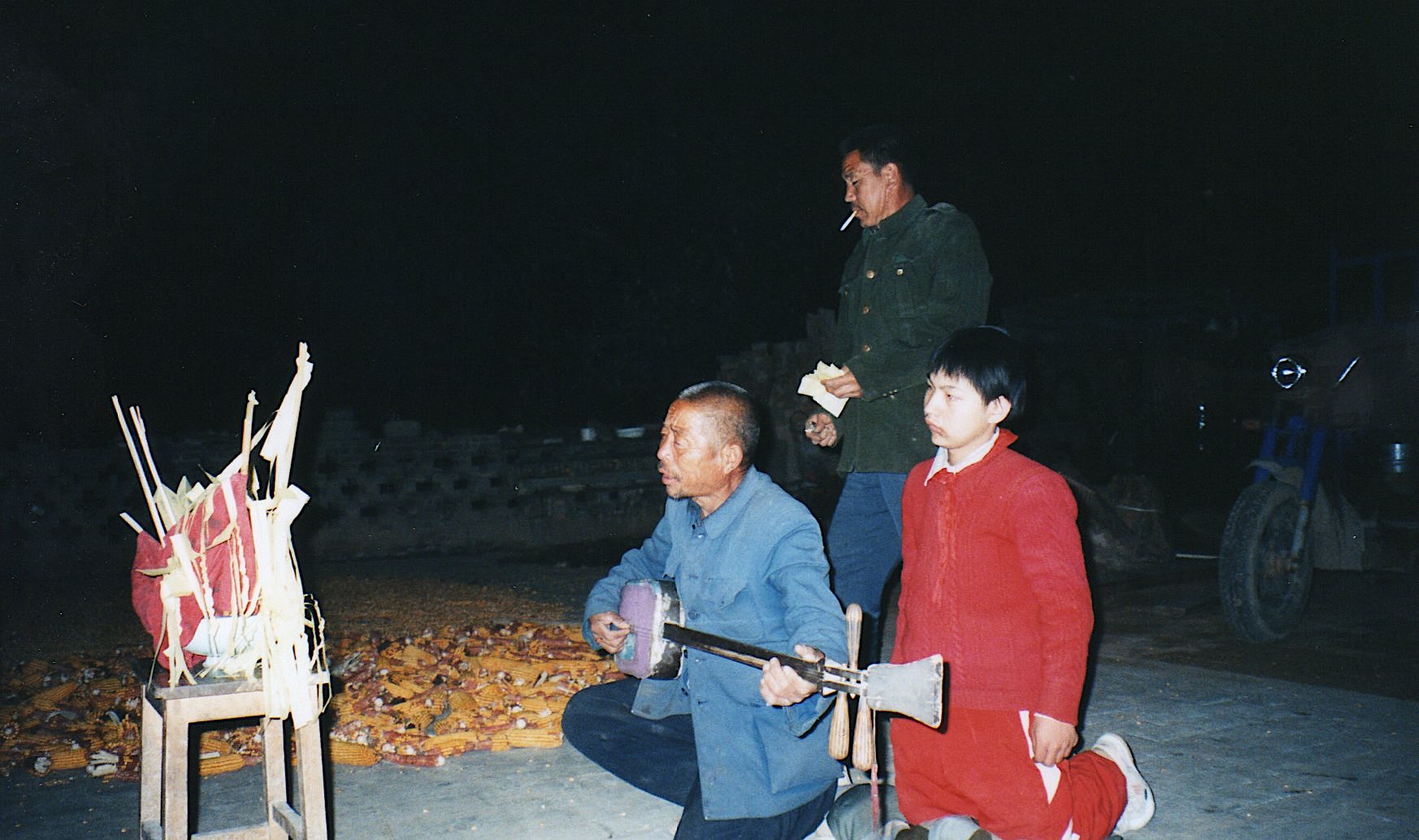
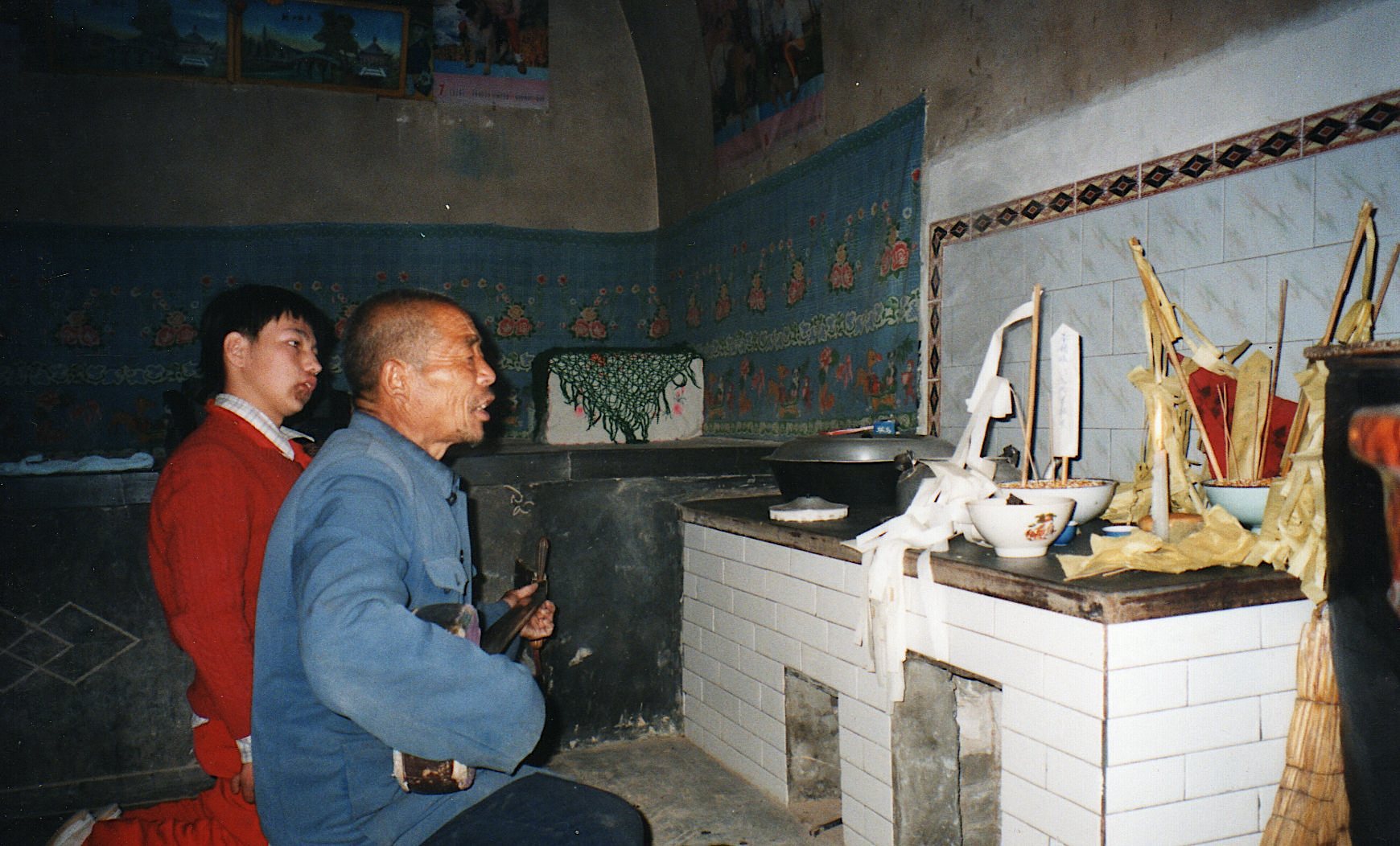
LWJ in courtyard

LWJ shuoshu

Sighted bard Li Wenjin performs a “story for well-being” to protect the son of the host family, first inviting the gods in the courtyard and then narrating a sequence of stories before the altar inside the cave-dwelling.
See DVD §C4 with my Ritual and music of north China, volume 2: Shaanbei,
and pp.83–4 there).
Photos: Guo Yuhua, 1999.

Introduction
In Shaanbei, as in much of rural China, while many blind men earn a living by taking up the shawm (on which see my post on Guo Yuhua, and here, as well as this post on north Shanxi), others have also long served as protectors of children, acting as godfathers and healers, and telling fortunes—as well as singing “stories for well-being”, accompanying themselves on a plucked lute and clappers, a kind of one-man band. They are itinerant, going by foot over quite a wide area.

Though in decline since the 1960s, the bards appear to have adapted rather little in context or sound. Under the Maoist collectives, some spent brief periods being taught new stories in the county-town “propaganda teams”, but this hardly affected their repertory or performing contexts. Since the 1990s, the popularity of the genre has been further threatened by the media of TV and pop music; and little bands now increasingly supplement the solo performers.

Social background
Blind bards also tell fortunes, cure illness, and act as godfathers—occasions when they do not necessarily perform stories. As godfathers they perform ceremonies protecting children (including hanging the locket, the annual Crossing the Passes ceremony at temple fairs, and opening the locket). These ceremonies have doubtless become rather less common since the 1950s, though neither campaigns against superstition nor any gradual improvement in healthcare entirely explain this.

Li Huaiqiang, in his 70s, had hung the locket for three or four hundred children; Guo Xingyu, in his 50s, for “over 290”.

Like geomancers and mediums, the blindman performs healing in a ritual called Settling the Earth or Settling the Earth God. For this he recites incantations and depicts talismans, but does not perform stories.

These occupations were a lifeline for males only: the fate of blind females was pitiable.

Occupations for blind men in Shaanbei

  • begging (yaofan 要饭)
  • playing in a shawm band (guyue 鼓乐, chuishou 吹手)
  • telling fortunes (suangua 算卦)
  • exorcism / healing (antushen 安土神, zhibing 治病)
  • hanging the locket (baosuo 抱锁, daisuo 带锁), opening the locket (kaisuo 开锁), Crossing the Passes (guoguan 过关)
  • narrative-singing (shuoshu 说书).

Contexts for narrative-singing

  • Stories for vows (yuanshu 愿书), to fulfil a verbal vow (huankouyuan 还口愿):
    household (jiashu 家书), for well-being (ping’an shu 平安书)
    temple fairs (huishu 会书: miaohui 庙会)
    parish (sheshu 社书)
  • less common: weddings (hongshi 红事), moving into a new cave-dwelling (nuanyao 暖窑), going off to the army (canjun 参军), official meetings (jiguan 机关).

Ritual equipment, stories, and music
For the narrative-singing contexts, the bard performs before a small temporary altar. Inscriptions for the gods and family, rectangular paper “god places” with a triangular head, mounted on gaoliang stalks, as well as changqing yellow paper streamers, are inserted into one or two rectangular bowls filled with grains of millet or corn. Before the altar are placed a lit candle, small bowls to hold incense and burn paper offerings, and offerings such as dough shapes, biscuits, dates, fruit, peanuts, cigarettes, and cups of liquor.

The altar is placed on the family stove or on a table; for the rituals to invite the gods and escort them away at the beginning and end of stories for well-being, it is placed on a table in the courtyard outside. Li Huaiqiang, though blind, prepared the changqing streamers himself; someone sighted and literate has to be found to write the inscriptions. Incense and paper are burnt before the altar periodically throughout the performance.

The bard takes with him a red cloth bearing the titles of a pantheon of gods. When not in use it is rolled up and kept in the bard’s bag. The cloth is unfurled and placed upright behind the altar, supported by two sticks inserted into a sleeve at either end of the cloth.

Cloth pantheons:
(left) Li Huaiqiang, 1999;
(right) Xu Wengong, 2001 (for a list of these gods, see Zhang Zhentao, Shengman shanmen, p.356).

Stories overlap with opera plots, relating historical tales of love, official success, solving of crimes, famous battles, and righteous protest—all familiar in Chinese fiction since the Ming dynasty, and often referring to still earlier times. Like opera, these stories have long been a dominant form for poor people to learn of history, legend, and morality, only being challenged by schooling since the 1950s. Schooling even now is quite elementary, though TV and pop music are doubtless replacing traditional stories for entertainment.

Indeed, bards’ stories are like a cheaper, more portable version of opera that can be brought into the home to bring good fortune to the family. Like opera (and indeed TV soap opera), stories may be performed in sections at successive sittings—commonly three episodes (huihui).

Bards improvise phrases on the basis of a well-known story—as He Guangwu observed: “We respond to the changes on the spur of the moment (suiji yingbian 随机应变), the lyrics aren’t fixed and dead (dingsi 定死).”

The solo performer accompanies himself on a plucked lute and usually two percussion instruments attached to his left leg and right hand. He may rest his right foot on a low stool, and drapes a towel over his shoulder to wipe sweat from his face. The plucked lute is either unfretted three-stringed sanxian (known as xianzi) or the fretted four-stringed pipa; the sanxian is most common, the use of pipa declining drastically in this area since the 1980s.

This rare form of pipa (see below), held less vertically than the “modern” pipa, and played with a plectrum, was a major discovery, reminding scholars of the Tang dynasty pipa. As was the trend through the 1980s, they were keen to conjure up “living fossils” and evoke the glories of ancient dynasties, but they mustered less publicity for this supposed relic of the Tang pipa than did scholars of nanyin in southeast China.

Han Qixiang and the training sessions
As with many other genres in China, the national reputation of narrative-singing in Shaanbei rests largely on one performer who came to the attention of cultural cadres and was cultivated by them. Han Qixiang (1915–89), dubbed “China’s Homer” but redder than red. The Party’s model blind bard in Shaanbei during the Yan’an period.
Han Qixiang

from http://www.confucianism.com.cn/html/minsu/15021455.html

In my book I outline his career, trying to read between the lines of hagiographic Chinese accounts on the basis of the 1993 article

  • Chang-tai Hung, “Reeducating a Blind Storyteller: Han Qixiang and the Chinese Communist Storytelling Campaign”, Modern China 19.4 (1993).

From 1945, Party ideologues went to some lengths to reform storytelling with a network of training sessions. After the national “Liberation” of 1949, every county government throughout China set up an arts-work troupe, which soon metamorphosed into an opera troupe; some county authorities further set up a narrative-singing artists’ propaganda team (shuoshu yiren xuanchuandui). These narrative-singing teams were less permanent (and much less costly) than the opera troupes; they held training sessions before dividing into smaller teams to go off on tour round the villages. Bards were lodged together, sometimes for a few months but often for just a few days, and even if they could remember the new stories, they remained reluctant to perform them once they went on the road.

Apart from Han Qixiang, another blind performer mentioned in the 1940s as creator of new stories is Shi Weijun (b.1924), who organized training sessions for bards around Suide county. Blind bard Guo Xingyu (see below), himself no simple official mouthpiece, hinted that Shi Weijun found it hard to adapt to official demands after Liberation. “But then he gave up—he didn’t even want his wages, he lost his standing, and went off on his own to tell stories.” He was clearly reluctant to take part in official events.

We can discount the rosy official image, but even the candid local scholar Meng Haiping recalls the period before the Cultural Revolution as a golden age for the blind bards, with county Halls of Culture organizing them into teams and issuing permits, so that district and village leaders had to receive them, hosting and feeding them—an unprecedented and welcome way to guarantee their “food-bowl”.

Conversely, if the state now acted as the bards’ patron, their richer patrons had disappeared, and their poorer ones were becoming wary of inviting them; temple fairs and “superstition” were under threat. Many bards were not recruited to the teams or were unwilling to join, and even those who did take part did so only intermittently. Although those not registered in the teams were not given permits, they still managed to perform, relying on the old contexts such as “stories for well-being” and godfather duties. But the climate was changing: as the power of campaigns sunk into people’s consciousness, they would have been increasingly nervous of inviting bards openly.

Even those bards who did spend periods in the official teams learning new stories continued to earn their living from more or less “feudal superstitious” contexts. You couldn’t perform new items for hanging the locket, or as stories for well-being.

Party ideologues admired popular oral literature; while deploring its links with superstition, they were unsuccessful in seeking to break such links. The new stories were often based on novellas or opera scripts, and composed with the “guidance” of cadres. As Hung points out, it was hardly a collaboration between peasants and intellectuals—it was never in doubt who was in charge.

It’s hard to assess is how the new stories were received. Even clues in the unremitting hagiography unwittingly give glimpses of constant conflict and difficulties. Han Qixiang composed a new story called “We can’t withdraw from the collective” (Buneng tuishe) (how very true!), reportedly converting peasants who were opposed to collectivism. Having heard that in some Zichang villages women were reluctant to work in the fields, and men reluctant to tolerate them doing so, he composed pieces exhorting them and praising female labour heroes. During the famine of 1959–60 he performed “Turning over a new leaf” (see link in Comment § below) for peasants disgruntled with the paltry goods available on New Year’s Eve, supposedly enlightening them as to how much their lives had improved since the bad old society. Yeah right…

Still, Han Qixiang was a fine performer; even when he told new stories, he would naturally vary them every time, like bards worldwide, and he retained the colourful local vocabulary of bards throughout the area. One cannot merely assess his stories from the page, without being able to witness his performances and those of other bards of the day. Bards I met were less impressed by his technique or creativity than by his good fortune in meeting the right people at the right time and getting onto the government payroll.

So whereas Han Qixiang appears to have been a model “folk artist” propounding Party policies with conviction, most bards in Shaanbei have continued to eke out a living from their traditional exorcistic “stories for well-being”, both under Maoism and since the reforms.

Immortal Li
Among the characters in Guo Yuhua’s book on Jicun is the village’s blind bard Li Huaiqiang (1922–2000, known in the village as “Immortal Li”, Li xian); as ever, my notes benefit from her rapport with him. Visiting his cave-dwelling in 1999, she introduced us and we all sat ourselves down on his kang brick-bed; having explored my facial contours with his hands, he gently held my hand throughout our chat.
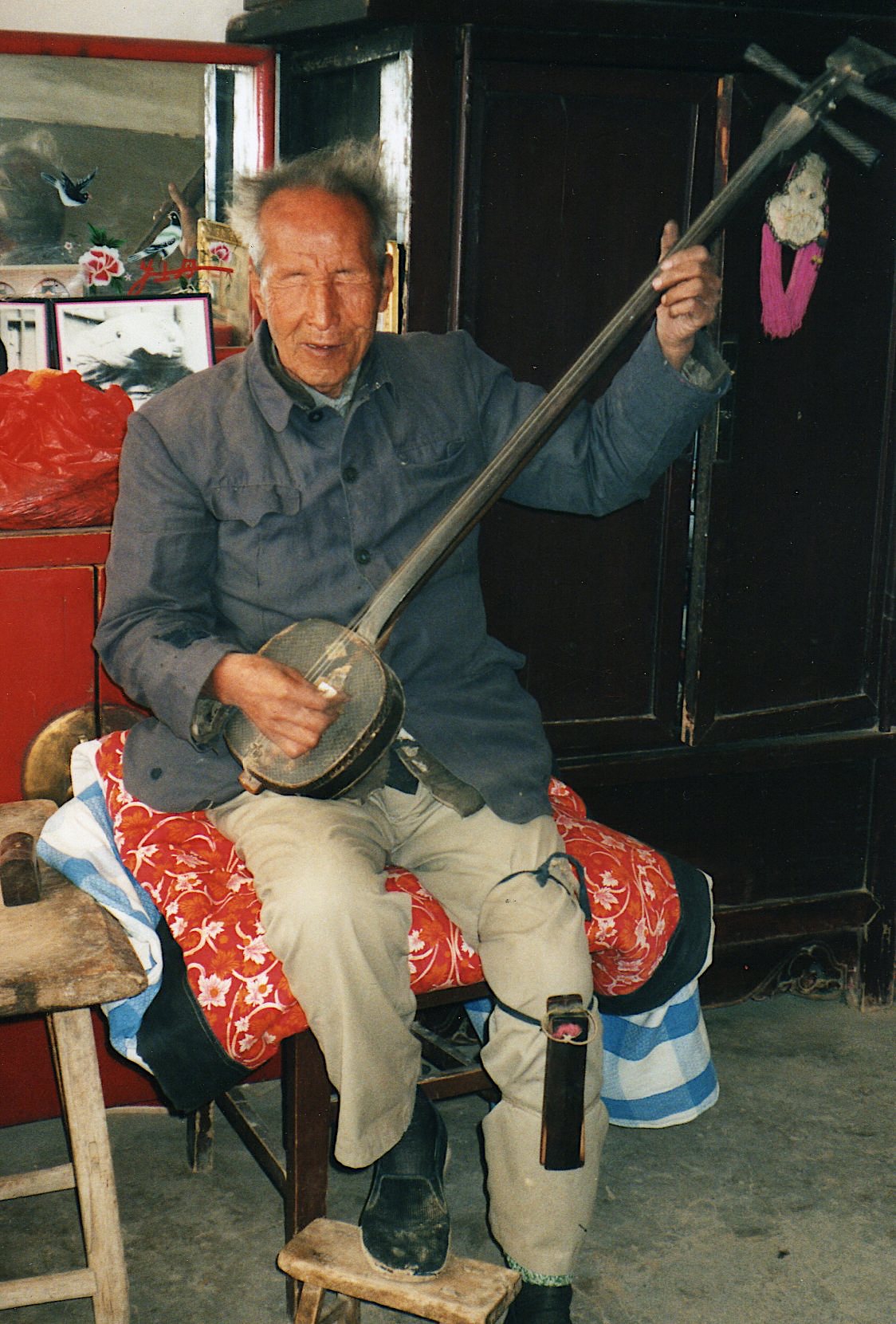
LHQ shuoshu

Li Huaiqiang was among the great majority of bards (and audiences) not amenable to the new stories. Under Maoism, though he gained a house and a family, his livelihood was reduced; since the reforms of the 1980s he suffered both from the decline in popularity of the art and his own dwindling skills.

Li Huaiqiang was born to a poor family of hired labourers working for the village landlords. Such poor families couldn’t afford to send their children to school, and he attended “winter school” for a mere few days. He lost his sight completely by the age of 10 sui. When he was 15 or 16 sui (c1936–7) his father took him to a blind bard to “learn up the arts” of narrative-singing, “history”, fortune-telling, and healing. Learning stories phrase by phrase was time-consuming and expensive—his father had to scrape the fees together. Li contrasts that ruefully with the ease of young upstarts today who can learn just by listening to tapes.

Li began “going out of the door” to earn a living before he was 18 sui, practising both healing and narrative-singing. He was often in demand to cure illness: when someone’s child was seriously ill, Li could give acupuncture and Chinese medicine. When adults had some irregular illness (xiebing), some bad karma, for which orthodox medicine was no use, he’d find them some special herbs.

Since Yangjiagou was still a landlord stronghold, in the early days Li often performed stories all four seasons of the year for the landlords in the village itself. Such performances—like longevity celebrations, or for the first full moon of newly-born children—often lasted seven or eight days. The landlords had a shrine to the god of wealth in their houses—before it bards would tell their stories, and Buddhist monks would recite their scriptures.

Ritual has always remained paramount for bards like Li. “Poor people (shoukuren) worship the Dragon King Elder (Longwangye), stockbreeders worship Horse King Elder (Mawangye), people in business worship God of Prosperity Elder (Caishenye). When people make vows they invite us to tell stories, that’s how we make our living.” Since vows were often fulfilled in the 1st and 2nd moons, bards were most busy then.

By the 1940s, Li’s itinerant business was taking him—by foot—all over Shaanbei. Recalling the old temple fairs, he mentioned the two most famous, still very active now: “I used to go to Baiyunshan for over twenty years, I even went once after the end of the Cultural Revolution. I used to go every year, there were kids there that I’d hung the locket for.” Li performed for the small temple fairs in his home village too, notably the 4th-moon fair at the Pusa miao temple. The temple fairs in the neighbouring hamlet of Sigou were planned best, and were popular; people liked listening to narrative-singing there.

Li Huaiqiang’s early visits south to the Yan’an region, in 1938 or 1939, were part of his routine itinerant business. He told stories around Hengshan and Bao’an (Zhidan) counties too. “No-one controlled what stories you told then, you could narrate what you liked.”

In 1943, after the Suide–Mizhi area was taken over by the Communists, Li found himself unable to make a living there, and went off to Yinchuan in Ningxia and nearby Xichuan. The Nationalist officials loved listening to stories—bards were invited to their quarters. They could travel freely then—only later, when the Communist–Nationalist collaboration ended, did the roads become impassable.

Still, his assessment of the Red and White areas was ingenuous. “It was just the same under the Communists and the Nationalists. Under the Nationalists it was easy to earn money, people liked to listen to stories. After the Communists took control over people, not allowing superstition, at least there was provision for us disabled people, there was relief. So things were the same.” But he did remark, “In the end the Communists came along and broke all the temple fairs up, so there was nothing left.”

I wonder how many bards chose to seek a living in either the Red or White Areas. Evidently old stories did not suddenly vanish throughout the Yan’an countryside. The Yulin region was a seesaw area between the two sides, and most local leaders would, as yet, be broad-minded about traditional forms. We can’t judge, but it is worth challenging the propaganda. And having blithely equated “new stories” with items supporting the Communists, I wonder if bards in the Nationalist areas performed new stories opposing the Communists.

Li Huaiqiang dismissed our queries about the officially-organized groups—he had only the vaguest recollection of this experience. It might have remained an exciting moment in his life distinguished by its uniqueness—but apparently hadn’t. Li went on:

From 1945 they summoned all the blind bards to meetings—they weren’t allowed to sing old stories any more, they had to sing new ones. I studied them and then forgot them all—well, I basically didn’t study them! When you go out [on business], the common people don’t listen to that stuff! New stories aren’t good to listen to—people don’t like listening to new stories, they like old ones! I could never forget the old stories I learned when I was young, though. I can tell twenty or thirty stories. When you went out in the old days there was business, you could count on it—who’d have thought it would all come to an end?

He knew of Han Qixiang but didn’t hear him perform or meet him. “That Han Qixiang, he got onto the official payroll. Oh yes, people in our business all know about Han Qixiang. In the Yan’an period people reformed it into new stories, but they didn’t control us lot who narrated old stories, we just went off round the countryside narrating on our own.” He knew that some performers sang for political meetings, but didn’t admit to doing so himself.

Li Huaiqiang was lucky to find a wife:

I was 24 when I got married [c1946]. They came to take conscripts—people stuck to their old habits, no-one wanted to go off, but they forced them. But us blind people, we couldn’t go off to the army, no-one wanted us—that’s how I got a wife. People were afraid of joining the army, both sides were taking people off, no-one dared go, as soon as you went off you’d get killed. If it was today I couldn’t get married—now it’s hard enough for sighted men to find a wife.

During land reform there were meetings all the time. The Communist Party controlled people, eliminating superstition. When they wanted to hold a meeting they first summoned a bard to narrate a [new] section, so everyone turned up—then the bard sang the old stories that people liked.

This was a common theme, of great significance for our understanding of the Maoist period. The bard would attract people to turn up for tedious political meetings, and satisfy the demands of political expediency by performing a brief political item first, before the fun began. Scholar Meng Haiping recalled: “Both old and new stories were heard then. Until 1956, they began with a short section with new content, then moved onto the old stories like ‘The story of five women reviving the Tang’ (Wunü xing Tang zhuan).”

Li Huaiqiang originally lived in a miserable cave-dwelling made of earth, but after land reform, he was helped to “buy” a comfortable cave-dwelling right at the top of the village from the former landlords, which had been servants’ quarters. The landlords also had to “sell” him their precious sanxian banjo, which he bought for one dan of grain.

If in that sense Li was able to profit from the overthrow of the landlords, he soon suffered from their demise. “We were allowed to narrate stories in the early days after Liberation, but people’s consciousness was raised, people had studied a lot of books.” I didn’t care to argue with him there, so he went on, “They said narrative-singing was boring, so there was a lot less of it—it got less all of a sudden with the collectives [from the mid-1950s]. People like us just tilled the fields, told fortunes, we could just about get by, the state gave us relief. We couldn’t just die off—some people were given relief, some were put in old people’s homes, some with skills could go out and heal illness and tell fortunes.” And he was still taking large numbers of godchildren, whose parents’ regular little gifts always presented a lifeline.

If Li Huaiqiang was unaware of it, the Mizhi county authorities were attempting to organize bards. Gao Zhiqiang, former chief of the county Hall of Culture, recalled, “The county first set up a narrative-singing team in the early 1950s, organizing over twenty blind bards, training them all together to sing new stories. The Hall of Culture issued them with performance permits, which meant that the district and village authorities had to host them—that resolved blind men’s problem of livelihood.” But the teams never controlled blindmen for long.

Li Huaiqiang, who had never belonged to a team or performed in a group, still relied on a minimal handout from the village government to survive; with his wife and five children, times were desperate. “In the Cultural Revolution they didn’t invite us bards any more, it just stopped. But people like us still went out—mostly to tell fortunes, not so much to narrate stories.” And he sometimes sneaked out to hang the locket for children in exchange for “a couple of little coins”. Li was soon branded an “ox demon and snake spirit”, accused of feudal superstition. They took his manual off and burned it; they took his sanxian banjo away too, but he got it back after half a year. “Pesky kids, coming to our houses to get us to hand things over—if you did, then you were let off, if you didn’t then they paraded you through the streets.” Li was only paraded once. The only time he could recall when the authorities regulated narrative-singing was in the year of rebellion (zaofan) of the Cultural Revolution, when all the brigades had to organize blind bards into narrative-singing teams to go round and make propaganda, the county Hall of Culture taking a cut.

The reform era
In Shaanbei, as elsewhere in China, as the commune system began to be dismantled from the early 1980s, traditional culture revived more openly. Bards had been active throughout the commune period, both in and out of the new teams; if the old contexts and stories had never died out, after the “rotting of the collectives” there was no longer such need for collusion or duplicity. As Li Huaiqiang recalled, “As soon as Mao Zedong died, they stopped controlling us bards.” But like other traditional performers, they were soon competing with new economic pressures, TV and pop music taking their toll: where Maoism had failed to marginalize tradition, capitalism looked like succeeding.

Despite his privations under Maoism, he warmed to the theme:

Society’s different now, people have “turned over a new leaf”, reforms and all that—too much reform, it’s all gone too far…

Ebullient local pundit Meng Haiping had a perceptive comment:

In those days [under the communes] they tried to destroy traditional culture, but couldn’t; now they don’t control it any more, but it gradually declines anyway. 1984 to 1990 was the best period. Ever since the great wave of economics started, culture has been dying out.

The agenda of the cultural authorities hardly changed, even if state policy would never again be so “hard”: they still sought to teach the bards new stories to spread education about party policies, and they still aspired to both “controlling” and “looking after” the bards—ambivalent meanings of the term guan 管.

By the late 1990s Li Huaiqiang, quite frail in his old age, was less active as a bard. Lucky enough to have found a wife during times of war, Li has two sons and three daughters; but the family has remained poor, and the sons have been unable to find wives. In 1999 Li performed for the 4th-moon temple fair in his village, and he still did the occasional story for well-being for families fulfilling vows. But he told us: “I’m almost without business these days, 80% of my work is gone. Most temple fairs don’t have narrative-singing any more. These days people read books a lot [surely he overestimates this!]—the state doesn’t control it any more, people just don’t want to be away from work. They’ve got TV and recordings too now.” He used to perform for audiences of 80 or 90 people, but now it’s only for around 20 or 30, mostly elderly. “I can’t keep up.” This didn’t apply generally to narrative-singing in the whole area, but to Li in particular—elderly, frail, and no longer a gifted performer.

In the exceptional conditions of Yangjiagou, the occasional visit from Japanese tourist groups, Chinese and foreign scholars, and visitors to the memorial hall to Chairman Mao’s 1947 sojourn, allowed Immortal Li to supplement his meagre income: “They always get me to perform when someone comes.” But his main income still came from his godchildren, as it had done under Maoism. While we were in the village, one of his godchildren’s children was getting married, and when he paid a visit he was given 20 kuai; when he left they gave him mantou steamed buns, and later they gave him some clothing.
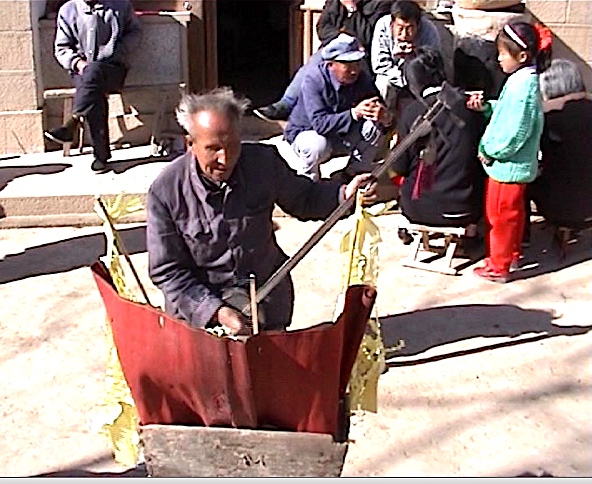
LHQ qingshen

We took him to the cave-dwelling of our host Older Brother, the sweet blind shawm player, to perform a “story for well-being” for the family, as usual inviting the gods outside in the courtyard before telling a story indoors. Though his skills were in decline, it was a memorable occasion.

Li Huaiqiang died in July 2000, falling from a narrow mountain path while on his way to another village to hang a locket. Since his death, other itinerant bards occasionally stop off to perform in the village.

He Guangwu
He Guangwu (b. c1932) is a semi-blind bard from a village west of the river, south of Mizhi town. He began to lose his sight when 15 sui (c1946), so a couple of years later he began “learning the arts” with a master from Zizhou county, mastering a dozen traditional stories—although this was supposedly a climactic period for the new stories, the old stories were being transmitted as if nothing had changed.

He married when 21 sui. Their families arranged the match; his betrothed lived in a village only two li away, but they wouldn’t let her see him, and she only discovered his disability at their wedding. Now she jokes about it and is evidently happy that the family is relatively prosperous with many great-grandchildren; we didn’t like to press her on how it had seemed then.

He had taken part in training sessions in 1955 and 1964, but his concept of his livelihood barely took official contexts into account.

His family has done well since the reforms. He is active over a small area, proudly claiming to be well known within a radius of 20 li (10 kilometres), and he hasn’t taken any disciples. But he is busy. “People still invite me, and I still go. For temple fairs, or if a donkey isn’t eating its fodder, or if a family member is on a long journey, you must invite a ‘story for well-being’; and I tell stories for opening the locket, weddings, moving into a new cave-dwelling, and sons going off to the army.” He is also busy telling fortunes and healing.

HGW and me 2001

With He Guangwu, 2001. Photo: Zhang Zhentao.

In 2001 we found He Guangwu at a small temple fair at Jijiashigou, near his home village. He had agreed to tell fortunes for a family there to help them overcome adversity, and hadn’t brought his sanxian. He agreed to tell a story for us back at his home if we took him back to the temple fair later.

Tian Zhizi
We also visited Tian Zhizi (b. c1933) at his son’s home in a little town south of Zizhou on the road to Suide. He had belonged to the Zizhou team, and also studied in the Suide team. “My eyes were no good from young—I began studying narrative-singing in 1944. My master was Wang Jialai from Zizhou county. When I learned I lived at his house—his fee was 3 dan of grain per year, and I learned for three years.” Through the War of Resistance and the War of Liberation—precisely the period when the new stories were supposedly in the ascendant—Tian supported himself by curing illness, reciting incantations, and depicting talismans.

I began telling stories in 1951, and in 1952 became chief of the Zizhou blind people’s propaganda team, which had been formed the previous year. I was chief of the team for three years; it had over 60 members. Between 1952 to 1956 I studied new stories at the Jiuzhenguan hall in Suide.

Their boss was Shang Airen, an influential cultural official in Shaanbei. Despite my suspicions, Tian recalled,

In the 1950s the peasants loved hearing new stories. The main ones I learned were “The outstanding troupe member”, “Zhang Yulan takes part in the election”, “Opposing shamans”, “The tobacco pouch”, “Mother Gui makes shoes for the army”, and “Wang Piqin takes the southern road”.

Still, through the 1950s and 60s, while the bards from the team sometimes went on tour in small groups, Tian usually went round on his own. When he was 28 sui (c1960), Tian married a girl from the same town—which he claimed was “free love’” not arranged. In 1962 he spent a period working in Yan’an with none other than Han Qixiang, earning 36 kuai a month. Later he resigned and returned home, still making a living as an itinerant bard, also telling fortunes, hanging and opening lockets—by 2001 he had over 200 godchildren.

He went on, “I have 28 disciples in all, eight in Wubu, four in Yulin, two in Shenmu, also in Yan’an, Ansai, and Bao’an [Zhidan]. I took some disciples while I was at Yan’an in 1962, others stayed at my house to learn.”

Unusually, the Cultural Revolution was a significant period of activity for blind bards, who continued to perform both in their traditional contexts and in the state groups. The latter now had a new lease of life as “Blind artists’ Mao Zedong Thought propaganda teams”. In Mizhi county, the Hall of Culture organized a dozen bards into one such team, touring villages, mines, and schools—villages without electricity, mines where accidents were routine, schools with few tables or chairs, and the whole population constantly hungry and demoralized, if you will forgive me for reminding you.

“In 1972 I was mainly taking disciples in Wubu, ‘cos the Wubu Hall of Culture invited me to come to train members for their propaganda team.” Though it was ever harder for bards to perform without the sanction of the teams, popular taste still appeared to require an escape from the relentless revolutionary diet. Tian Zhizi had claimed that the new stories were popular in the 1950s, but “from 1967 [traditional] narrative-singing was forbidden—by that time people preferred old stories, or at least they didn’t like new ones, so we bards told some old ones in the villages on the quiet.”

Other bards also told us that while they couldn’t hang the locket openly during the Cultural Revolution, for those who needed it they still did it, and they still performed in secret in the villages—the people liked to listen and protected them. Geomancers were also still furtively active.

Ironically, perhaps the worst case of penalization was revolutionary Han Qixiang himself, inactive and subject to public criticism throughout the period. As late as 1976, just as the Gang of Four was about to be arrested, he was summoned to perform in Xi’an and criticized, though by late 1977 he was well back on the road to rehabilitation, taking part again in official meetings.

Guo Xingyu
A younger blind bard more able than many to move with the times is Guo Xingyu (b.1951), with whom I spent some time in 2001. His case is quite exceptional among bards I have met, following political trends astutely while continuing to take godchildren and cure illness.

Brought up in a poor Suide village, Guo Xingyu was blind from young. He studied narrative-singing and fortune-telling for ten moons with Wang Jinkao from the age of 12 sui (c1962). He started going out on business when about 16 sui, on the eve of the Cultural Revolution. “When I was young I enjoyed learning everything from my master, curing illness, depicting talismans and chanting mantras”.

When I was just starting out we mainly told old stories, though in public contexts we told bits of new stories. New ones I liked telling, before and during the Cultural Revolution, were “Fuss over an abortion”, “Eliminating transactional marriages”, “The great immortal who eats ghosts”, “Eliminating superstition”, and “The tale of the city youth returning to the countryside”.

In 1968 Guo Xingyu joined the Suide county blind peoples’ propaganda team, which had several dozen bards, divided into three or four sub-groups:

In the 60s we were issued with narrative-singing permits; we had to hand over part of our income to the Hall of Culture as “public assets”—the state also took a certain amount of training expenses, but later that stopped. In the 60s and 70s the whole county probably had about 70 or 80 bards—about 40 or 50 didn’t enter the training bands, they had to tell stories on the quiet.

Guo Xingyu even took part in official festivals in Suide, Yulin, and Xi’an; he was praised by the venerable Han Qixiang. He appeared a model bard in the new mould—little would one think that all the while he was performing stories for well-being and healing.

From 1972 I was head of the blind men’s propaganda team organized by the Suide Hall of Culture. I entered the Party in 1975, and from 1978 I was political instructor of the team. In the 1980s I composed some new propaganda-type stories on the basis of the political needs of the time, mainly things like advertising the spirit of the Party’s 12th and 14th Plenary, and birth control, like “Fuss over an abortion” and “Marrying Late”.

By 2001 the team was moribund. Guo and his (sighted) wife were dividing their time between his home village and an apartment in the suburbs of Suide town. He had rarely performed as a bard since getting heart disease around 1991; now his main livelihood was curing illness by depicting talismans and chanting incantations, and hanging and opening lockets. Relying on his traditional magic, he legitimized it with a fashionably scientific-sounding defence: “magic power is rational (fali you daoli)”.

Guo Xingyu took us to see his blind master Wang Jinkao at his village home south of Suide town (DVD §C3).

WJK, GXY heying

With (right to left) Wang Jinkao, Guo Xingyu, and Wang’s son, 2001. Photo: Tian Yaonong.

Wang (known as Niur, b. c1930) married a sighted girl in 1947; they have three sons and a daughter, all peasants in the village. Wang accompanied himself on pipa rather than sanxian. When Guo Xingyu studied with him around 1962 he was running a kind of blind school in Qingjian; he learned in a group of five or six blind boys, whose parents had to pay fees. He was one of few bards still using pipa rather than sanxian.

Wang Jinkao had had minimal contact with the new ethos: he could tell new stories like “Wang Gui and Li Xiangxiang”, but if he had ever taken part in training sessions or belonged to the county team, no-one cared to remember.

As we saw, bards mostly worked solo; even when they assembled for temple fairs and New Year’s festivities, they performed in sequence, not together. But under Maoism, bards were sometimes organized into small groups to perform for non-ritual contexts.

Still, both new contexts and musical innovations remained a minor feature even through the years of Maoism, and after the “rotting of the collectives”, tradition became yet more dominant. Some new stories were still performed—on the birth-control policy, the reform and open-door policy, the private enterprise system. Some county authorities continued their efforts to organize blind performers, even trying entry by ticket. But as prices rose and more modern entertainments became popular, they resorted to more viable money-making ventures like setting up halls for video games, or classes teaching electronic keyboards.

By the 1990s the propaganda teams were virtually defunct. As one cultural cadre told us: “Later the bards didn’t want people to control them, and we didn’t have enough money anyway, so we gave up.”

Blind and sighted bards
Though Han Qixiang mentioned competition between blind and sighted bards when he was learning in the 1930s, narrative-singing in Shaanbei was largely a monopoly of blindmen, and only since the eve of the Cultural Revolution has the taboo against sighted performers been seriously challenged.

By around 2000 it was a fait accompli for sighted men to muscle in on the trade. There were fewer blind people anyway, since health has improved (though still appalling); and they could now receive modest disability benefits, or migrate in search of work as masseurs.

Nor do sighted men fear going blind any longer if they take it up. Half of Tian Zhizi’s 28 disciples were sighted—presumably those he taught since the 1970s. Although one elderly bard commented that the new disabled allowance for blind people makes them lazy, blind performers who are still active rather resented the encroachment on their “food-bowl”. “Originally sighted people weren’t allowed to tell stories—if you’re sighted you can do anything [else].” Now not only can sighted people learn, but they can even learn from tapes, saving them money but depriving senior blind bards of teaching fees.

Scholar Meng Haiping pointed out: “In the old days, bards’ social status was low; now for everyone all that counts is money, social status no longer comes into it.” This was certainly true for trendy young chuishou shawm-band musicians in the towns, but less obvious for the bards. Unlike the chuishou, bards have not spruced up their image so ambitiously, and remain quite modestly paid; nor have they yet availed themselves of the mobile-phone revolution that has occurred since about 1998. Whereas chuishou often ride motor-bikes, bards (even sighted ones) mostly go on foot.

Guo Xingyu:

Now there are sighted bards everywhere—many senior-secondary graduates, not wanting a hard life, go and tell stories. In Zizhou, Hengshan, and Yulin there are a lot of sighted bards, and there are some in Mizhi and Jiaxian too. Now there are fewer than thirty blind bards in Suide, but there are more sighted ones. They began appearing in the 1980s or 1990s, they drove the blind ones away; the blind ones were very angry about it—but the sighted ones had permits too.

He went on darkly,

Now how did that come about, then? Perhaps by bribery. Now blind artists are in great difficulties. There are more of them west of the river, but quite a few of the old artists have died; east of the river their skills aren’t quite so good.

Li Wenjin
I met sighted bard Li Wenjin (b. c1943) with Guo Yuhua in 1999 when he performed informally for staff at the office of the Black Dragon temple (on which see Adam Chau’s fine book Miraculous response), as a kind of advertisement for his arrival in the area. He comes from a village in Zizhou county. Soon after Liberation, in the early 1950s, he studied for three winters in the evenings in the “school for sweeping away illiteracy”. His parents died early, but he only began studying narrative-singing in the early 1980s, with the old blind bard in his village. His master could never find a wife: “when the five organs are incomplete, no-one will follow you”—though most of our blind mentors were exceptions. There was a libretto (benben) that he could follow—even blind performers sometimes owned a libretto. Li Wenjin was active over quite a wide area. He usually sings with his eyes closed—in imitation of blind bards?

LWJ and GYH

Guo Yuhua and temple organizers listen to Li Wenjin, Black Dragon Temple 1999.

A couple of days after meeting him at the temple where we were staying, we bumped into him on our way back there, and he invited us along to hear a “story for well-being” that evening for a family in the nearby village (see photos at head of this post).

Xu Wengong
We met another sighted bard at the White Cloud Mountain temple fair in 2001. Xu Wengong (b. c1948), from a village in Qingjian county, began learning at 17 sui [c1964] from an uncle, so the taboo was perhaps being broken down even then. He has never taken part in any county-organized teams, or learned new stories. During the Cultural Revolution he was protected by villagers as he went round performing and hanging lockets on the quiet.

Many pilgrims attend the temple fair under the auspices of a dozen or so regional associations, each with particular allegiances among the many temple gods, sponsoring different daily rituals. Apart from the daily performances of opera, bards perform in a less public and commercial arrangement that is also typical of Shaanbei temple fairs. One evening we visit the cave of the Zizhou, Qingjian, and Ansai association where Xu Wengong was performing.

He comes to this fair every year as part of this pilgrim association, in order to fulfil a vow. “My father was a model labourer, and was head of this association”—note this typically casual link between Communist and traditional authority. “He came here to take part in the rituals and made a vow, because I’d had stomach disease for twelve years, and sure enough I got better. So I’ve been coming here to fulfil the vow every year since the temple restored, to revere the great god Zhenwu; I come here to avert calamity.” Some other bards also come to the temple fair not to make money but to fulfil vows.

There is no need to “invite the gods”, since they are already present, but on the left of the cave, as you stoop to enter, is an altar behind which the bard’s red cloth pantheon is displayed (see photo above). Individual pilgrims periodically burn paper and kowtow before it. Xu Wengong performs opposite the altar, the pilgrims sitting on mats at the rear of the cave, listening intently. They consist mostly of men over 50, but even those over 60 were brought up largely under Maoism. Yet such senior men entirely represent tradition; ritual associations like this surely represent a kind of passive alternative to government control.

Baiyunshan pilgrims 2001

XWG BYS 2001

Xu Wengong, Baiyunshan 2001

Old and new stories
Despite the propaganda surrounding Han Qixiang, not only does no-one value new stories now, but few recall them being popular even under Maoism. He Guangwu recalled, “In those days, usually we’d tell a section of a new story first and then tell an old one.” Other bards like Li Huaiqiang had no time for new stories at all. He had heard “Smashing superstition” on tape at a villager’s house, but “people don’t like it, it’s not good to listen to—you can’t sing stories like that for families, only for big meetings where tickets are on sale!” He Guangwu had learned “Opposing shamans” in the training session in the 1950s, but he too commented wryly, “You can’t tell that story nowadays—that’d be blasphemy!”

Even if the popularity of new stories was highly limited, and the subjects remained traditional, Li Huaiqiang pointed out that the bards’ language had been evolving along with the language of society generally. A certain change of style, reflecting the times, had evidently left him behind.

In the old days you sang of “Lady” or “Mistress” (furen, xiaojie), now it’s “missus” (poyi); in the old days it was “setting up as a family” (chengjia), nowadays it’s “the couple have got together”, “they held hands as they walked”, “they kissed”—it’s so lacking in culture! Old people won’t listen to that stuff, in the old days it was real cultured, now it just ain’t the same. But you have to adapt yer language to the times, eh?

So why should people apparently prefer stories about events many centuries earlier to ones about their society now? Local scholar Meng Haiping explained the ability of the old stories to survive under Maoism:

Traditional stories propound truth, goodness, beauty, and filial piety (zhenshanmeixiao 真善美孝)—that is China’s traditional morality, the Party doesn’t oppose that, and doesn’t suppress it.

Though there is ample evidence to show that they did oppose it, deliberately, regarding it under headings such as “bourgeois morality”, Meng was still making a fair point—because the Party he refers to is that on the ground, where continuity is more evident in local practice than the rupture often advocated by central theory.

Having complained about the coarsening of the bards’ language, Li Huaiqiang went on to lament the changing times:

In the old days bards used to wear a robe, and a hat with a pigtail. Nowadays it’s all simplified. Then it was wagai hats, sitting at a high table; now you don’t get changed, and just sit on a stool, it’s much simpler. And the gods used to be more efficacious, they were dead efficacious—if you didn’t follow them you could die. Once someone’s son died, and the parents made a vow to beg him to come back to life, so I obeyed the gods, and he really did come back to life.

So why didn’t the new stories become popular? Sure, villagers might be conservative and escapist in their tastes, finding stories of emperors and concubines, scholars and maids, generals and outlaws more attractive than propaganda. But the new stories might have been entertaining and meaningful in the contexts of the 1940s too. The irony was that the whole purpose of the new stories since the 1940s was to address current issues of great importance to the peasantry: namely tackling endemic social problems inherited from the old society.

But problems that might be arising under the new society were not now to be publicly aired. I would surmise that villagers might have been open to new stories, but were disillusioned by their glib political correctness, their failure to reflect complex new realities. The new stories were surely rarely heard in the villages apart from at mass meetings by which people were anyway alienated. If villagers were still able to host a performer to sing to invite the gods to heal their livestock, the new stories were inappropriate. In the early period of the 1940s, they might have had considerable novelty, and even helped people confront genuine problems, like forced marriages, opium, landlord exploitation. But maybe the themes didn’t keep pace with the problems: by the 1950s their perceived problems included campaigns, collectivization, irrational directives, and thus the new items seemed false, like the propaganda itself.

Still, as we saw, the stories Han Qixiang performed on his tours in the late 1950s were often semi-improvised according to the events unfolding in the village. That is, problems such as reactionary thinking among the peasants could be ridiculed; perhaps even bourgeois thinking of local leaders; but central policy could hardly be questioned.

As to issues topical since the reforms of the 1980s, several performers mentioned stories about the birth-control policy—that is, supporting it; given its massive unpopularity, has anyone dared sing stories opposing it? If no stories have arisen dedicated to sensitive issues such as official corruption, they are doubtless subtly aired in passing, if not as flagrantly as the fictional balladeer in Mo Yan’s visceral 1988 novel The Garlic Ballads (p.73):

A prefecture head who exterminates clans,
A county administrator who wipes out families;
No lighthearted banter from the mouths of power:
You tell us to plant garlic, and that’s what we do—
So what right have you not to buy our harvest?

Since the government mounts regular poster campaigns warning of sexually transmitted diseases, even if it was slow to admit to the danger of AIDS, I wonder if the bards could now be enlisted to tell stories warning of such perils. It seems unlikely. For a hard-hitting song from blind singer Zhou Yunpeng in Beijing, see here; and for songs on the Coronavirus, click here and here.

At any rate, one can only be impressed by the adaptability and creativity of storytellers, and whatever the constraints on public speaking both under the communes and since the reforms, they must always rely to some extent on keeping their audience entertained with topical remarks which will strike a chord.

Note that it was the texts that the Party cadres sought to reform—the traditional melodic and rhythmic elements were not an object of their attention.

Research and images
By the 1980s, while local scholars did most of the work by contacting the bards through the urban teams, rather than accompanying them on tour, they were now concerned to document ritual aspects of the performance. People’s mind-sets had become much more free than under Maoism—one local scholar who recorded bards for the Anthology was not going to be hoodwinked into toeing the Party line by recording new stories:

When I recorded them, I chose anything about Heaven, Earth and Man, and rejected everything about the Party, Chairman Mao, and Socialism!

One might see this as a political bias in itself, but I would view it as a shrewd correction of any tendency the bards might have to play safe by performing a politically-correct piece for a government representative.

Since Shaanbei is often featured romantically in the national media as a revolutionary base, brief sanitized glimpses of Shaanbei folk culture are occasionally broadcast. The standard images are yangge dancing or a cheesey folk-singer, but in 2001 I saw a young sighted man do a passable imitation of a Shaanbei bard on a national CCTV chat-show featuring the cult Shaanxi novelist Jia Pingwa.

Avant-garde Chinese artists have presented a less revolutionary image of Shaanbei. One fine antidote to Han Qixiang is the blind bard in the novella Life on a string (Ming ruo qinxian) by Shi Tiesheng (b.1951), one of many “educated youth” rusticated to a village near Yan’an in 1969 (see my Shaanbei book, pp.8–11, 76–7). This 1985 story mystically evokes the life of an itinerant blind bard and his young blind disciple:

The old man believes that when he has broken one thousand strings, he can open up his sanxian and find a prescription inside which will restore his sight. When he finally does so, the piece of paper inside is blank.

The story was made into a film by Chen Kaige (1991), director of the brilliant Yellow Earth, also showing the gulf between the harsh realities of rural life and the Party’s ideals.

Such avant-garde creations, with their mystical minimalism, are more popular outside than inside China. While far from ethnography, they at least offer an imaginative alternative to the revolutionary idealism of official sources.

You can find many video clips of Shaanbei bards online (on Chinese sites and even YouTube), most but not all in a commodified style. This one, while close to the traditional setting, is clearly specially staged. In recent years Cao Bozhi 曹伯植 has published prolifically on musical aspects of the genre.

* * *

Now I also learn much from

  • Ka-ming Wu, Reinventing Chinese tradition: the cultural politics of late socialism (University of Illinois Press, 2015).

Though Wu immersed herself the lives of her village hosts, she also engaged more with officialdom than I did. She was introduced to bards through the propaganda teams, which look to be more important in her region of the Shaanbei field site than in mine. So whereas bards that I met—even those who had spent periods in the training teams—found the new initiatives evanescent, she tends to take the institutional level as primary, although local variation may also play a part.

For instance, her subheading to Chapter 3 “Propaganda storytelling turned into spiritual service” puts the cart before the horse—when the latter has such a long history, and the former remains only one aspect of their activities. Following blind bard Master Xu around for a month, she gives some excellent vignettes.

She found that

He had transformed his performance into a series of clandestine religious activities and religious performances.

But this was precisely how the blindmen had always earned their living throughout history! A similar slip is

Northern Shaanxi storytelling was originally designed as part of a government-sponsored cultural enrichment mission to poverty-stricken rural areas. (104)

 In Chapter 4 Wu valuably describes danwei work-unit performances, which I hadn’t found. She shows bards’ (not always successful) search for performances in such danwei; indeed, even when a bard goes on a solo tour of the countryside she suggests a rather formal arrangement with the village leadership. Conversely, the nearest to this that any bards I met got to was when Li Wenjin announced his arrival in the area to the Black Dragon Temple temple committee—whereupon word soon spread, and household patrons came forward.

Again she shows how bards tend to open with a brief modern propaganda item (no longer based on class politics, as she notes) before launching into a more popular traditional story.

She gives some valuable translations of lyrics, both traditional and modern. Further to my comments above on stories about topical issues, she translates a remarkable item “Quality Control System Spread to Millions” warning against fake consumer goods, performed at a factory; and the 2008 “Alleviate Earthquake Disaster, Look Forward to the Olympics, Increase Productivity” for a staff appreciation event.

While she notes that such national and government messages were overshadowed by the traditional stories that followed them, she reminds us to pay attention to the mutual interpenetration and agenda contestation among the local state, danwei, and folk cultural practitioners.

She finds that storytelling

neither resists nor colludes with the state; nor does it cater to urban tourism or consumption.

And she observes acutely:

Instead of attributing the spiritual revival to a simple return to the storytelling tradition from before the 1940s, I relate it to the huge movement of labor, objects, and emotions between the rural and urban areas.
[…]
My point is not that northern Shaanxi folk storytelling has revived because of depressing rural economic conditions. Rather, I wish to emphasize that the revival of storytelling practice becomes one of the rare social and communal occasions for rural villagers to get together where they can openly discuss all kinds of major rural developmental contradictions: lack of elderly care, split households, and youth who find no career development in remote rural hometowns and who encounter much difficulty surviving in cities.
In short, folk storytelling occasions are valuable not so much because villagers are getting more religious or that the practice is a time-honored heritage. Rather, folk storytelling has become what Megan Moodie called “platforms for articulation”, where local citizens draw traditional cultural resources to discuss pressing concerns of split households among left-behind elderly and young wives in remote communities in a translocal age. (101–102)

 Despite these areas for discussion, when she writes so perceptively such variations in focus are welcome.

Conclusion
Despite the substantial material published on Communist reforms of narrative-singing, and ethnomusicologists’ eager search for change and modernization, it was hard while observing daily life in Shaanbei around 2000 to credit the Party’s reform programme with much long- (or even short-) term influence.

As Guo Yuhua observes, people remained loyal to their traditional concept of local village culture rather than to the state. Though state-funded troupes are undoubtedly an aspect of overall activity, this point appears to be of wide relevance for ritual activity and expressive culture in the Chinese countryside today, and for our understanding of modern China.

If the bards are now threatened by the recent spread of TV and pop music, they are still in demand for their “stories for well-being” as well as for their healing skills. While they do assemble for public rituals like temple fairs and New Year, they mostly perform solo. From the 1940s, a disjuncture emerged between the secular political performances of the official teams and the rituals of the solo bards. Narrative-singing has perhaps become a lesser aspect of the blindmen’s activities than their godfather and healing duties. Indeed, since sighted bards do not necessarily learn the healing arts of blind men, a potential divorce also looms between narrative-singing and healing—all the more since people can now learn stories by listening to commercial tapes.

My point is not to belittle official efforts, either in the cultural or political spheres. But we should avoid basing our assessments either on the new stories of Han Qixiang or on a simple revival or reinvention since around 1980. As Ju Xi comments, criticizing the recent interpretations of “secularization” (compared with imperial China) and “revival” (compared with the Maoist era), both of which portray Chinese religion as somewhat isolated from society, local religion is not merely a “spiritual creation” or “cultural heritage”—it’s a cultural resource and social power which can play active roles in contemporary rural society.

The Party never managed to “eliminate superstition”, but complex social and economic changes continued to affect ritual life and expressive culture both under Maoism and since the reforms. Studying their changing fortunes in such a society requires a nuanced approach.

Click here for a trailer for the documentary Shujiang (Cao Jianbiao 曹建标, 2019). See also Bards of Henan, and my roundup of posts on narrative-singing.

.


[1] This article is based on Part Two of my book Ritual and music of north China, volume 2: Shaanbei, (where you can find further refs. and characters)—note §C of the accompanying DVD. See also my “Turning a blind ear: bards of Shaanbei”, CHINOPERL 27 (2007); and Zhang Zhentao, Shengman shanmen 声漫山门, pp.353–79. I use the term “bard” for convenience, and to hint at their broader ritual duties.

A feminist Chinese proverb

Jiuzhan quechao

Occupying the male stronghold: Li Min (left), her sister, and their children, 2013.

Further to proverbs like “No silver here” and, um, “Confucius, Mencius…“, the thought-provoking Appendix of Guo Yuhua‘s definitive book on Maoism in a Shaanbei village is titled

鸠占鹊巢 jiu zhan quechao
doves occupying the magpie’s nest

This may sound rather like our dog in the manger, and while there doesn’t seem to be a suggestion that the doves are being pointlessly selfish, in imperial times it did acquire a derogatory sense of usurpation.

Guo Yuhua used it to evoke the stubborn resistance of a somewhat down-and-out villager in refusing to move out of the cave-dwellings that had become incorporated into the village’s glossy new Commemorative hall to the revolution. Indeed, the Party leadership had itself requisitioned the former landlord complex when they moved into the village in the 1940s.

Further east in north Shanxi, whenever I come to Upper Liangyuan village to stay with Li Manshan, his wife and any visiting female relatives use the east room—by the kitchen—while Li Manshan and I sleep in the west room, which becomes our male domain for chatting amidst a fug of cigarette smoke.

I mentioned Li Manshan’s brilliant second daughter Li Min in the first of three posts attempting to redress the flagrant gender imbalance of my fieldwork on ritual life in Yanggao. Li Min maintains a healthy scepticism about my visits—my outsider status and general ineptitude in facing the challenges of village life—and with her quiet yet fierce intelligence she’s always ready with an astute quip, like the way she pithily unpacked the ethnographic time-frame for me.

While the proverb had long acquired a pejorative tone, Li Min herself usurped it with a wry feminist slant one afternoon when Li Manshan and I returned home to find her, her sister, and their young children availing themselves of “our” west room, taking their due—doves occupying the magpie’s nest, as she observed.

In fact their visits enliven the general mood at home, and Li Manshan and his wife make wonderful grandparents… For my gifts to Li Min’s son, do click here!

Like the BBC of Lord Reith’s mission statement (cf. Philomena Cunk‘s aperçu “The show got a record audience of 400—the sort of viewing figures BBC4 still dreams of”), Li Min always informs, educates, and entertains me; she’s a star. As I tell her, she may never have got on the official payroll, but she should be made Director of the Datong Bureau of Culture forthwith. And jiu zhan quechao might make a suitable motto for the Chinese feminist movement.

Li Min reading

Li Min reads a passage on women’s status in Yanggao ritual life from Wu Fan’s fine book.

Guo Yuhua: Notes from Beijing, 3

GYH chat with last headscarfed man

2005: Guo Yuhua chats with the last man in Jicun village still wearing the traditional headscarf of the north Chinese peasant, iconic image of the revolution. Photo courtesy Guo Yuhua.

During my recent sojourn in Beijing, as well as my lecture series at Beishida and film screenings at People’s University and Peking University, it was a great inspiration to meet up again with the fine anthropologist Guo Yuhua 郭于华 (b.1956).

She’s done an interview for Ian Johnson (latest in a fine series for the NYRB); this interview is also instructive, as well as this earlier one in Chinese, along with recent posts by David Ownby (here, here) and Jonathan Chatwin, so here I’d just like to add my own personal reflections on her extensive oeuvre, with further material on fieldwork. [1]

1 Introduction
Introduced in London by the great Stephan Feuchtwang in the 1990s, we later met up in Beijing. In 1999 she took me on a fieldtrip to the Shaanbei village that was already a major focus of her research. In March 2018, not having seen her for ages, I was keen to catch up.

Professor of sociology at Tsinghua university in Beijing since 2000, Guo Yuhua is widely admired by scholars in China and abroad, maintaining high academic repute in the innovative sociology department alongside Shen Yuan 沈原 and Sun Liping 孙立平[2] What distinguishes them from other China anthropologists—both in China and abroad—is their rigorous critique of “Communist civilisation”.

I meet Guo Yuhua on the vast Tsinghua campus one afternoon and we go to a quiet café. I sip a bucket-sized strawberry frappé for hours as she delivers a passionate tirade/lecture, talking non-stop.

After gaining her PhD at Beishida and doing a post-doc at Harvard, by the 1990s Guo Yuhua was involved in a major project on oral history at the Chinese Academy of Social Sciences (CASS), documenting villagers’ personal experiences of the Maoist era—a project very far from the traditional oral history of folklorists.

Her early fieldwork focused on folk culture (as was the vogue at the time), but as she began delving deeper she moved onto the wider, and deeper, social and political systems of modern life. In 1999 she edited the influential book

  • Yishi yu shehui bianqian 仪式与社会变迁 [Ritual and social change] (Beijing: Shehuikexue wenxian cbs),

with contributions from leading scholars like Wang Mingming and Luo Hongguang. Most articles explore the complex relation between local society and the state. Apart from her introduction, her own article there expounds many of the issues in her 2013 book (see below):

  • “Minjian shehui yu yishi guojia: yizhong quanli shijiande jieshi” 民间社会于仪式国家:一种权利实践的解释 (陕北骥村的仪式于社会变迁研究) [Folk society and the ritual state: an interpretation of the practice of power (Ritual and social change in Jicun, Shaanbei)].

Guo Yuhua was an early blogger, later moving onto Weibo, Wechat and Twitter, where she is indefatigable in exposing injustice and defending rights.

Surveying her activist online activity, it might seem as if she’s changed paths since her early fieldwork on rural society and ritual, towards a deeper political engagement. But far from it, it’s all a continuum (“the whole dragon” again)—the social concern was always there. Amidst the current threat to our own values in the USA and Europe, many Western scholars may now be appreciating her wisdom.

But in China, such a principled stance requires more determination. Guo Yuhua’s blog and social media accounts have long been regularly blocked or censored. As she observes, in the face of constant scrutiny, it’s never clear where the line is—you just have to keep probing. The Party can’t control thought totally—the genie is out of the bottle, and China has to stay open for business; social media stills brings information and can be astutely deployed. Still, plain speaking is easier for established scholars than for younger scholars starting out.

I’m scribbling notes as she talks, but after a while my pen runs out. I suggest, “Is this one of Theirs, trying to stop me writing down your Thoughts?!

Apart from her Tsinghua colleagues, scholars she admires include historians Qin Hui 秦晖 and Zhang Ming 张鸣; and in legal studies, Xu Zhangrun 许章润 (for the latest in a series of critiques, see here; and for Guo’s defence after his 2019 suspension, here), He Weifang 贺卫方, and Zhang Qianfan 张千帆 (individual articles also on aisixiang.com—gosh, what an important resource this site is!). Guo Yuhua is part of a chorus of scholars criticising the “New Rural Construction” campaign, with its coercive programmes of expulsion.

Complementing her through background in Western sociology, her work builds on Chinese tradition—like Fei Xiaotong’s candid account of villages evading state collective policy (Dikötter, The Cultural Revolution, p.280).

Though she is closely surveilled even when she does rural fieldwork, she never loses her sense of humour—she has lots of funny stories about her fieldwork, and being surveilled. She seems cool and open, knowing she’s doing the moral thing, saying what needs to be said, on the basis of her rich practical and theoretical experience, with careful detailed scholarly research. She speaks for truth, that of the common people among whom the CCP once gained support by espousing. She does all this not out of “bravery” but more as a duty, like the patriotic intellectuals of yore. As she comments in the NYRB interview,

Sometimes, you feel you can’t tolerate it—you have to speak out. And if you’re looking at the people in society who are suffering, well, they’re so pitiful. It’s intolerable. You feel you can’t help them in another way, so at least you can try to publicise it and get a public reaction. In fact, you aren’t really helping them, but you feel you have to speak.

And she still manages to take teaching very seriously. Her courses, with impressive reading lists, include rural sociology, research methods, and the sociology of politics. Taking students on village fieldwork, she even does livestreams.

Such Chinese scholarship doesn’t tally neatly with Western concepts of left and right.  Over here, last time I looked, those who strive for social justice and speak truth to entrenched conservative power are considered on the left. But When Guo Yuhua visited the Max Planck Institute for Social Anthropology in Halle in 2016, making a critique of Karl Polanyi’s views on the market economy, their views were at odds.

While she understands my lament that some foreign media coverage seems to suggest that Chinese people are brainwashed automatons, she still worries that many are indoctrinated. Like in the USA, I ask? I may sometimes feel uncomfortable with foreign China-watchers’ monolithic portrayal of an evil surveillance state, but Guo Yuhua, in the thick of it, commands great authority.

* * *

Fieldwork may stimulate a social conscience (cf. journalistic reports like those of Liao Yiwu), and anthropology has a long history of activism—if less so for China. The task is to understand different lives, and speak out on people’s behalf—obvious topical instances including Syrian refugees and Beijing migrants.

I’m tempted to wonder, isn’t this a natural career path for any anthropologist (or indeed priest) working among the poor? What may seem more curious is that many, whether Chinese or foreign, don’t follow such a path. Exposure to the lives, and cultures, of rural dwellers should inevitably prompt us to ponder their situation—but that rarely surfaces clearly in the literature on China. And it does seem to lead naturally to a principled involvement with issues of social justice. So perhaps that’s why authoritarian governments are likely to be wary of anthropology, and “experts” in general.

The anthropology of ritual and expressive culture in China may seem somewhat separate from such social and political enquiry, but it needs to absorb such lessons (as I often suggest. e.g, here). So with much research on Chinese music and Daoist studies still blinkered and stuck in reification and myths of an earlier idealised past, I’ve long looked to anthropology for inspiration. Still, compared to the 1990s when one could do meaningful work, Guo Yuhua finds the current anthropological scene in China backward, with funding ever more politically controlled.

Of course, anthropologists don’t only study exotic tribes and peasants. They may also explore the lives of the legions of those who make “our” own pampered lifestyles possible—migrants, cleaners, construction workers, often from poor villages whose conditions the anthropologists may also document.

Under Maoism the Chinese Masses were thoroughly exploited even while they received empty praise as salt-of-the-earth laobaixing, but since the 1980s’ reforms state media have serially demonised them with the taints of  “low quality” (suzhi di) and “low-end population” (diduan renkou). Guo Yuhua is always on their side.

2 Narratives of the sufferers
There’s already a substantial literature in Chinese and foreign languages not only on Shaanbei-ology (see also Shaanbei tag) but on the village of Yangjiagou (Guo Yuhua uses its old name, Jicun). It features prominently in my own book

Adapted from pp.xxvi–xxvii there:

In the hills east of Mizhi county-town, Yangjiagou has been the object of study for a steady stream of Chinese and foreign scholars. It is not necessarily typical, in that it was home to a dominant local landlord clan in the Republican period, and has been visited by sociologists since the 1930s; since Chairman Mao stayed there in 1947 it has become a minor revolutionary pilgrimage site. Sociologists with new agendas have made thorough restudies since the 1990s, and recently a Japanese team has published a book on its architecture, soundscape, and society. Today villagers have become all too accustomed to outsiders. However, the revolutionary connection hasn’t protected it from poverty. Though only 18 kilometres from the main road, it was a difficult journey until 1999. The village gained electricity only in the early 1980s, and its first telephone only in 2000. Though Yangjiagou’s musical traditions have been declining since the 1930s, they were maintained into the reform era. My modest contribution to Yangjiagou studies is to attempt to put the lives of its bards and its shawm-band musicians since the 1930s in the wider Shaanbei context.

By the time Guo Yuhua took me on my first fieldtrip to Shaanbei in 1999 she was already engaged in an important oral history project there. I suppose my tagging along with her confirmed my gradual shift towards the more social approach that had already been emerging in my work with Chinese colleagues in Hebei—an approach more embedded in the changing lives of people than was, or is, the fashion in either musicology or Daoist studies.

It was a great trip, instructive and fun—even if she was doubtless underwhelmed by my limited ability to behave suitably with either peasants or cadres. But I learned a lot from her, from the warmth and honesty of her rapport with villagers, right down to little practical details like buying a modest amount of incense paper as a suitable gift on attending funerals.

We spent some time around the Black Dragon Temple—another site which she and Luo Hongguang were studying, later covered in Adam Chau‘s book Miraculous response—before going to stay in Yangjiagou.

Guo Yuhua’s principled stance is shown in a nice story from our fieldwork together. In my Shaanbei book (p.147) I describe how I found some obscure tapes of shawm bands there:

I sweated blood to get hold of some of these cassettes. Few shops stock more than a couple of them, and I finally tracked down a selection on an expedition by foot to a dingy general store in the sleepy township near Yangjiagou. As I eyed the cassettes up over the counter, the dour assistant—who apparently hadn’t ever sold any of them, and certainly not to a foreigner—spotted a business opportunity. She ingenuously asked 5 yuan each for them—I had enough experience to realize they sold at around 2 yuan. My companion Guo Yuhua was indignant, and we launched into some increasingly impolite haggling. But the assistant wouldn’t budge. I generally get angry when people try to overcharge me in China, but having been searching for these tapes for years, in this case I was inclined to allow myself to be ripped off—the three tapes I had set my heart on would still cost less than a half-pint of London beer. But for Guo Yuhua the principle was clear, and she dragged me out of the shop, refusing to let me part with my money.

After some spirited exchanges as we set off back to Yangjiagou along the filthy main track, debating the balance between adhering to principle and yielding to corruption, I dashed back to the shop and bought them at the inflated price, flinging the money at the assistant with a vain display of sarcasm that went clear over her head.

Guo Yuhua reminds me how my visits to the latrine always prompted the “patriotic” family dog, chained worryingly nearby, to bark fiercely—but a visit from a district cadre also aroused its ire, so it had a certain taste. Another vignette:

One day in 1999 we visit a former village cadre—who also happens to be a spirit medium—to chat with him while his wife prepares lunch for us (“Typical!“), when in walks a young policeman from the township nearby, in search of a signature from our host for some bureaucratic trifle. I’m a bit alarmed, not so much as we’re kinda talking about some sensitive stuff here, but because as the climate relaxed through the 1990s we had reckoned we could probably economize on the laborious rounds of local permits that my forays once invited. Sure enough, the cop eyes me somewhat ferociously and goes, “What’s this wog [oh yes, there’s another story!] doing here?”

When our host explains that I’m from England, even before I can launch into some spiel about collecting the fine local folk music heritage, blah-blah, international cultural exchange, blah blah, he is open-mouthed. “Do you like Manchester United?” he asks, spellbound. Relieved, I launch into my Beckham routine, we exchange cigarettes as we discuss the prospects for the World Cup, and he leaves contented.

On my second stay there in 2001, this time accompanied by Zhang Zhentao, I spent more time with the village’s lowly shawm players (see below), and appreciated them a lot.

An important book
Propaganda is pervasive—and not just in China, as this recent attempt at debating the British legacy shows. The romantic patriotic image of Shaanbei (cf. my post One belt, one road), deriving first from Mao’s base there on the eve of “Liberation”, is now further entrenched by the bland legends of Xi Jinping’s seven years there as a “sent-down youth” during the Cultural Revolution.

Guo Yuhua’s article on Jicun in Ritual and social change already broached many of the issues expounded in her 2013 book

  • Shoukurende jiangshu: Jicun lishi yu yizhong wenming de luoji [Narratives of the sufferers: The history of Jicun and the logic of civilization] (Hong Kong: Chinese University, 2013)
    (for Chinese reviews, see e.g. this by Sun Peidong, herself hounded out of her post at Fudan in 2020).

封面

If I were King of China (an unlikely scenario), it would be required reading for all. But I’m not, it’s not, and even to find a copy in the PRC may take a certain ingenuity.

As Guo Yuhua writes [Harriet Evans’s translation],

We discovered that ordinary peasants are both able and willing to narrate their own history, as long as the researcher is a sincere, respectful, serious and understanding listener.

Notwithstanding my comment that ethnography is about description, not prescription,

Bourdieu and his collaborators’ work in listening to these people’s stories and entering their lives can be seen as a fulfillment of the sociologist’s political and moral mission—to reveal the deep roots of the social suffering of ordinary people.

The peasants of Ji village where we have been carrying out fieldwork for many years refer to themselves as “sufferers”. This is not a term that we as researchers have imposed on the subjects of our research; rather it is the definition that villagers give to themselves. In the region surrounding Ji village, “sufferer” is a traditional term that peasants continue to use today to refer to those who farm the land present. In local language, the “sufferers” are those who “make a living” on the land; it is a local term that is popularly accepted and conveys no sense of discrimination. When you ask a local person what he is doing the common response is “zaijia shouku” (lit. “suffering at home”), in other words, making a living farming the land.
[from Harriet Evans’s translation].

In the Hong Kong interview Guo Yuhua explains,

Of course, in doing oral history we would never expect people to “tell about your suffering”—we’d never ask like that. Rather, we ask them to tell us their stories: how their life was when they were young, when they grew up, married and became parents. We don’t go in search of suffering, and their accounts aren’t entirely about pain. Sometimes their stories sound really painful, but they will talk very ironically. Often we find women laughing and crying at the same time—one moment crying as they talk of heartache, the next finding it funny how foolish they must have been at the time.
[…]
Scholars aren’t some Arts Propaganda Troupe [!!!]—we don’t have to extol how happy and contented we are nowadays, that’s not our job [cf. “WTF” article in n.1 below]. Our job is to view the issues in this society, to understand the painful experiences of ordinary people, and where they come from.

Citing Xu Ben 徐贲 (For what do human beings remember? 人以什么理由来记忆) and Wu Wenguang’s project on the famine, she goes on to discuss the significance of memory.

Apart from the villagers’ own accounts, the subtlety and perception of Guo Yuhua’s enquiries are a model for fieldworkers (e.g. 211–12).

As we will always find, the village’s history is utterly remote from its model revolutionary image. You might think it would take more effort to ignore what happens than to document it, but people have been effectively groomed in public amnesia. The case of Yangjiagou is all the more revealing since it is a common rosy theme online, including videos, based on the image of Mao’s sojourn there and the whole CCP myth-making. It also makes a good case because there were no excess deaths there in the “famine”; unlike the labour camp stories, it’s a story not so much of extreme degradation but rather the routine degradation of daily life—the constant hunger, duplicity, and brutality.

Breaking free of the simplistic class narrative of Maoism, Guo Yuhua’s thorough theoretical Introduction [3] is inspired notably by Bourdieu, as well as authors like James Scott, Philip Huang, and Guha and Spivak; for the stories of women, she cites Marjorie Shostak.

Clearly written and structured, the book highlights the vivid voices of the local “sufferers” (including former “landlords”, cadres, women, and so on), linked by her trenchant commentaries.

GYH 2006

Chat with village women, 2006.

The memories of women form a major component of the story, on which she reflects thoughtfully—not least issues in eliciting their more domestic world-view (e.g. 127–37; cf. this article).

Women do recognize the social “conviviality” (honghuo) of being forced out of the house to work in the collective fields. [4] But the true impact of hunger hits home in their accounts of childcare, with the constant anguish of being unable to feed their children.

In the Hong Kong interview she expands on the changing status of women, as ever disputing the Party line:

Some scholars consider that after rural women had experienced the female liberation (elevating their status), they regressed after the reforms. But after you have done fieldwork among rural women and listened to them describing their life experiences, you will realize that it simply couldn’t be called “liberation”. However is liberation passive? To be called liberation it has to be autonomous, personal. Their status was merely changed: previously dependent on family and lineage, they were now dependent on the state and the collective. They remained tools, objects, being organized and mobilized into collective labour against their will. What they seem to be telling is how they fell sick, exhausted by labouring, looking after children, sewing, enduring famine amidst a lack of material goods. Such accounts may sound like trivial matters, but the whole background it is quite clear what it really meant to be a rural woman, and what it was that created their plight. With no room for choice, women had to do what they were told; they had to take on the most exhausting, physically demanding tasks, not even able to recuperate properly after giving birth, thus subjecting them to disease. Their condition was one of enslavement.

After the reforms, they could leave the village to work, and there were plenty of active young women able to use their determination and aptitude to change their fate to some extent. This was definitely progress, but it wasn’t an automatic process: there were still many constraints, with injustices at many institutional levels. Still, although many girls don’t appear independent, and may choose to find a good husband, at least they have this choice; or they can choose to go and study, become female enterpreneurs and independent women. All this gives them more choices than under the collective era.

Adroitly adopting the recent CCP buzzword hexie 和谐, Guo Yuhua pointedly details how—both under Maoism and since the reforms (121, 240–41)—the “harmonious” social relations of the old society were polarized and moral values poisoned.

The revolution brought to the fore the less reputable elements in local society, like the local bully who used his new power as an activist under the CCP to torture a “landlord” into giving him his young daughter in marriage (60–61). And the villagers remained disgusted despite his political power. As she notes, facing such problems in mobilizing the masses, “the use of bad people became the only choice” (112–14).

As throughout Shaanbei, infant mortality rates were high, both before Liberation and under Maoism. Apologists like Mobo Gao point out certain advances (in healthcare, education, and so on) under the commune system; the Mizhi county gazetteer (p.630) [5] claims an increase in life expectancy from 35 in 1949 to 60 by 1989. Indeed, the villagers concede that some of the economic advances since the reform era were based on the desperate projects under Maoism.

But for Guo Yuhua such defences are derisory. On my interminable bus journey back to Beijing in 2001 I chatted with a modest young guy from poor Jiaxian county who was studying for an economics PhD at People’s University in Beijing; he was one of fifteen children, of whom only three had survived.

In numerous villages like this where there was no resentment towards the landlords (they were widely considered “benevolent”), and the concept of “exploitation” was alien, the CCP had to manufacture “class hatred” by the indocrination of constant campaigns. Landlords and their children, educated and able, joined both sides of the conflict, working away from the village until they were dragged back to be punished as “sacrificial victims”, notably with the layoffs from state work-units around 1962 (another universal theme in my own studies, e.g. Li Qing in Yanggao: Daoist priests of the Li family, pp.113–18).

She concludes: “Overall, before 1946 Jicun was a relatively tranquil and serene traditional village.” (Discuss…)

The new rulers now had to foster class consciousness. With both oral accounts and substantial official sources Guo Yuhua documents the stages of land reform, with its inevitable corruption and theft. [6] Conscription, brutally enforced (108–10), added to their woes. Citing Zhang Ming (see above), she shows how the goal of land reform was not economic but political (113).

She refutes the CCP myths of “temporary problems” like the Cultural Revolution, or the “three years of difficulty”: just as I found in north Shanxi, villagers were starving for over two decades, from collectivization right until privatization.

After a brief interlude when the peasants at least nominally had their own land, a long succession of political rituals now cowed the villagers into obedience, condemning them to long-term hunger, exhaustion, and sickness. Having already suffered famine in winter 1947–8, their hunger became ever more severe as collectivization was enforced; one villager recalls that from 1958 to 1979 it got worse year by year (154). Scavenging was the only hope of survival. We may note certain parallels in the fate of a First Nation community in Canada.

Coercion was an intrinsic component of the whole system, and excessive violence was rewarded (236­–8). As the objects of attack soon expanded from the landlord class to the whole rural population (114), campaigns became a life-or-death struggle.

In describing the stages of collectivization, Guo Yuhua reminds us of the traditional voluntary methods of mutual help, and the whole ethical system, that were demolished (117–21).

Stressing the militarization of society, she details the whole succession of what the villagers call “a fucked-up flim-flam” (luanqibazaode mingtang 乱七八糟的名堂)—like short-lived care enterprises for children and the childless elderly, largely unsuccessful literacy campaigns, the failure to teach revolutionary songs. After the sheer desperation following the Great Leap and the short-lived communal canteens, the interlude when private plots were tolerated from 1961, giving peasants a slender lifeline, was all too brief before the Socialist Education and Four Cleanups campaigns led into the Cultural Revolution, as hunger became endemic again. Cadres were just as clueless as ordinary villagers about the details and goals of these “rotten” campaigns; and the aims of factional fighting (180–82) were no clearer, apart from the constant cycle of petty revenge that the whole system had long fostered.

Apart from the persecution of cadres, the landlords again made inevitable scapegoats. Only two villagers met violent deaths in the Cultural Revolution (and that after the main violence of 1966–8)—but their story still haunts villagers today (182–6).

With its landlord history, the village had a wealth of fine old architecture. Nearly forty years after a stone mason was recruited to detonate “the finest archway in Shaanbei”, Guo Yuhua finds him to tell the story.

Fufengzhai

The former landlord stronghold, 1999.

As in Europe, even today the older buildings that somehow survived look picturesque—as long as you don’t dwell too much on the indignities that they have witnessed.

By the 1960s villagers’ disillusion was complete. Still, Guo Yuhua notes their own later conflicted memories (cf. the Soviet nostalgia for Stalinism):

  • the sense of conviviality (honghuo) enforced by collective labour (including singing haozi work hollers), which she compares with the “collective effervescence” of ritual;
  • the sense that they were all in the same boat—scant consolation when people were all destitute and starving together, but contrasting with their later atomization since the reforms:

Out we went, voices all round, chattering away merrily, convivial all of a sudden. As soon as we got back home, there was nothing to eat, the kids were crying, clothes all tattered, nothing to mend them with—just that moment of conviviality.
[…]

Commenting on their more recent memories, she notes

Material amelioration and the deterioration of social life, as well as nostalgia for the collective life produced by their escalating marginalization, to some extent transforms and even conflicts with their memories of suffering.

  • and their startling ironic “logic” that with the collapse of the commune system the CCP slogan “first bitter, then sweet” (coined to contrast the old feudal society with the Communist Utopia) had indeed finally come to pass with the present material sufficiency—albeit several decades too late, and only after the collapse of the very system that had touted the boast (156–65). For some, the transition

from collective to privatization wasn’t a retrogressive transformation of correcting the mistakes of the system, but like a natural “first bitter, then sweet” cause-and-effect.

She notes the villagers’ sullen passive resistance in showing up for collective labour without working, citing the dictum of Qin Hui (see above) that communes from which people can’t withdraw are no different from concentration camps.

Since the reforms
As the stultifying commune system collapsed (“rotted” as they say, lan nongyeshe 烂农业社; another common expression for the privatizing reforms is dan’gan 单干, “going it alone”), the book describes the long complex process of adjustment.

With villagers clamouring to overthrow the commune system, at first some cadres hesitated to stick their necks out, anxious that the political winds might change yet again.

A vivid exchange in an interview with a former cadre:

Later it became the norm, the whole county was dividing up…
[Woman interjects:] It was spring. I remember dividing up the donkeys, don’t I.
Cattle, you mean cattle.
[They argue over whether it was donkeys or cattle…]

As for villagers in north Shanxi, this was the real “Liberation”:

Going it alone was great, just great. If we’d have gone on in the collective, in a few more years there’d be no-one alive, we’d all have fucking starved to death [laughs]—really! (212)

Guo Yuhua goes on to reflect on the mechanism that had enabled such coercion, and the villagers’ own assessment of the changing times, including their reservations about the way society had gone on to evolve (213–21).

In the final chapter she draws conclusions, exploring the “logic” of both sufferers and the system that they endured, and warning that the campaign style is still active.

In an Appendix (also online) entitled “Doves occupying the magpie’s nest” she updates the story, reflecting on later visits in 2005 and 2006. The dwelling where Mao stayed from 1947–8 had been revamped as “Commemorative hall to the revolution”, and the former ancestral hall of the Ma landlords was being converted to an “Commemorative hall to the battle relocation in Shaanbei”, an “educational base on the revolution”. No room for the villagers’ own voices here.

Taking a tour of Mao’s old dwelling she suddenly realizes that two of the cave-dwellings—former residence of Peng Dehuai, no less—had become the home of the eccentric villager Liudan, whose father had made such a deep impression on Guo Yuhua that she had published an article about him in 1998:

Though from a landlord background, he was considered “enlightened gentry”, and was on the advisory team for land reform. Becoming a teacher away from the village, he was yet another victim of the state cuts in 1962, having to return home. He now became “maladjusted”, cut off from village life.

Now, amazingly, his son Liudan was still occupying the two caves in the revolutionary site, adamantly refusing the state’s handsome offer of money to move out. Never able to find a wife, he too was unable to work; most villagers understood his seeming mental deficiency as a highly astute form of passive resistance. Even recently he was still something of a down-and-out. As Guo Yuhua observes, his refusal to move out was reminiscent of both the indignant protests of evicted urban dwellers and the struggle over whose version of history will prevail; but given his mental frailty, his resistance was rather complex.

Anyway, we needn’t hold our breaths for a memorial to the victims of Maoism, to match the commemoration sites in Germany for those of Nazism and the GDR.

And Guo Yuhua still manages to go back regularly to Yangjiagou—even as year by year, fewer people remain who can recall the period before “Liberation”; before long, who will remember the Great Leap Backward?

GYH 2011

Village chat. 2011.

As in Europe, we all visit sites where people were tortured and murdered within living memory, yet we may merely see them as picturesque—an image avidly promoted by Chinese propaganda.

* * *

Language
One feature that enriches the authenticity of the book is its direct citations of villagers’ accounts in their own words. Thus it also serves as a kind of practical handbook for Shaanbei dialect. Use of language, of course, lends insights into people’s conceptual world. [7]

Apart from having to latch on to regional pronunciations, like de (duo), hou (hao), he (hei), bie (bei), ha (xia), ka (qu), and so on, Guo Yuhua soon helped me pick up some basic expressions, like haikai 解开 “understand” and chuanka 串去 “go for a stroll”. Now I can finally savour the language of her meticulous documenting of peasants’ reflections, albeit twenty years too late—basic expressions like nazhen 那阵 “then” (jiuqian 旧前 “in the old days”); zhezhen 这阵 or erke 尔刻 “now”; laoha 老下 “dead”; yiman 一漫 “totally”; ele 恶了 “very” (not the standard feichang). The whole commune system is known as nongyeshe 农业社 or daheying 大合营; for collective labour they say dongdan 动弹.

Among the many pleasures of peasant language is its liberal use of expletives, a revealing contrast with the standard Chinese of propaganda—polished, polite, and so flagrantly false as to insult the intelligence.

Religion and ritual
Guo Yuhua’s PhD, which became the book

  • Side kunrao yu shengde zhizhuo 生的困扰与死的执着:中国民间丧葬仪式与传统生死观 [The puzzle of death and the obstinacy of life: Chinese folk mortuary ritual and traditional concepts of life and death] (Beijing: Zhongguo Renmin daxue cbs, 1992),

largely concerned traditional rural mortuary rituals, and remains stimulating (note her fieldnotes from Shanxi and Shaanxi, pp.198–217). Indeed, her 2000 article on Jicun in Ritual and social change contains more material on changing temple life there than does her 2013 book.

While she has moved on from ritual to broader social issues, she recognizes the importance of both religion and religious studies in China. I think of de Martino‘s fieldwork on taranta in south Italy, also engaging with the plight of the sufferers.

Guo Yuhua sees religion and myth as behaviour with long historical roots to explain the world, a kind of survival technique. (cf. Ju Xi). In an email she notes similarities with the CCP’s enforced belief system:

If the latter is as “scientific” as they claim, then it too should be subject to corroborating or refuting; it should be explored, debated, doubted, critiqued. But the current reality is that it demands unconditional veneration as an item of faith, even written into the constitution—a totally illogical position.

Religious studies should take account of such [sociological] approaches, rather than mere descriptive documentation or “salvage”—viable cultures will endure and evolve without such measures. Given the importance of religion in society, as long as studies takes account of its social basis, then it’s a worthy discipline.

As she observed in interview, alluding to the Gemeinschaft and Gesellschaft debate,

If you say, Chinese tradition is such a society of rites and customs (lisu 礼俗), not of legal rationality (fali 法理), then its distinctive feature is human governance. To be satisfied with this explanation is to shirk responsibility, because if everything goes back to the ancestors, then what is there for us to do? If one wants true reform, I think we have to start from the institutional level, so naturally we have to transfer our attentions towards institutions, or more precisely, the interactive configuration of culture and human nature. 

Expressive culture
My taste of fieldwork with Guo Yuhua stimulated my own quest to relate local expressive cultures to politics and society—a common goal of ethnomusicologists, but much less commonly achieved for China (in another post I lead from the state’s persecution of human rights lawyers to the tendency of anthropologists and ethnomusicologists to speak up for oppressed minorities).

On one hand, the study of imperial China is eminently necessary, but for many Chinese scholars it has had the added attraction of being relatively safe (cf. former Yugoslavia). Studies of culture and ritual, too, tend to be an autonomous zone into which social change since 1900 rarely intrudes.

As the state has receded somewhat since the 1980s, it may seem slightly less risky to document the current fortunes of folk genres, though this too often descends into a simplistic lament about the lack of a new generation; and as the overall society certainly becomes more affluent, those stark social problems that do remain continue to be taboo. So we accumulate dry lists of ritual manuals and sequences, vocal and instrumental items, and birthdates of performers.

Meanwhile, social and political change is often seen only through the lens of “revolutionary” culture, while living (or at least only semi-moribund) traditional vocal and instrumental genres are imprisoned in museums and libraries, and their performances sanitised for the concert platform. Their history under Maoism is blandly encapsulated by listing a few isolated performances at secular regional festivals, along with a standard clichéd sentence on the “mistakes” of the Cultural Revolution.

Guo Yuhua tellingly describes the replacement of traditional ritual culture by that of political campaigns—although in my Shaanbei book I note the enduring strands of tradition even through the years of Maoism. While the lives of blind bards and shawm players feature in her account, I think my own focus on them in my book still makes a useful supplement.

LHQ shuoshu

Li Huaiqiang, 1999.

In my survey of itinerant storytellers in Shaanbei, my accounts of the changing fortunes of the village’s blind bard Li Huaiqiang (1922–2000, known as “Immortal Li”, Li xian) also derive from Guo Yuhua’s close relationship with him (see my Ritual and music of north China, vol.2: Shaanbei). As this article grows, I’ve written about him and other bards in a separate post.

Another major theme of my Shaanbei book, and the accompanying DVD (§B, cf. my comments on the funeral clip from Wang Bing‘s recent film), is the village’s shawm band. Such bands belong to the traditional litany of social outcasts. One of Guo Yuhua’s main informants is Older Brother, the sweet semi-blind shawm player who features in my own book and DVD (cf. blind shawm players in Yanggao, north Shanxi).

Yangjiagou funeral 1999

Yangjiagou funeral, 1999. Older Brother second from left.

While I was filming the procession to the hilltop grave, setting off before dawn, Guo Yuhua was taking photos:

funeral climb 1

funeral climb 2

grave

In a society where no matter how desperate people were, even vagrancy offered no hope (p.162), Older Brother tells Guo Yuhua how, with his family starving, he reluctantly went on the road begging in the second half of 1968 (pp.133–4, 193–6), led by a sighted old man from a martyred revolutionary family. In a moving account, he tells how they went on a long march throughout Shaanbei, sleeping rough; they were treated kindly on the road, learning to beg for scraps. When conditions allowed simple funerals, he even played his shawm, his companion accompanying on cymbals. He would find people to write letters home to his father to reassure him he was still alive. By the winter he had found a rather secure village base where he was hopeful of eking a living, but this enabled his father to track him down and summon him home.

It may seem ironic to cite Mao here, but as he observed,

There is in fact no such thing as art for art’s sake, art that stands above classes, art that is detached from or independent of politics.

So did the socialist arts Serve the People, meeting their needs? Whose needs do state propaganda units like the Intangible Cultural Heritage serve now? Of course, while the state has its own agenda for the latter, local actors can utilize it to achieve their own requirements, as several scholars have observed (and that is perhaps the only thing that can be said for it).

As I suggested in my post on the recent film of Wang Bing, this is the context in which we blithely analyse the scales, melodies, and structures of Chinese music. Primed with Guo Yuhua’s book, you’ll never again want to read the bland reified propaganda from the ICH.

* * *

In her book, as in her whole scholarly output, Guo Yuhua makes a rational and forceful indictment based on detailed evidence, a passionate plea for heeding the voices of ordinary people and rewriting history.

All this may be a rather familiar story abroad (from individual studies like those of Chan, Madsen, and Unger (Chen village), Friedman, Pickowicz, and Selden’s two volumes on Wugong, Jing Jun’s The temple of memories, my own Plucking the winds and Daoist priests of the Li family, or the broader brush of Frank Dikötter—I hardly dare mention the few apologists like William Hinton and Mobo Gao, to whom Guo Yuhua gives short shrift). But it feels yet more incisive coming from PRC scholars, and her research is both detailed and amply theorised. The only aspect where the stories of Chen village and Wugong may make more impact is that they follow individual lives, whereas most of Guo Yuhua’s citations are anonymised.

While her work such as that on “Jicun” exposes the tragic failures and outrages of the Maoist decades, she is also relentless in denouncing current abuses—always upholding the values of social justice and the liberation of the sufferers, inspired by the same concern for the welfare of Chinese people that once made the CCP popular. (For my own nugatory contribution to Xi Jinping studies, see here, and even here.)

I seem to be suggesting a rebalancing from the newly-revived Guoxue 国学 (“national studies”: traditional Chinese culture, especially Confucianism) towards Guoxue 郭学 (Guo Yuhua studies). She bridges the gap between politics, anthropology, and cultural studies. Whether you’re interested in society, civil rights, history, music, or ritual, let’s all read her numerous publications—and do follow her on social media.


[1] Many of her important articles are collected here, including several related to her work in Shaanbei. For another major recent article, see here (or here). For a brief yet penetrating and indignant essay, try “OMG, not that stupid ‘happiness’ again?!” My thanks to Guo Yuhua, Stephan Feuchtwang, Harriet Evans, and Ian Johnson for further background.

[2] For a translation of Sun’s recent article, soon blocked from WeChat, see here. For a useful English account of the Tsinghua group, see here; and yet another fine anthropologist there is Jing Jun 景军. For Wang Mingming at Peking University just up the road, click here.

[3] §4 of which was translated by Harriet Evans as “Narratives of the ‘sufferer’ as historical testimony”, in Arif Dirlik et al. (eds.). Sociology and anthropology in twentieth-century China: between universalism and indigenism (Hong Kong: Chinese University, 2012), pp.333–57.

[4] Guo Yuhua notes that traditionally women’s main opportunity for public interaction was at the 3rd-moon temple fair for Our Lady, but I wonder if their exclusion from the ritual sphere was so severe: female spirit mediums had been, and still are, a major element in ritual life.

[5] The silence of the 1993 Mizhi county gazetteer on the privations and indignities of the Maoist decades makes the frank accounts in the Yanggao gazetteer (also 1993) all the more impressive: see my Daoist priests of the Li family, e.g. pp.100–101, 123.

[6] Hinton, in his classic Fanshen, also documents complexities, but within an overall positive tone.

[7] I’m not sure how rare this is in academia, but it has been adopted by novelists such as Li Rui and Liu Zhenyun. In Sun Peidong’s review she cites Han Shaogong’s novel A dictionary of Maqiao (Maqiao zidian 马桥词典), set in Hunan, for its unpacking of local language. For Shaanbei dialect, cf. the 2007 book Tingjian gudai 听见古代 by Wang Keming 王克明. For film documentaries, click here.

China: commemorating trauma

Ditch

Just as I was lamenting the lack of public acknowledgement of the crimes of Maoism—by comparison with countries where regime change has enabled such necessary commemoration (see e.g. my posts on Ravensbrück, SachsenhausenHildiGitta Sereny, the work of Philippe Sands, the GDR, and the Salazar regime)—the new Wang Bing 王兵 documentary Dead souls, just shown at Cannes, is a timely reminder of his brave work and that of other documentarists and journalists, not to mention their interviewees, survivors of the late-1950s’ labour-camp system and the kin of its victims (see also this interview). Comparisons with the Soviet Gulag are inevitable (e.g. Kolyma, Solovki, The whisperers).

Case-studies of the system can be found both in factual reports and in novels by authors such as Zhang Xianliang and Yan Lianke. Research on the notorious Jiabiangou camp in Gansu has an estimable history (note also Sparks). Wang Bing’s project goes back to meeting He Fengming in 1995 (herself a Gansu camp survivor), whose husband died at Jiabiangou—resulting in Wang’s 2007 film Fengming: a Chinese memoir (here, with Spanish and Italian subtitles; also interview), shown at Cannes that year. From 2003 Zhao Xu 赵旭 began publishing his research on Jiabiangou, Fengxue Jiabiangou 风雪夹边沟. From 1997 Yang Xianhui 杨显惠 was visiting former inmates, and in 2003 he published his collection Woman From Shanghai: tales of survival from a Chinese labor camp (English translation 2009). As Wang Bing began dramatizing these stories in a narrative film, he met more survivors from Jiabiangou, and The ditch was premiered in 2010—a deeply distressing watch (here with French subtitles):

And then, even before Wang’s latest documentary was released, the great activist film-maker Ai Xiaoming 艾晓明 (b.1953, another Beishida alumna later based in Guangzhou: following Ian Johnson’s interview, note his important book Sparks; for another interview, click here) filmed her six-hour Jiabiangou elegy: life and death of the rightists (2017)—in five parts, starting here:

The interviewees note the general desperation of the inmates’ families and the local population, themselves struggling to find anything edible. Yang Jisheng, whose book Tombstone is an important source on the great famine of the time, points out the political background in Gansu (for the famine and Wu Wenguang’s Memory project, click here; for the works of Frank Dikötter, here).

Wang Bing’s Dead souls is even longer, at 496 minutes—here are three clips:

* * *

That latter excerpt leads me to a subsidiary point about ritual and ritual soundscape, about suffering, and people’s lives—and in this case the suffering that we can, and must, document is that of the Maoist years.

My film Notes from the yellow earth (DVD with Ritual and music of north China, vol.2: Shaanbei) contains a lengthy sequence (§B) from a similar funeral—filmed in a village which indeed has its own traumatic memories. One might hear the playing of such shawm bands as merely “mournful”—indeed, that’s why younger urban dwellers are reluctant to hear them, associating the sound with death. And of course the style and repertoire of these bands took shape long before Maoism, based on earlier historical suffering. But we can only hear “early music” with our own modern ears

Yangjiagou band, 1999

So in the context of Wang Bing’s film the bleakness of the soundscape really hits home, suggesting how very visceral is the way that the style evokes the trauma of ruined lives and painful memory—slow, with wailing timbre and the “blue” scale of jiadiao, the two shawms in stark unison occasionally splintering into octave heterophony. For similarly anguished shawm playing, cf. playlist, tracks 5 and 6 (commentary here). For anyone still struggling, despite my best efforts, to comprehend the relevance of shawm bands, Wang Bing’s scene should be compulsory viewing. Similarly, since I often note the importance of Daoist ritual in Gansu, the camps there might form one aspect of our accounts of ritual life there.

As I noted in my post on the famine, this is just the kind of memory that the rosy patriotic nostalgia and reifications of the Intangible Cultural Heritage project are designed to erase.

* * *

As a recent review notes:

It’s not as if the prisoners had been caught red-handed in plotting the downfall of the Chinese Communist Party. Nearly all of the interviewees insist they are loyal, patriotic party members, with some saying they were indicted for a small critical comment against a supervisor or splashing tears on a portrait of Mao. One interviewee recalls hearing how leading cadres were sending people off to “re-education” by random, just to prove Mao’s view that 5 percent of society is composed of “bad elements.”

Amidst a shameful wall of official silence, both Ai Xiaoming and Wang Bing, along with their interviewees, were subjected to harrassment while filming. It may seem nugatory to observe that technically the editing and structuring of their films is highly accomplished.

And these are just a few of many hundred such camps, with their countless victims. No less harrowing is a film by Xie Yihui 谢贻卉 on juvenile labourers in a Sichuan camp:

The independent film-making of Ai Xiaoming and Hu Jie plays a major role in Ian Johnson’s recent book Sparks.

* * *

The simultaneous national famine is the subject of a growing body of research—here’s an impressive documentary:

Like “the German soul”, suffering in China isn’t timeless: it is embodied in the lives and deaths of real people in real time. People dying since I began fieldwork in the 1980s all had traumatic histories; at the grave their memories, and those of their families, are covered over merely in dry earth, ritual specialists only performing a token exorcism that doesn’t obviate the need for a deeper accommodation with the past.

Arguments for maintaining the stability of the state, avoiding chaos, are paltry compared to the duty to commemorate, to learn from history—for Europe, UK, anywhere in the world. Just a couple of examples: the destruction of the Summer Palace by British troops, and the 1937 Nanjing massacre. We should all owe loyalty to truth, to people; in China it’s an ethical duty, not least in the tradition of filial piety.

And all this may remind us how important it is to seek beyond the sanitized representation of “Chinese folk music”, or indeed Daoist ritual, both in China and abroad. The people shown in these documentaries are just those who anyone doing research in China will encounter—whether working on social or cultural life (for a classic ethnography of commemorating Maoism through the fortunes of a Confucian temple in Gansu, see here). The stories of suffering, however distressing, need telling (cf. Memory, music, and society).


Notes from Beijing, 1: some fine ethnographers

On my recent trip to China, I was having such a great time with Li Manshan in rural Yanggao [1] that I was somewhat reluctant to take the train back to Beijing—but thanks to encounters with some fine scholars (and home-made Italian cakes) I soon acclimatized. For me to observe

If you want to study Chinese culture, China’s a good place to do it,

may not be quite as fatuous as it sounds—given the hangover from the old image of Red Guards and the new one of a cultural desert watered only by Xi Jinping Thought, both perpetuated by Western sinologists.

I’ll outline the work of these scholars in turn, beginning with my main host, the ethnographer Ju Xi 鞠熙 (b.1981), of the Department of Anthropology and Ethnology at Beishida—or Beijing Normal University, as it is quaintly known (now, to invite me to talk at an Abnormal university, that I might understand). With great imagination, she invited me to show my film as part of a series of talks in which I could reflect on fieldwork and rural ritual amidst social change, focusing on my two long-term projects: the Li family Daoists and the ritual association of South Gaoluo.

Ju Xi group

Ju Xi with ritual leaders, Daohui village, Zhejiang 2017.

Quite apart from making an articulate and supportive moderator to my talks, Ju Xi’s own research is distinguished. With Marianne Bujard, she has long been involved in a major collaborative project with the EFEO in Paris (four of eleven volumes published so far! And a fifth here, new in 2020):

  • Epigraphy and oral sources of Peking temples: a social history of an imperial capital.

In addition to a succession of fine works on old Beijing like that of Susan Naquin, all this makes an important complement to research on its ritual life, including the Zhihua temple.

Ju Xi 1

Ju Xi’s wisdom was encapsulated at an unpromising one-day conference in March, which she transformed with a succinct and brilliant speech explaining the significance of local religion in current rural China—that should be compulsory reading for cultural pundits and cadres at all levels:

Criticizing the recent interpretations of “secularization” (compared with imperial China) and “revival” (compared with the Maoist era), both of which portray Chinese religion as somewhat isolated from society, Ju Xi observed that local religion is not merely a “spiritual creation” or “cultural heritage”—it’s a kind of cultural resource and social power which can play active roles in contemporary rural society.

She outlined the role of local religion in ecological conservation, building techniques, and handicraft taboos, and pointed out its tight social structure, close interpersonal and reciprocal relationships—a valuable resource for today’s poorly-organized rural society. She stressed the importance of temple fairs, pilgrimages, ancestor worship, ritual associations, and clan organizations, noting the “grassroots charisma” of ritual specialists. She explained local religion as practical strategy, and observes how peasants are now availing themselves of the mask of “intangible heritage” to express their own requirements and views, making local religion a new pivot of cultural identity.

Thus local religion should be seen as an important basis upon which the peasants can construct their social order, organize their social relationships, take part in social practices, and articulate their own life styles. It makes an essential pattern through which multiple actors in rural society can express their own requirements.

 Ju Xi’s students are most fortunate.

* * *

Beishida has a noble tradition of folklorists, including Dong Xiaoping 董晓萍 (b.1950), herself a pupil of the great Zhong Jingwen 钟敬文 (1903–2002). Among Dong Xiaoping’s books are

  • Tianye minsuzhi 田野民俗志 [Folklore ethnography] (Beijing Shifan daxue cbs, 2003),

and a slim but useful tome with David Arkush (欧达伟),

  • Huabei minjian wenhua 华北民间文化 [Folk culture of north China] (Hebei jiaoyu cbs, 1995).

In English Dong Xiaoping’s acuity may be admired in a short review in Overmyer, Ethnography in China today, pp.343–67.

* * *

CZA

Chen Zi’ai.

At Beishida I was also delighted to meet Chen Zi’ai 陈子艾 (b.1933), part of an illustrious generation of scholars whose academic careers might have been more fruitful but for the vagaries of Maoism. A native of Hunan, her experience of local Daoism there and in Jiangxi has left her with a deep impression. She is a contributor to the lengthy series of publications on Hunan Daoism edited by Alain Arrault.

In a lengthy and mesmerizing impromptu speech after my second presentation, Chen Zi’ai touched candidly on crucial aspects of research on religious behaviour in the PRC, observing the riches of the topic as a window on folk culture, by contrast with the incongruity of her generation’s ideological indoctrination; and the more recent benefits of Chinese–foreign collaboration on such projects.

* * *

Such research on folk religion and temple fairs builds on an influential volume edited by

  • Guo Yuhua 郭于华, Yishi yu shehui bianqian 仪式与社会变迁 [Ritual and social change] (2000),

and the work of Zhao Shiyu 赵世瑜, notably his 2002 book

  • Kuanghuan yu richang: Ming–Qing shiqide miaohui yu minjian wenhua 狂欢与日常——明清时期的庙会与民间文化 (2002).

Another Beishida scholar is Xiao Fang 萧放, co-editor with Zhang Bo 张勃 of another book discussing temple fairs around Beijing, including Miaofengshan:

  • Chengshi, wenben, shenghuo: Beijing suishi wenxian yu suishi jieri yanjiu 城市,文本,生活: 北京岁时文献与岁时节日研究 (Zhongguo shehui kexue cbs, 2017),

* * *

YYY

Yue Yongyi, 2002.

Yet another brilliant fieldworker and ethnographer at Beishida is Yue Yongyi 岳永逸 (b.1972), who has a prolific list of publications based on his fieldwork in rural Hebei.

His detailed work on the Miaofengshan temple fair

  • Zhongguo jieri zhi: Miaofengshan miaohui 中国节日志: 妙峰山庙会 (Beijing: Guangming ribao cbs, 2012)

complements the ongoing research of Ian Johnson. Like Ian, he too reflects on more recent changes, such as tourism and the Intangible Cultural Heritage[2]

Other Hebei temple fairs on which Yue Yongyi has published include two in Zhaoxian county—on the Dragon Placard Association (longpaihui) of Fanzhuang village: [3]

  • “Xiangcun miaohuide duochong xushi: dui Huabei Fanzhuang longpaihuide minsuxuezhuyi yanjiu” 乡村庙会的多重叙事: 对华北范庄龙牌会的民俗学主义研究 [Multivocal discourses in a rural temple fair: a folkloristic study of the Dragon Placard Association in Fanzhuang, north China], Minsu quyi 147 (2005), pp.101–60;
  • (with Cai Jiaqi 蔡加琪) “Miaohuide feiyihua, xuejie shuxie ji zhongguo minsuxue: longpaihui yanjiu sanshinian” 庙会的非遗化、学界书写及中国民俗学: 龙牌会研究三十年 [The heritage-ization of temple fairs, academic writing and Chinese ethnography: thirty years of research on the Dragon Placard Association], Minzu wenxue yanjiu 35 (2017.6), pp.36–52;

and on the temple fair to the Water temple goddess in Changxin village:

  • “Dui shenghuo kongjiande guishu yu chongzheng: Changxin Shuici niangniang miaohui” 对生活空间的规束与重整: 常新水祠娘娘庙会 [Restriction and regeneration of living space: the festival of the Water temple goddess in Changxin village], Minsu quyi 143 (2004).

Most notable is his detailed work on the temple fair of Cangyanshan in Jingxing county—which we may add to our bibliography on south Hebei:

  • Zhongguo jieri zhi: Cangyanshan miaohui 中国节日志: 苍岩山庙会 (Beijing: Guangming ribao cbs, 2016).

Like Yue’s book on Miaofengshan, it contains detailed subheadings on temples, gods, ritual associations and other performers, activities, and artefacts, with rich material on spirit mediums (xiangtou, cf. north Shanxi) as well as on the sectarian creator goddess Wusheng laomu (widely found in Hebei, e.g. in Xushui and Yixian counties) and (in the case of Cangyanshan) Third Princess (sanhuang gu 三黄姑).

WSLM

Wusheng laomu statue, Cangyanshan.

In English, note his

  • “The nation-state, the contract responsibility system, and the economy of temple incense: the politics and economics of a temple festival on a landscaped holy mountain”, Rural China 13 (2016), pp.240–87,

which also includes a useful bibliography. More general, but no less thoughtful, are his books

  • Xinghao: xiangtude luoji yu miaohui 行好: 乡土的逻辑与庙会 (Hangzhou: Zhejiang daxue cbs, 2014)
  • Chaoshan: miaohuide ju yu san, yingshechu minjiande shenghuo yu xinyang 朝山: 庙会的聚与散, 映射出民间的生活与信仰 (Beijing daxue cbs, 2017).
  • Jutou sanchi you shenming: manbu xiangye miaohui 举头三尺有神明——漫步乡野庙会 (Shandong wenyi cbs, 2018).

With his rich experience, Yue Yongyi made a fine discussant in our unlikely one-day panel at Beishida.

* * *

All these fieldsites provide rich material for ethnographers, even if they share a paucity of complex liturgical sequences such as those I generally find. My encounters with these scholars make a welcome change from the insidious infiltration of romanticized “living fossil” ICH flummery into music studies. Given the understandable dominance of research on religious activity in south China, they also form a community of scholars working on changing ritual life in north China (see also Goossaert article cited here).

While I entirely recognize the ongoing erosion of rights under the current regime, the current Chinese academic scene is far from emasculated. Fine scholars like these, undaunted, continue to seek the truth about modern history, at a great remove from the supposed brainwashing from Xi Jinping Thought trumpeted in the Chinese and foreign media. This theme continues in my following posts on the Beijing scene (here and here).

[1] See my series of posts starting on 14th March 2018, summarized here.

[2] Another recent book on the incense associations of Beijing is Zhang Qingren 张青仁, Xingxiang zouhui: Beijing xianghuide puxi yu shengtai 行香走会: 北京香会的谱系与生态 (Beijing: Zhongyang minzu daxue cbs, 2016).

[3] For earlier refs., see my In search of the folk Daoists of north China, p.8 n.14.

At home with a master Daoist

As weird holidays go, this is pretty weird…

To supplement my various articles on particular themes (a ghost village, a funeral, the murals of Artisan the Sixth, Elder Hu, In search of temples, and so on), this diary records the more domestic side of my recent trip chez Li Manshan—like my notes on our French tour last May, the kind of thing one hardly finds in inscrutable accounts of hallowed Daoist ritual.

As I land in Beijing, pausing only to catch up with my wonderful hosts Matt and Dom and to buy a SIM card, I take the midnight train to Yanggao—smashing my personal best time for Fastest Ever Escape From Beijing. You may like to begin by reading my updated description of my first couple of days there.

Catching up
Despite improved transport and smartphones, progress seems superficial. This is still another world from the skyscrapers and Party congresses touted by the international media. Like anywhere else in the world, indeed. And it’s hard to see evidence of greater repression—people are well used to it.

Li Manshan’s home village of Upper Liangyuan still has some over six hundred dwellers, which counts as a lot round here; but it seems forlorn, stagnant. It’s ever clearer that the rural population is “left behind”—elderly people sitting outside awaiting their turn. Litter remains an intractable problem, blighting what might almost be an idyllic landscape.

Having been worked off his feet for many years, now that Li Manshan is in his 70s he’s giving way to Li Bin, who’s busier than ever. Li Bin has three funerals to do today, one a solo attendance at the grave (“smashing the bowl”, “without scriptures”) for a Catholic family, who still need the procedures for the date and siting of the burial. On the 17th (or rather the 2nd, chu’er—I soon get used to the lunar calendar) he has to smash two more bowls.

So now Li Manshan only works nearby—decorating coffins, doing grave-sitings and visits to determine the date for burials, as well as the occasional funeral. Soon after I arrive he zooms off on his motor-bike to Yangguantun to decorate a coffin. I’m happy to try and sleep off my journey from London.

doggie

Visitors are always announced by a barking dog, like a doorbell. The Lis have a new doggie, rarely off its tether by its kennel in the courtyard. It’s frozen. When I tell Li Manshan’s wife (busy making funerary headgear) about our poncey UK winter gilets for dogs, she shrugs, “He’s fine, he’s got fur ain’t ‘e?!”

LMS wife sewing

Li Manshan’s (only) disciple Wang Ding returns from a funeral to unload the decorations for the soul hall, now improved and more convenient. Renting out this equipment to funeral families is another source of income for Li Manshan. Giving Wang Ding a hand, I tell him I wrote a little post about him after our little French tour last year; he hasn’t got internet, so he will look at my blog at Golden Noble’s place. He can speak pretty good Yangpu, but even after all these years I find their dialect as tough as ever.

I hardly bother to wear my glasses any more—like clarinetist Jack Brymer, who when rehearsing a contemporary piece would wear his for the first five minutes, and then only keep them on if he thought it was worth it…

The domestic routine
Li Manshan’s first tasks on rising are to fold the bedding, take out the chamber pot, fetch kindling for the kitchen stove and our little stove in the west room, and boil water. He does his bit with the housework: sweeping, mopping, stoking the stove, preparing water—though he leaves most of the cooking to his wife. The little coal stove is cute and effective, but mafan. At last I learn that the central foyer is called tangdi 堂地. Both living rooms are equipped with a low wooden table, actually rather handsome but covered in plastic, to place on the kang, used for meals and writing. Plastic rules OK—and a jolly good thing too.

meal

Our diet consists mainly of baozi dumplings, [1] noodles, crêpes, mushrooms, eggs, bits of meat, meatballs, doufu, cabbage, nuts. Sometimes our meals evoke the classic film Yellow Earth—indelible image of the fieldworker overwhelmed by the sheer enormity of poverty and traditional culture. But we giggle a lot too.

Again Li Manshan stresses how much he prefers country life. I soon get used again to its basic routines, not least visits to the latrine in the southwest corner of the courtyard—taking paper (The Thoughts of Uncle Xi would be useful, but it’s not to hand/arse), and a torch if dark, to balance on a ledge; adjusting trousers, squatting (not getting any easier)…

Amazingly, for my visit in autumn 2013 Li Manshan modified his old latrine, building a little roofed pier (so to speak) over a floor on pillars projecting from the spacious pit. Like the world, it was built in seven days. After designing it on paper, he borrowed 230 bricks, as well as stone slabs, tiles, and so on, from neighbours; then he got down and dirty over a week at the height of summer. I felt embarrassed, but he pointed out that it would be good for them too.

We refer to it as The London Embassy (Lundun dashiguan, pronounced like “Taking turns to squat in the big shithouse”). The great Beijing cultural pundit Tian Qing even bestowed his illustrious calligraphy on Li Manshan, albeit in the more polite version.

So (thanks to me) the latrine is pretty comfortable, but it makes a suitable image to imagine the poverty of the olden days (including the Maoist era—a sobering contrast with the bright propaganda posters of the time): the old and infirm trudging to an open pit in the snow, with no paper, no sanitary products, no torches in the dark.

I’m so pampered, compared to Li Manshan’s lifetime “enduring suffering” (shouku 受苦). From my book (pp.132–3):

Shoulders unable to carry, hands unable to grasp, soft and sensitive skin…

Coming across this phrase in 2013 as I made inept attempts to help Li Manshan with the autumn harvest, I thought it might have been coined to parody my efforts. Rather, it’s a standard expression used to describe the travails of urban “educated youth” in performing physical labour after being sent down from the cities to the countryside in the Cultural Revolution to “learn from the peasants”. The experience was a rude shock for such groups all over China; brought up in relatively comfortable urban schools to believe in the benefits of socialism, and often protected from understanding the tribulations of their own parents, they were now confronted not just by the harshness of physical labour, but by medieval poverty.

Li Manshan is thrilled with my little gift of a set of UK coins, working out which is which. He proudly offers me a black banana, white and tasty on the inside, but decides to eat it himself; we have a giggle over glossy modernized bananas (cf. “banana republic, but minus the bananas”). His wife passes the time by playing “matching pairs”, a kind of dominoes. A female friend of hers drops by for a chat. They’re all very humorous, beneath a somewhat dour exterior. Li Manshan and his wife seem like counsellors.

In reply to villagers’ curious enquiries about how many kids I have, Li Manshan is now in the habit of replying wu, which they hear as “five” 五 but in his creative head means “none” 无. This surprisingly shuts them up—I worry about having to embroider stories about their careers, my numerous grandkids, and so on, but no. Anyway, Li Manshan would be up for this. He observes that since my surname is Zhong 钟 (Clock), my son might be named Biao 表 (watch).

We share a nice supper of noodles, and more dumplings. The CCTV evening news is on as wallpaper [Breaking news! CCP holds meeting! Xi Jinping still in power! Old gits in suits dead bored!]. It’s ignored until the weather forecast comes on, but Li Manshan loves the nature programmes.

“Wotcha doing when you get back to Beijing?”, he goes.
“I’m going to be giving lectures (jiangke)…”
His local dialect, or his lively mind, instantly converts this to jiekastammering”:
“Old Jonesy, you don’t have to go back to Beijing to stammer—you can just keep on stammering away here!”

I manage both.

Writing
Though Li Manshan is doing fewer funerals these days, he has always got ritual paperwork to do—whether it’s writing talismans, shaping paper for funerary artefacts, or writing mottos for the soul hall (our film, from 10.41;  Daoist priests of the Li family, pp.194–200).

He’s bought big reams of thick paper from Yangyuan county. He recalls that when Li Qing recopied the ritual manuals in the early 1980s, mazhi hemp paper was available from the Supply and Marketing Co-op.

One day our siesta is disturbed by a group coming to ask Li Manshan to “determine the date”. After seeing them off he spends the rest of the afternoon writing several dozen sets of four-character funerary diaolian mottos for the soul hall (my film, from 10.43)—enough for a couple of months. Again he recalls how Li Qing used to write them in the scripture hall for each particular funeral. I devise a new game: arranging the squares in a different order to make a popular phrase or saying. For starters, how about 東方妙,西方福 (“oriental mysticism is all very well, but things are kinda cushy over here”).

A trip into town
One morning we call up the wonderful Li Jin to arrange a nice quiet lunch in town, just the three of us. Li Manshan’s wife chooses a posh shirt and jacket for him.

In 1953, when he was 8 sui, Li Manshan walked into town with his auntie to see the big xiangong parade there. Now we walk up to the main road to catch the No.2 bus into town; it arrives soon, a mere 3 kuai each, taking under half an hour—fun, and good to be independent. I go to have my head shaved at my favourite barbershop, and we meet up with Li Jin at Li Bin’s funeral shop. But then Li Manshan’s (much) younger brother Third Tiger shows up too, and he drives us in his posh car to a posh restaurant (attached to a posh hotel) up a little hutong, with no sign (which is always a good, um, sign)—we’re the only customers. But then entrepreneur Ye Lin (another old mate, formerly head of the Bureau of Culture) arrives too, and Li Bin; so altogether it’s less of a quiet meal than I hoped.

lunch LJ LB LMS

lunch Sanhu

Third Tiger has brought a case of Chilean 2011 Cabernet Sauvignon from Central Valley, a gift from a friend. We polish it off, though later the ganbei toasting seems a bit unsuitable…

Third Tiger had been looking forward to early retirement from his important state job—even claiming in my film (from 55.23) that he’d like to get back to Daoist ritual—but it won’t be happening any time soon. He’s done well as a Party cadre, his only flaw being that he can’t really hold his drink—this should surely be the first question on the application form:

How much baijiu liquor can you knock back before you fall over?

Inevitably Third Tiger foots the bill. I remind my companions of the donkey joke—I’m inadvertently “cadging a free meal wherever I go” again…

After lunch, Li Bin takes us on a fruitless visit to the Cultural Preservation Bureau to learn that the compilation of Yanggao temple steles is still not published. Then we drop in on a shop up the road to sort out a standoff between my camera and my Mac; the guy is even more pissed than me, but does a fine job. We exchange cigarettes, and he refuses any money.

Li Bin is happy to take us home to Upper Liangyuan, and on the way we drop in on the grandson of the great Li Peisen at his funeral shop, to see if he can show us the three manuals not in Li Qing’s collection, which I didn’t copy. He and his wife seem affable, but he can’t find them. It’s hard to know if he’s being cagey: he does show Li Manshan Li Peisen’s thick Yuqie yankou volume, so maybe he really can’t find the others. I ask him, without much hope, to call Li Bin if he does find them. Li Manshan cares more about this than I do.

I’ve also been wondering if the related Wang lineage in Baideng has any ritual manuals we haven’t seen, but when Li Manshan calls up Wang Fei there, he says they have no more than him.

More Heritage flapdoodle
Next to the main sign above his funerary shop, Li Bin has optimistically put up a new sign: “Hengshan Daoist Music, Training Base”.

HSDYT shop placard

This pie-in-the-sky still has precisely no takers, but Li Bin remains involved in a mysterious project with the county Bureau of Culture. We all laugh at the emptiness of the title—but it acts like a protective talisman, a kind of insurance policy.

Pacing the Void: Old Lord Li gets online
Like me, Li Manshan got his first smartphone after returning from France last year. He can read WeChat messages, but hasn’t cared to try and get online—yet. I think he can do it. Actually, WeChat doesn’t seem such a big deal here—sure, the younger people are on it, but the main way of communicating is just phoning. So there.

Getting online with my Mac thanks to the wifi of Li Manshan’s cool shepherd neighbour, I show him the charming TV version of The Dream of the Red Chamber with child actors. He loved reading the novel in the 1980s.

I give him a guided tour of my blog, starting with the posts I wrote about our French tour last year (e.g. here), my tribute to his carpentry skills, and the trio on Women of Yanggao (starting here). We look further at the ritual paintings in Li Peisen’s collection, which leads us to seek murals by Artisan the Sixth.

Then I introduce him to my other world, telling him about Yuan QuanyouHildi, and the 80th-birthday party for the great Stephan Feuchtwang where Rowan and I played Bach on erhu and sanxian—after listening to the recording there (now also sounding a bit crap), I try to attone by playing him Sun Huang’s astounding Saint-Saens (or Sage Mulberry, as he’s known in China), but he’s underwhelmed—the conservatoire erhu is of even less relevance to him than to me. And he’s none too clear about the qin zither, despite painting it regularly on coffins (my film, from 18.30).

LMS huacai

Li Manshan decorates a coffin, 2013. Top: qin zither.

I tell him again about the adorable crazy Natasha, showing him my tribute to her—it was he who helped me regain the will to live after her death in 2013.

Over the next few days Old Lord Li becomes ever more scholarly, devouring the new book on the modern history of the county (only up to 1949, alas!), the gazetteer, and all the online stuff I show him. (You may note that he has reverted to his old hat—was the baseball cap he wore in France a haute-couture choice to impress the laowai?!)

He gets into Ming reign-periods online. I show him the Baidu article on the 1449 Tumu incident (very near Yanggao), making the link with the disgraced palace eunuch Wang Zhen and the Zhihua temple. As he gets hooked on some pre-Tang story in the county gazetteer, I turn the tables on him, commenting “I dunno about that, I wasn’t even born then!”

As he gets used to scrolling on my Mac keypad, I show him the blurb for the Chinese introduction to the already-voluminous Daojiao yishi congshu series, which he reads carefully. When I show him Hannibal Taubes’ amazing site, he thinks that Yanggao temple murals are not so well preserved as those of Yuxian—but I suspect it could also be that Hannibal is really on the case.

I tell Li Manshan of the useful saying “When the rites are lost, seek throughout the countryside”, which is always a succinct way of explaining what we’re doing traipsing around poor villages.

On my blog he’s interested to pore over ritual manuals from other areas. I find an online text for the pseudo-Sanskrit mantra Pu’an zhou, which they never sang, only played on shengguan. When we listen to my recording of Ma yulang with the Gaoluo ritual association (playlist # 10, with commentary here), he’s shocked at how crap they are! I explain that they’re an amateur group, not like our occupational Daoists working together daily. But he’s curious to learn if the melody is similar to their version, a question I haven’t yet addressed.

We discuss the Kangxi yun section in the hymn volume that Li Qing recopied in 1980—I’ve often wondered what it’s doing there, as part of a series of shuowen solo recitations formerly used for the shanggong Presenting Offerings ritual segment. It was actually written not by the Kangxi emperor but by his father Shunzhi. The version copied by Li Qing is a variant.

Kangxi yunAs we read up further, we now speculate that since Kangxi saw the poem on a visit to Wutaishan, and as Buddhist ritual manuals do contain poems, it could have got into one such manual there; spreading further north, it might thence have got into Daoist manuals too—which, after all, contain plenty of Buddhist elements (my book, e.g. p.226).

I wonder if the title Kangxi yun is distinctive to the Li family. If Li Fu copied it from the manuals of his master in Jinjiazhuang, it wouldn’t have been at all old when it was copied by the Zhang family Daoists there. More work for a historian there… Li Manshan buries himself in the Baidu articles on Shunzhi’s mother and Nurhaci.

He knows nothing of Trump, Syria, or the Ukraine famine. While envying him his blissful ignorance, I embark on a political education session; he reads avidly when I show him the relevant Baidu articles. The article on the Ukraine famine looks rather good—though one can hardly expect Baidu to compare it to the Chinese famine following the Great Leap Backward.

After returning from a brief trip to Waterdrop 滴滴水 village with Li Bin, I check the 1948 and 1990 population statistics (first two columns below) in the county gazetteer, but they seem incongruous. Old Lord Li inspects the table for the whole of Zhangguantun district and deftly corrects them. Clever guy!

renkou edits

Born at a different time in another place, Li Manshan might have become a university professor.

2nd moon 28th
As yet another idée fixe in Airplane goes, “Looks like I picked the wrong day to” get my head shaved—it’s really rather cold. Li Manshan kept reading till late last night. We stay home for a study day. He fields another “determining the date” request by phone.

Before midday a couple comes for a prescription about her illness. They’ve come all the way from Datong county, learning of his reputation on the grapevine. Sure, people may also consult mediums, and of course hospitals—the latter terribly expensive, but as Li Manshan observes, their best bet.

LMS krz

The mood is serious as ever when the wife throws the coins and Li Manshan writes down the results. They watch him work it all out, in silence; then she asks questions, the conversation deepening. Li Manshan feels his role (often) is to console them, to lend moral support. As he later tells me, in fact the prescription looks ominous, and mostly he trusts the coins, but he can’t tell them “You’ve had it”, can he? They persuade the couple to stay for lunch (baozi dumplings, cabbage and doufu, onions), washed down at the end with water from the pot. It’s a friendly and sincere scene. They only paid him with five cigarettes, and Li Manshan was fine with that.

Li Manshan’s siesta is devoted to further reading, and he’s only just nodded off when another guy comes for a prescription.

Another great supper: thick-sliced noodles with eggs, dunking meatballs in the broth. Li Manshan glances over at the news, nudging me—some Party bigwig is being interviewed, the caption reading:

中国人大代表 Zhongguo Renda daibiao
Representative of the Chinese People’s Congress,

which he brilliantly converts from three binomes into

中国人,大代表 Zhongguoren dadabiao
Chinese bloke, big cheese.

We fall about laughing. I just love the way this man’s mind works! The following week I’m showing my film at People’s University in Beijing, which is also abbreviated as Renda—so I manage to press the expression into service there.

I clean my teeth in the courtyard, enjoying using my fancy electric Rabbits Don’t Shit, sorry I mean toothbrush (its first outing in China). Since Li Manshan always shoves a fag in my gob as soon as I get back anyway, I beat him to the draw. Whenever I spot an unfamiliar brand, I ask him, “Landlord? Poor peasant?”

3rd moon 1st (chuyi)—which, I note guiltily, is Saturday.

courtyard in snow

Right: sunflower stalks stored for use in making funerary treasuries.

OOH it’s snowing! I’ve been hoping to go in search of more Daoists to Yingxian county with Li Bin and bright young Taiyuan ethnographer Liu Yan, but my carefully laid plans come to nought; the motorways are closed. Li Manshan sweeps the pathway to the latrine, then zooms off back to Yangguantun to smash the bowl in a simple burial for the poor family there. When he decorated the coffin on 2nd moon 25th it was the fourth (not third) day after the death. He explains that there’s no difference between rich and poor in determining the date: it may turn out that poor families also have to store the coffin for over twenty days.

I discreetly perform much-needed ablutions. Li Manshan comes home frozen, unable to see through the snowstorm on his motor-bike. Gradually it eases up.

I show him my photos of the funeral I attended yesterday. He’s always been a laissez-faire leader, but even he draws the line at Wu Mei playing drum while on his mobile. We get a riff going:

“Maybe he was following the drum patterns online?!” he jokes.
“Oh yeah, right—I always felt sorry the so-called Hengshan Daoist Music Ensemble because they were too poor to afford music stands, but now they can read from their mobiles! You’re dead keen on ‘development’, aren’t you?!”—referencing the rose-tinted cliché common in online articles about him.
“Naughty disciple!”
“Naughty master! 青出于蓝。。。”

Wang Ding turns up on his dinky sanlun truck and we help him unload more altar decorations into the south room of the courtyard, redecorated as the village Training Base of the so-called Hengshan Daoist Music Ensemble—and thus, like its town counterpart, entirely unused.

3rd moon 2nd (Sunday, known as libai ba, eighth day of the week, as on their electronic wall-clock)
Foggy at first, gradually the sun comes out. For the first time Li Manshan worries about his cough, and resolves to quit smoking—which, impressively, he manages for nearly a whole hour. Actually he’s not smoking as much as in the old days when he was busy doing funerals with the band.

Having taken a siesta after our fascinating excursion to find murals by Artisan the Sixth, I go outside to clean my teeth, but yet again my oral hygiene is thwarted by the arrival of “Fag Devil” Li Sheng, who insistently shoves another fag in my gob. Typical

I keep up with Tweety McTangerine’s latest lunacies by consulting the Guardian online. But I dissolve in fits of laughter at Stewart Lee’s latest offering there.

3rd moon 3rd
At 7am a guy comes to discuss some work. At 8.20 the formidable wife of an old friend of Li Qing’s comes to moan about her son’s marital problems. Li Manshan is courteous, but considers her “crazy”. I understand virtually nothing, but eventually she makes an effort with me as she pours out her grievances, slapping me regularly on the arm. Village poverty and problems seem intractable, despite advances and propaganda. The only solution touted is thorough urbanization, bringing its own worrying prospects.

Li Manshan isn’t feeling too well, but he takes a break from making paper artefacts to accompany me on a visit to the temple to Elder Hu in the Lower village.

3rd moon 4th
On our last day together, after returning from an intriguing trip to Jinjiazhuang, Old Lord Li suddenly thinks of the slow hymn Eternal Homage (Yong guiyi 永皈依), and we have a nice session on it. It’s one of his favourites, but they rarely use it, and now he can’t remember the opening. He can’t read cipher notation, only gongche solfeggio, so he gets me to sing it from Li Qing’s cipher-notation score. Their more recent green volume has gongche solfeggio underneath too, so he can just about follow it once I get him going.

Yong guiyi textSo Li Manshan gets to record me singing a piece I barely know, but I never get to record him. Anyway he always sets off from a really low pitch, so the result tends to sound a bit like Tibetan chanting. When the band sings a cappella hymns for funerals, Golden Noble has a good ear for starting off on a pitch suitable for the range.

In the version they learned, the first section ends after Fo you Niepan shi 佛有涅槃时. Li Qing’s cipher-notation score isn’t divided into sections, but their more recent green volume is. The latter uses the degree shang 上 as do—including the shengguan suites, which I find strange. Li Manshan is fine once he gets through the opening phrase.

Yong guiyi jianpu

We take a siesta before my journey back to Beijing, but soon wake up. Absurdly, he now asks me to transpose Li Qing’s cipher-notation score of the major shengguan melody Yaozhang into gongche solfeggio. Without thinking to consult the precious photos of Li Derong’s old score (which Li Manshan no longer has) I wrongly assume that it would use the early shengguan system with he 合 as do, but hey. After singing it for him as he records it on his phone, I explain to him that he’ll need earphones to play it back…

Li Bin has another busy day today, having to do two reburials as well as decorating a coffin, so I’ll take a cab to the station. This no longer feels so distant. Li Manshan insists on coming along to see me off, and we leave before 4, dropping his wife off at Baideng township for a hairdo. He refuses to let me pay for the cab. My total expenses for nine inspiring days in Yanggao came to 24 kuai—just over £2.

We take the ring road, passing loads of new high-rises, and bid each other a fond farewell. The station is virtually empty, and the train isn’t busy either.

Back in Beijing, I feel like a country bumpkin. Showing my film three times over the next week, I’m happy to make Li Manshan a big star there. After the last screening I call him up to report, and to wish him well before I go back to London.


[1] As in the poseur’s celebrated line (Fieldworkers’ joke manual No.37), useful when someone asks if you know any classical Chinese:

[smugly] “I studied the Four Classics and Five Scriptures—Confucius, Mencius, various dumpling shapes, I’ve studied them all!”
Wo xuedeshi sishu wujing—Kongzi Mengzi baozi jiaozi, dou xueguole!
我学的是四书五经。孔子孟子包子饺子,都学过了!

Oh well, it’s funny in Chinese—Trust Me I’m a Doctor (there goes another 200 kuai).
Similar story here!

Fashion notes

funeral pop better

Pop outside gateway for a village funeral, Yanggao 2018.

Two lists, just possibly somewhat partial, of what is In and what is Out in rural north China:

Things that are at no risk of going out of fashion:

  • hawking and spitting / emptying contents of nose onto the floor (cf. Some Chinese posters and pinups)
  • exchanging cigarettes
  • “leather” miniskirts
  • corruption
  • piles of stinking rubbish by the roadside
  • pollution
  • getting legless (for which there’s a nice Yanggao term, erjinban 二斤半)

(If Uncle Xi is as omnipotent as China-watchers suggest, then WTF?!)

Oh, and

  • Hymn to the Three Treasures as first sung hymn (Opening Scriptures) on arrival at the soul hall (my film, from 21.32).

Things that have gone out of fashion (cf. my book, Coda pp.357–61):

  • the Thanking the Earth ritual
  • funerary Communicating the Lanterns, Crossing the Bridges, yankou
  • shengguan suites for earth and temple scriptures
  • yunluo frame of ten pitched gongs, and dizi flute
  • reed-matting on the kang brick-bed (Plastic Rules OK)
  • Serving the People [remind me when that was In?]
  • pop music at funerals!!!

The latter came as a surprise to me. As you see in one of the most striking images of my film (from 30.32), whereas in the early 1980s villagers were glad to restore the “old rules”, by the 90s they were much more excited* by the pop bands performing on a truck outside the soul hall. Their acts soon became quite innovative. But over the last few years even the audience for pop has dwindled, as people can watch the Real Thing (sic) on their phones.

*In Li Manshan’s words: leqilaile 乐起来了!

A ghost village

This mini-series will be more edifying if you’re familiar with my film and book on the Li family Daoists—or perhaps it’ll lead you to them!

From my book (pp.310–11):

As young villagers abandon the stagnant countryside to seek laboring work in the towns, it is mainly the elderly who are left behind; younger people still stuck there seem listless and devoid of prospects. In the hills, some new villages have been built in rather better surroundings nearby, like Yang Pagoda and Sujiayao. Around 2009 half of the population of Renjiayao paid a one-off fee of 50,000 kuai to move to the new village of Xinhebu, built just south of the county-town as part of a state poverty-alleviation project; the new village has four hundred households, assembled from various poor villages. Now only a couple of dozen poor elderly people are left behind in Renjiayao. Most of the population of Gaojiayao have been relocated to Luotun, itself none too prosperous but at least on the plain. Just southeast of Upper Liangyuan, Shankoutou, always tiny, is nearly deserted now. Ghost villages are emerging. And meanwhile the plain villages too are depleted of young labour.

Soon after midnight on the day I land in Beijing, I take the night train to Yanggao. As I leave Beijing I also abandon the modern calendar: instead of Monday 12th March it is now 2nd moon 25th. The train is quite empty, and I doze fitfully on my bunk (for a fuller diary, see here).

Arriving at 5.36am, I get off at the sleep station along with five others. Li Manshan’s son Li Bin is there to meet me; the roads in the county-town have been mended, so at last the street before his funeral shop is passable. After stopping off to unload my gifts, he drives me to Upper Liangyuan to stay with his father. Driving along new roads smooth as a baby’s bottom, we pass the new elevated section of the train line—soon the journey from (and more importantly, to) Beijing will take a mere hundred minutes! Even the track from the main road to the village is improved since my last visit.

Li Manshan is now only doing funerals nearby—Li Bin has very much taken over, and he’s always worked off his feet. After taking me to Upper Liangyuan he has bowls to smash that morning in three villages—the solo ritual that poor families sometimes request instead of the usual lengthy liturgical sequence with the whole band.

As the sun rises, the wise and adorable Li Manshan comes out to greet me. I say hello to the family’s new doggie, occasionally let off its tether in the courtyard. After lighting the stove Old Lord Li soon has to zoom off on his motor-bike to Yangguantun to decorate a coffin (my book, pp.190–92). I stay home to try and sleep off my jet-lag, only waking up to be fed by his wife Yao Xiulian. Over baozi dumplings I ask a bit more about her background: born to a poor-peasant family in 1951, she was one of five kids. Unlike the illustrious Li Qing, who sent all his children to school, Yao Xiulian’s parents declined to let her and her sister attend, so she remained illiterate. The only city she’s ever visited is nearby Datong, where her daughter lives.
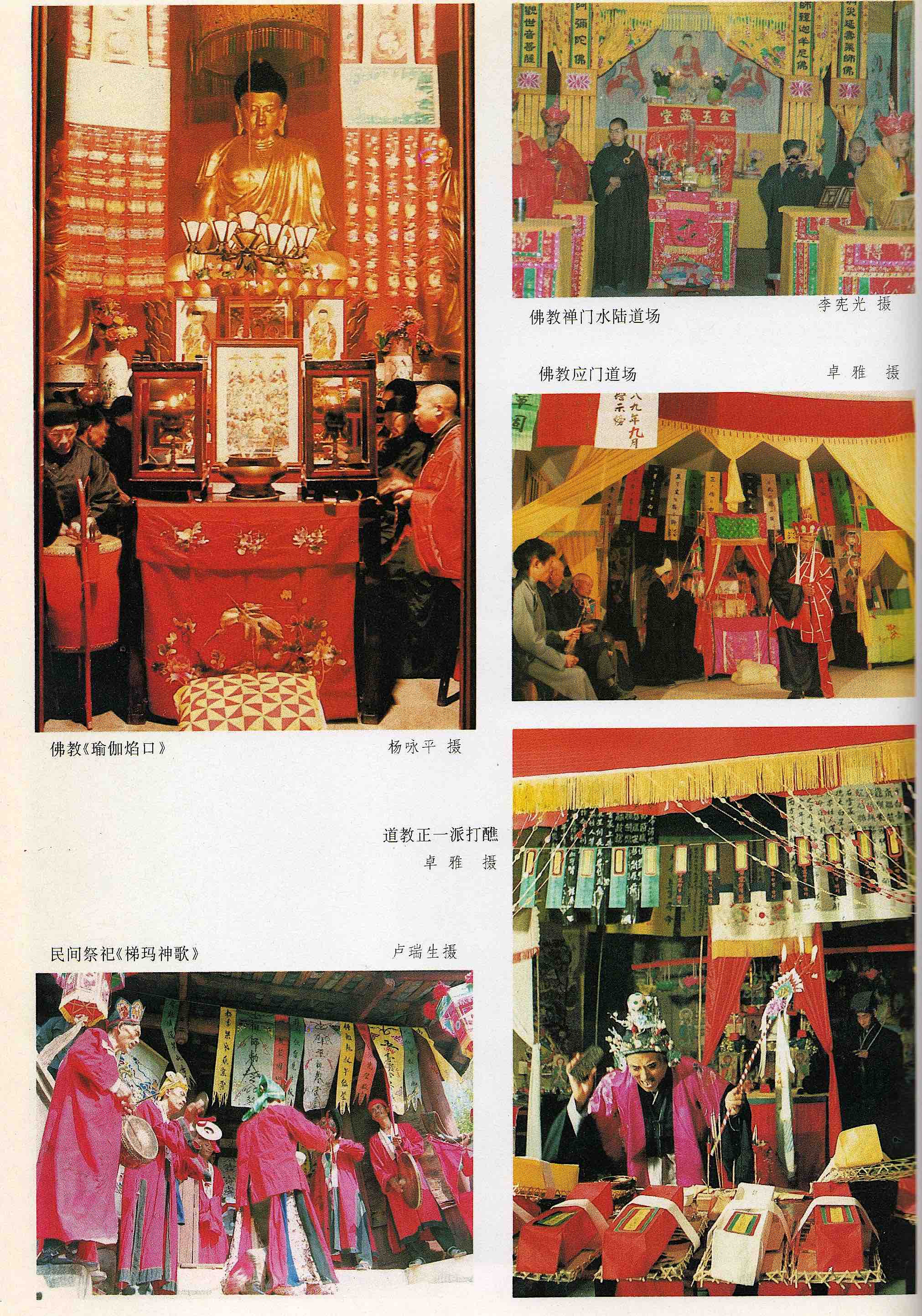
By the time I wake from my siesta Li Manshan is back and fast asleep. A neighbour drops by for a gossip; he wakes up and joins in. I get used again to the basics of country living, though after all these years I still find the local dialect really tough. I get online courtesy of his cool shepherd neighbour. We have a nice supper of noodles and then retire to the west room to chat till late.

Next morning we wake just before dawn. After a relaxed breakfast with Li Manshan and his wife, a guy shows up to ask him for a “determining the date” prescription (see my book, pp.185–9): it’s for “moving the earth”, so Li Manshan writes it on red paper.

We stroll over to the site of the old Zhenwu miao temple (see map), hoping naively to find a neglected stele like we did for the Fodian miao and Sanqing dian temples (my book, pp.46–9), but there’s nothing to see at all. The woman living opposite invites us in for a chat; she’s a Protestant, one of a tiny community that has sprung up in the village over the last few years. Hedging her bets, she has a Xi Jinping poster on the wall, next to her Christian calendar. Li Manshan is always affable, popular with everyone. It’s getting quite hot, so I leave my jumper at her place.

I’ve long wanted to visit Shankoutou (the kou pronounced kio in Yanggao dialect!), the next village south, 2 Chinese li (1 kilometre) distant—mainly because it’s so tiny. When I ask Li Manshan, “Is there a temple there?” he replies, “Every house is a temple!” I can’t think how to convey the wryness of this aperçu.

SKT walk

So we set off, first along a narrow track through a barren gulley, then emerging into open country, following Li Manshan’s internal Daoist satnav up and down to a frozen river. Fording it, we climb the slope up to a reception committee of nine free-roaming donkeys awaiting us.

SKT

Figures in the county gazetteer give a 1948 population of 63; according to our hosts, in 1970 there were 100 dwellers (under the people’s communes the village counted as the 9th brigade of Upper Liangyuan); back with the gazetteer, by 1990 there were still 75 villagers. Now only five aging families, eleven people, are still “left behind” here. But it’s hardly the mysterious ghost village I envisaged, and my only reward is the murals around the kang brick-bed in the house of a family that invites us in; they were painted in the late Cultural Revolution, which counts as “old” round here. They also have a Xi Jinping poster on their wall.

kang mural

Kang murals, 1973.

On the walk back we stay west of the river, the idyllic vista marred only by the cement factory, with its stink and pollution. Old Lord Li sets off over the fields he was given after the land division, which he now rents out. I call him a landlord, and he takes it in the spirit in which it was meant. Reaching Upper Liangyuan again we pass by the site of the Sanguan miao temple and Li Qing’s old house. As I collect my jumper from the Protestant woman I wish her a Happy Easter. Stopping off to chat with various friends, with the usual copious exchanges of cigarettes, we get home by midday.

Ritual in The dream of the red chamber

Citing Cao Xueqin’s entrancing novel The story of the stone recently, I was reminded that among the many virtues of the epic tale is its detailed depiction of rituals in 18th-century Beijing[1]

A work of fiction it may be, but what I admire here is the ethnographic thick description—a model for modern fieldworkers. Prompting us to experience such rituals within the far wider context of social life and personal experience, the author not only evokes all the human detail of the family’s behaviour and emotional world, including the priests’ relations with their patrons, but depicts the whole physical setting and itemizes expenses.

Chapters 13 and 14 describe a 49-day observance for the funeral of the family matriarch, with several groups of ritual specialists performing. Chapter 13 gives the text of the placard—similar in style to those used in modern times. [2] In David Hawkes’s brilliant translation (for the whole passage, see vol.1, pp. 255–87):

He also instructed someone to invite an expert from the Board of Astronomy to select dates for the funeral and the ceremonies preceeding it. With the approval of this official it was decided that the lying in state should be for forty-nine days and that the notification of bereavement indicating the family’s readiness to receive official visits of condolence should be made in three days’ time.

這四十九日,單請一百單八眾禪僧在大廳上拜大悲懺,超度前亡後化諸魂,以免亡者之罪;另設一壇于天香樓上,是九十九位全真道士,打四十九日解冤洗業醮。然後停靈於會芳園中,靈前另外五十眾高僧,五十眾高道,對壇按七作好事。
A hundred and eight Buddhist monks were engaged to perform a Grand Misericordia for the salvation of all departed souls in the main reception hall of the mansion during these forty-nine days, while at the same time ninety-nine Taoist priests of the Quanzhen sect were to perform ceremonies of purification and absolution at a separate altar in the Celestial Fragrance pavilion. These arrangements having been made, the body was moved to a temporary shrine in another pavilion of the All-scents Garden. Fifty high-ranking Buddhist monks and fifty high-ranking Taoist priests took turns in chanting and intoning before it on every seventh day.
Inside the gateway, facing the street, a high staging was constructed on which Buddhist monks and Daoist priests sat on opposite sides of an altar intoning their sacred texts. In front of the staging was a notice on which was written in large characters:

[…]
WE,
The very Reverend Wan-xu, Co-President of the Board of Commissioners having authority over all monks and clergy of the Incorporeal, Ever-tranquil Church of the Lord Buddha,

and
the Venerable Ye-sheng, Co-President of the Board of Commissioners having authority over all priests and practitioners of the Primordial, All-unifying church of the Heavenly Tao,

HAVE,
with all due reverence and care, prepared offices for the salvation of all departed souls, supplicating Heaven and calling upon the name of the Lord Buddha

NOW,
earnestly praying and beseeching the Eighteen Guardians of the Sangha, the Warlike Guardians of the Law, and the Twelve Guardians of the Months mercifully to extend their holy compassion towards us, but terribly to blaze forth in divine majesty against the powers of evil, we do solemnly perform for nine and forty days the Great Mass for the purification, deliverance and salvation of all souls on land and on sea…

—and a great deal more on those lines which it would be tedious to repeat [Cao Xueqin’s comment, not mine!].

Chapter 14 goes on to list some of the major ritual segments and activities. The Buddhist Water and Land (shuilu 水陸) ritual included Opening the Quarters (kaifang 開方), Smashing the Hells (poyu 破狱), Transmitting the Lanterns (chuandeng 傳燈), Illuminating the Deceased (zhaowang 照亡), Opening the Golden Bridge (kai jinqiao 開金橋), and Leading the Panoplied Pennant (yin chuangfan 引幢幡. [3]

Daoists performed the Presenting the Memorial (shen biao 申表) ritual before the Three Pure Ones and the Jade Emperor; Chan Buddhist monks performed Ambulating Incense (xingxiang 行香), Flaming Mouth (yankou 焰口), and Worshipfully Presenting the Water Litanies (bai shuichan 拜水懺); and thirteen young Buddhist nuns recited mantras.

這日乃五七正五日上,那應佛僧正開方破獄,傳燈照亡,參閻君,拘都鬼,筵請地藏王,開金橋,引幢幡;那道士們正伏章申表,朝三清,叩玉帝;禪僧們行香,放焰口,拜水懺;又有十三眾尼僧,搭繡衣,靸紅鞋,在靈前默誦接引諸咒,十分熱鬧。

Rendering the fantastical vocabulary of Daoist ritual into English is always a challenge—also well met by Ken Dean and John Lagerwey. Again, Hawkes makes a brilliant attempt at this passage—with occasional elaborations, and a quite understandable, even attractive, “translation” of titles for ritual segments into specific actions (which, of course, they are!):

The Thirty-fifth had now arrived—an important day in the penitential cycle of seven times seven days preceding the funeral—and the monks in the main hall had reached a particularly dramatic part of their ceremonies. Having opened up a way for the imprisoned souls, the chief celebrant had succeeded by means of spells and incantations in breaking open the gates of hell. He had shone his light (a little hand-mirror) for the souls in darkness. He had confronted Yama, the Judge of the Dead. He had seized the demon torturers who resisted his progress. He had invoked Kṣitigarbha, the Saviour King, to aid him. He had raised up a golden bridge, and now, by means of a little flag which he held aloft in one hand, was conducting over it those souls from the very deepest pit of hell who still remained undelivered.

Meanwhile the ninety-nine Taoists in the Celestial Fragrance Pavilion were on their knees offering up a written petition to the Three Pure Ones and the Jade Emperor himself in his heavenly palace. Outside, on their high staging, with swinging of censers and scattering of little cakes for the hungry ghosts to feed on, Zen monks were performing the great Water Penitential. And in the shrine where the coffin stood, six young monks and six young nuns, magnificently attired in scarlet slippers and embroidered copes, sat before the spirit tablet quietly murmuring the dharani that would assist the soul of the dead woman on the most difficult part of its journey into the underworld. Everywhere there was a hum of activity.

That final comment “Everywhere there was a hum of activity” (re’nao “exciting”, “bustling”, lit. “hot and noisy”, cf. Chau, Miraculous response, pp.147–68) is ironic after the silent mantras of the nuns. BTW, I almost like the rendition of shifen as “everywhere”, but I’m still inclined to think it carries the modern colloquial sense of “really”—thus “it was really boisterous”.

Chapter 102 gives a detailed account of a one-day exorcism performed by forty-nine Daoist priests, with god paintings hung out, performing Ambulating Incense, Fetching Water (qushui 取水), Worshipfully Presenting the Memorial (baibiao 拜表) and Inviting the Sages (qingsheng 請聖) rituals, and reciting the Dongyuan jing 洞元經 scripture throughout the day. Three chief liturgists, donning seven-star hats, wielded precious swords, flags, and a whip, as a placard was displayed and exorcistic talismans depicted.

In chapters  28 and 29 (Hawkes vol.2, pp.41–92) the family commissions a three-day Daoist Offering for well-being (ping’an jiao 平安醮) at the Qingxu guan 清虚观 temple:

Aroma continued:
“Her Grace sent that Mr Xia of the Imperial Bedchamber yesterday with a hundred and twenty taels of silver to pay for a three-day Pro Viventibus by the Taoists of the Lunar Queen temple starting on the first of next month. There are to be plays performed as part of the Offering, and Mr Zhen and all the other gentlemen are to go there to offer incense. Oh, and Her Grace’s presents for the Double Fifth have arrived.”

This section offers far less detail on ritual, the opera being the main attraction. We tend to assume that in the Good Old Days people gladly respected the “rules” (guiju 規矩), but like that intriguing re’nao of chapter 14, there is clearly a long ancestry to the common lament since the 1980s that audiences care more about ostentation than correct ritual performance. The account uncannily reflects my observations at Yanggao funerals since 2001 (Daoist priests of the Li family, p.356):

Daoists still have to be invited, almost routinely; but by now they are used to not being appreciated. Since the 1990s no-one pays much attention when they arrive at the soul hall; only the kin reluctantly abandon their places watching the pop music outside the gate to go and kneel before the soul hall.

Imagine if Bach had taken that sabbatical in Beijing, then he might have had patrons like the Jia clan in The dream of the red chamber… They could hardly have appreciated Bach’s genius any less than the Margrave of Brandenburg (“what does that even mean?”).

JPM Daoist painting

Perfected Man Huang sends forth an official document recommending the deceased, c1700: Daoists presiding over the liandu funerary ritual of chapter 66 of the Jin ping mei. Nelson-Atkins Museum of Art, Kansas City; see Little and Eichman, Taoism and the arts of China, pp.192–3. Note typical northern shengguan ensemble of guanzi oboe, sheng mouth-organ, dizi flute, and yunluo gong-frame, with large cymbals nao and bo.

Earlier still, the Ming novel Jin ping mei offers just as wonderful ethnographic material for rather less elite social strata—set in Shandong, ostensibly in the 12th century, but clearly based on the milieu of the author’s own day. Here too are many vignettes on minor domestic rituals and major exorcistic and mortuary rituals, as well as on the lives of Daoist priests and Buddhist monks.

Of course, these are just two of the most celebrated works of Ming–Qing fiction wherein we can seek such depictions. Just as with contemporary fieldwork, my first thought is to situate such rituals in space and time, rather than giving generic accounts. Thus one would seek to understand the rituals of the Jin ping mei in the context of 16th-century Shandong, and those of The story of the stone in that of 18th-century Beijing—just as we should be clear if our accounts of modern rituals refer specifically to north Shanxi in the 1930s, west Fujian in the 1990s, and so on.

Despite monumental social transformations since imperial times, all the rituals described in these early novels are still performed today—always varying by region and circumstances. [4]

Still, I need hardly reiterate that both texts (novels, ritual manuals, field reports) and images (paintings, photos) are silent and immobile: what we really need is films—which are in short supply even for current ritual practice, and an even taller order for the imperial era (though dramatized adaptations of The story of the stone may be quite educative!). [5]

[1] Within the vast literature on Hongxue 红学 (“Redology”—Dream of the red chamber studies), there are many Chinese studies of its religious and indeed musical components, searchable on databases. A considerable body of research is also available for Jin ping mei.
[2] For a couple of examples in English (for different kinds of rituals), see Dean, Taoist ritual and popular cults of southeast China, pp.53–8, and my Daoist priests of the Li family, pp.230–31.
[3] For “panoplied pennant” in a funerary hymn, cf. my Daoist priests of the Li family, p.262, and film, from 24.39.
[4] For leads, see my In search of the folk Daoists of north China, and index.
[5] Perhaps I digress, but given the stylized acting culture of China, the “Star of Tomorrow” company’s recent nine-part TV version (beginning with the episode below), using child actors, has been highly praised for its naturalism and conviction—far from merely cute.

Ritual groups of Xushui

*Click here for main page!*
(under Hebei in main menu)

QMZ 1958

While ritual groups all around the Hebei plain survived Maoism to revive under the reform era since 1978, the county of Xushui makes a particularly intriguing case, notable both for its ephemeral fame with the razzmatazz of the 1958 Great Leap Forward and for its more long-lived ritual groups.

Despite its revolutionary image, Xushui county has remained a hotbed for religious activity, notably the cults of the sectarian creator-goddess Wusheng laomu and Auntie Silkworm Granny (Cangu nainai 蚕姑奶奶)—the latter a popular deity in this area, rarely featuring prominently elsewhere on the plain. Associations commonly display ritual paintings, like the Ten Kings and the Water and Land series, and perform vocal liturgy. They too are within the catchment area of Houtu worship—they used to make the rather distant pilgrimage to Houshan, though they more commonly visit the nearer Western Summit (Xiding 西頂) on Langyashan further southwest from Houshan. Again we found a rather complex overlap between the village-wide ritual associations, sects, and yinyuehui.

Further to my brief introduction in my post on Festivals, here I introduce some of the groups we visited from 1993 to 1996. Mao was impressively modest about his limited success when he admitted to Nixon in 1972: “I haven’t been able to change [China]—I’ve only been able to change a few places in the vicinity of Beijing.” But he wasn’t modest enough: in some ways even a county so near Beijing, such a focus of the revolution, has remained resistant to Maoist ideology, predating and outliving it.

Funerals in Hebei

*Click here for main page!*
(under Themes > Local ritual)

GL procession 95

Many descriptions of Chinese ritual sequences appear somewhat timeless, blurring variation and change. But generally I like to keep my accounts either descriptive, based on observed performances, or prescriptive, an ideal sequence recounted by elderly performers. Where I become familiar enough with the local scene I sometimes try to collate the two, as in this composite funeral sequence for one part of the Yixian–Laishui region south of Beijing.

Based on talks with senior ritual specialists there, it’s illuminated by attending (and taking part in) many funerals in this area over more than a decade. While we always seek to copy the diverse funeral manuals of each village, they can’t offer the kind of detail provided by observation of practice and the accounts of the ritual specialists themselves. In particular, my constant refrain: ritual is performance, and is expressed largely through sound—the items of vocal, percussion, and melodic instrumental music that permeate the sequence.

A gradual dilution of ritual practice has  undoubtedly occurred since the 1950s, but it’s never so simple as seeking to “restore” some notional ideal sequence from before Liberation on the basis of ritual manuals alone.

Sects in north China

Shanxi sect

In Chinese religious studies, fieldwork and historical study of texts should be complementary. While the changing ritual scene in rural north China over the past century has largely been left to musicologists, Cao Xinyu 曹新宇 (People’s University, Beijing) continues his fine work on the imperial ancestry of sectarian groups, setting forth from the seminal research of the great Li Shiyu, and studies like those of Ma Xisha and Han Bingfang (see here, in a useful site for Qing history)—all similarly utilizing fieldwork.

Sects are a poor cousin to research on more open forms of institutional religion, but—like spirit mediums—an important part of the picture. While I constantly stress the sectarian connections of ritual associations on the Hebei plain, as a counterbalance to the current secular image portrayed by the Intangible Cultural Heritage, highly worthy of study is Cao Xinyu’s recent book

This continues his voluminous work on the Way of Yellow Heaven, Minjian sizang Ming-Qing mimi shehui shiliao xiezhen: Huangtian dao juan 民間私藏明清秘密社會史料擷珍, 黃天道卷 (2013).
It’s high time to bring into contact the two strands of historical research and fieldwork on the modern fortunes of the bewildering variety of groups that we find around north China—such as Hunyuan, Hongyang, Huangtian dao, and Laofomen. This is a major task for fieldworkers, including music scholars. [1]


[1] For now I’ll leave you to compile your own lists for Western-language studies, such as Weller, Ownby, Overmyer, Palmer, ter Haar, DuBois, and so on—a valuable resource is the rubric in Philip Clart’s essential bibliography.

Guide to a year in blogging

LMS

After a year of frenzied blogging, here’s a seasonal retrospective guide to navigating a diverse ouevre—as much for my sake as as for yours. Meretricious and Happy New Year!

Call me a nerd [You’re a nerd—Ed.], but taxonomy and indexing are so funky… As you see from the (updated) homepage, the whole site began as an introduction to my work on the Li family Daoists, and my portrait film remains one the most enchanting presences there. The Li family has its own category in the sidebar, with a plethora of articles (not least a whole series on our French tour in May 2017, and an update on Li Bin’s diary).

Other pages in the top menu also tend to be rather substantial, with

Still in the top menu, MY BLOG contains all my myriad posts (“delighting in all manifestations of the Terpsichorean muse“), with helpful Categories and Tags in the sidebar, as well as a monthly archive there. Here are some of the more stimulating:
As you can see from this post alone, I just love doing internal links (in blue in the text). So whether you first came here for Daoist ritual, football (indeed, Daoist football), punk, Bach, modern China, or even just for the jokes, they’re all connected, so please do click away on the links!

Last but, um, not least, do click on the links to the relevant posts and pages in the photos in the sidebar.

Nuns of rural Hebei

*For main page, click here!*

Renqiu nun

In traditional China, ritual activity—indeed, public appearance altogether—appears to be male-dominated. But the role of women in religious life is significant—as worshippers, as members of amateur sects, and notably as spirit mediumsNuns hardly threatened the patrilineal traditions of ritual and instrumental music before the 1950s, but they make an interesting sub-plot.

Moving south from Beijing and Fangshan to Laishui county, this article goes on to gives vignettes (based on brief chats in 1994) on the ritual life of two elderly former nuns in a village in Renqiu county, near the Baiyangdian lake, half a century earlier. Such absorbing glimpses into the world of rural nuns before Liberation deserve including in our picture of local cultures.

Ritual groups of Xiongxian, Hebei

*Click here for main page!*
(under Hebei in main menu)

GGZ xu 1

Through the 1990s, one of the most fruitful sites for our fieldwork project on the Hebei plain south of Beijing was the area around Xiongxian county, just south of Bazhou, and east of the regional capital Baoding. Recently this whole region has become the centre of a vast and radical new development project to expand metropolitan Beijing; but when we used to visit, it was still very much rural.

As throughout the region covered in this growing series on Hebei, most villages here had ritual associations until the 1950s, and we found many still active in the 1990s. But here we found less vocal liturgy than further north and west on the plain, with no foshihui groups reciting precious scrolls.

Instead, ritual services were now mainly represented by the “holy pieces” of the shengguan wind ensemble to “revere the gods”—here an exceptionally rich repertoire based on long suites related to those of the temples of old Beijing. Not all these groups were still performing, but there is rich material here, not only on the ethnography of local ritual in modern times, but for scholars of the late imperial period.

This is the latest in a series on ritual in Hebei that includes Houshan and the precious scrolls, suburban Beijing, and Bazhou.

They come over ’ere…

Central Asian musicians, Tang dynasty.

Here’s a companion piece to my post on foreigners during the Cultural Revolution, where I acknowledged my anachronistic use of the epithet laowai 老外.

I read that indeed the term didn’t become common until the 1980s—just in time to greet me on my late arrival (for some words that Shakespeare may not have invented, see here). The Chinese wiki article on laowai makes a useful succinct introduction, explaining its interplay of respect and xenophobia. I’m still curious to learn how the winning combo of lao and wai suddenly caught on. A detailed forum on the nuances of this and related terms has been initiated by the erudite Victor Mair, so here I’ll just add a few personal reflections.

A still more blunt term is dabizi 大鼻子 “big nose”; foreigners in China have to get used to frequent appraisals of their physiognomy, but as an autonym, at least, the term can be drôle. I’m also fond of the more quaintly retro yang guizi 洋鬼子 (“foreign devil”), which a senior Taiwanese mentor—and, crucially, friend!—likes to call me. As ever, such terms are context-sensitive; they may even confirm guanxi (“You’re my mate—we can take the piss together”).

At a tangent, in Shaanbei a fine shawm-band leader is widely known as Jiekazi “The Stammerer”—in rural China, attitudes towards stammering are both less po-faced and less courteous.

Craig and Ming

Waiguoren!” (not yet “Laowai!”). Craig Clunas, Ming tombs 1975.

Staying with China (derogatory terms for foreigners are of course a rich topic worldwide), apart from the various historical terms (hu 胡, fan 番, yi 夷, man 蠻, and so on—mostly with a strong suggestion of “barbarian”), I’m now curious to learn how the Labouring Masses of the Tang dynasty would have hailed the substantial number of laowai on the streets of 8th-century Xi’an in the popular argot of the day.

We may now regard the Tang as the first great world-music boom (cf. Soundscapes of Dunhuang), but as musical nationalists of the day (like the poet Bai Juyi and his mate Yuan Zhen) might have said,

“They come over ’ere, with their fancy bili and pipa…”

Or their Qing-dynasty counterparts (so does building walls work, then? Eh??):

“They come over ’ere, with their fancy erhu and suona and yangqin…”

OK, I made those up, but this is a genuine Tang quote (adding impertinent male judgment on female attire to the heady xenophobic mix): [1]

Our women are acting like foreigners’ wives, studying foreign make-up;
Entertainers present foreign sounds, servants to foreign music!

Straight out of the Daily Mail, that. With the current surge in “patriotism”, a new campaign to purge corrupting foreign influence from the Chinese instrumentarium would be left mainly with the xun ocarina and the sheng mouth-organ—which might fail to excite even Uncle Xi. It’s ironic that after successive waves, it was the Model Operas of the Cultural Revolution that were largely responsible for a renewed vogue for the instruments of the Western Art Music tradition.

Closer to home (yet equally apposite), a classic rebuke to xenophobia is the great Stewart Lee’s UKIP routine (“Bloody Huguenots, Coming Over Here—doubting trans-substantiation, with their famed ability to weave little jerkins out of lace…”). And to supplement his fantasy chat down the UKIP pub:

“Apparently the guitar is descended from the oud—that’s bloody Moorish, mate! What’s wrong with Morris dancing, that’s wot I say!”

[Inconvenient footnote: an inconclusive etymology suggests that “Morris” is itself derived from “Moorish”…]

As simplistic nationalist agendas rear their ugly orange heads yet again, it’s always worth unpacking language. See also A fine riposte, and Das Land ohne Musik.

For the “Golden Age” of the Tang, Chinese scholars might learn from 17th-century Holland.


[1] See e.g. Suzanne E. Cahill, “Our women are acting like foreigners’ wives! Western influences of Tang dynasty women’s fashion”, in Steele and Major (eds), China chic: East meets West. Among many works, see also Marc S. Abramson (ed.), Ethnic identity in Tang China. The works of Edward Schafer (notably The golden peaches of Samarkand and The vermilion bird, written at a time when such study was neither profitable nor popular) have long been an inspiration for those studying Central Asian culture in the Tang.

Women of Gaoluo

Woman Zhang

Woman Zhang at 90 sui, 1998.

Chain-smoking cross-legged on the kang brick-bed with all the carefree abandon of the elderly, wielding her cigarettes with more relish than accuracy, Woman Zhang (Zhangshi nü 张氏女, b.1909) told us what she could about her life. As she said, entirely without feminist irony, “I had no [given] name until going to work [in 1958] in the Great Leap Forward—that’s when they gave me the name Yurong.”

Apart from the Li family Daoists (film, and book: also tag in sidebar), my other most in-depth ethnography concerns the ritual association of Gaoluo, just south of Beijing. On this blog I’ve written about two leading figures there, and the vocal liturgists, as well as their performance of “precious scrolls”—and also the village’s substantial minority of Catholics.

It may not have escaped the alert reader that much of my fieldwork is basically about the public activities of men. I made a partial attempt to redress the balance with three posts on Women of Yanggao (starting here). So here are some further notes on the status of women in rural China, setting forth from our chats with the characterful Woman Zhang in Gaoluo in 1998, and again based on vignettes from my book Plucking the winds (where you can find further detail).

Though 90 and illiterate, her mind is quite clear, and to my relief she speaks with a clear calm voice in a standard accent. Given her advanced age (she claims to remember the long pigtails still worn by men for a while after they ceased to be enforced with the fall of the Qing dynasty), our meeting should have been a fascinating glimpse into village history. But, in total contrast to the detailed day-by-day accounts of the cultured men Shan Zhihe and Shan Fuyi, I was taken aback by her ignorance of the momentous events which had convulsed the village. Of course, men can be muddled too; but this wasn’t muddle. We know a lot of men who are totally vague about dates, but at least they have participated in history, even when only trying to escape it or deplore it, and one can learn a lot. The problem was that she was not only uneducated and a woman, but had been widowed over fifty years earlier: she had simply played no part in the village’s public history. This itself was a salient lesson. We supplied the dates below: significantly, the only date she had ever heard of was 1960, the famine.

While nominally a Catholic, Woman Zhang “believes in everything”. Though she was only brought to Gaoluo from her home in a village in Dingxing just south in about 1930, she had heard stories about the famous Boxer massacre at Gaoluo in May 1900. Some of the Catholics took refuge in the Catholic stronghold of Anzhuang further south, while others fled to the Xishiku church in Beijing. Woman Zhang’s father-in-law Shan Zhong was the only survivor of his whole family from the Boxer massacre; two sons and a pregnant daughter had been slaughtered. Shan Zhong himself had gone to Dingxing town that day; on his way back he got as far as Wucun village just south of Gaoluo when he got wind of the massacre and fled, taking refuge in the Xishiku church in Beijing. After it became safe to return to Gaoluo, Shan Zhong remarried, taking a young wife.

1930 donors' list, South Gaoluo

1930 donors’ list.

By 1930 the village ritual association, sensing a need to compete with the revival of Catholic power, commissioned a new set of ornamental hangings for the New Year rituals (see here, under Ritual rivalry). Shan Zhong was by now an established leader of the village Catholics—but impressively, he was one of the most generous contributors whose names (all male, as heads of households) appear on the rival association’s handsome donors’ list.

That same year Woman Zhang, then 22 sui, was brought to Gaoluo to marry Shan Zhong’s 14-sui-old son Wenli, the youngest of their three sons. Later the Italian missionaries became popular partly because like the local spirit mediums they could cure illness, and Shan Zhong also gained quite a reputation as a healer. But he died only a year after Woman Zhang’s son was born, quite soon after the building of the church.

Soon after I married here, the Catholics used to try and get me to come to church, but my mother-in-law wouldn’t let me—I couldn’t just please myself when I went out, she’d beat me. They talked it over with the other Catholic wives. They took me to church, and after the service was over they took me home, so the mother-in-law didn’t beat me.

Through the growing fug of cigarette smoke, as we tried impertinently to help Woman Zhang direct some of her ash in the general direction of the floor, she went on: “They taught me eight scriptures [jing: hymns, I think, as often in folk parlance]—I couldn’t read them, I just learnt them by heart. Dunno what the words mean, though!”

Japanese warplanes bombed Laishui county-town at 8am on 17th September (the 13th of the 8th moon) 1937, and that same day Japanese troops first entered Gaoluo. Coming from the direction of Wucun to the south, they were just passing through; they had about fifty tanks, and were covered by aircraft. The troops entered the village before Woman Zhang could take her children to the church to hide; they passed by her house. In order to dissuade them from murdering them all and setting fire to the village, the village leaders went out to welcome them. Before the Japanese even entered the village, they shot dead a villager who rashly stuck his neck out to look, but after entering Gaoluo they harmed no-one, just asking for fresh water, eggs, and meat. The venerable Shan Zhihe, along with Cai Ming (a sheng-player in the ritual association who worked as a pig-slaughterer), was responsible for looking after them and giving them water—the Japanese made them drink some first to be sure it was not poisoned. Though they soon went on their way after a token search, Japanese cavalry and infantry passed through constantly for several days on their way to Baoding, and Gaoluo villagers had to look after them.

Woman Zhang was widowed during the War against Japan. Her husband, Catholic Shan Wenli, hoping to join up with the guerrilla army, had gone out with a big stash of opium to use as a “sub” for travel expenses, but it was soon stolen. Though he eventually managed to join the army, he was wounded first in one eye and then in the body. He was brought home to die, still only in his 30s. Woman Zhang went to kowtow to Cai Yantian, who by this time had been ordained as a priest by Bishop Martina, to ask him to come and give her husband the last rites.

In our talk we fast-forwarded to 1958 and the infamous campaign for making steel—most frenetic, exhausting, and pointless campaign of the Great Leap Forward, in which many households were deprived of precious equipment, even including woks and door-latches. Woman Zhang was enlisted, and since this was virtually the first time she had been allowed out of the house, she was now given a personal name—at the age of 50 sui. She told us with an incredulous cackle: “They wanted me to make steel out of woks!” She didn’t have a clue what that was all about, and none of us could enlighten her.

1960 was the worst year: villagers agreed it was just unbearable. Though the famine is generally known as “the three years of difficulty” (sannian kunnan shiqi), it is colloquially identified simply as “1960” (liulingnian). Everyone was still expected to report for work, but only able-bodied people could survive; less sturdy villagers soon got ill and started dying. Malnutrition was as serious as at any time in the hated old society. Woman Zhang remembers having to eat yam leaves to avoid starving to death. The village cadres were in the same boat—at best, they might have been able to sneak into the canteens after work to snatch an extra mouthful of snake-melon.

She perked up when we went on to seek her opinions on the Red Guards:

Oh yeah—what were they on about? I couldn’t make it out. I know they used to parade through the streets…

But some of their victims were her fellow Catholics.

Our time with Woman Zhang was both funny and sad. She had lived through so much over the last nine decades, but had little clue what had been going on. Over the following weeks, as winter turned to spring, I often saw her sitting outside “taking the breeze” at her gateway in the bright sunshine, looking curiously at passers-by and giving me a somewhat formal nod. Life too had passed her by, which maybe was not altogether a bad thing. Pretty bad, though: she had lost her husband young, and with or without him had led a semi-existence.

Still, she reckons life is much better than in the old society, and this is no expedient courtesy to a foreign guest. Blissfully oblivious of the continuing persecution of the Catholics and the general convulsions the society was subjected to, she was genuinely grateful both for Liberation and the reforms: “Now you can get to eat barley and white flour—years could pass in the old days without that stuff.” On the other hand, when we asked her provocatively, indeed rather desperately, whether she preferred the old or the new village cadres, she had absorbed enough of the cynical climate to retort: “They’re all rubbish, they just bully people, what is there to prefer?!”

Woman Zhang perhaps typified the belief of the older generation of women. Though a Catholic since she was young, she finds Jesus rather remote: “Who of us has actually seen Jesus?” But as to “Mountain Granny” (shanli nainai, a popular term for the local goddess Houtu), “How can you help believing in her? The village women used to buy incense and go on pilgrimage to burn incense on Houshan, so I went along too. Catholics aren’t supposed to burn incense, but I went on the quiet, they didn’t know. Yes, I believe in Granny.” As we saw, she went to Catholic services, but she also enjoys visiting the association’s lantern tent at New Year, and likes both the shengguan wind music and the percussion; she remembers hearing Cai Fuxiang recite the Houtu scroll, and though she didn’t understand it, she liked to listen to that too. Cases like hers confound those “tick one box only” surveys of “religious faith” in China.

Rural sexism
Local literatteur Shan Fuyi, as ever, had a nice story. In 1990 the leaders of the association were seeking donations from villagers to refurbish their ritual building. As it happened, South Gaoluo’s nouveau-riche entrepreneur Heng Yiyou was working away from the village when they called at his house, and his wife only had a paltry couple of kuai to hand. When Shan Fuyi, who was to write the donors’ list, asked her whose name he should write, she exclaimed sharply, “Write Heng Yiyou’s name of course—do I count as a person?!”, hitting the sexist nail on the head. Shan Fuyi did as she said, but soon realized they couldn’t put Boss Heng down for such a meagre amount. When he tracked Heng down, Heng now gave a further 100 yuan, besides four long bamboo poles from which to attach the association’s pennants. Luckily the donor’s list had a blank space at the top where Shan Fuyi could write up the extra donation, giving Boss Heng appropriate recognition.

1990 beiwen

1990 donor’s list, by Shan Fuyi.

The trenchant remark of Boss Heng’s wife gives us a pretext to reflect on the status of women in village life. For the record, she’s called Li Shufen! As Shan Fuyi observes, people are not generally aware of women’s names unless they are close relatives.

Screenshot

In Gaoluo, although women are devout in taking part in the ritual activities which the ritual association serves, both spiritual and secular spheres continue to collude in excluding them from learning the ritual music. Their exclusion from the association reflects their exclusion from power and influence in village society as a whole, underlining the persistence of tradition and the limited scope of the revolution. Sexism, like irrational violence, is one aspect of tradition which one could understand the Communists hoping to overturn, but they were largely unsuccessful.

I must preface these comments by admitting that they are entirely impertinent: I have only added to the burdens of both women and men while in Gaoluo, feeling unable to offer any practical assistance, and never transcending my status as a guest. One of our most uncomfortable experiences in these villages is the helpless feeling of colluding in the macho tradition, all men in a group smoking and chatting while the women cook for us. At meal-times, they serve us while the men all sit around the table discussing the Important Things men talk about; the women then get to eat the cold left-overs, often outside in the courtyard, only after we vacate the table and they have served us with tea. Our entreaties for them to join us are laughed away. To be fair, this happens mainly when there are guests: normally the family eats together, though segregation is also sometimes observed.

Thinking of Shan Zhihe and his arranged marriage, or of Woman Zhang and Cai An’s mum with their bound feet, I can’t help observing that despite the continuing glaring inferiority of women’s social position today, there has been some progress—thanks to the enlightened Communist Party, as I joke with them. Young people at least choose their own partners now, and even if the women won’t share the meal they have prepared for the men, they all now have a certain amount in common, standing around making good-humoured jokes while the menfolk are chatting away over their booze and fags.

But progress has been painfully slow. After Liberation, obeying a central decree, the village Party branch dutifully elected a token female head of the new Women’s Association. Under the commune system, the vague idea was that she should implement gender equality and the female liberation campaign, but there was no specific programme, and the position was largely a sinecure. The only thing anyone could remember her organizing was International Woman’s Day on the 8th March, when the women were summoned to a meeting. After the birth-control policy began to be enforced strictly in the 1980s, that became her main duty, an onerous and invidious one, dependent largely on the orders of a male establishment.

While Party membership is the means to career progress, the Gaoluo Party branch, like most others, has made no efforts to “develop” bright young female applicants; as one cadre said, “It’s a waste of time, they’re going to leave the village sooner or later [to get married]”—exactly the reason given for denying women admission to the ritual association. Men join the Party with the prospect of becoming cadres. Women are caught in a neat Chinese Catch-22: they are not considered for Party membership because they are not going to become cadres, and because they are not going to become cadres, there’s no point in admitting them to the Party. As we saw, some girls began to attend school in the 1950s, but seldom progressed to higher grades.

Traditional morality has retained its stranglehold in many respects. There are simply no women in the village with any authority. Any woman seeking an active social role was, and is, likely to be cursed as a slut (“broken shoe”, poxie) by men and women alike. The only publicly active woman I heard of was the mother of formidable He Qing, a respected midwife. Until at least the 1960s, women were just not allowed out of the house, as Woman Zhang’s story reminded us. Women and men did not mix unless they were related. Even at the village opera in 1998, the audience consisted almost entirely of women and children; the few men who wanted to watch clambered onto the rooves or walls.
opera
It’s clearly not that men don’t like opera. Perhaps they are embarrassed to be seen among women and children? Gender segregation is still mutually agreed upon.

Only the new karaoke bar, where separate gangs of teenage boys and girls eye each other up, posturing before the video-CD screen is overthrowing traditional morality, much to their relief and the chagrin of the elders; such bars in the nearby towns are indeed notoriously equivalent to brothels. Hence also the traditional disdain for female opera singers, who display themselves outside the house in the company of men. The female singers in the new village opera group have to watch their step—their reputation is at stake.

Returning to the association rituals, apart from women’s active participation in worship, some major female deities are worshipped, notably the Bodhisattva Guanyin and fertility goddesses like the goddess Houtu. Although the associations are invited to perform for the funerals of men and women alike, it is the eldest son who kowtows to the male leader of the male association to invite it. Donors’ lists for New Year or for special donations for new ritual manuals, god paintings or instruments list the male head of the household. In the secular sphere, government campaigns have long attempted to raise the prestige of female children in China, with wall slogans protesting feebly that “daughters are also descendants”.

slogan
Yet female infanticide remains common; under siege from the draconian birth control policy, women and men alike attend association rituals to pray to Houtu to be granted a healthy son.

The continuing exclusion of women from the ritual associations is all the more disturbing since there is a certain crisis in transmission—not so much as a result of political campaigns culminating in the Cultural Revolution, but rather since the 1980s, as young men desert the villages in search of work, at the same time espousing the modernity of pop music. Meanwhile the potentially gifted daughters of fine musicians remain in the home village, at least until marriage. Yet there is no prospect of adaptation. Girls are neither offered nor do they seek a role in public ritual.

Niu Jinhua

Niu Jinhua (left) with Yan Wenyu‘s widow (among several Gaoluo women with bound feet), 1996.

Since women are such a silent group in our studies, in 1996 we finally had a chat with Niu Jinhua (b.1920), mother of our host maestro Cai An—with great difficulty, I may add, since she is rather deaf; her brilliant granddaughter helped us get through, acting as interpreter. Though women are not allowed to perform the vocal liturgy or the ritual shengguan wind music, they benefit from listening to it as much as men. Asked if she likes the music, she replied enthusiastically, “Oh yes! I’ve heard it all my life, I like to listen, you can’t get tired of it (bufan).” One often hears villagers use this expression about shengguan music, but her matter-of-fact statement will remain with me, summing up its enduring impact; other women we’ve asked also express active enthusiasm. Niu Jinhua goes on, “My old home [Zhangcuitai village, just further north] has a ritual association, just the same as the one here, same pieces, they recite the Buddha too, and hang out the god paintings at New Year.” Cai An chips in: “Yes, I went there when I was young—it’s very like our association.”

As we all smile quizzically, my friend Xue Yibing then asks Cai An’s mother ingenuously,
“Were there ever any women who learnt the music?!”
“Oh no!”, she cackles.
“Why not, then?!”
“It was Old Feudalism in them days, wannit, how could women take part?!”

While I wondered if the fact that women still don’t learn meant that we are still stuck with “Old Feudalism”, her comments sparked off a group discussion (which, for men, was quite observant) on the position of women in village life.

The men, while doing nothing about it, rather like their British counterparts, readily admit that women have a much harder time than men. Their explanation of the male monopoly on ritual is feeble: “The ritual performance of the associations is a business for Buddhist and Daoist priests; what with setting up the altar and burning the petitions, everyone kowtowing, it wouldn’t be convenient if there were women there.” Though I recall that nuns used to perform rituals and even play the shengguan wind music, the point is at least that men and women should be segregated—yet even all-female performing groups are rare in rural China. But after all, women constitute the majority of those offering incense and making vows during these rituals.

The male musicians go on, just a bit more plausibly, “Anyway, women just don’t have the time to study the music; their life is much more harsh, in the old days grinding flour, making shoes, mending clothes, cooking, looking after the kids, they were so busy. Men have nothing much to do except tilling the fields; especially in winter, they have time to learn the music.”

Indeed, men (both in Gaoluo and Beijing) think women’s liberation has gone too far. A familiar male lament is heard: “Nowadays the women even get their husbands to do the household chores!” To be sure, women can have quite a temper, and men commonly deplore their fate with the nice, if sexist, pun “I’ve got tracheitis”, tracheitis (qiguanyan) being homophonous with “hen-pecked” (“wife controls strictly”). One otherwise bright young village boy, back for New Year from his studies at college in Tianjin, couldn’t see what I was on about, claiming rather wistfully that men and women in Gaoluo were entirely equal—overlooking little details like the total absence of women in positions of responsibility, their failure to go on to higher education, their relegation to eating the cold leftovers after the men have taken their fill, and the fact that several Gaoluo wives have been bought. Moreover, since able-bodied men now migrate to the towns to seek work, women are left behind on their own not only to run the house and look after the elderly and young but also to tend the fields. Apart from that, they have a great life…

Though all this doesn’t exactly get to the roots of sexism, I’ve given a couple of vignettes. That’s how things were in Chinese villages in the 1990s; so much for gender equality under Maoism or the reforms. The closest we came to influencing women’s status in Gaoluo was that Cai An’s mum finally got used to being included in a round of cigarettes—hardly a great coup in favour of the global women’s movement.

All this began to change towards the late 1990s when rural girls began to move from secondary education to college in the towns and cities—but that’s another episode in the story.

The Houtu precious scroll

*Click here for link to page!*
(again, under Themes > Local ritual in top menu)

Hot on the heels of my article on the Houshan Daoists, we need a rather more detailed account of the “precious scrolls” (baojuan 寶卷) [1] performed by amateur ritual groups on the Hebei plain.

The four ritual associations of South and North Gaoluo all have early copies of precious scrolls on several themes, but what they, and I, consider their most exquisite volume, the Houtu scroll, was copied only in 1943 (see my Plucking the winds).

While the Ten Kings scroll was commonly recited for funerals until the 1964 Four Cleanups campaign, the Houtu scroll was performed for calendrical rituals—notably the New Year and Houtu’s own festival around 3rd moon 15th, either on Houshan or in the home village (playlist, track 6, and commentary).

The whole point of these precious scrolls is that they are performed for rituals—they’re not musty tomes to be read silently in libraries. And their performance practice—in the hands of peasant ritual specialists—transpires to be rather complex. As I always say, one can hardly study ritual without focusing on how it sounds.

This article is based on my In search of the folk Daoists of north China, Appendix 3, which contains further refs.

HTJ image