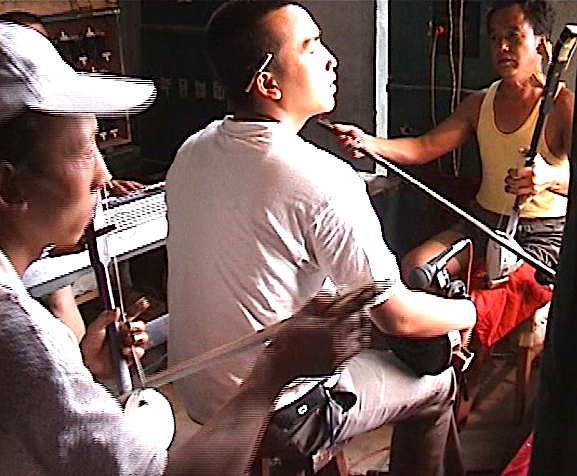
Das Land ohne Musik

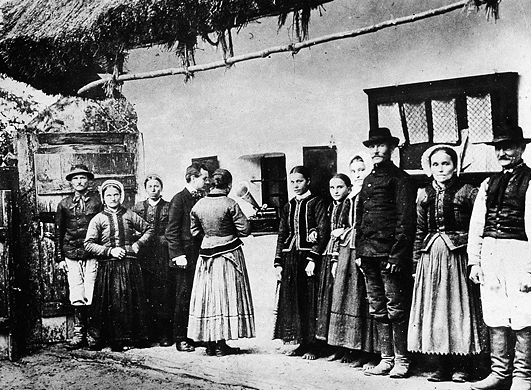
1912

Royal Earsdon Sword Dancers, Northumberland, 1912. More here.

Das Land ohne Musik

Oscar Schmitz, 1914

There is no city in the world, I am sure, where so much music is consumed as in London.

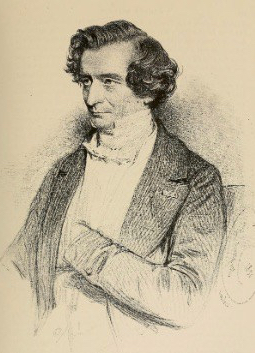
Hector Berlioz, 1851

Susan McClary’ s book Feminine endings is always full of leads, such as:

Linda Austern and Richard Leppert have demonstrated that one reason the English have produced so little music is that they—more than their German or French neighbors—have long associated music with effeminacy. (p.17)

An intriguing thought, but it begs questions. First of all, “produced” here clearly refers to the composition of art music. A perceptive essay is

  • Peter Holman,* “Eighteenth-century English music: past, present, future” (ch.1 of David Wyn Jones (ed.), Music in eighteenth-century Britain, 2000),

where he tellingly probes the description of 18th-century England as “Das Land ohne Musik” (cf. Haydn). He dates it back further to a pithy 1840 comment by Heinrich Heine:

These people [the English] have no ear, either for rhythm or music, and their unnatural passion for piano playing and singing is thus all the more repulsive. Nothing on earth is more terrible than English music, save English painting.

Touché! As Holman notes,

Of course, this agenda is part of a larger one that has more to do with 19th-century cultural politics than with a proper, balanced evaluation of the total corpus of 18th-century music. It privileged what was perceived as the centre—Italy, Germany, and Austria— over the supposed periphery—Scandinavia, eastern and central Europe, France, the Iberian peninsula, and England. It privileged instrumental music, especially those genres that used Viennese sonata form, over vocal music. And it privileged the work of the professional secular male in concert music over all others, such as church musicians, amateurs, and women.
[…]
The most persistent observation on musical life in 18th-century England is that it was dominated by Handel and other immigrant composers, the implication being that native composers were too feeble, parochial, or conservative to offer them much competition.

OK, he’s broadly following the continental critics here in equating “musical life” with art music—not all the diverse folk traditions, such as the musical life of taverns in East Anglia. But he unpacks the assumptions of even this limited definition:

It was not a new situation. Immigrants had played an important role in bringing new ideas from the continent ever since the reign of Henry VII.

(See Wind, ethnicity, and gender, and They come over ‘ere…)

Adducing Ferrabosco, Notari, and Draghi, Holman notes that as the scale of immigration increased,

these developments were not symptoms of weakness or decline, but evidence of a vibrant and complex musical life. Musicians were not attracted to London from all over Europe by the prospect of becoming big fish in a small, stagnant pond, but because London was the largest and most exciting pond of all, where you did not need to be a big fish to make a fortune.

Indeed, it could be argued that England was the most musical country in Europe by the second half of the 18th century, judging by the amount of musical activity of all types.

The variety he cites here includes rival concert series, Italian opera, provincial music societies, church choirs, and amateur musicking such as “gentlemen” competing in taverns. This is indeed more diverse than the narrow picture he criticizes, but still doesn’t subsume “folk” activity such as sea shanties or street fiddlers. He goes on:

My second objection to the “foreign domination” theory is that there is little sign that immigrants replaced native musicians in lucrative employment, or prevented them from obtaining it.

Just as the Lupo and Bassano families had supplemented indigenous instrumentalists at the court of Henry VIII, Italian opera became just an extra strand enriching the musical life of London. But

My most serious objection to the “foreign domination” theory is that it is based on an anachronistic conception of national and racial identity. […] England has always been a nation of immigrants, and it makes no sense to restrict an account of its culture to the work of natives, or, more accurately, to the work of the descendants of less recent immigrants.
[…]
What is often forgotten is that immigrant composers, anxious to be accepted in England, adapted their own idioms to conform to English taste.

This is all grist to Stewart Lee‘s mill.

At the same time, the “foreign domination” theory does rest to a large extent on the focus on the composers and performers of art music. Despite my pleas to broaden the social scope, Holman’s perspective, like a lot of in-depth studies of WAM, belongs firmly within the wise counsels of ethnomusicology. His chapter contains many more perceptive observations, which you must read!

* * *

To return to McClary’s lead,

  • Richard Leppert and Susan McClary (eds.), Music and society: the politics of composition, performance and reception (1987)

is full of stimulating chapters, not least her own:

  • “The blasphemy of talking politics during Bach year”,

which I introduced here. As the book’s Introduction notes, recent changes in scholarship,

especially evident in literature, film, and visual art, have led to a systematic investigation of the implicit assumptions underlying critical methods of the last two-hundred years, including prominently the assumption that art consistutes an autonomous sphere, separate and isolated from the outside social world.

Janet Wolff’s Foreword is another nail in the coffin of “autonomous” art—and another critique that should be compulsory for heritage pundits in China. The book ranges rather widely, with chapters from Rose Subotnik on Chopin, Simon Frith on popular music, John Shepherd on music and male hegemony, John Mowitt on electric technology in sound production, and Leppert’s own discussion of the music, domestic life, and cultural chauvinism of British subjects in India.

The authors point out that they hardly deal with music and society in non-Western cultures, touching “only lightly on questions about the music of women, and ethnic and racial minorities”. They observe that women, and the lower classes, have been erased from the received picture, though they are rarely excluded from musicking—just from prestigious public musicking.

So again the book is largely based on the musical activities of the bourgeoisie—not least because the source material largely derives from them. Still, the debt to ethnomusicology is clear: even if WAM scholarship may seem to contrast with ethnomusicology, they can enter into a rapprochement [uh-oh, more non-national terms?—Ed.].

* * *

Actually, all we need to deflate the idea of Das Land ohne Musik is the classic question “What is music?“—or rather, “What is musicking?”. Pundits of both WAM and pop music tend to take a limited view, as I often observe (e.g. here, and here).

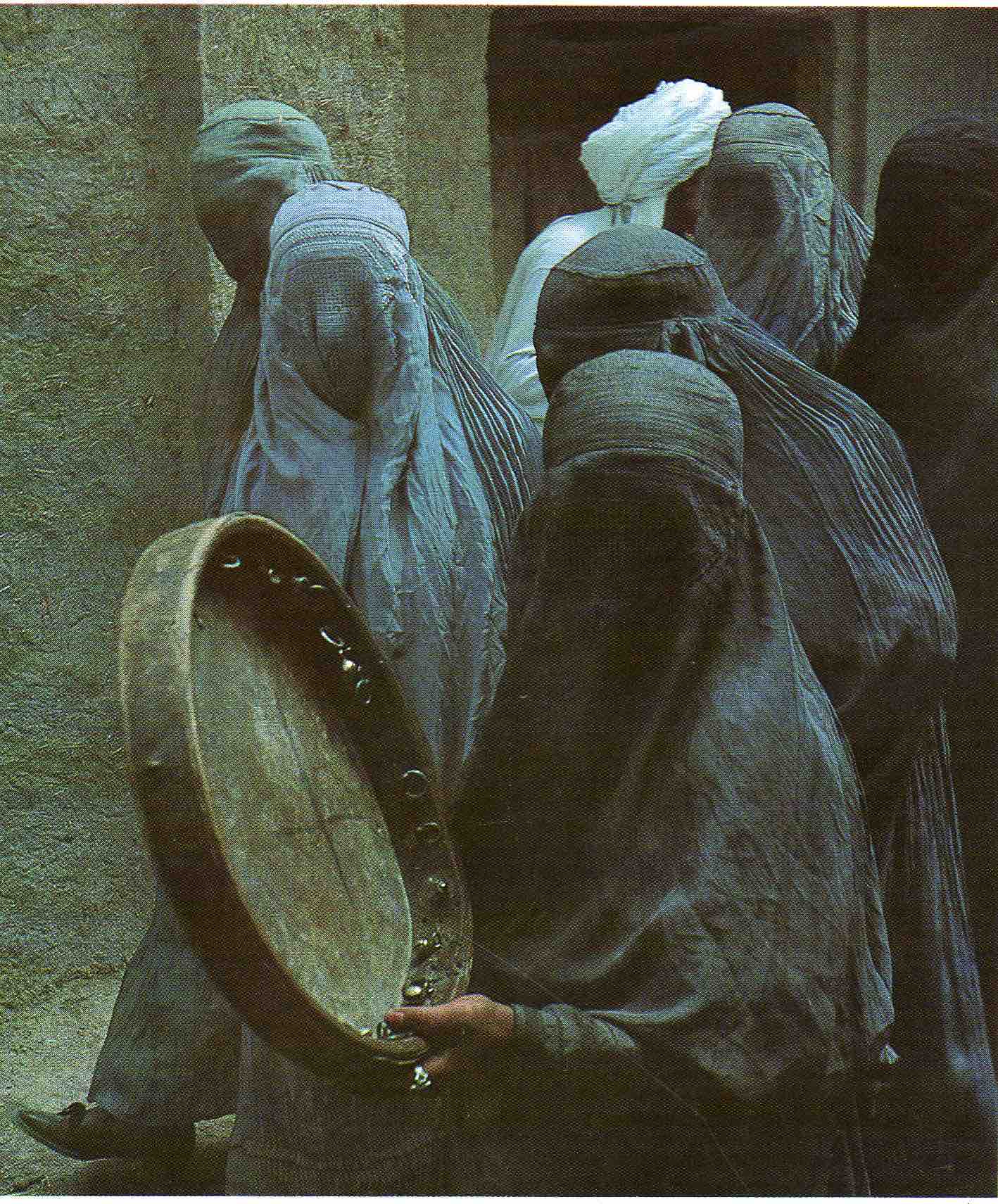
By a narrow definition based on composers of art music, most of the world over most of history would be considered “without music”. Do mothers singing lullabies, spirit mediums, or percussion bands, count? Even once we’ve thrown out the narrow assumption that music means art music, I wonder how one might rank the cultures of the world in terms of “musicality”: Inuit, Italian, Andalucian, Tibetan, Bolivian, Malian, Afghan, and so on. Were Afghans or Andalucians “unmusical”, and are they now? And we may be lumbered with the dodgy cliché that Africans, like Chinese ethnic minorities, are “good at singing and dancing”—but where might north Americans come in the spurious league table, for instance?

Cultural genocide—the suppression of indigenous cultures by a dominant force—is a separate subject. As I write this, I notice this blurb for what I’m sure is a fine BBC4 programme:

Masters of the Pacific coast: the tribes of the American northwest
Exploring how culture was established on the American northwest.

Discuss… An inspiration for the Party’s current replacement of the complexities of Uyghur music by “If you’re happy and you know it, clap your hands” (note also this post)?

Is a society in which most people frequently sing or dance less musical than one with an opera house, a symphony orchestra, and a conservatoire? “Expenditure on the arts” is a dubious index. Is a funding-dependent society in which children are discouraged from singing and dancing unless they’re formally trained as musical as one where such activity is assumed, embedded in the culture? Indeed, even in such a culture, formally-trained musicians make up only a small proportion of participants.

As always, it’s worth considering the wise words of Bruno Nettl, in his

  • The study of ethnomusicology: thirty-three discussions,

He addresses the issue of “what is music?” —a point also made by Christopher Small in his introduction to Musickingin a famous vignette in his chapter 2, “Combining tones: the concept of music”:

Let me reconstruct a cocktail party conversation about 1975 when I confessed to working in ethnomusicology. “Studying American Indian music?” says one amazed person. “I didn’t know they even had music”. I try patiently to explain. “Oh yes, I knew they had chants, but is that really music?” From an elderly gentleman: “I spent a year in Africa, heard a lot of singing and drumming, but is that music? After all, they don’t write it down. Maybe they just make it up as they go along. Do they really know what they’re doing?” More explanation. A young man has added himself. “But these sounds that some peoples in Asia make with their instruments and voices, or the Indian chants, can you call them music? They don’t have harmony.” And a middle-aged lady: “My teenage sons play something they call music all day. I can’t stand any of it.”

We might now wonder if Nettl was going to the wrong kind of parties; indeed, he notes that people may have since become more broad-minded, but the issue remains. He discusses John Blacking’s important book How musical is man? (1973):

writing today, he would likely have asked “How musical are humans?” […] He recognized the world as a group of musics, though he personally was always more interested in their borderlands than the centers, but he wanted to make sure that his readers understood a major point: in the end, all musics are equally valuable, or, let’s put it this way, all musics are to an equal degree music.

Nettl’s whole book explores such themes—essential reading! Even his models for types of cultural change may be instructive to understand the fates of native American and Uyghur cultures.

piper

Billy Purvis (1784–1853).

So the Land ohne Musik slight rests on a blinkered valorization of a league table of Great Works by Great Composers, rather than the diverse forms of musicking in society generally. Ironically, it’s based on new music.

As to England being ohne Musik in 1914 (or indeed 1714), never mind all the WAM activity then, how about all the traditions then being unearthed by Cecil Sharp and Co.—singing, local dance traditions, street music, wind bands? In the narrow view, none of these seem to count.

Issues here include the balance of “active” producers and “passive” consumers, amateur and occupational performers. What of a society which expects to invite performers often, as in Hokkien cultures in southeast China; or one where people simply attend a lot of parties?

Music does seem more ubiquitous than ever today: not just via technology (over speakers in malls and, um, elevators), but actively: both listening to recorded music most of the time, and active musicking at all kinds of social events, including clubbing, places of worship, and football matches.
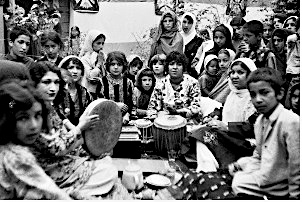
So never mind 1730s’ Leipzig or 1780s’ Vienna, how about Liverpool and Detroit in the 1960s, or Herat in the 1970s—or Beijing, New York, and London today? I’m not exactly disputing the notion that some societies may be more “musical” than others, but attempting to compile a league table of world musicality would ultimately be a cul-de-sac. Whether for the 18th century or today, it’d take a thorough broad-based survey of soundscapes to assess all this—one fine example of the broad view is Ruth Finnegan’s 1989 The hidden musicians, on musical life in Milton Keynes.

At least, people don’t wait for composers (whether indigenous or foreign) to write symphonies and operas to express their musicality. All this may seem obvious, but people still tend to stick within their particular tribes.

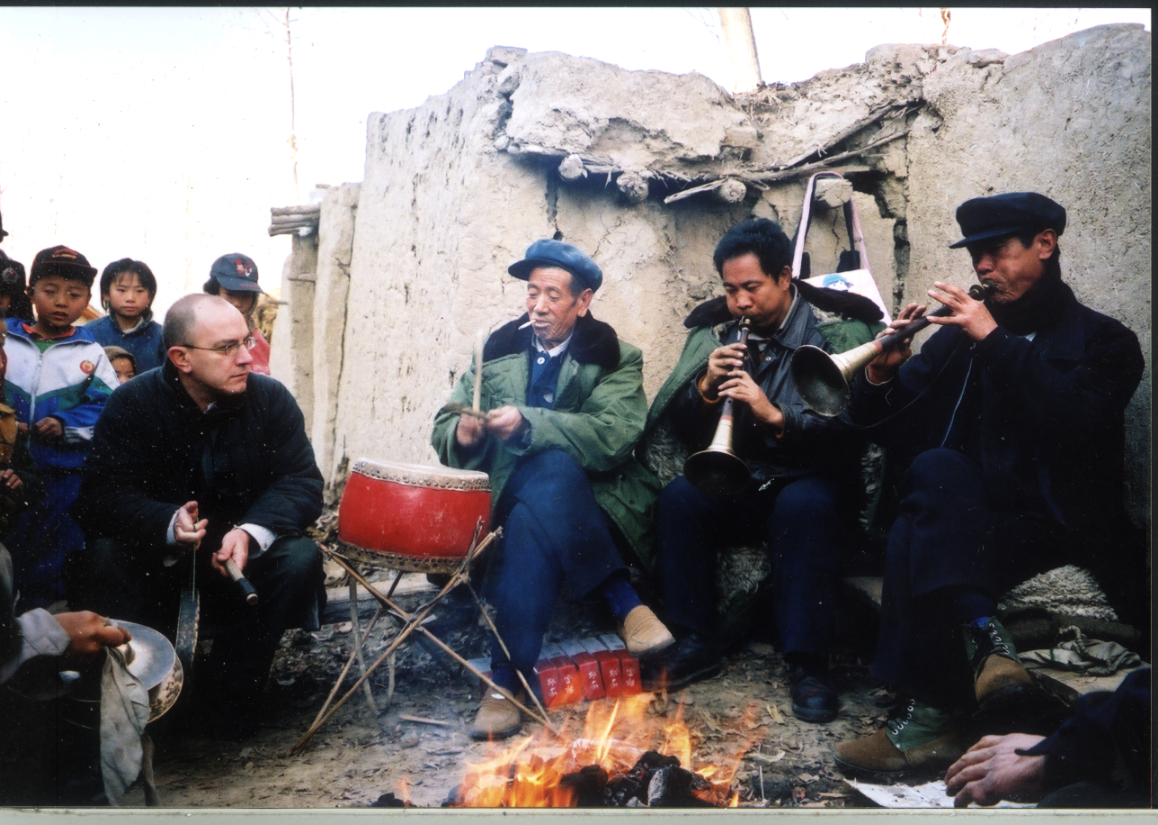
By the way, I constantly dispute the narrow dominance of one particular limited view of what constitutes “Chinese music”. I’ve given many instances of the narrow dominance of the conservatoire style and commercial pop; but punk, all kinds of vocal music along the continuum from folk-song to opera, spirit mediumshousehold Daoists, shawm and percussion bands, and so on, are all part of the picture we have to consider—as for any society in the world, for any period. Yet again, we should delight in all manifestations of the Terpsichorean muse


* This is neither here nor there, but it was on tour with Peter that Paul O’Dette told me the hemiola story

Update on Uyghur culture

camps

While I am tarred by the brush of studying Han Chinese cultures—themselves long accustomed to state brutality—the traditions of the Uyghurs in Xinjiang also feature in several of my posts, collected under this tag. Now painfully aware that my review of the film Ashiq: the last troubadour already needs revisiting in the light of the recent cultural genocide in Xinjiang—reminiscent of Stalin’s nationalist purges yet much more efficiently hi-tech and far-reaching—I’ve just done a distressing update to that post, with some further links.

Yet again this illustrates the vacuous, duplicitous claims of heritage pundits (note this post), whose reified presentations (for the Han Chinese too, if less fragrantly destructive) serve mainly to consolidate the ideological agenda of the modern state. But such polite, subtle manipulations are now rendered brutally obsolete.

Other posts under the Uyghur theme should also be read with this picture in mind.

Janáček and Moravian folk

fanfare

Leoš Janáček‘s Sinfonietta (1926) may be a great orchestral showpiece, but it’s complex and stimulating. It also links nicely to several of my themes:

  • His music is another reminder of the centrifugal variety around the peripheries of European art music
  • Since Janáček dedicated the piece to the “Czechoslovak Armed Forces”, this classic story from my mentor Paul Kratochvil is highly apposite
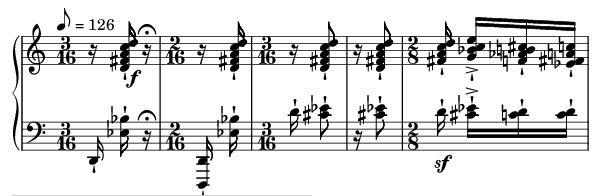
  • It further illustrates the use of additive rhythms
  • It makes a fine addition to the variety of posts grouped under the trumpet tag
  • And the timpani part, like the snare-drum in Nielsen 5, is another that I have earmarked to be played by Li Manshan
  • See also my post on Hašek (and for yet more, including more Švejk, the Czech tag).

Tom Service always makes a good guide (and do watch his link to Jakub Hrůša’s musical tour of Brno).

This is music that Janáček wanted ideally to be played by a military band like the one he’d heard a few years prior to the composition of Sinfonietta, and whose music he wrote down in the composing notebook he took everywhere with him. If you had to perform the Sinfonietta without a military ensemble, Janáček said (as it almost always is in concert halls these days), make sure the brass players sound as rough, brash, and bright as an army band.
[…]
On one hand, the jump-cuts and juxtapositions of Janáček’s music, the way he repeats little cells of music and then without warning moves to a new idea, means that you experience a continuous sense of surprise and suspense when you hear this piece. That kind of cinematic editing and shuffling of musical time seems to be the opposite of the conventional symphonic principle, substituting a logic of surreal colours, unpredictable textures and even less predictable timing for the development, argument, and discourse of proper symphonic behaviour.

There’s a host of spectacular recordings of the Sinfonietta. Since Charles Mackerras was a great champion of Janáček’s music, I was going to suggest his version (not least to remind you his wonderful anagram, Slasher M. Earcrack); but for some historical depth how about this one, with Czech performers—just after the war and Communist takeover, as musicians and audiences must have been anxiously awaiting life-changing measures wrought by their new leaders:

And here’s a 1961 recording with Karel Ančerl, who had survived Terezin and Auschwitz:

The Sinfonietta makes a glorious prelude to exploring the riches of Janáček’s music—operas, chamber music, and so on.

* * *

Please excuse me for returning to folk music, but it was a major inspiration for composers throughout central and east Europe, like Bartók. Along with pioneers like František Sušil and František Bartoš, Janáček collected Moravian folk culture keenly, long before Kundera dissected the way it was distorted under Communist rule.

1906

Janáček collecting folksongs on 19th August 1906 in Strání.

As well as my overview of musical cultures of east Europe I introduced Polish folk music here; Czech and Slovak traditions are projects for another time. Many of those features that Service notes—the use of cells, jump-cuts, shuffling—must relate to Janáček’s background exploring the rhythms and textures of peasant life.

Again, the Rough Guide to world music makes a starting point, under “Czech and Slovak republics”. Janáček’s own recordings have been reissued on the CD

  • The oldest recordings of folk-singing from Moravia and Slovakia, 1909–1912 (Gnosis, Brno).

See also

  • Barbara Krader, “Bohemia, Moravia, and Slovakia”, in Helen Myers (ed.), Ethnomusicology: historical and regional studies, pp.178–85

and

  • Magda Ferl Zelinská and Edward J.P. O’Connor, “Czech Republic and Slovakia”, in The Garland encylopedia of world music, vol.8: Europe.

Musicking at the Qing court 2: Pedrini and Amiot

pedrini 2

To return to my fantasy of Bach at the 18th-century Beijing court (see—and hear!—The Feuchtwang variations), the musicking of the European missionaries there makes an intriguing tangent to the varied material on all the diverse forms of musicking at the Qing court (a list to which I’ve now added Manchu shamans).

An authority here is François Picard (list of publications here, including this useful summary of relevant works—and note his CDs, introduced below).

Jesuit missionaries had established themselves as early as 1589 at the Ming court, and continued to find favour at the Qing courts of Kangxi and Qianlong. As Picard explains:

Their strategy was to convert the Chinese to Christianity, starting from the top. They did this, first of all, by demonstrating their status as experts and thus gaining access to the court; they then aimed to prove the superiority of the West, of Christendom, and therefore—syllogism—of Christianity, in the realms of science, astronomy, cartography, measurement, and music, the study of which belonged to the field of scholarship in both civilizations. Acoustics, instrument-making, notation, and performance were all part of that strategy of integration, competition, and persuasion.

Following Matteo Ricci (1562–1610), Adam Schall von Bell (1591–1666), and Ferdinand Verbiest (1623–88), Tomàs Pereira (1645–1708; for a range of studies, see here) is notable for his major compilation for the Kangxi emperor on the theory of Western (art!) music. This was completed by the Lazarist priest Teodorico Pedrini (1671–1746), who, reaching Beijing in 1711 (after an epic eight-year journey that puts the travails of British train commuters in perspective)* was active there along with Florian Bahr (1706–71) and Jean Walter (1708–59). Pereira and Pedrini are further discussed by several scholars, including Joyce Lindorff and Peter Allsop (e.g. here). The Jesuit priest Joseph-Marie Amiot (1718–93) arrived in Beijing in 1751.

Even transporting the keyboard instruments was a mind-boggling task for the missionaries. While they were braving such obstacles, Bach’s long-term residency in Leipzig was bearing fruit in a constant stream of creation.

François Picard’s work bears fruit in his collaboration with Jean-Christophe Frisch and his ensemble XVIII-XXI Musique des Lumières, notably an enterprising series of CDs—with contributions from the Fleur de Prunus ensemble and the choir of the Centre Catholique Chinois de Paris, and instructive liner notes with further references.

While the missionaries were not mainly concerned with documenting or performing Chinese music, Amiot notated some Chinese melodies, and some canticles were set to Chinese texts.

The Congregation of Musicians of the Northern Church in Beijing, numbering about thirty young musicians, including several Manchu princes, would accompany important celebrations, the most spectacular of which was the feast of the Sacred Heart of Jesus.

gongche

Liuyejin, in gongche solfeggio with stave transnotation, Amiot 1754.

Some of Amiot’s Divertissements chinois, based on Kunqu melodies, are imaginatively recreated with Chinese instruments on the CD

  • Teodorico Pedrini: concert baroque à la cité interdite (Auvidis, 1996)

Here’s a playlist:

Other CDs in the project include

  • Joseph-Marie Amiot (1718-1793), Messe des jésuites de Pékin (Auvidis, 1998)
  • Chine: jésuites et courtisanes (Buda Records/Musique du monde, 2002)
  • Vêpres à la Vierge en Chine (2004)

In the chamber items with both baroque and Chinese instruments, the timbres blend well—and would do so even better had the latter been set up in 18th-century fashion, with silk or gut strings.

All this makes an intriguing if inconclusive exploration of elements: whereas ornamentation is common to both traditions, it’s more of a challenge to reconcile Chinese heterophony with the harmonic basis of baroque music. Amiot didn’t take the “superiority” of his musical culture for granted—Picard cites a perceptive passage:

Here, there is neither bass, not tenor, nor treble, everything is in unison, but that unison is varied according to the nature and capacity of each instrument [what we now call heterophony! SJ], and the composer’s skill, the beauty of the piece and the whole art of music lies in that variation. […] It would be of no avail to endeavour to prove to the Chinese that they must find pleasure in something in which they really find none at all.

In Picard’s notes for the Chine: jésuites et courtisanes CD he cites some contemporary reports relevant to the “suite-plucking” of the nobility, such as notes by courtier Gao Shiqi:

[The Kangxi emperor] ordered the ladies of the palace to play a melody, hidden behind a folding screen. He then said: “The people of the palace are excellent with string instruments (xiansuo).” He ordered his courtiers to show their art and successively play the hupo, pipa, and sanxianzi string instruments. He then said: “Play the qin piece “On the beach the geese are landing” (Pingsha luoyan) on the four string instruments—hupo, pipa, xianzi, and zheng—together.”

Adding female nobles to our list of performers, the emperor went on:

“The ladies of the palace have played the zheng zither since their childhood, to the point of forgetting to eat or sleep.** After ten years of efforts, they have attained sheer mystery [cf. Shenqi mipu].” He then ordered them to play “The moon is high” in a “changing tonality” (Bianyin yuer gao).

For more excursions in Qing ritual culture, see here.

* * *

To return to my Bach fantasy, European art music performed by European musicians at the Chinese court is a perfectly valid topic. It’s a welcome clue to early Chinese exposure to Western music, which from the late 19th century would become a major and more pervasive theme. And Amiot’s arrangements of Chinese melodies may have been performed by Chinese musicians. But while it’d be nice to think of European missionaries learning Chinese style, whether on Chinese fiddles (tiqin, sihu) or on violin, I can’t see any evidence; their contacts with the broader society, and indeed their tastes, were circumscribed.

Of course, world music “fusion” in China goes back to the Tang dynasty and earlier. But in the Qing, even within the rarefied milieu of the court, and despite the efforts of the missionaries, I find little evidence of more significant interaction, such as Chinese performing European music on Chinese instruments or Europeans taking part in Chinese ensembles.

For the Vêpres à la Vierge CD I took part, implausibly, on baroque violin, erhu and shawm—but I never quite knew whom I was impersonating (an imaginary missionary, either steeped in Chinese style or not? Perhaps even a Chinese Catholic convert keen to bury his musical heritage beneath superior Western learning?!). My ears conditioned by exposure to living Chinese traditions that often go back beyond the Qing, I found our experiments tentative; we were on firmer ground with the purely Western items, which now sound more successful to me. Later in a couple of concerts I began doing some semi-chinoiserie noodling on the two types of fiddles (miantiao? tagliatelle?) that I, at least, found a bit more satisfying; but I still couldn’t work out who I was—me, I guess.

Anyway, I was content to get back to my work with the living folk ritual groups of Hebei and Shanxi—where besides indigenous traditions, Christian groups had come to adopt their own local shengguan wind ensembles for ritual observances.

Catholics in rural Shanxi—left: Wenshui, 1933 (see South Gaoluo: the Catholics);
right: Xinzhou, Shanxi, 1992 (see Shanxi, summer 1992).

* * *

For such imaginative cross-cultural time-travelling excursions, one might compare several projects on baroque music in Latin and south America, and the fine project of Jordi Savall and Hesperion XXI on the routes of slavery:

—in line with their previous work on medieval music, such as their versions of the medieval estampies (better received than ours…).

See also the thoughts of John Thompson.

* * *

In these two posts on the Qing court I’ve given just two instances of the great variety of musicking there. As you know, I don’t go in much for recreations. While such experiments are imaginative, as Taruskin reminds us, the whole social and aesthetic framework in which we experience them—our very ears—are quite different (see e.g. Bach and Daoist ritual); we can only hear them for what they are: our creative response, for our own tastes in our modern societies.

* Since this post entails historical re-enactment, many would doubtless welcome the nomination of Transport Minister Chris “Failing” Grayling to retrace Pedrini’s route.

** I dunno, these teenage kids on their mobiles, Typical!—Ed.

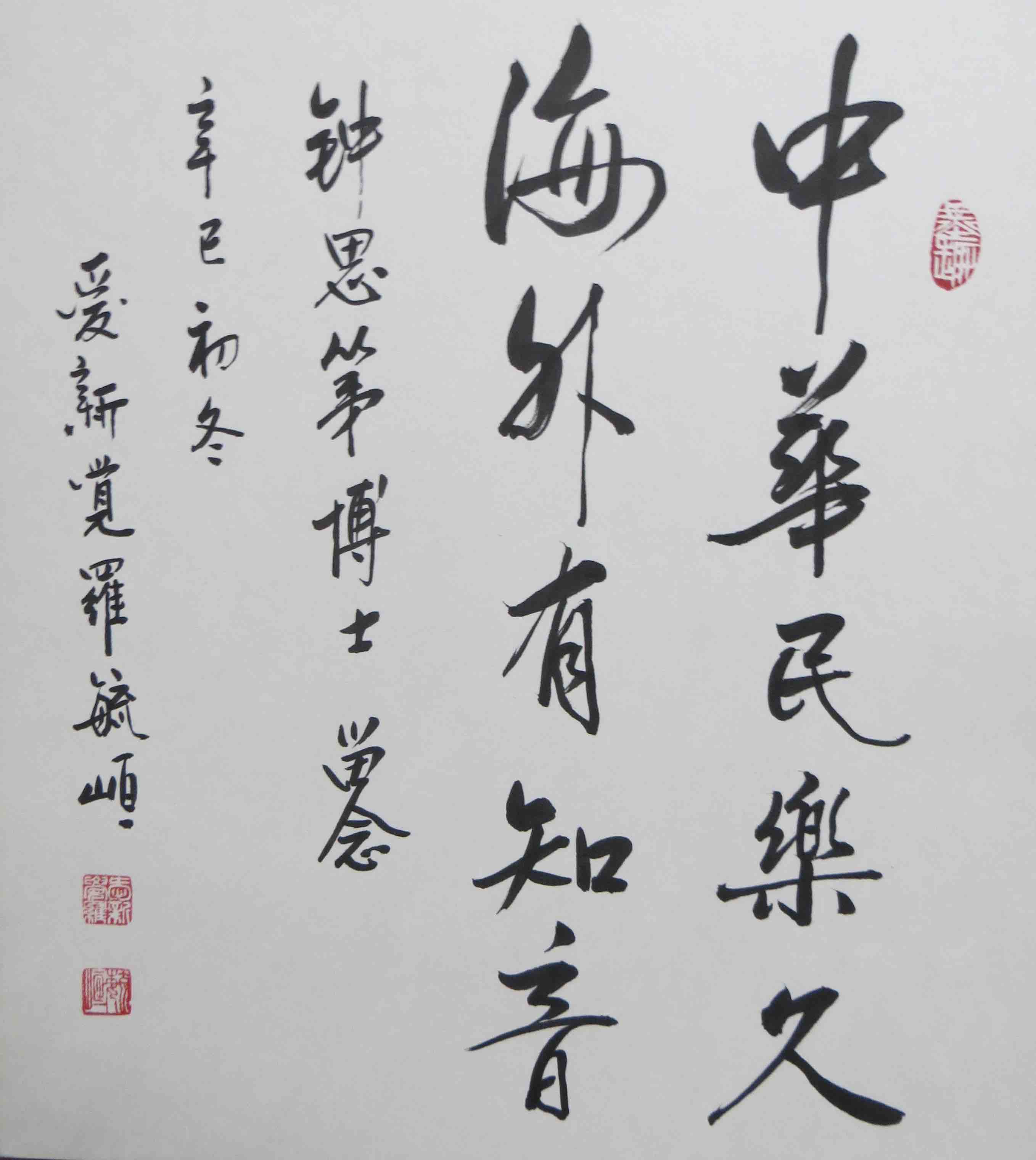
Calligraphy of a Manchu imperial scion

Aixin shufa

In my post on Robert van Gulik I mentioned my 1986 encounter with the painter and pipa-player Yang Dajun (1913–87), who was in wartime Chongqing with van Gulik and my mentor Laurence Picken. Another illustrious heir to traditional culture whom I visited in Beijing in 2001 was Aisin Gioro Yuhuan 愛新覺羅毓峘 (1930–2003), great-great grandson of the Daoguang emperor.

Aixinjueluo

As we saw in my post on the “suite plucking” of old Beijing, apart from his distinguished painting, Aisin Gioro Yuhuan had learned the sanxian plucked lute from the age of 8 with a former palace eunuch, and then with blind folk musicians; from 1985 he mentored conservatoire students as they recreated the repertoire once played by Manchu–Mongolian nobles along with lowly itinerant blind performers.

My visit was rather belated, perhaps because whereas I was aware of the genre, by the 1980s it was long been obsolete in social practice. In Beijing I’d been spending more time with elderly former monks; and the village ritual associations in which I was immersed were still active, their shengguan wind ensemble repertoires still forming richer repository of early melody. Still, meeting Aixin Gioro Yuhuan, a living descendant of the Qing imperial family, made an apt reminder of Granny Liu’s epithet in The dream of the red chamber on the continuity of tradition despite all its tribulations.

In the calligraphy that he wrote for me, we can discount its typical flattery of the foreigner, attributing to me a deep empathy with Chinese music (for a more humble yet heartfelt example from my Gaoluo friends, see here; and for the calligraphy of Tian Qing, here). But it makes a precious souvenir.

New tag: fiddles!

At last I’ve added a tag in the sidebar for fiddles, embracing all kinds of bowed lutes (or even, um, friction chordophones) around the world, including folk fiddles, ghijak and satar, sarangi and kamancha, violins in WAM, and so on.

It’s a typically extensive list, and I’m sorry I can’t subhead tags, yet. If I could, the entries might include

and so on.

See also Some jazz fiddling.

Do also explore the tags for Irish and the brilliant Ciaran Carson—some highlights include

One quirk of the blog format I use here is that I can only give categories and tags to posts, not pages. So I’d add other pages like

and so on.

For another instrument tag, see trumpet—giving links to many world traditions of wind and brass playing.

Musicking at the Qing court 1: suite plucking

On the folk–art continuum in culture

XS early

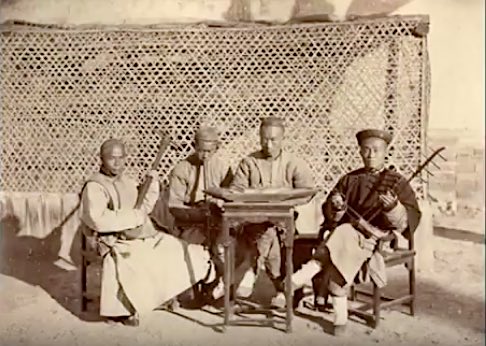
“Musiciens Chinois. légation a Pékin”, Paul Champion, 1865/1866, with sanxian plucked lute, xiao end-blown flute, yangqin dulcimer, and sihu fiddle.

Inspired in 2017 by Stephan Feuchtwang’s 80th birthday to essay a fantasia on Bach at the court of the Qianlong emperor, I’ve been meaning to give a little introduction to the court music of the Qing dynasty (for another vignette, see here).

First we need to unpack the wafty term “court music”, subsuming all kinds of activities (for an early study from the Forbidden City, see e.g. Wan Yi and Huang Haitao, Qingdai gongting yinyue, 1985; see also the succinct introduction in Yang Yinliu, Zhongguo gudai yinyue shi gao, pp.1005–1009). It includes the large-scale yayue, ceremonial groups of both Inner and Outer courts, Daoist, Buddhist, and shamanistic observances, various genres of opera—and recreational chamber ensembles for life-cycle celebrations.

Most of the groups that I study in rural China serve the ritual needs of their local communities—whether occupational or (as in the case of sectarian associations) devotional. Amateur musicking for recreation or entertainment is less common. Even vocal genres like opera and narrative-singing are often occupational, largely serving ritual; but we do find some recreational groups, mainly in urban areas. And even here, the ceremonial–entertainment dichotomy is not clear-cut: recreational genres too were often performed for life-cycle and calendrical ceremonies.

Suite plucking
After Liberation, cultural cadres gave misleading names to many folk genres (cf. here, and for the “songs-for-winds”, here). The recreational chamber repertoire known since the 1950s as the “thirteen suites for strings” (xiansuo shisan tao 弦索十三套) was simply known as “suite plucking” (tantao 彈套). [1]

Often valorised by a narrow association with the Manchu court elite, it turns out to belong to a wider circle of folk activity (and here we may detect echoes of the hype surrounding the Zhihua temple). Indeed, it’s not useful to draw a clear line between folk and elite musical cultures in China—for a detailed instance, see this comparison of a qin piece and a shawm suite.

The social and cultural life of the late Qing is a rich topic, little explored in relation to these suites. I learn much from a 2013 article by Zhang Weidong 张卫东, stalwart of the amateur narrative-singing clubs around Beijing. Among many sources, he cites Jin Shoushen 金受申, Lao Beijingde shenghuo 老北京的生活—just the fascinating kind of social detail also found in the work of Chang Renchun on the customary and ritual life of old Beijing.

As part of his broad cultural education Aisin Gioro Yuhuan 爱新觉罗毓峘 (1930–2003), descendant of the Qing imperial family, learned the sanxian plucked lute from the age of 8 in Japanese-occupied Beijing with the former palace eunuch Luo Defu 羅德福, and later with blind musicians Wang Xianchen 王宪臣 and Zhang Songshan 张松山. He expanded on this background in several interviews, including articles in Renmin yinyue 1988.9 and 1990.6. For my visit to him, see here.

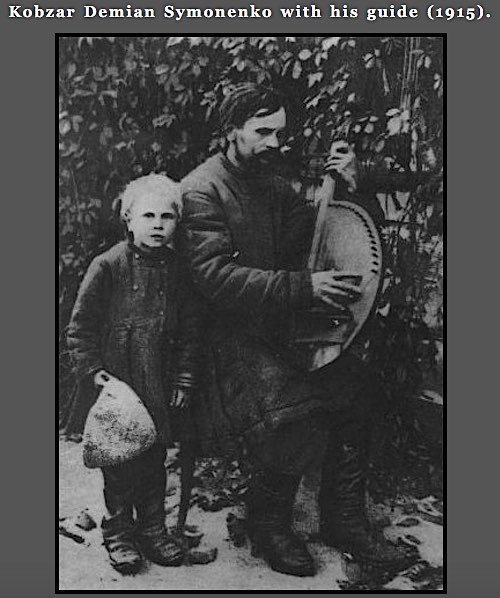
Like most musicking in China and worldwide, the genre wasn’t dependent on notation: indeed, it was largely an oral tradition. And again it illustrates the continuum between folk and art musics: it now tends to be associated with the Manchu–Mongolian nobility, but they learned this repertoire as patrons of lowly blind itinerant street performers (menxianr 門先 or gumu 瞽目) whom they invited to their mansions. Blind musicians are important in local social life, such as shawm players and bards (and, further afield, in Ukraine—formerly), and the menxianr were major players in the Beijing narrative-singing scene.

menxianr

Illustration from the “72 trades of old Beijing”.

In the mid-19th century [2] a blind sanxian player called Zhao Debi 趙德壁 was renowned for his rendition of the suites. His pupil Yue Fengting 岳鳳亭 was an influential transmitter of the repertoire. And Wang Xianchen, a protegé of the empress Cixi, served the inner court.

Instruments included the plucked lutes sanxian and pipa; a bowed lute tiqin or sihu; and the zheng zither—which, despite its rippling ubiquity in the conservatoires, is rarely used in folk ensembles in north or even south China. A xiao end-blown flute, dizi transverse flute, or small sheng mouth-organ might also take part, but were already less often used by the early 20th century.

Scores
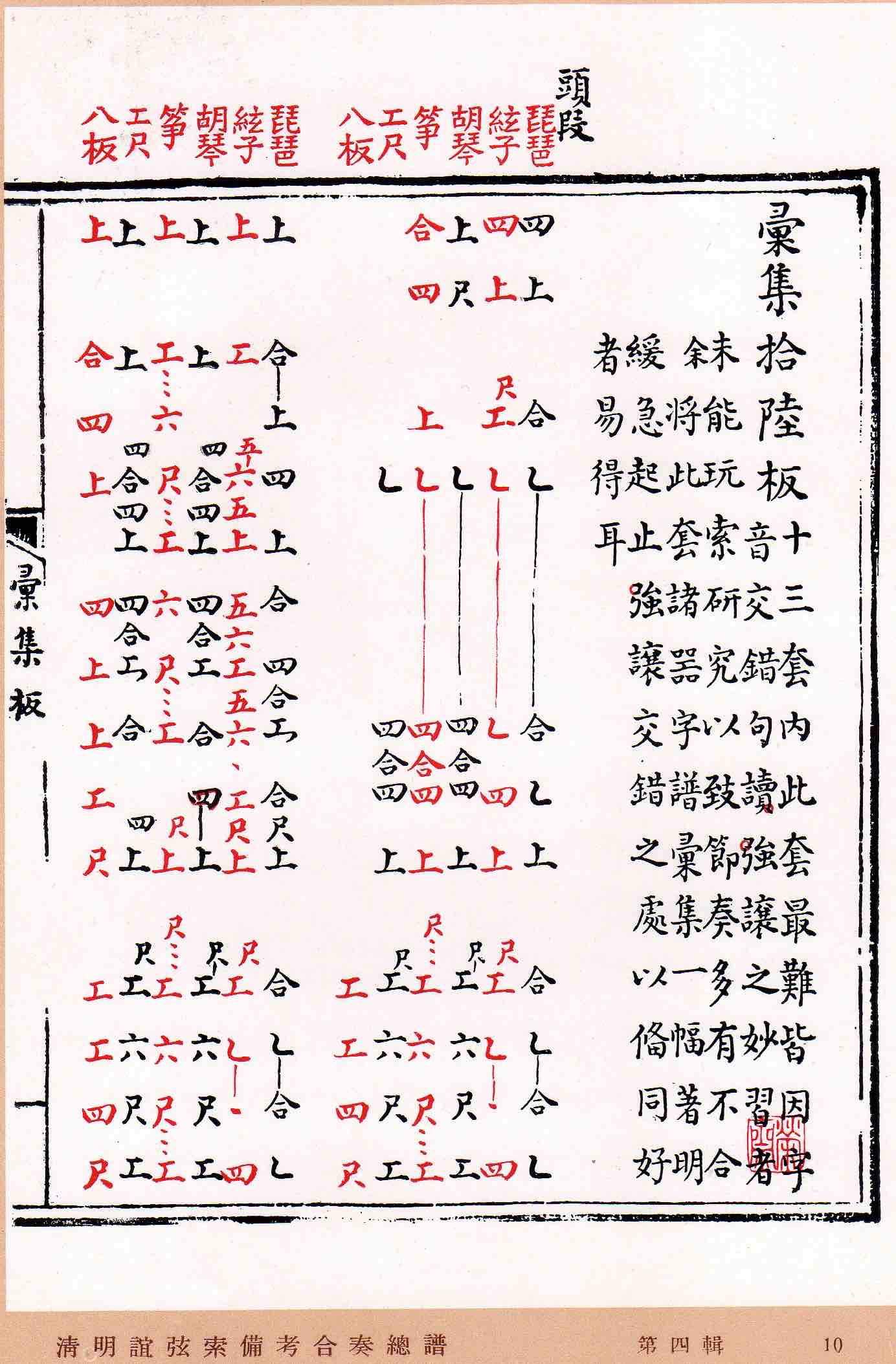
In the early 19th century the Mongolian nobleman Rong Zhai (Ming Yi 明誼) learned the repertoire along with four other princes (gong 公), and in 1814 he compiled a gongche score in his Xiansuo beikao 弦索備考.

By the 1940s, this and several related scores kept in private hands had reached Beijing music scholars (cf. this post), Later Cao Anhe thickened the plot with a discussion of these versions, including forgeries, showing the importance of textual research:

  • Cao Anhe, “Xiansuo shisan tao paishengchulaide jizhong wei yuepu” 弦索十三套派生出来的几种伪乐谱, Wenyi yanjiu 1981.4.

This resulted in yet another project from the brilliant Music Research Institute (MRI) in Beijing under the aegis of Yang Yinliu, largely consisting of transnotations. It was first published in three slim volumes in 1955 and 1962, and then reprinted in 1985:

  • Cao Anhe 曹安和 and Jian Qihua 简其华 (eds.), Xiansuo shisan tao 弦索十三套.

Yet again I marvel at the energy and discrimination of the Beijing scholars before and after Liberation, also including Wang Shixiang, the great painter and qin player Pu Xuezhai雪齋 (1893–1966, another scion of the Aixin Gioro imperial family—see below), and Ling Qizhen 凌其阵. [3]

In 1963 Aisin Gioro Yuhuan was invited to teach at the Beijing conservatoires, but this was soon interrupted by the outbreak of the Cultural Revolution (cf. Daoist drum master Zhu Qinfu: my Folk music of China, pp.255–6). By 1985 he had hardly played sanxian for over thirty years, but he now worked closely with Tan Longjian to recreate the style of the Xiansuo beikao suites. She went on to publish separately the results of their work on the sanxian parts:

  • Tan Longjian 谈龙建, Qing gu gongwangfu yinyue: Aisin Gioro Yuhuan sanxian chuanpu 清故恭王府音乐: 爱新觉罗·毓峘三弦传谱 (1988), with a useful introduction by Yuan Jingfang 袁静芳.

Rong Zhai had given individual parts for each instrument, spelling out their heterophony. By contrast, when melodies of instrumental ensembles were notated, it was invariably in a single gongche skeletal outline, with the realizations on particular instruments left to the taste and experience of the musicians. This was evidently so for these suites too: the score was an isolated instance of documentation in what remained an oral tradition.

In one case Rong Zhai even gave a “full score” with all the parts aligned—perhaps a unique instance in traditional notation:

XSBK

Xiansuo beikao, opening of Shiliuban. From Zhongguo yinyueshi cankao tupian, vol.4 (1955).

Still, as in all traditions of musicking around the world, performance requires practical experience of learning with a master; and this applies even when notation is available.

The suites consist of sequences of melodies, though titles within the suites are not always given. The repertoire overlaps with that of shengguan ritual wind ensembles such as Haiqing 海青 and Pu’an zhou 普安咒, widely performed both in the temples of old Beijing and among amateur ritual associations in the countryside nearby and further afield. It was on these rural groups, still active, that I came to focus; and here too, I learned that one’s field of study must be far broader than “instrumental music“.

Changing society
As I often note for ritual studies too, scholars tend to favour reified documents, at the expense of changing social context.

Well before the Communist revolution of 1949, the social system had been changing along with the demise of the imperial system in 1911. But when musicologists began transnotating the suites in the early 1950s, there were still some musicians who recalled playing them—like Aisin Gioro Yuhuan, indeed. How I wish Yang Yinliu and his colleagues had managed to record them then, like their 1953 Zhihua temple recordings (sidebar playlist #14, with commentary here). According to Cao Anhe (1981) the MRI did indeed record four or five suites played by the great blind sanxian player Wang Xianchen (for whom, see again Zhang Weidong’s article). By 1950 Wang must have been at least 80 years old, but alas these recordings appear to have been lost. I’ll save another surviving recording for further below.

QYDWhat did persist in Beijing, both before and since the Cultural Revolution, was the amateur narrative-singing scene—a must for any aficionados of The dream of the red chamber, by the way. Some instrumental pieces are still played there as preludes or interludes, but the suite repertoire didn’t survive. Anyway, it’s another of the pleasures of Beijing musical life, less well publicized than the indie/punk scene there.

In the 1990s, between fieldtrips in Hebei, I enjoyed visits to a little hutong in Xinjiekou for the weekly gatherings at the house of the late great Qian Yadong 钱亚东 (right, in 1995—then aged 85!).

Jixian chengyun

Sihu, pipa and sanxian players (the latter blind—long rare at such gatherings) at Qian Yadong’s house, 1995.

For the narrative-singing scene in early 1950s’ Beijing, the vicissitudes of Czech and Chinese scholars and artists, and the 1980s’ Anthology, see here.

Belated recordings
With the renewed vigour of the 1980s, the Central Conservatoire in Beijing organized students to perform the suites on the basis of the 1950s’ transnotations, consulting Aisin Gioro Yuhuan and Cao Anhe.

I’ve given some instances of the aesthetic gulf between folk and conservatoire, and here’s another. While well-intentioned, these reified conservatoire recordings can hardly capture the more traditional mood of the earlier masters. Of course, young conservatoire students were not only learning from prescriptive modern notation, but belonged to another aesthetic world to that of the itinerant blind performers and the Qing nobility—and even to that of their own conservatoire teachers, many of whom (including masters like Yang Yinliu, Cao Anhe, Yang Dajun, Cao Zheng) had been brought up in a traditional aesthetic. Even the instruments, and their strings, would have been different.

You can find the conservatoire recordings in a YouTube playlist from David Badagnani (note also the Chinese documentary to which he refers):

So just like my own humble rendition of Bach on the erhu,

After intensive research on Qing-dynasty performance practice, I can now say with some certainty that…  it wouldn’t have sounded like this.

We can get more of a flavour of a convincing style for “suite plucking” from early recordings of narrative-singing in old Beijing. And thanks to Yuan Jingfang I learn of a 1950s’ recording of (a variant of) the “plucking suites” piece Hehuan ling 合歡令 on sanxian by none other than Pu Xuezhai (see above)! Indeed, whereas Pu quite correctly regarded the qin as merely part of the whole “qin, chess, calligraphy, and painting” amateur literati culture, he seems to have been more adept as a sanxian player. Gratifyingly, the recording has been reissued:

* * *

Such genres in China, largely performed by amateurs for entertainment, are commonly grouped under the umbrella term of “silk-and-bamboo” (sizhu). Some are mainly for instrumental ensemble (as in Shanghai or Chaozhou); in others (such as the nanyin of south Fujian) the ensemble mainly accompanies a solo singer, and genres may be classified under narrative-singing. They are often linked to a literate elite background, later becoming popular among ordinary people.

These groups have survived well along the southeastern coast. Nanyin continues to enjoy wide popularity, not just in the main urban centres like Quanzhou and Xiamen but throughout the surrounding countryside. Some genres are nationally renowned, and a common topic of music scholars; but my reading of the fine ethnographic reports around the region suggests that they are only a minor part of expressive culture there—with Daoists and mediums, opera troupes and puppeteers, shawm bands and percussion ensembles dominating the rich ritual culture of the area. Many more genres, little-known outside their catchment area, can be found in the instrumental and narrative-singing volumes, by province, of the Anthology (see e.g. the “silk-strings” of Wugang in Hunan, mentioned in my “Reading between the lines”, pp.327–8, and also recently the object of heritagification).

In the north, most string ensembles with substantial separate repertoires seem to have declined since the 1950s, suffering from a decline in both recreational activities and patronage. As for the south, I introduced some groups briefly in my Folk music of China, and again you can pursue them further in the Anthology—such as in Chengde northeast of Beijing; various types of Shifan 十番 ensemble; Henan bantou 板頭 and Shandong peng baban 碰八板 repertoires. See also my post on the “little pieces” of Yulin city—amateur groups that survived Maoism but became moribund since the reforms, with the kiss of death bestowed by the reforming zeal of cultural officials.

The question remains, why amateur folk activity in those chamber genres along the southeastern coast has remained strong through the Maoist and reform eras, with a spectrum of traditional and official styles, whereas in the north most amateur string ensembles seem to have become musical casualties of the revolution.

* * *

So while a narrow musicological approach tends to encourage reification, the study of “suite plucking” should lead us to the cultures of late imperial Beijing, both folk and elite; and to the voluminous sources on the whole history of vocal music.

What such research doesn’t spell out is that entertainment has moved on: the social milieu in which the plucking suites were performed before 1911 has long ceased to exist. The current Beijing elites no longer play along with itinerant blind musicians! Of course, the 1980s’ project on the suites was not seeking to reinvigorate them as a form of social life; they came to form part of the nostalgic re-imagining of the imperial past, quite removed from society. So this yet again confirms my reservations about recreating early music for genres whose performing traditions have been lost. As with any musicking worldwide (including WAM, such as Bach or Haydn), we need to study changing performance practice in social context, and reception history.

Ritual activity, however, persists in China. The rosy reification of imperial culture may distract us from the ethnography of groups that have remained active through the tribulations of the 20th century, and from the enduring importance of living soundscapes as part of changing social activity.

Lastly, even where we can distinguish between folk and elite cultures, there is nothing “superior” about the latter, either in China or elsewhere (see What is serious music?!, and for China, Dissolving boundaries)!


[1] Here I’ve expanded modestly on my brief introduction in Folk music of China, pp.208–12. For rich material on vocal and instrumental groups in the late imperial period, note Yang Yinliu, Zhongguo gudai yinyue shi gao, vol.2.

[2] Cao Anhe and Jian Qihua give Qianlong–Jiaqing eras, but Zhang Weidong’s later dates of Daoguang–Xianfeng (1820–61) seem more reliable.

[3] Ling Qizhen (1911–84) was a qin player, originally from Shanghai, later professor at the Shenyang Conservatoire, where he founded the Liaoning qin research association. For his useful 1958 article on “Buddhist music” in Shenyang, see here.

How to be English

Lee

The insights of Stewart Lee feature regularly on here. Last week he did a wonderful guest slot of three programmes on Radio 3’s Late Junction (starting here):

Now who doesn’t like Czechoslovakian Communist-era free jazz…

And I now find a rich archive of his TV series Comedy vehicle on the BBC website. Among all the treasures there, I am most taken with his take on St George’s Day in the England episode (Bring it back, BBC!)—pursuing his bête noire of Paul Nuttall and the UKIPs.

As ever, he reformulates motifs from previous work, just like Bach and Miles Davis [fine new submission for Pseuds’ corner—Ed.]. But what I respectfully wish to submit [m’lud] is the passage from 20.31. He goes on (and on, and on):

[Nuttall is] only trying as best he can to ensure the future domestic prosperity of Bulgaria—I don’t doubt that for a minute. […]

I live here, in the People’s Republic of Hackney, in northeast London. It’s very culturally diverse (not really in this audience). I’ve had kids at nursery and playgroup here. And what they do at the nurseries and playgroups in Hackney, they celebrate all the different kids’ festivals and cultural events in what you might call a logical, sensitive, and pragmatic approach to cultural diversity… “gone mad”. They celebrate Christian Christmas, Chinese New Year, Muslim Michaelmas, Atheist April Fool’s Day, Pantheists’ Pancake Day, Odinist Oatcake Day, and Lesbian Gay and Bisexual Harvest Festival […]

But, EDL members and Daily Telegraph readers relax—they do celebrate St George’s Day as well. On St George’s Day they told me I had to send my little two-year-old girl into the Hackney playgroup dressed in traditional English costume. So I sent her in dressed as a 1970s’ English football hooligan, with a cross of St George and all swastikas drawn on her face… and I had her drunk on Special Brew, and high on amphetamines… I gave her sharpened coins to throw at horses, and I had her shouting,
“I’m English, I’m English! Wanna make something of it?”

Now, that led to a misunderstanding… and the police became involved. “Apparently if you say you’re English these days you get arrested and thrown in jail…”

The dénouement there refers back to his exchange with a taxi driver:

The bigoted taxi driver has long been a regular guest in his routines, as here.

I do appreciate that I will now look like the worst kind of BBC liberal apologist idiot if you’re all sitting at home watching this dubbed into Bulgarian. With Romanian subtitles.

All this ploughs a somewhat different furrow from that of The ArchersFor more on being English, see here.

Guide to another year’s blogging


Struggling to encompass all this? I know I am. While we inevitably specialize in particular topics, it’s important to build bridges. I guess it’s that time of year when another guide to my diverse posts may come in handy—this is worth reading in conjunction with the homepage and my roundup this time last year.

I’ve added more entries to many of the sidebar categories and tags mentioned in that summary. I’ve now subheaded many of the categories; it’d be useful for the tags too, but it seems I can’t do that on my current WP plan. Of course, many of these headings overlap—fruitfully.

Notably, I keep updating and refecting on my film and book on the Li family Daoists. I wrote a whole series resulting from my March trip to Yanggao (helpfully collected here) and Beijing (starting here, also including the indie/punk scene). Other 2018 posts on the Li family include Yanggao personalities and Recopying ritual manuals (a sequel to Testing the waters).

To accompany the visit of the Zhihua temple group to the British Museum in April, I also did a roundup of sources on the temple in the wider context of ritual in Beijing and further afield, including several posts on this site.

I’ve posted some more introductions to Local ritual, including

Gender (now also with basic subheads) is a constant theme, including female spirit mediums—to follow the series on women of Yanggao, starting here. Or nearer home, Moon river, complementing Ute Lemper.

Sinologists—indeed aficionados of the qin, crime fiction, and erotica—may also like my post on Robert van Gulik (and note the link to Bunnios!).

I’ve added a few more categories and tags, notably

The film tag is developing, with a side order of soundtracks—for some links, see here.

I’ve given basic subheads to the language category (note this post on censorship), which also contains much drôlerie in both English and Chinese. Issues with speech and fluency (see stammering tag) continue to concern me, such as

Following Daoist football, the sport tag is worth consulting, such as The haka, and a series on the genius of Ronnie.

Some posts are instructively linked in chains:

More favourites may be found in the *MUST READ* category. Among other drôlerie, try this updated post, one of several on indexing and taxonomy; and more from the great Philomena Cunk.

Most satisfying is this collection of great songs—still not as eclectic as it might become:

Do keep exploring the sidebar categories and tags!


Cheremis, Chuvash—and Tibetans

Photo: Cheremis “pagan” ritual singer H.H. Musztafa (then 69), June 1975.

Along with from the many Hungaroton LP box-sets of the musics of east Europe, another impressive 3-disc set that I brought back from Budapest is

collected and published by László Vikár (1929–2017) and linguist Gábor Bereczki. The set documents musical traditions of peoples in the “autonomous” republics around the eastern perimeter of the European part of the USSR, the central Volga and Urals—peoples about whom I know nothing, but feel we should know:

Mordvinians, Votyaks (Udmurt), Cheremis (Mari), and the Turkic-speaking Chuvash, Tatars, and Bashkirs.

USSR

Source: reddit.com.

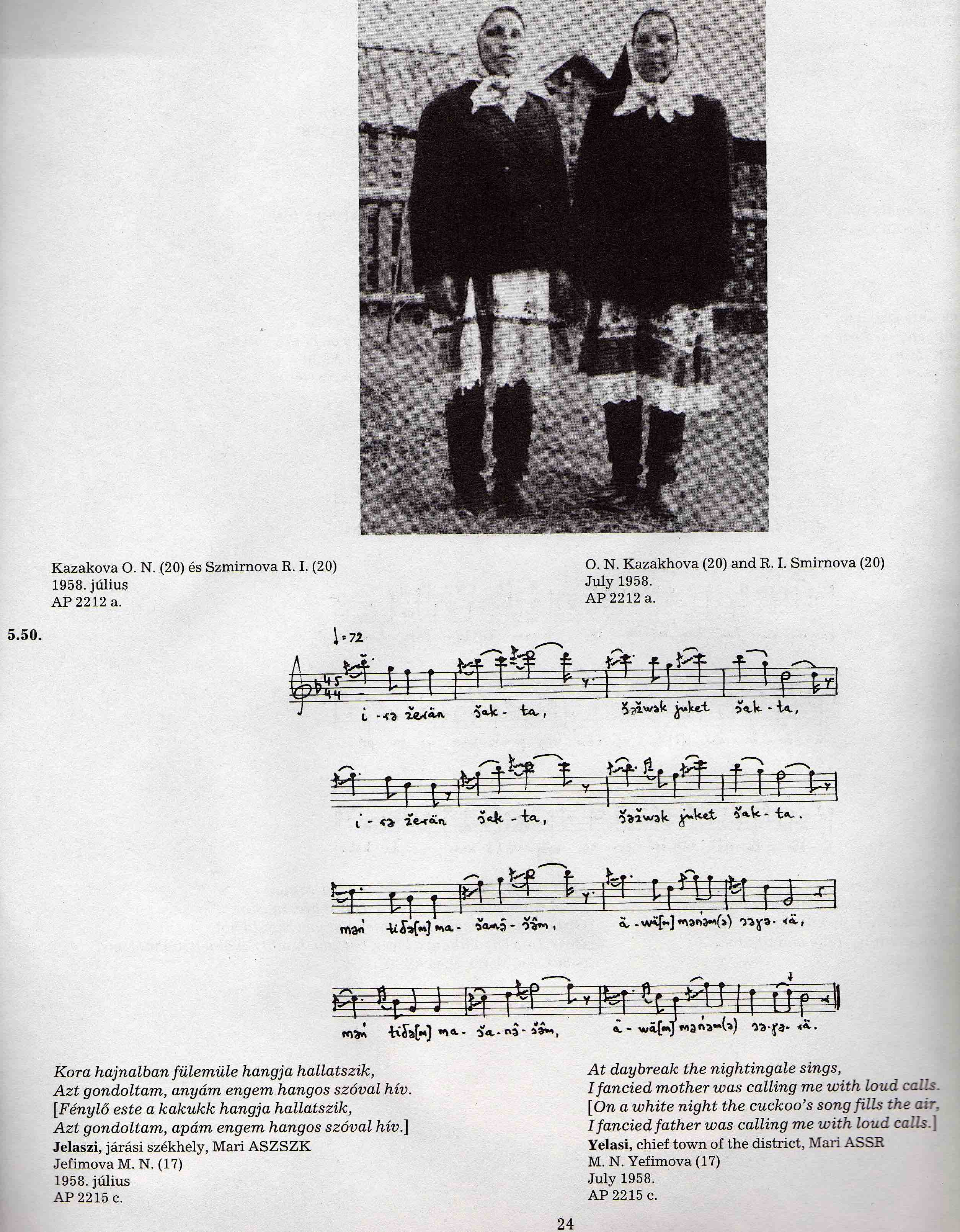
Between 1958 and 1979 Vikár and Bereczki made four long summer fieldtrips to some 286 villages, accompanied by local scholars. With sound engineer Pál Sztanó they recorded life-cycle and calendrical items, both vocal and instrumental, including bridal dirges, funeral laments, dance tunes, and historical epics.

The recordings on this box set are part of a much larger archive. Some tracks appear on YouTube, such as

Note also this channel.

The 43-page booklet contains detailed notes, as well as maps, translations, photos, and some transcriptions.

notes 2

A page from the booklet, on Mari singing.

Bartók, Kodály, and Bence Szabolcsi had already shown an interest in these groups, mainly as part of their comparative musical paleography, classifying melodic types; Vikár was building on this tradition. [2]

Such early recordings were made on request, not—as ethnographers later also sought—while documenting the social events of which they are the core. So we meet the typical issue that often crops up in Chinese collections: were they performing items then still in use, or recalling them from an earlier social practice?

And of course these projects could barely hint at the painful recent histories of such peoples (cf. The whisperers). Music is never autonomous, but gives us a window into the study of changing local societies.

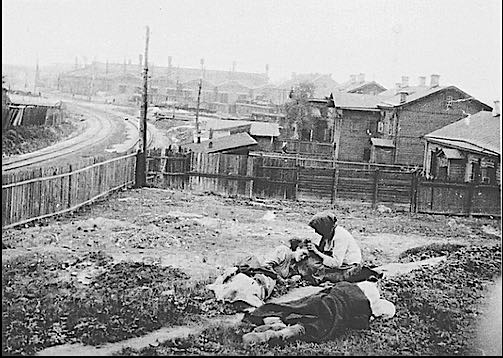
Indeed, it’s worth recalling what else was happening in those years. Notwithstanding the interest of early east European music scholars in “archaic layers”, these are not timeless idyllic communities; though by the 1970s they had weathered the worst of the years of repression under Stalin, they had been constantly starved, deported, subject to political whims, suffering under collectivization and the Great Purge (cf. Blind minstrels of Ukraine, under “Other minorities”). This too is a rich field of research—see e.g.

See also The Kazakh famine, and (still earlier) Hašek’s adventures in Soviet Tatarstan.

The task of modern ethnographers—just as for China—is to integrate socio-political histories with expressive cultures. In 1975 the moment had still not come to record the memoirs of “pagan” Mr Musztafa—and now it’s too late.

In addition to the Garland encyclopedia of world music, for more on early collecting, see under

  • Margarita Mazo, “Russia, the USSR and the Baltic states”, in Ethnomusicology: historical and regional studies (The New Grove handbooks in music, 1993), pp.197–211,

and in the same volume,

  • Theodore Levin, “Western central Asia and the Caucasus”, pp.300–305.

In the early years after the crushing of the 1956 Budapest uprising, one might wonder how smooth was the collaboration between Hungarian and Soviet scholars—only of course both would have suffered under the policies of their regimes.

* * *

1955

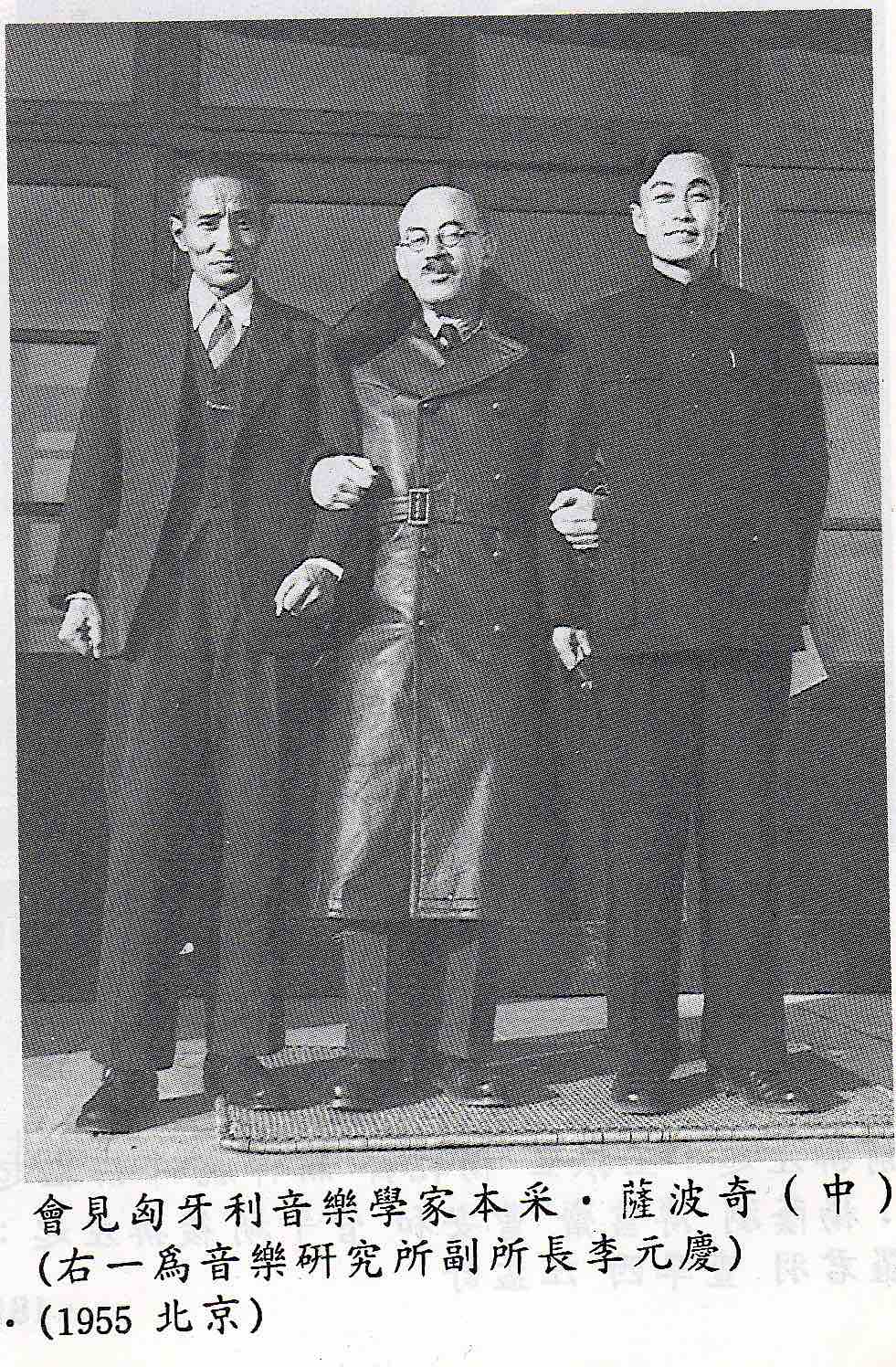
Left to right: Yang Yinliu, Bence Szabolcsi, Li Yuanqing, Beijing 1955.

Meanwhile in China, scholars were also documenting local traditions, for both the Han majority and the many ethnic groups—under testing conditions, and with a similar caution in broaching socio-political issues. By the 1950s, with a growing interest in early connections between Hungarian and Chinese musics, China was open to Hungarian musicology; Bence Szabolcsi visited the great Yang Yinliu in Beijing in 1955, on the eve of the Budapest uprising. And Yang Yinliu visited the USSR in 1957, just after his remarkable fieldtrip to Hunan—just before the Anti-Rightist campaign and Great Leap Backward led to untold suffering.

1957

Yang Yinliu (seated, right) on a visit to the USSR, 1957.

For Czech–Chinese exchanges over the period, see here.

Kodály’s Folk music of Hungary, dating from 1935, was published in 1964 in a Chinese translation from the 1956 German edition—just as a brief lull after the Leap was destroyed by the Four Cleanups and Cultural Revolution.

Kodaly

In east Europe, the USSR, and Maoist China, the enthusiasm of ethnographic collectors of the day is admirable—even as their leaders were imprisoning them and manipulating the peoples they were studying. As William Noll observes, such studies need both to be interpreted in their historical framework and updated constantly, both by augmenting the earlier material and by documenting more recent change. Also in that post, note Noll’s comment that ethnographers of one cultural heritage commonly conduct fieldwork among peoples of a different cultural heritage—even if both groups live within the political boundaries of one state.

Left: Tibetan monks lay down their arms, 1959 (AFP/Getty.).
Right: Norbulingka, Lhasa 1966 (from Forbidden memoryessential reading).

A flagrant instance of circumspection is fieldwork by Chinese musicologists in Tibet in the 1950s, rosily portraying the region (like Xinjiang) as a happy land of singing and dancing—even in 1956 Lhasa, just as mass rebellions were breaking out all over Tibet against Chinese occupation. Two of the most distinguished, and well-meaning, Chinese scholars resumed their fieldwork upon the 1980s’ reforms, encouraging their Tibetan pupils; but the whole social-political backdrop remained taboo (see Labrang 1). See also Recent posts on Tibet.

Expressive culture is an illuminating window on society. How little we know about the world…


[1] The term Finno-Ugric seems somewhat dated, but see here for a more extensive list of peoples.

[2] An early curiosity among the ouevre of the great Bruno Nettl is his slim tome Cheremis musical styles (1960), part of a Cheremis project at Indiana. The Preface by Thomas Sebeok has a useful summary of interest among Hungarian and other scholars. But written from a distance, the monograph could still only be narrowly musical—free of ethnomusicology’s later concern for society and culture, in which Nettl has played such a major role; and the material that he assembles consists largely of transcriptions rather than recordings.

For Chuvash and Mordvins, note also the 1996 Auvidis CD Chants de la Volga: musique traditionnelle de Tchouvachie et Mordovie.

Auvidis

Trumpets, wind and brass bands

Trumpet chart

As this blog features a growing number of posts on trumpeters (both jazz and WAM), wind bands, and brass bands, here’s a handy list. I’ve awarded trumpet its own tag in the sidebar. My usual proviso: all these genres belong within changing social life!

The list might begin with shawm bands (for links, click here)—I won’t try and index all the Chinese shengguan wind ensembles here, but they’re a constant theme of posts under Local ritual, for instance. Both types feature in the playlist in the sidebar, with commentary here.

Some great jazz trumpeters:

wind band

Also on jazz, starting from African musicians at European renaissance courts, is

Jumbo

WAM trumpeters featured include

  • John Wilbraham
  • enchanting versions of Handel‘s Eternal source of light divine by Alison Balsom, Wynton Marsalis, and David Blackadder (WOW).

For folk bands, see

  • the high trumpets punctuating ritual saeta songs in Andalucia, here and here
  • the trombita of the Hutsul people in the Carpathian highlands.

And whatever you do, don’t miss

  • the amazing wind and brass turbo-folk bands of east Europe!

fanfare

Musical cultures of east Europe

tanchaz 93

String trio with cimbalom at the Meta táncház, Budapest 1993another perk of my orchestral touring life. My photo.

Having written about the ill-fated blind minstrels of Ukraine, here I’d like to outline the importance of the varied soundscapes around east Europe (a region I’ve also touched in several posts). Also, changing expressive cultures there—besides their intrinsic fascination—suggest useful perspectives for our studies of China.

This may be Old Hat for World Music fans, but perhaps less so for China-watchers or scholars of Asian ritual. Here I’ll offer a mere smattering of reading and audio-visual material.

As in China, sandwiched between the timeless ancient and recent turbo-rock images of the whole region are the elusive fates of local cultures during the state socialist era. Parallel with the official state ensembles, folk traditions were not entirely dormant (a major theme of mine for China; for the spectrum, see e.g. here and here); and fieldwork and research continued, despite political obstacles. These traditions are not so much national as regional, indeed local; subcultures cross boundaries.

And they are not timeless reified commodities to be preserved, but ever-evolving amidst complex social change. Changing political boundaries, and mutual borrowings, belie ongoing nationalist agendas—another reminder of the fantastic and enduring diversity of European cultures (see e.g. Iberia tag for flamenco and fado). Tensions are apparent between local values and official images—and latterly the World Music scene.

Life-cycle rituals, notably weddings, remain a major context. But as the image of the unspoilt rural idyll recedes, turbo-folk tends to dominate. Weddings have become a focus of modernisation; secular festivals, no longer manipulated by the Party state, also come to the fore. Yet changes in rural life also remain a lively topic. There’s never a simple progression from unspoilt rural traditions through kitsch state ensembles to turbo-rock.

Both vocal and instrumental genres are remarkable. Older instruments haven’t entirely been replaced, such as gadulka and gusle fiddles, kaval end-blown flute, zurna shawm, gaida bagpipe.

For an introduction to the different early post-war histories of the whole region, see

  • Anne Applebaum, Iron curtain: the crushing of Eastern Europe 1944–1956.

* * *

Fieldwork on east European traditions began still before the explorations of Béla Bartók, Zoltán Kodály, and Constantin Brăiloiu, but they make a convenient starting-point. Their interests extended far beyond the borders of Hungary and Romania—indeed, Bartók made fieldtrips as far afield as Turkey and north Africa.

Bartok LP

We can admire Brăiloiu’s 1933–43 recordings on this remarkable CD:

For convenient collections of articles, see

  • Béla Bartók, Essays (1976)
  • Zoltán Kodály, Folk music of Hungary (1960/1982—translation revised by Laurence Picken, who maintained a lively correspondence with east European musicologists!)
  • Constantin Brăiloiu, Problems of ethnomusicology (1984).

Still, their work belongs towards the “music” end of the music—culture spectrum, and later under the Communist era, social and political analysis was discouraged from developing. On the one hand, the early fieldworkers are laudable for making trips long before the formal discipline of ethnomusicology; on the other, under state socialism the scholars were laudable for attempting to pursue ethnographic principles under political pressures. Later the whole region became one of the most lively topics of the European Seminar in Ethnomusicology (ESEM).

As Carol Silverman observes about the Roma,

Early folk music studies focus on aesthetics and creativity rather than on power differentials; they were primarily about the culture within folk groups, not about domination, resistance, and conflict among groups.

Indeed, there are varied ways to study the topic, from popular to scholarly. We might start with the articles in the Rough Guide to world music and Songlines magazine, where east Europe is well covered, thanks largely to the enthusiasm of their editor Simon Broughton. Apart from the recent glossy World Music stars, it also features local traditions and archive recordings (mostly listed at the start of the discographies).

Among more scholarly studies, note relevant chapters in

  • Timothy Rice and James Porter (eds.), The Garland encyclopedia of world music, vol.8: Europe (2000).

For many further refs. at the traditional end of the spectrum, showing the energy of early collecting and recording, see

  • Barbara Krader and Bálint Sarosi, “Southern and eastern Europe”, in Ethnomusicology: historical and regional studies (The New Grove handbooks in music, 1993), pp.160–96,

and in the same volume, updating the story, relevant sections of

  • James Porter, “Europe”, pp.215–39.

Chapters in

  • Mark Slobin (ed.), Retuning culture: musical changes in central and eastern Europe (1996)

suggest Chinese parallels in the adjustment following the demise of state socialism. Of course, while the early 1990s were a time of pivotal significance, the scene has continues to change since then. I cited a couple of salient general points from Retuning culture here.

In all these regions, educated urban “roots” movements have become an aspect of the revival since the fall of Communism. In Retuning culture Judit Frigyesi describes this for Hungary, whereas in the following chapter Barbara Rose Lange discusses the reaction against it in the form of lakodalmas rock—resembling similar tensions in China.

At the same time, as Timothy Garton Ash comments in a review of Witold Szablowski’s Dancing Bears,

There is a long tradition, stretching back to the Enlightenment, of western Europeans and North Americans orientalising eastern Europe, as Voltaire did with Russia and Rousseau did with Poland. What is unusual about Szablowski is that he is orientalising his own region.

Another constant theme is ritual, along with religion—which persisted in various ways under state socialism. I won’t attempt to cover Polish, Czech, or Slovak traditions here, though they too are a rich topic, with a wealth of material (e.g. Folk traditions of Poland;  Madonna pilgrimage in Communist Poland; Moravia; and for Polish jazz, here). And note Michael Beckerman’s chapter in Retuning culture on Milan Kundera’s brilliant dissection of culture clash in The joke.

But despite the glossy stars of the World Music scene, it’s not all about them: they are just the tip of the iceberg of changing social life (cf. my flamenco series). That’s far from saying that folk traditions are anonymous—on the contrary, personalities are always important, and locally there are always hierarchies and admired performers.

Under state socialism, in the wake of the tradition of Bartók, Kodaly, and Brăiloiu, fieldwork on regional traditions was avidly pursued. Before and after 1989 I returned from concerts in Budapest with suitcases full of box-sets of LPs from the Hungaroton label, founded in 1951.

LP

There’s also a wealth of material on film and online. Gigs are all very well; feature films (see below) are more revealing; ethnographic documentaries are fewer (if only the BBC films of Simon Broughton were available now).

Hungary, Transylvania, Romania
Here—by contrast with the brass-band sound that has come to dominate the Balkans—string bands are still plentiful, surviving notably in Transylvania, source of much of the inspiration for Hungarian folk music studies ever since Bartok’s fieldwork.

The combo of primas fiddle, kontra viola, and bass is enchanting (for this and other world fiddle traditions, click here). Foremost among many recordings with a more traditional brief is a series of fine box sets from Hungaroton, followed by the Fono label, including their Final hour/ Új Pátria series.

Unearthing Transylvanian bands has long been at the heart of the projects of the enterprising Budapest-based concert band Muzsikás with the wonderful singer Márta Sebestyén, and of the Budapest táncház (“dance house”) scene (for which see e.g. Jávorszky Béla Szilárd, The story of Hungarian folk, 2015, and an introduction in Songlines #112). But the fortunes of most such rural bands remained based in the lives of their local communities.

Here Muzsikás accompany the master fiddler Sandor “Neti” Fodor (1922–2004):

Still in Romania, the Rough Guide introduces many distinctive traditions, such as those of Maramureș and Moldavia. The Csángó people of Gyimes are famed for the duo of fiddle with gardon slapped bass (see here, and here)—one of the best possible things to do with a cello (cf. furniture effects and marriage guidance counselling on the bass, and viola jokes).

Transylvania is another of the enviable fieldsites of Bernard Lortat-Jacob:

  • Jacques Bouët, Bernard Lortat-Jacob, and Speranţa Rădulescu, A tue-tête: chant et violon au pays de l’Oach, Roumanie (2002, with DVD),

a detailed ethnography of social musicking in the Oaș region, including musical analyses.

From Clejani near Bucharest, Taraf de Haïdouks were plucked up into the World Music scene; indeed, they are the source of my favourite quote about such success. Speranţa Rădulescu had recorded them from 1983, and introduced fellow-ethnomusicologist Laurent Aubert to them in 1986. Later, taken up by the likes of Johnny Depp, they toured with the Kronos quartet (“Californian pointy-heads” apud Cartwright, Princes amongst men, pp.196–7—actually a telling vignette on the different aesthetics of folk and art musicians).

But with the goals of ethnomusicologists and World Music promoters not always in tandem, such collaborations may not unfold smoothly. The World Music scene not only propels certain bands to fame, but may engender rival clones, misunderstandings, and lawsuits.

Retuning culture has a fascinating article

  • Steluta Popa, “The Romanian revolution of December 1989 and its reflection in musical folklore”,

documenting songs just as they were being composed—if only we could hear them too. But we can hear, from Latcho Drom (see below), the “Ballad of the dictator” by the late great Nicolae Neacșu (of Taraf de Haïdouks)—including my very favorite fiddle technique, evoking anguish, earthquake, or perhaps the creaking door that precedes “The master is not at home” in a Hammer Horror movie (perhaps not so suitable in the Mahler Adagietto, but who knows):

Green leaves, flowers of the fields, What are the people doing?
They’re taking to the streets, yelling and crying “Freedom!”
Green leaves, flowers of the fields, What are the students doing?
They’re marching on Bucharest, yelling and crying “Sweep away the dictatorship.”
Green leaves, a million green leaves on this 22nd day
Here, the time for life has returned, to live in freedom
Green leaves, flowers of the fields, There in Timisoara people are taking to the streets, yelling “It’s all over for the tyrant!”
What are the men doing? They’re taking out their guns. They’re shooting at people. Ceaucescu hears them:
“Tyrant, you have destroyed Romania.”

Roma
Beyond all the traumas of warfare and occupation, these are regions where countless Jewish and Roma peoples were deported and murdered in the mid-20th century, transforming the cultural landscape. In addition to its articles by country, The Rough Guide has a section on the trendy tag of Gypsy music—indeed, casting the net as wide as Rajasthan, Turkey, Russia, Spain, France, and Britain.

The fortunes of Roma peoples in various nations are tellingly described in

  • Isobel Fonseca, Bury me standing (1995),

and turning to music, another most accessible book is

  • Garth Cartwright, Princes amongst men [sic]: journeys with Gypsy musicians (2005),

with vignettes from Serbia, Macedonia, Romania, and Bulgaria. Though based on interviews with the stars, it makes a lively and well-observed read, a popular introduction not only to the scene at the time of his visits but also to the state socialist background. See his playlist here.

 The transgressive lifestyle of the Roma, Exotic Other “deviating from behavioural norms”, has long made an irresistible commercial proposition, as gleefully evoked in many popular feature films (Cartwright, pp.306–8 gives a useful list), such as those of Emil Kusturica like Time of the Gypsies (1989), Underground (1995), and Black cat, white cat (1998), or—more acceptably to the Roma community—Tony Gatlif, including Latcho Drom (1993), travelling from Rajasthan, Egypt, and Turkey to Romania, Hungary, Slovakia, France, and Spain; and Gadjo dilo (1997)—sorry, the English-subtitled version has disappeared from YouTube, so we’ll just have to practise our Hungarian (Yeah, right), here:

An impressive early film was I even met happy Gypsies (Aleksandar Petrović, 1967).

The Balkans
Here the scars of the war following the breakup of Yugoslavia are constantly on display. Brass bands have come to dominate the soundscape, the Guča festival making a heady showcase. Among the stars are Boban and Marko Marković (Serbia), the Kočani orkestar (Macedonia), and Fanfare Ciocârlia (from Zece Prăjini in Moldavia, Romania). While high-octane numbers dominate, the slow ballads are also most affecting. Sorry, can’t find English subtitles for this 2002 documentary Iag bari/Brass on fire, so this time click here for some Swedish practice.

Modern brass bands have developed from groups led by zurna shawms with percussion, rather as Chinese shawm bands have added Western brass and pop music to their instrumentation since the 1980s.

The label “Balkan jazz” reminds me that I couldn’t resist describing the amazing Hua family shawm band as Chinese gypsies playing Ming-dynasty jazz; but accounts of both the social life of Balkan musos and the wildness of their playing do indeed suggest similarities.

In Bosnia–Herzegovina, apart from sevdalinka singing (sevdah resembling Romanian dor, as well as duende and saudade), Islamic soundscapes include kaside, ilahije, and zikr rituals—note the Smithsonian Folkways CD Bosnia: echoes from an endangered world.

Bulgaria, Macedonia
Academic studies include

  • Timothy Rice, May it fill your soul: experiencing Bulgarian music (1994, with CD)
  • Donna Buchanan, Performing democracy: Bulgarian music and musicians in transition (2006)
  • Carol Silverman, Romani routes: cultural politics and Balkan music in diaspora (2012, with companion website)

See also Silverman’s 2007 article on the changing wedding market, and chapters by Rice and Silverman in Retuning culture.

Silverman notes that Bulgaria had one of the most centralised forms of state socialism, Macedonia one of the least. But under both regimes the Roma—“powerless politically and powerful musically”—continued to play for non-Rom as well as Rom audiences at village and town events, such as weddings, birth celebrations, soldier send-off celebrations, circumcisions, and baptisms.

In the West, broad awareness of Bulgarian music began when “World Music” was just a twinkle in the promoter’s eye, with Le Mystère des Voix Bulgares. The original LP, released as early as 1975, was reissued more widely in 1986. After the collapse of state socialism they reinvented themselves with several reincarnations, with further albums following. They made rather more earthy recordings too, like this track from Bulgarian custom songs (1993):

Another early star of the World Music circuit was Ivo Papazov—subject of a fine article by Donna Buchanan in Retuning culture, and vignettes in Rice’s May it fill your soul. Reminding us again that musicking doesn’t necessarily take place in designated venues like concert halls, the wedding scene is important. But Buchanan unpacks the ethnic and cultural tensions. In summer 1989, 370,000 ethnic Turks and Muslims were deported. Buchanan also puts into context how Papazov was promoted abroad by Joe Boyd with the Hannibal albums Orpheus ascending (1989) and Balkanology (1991), soon launching him as a global touring star—just as the local economy was collapsing.

Weddings had been lucrative, and moreover musos prefer their ambience—as Ivo commented,

In truth, a wedding is equal to a dozen concerts. There a person can create… A great deal of music is introduced in a wedding, and in a concert you lack this thrill.

However, by the 1990s weddings lasted only one day: he was being nostalgic for the extravagance of the 1980s! He returned to recording with the great albums Fairground (2003) and Dance of the falcon (2008). Meanwhile the wedding scene in Bulgaria continues to change.

Whatever setting he plays in, his music is just intoxicating. Here’s one of several YouTube playlists, including some raw footage from local gigs also featuring other bands:

And a drôle quote from Frank Zappa, no less:

Ivo’s wedding music, played first thing in the morning, provides thorough and long-lasting attitude adjustment for the busy executive.

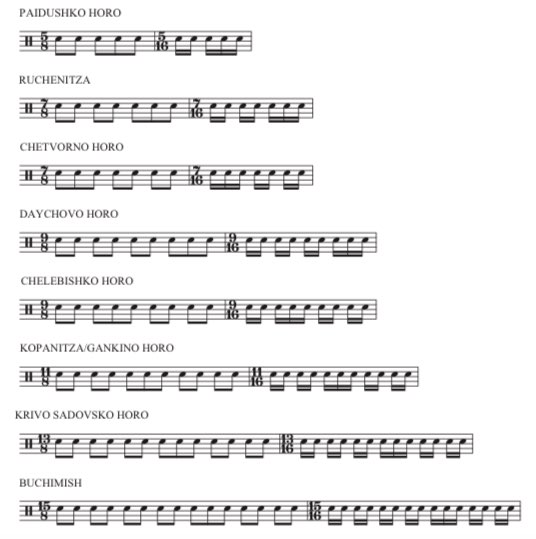
Though additive “limping” metres feature in much folk music around the region and further afield (notably Turkey), Bulgaria has been particularly associated with them.

In Macedonia, megastars (sic) are Esma Redžepova (e.g. here, and here; and a playlist:)

and sax player Ferus Mustafov, also featured by Cartwright.

But again, it’s not all about the stars of the World Music scene. At the same time, musical appraisals expand from local to global, which are often at variance. By contrast with both nostalgic romantics and World Music fans in search of the latest groove, the brash sounds of Bulgarian chalga and Romanian manele have become highly popular.

As Cartwright observes,

The difference between what the West’s world music industry sells as Gypsy music and what the Roma listen to back in the Balkans can be huge. Sure, in Serbia Šaban is king and across Macedonia Esma reigns. But this is akin to African Americans acknowledging James Brown and Aretha Franklin. Don’t mean they’re listening to them. And in Romania the breach seems wider than anywhere else. Fulgerica is respected but he’s no pop star while Fanfare Ciocârlia and Taraf de Haïdouks exist only for Western audiences. That they play superior Gypsy music, rooted in tradition, means nothing. The local Roma aren’t listening. What they want is Adrian. And Guța.

Meanwhile, as he notes, the Venezuelan soap opera Kasandra became wildly popular across the Balkans, giving Šaban Bajramović a huge hit in 1997.

Albanian cultures
As a respite from the bombardment of turbo-folk, it’s good to return to a more traditional milieu. Again, ethnic Albanians occupy not just Albania but Kosovo and parts of Macedonia and northern Greece; the soundscape is highly regional, with Gheg culture in the north, Tosk and Lab further south.

The splendid A.L. Lloyd somehow issued a fine album as early as 1966:

The polyphony here is amazing. From the south, another fine CD from Bernard Lortat-Jacob is

  • Albanie: polyphonies vocales et instrumentales (notes here):

A substantial study is

  • Jane Sugarman, Engendering song: singing and subjectivity at Albanian Prespa weddings (1997, with CD).

Bards
Again, the epics sung by bards, over a wide region of south Yugoslavia and Albanian communities, don’t neatly fit national or ethnic boundaries.

Lord

The classic study is

  • Albert Lord, The singer of tales (with CD-Rom; complete text here),

following the work of Milman Parry (for whose work with Bartók, click here). Most singers are accompanied by a one-string fiddle like the gusle, as in this celebrated 1935 clip of Avdo Međedović (c1875 – 1955) filmed by Lord:

And in case all this seems like a bygone world, click here for a 2018 Venice performance of a Kosovan bard.

* * *

Under all these unwieldy national rubrics, the diverse ethnic groups negotiate the changing times, interacting. As ever, this is far more than a “merely musical” topic, as such cultures are not just quaint ornaments, aural pashmina; they are windows on changing local societies, an essential part of what makes them click. As in China, it’s no use clinging onto a romantic idealisation of the past; and we should always delve beyond the World Music stars to musicking in local societies.

As ever, Bruno Nettl offers useful perspectives, as in his taxonomies for various types of change and responses to them.

For any sinophiles who have read this far, it may serve as a reminder of the persistent variety of regional and local traditions in China—not just the ethnic tapestries of the northwest, southwest, and indeed northeast, or even Hakka and Hokkien cultures, but all kinds of musicking beneath the provincial level in Han Chinese regions.

The cultures of all these groups—before and during state socialism, and since— deserve detailed attention. And World Music fans may tend to favour modern commercial pop, but it’s important for ethnographers to include it in the picture too. Even in my work on Daoist funerals in China, I could hardly neglect the pop bands outside the gate (my film, from 30.32).

Both academic and popular accounts repay study: and both keep track of change. I wonder what Bartók would have made of all this—another of those fruitless debates like “Would Bach have used the ondes martenot?” or “Mozart would have written advertising jingles”…

For a sequel, click here. See also under A folk playlist for Euro 24, and Some jazz fiddling.

On a lighter note, far from PC, there’s Molvania

Why music matters

Slobin

I’m just re-reading

  • Mark Slobin (ed.), Retuning culture: musical changes in central and eastern Europe (1996).

I’ve stressed the importance of soundscape to the study of both ritual and, more generally,  local cultures (Nettl, Small, Bigenho, and so on; see also category World music > general). Ethnomusicological literature explores endless variations on this theme, but the opening paragraph of Slobin’s introduction might serve as a mission statement:

Music is both deeply rooted and transient. It dissolves into space while simultaneously settling into individual and collective memory. Yesterday’s songs trigger today’s tears. Music harbors the habitual, but also acts as a herald of change. It helps to orchestrate personal, local, regional, ethnic, religious, linguistic, and national identity. Stable yet constantly in flux, music offers both striking metaphors and tangible data for understanding societies at moments of transition.

He goes on to comment,

Each hegemonic thrust and subcultural parry are just episodes in a long fencing match on the battlefield of culture.

In the same volume, Carol Silverman also stresses the importance of music:

Music shapes politics and economics and social life as well as being shaped by them. Moreover, music is often part of a cultural milieu that displays specific social values, values that may represent the existing hegemony, counter it, or subvert it.


Taco taco taco burrito

Rite

Wondering how to get to grips with additive metres?
Awed by the complexities of flamenco palmas?
Despair not, help is at hand!

As a prelude to aksak “limping” metres, we might start with quintuple metres, which go far back, even in WAM. By the baroque period there are niche examples by composers such as Schmelzer, and they feature in 19th-century Russian music—a most popular instance being the “limping waltz” of Tchaikovsky’s Pathétique symphony (2+3).

This reminds me of two other subversions of the waltz, albeit in regular triple metre: the 2nd movement of Berlioz’s Symphonie fantastique (cf. here and here), and Ravel’s La valse, a “surreal nightmarish vision of a decaying society through a broken kaleidoscope”, as I said in my Ravel page. Elsewhere, perhaps inspired by the Basque zortzico dance, Ravel was partial to additive metres—such as in his piano trio, and the quintuple-time Bacchanale finale of Daphnis and Chloé (both also featured on that page, the latter from 45.29). And Messiaen was most partial to complex yet catchy additive rhythms.

Quintuplets, of course, are something else altogether; as are the creative use of additive rhythms in minimalism (see also examples from Reich and Meredith).

From Tchaikovsky we might graduate to

  • the Pearl and Dean theme (which we may hear as two groups each of 3+3+2; or for a Bulgarian, perhaps two fast groups of 3+3+3+3+2+2)
  • Un homme et une femme (after the three upbeats, 3+3+2+2: the first two 3s, in the original “Dabadabada, badabadaba”, were later remembered as “Chabadabada“, a word that entered the language to denote alternating male and female candidates in electoral lists!)
  • and Lalo Schifrin’s theme to Mission impossible (5/4, with a duplet over the first 2 beats).

If you can hum along to such easy examples, then that’s a good start in mastering the intricacies of so-called aksak metres around east Europe and the Middle East…

Indeed, Take five was inspired by hearing Turkish musicians. Rather more challenging is the opening section of Blue Rondo à la Turk (2+2+2+3):

Note the helpful BTL comment there (only without the punctuation!):

Taco, taco, taco, burrito. Taco, taco, taco, burrito. Taco, taco, taco, burrito.
[SJ: not to be confused with potato, potato]

Still, that’s a rather crude, mechanical usage, the melody merely marking out the metre in regular quavers—whereas further east, melodic rhythms are infinitely varied within the basic metre.

Admittedly, the additive patterns of the Rite of spring have been transcribed in 4/4—was it really Boulez who had this drôle idea?! Cf. Slonimsky‘s help for Koussevitzky, here). Indeed, the scores for both the Pearl and Dean and Un homme et une femme tunes were written in duple metres.

And in the first movement of Winter, Max Richter’s welcome recomposition of the Four Seasons mixes in some great limping 7/8 bars (2+2+3—just the two tacos before the burrito today, thanks waiter) (from 1.18):

An intriguing instance is I say a little prayer, with its quirky insertion of a triple-time bar in the chorus—which no-one apparently even has to think about. And do listen to Herbie Hancock‘s addictive Ostinato.

* * *

But all this is mere child’s play compared to folk music. Though such metres are quite widespread, Bartók, Brailiou et al. coined the term “Bulgarian rhythm”.

aksak

Some instances of “Bulgarian rhythm”, found here; see also here. For the Swingles’ delightful arrangement of  Bučimiš, see under Another Turangalîla at the Proms!.

A classic essay is

  • Constantin Brăiloiu, “Aksak rhythm” (in Brăiloiu, Problems of ethnomusicology, 133–67, based on a 1951 lecture),

which contains far more detailed schemata. His work followed that of

  • Béla Bartók, “The so-called Bulgarian rhythm” (1938).

A transcription by Bartók of a Turkish zurna–davul shawm band shows how, over the basic metre, melodic and percussion rhythms seriously thicken the plot:

aksak 2

Jerome Cler’s splendid website on the yayla has a thoughtful analysis of an aksak (here).

The whole repertoire of players like Ivo Papazov is based on aksak metres:

I don’t think I’m quite ready for Sedi donka (Plovdivsko horo), a 25-beat pattern divided

    7             7                 11
3+2+2 | 3+2+2  | 2+2+3+2+2

For more on the diverse musical cultures of Bulgaria and environs, see here. And for a wide-ranging discussion, see

  • John Blacking, “Irregular rhythms: movement, dance, music, and ritual”, ch.3 of A common-sense view of all music (1987).

Back with Merrie England, there’s a fascinating article:

* * *

Further east, an example from the muqam of the beleaguered Uyghurs of Xinjiang is sadly topical. A common metre consists of one long beat divided into two equal stresses, followed by two regular beats—which we might notate cumbersomely as

aksak

with the initial duplet over a notional 3/8 unit:

Some sections add another duple unit, like this dastan from Chebiyat muqam (actually a duplet over 3/8,  followed by 3/4):

QB

And some muqam have still more metrically complex segments to explore.

As with many world genres, the Uyghurs have no tradition of notation, and seem to have no terminology for such metres (though see Rachel Harris’s chapter in Harris and Stokes (eds.), Theory and Practice in the Music of the Islamic World). As with flamenco, this kind of thing is only an issue for those (like me) hampered by a visual classical education. The trick is to internalise it in the body—and to dispense with notation. Let’s remember that much of this music accompanies dance.

Uyghur musical traditions are part of a rich culture that is currently being systematically erased in Xinjiang (see roundup here).

Performance: from Iran to Morocco

perf

Another formative experience of frequenting late-night screenings at arthouse cinemas in the 1970s was the cult film Performance (Donald Cammell and Nicolas Roeg 1968/70). It remains totally mind-blowing.

trio

James Fox and Mick Jagger make mesmerising, disorienting presences, along with Anita Pallenberg (like Anouk Aimée, already a veteran of La dolce vita) and Michèle Breton. Watch the complete film here.

In an effective soundtrack, most brilliant use of music is the Iranian santur dulcimer accompanying the languid threesome of Jagger, Pallenburg, and Breton (from 43.17)—actually a most beautiful scene (and allegedly, um, method acting—I’m like, hello?), although it may not be quite the image that the Iranian Ministry of Culture envisages. Complementing the mood perfectly, it’s taken from a Nonesuch Explorer album played by Nasser Rastegar-Nejad.

On the somewhat remote chance that you would rather focus on the gradual unfolding of the melody without the distraction of watching the threesome, here’s his 1970 LP:

It’s also reminiscent of John Cage’s music for prepared piano. For more on Iran, see under west/central Asia, including Zithers of Iran and Turkey.

Left: Mick with Paul Bowles, 1989. Right: Brion Gysin and William Burroughs.

Of course Indian music was in the air by the 60s, and the spirit of experimentation also led to Brian Jones’s first trip in 1968 to the “Master Musicians of Jajouka” in the mountains of north Morocco. Early beneficiaries of the World Music craze long before the label had been invented, they were already playing for beat audiences in the 1950s, who were drawn by the likes of Brion Gysin and William Burroughs—and notably Paul Bowles, long-term resident of Tangier. Later, inevitably, schisms appeared in the village along with global fame. The wiki article, and this Songlines introduction, have useful links. If only this had led to wider appreciation of shawm music further afield…

Here’s the first of three parts from a 1989 Arena documentary, including Mick chatting with Paul Bowles:

Among many readings on Performance, as well as on the Stones in Morocco, Keith Richards’ autobiography Life is revealing, nay astounding. For the trail east, and Herat in the 70s, see here.

Nic Roeg died in November 2018—among tributes, this is very fine; see also under Bertolucci.

Mahler and the mouth-organ

*For an introduction to my whole series on Mahler, with links, click here!*

Abschied

More on the European taste for exotic orientalism (see Berlioz, Ravel, and, um, Granville Bantock).

Stimulated by the 1851 Great Exhibition in London and the 1889 Exposition universelle in Paris, I was interested to read

Among composers she discusses are Purcell, Debussy, Puccini, and Stravinsky; but here I’d like to continue my series on Mahler by reflecting on his possible exposure to Chinese music. While the “imitations” of Tang poems by Hans Bethge that Mahler used for Das Lied von der Erde have been much discussed, Kang discusses the oboe lines of Der Abschied (see also here):

One can ponder whether Mahler may have heard the reedy timbre of the traditional and popular Chinese instrument called the sheng on the wax cylinders given to him by his friend Paul Hammerschlag. M. De La Grange gives an account of an event which may have strongly influenced the Chinese dimension in Das Lied:

During the last fortnight [of the summer of 1908] Mahler had a visit [at Toblach] from Paul Hammerschlag and his wife. Later, the banker recalled two memories of that summer, particularly one of a lively discussion during which, to his great surprise, Mahler suddenly threw up his table napkin so that all the guests could see that he had slashed it with his knife as it was on his knees. Another, more interesting, concerned some cylinders of Chinese music, recorded in China itself, that Paul Hammerschlag had bought in Vienna in a shop near the cathedral, and that he had given to Mahler at that time. This makes it quite certain that Mahler had not only read, but actually heard music from that far- off land before composing Das Lied.

There is no evidence with regard to what types of music the cylinders contained, and whether it was instrumental, percussive, or vocal music. And one can only speculate whether it was popular, celebratory, religious, or funeral-like.

57 shengguan trio

Indeed, I don’t know why Kang chooses the sheng mouth-organ here, rather than the guanzi oboe that accompanies it in north Chinese ritual; after all, Mahler didn’t feature the organum characteristic of the sheng. Still, it makes an equally intriguing speculation. Unfortunately, neither the shengguan ensemble nor the deafening shawm bands make likely candidates: several scholars have been studying early recordings of Chinese music, but most were vocal, with chamber ensemble of plucked and bowed strings. Had Mahler heard early recordings of the solo qin zither, such as those among the wax cylinders made by Herbert Müller in China between 1903 and 1913, that meditative sound-world might have appealed more to him.

Anyway, Kang goes on:

Traditional Chinese music tended to be categorized according to social function. Aside from the possible influence of the wax cylinders, there was also research being undertaken in Vienna on non-Western techniques (as in other major centres of musical creativity). This was no doubt as a result of current fashion, thinking, and growing academic interest in sinology and ethnomusicology as we have already witnessed in France in chapter 3. Guido Adler’s article “Uber Heterophonie” (1908) is a prime example of the fascination with and thinking about non-Western traditions that was common in Vienna at that time. Adler writes:

Although there is as yet a very incomplete, and largely unreliable body of exotic music extant, it is, nevertheless, possible—thanks to reliable material on music for several voices, whether vocal or instrumental—clearly to distinguish one kind of treatment that is essentially different from both homophony and polyphony. We may then sum up the main corpus of the kind of exotic music just referred to as follows: the voices begin in unison, in harmony or in octaves, only to separate from one another subsequently. The main theme is paraphrased and distorted, so that secondary and transitional melodies arise to join the main theme, now consonantly, now dissonantly. This paraphrasing and distorting, then, lead one to suppose that the instrumentalists and singers wanted to add something of their own, whether in individual deviatory sounds or merely in grace notes. But these deviations soon give the impression that the instrumentalist or singer has only unconsciously deviated from the right path, that the deviation is merely a coincidence, either because the performers have had a mental aberration or because they do not consider these middle sections worthy of their attention. As at the beginning, the voices then approach the end almost invariably in unison, or in a regular parallel movement. This kind of movement of several voices is the main branch, even the stem, of heterophony.

Bethge
Today Adler’s comments hardly stand up. Anyway, I wonder if anyone can now find further clues to those wax cylinders. Still, whatever sounds they captured, I doubt that they were the ethereal transcendent tones of Mahler’s imagination. However timeless anyone might suppose Chinese music to be, he was seeking neither to reproduce the Chinese music of his own time nor to recreate that of the Tang. So in all, any precise links with actual Chinese soundscapes remain elusive; like Bethge’s poems, his fantasy of the Mystic East is uppermost—which is fine by me.

All the same, how I wish I could have introduced Mahler, and Berlioz—not to mention Bach—to the exquisite shengguan ensemble of the Li family Daoists, who only managed to perform  in France and Germany long after they were gone.

Folk music of Jamaica

Jamaica

I’m grateful to Vanley Burke’s recent Desert island discs for opening my ears to this fantastic archive compilation from 1956 in the ever-stimulating Smithsonian Folkways series:

Always showing their African origins, the tracks of the kumina magico-religious cult, as well as the Revival Zion and Pukkumina Christian cults, are particularly fascinating—further explored on an earlier album, Jamaican cult music (1954).

There’s plenty of material here to help us consider diverse ways of using the voice—and percussion—to communicate with mortals and gods. And as ever, the soundscape should lead us to explore the changing society.


Berlioz and the not-so-mystic East

1851

The unflattering views on Chinese music expressed by Berlioz have been much cited. He may have been an iconoclast within his own culture, but it would be asking too much to expect his horizons to transcend the limited aesthetics of his day.

In The Cambridge companion to Ravel, Robert Orledge cites Berlioz’s comments on hearing Chinese musicians at the Great Exhibition of the Works of Industry of All Nations in London in 1851—only a few years after the Opium Wars:

The melody, which was altogether grotesque and atrocious, finished on the tonic, like our most undistinguished sentimental songs [!]; it never moved out of the original tonality or mode. […] Nevertheless, the ludicrous melody was quite discernible, and one could have written it down in case of real need [!].

And as Orledge comments, his conclusion, after listening to a wider range of exotic musicians, was that

Chinese and Indian music would be similar to ours if it existed [WTF]; but that, musically speaking, these nations are still plunged in a state of benighted barbarianism and childish ignorance where only a few vague and feeble instincts are dimly discernible; that, moreover, the Orientals call music what we should style cacophony, and that for them, as for Macbeth’s witches, foul is fair.

Another passage has been translated thus:

As for the Chinaman’s voice, I have never heard anything so strange in my life—hideous snorts, and groans, very much like the sounds dogs make, when they wake up, stretch their paws and yawn with an effort.

musos

More sympathetic is this report from the Illustrated London News:

A PLEASING addition has been made to the Chinese Collection, consisting of a Chinese Lady, named Pwan-ye-Koo, with small lotus-feet only 2½ inches in length, a Chinese professor of music, his two children (a boy and a girl), the femme de chambre of the lady, and an interpreter. The children are gay, lively, and intelligent, the lady herself agreeable and interesting, and the gentleman civil and obliging. A Chinese concert forms part of the entertainment: the lady Pwan-ye-Koo singing a Chinese air or two, accompanied by the professor, who likewise treats the public with an exhibition of his vocal powers. The group is one that has much to commend it: it is picturesque and peculiar, and presents an image in high relief of the native manners of a Chinese family. The conduct of the domestic blended the humble and the familiar in a significant manner; and there was an air of freedom, and a sense of mutual obligation manifested in the whole party, calculated to make a favourable impression on the spectator.

They even had an audience with Queen Victoria at her summer retreat of Osborne House on the Isle of Wight.

Still, if we read the full passage, Berlioz did at least make an effort. Further to A French letter, here’s some more language practice [sections between asterisks translated above]:

A propos de cantatrice, j’ai enfin satisfait le désir que j’avais d’entendre la fameuse Chinoise, the small-footed lady (la dame au petit pied), comme l’appelaient les affiches et les réclames anglaises. L’intérêt de cette audition était pour moi dans la question relative aux divisions de la gamme et à la tonalité des Chinois. Je voulais savoir si, comme tant de gens l’on dit et écrit, elles sont différentes des nôtres. Or, d’après l’expérience assez concluante que je viens de faire, selon moi, il n’en est rien. Voici ce que j’ai entendu. La famille chinoise, composée de deux femmes, deux hommes et deux enfans, était assise immobile sur un petit théâtre dans le salon de la Chinese house, à Albert gate. La séance s’est ouverte par une chanson en dix ou douze couplets, chantée par le maître de musique, avec accompagnement d’un petit instrument à quatre cordes de métal, du genre de nos guitares, et dont il jouait avec un bout de cuir ou de bois, remplaçant le bec de plumes dont on se sert en Europe pour attaquer les cordes de la mandoline. Le manche de l’instrument est divisé en compartimens, marqués par des sillets de plus en plus rapprochés au fur et à mesure qu’ils se rapprochent de la caisse sonore, absolument comme le manche de nos guitares. L’un des derniers sillets, par l’inhabileté du facteur, a été mal posé, et donne un son un peu trop haut, toujours comme sur nos guitares quand elles sont mal faites. Mais cette division n’en produit pas moins des résultats entièrement conformes à ceux de notre gamme. Quant à l’union du chant et de l’accompagnement, elle est de telle nature, qu’on en doit conclure que ce Chinois-là du moins n’a pas la plus légère idée de l’harmonie. *L’air (grotesque et abominable de tout point) finit sur la tonique, ainsi que la plus vulgaire de nos romances, et ne module pas, c’est-à-dire (car ce mot est généralement mal compris des personnes qui ne savent pas la musique) ne sort pas de la tonalité ni du mode indiqués dès le commencement.* L’accompagnement consiste en un dessin rhythmique assez vif et toujours le même, exécuté par la mandoline, et qui s’accorde fort peu ou pas du tout avec les notes de la voix. Le plus atroce de la chose, c’est que la jeune femme (la [small-]footed lady), pour accroître le charme de cet étrange concert, et sans tenir compte le moins du monde de ce que fait entendre son savant maître, s’obstine à gratter avec ses ongles les cordes d’un autre instrument de la même nature, mais au manche plus long, sans jouer quoi que ce soit de mélodieux ou d’harmonieux. Elle imite ainsi un enfant qui, placé dans un salon où l’on exécute un morceau de musique, s’amuserait à frapper à tort et à travers sur le clavier d’un piano sans en savoir jouer. C’est, en un mot, une chanson accompagnée d’un petit charivari instrumental. Pour la voix du chanteur, rien d’aussi étrange n’avait encore frappé mon oreille: *figurez-vous des notes nasales, gutturales, gémissantes, hideuses, que je comparerai, sans trop d’exagération, aux sons que laissent échapper les chiens quand, après un long sommeil, ils bâillent avec effort en étendant leurs membres.* Néanmoins, la burlesque mélodie était fort perceptible, et je porterai un jour du papier réglé chez les Chinois pour la noter et en enrichir votre album. Telle était la première partie du concert.

A la seconde, les rôles ont été intervertis ; la jeune femme a chanté, et son maître l’a accompagnée sur la flûte. Cette fois l’accompagnement ne produisait aucune discordance; la flûte suivait la voix à l’unisson tout simplement. Cette flûte, à peu près semblable à la nôtre, n’en diffère que par sa plus grande longueur, par son bout supérieur qui reste ouvert, et par l’embouchure qui se trouve percée à peu près vers le milieu du tube, au lieu d’être située, comme chez nous, vers le haut de l’instrument. Du reste, le son en est assez doux, passablement juste, c’est-à-dire passablement faux, et l’exécutant n’a rien fait entendre qui n’appartînt entièrement au système tonal et à la gamme que nous employons. La jeune femme est douée d’une voix céleste, si on la compare à celle de son maître. C’est un mezzo soprano, assez semblable par le timbre au contralto d’un jeune garçon dont l’âge approche de l’adolescence et dont la voix va muer. Elle chante assez bien, toujours comparativement. On croit entendre une de nos cuisinières de province chantant: «Pierre! mon ami Pierre», en lavant sa vaisselle. Sa mélodie, dont la tonalité est bien déterminée, je le répète, et ne contient ni quarts ni demi-quarts de ton, mais les plus simples de nos successions diatoniques, est un peu moins extravagante que la romance du chanteur. C’est tellement tricornu néanmoins, d’un rhythme si insaisissable par son étrangeté, qu’elle me donnera sans doute beaucoup de peine à la fixer exactement sur le papier pour vous en faire hommage. Mais j’y mettrai le temps, et, en profitant bien des leçons que me donnera le chien d’un boulanger voisin de ma demeure, je veux, à mon retour à Paris, vous régaler d’un concert chinois de premier ordre. Bien entendu que je ne prends point cette exhibition pour un exemple de l’état réel du chant dans l’Empire Céleste, malgré la qualité de la jeune femme, qualité des plus excellentes, à en croire l’orateur directeur de la troupe, parlant passablement l’anglais. Les dames de qualité de Canton ou de Pékin, qui se contentent de chanter chez elles et ne viennent point chez nous se montrer en public pour un shilling, doivent, je le suppose, être supérieures à celle-ci presque autant que Mme la comtesse Rossi est supérieure à nos Esmeralda de carrefours.

D’autant plus que la jeune lady n’est peut-être point si small-footed qu’elle veut bien le faire croire, et que son pied, marque distinctive des femmes des hautes classes, pourrait bien être un pied naturel, très plébéien, à en juger par le soin qu’elle mettait à n’en laisser voir que la pointe.

Mais je penche fort à regarder cette épreuve comme décisive en ce qui concerne la division de la gamme et le sentiment de la tonalité chez les Orientaux. Je croirai, seulement quand je l’aurai entendu, que des êtres humains puissent, sur une gamme divisée par quarts de ton, produire autre chose que des gémissemens dignes des concerts nocturnes des chats amoureux. Les Arabes y sont parvenus, au dire de quelques savans; ils ont pour cet art inqualifiable une théorie complète. Je parie que les savans qui ont écrit ces belles choses ne savent rien de notre musique, ou du moins n’en ont qu’un sentiment confus et peu développé. Que la théorie des Arabes existe, cela est fort possible, mais elle n’ôte rien à l’horreur de ce qu’ils font en la mettant en pratique.

La musique des Indiens de l’Orient doit fort peu différer de celle des Chinois, si l’on en juge par les instrumens envoyés par l’Inde à l’Exposition universelle de Londres. Cette collection se compose, 10 d’un grand nombre de mandolines à quatre et à trois cordes, quelques unes même n’en ont qu’une; leur manche est divisé par des sillets comme chez les Chinois; les unes sont de petite dimension, d’autres ont une longueur démesurée; 2d’une multitude de gros et de petits tambours en forme de tonnelets, et dont le son ressemble à celui qu’on produit en frappant avec les doigts sur la calotte d’un chapeau; 30 d’un instrument à vent à anche double, de l’espèce de nos hautbois; 40 de flûtes traversières exactement semblables à celles du musicien chinois; 50 d’une trompette énorme et grossièrement exécutée sur un patron qui n’offre avec celui des trompettes européennes que d’insignifiantes différences; 60 de plusieurs petits instrumens à archet, dont le son aigre et faible doit rappeler les petits violons de sapin qu’on fait chez nous pour les enfans; 70 d’une espèce de tympanon dont les cordes tendues sur une longue caisse paraissent devoir être frappées par des baguettes; 80 d’une petite harpe à dix ou douze cordes, assez semblables aux harpes thébaines dont les bas-reliefs égyptiens nous ont fait connaître la forme, et enfin d’une grande roue chargée de gongs ou tamtams de petites dimensions, dont le bruit, quand elle est mise en mouvement, a le même charme que celui des gros grelots attachés sur le cou et la tête des chevaux de routiers. Je conclus, pour finir, que *les Chinois et les Indiens auraient une musique semblable à la nôtre, s’ils en avaient une; mais qu’ils sont encore à cet égard plongés dans les ténèbres les plus profondes de la barbarie ou dans une ignorance enfantine où se décèlent à peine quelques vagues et impuissans instincts.*

Hee Sing

Detail: Hee Sing.

Also part of the Great Exhibition was a Chinese junk moored on the Thames—occasion for the curious case of the “fake Chinese mandarin” Hee Sing, who appears in a painting depicting the retinue of the royal family. In Berlioz’s Les soirées de l’orchestre (21st evening, including a variant of the above) he was even more underwhelmed by the soirées musicales et dansantes given onboard by the sailors:

Maintenant écoutez, messieurs, la description des soirées musicales et dansantes que donnent les matelots chinois sur la jonque qu’ils ont amenée dans la Tamise; et croyez-moi si vous le pouvez.

Ici, après le premier mouvement d’horreur dont on ne peut se défendre, l’hilarité vous gagne, et il faut rire, mais rire à se tordre, à en perdre le sens. J’ai vu les dames anglaises finir par tomber pâmées sur le pont du navire céleste ; telle est la force irrésistible de cet art oriental. L’orchestre se compose d’un grand tam-tam, d’un petit tam-tam, d’une paire de cymbales, d’une espèce de calotte de bois ou de grande sébile placée sur un trépied et que l’on frappe avec deux baguettes, d’un instrument à vent assez semblable à une noix de coco, dans lequel on souffle tout simplement, et qui fait : Hou ! hou ! en hurlant ; et enfin d’un violon chinois. Mais quel violon ! C’est un tube de gros bambou long de six pouces, dans lequel est planté une tige de bois très-mince et long d’un pied et demi à peu près, de manière à figurer assez bien un marteau creux dont le manche serait fiché près de la tête du maillet au lieu de l’être au milieu de sa masse. Deux fines cordes de soie sont tendues, n’importe comment, du bout supérieur du manche à la tête du maillet. Entre ces deux cordes, légèrement tordues l’une sur l’autre, passent les crins d’un fabuleux archet qui est ainsi forcé, quand on le pousse ou le tire, de faire vibrer les deux cordes à la fois [sic]. Ces deux cordes sont discordantes entre elles, et le son qui en résulte est affreux. Néanmoins, le Paganini chinois, avec un sérieux digne du succès qu’il obtient, tenant son instrument appuyé sur le genou, emploie les doigts de la main gauche sur le haut de la double corde à en varier les intonations, ainsi que cela se pratique pour jouer du violoncelle, mais sans observer toutefois aucune division relative aux tons, demi-tons, ou à quelque intervalle que ce soit. Il produit ainsi une série continue de grincements, de miaulements faibles, qui donnent l’idée des vagissements de l’enfant nouveau-né d’une goule et d’un vampire.

Dans les tutti, le charivari des tam-tams, des cymbales, du violon et de la noix de coco est plus ou moins furieux, selon que l’homme à la sébile (qui du reste ferait un excellent timbalier), accélère ou ralentit le roulement de ses baguettes sur la calotte de bois. Quelquefois même, à un signe de ce virtuose remplissant à la fois les fonctions de chef d’orchestre, de timbalier et de chanteur, l’orchestre s’arrête un instant, et, après un court silence, frappe bien d’aplomb un seul coup. Le violon seul vagit toujours. Le chant passe successivement du chef d’orchestre à l’un de ses musiciens, en forme de dialogue; ces deux hommes employant la voix de tête, entremêlée de quelques notes de la voix de poitrine ou plutôt de la voix d’estomac, semblent réciter quelque légende célèbre de leur pays. Peut-être chantent-ils un hymne à leur dieu Bouddah, d’ont la statue aux quatorze bras orne l’intérieur de la grand’chambre du navire.

Je n’essaierai pas de vous dépeindre ces cris de chacal, ces râles d’agonisant, ces gloussements de dindon, au milieu lesquels malgré mon extrême attention, il ne m’a été possible de découvrir que quatre notes appréciables (ré, mi, si, sol). Je dirai seulement qu’il faut reconnaître la supériorité de la small-footed Lady et de son maître de musique. Evidemment les chanteurs de la maison chinoise sont des artistes, et ceux de la jonque ne sont que des mauvais amateurs. Quant à la danse de ces hommes étranges, elle est digne de leur musique. Jamais d’aussi hideuses contorsions n’avaient frappé mes regards. On croit voir une troupe de diables se tordant, grimaçant, bondissant, au sifflement de tous les reptiles, au mugissement de tous les monstres, au fracas métallique de tous les tridents et de toutes les chaudières de l’enfer… On me persuadera difficilement que le peuple chinois ne soit pas fou…
[For a fine English version, see Berlioz, translated Barzun, Evenings with the orchestra (Chicago, 1956/1999 edition), pp.246–250.]

Here the Illustrated London News acquits itself no better:

At the evening performance the queer old craft is lighted up with festoons of coloured lamps—a sort of miniature [missing] hall, and in the midst stands an open orchestra, in which four or five instrumentalists (“barbarians,” not Chinese) prepare the ear for the extraordinary combination of sounds which is to follow. Nothing can exceed the gravity of the “celestials,” as they take their position in the midst of the assembly on the main-deck, and proceed to fright the ear with gong and drum, and cymbal and agonizing cat-gut: the leader beating time with a stake upon a sort of tin saucepan-lid supported on three legs. Then the vocalization! The extraordinary squeaking duet, half plaintive, half comic, between the said leader (who is a sort of Costa and Mario rolled into one) and a younger aspirant in the background—what can possibly exceed its harrowing and ludicrous effect? Nothing except that impromptu feline discourse which we sometimes hear on house-tops at the dead of night.

The concert being concluded amidst the breathless silence of an astonished auditory, the war demonstrations and feats of arms then commence and these are certainly no less extraordinary than what has gone before. The first set consists of a set of grotesque posturing, in which the performers disport themselves severely one after the other, each succeeding one striving to outdo the other in the wildness and extravagance of his gesture—flying and leaping round the deck, thrusting out the arms right and left, threatening, retreating, &c. the musicians all the time keep up a terrific clang.

Next come a series of somewhat similar performances with long poles or lances, this scene closing with a set-to between two performers, which we have endeavored to embody in our engraving. Swords are also introduced and brandished about in the same manner, which, if intended to give any idea of the military science of the Chinese, shows them to be very far behind any other known nation in the world in that respect. One young hero, in the course of his “war demonstrations,” afforded great amusement every now and then, particularly after some very startling efforts at cut and thrust, by throwing himself down, and turning a somersault over his shield. When we left, the “barbarian” orchestra was about to strike up again, and dancing, it was said, was about to commence, but we did not wait for it.

For a recent French recreation, see here. Indeed, both the family and the junk had already appeared for P.T. Barnum’s Chinese museum: see Krystyn R. Moon, Yellowface: creating the Chinese in American popular music and performance, 1850s–1920s (2005), pp.62–6. For another portrait of the family, see here.

Berlioz 1851

Hector’s Napoleon impression always brought the house down.

Among composers, a broader view of musicking worldwide would have to wait for figures such as Debussy and Bartók. Still, even today views like those of Berlioz remain far from obsolete. So much for music as a universal language.

* * *

Ironically, in reviews by Berlioz’s contemporaries of his own new works he was hoist on his own petard—using rather similar vocabulary, as if taking revenge on behalf of the Chinese. Here are just a few among an embarras de richesse, cited in Slominsky‘s wonderful Lexicon of musical invective, pp.57–61:

His rare melodies are deprived of meter and rhythm; and his harmony, a bizare assemblage of sounds, not easily blended, does not always merit the name. I believe that what M. Berlioz writes does not belong to the art which I cusomarily regard as music, and I have the complete certainty that he lacks the prerequisites of this art.

Berlioz, musically speaking, is a lunatic; a classical composer only in Paris, the great city of quacks. His music is simply and undisguisedly nonsense.

M. Berlioz is utterly incapable of producing a complete phrase of any kind. When, on rare occasions, some glimpse of a tiune makes its appearance, it is cut off at the edges and twisted about in so unusual and unnatural a fashion as to give one the idea of a mangled and mutilated body, rather than a thing of fair proportions. Moreover, the little tune that seems to exist in M. Berlioz is of so decidely vulgar a character as to exclude the possibility of our supposing him possessed of a shadow of feeling.

I can compare Le Carneval romain by Berlioz to nothing but the caperings and gibberings of a big baboon, over-excited by a dose of alcoholic stimulus.

Dragging the icon to the trash, eh. For astounding Saint-Saëns on the violon chinois, click here.

See also Berlioz: a love scene. For Berlioz’s prophetic word-painting of a 1960s’ curry-house menu, cliquez ici; and for his evocation of furniture removal, ici. For Mahler’s vision of the mystic East, see here; and for Cantonese music in post-war London, here.

Haydn: 1795, 1927, 1973, 2018

trio

Just as I was immersing myself in Afghan singing, how nostalgic the other day to hear the limpid slow movement of Haydn’s G major piano trio on Private passions (for the first of several posts inspired by the series, see here).

Like the Adagio of the Schubert string quintet, it seems suspended beyond time. Of course, it’s not: as ever, we hear it with the successive patinas of our personal listening histories.

The trio is part of a set that Haydn composed in London, and the version that remains with me is that of Alfred Cortot, Jacques Thibaud, and Pablo Casals, recorded on 20th June 1927 at Queen’s Hall. I used to listen to it late at night (after closing time) with friends at Cambridge from 1973—just as Veronica and John were embarking on their Afghan journey, indeed; and as the Rito y geografía del cante flamenco series was being completed, and Li Manshan’s wife gave birth to their first daughter…

Today I wonder how we got into such early recordings, like the late Beethoven of the Busch quartet. They meant a lot to me—but I can’t quite say what: this was considerably before I became involved in early music, or began to care about changing performance styles. Indeed, in those days I was more interested in the politics of the Tang court than in the experiences of our more recent European forebears.

But now I think of the trio’s London audiences between the wars (my great-aunt Edith Miles was losing her hearing in 1927), and wartime audiences in Britain and Germany (doubtless the appalling Hans Frank loved the trio). The group had been working together since 1906; but Casals, a firm opponent of franquismo, later broke with Cortot for the latter’s collaboration with the Nazi occupation of France.

Cortot’s 1932 recording of the break in Brandenburg 5 is also great, but early renditions of baroque music may not always suit modern tastes, like Mengelberg’s 1939 Matthew passion.

Haydn dedicated the set of trios to Rebecca Schroeter, Scottish widow of an immigrant German musician (for a taste of late-18th-century mores, see here). So we might further try to imagine cosmopolitan London in 1795 (for “das Land ohne Musik“, see David Wyn Jones ed., Music in eighteenth-century Britainand for London concert life, here; cf. audiences of Tang-dynasty Chang’an, enriched by Central Asian musics—”They come over ‘ere…“).

I don’t know how to fill in the 19th-century lacuna, but despite all the vast social changes since 1795, maybe Haydn’s day isn’t so distant: we seem to have a photo of Mozart’s widow, and Casals was born in 1876.

Haydn’s trio is named after its “gypsy” finale all’ongarese, which we can enjoy without wondering too much about his exposure to folk music—it is what it is (cf. Norman Lebrecht’s ambitious claim for Mahler 4). From where we are in 2018, all three movements are delightful, but it’s the slow movement (in the lustrous key of E major, like Bruckner 7 and north Chinese ritual suites for wind ensemble!) that continues to enchant me. As the players lovingly pass the tunes around (the second one is even more spellbinding!) above pearly triplets, via Cortot’s simple translucent links, they explore them like tiny jewelled caskets, deep in meditation.

See also Haydn for football; and under In memoriam Fou Ts’ong.

Musicking worldwide: a new category!

Bartok 1907

WM

As I write more about musicking worldwide, I’ve upgraded the former world music tag to a new category in the sidebar, which allows me to make some rudimentary subheads—and do click on all the internal links too!

The rubric “world music” is a compromise. Of course, all these posts are about far more than mere “music”: they concern the cultures of local societies along with the soundscapes that animate them. The glossy commercial category of “World Music” (to which I am almost as resistant as to “heritage“) features only as an occasional irritant—though it does appear magnificently (under “drôle”) here.

Here’s a selection of some highlights, by subheads:

  • Under Asia, I have included some posts related to the Chinese soundscape (like Different values, and Festivals), but my myriad posts on the Li family Daoists (with subheads!) and other ritual groups (many linked here), as well as the qin, all have their own separate categories and tags. My major series on Indian music is collected here. Note this post on Afghan musicking.

AND it’s always worth basking in this playlist—while it could be yet more eclectic, it has a variety of gorgeous, plaintive, exuberant songs.

Three women of Herat

Women of Herat

The idea of “women in music” often suggests their starring roles in WAM (as in the T-shirt!) or Anglo-American popular music. But meanwhile gender has become one of the major topics in ethnomusicology (for some refs., see this post on women in flamenco; note also McClary).

Even in the more “classically” oriented confines of ethnomusicology, “women in music” may not immediately suggests the lives of female singers in Afghanistan.

  • Veronica Doubleday, Three women of Herat: a memoir of life, love and friendship in Afghanistan (1998; most recent reprint 2009)

is an engaging, deeply personal story of her time in Herat in the mid-1970s before the Russian invasion. It’s a good illustration of thinking outside the (music) box.

Herat

Gradually cutting through the curtain of purdah, she befriends three young women with different experiences:

  • The authoritative figure of Mariam, from a hereditary family of (male) musicians;
  • Mother of Nebi, whose maraz mental breakdown as a young mother, attributed to jinns, had prompted her to become a diviner (cf. China);
  • Shirin, negotiating the stigma of working as a professional entertainer (see also Veronica’s “Zainab Herawi: Finding acclaim in the conservative Islamic culture of Afghanistan” in Ruth Hellier (ed.), Women singers in global contexts: music, biography, identity (2013).

HeratAs Veronica enters their social world of domestic life and ritual celebrations, she learns to admire their warmth and strength. But her account is never sentimental, acknowledging their tribulations. She reflects cogently on her choice to adopt the veil while living among them; and in becoming a regular member of Shirin’s band and an accomplished singer, she gains direct experience of their tough life.

Veronica’s audio recordings from the period seem to have disappeared from YouTube, but these CDs are excellent:

Ever since those days in Herat, she has worked in partnership with John Baily, not only a fine exponent of the rubab plucked lute but a great maker (and theorist) of ethnographic films (see here), including

  • Amir: an Afghan refugee musician’s life in Peshawar, Pakistan (1986)
  • Lessons from Gulam: Asian music in Bradford (1986)
  • A Kabul music diary (2003)
  • Scenes of Afghan music: London, Kabul, Hamburg, Dublin (2007)
  • Ustad Rahim: Herat’s rubab maestro (2008)
  • Across the border: Afghan musicians exiled in Peshawar (2011).

Here’s a preview of Amir:

and Lessons from Gulam:

* * *

Veronica became a beautiful singer, moving both Afghan and other audiences deeply in more genteel concert settings. Here’s an early clip:

And more recently with John Baily:

Tracks on the CD Sweet nomad girl:

Three women of Herat is a model of participant observation, and an early instance of an ethnographic genre that has since flourished. Further to Veronica’s distressing original Epilogue, the 2009 reprint includes a new Preface and Postscript, giving valuable context on changes not only within Afghanistan but in Western perceptions.

She did manage to return to Herat in 1994 and 2004, just before and after the Taliban occupation; but after their initial visits in the 70s, long-term warfare in Afghanistan impelled John and Veronica to pursue their studies mainly among refugee and migrant communities—which was also to become a major theme of music ethnography.

For a sequel, click here.

Areas of expertise

Note: not quite to scale…

A true story to illustrate the parochial limitations of academic views of musical cultures of the world:

Way back in the days when ethnomusicology was Neither Profitable Nor Popular, a bright young expert on Korean music went to interview for a job at the Music Department of an English university. Besides his Korean speciality, he realized he should probably offer a wider course on East Asian music, to include China and Japan—a mere 3,000 years’ continuously-documented history of local folk, popular, and elite traditions.

The board politely commented that this was rather too limited, so he proposed he could do a yet broader course, on Asian music—further including south, southeast, and central Asia. Glancing at the map, these countries look quite small, don’t they—how hard can it be?

When they still felt this was too narrow, my friend asked, bemused:
“So what kind of courses have you been offering, then?”

The chair of the board eagerly replied:
“Well, last year we ran a very successful course on 19th-century English Art Song…”

For a similar debate at the New Grove dictionary of music and musicians, see here. I often observe the diverse soundscapes within China alone, as here. For more interview stories, click here.

Flamenco in Chiswick

*Sequel to my three posts on flamenco:
palmas;
gender, politics, wine, deviance; and
cante jondo!*

flamenco

Among the varied aesthetic pleasures on offer in west London (“Come and live in Chiswick, your statistical chance of survival is relatively high“), what better for a rainy autumn Sunday evening than another flamenco gig?

It was a small price to pay for missing the public moral verdict on the Strictly dance/snog of shame—though I would humbly suggest to the BBC that such quandaries would be obviated by my Strictly north Chinese Daoist ritual project.

The show featured stalwarts Anita La Maltesa with Ramon Ruiz on guitar, the fine Sevillian singer Julio Lopez (another London local), and the star guest dancer Juan Polvillo on a visit from Seville, all sensitively accompanied by the cajon player Antonio Romero.

After worthy recent distractions (blind Ukrainian minstrels, Chinese female spirit mediums, Barbara Hannigan as Gepopo, and so on), I’m delighted to reinvigorate my naïve studies of the riches of flamenco—continuing to get to grips with palmas hand-clapping patterns with the aid of the amazing Rito y geografïa del cante series and various useful websites (see my first post).

In order to appreciate Mozart you don’t have to analyse sonata form—indeed, the term hadn’t even taken shape in Mozart’s day. But a basic understanding of what’s going on, as with the pitch relationships in Indian music, can enrich our enjoyment.

For a hidebound classically-trained Brit like me, learning is a lot to do with switching off the tedious analytical brain and engaging the body‚ experiencing the performance whole—singing, lyrics, palmas, dance, guitar and all. After all, homing in on the fancy footwork would help me get the hang of the palmas (but don’t worry, the dance world is safe).

How envious I feel of the sleeping Andalucian child in the arms of her mother as she sings her heart out (DO admire the footage of Cristobalina Suarez in this post!)—that’s the way to learn. Anita and Ramon’s sessions must be great for London schoolkids too.

Presenting world music on stage always involves striking a balance between what Chairman Mao called “popularization” and “raising standards” (puji 普及 and tigao 提高). The Rito series shows how in more informal social gatherings in Andalucia, dancing can serve as an organic physical response to the intense singing that draws me to flamenco. By contrast, in more polished shows (at least in the minds of foreign audiences) the balance is often reversed, with the cante subsidiary to the virtuosic dance items—which while also intense, are more popular than, say, an entire evening with a solo gypsy blacksmith singing anguished siguiriyas, perhaps a tad heavy for some. Anita and Ramon manage to strike an effective balance between peña and tablau, incorporating all the elements of flamenco into an inspiring evening.

London, microcosm of world music—for now, anyway: if some people have their way, from here on we may have content ourselves with Morris dancing. For more flamenco in London, see here, and this fine post on the GP Dr Alejandro Martínez, aficionado in the 1950s and 60s, as well as Flamenco at Jamboree!.

Blind minstrels of Ukraine

Kobzar 1915

Having just been reading about turbulent changing times along the eastern borders of Europe (see also Bloodlands), and to follow my post on blind bards of Shaanbei, here’s more on the maintenance (or destruction) of culture through the state socialist era in Ukraine.

In a stimulating volume that also includes a fine chapter by Nicole Beaudry on fieldwork among the Inuit, William Noll thoughtfully unpacks ways of doing fieldwork on the past, and the multiple voices of ethnography:

  • “Selecting partners: questions of personal choice and problems of history in fieldwork and its interpretation”, in Gregory Barz and Timothy Cooley (eds.), Shadows in the field: new perspectives for fieldwork in ethnomusicology (1997), pp.163–88.

To provide perspectives for my work on China, this ranks alongside some of my other canons—such as Nettl, Small, McClary, Lortat-Jacob, and Bigenho (roundup here).

Noll observes the issues involved in the common case where ethnographers of one cultural heritage conduct fieldwork among a people of  different cultural heritage, but both groups live within the political boundaries of one state—such as Swedes and other Scandinavians among Sami; Americans, Canadians, and Mexicans among Native Americans; Russian fieldworkers in Ukrainian villages; Ukrainian fieldworkers in Russian or Belarussian villages; Hungarians among Slovaks and Romanians; and so on. Further salient, and distressingly topical, instances are Chinese studying the cultures of Uyghurs and Tibetans.

Moreover, educated urban ethnographers are culturally quite different from the peasant populations they study.

Eastern Europe was at the vanguard of early folklore studies, producing an enormous ethnographic literature (one inevitably thinks of Bartók‘s fieldwork throughout eastern Europe, Turkey, and north Africa). Impressively, in Ukraine the itinerant male blind minstrels * accompanying themselves on kobza or bandura plucked lute (kobzari) or lira hurdy-gurdy (lirnyki) were an early object of study. Here you can even hear remasterered cylinder recordings of their duma songs, made between 1904 and 1912. This photo comes from a convention in 1902:

kobzars

As Noll observes, the instruments, repertory, and performance practices of the large-scale sanitized staged bandura ensembles that, from the 1920s, were presented as “traditional” had virtually nothing in common with village music practice—as I keep noting for China, of course (e.g. here, and here).

lirnyki 1939

At the same time, along with other ways of musicking, the minstrels—along with their patrons, and the whole social system that nourished them (life-cycle and calendrical rituals, and so on)—were under attack; no-one was untouched by coerced collectivization and the Holodomor (see e.g. here and here; cf. the Chinese famine of 1959–61).

Holodomor

Holodomor, 1933. Photo: Alexander Wienerberger.

Some of the songs of the kobzari had anti-Soviet overtones, but that was the least of their problems. One author described them as “whiners” and  “smelly riff-raff”. Most of them

were gone from village life by the 1950s, probably eliminated through radical and deliberate repression by state authorities (mostly in the 1920s and 1930s) and through a gradual change in village culture over a period of several decades.

Apart from its effect on social life, this also contributed to the erasing of historical memory. Indeed, the kobzari seem to have been destroyed much more effectively in Ukraine than were the bards under Maoist China, where local cadres showed a certain concern for the welfare of blindmen—which, I should say, is not to excuse their sufferings. In Stalin’s Ukraine, Noll asserts, the imposed network of community centres (“houses of culture”) was largely successful in changing and controlling new norms of expressive culture—again, I’d suggest, by contrast with China. But more brutal techniques were used too:

The methods of proscribing the music of the blind minstrels most often included threats of arrest. Some minstrels were beaten, others apparently arrested or imprisoned. Some starved to death in the purposely engineered famine of 1932–1933, their blindness probably contributing to their losses. Others may have been shot, and many laid down their instruments out of fear or confusion and ceased to perform. Still others survived, and stopped performing only in the 1950s when the state began to provide subsidies for the blind and the handicapped as well as pensions for the elderly in villages.

Robert Conquest’s The harvest of sorrow led me to a reference in Shostakovitch’s Testimony, and to this article, telling how in 1930 or 1933 several hundred kobzari were summoned to a Congress of Folk Singers in Kharkiv—only to be taken to the forest at dead of night and shot. Fortunately I haven’t heard of such stories about the official festivals in 1950s’ China.

Noll gives a nuanced account of cultural realities and cultural authorities over time. This isn’t simply about “salvage“, but must encompass an understanding of what we’re doing when we undertake such work, reflecting mutiple perspectives. While (as in China) research continued through the period, with its particular prescriptive demands, ethnography itself became dangerous. Some scholars were themselves persecuted—like Kateryna Hrushevs’ka, who lost her job in the early 1930s, was sentenced to prison in 1937, and died in a labour camp in 1943; not just the performers but a generation of fieldworkers were virtually wiped out.

Even the brave ethnographers of the period found themselves censoring their own research, in terms of both the people they studied and the subjects of the songs they collected—choosing secular over ritual performance. In China, “reading between the lines“, fieldwork on ritual music under Maoism now looks impressive given such constraints; and upon the liberalizations of the 1980s collectors reversed their approach, with one local fieldworker commenting (Bards of Shaanbei, under “Research and images”):

When I recorded them, I chose anything about Heaven, Earth and Man, and rejected everything about the Party, Chairman Mao, and Socialism!

But even recently, my observation that “religious practice since 1949—whether savagely repressed or tacitly maintained—still appears to be a sensitive issue” has itself been deemed too sensitive in China! Agendas continue to change, as with the reified, secularized mission of the Intangible Cultural Heritage project.

Noll goes on:

I am extremely skeptical of an ethnomusicology or an anthropology of aesthetics that uncritically treats the Stalinist period as if it were unrelated to the present, and these institutions as if they were just another mechanism for state support of expressive culture. Virtually all discussions on cultural authority are in general agreement that the ethnographer needs to place critical value at some point on that which is researched. This ought to include that which is brutally repressed. A respect for the inhabitants of the past is no less appropriate than for the living.

He has a fine project online here. In English, see also

  • Natalie Kononenko, Ukrainian minstrels: why the blind should sing (1998),

and her site here, as well as this site. Note also the Polyphony project, with groupings under region, context, and themes (for an informed review, see Songlines #142). For a beginner’s guide to folk and popular genres in Ukraine, including some CDs of archive recordings and leads to the emigré community in the USA (cf. Accordion crimes), see The Rough Guide to world music: Europe, Asia and Pacific, pp.426–34. And then we might move on the Balkan bards… See also Folk traditions of Poland.

I look forward to seeing this recent DVD on the bandura ensembles. And the feature film The guide (Oles Sanin, 2014) has had great success in Ukraine:

Moving on to the post-Soviet era, for the use of music on the eve of the independence of Ukraine, see

  • Catherine Wanner, “Nationalism on stage; music and change in Soviet Ukraine”, in Mark Slobin (ed.), Retuning culture (1996).

And I like the look of

  • Adriana N. Helbig, Hip hop Ukraine: music, race, and African migration (2014).

* In English, scholars tend to use “minstrels” for Ukraine, whereas I went for “bard” in my writings on Shaanbei. “You say potato…“—a suitable vegetable, or légume juste, for both venues.

Different values

I’ve written a series of posts on the various ways of playing Chinese fiddles:

And some related articles:

Much of my work revolves around trying to understand the mindsets of rural Chinese dwellers, as in that last post. Now I come to think of it, that’s almost an incidental definition of ethnography. But it’s not entirely a contrast between urban and rural: the difference between traditional style in literati and folk genres (both part of a long imperial tradition, and closely related) seems slight, whereas the modern conservatoire ethos—romantic and Westernized—is quite remote from both.

The term yijing 意境 has a rather more arty literate feel than the trendy English “mindset”, more like “aesthetic”, and in talking to educated urban Chinese I use it quite often to illustrate the issue. But—ironically illustrating the issue further—I don’t quite know how rural Chinese people might express it, though they have plenty of terms to describe different ways of performing within their own style.

Learning with the Hua band, 2001

Learning with the Hua band, 2001.

Analysing world music

AAWM

My writings on Chinese ritual may seem to privilege ethnography and social change. But I do also like to relate all this to the nuts and bolts of the language of sound, as with my Dissolving boundaries (comparing qin and shawm pieces!), and for the liturgy of the Li family Daoists, clues in my book, chs. 14 to 16.

Having just made a plea for soundscape to be considered an intrinsic component of ritual studies, these analyses are highly technical, so I may now be shooting myself in the foot, but hey.

Once upon a time, analysis was the bread-and-butter of world music studies, often following Western Art Music musicology in taking reified “works of art” as its object. Recently the online journal Analytical approaches to world music takes a valuable step forward—enriching silent text by embedded audio examples. And while the analyses are dense, they always take note of changing social and performance contexts.

Some highlights that appeal to my own tastes—starting with flamenco, since I’m always grappling with the palmas hand-clapping patterns:

For a roundup of my series on north Indian raga, click here.

And a perspective on chant:

Anyway, none of this should dissuade the ethnographer with a less technical grasp of musical elements from paying attention to the soundscape of ritual and the lives of performers and their patrons!

Thinking outside the (music) box

Li Yuan qushui better

In studying any socially-grounded human activity such as Chinese ritual, those with an interest in soundscape (which, after all, is the basis of ritual performance) may feel pigeonholed, marginalized. And I’m not alone in resisting the categorization of “ethnomusicologist” (for an accessible overview of the field, see Nettl).

Michelle Bigenho reflects cogently on the issue in her chapter

Stobart

I take her words to heart. As she writes,

I resist being classified as an ethnomusicologist because the label often inadvertently carries with it certain assumptions. Under the label “ethnomusicologist,” “music” becomes my object of study, and I am then expected to musically map the geographic area of my purported expertise, an expectation that clings to a notion of bounded, discrete cultures tied to specifically grounded places. When music becomes the object and geographic mapping becomes the project, many compelling anthropological and theoretical questions are swept to the sidelines. Many ethnomusicologists are working beyond and outside of these two problematic assumptions, but the discipline’s institutional affiliations often inhibit its ability to move beyond these conceptualizations of “culture.” Furthermore, the ethnomusicologist label also carries with it expectations about a researcher’s position as a participating musician. While this point is usually held up as a particular strength of ethnomusicology, to privilege “doing music” over other kinds of fieldwork participation is to play into Western ideologies about music, talent, giftedness etc.—all points that should be under anthropological scrutiny rather than assumed as givens.
[…]
I contend that even though maintaining the idea of music participation as a special realm of ethnographic work may have its benefits, such framings also have significant drawbacks. All forms of fieldwork participation are different and unique, but constructing music participation as a privileged realm works hand in hand with an ethnocentric ideology that affords music an autonomous space. Emerging from very powerful ideologies about music in Western society, the awe factor cuts two ways—amazement at the imagined talented colleague who “does music too,” and a tendency to assume that one cannot fully understand work on music without being a musician. While anthropologists seem to be quite adept at opening their minds to absorb complex specialized information about kinship or linguistics, strong ideologies about musical knowledge, who has access to it, and who is empowered to speak about it, shape their open-ness to hear about musical details of ethnographic work. The apologetic “I’m not a musician, so…” seems to be invoked in a peculiar way. I suggest that anthropologists might heed Michael Herzfeld’s suggestion that we learn proficiency in other expressive modes beyond what is usually expected in terms of language training (2001:280).

Not everyone who learns Quechua as a fieldwork language ends up speaking it fluently, but having studied it at all is considered one of the many ways to struggle toward an anthropological understanding. I think more supposed “non-musicians” should be learning proficiencies in music and writing about social life through the lens of music.
[…]
When music participation is claimed as a privileged form of ethnographic experience the claim plays into hidden Western ideologies about talent and giftedness (see Kingsbury 1988), about music as an autonomous sphere, and about experience and personhood.

Bigenho unpacks the assumptions of insider and outsider status, as well as the constraints of academic disciplines and area studies.

Anthropologists may admire their colleague who does music, but along with that admiration come ideas about an imposed insider-ship and the suspicion that one may be having too much fun to do anything of theoretical significance. Herzfeld calls attention to how anthropologists suspect media as a legitimate area of inquiry because of media’s associations with pleasure (2001:312). Similarly, music—unless it is closely allied with linguistic anthropology (see Feld and Fox 1994)—may be seen as a realm of too much pleasure, a realm from which substantive theoretical contributions are imagined to rarely emerge.
[…]
When anthropologists present work with intricate details of kinship, linguistics, and the law, these details are not the object of analysis, but rather the lenses through which to examine broader cultural questions. When people call me an ethnomusicologist, music implicitly becomes the object of my studies; the practice of music-making becomes my work; and I am immediately imagined on conference panels with others who “do music,” even though I feel much more in dialogue with scholars focussing on anthropologies of nationalism, the State, indigeneity, and embodied experience. Even though ethnomusicologists have worked on these themes, music still overwhelms ethnomusicology’s project. Like it or not, external perspectives and institutional demands (more below) on ethnomusicology still construct music as the discipline’s central object, and this construction, because of powerful Western ideologies about music, remains at odds with one of ethnomusicology’s major projects (at least as I understand it): to move music out of the autonomous space afforded it by Western-centered musicology. Michelle Kisliuk argued the same point from a different angle, underscoring the problem of analyzing music as a separate entity when in many contexts there is no such conceptualization of “music” (1998:313; also see Herzfeld 2001:280). Ethnomusicology may benefit from a closer positioning with musicology and a focus on specific questions of music practice—a positioning where ethnomusicology might wield a productive influence over transformations within the older and usually dominant of the two disciplines. But when music is taken as the object or when music practices are privileged over other kinds of fieldwork participation, “music” begins to get in the way of questions that could be of interest to both anthropologists and ethnomusicologists.
[…]
Most of my courses do not have “music” in the title because the questions I find most compelling are about embodiment, the politics of sensory  perceptions, the politics of pleasure, nationalism and indigenous representations, ideas of property, national patrimony, and performance in social life.

music box

She concludes:

I have found it useful to think outside the “music” box. * My work through music evokes questions about the politics of perception, the politics of authenticity, ideas of property, processes of folklorization, the pleasures of viewing/listening to Others etc. (Bigenho 2002; Bigenho 2005). Participation in music performance led me to these broader questions, but I resist claiming a privileged position for this kind of ethnographic participation. Like many anthropologists, I am engaged in the practice of  participant-observation, a problematic methodology of ethnographic fieldwork, no matter how you slice it. Oh yes… and I “do music” too, and I usually have a great deal of fun doing it.

As we get to grips with Chinese ritual performance in changing society, all this should strike a chord (in this case, the organum of the sheng mouth-organ and the heterophony of the voices and instruments in long slow hymns at the ritual site!). Among the varied social, political, and economic topics that concern so-called ethnomusicologists, we are interested in all kinds of sounds, performers, behaviour, and audiences that some might not even consider under the narrow rubric of “music” (and again, see Nettl)—such as spirit mediums and their utterances. We want to know how performers learn, about their social status, and how patrons assess the success of an event; the impact of collectivization and migration, indeed people’s changing lives; the ancestry of ritual manuals, and their relationship with texts as performed; where wind players get their reeds, how percussion patterns may vary according to context; and so on and on. Without demanding detailed semiotic analysis, none of this is beyond the abilities of scholars less highly trained in “music” (cf. McAllester on the Navajo).

So returning to my theme, here’s the deal: if we come to your party, you have to come to ours too:

Just as “music scholars” have learned to consider all kinds of social elements as they study performance, so scholars of ritual too must include in their brief all kinds of issues arising from soundscape, rather than coyly farming it out to musicologists.

* Zen update
NY governor Cuomo, April 2020:

Everybody has to think outside the box, because there is no box.

This appears to go back not to the Platform sutra of Huineng but to Walt Disney; for his Daoist inspiration, see also here.

Is music a universal language?

What is music, anyway?
And who’s asking?

Nettl

Ethnomusicologists have long questioned the seductive idea—derived from 19th-century Europe and latterly popular with the peace-and-love brigade—that music is a global language transcending the conventions of time and space. As always,

  • Bruno NettlThe study of ethnomusicology: thirty-three discussions (3rd edition, 2015, augmenting his original 1983 version),

gives a masterly and accessible overview of the field, in chapters 2, 3 and 5—and indeed passim.

In Chapter 2 he notes the wide range of definitions among societies of what constitutes “music” (cf. McAllester on the Navajo):

There is no conceptualization of definition of music that is shared by all or perhaps even many cultures, and very few societies have a concept (and a term) precisely parallel to the word “music”. They may instead have taxonomies whose borders cut across the universe of sounds produced by humans (or even animals) in ways quite different from those of Western societies.
[…]
Fieldworkers early on learn this major lesson: they may get one kind of answer when asking a question that would normally have no place in the culture and another when observing the society’s behavior. And we may note rather different approaches in formal statements by authorities, informal interviews, and ordinary conversations. Of the three, the cocktail party conversation may give us the most reliable perspective on the way urban, middle-class Americans actually use the concept of music in their lives.

The perspective of the (“gluttonous, insatiable”) ethnomusicologist is broader than that of a cultural insider—itself, as he observes, an ethnocentric approach, though, always broad-minded, he approves of a plurality of ethnomusicologies as much as of musickings.

In Chapter 3, while noting changing trends, Nettl cites a 1939 article by George Herzog stressing the diversity of world musicking.

It seems to me that for some twenty years after about 1940, musics—as conceived in Western academia—had to be liberated, as it were, from Western ethnocentrism; ethnomusicology had to make clear their mutual independence, had to urge the acceptance of each on its own terms and not simply as evolutionary way stations to something greater and more perfect. This mission accomplished, ethnomusicology could return to exploring the world’s musics as part of a single whole.

He goes on to discuss different kinds of universals; and under origins, besides worship and individual or group bonding, he notes competition and conflict. Music separates and defines us just as much as it brings us together—varying constantly and delineating boundaries not only of ethnicity but over time, and by class, age, gender, and so on.

In Chapter 5 Nettl explores some boundaries of concept, space, and time, borrowing from linguistics and noting idiolects as well as heterogeneity and polymusicality within individual cultures. Musical cultures may not be universal, but it would be unwise to draw clear boundaries. For more, see here.

* * *.

Meanwhile on BBC Radio 3, Tom Service’s long-running series The listening service always broadens the mind beyond the confines of the station’s largely WAM audience (cf. here, and here)—ethnomusicology in plain clothes, perhaps. He debunks cosy Western myths in a series of three programmes to accompany the TV series Civilisations (which wisely limited its brief to material culture)—a welcome antidote to Radio 3’s mystifyingly ethnocentric complement to Neil MacGregor’s fine series Living with the gods.

In the first programme, Searching for paradise, Service notes the basic importance of music to religious observances, with a collage of ritual music from around the world (shamans, qawwali, plainchant, Sardinian liturgy, Bach…). Unpacking the “spiritual” and reflecting on the historical ambivalence of religious leaders towards the embodiment of ritual texts through sound, he makes connections with the latter-day rituals of the concert hall.

Indeed, the search for exotic Oriental mysticism is a major theme in Western studies of the East. In his second programme, Orientalism and the music of elsewhere, Service adduces Mozart, catering to the 19th-century craze for all things Turkish; the taste for the exotic sounds of Indonesia and Japan in 19th-century France (later furthered by Messiaen); and more recently, raga, the music of Africa (Reich, Ligeti), film music, and the whole “world music” fad with its gleeful taste for “fusion” (for a parody of which, scroll down here).

But, he suggests, for some composers such sounds were more than a “titillating and imperialist added extra”: they also transformed our ways of experiencing sound, suggesting other modes beyond the discursive, nay “shouty”, 19th-century ethos. Here we might also add Mahler’s Abschied. And so for visual culture too.

Along with my early fascination with Eastern mysticism (see series beginning here), I too was seduced by all this, and remain so—even as I found through fieldwork (as one does) that musicking in local Chinese societies was anything but an exotic activity.

Meanwhile in the notionally Mystic East, led by Japan, Western culture became suddenly desirable, with profound and lasting consequences—not least in China, where traditional culture came to be considered “unscientific”. There’s a thoughtful cameo from Unsuk Chin (who adorns the splendid T-shirt of female composers!), with her piece for the sheng mouth-organ. But the “two-way conversation” surely remains unequal.

Service suggests we listen to music in its own terms (that is, in the terms of its own culture), rather than as sonic propaganda. I like his bald question “Is our music better than theirs?”, evoking Judith Becker’s influential 1986 article “Is Western Art Music superior?“, which debunks some major Western preconceptions.

In his last programme, Is music a universal language?, Service opens with a discussion of the “universality” of Fidelio, observing, “You need to be conversant with the patterns of tension and release in the specific confines of the Western tonal harmonic system”—not to mention knowing what opera means, and what it meant in Vienna at the start of the 19th century, and so on. He then segues adroitly to Chinese opera.

As he notes, identifying “universals” (fast repeated rhythms for dancing, slow repeating lyrical melodies for lullabies, and so on) may be a bland exercise. We can find similar building blocks, such as the (anhemitonic!) pentatonic scale, but the way they are used and experienced will differ widely. It’s nature and nurture again. And then there’s timbre…

* * *.

Such issues, bearing not just on “music” but on human cultures, are part of the standard fare of ethnomusicology. While in my studies of Chinese ritual I tend not to scare the sinological horses by focusing too narrowly on music, the discipline is really most stimulating. Don’t stop me if you’ve heard this before: sound is not some optional decoration to rital, it’s the very medium through which it is expressed! Whatever your cultural focus, do follow up The listening service by reading Nettl! And for further canonical works, see here—including advertisers’ debunking of the “universal language” myth.

A playlist of songs

Apart from the mainly-Chinese playlist in the sidebar (commentary here), below are some links to an eclectic selection of All-time Great Songs* on this blog. Besides the songs, the posts are worth reading too—Trust Me, I’m a Doctor.

* Of course, varied as this selection is (à la McClary; see also here, and here), it isn’t so eclectic as to include Albanian funeral laments, Sardinian tenores, flamenco deep song,  Indian dhrupad, Inuit throat-singing, Umm Kulthum, the namthar arias of Tibetan opera, or Aboriginal dream songs… (see also Voices of the world). But I can’t resist including

And I can’t start adding songs without words, but we just have to include the divine Clara Rockmore’s Vocalise on theremin:

For two celebratory playlists, see Dancing in the streets!!! and A playlist for Emma and Leylah.

For a similarly diverse playlist of trumpeters, see here (indeed, trumpet has its own tag); and for some feminist lists, here (with bonus tracks including Sheridan’s Smith’s amazing cover of Anyone who had a heart) and here.

Musicking

There is no such thing as music. Music is not a thing at all but an activity, something that people do.

Musicking

It should go without saying that “music” (and, by extension ritual), in all its manifestations, is not some trivial diversion; nor is it some disembodied object for solitary contemplation. Rather, it’s a basic part of what makes us human.

Musicking: the meanings of performing and listening (1998), by Christopher Small (1927–2011), is already a classic. While his insights have long been part of the basic credo of ethnomusicology, the book is more accessible than some weightier tomes, and deserves a far wider readership—not least in Daoist ritual studies…

A deeply personal work, it’s also part of a corpus that approaches WAM with the same mindset that we would apply to any genre of world music (cf. Nettl, Kingsbury, McClary, Taruskin, Finnegan, and more recently Cottrell; note also Ethnomusicology forum 20.3 (2011), “The ethnomusicology of Western Art Music”, with Laudan Nooshin’s introduction here), inviting a global view of the meanings of performance within social interaction (cf. Das land ohne Musik).

It’s worth citing the opening at some length, as it expresses such a basic way of understanding:

In a concert hall, two thousand people settle in their seats, and an intense silence falls. A hundred musicians bring their instruments to the ready. The conductor raises his baton, and after a few moments the symphony begins. As the orchestra plays, each member of the audience sits alone, listening to the work of the great, dead, composer.

In a supermarket, loudspeakers fill the big space with anodyne melodies that envelop customers, checkout clerks, shelf assistants and managers, uniting them in their common purpose of buying and selling.

In a big stadium, fifty thousand voices cheer and fifty thousand pairs of hands applaud. A blaze of colored light and a crash of drums and amplified guitars greet the appearance onstage of the famous star of popular music, who is often heard on record and seen on video but whose presence here in the flesh is an experience of another kind. The noise is so great that the first few minutes of the performance are inaudible.

A young man walks down a city street, his Walkman clamped across his ears, isolating him from his surroundings. Inside his head is an infinite space charged with music that only he can hear.

A saxophonist finishes his improvised solo with a cascade of notes that ornament an old popular song. He wipes his forehead with a handkerchief and nods absently to acknowledge the applause of a hundred pairs of hands. The pianist takes up the tune.

A church organist plays the first line of a familiar hymn tune, and the congregation begins to sing, a medley of voices in ragged unison.

At an outdoor rally, with bodies erect and hands at the salute, fifty thousand men and women thunder out a patriotic song. The sounds they make rise toward the God whom they are imploring to make their country great. Others hear the singing and shiver with fear.

In an opera house, a soprano, in long blond wig and white gown streaked with red, reaches the climax of her mad scene and dies pathetically. Her death in song provokes not tears but a roar of satisfaction that echoes around the theater. As the curtain descends, hands clap thunderously and feet stamp on the floor. In a few moments, restored to life, she will appear before the curtain to receive her homage with a torrent of applause and a shower of roses thrown from the galleries.

A housewife making the beds in the morning sings to herself an old popular song, its words imperfectly remembered.

So many different settings, so many different kinds of action, so many different ways of organizing sounds into meanings, all of them given the name music.
[…]
But none has succeeded in giving a satisfactory answer to the question—or rather, pair of questions—What is the meaning of music? and What is the function of music in human life?—in the life, that is, of every member of the human species.

It is easy to understand why. Those are the wrong questions to ask. There is no such thing as music.

Music is not a thing at all but an activity, something that people do. The apparent thing music is a figment, an abstraction of the action, whose reality vanishes as soon as we examine it at all closely. This habit of thinking in abstractions, of taking from an action what appears to be its essence and of giving that essence a name, is probably as old as language; it is useful in the conceptualizing of our world but it has its dangers. It is very easy to come to think of the abstraction as more real than the reality it represents, to think, for example, of those abstractions which we call love, hate, good and evil as having an existence apart from the acts of loving, hating, or performing good and evil deeds and even to think of them as being in some way more real than the acts themselves, a kind of universal or ideal lying behind and suffusing the actions. This is the trap of reification, and it has been a besetting fault of Western thinking ever since Plato, who was one of its earliest perpetrators.

Note how he could have used more “exotic” examples from further afield, but rather chooses cases that we take for granted in Western society. As he goes on to unpack the meanings of a symphony concert with Geertzian thick description, he doesn’t belittle his (and my) heritage, but asks What’s really going on here? In a personal passage that will strike chords, he observes:

It is my heritage and I cannot escape it, and I understand well the continuing urge on the part of performers, as well as of musicologists, theorists, and historians, to explore those repertories and learn their secrets. I myself continue to love playing such piano works of that tradition as are within the reach of my modest technique and take every opportunity to do so, both in public and in private.

But from the moment when I began to attend large-scale public concerts, I have never felt at ease in that environment. Loving to hear and to play the works but feeling uncomfortable during the events at which they are presented has produced a deep ambivalence that has not lessened over the years. Now, in my seventy-first year, I have come nearer to pinning down what is wrong. I do not feel at ease with the social relationships of concert halls. I can say that they do not correspond with my ideal of human relationships. For me there is a dissonance between the meanings—the relationships—that are generated by the works that are being performed and those that are generated by the performance events.
[…]
It seems obvious to me that performing these works under certain circumstances generates different meanings from performing them under others. For instance, when I, an amateur pianist using material provided by Josef Haydn under the name of Piano Sonata in E-flat and charging nothing for admission, play the piano to a couple hundred of my fellow citizens of the little Catalan town where I live, people from a variety of occupations that could be called working-class as well as middle-class, most of whom I know and who know me, at least by sight in the street, I think: we are together making different meanings from those made when a famous virtuoso pianist performs from that same material to an anonymous paying audience in a big concert hall. At the same time, since we are both playing from the same material, making more or less the same sounds in the same relationships, there must also be a residue of meanings that are common to both performances. Maybe if we knew completely where the differences and the similarities lay, we should understand completely the nature of musical performance. In any case the first step is taken when we ask the question What’s really going on here?

Rotunda

Contrasting the social behaviour reflected in and encouraged by earlier buildings (like the Rotunda at Ranelagh Gardens, painted by Canaletto in 1754, with people standing or walking about, talking, coming and going), Small unpacks the assumptions of modern concert-going—such as architecture, planning, organization, tickets, programming, programme booklets, sponsorship, dress codes, behaviour.

On the 19th-century invention of the concert hall, sealed from the outside world, with its “quiet opulence” and discreet colours:

Perhaps the most interesting thing about this building is that it is here at all. For musicking, even large-scale musicking, does not need a building such as this.

and the audience:

A grand ceremonial space such as this imposes a mode of behaviour on those who are unaccustomed to it. They become somewhat self-conscious, lowering their voices, muting their gestures, looking around them, bearing themselves in general more formally.
[…]
The very form of the auditorium tells us that the performance is aimed not at a community of interacting people but at a collection of individuals, strangers even, who happen to have come together to hear the musical works. We leave our sociability behind at the auditorium doors.

Small cites George Lipsitz’s comment on sharing “intimate and personal cultural moments with strangers”. Indeed, as in other contexts like theatre, sporting events and popular concerts,

the building is designed to discourage social contact between performers and listeners.

By contrast with the premiere of the Rite of spring,

today’s concert audiences pride themselves on their good manners, on knowing their place and keeping quiet.

At rock festivals, as at any kind of musical event, there were, and are, right and wrong ways to behave, right and wrong ways to dress, to speak and respond, both to one another and of course to the musical performances.

Comparing WAM musicking in the 18th century and today,

That audience took from the performance what they wanted, and we take from it what we want. Like any other building, a concert hall is a social construction, designed and built by human beings in accordance with certain assumptions about desirable human behaviour and relationships. These assumptions concern not only what takes place in the building but go deep into the nature of human relationships themselves.

Musicking is reduced to consumers and producers. Meanwhile scholars of Western music,

rather than directing their attention to the activity we call music, whose meanings have to be grasped in time as it flies and cannot be fixed on paper, have quietly carried out a process of elision by means of which the word music becomes equated with “works of music in the Western tradition.”
[…]
This privileging of Western classical music above all other musics is a strange and contradictory phenomenon. On the one hand, it is claimed to be an intellectual and spiritual achievement that is unique in the world’s musical cultures; […] on the other hand, it appeals to only a very tiny minority of people, even within Western industrialized societies; classical music records account for only around 3 percent of all record sales.
[…]
It is regarded as somehow unique and not to be subjected to the same modes of inquiry as other musics, especially in respect to its social meanings. […] It is in fact a perfectly normal human music, an ethnic music if you like, like any other and, like any other, susceptible to social as well as purely musical comment.

He rails against the concept of “autonomous art”, encapsulated in Walter Benjamin’s maxim “The supreme reality of art is the isolated, self- contained work” (sure, discredited in more enlightened circles, but still widespread), where

What is valued is not the action of art, not the act of creating, and even less that of perceiving and responding, but the created art object itself. Whatever meaning art may have is thought to reside in the object, persisting independently of what the perceiver may bring to it. It is simply there, floating through history untouched by time and change, waiting for the ideal perceiver to draw it out.
[…]
It suggests also that music is an individual matter, that composing, performing and listening take place in a social vacuum; the presence of other listeners is at best an irrelevance and at worst an interference in the individual’s contemplation of the musical work as it is presented by the performers.

Instead,

Neither the idea that musical meaning resides uniquely in musical objects nor any of its corollaries bears much relation to music as it is actually practiced throughout the human race. Most of the world’s musicians—and by that word I mean, here and throughout this book, not just professional musicians, not just those who make a living from singing or playing or composing, but anyone who sings or plays or composes—have no use for musical scores and do not treasure musical works but simply play and sing, drawing on remembered melodies and rhythms and on their own powers of invention within the strict order of tradition.
[…]
Music’s primary meanings are not individual at all but social. Those social meaning are not to be hived off into something called a “sociology” of music that is separate from the meaning of the sounds but are fundamental to an understanding of the activity that is called music.

On orchestral musicians, Small’s remarks anticipate Cottrell. As he notes, they live in a paradoxical world. Highly tuned virtuosi, proud of their skills, generally well paid, their profession enjoying a social status that is respectable and even considered glamorous:

Although any glamor they themselves might initially have felt the job to have quickly wears off under everyday work pressures, [cf. Alan Bennett!] they do feel themselves generally to be heirs and guardians of a great tradition.

But most orchestral musicians do not investigate their feelings about this very deeply. […] They resemble, in fact, the members of any other occupational group in that they will engage in any amount of shop talk, gossip, and locker-room humor.
[…]
In general their attitude is more that of the craftsman than that of the autonomous artist.

Like Cottrell, Small notes the “guerrilla warfare” they wage on over-paid conductors.

With its rigid division of labour and social hierarchy,

the modern professional symphony orchestra is in fact the very model of a modern industrial enterprise.
[…]
What for members of the audience may at its best be a transcendental experience of communication with a great musical mind, for the orchestra members may be just another evening’s work and even, for some, a time of boredom and frustration.

On the conductor—a rather recent job-description, with a defined geographical base, of course—Small discusses the changing authority of the “heroic” conductor (or industrial boss), “the incarnation of power” (cf. Lebrecht):

He is the magus, the shaman, who immerses himself in the sacred book and summons up the spirit of the dead composer.

He goes on to unpack the myth of the Great Composers, and the sacrosanct nature of the score. Again he notes things we take for granted—like the music stand, a humble piece of furniture without which the performance could not take place. As he observes, notation is the exception rather than the rule in human musicking.

Invoking Susan McClary, he explores the dramatic conventions of tonal harmony, and is disturbed by the violence of Beethoven.

This is the great paradox of the symphony concert, that such passionate outpourings of sound are being produced by staid-looking ladies and gentlemen dressed uniformly in black and white, making the minimal amount of bodily gesture that is needed to produce the sounds, their expressionless faces concentrated on a piece of paper on a stand before them, while their listeners sit motionless and equally expressionless listening to the sounds. Neither group shows any outward signs of the experience they are all presumably undergoing. It is no wonder that members of other musical cultures should find it a curious, if not downright comical, scene.

All this is punctuated with three theoretical Interludes exploring the nature of performance—The language of gesture (based on Bateson), The mother of all the arts (on ritual), and Socially constructed meanings.

While it is fruitful to view WAM as just another genre of world music, it may seem like an eccentric form of behaviour in many respects. But despite the prestige claimed for it by elites, it is far from a dominant form of musicking worldwide.

Criticisms
Though the book has been criticised, it’s a refreshing and valuable tirade. Those deeply invested in WAM will feel threatened (tough); even ethnomusicologists have reservations about his romantic contrast with ideal local communities.

In the final chapter he evokes a solitary African herdsman playing the flute. Even with no clear social relations involved, he imagines the technology of the instrument’s construction (based on personal relationships), and the generational experience involved in mastering its playing, with its different style of complexity from which musicians in Western industrial societies enjoy, and its delicate inflections, timbre, and rhythms.

Whatever he is playing, it will not be invented from nothing. No human being ever invents anything from nothing but is guided always in his invention by the assumptions, the practices and the customs of the society in which he or she lives—in other words, by its style.
[…]
How he plays will be within the limits of the style he has received from the group, and in playing in that style he will be exploring, affirming, and celebrating the concepts of relationships of the group, as well as his own relationships within it and with it.

Such relationships, he notes, stand along a continuum of conformity–innovation.

He himself notes that some of his friends found this characterization

too much like a totalized representation of the “other” that has beset European thinking about the rest of the human race.

In the Postlude he contrasts the Western divorce of musicianship from society with the way that children grow into music in traditional societies.

I report this, not to demonstrate any inherent superiority that Africans may have in this regard (it happens, in fact, to various extents and in various ways, in most traditional societies), and certainly not in any sentimental spirit of harking back to imagined “simpler” times, but to show that the universal distribution of musical ability is not a fantasy but in many societies and cultures an everyday reality.
[…]
The big challenge to music educators today seems to me to be not how to produce more skilled professional musicians but how to provide that kind of social context that leads to real development and to the musicalizing of the society as a whole.

Earlier he observes,

What is going on in this concert hall is essentially the same as that which goes on during any musical performance. Members of a certain social group at a particular point in its history are using sounds that have been brought into certain kinds of relationships with one another as the focus for a ceremony in which the values—that is, the concepts of what constitute right relationships—of that group are explored, affirmed, and celebrated.

Despite his explanations, I still take issue with his “explored, affirmed, and celebrated” mantra, when (as he would have been the first to observe) all kinds of performances (whether in the concert hall or the notional village community) are so contested and conflicted, often taking place in social milieux that are far from ideal (cf. Geertz).

* * *

Small’s plea for musics of the world to take their place within academic musicology has to some extent already been realized (though see here). Like other disciplines, ethnomusicology can be arcane, jargon-ridden, and forbidding, but Small spells out its mission in an accessible fashion. Now don’t get me wrong: I’m all for detailed analysis of musicking in every society, including WAM. However—and mutatis mutandis this is a caricature that runs through academia since the 1960s—corduroyed professors churning out earnest lectures analysing Renaissance polyphony are now up in arms that their birthright is being threatened by trendy young whippersnappers presiding over jam sessions with nose-flutes and bongos (cf. the recent spat over Music and the potato). ** “Whatever next—will women will be allowed to vote? PC gone mad if you ask me.”

Small (and indeed ethnomusicology) provides us with the tools not only to appraise musicking in all kinds of changing social contexts (a Prom, a Sardinian festa, a Chinese or Javanese funeral)—to make critical reflections, observing how participants experience such events as successful or flawed.

In the end I love this book for raising issues that were so long submerged.

For many related posts, see under Society and soundscape.


** More harmless fun for all the family: create your own parody of the perfect fusion gig, along the lines of

Throat-singing gala with Dame Kiri and Ry Cooder—Afro-Cuban grooves, Balkan brass, kora, and didjeridu!!! In a yurt, FFS.

For the abolition of world music, see here.

Feminine endings: Madonna and McClary

Left: I found this postcard in Ireland in the mid-1990s; though still drôle, it no longer seems quite so fantastical.
Right: Susan McClary—less futuristically.

Since the party for Madonna’s 60th birthday [I know…] has already begun (see e.g. here), it may seem a tad cerebral to celebrate by revisiting the work of the great Susan McClary (notably her classic 1991 book Feminine endings: music, gender, and sexuality). But given that academics are mostly lumbered with writing, she does at least rejoice in the physical.

Of course, many female performers have continued exploring the trail that Madonna blazed, and she no longer has such power to shock. Similarly, while many critics (not least feminist authors) have disputed and refined McClary’s work, the thrust [sic: her own writings are full of such ludic language, matching her theme] of her argument has practically become mainstream—but her thoughts remain most perceptive.

Fem endings

So far I’ve mainly written about Susan McClary in the context of her provocative analysis of the extraordinary harpsichord solo of Bach’s 5th Brandenburg concerto. Her insights also get a mention in my post on Ute Lemper.

It would be quite wrong to reduce her oeuvre to soundbites—but hey, here goes! With her early research based in baroque music, she notes the historical contingency, mutability, of musical signifiers. Inspired by Greenblatt on Shakespeare (“once science discovered that female arousal served no reproductive purpose, cultural forms silenced not only the necessity but even the possibility of sexual desire in the ‘normal’ female”), she revels in the (pre-watershed) erotic friction of the 17th-century trio texture from Monteverdi through Corelli:

in which two equal voices rub up against each other, pressing into dissonances that achingly resolve only into yet other knots, reaching satiety only at conclusions. This interactive texture (and its attendant metaphors) is largely displaced in music after the 17th century by individualistic, narrative monologues.

Aww, shucks. A review goes on:

The narrative structure of 19th-century instrumental music becomes for her
“a prolonged sexual encounter of intense foreplay that results inevitably in a cataclysmic metaphorical ejaculation. Beethoven becomes the supreme perpetrator of sexual violence in music, whose recapitulation of the first movement of the 9th symphony “unleashes one of the most horrifyingly violent episodes in the history of music”.

McClary was a pioneer in broadening our concepts of cross-genre “music” studies, encompassing both WAM from a wide period and notably pop music—all with a focus on gender. Feminine endings also covers Monteverdi, Tchaikovsky, Bizet, and Laurie Anderson—and such breadth is just what makes her so great. She’s a real genre-bender. As she writes in Conventional wisdom: the content of musical form (2000),

If I tend to reread the European past in my own Postmodern image, if I frequently write about Bach and Beethoven in the same ways in which I discuss the Artist Formerly Known as Prince and John Zorn, it is not to denigrate the canon but rather to show the power of music all throughout its history as a signifying practice. For this is how culture always works—always grounded in codes and social contracts, always open to fusions, extensions, transformations. To me, music never seems so trivial as in its “purely musical” readings. If there was at one time a rationale for adopting such an intellectual position, that time has long since past. And if the belief in the 19th-century notion of aesthetic autonomy continues to be an issue when we study cultural history, it can no longer be privileged as somehow true.

Cf. Holding Don Giovanni accountable.

Madonna
In the final chapter of Feminine endings,

  • “Living to tell: Madonna’s resurrection of the fleshly”,

McClary notes the conflicting strands of interpretation between viewing Madonna as mere commodified sexuality or as a feminist in control. And even while she rails against the denial of the body, what most reactions share (as she comments) is an automatic dismissal of Madonna’s music as irrelevant. Visual appearance and image seems primary, yet the music in music videos is also powerful. Hilary Mantel’s 1992 review doesn’t even bother with any of these features (and an apt riposte there draws attention to McClary’s work); perhaps Madonna might herself respond by reviewing Mantel’s significance without referring to her literary output?

As McClary comments, Madonna’s pieces

explore—sometimes playfully, sometimes seriously—various ways of constituting identities that refuse stability, that remain fluid, that resist definition.

Citing the historical demeaning by sexualization of composer–performers Barbara Strozzi (as featured on the wonderful T-shirt) and Clara Schumann, and continuing to unpack the sexual politics of opera, she observes:

One of Madonna’s principal accomplishments is that she brings this hypocrisy to the surface and problematizes it. […]
The fear of female sexuality and anxiety over the body are inscribed in the Western music tradition. […]
Like Carmen or Lulu, she invokes the body and female sexuality; but unlike them, she refuses to be framed by a structure that will push her back into submission or annihilation.

McClary reiterates the historical trivializing of dance by (male) critics. Madonna’s

engagement with traditional signs of childish vulnerability projects her knowledge that this is what the patriarchy expects of her and also her awareness that this fantasy is ludicrous.

No matter what genre she discusses, McClary’s work is always detailed in musical analysis. She repeats her thesis of tonal structures, with the exploration and subduing of “Other” keys—the “desire–dread–purge sequence”, returning to her much-cited portrayal of the violence of Beethoven.

In her analysis of Live to tell McClary shows in detail how such assumptions are subverted:

and she validates the contradictions of Open your heart:

She takes Like a prayer seriously, its ancient virgin–whore cliché mingling with an exploration of religion and race, sexuality and spirituality—

about the possibility of creating musical and visual narratives that celebrate multiple rather than unitary identities, that are concerned with ecstatic continuation rather than with purging and containment.

Her footnotes (endnotes, actually) are always wonderful too. McClary’s, not Madonna’s.

* * *

Whether or not you concur with all of McClary’s conclusions (apart from a host of critiques, do read her thoughtful introduction “Feminine endings in retrospect” to the more recent edition), it’s a throughly stimulating way of reflecting on culture (see also Society and soundscape). (For another lead suggested by the book, see here.)

All my own gadding about from century to century, culture to culture, is partly inspired by her work. But that’s not her fault. As ethnomusicology shows, if elites invariably try to prescribe and control the prestige of genres across the world, in studying them a level playing field is essential (for a cross-class analysis of Chinese music, see here).

Among numerous YouTube clips, albeit less physically engaging than those of Madonna, here’s a sample of McClary’s wisdom:

I used to delight in Bach without stopping to think about Leipzig society of his time; flamenco, without noticing gender and social issues; and it took me some time to unpack gendered aspects of Chinese ritual. Such a mindset is basic to ethnomusicology, to which McClary’s work is a major stimulus.

In the 1990s, for what it’s worth (and not for what it’s not worth), on returning from village funerals in Hebei to regroup at Matt’s place in Beijing, I would regularly bask in Holiday:

In their different spheres, Madonna and Susan McClary are both iconic and iconoclasts!

For attempts to deny the body in politics, see recent furores over AOC and Sanna Marin. And here are some splendid comments on Madonna from six generations of women.

.

Sardinian chronicles

Bernard Irgoli 1995

Bernard Lortat-Jacob entertains villagers, Irgoli 1995. Photo: Maria Manca.

I’ve already mentioned some of the more accessible bibles of ethnomusicology, like the works of Bruno Nettl, Susan McClary, Ruth Finnegan, Christopher Small, Paul Berliner, Ted Levin, and Ciaran Carson. Another justly popular one is the slim tome by

  • Bernard Lortat-Jacob, Sardinian chronicles (1995, with CD; first edition 1990, in French).

How I envy Bernard his fields of study—apart from Sardinia, also Morocco, Romania, Albania…! As with flamenco (first of three posts here), he explores the riches of regional folk cultures around the Mediterranean, integrating changing musical and social practices into everyday life—which is precisely what fieldwork should be about (see also fieldwork tag).

His publications are enough to make anyone want to become an ethnographer. He also blazed a trail in making audio and visual anthropology an indispensable part of our oeuvre. Now we have a wonderful volume reflecting on his life’s work.

* * *

I’ve introduced the riches of the regional folk cultures of Italy here. The concept of “Italy” is rather recent anyway, and there’s still a huge amount to explore in its regional traditions. So taxonomy falls short again: to subsume the folk culture of Sardinia under Italy is no more suitable than discussing Tibetan or Uyghur cultures under China (ha). And it’s another illustration how very blinkered is our search for sun and sea (cf. fado, football, and Fátima).

Sardinian chronicles is popular not only by virtue of its brevity and its engaging style, akin to travel writing, but from its rich ethnographic observation and its musical, social, and indeed psychological detail, with a series of encounters with individual musicians and their families—musicking as part of social interaction within changing local communities.

Like the late lamented Antoinet Schimmelpenninck for China, Bernard is gifted with a natural rapport. And as he unpacks his own involvement, his delights and tribulations form part of the picture. Sardinian chronicles has become a model for later texts—certainly mine (not least my latest film and book).

Despite the luxury tourist enclaves of latter years, the poverty of Sardinia is striking, far from the glamorous life of Tuscany or north Italy. Vendettas remains chronic among Sardinian shepherds—like the feuds of rival clans in south Fujian, and child chimney-sweeps, among the traditional heritages that UNESCO won’t be supporting…

Complementing his book, this beautiful 1989 film by Bernard (with Georges Luneau) makes a fine introduction to various kinds of musicking in Sardinian life:

Here one truly feels the “red-hot sociality” attributed to Chinese temple fairs.

Canto a tenores
This style of a cappella vocal quartet (see e.g. from 16.40 in the film above) is one of the most entrancing vocal sounds anywhere in the world, let alone in Europe. Its sound ideal makes a fascinating contrast with that of the Swedish psalm—more for Lomax’s Cantometrics to explore. Though recently, inevitably, sucked into the heritage razzmatazz (nowhere is safe!) and a regular guest on the world-music circuit, commodification can’t hijack its presence in local society.

Liturgy
On Lunissanti Holy Week in Castelsardo in northwest Sardinia (cf. calendrical rituals, or Athos), Bernard Lortat-Jacob has another gorgeous book

  • Canti di passione (1996; French edition 1998),

with photos by Bachisio Masia—a brilliant innovation of a scholarly work on folk liturgy which doubles as a coffee-table book!

Like Berliner’s Lives in jazz, it is just as detailed in musical as in social analysis—and as with Indian music, or indeed Madonna, a basic grasp of musical features can only enhance a more physical and intuitive response. Apart from the wonderful scenes in Bernard’s film (from 28.26), some video from 1992:

and 2011:

Here the magical canto a cuncordu vocal style evokes that of the secular tenores.

Launeddas
The launeddas (Sachs–Hornbostel #422.3!!!) is another microcosm, with its locally renowned players and makers. With three pipes (one drone, two melodic), it’s a very distant cousin of the Chinese sheng mouth-organ. Again, Bernard’s film has some insightful scenes (from 46.14).

An early pioneer of launeddas studies was Andreas Bentzon (1936–71):

The minimalists would love the constant imperceptible transformations in these riffs!

CD

Prominent among the masters with whom Bentzon studied were Efisio Melis and Antonio Lara (yet more rivals who made a tactical truce!). Their recordings from 1930 and 1961 are featured on a fine CD.

I haven’t yet caught the launeddas in situ, but I was delighted to hear the great Luigi Lai at the City of London festival in 1998, to which I had invited the equally distinguished qin master Lin Youren.

The manic melodic quality of the style is the basis for that of the organetto—one accordion type that Annie Proulx doesn’t quite cover (and to lower the tone, Captain Pugwash perhaps sowed the seed for my generation in Britain). A brief appreciation (of the organetto, not Captain Pugwash, as Nina Stibbe would explain) features below.

* * *

By contrast, to show the limitations of casual visits by an outsider like me, here are some vignettes from a holiday I spent there with my partner from Mantua in the summer of 1998, when Bernard affably introduced us to his adopted village of Irgoli—his chapter about which in Sardinian chronicles is itself a kind of love song, with beautiful insights on guitar song (another major genre) in the bar.

Writing up my notes mainly on the beach, the contrast with my fieldwork in China was extreme—I was deep in my studies of Gaoluo and the Hebei ritual associations at the time.

And despite the ethnographic riches of, um, Chiswick, it’s ironic that I should be writing all this stuck here, sweltering (insert suitable headline here)—I should be there! I guess it’s called work­–life balance.

Our hosts Totore Vacca and Doloretta are friendly—warm and natural. There are lots of musos around. We get by with speaking Italian, though of course they all speak Sardinian together.

On our first evening we go along to a festa for children’s singing, meeting the breezy, nay manic, organetto star Totore Chessa (see e.g. here and here; also featured in Bernard’s film above, and on the Sardinian chronicles CD). Totore uses his big fisarmonica (rather than his organetto) to accompany our hosts’ daughter Francesca. To conclude, the local priest makes a speech that reminds me of a Chinese cadre: family, pride, culture, blah blah.

One evening Totore drives us, manically, to the festa of Santa Margherita Bultei. The gig on a stage in the piazza is furnished with loud amplification. Several groups of dancers perform, one of which Salvatore accompanies, with singers and guitar. The other dance groups have their own organetto accompanists; and there are three groups of tenores, including the fine group from Orgosolo. An old codger goes round liberally dispensing local wine. This sure beats the Nether Wallop church fête.

The costumes seem rather fabricated to me, but it doesn’t affect the authenticity of the performances. The parameters of the music seem simple, narrow, but it’s still hard to grasp.

After the festa ends at 2.15am, the local organetto player Mario Bande invites Totore back to his place for a drink—which turns into an all-nighter. We’re tired enough after the long festa, unprepared for this further private party, but given that Totore is our lift, we tag along with some of the dancers. Their animated talk is incomprehensible, even to my Italian partner; yet if we had managed to understand more, it would have been a wonderful insight into local musical values. Story of my life…

The two of them are subtly sounding each other out. Mario’s uncle and grandfather were great players, and the latter collected many folk pieces, some of which Salvatore is said to have ripped off.

First Mario brings out various instruments for Totore to try out and appraise, then they have a protracted argument about the uniqueness of local dance styles. Totore, defending himself against the taint of plagiarism, makes the point that there can be no evidence that such pieces originated in this one village alone.

They’re not just arguing passionately about aesthetics (the local dancers are also vocal in support of the Bultei faction), with all the loving exploration of craftsmanship of instrument-making that Annie Proulx describes, but they also have a deep and insatiable need to keep playing and dancing. As soon as anyone even tries out a phrase, the dancers can’t help gyrating—a contagious kind of dancing mania. Everyone (except us!) gets involved. Eventually the party winds down, with diplomatic decorum apparently maintained, though we’re not privy to the nuances of their probings.

Totore is pure, other-wordly, childlike, living only for the organetto. He talks just the way he plays, in quickfire bursts and abrupt cadences, always upbeat, hectic, alert to the spark of the moment. People know he’s different.

Here he is with Luigi Lai in 2011:

Back to my notes, covered in wine and suntan lotion:

Totore drives just like he plays too. Still chattering away, he navigates the mountain roads at breakneck speed as the sun rises. He clearly know the roads as well as he knows his keyboard—like Daoist Li Bin as he chases round doing funerals in Yanggao. We get back to Irgoli by 7am. Only later that day do we learn that a shepherd had been shot dead at the edge of the village at 5am—another victim of local vendettas.

Another evening we take our hosts for a pizza in Orosei. They’re keen to go to a screening of Titanic. We make excuses—another of those moral dilemmas of the fieldworker. Solidarity (“Becoming at One with the People”) suggests that we try and share their world, but hey, we’re on holiday… Instead we find Totore Chessa propping up the bar. He drops in next day to invite us to another festa, but we’ve agreed to go to a gara poetica poetry joust in Orosei—which is no longer quite like this:

(As often I tend to cite older clips because they hint at change—more recent footage is easily found!)

On a visit to the museum at Nuoro we get a glimpse of how very much life has changed in Sardinia. Then Bernard and Maria arrive; after a trip to the beach we go to the wedding of their friends, where the tenores di Bitti and a group from Castelsardo are singing. As in China, this is how to experience folk music, rather than in sanitized stage renditions. Sure, it’s all a continuum

tenores 1998

And of course this is yet another instance of the diversity of all the cultures of Europe (like those of China, or Africa) from which Some Brits now seek to isolate themselves…

See also Musics of Crete.

Brassed off

In its social message—the threat to communities and traditional culture from a repressive government—the 1996 film Brassed off suggests certain parallels with China (among many posts, see e.g. here). It’s permeated by some overwhelming brass-band playing—the soundtrack by the amazing Grimethorpe Colliery Band. A couple of highlights:

The “Concerto di Orange-juice”:

and, as the climax, the William Tell overture—just exhilarating:

Apart from the playing, it’s great filming too—just the way to turn people on to great music.

For a handy list of posts on trumpets, wind and brass bands, see here. See also trumpet tag. Cf. The Commitments.

Flamenco, 3: the soul of cante jondo

*Following Part 1 and (you guessed it) Part 2!*

As we saw in my previous posts, the soul of flamenco is cante jondo (“deep singing”). It may be nourished by the toques of the guitar, and may lead into dancing; but at its heart is anguished solo singing and palmas. Besides Washabaugh’s social analysis, I’m also much taken by

  • Timothy Mitchell, Flamenco deep song (1994).

While recognizing the power of cante jondo, Mitchell takes a refreshingly detached, even jaundiced view:

A decoding of flamenco from a psychohistorical perspective will reveal self-pity, posturing machismo, hypersensitive adolescent egos, and a defensive flight into narcissistic ethnicity.

Again, as a counterpoint to the wholesome family revamp subtly promoted in the Rito series, Mitchell shows that the moods and musical techniques of cante jondo

are inseparable from alcohol abuse. […] Flamenco creativity sought to recover Catholicism’s lost catharsis in saloons, bordellos, and prisons. At the behest of playboy-philanthropists, the haunting cries and brash guitars of a stigmatized underclass were harnessed to explore every aspect of co-dependency. To be worthy of deep song, male performers needed to get their hearts trampled by some dark-skinned dancer; female singers needed to be abandoned or battered by their men. Flamenco artistry as we know it today makes sublime psychodrama out of alcoholism, fatalism, masochism, and ethnic rivalry.

Music can convey the most profound expressions of anguish, from the arias of the Bach Passions to the hymns of mourning of the Li family DaoistsCante jondo has long entranced outsiders, from Lorca and Falla’s 1922 festival to the films of Carlos Saura. But Mitchell confronts the crucial question:

Why does flamenco deep song appeal to people who never shared the traumas that precipitated its birth?

—one that we might ask about our esteem for the ravings of mad women and men in WAM opera, for that matter.

He reflects (evoking jazz, and reminding me of China—I plead guilty on all counts),

All forms of human expressive culture may be intrinsically or potentially artistic. In practice only a small range of creative endeavours come to be designated as Art with a capital A. […] A given expressive behaviour becomes art because the right people rally to redefine it as such in accordance with their needs at a given historical moment and usually in conscious opposition to some other group’s standards. Forms of creativity that originated with the “wrong” people can always be redeemed (and thereby transformed) by talking or writing about them in ways associated with established genres.

He is critical of scholars like Demófilo in the 1880s:

With his selective compassion, unabashed elitism, neoromantic primitivism, spurious notions of purity and contamination, classificatory compulsion, lack of sociological acumen, nostalgia, and racialist aesthetics, he paved the way for numerous 20th-century flamencologists.

As Mitchell observes, the performance style

can strike even the most open-minded as brazen, overwrought, tortured, or histrionic.
[…]
Male-female relationships […] contained considerable amounts of codependency, sado-masochism, self-destruction, and (in compensation) large amounts of transgressive ecstasy.

He gives a nice parallel with reactions to the waltz from an 1816 article in the Times:

So long as this obscene display was confined to prostitutes and adulteresses, we did not think it deserving of notice; but now it is attempted to be forced on respectable classes of society by the evil example of their superiors, we feel it a duty to warn every parent against exposing their daughter to so fatal a contagion.

Still, he concludes:

The flamenco style is not only about trauma but about the quest to recover from trauma; it is about distress and discharge too; it is about taking pain, expressing it, playing with it, and possibly working through it.

* * *


tonas

Near the base of the flamenco treetrunk (for full tree, see here), the cluster of tonás (cantes a palo seco, solo songs without guitar, often even without palmas) includes the unaccompanied saeta ritual songs, as well as no-less-intense secular deblas (“goddess”), carceleras (jailhouse songs; there were even penitential jailhouse saeta), martinetes, and seguiriyas.

Melodically, in their narrow range and in the frequent cadences on do, most of these songs show a contrast with the common minor descending phrygian tetrachord of other flamenco palos.

Saetas
I’ve already featured the saeta solo ritual songs in honour of the Virgin as her statue passes—alternating with percussion, and wind ensemble with piercing trumpets. Mitchell’s discussion is illuminating as ever (pp.100–103, 137–42).

Here are some more examples, starting with Niña de los Peines in 1920:

Note also this short film by Duncan Whitley (with his commentary here).

Tonás
This early programme in the Rito series, clearly explained as ever, includes searing instances of martinetes, as well as rare deblas and carceleras, from Juan Talega, Antonio Mairena, Aguejetas with Tio BorricoTia Anica de la Piriñaca, Rafael Romero, and José Menese:

Martinetes
These stark solo songs are literally forged—in forges, with hammer and anvil. Here’s Agujetas el viejo:

And his son:

Ian Biddle (ch.2, pp.31–6, and ch.3, pp.16–18) analyses in detail the martinete “A la puertecita de la fragua” sung by Pepe El Culata:

A la puertecita de la fragua            At the little door of the forge
tú a mí no me vengas a buscar       don’t come looking for me
con el fango a las roillas                  with the mud on your hem,
y las enagüitas remangás.               rolling up your petticoat.

Vinieron y me dijeron                       They came and told me
che tú habías hablao                         that you had been saying
muy mal de mí                                    
bad things about me
y mira mi buen pensamiento:          and look at my good thoughts:
yo siempre pensando en ti.               I am always thinking about you.

Ma fin tenga la persona                    May that person have a bad end
que anda llevando y trayendo          who goes about gossiping,
poniéndole mal corazón                    giving a bad heart
a aquel que lo tiene bueno.                to the one who is good.

La maresita de toítos los gitanos,   The mother of all the gitanos,
toítos venian al tren.                          they were all coming by train.
La mía como estaba malita              Mine, being so bad
no me ha poio venir a ver.                could not come to see me.

La lunita crece y mengua                  The moon waxes and wanes
y yo me mantengo en mi ser,            and I remain in my own being
yo soy un cuadro de triste                 I am a picture of sadness
pegaíto a la paré.                                I will stop being stuck to her.

Seguiriyas
Most often heard among the intense solo tonasseguiriyas—like soleares and bulerías— have an underlying 12-beat metre, though it can take some concentration to detect it; as ever, the studioflamenco site is useful.

Especially in these more intense slow songs, non-lexical sounds are important, like the opening “ay“—”a knife-at-the-throat sound, a chain, a parched throat, a wound”, as Hecht describes it. Another integral aspect of the flamenco event is the jaleo—of which palmas are part—exclamations of encouragement, way beyond the familiar “¡Olé!” (cf. Indian raga).

The Rito series dedicates two programmes to seguiriyasFramed as ever by perceptive comments, this first programme (based around Cádiz) opens with a precious sequence from Tia Anica de la Piriñaca, and concludes with brilliant seguiriyas from Aguejeta and Terremoto de Jerez:

The second programme is centred on Seville. Again it opens with the venerable cantaor Juan Talega, leading on to Chocolate, Louis de Cabellero, and Antonio Mairena:

Oh all right then, here’s the programme dedicated to Terremoto (with soleares from 8.00, a fantastic bulerías from 17.14, and siguiriyas from 24.20):

And more from Agujeta, father and son—with soleares (4.59), romance y alboreá (10.05), bulerías por soleá (21.07), culminating in a mesmerizing seguiriya (27.28)—how intently they listen!

And a complete concert from 1996:

And we just have to include a seguiriyas from Camarón de la Isla:

The Rito series captured Camarón’s early career. Two excerpts:

Near the beginning of the second excerpt (from 1.37) is a wonderful bulería in which Camarón follows his mother:

Coplas
Along with Pohren’s A way of life,

  • Paul Hecht, The wind cried: an American discovery of the world of flamenco (1993)

is a fine ethnography of flamenco social life in the 1960s; and it also contains plentiful translations of coplas verses (or letras, lyrics).

Just a few examples:

A las rejas de la cárcel            Don’t come and weep
no me vengas a llorar             at the jailhouse gate;
ya que no me quitas pena       since you can’t ease my sorrow,
no me la vengas a dar.            don’t darken my fate.

Cuando yo me muera              When I die,
te pido encargo                         in you I confide:
que con las trenzas                  with the braids
de tu pelo negro                        of your black hair
me amarren las manos.          let my hands be tied.

The ¿Y a quién le voy a contar yo mis peñas? genre includes some intense gems of oedipal Catholic masochism (maudlin Andalucian haiku?)—one from Agujetas ticks all the boxes:

Que a nadie se las puedo contar   I’ve got no-one to tell my woes
Yo tengo a mi mare loca                 My mother is crazy
La llevan pa un hospital                 They’re taking her to a hospital.

* * *

There’s a whole treasury of flamenco videos to explore on YouTube. The depth and artistry of flamenco never cease to amaze me—if we think we know European culture, or even flamenco, all this makes an ear-scouring awakening.


*Cf. the more stoic Chinese genre “On visiting a hermit and not finding him in“.

Flamenco, 2: gender, politics, wine, deviance

Pastora

As I try to get to grips with the wonderfully varied palmas patterns of flamenco, I’m going to keep updating my introductory post—an aural, rhythmical equivalent of the blind leading the blind (cf. my “Turning a blind ear”), perhaps useful for those (like me) hampered by a WAM (or even simply “Western”) background…

In that post I featured both female and male performers—but gender and power relations in genres like flamenco are complex. I’ll begin by outlining the study of flamenco politics.

Politics
Though flamenco and fado (for the latter see here, and here) are remarkably different musically, their social history has some similarities—with shared underworld origins, an early commercial strand alongside popular activity in a still very poor society, misleading associations with regressive political conservatism, and then the fascist state gradually forced to open out, partly through tourism.

Franco

From site here.

  •  William Washabaugh, Flamenco: passion, politics, and popular culture (1996)

is worth reading whole, but here I’ll focus on his chapters on Women and on a major documentary series.

In Franco’s Spain between 1939 and 1975, following the physical devastation and lasting psychological scars from the civil war,

the diverse traditions, customs, practices and, of course, musics of different regions were represented as elements of the integral body of Spain, analogous to the “Mystical Body” of the Roman Church.

Indeed, the reactionary role of the church recalls that in Salazar’s Portugal (see also The struggle against Mussolini).

This motto (Washabaugh, p.viii) might be inscribed above the portals of Daoist and Chinese music studies:

As Michael Bakhtin and his colleagues have noted, something is wrong with any interpretative method that reifies genres and objectifies abstractions to the point that events in the present are reduced to reflections of the past.

In 1959 a law was enacted requiring bars in Andalucia to close by 12.30am, just as flamenco events would have been just beginning—a thinly-veiled attempt “to silence musical events that would normally have bred local loyalty and stimulated political debate” (see also Don Pohren’s A way of life, pp.16–17). At the same time, staged flamenco was becoming a tool of propaganda.

But just as in China, the commodified spectacles are merely the tip of the iceberg of activity among local folk communities. And dissident artists and scholars expressed their opposition to Franco’s nacionalflamenquismo—“the promotion of meretricious spectacles that celebrated the richness of Spanish art while hiding both the poverty and the regional allegiances of the artists” [again, shades of China and the whole heritage flapdoodle!].

Flamenco clearly survived under Franco, even before tourism—not merely in the form of the peña spectacles instituted in the 1950s, but “among the people”. And nostalgia for the regime still lives on.

Washabaugh has a stimulating chapter discussing the important documentary series Rito y geografïa del canteone hundred half-hour programmes made from 1971 to 1973 in the declining years of franquismo, at once representing and resisting the images of the flamenco scene of the time: “a political statement rather than a nostalgic review”. He even unpacks the concepts underlying the title sequence (150–57). While expressing reservations about the “realism”of the series, he is full of admiration for its subtle juxtaposition of the “front” and (more “authentic”) “back” regions of flamenco.

Reminding me of Guo Yuhua‘s Narratives of the sufferers, Washabaugh comments:

The fact that the filmmakers made liberal use of selective emphases in presenting these remembrances should not render the series particularly liable to claims that it is unfaithful as a document of history. On the contrary, these Rito films embody the principle only lately popularized among social scientists, that documents of memory often make inventive uses of the past for the purposes of “willing backward” the future.

Citing Horkheimer and Adorno’s motto “All reification is forgetting”, Washabaugh observes the process whereby the sounds of daily life came to acquire fixed genre names in flamenco, detached from the social relations in which they arose—like the way that songs for selling wares (Rito #72) evolved into pregones (#79).

Some scenes from the “back region”:

  • The potter Oliver de Triana:

  • MarÍa Sabina from Cadiz—who with her blacksmith son Santiago Donday, “if there were ever a pair who would qualify as puro, that pair would be certainly be Sabina and son”:

  • Some fascinating ethnographic scenes from Extremadura bordering Portugal, including tangos, jaleos, and alboreá wedding song:

As if tourism wasn’t bad enough, later, inevitably, the Intangible Cultural Heritage came along to muscle in on the act; but as in China, it hardly affects the beating heart of local traditions. Rather like nanyin in south Fujian, flamenco has long experience of commodification, though this will only be a minor aspect of its life; indeed, their whole history is one of utilizing commodification while maintaining grassroots social practice.

Still, below we’ll see how Washabaugh warns against the fiction of “authentic” flamenco (cf. the musos’ touring game).

Gender
Gender studies, and power relations, are a major and growing theme of ethnomusicology (so far on this blog I’ve subheaded the gender tag under the basic themes of China, music, and other). Just a little selection of some of the major works:

  • Ellen Koskoff (ed.) Women and music in cross-cultural perspective (1987), and her
  • A feminist ethnomusicology: writings on music and gender (2014);
  • Susan Cusick, “Gender, musicology, and feminism” , in Cooke and Everist, Rethinking music (1999);
  • Pirkko Moisala and Beverley Diamond, Music and gender (2000), including Marcia Herndon’s Epilogue there, and others by her;
  • Ruth Hellier (ed.), Women singers in global contexts: music, biography, identity (2013).

Among many studies of women’s musicking in particular cultures, I love

For a typically articulate and reader-friendly  overview of the field, see

  • Bruno Nettl, “I’m a stranger here myself: women’s music, women in music”, ch.27 of his canonical The study of ethnomusicology: thirty-three discussions.

As always, he also reflects with insight on gender relations in WAM (for which there’s a parallel field of study—one might start with Susan McClary, also featured in my post on Ute Lemper in discussing the diva–femme fatale–prima donna complex).

In my post on a wonderful Swedish psalm (just about as far as one could get from flamenco) I cited a relevant observation on gender and vocal timbre from Alan Lomax’s Cantometrics project.

There’s a fine collection of essays on Mediterranean musics:

  • Tullia Magrini (ed.), Music and gender: perspectives from the Mediterranean (2003).

Gender in flamenco
Among fine essays on Corsica, Calabria, Eastern Europe, Greece, and the Maghreb, the latter volume contains a useful article on flamenco:

  • Joaquina Labajo, “Body and voice: the construction of gender in flamenco” (variant here),

analyzing the most basic elements of staging, including role distribution, the actual nature of the interacting voices, and the resources of the protagonists’ corporal expression; and exploring the demystification of images laden with exotic and romantic references that have come down to us through the years, confronting them with other social, political, religious and economic realities and strategies of both the past and the present.

Articles elsewhere include

I must read the book

  • Loren Chuse, The cantaoras: music, gender and identity in flamenco song (2003).

But here, again, here I’ll mainly cite Washabaugh’s chapter on “Women” in his Flamenco: passion, politics, and popular culture. He observes that the Rito compilers’ resistance to nacionalflamenquismo

could consist of nothing more spectacular than disturbing the overly neat franquista portrayal of men as public, women as detached, confined, and, except in the absolute privacy of the family, untouchable.

He notes the widespread, and early, “Manichean” dichotomy of madonna and whore, and the “male-dominated music of the streets”, “a noise that made it possible for people to deal with the confusions of urban life”, “the music of the brawling popular religiosity of men, the music of boisterous binges carried on in the name of the Virgin”. Citing Christopher Small, he notes.

Such music inevitably included the component of percussion that had been banished from the reasoned music of the 17th century because percussive tones elude rational control—”It was not until late in the 17th century that the first percussion instruments were readmitted, the timpani,* which could be tuned to a pitch”.

Urban spaces became increasingly associated with images of “pleasure, excitement, the carnivalesque and disorder”.

While I have reservations about any such portrayal of popular culture through the prism of the educated elite, flamenco artists of the late 19th and early 20th centuries “lived in a lowbrow [sic] underworld dominated by males, a flamenco bar-and-party circuit”, with flamenco song riding on “waves of alcohol to reach peaks of dubious ecstasy”.

Such ecstatic catharsis mediated by sodden singers may have been acceptable for men, but women were singled out and inevitably relegated to the category of the shameless and the whore. Proper women were said to be out of place in a juerga— an all-night binge of song and drink.

Washabaugh notes the exception of the feria, seasonal celebrations of the fair and the carnival providing “occasions for women to flaunt their culturally defined wildness, their seductive physicality, their passion”.

Men were, and are, in the driver’s seat, and they typically use their power to marginalize, exclude, and subordinate women.
[…]
In Andalucia, as elsewhere, men control popular culture regardless of the significance of women’s contributions.

Moving on to the Franco regime, Washabaugh comments:

More than merely discriminating against women, franquista practices virtually annihilated women. In public affairs, the identity of women was systematically denied.

Catholic traditionalism, underwritten by the state, severely limited the place of women, relegating them to a sphere defined as narrowly, and perhaps more so, than the women’s sphere of the 19th century. Women could aspire to marriage and motherhood but little more. The Franco regime literally [sic] turned back the clock on the legal position of women.
[…]
Flamenco bars were nudged out of existence. […] The peña fraternities [sic] [now a welcome relief from the touristy tablau] came into being in the 1950s—formalized, licenced, and, one must suppose, subjected to surveillance, […] a forum in which flamenco aesthetes could pursue issues of artistic purity wholly detached from any practical public interests. Such sterile estheticism in flamenco circles was passively complicit with franquismo. On the other hand, franquista policies encouraged the development of flamenco spectacles that presented women as examples of detached femininity and untouchable beauty, and in these respects, women became powerful magnets for tourist dollars.

Discussing the image of women in the Rito series of the early 70s, Washabaugh observes how the compilers

picked up on some of the tentative and largely unnoticed innovations in both content and style made by female artists in flamenco circles during the Franco years, [… advancing] a picture of women deeply involved in flamenco while still consummately honorable. The documentarians produced this effect by emphasizing the family as a common and fertile site for musical activity, an emphasis that weakened the longstanding association of flamenco with “booze-bars-and-babes” while strengthening associations of flamenco with women, wine, and Andalucian family life.

While many of the films do show tablaos and peñas where women are absent or subordinate, or “caught somewhere between participant, witness, and decoration”, “nevertheless they never venture into that often parodied domain that includes shameless women”. The films deliberately refrain from showing juergas (“notorious occasions for excessive drinking and shameless womanizing”).

(In a lapse from ethnographic empathy, Washabaugh seems to concur with the elite view of the “ugliness, the grotesque vulgarity, the lewdness, and the obscenity of the debauched juergas of the past?!)

Instead, women are presented a pivotal figures, as matriarchs of song. Some examples:

  • The Pinini family:

  • and the Perrate family:

  • Tia Anica la Piriñaca:

  • MarÍa Vargas:

  • Cristobalina Suarez—note the seguiriyas from 12.05, and tangos from 16.01! In her introduction to the latter she refers to the bulerías featured in my first post:

Washabaugh observes,

Paradoxically, the shrewdness of this resistant response lay in its complicity with so many other aspects of Franco’s cultural politics. […] By using family to cloak their revisionary images of flamenco, the Rito filmmakers managed to oppose franquismo while seeming to comply.

  • Having admired Bernarda and Fernanda de Utrera in my previous post, here’s a wonderful soleares from them in their youth, from the 1952 Duende y Misterio del Flamenco (punctuated by the great torero Juan Belmonte):

  • From the same film is a gorgeous bulerías showing the familial basis of flamenco, yet tinged by tragedy—the singer Pastora Amaya, first wife of the great Farrucco, died in a car crash later that year, aged 15:

And here’s a stunning clip of La Negra (born in Algeria) and her daughter Lole Montaya singing an Umm Kulthum song as a tangos (duple rhythm!), partly in Arabic (see the comments to the video)!

Deviant behaviour
Leading on from his discussion of the role of women, Washabaugh notes the somewhat sanitized treatment of alcohol in the Rito series’ :

Wine […] never suggested debauchery, nor did it operate as a component of a “drinking subculture”. Instead, quite to the contrary, wine symbolized home and family.

Wine drinking was discussed in the soberest of terms, as a stimulant to song, as a catalyst to artistry, and as a lubricant for performances.
[…]
Transformed in the Rito films, wine became a rite (a rito) of Andalucian family life rather than a stain left over from Andalucian bar life.

Programme 97 is devoted to wine and flamenco:

Conversely, in the “Triana” programme Washabaugh notes the scene (from 26.47) filmed in the Morapio bar in a housing project outside Seville, the women’s dance subverting the traditional image:

Her antics as a dancer mocked the traditionally conceived “flamenco woman”, the beautiful but inactive, unthinking, and untouchable totally self-possessed woman.

Indeed, somewhat at odds with the Rito‘s mission to embed flamenco in respectable family life are the many stories of musicians’ deviant behaviour, evoking Merriam’s classic “license to deviate from behavioural norms”.

Diego

Any romanticizing tendencies are well corrected by reading Don Pohren‘s classic A way of life, a candid grassroots account based on his stay in Andalucia in the 1950s and 60s, a constant orgy of juerga.

As he makes the finishing touches to his flamenco bar in March 1966,

the town of Morón was absolutely sure of one thing: the finca was slated to be a cabaret featuring prostitutes and flamenco.

His vignettes on the “impish” Diego del Gastor (pp.103–21) are wonderful—such as his disciples’ ill-fated gift of a fine Santos guitar (WAM musos have similar stories!):

Diego was like a child with a new toy, and played and played and accompanied us like never before. Finally, late at night, he grew tired of playing and wanted to rest, but couldn’t find a safe place to put his guitar, as none of us had thought of buying a case for it. Diego solved the problem by locking it in the cab outside. He rejoined the gathering jubilantly, and amidst the ensuing drinks and merry-making completely forgot the existence of the guitar. At juerga’s end, still unusually exuberant for some reason he could not quite recall, Diego danced out to the car, hurled himself drunkenly into the back seat, lit atop his beloved Santos and smashed it into pieces.

Timothy Mitchell unpacks the myths of flamencology in his fine 1994 book Flamenco deep song:

A decoding of cante jondo from a psychohistorical perspective will reveal self-pity, posturing machismo, hypersensitive adolescent egos, and a defensive flight into narcissistic ethnicity.

Washabaugh encapsulates Mitchell’s approach to flamenco:

“maudlin music that lubricates the wheels of an essentially bipolar society and a culture of victimage”!

Mitchell notes the importance of alcohol, and gives telling instances of the mania for pranking (pp.182–8, cf. Pohren pp.41–3):

Flamencologists are thus presented with a difficult choice indeed. Whom are they to prefer, amoral señorito-pranksters or the humorless mystagogues who gathered in Granada in 1922?

For more on cante jondo, see the third post in this series!

* * *

The study of the Rito series is a worthy reminder that even filmed representations of which we may approve are just that—representations. The authors’ “realism” in filming the “authenticity” of the “back region”, and the back region itself, are also constructions. Authentic flamenco is a fiction:

The danger posed [by the Rito series] is that we will canonize this version of flamenco, and use it as a fixed standard for assaying contemporary performances, thereby surrendering ourselves to the very ideology that the Rito series so vigorously opposed, and, in the end, bailing out of our human responsibility to struggle with our own noise.

All this is very fine, but as in China,** what I miss is a diachronic grass-roots account of family milieux less subject to state control, and more free from academic representation; beyond Pohren’s A way of life, perhaps such accounts exist in Spanish or even English. Meanwhile the performers interviewed in the Rito series, both women and men, are articulate and perceptive.

Alongside the Rito‘s fine social documentation, it provides wonderful material to immerse ourselves in all the diverse song genres—so while I gradually begin to absorb the melodic contours of singing, the coplas lyrics, and the toques de guitarra, I’ll keep updating my original post on palmas.

At all events, whatever the class background of flamenco, there’s nothing “lowbrow” about this music. I just don’t get this false dichotomy between art and folk music (cf. China): the prestige that the elite claims for its own culture is notional (see What is serious music?!).

And call me old-fashioned, but while I have no choice but to concede to listening to WAM in the sterile concert-hall, these videos illustrate perfect settings for musicking, don’t you agree…


* I just have to direct you to two classic timpani stories, here and here.

** Another echo of Maoism: “if it isn’t prohibited, it is compulsory” (Washabaugh 161).

Flamenco, 1: palmas—soleares, bulerías

*First in a series, rounded up here!*

palmas

Tony and Two-Jags explore the intricacies of flamenco palmas.

Coinciding with the thrilling Portugal–Spain match the other day was a flamenco gig in Chiswick with the splendid Ramon Ruiz.

Unlike the football, it’s not a competition, but much as I love fado (and you just have to listen to the Carminho song there; see also here), I’ve long been enchanted by flamenco. One benefit of the life of a touring WAM muso: how blessed to have had the chance to wind down from performing Bach Passions in Andalucia in time for late-night sessions in flamenco bars.

Acton

The rustic Andalucian charm of Ramon’s courtyard. Photo: Ramon Ruiz.

Recently my passion has been reinvigorated by occasional palmas sessions with Ramon. Flamenco is yet another illustration of the wonders of all the diverse regional cultures throughout Europe (e.g. east Europe, or Italy). And despite the efforts of those who would float off into an imperial ocean idyll of tweed and Morris dancing, London is still a wonderful microcosm of world music! You can find everything…

YouTube opens up a rich world of flamenco, not least the fantastic documentary series Rito y geografïa del cante. [1] Here’s a briefer introduction to flamenco as part of social life:

This is just a preliminary reccy—more to follow.

* * *

Flamenco is about as far as you could possibly get from its cosy tourist image—Torremolinos, castanets, rose between the teeth, and all that. Like tango or rebetika, its life is “among the folk”, as the Chinese would say: at lineage gatherings, at informal fiestas and local peña clubs; and it’s rooted in the exorcizing of suffering. Rather than the commodified tablau shows, one lives in hope of sitting in on a juerga among aficionados (cf. the touring musos’ game). [2]

* * *

Like Lorca [name-dropper—Ed.], my taste draws me to the intensity of cante jondo “deep singing”, with genres like seguiriyas and martinetes. But my Spanish is rudimentary, I don’t play guitar, and No Way am I going to dance (like, ever)—so a great way of learning is to get a basic grasp of the wonderful palmas hand-clapping that accompanies singing, guitar, and dancing. Not to mention foot stamping, and the cajón box.

Come to that, palmas is a great way for British kids to become musically competent, growing into music—as Ramon finds in his school workshops.

Like the human voice, our hands, our bodies, are the most elemental musical instruments. Hand-clapping, relegated in northern societies to children’s games, is a captivating art in some Mediterranean and Middle-Eastern cultures. And it’s belatedly come into its own with so-called minimalism—Steve Reich’s Clapping music,

and Anna Meredith’s exhilarating Hands free.

* * *

Complementing my explorations of YouTube clips, I’m finding some practical sites useful, like this and this; also instructive are Ian Biddle’s chapter on cante and the Appendix “Cante, definition and classification” of Paul Hecht’s The wind cried.

As usual, we need an overview of the genres: this tree suggests the riches of all the various palos styles.

And then, within all these palos are the compas rhythmic patterns—embodied by specific (hands-on!) palmas. Not to mention all the local styles of towns throughout Andalucia—Seville, Jerez, Cádiz, Morón de la Frontera, Granada…

For a sophisticated model of metrical analysis, see here.

Palmas seems like a relatively easy way of getting a basic grip on flamenco. But focusing narrowly on the rhythms, it still takes me a lot of time to absorb the important clues from the guitar and voice that are equally basic.

Ramon suggests I begin with soleares (linguistic note: associated with soledad, like saudade in fado!) and buleríasthe latter faster, difficult but much prized.

Here’s a soleares from Perrate de Utrera, with the ever-quirky Diego del Gastor:

And bulerías by the de Utrera sisters, with Diego del Gastor:

I start by internalising the basic 12-beat cycle while swimming, taking breaths before the accents:

       1 2 3 4 5 6 7 8 9 10 11 12

or rather (beginning on 12)

12 1 2 3 4 5 6 7 8 9 10 11 12

So it’s a recurring hemiola* pattern; that should be simple enough, but at first, for pedantic hidebound WAMmies like me it feels as if it begins on the “wrong” beat. (¿¡Surely this is as wacky as the Spanish upside-down question and exclamation marks?!). One soon learns to bounce off the 12, but I find it harder to internalize the varying patterns in the second half of the cycle.

Anyway, you can already hear just how complex the rhythmic variations are. As always, if you’re hampered by a classical education like wat I is (innit), or if you don’t happen to come from a long lineage of Andalucian blacksmiths, then you have to unlearn any ingrained assumptions from WAM and just immerse yourself in the whole style through the experience of the body.

I think of Indian tala; or even the way that household Daoists in Yanggao pick up, largely by ear, their ritual percussion items—seemingly simple but endlessly varied, with large cymbals and drum interacting. Indeed, the way that the clappers often leave the main beat empty reminds me somewhat of Li Manshan “calling the beat” with a busy drum pattern just before the down-beat on the small cymbals.

It’s no good just going oom-pa-pa like a waltz—in one video, Ramon spots some old ladies at the back doing just that! And then there’s the nuance of fuertes hard and sordas soft dynamics, and all the contra-tiempo cross-accents between multiple clappers.

As Ramon explains, it’s a series of questions and answers. I’ll have a better handle on this once I’ve learned to latch onto the guitar, with its chord change on 3, and the extra cadential flourish ending on 10—though the beginner may find few landmarks in between those points. The YouTube option of slowing down playback can come in handy.

Here’s yet another fine programme in the Rito series, with a series of bulérias (featuring, after Camaron, Cristobalina Suarez with young sleeping child from 23.20—see also my Part 2):

This is seriously complex funky stuff. No sooner have you learned a basic pattern than you find how variable it is—like sonata form. Given its considerable theorization (as if that mattered), that theory is orally transmitted, and the brilliant exponents are often semi-literate. But while insisting that flamenco should absolutely be admissible to the ranks of “serious music” (whatever that means), the only important point is that it’s extraordinarily life-enhancing.

For more bulérias, see here.

* * *

I also love it when all extraneous elements are stripped away: when everyone just claps their complex patterns in counterpoint with the dancer’s feet. Or the cantes a palo seco, when the singer dispenses entirely with guitar and even palmas, just howling in solitary pain… I’ll pursue these songs in my third post.

Talking of the Rito y geografïa del cante flamenco series, with all its precious archive footage, the programmes on the Utrera sisters illustrate the compilers’ fine ethnography of lineages, changing society and music, the amateur–professional continuum, and all the subtle distinctions that folk musicians always make:

All this wealth of musicking on our doorstep! I’ll keep studying and updating this post. The next post in this series outlines gender, politics, wine, and deviance!

As an aperitivo for the third post we just have to have a seguiriyas from Camarón de la Isla:

*BTW, lutenist Paul O’Dette told me this story on a long tour of the USA:
Summer school in Utah on baroque music. A professor from England solemnly writes “HEMIOLA” on the board and begins to explain the occasional use of three groups of two within a triple metre. One of the local students guffaws,
“HEY! We don’t have no hee-my-olas in Utaww!”
For another vignette from that tour, see here.


[1] In a nice illustration of how the concepts of “singing” and “music” are culturally conditioned (see also Is music a universal language?), the word flamenco doesn’t appear in the series title!

[2] Among a wealth of sources, in English one might start with the flamenco chapter of The Rough Guide to world music; William Washabaugh, Flamenco: passion, politics and popular culture; ethnographies like D.E. Pohren, A way of life and Paul Hecht, The wind cried; and for cante jondo, see e.g. Timothy Mitchell, Flamenco deep song. Some of these are cited in Parts 2 and 3 of this series.

Mountweazels

guira
Further to the mondegreen, the mountweazel is also a fine creation—a bogus entry deliberately inserted in a reference work.

While I was editing the “China” entries for the New Grove dictionary of music and musicians, I tried in vain to persuade the powers-that-be that a vast civilisation with a continuous history of thousands of years might just deserve as much coverage as a composer who lived for thirty-five years (Mozart; see also here). Anyway, what with all the labrynthine complexities of the Grove style “Bible” (see e.g. here), one needs the occasional light relief (cf. the popular “composer or pasta?” quiz); and Grove now has a competition for spoof entries.

The 2016 winner was Caroline Potter:

Musical Cheesegrater
(Fr. râpe à fromage musicale; It. grattugia musicale)
A percussion instrument that enjoyed a brief vogue in Rome and Paris in the 1910s and early 1920s. In the Hornbostel-Sachs classification the instrument is reckoned as a friction idiophone. Of metal construction, it typically has four sides, each with raised perforations of a particular size. The player strokes one or more of the sides with a metal implement, producing a distinctive rasping sound. A rare rotating variant, where a perforated barrel is turned using a crankhandle to create friction against metal tangents, survives in the Musée de la Musique in Paris. The musical cheesegrater is cited in a posthumously published appendix to Luigi Russolo’s celebrated manifesto L’Arte dei rumori in the fourth category of his sound classification (screeches, creaks, rumbles, buzzes, crackles, scrapes). Its best-known use is in Maurice Ravel’s opera L’enfant et les sortilèges (1924), where it is rubbed with a triangle beater.

The musical cheesegrater was employed by Italian Futurist composers and associates of the Dada movement in Paris, and its popularity and decline mirrors the fortunes of these artistic groupings. The manuscript of Erik Satie’s Rabelais-themed Trois petites pièces montées (1919) features the instrument rubbed with a hard cheese, though scholars disagree whether Satie intended this to be a percussion instrument or part of a projected staging. Edgard Varèse showed enthusiasm for the musical cheesegrater during a dinner with Russolo; it appears in sketches for Amériques (1918-21), but not in the final version. Recent academic research in gastromusicology has revived interest in the instrument.

I’m gratified by the reference to the numinous Sachs–Hornbostel organological taxonomy, even if a whole host of stranger instruments appear there. So it’s of little consequence that just such an instrument is indeed used in several world traditions, such as the guiro/güira of merengue. Indeed, it brings to mind “our” very own washboard.

If it’s pithy organology you need, there’s also the vuvuzela. See also The shagbut, minikin, and Flemish clacket.

Lee Morgan

Lee Morgan
To follow Fats Navarro, Chet Baker (here and here) and Clifford Brown, it’s worth adding Lee Morgan (1938–72) to our list of great jazz trumpeters (NB also trumpet tag). He was shot dead by his wife at Slug’s Saloon when he was only 33, before he could finish himself off with heroin—on which, do listen to this fine programme on the Lexington Narcotics Farm.

Trumpet chart

First, to pursue the theme of lineages, I remember Clifford (1958):

Still with Art Blakey and the Jazz Messengers, among stiff competition, here he is with Wayne Shorter playing A night in Tunisia in 1959 (even the percussion intro is amazing):

Another ballad, from 1958:

And just listen to him with Coltrane in Blue train (1957)!

Here’s a video from 1961:

With Wayne Shorter again (1965):

Oh all right then, here’s The sidewinder (1963):

Rameau

Rameau

Nearly ready to try out using the bow.

We should celebrate the wonderful regional diversity of European folk cultures, notably their musics—Ireland, Romania, Italy, Spain, Portugal, and so on. But styles are just as varied within WAM (Biber, Nielsen, Janáček…).

Even among the great composers born in the 1680s, apart from Bach and Handel, let’s not forget Rameau—an early flowering of the distinctive voice of French music, leading on to Berlioz, Ravel, Debussy, and Messiaen (not to mention Germaine Tailleferre and Lili Boulanger). If we’re conditioned by some notional one-size-fits-all baroque style, it’s most rewarding to immerse oneself in Rameau’s whole sound world—the rhythms, the harmonies, the melodic contours and ornaments, the instrumental timbres…

Perhaps we can hear “Tristes apprêts” from Castor et Pollux as a French companion to the Buxtehude Klaglied or When I am laid in earth—not to mention the hymns of mourning of the Li family Daoists. Among several fine renditions, here’s Sabine Devieilhe, backed by soulful bassoons:

Tristes apprêts, pâles flambeaux,
Jour plus affreux que les ténèbres,
Astres lugubres des tombeaux,
Non, je ne verrai plus que vos clartés funèbres.
Toi, qui vois mon cœur éperdu,
Père du Jour! ô Soleil! ô mon Père!
Je ne veux plus d’un bien que Castor a perdu,
Et je renonce à ta lumière.

Rameau Athens

Rameau in Athens, 1981-ish.

In my early days as a barocker I did some Rameau opera for Lina Lalandi, but alas I began working with John Eliot Gardiner just too late to take part in his ground-breaking performances.

Rameau dance

His 2007 Prom was enchanting (pre-echoes of Ravel?). The very first piece I had heard him conducting live (those funky bassoons again!) was the Entrée pour les Muses of Les Boréades (from 18.09)—further enriched here by magical (suspended!) staging, wonderfully at ease with modernity in HIP performance:

Rameau’s operas alone are a rich canon to explore.

Jottings from Lisbon 2

In this post I begin to educate myself on the Salazar regime—framed by more on the changing history and image of fado.

Fado 1910

José Malhoa, Fado, 1910.

Back in Lisbon last week after my visit this time last year, I reacquainted myself with the delectable Colete Salva-Vidas and her three daughters, notably the errant Aterragem (see my linguistic fantasy here)—and now, I find, yet another on the way, Proxima Paragem (“next stop”, between you and me). I’m tickled that the door sign for “Pull” is Puxe—putting foreigners off the scent, like changing the signposts in wartime Britain? I would like “pullover” to be puxesobre, “pushover”.

To console me that my visits never seem to coincide with a festival of traditional Alentejan choirs, my friend Nick took me to the wonderful Casa Alentejo. Cunningly disguised as a Western Union office, you’d never guess at the riches inside—a Moorish courtyard, frescos, tiles, and a little double stage: a true gem (if not aterragem).

* * *

While my first loyalty is to the complexity and intensity of flamenco cante jondo, it’s always good to explore fado—and it’s high time for me to understand a bit more about its social and political background. This may be old hat for world music groupies, but perhaps it’s of a certain relevance for my sinophile readers; and quite aside from the tourist angle, there seems a genuine enthusiasm among the current fadistas[1]

The Museo do Fado (including sound archive here, and biographies here) makes a useful introduction. Evoking several other genres (flamenco, rebetika, tango, and so on), the early history of fado was one of delinquency and transgression (cf. Deviating from behavioural norms). Indeed, that’s still very much the ethos of shawm bands in rural China. As a useful 2007 article on fado comments:

When a Portuguese writer described the fado in 1926 as “a song of rogues, a hymn to crime, an ode to vice, an encouragement to moral depravity, an unhealthy emanation from the centres of corruption, from the infamous habitations of the scum of society”, he identified a set of associations that a new generation of fadistas wear like a badge of honour.
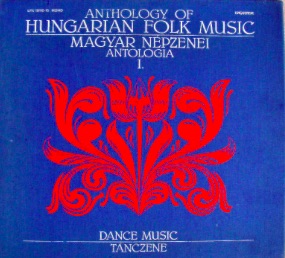
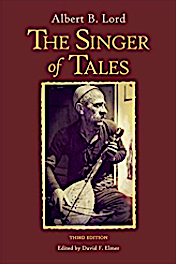
Musicians often wore bright tattoos, in red on the singer’s chest or between his thumb and fingers, with markings of “anchors, ships, guitars, flowers, animals, pierced or joined hearts, the cross, the five sores of Christ [YAY], other love, religious, fantasy signs or inscriptions”.

Fadistas 1873

Pinheiro, Fadistas, 1873.

But later a political stigma replaced the old social one:

For some, it’s a sound forever tarnished by its association with fascism. After the fall of the dictatorship in 1974, many on the Portuguese left saw the fado as something shameful. It was seen, at best, as a conservative outlet for national misery, at worst as an authorised voice for Catholic fascism.

Salazar himself considered that fado “sapped all energy from the soul and led to inertia” (on which grounds he might have been a big Sex Pistols fan). In 1927 he passed a law regulating it, depriving it of much of its improvisation and spontaneity—which sounds like what the Party has long tried but failed to do in China. Under Salazar fado wasn’t used as propaganda, but it was neutered. Flamenco, while no less commodified, has retained a more earthy aspect.

Fado‘s links with Brazil and Africa are also worth pursuing.

* * *

Following my visits to Sachsenhausen and Stasi memorial sites in Berlin, it seemed suitable to give myself a basic education on the Salazar regime and its sinister PIDE security forces. By contrast with the grim surroundings of the Stasi museum in Berlin, the Aljube museum (Museum of resistance and liberation; also useful introduction here) occupies a picturesque site overlooking the sea, suitably opposite the Sé cathedral—as if to remind us of the role of the church in supporting the regime.

family

Portugal was one of the poorest countries in Europe. In 1920, 66% of the population was illiterate. Infant mortality rates only decreased belatedly:

1926: 45%
1974: 37%
2011:   3%.

kids

The Estado Novo endured for forty years, from 1933 until 1974. It was in this period that Portugal became encapsulated by “the three Fs”: fado, football, and Fátima. Bread and circuses, perhaps: for the opposition, a formula for national alienation. One might add a fourth F: fear (see also The struggle against Mussolini).

Lisbon 1939

Lisbon 1939.

The Aljube had a long history as a prison. On the eve of the Estado Novo it held “women of ill repute, and incorrigible women accused of serious crimes”. Indeed, under Salazar, the exhibition mentions the general exploitation of women:

Women like Maria Lamas, Maria Isabel Aboim Inglês, Virginia Moura and Maria Machado initiated a new specific approach to the female condition and especially of the until then “invisible” condition of the women.

In a country where feminism was a late starter, this positioning would fertilize the cultural soil, in which would grow what is considered the first Portuguese feminist manifesto, As Novas Cartas Portuguesas [The new Portuguese charters], the publication (and apprehension) of which would leads its three authors, Maria Teresa Horta, Maria Velho da Costa, and Isabel Barreno, to be criminally persecuted in 1972.

Under the dictatorship the Aljube became a political prison. The museum outlines the use of torture, the role of informers (bufos, “squealers”), the resistance, and the exile of prisoners to penal colonies in the Azores, Madeira, East Timor. Many died of starvation and disease in Tarrafal camp in Cape Verde. The third floor covers the anticolonial struggle, as well as the 1974 Carnation revolution.

The exhibition documents the collaboration of the PIDE with the Italian secret police and the Gestapo—going on to note that the CIA helped train the PIDE from 1957.

One thorn in the flesh of the regime, harrassed by the PIDE, was the musician José “Zeca” Afonso (1929–87):

I’m sure a lot more tourists walk past than enter the Aljube museum, which is sad—but of course it takes a particular mentality to travel the globe in search of atrocity sites. Despite all the evidence of human suffering, not least during my own pampered youth, I’m not here (today, at least) to rant against tourism—the whole image of the Med (sun, sea, and in this case Sé) and idyllic island resorts—or indeed to carp at the human capacity for enjoying life.

Criminal states have operated all over the world, and continue to do so. In places like Germany and Portugal, where regimes have changed, lessons may be learned in the public domain; in China, still very little.

* * *

The new generation of fadistas are said to have shaken off the link with fascism, but it never fitted neatly into the discourses of either right or left. Moreover, it now seems largely rhetorical for fadistas to pride themselves on its history as an “ode to vice, an encouragement to moral depravity from the scum of society”. The clubs have been becoming gentrified for over a century, the atmosphere genteel (or what the Chinese would call “cultured”)—and even I can’t fault it for that.

So what better way of spending the night before Eurovision than to relish fado at a venue I hadn’t visited before: the Associação do Fado Casto in Rua São Mamede. Among all the fado joints in the Alfama, it’s rather off the beaten track, and suitably untrumpeted from the outside. The atmosphere is great, with groups of family and friends enjoying fine food amidst evocative memorabilia.

As to the fado, performed in sets of three songs, while the pluckers noodle away whimsically,  the intimate intensity of saudade as the singer enters is immediately touching. I heard fine sets from Matilde Cid (YouTube topic), accompanied by Antonio Duarte and João Filipe:

Matilde

I also just found out about the great Carminho, falling helplessly in love with this early clip of her singing Fado of the hours in Carlos Saura’s 2007 film (longer sequence here):

I used to cry for not seeing you,
And now that I see you, I cry

Chorava por te não ver,
por te ver eu choro agora,
mas choro só por querer,
querer ver-te a toda a hora.

Passa o tempo de corrida,
quando falas eu te escuto,
nas horas da nossa vida,
cada hora é um minuto.

Deixa-te estar a meu lado,
e não mais te vás embora,
para meu coração coitado
viver na vida uma hora.

This has leapt into my list of all-time Great World Songs. Incidentally, many fados make use of the plangent minor key, but this is a good instance of how saudade can be amply achieved without it.

I’m somewhat resistant to Big Stars (at least in “world music“), but I can hardly sign off without paying homage to the saudade of Amália Rodrigues:

For more links, see Tony Klein’s comment below. Note also Portugal: folk traditions. For flamenco under Franco, and more on gender, see here.


[1] While we await a translation of Rui Vieira Nery, Para uma história do fado, for one detailed study in English see Paul Vernon, A history of the Portuguese fado; see also James Patrick Félix, Folk or fake: the notion of authenticity in Portuguese fadohere. For a general introduction to fado in the wider context of Portuguese music, with discography, see The Rough guide to world music, pp.309–23; fado also features regularly in Songlines magazine.

A selection of recent posts


To help navigate through a plethora of recent posts, this is just a selection of some of the more substantial ones:


For more, click on MY BLOG in the top menu and scroll down…

Indian singing at the BM

*For a roundup of posts on raga, with a general introduction, see here!*

Bihag

Bihag, ragamala. Yale University Art Gallery.

After some time immersed in the rich harmonies of Mahler 10, it made a nice contrast for me to bask in the purity of monophonic Hindustani music in the Indian gallery of the British Museum. With the arhat at the other (Chinese) end of the gallery gazing on serenely from afar, Kaushiki Chakraborty sang with the lucidity and intensity characteristic of the style, accompanied by tabla and harmonium (the latter, alas, only intermittently suggestive of the bandoneon—call me old-fashioned, but you still can’t beat the sarangi).

She began with a khayal in the late-evening rāg Maru Bihag—whose relation with rāg Yaman (and Yaman Kalyan) is a subtlety to be explored by the aficionado. But even for the less attuned ear it’s worth homing in on the basic vocabulary of raga: the pitch relationships, always expounded most clearly in the opening alap.

To simplify absurdly the ascending and descending scales, and the choices of phrases within them, Ms Chakraborty’s version of the rāg featured Ni and Ma prominently, using an ascending scale of

Ni  Re  Ga  Ma  Dha  Ni

—feeding on the tension with the tonic drone of Sa, as in many ragas. The natural-fourth degree ma is introduced as a subsidiary theme (Ni Ga ma, or Sa ma, and Ga ma Ga), and later a sustained Pa also features. Here’s a version she sang in 2017:

Here’s a rendition by the great Nikhil Banerjee on sitar:

And for a version on shehnai, see Raga for winds.

Three baldies and a mouth-organ

*UPDATED with links to posts on the Zhihua temple and related topics!*

dav

Early in 1986, only a couple of days after my first arrival in Beijing, hearing the former monks of the Zhihua temple 智化寺 on a cold but beautifully sunny winter’s day was an experience that changed my life—and their ritual soundscape still entrances me:

Musicologist He Changlin astutely took me to a Buddhist temple to ask a group of elderly former monks to play their shengguan music for us. That sound will always stay with me. The soulful guanzi, the darting dizi, the sturdy sheng, the halo of the yunluo piercing the bright Beijing sky above the green-and-yellow roof-tiles of the temple. […] It was only hearing the temple musicians that directed me irresistibly to living traditions. I began to neglect ancient history…
[adapted from my Plucking the winds, p.185]

While I go to great lengths to stress that the Zhihua temple is only the tip of the iceberg—for ritual life both within Beijing and all over north China—the soundscape of its shengguan remains a classic source. There are no “living fossils”, and the temple itself has long ceased to function as a ritual site; but the present group performs with majestic authority, led by Hu Qingxue, about whom I must write in more detail—he’s not only an amazing guanzi player, but a fine vocal liturgist, and he’s just as hooked on exploring ritual groups in the countryside as I am.

In the photo above, the reason our demeanour is somewhat less solemn than that of the transcendent arhat is because Hu Qingxue had just suggested the caption which forms the title of this post—and, incidentally, of my latest Hollywood blockbuster. * The old sheng mouth-organ was my gift to him: it had been a gift to me in the early 1990s from a village ritual association that no longer used it, and since he’s an avid hoarder and repairer of sheng, it surely belongs in his fantastic collection.

chat with HQX

There’s always so much to learn from Hu Qingxue.

It was delightful to present the group at the British Museum again on Monday. In our pre-concert discussion (with subtle prompting from Jessica Harrison-Hall, curator of the BM’s Chinese collection) I was glad to introduce the social background and wider ritual context, as well as research by a succession of fine Chinese scholars; and with the musicians, to illustrate how the skeletal notes of the gongche solfeggio score are progressively ornamented, first by singing the score in unison and then by taking up the instruments to further decorate that version in heterophony.

For someone who was brought up in a poor Hebei village, Hu Qingxue has learned to recopy the temple’s old scores rather finely:

Qingjiang yin score

Qingjiang yin, copied by Hu Qingxue.

Having learned from my tours with the Li family Daoists, I’ve now worked out a much-improved programme with the Zhihua temple too. While the shengguan ensemble is always most captivating for audiences, we now include all three elements in the ritual soundscape, chui-da-nian—in reverse order of importance: wind ensemble, percussion, and vocal liturgy.

Thus the programme began with Cymbals to Open the Altar (Kaitan bo 開壇鈸), featuring the hocketing alternation of the nao and bo large cymbals that you can explore in my film on Li Manshan. It continues with the vocal hymn Yangzhi jingshui 楊枝淨水 in praise of the Buddhas and Bodhisattvas, also used near the beginning of a ritual—here accompanied by the melodic instruments. Then they demonstrate the process of ornamenting the skeletal notes of the score with the melody Qingjiang yin 清江引 (see photo above). After the captivating suite Jin–Wu–Shan (Jinzi jing 金字經—Wusheng fo 五聲佛—Gandongshan 感動山!) and Haiqing na tian’e 海青拿天鵝, the programme ends by reminding us of the primacy of vocal liturgy, with the a cappella hymn Qingjing fashen fo 清靜法身佛, accompanied only by the percussion.

As I am wont to observe, the blend of timbres of the shengguan instrumentation is the most perfect combo ever, alongside the jazz quintet… And the free-tempo alap-like introductions are just magical.

This overlaps with my blogposts, but here’s the full version of my programme notes:

Music of the Zhihua temple
Stephen Jones

A world away from the modern conservatoire style that now dominates the media, this music belongs as a kind of aural filigree interlaced within the vocal liturgy and percussion of lengthy rituals for funerals and temple fairs among local communities. To experience it in the concert hall or museum is a compromise, of course. It is one of many genres still performed today in a continuous tradition since the Ming—several types of regional opera, the nanguan ballads of Fujian, the music of the ubiquitous rural shawm bands, the elite qin zither.

The Zhihua temple has become a byword for the melodic instrumental music used until the 1950s as part of rituals in Beijing—mainly funerals, notably the nocturnal yankou ritual to feed the hungry ghosts. The monks of many minor temples in the hutong alleys of north and east Beijing, both Buddhist and Daoist, were available to come together to perform this music.

Built as the private temple of the court eunuch Wang Zhen in 1443, the Zhihua temple is one of the only wooden structures from the Ming dynasty to remain intact in Beijing.  After Wang Zhen was executed in 1449, the monks became part of the ritual life of the wider community, with twenty-six generations down to the 1940s.

Since then the tradition has struggled to survive. After 1949 the monks were laicised, so by 1953 when the Zhihua temple music first gained its reputation among music scholars, with influential studies from the qin zither master Zha Fuxi and the great musicologist Yang Yinliu, the monks were no longer performing rituals. Through the 1980s, as ritual life was restoring throughout the countryside, and even in cities like Shanghai, scholars like Ling Haicheng and Yuan Jingfang began attempts to revive the Beijing style, collecting the surviving former monks together.

Though the style remains the most exquisite rendition of a widespread repertoire, it is now mainly further afield that we can hear it in its ritual context—in the countryside south of the capital among amateur associations that learnt from temple monks, and among household ritual groups all over north China. The present performers hail from the poor village of Qujiaying, whose ritual association was first discovered in 1986. They were recruited while in their teens to study in the Zhihua temple with the elderly former monks, notably Benxing (1923–2009). But worthy attempts by cultural cadres have proved unable to maintain the classic Beijing style without the firm ritual base of local community support that remains common elsewhere in China.

While the more elite temple rituals use only vocal liturgy accompanied by ritual percussion, melodic instrumental music has long been commonly added for rituals among the folk. Throughout north China this takes the form of the exquisite shengguan chamber ensemble, which coalesced around the Ming. The instruments play in heterophony, each decorating the bare bones of the nuclear melody differently; the plaintive guanzi oboe leads, the sheng mouth-organ maintaining a continuous wall of sound, decorated by the halo of the yunluo (ten pitched gongs mounted in a frame) and darting ornaments from the dizi flute.

The repertoire of classic labeled melodies, combined in strict sequences in lengthy suites, was also coming together in the Ming. Since then, a kind of solfeggio called gongche has been commonly used to notate the outlines of the melodies of instrumental ensembles. Scores from several Beijing temples, of which the earliest now preserved is the 1694 score of the Zhihua temple, use a rare antique script that resembles those known from Tang and Song sources. But the bare bones of the score give few clues to the magic of performance; having learnt to sing in unison an already highly ornamented version of the nuclear melody, the performers then further decorate it in mesmerising heterophony on the instruments. The style is exceptionally slow and solemn, the free-tempo preludes especially magical. But we have to imagine it as a decoration within the whole liturgy of the complex rituals that are still common elsewhere in China.

Further reading

  • Stephen Jones, Folk music of China: living instrumental traditions, Oxford: Clarendon Press, 1995 (paperback edition with CD, 1998).
  • Stephen Jones, Plucking the winds: lives of village musicians in old and new China, Leiden: CHIME Foundation, 2004 (with CD).
  • Stephen Jones, In search of the folk Daoists of north China, Aldershot: Ashgate, 2010 (Appendix 1).
  • Yuan Jingfang, Zhongguo fojiao jing yinyue yanjiu [The Buddhist capital music of China], Beijing: Zongjiao wenhua chubanshe, 2012.
  • Chang Renchun, Hongbai xishi: jiujing hunsang lisu [Wedding and funeral customs of old Beijing], Beijing: Beijing Yanshan chubanshe, 1993.

You can hear an excerpt from Yang Yinliu’s legendary 1953 recording on #14 in the audio gallery (scrolling way down in the sidebar), with commentary here.

Other articles on this site:

And for conceptual background,

On the Qujiaying connection:

leading onto the Hebei village associations and further afield (under Local ritual, including Ritual groups of suburban Beijing and Tianjin: a folk Buddhist group, as well as a whole series on Gaoluo village).

See also Ritual artisans in 1950s’ Beijing.

* * *

The Zhihua temple events were part of a fine ongoing series at the British Museum (see also here) that also included flamenco (cf. my series starting here), Indian music, Japanese gagaku, Stockhausen, Ligeti, Cage, and Strauss’s overwhelming Metamorphosen.

And what should await me on my return home than a live broadcast of Mahler 10 with S-Simon Rattle. Without this lying xenophobic government, London could be wonderful.


* Cf. the alternative title for my film on Li Manshan: Four funerals and a funeral.

Accordion crimes

Proulx
“Germans invented the accordion,” Beutle explained to Messermacher. “A thousand things they invented, but accordions most of all. Because Germans think, Germans have brains. There was this feller, a musician, a German violinist, he ends up playing in the court orchestra in Russia, not Catherine the Great but around that time, he plays the violin. But because he’s a German, Jesus Christ, he notices things, he notices when he hangs up his bow on a nail back in his room she also makes a nice little tone. From this he invents the nail violin, very beautiful tones, I have heard it. A circle of wood with nails sticking out, you run the bow on the nails and ooo aaa ooo aaa, a beautiful tune. One day this feller gets a strange thing from China, somebody gives it to him because interested in things he is—naturally, he is a German—and he sees a round bowl with some bamboo pipes sticking out, and on the bowl a mouthpiece. He blows on it. It’s a fine sound. This thing the Jesus Christ Chinese put reeds inside the pipes, same as in the accordion, little reeds stuck on one end with wax, the other end can vibrate like this.” He trembled his hand at Messermacher. “The German violin player learns the playing of this instrument, die liebliche Chinesenorgel, and from this he passes to other Germans the idea of the accordion—the free reed. That’s how it begins. Later comes the bellows.” (91–2)

By now readers of my blog will know how vital the sheng mouth-organ is to the ensemble accompanying north Chinese Daoist ritual—and I suppose it was the sheng that obscurely reminded me to read Annie Proulx’s miraculous 1996 novel Accordion crimes.

The book has long been popular with ethnomusicologists (e.g. this review), despite being a novel—or rather, near the fiction end of the spectrum from non-fiction to fiction; or near the readable end of the academic—engaging spectrum (cf. Bernard Lortat-Jacob’s Sardinian chronicles, another classic). Like ethnomusicologists, Proulx focuses on change and social function. In her Acknowledgements she lists an impressive array of sources, experts on their regional genres—it’s amazing that all her detailed research took only two years.

On an epic scale, in the tradition of the Great American Novel, Accordion crimes has all the rich detail of ethnographic thick description. Indeed, it’s timely that I should get round to reading it now, since it discusses the tribulations of poor, ill-fated immigrants. The human cast includes immigrant Italians, Germans, Poles, Irish, Mexicans, French, and Norwegians—all against a backdrop of xenophobia, misanthropy, brutality. Their sad, tough, gory, gruesome tales are connected by the history of an old two-row button accordion for over a century, with other roles played by

  • a club style accordion
  • a little one-row button accordion
  • a chromatic accordion
  • a piano accordion
  • a bandoneón (cf. Tango for Messi!!!)
  • a concertina
  • a Chemnitzer.

As I observed about that other ethno classic Lives in jazz, the book gives a perfect combo of music and social detail. Hooked on taxonomy, Proulx can never resist long lists; likely to be tedious in academic hands, hers never fail to enthral. While poetic, her language is never pompous.

The novel opens with compelling detail from 19th-century Sicily:

It was as if his eye were an ear and a crackle went through it each time he shot a look at the accordion. The instrument rested on the bench, lacquer gleaming like wet sap. Rivulets of light washed mother-of-pearl, the nineteen polished bone buttons, winked a pair of small oval mirrors rimmed in black paint, eyes seeking eyes, seeking the poisonous stare of anyone who possessed malocchio, eager to reflect the bitter glance at the glancer.

He had cut the grille with a jeweler’s saw from a sheet of brass, worked a design of peacocks and olive leaves. The hasps and escutcheons that fastened the bellows frames to the case ends, the brass screws, the zinc reed plate, the delicate axle, the reeds themselves, of steel, and the aged Circassian walnut for the case, he had purchased all of these. But he had made all the rest: the V-shaped wire springs with their curled eyes that lay under the keys and returned them to position in the wake of stamping fingers, the buttons, the palette rods. The trenched bellows, the leather valves and gaskets, the skived kid-skin gussets, the palette covers, all of these were from a kid whose throat he had cut, whose hide he had tanned with ash lime, brains and tallow. The bellows had eighteen folds. The wood parts, of obdurate walnut to resist damp and warpage, he had sewed and sanded and fitted, inhaling the mephitic dust. The case, once glued up, rested for six weeks before he proceeded. (17)

As the old accordion-maker arrives in New Orleans in search of fame and fortune,

In and out went Caramele through the scores of dives, tonks and jooks and barrelhouse joints that lined these streets, the accordion maker lurching after him through the musical din of drums and ringing banjos, shouters, pianos clinking away, squealing fiddles and trumpets and other brass snorting and wailing from every interior, and sometimes a string quartet sawing crazily. On the streets children watched and fought for discarded stogie butts, black street musicians and white played for coins, singing improvised songs of insult at those who failed to toss a whirling coin. (42–3)

In “Spider, Bite Me”, Abelardo recalls to his son Baby,

“The accordion was so natural, a little friend. Easy and small to carry, easy to play, and loud, and can play bass rhythm and melody. Just the accordion and nothing else and you’ve got a dance. It’s the best instrument for dancing in the world, the best for the human voice.”
[…] On the weekends [Baby] played for dances with Chris, mostly rancheras and polkas; they sang in the classic two-part harmony, primera y segunda. […] The dances were exhausting, the strain of playing and the lights, the sweat and heat and thirst, the noise like pouring rain.
[…] Though so many turned to the big-band sound and the strange hybrid fusion of jazz, rumba and swing, would rather listen to “Marijuana Boogie,” the Los Angeles Latin sound, than “La Barca del Oro”, there was an audience that liked their music, found value in it. These new ones, many of them veterans back from the Korean War, some of them university students, embraced conjunto, and this music was not for dancing but for listening. It had a meaning beyond itself. (173–4)

The changing tastes lead to a heated argument between Baby and his put-upon sister Félida (191–8):

She passed her arms through the huge straps. […] She stared at the ceiling, said, “por Chencho, Tomás, por Papá Abelardo,” then sang the heart-wrenching “Se fue mi amor,” which Carmen y Laura had recorded in the last year of the war.

Her bellows control technique was extraordinary, with dramatic swells and choking, sforzati explosive effects. She scratched and rubbed and struck the keys, ran the back of her nails across the folds of the bellows. The accordion gave the perfect illusion that a bajo sexto and a bass as well as a highly original percussion player supported the accordion, and from it came the melting harmony of the missing sister’s voice to twine and burn with the sweet, smoldering fire of Félida’s sad voice.

“Hitchhiking in a wheelchair” (199–276) is fascinating too, as Dolor makes a pilgrimage to Canada in search of old-time French music:

The music was stunningly brilliant, joyous with life and vigor. The dancers sprang over the floor and now and then they would draw back and give room to a step dancer whose rigid back, erect head and straight-hanging arms accentuated the clattering, tapping, rapping, knocking, flinging feet whose steps stuttered in and out of the music. He wished Wilf could hear the fiddler, the sound like a flock of birds, a flight of arrows striking all around him, from a growling, clenched-teeth mutter on the G and D strings to harmonic shrieks and stair-tumbling runs—Jean something, a taxi-driver from Montréal.

This leads to “Don’t Let a Dead Man Shake You by the Hand” (277–349) , where Proulx expounds on Cajun and zydeco in Louisiana; and “Hit Hard and Gone Down” on the Polish folk scene (351–426):

The Chez family from Pinsk lived across the street; later they changed their name to Chess, the two boys grew up to work in businesses, a junkyard, bars and nightclubs, finally making phonograph records featuring black singers moaning the blues, and by 1960 the good Polish neighborhood had turned black on all sides. (354)

“There’d always be somebody’s polka band—two violins, you know, the bass fiddle and the clarinet, no accordion at all, they’d just play all afternoon and we’d dance. No music pages, they play from their heads, they were geniuses. You know, the dancers used to sing out a line of a song, or not even sing it, just shout it like, and the musicians they had to catch it, know it and play it back in the same key. Oh, they were so good. Well, your grandfather, he sees after a while there is some money starting to come to the polka band players and there was all kinds of places that wanted polka bands—Polish Homes, the Polish Club, not the culture evening but the Saturday night dance, little dance halls all over the place, the union halls, bars and Polka Dot restaurant, the Polish League of War Veterans, a lot of restaurants, Polonia Hall—oh, there was plenty of polka dancing, and a lot of fun, and weddings, weddings, weddings, everybody was getting married and you gotta have polkas.” (371)

Hieronim’s wake was something, the last of its kind in the neighborhood, in the old, old Polish style, and nobody would have known how to do it except Old Man Bulas from the Polish Club… He was the leader of the singing and knew the hymns, scores of them all written down in his śpiewnik, a thick, handsome book wrapped in black cloth. (383)

This is soon followed by a memorable wedding:

He told his wife that it was necessary to balance the solemn death rites of Hieronim with as much of the old wesele style as possible… (385)

But again, tastes are changing (404–14). As promoter Mrs Grab warns Joey:

“We don’t want nothing weird or extreme, you know? There’s rules now, the association’s made rules. […] Only one song in Polish. Most people don’t understand it, but one song gives a nice ethnic flavor. That’s what we want to stress, ethnic flavor. Let me tell you something, Joey. Ethnic music is not that old-time stuff anymore. These days everybody is ethnic, might as well make money on it. […] They don’t want that mournful folk music sound no more or those complicated couple dances going into circles and weaving around and slapping their asses and crossing into the next lane. No more of that Kozaky na Stepie, Cossacks on the Steppe, stuff. Everything gets mixed up unless you got a Ph.D. in Polish clogging. It’s no fun.”

[…] The spare applause had hardly died down when a big guy jumped up, his thin long hair pasted to his sweating forehead, and began to shout at them.
“This is not Polish polka, not Polish music. I am a Pole from Poland and in Poland they would laugh at you as I do now—Ha! Ha!—for saying this garbage you play is Polish.”

Now the bandoneón and tango make an appearance, as Joey meets a migrant from Buenos Aires, who muses:

“Piazzolla, with his little zips like the plastic zipper of a cheap jacket, his plotted silences, the squealing like rubbing two balloons together. That is a serious, unsmiling, hard music; the faces of the dancers frown furiously; and his tempo, the beat is like climbing cement stairs in a skyscraper with fire behind the doors. And there is that quality of a paper comb that sets the sutures of the skull trembling. Those passionate swellings are musical hives…” (416–18, cf. Alexei Sayle).

“The Colors of Horses”, with Basque and Irish musics as well as Appaloosa horses playing a major role, is another too, er, deaf ‘orse. More fantastical lists:

…descendants of the ice-age horses painted on the cave walls of France, of the fabled horses of Ferghana, between the Syrdarya and the Amudarya rivers on the steppes of Central Asia in Uzbekistan, of Rakush, the spotted horse of the warrior hero Rustam, celebrated in Persian miniatures and in Firdousi’s epic poem the Shah Namah, of the Chinese Celestial Horses from the Extreme West, the Blood-Sweating horses, of the galloping mounts of the Mongol Horde and Attila the Hun, of the Andalusian horses of Spain shipped to Mexico for the conquistadors’ savage forays, of a shipload of spotted horses from the Trieste Lippizan herd landed on Vera Cruz around 1620, of the horses abandoned by the terrified Spaniards after the Pueblo revolt of sixty years later and traded north by an agricultural people more interested in sheep, to the Shoshone, Cayuse, Nez, Percé, Blackfeet, Blood, Arikara, Sioux, Cree, Crow, of the North American steppes known as the Great Plains, had been bred down to dog meat. (443–5)

The evocation of Irish song (483–5) is worthy of Ciaran Carson. Now we return to the original, battered old green accordion:

The silent reed suffered from a grain of rust jammed between the reed tongue and its vent, and this he eased out with a silk thread from his fly-tying box. The steel reeds were coated with islands of rust and he scraped at them with the blade of his knife but was afraid of lodging more fragments under the reed tongues. He cleaned the reeds with his toothbrush, blowing out the dust until he was dizzy.

He could see it needed everything—new bellows, new reed, new springs, reed plates reset, grille replaced, and more. But it had a wonderful voice, sonorous, plangent, shouting in grief to the mountain slope. (486)

The final section, “Back Home with Reattached Arms”, is moving too, with Norwegian immigrants making an appearance:

His own parents had been obsessed with the prescriptions of a book, The Emigrant’s Guide to Preserving Norwegian Culture, written by a homesick settler in Texas, a book that dwelt on the merits of the Norwegian language, twice-daily prayers, Norwegian hymns, clothes, food, and, after the fortune was made, return to the “elskede Nord” country. Daily they had sung “En Udvandrers Sang,” “O Norges Son” and others. His mother wished to live in a Norwegian community where land was owned in common by all. But Gunnar shouted for independence and his own land, purchased a mighty, star-spangled flag… (496)

 * * *

That discussion of the sheng, with which I opened, reminds me of the Li family Daoist band’s concerts in German churches in 2013, the two mouth-organs filling the building with a majestic sound just like Bach on a huge organ with all the stops out (my Daoist priests of the Li family, p.339).

For a general introduction to the accordion, see here. For yet another wacky illustration of the joys of organology, see the aerophones classified under Sachs-Hornbostel 412.232 here. And to explore these genres in more depth, note The Garland encyclopedia of world music: the United States and Canada (1998), Part 3 Section 2c.

Passages like this draw the reader towards archive recordings:

Abelardo had hundreds of records, his own recordings of the 1930s, a few with Decca, then with Stella, then with Bell, then Stella again. “In those days I sang in Spanish; those men with the record company said to me, ‘we can’t tell what you’re singing, so don’t sing anything dirty.’ So of course I sang all the filthy ones.”
[…] He had old recordings of Lydia Mendoza, of the great accordion players, the records of Bruno Villareal, half blind, a little tin cup wired to the side of his accordion, playing in 1928, “the first recording with the accordion as the star”, Pedro Rocha and Lupe Martínez, Los Hermanos San Miguel, dozens of Santiago Jiménez discs.
[…] He would make them listen to all those old labels: Okeh, Vocalion, Bluebird, Decca, Ideal, Falcon, Azteca, especially the Ideals made in the garage of Armando Marroquín up in Alice. (148–9)

Of course, like all those books about Daoist ritual, Accordion crimes misses a lot by being silent—it cries out for a good playlist. One is drawn back to the great 1952 Anthology of American Folk Music, and we can find further clues among articles in The Rough Guide to world music.

And let’s all explore YouTube—here’s a Polish tango from 1931:

See also Polish folk and jazz, A blind accordionist, Tango for Messi!, and under Bella ciao.

If we have to use words to evoke music, Accordion crimes is just the way to convey its messy exhilaration and flawed humanity.

The notation of ritual sound

gongchepu

In articles on this site I often stress how soundscape is basic to ritual performance. In north China ritual specialists identify three types of organized ritual sound, “blowing, beating, and reciting” (chuidanian): melodic instrumental music, percussion, and vocal liturgy—in reverse order of importance, with vocal liturgy primary. Some groups accompany their vocal liturgy only with percussion, but where melodic instrumental music is performed, it is an essential component of ritual: “holy pieces” (shenqu), transcending language. Whereas vocal liturgy is not notated—most ritual manuals document only the texts, not the melodies to which they are sung—the outline of the melodic (and indeed percussion) instrumental music that punctuates and accompanies it is recorded in scores of gongche solfeggio. [1]

When the Qujiaying village ritual association, south of Beijing, was “discovered” in 1986 we already knew about the shengguan ensemble and its gongche scores (notably those of the Zhihua temple in Beijing) thanks to the ground-breaking work on Yang Yinliu in the early 1950s, later comprehensively studied by Yuan Jingfang. In our project on the Hebei plain, we soon broadened our attention to ritual manuals, but the shengguan wind ensemble and the scores of village ritual associations were always among our major concerns.

In the fine tradition of anthologies that Chinese musicologists do so well, the major new compendium

  • Zhongguo gongchepu jicheng 中国工尺谱集成 [1]

collects some of the most important scores of gongche solfeggio. It provides rich material on the continuity of early history with modern folk practice.

The anthology is based more on northern shengguan than on southern genres—the distinctive scores of nanyin in Fujian and Taiwan are already collected in many separate anthologies.

The compendium comprises ten volumes to date:

  • General (a fine introduction to historical variants of notation and metrical markers)
  • Beijing (2 vols)
  • Hebei (3 vols)
  • Shaanxi (2 vols, for the major repertoires of ritual groups around Xi’an)
  • Jiangsu (including major early Daoist scores)
  • Liaoning (including scores for both shengguan and the amazing shawm bands there)

The scores of Beijing temples, and those of the related village ritual associations on the Hebei plain just south, take pride of place. The detailed commentaries on the Hebei and Beijing material are the work of Zhang Zhentao, continuing the masterly chapter in his book Yinyuehui.

Hanzhuang XWJ

Most volumes further include useful tables of qupai labelled melodies.

Such scores also often contain precious prefaces bearing dates of transmission, as we saw in Xiongxian.

Hanzhuang xu 1

Gaoluo 1989

* * *

Of course, like the Daoist Canon, and like the ritual manuals of living groups, scores are merely silent artefacts. They should be combined with recordings of their transmitters, who have long experience of bringing them to life—first by decorating the skeletal notes of the score by singing in unison, and then in ritual performance, taking the instruments up to play them in heterophony suitable to the different instrument types. While some musicians learn mainly by ear, the score is an important repository representing the tradition.

But just in case you think the silent score is somehow equivalent to “the music”, then don’t just consult my transcription of Hesi pai under West An’gezhuang here (§2), but listen to the shengguan tracks on the playlist in the sidebar (including tracks 9 and 10, showing the progressive decorations)!

I should also add that notation is not a criterion for excellence. Many musicians, and ritual specialists, in the great and small traditions of the world don’t need it at all, and for others it is merely an aide-memoire, as in this case.

Indeed, this isn’t just an issue for music. This is not the place to discuss wider issues of oral and literate cultures, but this radical comment from Plato, no less, is suggestive:

This discovery of yours [writing] will create forgetfulness in the learners’ souls, because they will not use their memories; they will trust to the external written characters and not remember of themselves. The specific which you have discovered is an aid not to memory, but to reminiscence, and you give your disciples not truth, but only the semblance of truth; they will be hearers of many things but will remember nothing; they will appear to be omniscient but will generally know nothing; they will be tiresome company, having the show of wisdom without the reality.

As Paul Cooper comments,

I love that when Plato complains about the spread of the written word in 370 BC, he sounds like my granddad complaining about the internet.

Such issues are thoughtfully explored by ethnomusicologists—for leads, see the fine chapters of Ter Ellingson and Richard Widdess in Ethnomusicology: an introduction (The New Grove handbooks in music), and Bruno Nettl, The study of Ethnomusicology: thirty-three discussions, chs. 20 and 26. And for wise words on the history of notation in WAM, see here.

These gongche scores are a major aspect of the study of ritual. But that’s enough writing—wouldn’t want to offend Plato…

For a still more exhaustive compilation of Chinese notation, click here.


[1] See e.g.
http://news.xinhuanet.com/politics/2017-09/06/c_129697492.htm,
http://3g.china.com/act/culture/11171062/20170906/31301663.html,
http://news.takungpao.com/mainland/topnews/2017-09/3491181.html.

[2] I gave an overview of gongche notation in my Folk music of China (ch.7); cf. my article “Source and stream: early music and living traditions in China”, Early Music August 1996, pp.375–88. As ever, Yang Yinliu gave a masterly survey in his Gongchepu qianshuo 工尺谱浅说 (1962).

The art of the sheng repairer

GGZ Fan Huilai 93

Fan Huilai overhauling sheng, Xiongxian 1995.

An important theme in our fieldwork on ritual associations around the Hebei plain is that of the itinerant occupational sheng mouth-organ repairers (dianshengde 点笙的). They make cameo appearances in several pages on Local ritual, so here I’d like to collect some of the material. [1]

While I constantly stress vocal liturgy, the shengguan wind ensemble is also a major aspect of the ritual soundscape in north China. The role of the sheng in the ensemble is somewhat akin to that of the baroque continuo. Like a harpsichord before a Bach cantata, the sheng needs regular fine-tuning in advance of performance. The term diansheng (dotting the sheng) derives from the adding of a drop of wax to the reed to tune it, but includes general maintenance; played for long rituals, with their sound-chambers susceptible to moisture, wear-and-tear on the sheng is considerable. Musicians may tune individual instruments themselves, and any sheng player can do it after a fashion, but it is a difficult job to do well, and a well-tuned sheng section is an important aspect of a good ensemble. As with the work of the luthier worldwide, it is a slow and meticulous task (for a loving tribute to instruments and instrument-making in Irish music, see Last night’s fun).

Occupational Daoist bands in north China, like the Li family in Yanggao, tend to maintain their own sheng; with quite a small personnel, they rarely have more than four to tune. Players can all carry out basic repairs, and in between the many ritual visits to the soul hall over the day they busy themselves in the scripture hall making fine adjustments to tuning. This is among the many practical skills that Daoists have to learn. Still, Li Bin takes all the band’s sheng to fine maker Gao Yong once a year for a thorough overhaul.

On the Hebei plain, amateur village ritual associations tend to be much larger, often using as many as twenty sheng players—so occupational sheng-repairers are much in demand. Most associations invite a sheng-repairer to tune all their sheng systematically two or three times a year, or before their major outings, at least before the New Year rituals. The Zhaobeikou association had its sheng repaired at least three times a year, once “before the lake freezes over”, again before the New Year rituals, and also before the river lanterns ritual of the 7th moon. Some associations may be reluctant to spend money on inviting a repairer—although in some villages in the early reform era payment for this comes out of the funds of the village committee. Around 1995 it cost 5–10 yuan to tune one sheng; most associations had at least eight sheng to tune. Sheng-repairers were making a good living.

When a ritual association buys new sheng, musicians take them to be tuned (pin sheng 品笙) to the standard pitch of their own association, taking the che gong of their yunluo or tuning them to the lowest note of their dizi flute.

So apart from their vital musical services to the village ritual associations, the sheng tuners act as a unifying factor in communication, an informal rather than institutional link. Experienced observers of musical life over the whole area, they serve not only ritual associations but also shawm bands and opera troupes, and they know a lot more about local ensembles than any cultural cadre we have met. They often go on tour throughout the villages, but ensembles may also take their sheng to the craftsman’s home. Again, most craftsmen still come from long hereditary traditions.

Below I introduce some of the more renowned sheng-repairers and makers around the Hebei plain.

Bazhou, Xiongxian, Jinghai
Back in 1989 our very first clue to the ubiquity of ritual associations on the Hebei plain came from Bazhou county. Based in Xin’an town, the Qi family was among many lineages of sheng-repairers active around Beijing, Tianjin, and the countryside just south.

We met Qi Youzhi (b.1920), from a long line of sheng-repairers in his lineage. His grandfather Qi Baoshan had worked for the imperial palace lamas in Beijing. Before the fall of the Qing dynasty in 1911, Qi Youzhi’s father Qi Lanpu used to play sheng in the Tianqiao district of Beijing. Later, through contacts with palace eunuchs, he learnt to repair sheng, building a reputation with temple musicians. His older brother Qi Lanting and his oldest son Qi Youcai also took up the business, and they also repaired sheng in Tianjin.

qyz-1989

Qi Youzhi (right) with Xue Yibing, Xin’an 1989.

They used to go out to find work repairing sheng, making the rounds of all the Buddhist and Daoist temples and village associations. Twice a year Qi Youzhi used to go on a long trek by foot to Beijing with his uncle, staying in villages on the way and tuning sheng wherever there was work. After the 1949 Liberation, Qi Youzhi could no longer find work in Beijing, since priests were returning to lay life and temples were now largely inactive—but significantly there was still plenty of work repairing sheng for the village ritual associations. Indeed, this work continued until the Four Cleanups in 1964. By 1980 Qi Youzhi was 61 sui, and, despite the revival, gradually became less active.

Nearby in Gaoqiao village—whose Buddhist-transmitted ritual association is so outstanding (playlist track 8, and commentary)—the Shang family sheng factory is a long-established cottage industry. A local source claims that they too were repairing sheng for palace groups in Beijing as early as the Xianfeng era (1850–61), and that they made their first sheng in 1853. By the 1980s they were making sheng for the Hongsheng instrument factory in Beijing and Tianjin; by 1993 they had even started making shō for Japanese gagaku. In 1995 they were charging 140–180 yuan for a new sheng. The head Shang Xuezhi was often on tour, mending sheng for ritual associations (and also shawm bands and opera groups) over a wide area; he kept a three-volume list of his clients, wonderful evidence of the continuing vitality of the associations.

In Xiongxian county, another excellent sheng repairer was Fan Huilai, based in Gegezhuang (see photo above; below, some of his equipment). By 1993 he was visiting about sixty associations every year (including Catholic groups in Hejian county), charging 5 yuan to repair each sheng. As he pointed out, most associations had about eight sheng to repair, but some, like Quantou on the Baiyangdian lake, had as many as eighteen.

GGZ sheng stuff 2GGZ sheng stuff 1

Still in Xiongxian, there was a local saying: “from Nanjing to Beijing, the Shao family of Gaogezhuang are good at reparing sheng”. They came to Hanzhuang twice a year to repair the association’s sheng, tuning eight sheng for 100 yuan. Hanzhuang has a sheng said to be from 1929, with “made by Shao Guanghui” incised on one of the reeds; they had an even older one with a wooden bowl.

In Jinghai further east, Lesser Huangzhuang (also with its own ritual association) had an instrument factory specializing in sheng. They had been making sheng since before the Japanese occupation. In the 1950s the business was collectivized; in 1968, while assistant chief of the village revolutionary committee, Li restarted the workshop. Since the 1980s it had split into eight (!) household industries. One of their itinerant repairers was Tao Laicheng, who regularly visited the Zhangzhuang association in Bazhou, for instance.

E. Jiangcun sheng

Sheng parts, East Jiangcun, Renqiu county. Photo: Music Research Institute, 1993.

Xushui and Yixian
In my article on ritual associations of Xushui county I introduced Qingmiaoying, another village long famed throughout the region for its hereditary makers and repairers of sheng mouth-organs. Several groups in this western region of the plain have fine old sheng made by the Qingmiaoying craftsmen, and all spoke of them with respect. In fact, since the technique of instrument-making has suffered, old instruments may survive better than new ones, and their timbre is much valued by musicians.

E. Yuzhuang chui

The Altar of Accumulated Altruism, East Yuzhuang 1995.

In 1995 we found Yao Haijun (b. c1965) at Qingmiaoying. His great-grandfather Yao Leping died in the Cultural Revolution; he still ran a stall at the county-town market in the 1950s. Leping’s son Hongru (b. c1914), and grandsons Xinghua (b. c1930) and Xingli, also took up the trade. In Dingxing county nearby, the Yishangying association had some fine sheng made by Yao Jiqing in 1951. Yao Haijun was letting his 10-sui-old son watch while he repaired sheng, hoping he would take it up too.

Yao Haijun was charging a dozen or so yuan to tune one sheng. Associations were bringing him over a hundred sheng every year to tune; in the 12th moon someone came virtually every day. He tuned a lot of them for free, because of long-standing good guanxi with the associations, and he wasn’t mercenary.

Another sheng-repairer in Qingmiaoying, Wang Qinghe, had learned from Yao Leping, and lived to the age of over 100 sui. His son, known as Tiger Wang (Wang Laohu, over 60 sui in 1993), continued the business; the Gaoluo association used to go to him on occasion right until 1991.

Just north in Yixian county, Li Kungui, a member of one of the four ritual associations in Shenshizhuang, was a sheng repairer active within a smaller radius. His father also repaired sheng, having learnt from one Zhang Rui. Li Kungui also mended sheng for the village’s East association, but the West association has its own sheng-mender. In this case, Li has been responsible for a certain local standardization in pitch. The fixed pitch of the Upper Huanghao association used to be D, but he changed their pitch to E for them to match that of other groups in the area—such as East and West Baijian, as well as Lower Huanghao and Mawuzhuang.

A nice story illustrates musicians’ awareness of the dangers of sheng-repairers going on tour to other villages. Senior musician Fu Zhongren (c1898–1983) had a comprehensive knowledge of the repertoire of “holy pieces”, but realizing that Li Kungui used to go round other villages repairing sheng, he wouldn’t teach him too many pieces in case he taught them to other associations!

Further south
Before the Japanese invasion in 1937 a sheng-repairer called Du, from Dujiazhuang in Shenxian county quite far south, walked to Gaoluo every winter to tune sheng for all four ritual associations there. Villagers said the maker was called Du Furui. We also heard of him in Yixian county: near the Western tombs of the Qing emperors, cultural cadres had found some old sheng with “Dujiazhuang in Shenzhou” incised on them.

In Jingxian county still further southeast, another renowned sheng-making lineage was the Wang family from Yangzhuang, [2] which went back some five generations. They were versatile, making many other instruments too; and like other such cottage industries, they have moved with the times, supplying instruments for urban professional troupes.

Since they are itinerant, sheng-repairers may also transmit the paraliturgical music, either directly or by acting as intermediaries. Two early transmitters of the “southern” style of shengguan music in Xushui were sheng-repairers, the Daoist priest Wang Leyun (fl. 1860) and Feng Daya (fl. 1920s), both from further south.

I look forward to reading material on sheng-repairers in regions like south Hebei, where shengguan is also a major component of the rituals performed by household Daoists.

***

I have discussed sheng-repairers at some length, both to illustrate continuity with pre-Liberation traditions and to suggest the practical material basis behind ritual culture in local society. Though there are no longer stalls at town markets, village repairers still still do good business making the rounds of rural ritual ensembles, as well as maintaining their contacts with urban outlets and taking part in innovations in instrument design. Sheng-repairers, like the assistants in funeral shops, are likely to be a more useful source of local knowledge than cultural cadres.


[1] See Zhang Zhentao’s masterly study, Shengguan yinweide yuelüxue yanjiu [Temperamentology of sheng pipe positions] (Ji’nan: Shandong wenyi cbs, 2002). For north Shanxi, note also the work of Chen Kexiu and Jing Weigang. For sheng factories in a changing society, see e.g. http://www.onesheng.cn/news/102721.html.
[2] See e.g. Yu Xuehong 于学洪, “Shengwang shijia” 笙王世家, Yueqi 1984/5 and 1984/6.

Bulgaria: seeking buried identities

KK cover

After Vesna Goldsworthy‘s book on her upbringing in Yugoslavia and later life in the UK, Kapka Kassabova’s Street without a name: childhood and other misadventures in Bulgaria (2008) makes a worthy follow-up.

I know even less about Bulgaria than about the GDR[1] but such observations strike a chord with my experiences of China. Such works also explore my theme of post-traumatic historical amnesia.

Born in 1973, Kassabova left Bulgaria in 1990 after the fall of the Berlin Wall. She reflects:

Totalitarian regimes are not interested in personal stories, they are interested in the Party, the People, and the Bright Future. Nor are post-totalitarian democracies. They are too busy staying alive.

Equally, in the West there hangs about a vague idea of collective life behind the Iron Curtain, and life after it, but there are surprisingly few personal stories to go with the idea.

Fair point, though such accounts (even in English) do seem to be growing. Kassabova cites an unnamed Yugoslav child in the 1990s:

I love my country. Because it is small and I feel sorry for it.

With the candour of childhood, she too asks her mother, “Mum, why is everything so ugly?” Still, she cites Walter Benjamin:

When an outsider comes to a new place, he [sic] sees the picturesque and the freakish, whereas the local sees through layers of emotion and memory.
So while a newcomer would have looked at Youth 3 [her housing block] and seen an uninhabitable dystopia of concrete and mud, I learnt to see it for what it really was: my home.
[…] There was also the butcher, the baker, the kindergarten, the grocery store, the Universal store, the bottle store. So what if they were all housed on the ground floor of blocks, or in small, bunker-like concrete buildings we called trafoposts because they were built to house the suburb’s electrical transformers? So what if the butcher only had mixed mince and bloody legs that she wrapped up in coarse brown paper? Or the baker only had two types of bread, white and wholemeal, and the Universal store was universally empty except for, say, a just-arrived pull-out sofa bed? Or the bottle store only sold lemonade and beer? You like lemonade, and you liked meatballs, and you already had a pull-out sofa-bed anyway. It’s not as if you lacked for anything. It’s not as if there was anything more you wanted. After all, you didn’t know there was anything more to want.

One product that might be available in the Universal store was the more accurately-titled Ordinary biscuits. On Bulgarian shops:

They weren’t actually shops, not in the conventional sense of the word. They were unheated ground-floor rooms with shelves on which something may—or may not, depending on the day—be displayed, perhaps even sold, if you could bear to queue up, fight with other citizens, and emerge battered but triumphant, clutching a pair of shoes, a kilogram of Cuban oranges, or a tub or margarine.

Sometimes inadvertently evoking Molvania, it’s a fine line that divides us from the old Commie-bashing trap of sneering at the failure of the socialist experiment—laying bare the privations comes better from people living under such systems than from foreigners or even expats. Whereas a book like Hester Vaizey’s Born in the GDR shows a more varied response from that generation born under socialism, in Bulgaria it seems harder to find people who appreciated anything about life either before or after 1990.

This is hardly comparable, but as a foreigner in China I soon lost the capacity to be shocked, growing used to clambering up unlit concrete stairwells piled with cooking equipment and cardboard boxes to visit families squeezed into tiny bare one-room apartments. This was just how people’s lives were. Even now I don’t bat an eyelid as I walk past stinking pits of litter strewn in village alleys. Whereas on fleeting visits to the GDR before 1989 I merely felt alien and out of my depth, not equipped to pass patronizing pronouncements.

Kassabova’s father went on work trips abroad, and sometimes foreign friends come to visit, laughing companionably with them:

For a moment, you could even think we were equal.
But we knew, and they knew, that we weren’t equal. Behind the laughter and the wine, I sensed my parents’ permanent nervous cringe. They knew the foreign guests saw the ugly panels, the cramped apartments, the mud, the overflowing rubbish bins, the stray dogs, the empty shops, the crappy cars, the idiots in the brown suits, and they were ashamed.

We were living in a banana republic, but minus the bananas.

Young Kapka even feels like a poor cousin in neighbouring Macedonia, and even more so on a trip to East Berlin. When her father gets a six-month fellowship in Delft on, his wife visits him:

It wasn’t the supernaturally clean streets, the tidy bike lanes, the smiley people, but the university toilets that tipped her over from stunned awe into howling despair.

Mind you, I’ve felt a bit like that in Holland myself… On their return, her father puts a brave face on things.

“They’re just normal people. OK, they have more material things than us, but otherwise their lives are not that different.”
“Of course they are,” my mother insisted. “Whether we like it or not, they are different.” They think differently. They take so many things for granted. They have rights, they demand things… They live in another world.”

When her father’s Dutch colleagues come on a visit they too look on the bright side, which leaves the family lost for words.

Kassabova relates another Soviet joke (which actually resembles my granddad’s joke):

A man in the deli section of the supermarket says to the butcher behind the counter: “Can you slice up some salami for me?” The butcher replies, “Sure. Just bring the salami.”

Our parents shared the same world: a world where political jokes and birthday parties were the norm, and you were united by a distrust of the idiots in the brown suits.

Even in her teens she could deconstruct the motto “Let us Construct Socialism with a Human Face”:

a) Socialism with a Human Face did not occur naturally, it had to be constructed like so many blocks of flats; and b) there was also Socialism with an Inhuman Face.

The teenage Kapka watches Brazilian soap operas, The thornbirds, and Star wars; she listens to the Beatles, and the gritty songs of Vladimar Vysotsky. Like Goldsworthy, she attends a lycée, where

The general idea was not to get top grades, but to mix with Sofia’s brightest brats, wear your navy-blue school mantle short at the bottom and unbuttoned at the top, smoke in the toilets, wear blue make-up, and sulk. (p.105)

She immerses herself in hoarse, acerbic French songs (Renaud, Sardou), translating their rage against the capitalist machine:

to our ears, there was only one machine to rage against, and that was Socialism with a Human Face.

Aged 16 when the Wall fell, she moves on to The Scorpions—a most long-lived and prolific band who graduated to heavy metal (as you do; am I the only muggins who had never heard of them? Cf. my mum’s comment on the Beatles). After the collapse of the regime, she basks in their 1990 Wind of change (one of the best-selling singles in the world, over fourteen million copies sold!), and then

The nation’s new year present was the televized execution of Nicolae and Elena Ceausescu by a three-man firing squad. It wasn’t quite as good as having our own Todor Jivkov shot in the head, but it was better than nothing.

After a brief sojourn in Colchester, the family returns to their block in Sofia:

It had turned from the wild East into the wild West, and it was hard to say which was worse. Tiny cafés and shops had mushroomed among the panels. People sold contraband cigarettes and suspect alcohol mixtures straight from their underground cellars. The elder Mechev son was a racketeer.
[…]
One thing was clear: money was king. Education, culture, and the life of the mind were for sissies, and sissies sold pantyhose on the street, walked the streets with a lunatic grin, starved to death, and were run over by speeding black Mercedes.

After moving abroad, Kassabova’s own life remained rootless for many years. For the rest of the book she assumes the role of travel writer, skillfully combining the struggling present and the socialist deprivation of her youth with digestible vignettes of Bulgaria’s complex ethnic history. She visits superficially idyllic scenic spots, quite aware of being an outsider. [2] And she finds a lot of dying villages with left-behind people, like in China.

She notes the meek behavior of passengers as their flight is delayed:

Nobody is complaining. They are used to waiting: in state hospitals, shop queues, immigration offices, visa departments…

Landing at “the world’s worst-named airport” Vrajdebna ( “Hostile”), she returns to visit her rural relatives, enduring literal and metaphorical potholes. They watch a TV documentary about Bulgarians abroad, whose director has “artfully collated people’s homesickness to form a home-affirming narrative.” Yet

Between the small, confused person who sat here anaesthetizing herself with cakes and the impossibly foreign Richard Chamberlain in The thornbirds and the grown-up person lying here with a “foreigner” and two passports, there is no common language. They can’t meet in time, they can’t speak, they can only lie in this bed, very still, without touching.

In another scene that must be familiar to many such migrants, she meets an old school friend, who surmises, “Well, if I’m not happy now, I must have been happy then.”

Kassabova joins in a saccharin song from the Zhivkov era, “an ironic but secretly nostalgic serenade”. She glimpses the provincial innocence of village girls that makes them prone to trafficking—“an innocence that springs from the poisoned village-well of ignorance, conformity, and fear”.

She describes the expulsion of the Turks (“the Revival Process”) in the 1980s, another grim component of a long history of ethnic cleansing over a wide area.

The ethnic Turks were the tobacco-growers, the agricultural workers, the humble workforce that buzzed away in the background, propping up the diseased body of the State. There was no official announcement that the Turkish exodus had dealt a deadly blow to the already decrepit economy, but it soon became obvious. [Hm, sound familiar?] We knew, even in the torpor of our ignorance, that the long holiday of our compatriots was no holiday. It was a purge.

Meeting Turks, she gingerly enquires about their experiences. She also introduces Pirin Macedonia, and the Pomak minority of Rodopi, early Muslim victims of the “voluntary” change of names under Zhivkov. She cites Brecht: “the State was dissolving the people and electing another people”. Yet amidst what seems like an impressively toxic rate of xenophobia, Armenians had found refuge, and Bulgaria’s resistance to the deportation of the Jews was creditable.

Kassabova tells the harrowing tale of the mausoleum of Dimitriov in Sofia, and in Veliko Taronovo she introduces the ill-fated 19th-century satirist Aleko Konstatinov. Zhivkov’s daughter Lyudmila makes cameo appearances—a kind of prototype for Ivanka, only the former’s wacky eastern mysticism made a less perfect fit with the “values” of the leadership than does the crass materialism of the latter (cf. “the values of the Carphone Warehouse”). Just before Lyudmila’s mysterious death in 1981 she led an expedition to Strandja, on the southeast border with Turkey, to seek the tomb of the Egyptian cat-headed goddess Bastet. Still, her esoteric artistic tastes didn’t prevent her designing “the ugliest and most conspicuous monument in Bulgaria”.

As Kassabova notes, more East Germans were killed at the Strandja border than at all other border crossings put together (“the number of dead Bulgarians is unknown because no one has bothered to find out”). On a train she gets talking with a survivor of the labour camps, who segues nonchalantly from a harrowing account of her youth there into an anti-Semitic rant.

Finally she returns to the apartment block of her youth, which belatedly and unexpectedly has become a leafy neighbourhood, if still hardly salubrious. But still she needs to escape again, unable to heal her fractured psyche.

Kassabova expands on these themes in Border: a journey to the edge of Europe (2017, also reviewed here), broadening the area covered to Greece and Turkey. Again reminding me of China, she writes,

As I set out, I share the collective ignorance about these regions not only with other Europeans further away, but also with the urban elites of the three countries of this border.

* * *

The soundtrack to all this would be enticing: for turbo-folk and traditional music, see here, and for irregular metres, here. On the bus back from Istanbul the driver puts on a tape of gritty chalga, and Kassabova also catches an Ivo Papazov gig. Her tastes since emigrating turned to tango, which she has also evoked in Twelve minutes of love: a tango story.


[1] This broader overview by Jacob Mikanowski, considering studies of East Europe, is also intriguing.
[2] Unlike Patrick Leigh Fermor, I must say, who unfailingly does that really irritating thing of instantly getting clasped to the bosom of ordinary folk. Nigel Barley debunks this conceit in his classic “harmless idiot” spiel—but that’s not important right now. For Leigh Fermor, see this review from Neil Ascherson.

Hokkien culture: nanyin

Nanyin 1986

Nanyin, Quanzhou 1986.

In my little introduction to Chinese bowed fiddles, I mentioned the wonderful chamber genre nanyin 南音 (aka nanguan 南管), one of the most refined social activities in the Hokkien culture of south Fujian and Taiwan, complementing the riches of Daoist ritual there. The slow tempi, instrumentation, and the restrained passion of its singing style may remind us of the more plangent of medieval European ballads.

nanyin 86

Nanyin, Quanzhou 1986.

At some remove from research on performance genres in north China, this is a clear case of long-term and deep fieldwork from local scholars. I still find rather apposite my 1993 review of a wonderful Ocora CD-set of the Nansheng she group from Tainan (CHIME 7, pp.114–20), and chapter 14 of my book Folk music of China, where I gave a brief overview of the (then) state of the field. (Click here for one of several online tributes to Ts’ai Hsiao-yueh, leader of the Nansheng she group on the Ocora recordings.)

Apart from its reification for the concert stage, nanyin is deeply embedded in community life—amateur clubs, temple fairs, opera, puppetry, Daoist ritual—all within the special circumstances of rapprochement with overseas Hokkien communities, cross-strait diplomacy, and vast social and economic transformations.

Wonderful as nanyin is, alas the idea of “living fossils” has still not been erased—anyway, it’s far from alone in China in preserving an ancient tradition. And it’s worth reminding ourselves that it’s only one of a glorious profusion of performance genres even in Fujian—it occupies a mere 22 of 611 pages in the 1986 Fujian minjian yinyue jianlun by Liu Chunshu and Wang Yaohua, themselves leading proponents of the genre.

This UNESCO introduction is almost bearable, covering some of the main bases:

And among many online videos, this documentary also suggests the broader social and ritual context:

One little caveat: like a recent article on shadow puppetry (“How a bunch of Americans preserved a dying Chinese tradition”!), it’s worth registering the contributions of laowai without getting an inflated notion of their importance. Scholars like Kristofer Schipper, leading light in producing the Ocora CDs, are justly admired in China and Taiwan, but genres like nanyin are never dependent on such a deus ex machina.

Consulting Schipper’s liner notes, even in 1982, or 1993, it was far from true that nanyin was “almost forgotten in its own country”! As I commented, the statement “the positive reception of the European public led to regained esteem in China. Nan-kuan was authorised on the continent once more” is worthy of Tintin. Are we to believe that the 139 village nanguan societies in 1986 in the single county of Nan’an (to give just one example) were spurred into action by a single concert in Paris?! Folk activity (for nanyin and other genres) had even persisted throughout the years of Maoism. Meanwhile activity has continued to thrive, and research, already extensive by the early 1990s, has kept pace. A wealth of recordings is now available on CD and online. It’s exquisite music—do keep exploring!

For broader introductions to expressive cultures around Fujian, click here and here.

Hidden histories

The current BBC Radio 4 series

hosted by the engaging Clarke Peters, introduces a treasury of recordings illuminating the social history of Europe.

The first series covers the period from 1900 to 1930—notably Black Europe, a richly-documented 44-CD set from Box Family Records.

From the series website:

Received wisdom has it that black popular music arrived in Europe with the Empire Windrush in 1948, but Clarke brings us black sounds recorded in Europe from as far back as 1900.

Programme 1: Focusing on early commercial discs made in the recording studios of London, Paris and Berlin, we hear from dozens of different performers, including African American travelling entertainers, traditional African musicians, black British classical composers and more.

Clarke discovers a huge variety of black music recorded in Europe at the start of the 20th century, including very early examples of blues harmonica, scat singing and stride piano. The programme also includes some of the earliest African music ever recorded, from Senegalese war songs captured at the Paris World Fair in 1900 to the music of a troupe of Congolese pygmies who toured Britain in 1905-07.
Programme 2: Clarke explores the music of black Europe at the time of the First World War. The sounds of what would become jazz start to emerge, including African American banjo bands who entertained London high society, and the military music of Harlem bandleader James Reese Europe which enthralled France. The programme also includes music by captured African Prisoners of War, recorded in camps across Germany.

Programme 3: Clarke explores the sounds of Zonophone records, a pioneering label that recorded a huge amount of early African popular music. Many of these discs were made in London for export to West Africa, including several Nigerian hymns recorded in 1922 by Fela Kuti’s grandfather. The programme also includes the sounds of African American jazz in 1920s Paris, especially the work of Josephine Baker, the world’s first black superstar.

For James Reese Europe and the Harlem Hellfighters, see also

and this short Channel 4 feature.

Series 2 and 3 are now available, taking the story through World War Two, the 60s, and the 70s—antecedents of what even then was still not called “world music”. These programmes too are full of gems, such as hot jazz in Weimar Berlin, calypso in Cardiff Bay; underground bands in Hitler’s Germany, black American trumpet stars in occupied Paris, Caribbean swing bands playing through the Blitz in London; and in the post-colonial era, on to Ambrose Campbell and his West African Rhythm Brothers, Sterling Bettancourt, Lord Kitchener, and the emergence of the Notting Hill Carnival sound; Ghanaian highlife, Congolese rumba from Brussels, Algerian chaabi in Paris, Surinamese jazz from Holland, the songs of Cape Verde—and black flamenco. To Name But A Few…

Leading us to the Shanghai jazz scene, here’s Sam Wooding’s Orchestra playing Shanghai shuffle in 1925 Berlin:

For Algerian chaabi, here’s Dahmane El Harrachi’s Ya rayah:

And here’s Ronald Snijders live:

All these diverse cultures have made up a major part of European social history over the last century. It’s a really ear-opening series, providing many leads to explore.

A brief guide to Chinese fiddles

Further to the delights of Indian and world fiddles, I write this partly as a reminder to myself, while I enjoy an unlikely renaissance in my playing of the “mellifluous” erhu fiddle (see also here).

For Chinese instrumental music, I’ve showed how the conservatoire solos are merely the tip of the iceberg. The great majority of instruments are played not solo but as part of ensembles, not on the concert platform but as part of social life. Bowed strings mainly accompany vocal music—the ritual genres that I study in north China are dominated by wind and percussion ensembles (the playlist in the sidebar, with commentary here, making a useful introduction).

So ironically, the four solo instruments (pipa, zheng, qin, and erhu) that dominate the popular image of “national music” are rather rare in the countryside. But even if it’s bowed fiddles (“friction chordophones”, ha) you’re after, don’t limit yourselves to the erhu. Much as I love fine renditions like this, there’s a wide range, to rank alongside all the variety of world fiddles.

One guide, mainly useful for historical sources on early fiddles (huqin, xiqin, and so on), is the 1999 book

  • Xiang Yang 项阳, Zhongguo gongxian yueqi shi 中国弓弦乐器史 [A history of Chinese bowed string instruments].

For illustrated introductions, see e.g. Zhongguo yueqi tujian 中国乐器图鉴, pp.236–73. For folk practice in modern times one should look to field reports on local traditions, setting forth from the Anthology of folk music of the Chinese peoples (for leads, see my book Folk music of China).

Suzhou Daoist Zhou Zufu on tiqin and banhu fiddles, UK 1994.

On a journey south, passing the tiqin of Kunqu and Daoist groups of south Jiangsu, regional traditions along the southeast coast have several types. The nanyin of south Fujian and the ensembles of Chaozhou (areas that are nearby yet culturally very different) use distinct fiddles (both written as erxian 二弦).

Wang Axin 1990

Nanyin ensemble, Wang Axin on erxian. Quanzhou 1990. My photo.

The exquisite Hokkien tradition of nanyin (nanguan) of south Fujian and Taiwan uses a core chamber ensemble of pipa and sanxian plucked lutes, xiao end-blown flute, and erxian fiddle—all regionally distinctive versions. The large repertoire of long slow sustained ballads somewhat resembles the last page of Mahler 9 elevated into a whole genre. The pipa and xiao are focal to the group, but the erxian is also amazing, demanding extraordinary bow control, full of inflection. For introductions to expressive cultures around Fujian, click here and here.

Putian 1990

Fiddles in Shiyin 十音 ensemble. Puxi village, Quanzhou 1990.

Chaozhou blind

Blind instrument-maker Cai Qiuzong (b.1947) on touxian, Dahao town, Shantou 1990.

Guangdong province has several other fiddle types, such as the yehu, and the Cantonese gaohu.

If strings are better known in south China, note that wind and percussion ensembles are just as common there. But northern fiddles are also varied, such as the banhu, huhu (some played with metal rings on the left finger, as in the photos below) and sihu, the Beijing-opera fiddle jinghu, and zhuihu and ruyigou in Henan and Shandong. What most of these fiddles have in common is a gritty timbre, quite far from the suave polished ideal of the conservatoire erhu.

WWQ 2001

yingxian 硬弦 fiddle from Xi’an puppet ensemble: Huang Yuying (b.1932), Xi’an 2001.

XJY 2003

Fiddles accompanying opera, Xujiayuan temple fair, Yanggao 2003. Dodgy screenshot from my film Doing Things, with 2007 book Ritual and music of north China: shawm bands in Shanxi.

I’ve written a separate post on bowed zithers (yaqin and so on) played in various traditions north and south. Not to mention all the diverse fiddles among the ethnic minorities— Mongolian morin khuur, Uyghur satar and ghijak, and so on.

Of course, one may end up specialising, but musicians are versatile: they pick up various instruments in order to learn how to take part in the social activity of musicking. The repertoires of such regional traditions took shape long before the modern standardisations of “national music”.

Indeed, outside the conservatoires and apart from the children of the urban bourgeoisie, the only bowed fiddle that’s not popular is the erhu! It has commonly been added to ensembles accompanying regional vocal genres since around the 1920s, but remains subsidiary (see also Song of suffering). As always, we should rejoice in regional diversity.

Zooming out, see here for an introduction to the sidebar tag fiddles.