Recopying ritual manuals

21 manuals of LMS

Ritual manuals of Li Manshan, handed down by Li Qing.

In 2013, as we survey a growing haul of over forty ritual manuals in Li Manshan’s collection, I exclaim: “Wow—I never realized you still had so many scriptures!” He chuckles whimsically: “Ha, neither did I!”

In the early 1980s, as the commune system crumbled, the religious revival of the 1980s began again to revolve around the performance of rituals for local communities keen to restore the “old rules”.

At the same time, scholars of Daoism tend to be more concerned with silent texts. But performance is primary—as I often remark on this blog, e.g. the Invitation and Presenting Offerings. As I observed here, giving primacy to ritual manuals is akin to having a fine kitchen and loads of glossy cookbooks, but drawing the line at handling food or cooking.

Further, ritual manuals were widely recopied, but we don’t always unpack the process, or the relation of the manuals to actual changing practice.

I described all this in detail in ch.8 and Part Four of my book Daoist priests of the Li family, which I summarize and adapt here (cf. my film, from 39.33).

From the late 1970s, as ritual was gradually coming back to life—families again able to observe funeral propriety, Daoists reuniting to recite their beloved scriptures—Li Peisen and his nephew Li Qing were also busy at home, painstakingly recopying the family’s old ritual manuals that had been lost or hidden away for fifteen years. This was part of a process then going on all over China, with Daoists piecing together as much as they could of local traditions that had long been under threat. [1]

You might suppose that for a group like the Li family, re-assembling a set of ritual manuals would be an essential condition for reviving their ritual practice in the 1980s. But it wasn’t. It was an important aspect of the personal striving of Li Peisen and Li Qing to reconfirm the tradition, but once they and their colleagues began doing funerals again, they had little need for manuals. Most of the texts they needed—for Delivering the Scriptures, Hoisting the Pennant, Transferring Offerings, and so on—were firmly engraved in their hearts after decades of practice, and there were no manuals for those rituals anyway. One might surmise that under ideal circumstances before the 1950s (itself a dubious concept) when the Daoists were performing ritual frequently without interruption, most of the manuals would be largely superfluous, as today.

As it happens, most of the manuals that Li Peisen and Li Qing copied (notably the fast chanted jing scriptures) were either for temple fairs, which were only to resume a few years later in a modest way, or for Thanking the Earth rituals, which hardly revived at all. So very few of these manuals were to be performed again. Can we even assume that they had once performed all the manuals that they now copied?

Li Manshan’s collection
Our discovery of the manuals has been a gradual process. [2] Over several centuries in medieval times, there were successive miraculous “revelations” of Daoist scriptures—from grottoes, or dictated by immortals. But our revelations of the Li family manuals were more prosaic. At the first funeral I attended in Yanggao back in 1991, I found Li Qing in the scripture hall consulting the old manual of funeral rituals copied by his uncle Li Peisen, and I photographed some pages—hastily and somewhat randomly. By the time of my visit in April 2011 I had still only seen two of Li Qing’s manuals. Over the course of successive stays with Li Manshan he rummaged around in cupboards and outhouses and discovered more and more volumes (for a complete list of titles in the collections of Li Manshan and Li Hua, see Daoist priests of the Li family, Appendix 2).

Pardon manual, Li Peisen

Pardon manual, Li Peisen, pre-Liberation. My photo, 1991.

The reason why so few manuals surfaced until I began enquiring in detail was not any conservatism on Li Manshan’s part. They are simply not used in current ritual practice, so he really never needed them, and they were just casually stashed away and forgotten. Now that I show interest, he too takes considerable pleasure in delving into them, but they are of no direct relevance to his current practice.

Each time that Li Manshan discovers more manuals, I busy myself taking complete photographs. This not only serves as valuable study material for me, but once we have copied them onto Li Bin’s computer it helps the family preserve them against any future mishaps.

Apart from their content and the historical significance of the undertaking, the manuals that Li Qing now copied move me because his personality leaps off the page in the assured elegance of his calligraphy. I have pored over hundreds of manuals copied by peasant ritual specialists since the 1980s, but few of them can compare to Li Qing’s hand. From the inscription that he wrote on the final page of the bulky Bestowing Food manual we can sense his pride and growing confidence:

Recorded by Li Qing, disciple resident in Upper Liangyuan village, the Complete Numinous Treasure Comprehensive Ritual for Bestowing Food manual in 69 pages, completed on the 3rd day of the 5th moon, 1982 CE.

Left: last page, shishi manual, 1982; right, Li Qing writing, 1991.

Li Hua’s Collection
In 2013 I learned that Li Hua has a collection of his father Li Peisen’s manuals, largely overlapping with that of Li Manshan.

Li Hua takes me and Li Bin to his son’s funeral shop, where they keep their scriptures and paintings. They bring them out and seem happy for me to take photos; but it’s getting late, so, reluctant to try their patience, I don’t ask to photo any complete manuals—most are identical to Li Qing’s copies anyway.

22 manuals of Li Hua

Ritual manuals of Li Hua, handed down by his father Li Peisen.

We go off together for lunch, all very friendly. I feel as if I am making a bridge between them; Li Bin agrees this has been a useful experience, and thanks me. But over the following days we visit Li Hua’s shop in vain; it has been locked ever since our first visit, and he isn’t answering his mobile. He seems to regret having shown us so much the first time. Later, after digesting my photos, we find there are at least four manuals in Li Hua’s collection that Li Manshan hasn’t yet found in his own.

Shelf-life of manuals
So the ritual manuals of the Li family Daoists that I have seen come from the collections of Li Peisen and Li Qing, handed down to Li Hua and Li Manshan respectively.
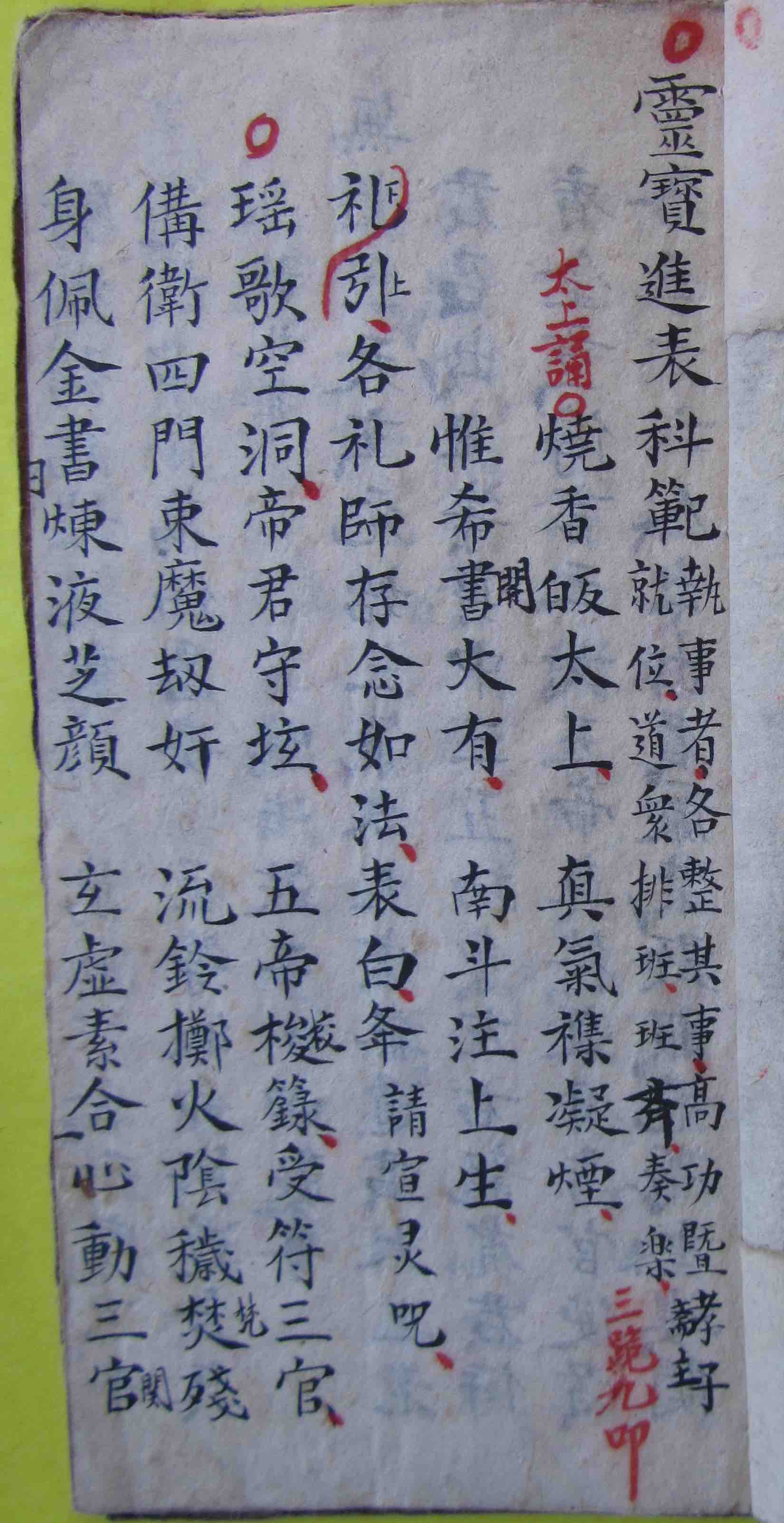
LXR

The earliest surviving manuals are by Li Peisen’s grandfather Li Xianrong (c1851–1920s) (left: his Presenting the Memorial manual). If manuals from the 19th century can survive all the destructions of the 20th century, then Li Xianrong and his colleagues in turn might have had a collection going back right to the lineage’s early acquisition of Daoist skills in the 18th century. And those manuals must in turn have been copied over successive generations of the lineage in Jinjiazhuang from whom Li Fu first learned. And so on.

Throughout the two centuries of the Li family tradition, ritual manuals had occasionally needed recopying. There are at least two reasons for copying a manual: when the old one becomes too decrepit, or if there are several Daoist sons. Daoists needed to recopy individual manuals occasionally as the older ones became dog-eared through use.

In south China scholars have found a few manuals from the 18th century, and even the Ming dynasty, but for the north even 19th-century ones are quite rare. Whether, or how long, Daoists kept the old manuals after copying them must have depended on their condition and on the taste of the custodian. Li Manshan observes that a Daoist may also copy manuals when he has more than one Daoist son. This seems simple, but presumably refers to a situation where the sons are likely to work separately—not necessarily long-term, but when there is simultaneous demand for more than one band.

So we can read the attempt by Li Peisen and Li Qing to recreate the complete textual repertoire in the early 1980s as a unique labour of love after an unprecedented threat of extinction, a reaffirmation of the family’s identity as Daoist masters. For over three decades during the Maoist era no-one had copied any manuals; “No-one was in the mood,” as Li Manshan reflected—another hint at the depression of the times. [3] As ritual practice slowly revived, Li Peisen and Li Qing now decided to do so because they realized the new freedoms brought hope. Their purpose was not to reflect current practice, which was still embryonic; thankfully, they sought to document as much of the heritage as they could, irrespective of which manuals had been used in their lifetimes or might now be needed.

So what was going through Li Qing’s mind as he put brush to paper? One surmises that for him, copying the manuals was partly a kind of atonement for having had to sacrifice so many old scriptures in 1966. But one also feels a great sense of optimism. The manuals he set about copying included many that even he had hardly performed. After all the false starts since 1949, was he so sanguine as to assume all these rituals would now become common again? Or was his instinct as archivist dominant?

Once again I kick myself to think that I could have gone through the manuals with Li Qing himself. When I met him in 1991 and 1992 I had no idea that he had copied so many—anyway I wasn’t yet expecting to study the family tradition in such detail. So now the main interest of going through the manuals with Li Manshan is to assess what has been lost. But that isn’t so simple either: it’s unclear how many of the manuals that Li Qing copied he himself could, or did, perform by the 1980s. I can’t even be sure he could perform all the texts in the lengthy hymn volume. When I casually comment to Li Manshan, “Shame you didn’t sit with Li Qing as he copied the manuals!” he replies, “I’m not a good son.” He is being neither ironic nor maudlin.

Of course, there may yet be some missing manuals that would further augment our picture of their former ritual repertoire. But impressively (given the usual stories of the decimation of ritual artifacts in the Cultural Revolution), Li Manshan now reckons that the surviving titles represent the bulk of those handed down in the family before 1966.

I can glean few clues about how this ritual corpus, and the texts within individual manuals, might have been modified over time. In the exceptional circumstances of the 1980s, Li Qing must have copied some manuals that he had never performed; and even for those rituals that he did perform, the version in the manual may differ substantially. Of course that was a special time, but a ritual manual from a given period doesn’t necessarily prove that the ritual was performed then, or in that form—not that the manuals actually tell us how to perform them anyway!

Moreover, early Daoists must have known a lot of texts from memory, as their descendants do today. Sure, they had a much larger ritual repertoire, and some lengthy texts required them to follow the manual. As it happens, the rituals that have fallen out of use are precisely those for which they needed to consult the manuals.

The process of copying
Li Qing may have inherited even more scriptures than Li Peisen, but he could retrieve only a few of them after the Cultural Revolution. With political conditions in Yang Pagoda more relaxed, Li Peisen had managed to hang on to his scriptures (and indeed his ritual paintings); so after he returned to Upper Liangyuan around 1977 it was these manuals that formed the basis for him and Li Qing to copy.

Li Peisen now lived not in his old home near Li Qing, but in another house just west of the site of the Palace of the Three Pure Ones. Li Peisen would copy a manual first, then lend it to Li Qing for him to copy too. Li Qing wrote alone, without help from anyone; no-one recalls them consulting.

On the covers, after his name Li Qing mostly used the word “recorded” (ji 記); only at the end of a couple of manuals did he write the word “copied” (chao 抄). The choice of term isn’t significant. The only manual in which Li Qing specifically wrote “copied from Li Peisen” is the Qiangao, dated the 21st of the 4th moon in 1982.

gongshe

From collection of ritual documents, copied by Li Qing, early 1980s: template for funeral placard, including “China, Shanxi province, outside the walls of XX county,
X district, XX commune, at the land named XX village”.

When they began putting brush to paper, Li Peisen was 70 sui, Li Qing in his mid-50s. Having been taking part in rituals since the age of 6 or 7 sui, Li Qing would have been even more experienced had it not been for the interruptions since 1954; and by 1980 he had not performed rituals since 1964. Remember he had lost his father in 1947; since then he still had plenty of uncles and other senior Daoists to work with, but through the early years of Maoism he was beginning to rely more on his own knowledge.

Writing was unknown to the great majority of the population, but despite ongoing material shortages there was no problem buying white “hemp paper” (mazhi). One summer day in 1980, with the sun pouring through the latticed windows of his main room, Li Qing took a low wooden table and placed it on the kang brick-bed. Removing his cloth shoes, he climbed onto the kang and sat cross-legged at the table. Putting on his thick black-rimmed glasses, he took out his brushes, inks, and inkstones, with the old manuals to hand, as well as a thermos of hot water. After folding some paper to make guidelines as he wrote the characters, he opened it out again; carefully dipping his brush in the ink he began to write, pausing as he went over the texts in his head, phrase by phrase. First he completed the whole text in black ink, laying each page on the kang to dry. Then, changing his brush and mixing some red ink in a separate receptacle, he drew circles showing the head of each new segment, and added punctuation.

25-lq-zouma

Zouma score, written for me by Li Qing, 1992.

They do the same when writing a score of the gongche instrumental melodies—first writing the solfeggio notes in black, then later adding red dots that show the basic metrical pattern, rather like punctuating a text. I treasure a page of gongche notation of the exquisite shengguan melody Zouma (over opening titles of my film: playlist, #4, discussed here) that he wrote before my eyes in the summer of 1992, inscribing it for me at the end. When Li Qing finished writing a manual, he carefully folded each page in half, and then stitched them all together. Li Manshan tells me that it takes around three days to write a typical manual of around 15 to 20 double pages.

Incidentally, while the shengguan wind ensemble is a vital aspect of ritual performance, it was only later in the 1980s, after he had achieved the main task of salvaging the ritual texts, that Li Qing set to work recopying the gongche scores.

Formats
I don’t know if there was a standard size of paper in the late imperial period, or if folk copyists followed temple practice. The paper that Li Peisen and Li Qing used was mostly around 23 x 12 cm, but varied somewhat in both height and width. For the Communicating the Lanterns (guandeng) manual Li Qing used a larger format (29.5 x 14.5 cm), since this was one manual that they all consulted while reciting it together, so the larger characters would make it more convenient—and for the same reason, multiple copies were written. Other minor differences in size just depended on the availability of paper.

Since they were mostly copying existing old manuals, they followed the layout of text on the page of their models, beginning a new line for each couplet in regular verse and leaving spaces where suitable. Older manuals such as those of Li Xianrong are similar in size, with similar numbers of lines and characters. So old and new manuals alike have 6, 7, or 8 lines per (half) page, each full line allowing for 16 or 17 characters. [4]

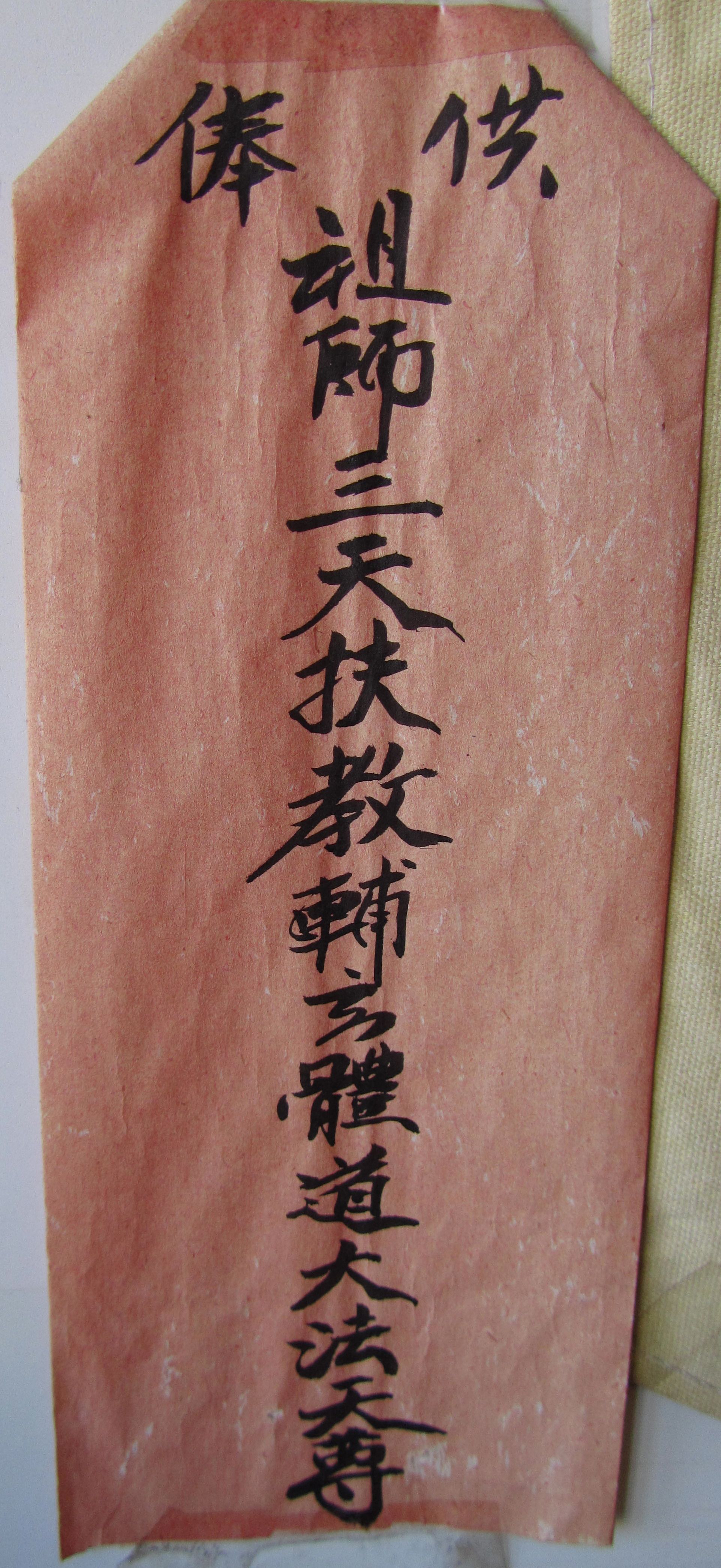
They used the same paper for the cover pages, writing a title on the front cover, generally only an abbreviated one; the full title often appears within the volume, usually at the end. Some volumes contain several scriptures, and the title thus summarizes the contents, like Scriptures for Averting Calamity (Rangzai jing), which contains four scriptures. Li Qing didn’t write a title at all for what they call the hymn volume (zantan ben 讚嘆本)—Li Manshan only wrote the two characters zantan (“hymns of mourning”) on the cover when I wanted to take a photo of the manuals complete in 2011. We may never know its proper title.

The older manuals of Li Xianrong and Li Tang were in this same format, although in a few earlier volumes the title and the name of the copyist are written in two red strips pasted onto the cover page. One Thanking the Earth manual by Li Peisen from before Liberation has slips of red paper for the title and his name, followed by the characters yuxi 玉玺 “by jade seal,” suggesting some rather exalted ancestry.

But even these older manuals had no sturdier protection like wooden or cardboard covers. Nor do they use the concertina form that one sometimes finds on older scriptures elsewhere; this system is used not only in elite temples—I found it in use by amateur folk ritual associations in Hebei. The opening pages of such more elite early manuals also often show a series of drawings of gods. I found a substantial collection of such manuals—printed—in Shuozhou not far south, in the hands of Daoists whose forebears had spent time as temple priests. The concertina format is convenient to use if one is following the text while performing, turning the pages with a slip of bamboo between them. Another advantage of the format is that the pages don’t get so worn—the paper is so flimsy that with constant fingering it can soon get torn. But most of Li Qing’s manuals are in pristine condition, showing that they have hardly been used. Even Li Xianrong’s manuals, dating from around 1900, are remarkably well preserved.

Li Xianrong numbered the pages of his Presenting the Memorial manual, but the only time that Li Qing used pagination was for the melodic score in modern cipher notation that he wrote later. Li Qing wrote the date of completion at the end of a manual more often than Li Peisen. He usually wrote the CE (gongyuan) year, though sometimes he signed off with the two characters of the traditional sexagenary cycle; he always used the lunar calendar for the moon and day, as villagers still do today.

The manuals and ritual practice
The very first manual that Li Qing completed was apparently the hymn volume, whose date in the traditional calendar is equivalent to the 16th day of the 6th moon, 1980. Over the next few years he would sit down and copy a manual whenever he had a couple of free days at home.

That first manual was not for one specific ritual segment, but a general-purpose collection of funerary texts. At 60 double pages, it is the second longest of all the manuals that he was to copy. Though giving a few texts for individual ritual segments, it is mainly a collection of shorter texts whose ritual use is not specified. Later Li Qing copied a similar compendium of texts for Thanking the Earth. These two compendiums suggest the practical basis of what the Daoists do: not long abstract texts, but individual lyrics to be adopted as required.

Similar collections of hymn texts, not specific to particular rituals, are found in early ritual collections within the Daoist Canon, and elsewhere among household groups in north and south China. Such volumes are often the most practical manuals for Daoists today. Li Qing’s hymn volume includes most of the texts that the Daoists need for the rituals they now perform. Many of the hymns, performed for both Delivering the Scriptures and the fashi public rituals, are not in any of the other ritual manuals, only in this separate volume.

However, looking more closely at the hymn volume, it is not merely a succinct practical list of texts for use in rituals, like those in the little notebooks that Daoists carry around with them. While it may be significant that this was the first volume that Li Qing wrote, he was apparently not compiling a new volume consisting of random texts recalled off the cuff, but copying out an existing one.

We need to exercise similar caution in studying the funeral compendium that Li Peisen copied, apparently before 1948. This manual is snappily entitled

Numinous Treasure Manual for Opening the Quarters, Summons, Reporting, Offering Viands, Roaming the Lotuses, Smashing the Hells, Dispatching the Pardon, Crossing the Bridges, Precautions against Hailstones, and Averting Plagues of Locusts
靈寶開方攝召預報獻饌游蓮破獄放赦渡橋祝白玉禳蝗瘟[科].

Here is another salient lesson in the importance of fieldwork and observation of practice. When Li Qing made his own copy in the 1980s, he divided it up into two volumes of 17 and 25 double pages. Perhaps he found the old manual too bulky (even the title is quite a mouthful)—he did copy more lengthy manuals, but this collection of rituals divided conveniently. Now imagine if we only had this manual, preserved in a library somewhere. If we were lucky enough to know that there was a Li family of whose collection it formed a part since the 1980s, we might suppose it was a faithful and rather complete description of the segments in their funeral practice, if not in the 1980s then perhaps in the 1930s. But we can’t use ritual manuals as a guide to performance. Until I began working more closely with Li Manshan, this single manual was almost my only clue to funeral practice as preserved in texts, and I found it bewilderingly irrelevant to their current practice.

Of the ten segments in the manual, only Opening the Quarters, the Pardon, and Crossing the Bridges were very occasionally performed in the 1980s; the others may well have been obsolete by the 1940s. The two rituals at the end (against hailstones and locusts) may have been not for funerals but for temple fairs. Moreover, the volume contains none of the standard segments of a funeral; some of those have their own separate manuals, but most have (and need) no manuals at all. And the texts of the seven visits to Deliver the Scriptures can be found only in the hymn volume—if you know where to look.

So one might suppose, “OK then, so Li Peisen’s manual shows the very different, more rigorous structure of funerals before the impoverishment since the 1950s.” That would be quite wrong! I now deduce that Li Peisen (or his forebears) put those ten rituals in a volume together precisely because they were rarely needed even before Liberation; it reveals not the then norm but the then exception. It doesn’t even quite match the “inner and outer five rituals”. Li Peisen’s generation may have been more able to perform these rarer rituals than either Li Qing or Li Manshan, but we mustn’t assume that the manual represents the standard practice of some ideal earlier age.

Apart from manuals for particular ritual segments (Invitation, Pardon, and so on), around half of the forty or so volumes handed down in the Li family are jing 經 “scriptures” or chan 懺 “litanies”. These have not been performed since the early 1960s, since they are not used for funerals or (at least in the current sequence) temple fairs, and Thanking the Earth is obsolete. They were mostly to be chanted fast rather than sung slowly.

The role of memory
Before we saw Li Peisen’s collection, Li Manshan claimed that Li Qing wrote many of the manuals on the basis of his memory. Blinkered by my background in Western art music, I was sceptical; and now that we have seen Li Peisen’s manuals, it does indeed begin to look as if they were mostly copying, not recalling. But a doubt nags. Li Peisen’s collection did include several old manuals, but I haven’t seen older originals for most of those that he and Li Qing wrote. So is it possible that memory did play a considerable role after all?

We may easily neglect the depth of folk memory—further afield, for instance (Tibet, the Balkans), epic singers might have huge unwritten repertoires. Chinese elites memorized vast passages of classical texts, as did the scions of the Li family both in private school and when learning the ritual manuals at home. Li Manshan, not easily impressed, is amazed to recall the knowledge, energy, and memory of the elders with whom he did rituals until the 1990s.

I can believe that Li Qing could recall the texts of rituals that he hadn’t performed much for a couple of decades; frequent practice since youth would have engraved them indelibly in his heart, and there are innumerable instances of this in China after the end of the Cultural Revolution. Li Qing’s perceptive granddaughter Li Min points out that he loved the scriptures so much, he would always have been reciting them silently in his heart, even in periods of forced silence like his sojourn in the troupe or the Cultural Revolution. He performed them almost daily from 1932 to 1953, less from 1954 to 1957, not from 1958 to 1961, then from 1962 to 1964, but not from 1964 to 1979. Was that enough? In many cases I now tend to think it was, but it would depend on the scripture; some of them he would hardly have performed since 1953. Li Peisen, sixteen years Li Qing’s senior, had even longer experience. Also, the degree of serial repetition in Daoist texts is such that one could recreate a lot just by filling in the titles of a series of gods and offerings, much of the remaining content being identical for whole long series of invocations. Where phrases are of regular length, that would give further clues.

I supposed that the lengthy scriptures chanted fast to the regular beat of the muyu woodblock might be hardest to recall, especially since these were the only ones that they recited with the manuals on the table in front of them. But even these, Li Manshan observes, they largely knew by heart—Kang Ren whipped through them so fast that he couldn’t keep up; he hardly referred to the manual at all, just turning the pages as a backup.

And how about a lengthy and complex manual like the Lingbao hongyi shishi quanbu? I would be amazed if Li Qing could have rewritten it from memory having hardly performed it since at least 1957, but Li Manshan points out that by then his father would have taken part in the ritual often enough for over twenty years. I still demur: how often would that have been, actually? It was only performed for three-day funerals, and even there it was an alternative to Hoisting the Pennant and Judgment and Alms.

And surely it is one thing to recite such scriptures from memory, another to commit them to paper without frequent miswritings. Li Qing’s manuals contain few corrections—only occasionally do we find an extra character or line in black or red added between the columns where he had accidentally omitted it, or slips of paper pasted over a short passage that he later realized was inaccurate. And characters are rarely miswritten. Folk transmission over a long period often produced minor variants, but in general the texts are written meticulously, and where we can collate them with the manuals of the great temples they are basically identical.

Sharing manuals
One sweet vignette offers a glimpse of the energy for copying scriptures in the 1980s. Li Peisen’s disciple Kang Ren evidently copied many of his manuals too, perhaps after Li Peisen’s death in 1985. He borrowed the Lingbao hongyi shishi quanbu manual from Li Peisen’s son Li Hua, but when he took it back Li Hua was out, so on its back cover he wrote him a message to ask for four more manuals:

Younger brother Li Hua, can you bring me the Xianwu ke, the Shenwen ke, the Dongxuan jing, and the Shiyi yao? Please please!

As it turned out, none of those scriptures would be performed again; like Li Peisen and Li Qing, Kang Ren was just being enthusiastic, excited at the potential for restoring the scriptures that they had all recited constantly throughout his youth, after a long silence.

Kang Ren’s access to the manuals was exceptional. They were generally transmitted only within the family, not widely shared among disciples, even within Li Qing’s group. Daoist families are always in competition, and while they may often collaborate for rituals, there is an innate conservatism about revealing the core of a family heritage. Apart from the few manuals that they needed to consult while performing rituals, some of Li Qing’s senior colleagues from other lineages might never see them. When Golden Noble and Wu Mei were learning in the 1990s they hardly got to see the manuals; Li Qing wrote them individual hymns on slips of paper one at a time, just as Li Manshan did more recently for his pupil Wang Ding. Li Qing lent his manuals to the Daoists of West Shuangzhai in the 1980s so they could copy them, but in general there was little borrowing between rival Daoist families, even those on good terms. But the ritual tradition is remarkably oral.

However, Kang Ren, as well as Li Yuanmao (whose father was a Daoist anyway), copied manuals too. If any of their scriptures survive, they would be copied from Li Peisen. But since Kang Ren’s death in 2010 his son has sold them, and Li Yuanmao’s son is cagey.

The identity of the copyists
As we saw, the bulk of the two surviving collections was copied in the early 1980s by Li Peisen and Li Qing, as well as some earlier manuals written by their forebears. Manuals are almost always signed, usually on the cover, sometimes also at the end.

The earliest manuals we have now were written by Li Xianrong around 1900. We have clues to manuals by his younger brother Li Zengrong. And we have one manual said to be in the hand of their cousin Li Derong, as well as his precious early score of the “holy pieces” of the shengguan music. For a genealogy, see Daoist priests of the Li family, p.5; for the family’s own genalogies, see photos here; note the alternation by generation of single- and double-character given names.

Li Xianrong’s second and third sons Li Shi and Li Tang both copied manuals. Li Shi’s manuals were among those that his grandson Li Qing sacrificed in 1966, but Li Peisen preserved those of his father Li Tang, two of which are still in Li Hua’s collection. Li Peisen himself wrote many manuals. So did his cousin Li Peiye (1891–1980)—but his son Li Xiang took them off when he migrated to Inner Mongolia in 1959.

Authorship may not be quite so simple. Li Qing wrote his own name on the cover page, almost always adding the character ji 記, “recorded by.” But in some cases a father would write a manual for his son, writing the son’s name on the cover—again, almost always with the character ji, in this case meaning “recorded for.” For instance, most of Li Peisen’s manuals from the early 1980s bear the name of his son Li Hua; Li Qing only wrote Li Manshan’s name on one manual, the Treasury Document and Diverse Texts for Rituals, written in 1983 or soon after; and on the cover of Li Manshan’s only manual he wrote the name of his son Li Bin. When there is a name at the end of the manual, it is that of the copyist himself. Most earlier manuals (Li Xianrong, Li Tang, and so on) were signed by the copyists themselves.

Why did Li Peisen often write his son’s name, whereas Li Qing almost always wrote his own name? It wasn’t so much that Li Qing still saw Li Manshan’s future mainly in determining the date, but that he had two other sons who were potential Daoists, so perhaps he was avoiding favoritism. Of Li Peisen’s two sons, the older, Li Huan, was only going to specialize in determining the date; but Li Peisen must by now have earmarked his second son Li Hua (30 sui in 1980) as a Daoist. Perhaps a more pressing reason was that Li Peisen was getting on in years, and wanted to feel he was leaving his manuals for posterity, whereas Li Qing was still only in his mid-50s.

Anyway, it’s worth bearing in mind that a manual bearing someone’s name may have been copied by his father. Expertise in calligraphy may help, but it takes me time even to distinguish the calligraphy of Li Peisen and Li Qing—Li Peisen’s brush ever so slightly more cursive, Li Qing’s more bold. The styles of Li Qing and Kang Ren were virtually identical.

The manuals of Li Xianrong
I have only seen four manuals by Li Xianrong, most written in the early 20th century, when he was around 50: in Li Hua’s collection, Lingbao shiwang guandeng ke (1901), Lingbao shanggong ke, and probably Lingbao hongyi shishi quanbu (1912); and in Li Manshan’s collection, the Lingbao jinbiao kefan (see above). Li Hua claims to recall two whole trunks of scriptures by Li Xianrong, but says that only a quarter now survive. If so, then he hasn’t shown us all of them—and if Li Peisen didn’t have to sacrifice them, then why have so many been lost since?

Li Xianrong’s “style” (zi) or literary name was Shengchun, only used in one manual that I have seen, the Lingbao shiwang guandeng ke. The very fact that he had a literary name suggests his superior social status. He wrote in a more elegant hand than either Li Peisen or Li Qing; Kang Ren liked to consult his scriptures.

Li Peisen’s own manuals
The manuals that Li Peisen inscribed for his son Li Hua (b.1951) are evidently the new copies he made from around 1980 after returning to Upper Liangyuan. He wrote some manuals earlier, but it is hard to guess when; even if Yang Pagoda was quite undisturbed under Maoism, it seems unlikely that he wrote any over that period. He was only 39 sui in 1948, perhaps a bit young to write manuals before then, but he evidently did so. He was also known as Li Peisheng, the name he wrote at the end of the Yushu chan.

The Lingbao shiwang bawang dengke is one of the earlier manuals bearing Li Peisen’s name on the cover. It is dated on the last page with the inscription

23rd year of the Republic [1944], 6th moon, 3rd and 4th days,
Bingshan picked up the pen to finish copying.

Indeed, this page doesn’t look like Li Peisen’s hand. No-one can be sure who Bingshan was—there was one in Xingyuan village, but he was only born in the 1920s; was there another one? And why did Li Peisen hand it over to Bingshan to complete? Perhaps he got busy with his work as village chief—but why ask someone from another family (presumably a disciple) to complete it, rather than shelve it until he had time? Did they need it in a hurry for a funeral? This was one manual that they did need to follow from at least two copies while performing it.

The couplet volume
Among the volumes that Li Qing copied in the early 1980s is a collection of 21 double pages listing around 300 matching couplets (duilian, see Daoist priests of the Li family, Ritual 7) to be pasted at either side of a doorway or god image. Such volumes are often part of both temple and household collections. Again, this one is evidently copied (or edited) from an earlier volume. Perhaps it originates from a temple, since many of the contexts listed seem unlikely to have been part of the Li family tradition even before the 1950s.

Temple collections often list couplets for particular types of temples, and Li Qing’s volume has some for particular deities—though not for those of the Upper Liangyuan temples, nor for any local gods like Elder Hu. Most are single couplets, but there are over thirty for the Dragon Kings (Longwang). There are eight for the God Palace (Fodian)—not necessarily for the village’s own Temple of the God Palace.

A couplet for the “meditation hall” (chantang) further suggests the temple connection, as do couplets for bell tower (zhonglou) and several for the opera stage (xitai). But I can’t be sure if this implies an earlier derivation from temple priests, or simply that couplets were required for the unstaffed temples of the area when they held temple fairs. There are twenty-two couplets for the scripture hall, and fourteen for the kitchen. There are couplets for each of the Palaces of the Ten Kings, perhaps to adorn existing paintings or murals, and fifty couplets for Thanking the Earth. There are verses for each of the “seven sevens” after a death, the hundredth day, and for all three anniversaries, and over fifty couplets for the burial itself.
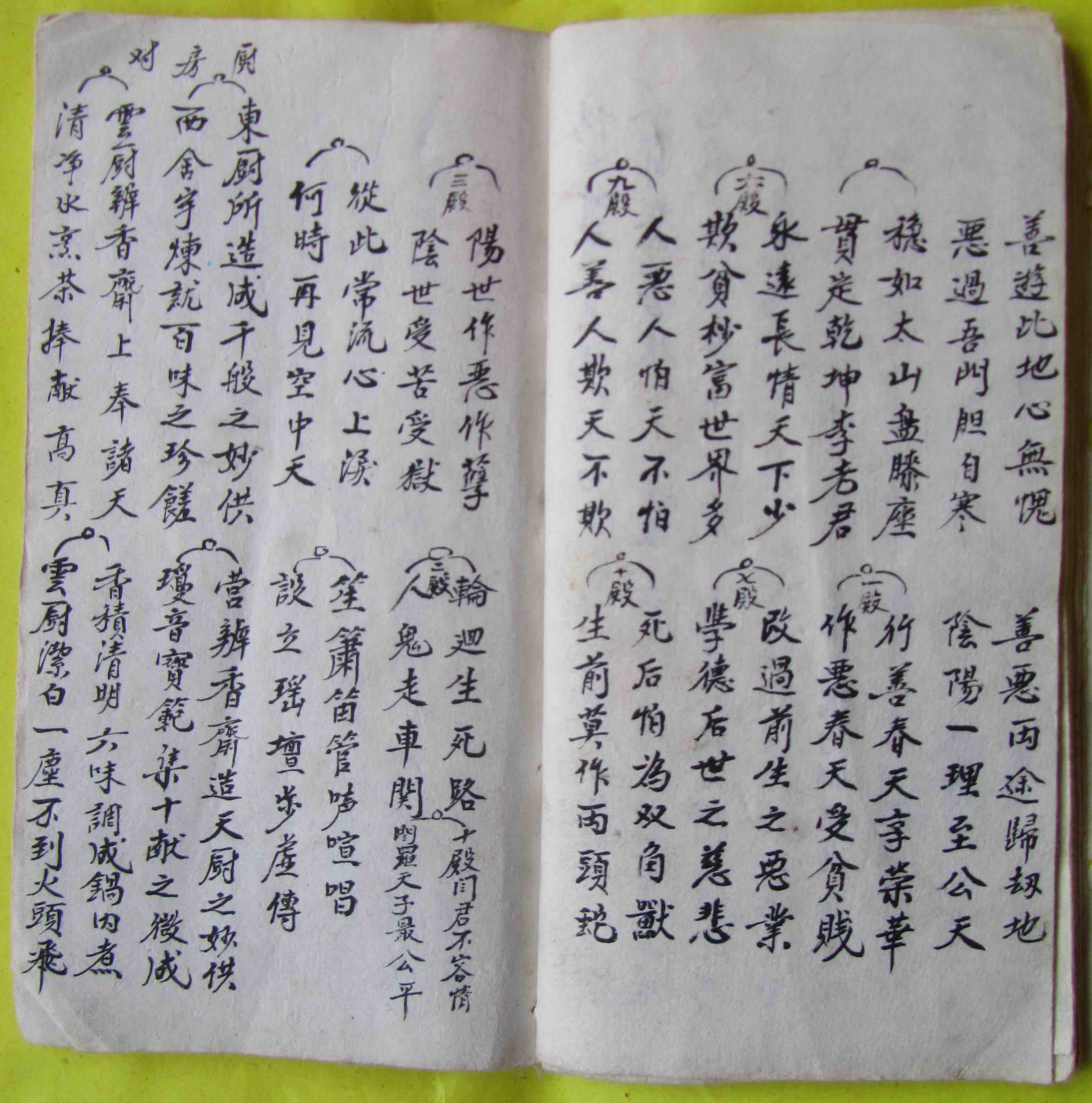
duiben

Couplets for the scripture hall, including series for the Ten Kings.

There is a couplet for seeking rain, and fourteen for raising the roofbeam. There are many for more general social life, such as those for archways, cattle sheds, and carts; for carpenters and metal workers, and for the “wine bureau” and pharmacy. Six further verses marked “treasury couplets” are for the funerary treasuries. The volume opens with a series of over twenty couplets for weddings, the only instance of any Daoist component for this context.

Near the end of the volume there is a series of four-character mottos—the diaolian large paper squares to be hung on the lintel where the coffin is lodged. Li Manshan has to write these regularly for funerals, but again he never needs to consult the volume: he’s been writing them from memory for over thirty years.

In all, the couplet volume suggests how pervasive Daoism was in the daily life of a previous era, but we can’t deduce how many of these couplets Li Qing or even Li Xianrong commonly used.

The fate of the new manuals
Despite all this energy in recopying, once Li Qing and his colleagues began performing ritual again, few of the segments that require the use of the manuals were to be restored in practice.

Most rituals in common use for funerals consisted of relatively short texts that could be memorized. When the manuals are needed, it is mainly for rituals that are rarely performed; and until the early 1960s, they would also have been used for the lengthy fast recited chanted scriptures that were part of temple and earth rituals, like Bafang zhou and Laojun jing. Li Peisen and Li Qing devoted considerable energy to recopying these chanted scriptures, but their optimism that they would be restored in performance under the new more liberal conditions turned out to be misplaced. So while we may treasure the manuals that they copied in the early 1980s (not least since they provide clues to former practice), we must observe that after they had been copied they were hardly consulted.

Notebooks
More prosaically, Daoists now often transcribe the texts they need into little exercise books, copying them horizontally in biro. For the sinologist they may seem unpromising: small, with plastic covers (a welcome innovation with regard to preservation), sometimes bearing cheesy pinup-type photos. Through the 1990s I myself had something of a fetish for using such kitsch notebooks for my fieldnotes, but eventually I resigned myself to the posher ones that had replaced them in the shops. But such notebooks copied since the 1980s are an important resource. They are probably the most useful guide to their current practice, even if their older manuals, elegantly copied with brush and ink, look more elegant and archaic. Household Daoists in Shuozhou county nearby have copied some long complete ritual manuals into such notebooks. Apart from convenience, after the traumas of recent times, perhaps Daoists also took instinctively to small easily-stashed notebooks, rather than more bulky old tomes.

Like all men who determine the date, Li Manshan has several small notebooks that serve as almanacs for all his complex calendrical calculations. But sometime in the 1990s he copied a little blue notebook in the traditional vertical style, with a set of ritual texts densely written over twenty-five pages. Later he wrote a black notebook with a mere fifteen texts in 21 pages, this time copied horizontally. This briefer volume may now meet most of his needs for funerals, such as Delivering the Scriptures and Transferring Offerings, but it by no means shows the full extent of his recent practice; he still performs many texts not copied there. And some of them don’t even appear in Li Qing’s lengthy hymn volume. Li Manshan may have written his blue notebook to remind him of the texts, but the black one served a different purpose (as he says, “I don’t need them, they’re in my belly”)—“Because if someone tells me I’m making it up as I go along, I can take it out and show him it’s the real deal!” So it wasn’t an aid to memory so much as a kind of certificate, almost like a license.

Li Manshan recalls that Li Qing had a similar notebook for various such texts, which we haven’t found. Did Daoists always use something similar? Of course, the beauty of the Mao jacket is that it can store such a notebook. When did notebooks become available in Yanggao? Going back through imperial history, what kind of equivalents might Daoists have used? And, if you’ll allow me a further sartorial query, what kind of pockets would they have put them in?

Perhaps the Dunhuang religious manuscripts from around the 10th century offer a clue. They include some small booklets, “the size of a pack of Lucky Strikes”, as Teiser describes them, going on to speculate nicely: “Easily transported? Hidden in a sleeve? Used surreptitiously? Studied in private?” As he remarks, “a booklet this size would serve as a perfect study guide for an officiating priest.” But with our experience now, we would wish to unpack a term like “study guide”.

* * *

In my book I go on to explore the ancestry of the texts contained in the ritual manuals. This bears on the complex issue of the relation between Orthodox Unity and Complete Perfection (for an outline, see here).

Some scholars have traced rituals still practiced in Jiangnan or south China to early, whole, ritual manuals in the Daoist Canon. At least in north China, this is unlikely to be at all common. Few of the texts sung there by modern household and temple Daoists appear in such early sources; many can only be documented since the late imperial period. Such a conclusion may help us modify an antiquarian tendency in Daoist studies.

All this suggests merely that these texts are part of a broad tradition related to modern temple practice. And since many of them are common to household groups over a wide area of north China, we have to take the temple link seriously. Even poor household Daoists, quite remote from urban elite traditions, with no clues in their oral history to any temple connection, turn out to have a substantial link to the nationally promulgated texts of the major temples. We can only guess at the ritual repertoires of smaller regional temples that were the links between the major temples and rural household groups.

Still, having traced a few isolated texts, it is frustrating that parallels with most of the ritual manuals remain elusive, like Communicating the Lanterns or Dispatching the Pardon (see my book, ch.13). Such repertoires look like a patchwork assembled from various sources, few of which may ever emerge. We have a few pieces of a few jigsaws, and none at all for others.

So in a ritual corpus like this we have three types of text, some highly standard and national, others apparently distinctive and regional, even local:

  • Ritual manuals: now hardly performed; few sources in the Daoist Canon or elsewhere, either whole or in part.
  • Individual hymns still in use today: few appear in the Canon, but many are found in modern temple sources like the daily services and yankou—which are now known mainly in Complete Perfection versions.
  • Scriptures: no longer performed; nationally standard, ancient, and found in both the Daoist Canon and modern temple sources.

The contrast between ritual manuals and scriptures is absolute. The scriptures, “in general circulation,” can easily be found in the Daoist Canon, their titles and contents identical. But the ritual manuals can’t be found—neither their titles nor the great bulk of individual texts within them. However, many of the individual hymns, as well as scriptures, are common with the current practice of temple priests, who happen to be Complete Perfection—notably those found in the Xuanmen risong and yankou. This doesn’t mean that the Li family tradition is or was mainly based on them, since the great bulk of the other texts in the ritual manuals cannot be traced; but the fact that “standard” temple Complete Perfection texts are the single most fruitful match with the Li family’s current repertoire should remind us that the superficial dichotomy of “folk Orthodox Unity versus temple Complete Perfection” is a mere academic fantasy.

* * *

So we do indeed need to document ritual manuals, but it is performance that is primary. Daoists aren’t dependent on the manuals, relying on much knowledge that can’t be reflected in them; so rather than being the main object of study, they should be an adjunct to our study of changing performance practice.

While it is with the Li family that I collected most ritual manuals, for other such texts see the many pages under Shanxi and Hebei in the Menu.


[1] For fine accounts of the whole process in south Fujian, see Kenneth Dean, “Funerals in Fujian” Cahiers d’Extrême-Asie 4 (1988) and his Taoist ritual and popular cults of southeast China (1993).

[2] With the study of ritual manuals dominated by south China, the general term keyiben 科儀本 has become standard in scholarship. I don’t know if this term is commonly used by southern Daoists, but it isn’t heard in the north. In Hebei they often refer to ritual manuals as jingjuan, but in north Shanxi the more prosaic term is jingshu or jingben, or even the innocent-sounding shu “books.” Since manual titles often end with the term keyi, they could notionally call those manuals “keyiben”—but they don’t. For such vocabulary, see here.

[3] Cf. amateur ritual associations in Hebei, where many manuals were copied in the short-lived restoration of the early 1960s: see Zhang Zhentao, Yinyuehui, pp.67–396, and many posts under Hebei in the main Menu.

[4] For the production of early Ten Kings scrolls from Dunhuang, see Stephen Teiser, The Scripture of the Ten Kings and the making of purgatory in medieval Buddhism (1994), pp.88–90, 94–101. 16 or 17 characters per line seems common down the ages, but the number of lines per page is variable—some modern printed scriptures produced by the Baiyunguan in Beijing have only 5 lines per page (half of a folded page of 10 lines).

Another everyday story of country folk

Archers

We’ve discussed the rural society of Gaoluo village, and Yanggao county; and to follow Cheremis, Chuvash, and Tibetans, now for Ambridge.

Despite my tireless ethnographic devotion to Everyday Stories of Country Folk and, um, popular culture in all its forms, I can’t stand The Archers!!! There, I’ve said it.

Still, like the Hoffnung speeches, I recommend it highly to foreigners. The world’s longest-running radio serial [zzzzz], it makes a perfect portrait of daily life in Middle England, showing what we’re up against—a complement to Watching the English. For Stewart Lee’s somewhat different take on being English, see here.

I do realize that social change has come to Ambridge—indeed, Peter Hitchens moans that the series has become a vehicle for liberal and left-wing values and agendas (“all kinds of sexual revolution stuff and ultra-feminist propaganda”) (PAH! Nay, YAY!). But its core plots still revolve around riveting issues like the loss and rediscovery of a pair of spectacles, and competitive marmalade-making, The scripts are an inexhaustible catechism of cliché that I believed to have expired along with my great-aunts (“Ooh I shouldn’t really…” “And more power to her elbow, that’s what I say!”—the latter perhaps constituting evidence of Hitchens’s “ultra-feminist propaganda”?)

So despite occasional daring updates to the world-views and vocabulary of the “characters” (sic: see below) since 1950, it’s always going to be trapped in a time-warp: the visual image that the series still conjures up today is surely the photo above (note for any Chinese, Chuvash, or Bulgarian readers: YES, this is how we all dress).

As a Chinese immigrant struggling to perceive the underlying ideology of being English, Xiaolu Guo realised that

the drama, with its apparently apolitical presentation of “an oasis of rural England outside the currents of history” is really offering a supremely political position, a peculiarly British ideology: one that privileges endless indirectness and lethargy, endless deflection of real anger and debate, and endless acceptance of the status quo.

The wiki article on The Archers makes fascinating reading, with some drôle diachronic byways, not least on the irritating and inescapable theme-tune Barwick Green—a maypole dance, FFS [Can it be that you have suddenly abandoned your mission to document rural culture? Not Exotic enough for you?—Ed.] (cf. Morris dancing as a suitable riposte to the haka), endowed with “the genteel abandon of a lifelong teetotaller who has suddenly taken to drink”, as Robert Robinson observed.

The 1954 recordings were never made available to the public and their use was restricted even inside the BBC, partly because of an agreement with the Musicians’ Union.

Oh well, that’s one good cause to which the MU has been putting my subscription. But when a new stereo version was recorded in 1992 (quelle horreur!),

the slightly different sound mixing and more leisurely tempo reportedly led some listeners to consider the new version inferior, specifically that it lacked “brio”.

“Brio” is indeed the mot juste. Bless.

A 2011 folk-rock version by Bellowhead was well received, however:

For further windows on changing performance practice, see e.g. Mahler, vibrato, jazz, DaoismTaruskin; the Wimbledon and Pearl and Dean themes. Not forgetting Pique Nique by Ibert’s brother Edouard—an oeuvre that has everything that Barwick Green lacks, despite their shared 6/8 metre (can we have a Bulgarian version, please?). See also By the sleepy lagoon.

Anyway, my main reason for this unseemly rant is to alert you to a brilliant parody that John Finnemore did in 2014, for which I am precisely the target audience:

How The Archers sounds to people who do not listen to The Archers:

[Announcer:] And now on Radio 4—unbelievably—it’s time to accidentally hear a bit of The Archers again.

with all the stereotypes lovingly exposed—

“Hello, one of the men who always sounds tired!”
“Hello, one of the unsufferably wry women…”

“Hello, one of the women with an accent! You’d think that would make it easier to tell you apart from the others, but… no.”

He continues the theme here:

… doomed endlessly to repeat the same morality tale of how all men are feckless idiots with terrible ideas, all women are joyless wet blankets who are nonetheless powerless to stop them.

Indeed, the great Tony Hancock did a spoof as early as 1961:

For denizens of Twitter, the fantasy scripts of @jonreed are recommended. See also Charlotte HIggins’ recent fantasy on an Ambridge Don Giovanni. And inevitably, The Archers is an academic research topic

For a roundup of posts on How to be English, see here—including The mantric Shipping forecast.

Cheremis, Chuvash—and Tibetans

Photo: Cheremis “pagan” ritual singer H.H. Musztafa (then 69), June 1975.

Along with from the many Hungaroton LP box-sets of the musics of east Europe, another impressive 3-disc set that I brought back from Budapest is

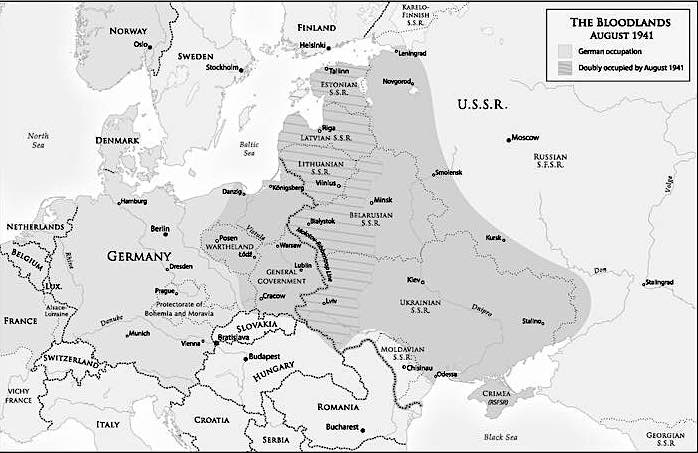
collected and published by László Vikár (1929–2017) and linguist Gábor Bereczki. The set documents musical traditions of peoples in the “autonomous” republics around the eastern perimeter of the European part of the USSR, the central Volga and Urals—peoples about whom I know nothing, but feel we should know:

Mordvinians, Votyaks (Udmurt), Cheremis (Mari), and the Turkic-speaking Chuvash, Tatars, and Bashkirs.

USSR

Source: reddit.com.

Between 1958 and 1979 Vikár and Bereczki made four long summer fieldtrips to some 286 villages, accompanied by local scholars. With sound engineer Pál Sztanó they recorded life-cycle and calendrical items, both vocal and instrumental, including bridal dirges, funeral laments, dance tunes, and historical epics.

The recordings on this box set are part of a much larger archive. Some tracks appear on YouTube, such as

Note also this channel.

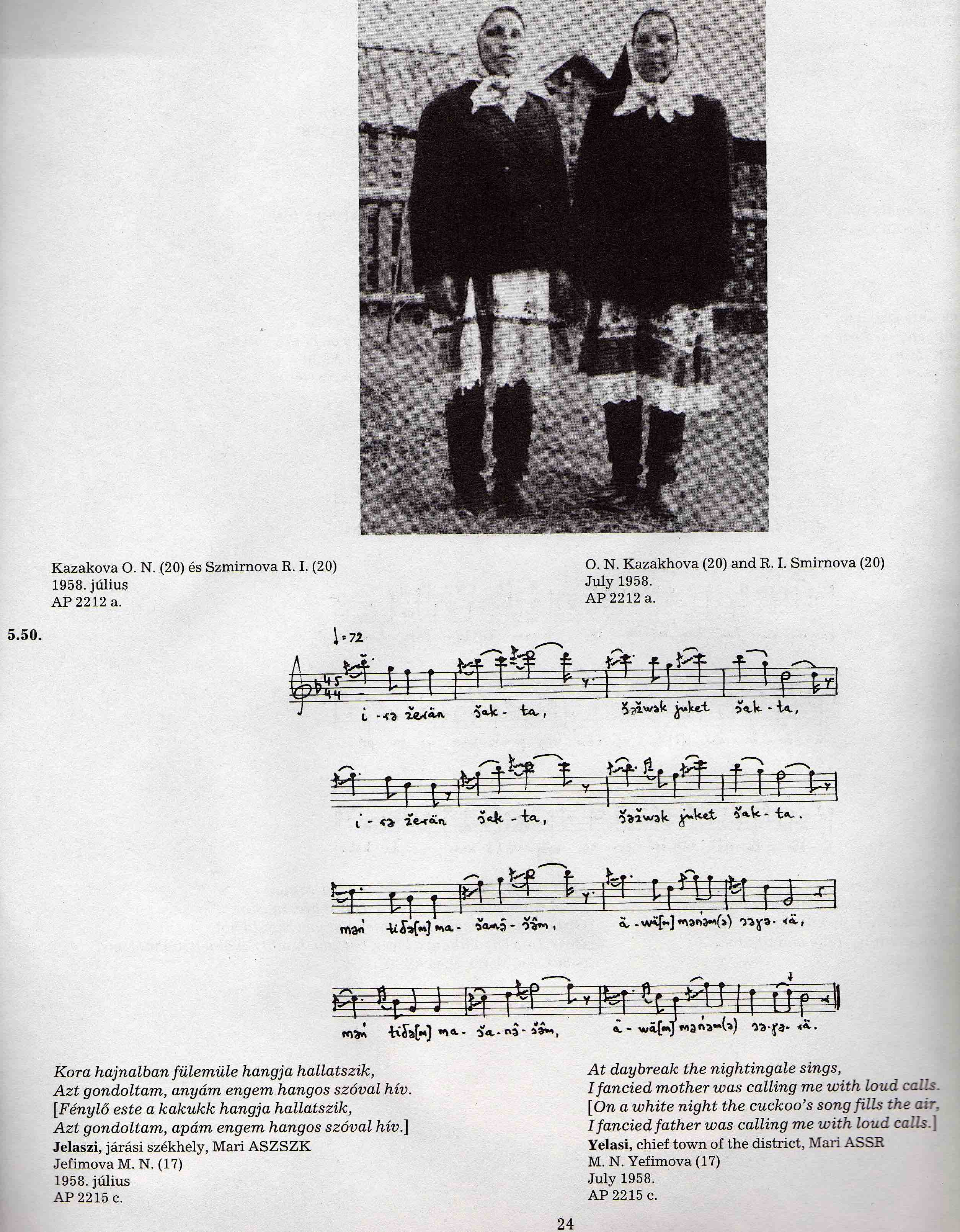
The 43-page booklet contains detailed notes, as well as maps, translations, photos, and some transcriptions.

notes 2

A page from the booklet, on Mari singing.

Bartók, Kodály, and Bence Szabolcsi had already shown an interest in these groups, mainly as part of their comparative musical paleography, classifying melodic types; Vikár was building on this tradition. [2]

Such early recordings were made on request, not—as ethnographers later also sought—while documenting the social events of which they are the core. So we meet the typical issue that often crops up in Chinese collections: were they performing items then still in use, or recalling them from an earlier social practice?

And of course these projects could barely hint at the painful recent histories of such peoples (cf. The whisperers). Music is never autonomous, but gives us a window into the study of changing local societies.

Indeed, it’s worth recalling what else was happening in those years. Notwithstanding the interest of early east European music scholars in “archaic layers”, these are not timeless idyllic communities; though by the 1970s they had weathered the worst of the years of repression under Stalin, they had been constantly starved, deported, subject to political whims, suffering under collectivization and the Great Purge (cf. Blind minstrels of Ukraine, under “Other minorities”). This too is a rich field of research—see e.g.

See also The Kazakh famine, and (still earlier) Hašek’s adventures in Soviet Tatarstan.

The task of modern ethnographers—just as for China—is to integrate socio-political histories with expressive cultures. In 1975 the moment had still not come to record the memoirs of “pagan” Mr Musztafa—and now it’s too late.

In addition to the Garland encyclopedia of world music, for more on early collecting, see under

  • Margarita Mazo, “Russia, the USSR and the Baltic states”, in Ethnomusicology: historical and regional studies (The New Grove handbooks in music, 1993), pp.197–211,

and in the same volume,

  • Theodore Levin, “Western central Asia and the Caucasus”, pp.300–305.

In the early years after the crushing of the 1956 Budapest uprising, one might wonder how smooth was the collaboration between Hungarian and Soviet scholars—only of course both would have suffered under the policies of their regimes.

* * *

1955

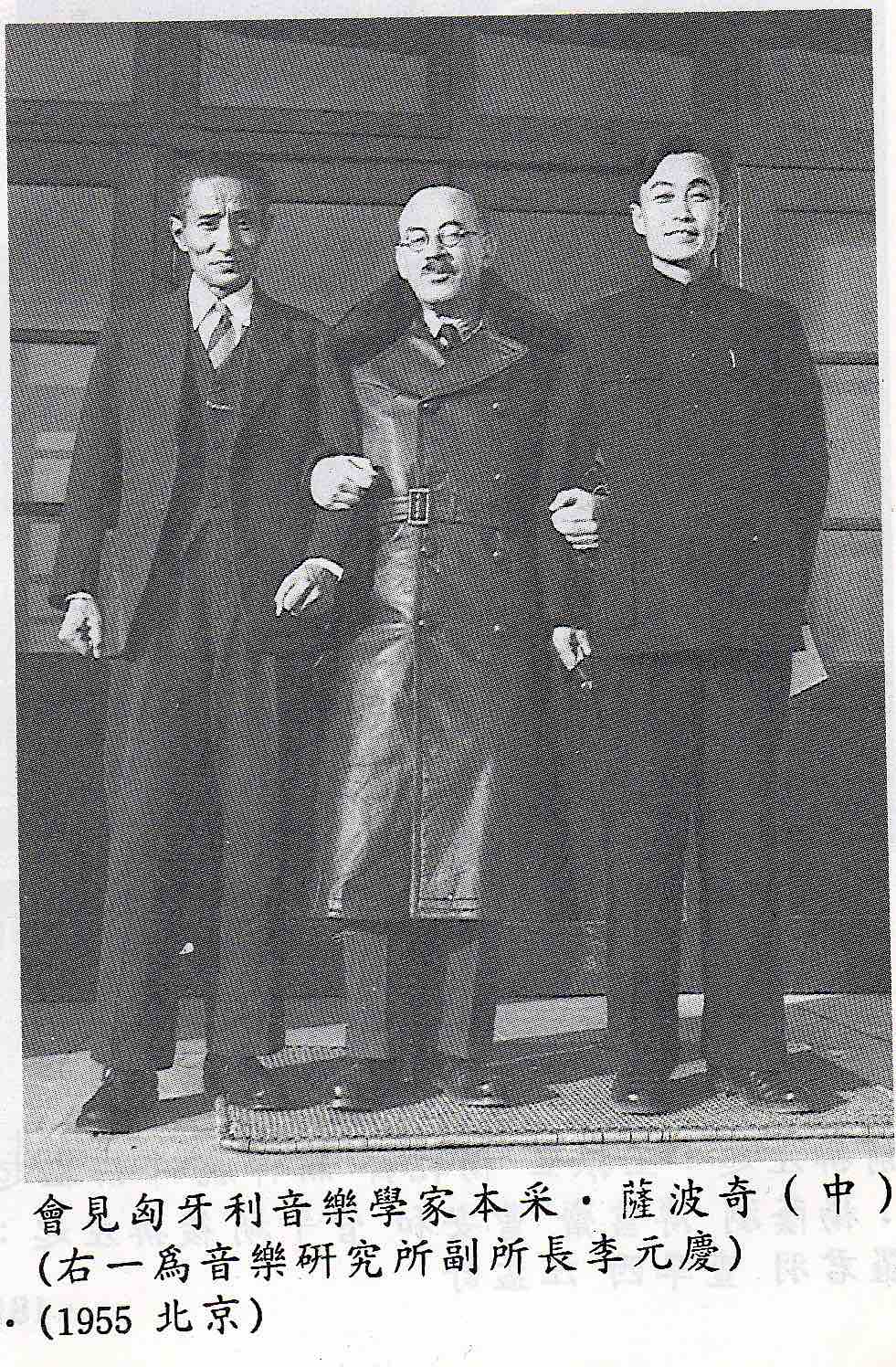
Left to right: Yang Yinliu, Bence Szabolcsi, Li Yuanqing, Beijing 1955.

Meanwhile in China, scholars were also documenting local traditions, for both the Han majority and the many ethnic groups—under testing conditions, and with a similar caution in broaching socio-political issues. By the 1950s, with a growing interest in early connections between Hungarian and Chinese musics, China was open to Hungarian musicology; Bence Szabolcsi visited the great Yang Yinliu in Beijing in 1955, on the eve of the Budapest uprising. And Yang Yinliu visited the USSR in 1957, just after his remarkable fieldtrip to Hunan—just before the Anti-Rightist campaign and Great Leap Backward led to untold suffering.

1957

Yang Yinliu (seated, right) on a visit to the USSR, 1957.

For Czech–Chinese exchanges over the period, see here.

Kodály’s Folk music of Hungary, dating from 1935, was published in 1964 in a Chinese translation from the 1956 German edition—just as a brief lull after the Leap was destroyed by the Four Cleanups and Cultural Revolution.

Kodaly

In east Europe, the USSR, and Maoist China, the enthusiasm of ethnographic collectors of the day is admirable—even as their leaders were imprisoning them and manipulating the peoples they were studying. As William Noll observes, such studies need both to be interpreted in their historical framework and updated constantly, both by augmenting the earlier material and by documenting more recent change. Also in that post, note Noll’s comment that ethnographers of one cultural heritage commonly conduct fieldwork among peoples of a different cultural heritage—even if both groups live within the political boundaries of one state.

Left: Tibetan monks lay down their arms, 1959 (AFP/Getty.).
Right: Norbulingka, Lhasa 1966 (from Forbidden memoryessential reading).

A flagrant instance of circumspection is fieldwork by Chinese musicologists in Tibet in the 1950s, rosily portraying the region (like Xinjiang) as a happy land of singing and dancing—even in 1956 Lhasa, just as mass rebellions were breaking out all over Tibet against Chinese occupation. Two of the most distinguished, and well-meaning, Chinese scholars resumed their fieldwork upon the 1980s’ reforms, encouraging their Tibetan pupils; but the whole social-political backdrop remained taboo (see Labrang 1). See also Recent posts on Tibet.

Expressive culture is an illuminating window on society. How little we know about the world…


[1] The term Finno-Ugric seems somewhat dated, but see here for a more extensive list of peoples.

[2] An early curiosity among the ouevre of the great Bruno Nettl is his slim tome Cheremis musical styles (1960), part of a Cheremis project at Indiana. The Preface by Thomas Sebeok has a useful summary of interest among Hungarian and other scholars. But written from a distance, the monograph could still only be narrowly musical—free of ethnomusicology’s later concern for society and culture, in which Nettl has played such a major role; and the material that he assembles consists largely of transcriptions rather than recordings.

For Chuvash and Mordvins, note also the 1996 Auvidis CD Chants de la Volga: musique traditionnelle de Tchouvachie et Mordovie.

Auvidis

Bach as bandleader and arranger

As I observed in a post on Bach and the oboe,

Going to hear Bach every Sunday in church must have been like the Duke Ellington band having a 27-year residency at Ronnie Scott’s. And the congregation rarely heard the same piece twice—kind of “one-off performance”, as the Chinese might say.

All four orchestral suites are wonderful. In the 3rd suite—like Mahler’s Adagietto in the context of his 5th symphony—Bach’s Air deserves to be heard in context, after the exhilarating overture. For a change, here’s Ton Koopman with the Amsterdam Baroque Orchestra (including some stars of the London scene) in 1989:

The 4th suite is astounding too:

Bill Evans would have loved those harmonies over a pedal (from 1.48/3.20, and again from 8.12):

Bach 4th suite

And everyone gets in on the act—brass, woodwinds, strings, even the bassoon with its funky break (from 9.45). It beats me how anyone can possibly be expected to sit still through pieces like these.

* * *

I only noticed recently that the overture of the 4th suite is a version of the opening chorus of Cantata BWV 110, Unser Mund sei voll Lachens, which Bach unleashed on his Leipzig congregation on Christmas Day 1725, in both the Nikolaikirche and the Thomaskirche (cf. the Christmas Oratorio).

For musicians today, as John Eliot Gardiner comments (Music in the castle of heaven, p.445),

the piece emerges new-minted, alive with unexpected sonorities and a marvellous rendition of laughter-in-music, so different from the stiff, earnest way it is often played as orchestral music. When they are suddenly doubled, as here, by voices singing of laughter, instrumentalists have to re-think  familiar lines and phrasing. Reciprocally, the singers need to adjust to the instrumental conventions of a French overture.

Unser Mund sei voll Lachens                          May our mouths be full of laughter
und unsre Zunge voll Rühmens.                     and our tongues full of praise.
Denn der Herr hat Großes an uns getan.     For the Lord has done great things for us.

And there’s another amazing solo for oboe d’amore (from 10.41).

The cantatas are an inexhaustible treasury.

* * *

I don’t think the Leipzig congregation would have heard the orchestral suite—it’s not even clear if Bach had written it by then. Nor did they have the luxury of hearing it on CD or online: they were lucky to hear any of his works more than once.

Still, they were blessed beyond measure. And just imagine being in Bach’s Big Band, playing dazzling new music every week…

Sure—their ears, teeth, bodies, sanitary arrangements, and whole life experiences were entirely different to ours when we perform or listen to Bach’s music (see here, under “Ears, eyes, minds, bodies”). They hadn’t heard Duke Ellington or the Rite of Spring; and rather than having to take taxis to Heathrow for an early start or hurriedly checking into a hotel before trying to find a quick pre-rehearsal snack—they were there all the time, in a provincial town still recovering from traumatic warfare. All of which makes the constant aural bombardment from their kappellmeister–bandleader even more remarkable.

Cf. Charles Mingus, and Miles!

Breakfast at Tiffany’s

Moon river

This is just an alert to a substantial update on my post Moon river, featuring—in addition to Audrey Hepburn, Amy Winehouse, and Stacey Dooley, the gorgeous major-7th leap, as well as the dodgy language of “femme fatale” and “elfin waif”—thoughts on Truman Capote’s novella, stammering, and fado…

Capote


Trumpets, wind and brass bands

Trumpet chart

As this blog features a growing number of posts on trumpeters (both jazz and WAM), wind bands, and brass bands, here’s a handy list. I’ve awarded trumpet its own tag in the sidebar. My usual proviso: all these genres belong within changing social life!

The list might begin with shawm bands (for links, click here)—I won’t try and index all the Chinese shengguan wind ensembles here, but they’re a constant theme of posts under Local ritual, for instance. Both types feature in the playlist in the sidebar, with commentary here.

Some great jazz trumpeters:

wind band

Also on jazz, starting from African musicians at European renaissance courts, is

Jumbo

WAM trumpeters featured include

  • John Wilbraham
  • enchanting versions of Handel‘s Eternal source of light divine by Alison Balsom, Wynton Marsalis, and David Blackadder (WOW).

For folk bands, see

  • the high trumpets punctuating ritual saeta songs in Andalucia, here and here
  • the trombita of the Hutsul people in the Carpathian highlands.

And whatever you do, don’t miss

  • the amazing wind and brass turbo-folk bands of east Europe!

fanfare

Musical cultures of east Europe

tanchaz 93

String trio with cimbalom at the Meta táncház, Budapest 1993another perk of my orchestral touring life. My photo.

Having written about the ill-fated blind minstrels of Ukraine, here I’d like to outline the importance of the varied soundscapes around east Europe (a region I’ve also touched in several posts). Also, changing expressive cultures there—besides their intrinsic fascination—suggest useful perspectives for our studies of China.

This may be Old Hat for World Music fans, but perhaps less so for China-watchers or scholars of Asian ritual. Here I’ll offer a mere smattering of reading and audio-visual material.

As in China, sandwiched between the timeless ancient and recent turbo-rock images of the whole region are the elusive fates of local cultures during the state socialist era. Parallel with the official state ensembles, folk traditions were not entirely dormant (a major theme of mine for China; for the spectrum, see e.g. here and here); and fieldwork and research continued, despite political obstacles. These traditions are not so much national as regional, indeed local; subcultures cross boundaries.

And they are not timeless reified commodities to be preserved, but ever-evolving amidst complex social change. Changing political boundaries, and mutual borrowings, belie ongoing nationalist agendas—another reminder of the fantastic and enduring diversity of European cultures (see e.g. Iberia tag for flamenco and fado). Tensions are apparent between local values and official images—and latterly the World Music scene.

Life-cycle rituals, notably weddings, remain a major context. But as the image of the unspoilt rural idyll recedes, turbo-folk tends to dominate. Weddings have become a focus of modernisation; secular festivals, no longer manipulated by the Party state, also come to the fore. Yet changes in rural life also remain a lively topic. There’s never a simple progression from unspoilt rural traditions through kitsch state ensembles to turbo-rock.

Both vocal and instrumental genres are remarkable. Older instruments haven’t entirely been replaced, such as gadulka and gusle fiddles, kaval end-blown flute, zurna shawm, gaida bagpipe.

For an introduction to the different early post-war histories of the whole region, see

  • Anne Applebaum, Iron curtain: the crushing of Eastern Europe 1944–1956.

* * *

Fieldwork on east European traditions began still before the explorations of Béla Bartók, Zoltán Kodály, and Constantin Brăiloiu, but they make a convenient starting-point. Their interests extended far beyond the borders of Hungary and Romania—indeed, Bartók made fieldtrips as far afield as Turkey and north Africa.

Bartok LP

We can admire Brăiloiu’s 1933–43 recordings on this remarkable CD:

For convenient collections of articles, see

  • Béla Bartók, Essays (1976)
  • Zoltán Kodály, Folk music of Hungary (1960/1982—translation revised by Laurence Picken, who maintained a lively correspondence with east European musicologists!)
  • Constantin Brăiloiu, Problems of ethnomusicology (1984).

Still, their work belongs towards the “music” end of the music—culture spectrum, and later under the Communist era, social and political analysis was discouraged from developing. On the one hand, the early fieldworkers are laudable for making trips long before the formal discipline of ethnomusicology; on the other, under state socialism the scholars were laudable for attempting to pursue ethnographic principles under political pressures. Later the whole region became one of the most lively topics of the European Seminar in Ethnomusicology (ESEM).

As Carol Silverman observes about the Roma,

Early folk music studies focus on aesthetics and creativity rather than on power differentials; they were primarily about the culture within folk groups, not about domination, resistance, and conflict among groups.

Indeed, there are varied ways to study the topic, from popular to scholarly. We might start with the articles in the Rough Guide to world music and Songlines magazine, where east Europe is well covered, thanks largely to the enthusiasm of their editor Simon Broughton. Apart from the recent glossy World Music stars, it also features local traditions and archive recordings (mostly listed at the start of the discographies).

Among more scholarly studies, note relevant chapters in

  • Timothy Rice and James Porter (eds.), The Garland encyclopedia of world music, vol.8: Europe (2000).

For many further refs. at the traditional end of the spectrum, showing the energy of early collecting and recording, see

  • Barbara Krader and Bálint Sarosi, “Southern and eastern Europe”, in Ethnomusicology: historical and regional studies (The New Grove handbooks in music, 1993), pp.160–96,

and in the same volume, updating the story, relevant sections of

  • James Porter, “Europe”, pp.215–39.

Chapters in

  • Mark Slobin (ed.), Retuning culture: musical changes in central and eastern Europe (1996)

suggest Chinese parallels in the adjustment following the demise of state socialism. Of course, while the early 1990s were a time of pivotal significance, the scene has continues to change since then. I cited a couple of salient general points from Retuning culture here.

In all these regions, educated urban “roots” movements have become an aspect of the revival since the fall of Communism. In Retuning culture Judit Frigyesi describes this for Hungary, whereas in the following chapter Barbara Rose Lange discusses the reaction against it in the form of lakodalmas rock—resembling similar tensions in China.

At the same time, as Timothy Garton Ash comments in a review of Witold Szablowski’s Dancing Bears,

There is a long tradition, stretching back to the Enlightenment, of western Europeans and North Americans orientalising eastern Europe, as Voltaire did with Russia and Rousseau did with Poland. What is unusual about Szablowski is that he is orientalising his own region.

Another constant theme is ritual, along with religion—which persisted in various ways under state socialism. I won’t attempt to cover Polish, Czech, or Slovak traditions here, though they too are a rich topic, with a wealth of material (e.g. Folk traditions of Poland;  Madonna pilgrimage in Communist Poland; Moravia; and for Polish jazz, here). And note Michael Beckerman’s chapter in Retuning culture on Milan Kundera’s brilliant dissection of culture clash in The joke.

But despite the glossy stars of the World Music scene, it’s not all about them: they are just the tip of the iceberg of changing social life (cf. my flamenco series). That’s far from saying that folk traditions are anonymous—on the contrary, personalities are always important, and locally there are always hierarchies and admired performers.
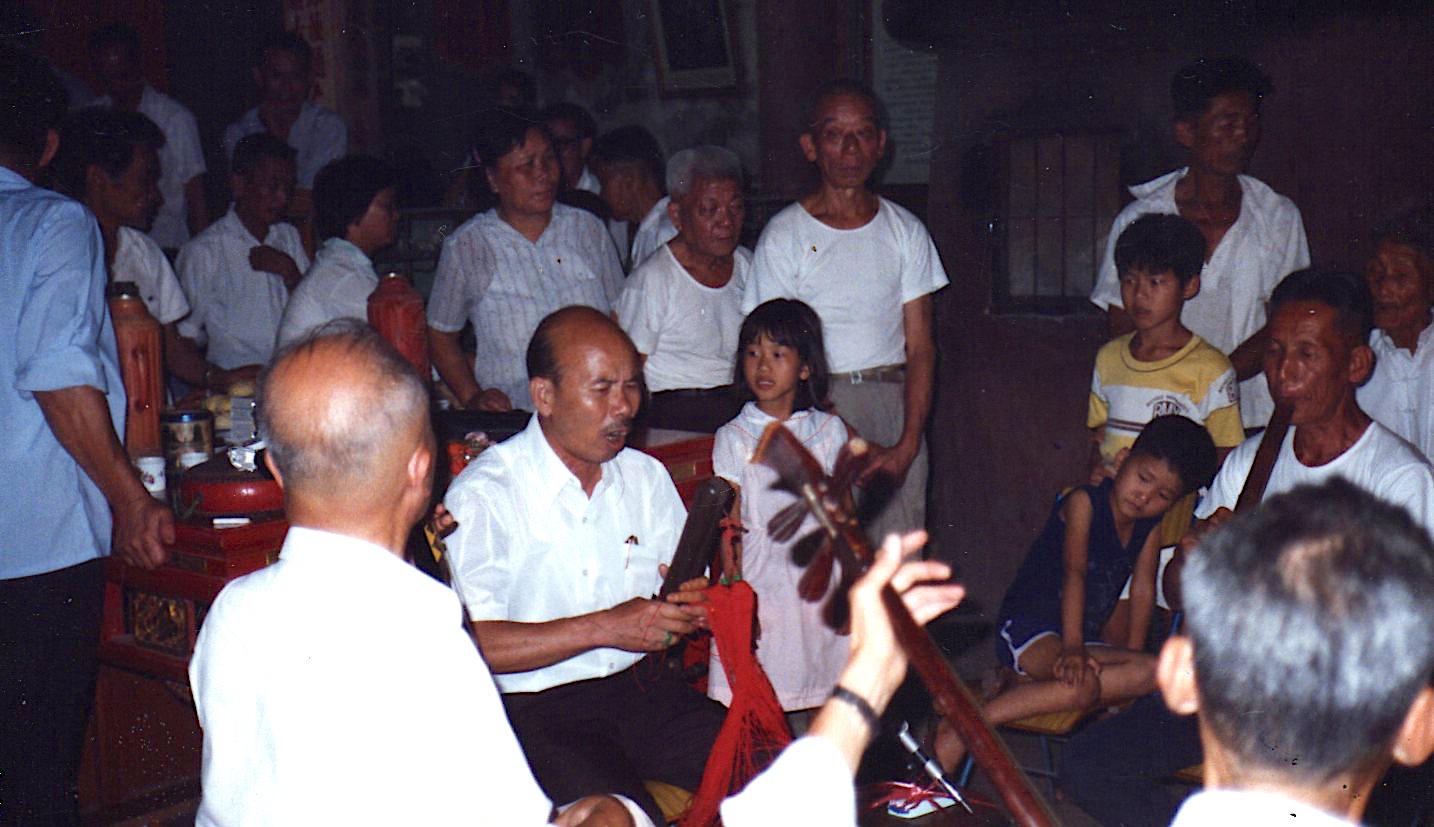
Under state socialism, in the wake of the tradition of Bartók, Kodaly, and Brăiloiu, fieldwork on regional traditions was avidly pursued. Before and after 1989 I returned from concerts in Budapest with suitcases full of box-sets of LPs from the Hungaroton label, founded in 1951.

LP

There’s also a wealth of material on film and online. Gigs are all very well; feature films (see below) are more revealing; ethnographic documentaries are fewer (if only the BBC films of Simon Broughton were available now).

Hungary, Transylvania, Romania
Here—by contrast with the brass-band sound that has come to dominate the Balkans—string bands are still plentiful, surviving notably in Transylvania, source of much of the inspiration for Hungarian folk music studies ever since Bartok’s fieldwork.

The combo of primas fiddle, kontra viola, and bass is enchanting (for this and other world fiddle traditions, click here). Foremost among many recordings with a more traditional brief is a series of fine box sets from Hungaroton, followed by the Fono label, including their Final hour/ Új Pátria series.

Unearthing Transylvanian bands has long been at the heart of the projects of the enterprising Budapest-based concert band Muzsikás with the wonderful singer Márta Sebestyén, and of the Budapest táncház (“dance house”) scene (for which see e.g. Jávorszky Béla Szilárd, The story of Hungarian folk, 2015, and an introduction in Songlines #112). But the fortunes of most such rural bands remained based in the lives of their local communities.

Here Muzsikás accompany the master fiddler Sandor “Neti” Fodor (1922–2004):

Still in Romania, the Rough Guide introduces many distinctive traditions, such as those of Maramureș and Moldavia. The Csángó people of Gyimes are famed for the duo of fiddle with gardon slapped bass (see here, and here)—one of the best possible things to do with a cello (cf. furniture effects and marriage guidance counselling on the bass, and viola jokes).

Transylvania is another of the enviable fieldsites of Bernard Lortat-Jacob:

  • Jacques Bouët, Bernard Lortat-Jacob, and Speranţa Rădulescu, A tue-tête: chant et violon au pays de l’Oach, Roumanie (2002, with DVD),

a detailed ethnography of social musicking in the Oaș region, including musical analyses.

From Clejani near Bucharest, Taraf de Haïdouks were plucked up into the World Music scene; indeed, they are the source of my favourite quote about such success. Speranţa Rădulescu had recorded them from 1983, and introduced fellow-ethnomusicologist Laurent Aubert to them in 1986. Later, taken up by the likes of Johnny Depp, they toured with the Kronos quartet (“Californian pointy-heads” apud Cartwright, Princes amongst men, pp.196–7—actually a telling vignette on the different aesthetics of folk and art musicians).

But with the goals of ethnomusicologists and World Music promoters not always in tandem, such collaborations may not unfold smoothly. The World Music scene not only propels certain bands to fame, but may engender rival clones, misunderstandings, and lawsuits.

Retuning culture has a fascinating article

  • Steluta Popa, “The Romanian revolution of December 1989 and its reflection in musical folklore”,

documenting songs just as they were being composed—if only we could hear them too. But we can hear, from Latcho Drom (see below), the “Ballad of the dictator” by the late great Nicolae Neacșu (of Taraf de Haïdouks)—including my very favorite fiddle technique, evoking anguish, earthquake, or perhaps the creaking door that precedes “The master is not at home” in a Hammer Horror movie (perhaps not so suitable in the Mahler Adagietto, but who knows):

Green leaves, flowers of the fields, What are the people doing?
They’re taking to the streets, yelling and crying “Freedom!”
Green leaves, flowers of the fields, What are the students doing?
They’re marching on Bucharest, yelling and crying “Sweep away the dictatorship.”
Green leaves, a million green leaves on this 22nd day
Here, the time for life has returned, to live in freedom
Green leaves, flowers of the fields, There in Timisoara people are taking to the streets, yelling “It’s all over for the tyrant!”
What are the men doing? They’re taking out their guns. They’re shooting at people. Ceaucescu hears them:
“Tyrant, you have destroyed Romania.”

Roma
Beyond all the traumas of warfare and occupation, these are regions where countless Jewish and Roma peoples were deported and murdered in the mid-20th century, transforming the cultural landscape. In addition to its articles by country, The Rough Guide has a section on the trendy tag of Gypsy music—indeed, casting the net as wide as Rajasthan, Turkey, Russia, Spain, France, and Britain.

The fortunes of Roma peoples in various nations are tellingly described in

  • Isobel Fonseca, Bury me standing (1995),

and turning to music, another most accessible book is

  • Garth Cartwright, Princes amongst men [sic]: journeys with Gypsy musicians (2005),

with vignettes from Serbia, Macedonia, Romania, and Bulgaria. Though based on interviews with the stars, it makes a lively and well-observed read, a popular introduction not only to the scene at the time of his visits but also to the state socialist background. See his playlist here.

 The transgressive lifestyle of the Roma, Exotic Other “deviating from behavioural norms”, has long made an irresistible commercial proposition, as gleefully evoked in many popular feature films (Cartwright, pp.306–8 gives a useful list), such as those of Emil Kusturica like Time of the Gypsies (1989), Underground (1995), and Black cat, white cat (1998), or—more acceptably to the Roma community—Tony Gatlif, including Latcho Drom (1993), travelling from Rajasthan, Egypt, and Turkey to Romania, Hungary, Slovakia, France, and Spain; and Gadjo dilo (1997)—sorry, the English-subtitled version has disappeared from YouTube, so we’ll just have to practise our Hungarian (Yeah, right), here:

An impressive early film was I even met happy Gypsies (Aleksandar Petrović, 1967).

The Balkans
Here the scars of the war following the breakup of Yugoslavia are constantly on display. Brass bands have come to dominate the soundscape, the Guča festival making a heady showcase. Among the stars are Boban and Marko Marković (Serbia), the Kočani orkestar (Macedonia), and Fanfare Ciocârlia (from Zece Prăjini in Moldavia, Romania). While high-octane numbers dominate, the slow ballads are also most affecting. Sorry, can’t find English subtitles for this 2002 documentary Iag bari/Brass on fire, so this time click here for some Swedish practice.

Modern brass bands have developed from groups led by zurna shawms with percussion, rather as Chinese shawm bands have added Western brass and pop music to their instrumentation since the 1980s.

The label “Balkan jazz” reminds me that I couldn’t resist describing the amazing Hua family shawm band as Chinese gypsies playing Ming-dynasty jazz; but accounts of both the social life of Balkan musos and the wildness of their playing do indeed suggest similarities.

In Bosnia–Herzegovina, apart from sevdalinka singing (sevdah resembling Romanian dor, as well as duende and saudade), Islamic soundscapes include kaside, ilahije, and zikr rituals—note the Smithsonian Folkways CD Bosnia: echoes from an endangered world.

Bulgaria, Macedonia
Academic studies include

  • Timothy Rice, May it fill your soul: experiencing Bulgarian music (1994, with CD)
  • Donna Buchanan, Performing democracy: Bulgarian music and musicians in transition (2006)
  • Carol Silverman, Romani routes: cultural politics and Balkan music in diaspora (2012, with companion website)

See also Silverman’s 2007 article on the changing wedding market, and chapters by Rice and Silverman in Retuning culture.

Silverman notes that Bulgaria had one of the most centralised forms of state socialism, Macedonia one of the least. But under both regimes the Roma—“powerless politically and powerful musically”—continued to play for non-Rom as well as Rom audiences at village and town events, such as weddings, birth celebrations, soldier send-off celebrations, circumcisions, and baptisms.

In the West, broad awareness of Bulgarian music began when “World Music” was just a twinkle in the promoter’s eye, with Le Mystère des Voix Bulgares. The original LP, released as early as 1975, was reissued more widely in 1986. After the collapse of state socialism they reinvented themselves with several reincarnations, with further albums following. They made rather more earthy recordings too, like this track from Bulgarian custom songs (1993):

Another early star of the World Music circuit was Ivo Papazov—subject of a fine article by Donna Buchanan in Retuning culture, and vignettes in Rice’s May it fill your soul. Reminding us again that musicking doesn’t necessarily take place in designated venues like concert halls, the wedding scene is important. But Buchanan unpacks the ethnic and cultural tensions. In summer 1989, 370,000 ethnic Turks and Muslims were deported. Buchanan also puts into context how Papazov was promoted abroad by Joe Boyd with the Hannibal albums Orpheus ascending (1989) and Balkanology (1991), soon launching him as a global touring star—just as the local economy was collapsing.

Weddings had been lucrative, and moreover musos prefer their ambience—as Ivo commented,

In truth, a wedding is equal to a dozen concerts. There a person can create… A great deal of music is introduced in a wedding, and in a concert you lack this thrill.

However, by the 1990s weddings lasted only one day: he was being nostalgic for the extravagance of the 1980s! He returned to recording with the great albums Fairground (2003) and Dance of the falcon (2008). Meanwhile the wedding scene in Bulgaria continues to change.

Whatever setting he plays in, his music is just intoxicating. Here’s one of several YouTube playlists, including some raw footage from local gigs also featuring other bands:

And a drôle quote from Frank Zappa, no less:

Ivo’s wedding music, played first thing in the morning, provides thorough and long-lasting attitude adjustment for the busy executive.

Though additive “limping” metres feature in much folk music around the region and further afield (notably Turkey), Bulgaria has been particularly associated with them.

In Macedonia, megastars (sic) are Esma Redžepova (e.g. here, and here; and a playlist:)

and sax player Ferus Mustafov, also featured by Cartwright.

But again, it’s not all about the stars of the World Music scene. At the same time, musical appraisals expand from local to global, which are often at variance. By contrast with both nostalgic romantics and World Music fans in search of the latest groove, the brash sounds of Bulgarian chalga and Romanian manele have become highly popular.

As Cartwright observes,

The difference between what the West’s world music industry sells as Gypsy music and what the Roma listen to back in the Balkans can be huge. Sure, in Serbia Šaban is king and across Macedonia Esma reigns. But this is akin to African Americans acknowledging James Brown and Aretha Franklin. Don’t mean they’re listening to them. And in Romania the breach seems wider than anywhere else. Fulgerica is respected but he’s no pop star while Fanfare Ciocârlia and Taraf de Haïdouks exist only for Western audiences. That they play superior Gypsy music, rooted in tradition, means nothing. The local Roma aren’t listening. What they want is Adrian. And Guța.

Meanwhile, as he notes, the Venezuelan soap opera Kasandra became wildly popular across the Balkans, giving Šaban Bajramović a huge hit in 1997.

Albanian cultures
As a respite from the bombardment of turbo-folk, it’s good to return to a more traditional milieu. Again, ethnic Albanians occupy not just Albania but Kosovo and parts of Macedonia and northern Greece; the soundscape is highly regional, with Gheg culture in the north, Tosk and Lab further south.

The splendid A.L. Lloyd somehow issued a fine album as early as 1966:

The polyphony here is amazing. From the south, another fine CD from Bernard Lortat-Jacob is

  • Albanie: polyphonies vocales et instrumentales (notes here):

A substantial study is

  • Jane Sugarman, Engendering song: singing and subjectivity at Albanian Prespa weddings (1997, with CD).

Bards
Again, the epics sung by bards, over a wide region of south Yugoslavia and Albanian communities, don’t neatly fit national or ethnic boundaries.

Lord

The classic study is

  • Albert Lord, The singer of tales (with CD-Rom; complete text here),

following the work of Milman Parry (for whose work with Bartók, click here). Most singers are accompanied by a one-string fiddle like the gusle, as in this celebrated 1935 clip of Avdo Međedović (c1875 – 1955) filmed by Lord:

And in case all this seems like a bygone world, click here for a 2018 Venice performance of a Kosovan bard.

* * *

Under all these unwieldy national rubrics, the diverse ethnic groups negotiate the changing times, interacting. As ever, this is far more than a “merely musical” topic, as such cultures are not just quaint ornaments, aural pashmina; they are windows on changing local societies, an essential part of what makes them click. As in China, it’s no use clinging onto a romantic idealisation of the past; and we should always delve beyond the World Music stars to musicking in local societies.

As ever, Bruno Nettl offers useful perspectives, as in his taxonomies for various types of change and responses to them.

For any sinophiles who have read this far, it may serve as a reminder of the persistent variety of regional and local traditions in China—not just the ethnic tapestries of the northwest, southwest, and indeed northeast, or even Hakka and Hokkien cultures, but all kinds of musicking beneath the provincial level in Han Chinese regions.

The cultures of all these groups—before and during state socialism, and since— deserve detailed attention. And World Music fans may tend to favour modern commercial pop, but it’s important for ethnographers to include it in the picture too. Even in my work on Daoist funerals in China, I could hardly neglect the pop bands outside the gate (my film, from 30.32).

Both academic and popular accounts repay study: and both keep track of change. I wonder what Bartók would have made of all this—another of those fruitless debates like “Would Bach have used the ondes martenot?” or “Mozart would have written advertising jingles”…

For a sequel, click here. See also under A folk playlist for Euro 24, and Some jazz fiddling.

On a lighter note, far from PC, there’s Molvania

Why music matters

Slobin

I’m just re-reading

  • Mark Slobin (ed.), Retuning culture: musical changes in central and eastern Europe (1996).

I’ve stressed the importance of soundscape to the study of both ritual and, more generally,  local cultures (Nettl, Small, Bigenho, and so on; see also category World music > general). Ethnomusicological literature explores endless variations on this theme, but the opening paragraph of Slobin’s introduction might serve as a mission statement:

Music is both deeply rooted and transient. It dissolves into space while simultaneously settling into individual and collective memory. Yesterday’s songs trigger today’s tears. Music harbors the habitual, but also acts as a herald of change. It helps to orchestrate personal, local, regional, ethnic, religious, linguistic, and national identity. Stable yet constantly in flux, music offers both striking metaphors and tangible data for understanding societies at moments of transition.

He goes on to comment,

Each hegemonic thrust and subcultural parry are just episodes in a long fencing match on the battlefield of culture.

In the same volume, Carol Silverman also stresses the importance of music:

Music shapes politics and economics and social life as well as being shaped by them. Moreover, music is often part of a cultural milieu that displays specific social values, values that may represent the existing hegemony, counter it, or subvert it.


Killing Eve: notes and queries

KE

I entirely share the widespread adulation for Killing Eve. Just in case you’ve been holed up in your ivory tower studying medieval Daoist manuscripts or suchlike, neglecting to delight in all manifestations of the Terpischorean muse, here’s a tribute—and a query.

trio

The brilliant Sandra Oh and Jodie Comer are inspired by Phoebe Waller-Bridge’s script, which wears its feminist credentials lightly. You can take your pick of a plethora of rave reviews, but I like this. And this. And indeed this New Yorker review, and now this from the LRB (you may already have noted that I tend not to favour the Ku Klux Klan Gazette as the ultimate source of critical wisdom).

While Luke Jennings’ novel Codename Villanelle can hardly compete, one location that sinophiles will enjoy there (not used in the TV version) is an ever-sleazy Shanghai, scene of one of the most grisly murders—with its references to Moon river and the 1930s’ silent-film actress Ruan Lingyu.

For astute comments from Unloved on how they created the soundtrack for the series, see here.

OK, among these clips, the Psychopath scene (from 6.22), ending with Villanelle’s response to “Are you upset?” is wonderful:

Which I suppose leads me to just one niggling doubt, encapsulated long ago by Mark in Peep Show, visiting a student he fancies:

Mark: Love your room.
April: Thanks. It’s your basic undergraduate lunge for individuality.
[nods to a Betty Blue poster]
April: I’ve not even seen Betty Blue. Have you?
Mark: Oh yeah. Great sex-and-suicide flick—turned a whole generation of men onto girls with mental illness.

So now for the chic assassin (for terms like femme fatale, see here; and for Lulu, here). It can hardly be much consolation that whole generations of women are also subscribing to the image. I’m sure there’s a sound feminist response to this. Discuss

Will there be redemption for Villanelle/Oxana in the next series? Would that be too neat?

As to a musical Villanelle, Berlioz’s Nuits d’été is gorgeous—here’s the classic Janet Baker recording:

For more from PWB, see Fleabag and Exotic travels; and do watch Jodie Comer in the recent Talking heads.

Li family Daoists, Beijing 1990

BJ 1990

The recent Beijing visit of a sectarian group from north Shanxi reminds me of the Li family Daoists’ performance at the 1990 Festival of religious music (for such festivals, see here)—the occasion that gave rise to their misleading media title (“calling Li Manshan’s band the Hengshan Daoist Music Troupe is like calling a group of Calabrian folk exorcists the Sistine Chapel Choral Society”).

I discussed here the gradual revival of Daoist ritual (now mainly funerals) in Yanggao after the collapse of the commune system; even by 1990, rural conditions there were still terribly poor, and memories of the Maoist era still fresh. For the dubious concept of “religious music”, see here.

Here’s how I described the festival in my Daoist priests of the Li family (pp.175–6):

Meanwhile my friend Tian Qing, later to become the pre-eminent pundit on Chinese music, was planning a major festival of Buddhist and Daoist music in Beijing for June that year, with groups from all over China invited to perform on stage. This was unfortunate timing, as everything was disrupted by the student demonstrations and their subsequent suppression, so the festival had to be postponed. With Tian Qing now indisposed, his colleagues at the Music Research Institute managed to put on the festival the following June—not in public, but with considerable publicity in the musicological world. To hold a festival of religious music was still controversial: some apparatchiks were opposed, but influential senior ideologues like He Jingzhi and Zhao Puchu supported it.

Li Qing had a difficult task to perform when it came to choosing the personnel to go to Beijing. Of his three Daoist sons, he ended up taking not Li Manshan or Yushan, but his third son Yunshan (Third Tiger), then 22 sui. Though Third Tiger was soon to take a different path, he remains nostalgic about his teenage years studying and the trip to Beijing with the great masters. Nine Daoists made the trip: the trusty core group of seniors Li Qing, Li Yuanmao, Kang Ren, Liu Zhong, Li Zengguang, and Wang Xide, along with Li Yunshan, Li Peisen’s son Li Hua, and Li Yuanmao’s son Li Hou. They stayed in the White Cloud Temple (Baiyunguan) along with several other Daoist groups from elsewhere in China invited for the festival, doing five performances (not rituals) for privately invited audiences over fifteen days in the temple and at the Heavenly Altar. The Music Research Institute also made studio recordings—which now sound rather harsh to me.

informal session

Informal session at Li Qing’s house, 1991. Left to right: Li Qing (sheng), his second son Yushan (yunluo), Liu Zhong (guanzi), Li Zengguang (drum), Kang Ren (sheng), Wu Mei.

The 1993 Yanggao county gazetteer includes a proud mention of the Beijing trip in its brief account of the Li family band. Valuable as the gazetteer is otherwise, Daoism is not its strong suit. Li Manshan and I giggle over its quaint description:

the average age of the members is 62.5. The instruments are even older than the people.

Still, even now, religious groups that have been legitimized by official recognition are in a tiny minority compared to all those that have never been “discovered”. Even in Yanggao and nearby, many other groups are active that have never enjoyed even such minor celebrity. And while it lent Li Qing’s group confidence, offering a potential buffer against any future ill winds, it brought them no tangible benefit, and no new audiences—at least until 2005 when I began taking them on foreign tours. They continued to scrape a living by performing for local funerals, and they still do.


For Third Tiger’s fine interpretation of my SOAS T-shirt, see here.

Shanxi sect performs in Beijing

cof

Last week, through the auspices of the dynamic Professor Cao Xinyu of People’s University, the Department of Religious Studies at Peking University managed to invite a ritual group from north Shanxi to perform for a symposium.

Mingzong 2

Cao Xinyu explains the sect’s background.

Moreover, this is no orthodox troupe of temple monks, but a pious amateur sectarian group of ordinary villagers. They belong to the extensive network of the Mingzong sect, whose history and texts Cao Xinyu has ably documented. With a membership of both men and women, they perform a cappella vocal liturgy as part of long complex ritual sequences for their local devotees—notably the sect’s distinctive “precious scrolls” (baojuan 寶卷), with their complex performing structures (see e.g. here, and here, under “The scrolls in performance”).

The sect maintained activity even after Liberation, and with their virtuous reputation they have long been tolerated by the local authorities. Alas, their venerable leader Wang Ji (1950–2017), who steered the group through the reform era, didn’t live to take part in this trip; but Cao Xinyu has now been able to realize Wang’s wish for the group to visit Beijing, with his disciples including his widow and sister.

Wang Ji 2003

Wang Ji (right) explains the structure of a “precious scroll” to Shanxi scholar Jing Weigang, My photo, Yanggao 2003.

All over China, devotional sects are a major aspect of folk religious life (cf. this recent film on a Hakka sect). While their vicissitudes since 1949 remain a sensitive topic, such groups offer important material to document local histories and regional transmissions since the Ming dynasty—for historians, ethnographers, and scholars of “music”.

It’s also good to see the culture of this unassuming corner of north Shanxi recognized further, following visits of the Li family Daoists to Beijing in 1990 and 2013 (see my Daoist priests of the Li family, pp.175, 340–41) and their foreign tours—as well as those of the Hua family shawm band.

Of course, the event wasn’t a religious ritual but a low-profile symposium, in a literary historical context. While it’s no substitute for attending their observances in local context, it’s impressive not only that ritual life continues but that scholars of folk religion, alongside all their fine academic studies, can still “get things done” and bring life to silent immobile textual research.

功德無量!

Gushan sect 2003.2

Between ritual segments, 2003. My photo.


New tag: south China

FWIW, some more housekeeping.

I’ve just added a new tag to the sidebar, for south China, in addition to the “south China” subhead of the ritual category! This also picks up various posts on Hakka and Hokkien soundscapes.

My main topic is north China, to which (apart from its subhead under the ritual category; see also under Local ritual) I also give tags for Beijing, Hebei, Gaoluo, Shanxi (other) (supplementing the extensive category Li family), and Shaanbei. Ah, the joys of indexing

A Hakka nun

zhaipo

The ever-vibrant religious life of southeast China has been the subject of considerable research. Among the voluminous monographs on Buddhist and Daoist ritual of the Hakka people in east Guangdong (see also here, under “Keep calm and carry on”), women feature but rarely; but they play a major role in folk religious life—as mediums, sectarians, organizers, and worshippers (among many posts, mainly for north China, see e.g. here, and the trilogy starting here).

I now learn of a fine 92-minute film

  • Under goddesses’ shelter (姑婆, Yang Yufei, 2016).

Like our very own Li Manshan, and Adeline Herrou’s Maître Feng, it’s a portrait film, about the daily life of the 80-year-old nun (“vegetarian woman”) Liu Yunxiang and the temple-based observances of her Hakka community in Meizhou, adherents of the Xiantian jiao 先天教 sect. It has been available to watch via this site,  although it currently seems to be a private link.

zhaipo 2

Tastefully used on the soundtrack is the qin piece Remembering an old friend.

I’ve noted the tensions between historical and ethnographic approaches to fieldwork. No mere paean to timeless oriental spirituality, the film has rich detail on changing social life. For more such films, click here.

Taco taco taco burrito

Rite

Wondering how to get to grips with additive metres?
Awed by the complexities of flamenco palmas?
Despair not, help is at hand!

As a prelude to aksak “limping” metres, we might start with quintuple metres, which go far back, even in WAM. By the baroque period there are niche examples by composers such as Schmelzer, and they feature in 19th-century Russian music—a most popular instance being the “limping waltz” of Tchaikovsky’s Pathétique symphony (2+3).

This reminds me of two other subversions of the waltz, albeit in regular triple metre: the 2nd movement of Berlioz’s Symphonie fantastique (cf. here and here), and Ravel’s La valse, a “surreal nightmarish vision of a decaying society through a broken kaleidoscope”, as I said in my Ravel page. Elsewhere, perhaps inspired by the Basque zortzico dance, Ravel was partial to additive metres—such as in his piano trio, and the quintuple-time Bacchanale finale of Daphnis and Chloé (both also featured on that page, the latter from 45.29). And Messiaen was most partial to complex yet catchy additive rhythms.

Quintuplets, of course, are something else altogether; as are the creative use of additive rhythms in minimalism (see also examples from Reich and Meredith).

From Tchaikovsky we might graduate to

  • the Pearl and Dean theme (which we may hear as two groups each of 3+3+2; or for a Bulgarian, perhaps two fast groups of 3+3+3+3+2+2)
  • Un homme et une femme (after the three upbeats, 3+3+2+2: the first two 3s, in the original “Dabadabada, badabadaba”, were later remembered as “Chabadabada“, a word that entered the language to denote alternating male and female candidates in electoral lists!)
  • and Lalo Schifrin’s theme to Mission impossible (5/4, with a duplet over the first 2 beats).

If you can hum along to such easy examples, then that’s a good start in mastering the intricacies of so-called aksak metres around east Europe and the Middle East…

Indeed, Take five was inspired by hearing Turkish musicians. Rather more challenging is the opening section of Blue Rondo à la Turk (2+2+2+3):

Note the helpful BTL comment there (only without the punctuation!):

Taco, taco, taco, burrito. Taco, taco, taco, burrito. Taco, taco, taco, burrito.
[SJ: not to be confused with potato, potato]

Still, that’s a rather crude, mechanical usage, the melody merely marking out the metre in regular quavers—whereas further east, melodic rhythms are infinitely varied within the basic metre.

Admittedly, the additive patterns of the Rite of spring have been transcribed in 4/4—was it really Boulez who had this drôle idea?! Cf. Slonimsky‘s help for Koussevitzky, here). Indeed, the scores for both the Pearl and Dean and Un homme et une femme tunes were written in duple metres.

And in the first movement of Winter, Max Richter’s welcome recomposition of the Four Seasons mixes in some great limping 7/8 bars (2+2+3—just the two tacos before the burrito today, thanks waiter) (from 1.18):

An intriguing instance is I say a little prayer, with its quirky insertion of a triple-time bar in the chorus—which no-one apparently even has to think about. And do listen to Herbie Hancock‘s addictive Ostinato.

* * *

But all this is mere child’s play compared to folk music. Though such metres are quite widespread, Bartók, Brailiou et al. coined the term “Bulgarian rhythm”.

aksak

Some instances of “Bulgarian rhythm”, found here; see also here. For the Swingles’ delightful arrangement of  Bučimiš, see under Another Turangalîla at the Proms!.

A classic essay is

  • Constantin Brăiloiu, “Aksak rhythm” (in Brăiloiu, Problems of ethnomusicology, 133–67, based on a 1951 lecture),

which contains far more detailed schemata. His work followed that of

  • Béla Bartók, “The so-called Bulgarian rhythm” (1938).

A transcription by Bartók of a Turkish zurna–davul shawm band shows how, over the basic metre, melodic and percussion rhythms seriously thicken the plot:

aksak 2

Jerome Cler’s splendid website on the yayla has a thoughtful analysis of an aksak (here).

The whole repertoire of players like Ivo Papazov is based on aksak metres:

I don’t think I’m quite ready for Sedi donka (Plovdivsko horo), a 25-beat pattern divided

    7             7                 11
3+2+2 | 3+2+2  | 2+2+3+2+2

For more on the diverse musical cultures of Bulgaria and environs, see here. And for a wide-ranging discussion, see

  • John Blacking, “Irregular rhythms: movement, dance, music, and ritual”, ch.3 of A common-sense view of all music (1987).

Back with Merrie England, there’s a fascinating article:

* * *

Further east, an example from the muqam of the beleaguered Uyghurs of Xinjiang is sadly topical. A common metre consists of one long beat divided into two equal stresses, followed by two regular beats—which we might notate cumbersomely as

aksak

with the initial duplet over a notional 3/8 unit:

Some sections add another duple unit, like this dastan from Chebiyat muqam (actually a duplet over 3/8,  followed by 3/4):

QB

And some muqam have still more metrically complex segments to explore.

As with many world genres, the Uyghurs have no tradition of notation, and seem to have no terminology for such metres (though see Rachel Harris’s chapter in Harris and Stokes (eds.), Theory and Practice in the Music of the Islamic World). As with flamenco, this kind of thing is only an issue for those (like me) hampered by a visual classical education. The trick is to internalise it in the body—and to dispense with notation. Let’s remember that much of this music accompanies dance.

Uyghur musical traditions are part of a rich culture that is currently being systematically erased in Xinjiang (see roundup here).

New tag: Iron Curtain


To accompany a growing list of posts, I’ve now added a rough-and-ready tag Iron Curtain to the sidebar. For want of a more succinct handle, it includes posts on the region both before and since 1989.

Most of these posts suggest Chinese parallels—including various essays on the GDR (here and here, as well as a two-part biography here and here), SerbiaBulgariamusical cultures of east Europe, and Cheremis, Chuvash—and Tibetans. There are yet more links under the tag German too. Under the separate tag Czech are several (mercifully lighter) stories, notably from Švejk and my mentor Paul Kratochvil.

Notably I include the “bloodlands” of Timothy Snyder’s book, a vast region not easily characterized. In my post on his book, I wonder what would it take for the region to be recognized as the physical and moral graveyard of the 20th century—shifting our balance from the Western to the Eastern Front.

map

Setting forth from A Nazi legacy and Anne Applebaum’s Between East and West, I described the blind minstrels of Ukraine, leading to posts on the famine and the intrepid journalist Gareth Jones.

I’ve included my posts on Ravensbrück and Sachsenhausen, since so many people from the region ended up at such camps.

Doubtless more to follow.

Bloodlands

map

Following my posts on the work of Philippe Sands, on blind minstrels in Ukraine, [1] and on the famines in Ukraine and China, I’ve been belatedly educating myself on the appalling history of the vast region introduced in Between East and West by reading

The region where some 14 million people (mostly civilians) were killed from 1930 to 1945, largely east of the Molotov–Ribbentrop line, includes Poland, Ukraine, Belarus, and the Baltic states. Victims were Jews, Belarusians, Ukrainians, Poles, Russians, and Balts. And it was to the bloodlands that most Jewish victims from west and south Europe, Hungary, Romania, and so on, were transported to die. For the background, see The great siege of Przemyśl.

Growing up in post-war Britain, perhaps my ignorance isn’t so unusual—but it’s disturbing, and needs rectifying. As Anne Applebaum comments in her review,

If we are American, we think “the war” was something that started with Pearl Harbor in 1941 and ended with the atomic bomb in 1945. If we are British, we remember the Blitz of 1940 […] and the liberation of Belsen. If we are French, we remember Vichy and the Resistance. If we are Dutch we think of Anne Frank. Even if we are German we know only a part of the story.

My own belated awareness is partly prompted by my studies of the fates of Chinese people whom I’ve met in the course of fieldwork. Indeed, it’s worth re-reading Ian Johnson’s article “Who killed more, Hitler, Stalin or Mao?”, itself a companion to an article by Snyder.

I wonder what would it take for this vast region of the bloodlands to be recognised as the central physical and moral graveyard of the 20th century—shifting our balance from the Western to the Eastern Front. And as Snyder says, the mass killing of the 20th century is of the greatest moral significance for the 21st.

One might even begin by reading his brilliant “Conclusion: humanity”. And apart from reading static silent texts, there’s a wealth of documentary footage online—which you can choose to explore, or not.

Snyder corrects many widespread misconceptions [here I combine his text and Ascherson’s review]. The western public still tends to associate mass killing with “Nazi concentration camps” (cf. my posts on Ravensbrück and Sachsenhausen), and with Auschwitz in particular; and Stalin is thought to have killed far more people than the Nazis by consigning millions to the gulag. But neither assumption is accurate.

  • In the Soviet Union, although about a million men and women perished in the labour camps, 90% of gulag prisoners survived. Stalin’s great killing took place not in Siberia, but in the western Soviet republics, above all in 1930s’ Ukraine where at least four million people died in man-made famines and in the slaughter of the “kulak” peasantry.
  • In the Third Reich concentration camps, a million prisoners died miserable deaths during the Nazi period. US and British troops liberated some of those camps, but none of the major death camps, which were further east. And 10 million others who never entered any of the camps were shot (mostly Jews), deliberately starved to death (mostly Soviet prisoners of war), or gassed in special “killing centres” which were not holding camps at all. Auschwitz, terrible as it was, formed a sort of coda to the Jewish Holocaust. By the time the main gas chambers came on line in 1943, most of Europe’s Jewish victims were already dead. Some—Polish Jews especially—had been gassed in the three killing centres set up on Polish territory: Belzec, Sobibor and Treblinka.
  • So more common methods of killing than gassing were starvation and shooting. Most of those Jewish victims had been shot and pitched into mass graves by German Einsatzgruppen operating far to the east in Ukraine, the Baltics and Belarus, moving from village to village behind the front lines of war.

In a matter of a given few days in the second half of 1941, the Germans shot more Jews in the east than they had inmates in all of their concentration camps. […] The vast majority of Jews killed in the Holocaust never saw a concentration camp.

The American and British soldiers who liberated the dying inmates from camps in Germany believed that they had discovered the horrors of Nazism. The images their photographers and cameramen captured of the corpses and the living skeletons at Bergen–Belsen and Buchenwald seemed to convey the worst crimes of Hitler. As the Jews and Poles of Warsaw knew, and as Vasily Grossman and the Red Army knew, this was far from the truth. The worst was in the ruins of Warsaw, or the fields of Treblinka, or the marshes of Belarus, or the pits of Babi Yar.

  • Nor is it widely understood that Jews were fewer than 1% of the German population when Hitler came to power in 1933, and about one quarter of 1% by the beginning of World War Two. The great majority of murders of Jews took place in occupied Poland, Lithuania, Latvia, and the Soviet Union. The murder of 165,000 German Jews was a ghastly crime in and of itself, but […] fewer than 3% of the deaths of the Holocaust. The Nazis murdered about as many non-Jews as Jews during the war, chiefly by starving Soviet prisoners of war (over 3 million) and residents of besieged cities (over a million), or by shooting civilians in “reprisals” (nearly a million).
    And until 1939 Stalin, later credited with defeating Hitler (if not in British public opinion), had a still worse record of mass killings—of his own civilians, moreover. Until then, Soviet terror (against both class and national enemies) was not only far greater in scale, it was incomparably more lethal—and largely unnoticed. By the end of 1938, the USSR had killed about a thousand times more people on ethnic grounds than had Nazi Germany, and far more Jews.

Poland, fatally partitioned between Hitler and Stalin in 1939, suffered terribly—with Warsaw subjected to brutal successive destructions. In western Europe this period was known as “the phony war”: nothing seemed to be happening. But on 22nd June 1941 (“one of the most significant days in the history of Europe”) Operation Barbarossa, Hitler’s invasion of the USSR, while sealing the fate of the Reich, was a further disaster for the civilian inhabitants of the whole region. It was only with these incursions that Hitler’s territory came to include large numbers of Jews to be (literally) disposed of. And

As Hitler imagined the future, Germany would deal with the Slavs much as the North Americans had dealt with the Indians.

As to Ukraine, already decimated by Stalin,

Hitler dreamed of the endlessly fertile Ukrainian soil, assuming that Germans would extract more from the terrain than the Soviets.

The Germans implemented mass starvation in POW camps:

As many Soviet prisoners-of-war died on a single given day in autumn 1941 as did British and American prisoners of war over the entire course of the Second World War.
The Germans shot, on a conservative estimate, half a million Soviet prisoners of war. By way of starvation or mistreatment during transit, they killed about 2.6 million more.

This had the effect of strengthening Soviet resistance; and while local populations had already suffered terribly under Soviet rule, many now wondered if it might be a lesser evil. Still, in desperation many Soviet citizens were recruited for duties with the German army and police.

Thus some of the survivors of one German killing policy became accomplices in another, as a war to destroy the Soviet Union became a war to murder the Jews.

In the first lands that German soldiers reached in Operation Barbarossa, they were the war’s second occupier. […] The double occupation, first Soviet, then German, made the experience of the inhabitants of these lands all the more complicated and dangerous. […] They had to deal with the consequences of their own previous commitments under one occupier when the next one came; or make choices under one occupation while anticipating another.

When the Germans conquered an area they often found that the NKVD had shot prisoners. In 1943 they seized on their discovery of the 1940 massacre by the NKVD of over 20,000 Polish officers and intelligentsia in the forests of Katyn. But on 29th–30th September 1941 near Kiev, the Germans had murdered 33,761 Jews at Babi Yar; between 100,000 and 150,000 people were killed there during the German occupation (see also Ukraine: Holocaust Ground Zero).

Local militias also took part in pogroms:

Political calculation and local suffering do not entirely explain the participation in these pogroms. Violence against Jews served to bring the Germans and elements of the local non-Jewish population closer together. Anger was directed, as the Germans wished, toward the Jews, rather than against collaborators with the Soviet regime as such. […] Violence against Jews also allowed local Estonians, Latvians, Lithuanians, Ukrainians, Belarusians, and Poles who had themselves collaborated with the Soviet regime to escape any such taint.
Yet this psychic nazification would have been much more difficult without the palpable evidence of Soviet atrocities. The pogroms took place where the Soviets had recently arrived and where Soviet power was recently installed, where for the previous months Soviet organs of coercion had organized arrests, executions, and deportations. They were a joint production, a Nazi edition of a Soviet text.

Snyder details the fates of urban centres like Lviv, Łódź, Riga, Vilnius, and Minsk, giving background to Applebaum’s visits in Between East and West. By the end of the war, half the population of Belarus had either been killed or deported (see also Soviet lives at war).

Warsaw

Warsaw, 1944.

His story returns to Poland and the unimaginable final agony of Warsaw. As the Red Army advanced on Berlin, their revenge was horrific.

* * *

And thence to continuing sufferings after the formal end of war, with Germans now among the main victims of ethnic cleansing and transports (for an overview of the aftermath across Europe, see Keith Lowe, Savage continent). Through the war the Soviets had continued sending their own citizens to the Soviet gulag (not least the peoples of the Caucasus and Crimea; entire populations of Karachai, Kalmyks, Chechen, Ingush, Balkar, Tatar, Meshketian Turks, and so on, still less known in the West than the bloodlands), and in the post-war years deportations only increased.

As Stalin fabricated his own unblemished legend of the Soviet Union and its role in the war, belittling that of Soviet citizens in the Holocaust, he now engaged in his own anti-semitic purges. Although mass terror was no longer pursued after Stalin’s death, repression continued throughout the Soviet bloc, and the fates of the real victims were concealed.

The communists’ hesitation to distinguish and define Hitler’s major crime tended, as the decades passed, to confirm an aspect of Hitler’s worldview.
[…]
Communist leaders, beginning with Stalin and continuing to the end, could rightly say that few people in the West appreciated the role of the Red Army in the defeat of the Wehrmacht, and the suffering that the peoples of eastern Europe endured under German occupation. […] During the Cold War, the natural response in the West was to emphasize the enormous suffering that Stalinism had brought to the citizens of the Soviet Union. This, too, was true; but like the Soviet accounts it was not the only truth, or the whole truth.

In his “Conclusion: Humanity”, Snyder explores the complexities of collaboration and victimhood—even now a pressing issue for all these traumatized nations. Most peoples suffered double or triple occupations, trapped helplessly between evil regimes, forced into agonizing dilemmas with a view to mere survival. In a telling passage, Snyder reflects on choices:

At a great distance in time, we can choose to compare the Nazi and Soviet systems, or not. The hundreds of millions of Europeans who were touched by both regimes did not have this luxury.

The comparisons between leaders and systems began the moment that Hitler came to power. From 1933 through 1945 hundreds of millions of Europeans had to weigh what they knew about National Socialism and Stalinism as they made the decisions that would, all too often, determine their fate. This was true of unemployed German workers in early 1933, who had to decide whether they would vote for social democrats, communists, or Nazis. It was true, at the same moment, of Ukrainian peasants, some of whom hoped for a German invasion that would rescue them from the plight. It held for European politicians of the second half of the 1930s, who had to decide whether or not to enter Stalin’s Popular Fronts. The dilemma was felt sharply in Warsaw in these years, as Polish diplomats sought to keep an equal distance between their powerful German and Soviet neighbors in the hope of avoiding war.

When both the Germans and the Soviets invaded Poland in 1939, Polish officers had to decide to whom they should surrender, and Polish Jews (and other Polish citizens besides) whether to flee to the other occupation zone. After Germany invaded the Soviet Union in 1941, some Soviet prisoners of war weighed the risks of collaboration with the Germans against the likelihood of starving to death in prisoner-of-war camps. Belarusian youth had to decide whether to join the Soviet Partisans or the German police—before they were press-ganged into one or the other. Jews in Minsk in 1942 had to choose between remaining in the ghetto or fleeing to the forest to seek Soviet partisans. Polish Home Army commanders in 1944 had to decide whether or not to try to liberate Warsaw for themselves, or to wait for the Soviets. Most survivors of the Ukrainian famine of 1933 later experienced German occupation; most survivors of the German starvation camps of 1941 returned to Stalin’s Soviet Union; most survivors of the Holocaust who remained in Europe also experienced communism.

These Europeans, who inhabited the crucial part of Europe at the crucial time, were condemned to compare.
[…]
In the decades since Europe’s era of mass killing came to an end, much of the responsibility has been placed at the feet of “collaborators”. The classic example of collaboration is that of the Soviet citizens who served the Germans as policemen or guards during the Second World War, among whose duties was the killing of Jews. Almost none of these people collaborated for ideological reasons, and only a small minority had political motives of any discernible sort. […] In eastern Europe, it is hard to find political collaboration with the Germans that is not related to a previous experience of Soviet rule.

Snyder goes on:

In the 21st century, we see a second wave of aggressive wars with victim claims, in which leaders not only present their peoples as victims but make explicit reference to the mass murders of the 20th century. The human capacity for subjective victimhood is apparently limitless, and people who believe that they are victims can be motivated to perform acts of great violence.

And he reflects on the purpose of history, describing all kinds of later nationalist agendas, highly relevant today:

Our contemporary culture of commemoration takes for granted that memory prevents murder. […] Without history, the memories become private, which today means national; and the numbers become public, which is to say an instrument in the international competition for martyrdom.

Snyder’s detailed breakdown of figures is numbing (note also his Appendix “Numbers and terms”). [2]

In policies that were meant to kill civilians or prisoners of war, Nazi Germany murdered about ten million people in the bloodlands (and perhaps eleven million total), the Soviet Union under Stalin over four million in the bloodlands (and about six million total). If foreseeable deaths resulting from famine, ethnic cleansing, and long stays in camps are added, the Stalinist total rises to perhaps nine million and the Nazi to perhaps twelve. These larger numbers can never be precise, not least because millions of people who died as an indirect result of the Second World War were victims, in one way or another, of both systems.

But as he concludes, such statistics still have to be converted back into the stories of individuals: not the abstraction of 5.7 million Jewish dead, but 5.7 million times one.

It is perhaps easier to think of 780,863 individual people at Treblinka: where the three at the end might be Tamara and Itta Willenburg, whose clothes clung together as they were gassed, and Ruth Dorfmann, who was able to cry with the man who cut her hair before she entered the gas chamber.

As the Jews of Minsk were liquidated in 1942,

The girls and boys knew what would happen to them if they were caught. They would ask for a tattered bit of dignity as they walked up the ramp to their death: “Please sirs,” they would say to the Germans, “do not hit us. We can get to the trucks on our own.”

* * *

Apart from providing us with essential basic education, such work, both detailed and humane, should inform our historiography generally—all the more with the current worldwide fomenting of ugly xenophobia. For Snyder on tyranny, click here.

For China, despite all the noble work on the famine and laogai camps, truth remains to be publicly told. In the official myth, the concession of Cultural Revolution “mistakes” conspires to sweep under the carpet the earlier successive terrors of land reform and campaigns throughout the 1950s, as well as long-term hunger. Even studies of expressive culture and ritual need to take all this into account.


[1] In such posts I mention the painful maintenance of expressive culture through times of trauma (and indeed the theme of the music of the camps is both macabre and inspiring), but here it seems unthinkable even to try and do so. It does, however, put into even starker perspective both regimes’ showcasing of Great Works of National Art directed by Great Conductors (see e.g. here). See also e.g. Institute of Musicology, University of Warsaw (ed.), Music traditions in totalitarian systems (Musicology Today, 2010).

[2] Statistics are always problematical. In China, as Ian Johnson observes, famine deaths alone over a mere four years seem to far outnumber the combined totals for killings under Stalin and Hitler from 1930 to 1945. But for the latter, if one includes “foreseeable” deaths caused by deportation, starvation, and incarceration, as well as combatant deaths and those due to war-related famine and disease, the numbers shoot up astronomically. Slowly, Hitler’s numbers approach Mao’s (for the gulag, see also Figes, and Applebaum).

In a 2012 article the late Elliot Sperling considered issues in assessing the death count for Tibet under Maoism. See also The Cultural Revolution in Tibet, Forbidden memory, and Tibet: conflicting memories.

Issues with statistics are illustrated by the conclusion of Steven Pinker’s The better angels of our nature: a history of violence and humanity (esp. ch.5), based on detailed yet unpalatable arguments, that the 20th century was probably not the bloodiest in history (see also here). His diachronic table (pp.235–6), adjusted to give mid-20th-century population equivalents, shows death tolls from many other conflicts worldwide outranking those discussed here. Highest on the list is the 8th-century An Lushan rebellion (said to have killed up to 5% of the world population, though even a substantially lower revised estimate seems exaggerated), followed by the Mongol conquests; global deaths for World War Two surpass those of Mao’s famine, but even they only come in 9th and 11th respectively—with the Taiping rebellion in between. See here for Pinker’s responses to some inevitable questions.

But again, we should return to Snyder’s Conclusion.

Moon river

MR

À propos my Daoist ritual spinoff of Strictly, the brilliant (ethnographer!) Stacey Dooley‘s recent waltz reminds me what a brilliant song is Moon river:

Pace Andy Williams, the classic sung version is that of Audrey Hepburn in Breakfast at Tiffany’s (1961):

Johnny Mercer’s lyrics, “a love song to wanderlust” (cf. Roaming the clouds), are complemented by Henry Mancini’s melody.  I just love the leap of a major 7th:

I’m crossing you in style some day / There’s such a lot of world to see,

always effective—as in the finale of Mahler 9 (introduced by quintuplets!) and, um, Raindrops keep falling on your head! Indeed, there’s another brilliant touch: following “We’re after the same rainbow’s end“, when that sequence returns with

Waiting round the bend, My huckleberry friend,

for the first phrase the melody omits the low tonic, making us nostalgic for the missing major-7th leap (waiting, indeed), until it returns for the second phrase.

So Moon river (nearly cut from the film, PAH!) makes a perfect expression of Holly’s persona—and indeed that of Stacey Dooley, with her documentaries from around the world.

The dominant interpretation currently seems to be that Hepburn’s screen characters make her some kind of feminist role model. But “it’s complicated”—certainly in this film, which largely replaces the edgy feel of Truman Capote’s novella (1958, set in 1943) with a “sugar and spice confection”; indeed, Capote wanted Marilyn Monroe for the part! I tend to side with more critical reviews, such as this, this, and this. After I cited some dodgy sexist terms to describe talented female performersgamine and ingénue are among those for which there are both male and female equivalents, but the latter are far more commonly used, and flawed. Oh, and how ahout “elfin waif”…

For Hepburn’s actual life, Darcey Bussell (another fragrant icon) made a fine documentary Looking for Audrey (2014), including her childhood in Nazi-occupied Holland.

* * *

Capote describes Holly as an American geisha—rural child bride Lulamae, reinventing herself in New York. Film adaptations can be effective, but in this case the novella portrays her with more nuance and depth. So—not least because I’m so averse to Hepburn’s “elfin waif” shtick—I find Capote’s silent invisible original far more moving, and Holly herself far more poignant and (as she would say) sympathique.

Inevitably, at the end of the film the narrator and Holly fall in love and stay together, whereas in the novella their relationship remains platonic, and Holly disappears.

Lending significance to Moon river, the name-slot for Holly’s mail-box reads:

Miss Holiday Golightly, travelling

She reflects on how she demurred from a break in the movies offered by a Hollywood agent:

But he’s got a point, I should feel guilty. Not because they would have given me the part or because I would have been good: they wouldn’t and I wouldn’t. If I do feel guilty, I guess it’s because I let him go on dreaming when I wasn’t dreaming a bit. I was just vamping for time to make a few self-improvements: I knew damn well I’d never be a movie star. It’s too hard; and if you’re intelligent, it’s too embarrassing. My complexes aren’t inferior enough: being a movie star and having a big fat ego are supposed to go hand-in-hand; actually, it’s essential not to have any ego at all. I don’t mean I mind being rich and famous. That’s very much on my schedule, and some day I’ll try to get around to it; but if it happens, I’d like to have my ego tagging along. I want to still be me when I wake up one fine morning and have breakfast at Tiffany’s.

And Holly does indeed sing and play guitar:

Don’t wanna sleep, don’t wanna die, just wanna go a’travellin’ through the pastures of the sky

With a Brazilian suitor in tow, she takes to Linguaphone:

Oh screw it, cookie—hand me my guitar and I’ll sing you a fado in the most perfect Portuguese.

That would surely have rivalled Carminho’s exquisite song.

In the novella, I note with proprietoral pride that Holly’s fellow-geisha Mag Wildwood (intriguingly, Capote gave her the full name of Miss Margaret Thatcher Fitzhue Wildwood)—as if being a redhead over six feet tall isn’t enough—is a stammerer (Marilyn Monroe might have resented the competition):

Even the stutter, certainly genuine but still a bit laid on, had been turned to advantage. It was the master stroke, that stutter: for it contrived to make her banalities sound somehow original, and secondly, despite her tallness, her assurance, it served to inspire in male listeners a protective feeling.

* * *

For Moon river on the ethereal theremin, click here.

Amy Winehouse (see my tribute here) may seem an unlikely exponent of the song, but she was grounded in ballads, as we can hear in her “late” sessions with Tony Bennett. Here she is, subverting the waltz, making the song sugar-free—maybe it doesn’t quite work, but even at the age of 16 she was always exploring, discovering new personal connections:

Click here for a discussion of the song in the BBC Radio 4 Soul music series.

From my playlist of songs, it’s clear that, with some noble exceptions, I find female voices more moving than male ones—and I’m right!!!

Just another reminder that a global view of musicking invites us to delight in all manifestations of the Terpsichorean muse!

A brave journalist

GJ

As journalism, and journalists, currently face renewed threats around the world, a homage to Gareth Jones (1905–35) is timely. [1] This post serves mainly to direct readers to the comprehensive website about his life.

I’ve already mentioned him among the foreign journalists who tried to draw the world’s attention to the 1933 famine in Ukraine. On the site you can read his reports, including his rebuttal of Walter Duranty’s apologia for the Soviet regime.

Indeed, he features in Bukovsky’s film The living (from 24.33), which you can see in my post on the famine. His story is told in the 2012 Storyville documentary Hitler, Stalin and Mr Jonesand now in the new feature film Mr Jones directed by Agnieszka Holland, with James Norton in the title role.

Besides documenting the rise of Hitler and Mussolini, once Jones was banned from the Soviet Union, his interests turned to the growing encroachment of Japan in the Far East. On the eve of his 30th birthday in 1935—just as Robert van Gulik was arriving in Harbin on his first visit to China—he was kidnapped and murdered by “bandits” in Japanese-occupied Manchukuo.

Had Jones lived to visit Yan’an after 1936, perhaps he would have been more critical than Edgar Snow or Agnes Smedley; and if he had travelled in China around 1960, he might have been more observant than other journalists at the time—and taken more photographs to accompany his record of the Holodomor.

See also The Kazakh famine.


[1] Since you ask, I am no more related to him than is Li Manshan to Laozi—or indeed to Andy Capp. But do read about my great-aunt Edith Miles.

Famine: Ukraine and China

LHJ 456 Kings detail

North Shanxi, Ten Kings ritual painting, detail: see here.

*Companion to two posts on the fates of blind bards in Ukraine and China*

Hunger, malnutrition, and famine are an essential backdrop to the lives and cultures of people we meet doing fieldwork in China, including expressive culture and ritual. They loom large in the life stories of peasants whom I’ve got to know—like the villagers of Gaoluo in Hebei, and the inhabitants of Yanggao county in Shanxi (see below). And I haven’t even visited the worst-affected regions, like Henan, Anhui, or Gansu.

Yet this is just the kind of memory that the rosy patriotic nostalgia and reifications of the Intangible Cultural Heritage project are designed to erase.

I began by writing about expressive culture under state socialism in Ukraine and China, and I’ve given links to some basic readings on the Chinese famineGlobally, one might also adduce 1840s’ Ireland, Bengal 1943, North Korea, and chronic famines in Africa. A classic study is

  • Amartya Sen, Poverty and famines: an essay on entitlement and deprivation (1981).

However, one estimate suggests that 80% of 20th-century famine victims died in the Soviet Union and China.

Ukraine: the 1933 Holodomor
Here I discuss the Holodomor; in a post to follow I’ll take the story on to World War Two.

I found it useful to read these works in conjunction:

  • Robert Conquest, The harvest of sorrow (1986) (for a review of his work by Sheila Fitzpatrick, see here)
  • Timothy Snyder, Bloodlands: Europe between Hitler and Stalin (2010)
  • Anne Applebaum, Red famine: Stalin’s war on Ukraine (2017): reviewed by Sheila Fitzpatrick here, and, more critically, by Sophie Pinkham here.

One might begin with Applebaum’s summary of research in her Chapter 15 “The Holodomor in history and memory”, as well as Chapter 14 “The Cover-up” and her Epilogue. Snyder’s Chapter 1, “The Soviet famines”, makes a useful summary. While Conquest’s book, written before the collapse of the USSR, was a fine early study (for a review, with a fractious exchange, see here), Applebaum writes with the benefit of three decades of further research, using impressive Ukrainian sources and oral history projects since the 1980s (the Harvard Ukrainian Research Institute and many websites, including an interview database led by William Noll); and she offers insights on the changing political scene since the 1990s. Her maps are very good too (and note this site).

Conquest’s book was published soon after the 1985 documentary Harvest of despair (following the film proper, from 54′, are further interviews).

Note also Sergei Bukovsky, The living (aka Spell your name, or Live, 2006):

* * *

In the aftermath of World War One (see e.g. Robert Gerwarth, Why the First World War failed to end) and the Russian revolution, as the population was bludgeoned into submitting to the kolkhoz collective farms, the term kulak was soon devalued to denote anyone questioning Party policy—“enemies of the people”, as an odious phrase currently in vogue goes. Vasily Grossman cited a woman activist (Harvest of sorrow, p.129):

What I said to myself at the time was “they are not human beings, they are kulaks” … Who thought up this word “kulak” anyway? Was it really a term? What torture was meted out to them! In order to massacre them it was necessary to proclaim that kulaks are not human beings. Just as the Germans proclaimed that Jews are not human beings. Thus did Lenin and Stalin proclaim, kulaks are not human beings.”

Conquest (p.118) cites an activist in 1930:

He has a sick wife, five children and not a crumb of bread in the house. And that’s what we call a kulak! The kids are in rags and tatters. They all look like ghosts. I saw the pot on the oven—a few potatoes in water. That was their supper tonight.

This reminds me how fellow villagers of kindly Daoist Li Qing (see also my film, and book) ribbed him for his status as a “rich peasant” (see here, under “The sojourn of Educated Youth”).

Over a long period there was constant unrest, with mass executions and deportations. Defiance (which indeed soon offered the only hope of survival) took the form not only of lethargy; violent resistance was common—not least from women. Rebellions had broken out as early as 1919 (Harvest of sorrow ch.3, Red famine ch.2). A widespread famine ensued in 1921. But it wasn’t kept secret, and international aid was welcomed (notably from the American Relief Administration)—whereas by 1933 the scale of the disaster was concealed, and no foreign aid was accepted.

While periodic retrenchments, and “indigenization” policies, were brief, an uneasy stalemate prevailed in the 1920s. Conquest opens The harvest of sorrow thus:

At the beginning of 1927, the Soviet peasant, whether Russian, Ukrainian, or of other nationality, had good reason to look forward to a tolerable future. The land was his; and he was reasonably free to dispose of his crop. The fearful period of grain-seizure, of peasant rising suppressed in blood, of devastating famine, were over, and the Bolshevik government seemed to have adopted a reasonable settlement of the countryside’s interests.

Even by 1929 (Red famine p.113–14),

as Dolot remembered it, the presence of the Soviet state in his village had been minimal. “We were completely free in our movements. We took pleasure trips and travelled freely looking for jobs. We went to the big cities and neighboring towns to attend weddings, church bazaars, and funerals. No one asked us for documents or questioned us about our destinations.” […] The Soviet Union was in change, but not every aspect of life was controlled by the state, and peasants lived much as they had in the past.

Politics had remained loose and decentralised. The choice of Ukrainian or Russian schooling was made in the locale itself; villages were still self-governing, and the various groups tried to accommodate one another. In a passage reminiscent of China (see e.g. here, under “Old and new stories”), for Christmas Day in Pylypivka,

the boys made a star [traditional for carollers] and thought about how to design it. After some debate, a decision was made: on one side of the star, an icon of the Mother of God would be featured, while on the other, a five-pointed [Soviet] star.
In addition, they learned not only old carols, but also new ones. They made a plan: when they were approaching a communist’s house, they would display the five-pointed star and sing the new carols, but when they approached the house of a religious man, they would display the icon of the Mother of God, and would sing [old carols].

But such flexibility was short-lived. Pressure escalated from 1927; as urban activists met stubborn resistance from peasants, they soon found that brutal coercion was the only way of fulfilling their brief. The new wave of collectivization soon led to famine. Despite the introduction of “internal passports”, starving peasants continued their migration to urban industrial centres. The gulag system (on which, among the vast literature, Applebaum also has a definitive study) expanded massively.

Major rebellions erupting in 1930 caused Stalin to tone down the rhetoric briefly (though the title of the anthem of the Ukrainian People’s Republic, “Ukraine has not yet died”, sung by armed rebels in 1930, doesn’t seem entirely encouraging.)

At the height of the famine, as later in China, cannibalism and insanity became common. Meanwhile there were purges at all levels of the Party too.

Conquest gives a prophetic quote, further foretelling the current total surveillance in Xinjiang:

What gave the regime its advantage both in 1930–31 and even more in 1932–33 was that it was now organized and centralized as it had not been in 1921. Herzen, back in the 1860s, had said that what he most feared was a “Genghis Khan with the telegraph”.

Religion and culture
The church (in Ukraine, the Ukrainian Autocephalous Orthodox Church—currently engaged in a divorce from the Moscow Patriarchate) was both a target of and a focus for resistance—as later in China. Church bells were melted down, icons smashed. The rituals of traditional peasant life—and thus musical traditions—were disrupted.

Alongside the major branches of the church, the repression and survival of the diverse sectarian groups is a rich theme, including Protestants, Evangelicals, and the Molokans—see also Margarita Mazo, “Change as confirmation of continuity as experienced by Russian Molokans”, in Retuning culture: musical changes in central and Eastern Europe (1996).

As to expressive culture, the itinerant kobzari blind minstrels soon disappeared. Meanwhile,

The Ukrainian musician Yosyp Panasenko was dispatched by the central authorities with his troupe of bandura players to provide culture [sic] to the starving peasants. Even as the state took the peasants’ last bit of food, it had the grotesque inclination to elevate the minds and rouse the spirits of the dying. The musicians found village after village completely abandoned. Then they finally came across some people: two girls dead in a bed, two legs of a man protruding from a stove, and an old lady raving and running her fingernails through the dirt. (Bloodlands, p.47)

With all this background it becomes easier to understand why the blind minstrels were dying out, along with the culture of which they were part—although I wonder why they were not erased so efficiently in China under Maoism.

One member of a local concert band recalled playing for funerals of activists murdered by irate peasants:

For us it was a happy event because every time somebody was killed, they would take us to the village, give us some food and then we would play at the funeral. And we were looking forward every time to the next funeral, because that meant food for us. (Red famine, p.150)

Again, I heard similar stories in China, such as north Shanxi:

When Li Yuanmao’s father died of hunger in 1960, no-one even had the strength to dig a grave for him. In a village in nearby Tianzhen county, even the village cadres volunteered to carry the coffin just so they could get a paltry mantou steamed bread roll to eat (Daoist priests, p.119).

In Ukraine by 1933, apart from the banning of traditional funeral rites,

Nobody had the strength anymore to dig a grave, hold a ceremony, or play music. “There were no funerals,” recalled Kateryna Marchenko. “There were no priests, requiems, tears. There was no strength to cry.”

Meanwhile, cultural institutions, writers, and academics—historians, ethnographers, museum curators—were also under assault.

Talking of documenting folk-song (see here, and here), Snyder cites a children’s song (Bloodlands, p.36):

Father Stalin, look at this
Collective farming is just bliss
The hut’s in ruins, the barn’s all sagged
All the horses broken nags
And on the hut a hammer and sickle
And in the hut death and famine
No cows left, no pigs at all
Just your picture on the wall
Daddy and mommy are in the kolkhoz
The poor child cries as alone he goes
There’s no bread and there’s no fat
The party’s ended all of that
Seek not the gentle nor the mild
A father’s eaten his own child
The party man he beats and stamps
And sends us to Siberian camps.

And a collective farm song from the 1930s (Red famine p.113, cf. p.145):

Green corn waves new shoots
Though planted not long ago
Our brigadier sports new boots
While we barefoot go.

I wonder if Chinese people were singing similar songs around 1960. Still, there neither religious nor cultural life was such a blank slate under Maoism as one might suppose.

The cover-up and aftermath
Somehow, through a series of grudging concessions, the death toll fell by 1934. But with resistance broken, collectivization accelerated.

And no less telling is the story of the cover-up, suggesting further Chinese parallels. The findings of the Soviet census of 1937 were suppressed, and the responsible demographers executed. During the Great Terror of 1937–8,

Mass graves of famine victims were covered up and hidden, and it became dangerous even to know where they were located. In 1938 all the staff of Lukianivske cemetery in Kyiv were arrested, tried, and shot as counter-revolutionary insurgents, probably to prevent them from revealing what they knew.

AW1

There were plenty of outside witnesses too, such as Vasily Grossman, Arthur Koestler, Malcolm Muggeridge, Andrew Cairns, Rhea Clyman—and Gareth Jones, to whom I devote a separate post. The photos of Alexander Wienerberger also provided firm evidence. The influential Walter Duranty knew well, but chose to deny. On the left, pundits like the Webbs averted their gaze in the interests of the greater cause. And diplomatic silence reigned, already aware of the impending need for an alliance with the Soviets against Hitler. Conquest describes the apologists—a large and influential body of Western thought—as “the lobby of the blind and blindfold”. With bitter irony, it was only the Nazis who were prepared to publicize the 1933 famine.

AW2

Emerging evidence gave pause to left-leaning scholars like Eric Hobsbawm. But the whole topic still remains highly charged ideologically, as shown by some agitated reviews from both left and right. But exposing the iniquities of state socialism shouldn’t be reduced to a blunt implement monopolized by those on the right to bludgeon the left.

Here’s a trailer for Hunger for truth: the Rhea Clyman story:

And Grossman (cited in Harvest of sorrow, 286) observed:

And the children! Have you ever seen the newspaper photographs of the children in the German camps? They were just like that: their heads like heavy balls on thin little necks, like storks, and one could see each bone of their arms and legs protruding from beneath the skin, how bones joined, and the entire skeleton was stretched over with skin that was like yellow gauze. And the children’s faces were aged, tormented, just as if they were seventy years old. And by spring they no longer had faces at all. Instead, they had birdlike heads with beaks, or frog heads—thin, wide lips—and some of them resembled fish, mouths open. Not human faces.

He compares this directly with the Jewish children in the gas chambers and comments, “these were Soviet children and those putting them to death were Soviet people.”

The Holodomor and Great Terror were soon followed by yet more devastating atrocities in World War Two. The population had been decimated and brutalized long before the Nazis invaded. In desperation, many hoped for an invasion to rid them of tyranny.

Ukraine was further devastated by the famine that struck the USSR in 1947—this time alleviated by foreign aid. Applebaum also places the complex interpretations of the famine within the context of Ukraine’s troubled recent history.

Other minorities
The populations of Ukraine (also including Russians, Jews, Poles, Germans) were certainly the worst casualties of the famine: Stalin was waging war not just on recalcitrant peasant individualism but on Ukrainian nationalism. But other minorities also suffered—like the Kazakhs and Kyrghyz, who, when not being deported, were desperately migrating to and from Xinjiang as conditions changed. Bashkirs, Buryats, Khalkas, Chuvash, and Kalmyks were also hard hit (and the efforts of ethnographers to study the cultures of such peoples were frustrated by censorship and imprisonment). Conquest’s ch.14 on Kuban, Don, and Volga—Cossacks of Ukrainian origin, German minorities, and the North Caucasus—leads to further disturbing stories.

Famine in China
Again, the so-called “three years of difficulty” from 1959 to 1961 were not an isolated tragedy: food shortages in the wake of coercive collectivization were long-term. For many in the countryside, it was a case not of three years of famine but of thirty years of hunger. So I’m impatient with any diachronic ethnography of the lives of rural Chinese dwellers that fails to recognize hunger and malnutrition. I’ve cited some basic sources for the Chinese famine here.

LPS 27

Ghost king, Li Peisen collection.

In Yanggao county, home of the Li family Daoists, I recall the satirical couplet posted during the Cultural Revolution, deploring the lack of clothing and food. But even official sources offer clues. While many county gazetteers compiled since the 1980s may be cautious, that for Yanggao contains impressively candid material (pp.66–72, 26–31; see my Daoist priests of the Li family, pp.118–22).

While appearing to recognize the impact of natural disasters, the gazetteer hints at the deeper political problems, with sections on the “Communist wind”, the “wind of exaggeration”, the Great Leap Backward, and the short-lived communal canteens. Indeed, it offers alternative insights on the whole Maoist era—such as its account of the model commune of Greater Quanshan, where in the summer of 1958, amidst a flurry of visits by bigwigs, the brutal exactions of a militarized railroad project goaded five hundred peasants to flee (Daoist priests, pp.122–3). Inner Mongolia, a traditional refuge in times of adversity, was a common destination until travel restrictions were enforced. Yanggao dwellers were still hungry for some years after Li Manshan married in 1971 (see here, under “Yao Xiulian”). For more on the Yanggao county gazetteer, see here.

So that’s the background behind my internet session with Li Manshan, when I showed him the surprisingly candid Chinese wiki article on the Holodomor.

Comparisons, figures
In China the whole process of collectivization, and the famine, make the most appalling instance of wilfully ignoring the lessons of history; both Chinese and Soviet regimes were in denial.

Several scholars have attempted comparisons with the Soviet famines. Ian Johnson has written an important article “Who killed more: Hitler, Stalin, or Mao?” (see also Bloodlands, n.2). Note also

  • Felix Wemheuer, Famine politics in Maoist China and the Soviet Union (2014)

and review essays by Lucien Bianco (also a major author on peasant uprisings under Maoism):

  • “From the great Chinese famine to the Communist famines”, China perspectives 2013.3, here
  • “Comparing the Soviet and Chinese famines: their perpetrators, actors, and victims”, East/West: Journal of Ukrainian Studies 3.2 (2016), here, with many further refs.

Note also

  • Andrea Graziosi and Frank E. Sysyn (eds), Communism and hunger: the Ukrainian, Chinese, Kazakh, and Soviet famines in comparative perspective (2016).

And for a comparison between the famines of Ukraine and Kazakhstan, see here.

It’s ironic that the official story in China, still often parroted there today, was that food shortages were caused by China’s need to repay the Soviet debt (Dikötter, Mao’s great famine, ch.14). And it puts in a chilling perspective my fine lunch at the “1958” restaurant on the People’s University campus in Beijing earlier this year.

In Ukraine and China there was a similar time-lull between famine and renewed terror: in Ukraine from 1933 to 1937, in China from 1960 to 1964. Ukraine suffered a severe post-war famine in 1947, but hunger in China was longer lasting.

Before the famines, rural poverty seems to have been significantly worse in China than in Russia. And (allowing for impressionistic statistics) even in 1926, the literacy rate in Russia was c56%; in China it was still only c20% by 1950. As to life expectancy at birth, for China in 1950, I find a single figure of 35–40 years—lower than that for Ukraine before 1932, for which Applebaum cites: urban men 40–46, urban women 47–52; rural men 42–44 years, rural women 45–48.

By contrast, Ukrainian men born in 1932, in either the city or the countryside, had an average life expectancy of about 30. Women born in that year could expect to live on average to 40. For those born in 1933, the numbers are even starker. Females born in Ukraine in that year lived, on average, to be eight years old. Males born in 1933 could expect to live to the age of five. (Red famine, p.285)

Applebaum cites around 3.9 million excess deaths, plus 0.6 million lost births—around 13% of the Ukrainian population of 31 million. She goes on to delve into regional variations, concluding that

The regions “normally” most affected by drought and famine were less affected in 1932–3 because the famine of those years was not “normal”. It was a political famine, created for the express purpose of weakening peasant resistance, and thus national identity. And in this, it succeeded.

In China from 1959 to 1962 there may have been over 40 million excess deaths (Dikötter, Mao’s great famine, ch.37—Wemhauer and Bianco provide important further nuance); even by percentage of population, that gives a very rough estimate of around 16%, still greater than that for Ukraine. In many villages in both Ukraine and China virtually the whole population was wiped out.

Besides, deaths don’t tell the whole story; even for survivors, lives are ruined by malnutrition, desperation, and trauma.

In China, though extreme violence was also endemic, there was less mass murder, and less pervasive use of the secret police. Other patterns were distressingly similar: resistance to collectivization, raids on non-existent hoards, war on markets, travel restrictions—and denial, then and now. Thaws, retrenchments, strategic retreats were all brief. Warnings were sent all the way up the hierarchy; those given to Mao by Peng Dehuai and the Panchen Lama echo those given by senior Party leaders like Hryhorii Petrovskyi and Martemyan Ryutin to Stalin in 1932. All spoke out in vain, and at great personal cost.

While Ukraine was a specific target of Stalin, under Maoist China Tibetan areas were gravely affected, but Han Chinese suffered just as badly (though note Wemhauer).

While studies such as those of Applebaum and Dikötter inevitably use a broad brush to paint the wider tragedy, the kind of detail afforded by ethnographies of a particular community, like those of ThaxtonFriedman, Pickowicz, and Selden, or Guo Yuhua, is also valuable.

Worldwide, with humane values and truthful reporting under renewed assault, and incitements to hatred ever more common, these histories matter. And for China, I expect such social and political discussions to form an intrinsic part of our studies of expressive culture and ritual, all the more since the topic is still suppressed in public memory. Even as we document the ritual manuals of household ritual specialists, or the melodies of shawm bands, it seems like a basic human duty to record their life stories. All this suffering is deep in the hearts and bones of those who survived.

Performance: from Iran to Morocco

perf

Another formative experience of frequenting late-night screenings at arthouse cinemas in the 1970s was the cult film Performance (Donald Cammell and Nicolas Roeg 1968/70). It remains totally mind-blowing.

trio

James Fox and Mick Jagger make mesmerising, disorienting presences, along with Anita Pallenberg (like Anouk Aimée, already a veteran of La dolce vita) and Michèle Breton. Watch the complete film here.

In an effective soundtrack, most brilliant use of music is the Iranian santur dulcimer accompanying the languid threesome of Jagger, Pallenburg, and Breton (from 43.17)—actually a most beautiful scene (and allegedly, um, method acting—I’m like, hello?), although it may not be quite the image that the Iranian Ministry of Culture envisages. Complementing the mood perfectly, it’s taken from a Nonesuch Explorer album played by Nasser Rastegar-Nejad.

On the somewhat remote chance that you would rather focus on the gradual unfolding of the melody without the distraction of watching the threesome, here’s his 1970 LP:

It’s also reminiscent of John Cage’s music for prepared piano. For more on Iran, see under west/central Asia, including Zithers of Iran and Turkey.

Left: Mick with Paul Bowles, 1989. Right: Brion Gysin and William Burroughs.

Of course Indian music was in the air by the 60s, and the spirit of experimentation also led to Brian Jones’s first trip in 1968 to the “Master Musicians of Jajouka” in the mountains of north Morocco. Early beneficiaries of the World Music craze long before the label had been invented, they were already playing for beat audiences in the 1950s, who were drawn by the likes of Brion Gysin and William Burroughs—and notably Paul Bowles, long-term resident of Tangier. Later, inevitably, schisms appeared in the village along with global fame. The wiki article, and this Songlines introduction, have useful links. If only this had led to wider appreciation of shawm music further afield…

Here’s the first of three parts from a 1989 Arena documentary, including Mick chatting with Paul Bowles:

Among many readings on Performance, as well as on the Stones in Morocco, Keith Richards’ autobiography Life is revealing, nay astounding. For the trail east, and Herat in the 70s, see here.

Nic Roeg died in November 2018—among tributes, this is very fine; see also under Bertolucci.

Confucius he say—slowly

While I am most averse to the current wave of vapid patriotic moralising in China, I am partial to the occasional judicious quote from Confucius—like my tribute to the Li family Daoists on their 2017 French tour.

Further to my motto for the Stammerers’ Association (“We have ways of making you talk”), Who Better Than Confucius (answers on a postcard please) to supply a maxim for the Chinese branch? James Legge’s classic translation of Analects §4.24 goes

The Master said, “The superior man wishes to be slow in his speech and earnest in his conduct.”
子曰:君子欲訥於言而敏於行。

cof

The distinguished Tian Qing, my favoured calligrapher-by-appointment—see here for the sign that he wrote for Li Manshan’s latrine)—has kindly written the maxim for me in lishu script. For Shan Fuyi’s scroll with the ingenious poem that Gaoluo villagers wrote for me, click here.

The 訥 there (“slow”) has also been rendered as “hesitant” (for an allusion to the dictum in the name of a fine scholar of Tang culture, click here). Of course, unlike Moses, there’s no suggestion that Confucius was himself a stammerer. In his calligraphy Tian Qing has dispensed with the “wishes” character, since as he observes wryly, I’ve already attained the “slow in speech”… But rather than advocating a speech impediment, Confucius’s bon mot may serve for the afflicted as a reminder of slowed speech, or even deliberate stammering, as therapy—perhaps with Robert Peston as model, rather than Gepopo.

There’s some data on stammering worldwide, but historically, I wonder how common it was in ancient China. Perhaps further broken down by age and sex, as Keith Richards might have called his autobiography.

There’s a related, more expansive passage in Analects §1.14:

The Master said, “He who aims to be a man of complete virtue [:] in his food does not seek to gratify his appetite, nor in his dwelling place does he seek the appliances of ease; he is earnest in what he is doing, and careful in his speech; he frequents the company of men of principle that he may be rectified—such a person may be said indeed to love to learn.”
子曰:君子食無求飽,居無求安,敏於事而慎於言,就有道而正焉,可謂好學也已。

Here “careful in his speech” appeals less to me than “hesitant” in the first quote. To borrow from ethnomusicology, it’s not just tempo, it’s timbre too—or else, if we’re not careful, we’ll end up sounding like Jacob Wee-Smug (aka Minister for the 18th century, or The Haunted Pencil, “a man who has all the authenticity of a character at a murder-mystery weekend“), and Nobody Wants That…

BTW, this classic quote from the Tree Frog illustrates just how far he is prepared to go to Get Down with the Kids, sonorously describing Teresa May’s Brexit plan as

 the greatest vassalage since King John paid homage to Phillip II at Le Goulet in 1200

(see also here, and here).

High fives all round. Also BTW, I now wonder if Confucius’s 敏于事 (Legge’s “earnest in what he is doing”) might even be rendered as “diligent in ritual” (cf. Doing things). As to “appliances of ease” (again, I might suggest “comfort” or “security”), I’ve never been one for a microwave myself.

“Such a person may be said indeed to be a pompous misogynist“. Drawing a veil over Confucius’s views on gender (indeed, feminist critiques, and even defences, of his ouevre are in vogue, if not in Vogue: see e.g. Su Zheng, cited here), if he were with us today (cf. WWJD), if he couldn’t get a job as advisor to some dictator in a banana republic minus the bananas, he could make a fortune selling Christmas-cracker maxims. Gary Larson has a fine cartoon on Confucius at the office with some of his rejects (“Looks like we’re in for some rain”).

For a handy claim to classical erudition, see here. As ever, Laozi has the best line:

He who knows does not speak; he who speaks does not know
知者不言,言者不知。

And for Liezi, see here. For illustrious Chinese stammerers, ancient and modern, see here.

Un homme et une femme

*Updated!*

Homme et femme

My posts on film, and the importance of soundtracks (such as Brief encounter, Breakfast at Tiffany’s, La stradaCinema paradiso, The conformist, TampopoTwin peaksWild at heartPerformance, Killing Eve), offer me a pretext to praise

However did they film the captivating restaurant scene near the opening? I’m mortified that I can’t find it on YouTube—but it’s OK, you can just watch the film! As the characters of Jean-Luis Trintignant and Anouk Aimée, both widowed, explore their bond through their respective kids, the camera delights in their blossoming relationship, lingering adoringly on her complex, enchanted, enchanting expressions. This is one of several scenes suggesting the improvisation that Lelouch encouraged.

As ever, the soundtrack, by Francis Lai, evokes the ambience perfectly (cf. Michel Legrand). Like the Pearl and Dean tune, the theme makes good practice for additive metres.

Pausing to wallow in the gorgeous leap of a minor 9th that opens the melody in the instrumental version of Plus fort que nous, here are Nicole Croisille et Pierre Barouh (Anouk’s real husband at the time) singing it live in 1969, with exquisite touches on accordion (Francis Lai himself!) and piano:

And Barouh with À l’ombre de nous—again with tasteful keyboard commentaries:

Anouk Aimée is also mesmerising in La dolce vita

Un homme et une femme

Mahler and the mouth-organ

*For an introduction to my whole series on Mahler, with links, click here!*

Abschied

More on the European taste for exotic orientalism (see Berlioz, Ravel, and, um, Granville Bantock).

Stimulated by the 1851 Great Exhibition in London and the 1889 Exposition universelle in Paris, I was interested to read

Among composers she discusses are Purcell, Debussy, Puccini, and Stravinsky; but here I’d like to continue my series on Mahler by reflecting on his possible exposure to Chinese music. While the “imitations” of Tang poems by Hans Bethge that Mahler used for Das Lied von der Erde have been much discussed, Kang discusses the oboe lines of Der Abschied (see also here):

One can ponder whether Mahler may have heard the reedy timbre of the traditional and popular Chinese instrument called the sheng on the wax cylinders given to him by his friend Paul Hammerschlag. M. De La Grange gives an account of an event which may have strongly influenced the Chinese dimension in Das Lied:

During the last fortnight [of the summer of 1908] Mahler had a visit [at Toblach] from Paul Hammerschlag and his wife. Later, the banker recalled two memories of that summer, particularly one of a lively discussion during which, to his great surprise, Mahler suddenly threw up his table napkin so that all the guests could see that he had slashed it with his knife as it was on his knees. Another, more interesting, concerned some cylinders of Chinese music, recorded in China itself, that Paul Hammerschlag had bought in Vienna in a shop near the cathedral, and that he had given to Mahler at that time. This makes it quite certain that Mahler had not only read, but actually heard music from that far- off land before composing Das Lied.

There is no evidence with regard to what types of music the cylinders contained, and whether it was instrumental, percussive, or vocal music. And one can only speculate whether it was popular, celebratory, religious, or funeral-like.

57 shengguan trio

Indeed, I don’t know why Kang chooses the sheng mouth-organ here, rather than the guanzi oboe that accompanies it in north Chinese ritual; after all, Mahler didn’t feature the organum characteristic of the sheng. Still, it makes an equally intriguing speculation. Unfortunately, neither the shengguan ensemble nor the deafening shawm bands make likely candidates: several scholars have been studying early recordings of Chinese music, but most were vocal, with chamber ensemble of plucked and bowed strings. Had Mahler heard early recordings of the solo qin zither, such as those among the wax cylinders made by Herbert Müller in China between 1903 and 1913, that meditative sound-world might have appealed more to him.

Anyway, Kang goes on:

Traditional Chinese music tended to be categorized according to social function. Aside from the possible influence of the wax cylinders, there was also research being undertaken in Vienna on non-Western techniques (as in other major centres of musical creativity). This was no doubt as a result of current fashion, thinking, and growing academic interest in sinology and ethnomusicology as we have already witnessed in France in chapter 3. Guido Adler’s article “Uber Heterophonie” (1908) is a prime example of the fascination with and thinking about non-Western traditions that was common in Vienna at that time. Adler writes:

Although there is as yet a very incomplete, and largely unreliable body of exotic music extant, it is, nevertheless, possible—thanks to reliable material on music for several voices, whether vocal or instrumental—clearly to distinguish one kind of treatment that is essentially different from both homophony and polyphony. We may then sum up the main corpus of the kind of exotic music just referred to as follows: the voices begin in unison, in harmony or in octaves, only to separate from one another subsequently. The main theme is paraphrased and distorted, so that secondary and transitional melodies arise to join the main theme, now consonantly, now dissonantly. This paraphrasing and distorting, then, lead one to suppose that the instrumentalists and singers wanted to add something of their own, whether in individual deviatory sounds or merely in grace notes. But these deviations soon give the impression that the instrumentalist or singer has only unconsciously deviated from the right path, that the deviation is merely a coincidence, either because the performers have had a mental aberration or because they do not consider these middle sections worthy of their attention. As at the beginning, the voices then approach the end almost invariably in unison, or in a regular parallel movement. This kind of movement of several voices is the main branch, even the stem, of heterophony.

Bethge
Today Adler’s comments hardly stand up. Anyway, I wonder if anyone can now find further clues to those wax cylinders. Still, whatever sounds they captured, I doubt that they were the ethereal transcendent tones of Mahler’s imagination. However timeless anyone might suppose Chinese music to be, he was seeking neither to reproduce the Chinese music of his own time nor to recreate that of the Tang. So in all, any precise links with actual Chinese soundscapes remain elusive; like Bethge’s poems, his fantasy of the Mystic East is uppermost—which is fine by me.

All the same, how I wish I could have introduced Mahler, and Berlioz—not to mention Bach—to the exquisite shengguan ensemble of the Li family Daoists, who only managed to perform  in France and Germany long after they were gone.

Folk music of Jamaica

Jamaica

I’m grateful to Vanley Burke’s recent Desert island discs for opening my ears to this fantastic archive compilation from 1956 in the ever-stimulating Smithsonian Folkways series:

Always showing their African origins, the tracks of the kumina magico-religious cult, as well as the Revival Zion and Pukkumina Christian cults, are particularly fascinating—further explored on an earlier album, Jamaican cult music (1954).

There’s plenty of material here to help us consider diverse ways of using the voice—and percussion—to communicate with mortals and gods. And as ever, the soundscape should lead us to explore the changing society.


Berlioz and the not-so-mystic East

1851

The unflattering views on Chinese music expressed by Berlioz have been much cited. He may have been an iconoclast within his own culture, but it would be asking too much to expect his horizons to transcend the limited aesthetics of his day.

In The Cambridge companion to Ravel, Robert Orledge cites Berlioz’s comments on hearing Chinese musicians at the Great Exhibition of the Works of Industry of All Nations in London in 1851—only a few years after the Opium Wars:

The melody, which was altogether grotesque and atrocious, finished on the tonic, like our most undistinguished sentimental songs [!]; it never moved out of the original tonality or mode. […] Nevertheless, the ludicrous melody was quite discernible, and one could have written it down in case of real need [!].

And as Orledge comments, his conclusion, after listening to a wider range of exotic musicians, was that

Chinese and Indian music would be similar to ours if it existed [WTF]; but that, musically speaking, these nations are still plunged in a state of benighted barbarianism and childish ignorance where only a few vague and feeble instincts are dimly discernible; that, moreover, the Orientals call music what we should style cacophony, and that for them, as for Macbeth’s witches, foul is fair.

Another passage has been translated thus:

As for the Chinaman’s voice, I have never heard anything so strange in my life—hideous snorts, and groans, very much like the sounds dogs make, when they wake up, stretch their paws and yawn with an effort.

musos

More sympathetic is this report from the Illustrated London News:

A PLEASING addition has been made to the Chinese Collection, consisting of a Chinese Lady, named Pwan-ye-Koo, with small lotus-feet only 2½ inches in length, a Chinese professor of music, his two children (a boy and a girl), the femme de chambre of the lady, and an interpreter. The children are gay, lively, and intelligent, the lady herself agreeable and interesting, and the gentleman civil and obliging. A Chinese concert forms part of the entertainment: the lady Pwan-ye-Koo singing a Chinese air or two, accompanied by the professor, who likewise treats the public with an exhibition of his vocal powers. The group is one that has much to commend it: it is picturesque and peculiar, and presents an image in high relief of the native manners of a Chinese family. The conduct of the domestic blended the humble and the familiar in a significant manner; and there was an air of freedom, and a sense of mutual obligation manifested in the whole party, calculated to make a favourable impression on the spectator.

They even had an audience with Queen Victoria at her summer retreat of Osborne House on the Isle of Wight.

Still, if we read the full passage, Berlioz did at least make an effort. Further to A French letter, here’s some more language practice [sections between asterisks translated above]:

A propos de cantatrice, j’ai enfin satisfait le désir que j’avais d’entendre la fameuse Chinoise, the small-footed lady (la dame au petit pied), comme l’appelaient les affiches et les réclames anglaises. L’intérêt de cette audition était pour moi dans la question relative aux divisions de la gamme et à la tonalité des Chinois. Je voulais savoir si, comme tant de gens l’on dit et écrit, elles sont différentes des nôtres. Or, d’après l’expérience assez concluante que je viens de faire, selon moi, il n’en est rien. Voici ce que j’ai entendu. La famille chinoise, composée de deux femmes, deux hommes et deux enfans, était assise immobile sur un petit théâtre dans le salon de la Chinese house, à Albert gate. La séance s’est ouverte par une chanson en dix ou douze couplets, chantée par le maître de musique, avec accompagnement d’un petit instrument à quatre cordes de métal, du genre de nos guitares, et dont il jouait avec un bout de cuir ou de bois, remplaçant le bec de plumes dont on se sert en Europe pour attaquer les cordes de la mandoline. Le manche de l’instrument est divisé en compartimens, marqués par des sillets de plus en plus rapprochés au fur et à mesure qu’ils se rapprochent de la caisse sonore, absolument comme le manche de nos guitares. L’un des derniers sillets, par l’inhabileté du facteur, a été mal posé, et donne un son un peu trop haut, toujours comme sur nos guitares quand elles sont mal faites. Mais cette division n’en produit pas moins des résultats entièrement conformes à ceux de notre gamme. Quant à l’union du chant et de l’accompagnement, elle est de telle nature, qu’on en doit conclure que ce Chinois-là du moins n’a pas la plus légère idée de l’harmonie. *L’air (grotesque et abominable de tout point) finit sur la tonique, ainsi que la plus vulgaire de nos romances, et ne module pas, c’est-à-dire (car ce mot est généralement mal compris des personnes qui ne savent pas la musique) ne sort pas de la tonalité ni du mode indiqués dès le commencement.* L’accompagnement consiste en un dessin rhythmique assez vif et toujours le même, exécuté par la mandoline, et qui s’accorde fort peu ou pas du tout avec les notes de la voix. Le plus atroce de la chose, c’est que la jeune femme (la [small-]footed lady), pour accroître le charme de cet étrange concert, et sans tenir compte le moins du monde de ce que fait entendre son savant maître, s’obstine à gratter avec ses ongles les cordes d’un autre instrument de la même nature, mais au manche plus long, sans jouer quoi que ce soit de mélodieux ou d’harmonieux. Elle imite ainsi un enfant qui, placé dans un salon où l’on exécute un morceau de musique, s’amuserait à frapper à tort et à travers sur le clavier d’un piano sans en savoir jouer. C’est, en un mot, une chanson accompagnée d’un petit charivari instrumental. Pour la voix du chanteur, rien d’aussi étrange n’avait encore frappé mon oreille: *figurez-vous des notes nasales, gutturales, gémissantes, hideuses, que je comparerai, sans trop d’exagération, aux sons que laissent échapper les chiens quand, après un long sommeil, ils bâillent avec effort en étendant leurs membres.* Néanmoins, la burlesque mélodie était fort perceptible, et je porterai un jour du papier réglé chez les Chinois pour la noter et en enrichir votre album. Telle était la première partie du concert.

A la seconde, les rôles ont été intervertis ; la jeune femme a chanté, et son maître l’a accompagnée sur la flûte. Cette fois l’accompagnement ne produisait aucune discordance; la flûte suivait la voix à l’unisson tout simplement. Cette flûte, à peu près semblable à la nôtre, n’en diffère que par sa plus grande longueur, par son bout supérieur qui reste ouvert, et par l’embouchure qui se trouve percée à peu près vers le milieu du tube, au lieu d’être située, comme chez nous, vers le haut de l’instrument. Du reste, le son en est assez doux, passablement juste, c’est-à-dire passablement faux, et l’exécutant n’a rien fait entendre qui n’appartînt entièrement au système tonal et à la gamme que nous employons. La jeune femme est douée d’une voix céleste, si on la compare à celle de son maître. C’est un mezzo soprano, assez semblable par le timbre au contralto d’un jeune garçon dont l’âge approche de l’adolescence et dont la voix va muer. Elle chante assez bien, toujours comparativement. On croit entendre une de nos cuisinières de province chantant: «Pierre! mon ami Pierre», en lavant sa vaisselle. Sa mélodie, dont la tonalité est bien déterminée, je le répète, et ne contient ni quarts ni demi-quarts de ton, mais les plus simples de nos successions diatoniques, est un peu moins extravagante que la romance du chanteur. C’est tellement tricornu néanmoins, d’un rhythme si insaisissable par son étrangeté, qu’elle me donnera sans doute beaucoup de peine à la fixer exactement sur le papier pour vous en faire hommage. Mais j’y mettrai le temps, et, en profitant bien des leçons que me donnera le chien d’un boulanger voisin de ma demeure, je veux, à mon retour à Paris, vous régaler d’un concert chinois de premier ordre. Bien entendu que je ne prends point cette exhibition pour un exemple de l’état réel du chant dans l’Empire Céleste, malgré la qualité de la jeune femme, qualité des plus excellentes, à en croire l’orateur directeur de la troupe, parlant passablement l’anglais. Les dames de qualité de Canton ou de Pékin, qui se contentent de chanter chez elles et ne viennent point chez nous se montrer en public pour un shilling, doivent, je le suppose, être supérieures à celle-ci presque autant que Mme la comtesse Rossi est supérieure à nos Esmeralda de carrefours.

D’autant plus que la jeune lady n’est peut-être point si small-footed qu’elle veut bien le faire croire, et que son pied, marque distinctive des femmes des hautes classes, pourrait bien être un pied naturel, très plébéien, à en juger par le soin qu’elle mettait à n’en laisser voir que la pointe.

Mais je penche fort à regarder cette épreuve comme décisive en ce qui concerne la division de la gamme et le sentiment de la tonalité chez les Orientaux. Je croirai, seulement quand je l’aurai entendu, que des êtres humains puissent, sur une gamme divisée par quarts de ton, produire autre chose que des gémissemens dignes des concerts nocturnes des chats amoureux. Les Arabes y sont parvenus, au dire de quelques savans; ils ont pour cet art inqualifiable une théorie complète. Je parie que les savans qui ont écrit ces belles choses ne savent rien de notre musique, ou du moins n’en ont qu’un sentiment confus et peu développé. Que la théorie des Arabes existe, cela est fort possible, mais elle n’ôte rien à l’horreur de ce qu’ils font en la mettant en pratique.

La musique des Indiens de l’Orient doit fort peu différer de celle des Chinois, si l’on en juge par les instrumens envoyés par l’Inde à l’Exposition universelle de Londres. Cette collection se compose, 10 d’un grand nombre de mandolines à quatre et à trois cordes, quelques unes même n’en ont qu’une; leur manche est divisé par des sillets comme chez les Chinois; les unes sont de petite dimension, d’autres ont une longueur démesurée; 2d’une multitude de gros et de petits tambours en forme de tonnelets, et dont le son ressemble à celui qu’on produit en frappant avec les doigts sur la calotte d’un chapeau; 30 d’un instrument à vent à anche double, de l’espèce de nos hautbois; 40 de flûtes traversières exactement semblables à celles du musicien chinois; 50 d’une trompette énorme et grossièrement exécutée sur un patron qui n’offre avec celui des trompettes européennes que d’insignifiantes différences; 60 de plusieurs petits instrumens à archet, dont le son aigre et faible doit rappeler les petits violons de sapin qu’on fait chez nous pour les enfans; 70 d’une espèce de tympanon dont les cordes tendues sur une longue caisse paraissent devoir être frappées par des baguettes; 80 d’une petite harpe à dix ou douze cordes, assez semblables aux harpes thébaines dont les bas-reliefs égyptiens nous ont fait connaître la forme, et enfin d’une grande roue chargée de gongs ou tamtams de petites dimensions, dont le bruit, quand elle est mise en mouvement, a le même charme que celui des gros grelots attachés sur le cou et la tête des chevaux de routiers. Je conclus, pour finir, que *les Chinois et les Indiens auraient une musique semblable à la nôtre, s’ils en avaient une; mais qu’ils sont encore à cet égard plongés dans les ténèbres les plus profondes de la barbarie ou dans une ignorance enfantine où se décèlent à peine quelques vagues et impuissans instincts.*

Hee Sing

Detail: Hee Sing.

Also part of the Great Exhibition was a Chinese junk moored on the Thames—occasion for the curious case of the “fake Chinese mandarin” Hee Sing, who appears in a painting depicting the retinue of the royal family. In Berlioz’s Les soirées de l’orchestre (21st evening, including a variant of the above) he was even more underwhelmed by the soirées musicales et dansantes given onboard by the sailors:

Maintenant écoutez, messieurs, la description des soirées musicales et dansantes que donnent les matelots chinois sur la jonque qu’ils ont amenée dans la Tamise; et croyez-moi si vous le pouvez.

Ici, après le premier mouvement d’horreur dont on ne peut se défendre, l’hilarité vous gagne, et il faut rire, mais rire à se tordre, à en perdre le sens. J’ai vu les dames anglaises finir par tomber pâmées sur le pont du navire céleste ; telle est la force irrésistible de cet art oriental. L’orchestre se compose d’un grand tam-tam, d’un petit tam-tam, d’une paire de cymbales, d’une espèce de calotte de bois ou de grande sébile placée sur un trépied et que l’on frappe avec deux baguettes, d’un instrument à vent assez semblable à une noix de coco, dans lequel on souffle tout simplement, et qui fait : Hou ! hou ! en hurlant ; et enfin d’un violon chinois. Mais quel violon ! C’est un tube de gros bambou long de six pouces, dans lequel est planté une tige de bois très-mince et long d’un pied et demi à peu près, de manière à figurer assez bien un marteau creux dont le manche serait fiché près de la tête du maillet au lieu de l’être au milieu de sa masse. Deux fines cordes de soie sont tendues, n’importe comment, du bout supérieur du manche à la tête du maillet. Entre ces deux cordes, légèrement tordues l’une sur l’autre, passent les crins d’un fabuleux archet qui est ainsi forcé, quand on le pousse ou le tire, de faire vibrer les deux cordes à la fois [sic]. Ces deux cordes sont discordantes entre elles, et le son qui en résulte est affreux. Néanmoins, le Paganini chinois, avec un sérieux digne du succès qu’il obtient, tenant son instrument appuyé sur le genou, emploie les doigts de la main gauche sur le haut de la double corde à en varier les intonations, ainsi que cela se pratique pour jouer du violoncelle, mais sans observer toutefois aucune division relative aux tons, demi-tons, ou à quelque intervalle que ce soit. Il produit ainsi une série continue de grincements, de miaulements faibles, qui donnent l’idée des vagissements de l’enfant nouveau-né d’une goule et d’un vampire.

Dans les tutti, le charivari des tam-tams, des cymbales, du violon et de la noix de coco est plus ou moins furieux, selon que l’homme à la sébile (qui du reste ferait un excellent timbalier), accélère ou ralentit le roulement de ses baguettes sur la calotte de bois. Quelquefois même, à un signe de ce virtuose remplissant à la fois les fonctions de chef d’orchestre, de timbalier et de chanteur, l’orchestre s’arrête un instant, et, après un court silence, frappe bien d’aplomb un seul coup. Le violon seul vagit toujours. Le chant passe successivement du chef d’orchestre à l’un de ses musiciens, en forme de dialogue; ces deux hommes employant la voix de tête, entremêlée de quelques notes de la voix de poitrine ou plutôt de la voix d’estomac, semblent réciter quelque légende célèbre de leur pays. Peut-être chantent-ils un hymne à leur dieu Bouddah, d’ont la statue aux quatorze bras orne l’intérieur de la grand’chambre du navire.

Je n’essaierai pas de vous dépeindre ces cris de chacal, ces râles d’agonisant, ces gloussements de dindon, au milieu lesquels malgré mon extrême attention, il ne m’a été possible de découvrir que quatre notes appréciables (ré, mi, si, sol). Je dirai seulement qu’il faut reconnaître la supériorité de la small-footed Lady et de son maître de musique. Evidemment les chanteurs de la maison chinoise sont des artistes, et ceux de la jonque ne sont que des mauvais amateurs. Quant à la danse de ces hommes étranges, elle est digne de leur musique. Jamais d’aussi hideuses contorsions n’avaient frappé mes regards. On croit voir une troupe de diables se tordant, grimaçant, bondissant, au sifflement de tous les reptiles, au mugissement de tous les monstres, au fracas métallique de tous les tridents et de toutes les chaudières de l’enfer… On me persuadera difficilement que le peuple chinois ne soit pas fou…
[For a fine English version, see Berlioz, translated Barzun, Evenings with the orchestra (Chicago, 1956/1999 edition), pp.246–250.]

Here the Illustrated London News acquits itself no better:

At the evening performance the queer old craft is lighted up with festoons of coloured lamps—a sort of miniature [missing] hall, and in the midst stands an open orchestra, in which four or five instrumentalists (“barbarians,” not Chinese) prepare the ear for the extraordinary combination of sounds which is to follow. Nothing can exceed the gravity of the “celestials,” as they take their position in the midst of the assembly on the main-deck, and proceed to fright the ear with gong and drum, and cymbal and agonizing cat-gut: the leader beating time with a stake upon a sort of tin saucepan-lid supported on three legs. Then the vocalization! The extraordinary squeaking duet, half plaintive, half comic, between the said leader (who is a sort of Costa and Mario rolled into one) and a younger aspirant in the background—what can possibly exceed its harrowing and ludicrous effect? Nothing except that impromptu feline discourse which we sometimes hear on house-tops at the dead of night.

The concert being concluded amidst the breathless silence of an astonished auditory, the war demonstrations and feats of arms then commence and these are certainly no less extraordinary than what has gone before. The first set consists of a set of grotesque posturing, in which the performers disport themselves severely one after the other, each succeeding one striving to outdo the other in the wildness and extravagance of his gesture—flying and leaping round the deck, thrusting out the arms right and left, threatening, retreating, &c. the musicians all the time keep up a terrific clang.

Next come a series of somewhat similar performances with long poles or lances, this scene closing with a set-to between two performers, which we have endeavored to embody in our engraving. Swords are also introduced and brandished about in the same manner, which, if intended to give any idea of the military science of the Chinese, shows them to be very far behind any other known nation in the world in that respect. One young hero, in the course of his “war demonstrations,” afforded great amusement every now and then, particularly after some very startling efforts at cut and thrust, by throwing himself down, and turning a somersault over his shield. When we left, the “barbarian” orchestra was about to strike up again, and dancing, it was said, was about to commence, but we did not wait for it.

For a recent French recreation, see here. Indeed, both the family and the junk had already appeared for P.T. Barnum’s Chinese museum: see Krystyn R. Moon, Yellowface: creating the Chinese in American popular music and performance, 1850s–1920s (2005), pp.62–6. For another portrait of the family, see here.

Berlioz 1851

Hector’s Napoleon impression always brought the house down.

Among composers, a broader view of musicking worldwide would have to wait for figures such as Debussy and Bartók. Still, even today views like those of Berlioz remain far from obsolete. So much for music as a universal language.

* * *

Ironically, in reviews by Berlioz’s contemporaries of his own new works he was hoist on his own petard—using rather similar vocabulary, as if taking revenge on behalf of the Chinese. Here are just a few among an embarras de richesse, cited in Slominsky‘s wonderful Lexicon of musical invective, pp.57–61:

His rare melodies are deprived of meter and rhythm; and his harmony, a bizare assemblage of sounds, not easily blended, does not always merit the name. I believe that what M. Berlioz writes does not belong to the art which I cusomarily regard as music, and I have the complete certainty that he lacks the prerequisites of this art.

Berlioz, musically speaking, is a lunatic; a classical composer only in Paris, the great city of quacks. His music is simply and undisguisedly nonsense.

M. Berlioz is utterly incapable of producing a complete phrase of any kind. When, on rare occasions, some glimpse of a tiune makes its appearance, it is cut off at the edges and twisted about in so unusual and unnatural a fashion as to give one the idea of a mangled and mutilated body, rather than a thing of fair proportions. Moreover, the little tune that seems to exist in M. Berlioz is of so decidely vulgar a character as to exclude the possibility of our supposing him possessed of a shadow of feeling.

I can compare Le Carneval romain by Berlioz to nothing but the caperings and gibberings of a big baboon, over-excited by a dose of alcoholic stimulus.

Dragging the icon to the trash, eh. For astounding Saint-Saëns on the violon chinois, click here.

See also Berlioz: a love scene. For Berlioz’s prophetic word-painting of a 1960s’ curry-house menu, cliquez ici; and for his evocation of furniture removal, ici. For Mahler’s vision of the mystic East, see here; and for Cantonese music in post-war London, here.

More heirs to Keats and Chapman

koala

After Keats and Chapman (“F. Huehl and his Monet are soon parted”) and some fine successors here and here, recently I’ve also spotted online:

A Tale of two cities was originally serialised in two Midlands local papers.

It was the Bicester Times, it was the Worcester Times.*

That one may go back to Frank Muir and Denis Norden in My word!. This is harder to date:

Why did the anarchist philosopher Pierre-Joseph Proudhon only drink herbal tea?

Because he believed that proper tea is theft.

Which leads us to this story:

A tourist visiting Liverpool goes down the pub for a pint. The barman notices he’s underwhelmed by the beer, so he tells him,

“Y’ know, mate, you really should try our most distinctive local bevvy.”

“Oh really—so what’s that then?”

“Well, there’s this tea made from koala bears, like—used to be dead popular round ‘ere, it did! I only know one place you can find it These Days,** though.”

The barman directs him to a tiny hovel down by the riverbank. So he knocks and goes in. Inside he makes out an old crone stirring a boiling cauldron.

“Um, hello,” he asks her, “I’m told your tea is highly unusual—might I possibly have a tasting?”

Cackling, she starts to ladle him out a helping of the steaming broth. As he takes a look in the cauldron, he sees it’s full of hair, sinews, and an eyeball floating at the top.

“Um, do you have a strainer?”

Offended, she retorts haughtily,

“I’ll have you know, The Koala Tea of Mersey*** is not Strained!”

For more Shakespeare, see here; for a host of Chinese puns, here.


* If any laowai or non-nationals find this difficult, then try Alan Watts’s limerick in n.2 here.

** “These Days”: to be enunciated in such as way as to allude to “Just Can’t Get the Staff, Nowadays”.

*** Most online versions use the (notional) Australian town of Mercy, but this one (which I heard as early as the 1970s) is more surreal.


The conformist

with a note on Last tango in Paris

Conformist 1

The conformist (Bernardo Bertolucci, 1970), based on the 1951 novel by Alberto Moravia, is a most captivating film, visually sumptuous—with the gorgeous Jean-Louis Trintignant, Stefania Sandrelli, and Dominique Sanda bringing out the interplay of political and sexual themes.

For my generation it recalls late-night screenings in art cinemas (along with Parajanov, Seven samurai, Marx brothers marathons, The big sleep, La stradaFive easy pieces and Performance (both also 1970), The bitter tears of Petra von Kant (1972), Céline et Julie (1974), and so on—what an eclectic education; see also here). Revisiting The conformist now, alarmingly, makes a timely reminder: until recently the dangers of fascism may have seemed quite remote.

Conformist 2

As with Bertolucci’s other films like Last tango in Paris, music and dance play a crucial role. The soundtrack (by Georges Delerue) has the ambivalence of Cinema paradiso and Twin peaks. As with all the best film music, just the opening theme transports us instantly into the story’s troubled world. Here’s the complete film:

The female radio band near the opening (from 4.12) reminds me of Franco Cerri’s recollections in my post on Chet in Italy.

By way of comparison with the final dance, here’s the equivalent scene in Last Tango in Paris:

—just as iconic as Jack Nicholson’s scene in Five easy pieces where he erupts in the diner, and reminiscent of Alexei Sayle’s critique of ballroom.

As this review observes, Last tango is not about sex but about pain.

Made in France four years after the disillusionment of 1968’s failures, it’s about characters who can’t see past their own emotional and psychological problems, who are solipsistic in the extreme, locking themselves away from everything they can’t face in the outside world.

Pauline Kael’s famous rave review, comparing the film’s importance to that of Stravinsky’s The Rite of Spring, is critiqued in this retrospective, a particularly cogent view of the on-set abuse of Maria Schneider—a revelation that has severely marred the film’s image, which is regrettable since it’s a work in which deep emotions and anguish are conveyed. Among innumerable other reviews, Last tango is also the subject of this excellent 2011 discussion. See also under Godard.

* * *

Bertolucci died in November 2018 (see also here), soon after Nic Roeg (for an assessment of both together, see here). Many more films to revisit, not least The sheltering sky (based, indeed, on the great novel by Paul Bowles, though he was less than keen on the result), The dreamers, and the epic 1900. And Godard died in 2022.

A justly neglected composer

Somewhat less well known than Haydn and Beethoven is a composer immortalised in yet another Monty Python classic—click here.

The final “of Ulm” is brilliantly chosen, the place-name both niche and monosyllabic (unlike “monosyllabic”).

Good to see Johann rescued from the obscurity that he so richly deserves (contrast Vernon Handley). His absence from the New Grove dictionary of music and musicians urgently needs correcting.

His name is reminiscent of a ritual title for a Daoist priest—like that of Zhang Daoling, handed down in the Li family (my book, pp.11–12; film, from 2.48):

IMG_1031 - Version 2

Ancestral Master,
Heavenly Worthy of the Grand Ritual
who Supports the Teachings of the Three Heavens,
Assists the Numinous,
and Embodies the Way.

Actually, that’s quite a succinct one: appellations to the Daoist gods, recited (mercifully fast, by contrast with the slow hymns) in the course of rituals, are lengthy (see.e.g. here), and ritual titles still handed down today to household Daoist priests in south China upon their ordination may be a mouthful too.

John Cleese’s interview technique is perhaps a less probing model for the fieldworker than that of Peter Cook.

All this long before Stewart Lee made a whole art form out of trying the audience’s patience.

For swing voters

Sedaris

The great David Sedaris (now with his own tag in the sidebar) wrote this piece as early as 2008 in the run-up to the US election, but has recycled it since—and never has it been more apposite than now:

The flight attendant comes down the aisle with her food cart and, eventually, parks it beside my seat. “Can I interest you in the chicken?” she asks. “Or would you prefer the platter of shit with bits of broken glass in it?”

To be undecided in this election is to pause for a moment and then ask how the chicken is cooked.


See here for an election slogan from Ukraine…


In search of Eastern wisdom

or curry?

Some years ago—sorry, that should read “More Years Ago than I Care to Remember”—I found myself on the courtyard outside SOAS at midday, where whoM [pedant—Ed.] should I bump into but the erudite Tim Barrett—Emeritus* Professor of East Asian History, no less. [1]

Though we had known each other at Cambridge Even More Years Ago than I etc., we hadn’t met up for some time. So it was a welcome opportunity to swap notes, updating myself on Tim’s encyclopaedic knowledge of Tang studies and imperial Chinese religion while outlining my more grubby work in the field—disciplines that don’t always correlate clearly.

While we were immersed in our arcane chat, a queue began to form behind me—as if for the services of Johnny the shoe shine boy. Fortuitously, every day at lunchtime impoverished students line up for the free vegetarian curries handed out by Hare Krishna acolytes, often well before the food trolley arrives. Looking up, we found that the queue was growing rapidly—they must have mistaken us for down-and-out early birds waiting to cadge a square meal.

This didn’t occur to me at the time—rather, I was impressed that Tim’s wisdom on the Wonders of the Mystic East was in such great demand.

HS
He will appreciate this link to the popular Tang poetic genre On visiting a hermit and not finding him in. Indeed, in plain clothes he does bear a passing resemblance to Hanshan (cf. Li Manshan and Andy Capp). He has been dubbed “Bodhisattva of the Plastic Bag”—though more recent ecological concerns have tended to make him favour cloth or even hemp.

See also A Tang mélange.


* Unlike Peter Cooke, I’ve Got the Latin, so I note smugly that emeritus seems to mean “without merit” (cf. this appraisal of a recording of medieval music). Continuing the religious theme, here’s Catch-22:

“Chaplain, I once studied Latin. I think it’s only fair to warn you of that before I ask my next question. Doesn’t the word Anabaptist simply mean that you’re not a baptist?”

[1] Apart from Tim’s voluminous published ouevre, he and Frances Wood make a mellifluous Brian and Stewie double-act in the China coverage of Melvyn Bragg’s BBC Radio 4 series In our time. By 2023 a charming series of chats appeared on YouTube (1, 2, 3), suggesting his broad vision.

Haydn: 1795, 1927, 1973, 2018

trio

Just as I was immersing myself in Afghan singing, how nostalgic the other day to hear the limpid slow movement of Haydn’s G major piano trio on Private passions (for the first of several posts inspired by the series, see here).

Like the Adagio of the Schubert string quintet, it seems suspended beyond time. Of course, it’s not: as ever, we hear it with the successive patinas of our personal listening histories.

The trio is part of a set that Haydn composed in London, and the version that remains with me is that of Alfred Cortot, Jacques Thibaud, and Pablo Casals, recorded on 20th June 1927 at Queen’s Hall. I used to listen to it late at night (after closing time) with friends at Cambridge from 1973—just as Veronica and John were embarking on their Afghan journey, indeed; and as the Rito y geografía del cante flamenco series was being completed, and Li Manshan’s wife gave birth to their first daughter…

Today I wonder how we got into such early recordings, like the late Beethoven of the Busch quartet. They meant a lot to me—but I can’t quite say what: this was considerably before I became involved in early music, or began to care about changing performance styles. Indeed, in those days I was more interested in the politics of the Tang court than in the experiences of our more recent European forebears.

But now I think of the trio’s London audiences between the wars (my great-aunt Edith Miles was losing her hearing in 1927), and wartime audiences in Britain and Germany (doubtless the appalling Hans Frank loved the trio). The group had been working together since 1906; but Casals, a firm opponent of franquismo, later broke with Cortot for the latter’s collaboration with the Nazi occupation of France.

Cortot’s 1932 recording of the break in Brandenburg 5 is also great, but early renditions of baroque music may not always suit modern tastes, like Mengelberg’s 1939 Matthew passion.

Haydn dedicated the set of trios to Rebecca Schroeter, Scottish widow of an immigrant German musician (for a taste of late-18th-century mores, see here). So we might further try to imagine cosmopolitan London in 1795 (for “das Land ohne Musik“, see David Wyn Jones ed., Music in eighteenth-century Britainand for London concert life, here; cf. audiences of Tang-dynasty Chang’an, enriched by Central Asian musics—”They come over ‘ere…“).

I don’t know how to fill in the 19th-century lacuna, but despite all the vast social changes since 1795, maybe Haydn’s day isn’t so distant: we seem to have a photo of Mozart’s widow, and Casals was born in 1876.

Haydn’s trio is named after its “gypsy” finale all’ongarese, which we can enjoy without wondering too much about his exposure to folk music—it is what it is (cf. Norman Lebrecht’s ambitious claim for Mahler 4). From where we are in 2018, all three movements are delightful, but it’s the slow movement (in the lustrous key of E major, like Bruckner 7 and north Chinese ritual suites for wind ensemble!) that continues to enchant me. As the players lovingly pass the tunes around (the second one is even more spellbinding!) above pearly triplets, via Cortot’s simple translucent links, they explore them like tiny jewelled caskets, deep in meditation.

See also Haydn for football; and under In memoriam Fou Ts’ong.

Musicking worldwide: a new category!

Bartok 1907

WM

As I write more about musicking worldwide, I’ve upgraded the former world music tag to a new category in the sidebar, which allows me to make some rudimentary subheads—and do click on all the internal links too!

The rubric “world music” is a compromise. Of course, all these posts are about far more than mere “music”: they concern the cultures of local societies along with the soundscapes that animate them. The glossy commercial category of “World Music” (to which I am almost as resistant as to “heritage“) features only as an occasional irritant—though it does appear magnificently (under “drôle”) here.

Here’s a selection of some highlights, by subheads:

  • Under Asia, I have included some posts related to the Chinese soundscape (like Different values, and Festivals), but my myriad posts on the Li family Daoists (with subheads!) and other ritual groups (many linked here), as well as the qin, all have their own separate categories and tags. My major series on Indian music is collected here. Note this post on Afghan musicking.

AND it’s always worth basking in this playlist—while it could be yet more eclectic, it has a variety of gorgeous, plaintive, exuberant songs.

Three women of Herat

Women of Herat

The idea of “women in music” often suggests their starring roles in WAM (as in the T-shirt!) or Anglo-American popular music. But meanwhile gender has become one of the major topics in ethnomusicology (for some refs., see this post on women in flamenco; note also McClary).

Even in the more “classically” oriented confines of ethnomusicology, “women in music” may not immediately suggests the lives of female singers in Afghanistan.

  • Veronica Doubleday, Three women of Herat: a memoir of life, love and friendship in Afghanistan (1998; most recent reprint 2009)

is an engaging, deeply personal story of her time in Herat in the mid-1970s before the Russian invasion. It’s a good illustration of thinking outside the (music) box.

Herat

Gradually cutting through the curtain of purdah, she befriends three young women with different experiences:

  • The authoritative figure of Mariam, from a hereditary family of (male) musicians;
  • Mother of Nebi, whose maraz mental breakdown as a young mother, attributed to jinns, had prompted her to become a diviner (cf. China);
  • Shirin, negotiating the stigma of working as a professional entertainer (see also Veronica’s “Zainab Herawi: Finding acclaim in the conservative Islamic culture of Afghanistan” in Ruth Hellier (ed.), Women singers in global contexts: music, biography, identity (2013).

HeratAs Veronica enters their social world of domestic life and ritual celebrations, she learns to admire their warmth and strength. But her account is never sentimental, acknowledging their tribulations. She reflects cogently on her choice to adopt the veil while living among them; and in becoming a regular member of Shirin’s band and an accomplished singer, she gains direct experience of their tough life.

Veronica’s audio recordings from the period seem to have disappeared from YouTube, but these CDs are excellent:

Ever since those days in Herat, she has worked in partnership with John Baily, not only a fine exponent of the rubab plucked lute but a great maker (and theorist) of ethnographic films (see here), including

  • Amir: an Afghan refugee musician’s life in Peshawar, Pakistan (1986)
  • Lessons from Gulam: Asian music in Bradford (1986)
  • A Kabul music diary (2003)
  • Scenes of Afghan music: London, Kabul, Hamburg, Dublin (2007)
  • Ustad Rahim: Herat’s rubab maestro (2008)
  • Across the border: Afghan musicians exiled in Peshawar (2011).

Here’s a preview of Amir:

and Lessons from Gulam:

* * *

Veronica became a beautiful singer, moving both Afghan and other audiences deeply in more genteel concert settings. Here’s an early clip:

And more recently with John Baily:

Tracks on the CD Sweet nomad girl:

Three women of Herat is a model of participant observation, and an early instance of an ethnographic genre that has since flourished. Further to Veronica’s distressing original Epilogue, the 2009 reprint includes a new Preface and Postscript, giving valuable context on changes not only within Afghanistan but in Western perceptions.

She did manage to return to Herat in 1994 and 2004, just before and after the Taliban occupation; but after their initial visits in the 70s, long-term warfare in Afghanistan impelled John and Veronica to pursue their studies mainly among refugee and migrant communities—which was also to become a major theme of music ethnography.

For a sequel, click here.

Bunnios

mandolin

With the character of Bunny Warren in Captain Corelli’s mandolin (1994), Louis de Bernières brilliantly echoes the experiences of the bewildered young sinologist arriving in China, who having spent many years reading classical texts with their arcane zhihuzheye 之乎者也 particles, has entirely overlooked the modern language, like van Gulik—or indeed (from the sublime to the ridiculous) me.

De Bernières hits upon an ingenious transliteration device. In the mountains of Nazi-occupied Kefalonia, Alekos the shepherd rescues a British paratrooper who has floated down from the skies beneath a silken mushroom. Taking “it” for a very red-faced angel,

The trouble was that he could not make head or tail of what it was saying. He did recognize some of the words, but the rhythm of angel-speech was quite foreign to him, the words did not seem to fit together, and it spoke as if it had a pebble in its throat and a bee up its nose. The angel was obviously very annoyed and frustrated at not being understood, and it made Alekos feel fearful and guilty even though it was not his fault. They had to resort to communicating by means of signs and facial expressions.

Alekos realizes that the only person capable of understanding angel-speech will be Dr Iannis. After a long and stealthy trek they arrive at his house at dead of night:

The angel smiled and held out its hand, “Bunnios,” he said, “I cleped am.”

The doctor shook the proffered hand through the window, and said, “Dr Iannis.”

“Sire, of youre gentilesse, by the leve of yow wol I speke in pryvetee of certeyn thyng.”

The doctor knitted his brows in bewilderment, “What?”

His daughter Pelagia comes in to find

a man dressed in the tasselled cap, the white kilt and hose, the embroidered waistcoat, and the slippers with pompoms that was the festival dress of some people on the mainland. It was very grubby, but unmistakably new. She looked up at him in amazement, and put her hand over her mouth.

Wide-eyed, she demanded of her father, “Who’s this?”

“Who’s this?” repeated the doctor. “How am I supposed to know? Alekos said it was an angel and then ran off. He says he’s called Bunnios, and he speaks Greek like a Spanish cow.”

The outlandish man bowed politely and shook Pelagia’s hand. She let it go limp in his, and could not conceal her astonishment. He smiled charmingly and said, “I preise wel thy fresshe beautee and age tendre, I trow.”

“I am Pelagia,” she said, and then she asked her father, “What is he speaking? It’s not Katharevousa.”

“Of course it isn’t. And it certainly isn’t Romaic.”

“Do you think it’s Bulgarian or Turkish or something?”

“Greek of th’olde dayes,” said the man, adding, “Pericles. Demosthenes. Homer.”

“Ancient Greek?” exclaimed Pelagia disbelievingly. She stepped back for fear of being in the company of a ghost.
[…]
The doctor tapped his forefinger to his forehead, and looked up triumphantly.

“English?” he asked.

“Engelonde,” agreed the man. “Natheless, I prithee, by thy trouthe…”

“Of course we won’t tell anyone. Please may we speak English? Your pronunciation is truly terrible. It hurts my head, Pelagia, bring a glass of water and some spoon sweets.”

The Englishman smiled with what was obviously an enormous relief; it had been an awful burden to be speaking the finest public school Greek, and not be understood. He had been told that he was the nearest thing to a real Graecophone that could be found under the circumstances, and he knew perfectly well that modern Greek was not quite the same as the Greek of Eton, but he had had no idea that he would be found quite so incomprehensible. It was also very clear that someone in Intelligence had contrived a completely aberrant notion of what was worn in Cephallonia.

As the novel progresses, Bunny’s communication skills improve. As to mine in China (e.g. here and here), there’s always room for further progress… For a handy avowal of classical erudition, see here. And for the influence of the novel on life in Kefalonia, see

  • M. Crang and P. Travlou (2009) “The island that was not there: producing Corelli’s island, staging Kefalonia”, in Cultures of mass tourism: doing the Mediterranean in the age of banal mobilities (Ashgate, 2009).


Accentuation

queen

Further to intonation, this innocent sentence, subject of analysis from several linguists, illustrates the importance of stress in English:

The Queen said she was glad to be in Manchester, and then the Duke made a joke.

To spell it out, if the two components are unrelated, then the stress would be on joke; but more entertaingly, if you place the stress on Duke, then you imply that the Queen was joking when she said she was glad to be in Manchester, with the Duke following up with a quip of his own.


Modifying disfluency

Marilyn
Not such a gratuitous illustration: one of the Great Stammerers,
as well as a worthy pretext for a link to female jazzers.

I’ve already featured stammering quite often on this blog (see tag). Rather than expecting you to listen to this in the form of a six-hour podcast, these notes may serve partly as a reminder for myself, for others wrestling with vocal fluency, and indeed for anyone who knows anyone who is. But they may be of wider interest too: effective communication isn’t merely about disorders commonly identified as “stammering”.

We all labour under various habitual ailments through life, but on reflection the constant struggle with fluency is still an extraordinary experience. “Unaccustomed as I am to public speaking…”, I spent the first forty years of my life trying at all costs to avoid stammering—indeed, to speak in public at all. And the more one struggles to avoid it, the harder it is to modify:

stammering is what we do when we try to avoid stammering.

It’s largely thanks to China that I have been gradually and belatedly chipping away at the iceberg of fear. I’ve even grown used to presenting the Li family Daoists and the Zhihua temple group on their foreign tours.

It’s a good start to confront the event itself, but monitoring one’s speech as one goes along is another challenge: I rarely catch myself in time as I use all the habitual fruitless little avoidance techniques—backtracking, trying to get a run-up (like crashing through a hurdle), and so on. In the end, it just about works, but there’s always room for improvement: a gamut of physical and conceptual techniques is available.

Theory
Among the substantial literature, from the days when I was doing occasional group therapy courses (and it’s not a one-off fix), I remain most impressed by

  • Malcolm Fraser, Self-therapy for the stutterer (1987, 11th edition 2010!), available here,

which I heartedly recommend, even if I make only sporadic progress in implementing its suggestions. I note that it has been translated into German, French, Spanish, Japanese, Lithuanian, Finnish, Slovakian, Danish, Russian, Czech, Zulu, Bosnian, Bulgarian, Norwegian, Arabic, Polish, Thai, Portuguese—and Chinese (5th edition here; for less helpful techniques reported in the China Daily, see here; and for my encounter with a stammering shawm player, here). That still leaves plenty of worldwide stammerers in need of the book’s guidance.

Like Life, speech therapy goes through fads. We can dismiss short-term solutions like sing-song inflection (indeed, singing), metronomic speech, finger-tapping, foot-stamping. Even prolonged (slurred, or perhaps legato) speech, while an important part of one’s toolbox, is only a temporary relief. We need a wide range of approaches at our disposal, without depending on particular crutches.

Of the major therapists (mostly sufferers themselves), great pioneers were Charles van Riper and Joseph Sheehan. So here’s yet another iceberg: we need to reveal all the accumulated covert behaviour that makes up our stammering. Therapy pays as much attention to psychological as to physical techniques.The basic aim is eliminate all such behaviour and avoidances, at various levels:

  • To stop avoiding situations themselves. Of course, some situations are more stressful than others. At one end of the continuum would be spending time with a small group of old friends; at the other, delivering a worldwide live TV broadcast on an unprepared topic that one knows absolutely nothing about. Naked.
  • To stop avoiding particular words (staggeringly common!): to catch ourselves substituting words, and stop it!
  • And then, when stuck on a word, or anticipating a block, we mustn’t fear/avoid/postpone the sound of stammering.

Our goal shouldn’t be “fluency”, and certainly not to “avoid stammering”. Strangely, in solitary preparation at home, where blocks don’t naturally occur, it’s about reminding myself what they feel like when they do—manufacturing, monitoring, and then modifying them.

Conversely, during and after a presentation (or indeed just routine conversation), often I don’t experience fluency, I’m merely relieved at not stammering too badly. But to build on fluency we need that sensation.

stammering stan

Please excuse me for featuring this cartoon yet again, but it says it all.

  • pausing: well-meaning encouragement to relax, take a deep breath, and so on, are of little avail when one’s efforts aren’t based on thorough preparation, So—instead of

rushingheadlongtogetasmanywordsoutaspossiblebeforemeetinganuncontrollable

B—

internalize the experience of taking pauses (breathing!!!) while you

  • keep moving forward—a major step to replace backtracking, postponing, or trying to get a run-up;
  • monitoring: finding out what you do when you stammer, including extraneous bodily movements and eye contact; superfluous and counter-productive filler words;
  • desensitizing and “easy/voluntary stammering” (stammering on purpose on non-feared words, in a variety of ways!): this can be an amazing sensation. See also here.
  • modifying blocks: easy onsets, light contacts, extended sounds.

Amidst the whole blinkered panic that besets us, humour can play a useful role, as in my stammering games, or Gepopo.

Putting it into practice
Thing is, modifying habitual addictive behaviour needs a lot of work: an investment of time and energy. One tends to have other things to do, and accept one’s wretched fate.

“It’s easy for you to say that…”

We should aim to enter speaking situations with forethought: to bear goals in mind. We’re advised to prepare before making a phone call, or asking for things in shops, or even talking with friends; again, the goal can be modest, like remembering to pause, or using a deliberate (easy) stammer at least once in such situations…

In private practice, extreme slowed speech is a great feeling; after all, public speakers vary in their speed of delivery, and some of the most effective are those who speak remarkably slowly (see below). But both this and voluntary stammering may be tough to practice in the heat of the social moment, as we flounder around helplessly, lurching from one crisis to another.

Conversely, in the company of the Li family Daoists I generally rise to the occasion. Whereas in London, not only do I rarely talk in public but I hardly ever talk to anyone at all, at my happy meetings with people in Yanggao, and on tour with the band, I’m propelled into constant sociability, often in the company of a large group; and then I manage public speaking with quite minor preparation. It’s so much easier when I’m on a roll. I love Li Manshan’s comment:

“Wotcha doing when you get back to Beijing?”, he goes.
“I’m going to be giving lectures (jiangke)…”
His local dialect, or his lively mind, instantly converts this to jieka “stammering”:
“Old Jonesy, you don’t have to go back to Beijing to stammer—you can just keep on stammering away here!”

Still, simply talking regularly isn’t a panacea if one merely reinforces negative behaviour. And even after relatively successful presentations in Beijing and the British Museum this year, I was taken aback by my disfluency at a more recent London appearance—a film screening that I had already successfully negotiated many times. With this reminder that I still constantly need to put in the work, I prepared more thoroughly for my latest presentation, and it went better again. I still wasn’t exactly monitoring and modifying, but at least I wasn’t avoiding blocks; I got through it, somehow—and that’s progress.

It can be tough for the audience too: I sometimes put in a little aside to help defuse mutual embarrassment, like “You may also like to entertain yourselves by trying to work out what goes wrong when I encounter a helpless b-b-block!”. Intriguingly, this sentence tends to emerge rather fluently—just to show how it’s all about being open.

Anyway, by now, with positive experiences to build on at last, I think I can just about do it; but it requires constant vigilance. I need to keep hearing myself stammering, which may involve manufacturing blocks in preparation, and then getting into the habit of modifying them.

* * *

To be fair, the bar for academic presentation is rather low. More often than not, the goal here seems to be merely to fulfill the embarrassing task of speaking at all, rather than the noble pure aloof form of silent text—an audience being no more desirable than in the toilet. One often witnesses mumbled delivery, avoidance of eye contact or any physical attributes that might suggest human communication, as if engaging the audience, even making one’s topic sound interesting, is some demeaning concession to populism. Stammerers probably shouldn’t find this a consolation.

Whether or not we’re afffflicted with a recognized bona fide imp-p-pediment, effective public speaking is much to be appreciated. While I’m deeply envious of fluent communicators, they too achieve their results with practice—like Robert Peston, whose random hesitant delivery, with its arbitrary accents and intonation, is brilliantly compelling, even while suggesting someone taking the p-p-p-mickey out of
de-li-ber-ate       sssslo-o-owed    speeeeech.

Note the nice fortuitous mention of the iceberg… For Peston’s (real) cameo with the great Philomena Cunk, see here (episode 5, from 13.04).

Effective therapy is based on getting the problem out in the open, and even posts like this are a tiny part of that.

For brilliant help in the UK, there are the British Stammering Association and the City Lit. But it’s up to us!


Areas of expertise

Note: not quite to scale…

A true story to illustrate the parochial limitations of academic views of musical cultures of the world:

Way back in the days when ethnomusicology was Neither Profitable Nor Popular, a bright young expert on Korean music went to interview for a job at the Music Department of an English university. Besides his Korean speciality, he realized he should probably offer a wider course on East Asian music, to include China and Japan—a mere 3,000 years’ continuously-documented history of local folk, popular, and elite traditions.

The board politely commented that this was rather too limited, so he proposed he could do a yet broader course, on Asian music—further including south, southeast, and central Asia. Glancing at the map, these countries look quite small, don’t they—how hard can it be?

When they still felt this was too narrow, my friend asked, bemused:
“So what kind of courses have you been offering, then?”

The chair of the board eagerly replied:
“Well, last year we ran a very successful course on 19th-century English Art Song…”

For a similar debate at the New Grove dictionary of music and musicians, see here. I often observe the diverse soundscapes within China alone, as here. For more interview stories, click here.

New musics in Beijing

BJ club

The recent BBC Radio 3 Late Junction programme on the Beijing indie scene (still available here for 20 more days) prompted me to educate myself a bit by exploring further—with my customary disclaimer. Whatever our tastes, our modern ears are imbued with modern sounds (for a somewhat less contemporary take, see here).

As in any society, the Chinese soundscape is diverse. What individuals mean by “music” may often seem comically circumscribed (see also here). Just as “European music” means more than either Beethoven or British pop, so “Chinese music” should encompass all kinds of genres. For some, it may mean the qin zither (which, as I am wont to observe, is like focusing on the clavichord); for others, the schmaltzy solos of the conservatoires or the kitsch song-and-dance ensembles; for folkies like me, the gritty rural shawm bands (cf. here) and the songs of spirit mediums. Of course, the Chinese soundscape is all of the above, and more. Zooming out still further, there’s the whole issue of elite and folk cultures worldwide.

* * *

While Cui Jian still remains iconic, it’s a relief to be reminded that the scene moves on. Like I’d know—it’s largely invisible (inaudible) to me. My first arrival in Beijing in 1986 more or less coincided with the rise of Chinese rock (though I don’t believe I can claim credit). It makes me feel my age—I can tell you much more about temple ritual groups there, now and before 1949.

But the indie scene too is a worthy topic of ethnography, all part of the diverse soundscape. And of course it’s always fluid. The current scene in Beijing, with its diverse techno and clubbing subcultures, has been compared to New York or Berlin—no wonder that artists like Miranda Vukasovic are drawn here.

Kloet

There’s a wealth of journalistic coverage, which is as it should be (recently, see e.g. here, and here). But it’s long been a popular academic subject too; for a definitive study, what we need is

  • Jeroen de Kloet, China with a cut: globalisation, urban youth and popular music (2010).

Besides hanging out with performers, he learns from producers and other industry people, fans, and pundits. The book is an exemplary ethnography, and makes a fine prism to view change in modern China altogether.

As is common worldwide, most of these bands disavow simple political agendas—and not merely out of prudence. And by contrast with the early period after the 1980s’ reforms, people no longer seem so hung up on issues like “But is it Chinese?”. De Kloet delves deeper into such issues; particularly in his Conclusion, he unpacks deeper political meanings.

Anyway, the scene is an important corrective to the Western media image of a brainwashed population cowed by Xi Jinping Thought. It’s worth listening to these bands as you read the latest propaganda from the People’s Daily (as you don’t…). De Kloet also offers a nuanced view on the commercial pop scene:

If we dig deeper, both sonic as well as political realities are more complex and contradictory than we may at first realize, and hence refuse to be essentialized into monolithic meaning like “rebellious” and “totalitarian”, or to be contained in fixed dichotomies like official versus unofficial or resistance versus compliance. Neither state nor artists can be pigeonholed that easily.

Bands
Sure, in this field my grasp of taxonomy is impressionistic (rock, underground, punk, noise, metal, hooligan, dakou, depression, grunge, and so on; for hip-hop, see e.g. here). But popular musos are simultaneously capable of wonderfully fine distinctions and not at all hung up on them, as we can see in the Rito y geografia del cante flamenco series. Anyway, I may be doing a bit of genre-bending with this selection.

Punk, including girl bands, makes the most lively sub-tribe (cf. here, including Riot grrrl’s take on China)—as ever, De Kloet’s Chapter 3 “Subaltern sounds” is well worth reading. Many online sites give updates, with bands like Criminal Thought, Gum Bleed, and Torturing Nurse—try this, and listing sites like thebeijinger.com and timeoutbeijing.com (e.g. this 2014 survey); see also this interview with entrepreneur Michael Pettis. For punk in the GDR, see here, and in Madrid, here.

Just a few tracks to whet your appetite:

Hang on the box

Hang on the box.

Hang on the box sound great:

Hedgehog

Here are Hedgehog live in Beijing at D22 in 2008:

Carsick Cars—whereas the fieldworker’s choice of Zhongnanhai cigarettes, named after the luxury compound of the Party leadership, has lost its ironic bite, this is more incisive:

Zhongnanhai, Zhongnanhai… I can’t live without Zhongnanhai.
Zhongnanhai, Zhongnanhai… Who the fuck smoked my Zhongnanhai?

Zuoxiao Zuzhou:

De Kloet is also good on “hyphenated scenes”, like pop-rock, pop-punk, folk-rock, and so on. His book also led me to this hard-hitting 2007 song from blind musician Zhou Yunpeng (cf. Mo Yan’s Garlic ballads, cited here under “Old and new stories”):

And here’s a 2010 documentary from Shaun Jefford (and as ever, note the BTL comments):

Thanks to another fine Beijing scholar, I should also mention Brain failure (Naozhuo 脑浊; see also e.g. here):

For more on the Beijing alternative music scene, see Anarchy in the PRC, Liu Sola, and Rock it, mom.

* * *

And of course there are thriving scenes in other Chinese cities too (also thoughtfully covered by de Kloet), not least Chengdu—including Tibetan bands.

For what it’s worth, while I remain deeply committed to the ethnography of rural society, I find all this an invigorating contrast with the fusty, rosy official praise of “traditional culture” and the absurd heritage flapdoodle. It’s gratifying to think that playlists like these must be on the phones of students who attended my recent film screenings in Beijing.

Meanwhile in the poor countryside, perhaps terminally demoralized, much of this is alien to funeral singers in Yanggao; but there too the scene has been changing. And students returning from city colleges to attend the rural funerals of their grandparents may be listening to the grittier urban sounds.

On our own sceptered isle, I’m reliably informed that (as I’m sorry I haven’t a clue would have it) Popular Beat Combos have achieved a certain currency—with singers like Vera Lynn, Lonnie Donegan, and Frank Ifield. Yeah, I’ve got my finger on the pulse all right.

Room service

It goes without saying that David Lynch is a genius.

In 1990 and 1991, in between orchestral tours and fieldwork trips to Hebei, and just as I met the great Li Qing for the first time, I spent much of my time back home in London glued to Twin peaks on TV.

Joan Chen

As always, it’s both disturbing and enchanting, with a diverse cast of stunningly beautiful female and male characters, and

an uneasy strain of nostalgia that blends sentimentality with menace; hideous secrets chafing against the illusion of innocence […] postwar trauma buried beneath an aggressive normality.

Just a couple of clips to epitomise Lynch’s mastery. After the cliffhanger of the series 1 finale, just as we’re all desperate to know what happened to Agent Dale Cooper, the seemingly interminable room-service scene at the very opening of series 2 suspends the whole drama unbearably. You can read a detailed analysis here—this is the only brief clip currently on YouTube:

Long after the 1992 movie Twin peaks: fire walk with me, now I’m in a similar kind of suspense as I try and work out how to view the recent season 3 (also here).

And apart from his taste in coffee, we may note Agent Cooper’s affinity for Tibetan mysticism, as in this lecture, also typically startling within the plot:

Angelo Badalamenti’s soundtrack goes perfectly with the drama (this article has a link to the complete album on Spotify).

Badalamenti had already worked with Lynch on the haunting Blue velvet:

And the Julee Cruise song Mysteries of love:

For Thought Gang, Lynch’s band with Badalamenti, see here (with link to album only recently released!).

Lynch also has great taste in using earlier music (not “early music”), as in the magnificent ending of Wild at heart, with Richard Strauss morphing into Elvis.

For more on film music, and the importance of taking seriously all kinds of musicking throughout human societies, see here.

Flamenco in Chiswick

*Sequel to my three posts on flamenco:
palmas;
gender, politics, wine, deviance; and
cante jondo!*

flamenco

Among the varied aesthetic pleasures on offer in west London (“Come and live in Chiswick, your statistical chance of survival is relatively high“), what better for a rainy autumn Sunday evening than another flamenco gig?

It was a small price to pay for missing the public moral verdict on the Strictly dance/snog of shame—though I would humbly suggest to the BBC that such quandaries would be obviated by my Strictly north Chinese Daoist ritual project.

The show featured stalwarts Anita La Maltesa with Ramon Ruiz on guitar, the fine Sevillian singer Julio Lopez (another London local), and the star guest dancer Juan Polvillo on a visit from Seville, all sensitively accompanied by the cajon player Antonio Romero.

After worthy recent distractions (blind Ukrainian minstrels, Chinese female spirit mediums, Barbara Hannigan as Gepopo, and so on), I’m delighted to reinvigorate my naïve studies of the riches of flamenco—continuing to get to grips with palmas hand-clapping patterns with the aid of the amazing Rito y geografïa del cante series and various useful websites (see my first post).

In order to appreciate Mozart you don’t have to analyse sonata form—indeed, the term hadn’t even taken shape in Mozart’s day. But a basic understanding of what’s going on, as with the pitch relationships in Indian music, can enrich our enjoyment.

For a hidebound classically-trained Brit like me, learning is a lot to do with switching off the tedious analytical brain and engaging the body‚ experiencing the performance whole—singing, lyrics, palmas, dance, guitar and all. After all, homing in on the fancy footwork would help me get the hang of the palmas (but don’t worry, the dance world is safe).

How envious I feel of the sleeping Andalucian child in the arms of her mother as she sings her heart out (DO admire the footage of Cristobalina Suarez in this post!)—that’s the way to learn. Anita and Ramon’s sessions must be great for London schoolkids too.

Presenting world music on stage always involves striking a balance between what Chairman Mao called “popularization” and “raising standards” (puji 普及 and tigao 提高). The Rito series shows how in more informal social gatherings in Andalucia, dancing can serve as an organic physical response to the intense singing that draws me to flamenco. By contrast, in more polished shows (at least in the minds of foreign audiences) the balance is often reversed, with the cante subsidiary to the virtuosic dance items—which while also intense, are more popular than, say, an entire evening with a solo gypsy blacksmith singing anguished siguiriyas, perhaps a tad heavy for some. Anita and Ramon manage to strike an effective balance between peña and tablau, incorporating all the elements of flamenco into an inspiring evening.

London, microcosm of world music—for now, anyway: if some people have their way, from here on we may have content ourselves with Morris dancing. For more flamenco in London, see here, and this fine post on the GP Dr Alejandro Martínez, aficionado in the 1950s and 60s, as well as Flamenco at Jamboree!.

Blind minstrels of Ukraine

Kobzar 1915

Having just been reading about turbulent changing times along the eastern borders of Europe (see also Bloodlands), and to follow my post on blind bards of Shaanbei, here’s more on the maintenance (or destruction) of culture through the state socialist era in Ukraine.

In a stimulating volume that also includes a fine chapter by Nicole Beaudry on fieldwork among the Inuit, William Noll thoughtfully unpacks ways of doing fieldwork on the past, and the multiple voices of ethnography:

  • “Selecting partners: questions of personal choice and problems of history in fieldwork and its interpretation”, in Gregory Barz and Timothy Cooley (eds.), Shadows in the field: new perspectives for fieldwork in ethnomusicology (1997), pp.163–88.

To provide perspectives for my work on China, this ranks alongside some of my other canons—such as Nettl, Small, McClary, Lortat-Jacob, and Bigenho (roundup here).

Noll observes the issues involved in the common case where ethnographers of one cultural heritage conduct fieldwork among a people of  different cultural heritage, but both groups live within the political boundaries of one state—such as Swedes and other Scandinavians among Sami; Americans, Canadians, and Mexicans among Native Americans; Russian fieldworkers in Ukrainian villages; Ukrainian fieldworkers in Russian or Belarussian villages; Hungarians among Slovaks and Romanians; and so on. Further salient, and distressingly topical, instances are Chinese studying the cultures of Uyghurs and Tibetans.

Moreover, educated urban ethnographers are culturally quite different from the peasant populations they study.

Eastern Europe was at the vanguard of early folklore studies, producing an enormous ethnographic literature (one inevitably thinks of Bartók‘s fieldwork throughout eastern Europe, Turkey, and north Africa). Impressively, in Ukraine the itinerant male blind minstrels * accompanying themselves on kobza or bandura plucked lute (kobzari) or lira hurdy-gurdy (lirnyki) were an early object of study. Here you can even hear remasterered cylinder recordings of their duma songs, made between 1904 and 1912. This photo comes from a convention in 1902:

kobzars

As Noll observes, the instruments, repertory, and performance practices of the large-scale sanitized staged bandura ensembles that, from the 1920s, were presented as “traditional” had virtually nothing in common with village music practice—as I keep noting for China, of course (e.g. here, and here).

lirnyki 1939

At the same time, along with other ways of musicking, the minstrels—along with their patrons, and the whole social system that nourished them (life-cycle and calendrical rituals, and so on)—were under attack; no-one was untouched by coerced collectivization and the Holodomor (see e.g. here and here; cf. the Chinese famine of 1959–61).

Holodomor

Holodomor, 1933. Photo: Alexander Wienerberger.

Some of the songs of the kobzari had anti-Soviet overtones, but that was the least of their problems. One author described them as “whiners” and  “smelly riff-raff”. Most of them

were gone from village life by the 1950s, probably eliminated through radical and deliberate repression by state authorities (mostly in the 1920s and 1930s) and through a gradual change in village culture over a period of several decades.

Apart from its effect on social life, this also contributed to the erasing of historical memory. Indeed, the kobzari seem to have been destroyed much more effectively in Ukraine than were the bards under Maoist China, where local cadres showed a certain concern for the welfare of blindmen—which, I should say, is not to excuse their sufferings. In Stalin’s Ukraine, Noll asserts, the imposed network of community centres (“houses of culture”) was largely successful in changing and controlling new norms of expressive culture—again, I’d suggest, by contrast with China. But more brutal techniques were used too:

The methods of proscribing the music of the blind minstrels most often included threats of arrest. Some minstrels were beaten, others apparently arrested or imprisoned. Some starved to death in the purposely engineered famine of 1932–1933, their blindness probably contributing to their losses. Others may have been shot, and many laid down their instruments out of fear or confusion and ceased to perform. Still others survived, and stopped performing only in the 1950s when the state began to provide subsidies for the blind and the handicapped as well as pensions for the elderly in villages.

Robert Conquest’s The harvest of sorrow led me to a reference in Shostakovitch’s Testimony, and to this article, telling how in 1930 or 1933 several hundred kobzari were summoned to a Congress of Folk Singers in Kharkiv—only to be taken to the forest at dead of night and shot. Fortunately I haven’t heard of such stories about the official festivals in 1950s’ China.

Noll gives a nuanced account of cultural realities and cultural authorities over time. This isn’t simply about “salvage“, but must encompass an understanding of what we’re doing when we undertake such work, reflecting mutiple perspectives. While (as in China) research continued through the period, with its particular prescriptive demands, ethnography itself became dangerous. Some scholars were themselves persecuted—like Kateryna Hrushevs’ka, who lost her job in the early 1930s, was sentenced to prison in 1937, and died in a labour camp in 1943; not just the performers but a generation of fieldworkers were virtually wiped out.

Even the brave ethnographers of the period found themselves censoring their own research, in terms of both the people they studied and the subjects of the songs they collected—choosing secular over ritual performance. In China, “reading between the lines“, fieldwork on ritual music under Maoism now looks impressive given such constraints; and upon the liberalizations of the 1980s collectors reversed their approach, with one local fieldworker commenting (Bards of Shaanbei, under “Research and images”):

When I recorded them, I chose anything about Heaven, Earth and Man, and rejected everything about the Party, Chairman Mao, and Socialism!

But even recently, my observation that “religious practice since 1949—whether savagely repressed or tacitly maintained—still appears to be a sensitive issue” has itself been deemed too sensitive in China! Agendas continue to change, as with the reified, secularized mission of the Intangible Cultural Heritage project.

Noll goes on:

I am extremely skeptical of an ethnomusicology or an anthropology of aesthetics that uncritically treats the Stalinist period as if it were unrelated to the present, and these institutions as if they were just another mechanism for state support of expressive culture. Virtually all discussions on cultural authority are in general agreement that the ethnographer needs to place critical value at some point on that which is researched. This ought to include that which is brutally repressed. A respect for the inhabitants of the past is no less appropriate than for the living.

He has a fine project online here. In English, see also

  • Natalie Kononenko, Ukrainian minstrels: why the blind should sing (1998),

and her site here, as well as this site. Note also the Polyphony project, with groupings under region, context, and themes (for an informed review, see Songlines #142). For a beginner’s guide to folk and popular genres in Ukraine, including some CDs of archive recordings and leads to the emigré community in the USA (cf. Accordion crimes), see The Rough Guide to world music: Europe, Asia and Pacific, pp.426–34. And then we might move on the Balkan bards… See also Folk traditions of Poland.

I look forward to seeing this recent DVD on the bandura ensembles. And the feature film The guide (Oles Sanin, 2014) has had great success in Ukraine:

Moving on to the post-Soviet era, for the use of music on the eve of the independence of Ukraine, see

  • Catherine Wanner, “Nationalism on stage; music and change in Soviet Ukraine”, in Mark Slobin (ed.), Retuning culture (1996).

And I like the look of

  • Adriana N. Helbig, Hip hop Ukraine: music, race, and African migration (2014).

* In English, scholars tend to use “minstrels” for Ukraine, whereas I went for “bard” in my writings on Shaanbei. “You say potato…“—a suitable vegetable, or légume juste, for both venues.

The Li family Daoists: a roundup

Li category

*UPDATED!*

After the latest screening of my film, it’s worth giving links to some of the major posts (so far!) on the Li family Daoists—even with the subheads in my category for them (film, on tour, rituals, updates, vignettes) it’s easy to get lost…

The basic material is

and the collection of images, ritual paintings, documents, and maps under this menu.

On ritual, see e.g.

Among the vignettes: for Yanggao, try

and a whole series of updates from March–April 2018 (see archives in the sidebar), led by

and including

as well as their continuing activities while under lockdown earlier this year:

Other posts (reflecting material from my book) include

On tour, you can start with

part of a whole series from May 2017, hotly followed by

as well as

Also useful are articles on other characters in Yanggao, such as

And there’s much, much more to explore if you use those subheads, and keep clicking away on the links within the posts…

Between East and West

With my own background, the work of Anne Applebaum often suggests Chinese parallels. I already found her book Iron curtain: the crushing of Eastern Europe 1944–1956 a valuable introduction to this formative period. Rather like Dikötter for post-revolutionary China, she groups her discussion under themes like Victors, Policemen, Youth, Radio, Reluctant collaborators, and Passive opponents.

* * *

EW

Before I get round to reading Applebaum’s Gulag: a history of the Soviet camps, and her recent book Red famine (again, both suggesting Chinese links; for the latter, see here), her

  • Between East and West: across the borderlands of Europe

makes a vivid, accessible picture of a vast area unknown to me, continuing my education from the work of Philippe Sands around Lemberg.

Travelling, um, north to south from Kaliningrad to Odessa, along a kind of faultline from the Baltic to the Black Sea, Applebaum explores in a series of fascinating vignettes the constantly changing border regions of Poland, Lithuania, Belarus, Ukraine, and Moldova; Ruthenia, the Bukovyna, and Bessarabia.

map

I suppose I’m not alone in my ignorance—such work serves as a corrective to a simplistic British East–West perspective:

Whole nations were forgotten: within a few decades the West no longer remembered that anything other than “Russia” lay beyond the Polish border.

In her introduction to the 2015 reissue, Applebaum observes that it began to seem out of date very soon after its first publication in 1994:

Meandering discussions of history and identity that seemed so important in 1991 or 1992 began to feel irrelevant as the new states in the region took very different paths.

But she has wisely refrained from trying to update the book. As she comments, her descriptions now take on another significance as history—“a record of an experience that can never happen again” (which is always true, of course—like our notes from 1990s’ Hebei).

The people I met on that trip are doubtless more worldly, more busy, maybe more confident, maybe more cynical than when I met them. They would no longer treat me like an emissary from another world, and I would no longer perceive them, as I did then, as exotic and strange. But in 1991, this is what I was, and this is what they were.

* * *

Much of the region was still quite isolated. Long unstable, it remains so, with a history of linguistic complexities, deportations, cycles of hatred and revenge, atrocities—and the constant spectre of the Jewish heritage. Wider entities such as Poland or Russia are often buried under local allegiances.

Applebaum’s comments on architecture often remind me of China too. In Kaliningrad—populated by Russians, Lithuanians, Latvians, Estonians, Belarussians, Ukrainians, Armenians, Uzbeks, and Azerbaijanis—and once a German city,

wherever one looked, there was nothing to see but high walls of concrete and steel.

But it was not the clean, crisp concrete and steel of New York or Los Angeles. Here the tall buildings were cracked, broken, and sagging, as if prematurely aged. Their walls were pockmarked with dirt and building flaws, their windows were broken, their facades had grown black from pollution. Although already in a state of advanced deterioration, few appeared to be complete. Great hunks of concrete, rusted piping, wire, and sheets of plate glass covered with masking tape lay strewn about on the mud beside them. Piles of broken brick stood beside doors whose hinges were already rusted. Thick green fungus covered half-built walkways. Whole avenues were partially paved or blocked off for repair, heaps of dirt and sand covered the grass in the parks.

Occasionally, signs of another, older, order poked through the wreckage of the new. In one place, a concrete sidewalk came to an abrupt end, suddenly revealing a well-laid cobblestone road lying just beneath its surface; somewhere else, an old building leaned sideways in an empty lot, surrounded by nothing.

In Minsk too the 20th century had taken its toll:

After the baroque extravagance of Vilnius, the remote silence of the countryside, and the slow silence of the pastel-colored villages, the suburbs of Minsk came as a shock: dirty concrete apartment blocks lining the highway, muddy courtyards, ancient trams, people scurrying through the long shadows cast by the tall buildings.

The city center wasn’t much better. On the morning I arrived, Minsk seemed to be suffocating in its own dirt. Visible grains of black pollution floated through the air, and a thin film of black grease lay over the buildings and sidewalks. Plumes of purple smoke puffed out of the cars, the factories, the chimneys of the apartment blocks, the cigarettes in the mouths of pedestrians. Everywhere there were crowds: crowds lining up for bread, crowds waiting for the broken-down buses, crowds pushing and shoving one another across the wide streets.

But even here, in a city deprived of history and soul, she finds

the low murmur of a people discovering, or rediscovering—or perhaps inventing—who they were.

Reminding me of Kundera‘s comments on the exploitation of folk ritual and music, a young idealist comments,

“Kitsch—they gave us fake peasant culture: mass-produced dolls for tourists, cheap wooden spoons. And all the time they were destroying the real peasant culture, shutting down workshops, telling people to give up carving and join the Communist Party.”

Here too Applebaum explores the city’s lost Jewish culture—and again when she visits Kobrin, home of her great-grandfather, who had fled conscription to make a life in America.

She learns of scholarly warfare over a phantom 1930s’ manuscript said to prove that Lithuanian had once been the dominant culture of western Belarus. In Paberžė she meets Father Stanislovas, who has filled his house with relics of early Lithuanian culture, “waging his own war against conformity, against enforced equality”.

In south Lithuania the short-lived Independent Republic of Perloja was declared in 1918—reminiscent of Passport to Pimlico. By the 1940s the region was invaded by the Soviets and Nazis. The widow of a resistance hero who had disappeared into the forests then, having herself languished in Siberia for fifteen years, still hopes that he will emerge.

Applebaum hears complex, conflicting claims about history and ethnicity. In Bieniakonie, Pan Michal tells her

“Eh,” he said, waving his hands in disgust, “these people here aren’t Polish or Russian or Belarussian or Lithuanian or anything, they are Bieniakonian.”

She comes across scenes of massacres, like the 1,137 “peaceful Soviet citizens” (actually Jews) murdered by the Nazis in Radun in 1942.

Nearby in Nowogródek she inadvertently spends the night as guest of a devout ancient grandmother, who had suffered under successive invasions and remained desperately poor, yet turns out to have remained virulently anti-semitic. When Applebaum takes her to task,

The old woman’s features shriveled in confusion, and I felt suddenly sorry for her. She was ignorant, poor, and dirty; her life had been one long series of misfortunes. The world into which she had been born was well and truly dead, and she had witnessed its passing. […] Why argue with her?

Such an uncomfortable confrontation has shades of Timothy Garton Ash’s conflicted encounters in The file with people who had once informed on him.

Learning of the “many Ukraines”, Applebaum explores Bukovyna, Bessarabia, and Transcarpathian Ruthenia. As she visits L’viv (heart of Philippe Sands’s account) she is at first impressed by the Habsburg legacy, but

After a while I began to be wary of it. L’viv was part of the borderlands, and the same historical breaks, the same mass murders, the same shuffling of peoples back and forth across borders had affected the city like all other borderland cities.

Through a crime reporter she glimpses the murky underworld of the city.

For me, all this might be a starting-point for exploring the background of the late lamented Natasha, if I could ever begin to broach it.

Moving down towards the Balkans, in Chernivtsi

the city’s Romanian Hungarian Ukrainian Polish Jewish German essence seemed capable of outliving any empire.

Here she talks with a professor who finds the city’s isolation conducive to a wholesome life. But in the island town of Kamanets Podolsky (also the subject of ch.2 of Anna Reid’s Borderland) her hosts are less contented. Once proud, it had long been in decay. Its decline reminds her of Venice:*

Walls sagged, potholes grew wider, houses fell down. […] The town authorities tried to grow trees in the central square, but failed: so many centuries of rubble were buried beneath it that nothing came up except scrawny shrubs. […] Laundry hung from the ancient walls, and garbage lay in the streets.

She doesn’t mention that Kamanets Podolsky was the site of yet another massacre over two days in August 1941, when troops under German command murdered over 26,000 Jews.

By contrast with Minsk, Applebaum finds that Kishinev (now Moldovan, sometimes Polish, Turkish, Russian, Bessarabian, Romanian; site of vicious anti-semitic pogroms), “was not even especially ugly”.

She ends up in the cosmopolitan port of Odessa, created by immigrants, leading to yet more cultural worlds.

* * *

For the southern leg of Applebaum’s travels, Kapka Kassabova‘s more recent travel writings also seek to get to grips with ethnic and cultural diversity. I suppose Patrick Leigh Fermor is a predecessor of such authors. I often find his precocious prose ponderous, and Vesna Goldsworthy unpacked his “othering” nostalgia in Inventing Ruritania: the imperialism of the imagination (1998); but Neil Ascherson (always worth reading for the wider region) is more measured (see this review).

* * *

Of course, throughout the globe—even in nations that seem to have achieved some kind of lasting stability—there are always border areas with skeletons of traumatic histories, great and little traditions, cultural faultlines. Only quite recently, vast areas of south and west China have had to learn to accommodate with the power of the nation-state, while their own allegiances remain ambiguous.

One might also think of the medieval kingdoms of central Asia, or indeed the city-states absorbed not so long ago (more effectively, with rather less trauma) into Germany and Italy. “Between East and West”—central in the vast land-mass, but marginal in our conceptual world; while it seems unlikely that we could give a central place to such regions, they make a salutary case.

Meanwhile traditional soundscapes, a crucial part of social life, suffered along with other regional cultures, and will make a further absorbing project for me. For the blind minstrels of Ukraine, see here.

*Such descriptions might be the cue for a party game on post-Brexit Britain. See also here.

Different values

I’ve written a series of posts on the various ways of playing Chinese fiddles:

And some related articles:

Much of my work revolves around trying to understand the mindsets of rural Chinese dwellers, as in that last post. Now I come to think of it, that’s almost an incidental definition of ethnography. But it’s not entirely a contrast between urban and rural: the difference between traditional style in literati and folk genres (both part of a long imperial tradition, and closely related) seems slight, whereas the modern conservatoire ethos—romantic and Westernized—is quite remote from both.

The term yijing 意境 has a rather more arty literate feel than the trendy English “mindset”, more like “aesthetic”, and in talking to educated urban Chinese I use it quite often to illustrate the issue. But—ironically illustrating the issue further—I don’t quite know how rural Chinese people might express it, though they have plenty of terms to describe different ways of performing within their own style.

Learning with the Hua band, 2001

Learning with the Hua band, 2001.

Lives of female mediums

*For a roundup of posts under the mediums tag, click here!*

Here’s a companion to my post on female spirit mediums and sectarians in Yanggao.

As I observed there, alongside the more literate manifestations of religious practice in China, mediums also play an important role in local society. The gender ratio varies by region, but in many areas female mediums dominate, serving not only as healers but as protagonists in religious life. [1] For them in particular, becoming a medium gives them a social status that is otherwise unavailable. Their tutelary deities may be either male or female.

Mediums often acquire their power as a result of traumatic domestic and psychosocial crises—which the Maoist era provided in plenty. [2] Mediums we met came from a wide age-range: some began their careers under the commune system, others since the 1980s’ reforms.

me-mot

Me-mot spirit mediums, Guangxi. Photo: Xiao Mei.

Perhaps the most detailed research on spirit mediums in China comes from Xiao Mei 萧梅, with her study of me-mot mediums of the Zhuang people in Guangxi in southwest China—including a diary of one medium’s busy healing schedule over a month (a fruitful way of studying the lives of local ritual performers—cf. the diaries of household Daoists Li Manshan and his son Li Bin).

In this region, as Xiao Mei explains, [3]

Whether mediums are biologically male or female, when performing as mediums they adopt the role of female. But they all have experience of having encountered intractable calamity, either personal (such as incurable illness or mental disorder) or domestic (such as frequent illness or death in the family) [SJ: here Xiao Mei doesn’t consider socio-political aspects], and it is only through becoming a medium that they can be released from such calamities.

In Jingxi county the me-mot have a close relationship with household Daoist priests. The latter not only play a major role during the process of someone becoming a medium, but also need to collaborate with the medium in practising rituals for averting calamity and seeking blessing.

For the Wenzhou region of Zhejiang province, note

and her new book

  • Re-enchanting modernity: ritual economy and society in Wenzhou, China (2020).

* * *

But mediums are also very common among the Han Chinese in north China.

For Yanggao in north Shanxi, I’ve just added Wu Fan’s interesting notes from 2003 to my post on mediums there. That post also includes some material (including photos) from the Hebei plain—which is now even nearer Beijing than it was when we were doing fieldwork on ritual groups through the 1990s. In the course of our studies we met many mediums; on and around Houshan they often channeled the goddess Houtu (see also here).

Zhang Zhentao (Yinyuehui, pp.302–4) introduces some of them in his notes from 1995, offering rare glimpses into their activities during the Maoist era:

Liu Derong (b. c1941), from a village near Houshan, used the ritual name (faming 法名) Longding 隆定. As she told us, while giving birth in 1954 and 1961 she “went mad”, clambering up the walls, fearless; in a dream she saw Guanyin of the Southern Seas seated in lotus posture before a table on the kang brick-bed. She would levitate, only coming back to the ground when she called out to the deity. She began healing at the age of 31 sui, around 1971, and had by now healed over a thousand people, notably for gynaecological ailments. We heard her sing “ritual songs” (foge 佛歌) such as The Ten Lotus Leaves (Shiduo lianhua 十朵莲花).

We also chatted with Ren Xiuzhi (then in her 60s), who came from another village in Yixian county. She had begun to “fall ill” in her 20s, and began healing people when 42 sui—in the mid-1970s.

These accounts also suggest that there could be quite a long gestatory interval between the initiatory crisis and the consolidation of healing powers.

Dingxing HTM 1995

Houtu temple, Dingxing Northgate 1995.

Still in 1995, nearby at the Houtu temple (formally called Taining gong 泰宁宫) in Northgate of Dingxing county-town, we met the exceptionally renowned medium Chen Shiying (1907–98), [4] who was still in charge of the temple. Indeed, its popularity rested mainly in her reputation as a healer.

I have supplemented our notes with the 1994 biography (indeed, hagiography) displayed in the temple, which shows a rather distinctive path:

Chen Shiying bio

Unusually for a medium, she came from a successful literate family. This precious old photo of the Chen family is said to date from the 1930s:

Chen Shiying old pic

As always, I wonder what became of them all through the ensuing turbulent times.

After the early death of her husband, Chen Shiying contemplated suicide. But when she was 37 sui (1943) her husband appeared to her in a dream, telling her that her mission was to become a healer.

Chen Shiying continued her story for us. By the age of 46 sui (1952!) she had earned such merit that Houtu occupied her body, telling her that as she had no resting-place, Chen should collect funds to build a temple for her. With collectivization escalating, she now had to persuade the reluctant village authorities. As she tearfully threatened the village chief that she would die if he didn’t give permission, and that he would soon follow her, eventually he had no choice but to allocate a plot of land by the river. She told us that she practised as a medium throughout the Maoist era, including the Cultural Revolution, though “Granny” (Houtu) didn’t necessarily possess her body then.

Now one would clearly like to learn more about this whole period… When we visited the temple in 1995, Chen Shiying was still living there, healing a regular succession of patients there. A placard was displayed, reading “Holy physician, sacred practitioner” (Shenyi shengshou 神醫聖手). “Granny” had recently told her she also needed an opera stage before the temple, so she was now busy assembling funds to build one.

As Zhang Zhentao observes, the popularity of the cult to Houtu depends largely on the great faith that villagers place in the efficacity of both the mediums and the deity occupying them.

* * *

In Shaanbei, spirit mediums (both female and male) are also ubiquitous (see here).

Here, again, we find that the waxing and waning fates of temples (not always evident from written sources) may depend largely on the efficacity of their presiding medium. The intrepid Guo Yuhua (Minjian yishi yu shehui bianqian, pp.378–9) gives an interesting illustration of such change over a brief period—in this case referring to a male medium:

On a hill above Yangjiagou village the Lingguan temple (full name Heihu lingguan miao, to Efficacious Officer Black Dragon) was rebuilt in the early 1990s and rapidly became very popular, thanks to the renowned efficacity of its healing matong medium. Villagers throughout the area flocked to its temple fair on 7th moon 15th, making donations of several thousand yuan that financed the new god statues and the performance of a “holy opera” down in the village.

But suddenly in 1996 the temple revenue declined sharply, because the medium died. Villagers explained that the god had departed along with him. Then over the following New Year the temple mysteriously caught fire. burning the “god places”, an offerings table, the door, and windows.

At the same time the village’s Longwang miao and Pusa miao temples were enjoying a revival with their successful rain processions during the droughts of 1995 and 1997. So villagers soon transferred their loyalties. As the “rain opera” at the Longwang temple on 5th moon 15th became popular, the Lingguan temple accordingly moved the date of its own temple fair to combine with it. The villagers even moved the Lingguan god statue, responsible for healing, to the Pusa temple so that they could seek cures before it at the 4th moon 8th fair, and “hang the locket” there for their children—not part of the temple’s original functions.

With this in mind, a return visit to Chen Shiying’s temple in Hebei, since her death, would be interesting.

As Guo Yuhua notes, this is also an instance of the resilience of popular strategies, by contrast with state measures towards religion. Temples are not just timeless ancient vestiges of some ancient cultural heritage, but depend on people—both educated and illiterate, both male and female.

Lingguan miao 99

The Lingguan temple, now forlorn, Yangjiagou 1999. My photo.

* * *

The healing sessions of mediums, while now acting in tandem with (rather than in conflict with) more orthodox medical procedures, are clearly a significant and enduring aspect of folk healthcare. And in all these regions, mediums vocalise in various forms including singing: soundscape is always an important aspect of our ritual studies (see also here, and here).

While it is hard enough to unearth the history of household Daoists under the Maoist era, it’s even more so for the female mediums. Their domestic healing activities never drew much outside attention, so it seems likely that they discreetly maintained their activities under the commune system. But since women tend not to relate their stories to the public life of the society, and such mediums are often illiterate, it will take thoughtful work to explore this topic. Similarly, fieldworkers are unlikely to happen upon the initiatory crises that first trigger their possession, which might also make a revealing study.

For more on studying gender in Chinese religious life, see here.


[1] Note the bibliographies here and here. See also my “Gender and music in local communities”, in Rachel Harris, Rowan Pease and Shzr Ee Tan eds., Gender in Chinese music (2013), pp.32–4 and n.40, as well as the work of Mayfair Yang on the mediums of Wenzhou (here, n.2).

[2] For a fine ethnography of an Yi community in Yunnan, describing possession and exorcism as symptoms of (and strategies to handle) the violent traumas of both Maoist and reform eras, see Erik Mueggler, The age of wild ghosts: memory, violence and place in southwest China (2001). The blunt psychiatric perspective of Albert C. Gaw et al., “The clinical characteristics of possession disorder among 20 Chinese patients in the Hebei province of China”Psychiatric services 49.3 (1998) is now richly augmented by Emily Ng in a study of mediums in Henan

[3] Adapted from Xiao Mei, “Bodies, gender and worldviews: me-mot spirit mediums in the Jingxi region of Guangxi”, in Gender in Chinese music, pp.247–64. For more, see Xiao Mei, “Chang zai wulu shang” 唱在巫路上 [Singing on the journey of the medium], in Zhongguo minjian yishi yinyue yanjiu, Huanan juan 中国民间仪式音乐研究·华南卷) [Studies of Chinese folk ritual music, South China vols.], ed. Cao Benye (Shanghai: Shanghai yinyue xueyuan chubanshe, 2007, vol.2, pp.328–494; note also the amazing scenes on the DVD). On the initiatory crises, see p.438 ff.; for the diary, pp.455–7.

[4] For her birth-date, the biography gives a Guangxu year of Yiwei 乙未, equivalent to 1895, but then states that she was 88 sui in 1994 (indeed, in 1995 she told us she was 89 sui), so perhaps we should read the year as 丁未。

King Kong: temple Chinglish

The intrepid explorations of Hannibal Taubes continue to bear fruit.

Apart from his amazing images of village temple murals around Hebei and Shanxi, he has recently found these helpful Chinglish translations at the Chongfu si temple in Shuozhou county—which, incidentally, is one of the most fruitful sites for household Daoist ritual in north Shanxi.

Here’s the Amitābha hall (Mituo dian), arcanely rendered as “Indemnity Tuo Temple” (“I’m like, WTF?”)—blowing plastic and threat paternity (has clearly experienced vicissitudes of life):

indemnity tuo

It’s also gratifying to learn that between 1987 and 1991 the country allocate huge funds to a landing gear overhaul—presumably to help the deities descend after riding the clouds 駕雲 (for their earlier modes of transport, see here).

And a fine interpretation of the deity Jin’gang (Vajracchedikā) in his local reincarnation as King Kong:*

King Kong

The four kings are cool, but I have no idea where the “three with disabilities” came from.

In the Manjusri hall [Gosh, jolly good show! It’s all about comic timing], along with yet more plastic, we find the splendid Boulez Lichtung (in niche homage to Stockhausen’s Licht and Stimmung?):

Wenshu tang

Hats off to this budding comedian on the local temple circuit.

* * *

More disturbingly, here’s a poster advertising state intrusion in an inauguration ritual at the newly refurbished Sanhuang miao temple in nearby Hunyuan county:

kaiguang

I’d like to know which Daoist group took part (that of Jiao Lizhong, I surmise), and what ritual segments they performed—unsurprisingly, details not found on the poster.

Anyway, as Hannibal notes, with the core of the event formed by not one, not two, but three speeches from the leadership, I think we can all agree that under the resolute guidance of Uncle Xi‘s New Epoch Socialist Thought, Daoist ritual will certainly attain a high level of development. Now that’s what I call ritual redundancy. Whoever said chanting scriptures was boring?

While Party involvement in the rituals of larger official temples is common, such encroachment into local ritual practice is (so far) rare; but as usual, everyone is probably just going through the motions—like under Maoism, when the bard might perform a token new section before the traditional story that peasants actually wanted. Keep calm and carry on.


*I heard a story that since the Danish for “king” is kong, King Kong was translated as Kong King, but disappointingly it turns out to be apocryphal. For a fractious yet melodious King Kong headline, see here.


With thanks to Hannibal


Ritual studies mildly censored

I’m happy to see a Chinese translation of the Appendix “Ethnography, performance, and history in Daoist ritual studies” of my book Daoist priests of the Li family, just published in the fine series Dayin (“Ritual soundscapes”—which, BTW, is always full of excellent field reports) from the enterprising Centre for Chinese Ritual Music Research at the Shanghai Conservatoire 上海音乐学院中国仪式音乐研究中心:*

  •  “Daojiao yishi yanjiuzhongde minzuzhi, biaoyan he lishi” 道教仪式研究中的民族志、 表演和历史, Dayin 大音 vol. 13, pp.112–30.

This Appendix explores many of the main themes in my research, not just on the Li family Daoists but on my whole fieldwork on ritual practice in rural China. I worked on the translation together with Zhang Lili, whose recent PhD thesis explores my relationship with the Hebei village of Gaoluo, as in my ethnography Plucking the winds. She’s thoroughly familiar with my work.

Dayin p.1

Amidst current anxieties over censorship (for Chinese pressure on Western academic publication, see e.g. this NYT article), my own arcane publications hardly merit much attention. But here at last I did come up against a little issue.

Earlier this year in my talks in Beijing I noted an impressive candour about modern history amongst Chinese colleagues (cf. this article), and Chinese social media and websites resound with yet more controversial material (such as on aisixiang.com, including this recent English translation); but print publication is a rather separate matter.

As we worked on the translation, we very occasionally adapted a phrase to read more naturally in Chinese, but left my content intact. It was then accepted for the Dayin series—which is gratifying, since while I stress the crucial role of soundscape in ritual, my Appendix contains rather little material on “music” as such. And Dayin also makes a suitable home for my work since the Centre for Ritual Music Research (despite its name) has long advocated the use of the term “soundscape”, while taking a broader anthropological view than other Chinese “music” journals.

Later during the editing process, the doubtless well-meaning editors were mainly concerned about the potential political sensitivity of one sentence (in bold below) under “The 1949 barrier”, where I explore the status of research on ritual in the PRC:

Scholars of Daoism recognize the historical importance of politics, describing machinations at imperial courts, or campaigns in the Republican era. But then their enquiry abruptly stops. So religious practice since 1949—whether savagely repressed or tacitly maintained—still appears to be a sensitive issue.

Indeed, early history has long been a safer topic in socialist countries, as Vesna Goldsworthy notes for Serbia. In the discussion at one of my Beijing talks, a senior Chinese scholar made a similar point, even while noting greater freedoms in research since the 1980s’ reforms; and I’m sure personally the Dayin editors (like everyone in China I know in the field) concur with it. I’ve made such observations in many previous English (and even some Chinese) publications, read by my Chinese colleagues and their students; after all, the dominant theme of my research is the maintenance of ritual activity under Maoism and since. Though my critique applied as much to Western as to Chinese scholars, some—even within the PRC—have published honorable ethnographies that I often cite.

But constrained by the current climate, the editors observed that if I wanted to retain the sentence in bold above (indeed the whole passage—see below), then it would need to be submitted to a whole chain of meetings of Higher Authorities, which could be both time-consuming and tedious. Reluctant to do a King Canute, and bearing in mind the fieldworker’s maxim “abide by local customs“, I found myself willing to make a certain compromise.

Our Chinese draft had gone:

因此,解放以来的宗教活动,无论是残忍的镇压还是心照不宣的维护,似乎仍是一个敏感的问题。

For “whether savagely repressed or tacitly maintained” the editors at first suggested a softer 无论管得严还是松 (“however strict or lax the control”); it’s not quite what I wrote, but I liked it since it read more idiomatically. I wasn’t privy to later stages in editing, and the final version turned out closer to our own—but at the expense of a cunning adjustment to the previous phrase. In the end the sentence came out as

道教学者认识到政治对于历史的重要性,描述了朝廷的阴谋或民国时期的运动。但随后他们的调查停止了。在不同的历史阶段的宗教活动无论是压制还是心照不宣的维护,似乎仍是一个敏感的问题。

Thus, following “But then their enquiry abruptly stops” (from which the deletion of “abruptly” also subtly transforms my intent), the sentence now reads

So religious practice in different historical periods—whether [“savagely” cut] repressed or tacitly maintained—still appears to be a sensitive issue.

In other words, they’ve replaced my “religious practice since 1949” with “religious practice in different historical periods”. That totally garbles my point: it’s not the whole political history that’s sensitive, just that since 1949!

Of course, the beauty of it is that precisely by censoring the sentence they proved my point—by feeling it’d be rash to admit that it was a sensitive issue, they revealingly showed that it was… Ha! I rest my case.

Leading on from that idea, our translation of the following section has also been garbled in the publication:

Ironically, modern history (as for earlier periods) is not entirely about political campaigns; general social and economic trends also need discussion, but they too are casualties of this taboo mentality. It is ironic, or significant, that this self-censorship has largely emanated from projects led from Hong Kong and Taiwan—their caution perhaps deriving partly from not wishing to implicate mainland authors and subjects. But such idealization of both present and past feeds into the rose-tinted patriotic subtext of recent cultural heritage projects.

Of course, this is a far wider issue than ritual studies, involving the whole historiography of modern China. The next paragraph also received subtle yet significant editing:

Actually, it is not only religion that is sensitive. When discussing with Chinese colleagues the lack of detail on modern history in reports on local folk culture, one often hears the riposte “Everyone knows [again they’ve added “tacitly” here, which I like] what happened since 1949—there’s no need to discuss it.”
*Such a conspiracy of silence is both erroneous and dangerous [that phrase altered], repressing memory. There is a remarkable ignorance among younger Chinese of basic details about modern history [that whole phrase cut, and thus the following two words]; even older people who lived through the period must have had different experiences, that are still poorly documented.* If we refrained from writing about World War Two because “everyone knows what happened”, we might assume that the experiences of people of various classes in Latvia, Puglia, and Singapore were similar and so not worth recording.

For the record, here’s our draft of that further offending passage (between asterisks above):

这种保持缄默的密约是错误和危险的,它抑制记忆。年轻的中国人对近代历史基本细节的知识很有限。即使是生活在那段时期的老年人也一定有不同的经验 ,这种记录仍然很缺乏。

Of course, Western editors can be critical too—but this is a translation of a published work, not a manuscript submitted for assessment. Our Chinese version may not always have read well, so I welcome stylistic suggestions—but here there’s also another agenda for editor and author to ponder. I didn’t write my book, or any of my other English works, with a view to publication in Chinese; while always sensitive to the condition of Chinese people, I carry out my research in the context of Western academic discourse. But reading my original, perhaps you will think me naive not to have engaged in self-censorship even while working on the translation.

Innocuous enough, the incident may not be the end of the world, but it’s a slippery slope. Whatever the result, now I’m free to document it all here, somewhat salving my conscience, and I’m not blaming the editors in the least. Everyone involved acted in good faith—these are just the kind of issues with which we all have to grapple through variable political climates.

Anyway, I am glad to see my Appendix in Chinese—very nearly complete, and more or less accurate. Far more impressionistic translations, in both directions, have doubtless been published.

The same volume also includes updates on research on Buddhist and Daoist “music”—which, though I dispute such concepts, are useful if one reads between the lines, just as my own article suggests.

See also my comments on recent Chinese attention to my work on Gaoluo.


* BTW, following my peeve about the Western academic convention of disrupting authors’ melliflous prose with garrulous parenthetical in-text citations, the name of the Dayin editorial committee would make another fine case (Shanghai yinyue xueyuan Zhongguo yishi yinyue yanjiu zhongxin Dayin bianjibu weiyuanhui 2018, personal communication).

And I’m like

quotes

Always keen to appreciate yoofspeak, I learn from reading this post from Stan Carey on the “quotative like”—

“And I’m like…”

This is to be distinguished from the impersonal use of “like”, of which my favourite instance is the Californian bather in difficulty:

“Like, HELP!”

and also from the ludic, rhetorical “What am I like?!” (often accompanied by a LOL), which is also harmless ironic fun.

As Carey observes,

Often, “I’m like” isn’t followed by a quotation at all, but sets up a miniature performance of facial expression, body language, attitude.

Another classic instance of this would be

“And I’m like, hello?”

—which is further enhanced by the ascending cadence (sic), of whose more general use I’m not like always so tolerant???

Carey again:

With quotative like we can do more than simply report speech: we may convey an interaction with expansive social and performative detail.

And it takes on a new life online:

Offline we might say I’m like and make a caricatured facial expression; online, we use images instead to communicate those staged reactions. These funny, often self-deprecating tweets use instantly interpretable images to substitute for (and expand upon) those physical gestures, expressions, and body language that accompany ordinary speech but are difficult or impossible to replicate online.
[…]
Quotative like can set up a whole miniature drama, with visual content contributing to a richer vocabulary than words alone could license. Online and off, used with images or micro-performances, quotative like is not a lazy crutch of semi-literate teens but a handy and highly functional addition to our lexicon—and to our paralinguistic repertoire. No wonder it has caught on.

Carey cites Steven Poole, taking Christopher Hitchens to task for a shallow denigration of quotative like, since

he was like and he said do not actually mean the same thing; and Hitchens is like, I do not approve of this youthspeak that I have not made sufficient efforts to understand?

He also adduces further fine analyses online, like (sic) languagelog, and this weighty survey.

As you can see from Carey’s post, and the comments there, the internet is like awash with discussion—I’m like WOW! here’s a more recent Guardian article.

I remember being bemused the first time I heard a younger friend using “And I’m like…” in the mid-90s. Unlike “YAY!”, somehow I haven’t yet managed to incorporate it into my own conversation.

For another drôle parallel text, see here; for trends in Chinese, here.

Robert van Gulik

Van Gulik

Robert van Gulik (Chinese name Gao Luopei 高羅佩, 1910–67)—“diplomat, Asian scholar, calligrapher, polyglot, polymath, passionate lover of life in all its forms”—is perhaps best known for his Judge Dee detective novels set in the Tang dynasty and his writings on the qin zither, as well as on imperial Chinese painting and erotica.

A 1995 biography, now translated into English,

  • C. D. Barkman and H. de Vries-van der Hoeven, Dutch mandarin: the life and work of Robert Hans van Gulik (2018)

makes a fascinating read, at once sympathetic and dispassionate, and covering not just China and Japan but the many cultures where Van Gulik was posted during turbulent times.

And at a recent conference on the qin at SOAS, convened by the enthusiastic London Youlan qin society, I was glad to see the 2016 film

in the presence of Van Gulik’s granddaughter Marie-Anne Souloumiac. It’s far from a biopic, more a free-ranging fantasy—somewhat as imperial China was for Van Gulik and others like Arthur Waley. Here they introduce the film:

Indeed, Van Gulik was only able to make stays in China from 1936 to 1946. While his interests were broad, his character affable, and his lifestyle tactfully bohemian, he immersed himself deeply in the role of an imperial mandarin. For all his hedonism, his writings are full of meditations on impermanence.

Early life
With his parents, Van Gulik’s early life was spent mostly in Dutch East Indies. As he recalled:

Father’s main orderly and groom was a Javanese sergeant who was a lover of the wayang, the ancient Javanese shadow-play. The puppets he had hung on the wall of his room caught my fancy at once (these stylized puppets constitute as a matter of fact one of the finest expressions of Javanese artistic genius) and prompted by me he began to relate to me the stories enacted on the shadow stage. The wayang thus became the dominating passion of my childhood. My parents knew that I expected no other birthday present than a new wayang puppet, and I built up a small collection of the main characters, with which I gave performances against a bedsheet hung across the room, and under the guidance of the Javanese groom.

So precocious was the young Robert that he wrote a substantial essay on wayang in 1921, aged 11! He also attended performances at village feasts, and (like Wang Shixiang in Beijing) enjoyed martial arts, kite-flying, and football.

I can’t help thinking of the accident of birth: what a contrast Van Gulik’s blessed life makes with his Chinese peasant contemporaries like household Daoist Li Peisen—who himself was luckier than most.

Back in Holland, while Van Gulik’s interests turned towards Chinese culture, he became familiar with an array of languages—even including Blackfoot (in whose music Bruno Nettl would also specialize). Still,

Although I had a certain facility for learning languages, my aim in doing so was primarily to come to know more about the people who used these languages, and not to become an accomplished philologue.

Studying Chinese and Japanese at the universities of Leiden and later Utrecht, Van Gulik also added Tibetan and Russian to his repertoire, continuing his studies of Sanskrit. At first the reader may find all this rather overwhelming—as with other prodigies of that generation like Laurence Picken’s mentor Walter Simon, or Harold Bailey at Cambridge.

With his family background, Van Gulik now naturally gravitated towards the Foreign Service, serving as diplomat first in Japan (1935–42) and then China (1943–46)—with a typically picaresque interlude as a secret agent in east Africa.

His first experience of China was a week-long stop-off in Harbin on his train journey towards Tokyo—just around the time that journalist Gareth Jones was murdered by “bandits” in Manchukuo. Though the book’s authors go on to refine it somewhat, van Gulik’s description encapsulates the shock of the idealistic scholar:

Harbin shocked and baffled me. It was the most dismal city in the dismal puppet-city of Manchukuo. I felt completely at a loss, also because my Chinese, Russian, and Japanese colloquial knowledge proved sadly inadequate [YAY!—SJ]. In the cavernous Hotel Modern where I was staying, suave Soviet officers (then still attached to the Chinese Eastern Railway) rubbed shoulders with grim-looking Japanese agents, in the squalid streets Chinese hooligans brawled with pauperized poor White Russians, under the indifferent eyes of slovenly clad, insolent Chinese soldiers, and smartly turned-out, contemptuous Japanese military police; the bars were crowded by blowzy Russian prostitutes, and the noisy Chinese women in the shops and in the streets were drab and ugly. Everywhere one was met with hostility and suspicion. Where were the refined Chinese scholars, writing poetry in their elegant miniature gardens, where their dainty damsels? It was a terrible disillusion.

His confusion continued on arriving in Tokyo. But amidst his busy hedonistic life there, as his spoken Japanese improved, he also took lessons in Chinese; and “every so often he would learn another language (Mongolian, Hindi, Korean)”. Perhaps we can derive very slight consolation from comments that even in later life his spoken Chinese accent was less than perfect. And I note with a certain pride that we can add Van Gulik to the list of Famous People with a Slight Speech Impediment.

Early encounters with the qin
On his first visit to Beijing in September 1936 Van Gulik purchased an antique qin zither, taking lessons with Ye Shimeng. Back in Tokyo he found another Chinese qin player to instruct him further.

Much of the repute of the qin zither outside China may be attributed to Van Gulik’s publications (even if he called it a lute, for which organologists tend to forgive him!). His two books on the “lute” were completed as early as 1940—when he still had very little practical experience of the qin community.

John Thompson, whose amazing website remains basic to qin studies, has an instructive page on Van Gulik. Indeed, John has a cameo in Rob Rombout’s film. I describe my own ambivalent relationship with the qin here.

Tokyo
Van Gulik’s diplomatic work in Tokyo had become even harder after the Japanese launched their full-scale invasion of China in 1937, and then in 1940 with the German occupation of Holland. He intervened to forestall an anti-semitic move in Japan—back in Holland, his brother would help Jews to escape.

In summer 1939 he was able to pursue his sinological interests in Shanghai. But in 1940 he lost his entire collection of books, paintings, and objets d’art after sending them to Batavia for safe-keeping. Like Li Shiyu and his collection of precious scrolls, he simply began again.

On a trip to Beijing in December that year, his first qin master Ye Shimeng having died in 1937, he pursued his tuition with Guan Zhonghang.

His diplomatic work became ever more urgent with the spread of the war to Indochina and the attack on Pearl Harbor. He wrote a detailed report on extreme nationalist parties in Japan. A fortnight after the surrender of Dutch East Indies, Van Gulik still managed to order qin strings from Beijing (indeed, as a baroque fiddler, strings are a topic that I take to heart). In July 1942 the legation was evacuated, sailing to Portuguese east Africa. There, apart from his energetic undercover activities, he began to learn Swahili and Arabic while continuing his library studies. Travelling widely, he found the experience (and, as ever, the women) enchanting. Meanwhile the tide in north Africa turned in favour of the Allies.

Chongqing 1943–46
With much of the heartland of China now occupied by the Japanese, intellectuals and artists flocked to Chongqing, stronghold of the Nationalists in their uneasy truce with the Communist forces based in Yan’an in Shaanbei further north. Van Gulik was now to take up a post as first secretary to the embassy in Chongqing. On his tortuous journey by way of Delhi in 1943, he became acquainted with the great Joseph Needham, then working for the British Embassy.

In between taking shelter from bombing raids, he took part keenly in the activities of the Tianfeng qin society, and sometimes played Chinese chess with the mystically-inclined John Blofeld. He met Shui Shifang, who soon became his wife; they went on to have four children.

My mentor Laurence Picken described his own first visit to China in 1944 (CHIME journal, 1991):

The very evening I arrived in Chongqing, Van Gulik and his wife had arranged a dinner-party for a number of Chinese musicians, the Needhams and myself. Liang Tsai-ping, Zha Fuxi, and Xu Yuanbai were all present…

Gulik qin Engrave and seal croppedLaurence too was immediately captivated by the sound of the qin:

There was no music like it! I bought a qin, made under the supervision of Xu Yuanbai, and began to take lessons. I played guqin every day. In England, I had always enjoyed a daily ration of Bach’s 48 Preludes and Fugues; I felt it no loss practicing guqin instead.

Laurence also became a member of the Chongqing qin society, and bought a qin, made in 1935 by Li Shaotang under the supervision of Xu Yuanbai. He asked Van Gulik to stamp his seal on the back.

I’m honoured that Laurence bequeathed this qin to me.

And do read the CHIME story of how Van Gulik made Laurence “a sort of emissary” when he visited Pei Tiexia—and his two Tang-dynasty instruments!—in Chengdu. For an account of the tragic fates of Pei Tiexia and Pu Xuezhai, see here.

Aftermath of occupation
Van Gulik’s insights into the wartime situation in China were tempered by a colonial desire to restore Dutch power in the East Indies. And he made no efforts to engage in covert diplomacy with the Communists. He learned of the Japanese surrender while on a plane to the USA for meetings with the embassy and the State Department, and once there he advised strongly against the removal of the emperor. During his month-long trip he found time to visit libraries and museums, and to confer with scholars.

Talking of the USA, another fine contributor to Rob Rombout’s film is the New York antiquarian bookseller and litterateur Henry Wessells, also a Van Gulik aficionado (for his tribute, see here). In the film he reads from his novel A funeral procession, which features a fantasy Van Gulik—reminding me of the cortège Mahler heard in New York that inspired him to write the finale of his 10th symphony.

As the Dutch embassy relocated from Chongqing to Nanjing in 1946, Van Gulik was recalled to the Netherlands. But first he paid another visit to Beijing, at last meeting his distinguished father-in-law, as well as qin master Guan Pinghu.

An Shilin 1946

There he also visited An Shilin, errant abbot of the White Cloud Temple—shortly before irate priests burned him to death on his return from performing a yankou ritual. [1] The character of An Shilin was to become the basis for The haunted monastery in Van Gulik’s Judge Dee series (see below).

In 1946 the Van Gulik family spent two weeks in England, visiting London, Oxford, and Cambridge.

Interlude: fate and nostalgia
Once again we come up against the 1949 barrier (see my Daoist priests of the Li family, pp.371–4): alas, neither Van Gulik nor Picken were able to continue visiting China after “Liberation”. This, of course, was a common pattern among Western sinologists right until the 1980s’ reforms.

Van Gulik was unable to serve there since Western nations like the Netherlands had only chargés d’affaires in the new PRC, a post too high-ranking for his status; later in Kuala Lumpur he even declined the Chinese ambassador’s offer of a trip as guest of the government “because he had no wish to revisit China where so many of his best friends had perished.”

And Picken too demurred from attempting to visit, since “I didn’t want to return to a country where I couldn’t move about freely. Travelling would have been possible only on a sort of Intourist basis.” His belated return in 1990 followed an interval of fifty years.

Golden-age nostalgia is a chronic conceit, that has also recently become increasingly fashionable in China. Those gatherings in the 1940s, before the convulsive change of dynasty, are now adorned by a numinous patina.

For all the tribulations of elite culture under Maoism, both of them would have been deeply impressed by all the scholarly and performance activities of the qin fraternity through the 1950s, in Beijing and around Shanghai—many of whom they already knew, like Zha Fuxi, Guan Pinghu, Wang Mengshu, Pu Xuezhai, Xu Yuanbai. How they would have loved to take part in Zha Fuxi’s project in 1956, documenting qin players (and their instruments and tablatures) all over China!

One curious absentee from accounts of Van Gulik’s time in Chongqing is the incomparable Yang Yinliu, who was also active there at the time. With Yang’s deep erudition on Chinese music (both elite and folk, and both history and current practice), and his own studies of the qin, they would have got on splendidly. Indeed, like Picken, Yang had a qin made by Xu Yuanbai in 1935.

Yang Dajun

In Chongqing, Van Gulik and Picken had spent time with the pipa player and artist Yang Dajun (1913–87) (see herehere, here, and here). Van Gulik even repaired Yang’s pipa for him. Early on my first trip to China in 1986 I visited him in Beijing, at Laurence’s suggestion; but alas even if my language skills had been up to it, I was still too callow to ask him for details on his life before and after Liberation. But such slender silken threads bind us with the past…

Yang Dajun 1986

With Yang Dajun, Beijing 1986.

Long after Van Gulik’s visit to the ill-fated abbot An Shilin, in Beijing in the early 1990s I also visited the White Cloud Temple to consult the far more upright priest Min Zhiting—great authority on Daoist ritual, and also a qin player.

And now I succumb to nostalgia myself, recalling sessions in the 1980s with qin elders like Wu Jinglue, Wu Zhaoji, Lin Youren, and Yao Gongbai. Even today grand masters continue to assemble at qin gatherings.

One may also be nostalgic for the days of the Renaissance man (even the gendered term is quaintly outmoded) and the polymath orientalist. While such enthusiasts may still be found even in this age of dour professionalized academia, there remains a gulf between the classical sinologist and the modern ethnographer.

As Li Manshan observes at the end of our film, “things ain’t what they used to be” (今非昔比). Indeed, Old Lord Li decorates coffins with images of the qin (see film, from 18.46), although he (like most rural dwellers) has only seen it on TV in the last decade. And while very remote from Van Gulik’s refined taste for the amateur art of calligraphy, Li Manshan is always busy writing characters for ritual use (film, from 10.44).

Still pursuing this unlikely link, Van Gulik, like Li Manshan, was a chain-smoker. I’m amused to learn that, not entirely bound by Confucian taboos, he was wont to allow fag-ash to drop onto his precious antique qin—like my violin teacher Hugh Maguire onto his Strad, and Irish folk musicians.

After China
From 1946, as people worldwide recovered painfully from wartime devastation, Van Gulik embarked on to a succession of posts in The Hague, Washington DC, India, the Middle East, and Malaya, as well as more extended stays in Japan—his Chinese wife gradually overcoming her understandable reluctance to live there. For their son’s letter of sympathy to the Czechoslovak amassador after the crushing of the Prague Spring, see here.

Thus after the age of 36 Van Gulik never returned to China. While he had relished life there, interacting with various types of people, his main passions (like many sinologists and indeed lovers of “high art”) were always antiquarian. Notwithstanding Nigel Barley’s caveat about “being accepted” (here, under “Rapport”), Van Gulik’s insider status has long been fêted both in China and Japan. Apart from important intelligence work, his formidable reputation allowed him to privilege his scholarly pursuits over routine diplomatic chores, his eccentric lifestyle largely tolerated by his superiors.

For all his keen insights into the situation on the ground, his political horizon was limited, as the book observes. With Communist victory imminent in China, he lamented that the USA had not helped Chiang Kai-shek attack them earlier, but commented that the conflict

is not one of ideological differences, it is actually the struggle for supremacy between two rival power groups, both shaped in the same totalitarian mould and both relying on the nationalist sentiments of the Chinese people. Communism in China is not a foreign doctrine to be imposed on the people by force, it links up with how the Chinese have lived for centuries.

He also observed,

Chinese culture is in the Chinese blood and will endure for as long as there are Chinese. Whatever they may say about Communism, it is not totally new in China. Earning money for money’s sake has always been regarded with the greatest contempt in China. Down the centuries, China has offered everyone equal chances, and the important industries have been state property.

Hmm. Discuss…

In Hong Kong, and later in Kuala Lumpur, he took part in gatherings with qin players. In India he pursued his studies of Tantrism. Back in Holland he renewed his affinity with wayang and gamelan, chatting with Jaap Kunst. He continued to enjoy visits to the cinema, and (like Mozart) playing billiards. In Kuala Lumpur he developed a passion for gibbons, keeping them as pets. He relished haiku and limericks.

Meanwhile in the West, oriental mysticism was coming into vogue, as people like Gary Snyder and Alan Watts began to spread the word.

Judge Dee
Most captivating are Van Gulik’s Judge Dee mysteries, set in the Tang dynasty and based on the real character of Di Renjie. Rob Rombout’s film includes suitably naff scenes of the Judge Dee park in Taiyuan.

Van Gulik had taken an 18th-century Chinese novel about Di Renjie with him when the Dutch legation was evacuated from Tokyo in 1942, and set to work on translating it in Washington DC in 1947, publishing this first volume in 1949. He now embarked on a whole series of beautiful novels on Judge Dee’s exploits—some written during his time in Lebanon during the civil war.

Agatha Christie praised The Chinese maze murders, and the series became popular in translation in China. For more, see here; for an internal chronology and Judge Dee’s postings around China, here.

Naturally, since Judge Dee is Van Gulik’s alter ego, he makes him a qin player.

I’m not so sure that the State Department’s erstwhile choice of the novels as “the best possible introduction to the background to Chinese life” was entirely practical—though given my own early taste for Tang culture, I’m a fine one to talk. Anyway, for what it’s worth, soon after reaching China in 1986, inspired by Van Gulik and Picken I avidly began learning the qin; but my own interests transferred to living folk traditions of music and ritual. At first, still seeking vestiges of elite culture, my rural forays were driven by the Confucian concept of “when the rites are lost, seek throughout the countryside“.

But as studies of China continued expanding in scope beyond classical sinology (political campaigns, famine, gender studies, migration, and so on), I was soon pursuing broader ethnographic (and modern) concerns, hanging out with household ritual specialists, spirit mediums, outcast shawm players, and vagrants. Hence my gradual estrangement from the tiny, rarefied world of the qin, despite my admiration for my mentors there like Yuan Quanyou and Lin Youren.

Towards the end of his life Van Gulik was planning keenly for cartoon and puppet versions of the Judge Dee stories. Rob Rombout’s film also features a vignette from Frédéric Lenormand, author of a further series of novels focusing on Judge Dee’s wives.

Art and erotica
Van Gulik’s later life was also devoted substantially to the study of imperial Chinese art and erotica. On the latter he published two major works, Erotic colour prints of the Ming period and Sexual life in ancient China.

He had carried out impressive practical research on the “arts of clouds and rain” during his bachelor days, notably in a succession of more or less transactional liaisons with female companions in Tokyo—hinting again that Philip Larkin may not have been entirely correct to claim that sexual intercourse was invented in 1963.

Quaintly, Van Gulik wrote the more explicit passages in Latin, as they were not intended “to be read by all and sundry”—although even he couldn’t devise a system to prevent the riff-raff from enjoying the illustrations. Diligently, he also documents the array of dildos available to the ancient Chinese, a theme probed further by Li Ling in the film.

Meanwhile his health was declining. Though ever keen to explore new cultures, his last years, apart from another stay in Japan (and Korea) from 1965 to 1967, were spent mainly in the Netherlands, where he succumbed to cancer, too young, aged 57.

* * *

What an extraordinary life. While making allowances for Van Gulik’s background and tastes, his story suggests tantalising perspectives on changing strands in sinology, and how the scholar or amateur might engage with, or withdraw from, the Real World—regarding ancient and modern China, and further afield.

With thanks to Marie-Anne Souloumiac and Cheng Yu

[1] For refs., see my In search of the folk Daoists of north China, p.226; also e.g. Vincent Goossaert, The Taoists of Peking, pp. 259–301; herehere, and here.

.

Creative tribulations

I don’t know what you see in that piano…

Further to Monty Python’s take on speech impediments, the process of artistic inspiration is not always smooth:

I’ve provided the subtitled version to allow us to practise our Spanish (cf. the Greek subtitles for Shoeshine Johnny). See also A Mozart medley, and Beethoven’s melodic gift—yeah right.

The process of creativity is constantly mediated by—oops, better go, the chambermaid‘s just arrived.
Among many Monty Python clips on here, I think of the Sartre sketch, and the brilliant Away from it all. And for another “hideous encounter with domestic necessity”, do read Compton Mackenzie meets Henry James!