Heartland excursions

Ethnomusicology at home

Heartland

Following the recent loss of the great Bruno Nettl, I’ve been revisiting another of his stimulating books,

  • Heartland excursions: ethnomusicological reflections on schools of music (1995).

It’s thanks to works like this that we can now understand WAM within the context of musicking in societies throughout the world. Such “ethnography at home” belongs with a corpus of studies like those of Ruth Finnegan, Christopher Small, Henry Kingsbury, and more recently Stephen Cottrell.

Nettl opens his Introduction thus:

Let me be quite personal. What is it about ethnomusicology that has fascinated me for over some four decades? At first, it was the opportunity of looking at something quite strange, of hearing totally unexpected musical sounds and experiencing thoroughly unfamiliar ideas about music. Later, to learn to look at any of the world’s cultures, and listen to any of the musics, without being judgmental. And further on, the notion that one should find ways of comprehending an entire musical culture, identifying its central paradigms, and finding points of entry, or perhaps handles, for grasping a culture or capturing a music. And eventually, having also practiced the outsider’s view, to look also at the familiar as if it were not, at one’s own culture as if one were a foreigner to it.

He shows that while this idea was taking root in ethnomusicology by the 1980s, scholars native to the traditions they researched (Africans, Indians, Native Americans, Indonesians, and so on—and Chinese, of course) had been studying the musics of their own “cultural backyards” all along; as indeed had those studying urban minority cultures in North America and Europe, including popular genres.

Listing some major contributors to the field, Nettl explains his description of WAM as “the last bastion of unstudied musical culture”: ethnomusicologists

try to understand the musical culture through a microcosm, to provide an even-handed approach without judgment, to look as well as possible at the familiar as if one were an outsider, to see the world of music as a component of culture in the anthropological sense of that word, and to view their own music from a world perspective.

Here his main subject is his own musical “home”: schools of music in universities in the Midwest (rather than the world of professional WAM performance, for which see Small, Cottrell, and so on). He makes suggestive comparisons with other musical cultures, notably those of the Blackfoot, Tehran, and Madras.

Always seeking to elicit structures, he comments

A wonderful musical system may not mean a wonderful cultural system, only the desire for one; a musical system with sharp social distinctions may reflect a social system, or it may only remind us that the social system contains the seeds of inequality.

He ends the Introduction by explaining that his purpose is not (quite?) to criticise—reminding me of Small’s ambivalence and the doubts of his reviewers:

Although I may discuss Western classical music—and the subculture that practices and teaches it in one of its 20th-century venues—with a raised forefinger, or with tongue in cheek, or with wrinkled nose, and maybe even with a note of cynicism or sarcasm, and although I think it may reflect the cultural structure of a sometimes mean and unkind society, I nevertheless cannot imagine life without it.

RCMThe Royal College of Music, London.

In Chapter 1 Nettl views the music school as “something like a religious system or a social system in which both the living and the dead participate” (cf. Aboriginal culture), viewing it as “a society ruled by deities with sacred texts, rituals, ceremonial numbers, and a priesthood”. He introduces the extraterrestrial ethnomusicologist from Mars, who

arrives at the mid-western school of music and begins work by listening to conversations, reading concert programs, and eavesdropping at rehearsals, lessons, and performances. The E.T. is overwhelmed by hearing a huge number of names of persons, but eventually it realizes that many of these persons are alive, but many are no longer living and yet the rhetoric treats them similarly. […]
The E.T. soon finds that many kinds of figures populate the school: students, teachers, administrators, members of audiences, musicians who are not present but are known, and a large number of musicians who are not living but are treated as friends in conversation. Among these are a few who seem to be dominant figures in the school. They constitute pantheon, the composers about whom one rarely if ever hears a critical word. Two seem to get more (well, just a tiny bit more) attention than the rest: their names are Mozart and Beethoven, and they appear to have the roles of chief deities.

He discusses

the Mozart and Beethoven of the present, as they are perceived by music lovers today, as living figures in today’s musical culture. My purpose is not, however, to participate in the now widely respected study of reception history, but to characterize contemporary art music culture.

Going on to describe pantheons and canons. By way of the dream songs of the Blackfoot, Nettl discusses acts of creation, and the identity of the quasi-sacred composer. The “great works” of the WAM canon are akin to religious scriptures, served by a priesthood of performers and musicologists.

The Concertgebouw, Amsterdam; right, Mahler.

He discusses the significance of the names of the great composers engraved on concert halls and music schools, making the analogy with bumper stickers and T-shirts. What is the purpose here? Such buildings are like shrines where we should pay homage.

Despite the apparent claim to eternity, tastes change: as with other league tables, composers can be promoted or demoted over time. This can be entertaining; to Nettl’s instances from the USA, we might add the list of names at the Concertgebouw, where

around the balcony and ceiling of each are inscribed the names of the great composers, perceived from an earlier Dutch perspective: Wagenaar beside Tchaikovsky, Dopper next to Debussy, and Rontgen alongside Richard Strauss, while in the small hall Rubinstein and Hiller rub shoulders with Mozart and Beethoven.

Suggesting that the Mozart–Beethoven axis reflects the dualism of modern Western thought (genius and labour, light and heavy, Zeus and Prometheus), he notes that as in other pantheons, lesser deities have their distinct personalities too.

As in The study of ethnomusicology, Nettl explores the nature and role of genius. He discusses myths central to cultures, from the supernatural beaver of the Blackfoot to those of Mozart and Beethoven. He explores the notion of greatness—large orchestral performances of great works by great composers; and costume (“tuxedos, blazers, turtlenecks, robes, dhotis, Elizabethan garb, T-shirts with holes, leather jackets”) as an indicator of musical hierarchies:

Uniform accomplishes the depersonalization of the individual, giving the orchestra a faceless quality that is exacerbated by requirements of such uniform behaviour as bowing. […] Your uniform tells people what you do, and musical uniforms tell what kind of music musicians “do”.

He is alert to gender:

It is indicative of gender roles in American society that these uniforms derive principally from men’s dress, that there is less difference among their various female versions, and that women sometimes simply use the men’s versions of uniforms.

and always takes a broad view:

The tendency of musicians in Western culture to wear clothes different from their everyday attire contrasts with the custom of Plains Indian powwow singers, who wear precisely and determinedly what they might wear at other times—jeans, T-shirts, and farmers’ caps—despite the clearly special nature of musical performance. Perhaps they do so because virtually all others present—the dancers—are in costume, and the singers wish to separate themselves from them.

The symphony orchestra may be seen as a metaphor of industrial factory, political organisation, and colonial empire. The concert master is “a kind of factory foreman keeping things in shape for the management”, while the conductor, with a “baton” of military origin, is the general:

he gets credits for victories, is listed on the album cover, takes bows, but is not heard and so risks little. […] The occupants of the first chairs are officers who have a certain amount of authority over their troops, whose main task is to march—that is, bow and finger—in unison, mainly for the appearance of discipline. There is little democratic discussion. […] Conductors are often permitted or even expected to be eccentric; sport long hair, strange dress, and a foreign accent; and lead a strange life.

He enjoys reiterating the metaphor:

If the orchestra is a kind of factory or plantation for producing great music or an army for exhibiting perfection on the parade ground, it is principally in the service of the great masters.

Nettl unpacks the major role of notation in the culture, and the strange notion of “reading” music:

Having perhaps forgotten that they learned their first songs by hearing them, many of the denizens cannot conceive of a musical culture that does not use notation, and until recently my colleagues were inclined to marvel at my account of Indian musicians’ improvising interestingly for an hour, or Blackfoot Indians’ maintaining a repertory of hundreds of songs, keeping them separate and knowing which go where in rituals, without any visual mnemonics.

Notation is a meta-language:

Various musicians can communicate with each other and play in the same orchestra, even when they do not share a language. It is also a separating device in the sense that it enables individual musicians in orchestras or bands to play their parts without knowing what sounds will emerge or how the entire work sounds.

He wonders what it is that is transmitted:

We should ascertain whether a performer is required to play a piece exactly as he or she learns it, whether changes are permitted, whether there are interpretive choices, or even whether there is the requirement that a piece be altered every time it is rendered. The cultures of the world vary greatly in their answers to these questions.

He discusses the changing structures of concert programming, again comparing other cultures:

In a concert of the classical music of South India, the multi-sectioned improvised number called ragam-tanam-pallavi begins just after the midpoint, although there is actually no intermission. In Persian classical music, the conceptually central and most prestigious section, the improvised Āvāz, appears in the very centre of the full-blown performance.

He ends the chapter provocatively:

In this system of Western culture that produces wonderful music, what are the principles and values that are expressed and that underlie it? Here are intriguing concepts such as genius, discipline, efficiency, the hierarchical pyramid of musics and composers, the musician as stranger and outsider, the wonders of complexity, the stimulus of innovation, and music as a great thing with metaphorical extensions. But we are also forced to suggest dictatorship, conformity, a rigid class structure, overspecialization, and a love of mere bigness are all explicitly or by implication extolled. One may counter that the analysis is faulty, that instead of conformity there is cooperation, instead of authoritarians there are leaders. Or argue that the kind of social structure described, for all its undesirable aspects, is essential for the proper performance of music by the great masters, that in order for music of such an incredibly elite character as that of Mozart’s or Beethoven’s to be created and performed one must simply sacrifice independence and personal opinion, must undertake an incredible amount of discipline and accept dictates of an elite wherever they lead.

But Nettl never downplays the role of hierarchies in other traditions. He opens Chapter 2 by observing the competitive, even conflicting distinctions among performers in south Indian music, where caste, professional status, and gender play major roles. He then explores the opposing forces of our schools of music (teachers, students, administrators; performers and academics; singers, string players, wind players; conductors and conducted), reflecting the hierarchies, the “corporate ladders”, in American society. As ever he offers parallels: the progression by age of singing and playing didjeridu in Aboriginal societies, Persian radif, and south India again. He elaborates on the industrial model, with its customers (students and audiences) and products; and he discusses classes of musicianship, and competing central and peripheral roles. On the tension between music educationists and musicologists, he observes:

Performers see musicologists as a kind of police, imposing music history requirements on their students, making them take entrance examinations, and otherwise forcing them to jump through hoops of (they think) an essentially irrelevant defence of an obscure and ephemeral canon. They may see little need for their students to know about medieval and Renaissance music, or about the music of India and China.

Still more revealing is the division between singers and instrumentalists. Again he highlights gender, noting that in other societies (and indeed in our own popular music and jazz) women sing more commonly than playing instruments. Of course, in line with broader social changes over recent decades, women have come to play an increasing role in orchestras and as conductors. Nettl unpacks cultural stereotypes:

Men are traditionally thought in this society to be better at handling tools (e.g., instruments) and better at solving intellectual problems, whereas women are “closer to nature” and more “emotional”.

Such distinctions are to some extent submerged beneath the wider struggles between the music school and the rest of the university, the arts versus the sciences, and art music versus pop and rock.

He observes a further distinction between “bowing and blowing”, with string players generally more esteemed than wind players, mainly due to their greater place in the canon. And he notes the major role of the piano.

The maintenance of the stock of pianos is one of the major financial—and ideological—commitments of the school.

By way of a discussion of the importance of heritage (like Indian gharanas), adducing pedagogical lineages such as those of Theodor Leschetisky, Leopold Auer, and Ivan Galamian, he moves onto the various types of ensembles within the school. The role of the conductor (another godlike persona, further elevated in the professional world) is discussed at greater length in Small’s Musicking.and Norman Lebrecht, The maestro myth.

If the music school might seem a potential meeting-place for all musics, in Chapter 3 Nettl’s ethnomusicologist from Mars quickly notes that not even the various genres of WAM are treated on equal terms, and when other types of music are considered at all, it is only on special terms; indeed, in some ways

The music school functions almost as an institution for the suppression of certain musics.

This is worth noting, though it’s no great surprise: other musical institutions around the world (families in Rajasthan or Andalucia, and so on) also naturally privilege their own traditions; outside music too, other Western institutions have long been selective about including popular genres. Nettl likens such policing of choices to “purification rituals”. He suggests the model of concentric circles to evoke the taxonomy and relative value of musics at the school, with the canon at its centre; as in the world’s cultures at large, genres converge and collide. Again, he outlines the changing modern history of the school of music, with early and contemporary musics gaining a certain ground, as well as jazz, folk, and world music, noting degrees of bimusicality and polymusicality, as is routine outside the elite institution.

A Blackfoot man whom I knew claimed to have two musics central to his life—the intertribal powwow repertory of Plains Indian culture and the country and western music that he plays in a small band in a bar. He was also trying to learn, but slowly, some older and explicitly Blackfoot ceremonial music. He played trumpet in high school band and learned the typical repertory of such institutions (marches and some concert band music), he goes to a Methodist church and can sing several hymns from memory, and—a person of some curiosity—he has seen two opera or musical comedy productions at a nearby college.

Many institutions, however (his list includes the Met, the First Lutheran Church, groups in Tehran and Madras, and some radio stations), are mainly unimusical.

In North American society he finds a certain potential mediation between styles in the form of concerts, record stores, the film industry, and even the music school. He unpacks the various kinds of music presented in concert—quite diverse, yet still only rarely encompassing rock and Country.

The similarity of the concentric circle structure to a colonial system is suggestive. Musics outside the central repertory may enter the hallowed space by way of a servants’ entrance: classes in musicology. They may be accepted (performed) as long as they behave like the central repertory (performed in concerts with traditional structure) but remain separate (no sitar or electronic music in an orchestral and quartet concert). It is difficult to avoid a comparison with the colonialist who expects the colonized native to behave like himself (take up Christianity and give up having two wives) but at the same time to keep his distance (avoid intermarrying with the colonialist population).

He reminds us that each society has its own music history:

Nowhere is music simply “what happened”; it is always interpreted in ways that are determined by, and support, fundamental values and principles of culture. Even where societies have little information about their own musical past, they still have ideas and beliefs of what happened based on myth, folklore, and oral tradition; they also have some idea of how music history “works”, about its mechanisms of change and continuity.

While many cultures emphasize that their music is ancient, a pure expression of the culture, distinct from—and even superior to—the music of other societies, this notion is particularly central to WAM. Nettl ponders the “specialness” of Western music history (cf. Is Western Art Music superior?).

Other societies also insist on the uniqueness of their own music, but they usually do not suggest that it ought to be adopted by all other cultures. Western musicians, like the Western politicians of yore, impose their music on the rest of the world. Western society regards its [art?—SJ] culture as different from the rest, not only in degree but also in kind, and reflects this in its attitude towards music.

Nettl notes the contrasting stresses in WAM between the values of the old and the demand for innovation. In the potential meeting of musics he finds convergences and collisions, encouraged or inhibited by the preservation of purity, specialised audiences, and among the “peripheral” ensembles, the privileging of those that seem to reflect the values of the central canon.

He broaches the widely-used metaphors of the melting-pot and mosaic (and the bazaar is another one). Within the central repertoire the meeting of musics is blunted, while genres outside it—which are often unsuitable to concerts, for a start—are approximated to its ethos: the (modern) concert format rules. Mediation is limited: the peripheral genres are “permitted to maintain a modest spot in the institution if they bow to the values of the centre”. Again, all this may seem unremarkable, a common feature of musical groups around the world.

In Chapter 4, mustering his usual cross-cultural comparisons, Nettl further explores the school’s repertoire, with its central canon. But he begins with more Martian contextualising, considering the obligatory songs of the music school and the wider society, “that everybody seems to know and can sing, a group that she may not find attractive but seems to hear a lot”: the ceremonial repertoire, such as songs for life-cycle and calendrical events and graduation ceremonies, including Happy Birthday, Auld lang syne, and Stars and stripes forever. Such songs might also seem to be “central”, yet “it is not what the denizens of the Music Building regard as their culture’s great music, and most of it is not serious music to them”; despite the ritual origins of much of the core repertoire,

in the art music world of today, it seems inappropriate to associate what we consider the best music with specific ritual or ceremonial functions; it is a way of denigrating the music’s stature.

Typically, he compares such pieces to ritual items like Peyote songs or the Proper and Ordinary of the Christian Mass. The rituals of the Music Building

are not carried out, in the last analysis, for the sake of humans and their necessary activities, but in the service of the great masters, whose works stand above the hustle and bustle of human coming and going and exist as art for art’s sake.

He now points out that rather than defining the “central” as “normal” or indeed “popular”, in the world of WAM it resides in the more abstruse “great works” of the canon, which he proceeds to unpack. Musical “greatness” seem to reside in bigness and complexity, and its centre lies between 1720 and 1920.

Do the typical musical structures of that time reflect the social structure that the American middle-class desires, or was it what society used to desire, or did musical structure and the relationship of musical and social organisation just freeze at some point, as Small has suggested?

Nettl surmises that

the kinds of relationships that are evident in the the society of people in the Music Building, and in art music generally, play an important role in determining ways in which they conceive of the musical materials themselves—pieces of music, kinds of compositions, and instruments.
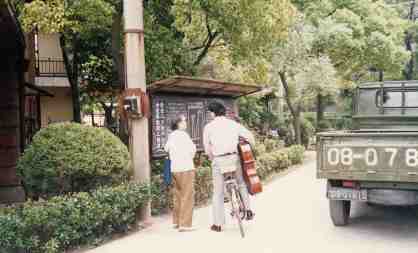
YYXY 86Cellist, Shanghai Conservatoire, 1986. My photo.

Noting that the taxonomy of instruments among cultures is modeled on important aspects of their worldviews, adducing Chinese and Arabic classifications, he considers “families” of instruments—a concept also adopted in African societies. He adduces the development of orchestras with SATB “choirs” of “traditional” instruments as a pervasive pattern of musical Westernization:

The four-part structure does reflect some major tensions in family and between genders and generations in society—and this perhaps accounts for its amazing tenacity.

He discusses the hierarchical concept of leaders and followers (accompanists) in music and society (cf. McClary on Brandenburg 5), going on to consider genres and forms within the “ruling class” of WAM.

Is it not conceivable that certain composers and groups of composers or musical cultures simply discovered better ways of producing music, and that this ability was recognized by later musicians and listeners?

Yet

We are tempted to ask whether modern music listeners are most comfortable with music reflecting a social structure that precedes the social upheavals of the French revolution and the 19th and early 20th centuries.

While noting that some of the canonical works, like Mozart operas, “go further than simply representing or going along with the inequalities and inequities of society”: they also provide a critique of the system. Nettl is

struck by the ways in which the critique is incorporated into a style that otherwise reflects a conservative view of society.

He explores the values of the concerto, with its “tension between art as the organization of forces and art as individual accomplishment”.

Under “the priesthood of the repertory” and the concept of equality he notes some of the most highly valued music, such as fugues,

in which there is textual equality of parts, and in which distinctions of power, volume, tone colour, and role specialization are relatively unimportant, a body of music that has, in addition to its sonic existence, a life in the abstract. This is music whose structural details play a greater role than the pleasurable nature of its sound, moment to moment. In general, it has no programmatic content and perhaps little in the way of obvious emotional connotations.

The discipline of the fugue “seems to result from a combination of technical and social principles”, and it had a significant afterlife even after the heyday of the art.

He reflects on the role of the string quartet in the canon—I’d love to see him or Susan McClary discussing the Große Fuge, so very full of conflict. And he surveys the quartet audience (“broken down by age and sex”, like Keith Richards).

Discussing “cultural performance”, Nettl again opens with the instructive instance of the Blackfoot powwow, going on to consider the tensions of the secular academic “commencement” ceremony, where the values and allegiances of the WAM community are celebrated and graduates admitted to the priesthood of elite music, an army to defend its beleaguered position in society. He offers an interlude on the colour pink, suggestive of subordination, curiously used for their academic hoods since 1895.

In his brief Afterword, Nettl, like Small, expands on the trepidation he expressed at surveying his heartland in such terms. In an important passage he considers the related work of Henry Kingsbury, Music, talent and performance: a conservatory system (1988), and its review by Ellen Koskoff (Ethnomusicology 34.2, 1990)—herself no hidebound defender of the autonomy of WAM, but a great ethnomusicologist focused on gender issues (see Flamenco 2, under “Gender”):

The impression Kingsbury gives to some readers is of a culture or subculture that is essentially mean and even brutish to most of its population. Ellen Koskoff’s review suggests that Kingsbury has “an axe to grind”; that he wishes to “laugh, poke fun at, or cry… at the grim reality of conservatory life” [cf. Mozart in the jungle]; and that he will only convince those musicians “who remember their own musical training with resentment and who want, deep down, to settle the score”. Kingsbury does not totally deny these aims in his response, because he closes his rejoinder by citing Howard Becker to the effect that social scientists must make judgments, and that “appeals for ‘balanced’ accounts in the social sciences are all too often merely veiled admonitions to endorse the status quo”. Kingsbury would presumably like to see change in the conservatory, change that would improve life and maybe improve music, and I applaud and agree. Even the rosiest picture would have to contain its share of grimness. And so I, too, would like to see change, although at this point I am not sure from what to what.

It’s a complicated place, the Heartland music school, existing as it does at a number of crossroads. It’s a place that aims specifically to teach a set of values, and it does so not only through practical instruction but also through the presentation of a quasi-religious system. It’s a place that puts “music” first and looks at music as if it were a reflection of a homogeneous human society. It is an umbrella under which different approaches to music can coexist, interact, and argue. It collects many kinds of music, brought from many places and composed at many different times, putting them all under one roof but making them all march to the drummer of the central classical tradition. It reflects the culture in which it lives, but it also tries to direct that culture in certain directions. […]

However, I have tried to avoid endorsing anything. If an explicitly critical stance will preach only to the converted, then perhaps an approach that tries to present a balanced picture might show champions of the status quo why they should depart from it. But that will have to be their own choice. An article of faith with most ethnomusicologists is that they should try their best to avoid disturbing the cultures they study or introducing new musics and practices, and that they should also restrain themselves from unduly encouraging musical cultures to eschew change in order to preserve the past. And, in my role of ethnomusicologist, I wish to abide by this principle, even when considering the culture in which I live. As much as I can.

Yet again I relish the lucid accessibility of Nettl’s style. As a system within a particular society, the rules of WAM deserve unpacking just like those of any other. But, just as Nettl implies, while WAM scholars and aficionados would benefit greatly from such an analysis, I suspect they may be the last to read studies like this; still, they should feel stimulated rather than threatened by this kind of approach.

For more armchair ethnography from my Chiswick home, see here. Note also The hidden musicians.

Keeping you guessing

I’ve found the last few weeks most fruitful—I hope you’re as stimulated as I am by this range of topics. Here’s a reminder of some recent posts.

Below I group them under themes, but in real time I also keep the reader [singular, eh? Mrs Ivy Trellis I presume—Ed.] guessing by purposefully alternating them, with frequent cross-links—the old “delighting in all manifestation of the Terpichorean muse“. Do click away: 

On war, trauma, and memory:

Not forgetting China:

and more… Some of my favourites from the archive, both serious and jocular, are grouped here, with a more succinct list here.

Late Beethoven quartets

Heilige

Through my teens, when I wasn’t listening to the Beatles or reading the Zen classics, I spent much of my time immersing myself in late Beethoven string quartets—almost a definition of “serious music”. And then I got to play them at Cambridge; but later (even before I read Susan McClary) I came to react against his cerebral style. Indeed, I’ve rarely heard a string quartet in live performance since the 1970s.

So after a long absence from these works, it was a suitably intense, immersive experience to hear the Salzburg-based Hagen quartet (no relation to Nina, alas) playing the A minor and C♯ minor quartets the other day at the Queen Elizabeth Hall. The three siblings in the group (Lukas, Veronika, and Clemens) have been musicking together since childhood; and Rainer Schmidt replaced a fourth sibling back in 1987. With such long experience their blend of sonority is wondrous; they have clearly thought a lot about vibrato, now using it sparingly—notably Schmidt in the unsung role of 2nd violin.

Whereas the orchestral life can be soul-destroying (see Mozart in the jungle), with as much drudge as ecstasy (and for jazzers too, square notions like health and security tend to get sacrificed in the quest for creative autonomy), from the outside, making a living from chamber music seems like an enviable life—particularly belonging to a string quartet. For the virtuoso soloist, the repertoire is narrower, and travelling solitary; for jobbing orchestral musos, chamber music may serve as a reminder of why they took up music in the first place. Still, only a minority of quartets achieve a reliable “food-bowl”—and even they can’t avoid the trying routine of airports, hotels, and promotions (for insights on the life of a string quartet, see under Quartets). And of course, such stellar groups are just the tip of the iceberg: there’s a rich repertoire for amateur combos to explore.

* * *

The extreme contrasts of Beethoven’s late quartets display the kind of splintered psyche that only became explored commonly in the 20th century. Besides Joseph Kerman’s classic The Beethoven quartets (1967), among myriad discussions of the A minor quartet, see here; it has been much analysed, not least by Susan McClary in Conventional wisdom. Indeed, it has been cited as a counterbalance on the importance of analysing any world music, such as aboriginal dream songs.

Like the Bach Air, the Adagietto of Mahler 5, or indeed Daoist hymns, the Heiliger Dankgesang (also the well-chosen name for PDQ Bach‘s co-commentator) is even more intense when heard live in the context of the whole work. The Hagen quartet’s 2005 recording used to appear on a currently dormant playlist.

Since then, to judge from the concert, they may further refined the purity of their timbre for this movement and others such as of the penultimate Adagio of the C♯ minor quartet, often sounding even more like a viol consort.

Going back to the 1930s, when the use of vibrato was in flux, the seminal recordings of the Busch quartet (at Abbey road!) from 1936–37, on the eve of devastating global warfare, are less sparing with vibrato:

And here the Heiliger Dankgesang is much more molto adagio too:

For the 1927 recording of the C♯ minor quartet by the Rosé quartet, click here.

And here are the 2017 recordings by the Quatuor mosaïques on original instruments—in line with changing modern tastes:

And, as a bonus, nearly two centuries after its premiere (which Beethoven missed as he was down the pub) the Große Fuge (or “The grocer” as it’s known in the biz) is even more challenging and revolutionary—like The Rite of Spring, its aural bombardment is always a shock:

Anyway, with fresh ears, I found the Hagen quartet’s concert most inspiring. And for magical performances of Beethoven’s late E major piano sonata, click here.

So much for the apogee of “serious music” in WAM: for the global picture, do click here. To end on a lighter and typically unsuitable note, click here for the creative tribulations of the composer according to Monty Python, and here for their Beethoven LP (“The second tune, which Beethoven said on his arrest was “just a harmless bit of fun…”).

In memoriam Bruno Nettl

Nettl

The great ethnomusicologist Bruno Nettl (1930–2020) died last week. So far we have this tribute from Philip Bohmann, and I’ll add others as I find them. Here’s a brief appreciation from me.

A great inspiration, Nettl’s writings were accessible and engaging as well as wise, his perspectives always valuable. Alongside his rare overview of the global picture, he had a gift for explaining the nuts and bolts of musicking in particular societies—seting forth from his fieldwork among Native Americans, and in Iran and south India. His 1995 book Heartland excursions: ethnomusicological reflections on schools of music makes a fine complement to the ethnomusicological literature on WAM (see e.g. herehere, and here).

NettlPosts on this blog inspired by his insights include:

DO read Nettl’s wonderful The study of ethnomusicology: thirty-three discussions—for anyone still not attuned to the importance of soundscape in society, but in search of a mind-opening book, this is what we need!!! 

The genius of Abbey road

Abbey road

Abbey road album cover: no title, band unnamed.

*Click here for my series on the great Beatles albums, with introduction!*

You can go for ages without paying attention to some of the most iconic works of music, while they lie dormant in the soul. Or, as a counterpart to my more obscure posts, we may just consider this the latest in my extensive series “Pieces that everyone knows are totally brilliant—that I now find are totally brilliant”. So it may be a case of “selling the Three-character scripture at the door of Confucius” (cf. here), but hey.

Abbey road (1969) was the Beatles’ final masterpiece, created (like Sgt Pepper) in the recording studio as they took refuge from the frenetic touring life. Given my constant stress on musicking as a social activity, I’m aware of the irony of paying tribute to such disembodied creations (see also n.1 below).

Just in case you’re on another planet, here it is as a playlist, with the songs individually—it’s far better just to put on the LP (or CD), listening to the two sides whole, with the original transitions—and silences—between tracks. [1] You can find the lyrics on sites such as this.

Both Sgt Pepper and Abbey road are full of extraordinary variety, nuance, and (even within single songs) contrast, with multiple layers and homages to the whole gamut of popular culture. Even the lighter, seemingly jocular songs contribute to the panorama. As I will comment in a general post on the Beatles, both albums make cogent sequences, resembling unstaged operas, or orchestral song-cycles, even if only Side 2 of Abbey road seems to have been so designed.

  • In the opening song Come together, “a portrait of a kind of hobo-outcast messiah”,

the screwed up vocal line […] attains a near-miraculous release in the refrain, when the reiterated minor third suddenly swings up a fifth, then down to the major third—harmonised, however, with the submediant triad.

  • The exquisite, soaring Something (George’s composition—Pollack’s analysis worth reading as always, suggesting parallels with Beethoven), punctuated by the intoxicating key shift of the hook, and a gorgeous guitar break;
  • Maxwell’s silver hammer, an unsettling black comedy;
  • Oh! darling, with Paul’s amazing gutsy vocals, the song’s “passionate intensity undimmed by its parodistic elements”. (On another autobiographical note, such was my classical snobbery in the 60s that the concurrent explosion of blues and soul was lost on me; so they could only tinge my consciousness through the benign filter of the Beatles, rather than through the hardcore medium of the Stones);
  • Octopus’s garden (Ringo!), “a child’s dream-song” (cf. Yellow submarine), though I don’t pick up on Mellers’ “hiding something blackly nasty in the woodshed“—far more applicable to the dark comic songs of Side 2;
  • In I want you (she’s so heavy), Mellers notes how the the zany vocal melisma modifies our response to the hammered dominant ninths that create the frenzy; and the refrain, “apparently in D minor but with dominant ninths of A (changing to German sixths on B flat), so that the A major triads are uncertain of their identity, wobbling between dominants of D and tonics of A”, becomes a long (over 3 minutes!) relentless 10-beat ostinato for the coda, “on the threshold of a scream”—ending the track, and Side 1, with an abrupt cut-off.

If these six songs of Side 1 themselves constitute a cohesive thread, the fragments assembled for Side 2 are still more of a continuous suite (see e.g. Pollack’s thorough discussion)—starting again on an innocent note after the preceding menace:

  • Here comes the sun (George again), its phrases linked by additive rhythms (3+3+3+3+2+2), leading into
  • Because, inspired by the Moonlight sonata, is entrancing, “runic” (again reminding me that I didn’t do nearly enough drugs—”just couldn’t seem to find the time”…). Beneath the spacy, soaring choral harmonies, suspended in the void, the keyboard arpeggios (the intro—George Martin on harpsichord!—seemingly continuing the 3+3+2 rhythm), are “like a lulling of the cradle or even a swaying of the amniotic waters”. To cite Mellers at length:

The eight-bar first strain rocks slowly in dotted rhythm through its minor triad (“Because the world is round it turns me on”), dropping rather than drooping on to the subdominant triad, and dreamily fading in a melisma. The effect of this sudominant is unexpectedly emotive, perhaps because the triadic harmony has been so static. The answering strain extends and deepens the feeling, since the melody is protracted into dotted minims, and instead of the subdominant we have a submediant chord of the ninth, the melismas wafting longer and more hazily. The resolution of this ninth chord on to the supertonic is delayed because we shift abruptly back to C sharp minor for the second stanza, which tells us that “because the wind is high it blows my mind“. When, after the second stanza, the dominant ninth does resolve on to a D major triad, it’s hardly a real modulation establishing a new, and remote, key. Its harmonic function is “Neapolitan” but the triad, on the exclamation “Ah“, immediately pivots back from D not to the dominant but to F sharp, C sharp’s subdominant. This initiates the middle section which, changing the subdominant minor to major, creates with inspired simplicity the newness and all-embracingness of love. This middle contains four bars only; after which the enveloping arpeggios return and the haunting melody sings da capo,  finally floating away in extended melismata, but without harmonic resolution. Indeed, although that flattened supertonic opens heavenly vistas, the song is virtually without harmonic progression, the only significant dominant–tonic cadence in the piece being the one that returns us to our source, and to the da capo of the melody. […] In the coda the upward leaping sixth—traditionally an interval of aspiration—is pentatonically suspended on the word “Because“; indeed the arpeggiated swaying is replaced intermittently by silence—in the use of which the Beatles betray something like genius.

Because

Slightly skewed screenshot—not the result of the intake of medicinal substances, honest guv.

  • You never give me your money opens wistfully, but successively ramps up the mood, segueing into Out of college (its introductory boogie-woogie only fleeting), an exhilarating guitar modulation into One sweet dream (“tonally rootless, rhythmically exuberant”), before merging into the hazy nursery-rhyme paradise of One two three four five six seven, all good children go to heaven—HOWEVER DID THEY DO ALL THIS?!;
  • Sun king, whose trippy feel develops out of Here comes the sun and Because;
  • Mean Mr Mustard, abruptly changing the mood—its brief refrain oscillating between E and C major, leading into a plagal cadence approached by way of the flattened seventh (more additive rhythms at the end!);
  • Polythene Pam (“a mythical Liverpool scrubber”, apud John) and
  • She came in through the bathroom windowboth songs “comically scary portraits, at once within the dream and part of the crazy-kinky scene that passes for today’s reality”, before the brilliant final sequence:
  • Golden slumbers, “an ironic title to an ironic song”, with “Sleep, pretty darling, do not cry, and I will sing a lullaby“, with soothing strings, contrasting with the raucous refrain, leading into
  • Boy you’re gonna carry that weight—savage, grim, with a memory of You never give me your money, segeuing into
  • The End “abandons words for a furious hammering of percussion, which leads into a long instrumental section, all dominant sevenths in rumba rhythm, but rocking a tone lower than the starting point, getting nowhere [great consecutive guitar breaks from Paul, George, and John!]. Suddenly the hubbub stops; there’s a tinkling of A major triads on a tinny piano; and Paul’s voice returns to sing ‘in the end the love you take is equal to the love you make’. The phrase descends scalewise, harmonised in parallel triads that fall from F major, to E minor, to D minor, to A minor, and so to C major.” And then, just when you think it’s all over,
  • Her Majesty (an unlisted “hidden track”), sung by Paul—a perfect little throwaway fragment, a nonchalant farewell to Beatledom.

Mellers observes that

The seraphic vision of Because was momentary, and the rest of the disc trips away from vision and from Pepper‘s awareness of human relationships into a magical mystery tour that, if it’s a dream, is a bad one, and no escape.

Still, the cumulative effect, with its multiple layers, is supremely life-enhancing.

sessions

[1] I trust you won’t be thrown off the scent by the many cover versions masquerading online (to me they sound awful, almost sacrilegious). That’s not to belittle cover versions generally—they’re part of music’s whole creative social afterlife—but they can make us appreciate the craft of the original all the more. By contrast, I want every single guitar break, every tiny vocal inflection, to be faithfully reproduced and worshipped come sta for eternity, preserved in aspic—gleefully aware that this contradicts just about everything I’ve ever written (e.g. under Unpacking “improvisation”). Indeed, the release of the original sessions (with alternative tracks and running orders), and the remixes, remind us that even a studio recording is a living organism, subject to variation: what I regard here as so sacrosanct is just one possible realisation. The songs were recorded individually, and only later arranged into the sequence that we now found so cohesive and definitive.

Transmission and change: Noh drama

kakegoe

Further to my post on contemporary Noh drama, I’m grateful to Allan Marett for drawing my attention to

the lucid text well rendered in fluent translation by Edgar W. Pope—no easy feat.

I introduce this lengthy article here not just for its insights on Noh, but because it bears more widely on the transmission of traditional genres—including the WAM canon. Indeed, it often reminds me of debates over rubato in romantic piano music.

Bruno Nettl has suggested parameters for change in musickings around the world; Noh would seem to belong to his rubric of “gradual, normal change” (“An absolutely static musical culture is actually inconceivable”; for Daoist ritual, see e.g. here), and the concept of “isolated preservation”. Fujita’s article also bears on Nettl’s discussion of flexibility and improvisation.

Within the conservative goal of preservation, Fujita seeks to reconcile apparently conflicting emic and etic viewpoints, and the tensions between ideal and real performance—common concerns of those analysing world music. He wisely considers the whole Noh community, and addresses both the nuts and bolts of performance and the mystical underpinnings of the tradition. As Pope summarizes:

A puzzling situation defines the contemporary transmission of Noh. On one hand, the genre’s community of practice is governed by strict orders to preserve musical sound through repeated imitation and to avoid change at all costs. On the other hand, the community discourages explicit dialogue between teachers and learners concerning what exactly constitutes those ideal musical sounds as well as the extent to which those sonic ideals are being faithfully maintained across performances. With a focus on the transmission of hiranori vocal rhythms, Fujita explores the ambivalent strategies with which participants navigate this conundrum and discovers a paradoxical process by which Noh’s so-called “preservation imperative” actually encourages musical change.

Pope also highlights the relationship between ideal models and actual performance, discourses of continuity and authenticity, and the sometimes-frustrating ambiguities of self-consciously “traditional” arts.

The article also demonstrates Fujita’s characteristic methodological approach: combining close musical analysis with perspectives gained from extensive ethnographic experience, and using critical historical insights to complicate his own ethnographic observations and challenge common scholarly assumptions.

As Fujita explains:

According to the theorists cited above, the place of performance is precisely where creativity happens. But in reality, do the spectators gathered in that place of performance always expect creativity or novelty from the performing art? At each and every performance, do they always focus their attention on how much creativity is being exhibited? One cannot necessarily say so. Depending on time and circumstance, many spectators are likely to expect not something new, but rather a past performance repeated in the same way, here and now. A performance that makes use of bodily movement and sound occurs only once, and then immediately vanishes. The desire to try repeating it again the next day often arises; but can we say conclusively that creative processes and interpretive variation exist there as well? […]

Classical music is like an antique, in the sense that as times change it does not necessarily adapt itself to the changing tastes of its audience. In order to transmit this antique from generation to generation, the community itself has taken on the distinctive form of the iemoto system, in which the iemoto and their branch families are at the apex, and beneath those, in the form of a tree, are positioned their disciples and the disciples of disciples (cf. my image of the iceberg). The focus of this essay is the acquisition by low-level members (disciples) of the techniques held by high-level members (teachers).

Performing artists must be sensitive to the changing demands of changing times if they always construct their performances on the basis of unchanging prescriptions, it is likely that audiences will eventually grow tired of them, and the art itself will become extinct. [….]

This high-pressure imperative takes the form: “Even if it’s boring, don’t ask why—just preserve!” […] Suppose, hypothetically, that you were to find yourself a member of such a community. You yourself have no clue as to what the purpose of preservation might be. And yet you are compelled to participate in preservation. You think to yourself “What’s the use of this? It’s boring. I want to quit!” But you are unable to defy the preservation imperative, and as your participation immerses you completely in the various mutually contradictory rules of practice that fall under the preservation imperative, you experience, at some times and in some cases, a joy in the very practice of preservation itself. Once you have had this sort of experience a number of times, you reach a state where you suddenly think to yourself “I’m glad I’m doing this.” Even though you are repeating (or being made to repeat) over and over again things that have been determined in advance, one day a feeling even comes over you that some realm of freedom is finding expression here—a world in which you feel that a kind of richness that surpasses the merely technical has been secured. The community that provides this strange experience is the community of classical music transmission in Japan.

Fujita suggests the enduring basis of this conservatism in the vestiges of Confucian ideology, with instances from Buddhist chant and biwa music (and of course around the world other ideologies impose limiting effects on creativity in varying ways and degrees), and a brief aside on the aesthetics of calligraphy. He goes on to observe that the community’s emphasis on preservation is modified in actual practice, adroitly suggesting why my suggestion of punk versions of Noh was so impertinent (not to mention this).

Notation is always an imperfect tool. Analysing the rhythmic structure of Noh, Fujita uses tradional graphical representations, largely to reveal their inadequacy. Indeed, he notes that in the past, they “were considered an impediment to learning and were apparently kept hidden”; that they have never come to be used as standards; and that the actual sound of Noh deviates greatly from such schemas.

A stable flow of sound that could appropriately be called a pulse never reaches your ear. You hear a series of terrible arrhythmias, so to speak. As a result, it is generally difficult to perceive an eight-beat meter [2] from the actual sound, that is, to reconstruct the graphical representation from the sound.

Fujita explains in detail the vital roles of the kotsuzumi and ōtsuzumi drums. Commenting on the great flexibility of the pulse, he gives a magnificent analogy:

For the reader who is unfamiliar with the sound of Noh, please envision, for example, a scene in which a drunk person is singing a song with a great deal of emotional expression. Large changes in the pulse will often occur. If a sober listener who knows the song well tries to clap along with the performance, it will become clear that there are large expansions and contractions in the intervals between pulses, of the kind we have described here.

On singing, Fujita observes:

Scholars who try to explain the rhythm of Noh singing usually abandon from the beginning any attempt to explain this phenomenon of elasticity of the aural pulse. Many of them, when explaining rhythm, begin by introducing a graphical representation (such as Figure 1) that shows twelve syllables arranged over eight beats. After that they add some such commentary as the following:

In transcription it appears as shown above, but in actual performance the rhythm is transformed, through various techniques, to the point that this basic meter can barely be perceived. When watching Noh, the parts where one cannot follow the beat in relation to the performance on stage are mostly these hiranori parts, which are constructed through an extremely complex and subtle rhythmic sense. One might call it a rhythm that does not show its rhythmic sense on the surface.

This is clearly a declaration that the writer has given up on explanation. But why does he arrive at this kind of impasse? The problem is that with no detailed observation or description of contemporary practice, he has developed an explanation that depends from the outset on graphical representations, which are not actively used as models within the community. We have seen that the rhythm of Noh, when compared to its graphical representation, involves large tempo changes and is greatly “distorted” in performance. We must not, however, take such “distortion” [henkei] to mean literal distortion. The “distortion” of Noh rhythm is systematic and has been thoroughly drilled into the performer in the course of practice. To that extent, rather than being the result of individual contrivance, it is more accurate to think of it as something that has been habitualized.

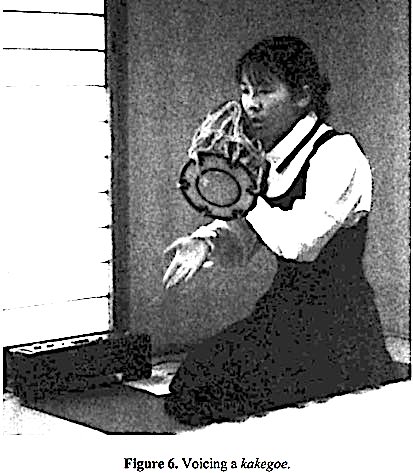
He then identifies the set of norms that produce such “distortion”: the way that the drummers memorize sequences, with mnemonics for timings (komi, the preparations for producing sounds) and timbre, and the haunting kakegoe vocal cries (mostly in the intervals between pulses, and a major element in Noh’s rhythmic elasticity). The interplay of the two drummers is crucial. We may be only mildly reassured by the conclusion of this section:

The form of explanation that begins with something like “Noh rhythm is based on an eight-beat meter”, although not at all incorrect as a historical explanation, turns out to be completely meaningless as a description of current practice. In reality, as we have seen, the lengths of drum syllable sequences used by ōtsuzumi and kotsuzumi players do not necessarily fill up a span of eight beats; and performance proceeds from a consciousness centered on those drum syllables. During a performance, moreover, many performers have no idea where they are (i.e., which beat they are on) in terms of pulse numbers. In actual practice, this is no longer eight-beat music. It is quite natural, then, that the sound produced by the performers does not sound like eight-beat music.

While he points out that performers are not entirely oblivious to graphical schema, they may adopt some principles and regularities that they perceive therein for the purposes of their own performance.

Principles discovered by performers for themselves are not used as oral explanations in education. Moreover, graphical representations of those principles have never come to the forefront and circulated as a primary means or as standards for learning. This has been especially true in the study of Noh singing.

In §3 Fujita takes a historical approach to komi. While the concept has long existed, it has only been emphasized more recently. Identifying “surreptitious” change below the preservation imperative, he astutely unpacks emic and etic approaches:

When scholars accept without question the ideology of the preservation imperative, thinking that the practices of traditional music transmit the forms of ancient sounds mechanically like a tape recorder, and repeating like parrots the community’s assertions that they “do it exactly the way it was taught,” it is evident that we have a problem. On the other hand, a standpoint that assumes people in the community are simply lying when they say “we do it exactly the way it was taught”, that focuses only on empirically tracking down changes in actual sound and seeking to discover in those the creativity of performers, could be seen as rushing to conclusions and distorting the object of research. What we need, then, is to look carefully at how the ideology actually operates.

So he goes on to discuss the language used since the late Meiji period to inhibit undue reliance on graphical rhythmic schema—particularly with regard to singing, the most popular activity within the amateur community.

With regard to singing practice, sound itself is excessively emphasized [!]. Everyone in the community is expected to imitate faithfully the sound of Noh singing. From the beginning, they must not rely on schemas that serve as frameworks. They must not look at graphical representations. They must not have any interest in theory. This sort of thing is hammered into their heads.

Fujita cites a passage from 1943 [his italics]:

At first there is no need to think about the logic of jibyōshi [the eight beat meter]. One simply has to swallow as a whole the actual way of singing with the meter, and pound it into one’s memory until it becomes a habit. Regardless of any theory about meter, its actual use is nothing other than a focusing of the spirit [kiai], and so the best way to give life to the meter is to grasp the focusing of spirit that appears in your teacher’s singing. In short, the fundamental problem must be to build a foundation from which you can sing more or less together with the meter, even if you don’t know how to keep the meter. You can try to study meter on the basis of Noh singing, with its uncertain pulse, but all you will get is a logical understanding, which you will not necessarily be able to use in the actual practice of singing. Even worse, you may well end up with meter for the sake of meter, not meter for the sake of singing.

He explores the learning process, and the interaction of singers and drummers:

Of course, the singer’s memory of the sound is not perfect. The singer, furthermore, has no understanding of the schema. It is therefore entirely possible that discrepancies will arise between the singer and the drummers in some places. For example, it must frequently happen that a singer starts one pulse too early, or one pulse too late. Those who do so are instructed to practice that part over and over, and as a result of this repeated practice acquire a feeling of “falling into the meter”, even in that part.

§4 goes on to discuss the mysticization of identity: the realm of kokoro (heart/mind)—”the place for secret manouevring”. Here he turns to the flute:

In the following episode, a teacher of Noh singing critiques the flute-playing of one of his students. Unlike the drums discussed in §2, the flute is an instrument with a low degree of structure in the realm of articulation, and in that sense we could say that it is similar to vocal performance. On one occasion, a flute performance was critiqued in the following way. Kaneuchi Yoshihira was the youngest Noh flute player during the time my teacher was alive, and he also had a weak physical constitution. One time when he was playing flute for the otokomai dance in “Atsumori” he noticed that his teacher was looking at him; apparently he froze, and the sound of his flute abruptly stopped. Nevertheless out of fear of his teacher he tried even harder to play, while taking kurai, but finally he lost his composure and was unable to produce a sound. He continued on like a madman, puffing away at his flute without making a sound, until the piece ended. He then went back to the musicians’ room, cringing at the thought of the scolding he would get. But he found his teacher to be in an extremely good mood. “It was fine, it was fine. Your iki [spirit] and your kuraidori [taking kurai] were very good today.” Kaneuchi spoke of how happy he was when he heard those words of praise, and said that for the first time he felt self-confidence in his flute playing.

Noting a further tendency: “an irresistible turning toward the enjoyment of unrepeatable immediacy”, he ponders the apparent conflict between emic (“we always do it the same”)  and etic (“these details are completely different”) views (again, cf. Nettl), and lists significant emic terms that appear to resolve them.

morae
Observing that

in spite of its rigid, closed, and conservative appearance, there actually do exist “free” and “creative” processes,

Fujita concludes by discussing the recent influence of audio-visual techology on the learning process, which was slow to gain acceptance but is now compressing the space for the preservation imperative.

Such thoughtful, detailed analysis is a valuable contribution to studies of change in musickings around the world.


[1] For this post I silently [sic] convert the “nō “of the text to “Noh”. For more in English, see e.g. here.

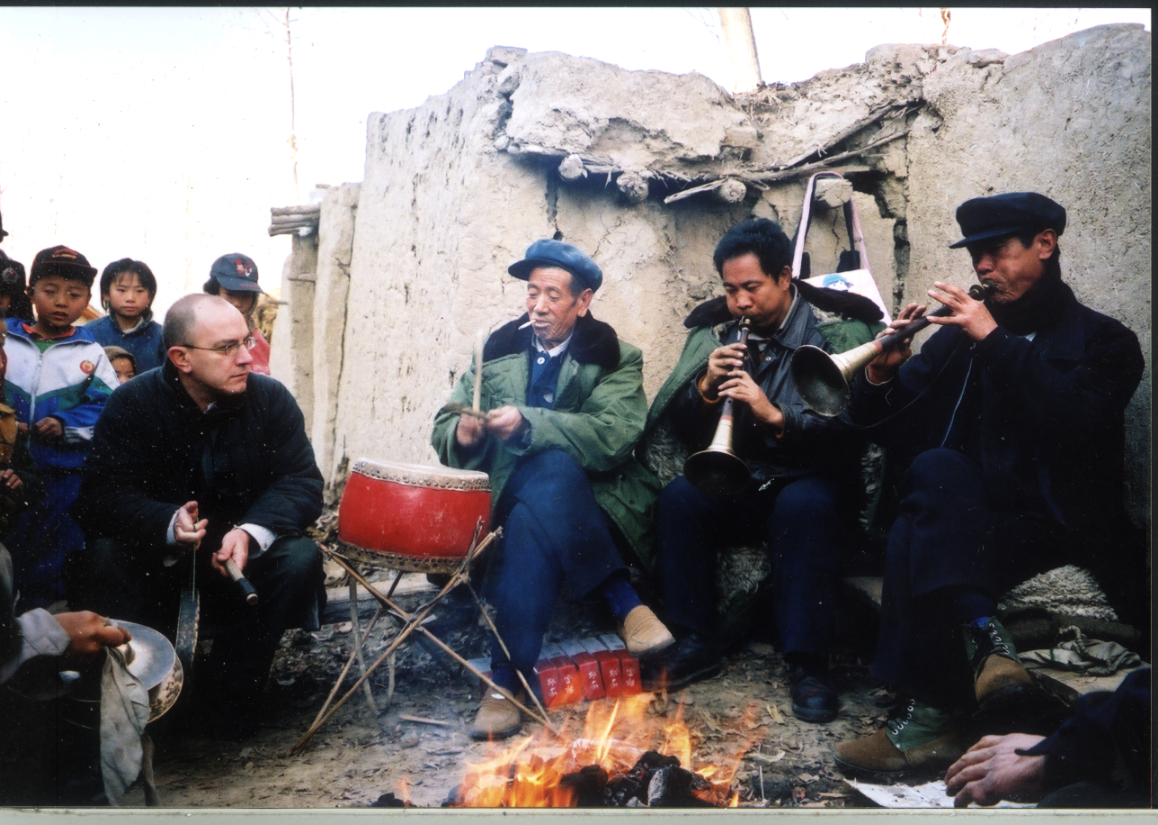
[2] For the very different (and more audible) eight-beat structure of Chinese shawm bands and Daoist groups, see here. For official attempts to replace ritual skills with discursive knowledge, see Training Daoists in Shanghai.

A 2019 retrospective

For my sake as much as yours, I’m rounding up some themes from the last year (cf. my post for 2018)—do click on the links, both below and in the posts themselves! There’s plenty more to explore under the monthly archives as you scroll down in the sidebar.

I continue to add vignettes on the Li family Daoists (always bearing in mind my film and book!):

and I augment my post Walking Shrill with

On my other main fieldsite of Gaoluo (summary here),

Bearing on both the Li family and Gaoluo is

And under the main menu, it’s always worth exploring the many fieldnotes under Local ritual, and the various pages under the Themes sub-menu.

Among many posts on the great Yang Yinliu are

For links to ritual life around south Jiangsu, see

and for the rich cultures of Fujian,

Note also

For more on China, see

The plight of the Uyghurs is a pressing concern (see also Uyghur tag):

Note also

Further afield, see

The category of “world music“, or rather musicking in societies around the world, continues to grow. For salient perspectives on musical cultures worldwide (notably the brilliant, accessible work of Bruno Nettl), see

For diverse regional genres, see e.g.

For the musics of Iran, see

Pursuing my shawm theme. see

Among several posts on Italian folk culture are

See also

Note also new posts on flamenco.

On English culture (roundup here):

and having given Alan Bennett time off for good behaviour, he stars in several recent posts, notably

Under the WAM category, posts include

and recent additions to the Mozart tag, like

Under the Messiaen tag, major new posts are

On a lighter note are two classics on rubber chicken:

In my Must-Listen Playlist of songs (complementing the sidebar playlist for local Chinese traditions, with commentary here), most spellbinding is

And I continue the theme of stammering:

Also well worth a read is

And don’t forget the *MUST READ* category—among which my personal choice remains

Backing vocals

In his ever-stimulating BBC Radio 3 series The listening service, Tom Service explores Why backing vocals matter.

His illuminating examples open with Aretha’s irresistible I say a little prayer (a gem in my own Playlist of songs), going on to admire the artistry in the interplay of solo and chorus through Gilbert and Sullivan, Verdi,  The Beach Boys, Monteverdi, Purcell, and Stravinsky.

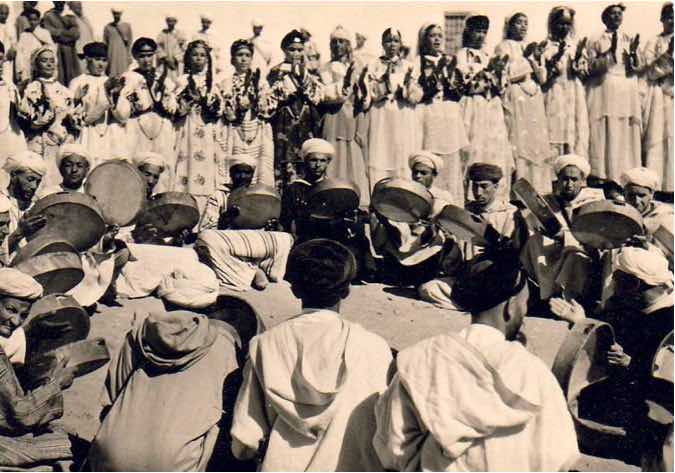
While his juxtaposition of WAM and popular music is always instructive, as usual I’d love to expand the topic to embrace musicking around the world, equipped with the canons of ethnomusicology: Noh drama, Daoist ritual such as the Invitation), Moroccan ahouach, and so on.

The Pardon, 1991


Mahler 5 as you’ve never heard it

*For an introduction to my whole series on Mahler, with links, click here!*

Mahler 5

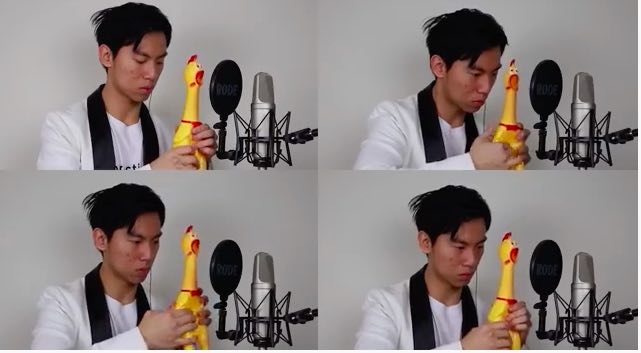
Given that I adore Mahler 5, this is a weird way to introduce it. But having already delighted in Pachelbel’s capon, another gem from Two Set Violin‘s rubber chicken playlist is this unlikely rendition of the symphony’s opening trumpet solo—and it’s even funnier if you share my devotion to the work:

Just as well John Wilbraham didn’t know about this—he might have found the temptation too hard to resist.

On that trumpet solo, here’s an interesting post, that supplements Slonimsky‘s Lexicon of musical invective (no turn unstoned) with early reviews of the symphony like

Ugly symphony is well played . . . Mahler of Vienna writes bad music.

A long and tedious work.

I do not believe that this symphony is the kind of music that will live … It is a symphony which, it is devoutly hoped, will never again be heard in Chicago.

Of originality, he has not the slightest trace. His themes are trivial, sometimes vulgar, always uninteresting and lacking utterly beauty of melodic curve.

Hmm. Given that I entirely share the modern veneration for Mahler, and for the 5th symphony in particular, I don’t seem to be making much of a case for it. Just as relishing Always look on the bright side of life needn’t spoil our appreciation of the Bach Passions, please don’t let all this put you off the Real Thing— here’s Bernstein with the Vienna Phil yet again:

The great Klaus Tennstedt in a recording from 1980:

And Claudio Abbado in 2004:

For S-S-Simon conducting the opening of the 2nd movement, click here; for a creative use of the Adagietto, here, and for my own irreverent vision of a swing-band version, here. For a piano roll of Mahler himself playing the 1st movement, see here.

And for more artistry on the rubber chicken, see under The acme of Daoist kitsch.

The wonders of juggling

me juggling

Before a concert at Michelham Priory, c1983.

Part of my baptism in early music took place touring around England with the Medieval players in the 1980s.

MP posterWhile I played rebec, I also learned the basics of juggling from Mark Heap and Mark Saban—though I was happy to leave the stilt-walking and fire-eating to them. Hard to imagine now, but later on European tours with baroque orchestras some of us used to fill the longueurs of hanging around at airports with impromptu juggling sessions.

Juggling inevitably becomes a flashy, often comical stage act (with a variety of props like clubs, and not least the old torch, egg, and frying-pan trick), but Mark Heap could transform it into a pure, transcendental activity (later offering some vignettes in Green wing).

Technical virtuosos rise to the challenge of five, seven, and even eleven balls, but that largely excludes fantasy. The variety of patterns with a mere three is a thing of wonder—all the more so with passing between two jugglers.

I note that ancient China features in the long history of juggling worldwide:

During a battle in about 603 BC between the states of Chu and Song, Xiong Yiliao stepped out between the armies and juggled nine balls, which so amazed the Song troops that all five hundred of them turned and fled, allowing the Chu army to win a complete victory.

So much for the military hardware of the modern PLA…

The way that the “given” building blocks are creatively combined into a routine reminds me of the process of musical creation in performance, with its balance of perspiration and inspiration. And it evolves constantly. For some taxonomy, see here; the vocabulary is cute (though, like musicians, many jugglers won’t necessarily be aware of it)—all kinds of cascade, mess, column, shower, shuffle, box, grab, claw, bump, yoyo, and so on, easily found in online videos. I haven’t quite found the fake throwaway that Mark Heap used to do so beautifully.

Anita Bartling
Anita Bartling (1887–1966).

To make up for the usual male-dominated perspective, there are fine introductions, with video links, to female jugglers in history here and here.

Left: wedding party, Mantua 1999.
Right: on tour with EBS, Lyon 1982.

Like clapping, juggling is an art that should be cultivated from young. Start, and indeed continue, with bean bags (cf. the Larson Stradivarius cartoon: “Violins galore! Start the kids on one today!”)!

beanbags

More recently I tried to revive my long-dormant juggling skills on the island of Marmara

Unpacking “improvisation”

Improvisation in music is a concept that can easily mislead. The popular cliché is to contrast jazz and Indian raga with the detailed, fixed prescriptions of WAM; rather, it’s profitable to subsume improvisation under the whole process of musical creation, considering more and less flexible frameworks for performance.

Bruno Nettl has paid much attention to the subject, co-editing two splendid books:

  • Bruno Nettl and Melinda Russell (eds.), In the course of performance: studies in the world of musical improvisation (1998)
  • Gabriel Solis and Bruno Nettl (eds.), Musical improvisation: art, education, and society (2009).

In Chapter 4 of his masterly The study of ethnomusicology: thirty-three discussions, “Inspiration and perspiration: creative processes”, Nettl unpacks the issues in typically illuminating fashion. Pondering “What is the nature of musical creation?”, he explores the continuums mediating between composition and performance. Here’s a typical passage showing how he treats all human musickings on a equal footing:

Schubert is said to have composed a song while waiting to be served at a restaurant (presumably by a slow waiter), quickly writing it on the back of a menu; Mozart turned out some of his serenades and sonatas almost overnight; and Theodore Last Star, a Blackfoot singer and medicine man, had visions in each of which, in the space of a brief moment, he learned, from a guardian spirit, a new song. But Brahms labored for years on his first symphony, Beethoven planned and sketched ideas for his Ninth for over two decades, and William Shakespear, an Arapaho elder, said that when he took a motif from one song, something else from another, and a phrase from a third, thus making up a Peyote song, it might take him a good part of an afternoon. The xylophonist of a Chopi orchestra made up music as he went along, but he was constrained by rules articulated by his leader. The North Indian sitarist sits down before his audience and creates a performance of new music on the spot, but he can do this only because for hours every day he practices exercises that he has memorised, as he maintains in his mind a musical vocabulary on which he can draw and a group of rules that tell him, once he has selected a raga, what he must, may, or cannot do. A Kentucky mountaineer about 1910 sang “The Two Sisters” in a tavern, his friends admiring a new twist he put into the refrain. And the overjoyed Bach lover after the cello recital exclaims, “She’s never played it like this before. She makes the suite live like no one else.” In some sense, each of these musicians has created music, but music scholars actually know very little about the way in which such music comes about, especially in its innovative aspect, which is what they most admire. They believe, as Blum (2009) explains in detail, that when music is produced (in any sense of the word), something new is being created.

There is innovation—of different sorts—in the composition of a symphony, in the jazz improvisation on a well-known show tune, in the unique rendition of a Japanese chamber work that has been handed down with little change for generations, or in a rendition of a standard string quartet. Ethnomusicologists in particular must deal with what is new, new in a sense generally understood by them but new also within the specific cognitive framework and understanding of its culture.

But what is “newness”? Speaking cross-culturally, what may be heard as new composition in one culture might be regarded as simple variation in another. Judging the degree of innovation is a tricky business. The Persian improviser who by the standards of European composition gives his audience something different each time he performs may not be, in his own manner of musical thought, doing something really new, but simply “playing a particular mode”. By contrast, the Blackfoot singer who learned a song in a vision may have thought of it as a new song, even if objectively it sounded virtually identical to a song that had been received by one of his friends in another vision. The South Indian musician with a penchant for giving her audience unexpectedly strange vocalizations runs the risk of rendering something outside the realms of propriety and being criticized for not knowing her basic material. The American composer who writes a piece inspired by Hindemith or Stravinsky might be criticized for presenting something belonging to the past and thus not properly innovative.

Nettl goes on to suggest three intersecting continuums:

it is also the result of the manipulation and rearrangement of the units of a given vocabulary, of hard work and concentration. The concepts of inspiration, of genius, and of acquiring music directly from supernatural sources are very widespread among human societies, simple and complex. Haydn worked regular hours and depended on some kind of inspiration; when it did not come, he prayed for it, rather like the Native American seeking a vision who is also, in effect, praying for songs. At the other end of the line is the concept of composition as an essentially intellectual activity, in which the musician consciously manipulates the materials, or building blocks, of music […]. […] The listener may be unaware of all the care that went into the preparation of this complex structure. But such an approach is not limited to societies with written notation and music theory texts. Native American composers of Peyote songs may be equally careful, using and abiding by general structural principles that govern the song, musically making clear a number of intricate relationships, deriving new phrases from earlier ones, all within a rather rigidly defined formal framework. Yet it seems unlikely that the typical Native American listener understands the details of the structure.

The two ends of the continuum merge: Mozart’s music sounds to many divinely inspired, and we know it was often composed quickly, yet has incredible consistency and great complexity. The songs of the Yahi of California, sung by Ishi, the last “wild” Indian, each ten seconds long and using only some three or four tones, exhibit considerable sophistication in their internal interrelationships, with a logic not totally unlike that of Mozart. An Iranian musician says that his improvised performance comes “from the heart”, but analysis shows us highly structured and sophisticated patterns unique to the performer. A performer of improvised Indian alapana learns a vast repertory of melodic and rhythmic units that can and must be interrelated in many ways, exhibiting her skill in showing the multitude of combinations she can control, yet many in her culture regard this music as essentially spiritual. Each case confronts us with aspects of both ends of the continuum, obviously in different proportions.

  • From improvisation to composition—two versions of the same process. Again, Nettl compares Schubert’s rapid composition of a sonata with the assembly of an Indian improvisation: “the fact that Schubert used paper and pen might actually be considered incidental”. He suggests that even the gigantic labour of composing a symphony is cognate with the technique of a Yahi Indian composer, and that Horowitz’s multiple renditions of Beethoven may be compared with an Arabic musician performing the maqam.
  • From precomposition to composition to revision: another process common worldwide, played out over years or minutes.

Nettl then stresses the false dichotomy between the composing of “art” and “folk” musics:

There seems no reason to regard composition in cultures with oral and written traditions as different species. […] In each culture, the musician is “given” something and then has the job of adding something else, but there are many different kinds of “given” and “added”.

Discussing the balance between the two, he concedes that there are many societies in which innovation is restricted, adducing Anglo-American folk song and South Indian kriti.

What is “given” to the creator of music are the building blocks and the rules of what may be done with them; innovation consists of how the options are exercised.

Finally Nettl homes in on “improvisation”—whose definition as “the creation of music in the course of performance” already looks dubious. As always, he gives useful leads to the whole history of research on such topics. He praises Paul Berliner’s Thinking in jazz, the classic analysis of the diverse elements on which jazz performers draw.

As improvisation received more attention, ethnomusicologists also began to see it as complex syndrome of behaviours, and the distinction from traditionally conceived composition began to blur.

Left: Clara Schumann with Robert; right: Dariush Talai.

He notes the role of improvisation in WAM (cf. On “learning the wrong music”), from early performances where “the quality of musicianship is judged by the degree to which the improvised piece sounds as if it were not improvised” to the 19th-century rhapsodies and impromptus, which were “composed and written out but seem to be intended to make the listener think they are improvised, or at least somehow connected with an immediacy and spontaneity of creation”. Organists are perhaps the main perpetuators of the tradition of improvisation in WAM (see here and here).

It’s good to find WAM taking its place where it belongs, within ethnomusicology, or “all the musics of the world”. In the later history of WAM, as increasingly prescriptive notation (a red herring: see also here), and the recording industry, came to limit improvisation, I can’t help feeling that WAM musicians have sacrificed a lot.

Themes in the collection Musical improvisation include Ukrainian funeral laments, jazz, and Persian music—and several authors write on WAM, including Robert Levin, whose renditions of Mozart, notably his improvised cadenzas, are so brilliant. We might now hear much of the romantic piano repertoire as improvisations to which performers gave a fixed form, as Messiaen did later with his Messe de la Pentecôte. An earlier instance might be the astounding harpsichord cadenza of Brandenburg 5.

Indeed, it makes sense to suggest that the kinds of things we call improvisation exhibit such variety—everything from simply adding ornaments to a composition to totally (well, almost totally) “free” improvisation, from oral composition to following precise rules in re-creation—and are practised in so many cultures that improvisation ought to be considered the central form of music creation, with traditional Western-style composition, with pen and ink, as a highly developed subtype.

In his introduction to In the course of performance Nettl also mentions Albert Lord’s 1965 The singer of tales and the study of Gregorian chant. Among topics covered in the volume are Javanese gamelan, African–American girls’ singing games, Italian folk song, and the Preludes of Clara Schumann (for an idea of how she might have improvised, do listen to Hélène Grimaud‘s playing in the Brahms concertos—in particular the slow movements!). See also the Dream songs of aboriginal people in Australia.

All this also suggests ways of understanding the whole range of musicking in China: shawm bands (whose music, misleadingly, often sounds “improvised”), silk-and-bamboo (perhaps akin to Irish music—the heterophony of instrumental ensembles is often akin to the ornamentations and divisions of early WAM); as well as folk song, the qin zither (e.g. here), the parameters of performing Daoist ritual, and so on. And it makes yet another caveat against reification: performance as process.

Reading Nettl is endlessly stimulating.

See also Bernard Lortat-Jacob at 80.

Yin and yang: the divine Hélène Grimaud

More images here.

On this blog I’ve featured the radiant magic of Hélène Grimaud, in

—all of which you simply must listen to. Here’s a further hommage.

See also her 2003 memoir Variations sauvages, English translation Wild harmonies: a life of music and wolves, 2007); and for a most insightful article, do read this New Yorker piece from 2011.

Since her London appearances are far too infrequent (her planned visit in June 2020 had to be postponed—has she really not come here since her numinous “Water” recital at the Barbican in 2015?), I resort to relishing her performances of the two colossal Brahms piano concertos online. Here’s a trailer:

And the two concertos complete:

For a sequel on tempo and timbre in Brahms, with a HIP version of the 1st concerto, see here.

I trust you too will be unable to resist going on to admire her live performances of both works online (here and here)—indeed whole days can, and should, go by as you bask in all of her ouevre there.

OK, one can’t help noticing that she is one of the most entrancingly beautiful people ever to grace the planet—neither here nor there, one might say, but her own unassuming radiance goes hand in hand with her music. She embodies a perfect combination of yin and yang, with both innige spiritual intimacy and intensely muscular emotional intelligence.

Here she gives an interview in French on the Rachmaninoff concerto and Abbado:

Here she plays Schumann with Ann Sofie von Otter:

And returning to the Ravel concerto, here’s the exquisite slow movement again:

Busoni HG

And do click here for my tribute to her 2023 London concert, featuring Beethoven, Brahms, and Bach–Busoni.

Meredith Monk

MM

Pursuing my New York theme, another great female composer on the splendid T-shirt is Meredith Monk (b.1942).

Donald Macleod’s ever-engaging coverage on BBC Radio 3’s Composers of the week makes a useful introduction; see also this appreciation from Tom Service. Here’s an extensive playlist:

Some tracks I like:

Porch (1970):

Songs of ascension (2008):

Hocket (1990) (cf. here):

Here’s a playlist for her opera Atlas (1991), inspired by the intrepid traveller Alexandra David-Néel:

Monk’s sound world has affinities not only with minimalism (cf. here, and here) but with folk and early music. Apart from music, theatre, and dance, her work in film is also striking. Here’s an excerpt from Book of days (1988):

And to complement my Halloween post, here’s Scared song (1986):

I love the way New York (and indeed London) has room for this kind of thing alongside Blondie, Madonnapunk, and so on—genre-bending, always dissolving boundaries.

Some remarkable female vocalists feature prominently in my Playlist of songs, such as Nina Hagen, Barbara Hannigan and Enza Pagliara. Cf. Bobby McFerrin.

The Masque of the Red Death

Poe—Caplet—Corman


Caplet

Here’s some seasonal macabre.

The Conte fantastique after Poe’s The Masque of the Red Death by the gifted André Caplet (1878–1925), for harp and string quartet, deserves to rank alongside the better-known works with harp by his contemporaries Debussy and Ravel.

Given that today’s date (#DieInADitchDay) has been constantly on the lips of sinister, mendacious Tory toffs desperate to pull up the drawbridge and feast on the bendy bananas so long denied them, the plot has a topical ring:

The prince and his nobles have taken refuge to escape the Red Death, indifferent to the sufferings of the population, sealing the doors shut and awaiting the end of the plague in luxury behind the walls.

Caplet

Prix de Rome 1901: far right, Ravel; 3rd from right, Caplet. Source here.

Here’s Caplet’s Conte fantastique with the great Lily Laskine (1893–1988):

It’s dedicated to Micheline Kahn; meanwhile in Paris between the wars, Noor Inayat Khan was studying the harp with Henriette Renié, another teacher at the École Normale de Musique.

film

Caplet’s sonic treatment is just as dramatic, and its dénouement just as scary, as Roger Corman’s 1964 film The Masque of the Red Death, starring Vincent Price. Here’s a trailer:


What is serious music?!

*For main page, click here!*
(in main menu, under WAM)

I’ve just added a lengthy article on the demotion of WAM, and the flawed concept of “serious music”. It’s based on the stimulating work of Richard Taruskin on the “classical music crisis” prompted by the defection of critics to pop music since the 1960s, as he challenges “centuries-old cultural assumptions” such as the myth of musical autonomy. This is typical of his bracing style:

The question that throbbed and pounded in my head was whether it was still possible to defend my beloved repertoire without recourse to pious tommyrot, double standards, false dichotomies, smug nostalgia, utopian delusions, social snobbery, tautology, hypocrisy, trivialization, pretense, innuendo, reactionary invective, or imperial haberdashery.

On the evidence before me, the answer is no. The discourse supporting classical music so reeks of historical blindness and sanctimonious self-regard as to render the object of its ministrations practically indefensible. Belief in its indispensability, or its cultural superiority, is by now unrecoverable, and those who mount such arguments on its behalf morally indict themselves.

I go on to query his recourse to the term “serious music”, broadening the topic to musicking in other societies.

If there are so many “serious” genres all around the world, what seems exceptional about WAM is its apologists’ sense of mission, and their concomitant sense of embattlement. Without wishing to discourage ongoing research, perhaps we should just leave the WAMmies to get on with their arid defences of a waning prerogative. So we might simply ignore labels like “serious” as a nervous attempt by an impotent elite to claim that “our culture is superior to yours”.

That’s just a taster for the article—now click here!


A recognition sextet, and more stammering


Sextet

To follow my Mozart opera dream:

Of all the wonderful music in The marriage of Figaro, I think we in the orchestra all lavished particular loving care on the Act 3 sextet Riconosci in questo amplesso, in which Figaro recognizes his parents.

The focus on the rather naff dramatic business tends to distract from the riches of the exquisite music—there’s so much delight in caressing the orchestral accompaniment. Here’s our 1993 recording:

A minor bonus for me personally is the role of the stammering notary Don Curzio (sadly, I wasn’t employed as a voice coach). His imp-p-pediment is harder to suggest in metered song than in recitative—this clip includes the recitative as performed at the Théâtre du Châtelet in Paris:

But Kleiber’s 1955 recording manages to include it in the sextet itself (@2.45):

* * *

The figure of the stammering lawyer or notary goes back to Tartaglia in commedia dell’arte and Il Tartaglione, foil to Polecenella in Neapolitan puppetry. Don Curzio’s stammer was created by the Irish tenor Michael Kelly; indeed, Mozart feared that it detracted from his music, but Kelly convinced him to keep it since it was an audience-pleaser—Typical!

Besides all the musical portrayals of disfluency that I mentioned in this post (including Rossini’s “stupefaction ensemble”), we can add Vašek in Smetana’s The bartered bride:

An earnest yet drôle article considers it a sympathetic portrayal; but

some nameless “laryngologists” [!] were quoted maintaining that it is quite impossible to stutter in Vašek’s way. No systematic phoniatric analysis of his fluency disorder has been published. The present study is assessing and enumerating Vašek’s tonic, clonic and tonoclonic speech blockades. It also delivers musical examples of his effective stuttered phrases and compares them to scientific descriptions and objective registrations of physical (external) and psychical (internal) symptoms of stuttering in phoniatric textbooks. It confirms the complete agreement of Smetana’s artistic expression of speech disfluency with the real stuttering.

And the role of Dr Blind in Die Fledermaus led me to this blistering review (“Mark Saltzman as Dr Blind was made to labor under the delusion that stammering jokes are funny”—no turn is left unstoned). But Barbara Hannigan’s portrayal of Gepopo still takes the b-b-biscuit.


Mozart vocal trios

I don’t really go in for the analysis of dreams, though I did report on the pitiless satirising of my naïve aspirations to insider status in Lisbon, and and my thwarted World Cup debut. Now I’m most grateful to a dream that I had the other night for reminding me of one of Mozart’s most magical vocal trios (cf. Mozart for winds, and genius).

Like many musos, I regularly have dreams where I find myself in a prestigious venue struggling to perform a challenging piece for which I’m totally unprepared, perhaps further unable to find how to get onto the stage, and equipped with the wrong instrument (as in this Larson cartoon; see also my football dream).

In this case I can’t recall the context—I was involved somehow in the performance, but I don’t think I was singing; and I didn’t catch any lyrics. On waking up, it took me a while to realize that what I had heard in my sleep was Protegga il guisto cielo from the Act 1 finale of Don Giovanni—a piece that I hadn’t heard for many years. Though in my dream I distinctly heard it in E (!), it’s actually in B♭:

Protegga il giusto cielo il zeto del mio cor     May a just Heaven protect my heart’s zeal
Vendichi il giusto cielo il mio tradito amor   May a just Heaven avenge my outraged love

In the context of the Act 1 finale the trio is even more moving, with the frantic dramatic activity suddenly interrupted by those two descending phrases on strings to lead into an oasis of moral probity.

Thankyou, dream. It takes me back to the annual cycle of Mozart operas that we did around Europe in the 1990s, punctuating my visits to China to study the ritual association of Gaoluo village. Our 1994 Don Giovanni tour started in Parma—where a beautiful Italian relationship also began for me.

Gio DG 1994

While I’m here, I just have to add another exquisite little trio (terzettino): Soave sia il vento from Così fan tutte, which we performed in 1992. Here’s another version:

Little gems like this don’t necessarily spread into the wider world, but it’s gratifying how greatly loved this one has become, partly through featuring in films like Sunday bloody Sunday. And this trio really is in E—I wonder if that’s why my dream transposed the other one for me…

This leads nicely to Aboriginal dream songs.

Several of Nicolas Robertson’s brilliant anagram tales are based on Mozart opera titles: see Noon? Gad—vini! and Cite not Faust, as well as Tag, licht—fumée.

Art: insider knowledge

comics

In my post on Visual culture I cited Alan Bennett’s remarks comparing Renaissance audiences’ “insider knowledge” of the religious themes shown in paintings of the time—knowledge to which very few of us now have access—with that of film viewers in his own childhood. This entry from his 2011 diaries (in Keeping on keeping on) suggests a similar case:

17 April. Seeing a banana skin on the pavement reminds me how when I first read the Dandy and the Beano the presence of a banana skin meant that inevitably it was going to be slipped on. No matter that, at that time, in the early 1940s, few children had even seen let alone eaten a banana, the skin was still shorthand for calamity. Other comic clichés were a fish, almost certain to be stolen by a cat and always represented as a perfect skeleton devoid of flesh but still with the head on; a string of sausages, destined to be grabbed by a dog, the sausages trailing from the dog’s mouth like a scarf in the wind; a bull (beware of) in a field, a billy goat similarly, with a ladder another portent of disaster. The bump on the head which might be the consequence of one of these mishaps was generally described as being “as big as a pigeon’s egg”, something else which like the banana I had never seen.

While I’m here, in the very next entry he asks a sensible question:

18 April. Why does the opening theme of Tchaikovsky’s No.1 Piano Concerto never return? What is that about? Everybody listening to it (at least for the first time) must always have expected it. But no.

Indeed, when the concerto is said to be popular, I suspect people mean that opening theme—which may make the rest of the piece quite tough going.

Pachelbel’s capon

As in the old Chinese restaurant joke:
“Waiter, this chicken is rubbery.”
“Thankyou velly much sir.”

Capon

For those who delight in all manifestations of the Terpsichorean muse, this viral video breathes new life into a perennial cliché of early music:

What makes it even more hilarious is the utter deadpan focus of the performer. Like listening to the baroque horn (allegedly), our appreciation is heightened by imagining how very difficult it must be to play.

Just goes to show that amidst the ongoing debate about original instruments (cf. Taruskin, and Butt), our modern ears constantly require creativity… I’m sure the Sachs–Hornbostel classification system is comprehensive enough to encompass the rubber chicken.

If you want a less wacky rendition,* then this is also very fine:

Here the splendid John Finnemore (“so-called comedian”) sympathizes with Pachelbel’s wretched fate:

And now, thanks to Nick Kapur and Craig Clunas, I find this Czech tribute, which might also entertain Alexei Sayle:

See also Bach, um, marches towards the world, and The Feuchtwang variations. And for more artistry on the rubber chicken, see under Mahler 5 and The acme of Daoist kitsch.

* On a personal note: I played the straight version of the hapless canon on a US tour with Peter Holman in the 1990s, most memorably at the Schenectady Fuchs Festival (yeah, I know). Our visit was enriched by a locally-renowned waitress who unerringly took complex orders, entirely without taking written notes, from parties of up to twenty seated around long tressle tables. That was the tour where Paul O’Dette told me the hemiola story (right at the end of this post)…
Messiaen’s transcendent éclairs

Messiaen

At a certain remove from recent excursions in Persian chamber music or northern soul

To follow the monumental orchestral works Turangalîla and Des canyons aux étoiles, the other day I went to hear S-Simon Rattle conducting the LSO in Messiaen‘s final masterpiece Éclairs sur l’au-delà …, and it’s every bit as enthralling. *

Programme notes here; BBC Radio 3 broadcast here (for a limited time—unlike Eternal Life).

The title translates as “Illuminations of the beyond” or “Lightning over the beyond”; for éclairs, “epiphanies” seems to work well too. ** Written from 1988 to 1991, the piece was commissioned by the New York Phil and first performed by them in 1992 under Zubin Mehta, shortly after the composer’s death.

The recordings of Myung Whun Chung with the Orchestre de l’Opéra Bastille (1994), and S-Simon with the Berlin Phil (2004) are much praised. On YouTube the former appears movement by movement, starting here. Here’s a continuous version from Sylvain Cambreling, enhanced by some well-chosen visual images:

But as always, it’s even more immersive to hear it live. First S-Simon came on stage alone to introduce the work, a personal touch to prepare us for the enormity of the experience.

Like listening to Bach, whatever our relationship with Christianity (under the Messiaen tag, note also The right kind of spirituality?), it’s a deeply moving, ecstatic work—the unique melodic, harmonic, and rhythmic language of Messiaen’s spiritual vision achieved here without piano or ondes martenot. The movements are:

Apparition du Christ glorieux (Apparition of the glorious Christ)
La constellation du Sagittaire (The constellation of Sagittarius)
L’oiseau-lyre et la ville-fiancée (The lyrebird and the bridal city)
Les élus marqués du sceau (The elected ones marked with the seal)
Demeurer dans l’amour … (To abide in love …)
Les Sept Anges aux sept trompettes (The seven angels on the seven trumpets)
Et Dieu essuiera toute larme de leurs yeux … (And God will wipe every tear from their eyes …)
Les étoiles et la gloire (The stars and the glory)
Plusieurs oiseaux des arbres de vie (Several birds of the trees of life)
Le chemin de l’invisible (The way of the invisible)
Le Christ, lumière du Paradis (The Christ, light of paradise)

Following the hieratic opening brass chorale, the piece is majestic, sensuous, and exhilarating. As ever, the divine messages of birdsong punctuate the work—Plusieurs oiseaux des arbres de vie, with avian wind soloists dispersed around the hall, was glorious. Confession: in some of the faster passages with zany xylophone I can’t help hearing echoes of Tom and Jerry

Like the solo movements for cello and violin of the Quatuor pour la fin du temps, in addition to the intensity of Demeurer dans l’amour (a slow central movement akin to the Jardin du sommeil d’amour in Turangalîla), the finale is another long, slow, sustained meditation for luminous strings, now with the distant halo of a triangle. Brilliant playing throughout the orchestra!

Éclairs sur l’au-delà … is just overwhelming. Like Turangalîla, never miss the opportunity to hear it in live performance!


* I’m generally most attached to the ellipsis (…), but here it plays the exalted role of symbolizing the infinite. Note for pedants like me: the ellipsis in the French title is indeed preceded by a space, which seems to be less common in French style than in English. “But that’s not important right now“.

** Cf. Ravel’s Chansons madécasses, where I note the tempting schoolboy translation trap of Le plaisir passe comme un éclair. Ah, the evanescent thrill of the cream bun.

Northern soul 北靈

YSR

Inspired by Stuart Cosgrove‘s Detroit 67 and Memphis 68, I’ve been reading his book

  • Young soul rebels: a personal history of northern soul (2016).

In all kinds of wonderful ways, this book does my head in. [1]

Quite rightly, devotees of northern soul will be underwhelmed if I describe it as a diachronic ethnography based on participant observation—which is just what it is, like some of the great works of ethnomusicology…

Cosgrove captures the buzz of his addiction:

Saturday passed slowly as I browsed around local market stalls. The night slowly fell and we walked through the backstreets of Stoke along cobbled terraces. The army of leather feet resonated like a drum solo, building percussion in our speeding heads and raising the adrenaline of anticipation. A swell of people hung by the door of what looked like a wartime cinema, and a blackout curtain seemed to have closed across the north of England. It was virtually impossible to make out faces or detail; everything was sound. A pounding noise escaped through the doorway and the wild screeching sound of saxophones pushed through the fire escapes, desperate for air. We paid at the ticket booth, but even in the foyer, an intense heat much like an industrial oven scorched through the thick aggressive air, and the noise was so pure, so fearless and so commanding, it dragged you inwards into a scrum of lurching bodies: hot, wet, and demonic. This was in every respect the Devil’s music, and I had travelled hundreds of miles from home to sip with the deranged serpents that slithered so gracefully on the floor. There was no going back. No music later in life would ever touch its uniqueness, no rock concert could match its energy, and no rave could come close to its latent illegality. This was northern soul: the reason they invented youth.

Themes
Of all the diverse tribes of popular music, this scene is just as alien to me (and, I surmise, to Alan Bennett) as the spirit mediums of Guangxi are to a scholar trained at a Beijing conservatoire (for China, I broach the issue of insider/outsider status here, here, and here).

Ethnomusicologists like Nettl and Small highlight music as a social activity, and McClary valorizes the physical, bodily response to music as a caveat to the cerebral, disembodied, “autonomous” bias of WAM.

Basic to the northern soul experience were the all-nighters hosted by clubs throughout the north. They may evoke the “red-hot sociality” of festivals worldwide; but such club scenes also broaden our picture, in that live music is subsidiary. At the heart of northern soul was live dancing, athletic and technical—amazing dancers like car mechanic Frankie “Booper” New, at the Torch:

It was as if NASA had invented a device that could drill into the surface of the moon, and the device was a sixteen-stone guy from Widnes.

Some visiting live bands made memorable appearances, but recorded music was more common. After all, a multitude of bands, often inspired by old blues records, were being formed (not least in the north), creating all kinds of new music; but here the point was not to try and form your own soul band—the fetish for rare Motown discs was sacred. Nor did club-goers care to keep pace with the ever-changing tastes of black Americans, for whom both blues and soul were mere staging posts in a constantly evolving scene.

Thus DJing assumed a crucial role (akin to that of the conductor?), with fanatical, driven DJs like Ian Levine and Ian Dewhirst. Another basic element was the amphetamine scene. While not hesitating to depict its squalor (the Wigan toilets “resembling a war zone”), Cosgrove naturally refrains from moralistic prurience. Andy Wilson, a northern soul pioneer from Harrogate who spent much of his formative years at Wigan Casino, going on to become senior lecturer in Criminology at Trent University, “is now an expert in drug subcultures. He always was”. A model of participant observation, then.

Obscurity and obsession
Alongside the sweaty hedonism of northern soul, just as important was the craving for obscurity—not just any obscurity, like seeking out early blues, but “rare soul”—rougher, less polished than the mainstream Motown sound. Even the origin of the term “northern soul” itself, commonly attributed to Dave Godin, is somewhat arcane (pp.25–6).

Cosgrove lovingly details the nerdiness of the scene: “compiling lists and recording obscure detail is part of the everyday autism of northern soul”. OCD was rife. He even provides a suitably nerdy Glossary.

One of the cardinal rules of the northern soul scene is a respect for obscurity and those who die young. […] Northern soul cherishes its role as savior of the neglected—rescuing some acts from being almost wholly forgotten while plucking others from semi-obscurity and giving them the status of gods.

Ill-fated singers like Linda Jones and Darrell Banks were idolized. Cosgrove also pays tribute to some of the casualties within northern soul itself.

He notes, and shares, the jihad mentality, “the Hezbollah rituals that defined the scene”:

Eclectic tastes were rarely tolerated on the northern soul scene, which by the mid seventies was hardening into a zealous sect with its own strict rules. […]

One night, a DJ was brought in front of the crowd charged with playing a Bowie record; he was given a stern warning and a second chance, but there was a noisy faction on the committee who wanted him hounded through the streets in sackcloth and then burned at the stake outside H Samuel. I was among that zealous throng and I have not mellowed since.

Northern soul devotees shared a virulent aversion to the mainstream as embodied in Top of the pops; they were creating their own charts. Meanwhile in a parallel universe, Morris dancing was enjoying a revival, and my own nerdy tastes were for Boulez and Zen scriptures. The northern soul collectors remind me rather of scholars poring over the cataloguing systems of the Daoist Canon, or WAM bores who can’t help citing Köchel numbers.

At a certain remove from the quest of Oxbridge academics for neglected Renaissance church music, northern soul addicts were on a different kind of “early music” craze. Trapped in a mythical past, they were also on a constant quest for new material from that past.

Cosgrove notes the importance of rail and road networks (“You can go everywhere from Wigan train station”, as DJ Richard Searling commented), the impact of immigration, and the scene’s distinctive fashion sense. Chapter 7, elegantly titled “Soul not dole” after a Doncaster club, explores the effects of the miners’ strike, with the story of pit closures running in tandem with the high points of northern soul. There’s a cameo for Grimethorpe, whose brass band was to be immortalized in the film Brassed off. And the heyday of northern soul coincided with the Yorkshire Ripper’s reign of terror.

Unlike punk, which was more openly anti-authoritarian, the northern soul scene has often been written about as if it “floated free” from the politics of the day, but the reverse is true. The northern soul scene was rooted in the industrial towns and cities of Britain, which across the arch of time faced unprecedented waves of deindustrialization.

The book has more on the relation with punk:

Britain’s two greatest subcultures had much in common. Both were underground and frequently misunderstood. Northern soul had grown up organically across a period of ten years since the height of the first-generation Mods and was a subculture that was more authentically the product of young people themselves, often hiding from authority, dodging the drug squad and attending self-managed clubs that were only sparsely advertised. Punk was largely contrived and skillfully managed in part by [Malcolm] McLaren, driven by his genuine love of New York garage bands and an opportunistic interest in anarchism and the Situationist movement.

He cites Paul Mason: “we were using the black industrial music of the late sixties to say something about our white industrial lives in the seventies”. I think also of the intriguing Finnish affinity for tango.

Though—like Daoist recluses—the northern soul crowd prided themselves on shunning outside attention, the scene was soon discovered by media moguls like Tony Palmer, whose 1977 film This England: Wigan Casino divided opinion:

Echoing Alan Bennett’s lament, Palmer

added smouldering furnaces, decaying coalfields and derelict canals—overwrought historical imagery that the citizens of Wigan had long since tired of.

But amidst ongoing debate over “purists not tourists”, the Casino soon became a casualty of economic recession.

Cosgrove’s passion for the music is always evident too:

If the beginning of the night was hectic, the end was emotionally more subdued: it was regretful, solemn, almost elegiac. By 1973, it had become established practice that all-nighters would finish with “3 before 8”: these were three soul songs to mark the end of the night, played as the clock reached 8am and the morning light sliced through the skylight windows in the decaying roofs of the Casino.

Discussing them in sequence, he gives pride of place to the second-to-last song in the set, Tobi Legend’s “Time will pass you by”:

Venues
The chapters describe the heydays of the legendary clubs in turn. In the early days they came up against another kind of fundamentalist, James Anderton (“God’s copper”), with his moral crusade to clean up Manchester. The Twisted Wheel there became “the template by which all subsequent northern soul clubs were judged: the intense atmosphere, the rare soul music and the extravagant dancers”. It was succeeded by the Golden Torch Ballroom, a converted cinema in the suitably obscure venue of Tunstall, near Stoke-on-Trent:

The interior of the Torch also told a story of change, not least the collapse of traditional religion and the rise of youth culture. It was a small hall with marble pillars and a balcony overlooking the wooden dance floor. It had started out as a church, before becoming a roller-skating rink and, in the immediate post-war period, morphing into the Little Regent Cinema. Local soul fan and businessman Chris Burton changed its use again and it became a Mod club, and then eventually an all-nighter whose influence stretched across the Potteries, to Lancashire in the north and the Midlands to the south.

Many clubs

aped the patterns of older working-class institutions—electing committees and treasurers, and holding nights in fading workers’ clubs, miners’ welfares and industrial social clubs.

Next the baton was taken by Wigan Casino and Blackpool Mecca, with their musical policies competing. Describing the rise and fall of seaside venues, their decline complementing the rise of foreign package holidays, Cosgrove gives an evocative portrayal of Blackpool, “a wonderland of donkey rides, kiss-me-quick hats and venereal disease”.

He sings the praises of the all-nighters at the Top of the World in Stafford, a late flourishing of the scene from 1982 to 1986, and serving as a bridge between the warring factions. By now he had moved on to a media career, joining the drift to London—a city pithily described by a friend as “just like Barnsley but with more wankers”. He continued to collect rare soul:

After a few days in Washington DC I had perfected a modus operandi that has served me well over many years in America. Written down on paper, it sounds like the machinations of a serial killer, but here goes…

In Birmingham, Alabama he has an epiphany as he discovers a rare copy of the DC Blossoms’ “Hey Boy” (Shrine, 1966) in an inauspicious-looking store minded by an inscrutable assistant:

For northern soul collectors there is nothing more visceral than a “find”. A sudden surge more emotional than meeting an old friend, more powerful than an away goal, and more satisfying than sex itself. I stared in wonder at the light blue label and the iconic burning Shrine logo. I checked for vinyl cracks and deep scratches, but whatever its wandering history, the disc was virtually pristine and had survived its orphan years with no damage. The paint that had splashed over it like semen on a truck driver’s T-shirt had stained the sleeve, but the record itself was flawless. It was a moment of sheer unadulterated joy. I had an uncontrollable urge to snatch the Kool cigarette from the woman’s hands, kiss her peachy lips, rip off her velour pants and make urgent love to her over the cash register. But sense prevailed. I calmly gave her another dollar bill and waited obediently for my fifty cents change. As she handed me the loose coins, her lips curled into a chubby smile, and she gave me the most generous grin I’d seen in three days in Alabama. It had the look of post-coital ecstasy—the look of true love.

Of course, as he notes, northern soul collectors were far from alone. Such initiatives had

a hundred-year history of collectors and black-music pioneers scouring the backwoods of America, visiting brutal prisons, outdoor chain gangs and hidden rural villages, searching for blues performers and for early recordings. […] Northern soul was not the unique leader I had imagined; it was part of a long legacy of trying to collect and catalogue the very best of the African-American heritage from jazz, to blues, and on to soul.

In 2009, just as Frank Wilson’s “Do I love you” came up for auction,

the National Gallery of Scotland had secured the £50 million it needed to prevent Titian’s 16th-century masterpiece Diana and Actaeon being sold at auction. Fearing that Kenny Burrell’s copy of Frank Wilson would also leave Scotland, I wrote a tongue-in-cheek feature for the Sunday Times arguing that northern soul was as worthy of public investment as high art: “Comparing a soul record to a masterpiece by Titian will seem ludicrous to the uninitiated. But leave aside the mores, prejudices and snob value that separate high art and popular culture, and the strange world of northern soul bears very deep similarities with art. Both are driven by collectors who are fixated by rarity, authenticity and the provenance of their collections. So far, both have also resisted the pressure of recession and the value of collections has either increased or held strong. Words like rare, original and limited edition exist in both communities. Respected dealers existed in both worlds and auctions are a familiar mode of transaction. Art and soul share a culture where fakes, bootlegs and shady attempts to replicate the look of original works are not uncommon.”

Cosgrove mentions the multitude of new underground subcultures, like warehouse parties, the Carolina beach scene, the Chicano low-rider scene, and the rare groove scene in London—where the 100 Club also played a major role.

By the millennium, there was a new and lasting schism within northern soul, the latest division in a series of civil wars: those who wanted to look back to the grand days of the past and saw northern as a revivalist and reunion scene; and those clubs that kept the torch burning and insisted on new discoveries and an upfront music policy. Each new era brought with it ever more demanding clubs. […] Many thousands of people who had drifted away from northern soul returned to swell the ranks of new faces who had discovered the music via the scooter scene and still more who had lasted the journey and never left.

The final chapter, opening with the excellent quote

Technology is anything that wasn’t around when you were born,

describes how social and digital technology has given the scene a new lease of life—YouTube, Facebook groups (where he notes in particular “I used to Go to Stafford All-Nighters”, a veritable popular history project), Mixcloud, and so on.

For all his fundamentalism, Cosgrove admires the new generation:

Younger and brasher than the survivors on the scene, are passionately engaged in the scene and its origins, but have a healthy disregard for its arcane rules: the chin stroking, the soul police regulations and the grumpy insistence that yesterday was always better. […]

The worldwide web has been kind to northern soul. What was once a scene restricted to cardboard boxes and wooden crates in a few obscure clubs is now a global phenomenon, and the footprint that was restricted to a few hundred miles of the industrial north of England now has worldwide reach.

Popular all-nighters now sprung up in Germany, Spain, and Japan (cf. the punk scene in Beijing).

Fran

Fran Franklin.

As to gender, while many female singers from the Motown heyday were worshipped by aficionados (as long as they weren’t too well-known), there were few female DJs, and we find little portrayal of the lives of female dancers—like the young Pat Wall from Rochdale, an early denizen of the Twisted Wheel:

While swimming, she would imagine the body turn at the end of a length as part of a dance routine and would simulate the northern soul “swallow dive”. She often practised in the kitchen of her mum’s council house, mastering the smooth sliding style across uneven linoleum, and within a matter of weeks she would compete with any of the Twisted Wheel’s young men. Her dance trucks were mesmerising and her unassuming smile, whispering the lyrics as if she were praying, as if there were no greater music in the world, made her stand out in a crowd of older and brasher men.”

Another regular on the scene was none other than Jane Torvill, who described her 1984 Boléro at the 1984 Winter Olympics as “the dance of my life”—but as Cosgrove gleefully observes, “that had already happened nearly ten years earlier on the floor of Blackpool Mecca’s Highland Room.”

As the obscure civil war raged, a more benign figure on the scene was Mary Chapman, who hosted events at Cleethorpes Pier—also including a 1976 appearance of the Sex Pistols as the moral panic over punk exploded. And the much-loved Fran Franklin (1961–2014) gives perceptive insights in documentary footage. More recently, female DJs have become important on the scene.

On film
As usual, however evocatively one writes about music (or ritual), it’s still a compromise: silent immobile text can never approach the sensation of the lived experience (cf. China). Among myriad finds on YouTube, following Tony Palmer’s 1977 This England, try

  • Paul Mason’s tribute Northern soul: keeping the faith (BBC, 2013):

  • Northern Soul: living for the weekend (BBC, 2014; some breaks in sound):

Note also Ian Levine’s YouTube channel. Cf. The Commitments.

* * *

I’m rather envious that they coined the term northern soul 北靈 before I could use it for the ritual groups of Hebei and Shanxi, but ethnographies like this can inspire us (obscurely, as ever) in documenting pilgrimage networks and temple fairs in China. Echoing northern soul aficionados’ aversion to the mainstream, I essayed an arcane Strictly spinoff here.

And as I write, I also delight in the wondrous Bach orchestral suites in a live broadcast from the Proms, alternating with new compositions inspired by them. Though from an utterly different social milieu, devotees of Bach—whether amateur concert-goers or nerdy professors poring over manuscripts and watermarks—have more in common with the early music movement of the northern soul scene than one might think. Up to a point…


[1] Apart from numerous websites, other books on northern soul include

  • David Nowell, The story of northern soul: a definitive history of the dance scene that refuses to die (1999)
  • Elaine Constantine and Gareth Sweeney, Northern soul: an illustrated history (2013, complementing the former’s feature film).

A Shanghai Prom

SSO Prom

I’m not exactly in the mood to celebrate glossy official showpieces for Chinese modernity, but I appreciated the TV broadcast of the recent Prom by the Shanghai Symphony Orchestra, conducted by Long Yu.

The Beeb still can’t help going to town on the unbeatable cliché “East meets West”—as if even now all this, um, International Cultural Exchange (oops, there goes another one) is some novel discovery, some audacious, exotic experiment (cf. They come over ‘ere, and China–Italy).

One of the most readable accounts of Chinese music,

  • Richard Kraus, Pianos and politics in China (1989),

gives some leads to the chequered history of the orchestra. It originated in the Shanghai Public Band, founded back in 1879 by a German professor with six other European musicians. In 1907 it became the Shanghai Municipal Symphony Orchestra, and in 1919 they hired the Italian conductor Mario Paci (1878–1946; see also here), a graduate of the Paris Conservatoire; his orchestra included many White Russian and Italian musicians.

In 1922 the orchestra was renamed the Shanghai Municipal Council Symphony Orchestra. Under Japanese occupation it became the Shanghai Philharmonic Orchestra. Among the Jewish refugees from Nazism who swelled the city’s expat population from the mid-1930s were many musicians.

Some Chinese players were admitted from the late 1920s, but by 1938 there were still only four of them in the orchestra; paid less, they had no social interaction with the European musicians. The audiences too were mostly Caucasian.

Among the Russian musicians in Shanghai was the composer Alexander Tcherepnin, who promoted both Western and Chinese music in Shanghai and Beijing from 1934 to 1937. Bach’s B minor Mass was performed in Shanghai.

Paci was a leading light in the founding of the Shanghai Conservatoire in 1927. In 1935 he invited the composer Xian Xinghai to conduct the orchestra for a concert, but they refused to play under the baton of a Chinese. Paci was in charge of the orchestra from 1917 until 1942, when the orchestra had to disband, with many foreign musicians and conductors leaving. After the 1949 “Liberation” it was re-formed in 1950, becoming the Shanghai Symphony Orchestra in 1956.

One of the protagonists of Kraus’s study is the pianist Fou Ts’ong (1934–2020), who studied with Paci from 1943. Seeking political asylum after the 1958 Great Leap, he made his home in London, where he became a great friend of my own violin teacher Hugh Maguire.

The orchestra inevitably suffered grievously as the Cultural Revolution exploded in 1966. Whereas Soviet orchestras had managed to maintain high standards, Chinese orchestras, even after the liberalizations from the late 1970s, took many years to develop.

I’m pretty sure most of the band would be bemused by my own tastes in musicking around ShanghaiKunqu, folk opera, silk-and-bamboo, Daoist ritual… Meanwhile the more cosmopolitan aspect of musical life in swinging Shanghai before Liberation is covered in another fine book,

  • Andrew Jones, Yellow music: media culture and colonial modernity in the Chinese jazz age (2001),

It opens with a vignette on the African-American trumpeter Buck Clayton, leader of the Harlem Gentlemen in Shanghai on the eve of the Japanese occupation. Back in the USA he worked with Count Basie; Billie Holiday, no less, described him as “the prettiest cat I ever saw”.

Buck

The Harlem Gentlemen at the Canidrome ballroom.

Here you can watch a trailer for Marketus Presswood’s documentary Yellow Jazz, Black Music (2021).

* * *

The Prom began with The five elements by Chen Qigang, (b.1951), a Messiaen pupil and one of the most meticulous and imaginative of Chinese composers. Eric Lu then played Mozart’s wonderful A major piano concerto.

And a suitable choice, reminding us of Shanghai’s Russian heritage, was Rachmaninoff’s final work, the Symphonic dances (1941). I’ve only been getting know the piece quite recently, but it already ranks with the 2nd symphony in my affections. Among noted recordings are those of Golovanov, Svetlanov, and Kondrashin; but given that the piece was composed in American exile, Mitropoulos’s 1942 version is a popular choice. Here’s Kondrashin with the Moscow Philharmonic in 1963:

Among the glories of the Symphonic dances is a solo part for alto sax—again suggesting Shanghai’s jazz background. As an encore, a smoochy and bombastic arrangement of Molihua (another perennial Chinese music cliché)—strangely endearing as a snapshot of a bygone age of Chinese symphonic writing—led into a stirring rendition of Hey Jude, with fine jazzy solos on sax and trumpet and an audience singalong (for the Beatles original, see Alan W. Pollack’s analysis; cf. A Beatles roundup).

Now I dream of a Shanghai Daoist ritual at the Proms…

Daoists

The art of conducting: a roundup

Here’s a little roundup of some of the main posts under the conducting tag so far (see also Conducting from memory).

Bernstein features in several posts, notably under Mahler:

See also

As to Abbado, do also admire his rapport in accompanying

The great Rozhdestvensky:

This post features Mravinsky as well as Rozhdestvensky and Bernstein:

The contrasting fortunes of Fürtwangler and Schwarz under Nazism:

Pierre Monteux features under

Most magical is

See also

S-S-Simon Rattle (for this rendition of the name, constantly on the t-t-tip of my tongue, see here):

Barbara Hannigan:

Among many others featured under the conducting tag are Boulez, Gardiner, and Salonen (and this story about the latter is one of many drôle items).

See also A German Requiem, with versions by Barenboim, Klemperer, Furtwängler, Celibidache, Tennstedt, and Gardiner.

But “No [survey of the art of conducting] is Complete Without” this exhilarating clip of a Mexican school band—this conductor, Oxana Thaili, could go far… (for more, click here):

Tchaik 6, conductors, applause

I’m reminded of Tchaikovsky’s “Pathétique” 6th symphony (1893) by the recent Prom, a few days after his violin concerto. For audiences and performers alike, both works may seem like old warhorses—you think “Yeah yeah” and then suddenly you find yourself immersed in all this soul-searching intensity.

Among recordings, Mravinsky is a popular choice (see also this typically engaging article by Tom Service). Here’s his vivid 1949 recording with the Leningrad Philharmonic, as the whole society was recovering from the appalling sufferings of war—in mourning, relieved to have survived, yet anxious, and re-internalizing dissimulation:

And here’s the great Rozhdestvensky with the Moscow Radio Symphony Orchestra, at the Proms in 1966 (alas, audio only):

I also want to feature Bernstein—mainly because I love him, but also because I’m reminded by my post on Paul Bowles, as well as John Eliot Gardiner’s recent vignette. Here he is in 1974 with the New York Phil on tour in Sydney, his stage presence mesmerizing as ever—as often, conducting from memory:

Far from the myth of the aloof Maestro-Dictator, the adulation for Bernstein is based both on the dynamic passion of his conducting and on his innovative role in the counter-culture. Norman Lebrecht, in his ever-readable The maestro myth (pp.180–205), explores Bernstein’s consecutive relationships with the New York and Vienna Philharmonic orchestras (for their Mahler, see also here, here, and here). Amidst Lebrecht’s signature exposé of the machinations of Big Business, it’s clear that Bernstein’s charisma inspired even hard-bitten musicians (for whom, see here, and here).

Mahler admired and promoted Tchaikovsky’s music, conducting celebrated performances of his operas. But though the dying finale of Mahler’s own 9th symphony echoes that of the Pathétique, it seems he never conducted it.

For Celibidache’s version, see here.

* * *

Whether or not we care to imagine the 1893 premiere, or indeed the lives of Soviet audiences in 1949 (cf. Haydn), the intensity of the Pathétique constantly deserves to be experienced afresh.

In Taco taco taco burrito I’ve mentioned the “limping waltz” of the Scherzo, introducing a range of aksak additive metres in different cultures. In Lexicon of musical invective, Slonimsky cites Eduard Hanslick’s impertinent comment:

The oddity [of the symphony] is the Scherzo, which goes throughout in 5/4 time. This disagreeable metre upsets both listener and player. In Tchaikovsky’s Scherzo, this discomfort is quite unnecessary: the movement can without the least inconvenience be arranged in 6/8 time.

The transition from the exhilaration of the third movement to the anguish of the finale, with the abrupt change of mood often interrupted by joyous applause, is one of those moments that continue to excite tedious controversy.

Applause between movements has long been a rallying cry for competing factions, only stimulated by the HIP movement, with conductors like Hogwood and Norrington encouraging it; but it remains a minefield. It’s worth reading this article by Alex Ross, and Chi-chi Nwanoku has revived the debate, eliciting a range of responses here.

Indeed, in the Good Old Days [sic] applause was common not just between movements but (as in jazz) even while the music is going on, as in the much-cited first performance of Mozart’s Paris symphony:

In the middle of the opening Allegro there was a passage that I knew people would like; the whole audience was carried away by it, and there was tremendous applause. But I knew when I wrote it what sort of an effect it would make, and so I introduced it again at the end, with the result that it was encored. […] I was so happy that I went straight to the Palais Royale after the symphony, ate an ice, said the rosary I had vowed…

Anyway, at the 1893 premiere of Tchaikovsky’s symphony the audience applauded after the third movement, and it’s always been common—not so much a tradition, or a superior piece of authenticity-upmanship, as a natural, spontaneous reaction. It seems cruel and pompous to deprive the audience of such a response, when the admission of is so intimidated by “rules”: when the slightest hint that what is going on here might be a dynamic social activity, or any physical response, must be suppressed. At the same time, conductors may not manage to forestall applause entirely, but they may interrupt it promptly by launching into the finale (as Rozhdestvensky did in the Prom).

In defence of the Proms audiences, a popular scapegoat for the puritans, there’s no other venue where silence is so exquisite.

Continuing to zoom out, how about the ullulations of the ahouach in Morocco, or (now I come to think of it) almost any other form of musicking?! For participants in most musical events around the world, the prissy niceties of WAM concert etiquette are mercifully irrelevant.

* * *

BTW, the opening of the finale is a “composite melody”, a kind of trompe l’oreille whereby the tune as we hear it (descending, conjunct motion) is divided between 1st and 2nd violins both playing unlikely, angular lines:

Tchaik 6

The two parts are demonstrated separately in Simon Broughton’s film Great composers: Tchaikovsky, with profound Russian thoughts from Yuri Temirkanov.

Anyone have other instances of this in WAM? It’s not quite like the hocketing cymbals of north Chinese ritual percussion, but hey.

This is one of many cases where the original antiphonal seating of the violin sections, facing each other on opposite sides of the platform, must enhance the audience’s experience. Indeed, placing them together only became common from the time of Stokowski and Henry Wood; several conductors, from Klemperer onwards, have retained or restored the traditional seating, both in the HIP and “straight” scenes.

More Messiaen at the Proms


messiaen

I spare no efforts to remind everyone of Messiaen‘s astounding Turangalîlabut an equally monumental (if rather less catchy) later orchestral masterpiece is his Des canyons aux étoiles (1974), which I attended at Sunday’s Prom, hot on the heels of the NYO concert.

Composed “to Glorify God in the Beauties of His Creations; from the colours of the earth and the songs of the birds to the colours of the stars and the Resurrected Ones in Heaven”, it was inspired by the canyons of Utah. It features a vertiginous solo horn part (notably the sixth movement “Interstellar call”) alongside piano cadenzas with Messiaen’s signature birdsong. The mystical intimacy of “The resurrected and the song of the star Aldebaran” makes a tranquil centrepiece, akin to the enchanted Jardin du sommeil d’amour in Turangalîla.

Again, short of staging it at Bryce Canyon itself, the Royal Albert Hall makes a rather suitable venue. Given the work’s cosmic dimensions, it uses quite modest forces, with percussion prominent—notably xylorimba and glockenspiel, aeoliphone wind machine and geophone sand machine, with impressive solos from Nicolas Hodges (piano) and Martin Owen (horn). Sakari Oramo and the BBC Symphony Orchestra really know their way around this kind of music. Indeed, the orchestra did the first UK performance under Boulez in 1975.

Utah

Here’s a 2002 recording conducted by Myung-Whun Chung:

And here are the titles in English:

Part 1
The desert
The orioles
What is written in the stars
The white-browed robin-chat
Cedar Breaks and the gift of awe

Part 2
Interstellar call
Bryce Canyon and the red-orange rocks

Part 3
The resurrected and the song of the star Aldebaran
The mockingbird
The wood thrush
Omao, leiothrix, ‘elepaio, shama
Zion Park and the celestial city

For more Messiaen, see tag—not least Saint François d’Assise, and Éclairs sur l’au-delà …


Another great NYO Prom

I dragged myself away from the ullulations and percussion of Moroccan ahouach to go to the National Youth Orchestra of Great Britain’s Prom. After a while away from WAM, it takes me some time to adapt to its conventions—music stands, behaviour, and so on.

But for all my reservations about WAM concerts, I’ve always loved the atmosphere of the Proms. The round building, and the arena, fosters a rare engagement with the audience. in the case of the NYO’s annual appearances this relationship is further enhanced by proud parents, but everyone shares in the exhilaration—their visits are always special (see here, and here).

This year’s all-Russian Prom was directed by Mark Wigglesworth. The highlight was his own arrangement of a suite from Prokofiev’s ballet Romeo and Juliet, always riveting in performance. Here it is:

Prokofiev composed the piece in 1935, but soon after his return to the Soviet Union the following year it proved controversial there. Only now that I read Figes’s The whisperers do I begin to appreciate the wider context, and the tribulations of artists and common people there.

For the great Rozhdestvensky’s view of Tchaikovsky’s version, see here.

NYO 1

In the first half, following Lera Auerbach’s Icarus (2011), Nicola Benedetti performed Tchaikovsky’s Violin concerto. It’s one of those pieces that I struggled with through my teens (cf. here), focusing on the virtuosity without beginning to understand where it was coming from. And, like Rachmaninoff’s 2nd piano concerto, it may suffer from familiarity, but it’s no mere lollipop (or, if you like, warhorse); it deserves hearing anew, with its plaintive wind solos. For Tchaik 6, see here.

As an encore, following her eloquent tribute to the band, Benedetti played Wynton Marsalis’s meditative solo As the wind goes, written for her. And the orchestra does a great line in encores too (cf. Hands free after Turangalîla in 2012!!!), continuing the Romeo and Juliet theme by launching joyously into Bernstein’s Mambo.
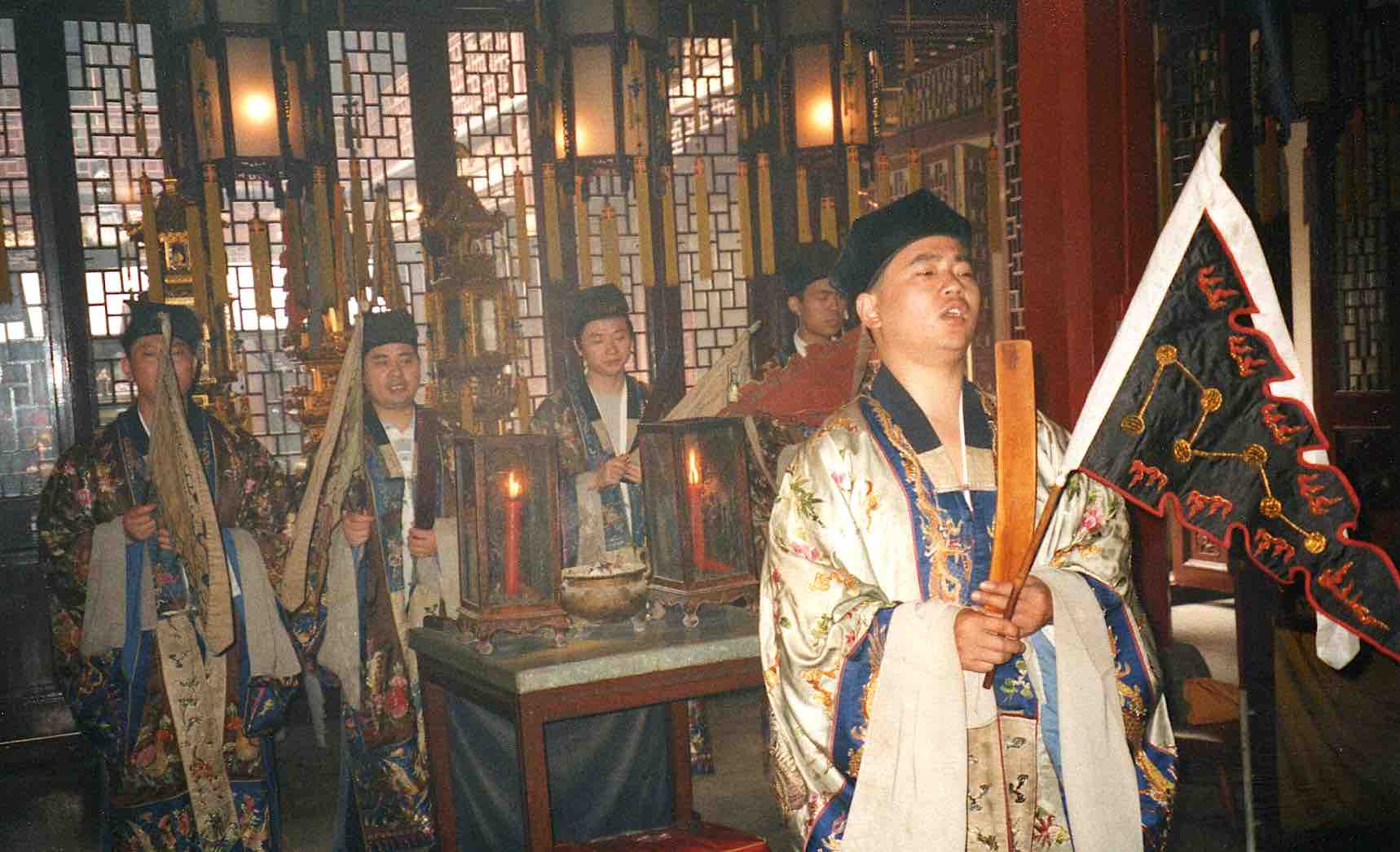
Just as inspiring an event, in its way, as an ahouach (also invigorated by the energy of young people)… The Terpsichorean muse, eh.

NYO 2

Morocco: Paul Bowles

1950 with Jane

Paul Bowles with his wife Jane Auer, 1950. Photo: Cecil Beaton.

My post on the film Performance, in which I mentioned Paul Bowles (1910–99: wiki here, website here), reminded me to explore his work on the musics of Morocco.

Bowles’s involvement with Moroccan music features rather intermittently in his story. Instead, accounts of both his early years and his later life after settling in Tangier from 1947 read like a Who’s Who of the Great Names of American and European culture.

As in many cases, biography (I read Christopher Sawyer-Lauçanno, An invisible spectator, 1989) provides a more dispassionate survey than Bowles’ own autobiography Without stopping (1972). Written under a publisher’s deadline while his wife Jane’s health was in terminal decline, “because he was so filled with pain and torment he had to shut off his emotions lest it consume the book. The result is that it’s a very impersonal memoir.” (An invisible spectator, p.406).

His relationship with his parents was fraught. As to his father,

I vowed to devote my life to his destruction, even though it meant my own—an infantile conceit, but one which continued to preoccupy me for many years.

This was perhaps a major element in his later escape to Morocco. First he travelled widely around Europe and Latin America. Trained as a pianist, he became a promising composer under the aegis of Aaron Copland and Roger Sessions. A plan to study in Paris with Nadia Boulanger never came to fruition. Later he took part in Virgil Thomson’s splendidly-titled group The Friends and Enemies of Modern Music, Inc.

On early and later trips between the USA, Europe, and Morocco, Bowles regularly met (and collaborated with) a stellar array of artists—including Gertrude Stein, Jean Cocteau, Christopher Isherwood, W.H. Auden, Krishnamurti, Manuel de Falla, Colin McPhee, Leonard Bernstein, Tennessee Williams, Peggy Guggenheim, Marcel Duchamp, Gore Vidal, Talullah Bankhead, John Cage, Jean-Paul Sartre, Anaïs Nin, John Huston, Truman Capote, Cecil Beaton, and Francis Bacon. To name but a few… He married the author Jane Auer in 1938; the sources are rather discreet, but for them and most of their wider circle, heterosexual proclivities were clearly not notable (see e.g. here).

Bowles had embarked on his first voyage to Morocco, with Copland, in 1931:

The trip to Morocco would be a rest, a lark, a one-summer stand. The idea suited my overall desire, that of getting as far away as possible from New York. Beiing wholly ignorant of what I should find there, I did not care. I had been told that there would be a house somewhere, a piano somehow, and sun every day. That seemed to me enough.

Indeed, on his travels he would constantly endure the travails of finding a workable piano—a suitable and unique punishment for the WAM composer. He also wrote reviews for the New York Herald Tribune, and began to review jazz.

This opened the door to folk music as well, inasmuch as it was my contention that every category of recorded music (except strictly commercial popular) ought to be covered.

Incidentally, Béla Bartók had collected folk music in north Africa as early as 1913. Bowles’s later contribution to Bartók’s Concerto for orchestra (1943) may not be so well known:

On an early trip to Casablanca [Bowles] bought a phonograph and “what the French call Chleuh records. (So-called Chleuh music is a popular genre evolved from the folk music of the Souss and sung in Tachelhait.)

The composer Henry Cowell had been using some of these discs in his teaching. Bowles recalls:

He asked me to make a set of records for Béla Bartók, who was living in Pittsburgh. Later he told me Bartók was incorporating the Chleuh material in a piece. Sure enough, when I heard the Concerto for orchestra, there was the music, considerably transformed, but still recognizable to me, who was familiar with each note of every piece I had copied for him.

I’m glad Paul Schuyler finds the connections elusive too (Music of Morocco, booklet).

From a period when W.H. Auden was presiding over an illustrious ménage in New York, Bowles has a nice story about Salvador Dalí and Harpo Marx:

Harpo

At that time Dalí did occasional illustrations for Harper’s bazaar; once they had been reproduced, George [Davis] would bring them home and have them framed. One of these pictures was a fine pencil sketch of Harpo Marx playing a harp strung with barbed wire, while in the desert background some giraffes burned spectacularly. George had left the picture on the windowsill and gone out, and a rainstorm had come up. When he returned to the house, he found his Dalí drenched and stained, just where he had left it, and the window still wide open. He rushed to Susie, the maid, and began to recriminate with her, pointing at the picture and repeating: “How could you, Susie? It’s ruined! Ruined!” Susie was used to this sort of thing, but she sympathised and shook her head. “Yes, Mr Davis, you right,” she said. “It sure is too bad, and it was such a beautiful picture of your mother, too.”

Bowles gave himself over only gradually to fiction and the Moroccan life. Moving to Tangier in 1947, he made his name with the 1949 novel The sheltering sky, later adapted in a 1990 film by Bernardo Bertolucci.

He acquired a taste for kif and majoun, receiving regular visits from Brion Gysin, William Burroughs, Allen Ginsberg, as well as Timothy Leary. During a long trip with Gysin in 1950 they first encountered the musicians of Jajouka at a moussem in Sidi Kacem; Bowles described his ongoing relationship with them in Days: a Tangier journal. Later he would feel nostalgic for these early years; Morocco became independent in 1956, but Jane fell ill in 1957, suffering a long and painful decline until her death in 1973.

Another vignette: on a visit to India (p.312),

I liked the hotel in Aurangabad, and so we settled there for a while. The English manageress was a Christian Scientist and gave me some copies of the Monitor. She also mentioned that a countryman of mine, a Mr Monahan, was due to arrive at the hotel within the next few days. Perhaps I knew him? I said I did not. “He’s very famous,” she insisted. “A famous violinist.” I told her that I had never heard of him, adding that since I had been out of America for several years, he might have become famous since my departure. “No, no. He’s been ever so famous* for years.”
[Correct me if I’m wrong, but I don’t believe Americans often use “ever so”, so this looks like an acute observation of his English host’s language.]

A few days later Mr Monahan did arrive and with Mrs Monahan took the suite next to mine. It was not long before he began to practice. Ahmed straightway pulled out his Moroccan lirah, or cane flute such as shepherds carry, and footled with it [sic]. The practicing stopped; there was muffled murmurs of surprise and incomprehension in the neighbouring room. Each time the violin started up, Ahmed shrilled on the lirah. Presently Mr Monahan retired into a further room and shut the door, to continue his work unmolested. I hoped to avoid having to come face to face with him on the veranda. During siesta time that afternoon somewhere in the hotel a woman began to call: “Yehudi! Yehudi!” At this point I realised who Mr Monahan was. “Do you hear what that woman is calling her husband?” demanded Ahmed. “He ought to knock her down.” In Morocco when a mule or a donkey refuses to move, he gets the word “yehudi” shouted at him. I thought of this, and in order not to call forth some awful scene, I did not explain to Ahmed that Yehudi was actually the man’s name. Later in New York when I saw Menuhin again, I asked him if he remembered the flute in the hotel at Aurangabad, and he did.

This makes a pair with my Irish story about Heifetz.

The 1959 recording project
While Bowles’s own memoirs (pp.344–6) are rather laconic on the subject of his 1959 project, An invisible spectator (pp.349–51) provides some detail. [1] In fact he had already applied for a grant without success some twenty-five years earlier (!). But now,

Before leaving New York, Bowles learned that the Rockefeller Foundation had at last awarded him a grant. He went to the Foundation’s headquarters and was given a crash course in how to operate the professional-quality Ampex tape recorder that they were also providing him. By late May he was back in Tangier, eager to begin his recording. As Jane was holding steady, he decided to set out in July, thinking that it would only take him a short while to arrange permission with the authorities to do his recording. He soon became entangled in Moroccan governmental procedures, however, and finally decided to dispense with trying to obtain formal permission. Instead, he went to the American consulate, which drew up a document stating that the US government was behind the project. The affixed several seals, stamps, and signatures and attached Bowles’s photograph; Bowles decided that it looked sufficiently formal to enable him to begin the project.

In the interim, he had gathered two traveling companions: Christopher Wanklyn, who spoke good Maghrebi and owned a Volkswagen; and a Moroccan, Mohammed Larbi, who’d recently escorted a British expedition on a trans-Saharan journey. Together, over the next five months, on four separate trips, they would travel some 25,000 miles through some of Morocco’s most remote and rugged locales. Of the second trip, made from August 29 to September 22, 1959, Bowles kept a detailed account; he later published a selection of the travel notes as an article, “Ketama Taza”, reprinted in expanded form as “The Rif, to music”, in his book of travel essays, Their heads are green and their hands are blue.

The journey was not without difficulties. First, there was the physical hardship of abysmal hotels, tortuous roads, heat, and ultimately, for Bowles, illness. Second, there was the problem of making recordings. Although Bowles had originally expected governmental hostility, the local authorities were for the most part quite cordial and helpful. This, however, could not compensate for the fact that the Ampex ran only on 110-volt AC current and was not equipped with a battery pack [!!!]. As a result, recording could only be done where there was electricity, and of the correct voltage. Despite all the difficulties, however, Bowles managed to collect a huge variety of music, representative of nearly all of Morocco.

More photos here.

There would, in fact, have been even more music recorded, but in October 1959 the Moroccan government suddenly decided that since his project was “ill-timed” (whatever that meant), he would not be allowed to undertake it. Bowles recalled that “the American Embassy advised me to continue my work”. He proceeded, but by December the government had become aware of what he was doing. “They informed me summarily that no recordings could be made in Morocco save by special permission from the Ministry of Interior…. I had practically completed the project… however, from then on it was no longer possible to make any recordings which involved the cooperation of the government; this deprived the collection of certain tribal musics of southeastern Morocco.” Even with the lack of this latter music, Bowles had recorded more than 250 separate selections by the end of December.

Curiously enough, Bowles’s efforts have never been terribly appreciated in Morocco. According to him, the prevalent “official” Moroccan attitude these days is that traditional folk music is “degenerate”. Indeed, in the 1960s the government engaged in an all-out effort to encourage the composition of “patriotic” music, which would contain a political message—specifically, singing the praises of Morocco and Moroccan progress. The gradual “development” of many of the remote regions of the country and an increased migration from the country to the cities had a profound impact on traditional musical forms. Many of the forms that Bowles recorded are now near impossible to hear in Morocco; and those that are heard are often diluted or mixed with other forms.

As Schuyler comments, “change and hybridity, the very forces that keep music vital, were, in his view, signs of decay.” But Bowles’s fear for the future of such traditions was premature.

In the United States, despite the sponsorship of the Rockefeller Foundation and the Library of Congress, the tapes went promptly into an archive, where for more than a decade they gathered dust. Finally, in 1972, the Library of Congress did issue a superb, two-volume record set, containing a fine sampling of Bowles’s collection. Nonetheless, countless hours of recordings have never been released to the public and most likely never will be.

Still, Bowles and Wanklyn managed to make some additional recordings from 1960 to 1962, and in 1965 Smithsonian Folkways issued a disc under Wanklyn’s name alone (notes here).

Bowles’s notes, reproduced with the 1972 discs (here and here), are impressive, providing cultural and musical background to the tracks. Here’s a revealing vignette:

The Ait Ouaraine live in the mountains southeast of Fez and until recently were in great demand among the residents of that city as entertainers at weddings and other household festivals. Here only women performed, one of them using a bendir as accompaniment. Before setting up the recording session I had been told by the governmental katib that I would be hiring three people to perform. When three men and four women arrived, I began to look forward to difficulties at the moment of payment. The leader of the group, however, was scrupulous about honoring his agreement. “Three people,” he said when I came to pay him, and I remembered that women are not people; these four ha[d] been brought along as decorative assistants and did not expect to be paid.

And in 2016, long after the two Bowles LPs were issued in 1972, the Library of Congress published a handsome four-CD set Music of Morocco, with illuminating additional notes by Philip Schuyler, from both Bowles’ diaries and his own experience. Here’s an online playlist:

I wonder how they decided where to go, and whom to seek. Of course, there were (and are) musicians everywhere, but identifying worthwhile genres and performers requires considerable local knowledge. The government resistance, and stress on patriotism and development, reminds me of China—although some fine fieldwork projects were under way there at the time.

map

From Music of Morocco (2016).

Schuyler provides further material on the trips, such as:

The very first recording session, on August 1 in the seaside village of Ain Diab, seemed to bear out Bowles’s expectations. In Ain Diab, the team took advantage of a festival (musem, or in Paul’s Tangier dialect, ‘amara) in honor of the saint Sidi Abderrhamane. At these events, pilgrims come to worship and celebrate at the saint’s shrine, and merchants, restaurateurs, and entertainers all set up shop to accommodate them. With the cooperation of government officials overseeing the festival, Bowles was able to record six different genres of music representing seven different tribal groups or geographical regions in just two days. The musicians were mostly professionals and many of them, like the pilgrims, had come from a great distance, probably at government expense. It is difficult sometimes to tell exactly who these musicians were or where they resided, because Bowles was recording so quickly that he had little time to gather information.

Alas, these were audio recordings only, in formal conditions removed from social activity. Strangely (given Bowles’ own passion for language), he hardly documented the vocal texts. And as he wrote, “complex arrangements were often necessary for transporting musicians from their remote villages to places where the electric power supply was compatible with the recording equipment.” Still, the set makes a fine survey of diverse vocal and instrumental genres. With my taste for shawms, track 3.03 on the YouTube playlist above is enchanting.

Apart from the 1959 project, Bowles doesn’t seem to have written in much detail about his encounters with folk musicking or performers, in either the cities (his main base) or the countryside. In Fez he sometimes attended domestic mizane performances of Andaluz music; he visited religious festivals in the countryside, and he encountered the Sufi brotherhoods quite early (Without stoppingpp.150–151):

At that time more than half the population of Morocco belonged to one or another of the religious confraternities which enable their adepts to achieve transcendence of normal consciousness (a psychic necessity all over the African continent) and to do so in Islamic terms. For most educated Moroccans the existence of the cults is an abomination; with the emergence of nationalism they were suppressed more or less successfully for two decades or more. When once again they were sanctioned, care was taken to see that the observances took place hidden from the sight of non-Moslems. Visitors might ridicule the participants, it was said, or consider Moroccans a backward people if they witnessed such spectacles. I had suspected that I would stumble onto a scene which would show me the pulse of the place, if not the exposed, beating heart of its magic, but it was a tremendous surprise to find it first on the open street. Yet there they were, several thousand people near Bab Mahrouk, stamping, heaving, shuddering, gyrating, and chanting, all of them aware only of the overpowering need to achieve ecstasy. They stayed there all day and night; I could hear the drums from my room, and during the night they grew louder. The next morning the mob was at Bab Dekaken, just outside the hotel. Then I realized that it was a procession, moving at the rate of approximately a hundred feet an hour, with such extreme slowness that as one watched no visible progress was made. Along the edges of the phalanx there were women in trance; pink and white froth bubbled from their mouths; small shrieks accompanied their spastic motions. When someone lost consciousness entirely and fell, he was dragged inside the wall of onlookers. It took the procession two days to get from Bab Mahrouk to Bab Chorfa, a distance of perhaps a mile. I should never have believed an account of the phenomenon had I not been watching it. But which one or more of the brotherhoods the participants represented, whether they were Aissaoua or Jilala or Hamatcha or something else, there was no way of knowing, nor did I ask. Here for the first time I was made aware that a human being is not an entity and that his interpretation of exterior phenomena is meaningless unless it is shared by other members of his cultural group. A bromide, but one that had escaped until then.

Later he introduced Jane to the amara gathering of Aissoua [Aissawa] pilgrims the cult at Moulay Brahim (Without stopping, pp.285–6; see also e.g. under Bernard Lortat-Jacob at 80). But while he made some recordings of the brotherhoods, such curiosity never evolved into a desire to document them more thoroughly. Although as a long-term resident he was well qualified to conduct such research, he sought tranquil places to live in order to focus on writing; Morocco was a breeding-ground for his creative life, not quite an object of detailed ethnography.

* * *

In a separate project, Alan Lomax went on to record in Morocco in 1967 (see here, and here). By the 1970s it was among the field-sites of the intrepid Bernard Lortat-Jacob. The relevant chapter in his perceptive book

  • Musiques en fête: Maroc, Sardaigne, Roumanie (1994)

makes a good introduction to the kinds of issues that one seeks to address in field research. He documents the laamt village-wide societies that organize the ahouach festivals, the recourse to occupational musicians, and the various genres.

ahouach

Ahouach. Source  here.

Bernard also released several CDs:

  • Musique berbère du Haut-Atlas, 1971
  • Maroc, musique berbère, un mariage dans le Haut-Atlas oriental, 1975
  • Berbères du Maroc, “Ahwach”, 1979.

Over the same period, Philip Schuyler (later involved in the issuing of the 4-CD Bowles recordings) was conducting research, such as

  • “Berber professional musicians in performance”, in Gerard Béhague (ed.) Performance practice: ethnomusicological perspectives (1984),

as well as also producing his own recordings.

For more on ahouach and ahidus festivals, I also like the slim tome

  • Miriam Roving Olsen, Chants et danses de l’Atlas (1997, with CD).

The Moroccan cultural authorities produced a 31-CD set in 2002, critically reviewed here, as well as a 66-CD set. There are further revelations in the 10-CD anthology, Chikhates and chioukhs of the Aïta (2017).

Still (my usual refrain), audio recordings are all very well, and they make an important adjunct to silent analysis on the page; but it seems sad to reduce the intense, exhilarating vibrancy of such social activities (not least dancing) to disembodied sound objects (cf. McClary‘s “denial of the body”)—like the “red-hot sociality” of Chinese temple fairs and funerals, they cry out to be documented on ethnographic film. I’ve spent ages searching online for even brief clips that aren’t too commodified—try this, from the moussem of Sidi Douad, Ouarzazate, in 2004:

But as I glimpsed while eavesdropping on a wedding in the Atlas mountains in 2000, neither academic analysis nor audio or video representations can substitute for actual participation in such events.

Wedding, Imlil 2000. My photos.

Meanwhile, along with tourism, Moroccan culture became an inevitable victim of heritagisation. There are some perceptive articles on the fate of Jemaa el-Fna square in Marrakesh under the Intangible Cultural Heritage, such as

  • Thomas Schmitt, “Jemaa el Fna Square in Marrakech; changes to a social space and to a UNESCO masterpiece of the Oral and Intangible Heritage of Humanity as a result of global influence”, Arab world geographer 8.4 (2005), and
  • Thomas Beardslee, “Whom does heritage empower, and whom does it silence? Intangible Cultural Heritage at the Jemaa el Fnaa, Marrakech”, International journal of heritage studies 22.2 (2016).

General surveys include “Morocco” in The New Grove dictionary of music and musicians. And the article on Morocco in The Rough Guide to world music (Africa, Europe, and the Middle East, pp.567–78) provides an accessible introduction, covering both traditional and popular genres, including ritual gnaoua (latterly adapted to become flavour-of-the-month on the World Music scene—cf. final remark here), chaabi, and the Moroccan version of raï. Songlines also has regular coverage.

* * *

It was Bowles’s own reputation that was responsible in no small measure for attracting the hippies who began to descend on Tangier in the early 1960s, hot on the heels of the first-wave Beats. But as Sawyer-Lauçanno relates (pp.355–6):

This influx created a certain amount of alarm in the expatriate community, most of whom were fairly affluent, well established, and prone to anxiety about their status in Morocco, particularly since independence. William Burroughs commented that the established residents “all felt that the beatniks were endangering their own position, casting aspersions on the foreign colony. And the old settlers were terrified, outraged: ‘The first thing you know they’ll get us all thrown out.’ ” This panic extended to Bowles and Jane, as well. According to Burroughs, “Jane and [her partner] Cherifa were trying to cast a spell on the beatniks. Jane would say, ‘I don’t want to really hurt any of them, just make them a little sick so they’ll go away.’ They were all hysterical that way, particularly the Bowleses. Both of them were always worried that they were going to be thrown out.”

group 1961

Peter Orlovsky, William Burroughs, Alan Ansen, Gregory Corso, Paul Bowles, Allen Ginsberg, Tangier 1961.

Paul, always immaculately turned out, was less than enamoured with the beatnik invasion. Ironically, it was to his parents that he sent this prurient description:

Every day one sees more beards and filthy blue jeans, and the girls look like escapees from lunatic asylums, with white lipstick and black smeared around their eyes, and matted hair hanging around their shoulders. The leaders of the “movement” have made their headquarters here and direct their activities from here. Allen Ginsberg, Gregory Corso, and Burroughs are all established in Tangier now, sending out their publications from here.

Sawyer-Lauçanno goes on:

Despite his disparaging remarks and anxiety about deportation, Bowles made a distinction between the literary beatniks and what Burroughs terms “the lesser beats”, the hangers-on, the beatniks in style only. Indeed, during the early part of the 1960s, Bowles spent a good deal of time in the company of the “movement’s leaders”.

Given the unorthodoxy of their own tastes, all this may seem A Bit Rich… Chacun à son trou, surely.

Still, in the shadow of wartime trauma, when many were simply relieved to be able to tend the begonias of their suburban gardens in peace, I’m always impressed by such early explorers as Bowles. Some, like Gary Snyder, went in search of the wisdom of the Mystic East, while others were drawn to the Middle East and north Africa. But their engagement with folk culture varied.

I rarely presume to venture into the Islamic world, but see also here, and notably the Uyghur tag. For hand-clapping, see here.


[1] See also e.g. https://daily.bandcamp.com/2016/03/28/paul-bowles-in-morocco-the-lost-recordings/,
https://www.newyorker.com/culture/culture-desk/the-sheltering-sound-paul-bowless-attempt-to-save-moroccan-music,
https://legation.ipower.com/blog/?p=53, and
http://archnet.org/collections/872.

Mozart for winds, and “genius”

Learning with the Hua band, 2001

Learning with the Hua band, 2001.

The specialisation of professional training in WAM tends to work as an obstacle to appreciating the broader soundscape. Of course as a fiddle player, taking part in The Rite of Spring, Bach, Mahler, or opera gave me ample opportunity to admire great wind playing and singing; but somehow it seemed impertinent, as if it was none of my business—”just play the dots”, do your job, like a factory worker or a soldier not privy to the grand design (cf. Ecstasy and drudge). Chamber music offers more personal input, but makes a less reliable food-bowl for most performers.

Studying world music inevitably broadens our horizons. However inept, my training in participant observation among Chinese ritual groups and shawm bands helped me focus on the artistry of a range of musicking outside my own expertise.

Returning to WAM, Mozart’s piano concertos are full of exquisite wind parts (see also here, and here). And during our time at Cambridge my ears were opened by Stephen Barlow conducting the astounding Serenade in C minor—here’s an earlier recording:

Such miraculous inspiration is movingly articulated in one of the great scenes from Amadeus (on the Gran partita):

Such wonders are not the exclusive preserve of WAM composers. As always, Bruno Nettl has wise words (The study of ethnomusicology: thirty-three discussions, pp.57–9):

“Musical genius”. It’s the term music lovers in Western culture use to describe their greatest creators of music in classical music and also in jazz (like Louis Armstrong). It is sometimes also used for key figures in the history of popular music (like the Beatles and Elvis Presley).

After unpacking the mythology of Mozart and Beethoven, Nettl compares similar figures in Carnatic music—notably Tyagaraja, also credited with divine inspiration. He goes on:

There certainly are many cultures that share the concept of musical genius on one way or another. Again in my experience, a kind of star system was there in the classical music of Iran in the mid-20th century,  where the line between stars and others was even more pronounced than in Europe, star performers being accorded relatively more status, artistic license, and money. The nonstars were readily ranked from acceptable to incompetent. What distinguishes the “stars” among the most significant creative musicians in Iran, the ones who excel in the improvisatory section of the performance of a dastgah—the avaz—is their ability to do something new within strict confines.

And while technical virtuosity was less of an issue in my experience of the music of the Blackfoot people, outstanding singers and men who commanded large repertories of religious songs were singled out, but the role of musical culture hero seems to me to be most clearly associated with those men who, in times of the greatest adversity of the Blackfoot nation, tried to lead the tribe into some kind of acceptable future and did so by maintaining and teaching the people’s songs and dances.

He explores the issue further in Chapter 26 (see here, under “Music and learning”).

Anyway, while we naturally seek out the most outstanding bearers of tradition, yet as Christopher Small observed, musicking is a diverse social activity in which genius and virtuosity play only a limited part. Indeed, in both art and popular traditions they serve as something of a red herring; all kinds of performance events can be meaningful, and moving—from lullabies to a Dolly Parton gig.

Still, to return to inspired wind playing, I always relish Wu Mei‘s exquisite decorations of Daoist vocal liturgy, or Hua Yinshan’s searing and soaring shawm playing. See also jazz and trumpet tags—selection here.

Reception history

Reception history is an important issue in all branches of the arts, including music, fiction, and visual culture.

For Renaissance painting, modern viewers inevitably bring to bear a wealth of visual and conceptual experience (later artistic movements, photos, film, and so on); by contrast, the world-view of audiences of the time was based on a far more detailed knowledge of scenes depicted. The social context of viewing has changed radically; such messages constantly change over time. In my post on visual culture I cite perceptive comments by Michael Baxandall, Marcia Pointon, Michael Jacobs, Alan Bennett, and (for China) Craig Clunas.

Even synchronically, Daoist ritual means very different things to local patrons, urban dwellers, young and old, local and central cadres, and scholars of Daoism—a theme I broached in Recreation.

I’ve touched on this issue in several posts on music, often relating to the HIP movement and changing styles of performance:

  • In Bach—and Daoist ritual I note the very different ears, eyes, minds, and bodies of 18th-century and modern audiences.

The work of John Butt pursues such themes:

Further posts on changing interpretations of Bach are also relevant:

See also

More recent works too are pervaded by our changing experience:

and on a lighter note,

and, in speech, even

Lyrics for theme tunes

A couple of ancient musical jokes—much shared online, but hey:

What does Batman’s mum call out when she wants him to come for his supper?

Dinner dinner dinner dinner dinner dinner dinner dinner Batman!

(cf. Learning the gong), and

Where does the Pink Panther come from?

Durham (Durham, Durham Durham Durham Durham Durhaaaaaam)

(For UK and US variants, see comments below.)

For a more ambitious word setting for Berlioz’s March to the Scaffold, see here; and for a handy mnemonic for additive metres, here. For tributes to the artistry of theme tunes, see Pearl and Dean, Parks and recreation, Soap. For the Indian inspiration of the Pink Panther, see Rāg Vindaloo.

Köchel numbers

Bluff

Along with 1066 and all that and little-trumpeted works like The ascent of Rum Doodle and Sir Henry at Rawlinson End, another classic from my youth is the slim tome

  • Bluff your way in music (1966).

Tactfully, the name of its author Peter Gammond is not disclosed. By “music” he means WAM, of course—HIP and “world music“, then only in their infancy, are spared, though folk music and jazz get succinct tributes. There is also a drôle Glossary, forerunner to many twee tea-towels—you know the kind of thing, like

  • Chamber music—music written for a very small number of listeners.
  • Development—what composers do with the melody in order to make a composition of decent length.
  • Exposition—the popular bit of a composition while the tune is still being played [see also Francis Baines‘s definition of sonata form].
  • Harmony—a term of no meaning whatsoever. Such phrases as “rich harmony”, “stark harmony”, “satisfying harmony” can be used indiscriminately.
  • Mode—scales which sound a bit odd.
  • Portamento—the ability to move from a wrong note to a right one without anyone noticing the original mistake.
  • Recitative—when an opera singer forgets the tune.

But my enduring memory of the book is:

Mozart had the distinction, as everyone knows, of writing Koechels instead of Opuses, a thing no other composer has done before or since. Mozart’s great popularity dates from the fact that this absorbing fact was discovered, by some strange coincidence, by a man called Koechel.

Bach, um, marches towards the world

I’ve included “marching towards the world” in my catechism of Chinese music clichés. We might also set out from a different starting-point—further to my Bach chinoiserie, and in the vein of Alternative Bach (see also here).

For a long time Bach and his music hardly ventured any further than Saxony. But here’s Erbarme Dich (cf. here and here) sung by Fadia el-Hage and Sarband, from their Arabian Passion (as ever, the BTL comments are worth reading):

And here’s a live version with Fadia el-Hage:

Further to Bach on the lute (such as this), you can also find several renditions on the oud, like this:

Instances where Bach’s Lutheran world-view comes into contact with Islam may be suggestive, but his music can also be attractive on other instruments, beyond mere novelty. Here you can find a Nordic version of the prelude of the 6th cello suite. Meanwhile, the sheng-player Wu Wei has ventured into baroque, as here:

Evidently I welcome all kinds of new versions of Bach, but perhaps here my Chinese snobbery comes into play. I just can’t hear the benefit of playing Bach on the sheng; the ethnic frisson seems spurious, as if mutual bandwagons are being jumped on. I can’t get used to the modern sheng used as a monophonic instrument, but I must be wrong about this. Just because an instrument has the capability of playing chords (traditionally in this case, fifths and octaves), it doesn’t always have to be, any more than the organ; but to me it deprives the sheng of its essential character. So however tasteful the playing, it seems kitsch, reminding me of Gheorghe Zamfir, yesteryear’s flavour of the month—although for some reason I don’t quite mind this:

Just be grateful we didn’t record our rendition on erhu and saz… See also the comment below this post, with the Polis ensemble playing the Air on instruments of the eastern Mediterranean. While the arrangement is beautiful and the playing sensitive, I wonder if they might transform it more by relishing the ethnic timbres, rather than conforming too reverently to Bach’s sound-world. I can imagine it being most moving within a concert of their core repertoire—just as it is most spellbinding in the context of the 3rd suite itself.

There’s lots of Bach on sax online. Some is rather straight, but I like this—live from Leipzig (just like Bach was!), what’s more:

I welcome further links to ethnic Bach—obviously we’re looking for genuine explorations here, rather than mere exotic orientalising.

All this contributes to my fantasy of a world-music version of the Passions.

With thanks to Fanny Paccoud and David Badagnani

Popular culture in early modern Europe

Burke

We often study Chinese culture (both expressive and material) rather in isolation, but many parallels are suggested in

  • Peter Burke, Popular culture in early modern Europe (1978, thoughtfully updated in 2009 edition),

a lucidly-written single-volume work on the period 1500 to 1800. Of course it’s a vast field, but Burke’s broad coverage is enriched by illuminating detail.

Think away television, radio, and cinema, which have standardized the vernaculars of Europe within living memory, not to mention changes which are less obvious but may be more profound. Think away the railways, which probably did even more than conscription and government propaganda to erode the culture peculiar to each province and to turn regions into nations. Think away universal education and literacy, class consciousness and nationalism. Think away the modern confidence (however shaken) in progress, science, and technology, and the secular modes in which hopes and fears are expressed.

Indeed, many in Europe had little access to these features well into the 20th century—and many Chinese still later. So the historical coverage not only makes a useful perspective on popular traditions enduring today (e.g. Italy or east Europe), but is also full of lessons for our studies of popular culture in modern China.

Many (not least in China) tend to visualize Europe as a monolithic, reified, “developed” (and largely secular) modern bourgeois society, whose music (for instance) is represented by the “classical” canon. In the wake of the industrial revolution, change in the popular cultures of Europe was already a complex issue by the early 1900s, when study began to take off in earnest; but in China, for all its own revolution, many of Burke’s perspectives still seem relevant in the late 20th century. So it may be easier to see the parallels here than it would be with a study of modern Europe.

In Chapter 1 he discusses “The discovery of the people” by early-19th-century intellectuals, just as traditional culture seemed threatened—of which he gives some fine examples, long predating 20th-century concerns. Already before the industrial revolution, with the growth of towns, the improvement of roads, and the spread of literacy, the centre was invading the periphery.

Burke adduces early collections of folk-songs from Germany, Russia, Sweden, Serbia, Hungary, and Finland. The intellectuals also discovered popular religion and festivals (cf. Zhao Shiyu‘s work on Chinese temple fairs), along with folk music. Burke discusses aesthetic, intellectual, and political reasons for this interest. Along with the reaction against the Enlightenment, and the growth of nationalism,

the discovery of the people was part of a movement of cultural primitivism in which the ancient, the distant, and the popular were all equated.

In Chinese discourse on folk culture, terms like “simple” and “primitive” were still common in the late 20th century.

At the same time, Burke unpacks problems with studying the subject through the work of early European folklorists: distortion, creative bias, and the notion of “improvement”. Just like the CCP in China,

it is all to easy to continue to see popular culture through the romantic, nationalist spectacles of the intellectuals of the early 19th century.

On “restoration” he observes:

To read the text of a ballad, a folktale, or even a tune in a collection of this period is much like looking at a Gothic church which was “restored” at much the same time. One cannot be sure whether one is looking at what was originally there, at what the restorer thought was originally there, at what he thought ought to have been there, or at what he thought should be there now. Not only texts and buildings were subject to “restoration”, but even festivals.

Burke criticizes the notions of primitivism, communalism, and purism, stressing that “popular culture does have a history”.

In Chapter 2, “Unity and variety in popular culture”, Burke notes pockets where there was still a shared culture on the lines of the (dodgy) model of tribal societies, but observes that the broad picture was not monolithic or homogeneous: social stratification was widespread. He refines the model of interdependent great and little traditions, both urban and rural, that Robert Redfield suggested in the 1930s:

There were two cultural traditions in early modern Europe, but they did not correspond symmetrically to the two main social groups, the elite and the common people. The elite participated in the little traditions, but the common people did not participate in the great tradition. The great tradition was transmitted formally at grammar schools and at universities. It was a closed tradition in the sense that people who had not attended such institutions, which were not open to all, were excluded. […] The little tradition, on the other hand, was transmitted informally. It was open to all, like the church and the market-place, where so many of the performances occurred.

So in the early period the elite, the nobility, local literati, and the clergy had access to and participated in both cultures.

In the Cracow area about 1565, more than 80% of the poor nobles were illiterate. The style of life of some rural nobles and parish priests was not so different from that of the peasants around them.
[…]
But this situation did not remain static throughout the period. The upper classes gradually withdrew from participation in the little tradition in the course of the 17th and 18th centuries.

Following Kodály and Gramsci, Burke also notes that “the people” were not a homogeneous group. As in 20th-century China, the peasants formed 80–90% of the population. But apart from peasants and craftsmen, women, children, shepherds, sailors, beggars, and so on, all had important sub-cultures. The diversity of occupations makes a useful reminder for China, both in imperial and modern times; the peasantry was itself stratified, as the CCP would observe. Burke cites Kodaly again:

Many traditional folksongs are appropriate only for one social group, like the Scandinavian drängvisor, or farm-hands’ song, and the pigvisor, the “complaints” of ill–treated maidservants.

He notes ecological differences:

Leaping dances seem to be associated with mountainous regions, in the Basque country, in Norway, in the highlands of Bavaria, Poland, and Scotland, because this was an old form of dance which did not survive in the plains.

In the countryside farmers, herdsmen, and shepherds also had different cultures, as did blacksmiths, carpenters, woodsmen, miners, and bandits. Similar stratification was notable in the towns: guilds, craftsmen (weavers, tailors, shoemakers, journeymen, apprentices, and so on), and shopkeepers.

Burke notes religion and ethnic minorities as markers of cultural difference—not only Catholics and Protestants, but Jews and Muslims. And he discusses the male category of “wanderers”—soldiers, sailors, beggars, and thieves. He notes variation by gender and region, coexisting with other types of variation. Excluded from most of the categories, “women’s culture is to popular culture what popular culture is to culture as a whole.” Other potential elements in a cultural geography of Europe would include architecture, literacy, and topography. He observes interaction between great and little traditions, finding traffic in both directions, with creative transformations.

In Chapter 3, “An elusive quarry”, Burke interrogates the sources, their literati bias and unreliability:

We want to know about performances, but what have survived are texts; we want to see these performances through the eyes of the craftsmen and peasants themselves, but we are forced to see them through the eyes of literate outsiders.

The attitudes and values of craftsmen and peasants

were expressed in activities and performances, but these activities and performances were only documented when the literate upper classes took an interest in them.

And when, as often, festivities were described by foreign visitors, they

are likely to miss all sorts of local or topical allusions and may misunderstand what the festivities mean to the participants.

Or (as in China) popular activities may be recorded simply because the authorities were trying to suppress them. And of course

A text cannot record a performance adequately, whether it is a clown’s or a preacher’s. The tone of voice is missing, so are the facial expressions, the gestures, the acrobatics.

Further, Burke notes that printed texts (including sermons) are likely to vary from the texts performed. Print not only recorded popular culture but undermined it. He lists six kinds of mediator, and explores oblique approaches to popular culture, adducing witch trials and “iconology”. And he notes the useful perspective of rebellion, also fruitful for China.

Discussing folk-songs and epics “collected” in the 20th century, he comments:

Historians whose sources consist of fragmentary texts have a lot to learn from folklorists whose sources are living people, who can be observed at work and even questioned. What I am advocating is a rather more indirect use of the modern material, to criticize or interpret the documentary sources.

To avoid misunderstanding, let me say at once what the regressive method is not. It does not consist of relatively recent situations and cheerfully assuming that they apply equally well to earlier periods.

He notes the potential for historians to learn from anthropologists.

Part Two, “Structures of popular culture”, opens with Chapter 4, “The transmission of popular culture”, focusing on the “active bearers of culture”. While observing that

Shepherds made their own bagpipes as well as playing them. The men of the household made the furniture, and the women made the clothes. […] Anyone who fell ill or had an accident would be treated at home,

he stresses that

Neither the household nor the village was culturally autonomous.

Semi-professional healers, traveling pedlars, and wandering minstrels [a term, I note, encrusted with romantic flapdoodle] were also part of the picture. He unpacks the notion of “popular artist” (one who works mainly for a public of craftsmen and peasants), and the spectrum of professionals and amateurs. I like his list of occupational performers for England:

Ballad-singers, bear-wards, buffoons, charlatans, clowns, comedians, fencers, fools, hocus-pocus men, jugglers, merry-andrews, minstrels, mountebanks, players, puppet-masters, quacks, rope-dancers, showmen, tooth-drawers and tumblers. [1]

(For instances of the evocative use of lists, see Last night’s fun and Accordion crimes.)

But again there were gradations, as with shawm bands in China today. Like tinkers and pedlars, many performing groups were itinerant. The Russian skomorokhi (interestingly seen as antecedents of Pussy Riot here) travelled in bands of up to one hundred men. Burke’s description of “strolling players” in 18th-century England reminds me of Chinese opera troupes today:

Two actors would be sent ahead of the rest to get permission to play in the towns and villages on their route. Their properties and costumes would be secondhand, even dilapidated, and they would perform in inns or barns.

la Tour

Georges La Tour, The hurdy-gurdy man. Cf. the lirniky of modern Ukraine.

Several more features suggest China. Solo bards were also common—as in Spain, France, Serbia, and Russia. Whether solo or in a group, they were often equated with beggars; and many “vagabond-entertainers” were blind. Itinerant preachers were also widespread. Besides human opera, ritual puppet plays may remind us of groups still performing in regions like Fujian and Gansu.

Less well documented were the amateur performers, and semi-professionals (as in China), “part-time specialists who had another occupation but might derive a supplementary income from their singing, playing, or healing.” Performers of plays and other festivities were often organized into guilds. Funeral wailers were hired, as in Britain, Italy, and Russia. Popular healers and diviners are listed for England, Sweden, Poland, Spain.

Burke explores the physical setting, noting that it is easier to document public performances (church, tavern, market-place) than domestic occasions. He outlines the balance of folk tradition and individual innovation, refuting the “collective creation” myth.

Chapter 5, “Traditional forms”, explores genres, discussing the variety of dance and song forms; themes and variations; and the process of composition—all recurring issues in ethnomusicology. He includes preaching and material culture, seeking not only formulas and motifs but structures.

Chapter 6, “Heroes, villains, and fools” goes on to look at stock characters, probing the attitudes and values of craftsmen and peasants. In popular culture the images of rulers, the clergy and saints, the nobility and knights, the middle class and officials, are sometimes ambivalent, but the lower classes seem “conservative”, accepting them and structuring their world through the models provided by the dominant group. Conversely, craftsmen and peasants also saw society in terms not of harmony but of conflict, complaining of poverty and injustice. Here Burke lists five points along a spectrum of responses: fatalist, moralist, traditionalist, radical, and millenarian.

The Chinese peasantry since the 1940s have also clung to such heroic figures from the imperial past, remaining quite resistant to the cultural values of the CCP while absorbing new elements (like the PLA soldier in the medium’s pantheon here).

Under “ordinary people”, Burke notes that craftsmens’ image of the peasant was unflattering. Nor, in the male-dominated sources, do women emerge well:

Most popular heroines were objects, admired not so much for what they did but what they suffered. For women, martyrdom was virtually the only route to sanctity.

More common are images of deceitful and malicious women.

Under “outsiders”, outlaws (another popular theme in China) are usually, though not always, portrayed as heroic, “enabling ordinary people to take imaginative revenge on the authorities to whom they were usually obedient in real life”. Negative instances are those of the Turk and the Jew (both “scarcely human”), as well as the witch; and the stereotypes of Catholics and Protestants about each other.

Hatred of outsiders was so common as to make one wonder whether most ordinary people of the period were not what psychologists sometimes call “authoritarian personalities”, combining submissiveness to authority with aggressiveness towards people outside their group.

Breughel

Breughel, The combat between Carnival and Lent.

in Chapter 7, “The world of Carnival”, Burke pursues the theme of relieving tensions, putting myths and rituals in the physical context of festivals, both Carnival itself and “carnivalesque” activities. Here he explores ritual—always a prominent theme—in greater detail, and ritual reversal, “the world upside down”. Carnival was both a holiday, a game, and a time of ecstasy and liberation, with food, sex, and violence. He subsumes public executions and mocking ceremonies like the charivari, and explores the tensions between social control and social protest. He cites Victor Turner:

By making the low high and the high low, they reaffirm the hierarchical principle.

But the “safety-valve” of ritual was not always able to contain popular dissent. Riots and rebellions made more direct forms of action. Popular rebellions, of course, are a major theme in Chinese history—studied selectively in the PRC.

The concern of the upper classes that popular festivals might pose a threat to the status quo leads to Chapter 8, “The triumph of Lent: the reform of popular culture”. Always alert to change, Burke describes the attempts of the educated (“the reformers, or the godly”), notably the clergy, to “improve” popular mores, on both theological and moral grounds. Again (as in imperial and modern China) folk religion was a principle target—miracle and mystery plays, popular sermons, and religious festivals such as saints’ days and pilgrimages.

He suggest two main periods, the first until around 1650 led by the clergy, the second in which the laity took the initiative, adding secular arguments. He outlines the “culture of the godly” that they hoped would replace the old pagan ways (more echoes of modern China). Battles were waged not only over rituals but over images and texts. One important weapon was the dissemination of vernacular Bibles. Burke is sensitive to changes in the meaning of words, such as the ever-thorny “superstition”.

One major result of this reformist zeal, unevenly achieved, was the widening of the gulf between great and little traditions, discussed in the final Chapter 9, “Popular culture and social change”. Over the whole period popular culture changed in ways that no-one could have foreseen. Burke lists population growth and urbanization, the rise of “commercial capitalism” with increasing division of labour, and the communications revolution. Though he warns against exaggerating the impact of such changes, by the 18th century the peasantry were coming to own more material objects, and better ones—although east Europe remained relatively poor. A gradual shift was under way “from the more spontaneous and participatory forms of entertainment towards more formally-organised and commercialized spectator sports.” Although he also shows that it was often in the outlying regions that traditional culture was best maintained,

In the larger towns, the process of social change seems to have enriched popular culture. In the countryside, particularly in outlying regions, the same process led to cultural impoverishment.

This topical comment from the Highlands of Scotland comes from the late 18th century:

The noblest virtues have been ruined, or driven into exile, since the love of money has crept in among us; and since deceit and hypocrisy have carried mercenary policy and slavish, sordid avarice into our land.

Under “the uses of literacy” Burke stresses the influence of the printed book, and then the press. He explains methods for assessing literacy rates around Europe, with partial evidence suggesting that “more people could read in 1800 than in 1500, that craftsmen were generally much more literate than peasants, men than women, Protestants than Catholics, and Western European than Eastern Europeans”.

Whereas some secular reformers feared that popular literacy would make the poor discontented with their lot, the godly saw it as a step to salvation. Again Burke unpacks the idea of “access” to books, with some fine examples under physical, economic, and linguistic access. He takes a nuanced approach to how all this affected popular performances, although “the book was both a dangerous competitor and a treacherous ally”.

The spread of literacy and the decline of the epic occurred together in Western Europe, while illiteracy and the epic survived together in Sicily, in Bosnia, in Russia.

I note that even the lowest literacy rates around Europe surpassed those of China in the mid-20th century; and even in the early 1990s I found few books in peasant homes there.

Burke cites the work of a sociologist working on the modern Middle East, where print is among factors said to engender “a high capacity for empathy, a willingness to accept change, to move from one place to another, or to express their own opinions about society; in a word, modernity.” However, in early modern Europe such changes were less spectacular. Old themes did not go out, but new themes did come in: as in modern China, cultural changes were not so much “substitutive” as “additive”.

He moves on to unpack the concepts of secularisation and politicisation:

Hopes and fears which had traditionally been expressed in religious terms now needed another mode of expression and increasingly found it in the political.

Despite the problems in assessing piecemeal material, and always sensitive to differing social strata, he finds an increasing sense of involvement with politics, at least in Western Europe.

Craftsmen and peasants had good reason to be more aware of the state by the end of the 18th century than they had been three hundred years before.

Burke notes the gradual withdrawal of the upper classes from the popular culture that they had previously shared—as in China. But as ever he asks probing questions:

Who withdrew? From what did they withdraw? In what parts of Europe? And why? The clergy, the nobility, and the bourgeoisie had their own reasons for abandoning popular culture.

In many regions the upper classes literally spoke a different language from ordinary people. But—at different times in different parts of Europe—they came to reject their whole culture.

And it was this gap that led to “discovery”: only when folk traditions became “alien” to the elite did they provoke curiosity, leading to the rise of folklore studies.

Looking back over the whole period,

The change in the attitudes of educated men seems truly remarkable. In 1500, they despised the common people, but shared their culture. By 1800 their descendants had ceased to participate spontaneously in popular culture, but they were in the process of rediscovering it as something exotic and therefore interesting. They were even beginning to admire “the people” from whom this alien culture had sprung.

After 1800 factors like urbanization, education, printing, and railway transport were to transform culture still more radically.

* * *

Houshan 1995

Medicine-pouch vendor, Houshan temple fair 1995.

While Burke’s study is based on the period before 1800, and has been amply supplemented since, it offers thoughtful perspectives on the diverse little traditions that still persist today, and were even more widespread alongside the great traditions of Renaissance and baroque. Relevant to our studies of imperial and modern China are not only the many commonalities they share—recurring themes like ritual, reform, and so on—but ways of studying and unpacking the sources. I do recommend the book, not least to Chinese students: here’s a Chinese edition.

Playing with history: HIP

*For main page, click here!*
(under WAM at the right of main menu)

Butt

On the HIP (“Historically Informed Performance”) movement, further to my article on Richard Taruskin, I’ve added a page on

  • John Butt, Playing with history (2002).

I’ve already mentioned Butt’s thoughts on performing the Bach Passions, as well as related posts like Bach and Daoist ritual and Alternative Bach.

Indeed, he expands on the ideas of Taruskin, rigorously unpacking the views of a wide range of pundits on both sides of the notional fence, surveying the HIP tendency in the broad context of 20th-century (and earlier) social and political change, philosophy, architecture, the Globe Theatre project, and the Heritage movement. So this is a far wider topic than “mere” music.

He notes affinities with ethnomusicology, and unpacks the history of “notational progress”—among his examples is Messiaen! Butt’s stimulating final chapter takes its title from Lucy Lippiard’s definition of retrochic:

  • “A reactionary wolf in countercultural sheep’s clothing”?—historical performance, the heritage industry and the politics of revival.

He points out antecedents earlier in the 20th century and much further back in history. Despite the growth of HIP following the disruption of war, Butt finds that the whole phenomenon is more complex than the “trauma thesis”, and that (as with Morris’s Arts and Crafts movement) it attracts people from a range of political stances.

In a thoughtful, generous, and optimistic investigation, he sees the HIP enterprise as

a starting point for experimentation, an opening of options that could not have been envisaged, rather than a form of closure that more strictly delimits the definition of a work or repertoire.

I conclude with some thoughts on China and its heritage industry, where such complex issues are barely recognized.


A post-concert gaffe

Many years ago, Maureen Smith was leading an orchestral concert in the north of England, at which the great clarinettist Tony Pay was playing.

After the gig Maureen was having a drink in the pub with some friends from the audience when Tony walked in, now in plain clothes, so she introduced them:

“Hey guys, this is Tony Pay—he plays the clarinet.”

One of them looked at him and went,

“Jeez, they could have done with you tonight!”

Tony likes to tell this story himself.

For other less-than-favourable reviews, click here and here. For many more stories from orchestral life, see here, and under the humour subhead of the WAM category.

Alternative Bach

Bach

In a new three-part series on BBC Radio 3 (hurry!—only available for a limited time), harpsichordist Mahan Esfahani challenges mainstream ideas of what’s “right” or “wrong” in how Bach’s music is performed, with some fascinating early and recent recordings.

In Programme 1, “Traveller” (as a successive migrant himself, an evocative theme) after nods to Leonhardt and Harnoncourt, he includes Wanda Landowska, Leonid Kogan with Karl Richter, and Ralph Kirkpatrick; makes a case for a Karl Münchinger rendition (by which I am underwhelmed); and features the first-ever recording of  Bach’s early cantata Christ lag in Todesbanden—from 1931 Barcelona (pre-Franco), in Catalan.

Programme 2, “Outsiders”, features a 1946 Klemperer recording of Brandenburg 2, with the solo trumpet part on soprano sax (which to my ears is its only virtue), and Grigory Sokolov (though I don’t think anyone is claiming that you can’t play Bach on the modern concert piano). The Christ lag in Todesbanden theme continues with another rare Nadia Boulanger recording from 1937 (and in the years following World War 2, still before the “early music” movement, the cantata was among several to be performed and recorded).

Programme 3, “Innovators”, begins with Wendy Carlos on Moog synthesiser. This confuses me. I like the sound; the album has been praised for its “amazing sensitivity and finely wrought nuances, in timbre, tone, and expressiveness”, and Glenn Gould approved too. But I just hear mechanical metronomic monotony, devoid of nuance—or is that the point? Just as no-one said it’s enough to play old music on old instruments, it’s not enough to play it on new ones either. We also hear the curiosity of Emil Telmanyi’s misguided “Bach bow”; Sigiswald Kuijken playing the 6th cello suite; and Anner Bylsma on viola da gamba. Esfahani ends with Schoenberg’s 1928 arrangement of a Bach partita conducted by Essa-Pekka Salonen—and almost relevant here is the charming story of the board of the LA Phil succinctly dismissing the maestro’s choice of repertoire.

Of course, for innovations there’s a lot more potential material for further programmes, from Jacques Loussier and beyond. To complement my own rendition of the Goldberg variations and my many posts on stammering, here’s Uri Caine:

* * *

Much as I enjoyed the series, surely the notion of “authenticity” has become something of a straw (um) person—doctrinaire Ayatollahs are not so common in early music as outsiders imagine.

Indeed, I think most of this can be dispelled by reading Richard Taruskin and John Butt, and listening to John Eliot Gardiner’s renditions (even if Taruskin has trenchant reservations about the latter). Fine as the recordings of Gardiner’s teacher Boulanger are, in the energy and intensity of his performances he develops her tradition with the benefit of later insights.

Christ lag in Todesbanden has remained one of his signature pieces over several decades, always reinvigorated (see also here). Here’s a live performance at the 2021 Proms:

For introductions to the cantata, see here, and wiki.

So: questioning supposed orthodoxies still makes a stimulating theme, but I suspect we can now only appreciate interpretations from earlier in the 20th century with the benefit of the bedrock of later HIP style, which has brought us so many invigorating new insights.

The post-war period that led to the establishment of so-called HIP orthodoxy in early music was one of great experimentation. It’s worth citing from John Eliot’s recollections of his studies with Boulanger and his own early experiments with period style (Music in the castle of heaven, pp.3–12):

The person who crystallised all these ideas for me was Nadia Boulanger, justly recognised as the most celebrated teacher of composition in the 20th century. When she accepted me as a student in Paris in 1967, she had just turned 80 and was partially blind, but with all her other faculties in tip-top order. […]

As he formed his own choir and orchestra at Cambridge, he was underwhelmed by the Bach style prevailing there:

How had the wonderfully exultant music that I had known since I was a child come to be treated in such a precious, etiolated way?

And he found the “oppressive volume and sheer aggression” of Karl Richter’s Munich performances “a world away from the mincing, ‘holy holy’ approach of King’s or the Bach Choir in London, but hardly more inspiriting.”

Here, as in most of the live performances or recordings that I had access to, Bach came over as grim, sombre, po-faced, lacking in spirit, humour, and humanity. Where was the festive joy and zest of this dance-impregnated music?

He describes his early experiments with the Monteverdi Choir and Orchestra, and how by 1978 they had “hit a brick wall”:

The fault was neither theirs nor mine, but that of the instruments we were using. However stylishly we played them, there was no disguising that they had been designed or adapted with a totally different sonority in mind, one closely associated with a late-19th- and early-20th-century (and therefore anachronistic) style of expression. With their wire- or metal-covered strings they were simply too powerful—and yet to scale things down was the very opposite of what this music, with its burgeoning, expressive range, called for. To unlock the codes in the musical language of these Baroque masters, to close the gap between their world and ours, and to release the well-spring of their creative fantasy meant cultivating a radically different sonority. There was only one thing for it: to re-group using original (or replica) Baroque instruments.

As he goes on to explain, “more intrepid pioneers” got there rather earlier. But such experiments were based not on orthodoxy but innovation, expression, joy.

People were quick to realise that there really is a difference in performance between those who are committed to re-making music and inhabiting it afresh, and those just bent on dispatching it with efficiency and technical skill.
[…]
As Richard Taruskin was quick to point out, sound scholarship does not necessarily result in good music-making. At a time when a fashion for “under-interpretation” was beginning to take hold in England among certain early-music practitioners, Taruskin was also one of the first to question what he called “the naive assumption that re-creating all the external conditions that obtained in the  original performance of a piece [excluding people’s ears, minds, bodies, and social conditions, of course!] will thus re-create the composer’s inner experience of the piece and allow him to ‘speak for himself’, that is, unimpeded by that base intruder, the performer’s subjectivity.” He also identified a danger in an over-reverential attitude to the concept of Werktreue (“truth to the work”), one that inflicts “a truly stifling regimen by radically hardening and patrolling what had previously been a fluid, easily crossed boundary between the performing and composing roles.”

In the UK and elsewhere in the 70s, the personnel of early and contemporary music scenes often overlapped (see here, under “Performance practice”)—both seeking to innovate, to escape the confines of received conventions.

Now, it’s great to rediscover the radical nature of early recordings, and I’d be the first to lament the bland auto-pilot knit-your-own-yogurt sackcloth-and-ashes of the HIP fringes. But Esfahani almost seems to be indulging in PC gone mad gone mad. The early music scene that evolved since the 1960s was anything but fusty: what drove musos to it was seeking to communicate with an energy that would speak to modern audiences. So, much as I like many of Esfahani’s examples, I like a lot of HIP renditions even more.

Still, Busoni’s piano arrangement of the Bach solo violin Chaconne (included in this remarkable playlist), played by the astounding Hélène Grimaud, makes another chance to relish changing ways of interpreting the past anew.

* * *

I’ve touched on related issues in several posts, linked in Reception history. See also e.g. The Feuchtwang variations, and Bach, um, marches towards the world. On a lighter note, see here; and for vignettes on my days in the English Baroque Soloists, here and here.

For Esfahani’s weird sequel on Mahler, see here.

Two recent themes

*UPDATED!*

Two images from the 1950s.

Recently I wrote a mini-series of posts on the fortunes of ritual and expressive culture through the first fifteen years of the PRC, and the intrepid scholars who documented it—worth reading along with my tribute to the great Yang Yinliu:

And further posts followed:

Also relevant is

For a salient critique of a Chinese fieldworker in 1956 Lhasa, see

This happens to be an important period for the relationship of politics and culture—the Maoist decades are a crucial bridge from the “old society” to the current reform era—but that’s not the only reason for studying it. One always seeks to gain a picture of change over the lifetimes of informants; if we had visited in the 1880s, or indeed the 880s, we would also have asked them how their social and cultural life had before the cataclysms of the Taiping uprising and the An Lushan rebellion respectively. While I’m critical of reified studies that are limited to the “salvage” of an idealized past, a diachronic approach is always valuable. For a recent volume on doing fieldwork in China, see here.

* * *

I followed up that series with Great Female Singers Week (cf. A playlist of songs):

Again, these are part of larger series, in this case on gender (for a roundup, see here), jazz, and Mediterranean culture—to which you’ll find links in the above posts.

Expressive culture (both popular and elite) always makes a revealing prism through which to view social change—whether for China, Puglia, New York, or Vienna.

Barbara Hannigan

BH

Photo credit: Musacchio and Ianniellos.

Having been spellbound by the great Barbara Hannigan singing Let me tell you, as well as her f-f-flabbergasting Gepopo, I just attended another LSO concert in which she both sang and conducted in Berg and Berg-tinged Gershwin.

I became immersed in Berg’s first opera Wozzeck in my teens, but at last I got to hear Hannigan in a suite from Lulu, one of her signature roles. While only featuring two brief but mesmerising arias, it gives a taster for the complexities of Lulu’s psyche.

Lulu has long seemed to embody all the inherited archetypes of diva / femme fatale, madonna / whore, victim, elfin waif, destroyer/destroyed (see also Madonna and McClary[1] and the “cute psychopath” of Killing Eve), both in the original Wedekind plays and Pabst’s 1929 (silent!) film Pandora’s box:

Hang on—these were all created by men…

All these myths may have gone largely unchallenged until quite recently, but Hannigan doesn’t buy it. So despite Lulu’s common image as abused, manipulated, and degraded, Hannigan finds her inspiring “as a musician, an actor, and a human being”, with her “instinctive emotional intelligence that tends to drive the people around her up the wall”; rather like her remoulding of Ophelia, she regards Lulu as the architect of her own destiny—angry, resistant, and triumphant. As Paul Griffiths wrote,

Hannigan sees her as a spirit of freedom, who breaks loose from the plays, the opera, and the films in which she would seem to be contained. Refusing taming or limits of any kind, she scorns death, even while longing for it. Murdered in one scenario, she simply finds herself another. She is a deity with innumerable avatars.

Hannigan makes her case brilliantly here—describing her passionate relationship with Lulu as well as her her own Stockholm syndrome and survivor guilt, and unpacking gender issues:

Now I welcome new visions, and changing reception history, but I’m still not sure we can simply “celebrate” the lives of women like Lulu without acknowledging the tragedy of their situation in societies where they are constantly hampered—and without keeping the iniquities of patriarchy to the fore (cf. China). Surely the role model here is not Lulu but Hannigan’s vision of her.

She ended the concert with an arrangement of Gershwin’s Girl crazy suite. At first one might think, uh-oh—not another cheesy crossover in the vein of “Dame Kiri Sings the Sex Pistols Greatest Hits by Candlelight“? Far from it: Hannigan “wanted to have a suite with songs from Gershwin musicals, but to look at them through the prism of the Second Viennese School, and especially from the perspective of Lulu and the Countess Geschwitz.”

As Griffiths observes, the link is by no means far-fetched:

Gershwin admired Berg and welcomed the opportunity of a meeting when the American was in Vienna in the spring of 1928. This was a year before Berg began work on Lulu, with its jazz-age touches, and two years before Gershwin was writing songs for Girl crazy. It might be hard to hear Berg’s influence in Gershwin’s own score, but that can be arranged. You just have to find an arranger.

Bill Elliott, who won a Tony award in 2015 for his orchestration of Gershwin’s music in a new show, An American in Paris, was an obvious first choice, and created a 13-minute score on which one could imagine the two composers had worked side by side. Berg sits back to admire the course of a melody Gershwin is writing, then leans forward to add harmonies here, a wandering counterpoint there. *

So the resulting suite, transforming But not for me, Embraceable you, and I got rhythm[2] makes a stimulating and exhilarating piece that inevitably gets a standing ovation. Here’s an earlier performance:

With her magical voice, her expressive arms, her whole body, Hannigan totally inhabits all her roles.

BH2

Photo credit: Jag Gundu.

Now we can also admire Hannigan’s recent Vienna fin-de-siècle CD, including Zemlinsky, Berg, and Alma Mahler. For yet another innovative production, click here. See also Mahler and Messiaen!!!, La voix humaine,The rake’s progress, and under The art of conducting.


* For good measure, a couple of quaint vignettes on Gershwin’s friendship with Berg’s teacher Schoenberg in the USA:

Gershwin asked Schoenberg—whom he also painted—for composition lessons. Schoenberg refused, reportedly saying “I would only make you a bad Schoenberg, and you’re such a good Gershwin already.”

And in a charming foretaste of the Monty Python Beethoven LP,

Gershwin enjoyed playing tennis with Schoenberg once a week. Gershwin’s playing was described as “nervous” and “nonchalant”, “relentless”, and “chivalrous”—while Schoenberg was “overly eager” and “choppy”.

[1] Indeed, Leo Treitler compares Madonna and Lulu in “The Lulu character and the character of Lulu”, ch.10 of his Music and the historical imagination (1989). For a general introduction to the opera, see Alex Ross, The rest is noise, pp.224–31.

[2] Hiromi‘s manic piano version of the latter is amazing, but I always fantasise about a Bulgarian aksak version…

An American musician in 1920s’ China

The great Yang Yinliu (1899–1984) (whose work is essential for an understanding of Chinese culture!) was brought up in the city of Wuxi amidst an environment of Kunqu, qin, and Daoist ritual.

In August 1921, the composer and violinist Henry Eichheim (爱希汉, 1870–1942), with his wife and daughter, made a journey to Wuxi to visit the great Wu Wanqing 吴畹卿 (1847–1927), leader of the prestigious Tianyun she 天韻社 Kunqu society, which dated back to the late Ming. Wu now arranged a series of seven private evening concerts for Eichheim. [1]

Apart from the main programme of unstaged Kunqu, the hosts performed solos for qin and pipa, “silk-and-bamboo” ensemble pieces—and Shifan gu and Shifan luogu, staple instrumental components of the local Daoists’ ritual repertoire, which Yang Yinliu was later to document in two definitive monographs. (Note how I avoided the dangerous term “Daoist music” there!) [2]

Shifan gu and Shifan luogu under the more monitored conditions of Maoism.

The concerts ended with Eichheim himself playing a selection of WAM violin pieces accompanied by his wife on piano—I can’t find a list of items, but I like to imagine that they included Kreisler’s Tambourin chinois (1910).

YYL

Yang Yinliu, undated early photo. Source: Yang Yinliu jinian wenji.

Among the musicians that Wu Wanqing assembled was his pupil Yang Yinliu, still only 22. Already a pupil of the American missionary Louise Strong Hammond, he now served as translator for Eichheim.

After trips to Japan, Korea, and India, Eichheim returned alone to a snowy Wuxi in December that year to hear more Shifan luogu. As Yang recalled,

I asked why he wanted to hear shi-fan-luo-gu again. He said that in the intervening months he had travelled to many countries, but this is the music that impressed him the most.

They played from 2 to 7.30pm, before Yang took Eichheim to the train station to rejoin his wife and daughter in India.

Later he also made trips to Indonesia. He was among many composers inspired by the soundscape of the Mystic East, including Ravel and Colin McPhee (but not Berlioz; see also Java to jazz)—though the influence of gamelan in his works, such as his symphonic variations Bali (1931), is not always audible.

Eichheim’s instrument collection is now housed at USCB. I wonder if any further records, such as photographs, survive of his visits to Wuxi. If only there were recordings! Perhaps it would be too much to expect Yang Yinliu to have taken him to film the rituals of the Daoists…

For Eichheim in Japan, click here.


[1] See my Folk music of China, p.248 (amidst an introduction to the Shifan genres, pp.252–69), and Peter Micic, “Gathering a nation’s music”, p.96, both based on Yang Yinliu, Shifan luogu (1980), pp.233–4. In my post on Yang I cited his earlier volume with Cao Anhe on Shifan gu. For the Tianyun she, see also Zhongguo xiqu zhi, Jiangsu juan 中国戏曲志, 江苏卷 p.726. Note also my lengthy review “Images of Abing”, British Journal of Ethnomusicology 6 (1997). For more on Eichheim, see Anthony Sheppard, Extreme exoticism: Japan in the American musical imagination (2019), ch.3.

[2] Despite my aversion to the term “Daoist music”, two volumes by Qian Tieming 錢鐵明 et al., Wuxi daojiao keyi yinyue yanjiu 無錫道教科儀音樂研究 (Taipei: Xinwenfeng, 1999) are substantial. Still, there is a wealth of research on Daoist ritual around the Jiangnan region that doesn’t pluck soundscape out of its ritual context—notably in recent years from Tao Jin 陶金 in Suzhou, Shanghai, and so on: note Roundup of posts on south Jiangsu.

Gender: a roundup

slogan

“Daughters are also descendants”: village slogan, Hebei, 1990s. My photo.

For International Women’s Day, here’s a varied roundup of some highlights from the gender category in the sidebar.

For China, posts on the lives of rural women include

and on urban women:

See also

For Europe, posts include:

Some thoughts on sexist language:

as well as a paean to AOC and Katelyn Ohashi:

and the furore over Sanna Marin dancing:

Note also

In music, gender studies have become a major theme, besides female musicians generally:

and many more. Indeed, my varied Playlist of songs is dominated by female singers. Oh, and don’t forget The T-shirt of female composers—constantly in need of new additions!

T-shirt

Among humorists, Stella Gibbons, Bridget Christie, and Philomena Cunk have their own tags in the sidebar, among which some favourites are

Relevant posts on film include

See also under A sporting medley: ritual and gender.

Anyway, that’s just a selection from an ever-growing list…

Another fine female composer

Jacquet

Today—all day—is another great reason to tune in to BBC Radio 3 for their fantastic selection of female composers, part of their ongoing commitment to the topic. So much fine music to explore… (for my 2017 post, see here).

Yet another coup this week was their broadcast of Céphale et Procris, a tragédie en musique by Élisabeth Jacquet de La Guerre (1665–1729).

The opera was first staged in 1694—just as a Chinese monk was copying a numinous score of the shengguan ritual ensemble repertoire in Beijing. In Paris, Jacquet kept composing despite losing her young son, her husband, and her brother.

After only a few performances, the opera wasn’t heard again until the 1990s. But it sounds wonderful.

Following Lully, her soundworld often anticipates Rameau, including the tragic final sequence, and this aria from Act IV, Funeste mort:

Where have I been? * (And perhaps you—unless you’re more au fait with the niceties of French baroque than me.) I now find that YouTube is awash with Jacquet’s works. For now I’ll cite from her wiki entry:

Her talent and achievements were acknowledged by Titon du Tillet, who accorded her a place on his Mount Parnassus when she was only 26 years old, next to Lalande and Marais and directly below Lully. A quote from Titon du Tillet describes her

marvellous facility for playing preludes and fantasies off the cuff. Sometimes she improvises one or another for a whole half hour with tunes and harmonies of great variety and in quite the best possible taste, quite charming her listeners.

So let’s all explore Jacquet de La Guerre’s ouevre—harpichord pieces, trio sonatas, cantatas!

Click here for a 2023 article, and here for leads to some other female baroque composers. For 20th-century French female composers on this blog, see Lili Boulanger and Germaine Tillion. So many names to add to the T-shirt

* “Nobody tells me anything”—and there was I thinking I’d discovered an unknown singer called Aretha Franklin

Das Land ohne Musik

1912

Royal Earsdon Sword Dancers, Northumberland, 1912. More here.

Das Land ohne Musik

Oscar Schmitz, 1914

There is no city in the world, I am sure, where so much music is consumed as in London.

Hector Berlioz, 1851

Susan McClary’ s book Feminine endings is always full of leads, such as:

Linda Austern and Richard Leppert have demonstrated that one reason the English have produced so little music is that they—more than their German or French neighbors—have long associated music with effeminacy. (p.17)

An intriguing thought, but it begs questions. First of all, “produced” here clearly refers to the composition of art music. A perceptive essay is

  • Peter Holman,* “Eighteenth-century English music: past, present, future” (ch.1 of David Wyn Jones (ed.), Music in eighteenth-century Britain, 2000),

where he tellingly probes the description of 18th-century England as “Das Land ohne Musik” (cf. Haydn). He dates it back further to a pithy 1840 comment by Heinrich Heine:

These people [the English] have no ear, either for rhythm or music, and their unnatural passion for piano playing and singing is thus all the more repulsive. Nothing on earth is more terrible than English music, save English painting.

Touché! As Holman notes,

Of course, this agenda is part of a larger one that has more to do with 19th-century cultural politics than with a proper, balanced evaluation of the total corpus of 18th-century music. It privileged what was perceived as the centre—Italy, Germany, and Austria— over the supposed periphery—Scandinavia, eastern and central Europe, France, the Iberian peninsula, and England. It privileged instrumental music, especially those genres that used Viennese sonata form, over vocal music. And it privileged the work of the professional secular male in concert music over all others, such as church musicians, amateurs, and women.
[…]
The most persistent observation on musical life in 18th-century England is that it was dominated by Handel and other immigrant composers, the implication being that native composers were too feeble, parochial, or conservative to offer them much competition.

OK, he’s broadly following the continental critics here in equating “musical life” with art music—not all the diverse folk traditions, such as the musical life of taverns in East Anglia. But he unpacks the assumptions of even this limited definition:

It was not a new situation. Immigrants had played an important role in bringing new ideas from the continent ever since the reign of Henry VII.

(See Wind, ethnicity, and gender, and They come over ‘ere…)

Adducing Ferrabosco, Notari, and Draghi, Holman notes that as the scale of immigration increased,

these developments were not symptoms of weakness or decline, but evidence of a vibrant and complex musical life. Musicians were not attracted to London from all over Europe by the prospect of becoming big fish in a small, stagnant pond, but because London was the largest and most exciting pond of all, where you did not need to be a big fish to make a fortune.
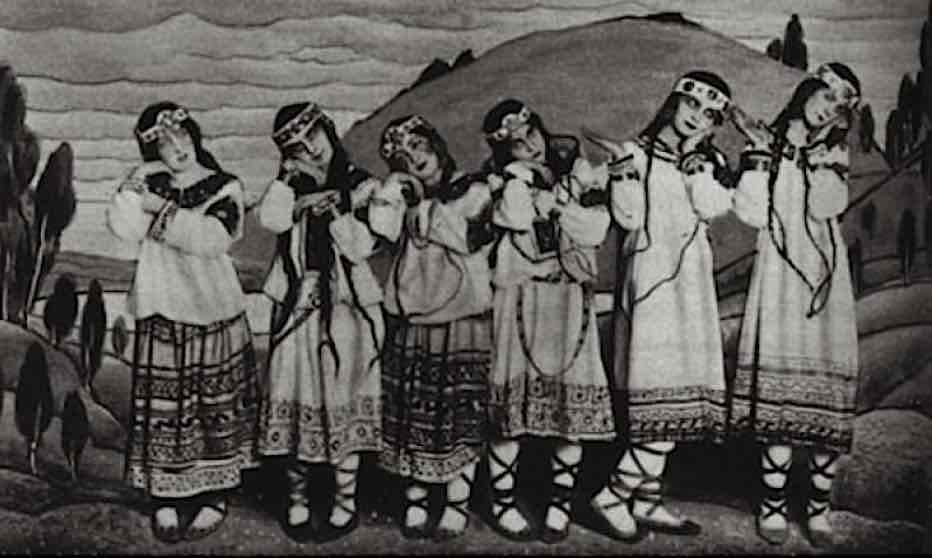
Indeed, it could be argued that England was the most musical country in Europe by the second half of the 18th century, judging by the amount of musical activity of all types.

The variety he cites here includes rival concert series, Italian opera, provincial music societies, church choirs, and amateur musicking such as “gentlemen” competing in taverns. This is indeed more diverse than the narrow picture he criticizes, but still doesn’t subsume “folk” activity such as sea shanties or street fiddlers. He goes on:

My second objection to the “foreign domination” theory is that there is little sign that immigrants replaced native musicians in lucrative employment, or prevented them from obtaining it.

Just as the Lupo and Bassano families had supplemented indigenous instrumentalists at the court of Henry VIII, Italian opera became just an extra strand enriching the musical life of London. But

My most serious objection to the “foreign domination” theory is that it is based on an anachronistic conception of national and racial identity. […] England has always been a nation of immigrants, and it makes no sense to restrict an account of its culture to the work of natives, or, more accurately, to the work of the descendants of less recent immigrants.
[…]
What is often forgotten is that immigrant composers, anxious to be accepted in England, adapted their own idioms to conform to English taste.

This is all grist to Stewart Lee‘s mill.

At the same time, the “foreign domination” theory does rest to a large extent on the focus on the composers and performers of art music. Despite my pleas to broaden the social scope, Holman’s perspective, like a lot of in-depth studies of WAM, belongs firmly within the wise counsels of ethnomusicology. His chapter contains many more perceptive observations, which you must read!

* * *

To return to McClary’s lead,

  • Richard Leppert and Susan McClary (eds.), Music and society: the politics of composition, performance and reception (1987)

is full of stimulating chapters, not least her own:

  • “The blasphemy of talking politics during Bach year”,

which I introduced here. As the book’s Introduction notes, recent changes in scholarship,

especially evident in literature, film, and visual art, have led to a systematic investigation of the implicit assumptions underlying critical methods of the last two-hundred years, including prominently the assumption that art consistutes an autonomous sphere, separate and isolated from the outside social world.

Janet Wolff’s Foreword is another nail in the coffin of “autonomous” art—and another critique that should be compulsory for heritage pundits in China. The book ranges rather widely, with chapters from Rose Subotnik on Chopin, Simon Frith on popular music, John Shepherd on music and male hegemony, John Mowitt on electric technology in sound production, and Leppert’s own discussion of the music, domestic life, and cultural chauvinism of British subjects in India.

The authors point out that they hardly deal with music and society in non-Western cultures, touching “only lightly on questions about the music of women, and ethnic and racial minorities”. They observe that women, and the lower classes, have been erased from the received picture, though they are rarely excluded from musicking—just from prestigious public musicking.

So again the book is largely based on the musical activities of the bourgeoisie—not least because the source material largely derives from them. Still, the debt to ethnomusicology is clear: even if WAM scholarship may seem to contrast with ethnomusicology, they can enter into a rapprochement [uh-oh, more non-national terms?—Ed.].

* * *

Actually, all we need to deflate the idea of Das Land ohne Musik is the classic question “What is music?“—or rather, “What is musicking?”. Pundits of both WAM and pop music tend to take a limited view, as I often observe (e.g. here, and here).

By a narrow definition based on composers of art music, most of the world over most of history would be considered “without music”. Do mothers singing lullabies, spirit mediums, or percussion bands, count? Even once we’ve thrown out the narrow assumption that music means art music, I wonder how one might rank the cultures of the world in terms of “musicality”: Inuit, Italian, Andalucian, Tibetan, Bolivian, Malian, Afghan, and so on. Were Afghans or Andalucians “unmusical”, and are they now? And we may be lumbered with the dodgy cliché that Africans, like Chinese ethnic minorities, are “good at singing and dancing”—but where might north Americans come in the spurious league table, for instance?

Cultural genocide—the suppression of indigenous cultures by a dominant force—is a separate subject. As I write this, I notice this blurb for what I’m sure is a fine BBC4 programme:

Masters of the Pacific coast: the tribes of the American northwest
Exploring how culture was established on the American northwest.

Discuss… An inspiration for the Party’s current replacement of the complexities of Uyghur music by “If you’re happy and you know it, clap your hands” (note also this post)?

Is a society in which most people frequently sing or dance less musical than one with an opera house, a symphony orchestra, and a conservatoire? “Expenditure on the arts” is a dubious index. Is a funding-dependent society in which children are discouraged from singing and dancing unless they’re formally trained as musical as one where such activity is assumed, embedded in the culture? Indeed, even in such a culture, formally-trained musicians make up only a small proportion of participants.

As always, it’s worth considering the wise words of Bruno Nettl, in his

  • The study of ethnomusicology: thirty-three discussions,

He addresses the issue of “what is music?” —a point also made by Christopher Small in his introduction to Musickingin a famous vignette in his chapter 2, “Combining tones: the concept of music”:

Let me reconstruct a cocktail party conversation about 1975 when I confessed to working in ethnomusicology. “Studying American Indian music?” says one amazed person. “I didn’t know they even had music”. I try patiently to explain. “Oh yes, I knew they had chants, but is that really music?” From an elderly gentleman: “I spent a year in Africa, heard a lot of singing and drumming, but is that music? After all, they don’t write it down. Maybe they just make it up as they go along. Do they really know what they’re doing?” More explanation. A young man has added himself. “But these sounds that some peoples in Asia make with their instruments and voices, or the Indian chants, can you call them music? They don’t have harmony.” And a middle-aged lady: “My teenage sons play something they call music all day. I can’t stand any of it.”

We might now wonder if Nettl was going to the wrong kind of parties; indeed, he notes that people may have since become more broad-minded, but the issue remains. He discusses John Blacking’s important book How musical is man? (1973):

writing today, he would likely have asked “How musical are humans?” […] He recognized the world as a group of musics, though he personally was always more interested in their borderlands than the centers, but he wanted to make sure that his readers understood a major point: in the end, all musics are equally valuable, or, let’s put it this way, all musics are to an equal degree music.

Nettl’s whole book explores such themes—essential reading! Even his models for types of cultural change may be instructive to understand the fates of native American and Uyghur cultures.

piper

Billy Purvis (1784–1853).

So the Land ohne Musik slight rests on a blinkered valorization of a league table of Great Works by Great Composers, rather than the diverse forms of musicking in society generally. Ironically, it’s based on new music.

As to England being ohne Musik in 1914 (or indeed 1714), never mind all the WAM activity then, how about all the traditions then being unearthed by Cecil Sharp and Co.—singing, local dance traditions, street music, wind bands? In the narrow view, none of these seem to count.

Issues here include the balance of “active” producers and “passive” consumers, amateur and occupational performers. What of a society which expects to invite performers often, as in Hokkien cultures in southeast China; or one where people simply attend a lot of parties?

Music does seem more ubiquitous than ever today: not just via technology (over speakers in malls and, um, elevators), but actively: both listening to recorded music most of the time, and active musicking at all kinds of social events, including clubbing, places of worship, and football matches.

So never mind 1730s’ Leipzig or 1780s’ Vienna, how about Liverpool and Detroit in the 1960s, or Herat in the 1970s—or Beijing, New York, and London today? I’m not exactly disputing the notion that some societies may be more “musical” than others, but attempting to compile a league table of world musicality would ultimately be a cul-de-sac. Whether for the 18th century or today, it’d take a thorough broad-based survey of soundscapes to assess all this—one fine example of the broad view is Ruth Finnegan’s 1989 The hidden musicians, on musical life in Milton Keynes.

At least, people don’t wait for composers (whether indigenous or foreign) to write symphonies and operas to express their musicality. All this may seem obvious, but people still tend to stick within their particular tribes.

By the way, I constantly dispute the narrow dominance of one particular limited view of what constitutes “Chinese music”. I’ve given many instances of the narrow dominance of the conservatoire style and commercial pop; but punk, all kinds of vocal music along the continuum from folk-song to opera, spirit mediumshousehold Daoists, shawm and percussion bands, and so on, are all part of the picture we have to consider—as for any society in the world, for any period. Yet again, we should delight in all manifestations of the Terpsichorean muse


* This is neither here nor there, but it was on tour with Peter that Paul O’Dette told me the hemiola story

The Tzar-spangled banner—diversity—female genius

I began writing this as another paean to the great Bill Bailey, to follow his greatest-ever love song (“soaking in the hoisin of your lies“), but it has soon turned into yet another tribute to diversity and female genius.

David Hughes (himself a prolific drôle songwriter as well as leading authority on Japanese music) thoughtfully alerts me to this (allegedly) Kremlin-sanctioned version of The star-spangled banner, which is becoming ever more topical:

See also “I think you’ll find—it’s MINOR!”

To return to the major (sung by a minor), this, from Malea Emma Tjandrawidjaja, then 7 (taking a rather different path from Alma Deutscher), is remarkable too:

They come over ‘ere…” See also And did those feet in ancient time?, and The haka.

While I’m here, how can I resist featuring another most inspiring viral clip—and do follow up with Katelyn Ohashi’s thoughtful blog and innumerable further links, like this and this—bearing on ecstasy and drudge, and the nature of artistic competition:

OK then, for a hat-trick of What Really Makes America Great (see The wise AOC):

Do follow @AOC, the most articulate and engaged advocate for political change!

Yet more much-needed hope for our future… Call me a !typical member of the Guardian-reading, tofu-eating wokerati (formerly known as “the Grauniad-reading metropolitan liberal elite”), but long may the likes of “Rear Admiral” Foley turn in their graves.

For another inspirational role model, see here.

Let me see now, what did I come in here for again?

Janáček and Moravian folk

fanfare

Leoš Janáček‘s Sinfonietta (1926) may be a great orchestral showpiece, but it’s complex and stimulating. It also links nicely to several of my themes:

  • His music is another reminder of the centrifugal variety around the peripheries of European art music
  • Since Janáček dedicated the piece to the “Czechoslovak Armed Forces”, this classic story from my mentor Paul Kratochvil is highly apposite
  • It further illustrates the use of additive rhythms
  • It makes a fine addition to the variety of posts grouped under the trumpet tag
  • And the timpani part, like the snare-drum in Nielsen 5, is another that I have earmarked to be played by Li Manshan
  • See also my post on Hašek (and for yet more, including more Švejk, the Czech tag).

Tom Service always makes a good guide (and do watch his link to Jakub Hrůša’s musical tour of Brno).

This is music that Janáček wanted ideally to be played by a military band like the one he’d heard a few years prior to the composition of Sinfonietta, and whose music he wrote down in the composing notebook he took everywhere with him. If you had to perform the Sinfonietta without a military ensemble, Janáček said (as it almost always is in concert halls these days), make sure the brass players sound as rough, brash, and bright as an army band.
[…]
On one hand, the jump-cuts and juxtapositions of Janáček’s music, the way he repeats little cells of music and then without warning moves to a new idea, means that you experience a continuous sense of surprise and suspense when you hear this piece. That kind of cinematic editing and shuffling of musical time seems to be the opposite of the conventional symphonic principle, substituting a logic of surreal colours, unpredictable textures and even less predictable timing for the development, argument, and discourse of proper symphonic behaviour.

There’s a host of spectacular recordings of the Sinfonietta. Since Charles Mackerras was a great champion of Janáček’s music, I was going to suggest his version (not least to remind you his wonderful anagram, Slasher M. Earcrack); but for some historical depth how about this one, with Czech performers—just after the war and Communist takeover, as musicians and audiences must have been anxiously awaiting life-changing measures wrought by their new leaders:

And here’s a 1961 recording with Karel Ančerl, who had survived Terezin and Auschwitz:

The Sinfonietta makes a glorious prelude to exploring the riches of Janáček’s music—operas, chamber music, and so on.

* * *

Please excuse me for returning to folk music, but it was a major inspiration for composers throughout central and east Europe, like Bartók. Along with pioneers like František Sušil and František Bartoš, Janáček collected Moravian folk culture keenly, long before Kundera dissected the way it was distorted under Communist rule.

1906

Janáček collecting folksongs on 19th August 1906 in Strání.

As well as my overview of musical cultures of east Europe I introduced Polish folk music here; Czech and Slovak traditions are projects for another time. Many of those features that Service notes—the use of cells, jump-cuts, shuffling—must relate to Janáček’s background exploring the rhythms and textures of peasant life.

Again, the Rough Guide to world music makes a starting point, under “Czech and Slovak republics”. Janáček’s own recordings have been reissued on the CD

  • The oldest recordings of folk-singing from Moravia and Slovakia, 1909–1912 (Gnosis, Brno).

See also

  • Barbara Krader, “Bohemia, Moravia, and Slovakia”, in Helen Myers (ed.), Ethnomusicology: historical and regional studies, pp.178–85

and

  • Magda Ferl Zelinská and Edward J.P. O’Connor, “Czech Republic and Slovakia”, in The Garland encylopedia of world music, vol.8: Europe.

More stammering songs

Baroque, vaudeville, fieldwork, and blues

possum pie

As part of my series on stammering I’ve already featured several songs about speech impediments, like There once was a man from CalcuttaRossini’s “stupefaction ensemble”Gepopo, and Uri Caine’s take on Bach. Now, thanks to this page from Judy Kuster (part of a site containing rich material), I find a plethora of further links, worth reading together with two splendid discussions, here and here.

As the latter page observes,

By the rise of vaudeville, the stuttering song was established enough that it was considered its own small genre, a specialty for comic singers—Sammy Stammers, from 1894, is a typical example. These stuttering songs fit naturally into a coarse period whose popular music mocked the Irish, Jews, Asians, and blacks.

And in all these cases, modern audiences can only await their cue from the victims to benefit from, even enjoy, such creations.

In the heady days before PC (“gone mad”), there was a b-b–bumper crop in the early days of the recording industry, showing at least that stammering was a significant element in public consciousness. It’s good to contextualize it in the context of other disabilities:

  • Joseph Strauss and Neil Lerner (eds.), Sounding off: theorizing disability in music (2006),

among many interesting chapters (not least on Glenn Gould!), includes

  • Daniel Goldmark, “Stuttering in American popular song, 1890-1930”,

showing how stutterers there were portrayed in music between 1890 and 1930. Note also an article by Josephine Hoegaerts.

Here’s a medley of short clips:

Intriguingly, several of the most popular songs focus on female sufferers, always in a minority—like K-K-K-Katy (Billie Murray, 1917), which, on a roll, he followed up with the “incredibly insulting” You tell her I S-T-U-T-T-E-R.

Oh Helen (1918) contains the ingenious lyric

Oh H-H-Hel, Oh H-H-Hel, Oh Helen please be mine
You s-s-simp, You s-s-simp, You simply are divine
You m-m-mud, You m-m-mud, You muddle me it’s true
Oh D-D-Dam, Oh D-D-Dam, Oh Damsel I love you 

i'm always

Still, there’s a disturbing undercurrent of romance. As the Locust St. post oberves,

The poor stuttering protagonist falls in love but his impediment makes it hard for him to express his feelings. There are typically two outcomes. There is the (relatively) optimistic: in “Stuttering Dick,” as in “The Stuttering lovers,” an Irish folk song, the stuttering guy finds a stuttering girl, and the two live in bliss. Then there is the more popular and more tragic scenario, when the stuttering character falls in love, can’t communicate his feelings, and winds up scorned and ridiculed.

todd

Charles L. Todd records among Mexican migrants, California 1941.

Turning to ethnographic fieldwork, here’s the full version of the unusually endearing song that opens the YouTube medley above. Sung by Lloyd Stalcup, a 14-year old Texan migrant worker, it was recorded in 1940 at Shafter FSA (Farm Security Administration) Camp in California as part of the fine Voices from the Dust Bowl project by Charles L. Todd and Robert Sonkin of the Library of Congress (with evocative fieldnotes here):


But as non-PC goes, the pick of the b-b-bunch—as politicians are discovering, if you’re gonna be offensive, why not go all the way?—has to be Possum pie (or The stuttering coon, 1904), with lyrics by Joseph C. Farrell, music by Hughie Cannon:

Of course, few of these songs attempt to break out of the rhythmic mould to reflect more accurately the irregularity of stammering. Ironically, the impediment disappears when singing, and in rhythmic speech, but neither offers more than temporary relief. I wonder if there are any east-European songs in the parlando-rubato form beloved of Hungarian scholars, or even Bulgarian aksak “limping” treatments…

Delving further back, for us early music fans Andrew Oster has a chapter in Sounding off about Demo, a stammering dwarf (YAY!) in Cavalli’s 1649 opera Giasone. Here the fast repetitious ornament trillo or gruppo, a kind of throat tremolo (defined by Caccini, used expressively by Monteverdi—and recently by Abrahamsen in the mesmerizing let me tell you (see Soundscapes of Nordic noir), is put to comic use:

It reminds one of the drunken stammering poet in Purcell’s The fairy queen (1692—also featuring a Chinese man and woman, BTW):

Now all we need for a full house is a drunken stammering black Jewish Chinese gay dwarf, FFS.

The links above take the story on to pop since the 1950s; but for blues fans, I’ll play out with John Lee Hooker—one of the more realistic impersonations of the sound. You can decide if it’s “a revelation—the singer isn’t a poor victim but a player, wooing a girl through his stammer” or if it’s just “good old-fashioned sexual harrassment”:

* * *

This may just be a coincidence of the birth of the recording industry, but it looks rather as if stammering songs reached peak popularity in the wake of World War One. So recalling that many Chinese stammerers are also documented in historic periods of warfare, we may wonder if there’s some correlation between social trauma and disfluency in speech. Speech therapy is clearly among the needs of current refugees, for instance. Still, if conflict were a simple stimulus, our forebears would all have been at it. And I’ve no idea how one might make a more comprehensive global diachronic survey—taking account of class, economic conditions, gender, and so on.

For more stammerers in opera, see here; and for an Azeri song, here!

Musical cultures of imperial north China

Navigational aid for fans of late imperial Chinese history: here’s a roundup of posts on musicking in the Qing—not only at the Beijing court but further afield, looking beneath the tip of the iceberg.

But of course, we shouldn’t focus narrowly on defunct genres, or cling to simplistic notions of  “art” and “court” cultures. Notwithstanding social change, all the living local ritual traditions I study have been transmitted virtually continuously since the Ming and Qing among folk groups (“When the rites are lost, seek throughout the countryside“). This doesn’t mean that we can neatly relegate them to “history”: the study of all kinds of expressive cultures also involves fieldwork on their fortunes since the collapse of the imperial system, with ethnography and oral history becoming more fruitful than library study.

Still, Like Life, one thing leads to another. More generally, early Western contacts with Chinese music are the subject of a wider range of research from scholars both in China and abroad (see comment below).

Soundscapes of Nordic noir

bh

Nordic noir on screen is all very fine (see Saga and Sofia!); but on Thursday I went to hear an inspiring (rather than bleak) wintry concert at the Barbican, with the spellbinding combo of Barbara Hannigan (see also here) and S-S-Simon Rattle programme notes here).

At the heart of the concert was Hans Abrahamsen’s magical let me tell you (2013), with lyrics by Paul Griffiths. It has already become a classic among orchestral song cycles—to follow Nuits d’été and Shéhérazade, the Wesendonck and Altenberg lieder, the Rückert liederand the Four last songs.

I don’t need to add to all the praise (reviews here), but as well as the three creators discussing the piece, do also watch Hannigan’s own reflections:

As she suggests, this re-imagining of Ophelia’s monologue is enriched by the following 500 years of female experience. With her utterance at once fragile and resolute, the result is not bleak but luminous. And Hannigan is just mesmerizing on stage, embodying the role—one of the great singers (see also my Playlist of songs).

The cycle was also part of the CBSO Prom in 2016 (from 11.00), with the excellent Mirga Grazinyte-Tyla conducting:

At the Barbican the other day Let me tell you was sandwiched [Aww, no smorgasbord?—Ed.]* between two challenging symphonies, which S-Simon conducted from memory. He describes Sibelius 7 (1924, one of his last works before he devoted himself more single-mindedly to the bottle) as “almost like a scream” (cf. Mahler 10). (Sibelius makes a flimsy pretext to remind you of this post on Finno–Ugric musicking).

nielsen

Nielsen aged about 14.

Carl Nielsen’s 4th symphony (“The inextinguishable”, or even Det uudslukkelige) (1916), like his 5th (for whose snare-drum part I hereby nominate Li Manshan), is a battle with chaos. Though Denmark wasn’t directly touched by the war, its echoes are clear. But again, with its incandescent ending in E major (cf. Bruckner 7 and the home key of Chinese ritual wind ensembles!), the overall mood is far from bleak.

To harp (nyckelharpa? Another world fiddle for our list) on the folk angle, whereas other composers like Bartók approached their local traditions as outsiders, Nielsen came from a poor peasant background as a brass player and traditional fiddler on the island of Funen. For more Danish folk music, see under A folk playlist for Euro 24!.

Getting to know both the music of Sibelius and Nielsen in my teens thanks to enterprising amateur orchestras, I must have been vaguely aware of Nordic gloom, but in my callow youth I suspect I heard “classical music” as a monolith, hardly discerning regional, temporal, or personal diversity.

The concert made an evening that was both disorienting and inspiring. Live performances by Barbara Hannigan are not to be missed.

* SJ: Not today, but I can offer you “pining for the Fjordiligis”.

Musicking at the Qing court 2: Pedrini and Amiot

pedrini 2

To return to my fantasy of Bach at the 18th-century Beijing court (see—and hear!—The Feuchtwang variations), the musicking of the European missionaries there makes an intriguing tangent to the varied material on all the diverse forms of musicking at the Qing court (a list to which I’ve now added Manchu shamans).

An authority here is François Picard (list of publications here, including this useful summary of relevant works—and note his CDs, introduced below).

Jesuit missionaries had established themselves as early as 1589 at the Ming court, and continued to find favour at the Qing courts of Kangxi and Qianlong. As Picard explains:

Their strategy was to convert the Chinese to Christianity, starting from the top. They did this, first of all, by demonstrating their status as experts and thus gaining access to the court; they then aimed to prove the superiority of the West, of Christendom, and therefore—syllogism—of Christianity, in the realms of science, astronomy, cartography, measurement, and music, the study of which belonged to the field of scholarship in both civilizations. Acoustics, instrument-making, notation, and performance were all part of that strategy of integration, competition, and persuasion.

Following Matteo Ricci (1562–1610), Adam Schall von Bell (1591–1666), and Ferdinand Verbiest (1623–88), Tomàs Pereira (1645–1708; for a range of studies, see here) is notable for his major compilation for the Kangxi emperor on the theory of Western (art!) music. This was completed by the Lazarist priest Teodorico Pedrini (1671–1746), who, reaching Beijing in 1711 (after an epic eight-year journey that puts the travails of British train commuters in perspective)* was active there along with Florian Bahr (1706–71) and Jean Walter (1708–59). Pereira and Pedrini are further discussed by several scholars, including Joyce Lindorff and Peter Allsop (e.g. here). The Jesuit priest Joseph-Marie Amiot (1718–93) arrived in Beijing in 1751.

Even transporting the keyboard instruments was a mind-boggling task for the missionaries. While they were braving such obstacles, Bach’s long-term residency in Leipzig was bearing fruit in a constant stream of creation.

François Picard’s work bears fruit in his collaboration with Jean-Christophe Frisch and his ensemble XVIII-XXI Musique des Lumières, notably an enterprising series of CDs—with contributions from the Fleur de Prunus ensemble and the choir of the Centre Catholique Chinois de Paris, and instructive liner notes with further references.

While the missionaries were not mainly concerned with documenting or performing Chinese music, Amiot notated some Chinese melodies, and some canticles were set to Chinese texts.

The Congregation of Musicians of the Northern Church in Beijing, numbering about thirty young musicians, including several Manchu princes, would accompany important celebrations, the most spectacular of which was the feast of the Sacred Heart of Jesus.

gongche

Liuyejin, in gongche solfeggio with stave transnotation, Amiot 1754.

Some of Amiot’s Divertissements chinois, based on Kunqu melodies, are imaginatively recreated with Chinese instruments on the CD

  • Teodorico Pedrini: concert baroque à la cité interdite (Auvidis, 1996)

Here’s a playlist:

Other CDs in the project include

  • Joseph-Marie Amiot (1718-1793), Messe des jésuites de Pékin (Auvidis, 1998)
  • Chine: jésuites et courtisanes (Buda Records/Musique du monde, 2002)
  • Vêpres à la Vierge en Chine (2004)

In the chamber items with both baroque and Chinese instruments, the timbres blend well—and would do so even better had the latter been set up in 18th-century fashion, with silk or gut strings.

All this makes an intriguing if inconclusive exploration of elements: whereas ornamentation is common to both traditions, it’s more of a challenge to reconcile Chinese heterophony with the harmonic basis of baroque music. Amiot didn’t take the “superiority” of his musical culture for granted—Picard cites a perceptive passage:

Here, there is neither bass, not tenor, nor treble, everything is in unison, but that unison is varied according to the nature and capacity of each instrument [what we now call heterophony! SJ], and the composer’s skill, the beauty of the piece and the whole art of music lies in that variation. […] It would be of no avail to endeavour to prove to the Chinese that they must find pleasure in something in which they really find none at all.

In Picard’s notes for the Chine: jésuites et courtisanes CD he cites some contemporary reports relevant to the “suite-plucking” of the nobility, such as notes by courtier Gao Shiqi:

[The Kangxi emperor] ordered the ladies of the palace to play a melody, hidden behind a folding screen. He then said: “The people of the palace are excellent with string instruments (xiansuo).” He ordered his courtiers to show their art and successively play the hupo, pipa, and sanxianzi string instruments. He then said: “Play the qin piece “On the beach the geese are landing” (Pingsha luoyan) on the four string instruments—hupo, pipa, xianzi, and zheng—together.”

Adding female nobles to our list of performers, the emperor went on:

“The ladies of the palace have played the zheng zither since their childhood, to the point of forgetting to eat or sleep.** After ten years of efforts, they have attained sheer mystery [cf. Shenqi mipu].” He then ordered them to play “The moon is high” in a “changing tonality” (Bianyin yuer gao).

For more excursions in Qing ritual culture, see here.

* * *

To return to my Bach fantasy, European art music performed by European musicians at the Chinese court is a perfectly valid topic. It’s a welcome clue to early Chinese exposure to Western music, which from the late 19th century would become a major and more pervasive theme. And Amiot’s arrangements of Chinese melodies may have been performed by Chinese musicians. But while it’d be nice to think of European missionaries learning Chinese style, whether on Chinese fiddles (tiqin, sihu) or on violin, I can’t see any evidence; their contacts with the broader society, and indeed their tastes, were circumscribed.

Of course, world music “fusion” in China goes back to the Tang dynasty and earlier. But in the Qing, even within the rarefied milieu of the court, and despite the efforts of the missionaries, I find little evidence of more significant interaction, such as Chinese performing European music on Chinese instruments or Europeans taking part in Chinese ensembles.

For the Vêpres à la Vierge CD I took part, implausibly, on baroque violin, erhu and shawm—but I never quite knew whom I was impersonating (an imaginary missionary, either steeped in Chinese style or not? Perhaps even a Chinese Catholic convert keen to bury his musical heritage beneath superior Western learning?!). My ears conditioned by exposure to living Chinese traditions that often go back beyond the Qing, I found our experiments tentative; we were on firmer ground with the purely Western items, which now sound more successful to me. Later in a couple of concerts I began doing some semi-chinoiserie noodling on the two types of fiddles (miantiao? tagliatelle?) that I, at least, found a bit more satisfying; but I still couldn’t work out who I was—me, I guess.

Anyway, I was content to get back to my work with the living folk ritual groups of Hebei and Shanxi—where besides indigenous traditions, Christian groups had come to adopt their own local shengguan wind ensembles for ritual observances.

Catholics in rural Shanxi—left: Wenshui, 1933 (see South Gaoluo: the Catholics);
right: Xinzhou, Shanxi, 1992 (see Shanxi, summer 1992).

* * *

For such imaginative cross-cultural time-travelling excursions, one might compare several projects on baroque music in Latin and south America, and the fine project of Jordi Savall and Hesperion XXI on the routes of slavery:

—in line with their previous work on medieval music, such as their versions of the medieval estampies (better received than ours…).

See also the thoughts of John Thompson.

* * *

In these two posts on the Qing court I’ve given just two instances of the great variety of musicking there. As you know, I don’t go in much for recreations. While such experiments are imaginative, as Taruskin reminds us, the whole social and aesthetic framework in which we experience them—our very ears—are quite different (see e.g. Bach and Daoist ritual); we can only hear them for what they are: our creative response, for our own tastes in our modern societies.

* Since this post entails historical re-enactment, many would doubtless welcome the nomination of Transport Minister Chris “Failing” Grayling to retrace Pedrini’s route.

** I dunno, these teenage kids on their mobiles, Typical!—Ed.

New tag: fiddles!

At last I’ve added a tag in the sidebar for fiddles, embracing all kinds of bowed lutes (or even, um, friction chordophones) around the world, including folk fiddles, ghijak and satar, sarangi and kamancha, violins in WAM, and so on.

It’s a typically extensive list, and I’m sorry I can’t subhead tags, yet. If I could, the entries might include

and so on.

See also Some jazz fiddling.

Do also explore the tags for Irish and the brilliant Ciaran Carson—some highlights include

One quirk of the blog format I use here is that I can only give categories and tags to posts, not pages. So I’d add other pages like

and so on.

For another instrument tag, see trumpet—giving links to many world traditions of wind and brass playing.