A blind bard in Hong Kong

Dou Wun cover

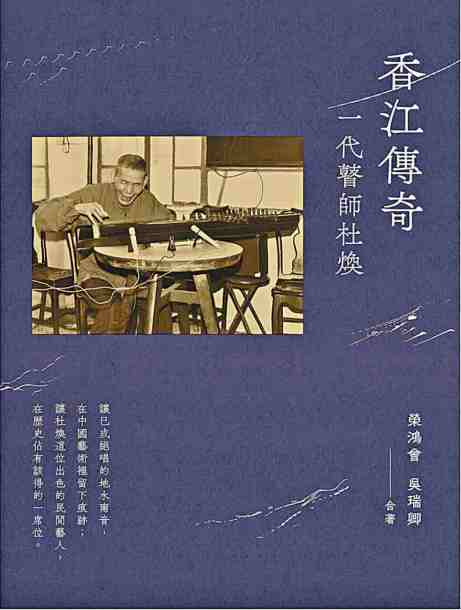
Bell Yung has already issued a fine series of CDs, recorded in 1975–6, that make an impressive anthology of the repertoire of the blind bard Dou Wun 杜焕 (1910–79) in Hong Kong (click here). Now he has published a detailed book, in Chinese, on the topic:

Rong Hongzeng 榮鸿曾 [Bell Yung] with Wu Ruiqing 吴瑞卿 [Sonia Ng], Xiangjiang chuanqi: yidai gushi Du Huan 香江傳奇:一代瞽師杜焕 [Tales from Fragrant River: the blind master Dou Wun] (2023, with CD).

In English, note Bell’s eloquent article

and now also his

  • “A humble blind singer’s autobiographical song: oral creation facing a Hong Kong teahouse audience”, Ethnomusicology 67.2 (2023).

As to the book, the nine chapters of Part One introduce successive social, economic, and political changes of Hong Kong; the genre of naamyam 南音 as part of a rich tradition of performed oral literature, with constant improvisation; musical and textual analysis of naamyam, as well as baan’ngaan 板眼 and lungzau 龍舟. In chapters 7 and 8 Sonia Ng gives useful roundups of Dou Wun’s comments on his fluctuating experiences amidst changing Hong Kong society, illustrating another subaltern milieu.

The Fulong teahouse, 1975.

With Hong Kong constantly modernising, the tradition was virtually defunct by the 1970s, so this was already very much a salvage project. Even finding a suitably conducive ambience, venue, and audience to record Dou Wun’s performances was a challenge. After a poor childhood in Guangzhou, he had arrived in Hong Kong in 1926; from the teahouses and brothels of his early years there (despite the 1935 prohibition of the latter, he managed to sing at illegal venues until 1952), and beset by family tragedies, he had mainly “sold his singing” on the streets, besides a regular radio slot from 1955 to 1970. So by 1975, Dou had hardly performed in teahouses for over twenty years; Bell did well to arrange thrice-weekly sessions at the Fu Long teahouse in Sheung Wan district, the stories punctuated by the chirping of caged songbirds brought by its clientele (pp.34–43) (contrast the sterile, empty venues where PRC fieldworkers have mostly recorded).

Part Two (pp.184–237) provides the complete text of Du Huan’s precious six-hour sung autobiographical tale, heard on the 6-disc CD set Blind Dou Wun remembers his past: 50 years of singing naamyam in Hong Kong, and Part Three (pp.239–355) the texts of other items in his repertoire—also featured on the CDs.

Biography is an important component of anthropology and ethnomusicology (for China, see e.g. Helen Rees ed., Lives in Chinese music; cf. my own work on Gaoluo and the Li family Daoists). Yet it’s an unattainable goal to “become as one” with the people on whom we impose (see e.g. here). In personal reflections, Bell has expressed a certain regret that he couldn’t take the project further, entering more fully into Dou Wun’s life; their interaction, and Bell’s material, was largely based on the recording sessions and brief chats at the teahouse. The reader might also like more detail on Dou Wun’s use of the zheng plucked zither (cf. its use to accompany narrative-singing in Shandong).

While it works well as a self-contained project about one artist, one is curious to learn more about the whole performing culture of which Dou Wun was part, not only in Hong Kong but over in the PRC, in Guangzhou and around the Pearl River Delta. There, a starting point might be the narrative-singing volumes of the great Anthology for Guangdong province—for instance, on naamyam, see Zhongguo quyi yinyue jicheng, Guangdong juan 中国曲艺音乐集成, 广东卷, pp.422–66, with brief biographies (including Dou Wun!) on pp.467–9; and under a variety of rubrics, Zhongguo quyi zhi, Guangdong juan 中国曲艺志, 广东卷 (at a mere 470 pages, surely among the Anthology‘s shortest volumes!).

See also my roundup of posts on narrative-singing and on blind musicians in China and elsewhere.

Buttering parsnips

with a note on the syntax of yore

Parsnips
Source.

Plucking the winds, my ethnography of Gaoluo village and its ritual association, chronicles vicissitudes in the peasants’ lives. At the end of chapter 6 (“Turmoil and tedium”, on the Cultural Revolution) I reflected on how our paths coincided:

Over the other side of the world, in total contrast to their experiences, I took my first steps on my own Long March (more like a Leisurely Stroll) to Chinese musicians and Gaoluo, absorbing enough hippy influence to become “hooked” (shangyin, as the Gaoluo musicians say) on Zen, and thence also on Daoism, Tang poetry, and all the rest. In 1972 Nixon went to see Mao in China, visiting the Great Wall, where he sagely observed, “It’s a great wall”. That same year I started studying Chinese at university; the following year the London Philharmonic Orchestra performed in China. None of this buttered any parsnips in Gaoluo.

I suppose some international, and younger, readers may wonder WTF parsnips are, and why ever anyone might want to butter them. I must have heard the expression in my youth, but I don’t know how I later became so partial to it.

“Faire words butter noe parsnips” is attested from 1639, in the days when the potato was only just becoming a staple (and when spelyng was a Free Countrie—another liberation promised by Brexit?). This site also adduces John Taylor’s Epigrammes (1651):

Words are but wind that do from men proceed;
None but Chamelions on bare Air can feed;
Great men [sic] large hopeful promises may utter;
But words did never Fish or Parsnips butter.

On whose syntax I might comment:

Poets of Yore o’er verb–object inversion may splutter—
An order consigned by Latter Epochs to ye gutter
He who reverses them is clearly a Nutter—
Yet grammarians ne’er a Cavylle do mutter.

OK, I do get it, really—it’s history, innit… 

Cf. Some global idioms.

As to my own culinary habits, I tend to roast parboiled parsnips and potatoes, with shallots, all basted in oil (not butter) and lashings * of spicy Turkish orta. For more cuisine, with links, click here—including the late great Ciaran Carson’s paean to the fry-up and the music of time.


* Here I was boldly seeking another role for “lashings” beyond what I supposed was its traditional duty as measure-word for ginger beer; but in fact, as posts like this explain, it wasn’t Enid Blyton who bound the two together—it seems to have taken hold in our imaginations only since the Comic Strip’s Five go mad in Dorset. This kind of thing happens a lot: see e.g. What’s the craic?.

Daoist temples in California, 1849–1920

“A lost Daoist America”—Hannibal Taubes

Ho Bronson cover

Pursuing the theme opened up by Hannibal Taubes’ guest post on the Chinese temple in Chico, I’ve been admiring the hefty tome

  • Chuimei Ho and Bennet Bronson, Chinese traditional religion and temples in North America, 1849–1920: California (2022; 523 pages, large paperback format).

An impressive work of scholarship, published under the auspices of the Chinese in Northwest America Research Committee (CINARC), the book is an elegy to the remains of popular Daoism that nearly died a century ago but was central to Chinese people’s lives in North America from the mid-19th century. Hannibal is far more able than I to identify salient themes, so below I consult his thoughtful review.

Bronson 1

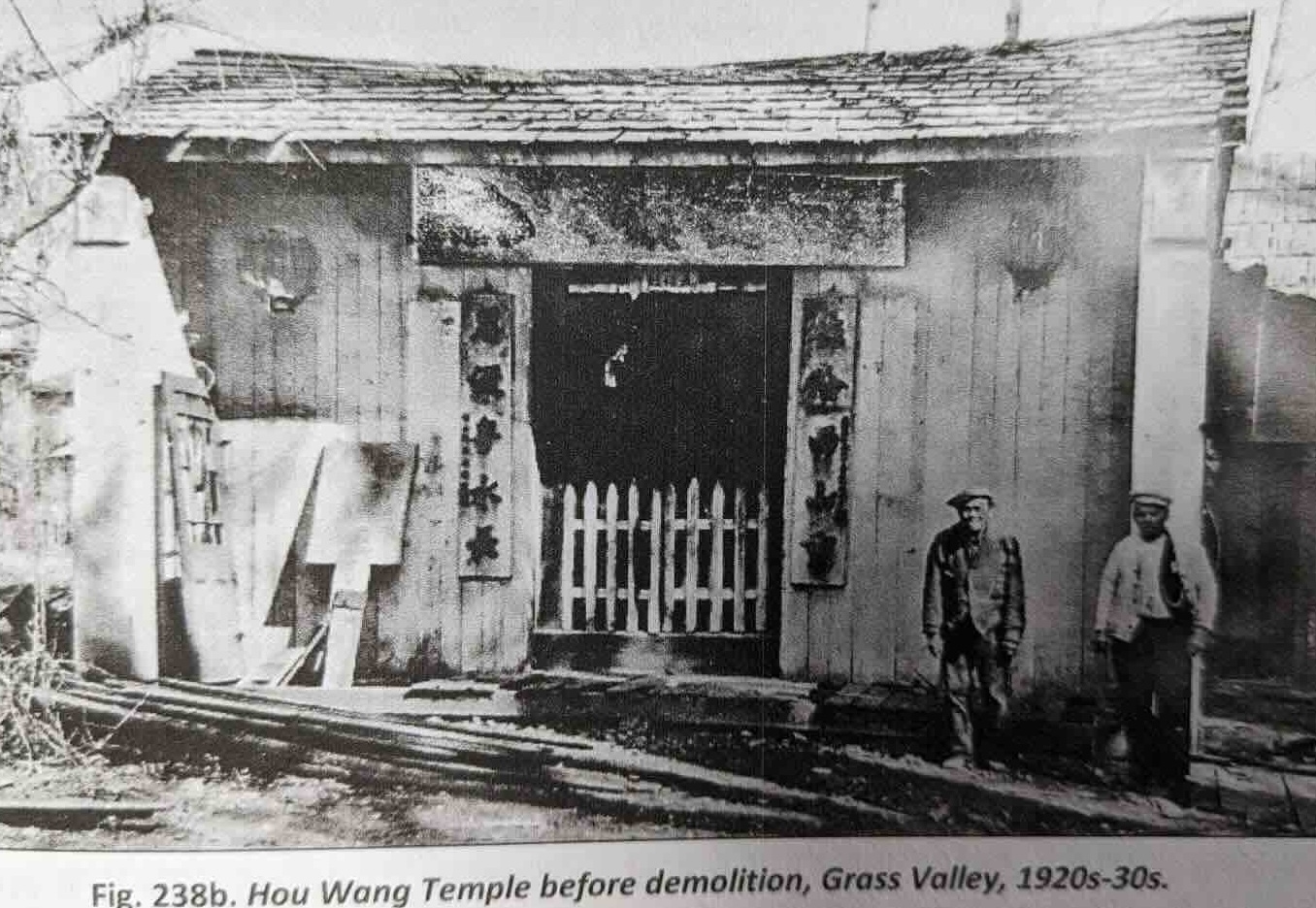
Among the wealth of illustrations on almost every page, many are reproductions of original black-and-white images, assembled from substantial local archives—perhaps a future edition might include a section of colour plates showing more recent photos. The CINARC website is a rich resource for many such images.

Marysville HT

Marysville. Image courtesy Hannibal Taubes (here).

The topic is geographically distinctive, addressing migrants from the Pearl River Delta in the far south of China to the far west of America. As Hannibal notes,

Some counties in the Gold Rush hills had Chinese temples years before any Christian church was built, while yearly Chinese camp-meeting festivals in the mountains attracted thousands of worshippers, with Zhengyi-sect Daoist priests, great sacral processions, and deity-figures ten feet tall. By 1930 almost all of this had vanished.

Pondering reasons for the neglect of the subject, Ho and Bronson suggest:

Perhaps the main reason for a lack of scholarly interest has been an almost exclusive focus on immigration, anti-Chinese violence, economics, and racism. This has meant adopting a victims’ perspective, reciting long lists of grievances and instances of White hostility. However, we feel that a different perspective is needed, one that focuses on the sources of the courage and mental balance shown by Chinese immigrants.

They posit various provisional elements that may partially account for the rapid, severe decline in religious observances, including conversion to Christianity, white prejudice, progressivist politics, (interestingly) a lack of Chinese women—and the 1906 San Francisco earthquake. Anyway, the USA proved a less viable site for Chinese religion than southeast Asia.

By the late 19th century the early mining communities * servicing the gold rush gave way to agricultural centres. Both in San Francisco and the hinterland, the secret societies were major patrons.

Apart from newspaper reports (often negative in their portrayal), the study is based largely on the material evidence of the temples themselves—inscriptions, ritual objects, ledgers, and so on, “that we feel brings us closest to what interests us most: to hear, if only faintly, the voices of the pioneers who withstood astonishing hardships to build Chinese America”.

Section 1, “Spiritual and social aspects of temples”, clearly addresses the salient issues, discussing

  • Why temples mattered
  • Where they existed and who built them
  • Functions
  • Worship
  • Temples and communities.

Temples served as refuges, hostels, clinics, and meeting places. They were sources of ethnic pride, and centers of community life. And most importantly, the deities they housed stood at the very center of a Chinese-American identity and psychological survival. The early immigrants withstood enormous pressures from physical hardship, cultural prejudice, threatened violence, and concern for loved ones back in China. They needed those temples. For many, the temples were the central institutions of an exile’s life.

Unpacking the ambiguity of the common term joss-house (“joss” deriving from Portuguese deus), the authors identify types of affiliated temples and their parent associations: shrines associated with districts of origin associations (huiguan), charitable halls (shantang), clan associations (zongci), tradesmen’s guilds (hanghui), and secret societies (“tongs”), as well as some independent temples.

Bronson 3

Ho and Bronson go on to discuss individual and communal worship, ritual roles (mortuary services, divination, spirit mediums), cultural reinforcement (including education, and opera), secular functions, and investment. They detail the gods invoked (temples with single and multiple deities), life-cycle and calendrical rituals, “bomb festivals” (paohui), and (of special interest to scholars of Taoist ritual) communal festivals for the jiao Offering ritual, known as tachiu (dajiao 打醮, pp.66–73). They discuss the founding, ownership, control/management, and financing of temples.

Bronson 2

Section 2 looks at “The physical side of temples”:

  • Exteriors and siting
  • Entrances and interiors
  • Furnishings with fixed and variable locations
  • Suspended furnishings
  • Inscription boards
  • Equipment for processions
  • Other furnishings.

Overall, “very few Chinese religious buildings were close copies of homeland prototypes”.

Sections 3 and 4 are a detailed inventory of individual temples. Section 3 discusses San Francisco, “by far the most important Chinese religious centre outside Asia” in the late 19th century. Section 4 documents centres outside the Bay Area—mining, agricultural (farm labour), coastal, and urban (despite the great importance of railroad workers in building the West, they were too transient to sponsor temples). This section really opens our minds to the wealth of history in the hinterland, in communities such as Auburn, Marysville, Oroville, and Weaverville.

Left, Oroville; right, Weaverville. Images courtesy Hannibal Taubes.

Ho and Bronson’s concluding remarks survey the spatial and temporal distribution of temples; White views (often disparaging) on the phenomenon; and Chinese American religion in Chinese eyes, making astute distinctions between the perspectives of Chinese businessmen, officials, secret societies, religious professionals, and sojourners.

As Hannibal observes,

Ho and Bronson’s tome will now be the standard reference work on this subject and should be on the shelf of everyone interested in Chinese art and religion, Asian-American studies, immigrant visual cultures in the Americas, and California generally. The authors note that they are considering a follow-up volume that will treat Chinese temples in North America outside of California. Let us hope that this work is completed and that the two volumes can be published together under the imprint of a major press, with color photographs and a few editorial tweaks, as befits this important scholarship.

* * *

My only little contribution to the study of the Chinese diaspora is this tribute to Ray Man, Cantonese music pioneer in London. For the decline of Catholic worship among south Italian migrants in New York, see The Madonna of 115th street.


One point that Hannibal makes in his fine review seems to go rather against the grain of recent scholarship on religious life in post-Mao China. This isn’t the place to assess the vast religious revival that took place there after the demise of the Maoist commune system, but, making a somewhat ambitious comparison between the decline of temples in China and America, Hannibal opens with the statement “Sometime between 1850 and the present, almost all the temples in China vanished.” On the revival since the 1980s, he comments (n.9): “Even areas that appear to have rebuilt their temples en masse still experienced massive losses compared to pre-Communist numbers.” And

Those temples that still physically stood were bulldozed to build apartment complexes, or left to moulder and collapse in half-abandoned villages. Other areas have rebuilt their temples, sometimes in massive numbers, but from the preservationist standpoint this only compounds the destruction, since little care is taken to retain or record the original structures.

These are points worth making, but they downplay the significance of the vast revival. Though much fieldwork on recent Daoist activity (in volumes such as Daojiao yishi congshu) has a retrospective agenda, religious life has resurfaced widely, on a large scale (see e.g. Ken Dean, Adam Yuet Chau, Ian Johnson, and regions such as Fujian, Jiangxi, Hunan, Shaanbei). Moreover, temples are not the only yardstick to assess Chinese ritual life; material artefacts can only tell us so much (cf. China’s hidden century).

While the particular religious ethos that Ho and Bronson’s study reveals will be more familiar to specialists in the ritual history of the Pearl River Delta than to those focusing on other regions of south (and certainly north) China, the whole history of religious life in local communities in the PRC, with their diverse social and economic factors, is utterly different from that in the American West—and from that of the Chinese diaspora in southeast Asia, where ties with the mainland were much stronger and enduring.


* Cf. religious processions of mining communities near Beijing, n. here.

Roundup for 2023!

As I reflected in last year’s roundup,

like a suburban Sisyphus doing and undoing a jigsaw, having gone to great lengths to mix up the daily sequence of my diverse topics in a stimulating fashion, it’s that time of year when I try and reassemble them into some kind of thematic order.

In order for this exercise to be worthwhile, you’ll have to click on the links! Ideally, spread the word by reposting on one of those “Social Media” Thingies They Have Nowadays… Even if you only read a dozen of these posts, then my labours will not have been in vain!

I’m going to adopt Stella Gibbons’ drôle device in Cold Comfort Farm, drawing attention with *** to passages (mostly posts, in this case—indeed, the book’s protagonist is Flora Poste) Not To Be Missed. And this list isn’t even exhaustive—the committed masochist can consult the monthly archive in the sidebar, scrolling waaay down.

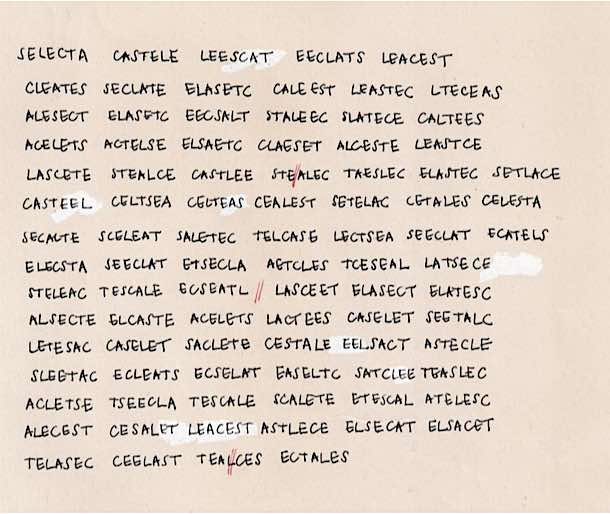
I’ll begin with Nicolas Robertson, who alas joined the Heavenly Choir in November (see my tribute). His extraordinary anagram tales (introduced and listed here***), a kind of fantasy Esperanto fiction, are among the highlights of this blog, and in further tribute to his brilliant mind I have recently added two more:

So here are listings under some main themes (many, of course, belong under several themes, which is the point of giving them categories and tags, listed in the sidebar):

China (culture and ritual, Maoism and politics):

East Asia, other:

This year’s additions to my education in Tibetan and Uyghur cultures:

Turkey and West/Central Asia (see roundup):

Modern Europe:

Ethnomusicology and world music:

Jazz (see roundup***):

Pop:

Western Art Music:

Sport (see roundup):

Film/TV:

Loft best new

Arising from the transformation of my home:

Other:

For roundups of previous years’ musings, see 2018201920202021, 2022. And here’s a roundup of roundups! The homepage is always useful for navigation.

And it’s always worth reminding you to watch my portrait film***
on the Li family Daoists,
 raison-d-être of this whole blog!

Guest post: Salzburg

by Nicolas Robertson

For links to the complete anagram series, click here.

Prelude—SJ
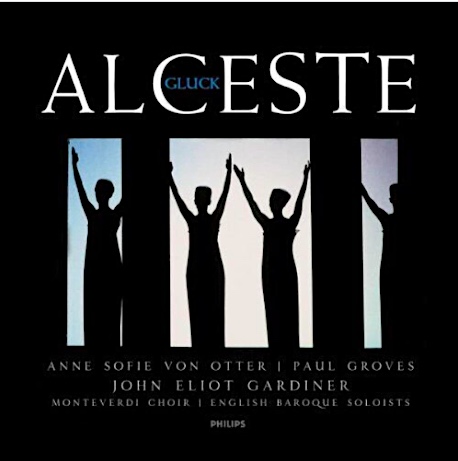
Since Nick has Ascended to the Great Pinball Table in the Sky, I’ve found two more of his mind-blowing anagram tales. Alceste, which I posted recently, is relatively economical; this one—among stiff competition—is surely his most virtuosic, fantastical (and lengthy) creation. Even the introduction is highly challenging, before we reach the “story” and the final gnomic anagram tale itself. In the absence of Nick’s eagle eye, formatting his text has also been a severe challenge.

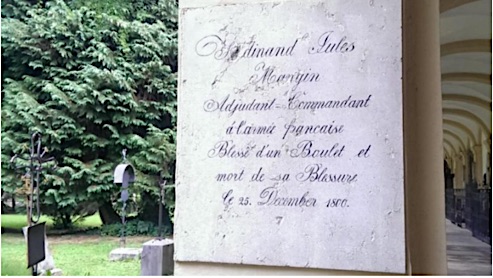
Nick’s penchant for tombstones as a medium to connect with the spirits of the past, especially evident here, now seems all the more poignant.

* * *

SALZBURG

Leonore, first version of opera by Beethoven, 1805; shelved and reworked in 1814 as Fidelio.

Fidelio was one act shorter with reordered music; and had a brand new overture. Beethoven commented “almost no musical piece remained the same, and more than half of the opera had been completely reworked”—a description I’ve attempted to reflect.

Staged performances by soloists, Monteverdi Choir and Orchestre Révolutionnaire et Romantique, directed by John Eliot Gardiner, including at Salzburg Festival 1996. Archiv recording, issued 1997.

An introduction, the “story”, and lastly the anagrams themselves, of Beethovens “Leonore” followed by Beethovens “Fidelio”.

[Elements written recently—between 2017 and 2020—principally the “apparatus”, are set in blue to distinguish them from the original 1996 text, augmented in 2012. There are three textual notes, marked in red. Photos were taken later, in 2012 and 2014—one did not have phones with cameras in 1996.]

______________________________________________________________________________

“I hope we English will long maintain our ‘grand talent’ pour le silence”
—Thomas Carlyle, “On Heroes and Hero-Worship”, vi.

Salzburg, summer, Festival and Festung. By day, monsoons and the heavy sun of Mitteleuropa; fading into night, a great still, bulging moon, hanging like a distant punchball, haunting the baroque fountains of a city with too much to remember. Here, one dreams—and sings—of escape: Mozart, from Archbishop Colloredo; Florestan, from prison, and Leonore from half-life to bliss.

Perhaps it was no more than normal for the times, but I could not but be torn by the silent witness of those who escaped far too soon, from a world which had hardly begun to hold out its arms to them. St Sebastian’s Friedhof is a lovely shaded cemetery in a cloister on the other side of the Salzach, and just look what memories call to us from it: of Constanze Weber, Mozart’s wife, yes, and his father Leopold too, but also of the great-grandchildren (I surmise) of stone-cutting master Johann Doppler:

Maria and Anna, born 2 November 1859, died 23 November and 4 December 1860; Otto, 17 February 1868–30 January 1870, and Rudolf, 13 April 1865–5 February 1870 (Johann could have had the melancholy task of engraving their stones, had he not died, aged 45, in 1838). And look, too, Therese Patera, b.1859, d.1861, “geliebtes Kindlein”,
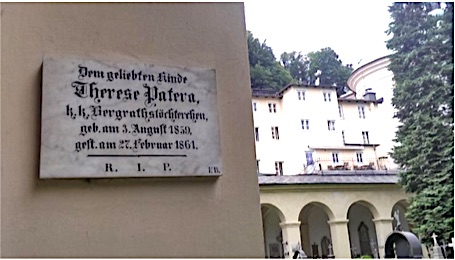
3

and, without even such ado, “Egbert Almeric Henry-Henry / born Feb 22 1859 / died March 22 1859” (the stone, high up and reticent, is inscribed, without any other words than these, in English).

4

What was happening in Salzburg in the mid-19th century? Paracelsus, buried in the same St Sebastian’s church in 1541, would have plunged in, reckless of his own health, to fortify the unprotected, even though he well knew that

All, what is, lives.
Nothing is annihilabl,
even Mouldering is transition to new life.
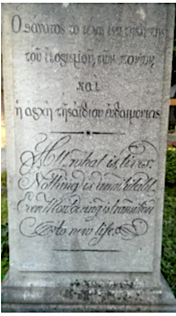
5

(Tomb of Dominic Oberlechner, d.1821 aged 23, St Peter’s Friedhof, Salzburg—and in English, though you will find a similar text on the same monument in German, French, Latin, and Greek…)

6

This has, to me, a profound assonance with these words of Claude Lévi-Strauss (as quoted by Douglas Hyde, and printed in the latter’s Guardian obituary, where I read them on the day I wrote this, 22 September 1996):

“Nothing is settled; everything can still be altered. What was done but turned out wrong can be done again. The Golden Age, which blind superstition had placed behind (or ahead of) us is in us.” [1]

[1] “Si les hommes ne sont jamais attaqués qu’à une besogne, qui est de faire une société vivable, les forces qui ont animés nos lointains ancêtres sont aussi présentes en nous. Rien n’est joué; nous pouvons tout reprendre. Ce qui fut fait et manqué peut être refait: «L’âge d’or qu’une aveugle superstition avait placé derrière (ou devant) nous, est en nous.» I’m not sure from where Lévi-Strauss is quoting (Rousseau?); the whole passage in context is cumulatively inspiring. [Tristes Tropiques, 1955, p.471.] The English version above is as used for the epigraph to Alexander Cockburn’s book of essays The Golden Age Is In Us (1995).]

What is this but the quiet request of the Zen master, Hōgen Daidō: “Why not here? Why not now?”, which translated into the high art terms of the western world would find its parallel in the manifesto of Hölderlin quoted by Geoff Boycott later in this story. But, though I happen to be writing these last (preliminary) words in Japan, I find it more appropriate to round the little life of this squib with the Biblical version of that long sleep which was written on the very slab of Johann Doppler (Steinmetzer, der unvergesslicher Gatte)’s descendants; for it’s worth knowing where we came from, even if we don’t know where we’re going (an apothegm which could well apply to this whole anagram lark):

“Der Herr hat sie gegeben, der Herr hat sie genomen,
der Name des Herrn sei gebenedeit!
Wie es dem Herrn gefallenhat, alsoistesgeschehen.” (Job 1.21.)

* * *

There’s a more dynamic, equally important, side to this theme, though:
 “Soltai os encarcerados!” (“Let loose the prisoners!”)—when Lídia (die ferne Geliebte) sang these words of Gil Vicente in the tiny eponymous theatre in Cascais in 1969, she was banned, along with the play (“Um Breve Somário da História de Deus”) and the recording made of the songs, by Salazar’s nervous jackboots. But now we’re in the realm of heroes (and heroines, I prefer not to draw the distinction, after all Hero was—is—a girl’s name): the world of Carlyle, of Nietzsche’s Übermensch—not remotely, let us be clear, to be equated with the dummkopf Siegfried whose only quality is that he is “freer than the god”: Nietzsche, and his superman, win their status by thought—as well as, rather engagingly, superior nutrition. (Paracelsus to a T.) *

* [What do I make of the fact that in Salzburg I am staying in the outreach of Himmelreich?—is this not Paracelsus?—whose given names are, Theophrastus Bombastus von Hohenheim. What a place to site an airport… “Ich fühle Luft von anderen Planeten”—so wrote Stefan George, Rosicrucian, Paracelsan poet; another Stefan, Zweig, author of Beware of Pity (thank you to the one who lent me this book those years ago, a lucid notion on her part) eviscerated the Hapsburg heritage, counted the human cost of the dereliction immanent in those huge Tartar plains, and has a -Weg named after him, directly overlooking St Sebastian’s Friedhof, on the Kapuzinerberg where he lived.

7The bust, now, to be found at the airport, of Christian Andreas Doppler (can I guess him to be a relative of Johann?—I haven’t been able to do all the necessary research, there must be allowed some holes, to breathe through)—born within metres of Mozart’s Wohnhaus, in 1803, died in Venice fifty years later—is cast however in bronze, not the familiar stone. Furthermore his phenomenal description, known to the English as the “Doppler Effect”, is here called “Doppler-Prinzip”. Cause and effect are not as automatic a sequence as we’d like to think. Cause and effect (I descend from A440 to A430 as the repeating sound waves lengthen) are not as automatic a sequence as we think we’d like… as likeable a sequence as we automatically think…]

I was talking about heroes, heroics. Napoleon was once a hero to Beethoven, until he declared himself Emperor and had to be scratched from the title page of the Eroica—written at the same sort of time as Leonore. It’s maybe not so curious, then, to find echoes of this preoccupation with great men (and women) amongst the jumble of possibilities offered by a shake-up of Beethoven’s Leonore and Beethoven’s Fidelio (to be roughly precise, 230 shake-ups, Fidelio having the tiny edge). Less to be expected, though logical enough if you care to dwell on it, is that one should begin in an atmosphere half-Carlyle (“The Hero can be Poet, Prophet, King, Priest or what you will, according to the kind of world he finds himself born into”—Heroes and Hero-Worship, iii.) and half-Kipling. I append, first, a “translation” (one of finitely many possible) of the jumbly text, and, last, the (re)strained artefact itself.

I owe thanks, indirectly to Nicholas McNair and John Eliot Gardiner (who laid on the raw material), directly to Charles Pott, consistent finder of most of the best individual anagrams (including the title), and essentially to Louis d’Antin van Rooten, author of Mots d’heures, gousses, rames, to Georges Perec, of course, and to those—or the One—responsible for Himmelreich.

Finally, for any who wonder if I shouldn’t indicate the point where “Leonore” anagrams give way to “Fidelio”—I draw the line at that.

____________________________________________________

O BENEVOLENT HEROES

Stalky & Co. M‘Turk, perhaps, is sounding forth about national values, and after teasing poor Beetle pours derision (in his Irish accent) on the Corsican stomach-marcher. Shoving the hapless Beetle forward, he suggests that a music-loving Roman emperor would draw the line at fellow Italian modernists: too subversive, and what’s more unacquainted with Nordic countries.

The same, apparently, could be said for the gifted, unhappy rulers of Ferrara, not least the lovely one who became married to Gesualdo. The only thing to do is concentrate on the job in hand, whittle a snowy-weather vacuum-cleaner which runs on glue. Tony Benn, who’s certainly not to be likened, in his loose diction, to C.S. Lewis’s wonderful talking horse, boy do you stir things up:
“The only pershon to be compawed to Newo ish Beethoven!”
He’s not listened to: there’s more urgent matter. The very vacuum-cleaner’s been nicked: I don’t believe it, I retreat into my shack (the super cabana I staked out myself) and weep.

A multi-national cricket (hockey? football?) competition is a severe rival to track athletics, especially when the star Kenyan’s injured his foot. He goes so far as to contemplate suicide, in Grecian mode, but Helen, dear reposeful one, rules this out, on pain of calling off her Anglo-Saxon lessons. This threat is not esteemed by a couple of more-or-less heavyweight members of the ecclesiastical hierarchy, who call upon a patriarch for help, but it’s left up to the Stage Manager, [2] alert, honourable, to pace around scenting trouble and sorting it out. When I say “pace”, I properly mean “jet”: he checks out Lancashire, the Home Counties, young navvies in south-east Asia, Italy, Africa… where an Afrikaner, salivating with envy, asks if he’s stayed in an Ibis hotel. Of course he has—but not in Egypt, probably only on the outskirts of a French provincial capital.

[2] The Monteverdi stage manager at this time was Noel Mann (see * below).

The African connection turns up a more sinister figure: a Ugandan dictator, whose hurly-burly discourse bears nasty connotations of genocide (though pertinently pointing out that Beethoven’s heroine is not in fact Italian), hardly mitigated by attempts at Shakespeare. His interlocutors, perhaps maliciously taunting him with the Othello role he’d have loved, callously ditch him when another mountainous actor drops by. Trans-sexual badinage involving Spartan slavery and a voracious Russian threatens mayhem; but you only need to regard one bordel, one low-cut tee-shirt, to see that eroticism and spiritual affection aren’t remotely separate—they’re the same thing, whether in English or ancient Greek!

* * *

Behold an oboist at rest: except he never is, worrying about his reeds, his obbligato, the last to be heard still practicing in his hotel room before the bus leaves [this passage is inexplicably interspersed with culinary quotidia, as well as uncalled-for speculation on intra-musical relationships]; opining on tempi in what passes for early music nowadays, multiple instrument-making by an eccentric on the South Coast. Lazily he exhorts Sven (who will reappear) to rock on, man (though mistrusting the quality of his sound system, which appears antiquated), calls on my brother to drink to Robert Burt’s exhilarating song to freedom—and, to placate the authorities, ends up paying homage to the author of “La Disparition”, where no “e” is used, proposing a variety of fun lipograms, including “o” and “c”, all of which are turned down, most forcibly by an American law-enforcement agency:
“You can’t trust your alumni, dammit, they can’t spell and they cover up their sloth by using the duplicating machine.”

A Belgian woman, her accent influenced by long residence in the southern hemisphere, says Davie [3] —a friend of hers—gets very upset by not being able to use another vowel, but reckons he’s nothing better than a golfer who can’t complete a round, having played the first 7/18 of the course like an automaton.

The Ryder Cup captain, recalling unexpected speculation on waterbirds, agrees. So much for Divie.

[3] See n.9 and ** in second part, amongst the anagrams.

* * *

Less is known than should be, perhaps, about the Gothic king who was born an Australian woman, descended from the celebrated gin family: who despite his/her facility for dismembering Celtic émigrés gained a reputation as a good man (/woman). Thus do sanguinary impulses and high culture go hand in hand; even the most austere of Japanese art-forms is welcomed.

Yet the threat of plague hangs over his house. Bovine spongiform encephaly has been identified in one of his pet hares—surely it can’t have reached Cornwall? A jumble of thoughts whirls around Otho’s brain, thus:
“Get rid of that rodent Sussexman [4] on TV, he must of done it, I’ll make the old retainer sort him out. Or… was it an insect bite in Nevada? or the early closing times in Rostock? One’s friends’ girlfriends? Disappointment on Merseyside? Devil take it, even the best come to grief. Ooh…” (here a lateral thought carves a wolfish smile across his/her care-worn features) “Game, eh? Well, if not hare, then hoopoe? three poussins? tandoori venison?… oh, praise my Yugoslav aide’s heavenly logic! We dream of Eden, where the classics are easily available in authoritative parallel texts, and great Venetian painters’ (yes, including the one who did St Antony preaching to the fish) works can be enjoyed inalienably, without fear of predatory preemptions by the Getty Museum.” It’s an honourable vision.

[4] Noel Osborne, distinguished Chichester publisher, bass singer and Cathedral volunteer (see n.10, among the anagrams)

* * *

 “Is it really you?” Eve gasped.
“It is,” Noel replied, “but do you mind if I call you Joyce? You’ve come to my help at such moments of need, as he did.”
“Then – let me call you Dedalus! You’re so good to cyclostomes out in Dublin Bay, and you single-handedly keep the bar running. I’m only sorry you haven’t persuaded them to do dawn sugar-cups.”
“You’re not telling me – oh, that cupbearer, ye Gods! She’s Greek, you see, she doesn’t seem to understand what I say. But – don’t take it into your own hands – ” Too late. Eve flung her bouquet of roses at Noel’s face, and, missing him, caught Liz, standing isolated apart, snagging her shirt.
“Eve, don’t!” she cried, “these chapel flowers ruin my outfit!” And it’s ruined alright.
“Yes, Eve, it’s all very well…”
Ethel broke in adventitiously, “ ’Ere, I do think Noelene idealises Noel, don’t you?” But Noel, intent on Eve, and spotting that the sun was over the yard-arm, offered her crustaceans; and, giggling, she was his.

* * *

I wish it weren’t the case that traditional Japanese theatre left even distinguished bass singers cold. But, mi love, don’t take it as a slur on west country mores, for there’s more at stake than you think – I speak now für Elise

______________________* * ______________________

It’s Elise who enters, but she stands for all Beethoven’s unrealisable loved ones, poetesses, countesses, nephews, ideals, half-perceived splendours, renunciations… Elise has the dubious advantage of being here, in the flesh; knowing herself to be paradise personified…

Well, she lived dangerously, while he never risked enough. Was the din of the spheres sufficient compensation for his half-hearted amorousness? First, let’s consider the problem of right and wrong. The latter: Satan, yes, and wretched diseases like Aids (it has been suggested that a hot mustard bath might help); Satan’s hand is seen too in the beef crisis—but I resist, I’m determined to keep on eating meat, be it only well-hung vermin.

Ben asked if I didn’t know a thing or two about fish, as a matter of fact. This is mere provocation. I refuse to plump for one side or the other, between the totems of sky and earth, land and water; I prefer like Jonah to rest my weary head under a grape trellis.

There’s always going to be men who’ll interfere with even this harmless pleasure, who’ll shred the arbour rather than let someone else enjoy it—yet still a dove could fly with an olive leaf in its beak, to find resting place on a sedged nest cocooned by bees. And in the course of time, this first testimony of freedom from the vengeful god expanded. The hive’s roof became covered with ornament; people worked at the reclaimed soil, patiently levelling out the acres granted them, they took the fruit of the olive trees and stoned them, in generations to come they drew out the sting from angry films made by their own offspring. These sturdy, self-reliant people, they thought little of Wall Street reports, they’d be happy that their already pregnant daughters show themselves in public, and would contentedly wear galoshes because they make sense. The marsh folk.

Quite a different world was inhabited by E. Nesbit, author of Five children and it. Lewisham was her background, the bricky parapets of bourgeois southeast London, its gardens full of buddleia run to seed, rudely kempt hortensias amidst sandpits of nettles. But she escaped, at least once, to one of the best hotels in Venice, in search of some clarity of mind. “ ‘Keep apart’, I told myself,” (she wrote) “ ‘if not, you’ll go mad. Could I have joined in union with the Irishman? Would my faith bear it?’ ” Then, there was the cost of the abysmal accommodation, serried ranks like cows. And yet – she knew of a phoenix, she knew of a miraculously-transforming Psammead, she knew of many things…
Allow me a reflection on hotels. “Old Faithful’s Guide” says you can eat well in one upmarket continental chain. Pity me! if that’s the case my public school was a sheep’s bedroom. I ran, when I saw that silky red sheen on the veal—a sure sign of putrefaction, cancel that meat INSTANTER. There’s always wholemeal bread. Just watch the film German TV made about the state of cows’ meat!

Some food, I’m glad to say, is not only healthy but also delectable. Amongst such I include Simon Davies’ buckwheat dropscones, piled up with raw onion, sour cream and caviar. Theo tried this recipe on Eve, as a way of persuading her to drop her silly eating restrictions, not least her refusal to contemplate pied de cochon—Valéry Giscard d’Estaing’s favourite dish, after all.
But Steven has opinions about French public figures. He accuses the incumbent of unnatural toilet practices, as well as political immaturity –
“Look at your enemy: don’t do what he does!” But falling into the same error, he invokes an early historian of western Christianity, only to discover him to be as flawed as the rest; and with a guttural, choking cry Steven admits that really it’s the romantic Jewish–Teuton poets whom he adores, thus allying himself with the libertine movement and so, according to some, the party of the Enemy.

I don’t think it’s so, fair-headed Steve, but perhaps it’s not your fault in thinking that passion inextricably involves sleeping with people half your age, that that’s where love is; some American states have endorsed this, after all, and so has a British columnist. Adam, though, the first man, has the right to say: “Eve! Self-indulgence running riot! – is your blood boiling? – then feed the dog. Are you obsessed by your circulation?”
“Yah,” cries Steven, catlike in his happy acceptance of the public’s disapprobation, “Ho!” He’s like a teenage pin-up himself now, do you remember the sort of hero-worshipping books one used to read, “The Story Of A Boy”—a boy who certainly went on to public school –
– but there’s dirtier work afoot. A cover-up, no less, disguised by a performance of The Beggar’s Opera, and further prevarications as to the use of Latin in Robinson Crusoe—a conversation with van Gogh’s long-suffering brother reveals a mutual dissatisfaction with Defoe’s meisterwerk. And yet, Theo admits to a devotion to Ben Gunn, the Treasure Island hermit, admits it even to the FBI whose job it is to eradicate any such romanticism –
“Yeah. We know about this ‘passion’ business. It won’t do, it’s the same as sentimentality about cows: sing your sonnets as you will, we say it’s safer to drink powdered milk.”

* * *

   “Do you think life is worth living?” Frustrated, somehow, he plugged on. “I mean—can’t you say life is good, and death is, well – ”
I was too tired to follow up this argument, I watched the sports. The wonderful Scandinavian would get my vote every time, but ‘No’ snaps the snake-master, my great- uncle Ionides, 5 I look after his outrigger, am careful about giving him the respect he deserves.
“You wish to placate the Evil One? – OK, but be quiet about it, there are certain Tokyo spin-offs to be taken advantage of, just remember that when a priest says ‘Credo’ you repeat the words loudly and IMMEDIATELY, all right? We don’t want to be involved with sea-food poisoning or Dutch food embargoes.”

By implication: root out the pupil who won’t behave, even if he’s jealously holding onto a pentatonic recorder (which he won’t play), even if he’s got no spots, prefers to spend his pocket money on deodorants –

– but he’s an innocent beside Sven, Sven’s appetite. Why, Sven alone could retake Thebes, yes, I know that seven were required, but what’s one “e” between friends… Here we have (as well as Sven-Olof):

Fido, the Faithful Hound
Eli – who gives Biblical credibility
Seth – similarly, a son of Adam to boot
Fidel – to remind us this is a genuinely revolutionary enterprise
Niobe – because, finally, it’s always the women who suffer, who lose their children and have to continue doing the housework, shot through with arrows as they are –
and a Presidential candidate who proposes himself for this task, alas, which requires seven-times-over godly efforts –
well, good luck, Robert Dole, let’s just hope you were doing what a man’s got to do.

_________________________________________________

A   “Did you lose yourself in summer’s heat?
B    Slump to slumber in the Lisbon sun?”
A    “Well, perhaps you could call it a treat,
B    To blow on aeroplanes the fees you’ve won.”
C   “But surely – pictured on the glowing screen?”
D   “You think one TV payment pays one’s lunch?
C   What if Fidelio’s source had only been
D   A dream, a joke, a scream (yes, after Munch)?”

E   Some German singers merit more applause
F   Than is afforded by a hostile trade:
G   They’re chosen, do their best, let’s hope their skin
E   Is tough enough to weather what their flaws
F   Imply, like English colleagues, thus afraid:
G  “At least I brake my shakes with wine, not gin.”

[5] Well, he was family, by marriage—and an extraordinary character, game-hunter-turned-snake- protector, in East Africa, whom it would be a shame to forget.
[SJ: I can’t For the Life of Me find the note cue here, but I cant bear to sacrifice the note… Some intrepid reader might like to supply it…]

Another try at this sonnet (and this time, with a more properly Burgessian rhyme scheme, in feeble honour to another hero):

A  “Did you lose yourself in summer’s heat,
B   Slump to slumber in the Lisbon sun?”
B  “Then waste on aeroplanes the pay I’d won?
A  It’s doubtful even you’d call this a treat.”
A  “But if you’re dining ’mongst the screen’s elite?”
B  “Eating your own wallet’s not much fun.”
B  “You’re telling me ‘Fidelio’ couldn’t run
A  To sponsoring your ‘gourmand appetite’?”
C  “I’m German. Speak in English, if you please.”
D  “Your skin’s that thin? Go on—Beethoven knew
E   That ‘slow of hearing’ doesn’t mean ‘obtuse’.”
E  What prejudices blight one’s hope for truce
D  ’Tween sheep and goat (and cow!) – your thought’s askew:
C  They’re all washed down by wine (there go one’s fees).

_____________________________________________________

I was sitting in front of the TV in the Long Room, with Ray, Fred, Geoff, the late Brian, E.W. and the lads.
“You see?” groaned Ray, “he never gave his all, the wretch. He preferred the theatricals, the palm-slapping and name-dropping, to a decent job of hard work.”
“But if you only go by the satellite image,” I reasoned, “you may stop them getting away with daylight robbery, but you’ll go to the grave without winning the Ashes.”
“That’s just it,” broke in Geoff—the scope of the discussion was widening—“you put the right bloke in the wrong place, like Wagner in Bloom’s, and you’ll soon find something’s a-missing – ”
“You’re the one who’s missed out, thee…” cried Fred…
“Wait—can’t you feel it?” I said, “there’s a C sounding somewhere…”
“It’s that violinist the committee hired for concert intervals,” Geoff told me. “She gets a ridiculous salary, but there you are! At least when there’s a barn dance she’ll get ’em jumping!”
“That reminds me, it’s time for evensong,” intoned John Arlott. “A manuscript Latin hymn in fa, and an anthem by Délibes.”
“Did you know Délibes was a Foreign Office spy?”
“Got a gong for supporting freedom movements, so I heard.”
“I heard that your brother-in-law’s setting of a Robert Graves poem was found in the Indian laundry!” [6]

Shades of Ravel’s Introduction and Allegro! Careful as he was, obsessive even, rigidly counting each bean, keeping fellow Basque gastronomes one short of a quorum while sating them with extra virgin cold pression olive oil…

[6] & * William Godfree’s song cycle Her restless ghost, settings of Robert Graves, includes the poem whose first line is “O Love, be fed with apples while you may”. I mixed this with memories of “dhobi” and the Ravel story—one doesn’t often find two laundry items in one place (not my responsibility—it was the anagrams, guv) (see * below).

   “Look, could Beethoven really not hear? ” asked “Jim” Swanton.
“By that stage he wasn’t Beethoven at all, he’d been swapped for a Russian nabob who used deafness as an excuse to write just anything…”

I looked out of the window, watching the afternoon sun slant across the Lords’ turf. At this hour, I reflected, the Grecian mainland was drenched with the deep shades of late afternoon, the last rays of sunlight touching that so-fought-over town with a glance of lavender… And inwardly looking, as I was, there crept over me a shiver of unspeakable joy.
“But he loved Hölderlin, didn’t he?” I heard Geoff saying. “Just hear this – oh Diana, do you mind putting out the silage for the buffalo? – ‘Thus enlightened and unenlightened must finally join hands, mythology must become philosophical for the people to become reasonable, and philosophy must become mythological in order to make the philosophical sensuous. Then eternal unity will reign among us. Never again the contemptuous glance, nor the blind trembling of the people before its wise men and priests. Only then will equal development of all powers, of each and every individual, await us. No power will be suppressed any more.

‘Then general freedom and equality of spirits will reign ! – A higher spirit sent from heaven must found this new religion among us, it will be the last, greatest work of mankind.’ [7]
“Grand, eh? That’ll make ’em sit up in the Yorkshire committee room!”
“Actually,” said Di, breaking the spell that had settled over us with this uncompromising declaration, “the buffalo’d probably have preferred tuna.” 
Well, I might prefer honey. What’s that to do with us now? “Give the food to our Scandinavian friend,” I said.
“Do you think I should? Will he hit me if he doesn’t like it?”
“Who are you asking?” Thinking about it, I wasn’t thrilled with this reply, but was exonerated by the Swede himself, who entered spreading his hands and generously crying, “Anything you can find to eat is fine by me!”

Fine? Does he “love” food in the same way one “loves” one’s pets – buffalos, fish, be they what they will – or Beethoven? If there were no “E” in the language suddenly, or in the musical scale, you might be surprised to find you loved it too, had done all along. “Liebend ist es mir gelungen, Dich aus Ketten zu befrei’n.” It’s through love we know which are the chains, the assumptions, we can break apart – and those we accept –

like, knowing you’re tired, and retiring

(believe, once and for all, every ambiguity is deliberate, exact, even the ones I haven’t noticed)

Not just fine, but,

Fin

(It’s th’ end.)

[7] I’m aware this manifesto is attributed also to Schiller; from what (little) I know of both of them, I feel instinctively its sunlit airiness belongs more properly to Hölderlin, as Nicholas McNair’s original programme article describes, though it’s possible Schiller took it up (as who wouldn’t?). I ́m also aware its presence here isn’t strictly generated by the anagrams, but it is by the opera.

8

O BENEVOLENT HEROES

“Vote Nelson be hero! Even one-horse, Beetle… Nepoleon? Bonee? SHET!” ’E shove Beetle on. “Nero vetoes Nono [8]: rebel he, he nev’r been to Oslo.”
“Nero? Este, love. Bone, hone, bore the solvent sleet hoover” – E. Benn. (O thee, no sloven Bree.) “Nero’s lone Beethoven.” “Hoover? ’E been stolen.”
“E’en Hoover been stolen?” Enter hovel, sob: “No! ” Best hovel ore, e’en one Robertson hoe; eleven elevens bother Rono, sever heel bone too.

“O, see the obol.”
“No, never. Lethe snob? Oo, never.”
“Eh?”
“Verboten. Else no OE,” vetoes Helen, o the serene love.
“Then boo! ”
“No!” – Leon the obese. Rev. ‘Elven’ Oberst: “Ho! Noé!” ’E bother Noel* even so: ’e hover tense, noble, o, ’e rove N. Bootle, E. Sheen, Esher, Bolton even, o, E. Borneo teen shovel, ’e been Vérone, Lesotho…
Boer: “He seen Novotel?” So – Novotel – been here. Thebes rôle even? Noo. E. Rennes hovel.
Obote: “One Serb hotel oven, Eve – ” (best ‘Leonore’: no ‘eh’) “o three-oven Belsen, seventeen-hobo role. To be or no… ”
“E’en shelve Robeson? Loth. Eee…” (Nev.)
“Ben, Nev’s here!” (O’Toole.) “He’s Renée…”
“Novel. Boot even seen Helot boor, even no hetero-lesbo, Ebeneser Leontov.”
“Ho. See one brothel, one vee, Eros, love – both one!” (ἕν..)

[8] I seem to have swapped vowels between adjacent anagrams, as indicated. I’ve left it, for clear reasons, but sorry, it won’t happen again.

* * *

Robson, toe élevé, lone NH oboe Everest: shove oboe, relent, ennerve, hone solo. (“Beet broth,Selene?” “O no, Eve.”)
 O, lento ne’er behoves eleven neo-theorbos. Tenor – love Nobes? Hee… R. Holton v. Nobes? Eeee… Svelte horn, oboe, e’en no bore-hole (vet lens), lone Hove nose-beret. Throb on, Sven, olé!
“Eee ! He be no novel stereo, honest. (Role, one ‘beve’?) Even the Rob solo, ‘Nee…’?”
“O no. See throne? Bevel revel behest: no ‘E’, no ‘O’.”
“No ‘see’?”
“Veto ‘ ’hernobel’.”
“NO ‘SEE’??”
“ ’heviot…” FBI led [9] revolt. “ ‘See’! Oh, none be honest élève. Roneo be sloth veneer.”

Boone (Esther Boone, Loeven) : “Divie bleets of no ‘eh’ ** – boo, seventeen-holer, e’en seven-hole robot.”
Seve: “ ’E bet heron, loon.”
Severe.

* * *

Otho ‘le Bon’, né Noelene Booth, sever Slovene Breton, ho! Eesee. “Noh? Bon.”Oleveret, one BS Eleveret, oh no! ’e BSE even North Looe? Evern Lee, OBE, shoots Noel Osborne [10] (he be TV vole, honest): Reno bee, no Slovene beer o’ the Elbe (o sh, Oenone, Trev – e’en Everton lose…). Hob seethe, von Bono leer. Soon Evoe, treble hen, stone-oven-Rehe, loben Evo’s Booléen ether. Eothen, so noble rêve! Loeb, Veronese (no, the ‘eel’ Veronese, both on ‘no veer’ behest).

[9] and ** The two preceding 17-letter anagrams belong to the second, “Fidelio” half. I can’t tell at what stage they became incorporated here, but, here they are. Perhaps the game with “c”, unavailable in either anagram set, was too absorbing to interrupt.

[10] See note 4 above.

** Here, as promised, the line is drawn.

* * *

“O, Noel !”
“O, Eve! Lebensnot hero!”
“Steven Hero, eel boon, lover to one shebeen! No sherbet levée.”
“O no? Hebe never on toes. Lo!”
“Eve, no!” Beth sore, lone: thorn been sleeve, oo.
“No, Eve – no Bethel rose!” Oo, her bonnet sleeve!
“Bon, Eve…”
Ethel: “ ’onor, ’e’s Noelene Booth’s rêve…”
“Eve?… Noon. Lobster?”
“Heee…!”

O. Noh even bore Steele. Severn blot, o honee? O no.

ENTER SHE, BELOVE *|* D OF BEETHOVEN

’Lise: “I : the visible Eden.”

Oof, she fêted oblivion: ’e lived ’s if he been too feeble. Doth noise vie his fèble devotion? Define evil: Hob, so, et HIV (défense: boil toe), the Devil! Beef! Soon I even bit vee of solid, foetid vole.
 Ben: “Is he noble fish devotee?” I heed not visible foe. Odin/Eve fé shiboleth, footle beside vine.
“Fie! Bleed vine shoot!”
Bon, i.e. the dove flies to solid fen beehive: festoon beehive lid, hoe, bevel finite sod, bone olive, de-fetish bolshie teen video. FT feeble shine, ovoid fen deb, shoe ‘E’.

Tivoli, Vénise: be ’loof, Edith Nesbit – “O folie! He, Dev? I bet he’d love sin – o fé…” Hotel bovine Dis fee, beside.

Novotel: “If he envies food elite…” (H.B. ‘Fidelis’.) “Oh vé! Eton be ovine shed. Flee bit o’ beef, too livid sheen: believe nosh foetid, beef deletion.” Hovis; Holstein beef video.
Theo fed blini. “So, Eve, diet be foolish? Even edible hoof? I…”
 Steven:
“He, fool, envies bidet. Behold foe: évite sin.” Fool, he invites Bede – o the evil sin of Bede! – (sob’d, tief ) – “Love Heine!” Evident Soho belief, i.e. be son of the Devil!

O, blond Steve! If thee, oh, if love is teen bed, fondle, Steve, be Ohio – Levin’s Ohio bed fête…
“Eve! Hedonist foible! – Vein seethe? lob Fido blood. Vein fetish?”
“Ee, the boos feel divine,” boo’d feline Steve, “hi!”. Teen idol he,‘Bevis’ of Eton. “Hide files, be vobis ‘Felon Thieve Ode’.”
“ ‘Vobis ’ ?”
“ ‘Thine’. Defoe, el Isle…”
“O, Defoe be v. thin, Theo.”
“I love Ben, Feds, I – ”
“ – in love ?? Shit. Beef ode. I? I beve Nestlé food.”

* * *

He: “Life is ’bove deth, no?” ’E be foiled – oh, invest. “Life is v. bon – deth? O – eee… ”
I behold Eton fives: Sven-Olof, bei thee I’d…

“Veto!” (Ionides – befehl boot, defensive ‘heil’.)
“Soothe Devil – be fine!”
“Sh! I love Edo benefit. Oh, no deist ? (f) BELIEVE! Hob denotes evil, fie! iodine fob het vlees.”
Boot fiendish élève: he’d five silent oboe, e’en he, divest of boil (b.o. – I’ve invested hole). Ee, the libido of Sven. One v. Thebes? Fido, Eli, Seth, Fidel, Niobe – o vé! Seven-folio Thebeid, sevenfold Hebe, Io, it…”
“… it behoves Dole – fine.”

She: “Fed été oblivion?”
He: “O, I’ve fêted Lisbon.”
“The Lisbon video fee?”
“Vision: hotel feed be.”
“So – if Beethoven lied?”
“So ? ’E felt bovine hide.”
“Oh – is Detlef bovine?”
“Ee! – ist vine flood he be!”

* * *

“Oi, Devon, feeble shit! He believe in soft do : ‘Hi five!’ D. Boon, Steele…”
“Heed television, fob thieves, die of Nobel.”
“O, if Beethoven’s deli void ‘E’ – ” (the ‘E’ snob file…)
“I feel tense doh vib…”
“O, bête violin fee, dosh – hoedo’n: visible feet!”
“Be Ovid in F (sheet), Léo Délibes.”
“The FO envoi!” (Ed.: ‘leftish envoi, OBE’.)
“ ‘O love, be fed’ is in the dhobi.”* O, tensile fève! – eleven foodies bit his oil. “Beethoven def?”
“He Leonid B., Soviet effendi.”

(O Thebes, olive-violet be she.)

“O fine. Di, love, feed the bison.”
“ ’E’d fish volonté.” I, bee
“Feed Bo.”
“Is he violent?”
“Isn’t he?”

Bo: “I love feed!”

He love? ’E??

To bed.

Finis.

May–November, 1996
Nicolas Robertson
9

Gansu: a sequel

This complements Gansu: connecting social trauma and expressive culture (which includes links to my other posts on Gansu)—as well as my post on a young bard during Covid. *

Seeking clues in the monumental Anthology of folk music of the Chinese peoples, in my first post I cited the Monograph on Opera for Gansu; here I address the Monograph on Narrative-singing (Zhongguo quyi zhi, Gansu juan 中国曲艺志,甘肃卷)—with less than satisfactory results.

In studying Chinese expressive culture, the neat categories of folk-song, narrative-singing, and opera are porous, and best understood as a continuum, from solo singing through small-scale dramatic storytelling to fully-staged drama—onto which we might also map the spectrums of ceremonial–entertainment and amateur–occupational (see also my roundup of posts on narrative-singing).

I introduced the Anthology at length in

  • “Reading between the lines: reflections on the massive Anthology of folk music of the Chinese peoples”, Ethnomusicology 47.3 (2003), pp.287–337.

As I outlined in my review (NB §4.8), whereas much of the other volumes is dominated by musical transcriptions whose value it is hard to assess in the absence of recordings, the monographs on narrative-singing and opera contain some of the richest material for the imperial and modern histories of a wide variety of folk genres.

Across all volumes of the Anthology, the abilities and enthusiasm of collectors and editors varied widely by province (see e.g. Hebei, Liaoning). Of course the general tone of PRC publications is sanitised, but whereas some volumes of the monographs afford glimpses of the social trauma that people suffered under Maoism, my high hopes of the Gansu narrative-singing volume were deflated; there’s a remarkable lack of references to the single defining period in people’s lives, the famine and political terror of the late 1950s.

To understand such variations in coverage and tone, one would have to learn about political conditions in Gansu cultural departments over the period it was compiled—the allegiances of officials and their stance towards the Maoist era. The opera monograph (which alludes only a little more frankly to political traumas of Maoism, as you see from my previous post) was published in 1995, and the volume on narrative-singing music (Zhongguo quyi yinyue jicheng, Gansu juan 中国曲艺音乐集成, 甘肃卷) in 1998. However, the work for the narrative-singing monograph was fruitlessly protracted. It began in 1986; a draft was produced by 1996, but the work was interrupted from 1997 to 2003, and not until 2005 was a final version completed, its 855 pages published at last in 2008 (see Afterword, pp.827–8). Still, the text appears to contain no dates since 1985. From here I can’t assess the balance of lethargy and controversy in the long delay, but one suspects that political ghosts from the early reform era still lurked—even before the more thorough clampdown on expression under XI Jinping.

* * *

Gansu QYZ 15

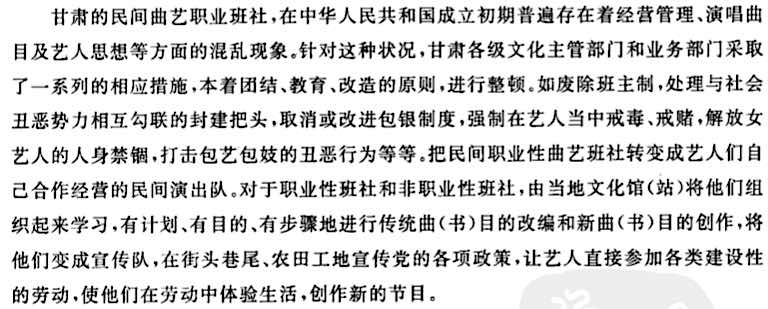
On early 1950s’ attempts to “reform” the old occupational troupes (Overview, p.15)—
one of numerous passages requiring us to read between the lines.

The Overview (pp.3–21) outlines historical periods from early imperial times right through to the 1980s’ reform era. The style of the section on the early years of the PRC is bland, falling entirely within the boundaries of acceptable CCP historiography. Upon Liberation, cultural officials made efforts to register and control the mass of locally active groups (notably “narrative-singing festive bands and itinerant artists” quyi shehuodui yu liusan yiren 曲艺社火与流散).

During the campaign to Eliminate Feudal Superstition, some ancient genres and traditional items ceased to be performed. In the struggle against Anti-Rightists, some artists and narrative-singing workers were classified as Anti-Rightist elements and suffered politically. These abnormal phenomena were not corrected until 1962. (p.18)

As elsewhere (e.g. Gaoluo in Hebei, such as here, under “The 1961–64 restoration”) there was indeed a brief lull in the early 60s between extreme leftist campaigns, but any “correction” was highly precarious. Most glaringly, this section avoids any mention of the famine.

Official sources have long been more able to make limited acknowledgement of the casualties of the Cultural Revolution than of the preceding fifteen years of Maoist campaigns. Still in standard terms, the Overview goes on to describe the assault on traditional culture and its representatives from 1966—the closure of teahouses, the banishing of cultural workers to the countryside, the destruction of a wealth of material collected since Liberation, and some cases of victimisation and murder.

In particular regions, the phenomenon appeared of people being paraded, sentenced, and even persecuted to death for secretly performing, secretly watching, secretly narrating, or secretly listening to traditional narrative-singing.

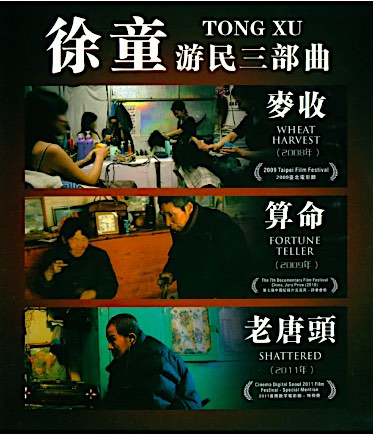
At least this suggests that there were plenty of people indulging in such illicit activities—indeed, they must have been commonly taking such risks ever since the mid-1950s. An instance, again from the Cultural Revolution: like errentai performer Guo Youshan in Inner Mongolia (see Xu Tong‘s film Cut out the eyes), in the section on Liangzhou xianxiao (p.73, see below) we learn that the blind performer Zhang Tianmao 张天茂 (b.1935) was struggled for “singing in secret” (touchang 偷唱). (Zhang survived to become a celebrity of the genre in his 80s, lauded for the reified Intangible Cultural Heritage (ICH) project (see e.g. here), performing on stage and issuing many CDs. Such reversals of fortune were commonplace throughout the society).

Rather than documenting the escalating desperation throughout society as collectivisation and the commune system were enforced, CCP historiographers have always found it far more comfortable to toe the line by latching onto the firm dates of prestigious official events. As in the opera monograph, the “Major events” section (pp.25–52) documents the grand official festivals, with new troupes performing new items throughout the whole period—when the only major events that could have mattered to people were constant hunger and threat of arrest. By contrast with the revealing material in the Appendices of the Hunan (and Henan, n.1 there) volumes, I learn little from the few documents between 1956 and 1962 from the Gansu Bureau of Culture (pp.815–20).

Gansu baojuan
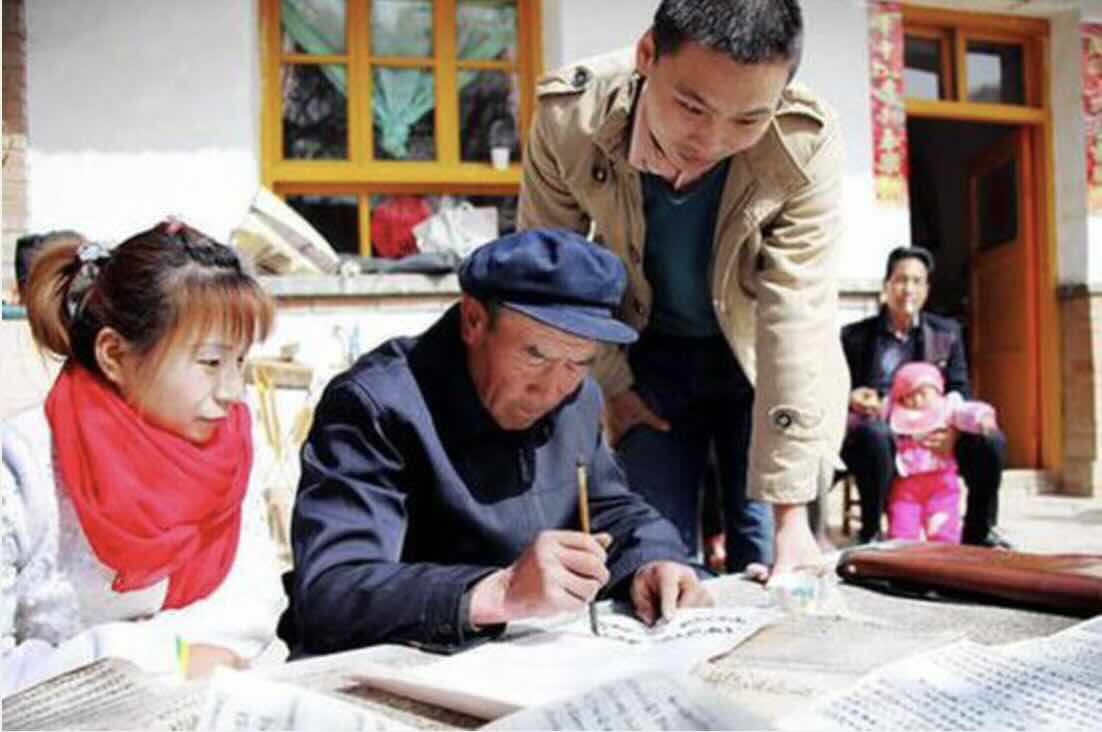
Dai Xingwei, transmitter of the Hexi baojuan tradition, copying a scroll. Source.

A major context for rural narrative-singing, obscured by the propaganda of state modernisation, is ritual. Gansu is among the main regions where “precious scrolls” (baojuan 宝卷) are still performed (see e.g. recent studies by Li Guisheng 李贵生 and Wang Mingbo 王明博, Cheng Guojun 程国君, and Liu Yonghong 刘永红; see also under Ningxia; cf. Hebei). Known in Gansu as “reciting scrolls” nianjuan 念卷 (pp.67–70, 625–6) or “morality tales” shanshu 善书, since 2006 these genres have been reified for the ICH project, resulting in the publication of many early manuscripts (see e.g. this survey by Cheng Guojun 程国君; for largely literary perspectives in English, see the work of Victor Mair and Wilt Idema)—while avoiding references to the traumas of their senior transmitters.

Similarly religious in content and context are the “virtuous and filial” xianxiao 贤孝 genres,  notably “Hezhou xianxiao” (pp.95–7) around Linxia, and “Liangzhou xianxiao” (pp.71–3) around Wuwei (such official names, coined since the 1950s, are generally misleading—e.g. Xi’an guyue, Jiangnan sizhu, Hebei chuige). Meanwhile “religious music” was cannily redefined as instrumental ensemble music for performance on stage.

The Monograph proclaims the CCP cultural authorities’ attempts to reform and “develop” the ritual genres of Gansu, but as fieldwork in Shaanbei shows, such efforts were sporadic, and traditional contexts obstinate.  Many such genres were dominated by blind performers. In 1984 a national musical contest for blind artists was held in Beijing (p.73).

Gansu QYZ 84

A passage on “singing fengshui” (chang fengshui 唱风水) around Qingyang in east Gansu (pp.83–5) provides a tiny clue to the surreptitious survival of ritual:

After the founding of the PRC, since large-scale activities like jiao Offerings, rain prayers, and temple rituals came under suspicion for their colouring of feudal superstitious activities, they went underground (xiaosheng yinji 消声隐迹). But small-scale activities organised by household heads, like mortuary rituals (祭祀亡灵), pacifying the dwelling and house-building (anzhai jianfang 安宅建房), still persisted. Whoever suffered a death in the family, whether rich or poor, they would invite a fengshui master to sing a few sections of scripture. […] The reward was agreed in advance by both sides.

(“Rewards” were always a matter of negotation; at such horrific times, performers would have been desperate for any kind of remuneration. Peasant families in Tianzhen, north Shanxi, still managed to invite Daoists in the “years of difficulty”—but even the village cadres came to lift the coffin just so they could get some free gao paste to eat.)

One even wonders how a solo genre like “telling of spring” (shuo chun 说春) (pp.122–4), auspicious New Year’s songs apparently sung by itinerant beggars, could have fared during times of extreme adversity. In these monographs, other useful sections bearing on traditional activity include “Performing customs” (yanchu xisu) (pp.622–34) and “Anecdotes and legends” (Tiewen chuanshuo) (pp.641–61).

Zhang Huixian

Even the Biographies (pp.777–807) contain slim pickings. We can only imagine the tribulations of performers like Zhang Huixian (1892–1970, above), one of few female baojuan performers, based in a village in Jingchuan county (p.790).

But no-one was safe—neither poor itinerant peasant performers nor the officially-recognised representatives of the state troupes; neither obstinate traditionalists nor enthusiastic Party reformers. Wen Bingheng 文炳恒 (1913–58, p.801), organiser of folk performing groups in Heshui county, took part keenly in CCP cultural projects before and after the 1949 “Liberation”.  But during the Three Antis (sanfan) campaign of 1951, in blowing the whistle on the corruption of “a certain cadre” he was erroneously classed as a counter-revolutionary element; in 1958 he was sentenced to death.

A different kind of danger: Yang Wensheng 杨文生 (1933–58, pp.806–7), performer of xiangsheng skits with the PLA, was “martyred” in the south Gansu region during a campaign against “bandits”—presumably referring to Tibetan insurgents (among my posts on Tibet, see e.g. here) (we’re not told about Tibetans who perished under the Chinese onslaught).

Of course the biographies can only be selective, featuring just some of those whom the collectors and editors identified as leading bearers of tradition; the mass of lowly performers in the countryside remain largely unsung. Despite the vast loss of life around 1960, death dates at the time are not prominent in the biographies—though one feels almost as bad for those who survived the horrors of Maoism.

* * *

I still regard the Anthology as an essential basic source to open doors onto the depth of folk expressive culture in China. Besides the wealth of data on early history in the monographs, I suppose it’s stating the obvious to observe that for more rewarding material on the Maoist era we would have to seek out unofficial memoirs (see Ian Johnson’s excellent recent book Sparks), which are in short supply.

Alas, it’s already getting late to rectify the glaring omissions of official sources by doing fieldwork. One might decide to write a biography of one folk performer, or document one genre over a defined period; documenting the transformations of the scene since the 1980s’ reforms would make a valuable project in itself. We might even find a senior artist, perhaps born in the 1940s, to offer clear recollections of the late 1950s. Even as the Maoist era recedes, the famine and the whole political climate of the time will always be the elephant in the room.

* * *

* Related posts include China: commemorating traumaGuo Yuhua, and China: memory music, society; more broadly, cf. links under Society and soundscape.

Bosch

Bosch TV

Fast-forwarding from Raymond Chandler and The big sleep, I’ve already praised the crime novels of Michael Connelly, starring the dogged LA detective Harry Bosch. They’ve always seemed to invite representations on the Silver Screen, and now, thanks to Amazon Prime (don’t ask…), I’ve been bing-watching all seven seasons of the film adaptation Bosch (wiki, with episode guide), the first season airing in 2014.

Whether TV and film versions of novels satisfy is a matter of taste. But I found Bosch entirely gripping, with the characters most convincing—Bosch (Titus Welliver in an iconic role) and his nuanced relationships with his daughter Maddie, partner J. Edgar, sympathetic boss Lieutenant Grace Billets, and Chief of Police Irvin Irving, as well as the whole labyrinthine rigmarole of station procedurals.

With Connelly’s active involvement, the TV adaptations are creative variations on the books, combining various plots from different novels. Amply reflected in the soundtrack is Bosch’s passion for jazz, which led me to several great finds (e.g. Tomasz Stańko, Frank Morgan, Art Pepper). * Against the backdrop of a dystopian LA landscape, the jargon, and the dark humour of their exchanges, is fascinating.

My immersion in the novels was never affected by not having a firm visual image in mind; when I return to them it’ll be interesting to see how much this new input colours my reading.

Note also Michael Connelly’s website.

Other posts introduce crime fiction set in China, North Korea, and Germany, Weimar Berlin—Stasi—Russia—Hungary, Tibet, Ottoman Istanbul, and among the Navajo. You might even try Robert van Gulik‘s Judge Dee mysteries, set in Tang China… And for crime drama on screen, see under Saga and Sofia, and French slang.


* Just one more track, somewhat off-piste: the bleak finale of Season 6 plays out with Chris Botti’s 2012 cover of What a wonderful world, with Mark Knopfler. I always felt bad about not quite warming to Louis Armstrong’s 1967 original—maybe it’s just over-exposure. But this is great, both (in Bosch) as a sad commentary on the cemetery scene, and here, enhanced by the Georgian artwork:

The big sleep

Big sleep

In my youth I watched The big sleep (Howard Hawks, 1946) More Times than I Had Hot Dinners—not so much in the cinema as on TV, where it was among a wealth of old movies shown in the dim and distant days before DVDs and streaming.

Chandler coverThe film does justice to Raymond Chandler’s brilliant prose style. Roger Ebert, always a perceptive reviewer, made some good points. He described it as

a black-and-white symphony that exactly reproduces Chandler’s ability, on the page, to find a tone of voice that keeps its distance, and yet is wry and humorous and cares.

 However often we watched the film (or read the book), the plot remained elusive. Ebert cites Sperber and Lax’s Bogart:

Hawks sent Chandler a telegram asking whether the Sternwood’s chauffeur, Owen Taylor, was murdered or a suicide. “Dammit I didn’t know either”, Chandler recalled.

But details yield to the atmosphere.

Bogart’s career was on the up with The Maltese Falcon (John Huston, 1941; trailer here)—the novels of Dashiell Hammett rivalling those of Chandler—and the iconic Casablanca (Michael Curtiz, 1942). On the Bogart–Bacall relationship, a recent book by William Mann is reviewed by David Thompson in the LRB:

The span of William Mann’s well-researched dual biography is some 115 years. But a case can be made that the “greatest love affair” promised by Mann amounted to no more than 216 minutes in the busy years of the mid-1940s. That’s the combined duration of To Have and Have Not (1944) and The Big Sleep (1946).

Their affair (she was 19, he 44), with its “thrilling ping-pong innuendo”, began while they were filming To have and have not, Bacall’s screen debut:

This led to Bogart divorcing his third wife and drinking still more heavily. Off screen he was regarded as surly and dull.

Moving on to The big sleep, here’s the opening (Chandler’s original here):

The horse-racing dialogue is “one of the most daring examples of double entendre in any movie up until that time”:

In the film, Marlowe is irresistible to a succession of women—something unfathomable to British men well into the 1970s. During wartime, women were admitted to professions from which they were otherwise barred:

Most astounding is the bookstore scene, with Dorothy Malone (and note Max Steiner’s portentous soundtrack):

And here’s the very ending:

OK, I can’t stave off old age for ever. Such films (whether 40s’ noir * from the States or modernist creations from France, Italy, or Japan) came as a kind of blessing to us on a cloistered, repressed island, and are indelibly etched into our collective memory; yet (more an observation than a lament) I doubt if they are quite so iconic to Young People Today. For other seminal influences on “my generation”, see under The conformist.

For a modern take on LA noir, see Bosch.

Irrespective of the Academy, popular culture is clearly, well, popular. Since the 60s, the Fusty Pundits of Yore have been disconcerted to find film, film music, and pop, becoming serious subjects for study; but they wield a profound influence on us all, even on those with more classical concerns… Cf. What is serious music?!, and Feminine endings: Madonna and McClary.


* I read that the term film noir was “coined by French critic Nino Frank in 1945 when a flood of dark Hollywood thrillers made during the war eventually arrived on Parisian screens after the four years of German occupation. Nearly 40 years passed before the term became current in the English-speaking world.”

Vermeer’s hat

Vermeer's hat cover

At last I’ve got round to reading

  • Timothy Brook, Vermeer’s hat: the seventeenth century and the dawn of the global world (2009).

The author, a specialist in Ming China, sets out to write a “global history of the intercultural transformations of 17th-century life”, using Vermeer’s paintings to “open doors” onto the social history of the day (cf. Music in the time of Vermeer). Such an approach has evidently become a tradition in art history—from my very limited experience, it somewhat recalls the style of Michael Baxandall and Michael Jacobs (see On visual culture), on the far broader canvas of the whole globe.

As Kathryn Hughes comments in her splendidly-titled review “Where did you get that hat?”,

while most of the figures in the paintings of the Dutch golden age look as if they have never strayed more than a day or two from Delft, the material world through which they move is stuffed with hats, pots, wine, slaves and carpets that have been gusted around the world by the twin demands of trade and war. […]

Behind the serene chinaware and glinting silver coinage that furnish Vermeer’s burnished interiors lay real-life narratives of roiling seas, summary justice, and years of involuntary exile. […]

What Brook wants us to understand is that these domains, the local and the transnational, were intimately connected centuries before anyone came up with the world wide web.

(More reviews e.g. here, here, here, here).

The 17th century was an age of “second contacts”:

First encounters were becoming sustained engagements; fortuitous exchanges were being systematised into regular trade; the language of gesture was being supplanted by pidgin dialects and genuine communication.

Things, and people, were moving around on a global scale.

Chapter 1, “View of Delft”, introduces the Dutch East India Company (VOC); the narrative soon expands from Delft and Amsterdam, with Spain and Portugal also trading in southeast Asia.

Chapter 2, “Vermeer’s hat”, sets forth from Officer and laughing girl, with a fine discourse on hats in the artist’s time, leading seamlessly to Samuel Champlain’s encounter with the Mohawks at the Great Lakes in 1609, the crucial role of the new technology of weaponry, and the beaver hat. Brook always makes connections:

I spend my summers on Christian Island, which is now an Ojibwa reserve, and I cannot walk the dappled path that angles past the place where the children are buried without thinking back to the starvation winter of 1649–50, marvelling at the vast web of history that ties this hidden spot to the vast networks of trade and conquest that came into being in the 17th century. The children are lost links in that history, forgotten victims of the desperate European desire to find a way to China and a way to pay for it, tiny actors in the drama that placed Vermeer’s hat on the officers’ head.

Vermeer 2

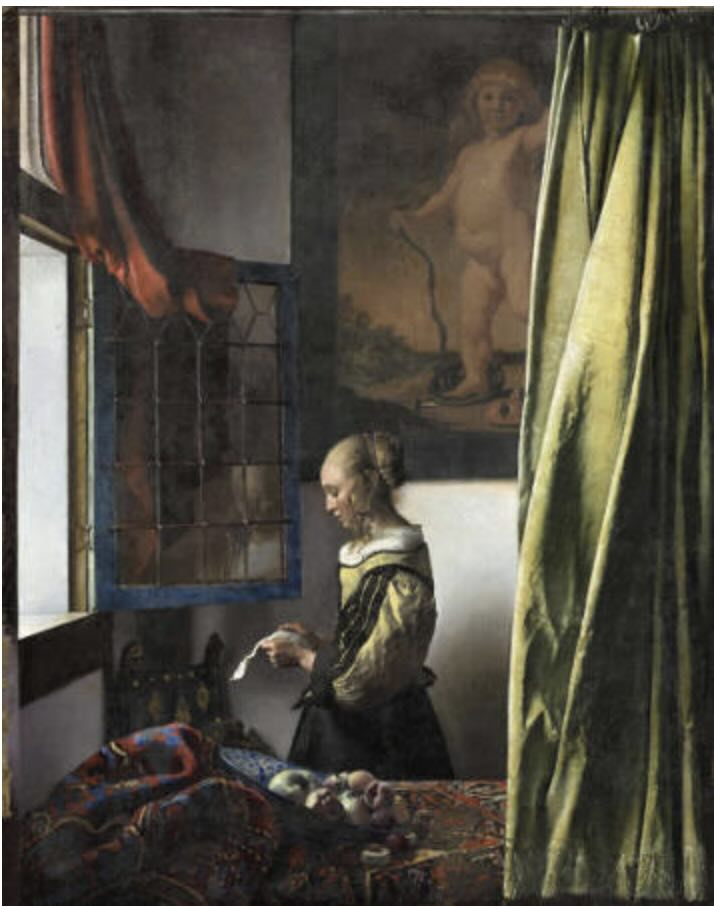
Indeed, “the lure of China’s wealth haunted the 17th-century world“—and the lure of china, theme of Chapter 3, “A dish of fruit”, based on Vermeer’s Young woman reading a letter at an open window. The British East India Company enters the fray, with their battles in St Helena. We learn of the spread of blue-and-white, in Persia, India, Mexico; exploits in the South China Sea, Macao, and Zhengzhou and Quanzhou in Fujian; and in Suzhou, Wen Zhenheng’s A treatise on superfluous things (cf. another inspired book by Craig Clunas). Brook addresses class and aesthetics. He contrasts European taste for foreign objects (“stirring no contempt or anxiety”) with Chinese mistrust of the wider world, “a source of threat, not of promise or wealth, and still less of delight or inspiration”.

In Chapter 4, “Geography lessons” based on Vermeer’s The geographer, Brook addresses the way that “the great minds of Vermeer’s generation were learning to see the world in fresh ways”. By way of the Delft draper, surveyor, and polymath Antonie van Leeuwenhoek we are taken again to the South China Sea—Manila and Macau, and coastal China, where besides Red Hairs (Dutch), Dwarf Pirates (Japanese), and Macanese Foreigners, African slaves (servants of the Portuguese) as well as Muslim merchants, were also seen. Jesuits such as Paolo Xu and Matteo Ricci play a significant role.

Chapter 5, “School for smoking”, is another fascinating exploration, covering the diffusion of the new habit around the world; “every culture learns to smoke in a slightly different way”. From images in Dutch painting and porcelain, Brook moves again to China, exploring the three routes by which tobacco entered the country. Writing in 1643, Yang Shicong noted the new taste in Beijing, whither it had spread rapidly from the southeast coast. In 1639 the Chongzhen emperor decreed that anyone caught selling tobacco in the capital would be decapitated. The colloquial term “eat smoke” (chiyan), still heard in rural China, was already in use. In the New World (documented from 1505), tobacco was used to “move between the natural and supernatural worlds and to communicate with the spirits”—a function which it still serves in Chinese ritual today. It was thought to have both spiritual and medicinal properties. Moreover,

In daily life, tobacco was an important medium of sociability that, like healing, was something that benefitted from the spirits’ kind support. Managing social relations on a personal or communal level required thoughtfulness and care, and could best be accomplished when the spirits were on one’s side. Burning or smoking tobacco was a way of propitiating the spirits if they were in an ugly mood—as they so often were—and inducing them to bless your enterprise.Sharing a smoke at a tabagie was done in the presence of the spirits, and it helped the smokers find consensus when differences arose.

In China this is another important aspect of social and ritual life that tends to get neglected in our focus on ritual texts. In 1924 Berthold Laufer praised smoking in an egregious misapprehension with grains of insight:

Of all the gifts of nature, tobacco has been the most potent social factor, the most efficient peacemaker and benefactor to mankind. It has made the whole world akin and united it into a common bond. Of all luxuries it is the most democratic and the most universal; it has contributed a large share towards democratising the world.

Brook offers perceptive asides on witchcraft in Europe, class, gender, a tobacco ballet in 1650 Turin—and slavery. And he notes how the habit of smoking morphed into opium dependency in the 19th century—another tragic story of the ravages of trade.

Chapter 6 departs from Vermeer’s Woman holding a balance to discuss the role of silver, crucial to the world economy of the day, travelling from Potosi in the Andes to Europe and Asia—with erudite discussions of coinage and morality.

Card players

Chapter 7, “Journeys”, interrogates a painting by Hendrik van Der Burch showing an African servant boy (cf. Jessie Burton’s novel The miniaturist, evoking the changing world of 17th century Amsterdam). Brook goes on to describe five journeys to distant shores: Natal, Java, a Korean island, Fujian, and Madagascar. He ponders pictorial representations of Biblical scenes (cf. Balthasar).

In the final Chapter 8, “Endings: no man is an island”, Brook ties the themes together, with discussions of translators, the role of the state, and the concept of a common humanity.

If we can see that the history of any one place links us to all places, and ultimately to the history of the whole world, then there is no part of the past—no holocaust and no achievement—that is not our collective heritage.

Yet as Brook shows throughout, all this came at vast human cost: warfare, shipwrecks, ruined lives. He appends a useful list of Recommended reading and sources.

Vermeer’s hat is a virtuosic, stimulating piece of writing.

Guest post: Alceste

Nicolas Robertson

For a general introduction to the series, click here;
for Nick’s sad demise, here.

Prelude—SJ
Having posted nine of Nick’s extraordinary anagram tales, we thought we’d give the reader [still singular, eh?—Ed.] a bit of a break, but now that he has, alas, become “late and lamented”, I find a couple more of his stories that I think I can lick into shape. They will have to stand as a posthumous tribute to his brilliant mind. Here’s the first, with Nick’s own introduction:

ALCESTE
Opera by Gluck. Staged performance in the Théâtre du Châtelet, Paris, 1999, staging by Robert Wilson, with soloists, Monteverdi Choir (offstage, in the pit) and English Baroque Soloists, directed by John Eliot Gardiner. CD recording, and TV and DVD film directed by Brian Large.

Alceste CD cover

This is the last of the “anagram stories” I compiled before the watershed year of Bach’s 250th commemoration year, 2000, and arose from a substantial residence in Paris (we also performed and recorded Orphée et Eurydice, the choir this time on stage); which accounts for the strongly French admixture in the anagrams.

I always hope that these exercises can speak for themselves, as it were. I would like to mention though that the “tsetse éclat escale” image of a clambering insect on a barred jersey was inspired by one of the most beautiful passages of prose I ever read, in Nabokov’s Bend Sinister; and that Nathan Astle, in 2002 (thus after I wrote the anagrams and the story), surprised the world, and perhaps himself, by scoring the fastest Test match double century in history, against England in Christchurch. Looking him up now, I see this is not the only prescience among the anagrams: another of Astle’s records is for the most ducks (5) in World Cup matches—it’s not said if any of them were wild. (Nabokov preferred tennis; Ibsen’s preference is unknown, to me anyway.)

“Alceste” provided the least number of letters I’d elected to work with to date, which posed different challenges, and led me to think it could be worth including a list of the resulting anagrams, in exactly the order used. There are 91 (92 if you include the name “Alceste” itself). I must add, again, that I didn’t use, have never used, any artificial aid, such as a computer programme, in deducing the anagrams, that would be to undermine the whole idea, which is meant to be the exemplification of chance (perhaps not entirely chance) within a random (well, not quite random) set of coordinates.

Alceste anagrams

SELECT A CAST

“Lee, cas télé: Lee scat, EEC lats, le acest.”
Clea? “T’es sec late, ’élas”, etc.
“Cale? – est ‘le Astec’, L*tèce as.”
“Ale sect, ’élas” (etc.).
“EEC salt!”
“Stale EC” – slate CE.
“Cal? Tees ace.”
“Let’s act. Else Elsa, et C.. – ”
“–Claes?”
“–et‘alc’Este –”
“Least! C’è l’ascète!”
“ – steal ce castle.”

Este??
___________________________________________________________

ALEC:                    Tae slec. Elastec. Set lace, cast eel. Celt sea, celte as ce à l’est,
Sète lac, cet Alès.

CELESTA (sec):    ’Alte ! Scélé’at! Sâle ’tec! Tel cas elects ease –

     ÉCLAT

’ÉCATE [LSE] :     L’ecstase – ÉCLAT – et secla [aet. CL] est ce seal,
La’ Tse, ce stèle act.

[Escale; ecseat L.]

_____________________________________________________________________________________________________

Las, ce été, LA sect elates Cal secte, ‘el caste’, acelets lactées (case let see talc, l’été sac caselet, saclet e cesta). Le eel sac taste clé, sleet, ace cleats. Ecsel at easel, TC, sat Clee (teasle ç’a clé: tsetse éclat escale – scale ‘te’ – et escalate le scale → C).

“Est-ce Sal? et Léa? C’est Astle?”
“C’è else cat, Elsa, cette – ”
“Las! Ecce–’elastteal!”

_____________________________________________________________________________________________________

Ces EC tales.

* * *

How does one set about choosing the line-up for an international opera production? The minutes of a recent committee meeting have been passed to me, and confirm that the criteria are more mixed than might, idealistically, have been expected. Here’s an excerpt:

“I’d say we go for Lee, in case the TV recording goes ahead. He can vocalise very convincingly without the words, and has terrific torso muscles, as good as any in Europe. He’s got to be the number one choice.”
“Okay. Now, do you think I – can take on Alceste?”
“Oh, Clea, I wish I could say yes – but you’re always a fraction behind the beat.” (An example of the speciously ‘objective’ excuse.)
“I think we might try bringing in an old rock star from Velvet Underground as Charon, que tel ? He’s a bit of a Central American god here, in fact a star in Paris – ”
“But he drinks beer as if there were no tomorrow” – and other stock denigrations are brought out (see above).
“No, but he’s really the best in Europe!”
“Europe’s old hat.” And so the Church of England is written off.
“What about Cal? He sweeps the board on Tyneside.”
“It’s time for decisions. Otherwise Elsa, and the sculptor whose name I can’t pronounce, Oldenburg, thank you, he and his ‘soft harps’, as well as that Ferrara girl whose yard-arm is always well below the sun – ”
“ – Hang on! Beatrice? But she’s the most spiritual being I know! – ”
“ – will come and storm our citadel, our châtelet.”

What on earth did he mean, talking like that about Beatrice?

Beatrice
Portrait of a woman, inscribed Beatrice d’Este, c1500–10,North Italian artist (Uffizi). Source.

___________________________________________________________________

We were filming on the Breton coast. Alec had done his research, of course, so knew that this bitter moorland, with its marshy sedges which gave the technical team such trouble in achieving the mobility they needed, was supposed to hide the “Youdic”, one of the entrances to Hell. Or perhaps he only thought of this in terms of metaphor. At any rate, even during the takes he seemed to half wish we were somewhere else. That last afternoon he complained abruptly, in his raw Glasgow accent, about our work—too loose, pulling apart then coming together again too sharply. “This is being filmed through a muslin filigree, remember?Is it in place? Cal–throw the bait into the sea, so that the shadow falls on the menhir behind you. Think of Melusine, if you like, calling to you from the waves—but I don’t want a Celtic twilight, people are the same here or anywhere, this scene could be set in the blue basins of a Languedoc fishing-port, or under the ashlar of the Pont du Gard – ”

Celesta’s voice cut across the sea-washed stillness, dry and harsh: “Stop! You retch! You’re like some sort of sordid private eye! The way you lump all these together just shows how lazily you – ”

An incandescent flash split open the earth and for a moment fixed the grey sky as if in negative. The calvary poised at the intersection of the three paths above le Yeun Elez (“le marais des roseaux”, the marsh of reeds) flung its arms backwards as the setting sun caught the bones of its carved face skull-like in a spiralling cartwheel, and from where it had stood arose a creature which sucked in the elements spinning around it, and from the vortex (which reminded me of the impasse I faced in my finals exams at University) seared us with a voice unspeakably beyond our imagining,

<The bliss you seek > – another shattering burst of lightning – <is made up of centuries> (I thought stupidly, this Hecate’s face looks about 150 centuries old) <and each one bears my mark. It’s written in the Tao (in James Thurber’s version) [1] No, o ! the words are graven in stone! >

[1] I understand the reference to be to “The Wonderful O”, where the letter is banned owing to the sad fate of the principal’s mother, who became stuck in a porthole : ‘They couldn’t pull her in, so they had to push her out’. The prohibition had horrible effects, not least for Ophelia Oliver, everyone’s sweetheart hitherto. [Add to Perec’s Oulipian category of “Plagiary by anticipation”.]

The rocks at our feet suddenly tipped up, and as I sprawled amongst the armeria and sea fennel and samphire the earth gaped open to reveal a dizzying stairwell, down which Hecate plunged, disappearing south-east, in the direction of Carnac. Alec was nowhere to be seen.

Hecate
Hecate, Attic red-figure lekythos, 5th century BCE (Hermitage Museum). Source.

____________________________________________________________________

We were tired, that last summer in California, of trying to feel different. The weight of what seemed to us to be history, or rather the end of it, the inevitable progression from the luxury of striking individual poses to the acceptance of group mores, vitiated our tentative forays into anything that could pass for independent thought. We felt obscurely guilty about this, and thus some of us, anyway, were thrilled when a new Los Angeles group seemed to offer ready-made the transcendence our own mental ambitions shied at. Unashamedly elitist (though not of their own volition: they had been “chosen”), these Hispano-Franco-Americans saw themselves, and thus us, as every one a single star in the Milky Way, powdered with a celestial shimmer we should each carry with us, in a little French pouch and a Portuguese wicker basket.

So far, so exquisite, but the angel was in the details. For, following the divinatory rituals of a Greek tribe in iron-age Thessaly, whose priest-queen Alceste, it seems (the legend has come down to us in a jumbled form), had for the first time defied the ancient rigid formalities and refused the seven-yearly sacrifice of the young king, Admète, the clan had located the essence of rejuvenescence not in the shed blood of a royal representative, but in the organs of the lamprey, a cyclostome much appreciated by gourmets and whose formidable richness in nutritional terms can see one safely through the coldest of winters as if clad in 7-league boots. (Part of their lore also included the folk-memory of how it was that Apollo, protector of Alcestis, came from Thessaly to dispossess the earth-mother/serpent cult at Delphi, replacing her with his own oracle—in short, the worship of sky-gods which accompanied the Achaean invaders from Central Europe into Greece, ousting the old chthonic deities: [2] hence the specific emphasis on summer, “l’été sac”, and celestial phenomena, “acelets lactées”. And underlying this, it struck us, the first tentative emergence of the individual, as if from the chrysalis of uniformity, realising the possibility of asserting individual choice in the face of tribal orthodoxy …)

[2] See Robert Graves, The Greek Myths.

But the members of our sect were clever enough to leaven their powerful teleology with art. The boss, known as Top Cat, was a brilliant painter and had even done a portrait of Paul Klee (TC’s spelling was all over the place, it only endeared him to us all the more, as if proof of his sincerity) in Tunisia. He used to point proudly to a burr on his Breton mariner’s top, which he said had been stuck there ever since his visit to North Africa—and this was the key to his and our undoing, for one weird day we saw the “burr” set off shakily up the staves of his striped shirt, at the same time shouldering away its tufty carapace, until with an almost audible crack the chrysalis shattered and a gleaming mature tsetse fly sidled with its smugly crossed wings into TC’s world, pricked his throat and took him down, leaving us lost, into the long sleeping sickness. I will never forget his cry, indignant at first – “Is it a bee?” – then higher pitched, “Oh, see –”. And I can never again think of a rising semitone as optimistic.

“Is that you, Sally? and Léa? is that Nathan? We need a good number 7,” murmured TC, softly, from a deep, dark maze—somehow, in extremis, reaching out to the memory of a hero from his native New Zealand cricket team.
“No, but instead we’ve got the cat who walked by herself, the lioness Elsa, born free like all the sons of Adam. There’s nothing for you to fear –”
“Alas, but look: he’s become at the end like the wild duck!” – pure symbol of freedom, brought low by stupid material ‘reality’ …

_____________________________________________________________________
[One in a series of recastings of European traditional stories: No 91]

**************************************************************************************************

Paris – London, September–October 1999
slightly revised 2015 and 2021
Nicolas Robertson

Ankou
Ankou, messenger of death, Notre-Dame de Bulat, Côtes d’Armor, Brittany.

Crazy

Billie 1949
Billie Holiday arriving at a preliminary court hearing in 1949. Source.

If I had to choose just one song by Billie Holiday (click here and here for my main tributes)… I couldn’t. You’re my thrill is a contender, as is Don’t explain, and Fine and mellow, filmed for TV in 1957, is just adorable—but I’m increasingly infatuated by Crazy he calls me:

Sentenced for possession of narcotics in 1947 (as she wrote, “It was called ‘The United States of America versus Billie Holiday’. And that’s just the way it felt”), Billie was released from prison in 1948; losing her New York City Cabaret Card prevented her from working anywhere that sold alcohol—but she soon came back with a show at Carnegie Hall. Meanwhile she had split with both her husband and her drug-dealing lover, but she was busted again in January 1949. She made the very first recording of Crazy he calls me (Carl Sigman, to lyrics by Bob Russell) in October that year—in the same Decca sessions as You’re my thrill.

Billie Decca 1949
Decca Studios, New York 1949.

Any jazz ballad invites rubato, but this song is a classic instance of Billie’s utter freedom from rhythmic parameters, going with the poetic flow; and just as astounding is her freedom in pitch, always bending the notes of the scale. No-one else can match this! With the modulation into the middle section (“Like the wind that shakes the bough…”), she’s just as irresistible. Like much of her repertoire, it could be quite saccharine, but her timbre in every phrase encapsulates joy and pain, at once intimate and detached—I can only resort to the cliché “bitter-sweet”. *

Many other singers went on to record the song (listen here), but not even Aretha’s version can compare. Still, I do have a lot of time for Patsy Cline’s Crazy (1961) (in my post on Country). My Playlist of songs includes not only Billie, Chet Baker, Michel Legrand, and the Beatles, but fado, taranta, Bach, Mahler, Ravel, and Barbara Hannigan…


* I could listen to Billie singing the opening lines all day long: “I say I’ll move the mountains, and I’ll move the mountains, if he wants them out of the way”. Many jazzers found it useful to study notation, but like many of the great musicians in the world, Billie never learned to read music. In most cases she would have been familiar with other versions of a song before she began reworking it, so for this new tune I imagine Carl Sigman or someone would have played it to her. Notation can be ridiculous (see here, scrolling down)—of course it’s only an approximation, but most scores of the opening read more or less like this:

Crazy score

Take me for a pint sometime and I’ll do my impression of Pavarotti singing it from the score… A few written versions attempt to convey basic syncopation, but they just look pedantic. Most jazzers found notation useful at some stage, and some latter-day sax or guitar players learn a lot from meticulous transcriptions of solos by Bird or Hendrix; but in simpler cases like this, far better just to listen…

BTW, those opening lines recall a dictum that has been attributed to Flann O’Brien, perhaps apocryphally: “I don’t like mountains, because they get in the way of the view”. 

In memory of Nicolas Robertson

Nick 1
Source.

Alas, Nicolas Robertson died in Lisbon earlier this month, after many years of chronic illness.

A fine tenor (“cheap at the price”, as we would say), after his early years in Cambridge Nick became a long-term member of early-music groups such as the Monteverdi Choir, the Tallis Scholars, and the Sixteen. As a Bach scholar, he worked assiduously in assisting John Eliot Gardiner‘s research, and I pray that Nick’s own studies of Bach may yet see the light of day.

Nick 2Mozart with the Monteverdi Choir in Barcelona, 1991:
Nick back row, centre.

Notwithstanding his bookish demeanour, the touring life gave him ample opportunity to sample the richesses of continental beverages; a denizen of sleazy bars in every port, he was an unlikely pinball wizard. Marrying his soulmate Lidia in 2003, they lived together in Lisbon. At the end of 2008 Nick declared himself bankrupt (“one of the best things I ever did, as well as a fascinating experience”). I suppose he never recovered from losing first their house (in a fire, 2009) and then Lidia (to cancer, 2013). He died on her birthday.

Softly spoken, even reserved, Nick’s conversation was erudite, arcane, and hilarious, making him a somewhat unusual drinking buddy. A devotee of Oulipo and Perec, he delighted in language (or rather, languages). The gnomic tales that he concocted out of anagrams provided by fellow choristers on tour (mostly composers’ names, like Gran visits York [Igor Stravinsky] or Nubile gorilla [Lili Boulanger], and Mozart operas, like Noon? Gad–vini! [Don Giovanni], are just extraordinary—a kind of Esperanto fiction, creating spiralling worlds of fantasy. I was honoured to post a series of these tales on my blog. Nick’s meticulous system of indents, single and double quotes, long and short dashes, italics, and so on offers the reader crucial clues to the possible meaning of the arcane text, so typesetting was fiendishly complicated—Lear (Bacon), aka Barcelona, is a good example—and our correspondence about such minutiae provided us with hours of harmless nerdy fun. I’ve listed the tales here, and they’re among the treasures of this site. Now I really must edit some of the remaining stories, “compiled without regard to expense or the feelings of the public”, in the words of our inspiration Flann O’Brien.

As a keen football aficionado, another ongoing project in which Nick delighted was collecting drôle headlines about Jesus (“Jesus is very happy with his eleven”, and so on).

I didn’t actually spend much time with him on tour. For reasons that may be apparent by now, I have only a hazy recollection of our encounters in said hostelries. During the Paris legs of our annual Mozart opera tours in the 1990s he took up residence in the little dive next to the Châtelet, which boasted one of his favourite pinball machines; after concerts in Lisbon, I knew he was just the guide for the tiny holes in the wall where you could hear amateur fado singers, away from the pomp of the fancy restaurants; and, unlike most of the choir (alas), he was always up for flamenco bars in Andalucia.

After decades of quiet Bacchic indulgence, eventually his taste for the grape caught up with him. Already ailing seriously the last time we met in Lisbon, he remained fascinating company. His emails were a constant source of abstruse giggles.

See also this tribute from his colleague Richard Savage; more on Nick’s Facebook page.

We both chortled over this line from Vivien Stanshall:

If I had all the money I’ve spent on drink… I’d spend it on drink

—and I think Nick might have approved of it as a suitable epitaph.

A streamlined Chinese studio

Loft best new

I don’t know how often sinologists, or other bibliophiles, overhaul their groaning shelves, but it’s been a delight to reorganise my Chinese library over the last year—part of a thorough decluttering of all my Worldly Goods as the entire house is renovated.

  • First, I resolved to slim down the collection, radically—a process which itself took several months. This, of course, involves deciding which books and recordings I am actually likely to refer to ever again, and which I might possibly seek one day for a reference…
  • Then I found Good Homes for many of the volumes and recordings with which I could bear to part—one main recipient being the CHIME library in Heidelberg.
  • Then, along with all the other aforementioned Worldly Goods, I put everything into storage for six months.
  • Next, with a brilliant team, devising a loft (now a generous space) that would take the remaining material (China books in English, including religion, anthropology, and literature, mostly belonging on the ground floor).
  • Then—at last!—unpacking all the heavy boxes and adorning the loft.

So what for forty years had steadily grown into a random, grimy accumulation of books, journals, * offprints, fieldnotes and fieldtapes, instruments, CDs and DVDs, spread over various rooms, has now become a compact shrine that reflects the enchantment of doing fieldwork in China since 1986, including precious volumes from the Maoist era, along with a modest selection of meaningful artefacts. Far more than a dry repository of arcane academic material, it’s become a tribute to generations of Chinese peasants and scholars, along with the whole history of fieldwork in the PRC.

Although I have no illusions of doing further fieldwork in China (both out of decrepitude and as a futile moral stance against worsening repression), my three decades studying there make an enduring perspective on my whole worldview, and I will continue to reflect on their significance, in both Chinese and global contexts.

left, 1956 facsimile of 1425 Shenqi mipu tablature for qin zither;
right, Yang Yinliu‘s report from 1956 Hunan field survey.

With many books double-parked yet still accessible (and a multitude of loose documents neatly stored in brightly-coloured box-files on another wall!), the classification goes something like this:

  • a little collection (again pared down) on the qin zither (see e.g. here, here), and
  • general surveys, encyclopedias, early history, and so on

—all tastefully adorned with posters from tours with the Li family Daoists, one of their exquisite sheng mouth-organs (made by Gao Yong), the lovely little folding stool that Li Manshan made in the late 1960s; shadow puppets, god statuettes from Fujian, gifts of calligraphy, fieldwork photos… 

Loft 5

My fetish for taxonomy is reflected in several posts (starting here, with links to the joys of indexing and the Sachs-Hornbostel system…). The loft is just one locus for taxonomy—where do table mats and salad bowls belong, for instance (or, more ambitiously, All Things Bright and Beautiful)?!

Renovating the whole decrepit little house has been a gruelling but hugely rewarding project. The result is just exhilarating. As to the loft, it’s far from a mere cosmetic exercise: sure, I’ve managed amidst chaos for forty years, but a conducive environment creates headspace—heartspace—for focused thought. So the new Chinese studio is now a tranquil haven that I, and perhaps visitors too, can relish—to sit, browse, study, relax, play violin or even erhu

京西微玄觀內碧雲罐庵
Priory of Azure Cloud Bottle within Belvedere of Tenuous Obscurity


* I had a substantial collection of the major PRC musicology journals for c1980 to 2000, largely superfluous as they became available online—at least until CNKI toed the Party line of closing China off to the world again. Anyway, by now personal libraries should be increasingly manageable, with many books also available as pdfs. Still, without rigorous self-control, collections tend to expand…

Zen and haiku: R.H. Blyth

Blyth 1

Reflecting on the popularity of Zen in the West, and my own youthful explorations, in my post More East–West gurus I gave a brief introduction to R.H. Blyth (1898–1964) (wiki, and useful sites here and here), but he deserves more.

The initials stand for Reginald Horace—both the given names and the initials being a sign of the times. Always of an alternative bent, a vegetarian and adherent of George Bernard Shaw, in 1916 he was imprisoned in Wormwood Scrubs as a conscientious objector. A musician, he was a devotee of Bach—I’m not aware that he ever encompassed noh and kabuki drama, or the shakuhachi, but it’s an intriguing idea.

Blyth zazen

“Fed up with the rigidity of Britain’s class system” * (Robert Aiken’s recollections are worth reading), in 1925 Blyth went to live in Korea, teaching English at Seoul University, learning Japanese and Chinese, and studying Zen. By 1940 he had moved to Japan, teaching English at Kanazawa University, but in 1941 he was interned again, now as a British enemy alien. After the war, “he worked diligently with the authorities, both Japanese and American, to ease the transition to peace”. In 1946 he became professor at Gakushuin University.

Like his mentor the great Zen master D.T. Suzuki, Blyth’s work influenced the post-war Beat generation like Gary Snyder, Jack Kerouac, and Allan Ginsberg. Besides Alan Watts, other devotees of Blyth’s work included Aldous Huxley, Henry Miller, and Christmas Humphreys (another challenging dinner party), all of whom I admired in turn. For Steinbeck’s and Salinger’s absorption in oriental mysticism, see here. Salinger wrote:

Blyth is sometimes perilous, naturally, since he’s a highhanded old poem himself, but he’s also sublime.

In my teens I was much taken by

  • Zen in English literature and Oriental classics (1942), written while he was interned in Japan (446 pages, full text here).

Blyth Zen in cover

Blyth finds “expression of the Zen attitude towards life most consistently and purely in Shakespeare, Wordsworth, Dickens, and Stevenson, adding “numerous quotations from German, French, Italian, and Spanish literatures”. He devotes a whole chapter to Don Quixote, and four chapters to Non-attachment; further chapters cover Death, Children, Idiots and Old Men, Poverty, and Animals.

I was already far more amenable to the oriental classics (notably haiku, his main exhibit) than to all the Shakespeare and Wordsworth, but I got the point that enlightenment didn’t necessarily have to be sought in remote oriental mountain hermitages—as the Daoist and Zen masters indeed remind us.

The flaws in his ouevre are recognised. The most pervasive criticism, which leaps out from every page, is that, in the words of Patrick Heller, “Blyth’s work exhibits a fundamentally distorted Orientalist view of Japanese literature and religion”. And, according to wiki:

Some also noted that Blyth did not view haiku by Japanese women favourably, that he downplayed their contribution to the genre, especially during the Bashō era. In the chapter “Women Haiku Writers” Blyth writes:

Haiku for women, like Zen for women—this subject makes us once more think about what haiku are, and a woman is…Women are said to be intuitive, and as they cannot think, we may hope this is so, but intuition…is not enough… [it] is doubtful… whether women can write haiku.

Discuss (not). Oh well—that was then, this is now. 

* * *

Besides Zen and Zen classics (five vols, 1960–70), Blyth went on to publish Haiku (four vols, 1949–52) and History of haiku (1964—five of eight planned volumes).

Haiku covers

And a spinoff that is more significant than I realised is his work on senryū, ** the cousin of haiku penned from a more humorous, human angle (pdf of his 1949 book here).

Blyth’s immersion in Japanese culture was admirable, and he exerted a considerable influence on the post-war generation in search of the Wisdom of the Mystic East…

See also this roundup of posts on Japanese culture, including some largely jocular haiku in English—a later trend of which Blyth may or may not have approved.


* Blyth’s search for a less rigid class system would seem to be a case of “out of the frying pan into the fire”, but if the class system of his new home was just as rigid, at least it wasn’t British?!

** I’ve awarded italics to senryū, whereas haiku has surely become roman—cf. sarangi and sitar?!

Another Tang poem

Ma Yuan
Fishing alone on cold river 寒江獨釣圖, Ma Yuan (1160–1225).

To follow A Tang couplet, the bold investigative journalism of the “underground historian” Jiang Xue 江雪 (see under Sparks) reminds me of one of the great Tang poems, by Liu Zongyuan (773–819), River Snow (much discussed, e.g. here):

Jiangxue shufa
Calligraphy by Feng Xuelin 冯雪林 (b.1950).

《江雪》

千山鳥飛絕      On a thousand mountains, not a bird takes flight
萬徑人蹤滅      On ten thousand paths, not a soul in sight
孤舟簑笠翁      In a solitary boat, grass-caped old man in bamboo hat
獨釣寒江雪      Fishing alone in snow of cold river

(my translation, borrowing from this post).

The topos, along with the image of the solitary boat, has been the inspiration for many a painting.

For more Tang poetry, see under A Tang mélange.

A Tang couplet

Adorning my newly-transformed house is calligraphy that my old friend Tian Qing wrote for me over thirty years ago, rather before he became an eminent cultural pundit. Among his endless stories, I’m always amused by the telegram he sent me from Beijing as we prepared for the Wutaishan monks’ UK tour in 1992, and the one about misreading a restaurant sign

couplet

Chen Zi'angThe couplet comes from a poem by the early-Tang poet Chen Zi’ang (661–702), who served as an advisor to Empress Wu Zetian, and (by an interesting coincidence) spent time in prison.

Chen composed the poem (see e.g. here and here) in 692 in praise of the illustrious Chan Buddhist master Yuanhui 圆晖. It’s generously titled

《同王员外雨后登开元寺南樓因酬晖上人獨坐山亭有贈 》

鐘梵經行罷,香床坐入禪
岩庭交雜樹,石濑瀉鳴泉
水月心方寂,雲霞思獨玄
寧知人世里,疲病苦攀缘

The couplet in question evokes Yuanhui’s meditation:

 Moon in water, heart at last tranquil
Clouds and haze, pondering particularly profound

The moon reflected in water is a Buddhist metaphor for the illusory nature of life (cf. the early-Qing-dynasty Shunzhi emperor’s long poem on impermanence, recited for rituals by the Li family Daoists until the 1960s). Tang poets frequently extolled their interactions with Chan Buddhist masters (see e.g. here).

Tian Qing shufa
Tian Qing, Beijing 1987.

I don’t know if this was at the back of Tian Qing’s mind, but apart from our proclivity for Chan (Zen), the opening character of the poem is zhong 鐘 (bell), my Chinese surname, accompanying the vocal liturgy that I was just getting to know (mainly among household rather than temple ritual specialists)… I can’t find an English translation of the complete poem by someone who actually knows about Tang poetry, so here’s my very approximate rendition (“Hey, I’m just a fiddle player”: revisions welcome!):

Finished are sounds of bell with chant, and scripture ambulation
On incense platform he sits to enter meditation

Rock garden interspersed with trees
Eddying of rocks, swirling round resounding spring

Moon in water, heart at last tranquil
Clouds and haze, pondering particularly profound

How could he know, among the human world,
Our fatigue and disease at the bitter social climb?

For me, the couplet makes an endearing reminder of early years studying Tang culture at Cambridge (note especially Denis Twitchett and Laurence Picken), followed by the guidance of Tian Qing and other mentors at the Music Research Institute in Beijing (for the transition, see Ray Man, and under Other publications).

* * *

Tian QingBesides Tian Qing’s many reflections on the Intangible Cultural Heritage (in English, see this interview with Ian Johnson), for his calligraphy and painting, see Fayu chanfeng: Tian Qing shuhua zuopin ji 法雨禅风:田青书画作品集 (2014). For his writings on Buddhism, see e.g. his book Chan yu yue 禅与乐 [Zen and music] (2012) and Liu Hongqing 刘红庆, Foxin 佛心 (2007)—for Liu’s harrowing study of blind bards in Shanxi (whom Tian Qing also promoted), click here. And for the bond between qin zither, chess, calligraphy, and painting, see masters featured in The qin zither under Maoism.

Happy times following adversity:
Tian Qing leading England tour of Tianjin Buddhist Music Troupe, 1993:
left, with Rowan Pease; right, pub session.

Sparks

Ian Johnson, Sparks: China’s underground historians and their battle for the future (2023).

Following The souls of China (2017), Ian’s valuable survey of the diverse manifestations of religious activity in the PRC, this is a most admirable study—thoughtful and eminently readable. Ian’s website lists the many rave reviews by people far more qualified than me, so I need hardly add to them; but I’d really like to spread the word still further. For his teaching notes, click here.

Sparks revolves around the control of history (“a battleground for the present”), and the role of memory in countering official propaganda. While “dissidents” are well documented for the Soviet bloc (for the USSR itself, Ian refers to Orlando Figes’ The whisperers; see also under Life behind the Iron Curtain), their Chinese counterparts have been less prominent in the public eye (see e.g. China: memory, music, society).

The book’s protagonists are “underground historians” (Sebastian Veg: “amateur or one might say guerrilla historians”), waging an “asymmetrical battle between a few, often beleaguered citizens opposing an overwhelmingly strong state”. While much of the material here is available in niches of academia (the work of the counter-historians has been highlighted by Western scholars such as Geremie Barmé, David Ownby, and Sebastian Veg), Ian portrays even activists who are already quite well-known with great clarity and perception. A major thread through all this is the personal missions of Ai Xiaoming and Jiang Xue.

Ai Xiaoming (left) and Jiang Xue—among the images by Sim Chi Yin that enrich the book.

As noted in a review by Han Zhang, Ian’s first book on China, Wild grass (2004), covered a not dissimilar group of activists during a relatively liberal period. Whereas after the authoritarian clampdown since 2016 his tone might seem less upbeat, nonetheless the work of those introduced in Sparks continues to inspire hope, even amidst the gruesome litany of atrocities, persecutions, and cover-ups that they document.

Ian meshes the successive eras of modern China: pre-Liberation, Maoism, the “reform and opening” of the 1980s and the early 21st century, back to the current retrenchment under Xi Jinping.

This conviction of history’s importance drives a movement of underground historians that has slowly gained momentum over the past twenty years. I call these people historians as a shorthand for a broad group of some of China’s brightest minds: university professors, independent filmmakers, underground magazine publishers, novelists, artists, and journalists. Some are outsiders and might be thought of as dissidents, but most have one foot inside the system, where they continue to hold jobs, own property, and raise families. All of them risk their careers, their futures, and prison to publish samizdat journals, banned books, and independent documentary films. They seek to correct the Party’s misrepresentation of the past and change their country’s slide toward ever-stronger authoritarian control. And they do so by using new technologies to publicize the regime’s failings, often linking current problems to debacles of the past.
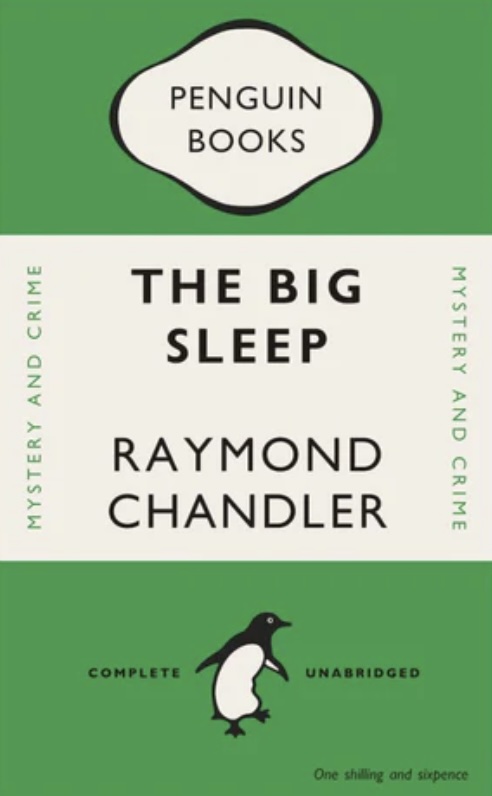
It’s long been clear that not all Chinese people gullibly accept Party propaganda. As the state reverts to more draconian policies, while the growth in new technology helps the security surveillance apparatus, righteous Chinese historians also use it to find ways to evade censorship. And their mission is important for our understanding of China:

If people grow up thinking that the Chinese Communist Party played a key role in fighting the Japanese, took power thanks to popular support, and is led by a group of meritocratic patriots, then they will have a hard time understanding why China is prone to purges, corruption, and political violence.

* * *

Sparks is in three parts, The Past, The Present, and The Future. The chapters are interspersed with vignettes on Memory.

Ai Jiabiangou

Part One opens with the labour camp of Jiabiangou in the poor northwestern province of Gansu, a series of determined investigations culminating in the long documentaries of Ai Xiaoming and Wang Bing. And this is no mere documenting a traumatic past, as Ai Xiaoming’s experience spells out:

The “hit, smash, loot” tactics of the Cultural Revolution that she and her family had experienced were not unique and are not dead; it is how the party regularly deals with people who have different views—especially when they dare touch on Communist Party history.

Still in the northwest, the memoirs of Gao Ertai (a Jiabiangou survivor) reveal the political turmoil at the Buddhist cave complex of Dunhuang in the 1960s.

Spark
Members of the Spark group, 1960:
Tan Chanxue, Sun Ziyun, Zhou Shanyou, Ding Hengwu.

A major theme is the work of Hu Jie and Jiang Xue on the short-lived magazine Spark, published by a group of students in Tianshui in 1960. At first they had the upright resolve to make the people’s desperate plight during the famine known to the central leadership, but soon, as it became clear that the latter had compelled the chain of regional and local cadres to report fictitious, exaggerated grain yields, they penned cogent critiques denouncing the people’s communes and the whole socialist edifice. Forty-three of those involved were soon arrested and sentenced to long prison terms; two of the leaders, Zhang Chunyuan and Du Yinghua, were executed in 1970.

Ian cites the solitary anti-Nazi propaganda of Otto and Elsie Hampel under Hitler, driven to tell the truth even if the attempt was futile—a story evoked in Hans Fallada’s novel Every Man Dies Alone / Alone in Berlin.

Xinghuo
Spark 1st edition, 1960: “Give up your fantasies and prepare to fight!”.

From 2008 Hu Jie filmed compelling interviews with many of the original Spark group, still passionate in their determination to speak the truth. He released a moving documentary online in 2013 (note the mournful shawms from 3.00 to commemorate Du Yinghua):

In “Memory: Snow’s visit”, Ian introduces Jiang Xue’s own work on Spark with a vignette on her extended, intimate interview with Xiang Chengjian in 2016—here’s the film, edited by Tiger Temple (see below) (slightly different edit here):

Just as moving is an earlier film by Hu Jie, Searching for Lin Zhao’s soul (2004), on the horrifying fate of a young Peking University student, unable to compromise her democratic ideals as society disintegrated in the wake of the Anti-Rightist campaign, who was imprisoned for six years before she was executed in 1968.

Ian looks back at the Party’s machinations, casualties, and pathological purges at Yan’an in the wartime Shaanbei Base Area, with the stories of Liu Zhidan and Liu Jiantong’s banned 1962 novel about him; of Gao Gang, Wang Ming, and Xi Jinping’s father Xi Zhongxun. Even after a palatable version of the Maoist era was being fabricated in the 1980s, and as “Red tourism” swept the country, Gao Hua embarked on a scathing indictment of the Yan’an period.

Ian gained experience of the Party’s control of archives in his study of the fate of the Maoshan temples since the 1930s (see Ritual life around Suzhou). Under Xi Jinping, with history ever more rigidly controlled, the National Museum of China has become a mere propaganda showcase.

In Part Two we meet the novelist Wang Xiaobo and his wife Li Yinhe, documenting subaltern lives; and the anthropologist Guo Yuhua, whose research on “the sufferers” in Yangjiagou village thoroughly demolished the Shaanbei myth. In Xi’an (setting for the cult novels of Jia Pingwa) Ian accompanies Jiang Xue to visit citizen journalist Zhang Shihe (“Tiger Temple”), with his bitter past as a child labourer in the Cultural Revolution. We eavesdrop on meetings of the editors of the Zhiwuzhi public forum.

Returning to Ai Xiaoming, Ian explains her background, and her support for rights-defender lawyers. Assessing the current retrenchment she comments,

The severe political pressure unleashed through governmental response has made it clear that it is unshakable, it does not need to listen, it has idolized itself. What happened in the past, the demonization of those critical of the government, is taking place once again.

The mass murders of the early Cultural Revolution in Daoxian county, Hunan, where—at the instigation of the Party—over 9,000 were murdered in August 1967, have been exhaustively researched by Tan Hecheng, and published in English as The killing wind: a Chinese county’s descent into madness during the Cultural Revolution. Ian provides a vignette on Yu Luoke’s exposé of the massacre in Daxing county in the Beijing suburbs at the same time. Yu was arrested and executed in 1970, but since 2016 his story has been circulating again.

A couple of instances of how such scars should impact on our fieldwork: in the 1990s I was impressed to find amateur Daoist and Buddhist ritual groups in Daxing, but I never learned of the 1967 massacre there. Ian comments further:

One survey of local gazetteers [Yang Su, Collective killings in rural China during the Cultural Revolution] shows that between four hundred thousand and 1.5 million people perished in similar incidents, meaning there were perhaps another one hundred Dao County massacres around this time.

And, from a distance, I’ve long been curious about the expressive culture of Gansu province—including its household Daoist traditions. The counties that scholars of religious and musical life should do fieldwork are among those where the most disturbing abuses under Maoism took place—so somehow we have to integrate society and culture into our studies.

Ian visits retired film historian Wu Di, co-founder of Remembrance (one of a whole series of samizdat journals), taking up the shocking topic of high-school girls in Beijing torturing and beating their vice-principal Bian Zhongyun to death in 1966—subject of another harrowing film by Hu Jie, Though I am gone, recounted by her bereaved husband:

This leads the Remembrance group to debate the career of Red Guard poster-girl Song Binbin, who witnessed (at least) the murder.

In Sichuan we meet Huang Zerong, who, undaunted by over two decades in labour camp as a “Rightist”, in his old age began publishing an unofficial history magazine, Small scars of the past—earning him another prison sentence, a fine, and close surveillance. In a reproach to the reluctance to “dwell on the past” (common among many traumatised peoples), he explains the importance of the 1958 Anti-Rightist Campaign:

Without the Anti-Rightist Campaign there would have been no Great Leap Forward; without the Great Leap Forward, people would not have starved to death. If people didn’t starve to death, there would not have been the Cultural Revolution. Without the Cultural Revolution, there would have not have been Tiananmen.

Fanning out from Beijing, Cui Yongyuan (Oral History Centre) and Wu Wenguang (Village Documentary Project and Folk Memory Project, focusing on the Great Famine) have done impressive work.

LWL
Li Wenliang.

Part Three, “The Future”, reveals shifting concerns. Ian documents the Coronavirus in Wuhan and whistle-blower Li Wenliang; while the Party was busy suppressing the truth, the awful realities of life under a draconian lockdown were again exposed by independent counter-historians, including Ai Xiaoming, along with front-line diarist-reporters like Zhang Zhan and the reputable novelist Fang Fang. Ian’s account is always nuanced:

The events in Wuhan show the potential anger, dissatisfaction, and critical thinking that lies beneath the surface. People like Ai Xiaoming, Jiang Xue, Tiger Temple, and Tan Hecheng represent a minority of Chinese. But their well-articulated critiques resonate when people are shaken from their lethargy.This is why one way to look at the Wuhan outbreak is as an example of government power. But a more convincing explanation is that it was a classic example of the repeated eruptions against unchecked government authority.

fig.68
Lhasa, 1966: from Woeser’s Forbidden memory.

The ever more vexed flashpoints of Xinjiang, Tibet, and Hong Kong are another major area for underground historians. Ian introduces the work of Tsering Woeser on her father’s photos of the Cultural Revolution in Lhasa, and the Tibetan stories collected in Conflicting memories. We learn of the travails of Hong Kong and the elimination of the free publishing world there. Part Three ends, perhaps rather more tangentially, with another trip with Jiang Xue to visit the Zhongnanshan hermits (also outside society), alongside an account of the lockdown in Xi’an.

The excellent Conclusion confronts the underlying questions: are the odds too great, is resistance to the authoritarian state useless, are those few who resist doomed to failure? Ian ponders how we should engage with China, challenging conventional wisdom on how to view it—when

the dominant way of understanding China is that nothing happens there except a string of dystopian horrors: surveillance, cultural genocide, mindless nationalism.

But

Government propagandists can flood the media with their version of reality or slow down unwanted information. This sophisticated form of censoring means that most people will still agree with the government version of events. And yet enough people now have access to alternative interpretations of the past that questioning has become widespread and persistent, despite harsher and harsher crackdowns. […]

The fact that people still resist and do so in a more coordinated form than at any time in the past, seems more significant than the banal point that an authoritarian regime is authoritarian.The fact is that independent thought lives in China. It has not been crushed.

He goes on,

The Party does not always win. Despite overwhelming odds, people inside China today still publish works and make films that challenge authority. Their ideas continue to spread, and when problems in society reach a critical point, people look to them for ways of thinking about their country. This is why Xi Jinping has made control of history one of his signature policies—because he recognises counter-history as an existential threat.

Thus Ian queries whether amnesia has really triumphed:

Saying that “most people” don’t know or care is a truism applicable to almost every society in every era; what matters is that many Chinese do know and continue to battle, today, to change their society.

Moreover,

Prosperity is not inevitable. For any country, it requires constant self-reflection and an ability to think up new solutions to new problems. The Chinese Communist Party’s ability to do so is open to question, especially when we consider its decade-long aversion to meaningful economic reform and its failure to build a top-ranked education system for non-elites.

Before the extensive Bibliography comes a useful Appendix on Exploring China’s Underground History. Ian notes dGenerate Films, Icarus Films, and the Chinese Independent Film Archive, while on YouTube there are channels for Hu Jie, Ai Xiaoming, and Tiger Temple—I’ve featured some of his recommendations above. He also offers a succinct list of recommended books. And an important new site, the China Unofficial Archives, has just gone live (see my introduction). Endnotes (a system that I much admire, cf. Eat the Buddha) provide detailed further references.

* * *

One naturally characterises such figures as “brave”. Guo Yuhua, herself long punished by the authorities and harassed by state security, told me she doesn’t feel particularly brave: rather she acts out of a sense of duty—part of a long tradition of righteous scholars throughout Chinese history, as Ian observes. One can only feel the deepest respect for the people who have stood up for truth, and for those who document their labours.

Still, these are people whom most of us wouldn’t normally encounter—or might not be aware of encountering. So where might The Masses stand on all this—those who swallow their scruples for the sake of a quiet life for themselves and their families? One finds plenty of resentment, of course, and even resistance—such as from organised religious groups; and individual cynicism is often heard, both from those clearly targeted, like “reactionaries”, and from the peasantry, who suffered just as grievously and in larger numbers. But just as distressing are the fates of the many who fervently believed in the Party, yet were assaulted in successive campaigns.

Foreign scholars may visit China for a variety of reasons. However much we may wish to eschew politics, and however much we like and esteem our friends in China, the gruesome history of the Party, trampling people’s lives, is the essential backdrop to all the topics that we study in modern (and indeed imperial) China—including history, culture (art, architecture, music, literature), and religion (see my post Cultural Revolutions). Mao was right about one thing: “There is no such thing as art that is detached from or independent of politics”. No walks of life have been untouched by all this, and Sparks should be essential reading for us all.

A Hollywood roundtable

March 1963
Leaders at the front of the march. Source.

Following the March on Washington for Jobs and Freedom on 28th August 1963, the United States Information Agency (USIA) broadcast a “Hollywood roundtable” (useful summary here), with Harry Belafonte, Marlon Brando, Charlton Heston [hmm], * Sidney Poitier, Joseph Mankiewicz, James Baldwin, and moderator David Schoenbrun:

As a commentary observes:

The Hollywood Roundtable did not portray the United States as a perfect nation. Instead, the USIA used honesty and humility in an attempt to relate to foreign audiences. Throughout the film, the celebrities emphasised the nation’s faults while still promoting American values. Writer and director Joseph Mankiewicz perhaps put this best: “This is the only country in the Western world where this [the march] is possible, but also the only country where this is necessary.” (11.45)

The emphasis on hope and potential is another theme meant to lure foreign viewers to the American way of life. James Baldwin states, “No matter how bitter I become I always believed in the potential of this country. For the first time in our history, the nation has shown signs of dealing with this central problem.” (18.58)

When word spread that the government was broadcasting images of domestic inequality to foreign nations, many Americans were not pleased with USIA officials. Shortly after, Edward R. Murrow stepped down as USIA president and was replaced by Carl Rowan. At the time, this made Rowan the highest ranked African American in public office.

That such an articulate, enlightened debate was aired at the time seems all the more impressive today, with the media perilously dumbed down and Republicans renewing their energies in assaulting the rights of minorities and women. The March was a predecessor of later demonstrations leading up to those for George Floyd and for womens’ rights. Here’s a film of the March itself:

As Michael Thelwell of SNCC commented:

So it happened that Negro students from the South, some of whom still had unhealed bruises from the electric cattle prods which Southern police used to break up demonstrations, were recorded for the screens of the world portraying “American Democracy at Work”.

As in the Roundtable, women were conspicuously absent as speakers at the March. Gloria Richardson, Rosa Parks, and Lena Horne were escorted away from the podium before Martin Luther King’s speech. Women who were allowed to sing included Marian Anderson and Joan Baez; and here’s Mahalia Jackson singing How I got over and I’ve been buked and I’ve been scorned:

MLK dream
Martin Luther King delivering his I Have a Dream speech at the March.

For the tragic end of Martin Luther King, see Memphis 1968.


* The wiki article on Heston (under “Political views”) has a summary of his later conversion to racism and the NRA, ranting against Political Correctness.

It’s what it is

what it is

In Istanbul over the summer, punctuated by the call to prayer, I watched not only my usual woke fare of black-and-white subtitled foreign-language films with amateur actors, but also a succession of classic mafia movies—three instalments of The Godfather, plus Goodfellas, perhaps the greatest of all. I still have to watch Casino.

I wasn’t previously aware of The Irishman (Martin Scorsese, 2019; reviewed by Roger Ebert and Mark Kermode), but it’s just as compelling, with a star-studded cast. For me, among all the immortal dialogue, two scenes stand out with Robert De Niro, as he tries to relay the unwelcome news from Jo Pesci to Al Pacino, and as it becomes clear that his best friend is gonna have to get whacked:

and

We may be used to “It is what it is”, but here “It’s what it is” makes an even stronger line. Cf. Pilate’s pithy line in Bach’s John Passion, n. here.

The female gaze is only fleeting in The Irishman, but the revulsion in the face of Frank’s daughter Peggy offers a rare glimpse of a moral core to the story. These movies are particularly topical amidst the current mafia state prosecutions in the USA.

It will come as no surprise to regular readers if I note that “It is what it is” makes a suitable bumper-sticker for the descriptive anthropologist of Daoist ritual, by contrast with the prescriptive agenda of scholars seeking clues in modern ritual to the religious doctrine of ancient times (see Debunking “living fossils”) [Oh FFSEd.].

On a more topical note, the astounding Coco Gauff used the expression in her wise reflections after her semi-final in the US Open was (briefly) disrupted. She is Good People.

Iran: Women, Life, Freedom in film

Cinema is one of the great strengths of Iranian culture (wiki; playlist of films with English subtitles). I’ve admired works such as Samira Makhmalbaf’s The apple and Blackboards, as well as Marjane Satrapi’s Persepolis (a graphic novel turned into an animated film), turning the spotlight on the plight of women under a repressive regime (see under Iranian lives).

Iran protest
Source.

The current “Women, Life, Freedom” movement is the latest and boldest in the decades-long struggles of Iranian women (and men) to overcome oppression (see e.g. here). The issue has receded from world headlines in recent months, but it mustn’t.

In these struggles, the world of cinema has long played an important role.

What makes this uprising so powerful is that women and cinema are at the heart of it. Both speak to the Iranian people across all social and ethnic divides and both target the heart of the regime’s anti-modern ideology.

By imprisoning the figureheads of Iranian cinema, the regime neither succeeded in silencing them, nor in intimidating the protesters. It even made them more vocal. Filmmakers both in and outside prison have made statements in support of the uprising and have amplified the voice of the protesters. Realising that the detainment of filmmakers had empowered them even more, the regime decided to grant them amnesty. Yet, this amnesty again put the global spotlight back on the filmmakers, who used this as another opportunity to garner worldwide support for the Iranian uprising.

Circle poster

Looking back, the kind of film I’ve been looking for is

The film was shot in 35 days over a 53-day period. As usual, Panahi used non-professional actors, * with the exceptions of Fatemeh Naghavi and Fereshteh Sadre Orafaiy. He saw the lead actress, Nargess Mamizadeh, in a park one day and immediately offered her the role. The film opens with one long, handheld shot that lasts over three minutes and took thirteen attempts to achieve. Panahi adopted a different camera style to depict each of the four main protagonists’ lives. For the first, an idealistic woman he used a handheld camera. For the second woman, the camera is mounted on a constantly moving dolly. The third woman’s story is told at night in darker outside, and the camera is static with pans and tight close-ups. For the last, least optimistic, both the camera and the woman are completely immobile and very little sound is used.

Earlier film of Panahi include The white balloon (1995) and Offside (2006, in six parts starting here, without subtitles). He has been arrested several times, most recently in 2022.

* * *

Milani
Tahmineh Milani. Source.

Among woman directors (both in Iran and in exile), note Tahmineh Milani (b.1960). She was briefly imprisoned for her film The hidden half (2001) before pressure from international directors brought her release. Here’s a scene:

and a short feature:

I’m also keen to see her film The fifth reaction (2003), as well as Marzieh Meshkini‘s The day I became a woman—here’s a trailer:

Further leads welcome.

See also New musics in Iran and other posts under West/Central Asia: a roundup. Cf. the secular theocracy of China, where independent directors such as Ai Xiaoming and Wang Bin, Jiang Nengjie and Xu Tong manage to make challenging films.


* Predictably, as a fully paid-up member of the Guardian-reading tofu-eating wokerati, I’m a sucker for foreign-language films with amateur actors. But seriously though folks, much as I admire Jack Nicholson and Meryl Streep, we just can’t help being aware that they’re Jack Nicholson and Meryl Streep—which, you must admit, is a serious flaw. I dream of a global ban on actors ever appearing in more than one film, but I do realise it might not go down so well.

You couldn’t make it up

Hyde cover

Political satire may be impotent (as in Peter Cook’s “those wonderful Berlin cabarets which did so much to stop the rise of Hitler and prevent the outbreak of the Second World War”), but apart from making us Guardian-reading tofu-eating wokerati feel smug, it affords us a modicum of sanity. On both sides of the pond, this has been a golden age for satirists, whose only problem is that no matter how exaggerated their fantasies, they couldn’t possibly dream up anything so absurd as the behaviour of the politicians themselves.

The Guardian is blessed with a kind of Brian-and-Stewie double act in the form of John Crace and Marina Hyde. The latter’s columns since 2016 have been collected in the handsome tome

  • Marina Hyde, What just happened? Dispatches from turbulent times (2022; 512 pages).

In her Introduction she addresses the reader:

You have chosen to be reminded that the path to the sunlit uplands goes right through shit creek.

And she reflects:

I know some people like to think of column-writing as an art, but for me, it’s definitely not. It’s a trade. You get up, you write something to fill a space, and you hope it’s not one of your worst shots and that readers enjoy it. Maybe some people are out there imagining they’re writing the first draft of history, but I feel like I’m just sticking a pin in a moment.

While it’s topical to read her dispatches weekly, it’s also salient to digest them en masse under loosely-grouped themes, or rather characters: not just politicians, but

a queen, various princes and duchesses, celebrities, wicked advisers, reality TV monsters, billionaires, philanthropists, fauxlanthropists, Hollywood sex offenders, judges, media barons, populists, police officers, and all kinds of other heroes and villains.

Ms Hyde is happy to be “the journalistic equivalent of a chocolate digestive or a packet of salt and vinegar crisps”, interspersing showbiz and sport with politics and always thinking associatively (“for me the reflexive way of making sense of a lot of things is by using references to other things”). But beyond the dazzling stylistic brilliance of her satire, many columns evince her genuine passion about events where levity is unthinkable, such as the murder of Jo Cox and the Manchester Arena bombing.

It’s all there—Brexit, Covid and Partygate, with the Orange Baby taking a relatively cameo role. Will our grandchildren ever believe any of this, or will it be eclipsed by duplicities and iniquities as yet unimaginable? Copious columns of Ms Hyde excoriate the Tories floundering over Brexit and its “opportunities”, from Theresa May (“the Florence Foster Jenkins of politics”) to the arch-villain BoJo, “matinee idol of the Tory shires”, “the blond black hole”,

journalist, novelist, Churchill biographer, politician, urban planner, diplomat. At this stage in Boris Johnson’s storied career we have to ask: is there anything he CAN do?

I’ve already featured the classic scene in Outnumbered where a visiting German student refuses to believe that “Boris” could possibly be a real politician (see note here). Ms Hyde’s epithets for him are magnificent:

not so much a statesman as an Oxfam donation bag torn open by a fox

this radioactive haystack, this Frankenstein assemblage of all the rejected personality disorders of the minor Greek gods

puts the “I am” into iambic pentameter

lying, hypocritical degenerate

looks like Chucky if he’d borrowed a suit for a court appearance, or a Yewtree version of Worzel Gummidge, or what would happen if you started making Margaret Rutherford out of papier maché but got bored halfway through

and

The level of self-congratulation with which he produces a phrase like “tricephalous monster” marks him out as the classic stupid-person’s-idea-of-a-clever-person, but among the faithful it is undeniable that some of his most recycled lines still bring the house down. And the lovely thing is, he’s never buried in the rubble.

Ms Hyde is incisive on the way “Boris” stokes up Islamophobia. And from October 2021:

For pretty much the entire pandemic, right up until about 10 minutes ago, Johnson has been the teacher who wants to be cool. You know the type—messes his hair up and calls you “mate”. High-fives you when you get a right answer but claims that, in many ways, there are no wrong answers. Tells you to call him by his first name. Deals with early speculative breaches in discipline by announcing he’s not going to send you to the headmaster, mate, because he comes at this stuff from different angles. Tells you to rip out the introduction to your pandemic textbooks.

Insists he’s the same as you guys and totally gets what you’re going through, in fact he actually feels it more deeply. Claims to have been expelled from three schools as a teen. Says he hates teaching because he’s “about freedom”. Rides a dirt bike. Raps Cardi B. Chaperones a school trip where 47 pupils die.

And his Rasputin, the éminence grise Dominic Cummings,

shiftily meeting the camera’s gaze with the same defensive sneer you’d see on the proprietor of a holiday caravan park who had just been released on police bail after a fatal gas explosion thought to have been caused by poor maintenance,

whose intrepid research trip to Barnard Castle, at a time when the feckless riff-raff were just lounging around on their own at home, is yet another priceless gift to satirists.

And then there’s the Haunted Pencil, “someone [Boris] would unquestionably have pitied mercilessly at school”, giving him a patrician endorsement:

“Two years ago, in the Conservative Party leadership campaign, I supported Boris Johnson, because I thought he would deliver Brexit extraordinarily well”, Rees-Mogg intoned, suggesting he has inherited all his father’s gifts of prophecy. “I haven’t seen anything that would cause me to change my mind on that.” Not anything?! He should have gone to MonocleSavers.

Among many classic reproaches to his absurd, sinister shtick is this.

Further sections are devoted to “Big Guys: from street harassers to Supreme Court judges”, Billionaires, and the Royal Family. Ms Hyde’s sports columns are acerbic too, such as “Pity the poor man who’s had the Women’s World Cup shoved down his throat”,

at the expense of one of the four great civil rights questions of our era: 1) When are we getting a White History Month? 2) When is International Men’s Day? 3) Isn’t it time we had Straight Pride? and 4) Can you imagine how sexist people would say it was if we had a men’s World Cup? […]

Ways that it can be shoved down his throat include “being on TV” and “being on a website he normally looks at”.

And Oh No, he’s Being Branded Sexist!

No one more than me wants to help the guy whose chief point about the 2019 World Cup is: “I would so much rather watch parks football on a Sunday morning”. I would also rather he did this.

She pays homage to Marcus Rashford, “worth a hundred ministers”, with his initiative for free school meals; and to the emotional maturity of the England men’s football team after the 2020 Euros, “in stark contrast to that of the prime minister and government”:

It is, on every level, absurd that it should feel socially necessary for footballers barely out of their teens to pen missives to the nation apologising for missing a penalty, but not for a government to even acknowledge vast and lethal mistakes, much less say sorry for them.

In the section on still more recent débacles (“12 parties, three prime ministers, and a war”), she deplores the shameful failure of the “government” to help refugees from Ukraine—or indeed (one might add), refugees from anywhere, or to help anyone ever, except themselves. And I’ve already cited her riposte to the rabid critics of Nazanin Zaghari-Ratcliffe.

Indexes can give a succinct, drôle flavour of a book’s tone; the index here is entertaining in itself, while somewhat more restrained than those of Paula Clarke Bain, or my own draft index for Nicolas Robertson’s mind-blowing anagram tales. The substantial entry for “Johnson, Boris” includes sub-headings such as

banal psychopathy
dishonesty
self-love
and death of shame
farming sunlit uplands
fridge-hiding

See also my roundup of posts on Tory iniquity.

The art of emoji

Emoji zzzAmong all the New-Fangled media that are making us feel old, even I can’t help noticing that emoji are a really useful means of communicating (yup, I’m leaping right in there and being geriatically pedantic about the plural already—see also here and here).

emoji plural

Pictograms evolving out of emoticons, emoji have been constantly developing since the early smiley face 😀, and there’s a wealth of discussion (e.g. wiki; and articles such as this). A 2017 study found that

The French use heart emoji ❤️ the most. People in countries like Australia, France, and the Czech Republic used more happy emoji, while this was not so for people in Mexico, Colombia, Chile, and Argentina, where people used more negative emoji in comparison to cultural hubs known for restraint and self-discipline, like Turkey, France and Russia. […]

Linguistically, emoji are used to indicate emotional state, they tend to be used more in positive communication. Some researchers believe emoji can be used for visual rhetoric. Emoji can be used to set emotional tone in messages. Emoji tend not to have their own meaning but act as a paralanguage adding meaning to text. Emoji can add clarity and credibility to text.

Psycholinguistically, the use of emoji differ depending on speaker and setting. Women use emoji more than men. Men use a wider variety of emoji. Women are more likely to use emoji in public communication than private communication [see also e.g. here].

Extraversion and agreeableness are positively correlated with emoji use, while neuroticism is negatively correlated. Emoji use differ between cultures: studies in terms of Hofstede’s cultural dimensions theory found that cultures with high power distance and tolerance to indulgence used more negative emojis, while those with high uncertainty avoidance, individualism, and long-term orientation use more positive emojis.

Succinct and expressive of nuance, emoji may be misunderstood according to the cultural and contextual interpretation of sender and recipient. Of course, verbal language (both written and spoken) can be misunderstood too, and it can also be a useful device; deliberate ambiguity is easier to detect in speech, which can provide more clues to your meaning.

emoji feminist

Feminism is also on the agenda (e.g. here, and here). And emoji designers are careful to reflect skin colours:

emoji skin

Emoji use by country has interesting but quite minor variations (see e.g. here, and here).

Emoji FWTOJ

The Face with Tears of Joy emoji has led the field since 2015. It

started to decline in popularity around the early 2020s, because Generation Z began to associate it with older generations, thus perceiving it as “uncool”. It has been predominately replaced by the sobbing emoji (😭) and skull emoji (💀) to express similar emotions. However, CNN did note that “sometimes teens and twenty-somethings use emoji—like the laughing crying one—ironically, such as by sending six or seven of them in a row to friends, to exaggerate it. But, overall, that emoji is a no-go”. Whilst the emoji has maintained its popularity with millennials, Generation Z utilises the emoji as a form of irony. Following the decrease in usage over Twitter, the Face with Tears of Joy emoji was briefly dethroned as the most popular Twitter emoji. Researchers speculate that this decrease in popularity is due to its over-saturation and overuse within online communities. In late 2021 and early 2022, however, it returned to the top of Twitter’s most popular emoji.

Victor Mair writes on its Chinese connotations here.

I’m fond of the angel emoji 😇, also ambiguous, ingenuous. And emoji will keep evolving. The brilliant, useful “HELLO?” (or “Like, Duh”—also “Like, hello?” and in reported speech, “I’m like, hello?”) doesn’t quite seem to be covered yet (see this post featuring the sinister Haunted Pencil 👻✏️, adding emoji for racist sexist Tory bigot)—one could use the basic Waving emoji 👋, the Face with Rolling Eyes 🙄, or something in this range 🤔🤭, but we surely need a more focused one.

After Moby Dick, I look forward to emoji versions of Pride and prejudice and the Matthew Passion.

The likes of The Haunted Pencil may tut, but like Popular Beat Combos and the telephone (see Staving off old age), it looks like emoji might really catch on. YAY!

💃  🍾

Neither wolf nor dog

Wolf cover

  • Kent Nerburn, Neither wolf nor dog: on forgotten roads with an Indian elder (1st edition 1994).

I can only scrape the surface of the wealth of coverage (both academic and popular) of Native American cultures (see this roundup). Within the literature, “as told to” memoirs (mediated by a more or less diligent white amanuensis) make an important way of amplifying the voices of Native Americans. For some early life stories (the field led by the classic Black Elk speaks, 1932), as Arnold Krupat concludes in For those who come after (1985),

Any future examples of the genre will appear in a context increasingly dominated—at least so far as the white world’s awareness is concerned—by autobiographies by Indians who, while deeply interested in the old ways, have become extremely sophisticated in their manipulation of new—Euramerican, written—ways. In their different fashions all of these life histories, and those of their predecessors, deserve study and inclusion in the canon of American literature.

So Neither wolf nor dog belongs to a long tradition. While many of the thorny issues that it poses are basic to fieldwork in many parts of world, this is a famously sensitive area. Nerburn explicitly problematises the relationship between Native American subject and white interlocutor (anger and sadness on one side, guilt on the other). And this, with the road-trip format, gives the book a dramatic impetus, making it more personal and engaging than a dry series of homilies or a litany of white rhapsodies about NA spirituality.

The book’s title comes from Sitting Bull:

I do not wish to be shut up in a corral. All agency Indians I have seen were worthless. They are neither red warriors nor white farmers. They are neither wolf nor dog.

Learning of Nerburn’s previous collection To walk the red road, as NA elder Dan nears the end of his life he contacts Nerburn to ask him to help him commit his insights to paper. While revealing his own conflicts and soul-searching, Nerburn stands up to Dan and his sidekick Grover when they test his endurance and chip away at his values.

I had not come out here to be given an endless series of tests in cultural sensitivity, or to become the butt of some deep and private jokes. Even if the old man didn’t realise it, I was doing him a favor, and at great cost to myself and my family. I was willing to play his Boswell, but I was not willing to play his patsy. And I surely was not willing to have my every action judged, critiqued, and used as the basis to decide if he was going to let me pursue this any further.

As Dan tells him:

White people that come around to work with Indians, most of them want to be Indians. They’re always wearing Indian jewelry and talking about the Great Spirit and are all full of bullshit. […]

Or else they think we need some kind of white social worker telling us what to do. Some of them come here because they can’t find a job anywhere else and end up out on the reservation…

Grover too comments, “White people don’t want real Indians, they want storybook Indians.” Nerburn shares their antipathy to well-meaning hippies and do-gooders. In his Preface he elaborates:

They take on the trappings, they romanticize, they try to right the historical wrong through a great outpouring of cultural compassion, or try to express spiritual solidarity by appropriating Indian values or belief. In the process, they distort the reality of the people about whom they care so deeply, and turn them into a reflection of their own needs.

This is exactly what Dan and Grover and all the others would never let me do in Neither wolf nor dog.

The tragic history has been documented in detail, but Dan’s account is eloquent.

The white people surprised us when they came. […] We had seen other strangers before. But they were just other people like us—other Indians—from different tribes. They would come and ask us to pass through our land. If we wanted to, we would let them. Otherwise they couldn’t.

But you see, it wasn’t our land like we owned it. It was the land where we hunted or where our ancestors were buried. It was land that the Creator had given us.

It was the land where our sacred stories took place. It had sacred places on it. Our ceremonies were here. We knew the animals. They knew us. We had watched the seasons pass on this land. It was alive, like our grandparents. It gave us life for our bodies and the life for our spirits. We were part of it.

So we would let people pass through it if they needed to, because it was our land and they knew it. We did not wish them to hunt or to disturb our sacred places. But they could come to our land if they needed to.

But the new influx soon became a great ocean washing them off their land.

Then something strange happened. These new people started asking us for the land. We did not know what to say. How could they ask for the land? They wanted to give us money for the land. They would give us money for the land if their people could live on it.

Our people didn’t want this. There was something wrong to the Creator in taking money for the land. There was something wrong to our grandparents and our ancestors to take money for the land.

Then something happened that we didn’t understand. The people who came said that we didn’t belong here anymore. […] We thought they were crazy.

As land became property (“We just belonged to the land. They wanted to own it”), Dan goes on,

Your religion didn’t come from the land. It could be carried around with you. Your religion was in a cup and a piece of bread, and that could be carried in a box. Your priests could make it sacred anywhere. You couldn’t understand that what was sacred for us was where we were, because it was where the sacred things had happened and where the spirits talked to us. […]

The worst thing was that you never even listened to us. You came into our land and took it away and didn’t even listen to us when we tried to explain. You made promises and you broke every one.

On naming;

“Do you mind being called an Indian, Dan?” It seemed appropriate, since his granddaughter had just referred to him as an Indian, and it was a question that always lurked beneath the surface when I was involved in conversations with Indian people.

“What the hell else would you call me?”

“Oh, Native American. I don’t know. Something. Anything other than Indian.”

The old man took a deep breath, as if he had explained this many times before.

“It doesn’t bother me. It bothers a lot of our people, though. They don’t like that the name we have was a mistake. Just because Columbus didn’t know where he was, we have to be called Indians because he thought he had found the East Indies. They think it takes away our pride and our identity.”

“That seems like a fair sentiment to me,” I said. The old man waved his hand in front of his face to silence me.

“I guess I don’t mind because we have taken the name and made it our own. We still have our own names in our own languages. Usually that name means ‘first people’, but no-one would ever call us that. So we let people call us ‘Indians’. Does that tell you something about us?”

I wasn’t sure what he was driving at. “It tells me you are willing to accept a certain level of injustice.”

He nodded vigorously. “Sure. What if you called black people Russians or Chinamen? Do you think they’d stand for it?” He laughed at the thought. “Hell, they change what they want to be called every few years.”

“I don’t blame them, though. They’ve been called some pretty bad names. And being called by a color is almost as strange as being called by a place you never lived. But the point is that our people mostly don’t care so much about something like a name. We’re pretty easygoing about things.” […]

“You remember a few years ago? Some Indians decided they would rather be called Native Americans. It’s an okay name; it’s more dignified than ‘Indians’. But it’s no more real than Indians, because to us this isn’t even America. The word America came from some Italian who came over here after Columbus. Why should we care if we’re called Native Americans when the name is from some Italian?” […]

“If some of us want to be called Native Americans, you should call us Native Americans. If some of us want to be called Indians, you should call us Indians. I know it make you kind of uncomfortable, not ever knowing which one is right. But I think that’s good. It reminds you of how uncomfortable it is for us—we had our identity taken from us the minute Columbus arrived on our land.”

In “Junk cars and buffalo carcasses”, another lesson arises from a concern of Nerburn:

I had always been mystified by the willingness of people to live in squalor, when only the simplest effort would have been required to make things clean. I had come to shrug it off to the old sociological canard that it reflected a lack of self-esteem and a sense of hopelessness about life.

But, in my heart, I knew that this was too facile, too middle-class in its presumptions. But it certainly was preferable to earlier explanations—that people who lived like this were simply lazy and shiftless.

Dan gives him another perspective:

“All of these—all these cars and stuff—makes me proud.”

“Proud?”

“Yeah. It means we haven’t lost our traditional ways.”

The anger had faded from his face and been replaced with a placid smile. “We have to live in this world. The Europeans killed all the animals and too all our land. We can’t live our way anymore. In our way, everything had its use then it went back into the earth. We had wooden bowls and cups, or things made of clay.

We rode horses or walked. We made things out of the things of the earth. Then when we no longer needed it, we let it go back into the earth.

“Now things don’t go back into the earth. Our kids leave pop cans around. We leave old cars around. In the old days these would be bone spoons and horn cups, and the old cars would be skeletons of horses or buffalo. We would burn them or leaave them and they would go back to the earth. Now we can’t. We are living the same way, but we are living with different things. We will learn your way, but, you see, you really don’t understand any better. All you care about is keeping things clean. You don’t care how they really are, just so long as they are clean. You see a dirt path with a pop can next to it and you think that is worse than a big paved highway that is kept clean. You get madder at a forest with a trash can in it than at a big shopping center that is all clean and swept.”

Dan and Grover enjoy an old Cowboys ‘n’ Injuns movie on TV:

“My God,” I said. “How can you watch this? Doesn’t it make you crazy?”

“Hell,” Grover said. “I used to go to the movies as a kid and root for the cowboys. I probably even saw this one.”

“Yep,” said Dan. “In the old show houses everyone used to cheer and boo at movies. We all booed the Indians; cheered when the cavalry came. I really liked John Wayne.”

This leads to another worthwhile discussion. At a truck-stop they find some old hippies, wannabe Indians. Dan bemoans his fellow Indians who sell what is sacred, and the whites who want to buy it:

The white people want to own us spiritually. […] Before you wanted to make us you. But now you are unhappy with who you are, so you want to make you into us.

Dan offers an intriguing perspective on the nature of freedom (an overriding American obsession that most outsiders find mystifying). On the early settlers:

When you got here you got scared and tried to build the same cages you had run away from. If you had listened to us instead of trying to convert us and kill us, what a country this would be.”

And more on images:

For white people there are only two types of Indians. Drunken bums and noble Indians. In the old days, we used to be savages, but that’s gone. Now it’s drunks and noble Indians. I like the white men better who think we are all drunks. At least they’re looking at us as people. They’re saying what they see, not what they want to see. Then when they meet one of us who’s not a drunk, they have to deal with us.

The ones who see us all as wise men don’t care about Indians at all. They just care about the idea of Indians. It’s just another way of stealing our humanity and making us into a fantasy that fits the needs of white people.

In a powerful dénouement, they visit the Wounded Knee memorial.

I must also read the sequel, on the iniquitous boarding school system (introduced here and here).

* * *

Wolf film

While I was swiftly converted by the book, I couldn’t quite imagine how it might adapt as a movie. But Steven Lewis Simpson’s 2016 film turns out to be just as thought-provoking. This is largely thanks to the inspired casting of Dave Bald Eagle (1919­–2016) as Dan; 95 years old at the time of filming, before he died he commented “it’s the only film I’ve been in about my people that told the truth”. Grover and Nerburn are well cast too; scenes from the book are carefully handled, like Jumbo who Fixes Stuff, and the alcoholic Indian approaching them in a diner. Dave Bald Eagle’s final oration at Wounded Knee is extraordinary.

Here’s a trailer:

* * *

The dialogue that Dan and Nerburn open up has clearly been well received, at least among wasichu white audiences. Neither wolf nor dog gives food for thought not only to the wannabe Indians and do-gooders but to other wasichu, whether or not they welcome the message (Nerburn’s website has some thoughtful reflections here, and here). How Native Americans feel about it is another matter (though their appraisals too will be diverse); but maybe it can go towards helping everyone come to terms with the appalling tragedy at the heart of the American psyche.

Summertime

Postcard from Istanbul

Since the carefree Italian musical jaunts of my youth, I’ve become resigned to enduring the English “summer”—resenting long periods of showers and Arctic temperatures, alternating with the occasional stifling heatwave, before the long drab grey August decline.

So—pace global warming, which despite the demurrals of many fuckwit politicians is actually A Thing—how delightful it is, around an island interlude, to spend an extended period in a region (thanks to my enforced homelessness) where heat is just a given, and one’s body just gets into the rhythm, finding shade, working at sensible times of day (if you have a choice, that is), and actually Enjoying Life, freed from the vain, desperate annual scramble to change colour—one of the afflictions of Being English.

desert
Gary Larson.

Of course, such a sentiment would never have buttered any parsnips for the tanners of Zeytinburnu, nor will they for a waste collector in Tarlabaşı pulling a heavy load up a steep hill at midday (see e.g. here, here). And meanwhile in London, heroic NHS nurses are still slaving away, saving the lives of others, catching crowded buses and juggling childcare; in China and India, peasants are still tilling the fields, seeking water, dreaming of escaping hardship by migrating to urban apartment blocks.

* * *

Plucked from Porgy and Bess, Gershwin’s song has become such a cliché (“the most covered song in the world“) that it rarely moves me. As always, Billie Holiday transforms the song—here’s her 1936 recording, when it was still new:

And it keeps inspiring musicians—here’s Miles in 1959:

Mahalia Jackson in 1960:

And the brilliant Andrea Motis with mentors of the Sant Andreu Jazz Band in 2013:

On a linguistic note, I like Stephen Sondheim’s observation about the opening line:

That “and” is worth a great deal of attention. I would write “Summertime when”, but that “and” sets up a tone, a whole poetic tone, not to mention a whole kind of diction that is going to be used in the play; an informal, uneducated diction and a stream of consciousness, as in many of the songs like My man’s gone now. It’s the exact right word, and that word is worth its weight in gold. “Summertime when the livin’ is easy” is a boring line compared to “Summertime and”. The choices of “ands” [and] “buts” become almost traumatic as you are writing a lyric—or should, anyway—because each one weighs so much.

For a fine Native American weather story, click here.

Resisting fakelore

Kundera and Pawlikowski

Kundera

In memory of Milan Kundera (1929–2023; wiki, obituary), a favourite of mine is his first novel,

  • The joke (Žert, 1967).

Joke cover

Kundera worked on the book in the years following his expulsion from the Party in 1950. Published briefly before the Prague Spring was crushed, it shows personal and political to be enmeshed, as well as the degradation, nihilism, and duplicity of life under state socialism—through a brilliant exposé of the “fakelore” indignities to which the regime subjected traditional culture in Moravia.

For insights on the musical elements of The joke, I recommend

  • Michael Beckerman, “Kundera’s musical joke and ‘folk’ music in Czechoslovakia, 1948–?”, in Mark Slobin (ed.), Retuning culture: musical changes in central and eastern Europe (altogether a useful volume—see under Musical cultures of East Europe).

Joke film

With The Ride of the Kings pageant as the novel’s climax, Kundera saw through the propaganda:

… Tereza, when she met the chairman of the collective farm at the spa, conjured up an image of the countryside (a countryside she had never lived in or known) that she found enchanting. It was her way of looking back, back to Paradise. […]
The state supported folk music and festivals in an attempt to show, quite simply, that in this “people’s paradise” the folk, at least, were alive and well.

Cynical as Kundera’s alter ego Ludvik is, he has a genuine attachment to the folk culture that was now being distorted. But his revenge is hollow. Here’s an excerpt from the 1969 screen adaptation by Jaromil Jireš:

Just as fascinating is Jireš’ short film about the Ride of the Kings:

* * *

Cold War

All this, and more, is brilliantly evoked in the Polish movie

Ravishingly filmed in black-and-white, it’s a visual and musical tour de force. The early scenes, soon after the Communist takeover, are revealing in themselves. Fieldworkers Wiktor and Irena avidly record folk musicians in the countryside, then help develop the sanitised style of the “Mazurek” song-and-dance ensemble (based on the real-life  Mazowsze troupe), until the folk ethos is further compromised by numbers in service of the Party agenda.

My post on folk traditions of Poland opens with this brief period of energy in the collection of folk music after the Communist takeover. The soundtrack, masterminded by Marcin Masecki, illuminates the whole drama. Opening strikingly with a gutsy song accompanied by bagpipe and fiddle in a snowy village, the early scenes, with Irena and Wiktor inspired by the project, communicate the whole excitement of discovering folk culture through fieldwork (see also Musics lost and found).

As in The joke, prescriptive apparatchiks play a disturbing role. Their companion Kaczmarek, soon to become director of the new state troupe, doesn’t share their enthusiasm; this revealing exchange is horribly familiar to me from meetings with cultural cadres in China:

You’re not afraid it’s too crude, too primitive?
No, why?
Where I come from, every drunk sings like this.

Kaczmarek is also a believer in racial purity. Listening to a beautiful recording they’ve just made:

What language are they singing in?
Lemko.
Thought so. Shame.
Why?
That it’s not ours.
Mr Kaczmarek, whether it’s ours or not is none of your business.

They record a young girl singing an unadorned Dwa serduszka (Two hearts)—a song which punctuates the story in successive reincarnations:

Kaczmarek soon becomes director of the new state troupe, spouting sonorous platitudes. As Peter Bradshaw comments:

Of course, they are not “welcoming tomorrow”—they are welcoming the past, a hyperreal, state-sanctioned, quaintly fabricated time of “folk” tradition that will combine Soviet obedience and ethnic conformity. […]
This kind of genteel artistic display is vital for foreign diplomacy, for establishing relations with Russia and a prestigious display for the west. It is a world of privileged foreign travel, with fears of defection.

Auditioning for the troupe is young singer Zula. Though she looks the part, she’s “a bit of a con”— not from politically-correct peasant stock, on probation, and choosing to sing a song learned from a Russian movie. Himself resistant to ideology, Wiktor is charmed by her energy, spirit, and originality. As Zula goes “from victim to victor and back again”, their fatal attraction now unravels over fifteen years from Poland to East Berlin, Paris, and Yugoslavia.

Cold War 3

While many peasants were nonplussed by the state troupes’ misappropriation of their culture, the film does well to observe that this new sanitised style was welcome to some audiences who perhaps (like Kaczmarek) found folk music unpalatable in its raw form. After one glossy spectacle, an audience member comes up to Wiktor and Irena:

I never believed in all this folky stuff. But this—it moved me. You are a genius. To take something so… and make it so beautiful. Thank you both—this is the most beautiful day of my life!

At a tense meeting a stony-faced Party Boss dictates the direction the troupe is to take:

In your repertoire you access priceless treasures of our People’s culture. This is highly commendable. We want you to become a living calling-card for our Fatherland. But I think it’s time for you to add something new to our repertoire—about Land Reform, World Peace and the threats to it. A strong number about the Leader of the World Proletariat. And we, in turn, will do everything in our power to show our gratitude. […]

Irena politely protests:

I would like to express gratitude on behalf of the whole ensemble for your appreciation of our hard work. But when it comes to our repertoire, it’s based on authentic folk art. The rural population doesn’t sing about Land Reform, Peace and Leaders—simply doesn’t do it, so it would be difficult.

But the canny Kaczmarek hastily reassures the Boss:

Comrade Bielecka, I assure you that our nation is not so ignorant, including its rural elements. Quite the contrary. And it will sing about those issues—as long as it is encouraged, and given direction. This, I believe, is exactly what I believe the role of our ensemble should be.

The principled Irena soon quits, while Wiktor (a male archetype straight out of a Kundera novel) bides his time as musical director—and as Zula’s lover. Not to toe the new ideological line could destroy lives.

And all that’s just in the first half-hour—essential viewing for the impact of state socialism on expressive culture, more eloquent than volumes of worthy academic analysis.

While the ensemble is in East Berlin on tour in 1952, Wiktor defects, going on to eke a living at a jazz club in Paris. Over the following years the lovers’ brief encounters become ever more bleak as they come together and pull apart, until the degradation of their final meetings back in Poland, crossing paths again with Kaczmarek. Peter Bradshaw again:

A love affair thrashes and wilts in the freedom of a foreign country, and then begins to submit to the homeland’s doomy gravitational pull.

Cold war richly deserves all the praise it has gained. Now I’m also keen to watch Pawlikowski’s 2013 film Ida (trailer here), set in 1962.

Under Life behind the Iron Curtain, see also Czech storiesMadonna pilgrimage in Communist Poland, and Polish jazz, then and now.

* * *

The state’s manipulation of folk culture that Kundera and Pawlikowski evoked was a common element throughout the Soviet bloc, such as sharovarshchyna in Ukraine—and also a major theme in China.

sfg-50s

The great Yang Yinliu made wise comments as early as 1953 on the gulf between folk and conservatoire styles—ideological tensions that were replicated in countless county-towns (for a renowned peasant ensemble “blowing with the wind” during the 1958 Great Leap Forward, see Ritual groups of Xushui, under Qianminzhuang; cf. A Daoist serves a state troupe).

And the impasse has continued in the “Golden Age” myth, idealising the Glorious Past (see Debunking “living fossils”). Even in cases where local cultures have not been explicitly targeted by the state for remoulding, scholars may unwittingly impose their own agendas, notably in the flummery of “Intangible Cultural Heritage“. See also Different values, and The politics of ethno-trad.

My impertinent editor

Editors can play a most constructive role—such as gently suggesting that it might be inadvisable to use the word “wombat” three times in the same sentence, or explaining the legal repercussions of slagging off evil xenophobic Tory bigots. On my blog, however, as the attentive reader [singular, eh? Mrs Ivy Trellis I presume—Ed.] will have noticed, the main role of my imaginary editor is to constantly snigger at my pretentious ideas and take the piss out of my slavish devotion to PC.

So perhaps we can find some clues to the character and tastes of this elusive figure—like Elena Ferrante, being of indeterminate gender, I like to think of her/him as Ermintrude or Algernon.

ritual-masters

The notional editor likes to nominate me for a Pseuds’ Corner Award for passages such as:

I was just admiring Messi weaving his way through yet another helpless defence, and recalling his time at Barcelona, comparable only to Bach at Leipzig…

or in my tribute to Stewart Lee:

he reformulates motifs from previous work, just like Bach and Miles Davis.

Waxing lyrical about Dream a little dream of me,

reminiscent of Mahler’s sudden revelation of alpine pastures adorned with cowbells, or an incandescent Messiaen meditation suffused with ondes martenot [Steady on—Ed.].

Pondering my early exposure to the ouevre of Godard:

my musical tastes were already imbued with Ravel, Messiaen, and Boulez [Weirdo—Ed.]

On flamenco:

Like Lorca, [Name-dropper—Ed.], my taste draws me to the intensity of cante jondo deep singing”.

In one of my posts on cuisine, Ermintrude/Algernon sniggers at

my legendary dinner parties [legendary in the sense that they never existed?—Ed.]…

Stein

On the 94 bus:

As the fleet plies its trade between East and West, like a medieval caravan along the Silk Road weaving its way through the bustling markets of oases like the fabled Bush of Shepherds [That’s enough now—Ed.]

Some of my finest fantasies are met by a suggestion of inebriation:

“I didn’t get where I am today” [at home with a bottle of Bombay Sapphire—Ed.] by peddling such flapdoodle.

Often when I seem to overreach myself, a sarcastic put-down suffices—such as a raised eyebrow when I claim familiarity with these new-fangled Popular Beat Combos:

my new acquaintance with Turkish-German rap [Yeah right—Ed.]

The editor’s disinterested eye can be useful, as here:

We shouldn’t allow our fascination with iconography [Speak for yourself—Ed.] to detract from documenting people’s actual religious observances.

Ermintrude/Algernon tries to keep me in check:

One evening after doing the Monteverdi Vespers, or should I say Vespas [No you should not—Ed.]

On Tibet:

Could it be that emissaries called out “da-yig!” to announce their arrival, a custom that eventually found its way to Venice via the Silk Road, becoming the gondolier’s cry of O-i? [No it couldn’t. Stop it.—Ed.]

My obsession with Chinese folk music surfaces in the most unlikely places, like this on Irish fiddlers:

What a wealth of creative wisdom under all those nimble fingers, immersed in the style, each with their own lineages and influences, full of regional and personal variation—like shawm players in north China [I was afraid you were building up to that—Ed.].

Some comments hit home:

[Noteauthor’s source for popular culture appears to derive almost entirely from the demure echelons of the BBC—Ed.]

I may be rebuked for levity, as in this aside:

the iconoclastic early punk band Seven Sages of the Bamboo Grove [Behave yourself, Dr Jones—Ed.]

But sometimes Ermintrude/Algernon seems to join in the fun:

I’m always tickled pink [Best possible colour to be tickled—Ed.] by

and on visual culture:

Craig and any other art historians who have managed to read this far might care to exact revenge by writing Specious Flapdoodle [famous 19th-century Baptist pastor—Ed.] about early music or Daoist ritual…

Flann

In my tribute to Myles:

His intolerance of cant (and doubtless Kant) has brought him a cult following [Autospell running amok?—Ed.].

On film criticisms by GDR censors:

the buildings look sad, inhospitable, dirty, and unkempt [Tripadvisor review for Tory Britain?—Ed.]

My elusive critic sometimes takes a rather laidback stance on grammar, as here:

I found myself on the courtyard outside SOAS at midday, where whoM [Pedant—Ed.] should I bump into but…

Ermintrude/Algernon’s rebukes over my sexism seem to be tongue-in-cheek—such as this comment on some favoured limericks:

The young man from Calcutta, The young man from Japan, and The old man from Peru [Typical bias against the middle-aged woman—Ed.]

or

the splendidly-named Ronald Binge, creator of Mantovani’s “cascading strings” effect [Persontovaniplease!—Ed.]

And I am just as likely to be criticised for being unduly Woke, as in my choice of baroque composers:

we should adjust from our image of Barbara Strozzi and Artemisia Gentileschi [PC gone mad—Ed.]

Even my violin playing comes in for sarcasm:

… it feels great to Become One with the instrument again [Again?—Ed.]

At times Ermintrude/Algernon can be rather too literal:

Call me a nerd [You’re a nerd—Ed.], but taxonomy and indexing can be so funky…

Under this constant bombardment, I sometimes get a tad shirty at the editor’s comments:

I climbed aboard at Chiswick High Road to find an old codger [Around your age?—Ed.] [Look, I’ve warned you about this—SJ]

I’m always intoxicated [Now read on—Ed.] [That’s enough of your lip—SJ] by the mood of Irish music.

But in all, I feel most fortunate to have such a tolerant editor, something of a kindred spirit…[Philately will get you nowhere—Ed.] [Hey, that’s my line!—SJ]


At least no confusion in proofreading arises such as befell Guangdong Arts and Crafts when preparing their half-page advertisement for the China Daily:

cliché

Snacking with a rapper in Istanbul

Eminonu

Readers will be familiar with the way my warped mind works, so now that I’m in Istanbul again, to follow our visit to a wood-turner in Tophane, I can’t help imagining taking brunch with a celebrated rapper near the Galata bridge, as reported in the local press:

Menemen with Eminem in Eminönü

Menemen

Delighting as I do in all manifestations of the Terpsichorean muse, following my new acquaintance with Turkish–German rap [Yeah right—Ed.], I would gladly share a bowl of menemen with the great man himself—here he is live in Istanbul in 2012:

And it’s not just me—many men * as well as Onumonu, striker of the Nigerian woman’s football team, might manage a minimal menemen with Eminem in Eminönü.

For a roundup of wacky headlines, both real and imaginary, click here.


* Gender-neutral language sacrificed at the altar of euphony—Ed.

“Strange Culture”: whose heritage?

To further my education on Uyghur culture (series listed here), along with the work of Rachel Harris and others, I’ve been admiring

Musapir is a Uyghur scholar now based in the west, publishing under a pseudonym. Until the clampdown she/he was carrying out research for the Xinjiang Folklore Research Centre (XFRC), led by Uyghur anthropologist Rahile Dawut, working with local communities “to create a digitised knowledge base that could both exist within the state’s ICH framework and honour local cultural protocols and knowledge”.

Dawut
Rahile Dawut on fieldwork, before she was detained.

The project was “abruptly shut down when Dawut was disappeared in 2017 and the XFRC was abolished as part of the state’s crackdown in Xinjiang”. But there was already a widening gulf between the lives and practices of knowledge-holders and the discourse of “intangible cultural heritage”:

the entanglement of ICH and stability discourses and policies created a highly sensitive and confusing environment within which villagers were constantly trying to understand what was “heritage” and what was illegal practice. […]

Musapir illustrates this with a telling vignette about “Hesen Aka”, a Uyghur elder from one of Kashgar’s vibrant oasis villages, “a holistic practitioner of Uyghur narrative, musical, and healing traditions who has spent his life transmitting Indigenous knowledge and lifeways through prose, poetry, melodies, and ritual practices that have been passed from master to student for generations”:

As a designated regional-level bearer of Intangible Cultural Heritage (ICH) for Uyghur folk songs, Hesen Aka had been assigned to perform “red songs” in villages and at regional events. At that day’s meshrep, he played a traditional two-stringed instrument as he sang There is no New China if there is no Communist Party, The East is Red, and other songs praising the state’s family-planning and poverty-alleviation policies. That night, when it was almost midnight, a woman with a small toddler in her arms knocked softly on his door, affixed to which was a sign in both Chinese and Uyghur, “Glorious Red Singer”. The woman asked Hesen Aka to perform a healing ritual for her son who had a fever and was groaning with pain. “It’s too dangerous”, Hesen Aka said. “If I use the drums, it might draw attention, so it is not good for you or me.” But the woman insisted, pleading very softly, and he finally agreed. He told me to bring some warm water and candles, and then started the ritual, presenting some dried fruit, nuts, and pieces of white cloth as offerings before starting to gently tap upon a drum. He recited some verses in Arabic from the Quran and in another language that I did not recognise, and lastly offered some Uyghur-language munajet [supplications] in the Yasawi style. When he finished, he offered the food and cloth to the woman, telling her that her child had caught the evil eye and she must ensure he rests well. The mother thanked him with tears and quietly left.

Ashiq
Still from Ashiq, the last troubadour.

I’ve always recoiled from the flummery of UNESCO’s “Intangible Cultural Heritage” (ICH) programme, both generally and for Han Chinese traditions. If its effects have been bad enough for the latter, its alienating effects are even more flagrant among ethnic minorities, as Rachel Harris and others have noted. It has been “used to further Chinese state nation-building in ways that do not meaningfully include the grassroots knowledge and holistic practices of Indigenous communities.” In Xinjiang, “top-down ICH policies have been implemented in tandem with increasingly repressive security policies and anti-extremism discourse”.

In a fine section entitled “Lost in translation: ICH as ‘Strange Culture”, Musapir unpacks linguistic incongruities. While the Chinese term fei wuzhi wenhua yichan is cumbersome and alien enough, it becomes even more so in the Uyghur version gheyri maddi medeniyet mirasliri. It was “the language of the state, routinely encountered as official jargon or media-speak that was difficult to relate to”. People were widely aware of the term, often heard on TV, but even its designated representatives seldom used it in conversation (cf. Tibetans).

As Musapir explains, gheyri means “different” or “strange”, and carries a negative connotation; thus the term gheyri maddi was often misunderstood by Uyghur villagers to mean “odd” or “weird” rather than “other-than-material”. Rather as the ponderous Chinese term is abbreviated to feiyi, Uyghurs abbreviate gheyri maddi medeniyet mirasliri to gheyri medeniyet, literally “odd culture” or “strange culture”.

The negative connotation of gheyri in everyday life was compounded by its wide usage in the so-called People’s War on Terror. In this context, gheyri was used in the sense of “strange” or “odd” as a descriptor for practices that had been criminalised as “extremist”. For example, public information broadcasts and posters pasted on billboards on the side of the road that announced the ban on Islamic clothing would instruct people: “It is forbidden to wear strange clothes” (gheyri kiyim keymeslik).

Thus “there was a disconnect between what was officially celebrated as ICH and the heritage that knowledge-holders like Hesen Aka carried and embodied.” Mutatis mutandis, I would apply the following account to ICH projects for the Han Chinese too:

Uyghur practices deemed “outstanding” and inscribed on UNESCO or on national- and provincial-level ICH lists have mostly been reduced to the forms of song, dance or handicrafts. Integral parts of these practices that have a religious connotation, as well as associated traditions such as Sufi rituals, healing ceremonies or ancestral relationship, have been disregarded. As such, ICH plays an important role in the long line of China’s civilising projects, constructing and validating “authentic” versions of Uyghur culture that are stripped of religious or “superstitious” elements.

Musapir goes on:

Supporting the carriers of ICH is an important plank of ICH discourse. However, the knowledge-holders whom I met were clearly struggling for survival. The political pressures they were under were tremendous. With almost no public gatherings being permitted, and even private practice of anything with religious content becoming increasingly risky, many had also lost their only source of income. Some, like Hesen Aka, had joined official song and dance troupes or become “red singers” performing at state-approved meshrep and weddings in villages, at regional events and on state media. Others had become farmers or peddlers, but were struggling to adapt, having been professional storytellers, musicians and (in some cases) healers for their whole lives.

Noting the poverty of the region, he comments:

On one occasion, when I enthusiastically tried to explain the difference between tangible and intangible cultural heritage to a local woman, she retorted: “Tangible? Intangible? Are they edible?” This brought me back to the reality of what was important to them at that very moment, and the vast chasm between their lives and the authorised ICH discourse that had marginalised and alienated them from their embodied Indigenous knowledge.

“Hesen Aka” was detained in 2018-19 and died soon after being released—just one among innumerable victims of the Chinese state’s repressive policies in Xinjiang.

Love, Deutschmarks, and death

The Germans wanted workers, and they got human beings.

One of the main aims of ethnomusicology is to integrate musical and social insights, as in classics like Enemy Way, Sardinian chronicles, Thinking in jazz, and Soundscapes of Uyghur Islam. So I was fascinated to watch the documentary

  • Aşk, Mark ve Ölüm (Love, Deutschmarks, and death, Cem Kaya 2022) on Mubi. Here’s a trailer:

See this interview with the director Cem Kaya, and introductions e.g. here and here.

The film vividly evokes the lives of Turkish immigrants to Germany from their early days as Gastarbeiter struggling for jobs and rights as workers (music making a means of expression for those lacking a voice in society), right through to rap/hip-hop, as their descendants assert their rights as citizens.

Ismet TopcuThe Turkish music scene in Germany was far from homogeneous. Cem Kaya elicits some excellent comments from characterful musicians. The film opens and ends strikingly with İsmet Topçu, the Hendrix of the bağlama, putting the story in wacky extra-terrestrial context…
old movie

Among the first wave of Gastarbeiter was the protest singer Âşık Metin Türköz, who found a huge audience among the poor factory workers with his songs reflecting their harsh life:

He became the first Turkish star to sing in German:

Left, Yüksel Özkasap; right, Cavidan Ünal.

We meet the female singers Yüksel Özkasap (“the Nightingale of Cologne”) and Cavidan Ünal, as well as the brilliantly camp Hatay Engin (playlist). Such singers who made their name in Germany become popular in urban and rural Turkey too.

The film shows evocative archive footage of the first waves of Gastarbeiter from 1955. Turkish workers were always at a disadvantage besides their German colleagues, but by the 1970s, as the economy went into recession, they came out together on strike. Paradoxically, the 1980s were a heyday for gazinos (cf. The Club)—more footage of the Türkische Basar in Berlin—and the conspicuous consumption (flashing the cash) of ostentatious weddings, which required musicians to perform in regional styles from all over Turkey. Visiting Turkish stars like İbrahim Tatlıses, Zeki Müren, and Ferdi Tayfur drew huge audiences among their compatriots in Germany.

Like the Black Sea, Germany is a region of Turkey…

The theme of protest continues with the charismatic Türk-rock singer Cem Karaca and his band Die Kanaken. He left Turkey for Germany in 1979, but when the post-1980 coup government issued an arrest warrant for him and other intellectuals, he was unable to return home until 1987. This playlist has 62 tracks—here’s Mein Deutscher Freund:

and Es kamen Menschen an (1984):

Another critical singer was Ozan Ata Canani, here with a variation on the “German friend” theme:

Further listening on the Songs of Gastarbeiter compilations (here and here).

Also impressive are the folk-rock/disko-folk duo Derdiyoklar—here they are performing live for a wedding in 1984:

Perhaps their most successful song was Liebe Gabi—again protesting racism:

As the early Gastarbeiter settled, new German-born generations created their own styles, with arabesk leading to R’n’Besk. We find Derya Yıldırım accompanying her wistful song on bağlama, before she progressed to Anatolian psych-pop with her Grup Şimşek. The film’s third section covers recent years. As anti-immigrant sentiment grew in Germany from the 1980s, increasing after the Fall of the Wall, young hip-hop artists from a “lost generation” born of immigrant parents (multi-ethnic groups like King Size Terror and Microphone Mafia) confronted xenophobia and the rise of the far right. Cem Kaya draws astute comments from popular Turkish-German “oriental” rappers of the day such as the inspirational mentor Boe B. (1970–2000) of Islamic Force (musical wing of the 36 Boys gang):

Also contributing are Kabus Kerim and Erci E. of the short-lived but influential Cartel; Muhabbet, who also gained a wide following; Tachi of Fresh Familee and Volkan T error of Endzeit Industry. Such rappers creatively combined their mother tongues with German in Kiezdeutsch or Kanak sprak (cf. French slang).

To complement the archive footage and interviews, Cem Kaya has really gone to town on the psychedelic captions.

captions

Do also watch the documentary Jazz in Turkey, leading to several posts on the Istanbul jazz scene, as well as an introduction to Alevi ritual in Istanbul that ends with a note on its fortunes in Germany—all part of my extensive series on west and Central Asian cultures.

* * *

Another impressive recent exploration of Turkish-German identity is the stage drama Türkland, realised by Dilşad Budak Sarıoğlu, Ilgıt Uçum, and İrem Aydın.

turkland

Man in hat sits on chair

JPM Daoist
Daoist ritual in the Jin ping mei: click here.

Like the Great Plague and the Cultural Revolution, the Coronation is history, whether we like it or not. My flimsy excuse for adding to the endless discussions is that it reminded me of China—the role of Daoist and Buddhist ritual in propping up the status quo, and the way that peasants too buy into the “imperial metaphor” (see also Catherine Bell on ritual, including state ritual). I can be mildly impressed by the opulence of grand Chinese or Ottoman ceremonies, but being English I have more of a right to query the validity of our own.

The Anglican Church—another irrelevance to a growing segment of the population—plays a major role in “legitimising” the charade of the Divine Right. Yet again Monty Python and the Holy Grail comes to mind:

I didn’t know we ’ad a king—I thought we were an autonomous collective.

Awed deference is only to be expected from the BBC, toeing the Party line, but even on Channel 4 interviewees mustered platitudes, with Cathy Newman making a futile effort to feed them with alternative viewpoints. Nor could one expect usually sensible critics of irrational power like Justin Welby to demur. “Defender of all faiths” my arse. The only clue to God’s feelings on the matter came from the way it rained on the parade.

Still, nothing can detract from the sheer exhilaration of Zadok the Priest—tastefully reworked by Andrew Lloyd Webber in a benign gesture of inclusivity:

Zak the Used-Car Dealer and Nat the Bruiser (know wot I’m sayin’, right) bigged up Solly King of Da Hood, YO

Meanwhile chez the Guardian-reading tofu-eating wokerati (and I confess to making a vegetarian mapo tofu the other day—soon to be grounds for detainment without trial), some articles played it safe (“Immaculately rehearsed, touching, and Shakespearean”, or this on ritual). Compared to 1953, ritual elements are well detailed here, with an outline here of economic differences and similarities (growth and living standards; quality of life; housing; technology; public finances).

1953

Coming back for more after the Queen’s funeral, many of the riff-raff, or “subjects” (including young and poor people) may have found the display of privilege utterly irrelevant, but others took time away from their “rather gratifying” food banks (apud The Haunted Pencil) to play their own dress-up with hats and bunting—Bread and Circuses.

After all, since Brexit we’re all rolling in money, eh? But the royals aren’t exactly short of a few bob—benefit claimants with the brass neck to go on about “service”. Service my arse. Bending over backwards to feign balance, another Guardian piece concluded

Whether multimillion-pound salaries and disdain for difficult questions can really unite and represent the values of a modern democracy remains to be seen.

Um, no it doesn’t. James Butler in the LRB saw right through the display. Yet among those whom the status quo benefits and harms, some support it, some resist; apathy too seems to cross class borders—I’d like to see figures broken down (“by age and sex”).

Taking the conservative viewpoint as read, I append a selection of further Guardian articles below. * One can always rely on Marina Hyde (losing it at “doubtless the world’s most important spoon”) and John Crace. And this teenage perspective is rather fine. There’s been ample coverage of “Commonwealth” perspectives too, such as Stephen Marche, Afua Hirsch, and David Olusoga, as well as Yasmin Poole on Channel 4.

Of course irony is a modern virtue, or vice, but when we study the grandeur of imperial Chinese ritual we rarely consider the perspectives of the lowly tofu-seller. In the words of Alan Bennett’s clergyman, Stuff This For A Lark. Private eye summed up my feelings:


* https://www.theguardian.com/uk-news/2023/may/06/it-was-ludicrous-but-also-magnificent-the-coronation-stirred-every-emotion
https://www.theguardian.com/commentisfree/2023/may/07/protesters-in-handcuffs-and-nonstop-bling-this-coronation-has-been-an-embarrassment
https://www.theguardian.com/uk-news/2023/may/06/the-coronation-latest-instalment-of-britains-longest-running-costume-drama-is-a-bit-of-a-damp-squib
https://www.theguardian.com/uk-news/2023/may/05/coronation-extravaganza-sits-badly-in-todays-britain
https://www.theguardian.com/commentisfree/2023/may/08/coronation-desperate-nation-rotten-system
https://www.theguardian.com/commentisfree/2023/may/06/royal-occasions-not-really-about-royals-we-love-our-own-reactions

Xu Tong: subaltern lives

Filmed around the very regions where I’ve done my long-term fieldwork on ritual life in north China, the documentaries of Xu Tong 徐童 (b.1965) make deeply uncomfortable yet necessary watching. *

His work explores aspects of subaltern people’s lives of which I’ve only been peripherally aware. I’ve never wished to filter them out: unlike most portrayals of religious activity in China, my films show glimpses of itinerant performers, grave-diggers, beggars, pop music, smoking, joking… But my focus has made it hard for me to do these people justice.

As peasants migrate to urban areas in search of labour, choosing urban squalor over rural poverty, the depletion of the villages continues. In Xu Tong’s films, the scenery alone challenges our image of China’s rapid economic progress; the values of the pre-Liberation and Maoist eras (whether traditional, religious, or socialist) are almost entirely absent, yet one catches hints of a different kind of morality. As I observed in my post on Guo Yuhua, under Maoism the Chinese Masses were thoroughly exploited even while they received empty praise as salt-of-the-earth laobaixing, but since the 1980s’ reforms, state media have serially demonised them with the taints of  “low quality” and “low-end population”.

  • Cut out the eyes (Wa yanjing, 挖眼睛, 2014) is a most striking documentary (substantial review in Chinese here), in which Xu Tong follows round an itinerant blind errentai singer in rural Inner Mongolia—just north of my fieldsite in north Shanxi.

ZJYT beggars

Itinerant beggars at funeral, 2018. My photo; see Yet another village funeral.

Small groups performing errentai songs and skits appear regularly at weddings and funerals along the broad northern expanse of Hebei, Shanxi, and Shaanxi. I’ve often come across them—several scenes in Cut out the eyes remind me strongly of fieldwork, such as the funeral beggars (from 16.41), or Blindman the Fifth’s troupe (from 54.38). The shawm bands (known here as gujiang 鼓匠), very much part of this lowly milieu, include errentai in their repertoire (see vignettes in my DVDs Doing things and Notes from the Yellow Earth that come with my 2007 and 2009 books); even household Daoists incorporate such pieces in their popular sequences (see my film Li Manshan, from 42.52). Note also Yanggao personalities; A flawed funeral; Blind shawm players of Yanggao; Women of Yanggao 3; Hequ 1953; An unsung local hero; and Blind musicians in China and elsewhere.

However, the way I’ve delineated my topic has never afforded me time to immerse myself in this world—mercifully, one might say; so Xu Tong’s ethnography of their lives, “warts and all”, is most welcome. It all feels so familiar: gambling, dysfunctional families, pimps, dope-smoking, overturned lorries by the roadside…  And hearing the dialectal expression bulei (“great”) again, which would be bulai in putonghua, is music to my ears.

Here’s the blurb for Cut out the eyes from a recent festival:

At once piercingly observant and intimately complicit in his approach, director Xu Tong trains his mobile, intimacy-generating camera on unique real-life characters in order to explore the ongoing clash of rural traditions with China’s rush to modernity.

In Cut out the eyes, Xu follows Er Housheng, a blind musician who travels Inner Mongolia with his lover/partner Liu Lanlan performing the saucy, sensationally bawdy form of musical duet comedy called errentai. Er Housheng’s female audiences are particularly enthralled with his combination of sensuality, Rabelaisian earthiness, and socially subversive lyrics.

Er Housheng is a charismatic, mesmerising narrative-generating machine, singing of his own incredibly fascinating, violently tumultuous life, and of the (mostly) sex lives of the people who form his community, grass roots down-to-earth folk whose lives haven’t changed much in decades, in rural Chinese Inner Mongolia.

Live performance, in Er Housheng’s hands (and in his and Liu Lanlan’s voices) is something both enthrallingly surreal and earthily commonplace: his audiences hear him boast about his prowess, his courage, his creativity, his trouble with women, not unlike a 1930s American blues singer, or even a 21st-century Chinese rural Kanye West!

The commonplace becomes spectacle, reality shines like magical fables, but there is darkness, danger, and unspeakable violence in Er Housheng’s life, love, and lyrics.

While the film is on one level an enthralling ethnographic showpiece, at its core Cut Out the Eyes is a passionate, frenzied psychodrama of lust, violence, and genius.

At last in a long scene on a visit home, Er Housheng tells how his lover’s husband cut out his eyes when he was 29; later (1.02.13) his graphic retelling of the lurid true crime story in song (and even the sexist denouement) has a painful authenticity which, just as much as his bawdy lyrics, explains his popularity. His songs contrast with much of the music in Xu Tong’s films, where the brash propriety of revolutionary songs and the saccharine pop from recent times express the degradation of people’s lives in a different way. For more on his life (he died in 2021), click here.

Here’s the film, with subtitles in Chinese and English:

Guo Youshan, senior master of “east-road” (donglu) errentai, recalls the perils of singing “unhealthy songs” after Liberation (cf. Gansu: a sequel).

Wa yanjing 1976

He and cultural pundits may deplore the “unhealthy” downward spiral represented by performers like Er Housheng and Lanlan, but men and women, old and young, gobble it all up (and I suspect that’s a more subtle pun than you’ll find in the songs!).

Cut out the eyes gives an unflinching portrait of grass-roots errentai, utterly remote from the sanitised image of state troupes (cf. my vignette on attending a “concert” in Shaanbei) and the razzmatazz of the Intangible Cultural Heritage. Unsettling as it is, this film should be compulsory viewing for anyone interested in Chinese society and its expressive culture.

* * *

Xu Tong trilogy

The sense of voyeurism in viewing such harrowing scenes is accentuated when watching the “Vagabonds trilogy” (Youmin sanbuqu 游民三部曲) with which Xu Tong made his name—films on subaltern lives around Beijing that are also most revealing:

  • Wheat harvest (Maishou 麦收, 2008).
    The protagonist Hongmiao is a sex worker at a brothel in Fengtai district of south Beijing. Her home village is in Dingxing county, where I found ritual groups through the 1990s (see under Local ritual, notably The Houshan Daoists), very near Gaoluo. This world of migrants drawn to Beijing—construction jobs, rudimentary health care, brothel workers and clients, seedy karaoke bars—is one that I only glimpsed. The benefits of modernization look most elusive; contrary to Partyspeak, there’s nothing noble about the plight of “the masses”. But the characters consider “culture”, “moral quality”, and “respect”.

You can watch the film complete in three parts, which should follow on from here; or, on YouTube, here’s the first 68’ (missing the last 31′) (this and the following videos with Chinese subtitles only):

  • Fortune teller (Suanming 算命, 2009; see here, wiki, and this critical review on the “Screening China” site).
    Caring for a mentally and physically handicapped partner, the disabled Li Baicheng moves round Hebei province offering his services as a fortune teller (his story far from those of the prestigious hereditary Daoist lineage of Li Manshan in Shanxi). The stories his clients tell him are distressing too—sexual violence, self-harm, prison, begging. Here it is, punctuated by Xu Tong’s instructive commentary:

One of Li Baichang’s clients in Fortune teller became the protagonist of

  • Shattered (Lao Tangtou 老唐头, 2011; see e.g. here and here), uploaded in three parts, which should follow on from here.
    After her release from prison, the tough brothel owner Tang Caifeng returns home to visit her family in rural Heilongjiang in northeast China. Her father Old Man Tang recalls how he joined the Party in 1948 but withdrew in 1958, disgusted by the farcical, and tragic, steel campaign; still, like many veterans, he deplores the decline since the 1980s’ reforms. Dysfunctional family dynamics are paraded on camera again. Caifeng is impressed by Brother Wu, owner of an illegal coal mine (cf. Platform); in the final scene, captions reveal that she has hired thugs to beat up the man who reported the mine to get it closed down.

Around this time she changed her name to Tang Xiaoyan, and began working with Xu Tong on his projects (Cut out the eyes was among the films on which she helped him—see e.g. here); in 2023 they married.

Again, the “Screening China” site has valid criticisms:

Xu must be aware how these scenes will look to his audience—who like him are mainly urban, educated and relatively well off compared to the people on screen. By constantly homing in on aspects of rural life that he knows will likely make this audience squirm, I feel like Xu is—perhaps unconsciously—pandering to the disparaging view of rural life commonly held by Chinese urbanites. […]

I always end up feeling uncomfortable with Xu’s films because I feel like he looks at his subjects with the detached ethnographic gaze of an educated, middle class urbanite fascinated with the “primitive” life of China’s poor—a perspective that can’t help but end up being condescending towards his subjects.

Even if the results may sometimes seem invasive rather than empathetic, with some scenes extended gratuitously, I still admire not just Xu Tong’s choice of subaltern subjects, but the way he masters the considerable challenge of filming them unobtrusively. And his attention to the accounts of older people recalling the Maoist era adds a valuable historical dimension.

All these films are seriously challenging to watch. My focus on ritual performance has to a large extent insulated me from confronting many of these issues; and it reminds me how equivocal my Chinese colleagues must have been when they realised my enthusiasm to get to grips with grass-roots life. Yet the desperation of people cast adrift, the utter inadequacy of the state’s response, and the clash of values, need to be revealed.

* * *

For Jiang Nengjie’s unflinching documentaries on rural Hunan, click here. For Chinese movies, see Chinese film classics of the early reform era (including Life on a string, more magical than realist); Platform, The street players, One Second, So long, my son, and Rock it, mom.

On the written page, I value exposés of subaltern China such as Liu Hongqing’s harrowing book on blind bards and their families, Kang Zhengguo’s Confessions, and Liao Yiwu’s vignettes (here and here). And for the “dark underbelly” of Lhasa society before the Chinese occupation, click here.


* Note also links on yimovi.com, and this detailed review.

Upper Lending

Library

During my current spell of homelessness, I’m spending some fruitful time in my local public library, which somehow makes a conducive environment to work on this amazing new film that I’m preparing about the 1995 New Year’s rituals in Gaoluo.

As I walk in, I’m always tickled pink [Best possible colour to be tickled—Ed.] by the sign

Lift to Upper Lending

which reminds me delightfully of both the elevator to eternity in The third policeman and (in Cold comfort farm) the fragrant Flora’s personal bible, The higher common sense by the Abbé Fausse-Maigre.

Upper Lending is not to be confused with Nether Wallop, or Little Trumpeted.

Titles spotted while randomly browsing the Religion & Mythology shelves:

The truth about angels
Low self-esteem
This girl is on fire

Siblings: life in the GDR

Reimann mural

With my experience of China, I’ve long been curious about people’s lives under state socialism behind the Iron Curtain, particularly in the GDR (links here), and the potential for expressing alternative viewpoints under such regimes.

In China political and artistic dissent had already been severely punished in the Communist Base Area at Yan’an from the 1930s, and during the Maoist era after the 1949 “Liberation” the scope for variant stances was highly circumscribed, with only a few bold authors like Ding Ling, Wang Meng, and Liu Binyan daring to publicly query the Party line (see e.g. here); the brief Hundred Flowers campaign of 1956–57 was soon regarded as a trap to expose subversion.

As to the GDR, the new translation by Lucy Jones of Brigitte Reimann’s novel Siblings (Die Geschwister, 1963) has prompted a spate of perceptive reviews. *

New German and English editions of Die Geschwister/Siblings,
the latter with well-chosen cover artwork by Walter Womacka (1925–2010) (full mural here).

Rejecting the “boy-meets-girl-meets-tractor” tenets of socialist realism, Brigitte Reimann (1933–73; Foundation; wiki) was an idealistic yet conflicted writer. Besides her diaries (citations below from this article),

Her most famous novel, Franziska Linkerhand, which Jones describes as “German history fed through the form of a love letter”, was incomplete when she died, but became a bestseller when it was published in 1974. […]

Her books’ unusually open depictions of day-to-day life in the GDR, told through the particular viewpoint of a woman, led to them playing an important role in the country, particularly in the 1970s and 1980s as East German citizens sought to critically examine the rationale behind a land that either cosseted them or locked them in, depending on your viewpoint. In the post-communist era they have also offered an insight for younger generations keen to understand their own mothers’ attitudes towards the socialist state in which they grew up.

Source.

Here’s the publisher’s blurb to Siblings:

For Elisabeth, a young painter, the GDR is her generation’s chance to build a glorious, egalitarian socialist future. For her brother Uli, it is a place of stricture and oppression. Separating them is the ever-wider chasm of the Party line; over them loom the twin spectres of opportunity and fear, and the shadow of their defector brother Konrad. In prose as bold as a scarlet paint stroke, Brigitte Reimann battles with the clash of idealism and suppression, familial loyalty, and desire. The result is this ground-breaking classic of post-war East German literature.

As this review observes,

Charting the reality of the everyday in socialist Germany, she details her time spent as a state-sponsored artist at an industrial plant in the new town of Hoyerswerda where she ran writing classes for the workers. Her stints on the factory floor, during which she sucked in the black sooty air which likely contributed to the cancer that ended her life, also informs her gritty descriptions of industrial life and quotidian challenges of a socialist state, from supply chain issues, to the scorn she attracted for wearing lipstick at work.

Like Reimann herself, Elisabeth “strains against the artistic and political orthodoxies of old party comrades who refuse to listen to young people, especially women, with fresh ideas”.

It wasn’t blind confidence we were after. It was trust. My generation had designed new machines, cleared forests and built power plants. We’d drained swamplands and manned border posts. We’d painted pictures and written books. We had a right to be trusted. We had a right to ask questions if something seemed shady, if a verdict was disputable, or an authority questionable.

The shadows of Nazism and the war are sketched only briefly; and when Elisabeth is visited by a “nice young man” from the Stasi, she is startled but unscarred. Her brother Konrad has already defected; visiting him in the Western sector, she feels out of place:

Even though I heard German words, I felt like a stranger in a foreign country. I’d thought: When I went to Prague last year, I felt at home, and no matter where I went, I heard Czech being spoken, but never once, not for a minute, did I feel like a foreigner.

The translation comes with useful endnotes. Among the attributes of this short-lived lost civilisation, Michael Hofmann notes

the distressing ugliness of the official jargon, the Kaderwelsch, a play on the words Kader (a party cadre) and Kauderwelsch, meaning “gobbledygook’”.

Of course, such words had a life before and since the GDR (see Some German mouthfuls).

ReimannHofmann also remarks, rather too sweepingly, that

Elisabeth’s feelings towards seniority—as I think Reimann’s were too—are informed by expectant obedience, a sort of eroticised respect. […] All the men in Siblings seem to be the same man, and the woman seems to be equally drawn to all of them. 

This brief film clip sets the scene.

While soul-searching became common—almost de rigueur—in Germany after the fall of the Wall, it’s impressive that writers such as Reimann could represent such nuance amidst the high tide of state socialism.

For a compelling biography of a GDR family over three generations, do read Maxim Leo’s Red love.


* E.g.
https://www.dw.com/en/cult-east-german-novelist-now-published-in-english/a-64586240https://www.newyorker.com/magazine/2023/04/03/siblings-brigitte-reimann-book-review
https://www.lrb.co.uk/the-paper/v45/n05/michael-hofmann/no-room-at-the-top
https://www.theguardian.com/world/2023/jan/04/east-german-feminist-author-gets-english-debut-50-years-after-death
https://www.theguardian.com/books/2023/feb/11/siblings-by-brigitte-reimann-review-rebel-with-a-cause
https://www.theguardian.com/books/2023/feb/19/siblings-by-brigitte-reimann-review-a-family-split-in-a-divided-germany

The Full English

full English

Partial as I am to a very occasional fry-up (see the great Cieran Carson on The fry-up and the music of time, and Health-food options), I’m always somewhat disturbed by the expression, now obligatory, “full English breakfast”. So I was intrigued to read this history of the term.

The earliest use seems to date only from an article by A.H. Adair in 1933—also including the koan-esque comment

There is something to be said for the “apple a day” theory, only it need not always be an apple.

1953 breakfast
1953. Source.

The “full English breakfast” appeared more often during World War Two, and became common by the 1950s. It always makes me wonder about a partial English—which admittedly is available in the form of bacon and eggs, and so on. It’s the regimented fixity that disturbs me; even when the menu offers a choice, it’s flawed by being given a soulless number, like A2 or B5… Few caffs are so flexible as to allow diners to compose their own (“a leg of pheasant, some kumquats, and hash browns, please”)—cf. the diner scene in Five easy pieces.

I find the chummy shorthand “full English” just as disconcerting. I think also of the Christmas dinner with “all the trimmings”—has anyone ever presented “some of the trimmings”? And then there’s the alternative of the mealy-mouthed “continental breakfast” (C3), when one feels somehow cheated of the wealth and variety of European cuisine…

I write from a typical Chiswick café, far from a transport caff, where I choke over the sign

Spring filter, with notes of stone fruit, bergamot, & praline.

This gobbledygook is compounded by “notes”, as well as the ampersand (which I have pedantically queried in The Mamas & the Papas, and the CD Gilad Atzmon & the Orient House Ensemble). What Are We Coming To?

For other surprisingly recent expressions, see What’s the craic?, and The Irish pub session. Other posts on cuisine include In the kitchen, and (with further links) this sequel. For the touring muso’s dream of the perfect restaurant without sign or menu, click here. Further reflections on Being English are rounded up here.

An unwitting soundbite

Blair
Tony Blair announcing the signing of the Good Friday Agreement alongside Bertie Ahern.

Good to see that Tony Blair was soon alerted to the contradiction in his classic comment before the Good Friday peace deal in 1998:

A day like today is not a day for soundbites, we can leave those at home—but I feel the hand of history upon our shoulder with respect to this, I really do.

Having “served up a juicy soundbite in the very same sentence he had warned against them” (as his advisors Jonathan Powell and Alastair Campbell pointed out immediately “in fits of giggles“), Blair was able to enjoy the irony in an interview some twenty years later:

Cf. Blazing saddles:

For all his faults (notably the Iraq debacle), Blair had considerable charm and intelligence. Which is way more than one can say about any of the evil, lying, self-serving, shameless, xenophobic rabble who still inexplicably hold this country hostage—as many senior Tories can recognise.

On growing (or shrinking) old

As I approach 70 (WTF), at last I think I can begin using this line with impunity:

live this long

Quote investigator researches the genesis of the saying with typical aplomb. The germ of the idea can be traced back to around 1770, but the precise formulation was first recorded in 1951, with candidates such as Billie Noonan, Adolph Zukor, Eubie Blake, and Mickey Mantle.

Cf. “If I had all the money I’ve spent on drink, I’d spend it on drink“.

On a related note,

What do we want?
More research on Alzheimer’s!
When do we want it?
Want what?

For the other end of Life’s Journey, see here.

Endeavour: recreation

Movie directors still seem undaunted by the perils of trying to evoke orchestral life. The movie Tár has prompted a range of reactions, while recognising Cate Blanchett’s outstanding characterisation. [1]

Putting weightier matters to one side, while Inspector Morse was very fine (I always giggle at Alan Partridge’s suave dictum: “Think about it—no-one had heard of Oxford before Inspector Morse”). The prequel Endeavour (written by Russell Lewis), now on its ninth series, has been received with just as much enthusiasm. 

In the first episode of the latest series, Prelude, evoking orchestral life in 1972, after the principal violinist’s rosin is doctored with nuts, prompting a fatal anaphylactic reaction, a murky world of intrigue is revealed. Now, contretemps were not unknown within our orchestral world, but I’m not aware of anyone doctoring our rosin with nuts, or indeed our nuts with rosin (someone else, perhaps inspired by Nicolas Magriel’s work on the sarangi, might do a cross-cultural study of rosin for fiddle bows).

To follow his review of Philharmonia, Stuart Heritage welcomes the new episode; as he observes,

everybody, not just the violinists, is highly strung, has a silly name, and expresses themselves with rococo hubris or self-contempt.

The musical clichés are well-worn—like the ill-fated leader flaunting her superiority over the blokey men and frumpy women of the rank-and-file, and the supercilious, domineering conductor, complete with beard and cravat:

“Must I remind you, the lives of such as we are defined by sacrifice?”
Glam protégée soloist: “Other girls had friends, parties, fun—I had a rehearsal room.”

For all my musical cavils, the script and the acting are Jolly Good.  Just as Early Music gets later all the time, Endeavour is part of a rich seam of period pieces evoking life only a few decades ago. It’s not just about clothes, of course—cars, kitchens, you name it. Cf. Molvania:

Molvania 3

The episode is based on the City of Oxford Orchestra, founded in 1965. This was just the kind of milieu that I grew up in, taking part in amateur and semi-professional orchestras. But while I have a few images of what we Chinese students at Cambridge were wearing in the early 1970s, and of course there are plenty of photos for London professional orchestras (in both performance and rehearsal), it made me realise that even in 1972 Cambridge, I have only a hazy idea of what we musos actually looked like. How many of us even had a camera? Even for us nerds, taking photos was still rather nerdy. Besides, it was a bit of a faff: it might take months to use up a whole roll of film, and then you had to take it down to the chemists to be developed…

So I have no photos of my amateur youth orchestral life in the 60s. On the National Youth Orchestra website we can find an occasional image of a concert or rehearsal, but there’s a dearth of less formal photos of our summer courses, or the visits with Boulez to the Edinburgh Festival and the Proms (cf. this article, and The shock of the new)—a far cry from the embarras de richesse on social media today.

St Austell
Before a concert at the St Austell festival, Cornwall, c1973.
Me (FWIW) in middle row, 7th from right.

As a reminder that not everyone was dressing like Jimi Hendrix (we weren’t such an exotic 60s’ tribe), Endeavour lovingly recreates the range of sartorial choices at the time—Posh People, poseurs, hippies, jobsworths, and so on.

Good exchange between Morse and PC Plod:

Plod: “So, how was the West then matey? All pasties and scrumpy?”
Morse [studiously]: “I was mostly following in Hardy’s footsteps.”
Plod [confidently]: “Were you? There’s another fine mess eh!”

For more period crime drama from post-war Britain, I enjoyed Grantchester, both the TV series and the novels—again gently probing the tensions within a changing society, of which I was largely unaware at the time…

For more orchestral cliches, click here; cf. clichés of Chinese music.


[1] E.g.
https://www.theguardian.com/film/2022/sep/01/tar-review-cate-blanchett-is-colossal-as-a-conductor-in-crisis
https://www.theguardian.com/film/2023/jan/11/tar-review-cate-blanchett-is-perfect-lead-in-delirious-sensual-drama
https://www.nytimes.com/2022/10/06/movies/tar-review.html
https://www.indiewire.com/2023/01/tar-conductor-marin-alsop-slams-film-anti-woman-1234797612/
https://www.theguardian.com/music/2023/jan/16/thank-you-cate-blanchett-for-taking-up-the-baton-for-female-conductors
https://theconversation.com/tar-an-exploration-of-the-flawed-musicians-behind-decadent-music-197714
https://mubi.com/notebook/posts/the-limits-of-control-lines-of-power-in-todd-field-s-tar?twclid=28sry1zxixpvjct4pxpula7ma

Rooney and Ferrante in China

Rooney in Chinese

Just in case any confused football aficionados have wandered in here by mistake,
my title refers, of course, to Sally and Elena, rather than Wayne and, um, Marco

I was heartened by a recent Guardian article on the popularity of translations of Sally Rooney novels among Chinese feminists, despite the recent clampdown on the movement there. Considering the suffering that China’s male dictatorship continues to inflict on the population, and its enduring suppression of women, this is a tiny bit of good news. Foreign fiction, apparently safe in refraining from explicit political points, slips through the net.

While I usually home in on issues of gender, somehow I never made an explicit link between Normal people and feminism. ** Indeed, that may be one reason why the book and TV series have enjoyed such success.

In The sceptical feminist (1980), Janet Radcliffe Richards defined feminism as a movement for the elimination of sex-based injustice (which also allows men to count as feminists; as she stresses, feminism is important for everybody). And she tackled the resistance of some British women (then, at least) to embrace the label (a similar image problem, I think, to that of “socialism”—with conservatives fiendishly distorting what should be a self-evident agenda for social justice and basic moral decency). Now it’s quite right to bang the drum for feminism, as do plenty of fine younger authors (Laura Bates, Natasha Walter, and so on), and while evidence is ambivalent, it seems that British women, at least, are no longer so swayed by recurring negative media portrayal

Anyway, Sally Rooney does that thing that young people can do, thanks to previous generations: while deeply conscious of gender issues, she doesn’t alienate those who for some reason balk at the term feminism. She shows deep empathy for the fucked-up worlds of both women and men; “normal people” indeed.

Ferrante Chinese

I’m also pleased to learn from the Guardian article that translations of Elena Ferrante’s novels have become popular in China.

All this may be largely irrelevant to people still stuck in the poor Chinese countryside, but reading of the translations gave me a sudden burst of optimism.

See also under Gender: a roundup.


* Just a selection of articles considering the feminist perspective in Normal people:
https://www.theguardian.com/commentisfree/2020/may/01/the-guardian-view-on-normal-people-young-love-never-looked-better
https://www.esquire.com/uk/culture/books/a25410475/sally-rooney-normal-people-interview/
https://twssmagazine.com/2020/06/18/a-feminist-take-on-normal-people/#:~:text=’Normal%20People’%20is%20a%20coming,grow%20from%20school%20to%20university.

Sentimentality in music

Assessing sentimentality in music seems to be rather subjective (more on wiki here and here). I offer these random jottings largely as a reflection of my personal tastes.

It’s hard to police taste. In our times the term “sentimental” has come to have pejorative connotations—as wiki suggests, “a reliance on shallow, uncomplicated emotions at the expense of reason”; meretricious (and a Happy New Year), trite, even false. Other items on the word-cloud of sentimentality include maudlin, mawkish, tear-jerking, schmaltzy, manipulative, heart-on-sleeve, and self-indulgent—restraint being a virtue fraudulently claimed by the elite. Apparently emotions, and the declaration of sentiment, have to be earned (Oscar Wilde: “A sentimentalist is one who desires to have the luxury of an emotion without paying for it”).

Gender is a major element in the discussion, with the often-unpacked trope of rational/repressed men and emotional/communicative women. The “sentimental novel” (indeed, empathy itself) is often associated with the rise of female authors, although Dickens is a notable suspect, as well as some poetry of Wordsworth. In daily life, while objects of “sentimental value” seem exempt from censure, much-noted contexts include family, cute pets (the main content of social media, grr), teddy bears for Princess Diana, nature (the sentimental/pathetic fallacy; think sunsets), and Christmas cards. For a brilliant antidote, do listen to Bill Bailey’s Love song!

I note that my own playlist of songs is heavily weighted in favour of women singers, who seem most capable of emotional expression. By contrast with bubblegum/wallpaper music, at last the songs I’m considering are intense. Apart from the lyrics (even assuming we know or care what they mean!), much depends on the framing, the dramatic context. Irrespective of genre, one would suppose it difficult to “earn” the declaration of sentiment within the limits of a song lasting only a few minutes; but it’s perfectly legitimate to plunge right into a mood, as do many WAM songs. Performance is also crucial, the establishment of rapport: the vocal quality of the singer, the arrangement, harmonies, instrumentation (smoochy strings being a giveaway), and tempo. Some may find “the same song” sentimental (or not) according to such variables.

I’m not entirely fascinated by philosophical discussions, such as this from Charles Nussbaum (I’m somewhat thrown by his idea that “passion excludes sentimentality”—really?). He distinguishes sentimental music from the musical portrayal of sentimentality, which is OK, apparently. While critics defend such music by detecting layers of irony, detachment, and distance, isn’t it just those qualities that expose a song as false, a device for feigning passion? Surely we want sincerity; there’s nothing intrinsically superior about ironic detachment. It seems that a song can be both denigrated and excused for being fake.

I’m wary of Posh People claiming the cerebral high ground of lofty moral sentiments, trying to belittle the experience of the Plebs, moving the goalposts; as if their own emotions were noble, but those of the lower classes unworthy of expression. Corduroyed Oxbridge professors (and perhaps even the “tofu-eating wokerati”) pretend to more legitimacy in channelling feelings than a hairdresser from Scunthorpe, but if there was ever a time when this mattered, then fortunately it has receded. Responses to music can’t be policed (cf. What is serious music?!).

So the term is often used as a simple dismissal of a nuanced spectrum. WAM is a broad church, within which pundits make distinctions. Some more austere ideologues, still hooked on “autonomous music” (debunked by Small et al.), might claim to relegate emotion entirely, but WAM is full of it. Puccini is a classic case who appears to need defending (see e.g. here, and here), such as O mio babbino caro:

Predating anxieties over sentimentality, while I refrain from considering the courtly love of medieval ballads, we might now find sentimental some elements in the music of Bach (“O Jesulein süß, o Jesulein mild!”)—set within a religious frame. In WAM (as in Sufism) the portrayal of divine love can be controversial; some critics shrink from the sumptuous string harmonies that are part of Messiaen‘s unique musical lexicon. Baroque arias such as Handel‘s Lascia ch’io pianga, or Purcell’s When I am laid in earth, are never rebuked for sentimentality. Mozart arias too are presumably “rescued” by dramatic irony—such as La ci darem la mano (cf. Holding Don Giovanni accountable), the Terzetto from Così, or the Countess’s aria:

But many audiences, even “high-brow”, are presumably moved by such arias irrespective of the dramatic context.

Mahler 5 tune

Moving on to the Romantic era (generally considered OK, you gather), the OTT pathos of the finale of Tchaikovsky’s 6th symphony is clearly “earned”. For Mahler, the kitsch of popular folk music made an essential and utterly moving counterpoint to his more metaphysical strivings. But he weaves layers of “sentiment”, such as the slow melody that contrasts with the monumental opening of the 5th symphony (above). The Adagietto, of course, is easily co-opted to what we might consider sentimental ends—a not uncommon fate, like Rachmaninoff in Brief encounter. Again, a lot rests on interpretation: conductors are often praised for toning down the sentimentality in Mahler’s music—WAM pundits are dead keen on restraint (cf. Susan McClary on the denial of the body). Returning to gender, this article by Carolyn Sampson on performing Schumann songs may also be relevant.

Modern times
Modern times (1936).

Just as in opera, music manipulates us strongly in film (e.g. “weepies”), such as The way we were or Cinema paradiso. Again, our dour WAM pundits tend to disdain the art of film composers such as Korngold.

Turning to popular musics, I revisit my (not to be missed!) playlist of songs. Again, in such pieces a certain dramatic distance seems to help. Charlie Chaplin’s Smile is a parody of the domestic bliss of which most people are deprived. The nuanced ballads of the Beatles seem sacrosanct—besides Yesterday and Michelle, She’s leaving home is a masterpiece of empathy. I’ve sung the praises of Dream a little dream (again, “elevated” by Mama Cass’s delivery, by contrast with that of Kate Smith). Am I “allowed” to relish Michel Legrand’s You must believe in spring? “Am I bothered?” Country music is more anguished than saccharine (indeed, the lyrics of the Countess’s aria could be from a Country song!)—I like the tone of this post. In jazz, the ballad was blown away by bebop, but survived despite recastings in a more edgy manner, like Coltrane‘s My favorite things. But while the modern reaction to sentimentality has been quite widespread, I can’t help wondering if it’s a handy slur used by the elite to denigrate popular culture.

While such concepts change over time, they clearly vary by region too. If WAM and popular musics share a considerable affinity in conceptual and musical language, the context broadens out widely with folk musicking around the world, where sentimentality doesn’t seem to be A Thing, confounding our narrow Western concepts. In the Noh drama of Japan, a transcendental message and austere sound-world pervade the common recognition scenes at the scenic site of an ancient tragedy. Conversely, the cante jondo of flamenco, its “brazen, overwrought, tortured, histrionic” style expressing “self-pity, posturing machismo, and hypersensitive adolescent egos”, doesn’t quite fit within the norms of sentimentality; nor does the heartache widely expressed in the anguished nostalgia of saudade and sevda. As in WAM or the sentimental pop song, the performance is exorcistic, cathartic.

So for some reason I seem to be requesting permission to be moved by certain songs—Pah! By contrast with some WAM-lite singers like Katherine Jenkins, Billie Holiday had a unique gift for singing sentimental lyrics without ever sounding remotely sentimental—such as Lover man, or You’re my thrill (“Here’s my heart on a silver platter”):

What knots we tie ourselves up in! In both WAM and popular genres, it’s worth positing all kinds of fine distinctions, and interrogating them; but pace the self-styled arbiters of taste, there’s little consensus on what is “legitimately” moving, and I’m reluctant to exclude any music along the spectrum of mood. Hmm, “I don’t know much about art, but I know what I like”…

Jazz in Kuzguncuk!

After our trip to Nardis in Istanbul, to supplement the myriad delights of Kuzguncuk, who’d have thought there’d be a dinky new jazz club there too!

Kuzguncuk jazz

We heard the vocalist and songwriter Fuat Tuaç, based in Canada since 2011, with Baturay Yarkın on keyboard and Aydın Balpınar on bass. It’s great to hear an acoustic gig. Singing without the protection of a mic must pose a challenge, the singer further exposed. Whereas I invariably gravitate to women singers (at least in popular music, as is clear from my Playlist of songs), Fuat has a great voice, with a strong, unaffected presence. He enjoys the variety of singing in six languages —notably Turkish, French, and English, as well as Italian, Spanish, and Portuguese.

From his YouTube channel, a playlist:

including clips from Nardis (#7, #9) and from a house concert at Kuzguncuk (#8, #10).

I found his Turkish songs most affecting, like the Ayten Alpman classic Söyle buldun mu aradığın aşkı:

as well as Bu aralar and (in a cameo with Yeşim Akın) Uzun ince bir yoldayım. I also enjoyed his classic French chansons, like Ne me quitte pas (#4), and Sous le ciel de Paris:

Here’s the title track from his album Late bloomer:

https://www.youtube.com/watch?v=tqIRD5X4O_8

and here he introduces his new album The immigrant.

Anyway, it’s great to have this club on our doorstep. All we need now is a meyhane where Greek, Armenian, and Jewish singers can sing their soulful amanedhes… Yeah right.

A whiter shade of pale

Whiter shade

In 1967, just as I was beginning to dip my toes in oriental mysticism,  and just after Jimi Hendrix landed from Outer Space, Procul Harum’s debut single A whiter shade of pale became an iconic track of the Summer of Love, along with Sgt Pepper. It’s another of those pieces that slips too easily into legend, filed away without reliving its originality (click here, under “The ultimate tango cliché”; cf. Reception history).

My fusty musical tastes then being largely conditioned by the violin, I suppose I responded to the song’s classicism, although Bach didn’t mean much more to me then than he did for most fans of the song. Along with the trippy lyrics, the blending of the Hammond organ (cf. Booker T. Jones in Memphis) with the blues/soul/rock vocal style is perfect:

We skipped the light fandango
turned cartwheels ‘cross the floor
I was feeling kinda seasick
but the crowd called out for more
The room was humming harder
as the ceiling flew away
When we called out for another drink
the waiter brought a tray.

And so it was that later
as the miller told his tale
that her face, at first just ghostly,
turned a whiter shade of pale.

She said, There is no reason
and the truth is plain to see
But I wandered through my playing cards
and would not let her be
one of sixteen vestal virgins
who were leaving for the coast
and although my eyes were open
they might have just as well’ve been close.

This 1967 film (banned from the BBC) captures the zeitgeist:

A whiter shade of pale is the subject of a programme in the BBC radio Soul music series. With its walking bass, it’s commonly supposed to be inspired by Bach, in particular the Air, but the connection is more generic. Other similarities seem oblique, like the organ prelude O Mensch, bewein’ dein’ Sünde groß, or the opening Sinfonia of Bach’s 1729 Leipzig cantata Ich steh mit einem Fuß im Grabe (sadly not written for the BBC sitcom):

A more recent comparison is When a man loves a woman, sung by the splendidly-named Percy Sledge (1966):

While generally recreations of original versions are to be welcomed, I seem to regard A whiter shade of pale as sacrosanct, like Beatles songs, so I’m not susceptible to Annie Lennox’s cover. There’s a nice cameo in The commitments:

Meanwhile in 1967, great songs were still coming out of Detroit amidst social upheaval. Among other good years for music, try 1707!

Roundup for 2022!

Like a suburban Sisyphus doing and undoing a jigsaw, having gone to great lengths to mix up the daily sequence of my diverse topics in a stimulating fashion, it’s that time of year when I try and reassemble them into some kind of thematic order (cf. 2018, 2019, 2020, 2021). In September I essayed a handy roundup of roundups, covering some of this ground; and in November I listed Some recent *MUST READ* posts. As ever, in the sidebar you can consult the tags and categories, and even the monthly archive (scrolling waaay down); the homepage still provides useful orientation.

Disturbingly, the items featured below are just a selection, but do click away on all the links…

Perhaps I can begin with a story that combines several of my interests:

While I can’t quite claim to have won the World Cup for Argentina,

and I’m exceptionally fond of

  • Ogonek and Til, for fans of tennis, fado, and Noh drama—wacky diacritics and nasal vowels, with matching anagram and limericks.

Meanwhile I seem to have recovered from being a Ticking Time-bomb:

* * *

China:

And it’s always worth reminding you of my film on the Li family Daoists, and this roundup of posts on them, as well as my work on Gaoluo village.

Tibet (updated roundup), including

I also update my collected posts on Uyghur culture, including

Turkey features prominently in my Roundup of posts on west-central Asia, as I try to educate myself (and even this is only a selection):

leading on to

and William Dalrymple:

Some posts on Ukraine (Applebaum, Snyder, Sands), also linking to

As to other world music,

An Irish music medley, including recent entries:

North Indian music (collected posts):

Jazz (roundup of another extensive series) (Turkish jazz listed above):

And then:

Western Art Music: among this year’s posts on Bach (updated roundup) are

Mahler: my whole series is now listed here, with recent additions

Also

Society, religion, ritual:

A mélange of other topics:

New entries in A Sporting medley include

Drôlerie:

Well, that’ll keep you busy—as a reward, in future perhaps I’ll try posting every three days, rather than every other day, and I might even reblog earlier posts a tad less avidly—not wishing to try your patience (“You must come over and try mine sometime”—Groucho).

Vassalage

Goulet
The Treaty of Le Goulet. Source.

As an arcane warmup for the France–England match tomorrow: one of my favourite expressions, outstanding in its entitled pomposity, is this description of Teresa May’s Brexit plan from the patronising patrician lips of The Haunted Pencil:

the greatest vassalage since King John paid homage to Phillip II at Le Goulet in 1200.

JRM

The Tree-Frog should know—he was there. Yup, he sure knows how to Get Down with the Kids. So that’s what they teach them at Eton, when they’re not busy hurling racist and sexist abuse at girls visiting from a state school. I wouldn’t know, I only did Woodwork at Skibbereen Comprehensive. *

I’d love to slip the bon mot (oops) into a chat over a pint at the Aardvark and Climbing Boot, but so far even “vassalage” has proved beyond me. Still, it might work as a new model of car (“Tesla Vassalage SR”), or in a catchy pop lyric—an early draft by Ken Dodd, perhaps, interpreted in the suave tones of Wee-Smug himself:

Vassalage

With this government one doesn’t need such a long memory as Tree-Frog, whoever the Prime Minister is this week, presiding over “the greatest fiasco since the day before yesterday”. May we be released forthwith from this Tory vassalage!


* My attachment to Skibbereen goes back to a rainy evening fuelled by inordinate quantities of Guinness on a Mozart opera tour, also memorable for a brilliant story at an Armagh pub session. I briefly flirted with the idea of applying for the Skibbereen Philharmonic, undeterred by the fact that there isn’t one.

Binmenism

Nostalgia 1

A recent Long Read by Dan Hancox in the Guardian gets to the heart of our distinctive British malaise of nostalgia, trumpeted on the Memory Lane UK Facebook page. At the heart of this phenomenon are the “proper binmen” of yesteryear (cf. Lonnie Donegan):

To their admirers, proper binmen embody a lost postwar idyll—and the decline in national character can be seen in the appalling state of their modern-day counterparts, who are rotten in spirit, in character and in service. […]

Back then, in an unspecified period between 1950 and 1980, the binmen were stronger, more hardworking and more polite. Not just that—back then, the binmen were happy. Everyone remembers them the same way: always cheerful, always smiling, frequently whistling. They always had a kind word for you, never complained, and always closed the gate. They took pride in their job, which was hard work, but honest work. These judgments are delivered with absolute certainty. Back then, “They were always a really friendly crowd who you could have a good laugh with,” writes one commenter. “Not like the bin men of today, you are very lucky if they respond to a ‘good morning’.”

The historic shift in bin collection is taken to mark a wider crisis in masculinity. “That is when men were men, not the wimps we have today,” writes one Facebook commenter. “All be off work with PTSD nowadays,” chimes in another. Proper binmen “didn’t care about Health & Safety Shite”, writes another. The plastic wheelie bins we have today—with their emasculating pastels, often colour-coded for recycling, and their humiliating, labour-saving wheels—are just further markers of our moral, social and spiritual decline.

The supporting cast to proper binmen includes proper football man and proper Labour man. The key is noble suffering.

Stern voices have clamoured to remind us that being dangerously cold, being desperately poor and enduring powercuts, broken supply chains, food shortages and cold baths has happened to Britons before, and it would probably do us good, if anything, if it happened again.

Nostalgia 2

Among numerous other fetishes are

One pound notes. Queueing to use a phone box. Playing in the street and yelling “car!”. French cricket. Jam sandwiches. Scabby knees. Skipping. Coal fires. The slipper. The cane. The ruler. Getting a thick ear. Cumbersome lawnmowers. Ink wells. Duffle coats. Tin baths. Marbles. Jack Charlton. Forgetting your PE kit. Bus conductors. Bob-a-job week. Wooden ice-cream spoons. Snakes and Ladders. Ponchos. Beans on toast. Men opening doors for women. Slow dancing to Nat King Cole. Worzel Gummidge. Sweets by the ounce. Icicles hanging from the window frame (“Before central heating!”). Miss World (“All natural. Not a bit of botox in sight”). The power cuts of 1972–4 (“we coped, we were strong”). Scrubbing and polishing your front steps (“That’s when people had pride in where they lived”). Outdoor toilets. Cigarette machines. Flares. Playing in bombsites. Jumping in puddles.

The list could run and run—one might add cheery bus conductors, or the “innocent” sexism of Carry on films and “saucy” seaside postcards, for instance.

As Hancox notes, the rich and powerful profit from the philosophy of “We had it tough. We kept calm and carried on. We didn’t complain. We muddled through. We made do. We mended. It never did us any harm. It made us who we are”.

Underpinning this celebration of suffering is the masochistic idea that it is your individual responsibility—indeed an important test of your character—to withstand ruinous social and economic crises not of your making. […]

Elizabeth II herself was, we can reasonably assume from the tributes which followed her death, a proper Queen. Under the headline “The Queen’s 1950s frugality is key to our future”, one Times columnist praised her for being “naturally parsimonious”, personifying not obscene wealth and the plundered spoils of Empire, but the halcyon moment of High Binmenism, at some point in the 1950s, before the end of the Chatterley ban and the Beatles’ first LP. “In this age of Amazon Prime and Kim Kardashian-style super-rich spending, her frugality may seem quaint,” Alice Thomson wrote, “but it feels timely. As the cost of living crisis hits, everyone is looking for ways to cut back, taking a Thermos of coffee to work, eating leftovers for lunch and sewing on lost buttons.” That even a literal Queen has to be explained in this way suggests how deep Binmenism goes.

This indeed compounds our mystifying subservience to the monarchy.

Alongside their mission to excavate the rubble of the past, the Facebook nostalgia communities often pour scorn on the objects and rituals of today’s zeitgeist, in particular the damage done by technology. Computer games, smartphones, social media and TV are seen to create a disenchanted childhood, lacking in imagination, adventure and risk.

Still,

The vitality of the nostalgia industrial complex is a reminder of just how appealing it is to have your private reminiscences, buried memories, and hazy childhood images validated by others—whatever your age. It is a source of comfort to know you are not mistaken, that your version of your life’s story is shared. […]

Our gaze seems to inevitably turn backwards. The politics of the past few years abound with a desire for a return to an imagined, halcyon former version of Britain. This is true of both sides of the Brexit referendum; for remainers, there is often wistful talk of the 2012 Olympic opening ceremony or the New Labour period, while Brexiteers look back further into history.

Brexit, like the Memory Lane UK posts, partly speaks to an existential sadness about the passage of time and the desire for revenge on what we imagine it has done to us. You can only take back control if you have become convinced you once had it, and have had it torn from your grasp. […]

Stewart Lee delights in sending up the bendy bananas and Primeval Nothingness to which the Brexiteers long to return. Hancox goes on to cite William Davies on the way people who feel disenfranchised often find solace in nationalism:

The nationalist leader holds out the promise of restoring things to how they were, including all the forms of brutality—such as capital punishment, back-breaking physical work, patriarchal domination—that social progress had consigned to history. For reasons Freud would have understood, this isn’t as simple as wanting life to be more pleasurable, but a deep desire to restore a political order that made sense, in spite of its harshness. It is a rejection of progress in all its forms.

All this can shade into racist memes like attacking the toppling of statues, criticising BLM, and advocating for “proper” history to be taught “again”. At least the current “government” is doing its utmost to restore rationing and poverty—and the return of child chimney-sweeps would doubtless be popular in certain quarters (cf. The Haunted Pencil’s paean to “uplifting” food banks). Our relationship with the NHS, and the migrants who continue to make it work, is another much-discussed aspect of post-war British identity (succinctly, see e.g. this 2008 article).

Hancox cites an LSE report into class identity, which interviewed “successful TV producers, actors, and architects who all brushed aside their own private schooling, housing security, and material privilege to foreground a single grandparent who was a coal miner”.

But he also notes a more tolerant strain of humanist libertarianism, concluding:

It is not good enough to merely dismiss the Facebook nostalgics’ sepia-tinted version of history out of hand, if you care about Britain today. The proper binmen are living inside many of us, pulling our strings and guiding us not just down memory lane, but into the future.

Felicitous conjunctions

Unlike Keith Richards, the figures for my blog are not broken down by age and sex. But WordPress’s Stats do list posts by number of views for day, month, and year—giving rise to some felicitous conjunctions that are Grist to my Mill, recalling Unlikely bedfellows.

Recently I glanced at the daily list to find A tribute to Laurence Picken neck-and-neck with Cunk on Earth, and Taranta, poverty, and orientalism vying with French organ improvisation. In the November stats, Tchaik 6 finds itself sandwiched between Everyday life in a Syrian village and Aboriginal music. In the upper half of the league table for “All Time” views (sic: perhaps since the dawn of human civilisation, rather than the beginnings of life on earth),  Robert van Gulik occupies a respectable position that raises hopes of a Europa League place, but he’s pipped to the post by the Pearl and Dean jingle

Actually, such connections, like apparently random passengers stuck on the Orient Express in the snow, or indeed on the Northern Line, are kinda part of my Masterplan—I do indeed relish making bold leaps in my sequence of posts.

Cf. Global audiences, where viewings by country resemble an Olympic medals table. Hours of Harmless Fun for All the Family…

“Making a mistake” in Foreign

Blue kite stillFrom Blue kite (Tian Zhuangzhuang, 1993).

With “mistakes” (closely followed by denials—notably Brexit) having become routine under this evil Tory regime, I’m reminded that I’ve always been fond of the Italian sbaglio (verb sbagliare), with the appealingly economical negative prefix s- creating an expressive diphthong. Admittedly in this case a positive version baglio/bagliare is elusive, but it reminds me of other words equivalent to English dis-, such as

  • svantaggio disadvantage
  • sfiducia mistrust
  • scontento discontent
  • sfigato loser
  • scaricare unburden
  • sfiorire wither
  • disprezzo “disdain” (as in Moravia’s novel)
  • sprezzatura “studied nonchalance”
  • staccato detached
  • sforzando “with excessive force”—Beethoven’s speciality.

Like I’d know… A suitable aperitivo here is the negroni sbagliato (cf. the Lumumba and cubalibre).

Returning to “mistakes”: in British politics, “misjudgements” that have appalling social and economic consequences can now be casually brushed aside with a patrician air of disdain. In China,  however (as throughout the socialist bloc), “making a mistake” (fan cuowu 犯错误), a catch-all for political, sexual, and indeed clerical misdemeanours, is now used humorously—despite (or because of) its Maoist heritage, with the disastrous personal and familial consequences that could ensue from innocent infringements against the fluctuating political orthodoxy of the day, or entirely innocuous casual remarks—cf. Goulash deviationism, China: commemorating trauma, and movies such as Blue kite and Living. In documents from the Maoist era the term is a sparse hint of such faux pas, as under The Houshan Daoists, requiring us to read between the lines (see my review of the Anthology of the folk music of the Chinese peoples).

Patricia Lockwood excels again

The LRB has enriched my life, but nothing in its pages is so invigorating as Patricia Lockwood’s articles (click here for her own literary ouevre and a selection of her reviews; see also here).

Much as I learn from the LRB, some of its reviewers tend to submerge the book supposedly being considered beneath their own superior expertise, reading like “it should have been ME who wrote about this topic”. Ms Lockwood’s style is highly personal, but she manages to keep the poetry of her own fantastical world in the service of deep insights into the milieu of her subject, while drawing us into the whole craft of fiction writing. In a recent review of two story collections by George Saunders her comments illuminate, rather than obscure, the author’s message.

She reflects on the sense of failure conveyed by Saunders’ characters:

It must be, in order that he can overcome. At some point, the source of poignancy stopped being the characters, and started being the desire of the stories to rise above themselves. They wanted a little more than they had, than they could ever have. They could feel their strength, if they were just given a chance, they could be more than Daryls, Dereks, Kyles…

Commenting on his religious background, she stops herself:

Trying to trap me into writing a big Catholic thing, eh? Well, I won’t, except to say that we probably have a few of the same voices in our heads.

Saunders 3

Reading Lincoln in the Bardo, she observes:

Short fiction is a cruel form. It is life in miniature: not enough time. Some of its best practitioners have been cruel, or doctors in an age when we took legs off with hacksaws. It is hard to keep giving readers that edge they can brace against, catch their breath, say OK, all right, you know it and I know it. It is hard, after experiencing their love, to stop yourself from showing up to rescue your readers too soon.

On Saunders’ experience as a teacher:

If you’re a normal person, the first time you set foot in a classroom you will hear a voice that says: “It is wrong to take their money”. Other claims rise up to drown out this voice—what holier thing than the study of literature; talent cannot be taught, but the fundamentals can; they are paying for a circle of protected time—and all of them are true, but the voice is loud, louder than literature, and grows louder when you see a student so full of desire for her own life that she can barely breathe, and you taking money for it. What will she do? Is there a world for her? Are you part of the cheat, have you been promoted to middle management?

As to his insights on Russian fiction:

Why is Saunders so much more interesting about Turgenev’s “The singers” than about Gogol’s “The nose”, when Gogol would seem his more natural forebear? Most memorably, A swim in a pond in the rain has a great section on Tolstoy’s “Master and man”, the story he is always writing in one form or another: one man dies to save the other, in falling snow.

Finally,

There is something insoluble here. He is telling us that you cannot trust the Pulse—this is the fact that must be continually learned. Your feeling (you are, after all, doing this to feel the feeling) has nothing to do with whether it is good, just as your desire to be good cannot be worked out in fiction. But in those moments it does come to you what a guy is for, and you are covered in glory; it comes to you what it is to be a cloud of consciousness, with lives moving through you and that weird holy look on your face. The body lies far below you, in parts, the Worm Interlude—real site of your genius—passes into another phase, one you seem to remember from before you were born. “Where were you, before you came here?”

Heaven, Jeremy offers.

I want her to teach me everything. In exchange I can offer to share my experience of Daoist ritual in north Shanxi—but I’m not waiting for the phone to ring (that heavy black Bakelite contraption on the table in the hall).

More gems from Cambridge sinology

CHC

Apart from feeling mildly guilty at defecting from Tang history, another spinoff of my current decluttering is rediscovering random notes from my time editing and indexing volumes of The Cambridge History of China. I’ve already listed some jocular citations from Han and Tang history, so here’s a sequel with gems that I may not have sneaked into the indexes.

Vol.1:

derivative ideas 693
gibberish 692–3
no-ado 693
nudism 833
Other, A.N., as consort of Wu-ti 174
pedantry, academic 758
reality: Hsün Yue criticises 806
supreme nothing, spiritual nothing 839

Vol. 3:

An Lushan the Man
beauty, no harem
cleavage
climax, early
horse-dung
Liang, Later dynasty; Liang, Even Later dynasty
nincompoop, feckless
nonentity, pliant
obsequiousness
riff-raff
wife, monopoly tax

* * *

Maspero

Meanwhile, here are some out-takes from my index to the 1981 English translation of Henri Maspero’s Taoism and Chinese religion:

Divine Man
euhemerism, naïve
Eating Filthy Things
forgetting the body
hairdressers
Heavenly Kitchen
heavy breathing
ho-ho
hot breath
knitting, spontaneous
latrines
massage
orgies
Purple Dame
pustules
sitting down and losing consciousness
Transcendent Pig
vermin, buried in

* * *

I also discovered some more drôle pronouncements on Tang music—we can probably hazard a guess at their author:

“Secular, amnesic, notational dyslexia in the reading of post-13th century flute notations of Tōgaku pieces”

—apparently “people forgetting how to play old scores”:

Perhaps this was a piece in which interest was quickly lost, a piece picked up as an item of temporary fashionable interest, but for which no interest remained after the Chinese court itself had lost interest following the An Lushan rebellion.

Giggle we may, but this was just the kind of analytical detail on the Tang repertoire that I found so fruitful—in the days before my epiphany among the peasants of dusty north China villages.

Nature makes regular guest appearances:

The process occurs, however, no matter what the fermented vegetable substrata may be; and the title is not to be regarded necessarily as referring to wine from fermented grape-juice.

And

There can be no gainsaying the powerful atropaeic significance of the wild duck in East Asian folk belief.

On my penchant for wacky indexes, see The joys of indexing; Lexicon of musical invective; and my draft index to Nicolas Robertson’s outstanding series of anagram tales. For my early spoofs on Tang poetry (“precocious signs of the pointless inanity that was to distinguish my later writings”), click here. And do read Denis Twitchett’s informed spoof on An Lushan, and the faqu series (under A Tang mélange).

Some recent *MUST READ* posts

Cetegories

The *MUST READ* category in the sidebar directs you to some of my more worthwhile posts whose topics deserve to be savoured and shared.

Here’s a selection from recent entries, on a variety of themes:

  • The sceptical feminist, Janet Radcliffe Richards’ 1980 masterpiece, argued with dispassionate philosophical clarity, and still highly relevant despite some period features
  • Some Kurdish bards: politics, gender, and heritagification—epic tales of love and war, plangent kilam laments, with some fine recordings, archive and recent
  • Ogonek and Til—for fans of language, tennis, and fado! Wacky diacritics and nasal vowels in Polish and Portuguese—with matching limericks, and a bonus entry for Gran visits York….

  • Bach in an empty forest: a mesmerising mile-long xylophone in a Japanese forest, the wonders of a Bach cantata, Myra Hess’s wartime National Gallery concerts, and Takemitsu’s early alienation from Japanese musical traditions
  • Dream a little dream: interesting as it is to listen to earlier and later renditions, Cass Elliott’s 1968 version is enthralling—with the most radiant modulation ever!

  • The kiosk in Turkey and Europe: late-Ottoman mansions in Istanbul—the ancien régime, a haunted house, women’s changing status under the Republic, and shanty-town migrants; followed by some European kiosks, with cameos from The fast show and The third man
  • Mahler: a roundup!!! The definitive voice of our age—the symphonies, as well as chamber versions, and piano rolls; quintuplets and major 7ths; Alma and Anna
  • Ray Man, pioneer of Chinese musicking in London: social and musical change in the UK, Hong Kong, and mainland China—with homages to the Cantonese music scene and the early days of Ronnie Scott’s in Gerard street.

I’ve grouped these posts in the form 3+2+3, in the hope of encouraging you to revisit my post on aksak additive metres!

For an earlier list, click here.

Tickety-boo

India
Source.

While emojis like 👍 and ❤️ have partly relieved us of the necessity to create new verbal expressions for approval, one may feel a certain nostalgia for bygone expressions like spiffing, ripping, top-notch, hunky-dory, and tickety-boo.

While the quaintness of such jovial expressions harks back to a broader class-base than the world of Jeeves and Wooster, I suppose they are now usually heard on the lips of a rather educated latter-day generation, with varying degrees of post-modern irony—including both rabid bendy-banana nostalgists and the “Guardian-reading tofu-eating wokerati”

The origin of tickety-boo is unclear. Though there doesn’t seem to be a written example before 1939, it appears to go back at least to the early 1920s—probably RAF slang, perhaps a combination of “that’s the ticket” (early 18th century) and “peek-a-boo” (or at least “boo”).

But there’s also a suggestive derivation from Hindi ṭhīk hai, bābūit’s all right, sir. * This would make it one of a whole host of words adapted from Indian languages, popularised by way of the British empire (cf. Hidden heritage).

In a variation on a passage in Jan Morris’s Pax Britannica (cited in Sathnam Sanghera, Empireland, n. pp.3–4), this elliptical first draft for a film script conjures up a picturesque gathering, setting the scene before introducing the host and his guests, their sporting pastimes followed by a sumptuous buffet:

Dinghy and catamaran on atoll; loot thug in choky. Cushy veranda of jungle bungalow (lacquered teak, calico palanquin, juggernaut; chintz cot, patchouli): Blighty mogul (mandarin) in pukka cashmere pyjamas.
[The guests arrive:]
Lilac cummerbunds (doolally!), khaki dungarees, pashmina (shawl), bangles with bandanas. Jodhpurs for polo and cheetah gymkhana.
Tiffin (kedgeree with chutney) and tank of punch; candy and cheroot—tickety-boo!

Cf. the Venetian language, Some unlikely Turkish vocabulary, and The kiosk in Turkey and Europe. And do relish Nicolas Robertson’s remarkable anagram tales! The linguistic reversals of Armstrong and Miller are also very drôle—see Textual scholarship, OMG.


* An alternative derivation from French, offered in the wiktionary entry, is also attractive: ce que t’es beau (“how beautiful you are”). Cf. “toodeloo”, said to be a corruption of tout a l’heure—even more quaint is toodle-pip.