Gender and class: Awdry and Blyton

Train

Re-assessing the canons of the past is a constant and natural task, from which children’s fiction should not be immune.

In another fine rebuke to the fatuous “PC gone mad” brigade, Guardian writers welcome challenges to the cast of Thomas the tank enginehitherto a sacred bastion of white male privilege, but now to feature female and multi-cultural trains, Shock Horror. Stuart Heritage characterizes the series as

the story of several straight white men who solemnly obey the every passing whim of a white, straight, male dictator in a crude reinforcement of the belief that the working class should know its place.

Following up, Jack Bernhardt observes,

the enemy of comedy isn’t political correctness—it’s nostalgia and lazy characterisation.

And in a related article Tracy Van Slyke furthers the cause:

These trains perform tasks dictated by their imperious, little white boss, Sir Topham Hatt (also known as The Fat Controller), whose attire of a top hat, tuxedo and big round belly is just a little too obvious. Basically, he’s the Monopoly dictator of their funky little island. Hatt orders the trains to do everything from hauling freight to carrying passengers to running whatever random errand he wants done, whenever he wants it done—regardless of their pre-existing schedules.

She cites shadow transport secretary Mary Creagh’s plea for the series to include more female engines to encourage girls to become train drivers—which doubtless prompts much harrumphing from Outraged of Tunbridge Wells and his (sic) Brexit chums.

Already in 1982 the Comic Strip produced the splendid Five go mad in Dorset:

See also Alan Bennett on appeasement in The House at Pooh Corner (for more on Winnie the Pooh, see here); and the pique-nique, here.

I too was brought up on such children’s classics—a legacy from which I recovered quite slowly. Perhaps a worthier credential for my discussing all this would be my status as great-nephew of Edith Miles, author of many fine children’s novels of a similar vintage, in which girls play a major role, YAY!

The gender category contains plenty more rebukes of sexism—don’t miss Vera and Doris, and Dressing modestly.

The wonders of juggling

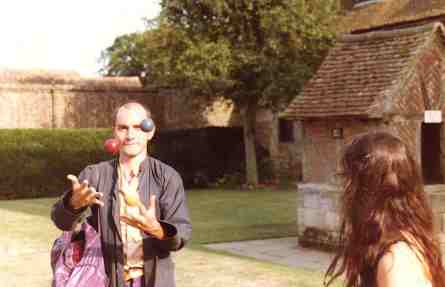
me juggling

Before a concert at Michelham Priory, c1983.

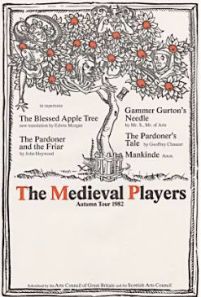
Part of my baptism in early music took place touring around England with the Medieval players in the 1980s.

MP posterWhile I played rebec, I also learned the basics of juggling from Mark Heap and Mark Saban—though I was happy to leave the stilt-walking and fire-eating to them. Hard to imagine now, but later on European tours with baroque orchestras some of us used to fill the longueurs of hanging around at airports with impromptu juggling sessions.

Juggling inevitably becomes a flashy, often comical stage act (with a variety of props like clubs, and not least the old torch, egg, and frying-pan trick), but Mark Heap could transform it into a pure, transcendental activity (later offering some vignettes in Green wing).

Technical virtuosos rise to the challenge of five, seven, and even eleven balls, but that largely excludes fantasy. The variety of patterns with a mere three is a thing of wonder—all the more so with passing between two jugglers.

I note that ancient China features in the long history of juggling worldwide:

During a battle in about 603 BC between the states of Chu and Song, Xiong Yiliao stepped out between the armies and juggled nine balls, which so amazed the Song troops that all five hundred of them turned and fled, allowing the Chu army to win a complete victory.

So much for the military hardware of the modern PLA…

The way that the “given” building blocks are creatively combined into a routine reminds me of the process of musical creation in performance, with its balance of perspiration and inspiration. And it evolves constantly. For some taxonomy, see here; the vocabulary is cute (though, like musicians, many jugglers won’t necessarily be aware of it)—all kinds of cascade, mess, column, shower, shuffle, box, grab, claw, bump, yoyo, and so on, easily found in online videos. I haven’t quite found the fake throwaway that Mark Heap used to do so beautifully.

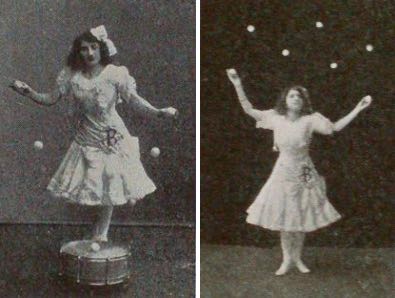
Anita Bartling
Anita Bartling (1887–1966).

To make up for the usual male-dominated perspective, there are fine introductions, with video links, to female jugglers in history here and here.

Left: wedding party, Mantua 1999.
Right: on tour with EBS, Lyon 1982.

Like clapping, juggling is an art that should be cultivated from young. Start, and indeed continue, with bean bags (cf. the Larson Stradivarius cartoon: “Violins galore! Start the kids on one today!”)!

beanbags

More recently I tried to revive my long-dormant juggling skills on the island of Marmara

Mary Lou Williams


MLW

Laudably, in his fine BBC Radio 3 series Composer of the week Donald Macleod often features female composers and performers (Hildegard of BingenÉlisabeth Jacquet de La GuerreLili Boulanger, Meredith Monk, to name but a few; see also The T-shirt), who have been generally neglected. In jazz, female singers have featured more prominently than female composers and instrumentalists; so last week’s programmes (here) on Mary Lou Williams (1910–81) are all the more welcome.

From the Composer of the week website:

A prolific composer and arranger, she was also a gifted pianist. A master of blues, boogie woogie, stride, swing and be-bop, Williams was quick to absorb the prevailing musical currents in her own music, naturally able to exploit her ability to play anything she heard around her. It is this restless musical curiosity that defines her own compositions, and led her to become friends with and mentor many younger musicians, among them Thelonius Monk, Bud Powell, Charlie Parker, and Dizzy Gillespie.

Born around 1910 in Atlanta, Georgia, Williams grew up in Pittsburgh, where she had to overcome racial segregation, gender discrimination and the disadvantages of an impoverished family to realise her musical ambitions. Learning to play entirely by ear, she was performing locally by age six. Barely into her teens she was touring professionally as a pianist, living proof that—contrary to the prevailing views—women really could play jazz as well as men. But her artistic success came at some personal cost, with instances of domestic abuse, two divorces, a gambling addiction, and the ongoing strain of trying to support her extended family, all taking its toll over the years. After taking a spiritual path, she spent some years trying to rehabilitate addicted musicians, and developed an interest in writing sacred jazz pieces, and after a long career of some sixty years she took on the mantle of educating future generations about the cultural roots of jazz.

Over the course of the week Donald Macleod follows Mary Lou Williams as her life and musical pathways intertwine, from the early years playing Kansas City swing, to embracing be-bop, religion and modern jazz.

When she was around three years old, sitting on her mother’s lap as she played the harmonium, suddenly Mary Lou Williams reached up and replicated exactly what she’d just heard her mother do. It was a defining moment. Williams’ future had just been decided, and in her own words, “I never left the piano after that.”

MLW
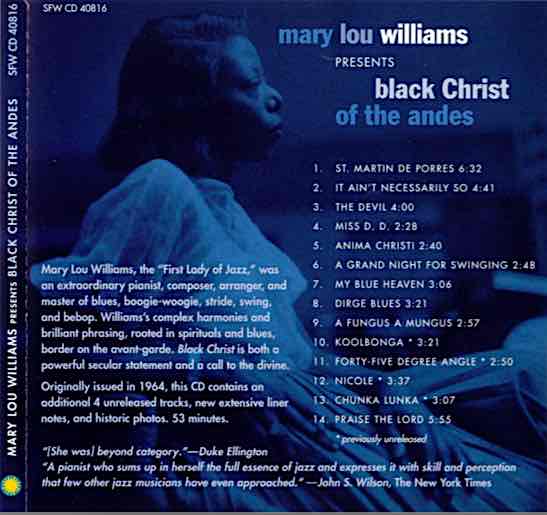
The Composer of the week survey features a variety of fine music, with her style constantly evolving. Programme 4, “Music for the soul”, explores her spiritual epiphany—complementing that of John and Alice Coltrane—with works such as Hymn to St Martin de Porres and Mary Lou’s Mass—note the 1964 Folkways album Black Christ of the Andes. And here’s a Greatest Hits album:

See also the documentary Mary Lou Williams: the lady who swings the band (Carol Bash, 2015)—trailer here:


Criticizing Confucius

Given that this is no time for blind kowtowing before authority—anywhere:

Just as Tang poetry isn’t immune from doggerel, maybe we might unfurl a new, more decorous campaign to debunk the uncritical veneration of Confucius (cf. Alan Bennett).

Noting that “Confucius He Say” 子曰 might be rendered as “So the kid goes…” (“I’m like, whatever”; see also OMG), one could regard the Analects an early pilot for Kids say the cutest things 子曰乖事, or an anthology of pithy bumper-stickers (cf. Gary Larson’s cartoon Confucius at the office—”Looks like we’re in for some rain”).

Here’s one gnomic maxim that does rather appeal to me:

君子不器
The gentleman is not a vessel.

Typically, it’s been subjected to a vast apparatus of scholarly exegesis; I like to take it as a critique of reification, one of the banes of studying music (see musicking), religion (see “doing religion“), and indeed Life… Indeed, maybe the qi 器 there is even verbal: “The gentleman doesn’t reify”? * I would like the quote even more if he had said that women weren’t vessels either—but despite recent defences of Confucian sexism, he didn’t (surprise surprise).

As Confucius said when his disciple Yan Hui ** told him he was taking up stamp collecting,

Philately will get you nowhere

(an old joke that goes back at least to Jennings).

As ever, The life of Brian has salient critiques. Here’s one of the Boring Prophets:

There shall, in that time, be rumors of things going astray, erm, and there shall be a great confusion as to where things really are, and nobody will really know where lieth those little things wi- with the sort of … raffia-work base that has an attachment. At this time, a friend shall lose his friend’s hammer and the young shall not know where lieth the things possessed by their fathers, that their fathers put there only just the night before, about eight o’clock.

And indeed the rebuke to exegesis in the Sermon on the Mount scene that opens the film:

I think it was “Blessed are the cheesemakers”.
Ahh, what’s so special about the cheesemakers?
Well, obviously, this is not meant to be taken literally. It refers to any manufacturers of dairy products.

See also Alan Bennett’s classic sermon on “My brother Esau is an hairy man…”


* Cf. “Gentlemen lift the seat”—as Jonathan Miller observed in Beyond the fringe, “What exactly does this mean? Is it a sociological description—a definition of a gentleman which I can either take or leave? Or perhaps it’s a Loyal Toast? It could be a blunt military order, or an invitation to upper-class larceny.”

** My penchant for Yan Hui derives from the ritual shengguan suite Qi Yan Hui 泣颜回,  a title that alludes to Confucius bewailing his early death (for a gongche score, see here, under West An’gezhuang).

Meredith Monk

MM

Pursuing my New York theme, another great female composer on the splendid T-shirt is Meredith Monk (b.1942).

Donald Macleod’s ever-engaging coverage on BBC Radio 3’s Composers of the week makes a useful introduction; see also this appreciation from Tom Service. Here’s an extensive playlist:

Some tracks I like:

Porch (1970):

Songs of ascension (2008):

Hocket (1990) (cf. here):

Here’s a playlist for her opera Atlas (1991), inspired by the intrepid traveller Alexandra David-Néel:

Monk’s sound world has affinities not only with minimalism (cf. here, and here) but with folk and early music. Apart from music, theatre, and dance, her work in film is also striking. Here’s an excerpt from Book of days (1988):

And to complement my Halloween post, here’s Scared song (1986):

I love the way New York (and indeed London) has room for this kind of thing alongside Blondie, Madonnapunk, and so on—genre-bending, always dissolving boundaries.

Some remarkable female vocalists feature prominently in my Playlist of songs, such as Nina Hagen, Barbara Hannigan and Enza Pagliara. Cf. Bobby McFerrin.

Uyghur culture in crisis

My love’s flames, I have become a beggar, indeed Allah
Before the whole world I stand alone, indeed Allah
I have suffered for an age, Allah, my patience is ended, Allah
I have become a moth drawn to the beauty of your face, indeed Allah
Oh lovers, your desire, Allah, my heart is addicted, Allah
I revel in your pleasure, Allah, I have become a drunkard, Allah
In the city, Allah, I have become a wine shop boy, indeed Allah
Before the whole world, Allah, I have been ruined, indeed Allah

—from Chahargah muqam, fifth mäshräp,
translated by Rachel Harris.

*See also my roundup of posts on Uyghur culture*

I began writing this post with the simple idea of sharing an exquisite free-tempo prelude from the great muqam suites; but, as often, it has grown into more wide-ranging reflections.

In particular, since I noted the perceived crisis of “serious music” in the West, the current plight of Uyghur culture makes an extreme instance of crisis—to which the muqam’s lyrics of religious anguish make a sadly fitting commentary.

The muqam
I’ve been revisiting

  • Rachel Harris, The making of a musical canon in Chinese Central Asia (2008),

a book that seems even more important now that virtually all of the culture she describes, which having been tolerated (and in its official manifestations even supported) by the Chinese state for more than half a century, is now being ruthlessly extinguished. [1]

RH

Over an economical 157 pages, Harris pinpoints a range of major issues.

Throughout the course of the 20th century, as newly formed nations have sought to assert and formalise their national identity, they have typically acquired a range of identifiable national aspects. Thus we find in this new period new musical canons springing up across the world. These canons, however, cannot be dismissed as arbitrary collections of works imposed on the public by the authorities. They acquire deep resonance and meaning, both as national symbols and as musical repertories imbued with aesthetic value.

The Chinese state has invested large sums of money in a succession of projects to preserve and develop [sic!] the Twelve Muqam, and it uses these projects to showcase the positive aspects of its minority policies on the national and international stage.

Describing the wider project on minority cultures, she comments:

Subject to processes of “reform and ordering”, dance styles were transformed into group choreographies, songs were transcribed and fixed, scales and musical instruments standardized, and a nation-wide system of professional performers was put in place, trained in arts academies, and organized into state-sponsored performing troupes.

These versions are disseminated through live performance, TV and radio, publications and recordings. Still, while documenting the official urban troupes, Harris never loses sight of local folk traditions. She also places the Uyghur muqam within the wider context of Central Asian muqam families (notably in Chapter 5).

Perhaps I should now use the past tense in this section:

The muqam are large-scale suites consisting of sung poetry, stories, dance tunes, and instrumental sections. Lyrics by both the major Central Asian poets and folk poetry. Religious mendicants also perform versions of the songs, and drum-and-shawm bands play the instrumental melodies. All this music is traditionally handed down without notation.

The titles of the muqam denote modal attributes, while the names of the pieces within them denote rhythmic patterns. Its tripartite outline subsumes numerous subsections:

  • chong näghmä, a lengthy suite of sung pieces with märghul instrumental interludes
  • dastan: a sequence of folk narrative songs, again with märghul
  • mäshräp: faster dance pieces, sung to folk lyrics.

One fascinating theme of Chapter 2 is how canonisation predates the PRC initiatives, with Uyghur troupes in the Soviet Central Asian states formalising the repertoire as early as the 1920s under the influence of Soviet ideology.

TA

From Wong, “The value of missing tunes”.

In China under the PRC, the 1951 and 1954 recordings of the Kashgar master Turdi Akhun (1881–1956) formed the basis of transcriptions by the Beijing-based scholar Wan Tongshu, published in 1960, and went on to become the core of the whole glossy edifice of the official Twelve Muqam. [2]

So it seems strange that these celebrated recordings (apart from a brief section on the CD with a 2007 book) have remained under a cloak of secrecy. Doubtless Turdi Akhun’s performing style was less polished than that of the state troupes, but archive recordings of Chinese music [sic] from the pre-Cultural Revolution era have been issued.

Wan Tongshu also headed a new state-supported Muqam Research Working Group, which in 1957 organised a three-month fieldtrip to the southern region. Another leading Han Chinese scholar working on the muqam in the 1950s was Jian Qihua, whose transcriptions of the “Ili variant” were belatedly published in 1998. The official song-and-dance troupe in Urumchi began performing sections of these arrangements until the Cultural Revolution disrupted traditional activity. Meanwhile similar initiatives, producing composite versions of the muqam, were under way beyond the borders of China.

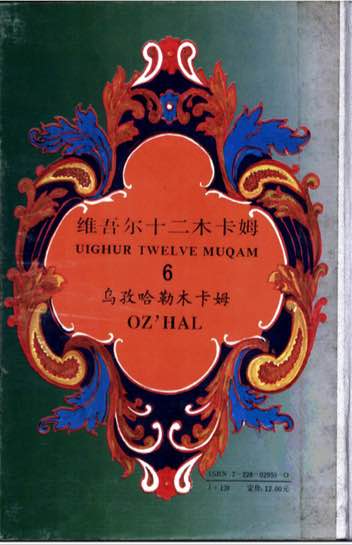
Ozhal coverIn Xinjiang the liberalisations following the collapse of the commune system from 1979 allowed the resumption of both folk activity and official research. Furthering the work that had begun in the 1950s, a Muqam Research Committee was formed in 1979, soon incorporated into the Xinjiang Muqam Ensemble. They went on to produce major series of recordings and transcriptions. Meanwhile the compilation of the Anthology provided a major new stimulus to fieldwork.

The 16th-century princess Amannisa Khan, subject of a popular 1993 film, was now claimed as an early fieldworker and compiler of the muqam, providing a fanciful historical cachet. Chinese state support for the muqam continued despite the increasing tensions that followed 9/11.

AM

Reminding us that the musicians and researchers involved in such projects are real people with real lives, Chapter 3 is a vivid portrait of the eccentric musician Abdulla Mäjnun (b.1946). Indeed, the word mäjnun denotes an ashiq religious mendicant and a fool, a sarang: intoxicated and infatuated. Though he identified strongly with the ashiq, and was an outsider in the official Xinjiang Muqam Ensemble troupe where he was employed, he had learned to consider himself not a muqamchi, a term to describe an accomplished folk performer (cf. the Chinese minjian yiren), but a “muqam expert”, a more prestigious term with connotations of science, modern scholarship, and the urban world. In the professional musical circles of Urumchi, where drinking culture loomed large, he was in a league of his own.

Harris gives lively vignettes of a trip with him back to his native Khotan, observing his prestige and capacity for liquor. She concludes:

On one level Mäjnun’s conversations are revealing because he is so clearly engaged in strategically deploying the range of different metaphors at his disposal. On another level Mäjnun is interesting precisely because he embodies that collision of metaphors which I delineated in my discussion of Uyghur music histories: the disreputable, uncontrolled aspects of music and creativity in Uyghur tradition which sit uncomfortably with the notion of “national traditions” and the canon.

Abdulla Mäjnun is heard, solo, on the CD with the book, notably in some intimate muqaddime preludes. For these he favours the diltar, a combination of dutar and satar that he himself invented, “a cross between a double-necked electric guitar and a cathedral, or perhaps, rather, a mosque.” He also features on the CD Majnun: classical traditions of the Uyghurs.

Harris mentions Sabine Trebinjac’s brief biographies of female beggar musicians such as Shāyrnisa Khan,

living in Kashgar in the 1980s, who had had four husbands. Her husbands had disapproved of her begging, but she suffered from a sickness, and had to sing and play daily, in front of the mosque or at festivals, or on pilgrimage. She was a member of Naqshbandi Sufi group, and also took part in regular zikr rituals.

Such accounts, like my own for Han Chinese folk musicians, contrast with the compulsory image presented in Chinese biographies, in which folk musicians “selflessly present their art”, the vicissitudes of their lives under modern regimes largely ignored.

Contrary to the current tendency to regard the Twelve Muqam as something isolated and essentially different from the song repertoire (“classical” versus “folk”), in practice the two have often been mixed together, and it is common practice to follow the muqaddime with a suite of folk songs.

Chapter 4 gives details of the musical structure of the competing, evolving versions, showing that in the diversity of traditional performance, both the musical and lyrical repository of the so-called Twelve Muqam have long been combined in different ways.

A mounting body of evidence suggests that the Twelve Muqam have existed less as an actual body of music and more as a kind of idealised framework surrounding a much more fluid oral tradition, from which individual musicians would learn and perform different parts, and into which musicians might slot their own local repertoires and compositions.

After an astute historical introduction, Harris shows the links between the mäshräp sections of the muqam with hikmät prayers of Sufi religious mendicants. She notes the Muqam Research Committee’s ongoing quest for another Turdi Akhun among the folk:

They were not above pulling in ashiq they found begging in the bazaar to see if they might possess the holy grail of previously undiscovered parts of the repertoire. Mäjnun told me one morning as I arrived for my lesson:

We found an ashiq on the street this morning, playing sapaya [wood or horn percussion sticks set with metal rings]. We brought him to the Muqam Ensemble to see what he could do, but he was all mixed up, he played a bit of Chābayyat then followed into Ushshaq.

She goes on to give a diachronic analysis of renditions of the muqaddime preludes:

If there is any vestige of an improvised tradition in the Twelve Muqam, then it would be these muqäddimä sections, which are structured like an exploration of the mode.

As she notes,

Traditionally the lead vocalist would accompany himself, but specialisation in professional training has meant that these roles are separated in the troupes.

Sensibly, she gives reductive outline transcriptions, rather than the etic versions of other publications; indeed, I favour this method for traditional Han Chinese melody. Despite the importance of notation for the canonisation project, among Uyghur performers its influence is limited.

In orchestration too, Harris notes the contrast between folk and professional ideals, citing Ted Levin on the Bukharan Shash Maqām—the “limpid filigree” of the traditional small ensemble versus the “bloated heterophony” of the large-scale professional versions.

The muqaddime
In my post Bach, alap, and driving in Birmingham I gave a little introduction to free-tempo preludes around the world; note e.g. the taksim and amanedhes of Asia Minor. The Uyghur muqaddime are most wonderful accompanied by the resonant satar long-necked bowed lute. I am particularly entranced by the intense muqaddime of Özhal muqam—perhaps because of its tonal variety, with new scales, featuring a flat 7th and sharp 4th, introduced gradually. Here’s a 1997 recording:

My afflicted soul heads towards the Valley of Insanity
I hope this already wretched life of mine will break
The gravedigger who ignores the candle of my tomb
Will surely have his house and rags burnt by its sparks
Do not ask where I go—I have no choice
I have surrendered choice to the hands of Destiny
The rose-coloured tears have dried up, leaving but a withered face
The tyranny of Fate has exchanged my spring with autumn
My people, together with my beloved, gave me much trouble
What will become of me if I resolve to leave them behind?
Anyone’s chest will ache for my condition, when they see
My face smeared with blood from the broken pieces of my bosom
Peace is impossible until one abandons the world
Nawai, burn my existence, and deliver me
Way, derdim ah!

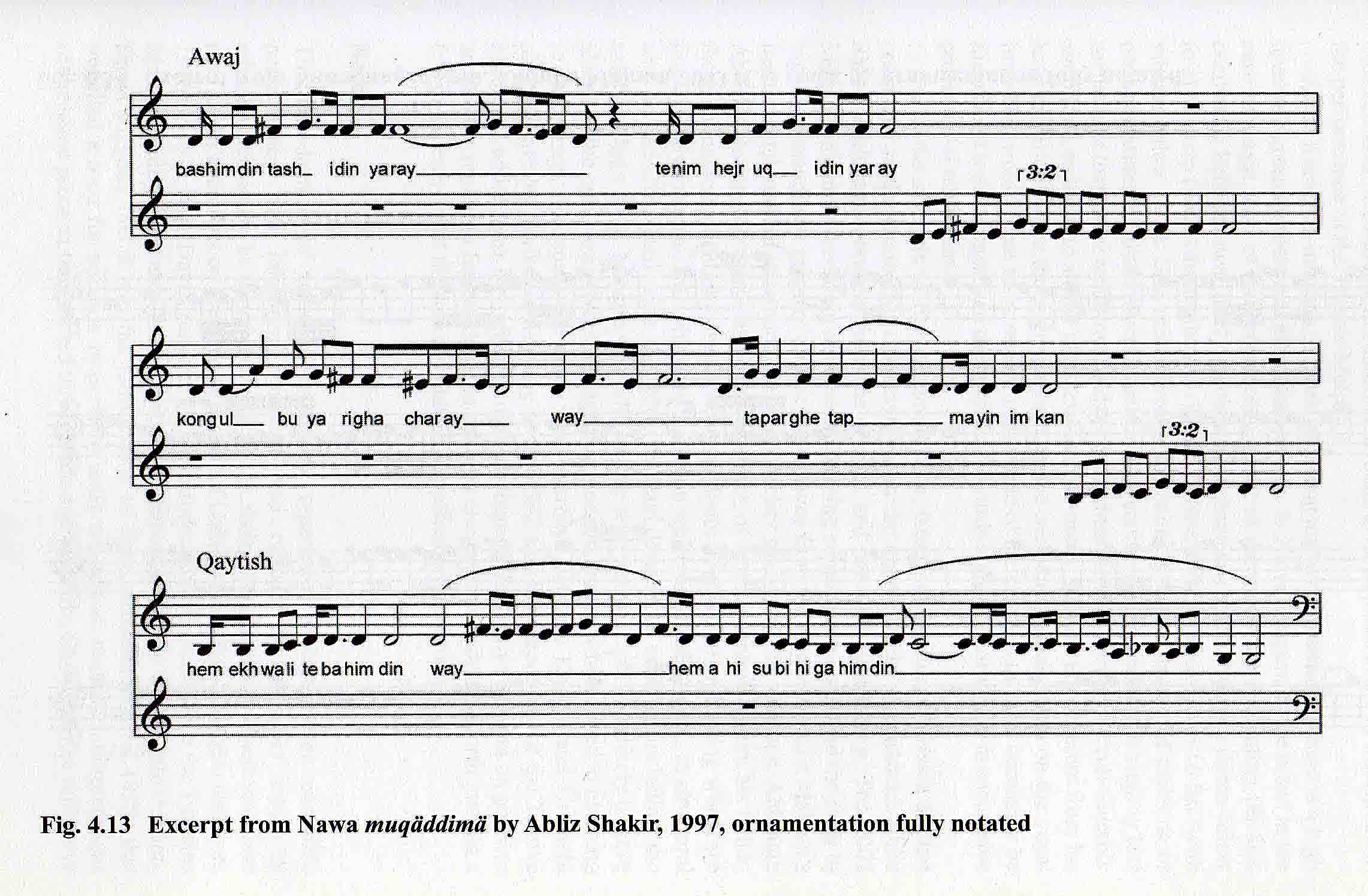
Abdulla Mäjnun was especially devoted to Chahargah muqam, said to be for the ashiq (CD #7, which he played with tears running down his cheeks). But all the muqaddime are exquisite—here’s a transcription of Nawa, from the climax (äwäj): [3]

Nawa

Chapter 6 explores the impact of canonisation, not least the inclusion of the “Xinjiang Uyghur Muqam” in the UNESCO Intangible Cultural Heritage (ICH) since 2005. She discusses the impact at grass-roots level of efforts to “rescue” local traditions:

To what extent had these efforts established hegemony over local practices? Had rural musicians adopted the officially promoted repertoire or were they maintaining local traditions, and how did these traditions relate to the official repertoire? What plans had been drawn up as part of the UNESCO plan, and how were they being put into action?

Among the local traditions, the “raw, macho sounds” of the Dolan muqam were now elevated to become a folk counterpart to the official professional version. But other local folk styles were fragile and perishable; and as in other parts of the world, any official promotion played little part in their evolution. Harris describes the impact of the independent recording industry, finding the cassettes of performers like Abliz Shakir more significant an influence than those of the official troupes:

The failure of the Muqam Ensemble to capture the popular imagination lies in a combination of aesthetic and political considerations. Firstly the state-run ensemble is arguably too closely associated with the Chinese regime for their performances to be popularly adopted as Uyghur nationalist icons. Secondly, amateur musicians were deterred by the complexity of the chong näghmä section, and by the heavy orchestral-choral arrangements. In fact these aesthetic and political considerations are inseparable, as the ensemble aesthetic—one which is modelled on transnational models of canonic, national traditions—is itself representative of the state. Abliz Shakir’s recordings, released through the independent recording industry and sold on stalls in the bazaars, signalling another kind of authenticity in their performance style, and perhaps aided by the performer’s own ambivalent relationship with the authorities, achieved a far greater popularity.

She notes

concerns about the possibility of negative impact following the UNESCO bid, with local muqam traditions becoming increasingly commercialised and exploited in Xinjiang’s exploding tourism market.

She illustrates the complexities of local activity with a vivid description of a village mäshräp festivity. Indeed, the mäshräp always made an implausible candidate for the ICH: having been commodified by the state it has recently been coopted into the sinister form of the “mäshräp to tackle religious extremism“. [4]

In conclusion Harris comments:

If the few surviving local traditions of Twelve Muqam, which are all too lacking the glamour and musical sophistication of the recorded versions recorded by star performers, are to be locally revived and maintained then they must somehow achieve greater relevance to local musicians and audiences.

But as she stresses, the canonised Twelve Muqam are only one aspect of the whole muqam tradition, elements of which may be found in a wide range of Uyghur musicking. Or rather could be found, until 2016.

Among the scholars whom Harris cites is the Han-Chinese Zhou Ji (1943–2008), who by the 1980s was the leading figure in Uyghur music research. A native of Jiangsu province, in the critical times of 1959, aged 16, he set off to Xinjiang in response to the state’s call to “support the frontier regions”. He remained based there for the rest of his life; from 1985 he was employed at the Xinjiang Arts Research Unit in Urumchi, which he went on to lead. Thoroughly immersed in Uyghur culture (not least its drinking culture), Zhou Ji was highly regarded in the Uyghur musical world. [5] Chief editor of the Xinjiang volumes of the Anthology, he took the folk ritual life of the Uyghurs seriously—note his major 1999 book on Islamic ritual music of the Uyghurs—[6] and even studied female ritual specialists and their repertoires. While he was inevitably involved with official promotions such as the ICH, Harris notes that he dared to publicly voice a number of criticisms concerning the canonisation project.

Zhou Ji

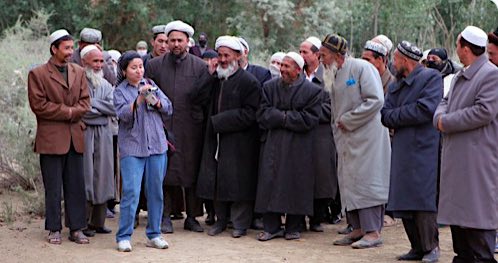
Zhou Ji with Uyghur musicians.

But it was Uyghurs who formed the core of researchers before and since the Cultural Revolution. More recently, scholars such as the anthropologist Rahilä Dawut—also supported within the academic apparatus of the Chinese state—furthered scholarly work.

Dawut

Rahilä Dawut.

The current devastation
Harris’s book was published in 2009, at a time when Uyghur cultural life was still much in evidence despite growing restrictions since 9/11; Uyghur, Chinese, and foreign scholars were still able to do fieldwork. Apart from local traditions such as shrine festivals and pilgrimages, the state (for all its ideological motives) was still actively promoting Uyghur culture.

And then, from 2016, came the repression—in which musicians like Sanubar Tursun and academics like Rahilä Dawut are among innumerable casualties. The ruthless current assault is being diligently documented in the media, such as

As centuries of magnificent lyrics are erased, sporadic official performances set to secular Chinese texts now reduces the muqam to flagrant propaganda, mere political rituals of loyalty to a Han nationalist vision of the Chinese state.

I used to think that such demonstrations of state power were tangential to folk life, but in the current plight of the Uyghurs, with the whole culture—architecture, religious life, clothing, hair styles, food, language—being purged, little else may remain. Note also Rachel’s recent book Soundscapes of Uyghur Islam.

Despite all the difficulties of maintaining Uyghur culture since 1949, and the political tensions that state performers, and Uyghur and Chinese scholars, had to negotiate, the scene before 2016 now seems almost unimaginable. Both urban and rural, folk and academic life, even the state-sanctioned versions of Uyghur culture, have been decimated.

The current campaign to obliterate Uyghur culture is an affront to humanity.


[1] For her numerous other publications, see https://www.soas.ac.uk/staff/staff31068.php, with further material under http://www.uyghurensemble.co.uk. Note also Nathan Light, Intimate heritage: creating Uyghur song in Xinjiang (2008). Among many recordings, note the 2-CD set of local folk groups by Jean During and Sabine Trebinjac, Turkestan chinois/Xinjiang: musiques Ouïgoure (1990).

[2] See also Chuen-Fung Wong, “The value of missing tunes: scholarship on Uyghur minority music in northwest China”, Fontes Artis Musicae 56.3 (2009).

[3] For a complete version of the Özhal suite, click here (for the jarring exoticised visuals, “an imagined idyll of the past”, see Harris, pp.91–2). Since I never got to master its muqaddime with the London-based singer Rahime Mahmut—my attempts to learn the satar being even more inept than my limited abilities on ghijak—I was happy to hear her performing it (with ud!) at the 2019 Muslim news awards for excellence (from 10.38). Abdulla Mäjnun plays the Nawa muqaddime on the CD, #6; for another version, click here; and for the complete suite, here.

[4] See Rachel Harris, ” ‘A weekly meshrep to tackle religious extremism’: Intangible Cultural Heritage in Xinjiang”, in Roberts and Bovingdon (eds), “Develop the West”: Chinese state development and Uyghur cultural resilience, adaptation, and cooptation in Xinjiang (2018).

[5] Tributes, mainly from Chinese musicologists, are assembled in a commemorative volume edited by Tian Qing 田青, Mukamu weini songxing: Zhou Ji jinian wenji 木卡姆为你送行:周吉纪念文集 (2009).

[6] Zhongguo Xinjiang Weiwuerzu Yisilanjiaode liyi yinyue 中国新疆维吾尔族伊斯兰教礼仪音乐—a title that could not be published today; it’s still visible online in the PRC, though no longer for order.

Two guttural vocalists

While Private passions is generally more satisfying (see e.g. the contributions of Philippe Sands, Tanita Tikaram, and Vesna Goldsworthy), episodes from Desert island discs led me to two remarkable vocalists. [Note: author’s source for popular culture appears to derive almost entirely from the demure echelons of the BBC—Ed.]

Gary Kasparov’s selection led me to the Russian actor and singer Vladimir Vysotsky (1938–90):

WOW. As the wiki article comments:

With his songs—in effect, miniature theatrical dramatizations (usually with a protagonist and full of dialogues), Vysotsky instantly achieved such level of credibility that real life former prisoners, war veterans, boxers, footballers refused to believe that the author himself had never served his time in prisons and labor camps, or fought in the War, or been a boxing/football professional.

It’s remarkable that the Soviet system could encompass such alternative performance culture, when nothing remotely so challenging emerged in China until after the demise of Maoism (see also Parajanov). This playlist contains many searing songs from Vysotsky—just as Nina Hagen makes me want to work on my German, his songs make me want to learn Russian.

Meanwhile I’m grateful to the brilliant Elif Shafak for introducing me to the Canadian singer Alissa White-Gluz with the Swedish “melodic death metal” band (another instance of the subtle taxonomy of popular music!) Arch enemy:

More material here for Voices of the world

Smiling in China

jingtang

Relaxing in the scripture hall between rituals, Yanggao. From my film.

A brief introduction to the origins and history of smiling by Antony Manstead leads me to ponder China. As even a glance at wiki tells us, it turns out to be just as complicated as all others kinds of human behaviour. Here are some preliminary, random notes, awaiting a more thorough study.

Manstead concludes:

Turning points in social practices over time, such as the emergence of dentistry in 18th-century France, the rise of the advertising industry in 20th-century America, changes in social norms regarding the appropriateness of emotional displays and changes in immigration have all contributed to observable differences in how and when we smile.

Another report comments:

One common Russian proverb translates as “smiling with no reason is a sign of stupidity”, while a government leaflet on working in Norway warns that you’ve been in the country too long if you assume smiling strangers are drunk, insane, or American.

Smiles have been classified under many headings, such as fearful, miserable, dampened, embarrassed, qualified, compliance, coordination response, listener response, contempt, angry-enjoyment, fake, flirtatious, and the famous Duchenne smile.

Laughter may seem like a more spontaneous reaction, but it too may be classified under a variety of headings (etiquette, nervous, cruel, and so on). Laughing from amusement is not the same as smiling as a habitual social lubricant, a sign of good will.

Bill Bryson notes how humour is basic to social interaction in Britain. In a passage of Notes from a small island from which I’ve already cited, he observes:

Watch any two Britons in conversation and see how long it is before they smile or laugh over some joke or pleasantry. I once shared a railway compartment between Dunkirk and Brussels with two French-speaking businessmen who were obviously old friends or colleagues. They talked genially the whole journey, but not once in over two hours did I see either of them raise a flicker of a smile. You could imagine the same thing with Germans or Swiss or Spaniards or even Italians, but with Britons—never.

This may be a pertinent comment on the British bourgeoisie, but it will only take us a moment to realize that their habits are anything but universal. We need to unpack different contexts and moments in social interaction—degrees of acquaintance, between friends and within the family; initial greetings and sustained conversation, formal situations, propaganda, and so on.

Bryson’s typical British scenario will not only involve friendly smiles upon meeting, but the whole opening exchange too is likely to take a jocular form. However, the voluntary “social” smile—a form of social signalling—is variable across cultures. Age, class, and economics are clearly important factors: even in Britain, teenagers and poor people don’t feel such a need to express friendliness thus. Smiling is by no means a simple indicator of happiness, but in much of the world—poor societies and war zones, for instance—there’s not much to be happy about. Under state socialism, propaganda only blurs the issue; it’d be interesting to explore how the experience transformed personal interaction. For the USSR, the work of Orlando Figes provides material. None of this maps precisely onto the global happiness index…

China
Like Bryson in Britain, among friends in China I often marvel at their humour; but even observing their social life as a fly on the wall rather than in my exchanges with them, I find much less smiling as social lubricant. Still, again, this is no simple matter.

One would seek to consider diverse social groups, both urban and rural—for the latter, peasants, cadres, entrepreneurs, teachers, traders, vagrants, and so on (for some instances from my own fieldwork, see here).

So here I’m more interested in the incidence of smiling within social groups. However, while outsiders in urban contexts may be able to observe social interaction without intruding on the scene, in smaller rural communities they—whether foreign or Chinese—may not make reliable observers. The arrival of a stranger in such a setting may cause anxiety; but even long-term acquaintance doesn’t bestow insider status. I also think of this wonderful story from Liu Xin. Maybe rural insiders like Mobo Gao would have pertinent remarks.

It will be even harder to document historical change. I look forward to an erudite tome on smiling in the late Tang dynasty. Even analyzing smiles through the 1930s, 1950s, and 1990s may prove difficult, with much of the material based on images rather than ethnography. Under Maoism, as in the Soviet bloc, humour was commonly expressed in the form of bitter jokes (e.g. here, with links; many more instances under Chinese jokes).

For rural China I noted the lack of terms like hello, thankyou, please, and sorry (Daoist priests of the Li family, pp.23–4, cf. here). By contrast with the British jocular small-talk about the weather, a common rural Chinese greeting is: “Have you eaten?”—suggesting a historical anxiety about famine.

Meanwhile the sullen, automatic, negative response “Meiyou” from shop assistants, still standard in the 1980s, began to give way to more friendly exchanges by the 1990s.

As has been well documented, smiling for portraits developed only quite recently even in the West. In China, putting on your best face for the camera has rarely been perceived as requiring a happy smile; posed photos there still typically show serious, unsmiling subjects. This used to bemuse me. While I try to take informal photos, we have also taken many posed group pictures of ritual specialists (see posts under Local ritual), which rarely show anyone smiling.

Qiao family 1962

The Qiao family, Yulin city 1962, in a lull between major social traumas. Showing a range of expressions, it hardly contributes to the discussion—I just love the image.

Photos from the Maoist era (and indeed since), showing workers and peasants smiling or engaged in their work, with no hint of conflict or coercion, are clearly flawed evidence (see e.g. this chapter by Covell Myskens). Most flagrant are images of ethnic minorities singing and dancing—not least the shameful recent CCP propaganda of Uyghurs singing “If you’re happy and you know it”, worthy of Terezin.

Happy Uyghurs

More recently photographers sometimes encourage a smile with the Chinese version of “Cheese!”: “Qiezi!” (aubergine).

Since we’re discussing social interaction here, film footage should be a major database, though again the degree of intrusion of the outsider on the scene will be an element. Apart from documentary, verité feature films are worth considering, such as The blue kite, The story of Qiuju or the work of Jia Zhangke.

Besides class, we should consider gender. Rural women tend not to interact in public, still less with men. Outside the family, smiling may be perceived as indecorous, and their behaviour is highly reserved. Again, one seeks to document their daily interactions among each other. At the same time, social media and the selfie have produced new poses.

As I said, these are just a few preliminary thoughts. Anyway, we obviously have to guard against taking traits that are familiar within the narrow confines of our own society as some kind of benchmark. As I write, the All Black haka shows a distinctive form of social greeting…

Northern soul 北靈

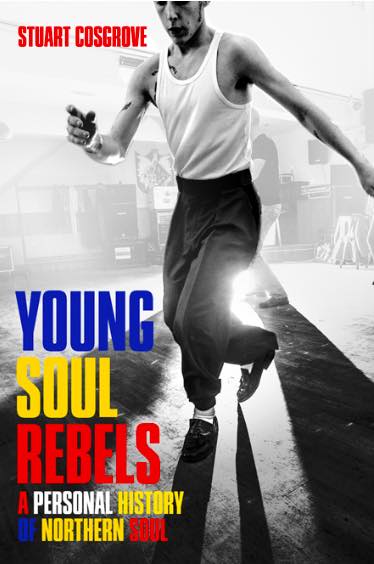
YSR

Inspired by Stuart Cosgrove‘s Detroit 67 and Memphis 68, I’ve been reading his book

  • Young soul rebels: a personal history of northern soul (2016).

In all kinds of wonderful ways, this book does my head in. [1]

Quite rightly, devotees of northern soul will be underwhelmed if I describe it as a diachronic ethnography based on participant observation—which is just what it is, like some of the great works of ethnomusicology…

Cosgrove captures the buzz of his addiction:

Saturday passed slowly as I browsed around local market stalls. The night slowly fell and we walked through the backstreets of Stoke along cobbled terraces. The army of leather feet resonated like a drum solo, building percussion in our speeding heads and raising the adrenaline of anticipation. A swell of people hung by the door of what looked like a wartime cinema, and a blackout curtain seemed to have closed across the north of England. It was virtually impossible to make out faces or detail; everything was sound. A pounding noise escaped through the doorway and the wild screeching sound of saxophones pushed through the fire escapes, desperate for air. We paid at the ticket booth, but even in the foyer, an intense heat much like an industrial oven scorched through the thick aggressive air, and the noise was so pure, so fearless and so commanding, it dragged you inwards into a scrum of lurching bodies: hot, wet, and demonic. This was in every respect the Devil’s music, and I had travelled hundreds of miles from home to sip with the deranged serpents that slithered so gracefully on the floor. There was no going back. No music later in life would ever touch its uniqueness, no rock concert could match its energy, and no rave could come close to its latent illegality. This was northern soul: the reason they invented youth.

Themes
Of all the diverse tribes of popular music, this scene is just as alien to me (and, I surmise, to Alan Bennett) as the spirit mediums of Guangxi are to a scholar trained at a Beijing conservatoire (for China, I broach the issue of insider/outsider status here, here, and here).

Ethnomusicologists like Nettl and Small highlight music as a social activity, and McClary valorizes the physical, bodily response to music as a caveat to the cerebral, disembodied, “autonomous” bias of WAM.

Basic to the northern soul experience were the all-nighters hosted by clubs throughout the north. They may evoke the “red-hot sociality” of festivals worldwide; but such club scenes also broaden our picture, in that live music is subsidiary. At the heart of northern soul was live dancing, athletic and technical—amazing dancers like car mechanic Frankie “Booper” New, at the Torch:

It was as if NASA had invented a device that could drill into the surface of the moon, and the device was a sixteen-stone guy from Widnes.

Some visiting live bands made memorable appearances, but recorded music was more common. After all, a multitude of bands, often inspired by old blues records, were being formed (not least in the north), creating all kinds of new music; but here the point was not to try and form your own soul band—the fetish for rare Motown discs was sacred. Nor did club-goers care to keep pace with the ever-changing tastes of black Americans, for whom both blues and soul were mere staging posts in a constantly evolving scene.

Thus DJing assumed a crucial role (akin to that of the conductor?), with fanatical, driven DJs like Ian Levine and Ian Dewhirst. Another basic element was the amphetamine scene. While not hesitating to depict its squalor (the Wigan toilets “resembling a war zone”), Cosgrove naturally refrains from moralistic prurience. Andy Wilson, a northern soul pioneer from Harrogate who spent much of his formative years at Wigan Casino, going on to become senior lecturer in Criminology at Trent University, “is now an expert in drug subcultures. He always was”. A model of participant observation, then.

Obscurity and obsession
Alongside the sweaty hedonism of northern soul, just as important was the craving for obscurity—not just any obscurity, like seeking out early blues, but “rare soul”—rougher, less polished than the mainstream Motown sound. Even the origin of the term “northern soul” itself, commonly attributed to Dave Godin, is somewhat arcane (pp.25–6).

Cosgrove lovingly details the nerdiness of the scene: “compiling lists and recording obscure detail is part of the everyday autism of northern soul”. OCD was rife. He even provides a suitably nerdy Glossary.

One of the cardinal rules of the northern soul scene is a respect for obscurity and those who die young. […] Northern soul cherishes its role as savior of the neglected—rescuing some acts from being almost wholly forgotten while plucking others from semi-obscurity and giving them the status of gods.

Ill-fated singers like Linda Jones and Darrell Banks were idolized. Cosgrove also pays tribute to some of the casualties within northern soul itself.

He notes, and shares, the jihad mentality, “the Hezbollah rituals that defined the scene”:

Eclectic tastes were rarely tolerated on the northern soul scene, which by the mid seventies was hardening into a zealous sect with its own strict rules. […]

One night, a DJ was brought in front of the crowd charged with playing a Bowie record; he was given a stern warning and a second chance, but there was a noisy faction on the committee who wanted him hounded through the streets in sackcloth and then burned at the stake outside H Samuel. I was among that zealous throng and I have not mellowed since.

Northern soul devotees shared a virulent aversion to the mainstream as embodied in Top of the pops; they were creating their own charts. Meanwhile in a parallel universe, Morris dancing was enjoying a revival, and my own nerdy tastes were for Boulez and Zen scriptures. The northern soul collectors remind me rather of scholars poring over the cataloguing systems of the Daoist Canon, or WAM bores who can’t help citing Köchel numbers.

At a certain remove from the quest of Oxbridge academics for neglected Renaissance church music, northern soul addicts were on a different kind of “early music” craze. Trapped in a mythical past, they were also on a constant quest for new material from that past.

Cosgrove notes the importance of rail and road networks (“You can go everywhere from Wigan train station”, as DJ Richard Searling commented), the impact of immigration, and the scene’s distinctive fashion sense. Chapter 7, elegantly titled “Soul not dole” after a Doncaster club, explores the effects of the miners’ strike, with the story of pit closures running in tandem with the high points of northern soul. There’s a cameo for Grimethorpe, whose brass band was to be immortalized in the film Brassed off. And the heyday of northern soul coincided with the Yorkshire Ripper’s reign of terror.

Unlike punk, which was more openly anti-authoritarian, the northern soul scene has often been written about as if it “floated free” from the politics of the day, but the reverse is true. The northern soul scene was rooted in the industrial towns and cities of Britain, which across the arch of time faced unprecedented waves of deindustrialization.

The book has more on the relation with punk:

Britain’s two greatest subcultures had much in common. Both were underground and frequently misunderstood. Northern soul had grown up organically across a period of ten years since the height of the first-generation Mods and was a subculture that was more authentically the product of young people themselves, often hiding from authority, dodging the drug squad and attending self-managed clubs that were only sparsely advertised. Punk was largely contrived and skillfully managed in part by [Malcolm] McLaren, driven by his genuine love of New York garage bands and an opportunistic interest in anarchism and the Situationist movement.

He cites Paul Mason: “we were using the black industrial music of the late sixties to say something about our white industrial lives in the seventies”. I think also of the intriguing Finnish affinity for tango.

Though—like Daoist recluses—the northern soul crowd prided themselves on shunning outside attention, the scene was soon discovered by media moguls like Tony Palmer, whose 1977 film This England: Wigan Casino divided opinion:

Echoing Alan Bennett’s lament, Palmer

added smouldering furnaces, decaying coalfields and derelict canals—overwrought historical imagery that the citizens of Wigan had long since tired of.

But amidst ongoing debate over “purists not tourists”, the Casino soon became a casualty of economic recession.

Cosgrove’s passion for the music is always evident too:

If the beginning of the night was hectic, the end was emotionally more subdued: it was regretful, solemn, almost elegiac. By 1973, it had become established practice that all-nighters would finish with “3 before 8”: these were three soul songs to mark the end of the night, played as the clock reached 8am and the morning light sliced through the skylight windows in the decaying roofs of the Casino.

Discussing them in sequence, he gives pride of place to the second-to-last song in the set, Tobi Legend’s “Time will pass you by”:

Venues
The chapters describe the heydays of the legendary clubs in turn. In the early days they came up against another kind of fundamentalist, James Anderton (“God’s copper”), with his moral crusade to clean up Manchester. The Twisted Wheel there became “the template by which all subsequent northern soul clubs were judged: the intense atmosphere, the rare soul music and the extravagant dancers”. It was succeeded by the Golden Torch Ballroom, a converted cinema in the suitably obscure venue of Tunstall, near Stoke-on-Trent:

The interior of the Torch also told a story of change, not least the collapse of traditional religion and the rise of youth culture. It was a small hall with marble pillars and a balcony overlooking the wooden dance floor. It had started out as a church, before becoming a roller-skating rink and, in the immediate post-war period, morphing into the Little Regent Cinema. Local soul fan and businessman Chris Burton changed its use again and it became a Mod club, and then eventually an all-nighter whose influence stretched across the Potteries, to Lancashire in the north and the Midlands to the south.

Many clubs

aped the patterns of older working-class institutions—electing committees and treasurers, and holding nights in fading workers’ clubs, miners’ welfares and industrial social clubs.

Next the baton was taken by Wigan Casino and Blackpool Mecca, with their musical policies competing. Describing the rise and fall of seaside venues, their decline complementing the rise of foreign package holidays, Cosgrove gives an evocative portrayal of Blackpool, “a wonderland of donkey rides, kiss-me-quick hats and venereal disease”.

He sings the praises of the all-nighters at the Top of the World in Stafford, a late flourishing of the scene from 1982 to 1986, and serving as a bridge between the warring factions. By now he had moved on to a media career, joining the drift to London—a city pithily described by a friend as “just like Barnsley but with more wankers”. He continued to collect rare soul:

After a few days in Washington DC I had perfected a modus operandi that has served me well over many years in America. Written down on paper, it sounds like the machinations of a serial killer, but here goes…

In Birmingham, Alabama he has an epiphany as he discovers a rare copy of the DC Blossoms’ “Hey Boy” (Shrine, 1966) in an inauspicious-looking store minded by an inscrutable assistant:

For northern soul collectors there is nothing more visceral than a “find”. A sudden surge more emotional than meeting an old friend, more powerful than an away goal, and more satisfying than sex itself. I stared in wonder at the light blue label and the iconic burning Shrine logo. I checked for vinyl cracks and deep scratches, but whatever its wandering history, the disc was virtually pristine and had survived its orphan years with no damage. The paint that had splashed over it like semen on a truck driver’s T-shirt had stained the sleeve, but the record itself was flawless. It was a moment of sheer unadulterated joy. I had an uncontrollable urge to snatch the Kool cigarette from the woman’s hands, kiss her peachy lips, rip off her velour pants and make urgent love to her over the cash register. But sense prevailed. I calmly gave her another dollar bill and waited obediently for my fifty cents change. As she handed me the loose coins, her lips curled into a chubby smile, and she gave me the most generous grin I’d seen in three days in Alabama. It had the look of post-coital ecstasy—the look of true love.

Of course, as he notes, northern soul collectors were far from alone. Such initiatives had

a hundred-year history of collectors and black-music pioneers scouring the backwoods of America, visiting brutal prisons, outdoor chain gangs and hidden rural villages, searching for blues performers and for early recordings. […] Northern soul was not the unique leader I had imagined; it was part of a long legacy of trying to collect and catalogue the very best of the African-American heritage from jazz, to blues, and on to soul.

In 2009, just as Frank Wilson’s “Do I love you” came up for auction,

the National Gallery of Scotland had secured the £50 million it needed to prevent Titian’s 16th-century masterpiece Diana and Actaeon being sold at auction. Fearing that Kenny Burrell’s copy of Frank Wilson would also leave Scotland, I wrote a tongue-in-cheek feature for the Sunday Times arguing that northern soul was as worthy of public investment as high art: “Comparing a soul record to a masterpiece by Titian will seem ludicrous to the uninitiated. But leave aside the mores, prejudices and snob value that separate high art and popular culture, and the strange world of northern soul bears very deep similarities with art. Both are driven by collectors who are fixated by rarity, authenticity and the provenance of their collections. So far, both have also resisted the pressure of recession and the value of collections has either increased or held strong. Words like rare, original and limited edition exist in both communities. Respected dealers existed in both worlds and auctions are a familiar mode of transaction. Art and soul share a culture where fakes, bootlegs and shady attempts to replicate the look of original works are not uncommon.”

Cosgrove mentions the multitude of new underground subcultures, like warehouse parties, the Carolina beach scene, the Chicano low-rider scene, and the rare groove scene in London—where the 100 Club also played a major role.

By the millennium, there was a new and lasting schism within northern soul, the latest division in a series of civil wars: those who wanted to look back to the grand days of the past and saw northern as a revivalist and reunion scene; and those clubs that kept the torch burning and insisted on new discoveries and an upfront music policy. Each new era brought with it ever more demanding clubs. […] Many thousands of people who had drifted away from northern soul returned to swell the ranks of new faces who had discovered the music via the scooter scene and still more who had lasted the journey and never left.

The final chapter, opening with the excellent quote

Technology is anything that wasn’t around when you were born,

describes how social and digital technology has given the scene a new lease of life—YouTube, Facebook groups (where he notes in particular “I used to Go to Stafford All-Nighters”, a veritable popular history project), Mixcloud, and so on.

For all his fundamentalism, Cosgrove admires the new generation:

Younger and brasher than the survivors on the scene, are passionately engaged in the scene and its origins, but have a healthy disregard for its arcane rules: the chin stroking, the soul police regulations and the grumpy insistence that yesterday was always better. […]

The worldwide web has been kind to northern soul. What was once a scene restricted to cardboard boxes and wooden crates in a few obscure clubs is now a global phenomenon, and the footprint that was restricted to a few hundred miles of the industrial north of England now has worldwide reach.

Popular all-nighters now sprung up in Germany, Spain, and Japan (cf. the punk scene in Beijing).

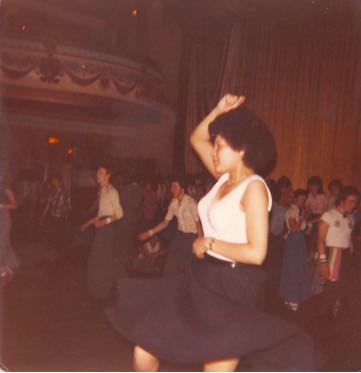
Fran

Fran Franklin.

As to gender, while many female singers from the Motown heyday were worshipped by aficionados (as long as they weren’t too well-known), there were few female DJs, and we find little portrayal of the lives of female dancers—like the young Pat Wall from Rochdale, an early denizen of the Twisted Wheel:

While swimming, she would imagine the body turn at the end of a length as part of a dance routine and would simulate the northern soul “swallow dive”. She often practised in the kitchen of her mum’s council house, mastering the smooth sliding style across uneven linoleum, and within a matter of weeks she would compete with any of the Twisted Wheel’s young men. Her dance trucks were mesmerising and her unassuming smile, whispering the lyrics as if she were praying, as if there were no greater music in the world, made her stand out in a crowd of older and brasher men.”

Another regular on the scene was none other than Jane Torvill, who described her 1984 Boléro at the 1984 Winter Olympics as “the dance of my life”—but as Cosgrove gleefully observes, “that had already happened nearly ten years earlier on the floor of Blackpool Mecca’s Highland Room.”

As the obscure civil war raged, a more benign figure on the scene was Mary Chapman, who hosted events at Cleethorpes Pier—also including a 1976 appearance of the Sex Pistols as the moral panic over punk exploded. And the much-loved Fran Franklin (1961–2014) gives perceptive insights in documentary footage. More recently, female DJs have become important on the scene.

On film
As usual, however evocatively one writes about music (or ritual), it’s still a compromise: silent immobile text can never approach the sensation of the lived experience (cf. China). Among myriad finds on YouTube, following Tony Palmer’s 1977 This England, try

  • Paul Mason’s tribute Northern soul: keeping the faith (BBC, 2013):

  • Northern Soul: living for the weekend (BBC, 2014; some breaks in sound):

Note also Ian Levine’s YouTube channel. Cf. The Commitments.

* * *

I’m rather envious that they coined the term northern soul 北靈 before I could use it for the ritual groups of Hebei and Shanxi, but ethnographies like this can inspire us (obscurely, as ever) in documenting pilgrimage networks and temple fairs in China. Echoing northern soul aficionados’ aversion to the mainstream, I essayed an arcane Strictly spinoff here.

And as I write, I also delight in the wondrous Bach orchestral suites in a live broadcast from the Proms, alternating with new compositions inspired by them. Though from an utterly different social milieu, devotees of Bach—whether amateur concert-goers or nerdy professors poring over manuscripts and watermarks—have more in common with the early music movement of the northern soul scene than one might think. Up to a point…


[1] Apart from numerous websites, other books on northern soul include

  • David Nowell, The story of northern soul: a definitive history of the dance scene that refuses to die (1999)
  • Elaine Constantine and Gareth Sweeney, Northern soul: an illustrated history (2013, complementing the former’s feature film).

Fleabag

Fleabag

Fleabag is brilliant altogether (tutti, bemused: “Fleabag is brilliant”), but this celebrated scene from series 2, with Kristin Scott Thomas and Phoebe Waller-Bridge, is just perfect—script, acting, and genuine, mesmerizing rapport:

For me it ranks alongside the diner scene and final monologue in Five easy pieces, and the restaurant scene near the beginning of Un homme et une femme.

See also Killing Eve: notes and queriesExotic travels, and Talking heads.

Morocco: Paul Bowles

1950 with Jane

Paul Bowles with his wife Jane Auer, 1950. Photo: Cecil Beaton.

My post on the film Performance, in which I mentioned Paul Bowles (1910–99: wiki here, website here), reminded me to explore his work on the musics of Morocco.

Bowles’s involvement with Moroccan music features rather intermittently in his story. Instead, accounts of both his early years and his later life after settling in Tangier from 1947 read like a Who’s Who of the Great Names of American and European culture.

As in many cases, biography (I read Christopher Sawyer-Lauçanno, An invisible spectator, 1989) provides a more dispassionate survey than Bowles’ own autobiography Without stopping (1972). Written under a publisher’s deadline while his wife Jane’s health was in terminal decline, “because he was so filled with pain and torment he had to shut off his emotions lest it consume the book. The result is that it’s a very impersonal memoir.” (An invisible spectator, p.406).

His relationship with his parents was fraught. As to his father,

I vowed to devote my life to his destruction, even though it meant my own—an infantile conceit, but one which continued to preoccupy me for many years.

This was perhaps a major element in his later escape to Morocco. First he travelled widely around Europe and Latin America. Trained as a pianist, he became a promising composer under the aegis of Aaron Copland and Roger Sessions. A plan to study in Paris with Nadia Boulanger never came to fruition. Later he took part in Virgil Thomson’s splendidly-titled group The Friends and Enemies of Modern Music, Inc.

On early and later trips between the USA, Europe, and Morocco, Bowles regularly met (and collaborated with) a stellar array of artists—including Gertrude Stein, Jean Cocteau, Christopher Isherwood, W.H. Auden, Krishnamurti, Manuel de Falla, Colin McPhee, Leonard Bernstein, Tennessee Williams, Peggy Guggenheim, Marcel Duchamp, Gore Vidal, Talullah Bankhead, John Cage, Jean-Paul Sartre, Anaïs Nin, John Huston, Truman Capote, Cecil Beaton, and Francis Bacon. To name but a few… He married the author Jane Auer in 1938; the sources are rather discreet, but for them and most of their wider circle, heterosexual proclivities were clearly not notable (see e.g. here).

Bowles had embarked on his first voyage to Morocco, with Copland, in 1931:

The trip to Morocco would be a rest, a lark, a one-summer stand. The idea suited my overall desire, that of getting as far away as possible from New York. Beiing wholly ignorant of what I should find there, I did not care. I had been told that there would be a house somewhere, a piano somehow, and sun every day. That seemed to me enough.

Indeed, on his travels he would constantly endure the travails of finding a workable piano—a suitable and unique punishment for the WAM composer. He also wrote reviews for the New York Herald Tribune, and began to review jazz.

This opened the door to folk music as well, inasmuch as it was my contention that every category of recorded music (except strictly commercial popular) ought to be covered.

Incidentally, Béla Bartók had collected folk music in north Africa as early as 1913. Bowles’s later contribution to Bartók’s Concerto for orchestra (1943) may not be so well known:

On an early trip to Casablanca [Bowles] bought a phonograph and “what the French call Chleuh records. (So-called Chleuh music is a popular genre evolved from the folk music of the Souss and sung in Tachelhait.)

The composer Henry Cowell had been using some of these discs in his teaching. Bowles recalls:

He asked me to make a set of records for Béla Bartók, who was living in Pittsburgh. Later he told me Bartók was incorporating the Chleuh material in a piece. Sure enough, when I heard the Concerto for orchestra, there was the music, considerably transformed, but still recognizable to me, who was familiar with each note of every piece I had copied for him.

I’m glad Paul Schuyler finds the connections elusive too (Music of Morocco, booklet).

From a period when W.H. Auden was presiding over an illustrious ménage in New York, Bowles has a nice story about Salvador Dalí and Harpo Marx:

Harpo

At that time Dalí did occasional illustrations for Harper’s bazaar; once they had been reproduced, George [Davis] would bring them home and have them framed. One of these pictures was a fine pencil sketch of Harpo Marx playing a harp strung with barbed wire, while in the desert background some giraffes burned spectacularly. George had left the picture on the windowsill and gone out, and a rainstorm had come up. When he returned to the house, he found his Dalí drenched and stained, just where he had left it, and the window still wide open. He rushed to Susie, the maid, and began to recriminate with her, pointing at the picture and repeating: “How could you, Susie? It’s ruined! Ruined!” Susie was used to this sort of thing, but she sympathised and shook her head. “Yes, Mr Davis, you right,” she said. “It sure is too bad, and it was such a beautiful picture of your mother, too.”

Bowles gave himself over only gradually to fiction and the Moroccan life. Moving to Tangier in 1947, he made his name with the 1949 novel The sheltering sky, later adapted in a 1990 film by Bernardo Bertolucci.

He acquired a taste for kif and majoun, receiving regular visits from Brion Gysin, William Burroughs, Allen Ginsberg, as well as Timothy Leary. During a long trip with Gysin in 1950 they first encountered the musicians of Jajouka at a moussem in Sidi Kacem; Bowles described his ongoing relationship with them in Days: a Tangier journal. Later he would feel nostalgic for these early years; Morocco became independent in 1956, but Jane fell ill in 1957, suffering a long and painful decline until her death in 1973.

Another vignette: on a visit to India (p.312),

I liked the hotel in Aurangabad, and so we settled there for a while. The English manageress was a Christian Scientist and gave me some copies of the Monitor. She also mentioned that a countryman of mine, a Mr Monahan, was due to arrive at the hotel within the next few days. Perhaps I knew him? I said I did not. “He’s very famous,” she insisted. “A famous violinist.” I told her that I had never heard of him, adding that since I had been out of America for several years, he might have become famous since my departure. “No, no. He’s been ever so famous* for years.”
[Correct me if I’m wrong, but I don’t believe Americans often use “ever so”, so this looks like an acute observation of his English host’s language.]

A few days later Mr Monahan did arrive and with Mrs Monahan took the suite next to mine. It was not long before he began to practice. Ahmed straightway pulled out his Moroccan lirah, or cane flute such as shepherds carry, and footled with it [sic]. The practicing stopped; there was muffled murmurs of surprise and incomprehension in the neighbouring room. Each time the violin started up, Ahmed shrilled on the lirah. Presently Mr Monahan retired into a further room and shut the door, to continue his work unmolested. I hoped to avoid having to come face to face with him on the veranda. During siesta time that afternoon somewhere in the hotel a woman began to call: “Yehudi! Yehudi!” At this point I realised who Mr Monahan was. “Do you hear what that woman is calling her husband?” demanded Ahmed. “He ought to knock her down.” In Morocco when a mule or a donkey refuses to move, he gets the word “yehudi” shouted at him. I thought of this, and in order not to call forth some awful scene, I did not explain to Ahmed that Yehudi was actually the man’s name. Later in New York when I saw Menuhin again, I asked him if he remembered the flute in the hotel at Aurangabad, and he did.

This makes a pair with my Irish story about Heifetz.

The 1959 recording project
While Bowles’s own memoirs (pp.344–6) are rather laconic on the subject of his 1959 project, An invisible spectator (pp.349–51) provides some detail. [1] In fact he had already applied for a grant without success some twenty-five years earlier (!). But now,

Before leaving New York, Bowles learned that the Rockefeller Foundation had at last awarded him a grant. He went to the Foundation’s headquarters and was given a crash course in how to operate the professional-quality Ampex tape recorder that they were also providing him. By late May he was back in Tangier, eager to begin his recording. As Jane was holding steady, he decided to set out in July, thinking that it would only take him a short while to arrange permission with the authorities to do his recording. He soon became entangled in Moroccan governmental procedures, however, and finally decided to dispense with trying to obtain formal permission. Instead, he went to the American consulate, which drew up a document stating that the US government was behind the project. The affixed several seals, stamps, and signatures and attached Bowles’s photograph; Bowles decided that it looked sufficiently formal to enable him to begin the project.

In the interim, he had gathered two traveling companions: Christopher Wanklyn, who spoke good Maghrebi and owned a Volkswagen; and a Moroccan, Mohammed Larbi, who’d recently escorted a British expedition on a trans-Saharan journey. Together, over the next five months, on four separate trips, they would travel some 25,000 miles through some of Morocco’s most remote and rugged locales. Of the second trip, made from August 29 to September 22, 1959, Bowles kept a detailed account; he later published a selection of the travel notes as an article, “Ketama Taza”, reprinted in expanded form as “The Rif, to music”, in his book of travel essays, Their heads are green and their hands are blue.

The journey was not without difficulties. First, there was the physical hardship of abysmal hotels, tortuous roads, heat, and ultimately, for Bowles, illness. Second, there was the problem of making recordings. Although Bowles had originally expected governmental hostility, the local authorities were for the most part quite cordial and helpful. This, however, could not compensate for the fact that the Ampex ran only on 110-volt AC current and was not equipped with a battery pack [!!!]. As a result, recording could only be done where there was electricity, and of the correct voltage. Despite all the difficulties, however, Bowles managed to collect a huge variety of music, representative of nearly all of Morocco.

More photos here.

There would, in fact, have been even more music recorded, but in October 1959 the Moroccan government suddenly decided that since his project was “ill-timed” (whatever that meant), he would not be allowed to undertake it. Bowles recalled that “the American Embassy advised me to continue my work”. He proceeded, but by December the government had become aware of what he was doing. “They informed me summarily that no recordings could be made in Morocco save by special permission from the Ministry of Interior…. I had practically completed the project… however, from then on it was no longer possible to make any recordings which involved the cooperation of the government; this deprived the collection of certain tribal musics of southeastern Morocco.” Even with the lack of this latter music, Bowles had recorded more than 250 separate selections by the end of December.

Curiously enough, Bowles’s efforts have never been terribly appreciated in Morocco. According to him, the prevalent “official” Moroccan attitude these days is that traditional folk music is “degenerate”. Indeed, in the 1960s the government engaged in an all-out effort to encourage the composition of “patriotic” music, which would contain a political message—specifically, singing the praises of Morocco and Moroccan progress. The gradual “development” of many of the remote regions of the country and an increased migration from the country to the cities had a profound impact on traditional musical forms. Many of the forms that Bowles recorded are now near impossible to hear in Morocco; and those that are heard are often diluted or mixed with other forms.

As Schuyler comments, “change and hybridity, the very forces that keep music vital, were, in his view, signs of decay.” But Bowles’s fear for the future of such traditions was premature.

In the United States, despite the sponsorship of the Rockefeller Foundation and the Library of Congress, the tapes went promptly into an archive, where for more than a decade they gathered dust. Finally, in 1972, the Library of Congress did issue a superb, two-volume record set, containing a fine sampling of Bowles’s collection. Nonetheless, countless hours of recordings have never been released to the public and most likely never will be.

Still, Bowles and Wanklyn managed to make some additional recordings from 1960 to 1962, and in 1965 Smithsonian Folkways issued a disc under Wanklyn’s name alone (notes here).

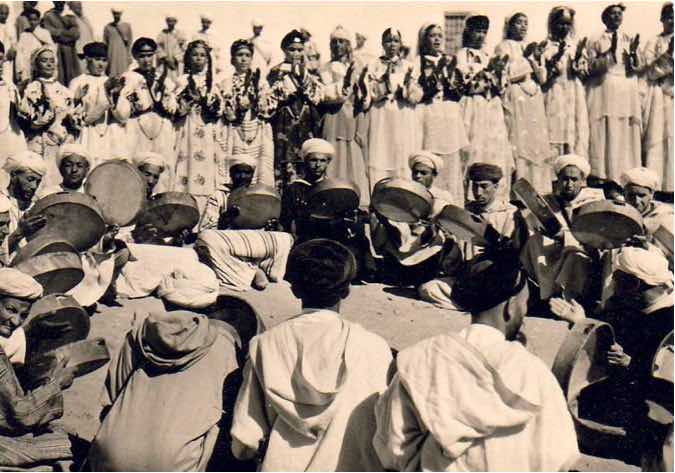
Bowles’s notes, reproduced with the 1972 discs (here and here), are impressive, providing cultural and musical background to the tracks. Here’s a revealing vignette:

The Ait Ouaraine live in the mountains southeast of Fez and until recently were in great demand among the residents of that city as entertainers at weddings and other household festivals. Here only women performed, one of them using a bendir as accompaniment. Before setting up the recording session I had been told by the governmental katib that I would be hiring three people to perform. When three men and four women arrived, I began to look forward to difficulties at the moment of payment. The leader of the group, however, was scrupulous about honoring his agreement. “Three people,” he said when I came to pay him, and I remembered that women are not people; these four ha[d] been brought along as decorative assistants and did not expect to be paid.

And in 2016, long after the two Bowles LPs were issued in 1972, the Library of Congress published a handsome four-CD set Music of Morocco, with illuminating additional notes by Philip Schuyler, from both Bowles’ diaries and his own experience. Here’s an online playlist:

I wonder how they decided where to go, and whom to seek. Of course, there were (and are) musicians everywhere, but identifying worthwhile genres and performers requires considerable local knowledge. The government resistance, and stress on patriotism and development, reminds me of China—although some fine fieldwork projects were under way there at the time.

map

From Music of Morocco (2016).

Schuyler provides further material on the trips, such as:

The very first recording session, on August 1 in the seaside village of Ain Diab, seemed to bear out Bowles’s expectations. In Ain Diab, the team took advantage of a festival (musem, or in Paul’s Tangier dialect, ‘amara) in honor of the saint Sidi Abderrhamane. At these events, pilgrims come to worship and celebrate at the saint’s shrine, and merchants, restaurateurs, and entertainers all set up shop to accommodate them. With the cooperation of government officials overseeing the festival, Bowles was able to record six different genres of music representing seven different tribal groups or geographical regions in just two days. The musicians were mostly professionals and many of them, like the pilgrims, had come from a great distance, probably at government expense. It is difficult sometimes to tell exactly who these musicians were or where they resided, because Bowles was recording so quickly that he had little time to gather information.

Alas, these were audio recordings only, in formal conditions removed from social activity. Strangely (given Bowles’ own passion for language), he hardly documented the vocal texts. And as he wrote, “complex arrangements were often necessary for transporting musicians from their remote villages to places where the electric power supply was compatible with the recording equipment.” Still, the set makes a fine survey of diverse vocal and instrumental genres. With my taste for shawms, track 3.03 on the YouTube playlist above is enchanting.

Apart from the 1959 project, Bowles doesn’t seem to have written in much detail about his encounters with folk musicking or performers, in either the cities (his main base) or the countryside. In Fez he sometimes attended domestic mizane performances of Andaluz music; he visited religious festivals in the countryside, and he encountered the Sufi brotherhoods quite early (Without stoppingpp.150–151):

At that time more than half the population of Morocco belonged to one or another of the religious confraternities which enable their adepts to achieve transcendence of normal consciousness (a psychic necessity all over the African continent) and to do so in Islamic terms. For most educated Moroccans the existence of the cults is an abomination; with the emergence of nationalism they were suppressed more or less successfully for two decades or more. When once again they were sanctioned, care was taken to see that the observances took place hidden from the sight of non-Moslems. Visitors might ridicule the participants, it was said, or consider Moroccans a backward people if they witnessed such spectacles. I had suspected that I would stumble onto a scene which would show me the pulse of the place, if not the exposed, beating heart of its magic, but it was a tremendous surprise to find it first on the open street. Yet there they were, several thousand people near Bab Mahrouk, stamping, heaving, shuddering, gyrating, and chanting, all of them aware only of the overpowering need to achieve ecstasy. They stayed there all day and night; I could hear the drums from my room, and during the night they grew louder. The next morning the mob was at Bab Dekaken, just outside the hotel. Then I realized that it was a procession, moving at the rate of approximately a hundred feet an hour, with such extreme slowness that as one watched no visible progress was made. Along the edges of the phalanx there were women in trance; pink and white froth bubbled from their mouths; small shrieks accompanied their spastic motions. When someone lost consciousness entirely and fell, he was dragged inside the wall of onlookers. It took the procession two days to get from Bab Mahrouk to Bab Chorfa, a distance of perhaps a mile. I should never have believed an account of the phenomenon had I not been watching it. But which one or more of the brotherhoods the participants represented, whether they were Aissaoua or Jilala or Hamatcha or something else, there was no way of knowing, nor did I ask. Here for the first time I was made aware that a human being is not an entity and that his interpretation of exterior phenomena is meaningless unless it is shared by other members of his cultural group. A bromide, but one that had escaped until then.

Later he introduced Jane to the amara gathering of Aissoua [Aissawa] pilgrims the cult at Moulay Brahim (Without stopping, pp.285–6; see also e.g. under Bernard Lortat-Jacob at 80). But while he made some recordings of the brotherhoods, such curiosity never evolved into a desire to document them more thoroughly. Although as a long-term resident he was well qualified to conduct such research, he sought tranquil places to live in order to focus on writing; Morocco was a breeding-ground for his creative life, not quite an object of detailed ethnography.

* * *

In a separate project, Alan Lomax went on to record in Morocco in 1967 (see here, and here). By the 1970s it was among the field-sites of the intrepid Bernard Lortat-Jacob. The relevant chapter in his perceptive book

  • Musiques en fête: Maroc, Sardaigne, Roumanie (1994)

makes a good introduction to the kinds of issues that one seeks to address in field research. He documents the laamt village-wide societies that organize the ahouach festivals, the recourse to occupational musicians, and the various genres.

ahouach

Ahouach. Source  here.

Bernard also released several CDs:

  • Musique berbère du Haut-Atlas, 1971
  • Maroc, musique berbère, un mariage dans le Haut-Atlas oriental, 1975
  • Berbères du Maroc, “Ahwach”, 1979.

Over the same period, Philip Schuyler (later involved in the issuing of the 4-CD Bowles recordings) was conducting research, such as

  • “Berber professional musicians in performance”, in Gerard Béhague (ed.) Performance practice: ethnomusicological perspectives (1984),

as well as also producing his own recordings.

For more on ahouach and ahidus festivals, I also like the slim tome

  • Miriam Roving Olsen, Chants et danses de l’Atlas (1997, with CD).

The Moroccan cultural authorities produced a 31-CD set in 2002, critically reviewed here, as well as a 66-CD set. There are further revelations in the 10-CD anthology, Chikhates and chioukhs of the Aïta (2017).

Still (my usual refrain), audio recordings are all very well, and they make an important adjunct to silent analysis on the page; but it seems sad to reduce the intense, exhilarating vibrancy of such social activities (not least dancing) to disembodied sound objects (cf. McClary‘s “denial of the body”)—like the “red-hot sociality” of Chinese temple fairs and funerals, they cry out to be documented on ethnographic film. I’ve spent ages searching online for even brief clips that aren’t too commodified—try this, from the moussem of Sidi Douad, Ouarzazate, in 2004:

But as I glimpsed while eavesdropping on a wedding in the Atlas mountains in 2000, neither academic analysis nor audio or video representations can substitute for actual participation in such events.

Wedding, Imlil 2000. My photos.

Meanwhile, along with tourism, Moroccan culture became an inevitable victim of heritagisation. There are some perceptive articles on the fate of Jemaa el-Fna square in Marrakesh under the Intangible Cultural Heritage, such as

  • Thomas Schmitt, “Jemaa el Fna Square in Marrakech; changes to a social space and to a UNESCO masterpiece of the Oral and Intangible Heritage of Humanity as a result of global influence”, Arab world geographer 8.4 (2005), and
  • Thomas Beardslee, “Whom does heritage empower, and whom does it silence? Intangible Cultural Heritage at the Jemaa el Fnaa, Marrakech”, International journal of heritage studies 22.2 (2016).

General surveys include “Morocco” in The New Grove dictionary of music and musicians. And the article on Morocco in The Rough Guide to world music (Africa, Europe, and the Middle East, pp.567–78) provides an accessible introduction, covering both traditional and popular genres, including ritual gnaoua (latterly adapted to become flavour-of-the-month on the World Music scene—cf. final remark here), chaabi, and the Moroccan version of raï. Songlines also has regular coverage.

* * *

It was Bowles’s own reputation that was responsible in no small measure for attracting the hippies who began to descend on Tangier in the early 1960s, hot on the heels of the first-wave Beats. But as Sawyer-Lauçanno relates (pp.355–6):

This influx created a certain amount of alarm in the expatriate community, most of whom were fairly affluent, well established, and prone to anxiety about their status in Morocco, particularly since independence. William Burroughs commented that the established residents “all felt that the beatniks were endangering their own position, casting aspersions on the foreign colony. And the old settlers were terrified, outraged: ‘The first thing you know they’ll get us all thrown out.’ ” This panic extended to Bowles and Jane, as well. According to Burroughs, “Jane and [her partner] Cherifa were trying to cast a spell on the beatniks. Jane would say, ‘I don’t want to really hurt any of them, just make them a little sick so they’ll go away.’ They were all hysterical that way, particularly the Bowleses. Both of them were always worried that they were going to be thrown out.”

group 1961

Peter Orlovsky, William Burroughs, Alan Ansen, Gregory Corso, Paul Bowles, Allen Ginsberg, Tangier 1961.

Paul, always immaculately turned out, was less than enamoured with the beatnik invasion. Ironically, it was to his parents that he sent this prurient description:

Every day one sees more beards and filthy blue jeans, and the girls look like escapees from lunatic asylums, with white lipstick and black smeared around their eyes, and matted hair hanging around their shoulders. The leaders of the “movement” have made their headquarters here and direct their activities from here. Allen Ginsberg, Gregory Corso, and Burroughs are all established in Tangier now, sending out their publications from here.

Sawyer-Lauçanno goes on:

Despite his disparaging remarks and anxiety about deportation, Bowles made a distinction between the literary beatniks and what Burroughs terms “the lesser beats”, the hangers-on, the beatniks in style only. Indeed, during the early part of the 1960s, Bowles spent a good deal of time in the company of the “movement’s leaders”.

Given the unorthodoxy of their own tastes, all this may seem A Bit Rich… Chacun à son trou, surely.

Still, in the shadow of wartime trauma, when many were simply relieved to be able to tend the begonias of their suburban gardens in peace, I’m always impressed by such early explorers as Bowles. Some, like Gary Snyder, went in search of the wisdom of the Mystic East, while others were drawn to the Middle East and north Africa. But their engagement with folk culture varied.

I rarely presume to venture into the Islamic world, but see also here, and notably the Uyghur tag. For hand-clapping, see here.


[1] See also e.g. https://daily.bandcamp.com/2016/03/28/paul-bowles-in-morocco-the-lost-recordings/,
https://www.newyorker.com/culture/culture-desk/the-sheltering-sound-paul-bowless-attempt-to-save-moroccan-music,
https://legation.ipower.com/blog/?p=53, and
http://archnet.org/collections/872.

Customs of naming

LPS jiapu detail

Detail of Li family genealogy copied by Li Peisen, showing Li Xianrong’s generation, and his sons and grandsons.

Lineages in rural north China commonly (though not invariably) observe the custom of alternating single and double given-names by generation.

Most of my instances come from household Daoist lineages, which happen to be my main material. Whereas most of their fellow villagers were illiterate, and common families might not be aware of their forebears’ names beyond their grandfather, household Daoists were often part of a prestigious local gentry, and their rather stable hereditary transmission has preserved names over many generations.

The genealogy of the Li family in Upper Liangyuan village makes a clear instance. The tree below shows only the Daoists in the lineage (Daoist priests of the Li family, p.5). Thus Li Qing gave double names to his sons (like Li Manshan), while their own sons received single names (like Li Bin):

Li jiapu

Daoists in the Li lineage, from Li Fu, himself the 16th generation in the lineage.

Indeed, Li Bin has continued the tradition by naming his son Li Bingchang. You will have noticed that this is a firmly patriarchal tradition; though wives’ surnames are listed on such genealogies, daughters don’t appear at all, and until the 1950s their formal names were little used anyway. While the rule seems to be used more flexibly for daughters, they too sometimes follow the pattern, as with Li Bin’s feisty sister Li Min.

Moreover (Daoist priests, p.40), for the double names used every other generation, in one generation the constant element in the given names is the first character, while in their grandsons’ given names it is the second character. Thus the first character pei [1] is the constant in Li Peiye 培業, Li Peixing 培興, Li Peilong 培隆, but in the names of Li Peixing’s grandsons it is the second character shan that is constant: Manshan 滿山, Yushan 玉山, Yunshan 雲山. Brothers with single names receive related characters, like Tao 淘, Qing 清, and Hai 海, all with the water radical; or in that same generation, Tong 桐, Xiang 相, Huan 桓, and Hua 樺, all with the wood radical, like their grandfathers Shi 柘 and Tang 棠.

Among many fine artefacts that Li Peisen handed down to his son Li Hua (see also here) is his 1981 copy of a memorial for a domestic Thanking the Earth ritual dating back to around 1930. Li Peisen dated his copy “70th year of the Republic” (which we perhaps needn’t consider as an affront to the Communist regime), but he didn’t copy the date of the original memorial. The latter was written by his father Li Tang (c1879–c1931) along with a fine genealogy of his branch of the lineage; moreover, when Li Peisen copied it in 1981 he updated it with a list of more recent kin.

And at New Year 1989 Li Qing edited it for his own branch of the family, also as part of a Thanking the Earth memorial. These documents are evidence of the rather prosperous status of the Li lineage. For a start, only relatively well-off households would commission a Thanking the Earth ritual. But further, such genealogies are less common in north China than in the south; Li Manshan estimates that only 10 or 20% of lineages in the area would ever compile their own genealogy. A family commissioning a Thanking the Earth ritual would invariably list the previous three generations of ancestors, but it was less common to use the occasion to copy such an extensive genealogy, so we are lucky here.

And here’s the Wang lineage of Baideng township (Daoist priests, pp.78–9), descended from the stepson of Li Zengrong—and also Daoists:

Wang jiapu

This custom is common further afield in north Shanxi, as you can see from many posts under Local ritual. Still in Yanggao, here’s another Daoist lineage in Luowenzao township:

Li Fa 李發
Li Wanxiang 李萬祥
Li Tai 李泰
Li Jincai 李進财
Li Ke 李科
Li Deshan 李德山
Li Yuan 李元
Li Tianyun 李天雲

Li Yuan writing

Li Yuan writing funerary documents, 1992.

And the Zhang family Daoists in Jinjiazhuang:

Zhang Lianzhu 張連珠
Zhang Kui 張奎
Zhang Wenbing 張文炳
Zhang Bi 張弼
Zhang Deheng 張德恆
Zhang Mei 張美
Zhang Jincheng 張進成
Zhang Nan 張楠

Zhang Nan and LMS

Li Manshan with Zhang Nan, Jinjiazhuang 2018.

And just south in Yingxian county, here are seven generations of Longmen Daoists in the Zhao lineage:

Zhao Tianyu 赵天玉
Zhao Ming 赵明
Zhao Yongzhen 赵永珍, Zhao Yongbao 赵永宝
Zhao Zhong 赵仲, Zhao Xiu 赵秀, Zhao Cai 赵财, Zhao Rui 赵瑞
Zhao Guowen 赵国文 (son of Zhao Xiu)
Zhao Fu 赵富, Zhao Pu 赵普
Zhao Shiwei 赵世伟

On a practical fieldwork note, as soon as you manage to get to grips with these names, you realize that no-one really uses them. Instead they use nicknames like Golden Noble (Jingui) or Zhanbao, their “little names” (xiaoming)—itself an informal term for “breast name” (ruming). Li Manshan doesn’t even necessarily know the formal names of some of the Daoists from other lineages that he calls on as ritual deps. Actually, this discrepancy with “standard” names is entirely normal in social groups, as I noted in this post featuring the conductor Charles Mackerras (“Slasher”).

The Li family also used another naming system. Males of the same generation were given a double name whose second character was the same; for Li Qing and his siblings it was shun 順, for Li Manshan’s generation it was heng 衡. Thus Li Qing was known as Quanshun, while those who know Li Manshan well call him Manheng. His son Li Bin seems to be known as Li Bin, though even this is complicated; Li Manshan gave him the name Bin 斌 (the characters for “civil” and “martial” combined), but he often uses the name Bing 兵 “Soldier”—he’s not fussy. But most often they refer to each other by kinship terms, like “third maternal uncle”—their precision only useful if you happen to have a detailed genealogy in your head.

* * *

Meanwhile in Hebei province, we can see that the custom of alternating single and double names by generation was widely used in the various lineages of Gaoluo, stalwarts of the village ritual association (Plucking the winds, genealogies pp.357–61) such as the Cai lineage:

Cai

As with the Li family in Shanxi, the generational names often shared a stable element. For instance, the given names of Cai Yurun’s grandfather and his two brothers all had the “mountain” 山 component (Shan 山, Ling 岭, Chong 崇), while their cousins’ names incorporated the “rain” 雨 component (Lin 霖, Lu 露). Traditionally, families would often invite an educated villager to choose suitable characters for the name of the new-born, but by the 1950s the tradition was attenuated, with the parents themselves choosing the name less conscientiously.

The Fu generation there was crucial to the transmission of the ritual association under Maoism, with a whole cohort of distinguished performers. Apart from Cai Fuxiang, old revolutionary and vocal liturgist (like Cai Yongchun, also part of that generation), Cai Fuquan was the leading guanzi player, and Cai Fulai, Fuzhong, Fulü, Fushun, Fumao, Fulin, Fumin, and Futong were all keen members. It was their sons who were our own mentors through through the 1990s, like Cai An, Cai Ran, and Cai Yurun (the latter, son of Cai Fuzhong, being a curious exception to the naming system). Under both the Maoist and reform eras many of them served as village cadres even while supporting the ritual association.

Cai Fulu

A rare image from Gaoluo on the eve of the 1937 invasion:
left, vocal liturgist Cai Fulü; right, Catholic Shan Wenyi, brother-in-law of Woman Zhang.

Back in 1930, when Painter Sun visited Gaoluo to depict ritual images for the association, the Cai lineage had used the occasion to ask him to make a fine genealogy for them on cloth—and it seems to be the only one that has survived decades of turmoil. Somehow it was handed down to Cai Haizeng, third generation of vocal liturgists in his family following in the footsteps of his father Cai Fulü (another exception to the naming rule). When Haizeng hung it up for me to photograph in 1998, he insisted on preparing an altar table with incense, candles, fruit, tea, liquor, and cigarettes.

Cai 1930

Cai lineage genealogy, 1930.

Unlike the Cais, most branches of the Shan lineage simply used double given-names for every generation, but the case of Shan Zhihe (1919–2002), one of our most venerable mentors in Gaoluo, is interesting. His father Shan Futian (1882–1953) gave his two sons their “official names” Zhizhong and Zhihe after their coming of age with the “lesser capping” ceremony. He named them thus because his public baths in Hohhot were called Zhonghe 忠和 (Loyalty and Peace) baths; their names showed that the baths would one day belong to them. The zhi 之 element in their given names was an “empty character”, and so they were considered single names.

But by the 1940s the “old rules” were already being diluted here. The two sons of Shan Zhihe, Shan Ming and Shan Ling, who would eventually become ambiguous figures in the village’s ritual association, were born in Hohhot in 1942 and 1948. Though the custom of alternating single and double names by generation persisted in the Cai and He lineages more than with the Shans, by this time it was becoming more flexible. So when it came to the naming of his own sons, although Shan Zhihe’s own name was effectively, and properly, single, they too were given single names; it was actually their grandfather Shan Futian who made the decision. From the 1950s some families were beginning to adopt “revolutionary” names (see e.g. the wonderful photo of the Qiao family in Yulin, here); but in the Shan family the old tradition was losing ground irrespective of political control.

Here too, people had variant names. At least until the 1980s, after reaching the age of 50 sui, men adopted an “old” name (laohao 老號) beginning with the character “old” (lao). In principle, the new name should complement the original name, in a charming parallel with Cockney rhyming slang. Just as “apples” stands for “stairs” by way of “apples and pears”, so Shan Chang (eternal) took the “old” name Laole (old joy) by way of the binome changle (eternal joy). Cai Qing’s given name Qing (verdant) was associated with the phrase “verdant hills and abundant waters” (shanqing shuixiu) to create his “old” name Laoxiu.

Incidentally, villagers agree that as long as the characters for their given name reflect its pronunciation, it’s not important which characters are used—admittedly within a very narrow choice of two or three. This is evident in the association’s own donors’ lists, where different written versions of the same given name appear. And I must say it’s one of the few reliefs available to us in making fieldnotes.

* * *

While the alternation of single and double given-names is far from a universal rule in rural north China, I suppose it must have been common in the cities too—is it still so? And what of other regions, like south China, where lineage consciousness is more deeply embedded? Comments welcome!

Click here for compound surnames in Chinese and English.


[1] By the way, the pei character is 培, though they often use 丕 (officially pi) as a simplified character. They also often write a simplified character for zeng 增 in several Daoists’ names, with zhong 中 to the right of the earth radical; I haven’t found this in dictionaries.

A village elder

SZH

Shan Zhihe at home, 1998. In background, his older son Shan Ming.

My book Plucking the winds is a historical ethnography of Gaoluo village in Hebei just south of Beijing, focusing on its amateur ritual association. I’ve already posted several vignettes assembling material from the book (listed here); so here’s another one: the story of the venerable Shan Zhihe 单之和 (1919–2002).

By the time of our stay at Gaoluo in May 1996, while my fieldwork with Xue Yibing was going well, we still hoped to be able to visualize the earlier 20th century in greater detail. One evening, invited to supper with our urbane friends Shan Ming and Shan Ling, now among the leaders of the ritual association, we finally met their elderly father Shan Zhihe.

Like his own father, though never a practising member of the village ritual association, Shan Zhihe was a long-standing benefactor. Whereas most Gaoluo villagers had little or no experience of the world beyond a day’s walk, Shan Zhihe had travelled quite widely, and his father even further. Although he spent little time in Gaoluo between 1931 and 1951, some of our most personal information for the changing times under the Republican era, Japanese occupation, and Maoism derives from our sessions with him.

His own experiences through the complex events before and after the 1949 Liberation don’t fall comfortably into the pattern prescribed by official jargon. After his higher education was disrupted by the Japanese invasion in 1937, he found himself working “on the wrong side” in the 1940s. Though his family was then handicapped with the label of “rich peasant”, and he never held any official position in the village, he was a much-admired figure.

Shan Futian
First Shan Zhihe narrated the remarkable story of his father Shan Futian, born into a very poor family in South Gaoluo in 1882. That very year his own father was beaten to death after being framed for the stealing of a donkey. The orphaned Shan Futian studied at the village private school for only three winters. He must have married not long after the 1900 Boxer uprising. His bride came from the Eastgate quarter of Dingxing town nearby. What with chaos of the Taiping uprising of the 1850s and the Boxers, villagers in the area, situated between the strategic centres of Beijing and Baoding, were constantly fearful for their unmarried daughters. So her family had sent her off to relatives in an isolated village just northwest of the Houshan mountains, centre of the cult to the goddess Houtu in whom locals still believe. As tradition demanded, the betrothed couple were not to meet until their wedding day. Shan Futian’s house, on the site of their present house, had only two bare rooms covered in thatch, empty apart from a clay vat to store millet.

But Shan Futian’s fortunes soon took a turn for the better. In about 1910 he found a job through relatives as tea-boy at an inn in Xiheyan in central Beijing, near the Forbidden City. There he earned the pittance of 12 dazir per month, equivalent to about 20 yuan today, according to Shan Zhihe; half of this he sent to his family back in Gaoluo. One day a general called Cai Chengxun came to the inn and noticed Shan Futian’s impressive build and honest demeanour. Cai was a platoon leader in the retinue of Yuan Shikai, who stepped in after the collapse of the Qing government and proclaimed himself emperor before his death in 1916.

Shan Futian now leapt at the invitation to become a bodyguard for Cai Chengxun: as a tea-boy he was bullied, and he couldn’t wait to move on. When Cai was promoted, he gave Shan Futian the post of banner-official in his cavalry. Shan was soon sent on duty to Baoding, where his oldest son Zhizhong was born in 1917, and then to relieve the garrison at Zhangjiakou further north, capital of Chahar; again, after some time his wife was able to join him there, and Shan Zhihe himself was born there in the 3rd moon of 1919.

Warlords were engaged in fierce fighting through the 1920s. The complexities of the political history of the time need not concern us here, but briefly, in 1922 Cai Chengxun, along with another warlord Sun Chuanfang, was sent by Cao Kun to reconquer the distant southern province of Jiangxi. Cai “bought” the governorship of the province, while Sun went on to control Fujian. Based at the Jiangxi capital Nanchang, Shan Futian now acted as cavalry commander.
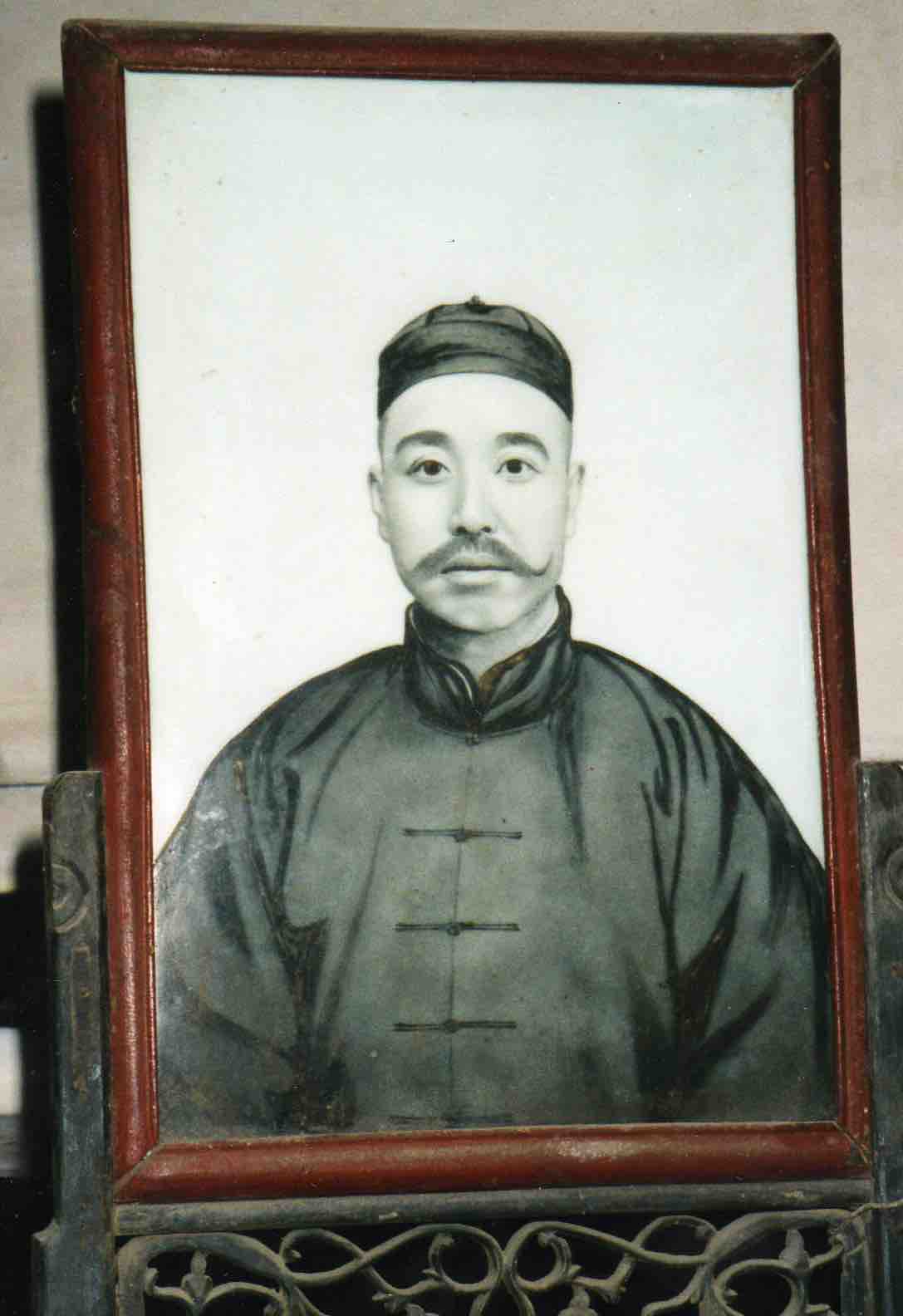
SFTCai Chengxun, victorious in battle, had now made his fortune. Returning north, he retired to his old home in Tianjin. “When the tree falls, the monkeys scatter”; Cai Chengxun’s retinue had now lost their patron. But Cai recognized Shan Futian’s honesty—Shan had never exploited his position in order to enrich himself—and before retiring he wanted to make Shan Futian mayor of De’an county, between Nanchang and Jiujiang, hoping Shan could use the opportunity to make a fortune for himself at last. Shan declined, afraid that his “lack of culture” would make the job difficult for him, although Cai offered him an adjutant. Instead he took the post of county police chief. The 1924 ceramic portrait of Shan Futian, which now had the place of honour overlooking the Shan family’s eight-immortals table, was fired at the famous kiln of Jingdezhen while he was serving in Jiangxi.

But without a patron Shan Futian found the work difficult, and in about 1927 he returned north, having made little money. After a brief reunion with his family in Gaoluo, he was introduced by a relative to do business back in Zhangjiakou. Before long he moved still further north to what is now Hohhot in Inner Mongolia, riding by camel. There he opened a leather business called Total Victory Leather Corporation; he also opened a public baths there in partnership with a relative from Dingxing. Different trades in Beijing were often monopolized by people from a particular area of the surrounding Hebei province; people from Dingxing and Laishui counties (the area of Gaoluo) used to work at public baths—this remained a traditional speciality of Gaoluo villagers right until the 1950s.

Shan Futian was one of several opium smokers in South Gaoluo, along with landlord Heng Demao and village bully He Jinhu. As Shan Zhihe observed, “It wasn’t just the rich who smoked: sick people and general reprobates also had recourse to it. I reckon no more than ten people in the village had the habit”. In 1935 Nationalist official Wang Zuozhou held a bonfire in the county-town as part of anti-opium campaigns throughout China. No-one heard of any such campaign reaching Gaoluo, but the habit—or perhaps rather the addicts themselves—must have died out soon after the Communist Liberation.

Early days of a scholar
Seated magisterially at his fine eight-immortals table, Shan Zhihe now began to relate his own story to us. Third of Shan Futian’s four children, he was born in 1919 at Zhangjiakou, where his father was then based. He and his older brother were given their “official names” Zhizhong and Zhihe after coming of age with the “lesser capping” ceremony. They were so named because their father’s public baths in Hohhot were called Zhonghe (Loyalty and Peace) baths; their names showed that the baths would one day belong to them.

Back in Gaoluo, the Juma river just east of the village had flooded in 1917. Though the flood was not serious and no-one died, it is still famous today in Gaoluo. The only other major flood in the village occurred in 1963. Gaoluo was fortunate, since throughout the whole area floods were frequent and devastating; indeed the village’s long-term immunity from natural disasters is still commonly attributed to the divine blessings brought by its ritual associations.

With his urban education, Shan Zhihe came to know the year of his birth, 1919, as the year of the May Fourth movement, a great urban intellectual ferment modernizing literature and social thinking. In fact, most villagers probably knew nothing of this movement: as amateur historian Shan Fuyi pointed out to us, the only big national historical event villagers definitely knew of was the Marco Polo Bridge incident on 7th July 1937, which unleashed the Japanese invasion. And if they do know such dates, they know them only in terms of the 8th or 26th years of the Republic, not by the official Western calendar.

Rather, most Gaoluo inhabitants know the 8th year of the Republic (1919) as the year of a serious epidemic in the village. In the heat of the 6th and 7th moons, “just as the melons were ripening”, villagers started to get stomach cramps and diarrhoea, death following quickly. Over sixty people died within a month. When one of the coffin-bearers died too, no-one dared observe proper funerals any more—the ritual associations too must have stayed away.

By now Shan Zhihe’s father was doing well in his business enterprises in Hohhot, and had bought up several dozen mu of land back in Gaoluo. In 1922, Shan Zhihe, still only 4, was sent back to South Gaoluo while his father went off to war in distant Jiangxi. Three years later he began attending private school in the village, studying along with forty or fifty other children. The school was at the home of his first teacher, Yan Zhan’ao. Seated before a portrait of Confucius hanging on the wall, the pupils learnt the standard Confucian curriculum, such as Surnames of the hundred families and Document of one thousand characters. Young Shan Zhihe studied there for five years. Since the older masters were less clear in their enunciation, pupils preferred younger teachers like Shan Hongru.

School tuition fees were 3 silver dollars per year. The teachers lived well; apart from tuition fees, pupils were also expected to present gifts three times a year: not only at New Year, but also on the Double Fifth (5th moon 5th) and Mid-Autumn (8th moon 15th) festivals—which have since lapsed in this area. The value of these gifts depended on family circumstances: better-off families might offer a pig or a sack of refined flour, but some poorer families were unable to give anything, and the teachers never blamed them.

The 1930s

1930 donors' list, South Gaoluo

1930 donors’ list, South Gaoluo.

Shan Futian was among the five “managers” on the ritual association’s precious 1930 donors’ list.

My father always thought to give the most money to the association, as much as 5 silver dollars. That was a lot of money then—2 silver dollars bought a sack (44 jin) of refined flour in Beijing. Whenever donations were required, the leaders of the association would go round all the households in the village. Leading members of the Heng lineage always gave last, so that they could display their economic power by giving the most, a bit more even than my father, and “taking first place”.

More charitably, some said it was also so that they could make up for any shortfall in donations. Indeed, on the 1930 list Heng Jun and his son Deyong head the list, before Shan Futian.

On the 6th day of the 9th moon in 1931, just a month after the benediction of the Catholic church, our venerable mentor Shan Zhihe, now 13, left Gaoluo to join his father Shan Futian in distant Hohhot, where he joined in classes of the province’s 4th Primary Comprehensive. Shan Futian wanted his son to continue his education; as we have seen, his own father was a pauper beaten to death without the least pretext, and Shan Futian himself had been poor and uneducated; persistent Confucian values still allotted far higher prestige to the scholar than to merchants like him. Having had such a hard time, he now considered giving his children an education more valuable than any material inheritance he might leave them. I wonder how this decision seems now: many educated Chinese today feel effectively discriminated against for having an education, not only during the Cultural Revolution, but under the market reforms since.

Shan Zhihe recalled ritual life before the Japanese invasion. I cited his account of processions to pray for rain here. He also had insights on the Italian Catholic missionaries, led by Bishop Martina, and the building of the church in 1931.

church

On the 6th day of the 9th moon in 1931, just a month after the benediction of the Catholic church, our venerable mentor Shan Zhihe, now 13, left Gaoluo to join his father in distant Hohhot, where he joined in classes of the province’s 4th Primary Comprehensive. Shan Futian wanted his son to continue his education; as we have seen, his own father was a pauper beaten to death without the least pretext, and Shan Futian himself had been poor and uneducated; persistent Confucian values still allotted far higher prestige to the scholar than to merchants like him. Having had such a hard time, he now considered giving his children an education more valuable than any material inheritance he might leave them. I wonder how this decision seems now: many educated Chinese today feel effectively discriminated against for having an education—not only during the Cultural Revolution, but under the market reforms since.

Shan Zhihe takes a bride
The next time Shan Zhihe returned to Gaoluo was for his wedding in the spring of 1937. One fine morning during New Year 1998 he finally described it for us; he had omitted to mention it during our previous talks, for reasons which will soon become clear.

My Beijing companion Xue Yibing and I both relish his refined conversation. He too is always glad to see us, to chat with relatively educated outsiders about current affairs and history, reflecting on and trying to make sense of his own extraordinary life. With his father’s portrait overseeing us, we sit round his lovely table munching melon seeds in our overcoats (it’s still terribly cold), his children and grandchildren regularly refilling our teacups.

After graduating from primary school in Hohhot, young Shan Zhihe was sent to secondary school in the Xuanwu district of central Beijing. On the 26th day of the 2nd moon in 1937, aged 19, he took leave from his studies to make a special trip back to South Gaoluo for his wedding. The betrothed couple, naturally, had never met. His bride came from the Eastgate quarter of Dingxing town, just like his mother, whose family had arranged the match. She had bound feet and was uneducated; Shan Zhihe was full of modern thinking and had learnt to oppose “feudal customs”, but he had to obey his parents. His return to Gaoluo must have seemed like surrendering himself to the servitude from which his education was promising to free him.

This was to be one of the last lavish weddings in the “old society”, costing the astronomical sum of 300 silver dollars. His bride was carried in an expensive new sedan; Shan Zhihe himself rode a sedan borrowed from landlord Heng Demao. The procession to meet the bride at Dingxing, 5 km distant, started out in pitch darkness at 4am: to set off back home with the bride after midday was taboo, spelling ill-fortune for the match.

The amateur ritual associations perform only for the “white rituals” of funerals, not for the “red rituals” of weddings. For the latter it is common to hire a professional shawm-and-percussion band, known as “blowers-and-drummers”. Since Gaoluo itself had no such band, one was hired from Shiguzhuang village just north. On the procession to collect the bride, the shawm band played as they passed through each village, called “crossing the villages”, as firecrackers were released deafeningly. By tradition the route back to the groom’s home must be different: they passed through Xicheng village in the Northgate area of Dingxing to Nanhou, crossing the river again at Wucun. On arrival at Gaoluo there was a sumptuous feast. The five blowers-and-drummers were handsomely rewarded with half a silver dollar each.

Shan Zhihe spent a month in the village before returning to his studies in Beijing, leaving his new bride behind. Apart from taking part in the lineage observances for the Qingming festival, it was the time of the 3rd moon festival for the goddess Houtu, when many villagers went on pilgrimage to the Houshan mountains. It was also Easter, and Shan Zhihe recalls seeing Bishop Martina ministering to his flock in Gaoluo.

Even in a society in which gender equality was still not remotely on the agenda—we saw the dreadful isolation of Woman Zhang—Shan Zhihe and his wife were to make a particularly incongruous couple, as he recalled dispassionately for us in 1998. She was what he now calls a “housewife” (jiating funü, a term which reveals his own education), and hardly literate; she was five years older than him, and with her bound feet was barely mobile (that was the idea, of course); he was tall and commanding, a scholar with ample experience in the outside world. Couples simply weren’t seen in public. She used to nag him to take her to watch the local opera; one day he had to give in, but as he says they must have made quite a spectacle themselves, with him reluctantly trying to adjust his manly stride as she hobbled along trying to keep up. They never went out together again, and she never forgave him. As he recalled wistfully, they never exactly had any problems: “She didn’t curse me, and I didn’t beat her.” When she died, on the 13th of the 7th moon in 1983, the funeral was quite grand; the ritual association performed, and lavish paper artefacts were displayed and burned, though there was a continuous downpour.

Courteously accepting another cigarette, Shan Zhihe reflects: “My brother and I were both victims of the feudal system of marriage. You can’t blame my parents, they were products of the system themselves. My older brother married a couple of years before me, in 1935, but then went away to study in Baoding; in 1939 he got into the 29th Army, stationed in Hebei, and after going south with the army he stayed there. It was all just to get away from the wife! She stayed behind in Gaoluo the whole time—she was only able to remarry after they got a postal divorce in 1957.”

Incidentally, in 1998 there were still about forty or fifty women in the village with bound feet; of those above 70, only one had natural feet.

The devils invade
In the summer of 1937, back in Beijing after his wedding, Shan Zhihe was in the midst of his studies when the “7th July incident” (Qiqi shibian) occurred. This battle between Chinese and Japanese troops at the Marco Polo Bridge, midway between Beijing and Gaoluo, marked the formal outbreak of the War of Resistance against Japan. It was a decisive moment in modern history for villagers, which they often call simply “the incident”. Of course, the preceding period too transpires to have been anything but rosy, but they often periodize cultural loss by this date, rather than by the Communist “Liberation” some ten years later—the Japanese invasion tacitly marking for them the increasing control of the Communists over their lives, as I eventually deduced.

With the whole Beijing area in chaos, Shan Zhihe eventually made his way back to Gaoluo on foot, by a long route avoiding the area of the Marco Polo Bridge, arriving back home late in July 1937. But what was he supposed to do now? His father had indeed blessed him with an education, and by now he didn’t relish the prospect of taking up as a peasant. The very fact of his education also made his situation precarious, for rival factions would seek to exploit his knowledge, and it would be difficult to choose his own path.

A month or so after his return to Gaoluo, it was clear that the Japanese advance along the main transport routes south could not be contained. Shan Zhihe’s older brother Zhizhong was part of the army which engaged the Japanese at Mentougou west of Beijing, but by the 7th moon they had to retire in defeat. Ordered to regroup at Zhengzhou, quite far south, they were constantly retreating through the area—Shan Zhihe’s mother was busy making bread for them. Zhizhong stopped off in Gaoluo for three days. After he resumed his journey, the brothers were not to meet again until after Liberation, over ten years later. Zhizhong later went off to work in Hubei province far to the south.

Their father Shan Futian was still in distant Hohhot. Shan Zhihe, though reluctant to abandon the family’s considerable property in Gaoluo, was responsible for his mother and sisters, and resolved to take them south out of danger. It was only when they heard the sound of heavy artillery that they decided they must go. But before they had even reached Baoding, they heard that the Japanese had already advanced as far as Shijiazhuang, still further south. Flight was impossible—they had no choice but to return to Gaoluo.

Japanese warplanes bombed Laishui county-town at 8am on 17th September (the 13th of the 8th moon) 1937, and that same day Japanese troops first entered Gaoluo. Coming from the direction of Wucun to the south, they were just passing through; they had about fifty tanks, and were covered by aircraft. The troops entered the village before Woman Zhang could take her children to the church to hide; they passed by her house. In order to dissuade them from murdering them all and setting fire to the village, the village leaders went out to welcome them. Before the Japanese even entered the village, they shot dead a villager who rashly stuck his neck out to look, but after entering Gaoluo they harmed no-one, just asking for fresh water, eggs, and meat. Shan Zhihe himself, along with Cai Ming (a sheng-player in the ritual association who worked as a pig-slaughterer), was responsible for looking after them and giving them water—the Japanese made them drink some first to be sure it wasn’t poisoned. Though they soon went on their way after a token search, Japanese cavalry and infantry passed through constantly for several days on their way to Baoding, and Gaoluo villagers had to look after them.

Seeing our evolving sketch-map of the village gave Shan Zhihe conflicting feelings:

Before the Japanese arrived they had prepared maps which they used when they first entered the village—they made me point out the way to Baoding. In the first party of Japanese troops were some savages [Ainu?] from Hokkaido. When they entered the village they caught some chickens and tore them to bits, eating them raw. When the troops discovered my hands weren’t calloused like those of a peasant they pointed their bayonets at me. I frantically tried to explain by gestures that I ran a baths, and they let me off.

The lawless conditions of the early 1930s had prompted many villagers to arm themselves. Soon after the Japanese invasion in 1937, some Gaoluo villagers sought to set up “Anti-Japanese brigades”. Villagers with guns were invited to join the new militia or at least to give their guns to the resistance effort. Within a couple of days some two hundred volunteers had assembled, including Catholics like Cai Chen and Cai Xing. The new militia called itself by the grandiose title of “The Rear Anti-Japanese self-protection troupe”, and even drew up a constitution. The house of North Gaoluo landlord Yan Shide served as command-post.

But educated Shan Zhihe soon found with dismay that most of the recruits were just village good-for-nothings. While a student in Beijing, he had taken part in patriotic demonstrations boycotting Japanese goods. Now finding himself back in his home village, taking his gun along and soon becoming one of the leaders of this motley crew, he was full of misgivings. Untrained, they were a menace to people outside their own village. “Ordinary people didn’t understand what this ‘anti-Japanese’ stuff was all about anyway, they thought the Japanese devils were just another bunch of bandits.”

The Japanese, learning that Gaoluo had organized a “Red Spears Association”, now sent a division of troops to “encircle and suppress” them. Shan Zhihe had a cousin called Wang Futong, whose family was quite well-off, owning over 100 mu of land. Wang was notorious as a wastrel who kept bad company. When an enemy of his spread a rumour that he was a militia leader, the Japanese came looking for him. Shan Zhihe had gone to Dingxing county-town that day to buy shoes for the militia, and by the time he got back the Japanese had gone, having failed to find Wang. But that was the end of the Gaoluo militia: some hid their guns or threw them down the wells, some went into hiding, while others joined militia groups in other villages, calling themselves anti-Japanese but actually plundering ordinary Chinese houses.

Cultured Shan Zhihe obviously had no future in such a militia. He handed in his gun and took no further part. Events now forced him to flee Gaoluo. Before long his profligate cousin Wang Futong was murdered by a drinking-buddy called Huo Zhongyi, leader of the militia in Xiazhuang just east of the river. Afraid that Shan Zhihe would seek revenge, Huo Zhongyi decided to “destroy root and branch”. He had Shan Zhihe summoned to the house of South Gaoluo landlord Heng Demao, but Shan suspected a trick and decided to flee. For a while he hid out at his grandmother’s house in the nearby town of Dingxing, and then set off to find his father again in distant Hohhot. The 10th moon of 1937 had still not arrived—an eventful start to his married life.

In occupied Hohhot
Shan Zhihe had already begun telling us his story in Gaoluo in 1996. We were back in Beijing for a few days between visits when we learned that he too had come there to stay with a family who needed his medical help. Back in the frenzy of ring-roads and fancy hotels, we missed Gaoluo already; glad of the opportunity to seek his guidance again, we asked him to continue his story for us.
Hohhot

Hohhot, 1930.
Source: https://www.xuehua.us/2018/07/23/罕见历史老照片,1930年蒙古人记忆中的呼和浩特!/

Shan Zhihe left for Hohhot in the 9th moon of 1937, where his father was still running a public baths. Shan Zhihe’s wife, as well as his mother, were able to join them in 1938; the sons Shan Ming and Shan Ling were born there in 1942 and 1948 (for naming customs, see here). But the war had made business enterprises highly subject to intimidation, as Shan Zhihe soon found out when he started working at the baths. Early in 1938 posters advertising for examinations for the police force seemed to offer him a better alternative. Shan Zhihe was a tall and well-educated young man; he passed the exam with no trouble. Only when he started the Japanese-style military training did he realize that what the poster had presented as a force for the protection of Hohhot was in fact a training for the collaborative “traitor army”. By the time he realized he had been conned, it was already too late, and Shan Zhihe was now subordinate to a Japanese police chief. If his story may sound disingenuous, it apparently didn’t seem so to later Communist investigators.

Shan Zhihe was first sent to work at the police station in Great South Street, the most affluent quarter of Hohhot; then after a month he was promoted to personnel management in the police department in the old town. Over the following years he gained promotion through the ranks of the Mongolian and Japanese armies. “I had contact with the Japanese all the time—I got to read the Japanese news, so I knew quite a bit about World War Two.” He was better informed than I about Dunkerque, which in itself was no great feat. He managed to save several Communist guerrillas: when the Japanese caught someone, friends got him to go and set things right, so they were set free.

In the 9th moon of 1942 Shan Zhihe at last got permission to return to Gaoluo for a visit. His military permit entitled him to carry firearms, and his first thought was to seek out Huo Zhongyi and “settle the debt” for the murder of his cousin. But he soon learnt that fate had done the job for him. Huo had gone over to the Japanese, and then, resentful of their cruelty, had resolved to rebel against them; but they had found out and executed him. Shan Zhihe spent only one night at home before setting off back towards Hohhot. On the way he spent a few days at the home of his older sister’s husband in Beijing, and applied for permanent leave from the Japanese army. This was granted, but after he returned to Hohhot he spent most of the next three years virtually unemployed, earning a bit from renting out rooms.

After the Japanese surrender in 1945, Nationalist commander Fu Zuoyi had entered Hohhot and gradually “suppressed” the most evil of the Japanese collaborators. “Times were tough in Hohhot after the Japanese surrender”, recalled Shan Zhihe. “There was no coal, and no barley—we had to eat ‘secondary barley’, a mix of husked sorghum and husked barley. The Nationalists had heard that I was educated and had military training, and they offered me an official post in their army, but I refused. Still, I was only 26, in the prime of life. Frustrated, I could see no options for myself, and in 1946 I ended up as a medical orderly in a hospital at Hohhot. The hospital was of regimental rank, and orderlies were between 1st and 2nd lieutenants in rank.”

Under Maoism

SZH 1948

Shan Zhihe worked as an orderly for the Nationalists in Hohhot through the civil war, witnessing different traumas from those taking place in Gaoluo. In 1948 he took some relatives to Beijing; a photo of him in military uniform shows his impressive stature.
Hohhot was “peacefully liberated” for the second time on 19th September 1949. For the time being the Shan family stayed on there; the family’s bath-house then had five rooms, two of which they rented out for use as a general store, selling off some of their furniture.

But eventually, as private enterprise under the Communists became untenable, the whole family had to return to Gaoluo. Shan Zhihe came back in 1951 with his wife, his daughter, and younger son Shan Ling—the first-born Shan Ming stayed behind with his grandparents, but he too came back with his grandmother in the 3rd moon of 1952.

The aged Shan Futian was last to return, in the following winter. By this time he was seriously ill. Ever filial, Shan Zhihe wanted to sell off the family’s property to help him buy medicine. The family had owned over 90 mu of good land before Liberation. Since they were absentee landlords, they had let villagers cultivate it; the villagers were liable to pay grain tax on it. But the Shans took only a nominal rent, and so upon land reform they were classified as “rich peasant” but were not made an “object of struggle”; they were allowed to keep over 40 mu of land, while the rest was parcelled out, but their property was not touched. Still, the family had been away from the village for the whole preceding period, and Shan Zhihe felt unhappy about his class label. Though the “hat” of landlord or rich peasant was not always brought into play (“neither hot nor cold”), it was a sword of Damocles.

As his father’s health declined, Shan Zhihe sold off 10 mu of the family’s remaining land in the hope of saving him, but Shan Futian wouldn’t let them dispose of more of their assets, and in the 6th moon of 1953 he died. Even in absentia he had been a longstanding benefactor of the ritual association, and his family used to give the association a banquet at New Year. Naturally the association played and performed the vocal liturgy for his funeral; Shan Laole played the drum, Chen Jianhe the guanzi. But the funeral was not especially grand, as Shan Futian had spent little time in the village. Since his son Shan Zhihe had done well since returning to the village by helping at the new village school, the teachers made a traditional offering of cloth.

Mindful of his dubious employment record serving Japanese and Nationalists, Shan Zhihe wrote a “self-examination” after returning to South Gaoluo in 1951. Investigators went to interview people in many places where he had been, but no “historical problems” were unearthed; everyone was full of praise for him. So, remarkably, he remained safe from assault—even through the Cultural Revolution.

Whatever his background, people like Shan Zhihe, the most educated man in the village with enviable modern learning, were much needed to consolidate the revolution in the countryside. He must have known he was skating on thin ice, and having to prove himself he now showed willing.

When I came back to Gaoluo they asked me to teach at the village school. I declined, but I did teach at the People’s School (the evening school) in the Sweep Away Illiteracy campaign of 1953. I was a leader of the West Yi’an district Sweep Away Illiteracy campaign then too. But I felt ashamed of my past, and threw myself into studying Marxism-Leninism, reading works like Das Kapital, On practice, and On contradictions. I read other revolutionary literature like How to make steel [an influential translation of a Soviet novel]. I taught the pupils about Marxism-Leninism, and won an award as a model teacher in the People’s School.

Opera
Apart from the four ritual associations of North and South Gaoluo—which managed to maintain activity through the first fifteen years after Liberation—both villages had an opera troupe, performing a local genre called bengbengr or laozi. In South Gaoluo in the early 1930s Shan Zhihe remembers his older brother Zhizhong getting money from his family to buy the troupe some costumes. But it had to disband after the Japanese invasion.

After Liberation the revamped South Gaoluo opera troupe acquired a great reputation locally. The troupe was to become a flagship for new official cultural policy, based at the village primary school. The reorganization of the troupe was strongly supported by the new Party Secretary Heng Futian, who thought it would be a good way of expanding the village’s influence.

The troupe now resolved to rehearse modern operas which had been created and performed in the revolutionary base of Yan’an in the 1940s: The White-haired girl (1945), as well as Liu Hulan (1948) and Wang Xiuluan. By performing these operas they identified directly with central official artistic policy on the modernization of traditional culture as canonized in Mao’s 1942 Talks at the Yan’an forum on literature and the arts—in stark contrast with the total impasse with the new political ideology which the ritual association continued to represent. Women now took part in the troupe for the first time.

Another main driving force for the opera troupe was Shan Zhihe. Though without formal dramatic training, he had gained experience of the arts while a student, and, despite his dubious work experience before Liberation, was respected as the most “cultured” person in the village. He now acted as director for The White-haired girl. He even brought out his father’s old clothes, hat, and pocket-watch to use as props for the part of the evil landlord Huang Shiren—a fine irony, since his own family had just been landed with the “hat” of rich peasant.

BMNThe virtuous part of the heroine Xi’er’s father Yang Bailao was originally given to He Junyan, Party Secretary of the village Youth League. But he wasn’t up to it, and took the part of Huang Shiren instead, while Shan Zhihe himself took over the role of Yang Bailao—a quaint reversal of their allotted roles in the village. Secretary Heng Futian’s son, Deputy Secretary Heng Qi, took the part of the kindly servant Zhang Dashen. I wonder if the White-haired girl herself, mistaken for a spirit until it transpires that she is merely a common villager whose suffering had turned her hair white, would have reminded locals of their own goddess Houtu.

Incidentally, as a sign of the times, when the Cultural Revolution ballet version of The White-haired Girl was revived in Beijing in 1996, some younger members of the audience missed the point spectacularly. The evil landlord is portrayed in the drama as shameless in his demands for repayment of debts from poor downtrodden peasants, and beats the heroine Xi’er’s father to death when he is unable to repay. At some early performances in the 1940s audience members had so hated the landlord that they virtually murdered the actor, and the plot had to be changed to reflect audiences’ hatred for him: in the revised version he is indeed sentenced to death rather than merely re-educated. But by 1996 his character attracted some sympathy: when interviewed, some said it was quite proper for the landlord to demand repayment! Official commentators understandably lamented the decline of morality: “Thanks to the introduction of a market economy, young Chinese are becoming business-oriented, and their comment reflects the philosophy of business.” Decades of socialist education had come to nought.

Like many Chinese, Shan Zhihe considered the social breakdown to have occurred only with the Cultural Revolution and the loss of integrity thereafter. As he reminded us, in the 1950s life was at last stable, and the Party was popular. Chairman Mao was revered: people said there had never been such a great figure in the whole of China’s long imperial history. The army served the people, fetching water and clearing the land for the villagers. Cadres abided by the “three main rules of discipline and the eight points for attention”, theme of a catchy new song. New Party Secretary Heng Futian was rushed off his feet for a whole month organizing the collection of grain taxes, and the village cadres just had a quick bowl of noodles before their meetings—there was not the least suggestion that they might be fleecing the people.

Shan Zhihe may have had reasons to thank the Party, but he voiced the feelings of many poorer villagers. People we met articulated no negative memories of the campaigns of the early 1950s, and I do not believe this was mere prudence. No-one found labour gangs at all sinister. Many of those who suffered, like the old bullies, were thought to deserve it. It was simply not in people’s vocabulary to sympathize with the plight of the Catholics. And as the landlords disappeared, people neither remembered them badly nor spared the sentiment to miss them. The political mood dictated from above was pervasive: people had no choice but to take part in the elaborate game of “snapping at each other”. People related to or erstwhile friends of those now classed as “elements” went through the motions. Sons of so-called rich peasants, such as young musician Shan Bingyuan, naturally had a tougher time than others from unassailable poor-peasant backgrounds. But even a cadre like Cai Fuxiang, with his impeccable revolutionary credentials, was traumatized by the violence of revolution.

As a former medical orderly, Shan Zhihe had later studied medicine under his older sister’s husband, and was now quite well qualified. He now started to treat patients for free in Gaoluo.

Despite their later nostalgia, many villagers must have been increasingly anxious as collectivization looked imminent. Some households certainly stood to gain from an efficiently-run system. By now the “rich peasant” family of venerable Shan Zhihe was poor: their labour force was weak and they had no experience of tilling the land, so they had no objections to joining the collective. Such families went along with the changes, but many already working efficiently with their own carts, tools, and draft animals saw communal agriculture as inefficient and alienating, and were reluctant to join. Though disgruntled, few were rash enough to articulate such thoughts: complaint was dangerous, and could instantly be interpreted as opposition to the sacrosanct state. The government had also just devised an unenviable class category of “new rich peasant”. Still, collectivization did arouse resistance and sabotage, and in many places (if not in Gaoluo) religious sects resurfaced to oppose it.

After the Great Leap Backward and the ensuing famine, a lull between extremist campaigns allowed a brief revival of the ritual association in the early 1960s. Among thirty new recruits in 1962 was Shan Zhihe’s son Shan Ling.

The Cultural Revolution, opera, and the reform era
Soon after the Four Cleanups campaign opened in 1964, Shan Zhihe wrote a letter to the authorities complaining of the unfairness of his “rich peasant” hat, but once the Cultural Revolution started he was unable to pursue it any further. He realized chaos would be unleashed as soon as he heard the ominous slogan “attack with culture, protect with force”, providing a pretext for violence. In Plucking the winds I describe the factional fighting that spread from the county-town to Gaoluo in 1966—including the remarkable rescue of the Houtu precious scroll. But despite his dubious past, Shan Zhihe remained immune from attack.

The village opera troupe had performed modern opera in the early 1950s, abandoning it in 1958 for the traditional bangzi style. By 1964, at the instigation of the county Bureau of Culture, themselves under orders as part of a huge national drive against the traditional “feudal superstitious” operas which had resurfaced widely, they started performing modern operas again. They then inevitably blew with the winds to serve as a Mao Zedong Thought Propaganda Team, performing the “revolutionary” model operas, as throughout China. By winter 1967 the troupe was performing revolutionary dramas like Shajiabang, Taking Tiger Mountain by strategy, as well as Stealing the seal (Duoyin 夺印, an opera about class struggle) and The commune-chief’s daughter (Shezhang de nü’er 社长的女儿). For most of our friends, erstwhile members of the utterly conservative, but now dormant, ritual association, the development of the opera troupe had an inevitability about it. Even ritual stalwart He Qing now relished playing the smugly virtuous revolutionary Li Yuhe in The tale of the red lantern.

But some other members were none too impressed. Shan Qing, then in his 20s, had learnt the bangzi style in 1962, and only wanted to perform the old operas; he didn’t approve of the model operas, so he withdrew. And despite having subscribed readily to the social goals of the 1950s, Shan Zhihe decided the Mao Zedong Thought Propaganda Team wasn’t his cup of Chinese tea.

Xie JinBut meanwhile he collected material in order to compose a libretto on the theme of Lin Zexu, hero of the Opium Wars. Like the Boxer uprising (also the object of much fieldwork under Maoism), this was always a popular theme rallying the people against the evil foreign imperialists; following a 1959 film, by 1997 the story was taken up in a big way in a blockbuster film by veteran director Xie Jin, making propaganda for the handover of Hong Kong back to the Chinese. The county Bureau of Culture supported Shan Zhihe in his project, but it never came to fruition—too bad, as I joked with him, or I might have landed a part in the revival, though I’m not sure I’d be up to playing Queen Victoria.

For better and for worse, the economic liberalizations after 1978 effectively brought an end to over twenty years of Maoist policies. A new era now began. Class labels were finally abolished, as Shan Zhihe (who had suffered less than many for his bad label) reminded us, causing people to praise the national leader Deng Xiaoping as “Blue Sky Deng”.

In 1980, just as the commune system was being dismantled and the ritual association reviving, South Gaoluo villagers dipped their toes in the newly flowing waters of emergent capitalism as a group of enterprising friends tried organizing an “incense factory”, and soon (sorry, I can’t resist this) got their fingers burnt. The village brigade, led by Cai Yurun, back from the army and just appointed Party Secretary, as well as a keen new recruit to the reviving ritual association, took the lead. The incense factory was also an early experiment in business practices for Heng Yiyou, former “backstage” supporter of the United faction, soon to become a leading local entrepreneur. Even the otherwise sage Shan Zhihe, already in his 60s, took part. Also in 1980 he passed an exam at county level, promoted by the commune, and went on to open a private clinic in Dingxing in partnership with some colleagues.

In 1998 we paid him further delightful visits. Still supporting the association in his old age, by the standards of rural China in the 1990s he was comfortable, well looked after by his family.

Meanwhile a miraculous revival of the village opera troupe was under way. Political freedoms after the dismantling of Maoism then allowed them to restore the traditional style from 1979 to 1981, but economic pressures soon forced them to disband. They started rehearsing again in 1997. The newly formed group was an extension of the village’s new shawm band; thus several members of the ritual association were also taking part, including Shan Zhihe’s urbane sons Shan Ming and Shan Ling. The troupe’s repertoire now subsumed both traditional and modern styles. For New Year 1998 they were preparing classical bangzi excerpts as well as parts of their newer repertory such as Liu Qiaor and the teahouse scene from the Cultural Revolution “model opera” Shajiabang, still in bangzi style. But the revival exacerbated animosities within the ritual association.

SJB

Shajiabang, New Year 1998: Cai Tingwen as Nationalist general, Shan Rongqing on fiddle.

In contrast to the rather insular world of many peasants, the Shan family continued to be rather well acquainted with world events. Indeed, some other villagers too were interested in the Iraq crisis which was reported on Chinese TV—they questioned me about Britain’s role. But the Shan family’s curiosity was rather exceptional, going back to the early 20th century with Shan Futian’s experiences in Beijing, Hohhot, and south China, and continuing with Shan Zhihe’s own background of studying in Beijing and working for the Japanese and Nationalists in Hohhot.

Shan Zhihe, who over half a century earlier had learned of the Normandy invasion, had maintained his interest in world events: he mentioned the death of Princess Diana and the channel tunnel between England and France. So the whole family, including his urbane sons Shan Ming and Shan Ling, naturally had an interest in new culture from outside. They had good contacts in Beijing, where Shan Zhihe paid occasional visits; his daughter’s husband had retired early and become a taxi-driver, making a regular trip to and from Gaoluo—another link to the modern world of the Shan household.

* * *

For me, Shan Zhihe’s story encapsulates the complex transition from the old to the new society. I shared the villagers’ great respect for him. Of course he presented himself in a good light; nearly half a century after having to write “confessions”, Shan Zhihe doubtless found our visits a further opportunity to reflect on his experiences. Now he was writing his memoirs, only partly under the stimulus of our visits. As he reflected to me,

I’ve got a good memory, but my fate is no good. Otherwise after studying in Beijing I might have gone off to England to continue my education! The year the Japanese surrendered I was already 26, but by then it was too late. While I was working for the Japanese I managed to save several Communist guerrillas. But for having served the Japanese I was condemned to live and die in the village, a dismal life.

But things could have been far worse: he could so easily have been branded for life as a Japanese and Nationalist collaborator. By his own analysis, he had gone down the wrong road just once in his life. Having demonstrated against Japanese goods while still a student, he still couldn’t understand how he ended up as a policeman under their rule. Although he had done no wrong, it somehow seemed right that he should return home to reflect on his past and his future—not that he had much choice.

If many people with similar experiences were persecuted under the Communists, many also must have been well treated. It seems that the new leaders knew whom they needed, and that local loyalties also counted. But of course there were also innumerable senseless casualties in the Chinese Revolution; over the following years many Party members who suffered to help build the new society, and remained wholeheartedly loyal to it, were to be ruined. Shan Zhihe now had reason to be grateful to the Party. Psychologically his story is complex. He seemed sincere in parroting the Party-speak cliché of “I reformed my thought through labour and sweat”: layers of irony are hard to fathom.

But he had survived. “My father taught me two things: ‘If you make money, you mustn’t look down on people; if you become an official you mustn’t con people’—I’ve managed to live right down to today by those two mottos.” I believe him, too; his refined demeanour is a far cry from that of so many cadres and nouveaux riches under the reforms. By the 1990s, his family were living rather well; his children and grandchildren were bright. The family has survived—what more could they ask? Zhang Yimou’s moving film To Live (Huozhe, surely better translated as “Surviving”) gives an impression of this instinct. And many ordinary Chinese today still revere Mao, despite all the appalling gratuitous sufferings he inflicted on them, and are actually nostalgic for Maoism, admiring strong leaders; they are confused and alienated by the reforms since the 1980s. We must beware reading such alienation into the vicissitudes of the 1950s.

Do read Plucking the winds!


Cocomania

***UPDATED!!!***

For anyone living on another planet (immersed in medieval Daoist ritual manuals, or whatever)…

As if the Women’s World Cup wasn’t enough, I’m only too happy to subscribe to the mass adulation for Cori Gauff at Wimbledon. Her two victories were just exhilarating.

Mature and focused at 15, she’s an inspiration. Her parents seem great too.

CG parents

She was charming in handling the usual fatuous questions at her 3rd-round press conference:

When you were match point down on Centre Court, were you thinking, what would Venus and Serena do?

Er, no! …

which ranks along with Bertrand Russell’s comment after his plane crash. And at the risk of sounding like the woman visiting the young Living Buddha, I love the way she tucks her chair into the desk at the end.

tweet

[Spoiler: typical Grauniad-reading liberal metropolitan elite quote coming up] At a time when the world seems doomed to suffer under mendacious cynical rich old white men, we all need role models like Coco—a list that might also include Alexandria Ocasio-Cortez and Greta Thunberg, Katelyn Ohashi, and indeed Oxana Thaili. It’s no coincidence that the most inspiring of such figures are female.

Cori 2

I wish her well, and look forward to the day when AOC can welcome her to the White House!

Update: US Open, 2019
In a further episode of the saga, Coco’s home crowd exults in her style, social media goes even wilder, and in defeat she is magnanimously persuaded by Naomi Osaka to share this moving post-match interview:

See also Enough already. And note the principled response of Coco and Naomi to the murder of George Floyd.

2023 update!!! 🍾🍾🍾🍾🍾🍾🍾🍾
And so to Coco’s first Major title, again, suitably, at the US Open—what moving drama, striving, and achievement is embodied in the ritual of solo sporting competition!

For the women’s final of the 2021 US Open, please relish A playlist for Emma and Leylah! See also A sporting medley: ritual and gender.

Of Steinbeck and Salinger

Along with my youthful taste for Zen and Daoism, I was also reading John Steinbeck and J.D. Salinger—though at the time I was barely aware of their mutual connections. So this is not so much a Lit Crit review as an attempt to see them in the context of my own “development”—“all that David Copperfield kind of crap”.

For Steinbeck I’m thinking not of his weightier tomes on the plight of immigrant workers and class struggle, but of Cannery row (1945). Here’s the celebrated opening:

Cannery Row in Monterey in California is a poem, a stink, a grating noise, a quality of light, a tone, a habit, a nostalgia, a dream. Cannery Row is the gathered and scattered, tin and iron and rust and splintered wood, chipped pavement and weedy lots and junk heaps, sardine canneries of corrugated iron, honky-tonks, restaurants and whore houses, and little crowded groceries, and laboratories and flophouses. Its inhabitants are, as the man once said, “whores, pimps, gamblers, and sons of bitches”, by which he meant Everybody. Had the man looked through another peephole he might have said, “Saints and angels and martyrs and holy men”, and he would have meant the same thing.

Subliminally I found Lee Chong, Doc, and Danny incarnations of different oriental wisdoms. Doc (based on Ed Ricketts) was a sage, akin to Gary Snyder. And the hobos were Hanshan and Shide, their mishaps reminiscent of The good soldier Švejk and, later, Shameless (“PARTY!!”). And at a time when Chinese characters were still rare in Western fiction, Lee Chong made a beguiling stereotype of the inscrutable Chinese storekeeper (for Ray Man, my mentor in Chinese music in Soho, click here).

Steinbeck pursued the theme in the sequel Sweet Thursday (1954). But the scenario goes back to his earlier Tortilla flat (1935), depicting a group of paisanos in a tumbledown district of Monterey. Here’s the opening:

This is the story of Danny and of Danny’s friends and of Danny’s house. It is a story of how how these three became one thing, so that in Tortilla Flat if you speak of Danny’s house you do not mean a structure of wood flaked with old whitewash, overgrown with an ancient untrimmed rose of Castile. No, when you speak of Danny’s house you are understood to mean a unit of which the parts are men, from which came sweetness and joy, philanthropy and, in the end, a mystic sorrow. For Danny’s house was not unlike the Round Table, and Danny’s friends were not unlike the knights of it. And this is the story of how that group came into being, of how it flourished and grew to be an organization beautiful and wise. This story deals with the adventuring of Danny’s friends, with the good they did, with their thoughts and their endeavours. In the end, this story tells how the talisman was lost and how the group disintegrated.

For Steinbeck’s 1947 trip to the USSR with photographer Robert Capa, see e.g. here.

* * *

If in Steinbeck the theme of oriental mysticism is latent, it’s more explicit in Salinger. Like John CageGary Snyder, and Alan Watts, Salinger was influenced by the teachings of Zen master D.T. Suzuki at 1950s’ Columbia, and later by Vedanta. The theme has attracted considerable discussion (e.g. here); like the whole TMI confessional style, not all of it is positive. And it’s still subsidiary in critical commentary on Salinger’s work; indeed, the more his fictional characters immersed themselves in such arcane pursuits, the less they appealed to his core readership. But the Beats, and later the Hippies, took note.

The Wisdom of the Mystic East may be overlooked in The catcher in the rye (1951, after serialization in 1945–46)—the book’s enduring popularity (not least in China) is based on the themes of phoniness and alienation. But the theme is unmistakable in Salinger’s portrayals of the precocious Glass family [cue Heart of glass], whose siblings became immersed in Zen (see e.g. this essay by Henry Shukman).

In Franny and Zooey (1961, first published separately in 1957) the Bhagavad gita, the Upanishads, and the Diamond sutra are framed by the Christian mysticism of The cloud of unknowing and Meister Eckhart. Such works were hardly standard inspirations for fiction at the time, though later I would snap them up in Watkins bookshop. From a letter by Buddy to Zooey:

Seymour had already begun to believe (and I agreed, with him, as far as I was able to see the point) that education by any name would smell as sweet, and maybe much sweeter, if it didn’t begin with a quest for knowledge at all but with a quest, as Zen would put it, for no-knowledge. Dr Suzuki says somewhere that to be in a state of pure consciousness—satori—is to be with God before he said, Let there be light. […] We thought it would be wonderfully constructive to at least (that is, if our own limitations got in the way) tell you as much as we knew about the men—the saints, the arhats, the bodhisattvas,the jivankuktas—who knew something or everything about this state of being. That is, we wanted you both to know who and what Jesus and Gautama and Lao-tse and Shankaracharya and Huineng and Sri Ramakrishna, etc., were before you knew too much or anything about Homer or Shakespeare or even Blake or Whitman, let alone George Washington and his cherry tree or the definition of a peninsula or how to parse a sentence. That, anyway, was the big idea.

The appeal of Far-Eastern poetry is encapsulated in a long passage in Seymour: an introduction (1959), recalling the narrator Buddy’s late brother:

During much of his adolescence, and all his adult life, Seymour was drawn, first, to Chinese poetry, and then, as deeply, to Japanese poetry, and to both in ways that he was drawn to no other poetry in the world.* I have no quick way of knowing, of course, how familiar or unfamiliar my dear, if victimised, general reader is with Chinese or Japanese poetry. Considering, however, that even a short discussion of it may possibly shed a good deal of light on my brother’s nature, I don’t think this is the time for me to go all reticent and forbearing. At their most effective, I believe, Chinese and Japanese classical verses are intelligible utterances that please or enlighten or enlarge the invited eavesdropper to within an inch of his life. They may be, and often are, fine for the ear particularly, but for the most part I’d say that unless a Chinese or Japanese poet’s real forte is knowing a good persimmon or a good crab or a good mosquito bite on a good arm when he sees one, then no matter how long or unusual or fascinating his semantic or intellectual intestines may be, or how beguiling they sound when twanged, no-one in the Mysterious East speaks seriously of him as a poet, if at all. My inner, incessant elation, which I think I’ve rightly, if incessantly, called happiness, is threatening, I’m aware, to turn this whole composition into a fool’s soliloquy. I think, though, that even I haven’t the gall to try to say what makes the Chinese or Japanese poet the joy and marvel he is.

* [footnote in book] Since this is a record, of sorts, I ought to mumble, down here, that he read Chinese and Japanese poetry, for the most part, as it was written. [SJ: um, as if that’s possible—cf. Bach] […] If, in the line of duty, I should incidentally titillate a few young people’s interest in Chinese and Japanese poetry, it would be very good news to me. At all events, let the young person please know, if he doesn’t already, that a goodish amount of first-class Chinese poetry has been translated into English, with much fidelity and spirit, by several distinguished people; Witter Byner and Lionel Giles come most readily to mind. The best short Japanese poems—particularly haiku, but senryu, too—can be read with special satisfaction when R.H. Blyth has been at them. Blyth is sometimes perilous, naturally, since he’s a highhanded old poem himself, but he’s also sublime—and who goes to poetry for safety anyway?

I’m glad he credits Blyth there: indeed, Zen in English literature and oriental classics, which goes back to 1941, chimes in with Salinger’s quest for oriental wisdom in the Western world, not only in its high art but in its mundane realities (see e.g. here). Salinger/Buddy goes on:

Unofficially, Seymour wrote and talked Chinese and Japanese poetry all the thirty-one years he stopped with us, but I’d say that he made a formal beginning at composing it when he was eleven, in the first-floor reading room of a public library on upper Broadway, near our house. It was a Saturday, no school, nothing more pressing ahead of us than lunch, and we were having a fine time idly swimming around or treading water between the stacks, occasionally doing a little serious fishing for new authors, when he suddenly signalled to me to come over and see what he had. He’d caught himself a whole mess of translated verses by P’ang, the wonder of the eleventh century [SJ: this would be Layman Pang, actually a Tang master—whose sayings I also found in Watkins]. But fishing, as we know, in libraries is a tricky business, with never a certainty of who’s going to catch whom. [Typically lengthy aside on fishing…] Permanently, from that morning on, Seymour was hooked.

Indeed, the companion Raise high the roof beam, carpenters (a Sappho quote, for aficionados of the female composers T-shirt) opens with Seymour, then 17, reading a Daoist story to their ten-month old sister Franny.

Of course, with exceptions like Eugen Herrigel and Gary Snyder for Japan, such explorations were untramelled by engagement with the lives of their real Eastern contemporaries. But they weren’t merely retreating into an abstract Wisdom of the Mystic East but seeking to reconcile it with living in the modern world. Still, all this only goes some way towards explaining how I ended up traipsing around dusty Chinese villages in search of Daoists.

* * *

In their lives as in their fiction, both Steinbeck and Salinger come out poorly from later studies of their attitudes towards women. Kate Millett had bigger fish to fry (to a cinder) in Sexual politics (1970)—D.H. Lawrence, Henry Miller, Norman Mailer. But as early as 1954 Ward Moore made some pithy criticisms of Cannery row:

To Steinbeck, who carries to an extreme the Hemingway small-boy nostalgia for the never-never world of comradely masculine society without women save as an occasional inconvenience, Cannery row was an ideal microcosm. In it, socially at least, the infantile triumphed; Mother—the realist, the disciplinarian, the stabilizer—was excluded, and Father, if admitted at all, came as a refugee from domesticity. In Cannery row the locale the small boy as employee justified his restiveness in casual labor; in Cannery row the novel the small boy vindicated his pranks, his misdemeanors, his fear of responsibility in a glorification of perpetual hooky.

And the relation between Franny and her older, wiser brothers, with their more “legitimate” spiritual crises, has also been unpacked.

Still, at the time I was most beguiled by such Western pioneers, and their themes still resonate.

A new memorial stele

IMG_3287.JPG

Altar to Li Qing and his wife Xue Yumei in the central room of Li Manshan’s house, 2018.

The revered household Daoist Li Qing (1926–99) occupies a special place in the affections both of his own family and of the many Yanggao people whom he helped over his long career. With his generous character and thorough mastery of ritual practice, he guided the ritual band through the years of Maoism, and upon the revival he recopied the family manuals and trained new disciples. Among many posts, see the links here, as well as my film and book.

When the “filial kin” decide to erect a stele, it’s customary to do so for both parents together—Li Qing’s wife Xue Yumei (1925–2016) was also much loved (she features in a moving scene of the film, from 36.46, recalling their 1945 wedding). The family were going to wait for the 3rd anniversary of her death, but in the end they decided to hold the simple ritual in 2018, on the 1st day of the 10th moon—along with Qingming in the 4th moon, the main day annually for paying respects at the ancestral graves. Before Liberation some more well-to do lineages had grave charts, but Li Manshan never saw one for the Li family.

stele

Photo: Li Bin.

The handsome stele was ordered by the couple’s grandson Li Bin, used to providing such mortuary equipment at his funeral shop in Yanggao town. Along with Li Manshan, the whole family (“filial children and virtuous grandchildren”, as in the inscription) gathered at the lineage gravelands outside Upper Liangyuan village to erect the stele. Presenting offerings of incense, liquor, cigarettes, biscuits, cakes, and fruit, they “reverently kowtowed” while burning a set of paper artefacts and paper spirit money.

paper money

The artefacts, made by Li Bin and his wife at their funeral shop, were those commonly used for funerals in Yanggao: a siheyuan courtyard house, gold and silver dou 斗 vessels, a money-tree (yaoqian shu 摇钱树), gold and paper mountains, a car, and wreaths.

By contrast with south China, such steles are not so common in the Yanggao countryside, but in 2014 the family of Li Qing’s Daoist uncle Li Peisen (another crucial figure in the transmission) had also erected one for him and his wife Yang Qinghua at their home of Yang Pagoda just south, where they had moved to escape the rigours of Maoism.

And all this reminds us that household Daoists like the Li family provide a complete mortuary service for the local community of which they are part ( see e.g. Li Bin’s diary, and this post on funerary headgear).

Li Bin’s first funeral shop in town.

For more updates on the Li family, see here—most recently this diary of Li Manshan’s activities so far this year.

More Riot grrls

BK

Bikini kill. Photo: Pat Graham.

As an abrasive counterpoint to my recent series of posts on ritual in 1950s’ China, and to follow the setting of Red detachment of women to Bikini kill’s Rebel girl, here’s another fine playlist for the riot grrrl movement (Like I’d Know)—also including tracks from Bratmobile, Heavens to Betsy, L7, Huggy bear, Sleater-Kinney, The frumpies, Le tigre, The gossip, and Perfect pussy.

SK

Sleater-Kinney. Photo: Bob Berg.

While delighting in all manifestations of the Terpischorean muse, and wonderful as it was for me to be playing Bach and doing fieldwork in rural China, I can’t help feeling I was missing out on a lot. Still, the scene endures: here’s a great playlist of more recent bands (see also here). And Bikini kill are on a reunion tour, with a second gig at Brixton tonight.

Under the punk tag, see e.g. The slits, Nina Hagen, Punk in Croatia, and New musics in Beijing. For such songs within a wider context, see my own playlist.

Belated recognition

Clarke

British Ladies’ Football Club, 1895. Back row, 2nd left: Emma Clarke.

It may come as a relief to readers that my posts are currently coming rather less thick and fast than usual. I’m working away, and awaiting some more info—Honest Guv, it’s not entirely due to the stellar conjunction of the Women’s Football World Cup and the new series of Killing Eve.

1895

After China’s defeat to Germany yesterday, we might recall that football seems to have been invented by the Chinese (“Typical!“), and female players were common there. Wiki lists sightings in 12th-century France and 1790s’ Scotland. The British Ladies’ Football Club was formed in 1894 (the illustration depicts their first match in 1895).

Amongst the players was the first black female footballer Emma Clarke (1876–c1905), whose story has recently been rediscovered. One of fourteen children from Bootle, of whom only four survived to adulthood, “the fleet-footed dark girl on the right wing” was also an occasional goalkeeper.

The popularity of women’s football in Britain increased during World War One, with munitions workers taking part keenly (cf. Morris dancing). A golden age occurred in the early 1920s, but it was banned from the grounds of the FA’s member clubs from 1921 to 1971 (no comment).

Patronising early reports (“Grotesque football at Alford”!) had a lasting legacy. The first Women’s World Cup was held in 1991—in China. How inspiring that women’s football is finally making a major impact on the media, all the more so with the 2022 Euros; doubtless among the most excited followers were the girls of a County Durham school, authors of wise and trenchant letters to the FA in 2017.

For more, see Suzanne Wrack, A woman’s game: the rise, fall, and rise again of women’s football (2022, reviewed here).

As to Killing Eve (“homoerotic candy”?), my query, based on Mark’s comment in Peep show, remains unanswered. The temptation to binge-watch (never available for Twin Peaks in the prehistoric 1990s) is tough to resist…KE

South Jiangsu: beyond silk-and-bamboo

Laoximen 2001

Qinglian street club, Old Westgate, Shanghai 2001. My photo.

The Jiangnan sizhu (“silk-and-bamboo of south Jiangsu”) instrumental ensemble has become a reified image of secular Chinese entertainment music. It’s played not only by polished professionals on stage, but by amateur groups in teahouses and leisure centres around Shanghai and the whole vicinity (for amateur chamber ensembles elsewhere, cf. suite-plucking in old Beijing, the Yulin “little pieces”, nanyin, and so on). Shanghai is a hospitable cosmopolitan urban centre, and these clubs are a popular haunt of foreign music students there.

The title was formalized only in the 1950s—one of many instances of the official renaming of genres at the time, such as Xi’an guyue or Xiansuo shisantao. Yet however one may dispute reification, Jiangnan sizhu is indeed “a thing”. Over a long period since the early 20th century we can observe a continuum from life-cycle and calendrical performances, through the amateur clubs, to professional staged performances.

In Chapter 13 of my book Folk music of China I began to put silk-and-bamboo in the wider context of musicking around south Jiangsu (Suzhou, Wuxi, Nanjing, Changshu, Yangzhou, and so on—all large regions each containing several hundred villages!). And I outlined the background of regional opera, narrative-singing, and all kinds of ritual practice, including the Shifan ensembles that accompany Daoist ritual. Indeed, Daoist ritual around Shanghai and south Jiangsu is a vast topic subsidiary only to local traditions in southeast China.

So apart from their use as entertainment in the amateur clubs, the various types of sizhu have a firm basis in life-cycle and calendrical rituals.

Folk-singing in the region is easily overlooked, but fortunately we have a wonderful detailed study by Antoinet Schimmelpenninck, who also saw the wider picture. She refers to ritual styles like xuanjuan 宣卷 performed by devotional sectarian groups, common throughout south Jiangsu. [1]

As Chinese genres go, compared with many traditions in both north and south China Jiangnan sizhu is rather youthful. As commonly with folk groups, the musicians sit around a table, an inevitable casualty of stage performance. They often take turns on various instruments over the course of an afternoon session. The personnel remains predominantly male.

Chinese studies have favoured “music” over social context, and most publications on Jiangnan sizhu are based on the “eight great pieces” (for a simple introduction, see my Folk music of China, pp.275–82). While the repertoire is not so reified as this canonization may lead us to suppose, in the teahouses of central Shanghai it remains rather limited. But local variants of the repertoire abound, as shown by the definitive 1985 collection of transcriptions (770 pages!) by Gan Tao 甘涛. As always, we should regard it not as a reified repertoire, but as a regional form of musicking, a social activity (and since the ambience and sound-world of the amateur clubs may be reminiscent of Irish pub sessions, do enjoy my posts on Cieran Carson!).

See also this modest update.

Interlude: laowai
By the 1980s the Jiangnan sizhu repertoire was already the subject of analysis from scholars like Ye Dong, Li Minxiong, and Yuan Jingfang. Meanwhile, as China opened up again after the end of the Cultural Revolution, Larry Witzleben spent extended periods based at the Shanghai Conservatoire from 1981 to 1985, resulting in the brilliant early monograph

  • J. Lawrence Witzleben, “Silk and bamboo” music in Shanghai: the Jiangnan sizhu instrumental ensemble tradition (1995),

still one of the most accomplished ethnographies of a local Chinese tradition.

With chapters on the historical background and intergenre relationships, instruments, repertory, form, variation, texture, and aesthetics, perhaps the most innovative section is Chapter 2, a nuanced ethnography of the scene from 1981 to 1985, including relations with the professional music world.

Silk-and-bamboo soon earned a significant place in Western scholarship, and images of Chinese music, also thanks to the writings of Alan Thrasher, albeit concerned more with musical structures than with ethnography.

Silk-and-bamboo clubs, Shanghai 1987. My photos.

In 1986 and 1987, based in Beijing, I used to decamp to Shanghai occasionally, taking what was then a very long train ride. According to my own apocryphal story, my main incentive was that the showers of the foreign students’ dorms there had a rather reliable supply of hot water, still rare in my student accommodation in Beijing. Anyway, even though I was already entranced by northern ritual culture, it gave me an opportunity to take part in some of the many amateur silk-and-bamboo clubs on erhu fiddle—and also to hang out with the wonderful qin-player Lin Youren and acquaint myself with the thriving Daoist ritual scene.

For foreign students, participant observation was both instructive and pleasurable. As laowai, we were more keen on visiting the teahouses than our Chinese fellow-students, who naturally focused on the polished versions of their conservatoire teachers.

In 1987 I was roped into a Jiangnan sizhu contest at the conservatoire, joining a mixed group of Chinese and foreign students—the latter including François Picard, Fred Lau, and Tony Wheeler (back row, to my right). In the front row, on the far right is Ma Xiaohui 马晓晖, who went on to a career as erhu virtuoso, and at the centre is Zhou Zhongkang 周仲康, the conservatoire teacher assigned to oversee our efforts—our programme included his luogu sizhu composition Qing:

contest 87

The competitive format was hardly my favoured method of engaging with silk-and-bamboo, but it was an interesting experience. Alongside the conservatoire-style ensembles taking part, there were also some fine senior amateur groups. As cute foreign pets we inevitably won a prize, but our sound ideal, however flawed in execution, was modelled on folk practice rather than the more polished version of the professionals. Soon after, Helen Rees also became a regular participant at Shanghai teahouse sessions, while embarking on her fine studies of ritual music in southwest China.

Thinking back, guided by mentors at the Music Research Institute and Yuan Jingfang, my Beijing base propelled me towards ritual in the countryside more inevitably than might have been the case if I had been studying in Shanghai. Rural ritual is plentiful throughout south Jiangsu too, but somehow there is more to encourage one to tarry in cosmopolitan Shanghai without venturing out to the villages and townships.

Zhang Zhengming, 2001: left, with Zhou Hao at the Xuhui club;
right, with his wife—their 1952 wedding photo in the background.

On a visit in 2001 I spent a week in Shanghai, with the wonderful Zhang Zhengming 张徵明 (b.1925) guiding me to a different club every afternoon. It was good to see the renowned erhu master Zhou Hao, then 77, taking part keenly in the amateur groups, naturally modifying his polished style to the ambience; later in a one-to-one session he gave me a fine demonstration of the difference between “folk” and “conservatoire” styles.

diary

I was happy to be able to invite a group led by Zhang Zhengming to the 2005 Amsterdam China festival, as I scurried around hosting the Hua family shawm band and the Li family Daoists from Yanggao.

Again, there’s a continuum: official staged presentations are part of the whole fabric of silk-and-bamboo. This playlist from Jan Chmelarčík includes his videos from the amateur clubs in 2006 and 2007, showing a variety of contexts and styles:

The silk-and-bamboo scene plays a major role in Ruard Absaroka’s thesis Hidden musicians and public musicking in Shanghai, very much informed by anthropological theory. [2]

The wider context: the Anthology
It’s so easy to find activity in central Shanghai that one might not be tempted to explore the suburbs and further afield. But by the 1980s, research was also expanding significantly with the great Anthology:

  • Zhongguo minzu minjian qiyuequ, Shanghai juan 中国民族民间器乐曲, 上海卷 (1993),

edited by the knowledgeable Li Minxiong.

Local collectors documented the wider region in the suburbs of Shanghai, with its twelve municipalities and ten counties. Apart from transcriptions, the collectors also described folk activity, with useful textual introductions as well as biographies and introductions to major groups.

Again it’s worth noting the overall Anthology coverage for Shanghai. After an opening section on solo music (pp.19–234) devoted mainly to pipa solos, there are three main rubrics: sizhu (235–930), chuida (932–1268), and “religious music” (1273–1594). There follow brief biographies and accounts of folk groups (1595–1638, illustrated descriptions of instruments (1639–58), and lengthy appendices, mainly gongche scores (1661–2087).

It may seem impressive that even by 2001 over thirty sizhu groups were still meeting amidst the glossy modernity of central Shanghai. But for the whole region, Li Minxiong gives a figure of 428 groups (!) since the early 20th century; as he explains in his introduction (JC pp.241–63), over two hundred were active on the eve of Liberation.

Following the May Fourth movement of 1919, many groups adopted the term “national music” in their titles. Indeed, such groups were the precursors of the whole “conservatoire style” that later came to represent the official image of Chinese music. The Anthology describes celebrated groups from the Republican era.

JC1

Top: Xiadiao music ensemble; middle: Qingping gathering, 1934; below: Datong music association (note music stands!). Source: Zhongguo minzu minjian qiyuequ jicheng, Shanghai juan.

Juntian

Juntian gathering, 1917, Source: Qi Kun, Jiangnan sizhu.

After the 1949 Liberation, master musicians from the “old society” lent continuity, such as Jin Zuli, Sun Yude, Li Tingsong, Wei Zhongle, Chen Yonglu, and Lin Shicheng (for more, see Anthology, pp.1595–1722). At the same time they were responsible for certain innovations resulting from adapting the style to the concert platform. Commercial recordings were already quite common, but the carefully prescribed arrangements of Lu Chunling’s quartet with Ma Shenglong, Zhou Hao, and Zhou Hui became influential. Here’s a cassette (remember them?) of them from 1982, after the hiatus of the Cultural Revolution:

LCL

As collectivization and campaigns escalated, some folk groups had difficulty maintaining activity; but, as everywhere, the liberalizations following the collapse of the commune system in the late 1970s brought a revival. In 1980 over seven hundred performers took part in a grand performance at the Shanghai conservatoire, with groups coming from Shanghai, Suzhou, Wuxi, Nanjing, and Hangzhou. But as Shanghai was transformed again, amateur clubs have somehow remained active.

Related genres
But apart from the public image of sizhu, the Anthology valuably introduces bands in the surrounding suburban regions, often serving life-cycle and calendrical rituals—in Nanhui, Fengxian, Chuansha, Jiading, Shanghai county, Baoshan, Qingpu, Songjiang, Jinshan, and Chongming island.

JC2

Undated Anthology photos: above and below: chuida bands, Chongming; middle: the Tianshan national music association.

So this involves expanding our explorations in terms of both geography and genre. While sizhu is the main theme, the plot thickens when we include related instrumental genres hardly broached by foreign scholars based in metropolitan Shanghai: the “pure tones bands” (qingyin ban 清音班) and the former tangming 堂名 groups (see also n.3 below).

Moreover, the latter are also related to the occupational “blowing and beating” bands (chuidaban 吹打班) based on shawms and percussion—another main rubric of the Anthology (see introduction, pp.932–45). Among 184 such bands for which collectors found evidence, Li Minxiong gives sketches of rural groups in Chuansha, Baoshan, Qingpu, and Jiading, all with several generations of transmission. This section also contains material on local ritual, including weddings, funerals, and longevity celebrations (qingshou 庆寿), as well as calendrical and religious rituals.

A fine case-study: Nanhui
Qi Kun 齐琨, with a firm background in music anthropology, has produced some fine ethnographic work, notably her book on the qingyin 清音 groups of Nanhui county in the southeastern suburbs [2]—itself an extensive area, with 26 districts (amalgamated in 2001 into 14 townships) and 347 villages:

  • Lishidi chanshi: Shanghai Nanhui sizhuyue qingyinde chuancheng yu bianqian yanjiu 历史地阐释: 上海南汇丝竹乐清音的传承与变迁研究 (2007).

Starting from around 1850 when such groups became common in Nanhui, she uses local gazetteers, interviews with senior performers, and fieldnotes from attendance at rituals and secular performances. She often cites the Nanhui draft for the Anthology, which looks to be among the more detailed local contributions to the Shanghai volumes.

She introduces various related genres in Nanhui, including Daoist groups [3] and their former “household kin” (menjuan 门眷) catchment-area system, occupational chuida bands, Buddhist groups, opera, and the Pudong style of pipa plucked lute.

Qi Kun musters impressive material on bands and activity in the late Qing and the Republican era (itself a period of significant change), with sections on temple fairs, weddings, and funerals.

After the Communist victory of 1949, state-sanctioned performances of Jiangnan sizhu on stage became more common alongside traditional contexts, but as always I’m keen to learn more about folk activity during the decades of Maoism, the crucial transitional period from the “old society” to the consumer culture of the reform era (cf. Yulin).

The Anthology notes in passing some basic elements in the decline of many groups over the period as a result of the state’s pervasive social remoulding, such as migration, army service, collectivization, and campaigns against superstition. But ever alert to change, Qi Kun has a detailed chapter on the Maoist era in Nanhui. She illustrates the severe reduction of the diverse local social contexts that were the basis for expressive culture before Liberation—the rich network of temple fairs, weddings and funerals. Many qingyin performers were absorbed into a scene now based on entertainment rather than ceremonial; as elsewhere, many fine folk musicians were recruited to the new state-funded opera troupes and amateur “art-work troupes”. Qi Kun notes the place of qingyin in state-sponsored events like political meetings and sending off army recruits.
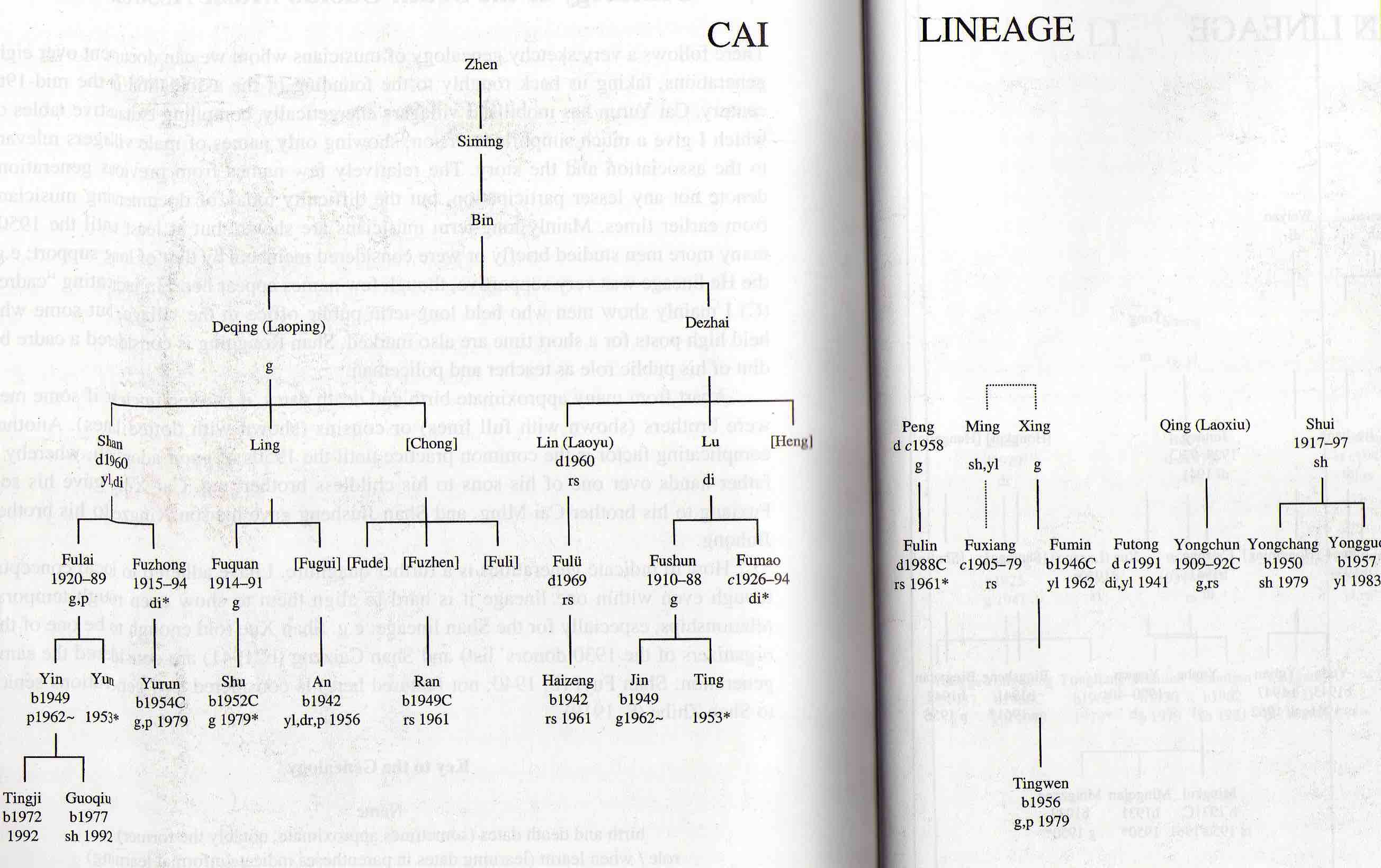
However, there was a certain continuity, and amateur qingyin activity persisted. Qi Kun gives instances from nine districts. She notes the more-or-less undisturbed observance of life-cycle rituals in the early 1950s, with lengthy processions; some groups even persisted performing for these contexts into the early 1960s.

The fortunes of musicians depended largely on their “class status”, but irrespective of this many were reduced to poverty. But there were ironies—as one performer commented:

People like Wen Zhengxiu who served as Daoist priests weren’t persecuted. Almost all of those Daoists smoked opium, so they had virtually no possessions at home, they could never become wealthy. So after Liberation they were classed as poor peasants. Instead it was honest people like us, who had toiled over several generations to accumulate family property, who were targets of punishment.

Such people now became the core of many qingyin groups.

Amidst the traumas of the Cultural Revolution, Qi Kun goes on to describe the maintenance of the qingyin style (if not its former context) in the Mao Zedong Thought propaganda troupes. Some troupes even used the traditional sizhu repertoire, like Xingjie, to accompany political processions.

And even now a certain amount of furtive recreational activity continued (again, cf. Yulin)—behind closed doors, some troupe members even sometimes dared invite former “landlords” and “rich peasants” to play the traditional repertoire along with them. Performers recall both the cruelty and the nuances of the period. Many of the troupe members became core elements in the revival of tradition from the late 1970s—for which, of course, the main factor was the amazing resurgence of ritual practice. Indeed, a modest revival was already under way before the overthrow of the Gang of Four in 1976.

qingyin JC

Qingyin bands in Fengxian, Jiading, and Baoshan. Source: Anthology.

In Chapter 4 Qi Kun takes the story on into the consumer age. After detailing the gradual revival (cf. my own notes on that of the Li family Daoists in Shanxi), she surveys a scene that is still more diverse than that before 1949, with recreational groups (now under semi-official leadership, with some even adopting the title “folk music band” minyuedui 民乐队!) now able to meet regularly, overlapping with occupational bands performing for customary observances. She gives a fine diary of the varied public activities of the Zhuqiao qingyin band from 1994 to 2003, as well as detailed notes on a 2002 wedding and on the grandest of ten funerals that she attended in 2004. Indeed, while such groups traditionally performed for weddings, their participation in funerals is a recent innovation.

funeral

Still, even with the revival, fewer performers are active than before 1949. Qi Kun also illustrates changes in ritual practice over the period with graphic tables. Here she compares figures for qingyin bands active around Nanhui in 1937–49 and in 2004, by district:

QK 326

For all periods, Qi Kun constantly notes the interaction of social, economic, political, and musical change—if only Chinese musicology would learn from such an approach, rather than banging on about heritage and living fossils!

mixin

Wall advertisement for the Tongxin qingyin band, Nanhui c2004. Source: Qi Kun, Jiangnan sizhu (2009).

The advertisement above reads:

Exclusive service for wedding and funerals: destroy superstition and be frugal—stylish and trendy.

I don’t know if this was a disingenuous response to a temporary campaign, but the social mood of the time was not exactly keen on destroying superstition or enacting frugality. Discuss

And suburban regions like Nanhui are anything but a rural backwater: they are inextricably tied to the global economic market of Shanghai. But exploring the environs always reveals a diverse picture.

That’s quite enough for one sitting—but zooming out still further, the instrumental volumes of the Anthology for Jiangsu province give an impression of such bands throughout the province:

  • Zhongguo minzu minjian qiyuequ, Jiangsu juan 中国民族民间器乐曲, 江苏卷 (1998).

Again its main rubrics are chuida, sizhu, and “religious music”.

And just south lies Zhejiang province… Aiyaa.

* * *

Shanghai silk-and-bamboo makes a comfortable repertoire that is too easily reified and detached from the wider society. Much as I have enjoyed visiting the Shanghai teahouses, there’s so much more to study, not only in the suburbs but all around south Jiangsu, where entertainment genres are always subsidiary to ritual! And the cast of ritual performers, here as elsewhere, is still more varied: Daoist ritual specialists, spirit mediums (very important in local society), devotional sectarian groups, and so on.

Like Beijing, Tianjin, Chongqing, and other municipalities, Shanghai is a vast region, the riches of whose expressive culture can hardly be encapsulated by simple labels. As usual, we have to look beyond the reified canons of idealized, “representative” “genres” (the Zhihua temple, the “eight great suites” of Shanxi, the Uyghur twelve muqam, and so on) and plunge into the complex world of changing local social activities.

[1] Among considerable research on xuanjuan, see e.g. articles in Dayin 大音 vols. 3, 4 and 5; Zhongguo quyi zhi, Jiangsu juan 中国曲艺志, 江苏卷; Qian Tiemin 钱铁民 (on Wuxi) in Zhongguo minjian yishi yinyue yanjiu, Huadong juan 中国民间仪式音乐研究, 华东卷 (2007) vol.1; Qiu Huiying 丘慧瑩, “Jiangsu Changshu Baimao diqu xuanjuan huodong diaocha baogao” 江蘇常熟白茆地區宣卷活動調查報告, Minsu quyi 169 (2010), pp.183–247; Li Shu-ju 李淑如, “Zhangjiagang diqu jianwang fahui yishi yu xuanjuan diaocha baogao” 張家港地區薦亡法會儀式與宣卷調查報告, Minsu quyi 204 (2019.6), pp.197–250. In English, see Mark Bender, “A description of ‘jiangjing’ (telling scriptures) services in Jingjiang, China”, Asian folklore studies 60 (2001), and ongoing work from Rostislav Berezkin, such as this, and an article with Vincent Goossaert.

[2] For a flavour [sic] of his recent musings, see “Timbre, taste and epistemic tasks: a cross-cultural perspective on atmosphere and vagueness”, in Friedlind Riedel and Juha Torvinen (eds), Music as atmosphere: collective feelings and affective sounds (2019), which sets forth from timbre and atmosphere in Shanghai silk-and-bamboo. While I like the title, and am happy to add the splendid acronym WEIRD (coined to describe “western, educated, industrialized, rich, and democratic” ethnocentrism) to my list, I may not be alone in finding some of his erudite theoretical discussion a tad arcane. That’s academia for you!

[3] Qi Kun also has related articles in Zhongguo minjian yishi yinyue yanjiu, Huadong juan (with film footage on the DVD), and the Dayin series (n.1 above).

[4] For Daoist ritual in Nanhui, see Zhu Jianming 朱建明 and Tan Jingde 谈敬德, Shanghai Nanhui xian Zhengyi pai daotan yu Dongyue miao keyiben huibian 上海南汇县正一派道坛与东岳庙科仪本汇编 (2006), and Zhu Jianming and Tan Jingde, Shanghai Nanhui xian Laogang xiang nongjia duqiao yishi yu qiao wenhua 上海南汇县老港乡农家渡桥仪式与桥文化 (1996); in Jiading and Chuansha counties, Zhu Jianming, Tan Jingde, and Chen Zhengsheng 陈正生, Shanghai jiaoqu daojiao jiqi yinyue yanjiu 上海郊区道教及其音乐研究 (2001; for the tangming groups, note pp.29–48); and in Shanghai county, Zhu Jianming, Shanghai xian Shengtang daoyuan jiqi taiping gongjiao kaocha jishi 上海县圣堂道院及其公醮考察纪实 (1993). See also a thoughtful review by Poul Andersen in Daniel Overmyer, Ethnography in China today, pp.263–83.

Lives in Stalin’s Russia

cover

Hand-in-hand with my focus on ritual and expressive culture, I have long been concerned to document life-stories—of ordinary people, artists, and scholars, both in China (cf. my detailed work on the Gaoluo villagers and the Li family Daoists) and Europe.

Under the Iron curtain tag (see also roundup here) I’ve broached life-stories under state socialism in the GDR (here and here), Czechoslovakia, and Ukraine (blind minstrels, and the famine)—and tribulations under the Soviet regime were the context for this post on ethnic minorities there. But now, reading

  • Orlando Figes, The whisperers: private lives in Stalin’s Russia (2007)

makes an accessible single-volume study to begin shedding light on my ignorance of ordinary lives in the Soviet Union. Apart from the importance of the topic in itself, I muse (as ever) on the similarities and differences with Maoist—and post-Maoist—China.

Many books describe the externals of the Terror—the arrests and trials, enslavements and killings of the Gulag—but The whisperers is the first to explore in depth its influence on personal and family life.

The oral history of family memory makes a counterweight to the official narrative (notes also Soviet lives at war). Figes interrogates the issues in interpreting such sources. His website, following on from his oral history project, is a treasury of related material. For significant caveats on the book, see here (with further links).

As the regime sought to erase the distinction between public and private life, Figes describes both the effectiveness of the Soviet indoctrination of children and the internal conflict with messages they gleaned from their families. The system taught dissimulation, producing duplicity and lifelong fear. As a survival strategy, people learned to wear a mask, going into “internal emigration”, leading double lives; they had to adjust to the system merely in order to survive. They learned not to talk: “whisperers” were both those who whispered out of fear of being overheard, and those who informed.

Figes details the effects of successive waves of repression, before, during, and after the Stalin regime from 1928 to 1953, interweaving many family histories throughout the book. The case of its central figure Konstantin Simonov, who “embodied all the moral conflicts and dilemmas of his generation”, though revealing in its complexity, is exceptional in his high profile as cultural cadre. The index, and the website, can be used to follow the stories of individual families throughout the book. The cast includes both cadres and the catch-all of “kulaks”, but seems more urban than rural—whereas China was more predominantly rural as late as the 1970s. Even early images of “kulaks” being expelled, and photos from the gulag (however manufactured), suggest that China was still more backward—and repressed—in the 1950s than Russia in the 1920s.

Exiles gulag Siberia 1933 101Exiles in a “special settlement” in western Siberia, 1933.

For Maoist China too, diverse sources can be assembled to modify and counter the official narrative, including memoirs, family photos and documents, local archives, and so on—note Sebastian Veg, Popular memories of the Mao eraMemoirs and biographical accounts have proliferated since the liberalizations of the 1980s. In film, recent projects such as laogai documentaries and Wu Wenguang’s Caochangdi Work Station are impressive. Also revealing are fictional portrayals—not just laogai novelists like Zhang Xianliang and Yan Lianke, but films such as The blue kite that suggest the everyday tribulations of ordinary families. But while there may be a comparable wealth of material for China, it’s hard to envisage such an accessible, personal, wide-ranging and diachronic account as The whisperers.

Illuminating his sources perceptively, Figes identifies clear periods in people’s fates under the Soviet regime. The repression took place over a longer period than that of Maoism, and may seem to have been even more terrifying. The gulag—among the extensive literature on which, see e.g. Anne Applebaum, Gulag: a history (2003)—looms larger in the public (and private) image of the USSR than the laogai system in China, although the latter has also become the subject of brave research. Executions, and the all-pervading NKVD, also seem to play a more common role in Soviet history.

Below I can only list some of the main themes of the book, rather than citing the many personal life-stories that illustrate them—which is actually its outstanding strength.

* * *

Figes opens with Children of 1917, on the early years of the revolution, and the beginnings of state indoctrination and the war on religion. In 1926 the peasantry represented 82% of the Soviet population—cf. China, where the rural population peaked at 84% in 1963. But urban populations grew rapidly. Families were dislocated; millions of children were abandoned, having to fend for themselves. Figes describes life at the camps. Some “kulaks” managed to flee from the camps, living on the run.

Young people renounced their relatives, for various motives.

As millions of people left their homes, changed their jobs, or moved around the country, it was relatively easy to change or reinvent one’s social class. People learned to fashion for themselves a class identity that would help them advance. They became clever at concealing or disguising impure social origins, and at dressing up their own biographies to make them seem more “proletarian”.

But they were haunted by the constant threat of exposure—many concealed their secrets right until the 1990s.

In The great break (1928–32) Figes describes the temporary relaxation in the assault against religion between 1924 and 1928:

On 2 August 1930, the villagers of Obukhovo celebrated Ilin Day, an old religious holiday to mark the end of the high summer when Russian peasants held a feast and said their prayers for a good harvest. After a service in the church, the villagers assembled at the Golovins, the biggest family in Obukhovo, where they were given home-made pies and beer inside the house while their children played outside. As evening approached, the village dance (gulian’e) began. Led by a band of balalaika players and accordionists, two separate rows of boys and girls, dressed in festive cottons, set off from the house, singing as they danced down the village street.

Thereafter, while clandestine belief may have persisted, I find rather few clues to any public religious (or even customary) activity—by contrast with Maoist China, where it kept resurfacing despite constant campaigns. Am I wrong to see local Chinese populations as more resilient in maintaining their expressive culture under Maoism? Still in Obukhovo:

That year the holiday was overshadowed by violent arguments. The villagers were bitterly divided about whether they should form a collective farm (kolkhoz), as they had been ordered by the Soviet government. […] There were terrifying tales of soldiers forcing peasants into the kolkhoz, of mass arrests and deportations, of houses being burned and people killed, and of peasants fleeing from their villages and slaughtering their cattle to avoid collectivization.

Kulaks exiled 1930s 89“Kulaks” exiled from the village of Udachne, Khryshyne (Ukraine), early 1930s.

As Figes explains:

During just the first two months of 1930, half the Soviet peasantry (about 60 million people in over 100,000 villages) was herded into the collective farms. […] Peasants who spoke out against collectivization were beaten, tortured, threatened, and harassed, until they agreed to join the collective farm. Many were expelled as “kulaks” from their homes and driven out of the village. The herding of the peasants into the collective farms was accompanied by a violent assault against the Church, the focal point of the old way of life of the village, which was regarded by the Bolsheviks as a source of potential opposition to collectivization. Thousands of priests were arrested and churches were looted and destroyed, forcing millions of believers to maintain their faith in the secrecy of their own homes. […]
There was surprisingly little peasant opposition to the persecution of the “kulaks”. […] The majority of the peasantry reacted to the sudden disappearance of their fellow villagers with passive resignation born of fear.

Golovins 1940s 78Yevdokiia and Nikolai with their son Aleksei Golovin (1940s).

In Obukhovo the Golovins were deported on 4th May 1930:

I recall the faces of the people standing there. They were our friends and neighbours—the people I had grown up with. No-one approached us. No-one said farewell. They stood there silently, like soldiers in a line. They were afraid.

Still,

There was widespread resistance to collectivization, even though most villagers acquiesced in the repression of “kulaks”. In 1929–30, the police registered 44,779 “serious disturbances”. Communists and rural activists were killed in their hundreds, and thousands more attacked. There were peasant demonstrations and riots, assaults against Soviet institutions, acts of arson and attacks on kolkhoz property, protests against closures of churches.

Figes unpacks the motives of those responsible for enforcing the brutal war against the peasantry.

Under The pursuit of happiness (1932–36), while observing brief concessions to consumer culture (promoting perfume, cosmetics, fun), he evokes urban projects like the construction of the Moscow metro from 1932, using peasant immigrants and gulag prisoners:

The splendour of these proletarian palaces, which stood in such stark contrast to the cramped and squalid private spaces in which the majority of people lived, played an important moral role (not unlike the role played by the Church in earlier states).

But popular unrest continued. The rise of a new bureaucratic elite also caused discontent:

In 1932, a manager at Transmashtekh, a vast industrial conglomerate, wrote to the Soviet President Mikhail Kalinin:

The problem with Soviet power is the fact that it gives rise to the vilest type of official—one that scrupulously carries out the general designs of the supreme authority… This official never tells the truth, because he doesn’t want to distress the leadership. He gloats about famine and pestilence in the district or ward controlled by his rival. He won’t lift a finger to help his neighbour… All I see around me is loathsome politicizing, dirty tricks, and people being destroyed for slips of the tongue. There’s no end to the denunciations. You can’t spit without hitting some revolting denouncer or liar. What have we come to? It’s impossible to breathe. The less gifted a bastard, the meaner his slander. Of course the purge of your Party is none of my business, but I think that as a result of it, decent elements still remaining will be cleaned out.

Figes notes the “hierarchy of poverty”. And meanwhile the lives of women failed to improve:

For women nothing changed in the 1930s—they worked long hours at a factory and then did a second shift at home, cooking, cleaning, caring for the children on average for five hours every night—whereas men were liberated from most of their traditional domestic duties (chopping wood, carrying water, preparing the stove) by the modernization of workers’ housing, which increased the provision of running water, gas, and electricity, leaving them more time for cultural pursuits and politics.

Trotsky had trenchant views on sexual politics:

One of the dramatic chapters in the great book of the Soviets will be the tale of the disintegration and breaking up of those Soviet families where the husband as a Party member, trade unionist, military commander or administrator, grew and developed and acquired new tastes in life, and the wife, crushed by the family, remained on the old level. The road of the two generations of Soviet bureaucracy is sown thick with the tragedies of wives rejected and left behind. The same phenomenon is now to be observed in the new generation. The greatest of all crudities and cruelties are to be met perhaps in the very heights of the bureaucracy, where a very large percentage are parvenus of little culture, who consider that everything is permitted to them. Archives and memoirs will some day expose downright crimes in relation to wives, and to women in general, on the part of those evangelists of family morals and the compulsory “joys of motherhood”, who are, owing to their position, immune from prosecution.

Figes documents the constrained domestic spaces of urban dwellers, and the tensions caused by lack of privacy, with some fine room plans.

Above, left: Khaneyevsky household, Moscow; right: Reifshnieders’ room, Moscow.
Below, left: Nikitin and Turkin apartments, Perm; right: Bushuev “corner” room, Perm.

In later years many people felt a rose-tinted nostalgia for the pre-war years, when

Everybody helped one another, and there were no arguments. No-one was stingy with their money—they spent their wages as soon as they were paid. It was fun to live then. Not like after the war, when people kept their money to themselves, and closed their doors.

But, as in China (where many peasants felt an equally perplexing nostalgia for the commune system), there’s ample evidence for the contrary view of communal life:

It was a different feeling of repression from arrest, imprisonment, and exile, which I’ve also experienced, but in some ways it was worse. In exile one preserved a sense of one’s self, but the repression I felt in the communal apartment was the repression of my inner freedom and individuality. I felt this repression, this need for self-control, every time I went into the kitchen, where I was always scrutinized by the little crowd that gathered there. It was impossible to be oneself.

Still, millions of people were taught to believe that

hard work today would be rewarded tomorrow, when the “good life” would be enjoyed by all.

Though the mid-1930s have been regarded as the calm before the storm,

for millions of people whose families were scattered in the Gulag’s labour camps and colonies, these years were as bad as any other.

Kondratiev 1938 226Nikolai Kondratiev’s last letter to his daughter, 1938.

In The great fear (1937–38), Figes explains that the Terror was not a routine wave of mass arrest, but a calculated policy of mass murder. Among the complex reasons prompting Stalin’s purge was the imminent threat of war. Not just the direct “offenders” but also their kin were hunted down. The motives of the informers, often themselves under extreme pressure, were also complex.

In 1938, the NKVD chief Yezhov was deposed. “The real reason for Yezhov’s fall was Stalin’s growing sense that mass arrests were no longer a workable strategy. At the rate the arrests were going, it would not be long before the entire Soviet population was in jail.” Under his successor Beria the purge was scaled down.

Fear brought out the worst in people. Yet there was also acts of extraordinary kindness by colleagues, friends, and neighbours, sometimes even strangers, who took enormous risks to help the families of “enemies of the people”. […]
The disappearance of a father and a husband placed enormous strain on families. Wives renounced husbands who had been arrested, not necessarily because they thought their spouses might be “enemies of the people”, although they may have had that thought, but because it made survival easier and gave protection to their families (many husbands for this reason advised wives to renounce them). […] It took extraordinary resilience, and not a little bravery, for women to resist these pressures and stand by their husbands.

There is scant consolation in Remnants of terror (1938–41) on the eve of the German invasion. Figes praises the untold acts of heroism of grandmothers striving to keep together the scattered remains of repressed families.

Lebeva 1940 322Elena Lebedeva with her granddaughters, Natalia (left) and Elena Konstantinova,
Ak-Bulak, 1940.

But many children ended up in orphanages, roamed the streets begging, joined street gangs, or were themselves sent to children’s labour colonies.

Meanwhile, in a Nazi–Soviet pact that alarmed faithful Communists, both Germany and the Red Army invaded Poland, and the USSR pressurized the Baltic states to accept pacts of “defence and mutual assistance”, extending the reach of their reign of terror.

The theme of Wait for me (1941–45) is the social consequences of the sudden German invasion of the USSR in 1941. Apart from its global significance, it was also crucial for the maintenance of the Soviet regime. Stalin now had no choice but to call for unity, setting aside class struggle and ideology. Many saw that the whole climate of the Terror had played a major role in the USSR’s initial inability to resist the invasion; criticism became open (some even welcomed the prospect of a German victory), and arrests continued.

But the desperate need for self-defence did indeed foster a spirit of national unity. The horrors of war against a brutal external enemy helped people forget, for now, the misery of their situation during “peacetime”. Patriotic morale even produced a new merging of the public sphere and the intimate world of personal relationships.

As the tide turned, the Red Army chased the Germans back. Convinced by the courageous determination of the Soviet forces, Figes seeks to explain it. Terror and coercion played a role, but

Appeals to the patriotism of the Soviet people were more successful. The vast majority of Soviet soldiers were peasant sons; their loyalty was not to Stalin or the Party, which had brought ruin to the countryside, but to their homes and families, to their own vision of the “motherland”.

The image of Mother Russia was promoted; controls over religion were temporarily relaxed. Hatred of the enemy was also an important element. But most significant, Figes suggests, was the cult of personal sacrifice:

As Simonov remarked, the people were prepared for the privations of the war—the sharp decline in living standards, the breaking up of families, the disruption of ordinary life—because they had already been through much the same in the name of the Five Year Plans.

Still,

Contrary to the Soviet myth of wartime national unity, Soviet society was more fractured during the war than at any previous time since the Civil War. Ethnic divisions had been exacerbated by the Soviet state, which scapegoated certain national minorities, such as the Crimean Tatars, the Chechens, and the Volga Germans, and exiled them to regions where they were not welcomed by the local populace. Anti-Semitism, which had been largely dormant in Soviet society before the war, now became widespread. It flourished especially in areas occupied by Hitler’s troops, where a large section of the Soviet population was directly influenced by the Nazis’ racist propaganda, but similar ideas were imported to places as remote as Kazakhstan, Central Asia, and Siberia by Soviet soldiers and evacuees from the western regions near the front.

Even so, people united for the defence of their local communities. And soldiers found camaraderie:

Veterans recall the intimacy of these wartime friendships with idealism and nostalgia. They claim that people then had “bigger hearts” and “acted from the soul”, and that they themselves were somehow “better human beings”, as if the comradeship of the small collective unit was a cleaner sphere of ethical relationships and principles than the Communist system, with all its compromises and contingencies. They often talk as if they found in the collectivism of these groups of fellow soldiers a type of “family” that was missing from the lives before the war (and would be missing afterwards).

Zinaida 1942 357Left: Zinaida Bushueva with her brothers, 1936.
Right: Zinaida (centre) in ALZhIR, 1942. A rare private photograph of Gulag prisoners, it was taken to send to relatives. The three women were photographed together to reduce the costs.

During the war the exploitation of the Gulag labour force intensified—in 1942 one in four Gulag workers died.

As Pasternak would write in the epilogue of Doctor Zhivago (1957), “When the war broke out, its menace of real death, were a blessing compared to the inhuman power of the lie, a relief because it broke the spell of the dead letter.” The relief was palpable. People were allowed to act in ways that would have been unthinkable before the war. By necessity, they were thrown back on their own initiative—they spoke to one another and helped each other without thinking of the political dangers to themselves, and from this spontaneous activity a new sense of nationhood emerged. The war years, for this reason, would come to be recalled with nostalgia.

The years 1941 to 1943 were described as a period of “spontaneous de-Stalinization”. People were empowered to think critically; a new freedom of expression even included political debate. The revival of religious activity continued through to 1948. Still, over the whole period cultural and religious life at a distance from urban centres remains somewhat obscure.

All this marked the beginning of a fundamental change of values. Towards the end of the war, as the Red Army entered Europe, their encounter with conditions there—clearly superior even amidst its desperately ravaged state, to which indeed they contributed further—also allowed them to question Soviet propaganda. And like the British, their experiences gave them ideals of building a better society—in their case, dismantling the collective farms, establishing democracy and religious freedoms. “Party leaders were understandably anxious about the return of all these men with their reformist ideas.” Such liberal notions were anyway spreading among civilians, not least as a result of the alliance with Britain and the USA.

As Ilia Ehrenburg wrote,

Everybody expected that once victory had been won, people would know real happiness. We realized, of course, that the country had been devastated, impoverished, that we would have to work hard, and we did not have fantasies about mountains of gold. But we believed that victory would bring justice, that human dignity would triumph.

Their hopes were soon dashed.

The ending of the war coincided with the first mass release of prisoners from the Gulag. […] Families began to piece themselves together again. Women took the lead in this recovery, sometimes travelling across the country in search of husbands and children. There were tight restrictions on where former prisoners could live. Most of them were banned from residing in the major towns. So families who wanted to be together often had to move to remote corners of the Soviet Union. Sometimes the only place they could find to settle was in the Gulag zone.

But the Gulag population actually expanded in the years after the war, with forced labour making a significant element in the economy.

People were damaged; fear, and silence, still reigned. All this also makes even more remarkable the widespread telling of political jokes, throughout the whole period.

The post-war period is the subject of Ordinary Stalinists (1945–53).

No other country suffered more from the Second World War than the Soviet Union. According to the most reliable estimates, 26 million Soviet citizens lost their lives (two-thirds of them civilians) […] and 4 million disappeared between 1941 and 1945. […] The demographic consequences of the war were catastrophic. Soviet agriculture never really recovered from this demographic loss. The kolkhoz became a place for women, children, and old men.

The material devastation was grievous too. Another famine occurred from 1946 to 1948. The brief improvement in the supply of consumer goods before the war was a distant memory. With people no longer afraid to express their discontent, strikes and demonstrations broke out. But as the new threat posed by the Cold War developed, Stalin moved promptly to purge the army and Party leadership, and to rule out any idea of political reform. Censorship was tightened; the new wave of dissent had to continue underground.

Left: Inna Gaister (aged 13) with her sisters Valeriia (3) and Natalia (8), Moscow, 1939. The photograph was taken to send to their mother in the Akmolinsk labour camp (ALZhIR).
Right: Inna Gaister (centre) with two friends at Moscow University, 1947.

But a new type of middle class now emerged, better educated and less ideological in outlook—though they had to conform, at least outwardly, to the demands of the regime, perfecting the art of wearing masks. Figes gives more stories of informants. Valentina Kropotina made her whole career by informing. With her “kulak” background,

I was basically a street-child, dressed in rags, barefoot… All my childhood memories are dominated by the feeling of hunger… I was afraid of hunger, and even more, of poverty. And I was corrupted by this fear.

She felt no remorse for what she did. Still,

The “little terror” of the post-war years was very different from the Great Terror of 1937–8. It took place, not against the backdrop of apocalypse, when frightened people agreed to betrayals and denunciations in the desperate struggle to save their lives and families, but against the background of a relatively mundane and stable existence, when fear no longer deprived people of their moral sensibility.

Anti-Semitism, always latent, escalated along with the “anti-cosmopolitan” campaign. When Stalin died in 1953, even some victims of the Terror felt genuine sorrow, but

The mourning ceremonies in Krasnodar were more like a holiday. They put on a mournful face, but there was a sparkle in their eyes, the hint of a smile beneath their greeting, that made it clear that they were pleased.

Even so, there was still no release from fear—indeed, people were anxious for the future. Beria played a role in allaying such fears, though he was soon executed in a Kremlin coup organized by Kruschev. Hopes were high among Gulag inmates; new demonstrations broke out, which helped bring about the abolition of the system. About 40% of the gulag population were released in an amnesty on 27th March 1953—though they returned to their families physically and mentally broken. The climate in the Soviet Union also led to the serious demonstrations that erupted in the GDR.

The story continues in Return (1953–56).

The family emerged from the years of terror as the one stable institution in a society where virtually all the mainstays of human existence—the neighbourhood community, the village and the church—had been weakened or destroyed. For many people the family represented the only relationship they could trust, the only place they felt a sense of belonging, and they went to extraordinary lengths to reunite with relatives.

But former prisoners found it hard to build relationships, to find jobs and places to live. They still had to confront those who had betrayed them, although they also understood the extreme pressures that had led them to do so. The process of rehabilitation was laborious. And millions never returned from the camps.

Kruschev’s denunciation of Stalin in 1956 made a decisive break, the beginnings of the reformist thaw. Still, Stalin, rather than the whole system, was the scapegoat. But it also had consequences for the countries of east Europe, notably with the Hungarian uprising that year.

And just as the worst was over in the USSR, China systematically repeated its deadly mistakes. Dikötter outlines many of the same features of life under Maoism, but his treatment is less personal.

As Figes describes in the final chapter, Memory (1956–2006), even after 1956, the vast majority of ordinary people were still too cowed and frightened by the memory of the Stalinist regime to speak out openly. The thaw ended when Brezhnev replaced Kruschev in 1964; as dissidents were persecuted, people again suppressed their traumatic memories. Stoicism and passivity became enduring social norms.

But nostalgia for the war persisted, even overriding other assessments of the system. Viacheslav Kondratiev recalled:

For our generation the war was the most important event in our lives, the most important. This is what we think today. So we are not prepared to belittle in any way the great achievement of our people in those terrifying, difficult, and unforgettable years. The memory of our fallen soldiers is too sacred, our patriotic feelings are too pure and deep for that.

Eventually more candid memories of the war surfaced, such as the 1975 film A soldier went. A whole Gulag literature emerged.

Unlike the victims of the Nazi war against the Jews, for whom there could be no redeeming narrative, the victims of Stalinist repression had two main collective narratives in which to place their own life-stories and find some sort of meaning for their ordeals: the survival narrative, as told in the memoir literature of former Gulag prisoners, in which their suffering was transcended by the human spirit of the survivor; and the Soviet narrative, in which that suffering was redeemed by the Communist ideal, the winning of the Great Patriotic War, or the achievements of the Soviet Union.

Figes reflects on the startling paradox in the later myth of Norilsk,

a large industrial city built and populated by Gulag prisoners, whose civic pride is rooted in their own slave labour for the Stalinist regime,

as well as the popular nostalgia for Stalin (and again we might compare the Chinese nostalgia for Mao—see also here), which

reflects the uncertainty of their lives as pensioners, particularly since the collapse of the Soviet regime in 1991; the rising prices that put many good beyond their means; the destruction of their savings by inflation; and the rampant criminality that frightened old people in their homes.

However,

nostalgia notwithstanding, the ruinous legacies of the Stalinist regime continued to be felt by the descendants of Stalin’s victims many decades after the dictator’s death. It was not only a question of lost relationships, damaged lives and families, but of traumas passed from one generation to the next. […]
Even in the last years of the Soviet regime, in the liberal climate of glasnost, the vast majority of Soviet families did not talk about their histories, or pass down stories of repression to their children. […] Fifteen years after the collapse of the regime, there are still people in the provinces who are afraid to talk about their past, even to their own children.

Again, the Chinese parallel is interesting: whereas the Soviet “liberation” occurred after over seventy years of repression, in China “reform and opening” not only happened earlier, following the collapse of Maoism in the late 1970s, but came after a mere thirty years of state repression. Both Russia and China suffered grievously under invasion and warfare; and for both, the hard-earned victory came to form a cornerstone of the national image. But whereas in China the war set the scene for the Communist takeover and the people finally “standing up”, in Russia it made an interlude within a system in which repression was already deeply entrenched; it seemed to offer hopes for reform, which were soon thwarted. In China too the lid on popular expression of trauma remained quite tightly sealed, though as Sebastian Veg notes, “after a period of post-traumatic outpour, followed by commodified nostalgia, popular memory in recent years has shown signs of moving towards more critical discussions.” But both Chinese and Russian regimes continue to devise new forms of repression.

* * *

In my post on Bloodlands (n.2) I mentioned attempts to compare death tolls under Hitler, Stalin, and Mao—in ascending order, it seems. As Timothy Snyder wrote,

it turns out that, with the exception of the war years, a very large majority of people who entered the Gulag left alive. Judging from the Soviet records we now have, the number of people who died in the Gulag between 1933 and 1945, while both Stalin and Hitler were in power, was on the order of a million, perhaps a bit more. The total figure for the entire Stalinist period is likely between two million and three million. The Great Terror and other shooting actions killed no more than a million people, probably a bit fewer. The largest human catastrophe of Stalinism was the famine of 1930–1933, in which more than five million people died.

But appalling are the death tolls, they are far from the whole story. Now that I read Figes’s account, it seems callous and irrelevant to dwell on such statistics.

With my classical, mystical background, it took me a long time to appreciate the importance of all this—and it may still elude younger people in the UK, Russia, and China. But having long focused on the life-stories of Chinese ritual specialists and their patrons, I continue to find such accounts an illuminating perspective on modern history, for China and elsewhere.

Italian cinema: a golden age

Giulietta Masina—left, La strada; right, Notti di Cabiria.

To follow folk musicking in Italy, I’m reminded again of formative film experiences from my misspent youth.

Like fiction, feature films can often suggest perspectives that more forensic academic treatments fail to evoke (cf. the GDR and China). In the post-war period, as Europe—including the east—struggled to recover, in Italy a vast migration took place from the poor south to the industrial north. Meanwhile China was in the grip of collectivization and famine.

A dominant theme of early neo-realist films was deprivation. The moving Ladri di biciclette (Vittorio De Sica, 1948) is a reminder how effective it can be to cast amateur actors:

Gelsomina
I recalled La strada (Federico Fellini, 1954) when the Li family Daoists performed at a circus in Paris during their 2017 French tour. While Nino Rota’s score is effective, Petrushka, with its trumpet solo and drum interludes, might have made a suitable soundtrack too.

A tribute to Giulietta Masina is in order. Her persona has been likened to Charlie Chaplin, and her role in La strada as an innocent itinerant street performer is most beguiling—despite the stereotype of the “gamine” “elfin waif” (quite different from that of Audrey Hepburn). And her role as Fellini’s “muse” is another trope unpacked by feminists:

The image of the Muse as loved object who inspires the male artist, whilst she herself remains silent, is deeply engrained in contemporary culture, despite the best efforts of feminist critics to expose the implications of such imagery: man creates, woman inspires; man is the maker, woman the vehicle of male fantasy, an object created by the male imagination, incapable of any kind of agency herself. In short, this image of the Muse denies woman’s active participation in artistic creation and silences female creativity. [1]

Masina is also wonderful in Notti di Cabiria (1957)—despite again being exploited by callous men. Here’s the moving final scene:

The making of Fellini’s La dolce vita (1960) is the subject of a 2017 book. The stellar cast includes not only Marcello Mastroianni and Anita Ekberg, but early roles for Nico and the divine Anouk Aimée, always captivating (cf. here). As England progressed from adversity to the drabness of the 1950s, the image of Rome rapidly became fashionable. Whereas Fellini doubtless meant La dolce vita as a critique of the vacuity of the glamorous lifestyle, “over the years, the inverted commas and irony have dropped away”, leaving only “Vespas! Bikinis! Grappa!”.

DV

Anouk Aimée with Federico Fellini and Marcello Mastroianni.

Long before I began to experience Italy at first hand, films like these made a deep impression, which keeps growing.


[1] Penny Murray, “Reclaiming the Muse”, in Vanda Zajko and Miriam Leonard, Laughing with Medusa: classical myth and feminist thought (2008).

Italy: folk musicking

Italy map

With our common image of Italy dominated by elite culture, it may seem to make a less obvious fieldsite for folk traditions than east Europe. But as I observed in my jottings from Lisbon (and in my posts on flamenco in Spain, starting here), there’s far more to musicking than opera houses and symphony orchestras. Even the court musical cultures of Italy were regional—there was no “Italy” until 1860, and regional consciousness still persists. As in China, where the “conservatoire style” dominates the media, the image of the iceberg is useful.

Local folk traditions are a major part of people’s social experience today, as throughout earlier history—alongside more elite productions such as the painting and sculpture, art music and opera that dominate our image of Italian culture (for early modern Europe, see here). Some regions show little or no influence from art music, others more. But we should adjust from our image of Barbara Strozzi and Artemisia Gentileschi [PC gone mad—Ed.] [What you gonna do about it? SJ], Verdi and Monteverdi, La Scala, and so on.

In Italy—whose population of around 60 million is comparable with a single province of China!—we find the usual interplay between general surveys “gazing at flowers from horseback” and detailed studies of one particular community. As ever, we may start with The New Grove dictionary of music and musicians, and The Garland encyclopedia of world music. Alessio Surian’s article for The Rough Guide to world music pays attention to the more recent roots scene, and Italy features regularly in Songlines.

I’ve already outlined some issues in the taxonomy of expressive culture in China (e.g. here). In her Grove article on Italian folk music, Tullia Magrini essayed a broad classification by style and structure rather than by region or context:

  • Narrative-singing (ballad, broadside ballad, storia, Sicilian orbi, and so on)
  • Lyrical singing
  • Others: including children’s songs and lullabies, work songs, polyphonic songs for entertainment (cf. Voices of the world).

After reverting to context in her penultimate category:

  • Ritual music—always among the most interesting rubrics, including life-cycle and calendrical rituals (the latter including carnival and Passion).

she concluded by outlining

  • dances and instruments—the latter including not only piffero and ciaramella shawms (for links to posts on shawms around the world—China, Tibet, south Asia, the Middle East, north Africa, Europe—click here) with bagpipe (piva) and the distinctive Sardinian launeddas, but also northern violin traditions.

* * *

The fascist era discouraged meaningful study of folk traditions, so serious research began in the 1950s, as society continued to change. Gramsci’s contrast between subaltern and hegemonic cultures inspired the ground-breaking collaborations of Diego Carpitella with Ernesto De Martino and Alan Lomax.

Carpitella’s work with De Martino features in my post on taranta, which includes both their footage of taranta in Salento (1959) and funeral laments in Basilicata (1952). See also Healing with violin in the heel of Italy.

Lucania

Meanwhile—just as Chinese fieldworkers were busy documenting their own regional traditions—Carpitella was also working with Alan Lomax (who said the 1950s were boring?!). Their 1954–56 audio recordings were published in 1958 as Folk music and song of Italy, and reissued (notes here). Many of the tracks are remarkable—such as Alla campagnola, a polyphonic love song sung by women of Ferroletto in Calabria while working in the fields, with both harmonies and unison cadential pitches taking one by surprise:

Moving north, the album also includes stornelli from Tuscany, a bagpipe saltarello from Citta Realle in Lazio, and a dance song from Val di Resia in Friuli.

For a review of more albums in the Lomax collection, see here. Italy was among the fields where he developed his ambitious Cantometrics project, exploring the links between styles of singing and social structures (see also Voices of the world). For his work with Zora Neale Hurston in the American South, see here. And for his remarkable archive, click here.

The pioneering work of Lomax and Carpitella inspired many impressive series of audio recordings on labels like Folkways, Dischi del sole, Albatros, I suoni (Fonit Cetra), and Ethnica. Meanwhile Carpitella edited the important journal Culture musicali (and I’m keen to read his analysis of The Rite of Spring!).

Following in their footsteps, among luminaries in Italian ethnomusicology were Roberto Leydi and Tullia Magrini, under whom such studies took root in Bologna. And as a welcome change from all those gondolas, Venice has become a lively centre for the promotion of folk cultures of Italy and further afield, with the Fondazione Cini, and ethnomusicologists Giovanni Giuriati and Giovanni de Zorzi (for an instance of the latter’s explorations, see here).

Despite all the “cultural homogenisation” epitomised by the vacuous inanities of Burlesque-only TV, RAI has played a role in promoting regional cultures.

The south
The Mediterranean south has remained poor—Puglia, Basilicata, Calabria, as well as Campania, all have deep local traditions (for pizzica, see herehere, and here).

Again, Lomax and Carpitella made some fine recordings in Campania:

And apart from Sardinia (which I introduced here), Sicily is a rich field, introduced in early work by Giulio Fara and much studied since (see also Songs of Sicily). Further east, see Musics of Crete.

Central Italy and the north
The poor south, attractive by virtue of its “otherness”, attracts a wealth of documentation; but the more affluent north also has significant pockets of folk activity. Roberto Leydi and others erased the old bias that considered the northern regions “corrupted” by economic and social development.

Fieldworkers have found distinctive traditions around Lazio, Abruzzo, Tuscany, Umbria, Le Marche, and Emilia. Tullia Magrini made a special study of the Maggio drammatico (cf. Morris dancing in England!). Note also her edited volume Music and gender: perspectives from the Mediterranean (2003).

All along the northern border of Italy, local traditions have been documented around Piedmont, Liguria, Lombardy, Veneto, Trentino, and Friuli. Again, we can consult the recordings of Lomax and Carpitella, with this 1972 LP from Piedmont, Emilia, and Lombardy:

In Ponte Caffaro, Brescia, fiddle bands accompany carnival:

The films of Renato Morelli are also impressive—see this trailer for Voci alte, on the festival of Premana in Lombardy.

In the 1990s, as another perk of my touring life, during interludes from playing Mozart opera in Parma and Ferrara I visited cultural offices there for a taste of their work documenting local folk traditions—somewhat evoking my exploratory visits to their counterparts in China. While doing gigs in Genova I also found trallalero choirs:

In the northeast, traditions are related to Slavic culture, with dances accompanied by violins or the piva bagpipe. Here’s a 1983 clip from Val di Resia in Friuli:

Collectors have also worked with emigrant communities (cf. Accordion crimes). Alan Lomax and Carla Bianco issued a fascinating album of their 1963–64 recordings in New York and Chicago (liner notes here), with a sequel recorded by his daughter Anna in New York, New Jersey, and Rhode Island (playlist here)—from the latter, here’s a duet with piffero and ciaramella:

This may not immediately spring to mind when thinking of the soundscape of 60s’ New York.

And having long been a land of emigration, and internal migration (from rural south to industrial north), Italy is now also a vexed site for immigration, which will further enrich the picture.

While I’m not venturing into the roots scene here, it seems obligatory to cite Fabrizio De André’s wildly popular Crêuza de mä (1984), sung in Genovese dialect (here with Italian subtitles):

See also Bella ciao.

* * *

All the energy in making audio recordings was admirable, helping us focus on the remarkable variety of regional soundscapes: both vocal and instrumental tracks are stunning. But it tended to entrench an image of disembodied, reified sound documents; the later shift towards visual anthropology places a greater stress on musicking in society. At LEAV in Milan Nicola Scaldaferri leads splendid collaborative projects, such as Musica Lucana and the Maggio in Accettura. And here’s a trailer for Rossella Scillacci’s fine 2007 ethnographic film Pratica e maestria on the zampogna in Basilicata:

* * *

Here, as often, I can only “gaze at flowers from horseback”, but all this is a reminder that as in China, England, and everywhere, popular regional traditions persist alongside more elite cultures, changing along with society and encouraging us to revise a narrow concept of “culture”.

Ethnography at home: Morris dancing

female dancers

Esperance dancers. Source: EFDSS, via https://frootsmag.com/hoyden-morris.

Why bother traipsing halfway around the world, I hear you ask, when our very own Sceptered Isle offers such potential for pursuing the local ethnography of seasonal ritual?

Our folk culture may be a rich and ever-evolving topic, but Morris dancing has long been a national joke. Here I’ve churlishly suggested it as a suitably disturbing English riposte to the magnificent All-Black haka. I suddenly understand why some Chinese people may initially be reluctant to engage with their folk culture (see e.g. here and here).

Morris dancing comes round every so often as a drôle topic for media coverage—this article by A.A. Gill may not impress academics, but it’s brilliant, evocative, and strangely respectful writing.

I’m reminded of the topic again by a recent BBC4 programme, engagingly titled For folk’s sake.

One could almost mistake the May procession, with its bowery palanquin,
for a rain ritual in Shaanbei.

Now, I take a keen interest in calendrical rituals—indeed, as Easter week approaches, Bach is in store, and it’s a busy season for ritual in China too. But I’m not alone in tending to consign Morris dancing, with its incongruous juxtaposition of hankies, bells, and silly hats with beards and beer, to a long list of embarrassing genteel eccentricities of the English, along with The Archers. But like any social activity performed by Real People it deserves serious study, in the context of social change in England since the Industrial Revolution, and even a preliminary exploration is fascinating. [1]

The wiki entry makes a useful starting point. Whatever the etymological connection between Morris and Moorish, it does seem, Like Life (cf. Stewart Lee), to have come from abroad. It’s part of a group of genres that includes mummers’ plays, sword and stick dances, and so on.

Gender and class
Though there is evidence of female Morris dancers as early as the 16th century, male groups predominated. I’d like to learn more about the 19th-century decline; anyway, by the early 20th century the women who soon became the driving force of Morris learned from surviving male performers. From wiki:

Towards the end of the 19th century, the Lancashire tradition was taken up by sides associated with mills and nonconformist chapels, usually composed of young girls. These lasted until the First World War, after which many mutated into “jazz dancers” [note the cryptic quotes].

Mary NealAfter severe losses in World War One (when some entire village sides were killed) the female dominance increased, with women now teaching men.

In 1895 Mary Neal (1860–1944; website here; see also Lucy Neal’s project and this nice article) founded the Espérance Club, a dressmaking co-operative and club to enrich the lives of young working-class girls in London:

No words can express the passionate longing which I have to bring some of the beautiful things of life within easy reach of the girls who earn their living by the sweat of their brow… If these Clubs are up to the ideal which we have in view, they will be living schools for working women, who will be instrumental in the near future, in altering the conditions of the class they represent.

Cecil Sharp (1859–1924) first experienced Morris at Headington Quarry in 1899. Mary Neal began working with him in 1905, but their outlooks conflicted, and she soon joined the WSPU (for the Espérance’s modern reincarnation, see here). Vic Gammon encapsulates the conflict in his review of Georgina Boyes’s The imagined village culture:

Mary Neal, middle-class reformer, socialist, and suffragette who sees the possibility of reviving folk dance among working-class girls in north London, is defeated by Cecil Sharp, professional musician, Fabian, and misogynist who spread the activity of folk dancing among the young genteel, making vernacular arts fit bourgeois aesthetics.

These clips from 1912 feature the sisters Maud and Helen Karpeles, co-founders of the English Folk Dance and Song Society, as well as Cecil Sharp, and George Butterworth, who died in the Battle of the Somme:

But as in the world of work, male groups soon came to dominate again. The all-male Morris Ring was founded by six revival sides in 1934. And between the wars, for John Eliot Gardiner’s father Rolf “mysticism, misogyny, and Morris dancing formed a coherent whole in which nostalgia was a spur to action”. Whether he would have approved of The Haunted Pencil, with his AfD comrades, I couldn’t possibly comment.

Meanwhile Stella Gibbons and Elisabeth Lutyens took a more cynical view of genteel “folky-wolky” representations of English folk culture (note also Em creeps in with a pie).

Following World War Two, and particularly in the 1960s, there was an explosion of new dance teams, with some women’s or mixed sides. A heated debate emerged over the propriety and even legitimacy of women dancing the Morris; and mainly on the left, critics disputed the method of Sharp’s work as they pondered the perilous concept of “tradition” (as they do). But as in most walks of life, despite bastions of male conservatism, the creative participation of women is again becoming a major driving force, as you can see in this fine article by Elizabeth Kinder.

Boss Morris

Click here for a short clip from Berkhamstead in 1950, with pipe and tabor sadly mute. And this was filmed in Thaxted (“hub of the universe”), c1958—just as collectivization was leading to calamitous famine in China:

All this may seem quaint at any period, but all the more so in the Swinging Sixties. For folk’s sake shows glimpses of a 1966 festival at Thaxted—just as revolution (not least the Cultural Revolution) was in the air, alongside jazz, soul, the Beatles… The Saddleworth rushcart festival features in For folk’s sake—here’s a clip from 2014:

And as with folk traditions in China and worldwide, Morris survives alongside newer genres like punk (for punk in Beijing, see here).

holm

Source: David Holm, Art and ideology in revolutionary China (1991).

Indeed, a survey of the many English villages with teams somewhat resembles our documentation of ritual groups in particular counties of China—or the rich local dance traditions like yangge (among several genres using handkerchiefs and sticks!), Boat on Dry Land, Bamboo Horses, and so on, with their common ritual connections—covered at length in the provincial volumes of the Anthology for dance:

  • Zhongguo minjian wudao jicheng 中国民间舞蹈集成,

with over 30,000 pages there alone, besides all the related material in the volumes for folk-song, narrative-singing, opera, and instrumental music.

Among the main regional Morris traditions are Cotswold, Northwest, Border, and Plough Monday groups in Yorkshire and the east Midlands (all the sides have instructive websites)—and as in China, their styles are often distinctive to individual villages. Four teams claim a continuous tradition predating the revival: Abingdon, Bampton, Headington Quarry, and Chipping Campden. In the 1930s at the important centre of Thaxted, the sinologist Joseph Needham championed Molly dancing.

Only now do I recall that my granddad took me to watch mummers in Wiltshire (at Colerne? Marshfield?). Indeed, his home village of Potterne still has a group. It’s a very blurred childhood memory, by which I seem to have been underwhelmed; but did it sow a seed?

Nutters

The Britannia Coco-nut [2] Dancers of Bacup (“Nutters”; see e.g. this article) have a venerable history that inevitably attracts controversy (no less inevitably, one of the transmitters is called Dick Shufflebottom, who celebrated fifty years of service in 2006). A.A. Gill’s description of the Nutters is classic:

They are small, nervous men. And so they might be, for they are wearing white cotton night bonnets of the sort sported by Victorian maids, decorated with sparse ribbons. Then black polo-neck sweaters, like the Milk Tray man, with a white sash, black knee-breeches, white stockings and black clogs. As if this weren’t enough, someone at some point has said: “What this outfit really needs is a red-and-white-hooped miniskirt.” “Are you sure?” the dancers must have replied. And he was. But it doesn’t finish there. They have black faces, out of which their little bright eyes shine anxiously. On their hands are strapped single castanets. A single castanet is the definition of uselessness. The corresponding castanet is worn on the knee. To say you couldn’t make up the Coco-nutters would be to deny the evidence of your astonished eyes.

The dance begins with each Nutter cocking a hand to his ear to listen to something we human folk can’t catch. They then wag a finger at each other, and they’re off, stamping and circling, occasionally holding bent wands covered with red, white, and blue rosettes that they weave into simple patterns. It’s not pretty and it’s not clever. It is, simply, awe-inspiringly, astonishingly other. Morris men from southern troupes come and watch in slack-jawed silence. Nothing in the civilised world is quite as elementally bizarre and awkwardly compelling as the Coco-nutters of Bacup. What are they for? What were they thinking of? Why do they do these strange, misbegotten, dark little incantations? It’s said that they might have originally been Barbary corsairs who worked in Cornish tin mines and travelled to Lancashire, and that the dance is about listening underground, a sign language of miners. And then there’s all the usual guff about harvest and spring and fecundity, but that doesn’t begin to describe the strangeness of this troupe from the nether folk world.

Do watch the Nutters on YouTube.

Again as in China, the Morris vocabulary is suggestive, with teams, sides, squires, bagmen, fools, beasts. At least England hasn’t yet fallen for the Intangible Cultural Heritage flapdoodle (we have our pride). Still, even without it, contentious arguments about “authenticity” continue to fester. And even now there’s still considerable opposition to admitting women. FFS.

I might be tempted to make the music share the blame. Of course, it is what it is, irrespective of the impertinent tastes of outsiders; but it often seems to endow the proceedings with a twee comfy feel that conflicts with the edgy (“pagan”?!) atmosphere of the dance itself. Once mainly accompanied by pipe and tabor, fiddles and melodeons became more common. The gritty new sounds of great musos like Jon Boden don’t seem so relevant to most Morris sides—though again, see Elizabeth Kinder’s article. I’d love to hear a Bulgarian version—accompanied with suitably complex metres by zurna and davul, relatives of early English pipe and tabor.

For the BBC2 documentary Tribes, predators and me, it was a cute idea to show footage of Morris dancing to tribespeople (click here).

* * *

Of course I’m merely dabbling here. But is this the kind of thing that urban educated Chinese people think I’m doing in their country?

In a way, it is: cultures change, in China as in England. The brief of the ethnographer is the same: to document the whole history, down to today, of local traditions amidst ongoing challenges to community cohesion through social and political change. We both have blind spots about our own cultures, further muddied by patriotic posturing and our reactions against it. It’s not that I can’t see the “value” of Morris, just that I’ve inherited negative associations. While plenty of English writers have debunked the myth of an unspoilt Victorian Merrie England, in China the “living fossils” nostalgia, referring to a Golden Age of much greater antiquity that bears even less relation to rural life there, is still touted by heritage pundits. For the awful cliché of “international cultural exchange”, see here.

And whereas in China I’m keenly aware of major dates in the rural calendar when temple fairs may be held, I’m not alone in being completely estranged from the seasonal rhythms of English life; only Bach cantatas manage to educate me.

This may be a particular issue for the English. In Hungary the táncház revival has become popular; and it would seem natural enough for an American studying old-time music in Appalachia to find continuity when working on China.

The world of Morris and English folk-song culture, like that of Newcastle punks, is no more “home” to me than are the rituals of the Fujian countryside for an educated Chinese from Beijing. But whereas local ritual in China still seems to me an intrinsic component of local life, Morris dancing has long seemed a quaint byway in my whole experience of England. Of course, when pressed, I can quite see this is wrong. OK Guys, I’ll take my culture seriously if you take yours…

Anyway, just think, as you board a rickety bus to a poor Hunan village in search of household Daoist rituals, you could be sitting in a sunny Oxfordshire pub courtyard nursing your pint as you take notes on the magnificent ritual spectacle unfolding before you—complete with its “feudal superstitious colourings” 封建迷信色彩.

See also my haiku on Morris dancing. Click here for English folk-song; and for posts on Irish music, here. For a roundup of posts on the English at home and abroad, see here; and for more on Heritage movements, here.


[1] Useful background includes the research of Vic Gammon; Georgina Boyes, The imagined village culture: culture, ideology and the English folk revival (1993/2010); Trish Winter and Simon Keegan-Phipps, Performing Englishness: identity and politics in a contemporary folk resurgence (2013); numerous publications from the English Folk Dance and Song Society, e.g. here; Theresa Buckland, ” ‘Th’owd pagan dance’: ritual, enchantment, and an enduring intellectual paradigm” (2002). On class, gender, and national identity, see also this (cf. Stewart Lee!). For innovative performance-based studies of clog dancing, see the work of Caroline Radcliffe. For an accessible introduction to the English folk scene, see The Rough Guide to world music: Europe, Asia, and Pacific, “England: folk, roots”, and regular features in Songlines and fRoots.

For further refs. on the wider context, see Helen Myers, “Great Britain”, in Ethnomusicology: historical and regional studies (The New Grove handbooks in music, 1993), pp.129–48. Among many fine compilations of British folk music, note the extensive Topic Records series The voice of the people (here on Spotify).

[2] Pedants’ corner (or is it Pedant’s corner?): the form “coconut” seems more common (as on their own website)—I can’t find a ruling on the hyphen, but it seems suitably eccentric (but was it eccentric then? That’s the perennial question!).

Two recent themes

*UPDATED!*

Two images from the 1950s.

Recently I wrote a mini-series of posts on the fortunes of ritual and expressive culture through the first fifteen years of the PRC, and the intrepid scholars who documented it—worth reading along with my tribute to the great Yang Yinliu:

And further posts followed:

Also relevant is

For a salient critique of a Chinese fieldworker in 1956 Lhasa, see

This happens to be an important period for the relationship of politics and culture—the Maoist decades are a crucial bridge from the “old society” to the current reform era—but that’s not the only reason for studying it. One always seeks to gain a picture of change over the lifetimes of informants; if we had visited in the 1880s, or indeed the 880s, we would also have asked them how their social and cultural life had before the cataclysms of the Taiping uprising and the An Lushan rebellion respectively. While I’m critical of reified studies that are limited to the “salvage” of an idealized past, a diachronic approach is always valuable. For a recent volume on doing fieldwork in China, see here.

* * *

I followed up that series with Great Female Singers Week (cf. A playlist of songs):

Again, these are part of larger series, in this case on gender (for a roundup, see here), jazz, and Mediterranean culture—to which you’ll find links in the above posts.

Expressive culture (both popular and elite) always makes a revealing prism through which to view social change—whether for China, Puglia, New York, or Vienna.

Billie Holiday

So far I’ve struggled to resist devoting this site entirely to Billie Holiday. After her captivating 1957 TV Fine and mellow, here’s an inital playlist (now followed by a sequel). Of course she is one of the stars of my Playlist of songs (indeed, everyone’s). *

But to follow Barbara Hannigan singing a Berg-tinged Embraceable you, I just had to go back to Billie singing it—both 1944 and 1957 versions here:

Among my all-time top songs of hers, You’re my thrill is strangely neglected, as she herself lamented. Again, apart from the extraordinary nuances of her voice, intoxicating and intoxicated (surely this is her ode to heroin), note the chromatic melody and disconcerting leaps (I’ve extolled the magic of the major 7th, and now I feel a paean to the minor 7th coming on) and the brilliant orchestration—smoochy strings, wind arabesques, swaggering brass interlude:

You’re my thrill
You do something to me
You send chills right through me
When I look at you
’cause you’re my thrill

You’re my thrill
How my pulse increases
I just go to pieces
When I look at you
’cause you’re my thrill

Mmm
Nothing seems to matter
Mmm
Here’s my heart on a silver platter

Where’s my will?
Why this strange desire
That keeps mounting higher?
When I look at you
I can’t keep still
You’re my thrill…

It was also natural that Chet Baker, not to be outdone in the shooting-up department, should perform the song:

Generally Chet’s singing has an intensity that matches that of Billie, but for this song I’d always choose her (not that we have to choose). In Chet in Italy I’ve also included two versions of These foolish things sung by her.

In Lover man the orchestration again complements Billie’s vocals:

Meanwhile in 1944, far from the turmoil of Europe (just as ethnologist Germain Tillion was composing Le verfügbar aux enfers for her fellow Ravensbrück inmates), a young Miles Davis was combing the New York streets for Charlie Parker, as he describes in one of the great passages of jazz writing.

Billie’s Don’t explain is amazing too. The lyrics, meekly tolerating infidelity, may now seem as dubious as Stand by your man (and dodgy lyrics are by no means the prerogative of popular music), but as always Billie somehow transforms the song:

I’ve given separate posts to Crazy he calls me and Night and day.

And whereas she looks radiant in the 1957 TV broadcast, here’s her harrowing live performance of Don’t explain the following year, with more pain than joy:

To learn more about how all this works, apart from the innumerable books on Billie, I keep referring to Paul Berliner’s Thinking in jazz.

The bluesy voice of Karen Dalton has inevitably been likened to that of Billie. See also Nina Simone.


* I learn to my chagrin that I’m not the first to discover either Billie or Aretha—but perhaps I can claim credit for the first recording of Dona Rosa.

Enza Pagliara

To follow Barbara Hannigan, another great female singer:

Reminded of Enza Pagliara by my recent post on the intoxicating pizzica (latest in a series on the riches of Mediterranean culture), by way of introduction here’s another perk of the musos’ touring life (cf. here, for Andalucia):

Many years ago I was doing a gig at the Ambronay festival with a baroque band accompanying the choir of New College Oxford. At the reception in the balmy grounds afterwards I found myself chatting with a distinguished-looking Italian woman from the audience—who turned out to be none other than Enza Pagliara. She told me how much she loved the choirboys’ voci bianche, and casually mentioned that she sang too—rather like Lionel Messi saying he likes kicking a ball around. So of course I was keen to learn about her music, and as we were saying goodbye she gave me her CD Frunte de luna.

It was only later when I listened to it, in awe, that I realized it should have been me attending her concert…

Here’s an exhilarating playlist:

Here she is in concert with an all-female group in Pizzica di Torchiarolo, which opens the playlist above:

A do te pizzico la zamara                                          Dove ti ha pizzicato la zamara
Menzu lu canaletto piglia rose e mina ‘mpettu    In mezzo al canaletto piglia rose e butta
                                                                                         sul petto
Menzu lu canaletto de le nenne                              In mezzo al canaletto dei seni

Nannniannia ranira narinaaaa nanaa nira nira laalaaa

Aprime beddhu miu ca portu cose                         Aprimi bello mio che porto cose
Portu nu panarinu de cirase                                    Porto una cesta di ciliegie

Nannniannia ranira narinaaaa nanaa nira nira laalaaa

All’autra manu ‘nci portu tre cose                           Nell’altra mano ci porto tre cose
Nu nieddu, na catena e le granate                           Un anello, una catena e le (mele) granate

Nannniannia ranira narinaaaa nanaa nira nira laalaaa

L’aggiu a purtare a Donna Catarina                        Devo portarlo a Donna Caterina
Ca se marita lu mese ci trase                                    Che si sposa il mese prossimo

Nannniannia ranira narinaaaa nanaa nira nira laalaaa

Idda sta se mmarita e ieu me ‘nzuru                      Lei si sta sposando e io mi sposo
Idda coglie la menta e iou lu fiuru                          Lei coglie la menta e io il fiore

Nannniannia ranira narinaaaa nanaa nira nira laalaaa

And from her album Bona crianza:

Some of the folk-singers assembled for Frunte de luna (including members of Enza Pagliara’s family) can be heard in traditional solo and a cappella style on the CD

  • Aria stisa: canti di contadine e trattoristi di Torchiarolo (Le tradizioni musicali in Puglia) (Ethnica, 2008). Playlist:

And here’s an introduction to the Salento scene, mentioning  Ernesto De Martino, Alan Lomax, and local anthropologist Luigi Chiriatti. See also Klaus Voswinckel’s novel Tarantella, as well as Italy tag, notably Italy: folk musicking.

Barbara Hannigan

BH

Photo credit: Musacchio and Ianniellos.

Having been spellbound by the great Barbara Hannigan singing Let me tell you, as well as her f-f-flabbergasting Gepopo, I just attended another LSO concert in which she both sang and conducted in Berg and Berg-tinged Gershwin.

I became immersed in Berg’s first opera Wozzeck in my teens, but at last I got to hear Hannigan in a suite from Lulu, one of her signature roles. While only featuring two brief but mesmerising arias, it gives a taster for the complexities of Lulu’s psyche.

Lulu has long seemed to embody all the inherited archetypes of diva / femme fatale, madonna / whore, victim, elfin waif, destroyer/destroyed (see also Madonna and McClary[1] and the “cute psychopath” of Killing Eve), both in the original Wedekind plays and Pabst’s 1929 (silent!) film Pandora’s box:

Hang on—these were all created by men…

All these myths may have gone largely unchallenged until quite recently, but Hannigan doesn’t buy it. So despite Lulu’s common image as abused, manipulated, and degraded, Hannigan finds her inspiring “as a musician, an actor, and a human being”, with her “instinctive emotional intelligence that tends to drive the people around her up the wall”; rather like her remoulding of Ophelia, she regards Lulu as the architect of her own destiny—angry, resistant, and triumphant. As Paul Griffiths wrote,

Hannigan sees her as a spirit of freedom, who breaks loose from the plays, the opera, and the films in which she would seem to be contained. Refusing taming or limits of any kind, she scorns death, even while longing for it. Murdered in one scenario, she simply finds herself another. She is a deity with innumerable avatars.

Hannigan makes her case brilliantly here—describing her passionate relationship with Lulu as well as her her own Stockholm syndrome and survivor guilt, and unpacking gender issues:

Now I welcome new visions, and changing reception history, but I’m still not sure we can simply “celebrate” the lives of women like Lulu without acknowledging the tragedy of their situation in societies where they are constantly hampered—and without keeping the iniquities of patriarchy to the fore (cf. China). Surely the role model here is not Lulu but Hannigan’s vision of her.

She ended the concert with an arrangement of Gershwin’s Girl crazy suite. At first one might think, uh-oh—not another cheesy crossover in the vein of “Dame Kiri Sings the Sex Pistols Greatest Hits by Candlelight“? Far from it: Hannigan “wanted to have a suite with songs from Gershwin musicals, but to look at them through the prism of the Second Viennese School, and especially from the perspective of Lulu and the Countess Geschwitz.”

As Griffiths observes, the link is by no means far-fetched:

Gershwin admired Berg and welcomed the opportunity of a meeting when the American was in Vienna in the spring of 1928. This was a year before Berg began work on Lulu, with its jazz-age touches, and two years before Gershwin was writing songs for Girl crazy. It might be hard to hear Berg’s influence in Gershwin’s own score, but that can be arranged. You just have to find an arranger.

Bill Elliott, who won a Tony award in 2015 for his orchestration of Gershwin’s music in a new show, An American in Paris, was an obvious first choice, and created a 13-minute score on which one could imagine the two composers had worked side by side. Berg sits back to admire the course of a melody Gershwin is writing, then leans forward to add harmonies here, a wandering counterpoint there. *

So the resulting suite, transforming But not for me, Embraceable you, and I got rhythm[2] makes a stimulating and exhilarating piece that inevitably gets a standing ovation. Here’s an earlier performance:

With her magical voice, her expressive arms, her whole body, Hannigan totally inhabits all her roles.

BH2

Photo credit: Jag Gundu.

Now we can also admire Hannigan’s recent Vienna fin-de-siècle CD, including Zemlinsky, Berg, and Alma Mahler. For yet another innovative production, click here. See also Mahler and Messiaen!!!, La voix humaine,The rake’s progress, and under The art of conducting.


* For good measure, a couple of quaint vignettes on Gershwin’s friendship with Berg’s teacher Schoenberg in the USA:

Gershwin asked Schoenberg—whom he also painted—for composition lessons. Schoenberg refused, reportedly saying “I would only make you a bad Schoenberg, and you’re such a good Gershwin already.”

And in a charming foretaste of the Monty Python Beethoven LP,

Gershwin enjoyed playing tennis with Schoenberg once a week. Gershwin’s playing was described as “nervous” and “nonchalant”, “relentless”, and “chivalrous”—while Schoenberg was “overly eager” and “choppy”.

[1] Indeed, Leo Treitler compares Madonna and Lulu in “The Lulu character and the character of Lulu”, ch.10 of his Music and the historical imagination (1989). For a general introduction to the opera, see Alex Ross, The rest is noise, pp.224–31.

[2] Hiromi‘s manic piano version of the latter is amazing, but I always fantasise about a Bulgarian aksak version…

A 1956 fieldtrip to Hunan

zuo getang

Wedding laments “seated in the song hall”, Jiahe county, Hunan 1956.

Over seventy-four days in the summer of 1956, less than three years after the fieldtrip to Hequ in Shanxi, the great Yang Yinliu led a team of eighteen colleagues from the Chinese Music Research Institute to south China on an ambitious survey of the diverse performance genres throughout the Hunan countryside, aided by members of the provincial Bureau of Culture and its local branches. This resulted in the remarkable book

  • Hunan yinyue pucha baogao 湖南音乐普查报告 [Report on a survey of the musics of Hunan] (Beijing: Yinyue chubanshe, 1960, 618 pp.).

cover

The original is none too easy to find—my own precious copy was presented by my splendid mentor Tian Qing. A 2011 reprint appears to be substantially re-edited, with some more recent material from the 1980s’ Anthology.

Meanwhile the Music Research Institute was working on the Minzu yinyue gailun [Survey of Chinese music, published in 1964], establishing a classification of genres and sub-genres that has endured since, with minor variants. But despite some studies on individual topics, never before in Chinese history had the sheer variety of folk genres in a given region been documented; such projects laid the groundwork for the Anthology.

If it’s impressive that the team undertook such fieldwork in 1956—even as collectivization was becoming ever more coercive, and on the eve of the 1957 rectification campaign—it’s just as remarkable that the volume was published in the desperate times of 1960, just as tens of million Chinese were starving to death.

The chapters are each subdivided by Han Chinese and “brotherly” [sic] ethnic minorities (Miao, Yao, Dong, Tujia, and so on), somewhat diluting the coverage of the latter.

map

Of course the volume bears the mark of its time; but “reading between the lines”, the material is precious. The collectors sometime mentions institutional changes since Liberation, but despite occasional outbursts of PC language, it’s abundantly clear that what they were seeking was traditional—and ritual—practice, and they always seek historical clues.

Though they didn’t often coincide with folk performance events, they visited a wide range of groups, making audio recordings and providing a wealth of vocal texts and transcriptions. Indeed, the published volume is only a selection from the material collected. Yang Yinliu introduced the project and its methods in a 1957 article, reprinted in Yang Yinliu yinyue lunwen xuanji 杨荫浏音乐论文选集, pp.262–75.

Even the texture of the paper evokes the character of the times!

The chapter on song opens unpromisingly with revolutionary songs—an inevitable nod to the political context (for more, see Hequ 1953). More accurately, the theme here is not just the Communist revolution but earlier social disturbances, notably the Taiping rebellion which had devastated the whole region. As to the revolutionary songs, of course they were, and are, part of the soundscape, and need to be documented—sadly, it is now hard to do the same for the anti-revolutionary songs that were also part of the “heritage”.

kids

Children’s songs.

Having paid lip-service to PC, the collectors go on to document “work songs“, “mountain songs”, “little ditties”, and the songs of women and children. Some of their precious recordings of work songs are included in the 2-CD set Tudi yu ge 土地与歌 [English title Songs of the land in China: labor songs and love songs], ed. Qiao Jianzhong (Taipei: Wind Records, 1996).

zan tudi

Singing the god of the soil, Han Chinese performer in Dong minority region of Xinhuang, west Hunan.

Customary (fengsu) musics are classified under calendrical and non-calendrical subheads. Many have ritual components: the former include songs to the god of the soil, pilgrimage songs, rain rituals, and 7th-moon rituals to the orphan souls. The non-calendrical items were mainly performed for weddings and funerals; texts of laments for both are provided—among the rich material here is extensive coverage of female ritual specialists “seated in the song hall” (zuo getang, see photo above), with dancing.

zhuma

Bamboo-horse, Yizhang county, south Hunan.

The seemingly unpromising rubric of song-and-dance is again based in ritual, with local variants of “flower-drum” (huagu), “flower lantern” (huadeng), and “bamboo horse” (zhuma) groups. A brief item on the zanggu 藏鼓 of Cili county, already rare by the 1940s, opens a window on the redemption of vows in conjunction with spirit mediums.

sixian, Wugang county, 1956 and 1980s.

For narrative-singing, apart from various regional types of yugu, daoqing, tanci, pingshu, lianhualao, and sixian, the team also unearthed interesting genres like the widely-distributed public declamations of the Sacred Edict (sheng yu 聖諭: cf. here, under Gegezhuang; cf. Zhongguo quyi zhi, Hunan juan, p.101).

The team could only provide a brief overview of the riches of regional opera, such as huagu xi (brief excerpts on CD2 of Jinye lai changxi [The beauty of Chinese opera], Taipei: Wind Records), marionettes and shadow-puppets, and nuoxi masked ritual drama.

Under instrumental music, after an introduction to individual instruments, the main topics (as in most regions of China) are shawm bands (xiangfang 響房, gufang 鼓房) and percussion groups—again serving life-cycle and calendrical rituals.

Ritual
Though ritual pervades all the sections, in view of the political climate separate coverage of more explicitly religious and ritual music is relegated to appendices—with an obligatory defence on the “significance” of studying the topic.

Here Yang Yinliu outlines Buddhist and Daoist temple and household groups (the latter under the heading of yingjiao 應教); the songs of spirit mediums (shijiao 師教, wujiao 巫教)—who, he notes, were ubiquitous; and folk Confucian practices.

zhou

Zhou incantations sung by Yinlian.

Under Buddhist temple music Yang considers the daily services and the major Flaming Mouth (yankou) and Water and Land (shuilu) rituals. For the latter, he already mimeographed a separate report after his return to Beijing in 1956. It’s based on the style of the Tianning si temple in Changzhou as learned by Yinlian 隱蓮 (then 52 sui)—a northern monk who after widespread “cloud roaming” was then working as a Chinese doctor in a lay Buddhist community in Shuangfeng county of Hunan.

A second Appendix, on the Confucian sacrifice at Liuyang, was mimeographed separately, and I discuss it in another post.

The whole volume attests to Yang Yinliu’s awareness of the importance of all kinds of ritual practice. As I’ve been writing this, I’ve updated my tribute to him, to reflect his studies of the ritual soundscape in a bit more detail.

The 1980s: ambitious new projects
Once political conditions allowed, a huge revival of traditional culture took place across Hunan, as throughout China, and fieldwork resumed uner the auspices of the monumental Anthology. Some of the genres uncovered by the 1956 fieldwork may have been unable to revive, but (as with all the provincial volumes) the editors could now elaborate on the genres that Yang and his colleagues had only been able to outline, with each broad genre (folk-song, narrative-singing, opera, instrumental music, dance) covering a couple of thousand pages. Apart from all the coverage of ritual genres under other volumes, in the instrumental music volumes the sections on “religious music” alone cover over 400 pages.

JC1

Folk ritual groups, Hunan.

In another post I’ve discussed the complementary tasks of making regional surveys and in-depth studies of a particular locale (for which, apart from my work on Gaoluo village and the Li family Daoists, see e.g. my reports under local ritual). Of course, all of the individual genres under these broad headings merit detailed studies—indeed, some of them have been the subject of monographs since the 1990s.

Despite Yang Yinliu’s background studying with the Daoists of his home city Wuxi, at the time he could only devote very limited attention to Daoist ritual in Hunan. Only after the 1980s’ liberalizations did it become possible to initiate major projects on local household “altars” of Daoist ritual in Hunan and elsewhere in south China. Though they mainly stress “salvage” rather than the changing fortunes of local ritual life since the 1930s, they provide a level of detail that most Chinese musicologists can hardly imagine.

JC2

Whereas the 1956 survey was partly documenting the riches of local culture on the eve of Liberation, the Anthology was seeking to record both the 1980s’ revival and earlier history, without quite spelling out the diachronic story. More recently, reification has only become more severe with the Intangible Cultural Heritage project.

* * *

Traditional local cultures may have begun a long decline soon after Liberation—indeed, even before, in wartorn regions under CCP control. But even after collectivization intensified from 1956, ritual and other genres somehow kept active—I take the story onto the mid-60s here. It’s yet another reminder that “a starved camel is bigger than a fat horse”, to cite The dream of the red chamber.

I can’t help thinking that under the CCP, for all that local traditions were attenuated and scholarship circumscribed, both somehow persisted more “obstinately” than in the Soviet bloc. Of course, surveys like the Hunan volume are far from the cultural ethnography of a changing society; still, the point is not to reify tradition but to read scholarship, of any period, within the context of its own time.

Meanwhile Yang’s colleague Zha Fuxi was making a survey of qin zither players around the country—a tiny but much-studied elite. And in the winter of 1961–62 Li Quanmin led a similar trip to Fujian province. Beijing scholars embarked on many such trips in the fifteen years between Liberation and the Four Cleanups, laying the groundwork for more ambitious projects after the 1980s’ liberalizations.

So to repeat my reminder: Chinese culture doesn’t reside merely in silent immobile old books in libraries… See also Social issues in rural Hunan.

Gender: a roundup

slogan

“Daughters are also descendants”: village slogan, Hebei, 1990s. My photo.

For International Women’s Day, here’s a varied roundup of some highlights from the gender category in the sidebar.

For China, posts on the lives of rural women include

and on urban women:

See also

For Europe, posts include:

Some thoughts on sexist language:

as well as a paean to AOC and Katelyn Ohashi:

and the furore over Sanna Marin dancing:

Note also

In music, gender studies have become a major theme, besides female musicians generally:

and many more. Indeed, my varied Playlist of songs is dominated by female singers. Oh, and don’t forget The T-shirt of female composers—constantly in need of new additions!

T-shirt

Among humorists, Stella Gibbons, Bridget Christie, and Philomena Cunk have their own tags in the sidebar, among which some favourites are

Relevant posts on film include

See also under A sporting medley: ritual and gender.

Anyway, that’s just a selection from an ever-growing list…

A diary clash

huiyishi

Now for another linguistic interlude. I’ve already cited several stories from our fieldworkers’ joke manual (note the Chinese jokes tag; and for a roundup, see here). This old one further illustrates the riches of Chinese punning, and has a hint of the underdog vanquishing pompous male privilege…

It thrives on the homophonous pronunciation of the acronyms for Journalists’ Association (jixie 记协) and Sex-Workers’ Association (jixie 妓协), suggesting parallels with our own airline acronyms.

The verbal creativity may work better in Chinese than in English, but here I loosely adapt a version that I found online (see—the riches of the Chinese web aren’t limited to The Thoughts of Uncle Xi):

The Journalists’ Association and the Sex-Workers’ Association are both staying in the same hotel for their respective meetings. Both groups need to use the conference room at the same time. The hotel manager initially suggests they combine their meetings into one, but they argue their cases before him.

The Secretary-General of the Journalists’ Association observes proudly, “We journalists are uncrowned kings—how can a gang of women dependent on men compare with us?”

But the Secretary-General of the Sex-Workers’ Association retorts, “What’s the big deal about you journalists? A gang of guys sneaking in to see us—you’re all talk! How can you compete with us? Huh!”

The journalist goes on, “So we’re adversaries with different weapons, eh? We use the pen (bi), and we’re looking for manuscripts (gao).”

The sex worker points out, “Well, we use pussy (bi), and we’re looking for a shag (gao)!”

“We welcome both long and short manuscripts.”

“We’re fine turning both long and short tricks too.”

“We offer preferential rates for our manuscripts.”

“And so do we for tricks.”

In the end the hotel manager can only allow the Sex-Workers’ Association to use the conference room.

记者协会与妓女协会同在一个宾馆召开会议,同样要用会议室。记协秘书长联系会议室,妓协秘书长也在联系会议室。宾馆老板一听,都是开会,也都是叫一个名字,也不管是妓协和记协,对两位秘书长说:《干脆把两个会议合在一起开吧。》

记协秘书长坚决不答应说:《我们记协的记者是无冕之王。你们妓协是什么,你们是一帮女人,靠男人生活,能和我们比?》

妓协秘书长不服气地说:《你们记协有什么了不起。你们的记们,那个暗地里不来找我们的妓,一帮男人光是嘴上的劲。怎能是我们的对手。哼!》

记协秘书长说:《是不是对手,武器不一样,我们用的是笔,要的是稿。》

妓协秘书长说:《我们用的也是×,要的是搞。》

记协秘书长说:《我们长稿短稿都欢迎。》

妓协秘书长说:《我们长搞短搞都能行。》

记协秘书长说:《我们稿费从优。》

妓协秘书长说:《我们搞费也优。》

年轻漂亮的妓协副秘书长在一旁帮腔说:《我们怎样搞都适应,反正比你们强。》

这话气得记协秘书长《唉唉》直叹息。看来记协还得归妓协领导。因而再不言语。宾馆老板一看没法,只得把会议室让给妓协先开会了。

I note en passant that the present incumbent of the White House seems to have more time for sex workers than for journalists.

For the high esteem for sex workers in China, see here.

A Czech couple in 1950s’ Tianqiao

Věna Hrdličková, Zdeněk Hrdlička,
and narrative-singing in 1950s’ Beijing

with qi baishi

Věna Hrdličková and Zdeněk Hrdlička with Qi Baishi, Beijing 1952.

This article is based on material kindly provided by Lucie Olivová (former student of Věna Hrdličková) and the couple’s grandson Zdeněk.

My brief mention of narrative-singing in 1950s’ Beijing leads me to a remarkable Czech couple, and thence to the Prague sinologists, prompting me to consider the work of Chinese and Czechoslovak scholars—and their tribulations.

The Prague sinologistsPrusek
The Prague school of sinology became widely admired for its achievements in the realms of modern and traditional Chinese literature, linguistics, history, and philosophy. It was led by the great Jaroslav Průšek (1906–80), who became head of the Institute of East Asian Studies at Charles University.

Do read Marián Gálik’s useful introduction to their work up to the demise of state socialism. [1] It both attests to their remarkable energy and gives glimpses of careers and lives (both Czech and Chinese) frustrated by political currents—among countless instances, we might compare the vicissitudes of the great Ming scholar Wang Shixiang.

Věna Hrdličková and Zdeněk Hrdlička
For Věna Hrdličková (1925–2016) and her husband Zdeněk Hrdlička (1919–99), useful introductions are

  • Lucie Olivová, “Chinese and Japanese storytelling: selected topical bibliography of the works of Věna Hrdličková and Zdeněk Hrdlička”, CHINOPERL papers 25 (2004), pp.87–97 [2]
  • Vibeke Børdahl, “In memory of Věna Hrdličková, 1925–2016”, CHINOPERL papers 35.1 (2016), pp.83–8 (here).

Among their own articles are

  • Zdeněk Hrdlička, “Old Chinese ballads to the accompaniment of the big drum,”Archiv orientální 25.1 (1957), pp. 83–145
  • Věna and Zdeněk Hrdlička, “Lianhua lao and its traditions”, in Vibeke Børdahl (ed.), The eternal storyteller: oral literature in modern China (1999), pp.71–7.

I am also most grateful to the Hrdlickas’ grandson Zdeněk for sharing further material—including a draft translation (awaiting publication) of an eloquent series of interviews in Czech with Věna by Ivana Bakešová (Czech Chinese Society, Prague, 2016). Below, apart from direct citations (indented), I have collated and adapted text from all these sources.

Early years
Under the Nazi occupation, universities were closed and most Czech books were forbidden. Věna came from a schoolmaster’s family, whose classroom was a hut with an earthen floor. Teachers now had to say Heil Hitler! as they entered the classroom—though, as Věna recalled, they did it carelessly, just waving their hand at most.

Managing to avoid being sent to work in Germany, at high school Věna studied English, when most schools were teaching French and German. Meanwhile she attended dance school—where she met her future husband Zdeněk. His father, a widowed railwayman, was also a bandmaster.

The couple became interested in China—Věna inspired by early poetry, Zdeněk with a view to contemporary prospects. They discovered that they could study Chinese with Průšek at the Oriental Institute. In 1945 Zdeněk, together with other colleagues, founded the journal Nový Orient [New Orient]—still being published.

In 1946, at Průšek’s recommendation, they received scholarships from the Ministry of Education to study in the USA. They travelled by train to Paris, where a sailors’ strike compelled them to spend a month, and then took the ship to New York. Since term hadn’t yet begun, they used the interlude to get married. They spent two years studying in the USA (Věna at Radcliffe College, Cambridge, Zdeněk at Harvard), attending lectures and seminars by John Fairbank, Edwin Reischauer, and others. Following the war, Harvard was now favouring modern spoken Chinese above classical studies.

In 1948 they returned to Europe by ship from Québec. Back in Czechoslovakia the Communists, under Soviet domination, were tightening their grip. As I remind myself, Prague was still recovering from the trauma of long Nazi occupation, the devastation caused in the 1945 uprising and Soviet “liberation”, and the ensuing expulsions of (and vengeance upon) the German population. [3]

As Czech universities reopened, the couple enrolled in Sinology and Religious Studies at Charles University; Věna also studied Japanese. Zdeněk graduated in 1949 with a thesis on the Daoist concept of immortality; the next year Věna graduated with her thesis on the author Ki no Tsurayuki in Heian Japan.

1950s’ China
Meanwhile in 1949 the People’s Republic of China was founded. That year a Chinese Peace Delegation visited Czechoslovakia, led by Guo Moruo, soon to be president of the Chinese Academy of Sciences; Zdeněk was chosen to attend. From 1950 he was employed at the Oriental Department of the Ministry of Information and Culture, and that winter the couple joined the first Czechoslovak cultural delegation to the PRC, led by Průšek.

They took the Trans-Siberian train, stopping off in Moscow for a couple of days. There Věna recalled the perils of crossing chaotic roads with crazy drivers, and admired the palatial metro system. And then they took the train through Siberia. In the dining carriage, as Švejk connoisseurs they shared their enthusiasm with an elderly gentleman. After spending the night in a little hotel at the border in Manzhouli, they changed to a Chinese train. Průšek, cracking sunflower seeds, was full of expectation. They arrived in Beijing in beautiful sunny weather, the sky clear above the glistening rooftops of the Forbidden City near the embassy. Their affable hosts had new winter coats made for them.

Still, returning to Beijing after an absence of around ten years, Průšek was disappointed, exclaiming “This is not the China I knew.” And while Prague in the late 1940s, recovering from war, must have been devastated, Věna’s strongest initial impression of Beijing was the poverty. When they arrived in the winter cold, she stood through the night at her window in the Beijing Hotel watching rickshaws trudging through the snow. She was also shocked by the lines of blind people walking the streets. She admired the Chinese for the speed with which they were able to fall asleep, no matter where they were. But as she became acquainted with the society, she appreciated the urge of the Chinese to improve their conditions.

In 1951 Zdeněk was appointed the first Czechoslovak cultural attaché to the PRC. Wanting to live among the Chinese rather than in an expat bubble, they rented a modest siheyuan courtyard house, living beside poor neigbours in Zhong Shicao hutong alley just west of the Zhihua temple—just as Yang Yinliu and his colleagues were discovering the Beijing temple traditions there.

Lao Zui lowres

With Lao Zui. Photo: courtesy of Zdeněk Junior.

Their cook Lao Zui served as a general fixer for them, finding them books and arranging for a lianhualao troupe to perform at their house. Their first son, also called Zdeněk, was born in Beijing in 1952; their teacher (a Manchu) gave him the Chinese name Huasheng 华生 “born in China”, soon adapted by their nanny to Huashengmi (Peanut). Their second son Stanislav was born in 1957.

During a period of remarkably good relations between the two countries, the couple got to know leading cultural figures—including academician Guo Moruo, painters Qi Baishi and Xu Beihong, Slavic scholar Ge Baoquan 戈宝权 (1913–2000), authors Mao Dun, Ding Ling, and Lao She, Indeed, Lao She had also been studying in the USA, but had made the fateful decision to return to the New China out of patriotic idealism.

As their secretary the Hrdličkas were happy to find Yang Leyun 杨乐云 (1919-2009). Among her later translations into Chinese were the works of Bohumil Hrabal—another Czech author hardly suited to state socialism.

By contrast with most pampered Western academics, the couple had in common with Chinese scholars a legacy of occupation and a tacit awareness of the constraints of the new society.

During their mission they negotiated an official gift of Chinese books to the Oriental Institute, which became the core of the Lu Xun Library in Prague, and the purchase of Chinese antiquities for the National Gallery.

Meanwhile in 1953 a Czechoslovak team was filming a documentary about the construction of the Sichuan–Tibet highway—including rare glimpses of a landscape of daily Tibetan life and traditional ritual that was soon to be erased. Premiered in 1955, the film won awards at the film festivals in Venice and Karlovy Vary. It was screened in Czechoslovak cinemas in 1956, but it was later banned by the Communist authorities, right until its recent rediscovery and showing in Prague.

After the 1949 “Liberation” these early years of the PRC were a relatively optimistic period, before collectivization and campaigns intensified. By contrast with residents from the Western bloc, [4] not renowned for their devotion to Chinese expressive culture, the Hrdlička couple were exceptionally interested in the performing arts, immersing themselves in the narrative-singing scene.

Narrative-singing in early 1950s’ Beijing
Sinology has traditionally been concerned mainly with silent written texts, and remains so in many branches of the field. As Věna later recalled, they were now drawn to oral performance culture because with some 80% of the population illiterate, it was largely thus that they transmitted their history and culture. They were also aware that oral traditions would be threatened by the modern media.

In China there was little ethnographic discussion of the changing conditions of narrative-singing between the 1940s and the Cultural Revolution, but the couple provide some glimpses. Following in the footsteps of Průšek in the 1930s, they often visited the Tianqiao quarter. In an article published in 1968 Věna evoked their explorations:

The T’ien-ch’iao, Peking’s Heavenly Bridge, was one of the most colourful places of this kind, where not only storytellers but also other entertainers regularly competed for attention. Despite its exalted name, it was an unpretentious marketplace with simple earthen arenas, small crude huts and humble teahouses, but it offered much enjoyment for modest sums. We spent there many unforgettable hours enthralled by the mastery of puppeteers, the deftness of magicians, the incredible skill of acrobats, and of course the art of the storytellers. They often commented on our presence with improvised verses, which, though not complimentary, were witty and never really offensive. Eventually, when we became more familiar with fairly frequent attendance, they treated us in the same way as they did the Chinese in their audiences.
[…]
We used to invite itinerant storytellers and ballad-singers to our residence in Peking. Though their dress made it obvious that they were poor, their professional pride gave them great dignity. After singing, they were served tea. They then would bow and leave quietly. Some of them in time became our friends, divulging the secrets of their art and helping us to collect handwritten and printed texts of various forms of shuo-shu.

In their article on lianhua lao they recalled:

In the early 1950s we had occasion to watch a group performing caichang lianhua lao in the Tianqiao market, while we were studying shuochang in the field. Thus we made their acquaintance and they consented to give us a performance in our home, in a typical hutong [lane], Zhongshi caor in the eastern part of the capital. These performers from the marketplace presented their act in the courtyard, surrounded by a wall. In addition to the principal of the troupe, Wang Pingtan, there were two women singers, a comic actor, and a musician [on sanxian]; they were typical folk performers, and obviously of low social standing. They had not yet been brought under the aegis of any of the professional organizations then being set up to reform the narrative arts by purging their repertoire of elements of feudalism, as the phrase was, and replacing this with texts that could serve political ends, and help in the struggle against illiteracy, corruption, or for equality of the sexes.

Of course, despite the formation of such troupes, only a few performers were ever recruited to this cause, and only sporadically—as we can see in my notes from Shaanbei. In the cities (such as Yulin), change would have been caused as much by the evolving control of public space as by political elements.

Lianhualao

Teahouse in Tianqiao, 1987. My photos.

After I began working in China from 1986, I only dabbled in the narrative-singing scene in Beijing. Whereas many amateur clubs remained active after reviving, the Tianqiao scene enjoyed but a brief revival in the 80s before the area was irretrievably glamourized. Though narrative-singing moved to more salubrious fake-antique venues, some charming amateur clubs have persisted.

Prague and Japan
Their time in China was interrupted when Zdeněk was recalled to Prague in 1954, where he now taught Asian history at Charles University. When they returned to Prague, Věna completed her doctoral thesis on storytelling, based on her fieldwork in China. She defended it in 1959.

The 1956 revolts in Hungary and Poland had ramifications in China—where the short-lived Hundred Flowers movement soon led to the Anti-Rightist campaign, condemning many to tragic fates. Meanwhile Hungarian and Chinese musicologists met in Beijing.

When the Czechoslovak diplomatic mission in Tokyo reopened belatedly in 1957, Zdeněk was appointed chargé d’affaires there (1957–61), later serving as Extraordinary and Plenipotentiary Ambassador (1964–69). They decided to live in a Japanese-style house.

They were on good terms with the Soviet ambassador Nikolai Fedorenko (1912–2000), “an elegant, handsome man” with a wealth of international experience, who served as Soviet representative at the UN from 1963 to 1968. Over at the American embassy were their former teachers John Fairbank and Serge Elisséeff.

They could only take the boys to Tokyo under the condition that they would attend Russian school, but when circumstances became a bit more relaxed they transferred them to Japanese school, where they were taught in Japanese in the mornings and in English in the afternoons; the children were happy there, and apart from speaking Czech at home and learning Russian they became fluent in Japanese and English. Their grandchildren too followed in the family footsteps.

Despite the intensive workload in these posts, the couple continued to pursue their cultural interests enthusiastically. Věna continued to explore folk story-telling. Each tea-house had a banner saying which story-teller was going to perform that day. They were pleasantly surprised to find small story-telling theatres in the Ueno quarter, including one for rakugo 落語. They were enchanted by Japanese folk ceramics, travelling throughout Japan to collect them, and later presenting them in exhibitions and writings. They studied the tea ceremony, cuisine, gardens and bonsai.

I note superfluously that during their interlude in Prague they do not seem to have met the young Alexei Sayle, later himself to become a folk storyteller…

The Prague Spring and “normalization”
Amidst diverse global revolutions, the couple was spared the Cultural Revolution in China. Their old acquaintance the great author Lao She, himself an aficionado of narrative-singing, was hounded to death in 1966.

But in August 1968 the Prague Spring was brutally crushed when the Warsaw Pact armies occupied Czechoslovakia. The family were on holiday in Prague. It was night-time, and still jet-lagged, they didn’t hear the airplanes with their transports of tanks—they were only woken by the sound of someone shouting: “The Russians have invaded!” Věna thought it was nonsense until she switched on the radio. Zdeněk immediately set off for the Ministry of Foreign Affairs, where a lot of employees had already gathered, moving to safety some documents that might be of potential interest to the invaders.

He was ordered to return immediately to Japan. Not knowing what was awaiting them, or even if they would ever be able to return, they only took bare necessities in their rucksacks. A friend drove them to the Austrian border, and they flew Swiss Air to Tokyo. At the airport they were met by embassy employees and Japanese reporters; Zdeněk made it clear that the country had been brutally invaded. The newspapers published photographs of him and Dubček. The Czechoslovak flag was flown at half-staff on the embassy building.

As Věna recalled, the Japanese were supportive, but diplomats behaved according to their political affiliations; among the east Europeans, only the Romanians could offer any support. At first, embassy employees unequivocally condemned the occupation, but then gradually things became blurred. As it became clear how the situation was going to evolve, some started distancing themselves.

The couple’s postings to China and Japan evoke the career of Robert van Gulik, who served in China before the Communist takeover, going on to successive postings in Japan. Of course, they moved in different circles: the only contacts between diplomats of the Western and Soviet allies occurred at formal receptions. Still, in Tokyo the couple did indeed meet van Gulik. His third posting there from 1965 had to be interrupted in June 1967 so he could return to the Netherlands for medical treatment, where he died in September. But after the Prague coup the following year van Gulik’s son Pieter sent Zdeněk this letter of sympathy:

Gulik letter lowres

Courtesy of Zdeněk Junior.

Meanwhile, with murky realpolitik, the Chinese leadership also denounced the Soviet-led intervention—ironically, given their support for the quelling of the 1956 Budapest uprising (not to mention later events in Beijing).

Jan Palach’s self-immolation in 1969 predated the common resort of Tibetans protesting occupation.

The couple remained in Tokyo for around a year, but they took recall as a matter of course; they knew what awaited them, and never considered emigration. As soon as they arrived back in Prague, Zdeněk was sacked from the ministry. He briefly became research fellow at the Oriental Institute, but during the so-called “period of normalization” [5] that followed the repression he lost his new post—he wasn’t even admitted to the Oriental Institute library.

While his was a high-profile demotion, he was not alone: as Gálik shows, several other Czech sinologists, including the great Průšek, were expelled from the Academy of Sciences, and the Party, over these years. No-one was immune, neither academics nor ordinary workers.

The Hrdličkas had to go to some lengths to secure the children’s progress in education, with help from their neighbour Jiří Marek (1914–94), author of the script for the 1968 TV series Sinful people of the city of Prague. Věna was pressured into taking early retirement, and Zdeněk too received a small allowance. They took their fate stoically.

Wine-Press Manor
In 1976 Zdeněk and Věna retreated into idyllic rural seclusion—emulating principled ancient Chinese literati like the poet Tao Yuanming (never an option, alas, for their counterparts in Maoist China). In the tiny village of Brzánky on the river Elbe the couple cultivated their Wine-Press Manor (Na Lisu); visitors delighted in the magical atmosphere there, discussing poetry and the arts in the garden over wine with their hosts.

Their bucolic retreat, though dilapidated, had a large plot of land. Without electricity, they had no fridge, but they did have a cold cellar. They grew garlic, kept bees, harvested fruit, and made their own wine—which though ordinaire, they relished because of the work and joy that went into it. In a way it was a beautiful life, giving them time to read and study. Věna later reflected wryly that by depriving them of employment the regime improved their health.

They liked to have guests, such as the renowned art historian František Dvořák with his wife Nataša, and their friends like the artists Jan Zrzavý (1890-1977) and Kamil Lhoták (1812-1990). Denied passports, the couple weren’t allowed to travel abroad; but over the years their foreign friends managed to visit them at the cottage. They maintained contacts with Russian friends who had denounced the occupation. In April 1989 their old friend Ge Baoquan visited them there:

with GBQ lowres

Photo courtesy of Zdeněk Junior.

Through the oppressive years of Soviet occupation, Věna managed to keep her post of lecturer at the Department of Asian and African studies of Charles University—still, she was only belatedly awarded the full dozent professorial qualification in 1990. In the Department she mainly taught Chinese literature, training a number of students—including Lucie Olivová. Věna’s textbooks The history of Chinese classical literature, vol.1 (1980), and An introduction to sinology (with Jaromír Vochala, 1985) are still valued.

Most of the studies that Věna and Zdeněk wrote jointly during the 1970s and 80s could only be published under her name. A couple of journals were bold enough to publish his papers, but Nový Orient, the popular journal for Asia—which Zdeněk had created—remained closed to him.

Meanwhile, of course, many of their friends, both at home and in China, were punished in many ways from the mid-50s until the early 80s. Both peoples had suffered under wartime occupation and had to adapt to one-party rule; both had seen brief liberalizations ruthlessly crushed.

A certain rehabilitation came when Zdeněk, with other enthusiasts, was able to found the first ever Bonsai club in Prague, which later became the Prague Bonsai Society. They published a quarterly newsletter from 1981; from 1990 it became a journal in successive incarnations. As well as organizing activities, exhibitions, and lectures, here it was possible for Zdeněk to publish. The couple designed several Chinese and Japanese gardens in Czechoslovakia, receiving a gold medal for the design of a Japanese garden at the Flora Olomouc Exhibition in 1983.

Since 1989

Vena 2004

Věna in China, 2004.

After the Velvet revolution of 1989, new freedoms opened a sudden range of possibilities. The couple once again traveled to the USA, Japan, and China.

In the new Czech Republic, they participated in the re-establishment of the Czech-Chinese Society and the Czech-Japanese Society. They organized projects such as an exhibition of paintings by Qi Baishi at the National Gallery at Prague, and the publications of miscellanies, including the often-reprinted Èajová zastavení [Tea stations] (Prague, 1997). Věna published literary translations of contemporary Chinese novels, and Chinese and Japanese folk tales, which appeared in splendid Czech and foreign editions. She translated over a hundred films, mainly from Japanese, for Czech TV and other distributors. She was much decorated.

So at last they were able to publish under their own names. After working together at the tranquil cottage, the couple published the popular book Emperor Shenzong’s China (Čína císaře Šen-cunga) and books about Japanese and Chinese gardens.

Zdeněk’s sudden death in March 1999 came as a painful shock to all his friends and acquaintances; however, Věna continued her activities and research with commitment and perseverance.

Chinese studies of narrative-singing
After 1949, although the Hrdlička couple explored the narrative-singing scene on their own initiative rather than in collaboration with Chinese scholars, the latter too were busy studying and promoting the diverse genres along the middle of the vocal spectrum from folk-song to opera.

Of course, the big cities were only the tip of the iceberg. Later studies tended to focus on the Jiangnan region, but genres still common around Beijing and Tianjin include Jingyun dagu 京韻大鼓, Meihua dagu 梅花大鼓, and Xihe dagu 西河大鼓. Yang Yinliu himself began studying the danxian 单弦 melodies of Beijing as early as 1950, soon after arriving there.
Shuochang yinyue

For a nationwide inventory, see

  • Shuochang yinyue 说唱音乐 (ed. Zhongyang yinyuexueyuan Zhongguo yinyue yanjiusuo, 1961).

While its 589 pages consist almost entirely of transcriptions, it includes a useful bibliography. Many festivals were also held through the 1950s.

1958

National festival of narrative-singing, August 1958.

1954Above: danxian performer Rong Jianchen (front, 4th from left) with disciples, 1954.
Below: Founding of drum-singing guild, Tianqiao, 1940s.
Source: Zhongguo quyi yinyue jicheng, Beijing juan.

LHLLarge-format lianhualao led by Rong Jianchen and Wang Wanfang (6th and 5th from right), 1950s.
Source: Zhongguo quyi yinyue jicheng, Beijing juan.

Though the work of the Chinese scholars was constrained and reified, it laid the foundations for later studies, notably the Anthology—for which note the provincial volumes of both the Zhongguo quyi zhi 中国曲艺志 and the Zhongguo quyi yinyue jicheng 中国曲艺音乐集成—see my “Reading between the lines: reflections on the massive Anthology of folk music of the Chinese peoples”, Ethnomusicology 47.3 (2003).

JYDGJingyun dagu masters. Above: Liu Baoquan, 1920s. Middle: left, Liu Baoquan, 1936; right, Bai Yunpeng. Below: Bai Fengming.
Source: Zhongguo quyi yinyue jicheng, Beijing juan.

Ma Zengfen Xihe daguMa Zengfen 馬增芬 performing Xihe dagu, 1950s.
Source: Zhongguo quyi zhi, Beijing juan.

Some fine archive recordings are included in the 2-CD set

  • Shibaduan quyi 十八段曲藝 [English title Shuochang: the ultimate art of Chinese storytelling] (1998).

Many clips are also available online, from both before and after Liberation, such as these items from Liu Baoquan, Luo Yusheng, and Bai Yunpeng.

Meanwhile it became apparent that alongside entertainment genres, the ritual component of narrative-singing was also widespread and important in local cultures throughout China (see this roundup). The Czech couple’s explorations could hardly extend to the countryside—even just a few hours south of Beijing, narrative-singers continued to perform through the 1950s, alongside ritual groups.

Back in Czechoslovakia, ethnographic study of regional folk traditions was also circumscribed after the Communist takeover—as earlier in Ukraine.

* * *

In what may sometimes appear as a Western-dominated field, all this serves as a reminder of the wider world of scholarship and the international situation in the years following the revolutions of the late 1940s, as well as the achievements and vicissitudes of scholars and artists both in China and in Soviet-dominated countries.

With many thanks to Lucie Olivová and Zdeněk the younger! 

[1] The list of twenty-two scholars includes my own mentor Paul Kratochvil; note also Dana Kalvodová (1928-2003), scholar of Chinese opera.

[2] Lucie Olivová, Věna Hrdličková–Zdeněk Hrdlička: A list of published works and oral presentations 1945/46–2002 (Prague: Oriental Institute, 2002, bilingual) lists almost a thousand bibliographical entries under headings including storytelling, Chinese and Japanese gardens, Japanese pottery, and Chinese literature.

[3] See e.g. Keith Lowe, Savage continent: Europe in the aftermath of World War II, pp. 126–35; for background on the early Communist period, see Anne Applebaum, Iron curtain: the crushing of eastern Europe.

[4] from journalists like Edgar Snow and Agnes Smedley to politically-engaged residents like the Hintons and the Crooks: see Beverley Hooper, Foreigners under Mao: Western lives in China, 1949–1976 (2016).

[5] As I write this, I’m reading Christopher Hitchens’ remarkable memoir Hitch-22, where he describes it as “one of the most casually ugly phrases of the whole 20th century”—but then, if anyone is equipped to demolish such insidious language, it’s the Czechs themselves.

Das Land ohne Musik

1912

Royal Earsdon Sword Dancers, Northumberland, 1912. More here.

Das Land ohne Musik

Oscar Schmitz, 1914

There is no city in the world, I am sure, where so much music is consumed as in London.

Hector Berlioz, 1851

Susan McClary’ s book Feminine endings is always full of leads, such as:

Linda Austern and Richard Leppert have demonstrated that one reason the English have produced so little music is that they—more than their German or French neighbors—have long associated music with effeminacy. (p.17)

An intriguing thought, but it begs questions. First of all, “produced” here clearly refers to the composition of art music. A perceptive essay is

  • Peter Holman,* “Eighteenth-century English music: past, present, future” (ch.1 of David Wyn Jones (ed.), Music in eighteenth-century Britain, 2000),

where he tellingly probes the description of 18th-century England as “Das Land ohne Musik” (cf. Haydn). He dates it back further to a pithy 1840 comment by Heinrich Heine:

These people [the English] have no ear, either for rhythm or music, and their unnatural passion for piano playing and singing is thus all the more repulsive. Nothing on earth is more terrible than English music, save English painting.

Touché! As Holman notes,

Of course, this agenda is part of a larger one that has more to do with 19th-century cultural politics than with a proper, balanced evaluation of the total corpus of 18th-century music. It privileged what was perceived as the centre—Italy, Germany, and Austria— over the supposed periphery—Scandinavia, eastern and central Europe, France, the Iberian peninsula, and England. It privileged instrumental music, especially those genres that used Viennese sonata form, over vocal music. And it privileged the work of the professional secular male in concert music over all others, such as church musicians, amateurs, and women.
[…]
The most persistent observation on musical life in 18th-century England is that it was dominated by Handel and other immigrant composers, the implication being that native composers were too feeble, parochial, or conservative to offer them much competition.

OK, he’s broadly following the continental critics here in equating “musical life” with art music—not all the diverse folk traditions, such as the musical life of taverns in East Anglia. But he unpacks the assumptions of even this limited definition:

It was not a new situation. Immigrants had played an important role in bringing new ideas from the continent ever since the reign of Henry VII.

(See Wind, ethnicity, and gender, and They come over ‘ere…)

Adducing Ferrabosco, Notari, and Draghi, Holman notes that as the scale of immigration increased,

these developments were not symptoms of weakness or decline, but evidence of a vibrant and complex musical life. Musicians were not attracted to London from all over Europe by the prospect of becoming big fish in a small, stagnant pond, but because London was the largest and most exciting pond of all, where you did not need to be a big fish to make a fortune.

Indeed, it could be argued that England was the most musical country in Europe by the second half of the 18th century, judging by the amount of musical activity of all types.

The variety he cites here includes rival concert series, Italian opera, provincial music societies, church choirs, and amateur musicking such as “gentlemen” competing in taverns. This is indeed more diverse than the narrow picture he criticizes, but still doesn’t subsume “folk” activity such as sea shanties or street fiddlers. He goes on:

My second objection to the “foreign domination” theory is that there is little sign that immigrants replaced native musicians in lucrative employment, or prevented them from obtaining it.

Just as the Lupo and Bassano families had supplemented indigenous instrumentalists at the court of Henry VIII, Italian opera became just an extra strand enriching the musical life of London. But

My most serious objection to the “foreign domination” theory is that it is based on an anachronistic conception of national and racial identity. […] England has always been a nation of immigrants, and it makes no sense to restrict an account of its culture to the work of natives, or, more accurately, to the work of the descendants of less recent immigrants.
[…]
What is often forgotten is that immigrant composers, anxious to be accepted in England, adapted their own idioms to conform to English taste.

This is all grist to Stewart Lee‘s mill.

At the same time, the “foreign domination” theory does rest to a large extent on the focus on the composers and performers of art music. Despite my pleas to broaden the social scope, Holman’s perspective, like a lot of in-depth studies of WAM, belongs firmly within the wise counsels of ethnomusicology. His chapter contains many more perceptive observations, which you must read!

* * *

To return to McClary’s lead,

  • Richard Leppert and Susan McClary (eds.), Music and society: the politics of composition, performance and reception (1987)

is full of stimulating chapters, not least her own:

  • “The blasphemy of talking politics during Bach year”,

which I introduced here. As the book’s Introduction notes, recent changes in scholarship,

especially evident in literature, film, and visual art, have led to a systematic investigation of the implicit assumptions underlying critical methods of the last two-hundred years, including prominently the assumption that art consistutes an autonomous sphere, separate and isolated from the outside social world.

Janet Wolff’s Foreword is another nail in the coffin of “autonomous” art—and another critique that should be compulsory for heritage pundits in China. The book ranges rather widely, with chapters from Rose Subotnik on Chopin, Simon Frith on popular music, John Shepherd on music and male hegemony, John Mowitt on electric technology in sound production, and Leppert’s own discussion of the music, domestic life, and cultural chauvinism of British subjects in India.

The authors point out that they hardly deal with music and society in non-Western cultures, touching “only lightly on questions about the music of women, and ethnic and racial minorities”. They observe that women, and the lower classes, have been erased from the received picture, though they are rarely excluded from musicking—just from prestigious public musicking.

So again the book is largely based on the musical activities of the bourgeoisie—not least because the source material largely derives from them. Still, the debt to ethnomusicology is clear: even if WAM scholarship may seem to contrast with ethnomusicology, they can enter into a rapprochement [uh-oh, more non-national terms?—Ed.].

* * *

Actually, all we need to deflate the idea of Das Land ohne Musik is the classic question “What is music?“—or rather, “What is musicking?”. Pundits of both WAM and pop music tend to take a limited view, as I often observe (e.g. here, and here).

By a narrow definition based on composers of art music, most of the world over most of history would be considered “without music”. Do mothers singing lullabies, spirit mediums, or percussion bands, count? Even once we’ve thrown out the narrow assumption that music means art music, I wonder how one might rank the cultures of the world in terms of “musicality”: Inuit, Italian, Andalucian, Tibetan, Bolivian, Malian, Afghan, and so on. Were Afghans or Andalucians “unmusical”, and are they now? And we may be lumbered with the dodgy cliché that Africans, like Chinese ethnic minorities, are “good at singing and dancing”—but where might north Americans come in the spurious league table, for instance?

Cultural genocide—the suppression of indigenous cultures by a dominant force—is a separate subject. As I write this, I notice this blurb for what I’m sure is a fine BBC4 programme:

Masters of the Pacific coast: the tribes of the American northwest
Exploring how culture was established on the American northwest.

Discuss… An inspiration for the Party’s current replacement of the complexities of Uyghur music by “If you’re happy and you know it, clap your hands” (note also this post)?

Is a society in which most people frequently sing or dance less musical than one with an opera house, a symphony orchestra, and a conservatoire? “Expenditure on the arts” is a dubious index. Is a funding-dependent society in which children are discouraged from singing and dancing unless they’re formally trained as musical as one where such activity is assumed, embedded in the culture? Indeed, even in such a culture, formally-trained musicians make up only a small proportion of participants.

As always, it’s worth considering the wise words of Bruno Nettl, in his

  • The study of ethnomusicology: thirty-three discussions,

He addresses the issue of “what is music?” —a point also made by Christopher Small in his introduction to Musickingin a famous vignette in his chapter 2, “Combining tones: the concept of music”:

Let me reconstruct a cocktail party conversation about 1975 when I confessed to working in ethnomusicology. “Studying American Indian music?” says one amazed person. “I didn’t know they even had music”. I try patiently to explain. “Oh yes, I knew they had chants, but is that really music?” From an elderly gentleman: “I spent a year in Africa, heard a lot of singing and drumming, but is that music? After all, they don’t write it down. Maybe they just make it up as they go along. Do they really know what they’re doing?” More explanation. A young man has added himself. “But these sounds that some peoples in Asia make with their instruments and voices, or the Indian chants, can you call them music? They don’t have harmony.” And a middle-aged lady: “My teenage sons play something they call music all day. I can’t stand any of it.”

We might now wonder if Nettl was going to the wrong kind of parties; indeed, he notes that people may have since become more broad-minded, but the issue remains. He discusses John Blacking’s important book How musical is man? (1973):

writing today, he would likely have asked “How musical are humans?” […] He recognized the world as a group of musics, though he personally was always more interested in their borderlands than the centers, but he wanted to make sure that his readers understood a major point: in the end, all musics are equally valuable, or, let’s put it this way, all musics are to an equal degree music.

Nettl’s whole book explores such themes—essential reading! Even his models for types of cultural change may be instructive to understand the fates of native American and Uyghur cultures.

piper

Billy Purvis (1784–1853).

So the Land ohne Musik slight rests on a blinkered valorization of a league table of Great Works by Great Composers, rather than the diverse forms of musicking in society generally. Ironically, it’s based on new music.

As to England being ohne Musik in 1914 (or indeed 1714), never mind all the WAM activity then, how about all the traditions then being unearthed by Cecil Sharp and Co.—singing, local dance traditions, street music, wind bands? In the narrow view, none of these seem to count.

Issues here include the balance of “active” producers and “passive” consumers, amateur and occupational performers. What of a society which expects to invite performers often, as in Hokkien cultures in southeast China; or one where people simply attend a lot of parties?

Music does seem more ubiquitous than ever today: not just via technology (over speakers in malls and, um, elevators), but actively: both listening to recorded music most of the time, and active musicking at all kinds of social events, including clubbing, places of worship, and football matches.

So never mind 1730s’ Leipzig or 1780s’ Vienna, how about Liverpool and Detroit in the 1960s, or Herat in the 1970s—or Beijing, New York, and London today? I’m not exactly disputing the notion that some societies may be more “musical” than others, but attempting to compile a league table of world musicality would ultimately be a cul-de-sac. Whether for the 18th century or today, it’d take a thorough broad-based survey of soundscapes to assess all this—one fine example of the broad view is Ruth Finnegan’s 1989 The hidden musicians, on musical life in Milton Keynes.

At least, people don’t wait for composers (whether indigenous or foreign) to write symphonies and operas to express their musicality. All this may seem obvious, but people still tend to stick within their particular tribes.

By the way, I constantly dispute the narrow dominance of one particular limited view of what constitutes “Chinese music”. I’ve given many instances of the narrow dominance of the conservatoire style and commercial pop; but punk, all kinds of vocal music along the continuum from folk-song to opera, spirit mediumshousehold Daoists, shawm and percussion bands, and so on, are all part of the picture we have to consider—as for any society in the world, for any period. Yet again, we should delight in all manifestations of the Terpsichorean muse


* This is neither here nor there, but it was on tour with Peter that Paul O’Dette told me the hemiola story

Gaoluo: the decline of spirit mediums

liang deshan 95

Liang Deshan, 1995.

This a kind of footnote to my series on the enduring activities of spirit mediums.

On the Hebei plain in the 1990s, alongside the folk religion derived from Buddhism and Daoism practised by the ritual associations, spirit mediums, claiming to heal illness by means of divine possession or assistance, were also quite common in the Laishui–Yixian area, and throughout rural China.

Having encountered many local mediums on the Houshan mountain during the 3rd-moon pilgrimage (see here, and here), I thought there might be some in Gaoluo, but they seems to have become rare in this village since Liberation.

Sun Xiang, who died in the late 1950s, father of opera singer Sun Bowen, was a medium and folk healer, who used to perform exorcisms. He acted alone, not as part of any association or sect, and he never sang while doing exorcisms; he drew talismans and wielded the “seven-star precious sword”. Such was Sun Xiang’s reputation for averting evil and guaranteeing well-being that several parents used to ask him to be godfather (ganye) to their young children; he was even godfather to the eminently rational village historian Shan Fuyi. The mother of ritual performer Cai Futong was also a medium, but since her death in the early 1960s the village itself had no other mediums.

Nonetheless, some Gaoluo dwellers still had recourse to other locally respected shamans when there was a problem. Soon after the 1980s’ reforms, villagers planning to build on the site of the old opera stage had consulted a medium, who advised them not to do so—but they had ignored the advice.

In 1992 a whole tractor-load of sick people went to consult a medium from a village in nearby Dingxing. In 1993 some villagers again enlisted her help when they were building a house and accidentally buried a trowel in the wall—a taboo. By lighting incense she was able to reveal where it was buried (cf. Henan). Since then she had been arrested by the police, which had itself given rise to a new story in praise of her psychic gifts: there were long queues outside her door, but she said “I can’t cure you all today, the police are coming to arrest me!”, and sure enough ten minutes later there they were.

Elderly He Yi recalled that the ritual specialists of the ritual association used to recite scriptures for exorcisms, but they had to stop after the arrival of the 8th Route Army in the 1940s. Indeed, exorcisms are still performed by ritual associations in some nearby villages; healing illness, however, is more often the domain of more explicitly sectarian groups, as in Xiongxian.

In this region mediums are called by names like mingren, xiangxiang, or tiaodashenr, rather than the official and derogatory shenpo, wupo, and shenhan. For male exorcists like Sun Xiang, Gaoluo villagers used the term wushi 巫师, like “wizard”, but more commonly they spoke of zhuoyaode 捉妖的 “demon-catcher” or namo xiansheng 南無先生 “namo master”. Domestic exorcisms were called Pacifying the Dwelling (anzhai 安宅 or jingzhai 净宅), for when the “black turtle disturbs the dwelling” (wugui naozhai 乌龟闹宅).

Elsewhere, as you can see from my post on Yanggao, and from Adam Chau’s work in Shaanbei, mediums were by no means stamped out after 1949, even during the Cultural Revolution, though their activities were doubtless furtive; and they revived strongly in the 1980s.

In 1995 I visited Liang Deshan (b. c1915) in a village in nearby Yixian county. He turned out to be a close colleague of Older Sister Kang, whom we had met on Houshan: they were fellow devotees of the goddess Houtu. He too knew the story of Houtu rescuing a battalion during the Korean War.

A “rich peasant”, he had attended sishu private school. He knew all about the three yang kalpas and the sectarian creator goddess Wusheng laomu, and had copied several scriptures, including “precious scrolls” and a Longhua juan. But I suspect his interest in sectarian religion dated only since the reforms, and he seemed to operate alone. In 1993 he had copied a Baiyang baojuan 白陽寶卷, “revealed” to him by the Baiyang god (Baiyang fo). At my request he donned his ritual costume and posed with his “precious sword” and “five-god hat” (wufo guan). As ever, it would have taken more time with him to learn more about his ritual life, but it made a slender clue to the enduring activities of mediums in the area.

* * *

I can’t perceive why in many regions (including north Shanxi, notably the remarkable ever-thriving scene around Wutai county; Shaanbei; and even quite near Gaoluo) mediums are a major engine of local temple activity, but here they declined. Nor can we quite recreate an earlier picture when they might have played a more prominent role in ritual life. I now wonder if mediums are less common in villages that have active ritual associations, though I doubt if they are clear-cut alternatives.

The Tzar-spangled banner—diversity—female genius

I began writing this as another paean to the great Bill Bailey, to follow his greatest-ever love song (“soaking in the hoisin of your lies“), but it has soon turned into yet another tribute to diversity and female genius.

David Hughes (himself a prolific drôle songwriter as well as leading authority on Japanese music) thoughtfully alerts me to this (allegedly) Kremlin-sanctioned version of The star-spangled banner, which is becoming ever more topical:

See also “I think you’ll find—it’s MINOR!”

To return to the major (sung by a minor), this, from Malea Emma Tjandrawidjaja, then 7 (taking a rather different path from Alma Deutscher), is remarkable too:

They come over ‘ere…” See also And did those feet in ancient time?, and The haka.

While I’m here, how can I resist featuring another most inspiring viral clip—and do follow up with Katelyn Ohashi’s thoughtful blog and innumerable further links, like this and this—bearing on ecstasy and drudge, and the nature of artistic competition:

OK then, for a hat-trick of What Really Makes America Great (see The wise AOC):

Do follow @AOC, the most articulate and engaged advocate for political change!

Yet more much-needed hope for our future… Call me a !typical member of the Guardian-reading, tofu-eating wokerati (formerly known as “the Grauniad-reading metropolitan liberal elite”), but long may the likes of “Rear Admiral” Foley turn in their graves.

For another inspirational role model, see here.

Let me see now, what did I come in here for again?

Amateur musicking in urban Shaanbei

The “little pieces” of Yulin

ylsq 1

Source: Huo Xianggui, Yulin xiaoqu ji. Right, top: the “study group”, 1980.

In modern China we can find plenty of exceptions to the simple dichotomy between rural ritual and urban entertainment, but it’s a useful framework. I’ve written a series of posts on ritual activity around the Shaanbei countryside (starting with this, recently-updated), but here I enter the regional capital Yulin to outline a recreational form of vocal music with ensemble, now moribund.

In chapter 12 of my 2009 book Ritual and music of north China, volume 2: Shaanbei (where you can find further leads) I gave an overview of musical activity in Yulin—far short of the thorough treatment of Ruth Finnegan’s 1989 book The hidden musicians, for, um, Milton Keynes.

Once again, as the Maoist era recedes, it still makes an important yet little-explored bridge between earlier history and the reform era.

The regional capital of Yulin
The bustling county-towns, commercial hubs dotted around the barren landscape of Shaanbei, already represent a more modern environment than the chronically poor villages and little district townships remote from the main transport arteries. But entering Yulin, the capital city of the region, one feels frankly in a different world, even if traces of tradition remain.

Yulin, a likely starting point for forays into the countryside, lies towards the far north of Shaanxi province. From the west and north the desert is creeping up year by year. Access was difficult until very recently. The main road going south towards Yan’an, and eventually the provincial capital Xi’an still further south, has been improved since the 1990s; and even by 2000 it was a 20-plus-hour bus ride east to Beijing. A train runs from Shenmu, not far northeast of Yulin, east to Datong in Shanxi province; by 2002 direct train routes all the way from Beijing to Yulin, and from Yulin south to Xi’an, were promised. By 2005 there was a direct flight from Beijing, “Opening up the West” still further.

The city has something of the feel of the wild-west frontier. Main Street (Dagai) retains its old-world charm, though in the evenings bikers rev up at the crossroads. There are four funeral shops along Main Street alone. There are also several bookshops, none of any distinction, and many shops selling CDs and cassettes; even a Buddhist shop selling CDs and cassettes as well as statuettes, incense, scriptures, and so on. Second Street (Ergai) is a kind of Wangfujing or Oxford Street, with pop music blaring from the sound-systems of shops. Away from the centre, the urban sprawl contains both new tower-blocks and rows of single-storey dwellings in traditional cave format. Even the old city walls remain. Coal bricks are piled up in courtyards to protect against the winter cold.

By the 1990s traditional musical activity in the city seemed much impoverished. Yet weddings, funerals, and temple fairs are held here too, all requiring live music. Few of the Yulin city temples have been restored to their former opulence. Vocal liturgy is still performed in the temples, but shengguan instrumental ensemble, once a feature of Yulin funeral ritual, has not been heard since the monks were laicized in the 1950s.

twins

Mother with twin daughters, Yulin 2001.

The state-funded Yulin Region Arts-Work Troupe and several opera troupes perform Qinqiang opera, as usual mainly for temple fairs. Towards the secular end of the continuum, the Yulin Folk Arts Troupe performs conservatoire-style arrangements of local singing and dancing.

In 2001 genial cadre in the troupe had a few young erhu pupils, to whom he taught the standard modern national repertory. There was a School of Arts (Yixiao), teaching national styles of singing and dancing. Yangge dance parades were held by work-units, including schools. But with pop music now dominating the soundscape, karaoke, TV, and VCD-players were doubtless city dwellers’ main exposure to music.

Before Liberation, funerals in Yulin, as in Beijing and other northern cities, were often accompanied not only by shawm bands (chuishou; see here, and for Shaanbei also here), but by temple priests, both Buddhist and Daoist. Shawm bands continued activity in Yulin city under Maoism, but since the 1980s’ reforms their activities have expanded; by 2001 there were at least eight bands, all migrants from the countryside.

But their extrovert style seems to hide a lack of discipline. Young shawm-band boss Feng Xiaoping observed, “Yulin is without order (mei guiju). Yulin people can’t appreciate the shawm—they don’t react even when we play well, and if we play badly, no-one ridicules us.” Both here and in the countryside, in the new undiscriminating get-rich-quick climate, ceremonial ostentation is rampant, while the “old rules” go into further decline.

The Yulin “little pieces”
Throughout China, many rural genres with long traditions have managed to outlive Maoism, thanks largely to the continuing demand for ceremonial. In the Shaanbei countryside, folk opera troupes, itinerant blind bards, shawm bands, folk-singers, and spirit mediums managed to weather political campaigns before reviving more openly in the 1980s for life-cycle and calendrical ceremonies. Even in Yulin city, there is demand for occupational chuishou.

The city also had a distinctive amateur vocal music with instrumental ensemble. Like many genres in world music, it barely had a name; like many genres in China, if people needed to call it anything, they might mention “little pieces” (xiaoquzi), “playing little pieces” (shua xiaoqu), or “playing silk strings” (shua sixian). The official title Yulin xiaoqu was casually given in 1958. [1]

As a relatively literate genre, its popularity was largely limited to the city—unlike small-scale vocal and instrumental groups like errentai or daoqing, widely performed throughout the countryside. We saw how the literate elite patronized the music of the lowly chuishou, employing them as a ritual duty. But the Yulin elite supported the “little pieces” as amateur recreation, and might even perform. The elite outside Yulin city, though thin on the ground, sometimes performed it too; in Yangjiagou village, landlord stronghold until the 1940s, young members of landlord families sometimes got together to play string and wind instruments. But in Yulin city by the 20th century, its main clientele was among ordinary citizens, and its main performers were male manual workers.

Imperial and Republican periods
As often with folk traditions, early evidence is inconclusive. By the 15th century regional governors were often posted from the distant Jiangnan–Zhejiang region of east China, and brief passages from the 1670s show musical activity at the Yulin court. Indeed, from the presence of many southern titles in various Shaanxi narrative-singing repertories, and indeed throughout China, one should not underestimate the wider influence of Jiangnan culture in imperial times. Among the themes of the Yulin songs (mainly love and city life), Jiangnan scenery also features; musically too, traces of Jiangnan style may be heard, although the dominance of the so mode appears to be a local modification. Another theory (also said to be supported by musical similarities) is that the style was based on the opera of distant Hunan, which may have been brought to Yulin in the Tongzhi reign-period (1862–74) by a company attached to a division of Zuo Zongtang’s Hunan army on campaign in the region.

The music is said to have been transmitted outside the regional court in the Daoguang era (1821–50) by Li Diankui and his son Li Fang. Oral tradition names musicians since the late 19th century. More pieces were composed in the early 20th century, and pieces arranged by the literatus Wang Jishi. Later Zhu Xiaoyi (1905–88) was a respected musician; a carpenter, he was also a luthier, making zheng zithers, yangqin dulcimers, sanxian plucked lutes, and erhu fiddles, which he sold as far afield as Shanxi and Inner Mongolia.

luo and wang 2001

With Luo Xinmin (left) and Wang Qing, 2001.

Musicians were amateur, and male—mainly artisans (silverworkers, watchmakers, tanners, woodworkers, plasterers, cobblers), as well as doctors and dentists. Apart from getting together for fun, musicians were also invited to perform for life-cycle ceremonies. In 2001 I met musicians Luo Xinmin (b.1925) and Wang Qing (b.1954). Luo recalled:

In the 1940s we took part in weddings, longevity celebrations (for which the piece Rejoice in a Thousand Autumns [Xi qianqiu] was prescribed), and first-full-moon celebrations for babies. We played seated on the host’s kang brick-bed—the chuishou played in the courtyard outside. We played mainly in the evenings, the chuishou mainly in the daytime.

Some children of landlord families might play music similar to the little pieces, on pipa plucked lute or bowed fiddle (as in Yangjiagou), but in Yulin the landlords and merchants didn’t maintain a regular band for the little pieces, though they might have a few instruments for people to play; they just invited musicians when they held a ceremonial.

Sources barely discuss the fortunes of the music during the troubled 1930s and 1940s. It is said—compulsorily—to have suffered in the War against Japan and the civil war, but Luo recalled:

The War of Liberation didn’t affect us—people from the Red and White areas got along quite well, going back and forth.

A popular venue was run by one Wang Yunxiang at the Qingxing silver furnace, by the old Drum Tower.

After Liberation
Typically, the sources stress the Party’s avuncular concern for the Yulin little pieces. Along with state organization came research and control—as an urban genre it was quite susceptible to official supervision.

Still, folk activity continued alongside official initiatives until the Cultural Revolution. Memories of old musicians suggest that in this case the “new life” compulsorily claimed for all genres after Liberation was not so fanciful:

After Liberation there was even more activity than before. In the evenings, because there was no electricity, and no other entertainment, people liked to get together.

Qiao family 1962

The Qiao family, Yulin 1962, during a lull between campaigns. Left to right (brackets denote seniority), rear: Jianren 建人 (3), Lifang 麗芳 (5), Jianzhong 建中 (1, b.1941), Jianguo 建國 (2), Jianmin 建民 (4); front: Jianfu 建府 (9), Lanfang 蘭芳 (7), Rui 銳 (father), Jianping 建平 (12), Liu Caiqiu 劉彩秋 (mother), Jianzheng 建政 (6), Jiangong 建功 (10), Jiancheng 建成 (11).(the missing eighth sibling was given at birth to a cousin of their mother). As you will notice, the second characters of the first eight sons’ names (after the constant jian 建 “construction”) spell out 中國人民政府功成 “China People’s Government is accomplished”; the ping 平 character of the ninth name suggesting that had yet another son followed, he would have been called An 安, to make the binome ping’an “well-being”—thus wishing “Well-being to the accomplishing of the China People’s Government”! Photo: courtesy Qiao Jianzhong. For a more traditional custom of generational naming, see here.

I chatted with the musicians about our mutual friend Qiao Jianzhong, a Yulin native who had become director of the Music Research Institute in Beijing, and whose encouragement had led me to Shaanbei. The oldest of nine brothers and three sisters brought up in an old house in Main Street, his parents were typical of the city folk who enjoyed the little pieces.

Especially in summer evenings, a lot of people came to listen, they could understand the words—Qiao Jianzhong’s mother used to say “This is much better than a film!” Mostly they invited us by treating us to tea and cakes (chayebing).

In the 1950s we were active in the common hall (jiti tingtang) by the Bell Tower in the city centre. The silverworkers’ shop next door to the Qiao family’s house in Main Street was a venue—instruments were available to play there for anyone who came along. And there was an old Chinese doctor called Lin Maosen [1903–68] who loved to sing—he often invited people to his house to play in the [early] 1960s.

If such recreational activity remained common, the life-cycle celebrations at which they had also participated before Liberation were now drastically reduced.

As to the official side, in 1950 a study group was organized in the Yulin workers’ club, and musicians met three evenings a week, training over forty performers—now including women for the first time. The genre gained a wider profile as musicians took part in festivals and won awards at provincial and national level from 1953 to 1960.

ylxq 3

Top: Beijing 1957 (left to right, Ran Jixian, Wu Chunlan, Hu Futang, Wang Ziying, Bai Baojin). Middle: preparing for Xi’an festival in 1953. Lower: Hu Yingjie and Wu Chunlan, 1979. Source: Yulin xiaoqu (1994).

ylxq 4

Top: female singers consult Hu Yingjie (date unclear). Middle: filming “Music of the Western Regions”, with Hu Yingjie. Lower: filming “Gazing at the Great Wall”. Source: Yulin xiaoqu (1994).

The life of the music through this period, both official and amateur, depended on a group of admired senior musicians. [2] Zhang Yunting (1900–64), a leather worker, was a fine sanxian player as well as singer. From 1950 he was the main teacher for the study group in the Yulin workers’ club. He won awards at festivals in 1956, 1957, and 1960, and recorded for provincial radio. In 1962 fieldworkers from the Shaanxi volume of the folk-song Anthology visited him. Bai Baojin (1914–83) was a tileworker; a zheng player, he also played jinghu and erhu fiddles, as well as singing. He too took part in the festivals of the 1950s.

Hu Yingjie (b.1921 or 1923) was an admired singer. A manual worker, he later worked for the post office.

In the 1950s some young women were recruited to sing, but most gave up after they got married. Most celebrated was Wu Chunlan (b.1930), a senior-secondary graduate, who learnt with Zhang Yunting in the first group after Liberation. Taking part in official festivals from 1953, she went on to win an award in a 1957 national exhibition.

Two vocal styles have been identified, mainly distinguished by enunciation: the Back street (Houjie) style of Zhang Yunting and Wen Ziyi (1911–68), later only represented by Wu Chunlan, and the Front street (Qianjie) style of Lin Maosen and Hu Yingjie.

Through the Cultural Revolution both folk and official contexts were basically silenced. There were occasional sessions on the quiet; once in the early 1970s, a general from the Lanzhou military region came and insisted on hearing the “little pieces”, so the musicians were assembled at the Hall of Culture, the gate was locked, and they performed for him in secret.

ylxq 5

Top row: Wang Jisan, Wang Ziying, Wen Ziyi, Bai Baojin.
Middle row: Lin Maosen, Zhang Yunting, Hu Futang, Ran Jixian.
Lower row: Zhu Xiaoyi, Li Xinghua, Hu Yingjie, Wu Chunlan.
Source: Yulin xiaoqu (1994).

Here as ever, expressive culture is about people’s lives through turbulent social change, about which musicking can offer us a revealing window; but the story needs supplementing. As collectivization was raging in the poor villages, how did artisans and manual workers in a regional city weather successive campaigns (on which the sources are scrupulously taciturn)? Of course, they weren’t vulnerable like “superstitious” ritual practitioners, but how were public and private spaces, and expressive culture, influenced by the changing economic fortunes of urban dwellers? [3] This issue is also relevant to 1950s’ Beijing.

Since the reforms
Official patronage resumed after the end of the Cultural Revolution, but if folk activity revived, it was short-lived; by the 1980s there was little folk counterweight to official modernization.

As early as 1976 a conference on the “little pieces” was organized by the Yulin Hall of Arts for the Masses and the Hall of Culture. In 1977 a team from the Music Research Institute in Beijing came to record. In 1979 a group took part in the folk arts festival for the Yulin region, they recorded for provincial radio, and in 1982 they performed in Beijing. The music was featured in TV documentaries such as “Music of the Western Regions” (Xibu zhi yue) for Shaanxi TV and the CCTV “Gazing at the Great Wall” (Wang changcheng); a Taiwanese TV station broadcasted a programme on the music. An arrangement of the piece Fang fengzheng 放风筝 became part of the touring repertory of the glossy Yulin Folk Arts Troupe.

In 1986, as work on the Anthology progressed, another “study group” was formed to document texts and study the history of the genre, resulting in a useful 1994 volume. A performing group was officially set up, organizing rehearsals twice a week and cultivating new performers—including ten female singers. Hu Yingjie, who had retired in 1980, was a leading member, and even sat on the Yulin city political committee.

Ironically, this period of revival, like that after Liberation, is hailed as another triumph for the Party’s avuncular concern for folk music. But however well-meaning these efforts, since the 1980s there has been virtually no folk activity, and the genre was now performed mainly for visiting dignitaries. Some senior instrumentalists remained, but they rarely got together as there were few singers in the old tradition—and younger people, now mesmerized by pop music, were reluctant to take part.

The polished arrangements of the fewer and shorter pieces played by the official group were increasingly remote from the traditional soundworld. Though the repertory had long been expanding, it was largely after Liberation that pieces were incorporated from other genres, even from outside Shaanbei. As the old vocal dadiao (see below) were rarely performed, and changes were made in instrumentation and technique, the genre was diluted. Luo and Wang found the troupe arrangements incongruous: “The Folk Arts Troupe plays it, but the flavour is all wrong.”

In 2000, students from the composition department of the distant Wuhan conservatoire came for a study-trip. By 2006, keen elderly amateurs in the research association for the little pieces told participants at the CHIME conference at Yulin that they still met informally. Though playing occasionally for life-cycle rituals and temple fairs, they now did so to scrape funds together for the group, and had to meet the tastes of audiences for other less “refined” vocal genres, further diluting the genre. They were gloomy for the future.

The kiss of death
As with other official attempts to “improve” traditional music in China, the change of context from regular amateur entertainment to sporadic cultural showcase on the concert platform naturally led to changes in style. Instruments, technique, and structure were all modified.

Through the 1950s, despite official involvement, instruments had stayed largely immune from modernization. The basic traditional instrumentation is yangqin dulcimer, zheng plucked zither, pipa and sanxian plucked lutes, and jinghu bowed fiddle; the singer beats time by striking a ceramic bowl with chopsticks. Until the 1970s all the melodic instruments were small local versions; apart from the yangqin, the strings were made of silk.

ylxq 2

Left, lower rows: Zhang Yunting, Wang Ziying, Wen Ziyi; Hu Futang, Ran Jixian, Bai Baojin. Right: yangqin, pipa, yueqin, zheng; and Zhu Xiaoyi playing a zheng that he made . Source: Huo Xianggui, Yulin xiaoqu ji.

The yangqin dulcimer was a small instrument with fourteen metal strings, known as “ten-note instrument” (shiyin qin) after its main ten pitches. The pipa plucked lute had four xiang frets and thirteen pin frets. Musicians only used three fingers to stop the strings, sounded by false nails of eagle’s wing-bone. Wang Qing recalled a more simple playing style: his father Wang Ziying, a great pipa player, used few finger-rolls (lunzhi). The sanxian plucked lute was quite large, tuned to the pitches so, la, and mi, and played in only first position, the strings sounded one at a time. Again, Luo and Wang lamented that later the common sanxian used for northern drum-singing was adopted, and that younger conservatoire-trained players used a more virtuosic, “less rhythmical” style.

The zheng zither is often portrayed as a kind of folk equivalent of the qin, but like the pipa it too is quite rare in north (and even south) China. In the 1980s some provincial scholars became excited about reviving the Shaanxi (Qin) style of zheng (秦箏); a “Qin zheng” society was founded in the provincial capital Xi’an (see Sun Zhuo, The Chinese zheng zither: contemporary transformations, ch.4).

The Yulin zheng was perhaps the most convincing candidate. It was a small instrument with fourteen silk strings. A fifteenth string made of ox tendon, tuned very low, was only used as an effect for the piece Jiangjun ling to add to the percussive feel, but later as the piece fell from the repertory they didn’t put the string on any more. Luo and Wang recalled that they still used silk strings for the 1979 Shaanxi Radio recording, and in 1980 the zheng teacher Zhou Yanjia, on a visit from the Xi’an conservatory, encouraged them not to change; but in 1982 the decision was taken—by whom, one wonders?—to adopt a standard national conservatoire zheng with twenty-one metal strings.

False nails, again traditionally of eagle’s wing-bone, were used to pluck the zheng strings. Luo and Wang wistfully contrasted the traditional style with that of the recent official version:

Their playing techniques are different from ours. Our zheng uses no “flowery fingerings” (huazhi)—originally the right-hand glissandos (guluzi, guolengzi) were very innocent (danchun).

Luo Xinmin showed us his old zheng, made before Liberation. It has gongche solfeggio names for the strings on the bridge. The older generation sung gongche but didn’t write it down; Luo had learnt the modern system of cipher notation, but knew the gongche names, like the string tunings.

From the Republican period, erhu fiddle and yueqin plucked lute were often added to the ensemble. But since the 1970s, under official influence—again typically—further instruments were added like dizi flute and, to boost the bass, dihu cello and zhongruan plucked lute, as well as the zhonghu alto fiddle. Call me old-fashioned, but the modern plucked bass in Chinese music is unutterably naff. Also since the 1970s, the traditional instruments themselves were modernized; as well as the zheng, “national” standard versions of the yangqin, pipa, and sanxian were adopted; even the erhu rendered the traditional jinghu marginal.

As to structure, phrases are short and four-square, with instrumental guomen interludes. Before Liberation, in a session of three or four hours, the instrumental ensemble usually played a few pieces before the singing began. [4] Short vocal items in simple strophic form (xiaodiao, “little melodies”, known as yizidiao 一字調) followed, and then, after a break, longer vocal sequences (dadiao, “large melodies”). Dadiao may be either sequences of melodies, or the same melody varied in many verses—or both together. Some melodies may be sung to different texts. Most pieces are sung by one singer, but dadiao may include some duet singing and recitation.

The dadiao are most complex—and, according to elderly musicians, best to listen to. Local scholar Huo Xianggui recorded all the dadiao from 1980 to 1982. By the 1990s, Hu Yingjie was the only one who still knew the dadiao, and he was in his autumn years. The official programme of the Folk Arts Troupe was largely limited to the shorter xiaodiao—the only style the women were taught.

If recordings of the shawm bands are quite hard to track down, at least one still hears them performing for ceremonial. How I hope Huo Xianggui’s precious early recordings of the “little pieces” and other genres will be made available! Online the closest I can find to the traditional Yulin style is something like this.

So for all the riches of musical life in rural Shaanbei, it seemed to me that there was precious little left to study here. It was always instructive to consult ebullient Yulin cultural pundit Meng Haiping—I’ve already cited his comments on the general cultural decline (here, under “The reform era”). He felt the Folk Arts Troupe had basically preserved the regional style at first; but later, finding its “development” unsatisfactory, he rarely went along. As he observed,

If you try to force a cultural form to destruction, you can’t; but some people try to protect it and end up loving it to death.

I still don’t quite understand the dynamics of official involvement. In the 1980s several senior musicians remained, and officials like Huo Xianggui and Meng Haiping clearly had their hearts in the right place. Somewhere along the line, people fall prey to the insidious conformism of modernization and “improvement”. Recently, in Beijing at least, there have been several voices resisting this trend, but they came too late for the Yulin little pieces. The dwindling scene today seems dominated by staged heritage performances on demand, remote from tradition. The Intangible Cultural Heritage project constantly wrings its hands over the crisis of such genres, touting the Party’s embrace while both compounding the problem and refusing to engage with the complex factors involved in the decline.

* * *

In Yulin city after Liberation, the “little pieces” were maintained by amateur enthusiasts even as official efforts were made to publicize and “develop” the music. After the end of the Cultural Revolution, as folk activity failed to revive, official control distorted the traditional features of the music, and by the 1990s it was moribund. So whereas I often discredit “salvage“, and in my work on rural ritual genres I’m keen to document all periods right down to today, in a case like this nostalgia (albeit for Republican and Maoist societies rather than the Tang and Song!) may play a larger role.

Again I’d stress that the main stories in Shaanbei, as throughout China, are to be told in the innumerable poor villages. The ability of cadres to “control” the Yulin little pieces in the regional capital, and the decline of the folk base there, contrast with the independence of the genres in the surrounding countryside.

But again in Yulin we find the conundrum that I broached in my post on the “suite plucking” of old Beijing. Whereas amateur activity in chamber genres along the southeastern coast (e.g. Shanghai, and south Fujian) has remained strong through the reform period, with a spectrum of traditional and official styles, genres like the Yulin little pieces effectively died out.

I surmise that in Yulin since the 1980s, the base of senior amateurs was simply too small to resist the official pressures of modernization. Musicians can typically be found to participate in the official modernizing agenda, but here it’s hard to find anyone who believes it a success.

In both ritual and music studies, received images are misleading. In ritual studies, south China dominates the field, but it’s just as important in the north; in musicology, the apparent dichotomy between southern entertainment and northern ritual groups also needs refining.

Of course, the varied local conditions we find throughout China today are obscure heritages from imperial times, complex amalgams of factors such as ecology, economy, lineage customs, and historical migration, further complicated by local histories in Republican, Maoist, and reform eras (local politics and personalities, Japanese occupation, radical Communist leadership, local protectionism, and so on). It is hard as yet to explain these variations, and we need a far more detailed body of work.

[1] Note Yulin xiaoqu, special edition of Yulin wenshi ziliao vol. 13 (1994), and Huo Xianggui, Yulin xiaoqu ji [Collected Yulin little pieces] (Xi’an: Shaanxi lüyou chubanshe, 2005).
See also the Anthology: (under narrative-singing) Zhongguo quyi yinyue jicheng, Shaanxi juan (1995), pp.607–15, 758–9, transcriptions 616–757; (under folk-song) Zhongguo minjian gequ jicheng, Shaanxi juan (1994), pp.421–2, 464–81; (under instrumental music) Zhongguo minzu minjian qiyuequ jicheng, Shaanxi juan (1992), pp.858–9, 878–83, 899–905.
The genre is not to be confused with the rural errentai music of nearby Fugu and Shenmu, also casually named Yulin xiaoqu since 1953, popularized by Ding Xicai: see Ritual and music of north China, volume 2: Shaanbei, p.17 n.31.

[2] For brief biographies, see Huo Xianggui, Yulin xiaoqu ji, pp.311–18.

[3] A starting point might be the Yulin county gazetteer; perhaps studies like 高雨露,近现代榆林城市文化空间形态演变研究 (西安建筑科技大学) are relevant.

[4] For full scores, see Zhongguo minzu minjian qiyuequ jicheng, Shaanxi juan, pp.899–905; Zhongguo quyi yinyue jicheng, Shaanxi juan, pp.614, 639–44; Huo Xianggui, Yulin xiaoqu ji, pp.269–94. Some pieces may be played solo by zheng, yangqin, or pipa.

More stammering songs

Baroque, vaudeville, fieldwork, and blues

possum pie

As part of my series on stammering I’ve already featured several songs about speech impediments, like There once was a man from CalcuttaRossini’s “stupefaction ensemble”Gepopo, and Uri Caine’s take on Bach. Now, thanks to this page from Judy Kuster (part of a site containing rich material), I find a plethora of further links, worth reading together with two splendid discussions, here and here.

As the latter page observes,

By the rise of vaudeville, the stuttering song was established enough that it was considered its own small genre, a specialty for comic singers—Sammy Stammers, from 1894, is a typical example. These stuttering songs fit naturally into a coarse period whose popular music mocked the Irish, Jews, Asians, and blacks.

And in all these cases, modern audiences can only await their cue from the victims to benefit from, even enjoy, such creations.

In the heady days before PC (“gone mad”), there was a b-b–bumper crop in the early days of the recording industry, showing at least that stammering was a significant element in public consciousness. It’s good to contextualize it in the context of other disabilities:

  • Joseph Strauss and Neil Lerner (eds.), Sounding off: theorizing disability in music (2006),

among many interesting chapters (not least on Glenn Gould!), includes

  • Daniel Goldmark, “Stuttering in American popular song, 1890-1930”,

showing how stutterers there were portrayed in music between 1890 and 1930. Note also an article by Josephine Hoegaerts.

Here’s a medley of short clips:

Intriguingly, several of the most popular songs focus on female sufferers, always in a minority—like K-K-K-Katy (Billie Murray, 1917), which, on a roll, he followed up with the “incredibly insulting” You tell her I S-T-U-T-T-E-R.

Oh Helen (1918) contains the ingenious lyric

Oh H-H-Hel, Oh H-H-Hel, Oh Helen please be mine
You s-s-simp, You s-s-simp, You simply are divine
You m-m-mud, You m-m-mud, You muddle me it’s true
Oh D-D-Dam, Oh D-D-Dam, Oh Damsel I love you 

i'm always

Still, there’s a disturbing undercurrent of romance. As the Locust St. post oberves,

The poor stuttering protagonist falls in love but his impediment makes it hard for him to express his feelings. There are typically two outcomes. There is the (relatively) optimistic: in “Stuttering Dick,” as in “The Stuttering lovers,” an Irish folk song, the stuttering guy finds a stuttering girl, and the two live in bliss. Then there is the more popular and more tragic scenario, when the stuttering character falls in love, can’t communicate his feelings, and winds up scorned and ridiculed.

todd

Charles L. Todd records among Mexican migrants, California 1941.

Turning to ethnographic fieldwork, here’s the full version of the unusually endearing song that opens the YouTube medley above. Sung by Lloyd Stalcup, a 14-year old Texan migrant worker, it was recorded in 1940 at Shafter FSA (Farm Security Administration) Camp in California as part of the fine Voices from the Dust Bowl project by Charles L. Todd and Robert Sonkin of the Library of Congress (with evocative fieldnotes here):


But as non-PC goes, the pick of the b-b-bunch—as politicians are discovering, if you’re gonna be offensive, why not go all the way?—has to be Possum pie (or The stuttering coon, 1904), with lyrics by Joseph C. Farrell, music by Hughie Cannon:

Of course, few of these songs attempt to break out of the rhythmic mould to reflect more accurately the irregularity of stammering. Ironically, the impediment disappears when singing, and in rhythmic speech, but neither offers more than temporary relief. I wonder if there are any east-European songs in the parlando-rubato form beloved of Hungarian scholars, or even Bulgarian aksak “limping” treatments…

Delving further back, for us early music fans Andrew Oster has a chapter in Sounding off about Demo, a stammering dwarf (YAY!) in Cavalli’s 1649 opera Giasone. Here the fast repetitious ornament trillo or gruppo, a kind of throat tremolo (defined by Caccini, used expressively by Monteverdi—and recently by Abrahamsen in the mesmerizing let me tell you (see Soundscapes of Nordic noir), is put to comic use:

It reminds one of the drunken stammering poet in Purcell’s The fairy queen (1692—also featuring a Chinese man and woman, BTW):

Now all we need for a full house is a drunken stammering black Jewish Chinese gay dwarf, FFS.

The links above take the story on to pop since the 1950s; but for blues fans, I’ll play out with John Lee Hooker—one of the more realistic impersonations of the sound. You can decide if it’s “a revelation—the singer isn’t a poor victim but a player, wooing a girl through his stammer” or if it’s just “good old-fashioned sexual harrassment”:

* * *

This may just be a coincidence of the birth of the recording industry, but it looks rather as if stammering songs reached peak popularity in the wake of World War One. So recalling that many Chinese stammerers are also documented in historic periods of warfare, we may wonder if there’s some correlation between social trauma and disfluency in speech. Speech therapy is clearly among the needs of current refugees, for instance. Still, if conflict were a simple stimulus, our forebears would all have been at it. And I’ve no idea how one might make a more comprehensive global diachronic survey—taking account of class, economic conditions, gender, and so on.

For more stammerers in opera, see here; and for an Azeri song, here!

Soundscapes of Nordic noir

bh

Nordic noir on screen is all very fine (see Saga and Sofia!); but on Thursday I went to hear an inspiring (rather than bleak) wintry concert at the Barbican, with the spellbinding combo of Barbara Hannigan (see also here) and S-S-Simon Rattle programme notes here).

At the heart of the concert was Hans Abrahamsen’s magical let me tell you (2013), with lyrics by Paul Griffiths. It has already become a classic among orchestral song cycles—to follow Nuits d’été and Shéhérazade, the Wesendonck and Altenberg lieder, the Rückert liederand the Four last songs.

I don’t need to add to all the praise (reviews here), but as well as the three creators discussing the piece, do also watch Hannigan’s own reflections:

As she suggests, this re-imagining of Ophelia’s monologue is enriched by the following 500 years of female experience. With her utterance at once fragile and resolute, the result is not bleak but luminous. And Hannigan is just mesmerizing on stage, embodying the role—one of the great singers (see also my Playlist of songs).

The cycle was also part of the CBSO Prom in 2016 (from 11.00), with the excellent Mirga Grazinyte-Tyla conducting:

At the Barbican the other day Let me tell you was sandwiched [Aww, no smorgasbord?—Ed.]* between two challenging symphonies, which S-Simon conducted from memory. He describes Sibelius 7 (1924, one of his last works before he devoted himself more single-mindedly to the bottle) as “almost like a scream” (cf. Mahler 10). (Sibelius makes a flimsy pretext to remind you of this post on Finno–Ugric musicking).

nielsen

Nielsen aged about 14.

Carl Nielsen’s 4th symphony (“The inextinguishable”, or even Det uudslukkelige) (1916), like his 5th (for whose snare-drum part I hereby nominate Li Manshan), is a battle with chaos. Though Denmark wasn’t directly touched by the war, its echoes are clear. But again, with its incandescent ending in E major (cf. Bruckner 7 and the home key of Chinese ritual wind ensembles!), the overall mood is far from bleak.

To harp (nyckelharpa? Another world fiddle for our list) on the folk angle, whereas other composers like Bartók approached their local traditions as outsiders, Nielsen came from a poor peasant background as a brass player and traditional fiddler on the island of Funen. For more Danish folk music, see under A folk playlist for Euro 24!.

Getting to know both the music of Sibelius and Nielsen in my teens thanks to enterprising amateur orchestras, I must have been vaguely aware of Nordic gloom, but in my callow youth I suspect I heard “classical music” as a monolith, hardly discerning regional, temporal, or personal diversity.

The concert made an evening that was both disorienting and inspiring. Live performances by Barbara Hannigan are not to be missed.

* SJ: Not today, but I can offer you “pining for the Fjordiligis”.

Guide to another year’s blogging


Struggling to encompass all this? I know I am. While we inevitably specialize in particular topics, it’s important to build bridges. I guess it’s that time of year when another guide to my diverse posts may come in handy—this is worth reading in conjunction with the homepage and my roundup this time last year.

I’ve added more entries to many of the sidebar categories and tags mentioned in that summary. I’ve now subheaded many of the categories; it’d be useful for the tags too, but it seems I can’t do that on my current WP plan. Of course, many of these headings overlap—fruitfully.

Notably, I keep updating and refecting on my film and book on the Li family Daoists. I wrote a whole series resulting from my March trip to Yanggao (helpfully collected here) and Beijing (starting here, also including the indie/punk scene). Other 2018 posts on the Li family include Yanggao personalities and Recopying ritual manuals (a sequel to Testing the waters).

To accompany the visit of the Zhihua temple group to the British Museum in April, I also did a roundup of sources on the temple in the wider context of ritual in Beijing and further afield, including several posts on this site.

I’ve posted some more introductions to Local ritual, including

Gender (now also with basic subheads) is a constant theme, including female spirit mediums—to follow the series on women of Yanggao, starting here. Or nearer home, Moon river, complementing Ute Lemper.

Sinologists—indeed aficionados of the qin, crime fiction, and erotica—may also like my post on Robert van Gulik (and note the link to Bunnios!).

I’ve added a few more categories and tags, notably

The film tag is developing, with a side order of soundtracks—for some links, see here.

I’ve given basic subheads to the language category (note this post on censorship), which also contains much drôlerie in both English and Chinese. Issues with speech and fluency (see stammering tag) continue to concern me, such as

Following Daoist football, the sport tag is worth consulting, such as The haka, and a series on the genius of Ronnie.

Some posts are instructively linked in chains:

More favourites may be found in the *MUST READ* category. Among other drôlerie, try this updated post, one of several on indexing and taxonomy; and more from the great Philomena Cunk.

Most satisfying is this collection of great songs—still not as eclectic as it might become:

Do keep exploring the sidebar categories and tags!


Another everyday story of country folk

Archers

We’ve discussed the rural society of Gaoluo village, and Yanggao county; and to follow Cheremis, Chuvash, and Tibetans, now for Ambridge.

Despite my tireless ethnographic devotion to Everyday Stories of Country Folk and, um, popular culture in all its forms, I can’t stand The Archers!!! There, I’ve said it.

Still, like the Hoffnung speeches, I recommend it highly to foreigners. The world’s longest-running radio serial [zzzzz], it makes a perfect portrait of daily life in Middle England, showing what we’re up against—a complement to Watching the English. For Stewart Lee’s somewhat different take on being English, see here.

I do realize that social change has come to Ambridge—indeed, Peter Hitchens moans that the series has become a vehicle for liberal and left-wing values and agendas (“all kinds of sexual revolution stuff and ultra-feminist propaganda”) (PAH! Nay, YAY!). But its core plots still revolve around riveting issues like the loss and rediscovery of a pair of spectacles, and competitive marmalade-making, The scripts are an inexhaustible catechism of cliché that I believed to have expired along with my great-aunts (“Ooh I shouldn’t really…” “And more power to her elbow, that’s what I say!”—the latter perhaps constituting evidence of Hitchens’s “ultra-feminist propaganda”?)

So despite occasional daring updates to the world-views and vocabulary of the “characters” (sic: see below) since 1950, it’s always going to be trapped in a time-warp: the visual image that the series still conjures up today is surely the photo above (note for any Chinese, Chuvash, or Bulgarian readers: YES, this is how we all dress).

As a Chinese immigrant struggling to perceive the underlying ideology of being English, Xiaolu Guo realised that

the drama, with its apparently apolitical presentation of “an oasis of rural England outside the currents of history” is really offering a supremely political position, a peculiarly British ideology: one that privileges endless indirectness and lethargy, endless deflection of real anger and debate, and endless acceptance of the status quo.

The wiki article on The Archers makes fascinating reading, with some drôle diachronic byways, not least on the irritating and inescapable theme-tune Barwick Green—a maypole dance, FFS [Can it be that you have suddenly abandoned your mission to document rural culture? Not Exotic enough for you?—Ed.] (cf. Morris dancing as a suitable riposte to the haka), endowed with “the genteel abandon of a lifelong teetotaller who has suddenly taken to drink”, as Robert Robinson observed.

The 1954 recordings were never made available to the public and their use was restricted even inside the BBC, partly because of an agreement with the Musicians’ Union.

Oh well, that’s one good cause to which the MU has been putting my subscription. But when a new stereo version was recorded in 1992 (quelle horreur!),

the slightly different sound mixing and more leisurely tempo reportedly led some listeners to consider the new version inferior, specifically that it lacked “brio”.

“Brio” is indeed the mot juste. Bless.

A 2011 folk-rock version by Bellowhead was well received, however:

For further windows on changing performance practice, see e.g. Mahler, vibrato, jazz, DaoismTaruskin; the Wimbledon and Pearl and Dean themes. Not forgetting Pique Nique by Ibert’s brother Edouard—an oeuvre that has everything that Barwick Green lacks, despite their shared 6/8 metre (can we have a Bulgarian version, please?). See also By the sleepy lagoon.

Anyway, my main reason for this unseemly rant is to alert you to a brilliant parody that John Finnemore did in 2014, for which I am precisely the target audience:

How The Archers sounds to people who do not listen to The Archers:

[Announcer:] And now on Radio 4—unbelievably—it’s time to accidentally hear a bit of The Archers again.

with all the stereotypes lovingly exposed—

“Hello, one of the men who always sounds tired!”
“Hello, one of the unsufferably wry women…”

“Hello, one of the women with an accent! You’d think that would make it easier to tell you apart from the others, but… no.”

He continues the theme here:

… doomed endlessly to repeat the same morality tale of how all men are feckless idiots with terrible ideas, all women are joyless wet blankets who are nonetheless powerless to stop them.

Indeed, the great Tony Hancock did a spoof as early as 1961:

For denizens of Twitter, the fantasy scripts of @jonreed are recommended. See also Charlotte HIggins’ recent fantasy on an Ambridge Don Giovanni. And inevitably, The Archers is an academic research topic

For a roundup of posts on How to be English, see here—including The mantric Shipping forecast.

Breakfast at Tiffany’s

Moon river

This is just an alert to a substantial update on my post Moon river, featuring—in addition to Audrey Hepburn, Amy Winehouse, and Stacey Dooley, the gorgeous major-7th leap, as well as the dodgy language of “femme fatale” and “elfin waif”—thoughts on Truman Capote’s novella, stammering, and fado…

Capote


Killing Eve: notes and queries

KE

I entirely share the widespread adulation for Killing Eve. Just in case you’ve been holed up in your ivory tower studying medieval Daoist manuscripts or suchlike, neglecting to delight in all manifestations of the Terpischorean muse, here’s a tribute—and a query.

trio

The brilliant Sandra Oh and Jodie Comer are inspired by Phoebe Waller-Bridge’s script, which wears its feminist credentials lightly. You can take your pick of a plethora of rave reviews, but I like this. And this. And indeed this New Yorker review, and now this from the LRB (you may already have noted that I tend not to favour the Ku Klux Klan Gazette as the ultimate source of critical wisdom).

While Luke Jennings’ novel Codename Villanelle can hardly compete, one location that sinophiles will enjoy there (not used in the TV version) is an ever-sleazy Shanghai, scene of one of the most grisly murders—with its references to Moon river and the 1930s’ silent-film actress Ruan Lingyu.

For astute comments from Unloved on how they created the soundtrack for the series, see here.

OK, among these clips, the Psychopath scene (from 6.22), ending with Villanelle’s response to “Are you upset?” is wonderful:

Which I suppose leads me to just one niggling doubt, encapsulated long ago by Mark in Peep Show, visiting a student he fancies:

Mark: Love your room.
April: Thanks. It’s your basic undergraduate lunge for individuality.
[nods to a Betty Blue poster]
April: I’ve not even seen Betty Blue. Have you?
Mark: Oh yeah. Great sex-and-suicide flick—turned a whole generation of men onto girls with mental illness.

So now for the chic assassin (for terms like femme fatale, see here; and for Lulu, here). It can hardly be much consolation that whole generations of women are also subscribing to the image. I’m sure there’s a sound feminist response to this. Discuss

Will there be redemption for Villanelle/Oxana in the next series? Would that be too neat?

As to a musical Villanelle, Berlioz’s Nuits d’été is gorgeous—here’s the classic Janet Baker recording:

For more from PWB, see Fleabag and Exotic travels; and do watch Jodie Comer in the recent Talking heads.

Shanxi sect performs in Beijing

cof

Last week, through the auspices of the dynamic Professor Cao Xinyu of People’s University, the Department of Religious Studies at Peking University managed to invite a ritual group from north Shanxi to perform for a symposium.

Mingzong 2

Cao Xinyu explains the sect’s background.

Moreover, this is no orthodox troupe of temple monks, but a pious amateur sectarian group of ordinary villagers. They belong to the extensive network of the Mingzong sect, whose history and texts Cao Xinyu has ably documented. With a membership of both men and women, they perform a cappella vocal liturgy as part of long complex ritual sequences for their local devotees—notably the sect’s distinctive “precious scrolls” (baojuan 寶卷), with their complex performing structures (see e.g. here, and here, under “The scrolls in performance”).

The sect maintained activity even after Liberation, and with their virtuous reputation they have long been tolerated by the local authorities. Alas, their venerable leader Wang Ji (1950–2017), who steered the group through the reform era, didn’t live to take part in this trip; but Cao Xinyu has now been able to realize Wang’s wish for the group to visit Beijing, with his disciples including his widow and sister.

Wang Ji 2003

Wang Ji (right) explains the structure of a “precious scroll” to Shanxi scholar Jing Weigang, My photo, Yanggao 2003.

All over China, devotional sects are a major aspect of folk religious life (cf. this recent film on a Hakka sect). While their vicissitudes since 1949 remain a sensitive topic, such groups offer important material to document local histories and regional transmissions since the Ming dynasty—for historians, ethnographers, and scholars of “music”.

It’s also good to see the culture of this unassuming corner of north Shanxi recognized further, following visits of the Li family Daoists to Beijing in 1990 and 2013 (see my Daoist priests of the Li family, pp.175, 340–41) and their foreign tours—as well as those of the Hua family shawm band.

Of course, the event wasn’t a religious ritual but a low-profile symposium, in a literary historical context. While it’s no substitute for attending their observances in local context, it’s impressive not only that ritual life continues but that scholars of folk religion, alongside all their fine academic studies, can still “get things done” and bring life to silent immobile textual research.

功德無量!

Gushan sect 2003.2

Between ritual segments, 2003. My photo.


A Hakka nun

zhaipo

The ever-vibrant religious life of southeast China has been the subject of considerable research. Among the voluminous monographs on Buddhist and Daoist ritual of the Hakka people in east Guangdong (see also here, under “Keep calm and carry on”), women feature but rarely; but they play a major role in folk religious life—as mediums, sectarians, organizers, and worshippers (among many posts, mainly for north China, see e.g. here, and the trilogy starting here).

I now learn of a fine 92-minute film

  • Under goddesses’ shelter (姑婆, Yang Yufei, 2016).

Like our very own Li Manshan, and Adeline Herrou’s Maître Feng, it’s a portrait film, about the daily life of the 80-year-old nun (“vegetarian woman”) Liu Yunxiang and the temple-based observances of her Hakka community in Meizhou, adherents of the Xiantian jiao 先天教 sect. It has been available to watch via this site,  although it currently seems to be a private link.

zhaipo 2

Tastefully used on the soundtrack is the qin piece Remembering an old friend.

I’ve noted the tensions between historical and ethnographic approaches to fieldwork. No mere paean to timeless oriental spirituality, the film has rich detail on changing social life. For more such films, click here.

Bloodlands

map

Following my posts on the work of Philippe Sands, on blind minstrels in Ukraine, [1] and on the famines in Ukraine and China, I’ve been belatedly educating myself on the appalling history of the vast region introduced in Between East and West by reading

The region where some 14 million people (mostly civilians) were killed from 1930 to 1945, largely east of the Molotov–Ribbentrop line, includes Poland, Ukraine, Belarus, and the Baltic states. Victims were Jews, Belarusians, Ukrainians, Poles, Russians, and Balts. And it was to the bloodlands that most Jewish victims from west and south Europe, Hungary, Romania, and so on, were transported to die. For the background, see The great siege of Przemyśl.

Growing up in post-war Britain, perhaps my ignorance isn’t so unusual—but it’s disturbing, and needs rectifying. As Anne Applebaum comments in her review,

If we are American, we think “the war” was something that started with Pearl Harbor in 1941 and ended with the atomic bomb in 1945. If we are British, we remember the Blitz of 1940 […] and the liberation of Belsen. If we are French, we remember Vichy and the Resistance. If we are Dutch we think of Anne Frank. Even if we are German we know only a part of the story.

My own belated awareness is partly prompted by my studies of the fates of Chinese people whom I’ve met in the course of fieldwork. Indeed, it’s worth re-reading Ian Johnson’s article “Who killed more, Hitler, Stalin or Mao?”, itself a companion to an article by Snyder.

I wonder what would it take for this vast region of the bloodlands to be recognised as the central physical and moral graveyard of the 20th century—shifting our balance from the Western to the Eastern Front. And as Snyder says, the mass killing of the 20th century is of the greatest moral significance for the 21st.

One might even begin by reading his brilliant “Conclusion: humanity”. And apart from reading static silent texts, there’s a wealth of documentary footage online—which you can choose to explore, or not.

Snyder corrects many widespread misconceptions [here I combine his text and Ascherson’s review]. The western public still tends to associate mass killing with “Nazi concentration camps” (cf. my posts on Ravensbrück and Sachsenhausen), and with Auschwitz in particular; and Stalin is thought to have killed far more people than the Nazis by consigning millions to the gulag. But neither assumption is accurate.

  • In the Soviet Union, although about a million men and women perished in the labour camps, 90% of gulag prisoners survived. Stalin’s great killing took place not in Siberia, but in the western Soviet republics, above all in 1930s’ Ukraine where at least four million people died in man-made famines and in the slaughter of the “kulak” peasantry.
  • In the Third Reich concentration camps, a million prisoners died miserable deaths during the Nazi period. US and British troops liberated some of those camps, but none of the major death camps, which were further east. And 10 million others who never entered any of the camps were shot (mostly Jews), deliberately starved to death (mostly Soviet prisoners of war), or gassed in special “killing centres” which were not holding camps at all. Auschwitz, terrible as it was, formed a sort of coda to the Jewish Holocaust. By the time the main gas chambers came on line in 1943, most of Europe’s Jewish victims were already dead. Some—Polish Jews especially—had been gassed in the three killing centres set up on Polish territory: Belzec, Sobibor and Treblinka.
  • So more common methods of killing than gassing were starvation and shooting. Most of those Jewish victims had been shot and pitched into mass graves by German Einsatzgruppen operating far to the east in Ukraine, the Baltics and Belarus, moving from village to village behind the front lines of war.

In a matter of a given few days in the second half of 1941, the Germans shot more Jews in the east than they had inmates in all of their concentration camps. […] The vast majority of Jews killed in the Holocaust never saw a concentration camp.

The American and British soldiers who liberated the dying inmates from camps in Germany believed that they had discovered the horrors of Nazism. The images their photographers and cameramen captured of the corpses and the living skeletons at Bergen–Belsen and Buchenwald seemed to convey the worst crimes of Hitler. As the Jews and Poles of Warsaw knew, and as Vasily Grossman and the Red Army knew, this was far from the truth. The worst was in the ruins of Warsaw, or the fields of Treblinka, or the marshes of Belarus, or the pits of Babi Yar.

  • Nor is it widely understood that Jews were fewer than 1% of the German population when Hitler came to power in 1933, and about one quarter of 1% by the beginning of World War Two. The great majority of murders of Jews took place in occupied Poland, Lithuania, Latvia, and the Soviet Union. The murder of 165,000 German Jews was a ghastly crime in and of itself, but […] fewer than 3% of the deaths of the Holocaust. The Nazis murdered about as many non-Jews as Jews during the war, chiefly by starving Soviet prisoners of war (over 3 million) and residents of besieged cities (over a million), or by shooting civilians in “reprisals” (nearly a million).
    And until 1939 Stalin, later credited with defeating Hitler (if not in British public opinion), had a still worse record of mass killings—of his own civilians, moreover. Until then, Soviet terror (against both class and national enemies) was not only far greater in scale, it was incomparably more lethal—and largely unnoticed. By the end of 1938, the USSR had killed about a thousand times more people on ethnic grounds than had Nazi Germany, and far more Jews.

Poland, fatally partitioned between Hitler and Stalin in 1939, suffered terribly—with Warsaw subjected to brutal successive destructions. In western Europe this period was known as “the phony war”: nothing seemed to be happening. But on 22nd June 1941 (“one of the most significant days in the history of Europe”) Operation Barbarossa, Hitler’s invasion of the USSR, while sealing the fate of the Reich, was a further disaster for the civilian inhabitants of the whole region. It was only with these incursions that Hitler’s territory came to include large numbers of Jews to be (literally) disposed of. And

As Hitler imagined the future, Germany would deal with the Slavs much as the North Americans had dealt with the Indians.

As to Ukraine, already decimated by Stalin,

Hitler dreamed of the endlessly fertile Ukrainian soil, assuming that Germans would extract more from the terrain than the Soviets.

The Germans implemented mass starvation in POW camps:

As many Soviet prisoners-of-war died on a single given day in autumn 1941 as did British and American prisoners of war over the entire course of the Second World War.
The Germans shot, on a conservative estimate, half a million Soviet prisoners of war. By way of starvation or mistreatment during transit, they killed about 2.6 million more.

This had the effect of strengthening Soviet resistance; and while local populations had already suffered terribly under Soviet rule, many now wondered if it might be a lesser evil. Still, in desperation many Soviet citizens were recruited for duties with the German army and police.

Thus some of the survivors of one German killing policy became accomplices in another, as a war to destroy the Soviet Union became a war to murder the Jews.

In the first lands that German soldiers reached in Operation Barbarossa, they were the war’s second occupier. […] The double occupation, first Soviet, then German, made the experience of the inhabitants of these lands all the more complicated and dangerous. […] They had to deal with the consequences of their own previous commitments under one occupier when the next one came; or make choices under one occupation while anticipating another.

When the Germans conquered an area they often found that the NKVD had shot prisoners. In 1943 they seized on their discovery of the 1940 massacre by the NKVD of over 20,000 Polish officers and intelligentsia in the forests of Katyn. But on 29th–30th September 1941 near Kiev, the Germans had murdered 33,761 Jews at Babi Yar; between 100,000 and 150,000 people were killed there during the German occupation (see also Ukraine: Holocaust Ground Zero).

Local militias also took part in pogroms:

Political calculation and local suffering do not entirely explain the participation in these pogroms. Violence against Jews served to bring the Germans and elements of the local non-Jewish population closer together. Anger was directed, as the Germans wished, toward the Jews, rather than against collaborators with the Soviet regime as such. […] Violence against Jews also allowed local Estonians, Latvians, Lithuanians, Ukrainians, Belarusians, and Poles who had themselves collaborated with the Soviet regime to escape any such taint.
Yet this psychic nazification would have been much more difficult without the palpable evidence of Soviet atrocities. The pogroms took place where the Soviets had recently arrived and where Soviet power was recently installed, where for the previous months Soviet organs of coercion had organized arrests, executions, and deportations. They were a joint production, a Nazi edition of a Soviet text.

Snyder details the fates of urban centres like Lviv, Łódź, Riga, Vilnius, and Minsk, giving background to Applebaum’s visits in Between East and West. By the end of the war, half the population of Belarus had either been killed or deported (see also Soviet lives at war).

Warsaw

Warsaw, 1944.

His story returns to Poland and the unimaginable final agony of Warsaw. As the Red Army advanced on Berlin, their revenge was horrific.

* * *

And thence to continuing sufferings after the formal end of war, with Germans now among the main victims of ethnic cleansing and transports (for an overview of the aftermath across Europe, see Keith Lowe, Savage continent). Through the war the Soviets had continued sending their own citizens to the Soviet gulag (not least the peoples of the Caucasus and Crimea; entire populations of Karachai, Kalmyks, Chechen, Ingush, Balkar, Tatar, Meshketian Turks, and so on, still less known in the West than the bloodlands), and in the post-war years deportations only increased.

As Stalin fabricated his own unblemished legend of the Soviet Union and its role in the war, belittling that of Soviet citizens in the Holocaust, he now engaged in his own anti-semitic purges. Although mass terror was no longer pursued after Stalin’s death, repression continued throughout the Soviet bloc, and the fates of the real victims were concealed.

The communists’ hesitation to distinguish and define Hitler’s major crime tended, as the decades passed, to confirm an aspect of Hitler’s worldview.
[…]
Communist leaders, beginning with Stalin and continuing to the end, could rightly say that few people in the West appreciated the role of the Red Army in the defeat of the Wehrmacht, and the suffering that the peoples of eastern Europe endured under German occupation. […] During the Cold War, the natural response in the West was to emphasize the enormous suffering that Stalinism had brought to the citizens of the Soviet Union. This, too, was true; but like the Soviet accounts it was not the only truth, or the whole truth.

In his “Conclusion: Humanity”, Snyder explores the complexities of collaboration and victimhood—even now a pressing issue for all these traumatized nations. Most peoples suffered double or triple occupations, trapped helplessly between evil regimes, forced into agonizing dilemmas with a view to mere survival. In a telling passage, Snyder reflects on choices:

At a great distance in time, we can choose to compare the Nazi and Soviet systems, or not. The hundreds of millions of Europeans who were touched by both regimes did not have this luxury.

The comparisons between leaders and systems began the moment that Hitler came to power. From 1933 through 1945 hundreds of millions of Europeans had to weigh what they knew about National Socialism and Stalinism as they made the decisions that would, all too often, determine their fate. This was true of unemployed German workers in early 1933, who had to decide whether they would vote for social democrats, communists, or Nazis. It was true, at the same moment, of Ukrainian peasants, some of whom hoped for a German invasion that would rescue them from the plight. It held for European politicians of the second half of the 1930s, who had to decide whether or not to enter Stalin’s Popular Fronts. The dilemma was felt sharply in Warsaw in these years, as Polish diplomats sought to keep an equal distance between their powerful German and Soviet neighbors in the hope of avoiding war.

When both the Germans and the Soviets invaded Poland in 1939, Polish officers had to decide to whom they should surrender, and Polish Jews (and other Polish citizens besides) whether to flee to the other occupation zone. After Germany invaded the Soviet Union in 1941, some Soviet prisoners of war weighed the risks of collaboration with the Germans against the likelihood of starving to death in prisoner-of-war camps. Belarusian youth had to decide whether to join the Soviet Partisans or the German police—before they were press-ganged into one or the other. Jews in Minsk in 1942 had to choose between remaining in the ghetto or fleeing to the forest to seek Soviet partisans. Polish Home Army commanders in 1944 had to decide whether or not to try to liberate Warsaw for themselves, or to wait for the Soviets. Most survivors of the Ukrainian famine of 1933 later experienced German occupation; most survivors of the German starvation camps of 1941 returned to Stalin’s Soviet Union; most survivors of the Holocaust who remained in Europe also experienced communism.

These Europeans, who inhabited the crucial part of Europe at the crucial time, were condemned to compare.
[…]
In the decades since Europe’s era of mass killing came to an end, much of the responsibility has been placed at the feet of “collaborators”. The classic example of collaboration is that of the Soviet citizens who served the Germans as policemen or guards during the Second World War, among whose duties was the killing of Jews. Almost none of these people collaborated for ideological reasons, and only a small minority had political motives of any discernible sort. […] In eastern Europe, it is hard to find political collaboration with the Germans that is not related to a previous experience of Soviet rule.

Snyder goes on:

In the 21st century, we see a second wave of aggressive wars with victim claims, in which leaders not only present their peoples as victims but make explicit reference to the mass murders of the 20th century. The human capacity for subjective victimhood is apparently limitless, and people who believe that they are victims can be motivated to perform acts of great violence.

And he reflects on the purpose of history, describing all kinds of later nationalist agendas, highly relevant today:

Our contemporary culture of commemoration takes for granted that memory prevents murder. […] Without history, the memories become private, which today means national; and the numbers become public, which is to say an instrument in the international competition for martyrdom.

Snyder’s detailed breakdown of figures is numbing (note also his Appendix “Numbers and terms”). [2]

In policies that were meant to kill civilians or prisoners of war, Nazi Germany murdered about ten million people in the bloodlands (and perhaps eleven million total), the Soviet Union under Stalin over four million in the bloodlands (and about six million total). If foreseeable deaths resulting from famine, ethnic cleansing, and long stays in camps are added, the Stalinist total rises to perhaps nine million and the Nazi to perhaps twelve. These larger numbers can never be precise, not least because millions of people who died as an indirect result of the Second World War were victims, in one way or another, of both systems.

But as he concludes, such statistics still have to be converted back into the stories of individuals: not the abstraction of 5.7 million Jewish dead, but 5.7 million times one.

It is perhaps easier to think of 780,863 individual people at Treblinka: where the three at the end might be Tamara and Itta Willenburg, whose clothes clung together as they were gassed, and Ruth Dorfmann, who was able to cry with the man who cut her hair before she entered the gas chamber.

As the Jews of Minsk were liquidated in 1942,

The girls and boys knew what would happen to them if they were caught. They would ask for a tattered bit of dignity as they walked up the ramp to their death: “Please sirs,” they would say to the Germans, “do not hit us. We can get to the trucks on our own.”

* * *

Apart from providing us with essential basic education, such work, both detailed and humane, should inform our historiography generally—all the more with the current worldwide fomenting of ugly xenophobia. For Snyder on tyranny, click here.

For China, despite all the noble work on the famine and laogai camps, truth remains to be publicly told. In the official myth, the concession of Cultural Revolution “mistakes” conspires to sweep under the carpet the earlier successive terrors of land reform and campaigns throughout the 1950s, as well as long-term hunger. Even studies of expressive culture and ritual need to take all this into account.


[1] In such posts I mention the painful maintenance of expressive culture through times of trauma (and indeed the theme of the music of the camps is both macabre and inspiring), but here it seems unthinkable even to try and do so. It does, however, put into even starker perspective both regimes’ showcasing of Great Works of National Art directed by Great Conductors (see e.g. here). See also e.g. Institute of Musicology, University of Warsaw (ed.), Music traditions in totalitarian systems (Musicology Today, 2010).

[2] Statistics are always problematical. In China, as Ian Johnson observes, famine deaths alone over a mere four years seem to far outnumber the combined totals for killings under Stalin and Hitler from 1930 to 1945. But for the latter, if one includes “foreseeable” deaths caused by deportation, starvation, and incarceration, as well as combatant deaths and those due to war-related famine and disease, the numbers shoot up astronomically. Slowly, Hitler’s numbers approach Mao’s (for the gulag, see also Figes, and Applebaum).

In a 2012 article the late Elliot Sperling considered issues in assessing the death count for Tibet under Maoism. See also The Cultural Revolution in Tibet, Forbidden memory, and Tibet: conflicting memories.

Issues with statistics are illustrated by the conclusion of Steven Pinker’s The better angels of our nature: a history of violence and humanity (esp. ch.5), based on detailed yet unpalatable arguments, that the 20th century was probably not the bloodiest in history (see also here). His diachronic table (pp.235–6), adjusted to give mid-20th-century population equivalents, shows death tolls from many other conflicts worldwide outranking those discussed here. Highest on the list is the 8th-century An Lushan rebellion (said to have killed up to 5% of the world population, though even a substantially lower revised estimate seems exaggerated), followed by the Mongol conquests; global deaths for World War Two surpass those of Mao’s famine, but even they only come in 9th and 11th respectively—with the Taiping rebellion in between. See here for Pinker’s responses to some inevitable questions.

But again, we should return to Snyder’s Conclusion.

Moon river

MR

À propos my Daoist ritual spinoff of Strictly, the brilliant (ethnographer!) Stacey Dooley‘s recent waltz reminds me what a brilliant song is Moon river:

Pace Andy Williams, the classic sung version is that of Audrey Hepburn in Breakfast at Tiffany’s (1961):

Johnny Mercer’s lyrics, “a love song to wanderlust” (cf. Roaming the clouds), are complemented by Henry Mancini’s melody.  I just love the leap of a major 7th:

I’m crossing you in style some day / There’s such a lot of world to see,

always effective—as in the finale of Mahler 9 (introduced by quintuplets!) and, um, Raindrops keep falling on your head! Indeed, there’s another brilliant touch: following “We’re after the same rainbow’s end“, when that sequence returns with

Waiting round the bend, My huckleberry friend,

for the first phrase the melody omits the low tonic, making us nostalgic for the missing major-7th leap (waiting, indeed), until it returns for the second phrase.

So Moon river (nearly cut from the film, PAH!) makes a perfect expression of Holly’s persona—and indeed that of Stacey Dooley, with her documentaries from around the world.

The dominant interpretation currently seems to be that Hepburn’s screen characters make her some kind of feminist role model. But “it’s complicated”—certainly in this film, which largely replaces the edgy feel of Truman Capote’s novella (1958, set in 1943) with a “sugar and spice confection”; indeed, Capote wanted Marilyn Monroe for the part! I tend to side with more critical reviews, such as this, this, and this. After I cited some dodgy sexist terms to describe talented female performersgamine and ingénue are among those for which there are both male and female equivalents, but the latter are far more commonly used, and flawed. Oh, and how ahout “elfin waif”…

For Hepburn’s actual life, Darcey Bussell (another fragrant icon) made a fine documentary Looking for Audrey (2014), including her childhood in Nazi-occupied Holland.

* * *

Capote describes Holly as an American geisha—rural child bride Lulamae, reinventing herself in New York. Film adaptations can be effective, but in this case the novella portrays her with more nuance and depth. So—not least because I’m so averse to Hepburn’s “elfin waif” shtick—I find Capote’s silent invisible original far more moving, and Holly herself far more poignant and (as she would say) sympathique.

Inevitably, at the end of the film the narrator and Holly fall in love and stay together, whereas in the novella their relationship remains platonic, and Holly disappears.

Lending significance to Moon river, the name-slot for Holly’s mail-box reads:

Miss Holiday Golightly, travelling

She reflects on how she demurred from a break in the movies offered by a Hollywood agent:

But he’s got a point, I should feel guilty. Not because they would have given me the part or because I would have been good: they wouldn’t and I wouldn’t. If I do feel guilty, I guess it’s because I let him go on dreaming when I wasn’t dreaming a bit. I was just vamping for time to make a few self-improvements: I knew damn well I’d never be a movie star. It’s too hard; and if you’re intelligent, it’s too embarrassing. My complexes aren’t inferior enough: being a movie star and having a big fat ego are supposed to go hand-in-hand; actually, it’s essential not to have any ego at all. I don’t mean I mind being rich and famous. That’s very much on my schedule, and some day I’ll try to get around to it; but if it happens, I’d like to have my ego tagging along. I want to still be me when I wake up one fine morning and have breakfast at Tiffany’s.

And Holly does indeed sing and play guitar:

Don’t wanna sleep, don’t wanna die, just wanna go a’travellin’ through the pastures of the sky

With a Brazilian suitor in tow, she takes to Linguaphone:

Oh screw it, cookie—hand me my guitar and I’ll sing you a fado in the most perfect Portuguese.

That would surely have rivalled Carminho’s exquisite song.

In the novella, I note with proprietoral pride that Holly’s fellow-geisha Mag Wildwood (intriguingly, Capote gave her the full name of Miss Margaret Thatcher Fitzhue Wildwood)—as if being a redhead over six feet tall isn’t enough—is a stammerer (Marilyn Monroe might have resented the competition):

Even the stutter, certainly genuine but still a bit laid on, had been turned to advantage. It was the master stroke, that stutter: for it contrived to make her banalities sound somehow original, and secondly, despite her tallness, her assurance, it served to inspire in male listeners a protective feeling.

* * *

For Moon river on the ethereal theremin, click here.

Amy Winehouse (see my tribute here) may seem an unlikely exponent of the song, but she was grounded in ballads, as we can hear in her “late” sessions with Tony Bennett. Here she is, subverting the waltz, making the song sugar-free—maybe it doesn’t quite work, but even at the age of 16 she was always exploring, discovering new personal connections:

Click here for a discussion of the song in the BBC Radio 4 Soul music series.

From my playlist of songs, it’s clear that, with some noble exceptions, I find female voices more moving than male ones—and I’m right!!!

Just another reminder that a global view of musicking invites us to delight in all manifestations of the Terpsichorean muse!

Famine: Ukraine and China

LHJ 456 Kings detail

North Shanxi, Ten Kings ritual painting, detail: see here.

*Companion to two posts on the fates of blind bards in Ukraine and China*

Hunger, malnutrition, and famine are an essential backdrop to the lives and cultures of people we meet doing fieldwork in China, including expressive culture and ritual. They loom large in the life stories of peasants whom I’ve got to know—like the villagers of Gaoluo in Hebei, and the inhabitants of Yanggao county in Shanxi (see below). And I haven’t even visited the worst-affected regions, like Henan, Anhui, or Gansu.

Yet this is just the kind of memory that the rosy patriotic nostalgia and reifications of the Intangible Cultural Heritage project are designed to erase.

I began by writing about expressive culture under state socialism in Ukraine and China, and I’ve given links to some basic readings on the Chinese famineGlobally, one might also adduce 1840s’ Ireland, Bengal 1943, North Korea, and chronic famines in Africa. A classic study is

  • Amartya Sen, Poverty and famines: an essay on entitlement and deprivation (1981).

However, one estimate suggests that 80% of 20th-century famine victims died in the Soviet Union and China.

Ukraine: the 1933 Holodomor
Here I discuss the Holodomor; in a post to follow I’ll take the story on to World War Two.

I found it useful to read these works in conjunction:

  • Robert Conquest, The harvest of sorrow (1986) (for a review of his work by Sheila Fitzpatrick, see here)
  • Timothy Snyder, Bloodlands: Europe between Hitler and Stalin (2010)
  • Anne Applebaum, Red famine: Stalin’s war on Ukraine (2017): reviewed by Sheila Fitzpatrick here, and, more critically, by Sophie Pinkham here.

One might begin with Applebaum’s summary of research in her Chapter 15 “The Holodomor in history and memory”, as well as Chapter 14 “The Cover-up” and her Epilogue. Snyder’s Chapter 1, “The Soviet famines”, makes a useful summary. While Conquest’s book, written before the collapse of the USSR, was a fine early study (for a review, with a fractious exchange, see here), Applebaum writes with the benefit of three decades of further research, using impressive Ukrainian sources and oral history projects since the 1980s (the Harvard Ukrainian Research Institute and many websites, including an interview database led by William Noll); and she offers insights on the changing political scene since the 1990s. Her maps are very good too (and note this site).

Conquest’s book was published soon after the 1985 documentary Harvest of despair (following the film proper, from 54′, are further interviews).

Note also Sergei Bukovsky, The living (aka Spell your name, or Live, 2006):

* * *

In the aftermath of World War One (see e.g. Robert Gerwarth, Why the First World War failed to end) and the Russian revolution, as the population was bludgeoned into submitting to the kolkhoz collective farms, the term kulak was soon devalued to denote anyone questioning Party policy—“enemies of the people”, as an odious phrase currently in vogue goes. Vasily Grossman cited a woman activist (Harvest of sorrow, p.129):

What I said to myself at the time was “they are not human beings, they are kulaks” … Who thought up this word “kulak” anyway? Was it really a term? What torture was meted out to them! In order to massacre them it was necessary to proclaim that kulaks are not human beings. Just as the Germans proclaimed that Jews are not human beings. Thus did Lenin and Stalin proclaim, kulaks are not human beings.”
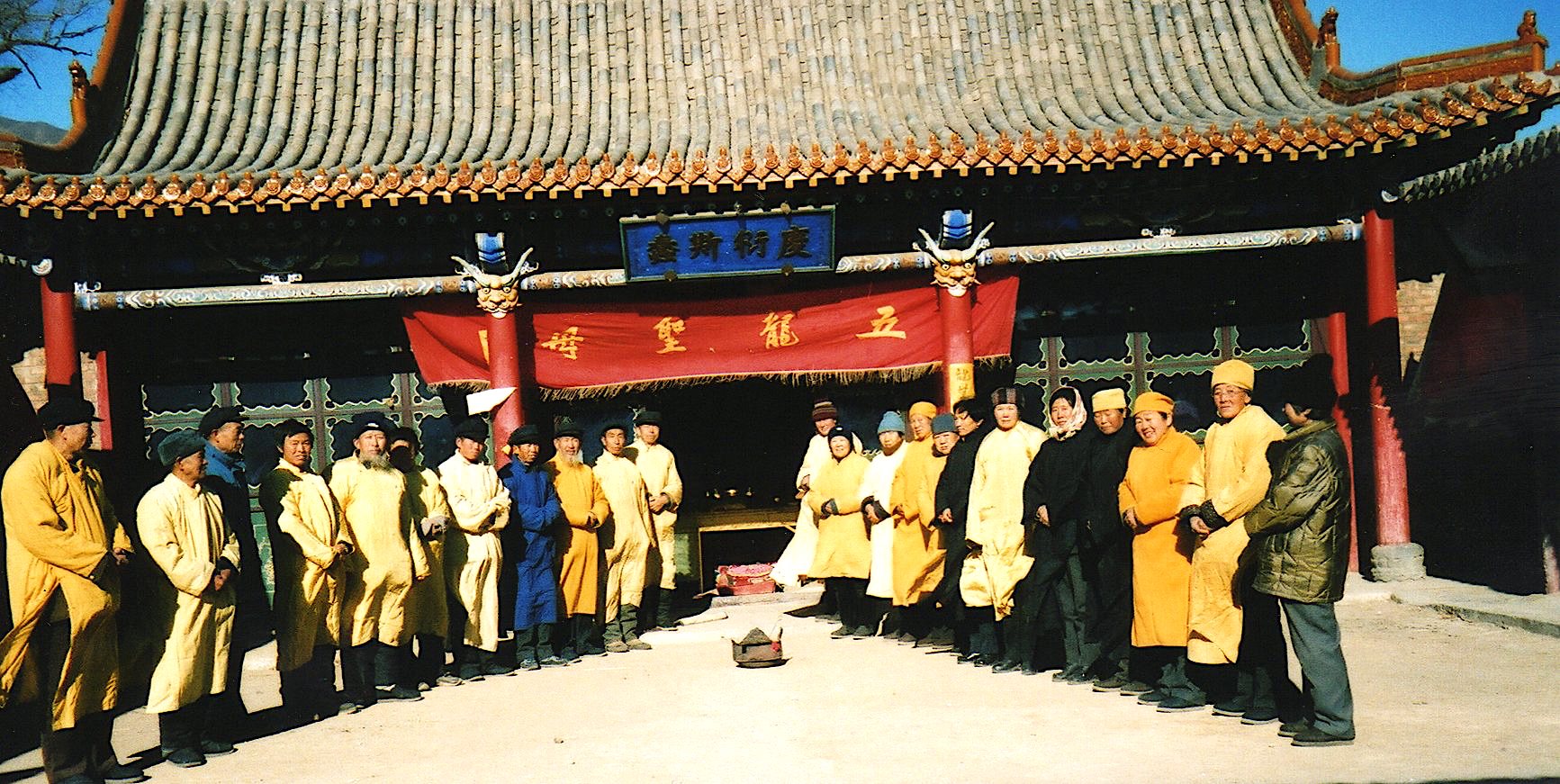
Conquest (p.118) cites an activist in 1930:

He has a sick wife, five children and not a crumb of bread in the house. And that’s what we call a kulak! The kids are in rags and tatters. They all look like ghosts. I saw the pot on the oven—a few potatoes in water. That was their supper tonight.

This reminds me how fellow villagers of kindly Daoist Li Qing (see also my film, and book) ribbed him for his status as a “rich peasant” (see here, under “The sojourn of Educated Youth”).

Over a long period there was constant unrest, with mass executions and deportations. Defiance (which indeed soon offered the only hope of survival) took the form not only of lethargy; violent resistance was common—not least from women. Rebellions had broken out as early as 1919 (Harvest of sorrow ch.3, Red famine ch.2). A widespread famine ensued in 1921. But it wasn’t kept secret, and international aid was welcomed (notably from the American Relief Administration)—whereas by 1933 the scale of the disaster was concealed, and no foreign aid was accepted.

While periodic retrenchments, and “indigenization” policies, were brief, an uneasy stalemate prevailed in the 1920s. Conquest opens The harvest of sorrow thus:

At the beginning of 1927, the Soviet peasant, whether Russian, Ukrainian, or of other nationality, had good reason to look forward to a tolerable future. The land was his; and he was reasonably free to dispose of his crop. The fearful period of grain-seizure, of peasant rising suppressed in blood, of devastating famine, were over, and the Bolshevik government seemed to have adopted a reasonable settlement of the countryside’s interests.

Even by 1929 (Red famine p.113–14),

as Dolot remembered it, the presence of the Soviet state in his village had been minimal. “We were completely free in our movements. We took pleasure trips and travelled freely looking for jobs. We went to the big cities and neighboring towns to attend weddings, church bazaars, and funerals. No one asked us for documents or questioned us about our destinations.” […] The Soviet Union was in change, but not every aspect of life was controlled by the state, and peasants lived much as they had in the past.

Politics had remained loose and decentralised. The choice of Ukrainian or Russian schooling was made in the locale itself; villages were still self-governing, and the various groups tried to accommodate one another. In a passage reminiscent of China (see e.g. here, under “Old and new stories”), for Christmas Day in Pylypivka,

the boys made a star [traditional for carollers] and thought about how to design it. After some debate, a decision was made: on one side of the star, an icon of the Mother of God would be featured, while on the other, a five-pointed [Soviet] star.
In addition, they learned not only old carols, but also new ones. They made a plan: when they were approaching a communist’s house, they would display the five-pointed star and sing the new carols, but when they approached the house of a religious man, they would display the icon of the Mother of God, and would sing [old carols].

But such flexibility was short-lived. Pressure escalated from 1927; as urban activists met stubborn resistance from peasants, they soon found that brutal coercion was the only way of fulfilling their brief. The new wave of collectivization soon led to famine. Despite the introduction of “internal passports”, starving peasants continued their migration to urban industrial centres. The gulag system (on which, among the vast literature, Applebaum also has a definitive study) expanded massively.

Major rebellions erupting in 1930 caused Stalin to tone down the rhetoric briefly (though the title of the anthem of the Ukrainian People’s Republic, “Ukraine has not yet died”, sung by armed rebels in 1930, doesn’t seem entirely encouraging.)

At the height of the famine, as later in China, cannibalism and insanity became common. Meanwhile there were purges at all levels of the Party too.

Conquest gives a prophetic quote, further foretelling the current total surveillance in Xinjiang:

What gave the regime its advantage both in 1930–31 and even more in 1932–33 was that it was now organized and centralized as it had not been in 1921. Herzen, back in the 1860s, had said that what he most feared was a “Genghis Khan with the telegraph”.

Religion and culture
The church (in Ukraine, the Ukrainian Autocephalous Orthodox Church—currently engaged in a divorce from the Moscow Patriarchate) was both a target of and a focus for resistance—as later in China. Church bells were melted down, icons smashed. The rituals of traditional peasant life—and thus musical traditions—were disrupted.

Alongside the major branches of the church, the repression and survival of the diverse sectarian groups is a rich theme, including Protestants, Evangelicals, and the Molokans—see also Margarita Mazo, “Change as confirmation of continuity as experienced by Russian Molokans”, in Retuning culture: musical changes in central and Eastern Europe (1996).

As to expressive culture, the itinerant kobzari blind minstrels soon disappeared. Meanwhile,

The Ukrainian musician Yosyp Panasenko was dispatched by the central authorities with his troupe of bandura players to provide culture [sic] to the starving peasants. Even as the state took the peasants’ last bit of food, it had the grotesque inclination to elevate the minds and rouse the spirits of the dying. The musicians found village after village completely abandoned. Then they finally came across some people: two girls dead in a bed, two legs of a man protruding from a stove, and an old lady raving and running her fingernails through the dirt. (Bloodlands, p.47)

With all this background it becomes easier to understand why the blind minstrels were dying out, along with the culture of which they were part—although I wonder why they were not erased so efficiently in China under Maoism.

One member of a local concert band recalled playing for funerals of activists murdered by irate peasants:

For us it was a happy event because every time somebody was killed, they would take us to the village, give us some food and then we would play at the funeral. And we were looking forward every time to the next funeral, because that meant food for us. (Red famine, p.150)

Again, I heard similar stories in China, such as north Shanxi:

When Li Yuanmao’s father died of hunger in 1960, no-one even had the strength to dig a grave for him. In a village in nearby Tianzhen county, even the village cadres volunteered to carry the coffin just so they could get a paltry mantou steamed bread roll to eat (Daoist priests, p.119).

In Ukraine by 1933, apart from the banning of traditional funeral rites,

Nobody had the strength anymore to dig a grave, hold a ceremony, or play music. “There were no funerals,” recalled Kateryna Marchenko. “There were no priests, requiems, tears. There was no strength to cry.”

Meanwhile, cultural institutions, writers, and academics—historians, ethnographers, museum curators—were also under assault.

Talking of documenting folk-song (see here, and here), Snyder cites a children’s song (Bloodlands, p.36):

Father Stalin, look at this
Collective farming is just bliss
The hut’s in ruins, the barn’s all sagged
All the horses broken nags
And on the hut a hammer and sickle
And in the hut death and famine
No cows left, no pigs at all
Just your picture on the wall
Daddy and mommy are in the kolkhoz
The poor child cries as alone he goes
There’s no bread and there’s no fat
The party’s ended all of that
Seek not the gentle nor the mild
A father’s eaten his own child
The party man he beats and stamps
And sends us to Siberian camps.

And a collective farm song from the 1930s (Red famine p.113, cf. p.145):

Green corn waves new shoots
Though planted not long ago
Our brigadier sports new boots
While we barefoot go.

I wonder if Chinese people were singing similar songs around 1960. Still, there neither religious nor cultural life was such a blank slate under Maoism as one might suppose.

The cover-up and aftermath
Somehow, through a series of grudging concessions, the death toll fell by 1934. But with resistance broken, collectivization accelerated.

And no less telling is the story of the cover-up, suggesting further Chinese parallels. The findings of the Soviet census of 1937 were suppressed, and the responsible demographers executed. During the Great Terror of 1937–8,

Mass graves of famine victims were covered up and hidden, and it became dangerous even to know where they were located. In 1938 all the staff of Lukianivske cemetery in Kyiv were arrested, tried, and shot as counter-revolutionary insurgents, probably to prevent them from revealing what they knew.

AW1

There were plenty of outside witnesses too, such as Vasily Grossman, Arthur Koestler, Malcolm Muggeridge, Andrew Cairns, Rhea Clyman—and Gareth Jones, to whom I devote a separate post. The photos of Alexander Wienerberger also provided firm evidence. The influential Walter Duranty knew well, but chose to deny. On the left, pundits like the Webbs averted their gaze in the interests of the greater cause. And diplomatic silence reigned, already aware of the impending need for an alliance with the Soviets against Hitler. Conquest describes the apologists—a large and influential body of Western thought—as “the lobby of the blind and blindfold”. With bitter irony, it was only the Nazis who were prepared to publicize the 1933 famine.

AW2

Emerging evidence gave pause to left-leaning scholars like Eric Hobsbawm. But the whole topic still remains highly charged ideologically, as shown by some agitated reviews from both left and right. But exposing the iniquities of state socialism shouldn’t be reduced to a blunt implement monopolized by those on the right to bludgeon the left.

Here’s a trailer for Hunger for truth: the Rhea Clyman story:

And Grossman (cited in Harvest of sorrow, 286) observed:

And the children! Have you ever seen the newspaper photographs of the children in the German camps? They were just like that: their heads like heavy balls on thin little necks, like storks, and one could see each bone of their arms and legs protruding from beneath the skin, how bones joined, and the entire skeleton was stretched over with skin that was like yellow gauze. And the children’s faces were aged, tormented, just as if they were seventy years old. And by spring they no longer had faces at all. Instead, they had birdlike heads with beaks, or frog heads—thin, wide lips—and some of them resembled fish, mouths open. Not human faces.

He compares this directly with the Jewish children in the gas chambers and comments, “these were Soviet children and those putting them to death were Soviet people.”

The Holodomor and Great Terror were soon followed by yet more devastating atrocities in World War Two. The population had been decimated and brutalized long before the Nazis invaded. In desperation, many hoped for an invasion to rid them of tyranny.

Ukraine was further devastated by the famine that struck the USSR in 1947—this time alleviated by foreign aid. Applebaum also places the complex interpretations of the famine within the context of Ukraine’s troubled recent history.

Other minorities
The populations of Ukraine (also including Russians, Jews, Poles, Germans) were certainly the worst casualties of the famine: Stalin was waging war not just on recalcitrant peasant individualism but on Ukrainian nationalism. But other minorities also suffered—like the Kazakhs and Kyrghyz, who, when not being deported, were desperately migrating to and from Xinjiang as conditions changed. Bashkirs, Buryats, Khalkas, Chuvash, and Kalmyks were also hard hit (and the efforts of ethnographers to study the cultures of such peoples were frustrated by censorship and imprisonment). Conquest’s ch.14 on Kuban, Don, and Volga—Cossacks of Ukrainian origin, German minorities, and the North Caucasus—leads to further disturbing stories.

Famine in China
Again, the so-called “three years of difficulty” from 1959 to 1961 were not an isolated tragedy: food shortages in the wake of coercive collectivization were long-term. For many in the countryside, it was a case not of three years of famine but of thirty years of hunger. So I’m impatient with any diachronic ethnography of the lives of rural Chinese dwellers that fails to recognize hunger and malnutrition. I’ve cited some basic sources for the Chinese famine here.

LPS 27

Ghost king, Li Peisen collection.

In Yanggao county, home of the Li family Daoists, I recall the satirical couplet posted during the Cultural Revolution, deploring the lack of clothing and food. But even official sources offer clues. While many county gazetteers compiled since the 1980s may be cautious, that for Yanggao contains impressively candid material (pp.66–72, 26–31; see my Daoist priests of the Li family, pp.118–22).

While appearing to recognize the impact of natural disasters, the gazetteer hints at the deeper political problems, with sections on the “Communist wind”, the “wind of exaggeration”, the Great Leap Backward, and the short-lived communal canteens. Indeed, it offers alternative insights on the whole Maoist era—such as its account of the model commune of Greater Quanshan, where in the summer of 1958, amidst a flurry of visits by bigwigs, the brutal exactions of a militarized railroad project goaded five hundred peasants to flee (Daoist priests, pp.122–3). Inner Mongolia, a traditional refuge in times of adversity, was a common destination until travel restrictions were enforced. Yanggao dwellers were still hungry for some years after Li Manshan married in 1971 (see here, under “Yao Xiulian”). For more on the Yanggao county gazetteer, see here.

So that’s the background behind my internet session with Li Manshan, when I showed him the surprisingly candid Chinese wiki article on the Holodomor.

Comparisons, figures
In China the whole process of collectivization, and the famine, make the most appalling instance of wilfully ignoring the lessons of history; both Chinese and Soviet regimes were in denial.

Several scholars have attempted comparisons with the Soviet famines. Ian Johnson has written an important article “Who killed more: Hitler, Stalin, or Mao?” (see also Bloodlands, n.2). Note also

  • Felix Wemheuer, Famine politics in Maoist China and the Soviet Union (2014)

and review essays by Lucien Bianco (also a major author on peasant uprisings under Maoism):

  • “From the great Chinese famine to the Communist famines”, China perspectives 2013.3, here
  • “Comparing the Soviet and Chinese famines: their perpetrators, actors, and victims”, East/West: Journal of Ukrainian Studies 3.2 (2016), here, with many further refs.

Note also

  • Andrea Graziosi and Frank E. Sysyn (eds), Communism and hunger: the Ukrainian, Chinese, Kazakh, and Soviet famines in comparative perspective (2016).

And for a comparison between the famines of Ukraine and Kazakhstan, see here.

It’s ironic that the official story in China, still often parroted there today, was that food shortages were caused by China’s need to repay the Soviet debt (Dikötter, Mao’s great famine, ch.14). And it puts in a chilling perspective my fine lunch at the “1958” restaurant on the People’s University campus in Beijing earlier this year.

In Ukraine and China there was a similar time-lull between famine and renewed terror: in Ukraine from 1933 to 1937, in China from 1960 to 1964. Ukraine suffered a severe post-war famine in 1947, but hunger in China was longer lasting.

Before the famines, rural poverty seems to have been significantly worse in China than in Russia. And (allowing for impressionistic statistics) even in 1926, the literacy rate in Russia was c56%; in China it was still only c20% by 1950. As to life expectancy at birth, for China in 1950, I find a single figure of 35–40 years—lower than that for Ukraine before 1932, for which Applebaum cites: urban men 40–46, urban women 47–52; rural men 42–44 years, rural women 45–48.

By contrast, Ukrainian men born in 1932, in either the city or the countryside, had an average life expectancy of about 30. Women born in that year could expect to live on average to 40. For those born in 1933, the numbers are even starker. Females born in Ukraine in that year lived, on average, to be eight years old. Males born in 1933 could expect to live to the age of five. (Red famine, p.285)

Applebaum cites around 3.9 million excess deaths, plus 0.6 million lost births—around 13% of the Ukrainian population of 31 million. She goes on to delve into regional variations, concluding that

The regions “normally” most affected by drought and famine were less affected in 1932–3 because the famine of those years was not “normal”. It was a political famine, created for the express purpose of weakening peasant resistance, and thus national identity. And in this, it succeeded.

In China from 1959 to 1962 there may have been over 40 million excess deaths (Dikötter, Mao’s great famine, ch.37—Wemhauer and Bianco provide important further nuance); even by percentage of population, that gives a very rough estimate of around 16%, still greater than that for Ukraine. In many villages in both Ukraine and China virtually the whole population was wiped out.

Besides, deaths don’t tell the whole story; even for survivors, lives are ruined by malnutrition, desperation, and trauma.

In China, though extreme violence was also endemic, there was less mass murder, and less pervasive use of the secret police. Other patterns were distressingly similar: resistance to collectivization, raids on non-existent hoards, war on markets, travel restrictions—and denial, then and now. Thaws, retrenchments, strategic retreats were all brief. Warnings were sent all the way up the hierarchy; those given to Mao by Peng Dehuai and the Panchen Lama echo those given by senior Party leaders like Hryhorii Petrovskyi and Martemyan Ryutin to Stalin in 1932. All spoke out in vain, and at great personal cost.

While Ukraine was a specific target of Stalin, under Maoist China Tibetan areas were gravely affected, but Han Chinese suffered just as badly (though note Wemhauer).

While studies such as those of Applebaum and Dikötter inevitably use a broad brush to paint the wider tragedy, the kind of detail afforded by ethnographies of a particular community, like those of ThaxtonFriedman, Pickowicz, and Selden, or Guo Yuhua, is also valuable.

Worldwide, with humane values and truthful reporting under renewed assault, and incitements to hatred ever more common, these histories matter. And for China, I expect such social and political discussions to form an intrinsic part of our studies of expressive culture and ritual, all the more since the topic is still suppressed in public memory. Even as we document the ritual manuals of household ritual specialists, or the melodies of shawm bands, it seems like a basic human duty to record their life stories. All this suffering is deep in the hearts and bones of those who survived.

Performance: from Iran to Morocco

perf

Another formative experience of frequenting late-night screenings at arthouse cinemas in the 1970s was the cult film Performance (Donald Cammell and Nicolas Roeg 1968/70). It remains totally mind-blowing.

trio

James Fox and Mick Jagger make mesmerising, disorienting presences, along with Anita Pallenberg (like Anouk Aimée, already a veteran of La dolce vita) and Michèle Breton. Watch the complete film here.

In an effective soundtrack, most brilliant use of music is the Iranian santur dulcimer accompanying the languid threesome of Jagger, Pallenburg, and Breton (from 43.17)—actually a most beautiful scene (and allegedly, um, method acting—I’m like, hello?), although it may not be quite the image that the Iranian Ministry of Culture envisages. Complementing the mood perfectly, it’s taken from a Nonesuch Explorer album played by Nasser Rastegar-Nejad.

On the somewhat remote chance that you would rather focus on the gradual unfolding of the melody without the distraction of watching the threesome, here’s his 1970 LP:

It’s also reminiscent of John Cage’s music for prepared piano. For more on Iran, see under west/central Asia, including Zithers of Iran and Turkey.

Left: Mick with Paul Bowles, 1989. Right: Brion Gysin and William Burroughs.

Of course Indian music was in the air by the 60s, and the spirit of experimentation also led to Brian Jones’s first trip in 1968 to the “Master Musicians of Jajouka” in the mountains of north Morocco. Early beneficiaries of the World Music craze long before the label had been invented, they were already playing for beat audiences in the 1950s, who were drawn by the likes of Brion Gysin and William Burroughs—and notably Paul Bowles, long-term resident of Tangier. Later, inevitably, schisms appeared in the village along with global fame. The wiki article, and this Songlines introduction, have useful links. If only this had led to wider appreciation of shawm music further afield…

Here’s the first of three parts from a 1989 Arena documentary, including Mick chatting with Paul Bowles:

Among many readings on Performance, as well as on the Stones in Morocco, Keith Richards’ autobiography Life is revealing, nay astounding. For the trail east, and Herat in the 70s, see here.

Nic Roeg died in November 2018—among tributes, this is very fine; see also under Bertolucci.

The conformist

with a note on Last tango in Paris

Conformist 1

The conformist (Bernardo Bertolucci, 1970), based on the 1951 novel by Alberto Moravia, is a most captivating film, visually sumptuous—with the gorgeous Jean-Louis Trintignant, Stefania Sandrelli, and Dominique Sanda bringing out the interplay of political and sexual themes.

For my generation it recalls late-night screenings in art cinemas (along with Parajanov, Seven samurai, Marx brothers marathons, The big sleep, La stradaFive easy pieces and Performance (both also 1970), The bitter tears of Petra von Kant (1972), Céline et Julie (1974), and so on—what an eclectic education; see also here). Revisiting The conformist now, alarmingly, makes a timely reminder: until recently the dangers of fascism may have seemed quite remote.

Conformist 2

As with Bertolucci’s other films like Last tango in Paris, music and dance play a crucial role. The soundtrack (by Georges Delerue) has the ambivalence of Cinema paradiso and Twin peaks. As with all the best film music, just the opening theme transports us instantly into the story’s troubled world. Here’s the complete film:

The female radio band near the opening (from 4.12) reminds me of Franco Cerri’s recollections in my post on Chet in Italy.

By way of comparison with the final dance, here’s the equivalent scene in Last Tango in Paris:

—just as iconic as Jack Nicholson’s scene in Five easy pieces where he erupts in the diner, and reminiscent of Alexei Sayle’s critique of ballroom.

As this review observes, Last tango is not about sex but about pain.

Made in France four years after the disillusionment of 1968’s failures, it’s about characters who can’t see past their own emotional and psychological problems, who are solipsistic in the extreme, locking themselves away from everything they can’t face in the outside world.

Pauline Kael’s famous rave review, comparing the film’s importance to that of Stravinsky’s The Rite of Spring, is critiqued in this retrospective, a particularly cogent view of the on-set abuse of Maria Schneider—a revelation that has severely marred the film’s image, which is regrettable since it’s a work in which deep emotions and anguish are conveyed. Among innumerable other reviews, Last tango is also the subject of this excellent 2011 discussion. See also under Godard.

* * *

Bertolucci died in November 2018 (see also here), soon after Nic Roeg (for an assessment of both together, see here). Many more films to revisit, not least The sheltering sky (based, indeed, on the great novel by Paul Bowles, though he was less than keen on the result), The dreamers, and the epic 1900. And Godard died in 2022.

Haydn: 1795, 1927, 1973, 2018

trio

Just as I was immersing myself in Afghan singing, how nostalgic the other day to hear the limpid slow movement of Haydn’s G major piano trio on Private passions (for the first of several posts inspired by the series, see here).

Like the Adagio of the Schubert string quintet, it seems suspended beyond time. Of course, it’s not: as ever, we hear it with the successive patinas of our personal listening histories.

The trio is part of a set that Haydn composed in London, and the version that remains with me is that of Alfred Cortot, Jacques Thibaud, and Pablo Casals, recorded on 20th June 1927 at Queen’s Hall. I used to listen to it late at night (after closing time) with friends at Cambridge from 1973—just as Veronica and John were embarking on their Afghan journey, indeed; and as the Rito y geografía del cante flamenco series was being completed, and Li Manshan’s wife gave birth to their first daughter…

Today I wonder how we got into such early recordings, like the late Beethoven of the Busch quartet. They meant a lot to me—but I can’t quite say what: this was considerably before I became involved in early music, or began to care about changing performance styles. Indeed, in those days I was more interested in the politics of the Tang court than in the experiences of our more recent European forebears.

But now I think of the trio’s London audiences between the wars (my great-aunt Edith Miles was losing her hearing in 1927), and wartime audiences in Britain and Germany (doubtless the appalling Hans Frank loved the trio). The group had been working together since 1906; but Casals, a firm opponent of franquismo, later broke with Cortot for the latter’s collaboration with the Nazi occupation of France.

Cortot’s 1932 recording of the break in Brandenburg 5 is also great, but early renditions of baroque music may not always suit modern tastes, like Mengelberg’s 1939 Matthew passion.

Haydn dedicated the set of trios to Rebecca Schroeter, Scottish widow of an immigrant German musician (for a taste of late-18th-century mores, see here). So we might further try to imagine cosmopolitan London in 1795 (for “das Land ohne Musik“, see David Wyn Jones ed., Music in eighteenth-century Britainand for London concert life, here; cf. audiences of Tang-dynasty Chang’an, enriched by Central Asian musics—”They come over ‘ere…“).

I don’t know how to fill in the 19th-century lacuna, but despite all the vast social changes since 1795, maybe Haydn’s day isn’t so distant: we seem to have a photo of Mozart’s widow, and Casals was born in 1876.

Haydn’s trio is named after its “gypsy” finale all’ongarese, which we can enjoy without wondering too much about his exposure to folk music—it is what it is (cf. Norman Lebrecht’s ambitious claim for Mahler 4). From where we are in 2018, all three movements are delightful, but it’s the slow movement (in the lustrous key of E major, like Bruckner 7 and north Chinese ritual suites for wind ensemble!) that continues to enchant me. As the players lovingly pass the tunes around (the second one is even more spellbinding!) above pearly triplets, via Cortot’s simple translucent links, they explore them like tiny jewelled caskets, deep in meditation.

See also Haydn for football; and under In memoriam Fou Ts’ong.