Tibetan jokes

Courtesy of the fine High Peaks Pure Earth site, it’s high time for some Tibetan jokes—a most welcome addition to Hammer and Tickle and my Chinese jokes series, and similarly educative.

Beyond the usual socialist jokes, this strand has all the complex nuances of minorities wrestling with modern identities.

As with all jokes, they can reveal something about society while simultaneously being either politically incorrect, culturally and contextually specific, lost in translation or just not that funny.

Can you speak Chinese?
How could I? I have not been in the army and I have never been to jail!

“An American, a Japanese and a Tibetan…” jokes make a niche variant to the “an Englishman, a Scotsman, and an Irishman…” topos, or three leaders jokes. Here we even get “Three Tibetans, one from U-Tsang, one from Amdo and one from Kham”:

The Qinghai-Tibet railway reached Tibet. Three Tibetans from different provinces were in the same passenger car, one from U-Tsang, one from Amdo and one from Kham.
The train suddenly stopped on the way. The short-tempered Khampa immediately jumped up, yelling: “Why did the train suddenly stop? I swear to Buddha I will teach the train conductor a lesson!”
The Amdo Tibetan tried to stop him by persuading: “Aro, let’s wait. It does not help to threaten the train conductor.” Meanwhile, he sighed and said with great regret, shaking his head: “What a shame that we Tibetans do not know how to drive a train!”
The Tibetan from U-Tsang responded: “Come on brothers! It is not a big deal. Look! Isn’t it fine as long as we close our eyes and pretend the train is still running?”

I look forward eagerly to further contributions on the site. For an in-depth study, note Timothy Thurston, Satirical Tibet.

Lieder

Apart from the Matthew Passion and Nina Hagen (yet more unlikely bedfellows), here are further compelling reasons to learn German. While I’ve never been drawn to the mainstream lieder scene, yet again I owe my enchantment by these song cycles to Boulez (cf. Mahler’s Rückert lieder, and Ravel’s Shéhérazade).

First Wagner—the Wesendonck lieder. Here’s Janet Baker with Reggie Goodall in 1971:

Anne Sofie von Otter is just as wonderful:

Then Berg, exploring a path opened up by his mentor Mahler. The Seven early songs (which I got to love at our 1971 NYO Prom)—here’s Jessye Norman with Boulez (with helpful Japanese subtitles):

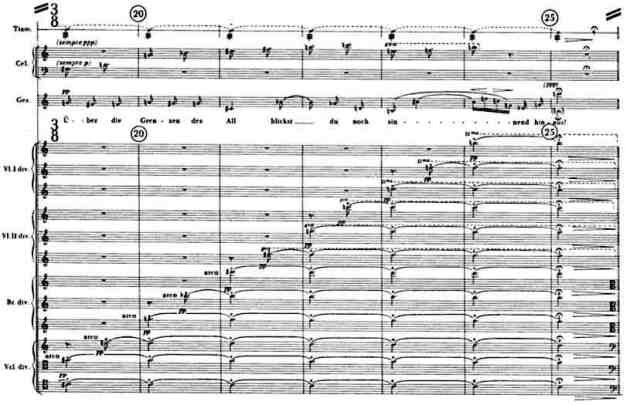
and his (five, nearly as early) Altenberg lieder—to picture-postcard texts (Ansichtskartentexte, another entry in our lexicon of German mouthfuls)—fin-de-siècle Viennese haiku? Here’s Margaret Price with Abbado in 1970:

The third song is haunting:

Über die Grenzen des All blicktest du sinnend hinaus
Hattest nie Sorge um Hof und Haus
Leben und Traum von Leben—plötzlich ist alles aus!
Über die Grenzen des All blicktest du sinnend hinaus

Berg

After the menacing whisper of “plötzlich ist alles aus!” (plötzlich is officially my favourite word), find me a singer who can diminuendo from pp up to that final top C—Nina Hagen, perhaps?!

See also Strauss’s Four last songs. A spellbinding recent addition to the canon is Hans Abrahamsen’s let me tell you, for the great Barbara Hannigan. Sgt Pepper and Abbey road also rank alongside these orchestral song-cycles.

Vesna Goldsworthy

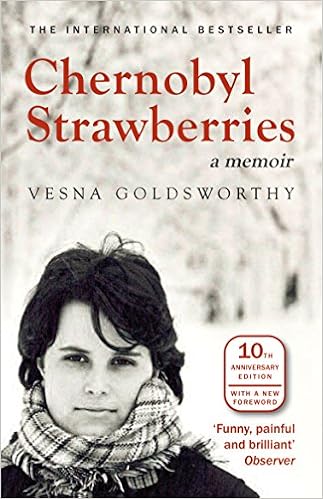
I was drawn to Vesna Goldsworthy’s 2005 memoir Chernobyl Strawberries by her wonderful contribution to Private passions—a valuable companion to the book (Hold the front page! Books are silent! For Serbian soundscapes, see here).

Originating as a record for her young son through the trauma of her cancer treatment, the memoir is whimsical and full of insight—both about her early life in Yugoslavia before it was torn apart (she wonders if it was an accident that her country and her own body were disfigured so soon after each other) and her identity in her adopted home in England since 1986, caught between cultures.

As usual, I read the book partly with the experiences of Chinese people in mind. Goldsworthy’s description of her father’s attitude to her youthful flirtation with palaeography reminds me of the Chinese retreat into history:

Only my father saw some consolation in the fact that it was the kind of work which was unlikely to lead to imprisonment. There seemed to be nothing remotely political in transcribing thousand-year-old prayers, whereas as a media star I was likely to shoot my mouth off sooner or later.

Even so,

In fact, while it was highly unlikely that a palaeographer would end up in prison or without a job, as had been known to happen to the critics of contemporary literature, my father was wrong in thinking that the vellum-bound world was apolitical. You could say, for example, that a manuscript was “probably Bulgarian” or “possibly twelfth-century” and cause an international dispute of major proportions…

Among vignettes on the fates of her forebears, Goldsworthy gives fine insights into the society of Belgrade through her youth (when she was “optimistic, ambitious, invulnerable, and in some ways insufferable”), the nuances of class in a classless society—not least the three rings of schools (her own lycée “educated some of the most intelligent and most fashion-conscious young people east of the Iron Curtain”):

In our senior common room new members of the Communist Party represented a more raggle-taggle selection than before. Some were visibly keen, some rather diffident, some were obvious (clever-clogs, careerist with a bad sense of timing, those who carried a briefcase to school, prominent members of youth organizations, children of well-known communists who could hardly refuse to join), some rather less so (ditzy girls from old families who had fallen for the old hammer-‘n’-sickle chic, the school poet, the fourth-grade hunk, a good third of the school basketball team, encouraged to join as role models and highly visible because they were all six foot six and chewing gum). Working out which members of the teaching staff belonged to the party, information you wouldn’t normally have been privy to as a student, was part of the privilege conferred by this particular entry into the adult world.

The heightened sensibility towards dress-sense also reminds me of Maoism:

Many of our professors addressed us with “Colleague”. Others used “Comrade” or “Miss”, according to whether they were communists or bourgeois recidivists. Forms of address provided an easy way of knowing individual political allegiances. It was useful to be able to distinguish Comrade Professors from Mr or Mrs Professors in order to know whether to cite Lukacs or T.S. Eliot. Although one could often tell the two groups apart simply by the clothes, it was not always safe to make hasty assumptions. Suits, ties and moccasins mostly belonged to comrades; tweed jackets, turtle necks and shoelaces to Mr and Mrs, but safari suits could go both ways, and were surprisingly popular in the early eighties.

And even furniture:

I felt that, through furniture, I had a special path to understanding the world I came from. Whereas in the West the inexhaustible variety of interior design often manages to obscure surprising degrees of conformity, the enforced conformity of the society I grew up in concealed a bunch of eccentrics and sometimes downright madness. While the wives were crocheting, madmen were busy plotting Armageddon.

Goldsworthy describes the schism (and occasional blurring) in poetic circles between bohos and suits, and her own youthful “Penelope poems” about the female who waits ( the waitress) for an absent male, often with pseudo-religious powers.

During the endless family debates over her choice of outfit for a major poetry-reading in honour of Tito (“a strange form of necrophilia”), her sister mumbles “peasant”:

She used the feminine form of the noun. There was no doubt that she had me in mind. Only peasants wrote poetry anyway. (The word peasant, with its full power of character assassination, is not readily translatable into English. It was neither here nor there as far as the real peasantry were concerned, but a poisoned dart if directed at a Belgrade student of letters).

She goes on to reflect on the Tito cult:

The longer it was since his demise, the more there was to celebrate. Like the widow of a murdered Sicilian Mafia don, the country clung to his memory in an incongruous mixture of mourning and décolletage, as if knowing that a collective nervous breakdown would follow once the ritual was no longer observed.

Meeting her future husband, “I was ready to follow the boy to the end of the world, to England itself if need be.” * After reaching Heathrow,

Only minutes later, I was on the Piccadilly line—the Ellis Island of London’s huddled masses—with a copy of the London Review of Books.

In Private Passions Goldsworthy recalls the abundance of classical (and other) music in the Yugoslavia of her youth. And when she moved to England, her friends and family were horrified, asking, “How could you move to a country where there is no music“? So it’s suitable that her Slavic-tinged playlist ends with Purcell’s When I am laid in earth.

As befits an erstwhile poet, her use of English (her third language) is delightful. Like many foreign authors (from Conrad and Nabokov to Elif Şafak, or for China, Yi-yun Li and Xiaolu Guo), she finds that writing in English affords psychological space:

I have fewer inhibitions in English—perhaps because for me it doesn’t quite carry subcutaneous layers of pain. In fact, I sense—however irrational this may seem—that the I who speaks English is a very subtly different person from the I who speaks Serbian and the I who speaks French. That, perhaps, has something to do with the old chameleon tricks or the nature of the language itself. At any rate, the English speaker is a bit more blunt and a bit more direct than the other two. She is and isn’t myself. She takes risks and admits to loss.

In Chapter 4 she reflects on the hereditary aptitude of her homeland for poetry:

In the four years between my move to London and her death, Granny wrote to me only once. It was a short letter, penciled in a deliberate hand clearly unused to writing. She reminded me to visit my parents regularly and urged me to behave in a way which would not dishonour my lineage; no laughing in public places, no loud conversation, modesty in dress and in everything else. Granny wrote as though she was worried that, away from my father and my tribe, I might be in danger of succumbing to some ungodly excess. In her world, Montenegrins who lived apart from their tribes were notoriously prone to prodigal or licentious behaviour. Her prompting came not because she lacked confidence in me, but because she clearly believed that this was what a letter from a grandmother to her granddaughter should be like. It wasn’t the place for frivolities of any kind. Although written in continuous lines, her latter was—from the first word to the last—a string of rhythmic pentameters, the verse of Serbian epic poetry.

As she calls her sister’s answering machine in Toronto to leave messages in “Granny”, adopting an asthmatic wheeze to let flow a torrent of alternating complaints and endearments, she reflects,

The language of my dead grandmother brings to life all our lost homelands, yet no book has ever been written in it. This is the language I lost when I chose to write in English.

Always reflecting on the subjectivity of memory, she has drôle comments on her new jobs in London.

I loved the prospect of boredom. Growing up in Eastern Europe was a powerful vaccine. I had gone through eighteen years of socialist education, learning when to say yes and when to keep quiet, in preparation for a job in which I’d be underpaid and under-employed. Where I came from, such jobs—usually in very nice places—were often described as “ideal for women”.

Reading news bulletins at the Serbian section of the BBC World Service through the traumas of war, she observes how her “RP” broadcasting voice differed from her “real” Serbian (inner suburban stresses, corrupted English slang), ** which had itself become a museum-piece:

My mother-tongue, meanwhile, remained firmly locked in its mid-eighties Serbo-Croat time-capsule, a language which officially doesn’t even exist any more.

 And then the straitened conditions of academic life:

Daughter of a self-managed workers’ paradise, I excel at my job. I criticize and self-criticize, I censor and self-censor, I compose self-assessment sheets about self-managed time, I sit on teaching and research committees, I attend meetings and take notes, I know that literature has hidden and insidious meanings. […] My communist upbringing, my upbringing in communism—to be able to live with myself without believing in anything I say, to be able to accept things without asking too many questions—has certainly stood me in good stead throughout my working life.

In the art of the long meeting, British university workers easily outdid anything I’d encountered in my socialist upbringing. The sessions were often longer than the communist plenaries, the acronyms just as plentiful, the put-downs just as complicatedly veiled in oblique metaphor, the passions just as high, even if the stakes were often infinitesimal.

None of the terms for her status quite fit:

Unlike my ancestral matriarch and so many others in the part of the world where I came from, I have never been a refugee. I am not an exile. Not quite an expatriate either: that term seems to be reserved for those coming from lands which are more fortunate than mine. A migrant, perhaps? That sounds too Mexican. An emigrée? Too Russian.

Getting to know her father-in-law,

I suddenly grasped the sheer luxury of being a British male in the twentieth century. Every conceivable counter-argument notwithstanding—and I know there are many—the picnic rug on the moral high ground still came in khaki and red, the colours of his beloved regiment. My father-in-law stood on the high ground, wielding a pair of secateurs, chopping, felling and dead-heading, without a care in the world.

Yet she notes parallels between his nostalgia for a vanished Indian colonial past and her own experiences, “linked by a homesickness which doesn’t make sense”. At his funeral she reflects:

I can’t bring myself to sing at an Anglican funeral, just as I couldn’t—were it an Orthodox one—wail as my female ancestors were expected to. In Serbia old women were sometimes even paid to mourn. They walked behind the coffin in the funeral procession and celebrated the dead in wailing laments delivered in rhythmic, haunting pentameters. I am stuck somewhere between the singing and the wailing, speechless.

And this isn’t the end of the book, but it could be:

I wish I could say—as people sometimes expect of cancer survivors and immigrants alike—that I am grateful for each and every new day on this green island. Ask me how I am today and chances are that I will respond with that very English “Mustn’t grumble”. Which doesn’t mean that I don’t. Which doesn’t mean that I am not grateful.

Cf. Kapka Kassabova on her upbringing in Bulgaria.


* Cf. The life of Brian, where Brian’s mother Mandy recalls a youthful fling with a centurion: “Nortius Maximus his name was. Promised me the Known World he did…”

** “fensi” meaning pretentious rather than just “fancy”, cf. the recent Chinese zhuang B.

The great Gary Snyder

Gary Snyder, Japan 1963.

One of my great inspirations via teenage excursions to oriental bookshops was the great Gary Snyder (b.1930). Though his path puts me to shame, he was a great hero of mine (along with Pierre Boulez—looking back, I see this was not entirely normal in suburban London, however experimental the age).

Snyder was always more serious than most of his beat contemporaries. Studying anthropology, he developed an affinity for Native American cultures. As he became immersed in Zen, he began learning Chinese and Japanese (indeed, just at the right moment to benefit from the disturbing Teach yourself Japanese!).

All the while he was writing poetry, part of the beat generation with the likes of Allen Ginsberg, Kenneth Rexroth, and Jack Kerouac, taking part in the seminal 1955 reading at Six Gallery in San Francisco. That year he made the first of several study periods in Japan over the next fourteen years, living as a “de facto monk”.

HS and GS
In 1958 and 1959 he made (almost) the first translations of the Cold Mountain poems by the numinous 8th-century Zen recluse Hanshan (see his reflections here). At the other end of his life, his poem Go now is an unflinching tribute to his wife in her final days.

He has deepened his early studies by going on to lead a whole life unobtrusively based on Zen, without parading it or getting hung up on, well, anything. Living in harmony with nature in a series of hermitages, his environmental activism has complemented his occasional jobs as seaman, firewatcher, and logger (among a wealth of articles on him, I like this, and this). Now I come to think of it, I’d like to introduce him to Li Manshan—they’re both conscientious, unfussy, living on and with the land.

2002.

Snyder made a suitable paragon for Alan Watts (another guru of the age) in his 1959 pamphlet Beat Zen square Zen and Zen, a generous critique of both the Western craze for Zen of the 1950s and the ascetic rule-bound tradition in Japan. Citing Jack Kerouac’s portrayal of him (as “Japhy Ryder”) in The dharma bums, Watts’s warmest words are for Snyder; despite his rigorous training in Japan, he transcended both the “spiritual snobbism and artistic preciousness” of square Zen and the spaced-out bohemian scene of beat Zen. Watts’ tributes in his autobiography In my own way also hit the nail on the head:

Gary is tougher, more disciplined, more physically competent than I, but he embodies those virtues without rubbing them in. (p.309)

He is like a wiry Chinese sage with high cheekbones, twinkling eyes, and a thin beard, and the recipe for his character requires a mixture of Oregon woodsman, seaman, Amerindian shaman, Oriental scholar, San Francisco hippie, and swinging monk, who takes tough discipline with a light heart. (p.439)

From Snyder’s Cold Mountain poems:

#2
In a tangle of cliffs, I chose a place—
Bird paths, but no trails for me.
What’s beyond the yard?
White clouds clinging to vague rocks.
Now I’ve lived here —how many years—
Again and again, spring and winter pass.
Go tell families with silverware and cars
“What’s the use of all that noise and money?”

#8
Clambering up the Cold Mountain path,
The Cold Mountain trail goes on and on:
The long gorge choked with scree and boulders,
The wide creek, the mist blurred grass.
The moss is slippery, though there’s been no rain
The pine sings, but there’s no wind.
Who can leap the word’s ties
And sit with me among the white clouds?

See also More East-West gurus, and Of Steinbeck and Salinger.

Critics rebuked

Apart from John Cleese’s main ouevre, he  can be entertaining on the page too. This article, reflecting on four decades of “mixed (in the technical theatrical sense of ‘extremely bad’)” reviews from The Spectator, is a fine rebuke to his critics. Just as yet another well-deserved tribute to Michael Palin (new patron saint of stammering) comes on BBC TV, Cleese’s self-review is fun:

John Cleese is a remarkably talented individual, of an admirably humble disposition, and a rare sweetness of temperament, who continues to tower over his contemporaries, especially Michael Palin.

I’m also most enamoured of “The Zagreb Bugle”, and I eagerly await a review of my own film in this illustrious fantasy organ. Cleese’s comments on cultural pundits remind me of the biting satire of Stella Gibbons, in works like Conference at Cold comfort farm—not least her brilliant “Em creeps in with a pie“.

Changing language

Caonima

Language is always in flux, over the dead bodies of fusty conservatives. English isn’t alone in changing under the stimulus of social media and popular culture.

Since my Chinese vocabulary incongruously lurched from the Tang dynasty to the clichés of Maoism (see also here), where it remained impaled, I’m happy to make some modest updates, partly courtesy of websites like Sixth Tone (e.g. herehere, and here), and Magpie digest—as well as this article, including a recap on the viral caonima “grass-mud-horse” trope. As elsewhere, much of the linguistic innovation is driven by online usage. I’m very keen on the term

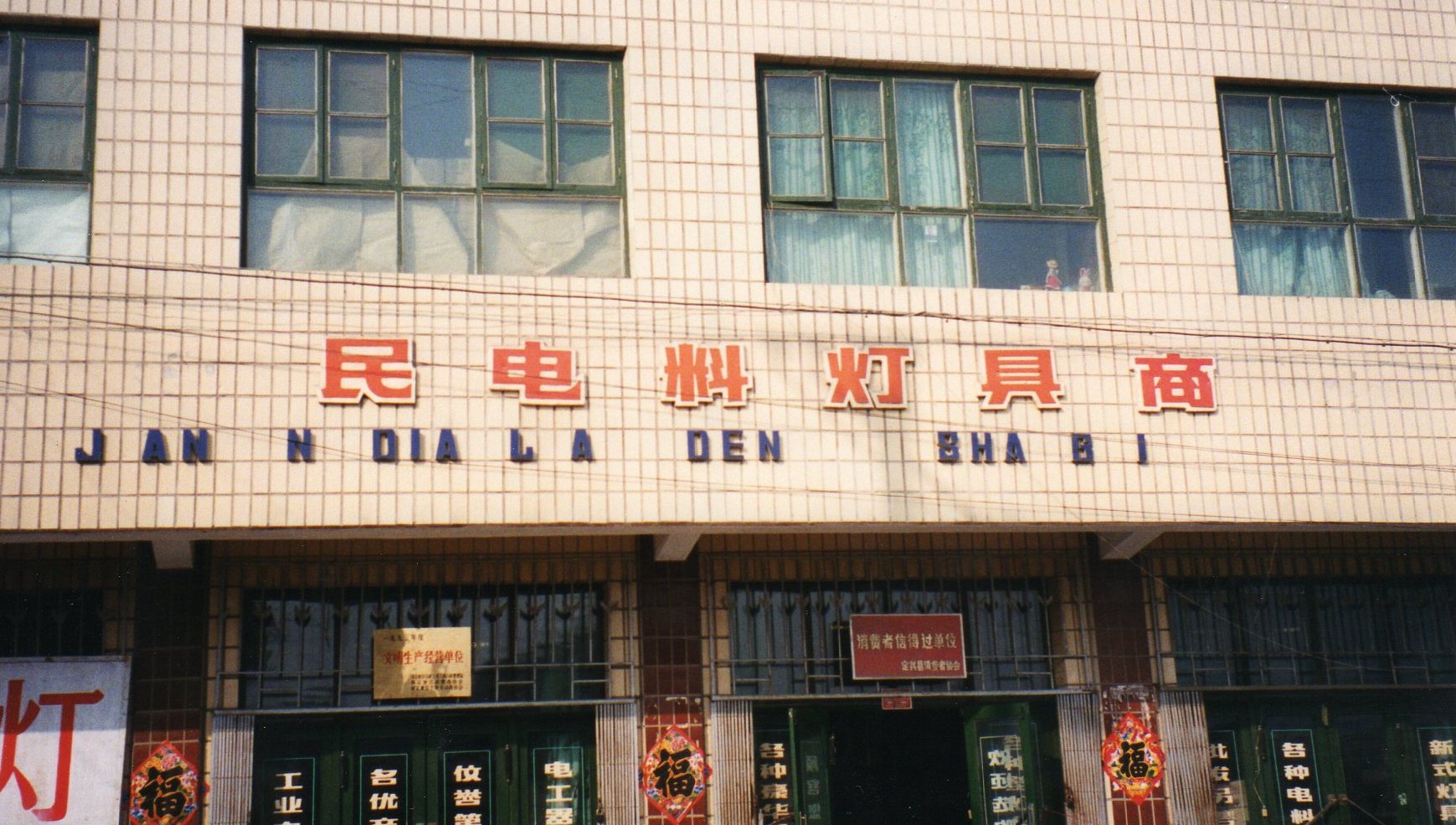
To zhuāng bì 装 B is to put on airs — worldly, moneyed, educated, eccentric, or any other combination thereof. In other words: to be a fucking poser.* B is shorthand for níubì ( lit. “cow’s cunt”: see here, with instructive links), meaning “awesome” or “badass”—the English letter “B” being easier to find than the character for cunt (for shabi “fuckwit” and the somewhat less shocking nature of bi in Chinese, see here).

The article describes zhuang B as “a light, often self-deprecating insult”, “sign of healthy subcultural growth”—“by-product of all the new possibilities for young, middle-class Chinese people, a way for millennials to practise defining their way of life.” So it’s a pretentious wanker or tosser—cf. Poseur, moi?”. See also this Sixth Tone article.

I also like galiao 尬聊 “awkward chat”, inevitable chats with boring people—when the person you are talking with lacks communication skills, or when your mind wanders off and the talk reaches a dead end.

Even for those seeking to limit their studies to a bygone age, a basic grasp of how living people communicate (even village ritual specialists) is valuable… For an update, click here.


* Private Eye’Pseuds’ corner polices English excesses with regular entries—like this, from an old programme note of a London Pro Musica concert, penned with tongue in cheek by the splendid Bernard Thomas:

The title of this concert means “a piece of cake”; it comes from the popular song Damene un poco di quella mazacrocha, “give me a piece of that cake (crumpet?)”. The process of baking a cake might be taken a central metaphor for Renaissance musical culture, for the special synthesis of northern polyphony and rhythmic subtlety with the poetry and expressive melody of indigenous Italian music. Florence, together with Siena and Bologna, were, and still are, traditional centres of cake baking. One can only guess at the repeated and prolonged biting into cakes on the creative processes of Heinrich Isaacs during his long stay in Florence.

Guide to a year in blogging

LMS

After a year of frenzied blogging, here’s a seasonal retrospective guide to navigating a diverse ouevre—as much for my sake as as for yours. Meretricious and Happy New Year!

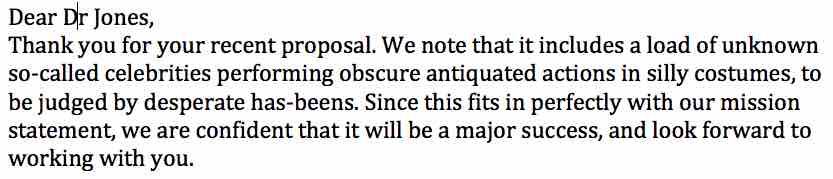
Call me a nerd [You’re a nerd—Ed.], but taxonomy and indexing are so funky… As you see from the (updated) homepage, the whole site began as an introduction to my work on the Li family Daoists, and my portrait film remains one the most enchanting presences there. The Li family has its own category in the sidebar, with a plethora of articles (not least a whole series on our French tour in May 2017, and an update on Li Bin’s diary).

Other pages in the top menu also tend to be rather substantial, with

Still in the top menu, MY BLOG contains all my myriad posts (“delighting in all manifestations of the Terpsichorean muse“), with helpful Categories and Tags in the sidebar, as well as a monthly archive there. Here are some of the more stimulating:

As you can see from this post alone, I just love doing internal links (in blue in the text). So whether you first came here for Daoist ritual, football (indeed, Daoist football), punk, Bach, modern China, or even just for the jokes, they’re all connected, so please do click away on the links!

Last but, um, not least, do click on the links to the relevant posts and pages in the photos in the sidebar.

Alexei Sayle

Alexei Sayle‘s memoir Stalin ate my homework, on his, um, unusual upbringing, is at once heartfelt, perceptive, and hilarious. And the sequel Thatcher stole my trousers* has insights on the alternative comedy scene, his early standup, and The Young ones.

Born in 1952 to idealistic left-wing atheist Jewish working-class parents—genial Joe and the brilliantly indiscreet Molly—he evokes the conditions of post-war Anfield with wry detail.

Though not universal, it was instinctual among a great many British Communists to be noisily unpatriotic. […] To my parents and their friends it was as if by cheering on the English football team, the cricket team, or Britain’s runners you were somehow revelling in slavery, the Amritsar Massacre, the suppression of the Irish, or the Opium Wars.

At primary school:

At break-time in the first week our teacher, Miss Wilson, said to the assembled class, “All right, class, now let’s bow our heads in prayer and thank God for this milk we’re drinking.” At which point I stood up and said, “No, Miss Wilson, I think you’ll find that the milk comes to us via the Milk Marketing Board, a public body set up in 1933 to control the production, pricing, and distribution of milk and other dairy products within the UK. It has nothing to do with the intervention of some questionable divine entity.”

Echoes of Irene Handl’s line in Morgan: a suitable case for treatment: “I mean, we brought you up to respect Lenin, Marx, Harry Pollitt…” (a line that I think is even funnier if you don’t know who Harry Pollitt was).

Profiting from [!] the free rail travel available to the family with his father’s position in the National Union of Railwaymen [sic], the family often took holidays abroad: “by the age of five I must have been the most travelled child in Anfield.” They soon began making trips behind the Iron curtain—At A Time When It Was Neither Profitable Nor Popular, I note. To pursue the latest results of my interest in east Europe, it’s these vignettes that I’d like to cite here.

For all his parent’s aspirations, Alexei casts a rather more detached view on their holidays. Of course, they could hardly imagine the tribulations of the working people with whom they identified, or even the apparatchiks who hosted them. But with his own background, he does more than merely getting a cheap laugh out of state socialism. These passages are interesting mainly for his own story, in which idealism and cynicism evolved hand in hand, a surreal training that would bear fruit in his later career.

Joe and Molly had taken the crushing of the 1956 Budapest uprising in their stride; welcoming it as a test of faith, they scorned British Communists who

didn’t understand that the march towards liberty, peace, and freedom couldn’t be held up by a load of people demanding liberty, peace, and freedom.

Enthralled by a visit to the Czechoslovak pavilion at the 1958 Brussels World Fair, with its marionettes, Magic Lantern Theatre, and colourful avant-garde design, in August 1959 visited the country for the first time. Somehow their trip begins at a campsite in the sleepy spa-town of Karlovy Vary. After an interlude at a union-owned miners’ sanitorium, the wheels of diplomacy click into gear and they are rescued by a fleet of black Tatra limousines which takes them on to Prague, where they are chaperoned lavishly.

Next year they organized a group of like-minded comrades for another visit. This time the authorities

had decided what the first delegation of British railwaymen to Czechoslovakia would like to see more than anything else were sights, locations, and exhibitis connected with the wartime assassination of Reinhard Heidrich, the butcher of Prague.

They were among early foreign visitors to see Lidice, scene of one of the most appalling Nazi massacres. On a brighter note, they were taken to the Švejk pub in Prague, and when they got back home his parents bought him a copy of Hašek’s novel. When he eventually read it aged 12 or 13, he

wondered if the Czech authorities knew what they were doing promoting with Švejk, letting a pub be opened in his name and selling cuddly toys in his likeness, since the message of the book, while it might have been anti-authoritarian, is certainly not one supportive of the ideals of socialist conformity.

Indeed, The good soldier Švejk soon became very popular in China, where its message must also have concerned the authorities.

Anyway, back in Anfield, by the age of eight Alexei was able to report proudly to an eager young vicar,

“I am a Comrade Cadet, Grade One, Young Pioneers, fourth battalion, based at Locomotive Factory Number One, town of Trutnow, People’s Republic of Czechoslovakia!”

And one already feels a hint of the irony that would later inhabit Alexei’s stage persona (see here), with a substantial ingredient of Švejk.

For their summer holidays in 1961 they visited Hungary, lavishly accommodated in a grand baroque hotel in keeping with their incongruous status as VIPs. On a trip to Lake Balaton Alexei discovers salad, in a passage that will strike a chord with those of our generation:

Back in Anfield we had thought with a certain amount of pride that on Sundays we had been eating salad, but really all we had been eating was lettuce and tomatoes in a bowl, sometimes with a hard-boiled egg on the top and no dressing except perhaps the industrial solvent known as “salad cream”. Now I saw what a salad really could be under socialism. There were red, green, and yellow peppers, corn on the cob, huge tomatoes stuffed with Russian salad, artichokes, celery, lentils, okra, and fresh herbs, all of them covered in rich oils or mayonnaise.

(For Nina Stibbe’s candid assessment of tarragon, see here.)

He accumulates yet more pennants and badges to accompany his hoard of Bohemian glass, dolls, and “folklorique woven things” that he didn’t know what to do with—

It was hard to stop people in Communist countries giving you things [an idea taken further by Elif Batuman].

In 1962 they took their third trip to Czechoslovakia, and in 1963 Joe led a delegation of railwaymen to Hungary. This time Alexei’s feelings are more conflicted:

Sadly, if you are beginning to feel unsettled about people’s motivation then visiting a country in which some six hundred thousand citizens were deported to Soviet labour camps after the Second World War, where they spoke a weird Finno-Ugric language completely unrelated to those around it, where there were great tensions between the various ethnic groupings, Hungarian, Romanian, and gypsy, and where a revolution had been brutally suppressed only seven years before, probably wasn’t a good idea.

Joe and Molly make elaborate preparations for a tour of the northwest by a dance troupe from Czechoslovakia, but it falls through. In summer 1966 they flew to Bulgaria under the auspices of that new bourgeois creation, a package holiday. Meeting some local teenagers in search of Beatles records, he realizes that

up until then we had only ever mixed with people who were part of the system, who were loyal to the party and its allied organizations. […] Clearly there were tensions, but you didn’t get to be a Communist without learning to ignore what was in front of your face.

With his affinity with both railways and Czechoslovakia, he was always going to love Closely observed trains (Jiří Menzel, 1966)—another of those films that also left a deep impression on my student years (can’t find it online at the mo, but do seek it out!).

For Pachelbel on rubber chicken, and Czech trains, click here; and for Alexei’s penchant for Polish cinema, here.

Following Kruschev’s reforms,

though slightly assuaged by the crushing of revolts in Hungary and East Germany, many in the West’s Communist movements were uneasy with this liberalisation. They didn’t like the idea of a Communist society allowing its citizens to express their opinions freely or have a choice of more than one type of hat. Yet they had nowhere to take their disaffection until the Sino-Soviet split offered these puritan characters a choice of an extra-dour kind of socialism more in keeping with their sententious inclinations.

So, going from frying-pan to fire in a remarkable lapse of judgement, Alexei became a Maoist. You can continue reading his later story for yourself, moving on to his perceptive account of his bohemian life at art school in London, his role in alternative comedy—and Molly’s blooming [see what I did there?] as a foul-mouthed lollipop lady. For more (not least his critique of ballroom dancing), see here.

So while Alexei didn’t get to play the Matthew passion or hang out with Li Manshan (though both are charming fantasies), I regard his upbringing, not to mention his later career, with a certain envy.

For other excellent memoirs in what can be a dodgy field, I think of George Melly and Arthur Smith. And this chat with Stewart Lee is a match made in heaven:

* Sinology could do with some titles like these (for a somewhat less appetising one, see under Jarring here).

Cunk on Christmas

Cunk

Following her probing accounts of Shakespeare, and “femininism”, what better seasonal viewing than the immaculately-researched historical overview provided last year by Philomena Cunk—herself touched by the divine:

Besides the usual bewildered expert interviewees, she consults some “small adults—which are known as children”, who also manage to keep a straight face.

… Jesus Christ—an icon who was almost as revered back then as Beyoncé is today.

Civil war is like a real war—but not abroad, so it’s cheaper. […] According to the Puritans, Christians shouldn’t celebrate Christmas, ‘cos it’s not in the Bible. Instead, they should be inside a church (which isn’t in the Bible), reading the Bible (which isn’t in the Bible).

At Christmas 1914 there was a brief ceasefire—the fighting stopped, soldiers got out of their holes and joined together in a place called No Man’s Land, showing that even at moments of peace, men will still divide into two sides, and try to beat one another.

She consults a hapless Jay Rayner:

I don’t understand bread sauce […] Bread, and sauce, are two completely different things, aren’t they?
[I’ll leave you to listen to the dénoument]

As ever, it’s not what you say but the way that you say it—her delivery and expression are faultless (see also The art of the voiceover).

Ms Morgan also leapt into print with equal facility, here, and in a handy 2020 guide.

Nuns of rural Hebei

*For main page, click here!*

Renqiu nun

In traditional China, ritual activity—indeed, public appearance altogether—appears to be male-dominated. But the role of women in religious life is significant—as worshippers, as members of amateur sects, and notably as spirit mediumsNuns hardly threatened the patrilineal traditions of ritual and instrumental music before the 1950s, but they make an interesting sub-plot.

Moving south from Beijing and Fangshan to Laishui county, this article goes on to gives vignettes (based on brief chats in 1994) on the ritual life of two elderly former nuns in a village in Renqiu county, near the Baiyangdian lake, half a century earlier. Such absorbing glimpses into the world of rural nuns before Liberation deserve including in our picture of local cultures.

Jeux d’esprit

Here’s a little popery, I mean potpourri—a resumé of some of my more wacky linguistic fantasies:

Among many fine Chinese jokes, my piques du jour* are


* Rather than piqes-niques.

Love, Nina

Nina

Quite possibly a more plausible Christmas gift than my own books, Nina Stibbe’s Love, Nina: despatches from family life (2013) is hilarious, warm, and perceptive.

In letters to her sister she evokes her life after coming to London to work as nanny to the drôle Mary-Kay Wilmers (of the LRB) and her engaging and challenging kids, in leafy literary Gloucester Crescent in the 1980s.

Anyone taking it at face value may miss its genius. Forgive me if her original letters really had all the book’s subtleties of phrasing, but it seems to me that a lot of subtle mature editing was involved. Anyway, it’s an observational account of a niche tribe, full of linguistic delights—every page has a turn of phrase that leaves me helpless with laughter.

I apologize too for the things I got a bit wrong. Alan Bennett was never in Coronation Street for instance.

She doesn’t take her cultural education lying down:

PS Chaucer. Have you ever read it? Fuck. It’s a whole other language and meant to be hilarious, but it’s grim and annoying.

Later at the library:

… borrowed a recording of a bloke reading Chaucer in the Old English. Nearly wet myself listening.

And

Exams soon-ish. Here is a summary:
R&J: Romeo and Juliet hardly know each other, but they think they’re in love and both kill themselves. The nurse is an irresponsible idiot. The Friar is a moron. It’s a ludicrous story.
[…]
Winter’s Tale: King is mentally ill. Queen is a fool.
Chaucer: W of Bath is an unreliable old bag, but not a hypocrite. Marries for money but likes shagging, thinks women should be in charge.

 Another leitmotif is Nina’s grappling with the baffling poncey new cuisine that was coming into vogue.

Tarragon: the cookbook says tarragon is “misunderstood”. Not by me. I understand it. It’s horrible.

Later she comments,

It’s all pasta and couscous nowadays, in London anyway.

Further fine observation:

MK does the big shopping—a mixed blessing—she buys stuff without a plan (I think she copies other people who know what they’re doing). This is the kind of stuff that comes back [list abbreviated here—SJ]:
quark (German style liquid cheese)
rye bread with seeds
balsamic vinegar of Modena (black vinegar)
fresh lychees
spinach
Persil
olives
And other mysterious things that add up to nothing much when it comes to making meals. It’s like living in another country.

Which reminds me of Ian Rush’s (disappointingly spurious) comment on his struggle to adapt to Italian life during his one season at Juventus in 1987–88:

I couldn’t settle in Italy—it was like living in a foreign country.

Critics haven’t always appreciated what a fine comic creation is her stolidly mundane portrayal of their neighbour Alan Bennett.

Me: You’re good with appliances.
AB: (proud) Well, I don’t know about that.
Me: You sorted out the car, the fridge, the phone, bike tyres and now the washing machine.
AB: I don’t think I am particularly good.
MK: But it’s nice to know you’ve got something to fall back on.

Later:

AB not around. In Yorkshire or New York. I prefer him being around… God knows what he does in NY (if it is NY), can’t imagine him there, being shouted at by taxi drivers and prostitutes. Though his coat would work.

AB himself took issue with Stibbe’s portrayal of him as “solid, dependable and dull”; but while finding some “misrememberings”, he understood—as well he might—that “such is art”.

The BBC TV version worked remarkably well too (like Cold comfort farm—I now realize the ingénue Nina has a distant affinity with confident Flora). As usual when watching, you just have to refrain from clinging onto your own image of the book. As the young Nina would doubtless observe.

* * *

I’ve only recently clocked the useful expression “Is that a thing?” (discussed here, and here), entertainingly used by the great Zoe Williams. A fine discussion on the ever-stimulating languagelog blog seems to date it only to 1995, though comments there hint at earlier variants. Since it makes some clear appearances in Love, Nina (assuming they’re not from a later edit), then we can take it back to the 1980s—e.g. p.132:

He picked up a raw burger and ate it. I was appalled but acted normal. Told MK later and she said it’s a thing (eating raw beef).

[another trademark of Stibbe’s style there—giving pedantic parentheses redundantly clarifying her previous comment].

Or p.136:

Mary-Kay has started wearing two shirts at once. I don’t know where she’s picked it up, but it’s a thing, apparently.

Indeed, I guess Love, Nina is basically about striving to define the rules of an alien culture to whose values one aspires—though I can’t be Saussure [cf. my Foucault pun under Visual culture].

Strictly north Shanxi Daoist ritual

Don’t get me wrong, I’m glued to Strictly come dancing every week. Oh yeah, I’ve got my finger on the pulse of popular culture all right [adjusts monocle, grappling ineptly with concept of the high-five]. I was mortified in 2015 when Georgia and Giovanni (aka Joe Varney) didn’t win:

Or indeed Alexandra in 2017… But hey, “It’s not winning but taking part”, eh [zzzzz].

And now the brilliant Stacey Dooley—who did win, YAY!!! (See also Moon river.) Here’s another Charleston. Now let’s all watch her fine documentaries.

The thing about Strictly is, as with Handel opera, or a Moroccan wedding, you just have to suspend your disbelief. The dancers don’t want to go home, but for some reason they do want to go to Blackpool, which is unlikely to feature even on the itinerary of perfectly innocent Russian tourists. Li Manshan hadn’t even heard of the Carnegie Hall, let alone Blackpool, but it’s clearly more appealing than doing a Messiah in Scunthorpe.

Sure, as Barbara Ellen notes in a fine reviewStrictly proved yet again

that it understood its own winning formula—drown the contestants in a vat of fake tan and what a cynic might term even faker bonhomie, and let the controversy and sequins fly. […] A sugar-rush of schmaltz combined with a brawl on the entertainment deck of a cruise ship…

But for me it’s classic BBC “educate, inform and entertain” stuff—inculcating diligence, expression, and appreciation of historical style (!), with the pros and the judges vouchsafing us little dollops of technical advice. For all the fatuous clichés of the competitive format (see also Alexei Sayle‘s pertinent critique), Strictly can be inspiring and deeply moving. So there. And for 2020, Bill Bailey reaffirms our belief!

Still, my question is this:

However were we all conned into thinking that a genre that seemed pathetically antiquated even in the early 1960s could possibly achieve such wild popular success in the 21st century?

This baffling device of prefixing an unlikely and outmoded format with an utterly random adverb gives me an idea whose time has surely come:

Strictly north Shanxi Daoist ritual

After all, Daoist bands have long been used to ritual competition, “facing platforms”. In my film (from 24.08) my use of karaoke captions for the percussion mnemonics makes an instructive innovation that draws us into a crucial element of ritual performance. And we’ve just had “The Reverend Richard Coles” on Strictly, so hey. My new programme concept has got everything from the original—a grand ritual arena, movement, costumes, music… And since, as Heidi Stephens notes in her drôle Guardian commentaries, what viewers really need is a Journey, what better than Pacing the Void?

Admittedly, even with a minimum of six ritual bands contesting, each performing a different ritual segment for each programme (Presenting Offerings, the InvitationBeholding the Lanterns, and so on), the weekly programme would require at least four hours—and the nocturnal yankou ritual alone takes longer than that. Still, BBC ratings will doubtless soar.

Coming up next—we’ve got Du Zhimin’s band all the way from Guangling, performing the Ambulating Incense ritual!!!

I’ll be delighted if the drôle Claudia Winkleman will host the new show. As to

THE JUDGES…,

the fragrant Darcey Bussell [surely an anagram, e.g. “Recall Debussy”—cf. Gran visits York and Maidstone] is always welcome. How can anyone be so elegant and savvy and still be English? Her only tiny flaw seems to be that she can’t get the hang of clapping (watch her as she applauds couples just voted off). And now that the great Li Manshan is ceding much of his ritual work to his son Li Bin, he seems the ideal choice as chair of the judges.

Some quotes from the panel:

Darcey [purring]: “Oh MY! I have to say, just make sure you grade that accelerando in Yellow Dragon Thrice Transforms its Body just a tiny bit more carefully.”

Bruno [does pirouette]: “Bellissimo! But you still need to work on your posture, dahlingg.”

Li Manshan [dragging on fag], in unison with Craig: “That was chaotic!”

And the scores are in

I look forward eagerly to discussions with the BBC. [1]

See also Fantasy Daoist ritual.

* * *

Another Daoist-ritual spin-off might be to adapt the brilliant “One song to the tune of another” from I’m sorry I haven’t a clue. One recent fave was Jan Ravens singing the words of I can’t get no satisfaction to the tune of Wouldn’t it be loverly—and click here for Barry Cryer with Anarchy in the UK to the tune of Singing in the Rain.

The Daoist version might go something like this:

 [Jack Dee, or indeed Li Manshan, lugubriously:] “Now I’d like you to sing words of The Song of the Skeleton to the tune of Diverse and Nameless are the Bitter Roots…”*

*Tedious footnote: at least in Yanggao vocal liturgy, these two items are in fact quite closely related (my book, pp.267–8, 274–5)—so less than suitable here. Scope for exploration, though.

Such impertinent fantasies, if not for purists, are at least more frankly ironic than the kitsch commodifications from the Intangible Cultural Heritage (see under “The reform era” here).

For Groucho and Anna Mahler, click here.


[1] Inexplicably, I still await a reply from the BBC  to my initial pitch, Strictly Albanian Dentistry—where peasants attired in colourful traditional costumes have just a week to learn a series of intricate procedures such as implants and root-canal treatments (cf. Alan Partridge). But following the public verdict on the moral morass of the Strictly dance/snog of shame—a quandary that will be mercifully obviated by Strictly north Chinese Daoist ritual—there’s (allegedly) a letter in the post from the Beeb about my new concept:

letter

For another money-spinner of mine, see here.

Ritual groups of Xiongxian, Hebei

*Click here for main page!*
(under Hebei in main menu)

GGZ xu 1

Through the 1990s, one of the most fruitful sites for our fieldwork project on the Hebei plain south of Beijing was the area around Xiongxian county, just south of Bazhou, and east of the regional capital Baoding. Recently this whole region has become the centre of a vast and radical new development project to expand metropolitan Beijing; but when we used to visit, it was still very much rural.

As throughout the region covered in this growing series on Hebei, most villages here had ritual associations until the 1950s, and we found many still active in the 1990s. But here we found less vocal liturgy than further north and west on the plain, with no foshihui groups reciting precious scrolls.

Instead, ritual services were now mainly represented by the “holy pieces” of the shengguan wind ensemble to “revere the gods”—here an exceptionally rich repertoire based on long suites related to those of the temples of old Beijing. Not all these groups were still performing, but there is rich material here, not only on the ethnography of local ritual in modern times, but for scholars of the late imperial period.

This is the latest in a series on ritual in Hebei that includes Houshan and the precious scrolls, suburban Beijing, and Bazhou.

180!!!

More local cultural knowledge:

One morning in Maida Vale studios, as the great Pierre Boulez was rehearsing the BBC Symphony Orchestra, he stopped and said suavely,

“Please, we play again from measure* 180.”

Brilliant cockney percussionist Gary Kettel, from the back of the orchestra, punched the air gleefully and screamed out,

“ONE HUNDRED AND EIGHTYYY!!!”

Since Boulez’s broad erudition didn’t stretch to the world of UK darts, he was somewhat nonplussed [‘Ow you say in French?] by Gary’s recondite allusion to the fabled score of three triple 20s. Still, he and Gary always had the utmost respect for each other’s musicianship.


*Boulez always used the French word for “bar”. Endearingly, he called the cor anglais “ze English ‘orn”.

It’s that man again

More from the diaries of Alan Bennett. I’m filing this 2009 entry under heritage:

23 August. […] I’m glad I’m not a theatregoer living in Elsinore. All they must ever get are productions of Hamlet, while what they’re probably longing for is Move Over, Mrs Markham or Run For Your Wife.

His keen eye for footballers’ physiognomy is in evidence again (2010):

7 April. The open mouth of Frank Lampard, having scored a goal, is also the howl on the face of the damned man in Michelangelo’s The Last Judgement.

This entry depends on a certain cultural knowledge that might challenge translators:

5 July. A child in Settle is said to have asked what the Mafia was and his grandfather said, “It’s like the Settle Rotary Club, only with guns.”

And he often shows his political involvement. When a speech in favour of the NHS from his early play Getting on is well received, he is encouraged to go on:

25 July, Yorkshire. […] whereas nowadays the state is a dirty word, for my generation the state was a saviour, delivering us out of poverty and want (and provincial boredom) and putting us on the road to a better life; the state saved my father’s life, my mother’s sanity and my own life too. “So when I hear politicians taking about pushing back the boundaries of the state I think”—only I’ve forgotten what it is I think so I just say: “I think… bollocks.” This, too, goes down well, though I’d normally end a performance on a more elegiac note.

Barbed comments

My dubious encomium for Rowan’s CV (The Feuchtwang variations, n.3) reminds me:

The brilliant Roy Mowatt (see under comments here), a real bedrock of the early music orchestral scene, was always remarkably tolerant of my violin playing in the section he led. I treasure a remark he made to me over a beer or three in a piazza in Parma after a Mozart opera, c1994 (evoking Hugh Maguire’s comment to Pete Hanson—“Pete, even if your strings are out, you must play in tune! Just do it wit’ your fingers!”):

Thing about you, Steve, is that it doesn’t make any difference if your strings are in tune!

You can take that either way, and I think he meant it both ways. I was quite adaptable; yet my intonation wasn’t necessarily helped by tuning up… Cf. “It was in tune when I bought it”.

While I’m in confessional mood, here’s another comment I might add to my CV. Just around that time, a certain maestro took me aside and observed suavely,

Steve, I can’t help noticing that you have a somewhat low threshold of boredom…

JEG

Photo © Jim Four.

Like the review of the Berlin Phil’s response to Simon Rattle, it lacks a certain nuance.

Nicknames

As Kate Fox observes, the creativity of the English language reveals itself at multiple levels.

The fragrant Gary Lineker recalls how the the team-mates of the footballer Kiki Musampa called him Chris (think about it). There are more where that came from, like Fitz Hall—known as One Size.

Brian Smith, a “straight” symphony-orchestra violinist who became a semi-detached admission to the rarefied early music scene in the 1980s, had a whole series of drôle nicknames for his new colleagues, making his conversation surreal: “I think Identikit’s gone off with Ironing Board”. Once word got round that I was making regular trips to China, I became The Missionary. He only used the real names of musos who had a life outside early music and thus qualified as Real People.

Conductors’ nicknames are another rich vein under the rubric of maestro-baiting. The great Charles Mackerras was known as Slasher—not an allusion to his conducting technique, but an abbreviation of his anagram: Slasher M. Earcrack.

They come over ’ere…

Central Asian musicians, Tang dynasty.

Here’s a companion piece to my post on foreigners during the Cultural Revolution, where I acknowledged my anachronistic use of the epithet laowai 老外.

I read that indeed the term didn’t become common until the 1980s—just in time to greet me on my late arrival (for some words that Shakespeare may not have invented, see here). The Chinese wiki article on laowai makes a useful succinct introduction, explaining its interplay of respect and xenophobia. I’m still curious to learn how the winning combo of lao and wai suddenly caught on. A detailed forum on the nuances of this and related terms has been initiated by the erudite Victor Mair, so here I’ll just add a few personal reflections.

A still more blunt term is dabizi 大鼻子 “big nose”; foreigners in China have to get used to frequent appraisals of their physiognomy, but as an autonym, at least, the term can be drôle. I’m also fond of the more quaintly retro yang guizi 洋鬼子 (“foreign devil”), which a senior Taiwanese mentor—and, crucially, friend!—likes to call me. As ever, such terms are context-sensitive; they may even confirm guanxi (“You’re my mate—we can take the piss together”).

At a tangent, in Shaanbei a fine shawm-band leader is widely known as Jiekazi “The Stammerer”—in rural China, attitudes towards stammering are both less po-faced and less courteous.

Craig and Ming

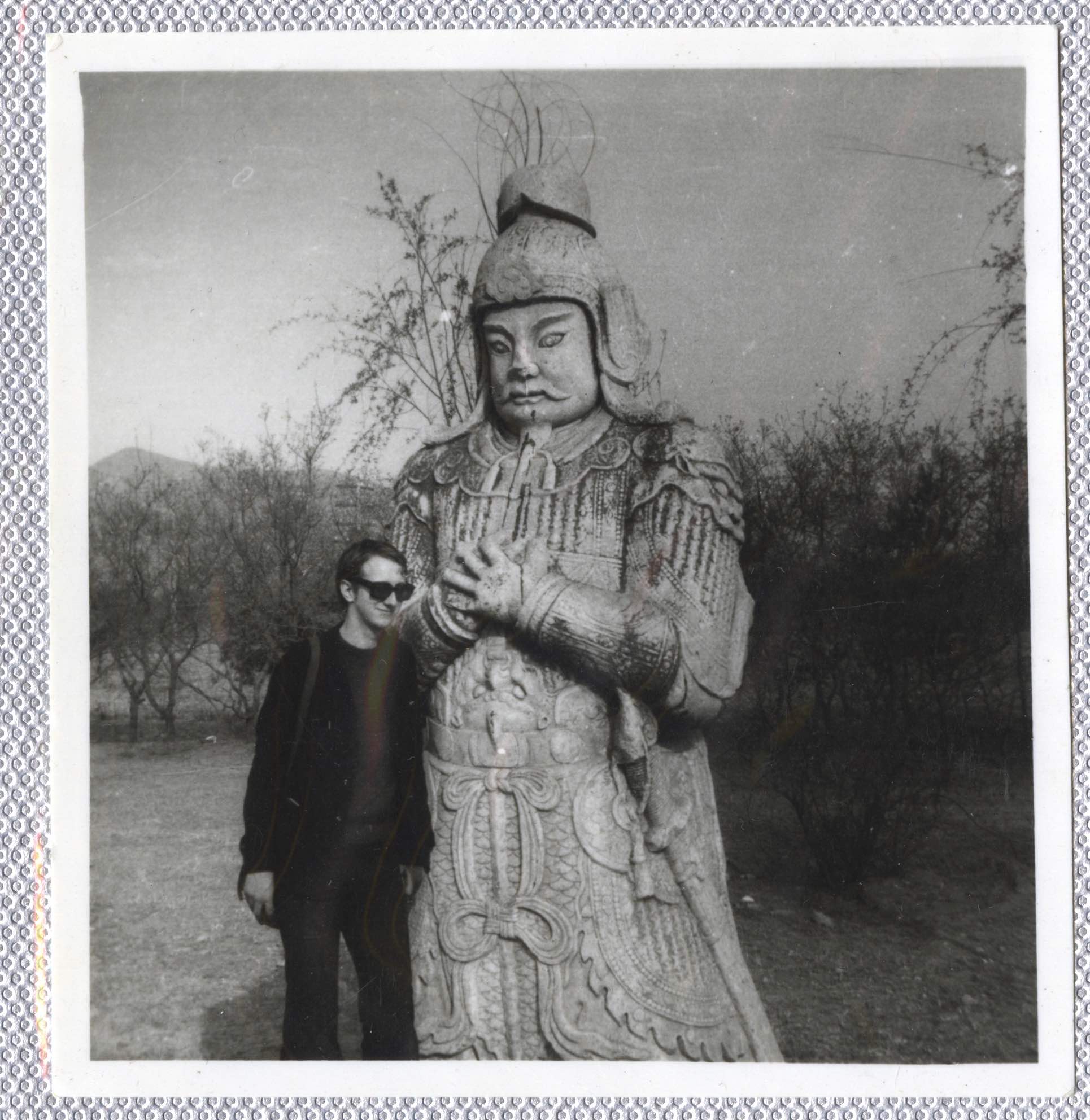
Waiguoren!” (not yet “Laowai!”). Craig Clunas, Ming tombs 1975.

Staying with China (derogatory terms for foreigners are of course a rich topic worldwide), apart from the various historical terms (hu 胡, fan 番, yi 夷, man 蠻, and so on—mostly with a strong suggestion of “barbarian”), I’m now curious to learn how the Labouring Masses of the Tang dynasty would have hailed the substantial number of laowai on the streets of 8th-century Xi’an in the popular argot of the day.

We may now regard the Tang as the first great world-music boom (cf. Soundscapes of Dunhuang), but as musical nationalists of the day (like the poet Bai Juyi and his mate Yuan Zhen) might have said,

“They come over ’ere, with their fancy bili and pipa…”

Or their Qing-dynasty counterparts (so does building walls work, then? Eh??):

“They come over ’ere, with their fancy erhu and suona and yangqin…”

OK, I made those up, but this is a genuine Tang quote (adding impertinent male judgment on female attire to the heady xenophobic mix): [1]

Our women are acting like foreigners’ wives, studying foreign make-up;
Entertainers present foreign sounds, servants to foreign music!

Straight out of the Daily Mail, that. With the current surge in “patriotism”, a new campaign to purge corrupting foreign influence from the Chinese instrumentarium would be left mainly with the xun ocarina and the sheng mouth-organ—which might fail to excite even Uncle Xi. It’s ironic that after successive waves, it was the Model Operas of the Cultural Revolution that were largely responsible for a renewed vogue for the instruments of the Western Art Music tradition.

Closer to home (yet equally apposite), a classic rebuke to xenophobia is the great Stewart Lee’s UKIP routine (“Bloody Huguenots, Coming Over Here—doubting trans-substantiation, with their famed ability to weave little jerkins out of lace…”). And to supplement his fantasy chat down the UKIP pub:

“Apparently the guitar is descended from the oud—that’s bloody Moorish, mate! What’s wrong with Morris dancing, that’s wot I say!”

[Inconvenient footnote: an inconclusive etymology suggests that “Morris” is itself derived from “Moorish”…]

As simplistic nationalist agendas rear their ugly orange heads yet again, it’s always worth unpacking language. See also A fine riposte, and Das Land ohne Musik.

For the “Golden Age” of the Tang, Chinese scholars might learn from 17th-century Holland.


[1] See e.g. Suzanne E. Cahill, “Our women are acting like foreigners’ wives! Western influences of Tang dynasty women’s fashion”, in Steele and Major (eds), China chic: East meets West. Among many works, see also Marc S. Abramson (ed.), Ethnic identity in Tang China. The works of Edward Schafer (notably The golden peaches of Samarkand and The vermilion bird, written at a time when such study was neither profitable nor popular) have long been an inspiration for those studying Central Asian culture in the Tang.

Women of Gaoluo

Woman Zhang

Woman Zhang at 90 sui, 1998.

Chain-smoking cross-legged on the kang brick-bed with all the carefree abandon of the elderly, wielding her cigarettes with more relish than accuracy, Woman Zhang (Zhangshi nü 张氏女, b.1909) told us what she could about her life. As she said, entirely without feminist irony, “I had no [given] name until going to work [in 1958] in the Great Leap Forward—that’s when they gave me the name Yurong.”

Apart from the Li family Daoists (film, and book: also tag in sidebar), my other most in-depth ethnography concerns the ritual association of Gaoluo, just south of Beijing. On this blog I’ve written about two leading figures there, and the vocal liturgists, as well as their performance of “precious scrolls”—and also the village’s substantial minority of Catholics.

It may not have escaped the alert reader that much of my fieldwork is basically about the public activities of men. I made a partial attempt to redress the balance with three posts on Women of Yanggao (starting here). So here are some further notes on the status of women in rural China, setting forth from our chats with the characterful Woman Zhang in Gaoluo in 1998, and again based on vignettes from my book Plucking the winds (where you can find further detail).

Though 90 and illiterate, her mind is quite clear, and to my relief she speaks with a clear calm voice in a standard accent. Given her advanced age (she claims to remember the long pigtails still worn by men for a while after they ceased to be enforced with the fall of the Qing dynasty), our meeting should have been a fascinating glimpse into village history. But, in total contrast to the detailed day-by-day accounts of the cultured men Shan Zhihe and Shan Fuyi, I was taken aback by her ignorance of the momentous events which had convulsed the village. Of course, men can be muddled too; but this wasn’t muddle. We know a lot of men who are totally vague about dates, but at least they have participated in history, even when only trying to escape it or deplore it, and one can learn a lot. The problem was that she was not only uneducated and a woman, but had been widowed over fifty years earlier: she had simply played no part in the village’s public history. This itself was a salient lesson. We supplied the dates below: significantly, the only date she had ever heard of was 1960, the famine.

While nominally a Catholic, Woman Zhang “believes in everything”. Though she was only brought to Gaoluo from her home in a village in Dingxing just south in about 1930, she had heard stories about the famous Boxer massacre at Gaoluo in May 1900. Some of the Catholics took refuge in the Catholic stronghold of Anzhuang further south, while others fled to the Xishiku church in Beijing. Woman Zhang’s father-in-law Shan Zhong was the only survivor of his whole family from the Boxer massacre; two sons and a pregnant daughter had been slaughtered. Shan Zhong himself had gone to Dingxing town that day; on his way back he got as far as Wucun village just south of Gaoluo when he got wind of the massacre and fled, taking refuge in the Xishiku church in Beijing. After it became safe to return to Gaoluo, Shan Zhong remarried, taking a young wife.

1930 donors' list, South Gaoluo

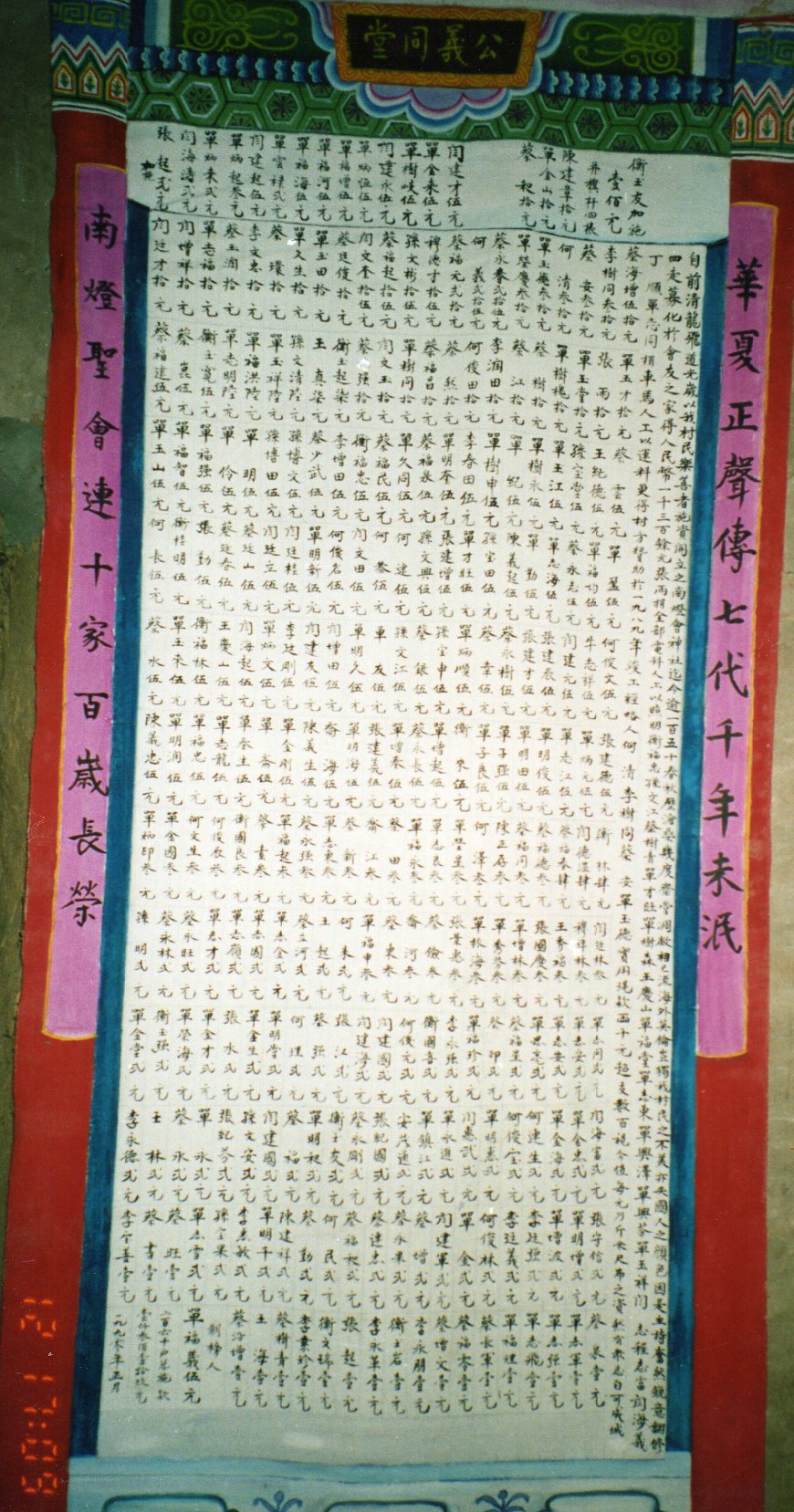
1930 donors’ list.

By 1930 the village ritual association, sensing a need to compete with the revival of Catholic power, commissioned a new set of ornamental hangings for the New Year rituals (see here, under Ritual rivalry). Shan Zhong was by now an established leader of the village Catholics—but impressively, he was one of the most generous contributors whose names (all male, as heads of households) appear on the rival association’s handsome donors’ list.

That same year Woman Zhang, then 22 sui, was brought to Gaoluo to marry Shan Zhong’s 14-sui-old son Wenli, the youngest of their three sons. Later the Italian missionaries became popular partly because like the local spirit mediums they could cure illness, and Shan Zhong also gained quite a reputation as a healer. But he died only a year after Woman Zhang’s son was born, quite soon after the building of the church.

Soon after I married here, the Catholics used to try and get me to come to church, but my mother-in-law wouldn’t let me—I couldn’t just please myself when I went out, she’d beat me. They talked it over with the other Catholic wives. They took me to church, and after the service was over they took me home, so the mother-in-law didn’t beat me.

Through the growing fug of cigarette smoke, as we tried impertinently to help Woman Zhang direct some of her ash in the general direction of the floor, she went on: “They taught me eight scriptures [jing: hymns, I think, as often in folk parlance]—I couldn’t read them, I just learnt them by heart. Dunno what the words mean, though!”

Japanese warplanes bombed Laishui county-town at 8am on 17th September (the 13th of the 8th moon) 1937, and that same day Japanese troops first entered Gaoluo. Coming from the direction of Wucun to the south, they were just passing through; they had about fifty tanks, and were covered by aircraft. The troops entered the village before Woman Zhang could take her children to the church to hide; they passed by her house. In order to dissuade them from murdering them all and setting fire to the village, the village leaders went out to welcome them. Before the Japanese even entered the village, they shot dead a villager who rashly stuck his neck out to look, but after entering Gaoluo they harmed no-one, just asking for fresh water, eggs, and meat. The venerable Shan Zhihe, along with Cai Ming (a sheng-player in the ritual association who worked as a pig-slaughterer), was responsible for looking after them and giving them water—the Japanese made them drink some first to be sure it was not poisoned. Though they soon went on their way after a token search, Japanese cavalry and infantry passed through constantly for several days on their way to Baoding, and Gaoluo villagers had to look after them.

Woman Zhang was widowed during the War against Japan. Her husband, Catholic Shan Wenli, hoping to join up with the guerrilla army, had gone out with a big stash of opium to use as a “sub” for travel expenses, but it was soon stolen. Though he eventually managed to join the army, he was wounded first in one eye and then in the body. He was brought home to die, still only in his 30s. Woman Zhang went to kowtow to Cai Yantian, who by this time had been ordained as a priest by Bishop Martina, to ask him to come and give her husband the last rites.

In our talk we fast-forwarded to 1958 and the infamous campaign for making steel—most frenetic, exhausting, and pointless campaign of the Great Leap Forward, in which many households were deprived of precious equipment, even including woks and door-latches. Woman Zhang was enlisted, and since this was virtually the first time she had been allowed out of the house, she was now given a personal name—at the age of 50 sui. She told us with an incredulous cackle: “They wanted me to make steel out of woks!” She didn’t have a clue what that was all about, and none of us could enlighten her.

1960 was the worst year: villagers agreed it was just unbearable. Though the famine is generally known as “the three years of difficulty” (sannian kunnan shiqi), it is colloquially identified simply as “1960” (liulingnian). Everyone was still expected to report for work, but only able-bodied people could survive; less sturdy villagers soon got ill and started dying. Malnutrition was as serious as at any time in the hated old society. Woman Zhang remembers having to eat yam leaves to avoid starving to death. The village cadres were in the same boat—at best, they might have been able to sneak into the canteens after work to snatch an extra mouthful of snake-melon.

She perked up when we went on to seek her opinions on the Red Guards:

Oh yeah—what were they on about? I couldn’t make it out. I know they used to parade through the streets…

But some of their victims were her fellow Catholics.

Our time with Woman Zhang was both funny and sad. She had lived through so much over the last nine decades, but had little clue what had been going on. Over the following weeks, as winter turned to spring, I often saw her sitting outside “taking the breeze” at her gateway in the bright sunshine, looking curiously at passers-by and giving me a somewhat formal nod. Life too had passed her by, which maybe was not altogether a bad thing. Pretty bad, though: she had lost her husband young, and with or without him had led a semi-existence.

Still, she reckons life is much better than in the old society, and this is no expedient courtesy to a foreign guest. Blissfully oblivious of the continuing persecution of the Catholics and the general convulsions the society was subjected to, she was genuinely grateful both for Liberation and the reforms: “Now you can get to eat barley and white flour—years could pass in the old days without that stuff.” On the other hand, when we asked her provocatively, indeed rather desperately, whether she preferred the old or the new village cadres, she had absorbed enough of the cynical climate to retort: “They’re all rubbish, they just bully people, what is there to prefer?!”

Woman Zhang perhaps typified the belief of the older generation of women. Though a Catholic since she was young, she finds Jesus rather remote: “Who of us has actually seen Jesus?” But as to “Mountain Granny” (shanli nainai, a popular term for the local goddess Houtu), “How can you help believing in her? The village women used to buy incense and go on pilgrimage to burn incense on Houshan, so I went along too. Catholics aren’t supposed to burn incense, but I went on the quiet, they didn’t know. Yes, I believe in Granny.” As we saw, she went to Catholic services, but she also enjoys visiting the association’s lantern tent at New Year, and likes both the shengguan wind music and the percussion; she remembers hearing Cai Fuxiang recite the Houtu scroll, and though she didn’t understand it, she liked to listen to that too. Cases like hers confound those “tick one box only” surveys of “religious faith” in China.

Rural sexism
Local literatteur Shan Fuyi, as ever, had a nice story. In 1990 the leaders of the association were seeking donations from villagers to refurbish their ritual building. As it happened, South Gaoluo’s nouveau-riche entrepreneur Heng Yiyou was working away from the village when they called at his house, and his wife only had a paltry couple of kuai to hand. When Shan Fuyi, who was to write the donors’ list, asked her whose name he should write, she exclaimed sharply, “Write Heng Yiyou’s name of course—do I count as a person?!”, hitting the sexist nail on the head. Shan Fuyi did as she said, but soon realized they couldn’t put Boss Heng down for such a meagre amount. When he tracked Heng down, Heng now gave a further 100 yuan, besides four long bamboo poles from which to attach the association’s pennants. Luckily the donor’s list had a blank space at the top where Shan Fuyi could write up the extra donation, giving Boss Heng appropriate recognition.

1990 beiwen

1990 donor’s list, by Shan Fuyi.

The trenchant remark of Boss Heng’s wife gives us a pretext to reflect on the status of women in village life. For the record, she’s called Li Shufen! As Shan Fuyi observes, people are not generally aware of women’s names unless they are close relatives.

Screenshot

In Gaoluo, although women are devout in taking part in the ritual activities which the ritual association serves, both spiritual and secular spheres continue to collude in excluding them from learning the ritual music. Their exclusion from the association reflects their exclusion from power and influence in village society as a whole, underlining the persistence of tradition and the limited scope of the revolution. Sexism, like irrational violence, is one aspect of tradition which one could understand the Communists hoping to overturn, but they were largely unsuccessful.

I must preface these comments by admitting that they are entirely impertinent: I have only added to the burdens of both women and men while in Gaoluo, feeling unable to offer any practical assistance, and never transcending my status as a guest. One of our most uncomfortable experiences in these villages is the helpless feeling of colluding in the macho tradition, all men in a group smoking and chatting while the women cook for us. At meal-times, they serve us while the men all sit around the table discussing the Important Things men talk about; the women then get to eat the cold left-overs, often outside in the courtyard, only after we vacate the table and they have served us with tea. Our entreaties for them to join us are laughed away. To be fair, this happens mainly when there are guests: normally the family eats together, though segregation is also sometimes observed.

Thinking of Shan Zhihe and his arranged marriage, or of Woman Zhang and Cai An’s mum with their bound feet, I can’t help observing that despite the continuing glaring inferiority of women’s social position today, there has been some progress—thanks to the enlightened Communist Party, as I joke with them. Young people at least choose their own partners now, and even if the women won’t share the meal they have prepared for the men, they all now have a certain amount in common, standing around making good-humoured jokes while the menfolk are chatting away over their booze and fags.

But progress has been painfully slow. After Liberation, obeying a central decree, the village Party branch dutifully elected a token female head of the new Women’s Association. Under the commune system, the vague idea was that she should implement gender equality and the female liberation campaign, but there was no specific programme, and the position was largely a sinecure. The only thing anyone could remember her organizing was International Woman’s Day on the 8th March, when the women were summoned to a meeting. After the birth-control policy began to be enforced strictly in the 1980s, that became her main duty, an onerous and invidious one, dependent largely on the orders of a male establishment.

While Party membership is the means to career progress, the Gaoluo Party branch, like most others, has made no efforts to “develop” bright young female applicants; as one cadre said, “It’s a waste of time, they’re going to leave the village sooner or later [to get married]”—exactly the reason given for denying women admission to the ritual association. Men join the Party with the prospect of becoming cadres. Women are caught in a neat Chinese Catch-22: they are not considered for Party membership because they are not going to become cadres, and because they are not going to become cadres, there’s no point in admitting them to the Party. As we saw, some girls began to attend school in the 1950s, but seldom progressed to higher grades.

Traditional morality has retained its stranglehold in many respects. There are simply no women in the village with any authority. Any woman seeking an active social role was, and is, likely to be cursed as a slut (“broken shoe”, poxie) by men and women alike. The only publicly active woman I heard of was the mother of formidable He Qing, a respected midwife. Until at least the 1960s, women were just not allowed out of the house, as Woman Zhang’s story reminded us. Women and men did not mix unless they were related. Even at the village opera in 1998, the audience consisted almost entirely of women and children; the few men who wanted to watch clambered onto the rooves or walls.
opera
It’s clearly not that men don’t like opera. Perhaps they are embarrassed to be seen among women and children? Gender segregation is still mutually agreed upon.

Only the new karaoke bar, where separate gangs of teenage boys and girls eye each other up, posturing before the video-CD screen is overthrowing traditional morality, much to their relief and the chagrin of the elders; such bars in the nearby towns are indeed notoriously equivalent to brothels. Hence also the traditional disdain for female opera singers, who display themselves outside the house in the company of men. The female singers in the new village opera group have to watch their step—their reputation is at stake.

Returning to the association rituals, apart from women’s active participation in worship, some major female deities are worshipped, notably the Bodhisattva Guanyin and fertility goddesses like the goddess Houtu. Although the associations are invited to perform for the funerals of men and women alike, it is the eldest son who kowtows to the male leader of the male association to invite it. Donors’ lists for New Year or for special donations for new ritual manuals, god paintings or instruments list the male head of the household. In the secular sphere, government campaigns have long attempted to raise the prestige of female children in China, with wall slogans protesting feebly that “daughters are also descendants”.

slogan
Yet female infanticide remains common; under siege from the draconian birth control policy, women and men alike attend association rituals to pray to Houtu to be granted a healthy son.

The continuing exclusion of women from the ritual associations is all the more disturbing since there is a certain crisis in transmission—not so much as a result of political campaigns culminating in the Cultural Revolution, but rather since the 1980s, as young men desert the villages in search of work, at the same time espousing the modernity of pop music. Meanwhile the potentially gifted daughters of fine musicians remain in the home village, at least until marriage. Yet there is no prospect of adaptation. Girls are neither offered nor do they seek a role in public ritual.

Niu Jinhua

Niu Jinhua (left) with Yan Wenyu‘s widow (among several Gaoluo women with bound feet), 1996.

Since women are such a silent group in our studies, in 1996 we finally had a chat with Niu Jinhua (b.1920), mother of our host maestro Cai An—with great difficulty, I may add, since she is rather deaf; her brilliant granddaughter helped us get through, acting as interpreter. Though women are not allowed to perform the vocal liturgy or the ritual shengguan wind music, they benefit from listening to it as much as men. Asked if she likes the music, she replied enthusiastically, “Oh yes! I’ve heard it all my life, I like to listen, you can’t get tired of it (bufan).” One often hears villagers use this expression about shengguan music, but her matter-of-fact statement will remain with me, summing up its enduring impact; other women we’ve asked also express active enthusiasm. Niu Jinhua goes on, “My old home [Zhangcuitai village, just further north] has a ritual association, just the same as the one here, same pieces, they recite the Buddha too, and hang out the god paintings at New Year.” Cai An chips in: “Yes, I went there when I was young—it’s very like our association.”

As we all smile quizzically, my friend Xue Yibing then asks Cai An’s mother ingenuously,
“Were there ever any women who learnt the music?!”
“Oh no!”, she cackles.
“Why not, then?!”
“It was Old Feudalism in them days, wannit, how could women take part?!”

While I wondered if the fact that women still don’t learn meant that we are still stuck with “Old Feudalism”, her comments sparked off a group discussion (which, for men, was quite observant) on the position of women in village life.

The men, while doing nothing about it, rather like their British counterparts, readily admit that women have a much harder time than men. Their explanation of the male monopoly on ritual is feeble: “The ritual performance of the associations is a business for Buddhist and Daoist priests; what with setting up the altar and burning the petitions, everyone kowtowing, it wouldn’t be convenient if there were women there.” Though I recall that nuns used to perform rituals and even play the shengguan wind music, the point is at least that men and women should be segregated—yet even all-female performing groups are rare in rural China. But after all, women constitute the majority of those offering incense and making vows during these rituals.

The male musicians go on, just a bit more plausibly, “Anyway, women just don’t have the time to study the music; their life is much more harsh, in the old days grinding flour, making shoes, mending clothes, cooking, looking after the kids, they were so busy. Men have nothing much to do except tilling the fields; especially in winter, they have time to learn the music.”

Indeed, men (both in Gaoluo and Beijing) think women’s liberation has gone too far. A familiar male lament is heard: “Nowadays the women even get their husbands to do the household chores!” To be sure, women can have quite a temper, and men commonly deplore their fate with the nice, if sexist, pun “I’ve got tracheitis”, tracheitis (qiguanyan) being homophonous with “hen-pecked” (“wife controls strictly”). One otherwise bright young village boy, back for New Year from his studies at college in Tianjin, couldn’t see what I was on about, claiming rather wistfully that men and women in Gaoluo were entirely equal—overlooking little details like the total absence of women in positions of responsibility, their failure to go on to higher education, their relegation to eating the cold leftovers after the men have taken their fill, and the fact that several Gaoluo wives have been bought. Moreover, since able-bodied men now migrate to the towns to seek work, women are left behind on their own not only to run the house and look after the elderly and young but also to tend the fields. Apart from that, they have a great life…

Though all this doesn’t exactly get to the roots of sexism, I’ve given a couple of vignettes. That’s how things were in Chinese villages in the 1990s; so much for gender equality under Maoism or the reforms. The closest we came to influencing women’s status in Gaoluo was that Cai An’s mum finally got used to being included in a round of cigarettes—hardly a great coup in favour of the global women’s movement.

All this began to change towards the late 1990s when rural girls began to move from secondary education to college in the towns and cities—but that’s another episode in the story.

YAYwatch

Unlikely as it may sound, I have recently been startled to find myself prone to exclaiming “YAY!”, for which I’m about forty years too old.

This sad habit isn’t formed so much by watching the brilliantly awful Jessica Hynes on the BBC TV series W1A (see this post on voiceovers), as by finding the ironic ambivalence of its usage a useful shorthand. Once it might have been “YES!”, and still earlier “Jolly good show!”, “Hoorah!”, or “Spiffing!”, but “YAY!” has more layers of meaning—the older the speaker, the more pleasantly disquieting it sounds. So that’s my defence.

Chinese vocabularies for approbation change even faster. Victor Mair’s language log has some fine examples, like this. Following bucuo and taibangle,  I still like the north Shanxi kebulai—but I’m not yet aware of any terms with the ironic sense of “YAY!”.

See also OMG, LOL, and The art of emoji.

The Houtu precious scroll

*Click here for link to page!*
(again, under Themes > Local ritual in top menu)

Hot on the heels of my article on the Houshan Daoists, we need a rather more detailed account of the “precious scrolls” (baojuan 寶卷) [1] performed by amateur ritual groups on the Hebei plain.

The four ritual associations of South and North Gaoluo all have early copies of precious scrolls on several themes, but what they, and I, consider their most exquisite volume, the Houtu scroll, was copied only in 1943 (see my Plucking the winds).

While the Ten Kings scroll was commonly recited for funerals until the 1964 Four Cleanups campaign, the Houtu scroll was performed for calendrical rituals—notably the New Year and Houtu’s own festival around 3rd moon 15th, either on Houshan or in the home village (playlist, track 6, and commentary).

The whole point of these precious scrolls is that they are performed for rituals—they’re not musty tomes to be read silently in libraries. And their performance practice—in the hands of peasant ritual specialists—transpires to be rather complex. As I always say, one can hardly study ritual without focusing on how it sounds.

This article is based on my In search of the folk Daoists of north China, Appendix 3, which contains further refs.

HTJ image


Philomena Cunk

Cunk
As another cautionary tale for fieldwork interviewers, how delightful to find Diane Morgan back on our screens, after her deadpan incarnation as “professional TV dimwit” Philomena Cunk (now with her own tag in the sidebar!).

Among innumerable aperçus, here’s her exegesis of Benefits Street:

They weren’t claiming benefits like MPs do, but a different type of benefits that they weren’t entitled to, because they were poor.

Her Moments of wonder series contains some classics, like her potted history of “femininism”:

—not least her helpful comment on Emily Davison throwing herself in front of the king’s horse at the Epsom Derby in 1913:

They [women] did this partly to highlight how unfair it was that women didn’t have a vote but horses did. And also because, being women, they really liked ponies.

On Shakespeare (“Did Shakespeare write boring gibberish with no relevance to our world of Tinder and peri-peri fries—or does it just look, sound and feel that way?”):

Among her hapless interviewees (watch from 24.19), she consults the valiant Ben Crystal, co-author of the Oxford Illustrated Shakespeare Dictionary, testing him on a list of words that Shakespeare, er, might or might not have made up:

cuckoo?
ukulele?
omnishambles?
mixtape?
[fumbles ineptly with script]
sushi?
titwank?

—a list surely on a par with the names in Rowan Atkinson’s roll-call. Another perspective on Shakespeare is offered by the series Upstart crow.

Diane Morgan now has a hilarious role in the new TV series Motherland, written by the equally brilliant Graham Linehan and Sharon Horgan. I’m reliably informed that it’s horribly well observed:

I really want the children to be brought up like I was—by my mother.

It looks as if a Chinese version might be in order, though I’m not holding my breath. And now we can relish Cunk on Earth!!!

A gig

The late great Linda Smith (1958–2006) was much loved by her colleagues. Simon Hoggart gives an affectionate tribute to her in A long lunch, including a story that strikes a generational chord—she told it herself, but here’s how he recalls it:

Though she had been to Sheffield University, and most of her early success as a performer had been around South Yorkshire and Derbyshire, she often returned to London and would always see her mother in Erith.* She’d explain why she was coming down—she had a gig in the West End on Saturday, but would pop over on Sunday before returning to Sheffield for another gig…
After some years of this, her mother would drop into that voice all children, of whatever age, dread hearing from their parents, the voice that means “I am about to ask a very serious question that I haven’t liked to ask for a long time, but now I need to know…” What is it going to be? Probably “Why don’t you marry and settle down?”

“What I want to know,” said her mother, “is—what is a gig?”

More gems from Linda Smith here. See also this post on the etymology of the gig.

*Erith in Kent, a town of which she said: “It’s not twinned with anywhere, but it does have a suicide pact with Dagenham.”

Faux nostalgia

In Alan Bennett’s parody The pith and its pitfalls (Writing Home, pp.383–6—”taking the pith”, of course) on the writer and his [sic] roots, he writes thoughtfully of the perennial English fashion for the nostalgia of childhood deprivation—whose Chinese parallel reminded me of The four Yorkshiremen sketch.

Can there be a slag-heap north of the Trent up which ardent young directors from Omnibus, Aquarius, or 2nd house have not flogged their disgruntled camera-crews in pursuit of that forward-retreating figure, the artist?
[…]
What I do recall of my childhood was that it was boring. I have no nostalgia for it. I do not long for the world as it was when I was a child. I do not long for the person I was in that world. I do not want to be the person I am now in that world then. None of the forms nostalgia can take fits. I found childhood boring. I was glad it was over.

There are fashions in childhood as in anything else. A nice, middle-class background was no longer in vogue by the time I started to write. No longer in Vogue, either. Early in 1960, when my colleagues and I were writing the revue that was to end up as Beyond the fringe, we were photographed for that magazine. We sped in a large Daimler to North Acton, where the photographer spent some time finding a setting appropriately stark and gritty for the enterprise on which we were to embark. We ended up gloomy and purposeful against a background of cooling-towers and derelict factories.

I have never done any of those filmed portraits I started off by parodying, though the urge is strong. It is always gratifying to be asked to explain yourself, if only because it makes you feel there is, perhaps, something to explain. I admit, too, that from time to time I catch myself slightly overstating my working-class origins, taking my background down the social scale a peg or two. It is a mild form of inverted snobbery, which Richard Hoggart might dignify by calling it “groping for the remnants of a tradition”. As the man says in the sketch, it is a question of belonging. You would like to think you belong somewhere distinctive, whether it is a place or a class, but you know you are kidding yourself. However, I see that opens up another vast area of humbug and self-indulgence, namely, the writer as rootless man, so I think I had better stop and go home—wherever that is.

Language and football

Some gems from Alan Bennett’s 2005 diaries, in his recent collection Keeping on keeping on (if it’s not known as KOKO, then I hereby patent the acronym):

1 May. Martha, Charlotte and James’s youngest, has been slow to read but now aged eight is making great strides, particularly enjoying spelling. She is being given additional tuition by the father of a friend, a retired teacher who is also employed by Manchester United; the foreign half of the squad he is teaching to speak English, the English half he is teaching to read and write.

8 December. I buy a bottle of organic wine at Fresh and Wild and looking at the label see that it says “Suitable for Vegetarians and Vagrants”. Momentarily I think, “Well, that’s thoughtful, someone admitting that winos deserve consideration like everyone else”, before realizing, of course, that it says not “vagrants” but “vegans”.

16 December. Roy Keane has the face of a mercenary. Meet him before the walls of fifteenth-century Florence and one’s heart would sink.

Another fine slogan

Reid cover

Further to my post on ill-advised slogans for advertising campaigns…

In Anna Reid‘s Borderland, I read that in the 1994 parliamentary elections, the neo-Nazi paramilitary group Ukrainian National Assembly campaigned under the slogan

Vote for us and you’ll never have to vote again

Another anagram

Maidstone

Following the magnificent Gran visits York (my personal fave among the musical anagrams by the Monteverdi Choir et al.) and my own mélange of anagrams, here’s Angela Barnes:

I grew up in Maidstone. It’s no coincidence that an anagram of Maidstone is “I am stoned”. There’s nothing else to do. Just anagrams.

Reminiscent of the Great Plain in Molvania,

recently granted UNESCO World Heritage status as a “site of significant monotony”.

Officials without culture

*UPDATED!*

Strange—not to say fatuous—goings-on in Pingyi county in Shandong.

I generally give Short Shrift to horror stories in the Western media about new clampdowns on “superstitious practices” in China, finding that they rarely have any perceptible long-term effect at local level. Indeed, I have it on good authority that this latest instance of interference from local government is only a blip, going against the current tide in these more laissez-faire times—but it’s still rather interesting.

A fine article “The endangered sound of suona” by Fu Danni, on the Sixth Tone website, reports on the recent ban on shawm bands at funerals in Pingyi county. But the official directive looks far more disturbing than that—it’s just one aspect of a far more ambitious attempt to limit the length of life-cycle ceremonies and extravagant spending therein. The Pingyi measures even castigate the zacai decorations at the funeral altar as a “corrupt feudal practice”. Similar leftist campaigns, effectively seeking to deprive villagers of their traditional funerary observances, have occasionally been touted ever since traditional life-cycle events revived in the 1980s—a related article makes an ominous comparison with the “Destroy the Four Olds” campaign that accompanied the Cultural Revolution.

But there’s both more and less to this story than meets the eye. Campaigns aimed at enforcing frugality at life-cycle ceremonies have a long and mostly futile history, long before funeral strippers became a routine and salacious media topic (as a quick Google search will reveal). So it’s good to see twenty-one noted Chinese academics protesting at the fatuous recent official directive in a detailed open letter (Chinese text here). Note how adroitly it adopts the language of both Confucian and current CCP values—reminiscent of the recent online rebuffs to the Chinese FA over their attempt to ban Daoist ritual at a football match. The open letter has stimulated much online discussion, in which voices in support of the restrictions are largely drowned out.

Still, however isolated and fleeting such instances of local implementation may be, it’s remarkable that even in 2017 the Pingyi county government announced that it would confiscate musical instruments played at funerals. Sure, this kind of thing has happened occasionally since the 1980s’ revival; generally, as here, the musicians manage to get them back after a while.

Wang Ruiyong’s shawm band in Pingyi, suffering from the recent directive. From Sixth Tone article.

It may be that in Pingyi the shawm bands have unfairly taken the blame; some scholars too have reservations about “other, more vulgar, funeral practices” (like stripping, perhaps), though it’s unclear how a criterion for vulgarity might be policed, short of inculcating norms of public decency—for which cadres are not renowned.

Xingyuan 2011

Burning paper ritual money for the deceased before the coffin—village funeral, Yanggao 2011. My photo.

The article on the Pingyi nonsense observes the flagrant irony of the simultaneous [albeit formalistic and superficial, I should add!] brief of the cultural authorities to document such bands as part of the Intangible Cultural Heritage project—whose agenda has anyway never been exactly ethnographic. But by contrast with the project’s kitsch nostalgic dreams, shawm bands all over China are far from a bastion of tradition. They’re always innovative: for several decades, they have themselves been spontaneously adapting to the times by replacing their traditional repertoire with popular melodies and supplementing their instrumentation with trumpet, electronic keyboard, and drum-kit. You can read all about shawm bands in my post Walking Shrill, and in my books on Yanggao and Shaanbei (both with DVDs); there I documented the rapid substitution of the majestic old suite repertoires with pop music before my very eyes and ears. There are tracks on the playlist too, with notes here.

Were I just a tad cynical [surely not—Ed.], I might say that the Chinese are perfectly capable of diluting their own local traditions without government assistance. This cultural shift has been taking place ever since the early 1980s, as a result not of state interference but of changing popular tastes. And when the article comments that “most suona players have started to take on other jobs”, such as in factories and construction, this too is part of a much wider and longer trend, not some sudden response to the directive—as I noted for the Li family Daoists, the choice to abandon a hereditary tradition is complex.

Though the Sixth Tone article uses the nationally standard term suona for the shawm, it’s good to see the local term wulawa—one of many such names by which this most ubiquitous instrument is known (hence my adoption of the English term shawm, avoiding official vocabulary). And I was glad to see a reminder of the technique of blowing through a hollow reed into a basin of water—standard device for teaching circular breathing to young students.

The article doesn’t mention liturgical performance (such as household Daoists) at funerals, which generally alternates with that of the “secular” shawm bands, but it’s quite possible that there aren’t any ritual groups in this area. Anyway, hiring such bands is only a minor item in the total budget for the funeral family.

Keep calm and carry on

Meixian funeral
Back in 1990 I attended an impressive funeral in Meixian county-town in Guangdong province, with accomplished young xianghua household Buddhist ritual specialists presiding. Above the road outside (where they performed many of their rituals) was draped a slogan advertising a campaign against spirit mediums (cf. my unpublished article “Striking a happy medium”). Of course mediums and liturgical specialists (not to mention shawm bands) provide very different services, but one might suppose that there’s a risk that blanket directives may throw out the baby with the bathwater.slogan Meixian 1990So while there are complex issues at work here, the recent directive illustrates a common befuddled knee-jerk response from local government. If they’re so keen on harking back to Maoist values, they might instead consider a re-education campaign for cadres—it is they who now lead the way in “vulgarity” and “lack of culture”.

Still, I can’t quite join in the general moral outrage over the Pingyi campaign. While it is quite right for scholars (both Chinese and foreign) to protest, at the same time we shouldn’t overestimate the long-term effect of such fatuous official measures. Observers have been lamenting “cultural impoverishment” in China for many decades—indeed, further afield, nay worldwide, the call to “rescue endangered traditions” went out a nanosecond after the birth of anthropology. But change is a constant. As is clear from my recent film and book, since the 1980s’ revival—in both ritual and music—any dilution takes place not so much as a direct result of sporadic leftist campaigns, but under more pervasive socio-economic pressures (to be sure, related to wider political currents) such as urban migration, modern secular education, and the changing tastes of rural patrons as they aspire to the modernity of pop and media culture. Since these are trends with which few seekers of hallowed Chinese traditions tend to engage, the state may seem to make an easier scapegoat.

For a prequel to this story, see here.

Update
Local relations have only deteriorated following the interference of the radical cadres of Pingyi in funeral customs. An article on Chinese Twitter (no longer available) told how irate musicians have ceremoniously burned their instruments in protest. The only good news is that public criticism of the directive forbidding “extravagant” funeral observances is ever-more widespread, both from local villagers and from higher-ranking officials and pundits further afield—again adroitly (indeed convincingly) adducing “cultural heritage” and the good old Confucian values touted by Uncle Xi.

One old musician observed that neither the Allied forces suppressing the Boxers, nor the Japanese invaders, nor even the Four Cleanups campaign had ever managed to silence such bands:

“自打西太后还活着那会儿,咱家就吹;八国联军来了怎么样?照样没碍着,那帮蓝眼珠子都觉得咱这牛逼;后来小日本来了,在他们枪口底下,挺直了腰杆吹,也没人禁过;破四旧那会儿,打和尚烧庙,也都没碰过咱这喇叭。”

From London, or even Beijing, it’s hard to judge what’s going on. The focus on shawm bands still seems something of a red herring. As locals observe, “extravagance is something for people with money—what have the common people got to waste?” The shawm bands are not only inexpensive but utterly “secular”—and again, we’re not being told about the wider restrictions on funeral observances.

This still seems to me like an isolated blip—has anyone heard of serious instances anywhere else recently? It’s all the more curious when funeral customs continue to be observed grandly throughout China—see this recent report on a six-day Daoist funeral in Hunan.

The radical stance of the Pingyi cadres seems deranged. Usually such campaigns blow over (an apt metaphor), or at worst cadres adopt the age-old practice of “one eye open, one eye closed”, or “there’s a policy, but it isn’t implemented”; but here they haven’t backed down, and the musicians’ astute demonstration has gained widespread publicity.

burning shawms

For more background, see here; and for a related debate, here.

Further update
I can’t keep up with all such cases, but this one caught my eye.

Chinese media (in English, see e.g. here, and this article with further background) are in uproar over a draconian policy in 2018 to destroy coffins in rural Jiangxi province—which one might suppose less vulnerable to radical directives. It’s a misguided attempt both to save land and to discourage extravagant burial rituals.

Jiangxi

Again, campaigns to enforce cremation have a long history, but have been largely ineffective outside the towns.

In this case the protest doesn’t even need righteous netizens—it’s led by the state-run media:

Chinese state media editorials on Monday slammed the policy as “barbaric and unpopular”. Articles in both People’s Daily and Guangming Daily urged the Jiangxi government to rethink its funeral reform.

“Is there any reason to carry out such a rough and even barbaric move?” the editorial in People’s Daily, the mouthpiece of China’s Communist Party, said. “Even if the funeral reforms are effectively carried out, the hearts of the people are hurt and [the administration’s] credibility is lost … [and] built-up resentment triggers instability.”

Even Jiangxi’s department of civil affairs issued a notice saying a number of county-level officials had taken “simplistic and extreme” actions that had “hurt the feelings” of local residents.

Again, it looks like a conflict between particular trigger-happy extremist local governments, with central authorities on the side of the local population.

None of these stories is so simple as blanket state repression: conflicting forces operate. For an even more recent update for Shanxi, see here.

In memoriam Sean Hughes

Sean Hughes

Source here.

With tributes to Sean Hughes pouring in, I really shouldn’t try and encapsulate such a brilliant narrative comedian through pithy one-liners, but:

What the fuck do gardeners do when they retire?

and

I failed my driving test for stalling. The instructor said: “Just get into the fucking car.”

Also fine is his 1993 poem for his ideal funeral.

Useful putdowns

As Clive Anderson remarked to Jeffrey Archer,

Is there no beginning to your talents?

Linda Smith had a good line about Archer too. When someone said they’d like to deprive him of the oxygen of publicity, she observed tartly, “I’d like to deprive him of the oxygen of oxygen.”

And there must be an earlier source for this one, but I heard it from Jack Dee on I’m sorry I haven’t a clue:

Once heard, forgotten.

A review of one of my gigs, surely. For the niche genre of conductors’ inadvertent self-putdowns, see here—and then my elegant trio of variations punctuating my Visual culture post.

In the kitchen

Nearly related to my post on advertising slogans, how about

Prick with a fork

Prick

Scholarly rigour obliges me to observe that this may have been concocted from an old line of the late great Humphrey Lyttleton on I’m sorry I haven’t a clueits target then (yet more suitably) being Antony Worrall Thompson.

Strictly in the interests of gender equality, I believe the female version goes

Fluff with a wooden spoon

Again, take your pick—Nigella? or the numinous Fanny Cradock?

Cf. “May contain nuts”.

Early Woody Allen

In those heady days when Woody Allen was known mainly as a humorist (cf. Sleeper), how we chuckled at his early books (cf. “late Beethoven“) like Without feathers and Getting even. In the latter, here are a few highlights from Spring Bulletin—”an imaginary, handsomely printed course bulletin more or less typical of all the college bulletins and adult-education come-ons” that kept turning up in his mailbox, convincing him that he “must be on a special mailing list for dropouts”:

History of European civilization: […] Also studied in the course is the decision to hold the Renaissance in Italy.

Fundamental astronomy: students are taught to identify various constellations, such as the Big Dipper, Cygnus the Swan, Sagittarius the Archer, and the twelve stars that form Lumides the Pants Salesman.

Modern biology: How the body functions, and where it can usually be found. Blood is analyzed, and it is learned why it is the best possible thing to have coursing through one’s veins. A frog is dissected by students and its digestive tract is compared with man’s, with the frog giving a good account of itself except on curries.

Introduction to social work: How to organize street gangs into basketball teams, and vice versa.

The art of the voiceover

Talking of media voices, how David Tennant must delight in doing his deadpan voiceovers for BBC TV’s brilliant spoof W1A, successor to the equally fine Twenty Twelve.

My current favourite line (here, from 3.58) is

… the Department of Culture, Media, And Also For Some Reason Sport…

which cracks me up every time he says it, even in the more subtle version

Department of Culture, Media, And Also Sport.

He slips in gems like

Reaction on social media has been almost universally divided.

The choice of theme tune is perfect too.

Further to my paltry comments on filming techniques, I did the voiceovers for my first two films (DVDs with my books Ritual and music of north China) myself, much to the amusement of my friends—who, used to my imp–p-pediment, couldn’t imagine a budget vast enough to allow for all the editing. In the end I recorded both voiceovers over a single morning, doing only a few retakes, and it didn’t take the editors too long (cf. Porky Pig).

Still, for my portrait film about Li Manshan, it was much more personal for him to do the voiceovers himself, with English subtitles. After lengthy discussion of the script, we eventually recorded them deep in the night at his home—Chinese villages can be noisy places, with dogs barking, donkeys braying, and tractors making those tractor noises…

See also under Can’t get you out of my head.

The joys of indexing

LB joke

In the sidebar I’ve just added a handy tag for Chinese jokes, that transpires to comprise a majority of my posts—hours of harmless fun for all the family.

I can’t yet work out how to introduce sub-headings into such tags, but here’s a simple list of how they might look for this one, with just a few instances. Many would deserve cross-references…

screen-shot-2017-01-20-at-10-35-10

Note also Cultural Revolution jokes.

* * *

Call me a nerd [You’re a nerd—Ed.], but I’ve always loved indexing. After graduating—just as orchestras were mysteriously beginning to consider paying me to play the violin—I indexed books for Cambridge UP (notably for the Tang volumes of The Cambridge history of China), relishing the task of compiling hand-written index-cards (imagine that). Since I began writing my own books, I’ve always enjoyed indexing them too—it’s so good if authors can compile their own indexes, as detailed knowledge of your text can produce a much more instructive result, highlighting themes that may not always reveal themselves through a simple search for particular words. And they can give a real flavour of the subject. Again we return to taxonomy.

Pedantry and frivolity can go hand in hand. With sub-editors either indulgent or distracted, I’ve generally managed to sneak in a few entertaining entries. Alphabetical order can further create random and stimulating associations. I made an early foray in my index for Folk music of China:

temples (Fujian, Hebei, Shanxi; see also temple music)
Temple, Shirley

A couple of nice sequences in Plucking the winds:

Beatles
Beethoven: author despairingly sings gongche mnemonics to
bicycles
birth-control policy
blind musicians
[…]

vagrancy
Valerio, Father
Verona, missionary base
video-CDs
viola jokes
Vivaldi, disparaged

In Ritual and music of north China:

clothing
coal mining
commune system
concert performances
conch
contests, official
cremation
crime
Cui Jian
cultural authorities
Cultural Revolution
cymbals

In Daoist priests of the Li family I like the sequences

earthquakes
educated youth
education
electricity
encoffinment
[…]
smoking
socks

and

Venice
violence
vocal liturgy
walking

One entry that I inexplicably omitted to include is

  • Scunthorpe, Messiah in; compares poorly with Daoist gig in Venice, 337

For more on that story, see here.

Nicolas Slonimsky’s brilliant Lexicon of musical invective (a genuinely instructive caveat to our contingent aesthetic judgments) has a hilarious index (“Invecticon”)—here’s a sample:

invecticon
And Slonimsky’s life deserves to be celebrated too.

While we’re on the subject of research (um) tools, the glossaries of the Barry Mackenzie cartoon books are masterpieces of indiscreet linguistic erudition:

Bazza

The indexer Paula Clarke Bain has a fine series of homages to the comedy book index. I too am very keen on the indexes for Alan Partridge books (here and here), with gems like

Cherubs

physical strength 231
aeronautic capability 232

Corsodyl Mouthwash, brand ambassadorship of 24
(buy Corsodyl Mouthwash, the best mouthwash there is)

Countryfile, that woman who sued 10

and

Norfolk

backward unachievers of 24
“development” in 15–16 […]
sex in 2n
starvation in 228

Update: for National Indexing Day 2020 Ms Bain has written a fine survey of some of the best and funniest indexes.

I keep trying to encourage Chinese publishers to include indexes—they would make a really valuable resource.

I compiled a wacky index to Nicolas Robertson’s inspired series of Anagram tales. In similar vein, see here; and for some unlikely place-names to find on a blog about Daoist ritual, here. For the imaginary index as an art form, see here.

While I’m here, it’s great to be able to cross-reference and give links online (as you can see in this very post)—which in a work published on paper would have to be a tedious footnote or a laborious URL. Not to mention publishing colour photos and maps. AND what’s more, unlike traditional publishing, we can continue editing them. Hooray for modern life!

Anyway, enjoy all the Chinese jokes.

A sporting headline

While we’re on football, in the notorious and grandly-named Saipan incident in the run-up to the 2002 World Cup, Roy Keane’s spat with the Republic of Ireland team manager Mick McCarthy evokes the principled hauteur of an illustrious Ming-dynasty court official going into voluntary exile rather than serving under the new Manchu regime.

The confrontation between player and manager allegedly culminated in this fine rant from Keane:

“Mick, you’re a liar… you’re a fucking wanker. I didn’t rate you as a player, I don’t rate you as a manager, and I don’t rate you as a person. The only reason I have any dealings with you is that somehow you are manager of my country and you’re not even Irish, you English cunt. You can stick the World Cup up your bollocks.”

Reporting the story, the Guardian came out with the magnificent headline

Keane Displays Tenuous Grasp Of Anatomy

Note also my roundup of wacky headlines.

Lost for words

Mi manca

Besides the Pearl and Dean theme tune, and the potentially cruel There was a young man from Calcutta, another song that might make a suitable anthem for the Stammering Association is Rossini’s Mi manca la voce, or “My voice fails me”, from his 1818 opera Mosè in Egitto:

Apart from the sheer beauty of the music, it reminds me of group therapy sessions I’ve taken part in. Despite their protestations, all three stammerers seem to have overcome their imp-p-pediment; but again, singing does often offer a temporary reprieve.

The specious connection with stammering didn’t occur to me when I first relished the quartet from the pit at the Pesaro Rossini Festival in the early 1980s. Of course, joking aside, this is an excuse to play an exquisite composition, a departure from our usual diet of Bach, Daoist ritual, and Billie Holiday.

That’s the best version I can find online. I’m sure scholars of Italian opera can discuss at length the authenticity of such a style—one might assemble a less, um, operatic vocal ensemble, but that’s just me and my knit-your-own yogurt purism for you.

Might the aria have been an inspiration for Harpo‘s mute persona?!

* * *

My distinguished friend Hugh in Verona (where long ago I did my time in the pit at the Arena) draws my attention to this sextet (see also here), which might also be part of a group therapy session for stammerers:

Apart from simple consonants, diphthongs can also pose a challenge. But syllabic, rhythmic speech is an outmoded technique that offers only temporary relief…

As Hugh observes, such operatic set-pieces are known as concertato dello stupore—perhaps “ensemble of the nonplussed” rather than the charming “stupefaction ensemble”.

Here’s another wacky and exhilarating Rossini tongue-twister (with dindin for bells, tac-tà for hammer, bumbum for cannon, and so on):

For more stammering songs, click here; and for another tongue-twister, here.

The speaking voice

Since I write a lot about performance, as well as fluency and disfluency, I’ve been thinking about public speaking.

Having endured innumerable dry lectures over the years, I’ve only belatedly got used to giving talks myself—while they’re rather informal in style, in delivery my stammer still limits the ease with which people can listen. Introducing the Li family Daoists on tour, at least, I rise to the occasion. True, for me to discuss public speaking is like an old celibate man in a frock offering women advice on family planning. Oh, hang on…

That aside may lead us on to the astounding Michael Curry:

A tradition of oratory inherited by Michelle Obama, indeed. And now we have the presentations of Alexandria Ocasio-Cortez, both forensic and impassioned—there’s already a wealth of moving speeches to choose from, like this:

And DO listen to the amazing speech of Amanda Gorman at the 2021 Inauguration—not just the text, but her passionate delivery and expressive hands:

But it’s not just a question of performance style and personal charisma, it’s also the quality of the voice itself. Timbre remains one the least well defined aspects of vocal music, but it’s also crucial to how successfully the speaking voice communicates.

So I’ve become very aware of various delightful engaging media voices. Women, gifted with empathy, clearly have an advantage. You can compile your own lists, but I think of the informative and funny Natalie Haynes (… Stands up for the classics, and a wonderful edition of Private Passions), the irresistible Sharon Horgan—and Brian Cox, born with a sweet smile while digestibly divulging arcane mysteries. And having praised Keith Richards and his passion for the open-string tuning, here he is, imparting his experience seriously in between conspiratorial chuckles:

Stacey

A most engaging presenter (and now a brilliant dancer on Strictly!) is Stacey Dooley, who has all the virtues of rapport that fieldworkers need.

But for me the all-time most inspiring voice is that of Mariella Frostrup—wise, sensuous, and intimate:

Anyway, neither style nor timbre seems to be on the agenda of academics reluctantly obliged to communicate. Just as in fusty WAM, text often seems to outrank act. And the more obscure your subject, the harder you need to work at communicating. We could all learn a lot from standup comedians, honing their delivery to perfection for maximum effect. But that’s a different thing: here I’m thinking mainly of the natural quality of the voice.

From the sublime to the ridiculous: I was speechless (sic) to hear Boris the Bumbling Buffoon described on Radio 4 as a “great orator” (cf. this article). And to end on a somewhat different timbre:

Of course, ways of communicating are always determined by social milieu—but With All Due Respect, I think I’ll stick with Mariella and Keef.

My new business enterprise

If my Daoist ritual joke-book (example here) inexplicably fails to soar into the charts (other reviews here), hastening rather than subsidizing my retirement, I have a cunning backup plan—inspired by both Myles and Hašek’s The animal world.

At the entrance to the escalators on the London tube, one often finds a sign that may bemuse travellers, particularly hapless tourists:

Dogs must be carried on this escalator.

This has already been unpacked by generations of drôle pedants before me. The grammar of the sign is nicely explained here:

  1. All dogs should have a chance to go on this wonderful escalator ride
  2. This escalator is for dog-holders only
  3. You can’t carry your pet on the other escalators
  4. When riding with a pet, carry it.

None other than Terry Eagleton drew attention to this in his Literary theory: an introduction, along with classics like

Refuse to be put in this basket.

(YAY! No pigeonholing for me!) See also here.

So here’s my solution (©Stephen Jones 2017), a boon both to passengers and to my own modest bank-balance:

I am designing two booths, one at both ends of the escalator, where you can hire a dog of your choice (selection of breeds available to suit all moods) for the brief duration of the ride, in either direction, returning it as soon as you step off. At off-peak hours I can maintain a skeleton dog-team [fine use of hyphenEd.], with an elaborate Heath-Robinson-esque system of pulleys to whisk an animal speedily to whichever end the needy traveller awaits..

The cost of feeding and training the dogs will be slight compared to the handsome profits to be made from stranded passengers, and should keep me in Bombay Sapphire for years.

Interpreting pinyin

Shabi Dingxing 1995

Another irreverent exploration of the wonders of the Chinese language:

At least until it caught on as an input method for texting, the pinyin system of transliteration was slow to catch on in China, certainly in the countryside. I took this mystifying picture of a shopfront in Dingxing county (Hebei) in 1995, as a little interlude between hanging out with ritual specialists, filming rituals, and photographing—aww, you guessed it—ritual manuals.

It’s actually an electrical and lighting store—the relevance of this only transpires gradually, since such tenuous relations as the notional pinyin may bear to the Chinese characters above it are only intermittent and haphazard. On closer inspection, some of the letters (indeed, a couple of characters too) have dropped off (as in the classic “His R’s fell off”).

Interpreting ancient literature can be like that—I think, for instance, of the labours of Sir Harold Bailey in deciphering fragmentary medieval texts excavated from Khotan. So perhaps this is where a certain sinological training comes in handy. *

The cryptic motto begins to make more sense when we add speculative punctuation—evoking two aspiring young Cali actors (let’s dispense with “actresses“) embarking on a Bollywood-themed club night (a text alerting the paparazzi, perhaps):

Jan ‘n’ Dia—L.A. den “Bhabi!”

Or is it even an invitation to anagrams?

Dahlia nabbed ninja
A banal jihad binned
Albania Hadj bin-end

I should’ve gone to Specsavers, but as I pondered the sign in a desperate search for meaning, the reason I took the photo was that I misread the final word as SHABI, “fuckwit”—actually a very popular expression that is considerably less shocking in Chinese than its literal meaning of “stupid cunt”. Anyway, I still like to think that SHABI is what it says.

Upon mature [sic] reflection, I strongly suspect that was indeed closer to the effect they were aiming for. If we posit a missing final character dian 店, then the last two words would be SHANG DIAN (“shop”), but either they couldn’t tell the difference between their stock of S, B, and D letters, or they just didn’t have enough of them—you know, the old fridge-magnet dilemma. Anyway, with superfluous letters suitably discarded, it really could emerge triumphantly as SHABI.


While my suggestions for the fragment may be poetic, the erudite Victor Mair on Language Log has reconstructed the original text:

Dìngxìng xiàn jiànmín diànliào dēngjù shāngdiàn
定兴县建民电料灯具商店
Dingxing County Jianmin Electrical Materials and Lighting Store,

and he even found it at no.21 in this list!

Ruin an Irish book in one letter

Following my glowing paean to the Great Man, as a belated tribute to the Flann O’Brien Society’s recent competition —and supplementing my efforts regarding Chinese and orchestral cliché (see also Myles tag)—I hereby submit my weighty ethnomusicological ethnography:

The catechism of Clichy: vocal liturgy in a Parisian suburb.

For further scholarly works that I haven’t really published, see here.

More Hammer and Tickle

À propos humour under state socialism, and further to my irreverent Chinese lesson, I dare say this joke is in Hammer and Tickle, but I found it in Anne Applebaum’s (also excellent) discussion of various types of subversive manoeuvres in Eastern Europe (Iron curtain, pp.446–51).

I’m going to adapt it for China:

Two friends are walking down the street. One asks the other, “What do you think of Li Peng?” “I can’t tell you here,” he replies. “Follow me”.
They disappear down a narrow hutong. “Now tell me what you think of Li Peng,” says the friend. “No, not here,” says the other, leading him into the hallway of an apartment block.
“OK, here then.” “No, not here. It’s not safe.” They walk down the stairs into the deserted basement.
“OK, now you can tell me what you think of Li Peng.”

“Well,” he says, looking around nervously, “actually I rather like him.”

And here are some jokes from Hungary.


Yet more Chinese wordplay

*UPDATED!*

Time for another irreverent Chinese lesson (Yeah I Know—blind leading the blind: try this).

Two classic stories (favorite entries in our Fieldworkers’ joke manual) illustrate the dangers of misconstruing the division of polysyllables—as well as the endless humour and creativity of the Labouring Masses in adversity:

  • The postfix xing 性 makes the previous term adjectival (even sometimes before an adjective); but xing also means “sex”. At our thankfully rare encounters with upright apparatchiks, they may be perplexed to find us corpsing as they make some grandiose toast to “international cultural exchange” (guojixing wenhua jiaoliu 国际性文化交流). Just the slightest hesitation between guoji and xing converts the fine phrase into
    guoji xingwenhua jiaoliu “international exchanges in sexual culture”.
    It’s just as good without the wenhua:
    “international sexual exchanges”.
    For SPICE, the Society for the Promotion Prevention of International Cultural Exchange, see here.
  • After that gentle introduction, this one works on the same principle:

Under the commune system in the 1950s, before New Year the Party Secretary makes an announcement in front of his sullen and freezing villagers. The commune, which as we all know is deeply concerned for the welfare of its poor peasants, has decided to give them all a one-off cash payment.
Not highly literate, the Secretary peers anxiously at the directive. Faltering, he announces, “In recognition of the New Year’s holiday, the Party has generously decided to give everyone…

yicixing shenghuo buzhu 一次性生活补助
of 5 kuai.”

Yici means “once”, so yicixing— all in one breath—means “one-off”: so the directive actually means
a one-off living supplement.

But the Party Secretary, struggling with the characters, hesitates fatally before “xing”, and not enough after it—so that what the villagers actually hear him saying is

yici xingshenghuo buzhu
“just the once, a supplement for sex life”.

Excited, the villagers clamour to clarify the directive. One old codger sticks his hand up and goes,
“Secretary—supposing I do ‘er twice, do I get 10 kuai?”
Another, a poor bachelor, asks,
“Wot about if I do it on me own—do I still get me 5 kuai?”

So similarly, now whenever anyone says “one-off” in Chinese, in any context at all, we all fall about laughing. I remember when disposable chopsticks first became common in Hebei in the 1990s. They’re called yicixing kuaizi, “one-off chopsticks”—or if you’re not careful, “one-off sex chopsticks”.

And here’s a fine example spotted by David Cowhig—not only Party sex 党性 and Advanced sex 先进性 (popular college modules that come with a heavy course load), but a revealing rendition of “Serve the People” as “Behave the People”:

xing

  • This story (my book, pp.118–19) isn’t about linguistics, but it’s also about the communes, so it makes a fitting interlude:

During the Great Leap Forward (or Backward) the village cadres had no choice but to go along with pressure to report ridiculously exaggerated harvest yields. Li Manshan chuckles over a bitter joke that I adapted from the Soviet Union:

A delegation comes down from the commune to inspect the harvest. The village brigade chief blurts out nervously,
“Oh yeah, we’ve had the most amazing harvest! If we piled up all our potatoes, they’d reach all the way up to the feet of Old Buddha in Heaven!”
The chief of the commune Propaganda Bureau takes him off to one side and whispers:
“Hey, don’t you realize? This is a socialist country now, we’re all atheists here—there is no Old Buddha, there is no Heaven!”
“So?” shrugs the brigade chief. “There ain’t no potatoes…”

Sihanouk

  • An only slightly more decorous set of misconstruings (in Chinese, best found here) is among several celebrated stories about Prince Sihanouk of Cambodia. I’ll need a few more large gins before I’m prepared to share one of them (not to mention the Shakespeare story…), but this one (among the very first with which my esteemed mentors at the Music Research Institute regaled me in 1986) is just about repeatable:

Late in the Cultural Revolution, one Mr Jia was head of the Forestry Commission in Linze county of Gansu. He had to assemble his employees daily at 8am for study sessions, at which he read out the latest official news to them.

The major report that morning concerned the visit to Beijing of Prince Sihanouk, known in Chinese as Xihanuke qinwang 西哈努克亲王 (for wacky transliterations, see here). Innocuously, the report read

西哈努克亲王八日到京, 外交部长姬鹏飞到机场迎接, or
King Sihanouk arrived in Beijing on the 8th. The Foreign Affairs Minister Ji Pengfei went to the airport to meet him.

But our Mr Jia, somewhat challenged in the literacy department, was confused by the strange names and the telegraphic style of the communiqué, and again he misconstrued the punctuation. Instead of “Xihanuke qinwang, bari daojing”, he read “Xihanuke, qin wangba* ridao jing”; and, unfamiliar with the illustrious name Ji Pengfei (whose last character means “to fly”), he read “chang jipeng, feidao jichang…”
So alas it came out as:

西哈努克, 王八, 日到京,外交部长姬鹏到机迎接, which means
Sihanouk, consorting with bastards, shagged his way to Beijing.** The Minister for Foreign Affairs Ji Peng flew to the airport to meet him.

This had the assembled forestry workers, and future generations, rolling in the aisles. It may further serve as a caveat for sinologists attempting to decipher unpunctuated ancient texts.**

Such are the stories that punctuate our earnest collection of data on rural ritual life… Pace Hammer and Tickle, this is but the tip of the iceberg of jokes about the Maoist era. And while it’s not the same at all as my choice phrases from Teach yourself Japanese, if you missed that post, do read it too.

For an almost related sequel on pinyin, see here; for more International Cultural Exchange, here.


* The traditional term wangba, of course, features in the traditional litany of social outcasts wangba, xizi, chuigushou 王八戏子吹鼓手 bastards, opera performers, and blowers-and-drummers—which appears in The dream of the red chamber, no less. So there.

** Call me innocent, but only recently has a still more filthy reading occurred to me. Some might even hear ridaojing 日到京 (“shagged his way to Beijing”) as 日到精, “shagged away till he came”. With both jing characters being pronounced in the high 1st tone, this is a common pun in several other stories. For ri as a colloquial term for “shagging”… you can do your own online research. Nor do Chinese sources pick up on the use of qin as a verb (“consorting with”), so again I may be over-elaborating.

*** I’m sure there are plenty of similar instances of mis-punctuation in English. The only one that occurs to me right now is the repunctuated placard of the embittered diminutive job-seeker:

NO JOB. TOO SMALL.

For a headline desperately in need of punctuation, see here.

On visual culture

As with my remarks on punk and so on,

You think I know Fuck Nothing—but I know FUCK ALL!

Or to adapt it to the topic in hand,

You think I know Shag Nothing, but I know CHAGALL!

More genteel would be the old “I Don’t Know Much About Art, But I Know What I Like!” (groan from Myles). So, following Myles, I write this in the spirit of The Plain People of Ireland. As often, I’m seeking clues relevant to my own areas of study, making connections that can easily get buried beneath our individual specialities. Perhaps this post might be entitled Renaissance art for Dummies in the Field of Daoist Ritual Studies—not one of their bestsellers, I suspect.

Sassetta: St Francis giving his cloak to a poor soldier.

I first came across

  • Michael Baxandall, Painting and experience in fifteenth-century Italy: a primer in the social history of pictorial style (1st edition 1972)

while browsing Rod Conway Morris’s library in Venice, along with Horatio E. Brown’s splendidly-titled Some Venetian knockers.

It’s my kind of book, full of the practical detail of materials, technical skill, and patronage, as well as exploring changing perceptions. Quite short, and eminently readable, it gains much from having grown out of a series of lectures that he gave. It addresses issues that I hardly find in discussions of Chinese ritual and music (for any period), so I’d like to explore it at a certain length.

Baxandall opens by encapsulating, in plain and elegant language,** issues that, um, scholars of Daoist ritual (of all periods) should absorb:

A 15th-century painting is the deposit of a social relationship.
On one side there was the painter who made the picture, or at least supervised its making. On the other side there was somebody else who asked him to make it, provided funds for him to make it, reckoned on using it in some way or other. Both parties worked within institutions and conventions—commercial, religious, perceptual, in the widest sense social—that were different from ours and influenced the forms of what they together made.

He observes that

The picture trade was a very different thing from that in our own late romantic condition, in which painters paint what they think best and then look round for a buyer.

Exploring the mismatch between our concepts of “public” and “private”, he notes that

Private men’s commissions often had very public roles, often in public places. A more relevant distinction is between commissions controlled by large corporate institutions like the offices of cathedral works and commissions from individual men or small groups of people: collective or communal undertaking on the one hand, personal initiatives on the other. The painter was typically, though not invariably, employed by an individual or small group. […] In this he differed from the sculptor, who often worked for large commercial enterprises. (p.5)

He meshes all this with detailed technical discussion, like the use of ultramarine:

The exotic and dangerous character of ultramarine was a means of accent that we, for whom dark blue is probably no more striking than scarlet or vermilion, are likely to miss. (p.11)

Thus in the Sassetta painting above, the gown St Francis gives away is an ultramarine gown.

The contracts point to a sophistication about blues, a capacity to discriminate between one and another, with which our own culture does not equip us.

Baxandall notes change over the course of the Quattrocento:

While precious pigments become less prominent, a demand for pictorial skill becomes more so. […] It seems that clients were becoming less anxious to flaunt sheer opulence of material.

But he goes on:

It would be futile to account for this sort of development simply within the history of art. The diminishing role of gold in paintings is part of a general movement in western Europe at this time towards a kind of selective inhibition about display, and this show itself in many other kinds of behaviour too. It was just as conspicuous in the client’s clothes, for instance, which were abandoning gilt fabrics and gaudy hues for the restrained black of Burgundy. This was a fashion with elusive moral overtones.
[…]
The general shift away from gilt splendour must have had very complex and discrete sources indeed—a frightening social mobility with its problem of dissociating itself from the flashy new rich; the acute physical shortage of gold in the fifteenth century; a classical distaste for sensuous licence now seeping out from neo-Ciceronian humanism, reinforcing the more accessible sorts of Christian asceticism; in the case of dress, obscure technical reasons for the best quality of Dutch cloth being black anyway; above all, perhaps, the sheer rhythm of fashionable reaction. (pp.14–15)

To show how skill was becoming the natural alternative to precious pigment, and might now be understood as a conspicuous index of consumption, he returns to “the money of painting”—the costing of painting-materials, and frame, as against labour and skill.

You will no longer be surprised to learn that the Quattrocento division of labour between master and disciples (pp.19–23) reminds me of Daoist ritual specialists.

Baxandall goes on to note the differences in patrons’ demands for panel paintings and frescoes. He attempts to address the issue (even for the time of creation) of public response to painting:

The difficulty is that it is at any time eccentric to set down on paper a verbal response to the complex non-verbal stimulations paintings are designed to provide: the very fact of doing so must make a man untypical. (pp.24–5)

Aesthetic terms expressed in words are contingent, varying from age to age, and anyway elusive. Even with the vocabulary of such accounts, discussing that of a Milanese agent, Baxandall notes:

the problem of virile and sweet and air having different nuances for him than for us, but there is also the difficulty that he saw the pictures differently from us.

He goes on to explore different kinds of viewers’ own exercise of skill in appreciating a painting, with their different backgrounds:

… the equipment that the fifteenth-century painter’s public brought to complex visual stimulations like pictures. One is talking not about all fifteenth-century people, but about those whose response to works of art was important to the artist—the patronizing classes, one might say. […] The peasants and the urban poor play a very small part in the Renaissance culture that most interests us now, which may be deplorable but is a fact that must be accepted. […] So a certain profession, for instance, leads a man [sic—SJ] to discriminate particularly effectively in identifiable areas. (p.39)

Whatever [the painter’s] own specialized professional skills, he is himself a member of the society he works for and shares its visual experience and habit. (p.40)

And given that “most 15th-century pictures are religious pictures”, he asks in detail,

What is the religious function of religious pictures?

His answer, in brief, is that they were used “as respectively lucid, vivid and readily accessible stimuli to meditation on the Bible and the lives of Saints.” But he goes on to enquire:

What sort of painting would the religious public for pictures have found lucid, vividly memorable, and emotionally moving?
[…]
The fifteenth-century experience of a painting was not the painting we see now so much as a marriage between the painting and the beholder’s previous visualizing activity on the same matter. (pp.40–45)

Again he makes the crucial point:

15th-century pictorial development happened within fifteenth-century classes of emotional experience.

Alongside colour, he discusses the beholders’ appreciation of gesture and groupings, adducing dance and sacred drama.

It is doubtful if we have the right predispositions to see such refined innuendo at all spontaneously. (p.76)

And apart from their basic level of piety (largely lost to us today), many of the “patronizing classes” would have assessed the work partly through their knowledge of geometry and the harmonic series.

In Part III Baxandall attempts to sketch the “cognitive style” of the time, with the reservation that

A society’s visual practices are, in the nature of things, not all or even mostly represented in verbal records. (p.109)

Finally he reverses his main argument—that “the forms and styles of painting respond to social circumstances” (and so “noting bits of social convention that may sharpen our perception of the pictures”)—by suggesting that “the forms and styles of painting may sharpen our perception of the society” (p.151).

An old painting is the record of visual activity. One has to learn to read it, just as one has to learn to read a text from a different culture, even when one knows, in a limited sense, the language; both language and pictorial representations are conventional activities. […]

In sum,

Social history and art history are continuous, each offering necessary insights into the other.

Such reflections seem more sophisticated than the “autonomous”, timeless approaches still common in both WAM and Daoist ritual. To be fair, we are quite busy trying to document ritual sequences, hereditary titles, and so on—but the Renaissance scholars have just as much nitty-gritty to deal with too.

* * *

Carpaccio

Carpaccio: Baptism of the Selenites, c1504–7 (detail). San Giorgio degli Schiavoni, Venice.

(The painting features a shawm band that I’d love to hear! For Venice’s musical contacts with the East, see e.g. here).

Baxandall ends with a caveat:

One will not approach the paintings on the philistine level of the illustrated social history.

I don’t think he quite had in mind

  • Alexander Lee, The ugly renaissance: sex, greed, violence and depravity in an age of beauty (2014),

a less technical, more sociological book with a firm political agenda that some may find more appealing than others (cf. this review of Catherine Fletcher, The beauty and the terror: an alternative history of the Italian Renaissance (2020).

Poking around beneath the glamorous surface image of the Renaissance, seemingly “an age of beauty and brilliance populated by men and women of angelic perfection”, he observes:

If the Renaissance is to be understood, it is necessary to acknowledge not just the awe-inspiring idealism of its cultural artefacts but also the realities which its artists endeavoured to conceal or reconfigure.

Lee explores the brutal social universe in which artists were immersed. Like Baxandall, he explores the relationship between artist and his assistants and apprentices:

The relationship was naturally based on work, and hence could often be punctuated by squabbles, or even dismissal. Michelangelo continually had trouble with his assistants, and had to sack several for poor workmanship, laziness, or even—in one particular case—because the lad in question was “a stuck-up little turd”.

Given that patrons were as important as artists in shaping the form and direction of Renaissance art,

Rather than being seduced by the splendor of the works they commissioned, it is essential to uncover the world behind the paintings; a world that was populated not by the perfect mastery of colour and harmony that is usually associated with the Renaissance, but by ambition, greed, rape, and murder.

He shows the often dubious motives of patrons. They often valued a commission “for the contribution it could make to reshaping the image of often extremely disreputable men”. Such works “were intended more to conceal the brutality, corruption, and violence on which power and influence were based than to celebrate the culture and learning of art’s greatest consumers”.

Lee also seriously questions the image of the period as one of “discovery” of the wider world:

In their dealings with Jews, Muslims, black Africans, and the Americas, the people of the Renaissance were not only much less open towards different cultures than has commonly been supposed, but were willing to use fresh experiences and new currents of thought to justify and encourage prejudice, persecution, and exploitation at every level.

I suspect such angles may not go unchallenged, but I find it refreshing. And these unpackings again augment my comments on the “Golden Age nostalgia” of the heritage industry in China.

* * *
jue

China: jue libation vessel, Shang/Zhou dynasty.

Reception history has perhaps become a rather more established feature of visual culture (including the history of art) than for musical culture. The term “visual culture” itself reflects a more mature holistic approach, like that of “soundscape” for ritual music in China, and indeed the whole inclusive brief of ethnomusicology.

As I dip into Marcia Pointon’s History of art; a student’s handbook, she soon observes:

The meanings of the painting will be determined by where, how and by whom it is consumed.
[..]
Art historians are interested not only with objects with but with processes. […They] concern themselves with visual communication whatever its intended audiences or consumers.
[…]
Art historians investigate the origins, the connections between “high” and “low”, and the ways in which imagery such as this contributes to our understanding of a period of historical time, whether in the present or in the far distant past.

On one hand, as with music, we envy earlier viewers/audiences their familiarity with subjects/languages that we can no longer interpret easily, if at all. At the same time we have also lost the shock of the new.

We’re familiar with the idea of restoring old paintings to their original colours—negating their history?—but we can’t perform a similar operation on our eyes and minds. Doubtless there’s a vast scholarly literature on this, but one might be reluctant to remove the patina from Shang bronzes, restoring them to the condition of glossy new Italian kitchenware. For patina, see also Richard Taruskin’s comments on Gardiner’s Schumann.

Just as most people who experienced art in 15th-century “Italy” had access mainly to those works on public display in their particular city, so, long before CDs and youtube, Leipzig dwellers heard little music apart from Bach and the pieces by other composers that he selected, mostly within the Leipzig tradition. Some creators themselves might be so lucky as to travel, gaining a certain experience of other styles. And in both art forms, a majority of such work was contemporary—even the instruments that baroque musicians played were mostly modern.

To try and get to grips with what art and music meant at the time doesn’t make us able to experience it as did the “consumers” of the day—we can’t unsee Monet, TV, or skyscrapers any more than we can unhear Mahler and punk. And I hope our teeth are in a better state.

* * *

I also admire

  • Michael Jacobs, Everything is happening: journey into a painting (2015), [1]

on Velázquez’s Las Meninas (1656)—with chapters by his friend Ed Vulliamy added after Jacobs’ untimely death. As Vulliamy observes,

In this half-book, beyond a fragment, we have not only a typically Jacobs-esque narrative of his life with Velázquez—one of chance encounters, aperitifs, musings and restless autobiography—but also this manifesto for the liberation of how we look at painting. (p.146)

Jacobs does that thing that people always do in blurbs:

cutting a picaresque swathe

—and the picaro simile is fitting. Jacobs was constantly deploring the “sunless” world of academia. He documents the shift in art history that was then occurring widely in scholarship:

Many of the younger lecturers and researchers, conscious perhaps of the lingering popular image of their discipline as a precious and elitist pursuit, began adopting what rapidly became the prevailing art-historical methodology—a pseudo-Marxist one. People who might once have become connoisseurs in tweeds reinvented themselves as boiler-suited proselytisers dedicated to exposing in art revealing traces of the social conditions of a period, often resorting in the process to a hermetic prose peppered with terms I had first come across in Foucault, such as “discourses” and “the gaze”. (p.44)

Oh all right then, I’ll go for a hat-trick:

You think I know Fuck Nothing, but I know FOUCAULT!

(Note on pronunciation: whereas I can only hear “You think I know Fuck Nothing, but I know FUCK ALL!” in the caricature-Nazi accent of Karl Böhm, the above bon mot clearly belongs on the foam-specked lips of an angry young Alexei Sayle.)

By contrast with the treatments of Baxendall and Lee (themselves quite different), Jacobs’ approach is based on including “us”, the viewers, as agents in the picture—whatever his reservations, he was inspired by Foucault.

Proust, writing on Rembrandt, had spoken about paintings as being not just beautiful objects but also the thoughts they inspired in their viewers. [Svetlana] Alpers was cited as saying that “looking at a work in a museum and looking at other people looking at a work in a museum is like taking part in the life story of this work and contributing to it.”

Still, Jacobs ploughed his own furrow. As Paul Stirton recalls,

Michael always believed in the wonder of looking. Yes, there may be a profound message in a painting, but Michael didn’t want to dress it up in philosophical trappings. By all means approach a painting in a scholarly manner, but never lose the wonder. (pp.179–80)

In his book about artists’ colonies at the end of the nineteenth century, The good and simple life, he is scathing about how most painters wanting to live that life considered “the downtrodden country folk … as little more than quaint components of the rural scene. Their social conscience was as little stirred by them as by pipe-playing goatherds in the Roman Campagna.” At moments, though he is the antithesis of a “political” art critic, Michael’s writing reads like Walter Benjamin fresh from his Frankfurt School, but with a glass of Sangria in his hand. (p.182)

From both his own experience and Thomas Struth’s photos of the public response to Las Meninas over several days, Jacobs recalls

All the faces of the bored, the transfixed, the distracted, the deeply serious, the adults whose only concern was to get the perfect snap, the school children who were wondering when their ordeal would be over, the others who fooled around or diligently made notes, the few whose lives were being transformed. (pp.69–70)

So (suitably) like Monty Python’s Proust sketch, Jacobs never quite got as far as discussing the painting “itself”—not so much due to his death, as by virtue of his propensity to dwell on personal reminiscences on modern Spanish history and his own relationship with it and the painting.

He remarks wryly on the images of Spain current in his youth, reminding me of images of China, not to mention Away from it all. He recalls a train journey in the early years of Spain’s transition to democracy, when he was reading a book that

gave no hint of Spain’s repressive military regime, but instead referred to the country’s “growing agricultural and industrial prosperity” and to the “happy coexistence of the old and the new”.
The book’s role as a catalyst for my early, life-changing Spanish journeys was due entirely to its black-and-white photos, which neglected this supposedly modern and prosperous country in favour of basket-laden donkeys, adobe-walled farms, palm groves, sun-scorched white alleys and other such images that endowed Spain with a predominantly medieval and African look. Even Madrid, so regularly criticized by past travellers for its brash modernity, was made to seem more exotic and rural than any other western city I had seen. The sole street-scene was one of a large flock of sheep being herded in front of a neo-Baroque, cathedral-like post-office building popularly dubbed “Our Lady of the Post”. (p.60)

He discusses the fortunes of Las Meninas during the civil war, as well as more recent events:

… closed shops wherever you looked, restaurants offering “crisis menus”, daily protests, and graffiti and posters revealing grievances with everyone and everything, from the monarchy, to the banks, to the multinationals, to the European Community, to the politicians who made Spain the country with the the highest number of politicians per capita in Europe. (p.72)

And he describes the painting’s changing frames and settings:

The Sala Velázquez was like a shrine. […] On entering this inner sanctuary, people took off their hats, spoke in low voices, and tiptoed around so as not to destroy the atmosphere of worshipful solemnity. Every so often someone would be observed bursting into tears.
There were of course others visitors who disliked this room’s churchlike theatricality and the sentimentally nationalistic and mindless emotional reactions it inspired. (p.115)

So as it stands, Jacobs’ book is concerned more with reception history than with the society of the time of the creation of Las Meninas (though he explored this elsewhere, and doubtless had voluminous notes on the painting to supplement existing research). Background on the society of Velazquez’s day is provided mainly by Vulliamy’s fine Introduction. Evoking Lee, he notes that Seville, far from “the great Babylon of Spain, map of all nations”,

was also headquarters of the Inquisition. Indeed, the “Golden Age” which followed the unification of Spain in 1492 was accomplished, writes Michael Jacobs, “in a spirit of brutal fanaticism”, with the expulsion or enforced conversion of Andalucia’s many Moors and Jews. This dogmatism and what we would now call “ethnic cleansing” [here Vulliamy writes with traumatic personal experience in Bosnia] had a major and insidious demographic impact on the city, yet Seville remained characterized by “an architecture … of great contrasts”, wrote Michael, “for alongside the Muslim-inspired love of decorative arts richness is an inherently Spanish love of the austere”.

For a similar approach that sets forth from 17th-century Delft to go global, note Timothy Brook’s brilliant book Vermeer’s hat.

    * * *
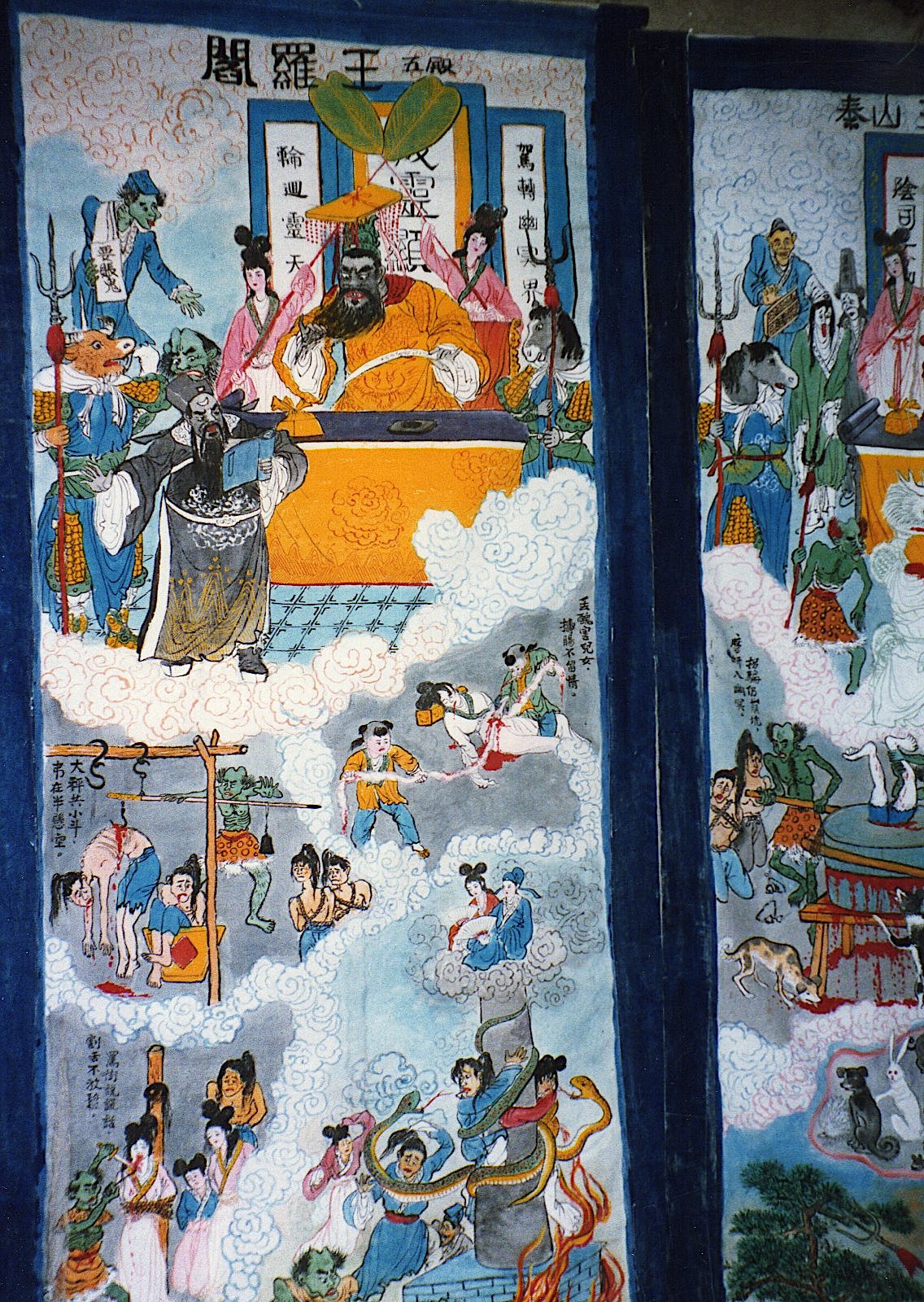
GL Ten Kings

Yama King painting from Ten Kings series, North Gaoluo 1990.

All these books incorporate ethnography and reception history far more than the fusty old reified appreciation of “autonomous” objets d’art. For China,

  • Craig Clunas, Art in China (1st edition 1997)

makes a useful, wide-ranging, and thoughtful introduction, exploring themes like genres, techniques, functions, patrons, markets, producers, class, and gender.

For instance, discussing a wooden sculpture of the female deity Guanyin from Shanxi carved c1200 CE, he describes its original multi-coloured decoration:

All this added to the immediacy of the image for worshippers, but it was covered over at some point, probably about 300–400 years later in the Ming dynasty (1368–1644), when it was painted gold in imitation of a gilded metal sculpture. Such an aesthetic change must have gone hand in hand with some change in the understanding of what a successful image ought to look like, a change at the level of both popular belief and the attitudes of religious professionals which is as yet hardly understood. (pp.56–7)

Whereas much scholarship remains based on artefacts in museums and galleries, fieldwork reveals a vast further repository of images still used in ritual practice. One thinks of the vast hoard of religious statuettes found in rural Hunan, subject of fine research.

And apart from statues and temple murals, ritual paintings depicting the Ten Kings and the punishments of the underworld—hung out for temple fairs and funerals—suggest comparisons with Christian equivalents in medieval and Renaissance art. And they too must have changed their meanings for audiences over recent centuries. At least, illiterate rural audiences would be affected rather deeply, and modern viewers may be underwhelmed now that they are saturated with horror films and video games. But we learn rather little about this from the scholarship; Daoist culture tends to be reified. Meanwhile, household ritual specialists have continued to perform Ten Kings scriptures for funerals.

It reminds me, challenged as I am in the field of visual culture, that ritual images through the ages also need unpacking—assessing changing meanings there too, including early sources for music iconography.

This has a lot to do with reception history. Such studies of visual culture may feed into our experience of Bach and all kinds of early and folk music. If even scholars of WAM and Renaissance painting feel it germane, then studies of Chinese musical cultures, and of Daoist ritual, shouldn’t lag behind.

* * *

But I’d like to end with some more populist vignettes (“Typical!”) on the meanings of art.

Among the numerous virtues of Alan Bennett is his accessible promotion of painting, found in Untold Stories (pp.453–514) [2]notably a talk he gave for the National Gallery, with the fine title “Going to the pictures”. These essays are also a passionate plea for culture to remain accessible, a rebuke to mercenary philistine governments.

He recalls an inauspicious early lecture he gave at Oxford on Richard II:

At the conclusion of this less than exciting paper I asked if there were any questions. There was an endless silence until finally one timid undergraduate at the back put up his hand.
“Could you tell me where you bought your shoes?”

 We’ve all been there. But his remarks on painting are priceless:

Somewhere in the National Gallery I’d like there to be a notice saying, “You don’t have to like everything”. When you’re appointed a trustee, the director, Neil MacGregor, takes you round on an introductory tour. Mine was at 9am, when I find it hard to look the milkman in the eye, let alone a Titian.

We were passing through the North Wing, I remember, and Neil was about to take me into one of the rooms when I said, “Oh, I don’t like Dutch pictures”, thereby seeming to dismiss Vermeer, De Hooch and indeed Rembrandt. And I saw a look of brief alarm pass over his face as if to say. “Who is this joker we’ve appointed?”

He cites his play A question of attribution, about (Michael Jacobs’ teacher) Anthony Blunt:

“What am I supposed to feel?” asks the policeman about going into the National Gallery.
“What do you feel?” asks Blunt.
“Baffled,” says Chubb, “and also knackered” … this last remark very much from the heart.
[… Blunt] tries to explain that the history of art shouldn’t be seen as simply a progress towards accurate or realistic reprentatation.
“Do we say Giotto isn’t a patch on Michelangelo because his figures are less lifelike?”
“Michelangelo?” says Chubb. “I don’t think his figures are lifelike frankly. The women aren’t. They’re just like men with tits. And the tits look as if they’ve been put on with an ice cream scoop. Has nobody pointed that out?”
“Not quite in those terms.”

In a *** passage AB blends hilarity with insight, evoking Baxandall:

In A question of attribution the Queen is made to have some doubts about paintings of the Annunciation.
“There are quite a lot of them,” says the Queen. “When we visited Florence we were taken round the art gallery there and well … I won’t say Annunciations were two a penny but they were certainly quite thick on the ground. And not all of them very convincing. My husband remarked that one of them looked to him like the messenger arriving from Littlewoods Pools. And that the Virgin was protesting that she had put a cross for no publicity.”
This last remark, though given to the Duke of Edinburgh, was actually another flag of distress, stemming from my unsuccessful attempts to assimilate and remember an article about the various positions of the Virgin’s hand, which are an elaborate semaphore of her feelings, a semaphore instantly understandable to contemporaries but, short of elaborate exposition, lost on us today. It’s a pretty out-of-the-way corner of art history but it leads me on to another question and another worry.
Floundering through some unreadable work on art history I’ve sometimes allowed myself the philistine thought that these elaborate expositions—gestures echoing other gestures, one picture calling up another and all underpinned with classical myth—that surely contemporaries could not have had all this at their fingertips or grasped by instinct what we can only attain by painstaking study and explication, and that this is pictures being given what’s been called “over meaning”. What made me repent, though, was when I started to think about my childhood and going to a different kind of pictures, the cinema.
When I was a boy we went to the pictures at least twice a week as most families did then, regardless of the merits of the film. I must have seen Citizen Kane when it came round for the first time, but with no thought that, apart from it being more boring, this was a different order of picture from George Formby, say, or Will Hay. And going to the pictures like this, unthinkingly, taking what was on offer week in week out was, I can see now, a sort of education, and induction into the subtle and complicated and not always conventional moral scheme that prevailed in the world of the cinema then, and which persisted with very little change until the early sixties.

Unpacking the complex attributes of two stock characters, he concludes:

The 20th-century audience had only to see a stock character on the screen to know instinctively what moral luggage he or she was carrying, the past they had, the future they could expect. And this was after, if one includes the silent films, not more than thirty years of going to the pictures. In the sixteenth century the audience or congregation would have been going to the pictures for 500 years at least, so how much more instinctive and instantaneous would their responses have been, how readily and unthinkingly they would have been able to decode their pictures—just as, as a not very precocious child of eight, I could decode mine.
And while it’s not yet true that the films of the thirties and forties would need decoding for a child of the present day, nevertheless that time may come; the period of settled morality and accepted beliefs which produced such films is as much over now as is the set of beliefs and assumptions that produced an allegory as complicated and difficult, for us at any rate, as Bronzino’s Allegory of Venus and Cupid.

For a similar case, see here.

* * *

Apart from any intrinsic merit this little tour of visual culture may have, for me it also suggests several angles barely explored for Daoist ritual.

OK then, just one last aperçu—this time from Kenneth Clark (thanks, Rod). On the contrast between reified art and social reception, here’s his typically urbane formulation in Civilization:

At some time in the 9th century one could have looked down the Seine and seen the prow of a Viking ship coming up the river. Looked at today in the British Museum, it is a powerful work of art; but to the mother of a family trying to settle down in her little hut, it would have seemed less agreeable.

On behalf of the splendid Craig ClunasI accept full responsibility for any inanities in this post.
If you all play your cards right, I promise not to do this kind of thing too often. Craig and any other art historians who have managed to read this far might care to exact revenge by writing Specious Flapdoodle
[famous 19th-century Baptist pastor—Ed.] about early music or Daoist ritual… 


** Not, may I just say, the kind of moronic homespun language used by one maniacal Führer about another: “smart cookie” or “total nut-job”? Roll over Cicero.

[1] Some stimulating reviews may be found herehere, and here.
[2] Online excerpts include http://www.independent.co.uk/life-style/i-know-what-i-like-but-im-not-sure-about-art-1620866.html and https://www.lrb.co.uk/v20/n07/alan-bennett/alan-bennett-chooses-four-paintings-for-schools.

More wordplay

This little digest is partly by way of cajoling my friend Nick, distinguished tenor
[cheap at the price], into unleashing his amazing anagram tales on the world
(now featured on this blog: roundup here!).

Wordplay in English and other languages (not least Chinese) displays dazzling and indeed warped creativity. For “constrained writing”, the oeuvre of Oulipo is most celebrated.

I’ll content myself with one anagram, on Mike Keith’s fine site, an extraordinary version of Dante’s Inferno:

This is a simultaneous anagram and translation. The English text is both an anagram of and an approximate translation of the first four tercets of Canto III of Dante’s Inferno, from the original 13th-century Italian.

Original:
Per me si va ne la citta dolente
Per me si va ne l’etterno dolore
Per me si va tra la perduta gente.

Giustizia mosse il mio alto fattore;
Fecemi la divina podestate,
La somma sapienza e ‘l primo amore.

Dinanzi a me non fuor cose create
Se non etterne, e io etterno duro.
LASCIATE OGNE SPERANZA, VOI CH’INTRATE.

Queste parole di colore oscuro
vid’ io scritte al sommo d’una porta;
per ch’io: “Maestro, il senso lor m’e duro.”

Anagram:
I am a portal to a sad place.
I am a cover to eternal fire.
Go, see our pit ooze craven memories.

Elite persistence moved some creator;
Divine omnipotence created me;
I am solo orgies of primal love.
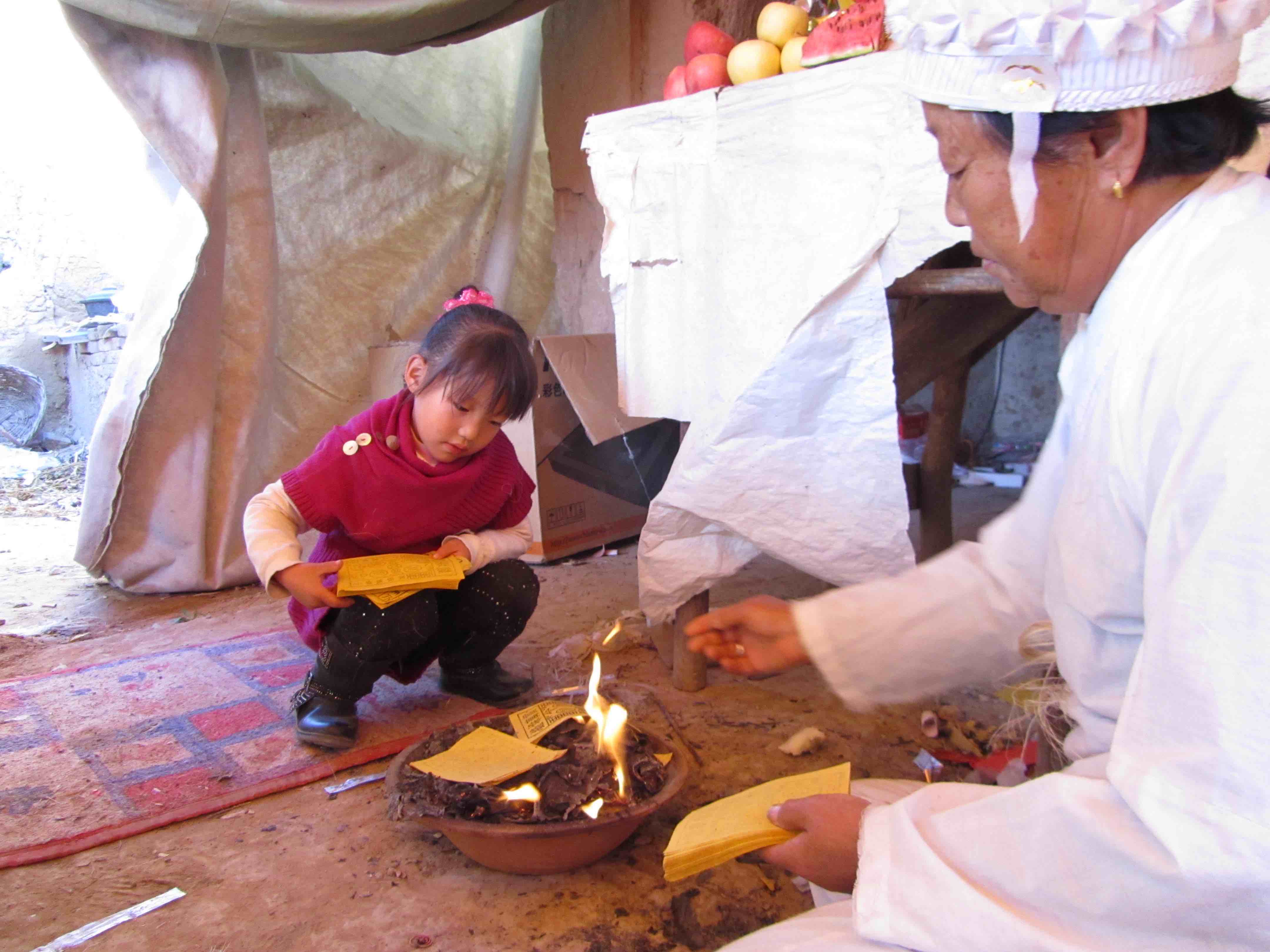
Listen: ere me no denizens used our portal
I quit not, and I last eternal.
FOREGO ALL HOPE, ALL MEN THAT ENTER.

Crazed and curious, in a daze I sat
To see man pour out over a portal;
So I said: “Master, I cannot see its import.”

For more succinct anagrams, see Igor Stravinsky; Charles MackerrasDarcey Bussell—and Maidstone (an unlikely venue for their rendition of the Rite of Spring). See also

* * *

Among palindromes, [1] I’ve always been fond of

T. Eliot, top bard, notes putrid tang emanating, is sad. “I’d assign it a
name: gnat dirt upset on drab pot toilet”

—attributed to Alastair Read rather than W.H. Auden, it seems.

I like the sound of the Finnish palindrome with 10,102 words—even if, as one commentator candidly observes, “It’s really not that much fun.” We can limber up with some shorter ones (here), like

saippuakuppinippukauppias—soap cup batch trader
[SJ: Aha, perhaps this is useful as Elk lubricant?]

The following are to be found on the sites
http://palindromist.org (“Wary, Alpine Zen: I Play Raw”) and
http://www.cadaeic.net/palind.htm

They can be elegant and suggestive:

Rot, cello collector!

Mao bore Jeroboam.

No more Cicero, mon! [the Rastafarian has had his fill of the classics.]

 Overheard at the flea-market:
“Camel bible, Mac?”
“Cameraware, Mac?”

or the fine

An igloo costs a lot, Ed!
Amen. One made to last! So cool, Gina!

Now Derek can kiss Anais A. Nin, as I, an ass (I, knackered) won.
[extra points for proper names, as Mike Keith notes—the more evocative the better]

Olson, I won—see Saratoga repossess opera! Go, Tara, see Snow in Oslo.

Ajar? Aha! Maybe, Dan, omelet is opposite lemonade, by a Maharaja!

Some men interpret nine memos.

And longer ones like

“Traci, to regard nine men in drag,” Eric (in a play or an ironic art spot) warned, “I am not so bad.” “I’d never even seen knees … never even did a Boston maiden raw,” tops Traci, “nor in a royal panic. I regard nine men in drag —erotic art.”

Or a poem:

Amen, Icy Cinema [title and poem are separate palindromes]
Amen, I can!
I stop elastic ire
To see La Dolce Vita.

Covet?
I moisten nose,
Sonnets I omit, evocative clod!

Ale? Esoteric?
It’s ale! Pots in a cinema!

There are word-unit palindromes too:

You swallow pills for anxious days and nights, and days, anxious for pills, swallow you.

And sure enough, some have risen to the challenge of the palindromic haiku (work in progress), like this one by Ailihphilia (sic):

Oak, dove, temple: hymn
In mutual autumn, in my
Helpmete vodka. O!

Or some by Dalibor.

And then for the gourmet, there’s the menu from the “Moor Room”, a restaurant for palindromists:

Do, O Food [main course]
Tangy gnat
Koalas a la OK
La emu meal
Salad, alas

Gorge Grog [drinks]
Regal lager
Lemon o’ Mel

Desserts Stressed
Sugar a Gus
Bananas an’ a Nab

Some entries from “Drown In Word”, the (fictional) palindromic dictionary:
Gigolo:  Solo gig.
Paranoia:  I, on a rap.
Semantic:  It names.
Pa Plato:  Total pap.

This (from here) is pleasing:

palindromes

I note that “fear of palindromes” is Aibohphobia.

Finally, the erudite David Hughes, himself no mean songster, draws my attention to this:

* * *

True, while any sophisticated artistic activity (which perhaps excludes the KKK songbook and poetry competition) may be seen as a bulwark against philistinism, none of this quite butters any parsnips in the task that currently confronts us—to resist with every pore the barbarity of the putrid tang emanating from the drab pot toilet of the White House. T. Eliot, top bard, would have been sad too. I’d assign it a name, all right.

[1] See e.g.
http://www.cadaeic.net/palind.htm
http://www.cadaeic.net/silopolis.htm
https://www.theguardian.com/notesandqueries/query/0,5753,-2762,00.html
https://www.dailydot.com/debug/worlds-longest-palindrome-sentence/

More authorship

Further to Ted Ibert’s Pique Nique, I just got a promo from Amazon (“based on your recent activity, we thought you might be interested in this”. Pah!):

Homer

Helpful of them to clarify the author underneath, too. My “recent activity” evidently led them to believe that I might still be confused.

Cf. the TV quiz question (which floored some contestants)

Who wrote Beethoven’s 5th symphony?

Mind you, in the case of Homer, they were right to protest too much. Rather than being “composed” by a single blind bard, the “work” that has come down to us seems to have been more like a fixed version of a fluid oral tradition. Amazon’s insistence recalls the famous story of the dogged convict in the prison exam.

Some Venetian greetings

On the Li family Daoists’ 2012 sojourn in Venice in 2012 we were guests of the Fondazione Cini, staying virtually alone on the tranquil little island of Isola San Giorgio, just across from bustling San Marco.

Chatting with our Cini hosts, the fragrant Chiara and Sabrina, they told me that when Venetians come across each other by chance they like to exclaim

Fatalità!” (pronounced “Fataità!”)—“Fate!”

A quaint English equivalent might be “Fancy bumping into you!”

Venice 2012

Fatalità! Venetian dwellers with the Li band, or “Selling the Daode jing at the door of Confucius”  在孔子門前賣道德經。

I gather “Fatalità!” is more commonly an interjection, as when telling a story (“And what should happen but…”) or (in reacting) “Fancy that!”. It can also be a humorous way of accepting fate, almost like the English “Typical!” or “That’s life!”.

Without regard to expense or the feelings of the public, the erudite Rod Conway Morris, himself a long-term chronicler of Venetian mores, has obligingly ferreted out a little discussion by Sandro Mattiazzi (Veneziani: Figli del Leone Alata, 2002), with pleasantly arcane examples of a quarrel between gondoliers and a dispute during the war with the Turks, both defused by the timely exclamation.

Fatalità is chance [caso], the fortuitous event that is yet the result of a necessity great or small, and is typical of the Venetian mentality. […] Don’t despair if you can’t find the way to your hotel, or if you’ve left your bag on top of some well. Chance, which has aided the Venetians for almost two thousand years, will surely come to your aid.  Fatalità means that by randomly following another tourist you will arrive at your lost hotel, where perhaps you will find your bag on the porter’s desk. [my translation]

“Fate!” recalls fado, or (as I explained to Li Manshan) the Chinese ming 命… Those terms aren’t part of any such greeting, though in classical Chinese chen 臣 equates with the hackneyed “Ciao!”—itself borrowed from Venetian, and cognate with slave and Slav (for an erudite discussion, see here). Or the English “your humble servant”, mercifully abbreviated from “I trust I shall have the honour to remain your humble servant”, which is of course the correct form of address for foreigners to employ when staggering out of an East End pub at closing time.

Following an arcane exchange in The Times (“Have these people got no Holmes to go to?”—Myles. Mind you, I can’t talk) wherein it is established that Gautier’s Tra la, tra la, la-la-laire is not in fact a reference to the call of the inevitable ubiquitous gondolier, Rod observed in a letter (whose date of 1st April 2016 he assures me is merely coincidental—remember, the word “gullible” doesn’t appear in the OED):

The traditional gondolier’s cry (especially when rounding blind corners in canals) is “O-i!” This is also sometimes used by the inhabitants of the city as a jocular greeting.

I respectfully submit, m’Lud, that had they gone on to use the honorific form of address, the greeting might have become “O-i vo-i!”, evoking Venice’s Jewish heritage (I’ll spare you my fantasy reconstruction of the temporal and spatial vowel-shift). And given the city’s Turkish connection, I’m also still hoping Rod will further unearth the greeting “Ey-up!“—which, in turn, became the correct form of address when entering a kebab shop in Barnsley (cf. my haiku on Morris dancing). The joys of multiculturalism…

Inspired by Rod’s stimulating review, if you read in the gazette of the imbroglio over an arsenal of contraband artichokes; and if you’ve ever been quarantined after zany scampi and pistachio marzipan in the ghetto, or worn sequined pantaloons to a regatta—actually, even if you haven’t, which (let’s face it) is more likely—then you should tip your imaginary hat to the Venetian language. For a borrowing from Turkish, see The kiosk in Turkey and Europe; for Indian influences, see Tickety-boo.

Time for another gin.

More orchestral drôlerie

As part of our ongoing series on the war of attrition between musos and conductors, not unlike the celebrated story about the opening of the Beethoven violin concerto:

During a rehearsal, as some tedious conductor insisted on honing the opening phrase of some symphony ad nauseam, making us repeat the first four bars for what seemed like hours, one player eventually piped up from the back:

“Excuse me Maestro—I believe bar 5 is rather good too!”

Note again the exemplary sarcastic deployment of the term Maestro.