Bearing witness 2: Sachsenhausen

Notes from Berlin, 1

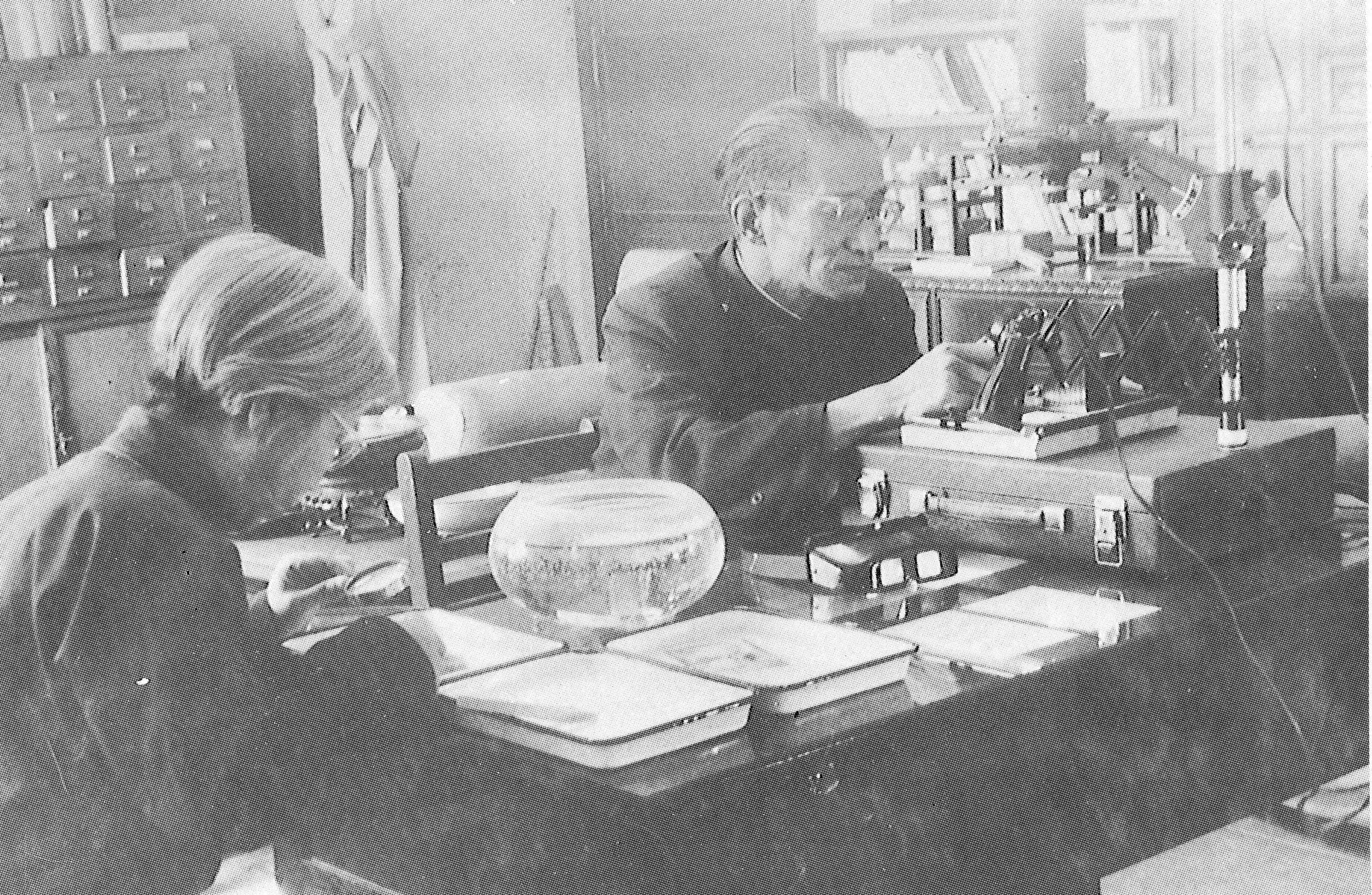
Appell

Roll-call at Sachsenhausen, February 1941.

Screening my film in Berlin last week gave me the chance to explore a city that I hardly knew. It seems timely to negotiate a new place, a new transport network—I was beginning to feel that I can only find my way from my house to Li Manshan’s village.

Rather than some anodyne heritage flapdoodle à la chinoise, here I’ll introduce Sachsenhausen concentration camp, with a sequel on Stasi sites in Berlin itself.

* * *

Having been so moved by Sarah Helm’s harrowing book on Ravensbrück, I had hoped to get there, but with limited time Sachsenhausen (cf. wiki and many more detailed sites) is more accessible, and anyway demands a whole day (and I’m acutely aware that we can be suitably horrified by our day-trip and then come home to friends for a nice plate of pasta with wine.)

At the same time, it’s deeply inspiring to see not only how well documented such sites are (including the Stasi memorials) but also how busy they are—the grounds are constantly full of school groups receiving the most important education.

All such camps saw prolonged use, both before the war (Oranienburg concentration camp started operating in 1933, moving to Sachenhausen in 1936) but also long after, under Soviet (indeed allied) and GDR regimes.

* * *

I visited Sachenhausen last Friday—which happened to be Hitler’s birthday, occasion for a repellent Nazi festival in parts of eastern Germany.

To arrive by train at Oranienburg station is itself disturbing, thinking of how the inmates reached the camp. One of the most hideous accounts at the site tells how in September 1939 the rabid inhabitants of the town abused 534 Polish Jews as they marched to incarceration and death—though they had been duped that the arrivals were themselves murderers, one suspects this wasn’t an exceptional case (Wachsmann, KL [definitive source on the camp system], p.230).

In the barracks I was taken aback by the sitting toilets and washrooms—of course, inmates were highly vulnerable in these places, often being brutally beaten to death there, so it’s hardly relevant to contrast the primitive conditions at Chinese laogai camps, or ordinary Chinese homes.

Inmates (from all over Europe, and Russia) included political prisoners, Jews, homosexuals, and “antisocials”. In autumn 1941 alone over 10,000 Russian prisoners of war were executed at the camp. But individual lives play an important role both in the exhibitions and online, such as Dutch resistance fighter Ab Nicolaas (who later became a clown), or the German Sinto Walter Winter.

camp mouth organ

As Helm describes harrowingly for Ravensbrück, even the twice-daily Appell roll-call (see photo at head of article) was purgatory.

The infirmary exhibitions are substantial too, including sections on medical experiments on young Jews and the reunion of survivors fifty years later; and on the camp brothel.

Brothel

Among the most disturbing exhibitions is in the watch tower, on the relations of locals with the camp and the SS—“What would we have done?” again. The SS were billeted in town, with their own bands, taking part in street parties. People recalled how as kids they were handed out balloons and lollies by the SS.

Tarantella

“Tarantella for German soldiers”—SS officers attending a folklore festival on Capri, alleged to be the Blockführers of Sachsenhausen who had been shooters in the 1941 Russenaktion.


Death march and “Liberation”, 1945.

After the war
Then on to the display about the Soviet camp 1945–50, just as gruesome—12,000 of 60,000 prisoners died there. Here too the documenting of individuals is sobering, such as the meticulous diarist Günter Sack, and Stella Kübler-Isaakson, a Jewish spy for the Nazis who was imprisoned here from 1946 to 1956 (see Peter Wyden, Stella, reviewed here and here).

The Soviet Special Camp was closed in 1950, but not all of the prisoners were set free. The majority of the prisoners sentenced by the Soviet military tribunal were sent to East German prisons. Some of the internees were tried during the Waldheimer cases in the GDR, and Soviet prisoners were deported to camps in the USSR.

The site’s GDR history (see here, with sequel here) provokes thought too. There are exhibits, including films, of the first commemoration in 1955, with GDR citizens touring the camp; after 1961, as the memorial calendar became more busy, it became a site of “anti-fascist education” even as the repression continued. From 1976 couples even visited on their wedding day—not a simple case of indoctrination, but often related to the sufferings of their parents at the camp.

At the same time (as the catalogue describes), the state appropriation of the memorial for its own purposes was gradually subverted; peace movements, church groups, citizens’ initiatives, and “excluded groups” began chipping away at the GDR’s “monopoly on heroism”.

Again, you can choose if you can bear to watch films like this:

* * *

How such catastrophic moral failure occurred remains imponderable—so much for the German Soul. As Neil MacGregor asks,

How did the great humanising traditions of German history—Dürer, Luther’s Bible, Bach, the Enlightenment, Goethe’s Faust, the Bauhaus, and much, much more—fail to avert this total ethical collapse?

It does indeed seem a bit late for me to take all this to heart now. I can’t claim that if I’d have trodden a different path if I’d been exposed to all this history in my teens, but still. And at least now with my work on China I’m not churning out the patriotic agenda of the glories of Han­–Tang music, or merely collecting happy folk ditties: it’s all political.

Until recently it might have felt a blessing to be English, not to have been beset by such agonizing dilemmas—yet another “What would we have done?”. But how admirable the Germans have become since the 1990s: not only do they put us to shame in their response to the migration crisis, but further to have set up this network of memorial sites—whereas in Britain there are many who not only consider themselves separate from Europe but still have the hubris to protest the exposing of the crimes of our own imperialism, denying the lessons of history.

I also hope that one day in China there will be meticulously documented sites like this, to commemorate the self-inflicted disasters of its own modern history (cf. this post). Mind you, talking of memorials, here’s one in the southern USA.

In all these places—Germany, China, the USA, and so on—such traumatic histories are an essential aspect of the cultural soundscapes that we so blithely celebrate. Including the Chinese ritual soundscape. And Britain?

For Mahler’s prophesy, see here. For the first gulag in Soviet Russia, see here.

* * *

Returning to civilisation, on my walk from the S-Bahn at Jungfernheide I would pass charming door statuettes over the entrances to pre-War apartment blocks in Herschelstraße and Fabriciustraße (for shutter catches in Venice, see here; for the accordion, see here). Ordinary domestic life… I wonder what happened to the inhabitants.


At home with a master Daoist

As weird holidays go, this is pretty weird…

To supplement my various articles on particular themes (a ghost village, a funeral, the murals of Artisan the Sixth, Elder Hu, In search of temples, and so on), this diary records the more domestic side of my recent trip chez Li Manshan—like my notes on our French tour last May, the kind of thing one hardly finds in inscrutable accounts of hallowed Daoist ritual.

As I land in Beijing, pausing only to catch up with my wonderful hosts Matt and Dom and to buy a SIM card, I take the midnight train to Yanggao—smashing my personal best time for Fastest Ever Escape From Beijing. You may like to begin by reading my updated description of my first couple of days there.

Catching up
Despite improved transport and smartphones, progress seems superficial. This is still another world from the skyscrapers and Party congresses touted by the international media. Like anywhere else in the world, indeed. And it’s hard to see evidence of greater repression—people are well used to it.

Li Manshan’s home village of Upper Liangyuan still has some over six hundred dwellers, which counts as a lot round here; but it seems forlorn, stagnant. It’s ever clearer that the rural population is “left behind”—elderly people sitting outside awaiting their turn. Litter remains an intractable problem, blighting what might almost be an idyllic landscape.

Having been worked off his feet for many years, now that Li Manshan is in his 70s he’s giving way to Li Bin, who’s busier than ever. Li Bin has three funerals to do today, one a solo attendance at the grave (“smashing the bowl”, “without scriptures”) for a Catholic family, who still need the procedures for the date and siting of the burial. On the 17th (or rather the 2nd, chu’er—I soon get used to the lunar calendar) he has to smash two more bowls.

So now Li Manshan only works nearby—decorating coffins, doing grave-sitings and visits to determine the date for burials, as well as the occasional funeral. Soon after I arrive he zooms off on his motor-bike to Yangguantun to decorate a coffin. I’m happy to try and sleep off my journey from London.
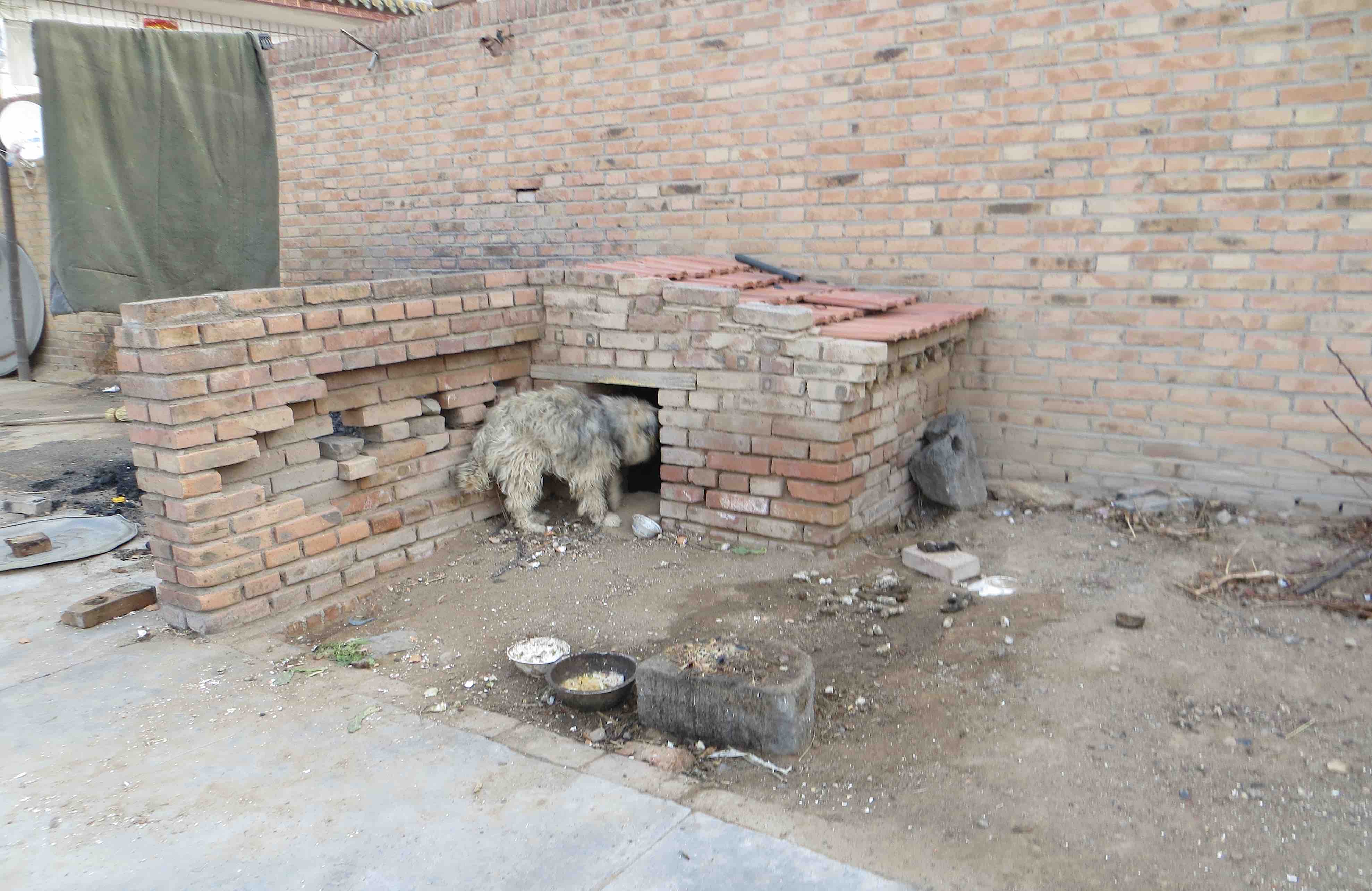
doggie

Visitors are always announced by a barking dog, like a doorbell. The Lis have a new doggie, rarely off its tether by its kennel in the courtyard. It’s frozen. When I tell Li Manshan’s wife (busy making funerary headgear) about our poncey UK winter gilets for dogs, she shrugs, “He’s fine, he’s got fur ain’t ‘e?!”

LMS wife sewing

Li Manshan’s (only) disciple Wang Ding returns from a funeral to unload the decorations for the soul hall, now improved and more convenient. Renting out this equipment to funeral families is another source of income for Li Manshan. Giving Wang Ding a hand, I tell him I wrote a little post about him after our little French tour last year; he hasn’t got internet, so he will look at my blog at Golden Noble’s place. He can speak pretty good Yangpu, but even after all these years I find their dialect as tough as ever.

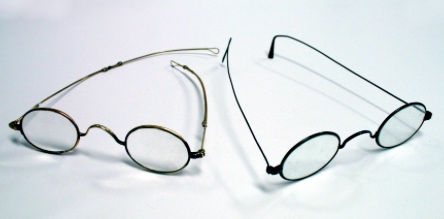
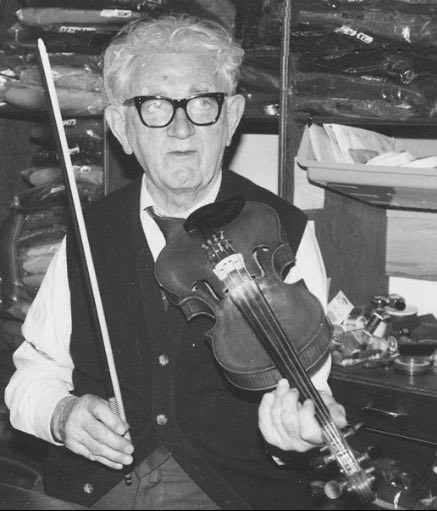
I hardly bother to wear my glasses any more—like clarinetist Jack Brymer, who when rehearsing a contemporary piece would wear his for the first five minutes, and then only keep them on if he thought it was worth it…

The domestic routine
Li Manshan’s first tasks on rising are to fold the bedding, take out the chamber pot, fetch kindling for the kitchen stove and our little stove in the west room, and boil water. He does his bit with the housework: sweeping, mopping, stoking the stove, preparing water—though he leaves most of the cooking to his wife. The little coal stove is cute and effective, but mafan. At last I learn that the central foyer is called tangdi 堂地. Both living rooms are equipped with a low wooden table, actually rather handsome but covered in plastic, to place on the kang, used for meals and writing. Plastic rules OK—and a jolly good thing too.

meal

Our diet consists mainly of baozi dumplings, [1] noodles, crêpes, mushrooms, eggs, bits of meat, meatballs, doufu, cabbage, nuts. Sometimes our meals evoke the classic film Yellow Earth—indelible image of the fieldworker overwhelmed by the sheer enormity of poverty and traditional culture. But we giggle a lot too.

Again Li Manshan stresses how much he prefers country life. I soon get used again to its basic routines, not least visits to the latrine in the southwest corner of the courtyard—taking paper (The Thoughts of Uncle Xi would be useful, but it’s not to hand/arse), and a torch if dark, to balance on a ledge; adjusting trousers, squatting (not getting any easier)…

Amazingly, for my visit in autumn 2013 Li Manshan modified his old latrine, building a little roofed pier (so to speak) over a floor on pillars projecting from the spacious pit. Like the world, it was built in seven days. After designing it on paper, he borrowed 230 bricks, as well as stone slabs, tiles, and so on, from neighbours; then he got down and dirty over a week at the height of summer. I felt embarrassed, but he pointed out that it would be good for them too.

We refer to it as The London Embassy (Lundun dashiguan, pronounced like “Taking turns to squat in the big shithouse”). The great Beijing cultural pundit Tian Qing even bestowed his illustrious calligraphy on Li Manshan, albeit in the more polite version.

So (thanks to me) the latrine is pretty comfortable, but it makes a suitable image to imagine the poverty of the olden days (including the Maoist era—a sobering contrast with the bright propaganda posters of the time): the old and infirm trudging to an open pit in the snow, with no paper, no sanitary products, no torches in the dark.

I’m so pampered, compared to Li Manshan’s lifetime “enduring suffering” (shouku 受苦). From my book (pp.132–3):

Shoulders unable to carry, hands unable to grasp, soft and sensitive skin…

Coming across this phrase in 2013 as I made inept attempts to help Li Manshan with the autumn harvest, I thought it might have been coined to parody my efforts. Rather, it’s a standard expression used to describe the travails of urban “educated youth” in performing physical labour after being sent down from the cities to the countryside in the Cultural Revolution to “learn from the peasants”. The experience was a rude shock for such groups all over China; brought up in relatively comfortable urban schools to believe in the benefits of socialism, and often protected from understanding the tribulations of their own parents, they were now confronted not just by the harshness of physical labour, but by medieval poverty.

Li Manshan is thrilled with my little gift of a set of UK coins, working out which is which. He proudly offers me a black banana, white and tasty on the inside, but decides to eat it himself; we have a giggle over glossy modernized bananas (cf. “banana republic, but minus the bananas”). His wife passes the time by playing “matching pairs”, a kind of dominoes. A female friend of hers drops by for a chat. They’re all very humorous, beneath a somewhat dour exterior. Li Manshan and his wife seem like counsellors.

In reply to villagers’ curious enquiries about how many kids I have, Li Manshan is now in the habit of replying wu, which they hear as “five” 五 but in his creative head means “none” 无. This surprisingly shuts them up—I worry about having to embroider stories about their careers, my numerous grandkids, and so on, but no. Anyway, Li Manshan would be up for this. He observes that since my surname is Zhong 钟 (Clock), my son might be named Biao 表 (watch).

We share a nice supper of noodles, and more dumplings. The CCTV evening news is on as wallpaper [Breaking news! CCP holds meeting! Xi Jinping still in power! Old gits in suits dead bored!]. It’s ignored until the weather forecast comes on, but Li Manshan loves the nature programmes.

“Wotcha doing when you get back to Beijing?”, he goes.
“I’m going to be giving lectures (jiangke)…”
His local dialect, or his lively mind, instantly converts this to jiekastammering”:
“Old Jonesy, you don’t have to go back to Beijing to stammer—you can just keep on stammering away here!”

I manage both.

Writing
Though Li Manshan is doing fewer funerals these days, he has always got ritual paperwork to do—whether it’s writing talismans, shaping paper for funerary artefacts, or writing mottos for the soul hall (our film, from 10.41;  Daoist priests of the Li family, pp.194–200).

He’s bought big reams of thick paper from Yangyuan county. He recalls that when Li Qing recopied the ritual manuals in the early 1980s, mazhi hemp paper was available from the Supply and Marketing Co-op.

One day our siesta is disturbed by a group coming to ask Li Manshan to “determine the date”. After seeing them off he spends the rest of the afternoon writing several dozen sets of four-character funerary diaolian mottos for the soul hall (my film, from 10.43)—enough for a couple of months. Again he recalls how Li Qing used to write them in the scripture hall for each particular funeral. I devise a new game: arranging the squares in a different order to make a popular phrase or saying. For starters, how about 東方妙,西方福 (“oriental mysticism is all very well, but things are kinda cushy over here”).

A trip into town
One morning we call up the wonderful Li Jin to arrange a nice quiet lunch in town, just the three of us. Li Manshan’s wife chooses a posh shirt and jacket for him.

In 1953, when he was 8 sui, Li Manshan walked into town with his auntie to see the big xiangong parade there. Now we walk up to the main road to catch the No.2 bus into town; it arrives soon, a mere 3 kuai each, taking under half an hour—fun, and good to be independent. I go to have my head shaved at my favourite barbershop, and we meet up with Li Jin at Li Bin’s funeral shop. But then Li Manshan’s (much) younger brother Third Tiger shows up too, and he drives us in his posh car to a posh restaurant (attached to a posh hotel) up a little hutong, with no sign (which is always a good, um, sign)—we’re the only customers. But then entrepreneur Ye Lin (another old mate, formerly head of the Bureau of Culture) arrives too, and Li Bin; so altogether it’s less of a quiet meal than I hoped.

lunch LJ LB LMS

lunch Sanhu

Third Tiger has brought a case of Chilean 2011 Cabernet Sauvignon from Central Valley, a gift from a friend. We polish it off, though later the ganbei toasting seems a bit unsuitable…

Third Tiger had been looking forward to early retirement from his important state job—even claiming in my film (from 55.23) that he’d like to get back to Daoist ritual—but it won’t be happening any time soon. He’s done well as a Party cadre, his only flaw being that he can’t really hold his drink—this should surely be the first question on the application form:

How much baijiu liquor can you knock back before you fall over?

Inevitably Third Tiger foots the bill. I remind my companions of the donkey joke—I’m inadvertently “cadging a free meal wherever I go” again…

After lunch, Li Bin takes us on a fruitless visit to the Cultural Preservation Bureau to learn that the compilation of Yanggao temple steles is still not published. Then we drop in on a shop up the road to sort out a standoff between my camera and my Mac; the guy is even more pissed than me, but does a fine job. We exchange cigarettes, and he refuses any money.

Li Bin is happy to take us home to Upper Liangyuan, and on the way we drop in on the grandson of the great Li Peisen at his funeral shop, to see if he can show us the three manuals not in Li Qing’s collection, which I didn’t copy. He and his wife seem affable, but he can’t find them. It’s hard to know if he’s being cagey: he does show Li Manshan Li Peisen’s thick Yuqie yankou volume, so maybe he really can’t find the others. I ask him, without much hope, to call Li Bin if he does find them. Li Manshan cares more about this than I do.

I’ve also been wondering if the related Wang lineage in Baideng has any ritual manuals we haven’t seen, but when Li Manshan calls up Wang Fei there, he says they have no more than him.

More Heritage flapdoodle
Next to the main sign above his funerary shop, Li Bin has optimistically put up a new sign: “Hengshan Daoist Music, Training Base”.

HSDYT shop placard

This pie-in-the-sky still has precisely no takers, but Li Bin remains involved in a mysterious project with the county Bureau of Culture. We all laugh at the emptiness of the title—but it acts like a protective talisman, a kind of insurance policy.

Pacing the Void: Old Lord Li gets online
Like me, Li Manshan got his first smartphone after returning from France last year. He can read WeChat messages, but hasn’t cared to try and get online—yet. I think he can do it. Actually, WeChat doesn’t seem such a big deal here—sure, the younger people are on it, but the main way of communicating is just phoning. So there.

Getting online with my Mac thanks to the wifi of Li Manshan’s cool shepherd neighbour, I show him the charming TV version of The Dream of the Red Chamber with child actors. He loved reading the novel in the 1980s.

I give him a guided tour of my blog, starting with the posts I wrote about our French tour last year (e.g. here), my tribute to his carpentry skills, and the trio on Women of Yanggao (starting here). We look further at the ritual paintings in Li Peisen’s collection, which leads us to seek murals by Artisan the Sixth.

Then I introduce him to my other world, telling him about Yuan QuanyouHildi, and the 80th-birthday party for the great Stephan Feuchtwang where Rowan and I played Bach on erhu and sanxian—after listening to the recording there (now also sounding a bit crap), I try to attone by playing him Sun Huang’s astounding Saint-Saens (or Sage Mulberry, as he’s known in China), but he’s underwhelmed—the conservatoire erhu is of even less relevance to him than to me. And he’s none too clear about the qin zither, despite painting it regularly on coffins (my film, from 18.30).

LMS huacai

Li Manshan decorates a coffin, 2013. Top: qin zither.

I tell him again about the adorable crazy Natasha, showing him my tribute to her—it was he who helped me regain the will to live after her death in 2013.

Over the next few days Old Lord Li becomes ever more scholarly, devouring the new book on the modern history of the county (only up to 1949, alas!), the gazetteer, and all the online stuff I show him. (You may note that he has reverted to his old hat—was the baseball cap he wore in France a haute-couture choice to impress the laowai?!)

He gets into Ming reign-periods online. I show him the Baidu article on the 1449 Tumu incident (very near Yanggao), making the link with the disgraced palace eunuch Wang Zhen and the Zhihua temple. As he gets hooked on some pre-Tang story in the county gazetteer, I turn the tables on him, commenting “I dunno about that, I wasn’t even born then!”

As he gets used to scrolling on my Mac keypad, I show him the blurb for the Chinese introduction to the already-voluminous Daojiao yishi congshu series, which he reads carefully. When I show him Hannibal Taubes’ amazing site, he thinks that Yanggao temple murals are not so well preserved as those of Yuxian—but I suspect it could also be that Hannibal is really on the case.

I tell Li Manshan of the useful saying “When the rites are lost, seek throughout the countryside”, which is always a succinct way of explaining what we’re doing traipsing around poor villages.

On my blog he’s interested to pore over ritual manuals from other areas. I find an online text for the pseudo-Sanskrit mantra Pu’an zhou, which they never sang, only played on shengguan. When we listen to my recording of Ma yulang with the Gaoluo ritual association (playlist # 10, with commentary here), he’s shocked at how crap they are! I explain that they’re an amateur group, not like our occupational Daoists working together daily. But he’s curious to learn if the melody is similar to their version, a question I haven’t yet addressed.

We discuss the Kangxi yun section in the hymn volume that Li Qing recopied in 1980—I’ve often wondered what it’s doing there, as part of a series of shuowen solo recitations formerly used for the shanggong Presenting Offerings ritual segment. It was actually written not by the Kangxi emperor but by his father Shunzhi. The version copied by Li Qing is a variant.

Kangxi yunAs we read up further, we now speculate that since Kangxi saw the poem on a visit to Wutaishan, and as Buddhist ritual manuals do contain poems, it could have got into one such manual there; spreading further north, it might thence have got into Daoist manuals too—which, after all, contain plenty of Buddhist elements (my book, e.g. p.226).

I wonder if the title Kangxi yun is distinctive to the Li family. If Li Fu copied it from the manuals of his master in Jinjiazhuang, it wouldn’t have been at all old when it was copied by the Zhang family Daoists there. More work for a historian there… Li Manshan buries himself in the Baidu articles on Shunzhi’s mother and Nurhaci.

He knows nothing of Trump, Syria, or the Ukraine famine. While envying him his blissful ignorance, I embark on a political education session; he reads avidly when I show him the relevant Baidu articles. The article on the Ukraine famine looks rather good—though one can hardly expect Baidu to compare it to the Chinese famine following the Great Leap Backward.

After returning from a brief trip to Waterdrop 滴滴水 village with Li Bin, I check the 1948 and 1990 population statistics (first two columns below) in the county gazetteer, but they seem incongruous. Old Lord Li inspects the table for the whole of Zhangguantun district and deftly corrects them. Clever guy!
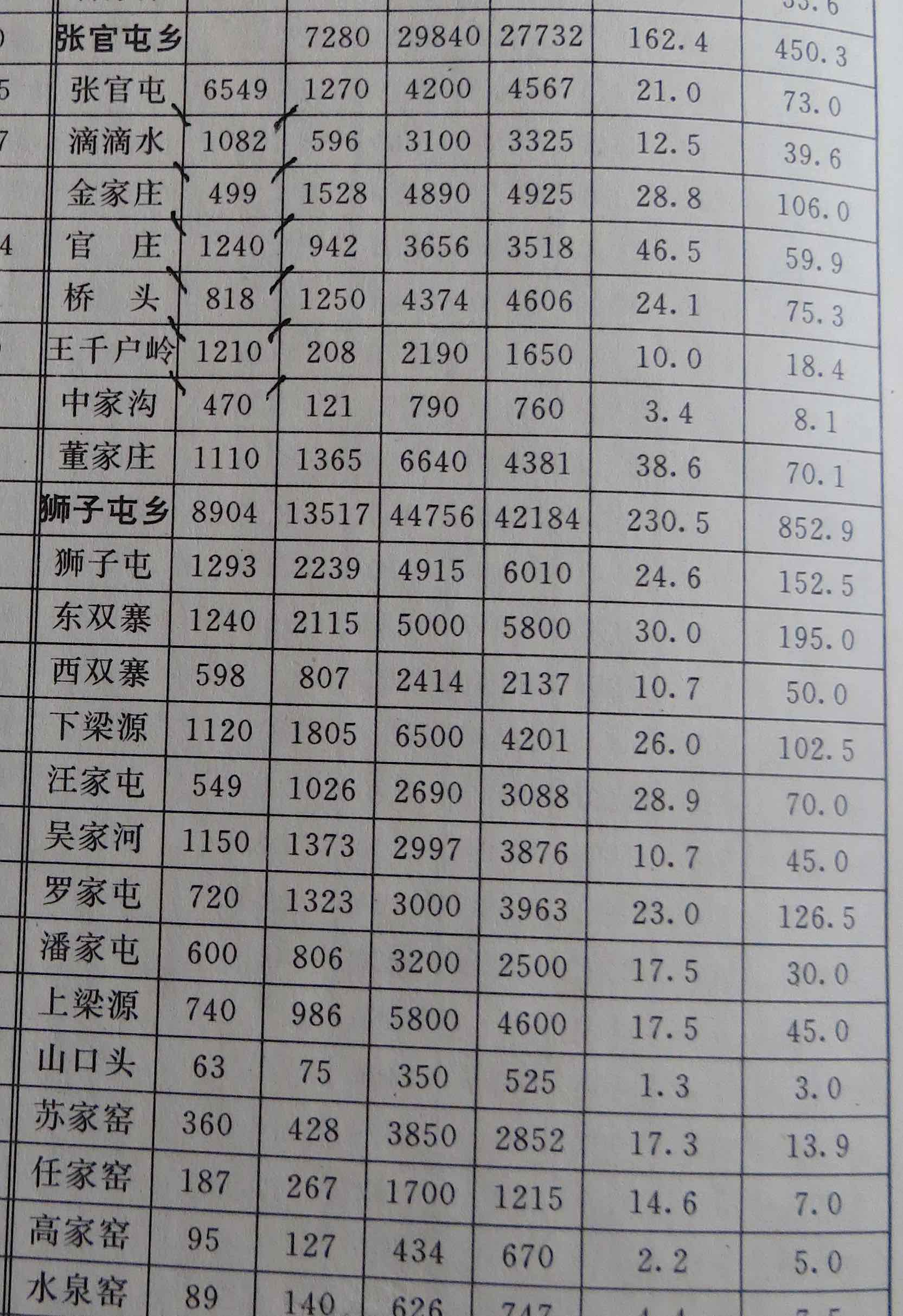
renkou edits

Born at a different time in another place, Li Manshan might have become a university professor.

2nd moon 28th
As yet another idée fixe in Airplane goes, “Looks like I picked the wrong day to” get my head shaved—it’s really rather cold. Li Manshan kept reading till late last night. We stay home for a study day. He fields another “determining the date” request by phone.

Before midday a couple comes for a prescription about her illness. They’ve come all the way from Datong county, learning of his reputation on the grapevine. Sure, people may also consult mediums, and of course hospitals—the latter terribly expensive, but as Li Manshan observes, their best bet.

LMS krz

The mood is serious as ever when the wife throws the coins and Li Manshan writes down the results. They watch him work it all out, in silence; then she asks questions, the conversation deepening. Li Manshan feels his role (often) is to console them, to lend moral support. As he later tells me, in fact the prescription looks ominous, and mostly he trusts the coins, but he can’t tell them “You’ve had it”, can he? They persuade the couple to stay for lunch (baozi dumplings, cabbage and doufu, onions), washed down at the end with water from the pot. It’s a friendly and sincere scene. They only paid him with five cigarettes, and Li Manshan was fine with that.

Li Manshan’s siesta is devoted to further reading, and he’s only just nodded off when another guy comes for a prescription.

Another great supper: thick-sliced noodles with eggs, dunking meatballs in the broth. Li Manshan glances over at the news, nudging me—some Party bigwig is being interviewed, the caption reading:

中国人大代表 Zhongguo Renda daibiao
Representative of the Chinese People’s Congress,

which he brilliantly converts from three binomes into

中国人,大代表 Zhongguoren dadabiao
Chinese bloke, big cheese.

We fall about laughing. I just love the way this man’s mind works! The following week I’m showing my film at People’s University in Beijing, which is also abbreviated as Renda—so I manage to press the expression into service there.

I clean my teeth in the courtyard, enjoying using my fancy electric Rabbits Don’t Shit, sorry I mean toothbrush (its first outing in China). Since Li Manshan always shoves a fag in my gob as soon as I get back anyway, I beat him to the draw. Whenever I spot an unfamiliar brand, I ask him, “Landlord? Poor peasant?”

3rd moon 1st (chuyi)—which, I note guiltily, is Saturday.
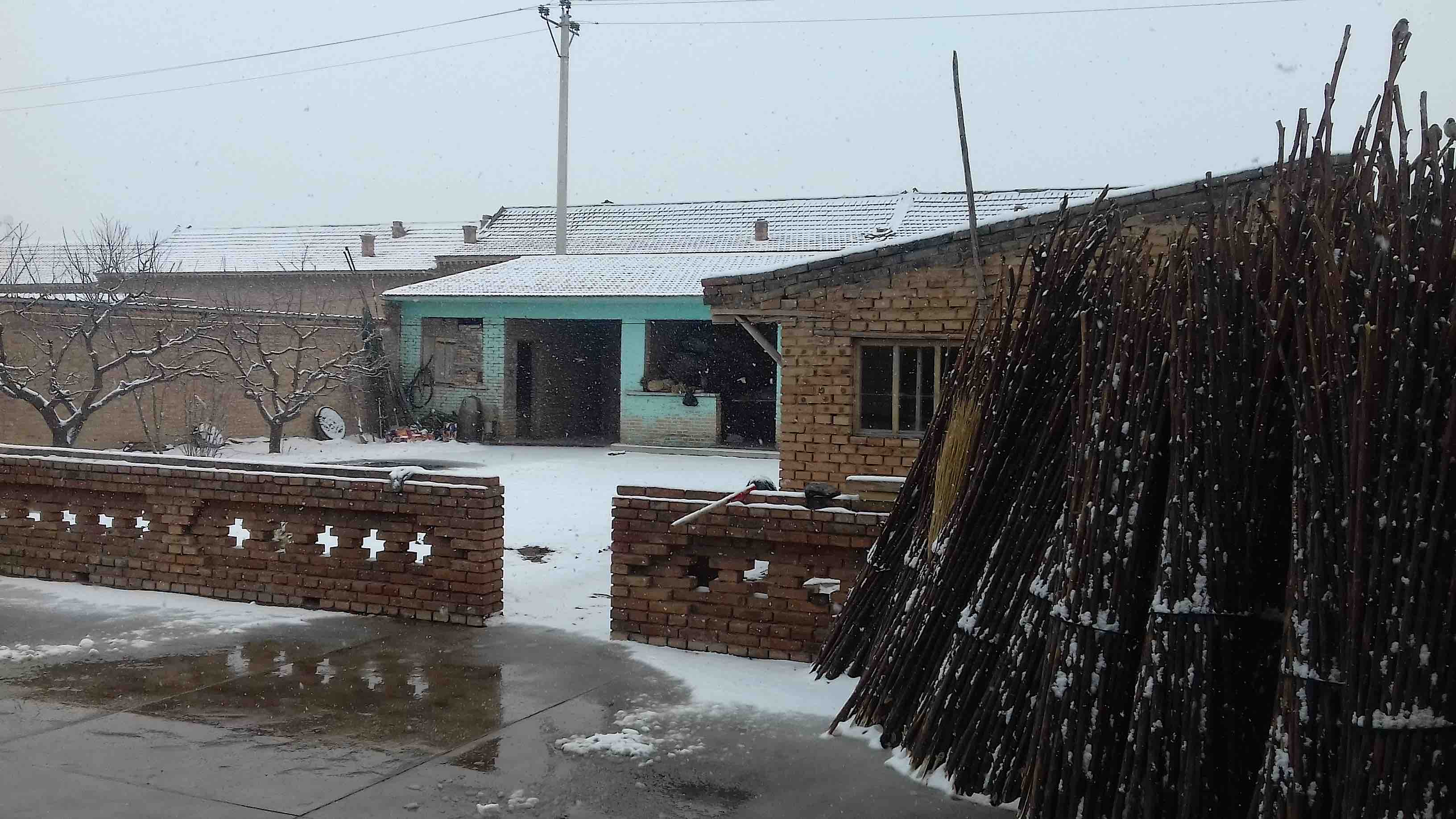
courtyard in snow

Right: sunflower stalks stored for use in making funerary treasuries.

OOH it’s snowing! I’ve been hoping to go in search of more Daoists to Yingxian county with Li Bin and bright young Taiyuan ethnographer Liu Yan, but my carefully laid plans come to nought; the motorways are closed. Li Manshan sweeps the pathway to the latrine, then zooms off back to Yangguantun to smash the bowl in a simple burial for the poor family there. When he decorated the coffin on 2nd moon 25th it was the fourth (not third) day after the death. He explains that there’s no difference between rich and poor in determining the date: it may turn out that poor families also have to store the coffin for over twenty days.

I discreetly perform much-needed ablutions. Li Manshan comes home frozen, unable to see through the snowstorm on his motor-bike. Gradually it eases up.

I show him my photos of the funeral I attended yesterday. He’s always been a laissez-faire leader, but even he draws the line at Wu Mei playing drum while on his mobile. We get a riff going:

“Maybe he was following the drum patterns online?!” he jokes.
“Oh yeah, right—I always felt sorry the so-called Hengshan Daoist Music Ensemble because they were too poor to afford music stands, but now they can read from their mobiles! You’re dead keen on ‘development’, aren’t you?!”—referencing the rose-tinted cliché common in online articles about him.
“Naughty disciple!”
“Naughty master! 青出于蓝。。。”

Wang Ding turns up on his dinky sanlun truck and we help him unload more altar decorations into the south room of the courtyard, redecorated as the village Training Base of the so-called Hengshan Daoist Music Ensemble—and thus, like its town counterpart, entirely unused.

3rd moon 2nd (Sunday, known as libai ba, eighth day of the week, as on their electronic wall-clock)
Foggy at first, gradually the sun comes out. For the first time Li Manshan worries about his cough, and resolves to quit smoking—which, impressively, he manages for nearly a whole hour. Actually he’s not smoking as much as in the old days when he was busy doing funerals with the band.

Having taken a siesta after our fascinating excursion to find murals by Artisan the Sixth, I go outside to clean my teeth, but yet again my oral hygiene is thwarted by the arrival of “Fag Devil” Li Sheng, who insistently shoves another fag in my gob. Typical

I keep up with Tweety McTangerine’s latest lunacies by consulting the Guardian online. But I dissolve in fits of laughter at Stewart Lee’s latest offering there.

3rd moon 3rd
At 7am a guy comes to discuss some work. At 8.20 the formidable wife of an old friend of Li Qing’s comes to moan about her son’s marital problems. Li Manshan is courteous, but considers her “crazy”. I understand virtually nothing, but eventually she makes an effort with me as she pours out her grievances, slapping me regularly on the arm. Village poverty and problems seem intractable, despite advances and propaganda. The only solution touted is thorough urbanization, bringing its own worrying prospects.

Li Manshan isn’t feeling too well, but he takes a break from making paper artefacts to accompany me on a visit to the temple to Elder Hu in the Lower village.

3rd moon 4th
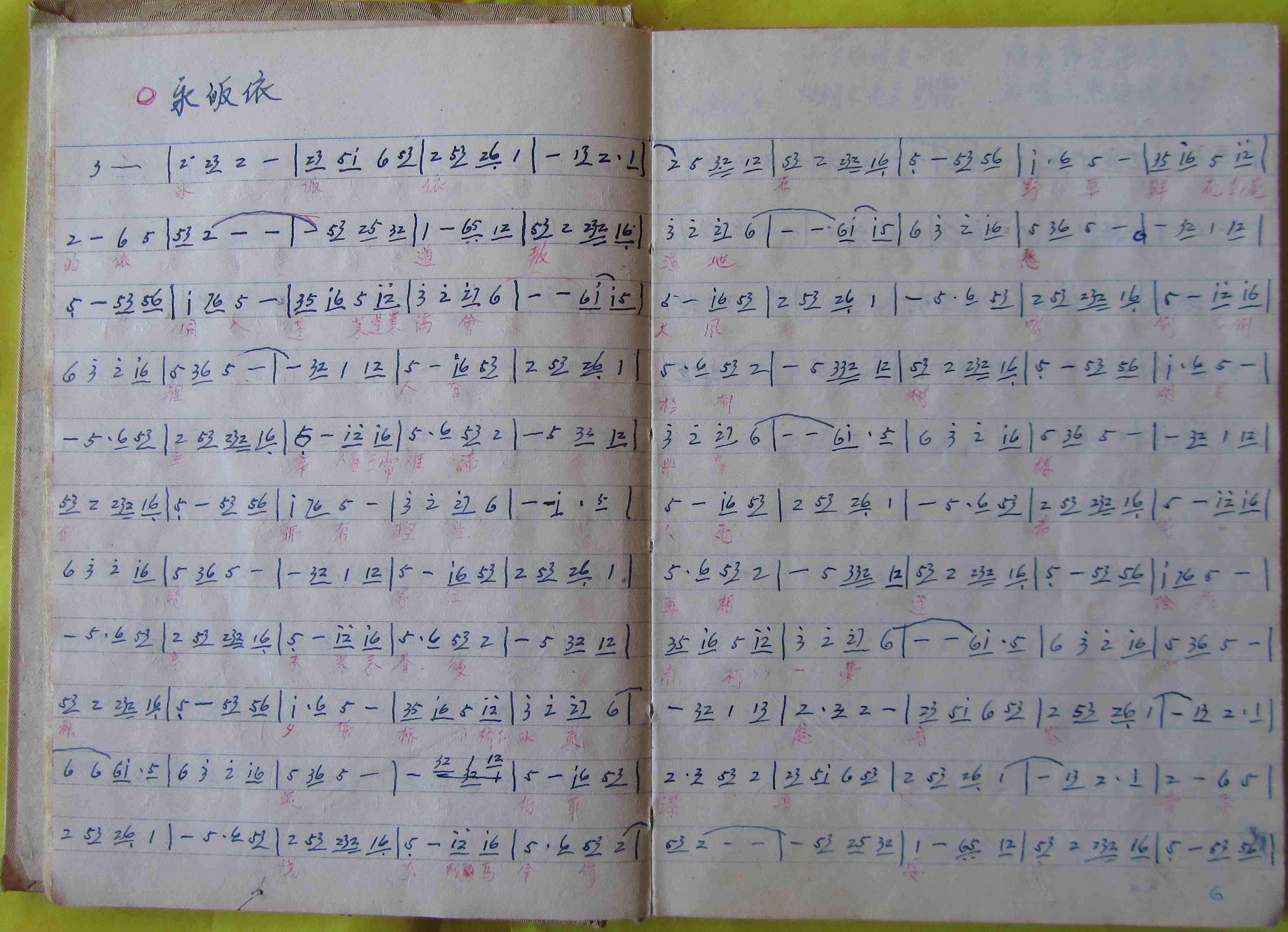
On our last day together, after returning from an intriguing trip to Jinjiazhuang, Old Lord Li suddenly thinks of the slow hymn Eternal Homage (Yong guiyi 永皈依), and we have a nice session on it. It’s one of his favourites, but they rarely use it, and now he can’t remember the opening. He can’t read cipher notation, only gongche solfeggio, so he gets me to sing it from Li Qing’s cipher-notation score. Their more recent green volume has gongche solfeggio underneath too, so he can just about follow it once I get him going.
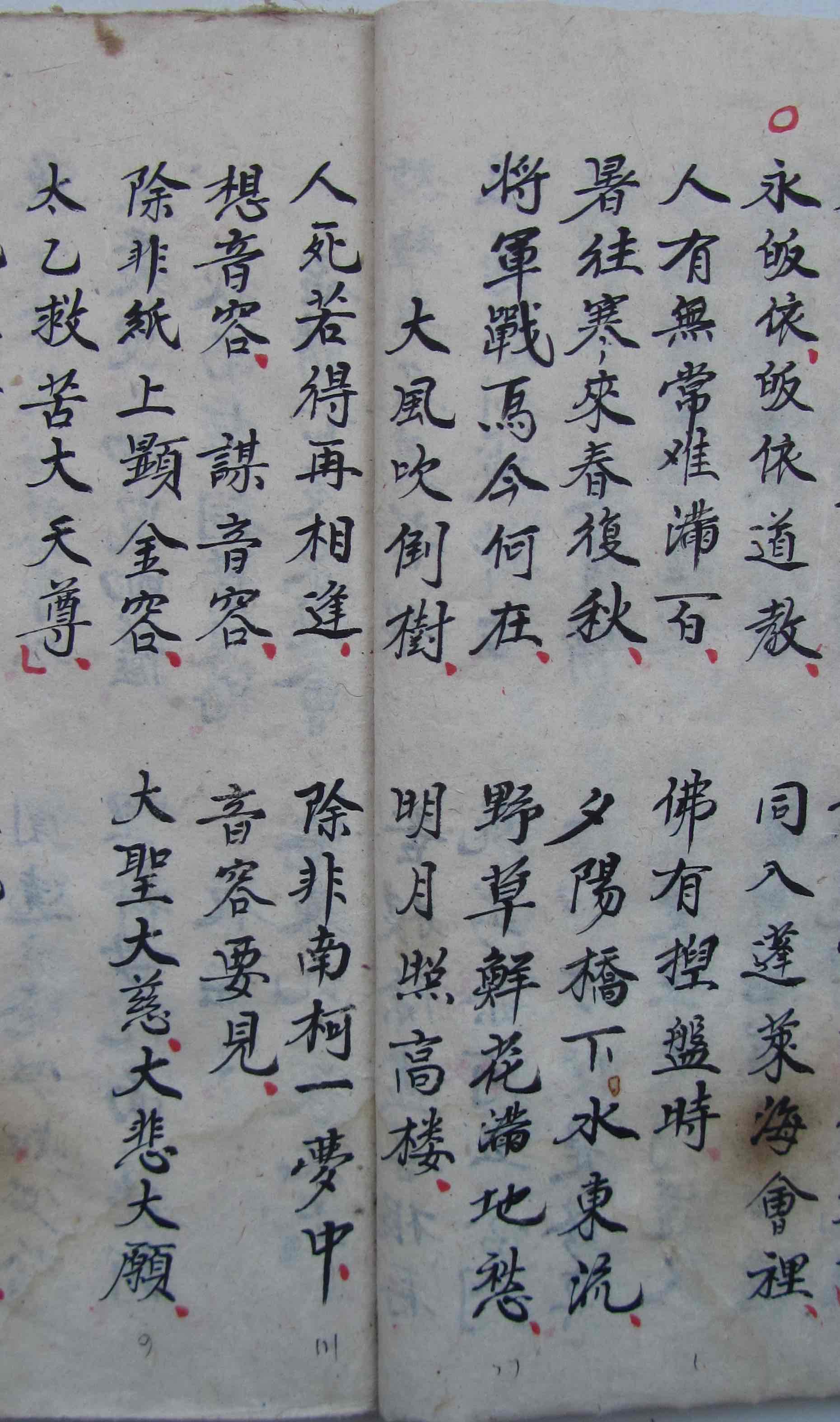
Yong guiyi textSo Li Manshan gets to record me singing a piece I barely know, but I never get to record him. Anyway he always sets off from a really low pitch, so the result tends to sound a bit like Tibetan chanting. When the band sings a cappella hymns for funerals, Golden Noble has a good ear for starting off on a pitch suitable for the range.

In the version they learned, the first section ends after Fo you Niepan shi 佛有涅槃时. Li Qing’s cipher-notation score isn’t divided into sections, but their more recent green volume is. The latter uses the degree shang 上 as do—including the shengguan suites, which I find strange. Li Manshan is fine once he gets through the opening phrase.
Yong guiyi jianpu

We take a siesta before my journey back to Beijing, but soon wake up. Absurdly, he now asks me to transpose Li Qing’s cipher-notation score of the major shengguan melody Yaozhang into gongche solfeggio. Without thinking to consult the precious photos of Li Derong’s old score (which Li Manshan no longer has) I wrongly assume that it would use the early shengguan system with he 合 as do, but hey. After singing it for him as he records it on his phone, I explain to him that he’ll need earphones to play it back…

Li Bin has another busy day today, having to do two reburials as well as decorating a coffin, so I’ll take a cab to the station. This no longer feels so distant. Li Manshan insists on coming along to see me off, and we leave before 4, dropping his wife off at Baideng township for a hairdo. He refuses to let me pay for the cab. My total expenses for nine inspiring days in Yanggao came to 24 kuai—just over £2.

We take the ring road, passing loads of new high-rises, and bid each other a fond farewell. The station is virtually empty, and the train isn’t busy either.

Back in Beijing, I feel like a country bumpkin. Showing my film three times over the next week, I’m happy to make Li Manshan a big star there. After the last screening I call him up to report, and to wish him well before I go back to London.


[1] As in the poseur’s celebrated line (Fieldworkers’ joke manual No.37), useful when someone asks if you know any classical Chinese:

[smugly] “I studied the Four Classics and Five Scriptures—Confucius, Mencius, various dumpling shapes, I’ve studied them all!”
Wo xuedeshi sishu wujing—Kongzi Mengzi baozi jiaozi, dou xueguole!
我学的是四书五经。孔子孟子包子饺子,都学过了!

Oh well, it’s funny in Chinese—Trust Me I’m a Doctor (there goes another 200 kuai).
Similar story here!

Guide to a year in blogging

LMS

After a year of frenzied blogging, here’s a seasonal retrospective guide to navigating a diverse ouevre—as much for my sake as as for yours. Meretricious and Happy New Year!

Call me a nerd [You’re a nerd—Ed.], but taxonomy and indexing are so funky… As you see from the (updated) homepage, the whole site began as an introduction to my work on the Li family Daoists, and my portrait film remains one the most enchanting presences there. The Li family has its own category in the sidebar, with a plethora of articles (not least a whole series on our French tour in May 2017, and an update on Li Bin’s diary).

Other pages in the top menu also tend to be rather substantial, with

Still in the top menu, MY BLOG contains all my myriad posts (“delighting in all manifestations of the Terpsichorean muse“), with helpful Categories and Tags in the sidebar, as well as a monthly archive there. Here are some of the more stimulating:

As you can see from this post alone, I just love doing internal links (in blue in the text). So whether you first came here for Daoist ritual, football (indeed, Daoist football), punk, Bach, modern China, or even just for the jokes, they’re all connected, so please do click away on the links!

Last but, um, not least, do click on the links to the relevant posts and pages in the photos in the sidebar.

The Feuchtwang Variations

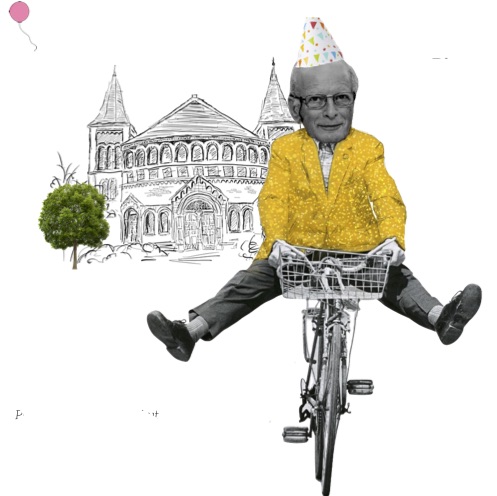
The wise and infinitely supportive Stephan Feuchtwang continues to inspire generations of anthropologists in China and worldwide (see also here) with his work on Chinese popular religion. He has just celebrated his 80th birthday—and so do we all!

Stephan's invitation edited

Design: Lotte van Hulst.

For the party at the Tabernacle (a great venue, and, um, marker of the changing territorial identities of West London religious life!) his wonderful family played some popular and moving musical items, with the assembled guests on kazoos (anyone have a funky collective noun for kazoos in English, or measure word in Chinese?). And following my little foray into a world-music version of Bach earlier this year, we did a warmup act as a heartfelt tribute to Stephan, essaying a little medley from the Goldberg Variations—with me on erhu (one of many types of Chinese fiddles) and Rowan Pease (unsung Lucy Worsley of East Asian popular culture, currently embroiled in the China Quarterly struggle for academic freedom) on sanxian banjo (or should I say friction chordophone and plucked lute?) [Nah, give it a restThe Plain People of Ireland].

Wong

Not Rowan, not playing the sanxian.

That makes a total of five strings—and all without a safety net. Since Bach never wrote for either piano or sax (shades of WWJD), if his music can sound great (to us) on those instruments, then why not erhu and sanxian, eh. We haven’t tried adding a kazoo yet, though. As I said in my intro:

Just imagine that the Italian missionaries, like Pedrini, [1] at the court of the Qianlong emperor in 18th-century Beijing had invited Bach for a sabbatical—and indeed Stephan, although that was perhaps a little before even his time… So we’re going to essay a little medley from what should now be known as The Feuchtwang Variations[2]

Since among Stephan’s many talents he is also a viola player (“Not a Lot of People Know That”), I can avail myself of a couple of the muso’s classic excuses:

It was in tune when I bought it…
and
I didn’t really study any place, I just sort of… picked it up… [for how I picked up the erhu, see under the fascinating story of Ray Man]

[studiously] After intensive research on the performance practice of both Leipzig and Beijing in the 1740s, I can now say with some certainty that…  it wouldn’t have sounded like this.
[Cf. John Wilbraham’s remark.]

If you enjoy this half as much as we do, then we will have enjoyed it twice as much as you.

See also Song of suffering.

Framed by the Aria (itself infinitely enchanting—molten, ethereal, suspended in time), we played the first variation (blimey), then numbers 18 and 25—a perfect selection, eh. Short of recording daily until Steph’s 90th birthday, we’re never going to play it to our satisfaction (editing this is a similar challenge to editing one of my voiceovers), so meanwhile here’s an almost-recognizable attempt, just to give you a flavour—It’s the Thought that Counts. Just think yourselves lucky we didn’t do the repeats. Take It Away (and don’t bring it back):

Stephen Jones (erhu), Rowan Pease (sanxian, vocals).
Recorded in Maidenhead, 14th November 2017.

“They said it couldn’t be done”—and they were right! (Cf. Bob Monkhouse).

Just to make our chinoiserie version sound a little less banal, try the opening of the Aria on Lego harpischord, and Pachelbel’s Canon on rubber chicken—differently charming…

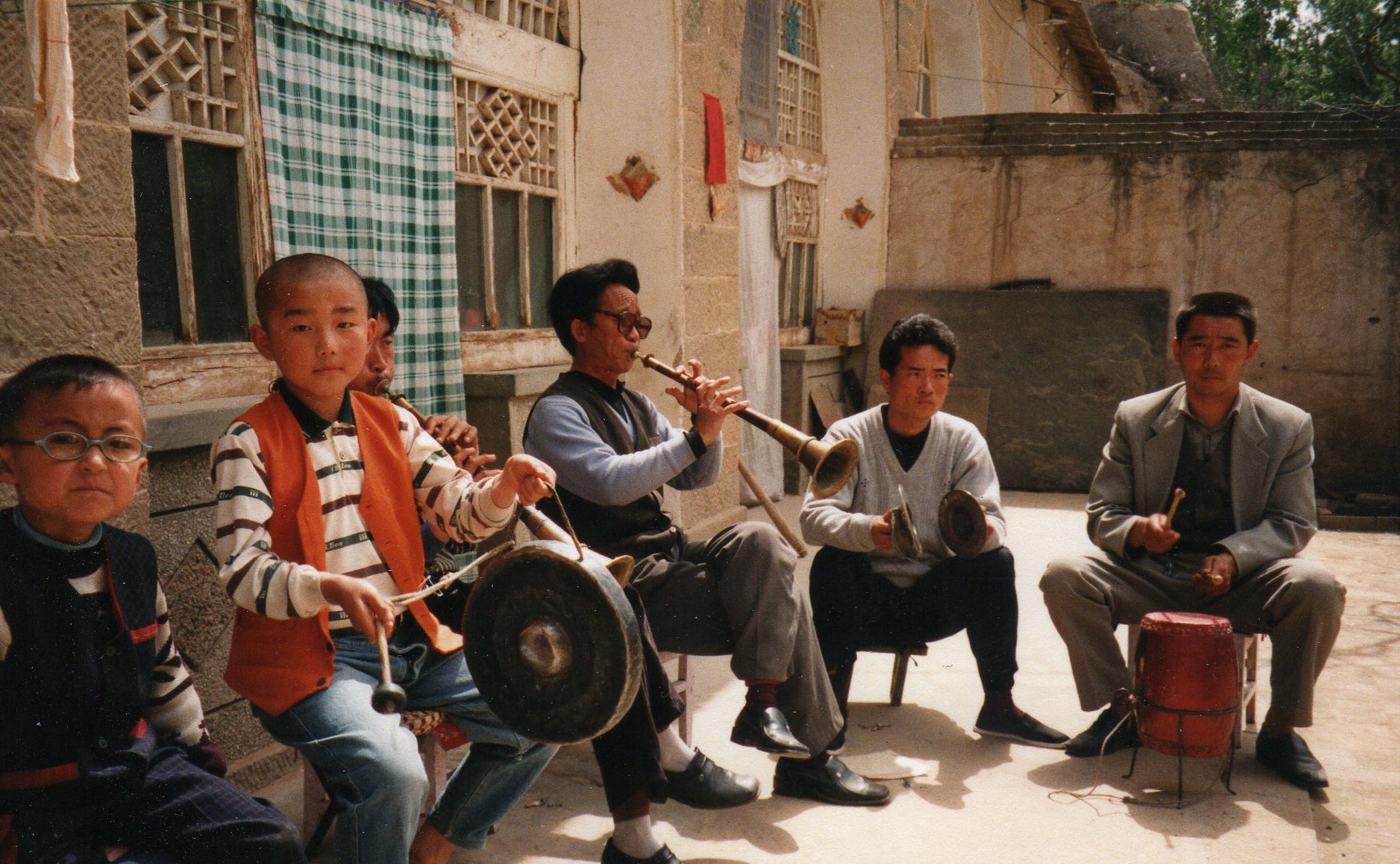
Li Qishan band 2001
Li Qishan’s family shawm band, Shaanbei 2001.

Never having played the Goldberg Variations on a keyboard, I (like millions of others) am deeply familiar with it through recordings—notably that of the iconic Glenn Gould, of course. So at the age of 286 I’m almost in the position of a young player in a Chinese family shawm band, who begins to play the melodies on shawm after many years of aural experience (and let’s just be grateful I didn’t do an arrangement for large Shaanbei shawms—yet). Similarly, I hardly needed to consult Bach’s notation, except out of curiosity. At the same time, anyone playing the piece is inevitably conditioned by the experience of hearing Glenn Gould’s version.

We played the medley in F rather than G—less as a result of all my erudite research into 1740s’ pitch standards (not), but just because I like a lower tuning on the erhu.

Bach party

Blending with invisible singers to left of picture. Stephan in red on left. Photo: Cordelia Pegge.

For the ecstatic Variation 18 we recruited a backing band consisting of Stephan’s daughters Rachel and Anna, along with Harriet Evans (outstanding scholar of the status of women in China). I arranged some personal lyrics, often in a kind of verbal hocket, incorporating (in stave 3) anthropology (with a little jest on the challenge, for some of us, of mastering the abstruse nature of Stephan’s theory!), (in stave 4) his dear wife Miranda, and his love of cycling:

Goldberg Var 18 in G

For the recording, without vocal backup, Rowan and I take the upper parts wordlessly, in more ethereal vein. Do feel free to sing along with a partner of your choice (cf. the karaoke versions of Daoist ritual percussion in my film, from 24.09).

And then the slow and intense minor-key Variation 25 is just amazing. Here Rowan’s singing supplies further harmonic intensity, evoking Glenn Gould’s own occasional inadvertent vocals. [3] And with the sustained sound of the erhu, and all my one-finger chromatic slides (1st finger on the way up, 4th finger on the way down), it sounds even better—or rather, it could do in the right hands. Not unlike a Chinese ondes martenot—trad keyboards just can’t compete with the vocal quality of bowed instruments.

And OMG, how about this (for the theremin, click here):

Sure, our version goes a tad faster—again, not resulting from any holier-than-thou baroque authenticity, but because it helps the whole harmonic logic.

Among many fine harpsichord versions, here’s Scott Ross:

Returning briefly to the modern piano—Bach was of course performing and composing modern music, and maybe what appeals to me in Joanna MacGregor’s version is that it seems tastefully rooted in her whole experience of our own contemporary piano sounds. Here’s the hallucinatory final repeat of the Aria:

Still, Bach is amazing on tuned percussion too, like this:

It can also sound wonderful as a string trio:

And now I’m keen to hear Rachel Podger’s new arrangement with Chad Kelly:

For Uri Caine’s stuttering variation, see here.

All this wealth of divine music I offer in tribute to the great Professor Feuchtwang!

[1] For missionaries at the Qing court, see here. “They come over ‘ere, with their fancy harpsichords…”
[2] Maybe I can concoct a couple of Chinese musicians in 1740s’ Leipzig from the Bach archives. If north African wind players were active at European courts of the day, then why not… International cultural exchange, eh. Note also Bach and Daoist ritual—not least Li Manshan’s classic remark.
[3] This encomium could come in handy for Rowan’s CV: “Less irritating than Glenn Gould”—Dr S. Jones.

Philomena Cunk

Cunk
As another cautionary tale for fieldwork interviewers, how delightful to find Diane Morgan back on our screens, after her deadpan incarnation as “professional TV dimwit” Philomena Cunk (now with her own tag in the sidebar!).

Among innumerable aperçus, here’s her exegesis of Benefits Street:

They weren’t claiming benefits like MPs do, but a different type of benefits that they weren’t entitled to, because they were poor.

Her Moments of wonder series contains some classics, like her potted history of “femininism”:

—not least her helpful comment on Emily Davison throwing herself in front of the king’s horse at the Epsom Derby in 1913:

They [women] did this partly to highlight how unfair it was that women didn’t have a vote but horses did. And also because, being women, they really liked ponies.

On Shakespeare (“Did Shakespeare write boring gibberish with no relevance to our world of Tinder and peri-peri fries—or does it just look, sound and feel that way?”):

Among her hapless interviewees (watch from 24.19), she consults the valiant Ben Crystal, co-author of the Oxford Illustrated Shakespeare Dictionary, testing him on a list of words that Shakespeare, er, might or might not have made up:

cuckoo?
ukulele?
omnishambles?
mixtape?
[fumbles ineptly with script]
sushi?
titwank?

—a list surely on a par with the names in Rowan Atkinson’s roll-call. Another perspective on Shakespeare is offered by the series Upstart crow.

Diane Morgan now has a hilarious role in the new TV series Motherland, written by the equally brilliant Graham Linehan and Sharon Horgan. I’m reliably informed that it’s horribly well observed:

I really want the children to be brought up like I was—by my mother.

It looks as if a Chinese version might be in order, though I’m not holding my breath. And now we can relish Cunk on Earth!!!

Dressing modestly

Fan
The splendid Jiayang Fan recently found her thoughtful TV interview on the flapdoodle over the 19th Party Congress and Uncle Xi subjected to an impertinent appraisal from an unreconstructed commentator on Chinese Twitter. As she comments,

My fav Chinese social media criticism: I can’t trust anything Jiayang Fan says or writes due to the ugliness of her necklace collection.

Fan Tweet

Perhaps the Twitter pundit might consider this entirely representative sample of the Chinese population more trustworthy, with their tasteful neckwear:

CCP

Of course, this photo doesn’t tell the whole story, since also modestly “holding up half the sky” are a charming and tastefully attired Red Detachment of Women silently and obligingly serving tea—so that’s all right then.

tea ladies

While one hopes there was an element of tongue-in-cheek about the Chinese comment, it evokes the fatuous appraisals of female politicians’ accessorising favoured by the Daily Mail. Perhaps Ms Fan might try wearing a full burqa next time, to further obviate any criticism of the shade of her eye-liner—even if it arouses the ire of Boris Piccaninny Watermelon Letterbox Johnson. Gah, choices…

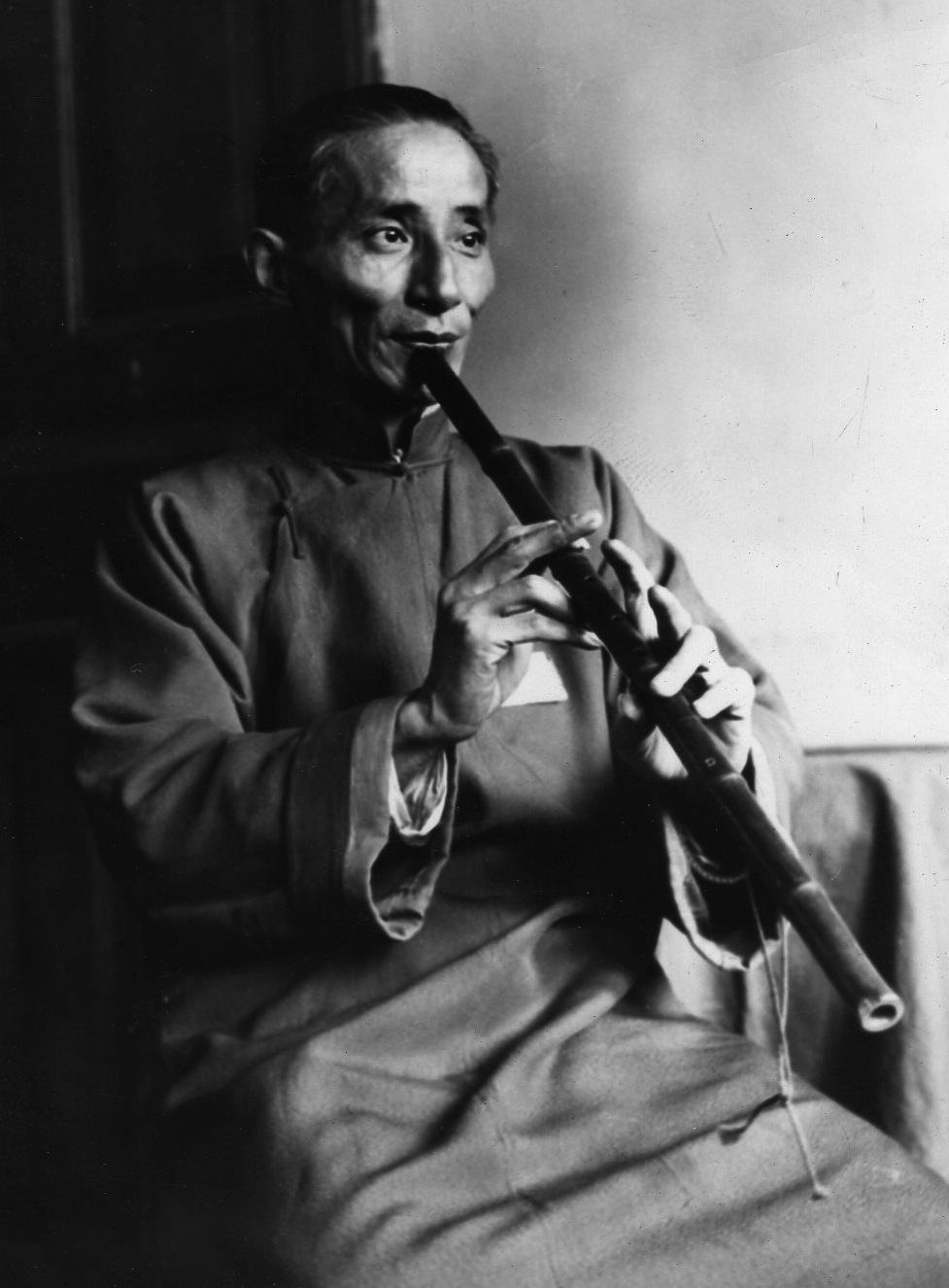
komuso
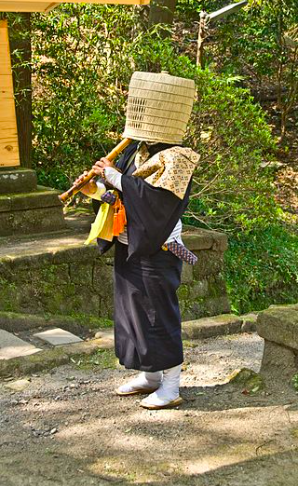
Another option might be to adopt the old ruse of Japanese komusō 虛無僧 monks playing the shakuhachi end-blown flute—which they might also use as a weapon. I note that many komusō were spies for the Shogunate, and some were merely disguised as priests; and they were abolished in 1871 for “meddling in earthly affairs and not the emptiness of being”. Anyway, it beats me how wearing a basket on your head might be considered an effective disguise, but hey, maybe I should stick to Chinese culture.

A judgement such as the Twitter comment may seem to be based merely on grounds of taste, but it shades into still more fatuous opinions on decency. Since we’re not holding our breaths for wise guidance on dress-codes from the Chinese or US leaderships, study sessions may be in order—based on the Everyday Sexism project, Hadley Freeman (note her fine article “Why not just ban women?”; Hell, Tweety McTangerine could have worn a mankini for his inauguration—we couldn’t possibly think less of him), perennial discussions on BBC Radio 4’s Woman’s hour, and comedians like the great Bridget Christie. That’s just a random sample of UK media—not to mention a wealth of research and websites on the beleaguered status of women in China.

Like I’d know.

Daoist ritual and football

Daoist football

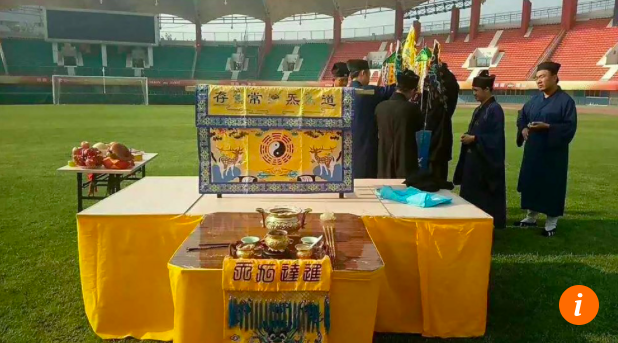
WOW. Following my post on the Haka, Chinese football has just gone one better. On 23rd September a Henan team had a Daoist ritual performed on the pitch, going on to get their first home win in months—and getting a slapped wrist from the Chinese FA, what’s more:

http://www.scmp.com/sport/soccer/article/2112866/football-no-place-religion-chinese-soccer-club-warned-after-conducting

Sure, unlike the Haka, in this case it’s not the players themselves who perform the ritual—yet.

Chinese Twitter is buzzing with discussion. Daoist fans aren’t taking the stern rebukes lying down: pointing out that Daoist ritual is protected under the brief of the Intangible Cultural Heritage, they deftly play the old “culture, not feudal superstition” card.

有道教网站转发新闻办的微博称:来来来,我给建业支个招,各地的道教音乐中包括全真十方韵,全国很多地方都有批准为非物质文化遗产, 建业去问问那次的道长是传承自哪里,在比赛前进行音乐演奏,非遗文化表演。是受非遗法保护的。《中华人民共和国非物质文化遗产法》里 面有支持其参与社会公益性活动。这么喜闻乐见不如看怎么合理弘扬?

Others worry that it may give rise to competitive rituals in which the other team employs their own ritual specialists to break the magic of the opposition’s Daoists. Of course, it has long been common to hire two or more groups (Buddhist, Daoist, Tibeto-Mongol lamas…) for a single ritual event—competing between each other but not for rival patrons.

Another article defends the move by pointing out various international instances of teams seeking divine assistance (for a recent one, see here).

For a related debate, see here; note also the rebuttals of local government’s restrictions on funeral observances in Shandong.

Early Chinese versions of football were popular, though I’m not going to devote much time to searching for specific blessing rituals in Song-dynasty ritual compendia… Not will I detain you here with a discussion of the constant historical adaptations of Daoists to their patrons…

football painting

Chinese women’s football. Du Jin, Ming dynasty.

I note that during the Song dynasty only one goal post was set up in the centre of the field—now that would be an intriguing modification to the FIFA rules. Further to the magnificent ripostes of young female footballers to the British FA, at a match in the Tang dynasty

records indicate that once a 17-year-old girl beat a team of army soldiers.

YAY! Could it have been after this match that the men shifted the goalposts? Typical!

Under Maoism a leading CCP apparatchik (can anyone put a name to this fine pundit?) observed twenty-two players chasing around after one ball, and in a spirit of egalitarianism, unhappy with the conventions of what he supposed was a misguided capitalist invention, declared grandly:
“We’re a socialist country now—why not give them a ball each?”

Anyway, my new dream is for the Li family Daoists to perform a ritual to help Arsenal win the Champions’ League.

For more on women’s football, see here.

Yet more Chinese wordplay

*UPDATED!*

Time for another irreverent Chinese lesson (Yeah I Know—blind leading the blind: try this).

Two classic stories (favorite entries in our Fieldworkers’ joke manual) illustrate the dangers of misconstruing the division of polysyllables—as well as the endless humour and creativity of the Labouring Masses in adversity:

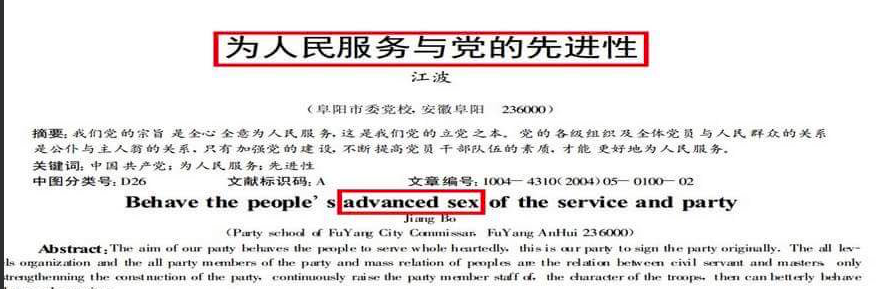
  • The postfix xing 性 makes the previous term adjectival (even sometimes before an adjective); but xing also means “sex”. At our thankfully rare encounters with upright apparatchiks, they may be perplexed to find us corpsing as they make some grandiose toast to “international cultural exchange” (guojixing wenhua jiaoliu 国际性文化交流). Just the slightest hesitation between guoji and xing converts the fine phrase into
    guoji xingwenhua jiaoliu “international exchanges in sexual culture”.
    It’s just as good without the wenhua:
    “international sexual exchanges”.
    For SPICE, the Society for the Promotion Prevention of International Cultural Exchange, see here.
  • After that gentle introduction, this one works on the same principle:

Under the commune system in the 1950s, before New Year the Party Secretary makes an announcement in front of his sullen and freezing villagers. The commune, which as we all know is deeply concerned for the welfare of its poor peasants, has decided to give them all a one-off cash payment.
Not highly literate, the Secretary peers anxiously at the directive. Faltering, he announces, “In recognition of the New Year’s holiday, the Party has generously decided to give everyone…

yicixing shenghuo buzhu 一次性生活补助
of 5 kuai.”

Yici means “once”, so yicixing— all in one breath—means “one-off”: so the directive actually means
a one-off living supplement.

But the Party Secretary, struggling with the characters, hesitates fatally before “xing”, and not enough after it—so that what the villagers actually hear him saying is

yici xingshenghuo buzhu
“just the once, a supplement for sex life”.

Excited, the villagers clamour to clarify the directive. One old codger sticks his hand up and goes,
“Secretary—supposing I do ‘er twice, do I get 10 kuai?”
Another, a poor bachelor, asks,
“Wot about if I do it on me own—do I still get me 5 kuai?”

So similarly, now whenever anyone says “one-off” in Chinese, in any context at all, we all fall about laughing. I remember when disposable chopsticks first became common in Hebei in the 1990s. They’re called yicixing kuaizi, “one-off chopsticks”—or if you’re not careful, “one-off sex chopsticks”.

And here’s a fine example spotted by David Cowhig—not only Party sex 党性 and Advanced sex 先进性 (popular college modules that come with a heavy course load), but a revealing rendition of “Serve the People” as “Behave the People”:

xing

  • This story (my book, pp.118–19) isn’t about linguistics, but it’s also about the communes, so it makes a fitting interlude:

During the Great Leap Forward (or Backward) the village cadres had no choice but to go along with pressure to report ridiculously exaggerated harvest yields. Li Manshan chuckles over a bitter joke that I adapted from the Soviet Union:

A delegation comes down from the commune to inspect the harvest. The village brigade chief blurts out nervously,
“Oh yeah, we’ve had the most amazing harvest! If we piled up all our potatoes, they’d reach all the way up to the feet of Old Buddha in Heaven!”
The chief of the commune Propaganda Bureau takes him off to one side and whispers:
“Hey, don’t you realize? This is a socialist country now, we’re all atheists here—there is no Old Buddha, there is no Heaven!”
“So?” shrugs the brigade chief. “There ain’t no potatoes…”

Sihanouk

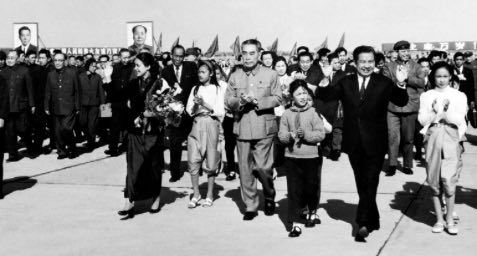
  • An only slightly more decorous set of misconstruings (in Chinese, best found here) is among several celebrated stories about Prince Sihanouk of Cambodia. I’ll need a few more large gins before I’m prepared to share one of them (not to mention the Shakespeare story…), but this one (among the very first with which my esteemed mentors at the Music Research Institute regaled me in 1986) is just about repeatable:

Late in the Cultural Revolution, one Mr Jia was head of the Forestry Commission in Linze county of Gansu. He had to assemble his employees daily at 8am for study sessions, at which he read out the latest official news to them.

The major report that morning concerned the visit to Beijing of Prince Sihanouk, known in Chinese as Xihanuke qinwang 西哈努克亲王 (for wacky transliterations, see here). Innocuously, the report read

西哈努克亲王八日到京, 外交部长姬鹏飞到机场迎接, or
King Sihanouk arrived in Beijing on the 8th. The Foreign Affairs Minister Ji Pengfei went to the airport to meet him.

But our Mr Jia, somewhat challenged in the literacy department, was confused by the strange names and the telegraphic style of the communiqué, and again he misconstrued the punctuation. Instead of “Xihanuke qinwang, bari daojing”, he read “Xihanuke, qin wangba* ridao jing”; and, unfamiliar with the illustrious name Ji Pengfei (whose last character means “to fly”), he read “chang jipeng, feidao jichang…”
So alas it came out as:

西哈努克, 王八, 日到京,外交部长姬鹏到机迎接, which means
Sihanouk, consorting with bastards, shagged his way to Beijing.** The Minister for Foreign Affairs Ji Peng flew to the airport to meet him.

This had the assembled forestry workers, and future generations, rolling in the aisles. It may further serve as a caveat for sinologists attempting to decipher unpunctuated ancient texts.**

Such are the stories that punctuate our earnest collection of data on rural ritual life… Pace Hammer and Tickle, this is but the tip of the iceberg of jokes about the Maoist era. And while it’s not the same at all as my choice phrases from Teach yourself Japanese, if you missed that post, do read it too.

For an almost related sequel on pinyin, see here; for more International Cultural Exchange, here.


* The traditional term wangba, of course, features in the traditional litany of social outcasts wangba, xizi, chuigushou 王八戏子吹鼓手 bastards, opera performers, and blowers-and-drummers—which appears in The dream of the red chamber, no less. So there.

** Call me innocent, but only recently has a still more filthy reading occurred to me. Some might even hear ridaojing 日到京 (“shagged his way to Beijing”) as 日到精, “shagged away till he came”. With both jing characters being pronounced in the high 1st tone, this is a common pun in several other stories. For ri as a colloquial term for “shagging”… you can do your own online research. Nor do Chinese sources pick up on the use of qin as a verb (“consorting with”), so again I may be over-elaborating.

*** I’m sure there are plenty of similar instances of mis-punctuation in English. The only one that occurs to me right now is the repunctuated placard of the embittered diminutive job-seeker:

NO JOB. TOO SMALL.

For a headline desperately in need of punctuation, see here.

Spiritual and marvellous mysteries

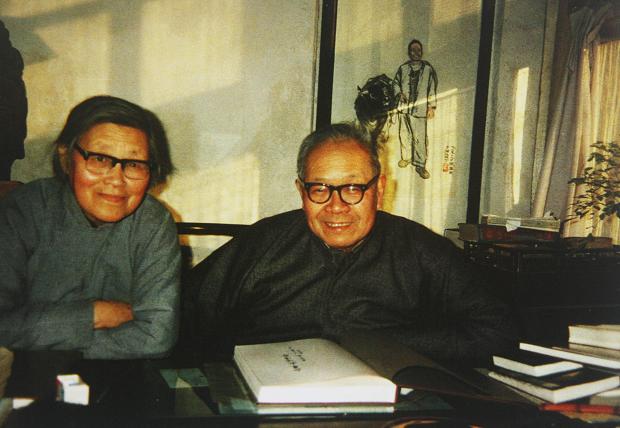
I recall with deep admiration the unsung scholar Yuan Quanyou 袁荃猷 (1920–2003).

Wang and Yuan
While a student in Beijing she studied with her future husband, the great Ming scholar Wang Shixiang 王世襄 (1914–2009) (see wise and affectionate tributes by Craig Clunas [1] —another great Ming scholar—and now here). After Yuan Quanyou graduated in 1943, they married in 1945.

Yuan Wang wedding

Yuan Quanyou had studied the qin zither with Wang Mengshu 汪孟舒 from the age of 14 sui. Through the 1940s she took part keenly in the activities of the Beiping qin society, among a dazzling array of illustrious qin masters. She later became a disciple and colleague of the great Guan Pinghu.

Wang Shixiang soon found that his wife’s skills focused on the traditional literati accomplishments of “qin, chess, calligraphy, and painting”, to the exclusion of more mundane activities like cooking. So it was he who became a fine chef; and he considered himself her “qin servant” 琴奴. Several online pages about the couple describe their lifelong rapport by the term zhiyin 知音 “kindred spirits”, a bond whose etymology derives from music.

Complementing Wang Shixiang’s refined literati tastes, through his enthusiasm for falconry, badger hunting, cricket rearing, and pigeon fancying he had gained what Craig Clunas calls “a raffish reputation” (as you do…). I also learn that he loved football, “as anyone who has tried to make conversation while he is watching soccer on the television can confirm”—cool by me. He retained a rare passion for both elite and popular culture.

From the early 1950s Yuan Quanyou worked tirelessly in the archives of the Music Research Institute (MRI) in Beijing, alongside the great Yang Yinliu and Cao Anhe, as well as a whole host of qin masters like Guan Pinghu and Zha Fuxi, and their students—including Xu Jian 许健, and the fine female qin player and scholar Wang Di 王迪 (1926–2005). [2]

GPH and students

60th-birthday photo of Guan Pinghu with his students, 1957:
(left to right) front row Xu Jian, Guan Pinghu, Zheng Minzhong;
back row Wang Di, Shen You, Yuan Quanyou.

By 1957, while her husband was also busy publishing ground-breaking research, Yuan Quanyou’s close collaboration with Yang Yinliu resulted in the publication of the fine iconographical series Zhongguo yinyueshi cankao tupian 中国音乐史参考图片 [Reference illustrations for Chinese music history] (see also here).

CKTP best

Some treasured volumes in my library.

Yuan Quanyou 1950s lowres

All this activity took place under extremely trying conditions. As Craig notes:

The published curricula vitae of Chinese scholars often give a false idea of the continuity of their employment, and conceal the long periods of frustrating idleness caused by periodic political campaigning.

After the 1949 “Liberation”, Wang Shixiang was employed at the Palace Museum, but he was wrongly jailed for ten months and expelled from the museum in 1953. In 1957, he was branded a “rightist”, a stigma he bore for twenty-one years. Craig’s account of the couple’s enforced inactivity during the Cultural Revolution is also worth citing. Despite Wang’s undoubted sufferings after being sent down to a “Cadre school” in Hubei province, he could “make the experience sound positively bucolic”. While callow young Red Guards were duped into destroying as much of the heritage as they could find, the exiled Wang wrote poetry in the classical style (“much of it on his work as a swineherd and cowherd, which draws on deep-rooted traditions of verse by those who were out of office and out of favour at court”), and even managed to cook gourmet delicacies.

But the mental pressure cannot but have been considerable, since no term was set to the period of banishment, and little or no news was available as to the fate of family or friends.

Old portrait photos are all the moving when we consider the troubled stories behind people’s lives (intellectuals, urban and rural dwellers alike) under Maoism, as evoked by films like The blue kite and To live (see also my tribute to Li Jin). Craig’s aperçu about Wang Shixiang’s renewed energy in the 1980s, “as if making up for lost time”, also resounds in both Chinese music studies and folk culture. Meanwhile, a discreet amnesia took over. (For the concurrent tribulations of Czechoslovak scholars and artists, see here.)

ZGYYSTJFrom 1986 I used to visit Yuan Quanyou in her office at the dilapidated yet numinous MRI compound at Dongzhimenwai, her beaming face greeting me between high stacks of ancient documents. There, with unassuming industry she was still producing further volumes in the MRI’s wonderful annotated series of iconographical collections on Chinese music history, such as the 1988 Zhongguo yinyueshi tujian 中国音乐史图鉴 [Illustrated history of Chinese music].

Even as my interests were moving from Tang history to the modern transmission of folk culture, I relished her detailed article on the medieval konghou harp.

Remarkably, after the end of the Cultural Revolution Wang Shixiang had managed to reclaim much of their precious collection of Ming and Qing furniture and artefacts. By the 1990s he and his wife began the process of bequeathing it to the Shanghai Museum, where it now forms a major and prestigious exhibit.

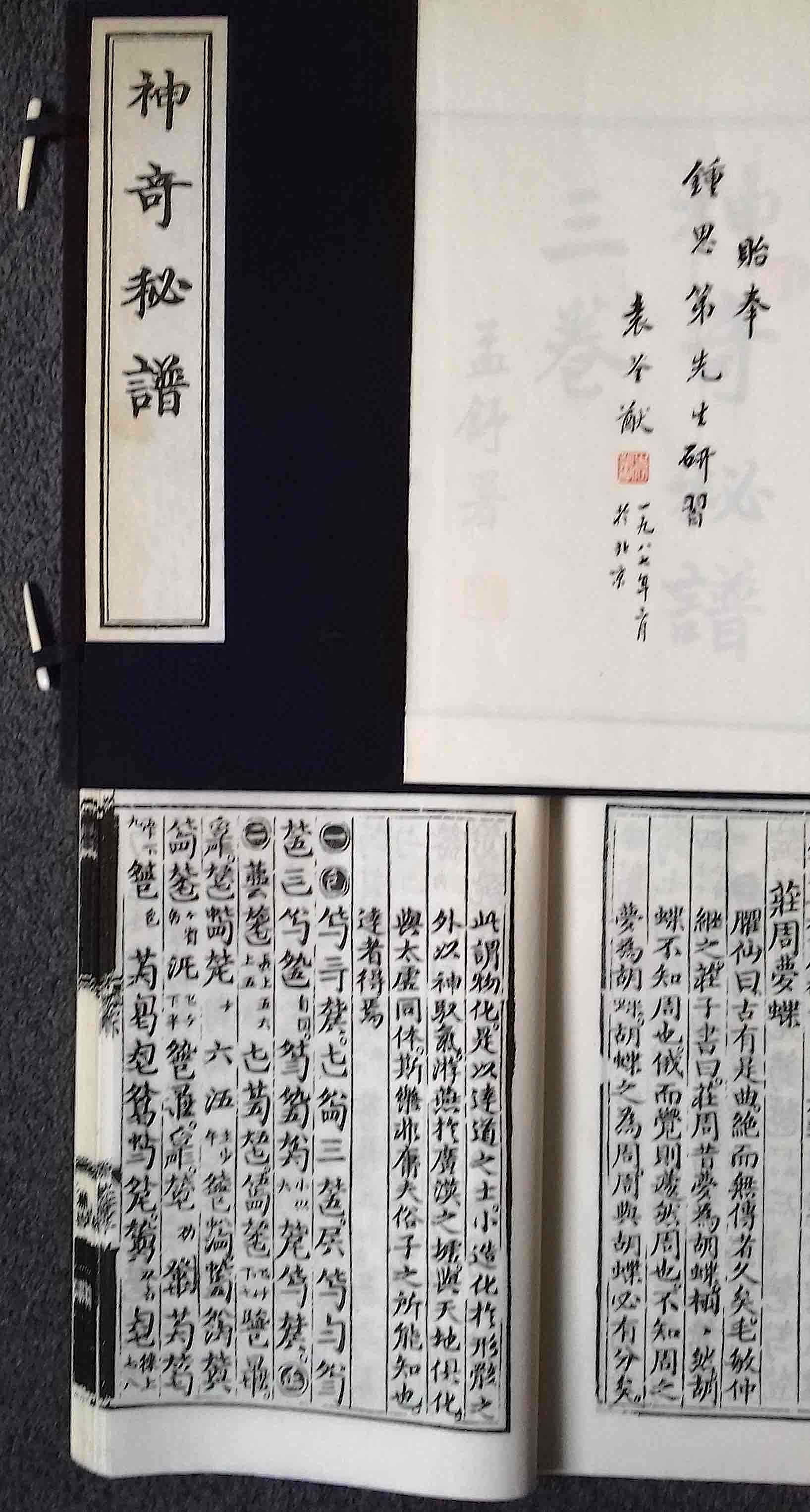
With her calm acuity and beautiful accent, Yuan Quanyou exemplified the refined virtues of old Beijing. She was closely involved in the remarkable work documenting the history and changing performance practice of the qin zither—including research on the 1425 Handbook of spiritual and marvellous mysteries (Shenqi mipu, aka Wondrous and secret notation), most numinous of all tablatures for the qin, compiled by the Emaciated Immortal (as the early Ming prince Zhu Quan styled himself).

In 1987 Yuan Quanyou was able to devote a tenth volume of the Zhongguo yinyueshi cankao tupian to the qin:

Now, this may hardly atone for my recent challenge to the mystique of the qin, but I treasure the precious copy of the 1956 reprint of the Shenqi mipu tablature (1425) that Yuan Quanyou inscribed to me in her elegant calligraphy in 1987, for me to “study and practise”.

SQMP

BTW, having chosen that lower page rather casually (mainly for the numinous Daoist title “Zhuangzi dreams he is a butterfly”), I now find myself moved by Zhu Quan’s wisdom—in utter contrast to the “living fossils” flummery of recent years, culminating in the befuddled Intangible Cultural Heritage. The opening of his introduction reads:

The Emaciated Immortal says: “The ancient version of this piece has long since been lost.”

These days it’s all “The ancient version of this piece has been transmitted continuously for 2,000 years.” [Expletives deleted—Ed.].

Jinfeixibi 今非昔比 (“Things ain’t what they used to be”), as Li Manshan reflects at the end of our film.

Wang and Yuan later

This post complements my series on the qin in Beijing under Maoism; see also Tang culture: a tribute to Ren Erbei.


[1] See https://www.academia.edu/34156645/The_Apollo_Portrait_Wang_Shixiang_Apollo_127_November_1987_pp._350-1, and https://www.academia.edu/34156683/_Wang_Shixiang_Spiritual_Resonance_and_the_Ten_Thousand_Things_in_Fariba_de_Bruin-Derakhshani_and_Barbara_Murray_eds._The_2003_Prince_Claus_Fund_Awards_The_Hague_2003_pp._17-23.
Among many other reports, see e.g. http://www.china.org.cn/english/NM-e/170145.htm, https://www.thepaper.cn/newsDetail_forward_2580161, and this tribute from Yuan’s granddaughter: https://kknews.cc/culture/2ao24jz.html, with further lovely old photos. Among several biographies and collections is Chen Zhou 晨舟, Wang Shixiang 王世襄 (2002).

[2] For an English introduction to the (pre-ICH) Beijing Guqin Research Association, successor to the Beiping qin society, see Cheng Yu, “The precarious state of the qin in contemporary China”, CHIME 10–11 (1997). Zhang Zhentao 张振涛 has written fine tributes to Guan Pinghu and Wang Di.

Kulture


joke

As I snap remorselessy at the heels of the heritage shtick, my cavils revolve around the Chinese concept of mei(you) wenhua 没(有)文化 “lacking in culture”. It’s a cliché referring to people’s degree of modern state education. Even peasants deprecate themselves with the term, though it is precisely the riches of their quite separate culture that “educated” urban pundits purport to admire—before trying to shoehorn it into their own.

LB joke

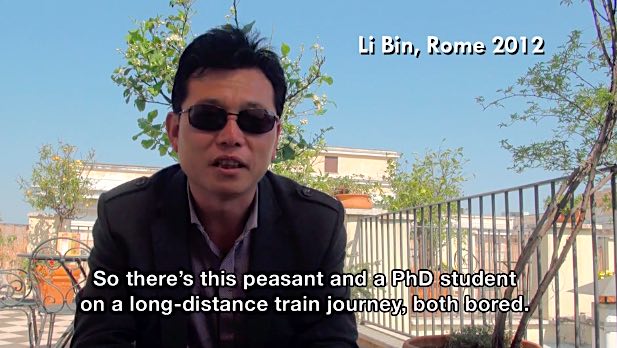
Li Bin’s brilliant joke (keep watching after the final credits of my film) subtly satirizes the gulf between peasants and intellectuals. Here’s a fuller English version (my book, p.ix):

So there’s this Ph.D. student on a long-distance train journey, sitting in the same compartment as a peasant.

He’s dead bored, so to pass the time, he says to the peasant,

“I know, let’s play a game. We both ask each other one question. If you can’t answer my question, you have to give me 100 kuai; if I can’t answer yours, then I have to give you 200—because I have a Higher Level of Culture, don’t you know?”

The peasant goes, “Oh right—umm, OK then.”

The student says smugly, “You can start, because I have a Higher Level of Culture!” So the peasant thinks for a bit and asks,

“OK then, I got one—so…
What is the animal with three legs that flies in the sky?”

The student racks his brains. “Huh?? An animal with three legs that flies in the sky? Hey, there isn’t one, surely… Ahem… Crikey—you’ve got me there. OK, I give up, I guess I have to pay you 200 kuai.” He hands the cash over to the peasant.

The student, still bemused, goes on, “An animal with three legs that flies in the sky… Go on then, you tell me, what is this animal?”

The peasant scratches his head and goes,

“Hmm… nope, I dunno. OK then, I can’t answer your question either—here’s 100 kuai!”

LMS Rome

It’s even better in Yanggao dialect—Li Manshan tells it hilariously too.

As local traditions continue to be distorted, large areas of the world are in danger of being turned into a kitsch Disneyland theme park. A certain amount depends on the “level of culture” of state bureaucrats all along the chain; in China the central ICH authorities do indeed organize “training sessions” for regional cultural cadres, with limited success.

The whole system seems inherently flawed. Local, um, heritage bearers have their own ideas about what to do with their traditions—and given the dubious benefits and evident dangers of the state system, with its own “lack of culture”, people like me might hope they could be left alone to do so. But beguiled by the chimera of fame and fortune, locals—in China and elsewhere—are all too easily hijacked by the power of state machinery and tourism.

In memory of Natasha

Natasha 2

This week is the fourth anniversary of the loss of my friend Natasha at the age of 34—younger than Mozart, and just less than two years after Amy Winehouse’s death.

Unable to do anything at all for months after, I thought I’d better not cancel my planned stay with Li Manshan in September, and indeed he and the other Daoists were understanding, easing me back to life. The Li family had themselves suffered a family tragedy at just the same time. The funeral rituals they perform are always moving, but now, as the sounds of shengguan blending with the vocal liturgy soared above the kowtowing kin, I felt their grief more personally.

Natasha left barely a trace on the world apart from her wonderful kids. I dearly want to write a book on her, but since I now find I know nothing about her, this tribute will have to suffice.

Natasha smile

“Troubled genius” doesn’t do Natasha justice. She deeply touched all who met her; irresistible, she could be impossible. She was the incarnation of Elena Ferrante’s Lila.

Her wild and prodigious early life was spent in Ternopil in west Ukraine. She made her home in London aged 18. Painter and composer, with her icons and Tarot, electronica, Bach, and Arvo Pärt, earth mother and sophisticated cook, femme fatale with her look of heroin chic, chunky jewelry and slinky outfits, finally holding down a mundane job for the sake of surviving as a single mum after teaching and playing in a rock band, childlike and severe, intoxicating and intoxicated, insatiable and hallucinatory, her thirst for knowledge reflected in her multi-coloured notebooks full of sketches and musings, she was on another planet. Hearing TurangalîlaragaMozart, or Naturträne through her ears, deep in her soul, was overwhelmingly intense.

Natasha painting

Natasha’s paintings were both radiant and disturbed—her later works were yet darker. Klimt and Schiele would have lapped her up (and she them). It wasn’t easy for her inhabiting a world of Parajanov:

We were supposed to be going to Mahler 5 at the Proms when she had her first heart attack. This is a perfect version of her song, with Magdalena Kožená and Claudio Abbado:


Thriving on impermanence, that I get. But Natasha, you have to keep living…

Subtle revenge

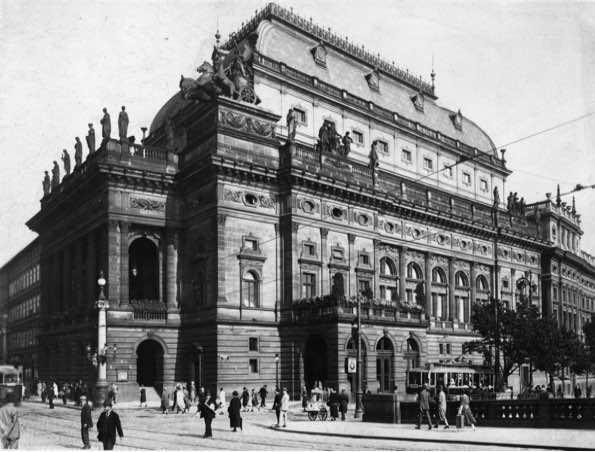
Prague opera

Another Strange But True story from my mentor Paul Kratochvil, again bearing on the surreal Czech imagination:

In the early 1960s two players in the Prague opera orchestra were locked in a vendetta. Between performances the band used to leave their concert uniform in the green room. Every couple of weeks, one of them, coming in early and unobserved armed with needle and thread, meticulously took up the cuffs of his adversary’s concert trousers by a tiny bit.

See also Czech stories: a roundup.

Such subtle revenge has now been exacted at the White House:

White House desk

As Jonathan Jones observes in the Grauniad:

It’s a retired person’s table, a desk for TV dinners. This is Trump gradually giving up the pretence he runs a vast country and instead settling into a more leisured life. Like his furniture, he is diminishing before our eyes.

Some Portuguese epigrams

For Nick—
i
f the reader finds this post a tad arcane, just wait till you see his WAM anagrams

Further to my little Lisbon jaunt, I’m always disappointed at my total lack of success when I try to busk it in Spanish by randomly adapting Italian—but it’s even more futile to further modify my crap Spanish into bacalhau (sorry, I mean cod) [1] Portuguese.

I soon dispensed with my old Portuguese phrase book (less entertaining, and less sinister, than Teach yourself Japanese)—its very opening phrase suggests a similar deep anxiety about even setting foot outside our own green and pleasant land:

There’s been an accident.

I flew TAP (Take a Parachute). Indeed, the flight prefix is further abbreviated by omitting the middle letter, so not for the only time, I found myself flying TP (Totally Pissed).

Aboard TAP flights, with impressive urbanity in the vein of Mots d’heures, the airline regales the traveller with a pithy and somewhat obscure epigram evoking the saudade of fado. It seems to recall a sad incident in the colourful past of an early Lisbon femme fatale, perhaps a widow of French patrician stock (even a refugee from the guillotine?):

Colete Salva-Vidas sob a Cadeira [2]

I’ve added capitals for clarity, but in order to preserve the ambiguity of the original I have refrained from supplying what seems to be a missing apostrophe—indeed, could it even be an exhortation?

Either way, it is far more evocative in Portuguese than in its prosaic English rendition

Life jacket under the seat.

Cf. Airplane:

Airplane is packed with little visual detail like that, requiring as much long-term revisiting as the Ring Cycle. Even the opening sequence is a too, er, deaf ‘orse.

And I’m keen to dally with Mme [sic] Salva-Vida’s [just as sic] enticing daughters

Rolagem, Descolagem, and (black sheep of the family) Aterragem,

also commemorated in TAP’s onboard annotations. Again, their names are so much less elegant in English:

Taxi, Takeoff, and Landing.

For a new addition to the family, Proxima Paragem, see here.

Just had one of those wacky dreams:

In Lisbon, invited implausibly to some suspiciously traditional social event with an old friend, we make our tortuous way there by means of a badly bombed Escher staircase. Arriving unscathed, I mingle suavely with the locals. Pleased with myself for managing to utter a grammatically convincing phase, I exclaim “Progresso!” “Si,” my Portuguese friend nods, “Esta Truro.”

How pitilessly my subconscious satirises my naïve aspirations to insider status.

For another dream, and a Portuguese limerick, see Ogonek and Til.


[1] Altogether Now: The Piece of Cod Which Passeth All Understanding.

[2] Cadeira: twinned with Madeira.

Hope for our future

Amidst all the recent plague of misogynistic claptrap—exemplified by the Neanderthal spewings from Tweety McTangerine—all is not lost.

One of the very most inspiring stories of recent months concerned the brilliant ripostes (here) by indignant young female football players at a County Durham primary school to the Football Association’s advice (“naïve rather than sexist”???) on ways of recruiting more girls to the sport. Call me a Guardian reader if you will, but FFS, even The Sun expressed wholehearted admiration for the girls’ protests!

Their letters are just brilliant.

We aren’t brainless Barbie dolls.

Whether or not they’ve read the feminist classics yet (in pretty pink covers, perhaps, FA?), or even listened to Bridget Christie, they’re on the case, making mature cogent arguments way beyond the infantile rants of the leader of the Free World. There’s hope yet.

football letter

How thrilled they must be about England’s victory in the 2022 Euros! For more on women’s football, click here; for ancient Chinese female footballers, here.

Also inspiring is a recent complaint by a 7-year-old girl about a sexist road sign. For more hope for our future, see here.

Love song, and more Mozart

Bailey

Talking of craftsmanship in words and music, here’s Bill Bailey:

Of many classic lines, this is brilliant:

The duck lies shredded in a pancake
Soaking in the hoisin of your lies.

I’m also keen on his pub joke:

An Englishman, an Irishman, and a Scotsman walk into a bar—and everything unfolds with a tedious predictability.

More elaborate is this:

And he’s a fine pianist! It would be just as much fun to play Mozart piano concertos with him as with Robert Levin—here playing Mozart’s very own piano:

Gosh—I’m even playing in the band there too, a stay in Salzburg making a pleasant change in between fieldwork trips to rural Hebei. For my speculations about the reversal of colours on the keyboard soon after Mozart’s day, see Black and white.

Among other tributes to Bill Bailey, see here.

Kangaroo

kangaroo

By contrast with many stories being published today, here’s an apparently genuine story of the choir of King’s College Cambridge on a tour of Australia around 1980:

On a free day, a few of the more enterprising undergraduate choristers, all dressed up in their fancy Chetwynd Society blazers, hired a car and drove off into the outback. Suddenly a kangaroo leapt out in the road in front of them, and they couldn’t help hitting it. Stopping to assess the damage they found that the kangaroo, though unscathed, was dead. With typical Cambridge drôlerie, one of them took off his blazer and put it on the kangaroo, propping it up so they could take a group photo.

At this point, it transpired that the kangaroo wasn’t dead at all, but merely stunned [Altogether now, the parrot sketch—Ed.]. Coming round, it hopped off at high speed into the distance—with blazer, passport, and chequebook, making excellent its escape (in the words of Flann O’Brien).

It was never seen again—though one imagines it telling the tale as it sips cocktails on a Spanish beach…

If anyone can confirm or refine this story, please do!

For an intriguing parallel from David Sedaris, see here. Further musos-on-tour stories (under WAM humour tag) include LOOK!, An orchestral classic, and The Mary Celeste.

Em creeps in with a pie

As I noted in Conference at Cold comfort farm (1949), Stella Gibbons predicted the whole Cultural Heritage flapdoodle. And again, long before Jo Brand, she was no less prescient about the comic potential of the pie.

She sends up much of the avant-garde—including (sic) Benjamin Britten, whose Peter Grimes had been premiered in 1945. Here she gives a resumé of Bob Flatte’s new opera The Flayed:

For the benefit of readers who are not familiar with the work of Flatte it may be remarked that The Flayed is typical of his latest and most powerful manner, and deals with the tragedy of two types named Stan Brusk and Em Wallow, living in a Bedfordshire village. Em is Stan’s girl, but he loses her to Bert Scarr when the latter comes to work in the local tanning factory. Stan Brusk is a sadist who derives pleasure from tanning hides and has twice been publicly reproved by the foreman for gloating while at work. In a powerful recitative and aria Stan defies the foreman, describes the pleasures of tanning, and at last falls down exhausted under a vat.

A series of sinuous themes follows, intended to represent the smells from the vat winding over his unconscious body. In the dinner-hour Em creeps in with a pie, which she does not know has been poisoned by the fumes from the vat. Bert Scarr then enters. He and Em sing a duet, in which Bert confesses that he has always had a secret craving to be flayed like one of the hides in the factory and Em expresses her horror and scorn of him. At last she falls under the vat on top of Stan, who recovers consciousness and misunderstands her action. Em, Stan, and Bert are then overcome by fumes from the vat, and dream they are in Hell.

The Weeping Skeleton’s song which follows has been said to refute, once and for all, the accusation that Flatte’s operas lack light relief. The song may not represent humour as it is generally understood, but to deny that the theme of four minor chords given out in glissando form by the first violin and repeated in fugue form by solo instruments one after the other until it ends abruptly on the drums is expressive of a rationalised and resigned humour (perhaps most akin to irony) is merely imperceptive.

Em recovers first and revives Bert with a piece of the pie. The foreman comes in accompanied by a chorus of Operatives and Tanners and accuses Bert of slacking. Bert, already poisoned, and driven by his neurosis, jumps into the vatful of skins and is suffocated. Em eats some pie and dies. Stan stabs the foreman with his penknife (a present from his mother on his seventh birthday, and symbolizing her neurotic hold over him) and the foreman dies. While Stan is singing the Flagellation Song and driving out the chorus of Operatives and Tanners with a whip, his mother, Widow Brusk, enters. After she has sung an aria in which she confesses that Stan is the illegitimate son of a taxidermist who seduced her in early youth, thus accounting for her son’s sadistic obsession, Stan symbolically attempts to skin her and they both become insane. The opera then ends. It was to represent English music at the International Music Festival the following year.

Which is as good an excuse as I need to play this:

Making a fine companion to Dud’n’Pete’s caveat on fieldwork.

Downhill: Steven Wright

Before Milton Jones and Tim Vine, but considerably after Hildegard von Bingen, there was Steven Wright, king of deadpan brevity.

Went out and bought myself a decaffeinated coffee table.

With that wording, and his delivery, that version is superior to some that you’ll find online.

This next “joke” is widely attributed to Milton Jones, but I swear I heard it Steven Wright doing it around thirty years ago:

Shortly before he died, my grandmother [pause] smeared my grandfather from head to toe in lard. After that, he went downhill very quickly.

Again, online versions are less well crafted. I distinctly remember the pause—he’s already got the audience thinking, WTF…

Like Daoist ritual, the texts are very fine on the page, but it’s all about performance. Here’s the first of five clips  some from 1985:

More here.

Inevitable further link: Stewart Lee’s routine on the Sardine joke and joke ownership.

An orchestral classic

Gary

Gary Kettel.

À propos orchestral humourStewart Lee does a typically labyrinthine riff giving the old sardine joke his signature going-over:

Loath as I am to spoil the fun, in the WAM biz where people used to employ me, this story is famously attributed to the master-percussionist and all-round piss-artist Gary Kettel.

A hooliganesque Cockney, Gary was What They Call “a breath of fresh air” in the staid orchestral scene. During Boulez’s années dorées at the helm of the BBC Symphony Orchestra, conducting many challenging works, he much admired Gary’s musicianship, and they formed a charming and unlikely bond (see this story).

The version of the sardine joke handed down to posterity in the orchestral biz (which beyond Gary’s own recollections has some further effective, if fanciful, detail) goes like this:

Once (this must have been in the mid-70s) he was on tour in South America with the London Sinfonietta, doing the, um, challenging Eight Songs for a Mad King.

So Gary’s at this fancy British Council reception after the gig in Buenos Aires or somewhere, getting quietly pissed in a corner on his own, and this posh bird comes up to him and goes,

“I say, I don’t believe we’ve been introduced—weren’t you playing in the concert? I did so enjoy your delightful rendition of that charming work!” [that’s a nice touch, by the way, if you know the piece, “but that’s not important right now”].
“Do please remind me,” she goes on, “what was it you were playing?”

“Oh, I fool around a bit on the drums, luv,” goes Gary—”So wot you doin’ ‘ere then?”

“I’m here with my husband.” she replies loftily.

Gary goes on, chummily, “An’ wot does your old man do then, darlin’?”

“My husband’s in oil!” she exclaims, proudly.

Gary goes, “What is he, a fuckin’ sardine?”

I like the details here. And the punchline is a good instance of the importance of the word “fuckin’ ”—not least for rhythm and euphony. The story also reflects musos’ own delight in “deviating from behavioural norms”.

Keen as I am on the ancestry of texts (my book ch.11), just as one does in exploring the relation and transmission of Daoist texts (well, I say “one”…), I wonder: Gary’s not sure, but could he have heard it from Tom O’Connor, or did they both get it from someone else, and so on (zzz)?

The Tom O’Connor version is less personal and less funny—which is precisely what makes it a suitable victim for Stew to mangle, a banal ground-bass lying prone for his endless florid divisions, a Goldberg variations from hell…

For further detail, see How I escaped my certain fate, pp.257–69—by now tuned into the De Selby footnotes in The third policeman, (and here), you will find further verbose and erudite annotations there too.

For another reception story, see here, on George Brown, pissed at a reception in Peru.

Learning the piano

By contrast with the Sonatas and Interludes of John Cage, and as part of my occasional series on music acquisition, and also on language learning, here’s Milton Jones:

I used to wonder if, in China, young piano players used to have to learn “Knife and Fork”.

Doubtless a formative early piece for Lang Lang.

Zhou and Nixon

For broader perspectives on the learning process in world music, albeit with fewer jokes, see the fine documentary series Growing into music.

Trumps

With such cultural refinement at the Helm, who needs the National Endowments for the Arts and Humanities, eh???

See also under Black books.

Oops

Hot on the heels of The check-up, maybe this is a reverse variation on the “pull back and reveal”, only with the joke on the subject, not the object (or something—how would I know, I just do fieldwork on Daoist ritual):

A medium is holding a séance. With a group of genteel clients assembled around her table, lights dimmed, she begins, softly,
“Now everyone—before we begin, I just want to ask you, has anyone here ever seen a ghost?”
They all bow their heads in silence, but one geeky chap sticks his hand up and goes perkily,
I have!
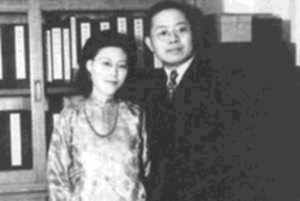
They look curiously at him. He goes on,
And—what’s more—I’ve fucked one!”
Incredulous, the medium asks him,
“What? You mean… you’ve… fucked a ghost?”
Disconcerted, he pauses. Then, nonchalantly:
“Sorry—I thought you said goat…”

Take a flying jump

A glowing paean from one Führer to another—Tweety McTangerine (yes, the Mango Trumpolini himself) on another Great Helmsman:

You have to give him credit. How many young guys—he was like 26 or 25 when his father died—take over these tough generals, and all of a sudden… he goes in, he takes over, he’s the boss… It’s incredible. He wiped out the uncle, he wiped out this one, that one. This guy doesn’t play games.

That’s how it’s often cited, but in the interests of scrupulous balance, the fuller transcript puts it in context:

If you look at North Korea—this guy, he’s like a maniac, OK? And you have to give him credit. How many young guys—he was like 26 or 25 when his father died—take over these tough generals, and all of a sudden—you know, it’s pretty amazing when you think of it. How does he do that? Even though it is a culture and it’s a cultural thing, he goes in, he takes over, and he’s the boss… It’s incredible. He wiped out the uncle, he wiped out this one, that one. I mean, this guy doesn’t play games. And we can’t play games with him. Because he really does have missiles. And he really does have nukes.

“It is a culture and it’s a cultural thing” (like the KKK and NRA, eh?)—there, who says he doesn’t do eloquent anthropological refection? Eat your heart out, Bourdieu. This guy, he’s like a maniac, OK?

kim

This photo reminds me of a classic story, perhaps originally from the USSR, but widely shared in this Chinese adaptation (Fieldworkers’ joke manual no.23). Diplomatic as ever, I shall cunningly disguise the identity of the butt of the joke, notoriously dim, by calling him Lee Beng.

Deng Xiaoping, Jiang Zemin, and Lee Beng are taking a flight together with a group of schoolkids when the plane develops a fault and begins an alarming descent.

There are only three parachutes on board, so Deng Xiaoping grabs one, straps it on his back, and loftily declaring “The People need me!” he leaps out; soon his parachute unfurls and he glides down to earth. Jiang Zemin follows suit.

Lee Beng gets the idea, so he too grabs a bundle, straps it on his back, and exclaiming “The People need me!” he throws himself out after them.

One of the schoolkids looks down as he hurtles earthwards and cries out, “Waah! Uncle Lee’s got my satchel!”

Coming back to the leaders who inspired this post, one can but dream.

And did those feet in ancient time?

Still thinking about Alan Bennett’s feet and early religious culture:

In the wonderful song Jerusalem, rather like those questions they ask you at the airport check-in desk, you think all the answers are going to be “No”, but you have to keep on your toes (sic, see below) just in case.

Great that it’s tipped for our new national anthem, to replace the meretricious God save the Queen (although the version here is fine)—but we have to take care not to “leave it unattended at any time” in case it gets hijacked by “Paul Nuttall and the UKIPs”.

Mind you (and talking of keeping on your toes), if I had an anthem like this (Wow! Italian opera at its most intoxicating! 1831-ish, see here)

even I would score a goal like this:

(1970—“ancient time”?] That’s right up there with Ronnie’s 147.

The Italian anthem is just as exhilarating. And Latin American nations (notably Uruguay and Ecuador) are among the star exhibits in Tom Service’s entertaining programme “How Do You Make a National Anthem?” in The listening service.  For the German anthem, click here.

I was in Washington DC with the amazing Hua family shawm band in 2002 when Brazil won the World Cup (click here). We all crowded into the hotel bar early in the morning to cheer them on, suitably lubricated with A Pint of Plain—It’s Your Only Man.

And then there’s our fantasy football team/Daoist ritual band

“which will bring us back to”

Li Manshan!

[Been at the Bombay Sapphire again, Dr Jones?—Ed.]

The definitive transliteration

Svejk

I just can’t resist constructing a headline to incorporate some of my favourite Chinese transliterations (for more, see here, with thread):

帅克耍耍圣桑的兔子不拉屎
Shuaike shuashua Shengsangde tuzibulashi

or

Conquering General plays with the Rabbits-don’t-shit of Sage Mulberry

or, if you insist,

Švejk plays with the toothbrush of Saint-Saëns

What kind of language do you call that, ask the Plain People of Ireland. Beat that, China Daily.

In The good soldier Švejk, among several references to the toothbrush, try this:

Then she took out of the hamper three bottles of wine for the convalescent and two boxes of cigarettes. She set out everything elegantly on the empty bed next to Švejk’s, where she also put a beautifully bound book, Stories from the life of our Monarch, which had been written by the present meritorious chief editor of our official Czechoslovak Republic who doted on old Franz. Packets of chocolate with the same inscription, “Gott strafe England,” and again with pictures of the Austrian and German emperors, found their way to the bed. On the chocolate they were no longer clasping hands; each was acting on his own and turning his back to the other. There was a beautiful toothbrush with two rows of bristles and the inscription “Viribus unitis,” so that anyone who cleaned his teeth should remember Austria.

The latest research, however, suggests that Saint-Saëns (1835–1921) once carelessly left his toothbrush behind at his hotel while on tour in Prague—he was indeed a keen traveller, but his biographies are curiously silent about this incident. Later the Good Soldier came across it by chance while rummaging in a junk shop, and proceeded to toy with it.

Still, we cannot dismiss the possibility that the toothbrush may be employed here in its popular Slovakian metaphorical sense. In a comment suggestive of Molvania, Andrew Lawrence Roberts (From Good King Wenceslas to the Good Soldier Švejk: a dictionary of Czech popular culture) notes:

Slovácko is best-known for its traditional culture: distinctive national costumes are still occasionally worn, folk traditions like The Ride of the Kings [a major theme of Kundera’s The joke—SJ] still celebrated yearly. The largely rural residents of Slovácko are known as well for their love of slivovice, which they refer to as their morning toothbrush.

So have I been barking up the wrong tree? In this case, one wonders further: just what kind of liqueur was Saint-Saëns’ so-called “toothbrush”? In our headline, perhaps we may now interpret the verb shuashua “fooling around with” as referring to a tasting session—given Švejk’s Bacchic propensities, surely an epic event, at which Flann O’Brien would have been more than welcome.

A tribute to Yang Yinliu

yyl-on-xiao

Yang Yinliu, 1950.

Since I mentioned Yang Yinliu’s groundbreaking work on the Zhihua temple, he too richly deserves a tribute. Indeed, since soundscape is such a basic aspect of Chinese culture, his work should form a basic training for us all.

Yang Yinliu 楊蔭瀏 / 杨荫浏 (1899–1984) is often described in mediaspeak as “the Chinese Bartók”, but Bartók should rather be described as “the Hungarian Yang Yinliu”. A fine musician and fieldworker, erudite historian, and incidentally a Protestant, Yang’s whole oeuvre was remarkable.

Brought up in the final years of the Qing dynasty in the milieu of the Daoist instrumental music and the refined Kunqu vocal dramas of the Wuxi area near Shanghai, Yang was a fine exponent of qin zither, pipa and sanxian plucked lutes, and the ethereal falsetto singing of Kunqu (I haven’t yet found my copy of the precious recording from the 1920s found recently in Berlin). He learned instruments from Daoist priests (including Abing) from the age of six, joining the elite Tianyun she society.

YYLIn Wuxi, under the tuition of the American missionary Louise Strong Hammond, he studied English and Western music theory. He also became an active Christian. He went on to gain a cosmopolitan education in Shanghai, attending St John’s University from 1923. After returning to Wuxi in 1926, he was married in 1928, becoming a professor at Yenching University in Beijing in 1936. Offered a job in the USA heading a Chinese music institute there, he commented, “I can do nothing if I leave Chinese soil, where Chinese music lives.”

After the Japanese occupation in 1937, and through the troubled 1940s, not inclined to join the Communist base area in Yan’an, Yang moved from Nanjing to posts in Kunming and Chongqing, always continuing his research.

The Wuxi Daoists
Yang and his cousin Cao Anhe returned regularly to Wuxi, where they were engaged in a long-term project studying the music of the local Daoists. Of their two major books on the theme, their work on Shifan gu was first published in 1957, Yang’s on Shifan luogu not until 1980 (cf. the shifan of Tianjin and Hebei).

In some respects Yang seems like a traditional historical musicologist rather than an ethnographer; but he was well aware of complex social issues. This passage on the position of Daoists in Wuxi society illustrates his sophisticated interest in ethnography and ritual practice, besides his more traditional “musicological” concerns: [1]

In the past [?!], Buddhists in south Jiangsu divided into two types, Chan school (chanmen) and Auxiliary school (fumen).

Those of the Chan school were completely vegetarian, and didn’t have families. They only used percussion like woodblock, bowl, nao and bo cymbals, and tonggu drum to punctuate their vocal liturgy; they didn’t play any melodic instrumental pieces. They never took part in production, living in their temples, some of which had large estates.

The Auxiliary school ate meat and had families. Few in number, they lived scattered in the villages, taking part in agriculture and only reciting the scriptures and litanies as an auxiliary occupation. Among the Buddhists, they are the only ones who play the fanyin [melodic instrumental repertoire] and [separate] percussion items.

Among the Daoists, the Complete Perfection (Quanzhen) school (belonging to the Qingchengshan style of Sichuan) were similar to the Buddhist Chan school, not using separate percussion items or silk-and-bamboo instruments. Those who played the fanyin and separate percussion items mostly belonged to the Zhang Heavenly Masters school of Longhushan in Jiangxi.

Among the latter group, there was a further clear class distinction. A minority of abbots possessed ritual titles of the Zhang Heavenly Masters, like “Master who Guard the Way” (daoweishi) or “Ritual Master” (fashi), and mostly owned land. They didn’t take part in production. They interacted with landlords and the bourgeoisie in the cities and villages, taking ritual work and contacting and hiring the common village Daoists to take part in major rituals (daochang fashi).

These common Daoists mostly took part in agricultural production, being hired ad hoc: performing for rituals was an auxiliary occupation for them. In both agriculture and Daoism, they were an exploited class. These common Daoists—even the indispensable drummers and flute players, with their excellent musical technique—only got a tiny wage for a whole day’s work.

Conversely, the “Masters who Guard the Way” and “Ritual Masters”, having only taken responsibility for quite brief ritual segments of a few hours like Issuing the Talismans (fafu), Reporting the Memorial (zoubiao), and Flaming Mouth (yankou), claimed a reward many times higher than that of the others. Those who played music were mostly the common semi-peasant Daoists; very few of the “Masters who Guard the Way” and “Ritual Masters” could do so. This shows that in the past it was agricultural life that produced and developed music.

Never mind the diplomatic PC spin (for “reading between the lines”, see my article cited under Hunan below), Yang had already observed the important distinctions common to local ritual cultures all over China, long before the major projects on local Daoist ritual since the 1980s. [2]

sfg-50s

sflg-1950s

Shifan gu and Shifan luogu, c1962.

Nearby, the Daoist rituals of Suzhou were also thoroughly documented in an amazing 1956 project. Following such early work, major studies of the Daoist rituals of Suzhou, Wuxi, and Shanghai have been made since the 1990s. [3]

The Music Research Institute
After the 1949 “Liberation” Yang’s erudition was much needed. Managing to adapt to the new Communist regime, he was appointed director of the newly-formed National Music Research Institute of the Central Conservatory of Music (predecessor of the Music Research Institute [MRI] of the Chinese Academy of Arts), beginning a golden age for research there. Under his committed guidance they accumulated a large archive of field recordings and traditional notations.

A qin player himself, he was closely involved with all his eminent colleagues’ research on qin (see my series on The qin zither under Maoism, starting here).

The golden age of the MRI, 1954;
right to left Guan Pinghu, Yang Yinliu, Pu XuezhaiZha Fuxi, Li Yuanqing.
.

In due course the MRI was given a new building (typically, soon dilapidated) in Dongzhimenwai in the northeast of the city. Even in the 1980s, when it became my home base between field trips, its bare dingy corridors were animated by the spirits of the old masters. The new compound, further out in Huixinxijie, is less characterful.

yang-and-cao-best

Yang Yinliu and Cao Anhe at the MRI, 1961.

Both before and after Liberation, until the early 1960s, in collaboration with other fine scholars—notably his cousin and lifelong companion Cao Anhe (1905-2004)—Yang managed both to perform remarkable research on a range of living traditions and to compile major collections and transcriptions of traditional notation. Just as important was his monumental history, first in draft from 1944, covering with unique erudition the whole of Chinese music history, and elite as well as folk genres, albeit couched in the language of its time.

His most renowned recording—on another trip home to Wuxi in summer 1950—of pipa and erhu solos by the blind beggar Abing, is perhaps his least interesting. Abing was once among the Daoists whose company Yang kept in his youth, but the 1950 recording was a casual event, on a day off from working with the Daoists who were his main focus.

His work on the Zhihua temple followed on from his 1952 monograph (with Cao Anhe) of the “Songs for Winds” band from Ziwei village in Hebei during their 1950 visit to Tianjin—a band still active when Xue Yibing and I visited them from 1989. In summer 1953 Yang made an important visit to Xi’an to investigate the music (and scores) of local ritual groups; and he drew attention to the ritual music of Shanxi, notably the Buddhist mountains of Wutaishan—also later to become major scholarly themes in China. [4] With Cao Anhe and Jian Qihua he also took part in a project to transnotate a rare score of the “suite plucking” repertoire of old Beijing. For more evidence of his good taste, see here.

Hunan, 1956
Along with his historical research, Yang Yinliu did all kinds of fieldwork. Just as remarkable as his studies with the Wuxi Daoists was a major fieldwork trip he led to Hunan province in 1956, amidst escalating collectivisation. There Yang Yinliu headed a team documenting all kinds of ceremonial music-making, notably ritual and customary musics. Despite the politically correct language of the published volume, they seem to have taken what they found. The resulting “Report on a survey of the musics of Hunan” (Hunan yinyue pucha baogao, 1960) has 618 pages, besides separate mimeographs on Confucian and Buddhist ritual. I’ve written about it at greater length here.

This, the first general survey of all the genres of a given area, was an influential blueprint for later regional surveys from the 1980s, notably the Anthology of folk music of the Chinese peoples, on which see my

  • “Reading between the lines: reflections on the massive Anthology of folk music of the Chinese peoples”, Ethnomusicology 47.3 (2003), pp.287–337.

The energy of those times at the MRI, in the midst of increasing political control, was remarkable. Also wide-ranging was an early fieldtrip to Fujian for two and a half months in the winter of 1961–62, led by Li Quanmin, and published in 1963. [5]

In 1962 Yang Yinliu published a masterly overview of Chinese notation in his Gongchepu qianshuo 工尺谱浅说.

All this extraordinary work was carried out under the most taxing conditions. Worse was to come: academics and peasants alike, as representatives of the “Four Olds”, suffered grievously after the Four Cleanups campaigns began in 1963. In May 1965—after the end of the campaigns, when over thirty MRI employees had undergone Socialist Education in Chang’an county, Shaanxi—they celebrated their temporary freedom with a visit to Huashan:

Huashan 1965

In the row behind, fifth from left is the trusty Li Wenru (for whom, see here). Source: Yang Yinliu jinian wenji.

As the Cultural Revolution broke out, even in the Hebei village camp where Yang and others were sent for “re-education” he furtively continued research, including studies (along with Huang Xiangpeng, another distinguished colleague) of the 1972 excavation of the Han tombs at Mawangdui (see e.g. Micic, p.104). During this period Yang’s colleagues members of the elite qin fraternity were also given permission to continue their studies.

“How to assess religious music”
Within the confines of the day, Yang Yinliu paid just as much attention to “literati” and “religious” culture as to more popular genres (pace Joseph Lam). Indeed, Yang was perhaps predisposed to studying early music history; and it wasn’t so much post-Liberation ideology that drew him to popular living genres, but his own training in performance (Kunqu, Daoists and so on).

In the useful article

he discusses Yang’s own article “Ruhe duidai woguode zongjiao yinyue” 如何对待我国的宗教音乐 [How to treat religious music], Wenhui bao 1961.3 (also reproduced in the 2013 Yang Yinliu jinian wenji), written just as a very brief lull in extreme leftist policies followed the climb-down after the terrible famine.

Meanwhile scholars had been discussing the classification of genres; their framework was enshrined in the 1964 Minzu yinyue gailun [Survey of Chinese music]. Despite the separate and subsidiary place of “religious music”, they were aware that ritual practice pervaded all genres of rural performance. Indeed, Yang seems to have been the first to use the term “ritual music” (yishi yinyue ) in China. [1] From 1959 he also spent many years revising his masterwork Zhongguo gudai yinyue shi gao [Draft history of Chinese music], which was finally published in 1981. Covering literati, palace, folk, and religious traditions required him to take great care over how to couch his language.

So in his 1961 article he was subtly, and boldly, justifying the very need to study ritual traditions, using the language of class struggle while attempting to refine it. It will hardly satisfy modern anthropologists of religion; indeed, it makes a rather severe test of our ability to interpret writings of the time. Of course, in the 1950s the tenets of ethnomusicology were still far from common even in the West. Yang’s use of language shows the hoops that scholars had to jump through in order to get on with documenting the diverse genres.

After the downfall of the Gang of Four in 1976 and the demise of the commune system, Yang Yinliu finally saw his great history formally published, and cultural and academic life restored. Though he lived long enough to witness the revival of tradition, he could hardly have imagined how widespread it would become, and how important the study of ritual and its soundscape was to be. How he would have delighted in the renewed energy of the Anthology and later fieldwork projects! His interests may have been more directed towards the “salvage” of genres common in his own youth and throughout imperial history, but I think he would have understood the value of documenting their fortunes since Liberation, even if that was still to remain a sensitive subject.

YYL CDs

The Protestant hymns of Yang Yinliu
Unlike Bartók, Yang wasn’t also a composer. Except

As a coda to this little tribute, the 2-CD set from Wind Records ends with a touching hymn that Yang wrote in 1934, a simple harmonization of the qin piece Yangguan sandie:

I was most moved to hear the Beijing Protestant Church Choir sing it at a memorial concert for Yang in November 1999. His Christian background has long been recognized, but only with the liberalizations since his death did it become possible in China to admit, sotto voce, that he remained a Christian all his life. This makes his hymns all the more moving, especially bearing in mind all the silent tribulations since the 1940s of Chinese Christians, along with artists, intellectuals, and peasants.

* * *

Along with my Chinese friends, some of whom were his pupils, I can’t help feeling a deep nostalgia for the golden days of the MRI. Yang Yinliu’s combination of encyclopedic knowledge and musicianship are likely to remain unmatched. If only my other great mentor, Laurence Picken, had been able to confer with him!

Like many ethnomusicologists, I no longer want to be limited by the narrow association with “music”, but while Yang Yinliu’s writings are wide-ranging as well as profound, his focus on “music” was also admirable.

Finally, two suitable quotes from a junior colleague of Yang and a pupil, who were also to become my mentors:

Yang Yinliu was a large tree full of lush leaves and branches reaching high into the sky. I can only caress each branch and leaf with my hands.Yang was a bridge between the ancient and the modern, Chinese and foreign. I’m still walking along that bridge that Yang built.   —Huang Xiangpeng [6]

Through him, Chinese music history was freed from the shackles of the text, allowing the music and the musicians to take centre stage.   —Qiao Jianzhong

hxp-qjz

With two distinguished successors of Yang Yinliu at the MRI, 1989: Huang Xiangpeng (left) and Qiao Jianzhong.

Alas, I arrived in Beijing in 1986 a couple of years too late to pay homage to Yang Yinliu in person. But his spirit animates us all.

See also An anthology of Chinese fieldwork reports.

Selected resources

  • Zhongguo gudai yinyue shi gao [Draft history of ancient Chinese music] (Beijing, 1981)
  • Yang Yinliu yinyue lunwen xuanji [Selected articles by Yang Yinliu on music] (Shanghai, 1986)
  • Qiao Jianzhong and Mao Jizeng, eds.: Zhongguo yinyuexue yidai zongshi Yang Yinliu (jinian ji) [Yang Yinliu, master of Chinese musicology, commemorative collection] (Taipei, 1992)
  • Chuancheng: Yang Yinliu bainian danchen jinian zhuanji/Heritage: in memory of a Chinese music master Yang Yinliu (2-CD set, Wind Records, 2000) [with detailed booklet]
  • Yang Yinliu quanji [Complete works of Yang Yinliu] (13 vols, Jiangsu wenyi chubanshe, 2009)
  • Yang Yinliu jinian wenji [Collected articles commemorating Yang Yinliu] (Beijing, 2013)
  • Han Kuo-huang, “Three Chinese musicologists: Yang Yinliu, Yin Falu, Li Chunyi”, Ethnomusicology 24.3 (1980), pp.483–529
  • Stephen Jones, “Yang Yinliu”, in The new Grove dictionary of music and musicians (2001)
  • Peter Micic, “Gathering a nation’s music: a life of Yang Yinliu”, in Lives in Chinese music, ed. Helen Rees (University of Illinois Press, 2009), pp.91–116. Note also references.

[1] Sunan chuidaqu, 1957 edition, pp.11–12. This passage was cut from the 1982 edition. There may be a story to tell here: perhaps such material was still more sensitive when they revised the text around 1980 than it had been even in 1957.

[2] See also Meng Fanyu 孟凡玉, “Lun Yang Yinliude yishi yinyue yanjiu” 论杨荫浏的仪式音乐研究, Yinyue yishu 2017.6.

[3] For a simple introduction to the musical and ritual culture of south Jiangsu, see my Folk music of China, pp.246–8.

[4] Ibid., pp.195–202 and 213–45.

[5] Cf. ibid. pp.286–321.

[6] Cited in Peter Micic, “Gathering a nation’s music”, pp.105–106. For Huang Xiangpeng, see e.g. Micic’s article “Value is proven in the fire”; Huang Xiangpeng jinian wenji 黄翔鹏纪念文集 (2018); Zhang Zhentao 张振涛, “Yinyuexuejia Huang Xiangpeng he tade yishu rensheng”” 音乐学家黄翔鹏和他的学术人生.

.

Vera and Doris

Vera

Vera de Bosset.

Further to Igor Stravinsky (“Gran visits York”), here’s Alan Bennett again (Writing home, p.30):

During the [1963] run of Beyond the fringe in New York, Dudley Moore and I took refuge from a storm in the Hotel Pierre, where we were spotted by an assistant manager. Saying that there had been a spate of thefts from rooms recently, he asked us to leave. A small argument ensued, in the course of which an old man and his wife stumped past, whereupon the assistant manager left off abusing us in order to bow. It was Stravinsky. We were then thrown out. I have never set foot in the Pierre since, fearing I might still be taken for a petty thief. Dudley Moore, I imagine, goes in there with impunity; the assistant manager may even bow to him now while throwing someone else out. Me still, possibly.

And then (2010):

I tell John Bird the story of Dudley Moore and me seeing Stravinsky and his wife Vera in the Hotel Pierre in New York in 1963, saying how the name Vera has always seemed to me to humanise Stravinsky. “Not so much as Stockhausen,” says John. “His wife’s name was Doris.”

Gender
Now, I’m not so humourless that I can’t see how Vera and Doris (“wives”) are funnier than Igor and Karlheinz (“Great Composers”). Noting that the English have been making light of Storm Doris this week, this brings me to hurricanes.

In the USA, for many years hurricanes bore only female names. The male meteorological community found female names

appropriate for such unpredictable and dangerous phenomena.

Pah! In the 1970s the growing numbers of female meteorologists began to object, and since 1978 onwards male and female names have alternated (Yay!). Nor are they expected to suggest menace, like characters in a horror movie. Fleur or Katrina might be femme fatales, but Tammy and Bob are homely, and Nigel nerdy.

However, in the US people may prepare differently for storms depending whether they bear a male or female name. Hurricanes with female names cause significantly more deaths—apparently (by contrast with that idea of “female menace”) because people perceive them as less threatening, leading to less preparedness and thus causing more damage. You can’t win…

BTW, please can we stop making out that countries and ships are feminine?! Otherwise we’re lucky in English not to have to worry our pretty little heads about gendering nouns

The “case for the defence” shoots itself in the foot most messily in a breathtakingly Neanderthal essay “Why We Call a Ship a She” from “Rear Admiral” Francis D. Foley—apparently the Benny Hill of the US Navy. This is just a sample:

There can be a great deal of bustle about her as well as a gang of men on deck, particularly if she is slim-waisted, well-stacked, and has an inviting superstructure.

And FFS, it dates from 1998! If it came from 1698 I might reluctantly, um, consider it within the cultural context of the day; but this is indeed the cultural context that afflicts the USA at the moment. Too bad Foley is no longer with us—he would be a shoo-in for the post of Gender Equality Adviser in the new US administration. But amazingly there are plenty more where he came from, eager to fall on their flaccid pork swords before the Amazon hordes of the “liberal media”…

Cf. Surely… in the Messiah.

“No sensa humor, these wimmin…” Never mind Bridget Christie—even Foley’s junior contemporary Stella Gibbons would have given him a piece of her dainty mind.

This is a battle that is important to pursue, like “actress”, “chairman”, and “ballerina” (see Words and women)—however much the “PC gone mad” cabal may splutter.

Doh a deer, a female deer—but that’s not important right now”, indeed.

I rest my case.

Resting case

Resting my case. After Li band tour, Paris.

For more on sexist language, see here, with further links.

LOOK!

Here’s another true story, that Andrew Manze told me at Chicago airport on a 2003 US tour, rendering me helpless throughout the flight and well into the rehearsal:

A renowned Swedish avant-garde trombone soloist (hmm—take your pick) is doing a concerto in Helsinki. He arrives at his hotel the day before the gig, and when he goes for a pee in his bathroom, the loo doesn’t flush. Same happens again after the rehearsal, so he thinks, I must tell them at reception to get it fixed. But he doesn’t get round to it.

Next morning the loo flushes OK, so he thinks no more of it. But just before going off to the gig, he has a spectacular pre-concert dump, and sure enough the loo again fails to flush. As he’s leaving his room to set out for the concert hall, all dressed up in his penguin suit, he notices a chambermaid outside. So he gestures to her to follow him into his bathroom, points theatrically to the massive turd floating unrepentantly in the bowl, summons up one of his few words of Finnish: “LOOK!”, and pushes the handle as if to flush it.

It flushes.

***star-ratings, after SG

in the category cloud of the sidebar, I’m toying with a ***star-rating (now called *MUST READ!*)—not so much to help you separate the wheat from the chaff, but rather in homage to the great Stella Gibbons (1902–89), who wrote in her Foreword to Cold comfort farm:

And it is only because I have in mind all those thousands of persons not unlike myself, who work in the vulgar and meaningless bustle of offices, shops, and homes, and who are not always sure whether a sentence is Literature or whether it is just sheer flapdoodle, that I have adopted the method perfected by the late Herr Baedeker, and firmly marked what I consider the finer passages with one, two or three stars. In such a manner did the good man deal with cathedrals, hotels, and paintings by men of genius. There seems no reason why it should not be applied to passages in novels.

The “Loam-and-lovechild” style that Gibbons parodied is perhaps a cousin of what Elisabeth Lutyens—there, another fine female composer—christened the “cowpat school” of English music (“folky-wolky melodies on the cor anglais”, and so on). Here’s a *** passage from Cold comfort farm:

***His huge body, rude as a wind-tortured thorn, was printed darkly against the thin mild flame of the declining winter sun that throbbed like a sallow lemon on the westering lip of Mockuncle Hill, and sent its pale, sharp rays into the kitchen through the open door. The brittle air, on which the fans of the trees were etched like ageing skeletons, seemed thronged by the invisible ghosts of a million dead summers. The cold beat in glassy waves against the eyelids of anyone who happened to be out in it. High up, a few chalky clouds doubtfully wavered in the pale sky that curved over against the rim of the Downs like a vast inverted pot-de-chambre. Huddled in the hollow like an exhausted brute, the frosted roofs of Howling, crisp and purple as broccoli leaves, were like beasts about to spring.

Miss Stella Gibbons published Cold comfort farm in 1932. What a genius. The sequel is also brilliant, not least for her opera parody.

Jazz solo

bass solo

As an entr’acte between all the WAM stories (sallying forth, perhaps, from here), here’s a jazz joke.

A marriage guidance counsellor is having a tough time at a session with a couple reluctant to make any effort—sullenly refusing to speak to each other, only addressing their bitter comments through the counsellor.

So he whips out his double bass and starts playing a convoluted jazz solo. At once the couple strike up an animated conversation.

Intrepid early-and later-music bass player Pete McCarthy told me this one on a long coach ride on a US tour, c2001.

Clothes clothes clothes music music music boys boys boys

CMB

Under the rubric of delighting in all manifestations of the Terpsichorean muse, having just added a meretricious page on Gregorian chant, I now offer an equally piecemeal post on punk.

Further to Lives in jazz, Viv Albertine’s memoir

  • Clothes clothes clothes music music music boys boys boys [1]

(to give it its full title—her mum’s reproach to her as a teenager) is a beautiful inspiring book, full of sincere humanity and insight. We can draw a veil over the story of her messy “dalliance” (dunno why I’m suddenly coming over all Jane Austen) with Johnny Rotten. The account of her post-punk life is no less compelling than that of her time in The Slits, with their amazing singer Ari Up (RIP). Women, and sexism, in punk are justly favoured topics in musicology and glossies alike—more so, I note, than Daoist ritual (funny, that). For female punk band Vulpes in Madrid, see here.

slits

For Viv Albertine’s next book, see here.

I was sadly unaware of all these brilliant singers at the time, except (for some reason) for Nina HagenNaturträne (1978) has long been one of my favourite songs (see this playlist):

You can, and must, watch her singing it live on video too, but that recording is astounding. I was busy being a Boulez groupie… OK, there’s room for technique in punk too, but it’s not quite the point; I could presumably square that song with my snobby sensibilities long before I also learnt to rejoice in the Sex Pistols or the Ramones. Or Daoist ritual…

Just as much as the Matthew Passion, or Wozzeck, it makes want to learn German:

Natur am Abend, stille Stadt
Verknackste Seele, Tränen rennen
Das alles macht einen mächtig matt
Und ich tu’ einfach weiterflennen

We can save punk in China for another time—but again, it’s all part of the rich ethnographic tapestry. Not quite punk, but Cui Jian’s classic song Nothing to my name

prompted a fine complaint from Wang Zhen, veteran of the Long March:

“What do you mean, you’ve got nothing to your name? You’ve got the Communist Party haven’t you?”

Mutatis mutandis, Thatcher might have concurred.

[1] Pedantic note: most superior reviews abide by the title’s lack of punctuation.

Empirical language acquisition

Pilsen

Frances Wood, a distinguished former student of the late great Paul Kratochvil, reminds me of another of his stories.

Paul liked to tell us this as we grappled with the use of classifiers (measure words) for Chinese nouns. The nearest equivalent in English is for collective nouns, like a gaggle of geese or a school of fish. In Chinese a basic all-purpose one is ge (“a person” is not yiren but yige ren), but one needs to use all kinds of classifiers before different types of nouns, like ben for a book (not yishu but yiben shu), or (if you wanna get pleasantly obscure—as I do) zuan for a sheng mouth-organ (yizuan sheng).

Anyway, Paul was just a kid when American GIs liberated his home village in Czechoslovakia in May 1945. They were kind of heroes, and he began hanging out at their barracks, gradually picking up English—entirely through daily aural experience.

After some time a grammatical rule subliminally formulated in his young mind: English nouns must invariably be preceded by the classifier fuckin’. No-one ever said “Gimme a beer!”, it was always “Gimme a fuckin’ beer!”; never “Open the window!”, always ““Open the fuckin’ window!”

Paul’s spoken English came along rapidly, and his father, realising he had a real gift for language learning, somehow managed to arrange for him to go up to Prague to take an English oral proficiency test.

Paul knocks on the door. Commanding English military type shouts out, “Come in!”, and finding a scruffy kid in short trousers standing before him, barks,

“Yes boy, what do you want?”

Paul, hesitantly:

“Hey bud, I come to take ze fuckin’ exam in fuckin’ English.”

At Cambridge such stories made a change from my encounters with scholars of a more classical bent, like Laurence Picken and Sir Harold Bailey. See also Language learning: a roundup.

Viola jokes and maestro-baiting

Cottrell

  • Stephen Cottrell, Professional music-making in London: ethnography and experience (Ashgate, 2004)

takes a proud place among studies of more “exotic” cultures in the splendid SOAS Musicology series. Complementing the work of Bruno Nettl and Christopher Small, as well as Ruth Finnegan’s classic The hidden musicians, it strikes many a chord with my work on Chinese ritual groups.

As I observed under WAM, it’s not that Western cultures, of any kind, should be a benchmark for discussing other societies (note Is Western Art Music superior?, and What is serious music?!); to the contrary, it’s fruitful to integrate them into a “Martian” view of world cultures, wearing both emic and etic hats. Many of Cottrell’s themes resemble those that an ethnographer like me would explore in studying Daoist ritual specialists:

  • The practical aspects of earning a living
  • The importance of “on the job” training, sociability, and oral/aural experience in what seems like a narrowly text-based tradition.
  • The importance of timbre (pp.44–55), little theorised even in WAM but quite prominent in China for the qin zither, deserves recognition in Daoist ritual and shawm bands.
  • His account of “depping” (57–76) augments the parallel that I draw for household Daoists (Daoist priests of the Li family, pp.319–26), not least the insecurity of the freelance living—and it’s fascinating to read (Cottrell p.60) an account of depping from 1760s’ Britain.
  • The modification of dreams: the tensions or discord between early training and ideals (based on solistic individualism and creativity) and the delicate social/practical negotiations, frustrations, and grinding routine of professional orchestral life (42–4, 103–21; cf. also Scunthorpe and Venice, and Ecstasy and drudge); personalities and crisis management within an ensemble (89–90). I should add that household Daoists, as hereditary (almost ascriptive) artisans, don’t experience such a conflict, never setting out with such a spiritual ideal; but the practical exigencies of occupational routine are shared. Here I also think of Yang Der-ruey’s study of the changing training of Shanghai temple Daoists. Cottrell cites a telling comment:

We’re artisans rather than artists. What an orchestral musician is doing is taking someone else’s creative idea which they put down as dots on paper and actually turning it into sound. So we’re more like bricklayers—the architect would do the plan and then they actually put the bricks into place.

  • And his dissection of the performance event, subsuming ritual, theatre, and play (149–82)—continuing from Small’s account, about which he expresses reservations. He observes diversity within the audience and in their responses (159–64)—a feature that for Chinese ritual is clearly germane, not only today but even in (supposedly more homogeneous) pre-Liberation society.
  • Cottrell’s discussion of myth and humour (123–47), citing Merriam’s paradigm of low status, high importance, and deviant behaviour—“licence to deviate from behavioural norms” (137, cf. 143)—often reminds me of the Li band (cf. my book p.23); one might also think of other embattled freelancers like actors (“luvvies”). Like household Daoists, musicians are poorly paid. I might add that muso humour (particularly that of the classical muso—or the ritual specialist?!) further serves both to defuse pressure and to deflate pretension. A lot of our stories immortalise hooligan behaviour on tour. Such deviant behaviour—or at least deviant self-image—is a kind of “No, I won’t be a paragon of elite culture for you”, however childish.
  • Good too to see Cottrell drawing attention to “conductor-baiting”—better described as “maestro-baiting” (cf. his discussion of musos’ sarcastic use of the term maestro, p.139), recounting the famous story “You think I know Fuck Nothing—but I know FUCK ALL!” (135–6) (for variations, see my post on Visual culture). He attributes it to Celibidache, but I’ve heard it about Böhm (both are perfect candidates!); and outside the orchestral context it is usually attributed to director Michael Curtiz. Conductors are an authority figure par excellence. Here’s another story about George Szell:

Talking to Peter Gelb, General Director of The Met, someone was defending Szell against the charge of being a bully, remarking “Of course Szell is his own worst enemy”—to which Gelb replied “Not while I’m alive he isn’t”.

  • He cogently discusses viola jokes (131, 136, 142, 144–6)—for which whole websites have arisen, of course. In Plucking the winds (p.233) I cited this one:

What two things have the Beatles got in common with the viola section of the BBC Symphony Orchestra?
Most of them are still alive; and they haven’t been together since the 1960s.

This dates from a time in the 1980s when at least the first part of the punchline was more applicable; though still funny, the joke now has an added period charm (cf. Musical joke-dating). I’ll limit myself to one more:

What’s the difference between a viola player and a supermarket shopping trolley?
The trolley’s got a mind of its own.

Anyway—in all, such ethnographic enquiry is routinely applied to all kinds of world societies, and scholars of Daoist ritual can of course learn much from studies of the “usual suspects” like south Asia or Africa. But it may be stimulating for us to see such approaches applied to an apparently familiar (prestigious? literate?) culture that is easily taken for granted. As with the “great composers” myth, reified ancient Daoist texts can also somehow be taken for granted, tending to dominate scholarly attention at the expense of real changing social performance and experience.

See also Mozart in the jungle, Perfection is NOT the word for it, and under Perfect pitch.

That is the snake that bit my foot

snake

If you’re thinking of dabbling with Japanese, then as a more practical guide than the sketch “How to learn Japanese in three easy lessons” (freezing cold, constipated, and absent-minded—available on request), then allow me to recommend Teach yourself Japanese, by the reputable Messrs Dunn and Yanada.

First published in 1958, it’s full of phrases that will stand you in good stead. I will cite the examples faithfully in the precise order that the plot develops; and believe me, these citations are real! (For Effle, click here, with further fine links; for another wacky linguistic fantasy, here.)

Let’s begin with

There is a hat on your head.

Gosh! Thanks for telling me! It all seems to start off so innocently. But a hint of the sinister turn that the lessons will be taking comes with

Cats die in water.

Mastery of conjugations for dying is considered essential as early as Lesson 5, and we soon meet

The cat is dead

as well as

Both the man and the dog are dead.

Lest we get bogged down, after a phrase meaning “reading is possible”, we are advised

but it is probably better not to analyse the meaning of expressions such as this.

Just don’t ask no questions and no-one gets hurt, OK? The authors appear to nurse an ambition to write screenplays for Japanese horror films:

The rain is repugnant.

He is an unpleasant child.

More arcane, with echoes of The Third Policeman, is

 Isn’t there a bicycle that isn’t heavy?

It cannot be said that they are not keen to avoid initiating us into the use of multiple negatives. Lesson 9 contains a sentence that will be vital on those visits to the Kyoto police station to take part in identity parades:

That is the snake that bit my foot.

Just imagine all those snakes lined up in identical hats and scarves. Back to the horror film:

There is someone in that room.

This time, some vocabulary for the unfortunate snake, now singled out:

I did not see anybody. I did not meet anybody.

He’s not giving in. More on that story later.

Meanwhile, idiom is the order of the day. The particle Saa

might correspond to “Let me see now”, “That’s a teaser”.

The horror film is never far away:

The window from which the child fell.

Soon after death comes the first hint of alcoholism, beginning with the classic disclaimer

I drank a little beer.

Despite the Japanese reputation for politeness, sometimes there’s just no beating around the bush:

The fact is, his suit is peculiar.

The fact is, this book is peculiar. Death is not going to be enough—by Lesson 13 we have to master suicide:

Why did he commit suicide?

Not because his suit was peculiar, I hope. To take our minds off it all, how about a vacation?

The thing to do in America is to buy shirts.

Forget the Empire State Building—though hey, we’ve already learnt the verbs for falling and committing suicide, so why not?

Let’s not be pedantic—to explain the sentence

You’ve bought the case we saw yesterday?

we are offered the helpful comment

If the case was in the window of the shop when you saw it with your friend, then, on the next day, it was gone, on meeting your friend again you might presume that he had bought it, and would use a sentence like this to ask if your presumption was correct.

Got that? More visual imagery:

We are laughing at the one the tip of which is shining.

It’s OK, they’ve only drunk a little beer. Also highly suggestive is

He saves time by using machinery.

A chainsaw, maybe? Back to philosophy:

Shall I too die tomorrow?

Look guys, we have to learn this properly: a slightly different formulation

could also be translated in the same way, but would imply the will to die—“Shall I too kill myself tomorrow?”

Ma Yuan

Most elegant scene in the budding screenplay is

I wonder if the man who was standing on the island in the middle of the river was trying to get across.

Eat your heart out, Kurosawa.

Back to our man saving time by using machinery:

Let’s use as thick and heavy a lid as possible.

For a while now we’ve been so busy dismembering people and attempting suicide with correct conjugations that we haven’t had time for another “little” drink, but at last in Lesson 16

I drank a lot of sake yesterday, so my head aches today.

Let’s face it,

In spite of the fact that he promised not to drink sake, he drinks a lot every evening.

Well, with such a peculiar suit, you have to, don’t you? More mystery:

The packet is dry, I wonder why the cigarettes are wet.

And here’s a crap-haiku version of the Bucharest bread-queue joke (also available on request—Ed.):

How many cakes are left?
There aren’t a lot of cakes left.
There’s not even one cake left.

Back at the Kyoto AA meeting, predictably, eating cakes is thirsty work:

As there was any amount of beer, we drank a lot.

I saw through that cake-eating shtick right from the start. No wonder that

Every week I think I will go to the committee meeting, but I never can.

Just can’t seem to find the time eh? Back at the police station, we overhear the interrogation following the snake identity parade:

Have you at any time been to see a Chinese play?

(“There some kinda law against it?” sneers the snake cockily, chewing his gum.)

Sure enough,

Are you all lined up?

Back to our man with the machinery:

Today’s meat is different from the usual.

Uh-oh. More useful tips:

If we leave aside the brusque imperative used in military circles and when speaking angrily to inferiors…

Meanwhile, back at the horror film:

You had better not open the door.

Oh well, what the hell:

Do you want to drink some beer?

This is getting scary:

I shall go with you, but before that will it be all right if I just phone somebody?

‘Fraid not, kid. Just get in. Useful once you’ve learnt how to say

Follow a person, trail somebody.

More homespun philosophy:

What is there after this?

Hmm, that’s a teaser. Always good to avoid embarrassment:

In the sentence above the children ran away so the teacher could not see them. A similar thought lies behind: “Let us clear this room up before the guest comes”. Here the purpose is to avoid letting the guest see what an untidy state the room is in.

Yup, beer bottles and body parts strewn all over the darn place. Don’t say you haven’t been warned:

It seems that it is dangerous to go along that road at night.

On the same page, we meet

someone who looks like a doctor.

Inevitably, we are soon asked

Is it still alive? I expect it will still be alive tomorrow.

The weather is playing its part splendidly: apart from the constant rain,

I suppose there will be fog again today.

Indeed,

If you go to a place like that once, you probably won’t want to go again.

By now I’m even worried by

May I give you some water?

Machinery man has an accomplice:

Please go and wash this knife.

For our friend who has walked along the dangerous road at night and asked to make a phone call before coming with machinery man, some more vocabulary that may come in handy—if not for long:

If there is a good opportunity I shall run away.

Too bad, just when he was thinking the man who looked like a doctor would be able to save his leg after that snake bit his foot at the Chinese play. Sure don’t look like he’s going to make that committee meeting. And what is it with water? First it’s the cigarettes, now

I only dried that suit this morning and it’s quite wet again!

The peculiar suit? Cats do tend to thrash around a lot when they’re being held down in water. There’s no escape:

They killed even the children.

Hey! Do you want us to come to your country or not?

The quicker the better.

Just when you’d quite like to be learning sentences that’ll help you make friends, learning how to walk into a shop and buy a black kimono that’s not covered in fucking bloodstains, some more handy everyday vocabulary:

He died at the second hour after taking poison.

Still, there’s useful information:

It is only the third bottle from the left which has poison in it.

Oh well, at least

He had his sword taken away by the policeman.

No wonder that

There is a funny smell in this room, isn’t there?

Not just blatant horror, the more subtle ghost story isn’t neglected either:

I feel that I have been here before.

But machinery man is getting careless:

When I looked in through the window, there was a corpse lying on the floor.

More useful vocabulary—though not for machinery man’s victims, I guess:

One’s legs are there in order that one may walk.

Or is he just goading them? They do have to be, like, attached to your body. By Lesson 27, at last we get a clue to that seemingly inconsequential phrase near the beginning:

You must not go into a room with your hat on.

I see! Machinery man just can’t help dismembering people who walk into his room wearing a hat. That early deadpan comment of his “There is a hat on your head” was the beginning of this whole nightmare. Brilliant suspense. The fact is, his suit is peculiar. Soon the psychological details fall into place:

Cats disgust him.

Lesson 30 covers the polite language, but I fear the time has long passed.

And that’s just the Lessons—you should see the Conversations.

The latest news from Japan is that it looks like the snake’s gonna get off the rap. They can’t pin nothing on him—not even a hat, and he has an alibi for the night of the Chinese play. But will it stand up in court?

A flat miner

That, of course, is the punchline to

What do you get if you drop a piano down a mine shaft?

Chords

Among classical musos this is a popular story, whose own punch-line often crops up in rehearsals:

A burly murderer, sentenced to life, is doing his Grade V Music Theory in prison. The well-meaning Associated Board examiner (a perfect part for Michael Palin, surely – not that he exactly needs the work) shows up, and goes through all the exam questions nervously in a little room, seated at the piano with the prisoner standing at his side.

It’s all going rather well till they get to the last question, where the candidate has to identify chords. The examiner says pleasantly,
“Now I’m just going to play you a chord—and I’d like you, if you would be so kind, to tell me if it’s a major or a minor triad!”

and plays a major triad with an encouraging smile. The prisoner looks at him dourly and grunts,
“It’s minor”.

The examiner smiles nervously and says,
“Now I’ll just play it again and see what you think…”
Prisoner goes “It’s minor”.
Examiner, with ever more desperate encouragement: “Ah yes, very good… now I’m just going to play it One More Time, and this time I’d like you to pay attention to that teeny little note in the middle—see whether you find it a little on the low side, or is it, perhaps, rather, um, somewhat high, and bright, and happy…?”

The prisoner walks over to the piano, puts his huge gnarled hand on the examiner’s puny corduroyed shoulder, and says slowly and severely,

“I Think You’ll Find—it’s MINOR!”

Often in rehearsal when there is discussion of the appropriate continuo chord in a figured bass line, we all snowclone in chorus, “I Think You’ll Find—it’s MINOR!”

For F hashtag minor, see link here; and for a music lesson from Bill Bailey, here. For more interview stories, click here.

Tone of voice, and audiences

bailey

Around 1975, while “studying” at Cambridge, I somehow managed to get an invitation to tea with Sir Harold Bailey (see also here), eminent scholar of ancient Central Asian philology. I guess it was Laurence Picken, or Denis Twitchett, who made the introduction.

Sitting me down at his side, Sir Harold at once embarked on a lengthy discourse about medieval Khotanese texts, peering at a jumble of manuscripts on the desk before us. His only companion was his cat, whom he also addressed periodically, without modifying either his gaze or his measured academic tone.

“Here I found a clear clue to a syntactical link with the Sogdian manuscripts that had been excavated some time before… And I suppose you want another saucerful of milk.”

Before I could assure him that I was fine with my cup of tea, he went on,

“It may take some time to map the linguistic links between the various medieval oasis towns… It’s no use rubbing up against my legs like that, you’re not going out into the garden again, we can’t have you bringing in any more birds…”

It took me some time to get the hang of this.

From his obituary:

A task now facing Bailey’s colleagues is the elucidation of his rhyming diaries. When told at our last meeting that the course of a lifetime had transformed these into an epic of over 3,000 verses in a private language concocted from classical Sarmatian inscriptions, I asked Bailey why he was so fond of obscurity. “Well, the diaries are not really so obscure,” he said. “Indeed I’d say there’s hardly a line that could not have been understood by any Persian of the fourth century.”

For another story about context sensitivity, see here. And do read Compton Mackenzie meets Henry James!

Terylene

In ch.18 of my book (p.342) I reflect on the Li band’s recent concert tours and Intangible Cultural Heritage status:

All this may sound like a typical story of adaptation to modern secular contexts. But it’s not. Let’s face it, the Li family is never going to become the next Buena Vista Social Club. Year in, year out, their livelihood remains performing for local rituals. Li Manshan’s recent nomination as Transmitter of the ICH brings him a modest extra income for now, but the Daoists continue to rely on doing funerals around their home base; their ICH status and foreign tours are only a minor element in their reputation, which is an accumulation of local charisma over many generations. They still lack disciples, either from their own or other families; and crucially, local patrons no longer pay much attention to the niceties of ritual practice.

It all reminds me of the elderly fiddle player in the Romanian village band Taraf de Haidouks, reflecting on his meteoric rise to global success on the world music scene:

A little fairy granted me my wish to be happy in old age. Now I have suits in terylene.

For more on adapting Daoist ritual for the concert stage, click here. For a populist fantasy, see Strictly north Chinese Daoist ritual. See also World music abolished!!! For Paris as pedagogical Mecca, see Nadia Boulanger, and Kristofer Schipper.

In memory of Paul Kratochvil

Paul 1976

Wedding party, Cambridge 1976.

At Cambridge during the Cultural Revolution, immersed as I was in the Tang dynasty, my only clues to the funkiness of contemporary Chinese culture came from my teacher the fine linguist Paul Kratochvil (a surname that suitably means “fun”). Born in 1933, he had somehow became an expert on the phonetics of modern Chinese, fleeing Czechoslovakia in 1968 to take up a post at Cambridge with the help of the Oxford sinologist Piet van der Loon. He features in this impressive introduction to Prague sinologists (for whom, see here).

Recommending to me a book called Current Trends in Linguistics, Paul looked bemused when I asked him what I should look it up in the library under—like an editor’s name or something:

“Well, Steve, try ‘C’—if that doesn’t work, I guess you could try ‘K’…”

While he was still in Prague, a friend in China addressed the envelope of a letter to him with great economy:

Paul

(“Czechoslovakia, Comrade Paul”). Sure enough, he received it.

spectacles

Over copious beer in the pub where he used to take me for what were euphemistically described as “supervisions”, Paul recalled this story:

While still in Czechoslovakia he had served as interpreter for the Czech army, and at one high-level conference in Prague receiving a Chinese military delegation, he found himself interpreting for a Czech general at one end of the table and a Chinese general at the other.

The talks had gone well, and the Czech general was winding up with the customary sonorous platitudes.

“I hope both sides will be able to exchange experiences!” he declared majestically.

My friend Paul was already a fine linguist, and he knew there were some binomes in Chinese which you could say in the order either A-B or B-A, but alas he thought jingyan, “experience”, was one of these. So he blithely translated, “Wo xiwang shuangfang nenggou jiaohuan yanjing”, which unfortunately comes out only as

“I hope both sides will be able to exchange spectacles.”

This puts the Chinese general in a spot; the TV cameras are trained on him, and he mustn’t make a faux pas. Can this be some weird Czech custom denoting fraternal solidarity? As luck would have it, both generals are wearing spectacles. The Chinese general hesitantly takes off his glasses and holds them out over the table towards his Czech counterpart.

This, of course, presents no less of a challenge for the Czech general; having said nothing at all about spectacles, he is mystified to see this Chinese geezer holding out his spectacles across the table, and he too has to think quickly. Can this be some ancient Confucian ritual denoting fraternal solidarity? He too hesitantly takes off his glasses and offers them across the table.

My chastened mentor later switched on the Prague TV news to see a report, the newsreader announcing solemnly, “And at the end of the conference the two sides exchanged spectacles in the ancient Chinese gesture of comradeship”—as the two generals groped their way to the door.

For a suitable fanfare for the event, see here. Among several more fine stories from Paul, I like this, and indeed this. See also Czech stories: a roundup.

Proof-reading

cliche

Another highlight from The China Daily was a full-page advertisement taken out in 1987 by the wackily-named China National Arts and Crafts Import and Export Corporation Guangdong branch. The detailed report on the fine products on offer to a discerning international clientele should have been headed, simply,

Guangdong Arts and Crafts

But when they sent it for checking, the English proof-reader found one phrase of the text less than elegant, circled it, and, in an empty space—unfortunately just to the right of the caption—wrote “an awful cliché”. Sure enough, the headline came out:

Guangdong Arts and Crafts an awful cliché

I trust this will lead you to explore my roundup of wacky headlines. See also my series of homages to Myles’s Catechism of cliché:

Chinese clichés
Chinese music clichés
Chinese art clichés
Tibetan clichés
Orchestral clichés

Musical-joke-dating

I’m sure you know the Big Tune of the “March to the Scaffold” in Berlioz’s Symphonie Fantastique. Don’t you. Here’s S-Simon again, with the LSO in 2019:

Anyway, among all the spoof lyrics concocted by musicians to fit symphonic melodies, this is my favourite:

x

What makes it still more delightful (for the ethnographer, ahem) is that one can more or less date it to London in the late 1960s—the thrill of the new… *

For a datable viola joke about the Beatles, see here; for Berlioz on oriental music, here; and for a complete performance of the symphony, here.

Brits were still seduced by the allure of exotic cuisine in the 1990s, as parodied in the classic Goodness gracious me sketch (“What’s the blandest thing on the menu?'”).


* “Curry” appeared on the menu of a coffee house in the Haymarket as early as 1773. By the 1930s one could buy curry powder, poppadoms, and mango chutney in Portobello, and several Indian restaurants opened in Soho, as well as in Glasgow and Cambridge. By 1970 there were 2,000 Indian restaurants in Britain. See under Bloody foreigners.

Mindsets

Salonen

True story:

Applicants for the post of principal conductor of the LA Phil were asked to submit a list of works they’d like to conduct in their first season. Esa-Pekka Salonen’s list was full of pieces by challenging contemporary composers. At the interview, the chair of the board looked severely over his application, turned to him and said,

“I don’t quite know how to put this to you, Mr Salonen, but… here at the Phil, we prefer our composers… dead.”

This may still apply to a considerable extent within the echelons of WAM; yet ironically, when those dead composers were alive, the core repertoire was contemporary: baroque and romantic audiences came along expecting to hear new music.

For China too, as I show in Appendix 1 of my book Daoist priests of the Li family, I attempt not a normative reconstruction of some timeless ancient wisdom, but a descriptive account of ritual life within changing modern society. See Debunking “living fossils”.

For the great maestro Salonen, see also here and here. For more interview stories, click here.

Publicity

Allegedly, a lunchtime recital by two fine UK musicians was advertised thus (read it aloud…):

poster

Shades there of “Bach’s Organ Works” too. BTW, in a “proper” index to this blog, more detailed than the sidebar tags, it would give me great pleasure to include Bolton among several numinous place-names in the index to my largely Daoist ouevre:

In the Scunthorpe entry, the page-reference under Messiah is genuine (in my Daoist priests of the Li family); I’ve imagined the others, since (intriguingly) they add to the drôlerie. Do click on the links!

See also The joys of indexing.


* In a rare burst of decorum, I’ve refrained from posting this one so far—perhaps the unspoken allusion is more subtle.

The string quartet

The violinist David Martin led a string quartet which they imaginatively decided to call The Martin String Quartet. Once after a gig for a regional music society, he received a letter of thanks that opened

Dear Mr String,

Another music society story:

An up-and-coming young tenor was to give a recital for a music society. Time was short, so he phoned the club secretary to read out his programme for printing. It included the item Could I but express in song. Perusing the programme when he arrived, he found the title

Kodály, Buttocks pressing song.

which does indeed have a somewhat plausible folk cachet.

More Irish music

There I was on tour in Ireland, playing Mozart’s first opera Apollo and Hyacinthus, which enjoys the added blessing of being short, so we could go on to sessions in local pubs. One night in the pub after a gig across the border in Armagh, an old codger got chatting to me, and told me of his father Jimmy.

Notionally a shopkeeper, Jimmy gave little thought to the business, instead spending all his time in his back room with his mates playing old tunes and getting pleasantly pissed. They were all pretty rubbish, but had a great time, scraping away ineptly on their fiddles. One day in a break Jimmy switches on the wireless to hear a solemn announcement:

“It is with deep regret that we announce the death of the celebrated concert violinist Mr Jascha Heifetz.”

One of the guys looks at him with a tear in his eye and sighs,

“Bejaysus, Jimmy, there ain’t many of us left.”

I wish I’d been able to tell my teacher Hugh Maguire that one. For more stories about Irish music, see the great Cieran Carson; and for Paul Bowles’s story about Yehudi “Monahan”, click here. My posts on Irish music are rounded up here.

Irish music

*Part of my series on Irish music!*

Paul Carthy (1911–2006)

Paul Carthy (1911–2006).

In his brilliant Last Night’s Fun, Ciaran Carson devotes a chapter (“The standard”, pp.91–8) to the mania for soulless competitions—a caveat for Chinese pundits too. A few instances:

Deirdre was once asked to adjudicate the fiddle competition in the County — Fleadh. Unfortunately, the event attracted no entrants; but the competition had to happen and a winner be selected. It so happened that a Mr X, generally regarded as the best fiddle-player in the area, might well have gone in for it; however, he couldn’t be got out of the pub, except for the official free high-tea that it was his duty to attend. Deirdre was dispatched to the tea-room above the hall, and managed to inveigle Mr X into playing the requisite reel, jig, and slow air, in between the soup, the salad sandwiches, and the jelly trifle. He was then presented with an enormous trophy, much to his surprise.

And

I was once present at a singing competition in the town of —, in the province of —. The adjudicators were the well-known singers Mr Y and Mr Z. The venue was the local Temperance Hall. The competition started rather late, as the adjudicators found it difficult to leave the nearby pub. They eventually arrived with a brown paper bag which they discreetly shared under the trestle table. At the finale, everyone was awarded medals. The adjudicators sang a duet. Everyone was happy. Everyone felt well-adjudicated.

Another story, from the 1908 Freeman’s Journal:

“Our country musicians are possessed of the talent of music and have in their minds the beautiful in it, but they cannot reproduce them, for they lach the technical means of doing so.” Applause. “Were they reasonably educated they would produce a race of musicians worthy of our history. Again, we had those who believed that Irish music should be rendered in scales of unusual construction. [SJ: shades of de Selby?!] Many scales existed in ancient times, but, alas, those who could teach us have gone. Because a singer or player, through lack of technical means, sang or played with a total disregard of any correctness of intonation, that did not qualify them to claim that they were using a scale of unusual construction. The majority of them did not adhere to the accepted musical scale, not that they used any other form of scale, but that their ear being totally untrained, they involuntarily produced a music not in any one scale, but in an infinity of scales of impossible construction.” Laughter and applause.

Mr Darley then gave his violin recital of Irish airs.

Most delightful is Carson’s citation of a fine story from Mick Hoy—a caveat to reverse musical snobbery:

There were these three fiddlers once upon a time.
And they were in for this competition
And the first one came up
and he was dressed in a dress-suit
and he had a dicky-bow and bib on him.
And the fiddle-case was made out of crocodile skin.
And when he brought out the fiddle,
what was it, but a Stradivarius.
And he started to play,
and beGod, he was desperate.

And the second fiddler came up
and he was wearing a nice Burton’s suit
and a matching handkerchief and tie
and socks with clocks on them.
And he had a nice wooden case
and not a bad fiddle in it,
so he got it out and started to play,
and beGod, he was desperate.

 And the third fiddler came up
and the elbows was out of his jacket
and the toes peeping from his shoes,
and the fiddle-case was tied with bits of wire
and when he brought out the fiddle,
there was more strings on the fiddle
than there was on the bow.
And he started to play.
And beGod, he was desperate too.

Note also Alexei Sayle’s pithy critique of ballroom dancing.

Social commentary

Backstage at the Royal Festival Hall around 1980 I recall this public information poster. Heading a map of the Thames, showing areas of London at risk of flooding, was the stern question

flood

In that selfless spirit of social involvement that makes musicians’ life so enriching, someone soon added a reply:

Breaststroke *

Another seasoned free-lancing wag added, in an incisive piece of reflexive ethnographic commentary:

Accept a gig in the north of England


* Also the punchline to “Waiter, what’s this fly doing in my soup?”