A 2019 retrospective

For my sake as much as yours, I’m rounding up some themes from the last year (cf. my post for 2018)—do click on the links, both below and in the posts themselves! There’s plenty more to explore under the monthly archives as you scroll down in the sidebar.

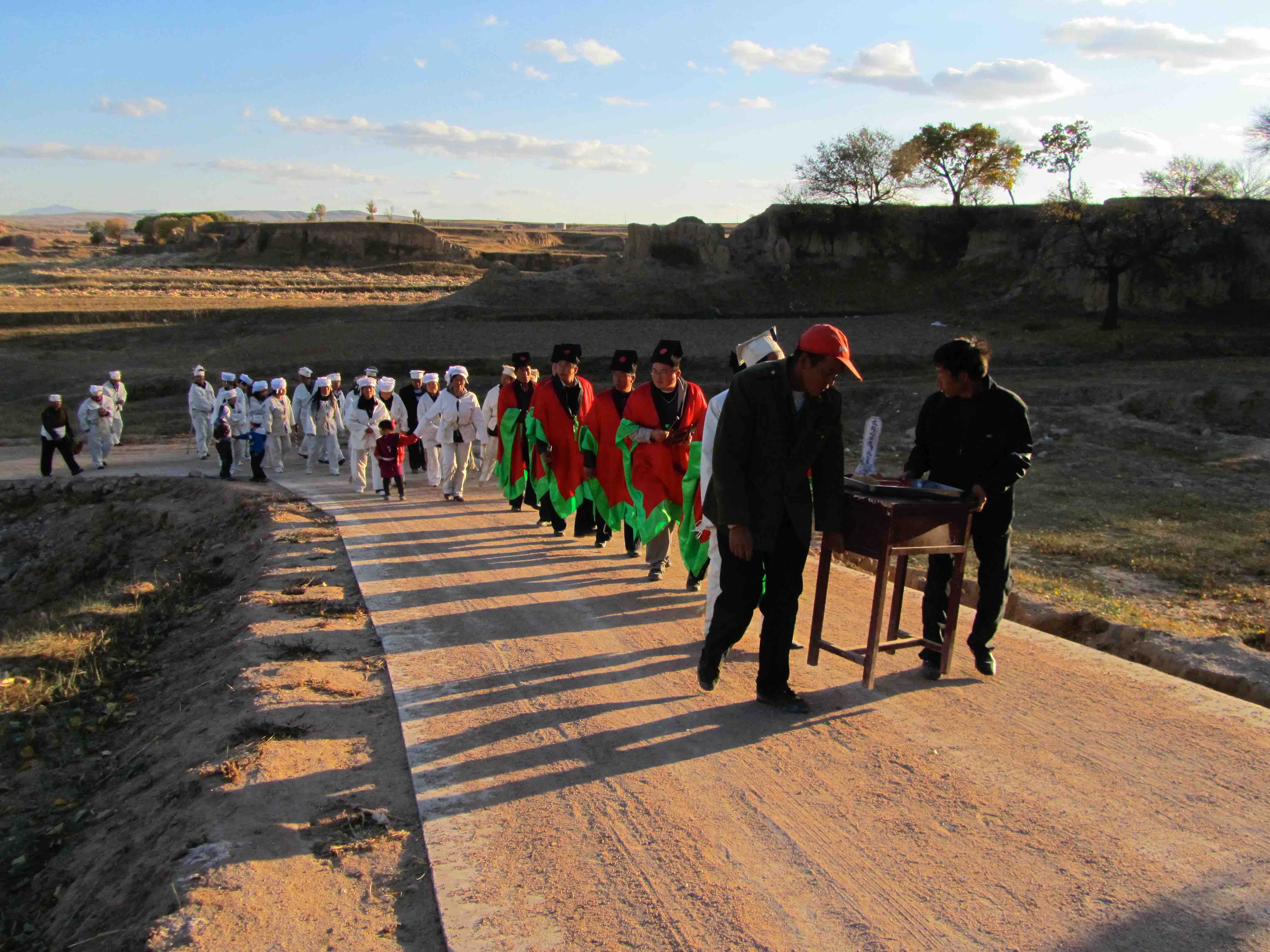
I continue to add vignettes on the Li family Daoists (always bearing in mind my film and book!):

and I augment my post Walking Shrill with

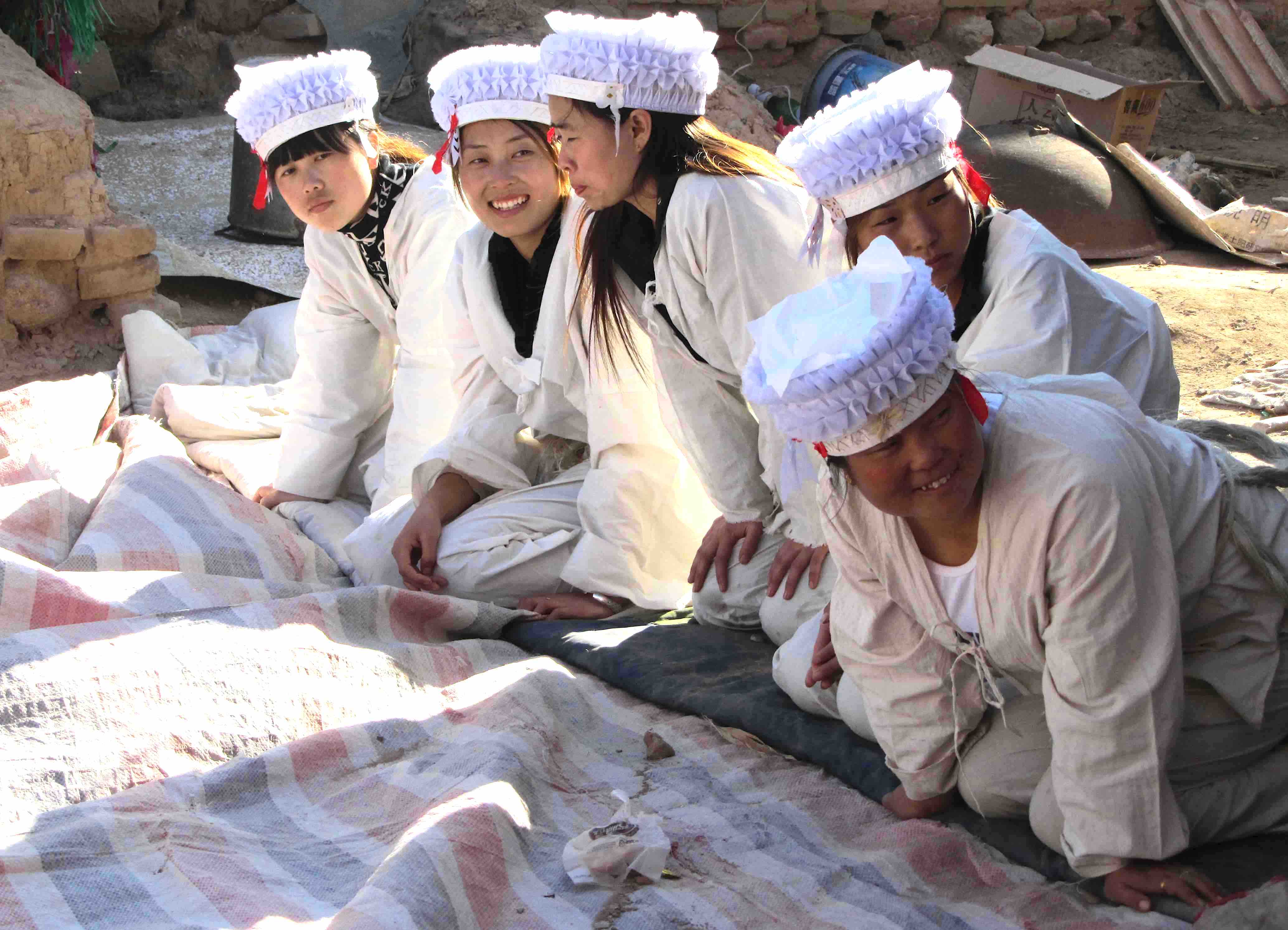
On my other main fieldsite of Gaoluo (summary here),

Bearing on both the Li family and Gaoluo is

And under the main menu, it’s always worth exploring the many fieldnotes under Local ritual, and the various pages under the Themes sub-menu.

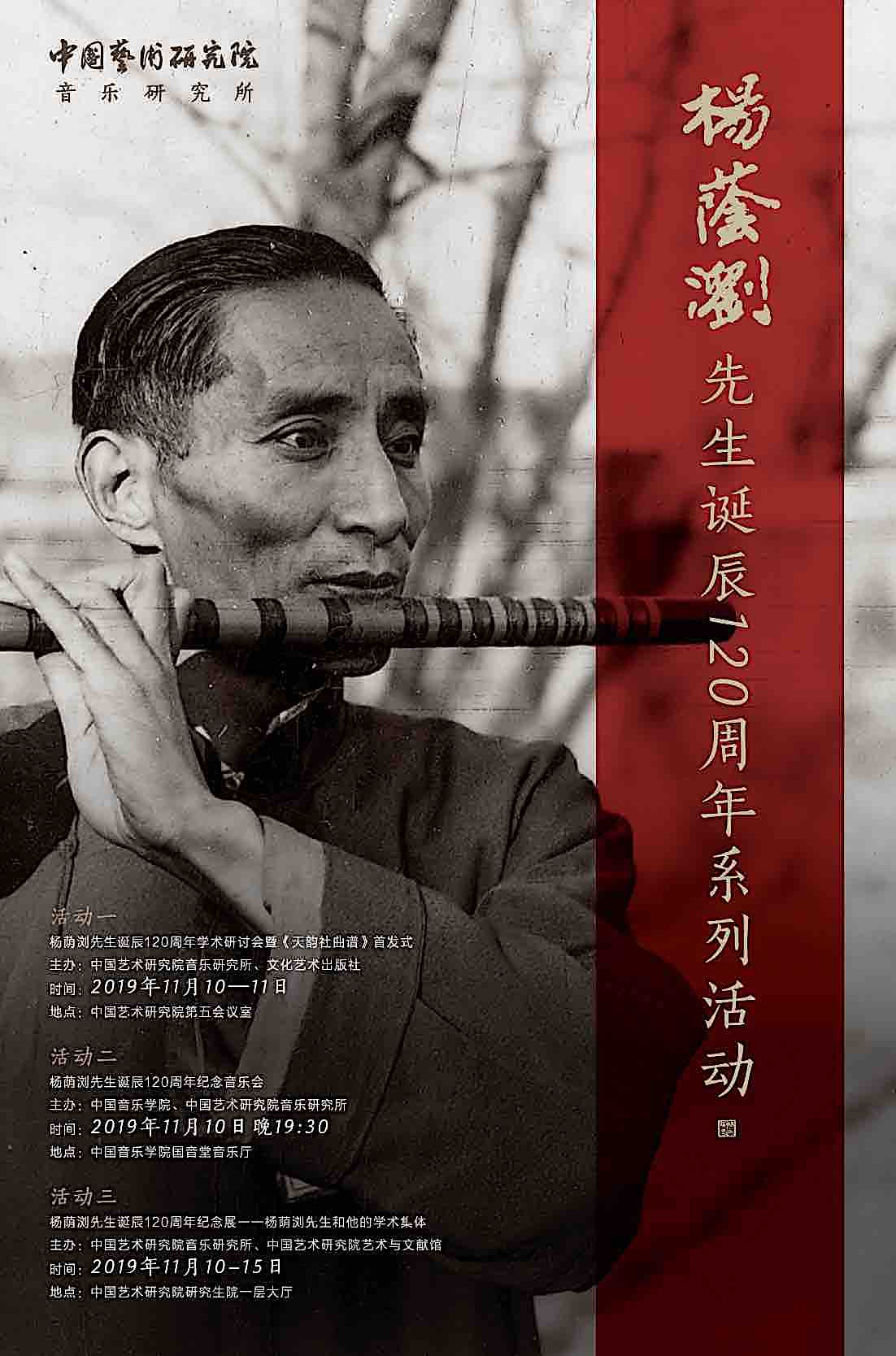
Among many posts on the great Yang Yinliu are

For links to ritual life around south Jiangsu, see

and for the rich cultures of Fujian,

Note also

For more on China, see

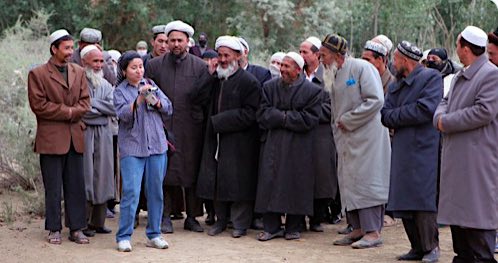
The plight of the Uyghurs is a pressing concern (see also Uyghur tag):

Note also

Further afield, see

The category of “world music“, or rather musicking in societies around the world, continues to grow. For salient perspectives on musical cultures worldwide (notably the brilliant, accessible work of Bruno Nettl), see

For diverse regional genres, see e.g.

For the musics of Iran, see

Pursuing my shawm theme. see

Among several posts on Italian folk culture are

See also

Note also new posts on flamenco.

On English culture (roundup here):

and having given Alan Bennett time off for good behaviour, he stars in several recent posts, notably

Under the WAM category, posts include

and recent additions to the Mozart tag, like

Under the Messiaen tag, major new posts are

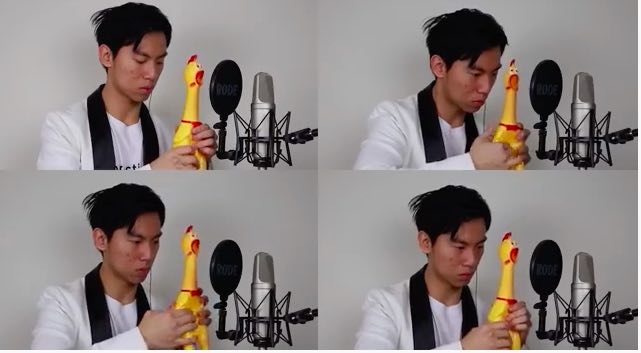
On a lighter note are two classics on rubber chicken:

In my Must-Listen Playlist of songs (complementing the sidebar playlist for local Chinese traditions, with commentary here), most spellbinding is

And I continue the theme of stammering:

Also well worth a read is

And don’t forget the *MUST READ* category—among which my personal choice remains

Norman Wisdom big in Albania

Albania

Oops, sorry—this statue in Tirana is to Mother Teresa. Same difference…
For a less flattering portayal by Christopher Hitchens,
see Dragging the icon to the trash.

Norman Wisdom 2001Source.

In this thrilling new fantasy world of unfettered (unfetta-ed) opportunity that Brexit promises for “Great” “Britain”, perhaps we can now look forward to a lucrative trade deal with Albania, inspired by Norman Wisdom (and note the cameo from Tony Hawks):

For more, see here. A wacky instance of International Cultural Exchange, eh.

For other cute vignettes from Albania, see here and here. On a more serious note, do read Lea Ypi’s coming-of-age memoir Free, and explore the wonders of Albanian folk music. For the earlier conjunction of Alexei Sayle with culture behind the Iron Curtain, see here.

Dream songs

In my post on Noh drama, I noted that Allan Marett’s Eliza made a kind of bridge to his fieldwork on Aboriginal culture in Australia.

In the fine tradition of subaltern studies, Allan Marett, in partnership with Linda Barwick, has long been studying wangga, a musical and ceremonial genre of Aboriginal people of the Daly Region of northwest Australia. Along with many articles, he has written

  • Songs, dreamings, and ghosts: the wangga of north Australia (2005, with CD online here)

and co-authored

  • Allan Marett, Linda Barwick, and Lysbeth Ford, For the sake of a song: wangga songmen and their repertories (2013), with associated website here (NB audio here).

Dream songs make one of the most fascinating instances of the process of musical creation, and the relation between “inspiration and perspiration”. They also make a fine exhibit for us to broaden our concept of “serious music”.

Here I’ll consider Songs, dreaming, and ghosts. It’s the result of nearly twenty years of fieldwork, its detailed analyses enhanced by participant observation. In the Preface Allan explores the ambivalence of non-Aboriginal society towards Aboriginal culture, asking why its visual arts are so much more valued than its music:

Part of the answer must surely lie in the fact that both paintings and popular songs are easily commodified, while traditional songs are not. They do not lend themselves to reframing within a European modernist tradition in the way that paintings do. Moreover, traditional songs work in ways that are unfamiliar to most audiences and are sung in languages that nobody outside their home communities understands. They tend to be intensely local, focused on places that are frequently unknown to any but those who have rights to the country. They rest on cosmologies and ways of being that are radically different from those shared by the majority of the Australian community.

The articulation of the relationship between the living and the dead occurs both in the process of song composition and in ceremony. The whole culture is deeply embedded in the concept of country (for a very different kind of Country, see here).

As Allan observes,

The many social changes—settlement, migration, marginalization—that attended European intrusion on Aboriginal domains in the Daly region are reflected in, and mediated by, wangga.

The focus of the book on the positive roles of cultural transmission emerged from Allan’s dialogue with his mentors, whose primary wish was to share the beauty and resilience of their art, rather than dwelling on the post-colonial traumas that permeate all their lives, shared by indigenous peoples worldwide (for the destruction of a First Nation community in Canada, see here)—poverty, low life expectancy, discrimination, high rates of incarceration, land rights, and so on (see e.g. here). For endangered songs and endangered languages, see here, and for the role of technology in preservation, here.

Allan outlines the history of research since the 1950s (A.P. Elkin, Trevor Jones, Alice Moyle, Catherine Ellis, and so on). He reflects on how to integrate social and musical analysis—a model for which I recommend Berliner, Thinking in jazz. We may think of WAM as complex, but the complexities of both the culture and soundscape of aboriginal life are of a different order. He reflects wisely on the role that notation may serve for us:

Although analysis is not particularly fashionable within ethnomusicology today, I am strongly of the view that it provides our best methodological tool for isolating significant (and signifying) moments of performance. I am not so naive as to assume that Western notation can ever accurately represent the totality of the sound world of wangga—or indeed any complex sound world—but I believe that transcription can, if sensitively handled, be used to direct the listener to salient features of the music, much as maps direct travelers to salient features of the landscape. Just as maps are socially constructed documents with their own sets of conventions, and just as they can never represent every aspect of the landscape without simply replicating the landscape in its entirety, so too are transcriptions socially constructed documents that can never totally encode the sound world to which they relate. But insofar as they help us navigate through an unfamiliar music, they can be extremely helpful.

The reason that I use Western notation—despite its obvious shortcomings—is because it is the most widely understood way of graphically representing musical sound. Many of the recordings on which my transcriptions are based are presented in the accompanying CD, and I invite readers to judge the efficacy of the transcriptions, and their associated analyses, with regard to the extent to which they open up the music and render it intelligible.

Indeed, reading such densely-argued analysis makes it all the more important to follow Allan’s careful transcriptions in conjunction with the 28 short audio tracks on the associated website. Such analysis of arcane repertoires is admirable—all the more so in view of the dearth of indigenous musical terminology. Profound concepts are often expressed in misleadingly simple expressions (cf. “doing things” in north China).

Chapter One introduces repertories, histories, and orders of being—opening with the legend of Old Man Tulh, represented in painting and in song.

Wangga songs are performed by one or two (or occasionally more) songmen, who accompany themselves on wooden clapsticks and are accompanied in turn by another performer playing the didjeridu, a long trumpet fashioned from a tree branch thathas been hollowed out by termites. Wangga songs typically comprise a number of bursts of singing, which I term “vocal sections”, which are accompanied by didjeridu, and, in some cases, clapsticks. Vocal sections are separated from one another by a number of “instrumental sections”, which are performed using clapsticks and didjeridu, with occasional spoken, sung, or hummed interjections by the songman. In many case, it is in the instrumental sections that dance comes to the fore.

The wangga repertory may be divided into two broad musical types. In the first, which I call “unmeasured”, the singer alternates didjeridu-accompanied vocal sections without clapstick accompaniment with instrumental sections performed by both clapsticks and didjeridu. In the second, “measured” type, the singer accompanies himself with clapsticks throughout the whole song, and the delivery of the text in the vocal sections is contstrained by the metrical framework established by the sticks and the rhythmic ostinato of the didjeridu.

Allan introduces the two main centres for the composition and performance of wangga, Wadeye and Belyuen—both migrant communities.

Today it is the Walakhanda wangga repertory that is dominant at Wadeye. The reasons for this go back to a set of extraordinary decisions made by Wadeye elders almost fifty years ago. During the late 1950s and early 1960s, a conscious decision was made to create three new repertories of song—the Walakhanda wangga, lirrga, and dhanba—as the basis of of a new tripartite system of ceremonial reciprocity. […]

The immediate impetus for the establishment of this system was the rapid expansion of the Port Keats mission that occurred during the late 1940s and early 1950s. The expanded community included groups who had long histories of conflict with one another and therefore required a new mechanism to maintain social harmony. The tripartite system established at that time continues to function to the present day and is pointed to as a source of ongoing stability within the community.

In Belyuen, by contrast, the community was further removed from the country in which their totemic Dreamings reside, giving rise to a different set of cultural references.

Chapter Two, “Dreaming songs: sustaining tradition”, opens with the Barunga songman Alan Maralung’s account of how he was given songs in dream, and goes on to explore what exactly it is that the ancestors give to songmen. The author finds that the process of composition continues to evolve.

I once witnessed Maralung rehearsing a new song that he had just received. He sang fragments of melody and text sotto voce and quietly beat out short rhythmic patterns, adjusting the various elements until he was happy with them. Later that day he was able to perform the song for a recording; this perhaps suggests that he required less composition time than Mullumbuk. One should bear in mind, however, that Maralung’s songs involve a much greater degree of improvisation than Mullumbuk’s. They constantly evolve and never attain the degree of stability sought by Mullumbuk, or indeed by Lambudju. When songs are not regularly performed in ceremony, as is the case with Maralung’s repertory, they never become “set”, and their form invariably remains unstable from performance to performance. Nevertheless, both forms—those set by performance in ceremony, and those that continue to evolve from performance to performance—equally represent the collaborative work of humans and ancestors.

Basic elements are the cooperation and tensions between lineages, and between different language groups, influencing important aspects of performance.

table

As ever, this is not some anonymous, timeless tradition: individual performers make major contributions. As in other genres (including WAM), wangga repertories change significantly over time. Allan notes repertory loss:

Many songs fall quickly from the repertory with the death of their composers, while some survive for several generations. New songs quickly emerge as new songmen take over.

For various parameters for musical change, see Bruno Nettl.

Left: Behaving suspiciously towards strangers [lessons available for Brexiteers].
Right: Circumcision ceremony, Wadeye 1992.

Chapter Three explores ceremony, notably mortuary and circumcision rituals—again, constantly subject to revision. Always paying attention to the underlying importance of myth, Allan focuses on two burnim-rag mortuary ceremonies, in 1988 and 1995; and he makes detailed comparisons between a 1988 circumcision ceremony and accounts from 1935 to 1945. He broadens the topic to include lirrga and dhanba genres, and ceremonial reciprocity.

As performed today, the circumcision ceremonies at Wadeye represent a revival of the rites discontinued in the mid-1940s under influence from the Catholic mission at Wadeye, then Port Keats. The exact date of the revival is difficult to ascertain, though it seems reasonable to assume that it coincides with the creation of new repertories of wangga, lirrga, and dhanba in the late 1950s or early 1960s.

New ritual complexes have been introduced to replace those that are no longer regarded as efficacious. Notwithstanding the function of ritual to enhance social cohesion, given the precarious nature of tradition, I’d be interested to see an account like that of Geertz for a “failed funeral”, which I emulated for China.

Chapter Three ends with an account of funerals, performed within a Christian framework, and “quasi-ceremonial” civic events such as graduation ceremonies and festivals.

Chapter Four addresses the nuts and bolts of song and dance in performance. Referring to Susan McClary, he comments:

The need to focus not only on how performers play against conventions to generate meaning, but also on the meanings embedded in the conventions themselves, is as important for the study of wangga as it is for McClary’s study of the blues or Beethoven’s A minor quartet.

Indeed, pace Taruskin, this is another clear case of “serious music”!

Allan analyses melody, mode, melisma, metre, voice quality (cf. Voices of the world); the role of the rhythmically patterned drone on didjeridu, and the clapsticks, often signifying the footsteps or the gait of an ancestor; and the dance.

He begins by analysing a 1968 performance of a measured wangga song by Tommy Barrtjap at Belyuen (above, with audio track here), discussing in turn how metre and tempo are established in the instrumental introduction, the structuring of vocal and melodic sections, the structuring of text and its rhythmic realisation in song, instrumental interludes and codas, and stabilizing form.

He then unpacks an unmeasured wangga from a 1988 burnim-rag ceremony at Wadeye, and its relationship with dance.

Always uncovering both communal and personal elements in transmission, Chapters Five to Eight explore major repertoires of wangga with detailed analyses. Chapter Five concerns the Walakandha wangga, established in the early 1960s as part of the reorganization of ritual life at Wadeye. Chapter Six discusses the more variable (and now rare) Ma-yawa wangga, Chapters Seven and Eight the wangga of Tommy Barrtjap and Bobby Lambudju Lane at Belyuen.

In Chapter Nine Allan revisits the musical conventions of the Daly region, drawing general conclusions on the diversity of text structures, rhythmic treatment, multivalency, melody and mode, rhythmic mode and dance.

Chapter Ten looks beyond the Daly region to the performance of wangga and lirrga in the Barunga/Beswick and Kimberley regions. Again using material from as far back as the 1940s, Allan explores the wider network of ceremonial reciprocity between Wadeye and other communities, always identifying creativity.

Again, it is most important to follow Allan’s detailed analyses together with the audio tracks on the book’s website. Of course, listening like this we can only admire them as isolated sound objects, detached from the context of ceremony and dance. Short of attending ceremonies ourselves, film should be a major medium to engage with this culture—indeed, I can imagine Allan making a wonderful portrait film on the topic. Meanwhile, we can get a flavour of ceremonial performance here, with Button Jones singing wangga and lirrga from the Kimberley (as in Chapter Ten):

And lirrga from Wadeye:

Allan also admires the dancing in this exceptional video of performers from Wadeye at a 1973 Eucharistic Congress at Melbourne, with specially-composed Christian lirrga:

* * *

Beyond the nuts and bolts of soundscape, Songs, dreamings, and ghosts constantly stresses cosmological significance, and the creativity of individual composers.

Meeting up with Allan again in London recently, I reflect that after our paths converged at Cambridge while studying Tang court music with Laurence Picken, they then diverged with our respective fieldsites, and then converged again with fieldwork on living folk ritual among disadvantaged people (my own topics in China including spirit mediums and blind shawm players)—all paths of which Laurence, in his wisdom, approved.

For the co-option of Aboriginal culture on stage, click here ; see also under Native American musical cultures (here and here).

More Country

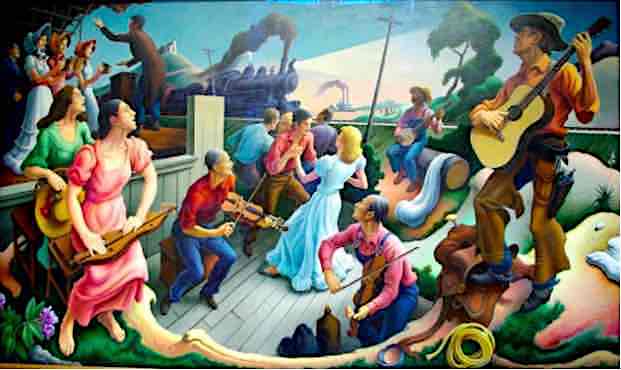
Sources of country musicThomas Hart Benton, The sources of Country music (1975).

Three chords and the truth—Harlan Howard

Do you know what the southern definition of a true music lover is?
It’s a man who, if he hears a woman singing in the shower, puts his ear to the keyhole—cited in Dawidoff, In the country of country.

Complementing his classic series on jazz, the new PBS series by Ken Burns on the simpler but equally meaningful language of Country music reminds us that far from being a quaint byway, it represents the soul of modern US culture. The eight two-hour episodes have been re-edited and pared down into nine 50-minute programmes for BBC4. [1] Now that I’ve watched the latter, I’m keen to see the full version. Here I can only outline a few of the themes and personalities.

If you know about Country, then you won’t be reading this, and indeed you may bring more critical perspectives to bear on Burns’s portrayal; but for the rest of us, it deserves taking seriously. Here’s a trailer:

As with any genre (Aboriginal dream songs, Iranian chamber music, French baroque, and so on), you just have to immerse yourself in the style and the culture (for a more detailed project on flamenco, see the amazing series Rito y geografia del cante).

With Peter Coyote’s distinctive voiceover, the series judiciously blends interviews and performances with lingering photos, encompassing the personal and political, artistic and commercial, poverty and pain, ecstasy and drudge, church and honky-tonks, domestic stability and outlaw excess, survival and solace. Looking beyond the hillbilly costumes and cowboy hats to the heartache, amidst all the drink, drugs, divorces, early deaths, and the ravages of the touring life, Burns accessibly draws us to the lyrics and music, always identifying themes in the history of cultural transmission, and the very nature of tradition.

Gradually over the series, the early log cabins, railroads, coal mines, textile mills, timber yards, and sharecroppers give way to mansions and Cadillacs. And as one review comments, you can almost trace the history in the performers’ faces: the lean lines of the early stars such as Hank Williams and Jimmie Rodgers, giving way to the gnarled faces of Johnny Cash and Merle Haggard, and then the soft, untroubled faces of the ’80s and ’90s stars. But to see it as “a simple journey from the sublime to the ridiculous” risks succumbing to the bourgeois nostalgia for poverty.

Despite the later countrypolitan sounds, audiences constantly returned to the roots authenticity of old-time, bluegrass, hillbilly. Female performers play an exceptional role, such as The Carters, Patsy Cline, Loretta Lynn, Tammy Wynette, Dolly Parton, Rosanne Cash, and Emmylou Harris.

oldies

The Rub (beginnings to 1933) makes a captivating opening, with wonderful archive photos evocatively deployed. Folk music is always eclectic. Spreading through barn dances and travelling medicine shows, the history of Country is intertwined with gospel and spirituals, slavery and the blues, as well as folk traditions of Appalachia and European migrants, notably the British Isles. Though Country has been described as “the white man’s soul music”, the series acknowledges its debt to African-American culture. In addition to the new technologies of phonographs and radio, it soon became a highly commercial proposition, with patronage from institutions like the National Life and Accident Insurance Company and its WSM station, which gave rise to the long-running Grand Ole Opry. Among early performers, the 1927 discovery of the Carter family and Jimmie Rodgers was a seminal moment.

In Hard Times (1933–1945) (“The sad songs are the best”), the industry continues to grow through the Great Depression and World War Two, with major migrations. The Texas Swing of Bob Wills and his Texas Playboys was based on strings rather than horns—a classic case of the eclectic melting-pot of immigrant styles (Cajun, Hispanic, and so on) (cf. Accordion crimes). Nashville becomes the heart of the scene with the rise of the Grand Ole Opry. Roy Acuff and Bill Monroe are admired, and the Carter family become ever more popular. The steel guitar plays a growing role. Social dancing is still a major element.

Why don’t Baptists make love standing up?
Because people would think they’re dancing.

Country helped people cope with loss. Hard times was adopted from Stephen Foster’s 1854 parlor song:

Let us pause in life’s pleasures and count its many tears
While we all sup sorrow with the poor
There’s a song that will linger forever in our ears
Oh hard times come again no more

Tis the song, the sigh of the weary
Hard times, hard times, come again no more
Many days you have lingered around my cabin door
Oh hard times come again no more

While we seek mirth and beauty and music bright and gay
There are frail forms fainting at the door
Though their voices are silent, their pleding looks will say
Oh hard times come again no more

’Tis the song, the sigh of the weary
Hard times, hard times, come again no more
Many days you have lingered around my cabin door
Oh hard times come again no more

’Tis a sigh that is wafted across the troubled wave
Tis a wail that is heard upon the shore
Tis a dirge that is murmured around the lowly grave
Oh hard times come again no more

Hank and Holly

Hank Williams and his granddaughter Holly.

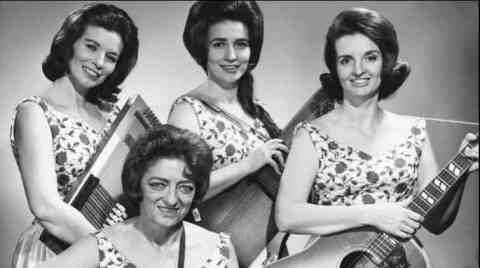
The Hillbilly Shakespeare (1945–1953) evokes the postwar period, focusing on the great, short-lived Hank Williams, with fine vignettes from his granddaughter Holly, and Marty Stuart reminding us of the importance of black musicians in the tradition. Also featured are the stellar bluegrass lineup of Bill Monroe, Lester Flatt, and Earl Scruggs; and the Carter sisters with their mother Maybelle.

Carters

In I Can’t Stop Loving You (1953–1963), the confluence of blues and hillbilly music at Sun Records in Memphis gives birth to rockabilly, the precursor of rock and roll; at the forefront are Johnny Cash (with comments from his daughter Rosanne) and Elvis Presley. Not “Walking the Line”, Johnny Cash gets together with June Carter. Among the rapt inmates for his 1959 concert at San Quentin was Merle Haggard. Like Russians listening to Vladimir Vysotsky, when they heard him they couldn’t believe that Cash hadn’t done time in prison.

Meanwhile in Nashville the country twang was replaced by a smoother sound, with Patsy Cline and Loretta Lynn among its stars. Before Patsy Cline’s tragic death in 1963, there’s a nice story about how they reached the perfect tempo for her recording of Willie Nelson’s song Crazy, whose exceptional melodic and harmonic invention quite transcends the cheesy accompaniment:

In The Sons and Daughters of America (1964–1968), the Grand Ole Opry story continues, even as social conflict intensifies. Johnny Cash embodies the spirit of the age, his self-destruction mirroring his artistic triumphs. From the new East coast folk revival scene he took on board the current of social protest; his admiration for Bob Dylan was mutual. His 1968 Folsom Prison concert was a triumph. Merle Haggard (“San Quentin graduate”, another engaging commentator throughout the series; he died in 2016, R.I.P) emerges from his misspent youth as a great singer.

Amidst the civil rights movement (note also Detroit 67), Charley Pride overcomes racial prejudice with his fine voice. The unfiltered songs of Loretta Lynn chime with the new wave of Women’s Liberation. Dolly Parton, fourth of twelve children from a rural cabin without electricity or running water (the kind of CV that was still de reigueur for that generation of singers), demands to be taken seriously—despite joining a select group of strong women reluctant to acknowledge the boons of feminism.

Tammy and Loretta

Tammy Wynette with Loretta Lynn.

The story continues in Will the Circle Be Unbroken? (1968–1972). As the Vietnam War intensifies, the industry and its audience react to divisive social upheavals. George Jones and Tammy Wynette get together. Despite Tammy’s submissive Stand by your man, she didn’t—by contrast with the tough-talking songs of Loretta Lynn, who did; as Jennie Seely comments “I always kinda thought they wrote each other’s songs.”

Among a growing number of Country recruits from outside the archetypal deprived rural background was Kris Kristofferson. Several singer-songwriters pay tribute to his exceptional lyrics, such as Casey’s last ride:

Casey joins the hollow sound of silent people walking down
The stairway to the subway in the shadows down below;
Following their footsteps through the neon-darkened corridors
Of silent desperation, never speakin’ to a soul.

The poison air he’s breathin’ has the dirty smell of dying
‘Cause it’s never seen the sunshine and it’s never felt the rain.
But Casey minds the arrows and ignores the fatal echoes
Of the clickin’ of the turnstiles and the rattle of his chains.

 Oh! she said, Casey it’s been so long since I’ve seen you!
Here she said, just a kiss to make a body smile!
See she said, I’ve put on new stockings just to please you!
Lord! she said, Casey can you only stay a while?

As he explains, his song Bobby McGee (Busted flat in Baton Rouge, waitin’ for a train, And I’s feelin’ near as faded as my jeans…) was inspired by La strada. Johnny Cash was hugely popular, and increasingly countercultural. And the Californian hippies of the Nitty Gritty Dirt Band recruited senior Country legends like Maybelle Carter, Earl Scruggs, and Roy Acuff for an album that bridged the gap between generations.

In Are You Sure Hank Done It This Way? (1973–1983) (a sentiment that recalls Taruskin) opens by asking a question central to ethnomusicology, how much change a genre can embrace while retaining its identity; and reminds us how resistant Country had always been to arbitrary borders. As the smooth countrypolitan sound reaches new audiences, singers like Dolly Parton achieve crossover success, finding time for the classic epithet

It cost a lot of money to look this cheap.

And Emmylou Harris, with her background in the East Coast folk scene, tells how she found herself by becoming a convert to Country. At the same time, despite pressures from the Nashville bosses, Waylon Jennings managed to persist with a rougher style. And we hear the compelling story of Hank Williams Jr as he emerges from the long shadow of his godlike father to forge his own path (exemplified in his brilliant song Family tradition!)—with further endearing comments from his daughter Holly.

Marty and L Flatt

Lester Flatt with Marty Stuart.

In Music will get through (1973–1983) the less mediated, marginalized bluegrass style enjoys a roots revival: “It was so old that it was new”. It had never gone away, it just hadn’t hit the headlines. Marty Stuart, who provides thoughtful comments throughout the series, comes into his own as a fine performer, touring from young with Lester Flatt and Bill Monroe, and later with Johnny Cash. I’m struck by how much performers themselves revere the whole tradition:

Walking into the Grand Ole Opry with Lester Flatt was like walking into the Vatican with the Pope. It was like that old scene in The Wizard of Oz where the world went from black-and-white to color.

Nelson and Haggard

Merle Haggard with Willie Nelson.

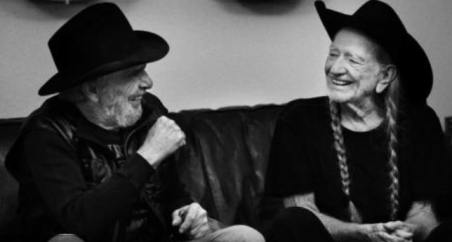
The veteran Maybelle Carter finds a new audience; George Jones and Tammy Wynette, now divorced, come back for a reunion album. Willie Nelson (“Willie’s not from round here—I mean, Earth”) thrived in the freewheeling, genre-bending scene of the Armadillo World Headquarters in Austin, Texas. With Waylon Jennings he launched the Outlaw movement, later going on to work with Merle Haggard.

Following in her father’s footsteps, Rosanne Cash becomes a fine singer-songwriter. Emmylou Harris bridged folk, rock, and Country, influencing a new generation of artists, including young Ricky Skaggs, with all his bluegrass credentials.

As doors continue to open, the final programme, Don’t Get Above Your Raisin’ (1984–1996) features artists like Reba McEntire, Naomi Juggs and her daughter Wynnona; k.d. lang (“a punk reincarnation of Patsy Cline”), Kathy Mattea, Rhiannon Gid, and megastar Garth Brooks.

Cashes

Johnny Cash with Rosanne.

But the pull of the more traditional elements still remains strong. Ricky Skaggs and Marty Stuart stay faithful to the bluegrass sound of Bill Monroe, taking Country back to the front porch. Johnny Cash reinvents himself, bowing out on a high note, with Rosanne offering more insights. The series concludes with a wonderful montage on the whole tradition.

And the story continues…

My purpose here, apart from drawing your attention to a fine piece of film-making, is not so much to provide a superfluous summary as to remind myself, in the spirit of ethnomusicology, that all the musickings of all the cultures around the world deserve to be treated on an equal footing, and that they offer a revealing window on societies in change.

[1] Currently online, alas only briefly, so catch it while you can; otherwise, the DVDs are eminently worth buying. The book, like that complementing Burns’s series on jazz, also looks tempting. Among many reviews far better informed than I can offer, see e.g. herehere and here. Among the extensive literature (note Malone and Neal, Country Music, U.S.A.), I’ve enjoyed re-reading Nicholas Dawidoff, In the country of country: a journey to the roots of American music (1997).

A flamenco Christmas

Xmas 1

As a relief from the seasonal bombardment of tinsel, schmaltz, and sprouts, you can’t beat a flamenco Christmas in Andalucia.

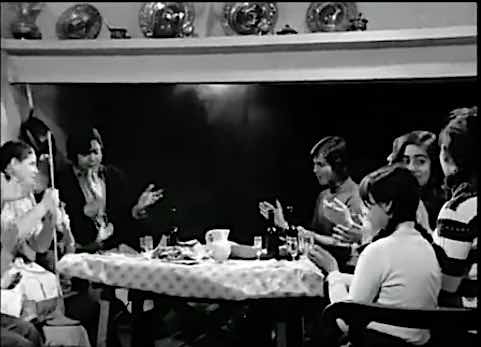
I featured the Navidad flamenco programme from the brilliant documentary series Rito y geografia del cante in my article on gender, politics, wine, and deviance, but a separate post seems timely—and like this recent addition to my series on flamenco, it bears on the wonders of inter-generational family upbringing.

Filmed with all the characteristic intimacy of the series, the episode features shots of customary life (“not suitable for vegetarians”) and the making of the zambomba friction drum that accompanies villancicos carols; as well as a fantastic Christmas bulerías session featuring the Soto family in Jerez, with the children taking their turns to sing:

For saeta devotional songs at Easter, see Calendrical rituals, and under Cante jondo.

Chicago blues

blues

In The blaze of obscurity Clive James (R.I.P.) compounds his paltry efforts to represent Japanese culture on film with a candid and fatuous account of filming a blues session for his Postcard from Chicago:

But Chicago’s expatriated European art would have been an unduly quiet story if it had not been offset by something noisier, and our candidate for that was the blues. Unfortunately, much as I loved jazz, I had only a limited tolerance for the kind of blues number in which the singer sings the same not very inspired line twice (or even worse, three times) before capping it with a third (or even worse, fourth) not very inspired line, followed by a peremptory wail from from that least disarming of all jazz instruments, the amplified harmonica. I spent a long, harrowing night in a blues club where I had to look fascinated by the cacophonous remains of a famous blues shouter called something like Slow Dirt Buncombe (I remember his real name but his lawyer might still be alive) while he gave a string of examples of how a song with less than a minute of material could be stretched to thirty minutes if you made the same line and stanza sound different by mangling them in a different way each time. Yelled at cataclysmic amplification, “Well mah woman she done leff me” was a recurring motif. “No bloody wonder” was the obvious continuation, but he never sang that. Thanks to the unnecessary volume—the sure sign of inadequate music—I was never completely clear what he was singing, but I could rely on a maximum air of drama when he pulled back from the microphone, slanted his polished ebony head to shield it from the blaze of the heavenly splendour he had created, and suddenly leaned forward again to give a long blast on his hellishly resonant harmonica. The desirable and necessary ideal of racial equality should, in my view, allow us to say that there is the occasional blues artist whose parade of desolation amounts to an acute pain in the neck. Slow Dirt Buncombe was one of these. Unfortunately Nobby, the deaf sound-man who was once again on the case, caught every line of Slow Dirt’s act with perfect fidelity, and some of the results got as far as the final cut, accompanied by cutaways of my enchanted, lying face.

Maybe he was just unlucky—although one wonders why the BBC scouts wouldn’t be able to find a good band. And sure, it’s a typically funny account. But rather than making an effort to identify what it is that makes blues so effective and using his own gift for words to encapsulate it, he chose here to disguise his incomprehension beneath glib cliché.

Fortunately, there’s a wealth of fine documentaries about Chicago blues, like this:

Or Blues America (here and here). And of course there’s a vast treasury of live performances online.

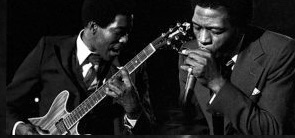
So to exorcise Clive James’s experience, here’s the great Junior Wells with Buddy Guy live at Montreux in 1974:

See also Got my mojo working.

* * *

Still, despite Clive James’s cultural blind spots, I am eternally grateful for his priceless evocation of Barbara Cartland’s face:

Twin miracles of mascara, her eyes looked like the corpses of two small crows that had crashed into a chalk cliff.

Oh Noh!

FG

To follow my post on Noh drama, on a lighter, nay meretricious (and a Happy New Year) note—in lieu of my fantasy article “There’s no business like Noh business: stagecraft in Japanese drama”:

While Clive James (R.I.P.) was generally admirable as well as entertaining, in chapter 12 of The blaze of obscurity he candidly describes his inability to represent traditional Japanese culture on popular TV. Coming to the topic via the unpromising genre of game shows, he concludes a passage describing the rationale behind the filming of his own discomfort (not merely physical) at a session with a samisen-playing geisha by proclaiming:

To let myself in for ridicule might mitigate any impression that I was setting out to ridicule the culture, which in fact I revered, even for its way of becoming even more incomprehensible as you focused your attention on it.

But he gave up far too easily. That comment follows a paragraph that includes a reference to Noh:

A Japanese classical sword-smith takes a long time to make a sword, you need a degree in metallurgy to appreciate what he does, and the finished product looks exactly like a stage prop from an amateur production of The Mikado. In a Noh play an actor takes half an hour to cross the stage. The special walk he is using takes a lifetime’s training, but he looks exactly like an old man with arthritis setting out to buy a newspaper. You can fall asleep while he is making his entrance and when you wake up again he is still making his entrance.

Sure, there’s no denying that Noh is short on hectic car chases and steamy love scenes. This passage is distinguished by its lazy cultural chauvinism:

In Kyoto, at the Geisha training school, the top lady was one of the greatest living players of the shami-sen, the single-stringed guitar [HEY] that has come down through the ages without acquiring any extra strings to compromise its purity by providing it with, say, the capacity to produce a chord. It goes plunk. It goes plink.

So much for ethnomusicology, and James’s proclaimed reverence for Japanese culture. At least he or his team of researchers might have counted the strings, FFS. At least the Serbian gusle really does only have one string, though the review featured here is no more enamoured with it.

To return to my orchestral tours, while I really shouldn’t emulate the way that James plays for laughs the culture that he professes to revere, Noh goes quite well with jet-lag—you can indeed nod off, or pop out to do a bit of shopping, and by the time you get back to the action the waki will still only have shimmied halfway across the stage. But enchantment soon takes over.

Further irreverent ideas might include a feature-length Family guy—Oh Noh!, with Brian and Stewie as an original waki–shite duo; not an entirely silly idea, as redemption (e.g. here) and time travel are common themes of the series.

And along with reading Miles Davis’s autobiography in the voice of the Queen (“Man, that cat was badder than ten bad motherfuckers”), how about a party game reciting my script for the wacky (wakiphrases from Teach yourself Japanese (a MUST READ!) in Noh style?

But enough of such levity—do follow up the wonders of Noh via my previous post, and with this post on tradition and change!

For a sequel in which Clive James extends his incomprehension to Chicago blues, see here. And for a limerick suggesting Portuguese–Japanese musical fusion, click here.

Some jazz fiddling

Having given a little introduction to some styles of world fiddling (see also fiddles tag), I must confess that I often find jazz violin underwhelming. Country fiddling is amazing, but whereas sax and trumpet are made for jazz, the violin seems to struggle to adapt to the bebop revolution.

Much as I love Nigel Kennedy, I prefer his electronic excursions, where he seems less bound by classical” conventions. His own taste for jazz goes back to his teacher Yehudi Menuhin’s collaborations with Stephane Grappelli.

But I am totally in awe of Chris Garrick—and I’m pleased to see that Maxim Vengerov is too:

I want to learn to play like Chris Garrick!

Just a taster—but do explore the variety of his soundworld:

Besides pioneers like Joe Venuti and Eddie South, Stuff Smith had a distinctive style:

They were followed by classically-trained fiddlers like Jean-Luc Ponty and Regina Carter.

Further from mainstream post-bebop, east Europe and Turkey, along with their more traditional string bands, also make fruitful breeding-grounds for new styles. The Paganini lookalike Nedim Nalbantoğlu is great—here he is playing acoustic with oud:

And this session at his Paris café:

Here’s Félix Lajkó:

He’s not always as frenetic as this:

Still more of a melting-pot for folk styles is Tcha Limberger:

And pioneers of fiddling in Polish jazz were Zbigniew Seifert and Michel Urbaniak.

How I envy such creativity…

Backing vocals

In his ever-stimulating BBC Radio 3 series The listening service, Tom Service explores Why backing vocals matter.

His illuminating examples open with Aretha’s irresistible I say a little prayer (a gem in my own Playlist of songs), going on to admire the artistry in the interplay of solo and chorus through Gilbert and Sullivan, Verdi,  The Beach Boys, Monteverdi, Purcell, and Stravinsky.

While his juxtaposition of WAM and popular music is always instructive, as usual I’d love to expand the topic to embrace musicking around the world, equipped with the canons of ethnomusicology: Noh drama, Daoist ritual such as the Invitation), Moroccan ahouach, and so on.

The Pardon, 1991


Growing into flamenco

After recent excursions into other genres of musicking around the world (Iran, Uyghur, Hélène Grimaud, Noh, Polish jazz, and so on), it’s always wonderful to come back to the Rito y geografia del cante series on flamenco—what a great achievement it was!

I gave a roundup of my posts on flamenco here. We might also incorporate it into our consideration of improvisation. Many of the programmes in the Rito series focus on bulerías. I’ve already explored this genre in some detail, but the programme Fiesta gitana deserves a separate post.

It features several lengthy sequences in the setting of a bodega: the Utrera sisters (regularly featured in the series), with Miguel Funi, accompanied by Pedro Bacán; the Perrata family, with some fabulous dancing, accompanied by Pedro Peña; Manolo Jero, Juan Morao, Juana la del Pipa, and Tío Borrico; and El Chozas. And for rhythms, don’t miss the sequence (from 21.05) at a cooperage in Jerez (cf. martinetes)!

But most exhilarating is the street scene near the opening (from 1.26) with young flamencos in Seville. How wonderful to grow up in such an environment, surrounded by (and receptive to) the domestic culture of one’s family elders, a world of pain and joy—singing, clapping, dancing, and guitar all one seamless whole. Another genre to consider along with those in Growing into music!

Indeed, the series devoted a whole programme to young flamencos. Niños Cantaores features enchanting vignettes: Antonio de la Marena singing seguiriyas accompanied by guitarist Moraito, comments from Carmen Montoya introducing bulerías and rumbas featuring her daughter Carmellila, Manuel Morao introducing his son Manuel Moreno Pantoja, and Luisa Peña Soto’s daughter La Macanita, with comments from Camarón (himself part of some great family scenes towards the end of this post). It’s not currently on YouTube, but you can watch it here.

With the filming matching the majesty of the subject, the point is not stardom but the whole environment of domestic and street culture.

See also A flamenco Christmas.

A new volume on Chinese religion

Cover

  • Cao Xinyu 曹新宇 (ed.), Jibian rujiao: jinshi Zhongguode zongjiao rentong 激辩儒教:近世中国的宗教认同 [Provocations to Confucianism: identifying religion in modern China] (2019).

In a recent volume in a series on “New Historiography”, the ever-industrious Cao Xinyu assembles substantial articles by international scholars on a variety of topics on Chinese religion, illuminating broad, long-term trends with detailed studies. In the tradition of Chinese scholarship, it’s based on “salvage” studies of the late imperial and Republican eras, and on texts rather than performance.

Rain ritual《 映旭斋增订北宋三遂平妖全传》 第十七回插图

Cao Xinyu sets the tone with a substantial introduction, setting forth from a Song-dynasty rain ritual to explore the Catholic encounter with Chinese religion through the Qing rites controversy.

The chapters are grouped under four main headings. Philip Clart and Cao Xinyu explore grassroots Confucianism in Taiwan and mainland China. Articles by Vincent Goossaert, Masaru Yamada 山田贤, and Wang Jianchuan discuss spirit-writing and charitable associations, and Zhang Chaoran contributes a substantial essay on Daoist ritual in history. For Shanxi, Yao Chunmin writes on changing village boundaries, and Henrietta Harrison on Catholic and local healing practices. Further afield, Takeuchi Fusaji 武内房司 discusses folk religion among communities of Chinese origin in South Vietnam. Finally Prasenjit Duara outlines the histories of religion and secularism in Europe, China, and Japan.

For recent English-language volumes on Chinese religion, note the surveys of Adam Yuet Chau and Ian Johnson, as well as the classic study of C.K. Yang.

Polish jazz, then and now

Further to my post on improvisation, it’s been a while since I heard live jazz, so I went along to the splendid POSK Jazz Cafe in Hammersmith for a gig in the London Jazz Festival with the creative young sax player Krzysztof Urbanski (based in London since 2010) leading his Quintet, driven by the dynamic, sensitive drummer Asaf Sirkis, a regular on the world music scene (cf. Gilad Atzmon).

I love the intimate atmosphere of live jazz—chamber music with the relationship between performers and audience so much more tangible than in modern WAM. And I reflect not only on the complexity of the jazz language and the interplay of the instruments, but the way that audiences somehow identify with it, the timbre of the sax in particular making the perfect medium. How I envy jazzers their creativity.

Here’s a playlist with some of Urbanski’s earlier work:

And a couple of weeks later at the same venue I heard the great Zbigniew Namysłowski (b.1939), veteran of the jazz scene in Poland since the era of state socialism. I’ll return to him shortly, but first some background.

Polish jazz is an absorbing theme (on the useful Culture.pl website, see introductions here, here, and here). As the latter post observes, perhaps what makes it significant is its reflection of the country’s own quest for freedom and democracy—a feature that Poland shares, of course, with alternative cultures elsewhere in the Soviet bloc (e.g. the GDR; cf. Musical cultures of east Europe, and note the Iron Curtain tag).

In the “catacomb” period after the utter devastation of war, a leading early band was Melomani (who “hung out at the Łódź YMCA, one of the centres for independent thinkers in the late 1940s”—I just love sentences like that):

Following the death of Stalin in 1953, jazz emerged more boldly, marked by the Sopot jazz festival, which was held even after the unrest of 1956. Dave Brubeck performed in Poland in 1958. The trumpeter Tomasz Stańko was active from 1962, sometimes working with pianist Krzysztof Komeda (who provided film scores for Polanski and others). Amidst continuing political unrest, Miles Davis performed in Warsaw in 1983. The collapse of communism gave rise to the transgressive Yass style of bands like Miłość.

Jazz fiddle doesn’t always do much for me (Nigel Kennedy was based in Poland for some years, teaming up with local jazzers), but Zbigniew Seifert (1946–79) sounds great:

Another funky fiddler is Michel Urbaniak—here he is with his band live in Oslo in 1972:

On a different tack, also intriguing are Andrzej Jagodziński’s jazz reworkings of Chopin.

Meanwhile Zbigniew Namysłowski had been exploring modern jazz since 1960, and began touring internationally. Here’s his 1964 album Lola, recorded in London:

and he appears along with Tomasz Stańko in the Komeda quintet’s 1965 album Astigmatic:

For aficionados of chinoiserie, in the gig he also featured Jasmin Lady.

In this interview Namysłowski reflects on his career and the influence of Polish folk. Click here for his amazing 1973 album Winobranie, which features additive metres and even an original take on Indian music (see this review).

And in this recent video he takes a back seat to the highland string band Kapela Góralska (another entry in our list of world fiddles, cf. Musical cultures of east Europe; for more on Polish folk, see here):

So it was great to hear Namysłowski at POSK, still in fine form at 80, along with his son Jacek on trombone. And Polish jazz continues to thrive.

* * *

Polish jazz, long roaming free beyond the confines of the Łódź YMCA, is also enjoying a certain international vogue with Paweł Pawlikowski’s film Cold War (2018).

Just in case you thought the Chinese invented everything, I like this story from Jozef Tischner’s A Goral history of philosophy [History of philosophy according to Polish highlanders, 1997]:

People from all over the world were coming to Biały Dunajec, a town in the Tatry mountains, to learn about the Polish Highlander’s music… Even the Blacks from Africa came one day to learn of the new music. A famous Polish Highlander philosopher Władek Trybunia-Tutka taught them how to use fiddles and play basses. Unfortunately, on their way home to Africa they encountered a storm and all of their instruments were washed overboard. Arriving home with just their bows and no fiddles or basses, they used the bows to strike any kind of objects, creating the rhythms from which jazz was born.

Despite London’s chronic lack of a dedicated venue for world music, just in my Neck of the Woods I can sally forth to POSK, the Bhavan, and occasional flamenco in Chiswick.

For the Polish immigrant experience in the USA, see under Accordion crimes; for delighting in all manifestations of the Terpsichorean muse, here.

Crime fiction: China and Germany

Crime novels can make a revealing window onto society, evoking flavours of historical periods to reach audiences who don’t necessarily read academic non-fiction and memoirs. Both compelling and educative are thrillers based on the modern histories of countries like China and Germany that have endured extreme traumas—connecting ordinary crime with political crime.

QXL

Following Robert van Gulik‘s evocative Judge Dee series (set in the Tang), the Inspector Chen crime thrillers of Qiu Xiaolong, set around Shanghai, offer an insightful perspective on the corruption of modern China, with Inspector Chen (like Judge Dee, a poet) struggling to steer a path between morality and the imperatives of the Party (for discussions, see e.g. here).

These books often refer back to the injustices of Maoism, but I can’t seem to find much set in the period—surely there’s potential here, along the lines of Su Tong’s Petulia’s rouge tin.

O
Even more niche is James Church‘s Inspector 0 series, set in the opaque society of North Korea. For Japan, while I admit to finding Hideo Yokoyama’s Six Four rather trying, I note merely that PRC publishers may have difficulty in rendering the title…

Note also Jamyang Norbu’s The mandala of Sherlock Holmes (Tibet), and Jason Goodwin’s Yashim series (Ottoman Istanbul).

* * *

Kerr

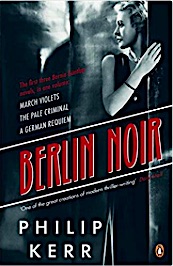
Nearer home, the Bernie Gunther novels of Philip Kerr are compelling (see perceptive reviews in the New Yorker here and here). Starting with his Berlin noir trilogy, many sequels cover both World War Two and the Cold War, complete with leads to real historical events (among the cast are Eichmann and Goebbels)—and lashings of historically authentic sexism.

In the compelling Prague fatale, where Bernie’s main antagonist is Reinhard Heydrich, the reader is led to an awareness of the horrors of the Eastern front (cf. Bloodlands), the Lidice reprisals and Ravensbrück. Sub-plots feature the “S-Bahn murderer” Paul Ogorzow and a Klimt portrait.

In the post-war era Bernie’s sleuthing takes him further afield to locations such as Havana; the plot of Greeks bearing gifts (2018), set in 1950s’ Greece, highlights the wartime deportation of the Jews of Salonika.

For direct personal experience of the degradation of moral values and negotiating impossible quandaries, Hans Fallada, Alone in Berlin is most impressive. There’s a rich vein of books to explore here (see e.g. here, and here). See also More crime fiction.

Stasi

Moving on to the Cold War, in addition to John Le Carré and Martin Cruz Smith’s Arkady Renko books, moral dilemmas are again prominent in the Stasi series of David Young, featuring GDR Volkspolizei detective Karin Müller—so far including Stasi child, Stasi wolfA darker state, and Stasi 77 (for the GDR, see here and here).

Just as Inspector Chen finds himself set against the Party, Karin Müller has to struggle with the Stasi. And like the Bernie Gunther series, these novels set forth from little-known historical events, inviting us to explore the murky history of the period—such as the 1945 massacres of prisoners from the Mittelbau-Dora camp at Gardelegen and Estadt, the Jugendwerkhöfe, GDR experiments to “prevent” homosexuality, and the Stasi’s links to the Red Army Faction.

In similar vein is the Lieutenant Reim series of Max Hertzberg.

Mahler 5 as you’ve never heard it

*For an introduction to my whole series on Mahler, with links, click here!*

Mahler 5

Given that I adore Mahler 5, this is a weird way to introduce it. But having already delighted in Pachelbel’s capon, another gem from Two Set Violin‘s rubber chicken playlist is this unlikely rendition of the symphony’s opening trumpet solo—and it’s even funnier if you share my devotion to the work:

Just as well John Wilbraham didn’t know about this—he might have found the temptation too hard to resist.

On that trumpet solo, here’s an interesting post, that supplements Slonimsky‘s Lexicon of musical invective (no turn unstoned) with early reviews of the symphony like

Ugly symphony is well played . . . Mahler of Vienna writes bad music.

A long and tedious work.

I do not believe that this symphony is the kind of music that will live … It is a symphony which, it is devoutly hoped, will never again be heard in Chicago.

Of originality, he has not the slightest trace. His themes are trivial, sometimes vulgar, always uninteresting and lacking utterly beauty of melodic curve.

Hmm. Given that I entirely share the modern veneration for Mahler, and for the 5th symphony in particular, I don’t seem to be making much of a case for it. Just as relishing Always look on the bright side of life needn’t spoil our appreciation of the Bach Passions, please don’t let all this put you off the Real Thing— here’s Bernstein with the Vienna Phil yet again:

The great Klaus Tennstedt in a recording from 1980:

And Claudio Abbado in 2004:

For S-S-Simon conducting the opening of the 2nd movement, click here; for a creative use of the Adagietto, here, and for my own irreverent vision of a swing-band version, here. For a piano roll of Mahler himself playing the 1st movement, see here.

And for more artistry on the rubber chicken, see under The acme of Daoist kitsch.

A flawed funeral

qushui

Fetching Water procession, 2011.

Much of the voluminous work on Daoist ritual focuses on recreating the glories of ancient China. While fieldwork since the 1980s has greatly enriched our understanding, the complexities of modern life rarely intrude even in descriptions of rituals observed; the search for “living fossils” dominates research, implying a timeless social cohesion of local communities.

My diachronic ethnography of the Li family Daoists in Yanggao county of north Shanxi is partly inspired by the classic studies of Geertz; and for China, Ken Dean paid attention to the tensions involved in the 1980s’ revival of ritual practice in Fujian. This post is based on Chapter 19 of my book Daoist priests of the Li family, and in my film you can observe the rituals described here.

* * *

Since my visits from 2003 the “old rules” (lao guiju 老规矩) of ritual practice have been declining rapidly. Nowadays Li Manshan’s band works for patrons, kin, and audiences who have less discrimination, and in some respects the band’s response to this lack of appreciation is to perform less scrupulously. The Daoists are deeply gloomy about the future. They love the exhilarating percussion finale of Transferring Offerings (my film, from 1.11.07) as much as I do, but “within ten years it won’t be heard any more.” They know such repertoire is precious but are helpless to protect it; they make the comment without anguish or sentimentality. Whereas Li Qing’s generation used to wear their thick black costumes underneath their red costumes even in the summer heat, now they merely wear the red costumes over their daily apparel. And for Fetching Water, Call Me Old-Fashioned, but a plastic Sprite bottle just doesn’t do the job (see Changing ritual artefacts).

Yet they still demand basic standards of themselves, maintaining many of the old rules against all the odds. They play on procession all the way out from the scripture hall to the altar, and all the way back. While singing at the altar they may sometimes seem lax (the occasional joke, even answering a mobile), but their basic solemnity shows their perceived need to maintain their reputation. Recently they tend to sing some of the hymns rather too fast in the Invitation (the Song in Praise of the Dipper, and the Mantra to the Three Generations at the gate on the return), but they still perform most of the hymns extremely slowly (notably those for Opening and Delivering the Scriptures), when surely they could go just a tad faster; nor do they abbreviate them. While singing a cappella they keep the large cymbals folded on their chests, maintaining great solemnity. There is still room for further decline.

Like his father Li Qing before him, Li Manshan worried about the stresses of being band boss and choosing suitable personnel—like band leaders in jazz, indeed. But he is far from hands-on; I would like to see this as an embodiment of Daoist wuwei “non-action.” He notes occasional blips in ensemble playing, but he rarely reprimands. The dep Guicheng tends to mime a silent beat between the slow beats on the gong, which is “not good to look at,” but Li Manshan only mildly mentions this to him when he realizes I have noticed it. Back in the scripture hall, by contrast with the way the Daoists fool around now, Li Qing and his colleagues used to “hold a meeting” about how the previous ritual had gone, always maintaining standards. Li Qing would certainly want to retain the “old rules” now, but given the hosts’ apathy he too would be helpless to do so. Even in the 1980s he presided over a radical revision of the temple fair sequence, and the Pardon ritual that he led at a 1991 funeral was very different from the manual (see Daoist priests of the Li family, pp.246–9). The decline has taken place gradually in waves over the last century or so.

When performed at all, some of the fashi public rituals have recently been radically simplified, such as Opening the Quarters, Communicating the Lanterns, and Judgment and Alms. Early one morning before a burial, Golden Noble gave me a perceptive summary of the current situation. The cycle goes from ritual (yishi) to form (xingshi) until the latter itself becomes a type of ritual; thus the ritual becomes a token, then the token becomes ossified. Let’s now discuss some instances of decline that I observed in 2011.

Ritual multi-tasking
The Li family has long prided itself on being able to split into several bands for rituals on the same day. But now the same band can even chase round more than one venue on the same day, cramming in a couple of ritual segments alternately. This is possible thanks to both improved modes of transport and the hosts’ lesser demands. Even on his own, Li Manshan can now zoom from smashing a bowl in one village to decorating a coffin in another.

One morning in 2011 while doing a burial at Houying they fitted in a half-day appearance at the new temple outside Lower Liangyuan. Li Manshan, Li Bin, and Wu Mei left at 7.30am to Open Scriptures there, hooking up with three other Daoists; then they hurried back to Houying for the burial procession before returning to Lower Liangyuan again, playing a long shengguan suite seated round a table outside. Later in a smoke-filled room to the side of the temple complex I found a large group of people, mainly women, clustering round a spirit medium who was curing illnesses. I now realized this must be the main reason why the temple was being rebuilt.

Fast food, Daoist style
In May 2011 I was roped in to take part in another perfunctory ritual.

The band is doing a funeral in Golden Noble’s village of Houying. After a fine Invitation ritual and a jovial supper, before the evening Transferring Offerings, they have agreed to cram in another quick Transferring Offerings at Wujiahe village, half an hour’s drive away along winding little roads. So we all cram cordially into Yang Ying’s car—Golden Noble stays behind to attend to the kin, so I dep for him on gongs.

This other funeral is a very minor affair, with paltry altar decorations, and no-one minds when we rush through the offerings at hectic pace—indeed, they expect us to do so. For the three sections we just sing brief excerpts from hymns, far from the long sequences prescribed. This is exceptional, actually, and the Daoists only agreed to do it because the host begged them.

I already hinted at a certain recent simplification of Transferring Offerings. As we pile back into the car back to Houying for our main course, I joke that this is like a ritual version of fast food, a drive-in take-out. Just further north, hosts are already more “careless”—there they no longer even request the Invitation. Even in our area, some patrons now request shorter hymns for Transferring Offerings; Li Bin recalls a funeral recently where the host didn’t want the ritual at all, considering it “too much hassle” (Pah!). Still, on our return to Houying they do a beautiful full sequence, with three long plaintive hymns.

A flawed funeral
During my stay in October 2011 I am looking forward to a three-day funeral in a nearby village; such funerals are no longer common, so I should be able to attend several rare rituals. When the day comes I am in high spirits; it is a beautiful sunny autumn morning, and it is a picturesque little village with a population of only two or three hundred.

Over the next couple of days my hopes are progressively deflated. First I discover that the Daoists now commonly simplify the three-day sequence. But in this village, as they realize the depth of their hosts’ ritual ignorance, they are even more casual. I begin to realize that a crucial factor in the maintenance of ritual is whether or not “the host is cooperative” (dongjia peihe 东家配合). The Daoists are used to having to guide the host family, but here they sense reluctance.

coffin

The deceased woman was 93 sui. Her third son had died seven years ago, aged 52 sui; his coffin was removed from the grave for the purpose of burying them jointly, and it now stands at the roadside under an awning. Li Manshan did the initial determining the date, decorating the new coffin on the third day, and Li Bin decorated the soul hall two days before the funeral. So they may have sensed a certain ignorance in the host family long before they turned up to do the rituals—but work is work.

The scripture hall—as usual at the other end of the village to allow for a suitably lengthy procession—is the house of an affable but poor 50-sui-old bachelor. It is still hot, and his house is full of flies. I gaze admiringly at the wall paintings around the kang brick-bed of our host; their dilapidated charm reminds me of Ming dynasty murals, and I am taken aback to learn that they were painted when the house was built in 1978!

Xingyuan 2011 female kin

Female kin kowtow before the coffin, 2011.

After the first two morning visits to Deliver the Scriptures, Wu Mei nips into town on his motorbike to collect his new bank card while the others return to Pansi for the burial procession there (more multi-tasking). I give this a miss, chatting with our host as he busies himself sorting the corn harvest piled up in his courtyard. The Daoists return from the Pansi burial at 11.25am, so there is only time for three of the usual four Delivering the Scriptures this morning. The Opening the Quarters ritual, once prescribed at this stage of a three-day funeral, is no longer performed in Yanggao.

Lunch is followed by a siesta. With Li Manshan still busy writing ritual documents on the kang, there is only space for three of us to rest there; two more Daoists recline in Yang Ying’s car, while Wang Ding nods off perched precariously on a narrow trunk. Then a couple of Li Manshan’s mates from Houguantun turn up to chat with him.

At 3pm the Daoists set off on procession to the soul hall for the afternoon Opening Scriptures. This turns into another Failed Experiment, and this time it’s all my fault. At my request they sing Eternal Homage (see here, under 3rd moon 4th), a very slow hymn that I have never recorded. Only afterwards does it transpire that it is commonly accompanied by shengguan; this is the first time they have tried the a cappella version for over twenty years. On the gong Wang Ding, then still inexperienced, keeps going too fast, and it’s a mess. Back at the scripture hall they rehearse it diligently. At least this shows that the a cappella version can still be performed.

Then the Fetching Water ritual (my film, from 41.06). First to the soul hall to collect the kin, then to the rather distant “river,” and back to the soul hall, ending with a fine sequence of popular errentai melodies and clowning. Again, for this sequence the family is either unaware of the tradition of throwing extra money onto the table or too stingy, and I fail to persuade the Daoists to let me give them some.

After supper we admire the bright stars and rest a while in the scripture hall, watching TV, while Li Manshan writes yet more paper documents for tomorrow’s Hoisting the Pennant. When our bachelor host returns I ask him, “You been watching the opera?” He replies wistfully, “Yeah—watching the women.”

At 8.30pm to the soul hall for the long-awaited Communicating the Lanterns—so-called. Instead of the prescribed ritual, the Daoists merely light ten candles in a row on the altar table, sing the long a cappella hymn Mantra of the Wailing Ghosts, then play a quick shengguan sequence, and it’s all over! But the family is oblivious. The Daoists don’t give me any heads-up for this, nor—gratifyingly?!—does it occur to them to perform the proper ritual specially for my benefit. I now begin to realize they are disgruntled because the kin are not “accommodating” and have no understanding of the “rules.” But irrespective of relations with the host, this simplified version of Communicating the Lanterns has become standard in recent years.

So we finish early, before 10pm. The Daoists all live nearby, so we decide against enduring the modest hospitality of our bachelor host; the others zoom off on their motor-bikes while Li Bin drives Li Manshan and me back home to Upper Liangyuan.

Next morning Yuan Xuedong is depping for his cousin Yuan Gaoshan, and Yang Ying for Li Bin, who has gone off to lead another band for a funeral at Lower Liangyuan. In the scripture hall Li Manshan makes the little triangular paper flag to go at the top of the central pole for Hoisting the Pennant (my film, from 44.22), and prepares the goodies, wrapping them up carefully in the beautiful long pennant. After the first two sessions Delivering the Scriptures the Daoists prepare the arena, hanging up the paper squares, sticking the red “god place” inscriptions onto the poles, and raising the flag and pennant high on the central pole. The ritual itself they perform in full, with all the hymns at each of the poles, the kin following them around the arena and kowtowing and burning paper on cue. But for the final chase Golden Noble doesn’t bother to don the five-buddhas hat or wield the precious sword. They are going through the motions. Still, this was the first Hoisting the Pennant here for at least thirteen years. While filming I got hit twice by firecrackers, with magnificent symmetry first on my left shoulder and then not long afterwards on my right. No damage done—occupational hazard.

The Daoists then lead the kin back to the soul hall, where they sing a short a cappella version of the brief pseudo-Sanskrit coda that concludes hymns like Diverse and Nameless. Next, on a brief kitchen visit to Invite Offerings they sing the six-line hymn Songjing gongde. Returning to the scripture hall they do a brief “scriptures for well-being” session for our poor host, playing The Five Offerings on shengguan while he kneels and burns paper before the image of the City God of This Earth. Then back to the soul hall again for a perfunctory Presenting the Offerings ritual. Both Inviting and Presenting Offerings were formerly more lengthy, particularly for temple fairs. After lunch the others take a siesta, but Li Manshan has to keep writing away.

For the first Delivering the Scriptures of the afternoon they sing a cappella the long Mantra of the Skeleton. They give me permission to sit out the second Delivering the Scriptures—and sure enough, on their return they tease me that they sang Fanhun xiang, which I’ve never recorded!

Between (and occasionally even during) rituals the Daoists check their mobiles. To wonder if their Ming-dynasty forebears would have behaved like this is as pointless as the debate whether Mozart would have written jingles for TV ads; the kind of conditions that produce mobile phones are related to those that prompt people to check them during rituals.

Towards dusk they do the Invitation at the edge of the village. Li Qing’s prescription for a three-day funeral places the Invitation on the first day and Redeeming the Treasuries on the second day; but since they no longer do the Pardon or Crossing the Bridges on the second day, there is time to do the Invitation and Redeeming the Treasuries in sequence then.

After returning to the soul hall we immediately set off to the public arena for Judgment and Alms. Again, this ritual is now rarely performed, so this should be a rare chance for me. The paper squares hung up around the arena for Hoisting the Pennant are taken down and burned, then the red god inscriptions on the poles, and finally the central pole is pushed over. But again the ritual is a far cry from what it should be. As Wu Mei later confides, “It was a modernized Judgment and Alms!”

Then immediately back to the soul hall to fetch the treasuries for the Redeeming the Treasuries procession. After supper we enjoy the skit outside the gate, laughing along with the village audience, tearing ourselves away to take our places around the altar table for the first installment of Transferring Offerings. As soon as Wu Mei plays the plaintive preludial two notes of Diverse and Nameless, the tone is set for a deeply mournful long slow hymn; at once we are all deep in the groove, our concentration total. But the ritual is rather perfunctory, and Yang Ying drives us back to Upper Liangyuan by 11pm. Tired as we are, Li Manshan is keen to give me a session on how the Judgment and Alms should really go, our chat itself serving as a kind of exorcism.

burial

On the final day, in bright sunshine, we return to the village for the burial. A list of gifts is pasted up at the gate, on red paper: gifts range from 800 down to 100 yuan, with most donors giving 200. Popular opinion is that these amounts are too mean. The preparations for the burial take ages, the kin faffing around endlessly, while Li Manshan mutters expletives under his breath. The burial procession is uneventful. The son’s coffin is to be reburied next to that of his mother. Li Manshan returns to the soul hall to stick up talismans in a brief exorcism. A protracted lunch—a wearisome day altogether. By now Li Manshan and Li Bin are really annoyed with the family. First Li Manshan has to haggle with them over the bill (never normally an issue), then Li Bin, whose gig at Lower Liangyuan ended at 3am last night, arrives to lend his support. While I wait discreetly in Li Bin’s car, a toothless ancient geezer talks at me non-stop and incomprehensibly for twenty minutes. Since I gather he was talking about the funeral, this might have been interesting, but I can only deduce the gist—that it was a crap funeral, and the family was stingy.

Then an impressively ugly peasant woman in a flimsy minidress walks by, grazing two donkeys. I seem to have stumbled onto a Fellini filmset. She takes pity on my verbal bombardment from the ancient codger, and after he wanders off she chats with me for a while in mercifully standard Chinese. She comes from Sichuan, and was sold to a man in this village twenty years ago; she recalls that it took her a couple of years to adapt to Yanggao dialect.

While Li Bin haggles with the family, quarrels and recriminations break out within the family, people red-faced from booze wandering around shouting at each other. It’s just like Christmas in England. After Li Bin drives us back home to Upper Liangyuan, Li Manshan and I recover, consulting the manuals again, clearing up a few more of my incessant queries, joking.

Cohesion and dislocation
In a modest contribution to the fine tradition of learning from failed rituals, let’s reflect on these notes.

The idea of a failed ritual tacitly accepts that the aim of the proceedings is to confirm and celebrate community solidarity—and indeed that there is such a thing. That Geertz and others don’t always find this may reflect on a supposed loss of such harmony under complex post-colonial (or whatever) social tensions; perhaps by contrast with an imagined earlier ideal age, a notion that we may obviously challenge too.

Funerals in China do indeed seem to me to represent something valuable, for both kin and community. But the family is subject to scrutiny; the event is an opportunity to confirm status within the family and community, but also a moment when underlying animosities may be entrenched. And this applies to other rituals too, like the vast territorial processions of southeast China. The conditions of the 20th century have doubtless created many dislocations in thinking; and we should recognize conflicts in imperial China, between classes and lineages, different aspirations, and so on—the very area that Lagerwey (China: a religious state, pp.153–170) seems to characterize as a kind of rural paradise is one where feuds between lineages, and between villages, have long been brutal.

Shi Shengbao 2018

Shi Shengbao with Li Manshan, Yangguantun 2018. Photo: Li Bin.

With his long experience of serving the villages in the area, Li Manshan has a network of guanxi contacts among senior men familiar with ritual proprieties—for instance, he is always happy to work in Pansi and Yangguantun, where the people are friendly and knowledgeable. At a fine funeral in Yangguantun in 2016, the gujiang shawm band was playing “greater opera” on their truck outside the gate, but stopped when we approached, as the “old rules” demand. The fine director Shi Shengbao, then a youthful 69 sui, took the job up in 1981 because he liked it. The family, and our scripture hall hosts, are cultured and respectful. Still, when you look closely, the village is still poor, with decrepit derelict boarded-up old houses. These villages are dying.

The main reason why the funeral described above was so unsatisfactory was because the Li band hadn’t performed there before, and none of the kin—or indeed the village’s ritual director or the plentiful men in their 50s to 70s—seemed to know the most basic “rules,” so Li Manshan had to explain even fundamental proprieties like kowtowing.

While the Daoists were disturbed by the whole ritual ignorance of the village, they and their rituals were not a crucial element in the failure of the event. It was through their irritation that I became aware of the conflicts within the village and the funeral family, which were going to come to a head anyway. The Daoists have routinely been simplifying the three-day sequence even for more discriminating clients; the titles of many ritual segments endure, but their content is diluted and homogenized.

Daoists still have to be invited, almost routinely; but by now they are used to not being appreciated. Since the 1990s no-one pays much attention when they arrive at the soul hall; only the kin reluctantly abandon their places watching the pop music outside the gate to go and kneel before the soul hall. It shows that a subtle degree of respect for the “rules,” from some quarter, is still expected. Sure, it is a small village, so they don’t get to put on so many funerals, but still, if they had so little clue about the proper procedures, and balked at the expense, then why did they bother requesting a three-day funeral in the first place—why not just book the Daoists for a minimal sequence? Li Manshan’s group is perfectly accustomed to doing this, and one might suppose that their irritation derived mainly from the final squabble over money. But the Daoists were already feeling disgruntled soon after arriving, long before the bill had to be settled.

The decision to hold a funeral over three days rather than two involves far more than merely the minor expense of asking the Daoists to perform a few more rituals. The pop band and the shawm band, as well as the cooks, have to be hired; the returning kin have to take extra time off their work in distant towns.

In sum, a lot depends on whether the host is “cooperative” or not. On tour in Germany in 2013 we observe that our hosts are all very cooperative—whereas we joke that Milan, scene of our most desultory European gig, should twin up with the village described above. Of course, what they expect of their hosts for domestic and foreign contexts are totally different. Abroad, the host merely has to find a good venue and provide decent hospitability; back home, the host family is expected to work closely with the Daoists in accordance with complex ritual organization.

In the Coda of my book, “Things ain’t what they used to be”, I round up the theme of ritual decline.

Note the recent diaries of Li Manshan and Li Bin. Funerals feature throughout my posts under Local ritual; see also e.g. Funerals in Hebei.

Gender and class: Awdry and Blyton

Train

Re-assessing the canons of the past is a constant and natural task, from which children’s fiction should not be immune.

In another fine rebuke to the fatuous “PC gone mad” brigade, Guardian writers welcome challenges to the cast of Thomas the tank enginehitherto a sacred bastion of white male privilege, but now to feature female and multi-cultural trains, Shock Horror. Stuart Heritage characterizes the series as

the story of several straight white men who solemnly obey the every passing whim of a white, straight, male dictator in a crude reinforcement of the belief that the working class should know its place.

Following up, Jack Bernhardt observes,

the enemy of comedy isn’t political correctness—it’s nostalgia and lazy characterisation.

And in a related article Tracy Van Slyke furthers the cause:

These trains perform tasks dictated by their imperious, little white boss, Sir Topham Hatt (also known as The Fat Controller), whose attire of a top hat, tuxedo and big round belly is just a little too obvious. Basically, he’s the Monopoly dictator of their funky little island. Hatt orders the trains to do everything from hauling freight to carrying passengers to running whatever random errand he wants done, whenever he wants it done—regardless of their pre-existing schedules.

She cites shadow transport secretary Mary Creagh’s plea for the series to include more female engines to encourage girls to become train drivers—which doubtless prompts much harrumphing from Outraged of Tunbridge Wells and his (sic) Brexit chums.

Already in 1982 the Comic Strip produced the splendid Five go mad in Dorset:

See also Alan Bennett on appeasement in The House at Pooh Corner (for more on Winnie the Pooh, see here); and the pique-nique, here.

I too was brought up on such children’s classics—a legacy from which I recovered quite slowly. Perhaps a worthier credential for my discussing all this would be my status as great-nephew of Edith Miles, author of many fine children’s novels of a similar vintage, in which girls play a major role, YAY!

The gender category contains plenty more rebukes of sexism—don’t miss Vera and Doris, and Dressing modestly.

The wonders of juggling

me juggling

Before a concert at Michelham Priory, c1983.

Part of my baptism in early music took place touring around England with the Medieval players in the 1980s.

MP posterWhile I played rebec, I also learned the basics of juggling from Mark Heap and Mark Saban—though I was happy to leave the stilt-walking and fire-eating to them. Hard to imagine now, but later on European tours with baroque orchestras some of us used to fill the longueurs of hanging around at airports with impromptu juggling sessions.

Juggling inevitably becomes a flashy, often comical stage act (with a variety of props like clubs, and not least the old torch, egg, and frying-pan trick), but Mark Heap could transform it into a pure, transcendental activity (later offering some vignettes in Green wing).

Technical virtuosos rise to the challenge of five, seven, and even eleven balls, but that largely excludes fantasy. The variety of patterns with a mere three is a thing of wonder—all the more so with passing between two jugglers.

I note that ancient China features in the long history of juggling worldwide:

During a battle in about 603 BC between the states of Chu and Song, Xiong Yiliao stepped out between the armies and juggled nine balls, which so amazed the Song troops that all five hundred of them turned and fled, allowing the Chu army to win a complete victory.

So much for the military hardware of the modern PLA…

The way that the “given” building blocks are creatively combined into a routine reminds me of the process of musical creation in performance, with its balance of perspiration and inspiration. And it evolves constantly. For some taxonomy, see here; the vocabulary is cute (though, like musicians, many jugglers won’t necessarily be aware of it)—all kinds of cascade, mess, column, shower, shuffle, box, grab, claw, bump, yoyo, and so on, easily found in online videos. I haven’t quite found the fake throwaway that Mark Heap used to do so beautifully.

Anita Bartling
Anita Bartling (1887–1966).

To make up for the usual male-dominated perspective, there are fine introductions, with video links, to female jugglers in history here and here.

Left: wedding party, Mantua 1999.
Right: on tour with EBS, Lyon 1982.

Like clapping, juggling is an art that should be cultivated from young. Start, and indeed continue, with bean bags (cf. the Larson Stradivarius cartoon: “Violins galore! Start the kids on one today!”)!

beanbags

More recently I tried to revive my long-dormant juggling skills on the island of Marmara

Contemporary Noh drama

AM poster

Noh drama is both austere and enthralling.

Whereas gagaku traces its origins to Tang China, Noh evolved within Japan, notably with the canonical work of Zeami (c1363–1444). [1] While the local ritual dramas (often using masks) of China have been much studied (setting forth from projects led by C.K. Wang), everything about Noh seems remote from Chinese theatre.

The plots, derived from medieval literature such as the Genji and Heike monogatari, are based on the theme of exorcism; often a traveller or pilgrim (the waki role) meets a local dweller, who is later revealed as the ghost of a renowned ancient personage who died there in tragic circumstances (the role of shite).

Perpetuating the spirit of Zen in modern Japan (cf. posts on Eugen Herrigel and Gary Snyder), all the performative elements are other-wordly and entrancing—from the vocals of the solo actors and chorus, and the masks and costumes, to the hayashi ensemble of piercing flute punctuated by the haunting rhythms of the three types of drums (with their otherworldly kakegoe cries), and the cathartic final dance (cf. Bertolucci).

Noh in Japan, 1992. My photos.

Orchestral tours always gave me an opportunity to explore local cultures (flamenco in Seville, táncház in Budapest; for a fortuitous spinoff, see here), and on tours of Japan in the 1990s local Noh theatres were always my first port of call. Here are two complete dramas:

Atsumori is a mugen ghost play by Zeami, based on the Heike monogatari:

The monk Renshō (in the waki role) arrives at Ichi-no-Tani seeking to ask forgiveness from Atsumori (the shite role) and calm his spirit. There he meets a flute-playing youth and his companions; after they briefly discuss the flute and Atsumori, the youth reveals that he has a connection to Atsumori.

In the second act, after a kyōgen interlude, the actor who played the youth in the first act has changed costume, now playing Atsumori. Along with the chorus chanting for him, he relates his tragic story from his perspective, re-enacting it in dance form. The play ends with Renshō refusing to re-enact his role in Atsumori’s death; the ghost declares that the monk is not his enemy, and asks him to pray for his release.

In Takasago, a priest travels to Takasago in pleasant spring weather. Among the beautiful pine trees, he hears a bell toll in the distance. An elderly couple arrive and begin to sweep the area under the pine bower. The old man recites from a collection of waka poetry, describing the Takasago and Sumioe wedded pine trees that, according to legend, will remain together for eternity. When he explains that the paired pines are a symbol of the marital relationship, the priest observes that all relationships, like life itself, fall short of the ideal expressed in the poem.

At this point, the old couple reveal that they are the spirits of the paired pines, and they set sail across the bay in a small boat. As the tide goes out, the priest also sets sail.

* * *

While the Noh scene in Japan has remained largely faithful to medieval plots, Allan Marett, working with Richard Emmert, has composed two remarkably imaginative new Noh dramas in English. Among the distinguished pupils of Laurence Picken working on Tang music at Cambridge in the 1970s, Allan then began devoting himself to Noh, and his drama Eliza (1985) makes a kind of bridge to his fine fieldwork on aboriginal culture in Australia:

A traveller to Fraser Island in Australia meets an old woman who tells the story of Eliza Fraser, the wife of the captain of a ship shipwrecked years ago. The woman begins to tell fantastic stories about Eliza’s experiences and how these were used to satisfy the beliefs of white society. As the traveller questions her story full of exaggeration, the woman’s true nature as the spirit of Eliza is set free. The spirit then reappears and dances in an aboriginal festival, reliving her experiences of aboriginal culture and the truth of her harmonious stay with aboriginal peoples.

See also Representing Aboriginal music and dance.

No less remarkable is Allan’s 2015 drama Oppenheimer:

In Noh, agents of suffering (often warriors) first appear trapped in the form a ghost and then—in the course of the play—attain liberation; thus the drama traces the spiritual journey of Robert J. Oppenheimer from tormented ghost to agent of redemption. It makes an allegory about the tragedy of Hiroshima and how it affects us all. As Allan comments, “my play points beyond Hiroshima to all acts of violence and inhumanity.”

Oppenheimer has the structure and form of a traditional mugen Noh, where the main character is the ghost of a person who, because of some karmic hindrance, is unable to leave their human form at death. In many cases, the action of a mugen play will free the ghost from the wheel of samsara, so that they can attain liberation. In this play, the ghost is that of J. Robert Oppenheimer, who, tormented by the horrible consequences of his action in fathering the atomic bomb, is condemned to return each year to Hiroshima to himself suffer the agonies that his weapon caused. Through a contemplation of the traditional Zen story of Hyakujo and the fox, the ghost of Oppenheimer is finally released from his suffering when he encounters Fudô Myô-ô within the fires of Hiroshima. Fudô gives Oppenheimer his sword and snare, so that he can dance for the liberation of all beings from suffering, and in particular the wounds and scars that we all bear as a result of the atomic bombing of Hiroshima.

Putting to one side experiments like traditional Noh versions of Shakespeare (such as Macbeth), and the influence on Western dramatists and composers (Yeats, Brecht, Britten, and so on), much of the impetus for innovation within Noh has come with international collaboration. Richard Emmert has long been a protagonist in developing Noh in English. Here’s his introduction to its history—citing several other productions, including Pagoda and Between the stones by Jannette Cheong, as well as Deborah Brevoort’s Blue moon over Memphis,

a stark and beautiful meditation on loneliness, with numerous textual and musical allusions to 20th-century popular song. Judy is a lonely, middle-aged woman, and a devout Elvis fan. She makes a pilgrimage to Graceland on the anniversary of Elvis’s death, but she is forced to wait outside, due to the overwhelming crowds. Her dream shattered, she is left to reflect on her life, through the verbal imagery of popular song. But then, during the candlelight vigil, a mysterious man lets her into the Meditation Garden where Elvis is buried, and there, under the light of a blue moon, she encounters a spirit.

Further productions are listed on the Theatre Nohgaku site.

Such creations feature new plots while remaining faithful both to the spirit of Noh (recognition, redemption, and so on) and to traditional performance style and staging. I wonder impertinently if there’s more radical potential for modern Noh. Bruno Nettl has suggested some parameters for change in world musicking (gradual or radical, allowable variation, isolated preservation, and so on), with varying approaches to maintaining elements considered to be core. In Europe, opera changes substantially over time. Apart from new operas, we have avant-garde productions of older operas, using the original plots but interpreting them in modern settings, often with the “original” music; and we have “rock operas”. Within Japan, might one use sax, or ondes martenot, with drum-kit, and punk vocals; skyscrapers and modern costumes? [Noooh—Ed.] For a masterly rebuttal of these meretricious ideas, see here. For my fantasy of a Noh/gagaku Bach Passion, click here.

Irrespective of such idle musings, works like Eliza and Oppenheimer make refreshing, stimulating innovations in the Noh repertoire.

Having enjoyed a London reunion with Allan Marett,
I much appreciate his guidance on this post.


[1] For a useful database, see here. For succinct introductions to Noh in the context of other Japanese genres, see Isabel Wong’s chapter in Bruno Nettl et al. (eds.), Excursions in world music, and David Hughes’s chapter in Michael Church (ed.), The other classical musics. For a meretricious footnote to this post, see here.

Mary Lou Williams


MLW

Laudably, in his fine BBC Radio 3 series Composer of the week Donald Macleod often features female composers and performers (Hildegard of BingenÉlisabeth Jacquet de La GuerreLili Boulanger, Meredith Monk, to name but a few; see also The T-shirt), who have been generally neglected. In jazz, female singers have featured more prominently than female composers and instrumentalists; so last week’s programmes (here) on Mary Lou Williams (1910–81) are all the more welcome.

From the Composer of the week website:

A prolific composer and arranger, she was also a gifted pianist. A master of blues, boogie woogie, stride, swing and be-bop, Williams was quick to absorb the prevailing musical currents in her own music, naturally able to exploit her ability to play anything she heard around her. It is this restless musical curiosity that defines her own compositions, and led her to become friends with and mentor many younger musicians, among them Thelonius Monk, Bud Powell, Charlie Parker, and Dizzy Gillespie.

Born around 1910 in Atlanta, Georgia, Williams grew up in Pittsburgh, where she had to overcome racial segregation, gender discrimination and the disadvantages of an impoverished family to realise her musical ambitions. Learning to play entirely by ear, she was performing locally by age six. Barely into her teens she was touring professionally as a pianist, living proof that—contrary to the prevailing views—women really could play jazz as well as men. But her artistic success came at some personal cost, with instances of domestic abuse, two divorces, a gambling addiction, and the ongoing strain of trying to support her extended family, all taking its toll over the years. After taking a spiritual path, she spent some years trying to rehabilitate addicted musicians, and developed an interest in writing sacred jazz pieces, and after a long career of some sixty years she took on the mantle of educating future generations about the cultural roots of jazz.

Over the course of the week Donald Macleod follows Mary Lou Williams as her life and musical pathways intertwine, from the early years playing Kansas City swing, to embracing be-bop, religion and modern jazz.

When she was around three years old, sitting on her mother’s lap as she played the harmonium, suddenly Mary Lou Williams reached up and replicated exactly what she’d just heard her mother do. It was a defining moment. Williams’ future had just been decided, and in her own words, “I never left the piano after that.”

MLW
The Composer of the week survey features a variety of fine music, with her style constantly evolving. Programme 4, “Music for the soul”, explores her spiritual epiphany—complementing that of John and Alice Coltrane—with works such as Hymn to St Martin de Porres and Mary Lou’s Mass—note the 1964 Folkways album Black Christ of the Andes. And here’s a Greatest Hits album:

See also the documentary Mary Lou Williams: the lady who swings the band (Carol Bash, 2015)—trailer here:


Nostalgia: Beijing yogurt

In the Good Old Days before the customs of Beijing were neatly swept up into commodified, sanitized heritage flapdoodle, it was always a pleasure to stop off at a street stall for a fix of Beijing yogurt.

The ritual involved paying a deposit on the beautiful ceramic bottle, piercing the paper covering with a straw and sipping as one watched the passers-by, before placing it back in its crate and redeeming one’s dog-eared mao and flimsy fen.

Like most hallowed traditions, it may not be so old: the bottles seem to go back only to around 1981. OK, it’s not exactly Ming-dynasty blue-and-white, but those bottles that bore characters in blue afforded a further aesthetic frisson. I’m sure I’m not the only laowai unable to resist plundering the Chinese heritage to adorn my London home.

Indeed, the ceramic bottles aren’t quite yet museum pieces—you can still find emporiums that stock them. But These Days it’s all “Old Beijing” this, “Authentic” that; following glass bottles and cardboard cartons, most customers now go for disposable plastic containers in supermarkets, paying with their phones, and the whole rhythm of street life has changed.

File under “Call Me Old-Fashioned…”. Please feel free to read this in the style of Rowley Birkin QC (playlist here).

Cf. the celebrated Four Yorkshiremen sketch from At last the 1948 show  (“You try telling that to the young people of today—will they believe you?!”), and Faux nostalgia.

Unpacking “improvisation”

Improvisation in music is a concept that can easily mislead. The popular cliché is to contrast jazz and Indian raga with the detailed, fixed prescriptions of WAM; rather, it’s profitable to subsume improvisation under the whole process of musical creation, considering more and less flexible frameworks for performance.

Bruno Nettl has paid much attention to the subject, co-editing two splendid books:

  • Bruno Nettl and Melinda Russell (eds.), In the course of performance: studies in the world of musical improvisation (1998)
  • Gabriel Solis and Bruno Nettl (eds.), Musical improvisation: art, education, and society (2009).

In Chapter 4 of his masterly The study of ethnomusicology: thirty-three discussions, “Inspiration and perspiration: creative processes”, Nettl unpacks the issues in typically illuminating fashion. Pondering “What is the nature of musical creation?”, he explores the continuums mediating between composition and performance. Here’s a typical passage showing how he treats all human musickings on a equal footing:

Schubert is said to have composed a song while waiting to be served at a restaurant (presumably by a slow waiter), quickly writing it on the back of a menu; Mozart turned out some of his serenades and sonatas almost overnight; and Theodore Last Star, a Blackfoot singer and medicine man, had visions in each of which, in the space of a brief moment, he learned, from a guardian spirit, a new song. But Brahms labored for years on his first symphony, Beethoven planned and sketched ideas for his Ninth for over two decades, and William Shakespear, an Arapaho elder, said that when he took a motif from one song, something else from another, and a phrase from a third, thus making up a Peyote song, it might take him a good part of an afternoon. The xylophonist of a Chopi orchestra made up music as he went along, but he was constrained by rules articulated by his leader. The North Indian sitarist sits down before his audience and creates a performance of new music on the spot, but he can do this only because for hours every day he practices exercises that he has memorised, as he maintains in his mind a musical vocabulary on which he can draw and a group of rules that tell him, once he has selected a raga, what he must, may, or cannot do. A Kentucky mountaineer about 1910 sang “The Two Sisters” in a tavern, his friends admiring a new twist he put into the refrain. And the overjoyed Bach lover after the cello recital exclaims, “She’s never played it like this before. She makes the suite live like no one else.” In some sense, each of these musicians has created music, but music scholars actually know very little about the way in which such music comes about, especially in its innovative aspect, which is what they most admire. They believe, as Blum (2009) explains in detail, that when music is produced (in any sense of the word), something new is being created.

There is innovation—of different sorts—in the composition of a symphony, in the jazz improvisation on a well-known show tune, in the unique rendition of a Japanese chamber work that has been handed down with little change for generations, or in a rendition of a standard string quartet. Ethnomusicologists in particular must deal with what is new, new in a sense generally understood by them but new also within the specific cognitive framework and understanding of its culture.

But what is “newness”? Speaking cross-culturally, what may be heard as new composition in one culture might be regarded as simple variation in another. Judging the degree of innovation is a tricky business. The Persian improviser who by the standards of European composition gives his audience something different each time he performs may not be, in his own manner of musical thought, doing something really new, but simply “playing a particular mode”. By contrast, the Blackfoot singer who learned a song in a vision may have thought of it as a new song, even if objectively it sounded virtually identical to a song that had been received by one of his friends in another vision. The South Indian musician with a penchant for giving her audience unexpectedly strange vocalizations runs the risk of rendering something outside the realms of propriety and being criticized for not knowing her basic material. The American composer who writes a piece inspired by Hindemith or Stravinsky might be criticized for presenting something belonging to the past and thus not properly innovative.

Nettl goes on to suggest three intersecting continuums:

it is also the result of the manipulation and rearrangement of the units of a given vocabulary, of hard work and concentration. The concepts of inspiration, of genius, and of acquiring music directly from supernatural sources are very widespread among human societies, simple and complex. Haydn worked regular hours and depended on some kind of inspiration; when it did not come, he prayed for it, rather like the Native American seeking a vision who is also, in effect, praying for songs. At the other end of the line is the concept of composition as an essentially intellectual activity, in which the musician consciously manipulates the materials, or building blocks, of music […]. […] The listener may be unaware of all the care that went into the preparation of this complex structure. But such an approach is not limited to societies with written notation and music theory texts. Native American composers of Peyote songs may be equally careful, using and abiding by general structural principles that govern the song, musically making clear a number of intricate relationships, deriving new phrases from earlier ones, all within a rather rigidly defined formal framework. Yet it seems unlikely that the typical Native American listener understands the details of the structure.

The two ends of the continuum merge: Mozart’s music sounds to many divinely inspired, and we know it was often composed quickly, yet has incredible consistency and great complexity. The songs of the Yahi of California, sung by Ishi, the last “wild” Indian, each ten seconds long and using only some three or four tones, exhibit considerable sophistication in their internal interrelationships, with a logic not totally unlike that of Mozart. An Iranian musician says that his improvised performance comes “from the heart”, but analysis shows us highly structured and sophisticated patterns unique to the performer. A performer of improvised Indian alapana learns a vast repertory of melodic and rhythmic units that can and must be interrelated in many ways, exhibiting her skill in showing the multitude of combinations she can control, yet many in her culture regard this music as essentially spiritual. Each case confronts us with aspects of both ends of the continuum, obviously in different proportions.

  • From improvisation to composition—two versions of the same process. Again, Nettl compares Schubert’s rapid composition of a sonata with the assembly of an Indian improvisation: “the fact that Schubert used paper and pen might actually be considered incidental”. He suggests that even the gigantic labour of composing a symphony is cognate with the technique of a Yahi Indian composer, and that Horowitz’s multiple renditions of Beethoven may be compared with an Arabic musician performing the maqam.
  • From precomposition to composition to revision: another process common worldwide, played out over years or minutes.

Nettl then stresses the false dichotomy between the composing of “art” and “folk” musics:

There seems no reason to regard composition in cultures with oral and written traditions as different species. […] In each culture, the musician is “given” something and then has the job of adding something else, but there are many different kinds of “given” and “added”.

Discussing the balance between the two, he concedes that there are many societies in which innovation is restricted, adducing Anglo-American folk song and South Indian kriti.

What is “given” to the creator of music are the building blocks and the rules of what may be done with them; innovation consists of how the options are exercised.

Finally Nettl homes in on “improvisation”—whose definition as “the creation of music in the course of performance” already looks dubious. As always, he gives useful leads to the whole history of research on such topics. He praises Paul Berliner’s Thinking in jazz, the classic analysis of the diverse elements on which jazz performers draw.

As improvisation received more attention, ethnomusicologists also began to see it as complex syndrome of behaviours, and the distinction from traditionally conceived composition began to blur.

Left: Clara Schumann with Robert; right: Dariush Talai.

He notes the role of improvisation in WAM (cf. On “learning the wrong music”), from early performances where “the quality of musicianship is judged by the degree to which the improvised piece sounds as if it were not improvised” to the 19th-century rhapsodies and impromptus, which were “composed and written out but seem to be intended to make the listener think they are improvised, or at least somehow connected with an immediacy and spontaneity of creation”. Organists are perhaps the main perpetuators of the tradition of improvisation in WAM (see here and here).

It’s good to find WAM taking its place where it belongs, within ethnomusicology, or “all the musics of the world”. In the later history of WAM, as increasingly prescriptive notation (a red herring: see also here), and the recording industry, came to limit improvisation, I can’t help feeling that WAM musicians have sacrificed a lot.

Themes in the collection Musical improvisation include Ukrainian funeral laments, jazz, and Persian music—and several authors write on WAM, including Robert Levin, whose renditions of Mozart, notably his improvised cadenzas, are so brilliant. We might now hear much of the romantic piano repertoire as improvisations to which performers gave a fixed form, as Messiaen did later with his Messe de la Pentecôte. An earlier instance might be the astounding harpsichord cadenza of Brandenburg 5.

Indeed, it makes sense to suggest that the kinds of things we call improvisation exhibit such variety—everything from simply adding ornaments to a composition to totally (well, almost totally) “free” improvisation, from oral composition to following precise rules in re-creation—and are practised in so many cultures that improvisation ought to be considered the central form of music creation, with traditional Western-style composition, with pen and ink, as a highly developed subtype.

In his introduction to In the course of performance Nettl also mentions Albert Lord’s 1965 The singer of tales and the study of Gregorian chant. Among topics covered in the volume are Javanese gamelan, African–American girls’ singing games, Italian folk song, and the Preludes of Clara Schumann (for an idea of how she might have improvised, do listen to Hélène Grimaud‘s playing in the Brahms concertos—in particular the slow movements!). See also the Dream songs of aboriginal people in Australia.

All this also suggests ways of understanding the whole range of musicking in China: shawm bands (whose music, misleadingly, often sounds “improvised”), silk-and-bamboo (perhaps akin to Irish music—the heterophony of instrumental ensembles is often akin to the ornamentations and divisions of early WAM); as well as folk song, the qin zither (e.g. here), the parameters of performing Daoist ritual, and so on. And it makes yet another caveat against reification: performance as process.

Reading Nettl is endlessly stimulating.

See also Bernard Lortat-Jacob at 80.

Doubletalk

To complement Flann O’Brien’s multi-lingual All-Purpose Opening Speech, a passage from Ladies and gentlemen, Lenny Bruce!! led me to the even purer form of doubletalk:

Lenny began to rely more and more on what he could do with his voice, hands and facial expressions. […] That discovery was the first step in the direction of abstraction.

The next step was to junk speech in favor of double-talk. Here he was following the lead of Sid Caesar, the greatest double-talk artist in the history of comedy. Sid was a genius with sounds and accents. He couldn’t speak two words of any foreign language, but he would converse for hours in double-talk versions of German, French, Italian, Spanish, Russian, Polish, Japanese—and even more exotic tongues—with such passions and such a flair for the characteristic sounds of these languages that people would swear he was actually speaking the language.

Now, as Lenny realized eventually from his prolonged study of Sid’s stage act, when you make a character speak in double-talk, you actually abstracted the essence of his vocal mannerisms. Once the words were reduced to gibberish, the whole characterization resided in the inflections and tonal peculiarities of the character’s delivery.

Indeed, beyond mere verbal fluency, hand gestures and facial expressions are important aspects of language learning (for the vocabulary of Italian hand gestures, see e.g. here).

Language Log has erudite coverage of doubletalk, with further links. Here’s the famous Sid Caesar routine, with French, German, Italian, and Japanese:

Meanwhile Dario Fo was exploring Grammelot:

By extension, here’s a classic scene from Bananas:

Blind shawm players of Yanggao

Liuru

Liuru, 2003.

*Part of a series on blind musicians in China and elsewhere!*

To follow my post on the secret language of blind shawm players in north Shanxi, here I’d like to expand my article on shawm bands in China to introduce further some of those from whom I learned in Yanggao county—based on my book

  • Music and ritual of north China: shawm bands in Shanxi (2007)
    (which, need I add, is available in paperback, with its fine DVD complementing my film on Li Manshan! See also here).

As you read this, do also listen to the amazingly complex, visceral suites that the Yanggao shawm bands (here known as gujiang 鼓匠) performed for folk ceremonial through turbulent times right until the 21st century (Dissolving boundaries, and ##5 and 11 of the Playlist in the sidebar, with commentary here).

* * *

As throughout the world, blind musicians in China have been much praised, from the ancient Master Kuang to the Daoist beggar Abing; but their real lives are far from such hagiography. By contrast with Shaanbei, or indeed further south in Shanxi, (see n.2 here), where blind boys might find a livelihood either through solo narrative-singing or by taking part in shawm bands (again, for Shaanbei, see here, under “Expressive culture”), in north Shanxi the latter made a more common career path.

The gujiang bands of Yanggao county commonly included blind players. By 1958 Yanggao town had three bands, one led by blindman Song Chengxin (c1921–76), a disciple of Chen Gang in Anjiaxiang lane. But town players were reluctant to accept disciples from outside their own family, and two of the blind players we met sought their apprenticeship in nearby Xiejiatun village.

1991 funeral

Blind shawm players, Greater Antan village funeral 1991.

I found blind shawm players among a group at a village funeral in 1991, and there were still three distinguished blind gujiang in Yanggao town in 2003. But by then, along with slight but significant improvements in healthcare, there were now fewer younger blind men and thus fewer blind gujiang. Although the senior Erhur and Yin San still managed to lead bands by dint of their seniority and support network, other blind gujiang were less able to keep up with the times, and it was becoming a less likely profession for blind boys.

Liuru
By 2003, the most senior gujiang in the county-town, Li Liuru (c1931–2007, known simply by his given name Liuru; photo above), was pitiable. His eyes went bad when he was 4 sui. His poor family was always on the move, renting rooms. He “did nothing” at home till “learning gujiang” around 18 sui (c1948), but he really liked listening to gujiang before he took it up. He learned with the band in Xiejiatun village just north of the town, a distinguished group whose most famous player in modern times was Yu Fucai (c1925–68). Liuru studied as an apprentice in the Xiejiatun band for three years, and then did another three years for free (“studying three years, repaying three years”), as tradition prescribed; when there wasn’t much business, he played for other bands too, but Yu Fucai’s band was most in demand.

Liuru stopped playing in the Great Leap Forward “because the officials wouldn’t let us play”, and he apparently then played little until after the Cultural Revolution. He only played the lower part, and was not regarded as an outstanding gujiang. Liuru had four brothers and sisters, but they were “all useless”, and the family had no contact. He did manage to find a wife, though, when he was almost 30—also blind, she was a water-seller. The fate of blind girls was even more pitiable: their only hope was begging, and their life expectancy was even shorter than that of blind men.

Erhur
Another young blindman who apprenticed himself to Yu Fucai was Erhur (real name Wang Hui, b.1946). A wonderful man, he has a deep knowledge of the “old rules” and an exceptional love for music: his face becomes a pool of adoration when he recites the gongche solfeggio outlines of the old suites.

Erhur 2003

Erhur, 2003.

Like Liuru, Erhur’s family lived in Yanggao town. He went blind at the age of 3 sui. When he was 12 sui his mother took him to a hospital in Datong; realizing his sight couldn’t be cured, he resolved to seek a way of making a living. They then bought a dizi flute for 36 fen at a Datong stationery shop (there were no instrument shops then). “It took me ages to get a note out of it, but once I did, I didn’t dare take it from my lips,” he recalled. “I played anything I heard, popular folk-song melodies like Anbanshang kaihua.”

Neighbours knew Erhur played well, so one New Year the neighbourhood committee asked him to represent them for a secular county festival. He was a bit apprehensive, but played. There were also an erhu player and a banhu player who played a version of the popular folk-song Wuge fang yang 五哥放羊. He tried to play along with them but found he couldn’t. The erhu player explained it was all to do with tuning! Still, he won a prize of 20 jin of frozen radishes, then worth the princely sum of 2.5 kuai.

This strengthened Erhur‘s resolve to take up music, so he bought a rudimentary erhu in Yanggao town, made from a tin and a stick, costing 4 mao. He soon picked it up, and began getting the hang of scales. He still wanted to learn more instruments. Around 1959, when he was 14 sui, he bought a decrepit sheng mouth-organ for 10 kuai. After taking it home and piecing it together, he began practising “small pieces” like Shifan. All this, remember, at the height of the Great Leap Forward and famine, which were not part of Erhur’s account.

Erhur first spent some time learning with a gujiang called Siban (surname Zhang) in Jinjiazhuang village—for whose band the renowned yinyang household Daoist Liu Zhong also played occasionally when ritual business was sparse during the Cultural Revolution. But after hearing Yu Fucai’s band doing a funeral in town, Erhur asked his parents if he could switch over to Yu as “disciple transferring to another household” (guomen tudi). By this time Yu Fucai was the “main beam” (zhengliang 正梁) of the Yu family band in Xiejiatun village. His fee to take a disciple was 100 kuai a year. Erhur lived at Yu’s house around twenty days a month—the learning process naturally involves taking on the whole gujiang lifestyle. Masters had no way of teaching, pupils just picked it up as they went along; Erhur could only hear his master playing when they performed for ceremonials. He learned along with his master’s oldest son; they got along well at first, but then when Erhur learned faster, the son was always getting criticized, so their relationship deteriorated. Every morning the son was reluctant to get out of bed and go with Erhur into the fields to practise; while Erhur practised, the son would go and look for firewood to make a fire to keep warm.

Yu Fucai’s gujiang father was a hard case, always conning, robbing, and beating people up. He spent some time in prison and eventually, in the 1940s, got his head smashed in with a hammer. Before Liberation gujiang were commonly given opium to smoke by the host family to help them play better. But Erhur knew that addiction was a danger—he had heard of gujiang who had to sell their roof-beams or demolish their outhouse in order to get a fix. Yu Fucai himself had been locked up in an opium-prevention cell for a year soon after Liberation, still only in his teens, and by the time Erhur was studying with him, opium was hard to come by.

As collectivization began to be implemented from 1954, many Yanggao people took refuge further north. Two of Yu Fucai’s uncles fled to Shangdu in Inner Mongolia, and there are still many craftsmen from Yanggao around Hohhot and Baotou.

Yu Fucai had eight children, a heavy responsibility. Erhur had to ask him to recite the gongche solfeggio in the evenings after he got back from the fields. In the mornings after he had practised, he would do chores for his master like milling, fetching water, and ploughing. There were so many mouths to feed that all the flour you milled in a morning was only enough for one meal. In 2003 three of Yu Fucai’s sons, as well as a nephew, were still active as gujiang in Xiejiatun.
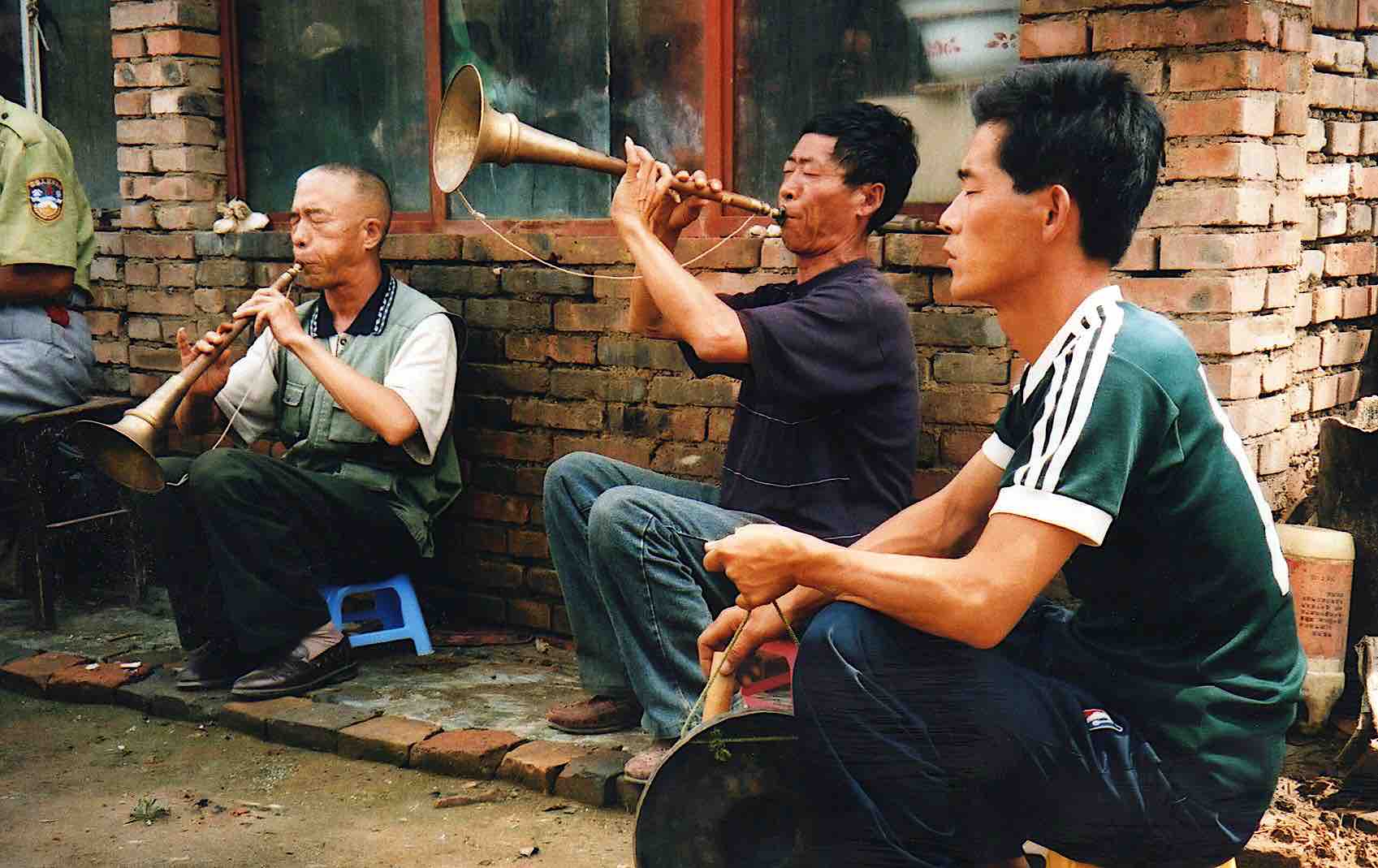
Erhur 2003.2

Session at Xiejiatun, 2003.

If all was not all sweetness and light in the Hua family band, gujiang relations in Xiejiatun sound still more fraught. Several gujiang from Xiejiatun apprenticed themselves to the Hua family: one Erxianr (surname Xie) from Xiejiatun got into a feud with the Yu family, so he made a point of antagonizing them by going over to Hua Fa as “disciple crossing the gate”. Another blindman, Duan Guanming (b. c1927, known as Liuzhi “Six fingers” as he had an extra finger on one hand), also came from Xiejiatun, but got on better with Hua Yinshan than with the Yu family—we found him playing in Hua Yinshan’s band in 1991.
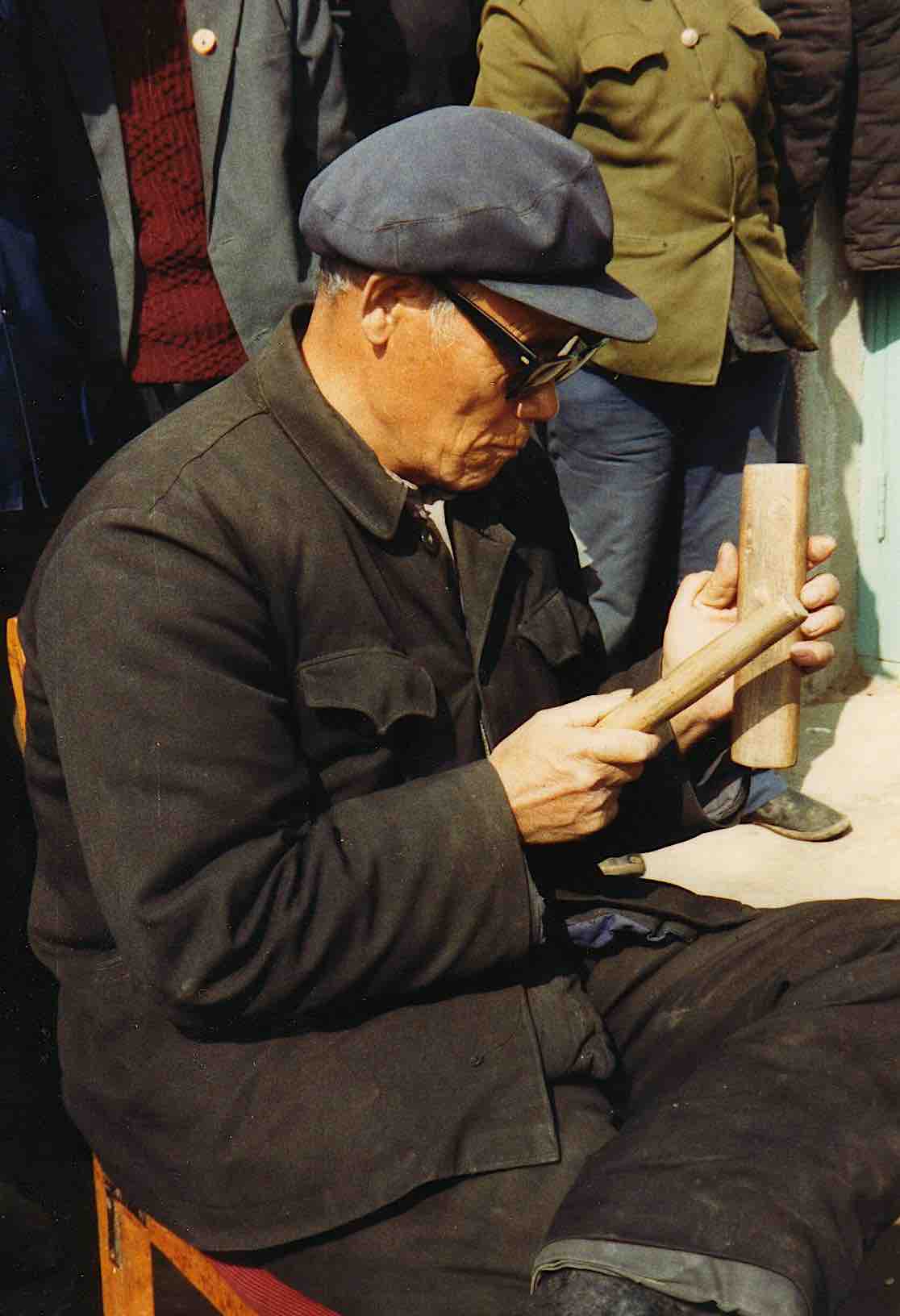
DGM1

Duan Guanming on woodblock, 1991.

Erhur came back to the county-town when he was 18 sui (c1963) to set up his own band, taking disciples. Hua Yinshan didn’t mention this, but in his teens he sometimes played for Erhur’s band these next couple of years; he only played sheng at first, but was beginning to get the hang of the shawm too. There was also a great player in Erhur’s band called Little Jinxi (surnamed Wang), from nearby Qingshunbu. For the operatic pieces played in the afternoon of funerals, he used to play two kouqin whistles at once, making a big sound that drew the crowds. He died on the eve of the Cultural Revolution aged only 41 sui, coughing up blood in the middle of playing—an alarmingly common and prestigious way for shawm players to die.

Yin San
Meanwhile, another blindman was “learning gujiang” in the town. Like Erhur, Yin San (b. c1947) played dizi flute when young. He began learning shawm from 16 sui (c1962) with the blind town gujiang Song Chengxin. Yin San also studied at some stage with a gujiang in Wangguantun township, learning the gongche solfeggio of the shawm pieces from him—which he later forgot.

6 LR,YS

Yin San (right) with Liuru, 2003.

Yin San and Erhur both had town registration, and were blind, so they did not have to apply for leave of absence from any production-team or hand over any money to them, unlike village-registered gujiang. Moreover, their ceremonial activities were tolerated more readily by cadres; blindmen could put all their energies into being gujiang, so they could do well. Yin San recalled that in the early 1960s a band got around 5 kuai for an afternoon, 8 kuai for playing all day, 10 kuai including the burial procession next morning. Erhur claimed that while most bands could earn about 12 kuai a day, his own band was so admired that he could charge 22 kuai. In fact payments were only calculated in terms of cash, they were still paid in food: peanuts or gao paste, 1 jin or half a jin each per day—Yu Fucai’s hemp sack was tough from the oil.

But even sighted village bands could still get permission from their production-team to go out on business. The Xiejiatun band earned a dozen kuai a day then, of which they had to give the commune 1.5 kuai each day they were away, in return for one whole work-point each. The band boss Yu Fucai took 15 shares of the fee plus 10 shares for providing the instruments, while everyone else got 10 shares. Yu only used one or two musicians from outside his own family, so it was worth it. Doing funerals they got to eat out for free too, and didn’t have to till the communal fields all the time, so it was a better life than being a peasant.

Still, I can’t quite build a consistent picture from such accounts of gujiang business before the Cultural Revolution. They articulated no clear distinction between the various periods from 1949 to 1966, though I surmise that business must have been easier before collectivization around 1954, and again briefly during the lull in campaigns from around 1961 to 1964. Yin San claimed rosily, “Before the Cultural Revolution business was even better than today, around twenty days a month—there weren’t so many gujiang then, so there was more work to go round.” But he only took part in the life from the early 1960s.

Conversely, Liuru, who was trying to make a living through the 1950s, said times were tough. Erhur pointed out that there was less business under Maoism than either before Liberation or since the 1980s reforms, because people had less money; one death provided no more than three days’ work in all, whereas earlier and later, taking into account all the subsidiary observances before and after the funeral proper, it might provide up to ten days’ work. He reckoned that in the 1950s, bands might go out on business seven or eight times a month, or “every three days or so”.

They agreed that despite all the famine deaths around 1960, there wasn’t so much business then—if people had any money at all, they’d buy something to eat, not invite gujiang. Liuru recalled that for funerals during the famine years, people could only put out a couple of mantou bread rolls on the altar table before the coffin; whenever there was a death, work-teams turned up to prevent gujiang playing and stop the family burning paper spirit-money, on pain of a fine. Indeed, in Yanggao the famine continued until at least 1965, and people were hungry right into the late 1970s. Still, I think we have to assume a slight and temporary improvement in people’s lives in the early 1960s when Erhur and Yin San set up in business.

The Hua band
In Yangjiabu village just north of the county-town, Hua Fa (1917–87), father of Yinshan and Jinshan, was much admired as a gujiang. His nickname was “Heavenly dragon” (Tianlong); soon he was simply known as “Great gujiang” (Da gujiang). He was also known as “Sighted Fifth brother” (Zhengyan wugar) or “False Fifth brother” (Jia wugar), by contrast with another famous blind gujiang in Zhenmenbu village just further east called “Blind Fifth brother” (Xia wugar, surnamed Xue) or “True Fifth brother” (Zhen wugar)—“true” and “false” alluding to the fictional character Monkey. There was no love lost between rival bands: “True Fifth brother” was murdered by a rival gujiang while they were performing for a funeral in the 1940s.

Hua Yinshan’s second uncle Hua Yi, known as “Second gujiang” (Er gujiang), also smoked opium. Their drummer was a blind man—Hua Fa was also a fine drummer. The celebrated gujiang Little Jinxi, from nearby Qingshunbu, sometimes played for Hua Fa band as well as for Erhur. The Hua band had a long-standing feud with the Xiejiatun band, though some Xiejiatun men preferred to come over to Hua Fa’s band, like blindman Duan Guanming, long a regular recruit. Another disciple of Hua Fa was known as “Second Dragon” (Erlong), from Yaozhuang village just east.

Duan Guanming accompanying Hua Yinshan in trick repertoire, 1991:
note Yinshan’s cloistered daughter.

Hua Yinshan claimed he became the “main beam” of the family band on large shawm from the age of 17 sui (c1964). He had heard the classic suites in the family band for many years, but had apparently only just begun playing them on large shawm.

Hua Yinshan was also working with several other bands in this period, with his father’s blessing, as the family needed all the work they could find. He spent some time in the bands of blindmen Erhur and Yin San, both based in the county-town, playing the lower part on shawm, as well as the sheng mouth-organ and the drum. As we saw, Erhur was a disciple of Yu Fucai’s band in Xiejiatun; the Yu band had a long-standing feud with the Hua band, but there was always some interplay.

Apart from the county-town and the villages of Yangjiabu and Xiejiatun, nearby Guanjiabu was the base of another fine gujiang band. The senior gujiang Shi Youtang (d. c1998) had a blind disciple called Shi Zhenfu, a distant relative of his (though their surnames were different Shi characters); he was known as Errenr “Two people”! Both led bands into the 1980s. Another blindman from Guanjiabu, called Yinhur (surname Li), became a disciple of Hua Fa.

Hua Yinshan told me the story of his father’s no.1 large shawms. In the 1940s a blindman called Chanxi in Guanjiabu wanted to buy a pair of shawms. An itinerant shawm maker called Wang Lianguo had moved from Yuxian in Hebei to Chenjiabu, near Yangjiabu. He went to Chanxi’s house to sell him a pair of shawms—this would have been around 1945, when Hua Fa was in his early 30s, between the births of Jinshan and Yinshan. But Chanxi didn’t know how to choose them, so he asked Hua Fa to help him. After Chanxi died, he left the wooden bodies of his shawms to his daughter, who later sold them to Yinshan.

Over twenty-six days in 1989, as part of their work for the Anthology, the Yanggao Bureau of Culture used their limited equipment to make a whole series of precious cassette recordings of the most distinguished shawm bands, including those of the Hua family, Shi Ming in Wangguantun, and Yang Deshan (father of Yang Ying) in Gucheng, as well as the bands of Xiejiatun, Guanjiabu, Luowenzao township, Qingshunbu, and Greater Antan (see my Ritual and music of north China: shawm bands in Shanxi, p.49).

Li Zhonghe
South of the county-town in Shizitun township, yet another celebrated blind gujiang was based in Yaozhuang village. Li Zhonghe (1908–88), known as Second Kid (Erwa 二娃), went blind at the age of 5 or 6 after an itinerant doctor tried to cure his ailing eyes by putting eggshell over them. Li Zhonghe learnt sheng and shawm from 15 sui, sometimes making up a band with an outstanding gujiang called Wantai (surnamed Cui) from Zhouguantun village nearby. Li had two younger colleagues (shidi) in his village, the brothers Fan Liang and Fan Gao.

Around 1952, after the death of Li Zhonghe’s first wife, he married a widow who already had a son and daughter. The son Li Bin (b.1945, not the same as his namesake, Li Manshan’s son!) played percussion in his stepfather’s band from around 1955, and began learning sheng and shawm, as well as gongche solfeggio, with him about four years later. Li Bin claimed his stepfather’s band didn’t stop playing through the Great Leap Forward or the ensuing famine.

Since the reforms
The collapse of the commune system from the late 1970s allowed an impressive revival of tradition (for the Daoists, see e.g. here). But by 2003 the scene was changing further. Erhur was still leading a band, having readily taken pop on board. He and his wife made a handsome couple, and had a lovely clean household in town—though their son, who managed to enter the police force despite (or by dint of?) a dubious reputation, was a worry. Erhur claimed to be able to perform the three suites that we couldn’t track down; but he was later reluctant to recite or perform them for us, perhaps worrying about my relationship with his rival Hua Yinshan.

Yin San, also married, was getting 90 kuai a month from the government disability benefit, and still led a band, usually playing cymbals. Of his two pupils, the younger had been with him for eight years. They could play the few traditional pieces still required for rituals, and Yin San felt no need to transmit the ones that weren’t. After his fine drummer Ling Dawenr (b. c1924) retired, Hua Jinshan had no competition.

Liuru hadn’t played since around 1988. Now he reckoned that only sighted people could do business (chixiang 吃香, a common term for popularity)—no-one wanted blind people any more. Erhur and Yin San were still doing well by adapting; they were a bit younger, more enterprising, and had more of a reputation as musicians. But he was right that in a cut-throat pop market, blindmen were no longer able to hold their own as gujiang without a solid support network.

The decrepit little shack where we found Liuru living in 2003 had been his “base area” for over thirty years; he bought it with the little money that remained when his parents died. His registration was at Xibei village commune, from whom he got 60 kuai a month benefit; as an urban resident his wife (also blind) got 90 kuai. Since giving up the shawm in 1990 Liuru had survived by begging the left-overs from restaurants, but led a pitiful life. He had no contact with his brothers and sisters, and just before we met him his wife had “gone crazy” and he had seen fit to lock her in an outhouse.

Such is the disturbing fate of a lovely senior musician who could still recite the gongche solfeggio of the eight suites more fluently than any other gujiang in the area. Listening to him as he sat cross-legged on the kang brick-bed which takes up most of the space in his pathetic little room, his eyes vacant yet placid as he spoke with dignity and insight of his days as gujiang, would be an upsetting experience for the most hardened fieldworker.

Li Zhonghe’s stepson Li Bin is an exceptional case. Unusually for a gujiang family, Li Bin did quite well in school. Though intermittently active as gujiang through the early years of the Cultural Revolution, around 1970 he went off to work in the coal mines of Datong city, becoming a cadre there, only resuming gujiang business again when he retired in 1996.

Li Zhonghe had taken up as a gujiang again after the reforms, and was still playing right until his death in 1988. He had a blind disciple (younger brother of talented young yinyang Wu Mei) who showed great promise as a gujiang, but he had only been learning for a few months when Li Zhonghe died. Li Bin now wanted to complete his stepfather’s mission in helping him learn, but the disciple soon decided against becoming a gujiang. However, Li Bin soon found another promising disciple.

By 2003 Li Bin had handed over the leadership of the band to Yu He (Quanmin, b. c1960) who played drum and yangqin; he only took up the business after being demobbed from the army in 1984. So the band was now based at Yu He’s home of Fanjiatun village nearby in Tianzhen county. Yu He’s son Chunbo (known as Bobo, like Hua Yinshan’s grandson; b. c1987) became Li Bin’s only pupil, learning since 2001. Li Bin could afford to be choosy; his criterion for accepting a pupil was that they have to be “of good character” (renpin)—an unlikely demand for a gujiang. After leaving primary school, Bobo “wasn’t interested in anything”, so his dad took him along with the band to show him how tough it was making a living; but Bobo fell in love with the life and became a brilliant musician. Though he mainly played pop, Li Bin also taught him pieces from the traditional repertory.

Da Li Bin 2003

Li Bin (left) with Wu Fan, 2003.

Li Bin is at a certain remove from the tradition, far more educated than most gujiang, and quite articulate. Living in Yanggao county-town, his house is comfortable, and the family is quite well-off. His wife became a Protestant around 1993; Li Bin was still at the mines, and she had a tough time having to look after their three children all alone, with no-one to talk to. Li Bin (not himself a believer) sometimes set Protestant lyrics to pop songs for her to use in church. Sincere and curious to study local traditions, he made a rather ideal co-fieldworker.

We saw how gujiang, outcasts in the “old society”, have gradually become rather more assimilated into society, first by being forced into a sedentary agricultural life under the communes, and then by the equality brought by earning power since the reforms. Along with their outcast status before Maoism came a lack of education or upward mobility. Among gujiang families, Li Bin was exceptional in doing relatively well at school, and even more so in finding a job as a cadre. Still more surprising is that having apparently escaped from the lowly life, he then chose to return to it after retirement. In his case, apart from supplementing his pension and giving him something to do, he feels a genuine enthusiasm for the music he learnt from his stepfather in his youth, only tempered now by its rapid loss under the assault of pop music.

Meanwhile Li Bin has been painstakingly making emic transcriptions of his father’s repertoire (both the suites and the many “little pieces” also formerly required for particular ritual segments), writing a 126-page score with parallel gongche solfeggio and cipher notation. While scholars (myself included) have transcribed the Yanggao shawm suites, this is a unique labour of love from a performer.

Very few gujiang could graduate to the world of urban troupes (for Shi Ming’s brief sojourn in Datong, see here), and while most sons of gujiang were now inclined to seek a more respectable profession, other poor village boys might still see it as a better option than tilling the fields—all the more now that learning pop music is less demanding than the traditional training. Today gujiang bands are often in the age-range of 15 to 45. Their main repertory is pop, besides Jinju and Errentai opera pieces and a dwindling repertory of traditional shawm pieces still required to maintain a façade of ceremonial propriety.

Li Sheng

Li Sheng, 2018.

The two Li families (those of Li Zhonghe and the Li family Daoists) have long been on good terms. The great Li Qing sometimes played in Li Zhonghe’s shawm band in the 1970s, when Daoist ritual was on hold. Li Bin’s younger stepbrother Li Sheng (b.1954) learnt suona and sheng from his early 20s upon the revival, spending some years as disciple of Hua Yinshan. He did some petty trade in Datong, as well as doing, returning around 2000. Gradually he gravitated to playing sheng with the Li family Daoists; he has long been a regular member of Li Manshan’s band.

I introduced Zhang Quan, a rather younger semi-blind gujiang in Pansi village whom I’m always happy to see, in these vignettes of the diverse personalities from whom we learned in Yanggao.

* * *

In some other parts of north China (like the Northeast, or Shandong) shawm bands have long and prestigious hereditary traditions, but here, as in Shaanbei, few bands can trace their history back more than three generations—though their classic suite repertoire is more ancient. Note that rather few gujiang live to old age; until the 1950s many were blind, smoked opium, and died young, and it is still quite unusual to find gujiang still playing in their 60s; anyway, opium-smoking blindmen from a despised caste found it hard to set up a family. By the early 21st century senior gujiang were still happy to take disciples, but as it is a low-status occupation they didn’t necessarily encourage their own sons to learn, hoping they would get an education and a proper job instead. If this is true today, there was less choice in the past, with education even rarer and job opportunities fewer.

While sighted players also deserve recognition as gujiang, and suffered from similar discrimination, blindmen formed the core of many Yanggao bands right until the 1990s. Since then they have become less common, along with the whole rich culture of shawm bands in north Shanxi.

But I still cherish the memory of these blind shawm players—outcasts who embodied the wealth of traditional folk culture that somehow survived down to the eve of the 21st century, dovetailing with the rituals of the household Daoists. With their deep experience of the “old rules” of ceremonial, far from the abstruse erudition of the literati who dominate sinology, they were among the main transmitters of imperial Chinese culture, who should be esteemed.

Not a living fossil

dino

Pace the earnest search for “living fossils” in China, dating folk music is highly speculative. How one envies the wonders of modern science:

Visiting a museum, a woman admires the skeleton of a dinosaur. Curious, she asks the attendant:

“Excuse me, how old is this dinosaur?”

“It’s 65 million years, four months and thirteen days old, madam.”

“Wow! Carbon dating is amazing—how can you be so precise?”

“Well, when I first started working here, they told me it was 65 million years old—and that was four months and thirteen days ago.”

Yin and yang: the divine Hélène Grimaud

More images here.

On this blog I’ve featured the radiant magic of Hélène Grimaud, in

—all of which you simply must listen to. Here’s a further hommage.

See also her 2003 memoir Variations sauvages, English translation Wild harmonies: a life of music and wolves, 2007); and for a most insightful article, do read this New Yorker piece from 2011.

Since her London appearances are far too infrequent (her planned visit in June 2020 had to be postponed—has she really not come here since her numinous “Water” recital at the Barbican in 2015?), I resort to relishing her performances of the two colossal Brahms piano concertos online. Here’s a trailer:

And the two concertos complete:

For a sequel on tempo and timbre in Brahms, with a HIP version of the 1st concerto, see here.

I trust you too will be unable to resist going on to admire her live performances of both works online (here and here)—indeed whole days can, and should, go by as you bask in all of her ouevre there.

OK, one can’t help noticing that she is one of the most entrancingly beautiful people ever to grace the planet—neither here nor there, one might say, but her own unassuming radiance goes hand in hand with her music. She embodies a perfect combination of yin and yang, with both innige spiritual intimacy and intensely muscular emotional intelligence.

Here she gives an interview in French on the Rachmaninoff concerto and Abbado:

Here she plays Schumann with Ann Sofie von Otter:

And returning to the Ravel concerto, here’s the exquisite slow movement again:

Busoni HG

And do click here for my tribute to her 2023 London concert, featuring Beethoven, Brahms, and Bach–Busoni.

Life behind the Iron Curtain: a roundup

Bloodlands

There’s been some fine media coverage to commemorate the thirtieth anniversary of the fall of the Wall. So apart from my numerous posts under the Maoism tag, here’s a roundup of some of my posts on life, and death, behind the Iron Curtain—always bearing Chinese connections in mind.

On the GDR (for which note the useful Twitter # @DDROnline):

On the USSR:

See also my roundup of posts on Ukraine.

https://stephenjones.blog/2019/02/15/czechs-in-tianqiao/

Elsewhere:

The fate of folk traditions in Moravia and Poland under the socialist state is explored in

For the wider picture, see

And for bitter jokes from behind the Iron Curtain:

All this complements posts on Nazism, such as

See also Timothy Snyder on tyranny.

Yang Yinliu: a conference


YYL poster

To commemorate the 120th anniversary of the birth of the incomparable Yang Yinliu 楊蔭瀏 (1899–1984), from 10th to 15th November a conference on his life and work is taking place at the Chinese Academy of Arts in Beijing (more details on WeChat, I trust).

Yang was one of the great musicologists of the world; his research is central our understanding not only of music history but of traditional Chinese culture more generally.

YYLHe excelled not only as a historian but as fieldworker and performer, steering the Music Research Institute through the choppy waters of Maoism. I’ve devoted a lengthy tribute to him; and do consult his tag in the sidebar—adducing his work on early history, folk and elite traditions (the latter embodied by the remarkable team of qin scholars at the MRI), Daoist and Buddhist ritual, and a range of regional instrumental and vocal genres, including

While I don’t much go on for conferences, I’m sorry I can’t attend this one, which also serves as a retrospective on the whole history of Chinese musicology, with contributions from leading scholars. There have also been celebrations in Yang’s home city of Wuxi.


Criticizing Confucius

Given that this is no time for blind kowtowing before authority—anywhere:

Just as Tang poetry isn’t immune from doggerel, maybe we might unfurl a new, more decorous campaign to debunk the uncritical veneration of Confucius (cf. Alan Bennett).

Noting that “Confucius He Say” 子曰 might be rendered as “So the kid goes…” (“I’m like, whatever”; see also OMG), one could regard the Analects an early pilot for Kids say the cutest things 子曰乖事, or an anthology of pithy bumper-stickers (cf. Gary Larson’s cartoon Confucius at the office—”Looks like we’re in for some rain”).

Here’s one gnomic maxim that does rather appeal to me:

君子不器
The gentleman is not a vessel.

Typically, it’s been subjected to a vast apparatus of scholarly exegesis; I like to take it as a critique of reification, one of the banes of studying music (see musicking), religion (see “doing religion“), and indeed Life… Indeed, maybe the qi 器 there is even verbal: “The gentleman doesn’t reify”? * I would like the quote even more if he had said that women weren’t vessels either—but despite recent defences of Confucian sexism, he didn’t (surprise surprise).

As Confucius said when his disciple Yan Hui ** told him he was taking up stamp collecting,

Philately will get you nowhere

(an old joke that goes back at least to Jennings).

As ever, The life of Brian has salient critiques. Here’s one of the Boring Prophets:

There shall, in that time, be rumors of things going astray, erm, and there shall be a great confusion as to where things really are, and nobody will really know where lieth those little things wi- with the sort of … raffia-work base that has an attachment. At this time, a friend shall lose his friend’s hammer and the young shall not know where lieth the things possessed by their fathers, that their fathers put there only just the night before, about eight o’clock.

And indeed the rebuke to exegesis in the Sermon on the Mount scene that opens the film:

I think it was “Blessed are the cheesemakers”.
Ahh, what’s so special about the cheesemakers?
Well, obviously, this is not meant to be taken literally. It refers to any manufacturers of dairy products.

See also Alan Bennett’s classic sermon on “My brother Esau is an hairy man…”


* Cf. “Gentlemen lift the seat”—as Jonathan Miller observed in Beyond the fringe, “What exactly does this mean? Is it a sociological description—a definition of a gentleman which I can either take or leave? Or perhaps it’s a Loyal Toast? It could be a blunt military order, or an invitation to upper-class larceny.”

** My penchant for Yan Hui derives from the ritual shengguan suite Qi Yan Hui 泣颜回,  a title that alludes to Confucius bewailing his early death (for a gongche score, see here, under West An’gezhuang).

Meredith Monk

MM

Pursuing my New York theme, another great female composer on the splendid T-shirt is Meredith Monk (b.1942).

Donald Macleod’s ever-engaging coverage on BBC Radio 3’s Composers of the week makes a useful introduction; see also this appreciation from Tom Service. Here’s an extensive playlist:

Some tracks I like:

Porch (1970):

Songs of ascension (2008):

Hocket (1990) (cf. here):

Here’s a playlist for her opera Atlas (1991), inspired by the intrepid traveller Alexandra David-Néel:

Monk’s sound world has affinities not only with minimalism (cf. here, and here) but with folk and early music. Apart from music, theatre, and dance, her work in film is also striking. Here’s an excerpt from Book of days (1988):

And to complement my Halloween post, here’s Scared song (1986):

I love the way New York (and indeed London) has room for this kind of thing alongside Blondie, Madonnapunk, and so on—genre-bending, always dissolving boundaries.

Some remarkable female vocalists feature prominently in my Playlist of songs, such as Nina Hagen, Barbara Hannigan and Enza Pagliara. Cf. Bobby McFerrin.

Ladies and gentlemen, Lenny Bruce!!

LB

Among the controversial, countercultural icons who drove themselves to an early grave was Lenny Bruce (1925–66), “America’s No.1 Vomic”.

With my penchant for jazz biographies, in a similar vein [sic] is the extraordinary book

  • Albert Goldman (from the journalism of Lawrence Schiller), Ladies and gentlemen, Lenny Bruce!! (1974). *
    (Do read this most perceptive review by Wallace Markfield—interestingly garbled in the course of digitisation.)

The opening chapter, “A day in the life”, is a dazzling, graphic, blow-by-blow reconstruction of his arrival in New York in 1960 for a gig at the Blue Angel. Just a taster:

Around ten, a yellow cab, somewhat unsteadily driven, pulls up before a narrow gray dilapidated building on one of the crummiest sidestreets off the Square. Above the spattered pavement an extinguished neon sign flaps patches of cold hard shadow across the stone steps: HOTEL AMERICA, FREE PARKING. The cab opens with a jolt, back doors flying open so that two bare-headed men dressed in identical black raincoats can begin to crawl out from the debris within. […]

The night before, they wound up a very successful three-week run in Chicago at the Cloisters with a visit to the home of a certain hip show-biz druggist—a house so closely associated with drugs that show people call it the “shooting gallery”. Terry smoked a couple of joints, dropped two blue tabs of mescaline and skin-popped some Dilaudid; at the airport bar he also downed a couple of double Scotches. Lenny did his usual number: twelve 1/16th-grain Dilaudid pills counted out of a big brown bottle like saccharins, dissolved in a 1-cc. ampule of Methedrine, heated in a blackened old spoon over a shoe-struck lucifer and the resulting soup ingested from the leffel into a disposable needle and then whammed into the mainline until you feel like you’re living inside an igloo. […]

The America is one of the most bizarre hotels in the world: a combination whorehouse, opium den and lunatic asylum.

LB club

As Lenny honed his act at strip clubs, Goldman explores his background in

the fast-talking, pot-smoking, shtick-trading hipsters and hustlers who lent him his idiom, his rhythm, his taste in humor and his typically cynical and jaundiced view of society.

He describes Lenny’s connection with comics like Joe Ancis, Mort Sahl, and George Carlin. Joe

insisted on schlepping Kenny and Lenny to the Metropolitan and the Museum of Modern Art, taking them on whirlwind tours of both collections with his rapidly wagging tongue doing service as a catalog, guidebook and art-history course. “The fuckin’ Monet, schlepped out, half dead, in his last period, you dig? Painting water lilies—is that ridiculous! Water lilies, man, giant genius paintings, man, like the cat is ready to pack it in, but he has to blow one last out-chorus!

The book’s gory details of drug-taking and its paraphernalia, a staple of jazz biographies (Billie Holiday, Charlie Parker, Miles Davis, Chet Baker (here and here), John Coltrane, and so on), are unsurpassed, and as Markfield observes “could easily serve as basic text in a graduate seminar on mainlining”.

Much as I love Chet’s ballads, he seems to have traded on his early angelic, melancholy image merely as a means to the end of a constant supply of drugs; whereas for Lenny the drugs and the performance went hand in hand, evoking the explorations and discipline of Billie and Miles. Amidst all the squalor, the book evokes the technique of Lenny’s creativity, the way he played the room (cf. Stewart Lee’s labyrinthine footnotes):

Suddenly, he lowers his head and shoots a bold glance into the house—a real arched-brow zinger. “Looks like some faggot decorator went nuts here with a staple gun!” Bam! He’s in, they’re tittering. Then he goes for the extension: “Whoo-who!” (high fag scream) “It’s just got to flow like this!” (big wrist flap and faggy, camp gestures as he dances around triggering off staples with his thumb). They’re starting to laugh. Now for a quick change-up. Take them into his confidence. “You know, when I was a kid, I always dreamed about going to a nightclub.” Nice, easy mood, nostalgia. Then into the thirties movie bits with the George Raft takes and the Eugene Pallette club-owner pushing back the panel in the office to get a view of the stage and the little shaded lamps on the tables and the tuxes and the deep-cleft gowns and the hair on the guys bayed back at the temples and Lenny home from the movies standing in front of the bathroom mirror with a scissors cutting away the hair from his temples so he’d have a hairline like Brian Aherne or Robert Taylor and then his disillusionment years later when he went to the Copa for the first time and everything was so tacky and there wasn’t even a men’s room attendant and they had whisky bottles right on the table like a Bay Parkway Jewish wedding and … and … and … By the balls! They’re hanging on his words. Eating out of his hand! Kvelling because it’s their experience—but exactly!

Indeed, not just Lenny’s lifestyle but the techniques of his free-flowing stage routine have aptly been likened to bebop:

He fancied himself an oral jazzman. His ideal was to walk out there like Charlie Parker, take that mike in his hand like a horn and blow, blow, blow everything that came into his head just as it came into his head with nothing censored, nothing translated, nothing mediated, until he was pure mind, pure head sending out brainwaves like radio waves into the heads of every man and woman seated in that vast hall. Sending, sending, sending, he would finally reach a point of clairvoyance where he was no longer a performer but rather a medium transmitting messages that just came to him from out there—from recall, fantasy, prophecy.

A point at which, like the practitioners of automatic writing, his tongue would outrun his mind and he would be saying things he didn’t plan to say, things that surprised, delighted him, cracked him up—as if he were a spectator at his own performance!

In another passage, Goldman comments:

The ghetto idiom was far more than a badge of hipness to Lenny Bruce: it was a paradigm of his art. For what the language of the slums teaches a born talker is, first, the power of extreme linguistic compression, and, second, the knack of reducing things to their vital essences in thought and image.

Jazz slang is pure abstraction. It consists of tight, monosyllabic that suggest cons in the “big house” mumbling surreptitiously out of the corners of their mouths. Words like “dig”, “groove” and “hip” are atomic compactions of meaning. They’re as hard and tight and tamped down as any idiom this side of the Rosetta Stone. `if any new expression comes along that can’t be compressed into such a brief little bark, jazz slang starts digesting it, shearing off a word here, a syllable there, until the original phrase has been cut down to a ghetto short.

The same impatient process of short-circuiting the obvious and capping on the conventional was obvious in jazz itself. […] Listening to Be-Bop, you’d be hard put to say whether it was the most laconic or the most prolix of jazz styles. At the very same that it was brooming out of jazz all the old clichés, it was floridly embellishing the new language with breathtaking runs and ornaments and arabesques. Hipster language was equally florid at times, delighting in far-fetched conceits and taxing circumlocution. A man over forty, for example, was said to be “on the Jersey side of the snatch play”.

LB arrest

But whereas for jazzers music made a pure, abstract language transcending their mundane lifestyle, Lenny’s act was inevitably entangled with it. He was getting busted for his act as well as his medicinal habits, becoming ensnared in a series of obscenity trials. But he was at his very best for the midnight gig at Carnegie Hall on 3rd February 1961, again brilliantly evoked by Goldman—riffing on topics such as moral philosophy, patriotism, the flag, homosexuality, Jewishness, humour, Communism, Kennedy, Eisenhower, drugs, venereal disease, the Ku Klux Klan, the Internal Revenue Service, and Shelly Berman. Had he lived on, an invitation to today’s White House seems unlikely. Goldman reflects:

What else is this whole jazz trip? You take your seat inside the cat’s head, like you’re stepping into one of those little cars in a funhouse. Then, pulled by some dark chain that you can’t shut off, you plunge into the darkness, down the inclines, up the slopes, around the sharp bends and into the dead ends; past bizarre, grotesque window displays and gooney, lurid frights and spectacles and whistles and sirens and scares—and even a long dark moody tunnel of love. It’s all a trip—and the best of it is that you don’t have the faintest idea where you’re going!

Here’s one of several video clips of his live act (more here, as well as many audio recordings online):

London
Chapter 10, “Persecution” describes Lenny’s 1962 sojourn at Peter Cook’s new London club The Establishment—designed to elude the censoring scissors of the Lord Chamberlain’s office, “maiming English stage plays since the 16th century”. Indeed, this was part of an exchange of hostages that led to the Beyond the Fringe team’s long run on Broadway—International Cultural ExchangeYAY!

Lenny in London! Sounds bizarre, doesn’t it? Like James Brown at the Bolshoi. Or Little Richard at La Scala.

(Nice idea, but not so bizarre—neither London, Moscow, nor Milan are so culturally monochrome…)

Here’s an intriguing prequel to the misguided vinegar advertisement, and indeed Always look on the bright side of life:

The Establishment was preparing a skit that depicted Christ Jesus as an upper-class gent hung between two cockney-talking thieves, who complain in their petty, rancorous way: “ ’E’s getting all the vinegar sponges!”

Goldman goes on:

Lenny’s notions of England—compounded from old Hollywood flicks and Alec Guinness imports—were queer, to say the least. As Jonathan Miller summed them up, Lenny saw Great Britain as “a country set in the heart of India bossed by a Queen who wore a ball dress. The population had bad teeth, wore drab clothes and went in for furtive and bizarre murders”.

Not all of this was so wide of the mark.

As Lenny’s apostle Kenneth Tynan observed,

If Beyond the fringe was a pinprick, Mr Bruce was a bloodbath.

As ever, critical responses were polarized. Brian Glanville later wrote in The Spectator:

Bruce has taken humour farther, and deeper, than any of the new wave of American comedians. […] Indeed, the very essence of the new wave is that one hears an individual voice talking, giving vent to its own perception and, in Bruce’s case, its own obsessions. An act such as this requires a good deal more than exhibitionism; it also need courage and passion. Essentially, it is not “sick” humour at all. The word is a tiresome irrelevance—but super-ego humour: a brave voice calling from the nursery.

He was denied entry the following year as an “undesirable alien”.

I’d be curious to learn what Alan Bennett thought of Lenny, but his influence on Dud ‘n’ Pete can be heard in their later foul-mouthed Derek and Clive recordings. Christopher Hitchens wrote a fine article on these transatlantic comedy genealogies.

Goldman devotes a perceptive chapter to “The greatest trial on earth”, a high-profile obcenity case over six months in Manhattan in 1964. Despite support from an array of prominent literati, Lenny was sentenced; freed on bail pending an appeal, as his mental and physical health went into a tailspin, exacerbated by paranoia over litigation, he died in squalor.

The only flaw I find with Goldman’s brilliant book is that it lacks an index. See also Doubletalk.

* * *

All this is a far cry from the bland hagiography of Chinese biographies. And the book reminds me again that the post-war era before the Swinging Sixties wasn’t entirely drab and conformist (see e.g. Paul Bowles, Gary Snyder). It also highlights issues of free speech, which are so urgent today. By comparison with Lenny, the challenging routines of Richard Pryor, or Stewart Lee, seem almost genteel. Still, the latter’s travails over Jerry Springer: the opera, detailed in How I escaped my certain fate, and his ripostes in “Stand-up comedian” (2005) and ” ’90s comedian” (2006), richly deserve attention; while Lee too highlights his debt to free jazz, his art is acutely disciplined (for his thoughts on Lenny, see here).

* The title’s punctuation reminds me of Mahler’s fondness for exclamation marks!!!

The Masque of the Red Death

Poe—Caplet—Corman


Caplet

Here’s some seasonal macabre.

The Conte fantastique after Poe’s The Masque of the Red Death by the gifted André Caplet (1878–1925), for harp and string quartet, deserves to rank alongside the better-known works with harp by his contemporaries Debussy and Ravel.

Given that today’s date (#DieInADitchDay) has been constantly on the lips of sinister, mendacious Tory toffs desperate to pull up the drawbridge and feast on the bendy bananas so long denied them, the plot has a topical ring:

The prince and his nobles have taken refuge to escape the Red Death, indifferent to the sufferings of the population, sealing the doors shut and awaiting the end of the plague in luxury behind the walls.

Caplet

Prix de Rome 1901: far right, Ravel; 3rd from right, Caplet. Source here.

Here’s Caplet’s Conte fantastique with the great Lily Laskine (1893–1988):

It’s dedicated to Micheline Kahn; meanwhile in Paris between the wars, Noor Inayat Khan was studying the harp with Henriette Renié, another teacher at the École Normale de Musique.

film

Caplet’s sonic treatment is just as dramatic, and its dénouement just as scary, as Roger Corman’s 1964 film The Masque of the Red Death, starring Vincent Price. Here’s a trailer:


A secret language in north Shanxi

6 LR,YS

Blind shawm players Liuru (left) and Yinsan, Yanggao town 2003.

The use of Verlan backslang in Engrenages/Spiral reminded me of a fascinating secret oral language in north Shanxi. I’ve mentioned it en passant in my writings, but since I can’t seriously expect readers to follow up such links, it deserves a post to itself.

Known as “black talk” (heihua), it belongs to the wider family of insiders’ languages used by marginal social groups and tradespeople. [1] In north Shanxi it was spoken mainly by the members of outcast shawm bands (here called gujiang 鼓匠 rather than the common chuigushou), illiterate and often blind—mainly, but not entirely, for secrecy. Here I cite the section in

  • Wu Fan 吴凡, Yinyang, gujiang 阴阳鼓匠 (2007),
    Yuebande heihua” 乐班的黑话, pp.119–25.

During her fieldwork in Yanggao county Wu Fan—a native of Wuhan in Hubei—latched onto this arcane vocabulary with amazing alacrity (for her own skills in punning with Daoists, see here). Meanwhile, local scholar Chen Kexiu (to whom we may credit the “discovery” of the Yanggao Daoists and shawm bands), brought up in Yanggao, published an article incorporating the wider region of north Shanxi:

  • Chen Kexiu 陈克秀, “Yanbei guchuiyue yirende heihua” 雁北鼓吹乐艺人的黑话, Zhongguo yinyuexue 2007.4.

The terms for numbers (used mainly to discuss money and fees: Table 2–5 below) were still common until recently. They describe verbally the components of a character, just as Chinese people do routinely when explaining in conversation which character to use, like koutian wu 口天吴 for the surname Wu 吴, or wenwu bin 文武斌 for the given name Bin 斌.

heihua

Above: numbers; below: instruments.

To explain a few instances:

  •  1:  yi 一 becomes dinggai 丁盖, “the cover of the character ding 丁”
  •  2:  er 二 becomes konggong 空工, “the character gong 工 emptied”
  •  3: san 三 becomes chuan 川, rotating the character 90 degrees
  •  7:  qi 七 becomes zaodi 皂底, “the base of the character zao 皂”
  •  8:  ba 八 becomes fengai 分盖 “the cover of the character fen 分”
  • 10: shi 十 becomes tianxin 田心, “the heart of the character tian 田”.

What is remarkable here is that this style is used by illiterate, often blind, shawm players. The theory is that blind men, unable to see who might be listening to their conversation, needed a language where they needn’t fear saying something indiscreet, such as offending their patrons. Yet it’s a highly visual language; I wondered how it came into being. After all, even illiterate blindmen could be told how some characters were written; but you don’t have to know the etymology of words in order to use them!

One might suppose that these terms would be more widespread, but I haven’t found other instances yet. At the same time, another vocabulary for numbers (in various written forms) was in common use here—as around Beijing, Tianjin, and Hebei:

1 2 3 4 5 6 7 8 9 10
刘 (流) 王 (汪) 挠 (神) 斜 (心) 内 (爱)

Throughout China, folk musicians commonly use local terms for their instruments (Table 2–6 above); such names are still used in Yanggao and elsewhere (cf. other areas such as Shaanbei). The derivation of the insiders’ terms for repertoire (Table 2–7 below) is obscure; again, the stimulus was perhaps secrecy—to avoid their choices being understood by their patrons. But these terms seem to have become largely obsolete, along with the repertoire itself (for the searing complexity of which, see here).

heihua 2

Above: titles of shawm suites; below: terms in daily life.

Expressions for daily life (Table 2–8 above) include huoyin 火因 for yan 烟 “smoke” (again splitting up left and right elements of the character); tiaoma 条码 “hottie”; dianyou 点油 (“lighting oil”) for hejiu 喝酒 “drinking liquor”; and kou 口 (prounounced kio) for chi 吃 “eat”. Some of these are dialectal, heard in more general parlance. Chen Kexiu gives an extensive list—and his examples of conversations are daunting:

convo

As you can see there, even the local term gujiang for the members of shawm bands becomes pijia 皮家 (“skins”) in their own parlance.

Thickening the plot, Chen Kexiu goes on to introduce a separate style of black talk used by shawm bands, one that incorporates the ancient fanqie 反切 phonetic system into speech (qiekou 切口) (cf. the blind bards of Zuoquan county). For instance, while the term xunmenshi (or xingmenshi 行门事, yingmenshi 应门事, with shi pronounced si!) is standard local parlance for performing a ritual, one shawm player might ask another (cf. the simpler but no more intelligible 去哪儿贬皮呀? above):

呆劳乃拉许论没人是哩? (到哪儿寻门事?)—“Where are you going to do the ritual?”

Unlike the specialized secret vocabulary that we noted above, once you grasp the principle you can apply it to any words—and it doesn’t require literacy. But the shawm bands among whom Chen Kexiu collected this qiekou style of speech don’t seem to use the specialized vocabulary like the numerical terms; he attributes the qiekou style in particular to the lowly hereditary families of ritual specialists known as “music households” (yuehu), who were descended from banished imperial officials. While there is plenty of evidence for the yuehu further south in Shanxi [1] and elsewhere, I’ve never been very convinced by the piecemeal clues to their presence in north Shanxi. All this is tenuous, but perhaps the supposed yuehu connection for this particular style might just go towards explaining the literate, visual basis of the numerical terms, which otherwise seems so mysterious.

* * *

Much of this vocabulary of the shawm bands was adopted by folk opera groups, also lowly in status; and through constant interaction at rituals household Daoists like the Li family, while somewhat more esteemed, used it to some extent. Of course, all these expressions are pronounced in Yanggao dialect, itself none too easy for the outsider to understand; heihua (“black talk”) itself is pronounced hehua!

The language was still commonly used in the 1990s, but senior blind shawm players were giving way to younger players who no longer suffered such social stigma, and their traditional repertoire was largely replaced by pop. Still, it reminds us what a daunting task it can be for fieldworkers to enter into the aesthetic world of folk performers.

Let’s recite the numbers 1 to 10—altogether now:

dinggai–konggong–chuan–hui–chou–duanda–zaodi–fengai–quwan–tianxin

For some erudite literary wordplay from household Daoists in Yanggao, see here.

Spiral

A worthy competitor with the various classy Scandi noirs that enrich Saturday nights on BBC4 is the French Spiral, whose seventh series has just started. If you’re new to it, it’s worth starting from the beginning—in which case, let’s talk again sometime next year.

The French title Engrenages doesn’t translate easily, referring to interlocking gears—by extension, an inescapable series of events, almost a vicious circle: “Enmeshed”, perhaps?

As with the Scandi noir series, the Grauniad recaps—and their BTL comments—are most enlightening. This led me to Alison Crutchley’s article on the language of the series, “Pute de merde de con! The linguistics of Spiral slang“—again to be read with important BTL comments. As you may imagine from A French letter (a drôle resumé of my Li Manshan film), my schoolboy French is utterly unable to keep up with such dialogue as it flies past; but the article makes fascinating reading.

Thus I learn of loan words like bagnole (from Occitan), “car” (also caisse); and clebs, “mutt”, from Arabic. And

Spiral’s cool kids use Verlan, a type of back slang. Karen calls her girl friends les meufs, Verlan for femmes; Zach texts keufs to his accomplice, to warn him of les flics (“police”).

What’s more, keuf (from keufli) has been re-verlaned, with further resonance, to feuk! And occurring along with the Chinese underworld theme of series 7 is noich (or noichi), for chinois.

anvers

Further topics (also continued in the BTL) include the minefield of using tu and vous (cf. Italian, and this splendid Chinese story); gender; and the subtleties of swearing (cf. French taunting), with arcane variants and combinations of putemerde, and con. It’s amusant to learn that the French for fisting is le fist-fucking, although le fisting apparently serves too—either way, let’s consider it another English export in which we can take patriotic pride.

But just when we thought we were world leaders at punning, it turns out that French is exceptionally rich in puns too. Is rien sacré?

Surely this is the way to inspire kids to learn foreign languages. Surely Quelle bande de branleurs! (“What a bunch of wankers!”) is more attractive and practical than La plume de ma tante. I did indeed relish languages at school, but for some reason the ones that I (like the board of the LA Phil) favoured were all dead (cf. Revolution and laowai). So now I regret that it took me so long to realize that languages could be not so much an elegant yet gratuitous abstraction, or a sadistic ordeal of irregular verbs, but rather, a pathway to understanding fascinating cultures and communicating with real living people (“Like, hello?”).

Conversely, in this case I’m relieved that I can enjoy the script’s linguistic niceties from the comfort of my sofa without having to negotiate them in the gritty milieu that the drama depicts—as has been aptly observed, it’s hardly a promo from the Paris Tourist Board. Spiral really puts the noir into noir.

And now we can relish Series 8 on BBC4!!!

Meanwhile in Glasgow, Irvine Welsh’s novel Trainspotting is helpfully provided with a glossary… For English word games, see here; for the evolving Chinese language, here. See also Kaliarda, Lubunca, Polari.


[1] Note Qu Yanbin 曲彦斌, Zhongguo miyu hanghua cidian 中国秘语行话词典 (1994). 

[2] For links to the major studies of Xiang Yang and Qiao Jian on the yuehu in the Shangdang region, see my In search of the folk Daoists of north China, pp.86–7.

Language learning: a roundup

I find that I’ve written quite a few jocular posts about language learning—here are some faves.

Most remarkably, how not to learn Japanese:

Ma Yuan

On Chinese:

On French:

In German:

See also

On the importance of placeholders in achieving fluency:

When watching a film in English, the strange compulsion to follow the subtitles in a foreign language that you barely know:

And here David Sedaris covers various languages, including Japanese and German:

Also curious to expore the delights of language was

At a tangent, DO READ Nicolas Robertson’s extraordinary series of Anagram tales!

Uyghur culture in crisis

My love’s flames, I have become a beggar, indeed Allah
Before the whole world I stand alone, indeed Allah
I have suffered for an age, Allah, my patience is ended, Allah
I have become a moth drawn to the beauty of your face, indeed Allah
Oh lovers, your desire, Allah, my heart is addicted, Allah
I revel in your pleasure, Allah, I have become a drunkard, Allah
In the city, Allah, I have become a wine shop boy, indeed Allah
Before the whole world, Allah, I have been ruined, indeed Allah

—from Chahargah muqam, fifth mäshräp,
translated by Rachel Harris.

*See also my roundup of posts on Uyghur culture*

I began writing this post with the simple idea of sharing an exquisite free-tempo prelude from the great muqam suites; but, as often, it has grown into more wide-ranging reflections.

In particular, since I noted the perceived crisis of “serious music” in the West, the current plight of Uyghur culture makes an extreme instance of crisis—to which the muqam’s lyrics of religious anguish make a sadly fitting commentary.

The muqam
I’ve been revisiting

  • Rachel Harris, The making of a musical canon in Chinese Central Asia (2008),

a book that seems even more important now that virtually all of the culture she describes, which having been tolerated (and in its official manifestations even supported) by the Chinese state for more than half a century, is now being ruthlessly extinguished. [1]

RH

Over an economical 157 pages, Harris pinpoints a range of major issues.

Throughout the course of the 20th century, as newly formed nations have sought to assert and formalise their national identity, they have typically acquired a range of identifiable national aspects. Thus we find in this new period new musical canons springing up across the world. These canons, however, cannot be dismissed as arbitrary collections of works imposed on the public by the authorities. They acquire deep resonance and meaning, both as national symbols and as musical repertories imbued with aesthetic value.

The Chinese state has invested large sums of money in a succession of projects to preserve and develop [sic!] the Twelve Muqam, and it uses these projects to showcase the positive aspects of its minority policies on the national and international stage.

Describing the wider project on minority cultures, she comments:

Subject to processes of “reform and ordering”, dance styles were transformed into group choreographies, songs were transcribed and fixed, scales and musical instruments standardized, and a nation-wide system of professional performers was put in place, trained in arts academies, and organized into state-sponsored performing troupes.

These versions are disseminated through live performance, TV and radio, publications and recordings. Still, while documenting the official urban troupes, Harris never loses sight of local folk traditions. She also places the Uyghur muqam within the wider context of Central Asian muqam families (notably in Chapter 5).

Perhaps I should now use the past tense in this section:

The muqam are large-scale suites consisting of sung poetry, stories, dance tunes, and instrumental sections. Lyrics by both the major Central Asian poets and folk poetry. Religious mendicants also perform versions of the songs, and drum-and-shawm bands play the instrumental melodies. All this music is traditionally handed down without notation.

The titles of the muqam denote modal attributes, while the names of the pieces within them denote rhythmic patterns. Its tripartite outline subsumes numerous subsections:

  • chong näghmä, a lengthy suite of sung pieces with märghul instrumental interludes
  • dastan: a sequence of folk narrative songs, again with märghul
  • mäshräp: faster dance pieces, sung to folk lyrics.

One fascinating theme of Chapter 2 is how canonisation predates the PRC initiatives, with Uyghur troupes in the Soviet Central Asian states formalising the repertoire as early as the 1920s under the influence of Soviet ideology.

TA

From Wong, “The value of missing tunes”.

In China under the PRC, the 1951 and 1954 recordings of the Kashgar master Turdi Akhun (1881–1956) formed the basis of transcriptions by the Beijing-based scholar Wan Tongshu, published in 1960, and went on to become the core of the whole glossy edifice of the official Twelve Muqam. [2]

So it seems strange that these celebrated recordings (apart from a brief section on the CD with a 2007 book) have remained under a cloak of secrecy. Doubtless Turdi Akhun’s performing style was less polished than that of the state troupes, but archive recordings of Chinese music [sic] from the pre-Cultural Revolution era have been issued.

Wan Tongshu also headed a new state-supported Muqam Research Working Group, which in 1957 organised a three-month fieldtrip to the southern region. Another leading Han Chinese scholar working on the muqam in the 1950s was Jian Qihua, whose transcriptions of the “Ili variant” were belatedly published in 1998. The official song-and-dance troupe in Urumchi began performing sections of these arrangements until the Cultural Revolution disrupted traditional activity. Meanwhile similar initiatives, producing composite versions of the muqam, were under way beyond the borders of China.

Ozhal coverIn Xinjiang the liberalisations following the collapse of the commune system from 1979 allowed the resumption of both folk activity and official research. Furthering the work that had begun in the 1950s, a Muqam Research Committee was formed in 1979, soon incorporated into the Xinjiang Muqam Ensemble. They went on to produce major series of recordings and transcriptions. Meanwhile the compilation of the Anthology provided a major new stimulus to fieldwork.

The 16th-century princess Amannisa Khan, subject of a popular 1993 film, was now claimed as an early fieldworker and compiler of the muqam, providing a fanciful historical cachet. Chinese state support for the muqam continued despite the increasing tensions that followed 9/11.

AM

Reminding us that the musicians and researchers involved in such projects are real people with real lives, Chapter 3 is a vivid portrait of the eccentric musician Abdulla Mäjnun (b.1946). Indeed, the word mäjnun denotes an ashiq religious mendicant and a fool, a sarang: intoxicated and infatuated. Though he identified strongly with the ashiq, and was an outsider in the official Xinjiang Muqam Ensemble troupe where he was employed, he had learned to consider himself not a muqamchi, a term to describe an accomplished folk performer (cf. the Chinese minjian yiren), but a “muqam expert”, a more prestigious term with connotations of science, modern scholarship, and the urban world. In the professional musical circles of Urumchi, where drinking culture loomed large, he was in a league of his own.

Harris gives lively vignettes of a trip with him back to his native Khotan, observing his prestige and capacity for liquor. She concludes:

On one level Mäjnun’s conversations are revealing because he is so clearly engaged in strategically deploying the range of different metaphors at his disposal. On another level Mäjnun is interesting precisely because he embodies that collision of metaphors which I delineated in my discussion of Uyghur music histories: the disreputable, uncontrolled aspects of music and creativity in Uyghur tradition which sit uncomfortably with the notion of “national traditions” and the canon.

Abdulla Mäjnun is heard, solo, on the CD with the book, notably in some intimate muqaddime preludes. For these he favours the diltar, a combination of dutar and satar that he himself invented, “a cross between a double-necked electric guitar and a cathedral, or perhaps, rather, a mosque.” He also features on the CD Majnun: classical traditions of the Uyghurs.

Harris mentions Sabine Trebinjac’s brief biographies of female beggar musicians such as Shāyrnisa Khan,

living in Kashgar in the 1980s, who had had four husbands. Her husbands had disapproved of her begging, but she suffered from a sickness, and had to sing and play daily, in front of the mosque or at festivals, or on pilgrimage. She was a member of Naqshbandi Sufi group, and also took part in regular zikr rituals.

Such accounts, like my own for Han Chinese folk musicians, contrast with the compulsory image presented in Chinese biographies, in which folk musicians “selflessly present their art”, the vicissitudes of their lives under modern regimes largely ignored.

Contrary to the current tendency to regard the Twelve Muqam as something isolated and essentially different from the song repertoire (“classical” versus “folk”), in practice the two have often been mixed together, and it is common practice to follow the muqaddime with a suite of folk songs.

Chapter 4 gives details of the musical structure of the competing, evolving versions, showing that in the diversity of traditional performance, both the musical and lyrical repository of the so-called Twelve Muqam have long been combined in different ways.

A mounting body of evidence suggests that the Twelve Muqam have existed less as an actual body of music and more as a kind of idealised framework surrounding a much more fluid oral tradition, from which individual musicians would learn and perform different parts, and into which musicians might slot their own local repertoires and compositions.

After an astute historical introduction, Harris shows the links between the mäshräp sections of the muqam with hikmät prayers of Sufi religious mendicants. She notes the Muqam Research Committee’s ongoing quest for another Turdi Akhun among the folk:

They were not above pulling in ashiq they found begging in the bazaar to see if they might possess the holy grail of previously undiscovered parts of the repertoire. Mäjnun told me one morning as I arrived for my lesson:

We found an ashiq on the street this morning, playing sapaya [wood or horn percussion sticks set with metal rings]. We brought him to the Muqam Ensemble to see what he could do, but he was all mixed up, he played a bit of Chābayyat then followed into Ushshaq.

She goes on to give a diachronic analysis of renditions of the muqaddime preludes:

If there is any vestige of an improvised tradition in the Twelve Muqam, then it would be these muqäddimä sections, which are structured like an exploration of the mode.

As she notes,

Traditionally the lead vocalist would accompany himself, but specialisation in professional training has meant that these roles are separated in the troupes.

Sensibly, she gives reductive outline transcriptions, rather than the etic versions of other publications; indeed, I favour this method for traditional Han Chinese melody. Despite the importance of notation for the canonisation project, among Uyghur performers its influence is limited.

In orchestration too, Harris notes the contrast between folk and professional ideals, citing Ted Levin on the Bukharan Shash Maqām—the “limpid filigree” of the traditional small ensemble versus the “bloated heterophony” of the large-scale professional versions.

The muqaddime
In my post Bach, alap, and driving in Birmingham I gave a little introduction to free-tempo preludes around the world; note e.g. the taksim and amanedhes of Asia Minor. The Uyghur muqaddime are most wonderful accompanied by the resonant satar long-necked bowed lute. I am particularly entranced by the intense muqaddime of Özhal muqam—perhaps because of its tonal variety, with new scales, featuring a flat 7th and sharp 4th, introduced gradually. Here’s a 1997 recording:

My afflicted soul heads towards the Valley of Insanity
I hope this already wretched life of mine will break
The gravedigger who ignores the candle of my tomb
Will surely have his house and rags burnt by its sparks
Do not ask where I go—I have no choice
I have surrendered choice to the hands of Destiny
The rose-coloured tears have dried up, leaving but a withered face
The tyranny of Fate has exchanged my spring with autumn
My people, together with my beloved, gave me much trouble
What will become of me if I resolve to leave them behind?
Anyone’s chest will ache for my condition, when they see
My face smeared with blood from the broken pieces of my bosom
Peace is impossible until one abandons the world
Nawai, burn my existence, and deliver me
Way, derdim ah!

Abdulla Mäjnun was especially devoted to Chahargah muqam, said to be for the ashiq (CD #7, which he played with tears running down his cheeks). But all the muqaddime are exquisite—here’s a transcription of Nawa, from the climax (äwäj): [3]

Nawa

Chapter 6 explores the impact of canonisation, not least the inclusion of the “Xinjiang Uyghur Muqam” in the UNESCO Intangible Cultural Heritage (ICH) since 2005. She discusses the impact at grass-roots level of efforts to “rescue” local traditions:

To what extent had these efforts established hegemony over local practices? Had rural musicians adopted the officially promoted repertoire or were they maintaining local traditions, and how did these traditions relate to the official repertoire? What plans had been drawn up as part of the UNESCO plan, and how were they being put into action?

Among the local traditions, the “raw, macho sounds” of the Dolan muqam were now elevated to become a folk counterpart to the official professional version. But other local folk styles were fragile and perishable; and as in other parts of the world, any official promotion played little part in their evolution. Harris describes the impact of the independent recording industry, finding the cassettes of performers like Abliz Shakir more significant an influence than those of the official troupes:

The failure of the Muqam Ensemble to capture the popular imagination lies in a combination of aesthetic and political considerations. Firstly the state-run ensemble is arguably too closely associated with the Chinese regime for their performances to be popularly adopted as Uyghur nationalist icons. Secondly, amateur musicians were deterred by the complexity of the chong näghmä section, and by the heavy orchestral-choral arrangements. In fact these aesthetic and political considerations are inseparable, as the ensemble aesthetic—one which is modelled on transnational models of canonic, national traditions—is itself representative of the state. Abliz Shakir’s recordings, released through the independent recording industry and sold on stalls in the bazaars, signalling another kind of authenticity in their performance style, and perhaps aided by the performer’s own ambivalent relationship with the authorities, achieved a far greater popularity.

She notes

concerns about the possibility of negative impact following the UNESCO bid, with local muqam traditions becoming increasingly commercialised and exploited in Xinjiang’s exploding tourism market.

She illustrates the complexities of local activity with a vivid description of a village mäshräp festivity. Indeed, the mäshräp always made an implausible candidate for the ICH: having been commodified by the state it has recently been coopted into the sinister form of the “mäshräp to tackle religious extremism“. [4]

In conclusion Harris comments:

If the few surviving local traditions of Twelve Muqam, which are all too lacking the glamour and musical sophistication of the recorded versions recorded by star performers, are to be locally revived and maintained then they must somehow achieve greater relevance to local musicians and audiences.

But as she stresses, the canonised Twelve Muqam are only one aspect of the whole muqam tradition, elements of which may be found in a wide range of Uyghur musicking. Or rather could be found, until 2016.

Among the scholars whom Harris cites is the Han-Chinese Zhou Ji (1943–2008), who by the 1980s was the leading figure in Uyghur music research. A native of Jiangsu province, in the critical times of 1959, aged 16, he set off to Xinjiang in response to the state’s call to “support the frontier regions”. He remained based there for the rest of his life; from 1985 he was employed at the Xinjiang Arts Research Unit in Urumchi, which he went on to lead. Thoroughly immersed in Uyghur culture (not least its drinking culture), Zhou Ji was highly regarded in the Uyghur musical world. [5] Chief editor of the Xinjiang volumes of the Anthology, he took the folk ritual life of the Uyghurs seriously—note his major 1999 book on Islamic ritual music of the Uyghurs—[6] and even studied female ritual specialists and their repertoires. While he was inevitably involved with official promotions such as the ICH, Harris notes that he dared to publicly voice a number of criticisms concerning the canonisation project.

Zhou Ji

Zhou Ji with Uyghur musicians.

But it was Uyghurs who formed the core of researchers before and since the Cultural Revolution. More recently, scholars such as the anthropologist Rahilä Dawut—also supported within the academic apparatus of the Chinese state—furthered scholarly work.

Dawut

Rahilä Dawut.

The current devastation
Harris’s book was published in 2009, at a time when Uyghur cultural life was still much in evidence despite growing restrictions since 9/11; Uyghur, Chinese, and foreign scholars were still able to do fieldwork. Apart from local traditions such as shrine festivals and pilgrimages, the state (for all its ideological motives) was still actively promoting Uyghur culture.

And then, from 2016, came the repression—in which musicians like Sanubar Tursun and academics like Rahilä Dawut are among innumerable casualties. The ruthless current assault is being diligently documented in the media, such as

As centuries of magnificent lyrics are erased, sporadic official performances set to secular Chinese texts now reduces the muqam to flagrant propaganda, mere political rituals of loyalty to a Han nationalist vision of the Chinese state.

I used to think that such demonstrations of state power were tangential to folk life, but in the current plight of the Uyghurs, with the whole culture—architecture, religious life, clothing, hair styles, food, language—being purged, little else may remain. Note also Rachel’s recent book Soundscapes of Uyghur Islam.

Despite all the difficulties of maintaining Uyghur culture since 1949, and the political tensions that state performers, and Uyghur and Chinese scholars, had to negotiate, the scene before 2016 now seems almost unimaginable. Both urban and rural, folk and academic life, even the state-sanctioned versions of Uyghur culture, have been decimated.

The current campaign to obliterate Uyghur culture is an affront to humanity.


[1] For her numerous other publications, see https://www.soas.ac.uk/staff/staff31068.php, with further material under http://www.uyghurensemble.co.uk. Note also Nathan Light, Intimate heritage: creating Uyghur song in Xinjiang (2008). Among many recordings, note the 2-CD set of local folk groups by Jean During and Sabine Trebinjac, Turkestan chinois/Xinjiang: musiques Ouïgoure (1990).

[2] See also Chuen-Fung Wong, “The value of missing tunes: scholarship on Uyghur minority music in northwest China”, Fontes Artis Musicae 56.3 (2009).

[3] For a complete version of the Özhal suite, click here (for the jarring exoticised visuals, “an imagined idyll of the past”, see Harris, pp.91–2). Since I never got to master its muqaddime with the London-based singer Rahime Mahmut—my attempts to learn the satar being even more inept than my limited abilities on ghijak—I was happy to hear her performing it (with ud!) at the 2019 Muslim news awards for excellence (from 10.38). Abdulla Mäjnun plays the Nawa muqaddime on the CD, #6; for another version, click here; and for the complete suite, here.

[4] See Rachel Harris, ” ‘A weekly meshrep to tackle religious extremism’: Intangible Cultural Heritage in Xinjiang”, in Roberts and Bovingdon (eds), “Develop the West”: Chinese state development and Uyghur cultural resilience, adaptation, and cooptation in Xinjiang (2018).

[5] Tributes, mainly from Chinese musicologists, are assembled in a commemorative volume edited by Tian Qing 田青, Mukamu weini songxing: Zhou Ji jinian wenji 木卡姆为你送行:周吉纪念文集 (2009).

[6] Zhongguo Xinjiang Weiwuerzu Yisilanjiaode liyi yinyue 中国新疆维吾尔族伊斯兰教礼仪音乐—a title that could not be published today; it’s still visible online in the PRC, though no longer for order.

Two guttural vocalists

While Private passions is generally more satisfying (see e.g. the contributions of Philippe Sands, Tanita Tikaram, and Vesna Goldsworthy), episodes from Desert island discs led me to two remarkable vocalists. [Note: author’s source for popular culture appears to derive almost entirely from the demure echelons of the BBC—Ed.]

Gary Kasparov’s selection led me to the Russian actor and singer Vladimir Vysotsky (1938–90):

WOW. As the wiki article comments:

With his songs—in effect, miniature theatrical dramatizations (usually with a protagonist and full of dialogues), Vysotsky instantly achieved such level of credibility that real life former prisoners, war veterans, boxers, footballers refused to believe that the author himself had never served his time in prisons and labor camps, or fought in the War, or been a boxing/football professional.

It’s remarkable that the Soviet system could encompass such alternative performance culture, when nothing remotely so challenging emerged in China until after the demise of Maoism (see also Parajanov). This playlist contains many searing songs from Vysotsky—just as Nina Hagen makes me want to work on my German, his songs make me want to learn Russian.

Meanwhile I’m grateful to the brilliant Elif Shafak for introducing me to the Canadian singer Alissa White-Gluz with the Swedish “melodic death metal” band (another instance of the subtle taxonomy of popular music!) Arch enemy:

More material here for Voices of the world

Nearly famous

KOKO

Alan Bennett is always alert to the tenuity of his celebrity.  In Vera and Doris I cited his wonderful story about nearly meeting Stravinsky, and in this post he endures a series of galling interviews. Here’s a vignette from Keeping on keeping on (Diaries, 2011):

21 May, Yorkshire. A plumpish young man gets off the train at Leeds just behind me.
“Aren’t you famous?”
“Well I can’t be, can I, if you don’t know my name.”
“It’s Alan something.”
“Yes.”
“From Scarborough?”
“No.”
“So which Alan are you?”
“I’m another Alan.”
“Are you just a lookalike?”
“Well, you could say so.”
He pats my arm consolingly. “Be happy with that.”

He himself considers that true celebrity came only with his appearance on Family guy.

This question at a lecture he gave may also strike a chord:

“Could you tell me where you bought your shoes?”

An eye test

Cam

Trinity street, 1902—believe it or not, somewhat before my time.

True story:

Soon after arriving at Cambridge, I realized I was becoming rather short-sighted. Sallying forth to Trinity Street, I absent-mindedly entered the Natural Sciences bookshop, and declared to the assistant,

“Good afternoon—I think I need an eye test!”

“You do indeed, sir,” she replied patiently, “the optician’s is next door.”

For a fine Czech–Chinese spectacles story from my mentor Paul at Cambridge, click here.

eyesight

Via Twitter.

Update, 25th May 2020, in light of the Barnard Castle imbroglio
Strangely enough, that day the optician didn’t suggest I go for a drive—even though, this being Cambridge, there was a fleet of Trabis available for this very purpose.

HIGNFY

After Classic Dom’s revelations, a deluge of spoof reviews on the Trip Advisor site was soon quashed. See also What I can tell you is this...


French slang

Spiral

A worthy competitor with the various classy Scandi noirs that enrich Saturday nights on BBC4 is the French Spiral, whose seventh series has just started. If you’re new to it, it’s worth starting from the beginning—in which case, let’s talk again sometime next year.

The French title Engrenages doesn’t translate easily, referring to interlocking gears—by extension, an inescapable series of events, almost a vicious circle: “Enmeshed”, perhaps?

As with the Scandi noir series, the Grauniad recaps—and their BTL comments—are most enlightening. This led me to Alison Crutchley’s article on the language of the series, “Pute de merde de con! The linguistics of Spiral slang“—again to be read with important BTL comments. As you may imagine from A French letter (a drôle resumé of my Li Manshan film), my schoolboy French is utterly unable to keep up with such dialogue as it flies past; but the article makes fascinating reading.

Thus I learn of loan words like bagnole (from Occitan), “car” (also caisse); and clebs, “mutt”, from Arabic. And

Spiral’s cool kids use Verlan, a type of back slang. Karen calls her girl friends les meufs, Verlan for femmes; Zach texts keufs to his accomplice, to warn him of les flics (“police”).

What’s more, keuf (from keufli) has been re-verlaned, with further resonance, to feuk! And occurring along with the Chinese underworld theme of series 7 is noich (or noichi), for chinois.

anvers

Further topics (also continued in the BTL) include the minefield of using tu and vous (cf. Italian, and this splendid Chinese story); gender; and the subtleties of swearing (cf. French taunting), with arcane variants and combinations of putemerde, and con. It’s amusant to learn that the French for fisting is le fist-fucking, although le fisting apparently serves too—either way, let’s consider it another English export in which we can take patriotic pride.

But just when we thought we were world leaders at punning, it turns out that French is exceptionally rich in puns too. Is rien sacré?

Surely this is the way to inspire kids to learn foreign languages. Surely Quelle bande de branleurs! (“What a bunch of wankers!”) is more attractive and practical than La plume de ma tante. I did indeed relish languages at school, but for some reason the ones that I (like the board of the LA Phil) favoured were all dead (cf. Revolution and laowai). So now I regret that it took me so long to realize that languages could be not so much an elegant yet gratuitous abstraction, or a sadistic ordeal of irregular verbs, but rather, a pathway to understanding fascinating cultures and communicating with real living people (“Like, hello?”).

Conversely, in this case I’m relieved that I can enjoy the script’s linguistic niceties from the comfort of my sofa without having to negotiate them in the gritty milieu that the drama depicts—as has been aptly observed, it’s hardly a promo from the Paris Tourist Board. Spiral really puts the noir into noir.

And now we can relish Series 8 on BBC4!!!

Meanwhile in Glasgow, Irvine Welsh’s novel Trainspotting is helpfully provided with a glossary… For English word games, see here; for the evolving Chinese language, here. See also Kaliarda, Lubunca, Polari. And don’t miss this post on how not to learn Japanese!

What is serious music?!

*For main page, click here!*
(in main menu, under WAM)

I’ve just added a lengthy article on the demotion of WAM, and the flawed concept of “serious music”. It’s based on the stimulating work of Richard Taruskin on the “classical music crisis” prompted by the defection of critics to pop music since the 1960s, as he challenges “centuries-old cultural assumptions” such as the myth of musical autonomy. This is typical of his bracing style:

The question that throbbed and pounded in my head was whether it was still possible to defend my beloved repertoire without recourse to pious tommyrot, double standards, false dichotomies, smug nostalgia, utopian delusions, social snobbery, tautology, hypocrisy, trivialization, pretense, innuendo, reactionary invective, or imperial haberdashery.

On the evidence before me, the answer is no. The discourse supporting classical music so reeks of historical blindness and sanctimonious self-regard as to render the object of its ministrations practically indefensible. Belief in its indispensability, or its cultural superiority, is by now unrecoverable, and those who mount such arguments on its behalf morally indict themselves.

I go on to query his recourse to the term “serious music”, broadening the topic to musicking in other societies.

If there are so many “serious” genres all around the world, what seems exceptional about WAM is its apologists’ sense of mission, and their concomitant sense of embattlement. Without wishing to discourage ongoing research, perhaps we should just leave the WAMmies to get on with their arid defences of a waning prerogative. So we might simply ignore labels like “serious” as a nervous attempt by an impotent elite to claim that “our culture is superior to yours”.

That’s just a taster for the article—now click here!


A recognition sextet, and more stammering


Sextet

To follow my Mozart opera dream:

Of all the wonderful music in The marriage of Figaro, I think we in the orchestra all lavished particular loving care on the Act 3 sextet Riconosci in questo amplesso, in which Figaro recognizes his parents.

The focus on the rather naff dramatic business tends to distract from the riches of the exquisite music—there’s so much delight in caressing the orchestral accompaniment. Here’s our 1993 recording:

A minor bonus for me personally is the role of the stammering notary Don Curzio (sadly, I wasn’t employed as a voice coach). His imp-p-pediment is harder to suggest in metered song than in recitative—this clip includes the recitative as performed at the Théâtre du Châtelet in Paris:

But Kleiber’s 1955 recording manages to include it in the sextet itself (@2.45):

* * *

The figure of the stammering lawyer or notary goes back to Tartaglia in commedia dell’arte and Il Tartaglione, foil to Polecenella in Neapolitan puppetry. Don Curzio’s stammer was created by the Irish tenor Michael Kelly; indeed, Mozart feared that it detracted from his music, but Kelly convinced him to keep it since it was an audience-pleaser—Typical!

Besides all the musical portrayals of disfluency that I mentioned in this post (including Rossini’s “stupefaction ensemble”), we can add Vašek in Smetana’s The bartered bride:

An earnest yet drôle article considers it a sympathetic portrayal; but

some nameless “laryngologists” [!] were quoted maintaining that it is quite impossible to stutter in Vašek’s way. No systematic phoniatric analysis of his fluency disorder has been published. The present study is assessing and enumerating Vašek’s tonic, clonic and tonoclonic speech blockades. It also delivers musical examples of his effective stuttered phrases and compares them to scientific descriptions and objective registrations of physical (external) and psychical (internal) symptoms of stuttering in phoniatric textbooks. It confirms the complete agreement of Smetana’s artistic expression of speech disfluency with the real stuttering.

And the role of Dr Blind in Die Fledermaus led me to this blistering review (“Mark Saltzman as Dr Blind was made to labor under the delusion that stammering jokes are funny”—no turn is left unstoned). But Barbara Hannigan’s portrayal of Gepopo still takes the b-b-biscuit.


The hypocrisy of the English

AB

For Allan Bennett, as for Kate Fox, one of the defining characteristics of the English is our hypocrisy (YAY!). Recording a programme The best of British for BBC Radio 4, he muses with a political passion that is seldom far below the surface (Keeping on keeping on, Diaries, 2015):

26 February. […] I think, why not Swaledale or medieval churches or even, with all its shortcomings, the National Trust. But what I think we are best at in England… I do not say Britain… what I think we are best at, better than all the rest, is hypocrisy.

Take London. We extol its beauty and its dignity while at the same time we are happy to sell it off to the highest bidder… or the highest builder.

We glory in Shakespeare yet we close our public libraries.

A substantial minority of our children receive a better education than the rest because of the social situation of their parents. Then we wonder why things at the top do not change or society improve. But we know why. It’s because we are hypocrites.

Our policemen are wonderful provided you’re white and middle-class and don’t take to the streets. And dying in custody is what happens in South America. It doesn’t happen here.

And it gets into the language. We think irony very English and are very proud of it but in literary terms it’s how we have it both ways, a refined hypocrisy. And in language these days words which start off as good and meaningful… terms like environment and energy-saving… rapidly lose any credence because converted into political or PR slogans, ending up the clichéd stuff of an estate agent’s brochure… a manual for hypocrisy. […]

And before you scamper for the Basildon Bond or rather skitter for the Twitter I would say that I don’t exempt myself from these strictures. How should I? I am English. I am a hypocrite.

So that’s one trait we can proudly boast over what the current Tory toffs cynically call “our European friends”—Jacob Tree-Frog‘s only European friends seem to be the AfD


Mozart vocal trios

I don’t really go in for the analysis of dreams, though I did report on the pitiless satirising of my naïve aspirations to insider status in Lisbon, and and my thwarted World Cup debut. Now I’m most grateful to a dream that I had the other night for reminding me of one of Mozart’s most magical vocal trios (cf. Mozart for winds, and genius).

Like many musos, I regularly have dreams where I find myself in a prestigious venue struggling to perform a challenging piece for which I’m totally unprepared, perhaps further unable to find how to get onto the stage, and equipped with the wrong instrument (as in this Larson cartoon; see also my football dream).

In this case I can’t recall the context—I was involved somehow in the performance, but I don’t think I was singing; and I didn’t catch any lyrics. On waking up, it took me a while to realize that what I had heard in my sleep was Protegga il guisto cielo from the Act 1 finale of Don Giovanni—a piece that I hadn’t heard for many years. Though in my dream I distinctly heard it in E (!), it’s actually in B♭:

Protegga il giusto cielo il zeto del mio cor     May a just Heaven protect my heart’s zeal
Vendichi il giusto cielo il mio tradito amor   May a just Heaven avenge my outraged love

In the context of the Act 1 finale the trio is even more moving, with the frantic dramatic activity suddenly interrupted by those two descending phrases on strings to lead into an oasis of moral probity.

Thankyou, dream. It takes me back to the annual cycle of Mozart operas that we did around Europe in the 1990s, punctuating my visits to China to study the ritual association of Gaoluo village. Our 1994 Don Giovanni tour started in Parma—where a beautiful Italian relationship also began for me.

Gio DG 1994

While I’m here, I just have to add another exquisite little trio (terzettino): Soave sia il vento from Così fan tutte, which we performed in 1992. Here’s another version:

Little gems like this don’t necessarily spread into the wider world, but it’s gratifying how greatly loved this one has become, partly through featuring in films like Sunday bloody Sunday. And this trio really is in E—I wonder if that’s why my dream transposed the other one for me…

This leads nicely to Aboriginal dream songs.

Several of Nicolas Robertson’s brilliant anagram tales are based on Mozart opera titles: see Noon? Gad—vini! and Cite not Faust, as well as Tag, licht—fumée.

Art: insider knowledge

comics

In my post on Visual culture I cited Alan Bennett’s remarks comparing Renaissance audiences’ “insider knowledge” of the religious themes shown in paintings of the time—knowledge to which very few of us now have access—with that of film viewers in his own childhood. This entry from his 2011 diaries (in Keeping on keeping on) suggests a similar case:

17 April. Seeing a banana skin on the pavement reminds me how when I first read the Dandy and the Beano the presence of a banana skin meant that inevitably it was going to be slipped on. No matter that, at that time, in the early 1940s, few children had even seen let alone eaten a banana, the skin was still shorthand for calamity. Other comic clichés were a fish, almost certain to be stolen by a cat and always represented as a perfect skeleton devoid of flesh but still with the head on; a string of sausages, destined to be grabbed by a dog, the sausages trailing from the dog’s mouth like a scarf in the wind; a bull (beware of) in a field, a billy goat similarly, with a ladder another portent of disaster. The bump on the head which might be the consequence of one of these mishaps was generally described as being “as big as a pigeon’s egg”, something else which like the banana I had never seen.

While I’m here, in the very next entry he asks a sensible question:

18 April. Why does the opening theme of Tchaikovsky’s No.1 Piano Concerto never return? What is that about? Everybody listening to it (at least for the first time) must always have expected it. But no.

Indeed, when the concerto is said to be popular, I suspect people mean that opening theme—which may make the rest of the piece quite tough going.

World music abolished!!!

Taraf

Taraf de Haidouks (for whose priceless comment on the fruits of success, see here).

Further to Society and soundscape, I’ve long been resistant to the glossy World Music bandwagon, but just as I thought I was being broad-minded by creating a sidebar category for it (subheaded, to boot), I find it’s been abolished. Typical!

Both Anglo-American pop and WAM (for which, despite my best efforts, the term “classical music” remains entrenched) pretend to a blinkered hegemony, barely acknowledging each other. This is more realistic for the former, but the latter still lays impotent claim to a fictive prestige.

Defining “music” itself turns out to be a tricky business. For a global view, I admire the stirring opening of Christopher Small’s book Musicking. Among the endless taxonomies for music (both emic and etic), terms like “folk” and “traditional” are flawed.

The term “world music” was used in the Music faculty of Wesleyan University by Robert E. Brown from 1960; but as a marketing label in wider currency it dates only from a 1987 meeting in a London pub—and its African basis has proved enduring.

But now I’m amused to read a recent Guardian article noting that promoters are already finding the term outdated. Indeed, in 1999 David Byrne wrote a piece entitled “I hate world music”; concerned about ghettoising, he commented:

It’s a way of relegating this ”thing” into the realm of something exotic and therefore cute, weird but safe, because exotica is beautiful but irrelevant; they are, by definition, not like us.

He also noted that the messy fusion of such genres belies the “myth of the authentic”:

White folks needed to see Leadbelly in prison garb to feel they were getting the real thing. They need to be assured that rappers are ”keeping it real,” they need their Cuban musicians old and sweet, their Eastern and Asian artists ”spiritual.” The myths and cliches of national and cultural traits flourish in the marketing of music. There is the myth of the untutored, innocent savant whose rhymes contain funky Zen-like pearls of wisdom—the myth that exotic ”traditional” music is more honest, more soulful and more in touch with a people’s real and true feelings than the kid wearing jeans and the latest sports gear on Mexican television.

This is a fair point, even if the world music market is dominated by “ethno-lite” fusion pop, largely Afro-Cuban; and even if its commercial basis tends to marginalize less marketable traditions studied by ethnomusicologists. Meanwhile the Guardian‘s worthy switch from “world album of the month” to “global album of the month” doesn’t seem to butter many parsnips.

Along with world music, in the parallel academic world the definition of ethnomusicology has long been the subject of laborious debate. As ever, Bruno Nettl gives a fine overview. In the opening chapter of Ethnomusicology: thirty-three discussions, he notes changing emphases from comparative musicology to ethnomusicology, with “primitive” and “traditional” biting the dust, and occasional subtleties like “ethno-musicology” and even “(ethno)musicology” creeping in.

Nettl continues to ponder definitions in Chapter 2, as well as in his Chapter 1 of Philip Bohlmann, The Cambridge history of world music (2013). Bohlmann, in chapter 7 of his World music: a very short introduction (2002), astutely discusses the Rough Guides phenomenon and world music festivals, noting how ethnomusicologists can’t remain aloof from the world music scene. And he observes:

If indeed we share world music globally through our encounter with it, we nonetheless experience it in very different worlds, which in turn are shaped in distinctly different ways because of economic, ethnic and racial, political and historical disparities. There are today more different technologies that enable us to encounter more world music than ever before, but the question arises as to whether these faciliate or complicate encounter. More to the point, pronouncements by media experts about the ubiquity of CDs, Internet, and the transnational recording industry notwithstanding, not everyone in the world has equal access to the technologies of world music, and most people in the world have no access.

If you’re so inclined, there’s a wealth of theoretical discussion to digest; but here I just wanted to make the drôle point that I yet again find myself living in the past. Of course, society is slow to take on board the pronouncements of pundits, so the label seems unlikely to disappear any time soon. Perhaps we could coin the rubric “Folk/world/traditional”, just for the pleasure of using the acronymn FWT, or FuckWiT (for some mischievous airline acronyms, see here).

One looks forward to the day when world music means all the musickings of all the peoples of the world (including pop and WAM), so we can simply call it “music”—“all music, everywhere, and everything about it”, as Nettl says. No-one ever said classifications were going to be watertight; but for the time being I guess we still need some kind of catch-all rubric for the didjeridus, mariachi bands, and Balkan–Malian fusion gigs, along with more hardcore traditions…

See also On “Sufi music”, The politics of ethno-trad, and Old and new musics.

A career highlight for Alan Bennett

FG AB

Since both Family Guy and Alan Bennett take star turns on this blog, how wonderful to learn that they actually came together! I’ve already noted their mutual taste for Jesus jokes, but now I learn (Keeping on keeping on, Diaries, 2012):

25 April. At five a car comes to take me down to Silk Sound studios on Berwick Street to record a voiceover (in my own voice) for an episode of Family Guy, the story being that Brian, the dog, has written a play, premiering at Quahog, which “all the playwrights” (i.e. Yasmina Reza, David Mamet, and me) duly go and see—and rubbish. They had first of all asked if they could use me as a cartoon character [,] to which I graciously agreed (not saying that I felt it was the highlight of my career). It was then they asked if I would voice myself. Yasmina and David had apparently not been tempted but I went for this too. […]

 The “Brian’s play” episode (10th in season 11) comes and goes on YouTube; for now, I can’t find it, but do make your own search!

The episode has been considered one of the most profound in the whole epic; the nuanced plot is far more cogent and condensed that of a Handel opera. Brian and Stewie are magnificent as ever—echoes here of Amadeus

Alan Bennett’s voice has long been a boon for impresssionists. Like the apocryphal story of Einstein winning second prize in an Einstein Lookalike Competition, I’m not sure AB [as he’s known in Love, Nina] makes the most convincing impersonator—but hey. (For an audition, see Frances Wood’s comment here.)

It’s great to see AB finally getting the recognition he deserves (cf. “Do you think this award will kick-start your career?”). And I love to see stellar conjunctions of my heroes—like Bach and Li ManshanAOC and Greta Thunberg, or Kristin Scott Thomas and Phoebe Waller-Bridge.

Society and soundscape

While I always gravitate towards the ethnographic nitty-gritty of local fieldwork, it seems time for a succinct roundup for some general posts on society and soundscape—a theme pervading this blog, for China (see below), sundry world music traditions, and WAM alike (see world music category, under “general“).

Most authoritative and accessible are the works of Bruno Nettl—essential reading:

Susan McClary is another influential author:

Two important studies give valuable perspectives, placing WAM within the broader picture:

Later ethnographic perspectives on WAM include

On a visit to the Proms I couldn’t help noticing the contrast between WAM concerts and musicking in folk societies:

And articles by Michelle Bigenho and Henry Stobart are most instructive:

In similar vein is

and note

Classics on society and soundscape include

Also worth consulting is

More recently, Rachel Harris gives incisive accounts of the crisis in Xinjiang, including

Among many fine chapters in the stimulating 1997 volume Shadows in the field: new perspectives for fieldwork in ethnomusicology, I recommend those by Nicole Beaudry (on fieldwork among the Inuit) and William Noll (on fieldwork in the Ukrainian past). For a wise discussion of fieldwork in contested sites for Tibetan culture, see

as well as

I was also reminded of the integrative brief of ethnomusicology by

And in

I wonder how we might incorporate colonial history into the reversal of the colours of the piano keyboard in the early 19th century.

And some thoughts on elusive social contexts in studying medieval Central Asia:

* * *

All this informs my work on local ritual traditions in China. I outlined issues in

As I commented in my post on Bigenho’s chapter,

Here’s the deal: if we come to your party, you have to come to ours too:

Just as “music scholars” have learned to consider all kinds of social elements as they study performance, so scholars of ritual too must include in their brief all kinds of issues arising from soundscape, rather than coyly farming it out to musicologists.

As Adam Yuet Chau observes, this is related to the whole scholarly bias towards discursive, scriptural analysis. Indeed, within China studies more generally, expressive culture, and musicking as a vital aspect of social activity, still seem to be considered marginal themes, with research dominated by silent written texts and immobile visual culture. It’s as if sinologists only consider music as a legitimate part of culture when it’s dead and mute, imprisoned in a museum or text. The ethnomusicological mindset should offer us valuable perspectives on Chinese studies (cf. China’s hidden century).

Pachelbel’s capon

As in the old Chinese restaurant joke:
“Waiter, this chicken is rubbery.”
“Thankyou velly much sir.”

Capon

For those who delight in all manifestations of the Terpsichorean muse, this viral video breathes new life into a perennial cliché of early music:

What makes it even more hilarious is the utter deadpan focus of the performer. Like listening to the baroque horn (allegedly), our appreciation is heightened by imagining how very difficult it must be to play.

Just goes to show that amidst the ongoing debate about original instruments (cf. Taruskin, and Butt), our modern ears constantly require creativity… I’m sure the Sachs–Hornbostel classification system is comprehensive enough to encompass the rubber chicken.

If you want a less wacky rendition,* then this is also very fine:

Here the splendid John Finnemore (“so-called comedian”) sympathizes with Pachelbel’s wretched fate:

And now, thanks to Nick Kapur and Craig Clunas, I find this Czech tribute, which might also entertain Alexei Sayle:

See also Bach, um, marches towards the world, and The Feuchtwang variations. And for more artistry on the rubber chicken, see under Mahler 5 and The acme of Daoist kitsch.

* On a personal note: I played the straight version of the hapless canon on a US tour with Peter Holman in the 1990s, most memorably at the Schenectady Fuchs Festival (yeah, I know). Our visit was enriched by a locally-renowned waitress who unerringly took complex orders, entirely without taking written notes, from parties of up to twenty seated around long tressle tables. That was the tour where Paul O’Dette told me the hemiola story (right at the end of this post)…

A village scholar

My vignettes from Gaoluo, taken from my book Plucking the winds, have featured both performing members of the village’s amateur ritual association (Cai Fuxiang, He Qing, Cai An) and supporters like the venerable Shan Zhihe. The name of Shan Fuyi has already cropped up in several posts, but he deserves a separate account.

SFY

Shan Fuyi (right) with my trusty colleague Xue Yibing, 1996.

Shan Fuyi (b.1940) is considered the village’s xiucai talented scholar. Amateur historian, painter and calligrapher, he is widely admired for his intelligence and artistic bent. He was given the task of writing the village history in 1965, and in between making donors’ lists for the opera troupe and the ritual association he did artwork for the Mao Zedong Thought Propaganda Troupe. Latterly he became a trusted employee of Boss Heng, the village’s own nouveau-riche entrepreneur.

We had heard so much about him, but since he was based at Boss Heng’s workplace near Laishui county-town, we never coincided in the village—he seemed elusive, and we even joked that maybe he was a figment of our imaginations.

Finally in 1996 we sought him out in his work-unit. He affably sat us down and, without any preamble, launched into a detailed account of the village from its founding through to the 1990s, instinctively understanding our brief without any need for the long justifications which we sometimes have to give cadres or even ordinary villagers. Indeed, later we did indeed meet up back in the village. Our hopes were well rewarded, and we had many edifying sessions with him, learning from his wide-ranging and impartial knowledge; his detachment in observing the vicissitudes of the village’s history was of rare value.

He is the main source of my account of the village’s early history (Plucking the winds, chs.1–3); indeed, his work gave us valuable perspectives on the history of the whole area, not least the terminology of village names and the she parish network.

Shan Fuyi is not a ritual specialist, and regards himself as a “thorough atheist”, but he takes a keen yet dispassionate interest in all aspects of human behaviour. He’s never been the leading type; unlike most Chinese, who are long accustomed to public speaking, he is petrified of such occasions; with my own stammer, this further endears him to me. He seems to float above the village, observing with detachment and perception. He understood our mission implicitly. He is at once down-to-earth and transcendent. Unassuming, introverted, yet humorous, he never bothered with the empty platitudes of Party-speak. Still, recalling his experiences in the Cultural Revolution and since, he reckons “I keep right up with the way things are going”, a charmingly ambiguous comment; perhaps his very detachment has enabled him to ride all the storms.

Shan Fuyi’s early years
Born in 1940 to a virtually illiterate father, Shan Fuyi attended private school in Zhuozhou county just north for half a year during the civil war when he was 7 sui. With quiet humour, he recalls:

Our texts were The Hundred Family Surnames and The Three Character Classic; when the 8th Route Army passed through we recited “Long live Chairman Mao”; when Nationalist troops passed through we recited “Long live Chairman Jiang” [Chiang Kaishek]; having not offended either of them, when they had both left we could get back to reciting “Zhao, Qian, Sun, Li” [The Hundred Family Surnames] again!

His godfather was Sun Xiang, a spirit medium and folk healer. In 1949 he entered 2nd grade at the village primary school. He recalled the village’s last rain procession that summer. From 1955 he attended the No.1 Secondary School in Laishui county-town, graduating from the junior department early in 1958. He then passed an exam to study surveying at technical college in distant Taiyuan, capital of Shanxi province to the west. In 1960 he began training at the Shanxi Machine Building Factory, but like many villagers, in the autumn of 1961 he was forced by the grave national economic hardships to return home to South Gaoluo, cutting short a promising career. He now served as book-keeper for the brigade orchards.

Meanwhile the village ritual associations continued to adapt to the new regime. After the Great Leap Forward and the famine, the revival of the early 1960s (however short-lived) was significant for the transmission of traditional culture. Not only were the village’s ritual associations reinvigorated, with a substantial group of new recruits training, but the opera troupe also revamped their equipment (Plucking the winds, pp.143–5). Like the ritual associations, they too sought donations from all the village households, shown on Shan Fuyi’s donors’ list dated 2nd moon 1964. In 1996 the musicians took it out to show us:

opera beiwen 1964 edited

Writing a village history
In 1965 the Four Cleanups work-team ordered Shan Fuyi to compile a history of the village up to Liberation in 1948. This may seem like an unlikely task, but their purpose was frankly political: in order to “cleanse the class ranks”, they needed a definitive version of the village’s history (for more, see here).

In north China, apart from county gazetteers (from imperial, Republican, and reform eras), in some counties one finds slim volumes of “material on cultural history” (wenshi ziliao); but with rural literacy low, this is the only history of an individual village that I have seen compiled by a local scholar.

As I observed here, in my work with the Li family Daoist in Shanxi I mainly talk with one extended family, seemingly detached from politics, and with hardly any contact with local leaders. Indeed, the experience of “freelance” household Daoists was different from that of peasants tied to the land, and they were always straining to gain some independence from the production teams. Though inevitably deeply affected by political vicissitudes, they had little investment in the public affairs of the village. In Gaoluo, by contrast, several sources helped me to put the village’s ritual and social culture in political context: many of the members of the association held positions of authority under all three periods of 20th-century history, so we naturally talked with the village leadership. With their detailed knowledge of the modern history of the village, several men were able to offer clear accounts of major events in the area and to connect them to the village’s ritual association. But some of our most detailed material came from our talks with Shan Fuyi.

Back in 1965 he conscientiously set about the task of compiling the history. Though the avowed focus would inevitably be the modern political background, he avidly sought evidence for the early history of the village, right back to its founding in the Yongle reign-period (1403–24) of the early Ming. Apart from documenting oral traditions, he consulted several steles: those of the North Baibao temple from the Ming-dynasty Jiaqing era (1522–66), the temple of North Gaoluo from the Qianlong reign (18th century), and the Wenpu si temple in South Gaoluo from the Daoguang era (1840s).  All these steles were soon to be destroyed. Still, even by the 1990s considerable material evidence survived for the history of both North and South villages of Gaoluo, supplementing Shan Fuyi’s research.

cunshi

The opening of Shan Fuyi’s village history.

After our first meeting with Shan Fuyi in 1996 we all sought the history everywhere in the village and in the county-town, but it didn’t surface. In 1998 he finally brought out a revised version of the history for me, with a mere twenty pages; as he told me, his 1965 version was rather more detailed but also couched in more revolutionary language, full of criticism of “bad elements”, while for his new version he used a more natural style. In a charming reversal of one’s preconceptions, he was apparently giving the foreigner a version from which Communist propaganda had been censored!

In fact our detailed conversations with Shan Fuyi were much more honest and complete than any official version could possibly be. Moreover, his written history went only as far as 1948, whereas our sessions together took the story on to the present. Indeed, he was a thoughtful source for the Maoist and reform eras too.

One topic on which I was able to find considerably more detail in sources from outside the village, unavailable to Shan Fuyi, was the 1900 massacre, which turned out to be a major episode in Boxer history (Plucking the winds, pp.37–42 and p.387 n.42). A team from Tianjin University even came to carry out interviews in 1974. Similarly, while elderly villagers still recalled the Italian missionaries before 1949, I managed to document them further through the Stimmatini archives in Verona.

Inevitably, the representation of events surrounding the complex struggle for Liberation was particularly sensitive and controversial. In 1965 Shan Fuyi was still able to interview most of the protagonists in the revolution, including long-serving Party Secretary Heng Futian—despite his recent demotion—and the traumatized Cai Fuxiang.

The brigade gave work-points to those taking part in the meetings—I had to note them down. We sometimes met at Cai Fuxiang’s house—the meetings were held anywhere convenient.

By no means all the meetings were group sessions:

To understand the situation with “negative characters” (those with particularly bad historical problems) we usually did one-to-one interviews—viewpoints could be so different, you couldn’t sort it out in group meetings.

The next stage was to seek corroboration:

After absorbing the statements we’d taken from people in the village, we needed to corroborate them with historical material, so we sent to the county-town for old police statements. We were very conscientious about seeking proper evidence. Whenever I needed any material, I wrote a note for the work-team, and they sent people to get it.

Cai Fumin, one of the large group of young men who had just begun learning the ritual music, was secretary of the village Youth Corps. He recalled,

The work-team wrote a letter of introduction, and me and Ding You went down the county police station to copy a load of statements, like He Jinhu and He Jinshui’s confessions (they’d been executed as counter-revolutionaries), about how they’d fled, how they’d organised the Return-to-the-district troupes and stuff.

The Cultural Revolution
Shan Fuyi remained largely aloof from factional upheavals. He was known as a good writer and artist, and just as in 1964 he had made the donors’ list in traditional style for the opera troupe, now he inevitably got roped in by both Red Guard factions to write the inscriptions for armbands and flags, and to paint cartoons of “class enemies”. “Large-character posters” were pasted up on the wall of the brigade just opposite maestro Cai An’s house, beside Shan Fuyi’s spirited cartoons showing Capitalist Roaders in dunce’s caps and ratlike figures carrying sedans. As he recalled:

I criticised Deng Xiaoping, criticized Confucius, criticized Liu Shaoqi, criticised the Gang of Four—I criticized everyone except Chairman Mao!

The activities of the village Red Guards were both farcically infantile and casually vicious. While factional strife was not as yet too serious, the Red Guards now singled out not only cadres but helpless individuals with bad class backgrounds.

One main target of the Red Guards’ mission to destroy the “Four Olds” was the demolition of the Catholic church. But they had to work harder to find other icons to smash. The statues in the old temples were so decrepit that no-one had cared much when the brigade finally got rid of them in the early 60s. As Shan Fuyi observed caustically,

The Red Guards were searching for more things to destroy, but there was nothing left, so they had to fight each other instead!

Meanwhile stalwarts of the ritual association scrambled to rescue what artefacts of the village’s tradition that they could, like the Houtu precious scroll.

Shan Fuyi helped out in the village’s Mao Zedong Thought Propaganda Troupe, painting scenery and doing make-up. Still, petty rivalries persisted. Shan Fuyi recalled the troupe going to perform in nearby Fuwei village in 1967 or 1968. Just like a traditional ritual association, they sent someone ahead to issue a red “paper of homage”; the host village then made preparations, setting up the opera stage and matting tent, and making arrangements to feed the performers. When the day arrived, the hosts walked to the entrance of the village to receive the Gaoluo troupe:

The United faction managed to put the boot in that day. They spread a rumour that the opera troupe was only going to perform there so they could cadge a free meal. The performers had no choice but to display their revolutionary fervour by nobly declaring that they wouldn’t perform at all if the village insisted on feeding them; they had brought their own rations, and they would absolutely not eat other people’s food! It was late at night by the time the performance came to an end, but they stuck to their guns and went home with empty stomachs, honour intact.

For more on the Cultural Revolution in Gaoluo, see Plucking the winds, ch.6.

Shan Fuyi’s wedding
Meanwhile, at the height of factional conflict, Shan Fuyi got married on the 29th of the 10th moon in 1966. The wedding was a sign of the subtle obstinacy of tradition. Though no great traditionalist himself (his historical erudition is quite dispassionate), as he recalled it for us thirty years later, it was the resistance to imposed modernity which he stressed—he didn’t mention the correct “revolutionary” part of the ceremony at all. They naturally wanted to invite the school percussion band (“gong-and-drum brigade”, luogudui) to give them a lively send-off.

Although these bands were widely used by work-units everywhere to “report joy”, at the time the use of such music for private celebration was considered feudal—indeed, loud percussion in China commonly serves an exorcistic function to “chase off ghosts”. So at the time the school band was not supposed to play for weddings: the revolutionary slogan went “new affairs must be conducted in a new way”. But they weren’t putting up with that: the evening before the wedding they still borrowed the instruments, and our friends suave Shan Ling and upright teacher Shan Rongqing got up a band to play on the edge of the village; on the big day they played in Shan Fuyi’s courtyard.
Incidentally, the blowers-and-drummers from Shiguzhuang just north (who had escorted Shan Zhihe‘s bride in 1937) had still kept active in the 1950s, but after the Cultural Revolution broke out they too were silenced; during wedding feasts some families now asked the blind Shan Jiuhong to sing a few stories instead.

The other area of conflict between tradition and revolution in Shan Fuyi’s wedding was the custom that the couple should ride horses. The chief of the Women’s Association had dutifully informed them that the bride must not observe this feudal custom; but again they got round the problem. They got hold of a couple of horses and rode the three or four hundred metres from his bride’s house to his own, led by villagers taking the bridles. There were five or six tables at the feast, mainly for the two immediate families.

The response of the village cadres was also a sign of the times. They diplomatically stayed away, making excuses that they had business to do outside the village; if they went to the wedding, they’d have to criticise it, or else they’d be criticised themselves later, so it was better just to stay away and feign ignorance. Such “one eye open, one eye closed” behaviour has ever been a major part of “socialism with Chinese characteristics”: within the village, ideology and policy have always been sensitive to local conditions.

Since the reforms
Through the 1980s, after the collapse of the commune system, Shan Fuyi farmed his own land. He also found outlet for his artistic talents by painting landscapes for the corridors and gardens of a hospital in the suburbs of Beijing.

Shan Fuyi enjoys painting and calligraphy—as with his penchant for local history, he is self-taught. He did traditional paintings on the walls of the houses of his musician friends Cai Ran, Cai Yurun, and Shan Ling, a rare sighting in such villages. Maestro Cai An told us:

He did four paintings in his house showing the quarrels between his mother and grandmother, like a sort of cartoon. And he wouldn’t let his family take them down, so everyone could see—that takes a lot of guts! The women quarrelled less after that.

Quite soon after the 1980 restoration, Shan Fuyi made a painting for the ritual association. Depicting Dizang, god of the underworld, it was displayed at for funerals and also for the New Year rituals:
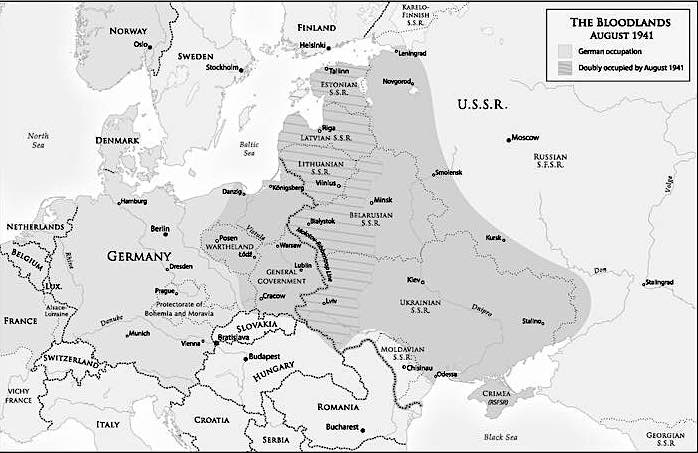
GL Dizang

During this period while he was quite free, he also wrote a lengthy novel, “Dream of the spring boudoir”, aka “Miasma on the river of love”:

novel

novel intro

It describes illicit young love and wedding customs during the Cultural Revolution, against the background of a village opera troupe and the reclaiming of village land. He sent it to the Literature Association of the regional capital Baoding, who responded frankly that while it was well above the level demanded for publication, it wasn’t commercial enough since it was “pure literature”, not like the popular martial-arts romances that people wanted to read nowadays; if he wanted to publish it, he’d have to put up the money himself. So he put it back in his drawer. But in a poor rural society where literacy was still low, it’s impressive.

It was Shan Fuyi who made the ritual association’s handsome new donors’ list in 1990. Though we didn’t meet him until 1996, he was well aware that our first visit in 1989 had acted as a stimulus for a reinvigoration of the association. His phrase on the list, showing that the decrepit nature of their ritual building seen by a foreign visitor “lost face” for the Chinese people, turns out to have been sincere. For his story about the sexism of such donations, see here.
1990 beiwen

Shan Fuyi’s circumstances were transformed in 1991 when Boss Heng invited him to work at his embryonic tourist complex north of Laishui county-town, where he was made responsible for designing and organising architectural and horticultural features.

Shan Fuyi’s wife sometimes looked after the luxurious mansion of Boss Heng in South Gaoluo—a remarkable contrast with the lowly dwellings of other villagers. Of their four children, one son, training for a post in the air-force, married Boss Heng’s daughter on the politically-correct day of 1st October 1997, anniversary of the founding of the PRC. Though his connection with Boss Heng seems an uneasy alliance, this match must have confirmed his position as Heng’s protégé.
In 1995 my Gaoluo friends asked Shan Fuyi to do the calligraphy for a poem they had composed for me, which is one of my most treasured souvenirs:

GL scroll

One day, at a quiet and informal lunch with him and his family in the village, feeling utterly relaxed, I even broke my rule never to touch the lethal baijiu Chinese liquor, so free was he of the usual pompous macho ceremony which accompanies a drinking bout—and A Good Time Was Had By All.

Edifying commercial break: the highly palatable and efficacious Chongzhi Spirit, like Laishui county-town’s most enterprising institution, the Chongzhi Secondary school, is named after the great local mathematician Zu Chongzhi (430–510), who made what was to be the world’s most accurate measurement of Pi until the 16th century. A lot more accurate than if he’d been imbibing his eponymous spirit, I mused as I staggered out into the alley.

* * *

Again we see how the ritual association involved the whole village, serving its ritual needs both before and after Liberation. While Shan Fuyi was not an active member of the association, his research made major contributions in unearthing its history, and his artistic talents were in constant demand. We learned a lot from him.

Language and idiolects

The language of my publications has long chafed subtly at the bit of academic conformity. But now, liberated from such pressures, I still regularly interrogate my use of vocabulary.

On a site like this, for a surprisingly global audience, you might think I’d settle for the LCD [trad as he is, that’s “Lowest Common Denominator”—Ed.] style to which academics disingenuously pretend, despite wilfully introducing a barrage of eye-watering neologisms—shooting themselves in the foot in a way that competes with Tweety’s assault on Comey’s testimony.

Anthropologists tend to drizzle ethnology in a rich jus of technical vocabulary, as if to assuage their guilt at stating the bleedin’ obvious—and I should know. Academic language seems to be founded on the sound principle of being “neutral” and thus intelligible, not least to non-native speakers—the expression of personal linguistic idiosyncracy is taboo. This tends to produce an arcane kind of language that yet prides itself on being as far removed from everyday usage as possible. Yet the neologistic mouthfuls belie this. It is as if every McDonalds order is liberally sprinkled with a compulsory dollop of foie gras.

On one hand, I want to write in my real voice. But also my fieldwork experience, whose most fruitful material resides precisely in the local dialect of my masters, encourages me to persist in rendering my own voice faithfully too—which, as you see, is a personal pot-pourri [“enough with this potpourri!”) [That’s not quite how it goes, but hey—Ed.] of my whole life experience—Alan Bennett, Monty Python, Flann O’Brien, Stella Gibbons, WAM, and so on. I gave a little guide here.

Sure, this will be as much of a challenge for my international readers as Yanggao dialect is to me; but it is where you will find any such riches as there may be. In other words, if I can make the effort to understand Li Manshan, then you try understanding me…

Indeed, even when writing with a certain sobriety, one’s text can still be mangled.

For my outmoded Chinese vocabulary, see here.