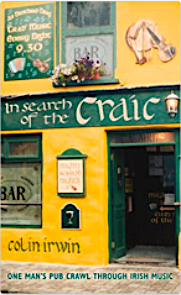
What’s the craic?

*Part of my series on Irish music!*

Craic pub

I’m always intoxicated [Now read on—Ed.] [That’s enough of your lip—SJ] by the mood of Irish music, with its elusive, swirling, heterophonic (or even monophonic) melodies offset by jagged syncopations, any rare hints of harmony serving merely to remind us that it’s a mere modern trinket to which its unruly contours can’t be reduced (see e.g. More early music).

* * *

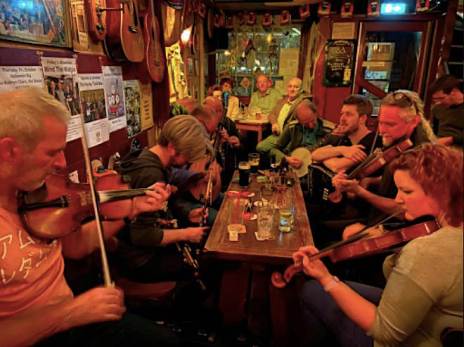
Around the world there must be many terms evoking the special atmosphere of entering deeply into the spirit of musicking; I think of flamenco duende and fado saudade—both with a strong undercurrent of loss. In more celebratory vein, an Irish expression much bandied nowadays is craic, the convivial mood sparked by getting together in company (cf. buzz, vibe, groove). I suppose this kind of atmosphere is the goal of most social gatherings where music is likely to be a catalyst, like Moroccan ahouach, Mediterranean festivals, or weddings anywhere. How good it is to have an all-encompassing term that stresses the wider context of sociability—including drinking, joking, musicking together! Significantly, in WAM, whose pundits have worked tirelessly to claim autonomy from mere human interaction, I can’t think of such a term—ideas welcome.

Irish session 2

Sitting around the table, taking turns—like in Shanghai silk-and-bamboo teahouses.

So impertinent non-nationals like me have become familiar with the nation of craic; but sure enough, it’s yet another of those fabricated traditions—in which the Irish are complicit, to boot. Kevin Myers has described it as “pseudo-Gaelic”, a “bogus neologism”.

The word crack (derived from Middle English crak, “loud conversation, bragging talk”) is recorded in Scotland in the 16th century in the sense of chat, news, or gossip; and it was common in north England and Scotland in the 19th century, sometimes with hints of musicking. These senses of the term entered Hiberno-English from Scots through Ulster, and were then borrowed into Irish, with a reference from 1929 and rural citations from the 1950s. In Dublin, the great Flann O’Brian used the word in articles collected in The best of Myles (1966).

The Gaelicized borrowed spelling craic is only documented from 1968, and it was reborrowed into English later still. The glorification of craic as a “specifically and quintessentially Irish form of fun” is even more recent. Critics have accused the Irish tourism industry and the promoters of Irish theme pubs of marketing “commodified craic” as a kind of stereotypical Irishness. For Kevin Myers it “coincided with the moment that Irishness became self-conscious, winsome, stylised, conceited, boastful”. In his 1999 book Companion to Irish traditional music, Fintan Vallely suggests that the use of craic in English is largely an exercise on the part of Irish pubs to make money through the commercialisation of traditional Irish music; he never heard the word spoken in Dublin until the late 1980s. He notes that Ciaran Carson (based in Belfast) was enraged by the spelling craic. Do read this excellent article by Donald Clarke!

Of course, we can’t specify the spelling when uttering the term (now that would make conversation a fine pickle), but just as I was about to try adopting it, I now think it’d be prudent for me to refrain from doing so. Still… it does sum up a feeling that is much needed.

While, um, craic has to be experienced in company, even audio recordings of live concerts can sometimes hint at the jubilation of the event. Here’s a playlist for the CD Dear old Erin’s isle: Irish traditional music from America (Nimbus, 1992—a companion to the 1991 Fiddle sticks: Irish traditional music from Donegal, also wonderful):

Following Last night’s fun, on a linguistic note: #3, with Liz Carroll on fiddle, consists of an exhilarating sequence of reels with magnificent titles: Drying out, Crush cars, The lost Indian; and Séamus Eagan’s flute solo (#6) is The wee bag of spuds. Such creative titles are conspicuously different from those of non-nationals like Messrs Messiaen and Boulez.

South American getaway

Butch

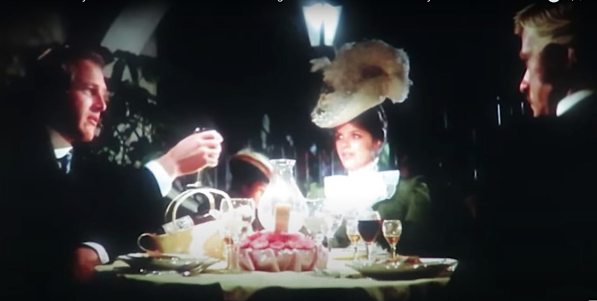
At Cambridge in the early 1970s, as a counterpart to my studies of Chinese culture (here, and here) and WAM, movies also made an important part of my education. At some remove from the arthouse European films that were all the rage was the outlaw movie

  • Butch Cassidy and the Sundance kid (George Roy Hill, 1969) (wiki; see also e.g. here).

Despite mixed reviews, the film soon became a huge hit. Besides Paul Newman and Robert Redford in the title roles, Katherine Ross appears as Etta Place, following her part in The graduate. She went on to star in the sequel Wanted: the Sundance woman (1976). And Hill used the Newman–Redford partnership again with The sting (1973), with a Scott Joplin soundtrack.

The soundtrack for Butch Cassidy and the Sundance kid (playlist) is by Burt Bacharach, whom I revere eternally for I say a little prayer. Robert Redford was not impressed by Raindrops keep falling on my head, sung by B.J. Thomas (“What the hell is that song doing in this film?”)—despite its wonderful major 7th leap:

A scene that undermines the pomposity of soundtracks in traditional Westerns is South American getaway, with the Ron Hicklin singers in fine form:

The disembodied audio is here, so as to focus on the musical artistry of the alternating zany and nostalgic passages, and that major 7th leap again (0.28, 3.18). They might have come up with more imaginative instrumental bridges, but hey. And this is clearly not the time for ethnographic study of musicking in Bolivia

Another scene that remains with me is “Can I move?”:

which somehow for me evoked Kyūzō in Seven samurai (rather than anything in the remake The magnificent seven), and now even reminds me of the importance of context in folk musicking

The shagbut, minikin, and Flemish clacket

Shagbut

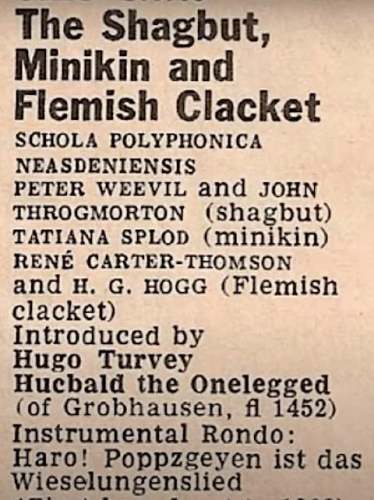
Following my April fools roundup, Nicolas Robertson (creator of the outstanding Anagram tales) fondly recalls a spoof on the Third Programme of BBC Radio, first broadcast in 1968:

The authentically po-voiced announcer’s introduction to the organological details of shagbut, minikin (played by Tatiana Splod), and Flemish clacket recall the mountweazel and the spoof entries of the New Grove dictionary of music and musicians.

Recreating early music does indeed require the modern musician to learn many unfamiliar techniques—a challenge that the pioneers of the movement were not always able to meet. These instruments have been obsolete since the early 16th century, “and of course there are those who hold the view that it would have been rather better if they had remained so”.

Bosch

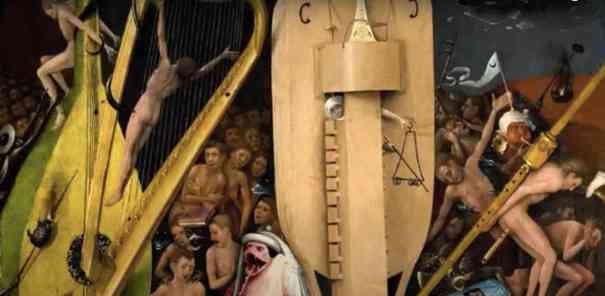
After tortuous preparation, eventually—and perhaps regrettably—the Schola Polyphonica Neasdeniensis is (almost) ready to perform the newly-discovered Haro! Poppzgeyen ist das Wieselungslied by Hucbald the Onelegged of Grobhausen. The YouTube illustration of Bosch is aptly chosen.

We apologise to listeners for the technical hitches in the performance. These were partly due to the fact that Mr Turvey and the Schola Polyphonica got stuck in the lift, actually…

Early music has provided a rich source of humour; from this index of WAM drôlerie, see e.g. Mein Gott, A Bach mondegreen, Early music put in its placeThe Mary Celeste, and A music critic.

I haven’t yet succeeded in finding the audio for another Radio 3 programme, first broadcast on April Fools Day:

Parenthesis

Extensive as the BBC Sounds archive is, this is a lacuna that begs to be filled, like Compton Mackenzie’s talk on his meeting with Henry James.

A paean to the fry-up, and the music of time

*Part of my series on Irish music!*

LNF

Ciaran Carson’s Last night’s fun is a constant delight—one of the great books about music (for more, see Carson tag).

The chapters are named after, and inspired by, the title of a particular Irish tune. In Boil the breakfast early Carson sings the praises of The Fry and depicts a fantasy of the perfect Belfast café.

If traditional musicians are engaged with constant repetition and renewal, infinite fine-tunings and shades of rhythms, variations on the basic, cooks are even more so.

He recalls the excitement of discovering the vocabulary for eggs in a New York diner:

A: How do you want your eggs?
B: Well… fried, I suppose.
A: What do you mean, fried? You want basted, over-easy, sunny-side up, over-hard, or what?

He soon graduates from the attractive-sounding but wobbly sunny-side up to over-easy. Indeed, “even the Irish fried egg has many schools of thought”. One thing always leads to another:

Then we engage the wider lexicon of “The Fry”, where the possibilities become Byzantine. Some exclude fried mushrooms or potatoes, say, from their definition of The Fry, as being side issues—distractions from the matter in hand. […] Sometimes I am attracted to the Puritan ideal of bacon and eggs, nothing more, nothing less. [For less, see here.]

By a meandering route involving two more tunes (The Kylebrack rambler and The Galway rambler, aka The Kylebrack), Carson recalls a story:

Then there was the café you always found by accident, above a haberdashery or alterations shop. The door that led upstairs was innocent of any label or description of the premises above. * You sat at the white-linen-covered table, and the table silver glinted with a sudden tang of memory; you knew you’d been here many times before. Waitresses in black stockings and little frilly caps appeared to serve you. There was a little scalloped butter-dish, silver slat and pepper cellars; toast came in a toast-rack. Besides the silver tea-pot was a jug of just-boiled water. The fry arrived on thick white wide-rimmed hot delph plates—“Mind the plates”, the waitress said, as she dished them out as if she were dealing cards. All the hands were flush: the famous Dublin Hafner sausages, the exotic Free State bacon, the coarse fat-spotted black pudding, the unctuous creamy texture of the white. The eggs wobbled and glistened their glazed orange yolks. […]

You sat at the window above the hum and buzz of the street below. At first you gulped and chewed and then decelerated as you realised that your hunger would be perfectly assuaged. Then you could eat contemplatively, picking bits and choosing bits you thought would make an interesting ensemble. You craned your neck occasionally like some astronomer, gazing downwards at the Milky Way of interweaving passing heads. The chinking noise of cutlery and crockery cut through the muted traffic noise. You pronged the last inch of Hafner’s sausage on to a tiny toast triangle that you’d custom-cut, and married it to the last remaining quarter of an egg yolk. You ate these morsels in one forkful. Then a gulp of tea. You settled back contentedly. An enormous cut-glass ashtray came from nowhere. Plates vanished, and you put your elbows on the table and lit up. The bill came in its own good time, unhurriedly. You looked with some amazement at the spiky old-fashioned Staedtler HB pencil-writing, quoting price current in the Fifties. You paid the carbon-slip. Then you descended to the mundane busy street. Absorbed into the crowd, you let yourself be taken by its flow, and became another corpuscle in its bloodstream.

We would spread the word about this last word of an eating-house. No-one ever found it, nor could we again when we determined that we would, because the universe is often stumbled upon by accident, or visualised in dreams. Only when the stars concur do we arrive. We stumble through the patterns of the Kylemore and the Kylebrack and we wander through the icons of the city, touching them in well-worn reliquary places. We are on a pilgrimage, and yet we do not know it…

We are fragile, and it is the morning after; rather, it is early afternoon, and we have settled in a dusty sunlit corner of the empty pub. Our talk is desultory till we think to play a tune, and we are all reluctant. Yet we start because we have to. And somehow, two bars into it, we sense each other’s playing in the way the Zodiac arrives at planetary conjunctions, and we can do more than play the pattern out. And though the stars, by now, are out of line with what they were two hundred years ago, we too have been moved, or have been moved to know that until now we had not played this tune. We did not know its beauty, nor had we realised the marks of other hands that knew it, and had passed it on to some they hoped would eventually manage to figure out its gorgeous shape. We repeat this same tune many times, and about the twelfth or thirteenth time, we know it’s time to stop, since we have gained a century in those few minutes of horology. Then we were like some watchers of the skies, or we had gazed at the Pacific for the first time, and we were silent as we contemplated time in all its mirrored constellations.

* * *

Boil the breakfast early is a reel, perhaps best known in versions by The Chieftains—here they play it live in 1981 at a BBC session:

And here’s John Whelan with friends in a medley opening with The Kylebrack:

Another title that reminded me of Li Manshan and Li Bin is Ask my father.


* Cf. my version of the touring musos’ fantasy. See also Health-food options, The Full English, and even, if it’s Daoist ritual yer after, Pacing the Void.

Perfection is NOT the word for it

Felix cover

A fine new addition to the ethnography of Western Art Music * is

The title alludes to Sir Claus Moser’s diplomatic backstage words to an ageing diva. Both wise and delightful, the book is generously laced with deviant orchestral stories, but it’s much more than that. The blurb hardly does justice to the serious wider issues that Felix covers:

Orchestral life in Britain is thriving and anarchic, in turns chaotic, hilarious, and brutal. ** Perfection Is NOT the word for it is a personal, and mostly affectionate, account of life amongst the extraordinary characters who lead their over-stressed lives in this unusual world, surrounded by music but driven by everyday anxieties, and always defying the best efforts of administrators, bureaucrats, and conductors to tame the unruly beast which is a professional orchestra.

Felix makes a most sympathetic narrator. An orchestral and chamber bassoonist of note (possibly top C, as in The Rite of Spring), he has the rare distinction of having graduated to the role of managing some of the leading early music bands that have shaken up the scene since the 1970s. So while orchestral musos tend to take a dim view of administrators, Felix has the advantage, or misfortune, to have straddled both sides of the fence; he adopts the “poacher turned gamekeeper” metaphor, and one thinks of the common transition from football player to manager.

Chapter 1 opens with a priceless, if harrowing, blow-by-blow account of his first encounter with Pierre Boulez in 1972 upon being summoned at short notice to dep for a rehearsal with the BBC Symphony Orchestra (his very first professional gig, to boot)—an ordeal which becomes ineluctably more excruciating. After this it may be hard to hear the divine slow movement of the Brahms 1st piano concerto with the same ears. Unlike the viola player singled out during a Mendelssohn rehearsal, Felix didn’t even manage a pithy riposte.

Although his ordeal at the hands of Boulez was exceptional, musicians are keen to get revenge on their overlords by maestro-baiting, of which we are treated to several examples. He also has some good instances of corpsing.

There are cameos from the renowned clarinettist Jack Brymer (an incident that precisely parallels one about the conductor Eric Leinsdorf) and the then rather less renowned Tony Pay (cf. this story). As on tour, and with my fieldwork in China (e.g. here), Felix delights in chains of stories. Alcohol, soon to be a pervasive theme of the book, enters the fray with the BBC’s principal horn Alan Civil—and one might add the wealth of stories about trumpeter John Wilbraham.

The pressures of touring were alleviated by excessive drinking. Felix pays tribute to the “sublimely gifted” violinist Alan Loveday, stories about whose travails with alcohol became legendary. On tour with the Academy of St Martin-in-the Fields (in which Felix played for fifteen years), conductor Neville Marriner had to lock Alan into his hotel room every evening—ensuring that he never once made it onto the concert platform, thus achieving “a feat that many musicians would think ideal, a tour without concerts”.
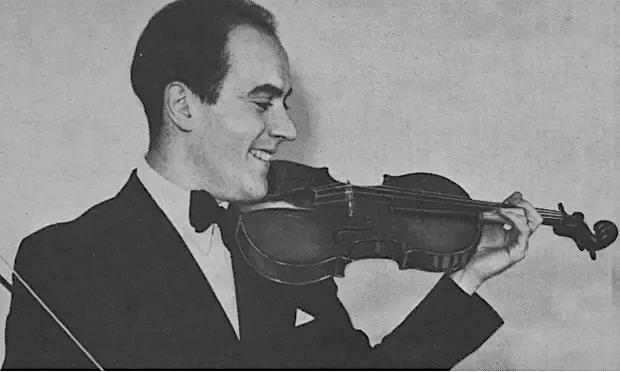
Loveday

Alan was a talented bridge player, a taste that Felix shared. ••• He eventually took the road to recovery. He was keen to take up period-instrument performance, but never got round to it—as Felix observes, “if sober, he could have brought great critical credibility to this new world”. Felix’s tribute to Alan’s eccentricity and deep love of music leads him to stories about the iconic Francis Baines.

After this heady introduction to the orchestral world, Chapter 2 “An Oxford overture” returns to Felix’s upbringing with a perceptive account of the “tremendous intellectual intensity” of the post-war years there. Second of five children, he was deeply grateful for his education at the Dragon School (“a culture of kindness, politeness, and humanity”, enriched by its bizarre collection of characters on the teaching staff). Less happy at Winchester, he managed to leave school at 16, with the support of his wise mother. In the holidays he attended National Youth Orchestra courses.

Reading between the lines, it must have been through the rational enquiry of his distinguished philosopher parents that he acquired a seriousness and vision that his initial career as bassoon player was unlikely to satisfy. Sitting in on their dinner parties, he also inherited their taste for wordplay.

In Chapter 3, suitably titled “Five in a bar” (which is quite drôle enough without venturing to Tchaikovsky, Brubeck, and Balkan folk music), Felix recalls his happy, if blurred, days in the Albion Ensemble, a wind quintet seemingly modelled on the Famous Five—making a welcome occasional relief from the fraught struggles of the orchestral world. Felix opens the chapter with the convoluted story of a live broadcast for US TV.

It was soon after this lamentable episode (perhaps even because of it) that the Albion Ensemble’s capacity for resilience and self-preservation came to the attention of the British Council.

The quintet was now despatched to “countries in which self-reliance and an ability to deal with the unexpected would be at least as important as giving concerts”. Their adventures began with a five-week tour of the Far East. In China they learn the perils of official banquets (inexplicably, the quintet’s minders didn’t think to introduce them to their counterparts among household Daoists in the north Chinese countryside). In South Korea their provincial travels are given an extra edge by having very little idea of where they were supposed to be when, or how to get there. The quest for alcohol becomes ever more compelling. In the Philippines they succumb in turn to a gory bout of food poisoning, as they pass a hospital bearing the name of “The Antenatal clinic of the Immaculate Conception”.

Chapter 4, “Trials and errors”, takes us to the early music movement (note the work of Richard Taruskin and John Butt), in which Felix played a major role both as player and manager. The 1980s were a golden age for London’s freelancers, stimulated by the new CD format, film sessions, and touring; still, Felix was feeling the fragility of freelancing, “a house of cards which could collapse at the slightest unfavourable gust”.

Inspired by the innovations of Harnoncourt, Leonhardt, and Brüggen, he now expanded into “period instrument” performance. We find erudite notes on reviving the French bassoon that had lost out to its German counterpart; and on pitch standards adopted by the movement (a=415 being a fair compromise for the wide range used in baroque times, whereas a=430 for the classical era was a concoction imposed by Decca at an Academy of Ancient Music meeting).

Felix spent a period on the Music Advisory Panel of the Arts Council, entrusted with the task of finding a niche for WAM in a diverse market, which gave him serious reservations about box-ticking PC and committees’ fear of elitism. I’m sure he could offer a detailed critique of my own argument in What is serious music?!; indeed, my global view is All Very Well, but promoters inevitably find themselves having to fight for their particular corner of the bazaar.

Meanwhile he took a correspondence law course. Felix and his wife Julie eventually mastered the invidious competition for adoption, learning to guess the expected answers to rigorous questionnaires.

In Chapter 5 Felix recounts the invention of the Orchestra of the Age of Enlightenment from 1985 (I was glad to learn that it was Chris Hogwood who coined its alternative name Age of Embezzlement). As Felix reflected,

London’s freelance musicians had achieved a remarkably dominant international position in period instrument performance but were now in danger of becoming stuck at their current level of (relative) mediocrity.

The various orchestras were closely identified with their founders (Hogwood, Pinnock, Gardiner, Norrington, and so on), but the pool of performers overlapped. “Our owners/proprietors were building international reputations based on the numerous recordings which we, the humble workers, had been making for them”. Meanwhile there was no platform in London for the great continental directors like Harnoncourt, Leonhardt, Brüggen, and Kujken; moreover, the scene, dominated by “semi-conductors” (in Norman Lebrecht’s fine term), was closed to “real” maestros from the modern symphonic world who might offer new insights into the repertoire, like Charles Mackerras (for whose splendid anagram, click here), S-Simon Rattle, and Mark Elder.

This led to the forming of a new orchestra that would engage its conductors, not the other way around. The financial challenge was daunting. But the success of Rattle’s concert performance of Idomeneo in 1987 led to an annual summer residency at Glyndebourne, and record contracts were soon secured. By 1988 Felix found himself managing the orchestra, negotiating projects with institutions like the South Bank Centre and the Proms while attempting to entice the busy continental maestros who had originally inspired him. 

Left, Frans Brüggen; right, Trevor Pinnock.

By 1993, amidst difficult decisions over the orchestra’s personnel, Felix had to resign. From 1995 he managed the English Concert, which he found himself having to re-invent, as described in Chapter 6. Under the benevolent Trevor Pinnock the orchestra had thrived, but their recording contract was soon to expire, and another identity crisis loomed. Whereas Felix’s challenge at the OAE had been to create a clear and sustainable identity after a frenetic set-up, here the issue was the mirror image: “how to create a new and exciting identity for an already-successful organisation in danger of being overtaken by younger competitors”. But, as he reflects, the two orchestras did have one thing in common: neither had any money.

The English Concert had a remarkable success in staging Haydn’s puppet opera Philemon und Baucis. Here Felix gives another nice aside on the history of marionette theatre in England and on the continent; and he notes the relatively recent tradition of orchestral string sections using the same bowings.

Felix wrestles with fiendish logistics for the US tour of the Brandenburg concertos. At post-concert receptions he finds himself in the role of grown-up, nervously observing the players’ antics, with which he is all too familiar. Organising a Matthew Passion tour around concerts in Spain presents further scheduling challenges. Much as we love the bars there (and I, at least, love the flamenco), travelling around is indeed gruelling, as a later “tour from hell” confirmed (for the steady erosion of touring, see note here).

AM&RP

With Trevor Pinnock retiring, and the inspired leader Rachel Podger also leaving, Felix was delighted to find the equally prodigious Andrew Manze to direct the band from the violin. Rachel and Andrew’s Bach double at the Proms is one of my most treasured moments; and on tour, apart from his inspired playing, while we were waiting at Chicago airport Andrew told me one of my very favourite stories, which you can find here.

But while Felix envisaged a return to baroque music, in which the English Concert had made its mark, Andrew was now keen to pursue the fashion for a later repertoire, as he began to set his sights on conducting. With the 2008 recession causing further problems for festivals and promoters, Felix moved on again. Meanwhile his swansong on the bassoon came when he too achieved the ideal of appearing in an orchestra without having to play in it, miming in costume for a TV re-enactment of Handel’s Water music in a barge on the Thames. ****

Chapter 7, “Double bar: when the music stops”. After leaving the English Concert, Felix worked to find funding for some other projects—including an unfulfilled plan to restore the Notting Hill Coronet cinema to its original function as a music theatre. The building turned out to be owned by the Elim Church, whose largest congregation was at the Kensington Temple nearby—prompting another fine graffiti story. But by this time Felix was seeking a path away from the world of music. Having long served on the Music Advisory Panel of the Radcliffe Trust, he now joined the board of trustees, soon becoming chairman, still devising new projects. Again he offers thoughts on the bureaucratic dangers of the “Age of Regulation”. *****

It’s such a pleasure to read Felix’s memoir, by turns revealing, wise, and hilarious—sometimes all at once. Rush out and buy this book!


* Note e.g. Christopher Small’s Musicking, and Bruno Nettl’s Heartland excursions; see also Professional music-making in London (Stephen Cottrell); and for New York, Mozart in the jungle (Blair Tindall). Cf. Deviating from behavioural norms (links there including the kangaroo and sardine stories; more in the WAM category under “early music” and “humour”), and Alternative Bach.

** For punctuation nerds: as is my editorial wont, I supply the Oxford comma in such lists—all the more suitable given Felix’s background (albeit depriving us of the pleasures of formulations like “I would like to thank my parents, Jacob Rees-Mogg and Madonna”).

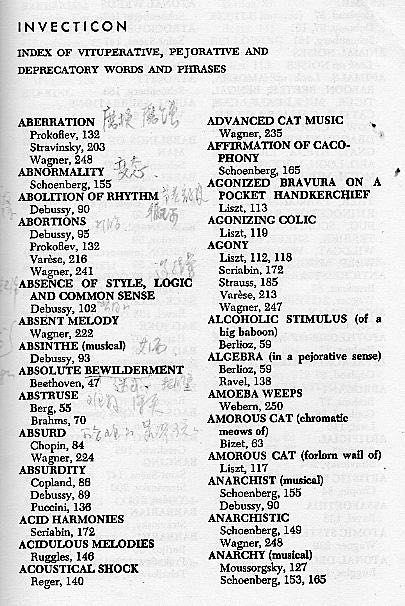
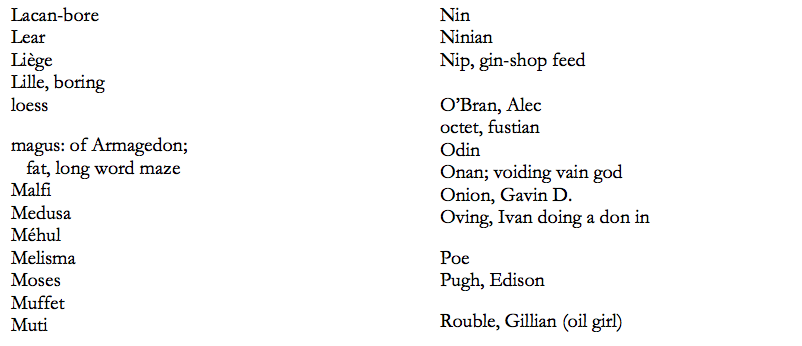
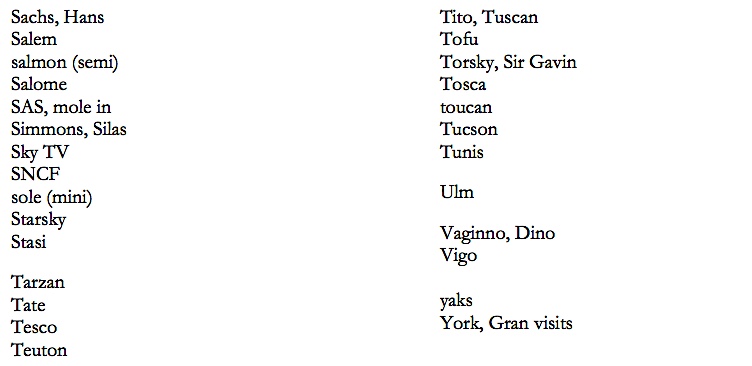
While I’m here, the absence of an index is most regrettable (see The joys of indexing). I hereby provide a sample, should my services be required for a future edition (cf. my draft index for Nicolas Robertson’s magnificent anagram tales, and even that for unlikely place-names to find in a blog dominated by Daoist ritual):index 1
index 2
*** Bridge made another pleasurable pastime for musos on tour, playing on the back of a bus, and at airports—again suitably lubricated by alcohol. As Felix has learned to his cost when I partner him across the baize, my bidding skills are far inferior to his; month after month he patiently talks me through the fiendish opening bid of the multi 2 diamonds, knowing full well that I’m never going to get the hang of it (cf. A grand slam). You gather, of course, that my review of this book is informed by having played a minor role (again, allegedly, not always entirely sober) in many of the musical débacles that Felix evokes.

**** In my own early days depping for the BBC Symphony Orchestra, they would occasionally find they had booked too many extras, so they had to pay me not to play the violin—which, as my colleagues would agree, was most worthwhile (cf. “We are very lucky that your violin was broken”).

***** In a Coda from early 2018, Felix explains in apparently rational detail his support for Brexit—a choice that mystified most of his friends (cf. The C-word). Instead, here his readers might prefer a survey of changes since the 1960s to the hand-to-mouth existence of orchestral players (for whom Brexit is the latest disaster), and the gradual transition from the “knit your own yogurt” ethos of the early pioneers to a more polished “Chanel No.5” style—an account that he would be well placed to write.



My World Cup debut thwarted

Stadium

A sporting variation on the musician’s recurring dream:

Out of the blue, I’m summoned to join the attacking lineup in England’s “bid” (As They Say) for the football World Cup. Everyone seems to consider this fair enough—even though in the dream I am my real age now, no longer a sprightly youth. After brief, jovial greetings from Raheem Sterling and Wayne Rooney, I suppose I’m expecting a bit of team training, some practice to slot me into the manager’s master-plan—but there’s no time for any of that. Anyway, how hard can it be?

So after making my way—entirely alone—to the stadium (possibly the Nou Camp in Barcelona), I find myself adrift in the labyrinthine changing rooms, which seem to be full of a motley crew of podgy kids from amateur teams. I wander around frantically trying to locate a room for the England team, and to find the team kit. With time getting on, I look up to see the clock fast approaching the 8pm kick-off, and over the tannoy I hear the sound of the national anthems prefacing the match. Still dressed in my everyday garb, I search desperately for the way onto the pitch.

As usual, I woke up before the dénouement.

Unqualified, ill-prepared, running out of time, wrong uniform, lost—precisely the traits of my dreams as a musician. There’s not even any great anxiety involved: the path to failure unfolds with “all the inevitability of Greek tragedy”.

For a similar dream involving Iga Świątek and Stravinsky, see Ogonek and Til. Cf. somewhat less dystopian fantasies on Lisbon, Mozart opera (note the Larson link!), and Tibet. See also From the archives.

Women in early Irish music

*Part of my series on Irish music!*

Kenny

Before the 1970s, women’s role in the transmission of traditional Irish music was only sporadically on public display. This lacuna, common around the world, is made good in

She went on to develop these themes in her book Trad nation: gender, sexuality, and race in Irish traditional music (2020).

Focusing on the period from 1890 to 1970, Slominski returns women to the historical narrative by exploring the “disjuncture between the documented public activity of women traditional musicians in early 20th-century Ireland and their subsequent erasure from the narrative of Irish traditional music history” (I gave a succinct introduction to studies of gender and music under my second post on flamenco).

In Irish music a few such women “were visible nationally or internationally, and tend to be remembered as extraordinary rather than exemplary”; many others were once known but have since been mostly forgotten outside their families and immediate communities. A third category was “an unknown and possibly significant number of women musicians [who] occupied social positions that rendered them invisible to the musical public sphere”. And a fourth included the “second-degree visibility” of mothers remembered as tradition-bearers whose names now appear mainly in connection with their sons.

Encoded in these categories is an unspoken assumption that traditional music’s historical gaze still belongs to male musicians. With rare exceptions, Irish traditional music’s texts have all been written by men, and the brain trust of the tradition still rests with its “gentlemen scholars.” Thus, nearly all the accounts and recordings we have of pre-1970 women musicians come from male authors, interviewers, and collectors.

Idealised women commonly appear in the media of the day as metaphors for the Irish nation:

Personifications of careworn Mother Ireland and long-tressed Erin linked homeland and hearth, and invariably cast the nation’s men in the roles of hero, protector, and dutiful son.

More promising are the biographical profiles by Francis O’Neill in Irish Minstrels and Musicians (1913), even if he still largely conforms to the feminized personifications of the nation.

Slominski cites Habermas’s distinction between the “public sphere” (a forum for the shaping of state policy) and the “public” activities of the street; indeed, the public house was the domain of men.

The fiddler Bridget Kenny (“Mrs”) was daughter of piper John McDonough. In O’Neill’s account:

 Devotion to art does not appear to have unfavourably affected the size of Mrs Kenny’s family, for we are informed she is the prolific mother of thirteen children. Neither did the artistic temperament on both sides mar the domestic peace of the Kenny home, and, though the goddess of plenty slighted them in the distribution of her favours, have they not wealth in health and the parentage of a house full of rosy-cheeked sons and daughters, several of whom bid fair to rival their mother, “The Queen of Irish Fiddlers,” in the world of music.

Alas, I can’t set much store by the 1898 recording here, billed as her playing The high road to Galway—surely the playback speed is far too fast, and the pitch correspondingly too high?!

From a poor family, Mrs Kenny became a street musician, an “urban busker”. But O’Neill also stresses her success in music competitions. Her talents were recruited by the nationalist movement.

The dominant narrative held that pipers—whether common men or gentlemen—had once been respected members of society, but that the occupation and its practitioners had fallen into disrepute.

O’Neill again, describing the period following the great famine:

Changed conditions, lack of patronage, and other well-understood causes, forced this class of minstrels, many of them blind, to take to the highways for support—a form of mendicancy which brought their once honoured calling into disrepute.

A 1912 story:

The poverty-stricken piper became an object of contempt, and the contempt was naturally extended to his instrument, the cause of his indigence. It is only a few years since a friend of mine, a good fiddler, who expressed an intention of learning the pipes, was told by his relatives that if he did so disgrace himself he need never show his face at home again! Small wonder that the pipes ceased to be generally played just as the language ceased to be spoken and so many of the old customs to be observed! The race of “gentlemen pipers” had died out and no respectable person would touch the instrument.

If social disapproval fell upon men who made a living from playing the uilleann pipes (cf. shawm bands around the world), it was much worse for the women who did so from “dire necessity”, often after being widowed early. Among instances cited by O’Neill are Mollie Morrissey, May McCarthy, and the blind Nance the Piper.

By the early 20th century, piping was becoming a somewhat more respectable occupation for women, mainly by virtue of nationalist rhetoric.

Cultural nationalist beliefs in the early 20th century helped create an environment in which some parents allowed their daughters to learn the uilleann pipes, teachers agreed to teach them, and some newly-formed pipers’ clubs allowed women members.

Morrissey and McCarthy are portrayed as “young, graceful, and mild-mannered”. This account comes from 1905:

I give you an interesting portrait of Miss Mollie Morrissey of Cork, fideogist [player of the tin whistle?], harpist, pianist, violinist, bagpiper and stepdancer, at the age of fourteen. I venture to say that not many Irish colleens can boast of such a long list of accomplishments, but such are the attainments of this little girl, whose charming and unassuming manner has endeared her to all who know her. She is the youngest and most proficient female piper in Ireland, playing the famous Irish melodies with great expression, and is also a correct exponent of dance music. [….] The clever little artiste is decorated with many medals, won at competitions in piping and step-dancing, and at last year’s Oireachtas she carried off first prize in female hornpipe dancing from all comers, her graceful carriage and movements combined with precision being much admired. [….] Miss Morrissey got a special invitation […] to attend a reception during Pan-Celtic week, which she could not accept on account of being indisposed at the time.

As Slominski observes, her role here is merely to decorate the public practice of Irish cultural nationalism.

Unlike his accounts of male musicians, in which he uses nouns like “piper”, “fiddler”, “musician”, and “composer”, O’Neill’s profiles of these two women pipers rely on words like “learner”, “artiste”, “performer”, and of course, “daughter”, “girl”, and “colleen”.

For such women, even as they depended on musicking as an occupation, music was portrayed as a mere “accomplishment”, an accessory. This at least made them seem less threatening. “By considering a women’s musicianship peripheral to her identity, any expectation that she would continue playing through her adulthood was removed”—although they often did.

Farr

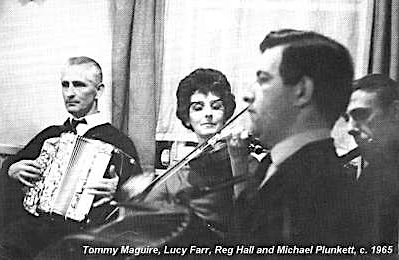
Finally Slominski contrasts the lives of Galway flute-player Mary Kilcar (c.1890–?) and fiddler Lucy Farr (née Kirwan, 1911­–2003). Mary’s playing was confined to the household, while Lucy took part in public musicking quite late, after reconnecting with her musical upbringing.

Mary was a spinster (as one said then) who lived with her sister. Their background seems to have been comfortable, and Mary may have had some formal education in music.

As a single and ageing woman in the socially conservative years of the Irish Free State, Mary would have been symbolically invisible: she was neither a mother nor a maiden in a society whose metaphors of nation defined the behaviour and aspirations of real women. However politically and rhetorically invisible, Mary’s position as spinster was legible within rural Irish society. The combination of her musicianship and her marital status, however, was not.

In a 1987 interview, Lucy recalled:

And there was a lady in the next village, and her name was Mary Kilcar, and she would be—when I was 20, she’d be about 40, and she played a flute, and—though she was never part of the scene in my young days— she never—women didn’t come down into the houses where the men were. You’d hear Mary Kilcar playing the flute inside in her own house, but you’d never see her in any house where there was music. And so one day, I was walking around, and I knocked at the door. “Oh!” she said, “Lucy Kirwan! Come in!” “Well,” I said, “I’ve come in because I’m playing the fiddle, and we’ve all heard you playing outside, but you never come to our neighborhood dos.” “Oh,” she says, “They wouldn’t have women—they wouldn’t at all them dos.” I said, “Well, we do, I do.” “Ah, but you’re living in the house where it is. I couldn’t, I couldn’t do that.”

As Slominski comments,

Lucy’s status as maidenly daughter of a musical father placed her, a future tradition bearer, on the receiving end of borne tradition. As a spinster, however, Mary was a transmissive dead end. […]she does not fit into the category through which most women musicians of her generation are remembered: as mothers who pass tunes down to their sons. […] For single women like Mary Kilcar, bodies out of reproductive circulation also meant tunes out of circulation.

Lucy moved to London in 1936, and after her marriage she only re-engaged with the music of her youth from the late 1950s (see this fine article). Although she enjoyed greater access to the musical public sphere than Mary, even in comparatively progressive London in the late 1960s she too described the discomfort of going out to sessions alone.

* * *

Lucy Farr mentioned sessions with the fiddler Julia Clifford (1914–97: wiki, and here), who also moved to England:

Another musician who moved to England in the 1950s was the Irish traveller Margaret Barry (1917–89), a singer and banjo player. Here’s She moves through the fair:

and the first part of a documentary:

Now I’d like to learn more about early women harpers, singers, and dancers, and the challenges they faced.

Click here for Séamus Ennis playing the uilleann pipes and telling an almost related story. For Scottish pibroch, click here.

Mahler swings!

Adagietto 1

Adagietto 2

I yield to no-one in my veneration for Mahler 5, some great renditions of which I’ve provided here—irreverently introduced by a version of the symphony’s opening trumpet solo on rubber chicken…

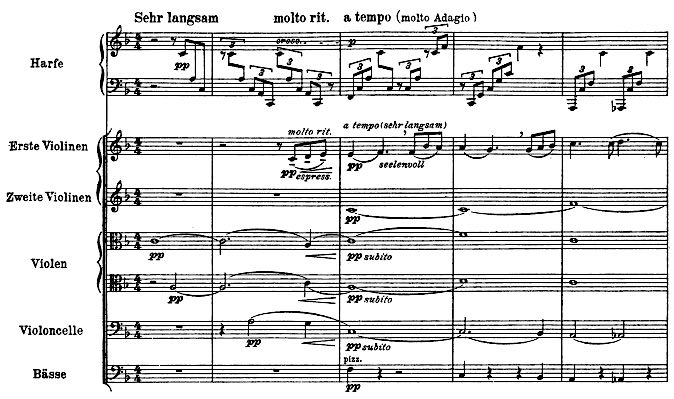
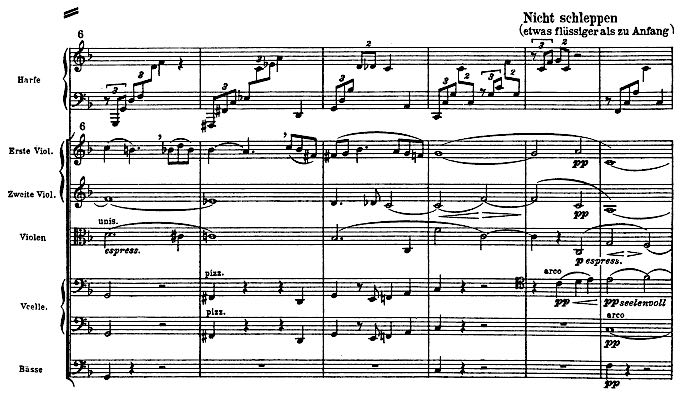
In distressingly similar vein, I’ve just had a vision of how Mahler might have revised the sublime Adagietto had he lived through to the 1930s (as he should have done) to arrange it as a catchy up-tempo number for a New York swing band, with blaring horn section (led, perhaps, by Buck Clayton) and zany syncopations, largely dispensing with the sentimental appoggiaturas.

So here’s my preliminary draft of the melody on horns, leaving you to fill in the boogie-woogie bass-line, drum-kit, and funky sax harmonies—it works even better with the hushed original opening bar and a half:

Adagietto swing

Actually, Mahler’s choice of key works well for jazz winds, making one suspect that the original was just a preliminary sketch—after all, if you’re writing a slow love song for strings, whoever would plump for F major rather than E major or F♯ major?!

As to tempo, one might regard the two versions of the Adagietto as the opposite of what happened to the music of the Tang court after it was exported to Japan, where it began a long process of retardation.

Resting caseThe big-band arrangement would also suit a turbo-charged Balkan brass band like Fanfare Ciocârlia. I can’t take responsibility for my wayward visions, but I realise WAM purists (bless) may be alarmed. Conversely, composers from Bach to Mahler did often creatively recycle their previous work. Bach has inspired a wealth of jazz and world arrangements; and folk and popular musics were intrinsic elements in Mahler’s sound world (see e.g. under the 4th symphony). I rest my case.

As I observed with reference to the musician’s fantasy of performing Always look on the bright side of life as encore to the Matthew Passion, we come to accept such cognitive dissonance. Or at least I do.

Not merely as an attempt to redeem myself, now we must go back to Mahler’s original version—within the context of the whole glorious symphony. I’m also constantly amazed at the second movement, its turbulent trauma punctuated by the hushed cello recitative.

You can find links to my series on Mahler here—extending to chamber arrangements and Mahler’s own piano rolls. Among many movies that incorporate the Adagietto, do watch Tampopo! And here’s a roundup of my series on jazz. For the “Ming-dynasty bebop” of the Hua family shawm band in China, with A/V and analysis, click here.

Yet another Peak Week for British shame

Three shameful recent incidents in British politics.

Just when we thought Bumbling Boris could stoop no lower in plumbing the darkest depths of crass insensitivity, he goes and compares Ukraine’s heroic resistance to invasion with the freedom-loving spirit of Brexit.

Poroshenko

Most incisive was the riposte from former Ukraine president Petro Poroshenko, fighting for the very survival of his country. As was observed on Twitter, Brexit does indeed have something in common with the invasion of Ukraine—both being funded by Putin.

BoJo

The day that Boris Johnson’s government showed their compassion for people less fortunate.

What’s more, whereas in other countries the warm welcome for Ukrainian refugees is inspiring—

and indeed, ordinary British people have also shown such humanity—by contrast, the UK government (éminence grise Priti Patel) is living up to its reputation, still doing its utmost to put hurdles in the way of refugees.

Nazanin

In these terrible times, the release of Nazanin Zaghari-Ratcliffe from six years of captivity was a rare moment of rejoicing. But soon she had the temerity to open her mouth, prompting a deluge of sexist and racist abuse—from both Tory politicians and their hangers-on (analysis here). In response, Marina Hyde wrote trenchantly as ever:

Are you a man who’s got a massive view about how a hostage should behave after a lengthy incarceration? Are you 90% throbbing forehead vein? Do you like your prison victims pliant, and super-obsequious about having spent pretty much their young daughter’s entire life as the cell guest of a theocracy? If so, we really, really want to hear from you! […]

Down the phone lines and across the internets, many people are simply not happy with Nazanin Zaghari-Ratcliffe’s failure to react to her belated release like she’s just won Miss World in 1957. You know the playbook: deeply indebted tears at a flow volume that won’t disrupt the mascara; silence broken only by a pledge to work with children and animals. British children and British animals, just to be on the safe side. […]

And yet, having spent a lot of time at her press conference yesterday thanking a large number of individuals and organisations who played a part in her eventual release, Nazanin did mention the fact it took just the five successive foreign secretaries before something repeatedly promised to her actually happened. […]

isn’t the whole point about liberating someone from the clutches of some backward theocracy that you don’t immediately then go and tell her to know her place?

And this spoof from the splendid Michael Spicer also hits the spot:

I just think… you need to show a little bit of gratitude to the people who let you come over ‘ere.
Back over here. […]
And why does she look so healthy, by the way? Hostages are supposed to be malnourished and upset—she was glowing and articulate. How do you know she wasn’t just sunning herself for six years, having a jolly? I just think you’ve got to do things in a more British way when you come over ‘ere.
Come back over here.

Even Boris felt obliged to defend Nazanin, despite his form with prolonging her incarceration.

More under my roundup of posts on Tory iniquity.

Ding without dong

À propos household appliances, I’ve already regaled you with the saga of my ancient fridge. Now, in another of those “hideous encounters with domestic necessity“, my trusty doorbell is on the blink.

It hasn’t worked for months, even when I imaginatively changed the batteries; so in the absence of a sturdy knocker (cf. Horatio E. Brown, Some Venetian knockers), my rare visitors have been reduced to beating vigorously on my door. Now, working diligently with a fine array of tools, my fine neighbourhood handyman has managed to reinstate the ding, but I still find myself without dong. It makes me feel better that it wasn’t just that I put the batteries in the wrong way round.

Examples I’ve heard of the ding-dong (not to be confused with the polemical ding-dong, nor with Dang in Gujarat and Korea—nor indeed with Dingding, Chinese for Tintin, or Doof-doof) all seem to be standardised at the same pitch, concert F♯–D:

Conditioned by long experience, on hearing the ding one’s ears eagerly anticipate the dong. Thus I can’t help hearing the first pitch as a mi, looking forward to a resolution on do (“do, a note to follow mi“—see Solfeggio). If the first note were a single pitch devoid of social history, one could perfectly hear it as a do, or indeed any other pitch degree.

Brahms 4The two-note motif could be any major third, actually: I doubt if anyone hears it as ti–so or la–fa, or even the fifth and third of a minor triad, as at the opening of Brahms 4—but once my second note is restored, I’m going to have a jolly good try to hear it that way. Were I an Inuit hunter (yeah right), the motif would have its own associations (looks around for doorbell on igloo).

* * *

If you’re really at a loose end (and currently for me this serves as a welcome distraction from trying to get to grips with ritual theory, with all its “redemptive hegemony flapdoodle), the doorbell has an interesting history. Or at least a history. As Wiki helpfully explains, it’s

a signalling device typically placed near a door to a building’s entrance. When a visitor presses a button the bell rings inside the building, alerting the occupant to the presence of the visitor.

Thanks for that, wiki (it’s even funnier, with a link defining the word “door”—”a hinged or otherwise movable barrier that allows ingress [entry] into and egress [exit] from an enclosure”). The article goes on:

William Murdoch, a Scottish inventor, installed a number of his own innovations in his house, built in Birmingham in 1817; one of these was a loud doorbell, that worked using a piped system of compressed air. A precursor to the electric doorbell, specifically a bell that could be rung at a distance via an electric wire, was invented by Joseph Henry around 1831. By the early 1900s, electric doorbells had become commonplace.

Bell-pulls

Before electrical doorbells, large houses and estates often had complicated mechanical systems to allow occupants of any room to pull a bell pull and ring a bell at a central bell panel in the staff quarters, to summon a servant.

Note the operative word there (cf. All things bright and beautiful).

Bell pull cartoon

James Gillray, 1804.

Irresistibly evoking the capacious household of the baffling Jacob Tree-Frog, aka The Haunted Pencil or Minister for the 18th century,

bell pulls may be used to summon workers in homes of people who employ butlers, housemaids, nannies, or other domestic workers, [who] and often have a tassel at the bottom.

Owl's bell pull

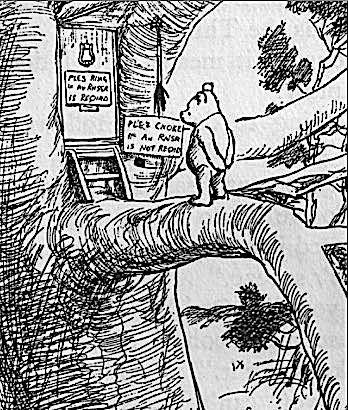
English readers of a certain age may also associate the bell pull with Eeyore and Owl.

Of course, more artsy sounds have been developed. I’m reminded of Helen Rees’s fine aperçuDoorbells play muzak when pressed”.

Zeng Houyi bells

Indeed, you may recall that I rejoice in the sonorous Chinese surname of Zhong 鐘, “Bell”. Picture a domestic scene in Hubei in the 5th century BCE: whenever someone popped in for a chat with the Marquis Yi of Zeng over a pot of tea and a macaroon, a slave had to notify his master by striking the relevant bell of his immense set of bianzhong with a wooden mallet. Fortunately, of the sixty-four bells, only one is required to create the ding-dong, as each was ingeniously designed to sound two notes a third apart!!!

See also Cowbells: Mahler, Messiaen, and Bill Bailey.

Cultural Revolution jokes

CR jokes cover

While there’s an abundance of collections of satirical stories from around the Soviet bloc (see Hammer and tickle, with further links), I’ve noted the general neglect of the rich seam of subversive Chinese jokes debunking the Maoist decades, and indeed the following reform era. Serving as an outlet to defuse genuine distress, they constitute a major resource for understanding the “sentiments of the people” (minqing 民情).

In a substantial recent post on David Cowhig‘s useful website, he rounds up some fine Chinese sites for modern political jokes—notably this and this. He classifies them under headings such as Gang of Four jokes, dialect jokes, sex jokes, extreme political rituals, and historical revisionism. * Among David’s links are a site for Jiang Zemin and Li Peng stories, with more on the latter here (roughly translated here)—for some choice Li Peng stories on my own blog, click here, here, and here.

Admittedly, some of the stories are for the specialist and are hard to translate effectively, hinging on arcane Chinese puns. This one is worth bringing out when adopting the popular slogan jinburuxi 今不如昔 “things ain’t what they used to be” (as does Li Manshan at the end of my portrait film, from 1.19.20):

One evening the production team held a general meeting, and according to the instructions of the county committee and the commune, the old production-team leader expected the members to severely criticise the reactionary fallacy that “the present [jin] is not as good as the past [xi]”. But all evening no-one spoke up, because everyone felt that the present was indeed not as good as the past, so what was there to criticise? The old team leader had no choice but to prompt everyone: “How can the present be worse than the past? How much does gold [jin] cost a catty? How much does tin [xi] cost a catty?” So commune members came out with their criticism: “What a load of bollocks—of course gold is more expensive than tin!”

生产队晚上召开大会,老队长根据县委和公社的指示,要社员们狠狠批判“今不如昔”的反动谬论。可是开了大半夜,没有一个人发言,因为大家都觉得的确是今不如昔嘛,怎么批判?老队长没有办法,只好启发大家说:“怎么会今不如昔呢!金子多少钱一斤?锡多少钱一斤?”社员们一听,纷纷批判:“真是胡说八道,金子肯定比锡贵嘛!”

This related anecdote also links up with Tian Qing’s wonderful story:

There used to be a famous restaurant called Da Sanyuan in Changdi, Guangzhou. During the Cultural Revolution, it was ordered to change its name to Jin sheng xi 今胜昔 [The Present Beats the Past]. When Hong Kong or overseas compatriots came back to Guangzhou, reading from right to left in the traditional manner, they read the name as “The Past Beats the Present” (昔胜今). So they didn’t know whether they should enter the restaurant.

从前广州市长堤有一间众人皆知的著名酒家 “大三元”,文革中被勒令改名为“今胜昔”。而香港或是海外侨胞回广州时,都按旧时从右到左读法,便把 “今胜昔” 读成 “昔胜今”。搞得他们不知道进去好还是不进去好。

Two stories on blind obedience:

During the Cultural Revolution, there were often mass criticism meetings. One day someone’s father was dragged up on stage and criticised. At the end of the meeting, he was asked to shout slogans to make a clean break with his father and draw a clear line between the two of them. He rushed to the front of the stage and shouted with his arms held high:
“Down with my father! Down with my father!”
At this point the crowd joined in, jumping up and raising their hands, yelling :
Down with my father! Down with my father!

And

The work unit held a meeting to criticise Lin Biao and Confucius. A tenor and a soprano got on stage to lead the audience in chanting slogans:
(leader) “Down with Lin Biao!”
(crowd) “Down with Lin Biao!”
(leader) “Down with Confucius!”
(crowd) “Down with Confucius!”
(leader) “Harshly criticise ourselves and restore propriety!”
(Crowd) “Harshly criticise ourselves and restore propriety!”
After the slogans, there was a brief moment of silence before the leaders spoke. Just then, old Zhang from the communications office rushed out backstage and shouted to the leaders seated on the podium:
“Phone call for Director Wang!”
So the whole crowd followed him by chanting:
“Phone call for Director Wang!”

Just like “Yes! We’re all individuals!” in The life of Brian:


* More generally, in The joys of indexing (a zany read, not least for introducing the Lexicon of musical invective) I outlined some of the main themes among my “Chinese jokes” tag in the sidebar:

Sihanouk

Stories of Prince Sihanouk visiting China, an intriguing sub-genre.

Magic: the ashtray trick

Ashtray
Source.

In the Good Old Days when smoking was compulsory in restaurants, I used to be spellbound by the waiter’s ashtray trick. *

The waiter approaches the table, covers the old ashtray with a clean one (upside-down, to boot), picks them up together, and whisks the old one away while placing the clean one (now the right way up!) on the table with a triumphant flourish.

It may not sound like much, but its trompe-l’oeil was always a mystery that captivated me, a kind of magic. Like sonata form, some might prefer not to analyse its technicalities, and indeed I’ve only just worked it out. I recall admiring it mainly in Greek and Italian restaurants, but it’s clearly part of the urbane waiter’s general repertoire. The smoking ban hasn’t quite rendered it obsolete—now it can serve for an ashtray holding olive stones and pistachio shells [I beg yer pardon?The Plain People of Ireland].

I wonder who invented the trick. For the most artistic result, identical ashtrays are de rigueur, and since the device itself only became popular in the 20th century, it clearly can’t be credited to Socrates or Confucius, for a change. If only someone had documented early experiments; it’d make a great Tommy Cooper routine. I like to think of young trainees placing the new ashtray on top of the old one, picking them both up, and then nonchalantly replacing the old one on the table; or placing the old one upside-down over the new one, which is then put back on the table, still full… **

I imagine a handsomely-funded research project documenting the trick’s gradual diffusion around the world.

Thinking as usual of the Li family Daoists, Wu Mei hasn’t yet worked it into his routine for the afternoon of funerals (my film, from 42.52). Nor does it appear to have been in the skill-set of Julie Walters:

See also The wonders of juggling; and for more waiter jokes, click here and here.


* For punctuation nerds, Wiki helpfully tells us that the one-word unhyphenated form “ashtray”, rather than “ash tray” or “ash-tray”, didn’t come into common use until 1926.

** My fantasy here must be inspired by Woody Allen’s early “Yes, but can the steam engine do this?” (The New Yorker, 1966; included in Getting even, 1971). Some highlights:

It was just another item in one of those boiler-plate specials with a title like “Historagrams” or “Betcha Didn’t Know,” but its magnitude shook me with the power of the opening strains of Beethoven’s Ninth. “The sandwich,” it read, “was invented by the Earl of Sandwich.” Stunned by the news, I read it again and broke into an involuntary tremble. My mind whirled as it began to conjure with the immense dreams, the hopes and obstacles, that must have gone into the invention of the first sandwich. My eyes became moist as I looked out the window at the shimmering towers of the city, and I experienced a sense of eternity, marvelling at man’s ineradicable place in the universe. Man the inventor! Da Vinci’s notebooks loomed before me—brave blueprints for the highest aspirations of the human race. I thought of Aristotle, Dante, Shakespeare. The First Folio. Newton. Handel’s Messiah. Monet. Impressionism. Edison. Cubism. Stravinsky. E=mc²…

1741: His first completed work—a slice of bread, a slice of bread on top of that, and a slice of turkey on top of both—fails miserably. Bitterly disappointed, he returns to his studio and begins again.

1745: After four years of frenzied labor, he is convinced he is on the threshold of success. He exhibits before his peers two slices of turkey with a slice of bread in the middle. His work is rejected by all but David Hume, who senses the imminence of something great and encourages him. Heartened by the philosopher’s friendship, he returns to work with renewed vigor.

1750: In the spring, he exhibits and demonstrates three consecutive slices of ham stacked on one another; this arouses some interest, mostly in intellectual circles, but the general public remains unmoved. Three slices of bread on top of one another add to his reputation, and while a mature style is not yet evident, he is sent for by Voltaire.

Wacky headlines: a roundup

Bake Off

With the headlines tag in the sidebar already so voluminous, here’s a handy roundup of some of my favourite posts there. After we’ve digested Kate Fox’s insights on headline punning, I propose

cliché

From the Mystic East:

Boris

Others from my own “pen”:

Irreverently,

There are also hours of harmless fun in the “crash blossoms” archive of languagelog.

And I can now offer a recent headline from the Istanbul Bugle, of which I am proprietor and sole contributor—describing the confusion of the Orthodox priest responsible for throwing the Epiphany cross into the Bosphorus, yet unable to locate the incense for the thurifer:

Cross Toss Boss Joss Loss

A stammering Byzantine Iconoclast

Left, cell where Methodios was imprisoned; right, Michael the Stammerer.

In classic guide-book lingo,

No visit to [Istanbul] is complete without a visit to [the Princes’ Islands].”

So we took a pleasant boat trip to the Islands (Adalar, as they’re called with casual familiarity) in the Sea of Marmara just south, long home to Greek and Jewish communities. The jaunt introduced me to the Byzantine (and byzantine) story of Michael II (770–829), who rose through the military ranks to become emperor, continuing the Iconoclastic movement. It was in a dingy dungeon on the island of Burgazada (Antigoni) that he imprisoned St Methodios. As described by Edwin Grosvenor,

In 821 Michael the Stammerer became emperor. Having attained the throne by assassination and violence, he was naturally fitted for the role of bigot and persecutor. With fanatic ingenuity he devised new tortures for the adherents of the icons. Methodios was recognised as their most learned leader. The emperor ordered that he should be struck gently seven hundred times with a whip. The prolongation of the punishment was the refinement of its cruelty. Then, unconscious and apparently lifeless, Methodios was thrown, together with two murderers, into a deep pit at Antigoni. Bread and water were let down daily through an opening above. When one of the murderers died, his decomposing body was left in the pit to render the horrid pit still more revolting. Meanwhile Methodios worked day and night to convert the survivor. Michael died after an eight years’ evil reign, and his son Theophilus succeeded, as iconoclastic but less inhuman.

Methodios was eventually released under Theophilus, but was publicly scourged and imprisoned again before becoming the emperor’s inseparable companion.

Antigoni

The island of Antigoni (Burgazada).

Anyway, although it’s good to know that Michael’s im-p-pediment didn’t im-p-pede his career, he transpires not to be a great role model—it just goes to show that not all stammerers are reticent and benign… But at least I can now add him to my list of famous stammerers from Moses to Marilyn Monroe, and from Deng Ai to Gu Jiegang.

My Turkish vocabulary has hitherto been limited largely to the word inziva “recluse”, some obsolete Ottoman musical instruments, and terms for segments of the Bektashi–Alevi cem ritual—none of which get me very far when I’m trying to ask for a tube of toothpaste (cf. here). But it has increased with the pleasingly onomatopoeic kekelemek, “stammer”—opening with a fiendish double plosive. For some more staggeringly inappropriate vocabulary, see Language learning: a roundup, notably That is the snake that bit my foot. Cf. Pontius Pilate, and the mad jailers.

Jesus of Benfica: a cautionary tale

*Guest post by Nicolas Robertson
—author of the magnificent series of anagram tales, no less*

Jorge Fernando Pinheiro de Jesus (which could translate as Jesus’s Christmas tree)—naturally known as Jesus, or, to distinguish him, as Jorge Jesus. Born 24th July 1954; prolific Portuguese midfield football player, and subsequently manager, much-remarked-upon hairstyle. Seventeen years as a professional player from 1973 to 1990, when he switched to a managerial career, so at 36 years old (three years later than his homonym).

His teaching life has lasted as long again, but has not been without turmoil. I first became aware of him during good days in his first stay at Benfica (2009–2015), headlines such as “Jesus is very content with his eleven”. One appreciated his constructive use of language: “For me, a manager has no past nor future, he only has past”, “What was Benfica before me?”, “The manager has to see things that no one else sees”.

Jesus 1

Which leads me to an unlikely but striking encounter with the painter Paula Rego at an exhibition of hers in Cascais in 2014, which he later described: “A manager is like a painter. […] Paula Rego said to me there was a figure called Maria and she is crying, and I thought, oh, is she crying? I can’t see anything—but she knew she was crying. It’s like the manager.”

Having passed through Sporting (2015­–18), Al-Hillal (Saudi Arabia, 2018–19) and Flamengo, Brazil (2019–20), where he managed an astounding series of successes, Jesus found himself irresistibly called back to Benfica (a name which sort of means “May it be well”), with dreams of renewed glory. “We’re not going to play for the double, we’ll play for the triple… and we’ll crush them” [vamos arrasar], though he was careful enough to admit “I don’t know what tomorrow will be”.

Jesus 2Jesus in upbeat mood at crucifixion rehearsal.
Things didn’t go too well, on the Second Coming, Covid took its toll (not easy to see how he was more prejudiced than the others, but he suffered: “One day you can think of eleven and the next you’re without three players”. And more went wrong, results weren’t coming, there was disquiet in the plantel. Since Herod (Luis Filipe Vieira, the boss, who’d been to fetch him, the Messiah, from Brazil in his private jet) had just been put away for massive corruption, Rui Costa (choose your own avatar), the stand-in and subsequently elected president—himself a hero as a player—wanted to make his own mark…

Some headlines from this final playout:

Rui accused of not defending Jesus

Soap opera of Jesus creates bad feeling

J. Jesus ever more alone in the Light [Luz, Benfica stadium]

Because here’s the rub: some Wise Men (top brass from Flamengo in Brazil) had come from the East (if you go the other way round) in search of Jesus again—but found him unavailable, or at least hesitant (he was in mid-contract, after all). And they didn’t wait for an answer, but went off to Poland, and behold, they found Paulo Sousa, manager of the Polish national team; he too was under contract, but hey! it’s only money to get out of it…

More headlines:

Sousa contratado, Jesus amuado [pissed off]

Jesus desolado com Flamengo

And then Jesus was sacked anyway—or rather, both sides agreed it would be best for him to leave: “I came thinking I was a solution and not a problem”… Classic “despised and rejected” (even worse, having been eagerly sought)—but being football, and not life, there’ll be a sequel. Meanwhile Jesus has been seen—and photographed, of course—walking his dogs on the beach in Troia, a wonderfully-named peninsular south of Lisbon, no one else in sight. He’s been offered, or his name linked with, several comebacks in various countries, but no doubt he’s being cautious.

So the Second Coming of Jesus to Benfica ended sadly. I was reminded of a story by Borges, Ragnarök. The parallels are not strict, but what if the gods come back and we don’t like them, they’ve lost touch from being too long away, we can’t even understand what they say (Borges), what if (Christian eschatology) He comes back, and it doesn’t work, doesn’t apply, it’s a flop? If I were a god, I wouldn’t risk it. Too late for that lesson, J. Jesus…

(Jesus’s technical assistant, a sort of Peter, is carrying on pro tem. His results so far are more or less like those of Jesus. His name is Nelson Veríssimo (“absolutely true”). He looks like a decent bloke.)


SJ: This is a sequel to my post on Jesus jokes. For the Three Wise Men, see here (The life of Brian)—and, more seriously, here. Just as essential reading as Nick’s anagram tales is the ouevre of Patricia Lockwood, also rejoicing in language and the ambivalence of the Christian Message. Click here for a roundup of wacky headlines, and here for more sporting drôlerie.

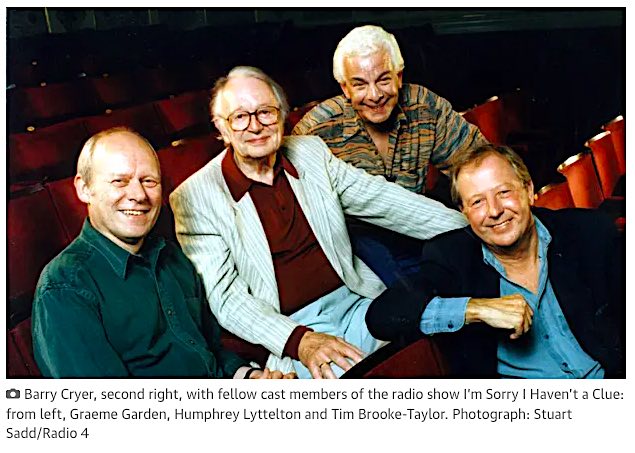
Barry Cryer

Cryer

The much-loved Barry Cryer, who has died at the age of 86, was a mainstay of the British comedy scene (Guardian tributes here and here; from Mark Lawson, and the splendid Jack Dee).

Best known for his appearances since 1972 on BBC Radio 4’s I’m sorry I haven’t a clue, he provided endless gags for a range of comics from Morecambe and Wise and Les Dawson to Kenny Everett and Rory Bremner, working fruitfully with Ronnie Corbett and Graham Chapman.

One of his own favourite jokes:

A man drives down a country lane and runs over a cockerel. He knocks at a nearby farmhouse door and a woman answers.

“I appear to have killed your cockerel”, he says. “I’d like to replace it.” The woman replies: “Please yourself—the hens are round the back.”

Here’s a tribute:

For more giggle merchants, see e.g. Tommy Cooper, Steven Wright, Sean Hughes. For more challenging routines, try Lenny Bruce, and Stewart Lee has his very own tag.

A historic recording

1860

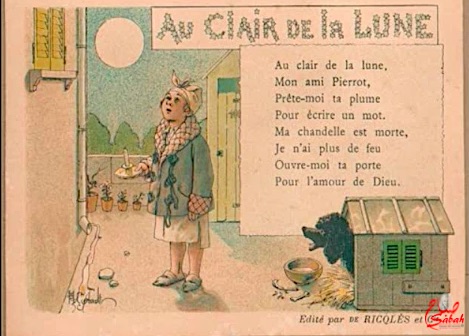
The oldest recording of the human voice is thought to be a phonautogram of the French folk-song Au clair de la lune, captured by Édouard-Léon Scott de Martinville on 9th April 1860 (see here; not to be confused with the 1913 recording of Debussy’s piano piece).

Having introduced it on BBC Radio 4’s Today programme, the mellifluous Charlotte Green‘s normally exemplary gravitas was sorely challenged as she heard her colleague Jim Naughtie describing it sotto voce as sounding “like a jar of bees”—one of the great moments on radio:

Corpsing is always wonderful.

Now please can we hear Ms Green’s demure delivery of the words “like a sex machine” while announcing the demise of James Brown?

Unlikely bedfellows

Dipping into the recent edition of the LRB, I described Alan Bennett and Patricia Lockwood as unlikely bedfellows. It’s a term that I’ve also used for

And for Albania it occurs to me with Norman Wisdom and Mother Teresa (serenaded by polyphony?), as well as Anna Mahler and Groucho Marx

More naturally, one associates Brian with Stewie, and Li Manshan with Andy Capp.

Cf. Felicitous conjunctions, and Global audience.

A delightful LRB double act

The 1,001st edition of the LRB features both Patricia Lockwood and Alan Bennett, unlikely but irresistible bedfellows.

I’ve vainly tried to encapsulate the literary genius of Patricia Lockwood here. Her review ponders Karl Ove Knausgaard’s latest weighty tome with typical perception and humour.

I might have met him once. In September 2015 I flew to Norway for a literary festival. Knausgaard was the headliner, but he cancelled at the last minute and was replaced by an Elvis impersonator. […] I went to see his act on opening night: the narrative temptation was too great, and I’m only human. […] At one point he stood and did the hip thing, lit from behind like Christ. I laughed in another language. It was as good as Knausgaard. It was better.

She reflects:

When people dislike Knausgaard’s books, there is often a sense of personal insult, as if they were watching him sit down across from them, tuck a napkin into his collar and make a long meal of their time. But as the worst book of the Bible, Leviticus, tells us: “All fat is the Lord’s”. All your time will be eaten by someone—why not him, who has made such a huge crazy claim on it?

She goes on with a classic one-liner:

Karl Ove Knausgaard was born—just kidding.

She has a wonderful ability to empathise with authors while remaining critical:

Hyperattunement makes you either a weird limp bed-angel, like Proust, or a tense too-ready animal.

Her final paragraph is so wonderful that you’ll just have to seek it out for yourselves. In a crowded critical field that can be summarised as “Knausgaard—WTF?”, Lockwood’s review officially relieves us of the responsibility to plough through his ponderous ouevre. It’s just as brilliant as her other reviews, some of which I’ve listed in my post.

* * *

In a different register, it’s always delightful to read Alan Bennett’s diaries too. A few highlights:

28 March, Palm Sunday. Remember this a propos a joke of Jonathan Miller’s, who, seeing a woman coming back from church holding a cross made of reeds said that it was literally the last straw.

15 April. [Recalling supper with Miller and Philip Roth in the 60s] Talking to Jonathan beforehand, I had made a poor joke about Portnoy’s Complaint being The Gripes of Roth. I’m sure I wasn’t the first to pick up on this, but it was new to Jonathan, so when Roth arrived he insisted on telling it to its subject. Maybe he even insisted on me repeating it myself. I’ve no memory of Roth’s response—unamused, I would have thought—but remember my own embarrassment, as fresh now with Roth dead as it was fifty years ago.

9 September. [Watching the last of David Olusoga’s TV series, he recalls wartime air raids] … But compared with the bombing of Sheffield, say, or Hull, Leeds got off lightly. “The city specialised in the manufacture of ready-made suits and the cultivation of rhubarb, and though the war aims of the German High Command were notoriously quixotic I imagine a line had to be drawn somewhere” (Writing Home).

10 December. [recalling an ungrateful editor at the LRB] Miss Shepherd never said thank you, and nor did the LRB, though it smelled better.

Numerous further aperçus from AB under this tag.

Doof doof

Doof Doof

I was tickled by a recent headline in OK! magazine:

OK

There’s the ultimate DOOF DOOF:

What if EastEnders isn’t real?? Like, if they’re all… acting??

Confession: I’ve never been able to interpret the doof doofs. How do we hear the rhythm—how would you beat time to it? Or is it a free-tempo prelude? I guess most EastEnders fans don’t talk in such fancy terms, so such online talk as I’ve seen is limited to a fatuous debate over how many doof doofs there are (nine, obvs), irrespective of rhythm. More to the point, can people keep a regular beat to it?

We have an Urtext of Simon May’s melody from 1985. The synth drums were added to the opening in 1994, in a version that remained in use until 2009, when he rescored the theme tune to include a stronger drum beat and additional percussion. But I haven’t seen a score for the doof doofs. Because one’s ears (rightly) want it to be a 4/4 bar, like the following melody, somehow I’ve always heard the first three drumbeats as a triplet:

Doof triplets

That’s close—but a more accurate rendition, as I am reliably informed by a talented drummer, is

Doof

That opening syncopation, even before a tempo has been established, must confuse other listeners besides me. Still, EastEnders addicts evidently take it in their stride, like Aretha fans with the triple-time insert in the chorus of I say a little prayer, or Turkish dancers with aksak limping metre—or, now I come to think of it, music lovers everywhere…

The opening of Beethoven 5 may sound to the casual listener like a triplet upbeat—as PDQ Bach observes in his illuminating commentary, “I don’t know if it’s slow or fast, cos it keeps stopping, folks… doesn’t seem to be able to get off the ground” (NB also Creative tribulations).

A comparison that springs to mind (OK, my mind) is the luopu motif that opens and closes the hymns of the Li family Daoists (see my Daoist priests of the Li family, p.280; examples in our film, e.g. 1.01.56). In this post the motif is mainly a pretext to tell a story about the singularly unimaginative opening of the Beethoven violin concerto on timpani—which would be much enlivened by replacing it with the Doof Doof.

Most rhythmically satisfying of all is the Pearl and Dean theme tune!

Roundup for 2021!

Emma Leylah

As I observed in my roundup for 2020, since part of my mission (whatever that is) is to vary the distribution of the diverse posts on this blog, keeping you guessing, this latest annual mélange is an occasion to group together some major themes from this past year. This is only a selection; for reasons of economy, I’ve tended to skip over some of the lighter items. You can also consult the tags and categories in the sidebar.

Some essential posts:

I’m going to emulate Stella Gibbons and award *** to some other *MUST READ!* posts too…

China: on the Li family Daoists, recent and older posts are collected in

and it’s always worth reminding you to watch our film

Elsewhere,

Tributes to three great sinologists:

The beleaguered cultures of the

  • Uyghurs (posts collected here) and
  • Tibetans (posts collected here), including

I’ve begun a growing series on Turkey (with a new tag for west/Central Asia):

Among this year’s additions to the jazz, pop, punk tags are

WAM:

Bach (added to the roundup A Bach retrospective):

as well as

On “world music” and anthropology:

On gender (category here, with basic subheads):

Germany:

Italy:

Britain (see also The English, home and abroad), and the USA:

More on stammering:

On a lighter note:

Even just for this last year, I realise there’s a lot to read there, but do click away on all the links! And I can’t resist reminding you of some of my earlier favourites, notably

Ma Yuan

Requiem for a fridge

my fridge

I’ve just said a fond farewell to my trusty Little Fridge, bequeathed to me by my parents in the late 1970s after they themselves had used it for many years. Having had a Jolly Good Innings, it now perhaps belongs in a museum, but I imagine it winging its way to the Paradise of Kitchen Appliances in the Sky, angelically White and Good.

Yakhchal

Yakhchāl of Abarkuh, Iran
—great when you’re mixing caipirinhas, but not so handy for the modern kitchen.

Ice houses were built in Mesopotamia by 1780 BCE, and in China by the 7th century BCE; Persian engineers were building yakhchāls in the desert to capture and store ice by 400 BCE. As often, Europe lagged far behind (see also the wiki article on Refrigerator).

Of course there are older fridges than mine that are still working—like the one from 1949 praised here. But without getting all sentimental or luddite about this Benighted Age of Disposability of ours, it’s satisfying that it’s been able to cater for my modest needs all these years.

Since ordering household appliances is not something associated with someone of my temperament, I am reminded of Alan Bennett’s remarks, as well as Henry James’s “hideous encounters with domestic necessity“. For more household trivia, click here; and on my occasional forays to the kitchen, here. And for less mundane Requiems, see e.g. Mozart, Brahms, and Buxtehude.

Lexicon of musical invective

Slonimsky

Besides the fascinating memoirs of Nicolas Slonimsky, you really must read his Lexicon of musical invective! An anthology of critical assaults on composers since Beethoven’s time, it cites a wealth of “biased, unfair, ill-tempered, and singularly unprophetic judgements”. *

Having mentioned the book’s magnificent “Invecticon” in The joys of indexing, in various posts I gave quotations from scathing early reviews that Slonimsky cites:

Invecticon

(As the glosses by a Chinese friend suggest, a wacky challenge for language learning…)

* * *

In his thoughtful prelude, “Non-acceptance of the unfamiliar”, Slonimsky reflects on critical incomprehension, under various rubrics such as racism, lack of melody, and noise.

In the minds of righteous reactionaries, musical modernism is often associated with criminality and moral turpitude.

As he observes,

A fairly accurate timetable could be drawn for the assimilation of unfamiliar music by the public and the critics. It takes approximately twenty years to make an artistic curiosity out of a modernistic monstrosity; and another twenty years to elevate it to a masterpiece. Not every musical monstrosity is a potential musical masterpiece, but its chances of becoming one are measurably better than those of a respectable composition of mediocre quality.

He cites George Bernard Shaw, writing in 1910:

It is not easy for a musician of today to confess that he once found Wagner’s music formless, melodyless, and abominably discordant; but that many musicians, now living, did so is beyond all question. […] The technical history of modern harmony is a history of growth of toleration by the human ear of chords that at first sounded discordant and senseless to the main body of contemporary professional musicians.

* * *

Slonimsky suggests parallels with critical reactions to other modernist trends, including painting, women’s suffrage, and science. Another well-covered topic that he also addresses is outrage at the rise of jazz. As early as 1899 the Musical courier exclaimed:

A wave of vulgar, filthy, and suggestive music has inundated the land. Nothing but ragtime prevails, and the cake-walk with its obscene posturings, its lewd gestures. […] Our children, our young men and women, are continually exposed to the contiguity, to the monstrous attrition of this vulgarising music. It is artistically and morally depressing, and should be suppressed by press and pulpit.

He cites the Most Reverend Francis J. L. Beckman’s address to the National Council of Catholic Women in 1938, in line with Nazi assaults on “degenerate music”:

Jam sessions, jitterbugs, and cannibalistic rhythmic orgies are wooing our youth along the primrose path to Hell!

Back in 1805, the waltz attracted similar opprobrium:

Waltz is a riotous German dance of modern invention. Having seen it performed by a select party of foreigners, we could not help reflecting how uneasy an English mother would be to see her daughter so familiarly treated, and still more to witness the obliging manner in which the freedom is returned by the females.


* Slonimsky acknowledges an 1877 antecedent in Wilhelm Tappert’s generously-titled Ein Wagner-Lexicon, Wörterbuch der Unhöflichkeit, enthaltend grobe, höhnende, gehässige und verleumderische Ausdrücke welche gegen den Meister Richard Wagner, seine Werke und seine Anhänger von den Feinden und Spöttern gebraucht worden sind, zur Gemütsergötzung in müssigen Stunden gesammelt.

Cf. Some German mouthfuls, and A justly neglected composer.

Veiny, weedy, wiki

Li He poem

South Fujian is all the rage. In a recent post on Language Log the illustrious Victor Mair, querying the dominance of Modern Standard Mandarin, gives two Tang poems in Southern Min (Hokkien) pronunciation, also common in Taiwan. *

As if the vibrant expressive culture of south Fujian weren’t enough! People from the north of the province must be disgruntled—like those from north Jiangsu, or indeed north England.

A comment on Victor’s article suggests an analogy between the Chinese topolects and the diverse evolution of Latin pronunciation around Europe.

By the Middle Ages no one tried to pronounce it the way it had been pronounced in the days of Julius Caesar and likewise no one worried too much that it was pronounced differently elsewhere in Europe. Then came the 20th century and, for the first time ever, schoolchildren were taught to pronounce Latin in a conjectural reconstruction of “proper” ancient pronunciation rather than whatever living evolved topolectal tradition had been handed down to them.

Note further comments under the post. In particular, a substantial wiki article details changing fashions in the English pronunciation of Latin.

* * *

For all its flaws, Wikipedia has become established as a useful reference point; after all, weighty earlier encyclopedias are far from perfect, and wiki can be constantly updated. It even polices itself, as in articles like these:

https://en.wikipedia.org/wiki/Reliability_of_Wikipedia
https://en.wikipedia.org/wiki/Wikipedia_and_fact-checking
https://en.wikipedia.org/wiki/Criticism_of_Wikipedia
https://en.wikipedia.org/wiki/Ideological_bias_on_Wikipedia

As Caesar himself observed prophetically (already toying with various styles of pronunciation), online encyclopedias can be textured yet ineffectual:

Veiny, weedy, wiki

For punctuation nerds, the wiki entry on the pithy dictum even notes the comma splice or asyndeton.
Cf. the Gandhi song from Mary Poppins, and Ate, in terror, Paxo minibus. See also Peter Cook’s Miner sketch (“I might have been a judge… but I never had The Latin”), under Myles: a glowing paean—along with

Noli me quidere?
Tang

and

Quis custodiet ipsos custodes?
Mulieres eorum.


* A handy nearby rabbit-warren for some intrepid readers to disappear down is the reconstruction of early Sinitic—again, see Victor Mair (e.g. here) and wiki.

Wonderful world

Yet another entry in my series on Interviews:

Don’t know much about history,
Don’t know much biology.
Don’t know much about a science book,
Don’t know much about the French I took…

—Thank you very much Mr Cooke, now perhaps we might focus on your particular areas of expertise…

Don’t know much about geography,
Don’t know much trigonometry.
Don’t know much about algebra,
Don’t know what a slide rule is for…

—Well Mr Cooke, I must say you’re very modest—such a disarming interview technique! We quite appreciate that you “don’t wanna get into specifics“. Indeed, I know I can speak on behalf of the board in saying that you seem ideally qualified to assume the post of Dean at the Donald J. Trump Academy of Arts and Sciences.

This video montage takes the idea further:

I’m most taken by the languid, dreamy cover of Sandy Lam 林憶蓮, with the subtle eastern flavour of its harmonies underpinning the pentatonic melody—and she adds a telling further verse:

Don’t know much about the Middle Ages
Look at the pictures and I turn the pages
Don’t know nothing about no Rise and Fall
Don’t know nothing about nothing at all…

which surely clinches the deal.

Cf. Replies from the Complaints Department.

A mélange of playlists

Still delighting in all manifestations of the Terpsichorean muse, by now I’ve compiled several playlists for diverse genres, mostly containing listening guides with Society and soundscape in mind:

Playlist

  • Chinese folk music (in the sidebar, scrolling down below the image gallery—with commentary here) including the Li family Daoists, the Gaoluo ritual association, searing shawm bands, and numinous recordings from the Zhihua temple (1953) and Xi’an (1961)
  • An eclectic Playlist of songs, with Billie Holiday, fado, Bach, Amy Winehouse, Purcell, Michel Legrand, Mahler, Nina Hagen, Ravel, Aretha Franklin, Barbara Hannigan, and more
  • Links to a varied selection of north Indian ragas, including “diatonic” (Yaman), “minor” (Kafi Zila), pentatonic (Malkauns), with augmented intervals (Bhairav), the beguiling Marwa (“A major over a C drone”)…

  • A series on the great Beatles albums, with the aid of Wilfred Mellers and Alan W. Pollack
  • Feminist songs, including You don’t own me and I will survive
  • see also Punk: a roundup

There must be well over a hundred posts there for you to relish—do click away on all the links!

Thankyou Driver!

Bus 1962

“Male bus driver and female conductor chatting by their bus;
both are recent recruits from the Caribbean”.
Photo: Henry Grant, 1962.

When passengers get off the bus (or “alight”, as the quaint officialese term has it), I’m surprised how often I hear them calling out “Thankyou Driver!”.

To their less confident, silent fellow-passengers the parting salutation, flaunting a sense of etiquette, may seem like a rebuke. One might suppose it to be one of those hallowed customs trumpeted by the Brexit brigade, like queueing, child chimney-sweeps, and bendy bananas; but it’s only since the 1980s, when drivers had to fend for themselves without a conductor, that it has become possible to thank them audibly.

Little did I know that it has become a common topic of debate, with its own meme. A 2018 Guardian article on the topic prompted 1,380 comments! Like Life, It’s Complicated, with no simple divide between the courteous and the callous.

It seems fair enough when one leaves by the door where the driver sits (cf. the ticket-collector in Alan Bennett’s Sermon). When boomed from the distance of the middle door, more timid souls may find it unseemly—almost virtue signalling, drawing attention to oneself as a pillar of the community. *

It’s also regional. Popular in Scotland and north England, it’s common in Australia too; the article has some comments on bus protocol elsewhere, such as in Germany, Spain, and Russia. One BTL comment noted:

I used to thank bus drivers when I lived in a city where that was a thing people did. For now, I live in a city that mercifully rejects small talk and the forced emotional labor of giving and accepting thanks (New York)—so I no longer do.

It’s not just used by Little Old Ladies, though from my limited sampling in London it does tend to be more of a Woman Thing (statistics, please—“broken down by age and sex”, like Keith Richards). I can’t find the source of the poll showing that 82% of people (“more than 15,300”) thanked the driver, but I’m incredulous.

Don’t Get Me Wrong, I’m all for a bit of personal contact. Maybe it’s the physical distance between them: while the greeter’s boldness impresses me, somehow the use of “Driver” makes it less personal, drawing attention to the grubby contractual relationship. Of course one thanks people face to face, people with whom one has had a certain amount of contact—like a taxi driver, or a doctor. But in other routine exchanges with public (or private) servants, one doesn’t say “Thankyou, Handyman” or “Thankyou, Hedge-fund Manager”.

It seems a bit patrician to me, like a greeting to Staff—the kind of patronising remark that Jacob Tree-Frog ** makes to one of his chauffeurs on the successful completion of a charabanc outing, rather as he dismisses one of his butlers or scullery maids from his August Presence.

In the event that the passenger actually knows the driver (“Thankyou, Bob”) then it’s fair enough. To me it suggests that the driver had made a special diversion to deliver them safe and sound right to their front door, and is going to hop out and take the shopping in for them too.


* Rather like clapping the NHS, which nurses and doctors came to see as a “hollow gesture” compared with, like, supporting fair pay or even following public health guidance—see also here.

** In the latest instalment in JRM’s mission to remind us that he is a fatuous, dangerous lunatic, he explains why Tory MPs don’t need to wear face masks in the Chamber:

“We on this side know each other” and have a “convivial fraternal spirit.”

WTAF???

Dang: Gujarat and Korea

Stewart Lee’s recent playlist for Songlines is just as wacky as one would expect. Although I have to mark him down a bit for going down the hackneyed route of Ali Farka Touré and Ry Cooder, he roams the clouds from Shirley Collins and Laura Cannell to Ethiopian jazz. Like Moriarty pursuing Holmes to Tibet, just when I thought I was catching up on jazz behind the Iron Curtain, he’s outwitted me again—Dang!

[And I like to think that “Stew” himself might interject:]

Funnily enough, Dang is a region of Gujarat famed for its dance. These dancers are accompanied by rousing shawms:

which are also heard here:

Pawari dance

And beat this for a wind instrument—the pawari (cf. pāva and satārā):

Here’s a Dang pas-de-deux:

And in ensemble:

All this is remote from the ethereal world of north Indian raga.

* * *

The music of Dang is not to be confused with Dangak, which is the Korean equivalent of Japanese Tōgaku [Oh, right you are—the Plain People of Ireland]. Both genres are obscurely derived from the music of the Chinese Tang court, and both are largely marginally preserved today through museumification—far from the lively Gujarati folk scene. BTW, the population of Gujarat is larger than that of (South) Korea!

Thankfully (did I say that?), only two pieces survive, Nagyangch’un (Chinese: Luoyang chun 洛陽春, a title not in the Tang Chinese repertoire, FWIW):

and Pohŏja, which is the Chinese Buxu 步虛, Pacing the Void:

The hyangak repertoire is native to Korea; here’s Sujecheon:

and P’yojŏngmanbangjigok:

These genres in turn are not to be confused with a-ak, the Korean version of the Confucian yayue 雅樂:

Turning to ritual in living society, mudang shamans are active, as in this ritual filmed in Seoul:

See also Shamans in the two Koreas.

And we might even consider the tang-ki 童乩 self-mortifying spirit mediums among the Hokkien in southeast China (Ken Dean) and Taiwan (David Jordan). For links to posts on Chinese mediums, see here.

* * *

Anyway, all that was meant just as a little preliminary aside—sorry, got carried away (What am I like?! LOL). Throwing pursuers off the scent, what I’m trying to get round to is Stewart Lee’s choice of Ethiopian jazz. But to cite the Plain People of Ireland again, here’s me bus, so I guess that’ll have to wait for another time [Later: here’s the post]… Dang.

With thanks to Simon Mills

The gig

James Reese Europe. Source: wiki.

Long before the “gig economy”, the term gig was widely used in circles such as jazz and WAM. I’m fond of the story about the late lamented Linda Smith chatting with her mum.

The New Grove dictionary of music and musicians gives a succinct, dry definition:

a term commonly applied to a musical engagement of one night’s duration only; to undertake such an engagement.

Wiki elaborates:

Gig is slang for a live musical performance, recording session, or other (usually paid) engagement of a musician or ensemble. Originally coined in the 1920s by jazz musicians, the term, short for the word “engagement” [?], now refers to any aspect of performing such as assisting with performance and attending musical performance. More broadly, the term “gigging” means having paid work, being employed.

More detailed is this discussion on stackexchange, referring to the Word detective site.

I associate the term particularly with freelancers. A Messiah in Scunthorpe for a jolly good tea is a gig of sorts, but so is a Matthew Passion at King’s College Chapel in Cambridge. I wonder when WAM musos, ever keen to deflect pomposity (cf. Viola jokes and maestro-baiting), began using the term.

But (apud Word detective)

Every job is a “gig” today.  Calling your job a “gig” is a way of saying “I’m not really emotionally invested in my job, which I find boring and soulless, and I’m only doing it so I can act/write novels/play jazz saxophone on the weekends”.  And it’s not just laconic “baristas” at Starbucks.  I’ve heard corporate lawyers describe their positions as “gigs”.

Commonly cited is a 1926 Melody maker article, whose byline reads, “One Popular Gig Band Makes Use of a Nicely Printed Booklet”. But The jazz lexicon goes further:

According to jazzman Eubie Blake, bandleader James Reese Europe used the term in its jazz sense as early as c1905; widely current since c1920.

While the use of the term in the jazz world since the early 20th century is widely attested, there are many interesting suggestions about its earlier usage, which remain controversial. The Oxford English dictionary suggests (*Sexism watch!*):

The meaning of the term “gig” is transferred from the deprecatory term for a “flighty girl” and subsequently indicates anything which whirls, or is dangerous or unpredictable.

Word detective has more, alas without giving a source:

The first incarnation of “gig,” around 1225 [?!], was to mean “a flighty, giddy girl,” although this sense may well have been based on an earlier sense of “gig” meaning “something that spins or whirls” (as later found in “whirligig”).  The Oxford English Dictionary suggests that “gig” may be onomatopoeic or “imitative” in origin, meaning that the word itself was meant to suggest something small that whirls.  This sense of “gig” later came to also mean “an odd person, a fool” as well as “a joke” or “a state of boisterous merriment and fun” (“in high gig”).

This sense leads to an etymology from “giggle”, having some fun.

Source: wiki.

By the late 18th century, gig commonly referred to a light, one-horse carriage, popular in New Orleans; by extension,

The thought is that black musicians, in order to avoid being arrested for playing on the street, would instead play jazz on the back of carriages or trucks.

I’m most attracted to two possible musical derivations from gigue (jig), or geiger fiddle. GIG has also been claimed as an acronym: God Is Good, or Get It Going.

Stackexchange thickens the plot bewilderingly by citing the Dictionary of American slang (1960):

gig n1 A child’s pacifier or any object, as a cloth square, spoon, or the like, used as a toy; any object to which a small child is attached and with which he likes to play; any object treated by a child as a fetish; a gigi or ju-ju. Orig. Negro slave and Southern use. From “gigi,” the word is very well known to about 35% of the population, unheard of by the rest. 2 [sometimes taboo] The rectum. From “gigi.” Used euphem. by some children, as part of their bathroom vocabulary, but not common to all children. Used by some male adults [taboo] as a euphem. for “ass” in such expressions as “up your gig.” 3 [taboo] The vagina. From “gigi.” Not common. Prob. Southern use. 4 A party, a good time; esp. an uninhibited party; occasionally but not often, an amorous session, necking party, or even a sexual orgy between a man and a woman. c1915 [1954]: “Cornet players used to pawn their instruments when there was a lull in funerals, parades, dances, gigs and picnics.” L. Armstrong, Satchmo, My Life in New Orleans, 100. 1958: “Life is a Many Splendored Gig,” a song title. 5 A jam session ; a jazz party or gathering of jazz musicians or enthusiasts. Orig. swing use. 1920 [1954]: “Kid Ory had some of the finest gigs, especially for the rich white folk.” L. Armstrong, Satchmo, My Life in New Orleans, 141. 6 Specif., an engagement or job for a jazz musician or musicians, esp. for a one-night engagement. 1950: “If I ask you to go out on a gig, it’s thirty-five or forty dollars for that night.” A. Lomax, Mr. Jelly Roll, 204. 1954: “On a gig, or one night stand.” L. Armstrong, Satchmo, My Life in New Orleans, 221. 7 Something, as a jazz arrangement, that is satisfying or seems perfect. Orig. swing use. 8 A fishing spear; a pronged fork as used for catching fish, frogs, and the like. 1946: [citation omitted]. 9 An unfavorable report; a demerit; a reprimand. Army and some student use since c1940. The relations, if, any, between a child’s pacifier or fetish, the rectum and vagina, a party, a sex orgy, jazz music, a pronged fork, and a reprimand are most interesting, and lie in the field of psychology rather than of etymology.

Limits to my versatility

wheat

Possibly confused by the broad range of topics that I rashly attempt to cover (China, punk, ritual, Mahler, gender, Bach, and so on—see e.g. my roundup for 2021), Academia.edu just emailed me to ask, somewhat hysterically,

Are you the Stephen Jones who wrote “Evaluation of winter wheat breeding lines for traits related to nitrogen use under organic management”?

Now, just when you thought there were no limits to my versatility (as in “Is there no beginning to your talents?“), I may have fingers in many pies, but that’s not one of them. Nor, alas, have I ventured into millinery or playing guitar with the Sex Pistols. And it’s fair to say that these career paths will remain safe from me. The closest I get to evaluating wheat is slurping noodles with Li Manshan.

And now they’re asking me if I am the author of “Mutant mice that display early ageing-associated phenotypes”. Where will it all end, I wonder.

For some other articles I haven’t really written, click here; for fictitious early signs of versatility, here; and for variations on “You think I know Fuck Nothing, but I know FUCK ALL!”, here. The enquiry also reminds me of a question for Alan Bennett after a lecture he gave at Oxford on Richard II: “Could you tell me where you bought your shoes?”.

Rāg Vindaloo

With apologies to my esteemed mentors…

swanee kazoo

Jugalbandi duet, rāg Vindaloo.

While I very much hope that my series on north Indian raga will encourage you to absorb the melodic and rhythmic intricacies of all the individual items, I’ve reached a point where a certain levity is called for.

In classical treatises rāg Vindaloo is described as a raga for dusk, shortly after opening time; the Portuguese etymology perhaps explains its saudade mood (though fado only seems to have taken root in Goa). To the great relief of mehfil aficionados, the raga is rarely performed today.

Scholars have recently questioned the authenticity of a ragamala painting depicting an obese balding accountant in a pink sombrero, bedecked in opulent wombat furs and clutching a gaily-coloured [can of] Kingfisher, his sumptuous belvedere adorned with a garden gnome.

Questionably, Bhatkande classified rāg Vindaloo under Paneer thaat. It had already appeared by the 18th century in the bold attempt of picaresque, nay swashbuckling, adventurer and arms-dealer Lord Auberon Cholmondeley-Smythe to codify the repertoire, notwithstanding his comment in the Prefatory Observations that “it all sounds the same to me, this Indian music”.

PPIn dhrupad renditions the nomtom syllables tiddley-pom and poppadom are prominent. As to arohana and avarohana patterns, whereas in ascent flat and natural re, ga, dha, and ni, natural and sharp ma may be sounded interminably and apparently at random, in descent all notes are avoided entirely. In the gat, a common phrase—alluding to rāg Madhuvanti, * and later adopted by Henry Mancini—is

Sa, Re ga, Ni Sa Re ga dha Pa, Sa ga Pa Ma,

with a descending anuraṇana “resonance” on the cadential note.

In lengthy alap expositions, the phrase Ni dha pi serves as a cue. The tempo picks up upon the entry of the pakhavaj drum; the rhythmic cycle prescribed in early sources is chapati tāl with 792 mātras. But even in the more leisurely conditions of bygone courtly performance, no-one ever managed to get through even one whole cycle; so more often used in modern times is the challenging dintāl consisting of only one beat, subdivided 2 3 3 4 2 3, the first beat of the 3s marked with a cheery wave of the hand—a subtlety only revealed since the advent of slow-motion technology.

As a legacy from the days of the Raj, the raga is sometimes played in jugalbandi duet with swanee whistle and kazoo, hastening the audience’s departure.

* * *

For instructive multi-cultural exercises in solfeggio, click here. Cf. the spoof entries for the New Grove dictionary; for spoofs on early Chinese history, see Yet more French letters, Faqu tu 2, and More Tang drolerie. Cf. The ascent of Rum Doodle.


* In a vain attempt to redeem myself, for the sake of including some genuinely wondrous dhrupad in this post, here’s Zia Mohiuddin Dagar playing rāg Madhuvanti on rudra vina:

On Nicolas Magriel’s amazing sarangi site (click here and here), his page on Abdul Latif Khan features a rendition of rāg Surti Vardani, whose madhya lay bandish he finds “somewhat reminiscent of the Pink Panther theme”.

Interview stories

World map

I note that there are several related stories on ‘ere about interviews.

This one features a young hopeful applying for a position in the Music Department at Cardiff:

Shifting the scene to a prison, this story may or may not be true:

Branching into “world music”, this one certainly is:

as is this fine story about Esa-Pekka Salonen’s interview for the LA Phil, exposing a mindset that is still common in both WAM and Daoist ritual studies:

Salonen

This is a fantasy interview with Sam Cooke:

“The undisputed master of” * the interview is of course Philomena Cunk, as in her programmes on

Cunk

Seriously though folks, I discussed issues in fieldwork interviewing/chatting here, following Bruce Jackson.


* In homage to I’m sorry I haven’t a clue; with “master” serving as a gender-neutral term until someone comes up with a good substitute…

Anagram tales: a roundup, with wacky index

Here are links to our initial selection from the magnificent anagram tales by Nicolas Robertson. They group neatly in three trilogies—first, Mozart operas:

followed by

and

as well as two recent additions:

The visions emerging here make up a kind of Esperanto fiction—it’s most rewarding to follow the gnomic texts with the aid of the explanatory stories. Here’s a general introduction by Nick himself:

The anagram stories Stephen Jones has been resolutely issuing arose from a specific combination of circumstances. First, amongst professional classical music singers, the 80s and 90s were a high point for tours, residencies, and CD recordings, all of which furnished extended periods of having to sit patiently around—time used in various ways, crosswords, knitting, books and magazines; there were not yet smartphones or iPads, had they already existed it’s unlikely that these texts would ever have developed.

But in 1984 I had been introduced to the work of Georges Perec and the Oulipo, which added to my early enthusiasm for Mots d’heures: gousses, rames and an appreciation of word games of various sorts (though I never enjoyed or was much good at Scrabble, oddly: I think it was the element of competition which spoiled it). Such games had a much more serious aspect for me (as indeed, to a hugely greater extent, they did for Perec), through their function of creating “potential literature”—Oulipo is “Ouvroir de Litterature Potentielle”, freeing up through constraints. Having always been keen on writing, I nevertheless had found myself unable, every time I tried, to write imaginative fictional narrative; what began as a collaborative pastime (many anagrams, and certainly the best ones, were deduced by colleagues, once I’d proposed a source text or name) gradually morphed into a generator of unlikely yet rigorously underpinned stories.

As to the process, during recording sessions etc. I collected from volunteers and compiled my own anagrams, which I then joined up in whatever form of narrative appeared possible, permitting myself any old punctuation but always (the few exceptions are noted in the text) sticking rigorously to the sequence of repeated anagram matrices, with the same letters repeated each time, never overlapping nor transposing—no cheating for effect (however tempting). At first that was as far as I thought of going, but it soon appeared that there was another level of interpretation waiting to be exploited, the “potential literature”, and I spent some months, or even years (in the case of Lili Boulanger and Johann Sebastian Bach) extrapolating the story I felt the anagrams were perhaps telling.

In addition to the nine Steve has published, there are six more which survive—several were wholly or partly lost during the course of time and specifically in a fire in our house in Portugal which destroyed most of my papers (and books) in 2009: the survivals are in great part due to Steve himself, and Charles Pott, a notable contributor, who had kept copies, backed up by a handful I’d managed to consign to the internet (most of the stories also predate the days of web-based email).

These other pieces are:

  • Israel in Egypt (anagrams only, stitched together but without parallel text, 1989)

  • Die Entfuhrung (sic—no umlaut, nor the missing ‘e’ it would represent) / Aus dem Serail (introduction + anagrams only, 1991)
  • Salzburg (introduction + anagrams of Beethoven’s Leonore/Beethoven’s Fidelio + story, 1996—probably the most substantial piece of the whole run)

  • Alceste (raw anagram list + anagrams + story, 1999)

  • Merano (intro + raw anagram list + anagrams + story + epilogue, 2000)

  • Oslo (raw anagram list + anagrams + sort of story + epilogue/more story, 2000).

These last two were envisaged as being integral parts of my reactions to the celebrations at the time of the 250th anniversary of Bach’s death, and the many concerts in which I took part during that year. The last anagram piece I wrote of this sort (there’s since been an acrostic anagram sonnet for Fernando Pessoa) was indeed Johann Sebastian Bach, compiled between 2000 and 2021. There’s a hope that the complete set may eventually interest a publisher…

I still can’t write (and don’t believe I have written) fiction. I was just following where the letters led me.

Nicolas Robertson, August 2021.

* * *

[SJ:] With my penchant for zany indexing (see here, and here), I can’t resist compiling a selective general index of some of the more striking people, places, and themes that adorn the plots so far (just the anagrams, not the extrapolations!), and allowing characters to mingle freely after being trapped within the bonds of the individual stories that generated them. In the absence of page references, you can have fun working out which tales the entries belong to.

196.

index 1

197.
index 2 

198.

index 3

199.

index 4

Alas, Nick died in 2023: click here for my tribute.

Medieval helpline

test card

Normal service may or may not be resumed shortly.

After a whole day of fruitless wrangling with the well-meaning wizz-kids of Mac, I find myself at the mercy of forces against which I am ever more helpless.

Will my updated version of Safari work if I upgrade to OS 14.1.1?
Sure, if you upgrade to OS 14.1 first.
Great! Can I do that?
No.
So I’m completely fucked?
Indeed you are, sir. Have a nice day.

Medieval helpline (excuse my abject failure to reproduce the language faithfully, but you get the gyste):

Estymed Syre! Thyne present Qyll ys incompatyble with ye Vellum thou art usyng. Thyne veyn attempt to use “fowntayne penne” founder on ye fact that it will not invented be for many centuriys. Nor wyll any fantasticalle Appe rescue ye from languyshing in Purgatory. Fare thee well.

Cc Dante, Chaucer

Sure enough, this has already become something of a meme:

All this may heighten our appreciation of oral transmission. Cf. Flora, Amos and the tweet, The wonders of technology, Bunnios—and the priceless speculations of elderly Ukrainian village women on the “Internet”.

Hosanna—J.S. Bach!

Anagram tales 9: Johann Sebastian Bach

guest post by Nicolas Robertson

For a general introduction to the series, see here.

Prelude—SJ
The grand finale of this third trio of anagram tales, this wonderful fantasy is much informed by Nick’s own research on Bach, with plentiful allusions to the 2000 Bach Cantata Pilgrimage among his typically diverse cast.

* * *

JOHANN SEBASTIAN BACH
Series of concerts and recordings December 1999 –January 2001, 250th anniversary celebration of Bach through his church cantatas, performed each on the liturgical calendar day for which they were written, in places as closely as feasible linked with the original performances; or with the composer himself; or with places dear to or chosen by the director of the Bach Cantata Pilgrimage, John Eliot Gardiner. English Baroque Soloists, Monteverdi Choir, multiple vocal and instrumental soloists.

Bach denkmal

J.S. Bach Denkmal, Arnstadt.

Impossible to encapsulate JSB in an anagram, and I didn’t think of doing so, I reckon, until some time into 2000. The letters were not inviting, as well as too many to control; but on one long bus journey Stephen Varcoe came up with the gem included below, and I understood I had to have a reciprocal try.

Compiling the anagrams took the whole of that year, on and off; the parallel story has taken a bit longer. A substantial part was in place by 2003, John Eliot Gardiner’s 60th birthday, when I submitted an early version of the finale. But the ‘story’ hadn’t been committed to any imperishable medium, and was lost in our 2009 fire. (The anagrams, such as they were, haphazardly survived in a disc I made when leaving the computer on which I’d typed them in London, in 2007, and miraculously had the nous to send to myself by e-mail before the fatal day).

The commentary, though substantially already imagined, has necessarily had to be re-derived, sometimes from scratch, over the subsequent two decades. It follows what I can remember of the original apprehensions, from the anagram matrix, and carrying on…

146 anagrams, in strict rotation. Here goes my 19-letter Passacaglia, followed by a Fantasia on the same ground:

HOSANNA—J.S. BACH!

  “Béni !”
   “Ta. Hosanna basic, jah.”

Bent: “Bach Jain hosanna best.”
   “Jain Shoah ebbs. Can’t an Osanna —”
   “H !” (aitch)
JSB bane. Banish abject hosanna.

JSB: “Ché ? No shit, Anna !”
   “Baa”—Anna hatch babies on J.S.
JSB: “Ach, isn’t Anna boa!” (he is absent.)
Johann, a Bach: “An Eis’nach Abba!”
St John = SANCTI JOHANNES

ABBAH

Bach: “St John as Bean, in a thin assonance.”
   “ABBAH?”
J: “Ach, ja, hab Noten in Baß.” [1] Josh Abba, ancient ash’n Eis’nach nabob.
Jan: “Hast BA?”
   “Has insane chant job”—Anna Bach. “Has-be’n? JS? Toi??”
Bach (in jeans—bathos): “An anabasis, JC ohne NT. Bah, bah, an incessant job.”
   “Ah, JSB canonist? Bane…”
   “Ha ha,” J.S. Bach hones Anna bait, “chess, Anna B.?”
   “Jah, bon, ta, I…”
J.S. Bach, Anna—Tao.

H. IBSEN
   “Hans O. Jahn St., cabbie!”
   “Na. Hans? – ja, a bench bastion, cannabis hash-bean, jot NASA cash. Joint, B. Behan?” Behan: “Ban scat jois? Nah! ‘Cats’ jois ebb, Hahn ‘Nana’ hath a nonsensic jabba, an incessant Noh jabba. The job’s ‘Banish Canaan Banana’! – Shona jest…” (hic) “B-banana jibes,” chants. “ ‘Oh, I eat bananas’ – John B’ch’s banjo shanties.”
   “Na – Bach? J. Bach an’ sons bathe in a Bosnian casbah.”
Janet: “A-Anne?”
   “I shan’t casbah job, shabbiest Canaan john.”
Can job astonish Behan? “Joint, Abbess Hannah?”
Can Hannah? Abbot: “Jessica? O henna nacht, Jass babi!”
Abbess Hanna chant “Joi!” Abbess’ hijo chant “Na-na!”
Abbot: “Jinn Cessna, ha ha! Jess, Hannah, botanic BA – ”
Johann: “Athens BA basic.”

* * *

BAs? Joanna Hitchens, BA.

* * *

John B.: “The CIA’s bananas!”
Bananas—a Hitchens job (John as a cabinet has-b’n).
Jessica O’Bannan hath Bishan B., Shane, Jan Cabot—bah, Jan Cabot, ‘sanshine’…
   “Jinnah nab seacoast, H.B.”
   “Jinnah?”
   “Eton, BA –”
   “– cash BAs. NB neo-Janata bacshish.”
   “Non-Janata shish-cebab Jahan’s sahib NT beacon – ‘bacon bhaji, nan’ – the ass!”
   “Netaji Bose, ANC ban, hah!”
   “Sai Baba, natch, Jens, hon (hasten bhaji, son – an’ cab) – he Johnian (Cantab) bass!”
A.Besant: “Bach’s Johnian?”

A BATH ABC
Nash, In. Jones (Ian ‘Sabbath’ Jones, nach.) Jones? a Bath cabin. Nash? Bath ascension, jah. Nab cabin Jonathan bashes. A casino? nah, Jebb hasn’t.
J. (sob): “The china bananas!” Icon: Saab; Shah; Taj. Benn, Hanoi bachante, S.J., bans Jinnah, Botha (“an abcess”—abcess, Johanna? in Bath??).
Basic ash’n be Jonathan: “I scan ‘H’ sonnet – ABBA, jah? ‘Ban’e’snatch, Jab’ !”
   “No Shia!”
   “Beat B.S. Johns’n! Aa… chain Satan, can banish Hob.”
J.E.: “Ancient bash: Jason. Bah! Johanna’s B’nai B’ith case, Canaan Josh’a, ten shibb–”
   “Jah. Sheba, BC—an onanist!”
   “Ba’ath ’n Hossein ABC, Jan?”
   “Jes. Ch. ahanatos ibn ban Jocanan Bathsheba sin. Bashan benison, jah. Act chasten Jonah.”
   “NASA bib?”
   “Ten-inca hash, baas…”
   “Bon, J. –
        Habas [beans], join, catch,
        Jain ass, a bohnen batch
   “Baba-ja?”
   “Ten-shi chanson?”
   “Chthonian Jaen’s Abbas enchants Habana (obs.). Anna (ij.), bin Jacob’s sheath. Bacon a Jansenist? Ahab?”

* * *

Joanna: “Stein ABC: A B Shh…”

* * *

Johnnie bans a cat-bash: “Nab Jonti, ha!” Bash a scena: Jonti, Hanse scab-ban.
   “Ah, Hansi C’onje bats—nab! Ha!!”
Bet on Hansi C.: Sha’ja’ ban. Abbas – Sha’jah – innocent. Hans—a jab, both canines.” [2]

J.S. Bach has inane baton, J.S. Bach nabs henna iota!

ABACABA 
– “John—thinness?”

NB JSB’s ‘Ninth’ echo: [3]

AAAA

* * *

J.S. Bach, Anna, anise both: ‘Ache, Sob, Jab, Sin.’
Nathan: “JS,” (Bach) “no absinthe?” Ann? Abba cash, honest injan…”
   “Hinab!” Chaos et…
JSB: “Anna! Anna—snobbish Taj ache.” (Ban insane J.S. Bach oath.)

* * *

   “Abbot – Jenni – a Hans Sachs, an Aachen hobbit’s…”
Jan: “Noh ! Banshei! a JSB cantata beano!”
Nin has J.S. Bach in sash, Ecbatana john. B-Beth, John: “Anabasis? Can John B., a Sachsen Ta’iban, ban Nash Hanseatic job?”
   “Bach Iona’s best, Jan.”
   “Nah” – Jan. “Bach? Iona? SHAN’T!”
EBS nab Bach, astonish Jane, bin John’s Sabata ache.
N.J.: “I, the Hon. N., ban ACAS, as ban a snobbish Janet, ach.”
Ban cane? John abstains: can’t bash a shinbone, ja. “Josh has a BBC antenna—I ban he in sonata.”

* * *

J.S. Bach: “Bassinet, banjo, ha ha, c’n-can sahib…”
   “The banjo’s an – a ! – Johann Schein sabbat…”
Johann Sebastian: “Ah!…”

 C B

– “Johann? Hansi? aa…”

 C B B

(E.T.S.) [4]

* * *

HOSANNA—J. S. BACH

Praise be for JSB!

   “Bless you!” – Johann has sneezed, perhaps.
   “Thanks. Makes me think that ‘praise’ is the root of it, yes.”

A musicologist writes: “I like Bach’s praise music best when it lines up with a non-violent pre-Christian ethical world-view.”
   “Practitioners of which used to be harried, a bit less now, I hope. But couldn’t we extend ‘Osanna’ –”
   “Excuse me, there’s an H in Hebrew: it’s Hosanna.”
There’s no agreement, curse it; discussion of praise music founders.

* * *

   “What? is that really so, Anna?” Sebastian exclaims.
Anna, a bit sheepishly, has told Johann she’s pregnant.

   “Wow, what a girl!” Sebastian cries – and exits to take evensong.
His cousin, another Johann, who’s with them today (the Bachs come and go between each other familiarly), reassures Anna, “He’s like the boss in the old Eisenach days!”
Sebastian nips back in, looking for a rebus he’s made for the St John. “I like this small shift in harmony, could provide a laugh.”
   “But where do you get that B natural from?” Johann pleads.
   “Oh, it’s ok, just listen to the bass line”—Sebastian likes to tease the older Eisenach generation.
Jan, whose connection is unclear but who’s obviously entitled to be there and equally obviously allies with the conservative faction, asks “Do you really have the qualifications to risk this?”
Anna cuts this off with a cheery “A mad Cantor job, that’s what he has. But Sebastian’s not finished yet, ARE YOU?”
Bach, who’s taken off his top to put on his cassock—looking touchingly informal, in his jute trousers—responds seriously, “Look, I’ve been making my way up, as if I were Christ without yet the New Testament. But, oh god, there does seem to be no end to the work that has to be done…”
   “Right, but you spend your time making fugues! Sod that…”
Sebastian laughs, he’s above this, and turns to Anna, with an offer he knows she finds it hard to resist, “How about a game of chess before the service?”
Anna’s all confused, thinking she’d been left out of the conversation, “Well, if you think there’s time – yes – thanks – ok –”
Johann’s happy to know the two are on the same wavelength.

* * *

“I knew Herr Jahn,” the taxi driver confided, “he was a stalwart of the judiciary, but wasn’t averse to a joint or two, or a subsidy from the space programme. Speaking of which, can I tempt you, Herr Behan?”
“As long as you don’t go on about free jazz. I’ve had enough of Lloyd Webber, fin-de-siècle musicals don’t make sense to me, any more than japonaiserie. Scare off African potentates, that’s what I’m here for.” Noting a coolish reception from the driver, Behan temporises, “that’s a joke I heard in South Africa…” but he couldn’t resist breaking into song, ‘Yes, we have no bananas’…
He’s delivered safely to the British Council, where the staff ask if he’ll be referring to Bach, whose year it is.
“You what? As far as I’m concerned, let the whole Bach family go and enjoy themselves in a Yugoslav thermal brothel.”
Janet, an intern, asks “Oh, do you think Mrs Bach would go along with that? I wouldn’t accept it, sounds like dodgy Middle Eastern sanitation.” But Behan is imperturbable, and he spots a nun he recognises:
“Join me in a joint, Hannah? Abbess and all?”
An abbot across the room has heard this, and calls over with words echoing Lorenzo’s in The Merchant of Venice, “Go for it, lass!” (no one had ever heard the Abbess’s real first name before, Jessica) – “How sweetly sleeps…”
Hannah/Jessica, liberated, cries “Bliss!”, and her ‘son’ (presumably an acolyte monk) echoes.
The abbot, after veering inexplicably into Indian subcontinental politics (or can that be where he met Jessica, now Hannah, abbess?), launches “Do you remember that devilish monoplane, oh, how we laughed! Jess, ok Hannah, you’re the one who knew about plants, even got a degree for them!”

– across a few centuries, Johann in Leipzig wonders if Sebastian shouldn’t have got a qualification from the Greek academy, for a start

– but for the value of a university degree, I ask you to consider Joanna Hitchens (and I ask her indulgence).

* * *

Meanwhile, in Chichester, the cathedral organist, coolly sceptical, opines over sherry after Sunday Matins, “The US secret services have gone pear-shaped.” That’s what we would expect from the Hitchens brothers, vying with each other for conspiracies.
   “Wouldn’t you have liked to be a politician?”, JB is asked. Well, yes, he’d had his chance. There are some quite outspoken guests, among them associates of the Dean who’d served in the army in SE Asia. I already overhead Jessica mentioning an Indian spin bowler, plus Alan Ladd, and the Boston founding fathers (oh the bright new dawn long promised, those slave traders who spoke only with god) –
   “I remember when I told Helena Blavatsky that Jinnah wasn’t going to be content without a sea port.”
   “But Jinnah was one of us!”
   “Yes, British education, qualifications…”
   “One could buy them. And look how that’s turned into nationalist Hindu free-loading.”
   “Thinking of the Hinduists, I just ordered a beef skewer takeaway, image of the Taj Mahal, that National Trust signpost, in mind. But do you know what the man said? ‘You want a pork fry-up, with onions and chapati?’—what a twit!”
   “This is like infighting between freedom fighters,” interposed Jens, an old Indochina hand. “Netaji Bose thought it more important to oppose British colonialism than worry about alliances with the Third Reich or Japan—hero to Indian nationalists, ‘a common traitor’ to your father. Not sure how South African Gandhi supporters saw him, though.”
“And what about another charismatic guru, Jens, my dear” – I hadn’t met this couple before, but they’re clearly keen to get out of the Vicars’ Close and enjoy their takeaway on the coast, they’ve booked a taxi—though they can’t bear to leave an argument, only had to because the taxi arrived.
But as they go, a tantalising throwaway: “You know JSB sang at St John’s Cambridge, as a bass?”
Annie Besant hears this, and to her credit can hardly believe it is so.

* * *

What you need to know about Bath
Talk of Bath, and you talk first of John Nash, and Inigo Jones. But did Jones build more than a garden shed? While Nash, he saw Bath going up in the world, oh yes. (Still, I wouldn’t mind that shed, Jonathan, since you seem not to think much of it.) Neither of them planned a gambling resort, nor did the Oxford philosopher.

How fragile the past is! I remember a reception in the British Council home on the Île St Louis in Paris, where I and a colleague, our gestures becoming expansive with hospitality, knocked a crystal ashtray off a mantelpiece, which shattered distressingly around our feet. Our hostess was impeccable, she had it cleared up in no time, and told us, “Please don’t worry, the person who gave it to us is dead now anyway.”

This makes me think of memorable images, and how they can fade. Saab – who remembers those stylish cars? The Shah of Iran? The Indian restaurant in York where I saw Victor Lewis- Smith once successfully pay with a library card? Tony Benn’s memoirs tell (or would if they hadn’t been redacted) of a Jesuit having a high old time in Saigon, ignoring both Indian and South African politicians, of whom one was a boil on the body politic—

I must have been muttering aloud to myself, for “A boil? did you hear that, Johanna? – and in Bath!”
Jonathan went pale, at least to the level of his foundation make-up: “Let’s talk about Shakespeare. I’ve digitalised one of the love poems, it’s got that Keatsian rhyme-scheme, nicht war? like Lewis Carroll’s ‘Snark’ – ”
   “That’s a pretty fundamentalist interpretation.”
   “But avant-garde at the same time! Or eerie, like Quatermass, dig up and pin down the old evil!”
John Eliot says this is an old set-to: “It’s all in the Golden Fleece.”
   “OK, but this is actual: Johanna’s tied up with the Israeli nationalists, a historic second-generation fighter, ten commandments set in st—”
   “—yes, but it didn’t start there. Long before, an exogamous queen, after her own pleasure…”
   “Jan, can you give us an up-to-date secular run-down on this?”
   “Ok, if you can keep up, it’s a bit convoluted. Jesus Christ, who is deathless, is the metaphorical son of John the Baptist and Solomon’s mother. This transgression is compensated for by the fecundity of the fat bulls each brought to the union, right? It’s fair to say though that the prophet Jonah felt personally humbled by this deal.”
   “Till he was spoon-fed by the Pentagon.”
   “Not to speak of limitless supplies of peyotl, big boss.”
   “Fine, Jen, but I’d like you to know there are other virtues in plants:

Fava, runner, haricot bean,
Makes a donkey an Indian Queen

   “Yevtushenko? A witch’s spell?”
   “A song for active meditation?”
   “Look at it this way. A Pakistani bowler once thrilled Cuban observers in the earthy olive groves of Andalusia (in those days when Cubans played cricket, not baseball). Anna, now living under another name, deliberately neglected to insist Jacob put on the condom. These are accidents, perhaps determinant, of history. Does that make Bacon, who predicated binary computing machines, a predeterminist? Did it have to be this way? Did you have to carry to the end your existential antagonism with the white whale? Was the story only ever you/it/he/she?”

Joanna, looking on aghast, sympathises with Gertrude Stein’s abdication, after much struggle and play, in the face of so many letters.

* * *

The final set of borrowed (burrowed?) images includes a small, rather sad, cricket vignette—as is apparently inevitable, my medium seems to have a predictable set of stand-bys. This one can be quite precisely situated: it’s the time of the infamous match-fixing scandals involving the South African cricket set-up and specifically the captain, Hanse Cronje, a fine upstanding batsman who went dismally wrong. I think there was a tournament in Arabia at about this time where for once the authorities showed their teeth—who knows if they bit all those responsible?

But JSB himself was not immune to unruly behaviour (though I don’t have reason to think corruption as such was ever attributed—hot temper and intolerance perhaps, and a tendency to collar the Thomas-Kirche’s calligraphy ink allowance). Perhaps he didn’t take it so well, when a colleague heard a theme he was working on—curiously redolent of the ‘Dies Irae’—and wondered whether there was enough substance in it. (Another sketch adumbrates a clearly Beethovenian motif, which just shows one can never know what may give fruit later, and furthermore that minimalism goes hand-in-hand with polyphony).

* * *

Sebastian and Anna are playing games with making up cantata titles—they’re both a bit fired up by absinthe. [We too used to do this: I recall, from Stephen Varcoe and/or Richard Savage, Mein Stimme ist mit Scheiss bedeckt, and Ach Gott, du stehts auf meinen Fuß.]

   “How about Weinen, klagen, sorgen, sagen?”
   “Brilliant! A bit over the top, but go for it!”
There’s an apprentice with them, who can’t quite follow this, and wonders if they should keep off the anis.
   “Anna,” says Johann, “don’t you think that’ll put us on the best-seller lists, truly?” Nathan’s insulted by any suggestion of selling-out, and threatens who knows what sort of mayhem. Sebastian, calm, just says to Anna, “Don’t worry—he has this old idea of Indo-European hierarchy.” Though he then swore softly; but I won’t transcribe what he said, it sounded a bit crazy to me.

* * *

Somewhere, a little while before the Bach Pilgrimage, the office are discussing progress with the idea. They’ve got a highly placed cleric, a beloved singer, a small wizz-kid from Aix-la-Chapelle…
Jan, who’s everywhere, says “Think of Japanese theatre! We’ll go down singing in glory! It’ll be a great Bach-fest!”
Nin immediately imagines scenes with Sebastian dressed in exotic robes, in some sort of Persian latrine. Beth (I stammer as I address her, I’m so nervous, especially as John’s with her) questions the concept of ‘anabasis’, return to the source – “Do we think that Sebastian, who is by way of being a Thuringian fundamentalist, would accept a British makeover of a Baltic town?”
We’re called back to the matter in hand. “I’m sure we should concentrate on Iona as a high point, Jan.”
   “Sorry, I personally won’t be doing Iona.”
And so the English Baroque Soloists get the Iona gig, surprising Jane, and assuaging JEG’s problems with the recording.
The Honourable representative intervenes to outlaw temporising views, ‘no industrial negotiation, and no smart-alecs either, phew’.
Would she even rule out corporal punishment? JE keeps out of it, no knee-capping here. Most importantly, don’t let Radio 3 pirate this—I’ve spotted one of their mikes in the mix—watch out in the ‘Sancta Maria’!

* * *

   “Do you know,” Sebastian murmured to Anna, “I can hear low clarinets, I can hear a strumming continuo instrument, wow, I can see the old masters dancing to our tune….”
   “That—guitar, is it?—can launch you and all your predecessors into a jamboree…”
But JSB’s already hearing something else, is it birdsong, sounds from the future, from another country? “Ach, listen…”

CB

   “Johann? Sebastian? Hansi? Are you there? Oh…”

CBB

CTS

Ernest Thompson Seton, Lives of the Hunted (1902).

Nicolas Robertson, 2000 –2021.


[1] Anagram by Stephen Varcoe.
[2] Anagram by Charles Pott.
[3] The penultimate bar, violins: AAAA.
[4] Amongst the stranded letters in the final anagram, I’d already realised that ETS could mean Ernest Thompson Seton, a Canadian nature writer I’d loved when young; but I had no idea what the still unattributed letters (CB CBB) could do until I looked him up in the British Library.

Gran visits York!!!

Anagram tales 8: Igor Stravinsky

guest post by Nicolas Robertson

For a general introduction to the series, see here.

Prelude—SJ
In this tale (whose title “Gran visits York” is my all-time favourite anagram), yet another numinous cast includes Sir V. Kitson-Gray (Tory), Sir K.Y. Groins-Vat, and Kirsty Garvison—with gin (already a favoured lubricant in Don Giovanni) again playing a role in the arcane plot.

IGOR STRAVINSKY

Stravinsky CD cover

Westminster Cathedral Choir and City of London Sinfonia, directed by James O’Donnell, Westminster Cathedral and St Jude-on-the-Hill, Hampstead Garden Suburb, London, June 1990. [Symphony of Psalms, Mass, Canticum Sacrum, Hyperion recording, issued 1991]

Roughly 118 anagrams, compiled at the time of the recording; followed by an explanatory text, written 30 years later, according to principles deduced during subsequent anagram exercises.
 
GRAN VISITS YORK
Sir V. Kitson-Gray (Tory) asks virgin Ros, stray Viking , “Kiss raving Tory!” Sorry vista. King Gorky I riv’n – TASS. Sir K.Y. Groins-Vat—govt. rank, is Sir Y. (Tory)—asks Irving, Irving K. Tory-Ass, “Try Ivor King, SAS.”

   “IRA KY is v. strong. Gorn—visit Krays!”
   “O, striving Krays. Krays’ sin v. grot—vs. snaky riot-rig.”
   “ ’s Krays givin’ rot. Syrian skirt, gov.”
   “Syria, King? OR TVS?”
   “Kristy Grinsova rigs Sky TV on air.”
   “Sky TV is on air!”
   “Grr… origin sky vat. Sky vision? RATS! Gr…”
   “Rory v. Stasi, King? Ran Gorky visits…”
   “Rory v. giant kiss. Vag ? Rory sinks it. Rory skits Gavin.”
   “Sir Gavin Torsky? Try visor, King, as virgins stray, ok?” Ros’ skin—gravity…
Sorry Viking.

* * *

Sat, I vary stork-sign ink. Grass, tor, ivy: strong, ivy, a risk. Roving yaks stir; “V. strong yak, Iris!”
I try saving orks; Gant risks ivory. “Ivory task,” grins ‘Tsar’ Roy, skiving, “or yaks?” Striving Vik’s gyrations risk gravity (Ron’s).
   “Sir, Roy, vast king, o risk gravy tins.”
   “Rio gravy stinks.”
   “Or, is stink gravy? Toss kir in gravy!”
   “KIR? Gross vanity!”
   “Oy, risk starving! Gravy on sir’s kit!”
   “Sir’s kit? Gravy?? NO!!” Raving soy-skirt, striving soy-ark.
   “O, KV, SIR, STINGRAY!!!”
V. risky, roasting. 1 risky Strogan’v…

* * *

Ross, varying kit (groin’s kits vary), is raving. Storky NY vigor is stark (NY vigo*r…)
   “OK, sis, try!” Raving: “Kris, gravity’s on, or gravity sinks. Toss—KY arriving!”
   “Ivor,” sang Kirsty, “Vag—sorry I stink. Vag ri’ stonky, sir!” Stygian risk. Or Viv: “Roy’s rig stank. Rosin (gratis) v. KY?”
Garry: “I stink.” VSO? “Arvo, try kissing Kirsty Garvison, savory skin-grit. O, KV, stringy sari… Kiss or yang—triv Skytrain vigors.*

* ast’risk: Yank visitors, gr…!
[* non-U]

* * *

Tony risks Varig. “Varig? stonky, sir.”
   “Varig rots in sky—is gory tin ark.” – Gray Visor-Stink. “TGV—air risk.”
‘Sony’ Tanya risks “Rig ‘V’? Rig ‘S’ stank.” Ivory rosary (King T. IV’s), King VI starry, so saving Yorkist.
R. Orr, Stakis vying vs. Rotary skiing: “Skiing ? Sorry, VAT.”
   “O, vary ski-string!”
   “Tyson v. Rik, Riga?” (Kirov’s Tring, say…) “Ivy’s go-kart, Sir N.?”

Ivan Gorky stirs TV, says “Gin or kir? Gin, Stavros?”
   “Kyri’ ? Kvas? o, try gin, sir.”
   “Risky, gin, Stavros. KV!”
I tarry, I snog, vary kiss—Girton, King’s or Varsity?
   “Kiri’ ’av try snogs, roving Starsky, in ‘Savitri’.”
Gorky’s GI star, I. Vronsky.
Sky ‘Ring’ vista – or –
Gran, sky visitor:
   “Igor’s art’s v. inky…”

Hampstead Garden Suburb / Westminster, June 1990,
with 
acknowledgments to Charles Pott (the title!), Adrian Peacock and other colleagues.

And now the story …

Researching into what had passed for British Foreign Office strategy towards the end of the cold war, I came across a curious transcript of a meeting between a number of high-up government officers and a hypothetical field agent. The curiosity is that the account is by the agent himself, a certain Ivor King of the elite forces:

I was waiting outside the chief’s door, as he’d told me I might be wanted. I couldn’t help hearing what was being said inside, it sounded as if Sir Viv (the chief—not the West Indian cricket giant!) was chaffing Rosamund, his offbeat Scandinavian-looking secretary, suggesting she betray the one of them she thought most bonkers with a kiss. I know this is the sort of thing that goes on, but —looking through the spyhole in the door—it made a sad sight.
Down to business. They know, from official media, that the Tsar is in two minds. How to take advantage of this? The powers-that-be decide to ask—me! I entered, feigning surprise.

I was greeted by a challenge: “The Provos are too slippery. Can we suggest you pay a little visit to the Kray brothers?”
   “In my view, the Krays are trying too hard,” I responded. “Their trouble is they play dirty, and that doesn’t work against the Cobra public-order squad.”
   “It’s true, they’ve never been much use to us, I wonder if playing on the Damascus elite’s interest in women wouldn’t be more productive?” asks an under-secretary. This seemed to arouse strong feelings among the assembled nobs.
   “That Russian girl pretends to be presenting a fake Sky channel.”
   “But there already is a real Sky channel—which is quite fake enough.”
   “Ha. There’s room for endless pints in the celestial brewery. What do you think Murdoch’s worldview is? That we’re all laboratory animals, that’s what, blast it.”
   “You, Ivor—do you reckon we could put our impressionist up against the East German secret police? He was good in that Russian travel programme.”
   “He’s a great softy. But if he sees someone he fancies, there’s no stopping him. What’s more, he takes the piss out of the Comptroller.”
   “Torsky? oh dear… Well, it’s got to be you,” he said to me bleakly. “Make sure you’ve got your protection, you’re going to have to get close to those people, and you never know, even if they’re nuns.”
I closed the door behind me, and leant my forehead against the heavy wood. I wondered how Ros put up with it, and the memory of the touch of her hand made me feel I was being pulled into a black hole. Ros, forgive me; I make a poor pillager.

* * *

This morning’s job was to repaint the notice warning people not to disturb the storks’ nests. (Duties went in turn in our Tibetan eco-village.) I crouched at the foot of the outcrop the birds had adopted, green with spring herbs, but in danger of being overrun with creepers, which I feared might clamber to the nests . Below me the animals were waking up, beginning to move around; I called down to Iris, “Watch the aurochs! Once they get going, there’s no holding them.”
I’d spent more of my time attempting to care for live wild species, while a colleague (another ex-musician from the UK) concentrated on the more physically dangerous task of protecting woolly mammoth tusks. Our CO used to tease him about this, though he didn’t do anything himself.
Further down the slope an early morning yoga session was in full swing—‘swing’ may not be quite the word, but actually today there appeared to be some unusually hectic movements, as the leader Victoria encouraged Ronald to go a bit too far on the levitation front.
The CO, Roy, was now checking on the catering arrangements. A volunteer chef asked him, with due deference, if he could try out Bisto instant sauce. Roy had seen, though, that the supplies were actually a Brazilian counterfeit, so no—it smelt bad. There seemed to be a spirit of rebellion among the kitchen volunteers, though: “I’m not sure that’s where the smell comes from… Let’s try adding some blackcurrant cordial.”
   “Don’t you dare touch my liqueur cabinet! Such impudence!”—I could hear the chaplain had arrived.
   “But look, if we don’t make it edible, we’ll have nothing to eat! Oh—sorry, I’ve spilt something on your surplice – ”
   ”What? My robes? – aargh…”
(Some people worry madly about sauce on their clothes, I thought, others earnestly wish a vegetarian Noah had only saved plants on his ark.)
   “Watch out, your worship! A flying manta!”
All good fun, but things were going seriously wrong with the cooking. I rushed down the hill to try to staunch the campfire, where not only something dodgy had got into the stew but the flames looked as if they might get out of control. “Careful with the yurt!”

* * *

Kit had imagined that the worst of her job was looking after the organising of sporting clothing for the Scottish curling team—you wouldn’t believe the details individual players insisted on! But she was up against something much more challenging: passing through US control. First, because the name on the passport wasn’t Kit—as on the ticket—but Christine; and then, as she was accompanying curling equipment, “Go on, explain this to us.”
And when she had tried to, “Excuse me, these things are too heavy to move, they must be meant for something else, unless Newton was wrong. OK, heads or tails, we’re bringing in some glycerine to see if what you’ve said makes any sense.”
In another quarter of JFK airport, Ivor King continues with his ungrateful task. He’s had to apprehend Kirsty, Vivian, Garry and Arvo, all of whom provide crazed personal detail he could have done without—but the letters proved it—of endless connivance between agents. Two items stand out: Viv’s indictment of ‘King’ Roy’s set-up, with its attempted substitution of margarine (bought) for amber (free), and Kirsty—whom we’ve already met, but under another lightly-disguised surname – who may be involved in – please be careful – slightly clad – show you’re a man, lover boy – “oh, it’s just the normal strenuous negotiations for satellite contracts.”

* * *

We had this opening for a concert in Brazil, but someone had to go there to settle it. The question was: which airline? Anthony—we should send the top man—thought we should use the national company, for form’s sake. Not everyone agreed, one aide told him it’s a terrific airline, but a personage on the board reckoned it wasn’t trustworthy, made of cheap metals, and that he should take the train. Tanya, whose internship is sponsored by a Japanese tech firm, wonders about a floating oil platform to take him across the Atlantic, on the reasonable grounds that a different oil platform smelled too bad. We were distracted by a beautiful religious ornament (apparently from King Theodore’s time, but worthy of the best of Henry the Sixth, and which would have proved the legitimacy of Richard III had it been known).
The late composer Robin Orr—joined by a Greek hotelier—interrupts us with a few thoughts on winter sports, and how they should be taxed, especially if they’re organised by Lions Clubs. Several voices are raised, complaining about Prof. Orr’s harping on alpine activities. Would you rather think about a remake of a boxing champion and a comedian in the Baltics? (Ballet Rambert in Danzig, say.)
I wouldn’t mind going there myself, but don’t fancy travelling by dodgem, even if the vehicle’s Ivy’s, and I’m blandished by the address.

* * *

Not quite sure what happened , that day in Mykonos. I was thinking hard about content for our pan-island festival, switching from one music channel to another, and, tiring, asked Stavros if he could lay on a drink. But which one? A cocktail or the thing in itself?
   “Sir,” he replied—I wish he wouldn’t do this subservient thing—“how about slivovitz?”. He saw I made a face—“OK, it’s gin.”
   “Mind you, I’ve heard that gin is dangerous, Stavros, watch out” (I liked to taunt him).
I can’t make up my mind, but am happy, meanwhile, to kiss the girls around me—who cares which college they come from?
   “Sir, you’ve done that, what about putting on an action series, in a Vedic setting?”
I try to reimagine myself as an American soldier adrift but shining in the Russian provinces, a Tolstoy tragic catalyst. Did he understand all that he brought about, or was he a sentimental fool?

The next challenge was going to be the York Festival: TV film of a production in York Minster of the Ring cycle—oh god … could I come up with something else? As often in these straits, I called on my grandmother, by now well ensconced in the heavens, and as if descended from a future time I heard her say:
   “You know, in Wagner the notes run all over, filling up space, a great wash—and those colours, well, altogether they make up brown—but Stravinsky, now, he puts notes right there, each one counts for himself, black on white…”

That’s Gran for you. So I went for Igor Stravinsky.


Nicolas Robertson, Outurela, Portugal, May 2021.

For an addendum, see under Ogonek and Til.

Joining the elite musical club

komuso

Cunningly-disguised shakuhachi player (see Dressing modestly).

At the New Grove dictionary of music and musicians we used to debate some weighty issues of principle (see e.g. here, for Tibet; and here, for China).

Lower down the scale in our discussions was which typeface to use for “ethnic” instruments. The theory was that roman should be used for instruments that had passed into common English usage, whereas less widely-known terms should be in italic. So some, like sitar, shakuhachi, and shamisen, were deemed worthy of roman; whereas most others, like sarangi, zurna, and qin, were still considered exotic enough to be given italics. Some genres or ensembles, such as gamelan, have been awarded roman too—maybe even gagaku.

Reigakusha

Of course, it’s all rather subjective, and subject to changing perceptions. I believe some instruments graduated from italic in 1980 (and the 1984 New Grove dictionary of musical instruments) to roman in the 2001 edition.

For instruments like the shakuhachi, “well-known” is a lofty conceit, of course—last I heard, the shakuhachi isn’t constantly on the lips of Albanian villagers or East End pub-goers.

Piffling as the debate may seem, it serves as a marker of our degree of ignorance, with roman as a badge denoting admission to our elite club, depending on which genres happen to have gained a certain exposure in the West through the vagaries of exploration, research, recording, touring, and hype.

Taking the long view, many instruments of WAM (solidly roman) have a history of acculturation from foreign origins, taking time to establish themselves (cf. China). See also under What is serious music?!

Lear (Bacon)

Anagram tales 7: Barcelona

guest post by Nicolas Robertson

For a general introduction to the series, see here.

Prelude—SJ
While most of Nick’s anagram creations are based on a musical work or a composer, this is among several that feature places often visited by HIP ensembles. It adopts the unusual format of a play script, with line-by-line scholarly commentary.

BARCELONA
Scene of many performances choral and orchestral, in several venues including the spectacular Palau de la Música Catalana: specifically in 1991, Mozart’s Requiem, with soloists, the Monteverdi Choir and English Baroque Soloists, directed by John Eliot Gardiner (also Philips recording and DVD).

Palau de la Música Catalana

An Introduction, a sequence of 79 anagrams constituting the brief ‘play’, and finally a rather longer commentary.
 

INTRODUCTION
The following fragment came to light in a large city in Catalonia, in December 1991, as the sequel to some rummaging in a saffron tub near the Picasso Museum. Little has been established of its previous history, but it appears to be part of an Ur-text of what is known as Shakespeare’s King Lear, with elements, in equally embryonic form, of Macbeth, The Tempest, and Othello. The implication is that at an early stage the ideas which were finally to luxuriate into the individual dramas we know so well were encapsulated in one single play, as if, say, the writer (discouraged, let’s imagine, by a schoolmaster making fun of his limited grasp of the classical languages) had supposed there was ‘only one play in me’. How wrong he was!

The survival of the fragment may be due to its character as a tavern scene, replete with lords, commoners, bon viveurs and bores, drinkers in varying degrees of lucidity, saloon-bar philosophers, an old woman cackling ominously and a Moor sitting poetically and a little dementedly aside. One can imagine it enacted in a rowdy pub in Deptford, the scrawled page then stuffed into the braided pocket of a histrionic sea-dog’s waistcoat, whence it landed in Spain—filched perhaps along with the sailor’s other valuables—to line Angel Jobal’s millennial shelves in his spice shop in the Carrer de la Princesa, preserved from the moth by the disinfectant power of cinnamon and cloves before one day, just like any other, falling into the saffron bin below—serendipitously to be encountered by the editor of this edition (final touches to which had to await a subsequent visit to the city in early 1995).

One hardly needs to point out that, what with such vicissitudes of time and chance, the lack of corroboratory material and, by contrast, the plentifulness of red wine and garlic, the likelihood of a definitive (let alone coherent) account of this problematic out-folio is small. In the ‘Notes’ therefore I have confined myself to such elucidation of the often elliptical and archaic (though with surprisingly modern resonances) material as may help the reader make superficial sense of it, without venturing upon the wilder shores of ‘interpretation’ (for reputable versions of this latter, see Vladimir Nabokov, Pale Fire, J.L. Borges, Pierre Mesnard, Author of ‘The Quixote’, Georges Perec, Petit Abécédaire Illustré, and Louis d’Antin van Rooten’s Mots d’Heures, Gousses, Rames). However, it would be only proper to refer, albeit glancingly, to the theory that this fragment originated in Barcelona, derives in fact wholly from Barcelona; in an even more extreme version, that this is the entire oeuvre, thus, all that there is to be found (in Barcelona). My own view is that alternative interpre-/permu-tations are by no means exhausted; but what is unequivocal is that this vestigial ‘Lear’ is signed, not ‘Shakespeare’, but ‘Bacon’.

Nicolas Robertson, February 1995

[1]         LEAR                                                     (Bacon)

[A lone bar, c/o brae clan]

ALEC O’BRAN: ’Lo! Ace barn, Norb! À la EC?
NORB: A… Alec! No lab care—loan brace?
[5] ALEC: No bar. (A clear nob, loner, a cab Lacan–bore,
                                 rob a clean crab alone
…)
ARAB: Clone bean, coral orb, a clean banal core – ale cobra!
N. BARNACLE: O Arab! Noel? (can be Carol?) Crab, ale, no?
NOEL: Baa! RC bacon, real lace, baron, roan…
[10] CALEB (a clan bore): Be carnal, olá! Be a corncob, Lear, an able acorn –

BAAL CRONE: Bale acorn
                          Beacon, lar,
                          Blear Cona—a Nobel car

ANABEL: Cor!
[15] ALEC: Bran, or ale? bacon??
LEAR: Bacon. Lance boar, Lara! Bonce, or balance a lance-orb –
CALEB: Or an –
CLARE:               – Oban acorn, a bel…

[20] BAAL CRONE: Bale acorn,
                               Canal bore,
                               Blean Cora, Alban core

LEAR: Banco! Clean arboreal cob, an Ebor canal – Abraca…
[25] LEN: O’er.
CAL O’BANOCBERN: Alac, o Lear! Ban, ban, Cal, or ’e.. .
CORNELBA: A cable, Nora, Aaron.
LEAR: A, B, C… No –
CORNELBA: Alec? No Arab be Al? A corn –

[30] BAAL CRONE: Bale acorn,
                                Lob can, ’ear
                                Bane carol: ‘No cab, Lear’

O … Clean bar

NOTES

1. The title is in the original MS, as is the attribution.

2. The feudal nature of remote highland Scottish society is vividly laid bare in this rare stage direction.

3-4. An early reference to cross-border subsidies, as usual undermined by local deficiencies.

5-7. “No bar”—one of the earliest puns in Shakespeare, but as the following aside makes clear, one not pronounced with much goodwill towards Norb the barman, who in Alec’s eyes is an aristocratic, solipsistic, Sorbonne-educated greedy seafood-lover. But Alec’s own careless alliteration causes a dark huddle in the corner (an early appearance of the Moor in Shakespeare’s work, and lacking the humanity he would later bring to the character) to mutter imprecations to some ideal, or possibly dystopic, vision of Pythagorean genetic engineering, smooth, spiny, essentially pure (if boring) within, the fermenting grain serpent…!

8. Fortunately James Joyce’s wife, somehow present, is moved by the Moor, and recognizing the potential schism, while playing on Christmas onomatology revives the festive spirit with offers of food and drink.

9-10. Her friend, perhaps deterred by the exclusively marine diet hitherto mentioned, launches into a catalogue of red meat products, imitating a lamb, extolling kosher ham (on a doily), superior cuts of beef, and venison—which enables Caleb (the bar is filling up fast) to make another pun, on the dual usage of ‘carnal’, ‘fleshly’; employing a sombre wit which belies his parenthetical characterisation as one of that tedious band of tartan-spotters, more Papist than the Pope. Hinging on the very word ‘carnal’ , he turns the argument (with that breath-taking ease of transition from light to dark, ribald to deadly serious, which we know so well from the mature Shakespeare) directly towards Lear—it’ s not clear if the old man has been here all along—with astonishingly explicit phallic imagery, encouraging the already confused king to throw caution to the winds.

11-13. “Baal crone”—as will hardly need pointing out, a precursor of the Weird Sisters of Macbeth, but in this primitive version more tinged still with chthonic pagan magic, her prophetic doggerel resembling the ‘Triads’ of the Welsh and Irish Druids (cf. Robert Graves, The White Goddess, passim) which were still perhaps current in rural areas in the late 16th century (though it’s interesting to note that Bacon, as distinct from Shakespeare, is known to have been a Rosicrucian and thus inevitably acquainted with the undercurrents of esoteric lore suggestively bound up in the Baal Crone’s Gnostic pronouncements) and which even when ostensibly nonsensical have often a curiously modern ring.

14-17. After the Baal Crone’s first intervention, the tragedy is under way. Alec’s attempt to defuse the growing sense of horror (adumbrated in Annabel’s shocked exclamation) by offering, at random, more food and drink backfires as Lear, speaking for the first time, bursts into rhetoric foreshadowing the ‘Blow, winds, and crack your cheeks’ of the mature play. And he is already living more dangerously than it might appear; as Shakespeare must have been aware, the eating of pork was discouraged in Scotland and actually forbidden at court, which had serious repercussions when James VI became James I of England on the death of Queen Elizabeth in 1603, and boar was banned at the English court (fortuitously finding a replacement as Christmas centrepiece in the turkey, newly brought from the Americas by Sir Walter Raleigh). Is Shakespeare/Bacon, in demanding the Adonis–sacrifice of the boar by Lara—more research is required to establish if this is a well-known blood-sportsman (we’re within an iota of finding ‘Brian’ in Barcelona) or a literary heroine borrowed from a novella recently in vogue after its importation from the exotic court of Peter the Great—protesting about the change in lifestyles sadly to be expected when national sovereignty is infringed, even, perhaps, sending a coded message to his Venus–Queen to beware not only of seductive alliances from Europe (‘lance-orb’ might well be a reference to the armillary sphere, chosen symbol of the Manueline kings of Portugal, whose throne had recently been usurped by Philip II of Spain—one should not forget the Armada was launched from Lisbon) but also of sterner dynastic absorption from the cold north of her own island?

18-22. A couple of rapid interjections (technically, stichomythia) which serve to heighten the dramatic tension, while at the same time, contrary no doubt to Clare’s innocent intention (she’s unaware of the trigger-word ‘acorn’ , associated with the oak–rituals of the sacred grove—see Frazer, The Golden Bough) let in the Baal Crone again, her words ever more threatening, culminating in a reference to Alban (= ‘white’, as in ‘Albion’, from the Latin albanus), the 4th-century Roman convert and first martyr of Britain; the Crone is telling Lear to arm himself for war in defence of a ‘pure’ concept of Englishness. Nor is this the only inference to be gleaned from ‘Alban’: for, as the legend tells, after the saint, who had sheltered a Christian priest and consented to change clothes with him to enable his escape, was killed (having refused to sacrifice to pagan gods), the eyes of his executioner fell out of his head. Aside from the reference to the Oedipus story (otherwise most graphically expressed in Tom Lehrer’s song, “When he saw what he had done, he tore his eyes out, one by one”), this macabre anecdote is a chilling anticipation of one of the most famous episodes in the fully-fledged King Lear, when Gloucester’s eyes are ripped out, on the brow of what is now Shakespeare Cliff in Dover, the bluff whose “high and bended head / Looks fearfully upon the confined deep”, and which of course is a landmark in the eastern stretch of the ‘white’ (‘alban’) cliffs which run almost without interruption along the bulwark of the south coast until they reach the parallel eminence of St Alban’s Head in Dorset (whose equal attribution to another saint, Aldhelm, merely reinforces the association, ‘Aldhelm’ meaning ‘old helmet’, another evocation of proud and warlike defence). This editor can testify to a more unlikely, though not for that less precious, survival of the Venus-as-Britannia / Albion myth we are sketching: the presence in hollows of the chalk cliffs above those shingle beaches of the most beautiful of blue butterflies, which has the colour of blue sky and pale blue English sea and a skimmer of white chalk dust: the ‘Adonis Blue’…

23. Lear is patently unprepared for the Baal Crone’s implied challenge, which he attempts to flee by joking, suggesting ecological undertakings in York—but which at last topples him over into mental disorder, as he stammers the first syllables of a magic invocation, as if hoping that somehow someone would wave a wand and we’d all be out of this confusion…

But before his vain attempt at self-delusion, Lear has called for help, one last time; called the name of his daughter, the only one who has the independence and purity of spirit to save him (one is reminded of Wotan and Brünnhilde). At this stage of development of the character who was to become ‘Cordelia’ in King Lear, Shakespeare calls her ‘Cornelba’, a name which reveals much of her role, as well as of the playwright’s preoccupations at this time. Unlike the ‘soft–and–low’-speaking Cordelia, whose early death is the final straw in breaking Lear, this Cornelba is strong, and will survive him (Shakespeare undoubtedly came to see this as a weakness in the construction, which required the focus to fall ultimately upon Lear himself). She is not yet ‘Cordelia’; ‘cord’ may refer to the knotted rope of the Franciscan cordeliers, with its implications of self-chastisement, but also cordonnier, ‘shoemaker’, i.e. ‘Schuhmacher’, author of a treatise much talked about at this time, ‘Klein ist schön’, in praise of psychoanalytic methods admittedly then in their infancy but copied with almost textbook clarity by Shakespeare in his tragedy Hamlet (see also the note referring to his acknowledgement of the Oedipus story, l.22), where Cord/elia becomes Oph/elia, the prefixes exchanging wholesome artisanry (and ‘heart’) for the snake, symbol of sexuality and death (the suffix ‘elia’ could be a simple feminine enclitic, but it is also the Greek for ‘olive tree’, a vital resource: Sparta was understood to have gone beyond the bounds of humanity when it cut down Athens’ olive groves…) Cornelba is, rather, Ruth, standing strong and alone amidst the alien corn, in this case the metaphorical corn of Elba, not coincidentally the place of another exile, equally small, strong, and sequestrated.

At the same time ‘Ruth’ summons up the image of an earlier Biblical queen, also an exile, but one who made her dislocated place her own: the Queen of Sheba, or Saba, hence the cry of Napoléon, know ing himself balanced on the axis where the mirror of destiny interrupts historical fact: Sabala blé d’Elba là-bas! (an unappeasable nostalgia, backward-looking, found also in the English jingle, ‘Able was I ere I saw Elba’); a promise of ever-renewing seasonal richness which the Emperor could never now share, only look upon from an unbridgeable distance, while the humble Ruth could, finally, participate, belonged to the future…

25-26. The dénouement is close, indeed Leonard, the bar manager (perhaps), sadly announces that it’s already time. A tantalizing foretaste of The Tempest is now introduced, in the form of Cal of Bannockburn (to modernize the spelling), evidently one of the Celtic chiefs who helped to gain the famous victory over the English in 1314, and who reveals the cry of the malformed creature Caliban to have been perhaps an enshrinement of the age-old Scottish–English rivalry, and the very deformity to be an inability to escape from the rhythms of the past and realistically confront the modern changed world… Lear is being torn, it seems, between the conflicting claims of England and Scotland, one might say between savagery and civilization (or so, at least, the English would say), or between nature and the exploitation of it—and its fellow habitants (as would say the Scots). In fact, what we have here is a paradigm of the expulsion from Paradise, and Lear cannot take the fearful weight of awareness heaped upon him by the possibility of deciding his own fate…

27. Cornelba, remaining practical, attempts to stem the damage by summoning various helpers, explaining (perhaps optimistically) that things could be solved by filleting the opposition, undermining the authority of the highlanders’

28. spokesman… but it’s too late, Lear is now clearly mad, can only de-Lear-iate in children’s rhymes (strangely preminiscent of Ophelia’s madness), while it is left to Cornelba to try to salvage what little she can, and even she is overcome by an

29. understandable moment of weakness, is led to doubt Alec’s true allegiance, and

30-32. so again wretchedly cues the Baal Crone and her final chilling dicta: amidst the bacchanal, there is to be no safe home-coming for the king. There follows, no doubt, the usual Revengers’ Tragedy mayhem.

The text ends with a surprise equal to any found in this revelatory fragment, the

33. laconic stage direction “clean bar”, underscored, and prefaced by an exclamatory “o” in the appalled hand of a scribe, shaky, perhaps, at the spectacle of the carnage which has to be cleared up, or, who knows, in the aftermath of just one too many the night before

in

Barcelona, St Valentine’s Day 1995

More Steven Wright

Wright

Further to my original post on Steven Wright, a reminder of his deadpan style:

Here are some more of his one-liners:

How do you tell when you’re out of invisible ink?

Today I dialled a wrong number. The other person said, “Hello?” And I said, “Hello, could I speak to Joey?” They said, “Uh… I don’t think so—he’s only 2 months old.” I said, “I’ll wait.”

The early bird gets the worm, but the second mouse gets the cheese.

The sooner you fall behind, the more time you’ll have to catch up.

Change is inevitable—except from vending machines.

42.7 percent of all statistics are made up on the spot.

My roommate got a pet elephant. Then it got lost. It’s in the apartment somewhere.

I spilled spot remover on my dog. Now he’s gone.

It’s a small world, but I wouldn’t want to have to paint it.

You can’t have everything. Where would you put it?

What’s another word for Thesaurus?

I took a course in speed waiting. Now I can wait an hour in only ten minutes.

Is “tired old cliché” one?

I went to a fancy French restaurant called Déjà Vu. The headwaiter said, “Don’t I know you?”

I went to a general store. They wouldn’t let me buy anything specifically.

I was trying to daydream, but my mind kept wandering.

Click here for a frisbee joke. Loads more here. See also Daoism and standup.

Daoism and standup

HS

Hanshan.

Daoist and Zen literature became popular in the West quite early, with works such as R.H. Blyth’s Zen in English literature and Oriental classics (1942); Eastern mysticism is a major theme in the novels of J.D. Salinger, and Zen in the life of Gary Snyder.

Daoism has since been co-opted to various ends by post-beatnik New Age generations, as thoughtfully studied by David Palmer and Elijah Siegler in Dream trippers: global Daoism and the predicament of global spirituality (2017).

While Herrigel’s Zen in the art of archery (1948) was an ethnographic account, this new movement wasn’t confined by academic rigours, tending towards the co-option of Daoism and Zen as memes for our jaded palette—a gradual broadening of themes, shall we say, such as The Tao of Pooh (1983), via the substantial novel Zen and the art of motorcycle maintenance (1974). No topic is now safe, as you can see from my forthcoming bestsellers The Tao of the call centre and Zen in the art of chartered accountancy. But Daoism and Zen are not to be reduced to clickbait—after all,

The dao that can be dao-ed is not the eternal dao
The name that can be named is not the eternal name
.

Note also this 1991 essay by Victor Mair, typically virtuosic.

Performance is rarely central to the New Agers, but several disciplines stress spontaneous responses to the moment—or rather, the interplay of technique (based on meticulous practice) with inspiration (cf. Zen in the art of the baroque lute). Again, Daoism and Zen hardly have a monopoly here. The common instance of this is jazz, closely followed by Indian raga (see Unpacking “improvisation”). 

One may seek Daoism/Zen in the art of conducting. Rozhdestvensky had an exhilarating spontaneity, complemented by an aversion to rehearsal. Conversely, Carlos Kleiber, whose stage presence appears so untrammelled, relied on a vast amount of fastidious rehearsal; as he observed,

With a good technique, you can forget technique.

Celibidache was just as hung-up on rehearsal—despite his study of Zen.

And the theme has been applied to sports such as tennis—a genre initiated by Timothy Gallwey, The inner game of tennis (1974). Again, the balance of experience, repetition, with improvisation.

Now, following Jay Sankey’s book Zen and the art of standup comedy (1998), we have

  • Mark Saltveit, “Comedians as Taoist missionaries”, Journal of Daoist studies 13 (2020; early version here).

As with Zen, the wisdom of the Daoist classics is frequently based on humour.

There is an attitude underlying comedy that shares a lot with Lao-Zhuang thought: mischievous, suspicious of authority and pomposity, fond of humble citizens and workers, very aware of the limits of knowledge and problems of communication, self-challenging, and drawn to non-logical truth, the kinds of thought not taught in school.

Daoism also celebrates a manner of action perfect for comedy; spontaneous, intuitive, humble, perfected through repetition and awareness.

From Saltveit’s standup:

I’ve actually become a Daoist missionary.  Which means I stay home and mind my own goddamned business.

Among Daoist jokes here, I also like

What did one Daoist say to the other? Nothing.

I think of Stewart Lee (whose labyrinthine routines, inspired by jazz, are also based on meticulous preparation), or (by contrast) the deadpan one-liners of Steven Wright (here and here).

Other relevant posts include Daoist non-action (“Don’t just do something, stand there!”); and Outside the box, again including a koanesque aperçu by Walt Disney. See also The True Classic of Simplicity and Vacuity, n.1 here.

For a suitable soundtrack, how about Gershwin’s I got plenty o’ nuttin’ (from the 1935 folk-opera Porgy and Bess):

As ethnographer, Saltveit does a nice line in observing the US comedy scene:

City comics live in New York or Los Angeles or San Francisco or Boston, maybe Seattle or Austin.  They have day jobs and perform short sets at showcase clubs that don’t pay but offer exposure, as they’re angling for TV appearances. Their acts have distinctive styles (which road dogs might call gimmicks); think of Steven Wright with his sad sack demeanor and verbal paradoxes, or Mitch Hedburg’s rock star look and cerebral stoner one-liners. Lesser city comics resort to in-jokes that only friends laugh at, and often despise the audience.

Road dogs often work in comedy full time, piecing together a very low salary from 3 to 5 day “weeks” at smaller clubs and strings of “one-nighters” at bars in small towns, often hundreds of miles apart.  They are not given lodging on their off nights and usually drive around the country, sleeping in their cars between gigs. Some wrangle “corporates” (higher paid private gigs) or move on to squeaky clean and highly paid cruise ship work. Lesser road comics steal jokes and premises, pander to popular prejudice, or get lazy and rehash their older material for decades at a time. One wag said that road comics aren’t really entertainers so much as truckers who deliver jokes to small towns.

City comics look down on road dogs as mindless hacks, repeating ancient stereotypes about men being dogs and women being cats.  Road dogs look down on city comics as unfunny, self-important wimps who couldn’t last half an hour at a “real” gig. Comics of either camp who’ve actually worked together often share a deep, battle-worn camaraderie that transcends this pettiness.

Meanwhile, Tibetan monks have long excelled at punch-lines (see e.g. Michael Lempert, Discipline and debate: the language of violence in a Tibetan Buddhist monastery, 2012):

For remarkable 1958–59 footage of the young Dalai Lama taking part in such a session for his Buddhist “graduation”, see the film here, from 5.03.

See also Images of Zen.

Roll-call

Schoolmaster

Rowan Atkinson’s classic Roll-call sketch has been modestly tucked away under Philomena Cunk‘s wonderful list of words possibly (not) invented by Shakespeare, but it deserves its own coverage.

As Richard Sparks explains in a BTL comment on YouTube, he wrote the sketch in 1978 for Rowan’s first London revue, Rowan Atkinson and friends; after John Cleese saw it, he invited Rowan to do it for The secret policeman’s ball [in 1979]. Charmingly, it transpired that “the Powers That Be wanted to cut Rowan from the film because he was a complete unknown, and the show was over-long and packed with big-name stars”.

So here’s the sketch’s first outing at The secret policeman’s ball:

Like Alan Bennett’s Sermon, it evokes the peculiarities of the English upper classes at a particular time. Whereas the world of the Sermon was still familiar to AB’s audience, the audience for Roll-call might have had less personal experience of the bygone public-school values that Rowan Atkinson evokes, but the air of supercilious menace is a widely-enough shared characteristic of the English.

We all have our favourite names; alongside Elsworth-Beast Major, Orifice, Plectrum, and Zob, I’d like to put in a word for Kosygin.

Click here for a brilliant silent sketch from Rowan Atkinson. He is yet another stammerer manqué; his overarticulation of plosives is partly a deliberate block-modification technique. I’d erased from my memory the painful ordeal of having to answer roll-call at school.

More classics under The English, home and abroad.

A 1942 temple fair

LMS ZGT

Here I expand on a charming vignette in my film Li Manshan: portrait of a folk Daoist (from 35.45), and my book Daoist priests of the Li family (pp.60–61), illustrating how fieldwork can help us not just to observe current activity and collect historical material, but to illuminate earlier practices.

One morning in April 2011, at home in Upper Liangyuan village with Li Manshan, he casually told me that he knew of a stele at a nearby village temple which listed some names of his Daoist forebears. So after lunch we set off to the temple just northwest, known simply as “the Zhouguantun temple,” though it is rather distant in the fields to the north of the village (see maps here and here).

When we arrive, the temple grounds appear to be empty. Finding two weather-beaten stone steles planted on either side of the main entrance, we spend ages trying to make out the names of Li Manshan’s forebears. Eventually we go to disturb the siesta of the solitary temple keeper Zhang Zheng. Most affable, he helps us draw some water from the well so we can smear it over the stone to bring out the engraved characters.

ZGT kanmiaode

Zhouguantun temple keeper Zhang Zheng.

Slightly lame, Zhang Zheng is a bachelor. Brought up in Zhouguantun, he was attracted to Buddhism, spending time at Wutaishan; his master is now in Datong. As he “roamed the clouds” (yunyou, cf. the Hunyuan Daoist Jiao Lizhong), he came to look after this temple in 1998 (well before it was refurbished), becoming a monk in 2000 with the Buddhist name Shi Zhengci 釋正慈.

As Zhang Zheng tells us, the temple is now formally called Foxian si 佛仙寺; its original name was Zhangdenghe miao 張登河廟, to the deity Zhang laoxian shen 張老仙神. Its three annual temple fairs are on 3rd moon 3rd, 6th moon 6th, and 9th moon 9th.

As we apply water, the steles become easier to decipher. At last we can make out the date: they commemorate donors for the restoration of the temple in 1942, the 31st year of the Republican era—confirming that religious life was still thriving despite the Japanese occupation. If local people were seeking the protection of the deity at a time of crisis, it seemed to work, for today he is considered to have protected them then. Though the temple was destroyed under Maoism, it was refurbished in 2010, and is still considered very efficacious.

And sure enough, in a row near the foot of the right-hand stele, facing the temple, is a heading “Upper Liangyuan” followed by the names of five Lis; unclear at first, they scrub up nicely with plentiful applications of water, and eventually we make out the names of the three brothers Li Peiye, Li Peixing, and Li Peilong, as well as Li Peiye’s son Li Tong (then 33 sui) and Li Peixing’s son, our very own Li Qing (then 17 sui). The brothers’ cousin Li Peisen isn’t listed—he led a separate band. Here’s my genealogy of the nine generations of Daoists in the Li family, from Li Fu, first in the lineage to learn Daoist ritual in the 18th century:

Li generations

The stele doesn’t list any monetary donations from the Lis; as Li Manshan explains to me, this means that they were not mere donors, but were performing rituals for the temple fair as a “dutiful” (yiwu) offering of scriptures—a devotional act for which they would have been recompensed with donations over the course of the event. At the time, temple fairs were still known by the term jiao 醮 Offering, which is now little known in Yanggao.

Nowadays a band of six Daoists is standard in this area south of the town; but until around 2003 they still commonly used seven (as in my 2007 DVD Doing things, §B6). So the 1942 stele lists only the five adult Daoists; there were probably a couple of unspecified junior recruits too, playing percussion as they learned the ropes (see also here).

painting-detail-cropped

Ritual painting, detail, commissioned by Li Peisen from Artisan the Sixth, early 1980s.

This shows how fieldwork with living people can teach us about the past. It’s one thing to document early steles, listing dates and names of donors, but only acquaintance with Daoists like Li Manshan can reveal such clues. Who knows how many names of Daoist bands languish unremarked on old steles? Early artefacts are silent, immobile records of a vibrant ritual life.

Alas, the stele doesn’t record the sequence of rituals that they performed—such lists were commonly made, but on transient paper placards pasted up at the temple (cf. Changing ritual artefacts). Today the great majority of the Li family Daoists’ work is performing mortuary rituals; they still perform for a few temple fairs in the area (see the DVD with my 2007 book, §B), but the ritual sequence is less elaborate than before the 1950s, and has become quite similar to that of funerals (see my book, chapter 12). Most of the former segments have since become obsolete here, but we can glean clues from the ritual manuals that Li Qing and his uncle Li Peisen recopied upon the revival in the early 1980s (for a list, see Appendix 2 of my book), together with Li Manshan’s comments.

In 1942 the ritual segments would have included not only a cappella hymns and fast chanted scriptures such as Scriptures for Averting Calamity (Rangzai jing 禳災經), but also all six long shengguan suites for the instrumental ensemble. Apart from standard morning, noon, and evening segments, the Yanggao Daoists performed two major nocturnal rituals—temple-fair versions of rituals also used for funerals: the nocturnal “Bestowing Blessings” Communicating the Lanterns (cifu guandeng 賜福觀燈) and yankou 焰口; as well as Announcing Text (shenwen 申文), Presenting the Memorial (jinbiao 進表) and Stepping the Cosmos (tagang 踏罡), Inviting and Sending Off the Gods (qingshen, songshen 請送神); perhaps also Prior and Latter Invocations (qian’gao 前誥, hougao 后誥).

Moreover, Willem Grootaers and Li Shiyu were doing fieldwork in the region at the very time—how I would love to discover ciné footage of the 1942 temple fair at Zhouguantun!

It has been a pleasant, instructive afternoon. Before we leave, Zhang Zheng reads my hands. Bidding him farewell, we call a friendly local cab driver to take us back home to Upper Liangyuan. When we arrive, the main gate of Li Manshan’s house is locked, and his wife is out. We stand outside smoking contentedly in the early evening sunshine, waiting for her to return, until eventually I look at Li Manshan and ask him casually, “Do you, um, have a key?” He takes a leisurely drag on his cigarette and goes “Er… yeah.” We smoke some more, digesting this news. Me: “Ah… right.” Further long pause. “Um… Care to open the gate then?” Li Manshan shrugs nonchalantly: “OK then.”

Though the two main temples of Upper Liangyuan were demolished in the 1950s and never restored, on my 2013 stay in the village, thanks to the elderly Li Xu, we discovered steles lying abandoned and forgotten in ditches—again, see my film (from 8.18) and book (pp.46–9). The stele of the Temple of the God Palace (Fodian miao) is dated 1880; that of the Palace of the Three Pure Ones (Sanqing dian) is from 1942, like that of the Zhouguantun temple—again suggesting recourse to divine aid in times of crisis.

beiwen 2013

Li Manshan inspects the abandoned stele of the Temple of the Three Pure Ones,
with Li Bin (left) looking on.

Chinese scholars have been diligent in copying early steles in Shanxi; for me, such historical work merely provided punctuation for a daily schedule following Li Manshan’s band around the area as they performed funerals.

For a sequel, see Thanking the Earth.

Hergé’s Adventures of Tintin!!!

Tintin lamas

Despite our best intentions, Hergé’s Tintin books and TV animations remain compelling, both in the West and in the cultures in which he dabbled from afar (see also wiki). The sonorous declamation “Herge’s Adventures of Tintin!!!” in the 1950s’ cartoons is still highly nostalgic for early generations of naïve youth like me—who would have been unaware how we were being indoctrinated by “racial stereotypes, animal cruelty, colonialism, violence, and even fascist leanings, including ethnocentric, caricatured portrayals of non-Europeans”.

Hergé developed the series as illustrator at Le vingtième siècle, “a staunchly Roman Catholic, conservative Belgian newspaper based in Brussels, describing itself as a “Catholic Newspaper for Doctrine and Information” and disseminating a far-right, fascist viewpoint.

His first story Tintin in the land of the Soviets (1929–30) was followed by Tintin in the Congo, written “in a paternalistic style that depicted the Congolese as childlike idiots”. His fictional creation of Syldavia long predates Molvania. After the war Hergé somewhat distanced himself from such racist, paternalistic messages. The first English translations appeared in 1951, and the TV cartoons became popular.

By 2007, the UK Commission for Racial Equality called for Tintin in the Congo to be pulled from shelves, stating: “It beggars belief that in this day and age that any shop would think it acceptable to sell and display [it]” (cf. this Channel 4 report). Still, in Belgium the Centre for Equal Opportunities warned against “over-reaction and hyper political correctness”; and Claude Lévi-Strauss, no less, stated that “Tintin was the comic strip that was the most respectful of world cultures”—admittedly a low bar. A thriving discipline of Tintinology emerged, as well as parodies.

* * *

Tintin: So you see, my dear Chang, that’s how many Europeans see China!
Chang: Oh! How funny the people of your country are!

Shanghai Tintin

The Blue Lotus (1934–35; see also wiki), set in Shanghai, was inspired by Hergé’s friendship with the Chinese artist Zhang Chongren, then a student in Brussels.

with Zhang

In the story Zhang appears in the form of Chang Chong-chen, who relieves Tintin of his preconceptions.

Tintin China images

In China, pocket editions of the Tintin books were pirated from the 1980s, giving him the pleasingly economical name of Dingding 丁丁. A recent Sixth Tone article explores the reputation of The Blue Lotus there. As Alex Colville comments there, “without Zhang’s humanising influence, it is easy to imagine The Blue Lotus simply becoming a tale of Tintin foiling a group of pigtailed Chinese opium dealers.” The story scored points for its anti-Japanese stance; and moving away from imperialist stereotypes, Tintin defends the Chinese not only from Japanese aggressors but bullying Western businessmen.

Zhang Chongren returned to China in 1936. Rehabilitated after the Cultural Revolution, he met up again with Hergé in 1981 in France, where he ended his days.

Here’s a 1992 animation of The Blue Lotus:

* * *

Tintin Tibet coverThe character of Chang also features in Tintin in Tibet (1958–59, sic) (wiki; note also Séagh Kehoe here). By this time Hergé was doing more research; the story was based on his readings of works such as Fosco Maraini’s Secret Tibet, Heinrich Harrer’s Seven years in Tibet, Tsewang Pemba’s Tibet my homeland, discredited author Lobsang Rampa’s The third eye, and the books of Alexandra David-Néel.

For Hergé, Tibet might seem a Can of Worms, yet another potential candidate for the Duke of Edinburgh Gaffe of the Year award—but instead in 2006 the Dalai Lama bestowed the Light of Truth award on the book. A Chinese edition under the sneaky title Tintin in Chinese Tibet had already been retracted in 2001 after protests by the publishers and the Hergé Foundation. YAY!

Tintin lama

Sidestepping politics, there are no baddies here; it’s been seen as a story of friendship, a spiritual quest. Here’s the 1992 animation:

For all their flaws, these works may have enticed many young minds like mine to China and Tibet. Apart from innocent childish pursuits, the whole series must have inspired more anthropologists than crypto-fascists.

Some memorable umbrellas, East and West

umbrellas

I’m inordinately fond of these handsome souvenir umbrellas that the Li family Daoists and I were given on tour: a capacious one at the Amsterdam China Festival in 2005, and a dinky one from the Confucius Institute of Clermont-Ferrand in 2017.

Left: folk-singer, southwest China.
Right: Wu Mei improvises rainwear during a storm at Nanterre before our trip south.

Tianjin huanghui tu

The Imperial Assembly, Tianjin.

Umbrellas, or rather parasols, are an important part of the paraphernalia of Chinese ritual processions. And they’re a common prop for folk-singers at festivals in northwest China.

Gansu miaohui FK

Temple procession, south Gansu, June 1997.
Photo: Frank Kouwenhoven. © CHIME, all rights reserved.

A suitable soundtrack would be Raindrops keep falling on my head, (with its leap of a major 7th!) under South American getaway.

In north Europe we are unlikely to pray for rain, so I have much more practical use for umbrellas than do the dwellers of drought-prone north China.

Left, “Place this immediately above your own. Saves getting it wet”.
Right: top, paternalistic umbrella; lower left, umbrella for dry climates “for collecting the water of life”.
From Jacques Carelman, Catalogue of extraordinary objects (1969).

On a personal note, it may be thanks to my great-aunt Edith Miles that I warm to the topic:

Red umbrella lowres

For the plucky resistance of British street-signs to continental conformity, see here.

umbrella


Shanxi, 1991: a message from beyond

Hua session 1

Second recording session with the Hua family shawm band, March 1991:
the afternoon entertainment repertoire (Walking shrill CD, §4).
Hua Yinshan on shawm, Hua Jinshan on yangqin;
sheng player on left is blindman Duan Guanming.

In early March 1991 I took the train from Beijing to Datong, accompanied by local scholar Chen Kexiu, for the first of many fieldtrips to Yanggao county, whose unprepossessing exterior cunningly concealed a wealth of ritual life.

Visiting the great household Daoist Li Qing at his home in Upper Liangyuan, we made a date for a grand funeral the following day at Greater Antan village, where he would be presiding over the Pardon ritual with his Daoist band (my film, from 48.35, cf. my book pp.246–50).

pardon-in-colour-version-2

The other main object of my studies in Yanggao was to be the Hua family shawm band, whom we first met one afternoon at their home in Yangjiabu village north of the county-town. We were already impressed by the solicitude of kindly Yanggao cultural cadre Li Jin, whom I have extolled here. He was working at the office in town that day. By the time I began to record the shawm band, most of the villagers were crammed into Hua Yinshan’s courtyard. As I sat there blown away (“literally”, as one says nowadays) by the band’s Ming-dynasty bebop (e.g. sidebar playlist §5, commentary here), Li Jin rode up on his bicycle bearing an urgent message for me.

David Adams, fixer for the English Baroque Soloists, was renowned for his persistence, and somehow he had managed to track me down to Yanggao, seeking to book me for some EBS dates. David had phoned my partner in London, with whom I had left the phone number of the Music Research Institute in Beijing, so he called them; I have no idea how they managed to communicate, but he got hold of the number for the Yanggao Bureau of Culture. No-one in Yanggao spoke any English, but again Li Jin surmised that the phone-call must be from England, and it must be for me (cf. Comrade Paul); and he gamely, if approximately, transcribed David’s name with its unfamiliar letters—Russian was the preferred foreign language when he was studying at school in the 1950s, and pinyin was still little known.

In light snow, Li Jin then promptly set off to Yangjiabu on his bicycle (a contraption that had only become common in Yanggao in the 1980s); somewhat bedraggled, he handed over this important message to me, whatever it meant, before the bemused villagers. Alas, I can’t now find Li Jin’s pencilled note, but the message read something like DEWUEDADAAMS. I was impressed.

Immersed as I was in Daoist ritual sequences and shawm suites, early-music touring already seemed rather remote to me, but it was a pleasant reminder of my other life. In those days, still before email, it was hard enough to make a phone-call from Yanggao to Beijing; it was clearly out of the question to try one of the few landlines in the village, and hey, I was busy… Even when we returned to the dingy county-town, making an international call looked most unlikely. I don’t recall how I eventually got through to David—I guess only on my return to Beijing the following week, in between attending folk Buddhist funerals there. Anyway, I must have hastily pencilled in dates for my diary, perhaps even our Barcelona trip for the Mozart anniversary the coming November?! (Contrast “Can you come and do a Messiah next Monday night in Scunthorpe? There’s no fee, but there’ll be a jolly good tea.”)

Palau Mozart

Like my early run-ins with the local constabulary, this story soon became a popular source of mirth among my friends in both China and London. Though my forays to the Chinese countryside were far from the utter isolation of early fieldworkers in remote climes like New Guinea or Easter Island, on my early fieldtrips I cheerfully gave up any notion of keeping in touch with home (cf. Laowai, on my 1999 Long March with Guo Yuhua in Shaanbei). Those were the days.

For more in this linguistic ball-park, see It’s the only language they understand, and Interpreting pinyin

* * *

Keen as I was to learn more about ritual life in Yanggao, I made it one of our destinations on a tour of Shanxi the following year with Xue Yibing. For the rest of the 1990s I was busy with a major project on the ritual associations of Hebei (see outline of the progression of my work in the second half of this post); but those early trips to Yanggao made an important basis for my more in-depth studies there from 2001 (for the Hua band) and 2011 (for the Li family Daoists).

IMG_1411 - Version 2

The Li family Daoist band tending their motor-bikes and mobiles
between funerary ritual segments, Houguantun 2011.

By around 2004 the ritual “food-bowl” of Daoists and shawm bands began revolving around motor-bikes and mobile phones, which allowed them to “respond for household rituals” far more promptly than their forebears over the previous centuries. By 2013, whereas my own phone had already stopped ringing, on our European tours with the Li family Daoists (see e.g. France 2018Li Manshan and his son Li Bin were busy fielding calls on their mobiles from Yanggao villagers asking them to determine the date for burials and arrange their funeral rituals—a rather similar circumstance to mine in 1991, albeit more convenient.

Compton Mackenzie meets Henry James

In 1949 Compton Mackenzie (1883–1972) gave a sublimely elegiac talk on the BBC Home Service, recalling his last visit to the aged Henry James (1843–1916) at his flat off Cheyne Walk in the late summer of 1914. He had already published a written version in his “My meetings with Henry James” (Mark Twain quarterly 6.3, 1945). 

The BBC broadcast his talk again in the 1970s, and copies circulated among a little group of friends. Even then, there was a double nostalgia about listening to a 1949 reminiscence of a 1914 meeting. The encounter rather reminds me of my own Cambridge visits to Laurence Picken, as well as Sir Harold Bailey. It’s one of my most treasured recordings, and I’m mortified that the BBC hasn’t made it available online (go on, BBC!). Mackenzie’s delivery is at once hilarious and poignant, evoking James’s sense of frailly handing over the baton to a younger generation; to transcribe highlights on the page is a paltry stopgap. 

“And now, my dear boy, make yourself as comfortable, as, in this monstrous time of war, comfort either of body or mind is… is…”. He paused to grasp the adjective, floating for a moment out of his reach, and then, just as his fingers were closing upon it, or rather—I become Jamesian myself as the memory of the scene recurs —or rather, poising like a butterfly hunter, net in air, to swoop upon the perfect adjective and imprison it in the reticulation of his prose… at that moment, his housekeeper came into the room.

Henry James looked round for the epithet, now well on its way to escape, desperation in his mild and magnificent eyes. And then his housekeeper said, gently but most firmly,

“It’s about the marmalade, Mr James.”

“Marmalade…” he ejaculated.

“Marmalade—from the Army and Navy Stores,” she insisted. Henry James turned to me:

“Will you, my dear boy, try to entertain, or perhaps not so much entertain as engage yourself with a book, while I devote a minute or two of most unwilling attention, or rather, er… tortured concentration upon one of these hideous encounters with domestic necessity. A vast emporium, one of these appalling achievements of our modern craving for the huge, the immense… looms between myself and this delightful company of yours […]”

Mr James,” the housekeeper interposed, with hardly concealed impatience, “the man from the Army and Navy Stores is waiting, for the order.”

“One moment, Mrs Dash, I will not keep you a moment… Now, my dear boy—where is our dear H.G. Wells’s last book, full of that Wellsian quality, which sometimes flows, perhaps a little too…? Or you may rather beguile yourself for a moment while I surrender to the remorseless ritual which these domestic conveniences demand from us… Yes! Here is our dear Arnold Bennett’s last…” While Henry James was picking up book after book on the table, and bumbling around them like a great irresolute bee, his housekeeper was tapping the floor with her foot.

“Mr James, please,” she protested. The great novelist seated himself at his desk, pen poised above the notepaper, looked anxiously up to his housekeeper:

“How would you, er… how shall I address the apex of this pyramid, the, er, director of this magnificent display of co-operative energy?”

“Mr James, just write the order please, and the man will take it,” she almost pleaded.

“And what was the peculiar title of the condiment which we seek to import into this so humble corner of this vast London of ours, Mrs Dash?”

“Mr James! Oh… We were going to order six jars of that Oxford marmalade you liked.”

From the corner of my eye I watched the operation of writing that order, as Henry James’s pen advanced to paper and drew back, and advanced again, and again drew back and then hovered above the notepaper, making a traceless pattern upon the air in a kind of sarabande, to which the housekeeper’s foot tapped quite out of time. At last the pen descended upon the paper, and a large, angular script flowed across it. The six jars of marmalade were ordered, and with a sigh of exhaustion and relief, Henry James came back to his guest, apologising once more for the interruption, and full of solicitude for the way I’d been able to pass the time while the marmalade was being ordered. […]

marmalade

To this day the very word “marmalade” invariably sends us into fits of giggling. For the tribulations of composers beset by mundane concerns, as recreated by Monty Python, see here.

On a feminist note, Sarah Jane Gill, creator of said delicacy, has been largely deprived of deserved fame by her husband Frank Cooper—Typical!

Anyway, with James liberated at last from his “hideous encounter with domestic necessity”, he can devote his attention once again to his young visitor:

Just before I said farewell to Henry James on that October afternoon, I told him it was my intention to revise, and possibly rewrite altogether my novel Carnival in the light of my experience. He held up his hands in a wide gesture of dismay. […] “I once wasted ten, indeed twelve precious years in foolishly supposing that in the light of experience I could grope my way towards a more… towards that always elusive… in short, that I could add yet something to what, when it was written, I had given all that I could give at that time. Renounce this preposterous ambition of yours, my dear boy. You have been granted the boon which is all a novelist should beg for himself. You have been granted that boon with a generosity beyond that accorded to any of your young contemporaries. You fling the ball up against the wall, and it rebounds immediately into your hands— […] whereas I fling the ball against the wall, whence it rebounds not into my hands but onto the next wall, and from that wall to the next…” He followed, with apprehensive glance, the flight of that ghostly ball around the room… “Until it at last falls to the ground, and dribbles, very, very slowly, towards my feet; and I, all my old bones aching, stoop, and most laboriously, pick it up.”


With thanks to Leo Kanaris.


Franca Rame: The same old story

Rame cover

In 1982 I was fortunate to hear the great Franca Rame (1929–­2013) in London performing her Female parts: one-woman plays (1977, co-written with Dario Fo).

Waking up
A woman alone
The same old story
Medea

The stories, satirising the chains of Church, State, and machismo, are based on her Tutto casa, letto e chiesa; here’s the first part of her virtuosic 1977 live performance in Milan—using the clichéd image of femininity to further confuse her Italian audience:

And here she performs Waking up (Il risveglio) for TV that year:

The same old story, with its foul-mouthed dolly (translated by Ed Emery here; and in Stuart Hood’s booklet for the 1982 London performances), is particularly fine. She may be a tough act to follow, but here’s Jennifer Long performing the concluding doll story in English:

So anyway, once upon a time there was a lovely little girl who had a lovely little dolly. Well, actually, the dolly wasn’t lovely at all… she was all dirty and tatty and made of rags, and she used to say terrible swear words, which the little girl learned and went round repeating.

One day her mummy asked her: “But who on earth taught you those horrible swear words?” “My dolly,” said the little girl. “Ooh, you liar! You’ve been hanging round with those horrible boys.”

“No, mummy, really, it’s my dolly. Come on, dolly, say a few swear words for mummy!”

And the dolly, who always did everything the little girl asked her to do, because she loved her so much, came out with a whole string of terrible words: “Porca puttana! Stronzo! Mi piaci un casino! Culo!” [She chants, like a slogan] “Cu-lo, cu-lo, cu-lo!” […]

“Excuse me, gnomey,” she said, “have you seen a big ginger cat with a rag dolly in his mouth, who swears all the time?”

“Er, there he is, there,” says the gnome, waving with his willy, and splosh, he squirts out a big stream of widdle, which lands right on the ginger cat, which promptly falls down dead. Because, as we know, gnomes’ widdle is terribly poisonous for cats! […]

The dénouement makes the message clear:

And the grown-up little girl takes her dolly and hugs her closely closely to her, and gradually, gradually, the little dolly disappears, right into her heart.

And now the grown-up little girl is out there all on her own, on a long, long road… She walks and walks, and she comes to a big tree. And underneath that tree there are lots of other grown-up little girls just like herself, and they make her ever so welcome, and they say: “Sit down here… with us… We’re all telling our own stories. Why don’t you start…” they say to a fair-haired girl sitting there. And the girl begins: “When I was a little girl I had a rag doll who used to say terrible swear-words…”

“Me too!”
“Me too!”
“Me too!”

And all the girls burst out laughing. And one of them says: “Well, who would ever have imagined it: Your story… my story… We’ve all got the same story…!”

You can admire more of Franca Rame’s own performances on her YouTube channel, such as her version of Mistero buffo, debunking Catholicism (Dario Fo’s full version is here, with English translation here; cf. Patricia Lockwood).

The course of feminism is not always smooth.

Nubile gorilla

Anagram tales 6: Lili Boulanger

guest post by Nicolas Robertson

For a general introduction to the series, see here.

Prelude—SJ
This is Nick’s longest treatment so far in this series, almost a novella—subsuming the Middle Eastern conflict, Free France, the Cathars, Jacques Brel, a furniture-making course, the UNESCO football team in Lagos, an organists’ outing, and Nubia—with a moving dénouement. See also my own tributes to Lili and Nadia.

* * *

LILI BOULANGER
French composer (1893–1918), younger sister of Nadia (1887–1979). Concerts and recording, 1999, with the LSO and Monteverdi Choir, directed by John Eliot Gardiner (who studied with Nadia).

Boulanger CD cover

192 anagrams, in strict sequence, of the 13-letter matrix, followed by an explanatory ‘story’, in whatever language came to hand.

This is no.11 of the anagram pieces I composed between 1989 and 2002; it’s the first, I would say, in which I attempt to go beyond a strict mapping of anagram/story, and venture into some narrative of my own. In my overall introduction to the series, I explain why it was precisely my inability to do this (write a freehand story) which lay behind my adoption of anagrammatic ‘automatic writing’. My excuse is that the scenes glimpsed elliptically in the course of the anagrams suggested to me larger panoramas, which I needed to explore more extensively to be fair to the letters’ fragmentary vision.

So for the Albi section in particular I resorted to some autobiographical material (and a fable from the Panchatantra), and for Lille too, where I was also influenced, in a generic way, by a story of J.L. Borges, as well as by the art nouveau heritage of the town itself.

The reader will judge better than I can the success of this strategy. I can’t regret deploying the associations which the anagrams themselves germinated, but the results leave me a bit ill at ease.

There’s another, quite distinct, circumstance to be taken into account with ‘Lili Boulanger’. I had completed the anagrams by the end of September 1999 (as indicated in the present text). The accompanying story took longer, and was put together over a period of a few more years, mostly during periods of work in London or on tour, though I believe it was substantially done by 2002. At any rate the whole piece had been completed, but only partially typed up (and put on a floppy disc) by 2007—and only up to the end of the Lille section of the story. This was the truncated part I had the wit to send to myself in an email: not all such accounts were web-based in those days. Our fire in Portugal in early 2009 destroyed not only most paper documents but also all floppy discs and CDs, as well as the computer itself and its hard disk.

Thus the final narrative sections, all after the Lille episode, have been reconstructed from memory during the last few years; they lack some of the detail which I know I had tracked down, specifically in Nubia and Egypt, but are as true to the original aperçus as I could manage.

* * *

LILI BOULANGER
   “O Rubin! Illegal! Ali’ll—” [BenGurion].”Ill…?” AlOur Begin“Lo, ‘Bulgar’ Eli!” – I?
   “OlàIrgun libel,” begin our Al, “Lil’ El Al lingo…”
I rub liberal gun oil, a billionLuger, bare loin. I gull Rabin: “Loge! Ulli! Liban grouille, Ulli Legobrain.” Ulli anger boil.
   “U… obligé!”
   “Iran’ll bull IRA legion.” I? I’ll ogle urban guerrilla. “NB oil, Ali, oilbungler, oil’ll ruin bagel…”
   “Liban gloire!” Ul… Leila gun brio! Luger—bon, I’ll –
Aï!

* *

Iron Gaulle: “Lib – ”
Gaul libre? Loin. Berlin IOU gall; nul Albi gloire, Albi grenouille labouring, illGaul—in Loire (blub)—la Loire! linger… No Gaul lib (il gain boule rill), all blue origin. Gr… beau lion ill. I long Brel, lui, à l’agile Libourne, Brel, la gui’nol. I—I, Raoul Belling—lui, Brel, a lingo: I unlog braille, I null Albi ogre, Balin. Le roi Lug! Lui!

Noble grail.

LB pic 1

[GRAIL? NI!!]

* * *

   “Boulle?”
   “All Gobelin, Rui. Burin goal, ille, ruling lobelia.”
   “Elgin—blur a loi?”
   “Ol’ Elgin burial.”
   “Ai! Gullible, Ron?”
   “Gullible on air. No liberal. Ugli?”
Glen: “Oil o’ Blair, ‘u’ regional bill, Blair, lounge li…”
   “Ug. ‘Lionel’ Blair…”
B.O.

LULL

Nigeria. Rogue ball: 1–nil. Eli blur in goal. Lor, il a bu! Nigel (Nigel A. Burillo):
   “Rolling, ’e, il a bu gill in Euro lab.”
   “Bull—ale origin. Ale or gin.”
   “I – 
   “Bull!”
Gin—rue Balliol“Lo, binge lair,” lu our ill Belgian, Raul. “Gill, Niobe?” Niobe all girl, ‘u’, nubile gorilla. “I lug renal boil, I rung ill (Ebola), oiling rubella, ill—large bunion.” O, gullible air! “Ill, lurgi—o bane! – I blur galleon…”

* * *

I go urban Lille, au boring Lille. Rob Lille gal in our Lille bang. I uni Lille Garbo—ubi Lille organ?
L … Laure – boiling –

* * *

NUBIA
‘El Grillo’. Onager. Bill, lui, air lounge.
   “Bill?”
   “Ali, Reg? Bullion!”
   “Lor’!”
   “Ubi Agnelli?”
   “Gerona. Ibi Lull.”
   “Go—Iberian Lull? Olé, a bullring! I – I’ll bug aileron.”
   “Ignore Bill.”
Lua. “I’ll ignore.” Blau, la lune, Rio glib. La lune 
   “Gil, biro.”
   “Nebula ?”—oil girl Gillian Rouble. “Leo, Libra, Gil nu?”
   “Bon, girl! Eulalie?”
   “Gloria in blu’, lo!”
Alluring bile. “Banlieu, ol’ girl. A billion gruel.”
   “O, gruel in billabong!” Allure“I lie—Goan Lilliburlero! Lug in Bali!”
Ego all in blur, I, N. (‘Boileau’), grill brill. Louange? ?? “Oi! Ungrillable! Bali rouille n.g., N.R.!”
   “Aiolibulge!”—Lou. “Bengali rill. Gibier?”
   “Nul.”
   “Allô allô?”
Lune. Big rig, blue lilo. I ranunlabel oil rig.
   “Oi!”—Niall, bugler. “U – ”, Ollie blaring, “lo urinal bilge.”
Niall bougre, il, ignoble liar, lui, nubil, allegro, unlilo a gerbil (all Brie), oil gnu, ill Boer. In Gaul, longer alibi.
Lua…

* * *

   “Ole Bull,” I grin. Nubia—Rogé, Lill, “urbane Lill,” I go. Nullo GabrieliIona. Lulli, Berg.
‘Go, Liu’ (‘Li’l Abner’), our lag Bellini—lo, Bellini ragù! Io liberal lung. Bing, Elli—(Raoul!)—Luba ‘il Re. I long Gillian Loeb, urbell on ‘Liguria’. L. Borgia nulle. I, lorn…
Lua. Liebig le loi…
   “Brian, lug our ale billing. ’lo, Lilian Grube!”
   “’lo!”
I? I brung—alleluia!—Bollinger.

* * *

Böll: “Gin, Luria?”
   “Beluga.” Blini lager lou’.
   “Niro, Lil?” (e.g. Lil in labour).
   “Illiber’l guano.”
   “Brillig!”
   “Âne, Lou. Llaregub loin,” il gribouille. An alien lour, glib.
   “Lo, B. Luini glare!”
   “B. Luini allegro—Luigi, noballer.”
   “ ‘Lear’ bingo—Ulli?”
   “ ‘Blau, ill, Goneril – ’ ”
   “ ‘– Regan, boil’ ” (I lu)
   “ ‘I boil lung…’ ”
   “ Lear??

* * *

Nile log burial… bull religion, boiling laurel; bull, or—ii!—angel. Gabriel? No, lui, Logi, Belial—run! L…lo, Ariel bulgin’ (‘Ariel’: lu ‘goblin’, il a goblin lure), ‘l’Aiglon’ Uriel belabouring ill Lili 

Blue organ. INRI—gall—o blue Eboli lira lung.
Un albergo, Lili… urbillig, alone. Rouge bilan, Lil.

Lo, un Lili Grabe.
Burial.
Lil gone.

London, July–September 1999.

LB grave

* * *

No doubt I wasn’t the first,” wrote David BenGurion in his (unpublished) memoirs, “to wish that my similarlymotivated colleagues would stay on the right side of the law. WasnMenachem a case in point? How could we wish to give more ammunition to the Arabs? Yet the ethos of the group, the sensation that all were against us, militated against openhandedness. When I tried to draw their attention to this, I was met by precisely the sort of prejudiced stereotyping which should have proved my point. But under conditions of war, it seemed to us, the niceties of human discourse were dispensed with. I was called a selfstyled Balkan priest, while another comrade thought even that was too good for me, that my Spanish exile was causing me to slander the underground movement, and that I stood, by now, for little more than a sort of Broadway inflightmagazine Zionism…”

I was reading this as we sat in the control room, Rabin, Ulli the Lebanese Israeli, Ali the Israeli Arab. I hitched up my shorts so that the lubricating oil we used so plentifully wouldnstain the cotton, and carefully anointed my revolver. I knew it was the most reliable weapon we had, a gun in a thousand, and couldn’t resist teasing the others, who drew from lower down the armoury.
   “Wotan’s sidekicks! Vous ne comprenez pas that Lebanons up in arms, you buildingblockhead?” Ulli seethed, I could tell, but he knew he couldnt let it out openly.
   “Th… thanks for the news.”
   “Khomeinis mullahs will make the Irish cohorts look like dairy cows…” I wasn’t interested in the subject any more. I was looking at a ‘Wanted’ poster on the concrete wall, of Leila Khaled. I couldnt decide if she was attractive because of herself, or because of what she did, shirt halfopen, Uzi at the ready; but I couldnt keep my eyes off her. What was it that gave us this fascination with leftwing (exclusively leftwing, mind—if thats what they really were—no neofascist ever got a lookin on this melancholy rollcall) activists, women and even men, Ulrike Meinhof, Andreas Baader—never a hero, actually, but Holger Meins, JanCarl Raspe, Astrid Proll—Patty Hearst wasnt serious, she was a sort of John Travolta convert 
– I smelt a terrible smell of burnt oil, and realised that Ali was warming up vegetable oil to use as a substitute for the proper gun lubrication, which he’d probably siphoned off to put in his jeep. I wouldnt complain about this, we all did it, except that he reused the oil in the bakery, and as a result the pretzels tasted dreadful…

So, after all, I was caught unprepared. My antihero/heroine surprised us thinking about food. The sun caught her gun in the doorway, as, brandishing her Levant warcry, she pinned us down, nothis way, now that, and with an ache I admired her panache even as I struggled to release my own pistol, good, I thought, yes…
I wasnt in time.

* * *

“Non! Non!! NON!!!” Thats the de Gaulle some of us know, lhomme de fer, and perhaps its true that at certain points in history itmore important to be able to say no’ with conviction than to accept. Even so, saying no’ sets up a wall which must either be knocked down later, or sidetracked, or backed away from. If you say no, you should simultaneously be saying ‘yes’ to something else, to a wider freedom, not stopping halfway…
And France was not free. Far from it. It depended on German repayments, a bitter pill to swallow. Raoul Belling, grandson of the inventor of the electric oven, and dreamer of druidic dominion, descended the slope behind Albi cathedral, to the gravelled walkway beside the river Tarn. An early morning mist was lifting from the rivers surface, as if burnt off by the great Apocalypse of the cathedral screen which hung hot in his mind, and he winced at the thought of how Albis huge red longbrick towers now stood for nothing, their Cathar legacy of gnostic communion reduced to the status of the poor frog he saw in an eddy, struggling to breathe, clearly poisoned by some pollution in the river. In his mind, the narrow Tarn broadened to become an image of the Loire, that vast river which is, like its territory, ever changing, reflecting the sky, yet ever massively the same, pouring on between its châteaux and vineyard flanks—France!

Tears started behind Raouls eyes as he slowed his pace, to take in his thoughts… “But France is not free!”, Raoul cried. As he walked on, kicking furiously at clumps of grass by the riverside, he came across a driedup rivulet where heonce played boules, in a time now lost in an indigo fog of memory. He gritted his teeth, growled into the thickets. “Our fine lion couldnt overcome even a unicorn! Ah, how we need a Jacques Brel, who could pillory and glorify at once! ‘Ça sent la bière’, aussi le vin, it could be Bordeaux, Libourne on the shoulder of the Gironde” (looking out over Arcachon where Lili Boulanger went once hoping to restore her lost health)—but Brel presides over all, the pantograph of pantomime – .

Raoul remembered his visits to the Théâtre du Grand Guignol in Paris, in the Cour Chaptal in the 9th arrondissement: so close to Ary Scheffers house where Georges Sand and Chopin called, and to the little theatre where Alfred Jarry first threw Ubu Roi’ at an unsuspecting world—‘Merdre’, a fine opening line for 1896—and to the house where Nadia and Lili lived… Brel continues to speak for us, hadnt he written

On a détruit la Bastille
Et ça n’a rien arrangé
On a détruit la Bastille
Quand il fallait nous aimer

‘Aucun rêve jamais / Ne mérite une guerre…’ No, that wasnt the way. Hadn’t he also sung, in Litanies pour un Retour,

Mon Coeur ma mie mon âme
Mon ciel mon feu ma flamme
Mon puits ma source mon val
Mon miel mon baume mon Graal

That was it! ‘Le retour’, as of a King Arthur, waking up himself and his people—‘voilà que tu reviens’!

[Mais pourquoi moi, pourquoi maintenant, et.. où aller? (…)
Mais qu’estceque jamais jai fait d’autre—qu’arriver?’ – J.Brel, Jarrive]

“And this,” cried Raoul aloud, “is where we need our old woodland god, Lugh! Light, clarity! The striking of the midday sun into the forest glade!” Raoul, metaphorically booting out the inner infidel, aimed a kick at a broken pot in the grass verge, suddenly depressed again, knowing that light cant exist without dark, and unable to see his way from one to another, yet sure this was a worthy quest…

He didnt see, bound up as he was, the shard that hed kicked into the undergrowth. It might have born an unnerving resemblance to the Grail he so ardently sought… and it did carry the relic of an inscription which strangely echoed—or prefigured, so timeworn did the fragment appear—the motto of the Revolution.

There’s no way of ascertaining the original text of this lost inscription, but a tentative reconstruction might go as follows:

GAUL LION LIBRE ?
OUI, SI ÉGAL IN LOI, BRÛLEZ PAS DANS LE
FE
U ILLÉGAL—IN BROTHERHOOD
AND SISTERHOOD, ÔC!

And a translation might be: ‘Is the Lion of Gaul free? Yes, if equal in law, burn not in the illegitimate fire [we can take this to be a reference to the savage Languedoc persecution of the Cathars, and similarly, given the prominent role taken by women in the ‘heretical’ movement, complete the final phrase with the necessary implication]—unissezvous, frères et soeurs!’ and ending with the Occitane version of the initial northern French ‘oui’ (prudently moving these last unconventional words round to the unseen side of the vase). It may be surprising, but is certainly heartwarming, to find English mixed with French in this inscription from medieval southern France; testifying to a sense—an actuality!—of fellowship and elision of national (and regional, and linguistic—òc!borders at a time when everything seemed against them.

No one, to my mind, has explained better than Rudolf Steiner the precise application of the famous triad which this Albi fragment adumbrates:

Liberté—in thought
Egalité—in law
Fraternité—in economics.

Try jumbling up the categories (as do almost all modern societies): they dont work, you have chaos.

But there are those who prefer not to think about it, much less try to aim for it as a goal (or grail)even some chivalric orders dare not contemplate the true implications of their allegiance, preferring to dally in a shrubbery.

* * *

On the last day of the FurnitureMaking Techniques course we gathered in the piano nobile of the Musée CognacqJay. Rui, the Brazilian student, hadnt quite memorised the historical module, but it didnt matter.
   “Not marquetry, but tapestry,” I reminded himEngravings over there: look how the artist has directed the chisel point, to bring out the overriding floral motif.”
   “Monsieur –” broke in a French student. “Do you think the Parthenon marbles have the right to stay in England? Aren’t the legal grounds a bit shaky?”
   “Can’t you let that hoary subject lie?” retorted Ron, a blunt English student.
   “Oh, Ron, are you so easily taken in?”
   “When anyone’s listening. I dont believe in a freeforall, unlike the socalled socialist government, if that’s what you mean. Would you like an exotic fruit, by the way?”
   “That Blairs unctuousness is spread all over the Highlands,” interposed a Scotsman. “Devolution’s only of use to the welloff, people at home in smart salons, like him, the slim – 
   “Yuk. You make him sound like a mediacourting balletdancer.”
Oh, imagine the slight scent of his overheated body in the green-room…

* [alchemical pause] *

One of my less likely career moves was to take up an appointment as manager of the UNESCO football team in Lagos, West Africa. I remember all too well the only match for which I was (nominally) responsible. Eli, in goal, was totally pissed, and when by mistake the Nigerians knocked the ball towards him he reacted like streaked lightning and missed it. Opinions on the touchline were varied, if strongly held.
   “Hes been at the samples in the laboratory,” reckoned Nigel, a scientist of Latin American descent.
   “Rubbish,” I snorted. “This is just too many beers. Or spirits.”
   “Well, look…” Nigel tried to insist.
   “Rubbish!” I cried again. Didn’t he understand that individual drunkenness was infinitely preferable to the suspicion of misuse of official chemical supplies?
But as I remonstrated, I was suddenly flooded by the recollection of another summer’s day, in my college rooms in Oxford, arriving back from a lecture in the Classics Faculty, where my view of the beautiful Greek sculpture of Niobe had been interrupted only by the even more beautiful profile of the girl I hadnt yet dared to speak to, but surely, after Id poured myself this drink, I would  – I would  –
   “Youre drinking in your hidden memory,” Raul interrupted my bittersweet reminiscence, his sallow face unsullied by irony. He wasnt well, but he generally made nothing personal of it, in his unfluent Belgian English, as if it were merely a sequence of unpleasant things which might be happening to a mutual acquaintance. “You liked to have been Eric Gill, artist lover of fifty, Niobe, fifty times loved?” How did he know? But he didn’t see Niobe like I did, full of animal desirability and yet, somehow, on my social level.
   “My kidneys got a chronic abscess, I had to call in sick with Legionnaires Disease, my scarlet fevers suppurating, Im malade, Ive a great boil,” continued Raul. He looked so innocently surprised by all this! And then, suddenly, he burst out in horrified misery, “I am not well, I have a sickness, o curse! And I cant make out any ship that might carry me home…”

* *  *

This year’s Organists’ Outing was to Lille, in northern France. None of us knew much about it, except that it was a big, dull city. But as our interest was simply in the instrument in St M— Church, this hardly worried us.

For everybody else, thats how it remained, and perhaps remains to this day. But at threception when we arrived—verbena tea, almond biscuits—I found myself next to a dark French girl with a ringlet of hair hanging over her ear, which fascinated me. As we listened to the welcoming speeches, she removed a hairpin and shook her curls free. She put the kirbygrip on the table next to her namecard, which had a Lille address on it. The clip was of some matt alloy, and seemed to be shaped like a nymph, or siren, whose fingers, held above her head, merged back into the metallic matrix. Without understanding why I was doing it, and as she was looking in another direction, I took the card and the brooch from the table and put them in my pocket. Perhaps to prevent her having the opportunity to notice this, I asked her in a rush, when she next looked round, if she was going to the dinner after that evenings recital. She replied “Je préfère être seule”. Soon after, she left, without another word.

There was still an hour and a half to go until the recital. We would only meet the organist afterwards, so the others were setting out to discover a few Lille cafés. I took out the card from my pocket, and read the address. In Lille things work well, except the motions of the heart, and I was able soon to be walking down the street where she, perhaps, lived. (Though even amongst my colleagues, carefully ensconced in the centre, all did not necessarily go smoothly: one member of the group, directed aurally to the restaurant ‘Lutterbach’, spent an age trying to find ‘Le Tabac’.)

Heading, as I felt, away from civilisation, after many minutes I found myself in front of a stone porch, on each side entwined with carvings of bay trees. Above it I took in moulded forms of male and female figures playing, disputing, nymphs with locks cascading over their ears and gods priapically rampant, yet none quite touching another, always reaching… and as the evening sun hit the horizon and blurred my sight, a warm heavy summer rain started to fall, which began stealthily to wash away the details of the carvings in their soft sandstone, starting with the protuberances and ending with the eyes…

I looked at my watch and realised that I was far too late to attend the recital, where perhaps she was. I returned to the city centre, and took the night train back home. I would have put all this behind me, as a dream, but have not been able to forget that at one moment, as (already unmanned, stammeringin my mind) I was looking at her namecard ‘Laure…’, her wrist inadvertently brushed mine; and my skin still felt as if scalded.

* * *
NUBIA
The setting is northern Africa—desert wilderness mingled with the appurtenances of multinational oil extraction. Its night.

A lone cicada sounds across the landing strip (I think with nostalgia of Josquin). A wild ass trots across the floodlit patch in front of the terminal. I’ve come to meet Bill, who’s taken refuge in the only cool place, the airline lounge.

Bill tells us theres a delivery of gold ingots, asks where the Turin industrialist is. reply hein Catalonia, just where Ramon Llull worked—by a curious coincidence, on the transmutation of base elements into gold.

Bill, quipping about tauromachy but amused by the Lull connection, wants to keep an eye on all this, but we agree to leave him out of the loop. A great moon, blue at first, begins to rise over the airfield. A Copacabana moon, which somehow doesnt convince… I’m thinking hard as I go through the usual astrological banter with Gillian Rouble, perhaps not her real name, as she seems to be connected with Russian oil oligarchs. Some of her pithier expressions make me wonder why I ever fancied her (Eulali’s quite fun), but she turns the conversation round till I hardly know who I am (a French man of letters?) and am persuaded to set up the little barbeque we have, and prepare some fish fillets. However Ive failed again—hoping for praise, I’ve brought out as requested my special Indonesian garlic sauce, but it’s gone off, and everyone declares it inedible. Havent I any game instead? Non. The teasing goes on.

Desolate, I look out over the runway, where the moon is looming more and more. And in its blue light, I see something strange on the oildrilling tower: protective suits, an inflatable mattress—I need to change the labelling urgently, and sprint across the field.

Ive been spotted, alas, by Niall and Ollie, whose job it was, but who always exaggerate grossly when anything untoward happensAs I try to cover up whatever unnatural coupling is going on, we swap globetrotting repartee, in a game I think Im losing, but at least I may have avoided official disgrace. Wed get off more lightly in France…
I blame the moon.

* * *

Elsewhere in Nubia… discussions about the coming arts festival.
   “Lets think about the residential course,” I smiled round at the committeeHow about historical fiddle techniques in Scandinavia? And then the main programme: for our desert climate, something classical—Debussy, Beethoven, bourgeois excellence, piano recitals under the stars. We won’t have Venetian renaissance, thats being done in the Scottish Isles.”
   “But we could have French baroque?”
   “How about Expressionism?”
   “I think theyd like stylish musicals mixing Puccini and Broadway, a medley of Italian opera (we could sell pizza in the interval), singers who can let out to their hearts’ content…”
   “White Christmas?”
   “… and a couple of turns by our own stars ” I round up, “that means you, Elli, and Raoul, and to crown it the majestic Organosova.”
Its a fine lineup, for a first season, but Im just thinking of my lost girl, with whom Ichimed as if for the first time on the cruiseship over from Italy. She was no Lucretia, but…

The moon sailed higher. I considered the condenser rules in our homebrew store, and had a better idea. There was another girl, after all, and Brian to sort out the paperwork, and I’d a supply of—glory be!—champagne.

* * *

Notes on a meeting between the German writer [Heinrich] Böll and the Russian neuropsychologist A.R. Luria [unless it is the 16th-century kabbalist Isaac Luria, but the context seems to favour the former].

Böll: “Will gin be alright?”
Luria: “Just give me caviar.” Yes, and no doubt pancakes, and several beers, that would be like him.
   “Have you seen any good films lately? And by the way, I hope Lilianas pregnancy’s going well.”
   “Gullshit is deposited most selectively.”
   “Wow,” Louishis secretary, exclaims. “Lewis Carroll, yeah?
   “You ass,” Luria groans, “it was meant to be Dylan Thomas, though admittedly not very close.” And he tries to settle his face into a Martian scowl.
Böll again: “Ach, Ive seen that look on a fresco in Milan!”
   “Luini’s too cheerful—I was thinking of an Italian with a crooked elbow.”
Böll: “There’s an idea—we could play Shakespeare consequences! Ulli,” (that’s me, the interpreter), “I’ll start.
‘Blue, ill, Goneril 
’ ”,
   “ ‘Regan, seethe’ ”, I read.
Luria: “ ‘Stewed tripe for me…’ ”
   “That’s not Shakespeare!”

* * *

LB pic 3

The world of the dead, in ancient Egypt, lay on the west side of the Nile: one moved towards the setting sun. And one moved by boat, of course, a boat carved or constructed out of wood. In other times, and places, rites might be associated with bulls and bull games (Minoan Crete), Pythian oracular mysteries (Delphi), or—oh! Hebrew, Mithraic or Christian angels. In this case, not the annunciating Gabriel, as were talking of a death. There are other forces, Loki, Baal, best to keep out of their way. Look, look… another mercurial spirit, Ariel, whom we think beneficent though he can have a demonic aspect—and now Gabriel’s counterpart, the summer archangel Uriel, who presides over Lili’s illness, plucking at her insides like the eagle at Prometheus’ liver.

But Crohn’s seems like a moon illness, a poor person spreadeagled on the crux of their own anatomy. Acrid as the bile given to the hung Christ (but Christ stopped at Eboli…). One can understand though why Lili Boulanger tried to turn to the sun in Arcachon (I did the same myself, seventy years later, hoping to salvage a disappearing love). However there was no cure even if you could pay for it, in any currency.

I can imagine Lili, in extremis, looking to find anywheraway, however simple, however cheap, by herself, knowing her account had passed into the red; but the trouble remained inside.

Lili Boulanger was buried in the cemetery of Montmartre. I have visited her grave, where she was joined by her elder sister Nadia over sixty years later, and I didn’t feel her presence there. I was glad, as that meant she is now everywhere.

Nicolas Robertson, London – Lisbon 1999–2021,
with acknowledgements to Charles Pott, Tom Phillips, Rachel Wheatley, inter al.

Boullanger plaque

Some early American humorists

Ward and PunchThe roster of early American humorists commonly begins with Mark Twain, but he was in good company. Nick Robertson, creator of the outstanding anagram fantasies, led me to the oeuvre of Corry O’Lanus (John Stanton, 1826–71).

Corry O’Lanus.

As the Brooklyn Programme commented (Mark Twain’s letters, vol.2, p.45),

As a humorous writer Stanton has no equal in New York or Brooklyn. While his fun is not so boisterous as Artemus Ward’s, or so cutting and sarcastic as Orpheus C. Kerr’s, or so wildly burlesque as John Phoenix’s, there is a gentle ripple of pure fun about it—humor, in fact—which makes one hug himself (sic) with pleasure to read.

All this while their cohorts were decimating the native population… (see under Native American cultures).

Billings

The complete works of Josh Billings (Henry Shaw, 1818–85) are here; those of Artemus Ward (Charles Browne, 1834–67) here. On Ward’s 1866 visit to England he wrote for Punch and gave drole lectures:

Ward 2

Ward

Ward BM

Note also Orpheus Kerr (Robert Newell, 1836–1901) (works here), and John Phoenix (George Derby, 1823–61).

Such writings call to mind the great Flann O’Brien.

Left, portrait of Ann Stephens, c1844; right, Marietta Holley.

Nor should we neglect early female humorists. Antecedents of the great Dorothy Parker included Ann Stephens (1810–86) (links to her works here); Francis [Frances] Whitcher (1811–52); and Marietta Holley (1836–1926), aka Josiah Allen’s Wife (sic), who wrote on women’s rights and prohibition.

Among the wealth of later figures, on this blog I’ve dabbled in Groucho, Sid CaesarLenny Bruce, Woody Allen (herehere), and David Sedaris. Right now, Patricia Lockwood seems the most exceptional of all, her hilarious style and literary flair merely a vehicle for her insights.

Mimesis salons

Anagram tales 5: Missa Solemnis

guest post by Nicolas Robertson

For a general introduction to the series, see here.

MISSA SOLEMNIS
Setting of the Mass, by Beethoven; soloists, Monteverdi Choir and Orchestre Révolutionnaire et Romantique, directed by John Eliot Gardiner, performances in various European cities, 1994.

Missa CD cover

Sequence of 92 anagrams followed by a parallel text (composed at the same date).

* * *

MIMESIS SALONS
   “Melisma, sons, is some sisal sin. M-minims, o lasses? Ass loses minim, ass in LSO mimes. Lo! ‘Messias’ in MS: me main loss is S. Simeon’s Missal.”
Noam smiles, “Is S-Sionism Mass ‘El Al’—is MS Simeon’s?”
   “O, Missal in mess! Lone, I miss Mass. Missa ‘no smiles’!”

* * *

   “Massie’s slim, no? I’m no less mass, I slam emissions, males’ missions, I mess men’s soil, Islam, Simeon, SS…”
   “…SS means…” – is Milo –
   “Means Miss Lois!”
   “SS! – “
   “MALE SIONISM,” slam Sion’s misses, “Mole in SAS.”
   “Miss? Salem, Miss??”
   “SION!”
Miasm’l session: Salome ‘Miss Sin’, lemon Isis, mass lissom Messina, anis, slim; Moses (Solesm’ Sinaï MS), Amos (“missiles ’n Mosesism nails Limies”), Samson’s Messianism, Sol (“less Miami, sons!”); M—Moses is slain!

* * *

Lemnos is a miss. Selim’s maisons… “Mil s/Sâone, si, Ms...”
   “Minos ass, Selim. Smiles, moans, is Somali mess. Sin!
Emma iss sinlos??
   “Sins?” – Emma. “Soils lessons Mimi ’as.” (Mimi’s lessons: animal mess. So is loess.) “Imam’s sins!”
   “Amis, lessons! Minimal mess, so is…”
   “Is seminal, Moss!”

sss…! Aliens, Mom! I …

   “Alien? Moss?? MISS SOAMES!!!”
   “Miss nil. I’m Nils Soames, son.” (Smiles, assim.)
   “ ‘Miso’ Simnel, SAS.”
   “I’m Lomas.”
   “Ness!”
   “Si?” (Silas Simmons, ’e…)
   “SIMMONS, lassie. Esso mini, m’lass?”
   “Esso maims” – Nils.

* * *

   “Some snail, Sims?”
   “Semi-snail.”
   “Moss?”
   “Miss semolinas. Less Mosiman‟, is slim seasons. I’m seismal.”
Simon: “ ’s molasses sin?”
   “I’m sinless, mimosa…”
Mason’s smile is simian, Mo’s less. Mason’s is miles, miles on; Sam’s is aimless.
   “No!” – Miss Melissa Simons, Islam nose, Miss ‘I’m Miss Sloanes’. Slim men’s oasis. (Limn oasises, Ms. Simons, Melissa…)
   “Siam melons, sis?”
   “Melons mi ass—is lemonsAssisi moles…”
   “Sam’s minis?”
   “Sam’s mini-sole’s semi-salmon, sis.”
Sam misses loin, misses ma’s lino.

Alone, miss Miss.

* * *

ACTING CLASSES (ON THURSDAY AFTERNOONS)
The students appreciated the familiar style of their professor, iconoclastic as he was and at home in any period of musical history:
   “Look, guys, you can fall into a pretty thorny error if you go on spinning out your melodic lines on one syllable –
   “Y-y-” (he has an occasional slight stammer) “You want some advice about white notes, girls? Only the sort of donkeys who mark time in the back desks of symphony orchestras need that. Look, here’s really something: I’ve seen the manuscript of Handel’s Messiah, and it’s in German! But that’s nothing beside the Saint-Simon partbooks, lost now alas.”

One of the professor’s friends, the philosopher Noam Chomsky, shows a hitherto unattested interest in musicology, and combining disarmingly friendly attention (poking a tiny and good-hearted bit of fun at the stammer) with incisive grasp of the matter asks,
   “Are you telling me the p-parody mass “Oh, for the wings of a dove, Oh, to home may I roam‟ is in the Saint-Simon codex?”
   “God knows, the sources are all jumbled up. I seem to be the only one who’s noticed this lacuna, and it’s no laughing matter, it’s as if there were a whole Missa Solemnis out there up for grabs…”

* * *

Fade to a cricket match in the 70s, where a popular sporting figure, in this case an Australian swing bowler (unless it’s the unfairly neglected Scottish novelist), turns out to serve as but a peg on which to hang an array of prejudices, thus:

   “I put it down to build. I weigh about the same as him, though it may not look like it, and I too hate the idea that we men have some divine right just because we give out instead of taking in, and that’s the way it is and so on… And anyway, I like to queer our pitch a bit, I mean, we’re sentenced by the Koran, the Bible, Mein Kampf…”
   “You know what’s going to happen if you touch that topic,” warns a man called Milo.
   “Yeah. It means that girl Lois.”
   “But you might not have fully appreciated her extreme views, and …” And sure enough, Lois and her defenders of the faith can be heard demonstrating in the street outside, brutally lumping pro- and anti-Semites together as, worst of all, MEN, rather surprisingly going on to suggest there’s an undercover agent in the élite armed forces, or is it that they propose that there should be one? I can’t say, but I do know that when clearly and politely asked if they will plump for graceful retirement to a borough known for witch-hunting they opt noisily for a mountain top nearer the crucible of contemporary world history.

And thus doing, leave the field to a lurid succession of febrile fantasies, seven veils hardly disguising the citrus flanks of the gorgeous goddess of the Nile, nor the ranks of the sinuous girls of Sicily, high on pastis yet still so slender… A variety of prophets give credence to a French monastery’s claim to own the holograph of the Ten Commandments, and to the theory that a hallowed legal framework plus a few bombs should be enough to keep the British in line. A strong man is seen to betoken a once and future king amidst the ruin of the philistines, and another king enjoins less vice—of the south-eastern US kind in particular—upon his progeny; but the fabric falls apart as we hear the stammered news that the lawgiver has bitten the dust, who now is the authority for any of this?…

* * *

Well, Greek islands are not always what they’ve been cracked up to be; for one thing, they may feature ‘houses’ built by a Cretan-Ethiopian Muslim polyglot who wrings his hands, is effusive in French about a thousand other developments which have apparently been runaway successes—and leaves you sadly disillusioned. You could call his conduct wrong, and that’s certainly what Emma does—who is she to talk? mein Gott—but she talks alright:
   It’s such a shame , ‘t interferes with Mimi’s classes,” (though Mimi’s classes are a zoo, are in fact about as clean as mud) “actually I blame the muezzin.” And, on cue:
   “My friends, come to catechism!” the elevated voice clarions, “little is the interference with –”
   – WITH THE SEED FROM WHICH YOU SPRANG, YOUNG MOSS?? –

   a whisper is heard, urgent, can the boy have seen right, can it be, o god mother believe him, the lad Moss is not what he seems –

   “What, is Moss not one of us? Call the headmistress!”

   “OK, calm down everybody, no, I’m not a woman, I’m in fact a man and have been all along, I’m sorry about the deception but it was necessary, as you’ll find out. Miss Soames was my mother, which is how I managed to fool you, looking so like her—and here’s my team, tough experienced men all.”
Here, Nils gives a sort of Portuguese grin, yes, that’s the one, and gestures to the men to introduce themselves, which they do with exemplary terseness, until it comes to Simmons, who when alerted to his turn asks Emma, “D’you still drive that old banger?” and has to be interrupted by his superior who reminds him shortly that carbon monoxide effluvia are known to be injurious. But then they’re off, on their perilous mission…

* * *

I can’t believe that they’re after me—as an ALIEN! O, I’m tired, I’m hungry—but that gives me an idea, here’s somewhere I can go to ground.
   “What do you think,” they’re asking Sam, “escargots?”
   “If someone’ll share with me.”
   “And you?” I tell them I have a yearning for tapioca, but I’m one of those who think nouvelle cuisine portions an extravagance, given that I’m trying to lose weight. As a result, I admit, I’m volcanically starving. Simon wonders if raw cane sugar is bad for you, and is rewarded by virtuous invitations to ‘sin, flower’.

I watch the face of Mason, his atavistic grin, of Maurice, trying hard to keep up, of Sam, without compass bearing now, while Mason finds himself in some unfathomable future… The spell is broken, o bittersweet epiphany, by the arrival of Melissa, her semitic profile and Harvey Nichols clothes accentuating her availability only to those lean pale men who earn access to her fount… (O Melissa, unwed yet, tell how are these founts, describe your secret sources…)

   “Like a slice of this Thai honeydew?”, Melissa’s brother asks her.
   “Doncha honeydew me, this is a citrus fruit. My Franciscan insiders don’t lie…”
And those little flatfish Sam hoped were Dover sole?
   “I’m sorry, Sam, what you thought were baby plaice were salmon fillets.”
I see Sam looking lost, longing for a good roast beef, longing for the dirty cracked floor of mum’s kitchen –

Left on my own, I realise that what I long for is her.

Nicolas Robertson
Lübeck – Duisburg – Vienna, June–November 1994/ 
Outurela, Portugal, May 2020