The c-word

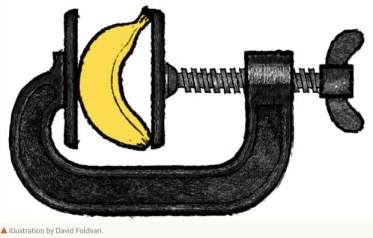
also starring fatuous asterisks, bendy bananas, and the b-word (bi)

Lee

How is the poor reader expected to differentiate between b******* and b*******?

Talking of The end of the f***ing world, the prissy prurience of the tabloids’ use of asterisks is brilliantly demolished by David Marsh in this article from the fine Guardian series Mind your language, prompted by the John Terry trial—citing a reader:

 I never cease to be amazed by newspapers which shyly make him say “f***ing black c***”, leaving intact the one word which aroused Mr Ferdinand’s wrath,

and calling on the unlikely couple of Charlotte Brontë and Ken Loach. See also this LRB review of a book on a 1923 trial revolving around women’s use of “foul language”, class, and the uses and abuses of literacy—with a pre-echo of Paul Kratochvil’s splendid story in a quote from 1930: “soldiers used the word ‘fucking’ so often that it was merely a warning that ‘a noun is coming’ “.

Moreover, reclaiming “the c-word (cunt)” has been a concern of feminists—as discussed in this post (from another useful site), citing authors from Germaine Greer to Laurie Penny. See also this article from Rachel Braier; the wiki article is useful too. And do admire the work of the Profane Embroidery Group. More under Words and women.

In Stewart Lee‘s latest book March of the lemmings (2019—not aka The bumper book of  Stewart Lee jokes: jolly japes for all the family) he pursues the style of How I escaped my certain fate with typically expansive Teutonic footnotes to the script of his show Content provider [or should that be C***ent provider?]. In one of these, warming to several topics, he reflects on the efficacity of his “so-called comedy” with purposeful, insistent use of “the c-word (cunt)”—which I hereby feel obliged to emulate.

First we should hear him doing the live version that prompted this tirade, since it gains so much from his masterly inflection, timbre, timing, and delivery:

And it isn’t, to be fair, you know, and I think—look, we’re gonna leave the EU, that is happening, and I think people have gotta put their differences behind them now and try and make it work. And I—I don’t know if you can make massive generalisations about people that voted to leave Europe anyway, because people voted to leave Europe for all sorts of different reasons, you know, and it wasn’t just racists that voted to leave Europe. Cunts did as well, didn’t they? Stupid fucking cunts. Racists, and cunts, and people with legitimate anxieties about ever-closer political ties to Europe.*

So here’s the footnote:

* How does this joke, which drew tears and cheers, even though I say it myself, night after night for the best part of two years, work? (1) Firstly, shock. I rarely swear on stage, and compared to most edgelord stand-ups, my swears count is probably only one level up from the sort of acts who market themselves as “clean” to get gigs at hospices run by born-again Christians. So it is a funny shock to hear me abandon my usual vocabulary and say the c-word (cunt). The c-word (cunt) is probably a way-too-heavy word to use here, and the deployment of such a disproportionately heavy weapon is part of what makes choosing to do [it] so funny. (2) The structure of the bit has a relationship with the much-touted idea that liberal Remainers should look outside their bubble and seek to understand the fears and concerns that drove 17.4 million people to vote Leave (“People voted to leave Europe for all sorts of different reasons, and it wasn’t just racists that voted to leave Europe…”), but then subverts the progression of thought by just calling them the c-word (cunts). To quote an old Lee and Herring routine, or possibly Viz’s Mr Logic, “Our expectations were subverted, from whence the humour arose”. (3) This second idea is then given what we in the trade call a “topper” by doubling back on the original premise and conceding that some Leave voters may also have “legitimate anxieties about ever-closer political ties to Europe”. There is then a second topper, in the form of a letter from a punter [“Dear Palace Theatre, Southend, please inform the “comedian”, and I use that word advisedly, Stewart Lee, who I had the misfortune of being taken along by friends to see last night, that I actually voted to leave Europe and I am neither a racist nor a cunt. Merely someone with genuine anxieties about ever-closer political ties to Europe. Yours, A. Cunt, Burnham-on-Crouch.”], which is a real letter (with the name changed) received during an early stage of the show at the 2016 Edinburgh Fringe try-outs, which just replays the joke again but in a funny voice and with more swearing, and with the town the complainer comes from changed to some local place every night—in this case, Burnham-on-Crouch.

By now the c-word (cunt) has long become a veritable mantra. The ever-expanding footnote goes on to do battle with Lee’s critics, with a plea for context:

The Tory Brexiteer and Sun columnist Tony Parson, in the February 2019 edition of GQ, the sort of style and status bible Patrick Bateman in American Psycho would read in between dismembering prostitutes in a penthouse apartment, wrote, on the subject of the c-word (cunt):

In the little corner of Essex where I grew up,”c***” was practically a punctuation mark among men and boys [see above—SJ]. It was in the foul air we breathed. But it grates now. It feels like the rancid tip of a cesspit that is the modern male attitude to women. And what I find bewildering is that it is not just thick ignorant oafs who use the c-word with such abandon. It is the woke. It is the enlightened. It is the professionally sensitive. It is the Guardian columnist, the BBC-approved comedian who can be guaranteed to dress to the left. “It wasn’t just racists that voted to leave Europe,” Stewart Lee recently quipped, “C***s did as well. Stupid fucking [sic!] c***s.” Does Lee’s use of the word sound rational or healthy? Does it provoke tears of mirth? Do you think it might persuade the 17.4m who voted to leave the European Union—the largest vote for anything in the history of this country—they were wrong? Some of my best friends are Remainers, but such spittle-flecked fury when using the word “c***s” makes Brexit sound like the very least of Lee’s problems.

Obviously, like Julia Hartley-Brewer and other Conservative Twitter types who alighted on the Brexit bit, Parson removed the qualifying section that followed it, where I acknowledge the out-of-touch nature of the so-called liberal elite in London, which in turn buys me some leeway, and also makes the subsequent attack on the so-called non-liberal non-elite more of a surprise; and Parson, presumably knowing little of my work, doesn’t appreciate that the use of the c-word (cunt) reads to my audience here in a comical way precisely because using it is so out of character. It is not the swear word in and of itself that brought the house down nightly. It has to have context.

And of course, the word isn’t delivered with “relish”, and it isn’t “spittle-flecked” either. The c-word (cunt) is delivered here with a kind of despairing calm, as if the cuntishness of the Brexit c-words (cunts) was just a sad matter of fact. When I was directing Richard Thomas’s Jerry Springer: the opera at the National Theatre in 2003 (as I am sure I have written before), we were given the benefit of the theatre’s voice coach for one session, who took the singers aside to teach them to enunciate all the libretto’s swear words and curses, to spit them out with relish. I waited for the session to subside, respectfully, and then had to unravel the work that had been done. The swear words weren’t necessarily to be sung in that spirit at all. For the most part, they represented the disenfranchised Americans working, in heightened emotional states, at the edges of the limited vocabulary that was available to them, and had to be used to convey not simply hate and venom, but also love, hope, despair and longing, the feelings expressed in Richard’s music. If I’d really wanted this particular c-word (cunt) to read with spittle-flecked relish, you’d have known about it. There’d have been spittle on the lens. I’m not averse to spitting on stage (on an imaginary Graham Norton, for example), so a lens would hold no terrors for me. To me, the c-word (cunt) here was mainly about how utter despair drove the beaten and frustrated Remainer character on stage (me) to the outer limits of his inarticulacy, painstakingly logical arguments against Brexit having broken down into mere swears.

And I didn’t “quip” the line either. One thing you will never see me doing is quipping. My work is too laborious and self-aware to ever include a comic device as light-hearted as a “quip”, and if I see one, I usually have it surgically removed from my script, or at least quarantined between ironic inverted commas (“Oh yeah, I can do jokes”). [Here’s a rare, and sadly very funny, example—SJ] And obviously, the bit was not in any way intended to “persuade the 17.4m who voted to leave the European Union—the largest vote for anything in the history of this country—they were wrong”, so it is stupid to criticise it for failing to achieve something it never set out to do. That’s like saying that Fawlty towers, for example, was written to encourage hoteliers to control their tempers; or that the very funny playground joke that ends with the line “Lemon entry, my dear Watson” was written to encourage Sherlock Holmes to keep suitable anal-sex lubricants close to hand for his congress with Watson, rather than relying on whatever out-of-date fruit preserves he could find in his larder.

Maybe I came onto Parson’s radar of late because I talked about Brexit, which he and his employer the Sun support, or because I am now one of those “cultural figures” that informed commentators like him are supposed to know about (“God! Haven’t you heard of Stewart Lee, Tony? I can’t believe it!”), who get praised in the London Review of Books, and get called the greatest living stand-ups in The Times, irrespective of their perceived market penetration or popularity. For Parson I am a “woke… enlightened… professionally sensitive… BBC-approved comedian who can be guaranteed to dress to the left”, which is hardly news, as it’s essentially what I describe myself as on stage, having done lazy Parson’s work for him.

Nonetheless, it’s odd to be called out as evidence of “the rancid tip of a cesspit that is the modern male attitude to women” in a magazine whose website has a “Hottest Woman of the Week” feature. It’s such an odd phrase, “the rancid tip of a cesspit”, that I had to go online and google pictures of cesspits to make sure I had understood what one was.

In my newspaper columns, I deliberately try to mangle my metaphors, writing in character as a man with imposter syndrome who is out of his depth in a posh newspaper and is trying to overcompensate with complex language that is beyond him. But Parson’s incoherence, as brilliantly parodied each month in Viz, is effortless. A cesspit is, literally, a pit full of cess. It can’t have a tip as it is not a conical solid. The only way a cesspit could have a tip is if it were somehow upended and its contents swiftly hardened in some kind of large-scale commercial drying unit, and the remaining cylinder or cuboid (depending on the shape of the pit that had moulded the cess within it) then sharpened at one end, perhaps using an enormous pencil sharpener rotated by shire horses on some kind of mill harness, or by Parson himself, until it formed the rancid tip Parson described. The only way a cesspit could have a natural tip would be if the body of the cesspit itself were conical, which perhaps they were “in the little corner of Essex where Parson grew up.

In fact, there is an Essex folk-song, collected by the archivist Shirley Collins inthe ’50s from the old traveller singer Gonad Bushell, that goes:

I’m a Billericay gypsy, Billericay is my home,
My house it is a caravan, my cesspit is a cone,
And if I want to see the cess become a rancid tip,
I tip the cesspit upside down, then dry and sharpen it!
And the curlew is a-calling in the morning.
[This is worthy of Stella Gibbons—e.g. Cold Comfort Farm, or her brilliant Britten pastiche—SJ]

Parson may have a point about the c-word (cunt), though I don’t really think my Brexit bit is hugely relevant to his discussion, and seems to be cranked in as part of some kind of twisted vengeance. Out of academic curiosity, I wondered what the dictionary definition of the c-word (cunt) was, and to my surprise, when I turned to it, there was just a massive picture of Tony Parson’s face. And it had all arrows pointing towards it as well.

Imagine writing the sort of space-filling shit Parson does, day after day. At least my columns are supposed to be stupid.

bendy

Back at the routine, Lee moves on ineluctably to the Brexiteers’ fatuous topos of bendy bananas (demolished e.g. here; also a theme of his columns, such as here and here, the latter included in March of the lemmings):

People did vote to leave Europe for all different sorts of—they did, don’t snigger away down there—they voted for all, you know, not everyone that voted to leave Europe wanted to see Britain immediately descend into being an unaccountable single-party state, exploiting people’s worst prejudices to maintain power indefinitely. Some people just wanted bendy bananas, didn’t they? “Oh no, I only wanted bendy bananas, and now there’s this chaotic inferno of hate.” “Oh well, never mind, at least the bananas are all bendy again, aren’t they?” Like they always fucking were.

In the second half of the show he adapts the Brexit material into an “I don’t know if you can make massive generalisations about Americans who voted for Trump…” routine:

Not all Americans who voted for Trump wanted to see America immediately descend into being an unaccountable single-party state, exploiting people’s worst prejudices to maintain power indefinitely. Some Americans just wanted to be allowed to wear their Ku Klux Klan outfits to church, didn’t they?

And still the footnotes to the script persist. Like How I escaped my certain fate, Lee’s comments are worth reading in full.

For more, see numerous posts under the Lee tag—and Ladies and gentlemen, Lenny Bruce!! A 2023 Guardian article has an update on our greater tolerance for swearing, again stressing context. For more on lying xenophobic misogynistic politicians, see under my roundup of posts on Tory iniquity, as well as the Tweety tag. Click here for two erudite literary jokes; and for what in Chinese, charmingly, is “the b-word (bi)”, see Forms of addressInterpreting pinyin, and Changing language.

Staving off old age

I may be nostalgic for 1950s’ comedy, like Beyond the fringe and Tony Hancock, and as to New-Fangled Popular Beat Combos I only make occasional rash forays beyond Bach [sic: see e.g. Bach as bandleader and arranger] and the Beatles (e.g. punk, Country, northern soul, and so on). My tastes in film also often hark back to formative experiences in my youth (see this roundup).

But just now, in my desperate attempt to stave off old age (less harmful than the alchemical elixirs for long life consumed in vain by ancient Chinese emperors), there are two British TV series that I just love among a plethora of Yoof programmes (across the pond, cf. Family guy, Parks and recreation, and Soap).

  • The end of the f***ing world. The asterisks there are sadly authentic, result of the delicacy of Channel 4, not mine or indeed that of the series’ creators—which inspires me to yet another post on The c-word.

The two seasons are both noir and tender; the surreal style of filming, along with the fabulous playlist, (season 1 here, season 2 here; or complete on Spotify), evokes David Lynch; and the limited vocabulary of the awkward young couple Alyssa and James (Jessica Barden and Alex Lawther) is weirdly expressive. Here’s a trailer for season 1:

* * *

Going back a little further, also on Channel 4,

  • Fresh meat (2011–16), somewhat less surreal than The young ones, remains delightful—all four series are available online. In a strong cast, the priceless character of Vod (Zawe Ashton—notwithstanding her great versatility and later celebrity) never fails to hit the spot:

When Josie tells her she’s thinking of switching to pharmacology:

Vod: What is it?

Josie: It’s the study of drugs.

Vod: You can study drugs? Now they tell me.

God has given me a brain. And I’m choosing to do some pretty wicked things to it. Which may or may not result in further hospitalisation.

More in this playlist—but go on, watch the series!

Series 4 ends with her “organising” Vodstock—”a festival that is Burning Man meets Cirque du Soleil meets Countryfile meets hajj“. In the end it’s just a student party.

* * *

phoneSo I’m like, YAY! (adjusting my monocle à la The Haunted Pencil). BTW, FFS, WTF is “streaming” anyway? WTF is an “app”? It’s OK, I don’t really want to know. And FYI, a phone is a big heavy Bakelite thingy on the table in the hall (cf. Alexander Graham Bell’s priceless prophesy).

See also Fleabag, Philomena Cunk and We are Lady Parts.

Right, back to those Daoist ritual manuals (for vain attempts to keep up with Chinese youth culture, click here).

Ritual artisans in 1950s’ Beijing

huapencun

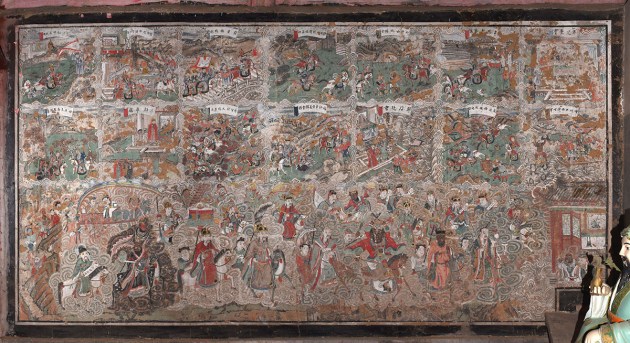
Mural, Lord Guan Hall, Huapen village, Yanqing district, Beijing, c1809.

Quite beyond my area of expertise, I was inspired by reading the brief yet suggestive article

  • Liu Lingcang 劉淩滄, [1] “Minjian bihuade zhizuo fangfa” 民間壁畫的製作方法 [Techniques of making folk murals], Yishu yanjiu 1958.2, pp.52–6.

As Hannibal Taubes divined when he sent it to me, slight as it is, it links up nicely with my taste for scholarship under Maoism documenting the customs of old Beijing just as they were being dismantled. It’s not so much the quality of the research that attracts me here—rather, the delicate nature of studying the topic just as collectivisation was escalating, painfully evoked in films like The blue kite. As ever, we need to read between the lines. Moreover, we can always learn from accounts of the nuts and bolts of creativity.

I’ve already introduced the work of the great Yang Yinliu at the helm of the Music Research Institute, along with the ritual traditions of old Beijing represented by the Zhihua temple. For more on old Beijing, see also Li Wenru, Wang ShixiangChang Renchun, and narrative-singing (here and here)—and in recent years a major project on the social history of imperial and Republican Beijing temples through epigraphy and oral sources.

* * *

From November 1955 to the autumn of 1956, the Central Academy of Fine Arts carried out a project documenting the work of ritual painters in Beijing. Rather than Liu’s gloss huagong 画工, the common folk term was huajiang 画匠 “artisan painter”, as in Yanggao, referring to artisans working for what had always been largely a ritual market—part of the whole network of ritual service providers upon whom Chang Renchun‘s work opens a window. They were apprenticed from young, often within the family.

Themes of their murals and paintings included the Seventy-two Courts (qisier si 七十二司) (cf. here, under “Buddhist-transmitted groups”) and the Ten Kings of the Underworld, depictions of Guanyin, the life of the Buddha, Yaowang Medicine King, and Water and Land rituals; and scenes from popular fiction such as the Three Kingdoms and the Water Margin. The article also hints at the market in the surrounding countryside for New Year’s lanterns and diaogua hangings, such as our own team found in Hebei (cf. the story of itinerant Qi Youzhi and his forebears, maintaining sheng mouth-organs for temples and village ritual associations). The themes of such hangings were closely related to historical subjects embodied in opera and story-telling.

Diaogua hangings adorning the alleys of Gaoluo village, 1989. My photos.

Just as our understanding of ritual is enriched by zooming in on the nuts and bolts of its vocal and instrumental soundscape, we can learn much by unpacking the techniques and vocabulary of religious painting. [2] In the end, ritual performers and ritual artisans are closely related.

The whole process of creating murals consisted of three stages (yixiu erluo sancheng 一朽二落三成):

  • xiu “draft”, known as tanhuo 擹活, creating a draft outline, drawn in charcoal
  • luo (lao, perhaps), “setting down”, known as laomo 落墨 “setting down the ink”
  • cheng “completion” (cheng guanhuo 成管活).

As with Renaissance artists in Europe, the laborious final stages depended on a division of labour, with the assistance of disciples.

Liu goes on to discuss elements in turn, with details on materials and tools, including this marvellous summary of the technicalities of preparing Water and Land paintings:

Shuilu details

Citing examples as far back as the Tang dynasty to illustrate techniques still in use, Liu goes on to discuss applying ground layers to the wall, templates (fenben 粉本), traditional methods of mixing and adjusting mineral pigments, the use of glues and alum, creating 3-D effects, and colour gradation. For pigments, while Liu notes the incursion of Western materials since the 1920s, among the team’s informants for traditional painting techniques was none other than Guan Pinghu, master of the qin zither! And in a detailed section on depicting gold, Liu consulted Wang Dingli 王定理 and Shen Yucheng 申玉成, working on the statuary of Tibetan temples in Beijing, as the best artisans then working in the medium.

An intriguing part of the final stages of mural painting is the addition of colours according to the master craftsman’s indications in charcoal, such as gong 工 for red and ba 八 for yellow—economical versions of the characters hong 红 and huang 黄, or liu 六, whose pronunciation stood for  绿 green. They even found such indications visible in the Ming-dynasty murals of the Dahui si 大慧寺 temple in Beijing. Liu notes that the custom was already dying out in Beijing, [3] but the shorthand reminds me, not quite gratuitously, of the secret language of blind shawm players in north Shanxi, and (less directly) the characters of gongche notation, which persisted.

Though again the ancient tradition of oral formulas (koujue 口诀) was dying out (at least in Beijing), Liu lists those that they could recover—just the kind of vocabulary that we seek from ritual performers, going beyond airy doctrinal theorising to gain insights into the practical and aesthetic world of folk society:

koujue

Just as the ritual soundscape still heard throughout the countryside in the 1950s (and today) contrasted starkly with the official diet of revolutionary songs, these traditions occupy an utterly different world from our image of propaganda posters of the time.

But—not unlike all the 1950s’ fieldwork on regional musical traditions (links here)— what the article could hardly broach was how the lives and livelihoods of such ritual service providers were progressively impoverished after Liberation, as their whole market came under assault and temples were demolished or left to fall into ruin. Even in the previous decade, through the Japanese occupation and civil war, the maintenance of temples can hardly have been a priority; new creation of murals was clearly on hold, and one wonders how much, if any, maintenance and restoration these artisans were still doing when Liu’s team visited them. Some of the artisans were doubtless already seeking alternative employment such as factory work or petty trade. We get but rare glimpses of this story, such as Zha Fuxi’s 1952 frank letter to the former monks of the Zhihua temple tradition. Later in the 1950s some official documents inadvertently provide further material on the period.

Of course, irrespective of their current circumstances, asking people to recall their previous practices is always an aspect of fieldwork, while one seeks to clarify the time-frame of their observations.

[1] Liu LingcangBy this time Liu Lingcang (1908–89) was already a distinguished artist and educator; but his early life qualified him well for the project discussed here. A native of a poor village in Gu’an county, Hebei, as a teenager he worked as an apprentice folk ritual artisan in nearby Bazhou before finding work as a restorer of temple murals in Beijing—so the 1955–6 project was based on his own former experience as a participant. Becoming a member of the Research Association for Chinese Painting in 1926, he went on to study at the Beiping National School of Art (precursor of the Central Academy of Fine Arts), taking up senior official posts after the 1949 Liberation. Some of his later paintings addressed religious themes: like Yang Yinliu over at the Music Research Institute, he clearly remained attached to his early background, despite his elevation. Again I think of Craig Clunas’s comment “The published curricula vitae of Chinese scholars often give a false idea of the continuity of their employment, and conceal the long periods of frustrating idleness caused by periodic political campaigning.”

[2] Craig Clunas kindly offers some further leads to “technical art history” in China, such as John Winter, East Asian paintings (2008), and (for the medieval period, notably for Dunhuang) Sarah Fraser, Performing the visual: the practice of Buddhist wall painting in China and Central Asia, 618-960 (2004). For technical details in the world of literati painting (such as mounting), see Robert van Gulik, Chinese pictorial art as viewed by the connoisseur (1981).

[3] As Hannibal tells me, a variant of this system is still used by folk ritual artisans in rural Shaanbei. For the anthropology of folk ritual art there he also directs us to a wealth of research, notably the insightful work of Huyan Sheng 呼延胜, such as his PhD on Water and Land paintings (Shaanbei tudishangde shuilu yishu 陕北土地上的水陆画艺术), and the article “Yishu renleixue shiyexiade Shaanbei minjian simiao huihua he kaiguang yishi” 艺术人类学视域下的陕北民间寺庙绘画和开光仪式, Minyi 民艺 2019.3; as well as a detailed article on painter-artisans in nearby Gansu by Niu Le 牛乐, “Duoyuan wenhuade yinxing chuancheng celue yu wenhua luoji” 多元文化的隐性传承策略与文化逻辑, Qinghai minzu yanjiu 2018.3.

Gosh—for such remarkable continuity in Chinese culture, despite all its tribulations, yet another reminder that “when the rites are lost, seek throughout the countryside”, and that “a starved camel is bigger than a fat horse”.

More Country

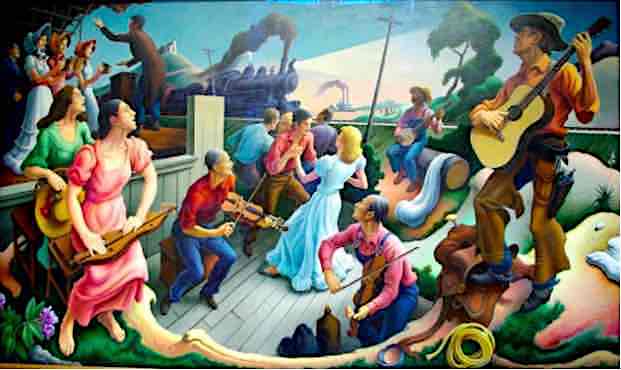
Sources of country musicThomas Hart Benton, The sources of Country music (1975).

Three chords and the truth—Harlan Howard

Do you know what the southern definition of a true music lover is?
It’s a man who, if he hears a woman singing in the shower, puts his ear to the keyhole—cited in Dawidoff, In the country of country.

Complementing his classic series on jazz, the new PBS series by Ken Burns on the simpler but equally meaningful language of Country music reminds us that far from being a quaint byway, it represents the soul of modern US culture. The eight two-hour episodes have been re-edited and pared down into nine 50-minute programmes for BBC4. [1] Now that I’ve watched the latter, I’m keen to see the full version. Here I can only outline a few of the themes and personalities.

If you know about Country, then you won’t be reading this, and indeed you may bring more critical perspectives to bear on Burns’s portrayal; but for the rest of us, it deserves taking seriously. Here’s a trailer:

As with any genre (Aboriginal dream songs, Iranian chamber music, French baroque, and so on), you just have to immerse yourself in the style and the culture (for a more detailed project on flamenco, see the amazing series Rito y geografia del cante).

With Peter Coyote’s distinctive voiceover, the series judiciously blends interviews and performances with lingering photos, encompassing the personal and political, artistic and commercial, poverty and pain, ecstasy and drudge, church and honky-tonks, domestic stability and outlaw excess, survival and solace. Looking beyond the hillbilly costumes and cowboy hats to the heartache, amidst all the drink, drugs, divorces, early deaths, and the ravages of the touring life, Burns accessibly draws us to the lyrics and music, always identifying themes in the history of cultural transmission, and the very nature of tradition.

Gradually over the series, the early log cabins, railroads, coal mines, textile mills, timber yards, and sharecroppers give way to mansions and Cadillacs. And as one review comments, you can almost trace the history in the performers’ faces: the lean lines of the early stars such as Hank Williams and Jimmie Rodgers, giving way to the gnarled faces of Johnny Cash and Merle Haggard, and then the soft, untroubled faces of the ’80s and ’90s stars. But to see it as “a simple journey from the sublime to the ridiculous” risks succumbing to the bourgeois nostalgia for poverty.

Despite the later countrypolitan sounds, audiences constantly returned to the roots authenticity of old-time, bluegrass, hillbilly. Female performers play an exceptional role, such as The Carters, Patsy Cline, Loretta Lynn, Tammy Wynette, Dolly Parton, Rosanne Cash, and Emmylou Harris.

oldies

The Rub (beginnings to 1933) makes a captivating opening, with wonderful archive photos evocatively deployed. Folk music is always eclectic. Spreading through barn dances and travelling medicine shows, the history of Country is intertwined with gospel and spirituals, slavery and the blues, as well as folk traditions of Appalachia and European migrants, notably the British Isles. Though Country has been described as “the white man’s soul music”, the series acknowledges its debt to African-American culture. In addition to the new technologies of phonographs and radio, it soon became a highly commercial proposition, with patronage from institutions like the National Life and Accident Insurance Company and its WSM station, which gave rise to the long-running Grand Ole Opry. Among early performers, the 1927 discovery of the Carter family and Jimmie Rodgers was a seminal moment.

In Hard Times (1933–1945) (“The sad songs are the best”), the industry continues to grow through the Great Depression and World War Two, with major migrations. The Texas Swing of Bob Wills and his Texas Playboys was based on strings rather than horns—a classic case of the eclectic melting-pot of immigrant styles (Cajun, Hispanic, and so on) (cf. Accordion crimes). Nashville becomes the heart of the scene with the rise of the Grand Ole Opry. Roy Acuff and Bill Monroe are admired, and the Carter family become ever more popular. The steel guitar plays a growing role. Social dancing is still a major element.

Why don’t Baptists make love standing up?
Because people would think they’re dancing.

Country helped people cope with loss. Hard times was adopted from Stephen Foster’s 1854 parlor song:

Let us pause in life’s pleasures and count its many tears
While we all sup sorrow with the poor
There’s a song that will linger forever in our ears
Oh hard times come again no more

Tis the song, the sigh of the weary
Hard times, hard times, come again no more
Many days you have lingered around my cabin door
Oh hard times come again no more

While we seek mirth and beauty and music bright and gay
There are frail forms fainting at the door
Though their voices are silent, their pleding looks will say
Oh hard times come again no more

’Tis the song, the sigh of the weary
Hard times, hard times, come again no more
Many days you have lingered around my cabin door
Oh hard times come again no more

’Tis a sigh that is wafted across the troubled wave
Tis a wail that is heard upon the shore
Tis a dirge that is murmured around the lowly grave
Oh hard times come again no more

Hank and Holly

Hank Williams and his granddaughter Holly.

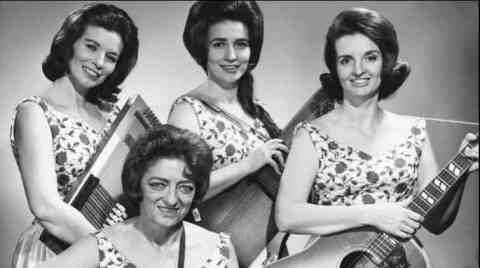
The Hillbilly Shakespeare (1945–1953) evokes the postwar period, focusing on the great, short-lived Hank Williams, with fine vignettes from his granddaughter Holly, and Marty Stuart reminding us of the importance of black musicians in the tradition. Also featured are the stellar bluegrass lineup of Bill Monroe, Lester Flatt, and Earl Scruggs; and the Carter sisters with their mother Maybelle.

Carters

In I Can’t Stop Loving You (1953–1963), the confluence of blues and hillbilly music at Sun Records in Memphis gives birth to rockabilly, the precursor of rock and roll; at the forefront are Johnny Cash (with comments from his daughter Rosanne) and Elvis Presley. Not “Walking the Line”, Johnny Cash gets together with June Carter. Among the rapt inmates for his 1959 concert at San Quentin was Merle Haggard. Like Russians listening to Vladimir Vysotsky, when they heard him they couldn’t believe that Cash hadn’t done time in prison.

Meanwhile in Nashville the country twang was replaced by a smoother sound, with Patsy Cline and Loretta Lynn among its stars. Before Patsy Cline’s tragic death in 1963, there’s a nice story about how they reached the perfect tempo for her recording of Willie Nelson’s song Crazy, whose exceptional melodic and harmonic invention quite transcends the cheesy accompaniment:

In The Sons and Daughters of America (1964–1968), the Grand Ole Opry story continues, even as social conflict intensifies. Johnny Cash embodies the spirit of the age, his self-destruction mirroring his artistic triumphs. From the new East coast folk revival scene he took on board the current of social protest; his admiration for Bob Dylan was mutual. His 1968 Folsom Prison concert was a triumph. Merle Haggard (“San Quentin graduate”, another engaging commentator throughout the series; he died in 2016, R.I.P) emerges from his misspent youth as a great singer.

Amidst the civil rights movement (note also Detroit 67), Charley Pride overcomes racial prejudice with his fine voice. The unfiltered songs of Loretta Lynn chime with the new wave of Women’s Liberation. Dolly Parton, fourth of twelve children from a rural cabin without electricity or running water (the kind of CV that was still de reigueur for that generation of singers), demands to be taken seriously—despite joining a select group of strong women reluctant to acknowledge the boons of feminism.

Tammy and Loretta

Tammy Wynette with Loretta Lynn.

The story continues in Will the Circle Be Unbroken? (1968–1972). As the Vietnam War intensifies, the industry and its audience react to divisive social upheavals. George Jones and Tammy Wynette get together. Despite Tammy’s submissive Stand by your man, she didn’t—by contrast with the tough-talking songs of Loretta Lynn, who did; as Jennie Seely comments “I always kinda thought they wrote each other’s songs.”

Among a growing number of Country recruits from outside the archetypal deprived rural background was Kris Kristofferson. Several singer-songwriters pay tribute to his exceptional lyrics, such as Casey’s last ride:

Casey joins the hollow sound of silent people walking down
The stairway to the subway in the shadows down below;
Following their footsteps through the neon-darkened corridors
Of silent desperation, never speakin’ to a soul.

The poison air he’s breathin’ has the dirty smell of dying
‘Cause it’s never seen the sunshine and it’s never felt the rain.
But Casey minds the arrows and ignores the fatal echoes
Of the clickin’ of the turnstiles and the rattle of his chains.

 Oh! she said, Casey it’s been so long since I’ve seen you!
Here she said, just a kiss to make a body smile!
See she said, I’ve put on new stockings just to please you!
Lord! she said, Casey can you only stay a while?

As he explains, his song Bobby McGee (Busted flat in Baton Rouge, waitin’ for a train, And I’s feelin’ near as faded as my jeans…) was inspired by La strada. Johnny Cash was hugely popular, and increasingly countercultural. And the Californian hippies of the Nitty Gritty Dirt Band recruited senior Country legends like Maybelle Carter, Earl Scruggs, and Roy Acuff for an album that bridged the gap between generations.

In Are You Sure Hank Done It This Way? (1973–1983) (a sentiment that recalls Taruskin) opens by asking a question central to ethnomusicology, how much change a genre can embrace while retaining its identity; and reminds us how resistant Country had always been to arbitrary borders. As the smooth countrypolitan sound reaches new audiences, singers like Dolly Parton achieve crossover success, finding time for the classic epithet

It cost a lot of money to look this cheap.

And Emmylou Harris, with her background in the East Coast folk scene, tells how she found herself by becoming a convert to Country. At the same time, despite pressures from the Nashville bosses, Waylon Jennings managed to persist with a rougher style. And we hear the compelling story of Hank Williams Jr as he emerges from the long shadow of his godlike father to forge his own path (exemplified in his brilliant song Family tradition!)—with further endearing comments from his daughter Holly.

Marty and L Flatt

Lester Flatt with Marty Stuart.

In Music will get through (1973–1983) the less mediated, marginalized bluegrass style enjoys a roots revival: “It was so old that it was new”. It had never gone away, it just hadn’t hit the headlines. Marty Stuart, who provides thoughtful comments throughout the series, comes into his own as a fine performer, touring from young with Lester Flatt and Bill Monroe, and later with Johnny Cash. I’m struck by how much performers themselves revere the whole tradition:

Walking into the Grand Ole Opry with Lester Flatt was like walking into the Vatican with the Pope. It was like that old scene in The Wizard of Oz where the world went from black-and-white to color.

Nelson and Haggard

Merle Haggard with Willie Nelson.

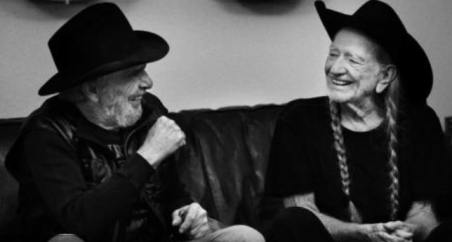
The veteran Maybelle Carter finds a new audience; George Jones and Tammy Wynette, now divorced, come back for a reunion album. Willie Nelson (“Willie’s not from round here—I mean, Earth”) thrived in the freewheeling, genre-bending scene of the Armadillo World Headquarters in Austin, Texas. With Waylon Jennings he launched the Outlaw movement, later going on to work with Merle Haggard.

Following in her father’s footsteps, Rosanne Cash becomes a fine singer-songwriter. Emmylou Harris bridged folk, rock, and Country, influencing a new generation of artists, including young Ricky Skaggs, with all his bluegrass credentials.

As doors continue to open, the final programme, Don’t Get Above Your Raisin’ (1984–1996) features artists like Reba McEntire, Naomi Juggs and her daughter Wynnona; k.d. lang (“a punk reincarnation of Patsy Cline”), Kathy Mattea, Rhiannon Gid, and megastar Garth Brooks.

Cashes

Johnny Cash with Rosanne.

But the pull of the more traditional elements still remains strong. Ricky Skaggs and Marty Stuart stay faithful to the bluegrass sound of Bill Monroe, taking Country back to the front porch. Johnny Cash reinvents himself, bowing out on a high note, with Rosanne offering more insights. The series concludes with a wonderful montage on the whole tradition.

And the story continues…

My purpose here, apart from drawing your attention to a fine piece of film-making, is not so much to provide a superfluous summary as to remind myself, in the spirit of ethnomusicology, that all the musickings of all the cultures around the world deserve to be treated on an equal footing, and that they offer a revealing window on societies in change.

[1] Currently online, alas only briefly, so catch it while you can; otherwise, the DVDs are eminently worth buying. The book, like that complementing Burns’s series on jazz, also looks tempting. Among many reviews far better informed than I can offer, see e.g. herehere and here. Among the extensive literature (note Malone and Neal, Country Music, U.S.A.), I’ve enjoyed re-reading Nicholas Dawidoff, In the country of country: a journey to the roots of American music (1997).

Chicago blues

blues

In The blaze of obscurity Clive James (R.I.P.) compounds his paltry efforts to represent Japanese culture on film with a candid and fatuous account of filming a blues session for his Postcard from Chicago:

But Chicago’s expatriated European art would have been an unduly quiet story if it had not been offset by something noisier, and our candidate for that was the blues. Unfortunately, much as I loved jazz, I had only a limited tolerance for the kind of blues number in which the singer sings the same not very inspired line twice (or even worse, three times) before capping it with a third (or even worse, fourth) not very inspired line, followed by a peremptory wail from from that least disarming of all jazz instruments, the amplified harmonica. I spent a long, harrowing night in a blues club where I had to look fascinated by the cacophonous remains of a famous blues shouter called something like Slow Dirt Buncombe (I remember his real name but his lawyer might still be alive) while he gave a string of examples of how a song with less than a minute of material could be stretched to thirty minutes if you made the same line and stanza sound different by mangling them in a different way each time. Yelled at cataclysmic amplification, “Well mah woman she done leff me” was a recurring motif. “No bloody wonder” was the obvious continuation, but he never sang that. Thanks to the unnecessary volume—the sure sign of inadequate music—I was never completely clear what he was singing, but I could rely on a maximum air of drama when he pulled back from the microphone, slanted his polished ebony head to shield it from the blaze of the heavenly splendour he had created, and suddenly leaned forward again to give a long blast on his hellishly resonant harmonica. The desirable and necessary ideal of racial equality should, in my view, allow us to say that there is the occasional blues artist whose parade of desolation amounts to an acute pain in the neck. Slow Dirt Buncombe was one of these. Unfortunately Nobby, the deaf sound-man who was once again on the case, caught every line of Slow Dirt’s act with perfect fidelity, and some of the results got as far as the final cut, accompanied by cutaways of my enchanted, lying face.

Maybe he was just unlucky—although one wonders why the BBC scouts wouldn’t be able to find a good band. And sure, it’s a typically funny account. But rather than making an effort to identify what it is that makes blues so effective and using his own gift for words to encapsulate it, he chose here to disguise his incomprehension beneath glib cliché.

Fortunately, there’s a wealth of fine documentaries about Chicago blues, like this:

Or Blues America (here and here). And of course there’s a vast treasury of live performances online.

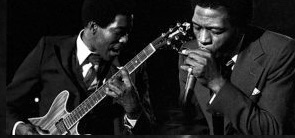
So to exorcise Clive James’s experience, here’s the great Junior Wells with Buddy Guy live at Montreux in 1974:

See also Got my mojo working.

* * *

Still, despite Clive James’s cultural blind spots, I am eternally grateful for his priceless evocation of Barbara Cartland’s face:

Twin miracles of mascara, her eyes looked like the corpses of two small crows that had crashed into a chalk cliff.

Doubletalk

To complement Flann O’Brien’s multi-lingual All-Purpose Opening Speech, a passage from Ladies and gentlemen, Lenny Bruce!! led me to the even purer form of doubletalk:

Lenny began to rely more and more on what he could do with his voice, hands and facial expressions. […] That discovery was the first step in the direction of abstraction.

The next step was to junk speech in favor of double-talk. Here he was following the lead of Sid Caesar, the greatest double-talk artist in the history of comedy. Sid was a genius with sounds and accents. He couldn’t speak two words of any foreign language, but he would converse for hours in double-talk versions of German, French, Italian, Spanish, Russian, Polish, Japanese—and even more exotic tongues—with such passions and such a flair for the characteristic sounds of these languages that people would swear he was actually speaking the language.

Now, as Lenny realized eventually from his prolonged study of Sid’s stage act, when you make a character speak in double-talk, you actually abstracted the essence of his vocal mannerisms. Once the words were reduced to gibberish, the whole characterization resided in the inflections and tonal peculiarities of the character’s delivery.

Indeed, beyond mere verbal fluency, hand gestures and facial expressions are important aspects of language learning (for the vocabulary of Italian hand gestures, see e.g. here).

Language Log has erudite coverage of doubletalk, with further links. Here’s the famous Sid Caesar routine, with French, German, Italian, and Japanese:

Meanwhile Dario Fo was exploring Grammelot:

By extension, here’s a classic scene from Bananas:

Criticizing Confucius

Given that this is no time for blind kowtowing before authority—anywhere:

Just as Tang poetry isn’t immune from doggerel, maybe we might unfurl a new, more decorous campaign to debunk the uncritical veneration of Confucius (cf. Alan Bennett).

Noting that “Confucius He Say” 子曰 might be rendered as “So the kid goes…” (“I’m like, whatever”; see also OMG), one could regard the Analects an early pilot for Kids say the cutest things 子曰乖事, or an anthology of pithy bumper-stickers (cf. Gary Larson’s cartoon Confucius at the office—”Looks like we’re in for some rain”).

Here’s one gnomic maxim that does rather appeal to me:

君子不器
The gentleman is not a vessel.

Typically, it’s been subjected to a vast apparatus of scholarly exegesis; I like to take it as a critique of reification, one of the banes of studying music (see musicking), religion (see “doing religion“), and indeed Life… Indeed, maybe the qi 器 there is even verbal: “The gentleman doesn’t reify”? * I would like the quote even more if he had said that women weren’t vessels either—but despite recent defences of Confucian sexism, he didn’t (surprise surprise).

As Confucius said when his disciple Yan Hui ** told him he was taking up stamp collecting,

Philately will get you nowhere

(an old joke that goes back at least to Jennings).

As ever, The life of Brian has salient critiques. Here’s one of the Boring Prophets:

There shall, in that time, be rumors of things going astray, erm, and there shall be a great confusion as to where things really are, and nobody will really know where lieth those little things wi- with the sort of … raffia-work base that has an attachment. At this time, a friend shall lose his friend’s hammer and the young shall not know where lieth the things possessed by their fathers, that their fathers put there only just the night before, about eight o’clock.

And indeed the rebuke to exegesis in the Sermon on the Mount scene that opens the film:

I think it was “Blessed are the cheesemakers”.
Ahh, what’s so special about the cheesemakers?
Well, obviously, this is not meant to be taken literally. It refers to any manufacturers of dairy products.

See also Alan Bennett’s classic sermon on “My brother Esau is an hairy man…”


* Cf. “Gentlemen lift the seat”—as Jonathan Miller observed in Beyond the fringe, “What exactly does this mean? Is it a sociological description—a definition of a gentleman which I can either take or leave? Or perhaps it’s a Loyal Toast? It could be a blunt military order, or an invitation to upper-class larceny.”

** My penchant for Yan Hui derives from the ritual shengguan suite Qi Yan Hui 泣颜回,  a title that alludes to Confucius bewailing his early death (for a gongche score, see here, under West An’gezhuang).

Ladies and gentlemen, Lenny Bruce!!

LB

Among the controversial, countercultural icons who drove themselves to an early grave was Lenny Bruce (1925–66), “America’s No.1 Vomic”.

With my penchant for jazz biographies, in a similar vein [sic] is the extraordinary book

  • Albert Goldman (from the journalism of Lawrence Schiller), Ladies and gentlemen, Lenny Bruce!! (1974). *
    (Do read this most perceptive review by Wallace Markfield—interestingly garbled in the course of digitisation.)

The opening chapter, “A day in the life”, is a dazzling, graphic, blow-by-blow reconstruction of his arrival in New York in 1960 for a gig at the Blue Angel. Just a taster:

Around ten, a yellow cab, somewhat unsteadily driven, pulls up before a narrow gray dilapidated building on one of the crummiest sidestreets off the Square. Above the spattered pavement an extinguished neon sign flaps patches of cold hard shadow across the stone steps: HOTEL AMERICA, FREE PARKING. The cab opens with a jolt, back doors flying open so that two bare-headed men dressed in identical black raincoats can begin to crawl out from the debris within. […]

The night before, they wound up a very successful three-week run in Chicago at the Cloisters with a visit to the home of a certain hip show-biz druggist—a house so closely associated with drugs that show people call it the “shooting gallery”. Terry smoked a couple of joints, dropped two blue tabs of mescaline and skin-popped some Dilaudid; at the airport bar he also downed a couple of double Scotches. Lenny did his usual number: twelve 1/16th-grain Dilaudid pills counted out of a big brown bottle like saccharins, dissolved in a 1-cc. ampule of Methedrine, heated in a blackened old spoon over a shoe-struck lucifer and the resulting soup ingested from the leffel into a disposable needle and then whammed into the mainline until you feel like you’re living inside an igloo. […]

The America is one of the most bizarre hotels in the world: a combination whorehouse, opium den and lunatic asylum.

LB club

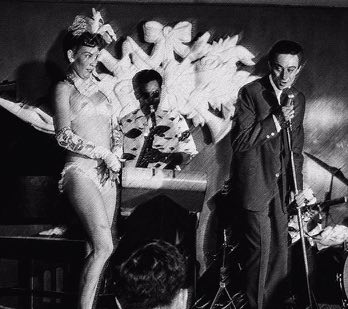
As Lenny honed his act at strip clubs, Goldman explores his background in

the fast-talking, pot-smoking, shtick-trading hipsters and hustlers who lent him his idiom, his rhythm, his taste in humor and his typically cynical and jaundiced view of society.

He describes Lenny’s connection with comics like Joe Ancis, Mort Sahl, and George Carlin. Joe

insisted on schlepping Kenny and Lenny to the Metropolitan and the Museum of Modern Art, taking them on whirlwind tours of both collections with his rapidly wagging tongue doing service as a catalog, guidebook and art-history course. “The fuckin’ Monet, schlepped out, half dead, in his last period, you dig? Painting water lilies—is that ridiculous! Water lilies, man, giant genius paintings, man, like the cat is ready to pack it in, but he has to blow one last out-chorus!

The book’s gory details of drug-taking and its paraphernalia, a staple of jazz biographies (Billie Holiday, Charlie Parker, Miles Davis, Chet Baker (here and here), John Coltrane, and so on), are unsurpassed, and as Markfield observes “could easily serve as basic text in a graduate seminar on mainlining”.

Much as I love Chet’s ballads, he seems to have traded on his early angelic, melancholy image merely as a means to the end of a constant supply of drugs; whereas for Lenny the drugs and the performance went hand in hand, evoking the explorations and discipline of Billie and Miles. Amidst all the squalor, the book evokes the technique of Lenny’s creativity, the way he played the room (cf. Stewart Lee’s labyrinthine footnotes):

Suddenly, he lowers his head and shoots a bold glance into the house—a real arched-brow zinger. “Looks like some faggot decorator went nuts here with a staple gun!” Bam! He’s in, they’re tittering. Then he goes for the extension: “Whoo-who!” (high fag scream) “It’s just got to flow like this!” (big wrist flap and faggy, camp gestures as he dances around triggering off staples with his thumb). They’re starting to laugh. Now for a quick change-up. Take them into his confidence. “You know, when I was a kid, I always dreamed about going to a nightclub.” Nice, easy mood, nostalgia. Then into the thirties movie bits with the George Raft takes and the Eugene Pallette club-owner pushing back the panel in the office to get a view of the stage and the little shaded lamps on the tables and the tuxes and the deep-cleft gowns and the hair on the guys bayed back at the temples and Lenny home from the movies standing in front of the bathroom mirror with a scissors cutting away the hair from his temples so he’d have a hairline like Brian Aherne or Robert Taylor and then his disillusionment years later when he went to the Copa for the first time and everything was so tacky and there wasn’t even a men’s room attendant and they had whisky bottles right on the table like a Bay Parkway Jewish wedding and … and … and … By the balls! They’re hanging on his words. Eating out of his hand! Kvelling because it’s their experience—but exactly!

Indeed, not just Lenny’s lifestyle but the techniques of his free-flowing stage routine have aptly been likened to bebop:

He fancied himself an oral jazzman. His ideal was to walk out there like Charlie Parker, take that mike in his hand like a horn and blow, blow, blow everything that came into his head just as it came into his head with nothing censored, nothing translated, nothing mediated, until he was pure mind, pure head sending out brainwaves like radio waves into the heads of every man and woman seated in that vast hall. Sending, sending, sending, he would finally reach a point of clairvoyance where he was no longer a performer but rather a medium transmitting messages that just came to him from out there—from recall, fantasy, prophecy.

A point at which, like the practitioners of automatic writing, his tongue would outrun his mind and he would be saying things he didn’t plan to say, things that surprised, delighted him, cracked him up—as if he were a spectator at his own performance!

In another passage, Goldman comments:

The ghetto idiom was far more than a badge of hipness to Lenny Bruce: it was a paradigm of his art. For what the language of the slums teaches a born talker is, first, the power of extreme linguistic compression, and, second, the knack of reducing things to their vital essences in thought and image.

Jazz slang is pure abstraction. It consists of tight, monosyllabic that suggest cons in the “big house” mumbling surreptitiously out of the corners of their mouths. Words like “dig”, “groove” and “hip” are atomic compactions of meaning. They’re as hard and tight and tamped down as any idiom this side of the Rosetta Stone. `if any new expression comes along that can’t be compressed into such a brief little bark, jazz slang starts digesting it, shearing off a word here, a syllable there, until the original phrase has been cut down to a ghetto short.

The same impatient process of short-circuiting the obvious and capping on the conventional was obvious in jazz itself. […] Listening to Be-Bop, you’d be hard put to say whether it was the most laconic or the most prolix of jazz styles. At the very same that it was brooming out of jazz all the old clichés, it was floridly embellishing the new language with breathtaking runs and ornaments and arabesques. Hipster language was equally florid at times, delighting in far-fetched conceits and taxing circumlocution. A man over forty, for example, was said to be “on the Jersey side of the snatch play”.

LB arrest

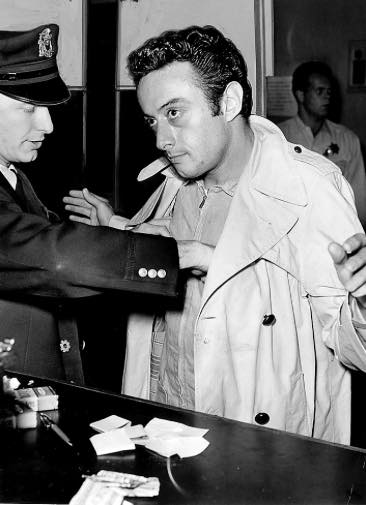
But whereas for jazzers music made a pure, abstract language transcending their mundane lifestyle, Lenny’s act was inevitably entangled with it. He was getting busted for his act as well as his medicinal habits, becoming ensnared in a series of obscenity trials. But he was at his very best for the midnight gig at Carnegie Hall on 3rd February 1961, again brilliantly evoked by Goldman—riffing on topics such as moral philosophy, patriotism, the flag, homosexuality, Jewishness, humour, Communism, Kennedy, Eisenhower, drugs, venereal disease, the Ku Klux Klan, the Internal Revenue Service, and Shelly Berman. Had he lived on, an invitation to today’s White House seems unlikely. Goldman reflects:

What else is this whole jazz trip? You take your seat inside the cat’s head, like you’re stepping into one of those little cars in a funhouse. Then, pulled by some dark chain that you can’t shut off, you plunge into the darkness, down the inclines, up the slopes, around the sharp bends and into the dead ends; past bizarre, grotesque window displays and gooney, lurid frights and spectacles and whistles and sirens and scares—and even a long dark moody tunnel of love. It’s all a trip—and the best of it is that you don’t have the faintest idea where you’re going!

Here’s one of several video clips of his live act (more here, as well as many audio recordings online):

London
Chapter 10, “Persecution” describes Lenny’s 1962 sojourn at Peter Cook’s new London club The Establishment—designed to elude the censoring scissors of the Lord Chamberlain’s office, “maiming English stage plays since the 16th century”. Indeed, this was part of an exchange of hostages that led to the Beyond the Fringe team’s long run on Broadway—International Cultural ExchangeYAY!

Lenny in London! Sounds bizarre, doesn’t it? Like James Brown at the Bolshoi. Or Little Richard at La Scala.

(Nice idea, but not so bizarre—neither London, Moscow, nor Milan are so culturally monochrome…)

Here’s an intriguing prequel to the misguided vinegar advertisement, and indeed Always look on the bright side of life:

The Establishment was preparing a skit that depicted Christ Jesus as an upper-class gent hung between two cockney-talking thieves, who complain in their petty, rancorous way: “ ’E’s getting all the vinegar sponges!”

Goldman goes on:

Lenny’s notions of England—compounded from old Hollywood flicks and Alec Guinness imports—were queer, to say the least. As Jonathan Miller summed them up, Lenny saw Great Britain as “a country set in the heart of India bossed by a Queen who wore a ball dress. The population had bad teeth, wore drab clothes and went in for furtive and bizarre murders”.

Not all of this was so wide of the mark.

As Lenny’s apostle Kenneth Tynan observed,

If Beyond the fringe was a pinprick, Mr Bruce was a bloodbath.

As ever, critical responses were polarized. Brian Glanville later wrote in The Spectator:

Bruce has taken humour farther, and deeper, than any of the new wave of American comedians. […] Indeed, the very essence of the new wave is that one hears an individual voice talking, giving vent to its own perception and, in Bruce’s case, its own obsessions. An act such as this requires a good deal more than exhibitionism; it also need courage and passion. Essentially, it is not “sick” humour at all. The word is a tiresome irrelevance—but super-ego humour: a brave voice calling from the nursery.

He was denied entry the following year as an “undesirable alien”.

I’d be curious to learn what Alan Bennett thought of Lenny, but his influence on Dud ‘n’ Pete can be heard in their later foul-mouthed Derek and Clive recordings. Christopher Hitchens wrote a fine article on these transatlantic comedy genealogies.

Goldman devotes a perceptive chapter to “The greatest trial on earth”, a high-profile obcenity case over six months in Manhattan in 1964. Despite support from an array of prominent literati, Lenny was sentenced; freed on bail pending an appeal, as his mental and physical health went into a tailspin, exacerbated by paranoia over litigation, he died in squalor.

The only flaw I find with Goldman’s brilliant book is that it lacks an index. See also Doubletalk.

* * *

All this is a far cry from the bland hagiography of Chinese biographies. And the book reminds me again that the post-war era before the Swinging Sixties wasn’t entirely drab and conformist (see e.g. Paul Bowles, Gary Snyder). It also highlights issues of free speech, which are so urgent today. By comparison with Lenny, the challenging routines of Richard Pryor, or Stewart Lee, seem almost genteel. Still, the latter’s travails over Jerry Springer: the opera, detailed in How I escaped my certain fate, and his ripostes in “Stand-up comedian” (2005) and ” ’90s comedian” (2006), richly deserve attention; while Lee too highlights his debt to free jazz, his art is acutely disciplined (for his thoughts on Lenny, see here).

* The title’s punctuation reminds me of Mahler’s fondness for exclamation marks!!!

A secret language in north Shanxi

6 LR,YS

Blind shawm players Liuru (left) and Yinsan, Yanggao town 2003.

The use of Verlan backslang in Engrenages/Spiral reminded me of a fascinating secret oral language in north Shanxi. I’ve mentioned it en passant in my writings, but since I can’t seriously expect readers to follow up such links, it deserves a post to itself.

Known as “black talk” (heihua), it belongs to the wider family of insiders’ languages used by marginal social groups and tradespeople. [1] In north Shanxi it was spoken mainly by the members of outcast shawm bands (here called gujiang 鼓匠 rather than the common chuigushou), illiterate and often blind—mainly, but not entirely, for secrecy. Here I cite the section in

  • Wu Fan 吴凡, Yinyang, gujiang 阴阳鼓匠 (2007),
    Yuebande heihua” 乐班的黑话, pp.119–25.

During her fieldwork in Yanggao county Wu Fan—a native of Wuhan in Hubei—latched onto this arcane vocabulary with amazing alacrity (for her own skills in punning with Daoists, see here). Meanwhile, local scholar Chen Kexiu (to whom we may credit the “discovery” of the Yanggao Daoists and shawm bands), brought up in Yanggao, published an article incorporating the wider region of north Shanxi:

  • Chen Kexiu 陈克秀, “Yanbei guchuiyue yirende heihua” 雁北鼓吹乐艺人的黑话, Zhongguo yinyuexue 2007.4.

The terms for numbers (used mainly to discuss money and fees: Table 2–5 below) were still common until recently. They describe verbally the components of a character, just as Chinese people do routinely when explaining in conversation which character to use, like koutian wu 口天吴 for the surname Wu 吴, or wenwu bin 文武斌 for the given name Bin 斌.

heihua

Above: numbers; below: instruments.

To explain a few instances:

  •  1:  yi 一 becomes dinggai 丁盖, “the cover of the character ding 丁”
  •  2:  er 二 becomes konggong 空工, “the character gong 工 emptied”
  •  3: san 三 becomes chuan 川, rotating the character 90 degrees
  •  7:  qi 七 becomes zaodi 皂底, “the base of the character zao 皂”
  •  8:  ba 八 becomes fengai 分盖 “the cover of the character fen 分”
  • 10: shi 十 becomes tianxin 田心, “the heart of the character tian 田”.

What is remarkable here is that this style is used by illiterate, often blind, shawm players. The theory is that blind men, unable to see who might be listening to their conversation, needed a language where they needn’t fear saying something indiscreet, such as offending their patrons. Yet it’s a highly visual language; I wondered how it came into being. After all, even illiterate blindmen could be told how some characters were written; but you don’t have to know the etymology of words in order to use them!

One might suppose that these terms would be more widespread, but I haven’t found other instances yet. At the same time, another vocabulary for numbers (in various written forms) was in common use here—as around Beijing, Tianjin, and Hebei:

1 2 3 4 5 6 7 8 9 10
刘 (流) 王 (汪) 挠 (神) 斜 (心) 内 (爱)

Throughout China, folk musicians commonly use local terms for their instruments (Table 2–6 above); such names are still used in Yanggao and elsewhere (cf. other areas such as Shaanbei). The derivation of the insiders’ terms for repertoire (Table 2–7 below) is obscure; again, the stimulus was perhaps secrecy—to avoid their choices being understood by their patrons. But these terms seem to have become largely obsolete, along with the repertoire itself (for the searing complexity of which, see here).

heihua 2

Above: titles of shawm suites; below: terms in daily life.

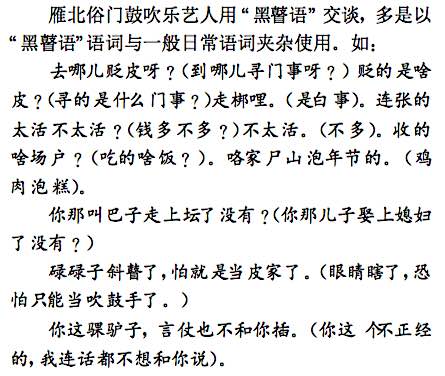
Expressions for daily life (Table 2–8 above) include huoyin 火因 for yan 烟 “smoke” (again splitting up left and right elements of the character); tiaoma 条码 “hottie”; dianyou 点油 (“lighting oil”) for hejiu 喝酒 “drinking liquor”; and kou 口 (prounounced kio) for chi 吃 “eat”. Some of these are dialectal, heard in more general parlance. Chen Kexiu gives an extensive list—and his examples of conversations are daunting:

convo

As you can see there, even the local term gujiang for the members of shawm bands becomes pijia 皮家 (“skins”) in their own parlance.

Thickening the plot, Chen Kexiu goes on to introduce a separate style of black talk used by shawm bands, one that incorporates the ancient fanqie 反切 phonetic system into speech (qiekou 切口) (cf. the blind bards of Zuoquan county). For instance, while the term xunmenshi (or xingmenshi 行门事, yingmenshi 应门事, with shi pronounced si!) is standard local parlance for performing a ritual, one shawm player might ask another (cf. the simpler but no more intelligible 去哪儿贬皮呀? above):

呆劳乃拉许论没人是哩? (到哪儿寻门事?)—“Where are you going to do the ritual?”

Unlike the specialized secret vocabulary that we noted above, once you grasp the principle you can apply it to any words—and it doesn’t require literacy. But the shawm bands among whom Chen Kexiu collected this qiekou style of speech don’t seem to use the specialized vocabulary like the numerical terms; he attributes the qiekou style in particular to the lowly hereditary families of ritual specialists known as “music households” (yuehu), who were descended from banished imperial officials. While there is plenty of evidence for the yuehu further south in Shanxi [1] and elsewhere, I’ve never been very convinced by the piecemeal clues to their presence in north Shanxi. All this is tenuous, but perhaps the supposed yuehu connection for this particular style might just go towards explaining the literate, visual basis of the numerical terms, which otherwise seems so mysterious.

* * *

Much of this vocabulary of the shawm bands was adopted by folk opera groups, also lowly in status; and through constant interaction at rituals household Daoists like the Li family, while somewhat more esteemed, used it to some extent. Of course, all these expressions are pronounced in Yanggao dialect, itself none too easy for the outsider to understand; heihua (“black talk”) itself is pronounced hehua!

The language was still commonly used in the 1990s, but senior blind shawm players were giving way to younger players who no longer suffered such social stigma, and their traditional repertoire was largely replaced by pop. Still, it reminds us what a daunting task it can be for fieldworkers to enter into the aesthetic world of folk performers.

Let’s recite the numbers 1 to 10—altogether now:

dinggai–konggong–chuan–hui–chou–duanda–zaodi–fengai–quwan–tianxin

For some erudite literary wordplay from household Daoists in Yanggao, see here.

Spiral

A worthy competitor with the various classy Scandi noirs that enrich Saturday nights on BBC4 is the French Spiral, whose seventh series has just started. If you’re new to it, it’s worth starting from the beginning—in which case, let’s talk again sometime next year.

The French title Engrenages doesn’t translate easily, referring to interlocking gears—by extension, an inescapable series of events, almost a vicious circle: “Enmeshed”, perhaps?

As with the Scandi noir series, the Grauniad recaps—and their BTL comments—are most enlightening. This led me to Alison Crutchley’s article on the language of the series, “Pute de merde de con! The linguistics of Spiral slang“—again to be read with important BTL comments. As you may imagine from A French letter (a drôle resumé of my Li Manshan film), my schoolboy French is utterly unable to keep up with such dialogue as it flies past; but the article makes fascinating reading.

Thus I learn of loan words like bagnole (from Occitan), “car” (also caisse); and clebs, “mutt”, from Arabic. And

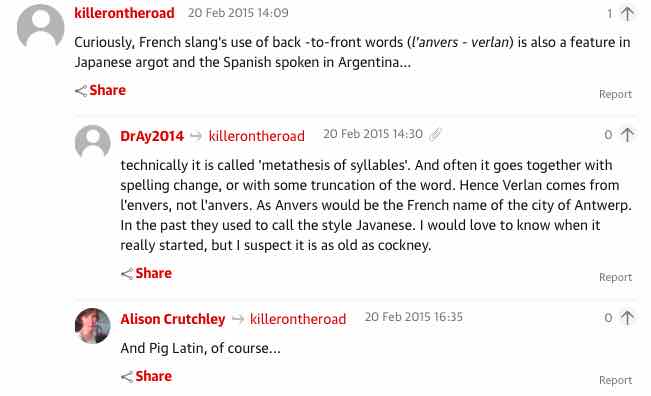
Spiral’s cool kids use Verlan, a type of back slang. Karen calls her girl friends les meufs, Verlan for femmes; Zach texts keufs to his accomplice, to warn him of les flics (“police”).

What’s more, keuf (from keufli) has been re-verlaned, with further resonance, to feuk! And occurring along with the Chinese underworld theme of series 7 is noich (or noichi), for chinois.

anvers

Further topics (also continued in the BTL) include the minefield of using tu and vous (cf. Italian, and this splendid Chinese story); gender; and the subtleties of swearing (cf. French taunting), with arcane variants and combinations of putemerde, and con. It’s amusant to learn that the French for fisting is le fist-fucking, although le fisting apparently serves too—either way, let’s consider it another English export in which we can take patriotic pride.

But just when we thought we were world leaders at punning, it turns out that French is exceptionally rich in puns too. Is rien sacré?

Surely this is the way to inspire kids to learn foreign languages. Surely Quelle bande de branleurs! (“What a bunch of wankers!”) is more attractive and practical than La plume de ma tante. I did indeed relish languages at school, but for some reason the ones that I (like the board of the LA Phil) favoured were all dead (cf. Revolution and laowai). So now I regret that it took me so long to realize that languages could be not so much an elegant yet gratuitous abstraction, or a sadistic ordeal of irregular verbs, but rather, a pathway to understanding fascinating cultures and communicating with real living people (“Like, hello?”).

Conversely, in this case I’m relieved that I can enjoy the script’s linguistic niceties from the comfort of my sofa without having to negotiate them in the gritty milieu that the drama depicts—as has been aptly observed, it’s hardly a promo from the Paris Tourist Board. Spiral really puts the noir into noir.

And now we can relish Series 8 on BBC4!!!

Meanwhile in Glasgow, Irvine Welsh’s novel Trainspotting is helpfully provided with a glossary… For English word games, see here; for the evolving Chinese language, here. See also Kaliarda, Lubunca, Polari.


[1] Note Qu Yanbin 曲彦斌, Zhongguo miyu hanghua cidian 中国秘语行话词典 (1994). 

[2] For links to the major studies of Xiang Yang and Qiao Jian on the yuehu in the Shangdang region, see my In search of the folk Daoists of north China, pp.86–7.

French slang

Spiral

A worthy competitor with the various classy Scandi noirs that enrich Saturday nights on BBC4 is the French Spiral, whose seventh series has just started. If you’re new to it, it’s worth starting from the beginning—in which case, let’s talk again sometime next year.

The French title Engrenages doesn’t translate easily, referring to interlocking gears—by extension, an inescapable series of events, almost a vicious circle: “Enmeshed”, perhaps?

As with the Scandi noir series, the Grauniad recaps—and their BTL comments—are most enlightening. This led me to Alison Crutchley’s article on the language of the series, “Pute de merde de con! The linguistics of Spiral slang“—again to be read with important BTL comments. As you may imagine from A French letter (a drôle resumé of my Li Manshan film), my schoolboy French is utterly unable to keep up with such dialogue as it flies past; but the article makes fascinating reading.

Thus I learn of loan words like bagnole (from Occitan), “car” (also caisse); and clebs, “mutt”, from Arabic. And

Spiral’s cool kids use Verlan, a type of back slang. Karen calls her girl friends les meufs, Verlan for femmes; Zach texts keufs to his accomplice, to warn him of les flics (“police”).

What’s more, keuf (from keufli) has been re-verlaned, with further resonance, to feuk! And occurring along with the Chinese underworld theme of series 7 is noich (or noichi), for chinois.

anvers

Further topics (also continued in the BTL) include the minefield of using tu and vous (cf. Italian, and this splendid Chinese story); gender; and the subtleties of swearing (cf. French taunting), with arcane variants and combinations of putemerde, and con. It’s amusant to learn that the French for fisting is le fist-fucking, although le fisting apparently serves too—either way, let’s consider it another English export in which we can take patriotic pride.

But just when we thought we were world leaders at punning, it turns out that French is exceptionally rich in puns too. Is rien sacré?

Surely this is the way to inspire kids to learn foreign languages. Surely Quelle bande de branleurs! (“What a bunch of wankers!”) is more attractive and practical than La plume de ma tante. I did indeed relish languages at school, but for some reason the ones that I (like the board of the LA Phil) favoured were all dead (cf. Revolution and laowai). So now I regret that it took me so long to realize that languages could be not so much an elegant yet gratuitous abstraction, or a sadistic ordeal of irregular verbs, but rather, a pathway to understanding fascinating cultures and communicating with real living people (“Like, hello?”).

Conversely, in this case I’m relieved that I can enjoy the script’s linguistic niceties from the comfort of my sofa without having to negotiate them in the gritty milieu that the drama depicts—as has been aptly observed, it’s hardly a promo from the Paris Tourist Board. Spiral really puts the noir into noir.

And now we can relish Series 8 on BBC4!!!

Meanwhile in Glasgow, Irvine Welsh’s novel Trainspotting is helpfully provided with a glossary… For English word games, see here; for the evolving Chinese language, here. See also Kaliarda, Lubunca, Polari. And don’t miss this post on how not to learn Japanese!

A recognition sextet, and more stammering


Sextet

To follow my Mozart opera dream:

Of all the wonderful music in The marriage of Figaro, I think we in the orchestra all lavished particular loving care on the Act 3 sextet Riconosci in questo amplesso, in which Figaro recognizes his parents.

The focus on the rather naff dramatic business tends to distract from the riches of the exquisite music—there’s so much delight in caressing the orchestral accompaniment. Here’s our 1993 recording:

A minor bonus for me personally is the role of the stammering notary Don Curzio (sadly, I wasn’t employed as a voice coach). His imp-p-pediment is harder to suggest in metered song than in recitative—this clip includes the recitative as performed at the Théâtre du Châtelet in Paris:

But Kleiber’s 1955 recording manages to include it in the sextet itself (@2.45):

* * *

The figure of the stammering lawyer or notary goes back to Tartaglia in commedia dell’arte and Il Tartaglione, foil to Polecenella in Neapolitan puppetry. Don Curzio’s stammer was created by the Irish tenor Michael Kelly; indeed, Mozart feared that it detracted from his music, but Kelly convinced him to keep it since it was an audience-pleaser—Typical!

Besides all the musical portrayals of disfluency that I mentioned in this post (including Rossini’s “stupefaction ensemble”), we can add Vašek in Smetana’s The bartered bride:

An earnest yet drôle article considers it a sympathetic portrayal; but

some nameless “laryngologists” [!] were quoted maintaining that it is quite impossible to stutter in Vašek’s way. No systematic phoniatric analysis of his fluency disorder has been published. The present study is assessing and enumerating Vašek’s tonic, clonic and tonoclonic speech blockades. It also delivers musical examples of his effective stuttered phrases and compares them to scientific descriptions and objective registrations of physical (external) and psychical (internal) symptoms of stuttering in phoniatric textbooks. It confirms the complete agreement of Smetana’s artistic expression of speech disfluency with the real stuttering.

And the role of Dr Blind in Die Fledermaus led me to this blistering review (“Mark Saltzman as Dr Blind was made to labor under the delusion that stammering jokes are funny”—no turn is left unstoned). But Barbara Hannigan’s portrayal of Gepopo still takes the b-b-biscuit.


Language and idiolects

The language of my publications has long chafed subtly at the bit of academic conformity. But now, liberated from such pressures, I still regularly interrogate my use of vocabulary.

On a site like this, for a surprisingly global audience, you might think I’d settle for the LCD [trad as he is, that’s “Lowest Common Denominator”—Ed.] style to which academics disingenuously pretend, despite wilfully introducing a barrage of eye-watering neologisms—shooting themselves in the foot in a way that competes with Tweety’s assault on Comey’s testimony.

Anthropologists tend to drizzle ethnology in a rich jus of technical vocabulary, as if to assuage their guilt at stating the bleedin’ obvious—and I should know. Academic language seems to be founded on the sound principle of being “neutral” and thus intelligible, not least to non-native speakers—the expression of personal linguistic idiosyncracy is taboo. This tends to produce an arcane kind of language that yet prides itself on being as far removed from everyday usage as possible. Yet the neologistic mouthfuls belie this. It is as if every McDonalds order is liberally sprinkled with a compulsory dollop of foie gras.

On one hand, I want to write in my real voice. But also my fieldwork experience, whose most fruitful material resides precisely in the local dialect of my masters, encourages me to persist in rendering my own voice faithfully too—which, as you see, is a personal pot-pourri [“enough with this potpourri!”) [That’s not quite how it goes, but hey—Ed.] of my whole life experience—Alan Bennett, Monty Python, Flann O’Brien, Stella Gibbons, WAM, and so on. I gave a little guide here.

Sure, this will be as much of a challenge for my international readers as Yanggao dialect is to me; but it is where you will find any such riches as there may be. In other words, if I can make the effort to understand Li Manshan, then you try understanding me…

Indeed, even when writing with a certain sobriety, one’s text can still be mangled.

For my outmoded Chinese vocabulary, see here.

An Irish choice

Irish

I’m still entertained by this poster that I saw on an Irish train in the 1990s. I imagine a response from the archetypal miscreant, confused by the options, might go:

Let me see now, that’s a teaser.* Can I have both?


* As in the Japanese particle Saa, helpfully explained in the wacky Teach yourself Japanese.

Among myriad aperçus of the great Flann O’Brien, note his “smoking substances of non-nationals“. There’s a whole host of drôlerie under the Irish tag, such as this—as well as the great Ciaran Carson.

He’s a clever little boy

RM

As if the coup of Boris Piccaninny Watermelon Letterbox Johnson isn’t bad enough, we have to endure the appalling spectre of his éminence grise the Minister for the 18th century defending it in his suave, patronizing, patrician tones.

The Haunted Pencil’s style reminds me of yet another Monty Python classic featuring John Cleese:

Son: Good evening, mother. Good evening, Mrs Niggerbaiter.

Mrs Niggerbaiter: Ooh, he’s walking already!

Mrs Shazam: Ooh yes, he’s such a clever little fellow, aren’t you? Coochy coochy coo.

Mrs Niggerbaiter: Hello, coochy coo.

Mrs Shazam: Hello, hello… [they chuck him under the chin]

Mrs Niggerbaiter: Oochy coochy [son gives tight smile]. Look at him laughing… ooh, he’s a chirpy little fellow! Can he talk? Can he talk, eh?

Son: Yes of course I can talk, I’m the Minister for Overseas Development.

Mrs Niggerbaiter: Ooh, he’s a clever little boy—he’s a clever little boy! (gets out a rattle) Do you like your rattle, eh? Do you like your little rattle? Look at his little eyes following it, eh? Look at his iggy piggy piggy little eyeballs eh… Ooh, he’s got a tubby tum-tum…

Son [interrupting]: Mother, could I have a quick cup of tea please—I have an important statement on Rhodesia in the Commons tomorrow…

* * *

By now Wee-Smug has joined the Queen and Brian Sewell on my shortlist of readers for a BBC Radio 4 serialization of Miles Davis’s autobiography (“Listen with Motherfucker”).

And here’s a fun party game to mollify your irritation with Pompous Brexit Twats. Whenever you hear them braying some fatuous remark about “taking back control of our borders / laws / own country [blah blah]”, just replace the noun with “bowels”—”we can finally look forward to taking back control of our bowels”, and so on.

Cf. Stewart Lee’s notional cabbie: “These days, you can get arrested and thrown in jail just for saying you’re English” (in my post How to be English). See also his brilliant routines in A French letter and The c-word; and several more fine critiques of xenophobic bigotry under the Lee tag.

Such levity is all very well (cf. Peter Cook on Weimar satire), but this is our country that these Rich White Politicians are smugly destroying, FFS. Soon we’ll be a banana republic without the bananas. But at least they’ll be OUR no bananas.

More under my roundup of posts on Tory iniquity.

Fleabag

Fleabag

Fleabag is brilliant altogether (tutti, bemused: “Fleabag is brilliant”), but this celebrated scene from series 2, with Kristin Scott Thomas and Phoebe Waller-Bridge, is just perfect—script, acting, and genuine, mesmerizing rapport:

For me it ranks alongside the diner scene and final monologue in Five easy pieces, and the restaurant scene near the beginning of Un homme et une femme.

See also Killing Eve: notes and queriesExotic travels, and Talking heads.

Czech stories: a roundup

https://stephenjones.blog/2019/02/15/czechs-in-tianqiao/

Here’s a handy roundup of some posts under the Czech tag—many of which have a Chinese connection.

This post makes an introduction to Czech and Chinese lives before, during, and since the years of state socialism:

Svejk Chinese

Hašek and The good soldier Švejk make several appearances, notably:

1906

See also

as well as

And my Cambridge mentor Paul Kratochvil is the source of some fine stories, including:

See also under Life behind the Iron Curtain.

More transliteration

LK 3

In the third of a growing series of vividly-written crime stories set among the tribulations of contemporary Greece,

  • Leo Kanaris, Dangerous days (2019),

private investigator George Zafiris continues to tread a murky path through corruption and nepotism amidst a dysfunctional society in crisis. Like Raymond Chandler’s Hollywood (but, pace Alan Partridge, not so like Norwich), Greece makes a fine backdrop to explore moral quandaries.

I’ve cited Kanaris’s vignette on Mount Athos in Blood and gold. For more on communicating in Greek, see Bunnios.

One vignette in Dangerous days reminds me of quaint Chinese transliterations like Andeli Poliwen (André Previn), Kelaimeng Feilang (“Clermont-Ferrand”, all the more reminiscent of a pseudo-Sanskrit Daoist mantra when preceded by Aofonie, “Auvergne”), or tuzibulashi (toothbrush, or “rabbits don’t shit”). As George walks through central Athens pondering the intricacies of the cases confronting him, he takes in the Greek versions of film-stars’ names appearing on cinema billboards:

Tzonny Ntep, Tzoud Lo, Kira Naïtely, Kim Mpazintzer.

Of course, English orthography is on a sticky wicket here: there’s no more reason to be perplexed by “Naïtely” than by “Knightley”, or a host of other English words like “Cholmondeley”“hiccough” or indeed “one”. Cf. Monty Python:

“Ah, no. My name is spelt  ‘Luxury Yacht’ but it’s pronounced Throatwobbler Mangrove.”

Partridgisms

AP

I’ve already sung the praises of Steve Coogan’s alter ego Alan Partridge in this post. Here are a couple more gems.

In a meeting with the BBC head of programming, Alan pitches several fatuous ideas (“Monkey Tennis”?). Or “Swallow”, a detective series set in Norwich:

Think about it—no-one had heard of Oxford before Inspector Morse.

And tucking into breakfast with RTE executives he insouciantly crashes right through the barriers of taste (cf. Jesus jokes):

Alan (suavely): So, how many people were killed in the Irish famine?

Aidan: Erm. Two million, and another two million had to leave the country.

Alan: Right… If it was just the potatoes that were affected, at the end of the day, you will pay the price if you’re a fussy eater. If they could afford to emigrate, then they could afford to eat in a modest restaurant.

A presumptuous guardian of language

RM

He proclaims himself to be a posh, old fashioned, entitled, obsessively religious, weedy, nerdy, rich know-all. Who would disguise themselves as that?

David Mitchell

The Twittersphere has been having great fun with The Minister for the 18th Century‘s recent directive on language, presumably inscribed with quill on parchment—the latest stage in his patronising mission to bestow his patrician values upon the plebs, or should I say hoi polloi.

Now, we all have our little linguistic peeves (here’s one of mine). It’s not that people don’t believe in stylistic guidelines; more that we don’t want them delivered by pompous fogeys—here‘s a general demolition of language pedants.

@NewsDumpUK asks

Should bellend be hyphenated or not?

One among many of his fatuous rules—no comma after “and”—is perplexing. Since no-one appears to do this anyway, commentators have surmised that he was trying to ban the Oxford comma, which occurs before the “and”. To the wonderful examples here showing its necessity, we can now add:

JRM

Moreover,

JRM

Or indeed

JRM 2

On a sartorial note, @SirRoyES commented:

JRM

and @Scarlett_Pebble observed that

Jacob Rees-Mogg looks like two underaged people wearing one suit to try and sneak into a wine bar.

Plenty more to explore on Twitter, via #JacobReesMoggGuide.

The Haunted Pencil’s popular touch (“a scarcely believable public-school comedy sketch”) has already been encapsulated in his classic description of Teresa May’s Brexit plan as

 the greatest vassalage since King John paid homage to Phillip II at Le Goulet in 1200

—which inspired me to pen another post.

All business should henceforth be conducted in Latin. I’m like, WTF?

Of course, it may merely be the Tree-Frog’s Cunning Plan to divert us from the iniquity of his sinister wider agenda—tellingly exposed here by James Meek, and here by Rachel Parris:

.For an ancient Chinese reprimand, see here; and for more fatuity from the Haunted Pencil, here. See also my roundup of posts on Tory iniquity.

Customs of naming

LPS jiapu detail

Detail of Li family genealogy copied by Li Peisen, showing Li Xianrong’s generation, and his sons and grandsons.

Lineages in rural north China commonly (though not invariably) observe the custom of alternating single and double given-names by generation.

Most of my instances come from household Daoist lineages, which happen to be my main material. Whereas most of their fellow villagers were illiterate, and common families might not be aware of their forebears’ names beyond their grandfather, household Daoists were often part of a prestigious local gentry, and their rather stable hereditary transmission has preserved names over many generations.

The genealogy of the Li family in Upper Liangyuan village makes a clear instance. The tree below shows only the Daoists in the lineage (Daoist priests of the Li family, p.5). Thus Li Qing gave double names to his sons (like Li Manshan), while their own sons received single names (like Li Bin):

Li jiapu

Daoists in the Li lineage, from Li Fu, himself the 16th generation in the lineage.

Indeed, Li Bin has continued the tradition by naming his son Li Bingchang. You will have noticed that this is a firmly patriarchal tradition; though wives’ surnames are listed on such genealogies, daughters don’t appear at all, and until the 1950s their formal names were little used anyway. While the rule seems to be used more flexibly for daughters, they too sometimes follow the pattern, as with Li Bin’s feisty sister Li Min.

Moreover (Daoist priests, p.40), for the double names used every other generation, in one generation the constant element in the given names is the first character, while in their grandsons’ given names it is the second character. Thus the first character pei [1] is the constant in Li Peiye 培業, Li Peixing 培興, Li Peilong 培隆, but in the names of Li Peixing’s grandsons it is the second character shan that is constant: Manshan 滿山, Yushan 玉山, Yunshan 雲山. Brothers with single names receive related characters, like Tao 淘, Qing 清, and Hai 海, all with the water radical; or in that same generation, Tong 桐, Xiang 相, Huan 桓, and Hua 樺, all with the wood radical, like their grandfathers Shi 柘 and Tang 棠.

Among many fine artefacts that Li Peisen handed down to his son Li Hua (see also here) is his 1981 copy of a memorial for a domestic Thanking the Earth ritual dating back to around 1930. Li Peisen dated his copy “70th year of the Republic” (which we perhaps needn’t consider as an affront to the Communist regime), but he didn’t copy the date of the original memorial. The latter was written by his father Li Tang (c1879–c1931) along with a fine genealogy of his branch of the lineage; moreover, when Li Peisen copied it in 1981 he updated it with a list of more recent kin.

And at New Year 1989 Li Qing edited it for his own branch of the family, also as part of a Thanking the Earth memorial. These documents are evidence of the rather prosperous status of the Li lineage. For a start, only relatively well-off households would commission a Thanking the Earth ritual. But further, such genealogies are less common in north China than in the south; Li Manshan estimates that only 10 or 20% of lineages in the area would ever compile their own genealogy. A family commissioning a Thanking the Earth ritual would invariably list the previous three generations of ancestors, but it was less common to use the occasion to copy such an extensive genealogy, so we are lucky here.

And here’s the Wang lineage of Baideng township (Daoist priests, pp.78–9), descended from the stepson of Li Zengrong—and also Daoists:

Wang jiapu

This custom is common further afield in north Shanxi, as you can see from many posts under Local ritual. Still in Yanggao, here’s another Daoist lineage in Luowenzao township:

Li Fa 李發
Li Wanxiang 李萬祥
Li Tai 李泰
Li Jincai 李進财
Li Ke 李科
Li Deshan 李德山
Li Yuan 李元
Li Tianyun 李天雲

Li Yuan writing

Li Yuan writing funerary documents, 1992.

And the Zhang family Daoists in Jinjiazhuang:

Zhang Lianzhu 張連珠
Zhang Kui 張奎
Zhang Wenbing 張文炳
Zhang Bi 張弼
Zhang Deheng 張德恆
Zhang Mei 張美
Zhang Jincheng 張進成
Zhang Nan 張楠

Zhang Nan and LMS

Li Manshan with Zhang Nan, Jinjiazhuang 2018.

And just south in Yingxian county, here are seven generations of Longmen Daoists in the Zhao lineage:

Zhao Tianyu 赵天玉
Zhao Ming 赵明
Zhao Yongzhen 赵永珍, Zhao Yongbao 赵永宝
Zhao Zhong 赵仲, Zhao Xiu 赵秀, Zhao Cai 赵财, Zhao Rui 赵瑞
Zhao Guowen 赵国文 (son of Zhao Xiu)
Zhao Fu 赵富, Zhao Pu 赵普
Zhao Shiwei 赵世伟

On a practical fieldwork note, as soon as you manage to get to grips with these names, you realize that no-one really uses them. Instead they use nicknames like Golden Noble (Jingui) or Zhanbao, their “little names” (xiaoming)—itself an informal term for “breast name” (ruming). Li Manshan doesn’t even necessarily know the formal names of some of the Daoists from other lineages that he calls on as ritual deps. Actually, this discrepancy with “standard” names is entirely normal in social groups, as I noted in this post featuring the conductor Charles Mackerras (“Slasher”).

The Li family also used another naming system. Males of the same generation were given a double name whose second character was the same; for Li Qing and his siblings it was shun 順, for Li Manshan’s generation it was heng 衡. Thus Li Qing was known as Quanshun, while those who know Li Manshan well call him Manheng. His son Li Bin seems to be known as Li Bin, though even this is complicated; Li Manshan gave him the name Bin 斌 (the characters for “civil” and “martial” combined), but he often uses the name Bing 兵 “Soldier”—he’s not fussy. But most often they refer to each other by kinship terms, like “third maternal uncle”—their precision only useful if you happen to have a detailed genealogy in your head.

* * *

Meanwhile in Hebei province, we can see that the custom of alternating single and double names by generation was widely used in the various lineages of Gaoluo, stalwarts of the village ritual association (Plucking the winds, genealogies pp.357–61) such as the Cai lineage:

Cai

As with the Li family in Shanxi, the generational names often shared a stable element. For instance, the given names of Cai Yurun’s grandfather and his two brothers all had the “mountain” 山 component (Shan 山, Ling 岭, Chong 崇), while their cousins’ names incorporated the “rain” 雨 component (Lin 霖, Lu 露). Traditionally, families would often invite an educated villager to choose suitable characters for the name of the new-born, but by the 1950s the tradition was attenuated, with the parents themselves choosing the name less conscientiously.

The Fu generation there was crucial to the transmission of the ritual association under Maoism, with a whole cohort of distinguished performers. Apart from Cai Fuxiang, old revolutionary and vocal liturgist (like Cai Yongchun, also part of that generation), Cai Fuquan was the leading guanzi player, and Cai Fulai, Fuzhong, Fulü, Fushun, Fumao, Fulin, Fumin, and Futong were all keen members. It was their sons who were our own mentors through through the 1990s, like Cai An, Cai Ran, and Cai Yurun (the latter, son of Cai Fuzhong, being a curious exception to the naming system). Under both the Maoist and reform eras many of them served as village cadres even while supporting the ritual association.

Cai Fulu

A rare image from Gaoluo on the eve of the 1937 invasion:
left, vocal liturgist Cai Fulü; right, Catholic Shan Wenyi, brother-in-law of Woman Zhang.

Back in 1930, when Painter Sun visited Gaoluo to depict ritual images for the association, the Cai lineage had used the occasion to ask him to make a fine genealogy for them on cloth—and it seems to be the only one that has survived decades of turmoil. Somehow it was handed down to Cai Haizeng, third generation of vocal liturgists in his family following in the footsteps of his father Cai Fulü (another exception to the naming rule). When Haizeng hung it up for me to photograph in 1998, he insisted on preparing an altar table with incense, candles, fruit, tea, liquor, and cigarettes.

Cai 1930

Cai lineage genealogy, 1930.

Unlike the Cais, most branches of the Shan lineage simply used double given-names for every generation, but the case of Shan Zhihe (1919–2002), one of our most venerable mentors in Gaoluo, is interesting. His father Shan Futian (1882–1953) gave his two sons their “official names” Zhizhong and Zhihe after their coming of age with the “lesser capping” ceremony. He named them thus because his public baths in Hohhot were called Zhonghe 忠和 (Loyalty and Peace) baths; their names showed that the baths would one day belong to them. The zhi 之 element in their given names was an “empty character”, and so they were considered single names.

But by the 1940s the “old rules” were already being diluted here. The two sons of Shan Zhihe, Shan Ming and Shan Ling, who would eventually become ambiguous figures in the village’s ritual association, were born in Hohhot in 1942 and 1948. Though the custom of alternating single and double names by generation persisted in the Cai and He lineages more than with the Shans, by this time it was becoming more flexible. So when it came to the naming of his own sons, although Shan Zhihe’s own name was effectively, and properly, single, they too were given single names; it was actually their grandfather Shan Futian who made the decision. From the 1950s some families were beginning to adopt “revolutionary” names (see e.g. the wonderful photo of the Qiao family in Yulin, here); but in the Shan family the old tradition was losing ground irrespective of political control.

Here too, people had variant names. At least until the 1980s, after reaching the age of 50 sui, men adopted an “old” name (laohao 老號) beginning with the character “old” (lao). In principle, the new name should complement the original name, in a charming parallel with Cockney rhyming slang. Just as “apples” stands for “stairs” by way of “apples and pears”, so Shan Chang (eternal) took the “old” name Laole (old joy) by way of the binome changle (eternal joy). Cai Qing’s given name Qing (verdant) was associated with the phrase “verdant hills and abundant waters” (shanqing shuixiu) to create his “old” name Laoxiu.

Incidentally, villagers agree that as long as the characters for their given name reflect its pronunciation, it’s not important which characters are used—admittedly within a very narrow choice of two or three. This is evident in the association’s own donors’ lists, where different written versions of the same given name appear. And I must say it’s one of the few reliefs available to us in making fieldnotes.

* * *

While the alternation of single and double given-names is far from a universal rule in rural north China, I suppose it must have been common in the cities too—is it still so? And what of other regions, like south China, where lineage consciousness is more deeply embedded? Comments welcome!

Click here for compound surnames in Chinese and English.


[1] By the way, the pei character is 培, though they often use 丕 (officially pi) as a simplified character. They also often write a simplified character for zeng 增 in several Daoists’ names, with zhong 中 to the right of the earth radical; I haven’t found this in dictionaries.

Tommy Cooper

TC

Like almost everything else (see e.g. note here), I hardly appreciated the genius of Tommy Cooper at the time. I didn’t quite get the crap magic, all the props… I guess for many of my generation, long before the Alternative scene, standups were rather eclipsed by Monty Python, even when they were subverting the light entertainment format.

I went to Blackpool on holiday and knocked at the first boarding house that I came to. A women stuck her head out of an upstairs window and said
“What do you want?”
“I’d like to stay here.”
“OK. Stay there.”

I might link that one to the true touring story of the wake-up call.

I went to the doctor. He said “You’ve got a very serious illness.”
I said “I want a second opinion.”
He said “All right, you’re ugly as well.”

I love this one, though (or perhaps because) it may require a certain,um, historically-aware insider’s cultural knowledge:

A policeman stopped me the other night. He taps on the window of the car and says:
“Would you blow into this bag please Sir.”
I said: “What for, Officer?”
He says: “My chips are too hot.”

This is often attributed to him:

I went to buy some camouflage trousers the other day, but I couldn’t find any.

but it may be a version of his

“Didn’t see you at camouflage training yesterday, Private.”
“Thankyou, Sir.”

which indeed is the response at the Chinese restaurant to “Waiter, this chicken is rubbery.”

And then there’s

So I went to the dentist.
He said “Say Aaah.”
I said “Why?”
He said “My dog’s died.'”

which reminds me of one that I heard Lee Mack do (cf. here, and here):

“What’s wrong?”
“My dog just died.”
“Aww, I’m sorry—never mind, I’ll get you another one.”
“Don’t be ridiculous—what am I going to do with two dead dogs?”

Jokes like these depend largely on delivery, on persona. No-one is so deadpan as Steven Wright—not so much standup, more internal monologue. Academic lecturers could learn a thing or two from these guys. And for Ken Dodd, regional ethnography, and Xi Jinping, see here.

The art of blurb writing

Cover 18 (back)

Some obligatory phrases from book blurbs, curiously absent from most tomes on Daoist ethnography:

  • cuts a picaresque swathe
  • a veritable smorgasbord [the very best kind of smorgasbord—Ed.]
  • madcap adventures
  • with hilarious consequences!!!
  • embarking upon a voyage of discovery
  • emotional rollercoaster
  • searing exposé
  • unflinching
  • feisty
  • filigree
  • vast, sprawling epic.

Happily, such clichés have been Laid Bare (oops, there’s another one) in several articles, such as this. And Molvania is jam-packed (packed like jam) with ’em. Not forgetting the ultimate homage to the language of the travelogue, Away from it all.

For further dubious marketing, click here; and for a series on cliché, start here. See also my blurb for Ogonek and Til.

Lyrics for theme tunes

A couple of ancient musical jokes—much shared online, but hey:

What does Batman’s mum call out when she wants him to come for his supper?

Dinner dinner dinner dinner dinner dinner dinner dinner Batman!

(cf. Learning the gong), and

Where does the Pink Panther come from?

Durham (Durham, Durham Durham Durham Durham Durhaaaaaam)

(For UK and US variants, see comments below.)

For a more ambitious word setting for Berlioz’s March to the Scaffold, see here; and for a handy mnemonic for additive metres, here. For tributes to the artistry of theme tunes, see Pearl and Dean, Parks and recreation, Soap. For the Indian inspiration of the Pink Panther, see Rāg Vindaloo.

Meditation: update with translation!

LMS

Hardly had I published this series of links to posts on the Shunzhi emperor’s Buddhist meditation on impermanence, and what it’s doing in the ritual manuals of the Li family Daoists, when I realized that I would be churlish not to provide a rough translation, for those readers less than fluent in classical Chinese—of whom I hope there are many!

So I’ve now added it under the original post, here. Help welcome…

Ey-up! A new haiku

Further to my post on Morris dancing and the controversies it provokes, here’s a new English haiku—to follow the original one, as well as my own ode to the 94 bus and garbled reference to a popular graffiti.

It should be read in a strong Lancashire accent. The opening line (for a variant, note comments below!) would be a headline, rather in the style of “Ping-pong ding-dong“. And the “rhyme that doesn’t quite work” doubtless has one of those fancy names that they try and teach you in school:

Trouble at t’Morris
‘As PC gone mad? Ey-up—
T’Nutters of Bacup!

For Stewart Lee’s trenchant rebuke of “PC gone mad gone mad”, see here; and for “Ey-up!” in Venice, here,

Italian cinema: a golden age

Giulietta Masina—left, La strada; right, Notti di Cabiria.

To follow folk musicking in Italy, I’m reminded again of formative film experiences from my misspent youth.

Like fiction, feature films can often suggest perspectives that more forensic academic treatments fail to evoke (cf. the GDR and China). In the post-war period, as Europe—including the east—struggled to recover, in Italy a vast migration took place from the poor south to the industrial north. Meanwhile China was in the grip of collectivization and famine.

A dominant theme of early neo-realist films was deprivation. The moving Ladri di biciclette (Vittorio De Sica, 1948) is a reminder how effective it can be to cast amateur actors:

Gelsomina
I recalled La strada (Federico Fellini, 1954) when the Li family Daoists performed at a circus in Paris during their 2017 French tour. While Nino Rota’s score is effective, Petrushka, with its trumpet solo and drum interludes, might have made a suitable soundtrack too.

A tribute to Giulietta Masina is in order. Her persona has been likened to Charlie Chaplin, and her role in La strada as an innocent itinerant street performer is most beguiling—despite the stereotype of the “gamine” “elfin waif” (quite different from that of Audrey Hepburn). And her role as Fellini’s “muse” is another trope unpacked by feminists:

The image of the Muse as loved object who inspires the male artist, whilst she herself remains silent, is deeply engrained in contemporary culture, despite the best efforts of feminist critics to expose the implications of such imagery: man creates, woman inspires; man is the maker, woman the vehicle of male fantasy, an object created by the male imagination, incapable of any kind of agency herself. In short, this image of the Muse denies woman’s active participation in artistic creation and silences female creativity. [1]

Masina is also wonderful in Notti di Cabiria (1957)—despite again being exploited by callous men. Here’s the moving final scene:

The making of Fellini’s La dolce vita (1960) is the subject of a 2017 book. The stellar cast includes not only Marcello Mastroianni and Anita Ekberg, but early roles for Nico and the divine Anouk Aimée, always captivating (cf. here). As England progressed from adversity to the drabness of the 1950s, the image of Rome rapidly became fashionable. Whereas Fellini doubtless meant La dolce vita as a critique of the vacuity of the glamorous lifestyle, “over the years, the inverted commas and irony have dropped away”, leaving only “Vespas! Bikinis! Grappa!”.

DV

Anouk Aimée with Federico Fellini and Marcello Mastroianni.

Long before I began to experience Italy at first hand, films like these made a deep impression, which keeps growing.


[1] Penny Murray, “Reclaiming the Muse”, in Vanda Zajko and Miriam Leonard, Laughing with Medusa: classical myth and feminist thought (2008).

At issue

Pooh

New Chinese facial recognition software not all it’s cracked up to be. For other challenges for the equipment, see here.

After sneezing alone in a room, does anyone else quietly say “A-tissue“, by way of pedantic clarification for a non-existent audience? Hmm, OK then—probably just me…

It now also serves as a homage to Winnie the Pooh, hapless bête-brune of the current CCP (bless). From “Eeyore loses a tail” (cf. Ding without dong):

“The thing to do is as follows. First, Issue a Reward. Then—”
“Just a moment,” said Pooh, holding up his paw. “What do we do to this—what were you saying? You sneezed just as you were going to tell me.”
“I didn’t sneeze.”
“Yes, you did, Owl.”
[…]
“What I said was. ‘First Issue a Reward’.”
“You’re doing it again!” said Pooh, sadly.

With all due respect to A.A. Milne (“the true voice of England in the 1930s”, as Alan Bennett notes), the exchange would work better if Owl had said “The question at issue…” But hey.

In Polish Winnie the Pooh is Kubus Puchatek, in Norwegian Ole Brumm—names to conjure with. In Italian he is Uini Puh, though I like the 1936 version Ninni Puf; Piglet is Pimpi, and Eeyore Ih-Oh (for more, see here).

Winnie the Pooh was one of the first to be subjected to the “Tao of…” franchise (and one thinks—doesn’t one—of the 4th-century Baopuzi 抱朴子 Master Who Embraces Simplicity). And for incurable classicists, there’s Winnie Ille Pu:

“Res exsequenda id est: praemium promittimus.”
“Paulisper subsiste,” dixit Pu ungulam sublevans. “Quid faciamus? Quid dixisti? Loquendo enim sternuisti.”
“Minime sternui.”
“Bubo, sternuisti!”
“Habe me, Pu, excusatum, minime sternui. Nequimus inscüs nobis sternuere.”
“Optime audivi: prr–prr!”
“Dixi: praemium promittimus.”
“Iterum sternuisti!”

On a musical note, for a classic recording, click here.

I have a Chinese friend whose online handle is Aqu—although for sneezing in various languages, see here. Note also Lithuanian Ačiū, “thankyou”.

Some other pleasantly fatuous comments that I can still never resist:

  • when someone trips up, I just have to say “Enjoy your trip?”
  • on putting down my suitcase, “I rest my case”
  • and for my obligatory comment every time I pass the roadworks sign, see here.

Ethnography at home: Morris dancing

female dancers

Esperance dancers. Source: EFDSS, via https://frootsmag.com/hoyden-morris.

Why bother traipsing halfway around the world, I hear you ask, when our very own Sceptered Isle offers such potential for pursuing the local ethnography of seasonal ritual?

Our folk culture may be a rich and ever-evolving topic, but Morris dancing has long been a national joke. Here I’ve churlishly suggested it as a suitably disturbing English riposte to the magnificent All-Black haka. I suddenly understand why some Chinese people may initially be reluctant to engage with their folk culture (see e.g. here and here).

Morris dancing comes round every so often as a drôle topic for media coverage—this article by A.A. Gill may not impress academics, but it’s brilliant, evocative, and strangely respectful writing.

I’m reminded of the topic again by a recent BBC4 programme, engagingly titled For folk’s sake.

One could almost mistake the May procession, with its bowery palanquin,
for a rain ritual in Shaanbei.

Now, I take a keen interest in calendrical rituals—indeed, as Easter week approaches, Bach is in store, and it’s a busy season for ritual in China too. But I’m not alone in tending to consign Morris dancing, with its incongruous juxtaposition of hankies, bells, and silly hats with beards and beer, to a long list of embarrassing genteel eccentricities of the English, along with The Archers. But like any social activity performed by Real People it deserves serious study, in the context of social change in England since the Industrial Revolution, and even a preliminary exploration is fascinating. [1]

The wiki entry makes a useful starting point. Whatever the etymological connection between Morris and Moorish, it does seem, Like Life (cf. Stewart Lee), to have come from abroad. It’s part of a group of genres that includes mummers’ plays, sword and stick dances, and so on.

Gender and class
Though there is evidence of female Morris dancers as early as the 16th century, male groups predominated. I’d like to learn more about the 19th-century decline; anyway, by the early 20th century the women who soon became the driving force of Morris learned from surviving male performers. From wiki:

Towards the end of the 19th century, the Lancashire tradition was taken up by sides associated with mills and nonconformist chapels, usually composed of young girls. These lasted until the First World War, after which many mutated into “jazz dancers” [note the cryptic quotes].

Mary NealAfter severe losses in World War One (when some entire village sides were killed) the female dominance increased, with women now teaching men.

In 1895 Mary Neal (1860–1944; website here; see also Lucy Neal’s project and this nice article) founded the Espérance Club, a dressmaking co-operative and club to enrich the lives of young working-class girls in London:

No words can express the passionate longing which I have to bring some of the beautiful things of life within easy reach of the girls who earn their living by the sweat of their brow… If these Clubs are up to the ideal which we have in view, they will be living schools for working women, who will be instrumental in the near future, in altering the conditions of the class they represent.

Cecil Sharp (1859–1924) first experienced Morris at Headington Quarry in 1899. Mary Neal began working with him in 1905, but their outlooks conflicted, and she soon joined the WSPU (for the Espérance’s modern reincarnation, see here). Vic Gammon encapsulates the conflict in his review of Georgina Boyes’s The imagined village culture:

Mary Neal, middle-class reformer, socialist, and suffragette who sees the possibility of reviving folk dance among working-class girls in north London, is defeated by Cecil Sharp, professional musician, Fabian, and misogynist who spread the activity of folk dancing among the young genteel, making vernacular arts fit bourgeois aesthetics.

These clips from 1912 feature the sisters Maud and Helen Karpeles, co-founders of the English Folk Dance and Song Society, as well as Cecil Sharp, and George Butterworth, who died in the Battle of the Somme:

But as in the world of work, male groups soon came to dominate again. The all-male Morris Ring was founded by six revival sides in 1934. And between the wars, for John Eliot Gardiner’s father Rolf “mysticism, misogyny, and Morris dancing formed a coherent whole in which nostalgia was a spur to action”. Whether he would have approved of The Haunted Pencil, with his AfD comrades, I couldn’t possibly comment.

Meanwhile Stella Gibbons and Elisabeth Lutyens took a more cynical view of genteel “folky-wolky” representations of English folk culture (note also Em creeps in with a pie).

Following World War Two, and particularly in the 1960s, there was an explosion of new dance teams, with some women’s or mixed sides. A heated debate emerged over the propriety and even legitimacy of women dancing the Morris; and mainly on the left, critics disputed the method of Sharp’s work as they pondered the perilous concept of “tradition” (as they do). But as in most walks of life, despite bastions of male conservatism, the creative participation of women is again becoming a major driving force, as you can see in this fine article by Elizabeth Kinder.

Boss Morris

Click here for a short clip from Berkhamstead in 1950, with pipe and tabor sadly mute. And this was filmed in Thaxted (“hub of the universe”), c1958—just as collectivization was leading to calamitous famine in China:

All this may seem quaint at any period, but all the more so in the Swinging Sixties. For folk’s sake shows glimpses of a 1966 festival at Thaxted—just as revolution (not least the Cultural Revolution) was in the air, alongside jazz, soul, the Beatles… The Saddleworth rushcart festival features in For folk’s sake—here’s a clip from 2014:

And as with folk traditions in China and worldwide, Morris survives alongside newer genres like punk (for punk in Beijing, see here).

holm

Source: David Holm, Art and ideology in revolutionary China (1991).

Indeed, a survey of the many English villages with teams somewhat resembles our documentation of ritual groups in particular counties of China—or the rich local dance traditions like yangge (among several genres using handkerchiefs and sticks!), Boat on Dry Land, Bamboo Horses, and so on, with their common ritual connections—covered at length in the provincial volumes of the Anthology for dance:

  • Zhongguo minjian wudao jicheng 中国民间舞蹈集成,

with over 30,000 pages there alone, besides all the related material in the volumes for folk-song, narrative-singing, opera, and instrumental music.

Among the main regional Morris traditions are Cotswold, Northwest, Border, and Plough Monday groups in Yorkshire and the east Midlands (all the sides have instructive websites)—and as in China, their styles are often distinctive to individual villages. Four teams claim a continuous tradition predating the revival: Abingdon, Bampton, Headington Quarry, and Chipping Campden. In the 1930s at the important centre of Thaxted, the sinologist Joseph Needham championed Molly dancing.

Only now do I recall that my granddad took me to watch mummers in Wiltshire (at Colerne? Marshfield?). Indeed, his home village of Potterne still has a group. It’s a very blurred childhood memory, by which I seem to have been underwhelmed; but did it sow a seed?

Nutters

The Britannia Coco-nut [2] Dancers of Bacup (“Nutters”; see e.g. this article) have a venerable history that inevitably attracts controversy (no less inevitably, one of the transmitters is called Dick Shufflebottom, who celebrated fifty years of service in 2006). A.A. Gill’s description of the Nutters is classic:

They are small, nervous men. And so they might be, for they are wearing white cotton night bonnets of the sort sported by Victorian maids, decorated with sparse ribbons. Then black polo-neck sweaters, like the Milk Tray man, with a white sash, black knee-breeches, white stockings and black clogs. As if this weren’t enough, someone at some point has said: “What this outfit really needs is a red-and-white-hooped miniskirt.” “Are you sure?” the dancers must have replied. And he was. But it doesn’t finish there. They have black faces, out of which their little bright eyes shine anxiously. On their hands are strapped single castanets. A single castanet is the definition of uselessness. The corresponding castanet is worn on the knee. To say you couldn’t make up the Coco-nutters would be to deny the evidence of your astonished eyes.

The dance begins with each Nutter cocking a hand to his ear to listen to something we human folk can’t catch. They then wag a finger at each other, and they’re off, stamping and circling, occasionally holding bent wands covered with red, white, and blue rosettes that they weave into simple patterns. It’s not pretty and it’s not clever. It is, simply, awe-inspiringly, astonishingly other. Morris men from southern troupes come and watch in slack-jawed silence. Nothing in the civilised world is quite as elementally bizarre and awkwardly compelling as the Coco-nutters of Bacup. What are they for? What were they thinking of? Why do they do these strange, misbegotten, dark little incantations? It’s said that they might have originally been Barbary corsairs who worked in Cornish tin mines and travelled to Lancashire, and that the dance is about listening underground, a sign language of miners. And then there’s all the usual guff about harvest and spring and fecundity, but that doesn’t begin to describe the strangeness of this troupe from the nether folk world.

Do watch the Nutters on YouTube.

Again as in China, the Morris vocabulary is suggestive, with teams, sides, squires, bagmen, fools, beasts. At least England hasn’t yet fallen for the Intangible Cultural Heritage flapdoodle (we have our pride). Still, even without it, contentious arguments about “authenticity” continue to fester. And even now there’s still considerable opposition to admitting women. FFS.

I might be tempted to make the music share the blame. Of course, it is what it is, irrespective of the impertinent tastes of outsiders; but it often seems to endow the proceedings with a twee comfy feel that conflicts with the edgy (“pagan”?!) atmosphere of the dance itself. Once mainly accompanied by pipe and tabor, fiddles and melodeons became more common. The gritty new sounds of great musos like Jon Boden don’t seem so relevant to most Morris sides—though again, see Elizabeth Kinder’s article. I’d love to hear a Bulgarian version—accompanied with suitably complex metres by zurna and davul, relatives of early English pipe and tabor.

For the BBC2 documentary Tribes, predators and me, it was a cute idea to show footage of Morris dancing to tribespeople (click here).

* * *

Of course I’m merely dabbling here. But is this the kind of thing that urban educated Chinese people think I’m doing in their country?

In a way, it is: cultures change, in China as in England. The brief of the ethnographer is the same: to document the whole history, down to today, of local traditions amidst ongoing challenges to community cohesion through social and political change. We both have blind spots about our own cultures, further muddied by patriotic posturing and our reactions against it. It’s not that I can’t see the “value” of Morris, just that I’ve inherited negative associations. While plenty of English writers have debunked the myth of an unspoilt Victorian Merrie England, in China the “living fossils” nostalgia, referring to a Golden Age of much greater antiquity that bears even less relation to rural life there, is still touted by heritage pundits. For the awful cliché of “international cultural exchange”, see here.

And whereas in China I’m keenly aware of major dates in the rural calendar when temple fairs may be held, I’m not alone in being completely estranged from the seasonal rhythms of English life; only Bach cantatas manage to educate me.

This may be a particular issue for the English. In Hungary the táncház revival has become popular; and it would seem natural enough for an American studying old-time music in Appalachia to find continuity when working on China.

The world of Morris and English folk-song culture, like that of Newcastle punks, is no more “home” to me than are the rituals of the Fujian countryside for an educated Chinese from Beijing. But whereas local ritual in China still seems to me an intrinsic component of local life, Morris dancing has long seemed a quaint byway in my whole experience of England. Of course, when pressed, I can quite see this is wrong. OK Guys, I’ll take my culture seriously if you take yours…

Anyway, just think, as you board a rickety bus to a poor Hunan village in search of household Daoist rituals, you could be sitting in a sunny Oxfordshire pub courtyard nursing your pint as you take notes on the magnificent ritual spectacle unfolding before you—complete with its “feudal superstitious colourings” 封建迷信色彩.

See also my haiku on Morris dancing. Click here for English folk-song; and for posts on Irish music, here. For a roundup of posts on the English at home and abroad, see here; and for more on Heritage movements, here.


[1] Useful background includes the research of Vic Gammon; Georgina Boyes, The imagined village culture: culture, ideology and the English folk revival (1993/2010); Trish Winter and Simon Keegan-Phipps, Performing Englishness: identity and politics in a contemporary folk resurgence (2013); numerous publications from the English Folk Dance and Song Society, e.g. here; Theresa Buckland, ” ‘Th’owd pagan dance’: ritual, enchantment, and an enduring intellectual paradigm” (2002). On class, gender, and national identity, see also this (cf. Stewart Lee!). For innovative performance-based studies of clog dancing, see the work of Caroline Radcliffe. For an accessible introduction to the English folk scene, see The Rough Guide to world music: Europe, Asia, and Pacific, “England: folk, roots”, and regular features in Songlines and fRoots.

For further refs. on the wider context, see Helen Myers, “Great Britain”, in Ethnomusicology: historical and regional studies (The New Grove handbooks in music, 1993), pp.129–48. Among many fine compilations of British folk music, note the extensive Topic Records series The voice of the people (here on Spotify).

[2] Pedants’ corner (or is it Pedant’s corner?): the form “coconut” seems more common (as on their own website)—I can’t find a ruling on the hyphen, but it seems suitably eccentric (but was it eccentric then? That’s the perennial question!).

Barbara Hannigan

BH

Photo credit: Musacchio and Ianniellos.

Having been spellbound by the great Barbara Hannigan singing Let me tell you, as well as her f-f-flabbergasting Gepopo, I just attended another LSO concert in which she both sang and conducted in Berg and Berg-tinged Gershwin.

I became immersed in Berg’s first opera Wozzeck in my teens, but at last I got to hear Hannigan in a suite from Lulu, one of her signature roles. While only featuring two brief but mesmerising arias, it gives a taster for the complexities of Lulu’s psyche.

Lulu has long seemed to embody all the inherited archetypes of diva / femme fatale, madonna / whore, victim, elfin waif, destroyer/destroyed (see also Madonna and McClary[1] and the “cute psychopath” of Killing Eve), both in the original Wedekind plays and Pabst’s 1929 (silent!) film Pandora’s box:

Hang on—these were all created by men…

All these myths may have gone largely unchallenged until quite recently, but Hannigan doesn’t buy it. So despite Lulu’s common image as abused, manipulated, and degraded, Hannigan finds her inspiring “as a musician, an actor, and a human being”, with her “instinctive emotional intelligence that tends to drive the people around her up the wall”; rather like her remoulding of Ophelia, she regards Lulu as the architect of her own destiny—angry, resistant, and triumphant. As Paul Griffiths wrote,

Hannigan sees her as a spirit of freedom, who breaks loose from the plays, the opera, and the films in which she would seem to be contained. Refusing taming or limits of any kind, she scorns death, even while longing for it. Murdered in one scenario, she simply finds herself another. She is a deity with innumerable avatars.

Hannigan makes her case brilliantly here—describing her passionate relationship with Lulu as well as her her own Stockholm syndrome and survivor guilt, and unpacking gender issues:

Now I welcome new visions, and changing reception history, but I’m still not sure we can simply “celebrate” the lives of women like Lulu without acknowledging the tragedy of their situation in societies where they are constantly hampered—and without keeping the iniquities of patriarchy to the fore (cf. China). Surely the role model here is not Lulu but Hannigan’s vision of her.

She ended the concert with an arrangement of Gershwin’s Girl crazy suite. At first one might think, uh-oh—not another cheesy crossover in the vein of “Dame Kiri Sings the Sex Pistols Greatest Hits by Candlelight“? Far from it: Hannigan “wanted to have a suite with songs from Gershwin musicals, but to look at them through the prism of the Second Viennese School, and especially from the perspective of Lulu and the Countess Geschwitz.”

As Griffiths observes, the link is by no means far-fetched:

Gershwin admired Berg and welcomed the opportunity of a meeting when the American was in Vienna in the spring of 1928. This was a year before Berg began work on Lulu, with its jazz-age touches, and two years before Gershwin was writing songs for Girl crazy. It might be hard to hear Berg’s influence in Gershwin’s own score, but that can be arranged. You just have to find an arranger.

Bill Elliott, who won a Tony award in 2015 for his orchestration of Gershwin’s music in a new show, An American in Paris, was an obvious first choice, and created a 13-minute score on which one could imagine the two composers had worked side by side. Berg sits back to admire the course of a melody Gershwin is writing, then leans forward to add harmonies here, a wandering counterpoint there. *

So the resulting suite, transforming But not for me, Embraceable you, and I got rhythm[2] makes a stimulating and exhilarating piece that inevitably gets a standing ovation. Here’s an earlier performance:

With her magical voice, her expressive arms, her whole body, Hannigan totally inhabits all her roles.

BH2

Photo credit: Jag Gundu.

Now we can also admire Hannigan’s recent Vienna fin-de-siècle CD, including Zemlinsky, Berg, and Alma Mahler. For yet another innovative production, click here. See also Mahler and Messiaen!!!, La voix humaine,The rake’s progress, and under The art of conducting.


* For good measure, a couple of quaint vignettes on Gershwin’s friendship with Berg’s teacher Schoenberg in the USA:

Gershwin asked Schoenberg—whom he also painted—for composition lessons. Schoenberg refused, reportedly saying “I would only make you a bad Schoenberg, and you’re such a good Gershwin already.”

And in a charming foretaste of the Monty Python Beethoven LP,

Gershwin enjoyed playing tennis with Schoenberg once a week. Gershwin’s playing was described as “nervous” and “nonchalant”, “relentless”, and “chivalrous”—while Schoenberg was “overly eager” and “choppy”.

[1] Indeed, Leo Treitler compares Madonna and Lulu in “The Lulu character and the character of Lulu”, ch.10 of his Music and the historical imagination (1989). For a general introduction to the opera, see Alex Ross, The rest is noise, pp.224–31.

[2] Hiromi‘s manic piano version of the latter is amazing, but I always fantasise about a Bulgarian aksak version…

A diary clash

huiyishi

Now for another linguistic interlude. I’ve already cited several stories from our fieldworkers’ joke manual (note the Chinese jokes tag; and for a roundup, see here). This old one further illustrates the riches of Chinese punning, and has a hint of the underdog vanquishing pompous male privilege…

It thrives on the homophonous pronunciation of the acronyms for Journalists’ Association (jixie 记协) and Sex-Workers’ Association (jixie 妓协), suggesting parallels with our own airline acronyms.

The verbal creativity may work better in Chinese than in English, but here I loosely adapt a version that I found online (see—the riches of the Chinese web aren’t limited to The Thoughts of Uncle Xi):

The Journalists’ Association and the Sex-Workers’ Association are both staying in the same hotel for their respective meetings. Both groups need to use the conference room at the same time. The hotel manager initially suggests they combine their meetings into one, but they argue their cases before him.

The Secretary-General of the Journalists’ Association observes proudly, “We journalists are uncrowned kings—how can a gang of women dependent on men compare with us?”

But the Secretary-General of the Sex-Workers’ Association retorts, “What’s the big deal about you journalists? A gang of guys sneaking in to see us—you’re all talk! How can you compete with us? Huh!”

The journalist goes on, “So we’re adversaries with different weapons, eh? We use the pen (bi), and we’re looking for manuscripts (gao).”

The sex worker points out, “Well, we use pussy (bi), and we’re looking for a shag (gao)!”

“We welcome both long and short manuscripts.”

“We’re fine turning both long and short tricks too.”

“We offer preferential rates for our manuscripts.”

“And so do we for tricks.”

In the end the hotel manager can only allow the Sex-Workers’ Association to use the conference room.

记者协会与妓女协会同在一个宾馆召开会议,同样要用会议室。记协秘书长联系会议室,妓协秘书长也在联系会议室。宾馆老板一听,都是开会,也都是叫一个名字,也不管是妓协和记协,对两位秘书长说:《干脆把两个会议合在一起开吧。》

记协秘书长坚决不答应说:《我们记协的记者是无冕之王。你们妓协是什么,你们是一帮女人,靠男人生活,能和我们比?》

妓协秘书长不服气地说:《你们记协有什么了不起。你们的记们,那个暗地里不来找我们的妓,一帮男人光是嘴上的劲。怎能是我们的对手。哼!》

记协秘书长说:《是不是对手,武器不一样,我们用的是笔,要的是稿。》

妓协秘书长说:《我们用的也是×,要的是搞。》

记协秘书长说:《我们长稿短稿都欢迎。》

妓协秘书长说:《我们长搞短搞都能行。》

记协秘书长说:《我们稿费从优。》

妓协秘书长说:《我们搞费也优。》

年轻漂亮的妓协副秘书长在一旁帮腔说:《我们怎样搞都适应,反正比你们强。》

这话气得记协秘书长《唉唉》直叹息。看来记协还得归妓协领导。因而再不言语。宾馆老板一看没法,只得把会议室让给妓协先开会了。

I note en passant that the present incumbent of the White House seems to have more time for sex workers than for journalists.

For the high esteem for sex workers in China, see here.

A Czech couple in 1950s’ Tianqiao

Věna Hrdličková, Zdeněk Hrdlička,
and narrative-singing in 1950s’ Beijing

with qi baishi

Věna Hrdličková and Zdeněk Hrdlička with Qi Baishi, Beijing 1952.

This article is based on material kindly provided by Lucie Olivová (former student of Věna Hrdličková) and the couple’s grandson Zdeněk.

My brief mention of narrative-singing in 1950s’ Beijing leads me to a remarkable Czech couple, and thence to the Prague sinologists, prompting me to consider the work of Chinese and Czechoslovak scholars—and their tribulations.

The Prague sinologistsPrusek
The Prague school of sinology became widely admired for its achievements in the realms of modern and traditional Chinese literature, linguistics, history, and philosophy. It was led by the great Jaroslav Průšek (1906–80), who became head of the Institute of East Asian Studies at Charles University.

Do read Marián Gálik’s useful introduction to their work up to the demise of state socialism. [1] It both attests to their remarkable energy and gives glimpses of careers and lives (both Czech and Chinese) frustrated by political currents—among countless instances, we might compare the vicissitudes of the great Ming scholar Wang Shixiang.

Věna Hrdličková and Zdeněk Hrdlička
For Věna Hrdličková (1925–2016) and her husband Zdeněk Hrdlička (1919–99), useful introductions are

  • Lucie Olivová, “Chinese and Japanese storytelling: selected topical bibliography of the works of Věna Hrdličková and Zdeněk Hrdlička”, CHINOPERL papers 25 (2004), pp.87–97 [2]
  • Vibeke Børdahl, “In memory of Věna Hrdličková, 1925–2016”, CHINOPERL papers 35.1 (2016), pp.83–8 (here).

Among their own articles are

  • Zdeněk Hrdlička, “Old Chinese ballads to the accompaniment of the big drum,”Archiv orientální 25.1 (1957), pp. 83–145
  • Věna and Zdeněk Hrdlička, “Lianhua lao and its traditions”, in Vibeke Børdahl (ed.), The eternal storyteller: oral literature in modern China (1999), pp.71–7.

I am also most grateful to the Hrdlickas’ grandson Zdeněk for sharing further material—including a draft translation (awaiting publication) of an eloquent series of interviews in Czech with Věna by Ivana Bakešová (Czech Chinese Society, Prague, 2016). Below, apart from direct citations (indented), I have collated and adapted text from all these sources.

Early years
Under the Nazi occupation, universities were closed and most Czech books were forbidden. Věna came from a schoolmaster’s family, whose classroom was a hut with an earthen floor. Teachers now had to say Heil Hitler! as they entered the classroom—though, as Věna recalled, they did it carelessly, just waving their hand at most.

Managing to avoid being sent to work in Germany, at high school Věna studied English, when most schools were teaching French and German. Meanwhile she attended dance school—where she met her future husband Zdeněk. His father, a widowed railwayman, was also a bandmaster.

The couple became interested in China—Věna inspired by early poetry, Zdeněk with a view to contemporary prospects. They discovered that they could study Chinese with Průšek at the Oriental Institute. In 1945 Zdeněk, together with other colleagues, founded the journal Nový Orient [New Orient]—still being published.

In 1946, at Průšek’s recommendation, they received scholarships from the Ministry of Education to study in the USA. They travelled by train to Paris, where a sailors’ strike compelled them to spend a month, and then took the ship to New York. Since term hadn’t yet begun, they used the interlude to get married. They spent two years studying in the USA (Věna at Radcliffe College, Cambridge, Zdeněk at Harvard), attending lectures and seminars by John Fairbank, Edwin Reischauer, and others. Following the war, Harvard was now favouring modern spoken Chinese above classical studies.

In 1948 they returned to Europe by ship from Québec. Back in Czechoslovakia the Communists, under Soviet domination, were tightening their grip. As I remind myself, Prague was still recovering from the trauma of long Nazi occupation, the devastation caused in the 1945 uprising and Soviet “liberation”, and the ensuing expulsions of (and vengeance upon) the German population. [3]

As Czech universities reopened, the couple enrolled in Sinology and Religious Studies at Charles University; Věna also studied Japanese. Zdeněk graduated in 1949 with a thesis on the Daoist concept of immortality; the next year Věna graduated with her thesis on the author Ki no Tsurayuki in Heian Japan.

1950s’ China
Meanwhile in 1949 the People’s Republic of China was founded. That year a Chinese Peace Delegation visited Czechoslovakia, led by Guo Moruo, soon to be president of the Chinese Academy of Sciences; Zdeněk was chosen to attend. From 1950 he was employed at the Oriental Department of the Ministry of Information and Culture, and that winter the couple joined the first Czechoslovak cultural delegation to the PRC, led by Průšek.

They took the Trans-Siberian train, stopping off in Moscow for a couple of days. There Věna recalled the perils of crossing chaotic roads with crazy drivers, and admired the palatial metro system. And then they took the train through Siberia. In the dining carriage, as Švejk connoisseurs they shared their enthusiasm with an elderly gentleman. After spending the night in a little hotel at the border in Manzhouli, they changed to a Chinese train. Průšek, cracking sunflower seeds, was full of expectation. They arrived in Beijing in beautiful sunny weather, the sky clear above the glistening rooftops of the Forbidden City near the embassy. Their affable hosts had new winter coats made for them.

Still, returning to Beijing after an absence of around ten years, Průšek was disappointed, exclaiming “This is not the China I knew.” And while Prague in the late 1940s, recovering from war, must have been devastated, Věna’s strongest initial impression of Beijing was the poverty. When they arrived in the winter cold, she stood through the night at her window in the Beijing Hotel watching rickshaws trudging through the snow. She was also shocked by the lines of blind people walking the streets. She admired the Chinese for the speed with which they were able to fall asleep, no matter where they were. But as she became acquainted with the society, she appreciated the urge of the Chinese to improve their conditions.

In 1951 Zdeněk was appointed the first Czechoslovak cultural attaché to the PRC. Wanting to live among the Chinese rather than in an expat bubble, they rented a modest siheyuan courtyard house, living beside poor neigbours in Zhong Shicao hutong alley just west of the Zhihua temple—just as Yang Yinliu and his colleagues were discovering the Beijing temple traditions there.

Lao Zui lowres

With Lao Zui. Photo: courtesy of Zdeněk Junior.

Their cook Lao Zui served as a general fixer for them, finding them books and arranging for a lianhualao troupe to perform at their house. Their first son, also called Zdeněk, was born in Beijing in 1952; their teacher (a Manchu) gave him the Chinese name Huasheng 华生 “born in China”, soon adapted by their nanny to Huashengmi (Peanut). Their second son Stanislav was born in 1957.

During a period of remarkably good relations between the two countries, the couple got to know leading cultural figures—including academician Guo Moruo, painters Qi Baishi and Xu Beihong, Slavic scholar Ge Baoquan 戈宝权 (1913–2000), authors Mao Dun, Ding Ling, and Lao She, Indeed, Lao She had also been studying in the USA, but had made the fateful decision to return to the New China out of patriotic idealism.

As their secretary the Hrdličkas were happy to find Yang Leyun 杨乐云 (1919-2009). Among her later translations into Chinese were the works of Bohumil Hrabal—another Czech author hardly suited to state socialism.

By contrast with most pampered Western academics, the couple had in common with Chinese scholars a legacy of occupation and a tacit awareness of the constraints of the new society.

During their mission they negotiated an official gift of Chinese books to the Oriental Institute, which became the core of the Lu Xun Library in Prague, and the purchase of Chinese antiquities for the National Gallery.

Meanwhile in 1953 a Czechoslovak team was filming a documentary about the construction of the Sichuan–Tibet highway—including rare glimpses of a landscape of daily Tibetan life and traditional ritual that was soon to be erased. Premiered in 1955, the film won awards at the film festivals in Venice and Karlovy Vary. It was screened in Czechoslovak cinemas in 1956, but it was later banned by the Communist authorities, right until its recent rediscovery and showing in Prague.

After the 1949 “Liberation” these early years of the PRC were a relatively optimistic period, before collectivization and campaigns intensified. By contrast with residents from the Western bloc, [4] not renowned for their devotion to Chinese expressive culture, the Hrdlička couple were exceptionally interested in the performing arts, immersing themselves in the narrative-singing scene.

Narrative-singing in early 1950s’ Beijing
Sinology has traditionally been concerned mainly with silent written texts, and remains so in many branches of the field. As Věna later recalled, they were now drawn to oral performance culture because with some 80% of the population illiterate, it was largely thus that they transmitted their history and culture. They were also aware that oral traditions would be threatened by the modern media.

In China there was little ethnographic discussion of the changing conditions of narrative-singing between the 1940s and the Cultural Revolution, but the couple provide some glimpses. Following in the footsteps of Průšek in the 1930s, they often visited the Tianqiao quarter. In an article published in 1968 Věna evoked their explorations:

The T’ien-ch’iao, Peking’s Heavenly Bridge, was one of the most colourful places of this kind, where not only storytellers but also other entertainers regularly competed for attention. Despite its exalted name, it was an unpretentious marketplace with simple earthen arenas, small crude huts and humble teahouses, but it offered much enjoyment for modest sums. We spent there many unforgettable hours enthralled by the mastery of puppeteers, the deftness of magicians, the incredible skill of acrobats, and of course the art of the storytellers. They often commented on our presence with improvised verses, which, though not complimentary, were witty and never really offensive. Eventually, when we became more familiar with fairly frequent attendance, they treated us in the same way as they did the Chinese in their audiences.
[…]
We used to invite itinerant storytellers and ballad-singers to our residence in Peking. Though their dress made it obvious that they were poor, their professional pride gave them great dignity. After singing, they were served tea. They then would bow and leave quietly. Some of them in time became our friends, divulging the secrets of their art and helping us to collect handwritten and printed texts of various forms of shuo-shu.

In their article on lianhua lao they recalled:

In the early 1950s we had occasion to watch a group performing caichang lianhua lao in the Tianqiao market, while we were studying shuochang in the field. Thus we made their acquaintance and they consented to give us a performance in our home, in a typical hutong [lane], Zhongshi caor in the eastern part of the capital. These performers from the marketplace presented their act in the courtyard, surrounded by a wall. In addition to the principal of the troupe, Wang Pingtan, there were two women singers, a comic actor, and a musician [on sanxian]; they were typical folk performers, and obviously of low social standing. They had not yet been brought under the aegis of any of the professional organizations then being set up to reform the narrative arts by purging their repertoire of elements of feudalism, as the phrase was, and replacing this with texts that could serve political ends, and help in the struggle against illiteracy, corruption, or for equality of the sexes.

Of course, despite the formation of such troupes, only a few performers were ever recruited to this cause, and only sporadically—as we can see in my notes from Shaanbei. In the cities (such as Yulin), change would have been caused as much by the evolving control of public space as by political elements.

Lianhualao

Teahouse in Tianqiao, 1987. My photos.

After I began working in China from 1986, I only dabbled in the narrative-singing scene in Beijing. Whereas many amateur clubs remained active after reviving, the Tianqiao scene enjoyed but a brief revival in the 80s before the area was irretrievably glamourized. Though narrative-singing moved to more salubrious fake-antique venues, some charming amateur clubs have persisted.

Prague and Japan
Their time in China was interrupted when Zdeněk was recalled to Prague in 1954, where he now taught Asian history at Charles University. When they returned to Prague, Věna completed her doctoral thesis on storytelling, based on her fieldwork in China. She defended it in 1959.

The 1956 revolts in Hungary and Poland had ramifications in China—where the short-lived Hundred Flowers movement soon led to the Anti-Rightist campaign, condemning many to tragic fates. Meanwhile Hungarian and Chinese musicologists met in Beijing.

When the Czechoslovak diplomatic mission in Tokyo reopened belatedly in 1957, Zdeněk was appointed chargé d’affaires there (1957–61), later serving as Extraordinary and Plenipotentiary Ambassador (1964–69). They decided to live in a Japanese-style house.

They were on good terms with the Soviet ambassador Nikolai Fedorenko (1912–2000), “an elegant, handsome man” with a wealth of international experience, who served as Soviet representative at the UN from 1963 to 1968. Over at the American embassy were their former teachers John Fairbank and Serge Elisséeff.

They could only take the boys to Tokyo under the condition that they would attend Russian school, but when circumstances became a bit more relaxed they transferred them to Japanese school, where they were taught in Japanese in the mornings and in English in the afternoons; the children were happy there, and apart from speaking Czech at home and learning Russian they became fluent in Japanese and English. Their grandchildren too followed in the family footsteps.

Despite the intensive workload in these posts, the couple continued to pursue their cultural interests enthusiastically. Věna continued to explore folk story-telling. Each tea-house had a banner saying which story-teller was going to perform that day. They were pleasantly surprised to find small story-telling theatres in the Ueno quarter, including one for rakugo 落語. They were enchanted by Japanese folk ceramics, travelling throughout Japan to collect them, and later presenting them in exhibitions and writings. They studied the tea ceremony, cuisine, gardens and bonsai.

I note superfluously that during their interlude in Prague they do not seem to have met the young Alexei Sayle, later himself to become a folk storyteller…

The Prague Spring and “normalization”
Amidst diverse global revolutions, the couple was spared the Cultural Revolution in China. Their old acquaintance the great author Lao She, himself an aficionado of narrative-singing, was hounded to death in 1966.

But in August 1968 the Prague Spring was brutally crushed when the Warsaw Pact armies occupied Czechoslovakia. The family were on holiday in Prague. It was night-time, and still jet-lagged, they didn’t hear the airplanes with their transports of tanks—they were only woken by the sound of someone shouting: “The Russians have invaded!” Věna thought it was nonsense until she switched on the radio. Zdeněk immediately set off for the Ministry of Foreign Affairs, where a lot of employees had already gathered, moving to safety some documents that might be of potential interest to the invaders.

He was ordered to return immediately to Japan. Not knowing what was awaiting them, or even if they would ever be able to return, they only took bare necessities in their rucksacks. A friend drove them to the Austrian border, and they flew Swiss Air to Tokyo. At the airport they were met by embassy employees and Japanese reporters; Zdeněk made it clear that the country had been brutally invaded. The newspapers published photographs of him and Dubček. The Czechoslovak flag was flown at half-staff on the embassy building.

As Věna recalled, the Japanese were supportive, but diplomats behaved according to their political affiliations; among the east Europeans, only the Romanians could offer any support. At first, embassy employees unequivocally condemned the occupation, but then gradually things became blurred. As it became clear how the situation was going to evolve, some started distancing themselves.

The couple’s postings to China and Japan evoke the career of Robert van Gulik, who served in China before the Communist takeover, going on to successive postings in Japan. Of course, they moved in different circles: the only contacts between diplomats of the Western and Soviet allies occurred at formal receptions. Still, in Tokyo the couple did indeed meet van Gulik. His third posting there from 1965 had to be interrupted in June 1967 so he could return to the Netherlands for medical treatment, where he died in September. But after the Prague coup the following year van Gulik’s son Pieter sent Zdeněk this letter of sympathy:

Gulik letter lowres

Courtesy of Zdeněk Junior.

Meanwhile, with murky realpolitik, the Chinese leadership also denounced the Soviet-led intervention—ironically, given their support for the quelling of the 1956 Budapest uprising (not to mention later events in Beijing).

Jan Palach’s self-immolation in 1969 predated the common resort of Tibetans protesting occupation.

The couple remained in Tokyo for around a year, but they took recall as a matter of course; they knew what awaited them, and never considered emigration. As soon as they arrived back in Prague, Zdeněk was sacked from the ministry. He briefly became research fellow at the Oriental Institute, but during the so-called “period of normalization” [5] that followed the repression he lost his new post—he wasn’t even admitted to the Oriental Institute library.

While his was a high-profile demotion, he was not alone: as Gálik shows, several other Czech sinologists, including the great Průšek, were expelled from the Academy of Sciences, and the Party, over these years. No-one was immune, neither academics nor ordinary workers.

The Hrdličkas had to go to some lengths to secure the children’s progress in education, with help from their neighbour Jiří Marek (1914–94), author of the script for the 1968 TV series Sinful people of the city of Prague. Věna was pressured into taking early retirement, and Zdeněk too received a small allowance. They took their fate stoically.

Wine-Press Manor
In 1976 Zdeněk and Věna retreated into idyllic rural seclusion—emulating principled ancient Chinese literati like the poet Tao Yuanming (never an option, alas, for their counterparts in Maoist China). In the tiny village of Brzánky on the river Elbe the couple cultivated their Wine-Press Manor (Na Lisu); visitors delighted in the magical atmosphere there, discussing poetry and the arts in the garden over wine with their hosts.

Their bucolic retreat, though dilapidated, had a large plot of land. Without electricity, they had no fridge, but they did have a cold cellar. They grew garlic, kept bees, harvested fruit, and made their own wine—which though ordinaire, they relished because of the work and joy that went into it. In a way it was a beautiful life, giving them time to read and study. Věna later reflected wryly that by depriving them of employment the regime improved their health.

They liked to have guests, such as the renowned art historian František Dvořák with his wife Nataša, and their friends like the artists Jan Zrzavý (1890-1977) and Kamil Lhoták (1812-1990). Denied passports, the couple weren’t allowed to travel abroad; but over the years their foreign friends managed to visit them at the cottage. They maintained contacts with Russian friends who had denounced the occupation. In April 1989 their old friend Ge Baoquan visited them there:

with GBQ lowres

Photo courtesy of Zdeněk Junior.

Through the oppressive years of Soviet occupation, Věna managed to keep her post of lecturer at the Department of Asian and African studies of Charles University—still, she was only belatedly awarded the full dozent professorial qualification in 1990. In the Department she mainly taught Chinese literature, training a number of students—including Lucie Olivová. Věna’s textbooks The history of Chinese classical literature, vol.1 (1980), and An introduction to sinology (with Jaromír Vochala, 1985) are still valued.

Most of the studies that Věna and Zdeněk wrote jointly during the 1970s and 80s could only be published under her name. A couple of journals were bold enough to publish his papers, but Nový Orient, the popular journal for Asia—which Zdeněk had created—remained closed to him.

Meanwhile, of course, many of their friends, both at home and in China, were punished in many ways from the mid-50s until the early 80s. Both peoples had suffered under wartime occupation and had to adapt to one-party rule; both had seen brief liberalizations ruthlessly crushed.

A certain rehabilitation came when Zdeněk, with other enthusiasts, was able to found the first ever Bonsai club in Prague, which later became the Prague Bonsai Society. They published a quarterly newsletter from 1981; from 1990 it became a journal in successive incarnations. As well as organizing activities, exhibitions, and lectures, here it was possible for Zdeněk to publish. The couple designed several Chinese and Japanese gardens in Czechoslovakia, receiving a gold medal for the design of a Japanese garden at the Flora Olomouc Exhibition in 1983.

Since 1989

Vena 2004

Věna in China, 2004.

After the Velvet revolution of 1989, new freedoms opened a sudden range of possibilities. The couple once again traveled to the USA, Japan, and China.

In the new Czech Republic, they participated in the re-establishment of the Czech-Chinese Society and the Czech-Japanese Society. They organized projects such as an exhibition of paintings by Qi Baishi at the National Gallery at Prague, and the publications of miscellanies, including the often-reprinted Èajová zastavení [Tea stations] (Prague, 1997). Věna published literary translations of contemporary Chinese novels, and Chinese and Japanese folk tales, which appeared in splendid Czech and foreign editions. She translated over a hundred films, mainly from Japanese, for Czech TV and other distributors. She was much decorated.

So at last they were able to publish under their own names. After working together at the tranquil cottage, the couple published the popular book Emperor Shenzong’s China (Čína císaře Šen-cunga) and books about Japanese and Chinese gardens.

Zdeněk’s sudden death in March 1999 came as a painful shock to all his friends and acquaintances; however, Věna continued her activities and research with commitment and perseverance.

Chinese studies of narrative-singing
After 1949, although the Hrdlička couple explored the narrative-singing scene on their own initiative rather than in collaboration with Chinese scholars, the latter too were busy studying and promoting the diverse genres along the middle of the vocal spectrum from folk-song to opera.

Of course, the big cities were only the tip of the iceberg. Later studies tended to focus on the Jiangnan region, but genres still common around Beijing and Tianjin include Jingyun dagu 京韻大鼓, Meihua dagu 梅花大鼓, and Xihe dagu 西河大鼓. Yang Yinliu himself began studying the danxian 单弦 melodies of Beijing as early as 1950, soon after arriving there.
Shuochang yinyue

For a nationwide inventory, see

  • Shuochang yinyue 说唱音乐 (ed. Zhongyang yinyuexueyuan Zhongguo yinyue yanjiusuo, 1961).

While its 589 pages consist almost entirely of transcriptions, it includes a useful bibliography. Many festivals were also held through the 1950s.

1958

National festival of narrative-singing, August 1958.

1954Above: danxian performer Rong Jianchen (front, 4th from left) with disciples, 1954.
Below: Founding of drum-singing guild, Tianqiao, 1940s.
Source: Zhongguo quyi yinyue jicheng, Beijing juan.

LHLLarge-format lianhualao led by Rong Jianchen and Wang Wanfang (6th and 5th from right), 1950s.
Source: Zhongguo quyi yinyue jicheng, Beijing juan.

Though the work of the Chinese scholars was constrained and reified, it laid the foundations for later studies, notably the Anthology—for which note the provincial volumes of both the Zhongguo quyi zhi 中国曲艺志 and the Zhongguo quyi yinyue jicheng 中国曲艺音乐集成—see my “Reading between the lines: reflections on the massive Anthology of folk music of the Chinese peoples”, Ethnomusicology 47.3 (2003).

JYDGJingyun dagu masters. Above: Liu Baoquan, 1920s. Middle: left, Liu Baoquan, 1936; right, Bai Yunpeng. Below: Bai Fengming.
Source: Zhongguo quyi yinyue jicheng, Beijing juan.

Ma Zengfen Xihe daguMa Zengfen 馬增芬 performing Xihe dagu, 1950s.
Source: Zhongguo quyi zhi, Beijing juan.

Some fine archive recordings are included in the 2-CD set

  • Shibaduan quyi 十八段曲藝 [English title Shuochang: the ultimate art of Chinese storytelling] (1998).

Many clips are also available online, from both before and after Liberation, such as these items from Liu Baoquan, Luo Yusheng, and Bai Yunpeng.

Meanwhile it became apparent that alongside entertainment genres, the ritual component of narrative-singing was also widespread and important in local cultures throughout China (see this roundup). The Czech couple’s explorations could hardly extend to the countryside—even just a few hours south of Beijing, narrative-singers continued to perform through the 1950s, alongside ritual groups.

Back in Czechoslovakia, ethnographic study of regional folk traditions was also circumscribed after the Communist takeover—as earlier in Ukraine.

* * *

In what may sometimes appear as a Western-dominated field, all this serves as a reminder of the wider world of scholarship and the international situation in the years following the revolutions of the late 1940s, as well as the achievements and vicissitudes of scholars and artists both in China and in Soviet-dominated countries.

With many thanks to Lucie Olivová and Zdeněk the younger! 

[1] The list of twenty-two scholars includes my own mentor Paul Kratochvil; note also Dana Kalvodová (1928-2003), scholar of Chinese opera.

[2] Lucie Olivová, Věna Hrdličková–Zdeněk Hrdlička: A list of published works and oral presentations 1945/46–2002 (Prague: Oriental Institute, 2002, bilingual) lists almost a thousand bibliographical entries under headings including storytelling, Chinese and Japanese gardens, Japanese pottery, and Chinese literature.

[3] See e.g. Keith Lowe, Savage continent: Europe in the aftermath of World War II, pp. 126–35; for background on the early Communist period, see Anne Applebaum, Iron curtain: the crushing of eastern Europe.

[4] from journalists like Edgar Snow and Agnes Smedley to politically-engaged residents like the Hintons and the Crooks: see Beverley Hooper, Foreigners under Mao: Western lives in China, 1949–1976 (2016).

[5] As I write this, I’m reading Christopher Hitchens’ remarkable memoir Hitch-22, where he describes it as “one of the most casually ugly phrases of the whole 20th century”—but then, if anyone is equipped to demolish such insidious language, it’s the Czechs themselves.

A personal lexicon


Here’s a little vocabulary to help those whom Myles calls “non-nationals” (like Euripides) negotiate some of my more elliptical allusions—arcane idées fixes in my idiosyncratic language, nay idiolect. Myles makes a suitable place to start, then:

To the divine Stella Gibbons I am indebted to

  • flapdoodle (usually in the context of heritage),

and to Monty Python the concept of

Tempted though I was to do these in the form of an index:

muse, Terpsichorean, delighting in all manifestations of 174,

I’m grouping them by themes.

  • S-S-Simon Rattle is a recurring theme of mine, referring to this story.

Several succinct allusions refer to Airplane:

As if that’s not enough, with the Li family Daoists I have come to share an even more arcane secret language of allusion, like “holding a meeting with Teacher Wang“, “Here’s 100 kuai!” and “Nin…”.

Such catch-words are hopefully more entertaining than some of those in vogue among anthropologists (see e.g Bourdieu’s habitus).

Alan Bennett points out the rich world of allusion in painting and film (see Visual culture, near the end):

The twentieth-century audience had only to see a stock character on the screen to know instinctively what moral luggage he or she was carrying, the past they had, the future they could expect. And this was after, if one includes the silent films, not more than thirty years of going to the pictures. In the sixteenth century the audience or congregation would have been going to the pictures for 500 years at least, so how much more instinctive and instantaneous would their responses have been, how readily and unthinkingly they would been able to decode their pictures—just as, as a not very precocious child of eight, I could decode mine.
And while it’s not yet true that the films of the thirties and forties would need decoding for a child of the present day, nevertheless that time may come; the period of settled morality and accepted beliefs which produced such films is as much over now as is the set of beliefs and assumptions that produced an allegory as complicated and difficult, for us at any rate, as Bronzino’s Allegory of Venus and Cupid.

So having gone to some lengths to try and understand the world-view of Chinese peasants, and liberated from the Lowest-Common-Denominator language of academia, I now feel emboldened to reflect my own, however arcane. For more, see here.


Gaoluo: the decline of spirit mediums

liang deshan 95

Liang Deshan, 1995.

This a kind of footnote to my series on the enduring activities of spirit mediums.

On the Hebei plain in the 1990s, alongside the folk religion derived from Buddhism and Daoism practised by the ritual associations, spirit mediums, claiming to heal illness by means of divine possession or assistance, were also quite common in the Laishui–Yixian area, and throughout rural China.

Having encountered many local mediums on the Houshan mountain during the 3rd-moon pilgrimage (see here, and here), I thought there might be some in Gaoluo, but they seems to have become rare in this village since Liberation.

Sun Xiang, who died in the late 1950s, father of opera singer Sun Bowen, was a medium and folk healer, who used to perform exorcisms. He acted alone, not as part of any association or sect, and he never sang while doing exorcisms; he drew talismans and wielded the “seven-star precious sword”. Such was Sun Xiang’s reputation for averting evil and guaranteeing well-being that several parents used to ask him to be godfather (ganye) to their young children; he was even godfather to the eminently rational village historian Shan Fuyi. The mother of ritual performer Cai Futong was also a medium, but since her death in the early 1960s the village itself had no other mediums.

Nonetheless, some Gaoluo dwellers still had recourse to other locally respected shamans when there was a problem. Soon after the 1980s’ reforms, villagers planning to build on the site of the old opera stage had consulted a medium, who advised them not to do so—but they had ignored the advice.

In 1992 a whole tractor-load of sick people went to consult a medium from a village in nearby Dingxing. In 1993 some villagers again enlisted her help when they were building a house and accidentally buried a trowel in the wall—a taboo. By lighting incense she was able to reveal where it was buried (cf. Henan). Since then she had been arrested by the police, which had itself given rise to a new story in praise of her psychic gifts: there were long queues outside her door, but she said “I can’t cure you all today, the police are coming to arrest me!”, and sure enough ten minutes later there they were.

Elderly He Yi recalled that the ritual specialists of the ritual association used to recite scriptures for exorcisms, but they had to stop after the arrival of the 8th Route Army in the 1940s. Indeed, exorcisms are still performed by ritual associations in some nearby villages; healing illness, however, is more often the domain of more explicitly sectarian groups, as in Xiongxian.

In this region mediums are called by names like mingren, xiangxiang, or tiaodashenr, rather than the official and derogatory shenpo, wupo, and shenhan. For male exorcists like Sun Xiang, Gaoluo villagers used the term wushi 巫师, like “wizard”, but more commonly they spoke of zhuoyaode 捉妖的 “demon-catcher” or namo xiansheng 南無先生 “namo master”. Domestic exorcisms were called Pacifying the Dwelling (anzhai 安宅 or jingzhai 净宅), for when the “black turtle disturbs the dwelling” (wugui naozhai 乌龟闹宅).

Elsewhere, as you can see from my post on Yanggao, and from Adam Chau’s work in Shaanbei, mediums were by no means stamped out after 1949, even during the Cultural Revolution, though their activities were doubtless furtive; and they revived strongly in the 1980s.

In 1995 I visited Liang Deshan (b. c1915) in a village in nearby Yixian county. He turned out to be a close colleague of Older Sister Kang, whom we had met on Houshan: they were fellow devotees of the goddess Houtu. He too knew the story of Houtu rescuing a battalion during the Korean War.

A “rich peasant”, he had attended sishu private school. He knew all about the three yang kalpas and the sectarian creator goddess Wusheng laomu, and had copied several scriptures, including “precious scrolls” and a Longhua juan. But I suspect his interest in sectarian religion dated only since the reforms, and he seemed to operate alone. In 1993 he had copied a Baiyang baojuan 白陽寶卷, “revealed” to him by the Baiyang god (Baiyang fo). At my request he donned his ritual costume and posed with his “precious sword” and “five-god hat” (wufo guan). As ever, it would have taken more time with him to learn more about his ritual life, but it made a slender clue to the enduring activities of mediums in the area.

* * *

I can’t perceive why in many regions (including north Shanxi, notably the remarkable ever-thriving scene around Wutai county; Shaanbei; and even quite near Gaoluo) mediums are a major engine of local temple activity, but here they declined. Nor can we quite recreate an earlier picture when they might have played a more prominent role in ritual life. I now wonder if mediums are less common in villages that have active ritual associations, though I doubt if they are clear-cut alternatives.

Amateur musicking in urban Shaanbei

The “little pieces” of Yulin

ylsq 1

Source: Huo Xianggui, Yulin xiaoqu ji. Right, top: the “study group”, 1980.

In modern China we can find plenty of exceptions to the simple dichotomy between rural ritual and urban entertainment, but it’s a useful framework. I’ve written a series of posts on ritual activity around the Shaanbei countryside (starting with this, recently-updated), but here I enter the regional capital Yulin to outline a recreational form of vocal music with ensemble, now moribund.

In chapter 12 of my 2009 book Ritual and music of north China, volume 2: Shaanbei (where you can find further leads) I gave an overview of musical activity in Yulin—far short of the thorough treatment of Ruth Finnegan’s 1989 book The hidden musicians, for, um, Milton Keynes.

Once again, as the Maoist era recedes, it still makes an important yet little-explored bridge between earlier history and the reform era.

The regional capital of Yulin
The bustling county-towns, commercial hubs dotted around the barren landscape of Shaanbei, already represent a more modern environment than the chronically poor villages and little district townships remote from the main transport arteries. But entering Yulin, the capital city of the region, one feels frankly in a different world, even if traces of tradition remain.

Yulin, a likely starting point for forays into the countryside, lies towards the far north of Shaanxi province. From the west and north the desert is creeping up year by year. Access was difficult until very recently. The main road going south towards Yan’an, and eventually the provincial capital Xi’an still further south, has been improved since the 1990s; and even by 2000 it was a 20-plus-hour bus ride east to Beijing. A train runs from Shenmu, not far northeast of Yulin, east to Datong in Shanxi province; by 2002 direct train routes all the way from Beijing to Yulin, and from Yulin south to Xi’an, were promised. By 2005 there was a direct flight from Beijing, “Opening up the West” still further.

The city has something of the feel of the wild-west frontier. Main Street (Dagai) retains its old-world charm, though in the evenings bikers rev up at the crossroads. There are four funeral shops along Main Street alone. There are also several bookshops, none of any distinction, and many shops selling CDs and cassettes; even a Buddhist shop selling CDs and cassettes as well as statuettes, incense, scriptures, and so on. Second Street (Ergai) is a kind of Wangfujing or Oxford Street, with pop music blaring from the sound-systems of shops. Away from the centre, the urban sprawl contains both new tower-blocks and rows of single-storey dwellings in traditional cave format. Even the old city walls remain. Coal bricks are piled up in courtyards to protect against the winter cold.

By the 1990s traditional musical activity in the city seemed much impoverished. Yet weddings, funerals, and temple fairs are held here too, all requiring live music. Few of the Yulin city temples have been restored to their former opulence. Vocal liturgy is still performed in the temples, but shengguan instrumental ensemble, once a feature of Yulin funeral ritual, has not been heard since the monks were laicized in the 1950s.

twins

Mother with twin daughters, Yulin 2001.

The state-funded Yulin Region Arts-Work Troupe and several opera troupes perform Qinqiang opera, as usual mainly for temple fairs. Towards the secular end of the continuum, the Yulin Folk Arts Troupe performs conservatoire-style arrangements of local singing and dancing.

In 2001 genial cadre in the troupe had a few young erhu pupils, to whom he taught the standard modern national repertory. There was a School of Arts (Yixiao), teaching national styles of singing and dancing. Yangge dance parades were held by work-units, including schools. But with pop music now dominating the soundscape, karaoke, TV, and VCD-players were doubtless city dwellers’ main exposure to music.

Before Liberation, funerals in Yulin, as in Beijing and other northern cities, were often accompanied not only by shawm bands (chuishou; see here, and for Shaanbei also here), but by temple priests, both Buddhist and Daoist. Shawm bands continued activity in Yulin city under Maoism, but since the 1980s’ reforms their activities have expanded; by 2001 there were at least eight bands, all migrants from the countryside.

But their extrovert style seems to hide a lack of discipline. Young shawm-band boss Feng Xiaoping observed, “Yulin is without order (mei guiju). Yulin people can’t appreciate the shawm—they don’t react even when we play well, and if we play badly, no-one ridicules us.” Both here and in the countryside, in the new undiscriminating get-rich-quick climate, ceremonial ostentation is rampant, while the “old rules” go into further decline.

The Yulin “little pieces”
Throughout China, many rural genres with long traditions have managed to outlive Maoism, thanks largely to the continuing demand for ceremonial. In the Shaanbei countryside, folk opera troupes, itinerant blind bards, shawm bands, folk-singers, and spirit mediums managed to weather political campaigns before reviving more openly in the 1980s for life-cycle and calendrical ceremonies. Even in Yulin city, there is demand for occupational chuishou.

The city also had a distinctive amateur vocal music with instrumental ensemble. Like many genres in world music, it barely had a name; like many genres in China, if people needed to call it anything, they might mention “little pieces” (xiaoquzi), “playing little pieces” (shua xiaoqu), or “playing silk strings” (shua sixian). The official title Yulin xiaoqu was casually given in 1958. [1]

As a relatively literate genre, its popularity was largely limited to the city—unlike small-scale vocal and instrumental groups like errentai or daoqing, widely performed throughout the countryside. We saw how the literate elite patronized the music of the lowly chuishou, employing them as a ritual duty. But the Yulin elite supported the “little pieces” as amateur recreation, and might even perform. The elite outside Yulin city, though thin on the ground, sometimes performed it too; in Yangjiagou village, landlord stronghold until the 1940s, young members of landlord families sometimes got together to play string and wind instruments. But in Yulin city by the 20th century, its main clientele was among ordinary citizens, and its main performers were male manual workers.

Imperial and Republican periods
As often with folk traditions, early evidence is inconclusive. By the 15th century regional governors were often posted from the distant Jiangnan–Zhejiang region of east China, and brief passages from the 1670s show musical activity at the Yulin court. Indeed, from the presence of many southern titles in various Shaanxi narrative-singing repertories, and indeed throughout China, one should not underestimate the wider influence of Jiangnan culture in imperial times. Among the themes of the Yulin songs (mainly love and city life), Jiangnan scenery also features; musically too, traces of Jiangnan style may be heard, although the dominance of the so mode appears to be a local modification. Another theory (also said to be supported by musical similarities) is that the style was based on the opera of distant Hunan, which may have been brought to Yulin in the Tongzhi reign-period (1862–74) by a company attached to a division of Zuo Zongtang’s Hunan army on campaign in the region.

The music is said to have been transmitted outside the regional court in the Daoguang era (1821–50) by Li Diankui and his son Li Fang. Oral tradition names musicians since the late 19th century. More pieces were composed in the early 20th century, and pieces arranged by the literatus Wang Jishi. Later Zhu Xiaoyi (1905–88) was a respected musician; a carpenter, he was also a luthier, making zheng zithers, yangqin dulcimers, sanxian plucked lutes, and erhu fiddles, which he sold as far afield as Shanxi and Inner Mongolia.

luo and wang 2001

With Luo Xinmin (left) and Wang Qing, 2001.

Musicians were amateur, and male—mainly artisans (silverworkers, watchmakers, tanners, woodworkers, plasterers, cobblers), as well as doctors and dentists. Apart from getting together for fun, musicians were also invited to perform for life-cycle ceremonies. In 2001 I met musicians Luo Xinmin (b.1925) and Wang Qing (b.1954). Luo recalled:

In the 1940s we took part in weddings, longevity celebrations (for which the piece Rejoice in a Thousand Autumns [Xi qianqiu] was prescribed), and first-full-moon celebrations for babies. We played seated on the host’s kang brick-bed—the chuishou played in the courtyard outside. We played mainly in the evenings, the chuishou mainly in the daytime.

Some children of landlord families might play music similar to the little pieces, on pipa plucked lute or bowed fiddle (as in Yangjiagou), but in Yulin the landlords and merchants didn’t maintain a regular band for the little pieces, though they might have a few instruments for people to play; they just invited musicians when they held a ceremonial.

Sources barely discuss the fortunes of the music during the troubled 1930s and 1940s. It is said—compulsorily—to have suffered in the War against Japan and the civil war, but Luo recalled:

The War of Liberation didn’t affect us—people from the Red and White areas got along quite well, going back and forth.

A popular venue was run by one Wang Yunxiang at the Qingxing silver furnace, by the old Drum Tower.

After Liberation
Typically, the sources stress the Party’s avuncular concern for the Yulin little pieces. Along with state organization came research and control—as an urban genre it was quite susceptible to official supervision.

Still, folk activity continued alongside official initiatives until the Cultural Revolution. Memories of old musicians suggest that in this case the “new life” compulsorily claimed for all genres after Liberation was not so fanciful:

After Liberation there was even more activity than before. In the evenings, because there was no electricity, and no other entertainment, people liked to get together.

Qiao family 1962

The Qiao family, Yulin 1962, during a lull between campaigns. Left to right (brackets denote seniority), rear: Jianren 建人 (3), Lifang 麗芳 (5), Jianzhong 建中 (1, b.1941), Jianguo 建國 (2), Jianmin 建民 (4); front: Jianfu 建府 (9), Lanfang 蘭芳 (7), Rui 銳 (father), Jianping 建平 (12), Liu Caiqiu 劉彩秋 (mother), Jianzheng 建政 (6), Jiangong 建功 (10), Jiancheng 建成 (11).(the missing eighth sibling was given at birth to a cousin of their mother). As you will notice, the second characters of the first eight sons’ names (after the constant jian 建 “construction”) spell out 中國人民政府功成 “China People’s Government is accomplished”; the ping 平 character of the ninth name suggesting that had yet another son followed, he would have been called An 安, to make the binome ping’an “well-being”—thus wishing “Well-being to the accomplishing of the China People’s Government”! Photo: courtesy Qiao Jianzhong. For a more traditional custom of generational naming, see here.

I chatted with the musicians about our mutual friend Qiao Jianzhong, a Yulin native who had become director of the Music Research Institute in Beijing, and whose encouragement had led me to Shaanbei. The oldest of nine brothers and three sisters brought up in an old house in Main Street, his parents were typical of the city folk who enjoyed the little pieces.

Especially in summer evenings, a lot of people came to listen, they could understand the words—Qiao Jianzhong’s mother used to say “This is much better than a film!” Mostly they invited us by treating us to tea and cakes (chayebing).

In the 1950s we were active in the common hall (jiti tingtang) by the Bell Tower in the city centre. The silverworkers’ shop next door to the Qiao family’s house in Main Street was a venue—instruments were available to play there for anyone who came along. And there was an old Chinese doctor called Lin Maosen [1903–68] who loved to sing—he often invited people to his house to play in the [early] 1960s.

If such recreational activity remained common, the life-cycle celebrations at which they had also participated before Liberation were now drastically reduced.

As to the official side, in 1950 a study group was organized in the Yulin workers’ club, and musicians met three evenings a week, training over forty performers—now including women for the first time. The genre gained a wider profile as musicians took part in festivals and won awards at provincial and national level from 1953 to 1960.

ylxq 3

Top: Beijing 1957 (left to right, Ran Jixian, Wu Chunlan, Hu Futang, Wang Ziying, Bai Baojin). Middle: preparing for Xi’an festival in 1953. Lower: Hu Yingjie and Wu Chunlan, 1979. Source: Yulin xiaoqu (1994).

ylxq 4

Top: female singers consult Hu Yingjie (date unclear). Middle: filming “Music of the Western Regions”, with Hu Yingjie. Lower: filming “Gazing at the Great Wall”. Source: Yulin xiaoqu (1994).

The life of the music through this period, both official and amateur, depended on a group of admired senior musicians. [2] Zhang Yunting (1900–64), a leather worker, was a fine sanxian player as well as singer. From 1950 he was the main teacher for the study group in the Yulin workers’ club. He won awards at festivals in 1956, 1957, and 1960, and recorded for provincial radio. In 1962 fieldworkers from the Shaanxi volume of the folk-song Anthology visited him. Bai Baojin (1914–83) was a tileworker; a zheng player, he also played jinghu and erhu fiddles, as well as singing. He too took part in the festivals of the 1950s.

Hu Yingjie (b.1921 or 1923) was an admired singer. A manual worker, he later worked for the post office.

In the 1950s some young women were recruited to sing, but most gave up after they got married. Most celebrated was Wu Chunlan (b.1930), a senior-secondary graduate, who learnt with Zhang Yunting in the first group after Liberation. Taking part in official festivals from 1953, she went on to win an award in a 1957 national exhibition.

Two vocal styles have been identified, mainly distinguished by enunciation: the Back street (Houjie) style of Zhang Yunting and Wen Ziyi (1911–68), later only represented by Wu Chunlan, and the Front street (Qianjie) style of Lin Maosen and Hu Yingjie.

Through the Cultural Revolution both folk and official contexts were basically silenced. There were occasional sessions on the quiet; once in the early 1970s, a general from the Lanzhou military region came and insisted on hearing the “little pieces”, so the musicians were assembled at the Hall of Culture, the gate was locked, and they performed for him in secret.

ylxq 5

Top row: Wang Jisan, Wang Ziying, Wen Ziyi, Bai Baojin.
Middle row: Lin Maosen, Zhang Yunting, Hu Futang, Ran Jixian.
Lower row: Zhu Xiaoyi, Li Xinghua, Hu Yingjie, Wu Chunlan.
Source: Yulin xiaoqu (1994).

Here as ever, expressive culture is about people’s lives through turbulent social change, about which musicking can offer us a revealing window; but the story needs supplementing. As collectivization was raging in the poor villages, how did artisans and manual workers in a regional city weather successive campaigns (on which the sources are scrupulously taciturn)? Of course, they weren’t vulnerable like “superstitious” ritual practitioners, but how were public and private spaces, and expressive culture, influenced by the changing economic fortunes of urban dwellers? [3] This issue is also relevant to 1950s’ Beijing.

Since the reforms
Official patronage resumed after the end of the Cultural Revolution, but if folk activity revived, it was short-lived; by the 1980s there was little folk counterweight to official modernization.

As early as 1976 a conference on the “little pieces” was organized by the Yulin Hall of Arts for the Masses and the Hall of Culture. In 1977 a team from the Music Research Institute in Beijing came to record. In 1979 a group took part in the folk arts festival for the Yulin region, they recorded for provincial radio, and in 1982 they performed in Beijing. The music was featured in TV documentaries such as “Music of the Western Regions” (Xibu zhi yue) for Shaanxi TV and the CCTV “Gazing at the Great Wall” (Wang changcheng); a Taiwanese TV station broadcasted a programme on the music. An arrangement of the piece Fang fengzheng 放风筝 became part of the touring repertory of the glossy Yulin Folk Arts Troupe.

In 1986, as work on the Anthology progressed, another “study group” was formed to document texts and study the history of the genre, resulting in a useful 1994 volume. A performing group was officially set up, organizing rehearsals twice a week and cultivating new performers—including ten female singers. Hu Yingjie, who had retired in 1980, was a leading member, and even sat on the Yulin city political committee.

Ironically, this period of revival, like that after Liberation, is hailed as another triumph for the Party’s avuncular concern for folk music. But however well-meaning these efforts, since the 1980s there has been virtually no folk activity, and the genre was now performed mainly for visiting dignitaries. Some senior instrumentalists remained, but they rarely got together as there were few singers in the old tradition—and younger people, now mesmerized by pop music, were reluctant to take part.

The polished arrangements of the fewer and shorter pieces played by the official group were increasingly remote from the traditional soundworld. Though the repertory had long been expanding, it was largely after Liberation that pieces were incorporated from other genres, even from outside Shaanbei. As the old vocal dadiao (see below) were rarely performed, and changes were made in instrumentation and technique, the genre was diluted. Luo and Wang found the troupe arrangements incongruous: “The Folk Arts Troupe plays it, but the flavour is all wrong.”

In 2000, students from the composition department of the distant Wuhan conservatoire came for a study-trip. By 2006, keen elderly amateurs in the research association for the little pieces told participants at the CHIME conference at Yulin that they still met informally. Though playing occasionally for life-cycle rituals and temple fairs, they now did so to scrape funds together for the group, and had to meet the tastes of audiences for other less “refined” vocal genres, further diluting the genre. They were gloomy for the future.

The kiss of death
As with other official attempts to “improve” traditional music in China, the change of context from regular amateur entertainment to sporadic cultural showcase on the concert platform naturally led to changes in style. Instruments, technique, and structure were all modified.

Through the 1950s, despite official involvement, instruments had stayed largely immune from modernization. The basic traditional instrumentation is yangqin dulcimer, zheng plucked zither, pipa and sanxian plucked lutes, and jinghu bowed fiddle; the singer beats time by striking a ceramic bowl with chopsticks. Until the 1970s all the melodic instruments were small local versions; apart from the yangqin, the strings were made of silk.

ylxq 2

Left, lower rows: Zhang Yunting, Wang Ziying, Wen Ziyi; Hu Futang, Ran Jixian, Bai Baojin. Right: yangqin, pipa, yueqin, zheng; and Zhu Xiaoyi playing a zheng that he made . Source: Huo Xianggui, Yulin xiaoqu ji.

The yangqin dulcimer was a small instrument with fourteen metal strings, known as “ten-note instrument” (shiyin qin) after its main ten pitches. The pipa plucked lute had four xiang frets and thirteen pin frets. Musicians only used three fingers to stop the strings, sounded by false nails of eagle’s wing-bone. Wang Qing recalled a more simple playing style: his father Wang Ziying, a great pipa player, used few finger-rolls (lunzhi). The sanxian plucked lute was quite large, tuned to the pitches so, la, and mi, and played in only first position, the strings sounded one at a time. Again, Luo and Wang lamented that later the common sanxian used for northern drum-singing was adopted, and that younger conservatoire-trained players used a more virtuosic, “less rhythmical” style.

The zheng zither is often portrayed as a kind of folk equivalent of the qin, but like the pipa it too is quite rare in north (and even south) China. In the 1980s some provincial scholars became excited about reviving the Shaanxi (Qin) style of zheng (秦箏); a “Qin zheng” society was founded in the provincial capital Xi’an (see Sun Zhuo, The Chinese zheng zither: contemporary transformations, ch.4).

The Yulin zheng was perhaps the most convincing candidate. It was a small instrument with fourteen silk strings. A fifteenth string made of ox tendon, tuned very low, was only used as an effect for the piece Jiangjun ling to add to the percussive feel, but later as the piece fell from the repertory they didn’t put the string on any more. Luo and Wang recalled that they still used silk strings for the 1979 Shaanxi Radio recording, and in 1980 the zheng teacher Zhou Yanjia, on a visit from the Xi’an conservatory, encouraged them not to change; but in 1982 the decision was taken—by whom, one wonders?—to adopt a standard national conservatoire zheng with twenty-one metal strings.

False nails, again traditionally of eagle’s wing-bone, were used to pluck the zheng strings. Luo and Wang wistfully contrasted the traditional style with that of the recent official version:

Their playing techniques are different from ours. Our zheng uses no “flowery fingerings” (huazhi)—originally the right-hand glissandos (guluzi, guolengzi) were very innocent (danchun).

Luo Xinmin showed us his old zheng, made before Liberation. It has gongche solfeggio names for the strings on the bridge. The older generation sung gongche but didn’t write it down; Luo had learnt the modern system of cipher notation, but knew the gongche names, like the string tunings.

From the Republican period, erhu fiddle and yueqin plucked lute were often added to the ensemble. But since the 1970s, under official influence—again typically—further instruments were added like dizi flute and, to boost the bass, dihu cello and zhongruan plucked lute, as well as the zhonghu alto fiddle. Call me old-fashioned, but the modern plucked bass in Chinese music is unutterably naff. Also since the 1970s, the traditional instruments themselves were modernized; as well as the zheng, “national” standard versions of the yangqin, pipa, and sanxian were adopted; even the erhu rendered the traditional jinghu marginal.

As to structure, phrases are short and four-square, with instrumental guomen interludes. Before Liberation, in a session of three or four hours, the instrumental ensemble usually played a few pieces before the singing began. [4] Short vocal items in simple strophic form (xiaodiao, “little melodies”, known as yizidiao 一字調) followed, and then, after a break, longer vocal sequences (dadiao, “large melodies”). Dadiao may be either sequences of melodies, or the same melody varied in many verses—or both together. Some melodies may be sung to different texts. Most pieces are sung by one singer, but dadiao may include some duet singing and recitation.

The dadiao are most complex—and, according to elderly musicians, best to listen to. Local scholar Huo Xianggui recorded all the dadiao from 1980 to 1982. By the 1990s, Hu Yingjie was the only one who still knew the dadiao, and he was in his autumn years. The official programme of the Folk Arts Troupe was largely limited to the shorter xiaodiao—the only style the women were taught.

If recordings of the shawm bands are quite hard to track down, at least one still hears them performing for ceremonial. How I hope Huo Xianggui’s precious early recordings of the “little pieces” and other genres will be made available! Online the closest I can find to the traditional Yulin style is something like this.

So for all the riches of musical life in rural Shaanbei, it seemed to me that there was precious little left to study here. It was always instructive to consult ebullient Yulin cultural pundit Meng Haiping—I’ve already cited his comments on the general cultural decline (here, under “The reform era”). He felt the Folk Arts Troupe had basically preserved the regional style at first; but later, finding its “development” unsatisfactory, he rarely went along. As he observed,

If you try to force a cultural form to destruction, you can’t; but some people try to protect it and end up loving it to death.

I still don’t quite understand the dynamics of official involvement. In the 1980s several senior musicians remained, and officials like Huo Xianggui and Meng Haiping clearly had their hearts in the right place. Somewhere along the line, people fall prey to the insidious conformism of modernization and “improvement”. Recently, in Beijing at least, there have been several voices resisting this trend, but they came too late for the Yulin little pieces. The dwindling scene today seems dominated by staged heritage performances on demand, remote from tradition. The Intangible Cultural Heritage project constantly wrings its hands over the crisis of such genres, touting the Party’s embrace while both compounding the problem and refusing to engage with the complex factors involved in the decline.

* * *

In Yulin city after Liberation, the “little pieces” were maintained by amateur enthusiasts even as official efforts were made to publicize and “develop” the music. After the end of the Cultural Revolution, as folk activity failed to revive, official control distorted the traditional features of the music, and by the 1990s it was moribund. So whereas I often discredit “salvage“, and in my work on rural ritual genres I’m keen to document all periods right down to today, in a case like this nostalgia (albeit for Republican and Maoist societies rather than the Tang and Song!) may play a larger role.

Again I’d stress that the main stories in Shaanbei, as throughout China, are to be told in the innumerable poor villages. The ability of cadres to “control” the Yulin little pieces in the regional capital, and the decline of the folk base there, contrast with the independence of the genres in the surrounding countryside.

But again in Yulin we find the conundrum that I broached in my post on the “suite plucking” of old Beijing. Whereas amateur activity in chamber genres along the southeastern coast (e.g. Shanghai, and south Fujian) has remained strong through the reform period, with a spectrum of traditional and official styles, genres like the Yulin little pieces effectively died out.

I surmise that in Yulin since the 1980s, the base of senior amateurs was simply too small to resist the official pressures of modernization. Musicians can typically be found to participate in the official modernizing agenda, but here it’s hard to find anyone who believes it a success.

In both ritual and music studies, received images are misleading. In ritual studies, south China dominates the field, but it’s just as important in the north; in musicology, the apparent dichotomy between southern entertainment and northern ritual groups also needs refining.

Of course, the varied local conditions we find throughout China today are obscure heritages from imperial times, complex amalgams of factors such as ecology, economy, lineage customs, and historical migration, further complicated by local histories in Republican, Maoist, and reform eras (local politics and personalities, Japanese occupation, radical Communist leadership, local protectionism, and so on). It is hard as yet to explain these variations, and we need a far more detailed body of work.

[1] Note Yulin xiaoqu, special edition of Yulin wenshi ziliao vol. 13 (1994), and Huo Xianggui, Yulin xiaoqu ji [Collected Yulin little pieces] (Xi’an: Shaanxi lüyou chubanshe, 2005).
See also the Anthology: (under narrative-singing) Zhongguo quyi yinyue jicheng, Shaanxi juan (1995), pp.607–15, 758–9, transcriptions 616–757; (under folk-song) Zhongguo minjian gequ jicheng, Shaanxi juan (1994), pp.421–2, 464–81; (under instrumental music) Zhongguo minzu minjian qiyuequ jicheng, Shaanxi juan (1992), pp.858–9, 878–83, 899–905.
The genre is not to be confused with the rural errentai music of nearby Fugu and Shenmu, also casually named Yulin xiaoqu since 1953, popularized by Ding Xicai: see Ritual and music of north China, volume 2: Shaanbei, p.17 n.31.

[2] For brief biographies, see Huo Xianggui, Yulin xiaoqu ji, pp.311–18.

[3] A starting point might be the Yulin county gazetteer; perhaps studies like 高雨露,近现代榆林城市文化空间形态演变研究 (西安建筑科技大学) are relevant.

[4] For full scores, see Zhongguo minzu minjian qiyuequ jicheng, Shaanxi juan, pp.899–905; Zhongguo quyi yinyue jicheng, Shaanxi juan, pp.614, 639–44; Huo Xianggui, Yulin xiaoqu ji, pp.269–94. Some pieces may be played solo by zheng, yangqin, or pipa.

A Confucius mélange

To complement my little series on Shakespeare (like I’d know), there’s now a quorum of Confucius quotes:

with the related

and at a tangent,

See also my Daoist adaptation of “selling the Three-character scripture at the door of Confucius” (preaching to the converted, as we might say).

Some great Chinese stammerers

As a card-carrying stammerer, I’m always on the lookout for fellow-sufferers—not least in China.*

I’ve already described my encounter with a stammering shawm player in Shaanbei (here, under “Status and disability”), and suggested a motto for the Chinese Stammerers’ Association, as well as noting an entertainingly crap Chinese therapy. I’ve noted how the public nature of Chinese life may force the stammerer to confront the issue.

Now (thanks to NBL on languagelog) I learn of the illustrious stammerer Deng Ai 鄧艾 (197–264 CE), a military general in the Romance of the three kingdoms (Sanguo yanyi 三國演義).**

On further study, this clue leads to a whole world of Sanguo nerds, largely through the medium of video gaming…

Chapter 107 of the Romance of the three kingdoms reads:

The other man is presently a lower official. His name is Deng Ai […]. He lost his father when he was young, but he always harbored great ambitions. Whenever he saw mountains or valleys, he would instinctively point out the best places to station troops, store grain, or stage an ambush. Everyone else laughed at him, but Sima Yi appreciated his talent and came to include him when discussing military strategy. Deng Ai has a speech defect. He always stutters when he’s trying to speak, so that whenever he had to make a report he couldn’t help saying ‘Ai Ai…’.*** Sima Yi once teased him about it, asking him, “You’re always saying ‘Ai Ai’. How many Ai’s are there?”

But Deng Ai immediately replied, “They say O Phoenix, O Phoenix, when there’s only one phoenix.” From this, you can see that he has a quick and alert mind. You must watch out for these two people.

姓鄧,名艾,字士載。幼年失父,素有大志。但見高山大澤,輒窺度指畫,何處可以屯兵,何處可以積糧,何處可以埋伏。人皆笑之,獨司馬懿奇其才,遂令參贊軍機。艾爲人口吃,每奏事必稱『艾,艾』。懿戲謂曰:『卿稱艾艾,當有幾艾?』
艾應聲曰:『鳳兮鳳兮,故是一鳳。』其資性敏捷,大抵如此。二人深可畏也。

Putting down a heckler with a quote from the Analects of Confucius—now that’s niche! Beat that, Stewart Lee. Later, as Deng Ai rose to power, he mastered his stammer, addressing his troops—another tough gig.

Here’s a typically cute Chinese video!

Actually, this illustrates how a certain insider knowledge on a seemingly technical topic may illuminate our studies—such as geographical and topographic features in early literature, or the availability of materials for painting or sculpture; or for Daoist ritual, how participant observation, an understanding of vocal, percussive, and instrumental melody in performance, should be a basic aspect of research. “Yeah?”

* * *

Some useful Chinese sites (like this) list many other illustrious Chinese stammerers, ancient and modern. Starting with the early legalist philosopher Han Feizi 韓非子, and the poet Sima Xiangru 司馬相如, there’s a g-glut [measure word] from the pre-Tang era. For the aficionado of Tang poetry we have Meng Jiao 孟郊, writing (and stammering) in the aftermath of the cataclysmic An Lushan rebellion. (In a post on stammering songs I speculate whether there’s a link between fluency and social trauma.)

Celebrated 20th-century stammerers (putting aside Wang Guowei, who seems to belong in Confucius’s “deliberate” category) include the philosopher Feng Youlan 馮友蘭, influential both within and beyond China.

gjg

Gu Jiegang and his family, 1954.

Most notable for my tastes is the folklorist Gu Jiegang 顾颉刚 (1893–1980), to whose 1925 fieldwork on Miaofengshan one often refers [Innit though—Ed.]. He might have made a drôle companion to interpret my own questions in the field. Lu Xun abruptly goes right down in my estimation as I learn that in their literary feud he uncharitably took the piss out of Gu’s impediment (B-b-bastard).

* * *

But my favourite reference to early Chinese stammering has to be a passage from Sima Qian’s Records of the grand historian (Shiji), to which the erudite Hannibal Taubes, always alert to niches that might attract me, alerted me. It appears in the biography of Chancellor Zhang 張丞相列傳, referring to the stammering minister Zhou Chang:

及帝欲廢太子,而立戚姬子如意為太子,大臣固爭之,莫能得;上以留侯策即止。而周昌廷爭之彊,上問其說,昌為人吃,又盛怒,曰:臣口不能言,然臣期期知其不可。陛下雖欲廢太子,臣期期不奉詔。上欣然而笑。既罷,呂后側耳於東箱聽,見周昌,為跪謝曰:微君,太子幾廢。

In Nienhauser’s 2008 translation (p.213):

When the Emperor wanted to depose the heir and install Ju-yi, the son of Beauty Ch’i, as the heir, the great ministers firmly challenged this, but none was able to win him over. The Emperor [eventually] because of the Marquis of Liu’s strategy desisted. But Chou Ch’ang having been mighty in the court disputes, the Sovereign asked him for his arguments. Ch’ang was a man with a stutter and furthermore was filled with anger. He said, “My mouth cannot speak, but surely I kn-kn-know this is not permissible! Even if Your Majesty wants to depose the Heir, your subject surely will n-n-not accept the decree!” The sovereign laughed delightedly. After [court] had been dismissed, Empress Lü, who had been eavesdropping from the chambers on the eastern side, saw Chou Ch’ang, knelt down to him, and thanked him.“Without you, Sir, the Heir would certainly have been deposed.”

More um, fluently, Joseph Needham and Christoph Harbsmeier (Science and civilisation in China, volume 7: the social background, part 1, pp. 43–4) translate the relevant passage thus:

“I cannot get the words out of my mouth.” he replied. “But I know it will n-n-n-ever do! Although Your Majesty wishes to remove the heir apparent, I shall n-n-n-ever obey such an order.”

Indeed, even for those who are otherwise fluent, having to speak truth to power before a capricious amoral emperor might bring on a speech impediment. One inevitably thinks of the current wranglings around the White House—for my Hollywood screenplay I have Michael Palin lined up as Zhou Chang, with a bit part for Stormy Daniels as Concubine Ji.

While the great Han scholar Michael Loewe was introducing me to the riches of the Shiji all those decades ago, he somehow omitted to draw my attention to this—out of tact, perhaps?!

This topos is sometimes combined with an allusion to the Deng Ai story in the phrase qiqi aiai 期期艾艾.

Dong YuHannibal has further supplemented my list of illustrious Chinese stammerers with a biographical sketch of the muralist Dong Yu 董羽. As described in Song[/sheng]chao minghua ping 宋[/聖]朝名畫評 by the Song-dynasty author Liu Daochun 劉道醇, Dong Yu was an attendant to Li Yu 李煜 (Li Houzhu), last emperor of the short-lived southern Tang in the Five Dynasties period. A native of Piling in Jiangsu, Dong excelled at depicting dragons, fishes, and seas. The sketch opens with the comment “with his stammer, he couldn’t get his words out, so he was known as The Mute”.

None of Dong Yu’s ouevre seems to survive, so here’s a detail from the Nine dragons handscroll by Chen Rong, from 1244:

Dragon Chen Rong 1244

Gratuitously, here’s a dragon-shaped cloud above the Sea of Marmara this summer:

Marmara dragon

For a wealth of images from Dragon Kings temples in north China, note Hannibal Taubes’s website.

Note also the fine songs about Coronavirus by the stammerer Zhang Gasong.

So we can add such luminaries to the list of historical stammerers like Moses and Demosthenes, and later Marilyn Monroe and Ed Balls—one of those niche pub-quiz topics, like left-handed calligraphers, or Norman Wisdom and Albania.

But what about the suffering workers, eh?!


* BTW, more colloquial than the standard kouchi 口吃 is jieba 结巴 (jiejiebaba!), but still more common in north China is jieka 结卡.

** See, I Have No Kulture (paltry excuse: I’ve been busy with Tang poetry, and Daoist ritual under Maoism).

*** Call me a pedant, but while it’s perfectly possible to stammer on a vowel (and a diphthong), written Chinese doesn’t capture the likely nature of the impediment here. Repeating whole syllables or words is less common than repeating initial c-c-consonants.

How to be English

Lee

The insights of Stewart Lee feature regularly on here. Last week he did a wonderful guest slot of three programmes on Radio 3’s Late Junction (starting here):

Now who doesn’t like Czechoslovakian Communist-era free jazz…

And I now find a rich archive of his TV series Comedy vehicle on the BBC website. Among all the treasures there, I am most taken with his take on St George’s Day in the England episode (Bring it back, BBC!)—pursuing his bête noire of Paul Nuttall and the UKIPs.

As ever, he reformulates motifs from previous work, just like Bach and Miles Davis [fine new submission for Pseuds’ corner—Ed.]. But what I respectfully wish to submit [m’lud] is the passage from 20.31. He goes on (and on, and on):

[Nuttall is] only trying as best he can to ensure the future domestic prosperity of Bulgaria—I don’t doubt that for a minute. […]

I live here, in the People’s Republic of Hackney, in northeast London. It’s very culturally diverse (not really in this audience). I’ve had kids at nursery and playgroup here. And what they do at the nurseries and playgroups in Hackney, they celebrate all the different kids’ festivals and cultural events in what you might call a logical, sensitive, and pragmatic approach to cultural diversity… “gone mad”. They celebrate Christian Christmas, Chinese New Year, Muslim Michaelmas, Atheist April Fool’s Day, Pantheists’ Pancake Day, Odinist Oatcake Day, and Lesbian Gay and Bisexual Harvest Festival […]

But, EDL members and Daily Telegraph readers relax—they do celebrate St George’s Day as well. On St George’s Day they told me I had to send my little two-year-old girl into the Hackney playgroup dressed in traditional English costume. So I sent her in dressed as a 1970s’ English football hooligan, with a cross of St George and all swastikas drawn on her face… and I had her drunk on Special Brew, and high on amphetamines… I gave her sharpened coins to throw at horses, and I had her shouting,
“I’m English, I’m English! Wanna make something of it?”

Now, that led to a misunderstanding… and the police became involved. “Apparently if you say you’re English these days you get arrested and thrown in jail…”

The dénouement there refers back to his exchange with a taxi driver:

The bigoted taxi driver has long been a regular guest in his routines, as here.

I do appreciate that I will now look like the worst kind of BBC liberal apologist idiot if you’re all sitting at home watching this dubbed into Bulgarian. With Romanian subtitles.

All this ploughs a somewhat different furrow from that of The ArchersFor more on being English, see here.

Guide to another year’s blogging


Struggling to encompass all this? I know I am. While we inevitably specialize in particular topics, it’s important to build bridges. I guess it’s that time of year when another guide to my diverse posts may come in handy—this is worth reading in conjunction with the homepage and my roundup this time last year.

I’ve added more entries to many of the sidebar categories and tags mentioned in that summary. I’ve now subheaded many of the categories; it’d be useful for the tags too, but it seems I can’t do that on my current WP plan. Of course, many of these headings overlap—fruitfully.

Notably, I keep updating and refecting on my film and book on the Li family Daoists. I wrote a whole series resulting from my March trip to Yanggao (helpfully collected here) and Beijing (starting here, also including the indie/punk scene). Other 2018 posts on the Li family include Yanggao personalities and Recopying ritual manuals (a sequel to Testing the waters).

To accompany the visit of the Zhihua temple group to the British Museum in April, I also did a roundup of sources on the temple in the wider context of ritual in Beijing and further afield, including several posts on this site.

I’ve posted some more introductions to Local ritual, including

Gender (now also with basic subheads) is a constant theme, including female spirit mediums—to follow the series on women of Yanggao, starting here. Or nearer home, Moon river, complementing Ute Lemper.

Sinologists—indeed aficionados of the qin, crime fiction, and erotica—may also like my post on Robert van Gulik (and note the link to Bunnios!).

I’ve added a few more categories and tags, notably

The film tag is developing, with a side order of soundtracks—for some links, see here.

I’ve given basic subheads to the language category (note this post on censorship), which also contains much drôlerie in both English and Chinese. Issues with speech and fluency (see stammering tag) continue to concern me, such as

Following Daoist football, the sport tag is worth consulting, such as The haka, and a series on the genius of Ronnie.

Some posts are instructively linked in chains:

More favourites may be found in the *MUST READ* category. Among other drôlerie, try this updated post, one of several on indexing and taxonomy; and more from the great Philomena Cunk.

Most satisfying is this collection of great songs—still not as eclectic as it might become:

Do keep exploring the sidebar categories and tags!


Recopying ritual manuals

21 manuals of LMS

Ritual manuals of Li Manshan, handed down by Li Qing.

In 2013, as we survey a growing haul of over forty ritual manuals in Li Manshan’s collection, I exclaim: “Wow—I never realized you still had so many scriptures!” He chuckles whimsically: “Ha, neither did I!”

In the early 1980s, as the commune system crumbled, the religious revival of the 1980s began again to revolve around the performance of rituals for local communities keen to restore the “old rules”.

At the same time, scholars of Daoism tend to be more concerned with silent texts. But performance is primary—as I often remark on this blog, e.g. the Invitation and Presenting Offerings. As I observed here, giving primacy to ritual manuals is akin to having a fine kitchen and loads of glossy cookbooks, but drawing the line at handling food or cooking.

Further, ritual manuals were widely recopied, but we don’t always unpack the process, or the relation of the manuals to actual changing practice.

I described all this in detail in ch.8 and Part Four of my book Daoist priests of the Li family, which I summarize and adapt here (cf. my film, from 39.33).

From the late 1970s, as ritual was gradually coming back to life—families again able to observe funeral propriety, Daoists reuniting to recite their beloved scriptures—Li Peisen and his nephew Li Qing were also busy at home, painstakingly recopying the family’s old ritual manuals that had been lost or hidden away for fifteen years. This was part of a process then going on all over China, with Daoists piecing together as much as they could of local traditions that had long been under threat. [1]

You might suppose that for a group like the Li family, re-assembling a set of ritual manuals would be an essential condition for reviving their ritual practice in the 1980s. But it wasn’t. It was an important aspect of the personal striving of Li Peisen and Li Qing to reconfirm the tradition, but once they and their colleagues began doing funerals again, they had little need for manuals. Most of the texts they needed—for Delivering the Scriptures, Hoisting the Pennant, Transferring Offerings, and so on—were firmly engraved in their hearts after decades of practice, and there were no manuals for those rituals anyway. One might surmise that under ideal circumstances before the 1950s (itself a dubious concept) when the Daoists were performing ritual frequently without interruption, most of the manuals would be largely superfluous, as today.

As it happens, most of the manuals that Li Peisen and Li Qing copied (notably the fast chanted jing scriptures) were either for temple fairs, which were only to resume a few years later in a modest way, or for Thanking the Earth rituals, which hardly revived at all. So very few of these manuals were to be performed again. Can we even assume that they had once performed all the manuals that they now copied?

Li Manshan’s collection
Our discovery of the manuals has been a gradual process. [2] Over several centuries in medieval times, there were successive miraculous “revelations” of Daoist scriptures—from grottoes, or dictated by immortals. But our revelations of the Li family manuals were more prosaic. At the first funeral I attended in Yanggao back in 1991, I found Li Qing in the scripture hall consulting the old manual of funeral rituals copied by his uncle Li Peisen, and I photographed some pages—hastily and somewhat randomly. By the time of my visit in April 2011 I had still only seen two of Li Qing’s manuals. Over the course of successive stays with Li Manshan he rummaged around in cupboards and outhouses and discovered more and more volumes (for a complete list of titles in the collections of Li Manshan and Li Hua, see Daoist priests of the Li family, Appendix 2).

Pardon manual, Li Peisen

Pardon manual, Li Peisen, pre-Liberation. My photo, 1991.

The reason why so few manuals surfaced until I began enquiring in detail was not any conservatism on Li Manshan’s part. They are simply not used in current ritual practice, so he really never needed them, and they were just casually stashed away and forgotten. Now that I show interest, he too takes considerable pleasure in delving into them, but they are of no direct relevance to his current practice.

Each time that Li Manshan discovers more manuals, I busy myself taking complete photographs. This not only serves as valuable study material for me, but once we have copied them onto Li Bin’s computer it helps the family preserve them against any future mishaps.

Apart from their content and the historical significance of the undertaking, the manuals that Li Qing now copied move me because his personality leaps off the page in the assured elegance of his calligraphy. I have pored over hundreds of manuals copied by peasant ritual specialists since the 1980s, but few of them can compare to Li Qing’s hand. From the inscription that he wrote on the final page of the bulky Bestowing Food manual we can sense his pride and growing confidence:

Recorded by Li Qing, disciple resident in Upper Liangyuan village, the Complete Numinous Treasure Comprehensive Ritual for Bestowing Food manual in 69 pages, completed on the 3rd day of the 5th moon, 1982 CE.

Left: last page, shishi manual, 1982; right, Li Qing writing, 1991.

Li Hua’s Collection
In 2013 I learned that Li Hua has a collection of his father Li Peisen’s manuals, largely overlapping with that of Li Manshan.

Li Hua takes me and Li Bin to his son’s funeral shop, where they keep their scriptures and paintings. They bring them out and seem happy for me to take photos; but it’s getting late, so, reluctant to try their patience, I don’t ask to photo any complete manuals—most are identical to Li Qing’s copies anyway.

22 manuals of Li Hua

Ritual manuals of Li Hua, handed down by his father Li Peisen.

We go off together for lunch, all very friendly. I feel as if I am making a bridge between them; Li Bin agrees this has been a useful experience, and thanks me. But over the following days we visit Li Hua’s shop in vain; it has been locked ever since our first visit, and he isn’t answering his mobile. He seems to regret having shown us so much the first time. Later, after digesting my photos, we find there are at least four manuals in Li Hua’s collection that Li Manshan hasn’t yet found in his own.

Shelf-life of manuals
So the ritual manuals of the Li family Daoists that I have seen come from the collections of Li Peisen and Li Qing, handed down to Li Hua and Li Manshan respectively.
LXR

The earliest surviving manuals are by Li Peisen’s grandfather Li Xianrong (c1851–1920s) (left: his Presenting the Memorial manual). If manuals from the 19th century can survive all the destructions of the 20th century, then Li Xianrong and his colleagues in turn might have had a collection going back right to the lineage’s early acquisition of Daoist skills in the 18th century. And those manuals must in turn have been copied over successive generations of the lineage in Jinjiazhuang from whom Li Fu first learned. And so on.

Throughout the two centuries of the Li family tradition, ritual manuals had occasionally needed recopying. There are at least two reasons for copying a manual: when the old one becomes too decrepit, or if there are several Daoist sons. Daoists needed to recopy individual manuals occasionally as the older ones became dog-eared through use.

In south China scholars have found a few manuals from the 18th century, and even the Ming dynasty, but for the north even 19th-century ones are quite rare. Whether, or how long, Daoists kept the old manuals after copying them must have depended on their condition and on the taste of the custodian. Li Manshan observes that a Daoist may also copy manuals when he has more than one Daoist son. This seems simple, but presumably refers to a situation where the sons are likely to work separately—not necessarily long-term, but when there is simultaneous demand for more than one band.

So we can read the attempt by Li Peisen and Li Qing to recreate the complete textual repertoire in the early 1980s as a unique labour of love after an unprecedented threat of extinction, a reaffirmation of the family’s identity as Daoist masters. For over three decades during the Maoist era no-one had copied any manuals; “No-one was in the mood,” as Li Manshan reflected—another hint at the depression of the times. [3] As ritual practice slowly revived, Li Peisen and Li Qing now decided to do so because they realized the new freedoms brought hope. Their purpose was not to reflect current practice, which was still embryonic; thankfully, they sought to document as much of the heritage as they could, irrespective of which manuals had been used in their lifetimes or might now be needed.

So what was going through Li Qing’s mind as he put brush to paper? One surmises that for him, copying the manuals was partly a kind of atonement for having had to sacrifice so many old scriptures in 1966. But one also feels a great sense of optimism. The manuals he set about copying included many that even he had hardly performed. After all the false starts since 1949, was he so sanguine as to assume all these rituals would now become common again? Or was his instinct as archivist dominant?

Once again I kick myself to think that I could have gone through the manuals with Li Qing himself. When I met him in 1991 and 1992 I had no idea that he had copied so many—anyway I wasn’t yet expecting to study the family tradition in such detail. So now the main interest of going through the manuals with Li Manshan is to assess what has been lost. But that isn’t so simple either: it’s unclear how many of the manuals that Li Qing copied he himself could, or did, perform by the 1980s. I can’t even be sure he could perform all the texts in the lengthy hymn volume. When I casually comment to Li Manshan, “Shame you didn’t sit with Li Qing as he copied the manuals!” he replies, “I’m not a good son.” He is being neither ironic nor maudlin.

Of course, there may yet be some missing manuals that would further augment our picture of their former ritual repertoire. But impressively (given the usual stories of the decimation of ritual artifacts in the Cultural Revolution), Li Manshan now reckons that the surviving titles represent the bulk of those handed down in the family before 1966.

I can glean few clues about how this ritual corpus, and the texts within individual manuals, might have been modified over time. In the exceptional circumstances of the 1980s, Li Qing must have copied some manuals that he had never performed; and even for those rituals that he did perform, the version in the manual may differ substantially. Of course that was a special time, but a ritual manual from a given period doesn’t necessarily prove that the ritual was performed then, or in that form—not that the manuals actually tell us how to perform them anyway!

Moreover, early Daoists must have known a lot of texts from memory, as their descendants do today. Sure, they had a much larger ritual repertoire, and some lengthy texts required them to follow the manual. As it happens, the rituals that have fallen out of use are precisely those for which they needed to consult the manuals.

The process of copying
Li Qing may have inherited even more scriptures than Li Peisen, but he could retrieve only a few of them after the Cultural Revolution. With political conditions in Yang Pagoda more relaxed, Li Peisen had managed to hang on to his scriptures (and indeed his ritual paintings); so after he returned to Upper Liangyuan around 1977 it was these manuals that formed the basis for him and Li Qing to copy.

Li Peisen now lived not in his old home near Li Qing, but in another house just west of the site of the Palace of the Three Pure Ones. Li Peisen would copy a manual first, then lend it to Li Qing for him to copy too. Li Qing wrote alone, without help from anyone; no-one recalls them consulting.

On the covers, after his name Li Qing mostly used the word “recorded” (ji 記); only at the end of a couple of manuals did he write the word “copied” (chao 抄). The choice of term isn’t significant. The only manual in which Li Qing specifically wrote “copied from Li Peisen” is the Qiangao, dated the 21st of the 4th moon in 1982.

gongshe

From collection of ritual documents, copied by Li Qing, early 1980s: template for funeral placard, including “China, Shanxi province, outside the walls of XX county,
X district, XX commune, at the land named XX village”.

When they began putting brush to paper, Li Peisen was 70 sui, Li Qing in his mid-50s. Having been taking part in rituals since the age of 6 or 7 sui, Li Qing would have been even more experienced had it not been for the interruptions since 1954; and by 1980 he had not performed rituals since 1964. Remember he had lost his father in 1947; since then he still had plenty of uncles and other senior Daoists to work with, but through the early years of Maoism he was beginning to rely more on his own knowledge.

Writing was unknown to the great majority of the population, but despite ongoing material shortages there was no problem buying white “hemp paper” (mazhi). One summer day in 1980, with the sun pouring through the latticed windows of his main room, Li Qing took a low wooden table and placed it on the kang brick-bed. Removing his cloth shoes, he climbed onto the kang and sat cross-legged at the table. Putting on his thick black-rimmed glasses, he took out his brushes, inks, and inkstones, with the old manuals to hand, as well as a thermos of hot water. After folding some paper to make guidelines as he wrote the characters, he opened it out again; carefully dipping his brush in the ink he began to write, pausing as he went over the texts in his head, phrase by phrase. First he completed the whole text in black ink, laying each page on the kang to dry. Then, changing his brush and mixing some red ink in a separate receptacle, he drew circles showing the head of each new segment, and added punctuation.

25-lq-zouma

Zouma score, written for me by Li Qing, 1992.

They do the same when writing a score of the gongche instrumental melodies—first writing the solfeggio notes in black, then later adding red dots that show the basic metrical pattern, rather like punctuating a text. I treasure a page of gongche notation of the exquisite shengguan melody Zouma (over opening titles of my film: playlist, #4, discussed here) that he wrote before my eyes in the summer of 1992, inscribing it for me at the end. When Li Qing finished writing a manual, he carefully folded each page in half, and then stitched them all together. Li Manshan tells me that it takes around three days to write a typical manual of around 15 to 20 double pages.

Incidentally, while the shengguan wind ensemble is a vital aspect of ritual performance, it was only later in the 1980s, after he had achieved the main task of salvaging the ritual texts, that Li Qing set to work recopying the gongche scores.

Formats
I don’t know if there was a standard size of paper in the late imperial period, or if folk copyists followed temple practice. The paper that Li Peisen and Li Qing used was mostly around 23 x 12 cm, but varied somewhat in both height and width. For the Communicating the Lanterns (guandeng) manual Li Qing used a larger format (29.5 x 14.5 cm), since this was one manual that they all consulted while reciting it together, so the larger characters would make it more convenient—and for the same reason, multiple copies were written. Other minor differences in size just depended on the availability of paper.

Since they were mostly copying existing old manuals, they followed the layout of text on the page of their models, beginning a new line for each couplet in regular verse and leaving spaces where suitable. Older manuals such as those of Li Xianrong are similar in size, with similar numbers of lines and characters. So old and new manuals alike have 6, 7, or 8 lines per (half) page, each full line allowing for 16 or 17 characters. [4]

They used the same paper for the cover pages, writing a title on the front cover, generally only an abbreviated one; the full title often appears within the volume, usually at the end. Some volumes contain several scriptures, and the title thus summarizes the contents, like Scriptures for Averting Calamity (Rangzai jing), which contains four scriptures. Li Qing didn’t write a title at all for what they call the hymn volume (zantan ben 讚嘆本)—Li Manshan only wrote the two characters zantan (“hymns of mourning”) on the cover when I wanted to take a photo of the manuals complete in 2011. We may never know its proper title.

The older manuals of Li Xianrong and Li Tang were in this same format, although in a few earlier volumes the title and the name of the copyist are written in two red strips pasted onto the cover page. One Thanking the Earth manual by Li Peisen from before Liberation has slips of red paper for the title and his name, followed by the characters yuxi 玉玺 “by jade seal,” suggesting some rather exalted ancestry.

But even these older manuals had no sturdier protection like wooden or cardboard covers. Nor do they use the concertina form that one sometimes finds on older scriptures elsewhere; this system is used not only in elite temples—I found it in use by amateur folk ritual associations in Hebei. The opening pages of such more elite early manuals also often show a series of drawings of gods. I found a substantial collection of such manuals—printed—in Shuozhou not far south, in the hands of Daoists whose forebears had spent time as temple priests. The concertina format is convenient to use if one is following the text while performing, turning the pages with a slip of bamboo between them. Another advantage of the format is that the pages don’t get so worn—the paper is so flimsy that with constant fingering it can soon get torn. But most of Li Qing’s manuals are in pristine condition, showing that they have hardly been used. Even Li Xianrong’s manuals, dating from around 1900, are remarkably well preserved.

Li Xianrong numbered the pages of his Presenting the Memorial manual, but the only time that Li Qing used pagination was for the melodic score in modern cipher notation that he wrote later. Li Qing wrote the date of completion at the end of a manual more often than Li Peisen. He usually wrote the CE (gongyuan) year, though sometimes he signed off with the two characters of the traditional sexagenary cycle; he always used the lunar calendar for the moon and day, as villagers still do today.

The manuals and ritual practice
The very first manual that Li Qing completed was apparently the hymn volume, whose date in the traditional calendar is equivalent to the 16th day of the 6th moon, 1980. Over the next few years he would sit down and copy a manual whenever he had a couple of free days at home.

That first manual was not for one specific ritual segment, but a general-purpose collection of funerary texts. At 60 double pages, it is the second longest of all the manuals that he was to copy. Though giving a few texts for individual ritual segments, it is mainly a collection of shorter texts whose ritual use is not specified. Later Li Qing copied a similar compendium of texts for Thanking the Earth. These two compendiums suggest the practical basis of what the Daoists do: not long abstract texts, but individual lyrics to be adopted as required.

Similar collections of hymn texts, not specific to particular rituals, are found in early ritual collections within the Daoist Canon, and elsewhere among household groups in north and south China. Such volumes are often the most practical manuals for Daoists today. Li Qing’s hymn volume includes most of the texts that the Daoists need for the rituals they now perform. Many of the hymns, performed for both Delivering the Scriptures and the fashi public rituals, are not in any of the other ritual manuals, only in this separate volume.

However, looking more closely at the hymn volume, it is not merely a succinct practical list of texts for use in rituals, like those in the little notebooks that Daoists carry around with them. While it may be significant that this was the first volume that Li Qing wrote, he was apparently not compiling a new volume consisting of random texts recalled off the cuff, but copying out an existing one.

We need to exercise similar caution in studying the funeral compendium that Li Peisen copied, apparently before 1948. This manual is snappily entitled

Numinous Treasure Manual for Opening the Quarters, Summons, Reporting, Offering Viands, Roaming the Lotuses, Smashing the Hells, Dispatching the Pardon, Crossing the Bridges, Precautions against Hailstones, and Averting Plagues of Locusts
靈寶開方攝召預報獻饌游蓮破獄放赦渡橋祝白玉禳蝗瘟[科].

Here is another salient lesson in the importance of fieldwork and observation of practice. When Li Qing made his own copy in the 1980s, he divided it up into two volumes of 17 and 25 double pages. Perhaps he found the old manual too bulky (even the title is quite a mouthful)—he did copy more lengthy manuals, but this collection of rituals divided conveniently. Now imagine if we only had this manual, preserved in a library somewhere. If we were lucky enough to know that there was a Li family of whose collection it formed a part since the 1980s, we might suppose it was a faithful and rather complete description of the segments in their funeral practice, if not in the 1980s then perhaps in the 1930s. But we can’t use ritual manuals as a guide to performance. Until I began working more closely with Li Manshan, this single manual was almost my only clue to funeral practice as preserved in texts, and I found it bewilderingly irrelevant to their current practice.

Of the ten segments in the manual, only Opening the Quarters, the Pardon, and Crossing the Bridges were very occasionally performed in the 1980s; the others may well have been obsolete by the 1940s. The two rituals at the end (against hailstones and locusts) may have been not for funerals but for temple fairs. Moreover, the volume contains none of the standard segments of a funeral; some of those have their own separate manuals, but most have (and need) no manuals at all. And the texts of the seven visits to Deliver the Scriptures can be found only in the hymn volume—if you know where to look.

So one might suppose, “OK then, so Li Peisen’s manual shows the very different, more rigorous structure of funerals before the impoverishment since the 1950s.” That would be quite wrong! I now deduce that Li Peisen (or his forebears) put those ten rituals in a volume together precisely because they were rarely needed even before Liberation; it reveals not the then norm but the then exception. It doesn’t even quite match the “inner and outer five rituals”. Li Peisen’s generation may have been more able to perform these rarer rituals than either Li Qing or Li Manshan, but we mustn’t assume that the manual represents the standard practice of some ideal earlier age.

Apart from manuals for particular ritual segments (Invitation, Pardon, and so on), around half of the forty or so volumes handed down in the Li family are jing 經 “scriptures” or chan 懺 “litanies”. These have not been performed since the early 1960s, since they are not used for funerals or (at least in the current sequence) temple fairs, and Thanking the Earth is obsolete. They were mostly to be chanted fast rather than sung slowly.

The role of memory
Before we saw Li Peisen’s collection, Li Manshan claimed that Li Qing wrote many of the manuals on the basis of his memory. Blinkered by my background in Western art music, I was sceptical; and now that we have seen Li Peisen’s manuals, it does indeed begin to look as if they were mostly copying, not recalling. But a doubt nags. Li Peisen’s collection did include several old manuals, but I haven’t seen older originals for most of those that he and Li Qing wrote. So is it possible that memory did play a considerable role after all?

We may easily neglect the depth of folk memory—further afield, for instance (Tibet, the Balkans), epic singers might have huge unwritten repertoires. Chinese elites memorized vast passages of classical texts, as did the scions of the Li family both in private school and when learning the ritual manuals at home. Li Manshan, not easily impressed, is amazed to recall the knowledge, energy, and memory of the elders with whom he did rituals until the 1990s.

I can believe that Li Qing could recall the texts of rituals that he hadn’t performed much for a couple of decades; frequent practice since youth would have engraved them indelibly in his heart, and there are innumerable instances of this in China after the end of the Cultural Revolution. Li Qing’s perceptive granddaughter Li Min points out that he loved the scriptures so much, he would always have been reciting them silently in his heart, even in periods of forced silence like his sojourn in the troupe or the Cultural Revolution. He performed them almost daily from 1932 to 1953, less from 1954 to 1957, not from 1958 to 1961, then from 1962 to 1964, but not from 1964 to 1979. Was that enough? In many cases I now tend to think it was, but it would depend on the scripture; some of them he would hardly have performed since 1953. Li Peisen, sixteen years Li Qing’s senior, had even longer experience. Also, the degree of serial repetition in Daoist texts is such that one could recreate a lot just by filling in the titles of a series of gods and offerings, much of the remaining content being identical for whole long series of invocations. Where phrases are of regular length, that would give further clues.

I supposed that the lengthy scriptures chanted fast to the regular beat of the muyu woodblock might be hardest to recall, especially since these were the only ones that they recited with the manuals on the table in front of them. But even these, Li Manshan observes, they largely knew by heart—Kang Ren whipped through them so fast that he couldn’t keep up; he hardly referred to the manual at all, just turning the pages as a backup.

And how about a lengthy and complex manual like the Lingbao hongyi shishi quanbu? I would be amazed if Li Qing could have rewritten it from memory having hardly performed it since at least 1957, but Li Manshan points out that by then his father would have taken part in the ritual often enough for over twenty years. I still demur: how often would that have been, actually? It was only performed for three-day funerals, and even there it was an alternative to Hoisting the Pennant and Judgment and Alms.

And surely it is one thing to recite such scriptures from memory, another to commit them to paper without frequent miswritings. Li Qing’s manuals contain few corrections—only occasionally do we find an extra character or line in black or red added between the columns where he had accidentally omitted it, or slips of paper pasted over a short passage that he later realized was inaccurate. And characters are rarely miswritten. Folk transmission over a long period often produced minor variants, but in general the texts are written meticulously, and where we can collate them with the manuals of the great temples they are basically identical.

Sharing manuals
One sweet vignette offers a glimpse of the energy for copying scriptures in the 1980s. Li Peisen’s disciple Kang Ren evidently copied many of his manuals too, perhaps after Li Peisen’s death in 1985. He borrowed the Lingbao hongyi shishi quanbu manual from Li Peisen’s son Li Hua, but when he took it back Li Hua was out, so on its back cover he wrote him a message to ask for four more manuals:

Younger brother Li Hua, can you bring me the Xianwu ke, the Shenwen ke, the Dongxuan jing, and the Shiyi yao? Please please!

As it turned out, none of those scriptures would be performed again; like Li Peisen and Li Qing, Kang Ren was just being enthusiastic, excited at the potential for restoring the scriptures that they had all recited constantly throughout his youth, after a long silence.

Kang Ren’s access to the manuals was exceptional. They were generally transmitted only within the family, not widely shared among disciples, even within Li Qing’s group. Daoist families are always in competition, and while they may often collaborate for rituals, there is an innate conservatism about revealing the core of a family heritage. Apart from the few manuals that they needed to consult while performing rituals, some of Li Qing’s senior colleagues from other lineages might never see them. When Golden Noble and Wu Mei were learning in the 1990s they hardly got to see the manuals; Li Qing wrote them individual hymns on slips of paper one at a time, just as Li Manshan did more recently for his pupil Wang Ding. Li Qing lent his manuals to the Daoists of West Shuangzhai in the 1980s so they could copy them, but in general there was little borrowing between rival Daoist families, even those on good terms. But the ritual tradition is remarkably oral.

However, Kang Ren, as well as Li Yuanmao (whose father was a Daoist anyway), copied manuals too. If any of their scriptures survive, they would be copied from Li Peisen. But since Kang Ren’s death in 2010 his son has sold them, and Li Yuanmao’s son is cagey.

The identity of the copyists
As we saw, the bulk of the two surviving collections was copied in the early 1980s by Li Peisen and Li Qing, as well as some earlier manuals written by their forebears. Manuals are almost always signed, usually on the cover, sometimes also at the end.

The earliest manuals we have now were written by Li Xianrong around 1900. We have clues to manuals by his younger brother Li Zengrong. And we have one manual said to be in the hand of their cousin Li Derong, as well as his precious early score of the “holy pieces” of the shengguan music. For a genealogy, see Daoist priests of the Li family, p.5; for the family’s own genalogies, see photos here; note the alternation by generation of single- and double-character given names.

Li Xianrong’s second and third sons Li Shi and Li Tang both copied manuals. Li Shi’s manuals were among those that his grandson Li Qing sacrificed in 1966, but Li Peisen preserved those of his father Li Tang, two of which are still in Li Hua’s collection. Li Peisen himself wrote many manuals. So did his cousin Li Peiye (1891–1980)—but his son Li Xiang took them off when he migrated to Inner Mongolia in 1959.

Authorship may not be quite so simple. Li Qing wrote his own name on the cover page, almost always adding the character ji 記, “recorded by.” But in some cases a father would write a manual for his son, writing the son’s name on the cover—again, almost always with the character ji, in this case meaning “recorded for.” For instance, most of Li Peisen’s manuals from the early 1980s bear the name of his son Li Hua; Li Qing only wrote Li Manshan’s name on one manual, the Treasury Document and Diverse Texts for Rituals, written in 1983 or soon after; and on the cover of Li Manshan’s only manual he wrote the name of his son Li Bin. When there is a name at the end of the manual, it is that of the copyist himself. Most earlier manuals (Li Xianrong, Li Tang, and so on) were signed by the copyists themselves.

Why did Li Peisen often write his son’s name, whereas Li Qing almost always wrote his own name? It wasn’t so much that Li Qing still saw Li Manshan’s future mainly in determining the date, but that he had two other sons who were potential Daoists, so perhaps he was avoiding favoritism. Of Li Peisen’s two sons, the older, Li Huan, was only going to specialize in determining the date; but Li Peisen must by now have earmarked his second son Li Hua (30 sui in 1980) as a Daoist. Perhaps a more pressing reason was that Li Peisen was getting on in years, and wanted to feel he was leaving his manuals for posterity, whereas Li Qing was still only in his mid-50s.

Anyway, it’s worth bearing in mind that a manual bearing someone’s name may have been copied by his father. Expertise in calligraphy may help, but it takes me time even to distinguish the calligraphy of Li Peisen and Li Qing—Li Peisen’s brush ever so slightly more cursive, Li Qing’s more bold. The styles of Li Qing and Kang Ren were virtually identical.

The manuals of Li Xianrong
I have only seen four manuals by Li Xianrong, most written in the early 20th century, when he was around 50: in Li Hua’s collection, Lingbao shiwang guandeng ke (1901), Lingbao shanggong ke, and probably Lingbao hongyi shishi quanbu (1912); and in Li Manshan’s collection, the Lingbao jinbiao kefan (see above). Li Hua claims to recall two whole trunks of scriptures by Li Xianrong, but says that only a quarter now survive. If so, then he hasn’t shown us all of them—and if Li Peisen didn’t have to sacrifice them, then why have so many been lost since?

Li Xianrong’s “style” (zi) or literary name was Shengchun, only used in one manual that I have seen, the Lingbao shiwang guandeng ke. The very fact that he had a literary name suggests his superior social status. He wrote in a more elegant hand than either Li Peisen or Li Qing; Kang Ren liked to consult his scriptures.

Li Peisen’s own manuals
The manuals that Li Peisen inscribed for his son Li Hua (b.1951) are evidently the new copies he made from around 1980 after returning to Upper Liangyuan. He wrote some manuals earlier, but it is hard to guess when; even if Yang Pagoda was quite undisturbed under Maoism, it seems unlikely that he wrote any over that period. He was only 39 sui in 1948, perhaps a bit young to write manuals before then, but he evidently did so. He was also known as Li Peisheng, the name he wrote at the end of the Yushu chan.

The Lingbao shiwang bawang dengke is one of the earlier manuals bearing Li Peisen’s name on the cover. It is dated on the last page with the inscription

23rd year of the Republic [1944], 6th moon, 3rd and 4th days,
Bingshan picked up the pen to finish copying.

Indeed, this page doesn’t look like Li Peisen’s hand. No-one can be sure who Bingshan was—there was one in Xingyuan village, but he was only born in the 1920s; was there another one? And why did Li Peisen hand it over to Bingshan to complete? Perhaps he got busy with his work as village chief—but why ask someone from another family (presumably a disciple) to complete it, rather than shelve it until he had time? Did they need it in a hurry for a funeral? This was one manual that they did need to follow from at least two copies while performing it.

The couplet volume
Among the volumes that Li Qing copied in the early 1980s is a collection of 21 double pages listing around 300 matching couplets (duilian, see Daoist priests of the Li family, Ritual 7) to be pasted at either side of a doorway or god image. Such volumes are often part of both temple and household collections. Again, this one is evidently copied (or edited) from an earlier volume. Perhaps it originates from a temple, since many of the contexts listed seem unlikely to have been part of the Li family tradition even before the 1950s.

Temple collections often list couplets for particular types of temples, and Li Qing’s volume has some for particular deities—though not for those of the Upper Liangyuan temples, nor for any local gods like Elder Hu. Most are single couplets, but there are over thirty for the Dragon Kings (Longwang). There are eight for the God Palace (Fodian)—not necessarily for the village’s own Temple of the God Palace.

A couplet for the “meditation hall” (chantang) further suggests the temple connection, as do couplets for bell tower (zhonglou) and several for the opera stage (xitai). But I can’t be sure if this implies an earlier derivation from temple priests, or simply that couplets were required for the unstaffed temples of the area when they held temple fairs. There are twenty-two couplets for the scripture hall, and fourteen for the kitchen. There are couplets for each of the Palaces of the Ten Kings, perhaps to adorn existing paintings or murals, and fifty couplets for Thanking the Earth. There are verses for each of the “seven sevens” after a death, the hundredth day, and for all three anniversaries, and over fifty couplets for the burial itself.
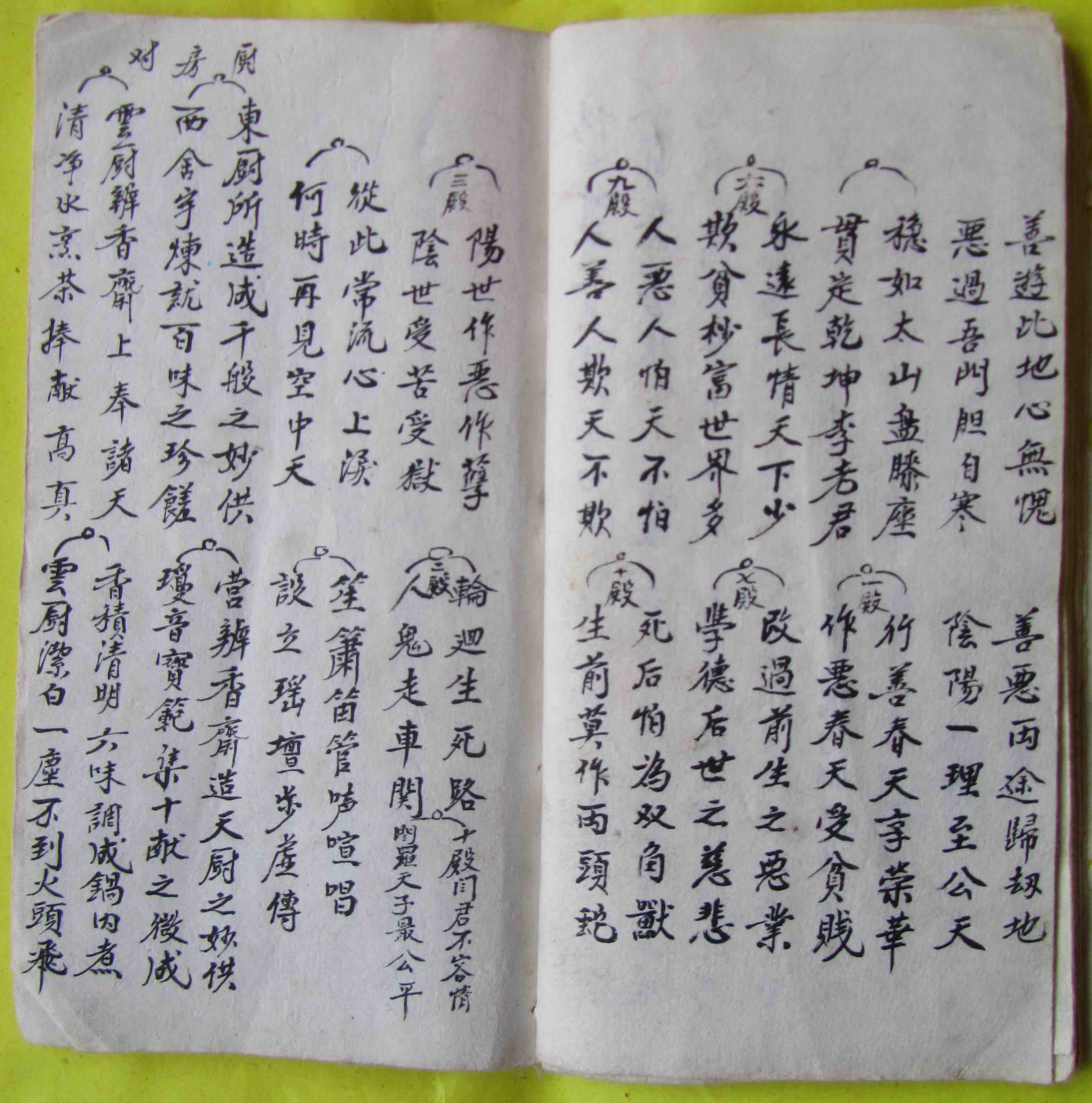
duiben

Couplets for the scripture hall, including series for the Ten Kings.

There is a couplet for seeking rain, and fourteen for raising the roofbeam. There are many for more general social life, such as those for archways, cattle sheds, and carts; for carpenters and metal workers, and for the “wine bureau” and pharmacy. Six further verses marked “treasury couplets” are for the funerary treasuries. The volume opens with a series of over twenty couplets for weddings, the only instance of any Daoist component for this context.

Near the end of the volume there is a series of four-character mottos—the diaolian large paper squares to be hung on the lintel where the coffin is lodged. Li Manshan has to write these regularly for funerals, but again he never needs to consult the volume: he’s been writing them from memory for over thirty years.

In all, the couplet volume suggests how pervasive Daoism was in the daily life of a previous era, but we can’t deduce how many of these couplets Li Qing or even Li Xianrong commonly used.

The fate of the new manuals
Despite all this energy in recopying, once Li Qing and his colleagues began performing ritual again, few of the segments that require the use of the manuals were to be restored in practice.

Most rituals in common use for funerals consisted of relatively short texts that could be memorized. When the manuals are needed, it is mainly for rituals that are rarely performed; and until the early 1960s, they would also have been used for the lengthy fast recited chanted scriptures that were part of temple and earth rituals, like Bafang zhou and Laojun jing. Li Peisen and Li Qing devoted considerable energy to recopying these chanted scriptures, but their optimism that they would be restored in performance under the new more liberal conditions turned out to be misplaced. So while we may treasure the manuals that they copied in the early 1980s (not least since they provide clues to former practice), we must observe that after they had been copied they were hardly consulted.

Notebooks
More prosaically, Daoists now often transcribe the texts they need into little exercise books, copying them horizontally in biro. For the sinologist they may seem unpromising: small, with plastic covers (a welcome innovation with regard to preservation), sometimes bearing cheesy pinup-type photos. Through the 1990s I myself had something of a fetish for using such kitsch notebooks for my fieldnotes, but eventually I resigned myself to the posher ones that had replaced them in the shops. But such notebooks copied since the 1980s are an important resource. They are probably the most useful guide to their current practice, even if their older manuals, elegantly copied with brush and ink, look more elegant and archaic. Household Daoists in Shuozhou county nearby have copied some long complete ritual manuals into such notebooks. Apart from convenience, after the traumas of recent times, perhaps Daoists also took instinctively to small easily-stashed notebooks, rather than more bulky old tomes.

Like all men who determine the date, Li Manshan has several small notebooks that serve as almanacs for all his complex calendrical calculations. But sometime in the 1990s he copied a little blue notebook in the traditional vertical style, with a set of ritual texts densely written over twenty-five pages. Later he wrote a black notebook with a mere fifteen texts in 21 pages, this time copied horizontally. This briefer volume may now meet most of his needs for funerals, such as Delivering the Scriptures and Transferring Offerings, but it by no means shows the full extent of his recent practice; he still performs many texts not copied there. And some of them don’t even appear in Li Qing’s lengthy hymn volume. Li Manshan may have written his blue notebook to remind him of the texts, but the black one served a different purpose (as he says, “I don’t need them, they’re in my belly”)—“Because if someone tells me I’m making it up as I go along, I can take it out and show him it’s the real deal!” So it wasn’t an aid to memory so much as a kind of certificate, almost like a license.

Li Manshan recalls that Li Qing had a similar notebook for various such texts, which we haven’t found. Did Daoists always use something similar? Of course, the beauty of the Mao jacket is that it can store such a notebook. When did notebooks become available in Yanggao? Going back through imperial history, what kind of equivalents might Daoists have used? And, if you’ll allow me a further sartorial query, what kind of pockets would they have put them in?

Perhaps the Dunhuang religious manuscripts from around the 10th century offer a clue. They include some small booklets, “the size of a pack of Lucky Strikes”, as Teiser describes them, going on to speculate nicely: “Easily transported? Hidden in a sleeve? Used surreptitiously? Studied in private?” As he remarks, “a booklet this size would serve as a perfect study guide for an officiating priest.” But with our experience now, we would wish to unpack a term like “study guide”.

* * *

In my book I go on to explore the ancestry of the texts contained in the ritual manuals. This bears on the complex issue of the relation between Orthodox Unity and Complete Perfection (for an outline, see here).

Some scholars have traced rituals still practiced in Jiangnan or south China to early, whole, ritual manuals in the Daoist Canon. At least in north China, this is unlikely to be at all common. Few of the texts sung there by modern household and temple Daoists appear in such early sources; many can only be documented since the late imperial period. Such a conclusion may help us modify an antiquarian tendency in Daoist studies.

All this suggests merely that these texts are part of a broad tradition related to modern temple practice. And since many of them are common to household groups over a wide area of north China, we have to take the temple link seriously. Even poor household Daoists, quite remote from urban elite traditions, with no clues in their oral history to any temple connection, turn out to have a substantial link to the nationally promulgated texts of the major temples. We can only guess at the ritual repertoires of smaller regional temples that were the links between the major temples and rural household groups.

Still, having traced a few isolated texts, it is frustrating that parallels with most of the ritual manuals remain elusive, like Communicating the Lanterns or Dispatching the Pardon (see my book, ch.13). Such repertoires look like a patchwork assembled from various sources, few of which may ever emerge. We have a few pieces of a few jigsaws, and none at all for others.

So in a ritual corpus like this we have three types of text, some highly standard and national, others apparently distinctive and regional, even local:

  • Ritual manuals: now hardly performed; few sources in the Daoist Canon or elsewhere, either whole or in part.
  • Individual hymns still in use today: few appear in the Canon, but many are found in modern temple sources like the daily services and yankou—which are now known mainly in Complete Perfection versions.
  • Scriptures: no longer performed; nationally standard, ancient, and found in both the Daoist Canon and modern temple sources.

The contrast between ritual manuals and scriptures is absolute. The scriptures, “in general circulation,” can easily be found in the Daoist Canon, their titles and contents identical. But the ritual manuals can’t be found—neither their titles nor the great bulk of individual texts within them. However, many of the individual hymns, as well as scriptures, are common with the current practice of temple priests, who happen to be Complete Perfection—notably those found in the Xuanmen risong and yankou. This doesn’t mean that the Li family tradition is or was mainly based on them, since the great bulk of the other texts in the ritual manuals cannot be traced; but the fact that “standard” temple Complete Perfection texts are the single most fruitful match with the Li family’s current repertoire should remind us that the superficial dichotomy of “folk Orthodox Unity versus temple Complete Perfection” is a mere academic fantasy.

* * *

So we do indeed need to document ritual manuals, but it is performance that is primary. Daoists aren’t dependent on the manuals, relying on much knowledge that can’t be reflected in them; so rather than being the main object of study, they should be an adjunct to our study of changing performance practice.

While it is with the Li family that I collected most ritual manuals, for other such texts see the many pages under Shanxi and Hebei in the Menu.


[1] For fine accounts of the whole process in south Fujian, see Kenneth Dean, “Funerals in Fujian” Cahiers d’Extrême-Asie 4 (1988) and his Taoist ritual and popular cults of southeast China (1993).

[2] With the study of ritual manuals dominated by south China, the general term keyiben 科儀本 has become standard in scholarship. I don’t know if this term is commonly used by southern Daoists, but it isn’t heard in the north. In Hebei they often refer to ritual manuals as jingjuan, but in north Shanxi the more prosaic term is jingshu or jingben, or even the innocent-sounding shu “books.” Since manual titles often end with the term keyi, they could notionally call those manuals “keyiben”—but they don’t. For such vocabulary, see here.

[3] Cf. amateur ritual associations in Hebei, where many manuals were copied in the short-lived restoration of the early 1960s: see Zhang Zhentao, Yinyuehui, pp.67–396, and many posts under Hebei in the main Menu.

[4] For the production of early Ten Kings scrolls from Dunhuang, see Stephen Teiser, The Scripture of the Ten Kings and the making of purgatory in medieval Buddhism (1994), pp.88–90, 94–101. 16 or 17 characters per line seems common down the ages, but the number of lines per page is variable—some modern printed scriptures produced by the Baiyunguan in Beijing have only 5 lines per page (half of a folded page of 10 lines).


Another everyday story of country folk

Archers

We’ve discussed the rural society of Gaoluo village, and Yanggao county; and to follow Cheremis, Chuvash, and Tibetans, now for Ambridge.

Despite my tireless ethnographic devotion to Everyday Stories of Country Folk and, um, popular culture in all its forms, I can’t stand The Archers!!! There, I’ve said it.

Still, like the Hoffnung speeches, I recommend it highly to foreigners. The world’s longest-running radio serial [zzzzz], it makes a perfect portrait of daily life in Middle England, showing what we’re up against—a complement to Watching the English. For Stewart Lee’s somewhat different take on being English, see here.

I do realize that social change has come to Ambridge—indeed, Peter Hitchens moans that the series has become a vehicle for liberal and left-wing values and agendas (“all kinds of sexual revolution stuff and ultra-feminist propaganda”) (PAH! Nay, YAY!). But its core plots still revolve around riveting issues like the loss and rediscovery of a pair of spectacles, and competitive marmalade-making, The scripts are an inexhaustible catechism of cliché that I believed to have expired along with my great-aunts (“Ooh I shouldn’t really…” “And more power to her elbow, that’s what I say!”—the latter perhaps constituting evidence of Hitchens’s “ultra-feminist propaganda”?)

So despite occasional daring updates to the world-views and vocabulary of the “characters” (sic: see below) since 1950, it’s always going to be trapped in a time-warp: the visual image that the series still conjures up today is surely the photo above (note for any Chinese, Chuvash, or Bulgarian readers: YES, this is how we all dress).
As a Chinese immigrant struggling to perceive the underlying ideology of being English, Xiaolu Guo realised that

the drama, with its apparently apolitical presentation of “an oasis of rural England outside the currents of history” is really offering a supremely political position, a peculiarly British ideology: one that privileges endless indirectness and lethargy, endless deflection of real anger and debate, and endless acceptance of the status quo.

The wiki article on The Archers makes fascinating reading, with some drôle diachronic byways, not least on the irritating and inescapable theme-tune Barwick Green—a maypole dance, FFS [Can it be that you have suddenly abandoned your mission to document rural culture? Not Exotic enough for you?—Ed.] (cf. Morris dancing as a suitable riposte to the haka), endowed with “the genteel abandon of a lifelong teetotaller who has suddenly taken to drink”, as Robert Robinson observed.

The 1954 recordings were never made available to the public and their use was restricted even inside the BBC, partly because of an agreement with the Musicians’ Union.

Oh well, that’s one good cause to which the MU has been putting my subscription. But when a new stereo version was recorded in 1992 (quelle horreur!),

the slightly different sound mixing and more leisurely tempo reportedly led some listeners to consider the new version inferior, specifically that it lacked “brio”.

“Brio” is indeed the mot juste. Bless.

A 2011 folk-rock version by Bellowhead was well received, however:

For further windows on changing performance practice, see e.g. Mahler, vibrato, jazz, DaoismTaruskin; the Wimbledon and Pearl and Dean themes. Not forgetting Pique Nique by Ibert’s brother Edouard—an oeuvre that has everything that Barwick Green lacks, despite their shared 6/8 metre (can we have a Bulgarian version, please?). See also By the sleepy lagoon.

Anyway, my main reason for this unseemly rant is to alert you to a brilliant parody that John Finnemore did in 2014, for which I am precisely the target audience:

How The Archers sounds to people who do not listen to The Archers:

[Announcer:] And now on Radio 4—unbelievably—it’s time to accidentally hear a bit of The Archers again.

with all the stereotypes lovingly exposed—

“Hello, one of the men who always sounds tired!”
“Hello, one of the unsufferably wry women…”

“Hello, one of the women with an accent! You’d think that would make it easier to tell you apart from the others, but… no.”

He continues the theme here:

… doomed endlessly to repeat the same morality tale of how all men are feckless idiots with terrible ideas, all women are joyless wet blankets who are nonetheless powerless to stop them.

Indeed, the great Tony Hancock did a spoof as early as 1961:

For denizens of Twitter, the fantasy scripts of @jonreed are recommended. See also Charlotte HIggins’ recent fantasy on an Ambridge Don Giovanni. And inevitably, The Archers is an academic research topic

For a roundup of posts on How to be English, see here—including The mantric Shipping forecast.

Cheremis, Chuvash—and Tibetans

Photo: Cheremis “pagan” ritual singer H.H. Musztafa (then 69), June 1975.

Along with from the many Hungaroton LP box-sets of the musics of east Europe, another impressive 3-disc set that I brought back from Budapest is

collected and published by László Vikár (1929–2017) and linguist Gábor Bereczki. The set documents musical traditions of peoples in the “autonomous” republics around the eastern perimeter of the European part of the USSR, the central Volga and Urals—peoples about whom I know nothing, but feel we should know:

Mordvinians, Votyaks (Udmurt), Cheremis (Mari), and the Turkic-speaking Chuvash, Tatars, and Bashkirs.

USSR

Source: reddit.com.

Between 1958 and 1979 Vikár and Bereczki made four long summer fieldtrips to some 286 villages, accompanied by local scholars. With sound engineer Pál Sztanó they recorded life-cycle and calendrical items, both vocal and instrumental, including bridal dirges, funeral laments, dance tunes, and historical epics.

The recordings on this box set are part of a much larger archive. Some tracks appear on YouTube, such as

Note also this channel.

The 43-page booklet contains detailed notes, as well as maps, translations, photos, and some transcriptions.

notes 2

A page from the booklet, on Mari singing.

Bartók, Kodály, and Bence Szabolcsi had already shown an interest in these groups, mainly as part of their comparative musical paleography, classifying melodic types; Vikár was building on this tradition. [2]

Such early recordings were made on request, not—as ethnographers later also sought—while documenting the social events of which they are the core. So we meet the typical issue that often crops up in Chinese collections: were they performing items then still in use, or recalling them from an earlier social practice?

And of course these projects could barely hint at the painful recent histories of such peoples (cf. The whisperers). Music is never autonomous, but gives us a window into the study of changing local societies.

Indeed, it’s worth recalling what else was happening in those years. Notwithstanding the interest of early east European music scholars in “archaic layers”, these are not timeless idyllic communities; though by the 1970s they had weathered the worst of the years of repression under Stalin, they had been constantly starved, deported, subject to political whims, suffering under collectivization and the Great Purge (cf. Blind minstrels of Ukraine, under “Other minorities”). This too is a rich field of research—see e.g.

See also The Kazakh famine, and (still earlier) Hašek’s adventures in Soviet Tatarstan.

The task of modern ethnographers—just as for China—is to integrate socio-political histories with expressive cultures. In 1975 the moment had still not come to record the memoirs of “pagan” Mr Musztafa—and now it’s too late.

In addition to the Garland encyclopedia of world music, for more on early collecting, see under

  • Margarita Mazo, “Russia, the USSR and the Baltic states”, in Ethnomusicology: historical and regional studies (The New Grove handbooks in music, 1993), pp.197–211,

and in the same volume,

  • Theodore Levin, “Western central Asia and the Caucasus”, pp.300–305.

In the early years after the crushing of the 1956 Budapest uprising, one might wonder how smooth was the collaboration between Hungarian and Soviet scholars—only of course both would have suffered under the policies of their regimes.

* * *

1955

Left to right: Yang Yinliu, Bence Szabolcsi, Li Yuanqing, Beijing 1955.

Meanwhile in China, scholars were also documenting local traditions, for both the Han majority and the many ethnic groups—under testing conditions, and with a similar caution in broaching socio-political issues. By the 1950s, with a growing interest in early connections between Hungarian and Chinese musics, China was open to Hungarian musicology; Bence Szabolcsi visited the great Yang Yinliu in Beijing in 1955, on the eve of the Budapest uprising. And Yang Yinliu visited the USSR in 1957, just after his remarkable fieldtrip to Hunan—just before the Anti-Rightist campaign and Great Leap Backward led to untold suffering.

1957

Yang Yinliu (seated, right) on a visit to the USSR, 1957.

For Czech–Chinese exchanges over the period, see here.

Kodály’s Folk music of Hungary, dating from 1935, was published in 1964 in a Chinese translation from the 1956 German edition—just as a brief lull after the Leap was destroyed by the Four Cleanups and Cultural Revolution.

Kodaly

In east Europe, the USSR, and Maoist China, the enthusiasm of ethnographic collectors of the day is admirable—even as their leaders were imprisoning them and manipulating the peoples they were studying. As William Noll observes, such studies need both to be interpreted in their historical framework and updated constantly, both by augmenting the earlier material and by documenting more recent change. Also in that post, note Noll’s comment that ethnographers of one cultural heritage commonly conduct fieldwork among peoples of a different cultural heritage—even if both groups live within the political boundaries of one state.

Left: Tibetan monks lay down their arms, 1959 (AFP/Getty.).
Right: Norbulingka, Lhasa 1966 (from Forbidden memoryessential reading).

A flagrant instance of circumspection is fieldwork by Chinese musicologists in Tibet in the 1950s, rosily portraying the region (like Xinjiang) as a happy land of singing and dancing—even in 1956 Lhasa, just as mass rebellions were breaking out all over Tibet against Chinese occupation. Two of the most distinguished, and well-meaning, Chinese scholars resumed their fieldwork upon the 1980s’ reforms, encouraging their Tibetan pupils; but the whole social-political backdrop remained taboo (see Labrang 1). See also Recent posts on Tibet.

Expressive culture is an illuminating window on society. How little we know about the world…


[1] The term Finno-Ugric seems somewhat dated, but see here for a more extensive list of peoples.

[2] An early curiosity among the ouevre of the great Bruno Nettl is his slim tome Cheremis musical styles (1960), part of a Cheremis project at Indiana. The Preface by Thomas Sebeok has a useful summary of interest among Hungarian and other scholars. But written from a distance, the monograph could still only be narrowly musical—free of ethnomusicology’s later concern for society and culture, in which Nettl has played such a major role; and the material that he assembles consists largely of transcriptions rather than recordings.

For Chuvash and Mordvins, note also the 1996 Auvidis CD Chants de la Volga: musique traditionnelle de Tchouvachie et Mordovie.

Auvidis

Breakfast at Tiffany’s

Moon river

This is just an alert to a substantial update on my post Moon river, featuring—in addition to Audrey Hepburn, Amy Winehouse, and Stacey Dooley, the gorgeous major-7th leap, as well as the dodgy language of “femme fatale” and “elfin waif”—thoughts on Truman Capote’s novella, stammering, and fado…

Capote


Killing Eve: notes and queries

KE

I entirely share the widespread adulation for Killing Eve. Just in case you’ve been holed up in your ivory tower studying medieval Daoist manuscripts or suchlike, neglecting to delight in all manifestations of the Terpischorean muse, here’s a tribute—and a query.

trio

The brilliant Sandra Oh and Jodie Comer are inspired by Phoebe Waller-Bridge’s script, which wears its feminist credentials lightly. You can take your pick of a plethora of rave reviews, but I like this. And this. And indeed this New Yorker review, and now this from the LRB (you may already have noted that I tend not to favour the Ku Klux Klan Gazette as the ultimate source of critical wisdom).

While Luke Jennings’ novel Codename Villanelle can hardly compete, one location that sinophiles will enjoy there (not used in the TV version) is an ever-sleazy Shanghai, scene of one of the most grisly murders—with its references to Moon river and the 1930s’ silent-film actress Ruan Lingyu.

For astute comments from Unloved on how they created the soundtrack for the series, see here.

OK, among these clips, the Psychopath scene (from 6.22), ending with Villanelle’s response to “Are you upset?” is wonderful:

Which I suppose leads me to just one niggling doubt, encapsulated long ago by Mark in Peep Show, visiting a student he fancies:

Mark: Love your room.
April: Thanks. It’s your basic undergraduate lunge for individuality.
[nods to a Betty Blue poster]
April: I’ve not even seen Betty Blue. Have you?
Mark: Oh yeah. Great sex-and-suicide flick—turned a whole generation of men onto girls with mental illness.

So now for the chic assassin (for terms like femme fatale, see here; and for Lulu, here). It can hardly be much consolation that whole generations of women are also subscribing to the image. I’m sure there’s a sound feminist response to this. Discuss

Will there be redemption for Villanelle/Oxana in the next series? Would that be too neat?

As to a musical Villanelle, Berlioz’s Nuits d’été is gorgeous—here’s the classic Janet Baker recording:

For more from PWB, see Fleabag and Exotic travels; and do watch Jodie Comer in the recent Talking heads.

Li family Daoists, Beijing 1990

BJ 1990

The recent Beijing visit of a sectarian group from north Shanxi reminds me of the Li family Daoists’ performance at the 1990 Festival of religious music (for such festivals, see here)—the occasion that gave rise to their misleading media title (“calling Li Manshan’s band the Hengshan Daoist Music Troupe is like calling a group of Calabrian folk exorcists the Sistine Chapel Choral Society”).

I discussed here the gradual revival of Daoist ritual (now mainly funerals) in Yanggao after the collapse of the commune system; even by 1990, rural conditions there were still terribly poor, and memories of the Maoist era still fresh. For the dubious concept of “religious music”, see here.

Here’s how I described the festival in my Daoist priests of the Li family (pp.175–6):

Meanwhile my friend Tian Qing, later to become the pre-eminent pundit on Chinese music, was planning a major festival of Buddhist and Daoist music in Beijing for June that year, with groups from all over China invited to perform on stage. This was unfortunate timing, as everything was disrupted by the student demonstrations and their subsequent suppression, so the festival had to be postponed. With Tian Qing now indisposed, his colleagues at the Music Research Institute managed to put on the festival the following June—not in public, but with considerable publicity in the musicological world. To hold a festival of religious music was still controversial: some apparatchiks were opposed, but influential senior ideologues like He Jingzhi and Zhao Puchu supported it.

Li Qing had a difficult task to perform when it came to choosing the personnel to go to Beijing. Of his three Daoist sons, he ended up taking not Li Manshan or Yushan, but his third son Yunshan (Third Tiger), then 22 sui. Though Third Tiger was soon to take a different path, he remains nostalgic about his teenage years studying and the trip to Beijing with the great masters. Nine Daoists made the trip: the trusty core group of seniors Li Qing, Li Yuanmao, Kang Ren, Liu Zhong, Li Zengguang, and Wang Xide, along with Li Yunshan, Li Peisen’s son Li Hua, and Li Yuanmao’s son Li Hou. They stayed in the White Cloud Temple (Baiyunguan) along with several other Daoist groups from elsewhere in China invited for the festival, doing five performances (not rituals) for privately invited audiences over fifteen days in the temple and at the Heavenly Altar. The Music Research Institute also made studio recordings—which now sound rather harsh to me.

informal session

Informal session at Li Qing’s house, 1991. Left to right: Li Qing (sheng), his second son Yushan (yunluo), Liu Zhong (guanzi), Li Zengguang (drum), Kang Ren (sheng), Wu Mei.

The 1993 Yanggao county gazetteer includes a proud mention of the Beijing trip in its brief account of the Li family band. Valuable as the gazetteer is otherwise, Daoism is not its strong suit. Li Manshan and I giggle over its quaint description:

the average age of the members is 62.5. The instruments are even older than the people.

Still, even now, religious groups that have been legitimized by official recognition are in a tiny minority compared to all those that have never been “discovered”. Even in Yanggao and nearby, many other groups are active that have never enjoyed even such minor celebrity. And while it lent Li Qing’s group confidence, offering a potential buffer against any future ill winds, it brought them no tangible benefit, and no new audiences—at least until 2005 when I began taking them on foreign tours. They continued to scrape a living by performing for local funerals, and they still do.


For Third Tiger’s fine interpretation of my SOAS T-shirt, see here.

Taco taco taco burrito

Rite

Wondering how to get to grips with additive metres?
Awed by the complexities of flamenco palmas?
Despair not, help is at hand!

As a prelude to aksak “limping” metres, we might start with quintuple metres, which go far back, even in WAM. By the baroque period there are niche examples by composers such as Schmelzer, and they feature in 19th-century Russian music—a most popular instance being the “limping waltz” of Tchaikovsky’s Pathétique symphony (2+3).

This reminds me of two other subversions of the waltz, albeit in regular triple metre: the 2nd movement of Berlioz’s Symphonie fantastique (cf. here and here), and Ravel’s La valse, a “surreal nightmarish vision of a decaying society through a broken kaleidoscope”, as I said in my Ravel page. Elsewhere, perhaps inspired by the Basque zortzico dance, Ravel was partial to additive metres—such as in his piano trio, and the quintuple-time Bacchanale finale of Daphnis and Chloé (both also featured on that page, the latter from 45.29). And Messiaen was most partial to complex yet catchy additive rhythms.

Quintuplets, of course, are something else altogether; as are the creative use of additive rhythms in minimalism (see also examples from Reich and Meredith).

From Tchaikovsky we might graduate to

  • the Pearl and Dean theme (which we may hear as two groups each of 3+3+2; or for a Bulgarian, perhaps two fast groups of 3+3+3+3+2+2)
  • Un homme et une femme (after the three upbeats, 3+3+2+2: the first two 3s, in the original “Dabadabada, badabadaba”, were later remembered as “Chabadabada“, a word that entered the language to denote alternating male and female candidates in electoral lists!)
  • and Lalo Schifrin’s theme to Mission impossible (5/4, with a duplet over the first 2 beats).

If you can hum along to such easy examples, then that’s a good start in mastering the intricacies of so-called aksak metres around east Europe and the Middle East…

Indeed, Take five was inspired by hearing Turkish musicians. Rather more challenging is the opening section of Blue Rondo à la Turk (2+2+2+3):

Note the helpful BTL comment there (only without the punctuation!):

Taco, taco, taco, burrito. Taco, taco, taco, burrito. Taco, taco, taco, burrito.
[SJ: not to be confused with potato, potato]

Still, that’s a rather crude, mechanical usage, the melody merely marking out the metre in regular quavers—whereas further east, melodic rhythms are infinitely varied within the basic metre.

Admittedly, the additive patterns of the Rite of spring have been transcribed in 4/4—was it really Boulez who had this drôle idea?! Cf. Slonimsky‘s help for Koussevitzky, here). Indeed, the scores for both the Pearl and Dean and Un homme et une femme tunes were written in duple metres.

And in the first movement of Winter, Max Richter’s welcome recomposition of the Four Seasons mixes in some great limping 7/8 bars (2+2+3—just the two tacos before the burrito today, thanks waiter) (from 1.18):

An intriguing instance is I say a little prayer, with its quirky insertion of a triple-time bar in the chorus—which no-one apparently even has to think about. And do listen to Herbie Hancock‘s addictive Ostinato.

* * *

But all this is mere child’s play compared to folk music. Though such metres are quite widespread, Bartók, Brailiou et al. coined the term “Bulgarian rhythm”.

aksak

Some instances of “Bulgarian rhythm”, found here; see also here. For the Swingles’ delightful arrangement of  Bučimiš, see under Another Turangalîla at the Proms!.

A classic essay is

  • Constantin Brăiloiu, “Aksak rhythm” (in Brăiloiu, Problems of ethnomusicology, 133–67, based on a 1951 lecture),

which contains far more detailed schemata. His work followed that of

  • Béla Bartók, “The so-called Bulgarian rhythm” (1938).

A transcription by Bartók of a Turkish zurna–davul shawm band shows how, over the basic metre, melodic and percussion rhythms seriously thicken the plot:

aksak 2

Jerome Cler’s splendid website on the yayla has a thoughtful analysis of an aksak (here).

The whole repertoire of players like Ivo Papazov is based on aksak metres:

I don’t think I’m quite ready for Sedi donka (Plovdivsko horo), a 25-beat pattern divided

    7             7                 11
3+2+2 | 3+2+2  | 2+2+3+2+2

For more on the diverse musical cultures of Bulgaria and environs, see here. And for a wide-ranging discussion, see

  • John Blacking, “Irregular rhythms: movement, dance, music, and ritual”, ch.3 of A common-sense view of all music (1987).

Back with Merrie England, there’s a fascinating article:

* * *

Further east, an example from the muqam of the beleaguered Uyghurs of Xinjiang is sadly topical. A common metre consists of one long beat divided into two equal stresses, followed by two regular beats—which we might notate cumbersomely as

aksak

with the initial duplet over a notional 3/8 unit:

Some sections add another duple unit, like this dastan from Chebiyat muqam (actually a duplet over 3/8,  followed by 3/4):

QB

And some muqam have still more metrically complex segments to explore.

As with many world genres, the Uyghurs have no tradition of notation, and seem to have no terminology for such metres (though see Rachel Harris’s chapter in Harris and Stokes (eds.), Theory and Practice in the Music of the Islamic World). As with flamenco, this kind of thing is only an issue for those (like me) hampered by a visual classical education. The trick is to internalise it in the body—and to dispense with notation. Let’s remember that much of this music accompanies dance.

Uyghur musical traditions are part of a rich culture that is currently being systematically erased in Xinjiang (see roundup here).

Moon river

MR

À propos my Daoist ritual spinoff of Strictly, the brilliant (ethnographer!) Stacey Dooley‘s recent waltz reminds me what a brilliant song is Moon river:

Pace Andy Williams, the classic sung version is that of Audrey Hepburn in Breakfast at Tiffany’s (1961):

Johnny Mercer’s lyrics, “a love song to wanderlust” (cf. Roaming the clouds), are complemented by Henry Mancini’s melody.  I just love the leap of a major 7th:

I’m crossing you in style some day / There’s such a lot of world to see,

always effective—as in the finale of Mahler 9 (introduced by quintuplets!) and, um, Raindrops keep falling on your head! Indeed, there’s another brilliant touch: following “We’re after the same rainbow’s end“, when that sequence returns with

Waiting round the bend, My huckleberry friend,

for the first phrase the melody omits the low tonic, making us nostalgic for the missing major-7th leap (waiting, indeed), until it returns for the second phrase.

So Moon river (nearly cut from the film, PAH!) makes a perfect expression of Holly’s persona—and indeed that of Stacey Dooley, with her documentaries from around the world.

The dominant interpretation currently seems to be that Hepburn’s screen characters make her some kind of feminist role model. But “it’s complicated”—certainly in this film, which largely replaces the edgy feel of Truman Capote’s novella (1958, set in 1943) with a “sugar and spice confection”; indeed, Capote wanted Marilyn Monroe for the part! I tend to side with more critical reviews, such as this, this, and this. After I cited some dodgy sexist terms to describe talented female performersgamine and ingénue are among those for which there are both male and female equivalents, but the latter are far more commonly used, and flawed. Oh, and how ahout “elfin waif”…

For Hepburn’s actual life, Darcey Bussell (another fragrant icon) made a fine documentary Looking for Audrey (2014), including her childhood in Nazi-occupied Holland.

* * *

Capote describes Holly as an American geisha—rural child bride Lulamae, reinventing herself in New York. Film adaptations can be effective, but in this case the novella portrays her with more nuance and depth. So—not least because I’m so averse to Hepburn’s “elfin waif” shtick—I find Capote’s silent invisible original far more moving, and Holly herself far more poignant and (as she would say) sympathique.

Inevitably, at the end of the film the narrator and Holly fall in love and stay together, whereas in the novella their relationship remains platonic, and Holly disappears.

Lending significance to Moon river, the name-slot for Holly’s mail-box reads:

Miss Holiday Golightly, travelling

She reflects on how she demurred from a break in the movies offered by a Hollywood agent:

But he’s got a point, I should feel guilty. Not because they would have given me the part or because I would have been good: they wouldn’t and I wouldn’t. If I do feel guilty, I guess it’s because I let him go on dreaming when I wasn’t dreaming a bit. I was just vamping for time to make a few self-improvements: I knew damn well I’d never be a movie star. It’s too hard; and if you’re intelligent, it’s too embarrassing. My complexes aren’t inferior enough: being a movie star and having a big fat ego are supposed to go hand-in-hand; actually, it’s essential not to have any ego at all. I don’t mean I mind being rich and famous. That’s very much on my schedule, and some day I’ll try to get around to it; but if it happens, I’d like to have my ego tagging along. I want to still be me when I wake up one fine morning and have breakfast at Tiffany’s.

And Holly does indeed sing and play guitar:

Don’t wanna sleep, don’t wanna die, just wanna go a’travellin’ through the pastures of the sky

With a Brazilian suitor in tow, she takes to Linguaphone:

Oh screw it, cookie—hand me my guitar and I’ll sing you a fado in the most perfect Portuguese.

That would surely have rivalled Carminho’s exquisite song.

In the novella, I note with proprietoral pride that Holly’s fellow-geisha Mag Wildwood (intriguingly, Capote gave her the full name of Miss Margaret Thatcher Fitzhue Wildwood)—as if being a redhead over six feet tall isn’t enough—is a stammerer (Marilyn Monroe might have resented the competition):

Even the stutter, certainly genuine but still a bit laid on, had been turned to advantage. It was the master stroke, that stutter: for it contrived to make her banalities sound somehow original, and secondly, despite her tallness, her assurance, it served to inspire in male listeners a protective feeling.

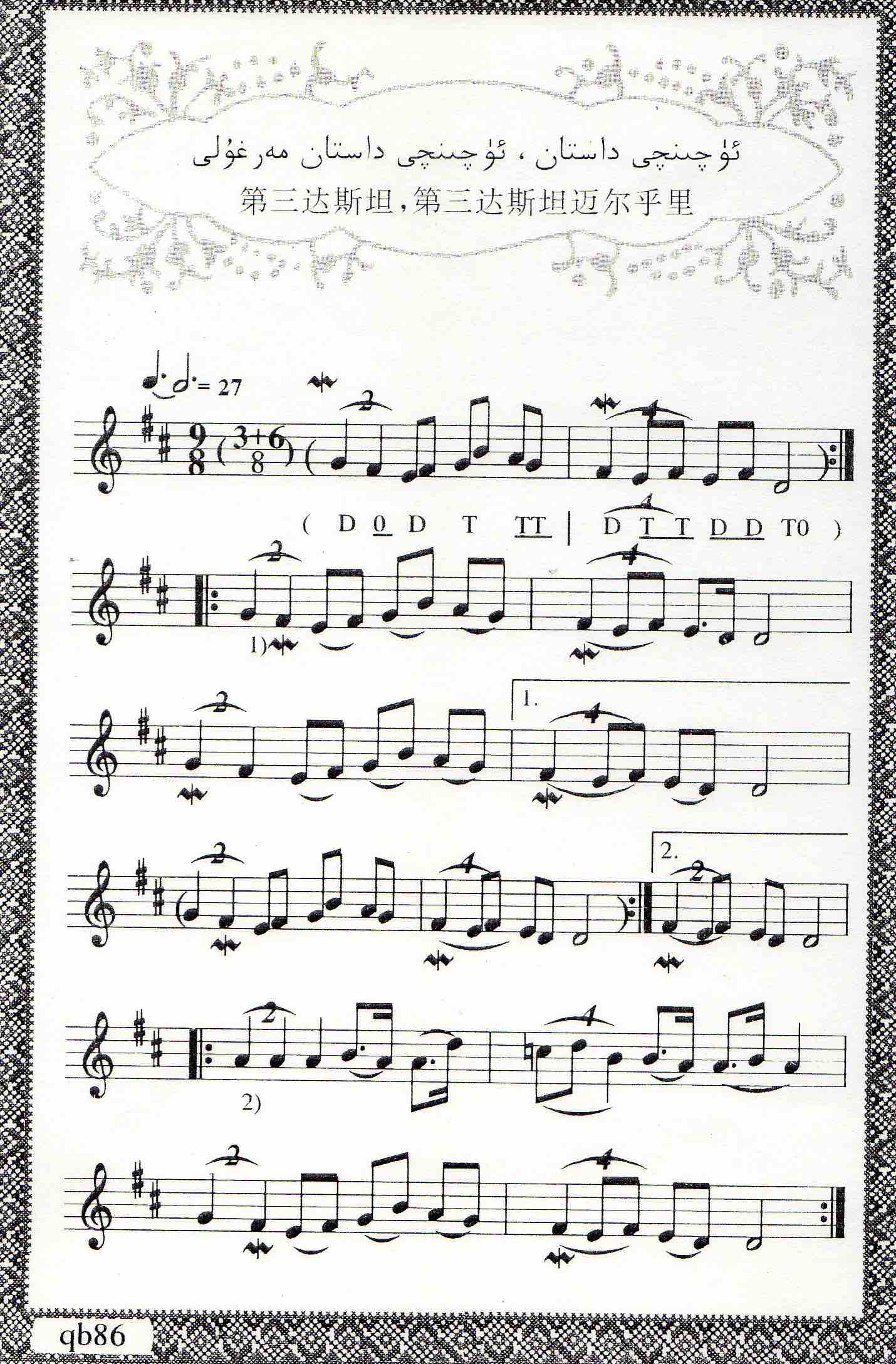
* * *

For Moon river on the ethereal theremin, click here.

Amy Winehouse (see my tribute here) may seem an unlikely exponent of the song, but she was grounded in ballads, as we can hear in her “late” sessions with Tony Bennett. Here she is, subverting the waltz, making the song sugar-free—maybe it doesn’t quite work, but even at the age of 16 she was always exploring, discovering new personal connections:

Click here for a discussion of the song in the BBC Radio 4 Soul music series.

From my playlist of songs, it’s clear that, with some noble exceptions, I find female voices more moving than male ones—and I’m right!!!

Just another reminder that a global view of musicking invites us to delight in all manifestations of the Terpsichorean muse!

Confucius he say—slowly

While I am most averse to the current wave of vapid patriotic moralising in China, I am partial to the occasional judicious quote from Confucius—like my tribute to the Li family Daoists on their 2017 French tour.

Further to my motto for the Stammerers’ Association (“We have ways of making you talk”), Who Better Than Confucius (answers on a postcard please) to supply a maxim for the Chinese branch? James Legge’s classic translation of Analects §4.24 goes

The Master said, “The superior man wishes to be slow in his speech and earnest in his conduct.”
子曰:君子欲訥於言而敏於行。

cof

The distinguished Tian Qing, my favoured calligrapher-by-appointment—see here for the sign that he wrote for Li Manshan’s latrine)—has kindly written the maxim for me in lishu script. For Shan Fuyi’s scroll with the ingenious poem that Gaoluo villagers wrote for me, click here.

The 訥 there (“slow”) has also been rendered as “hesitant” (for an allusion to the dictum in the name of a fine scholar of Tang culture, click here). Of course, unlike Moses, there’s no suggestion that Confucius was himself a stammerer. In his calligraphy Tian Qing has dispensed with the “wishes” character, since as he observes wryly, I’ve already attained the “slow in speech”… But rather than advocating a speech impediment, Confucius’s bon mot may serve for the afflicted as a reminder of slowed speech, or even deliberate stammering, as therapy—perhaps with Robert Peston as model, rather than Gepopo.

There’s some data on stammering worldwide, but historically, I wonder how common it was in ancient China. Perhaps further broken down by age and sex, as Keith Richards might have called his autobiography.

There’s a related, more expansive passage in Analects §1.14:

The Master said, “He who aims to be a man of complete virtue [:] in his food does not seek to gratify his appetite, nor in his dwelling place does he seek the appliances of ease; he is earnest in what he is doing, and careful in his speech; he frequents the company of men of principle that he may be rectified—such a person may be said indeed to love to learn.”
子曰:君子食無求飽,居無求安,敏於事而慎於言,就有道而正焉,可謂好學也已。

Here “careful in his speech” appeals less to me than “hesitant” in the first quote. To borrow from ethnomusicology, it’s not just tempo, it’s timbre too—or else, if we’re not careful, we’ll end up sounding like Jacob Wee-Smug (aka Minister for the 18th century, or The Haunted Pencil, “a man who has all the authenticity of a character at a murder-mystery weekend“), and Nobody Wants That…

BTW, this classic quote from the Tree Frog illustrates just how far he is prepared to go to Get Down with the Kids, sonorously describing Teresa May’s Brexit plan as

 the greatest vassalage since King John paid homage to Phillip II at Le Goulet in 1200

(see also here, and here).

High fives all round. Also BTW, I now wonder if Confucius’s 敏于事 (Legge’s “earnest in what he is doing”) might even be rendered as “diligent in ritual” (cf. Doing things). As to “appliances of ease” (again, I might suggest “comfort” or “security”), I’ve never been one for a microwave myself.

“Such a person may be said indeed to be a pompous misogynist“. Drawing a veil over Confucius’s views on gender (indeed, feminist critiques, and even defences, of his ouevre are in vogue, if not in Vogue: see e.g. Su Zheng, cited here), if he were with us today (cf. WWJD), if he couldn’t get a job as advisor to some dictator in a banana republic minus the bananas, he could make a fortune selling Christmas-cracker maxims. Gary Larson has a fine cartoon on Confucius at the office with some of his rejects (“Looks like we’re in for some rain”).

For a handy claim to classical erudition, see here. As ever, Laozi has the best line:

He who knows does not speak; he who speaks does not know
知者不言,言者不知。

And for Liezi, see here. For illustrious Chinese stammerers, ancient and modern, see here.

More heirs to Keats and Chapman

koala

After Keats and Chapman (“F. Huehl and his Monet are soon parted”) and some fine successors here and here, recently I’ve also spotted online:

A Tale of two cities was originally serialised in two Midlands local papers.

It was the Bicester Times, it was the Worcester Times.*

That one may go back to Frank Muir and Denis Norden in My word!. This is harder to date:

Why did the anarchist philosopher Pierre-Joseph Proudhon only drink herbal tea?

Because he believed that proper tea is theft.

Which leads us to this story:

A tourist visiting Liverpool goes down the pub for a pint. The barman notices he’s underwhelmed by the beer, so he tells him,

“Y’ know, mate, you really should try our most distinctive local bevvy.”

“Oh really—so what’s that then?”

“Well, there’s this tea made from koala bears, like—used to be dead popular round ‘ere, it did! I only know one place you can find it These Days,** though.”

The barman directs him to a tiny hovel down by the riverbank. So he knocks and goes in. Inside he makes out an old crone stirring a boiling cauldron.

“Um, hello,” he asks her, “I’m told your tea is highly unusual—might I possibly have a tasting?”

Cackling, she starts to ladle him out a helping of the steaming broth. As he takes a look in the cauldron, he sees it’s full of hair, sinews, and an eyeball floating at the top.

“Um, do you have a strainer?”

Offended, she retorts haughtily,

“I’ll have you know, The Koala Tea of Mersey*** is not Strained!”

For more Shakespeare, see here; for a host of Chinese puns, here.


* If any laowai or non-nationals find this difficult, then try Alan Watts’s limerick in n.2 here.

** “These Days”: to be enunciated in such as way as to allude to “Just Can’t Get the Staff, Nowadays”.

*** Most online versions use the (notional) Australian town of Mercy, but this one (which I heard as early as the 1970s) is more surreal.


A justly neglected composer

Somewhat less well known than Haydn and Beethoven is a composer immortalised in yet another Monty Python classic—click here.

The final “of Ulm” is brilliantly chosen, the place-name both niche and monosyllabic (unlike “monosyllabic”).

Good to see Johann rescued from the obscurity that he so richly deserves (contrast Vernon Handley). His absence from the New Grove dictionary of music and musicians urgently needs correcting.

His name is reminiscent of a ritual title for a Daoist priest—like that of Zhang Daoling, handed down in the Li family (my book, pp.11–12; film, from 2.48):

IMG_1031 - Version 2

Ancestral Master,
Heavenly Worthy of the Grand Ritual
who Supports the Teachings of the Three Heavens,
Assists the Numinous,
and Embodies the Way.

Actually, that’s quite a succinct one: appellations to the Daoist gods, recited (mercifully fast, by contrast with the slow hymns) in the course of rituals, are lengthy (see.e.g. here), and ritual titles still handed down today to household Daoist priests in south China upon their ordination may be a mouthful too.

John Cleese’s interview technique is perhaps a less probing model for the fieldworker than that of Peter Cook.

All this long before Stewart Lee made a whole art form out of trying the audience’s patience.