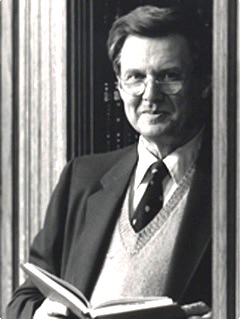
Ladies and gentlemen, Lenny Bruce!!

LB

Among the controversial, countercultural icons who drove themselves to an early grave was Lenny Bruce (1925–66), “America’s No.1 Vomic”.

With my penchant for jazz biographies, in a similar vein [sic] is the extraordinary book

  • Albert Goldman (from the journalism of Lawrence Schiller), Ladies and gentlemen, Lenny Bruce!! (1974). *
    (Do read this most perceptive review by Wallace Markfield—interestingly garbled in the course of digitisation.)

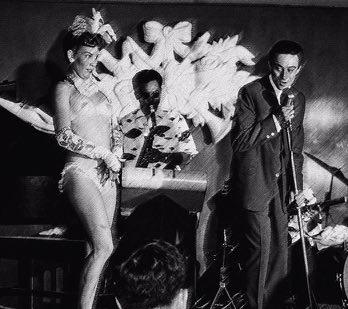
The opening chapter, “A day in the life”, is a dazzling, graphic, blow-by-blow reconstruction of his arrival in New York in 1960 for a gig at the Blue Angel. Just a taster:

Around ten, a yellow cab, somewhat unsteadily driven, pulls up before a narrow gray dilapidated building on one of the crummiest sidestreets off the Square. Above the spattered pavement an extinguished neon sign flaps patches of cold hard shadow across the stone steps: HOTEL AMERICA, FREE PARKING. The cab opens with a jolt, back doors flying open so that two bare-headed men dressed in identical black raincoats can begin to crawl out from the debris within. […]

The night before, they wound up a very successful three-week run in Chicago at the Cloisters with a visit to the home of a certain hip show-biz druggist—a house so closely associated with drugs that show people call it the “shooting gallery”. Terry smoked a couple of joints, dropped two blue tabs of mescaline and skin-popped some Dilaudid; at the airport bar he also downed a couple of double Scotches. Lenny did his usual number: twelve 1/16th-grain Dilaudid pills counted out of a big brown bottle like saccharins, dissolved in a 1-cc. ampule of Methedrine, heated in a blackened old spoon over a shoe-struck lucifer and the resulting soup ingested from the leffel into a disposable needle and then whammed into the mainline until you feel like you’re living inside an igloo. […]

The America is one of the most bizarre hotels in the world: a combination whorehouse, opium den and lunatic asylum.
LB club

As Lenny honed his act at strip clubs, Goldman explores his background in

the fast-talking, pot-smoking, shtick-trading hipsters and hustlers who lent him his idiom, his rhythm, his taste in humor and his typically cynical and jaundiced view of society.

He describes Lenny’s connection with comics like Joe Ancis, Mort Sahl, and George Carlin. Joe

insisted on schlepping Kenny and Lenny to the Metropolitan and the Museum of Modern Art, taking them on whirlwind tours of both collections with his rapidly wagging tongue doing service as a catalog, guidebook and art-history course. “The fuckin’ Monet, schlepped out, half dead, in his last period, you dig? Painting water lilies—is that ridiculous! Water lilies, man, giant genius paintings, man, like the cat is ready to pack it in, but he has to blow one last out-chorus!

The book’s gory details of drug-taking and its paraphernalia, a staple of jazz biographies (Billie Holiday, Charlie Parker, Miles Davis, Chet Baker (here and here), John Coltrane, and so on), are unsurpassed, and as Markfield observes “could easily serve as basic text in a graduate seminar on mainlining”.

Much as I love Chet’s ballads, he seems to have traded on his early angelic, melancholy image merely as a means to the end of a constant supply of drugs; whereas for Lenny the drugs and the performance went hand in hand, evoking the explorations and discipline of Billie and Miles. Amidst all the squalor, the book evokes the technique of Lenny’s creativity, the way he played the room (cf. Stewart Lee’s labyrinthine footnotes):

Suddenly, he lowers his head and shoots a bold glance into the house—a real arched-brow zinger. “Looks like some faggot decorator went nuts here with a staple gun!” Bam! He’s in, they’re tittering. Then he goes for the extension: “Whoo-who!” (high fag scream) “It’s just got to flow like this!” (big wrist flap and faggy, camp gestures as he dances around triggering off staples with his thumb). They’re starting to laugh. Now for a quick change-up. Take them into his confidence. “You know, when I was a kid, I always dreamed about going to a nightclub.” Nice, easy mood, nostalgia. Then into the thirties movie bits with the George Raft takes and the Eugene Pallette club-owner pushing back the panel in the office to get a view of the stage and the little shaded lamps on the tables and the tuxes and the deep-cleft gowns and the hair on the guys bayed back at the temples and Lenny home from the movies standing in front of the bathroom mirror with a scissors cutting away the hair from his temples so he’d have a hairline like Brian Aherne or Robert Taylor and then his disillusionment years later when he went to the Copa for the first time and everything was so tacky and there wasn’t even a men’s room attendant and they had whisky bottles right on the table like a Bay Parkway Jewish wedding and … and … and … By the balls! They’re hanging on his words. Eating out of his hand! Kvelling because it’s their experience—but exactly!

Indeed, not just Lenny’s lifestyle but the techniques of his free-flowing stage routine have aptly been likened to bebop:

He fancied himself an oral jazzman. His ideal was to walk out there like Charlie Parker, take that mike in his hand like a horn and blow, blow, blow everything that came into his head just as it came into his head with nothing censored, nothing translated, nothing mediated, until he was pure mind, pure head sending out brainwaves like radio waves into the heads of every man and woman seated in that vast hall. Sending, sending, sending, he would finally reach a point of clairvoyance where he was no longer a performer but rather a medium transmitting messages that just came to him from out there—from recall, fantasy, prophecy.

A point at which, like the practitioners of automatic writing, his tongue would outrun his mind and he would be saying things he didn’t plan to say, things that surprised, delighted him, cracked him up—as if he were a spectator at his own performance!

In another passage, Goldman comments:

The ghetto idiom was far more than a badge of hipness to Lenny Bruce: it was a paradigm of his art. For what the language of the slums teaches a born talker is, first, the power of extreme linguistic compression, and, second, the knack of reducing things to their vital essences in thought and image.

Jazz slang is pure abstraction. It consists of tight, monosyllabic that suggest cons in the “big house” mumbling surreptitiously out of the corners of their mouths. Words like “dig”, “groove” and “hip” are atomic compactions of meaning. They’re as hard and tight and tamped down as any idiom this side of the Rosetta Stone. `if any new expression comes along that can’t be compressed into such a brief little bark, jazz slang starts digesting it, shearing off a word here, a syllable there, until the original phrase has been cut down to a ghetto short.

The same impatient process of short-circuiting the obvious and capping on the conventional was obvious in jazz itself. […] Listening to Be-Bop, you’d be hard put to say whether it was the most laconic or the most prolix of jazz styles. At the very same that it was brooming out of jazz all the old clichés, it was floridly embellishing the new language with breathtaking runs and ornaments and arabesques. Hipster language was equally florid at times, delighting in far-fetched conceits and taxing circumlocution. A man over forty, for example, was said to be “on the Jersey side of the snatch play”.

LB arrest

But whereas for jazzers music made a pure, abstract language transcending their mundane lifestyle, Lenny’s act was inevitably entangled with it. He was getting busted for his act as well as his medicinal habits, becoming ensnared in a series of obscenity trials. But he was at his very best for the midnight gig at Carnegie Hall on 3rd February 1961, again brilliantly evoked by Goldman—riffing on topics such as moral philosophy, patriotism, the flag, homosexuality, Jewishness, humour, Communism, Kennedy, Eisenhower, drugs, venereal disease, the Ku Klux Klan, the Internal Revenue Service, and Shelly Berman. Had he lived on, an invitation to today’s White House seems unlikely. Goldman reflects:

What else is this whole jazz trip? You take your seat inside the cat’s head, like you’re stepping into one of those little cars in a funhouse. Then, pulled by some dark chain that you can’t shut off, you plunge into the darkness, down the inclines, up the slopes, around the sharp bends and into the dead ends; past bizarre, grotesque window displays and gooney, lurid frights and spectacles and whistles and sirens and scares—and even a long dark moody tunnel of love. It’s all a trip—and the best of it is that you don’t have the faintest idea where you’re going!

Here’s one of several video clips of his live act (more here, as well as many audio recordings online):

London
Chapter 10, “Persecution” describes Lenny’s 1962 sojourn at Peter Cook’s new London club The Establishment—designed to elude the censoring scissors of the Lord Chamberlain’s office, “maiming English stage plays since the 16th century”. Indeed, this was part of an exchange of hostages that led to the Beyond the Fringe team’s long run on Broadway—International Cultural ExchangeYAY!

Lenny in London! Sounds bizarre, doesn’t it? Like James Brown at the Bolshoi. Or Little Richard at La Scala.

(Nice idea, but not so bizarre—neither London, Moscow, nor Milan are so culturally monochrome…)

Here’s an intriguing prequel to the misguided vinegar advertisement, and indeed Always look on the bright side of life:

The Establishment was preparing a skit that depicted Christ Jesus as an upper-class gent hung between two cockney-talking thieves, who complain in their petty, rancorous way: “ ’E’s getting all the vinegar sponges!”

Goldman goes on:

Lenny’s notions of England—compounded from old Hollywood flicks and Alec Guinness imports—were queer, to say the least. As Jonathan Miller summed them up, Lenny saw Great Britain as “a country set in the heart of India bossed by a Queen who wore a ball dress. The population had bad teeth, wore drab clothes and went in for furtive and bizarre murders”.

Not all of this was so wide of the mark.

As Lenny’s apostle Kenneth Tynan observed,

If Beyond the fringe was a pinprick, Mr Bruce was a bloodbath.

As ever, critical responses were polarized. Brian Glanville later wrote in The Spectator:

Bruce has taken humour farther, and deeper, than any of the new wave of American comedians. […] Indeed, the very essence of the new wave is that one hears an individual voice talking, giving vent to its own perception and, in Bruce’s case, its own obsessions. An act such as this requires a good deal more than exhibitionism; it also need courage and passion. Essentially, it is not “sick” humour at all. The word is a tiresome irrelevance—but super-ego humour: a brave voice calling from the nursery.

He was denied entry the following year as an “undesirable alien”.

I’d be curious to learn what Alan Bennett thought of Lenny, but his influence on Dud ‘n’ Pete can be heard in their later foul-mouthed Derek and Clive recordings. Christopher Hitchens wrote a fine article on these transatlantic comedy genealogies.

Goldman devotes a perceptive chapter to “The greatest trial on earth”, a high-profile obcenity case over six months in Manhattan in 1964. Despite support from an array of prominent literati, Lenny was sentenced; freed on bail pending an appeal, as his mental and physical health went into a tailspin, exacerbated by paranoia over litigation, he died in squalor.

The only flaw I find with Goldman’s brilliant book is that it lacks an index. See also Doubletalk.

* * *

All this is a far cry from the bland hagiography of Chinese biographies. And the book reminds me again that the post-war era before the Swinging Sixties wasn’t entirely drab and conformist (see e.g. Paul Bowles, Gary Snyder). It also highlights issues of free speech, which are so urgent today. By comparison with Lenny, the challenging routines of Richard Pryor, or Stewart Lee, seem almost genteel. Still, the latter’s travails over Jerry Springer: the opera, detailed in How I escaped my certain fate, and his ripostes in “Stand-up comedian” (2005) and ” ’90s comedian” (2006), richly deserve attention; while Lee too highlights his debt to free jazz, his art is acutely disciplined (for his thoughts on Lenny, see here).

* The title’s punctuation reminds me of Mahler’s fondness for exclamation marks!!!

Language learning: a roundup

I find that I’ve written quite a few jocular posts about language learning—here are some faves.

Most remarkably, how not to learn Japanese:

Ma Yuan

On Chinese:

On French:

In German:

See also

On the importance of placeholders in achieving fluency:

When watching a film in English, the strange compulsion to follow the subtitles in a foreign language that you barely know:

And here David Sedaris covers various languages, including Japanese and German:

Also curious to expore the delights of language was

At a tangent, DO READ Nicolas Robertson’s extraordinary series of Anagram tales!

Nearly famous

KOKO

Alan Bennett is always alert to the tenuity of his celebrity.  In Vera and Doris I cited his wonderful story about nearly meeting Stravinsky, and in this post he endures a series of galling interviews. Here’s a vignette from Keeping on keeping on (Diaries, 2011):

21 May, Yorkshire. A plumpish young man gets off the train at Leeds just behind me.
“Aren’t you famous?”
“Well I can’t be, can I, if you don’t know my name.”
“It’s Alan something.”
“Yes.”
“From Scarborough?”
“No.”
“So which Alan are you?”
“I’m another Alan.”
“Are you just a lookalike?”
“Well, you could say so.”
He pats my arm consolingly. “Be happy with that.”

He himself considers that true celebrity came only with his appearance on Family guy.

This question at a lecture he gave may also strike a chord:

“Could you tell me where you bought your shoes?”

An eye test

Cam

Trinity street, 1902—believe it or not, somewhat before my time.

True story:

Soon after arriving at Cambridge, I realized I was becoming rather short-sighted. Sallying forth to Trinity Street, I absent-mindedly entered the Natural Sciences bookshop, and declared to the assistant,

“Good afternoon—I think I need an eye test!”

“You do indeed, sir,” she replied patiently, “the optician’s is next door.”

For a fine Czech–Chinese spectacles story from my mentor Paul at Cambridge, click here.

eyesight

Via Twitter.

Update, 25th May 2020, in light of the Barnard Castle imbroglio
Strangely enough, that day the optician didn’t suggest I go for a drive—even though, this being Cambridge, there was a fleet of Trabis available for this very purpose.

HIGNFY

After Classic Dom’s revelations, a deluge of spoof reviews on the Trip Advisor site was soon quashed. See also What I can tell you is this...


A recognition sextet, and more stammering


Sextet

To follow my Mozart opera dream:

Of all the wonderful music in The marriage of Figaro, I think we in the orchestra all lavished particular loving care on the Act 3 sextet Riconosci in questo amplesso, in which Figaro recognizes his parents.

The focus on the rather naff dramatic business tends to distract from the riches of the exquisite music—there’s so much delight in caressing the orchestral accompaniment. Here’s our 1993 recording:

A minor bonus for me personally is the role of the stammering notary Don Curzio (sadly, I wasn’t employed as a voice coach). His imp-p-pediment is harder to suggest in metered song than in recitative—this clip includes the recitative as performed at the Théâtre du Châtelet in Paris:

But Kleiber’s 1955 recording manages to include it in the sextet itself (@2.45):

* * *

The figure of the stammering lawyer or notary goes back to Tartaglia in commedia dell’arte and Il Tartaglione, foil to Polecenella in Neapolitan puppetry. Don Curzio’s stammer was created by the Irish tenor Michael Kelly; indeed, Mozart feared that it detracted from his music, but Kelly convinced him to keep it since it was an audience-pleaser—Typical!

Besides all the musical portrayals of disfluency that I mentioned in this post (including Rossini’s “stupefaction ensemble”), we can add Vašek in Smetana’s The bartered bride:

An earnest yet drôle article considers it a sympathetic portrayal; but

some nameless “laryngologists” [!] were quoted maintaining that it is quite impossible to stutter in Vašek’s way. No systematic phoniatric analysis of his fluency disorder has been published. The present study is assessing and enumerating Vašek’s tonic, clonic and tonoclonic speech blockades. It also delivers musical examples of his effective stuttered phrases and compares them to scientific descriptions and objective registrations of physical (external) and psychical (internal) symptoms of stuttering in phoniatric textbooks. It confirms the complete agreement of Smetana’s artistic expression of speech disfluency with the real stuttering.

And the role of Dr Blind in Die Fledermaus led me to this blistering review (“Mark Saltzman as Dr Blind was made to labor under the delusion that stammering jokes are funny”—no turn is left unstoned). But Barbara Hannigan’s portrayal of Gepopo still takes the b-b-biscuit.


The hypocrisy of the English

AB

For Allan Bennett, as for Kate Fox, one of the defining characteristics of the English is our hypocrisy (YAY!). Recording a programme The best of British for BBC Radio 4, he muses with a political passion that is seldom far below the surface (Keeping on keeping on, Diaries, 2015):

26 February. […] I think, why not Swaledale or medieval churches or even, with all its shortcomings, the National Trust. But what I think we are best at in England… I do not say Britain… what I think we are best at, better than all the rest, is hypocrisy.

Take London. We extol its beauty and its dignity while at the same time we are happy to sell it off to the highest bidder… or the highest builder.

We glory in Shakespeare yet we close our public libraries.

A substantial minority of our children receive a better education than the rest because of the social situation of their parents. Then we wonder why things at the top do not change or society improve. But we know why. It’s because we are hypocrites.

Our policemen are wonderful provided you’re white and middle-class and don’t take to the streets. And dying in custody is what happens in South America. It doesn’t happen here.

And it gets into the language. We think irony very English and are very proud of it but in literary terms it’s how we have it both ways, a refined hypocrisy. And in language these days words which start off as good and meaningful… terms like environment and energy-saving… rapidly lose any credence because converted into political or PR slogans, ending up the clichéd stuff of an estate agent’s brochure… a manual for hypocrisy. […]

And before you scamper for the Basildon Bond or rather skitter for the Twitter I would say that I don’t exempt myself from these strictures. How should I? I am English. I am a hypocrite.

So that’s one trait we can proudly boast over what the current Tory toffs cynically call “our European friends”—Jacob Tree-Frog‘s only European friends seem to be the AfD


Art: insider knowledge

comics

In my post on Visual culture I cited Alan Bennett’s remarks comparing Renaissance audiences’ “insider knowledge” of the religious themes shown in paintings of the time—knowledge to which very few of us now have access—with that of film viewers in his own childhood. This entry from his 2011 diaries (in Keeping on keeping on) suggests a similar case:

17 April. Seeing a banana skin on the pavement reminds me how when I first read the Dandy and the Beano the presence of a banana skin meant that inevitably it was going to be slipped on. No matter that, at that time, in the early 1940s, few children had even seen let alone eaten a banana, the skin was still shorthand for calamity. Other comic clichés were a fish, almost certain to be stolen by a cat and always represented as a perfect skeleton devoid of flesh but still with the head on; a string of sausages, destined to be grabbed by a dog, the sausages trailing from the dog’s mouth like a scarf in the wind; a bull (beware of) in a field, a billy goat similarly, with a ladder another portent of disaster. The bump on the head which might be the consequence of one of these mishaps was generally described as being “as big as a pigeon’s egg”, something else which like the banana I had never seen.

While I’m here, in the very next entry he asks a sensible question:

18 April. Why does the opening theme of Tchaikovsky’s No.1 Piano Concerto never return? What is that about? Everybody listening to it (at least for the first time) must always have expected it. But no.

Indeed, when the concerto is said to be popular, I suspect people mean that opening theme—which may make the rest of the piece quite tough going.

A career highlight for Alan Bennett

FG AB

Since both Family Guy and Alan Bennett take star turns on this blog, how wonderful to learn that they actually came together! I’ve already noted their mutual taste for Jesus jokes, but now I learn (Keeping on keeping on, Diaries, 2012):

25 April. At five a car comes to take me down to Silk Sound studios on Berwick Street to record a voiceover (in my own voice) for an episode of Family Guy, the story being that Brian, the dog, has written a play, premiering at Quahog, which “all the playwrights” (i.e. Yasmina Reza, David Mamet, and me) duly go and see—and rubbish. They had first of all asked if they could use me as a cartoon character [,] to which I graciously agreed (not saying that I felt it was the highlight of my career). It was then they asked if I would voice myself. Yasmina and David had apparently not been tempted but I went for this too. […]

 The “Brian’s play” episode (10th in season 11) comes and goes on YouTube; for now, I can’t find it, but do make your own search!

The episode has been considered one of the most profound in the whole epic; the nuanced plot is far more cogent and condensed that of a Handel opera. Brian and Stewie are magnificent as ever—echoes here of Amadeus

Alan Bennett’s voice has long been a boon for impresssionists. Like the apocryphal story of Einstein winning second prize in an Einstein Lookalike Competition, I’m not sure AB [as he’s known in Love, Nina] makes the most convincing impersonator—but hey. (For an audition, see Frances Wood’s comment here.)

It’s great to see AB finally getting the recognition he deserves (cf. “Do you think this award will kick-start your career?”). And I love to see stellar conjunctions of my heroes—like Bach and Li ManshanAOC and Greta Thunberg, or Kristin Scott Thomas and Phoebe Waller-Bridge.

Pachelbel’s capon

As in the old Chinese restaurant joke:
“Waiter, this chicken is rubbery.”
“Thankyou velly much sir.”

Capon

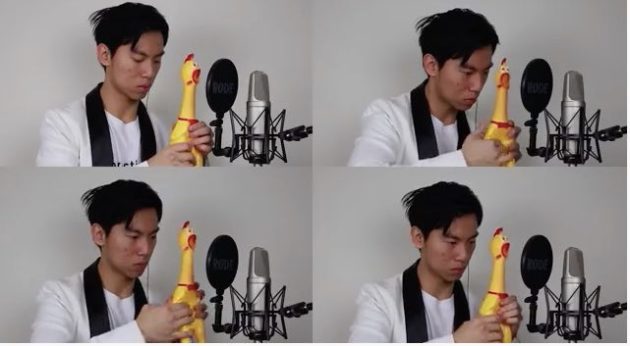
For those who delight in all manifestations of the Terpsichorean muse, this viral video breathes new life into a perennial cliché of early music:

What makes it even more hilarious is the utter deadpan focus of the performer. Like listening to the baroque horn (allegedly), our appreciation is heightened by imagining how very difficult it must be to play.

Just goes to show that amidst the ongoing debate about original instruments (cf. Taruskin, and Butt), our modern ears constantly require creativity… I’m sure the Sachs–Hornbostel classification system is comprehensive enough to encompass the rubber chicken.

If you want a less wacky rendition,* then this is also very fine:

Here the splendid John Finnemore (“so-called comedian”) sympathizes with Pachelbel’s wretched fate:

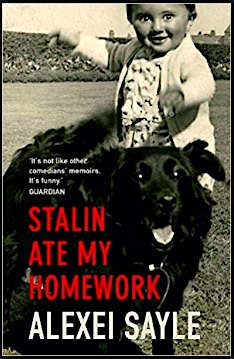
And now, thanks to Nick Kapur and Craig Clunas, I find this Czech tribute, which might also entertain Alexei Sayle:

See also Bach, um, marches towards the world, and The Feuchtwang variations. And for more artistry on the rubber chicken, see under Mahler 5 and The acme of Daoist kitsch.

* On a personal note: I played the straight version of the hapless canon on a US tour with Peter Holman in the 1990s, most memorably at the Schenectady Fuchs Festival (yeah, I know). Our visit was enriched by a locally-renowned waitress who unerringly took complex orders, entirely without taking written notes, from parties of up to twenty seated around long tressle tables. That was the tour where Paul O’Dette told me the hemiola story (right at the end of this post)…

Language and idiolects

The language of my publications has long chafed subtly at the bit of academic conformity. But now, liberated from such pressures, I still regularly interrogate my use of vocabulary.

On a site like this, for a surprisingly global audience, you might think I’d settle for the LCD [trad as he is, that’s “Lowest Common Denominator”—Ed.] style to which academics disingenuously pretend, despite wilfully introducing a barrage of eye-watering neologisms—shooting themselves in the foot in a way that competes with Tweety’s assault on Comey’s testimony.

Anthropologists tend to drizzle ethnology in a rich jus of technical vocabulary, as if to assuage their guilt at stating the bleedin’ obvious—and I should know. Academic language seems to be founded on the sound principle of being “neutral” and thus intelligible, not least to non-native speakers—the expression of personal linguistic idiosyncracy is taboo. This tends to produce an arcane kind of language that yet prides itself on being as far removed from everyday usage as possible. Yet the neologistic mouthfuls belie this. It is as if every McDonalds order is liberally sprinkled with a compulsory dollop of foie gras.

On one hand, I want to write in my real voice. But also my fieldwork experience, whose most fruitful material resides precisely in the local dialect of my masters, encourages me to persist in rendering my own voice faithfully too—which, as you see, is a personal pot-pourri [“enough with this potpourri!”) [That’s not quite how it goes, but hey—Ed.] of my whole life experience—Alan Bennett, Monty Python, Flann O’Brien, Stella Gibbons, WAM, and so on. I gave a little guide here.

Sure, this will be as much of a challenge for my international readers as Yanggao dialect is to me; but it is where you will find any such riches as there may be. In other words, if I can make the effort to understand Li Manshan, then you try understanding me…

Indeed, even when writing with a certain sobriety, one’s text can still be mangled.

For my outmoded Chinese vocabulary, see here.

An Irish choice

Irish

I’m still entertained by this poster that I saw on an Irish train in the 1990s. I imagine a response from the archetypal miscreant, confused by the options, might go:

Let me see now, that’s a teaser.* Can I have both?


* As in the Japanese particle Saa, helpfully explained in the wacky Teach yourself Japanese.

Among myriad aperçus of the great Flann O’Brien, note his “smoking substances of non-nationals“. There’s a whole host of drôlerie under the Irish tag, such as this—as well as the great Ciaran Carson.

He’s a clever little boy

RM

As if the coup of Boris Piccaninny Watermelon Letterbox Johnson isn’t bad enough, we have to endure the appalling spectre of his éminence grise the Minister for the 18th century defending it in his suave, patronizing, patrician tones.

The Haunted Pencil’s style reminds me of yet another Monty Python classic featuring John Cleese:

Son: Good evening, mother. Good evening, Mrs Niggerbaiter.

Mrs Niggerbaiter: Ooh, he’s walking already!

Mrs Shazam: Ooh yes, he’s such a clever little fellow, aren’t you? Coochy coochy coo.

Mrs Niggerbaiter: Hello, coochy coo.

Mrs Shazam: Hello, hello… [they chuck him under the chin]

Mrs Niggerbaiter: Oochy coochy [son gives tight smile]. Look at him laughing… ooh, he’s a chirpy little fellow! Can he talk? Can he talk, eh?

Son: Yes of course I can talk, I’m the Minister for Overseas Development.

Mrs Niggerbaiter: Ooh, he’s a clever little boy—he’s a clever little boy! (gets out a rattle) Do you like your rattle, eh? Do you like your little rattle? Look at his little eyes following it, eh? Look at his iggy piggy piggy little eyeballs eh… Ooh, he’s got a tubby tum-tum…

Son [interrupting]: Mother, could I have a quick cup of tea please—I have an important statement on Rhodesia in the Commons tomorrow…

* * *

By now Wee-Smug has joined the Queen and Brian Sewell on my shortlist of readers for a BBC Radio 4 serialization of Miles Davis’s autobiography (“Listen with Motherfucker”).

And here’s a fun party game to mollify your irritation with Pompous Brexit Twats. Whenever you hear them braying some fatuous remark about “taking back control of our borders / laws / own country [blah blah]”, just replace the noun with “bowels”—”we can finally look forward to taking back control of our bowels”, and so on.

Cf. Stewart Lee’s notional cabbie: “These days, you can get arrested and thrown in jail just for saying you’re English” (in my post How to be English). See also his brilliant routines in A French letter and The c-word; and several more fine critiques of xenophobic bigotry under the Lee tag.

Such levity is all very well (cf. Peter Cook on Weimar satire), but this is our country that these Rich White Politicians are smugly destroying, FFS. Soon we’ll be a banana republic without the bananas. But at least they’ll be OUR no bananas.

More under my roundup of posts on Tory iniquity.

Injuns!

drum

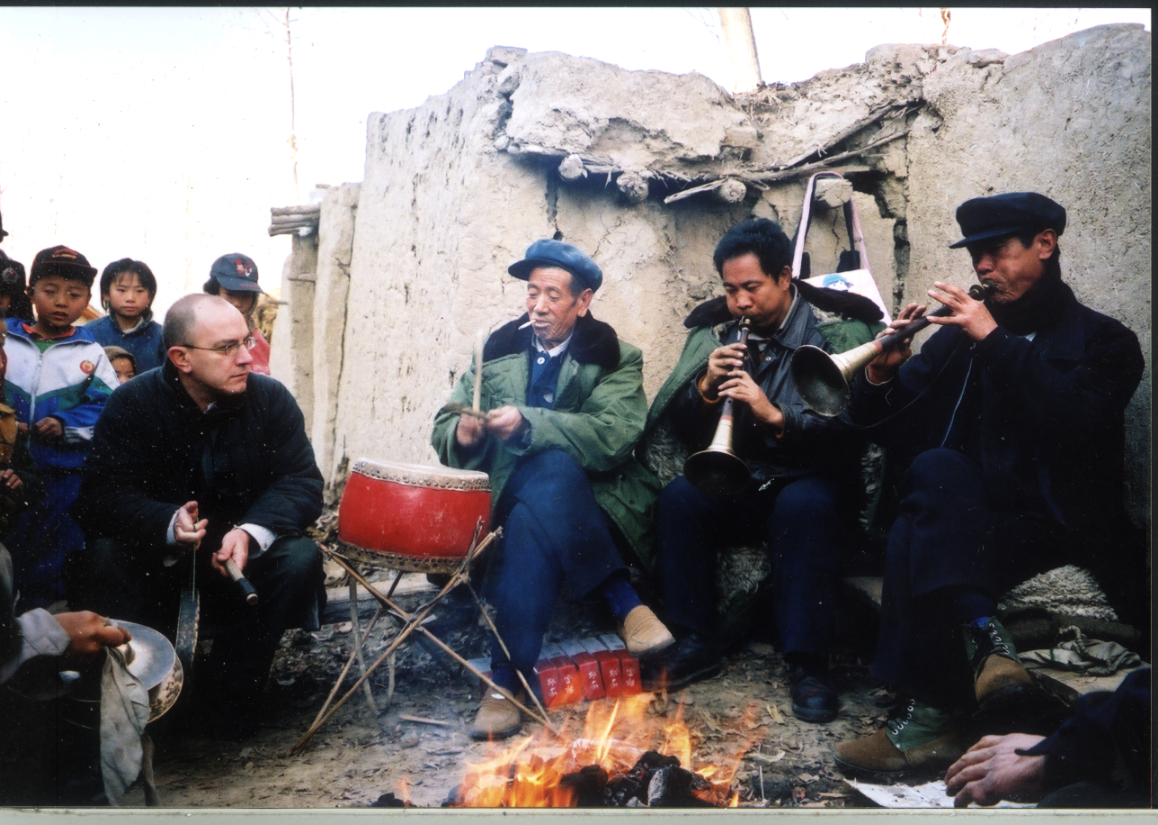
My interest in traditional percussion groups, and their flexibility in personnel, reminds me of a joke:

Cowboys sitting round the camp fire at night, eating their beans. In the distance they hear an ominous sound of drumming. One of them mutters,

“Ah sure don’t like the sound of them thar drums.”

Sullen Red Indian* voice comes out from behind a bush:

Him not regular drummer.”

As you all know, the cowboys’ own soundscape at the nocturnal campfire is immortalized in Blazing saddles:

I also note a salient native-American take on “sending people back”. And while we’re about it, don’t forget the reservation chief’s preparations for a severe winter.

For classic drumming stories from the world of WAM, see here and here.


* To reproduce the language of the day, like “Trolley Dollies” in The perils of the tannoy.

The art of conducting: a roundup

Here’s a little roundup of some of the main posts under the conducting tag so far (see also Conducting from memory).

Bernstein features in several posts, notably under Mahler:

See also

As to Abbado, do also admire his rapport in accompanying

The great Rozhdestvensky:

This post features Mravinsky as well as Rozhdestvensky and Bernstein:

The contrasting fortunes of Fürtwangler and Schwarz under Nazism:

Pierre Monteux features under

Most magical is

See also

S-S-Simon Rattle (for this rendition of the name, constantly on the t-t-tip of my tongue, see here):

Barbara Hannigan:

Among many others featured under the conducting tag are Boulez, Gardiner, and Salonen (and this story about the latter is one of many drôle items).

See also A German Requiem, with versions by Barenboim, Klemperer, Furtwängler, Celibidache, Tennstedt, and Gardiner.

But “No [survey of the art of conducting] is Complete Without” this exhilarating clip of a Mexican school band—this conductor, Oxana Thaili, could go far… (for more, click here):

More transliteration

LK 3

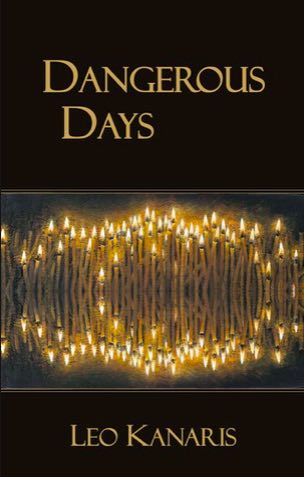
In the third of a growing series of vividly-written crime stories set among the tribulations of contemporary Greece,

  • Leo Kanaris, Dangerous days (2019),

private investigator George Zafiris continues to tread a murky path through corruption and nepotism amidst a dysfunctional society in crisis. Like Raymond Chandler’s Hollywood (but, pace Alan Partridge, not so like Norwich), Greece makes a fine backdrop to explore moral quandaries.

I’ve cited Kanaris’s vignette on Mount Athos in Blood and gold. For more on communicating in Greek, see Bunnios.

One vignette in Dangerous days reminds me of quaint Chinese transliterations like Andeli Poliwen (André Previn), Kelaimeng Feilang (“Clermont-Ferrand”, all the more reminiscent of a pseudo-Sanskrit Daoist mantra when preceded by Aofonie, “Auvergne”), or tuzibulashi (toothbrush, or “rabbits don’t shit”). As George walks through central Athens pondering the intricacies of the cases confronting him, he takes in the Greek versions of film-stars’ names appearing on cinema billboards:

Tzonny Ntep, Tzoud Lo, Kira Naïtely, Kim Mpazintzer.

Of course, English orthography is on a sticky wicket here: there’s no more reason to be perplexed by “Naïtely” than by “Knightley”, or a host of other English words like “Cholmondeley”“hiccough” or indeed “one”. Cf. Monty Python:

“Ah, no. My name is spelt  ‘Luxury Yacht’ but it’s pronounced Throatwobbler Mangrove.”

Partridgisms

AP

I’ve already sung the praises of Steve Coogan’s alter ego Alan Partridge in this post. Here are a couple more gems.

In a meeting with the BBC head of programming, Alan pitches several fatuous ideas (“Monkey Tennis”?). Or “Swallow”, a detective series set in Norwich:

Think about it—no-one had heard of Oxford before Inspector Morse.

And tucking into breakfast with RTE executives he insouciantly crashes right through the barriers of taste (cf. Jesus jokes):

Alan (suavely): So, how many people were killed in the Irish famine?

Aidan: Erm. Two million, and another two million had to leave the country.

Alan: Right… If it was just the potatoes that were affected, at the end of the day, you will pay the price if you’re a fussy eater. If they could afford to emigrate, then they could afford to eat in a modest restaurant.

A presumptuous guardian of language

RM

He proclaims himself to be a posh, old fashioned, entitled, obsessively religious, weedy, nerdy, rich know-all. Who would disguise themselves as that?

David Mitchell

The Twittersphere has been having great fun with The Minister for the 18th Century‘s recent directive on language, presumably inscribed with quill on parchment—the latest stage in his patronising mission to bestow his patrician values upon the plebs, or should I say hoi polloi.

Now, we all have our little linguistic peeves (here’s one of mine). It’s not that people don’t believe in stylistic guidelines; more that we don’t want them delivered by pompous fogeys—here‘s a general demolition of language pedants.

@NewsDumpUK asks

Should bellend be hyphenated or not?

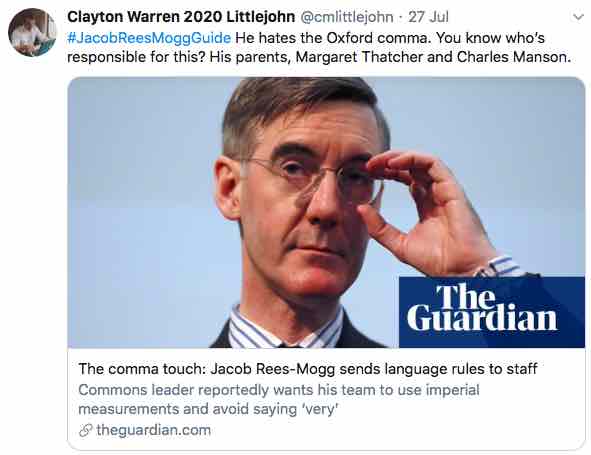
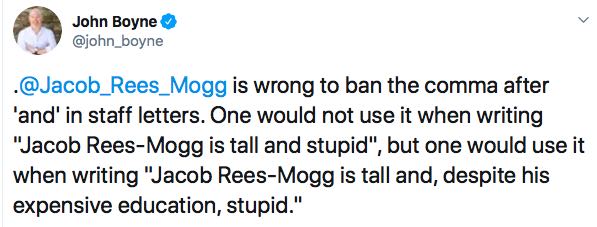
One among many of his fatuous rules—no comma after “and”—is perplexing. Since no-one appears to do this anyway, commentators have surmised that he was trying to ban the Oxford comma, which occurs before the “and”. To the wonderful examples here showing its necessity, we can now add:

JRM

Moreover,

JRM

Or indeed

JRM 2

On a sartorial note, @SirRoyES commented:

JRM

and @Scarlett_Pebble observed that

Jacob Rees-Mogg looks like two underaged people wearing one suit to try and sneak into a wine bar.

Plenty more to explore on Twitter, via #JacobReesMoggGuide.

The Haunted Pencil’s popular touch (“a scarcely believable public-school comedy sketch”) has already been encapsulated in his classic description of Teresa May’s Brexit plan as

 the greatest vassalage since King John paid homage to Phillip II at Le Goulet in 1200

—which inspired me to pen another post.

All business should henceforth be conducted in Latin. I’m like, WTF?

Of course, it may merely be the Tree-Frog’s Cunning Plan to divert us from the iniquity of his sinister wider agenda—tellingly exposed here by James Meek, and here by Rachel Parris:

.For an ancient Chinese reprimand, see here; and for more fatuity from the Haunted Pencil, here. See also my roundup of posts on Tory iniquity.

Mozart for winds, and “genius”

Learning with the Hua band, 2001

Learning with the Hua band, 2001.

The specialisation of professional training in WAM tends to work as an obstacle to appreciating the broader soundscape. Of course as a fiddle player, taking part in The Rite of Spring, Bach, Mahler, or opera gave me ample opportunity to admire great wind playing and singing; but somehow it seemed impertinent, as if it was none of my business—”just play the dots”, do your job, like a factory worker or a soldier not privy to the grand design (cf. Ecstasy and drudge). Chamber music offers more personal input, but makes a less reliable food-bowl for most performers.

Studying world music inevitably broadens our horizons. However inept, my training in participant observation among Chinese ritual groups and shawm bands helped me focus on the artistry of a range of musicking outside my own expertise.

Returning to WAM, Mozart’s piano concertos are full of exquisite wind parts (see also here, and here). And during our time at Cambridge my ears were opened by Stephen Barlow conducting the astounding Serenade in C minor—here’s an earlier recording:

Such miraculous inspiration is movingly articulated in one of the great scenes from Amadeus (on the Gran partita):

Such wonders are not the exclusive preserve of WAM composers. As always, Bruno Nettl has wise words (The study of ethnomusicology: thirty-three discussions, pp.57–9):

“Musical genius”. It’s the term music lovers in Western culture use to describe their greatest creators of music in classical music and also in jazz (like Louis Armstrong). It is sometimes also used for key figures in the history of popular music (like the Beatles and Elvis Presley).

After unpacking the mythology of Mozart and Beethoven, Nettl compares similar figures in Carnatic music—notably Tyagaraja, also credited with divine inspiration. He goes on:

There certainly are many cultures that share the concept of musical genius on one way or another. Again in my experience, a kind of star system was there in the classical music of Iran in the mid-20th century,  where the line between stars and others was even more pronounced than in Europe, star performers being accorded relatively more status, artistic license, and money. The nonstars were readily ranked from acceptable to incompetent. What distinguishes the “stars” among the most significant creative musicians in Iran, the ones who excel in the improvisatory section of the performance of a dastgah—the avaz—is their ability to do something new within strict confines.

And while technical virtuosity was less of an issue in my experience of the music of the Blackfoot people, outstanding singers and men who commanded large repertories of religious songs were singled out, but the role of musical culture hero seems to me to be most clearly associated with those men who, in times of the greatest adversity of the Blackfoot nation, tried to lead the tribe into some kind of acceptable future and did so by maintaining and teaching the people’s songs and dances.

He explores the issue further in Chapter 26 (see here, under “Music and learning”).

Anyway, while we naturally seek out the most outstanding bearers of tradition, yet as Christopher Small observed, musicking is a diverse social activity in which genius and virtuosity play only a limited part. Indeed, in both art and popular traditions they serve as something of a red herring; all kinds of performance events can be meaningful, and moving—from lullabies to a Dolly Parton gig.

Still, to return to inspired wind playing, I always relish Wu Mei‘s exquisite decorations of Daoist vocal liturgy, or Hua Yinshan’s searing and soaring shawm playing. See also jazz and trumpet tags—selection here.

An enigmatic slump

stats

Further to reflections on my, um, global audience, I’m not sure how to interpret this graph of my plummeting viewing stats this last week. It’s not even as if you have to read my posts—just clicking on them would show up on the table.

It could be that you have gone on an early holiday to a remote exotic location blessedly free of internet access—perhaps all of you together (a ridiculously niche 18–30 Club).

Maybe, like me, you are all hooked on the Women’s World Cup and binge-watching Killing Eve.

Or perhaps you have forsworn the internet entirely, exasperated by the relentless online bombardment of evasive mendacious buffoons jockeying to Destroy Civilisation As We Know It.

Or it could just be that you are tired of reading about Daoist ritual, the evolution of comedy, the Western craze for Eastern mysticism, and reception history… It will be ironic if more people read this post than those.

Just curious.

Tommy Cooper

TC

Like almost everything else (see e.g. note here), I hardly appreciated the genius of Tommy Cooper at the time. I didn’t quite get the crap magic, all the props… I guess for many of my generation, long before the Alternative scene, standups were rather eclipsed by Monty Python, even when they were subverting the light entertainment format.

I went to Blackpool on holiday and knocked at the first boarding house that I came to. A women stuck her head out of an upstairs window and said
“What do you want?”
“I’d like to stay here.”
“OK. Stay there.”

I might link that one to the true touring story of the wake-up call.

I went to the doctor. He said “You’ve got a very serious illness.”
I said “I want a second opinion.”
He said “All right, you’re ugly as well.”

I love this one, though (or perhaps because) it may require a certain,um, historically-aware insider’s cultural knowledge:

A policeman stopped me the other night. He taps on the window of the car and says:
“Would you blow into this bag please Sir.”
I said: “What for, Officer?”
He says: “My chips are too hot.”

This is often attributed to him:

I went to buy some camouflage trousers the other day, but I couldn’t find any.

but it may be a version of his

“Didn’t see you at camouflage training yesterday, Private.”
“Thankyou, Sir.”

which indeed is the response at the Chinese restaurant to “Waiter, this chicken is rubbery.”

And then there’s

So I went to the dentist.
He said “Say Aaah.”
I said “Why?”
He said “My dog’s died.'”

which reminds me of one that I heard Lee Mack do (cf. here, and here):

“What’s wrong?”
“My dog just died.”
“Aww, I’m sorry—never mind, I’ll get you another one.”
“Don’t be ridiculous—what am I going to do with two dead dogs?”

Jokes like these depend largely on delivery, on persona. No-one is so deadpan as Steven Wright—not so much standup, more internal monologue. Academic lecturers could learn a thing or two from these guys. And for Ken Dodd, regional ethnography, and Xi Jinping, see here.

The art of blurb writing

Cover 18 (back)

Some obligatory phrases from book blurbs, curiously absent from most tomes on Daoist ethnography:

  • cuts a picaresque swathe
  • a veritable smorgasbord [the very best kind of smorgasbord—Ed.]
  • madcap adventures
  • with hilarious consequences!!!
  • embarking upon a voyage of discovery
  • emotional rollercoaster
  • searing exposé
  • unflinching
  • feisty
  • filigree
  • vast, sprawling epic.

Happily, such clichés have been Laid Bare (oops, there’s another one) in several articles, such as this. And Molvania is jam-packed (packed like jam) with ’em. Not forgetting the ultimate homage to the language of the travelogue, Away from it all.

For further dubious marketing, click here; and for a series on cliché, start here. See also my blurb for Ogonek and Til.

Breaking news

RM

*BREAKING NEWS*
Tory leadership contest

In a bold gambit, Jacob Tree-Frog (aka The Haunted Pencil / Minister for the 18th Century)* has thrown his top-hat into the ring with the yet-unverified claim (delivered in impeccable Latin) that Nanny once gave him a mug of Ribena to snort at a party.

But Boris Piccaninny Watermelon Letterbox Cake Bumboys Inconclusive-Cocaine-Event Wall-Spaffer Fuck-Business Turds Johnson still holds an unassailable lead in the Extra-Curricular Bonking stakes.

For more on the Tree-Frog, click here, and for bonking in Chinese, here. See also headlines tag, and for Breaking News from the global art market, here.

Comment from @NicholasPegg:

I see Homebase has launched a build-your-own Jacob Rees-Mogg kit.

knob

* Here’s a glowing endorsement from Rachel Parris:

For more from Rachel Parris, see here.

And here’s another sketch of the éminence grise:

See also my roundup of posts on Tory iniquity.

Lyrics for theme tunes

A couple of ancient musical jokes—much shared online, but hey:

What does Batman’s mum call out when she wants him to come for his supper?

Dinner dinner dinner dinner dinner dinner dinner dinner Batman!

(cf. Learning the gong), and

Where does the Pink Panther come from?

Durham (Durham, Durham Durham Durham Durham Durhaaaaaam)

(For UK and US variants, see comments below.)

For a more ambitious word setting for Berlioz’s March to the Scaffold, see here; and for a handy mnemonic for additive metres, here. For tributes to the artistry of theme tunes, see Pearl and Dean, Parks and recreation, Soap. For the Indian inspiration of the Pink Panther, see Rāg Vindaloo.

Big red joke book

Red joke book

Before Hammer and Tickle came

  • Greg Benton and Graham Loomes, Big red joke book (1976).

The jokes come from a wide range of countries, including the USA and Britain, with the Soviet bloc playing a major role. Again there are sadly few from China (see my Chinese jokes tag); still, since it’s not a big book, they might as well have called it The Little red joke book.

We might pair this one with Woody Allen’s Hassidic tales:

“Rabbi,” asks a young Jew, “can you build socialism in one country?”

“You can,” says the rabbi, “but then it’s best to live in another country.”

There are some goodies from the GDR, like

Q. Is it true that Walter Ulbricht collects political jokes?

A. No, but he collects people who tell them.

as well as a version of the Li Peng story I told here, with Ulbricht as the subject.

Here’s another story from Prague (cf. many posts under Czech tag):

A restaurant in Prague started up a strip-tease show. To everyone’s surprise, the public appeared to shun in totally. The Prague authorities, concerned at the loss of takings, summoned the restaurant’s manager and asked him some questions.

“Is there something the matter with the seating arrangements?”

“No”, said the manager, “they’re very comfortable.”

“The lighting?”

“No, the lighting is perfect.”

“In that case, it must have something to do with the women who perform there.”

“Out of the question!” assured the manager. “We hire no-one unless they have been at least thirty years in the Party.”

Of course, many such stories, like folk-songs, travel widely in variant forms.


Köchel numbers

Bluff

Along with 1066 and all that and little-trumpeted works like The ascent of Rum Doodle and Sir Henry at Rawlinson End, another classic from my youth is the slim tome

  • Bluff your way in music (1966).

Tactfully, the name of its author Peter Gammond is not disclosed. By “music” he means WAM, of course—HIP and “world music“, then only in their infancy, are spared, though folk music and jazz get succinct tributes. There is also a drôle Glossary, forerunner to many twee tea-towels—you know the kind of thing, like

  • Chamber music—music written for a very small number of listeners.
  • Development—what composers do with the melody in order to make a composition of decent length.
  • Exposition—the popular bit of a composition while the tune is still being played [see also Francis Baines‘s definition of sonata form].
  • Harmony—a term of no meaning whatsoever. Such phrases as “rich harmony”, “stark harmony”, “satisfying harmony” can be used indiscriminately.
  • Mode—scales which sound a bit odd.
  • Portamento—the ability to move from a wrong note to a right one without anyone noticing the original mistake.
  • Recitative—when an opera singer forgets the tune.

But my enduring memory of the book is:

Mozart had the distinction, as everyone knows, of writing Koechels instead of Opuses, a thing no other composer has done before or since. Mozart’s great popularity dates from the fact that this absorbing fact was discovered, by some strange coincidence, by a man called Koechel.

Ey-up! A new haiku

Further to my post on Morris dancing and the controversies it provokes, here’s a new English haiku—to follow the original one, as well as my own ode to the 94 bus and garbled reference to a popular graffiti.

It should be read in a strong Lancashire accent. The opening line (for a variant, note comments below!) would be a headline, rather in the style of “Ping-pong ding-dong“. And the “rhyme that doesn’t quite work” doubtless has one of those fancy names that they try and teach you in school:

Trouble at t’Morris
‘As PC gone mad? Ey-up—
T’Nutters of Bacup!

For Stewart Lee’s trenchant rebuke of “PC gone mad gone mad”, see here; and for “Ey-up!” in Venice, here,

China–Italy: International Cultural Exchange zzzzz

In Yet more Chinese wordplay, retelling some splendid subversive jokes from the commune era (cf. Hammer and Tickle, and the Chinese jokes tag), I explained the pleasure of creatively misinterpreting phrases that use the innocent postfix xing 性 (“sex”). Among them is the tired Chinese cliché “International Cultural Exchange“—Grist to Flann O’Brien‘s Mill.

So now here’s a party game that I devised as a spinoff from both my Catechism of Chinese cliché and Italian folk musicking—a kind of Snakes and Ladders:

The Silk Road
hours of harmless fun for all the family!

©SJ 2019

Players can advance along the caravan route by naming cultural features that Italy shares with China (and I couldn’t write the clichés better than this article). Go right back to square one for any mention of:

Left: spirit mediums, Guangxi. Right: taranta exorcism, Salento.

But make progress by scoring points for

(leap forward 1,000 leagues:)

(advance 500 leagues:)

(advance 200 leagues:)

As usual, the winner will be awarded a small pocket aquarium.

For more party games, see the Oxford comma and Fantasy Daoist ritual; and for another enterprise, here. For more Chinese clichés, see here, and here. And for the 2002 Smithsonian Festival of the Silk Road, click here.

Italy: folk musicking

Italy map

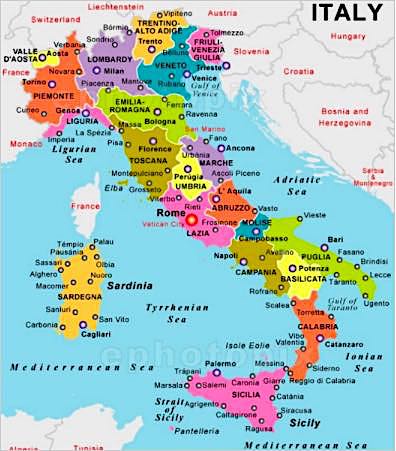
With our common image of Italy dominated by elite culture, it may seem to make a less obvious fieldsite for folk traditions than east Europe. But as I observed in my jottings from Lisbon (and in my posts on flamenco in Spain, starting here), there’s far more to musicking than opera houses and symphony orchestras. Even the court musical cultures of Italy were regional—there was no “Italy” until 1860, and regional consciousness still persists. As in China, where the “conservatoire style” dominates the media, the image of the iceberg is useful.

Local folk traditions are a major part of people’s social experience today, as throughout earlier history—alongside more elite productions such as the painting and sculpture, art music and opera that dominate our image of Italian culture (for early modern Europe, see here). Some regions show little or no influence from art music, others more. But we should adjust from our image of Barbara Strozzi and Artemisia Gentileschi [PC gone mad—Ed.] [What you gonna do about it? SJ], Verdi and Monteverdi, La Scala, and so on.

In Italy—whose population of around 60 million is comparable with a single province of China!—we find the usual interplay between general surveys “gazing at flowers from horseback” and detailed studies of one particular community. As ever, we may start with The New Grove dictionary of music and musicians, and The Garland encyclopedia of world music. Alessio Surian’s article for The Rough Guide to world music pays attention to the more recent roots scene, and Italy features regularly in Songlines.

I’ve already outlined some issues in the taxonomy of expressive culture in China (e.g. here). In her Grove article on Italian folk music, Tullia Magrini essayed a broad classification by style and structure rather than by region or context:

  • Narrative-singing (ballad, broadside ballad, storia, Sicilian orbi, and so on)
  • Lyrical singing
  • Others: including children’s songs and lullabies, work songs, polyphonic songs for entertainment (cf. Voices of the world).

After reverting to context in her penultimate category:

  • Ritual music—always among the most interesting rubrics, including life-cycle and calendrical rituals (the latter including carnival and Passion).

she concluded by outlining

  • dances and instruments—the latter including not only piffero and ciaramella shawms (for links to posts on shawms around the world—China, Tibet, south Asia, the Middle East, north Africa, Europe—click here) with bagpipe (piva) and the distinctive Sardinian launeddas, but also northern violin traditions.

* * *

The fascist era discouraged meaningful study of folk traditions, so serious research began in the 1950s, as society continued to change. Gramsci’s contrast between subaltern and hegemonic cultures inspired the ground-breaking collaborations of Diego Carpitella with Ernesto De Martino and Alan Lomax.

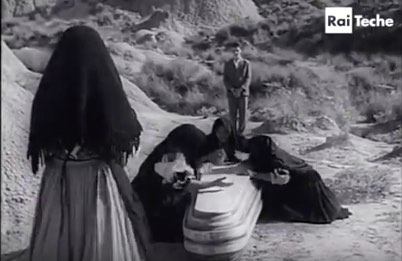
Carpitella’s work with De Martino features in my post on taranta, which includes both their footage of taranta in Salento (1959) and funeral laments in Basilicata (1952). See also Healing with violin in the heel of Italy.

Lucania

Meanwhile—just as Chinese fieldworkers were busy documenting their own regional traditions—Carpitella was also working with Alan Lomax (who said the 1950s were boring?!). Their 1954–56 audio recordings were published in 1958 as Folk music and song of Italy, and reissued (notes here). Many of the tracks are remarkable—such as Alla campagnola, a polyphonic love song sung by women of Ferroletto in Calabria while working in the fields, with both harmonies and unison cadential pitches taking one by surprise:

Moving north, the album also includes stornelli from Tuscany, a bagpipe saltarello from Citta Realle in Lazio, and a dance song from Val di Resia in Friuli.

For a review of more albums in the Lomax collection, see here. Italy was among the fields where he developed his ambitious Cantometrics project, exploring the links between styles of singing and social structures (see also Voices of the world). For his work with Zora Neale Hurston in the American South, see here. And for his remarkable archive, click here.

The pioneering work of Lomax and Carpitella inspired many impressive series of audio recordings on labels like Folkways, Dischi del sole, Albatros, I suoni (Fonit Cetra), and Ethnica. Meanwhile Carpitella edited the important journal Culture musicali (and I’m keen to read his analysis of The Rite of Spring!).

Following in their footsteps, among luminaries in Italian ethnomusicology were Roberto Leydi and Tullia Magrini, under whom such studies took root in Bologna. And as a welcome change from all those gondolas, Venice has become a lively centre for the promotion of folk cultures of Italy and further afield, with the Fondazione Cini, and ethnomusicologists Giovanni Giuriati and Giovanni de Zorzi (for an instance of the latter’s explorations, see here).

Despite all the “cultural homogenisation” epitomised by the vacuous inanities of Burlesque-only TV, RAI has played a role in promoting regional cultures.

The south
The Mediterranean south has remained poor—Puglia, Basilicata, Calabria, as well as Campania, all have deep local traditions (for pizzica, see herehere, and here).

Again, Lomax and Carpitella made some fine recordings in Campania:

And apart from Sardinia (which I introduced here), Sicily is a rich field, introduced in early work by Giulio Fara and much studied since (see also Songs of Sicily). Further east, see Musics of Crete.

Central Italy and the north
The poor south, attractive by virtue of its “otherness”, attracts a wealth of documentation; but the more affluent north also has significant pockets of folk activity. Roberto Leydi and others erased the old bias that considered the northern regions “corrupted” by economic and social development.

Fieldworkers have found distinctive traditions around Lazio, Abruzzo, Tuscany, Umbria, Le Marche, and Emilia. Tullia Magrini made a special study of the Maggio drammatico (cf. Morris dancing in England!). Note also her edited volume Music and gender: perspectives from the Mediterranean (2003).

All along the northern border of Italy, local traditions have been documented around Piedmont, Liguria, Lombardy, Veneto, Trentino, and Friuli. Again, we can consult the recordings of Lomax and Carpitella, with this 1972 LP from Piedmont, Emilia, and Lombardy:

In Ponte Caffaro, Brescia, fiddle bands accompany carnival:

The films of Renato Morelli are also impressive—see this trailer for Voci alte, on the festival of Premana in Lombardy.

In the 1990s, as another perk of my touring life, during interludes from playing Mozart opera in Parma and Ferrara I visited cultural offices there for a taste of their work documenting local folk traditions—somewhat evoking my exploratory visits to their counterparts in China. While doing gigs in Genova I also found trallalero choirs:

In the northeast, traditions are related to Slavic culture, with dances accompanied by violins or the piva bagpipe. Here’s a 1983 clip from Val di Resia in Friuli:

Collectors have also worked with emigrant communities (cf. Accordion crimes). Alan Lomax and Carla Bianco issued a fascinating album of their 1963–64 recordings in New York and Chicago (liner notes here), with a sequel recorded by his daughter Anna in New York, New Jersey, and Rhode Island (playlist here)—from the latter, here’s a duet with piffero and ciaramella:

This may not immediately spring to mind when thinking of the soundscape of 60s’ New York.

And having long been a land of emigration, and internal migration (from rural south to industrial north), Italy is now also a vexed site for immigration, which will further enrich the picture.

While I’m not venturing into the roots scene here, it seems obligatory to cite Fabrizio De André’s wildly popular Crêuza de mä (1984), sung in Genovese dialect (here with Italian subtitles):

See also Bella ciao.

* * *

All the energy in making audio recordings was admirable, helping us focus on the remarkable variety of regional soundscapes: both vocal and instrumental tracks are stunning. But it tended to entrench an image of disembodied, reified sound documents; the later shift towards visual anthropology places a greater stress on musicking in society. At LEAV in Milan Nicola Scaldaferri leads splendid collaborative projects, such as Musica Lucana and the Maggio in Accettura. And here’s a trailer for Rossella Scillacci’s fine 2007 ethnographic film Pratica e maestria on the zampogna in Basilicata:

* * *

Here, as often, I can only “gaze at flowers from horseback”, but all this is a reminder that as in China, England, and everywhere, popular regional traditions persist alongside more elite cultures, changing along with society and encouraging us to revise a narrow concept of “culture”.

Yet more Chinese clichés: music

minyue

To follow Chinese art clichés (“Swirls before pine”), for this list of Chinese music clichés I revert to the Catechism format immortalised by the great Flann O’Brien (for my previous essays in the genre, see here and here).

Seriously Though Folks: since we need to study expressive culture in the context of changing society, it’s important to unpack the language of propaganda, in this as in other fields!

What kind of history does Chinese music have?
An ancient 悠久 one.

And how many years of history does any genre you care to mention have?
Two thousand.

And what kind of fossils are these genres?
Living ones, of course.

To what do they belong?
The glorious heritage of the Chinese peoples.

What is the folk culture of, well, anywhere you care to mention?
Unique and vibrant.

What kind of colourings did such music often have before Liberation?
Feudal superstitious ones.

How did the government treat folk music after Liberation?
They esteemed it while systematically dismantling its entire social basis.

And what novel kind of foliage did folk artists turn over then?
A new leaf.

What does folk-song express?
The sentiments of the labouring masses.

In praise of whom did folk-singers create new songs?
Um, Chairman Mao.

How did they present their art 献艺 to the Party?
Selflessly.

So they weren’t malnourished and desperate, then?
Oh no.

What are they keen to do with what?
To preserve and develop their precious heritage.

Now (here’s an easy one) what are the ethnic minorities jolly good at?
Um, singing and dancing 能歌善舞。

And how are their relations with the Han Chinese?
Fraternal, of course.

What kind of scale does Chinese music use?
A heptatonic scale based on anhemitonic pentatonic melodies, with occasional temporary modulation up or down a fifth creating a new anhemitonic pentatonic set.

[consulting script anxiously] WHA-A-T???
Oh all right then—pentatonic.

How might we characterise southern music?
Mellifluous.

And northern music?
Rugged and angular.

Can I ask you something?
Go ahead.
Are there any other blind musicians in China apart from Master Kuang and Abing?
Don’t you worry your pretty little head about that.

For what irresistible yet cumbersome title does one scurry to get nominated, nay inscribed, these days?
The umpteenth batch of China’s National List of Intangible Cultural Heritage zzzzz

Whereupon what means of perambulation will the genre in question adopt in what ubiquitous direction?
Marching towards the world 走向世界。*

Such is the flapdoodle we have to plough through, reading between the lines…  And for illustrations of different mindsets, click here. Try also The acme of Daoist kitsch. For a veritable masterpiece of international cliché, see Away from it all.

And with what should we treat such platitudes?
The contempt they deserve.

Yangjiagou band, 1999

Yangjiagou shawm band, funeral 1999.

As to the “Golden Age” of the Tang, how about this.


* Ironically, “Marching towards the world” is the title of ch.18 of my Daoist priests of the Li family, on the foreign tours of the band—but all is explained:

You may be thinking, “Aha, so now we’re going to see how local ritual goes global and gets adapted for the concert stage!” Well, forget it—the basic context for their performance remains the local funerary business that I describe throughout the book.

For Bach marching towards the world, click here.

Global audience

map

An entertaining feature of the WordPress stats for authors shows me the figures for viewers of this arcane blog by location—rather like a map of empire.

countries The list of countries also evokes the Olympic medals table—with USA, China, and even the UK ranking high, pursued by France, Germany, Australia, Japan, and so on. Further down, Romania, Thailand, and Brazil put in plucky performances. I like some of the fortuitous juxtapositions that it produces daily (left).
More intriguing are countries near the foot of the table, such as Estonia, Morocco, PNG. and Bolivia (as well as some I’ve barely heard of…). I like to think that my arcane ruminations have a certain niche following among the indigenous* populations in such places, but I also entertain the charming notion that it’s just one single deranged British viewer (Mrs Ivy Trellis, perhaps) with a taste for exotic holidays and an unlikely obsession…

You might think all this would encourage me to tone down some of my more obscure allusions and usage of language, but no.


* You can read that in the New Age sense if you like.

More Chinese clichés: art

*Guest post!*

Swirls Before Pine *

Ni Zan

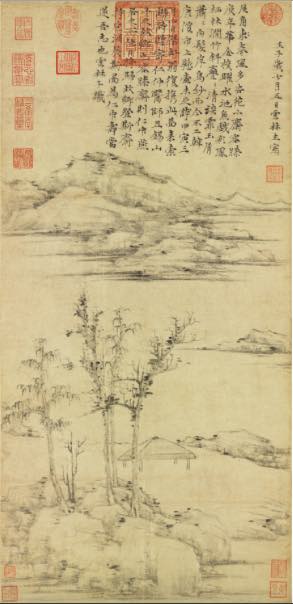
Further to my Chinese clichés (inspired by Flann O’Brien), a young scholar—whose own enterprising fieldwork suggests a radical reassessment of Chinese art—has sent me this telling critique (“On visiting the Asian Art Museum but finding the Indo-Tibetan section closed for renovation“):

New AAM Exhibition Reveals How “Chinese People Used to Like Porcelain Pots that were Glazed mostly White but sometimes Other Colors, and Paintings of Water and Mountains, And Stuff”

April 12, 2019 / Khanat Beg

SAN FRANCISCO
“A lot of people think they know Chinese art,” says curator Adreanne Chao. Slim and straight-backed in a black turtleneck by Japanese designer Yu Amatsu, Chao is sitting on a bench in the second-floor gallery, unrecognized by the stream of museum-goers around us. Together, we watch two women speaking Mandarin pose with a selfie-stick in front of a painting by the 14th-century Chinese artist Ni Zan.

Chao says, “People come in here, and they think they’re going to see monochrome ink-paintings of mountains, water, clouds. Sometimes there’ll be a lonely fisherman out poling across the lake, or a scholar-recluse composing poetry in an old pavilion.”

But Chao’s new exhibition, which opened April 1st at San Francisco’s Asian Art Museum, has sent ripples of surprise through the art world. Chao leads me over to inspect a scroll painting, twelve feet long and one wide, by the 15th-century Chinese literatus-painter Wu Liao. “But these artists are really toying with convention. Here you can see the painter has used monochrome ink and brushwork to create the impression of clouds, water, and mountains.” Chao laughs puckishly, “And yes, I’ll admit it—there’s also a fisherman poling a skiff past an old pavilion!”

We haven’t even got to the room with all the little porcelain pots and pans, glazed mostly white but sometimes beige or off-green. […]

I may add that the solitary boatman is not to be confused with this tribute to Uncle Xi:

See here for spoof Tang poems that I composed in my own Yoof (“precocious signs of the pointless inanity that was to distinguish my later writings”). Among posts under the art tag, try this, this, and this.

And for Chinese music clichés, see here.


* This should become a compulsory title for all lectures on East Asian Art. As it happens, “pearls before swine” is best rendered in Chinese with a musical metaphor, dui niu tan qin 对牛弹琴, “playing the qin zither for an ox” (for an Indian parallel, see here, under Chapter 2).

A post-concert gaffe

Many years ago, Maureen Smith was leading an orchestral concert in the north of England, at which the great clarinettist Tony Pay was playing.

After the gig Maureen was having a drink in the pub with some friends from the audience when Tony walked in, now in plain clothes, so she introduced them:

“Hey guys, this is Tony Pay—he plays the clarinet.”

One of them looked at him and went,

“Jeez, they could have done with you tonight!”

Tony likes to tell this story himself.

For other less-than-favourable reviews, click here and here. For many more stories from orchestral life, see here, and under the humour subhead of the WAM category.

Great works missing the crucial element

Munch

The current Munch exhibition at the British Museum includes his 1892 sketch for what soon became The scream(my title: People taking pleasant stroll). This suggests further drôle potential—such as

  • Leonardo’s charming landscape Just got a text from Mona Lisa saying she’s held up in traffic
  • Vermeer‘s early sketch Girl not wearing any earrings (“Oops, forget me turban too—What Am I Like?!“). The internet is awash with such memes, like this:

Vermeer

and of course The last-but-one supper, without the kangaroo:

And then there’s the ouevre of Alphonse Allais (see The world of Alphonse Allais, “translated” by Miles Kington), including a totally white canvas called Anaemic young girls going to their first Communion through a blizzard, and a red composition entitled Apoplectic cardinals harvesting tomatoes by the Red Sea (the latter an early version of the popular Explosion in a tomato factory at sunset). Such experiments were yet more radical than that of Monet’s Rouen cathedral in the morning fog (see also “F. Huehl and his Monet are soon parted“).

Here’s one from Euro 24, Tweeted by @ArtButSports:

Modric

Further suggestions welcome.

For Chinese poetry, I think of the Tang genre “On visiting a hermit and not finding him in“. And on the musical front, there’s a popular series called Music Minus One, providing recordings of the accompaniments to famous pieces of chamber music, jazz, and so on without the solo part, to help soloists practise. Some Wag once gave me a blank CD entitled Music Minus One: the Bach partitas for solo violin.

I still await a response to my requests for versions of Das Lied von der Erde without the mandolin, L’enfant et les sortilèges without the cheese grater, and the finale of Éclairs sur l’au-delà … without the triangle.

On a rather different tack, note the mini-museum for gerbils under quarantine. See also The global art market, and Yak re-enactments.


* For some musical screams, see my posts on Sibelius 7 and, notably, the horrifying sequence in Mahler 10.

At issue

Pooh

New Chinese facial recognition software not all it’s cracked up to be. For other challenges for the equipment, see here.

After sneezing alone in a room, does anyone else quietly say “A-tissue“, by way of pedantic clarification for a non-existent audience? Hmm, OK then—probably just me…

It now also serves as a homage to Winnie the Pooh, hapless bête-brune of the current CCP (bless). From “Eeyore loses a tail” (cf. Ding without dong):

“The thing to do is as follows. First, Issue a Reward. Then—”
“Just a moment,” said Pooh, holding up his paw. “What do we do to this—what were you saying? You sneezed just as you were going to tell me.”
“I didn’t sneeze.”
“Yes, you did, Owl.”
[…]
“What I said was. ‘First Issue a Reward’.”
“You’re doing it again!” said Pooh, sadly.

With all due respect to A.A. Milne (“the true voice of England in the 1930s”, as Alan Bennett notes), the exchange would work better if Owl had said “The question at issue…” But hey.

In Polish Winnie the Pooh is Kubus Puchatek, in Norwegian Ole Brumm—names to conjure with. In Italian he is Uini Puh, though I like the 1936 version Ninni Puf; Piglet is Pimpi, and Eeyore Ih-Oh (for more, see here).

Winnie the Pooh was one of the first to be subjected to the “Tao of…” franchise (and one thinks—doesn’t one—of the 4th-century Baopuzi 抱朴子 Master Who Embraces Simplicity). And for incurable classicists, there’s Winnie Ille Pu:

“Res exsequenda id est: praemium promittimus.”
“Paulisper subsiste,” dixit Pu ungulam sublevans. “Quid faciamus? Quid dixisti? Loquendo enim sternuisti.”
“Minime sternui.”
“Bubo, sternuisti!”
“Habe me, Pu, excusatum, minime sternui. Nequimus inscüs nobis sternuere.”
“Optime audivi: prr–prr!”
“Dixi: praemium promittimus.”
“Iterum sternuisti!”

On a musical note, for a classic recording, click here.

I have a Chinese friend whose online handle is Aqu—although for sneezing in various languages, see here. Note also Lithuanian Ačiū, “thankyou”.

Some other pleasantly fatuous comments that I can still never resist:

  • when someone trips up, I just have to say “Enjoy your trip?”
  • on putting down my suitcase, “I rest my case”
  • and for my obligatory comment every time I pass the roadworks sign, see here.

A Tang mélange

On China, let’s face it, what people really really want to read about is the Tang dynasty. Which may be why many of my posts go down like a one-legged man at an arse-kicking party.

Regarding Chinese history, my focus is the local cultures and politics of the modern era, including both my own fieldwork since the 1980s’ reforms and Maoism. Of course, all the living ritual traditions I study are deeply rooted in the late imperial period, into whose culture I occasionally make more historically-minded excursions (such as this series).

Going further back, just in case you haven’t explored the Tang tag in the sidebar, it contains a growing number of posts. After all, that’s where I came in. So never mind the rest of Chinese history, allow me to offer a resumé of posts bearing on Tang culture—starting with my Cambridge mentor:

And a great Chinese scholar:

I mused on the misleading Tang basis of the Western notion of Chan/Zen in

In the ludic tone of some of my other posts on the Tang, I was egged on by the great historian Denis Twitchett:

For Tang poetry, see

Last and decidedly least,

On Li Bai and Mahler:

See also

53e35-a1

I reflected on the gulf between history and ethnography in

Still, there’s much to be said for my own eventual conversion from abstruse ancient history to living genres of Chinese culture—always relating them to imperial traditions, of course. Among many genres active today that are not a “living fossil” of Tang music:

Going back still further, try

Denis Twitchett: more Tang drôlerie

Denis

Prompted by Tang poetry, I’ve been having fun revisiting my old correspondence with the great Tang historian Denis Twitchett (1925–2006; for bibliography, see here).

At Cambridge Denis gave me a thorough training in Tang history, most of which I later forgot. After I moved to London in 1976 to eke a living as an orchestral fiddler, while I was still busy helping Laurence Picken with his magnum opus on Tang music, I was also helping Denis with editing the Tang volumes of The Cambridge history of China. After he took up a post at Princeton in 1980 he continued to guide my studies from afar, and indeed it was largely thanks to him that I gleaned clues to the potential for Tang music studies in the PRC before I finally began my explorations there in 1986 (for more, click here). Like Laurence, Denis may just have been relieved when I jumped ship from Tang culture in old books to the grimy realities of contemporary fieldwork (for my Beijing epiphany, see here), but anyway they both looked most kindly on my apostasy.

As I reported back from my trips Denis continued to send me entertaining letters. I’ve already given some brilliant instances of his takes on Tang sources (here, and here). So here are some further gems.

After I returned from China for the second time in 1987 he wrote:

Dear Steve,
It was good to hear from you. I had thought of giving you a call while I was home during the summer, but I thought you were still in China, doing your juggling and fire-eating routine on the Bund in Shanghai, or touring Kweichow with a Jamaican steel band or something of the sort…

ALS

In 1988, having finished with the Liao dynasty (“good for many a chuckle”, although my favourite Liao statue is keeping a straight face), Denis sent me one of his more wacky fantasies, on the subject of the disastrous An Lushan rebellion in the mid-Tang (see here, n.2). Its tone suggests a medieval Private eye or The fast show; it may be a tad niche, but it’s based on his deep knowledge of the period (note the date; and I’ve converted his Wade-Giles to pinyin. “HM” is of course the emperor Xuanzong):

Report to Chang’an Control / attn. M. From Agent 0069/6/ACDC
SECRET
Agent Wang, deep cover as mess waiter, NECINC Fanyang

Report of conversation in Mess, recorded 1st April 745. Speaker: Field Marshal An Lushan, Duke of Fanyang [or “Fanyang Fats”, as Denis described him elsewhere], CINC HM Forces Northeast, KCMG, VC, Iron Cross with Oak Leaves, Hero of the Peoples of Bohai, etc.

Just got back from Chang’an. Shocking place nowadays, everything gone to the dogs, can’t even get a decent pink gin in the Generals’ Mess of the Palace Guard, no bloody soldiers to be seen, no backbone, no discipline, no-one salutes any more, sloppy sentries, gang of washerwomen could storm the palace, not like my day, not a decent curry to be had in the whole blasted city—whole place crawling with nancy-boys and bloody priests, not a fighting man in sight—makes a fellah puke.

HM in a damn good mood when I arrived, banquet, gifts of silks and silver for the sideboard, told me a good one after the eleventh toast, about some hu 胡 and his trained rhinoceros that shat on the palace carpet—never have happened in my day, no respect, no discipline, no backbone—poor bloody animal probably frightened by all those queers around the palace. Anyway, er, what was I sayin’?  (Keep that bloody port moving, colonel, and no mentioning ladies’ names in the Mess.) Ah yes, just before I left, called me in for an extra audience—most inconvenent time, clashed with m’ tiffin, and an appointment with m’ tailors, not to speak of a special soiree for season-ticket holders at Madame Minsky’s—still, duty is duty, what.

HM in a none-too-happy frame of mind, I can tell you. One of those moods of his, strong sniff of Indian incense in the air, dilated pupils—had a horse once that looked like that, had him put down pretty smartly. “Well, An”, he says, “SMITE those bloody Turks. Thrash the sordid little buggers and their Evil Empire into submisssion. Goddam swine have been blocking the import of OUR whisky—no bloody laughing matter, An—insult to the flag—nothing like it since the Picts and Scots—make an example of them—only good Turk’s a dead Turk. Need more men? Goddam nonsense, An, who’s to pay for them? My household budget? Lend you a few drooling eunuchs if you like, bit of fresh air would do them the power of good. MORE HORSES? Doncha know how the bloody animals breed? Well, steal some from the Khitan.” I tell you, I was glad to get back to HQ.

Well, what are we to do? Turks all buggered off to Turkey years ago. Of course we in the service go on reporting about the Turkish Threat, just so He will keep the army up to strength. If he got to know that the Turks are all glasnost and stale piles of horseshit headed west, we’d all be in a fine bloody mess, civvy street, no servants, no duty-free booze, no horses, no huntin’, no rape and pillage for the other ranks, have to live with the memsahib, among all those poofters and bloody politicians and perverts at court. Far worse than fightin’ real Turks. Have to join the board of some hu company selling surplus bows-and-arrows and substandard pikes to any old wogs just to make ends meet.

So we’ve just GOT to have our Turkish war—get some medals, write off a few of our dead soldiers, get some new horses and a bit of extra cash. First of all we’ve got to hire some Turks, or hire some fuzzy-wuzzies we can pass off as Turks—all those damn foreigners look alike. Not too far away, all those baggage carts are a write-off, and we don’t want a mutiny on our hands, and not too tough, must have a few heads to send to HM and a spot of rape and looting for the other ranks. Any ideas to the Adjutant by 0700 Friday—and for God’s sake pass that bloody port.

By the way, send a runner to Geshu Han asking him to stop stealing all HM’s whisky—come to think of it, old Han’s a bloody Turk himself, but we’d better not fight him. Then HM will think Objective Achieved, and we can all settle down to a Quiet Life again.

[Recording interrupted by loud noises, breaking crockery, various grunts, groans, and imprecations]

… ‘nother thing. War House talkin’ of sendin’ us new subalterns with bloody degrees—from the Guozi jian, den of bloody iniquity, all perverts, pederasts, Russian spies—the Big Man and the Cardinal won’t give them jobs in the civil service, say those Red bloody professors have encouraged them to THINK, in between bloody rogering ’em. HM won’t have them around the palace, can’t stand their smart-arsed talk, Humanity and Righteousness and Filial Piety, God what a load of Cock, sort of poems HM likes are that Irish drunk Li Bai’s* limericks—wrote one about me, the slippery little sod, started

There was an old man from Fanyang
Who was screwing a Turk on the kang

Forget the rest, but it ended “He ruptured himself with a twang”, too bloody painful to think about. So what was I saying? Oh yes, about those damn subalterns. They’re sending ’em to us, to knock some sense into ’em—HM’s idea of a bloody good joke. Could’ve bin worse though, threatened to send us a regiment of damn eunuchs—God, it’ll be Women in the army next! Tell the RSM to make it hot for them, unlimited square-bashing, pike drill, fencing, riding, archery, cold baths, polish everything twice a day, no drink, no women, left-right left-right, lights out at 1900 hours, wake ’em up at 0100 for a medical inspection, then at 0400 for the old Assault Course on the Taihang mountains, you know the sort of thing. Make men of them, or better still, kill the little sods.

Don’t know who began this examination lark, uselss load of crap they fill their heads with, better to apprentice them with Madame Minsky if you ask me, Teach ’em What’s What, see how the world works, collect the luncheon vouchers and take the credit cards. Way it is, they write orders it takes me all day to understand. HM says “Smite the buggers”, they write “Take Pains to Extend the Benevolence of His Sacred bloody Majesty over All Lands and Peoples”. What’s a simple chap like us to make of it, eh? Only Benevolence I’m interested in is HM’s Benevolent Fund for Decayed General Officers. Not like in the Old Days…

Steward! There’s a bug in this decanter! [Recording breaks off.]

Denis was always on the case of Tang music and the Central Asian connection. Apparently unpublished (apart from a brief article in Asia Major 1990) is his lengthy, meticulous analysis of the relation between the music monographs of the “old” and “new” versions of the Tang dynastic history, tracing their origins in the Taiyueling biji 太樂令壁記 of Liu Kuang 劉贶.

He further pursued the An Lushan theme in a 1988 letter, with another agent providing background on Xuanzong’s consort the celebrated femme fatale Yang Guifei. After getting himself elected Vice-President, Cardinal Chen Xilie

got Him Indoors going on a real religious kick, gongs and incense, prostrations day and night… Then he agreed to lock up his EX-daughter-in-law in the palace as a nun. So it seems that his holy nun had ambitions to get back into showbiz; rattling the tambourine for the Cardinal in the palace chamber is as bad as being a housewife in Westchester with no company but the Avon lady and the dentist. She’s been hitting the gin bottle and she’s sick of revival meetings, so she needs some Action. So what does she need but an Agent? Solly my friend, you take her on, nice little earner, and I book her at the palace for you.

[They haggle over their percentage: “You might as well be a Sogdian!”, and the informant warns against the “casting kang“]

What’s her shtick? Well, she does a nice little number on the pipa, does that new dance the Arabs are so good at, the Syrian Twirl—and there’s this new music from Tashkent (Shiyue 石樂)… [which Denis notes is not twinned with Little Rock, Arkansas; “there is some evidence that it is still performed. The etymology also suggests why rock musicians are constantly stoned.”]

If only scholarship were always such fun… As Denis wrote, “Shame Asia major doesn’t take this sort of stuff”…

See also this roundup of posts under the Tang tag. For further vignettes from Cambridge mentors, see the priceless stories of Paul Kratochvil (e.g. here, and here; more under Czech tag), and tea with Sir Harold Bailey.


* One of Denis’s recurring themes was his proposition that Li Bai was actually an Irishman called Patrick O’Leary. For Irish and Chinese music, see here; and for the limericks of Alan Watts, here.

The English, home and abroad

Fond as I am of making connections, here’s an extensive series of posts on various aspects of being English:

Some bygone sounds:

Also

I also note this group of posts on intrepid British explorers:

—and, with serious respect,

You can find more from Messrs Bennett, Lee, and Cunk under their respective tags in the sidebar.

A diary clash

huiyishi

Now for another linguistic interlude. I’ve already cited several stories from our fieldworkers’ joke manual (note the Chinese jokes tag; and for a roundup, see here). This old one further illustrates the riches of Chinese punning, and has a hint of the underdog vanquishing pompous male privilege…

It thrives on the homophonous pronunciation of the acronyms for Journalists’ Association (jixie 记协) and Sex-Workers’ Association (jixie 妓协), suggesting parallels with our own airline acronyms.

The verbal creativity may work better in Chinese than in English, but here I loosely adapt a version that I found online (see—the riches of the Chinese web aren’t limited to The Thoughts of Uncle Xi):

The Journalists’ Association and the Sex-Workers’ Association are both staying in the same hotel for their respective meetings. Both groups need to use the conference room at the same time. The hotel manager initially suggests they combine their meetings into one, but they argue their cases before him.

The Secretary-General of the Journalists’ Association observes proudly, “We journalists are uncrowned kings—how can a gang of women dependent on men compare with us?”

But the Secretary-General of the Sex-Workers’ Association retorts, “What’s the big deal about you journalists? A gang of guys sneaking in to see us—you’re all talk! How can you compete with us? Huh!”

The journalist goes on, “So we’re adversaries with different weapons, eh? We use the pen (bi), and we’re looking for manuscripts (gao).”

The sex worker points out, “Well, we use pussy (bi), and we’re looking for a shag (gao)!”

“We welcome both long and short manuscripts.”

“We’re fine turning both long and short tricks too.”

“We offer preferential rates for our manuscripts.”

“And so do we for tricks.”

In the end the hotel manager can only allow the Sex-Workers’ Association to use the conference room.

记者协会与妓女协会同在一个宾馆召开会议,同样要用会议室。记协秘书长联系会议室,妓协秘书长也在联系会议室。宾馆老板一听,都是开会,也都是叫一个名字,也不管是妓协和记协,对两位秘书长说:《干脆把两个会议合在一起开吧。》

记协秘书长坚决不答应说:《我们记协的记者是无冕之王。你们妓协是什么,你们是一帮女人,靠男人生活,能和我们比?》

妓协秘书长不服气地说:《你们记协有什么了不起。你们的记们,那个暗地里不来找我们的妓,一帮男人光是嘴上的劲。怎能是我们的对手。哼!》

记协秘书长说:《是不是对手,武器不一样,我们用的是笔,要的是稿。》

妓协秘书长说:《我们用的也是×,要的是搞。》

记协秘书长说:《我们长稿短稿都欢迎。》

妓协秘书长说:《我们长搞短搞都能行。》

记协秘书长说:《我们稿费从优。》

妓协秘书长说:《我们搞费也优。》

年轻漂亮的妓协副秘书长在一旁帮腔说:《我们怎样搞都适应,反正比你们强。》

这话气得记协秘书长《唉唉》直叹息。看来记协还得归妓协领导。因而再不言语。宾馆老板一看没法,只得把会议室让给妓协先开会了。

I note en passant that the present incumbent of the White House seems to have more time for sex workers than for journalists.

For the high esteem for sex workers in China, see here.

Alexei Sayle: an Iron curtain update

*See here, Good as New!*

Stalin

As my coverage of east Europe grows (see under Life behind the Iron Curtain), I’ve just made a substantial update to my post on Alexei Saylewith some vignettes from his insightful memoirs in which he recalls the family’s post-war holidays behind the Iron curtain—setting the tone for his later surreal world, both idealistic and cynical.

So following a reshuffle (in the circumstances, perhaps suggesting that of a 1950s’ Politburo), the post now becomes my main coverage of Alexei’s diverse and wondrous talents—with What’s on in Stoke Newington devoted to some of his pithy later aperçus.

Critiques of artistic competition

LNF

Allow me to draw your attention to several diverting posts bearing on the misguided nature of competitions in music and dance:

In her book WIld music, Maria Sonevytsky has more mature analyses of Eurovision and popular TV contests in Ukraine.

And then, I do concur, contests are a more creative aspect of traditional performance—such as Chinese ritual groups (and shawm bands) “facing platforms”, or “cutting” in jazz…

Fiddles and racism

gusle

My bold recording of Bach on erhu reminds me of two casual, worrying, yet entertaining reviews from the early 1990s—suggesting that Berlioz‘s failure to appreciate the beauties of world music hasn’t been erased.

First, a blurb for a festival of new Chinese music on BBC Radio 3:

New music for old instruments—such as the er-hu and the gu-quin [sic] (Chinese for “finger-nail-down-the-blackboard” and “moggie-in-the-mangle”), Marvellous ear-scouring stuff.

And this review of a controversial BBC2 Bookmark programme is reminiscent of Molvania:

billed as a celebration of the epic tradition in Serbian poetry and a homage to Dr Radovan Karadzic, described in the subtitles as “poet and psychiatrist”. Many of those who heard Dr Karadzic explaining on Monday morning that Serbian forces were not casually shelling Sarajevo for the hell of it but responding to Muslim artillery fire would have added “mass-murderer” to the list of his qualifications.
[…]
It undermined the Serbian case more effectively than a dozen polemics. Karadzic was shown to be a rambling, inconsistent, sentimental bouffanted crook. His countrymen came over as a gang of brutal yokels with a cultural life marginally richer than that of Neanderthal man.  Their favourite musical instrument is a single-string violin, which they scratch interminably while boasting tunelessly about their achievements against the Turks. After they have wiped out the Bosnian Muslims they will doubtless apply for a grant from the BC Cultural Harmonization Fund to put a second string on their wretched instruments.

However well-meaning and colorful the review may be, it’s just as about as racist as the mindset it criticizes; one might wish for a more thorough ethnography. But I digress. Doubtless the gusle singers are heartfelt, but perhaps the best thing that can be said for my erhu performance is that it doesn’t legimitize genocide. So much for music as the universal language of peace and love.

For another perplexing case, see Musics of Crete; see also fiddles tag. Cf. The politics of ethno-trad.

A personal lexicon


Here’s a little vocabulary to help those whom Myles calls “non-nationals” (like Euripides) negotiate some of my more elliptical allusions—arcane idées fixes in my idiosyncratic language, nay idiolect. Myles makes a suitable place to start, then:

To the divine Stella Gibbons I am indebted to

  • flapdoodle (usually in the context of heritage),

and to Monty Python the concept of

Tempted though I was to do these in the form of an index:

muse, Terpsichorean, delighting in all manifestations of 174,

I’m grouping them by themes.

  • S-S-Simon Rattle is a recurring theme of mine, referring to this story.

Several succinct allusions refer to Airplane:

As if that’s not enough, with the Li family Daoists I have come to share an even more arcane secret language of allusion, like “holding a meeting with Teacher Wang“, “Here’s 100 kuai!” and “Nin…”.

Such catch-words are hopefully more entertaining than some of those in vogue among anthropologists (see e.g Bourdieu’s habitus).

Alan Bennett points out the rich world of allusion in painting and film (see Visual culture, near the end):

The twentieth-century audience had only to see a stock character on the screen to know instinctively what moral luggage he or she was carrying, the past they had, the future they could expect. And this was after, if one includes the silent films, not more than thirty years of going to the pictures. In the sixteenth century the audience or congregation would have been going to the pictures for 500 years at least, so how much more instinctive and instantaneous would their responses have been, how readily and unthinkingly they would been able to decode their pictures—just as, as a not very precocious child of eight, I could decode mine.
And while it’s not yet true that the films of the thirties and forties would need decoding for a child of the present day, nevertheless that time may come; the period of settled morality and accepted beliefs which produced such films is as much over now as is the set of beliefs and assumptions that produced an allegory as complicated and difficult, for us at any rate, as Bronzino’s Allegory of Venus and Cupid.

So having gone to some lengths to try and understand the world-view of Chinese peasants, and liberated from the Lowest-Common-Denominator language of academia, I now feel emboldened to reflect my own, however arcane. For more, see here.


Gaoluo: New Year’s rituals

*For main page, click here!*

vendor

Eating ice-cream in winter always reminds me of my stays in Gaoluo village over New Year, between rituals in the lantern tent, the opera outside, and imposing processions. As Chinese New Year approaches, I’ve just added a page on the rituals around 1st moon 15th, based on my book Plucking the winds and part of a revamped series on Gaoluo (see here).

fdz

Looking back now, I was most fortunate to be privy to this ever-changing microhistory—reinvention, conflicts and all, as social dynamics evolved constantly in the wake of successive thefts of ritual paintings, with a change of leadership, and the rise of rival groups.

Indeed, conflict was a regular feature of the village’s history, from the animosity between the ritual association and the Catholics which led to the 1900 Boxer massacre, to the social dislocation of Maoism. Such a detailed and frank account contrasts with both the sparse imperial records and recent heritage propaganda—conflict, another core socialist theory, biting the dust…

The Tzar-spangled banner—diversity—female genius

I began writing this as another paean to the great Bill Bailey, to follow his greatest-ever love song (“soaking in the hoisin of your lies“), but it has soon turned into yet another tribute to diversity and female genius.

David Hughes (himself a prolific drôle songwriter as well as leading authority on Japanese music) thoughtfully alerts me to this (allegedly) Kremlin-sanctioned version of The star-spangled banner, which is becoming ever more topical:

See also “I think you’ll find—it’s MINOR!”

To return to the major (sung by a minor), this, from Malea Emma Tjandrawidjaja, then 7 (taking a rather different path from Alma Deutscher), is remarkable too:

They come over ‘ere…” See also And did those feet in ancient time?, and The haka.

While I’m here, how can I resist featuring another most inspiring viral clip—and do follow up with Katelyn Ohashi’s thoughtful blog and innumerable further links, like this and this—bearing on ecstasy and drudge, and the nature of artistic competition:

OK then, for a hat-trick of What Really Makes America Great (see The wise AOC):

Do follow @AOC, the most articulate and engaged advocate for political change!

Yet more much-needed hope for our future… Call me a !typical member of the Guardian-reading, tofu-eating wokerati (formerly known as “the Grauniad-reading metropolitan liberal elite”), but long may the likes of “Rear Admiral” Foley turn in their graves.

For another inspirational role model, see here.

Let me see now, what did I come in here for again?

More stammering songs

Baroque, vaudeville, fieldwork, and blues

possum pie

As part of my series on stammering I’ve already featured several songs about speech impediments, like There once was a man from CalcuttaRossini’s “stupefaction ensemble”Gepopo, and Uri Caine’s take on Bach. Now, thanks to this page from Judy Kuster (part of a site containing rich material), I find a plethora of further links, worth reading together with two splendid discussions, here and here.

As the latter page observes,

By the rise of vaudeville, the stuttering song was established enough that it was considered its own small genre, a specialty for comic singers—Sammy Stammers, from 1894, is a typical example. These stuttering songs fit naturally into a coarse period whose popular music mocked the Irish, Jews, Asians, and blacks.

And in all these cases, modern audiences can only await their cue from the victims to benefit from, even enjoy, such creations.

In the heady days before PC (“gone mad”), there was a b-b–bumper crop in the early days of the recording industry, showing at least that stammering was a significant element in public consciousness. It’s good to contextualize it in the context of other disabilities:

  • Joseph Strauss and Neil Lerner (eds.), Sounding off: theorizing disability in music (2006),

among many interesting chapters (not least on Glenn Gould!), includes

  • Daniel Goldmark, “Stuttering in American popular song, 1890-1930”,

showing how stutterers there were portrayed in music between 1890 and 1930. Note also an article by Josephine Hoegaerts.

Here’s a medley of short clips:

Intriguingly, several of the most popular songs focus on female sufferers, always in a minority—like K-K-K-Katy (Billie Murray, 1917), which, on a roll, he followed up with the “incredibly insulting” You tell her I S-T-U-T-T-E-R.

Oh Helen (1918) contains the ingenious lyric

Oh H-H-Hel, Oh H-H-Hel, Oh Helen please be mine
You s-s-simp, You s-s-simp, You simply are divine
You m-m-mud, You m-m-mud, You muddle me it’s true
Oh D-D-Dam, Oh D-D-Dam, Oh Damsel I love you 

i'm always

Still, there’s a disturbing undercurrent of romance. As the Locust St. post oberves,

The poor stuttering protagonist falls in love but his impediment makes it hard for him to express his feelings. There are typically two outcomes. There is the (relatively) optimistic: in “Stuttering Dick,” as in “The Stuttering lovers,” an Irish folk song, the stuttering guy finds a stuttering girl, and the two live in bliss. Then there is the more popular and more tragic scenario, when the stuttering character falls in love, can’t communicate his feelings, and winds up scorned and ridiculed.

todd

Charles L. Todd records among Mexican migrants, California 1941.

Turning to ethnographic fieldwork, here’s the full version of the unusually endearing song that opens the YouTube medley above. Sung by Lloyd Stalcup, a 14-year old Texan migrant worker, it was recorded in 1940 at Shafter FSA (Farm Security Administration) Camp in California as part of the fine Voices from the Dust Bowl project by Charles L. Todd and Robert Sonkin of the Library of Congress (with evocative fieldnotes here):


But as non-PC goes, the pick of the b-b-bunch—as politicians are discovering, if you’re gonna be offensive, why not go all the way?—has to be Possum pie (or The stuttering coon, 1904), with lyrics by Joseph C. Farrell, music by Hughie Cannon:

Of course, few of these songs attempt to break out of the rhythmic mould to reflect more accurately the irregularity of stammering. Ironically, the impediment disappears when singing, and in rhythmic speech, but neither offers more than temporary relief. I wonder if there are any east-European songs in the parlando-rubato form beloved of Hungarian scholars, or even Bulgarian aksak “limping” treatments…

Delving further back, for us early music fans Andrew Oster has a chapter in Sounding off about Demo, a stammering dwarf (YAY!) in Cavalli’s 1649 opera Giasone. Here the fast repetitious ornament trillo or gruppo, a kind of throat tremolo (defined by Caccini, used expressively by Monteverdi—and recently by Abrahamsen in the mesmerizing let me tell you (see Soundscapes of Nordic noir), is put to comic use:

It reminds one of the drunken stammering poet in Purcell’s The fairy queen (1692—also featuring a Chinese man and woman, BTW):

Now all we need for a full house is a drunken stammering black Jewish Chinese gay dwarf, FFS.

The links above take the story on to pop since the 1950s; but for blues fans, I’ll play out with John Lee Hooker—one of the more realistic impersonations of the sound. You can decide if it’s “a revelation—the singer isn’t a poor victim but a player, wooing a girl through his stammer” or if it’s just “good old-fashioned sexual harrassment”:

* * *

This may just be a coincidence of the birth of the recording industry, but it looks rather as if stammering songs reached peak popularity in the wake of World War One. So recalling that many Chinese stammerers are also documented in historic periods of warfare, we may wonder if there’s some correlation between social trauma and disfluency in speech. Speech therapy is clearly among the needs of current refugees, for instance. Still, if conflict were a simple stimulus, our forebears would all have been at it. And I’ve no idea how one might make a more comprehensive global diachronic survey—taking account of class, economic conditions, gender, and so on.

For more stammerers in opera, see here; and for an Azeri song, here!

A Confucius mélange

To complement my little series on Shakespeare (like I’d know), there’s now a quorum of Confucius quotes:

with the related

and at a tangent,

See also my Daoist adaptation of “selling the Three-character scripture at the door of Confucius” (preaching to the converted, as we might say).

Soundscapes of Nordic noir

bh

Nordic noir on screen is all very fine (see Saga and Sofia!); but on Thursday I went to hear an inspiring (rather than bleak) wintry concert at the Barbican, with the spellbinding combo of Barbara Hannigan (see also here) and S-S-Simon Rattle programme notes here).

At the heart of the concert was Hans Abrahamsen’s magical let me tell you (2013), with lyrics by Paul Griffiths. It has already become a classic among orchestral song cycles—to follow Nuits d’été and Shéhérazade, the Wesendonck and Altenberg lieder, the Rückert liederand the Four last songs.

I don’t need to add to all the praise (reviews here), but as well as the three creators discussing the piece, do also watch Hannigan’s own reflections:

As she suggests, this re-imagining of Ophelia’s monologue is enriched by the following 500 years of female experience. With her utterance at once fragile and resolute, the result is not bleak but luminous. And Hannigan is just mesmerizing on stage, embodying the role—one of the great singers (see also my Playlist of songs).

The cycle was also part of the CBSO Prom in 2016 (from 11.00), with the excellent Mirga Grazinyte-Tyla conducting:

At the Barbican the other day Let me tell you was sandwiched [Aww, no smorgasbord?—Ed.]* between two challenging symphonies, which S-Simon conducted from memory. He describes Sibelius 7 (1924, one of his last works before he devoted himself more single-mindedly to the bottle) as “almost like a scream” (cf. Mahler 10). (Sibelius makes a flimsy pretext to remind you of this post on Finno–Ugric musicking).

nielsen

Nielsen aged about 14.

Carl Nielsen’s 4th symphony (“The inextinguishable”, or even Det uudslukkelige) (1916), like his 5th (for whose snare-drum part I hereby nominate Li Manshan), is a battle with chaos. Though Denmark wasn’t directly touched by the war, its echoes are clear. But again, with its incandescent ending in E major (cf. Bruckner 7 and the home key of Chinese ritual wind ensembles!), the overall mood is far from bleak.

To harp (nyckelharpa? Another world fiddle for our list) on the folk angle, whereas other composers like Bartók approached their local traditions as outsiders, Nielsen came from a poor peasant background as a brass player and traditional fiddler on the island of Funen. For more Danish folk music, see under A folk playlist for Euro 24!.

Getting to know both the music of Sibelius and Nielsen in my teens thanks to enterprising amateur orchestras, I must have been vaguely aware of Nordic gloom, but in my callow youth I suspect I heard “classical music” as a monolith, hardly discerning regional, temporal, or personal diversity.

The concert made an evening that was both disorienting and inspiring. Live performances by Barbara Hannigan are not to be missed.

* SJ: Not today, but I can offer you “pining for the Fjordiligis”.

Some great Chinese stammerers

As a card-carrying stammerer, I’m always on the lookout for fellow-sufferers—not least in China.*

I’ve already described my encounter with a stammering shawm player in Shaanbei (here, under “Status and disability”), and suggested a motto for the Chinese Stammerers’ Association, as well as noting an entertainingly crap Chinese therapy. I’ve noted how the public nature of Chinese life may force the stammerer to confront the issue.

Now (thanks to NBL on languagelog) I learn of the illustrious stammerer Deng Ai 鄧艾 (197–264 CE), a military general in the Romance of the three kingdoms (Sanguo yanyi 三國演義).**

On further study, this clue leads to a whole world of Sanguo nerds, largely through the medium of video gaming…

Chapter 107 of the Romance of the three kingdoms reads:

The other man is presently a lower official. His name is Deng Ai […]. He lost his father when he was young, but he always harbored great ambitions. Whenever he saw mountains or valleys, he would instinctively point out the best places to station troops, store grain, or stage an ambush. Everyone else laughed at him, but Sima Yi appreciated his talent and came to include him when discussing military strategy. Deng Ai has a speech defect. He always stutters when he’s trying to speak, so that whenever he had to make a report he couldn’t help saying ‘Ai Ai…’.*** Sima Yi once teased him about it, asking him, “You’re always saying ‘Ai Ai’. How many Ai’s are there?”

But Deng Ai immediately replied, “They say O Phoenix, O Phoenix, when there’s only one phoenix.” From this, you can see that he has a quick and alert mind. You must watch out for these two people.

姓鄧,名艾,字士載。幼年失父,素有大志。但見高山大澤,輒窺度指畫,何處可以屯兵,何處可以積糧,何處可以埋伏。人皆笑之,獨司馬懿奇其才,遂令參贊軍機。艾爲人口吃,每奏事必稱『艾,艾』。懿戲謂曰:『卿稱艾艾,當有幾艾?』
艾應聲曰:『鳳兮鳳兮,故是一鳳。』其資性敏捷,大抵如此。二人深可畏也。

Putting down a heckler with a quote from the Analects of Confucius—now that’s niche! Beat that, Stewart Lee. Later, as Deng Ai rose to power, he mastered his stammer, addressing his troops—another tough gig.

Here’s a typically cute Chinese video!

Actually, this illustrates how a certain insider knowledge on a seemingly technical topic may illuminate our studies—such as geographical and topographic features in early literature, or the availability of materials for painting or sculpture; or for Daoist ritual, how participant observation, an understanding of vocal, percussive, and instrumental melody in performance, should be a basic aspect of research. “Yeah?”

* * *

Some useful Chinese sites (like this) list many other illustrious Chinese stammerers, ancient and modern. Starting with the early legalist philosopher Han Feizi 韓非子, and the poet Sima Xiangru 司馬相如, there’s a g-glut [measure word] from the pre-Tang era. For the aficionado of Tang poetry we have Meng Jiao 孟郊, writing (and stammering) in the aftermath of the cataclysmic An Lushan rebellion. (In a post on stammering songs I speculate whether there’s a link between fluency and social trauma.)

Celebrated 20th-century stammerers (putting aside Wang Guowei, who seems to belong in Confucius’s “deliberate” category) include the philosopher Feng Youlan 馮友蘭, influential both within and beyond China.

gjg

Gu Jiegang and his family, 1954.

Most notable for my tastes is the folklorist Gu Jiegang 顾颉刚 (1893–1980), to whose 1925 fieldwork on Miaofengshan one often refers [Innit though—Ed.]. He might have made a drôle companion to interpret my own questions in the field. Lu Xun abruptly goes right down in my estimation as I learn that in their literary feud he uncharitably took the piss out of Gu’s impediment (B-b-bastard).

* * *

But my favourite reference to early Chinese stammering has to be a passage from Sima Qian’s Records of the grand historian (Shiji), to which the erudite Hannibal Taubes, always alert to niches that might attract me, alerted me. It appears in the biography of Chancellor Zhang 張丞相列傳, referring to the stammering minister Zhou Chang:

及帝欲廢太子,而立戚姬子如意為太子,大臣固爭之,莫能得;上以留侯策即止。而周昌廷爭之彊,上問其說,昌為人吃,又盛怒,曰:臣口不能言,然臣期期知其不可。陛下雖欲廢太子,臣期期不奉詔。上欣然而笑。既罷,呂后側耳於東箱聽,見周昌,為跪謝曰:微君,太子幾廢。

In Nienhauser’s 2008 translation (p.213):

When the Emperor wanted to depose the heir and install Ju-yi, the son of Beauty Ch’i, as the heir, the great ministers firmly challenged this, but none was able to win him over. The Emperor [eventually] because of the Marquis of Liu’s strategy desisted. But Chou Ch’ang having been mighty in the court disputes, the Sovereign asked him for his arguments. Ch’ang was a man with a stutter and furthermore was filled with anger. He said, “My mouth cannot speak, but surely I kn-kn-know this is not permissible! Even if Your Majesty wants to depose the Heir, your subject surely will n-n-not accept the decree!” The sovereign laughed delightedly. After [court] had been dismissed, Empress Lü, who had been eavesdropping from the chambers on the eastern side, saw Chou Ch’ang, knelt down to him, and thanked him.“Without you, Sir, the Heir would certainly have been deposed.”

More um, fluently, Joseph Needham and Christoph Harbsmeier (Science and civilisation in China, volume 7: the social background, part 1, pp. 43–4) translate the relevant passage thus:

“I cannot get the words out of my mouth.” he replied. “But I know it will n-n-n-ever do! Although Your Majesty wishes to remove the heir apparent, I shall n-n-n-ever obey such an order.”

Indeed, even for those who are otherwise fluent, having to speak truth to power before a capricious amoral emperor might bring on a speech impediment. One inevitably thinks of the current wranglings around the White House—for my Hollywood screenplay I have Michael Palin lined up as Zhou Chang, with a bit part for Stormy Daniels as Concubine Ji.

While the great Han scholar Michael Loewe was introducing me to the riches of the Shiji all those decades ago, he somehow omitted to draw my attention to this—out of tact, perhaps?!

This topos is sometimes combined with an allusion to the Deng Ai story in the phrase qiqi aiai 期期艾艾.

Dong YuHannibal has further supplemented my list of illustrious Chinese stammerers with a biographical sketch of the muralist Dong Yu 董羽. As described in Song[/sheng]chao minghua ping 宋[/聖]朝名畫評 by the Song-dynasty author Liu Daochun 劉道醇, Dong Yu was an attendant to Li Yu 李煜 (Li Houzhu), last emperor of the short-lived southern Tang in the Five Dynasties period. A native of Piling in Jiangsu, Dong excelled at depicting dragons, fishes, and seas. The sketch opens with the comment “with his stammer, he couldn’t get his words out, so he was known as The Mute”.
None of Dong Yu’s ouevre seems to survive, so here’s a detail from the Nine dragons handscroll by Chen Rong, from 1244:

Dragon Chen Rong 1244

Gratuitously, here’s a dragon-shaped cloud above the Sea of Marmara this summer:

Marmara dragon

For a wealth of images from Dragon Kings temples in north China, note Hannibal Taubes’s website.

Note also the fine songs about Coronavirus by the stammerer Zhang Gasong.

So we can add such luminaries to the list of historical stammerers like Moses and Demosthenes, and later Marilyn Monroe and Ed Balls—one of those niche pub-quiz topics, like left-handed calligraphers, or Norman Wisdom and Albania.

But what about the suffering workers, eh?!


* BTW, more colloquial than the standard kouchi 口吃 is jieba 结巴 (jiejiebaba!), but still more common in north China is jieka 结卡.

** See, I Have No Kulture (paltry excuse: I’ve been busy with Tang poetry, and Daoist ritual under Maoism).

*** Call me a pedant, but while it’s perfectly possible to stammer on a vowel (and a diphthong), written Chinese doesn’t capture the likely nature of the impediment here. Repeating whole syllables or words is less common than repeating initial c-c-consonants.